Maharashtra Board Class 11 Chemistry Important Questions Chapter 7 Modern Periodic Table

Balbharti Maharashtra State Board 11th Chemistry Important Questions Chapter 7 Modern Periodic Table Important Questions and Answers.

Maharashtra State Board 11th Chemistry Important Questions Chapter 7 Modern Periodic Table

Question 1.
Mention features of Mendeleev’s periodic table.
Answer:
Features of Mendeleev’s periodic table:

  • In Mendeleev’s periodic table, all 63 elements were arranged in increasing order of their atomic masses. The serial or ordinal number of an element in the increasing order of atomic mass was referred to as its atomic number.
  • Mendeleev’s periodic table consisted of vertical groups and horizontal series (now called periods).
  • Elements belonging to the same group showed similar properties.
  • Properties of elements in a series/period showed gradual variation from left to right.

Question 2.
Why was Mendeleev’s periodic table readily accepted by the scientific community?
Answer:
Mendeleev’s periodic table was readily accepted by the scientific community due to the following advantages:
i. Mendeleev had left some gaps corresponding to certain atomic numbers in the periodic table so as to maintain the periodicity of the properties. When the elements corresponding to these atomic numbers were discovered, they fitted well into the gaps with their properties as predicted by Mendeleev’s periodic law.

ii. Mendeleev did not predict the presence of inert gases, however, they were discovered in later years. It was possible to accommodate inert gases in Mendeleev’s periodic table by creating an additional group without disturbing the position of other elements in his periodic table.

Question 3.
Give reason: Mendeleev’s periodic law was modified into modern periodic law.
Answer:

  • Henry Moseley in 1913, studied X-ray spectra of large number of elements.
  • He observed that the frequency of X-ray emitted from an element is related to atomic number (Z) of an element and not its atomic mass.
  • Therefore, the atomic number, Z, was considered a more fundamental property of the atom than the atomic mass.
  • As a result, Mendeleev’s periodic law was modified.

Question 4.
Define atomic number.
Answer:
Atomic number (Z) is the total number protons present in the atom of an element.

Maharashtra Board Class 11 Chemistry Important Questions Chapter 7 Modern Periodic Table

Question 5.
State the modern periodic law.
Answer:
Modern periodic law: “The physical and chemical properties of elements are a periodic function of their atomic numbers”.

Question 6.
Periods and groups present in the modern periodic table are numbered based on whose recommendation ?
Answer:
Numbering of the periods and groups in the modem periodic table is based on the recommendation provided by the International Union of Pure and Applied Chemistry (IUPAC).

Question 7.
Write a note on: Structure of the modern periodic table.
Answer:
Structure of the modern periodic table:
i. The modem periodic table also known as the Tong form of periodic table’ has number of boxes formed by the intersection of horizontal rows and vertical columns.
ii. The horizontal rows are called periods and the vertical columns are called groups.
iii. There are seven periods numbered from 1 to 7 and eighteen groups numbered from 1 to 18.
iv. There are total 118 boxes in the modem periodic table which are filled with 118 elements discovered till now including manmade elements.
v. The modem periodic table is divided into four blocks i.e., s-block, p-block, d-block and f-block.

  • Two groups on the extreme left of the modem periodic table form the s-block.
  • Six groups on the extreme right constitute the p-block.
  • Ten groups in the centre form the d-block
  • Two series at the bottom of the modem periodic table constitute the f-block. It contains fourteen elements in each series.

Question 8.
State the relationship between the modern periodic table and electronic configuration in periods.
Answer:

  • The modem periodic table is based on the atomic numbers of the elements. When elements are arranged in an increasing order of atomic number (Z), periodicity is observed in their electronic configurations which reflects in the characteristic structure of the modem periodic table.
  • The location of elements in the modem periodic table is correlated to quantum numbers of the last filled orbital.
  • Along a period, the atomic number increases by one and one electron is added to the outermost shell which forms neutral atom of the next element.
  • The period number is same as the principal quantum number ‘n’ of the valence shell of the elements.
  • A period begins with filling of a particular shell and ends when the valence shell attains complete octet configuration (or duplet, in case of the first period).
  • The next period begins with addition of electron to the next shell of higher energy compared to the previous period. e. g. First shell of the elements gets filled along the first period while second shell starts filling in the second period and addition of electrons continues till second shell (valence shell) attains stable electronic configuration.

Maharashtra Board Class 11 Chemistry Important Questions Chapter 7 Modern Periodic Table

Question 9.
Give reason: First period in the modern periodic table contains only two elements.
Answer:

  • Elements present in the first period i.e., H and He contain only one shell which is also their valence shell and can accommodate maximum two electrons.
  • As first shell can accommodate only two electrons, first period ends at He which has a complete duplet. Hence, first period in the modem periodic table contains only two elements.

Question 10.
Write names and electronic configurations of elements of first period in the modern periodic table. Identify which of them has the stable complete electronic configuration.
Answer:

  • Hydrogen (H) : 1s2, Helium (He) : 2s2
  • Since helium has a complete duplet i.e., two electrons in its valence shell, it has the stable complete electronic configuration.

Question 11.
Explain how does the filling of electrons takes place in the modern periodic table across:
i. Second period
ii. Third period
Answer:
i. Filling of electrons in the second period:

  • In the second period, electrons are filled in the second shell i.e., n = 2.
  • This shell can accommodate a maximum of eight electrons and gets filled as the atomic number increases along the second period.
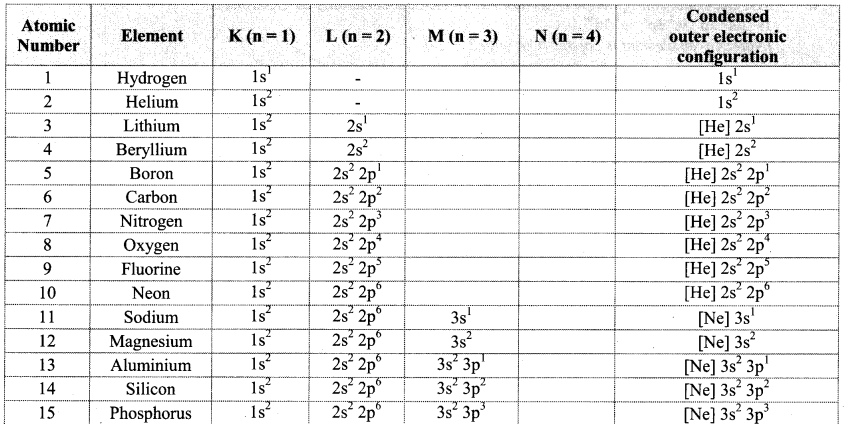
  • The second period begins with Li (Z = 3): 1s2 2s1 and ends up with Ne (Z = 10): 1s2 2s2 2p6.
  • Neon has complete octet with 8 electrons in its valence shell. Therefore, the second period contains eight elements.

ii. Filling of electrons in the third period:

  • The third period corresponds to the filling of the third shell i.e. n = 3.
  • The third period also contains eight elements.
  • It begins with the filling of electrons in the first element Na (Z = 11) : [Ne] 3s1 and ends with the last element Ar (Z = 18) = [Ne] 3s2 3p6.
  • The condensed electronic configurations for the elements of third period is [Ne] 3s1-2 3p1-6.

Question 12.
There are 18 elements in the fourth period of the modern periodic table. Explain.
Answer:

  • The fourth period corresponds to the filling of fourth shell, n = 4.
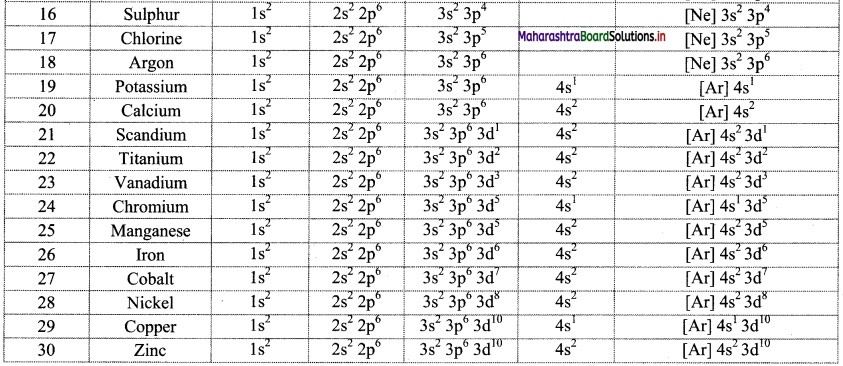
  • Therefore, it begins with filling of 4s subshell. The first two elements of the fourth period are K (Z = 19) : [Ar] 4s1 and Ca (Z = 20) : [Ar] 4s2.
  • According to the aufbau principle, the next higher energy subshell is 3d, which can accommodate up to 10 electrons. Thus, filling of the 3d subshell results in the next 10 elements of the fourth period i.e., from Sc (Z = 21) : [Ar] 4s23d1 to Zn (Z = 30): [Ar] 4s23d10.
  • After filling of 3d subshell, the electrons enter the 4p subshell which can accommodate maximum 6 electrons. Hence, filling of 4p subshell results in the next 6 elements i.e., from Ga (Z = 31): [Ar] 4s23d10 4p1 to Kr (Z = 36): [Ar] 4s2 3d10 4p6.
  • Thus, the elements in fourth period are: 2 elements (with 4s subshell), 10 elements (with 3d subshell) and 6 elements (with 4p subshell).
  • Hence, there are 18 elements in the fourth period of the modem periodic table.

Maharashtra Board Class 11 Chemistry Important Questions Chapter 7 Modern Periodic Table

Question 13.
Why does the fifth period of the modern periodic table contain 18 electrons?
Answer:
The fifth period accommodates 18 elements as a result of successive filling of electrons in the 5s, 4d and 5p subshells.

Question 14.
What is the general trend followed while filling of electrons across a period in the modern periodic table.
Answer:

  • A period begins by filling of one electron to the ‘s’ subshell of a new shell and ends when an element corresponding to the same shell attains complete octet (or duplet).
  • Between these two ‘s’ and ‘p’ subshell of the valence shell, the inner subshells ‘d’ and ‘f’ are filled successively following the aufbau principle.

Question 15.
What is the subshell in which the last electron of the first element in the 6th period enters?
Answer:
The 6th period begins by filling the last electron in the shell with n = 6. The lowest energy subshell of any shell is ‘s’. Therefore, the last electron of the first element in the 6th period enters the subshell ‘6s’.

Question 16.
How many elements are present in the 6th period? Explain.
Answer:

  • The 6th period begins by filling the last electron in the subshell ‘6s’ and ends by completing the subshell ‘6p’. Therefore, the sixth period has the subshells filled in increasing order of energy as 6s < 4f < 5d < 6p.
  • The electron capacities of these subshells are 2, 14, 10 and 6, respectively. Therefore, the total number of elements in the 6th period is 2 + 14 + 10 + 6 = 32.

Maharashtra Board Class 11 Chemistry Important Questions Chapter 7 Modern Periodic Table

Question 17.
How does electronic configuration vary down a group in the modern periodic table?
Answer:

  • As we move from top to bottom in a group, a new shell gets added successively in the atom of an element. Therefore, the last electron enters in a new shell down the group.
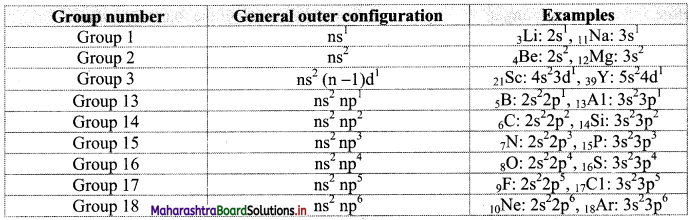
  • Hence, the general outer electronic configuration of the elements in a group remains the same. This holds true for groups 1, 2 and 3 elements.
  • In the groups 13 to 18 the appropriate inner ‘d’ and ‘f’ subshells are completely filled and the general outer electronic configuration is the same down the groups 13 to 18.
  • However, in the groups 4 to 12, the ‘d’ and ‘f subshells are introduced at a later stage (4th period for ‘d’ and 6th period for ‘f’) down the group. As a result, variation in the general outer configuration is introduced only at the

Note: General outer electronic configuration in groups 1 to 3 and 13 to 18.
Maharashtra Board Class 11 Chemistry Important Questions Chapter 7 Modern Periodic Table 1

Question 18.
On what basis is the modern periodic table divided into four blocks?
Answer:
The modem periodic table is divided into four blocks based on the subshell in which the last electron enters.

Question 19.
Why elements of group 1 and group 2 are known as s-block elements?
Answer:

  • The subshell in which the last electron enters decides the block to which an element belongs.
  • In group 1 and group 2 elements, the last electron is filled in the s subshell.

Therefore, the elements of group 1 and group 2 are known as s-block elements.

Question 20.
Elements belonging to which groups constitute the p-block and why?
Answer:

  • Elements belonging to groups 13, 14, 15, 16, 17 and 18 constitute the p-block.
  • The last electron in the p-block elements is filled in p subshell.
  • As p subshell contains three degenerate p orbitals, it can accommodate up to 6 electrons.
  • Therefore, the p-block elements belonging to six groups i.e., groups 13, 14, 15, 16, 17 and 18 in which last electron enters in p subshell constitute the p-block.

Maharashtra Board Class 11 Chemistry Important Questions Chapter 7 Modern Periodic Table

Question 21.
Give reason: Helium which is the first element of group 18 is placed in the p-block even though its last electron enters in s subshell.
Answer:

  • Electronic configuration of helium is 1s2 which indicates that it has a stable electronic configuration i.e., a complete duplet.
  • The p-block ends with group 18 which is a family of inert gases having stable electronic configuration (complete octet except helium).
  • Therefore, helium is placed with group 18 elements in p-block due to its stable electronic configuration even though its last electron enters in s subshell.

Question 22.
State the general outer electronic configuration of s-block and p-block elements.
Answer:
The general outer electronic configuration of s-block elements is ns1-2.
The general electronic configuration for the p-block elements is ns2np1-6.

Question 23.
There are total 10 groups in the d-block of the modern periodic table. Explain.
Answer:

  • The d-block in the modem periodic table is formed as a result of filling the last electron in d orbital.
  • As there are five orbitals in a d subshell, 10 electrons can successively be accommodated.

Hence, there are total 10 groups in the d-block of the modem periodic table i.e., group 3 to 12.

Question 24.
The last electron enters a (n-1)d orbital only after the ns subshell is completely filled. Explain.
Answer:
A d subshell is present in the shells with n ≥ 3 and according to the (n+1) rule, the energy of ns orbital is less than that of the (n-1)d orbital. As a result, the last electron enters a (n-1)d orbital only after the ns subshell is completely filled.

Question 25.
Chromium exhibit 4s1 3d5 electronic configuration instead of 4s2 3d4. Explain.
Answer:

  • Completely filled or half-filled subshells are highly stable.
  • In 4s1 3d5 configuration, both s and d subshells are half-filled.
  • Thus, due to the extra stability associated with half-filled subshells, chromium exhibits 4s1 3d5 electronic configuration instead of 4s2 3d4.

Question 26.
What is the general outer electronic configuration of d-block and f-block elements?
Answer:
The general outer electronic configuration of the d-block elements is ns0-2 (n-1)d1-10 while the general outer electronic configuration of the f-block elements is ns2 (n-1)d0-1 (n-2)f1-14.

Maharashtra Board Class 11 Chemistry Important Questions Chapter 7 Modern Periodic Table

Question 27.
Expected outer electronic configuration of europium (Eu) is 6s2 4f6 5d1. However, it exhibits different than expected outer electronic configuration.
i. Write the observed outer electronic configuration of Eu.
ii. What is the reason for this variation in electronic configuration?
Answer:
i. Observed outer electronic configuration of europium (Eu) is 6s2 4f7 5d0.
ii. In the observed electronic configuration of Eu, 4f subshell is half-filled which is a highly stable configuration. Therefore, observed electronic configuration of Eu varies than expected.

Question 28.
Name the two series that constitute f-block.
Answer:
The f-block constitutes two series of 14 elements called the lanthanide and the actinide series which are placed one below the other.

Question 29.
State whether the following statements are true or false. Correct if false.
i. Position of the elements in the modern periodic table is related to the quantum number of their last filled orbital.
ii. Group number is same as the principal quantum number ‘n’ of the valence shell of the elements.
Answer:
i. True
ii. False
Period number is same as the principal quantum number ‘n’ of the valence shell of the elements.

Question 30.
Name the following.
i. Shortest period in the modern periodic table.
ii. Block which is placed separately at the bottom of the modern periodic table.
Answer:
i. First period
ii. f-Block

Question 31.
How can a period, group and block of the element be determined?
Answer:
The group, period and the block of the element can be determined on the basis of its electronic configuration.
i. Period: The principal quantum number of the valence shell corresponds to the period of the element.
e. g. The principal quantum number (n) of the valence shell (3s1) of Na (1s2 2s2 2p6 3s1) is 3. This corresponds to third period.

ii. Block: The subshell in which the last electron enters, corresponds to the block of the elements (with exception being He).
e. g. The subshell 3d (in which the last electron enters) for Sc (1s2 2s2 2p6 3s2 3p6 3d1 4s2) corresponds to d block.

iii. Group: The group of the element is determined on the basis of number of electrons present in the outermost or penultimate [next to outermost, i.e. (n-1)] shell:

  • For s-block elements, group number = number of valence electrons.
  • For p-block elements, group number = 18 – number of electrons required to complete octet.
  • For d-block elements, group number = 2 + number of (n-1)d electrons.

Maharashtra Board Class 11 Chemistry Important Questions Chapter 7 Modern Periodic Table

Question 32.
Outer electronic configurations of a few elements are given below. Explain them and identify the period, group and block in the periodic table to which they belong.
2He: 1s2, 54Xe: 5s25p6, 16S: 3s23p4, 79Au: 6s15d10
Answer:
i. 2He: 1s2
Here, n = 1. Therefore, 2He belongs to the 1st period.
The shell n = 1 has only one subshell, namely 1s. The outer electronic configuration 1s2 of ‘He’ corresponds to the maximum capacity of 1s, the complete duplet. Therefore, He is placed at the end of the 1st period in the group 18 of inert gases. So, ‘He’ belongs to p-block.

ii. 54Xe: 5s25p6
Here, n = 5. Therefore, 54Xe belongs to the 5th period.
The outer electronic configuration. 5s25p6 corresponds to complete octet. Therefore, 54Xe is placed in group 18 and belongs to p-block.

iii. 16S: 3s23p4
Here, n = 3. Therefore, 16S belongs to the 3rd period. The 3p subshell in ‘S’ is partially filled and short of completion of octet by two electrons. Therefore, ‘S’ belongs to (18 – 2) = 16th group and p-block.

iv. 79AU: 6s15d10
Here n = 6. Therefore, ‘Au’ belongs to the 6th period.
The sixth period begins with filling of electron into 6s and then into 5d orbital.
The outer configuration of ‘Au’: 6s1 5d10 implies that (1 + 10) = 11 electrons are filled in the outer orbitals to give ‘Au’. Therefore ‘Au’ belongs to the group 11.
As the last electron has entered ‘d’ orbital ‘Au’ belongs to the d-block.

Question 33.
Predict the block, periods and groups to which the following elements belong.
i. Mg (Z = 12)
ii. V (Z = 23)
iii. Sb (Z = 51)
iv. Rn (Z = 86)
v. Na (Z = 11)
vi. Cl (Z = 17)
Answer:
i. Mg (Z = 12): Atomic number of Mg is 12. Electronic configuration is 1s2 2s2 2p6 3s2.
Block: Since the last electron enters s subshell (3 s), Mg belongs to s-block.
Period: n = 3. Therefore, it is present in the third period.
Group: For s-block element, group number = number of valence electrons = 2. Hence, it belongs to group 2.

ii. V (Z = 23): Atomic number of V is 23. Electronic configuration is 1s2 2s2 2p6 3s2 3p6 3d3 4s2.
Block: Since the last electron enters d subshell (3d), V belongs to d-block.
Period: n = 4. Therefore, it is present in the fourth period.
Group: For d-block elements, group number = 2 + number of (n – 1)
d electrons = 2 + 3 = 5. Hence, it belongs to group 5.

iii. Sb (Z = 51): Atomic number of Sb is 51.
Electronic configuration is 1s2 2s2 2p6 3s2 3p6 3d10 4s2 4p6 4d10 5s2 5p3.
Block: Since the last electron enters p subshell (5p), Sb belongs to p-block.
Period: n = 5. Therefore, it is present in the fifth period.
Group: For p block elements, group number = 18 – number of electrons required to complete octet
= 18 – 3 = 15. Hence it belongs to group 15.

iv. Rn (Z = 86): Atomic number of Rn is 86.
Electronic configuration is 1s2 2s2 2p6 3s2 3p6 4s2 3d10 4p6 4d10 4f14 5s2 5p6 5d10 6s2 6p6.
Block: Since the last electron enters p subshell (6p), Rn belongs to p-block.
Period: n = 6. Therefore, it is present in the sixth period.
Group: For p block elements, group number = 18 – number of electrons required to complete octet
= 18 – 0 = 18. Hence, it belongs to group 18.

v. Na (Z = 11): Atomic number of Na is 11. Electronic configuration is 1s2 2s2 2p6 3s1.
Block: Since the last electron enters s subshell (3s), Na belongs to s-block.
Period: n = 3. Therefore, it is present in the third period.
Group: For s-block element, number of the group = number of valence electrons = 1. Hence, it belongs to group 1.

vi. Cl (Z = 17): Atomic number of Cl is 17. Electronic configuration is 1s2 2s2 2p6 3s2 3p5.
Block: Since the last electron enters p subshell (3p), Cl belongs to p-block.
Period: n = 3. Therefore, it is present in the third period.
Group: For p block elements, group number = 18 – number of electrons required to complete octet
= 18 – 1 = 17. Hence, it belongs to group 17.

Question 34.
State the characteristics of s-block elements.
Answer:

  • The s-block contains the elements of group 1 (alkali metals) and group 2 (alkaline earth metals).
  • They occur in nature only in combined state as they are reactive elements.
  • Except Li and Be, compounds formed by all other s-block elements are predominantly ionic in nature.
  • This is because they have only one or two valence electrons which they can lose readily forming M+ or M2+ ions.
  • Since they can lose electrons easily, they have low ionization enthalpies, which decreases down the group resulting in increased reactivity.

Question 35.
What are main group elements?
Answer:
The p-block elements together with s-block elements are called main group elements or representative elements.

Maharashtra Board Class 11 Chemistry Important Questions Chapter 7 Modern Periodic Table

Question 36.
Give reason: Group 18 elements do not participate in chemical reactions readily.
Answer:

  • Group 18 is the last group of p-block and include noble or inert gases.
  • They have closed valence shells (complete duplet in the case of ‘He’ and complete octet in the case of the other noble gases).
  • Therefore, they show very low chemical reactivity and thus, do not participate in chemical reactions readily.

Question 37.
Why nonmetals present in group 17 and 16 in the modern periodic table are highly reactive?
Answer:

  • Nonmetals present in group 17 (halogen family) and group 16 (chalcogens) have highly negative electron gain enthalpies.
  • As a result, they readily accept one or two electrons and form anions (X or X2-) that have complete octet.
  • Therefore, nonmetals present in group 17 and 16 are highly reactive.

Question 38.
Explain the composition of the p-block in the modern periodic table.
Answer:

  • The p-block contains elements of groups 13 to 18.
  • It contains all the three types of elements i.e., metals, nonmetals and metalloids.
  • In the p-block, metals and nonmetals are separated from each other by a zig-zag line. The metals are present on the left and the nonmetals are present on the right side while the metalloids are present along the zig-zag line.

Question 39.
State whether the following statements are true or false. Correct if false.
i. Nonmetallic character increases from left to right across a period.
ii. Nonmetallic character increases down a group.
Answer:
i. True
ii. False
Nonmetallic character decreases down a group.

Question 40.
Differentiate between s-block and p-block elements.
Answer:
s-Block elements:

  • s-Block contains group 1 and group 2 elements.
  • It contains only metals.
  • The last electron in the s-block elements enters in s orbital.
  • General outer electronic configuration of s-block elements is ns1-2.
  • e.g. Na, K, Ca, Mg, etc.

p-Block elements:

  • p-Block contains elements from groups 13 to 18.
  • It contains metals, nonmetals as well as metalloids.
  • The last electron in the p-block elements enters in p orbital.
  • General outer electronic configuration of p-block elements is ns2 np1-6.
  • e.g. C, N, O, F, etc.

Maharashtra Board Class 11 Chemistry Important Questions Chapter 7 Modern Periodic Table

Question 41.
Write a note on the characteristics of the d-block elements.
Answer:

  • The d-block contains elements of the groups 3 to 12 which are all metals. They are also known as transition elements or transition metals.
  • They form a bridge between chemically reactive s-block elements and less reactive elements of groups 13 and 14.
  • Most of the d-block elements possess partially filled inner d orbitals. As a result, the d-block elements have properties such as variable oxidation state, paramagnetism, ability to form coloured ions. They can be used as catalysts.
  • Zn, Cd, and Hg with configuration ns2 (n-1)d10, (completely filled s and d subshells) do not show characteristic properties of transition metals as they are stable.

Question 42.
Explain in brief about the f-block elements.
Answer:

  • The elements present in f-block are all metals and are placed in the two rows called lanthanide series (58Ce to 71Lu) and actinide series (90Th to 103Lr).
  • The lanthanides are also known as rare earth elements while the actinide elements beyond 92U are called transuranium elements.
  • All the transuranium elements are manmade and radioactive.
  • The last electron of the elements of these series is filled in the (n-2)f subshell, and therefore, these are called inner transition elements.
  • These elements have very similar properties within each series.

Question 43.
What is lanthanide and actinide series?
Answer:
i. Lanthanide series: The fourteen elements after lanthanum (Z = 57) i.e., from cerium (Z = 58) to lutetium (Z = 71) are named after their preceding member (57La) present in the third group and 6th period and are called lanthanides. They are kept in separate series called lanthanide series at the bottom of the modem periodic table.

ii. Actinide series: The fourteen elements after actinium i.e., from thorium (Z = 90) to lawrencium (Z = 103) are named after 89Ac present in third period and 7th group. They are kept in separate series called actinide series at the bottom of the modem periodic table.

Question 44.
Differentiate between d-block and f-block elements.
Answer:
d-Block elements:

  • d-Block contains elements from group 3 to group 12.
  • It is present in the middle of the modern periodic table.
  • They are also known as transition elements.
  • The last electron in the d-block elements enters in d orbital.
  • General outer electronic configuration of d-block elements is ns0-2 (n-1)d1-10 .
  • e.g. Cu, Zn, Cr, Ti, V, etc.

f-Block elements:

  • f-Block contains elements of lanthanide and actinide series.
  • f-block elements are present below the modern periodic table as two separate rows.
  • They are also known as inner transition elements.
  • The last electron in the f-block elements enters in f orbital.
  • General outer electronic configuration of f-block elements is ns2 (n-1) d0-1 (n-2) f114.
  • e.g. Ce, Pr, Nd Th, U, Np, etc.

Maharashtra Board Class 11 Chemistry Important Questions Chapter 7 Modern Periodic Table

Question 45.
Chlorides of two metals are common laboratory chemicals and both are colourless. One of the metals reacts vigorously with water while the other reacts slowly. Place the two metals in the appropriate block in the periodic table. Justify your answer.
Answer:
i. Metals are present in all the four blocks of the periodic table.
ii. Salts of metals in the f-block and p-block (except AlCl3) are not common laboratory chemicals. Therefore, the choice is between s- and d-block.
iii. From the given properties their placement is done as shown below:

  • s-block: Metal that reacts vigorously with water.
  • d-block: Metal that reacts slowly with water.

iv. The colourless nature of the less reactive metal in the d-block implies that the inner d subshell is completely filled.

Question 46.
What are periodic properties?
Answer:

  • The elements in the modem periodic table (long form of periodic table) are arranged in such a way that on moving across a period or down the group, several properties of elements vary in regular fashion. These properties are called periodic properties.
  • Atomic and ionic radii, ionization enthalpy, electron gain enthalpy, electronegativity, valency and oxidation states are several properties of elements that show periodic variations.

Question 47.
What leads to the phenomena called effective nuclear charge and screening effect in an atom?
Answer:

  • The periodic trends are explained in the terms of two fundamental factors, namely, attraction of extranuclear electrons towards the nucleus and repulsion between electrons belonging to the same atom.
  • These attractive and repulsive forces operate simultaneously in an atom.
  • This results in two interrelated phenomena called effective nuclear charge and screening effect in an atom.

Question 48.
Explain the concept of effective nuclear charge in detail.
Answer:
i. In a multi-electron atom, the positively charged nucleus attracts the negatively charged electrons around it, and there is mutual repulsion between the negatively charged extranuclear electrons.
ii. The repulsion by inner shell electrons results in pushing the outer shell electrons further away from the nucleus. Thus, the outer shell electrons are held less tightly by the nucleus.
iii. As a result, the attraction of the nucleus for an outer electron is partially cancelled and hence, an outer shell electron does not experience the actual positive charge present on the nucleus. This effect of the inner electrons on the outer electrons is called screening effect or shielding effect.
iv. The net nuclear charge actually experienced by an electron is called the effective nuclear charge (Zeff).
The effective nuclear charge is lower than the actual nuclear charge (Z).
v. Effective nuclear charge (Zeff) = Z – electron shielding
= Z – σ
Here σ (sigma) is called shielding constant or screening constant and the value of σ depends upon type of the orbital that the electron occupies.

Question 49.
Define:
i. Effective nuclear charge (Zeff)
ii. Screening effect (or shielding effect)
Answer:
i. Effective nuclear charge (Zeff): In multi-electron atom, the net nuclear charge actually experienced by an electron is called the effective nuclear charge (Zeff).
ii. Screening effect (or shielding effect): In multi-electron atom, the effect of the inner electrons on the outer electrons is called screening effect or shielding effect of the inner/core electrons.

Maharashtra Board Class 11 Chemistry Important Questions Chapter 7 Modern Periodic Table

Question 50.
Explain the variations in effective nuclear charge
i. Across a period
ii. Down a group
Answer:
i. Across a period:

  • As we move across a period, atomic number increases by one and thus, actual nuclear charge (Z) increases by +1 at a time.
  • However, the valence shell remains the same and the newly added electron gets accommodated in the same shell. There is no addition of electrons to the core i.e., inner shells. Thus, shielding due to core electrons remains the same even though the actual nuclear charge increases.
  • As a result, the effective nuclear charge (Zeff) goes on increasing across a period.

ii. Down a group:

  • As we move down a group, a new larger valence shell is added. As a result, there is an additional shell in the core.
  • The shielding effect of the increased number of core electrons outweighs the effect of the increased nuclear charge. Thus, the effective nuclear charge experienced by the outer electrons decreases largely down a group.
  • Hence, the effective nuclear charge (Zeff) decreases down a group.

Question 51.
Define atomic radius.
Answer:
Atomic radius is one half of the internuclear distance between two adjacent atoms of a metal or two single bonded atoms of a nonmetal.

Question 52.
What is meant by covalent radius of the atom? Explain with suitable examples.
Answer:

  • In the case of nonmetals (except noble gases), the atoms of an element are bonded to each other by covalent bonds.
  • Bond length of a single bond is taken as sum of radii of the two single bonded atoms. This is called covalent radius of the atom.
  • For example: Bond length of C-C bond in diamond is 154 pm. Therefore, atomic radius of carbon is estimated to be 77 pm which is half of bond length (\(\frac {1}{2}\) × 154 = 77).

Question 53.
How is atomic radius of a nonmetallic element estimated?
Answer:

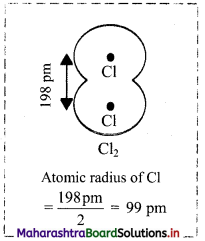
  • The atomic size of a nonmetallic element is estimated from the distance between the two atoms bound together by a single covalent bond. From this, the covalent radius of the element is estimated.
  • The internuclear distance in a diatomic molecule of an element is its covalent bond length. Half the covalent bond length gives the covalent radius.
  • Bond length of Cl-Cl bond in Cl2 is measured as 198 pm. Therefore, the atomic radius of Cl is estimated to be 99 pm.
Maharashtra Board Class 11 Chemistry Important Questions Chapter 7 Modern Periodic Table 2

Question 54.
Define metallic radius.
Answer:
One half of the distance between the centres of nucleus of the two adjacent atoms of a metallic crystal is called as a metallic radius.

Maharashtra Board Class 11 Chemistry Important Questions Chapter 7 Modern Periodic Table

Question 55.
How is metallic radius determined in the case of metals? Give suitable example.
Answer:

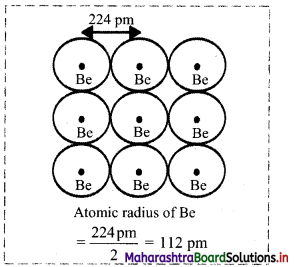
  • In the case of metals, distance between the adjacent atoms in metallic sample is measured. One half of this distance is taken as the metallic radius.
  • For example: In beryllium, distance between the adjacent Be atoms is measured. One half of this distance is taken as the metallic radius of a Be atom.
  • Distance between two adjacent Be atoms is 224 pm. Therefore, metallic radius of a Be atom is 112 pm.
Maharashtra Board Class 11 Chemistry Important Questions Chapter 7 Modern Periodic Table 3

Note: Atomic radii of some elements are given in the table below.
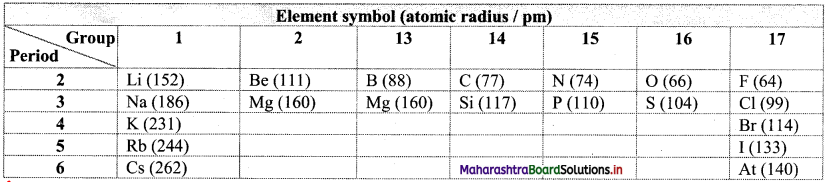
Maharashtra Board Class 11 Chemistry Important Questions Chapter 7 Modern Periodic Table 4

Question 56.
How is a cation and an anion formed?
Answer:
A cation (or positively charged ion) is formed by the removal of one or more electrons from the atom of an element whereas an anion (or negatively charged ion) is formed when the atom of an element gains one or more electrons.

Question 57.
Give reasons: Radius of a cation is smaller and that of an anion is larger as compared to that of their parent atoms.
Answer:

  • A cation is formed by the loss of one or more electrons, therefore, it contains fewer electrons that the parent atom but has the same nuclear charge.
  • As a result, the shielding effect is less and effective nuclear charge is larger within a cation. Thus, radius of a cation is smaller than the parent atom.
  • However, an anion is formed by the gain of one or more electrons and therefore, it contains a greater number of electrons than the parent atom.
  • Due to these additional electrons, anion experiences increased electronic repulsion and decreased effective nuclear charge. As a result, an anion has larger radius than its parent atom.

Hence, radius of a cation is smaller and that of an anion are larger as compared to that of their parent atoms.

Question 58.
Define: Isoelectronic species
Answer:
The atoms or ions which have the same number of electrons are called isoelectronic species.

Question 59.
Explain with example why the radii of isoelectronic species vary.
Answer:
i. The radii of isoelectronic species vary according to actual nuclear charge. Larger nuclear charge exerts greater attraction on the electrons and thus, the radius of that isoelectronic species becomes smaller.
ii. For example, F and Na+ both have 10 electrons but the nuclear charge on F is +9 which is smaller than that of Na+ which has the nuclear charge +11.
Hence, F has larger ionic radii (133 pm) than Na+ (98 pm).

Maharashtra Board Class 11 Chemistry Important Questions Chapter 7 Modern Periodic Table

Question 60.
What is the trend observed in the ionic size of the following isoelectronic species? Explain.
i. Na+, Mg2+, Al3+ and Si4+
ii. O2-, F, Na+ and Mg2+
Answer:
i. Na+, Mg2+, Al3+ and Si4+

Maharashtra Board Class 11 Chemistry Important Questions Chapter 7 Modern Periodic Table 5
a. Among the given ions, the nuclear charge varies but the number of electrons remains the same and therefore, these are isoelectronic species.
b. The radii of isoelectronic species vary according to actual nuclear charge. Larger nuclear charge exerts greater attraction on the electrons and thus, the radius of that isoelectronic species becomes smaller.
c. The nuclear charge increases in the order Na+ < Mg2+ < Al3+ < Si4+ and thus, the ionic size decreases in the order Na+ > Mg2+ > Al3+ > Si4+.

ii. O2-, F, Na+ and Mg2+
Maharashtra Board Class 11 Chemistry Important Questions Chapter 7 Modern Periodic Table 6
a. Among the given ions, the nuclear charge varies but the number of electrons remains the same and therefore, these are isoelectronic species.
b. The radii of isoelectronic species vary according to actual nuclear charge. Larger nuclear charge exerts greater attraction on the electrons and thus, the radius of that isoelectronic species becomes smaller.
c. The nuclear charge increases in the order O2- < F < Na+ < Mg2+ and thus, the ionic size decreases in the order O2- > F > Na+ > Mg2+.

Question 61.
Identify the species having larger radius from the following pairs:
i. Na and Na+
ii. Na+ and Mg2+
Answer:
i. The nuclear charge is the same in Na and Na+. But Na+ has a smaller number of electrons and a smaller number of occupied shells (two shells in Na+, while three shells in Na). Therefore, radius of Na is larger.
ii. Na+ and Mg2+ are isoelectronic species. Mg2+ has a larger nuclear charge than that of Na+. Therefore, Na+ has larger radius.

Question 62.
Which of the following species will have the largest and the smallest size? Why?
Mg, Mg2+, Al, Al3+
Answer:

  • Atomic radius decreases across the period. Hence, the atomic radius of Mg is larger than that of Al.
  • Parent atoms have larger radius than their corresponding cations. Hence, the radius of Mg is larger than that of Mg2+ and the radius of Al is larger than that of Al3+.
  • Mg2+ and Al3+ are isoelectronic. Among isoelectronic species, the one with larger nuclear charge will have smaller radius. Al3+ (Z = 13) has a larger nuclear charge than that of Mg2+ (Z = 12). Hence, the ionic radius of Al3+ is smaller than Mg2+.
  • Therefore, the decreasing order of radius is Mg > Al > Mg2+ > Al3+.

Hence, species with the largest size is Mg and with the smallest size is Al3+.

Question 63.
Identify the element with more negative value of electron gain enthalpy from the following pairs. Justify.
i. Cl and Br
ii. F and O
Answer:
i. Cl and Br belong to the same group of halogens with Br having higher atomic number than CL As the atomic number increases down the group, the effective nuclear charge decreases. The increased shielding effect of core electrons can be noticed. The electron has to be added to a farther shell, which releases less energy and thus, electron gain enthalpy becomes less negative down the group. Therefore, Cl has more negative electron gain enthalpy than Br.

ii. F and O belong to the same second period with F having higher atomic number than O. As the atomic number increases across a period, atomic radius decreases, effective nuclear charge increases and electron can be added more easily. Therefore, more energy is released with gain of an electron as we move towards right in a period. Therefore, F has more negative electron gain enthalpy than O.

Maharashtra Board Class 11 Chemistry Important Questions Chapter 7 Modern Periodic Table

Question 64.
Explain the importance of electronegativity.
Answer:

  • When two atoms of different elements form a covalent bond, the electron pair is shared unequally.
  • Electronegativity represents attractive force exerted by the nucleus on shared electrons. Electron sharing between covalently bonded atoms takes place using the valence electron.
  • It depends upon the effective nuclear charge experienced by electron involved in formation of the covalent bond.
  • Electronegativity predicts the nature of the bond, or, how strong is the force of attraction that holds two atoms together.

Question 65.
Explain the trend in electronegativity
i. across a period
ii. down a group
Answer:
i. Across a period:
a. As we move across a period from left to right in the periodic table, the effective nuclear charge increases steadily.
b. Hence, due to the increase in effective nuclear charge, the tendency to attract shared electron pair in a covalent bond increases i.e., electronegativity increases from left to right across a period.
e. g. Li < Be < B < C < N < O <F.

ii. Down a group:
a. As we move down the group from top to bottom in the periodic table, the size of the valence shell goes on increasing.
b. However, the effective nuclear charge decreases as the shielding effect of the core electrons increases due to the increase in the size of the atoms.
c. Thus, the tendency to attract shared electron pair in a covalent bond decreases, decreasing the electronegativity down the group.
e.g. F > Cl > Br > I > At.

Question 66.
Explain the terms:
i. Valency of an element
ii. Oxidation state (or oxidation number)
iii. Chemical reactivity
Answer:
i. Valency of an element:

  • Valency of an element indicates the number of chemical bonds that the atom can form giving a molecule.
  • The most fundamental chemical property of an element is its combining power. This property is numerically expressed in terms of valency or valence.
  • Valence does not have any sign associated with it.
  • Valency of the main group elements is usually equal to the number of valence electrons (outer electrons) and/or equal to difference between 8 and the number of valence electrons.

ii. Oxidation state (or oxidation number):

  • The oxidation state or oxidation number is a frequently used term related to valence.
  • Oxidation number has a sign, + or – which is decided by the electronegativities of atoms that are bonded.

iii. Chemical reactivity:

  • Chemical reactivity is related to the ease with which an element loses or gains the electrons.
  • Chemical properties of elements depend on their electronic configuration.

Question 67.
What is the trend observed in the valency of main group elements?
Answer:
i. Valency of the main group elements is usually equal to the number of valence electrons (outer electrons) or it is equal to the difference between 8 and the number of valence electrons.
i.e., (8 – number of valence electrons).
ii. The valency remains the same down the group and shows a gradual variation across the period as atomic number increases from left to right.

Note: Periodic trends in valency of main group elements.
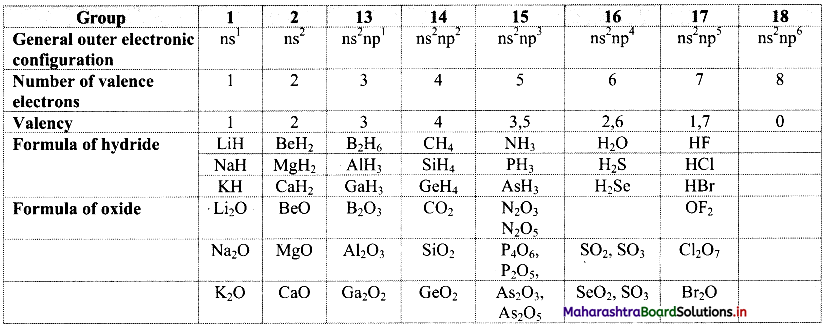
Maharashtra Board Class 11 Chemistry Important Questions Chapter 7 Modern Periodic Table 7

Question 68.
Give any two distinguishing points between metals and nonmetals.
Answer:
Metals:

  1. Generally, metals exhibit good electrical conductivity.
  2. They can form compounds by loss of valence electrons.

Nonmetals:

  1. Generally, nonmetals exhibit poor electrical conductivity.
  2. Nonmetals can form compounds by gain of valence electrons in valence shell.

Maharashtra Board Class 11 Chemistry Important Questions Chapter 7 Modern Periodic Table

Question 69.
Explain the variation of the following property of elements down a group and across a period.
i. Metallic character
ii. Nonmetallic character
Answer:
The variation observed in the metallic and nonmetallic character of elements can be explained in the terms of ionization enthalpy and electron gain enthalpy.
i. Metallic character:

  • The ionization enthalpy decreases down the group. Thus, the tendency to lose valence electrons increases down the group and the metallic character increases down a group.
  • However, the ionization enthalpy increases across the period and as a result metallic character decreases across a period.

ii. Nonmetallic character:

  • Electron gain enthalpy becomes less negative as we move down the group and hence, nonmetallic character decreases down the group.
  • However, electron gain enthalpy becomes more and more negative across the period and thus, nonmetallic character increases across the period.

Question 70.
Justify the position of most reactive and least reactive elements in the modern periodic table.
Answer:

  • Chemical reactivity of elements depends on the ease with which it attains electronic configuration of the nearest inert gas by gaining or losing electrons.
  • The elements preceding an inert gas react by gaining electrons in the outermost shell, whereas the elements which follow an inert gas in the periodic table react by loss of valence electrons. Thus, the chemical reactivity is decided by the electron gain enthalpy and ionization enthalpy values, which in turn, are decided by effective nuclear charge and finally by the atomic size.
  • The ionization enthalpy is the smallest for the element on the extreme left in a period, whereas the electron gain enthalpy is the most negative for the second last element on the extreme right, (preceding to the inert gas which is the last element of a period).
  • Thus, the most reactive elements lie on the extreme left and the extreme right (excluding inert gases) of the periodic table.

Question 71.
How can we predict chemical reactivity of elements based on their oxide formation reactions and the nature of oxides formed?
Answer:

  • The chemical reactivity can be illustrated by comparing the reaction of elements with oxygen to form oxides and the nature of the oxides.
  • Alkali metals present on the extreme left of the modem periodic table are highly reactive and thus, they react vigorously with oxygen to form oxides such as Na2O which reacts with water to form strong bases like NaOH.
  • The reactive elements on the right i.e., halogens react with oxygen to form oxides such as Cl2O7 which on reaction with water form strong acids like HClO4.
  • The oxides of the elements in the centre of the main group elements are either amphoteric (Al2O3) neutral (CO, NO) or weakly acidic (CO2).

Question 72.
Write the chemical equations for reaction, if any, of (i) Na2O and (ii) Al2O3 with HCl and NaOH both. Correlate this with the position of Na and Al in the periodic table, and infer whether the oxides are basic, acidic or amphoteric.
Answer:
i. Na2O + 2HCl → 2NaCl + H2O
Na2O + NaOH → No reaction
As Na2O reacts with an acid to form salt and water it is a basic oxide. This is because Na is a reactive metal lying on the extreme left of the periodic table.

ii. Al2O3 + 6HCl → 2AlCl3 + 3H2O
Al2O3 + 2NaOH → 2NaAlO2 + H2O
As Al2O3 reacts with an acid as well as base to form a salt and water. It is an amphoteric oxide. Al is a moderately reactive element lying in the centre of main group elements in the periodic table.

Maharashtra Board Class 11 Chemistry Important Questions Chapter 7 Modern Periodic Table

Question 73.
Comment on the chemical reactivity of d-block and f-block elements.
Answer:

  • d-block (transition) elements and f-block (inner transition) elements exhibit very small change in atomic radii.
  • Therefore, the transition and inner transition elements belonging to the individual series have similar chemical properties.
  • Their ionization enthalpies are intermediate between those of s-block and p-block elements. Thus, d-block and f-block elements generally show moderate reactivity.

Question 74.
Ge, S and Br belong to the groups 14, 16 and 17, respectively. Predict the empirical formulae of the compounds those can be formed by (i) Ge and S, (ii) Ge and Br.
Answer:
From the group number we understand that the general outer electronic configuration and number of valence electrons and valencies of the three elements are:

Maharashtra Board Class 11 Chemistry Important Questions Chapter 7 Modern Periodic Table 8
i. S is more electronegative than Ge. Therefore, the empirical formula of the compound formed by these two elements is predicted by the method of cross multiplication of the valencies:
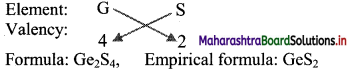
Maharashtra Board Class 11 Chemistry Important Questions Chapter 7 Modern Periodic Table 9

ii. Br is more electronegative than Ge. The empirical formula of the compound formed by these two elements is predicted by the method of cross multiplication of valencies:
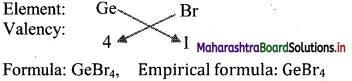
Maharashtra Board Class 11 Chemistry Important Questions Chapter 7 Modern Periodic Table 10
[Note: More electronegative element is written on right hand side in cross multiplication method.]

Question 75.
The first ionization enthalpies of 5 elements of second period are given below:

Element1st IE values (kJ mol-1)
I520
II1681
III1086
IV2080
V899

Based on the above data, answer the following questions:
i. Identify the element having highest atomic number.
ii. If element I is lithium, how will you explain its low value of first ionization enthalpy?
iii. Explain why ionization enthalpies are always positive.
Answer:
i. Element IV. The first ionization enthalpy increases with increase in atomic number along a period. Hence, the element IV having highest IE will have highest atomic number among the given elements.
ii. Alkali metals have only one electron in their valence shell which can be easily lost resulting in the stable noble gas configuration. Therefore, lithium shows low value of first ionization enthalpy.
iii. Energy is always required to remove electrons from an atom. Hence, ionization enthalpies have positive value.

Question 76.
From the elements Mg, Ar, Cl, Sr, P and S, choose one that fits each of the below given descriptions:
i. An element having two valence electrons.
ii. An element having properties similar to that of O.
iii. A noble gas.
iv. An alkaline earth metal,
v. An element having electronic configuration 1s22s22p63s23p3.
Answer:
i. Magnesium (Mg)
ii. Sulphur (S)
iii. Argon (Ar)
iv. Strontium (Sr)
v. Phosphorus (P)

Multiple Choice Questions

1. Mendeleev’s periodic table had …………… elements.
(A) 75
(B) 83
(C) 63
(D) 118
Answer:
(C) 63

2. The serial or ordinal number of an element in Mendeleev’s periodic table was recognized as ………….
(A) neutron number
(B) valency
(C) principal quantum number
(D) proton number
Answer:
(D) proton number

Maharashtra Board Class 11 Chemistry Important Questions Chapter 7 Modern Periodic Table

3. Mendeleev predicted the existence of …………..
(A) aluminium
(B) silicon
(C) tellurium
(D) germanium
Answer:
(D) germanium

4. According to Mendeleev’s periodic law, the physical and chemical properties of elements are the periodic function of their …………..
(A) atomic weights
(B) atomic numbers
(C) molecular formulas
(D) molecular weights
Answer:
(A) atomic weights

5. Moseley showed that the fundamental property of an element is ……………
(A) atomic number
(B) atomic mass
(C) both A and B
(D) none of these
Answer:
(A) atomic number

6. According to periodic law of elements, the variation in properties of elements is related to their ……………
(A) densities
(B) atomic masses
(C) atomic sizes
(D) atomic numbers
Answer:
(D) atomic numbers

7. At present, how many elements are known?
(A) 118
(B) 110
(C) 114
(D) 120
Answer:
(A) 118

Maharashtra Board Class 11 Chemistry Important Questions Chapter 7 Modern Periodic Table

8. The long form of the periodic table consists of how many periods?
(A) 5
(B) 8
(C) 10
(D) 7
Answer:
(D) 7

9. According to quantum mechanical model of the atom, the properties of elements can be correlated to their …………….
(A) atomic number
(B) atomic mass
(C) valency
(D) electronic configuration
Answer:
(D) electronic configuration

10. The fourth, fifth and sixth periods are long periods and contain ……………
(A) 18, 18 and 36
(B) 18, 28 and 32
(C) 18, 15 and 31
(D) 18, 18 and 32
Answer:
(D) 18, 18 and 32

11. f-block elements are also known as ……………
(A) transition elements
(B) inert gas elements
(C) normal elements
(D) inner transition elements
Answer:
(D) inner transition elements

12. Which of the following forms a bridge between reactive s-block elements and less reactive group 13 and 14 elements?
(A) Inert gases
(B) Transition metals
(C) Halogens
(D) Inner transition metals
Answer:
(B) Transition metals

13. ………… elements are known as chalcogens.
(A) Group 17
(B) Group 18
(C) Group 16
(D) Group 1
Answer:
(C) Group 16

Maharashtra Board Class 11 Chemistry Important Questions Chapter 7 Modern Periodic Table

14. The name ‘rare earth elements’ is used for …………..
(A) lanthanides only
(B) actinides only
(C) both lanthanides and actinides
(D) alkaline earth metals
Answer:
(C) both lanthanides and actinides

15. Atomic number of V is 23 and its electronic configuration is …………….
(A) 1s2 2s2 2p6 3p6 3d3 4s2
(B) 1s2 2s2 2d3 3p6 2p6 4s2
(C) 2s2 1s2 2p6 3s2 3d3 4s2
(D) 1s2 2s2 2p6 3s2 3p6 3d3 4s2
Answer:
(D) 1s2 2s2 2p6 3s2 3p6 3d3 4s2

16. Aluminium belongs to …………. elements.
(A) s-block
(B) p-block
(C) d-block
(D) f-block
Answer:
(B) p-block

17. In P3-, S2- and Cl ions, the increasing order of size is ………….
(A) Cl < S2- < P3-
(B) P3- < S2- < Cl
(C) S2- < Cl < P3-
(D) S2- < P3- < Cl
Answer:
(A) Cl- < S2- < P3-

18. The CORRECT order of radii is ……………
(A) N < Be < B
(B) F< O2- <N3-
(C) Na < Li < K
(D) Fe3+ < Fe2+ < Fe4+
Answer:
(B) F < O2- <N3-

Maharashtra Board Class 11 Chemistry Important Questions Chapter 7 Modern Periodic Table

19. Which of the following species will have the largest size Mg, Mg2+, Fe, Fe3+?
(A) Mg
(B) Mg2+
(C) Fe
(D) Fe3+
Answer:
(C) Fe

20. Which one of the following is CORRECT order of the size?
(A) I > I >I+
(B) I > I+ > I
(C) I+ > I > I
(D) I > I > I+
Answer:
(D) I > I > I+

21. The CORRECT order of increasing radii of the elements Na, Si, Al and P is ……………
(A) Si < Al < P < Na
(B) Al < Si < P < Na
(C) P < Si < Al < Na
(D) Al < P < Si < Na
Answer:
(C) P < Si < Al < Na

22. The metallic and nonmetallic properties of elements can be judged by their ……………
(A) electron gain enthalpy
(B) ionization enthalpy
(C) electronegativity
(D) valence
Answer:
(C) electronegativity

Maharashtra Board Class 11 Chemistry Important Questions Chapter 7 Modern Periodic Table

23. Which element has the most negative electron gain enthalpy?
(A) Sulphur
(B) Fluorine
(C) Chlorine
(D) Hydrogen
Answer:
(C) Chlorine

24. Which of the properties remain unchanged on descending a group in the periodic table?
(A) Atomic size
(B) Density
(C) Valency electrons
(D) Metallic character
Answer:
(C) Valency electrons

Maharashtra Board Class 11 Chemistry Important Questions Chapter 6 Redox Reactions

Balbharti Maharashtra State Board 11th Chemistry Important Questions Chapter 6 Redox Reactions Important Questions and Answers.

Maharashtra State Board 11th Chemistry Important Questions Chapter 6 Redox Reactions

Question 1.
What does the term ‘redox’ refer to?
Answer:
Redox is an abbreviation used for the terms ‘oxidation and reduction’.

Question 2.
Give examples of naturally occurring redox reactions.
Answer:

  1. Respiration
  2. Rusting
  3. Combustion of fuel

Question 3.
Define Oxidant/Oxidising agent.
Answer:
A reagent/substance which itself undergoes reduction and causes oxidation of another species is called oxidant/oxidising agent.

Question 4.
Define: Reductant/Reducing agent
Answer:
A reagent/substance which itself undergoes oxidation bringing about the reduction of another species is called reductant/reducing agent.

Maharashtra Board Class 11 Chemistry Important Questions Chapter 6 Redox Reactions

Question 5.
Explain redox reaction giving an example.
Answer:
Oxidation and reduction reactions occur simultaneously. Therefore, the oxidation-reduction reaction is also referred to as a redox reaction.
Maharashtra Board Class 11 Chemistry Important Questions Chapter 6 Redox Reactions 1
In the above reaction, HgCl2 is reduced to Hg2Cl2 and SnCl2 is oxidised to SnCl4. Hence, it is a redox reaction.

Question 6.
Explain redox reaction in terms of electron transfer.
Answer:
i. Redox reaction can be described in terms of electron transfer as shown below:
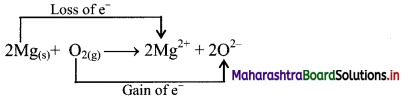
2Mg(s) + O2(g) → Mg2+ + 2O2-
ii. Charge development suggests that each magnesium atom loses two electrons to form Mg2+ and each oxygen atom gains two electrons to form O2-. This can be represented as follows:
Maharashtra Board Class 11 Chemistry Important Questions Chapter 6 Redox Reactions 2
iii. When Mg is oxidised to MgO, the neutral Mg atom loses electrons to form Mg2+ in MgO while the elemental oxygen gains electrons and forms O2- in MgO.
iv. Each of the above steps represents a half reaction which involves electron transfer (loss or gain).
v. Sum of these two half reactions or the overall reaction is a redox reaction.

Question 7.
Justify the following reaction as redox reaction in terms of electron transfer.
Mg + F2 → MgF2
Answer:
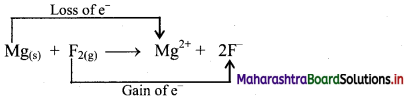
i. Redox reaction can be described in terms of electron transfer as shown below:
Mg(s) + F2(g) → Mg2+ + 2F
ii. Charge development suggests that magnesium atom loses two electrons to form Mg2+ and each fluorine atom gains one electron to form F. This can be represented as follows:
Maharashtra Board Class 11 Chemistry Important Questions Chapter 6 Redox Reactions 3
iii. When Mg is oxidised to MgF2, the neutral Mg atom loses electrons to form Mg2+ in MgF2 while the elemental fluorine gains electrons and forms Fin MgF2.
iv. Each of the above steps represents a half reaction which involves electron transfer (loss or gain).
v. Sum of these two half reactions or the overall reaction is a redox reaction.

Question 8.
Justify that the reaction 2Na(s) + H2(g) → 2NaH(s) is a redox reaction.
Answer:
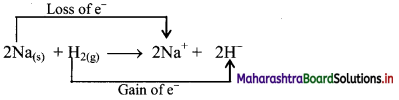
Redox reaction can be described as electron transfer as shown below:
2Na(s) + H2(g) → 2Na+ + 2H
ii. Charge development suggests that each sodium atom loses one electron to form Na+ and each hydrogen atom gains one electron to form H. This can be represented as follows:
Maharashtra Board Class 11 Chemistry Important Questions Chapter 6 Redox Reactions 4
iii. When Na is oxidised to NaH, the neutral Na atom loses one electron to form Na+ in NaH while the elemental hydrogen gains one electron and forms H in NaH.
iv. Each of the above steps represents a half reaction which involves electron transfer (loss or gain).
v. Sum of these two half reactions or the overall reaction is a redox reaction.

Question 9.
Define the terms oxidation and reduction in terms of electron transfer.
Answer:
i. The half reaction involving loss of electrons is called oxidation reaction.
Maharashtra Board Class 11 Chemistry Important Questions Chapter 6 Redox Reactions 5
ii. The half reaction involving gain of electrons is called reduction reaction.
Maharashtra Board Class 11 Chemistry Important Questions Chapter 6 Redox Reactions 6

Question 10.
Define the terms oxidant and reductant in terms of electron transfer.
Answer:

  1. Oxidant: Oxidant or oxidising agent is an electron acceptor.
  2. Reductant: Reductant or reducing agent is an electron donor.

Maharashtra Board Class 11 Chemistry Important Questions Chapter 6 Redox Reactions

Question 11.
Identify oxidising and reducing agents in the following reaction.
\(\mathrm{Fe}_{(s)}+\mathrm{Cu}_{(\mathrm{aq})}^{2+} \longrightarrow \mathrm{Fe}_{(\mathrm{aq})}^{2+}+\mathrm{Cu}_{(\mathrm{s})}\)
Answer:
Fe(s) acts as a reducing agent as it donates electrons while \(\mathrm{Cu}_{(\mathrm{aq})}^{2+}\) acts as an oxidising agent as it accepts electrons.

Question 12.
Define: Displacement reaction.
Answer:
A reaction in which an ion (or an atom) in a compound is replaced by an ion (or an atom) of another element is called displacement reaction.
e.g. X + YZ → XZ + Y

Question 13.
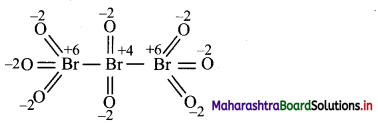
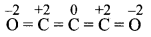
Draw structure and assign oxidation number to each atom in:
i. Br3O8
ii. C3O2
Answer:
i. Br3O8
Maharashtra Board Class 11 Chemistry Important Questions Chapter 6 Redox Reactions 7

ii. C3O2
Maharashtra Board Class 11 Chemistry Important Questions Chapter 6 Redox Reactions 8

Question 14.
Deduce the oxidation number of S in the following species:
i. SO2
ii. \(\mathrm{SO}_{4}^{2-}\)
Answer:
i. SO2 is a neutral molecule.
∴ Sum of oxidation numbers of all atoms of SO2 = 0
∴ (Oxidation number of S) + 2 × (Oxidation number of O) = 0
∴ Oxidation number of S + 2 × (- 2) = 0
∴ Oxidation number of S in SO2 = 0 – (- 4)
∴ Oxidation number of S in SO2 = +4

ii. \(\mathrm{SO}_{4}^{2-}\) is an ionic species.
∴ Sum of the oxidation numbers of all atoms of \(\mathrm{SO}_{4}^{2-}\) = – 2
∴ (Oxidation number of S) + 4 × (Oxidation number of O) = – 2
∴ Oxidation number of S in \(\mathrm{SO}_{4}^{2-}\) = – 2 – 4 × (-2) = – 2 + 8
∴ Oxidation number of S in \(\mathrm{SO}_{4}^{2-}\) = +6

Maharashtra Board Class 11 Chemistry Important Questions Chapter 6 Redox Reactions

Question 15.
Assign oxidation number to each element in the following compounds or ions.
i. KMnO4
ii. K2Cr2O7
iii. Ca3(PO4)2
Answer:
i. KMnO4
Oxidation number of K = +1
Oxidation number of O = -2
KMnO4 is a neutral molecule.
∴ Sum of the oxidation numbers of all atoms = 0
∴ (Oxidation number of K) + (Oxidation number of Mn) + 4 × (Oxidation number of O) = 0
∴ (+1) + Oxidation number of Mn + 4 × (-2) = 0
∴ Oxidation number of Mn + 1 – 8 = 0
∴ Oxidation number of Mn – 7 = 0
∴ Oxidation number of Mn in KMnO4 = +7

ii. K2Cr2O7
Oxidation number of K = +1
Oxidation number of O = -2
K2Cr2O7 is a neutral molecule.
∴ Sum of the oxidation numbers of all atoms = 0
∴ 2 × (Oxidation number of K) + 2 × (Oxidation number of Cr) + 7 × (Oxidation number of O) = 0
∴ 2 × (+1) + 2 × (Oxidation number of Cr) + 7 × (-2) = 0
∴ 2 × (Oxidation number of Cr) + 2 – 14 = 0
∴ 2 × (Oxidation number of Cr) – 12 = 0
∴ 2 × (Oxidation number of Cr) = +12
∴ Oxidation number of Cr = +12/2
∴ Oxidation number of Cr in K2Cr2O7 = +6

iii. Ca3(PO4)2
Oxidation number of Ca = +2 (∵ Ca is alkaline earth metal.)
Oxidation number of O = -2
Ca3(PO4)2 is a neutral molecule.
Sum of the oxidation numbers of all atoms = 0
∴ 3 × (Oxidation number of Ca) + 2 × (Oxidation number of P) + 8 × (Oxidation number of O) = 0
∴ 3 × (+2)+ 2 × (Oxidation number of P)+ 8 × (-2) = 0
∴ 2 × (Oxidation number of P) + 6 – 16 = 0
∴ 2 × (Oxidation number of P) – 10 = 0
∴ 2 × (Oxidation number of P) = +10
∴ Oxidation number of P = +10/2
∴ Oxidation number of P in Ca3(PO4)2 = +5

Question 16.
Assign oxidation number to the atoms other than O and H in the following species.
i. \(\mathrm{SO}_{3}^{2-}\)
ii. \(\mathrm{BrO}_{3}^{-}\)
iii. \(\mathrm{ClO}_{4}^{-}\)
iv. \(\mathrm{NH}_{4}^{+}\)
v. \(\mathrm{NO}_{3}^{-}\)
vi. \(\mathrm{NO}_{2}^{-}\)
vii. SO3
viii. N2O5
Answer:
The oxidation number of O atom bonded to a more electropositive atom is -2 and that of H atom bonded to electronegative atom is +1. Sum of the oxidation numbers of all atoms in ionic species is equal to charge it carries and that for neutral molecule is zero. Using these values, the oxidation numbers of atoms of the other elements in a given polyatomic species are calculated as follows:
i. \(\mathrm{SO}_{3}^{2-}\)
(Oxidation number of S) + 3 × (Oxidation number of O) = – 2
∴ Oxidation number of S + 3 × (-2) = – 2
∴ Oxidation number of S – 6 = – 2
∴ Oxidation number of S = – 2 + 6
∴ Oxidation number of S in \(\mathrm{SO}_{3}^{2-}\) = +4

ii. \(\mathrm{BrO}_{3}^{-}\)
(Oxidation number of Br) + 3 × (Oxidation number of O) = -1
∴ Oxidation number of Br + 3 × (-2) = – 1
∴ Oxidation number of Br – 6 = – 1
∴ Oxidation number of Br = – 1 + 6
Oxidation number of Br in \(\mathrm{BrO}_{3}^{-}\) = +5

iii. \(\mathrm{ClO}_{4}^{-}\)
(Oxidation number of Cl) + 4 × (Oxidation number of O) = – 1
∴ Oxidation number of Cl + 4 × (-2) = – 1
∴ Oxidation number of Cl – 8 = – 1
∴ Oxidation number of Cl = – 1 + 8
∴ Oxidation number of Cl in \(\mathrm{ClO}_{4}^{-}\) = +7

iv. \(\mathrm{NH}_{4}^{+}\)
(Oxidation number of N) + 4 × (Oxidation number of H) = + 1
∴ Oxidation number of N + 4 × (+1) = +1
∴ Oxidation number of N + 4 = + 1
∴ Oxidation number of N = + 1 – 4
∴ Oxidation number of N in \(\mathrm{NH}_{4}^{+}\) = -3

v. \(\mathrm{NO}_{3}^{-}\)
(Oxidation number of N) + 3 × (Oxidation number of O) = – 1
∴ Oxidation number of N + 3 × (-2) = – 1
∴ Oxidation number of N – 6 = – 1
∴ Oxidation number of N = – 1 + 6
∴ Oxidation number of N in \(\mathrm{NO}_{3}^{-}\) = +5

vi. \(\mathrm{NO}_{2}^{-}\)
(Oxidation number of N) + 2 × (Oxidation number of O) = – 1
∴ Oxidation number of N + 2 × (-2) = – 1
∴ Oxidation number of N – 4 = – 1
∴ Oxidation number of N = – 1 + 4
∴ Oxidation number of N in \(\mathrm{NO}_{2}^{-}\) = +3

vii. SO3
(Oxidation number of S) + 3 × (Oxidation number of O) = 0
∴ Oxidation number of S + 3 × (-2) = 0
∴ Oxidation number of S – 6 = 0
∴ Oxidation number of S = 0 + 6
∴ Oxidation number of S in SO3 = +6

viii. N2O5
2 × (Oxidation number of N) + 5 × (Oxidation number of O) = 0
∴ 2 × (Oxidation number of N) + 5 × (-2) = 0
∴ 2 × (Oxidation number of N) – 10 = 0
∴ 2 × (Oxidation number of N) = 0 + 10
∴ Oxidation number of N = 10/2
∴ Oxidation number of N in N2O5 = +5

Question 17.
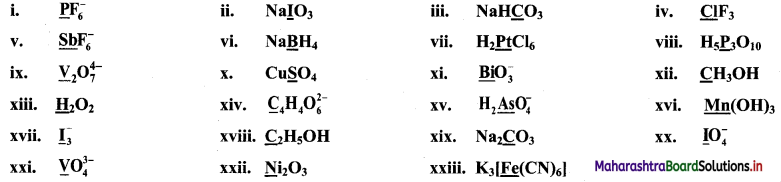
Find the oxidation numbers of the underlined species in the following compounds or ions.
Maharashtra Board Class 11 Chemistry Important Questions Chapter 6 Redox Reactions 9
Answer:
i. P\(\mathrm{F}_{6}^{-}\)
Oxidation number of F = -1
P\(\mathrm{F}_{6}^{-}\) is an ionic species.
∴ Sum of the oxidation numbers of all atoms = – 1
∴ (Oxidation number of P) + 6 × (Oxidation number of F) = – 1
∴ Oxidation number of P + 6 × (-1) = -1
∴ Oxidation number of P – 6 = – 1
Oxidation number of P in P\(\mathrm{F}_{6}^{-}\) = +5

ii. NaIO3
Oxidation number of Na = +1
Oxidation number of O = -2
NaIO3 is a neutral molecule.
∴ Sum of the oxidation numbers of all atoms = 0
(Oxidation number of Na) + (Oxidation number of I) + 3 × (Oxidation number of O) = 0
(+1) + (Oxidation number of I) + 3 × (-2) = 0
Oxidation number of I + 1 – 6 = 0
Oxidation number of I in NaIO3 = +5

iii. NaHCO3
Oxidation number of Na = +1
Oxidation number of H = +1
Oxidation number of O = -2
NaHCO3 is a neutral molecule.
∴ Sum of the oxidation numbers of all atoms = 0
∴ (Oxidation number of Na) + (Oxidation number of H) + (Oxidation number of C) + 3 × (Oxidation number of O) = 0
∴ (+1) + (+1) + (Oxidation number of C) + 3 × (-2) = 0
∴ Oxidation number of C + 2 – 6 = 0
∴ Oxidation number of C in NaHCO3 = +4

iv. ClF3
Oxidation number of F = -1
ClF3 is a neutral molecule.
∴ Sum of the oxidation numbers of all atoms = 0
∴ (Oxidation number of Cl) + 3 × (Oxidation number of F) = 0
∴ Oxidation number of Cl + 3 × (-1) = 0
∴ Oxidation number of Cl in ClF3 = +3

v. Sb\(\mathrm{F}_{6}^{-}\)
Oxidation number of F = -1
Sb\(\mathrm{F}_{6}^{-}\) is an ionic species.
∴ Sum of the oxidation numbers of all atoms = – 1
∴ (Oxidation number of Sb) + 6 × (Oxidation number of F) = – 1
∴ Oxidation number of Sb + 6 × (-1) = -1
∴ Oxidation number of Sb in Sb\(\mathrm{F}_{6}^{-}\) = +5

vi. NaBH4
Oxidation number of Na =+1
Oxidation number of H = -1 (for Hydride)
NaBH4 is a neutral molecule.
∴ Sum of the oxidation numbers of all atoms = 0
∴ (Oxidation number of Na) + (Oxidation number of B) + 4 × (Oxidation number of H) = 0
∴ (+1) + (Oxidation number of B) + 4 × (-1) = 0
∴ Oxidation number of B + 1 – 4 = 0
∴ Oxidation number of B in NaBH4 = +3

vii. H2PtCl6
Oxidation number of H = +1
Oxidation number of Cl = -1
H2PtCl6 is a neutral molecule.
∴ Sum of the oxidation numbers of all atoms = 0
∴ 2 × (Oxidation number of H) + (Oxidation number of Pt) + 6 × (Oxidation number of Cl) = 0
∴ 2 × (+1) + (Oxidation number of Pt) + 6 × (-1) = 0
(Oxidation number of Pt) + 2 – 6 = 0
∴ Oxidation number of Pt in H2PtCl6 = +4

viii. H5P3O10
Oxidation number of H = +1
Oxidation number of O = -2
H5P3O10 is a neutral molecule.
∴ Sum of the oxidation numbers of all atoms = 0
∴ 5 × (Oxidation number of H) + 3 × (Oxidation number of P) +10 × (Oxidation number of O) = 0
∴ 5 × (+1) + 3 × (Oxidation number of P) + 10 × (-2) = 0
∴ 3 × (Oxidation number of P) + 5 – 20 = 0
Oxidation number of P = +\(\frac {15}{3}\)
∴ Oxidation number of P in H5P3O10 = +5

ix. V2\(\mathrm{O}_{7}^{4-}\)
Oxidation number of O = -2
V2\(\mathrm{O}_{7}^{4-}\) is an ionic species.
∴ Sum of the oxidation numbers of all atoms = – 4
∴ 2 × (Oxidation number of V) + 7 × (Oxidation number of O) = – 4
∴ 2 × (Oxidation number of V) + 7 × (-2) = – 4
∴ 2 × (Oxidation number of V) = – 4 + 14
∴ Oxidation number of V = +\(\frac {10}{2}\)
∴ Oxidation number of V in V2\(\mathrm{O}_{7}^{4-}\) = +5

x. CuSO4
Oxidation number of Cu = +2
Oxidation number of O = -2
CuSO4 is a neutral molecule.
∴ Sum of the oxidation numbers of all atoms = 0
∴ (Oxidation number of Cu) + (Oxidation number of S) + 4 × (Oxidation number of O) = 0
∴ (+2) + Oxidation number of S + 4 × (-2) = 0
∴ Oxidation number of S + 2 – 8 = 0
∴ Oxidation number of S in CuSO4 = +6

xi. Bi\(\mathrm{O}_{3}^{-}\)
Oxidation number of O = -2
Bi\(\mathrm{O}_{3}^{-}\) is an ionic species.
∴ Sum of the oxidation numbers of all atoms = – 1
∴ (Oxidation number of Bi) + 3 × (Oxidation number of O) = – 1
∴ Oxidation number of Bi + 3 × (-2) = – 1
∴ Oxidation number of Bi = – 1 + 6
∴ Oxidation number of Bi in Bi\(\mathrm{O}_{3}^{-}\) = +5

xii. CH3OH
Oxidation number of H = +1
Oxidation number of O = -2
CH3OH is a neutral molecule.
∴ Sum of the oxidation numbers of all atoms = 0
∴ (Oxidation number of C) + 4 × (Oxidation number of H) + (Oxidation number of O) = 0
∴ (Oxidation number of C) + 4 × (+1) + (-2) = 0
∴ Oxidation number of C + 2 = 0
∴ Oxidation number of C in CH3OH = -2

xiii. H2O2
Oxidation number of O = -1 (for peroxide)
H2O2 is a neutral molecule.
∴ Sum of the oxidation numbers of all atoms = 0
∴ 2 × (Oxidation number of H) + 2 × (Oxidation number of O) = 0
∴ 2 × (Oxidation number of H) + 2 × (-1) = 0
∴ Oxidation number of H = +\(\frac {2}{2}\)
∴ Oxidation number of H in H2O2 = +1

xiv. C4H4\(\mathrm{O}_{6}^{2-}\)
Oxidation number of H = +1
Oxidation number of O = -2
C4H4\(\mathrm{O}_{6}^{2-}\) is an ionic species.
∴ Sum of the oxidation numbers of all atoms = – 2
∴ 4 × (Oxidation number of C) + 4 × (Oxidation number of H) + 6 × (Oxidation number of O) = – 2
∴ 4 × (Oxidationnumber of C) + 4 × (+1) +6 × (-2) = -2
∴ 4 × (Oxidation number of C) + 4 – 12 = -2
∴ 4 × (Oxidation number of C) = – 2 + 8
∴ Oxidation number of C = +\(\frac {6}{4}\)
∴ Oxidation number of C in C4H4\(\mathrm{O}_{6}^{2-}\) = +1.5

xv. H2As\(\mathrm{O}_{4}^{-}\)
Oxidation number of H = +1
Oxidation number of O = -2
H2As\(\mathrm{O}_{4}^{-}\) is an ionic species.
∴ Sum of the oxidation numbers of all atoms = – 1
∴ 2 × (Oxidation number of H) + (Oxidation number of As) + 4 × (Oxidation number of O) = -1
∴ 2 × (+1) + Oxidation number of As + 4 × (-2) = – 1
∴ Oxidation number of As + 2 – 8 = – 1
∴ Oxidation number of As = – 1 + 6
∴ Oxidation number of As in H2As\(\mathrm{O}_{4}^{-}\) = +5

xvi. Mn(OH)3
Oxidation number of O = -2
Oxidation number of H = +1
Mn(OH)3 is a neutral molecule.
∴ Sum of the oxidation numbers of all atoms = 0
∴ (Oxidation number of Mn) + 3 × (Oxidation number of O) + 3 × (Oxidation number of H) = 0
∴ Oxidation number of Mn + 3 × (-2) + 3 × (+1) = 0
∴ Oxidation number of Mn – 6 + 3 = 0
∴ Oxidation number of Mn in Mn(OH)3 = +3

xvii. \(\mathrm{I}_{3}^{-}\)
\(\mathrm{I}_{3}^{-}\) is an ionic species.
∴ Sum of the oxidation numbers of all atoms = – 1
∴ 3 × Oxidation number of I = – 1
∴ Oxidation number of I in \(\mathrm{I}_{3}^{-}\) = –\(\frac {1}{3}\)

xviii. C2H5OH
Oxidation number of O = -2
Oxidation number of H = +1
C2H5OH is a neutral molecule.
∴ Sum of the oxidation numbers of all atoms = 0
∴ 2 × (Oxidation number of C) + 6 × (Oxidation number of H) + (Oxidation number of O) = 0
∴ 2 × (Oxidationnumberof C) + 6 × (+1) + (-2) = 0
∴ 2 × (Oxidation number of C) = – 4
∴ Oxidation number of C = –\(\frac {4}{2}\)
∴ Oxidation number of C in C2H5OH = -2

xix. Na2CO3
Oxidation number of Na = +1
Oxidation number of O = -2
Na2CO3 is a neutral molecule.
∴ Sum of the oxidation numbers of all atoms = 0
∴ 2 × (Oxidation number of Na) + (Oxidation number of C) + 3 × (Oxidation number of O) = 0
∴ 2 × (+1) + (Oxidation number of C) + 3 × (-2) = 0
∴ Oxidation number of C + 2 – 6 = 0
∴ Oxidation number of C in Na2CO3 = +4

xx. I[latex]\mathrm{O}_{4}^{-}[/latex]
Oxidation number of O = -2
I\(\mathrm{O}_{4}^{-}\) is an ionic species.
∴ Sum of the oxidation numbers of all atoms = – 1
∴ (Oxidation number of I) + 4 × (Oxidation number of O) = – 1
∴ Oxidation number of I + 4 × (-2) = – 1
∴ Oxidation number of I = -1 +8
∴ Oxidation number of I in I\(\mathrm{O}_{4}^{-}\) = +7

xxi. V\(\mathrm{O}_{4}^{3-}\)
Oxidation number of O = -2
V\(\mathrm{O}_{4}^{3-}\) is an ionic species.
∴ Sum of the oxidation numbers of all atoms = – 3
∴ (Oxidation number of V) + 4 × (Oxidation number of O) = – 3
∴ Oxidation number of V + 4 × (-2) = – 3
∴ Oxidation number of V = -3 + 8
∴ Oxidation number of V in V\(\mathrm{O}_{4}^{3-}\) = +5

xxii. Ni2O3
Oxidation number of O = -2
Ni2O3 is a neutral molecule.
∴ Sum of the oxidation numbers of all atoms = 0
∴ 2 × (Oxidation number of Ni) + 3 × (Oxidation number of O) = 0
∴ 2 × (Oxidation number of Ni) + 3 × (-2) = 0
∴ 2 × (Oxidation number of Ni) = +6
∴ Oxidation number of Ni = +\(\frac {6}{2}\)
∴ Oxidation number of Ni in Ni2O3 = +3

xxiii. K3[Fe(CN)6]
Oxidation number of K = +1
Oxidation number of CN group = -1
K3[Fe(CN)6] is a neutral molecule.
∴ Sum of the oxidation numbers of all atoms = 0
∴ 3 × (Oxidation number of K) + (Oxidation number of Fe) + 6 × (Oxidation number of CN group) = 0
∴ 3 × (+1) + Oxidation number of Fe + 6 × (-1) = O
∴ Oxidation number of Fe + 3 – 6 = 0
∴ Oxidation number of Fe in K3[Fe(CN)6] = +3

Maharashtra Board Class 11 Chemistry Important Questions Chapter 6 Redox Reactions

Question 18.
Define: Stock notation.
Answer:
Representation in which oxidation number of an atom is denoted by Roman numeral in parentheses after the chemical symbol is called Stock notation. This name was given after the German scientist, Alfred Stock. e.g. Au1+Cl1- → Au(I)Cl

Question 19.
What is the use of Stock notation?
Answer:
The Stock notation is used to specify the oxidation number of the metal.

Question 20.
How will you write Stock notations for the following compounds?
i. AuCl3
ii. SnCl4
iii. SnCl2
iv. MnO2
Answer:
i. AuCl3: The charge on each element is \(\mathrm{Au}^{3+} \mathrm{Cl}_{3}^{1-}\). Hence, the stock notation is Au(III)Cl3.
ii. SnCl4: The charge on each element is \(\mathrm{Sn}^{4+} \mathrm{Cl}_{4}^{1-}\). Hence, the stock notation is Sn(IV)Cl4.
iii. SnCl2: The charge on each element is \(\mathrm{Sn}^{2+} \mathrm{Cl}_{2}^{1-}\). Hence, the stock notation is Sn(II)Cl2.
iv. MnO2: The charge on each element is \(\mathrm{Mn}^{4+} \mathrm{O}_{2}^{2-}\). Hence, the stock notation is Mn(IV)O2.

Question 21.
Write the formula for each of the following ionic compounds:
i. Nickel(III) oxide
ii. Tin(IV) chloride
iii. Bismuth(V) chloride
iv. Cobalt(III) chloride
v. Lead(IV) oxide
vi. Chromium(II) chloride
Answer:
i. Ni2O3
ii. SnCl4
iii. BiCl5
iv. CoCl3
v. PbO2
vi. CrCl2

Question 22.
Define the terms oxidation and reduction in terms of oxidation number.
Answer:
i. Oxidation is an increase in the oxidation number of an element in a given substance.
e.g. Fe(s) → \(\mathrm{Fe}_{(\mathrm{aq})}^{2+}\)
ii. Reduction is a decrease in the oxidation number of an element in a given substance. e.g. \(\mathrm{Cu}_{(\mathrm{aq})}^{2+}\) → Cu(s)

Maharashtra Board Class 11 Chemistry Important Questions Chapter 6 Redox Reactions

Question 23.
Define the terms oxidant and reductant in terms of oxidation number.
Answer:

  1. Oxidant: Oxidant or oxidising agent is a substance which increases the oxidation number of an element in a given substance, and itself undergoes decrease in oxidation number of a constituent element in it.
  2. Reductant: Reductant or reducing agent is a substance that lowers the oxidation number of an element in a given substance, and itself undergoes an increase in the oxidation number of a constituent element in it.

Question 24.
Identify whether the following reaction is redox or NOT. State oxidant and reductant therein.
Maharashtra Board Class 11 Chemistry Important Questions Chapter 6 Redox Reactions 10
Answer:
i. Write oxidation number of all the atoms of reactants and products.
Maharashtra Board Class 11 Chemistry Important Questions Chapter 6 Redox Reactions 11

ii. Identify the species that undergoes change in oxidation number.
Maharashtra Board Class 11 Chemistry Important Questions Chapter 6 Redox Reactions 12
iii. The oxidation number of As increases from +3 to +5 and that of Br decreases from +5 to -1. Because oxidation number of one species increases and that of the other decreases, the reaction is a redox reaction.
iv. The oxidation number of As increases by loss of electrons and therefore, As is a reducing agent and itself is oxidised. On the other hand, the oxidation number of Br decreases and therefore, Br is an oxidising agent and itself is reduced by gain of electrons.
Result:
a. The given reaction is a redox reaction.
b. Oxidant/oxidising agent: \(\mathrm{BrO}_{3}^{-}\)
c. Reductant/reducing agent: H3AsO3

Question 25.
For the reaction, \(\mathrm{SeO}_{3(\mathrm{aq})}^{2-}+\mathrm{Cl}_{2(\mathrm{~g})}+2 \mathrm{OH}_{(\mathrm{aq})}^{-} \longrightarrow \mathrm{SeO}_{4(\mathrm{aq})}^{2-}+2 \mathrm{Cl}_{(\mathrm{aq})}^{-}+\mathrm{H}_{2} \mathrm{O}_{(l)}\), complete the following table.

Oxidising agent————–
Reducing agent————–
Oxidised species————–
Reduced species————–

Answer:

Oxidising agentCl2(g)
Reducing agent\(\mathrm{Se} \mathrm{O}_{3(\mathrm{aq})}^{2-}\)
Oxidised species\(\mathrm{Se} \mathrm{O}_{4(\mathrm{aq})}^{2-}\)
Reduced species\(2 \mathrm{Cl}_{(\mathrm{aq})}^{-}\)

Question 26.
Using oxidation number concept, identify the redox reactions, identify oxidizing and reducing agents in case of redox reactions.
Maharashtra Board Class 11 Chemistry Important Questions Chapter 6 Redox Reactions 13
Answer:
i. H3PO4(aq) + 3KOH(aq) → K3PO4(aq) + 3H2O(l)
a. Write oxidation number of all the atoms of reactants and products
Maharashtra Board Class 11 Chemistry Important Questions Chapter 6 Redox Reactions 14
b. Since, the oxidation numbers of all the species remain same, this is NOT a redox reaction.

Result:
The given reaction is NOT a redox reaction.

ii. Zn(s) + 2HCl(aq) → ZnCl2((aq)) + H2(g)
a. Write oxidation number of all the atoms of reactants and products.
Maharashtra Board Class 11 Chemistry Important Questions Chapter 6 Redox Reactions 15
b. Identify the species that undergoes change in oxidation number.
Maharashtra Board Class 11 Chemistry Important Questions Chapter 6 Redox Reactions 16
c. The oxidation number of Zn increases from 0 to +2 and that of H decreases from +1 to 0. Because oxidation number of one species increases and that of other decreases, the reaction is redox reaction.
d. The oxidation number of Zn increases by loss of electrons and therefore, Zn is a reducing agent and itself is oxidized. On the other hand, the oxidation number of H decreases by gain of electrons and therefore, H is oxidising an agent and itself is reduced by gain of electrons.

Result:

  1. The given reaction is a redox reaction.
  2. Oxidant/oxidising agent: HCl
  3. Reductant/reducing agent: Zn

iii.
Maharashtra Board Class 11 Chemistry Important Questions Chapter 6 Redox Reactions 17
c. The oxidation number of Fe increases from +2 to +3 and that of Br decreases from +5 to -1. Because oxidation number of one species increases and that of the other decreases, the reaction is a redox reaction.
d. The oxidation number of Fe increases by loss of electrons and therefore, Fe is a reducing agent and itself is oxidized. On the other hand, the oxidation number of Br decreases by gain of electrons and therefore, Br is an oxidising an agent and itself is reduced.

Result:

  1. The given reaction is a redox reaction.
  2. Oxidant/oxidising agent: \(\mathrm{BrO}_{3}^{-}\)
  3. Reductant/reducing agent: Fe2+

iv. 2Zn(s) + O2(g) → 2ZnO(s)
a. Write oxidation number of all the atoms of reactants and products.
Maharashtra Board Class 11 Chemistry Important Questions Chapter 6 Redox Reactions 18
b. Identify the species that undergoes change in oxidation number.
Maharashtra Board Class 11 Chemistry Important Questions Chapter 6 Redox Reactions 19
c. The oxidation number of Zn increases from 0 to +2 and that of O decreases from 0 to -2. Because oxidation number of one species increases and that of the other decreases, the reaction is a redox reaction.
d. The oxidation number of Zn increases by loss of electrons and therefore, Zn is a reducing agent and itself is oxidized. On the other hand, the oxidation number of O decreases by gain of electrons and therefore, O is an oxidising agent and itself is reduced.

Result:

  1. The given reaction is a redox reaction.
  2. Oxidant/oxidising agent: O2
  3. Reductant/reducing agent: Zn

v. \(\mathrm{Sn}_{(a q)}^{2+}+\mathrm{IO}_{4(2 q)}^{-} \longrightarrow \mathrm{Sn}_{(aq)}^{4+}+\mathrm{I}_{(a \mathrm{q})}^{-}\)
a. Write oxidation number of all the atoms of reactants and products.
Maharashtra Board Class 11 Chemistry Important Questions Chapter 6 Redox Reactions 20
b. Identify the species that undergoes change in oxidation number.
Maharashtra Board Class 11 Chemistry Important Questions Chapter 6 Redox Reactions 21
c. The oxidation number of Sn increases from +2 to +4 and that of I decreases from +7 to -1. Because oxidation number of one species increases and that of the other decreases, the reaction is a redox reaction.
d. The oxidation number of Sn increases by loss of electrons and therefore, Sn is a reducing agent and itself is oxidized. On the other hand, the oxidation number of I decreases by gain of electrons and therefore, I is an oxidising agent and itself is reduced.

Result:

  1. The given reaction is a redox reaction.
  2. Oxidant/oxidising agent: Sn2+
  3. Reductant/reducing agent: \(\mathrm{IO}_{4}^{-}\)

Maharashtra Board Class 11 Chemistry Important Questions Chapter 6 Redox Reactions

Question 27.
Name two methods used to balance redox reactions.
Answer:

  1. Oxidation number method
  2. Half reaction method or ion electrode method

Question 28.
Describe the steps involved in balancing redox reactions by the oxidation number method.
Answer:
i. Step 1: Write the unbalanced equation for redox reaction. Balance the equation for all atoms in the reactions, except H and O. Identify the atoms which undergo change in oxidation number and by how much. Draw the bracket to connect atoms of the elements that changes the oxidation number.

ii. Step 2: Show an increase in oxidation number per atom of the oxidised species and hence, the net increase in oxidation number. Similarly, show a decrease in the oxidation number per atom of the reduced species and the net decrease in oxidation number. Determine the factors which will make the total increase and decrease equal. Insert the coefficients into the equation.

iii. Step 3: Balance oxygen atoms by adding H2O to the side containing less O atoms, one H2O is added for one O atom. Balance H atoms by adding H+ ions to the side having less H atoms.

iv. Step 4: If the reaction occurs in basic medium, then add OH ions equal to the number of H+ ions added in step 3, on both the sides of equation. The H+ and OH ions on same side of reactions are combined to give H2O molecules.

v. Step 5: Check the equation with respect to both, the number of atoms of each element and the charges. It is balanced.
Note: For acidic medium, step 4 is omitted.

Question 29.
Using the oxidation number method write the net ionic equation for the reaction of potassium permanganate, KMnO4, with ferrous sulphate, FeSO4.
\(\mathrm{MnO}_{4(\mathrm{aq})}^{-}+\mathrm{Fe}_{(\mathrm{aq})}^{2+} \longrightarrow \mathrm{Mn}_{(\mathrm{aq})}^{2+}+\mathrm{Fe}_{(\mathrm{aq})}^{3+}\)
Answer:
Step 1: Write skeletal equation and balance the elements other than O and H.
\(\mathrm{MnO}_{4(\mathrm{aq})}^{-}+\mathrm{Fe}_{(\mathrm{aq})}^{2+} \longrightarrow \mathrm{Mn}_{(\mathrm{aq})}^{2+}+\mathrm{Fe}_{(\mathrm{aq})}^{3+}\)

Step 2: Assign oxidation number to Mn and Fe, and calculate the increase and decrease in the oxidation number and make them equal.
Maharashtra Board Class 11 Chemistry Important Questions Chapter 6 Redox Reactions 22
To make the net increase and dicrease equal, we must take 5 atoms of Fe2+
\(\mathrm{MnO}_{4(\mathrm{aq})}^{-}+5 \mathrm{Fe}_{(\mathrm{aq})}^{2+} \longrightarrow \mathrm{Mn}_{(\mathrm{aq})}^{2+}+5 \mathrm{Fe}_{(\mathrm{aq})}^{3+}\)

Step 3: Balance the ‘O’ atoms by adding 4H2O to the right-hand side.
\(\mathrm{MnO}_{4(\mathrm{aq})}^{-}+5 \mathrm{Fe}_{(\mathrm{aq})}^{2+} \longrightarrow \mathrm{Mn}_{(\mathrm{aq})}^{2+}+5 \mathrm{Fe}_{(\mathrm{aq})}^{3+}+4 \mathrm{H}_{2} \mathrm{O}_{(l)}\)

Step 4: The medium is acidic. To make the charges and hydrogen atoms on the two sides equal, add 8H+ on the left-hand side.
\(\mathrm{MnO}_{4(\mathrm{aq})}^{-}+5 \mathrm{Fe}_{(\mathrm{aq})}^{2+}+8 \mathrm{H}_{(\mathrm{aq})}^{+} \longrightarrow \mathrm{Mn}_{(\mathrm{aq})}^{2+}+5 \mathrm{Fe}_{(\mathrm{aq})}^{3+}+4 \mathrm{H}_{2} \mathrm{O}_{(l)}\)

Step 5: Check the two sides for balance of charges and atoms. The net ionic equation obtained in step 4 is the balanced equation.
Hence, balanced equation:
\(\mathrm{MnO}_{4(\mathrm{aq})}^{-}+5 \mathrm{Fe}_{(\mathrm{aq})}^{2+}+8 \mathrm{H}_{(\mathrm{aq})}^{+} \longrightarrow \mathrm{Mn}_{(\mathrm{aq})}^{2+}+5 \mathrm{Fe}_{(\mathrm{aq})}^{3+}+4 \mathrm{H}_{2} \mathrm{O}_{(l)}\)

Maharashtra Board Class 11 Chemistry Important Questions Chapter 6 Redox Reactions

Question 30.
Balance the following reaction by oxidation number method.
CuO + NH3 → Cu + N2 + H2O
Answer:
Step 1: Write skeletal equation and balance the elements other than O and H.
CuO + 2NH3 → Cu + N2 + H2O
Step 2: Assign oxidation number to Cu and N. Calculate the increase and decrease in the oxidation number and make them equal.
Maharashtra Board Class 11 Chemistry Important Questions Chapter 6 Redox Reactions 23
To make the net increase and decrease equal, we must take 3 atoms of Cu and 2 atoms of N. (There are already 2 N atoms.)
3CuO + 2NH3 → 3Cu + N2 + H2O
Step 3: Balance ‘O’ atoms by adding 3H2O to the right-hand side.
3CuO + 2NH3 → 3Cu + N2 + 3H2O
Step 4: Charges are already balanced.
Step 5: Check two sides for balance of atoms and charges. The equation obtained in step 3 is balanced.
Hence, balanced equation: 3CuO + 2NH3 → 3Cu + N2 + 3H2O

Question 31.
Balance the following redox equation by oxidation number method. The reactions occur in acidic medium.
Maharashtra Board Class 11 Chemistry Important Questions Chapter 6 Redox Reactions 24
Answer:
i. \(\mathrm{H}_{2} \mathrm{O}_{2(\mathrm{aq})}+\mathrm{Cr}_{2} \mathrm{O}_{7 \text { (aq) }}^{2-} \longrightarrow \mathrm{O}_{2(\mathrm{~g})}+\mathrm{Cr}_{(\mathrm{aq})}^{3+}\)
Step 1: Write skeletal equation and balance the elements other than O and H.
\(\mathrm{H}_{2} \mathrm{O}_{2(\mathrm{aq})}+\mathrm{Cr}_{2} \mathrm{O}_{7 \text { (aq) }}^{2-} \longrightarrow \mathrm{O}_{2(\mathrm{~g})}+2 \mathrm{Cr}_{(\mathrm{aq})}^{3+}\)

Step 2: Assign oxidation number to O and Cr. Calculate the increase and decrease in the oxidation number and make them equal.
Maharashtra Board Class 11 Chemistry Important Questions Chapter 6 Redox Reactions 25
Since there are two Cr atoms, the net decrease in oxidation number is 6. In order to make the net increase and decrease equal, we must take 6 atoms of O i.e., 3H2O2.
\(3 \mathrm{H}_{2} \mathrm{O}_{2(\mathrm{aq})}+\mathrm{Cr}_{2} \mathrm{O}_{7(\mathrm{aq})}^{2-} \longrightarrow 3 \mathrm{O}_{2(\mathrm{~g})}+2 \mathrm{Cr}_{(\mathrm{aq})}^{3+}\)

Step 3: Balance ‘O’ atoms by adding 7H2O to the right-hand side.
\(3 \mathrm{H}_{2} \mathrm{O}_{2(\mathrm{aq})}+\mathrm{Cr}_{2} \mathrm{O}_{7(\mathrm{aq})}^{2-} \longrightarrow 3 \mathrm{O}_{2(\mathrm{~g})}+2 \mathrm{Cr}_{(\mathrm{aq})}^{3+}+7 \mathrm{H}_{2} \mathrm{O}_{(l)}\)

Step 4: The medium is acidic. To make the charges and hydrogen atoms on the two sides equal, add 8H+ on the left-hand side.
\(3 \mathrm{H}_{2} \mathrm{O}_{2(\mathrm{aq})}+\mathrm{Cr}_{2} \mathrm{O}_{7(\mathrm{aq})}^{2-}+8 \mathrm{H}_{(\mathrm{aq})}^{+} \longrightarrow 3 \mathrm{O}_{2(\mathrm{~g})}+2 \mathrm{Cr}_{(\mathrm{aq})}^{3+}+7 \mathrm{H}_{2} \mathrm{O}_{(l)}\)

Step 5: Check two sides for balance of atoms and charges.
Hence, balanced equation:
\(3 \mathrm{H}_{2} \mathrm{O}_{2(\mathrm{aq})}+\mathrm{Cr}_{2} \mathrm{O}_{7(\mathrm{aq})}^{2-}+8 \mathrm{H}_{(\mathrm{aq})}^{+} \longrightarrow 3 \mathrm{O}_{2(\mathrm{~g})}+2 \mathrm{Cr}_{(\mathrm{aq})}^{3+}+7 \mathrm{H}_{2} \mathrm{O}_{(l)}\)

ii. \(\mathrm{Ag}_{(\mathrm{s})}+\mathrm{NO}_{3(\mathrm{q})}^{-} \longrightarrow \mathrm{Ag}_{(\mathrm{aq})}^{+}+\mathrm{NO}_{2(\mathrm{~g})}\)

Step 1: Write skeletal equation and balance the elements other than O and H.
\(\mathrm{Ag}_{(\mathrm{s})}+\mathrm{NO}_{3(\mathrm{q})}^{-} \longrightarrow \mathrm{Ag}_{(\mathrm{aq})}^{+}+\mathrm{NO}_{2(\mathrm{~g})}\)

Step 2: Assign oxidation number to Ag and N. Calculate the increase and decrease in the oxidation number and make them equal.
Maharashtra Board Class 11 Chemistry Important Questions Chapter 6 Redox Reactions 26
Because net increase is equal to net decrease, multiplying coefficients are not required.

Step 3: Balance ‘O’ atoms by adding H2O to the right-hand side.
\(\mathrm{Ag}_{(\mathrm{s})}+\mathrm{NO}_{3(\mathrm{aq})}^{-} \longrightarrow \mathrm{Ag}_{(\mathrm{aq})}^{+}+\mathrm{NO}_{2(\mathrm{~g})}+\mathrm{H}_{2} \mathrm{O}_{(l)}\)

Step 4: The medium is acidic. To make the charges and hydrogen atoms on the two sides equal, add 2H+ on the left-hand side.
\(\mathrm{Ag}_{(\mathrm{s})}+\mathrm{NO}_{3(\mathrm{aq})}^{-}+2 \mathrm{H}_{(\mathrm{aq})}^{+} \longrightarrow \mathrm{Ag}_{(\mathrm{aq})}^{+}+\mathrm{NO}_{2(\mathrm{~g})}+\mathrm{H}_{2} \mathrm{O}_{(l)}\)
Thus, the equation is balanced with respect to the atoms as well as charges.

Step 5: Check two sides for balance of atoms and charges.
Hence, balanced equation: \(\mathrm{Ag}_{(\mathrm{s})}+\mathrm{NO}_{3(\mathrm{aq})}^{-}+2 \mathrm{H}_{(\mathrm{aq})}^{+} \longrightarrow \mathrm{Ag}_{(\mathrm{aq})}^{+}+\mathrm{NO}_{2(\mathrm{~g})}+\mathrm{H}_{2} \mathrm{O}_{(l)}\)

iii. \(\mathrm{Sn}_{(\mathfrak{a q})}^{2+}+\mathrm{IO}_{4(\mathrm{aq})}^{-} \longrightarrow \mathrm{Sn}_{(\mathrm{aq})}^{4+}+\mathrm{I}_{(\mathrm{aq})}^{-}\)

Step 1: Write skeletal equation and balance the elements other than O and H.
\(\mathrm{Sn}_{(\mathfrak{a q})}^{2+}+\mathrm{IO}_{4(\mathrm{aq})}^{-} \longrightarrow \mathrm{Sn}_{(\mathrm{aq})}^{4+}+\mathrm{I}_{(\mathrm{aq})}^{-}\)

Step 2: Assign oxidation number to Sn and I. Calculate the increase and decrease in the oxidation number and make them equal.
Maharashtra Board Class 11 Chemistry Important Questions Chapter 6 Redox Reactions 27
To make the net increase and decrease equal, we must take 4 atoms of Sn.
\(4 \mathrm{Sn}_{(\mathrm{aq})}^{2+}+\mathrm{IO}_{4(\mathrm{aq})}^{-} \longrightarrow 4 \mathrm{Sn}_{(\mathrm{aq})}^{4+}+\mathrm{I}_{(\mathrm{aq})}^{-}\)

Step 3: Balance ‘O’ atoms by adding 4H2O to the right-hand side.
\(4 \mathrm{Sn}_{(\mathrm{aq})}^{2+}+\mathrm{IO}_{4(\mathrm{aq})}^{-} \longrightarrow 4 \mathrm{Sn}_{(\text {aq })}^{4+}+\mathrm{I}_{(\text {aq })}^{-}+4 \mathrm{H}_{2} \mathrm{O}_{(l)}\)

Step 4: The medium is acidic. To make the charges and hydrogen atoms on the two sides equal, add 8H+ on the left-hand side.
\(4 \mathrm{Sn}_{(\mathrm{aq})}^{2+}+\mathrm{IO}_{4(\mathrm{aq})}^{-}+8 \mathrm{H}_{(\mathrm{aq})}^{+} \longrightarrow 4 \mathrm{Sn}_{(\mathrm{aq})}^{4+}+\mathrm{I}_{(\mathrm{aq})}^{-}+4 \mathrm{H}_{2} \mathrm{O}_{(l)}\)

Step 5: Check two sides for balance of atoms and charges.
Hence, balanced equation: \(4 \mathrm{Sn}_{(\mathrm{aq})}^{2+}+\mathrm{IO}_{4(\mathrm{aq})}^{-}+8 \mathrm{H}_{(\mathrm{aq})}^{+} \longrightarrow 4 \mathrm{Sn}_{(\mathrm{aq})}^{4+}+\mathrm{I}_{(\mathrm{aq})}^{-}+4 \mathrm{H}_{2} \mathrm{O}_{(l)}\)

iv. \(\mathrm{MnO}_{4(\mathrm{aq})}^{-}+\mathrm{IO}_{3(\mathrm{aq})}^{-} \longrightarrow \mathrm{MnO}_{2(\mathrm{~s})}+\mathrm{IO}_{4(\mathrm{aq})}^{-}\)

Step 1: Write skeletal equation and balance the elements other than O and H.
\(\mathrm{MnO}_{4(\mathrm{aq})}^{-}+\mathrm{IO}_{3(\mathrm{aq})}^{-} \longrightarrow \mathrm{MnO}_{2(\mathrm{~s})}+\mathrm{IO}_{4(\mathrm{aq})}^{-}\)

Step 2: Assign oxidation number to Mn and I. Calculate the increase and decrease in the oxidation number and make them equal.
Maharashtra Board Class 11 Chemistry Important Questions Chapter 6 Redox Reactions 28
Maharashtra Board Class 11 Chemistry Important Questions Chapter 6 Redox Reactions 29
To make the net increase and decrease equal, we must take 2 atoms of Mn and 3 atoms of I.
\(2 \mathrm{MnO}_{4(a q)}^{-}+3 \mathrm{IO}_{3(\mathrm{aq})}^{-} \longrightarrow 2 \mathrm{MnO}_{2(\mathrm{~s})}+3 \mathrm{IO}_{4(\mathrm{aq})}^{-}\)

Step 3: Balance ‘O’ atoms by adding 1H2O to the right-hand side.
\(2 \mathrm{MnO}_{4(\mathrm{aq})}^{-}+3 \mathrm{IO}_{3(\mathrm{aq})}^{-} \longrightarrow 2 \mathrm{MnO}_{2(\mathrm{~s})}+3 \mathrm{IO}_{4(\mathrm{aq})}^{-}+\mathrm{H}_{2} \mathrm{O}_{(l)}\)

Step 4: The medium is acidic. To make the charges and hydrogen atoms on the two sides equal, add 2H on the left-hand side.
\(2 \mathrm{MnO}_{4(\mathrm{aq})}^{-}+3 \mathrm{IO}_{3(\mathrm{aq})}^{-}+2 \mathrm{H}_{(\mathrm{aq})}^{+} \longrightarrow 2 \mathrm{MnO}_{2(\mathrm{~s})}+3 \mathrm{IO}_{4(\mathrm{aq})}^{-}+\mathrm{H}_{2} \mathrm{O}_{(l)}\)

Step 5: Check two sides for balanced of atoms and charges.
Hence, balanced equation: \(2 \mathrm{MnO}_{4(\mathrm{aq})}^{-}+3 \mathrm{IO}_{3(\mathrm{aq})}^{-}+2 \mathrm{H}_{(\mathrm{aq})}^{+} \longrightarrow 2 \mathrm{MnO}_{2(\mathrm{~s})}+3 \mathrm{IO}_{4(\mathrm{aq})}^{-}+\mathrm{H}_{2} \mathrm{O}_{(l)}\)

Question 32.
Balance the following redox equation in basic medium by oxidation number method:
Maharashtra Board Class 11 Chemistry Important Questions Chapter 6 Redox Reactions 30
Answer:
i. \(\mathrm{Zn}_{(\mathrm{s})}+\mathrm{NO}_{3(\mathrm{aq})}^{-} \longrightarrow \mathrm{NH}_{3(\mathrm{aq})}+\mathrm{Zn}(\mathrm{OH})_{6(\mathrm{aq})}^{2-}\)

Step 1: Write skeletal equation and balance the elements other than 0 and H.
\(\mathrm{Zn}_{(\mathrm{s})}+\mathrm{NO}_{3(\mathrm{aq})}^{-} \longrightarrow \mathrm{NH}_{3(\mathrm{aq})}+\mathrm{Zn}(\mathrm{OH})_{6(\mathrm{aq})}^{2-}\)

Step 2: Assign oxidation number to Zn and N. Calculate the increase and decrease in the oxidation number and make them equal.
Maharashtra Board Class 11 Chemistry Important Questions Chapter 6 Redox Reactions 31
To make the net increase and decrease equal, we must take 2 atoms of Zn.
\(2 \mathrm{Zn}_{(\mathrm{s})}+\mathrm{NO}_{3(\mathrm{aq})}^{-} \longrightarrow \mathrm{NH}_{3(\mathrm{aq})}+2 \mathrm{Zn}(\mathrm{OH})_{6(\mathrm{aq})}^{2-}\)

Step 3: Balance ‘O’ atoms by adding 9H2O to the left-hand side.
\(2 \mathrm{Zn}_{(\mathrm{s})}+\mathrm{NO}_{3(\mathrm{aq})}^{-}+9 \mathrm{H}_{2} \mathrm{O}_{(l)} \longrightarrow \mathrm{NH}_{3(\mathrm{aq})}+2 \mathrm{Zn}(\mathrm{OH})_{6(\mathrm{aq})}^{2-}\)

Step 4: The medium is basic. To make hydrogen atoms on the two sides equal, add 3H on the right-hand side.
Maharashtra Board Class 11 Chemistry Important Questions Chapter 6 Redox Reactions 32

Step 5: Check two sides for balance of atoms and charges.
Hence, balanced equation:
Maharashtra Board Class 11 Chemistry Important Questions Chapter 6 Redox Reactions 33

ii. \(\mathrm{MnCl}_{2(\mathrm{aq})}+\mathrm{HO}_{2(\mathrm{aq})}^{-} \longrightarrow \mathrm{Mn}(\mathrm{OH})_{3(\mathrm{~s})}+\mathrm{Cl}_{(\mathrm{aq})}^{-}\)

Step 1: Write skeletal equation and balance the elements other than O and H.
\(\mathrm{MnCl}_{2(\mathrm{aq})}+\mathrm{HO}_{2(\mathrm{aq})}^{-} \longrightarrow \mathrm{Mn}(\mathrm{OH})_{3(\mathrm{~s})}+\mathrm{Cl}_{(\mathrm{aq})}^{-}\)

Step 2: Assign oxidation number to Mn and O. Calculate the increase and decrease in the oxidation number and make them equal.
Maharashtra Board Class 11 Chemistry Important Questions Chapter 6 Redox Reactions 34
Maharashtra Board Class 11 Chemistry Important Questions Chapter 6 Redox Reactions 35

iii. Cu(OH)2(s) + N2H4(aq) → Cu(s) + N2(g)
Step 1: Write skeletal equation and balance the elements other that O and H.
Cu(OH)2(s) + N2H4(aq) → Cu(s) + N2(g)
Step 2: Assign oxidation number to Cu and N. Calculate the increase and decrease in the oxidation number and make them equal.
Maharashtra Board Class 11 Chemistry Important Questions Chapter 6 Redox Reactions 36
Maharashtra Board Class 11 Chemistry Important Questions Chapter 6 Redox Reactions 37
To make the net increase and decrease equal, we must take 2 atoms of Cu.
2Cu(OH)2(s) + N2H4(aq) → 2Cu(s) + N2(g)
Step 3: Balance ‘O’ atoms by adding 4H20 to the right-hand side.
2Cu(OH)2(s) + N2H4(aq) → 2Cu(s) + N2(g) + 4H2O(l)
Step 4: The equation is balanced for both atoms as well as charges.
Step 5: Check two sides for balance of atoms and charges.
Hence, balanced equation: 2Cu(OH)2(s) + N2H4(aq) → 2Cu(s) + N2(g) + 4H2O(l)

Maharashtra Board Class 11 Chemistry Important Questions Chapter 6 Redox Reactions

Question 33.
Describe the steps involved in balancing redox reactions by ion electron method (Half reaction method).
Answer:
In this method two half equations are balanced separately and then added together to give balanced equation. Following steps are involved.

  • Step 1: Write unbalanced equation for the redox reaction, assign oxidation number to all the atoms in the reactants and products. Divide the equation into two half equations. One half equation involves increase in oxidation number and another involves decrease in oxidation number (Write two half equations separately).
  • Step 2: Balance the atoms except O and H in each half equation. Balance oxygen atom by adding H2O to the side with less O atoms.
  • Step 3: Balance H atoms by adding H+ ions to the side having less H atoms.
  • Step 4: Balance the charges by adding appropriate number of electrons to the right side of oxidation half equation and to the left of reduction half equation.
  • Step 5: Multiply half equation by suitable factors to equalize the number of electrons in two half equations. Add two half equations and cancel the number of electrons on both sides of equation.
  • Step 6: If the reaction occurs in basic medium then add OH ions, equal to number of H+ ions on both sides of equation. The H+ and OH ions on same side of equation combine to give H2O molecules.
  • Check that the equation is balanced in both, the atoms and the charges.

Question 34.
Balance the following unbalanced equation (in acidic medium) by ion electron method (half reaction method).
\(\mathrm{Mn}_{(\mathrm{aq})}^{2+}+\mathrm{ClO}_{3(\mathrm{qq})}^{-} \longrightarrow \mathrm{MnO}_{2(\mathrm{~s})}+\mathrm{ClO}_{2(\mathrm{aq})}\)
Answer:
Step 1: Write imbalanced equation for the redox reaction. Assign oxidation number to all the atoms in reactants and products. Divide the equation into two half equations.
Maharashtra Board Class 11 Chemistry Important Questions Chapter 6 Redox Reactions 38

Step 2: Balance the atoms except O and H in each half equation. Balance half equations for O atoms by adding H2O to the side with less O atoms. Add 2H2O to left side of oxidation half equation and 1H2O to the right side of reduction half equation.
Maharashtra Board Class 11 Chemistry Important Questions Chapter 6 Redox Reactions 39

Step 3: Balance H atoms by adding H+ ions to the side with less H. Hence add 4H+ ions to the right side of oxidation half equation and 2H+ ions to the left side of reduction half equation.
Maharashtra Board Class 11 Chemistry Important Questions Chapter 6 Redox Reactions 40

Step 4: Now add 2 electrons to the right side of oxidation half equation and 1 electron to the left side of reduction half equation to balance the charges.
Maharashtra Board Class 11 Chemistry Important Questions Chapter 6 Redox Reactions 41

Step 5: Multiply reduction half equation by 2 to equalize number of electrons in two half equations. Then add two half equation.
Maharashtra Board Class 11 Chemistry Important Questions Chapter 6 Redox Reactions 42
Add two half equations:
\(\mathrm{Mn}_{(\mathrm{aq})}^{2+}+2 \mathrm{ClO}_{3(\mathrm{aq})}^{-} \longrightarrow \mathrm{MnO}_{2(\mathrm{~s})}+2 \mathrm{ClO}_{2(\mathrm{aq})}\)
The equation is balanced in terms of number of atoms and the charges.
Hence, balanced equation: \(\mathrm{Mn}_{(\mathrm{aq})}^{2+}+2 \mathrm{ClO}_{3(\mathrm{aq})}^{-} \longrightarrow \mathrm{MnO}_{2(\mathrm{~s})}+2 \mathrm{ClO}_{2(\mathrm{aq})}\)

Question 35.
Balance the following unbalanced equation by ion electron method (half reaction method).
\(\mathrm{H}_{2} \mathrm{O}_{2(\mathrm{aq})}+\mathrm{ClO}_{4(\mathrm{aq})}^{-} \longrightarrow \mathrm{ClO}_{2(\mathrm{aq})}^{-}+\mathrm{O}_{2(\mathrm{~g})}\)
Answer:
Step 1: Write unbalanced equation for the redox reaction. Assign oxidation number to all the atoms in reactants and products. Divide the equation into two half equations.
Maharashtra Board Class 11 Chemistry Important Questions Chapter 6 Redox Reactions 43

Step 2: Balance the atoms except O and H in each half equation. Balance the half equation for O atoms by adding H2O to the side with less O atoms. Hence, add 2H2O to the right side of reduction half equation and none to the oxidation half equation
Maharashtra Board Class 11 Chemistry Important Questions Chapter 6 Redox Reactions 44

Step 3: Balance H atoms by adding H+ ions to the side with less H. Hence add 2H+ ions to the right side of oxidation half equation and 4H+ ions to the left side of reduction half equation.
Maharashtra Board Class 11 Chemistry Important Questions Chapter 6 Redox Reactions 45

Step 4: Add 2 electrons to the right side of oxidation half equation and 4 electrons to the left side of reduction half equation to balance the charges.
Maharashtra Board Class 11 Chemistry Important Questions Chapter 6 Redox Reactions 46

Step 5: Multiply oxidation half equation by 2 to equalize the number of electrons and then add two half equations.
Maharashtra Board Class 11 Chemistry Important Questions Chapter 6 Redox Reactions 47

Maharashtra Board Class 11 Chemistry Important Questions Chapter 6 Redox Reactions

Question 36.
Balance the following redox equations by ion-electron (half reaction method).
Maharashtra Board Class 11 Chemistry Important Questions Chapter 6 Redox Reactions 48
Answer:
i. \(\mathrm{Cr}_{2} \mathrm{O}_{7(\mathrm{aq})}^{2-}+\mathrm{Fe}_{(\mathrm{aq})}^{2+} \longrightarrow \mathrm{Cr}_{(\mathrm{aq})}^{3+}+\mathrm{Fe}_{(\mathrm{aq})}^{3+}(\text { acidic })\)
Step 1: Write unbalanced equation for the redox reaction. Assign oxidation number to all the atoms in reactants and products. Divide the equation into two half equations.
Maharashtra Board Class 11 Chemistry Important Questions Chapter 6 Redox Reactions 49
Maharashtra Board Class 11 Chemistry Important Questions Chapter 6 Redox Reactions 50

Step 2: Balance the atoms except O and H in each half equation. Balance half equation for O atoms by adding 7H2O to the right side of reduction half equation.
Maharashtra Board Class 11 Chemistry Important Questions Chapter 6 Redox Reactions 51

Step 3: Balance H atoms by adding H+ ions to the side with less H. Hence, add 14H+ ions to the left side of reduction half equation.
Maharashtra Board Class 11 Chemistry Important Questions Chapter 6 Redox Reactions 52

Step 4: Now add 1 electron to the right side of oxidation half equation and 6 electrons to the left side of reduction half equation to balance the charges.
Maharashtra Board Class 11 Chemistry Important Questions Chapter 6 Redox Reactions 53

Step 5: Multiply oxidation half equation by 6 to equalize number of electrons in two half equations. Then add two half equation.
Maharashtra Board Class 11 Chemistry Important Questions Chapter 6 Redox Reactions 54

ii. \(\mathrm{SO}_{2(\mathrm{~g})}+\mathrm{Fe}_{(\mathrm{aq})}^{3+} \longrightarrow \mathrm{Fe}_{(\mathrm{aq})}^{2+}+\mathrm{SO}_{4(\mathrm{aq})}^{2-}(\text { acidic })\)
Step 1 : Write unbalanced equation for the redox reaction. Assign oxidation number to all the atoms in reactants and products in them. Divide the equation into two half equations.
Maharashtra Board Class 11 Chemistry Important Questions Chapter 6 Redox Reactions 55

Step 2: Balance the atoms except O and H in each half equation. Balance half equation for O atoms by adding 2H2O to the left side of oxidation half equation.
Maharashtra Board Class 11 Chemistry Important Questions Chapter 6 Redox Reactions 56

Step 3: Balance H atoms by adding H+ ions to the side with less H. Hence, add 4H+ ions to the right side of oxidation half equation.
Maharashtra Board Class 11 Chemistry Important Questions Chapter 6 Redox Reactions 57

Step 4: Now add 2 electrons to the right side of oxidation half equation and 1 electron to the left side of reduction half equation to balance the charges.
Maharashtra Board Class 11 Chemistry Important Questions Chapter 6 Redox Reactions 58

Step 5: Multiply reduction half equation by 2 to equalize number of electrons in two half equations. Then add two half equation.
Maharashtra Board Class 11 Chemistry Important Questions Chapter 6 Redox Reactions 59

iii. \(\mathrm{ClO}_{(\mathrm{aq})}^{-}+\mathrm{Cr}(\mathrm{OH})_{4(\mathrm{aq})}^{-} \longrightarrow \mathrm{CrO}_{4(\mathrm{aq})}^{2-}+\mathrm{Cl}_{(\mathrm{aq})}^{-} \text {(basic) }\)
Step 1: Write unbalanced equation for the redox reaction: Assign oxidation number to all the atoms in reactants and products. Divide the equation into two half equations.
Maharashtra Board Class 11 Chemistry Important Questions Chapter 6 Redox Reactions 60

Step 2: Balance the atoms except O and H in each half equation. Balance half equation for O atoms by adding 1H2O to the right side of reduction half equation.
Maharashtra Board Class 11 Chemistry Important Questions Chapter 6 Redox Reactions 61

Step 3: Balance H atoms by adding H+ ions to the side with less H. Hence, add 4H+ ions to the right side of oxidation half equation and 2H+ ions to the left side of reduction half equation.
Maharashtra Board Class 11 Chemistry Important Questions Chapter 6 Redox Reactions 62

Step 4: Now add 3 electrons to the right side of oxidation half equation and 2 electrons to the left side of reduction half equation to balance the charges.
Maharashtra Board Class 11 Chemistry Important Questions Chapter 6 Redox Reactions 63

Step 5: Multiply oxidation half equation by 2 and reduction half equation by 3 to equalize number of electrons in two half equations. Then add two half equation.
Maharashtra Board Class 11 Chemistry Important Questions Chapter 6 Redox Reactions 64

Step 6: The reaction takes place in basic medium. 20H ions, equal to the number of H+ ions (2H+ ions) are added on both sides of the equation.
Maharashtra Board Class 11 Chemistry Important Questions Chapter 6 Redox Reactions 65

iv. \(\mathrm{SeO}_{3(\mathrm{aq})}^{2-}+\mathrm{Cl}_{2(\mathrm{~g})} \longrightarrow \mathrm{SeO}_{4(a q)}^{2-}+\mathrm{Cl}_{(\mathrm{aq})}^{-} \text {(basic) }\)
Step 1: Write unbalanced equation for the redox reaction. Assign oxidation number to all the atoms in reactants and products in them. Divide the equation into two half equations.
Maharashtra Board Class 11 Chemistry Important Questions Chapter 6 Redox Reactions 66
Step 2: Balance the atoms except O and H in each half equation. Balance half equation for O atoms by adding H2O to the left side of oxidation half equation.
Maharashtra Board Class 11 Chemistry Important Questions Chapter 6 Redox Reactions 67

Step 3: Balance H atoms by adding H+ ions to the side with less H. Hence, add 2H+ ions to the right side of oxidation half equation.
Maharashtra Board Class 11 Chemistry Important Questions Chapter 6 Redox Reactions 68

Step 4: Now add 2 electrons to the right side of oxidation half equation and 2 electrons to the left side of reduction half equation to balance the charges.
Maharashtra Board Class 11 Chemistry Important Questions Chapter 6 Redox Reactions 69

Step 5: There is equal number of electrons in two half equations. Add two half equation.
Maharashtra Board Class 11 Chemistry Important Questions Chapter 6 Redox Reactions 70

Question 37.
Explain displacement reaction in terms of redox reaction by giving example.
Answer:
i. Displacement reaction can be looked upon as redox reaction. Consider the following displacement reaction.
Maharashtra Board Class 11 Chemistry Important Questions Chapter 6 Redox Reactions 71
ii. Here, Zn gets oxidized to Zn2+ ion and Cu2+ ions get reduced to metallic Cu. A direct transfer of electron from zinc atom to cupric ions takes place in this case.

Maharashtra Board Class 11 Chemistry Important Questions Chapter 6 Redox Reactions

Question 38.
Explain construction of Daniel cell.
Answer:

  • The zinc and copper plates are connected by an electric wire through a switch and voltmeter.
  • The solution in two containers are connected by salt bridge (U-shaped glass tube containing a gel of KCl or NH4NO3 in agar-agar).
  • When switch is on, electrical circuit is complete as indicated by the deflection in the voltmeter.
  • The circuit has two parts, one in the form of electrical wire which allows the flow of electrons and the other in the form of two solutions joined by salt bridge. In solution part of the circuit, the electric current is carried by movement of ions.

Maharashtra Board Class 11 Chemistry Important Questions Chapter 6 Redox Reactions 72

Question 39.
Explain working of Daniel cell.
Answer:
i. When a circuit is complete, the zinc atoms on zinc plates spontaneously lose electrons which are picked up in the external circuit.
ii. The electrons flow from the zinc plate to copper plate through wire.
iii. Cu2+ ions in the second container receive these electrons through the copper plate and are reduced to copper atoms which get deposited on the copper plate.
iv. Here, zinc plate acts as anode (negative electrode) and the copper plate acts as cathode (positive electrode).
Maharashtra Board Class 11 Chemistry Important Questions Chapter 6 Redox Reactions 73
v. Thus, when two half reactions, namely, oxidation and reduction, are allowed to take place in separate containers and provision is made for completing the electrical circuit, electron transfer take place through the circuit.
vi. This results in flow of electric current in the circuit as indicated by deflection in voltmeter.
vii. Thus, in Daniel cell, electricity is generated by redox reaction.

Question 40.
Draw a neat and labelled diagram of Daniel cell.
Answer:
Maharashtra Board Class 11 Chemistry Important Questions Chapter 6 Redox Reactions 74

Question 41.
Chalcopyrite (CuFeS2) is a common ore of copper. Since it has low concentration of copper, the ore is first concentrated through froth floatation process. The concentrated ore is then heated strongly with silicon dioxide (silica) and oxygen in a furnace. The product obtained, copper(I) sulphide, is further converted to copper (99.5% pure) with a final blast of air (O2) during which sulphur dioxide is released as a by-product.
i. Write a balanced reaction for the extraction of copper from copper(I) sulphide.
ii. Which species undergoes an increase in the oxidation state?
iii. Which species accepts electrons?
Answer:
i. Cu2S + O2 → 2Cu + SO2
ii. Sulphur undergoes an increase in the oxidation state from -2 (in Cu2S) to +4 (in SO2).
iii. Copper accepts one electron and undergoes a decrease in the oxidation state from +1(in Cu2S) to 0 (in Cu). Oxygen accepts two electrons and undergoes a decrease in the oxidation state from 0 (in O2) to -2 (in SO2).

Maharashtra Board Class 11 Chemistry Important Questions Chapter 6 Redox Reactions

Question 42.
Consider the elements: Cs, Ne, I and F
i. Identify the element that exhibits only negative oxidation state.
ii. Identify the element that exhibits only positive oxidation state.
iii. Identify the element that exhibits both negative as well as positive oxidation state.
iv. Identify the element that exhibits neither the negative nor the positive oxidation state.
Answer:
i. F: It is most electronegative. It shows only a negative oxidation state of -1.
ii. Cs: Alkali metals have only one electron in their valence shell and hence, exhibits only positive (+1) oxidation state.
iii. I: Because of the presence of 7 electrons in its valence shell, I shows negative oxidation state of -1 (to have stable noble gas configuration) and positive oxidation numbers of +1, +3, +5 and +7 because of the presence of d-orbitals.
iv. Ne: It is an inert gas and therefore, does not exhibit negative or positive oxidation state.

Multiple Choice Questions

1. Loss of electrons means ………….
(A) reduction
(B) oxidation
(C) precipitation
(D) complexometry
Answer:
(B) oxidation

2. Reduction involves ……………
(A) gain of electrons
(B) addition of oxygen
(C) increase in oxidation number
(D) loss of electron
Answer:
(A) gain of electrons

3. Which of the following statement is INCORRECT?
(A) Oxidant is a substance which increases the oxidation number of other substance.
(B) Reductant is a substance which decreases the oxidation number of other substance.
(C) The oxidation number of oxidant decreases.
(D) In oxidation, there is decrease in oxidation number.
Answer:
(D) In oxidation, there is decrease in oxidation number.

4. Which of the following is an example of oxidation process?
Maharashtra Board Class 11 Chemistry Important Questions Chapter 6 Redox Reactions 75
Answer:
(D) \(\mathrm{Li}_{(\mathrm{s})} \longrightarrow \mathrm{Li}_{(\mathrm{g})}^{+}+\mathrm{e}^{-}\)

Maharashtra Board Class 11 Chemistry Important Questions Chapter 6 Redox Reactions

5. Which is the best description of the behaviour of chlorine in the reaction?
H2O + Cl2 → HOCl + HCl
(A) Neither oxidized not reduced
(B) Both oxidised and reduced
(C) Oxidised only
(D) Reduced only
Answer:
(B) Both oxidised and reduced

6. In the reaction,
\(\begin{array}{r} 3 \mathrm{Br}_{2}+6 \mathrm{CO}_{3}^{2-}+3 \mathrm{H}_{2} \mathrm{O} \longrightarrow \ 5 \mathrm{Br}^{-}+\mathrm{BrO}_{3}^{-}+6 \mathrm{HCO}_{3}^{-} \end{array}\) …………..
(A) Br2 is oxidised and carbonate is reduced
(B) bromine is reduced and water is oxidised
(C) bromine is neither reduced nor oxidised
(D) bromine is both reduced and oxidised
Answer:
(D) bromine is both reduced and oxidised

7. A chemical reaction in which oxidation and reduction processes takes place simultaneously is known as ………… reaction.
(A) redox
(B) precipitation
(C) complexometric
(D) titration
Answer:
(A) redox

8. Which of the following is a redox reaction?
(A) NaCl + KNO3 → NaNO3 + KCl
(B) CaC2O4 + 2HCl → CaCl2 + H2C2O4
(C) Mg(OH)2 + 2NH4Cl → MgCl2 + 2NH4OH
(D) Zn + 2AgCN → 2Ag + Zn(CN)2
Answer:
(D) Zn + 2AgCN → 2Ag + Zn(CN)2

9. Oxidation number of metal ion is always …………..
(A) positive
(B) negative
(C) zero
(D) non zero
Answer:
(A) positive

Maharashtra Board Class 11 Chemistry Important Questions Chapter 6 Redox Reactions

10. The oxidation number of oxygen in peroxide is …………..
(A) -2
(B) -1
(C) +1
(D) +2
Answer:
(B) -1

11. The oxidation number of oxygen is …………. in oxygen difluoride.
(A) -2
(B) -1
(C) +2
(D) +1
Answer:
(C) +2

12. Oxidation number of carbon in CH2F2 is ………….
(A) +1
(B) -1
(C) 0
(D) +2
Answer:
(C) 0

13. In calcium hydride (CaH2), the oxidation number of hydrogen is ………….
(A) +1
(B) -1
(C) +2
(D) -2
Answer:
(B) -1

14. The element with atomic number 9 can exhibit oxidation state of …………..
(A) +1
(B) +3
(C) -1
(D) +5
Answer:
(C) -1

Maharashtra Board Class 11 Chemistry Important Questions Chapter 6 Redox Reactions

15. The highest and lowest oxidation states possible for Te (group 16) are ……………
(A) +6, -2
(B) +6, 0
(C) +4, -4
(D) +6, -6
Answer:
(A) +6, -2

16. What is the oxidation state of S in Na2S2 ?
(A) +1
(B) -2
(C) -1
(D) 0
Answer:
(C) -1

17. The oxidation state of S in S2O82- is ………….
(A) +2
(B) + 4
(C) +6
(D) + 7
Answer:
(D) + 7

18. The oxidation state of phosphorus in Ba(H2PO2)2 is …………..
(A) +3
(B) +2
(C) +1
(D) -1
Answer:
(C) +1

19. Amongst the following, identify the species having an atom with +6 oxidation state.
(A) \(\mathrm{MnO}_{4}^{-}\)
(B) \(\mathrm{Cr}(\mathrm{OH})_{3}^{6-}\)
(C) \(\mathrm{NiF}_{6}^{2-}\)
(D) CrO2Cl2
Answer:
(D) CrO2Cl2

Maharashtra Board Class 11 Chemistry Important Questions Chapter 6 Redox Reactions

20. In which of the following compounds, the oxidation number of carbon is NOT zero?
(A) (CHCl)2
(B) HCHO
(C) CH3COOH
(D) CH2Cl2
Answer:
(C) CH3COOH

21. The oxidation number of S in S8, S2F2 and H2S respectively are ………….
(A) 0, +1, -2
(B) +2, +1, -2
(C) 0, +1, +2
(D) +2, +1, -2
Answer:
(A) 0, +1, -2

22. The coefficients x, y, and z in the following balanced equation
xZn + \(\mathrm{yNO}_{3}^{-}\) + 10H+ → zZn2+ + \(\mathrm{NH}_{4}^{+}\) + 3H2O are …………..
(A) 4, 1, 4
(B) 2, 2, 2
(C) 4, 2, 4
(D) 4, 4, 4
Answer:
(A) 4, 1, 4

23. For the redox reaction:
\(\mathrm{MnO}_{4}{ }^{-}+\mathrm{C}_{2} \mathrm{O}_{4}^{2-}+\mathrm{H}^{+} \longrightarrow \mathrm{Mn}^{2+}+\mathrm{CO}_{2}+\mathrm{H}_{2} \mathrm{O}\)
The CORRECT coefficients of the reactants in the balanced reaction are ……………
Maharashtra Board Class 11 Chemistry Important Questions Chapter 6 Redox Reactions 76
Answer:
(A)

24. In the reaction
3CuO + 2NH3 → N2 + 3H2O + 3Cu
the change of NH3 to N2 involve ……………..
(A) loss of 6 electrons per mol of N2
(B) loss of 3 electrons per mol of N2
(C) gain of 6 electrons per mole N2
(D) gain of 3 electrons per mole N2
Answer:
(A) loss of 6 electrons per mol of N2

Maharashtra Board Class 11 Chemistry Important Questions Chapter 6 Redox Reactions

25. When KMnO4 acts as an oxidizing agent and ultimately forms \(\mathrm{MnO}_{4}^{2-}\), MnO2, Mn2O3, and Mn2+, then the number of electrons transferred in each case is …………..
(A) 4, 3, 1, 5
(B) 1, 5, 3, 7
(C) 1, 3, 4, 5
(D) 3, 5, 7, 1
Answer:
(C) 1, 3, 4, 5

26. In electrochemical cell, the magnitude and direction of the electrode potential depends on which of the following?
(A) Nature of metal and ions
(B) Concentration of ions
(C) Temperature
(D) All of these
Answer:
(D) All of these

Maharashtra Board Class 11 Chemistry Important Questions Chapter 5 Chemical Bonding

Balbharti Maharashtra State Board 11th Chemistry Important Questions Chapter 5 Chemical Bonding Important Questions and Answers.

Maharashtra State Board 11th Chemistry Important Questions Chapter 5 Chemical Bonding

Question 1.
Explain the electronic theory of valence.
Answer:
Electronic theory of valence:

  • The electronic theory of valence was proposed by Kossel and Lewis in 1916.
  • They gave a logical explanation of valence which was based on the inertness of noble gases (that is, the octet rule developed by Lewis).
  • According to Lewis, the atom can be pictured in terms of a positively charged ‘kernel’ (the nucleus plus inner electrons) and outer shell that can accommodate a maximum of eight electrons. This octet of electrons represents a stable electronic arrangement.
  • Thus, according to this theory, during the formation of a chemical bond, each atom loses, gains or shares outer electrons so that it achieves stable octet.
  • The formation of NaCl involves transfer of one electron from sodium (Na) to chlorine (Cl). Na+ and Cl ions are formed which are held together by chemical bond. The formation of H2, F2, Cl2, HCl, etc., involves sharing of a pair of electrons between the atoms. In both cases, each atom attains a stable outer octet of electrons.

Question 2.
Give the significance of octet rule. Explain why this rule is not valid for H and Li atoms.
Answer:
i. Significance: Octet rule is found to be very useful:

  • in explaining the normal valence of elements
  • in the study of the chemical combination of atoms leading to the formation of molecules.

ii. Octet rule is not valid for H and Li atoms. According to octet rule, during the formation of a chemical bond, each atom loses, gains or shares electrons so that it achieves stable octet (eight electrons in the valence shell). However, H and Li atoms tend to have only two electrons in their valence shell similar to that of Helium (1s2), which called duplet. Hence, octet rule is not valid for H and Li atoms.

Question 3.
Define ionic bond.
Answer:
The bond formed by complete transfer of one or more electrons from an electropositive atom to an electronegative atom, leading to formation of ions which are held together by electrostatic attraction is called ionic bond or electrovalent bond.

Maharashtra Board Class 11 Chemistry Important Questions Chapter 5 Chemical Bonding

Question 4.
Explain the formation of ionic bond in sodium chloride (NaCl).
Answer:
Formation of sodium chloride (NaCl):
i. The electronic configurations of sodium and chlorine are:
Na (Z = 11): 1s2 2s2 2p6 3s1 or (2, 8, 1)
Cl (Z = 17): 1s2 2s2 2p6 3s2 3p5 or (2, 8, 7)
ii. Sodium has one electron in its valence shell. It has tendency to lose one electron to acquire the electronic configuration of the nearest inert gas, neon (2, 8).
iii. Chlorine has seven electrons in its valence shell. It has tendency to gain one electron and thereby acquire the electronic configuration of the nearest inert gas, argon (2, 8, 8).
iv. During the combination of sodium and chlorine atoms, the sodium atom transfers its valence electron to the chlorine atom.
v. Sodium atom changes into Na+ ion while the chlorine atom changes into Cl ion. The two ions are held together by strong electrostatic force of attraction.
vi. The formation of ionic bond between Na and Cl can be shown as follows:
Maharashtra Board Class 11 Chemistry Important Questions Chapter 5 Chemical Bonding 1

Question 5.
Explain the formation of ionic bonds in calcium chloride (CaCl2).
Answer:
Formation of calcium chloride (CaCl2):
i. The electronic configurations of calcium and chlorine are:
Na (Z = 11): 1s2 2s2 2p6 3s2 3p6 4s2 or (2, 8, 8, 2)
Cl (Z = 17): 1s2 2s2 2p6 3s2 3p5 or (2, 8, 7)
ii. Calcium has two electrons in its valence shell. It has tendency to lose two electrons to acquire the electronic configuration of the nearest inert gas, argon (2, 8, 8).
iii. Chlorine has seven electrons in its valence shell. It has tendency to gain one electron and thereby acquire the electronic configuration of the nearest inert gas, argon (2, 8, 8).
iv. During the combination of calcium and chlorine atoms, the calcium atom transfers its valence electrons to two chlorine atoms.
v. Calcium atom changes into Ca2+ ion while the two chlorine atoms change into two Cl ions. These ions are held together by strong electrostatic force of attraction.
vi. The formation of ionic bond(s) between Ca and Cl can be shown as follows:
Maharashtra Board Class 11 Chemistry Important Questions Chapter 5 Chemical Bonding 2

Question 6.
What are ionic solids?
Answer:
Ionic solids are solids which contain cations and anions held together by ionic bonds.
e.g. Sodium chloride (NaCl), Calcium chloride (CaCl2)

Question 7.
Define lattice enthalpy.
Answer:
Lattice enthalpy of an ionic solid is defined as the energy required to completely separate one mole of solid ionic compound into the gaseous components.
Note: Lattice enthalpy values of some ionic compounds:

CompoundLattice enthalpy kJ mol1
LiCl853
NaCl788
BeF23020
CaCl22258
AlCl35492

Question 8.
Arrange NaCl, CaCl2 and AlCl3 in increasing order of lattice enthalpy (positive value). Justify your answer.
Answer:
Compounds having cations with higher charge have large lattice enthalpy (higher positive value) than compounds having cations with lower charge.
Hence, the correct order is NaCl < CaCl2 < AlCl3.

Maharashtra Board Class 11 Chemistry Important Questions Chapter 5 Chemical Bonding

Question 9.
Lattice enthalpy of LiF is more than that of NaF. Explain.
Answer:
As the size of the cation decrease, lattice enthalpy increases. Li+ ion is smaller than Na+ ion. Hence, lattice enthalpy of LiF is more than that of NaF.

Question 10.
Define covalent bond.
Answer:
The attractive force which exists due to the mutual sharing of electrons between the two atoms of similar electronegativity or having small difference in electronegativities is called a covalent bond.

Question 11.
Explain the formation of covalent bond in H2 molecule.
Answer:
Formation of H2 molecule:
i. The electronic configuration of H atom is 1s1.
ii. It needs one more electron to complete its valence shell.
iii. When two hydrogen atoms approach each other at a certain internuclear distance, they share their valence electrons.
iv. The shared pair of electrons belongs equally to both the hydrogen atoms. The two atoms are said to be linked by a single covalent bond and a H2 molecule is formed.
Maharashtra Board Class 11 Chemistry Important Questions Chapter 5 Chemical Bonding 3

Question 12.
Explain the formation of covalent bond in Cl2 molecule.
Answer:
Formation of Cl2 molecule:
i. The electronic configuration of Cl atom is [Ne] 3s2 3p5.
ii. It needs one more electron to complete its valence shell.
iii. When two chlorine atoms approach each other at a certain internuclear distance, they share their valence electrons. In the process, both the atoms attain the valence shell of octet of nearest noble gas, argon.
iv. The shared pair of electrons belongs equally to both the chlorine atoms. The two atoms are said to be linked by a single covalent bond and a Cl2 molecule is formed.
Maharashtra Board Class 11 Chemistry Important Questions Chapter 5 Chemical Bonding 4

Question 13.
What are the important features of covalent bond?
Answer:

  • Each covalent bond is formed as a result of sharing of electron pair between the two atoms.
  • When a covalent bond is formed, each combining atom contributes one electron to the shared pair.
  • The combining atoms attain the outer shell noble gas configuration as a result of the sharing of electrons.

Maharashtra Board Class 11 Chemistry Important Questions Chapter 5 Chemical Bonding

Question 14.
Explain the types of covalent bond with suitable examples.
Answer:
The three types of covalent bonds are as follows.
i. Single bond: When two combining atoms share one electron pair, the covalent bond between them is called single bond.
Single bond is observed in number of molecules.
e.g. H2, Cl2, water molecule, etc.
Maharashtra Board Class 11 Chemistry Important Questions Chapter 5 Chemical Bonding 5

ii. Double bond: When two combining atoms share two pairs of electrons, the covalent bond between them is called a double bond, e.g. Double bond is present in C2H4 molecule
Maharashtra Board Class 11 Chemistry Important Questions Chapter 5 Chemical Bonding 6

iii. Triple bond: When two combining atoms share three pairs of electrons, the covalent bond between them is called a triple bond, e.g. Triple bond is present in N2 molecule.
Maharashtra Board Class 11 Chemistry Important Questions Chapter 5 Chemical Bonding 7
Note: Formation of covalent bonds in CO2, CCl4 and C2H2:
Maharashtra Board Class 11 Chemistry Important Questions Chapter 5 Chemical Bonding 8

Question 15.
Distinguish between ionic bond and covalent bond.
Answer:
Ionic bond:

  1. It is formed by the transfer of electrons from one atom to another.
  2. It is formed by the transfer of electrons from one atom to another.
  3. In this, oppositely charged ions are formed.
  4. There are no multiple ionic bonds.
  5. This bond usually exists between metal and non-metal atoms.
  6. e.g. NaCl, CaCl2

Covalent bond:

  1. It is formed by sharing of electrons.
  2. Atoms are held together due to shared pair of electrons.
  3. In this, oppositely charged ions are not formed.
  4. Covalent bonds may be single or double or triple bonds.
  5. This bond usually exists between non-metal atoms.
  6. e.g. H2, Cl2

Question 16.
What are the steps to write Lewis dot structure?
Answer:
Steps to write Lewis dot structures:

  • Add the total number of valence electrons of combining atoms in the molecule.
  • In anions, add one electron for each negative charge.
  • In cations, subtract one electron from valence electrons for each positive charge.
  • Write skeletal structure of the molecule to show the atoms and number of valence electrons forming the single bond between the atoms.
  • Add remaining electron pairs to complete the octet of each atom.
  • If octet is not complete form multiple bonds between the atoms such that octet of each atom is complete.
  • In polyatomic atoms and ions, the least electronegative atom is the central atom.
    e.g. In \(\mathrm{SO}_{4}^{2-}\) ion, ‘S’ is the central atom and in \(\mathrm{NO}_{3}^{-}\), ‘N’ is the central atom.
  • After writing the number of electrons as shared pairs forming single bonds, the remaining electron pairs are used either for multiple bonds or they remain as lone pairs.

Question 17.
Write the Lewis structure of nitrite ion, \(\mathrm{NO}_{2}^{-}\).
Answer:
Step I: Count the total number of valence electrons of nitrogen atom, oxygen atom and one electron of additional negative charge.
Valence shell configuration of nitrogen and oxygen are:
N ⇒ (2s2 2p3), O ⇒ (2s2 2p4)
The total electrons available are:
5 + (2 × 6) + 1 = 18 electrons
Step II: The skeletal structure of \(\mathrm{NO}_{2}^{-}\) is written as O N O
Step III: Draw a single bond i.e., one shared electron pair between the nitrogen and each oxygen atoms. Then distribute the remaining electrons to achieve noble gas configuration for each atom. This does not complete the octet of nitrogen.
Maharashtra Board Class 11 Chemistry Important Questions Chapter 5 Chemical Bonding 9
Hence, there is a multiple bond between nitrogen and one of the oxygen atoms (a double bond). The remaining two electrons constitute a lone pair on nitrogen.
Following are Lewis dot structures of \(\mathrm{NO}_{2}^{-}\).
Maharashtra Board Class 11 Chemistry Important Questions Chapter 5 Chemical Bonding 10

Maharashtra Board Class 11 Chemistry Important Questions Chapter 5 Chemical Bonding

Question 18.
Write the Lewis structure of CO molecule.
Answer:
Step I: Count number of electrons of carbon and oxygen atoms. The valence shell configuration of carbon and oxygen atoms are: 2s2 2p2 and 2s2 2p4, respectively. The valence electrons available are:
4 + 6=10
Step II: The skeletal structure of CO is written as
C O
Step III: Draw a single bond (One shared electron pair) between C and O and complete the octet on O. The remaining two electrons is a lone pair on C.
Maharashtra Board Class 11 Chemistry Important Questions Chapter 5 Chemical Bonding 11
The octet on carbon is not complete. Hence, there is a multiple bond between C and O (a triple bond between C and O atom). This satisfies the octet rule for carbon and oxygen atoms.
The Lewis structure of CO molecule is:
Maharashtra Board Class 11 Chemistry Important Questions Chapter 5 Chemical Bonding 12

Question 19.
Explain the term formal charge.
Answer:
i. Formal charge is the charge assigned to an atom in a molecule, assuming that all electrons are shared equally between atoms, regardless of their relative electronegativities.
ii. While determining the best Lewis structure per molecule, the structure is chosen such that the formal charge is as close to zero as possible.
iii. The structure having the lowest formal charge has the lowest energy.
iv. Formal charge is assigned to an atom based on electron dot structures of the molecule/ion.
v. Formal charge on an atom in a Lewis structure of a polyatomic species can be determined using the following formula:
Maharashtra Board Class 11 Chemistry Important Questions Chapter 5 Chemical Bonding 13

Question 20.
Explain the calculation of the formal charge on oxygen atoms in case of O3 (ozone) molecule.
Answer:
i. Lewis dot structure of O3 (ozone) molecule is:
Maharashtra Board Class 11 Chemistry Important Questions Chapter 5 Chemical Bonding 14
Three oxygen atoms are present in the O3 molecule and are labelled as 1, 2 and 3.
ii. Formal charges on oxygen atoms labelled as 1, 2, 3 are calculated as shown below:
Maharashtra Board Class 11 Chemistry Important Questions Chapter 5 Chemical Bonding 15
iii. On the basis of the formal charge values, O3 is shown as
Maharashtra Board Class 11 Chemistry Important Questions Chapter 5 Chemical Bonding 16
[Note: Indicating the charges on the atoms in the Lewis structure helps in keeping track of the valence electrons in the molecule. Formal charges help in the selection of the lowest energy structure from a number of possible Lewis structures for a given species.]

Question 21.
CO2 can be represented by following three structures:
Maharashtra Board Class 11 Chemistry Important Questions Chapter 5 Chemical Bonding 17
Calculate the formal charge on each atom in all the three structures of CO2 molecule. Identify the structure with lowest energy.
Answer: Formal charges on atoms labelled as 1, 2, 3 are calculated as shown below:
Structure (I):
Maharashtra Board Class 11 Chemistry Important Questions Chapter 5 Chemical Bonding 18
Structure (II):
Maharashtra Board Class 11 Chemistry Important Questions Chapter 5 Chemical Bonding 19
Structure (III):
Maharashtra Board Class 11 Chemistry Important Questions Chapter 5 Chemical Bonding 20
While determining the best Lewis structure per molecule, the structure is chosen such that the formal charge is as close to zero as possible. The structure having the lowest formal charge has the lowest energy.

In structure (I), the formal charge on each atom is 0 while in structures (II) and (III) formal charge on carbon is 0 while oxygens have formal charge -1 or +1. Hence, the possible structure with the lowest energy will be structure (I). Thus, formal charges help in the selection of the lowest energy structure from a number of possible Lewis structures for a given species.

Question 22.
Find out the formal charges on S, C and N.
(S = C = N) ; (S – C ≡ N) ; (S ≡ C – N)
Answer:
Step I:
Write Lewis dot diagrams for the structures:
Maharashtra Board Class 11 Chemistry Important Questions Chapter 5 Chemical Bonding 21
Step II:
Assign formal charges for all the atoms:
F.C. = V.E. – N.E. – 1/2 (B.E.)
Structure A:
Formal charge on S = 6 – 4 – 1/2(4) = 0
Formal charge on C = 4 – 0 – 1/2 (8) = 0
Formal charge on N = 5 – 4 – 1/2 (4) = -1
Structure B:
Formal charge on S = 6 – 6 – 1/2(2) = -1
Formal charge on C = 4 – 0 – 1/2 (8) = 0
Formal charge on N = 5 – 2 – 1/2 (6) = 0
Structure C:
Formal charge on S = 6 – 2 – 1/2(6) = +1
Formal charge on C = 4 – 0 – 1/2(8) = 0
Formal charge on N = 5 – 6 – 1/2(2) = -2

Maharashtra Board Class 11 Chemistry Important Questions Chapter 5 Chemical Bonding

Question 23.
Give the limitations of octet rule:
Answer:
Limitations of octet rule:
i. Octet rule does not explain stability of some molecules.
The octet rule is based on the inert behaviour of noble gases, which have their octet complete i.e., have eight electrons in their valence shell. It is very useful to explain the structures and stability of organic molecules. However, there are many molecules whose existence cannot be explained by the octet theory. The central atoms in these molecules does not have eight electrons in their valence shell, and yet they are stable.
Such molecules can be categorized as having:
a. Incomplete octet
b. Expanded octet
c. Odd electrons

a. Molecules with incomplete octet: e.g. BF3, BeCl2, LiCl
In these covalent molecules, the atoms B, Be and Li have less than eight electrons in their valence shell but these molecules are stable.
Li in LiCl has only two electrons, Be in BeCl2 has four electrons while B in BF3 has six electrons in the valence shell.

b. Molecules with expanded octet: Some molecules like SF6, PCl5, H2SO4 have more than eight electrons around the central atom.
Maharashtra Board Class 11 Chemistry Important Questions Chapter 5 Chemical Bonding 22

c. Odd electron molecules:
Some molecules like NO (nitric oxide) and NO2 (nitrogen dioxide) do not obey the octet rule. These molecules, have odd number of valence electrons.
Maharashtra Board Class 11 Chemistry Important Questions Chapter 5 Chemical Bonding 23
ii. The observed shape and geometry of a molecule, cannot be explained, by the octet rule.
iii. Octet rule fails to explain the difference in energies of molecules, though all the covalent bonds are formed in an identical manner, that is, by sharing a pair of electrons. The rule fails to explain the differences in reactivities of different molecules.
Note: Sulphur also forms many compounds in which octet rule is obeyed. For example, in sulphur dichloride, the sulphur atom has eight electrons around it.
Maharashtra Board Class 11 Chemistry Important Questions Chapter 5 Chemical Bonding 24

Question 24.
State the basic idea on which VSEPR theory was proposed by Sidgwick and Powell.
Answer:
Valence Shell Electron Pair Repulsion (VSEPR) theory is based on the basic idea that the electron pairs on the atoms shown in the Lewis diagram repel each other. In the real molecule, they arrange themselves in such a way that there is minimum repulsion between them.

Question 25.
Give the rules of VSEPR Theory.
Answer:
Rules of VSEPR Theory:
i. Electron pairs arrange themselves in such a way that repulsion between them is minimum.
ii. The molecule acquires minimum energy and maximum stability.
iii. Lone pair of electrons also contribute in determining the shape of the molecule.
iv. Repulsion of other electron pairs by the lone pair (L.P.) stronger than that of bonding pair (B.P.).
Trend for repulsion between electron pair is as follows:
L.P. – L.P. > L.P. – B.P. > B.P. – B.P.
Lone pair-Lone pair repulsion is maximum because this electron pair is under the influence of only one nucleus while the bonded pair is shared between two nuclei.
Thus, the number of lone pair and bonded pair of electrons decide the shape of the molecules. Molecules having no lone pair of electrons have a regular geometry.

Note:
i. Electron pair geometry: The arrangement of electrons around the central atom is called as electron pair geometry. These electron pairs may be shared in a covalent bond or they may be lone pairs.
ii. Geometry of some molecules (having no lone pair of electrons):
Maharashtra Board Class 11 Chemistry Important Questions Chapter 5 Chemical Bonding 25
Maharashtra Board Class 11 Chemistry Important Questions Chapter 5 Chemical Bonding 26
iii. Geometry of some molecules (having one or more lone pairs of electrons):
Maharashtra Board Class 11 Chemistry Important Questions Chapter 5 Chemical Bonding 27
Maharashtra Board Class 11 Chemistry Important Questions Chapter 5 Chemical Bonding 28

Question 26.
Match the following:

MoleculeShape
i.SbF5a.Trigonal bipyramidal
ii.SO2b.Bent
iii.SF4c.Square pyramidal
iv.IF5d.See-saw

Answer:
i – a,
ii – b,
iii – d,
iv – c

Maharashtra Board Class 11 Chemistry Important Questions Chapter 5 Chemical Bonding

Question 27.
Complete the following table:
Maharashtra Board Class 11 Chemistry Important Questions Chapter 5 Chemical Bonding 29
Answer:
Maharashtra Board Class 11 Chemistry Important Questions Chapter 5 Chemical Bonding 30

Question 28.
Explain geometry of NH3 molecule according to VSEPR theory.
Answer:

  • In NH3 molecule, the central atom nitrogen has five electrons in its valence shell. On bond formation with three hydrogen atoms, there are 8 electrons in the valence shell of nitrogen. Out of these, three pairs are bond pairs (N – H covalent bonds) and one forms lone pair. The expected geometry is tetrahedral and bond angle is 109° 28′.
  • There are two types of repulsions between the electron pairs: Lone pair – bond pair and bond pair – bond pair
  • The lone pair – bond pair repulsions are stronger and the bonded pairs are pushed inwards. Thus, reducing the bond angle to 107°18′ and shape of the molecule becomes trigonal pyramidal.

Diagram:
Maharashtra Board Class 11 Chemistry Important Questions Chapter 5 Chemical Bonding 31

Question 29.
Explain geometry of H2O molecule according to VSEPR theory.
Answer:

  • In H2O molecule, the central atom oxygen has six electrons in its valence shell. On bond formation with two hydrogen atoms, there are 8 electrons in the valence shell of oxygen. Out of these, two pairs are bond pairs and two are lone pairs.
  • Due to lone pair – lone pair repulsion, the lone pairs are pushed towards the bond pairs and bond pair – lone pair repulsions become stronger thereby reducing the H-O-H bond angle from 109° 28′ to 104° 35′ and the geometry of the molecule becomes angular (bent).

Diagram:
Maharashtra Board Class 11 Chemistry Important Questions Chapter 5 Chemical Bonding 32

Question 30.
Write the postulates of Valence Bond Theory.
Answer:
Postulates of Valence Bond Theory:

  • A covalent bond is formed when the half-filled valence orbital of one atom overlaps with the half-filled valence orbital of another atom.
  • The electrons in the half-filled valence orbitals must have opposite spins.
  • During bond formation, the half-filled orbitals overlap and the opposite spins of the electrons get neutralized. The increased electron density decreases the nuclear repulsion and energy is released during overlapping of the orbitals.
  • Greater the extent of overlap, stronger is the bond formed. However, complete overlap of orbitals does not take place due to intemuclear repulsions.
  • If an atom possesses more than one unpaired-electrons, then it can form more than one bond. So, number of bonds formed will be equal to the number of half-filled orbitals in the valence shell i.e., number of unpaired electrons.
  • The distance at which the attractive and repulsive forces balance each other is the equilibrium distance between the nuclei of the bonded atoms. At this distance, the total energy of the two bonded atoms is minimum and stability of the molecule is maximum.
  • Electrons which are paired in the valence shell cannot participate in bond formation. However, in an atom if there is one or more vacant orbital present then these electrons can unpair and participate in bond formation provided the energies of the filled and vacant orbitals differ slightly from each other.
  • During bond formation, the ‘s’ orbital which is spherical can overlap in any direction. The ‘p’ orbitals can overlap only in the x, y or z directions. Similarly, ‘d’ and ‘f orbitals are oriented in certain directions in space and overlap only in these directions. Thus, the covalent bond is directional in nature.

Note: In order to explain the covalent bonding, Heitler and London developed the valence bond theory on the basis of wave mechanics. This theory was further extended by Pauling and Slater.

Maharashtra Board Class 11 Chemistry Important Questions Chapter 5 Chemical Bonding

Question 31.
Explain the formation of hydrogen molecule with the help of potential energy curve.
OR
Explain the formation of H2 on the basis of VBT.
Answer:
Formation of H2 on the basis of VBT:

  • Hydrogen atom has electronic configuration 1s1. It contains one unpaired electron in its valence shell.
  • When the two hydrogen atoms containing unpaired electrons with opposite spins are separated by a large distance, they can neither attract nor repel each other (there are no interactions between them). The energy of the system is the sum of the potential energies of the two atoms which is arbitrarily taken as zero.
  • When the two atoms approach each other, attractive and repulsive forces begin to operate on them. Experimentally, it has been found that during formation of hydrogen molecule, the magnitude of the newly developed attractive forces contributes more than the newly developed repulsive forces. As a result, the potential energy of the system begins to decrease.
  • As the atoms come closer to one another the energy of the system decreases. The overlap of the atomic orbitals increases only up to a certain distance between the two nuclei, where the attractive and repulsive forces balance each other and the system attains minimum energy. At this stage, a stable bond is formed between the two atoms.
  • If the distance between the two atoms is decreased further, the repulsive forces exceed the attractive forces and the energy of the system increases and stability decreases.
  • When two hydrogen atoms with electrons having parallel spin approach each other, the potential energy of the system increases and bond formation does not take place.

Maharashtra Board Class 11 Chemistry Important Questions Chapter 5 Chemical Bonding 33

Question 32.
Define:
i. Sigma overlap
ii. pi overlap
Answer:
i. Sigma overlap (σ bond): When two half-filled orbitals of two atoms overlap along the internuclear axis, it is called as sigma overlap or sigma bond.
ii. pi overlap (π bond): When two half-filled orbitals of two atoms overlap side-ways (laterally), it is called as π overlap or π bond.

Question 33.
Explain with example:
i. s-s σ overlap
ii. p-p σ overlap
iii. s-p a overlap
Answer:
i. s-s σ overlap:
a. The overlap between two half-filled s orbitals of two different atoms containing unpaired electrons with opposite spins is called s-s overlap.
e.g. Formation of H2 molecule by s-s overlap:
Hydrogen atom (Z = 1) has electronic configuration: 1s1. The 1s1 orbitals of two hydrogen atoms overlap along the internuclear axis to form a σ bond between the atoms in H2 molecule.
b. Diagram:
Maharashtra Board Class 11 Chemistry Important Questions Chapter 5 Chemical Bonding 34

ii. p-p σ overlap:
a. This type of overlap takes place when two p orbitals from different atoms overlap along the internuclear axis.
e.g. Formation of F2 molecule by p-p overlap:
Fluorine atom (Z = 9) has electronic configuration 1s2 2s2 \(2 \mathrm{p}_{\mathrm{x}}^{2}\) \(2 \mathrm{p}_{\mathrm{y}}^{2}\) \(2 \mathrm{p}_{\mathrm{z}}^{1}\).
During the formation of F2 molecule, half-filled 2pz orbital of one F atom overlaps with similar half-filled 2pz orbital containing electron with opposite spin of another F atom axially and a p-p σ bond is formed.
b. Diagram:
Maharashtra Board Class 11 Chemistry Important Questions Chapter 5 Chemical Bonding 35

iii. s-p σ overlap:
a. In this type of overlap one half filled s orbital of one atom and one half filled p orbital of another orbital overlap along the internuclear axis.
e.g. Formation of HF molecule by s-p overlap:
Hydrogen atom (Z = 1) has electronic configuration: 1s1 and fluorine atom (Z = 9) has electronic configuration 1s2 2s2 \(2 \mathrm{p}_{\mathrm{x}}^{2}\) \(2 \mathrm{p}_{\mathrm{y}}^{2}\) \(2 \mathrm{p}_{\mathrm{z}}^{1}\). During the formation of HF molecule, half-filled 1s orbital of hydrogen atom overlaps coaxially with half-filled 2pz orbital of fluorine atom with opposite electron spin and an s-p σ bond is formed.
b. Diagram:
Maharashtra Board Class 11 Chemistry Important Questions Chapter 5 Chemical Bonding 36

Question 34.
Explain the formation of π bond with diagram.
OR
Explain π overlap with diagram.
Answer:

  • When two half-filled p orbitals of two atoms overlap side-ways (laterally), it is called π overlap and the bond formed is called π bond.
  • π bond is perpendicular to the intemuclear axis.

Diagram:
Maharashtra Board Class 11 Chemistry Important Questions Chapter 5 Chemical Bonding 37

Question 35.
Identify the type of bond formed:
Maharashtra Board Class 11 Chemistry Important Questions Chapter 5 Chemical Bonding 38
Maharashtra Board Class 11 Chemistry Important Questions Chapter 5 Chemical Bonding 39
Answer:
i. σ bond
ii. π bond
iii. σ bond
iv. σ bond

Maharashtra Board Class 11 Chemistry Important Questions Chapter 5 Chemical Bonding

Question 36.
Explain divalency of beryllium, though number of unpaired electrons in a beryllium atom is zero.
Answer:
Beryllium (Z = 4) has electronic configuration 1s2 2s2 in its ground state.
When one of the 2s electrons of Be is promoted to the vacant 2p orbital, the electronic configuration of Be in its excited state becomes 1s2 2s1 \(2 \mathrm{p}_{\mathrm{x}}^{1}\). This is called formation of an excited state and it has two unpaired electrons. Hence, though the number of unpaired electrons in the ground state of Be atom is zero, beryllium shows divalency.

Question 37.
Define the term hybridization.
Answer:
Hybridization is defined as the process of mixing of valence orbitals of same atom and recasting them into equal number of new equivalent orbitals (hybrid orbitals).

Question 38.
Explain in detail the steps involved in hybridization.
Answer:
Steps involved in hybridization:
i. Formation of the excited state:
a. The paired electrons in the ground state are uncoupled and one electron is promoted to the vacant orbital having slightly higher energy.
b. Now, total number of half-filled orbitals is equal to the valency of the element in the stable compound, e.g. In BeF2, valency of Be is two. In the excited state, one electron from 2s orbital is uncoupled and promoted to 2p orbital.
Maharashtra Board Class 11 Chemistry Important Questions Chapter 5 Chemical Bonding 40

ii. Mixing and recasting:

  • In this step, the two ‘s’ and ‘p’ orbitals having slightly different energies mix with each other.
  • Redistribution of electron density and energy takes place and two new orbitals having exactly same shape and energy are formed.
  • These new orbitals arrange themselves in space in such a way that there is minimum repulsion and maximum separation between them. e.g. During formation of sp hybrid orbitals as in Be, the two sp hybrid orbitals form an angle of 180° with each other.

Question 39.
List the important conditions required for hybridization.
Answer:
Conditions for hybridization:

  • Orbitals belonging to the same atom can participate in hybridization.
  • Orbitals having nearly same energy can undergo hybridization.

[Note: 2s and 2p orbitals of the same atom undergo hybridization but 3s and 2p orbitals of the same atom do not.]

Question 40.
Enlist the characteristic features of hybrid orbitals.
Answer:
Characteristic features of hybrid orbitals:

  • Number of hybrid orbitals formed is exactly the same as the participating atomic orbitals.
  • They have same energy and shape.
  • Hybrid orbitals are oriented in space in such a way that there is minimum repulsion and thus are directional in nature.
  • The hybrid orbitals are different in shape from the participating atomic orbitals, but they bear the characteristics of the atomic orbitals from which they are derived.
  • Each hybrid orbitals can hold two electrons with opposite spins.
  • A hybrid orbital has two lobes on the two sides of the nucleus. One lobe is large and the other small.
  • Covalent bonds formed by hybrid orbitals are stronger than those formed by pure orbitals, because the hybrid orbital has electron density concentrated on the side with a larger lobe and the other is small allowing greater overlap of the orbitals.

Maharashtra Board Class 11 Chemistry Important Questions Chapter 5 Chemical Bonding

Question 41.
Explain with diagrams:
i. sp3 hybridization
ii. sp2 hybridization
iii. sp hybridization
Answer:
i. sp3 hybridization:
In this type, one s and three p orbitals having comparable energy mix and recast to form four sp3 hybrid orbitals, ‘s’ orbital is spherically symmetrical while the px, py, pz, orbitals have two lobes and are directed along x, y and z axes, respectively.

The four sp3 hybrid orbitals formed are equivalent in energy and shape. They have one large lobe and one small lobe. They are at an angle of 109° 28′ with each other in space and point towards the comers of a tetrahedron. CH4, NH3, H2O are examples where the orbitals on central atom undergo sp3 hybridization.

Diagram:
Maharashtra Board Class 11 Chemistry Important Questions Chapter 5 Chemical Bonding 41

ii. sp2 hybridization:
This hybridization involves the mixing of one s and two p orbitals to give three sp2 hybrid orbitals of same energy and shape. The three orbitals are maximum apart and oriented at an angle of 120° and are in one plane. The third p orbital does not participate in hybridization and remains at right angles to the plane of the sp2 hybrid orbitals. BF3, C2H4 molecules are examples of sp2 hybridization.
Diagram:
Maharashtra Board Class 11 Chemistry Important Questions Chapter 5 Chemical Bonding 42

iii. sp hybridization:
In this type, one s and one p orbital undergo mixing and recasting to form two sp hybrid orbitals of same energy and shape. The two hybrid orbitals are placed at an angle of 180°. Other two p orbitals do not participate in hybridization and are at right angles to the hybrid orbitals. For example, BeCl2 and acetylene molecule (HC ≡ CH).
Diagram:
Maharashtra Board Class 11 Chemistry Important Questions Chapter 5 Chemical Bonding 43

Question 42.
Explain the formation of an ammonia molecule on the basis of hybridization.
Answer:
Formation of an ammonia (NH3) molecule on the basis of sp3 hybridization:
i. Ammonia molecule (NH3) has one nitrogen atom and three hydrogen atoms.
ii. The ground state electronic configuration of nitrogen (Z = 7) is 1s2 2s2 \(2 \mathrm{p}_{\mathrm{x}}^{1}\) \(2 \mathrm{p}_{\mathrm{y}}^{1}\) \(2 \mathrm{p}_{\mathrm{z}}^{1}\)
Electronic configuration of nitrogen:
Maharashtra Board Class 11 Chemistry Important Questions Chapter 5 Chemical Bonding 44
iii. The ground state electronic configuration explains the observed valency of nitrogen in NH3 which is three.
iv. The 2s, 2px, 2py and 2pz orbitals of nitrogen atom mix and recast to form four sp3 hybrid orbitals of equivalent energy. These orbitals are tetrahedrally oriented in space. One of the sp3 hybrid orbital contains a lone pair of electrons.
v. Three half-filled sp3 hybrid orbitals of N atom overlap axially with half-filled 1s orbital of three different hydrogen atoms to form three N-H (sp3-s) sigma covalent bonds.
vi. Since, there is one lone pair of electrons in one of the sp3 hybrid orbitals of nitrogen, there is repulsion between lone pair and bonding pair of electrons. As a result, the H-N-H bond angle is reduced from regular tetrahedral angle 109° 28′ to 107° 18′. Geometry of NH3 molecule is pyramidal or distorted tetrahedral.

Question 43.
Explain the formation of water (H2O) molecule on the basis of hybridization.
Answer:
Formation of water (H2O) molecule on the basis of sp3 hybridization:
i. Water molecule (H2O) has one oxygen atom and two hydrogen atoms.
ii. The ground state electronic configuration of oxygen (Z = 8) is 1s2 2s2 \(2 \mathrm{p}_{\mathrm{x}}^{2}\) \(2 \mathrm{p}_{\mathrm{y}}^{1}\) \(2 \mathrm{p}_{\mathrm{z}}^{1}\).
Electronic configuration of oxygen:
Maharashtra Board Class 11 Chemistry Important Questions Chapter 5 Chemical Bonding 45
iii. The ground state electronic configuration explains the observed valency of oxygen in H2O molecule which is 2.
iv. The 2s, 2px, 2py and 2pz orbitals of oxygen atom mix and recast to form four sp3 hybrid orbitals of equivalent energy. These orbitals are tetrahedrally oriented in space. Two of the sp hybrid orbitals contain lone pair of electrons.
v. Two half-filled sp3 hybrid orbitals of O atom overlap axially with half-filled 1s orbitals of two different hydrogen atoms to fonn two O-H (sp3-s) sigma covalent bonds.
vi. Since, there are two lone pairs of electrons in two of the sp3 hybrid orbitals of oxygen, there is repulsion between lone pair and bonding pair of electrons. As a result, the H-O-H bond angle is reduced from regular tetrahedral angle 109°28′ to 104°35′. The geometry of H2O molecule is angular or V shaped.

Diagram:
Maharashtra Board Class 11 Chemistry Important Questions Chapter 5 Chemical Bonding 46

Question 44.
Explain the formation of an ethene molecule on the basis of hybridization.
Answer:
Formation of an ethene (ethylene) molecule on the basis of sp2 hybridization:
i. Ethene molecule (C2H4) has two carbon atoms and four hydrogen atoms.
ii. The ground state electronic configuration of C (Z = 6) is 1s2 2s2 \(2 \mathrm{p}_{\mathrm{x}}^{1}\) \(2 \mathrm{p}_{\mathrm{y}}^{1}\) \(2 \mathrm{p}_{\mathrm{z}}^{0}\).
Electronic configuration of carbon:
Maharashtra Board Class 11 Chemistry Important Questions Chapter 5 Chemical Bonding 47
iii. One electron from 2s orbital of each carbon atom is excited to the 2pz orbital. Then each carbon atom undergoes sp2 hybridization.
iv. One ’s’ orbital and two ‘p’ orbitals on carbon hybridize to form three sp2 hybrid orbitals of equal energy and symmetry.
v. Two sp2 hybrid orbitals overlap axially two ‘s’ orbitals of hydrogen to form sp2-s σ bond. The unhybridized ‘p’ orbitals on the two carbon atoms overlap laterally to form a π bond. Thus, the C2H4 molecule has four sp2-s σ bonds, one sp2-sp2 σ bond and one p-p π bond.
vi. Each H-C-H and H-C-C bond angle in ethene molecule is 120°. All the six atoms in ethene (ethylene) molecule are in one plane. Geometry of the molecule at each carbon atom is trigonal planar.
Maharashtra Board Class 11 Chemistry Important Questions Chapter 5 Chemical Bonding 48

Maharashtra Board Class 11 Chemistry Important Questions Chapter 5 Chemical Bonding

Question 45.
Explain the formation of boron trifluoride on the basis of hybridization.
Answer:
Formation of boron trifluoride on the basis of sp2 hybridization:
i. Boron trifluoride (BF3) has one boron atom and three fluorine atoms.
ii. Observed valency of boron in BF3 molecule is three and its geometry is trigonal planar. This can be explained on the basis of sp2 hybridization.
iii. The ground state electronic configuration of B (Z = 5) is 1s2 2s2 \(2 \mathrm{p}_{\mathrm{x}}^{1}\) \(2 \mathrm{p}_{\mathrm{y}}^{0}\) \(2 \mathrm{p}_{\mathrm{z}}^{0}\).
Electronic configuration of boron:
Maharashtra Board Class 11 Chemistry Important Questions Chapter 5 Chemical Bonding 49
iv. One electron from 2s orbital of boron atom is uncoupled and promoted to vacant 2py orbital.
v. The three orbitals i.e. 2s, 2px of and 2py of boron undergoes sp2 hybridization to form three sp2 hybrid orbitals of equivalent energy, which are oriented along the three comers of an equilateral triangle making an angle of 120°.
vi. Each sp2 hybrid orbital of boron atom having unpaired electron overlaps axially with half-filled 2pz orbital of fluorine atom containing electron with opposite spin to form three B-F sigma bonds by sp2-p type of overlap.
vii. Each F-B-F bond angle in BF3 molecule is 120°. The geometry of BF3 molecule is trigonal planar.

Diagram:
Maharashtra Board Class 11 Chemistry Important Questions Chapter 5 Chemical Bonding 50

Question 46.
Explain the formation of an acetylene molecule on the basis of hybridization.
Answer:
Formation of acetylene (ethyne) molecule on the basis of sp hybridization:
i. Acetylene molecule (C2H2) has two carbon atoms and two hydrogen atoms.
ii. The ground state electronic configuration of C (Z = 6) is 1s2 2s2 \(2 \mathrm{p}_{\mathrm{x}}^{1}\) \(2 \mathrm{p}_{\mathrm{y}}^{1}\) \(2 \mathrm{p}_{\mathrm{z}}^{0}\).
Electronic configuration of carbon:
Maharashtra Board Class 11 Chemistry Important Questions Chapter 5 Chemical Bonding 51
iii. Each carbon atom undergoes sp hybridization. One s and one p orbitals mix and recast to give two sp hybrid orbitals arranged at 180° to each other.
iv. Out of the two sp hybrid orbitals of carbon atom, one overlaps axially with s orbital of hydrogen while the other sp hybrid orbital overlaps with sp hybrid orbital of other carbon atom to form the sp-sp σ bond. The C H σ bond is formed by sp-s overlap.
v. The remaining two unhybridized p orbitals overlap laterally to form two p-p π bonds. So, there are three bonds between the two carbon atoms: one C-C σ bond (sp-sp) overlap, two C-C π bonds (p-p) overlap. There are two sp-s σ bonds in acetylene (one between each C and H).
vi. Each H-C-C bond angle in ethyne molecule is 180°. All the four atoms in ethyne molecule are in a straight line. The geometry of acetylene molecule is linear.

Diagram:
Maharashtra Board Class 11 Chemistry Important Questions Chapter 5 Chemical Bonding 52

Question 47.
Explain the formation of BeCl2.
Answer:
Formation of BeCl2:
i. BeCl2 molecule has one Be atom and two chlorine atoms.
ii. Electronic configuration of Be is 1s2 2s2 \(2 \mathrm{p}_{\mathrm{z}}^{0}\).
Electronic configuration of beryllium:
Maharashtra Board Class 11 Chemistry Important Questions Chapter 5 Chemical Bonding 53
iii. The 2s and 2pz orbitals undergo sp hybridization to form two sp hybrid orbitals oriented at 180° with each other. 2pz orbitals of two chlorine atoms overlap with the sp hybrid orbitals to form two sp-p σ bonds.
Cl – Be – Cl bond angle is 180°. The geometry of the molecule is linear.

Diagram:
Maharashtra Board Class 11 Chemistry Important Questions Chapter 5 Chemical Bonding 54

Question 48.
Match the following:

MoleculeHybridization and bond angle
i.Watera.Sp2, 120°
ii.Boron trifluorideb.Sp3, 104.5°
iii.Beryllium fluoridec.Sp3, 109.5°
iv.Methaned.Sp, 180°

Answer:
i – b
ii – a
iii – d
iv – c

Maharashtra Board Class 11 Chemistry Important Questions Chapter 5 Chemical Bonding

Question 49.
Give the importance of valence bond theory.
Answer:
Valence Bond theory introduced five new concepts in chemical bonding:

  • Delocalization of electron over the two nuclei
  • Shielding effect of electrons
  • Covalent character of bond
  • Partial ionic character of a covalent bond
  • The concept of resonance and connection between resonance energy and molecular stability

Question 50.
What are the limitations of valence bond theory?
Answer:
Limitations of valence bond theory:

  • Valence Bond theory explains only the formation of covalent bond in which a shared pair of electrons comes from two bonding atoms. However, it offers no explanation for the formation of a coordinate covalent bond in which both the electrons are contributed by one of the bonded atoms.
  • Oxygen molecule is expected to be diamagnetic according to this theory. The two atoms in oxygen molecule should have completely filled electronic shells which give no unpaired electrons to the molecule making it diamagnetic. However, experimentally the molecule is found to be paramagnetic having two unpaired electrons. Thus, this theory fails to explain paramagnetism of oxygen molecule.
  • Valence bond theory does not explain the bonding in electron deficient molecules like B2H6 in which the central atom possesses a smaller number of electrons than required for an octet of electron.

Question 51.
What are the two ways in which two atomic orbitals combine to form molecular orbitals (MOs)?
Answer:
Two atomic orbitals can combine in two ways to form molecular orbitals:
i. By addition of their wave functions.
ii. By subtraction of their wave functions.
Addition of the atomic orbtials wave functions results in formation of a molecular orbital which is lower in energy than atomic orbitals and is termed as Bonding Molecular Orbital (BMO). Subtraction of the atomic orbitals results in the formation of a molecular orbital which is higher in energy than the atomic orbitals and is termed as Antibonding Molecular Orbital (AMO).
Maharashtra Board Class 11 Chemistry Important Questions Chapter 5 Chemical Bonding 55

Question 52.
State True or False. Correct the false statement.
i. According to MO theory, the formation of molecular orbitals from atomic orbitals is expressed in terms of Linear Combination of Atomic Orbitals (LCAO).
ii. An MO contains maximum two electrons with opposite spins.
iii. Interference of electron waves of combining atoms can only be constructive.
iv. In bonding molecular orbital, the large electron density is observed between the nuclei of the bonding atoms than the individual atomic orbitals.
v. In the antibonding molecular orbital, the electron density is nearly zero between the nuclei.
Answer:
i. True
ii. True
iii. False
Interference of electron waves of combining atoms can be constructive or destructive.
iv. True
v. True

Maharashtra Board Class 11 Chemistry Important Questions Chapter 5 Chemical Bonding

Question 53.
What are the conditions required for linear combination of atomic orbitals to form molecular orbitals?
Answer:
The following conditions are required for the linear combination of atomic orbitals (LCAO) to form molecular orbitals:
i. The combining atomic orbitals must have comparable energies.
So, Is orbitals of one atom can combine with 1 s orbital of another atom but not with 2s orbital, because energy of 2s orbital is much higher than that of 1 s orbital.

ii. The combining atomic orbitals must have the same symmetry along the molecular axis. Conventionally, z axis is taken as the internuclear axis. So even if atomic orbitals have same energy but their symmetry is not same they cannot combine. For example, 2s orbital of an atom can combine only with 2pz orbital of another atom, and not with 2px or 2py orbital of that atom because the symmetries are not same. pz is symmetrical along z axis while px is symmetrical along x axis.

iii. The combining atomic orbitals must overlap to the maximum extent. Greater the overlap, greater is the electron density between the nuclei and so stronger is the bond formed.

Question 54.
Explain and draw an energy level diagram obtained by the linear combination of two 1s atomic orbitals.
Answer:
The s-orbitals are spherically symmetrical along x, y and z axis. Two Is atomic orbitals combine to form σ 1s (bonding molecular orbital) and σ*1s (antibonding molecular orbital). Both the a bonding and σ* antibonding orbitals are symmetrical along the bond axis.
Diagram:
Maharashtra Board Class 11 Chemistry Important Questions Chapter 5 Chemical Bonding 56
[Note: If we consider ‘z’ to be internuclear axis then linear combination of pz orbitals from two atoms can form σ 2pz bonding σ*(2pz) molecular orbitals.]

Question 55.
Explain the formation of π and π* molecular orbitals with the help of a diagram.
Answer:
When the atomic orbitals overlap laterally, a pi (π) molecular orbital is formed.
The px and py orbitals are not symmetrical along the bond axis. They have a positive lobe above the axis and negative lobe below the axis. Hence, linear combination of such orbitals leads to the formation of molecular orbitals with positive and negative lobes above and below the bond axis. These are designed as π bonding and π antibonding orbitals. The electron density in such π orbitals is concentrated above and below the bond axis. The π molecular orbitals has a node between the nuclei.
Diagram:
Maharashtra Board Class 11 Chemistry Important Questions Chapter 5 Chemical Bonding 57

Question 56.
Write the increasing order of energies of molecular orbitals in various diatomic molecules of second row elements.
Answer:
The increasing order of energies of molecular orbitals for molecules (except O2 and F2) is:
σ1s < σ*1s < σ2s < σ*2s < (π2px = π2py) < σ2pz < (π*2px = π*2py) < σ*2pz
The increasing order of energy of molecular orbitals for diatomic molecules like O2 and F2 is:
σ1s < σ*1s < σ2s < σ*2s < σ2pz < (π2px = π2py) < (π*2px = π*2py) < σ*2pz

Question 57.
Explain briefly the information provided by the electronic configuration of molecules.
Answer:
The electronic configuration of molecules provides the following information:

  • Stability of molecules: If the number of electrons in bonding MOs is greater than the number in antibonding MOs the molecule is stable.
  • Magnetic nature of molecules: If all MOs in a molecule are completely filled with two electrons each, the molecule is diamagnetic (i.e., repelled) by magnetic field. However, if at least one MO is half-filled with one electron, the molecule is paramagnetic (i. e., attracted by magnetic field).
  • Bond order of molecule: The bond order of the molecule can be calculated from the number of electrons in bonding MOs (Nb) and antibonding MOs (Na).

Maharashtra Board Class 11 Chemistry Important Questions Chapter 5 Chemical Bonding

Question 58.
What are the key ideas of MO theory?
OR
What are the salient features of MO theory?
Answer:
Key ideas of MO Theory:

  • MOs in molecules are similar to AOs of atoms. Molecular orbital describes region of space in the molecule representing the probability of an electron.
  • MOs are formed by combining AOs of different atoms. The number of MOs formed is equal to the number of AOs combined.
  • Atomic orbitals of comparable energies and proper symmetry combine to form molecular orbitals.
  • MOs those are lower in energy than the starting AOs are bonding MOs and those higher in energy are antibonding MOs.
  • The electrons are filled in MOs beginning with the lowest energy.
  • Only two electrons occupy each molecular orbital and they have opposite spins, that is, their spins are paired.
  • The bond order of the molecule can be calculated from the number of bonding and antibonding electrons.

Question 59.
Explain the formation of the following molecules on the basis of MOT. Also find the bond order.
i. H2
ii. Li2
iii. N2
iv. O2
v. F2
Answer:
i. Hydrogen molecule (H2):
Maharashtra Board Class 11 Chemistry Important Questions Chapter 5 Chemical Bonding 58
a. Hydrogen atom (Z = 1) has electronic configuration as 1s1.
b. Hydrogen atom contains one electron, hence hydrogen molecule which is diatomic contains two electrons.
c. Linear combination of two 1s atomic orbitals gives rise to two molecular orbitals σ1s and σ*1s.
d. The two electrons from the hydrogen atoms occupy the σ1s molecular orbital and σ*1s remains vacant.
e. Thus, electronic configuration of H2 molecule is σ1s2.
f. Since, no unpaired electron is present in hydrogen molecule, it is diamagnetic.
g. There are no electrons in the antibonding molecular orbital (σ*1s).
h. The bond order of H2 molecule is
Bond order = \(\frac{\mathrm{N}_{\mathrm{b}}-\mathrm{N}_{\mathrm{a}}}{2}=\frac{2-0}{2}\) = 1
Thus, a single covalent bond is present between two hydrogen atoms.
[Note: The bond length is 74 pm and the bond dissociation energy is 438 kJ mol-1.]

ii. Lithium molecule (Li2):
Maharashtra Board Class 11 Chemistry Important Questions Chapter 5 Chemical Bonding 59
a. Lithium atom (Z = 3) has electronic configuration as 1s2 2s1.
b. Lithium atom has 3 electrons, hence Li2 molecule has 6 electrons.
c. Linear combination of four atomic orbitals gives rise to four molecular orbitals namely σ1s, σ*1s, σ2S and σ*2s.
d. The electronic configuration of Li2 molecule is (σ1s)2 (σ*1s)2 (σ2s)2.
e. Since no unpaired electron is present in lithium molecule, it is diamagnetic.
f. Bond order of Li2 molecule
\(=\frac{\mathrm{N}_{\mathrm{b}}-\mathrm{N}_{\mathrm{a}}}{2}=\frac{4-2}{2}=1\)
Thus, a single covalent bond is present between two Li atoms. Hence, Li2 is a stable molecule.

iii. Nitrogen molecule (N2):
Maharashtra Board Class 11 Chemistry Important Questions Chapter 5 Chemical Bonding 60
a. Nitrogen atom (Z = 7) has electronic configuration as 1s2 2s2 2p3.
b. Nitrogen atom contains 7 electrons, hence nitrogen molecule contains 14 electrons.
c. Linear combination of atomic orbitals gives rise to different molecular orbitals.
d. The electronic configuration of N2 molecule is
N2: (σ1s)2 (σ*1s)2 (σ2s)2 (σ*2s)2 (π2px)2 (π2py)2 (σ2pz)2
e. Since N2 molecule does not have unpaired electron, it is diamagnetic.
f. Bond order of N2 molecule
\(=\frac{\mathrm{N}_{\mathrm{b}}-\mathrm{N}_{\mathrm{a}}}{2}=\frac{10-4}{2}=3\)
Thus, there are three bonds in N2 molecule.

Maharashtra Board Class 11 Chemistry Important Questions Chapter 5 Chemical Bonding

Question 60.
Study the following tables showing bond enthalpies of single and multiple bonds.

BondΔaH/kJ mol-1
C-H400-415
N-H390
O-H460-464
C-C345
C-N290-315
C-O355-380
C-Cl330
BondΔaH/kJ mol-1
C-Br275
O-O175-184
C=C610-630
C≡C835
C=O724-757
C≡N854

i. Among single bonds, which bond is the strongest?
ii. How is bond enthalpy related to bond strength?
Answer:
i. Among single bonds, O-H bond is the strongest.
ii. Larger the bond enthalpy, stronger is the bond.

Question 61.
Write a short note on bond length.
Answer:
Bond length:

  • Bond length is defined as the equilibrium distance between the nuclei of two covalently bonded atoms in a molecule.
  • Each atom of the bonded pair contributes to the bond length.
  • Bond length depends upon the size of atoms and multiplicity of bonds. It increases with increase in size of atom and decreases with increase in multiplicity of bond.
    e.g. C – C single bond is longer than C ≡ C triple bond.
  • Bond lengths are measured by X-ray and electron diffraction techniques.

Question 62.
Cl-Cl covalent bond length is smaller than Br-Br covalent bond length. Explain.
Answer:
Bond length increases with increase in size of atom. Cl atom is smaller than Br atom. Hence, Cl-Cl covalent bond length is smaller than Br-Br covalent bond length.

Question 63.
Arrange the following bonds in decreasing order of bond strength: C-N, C=N, C≡N
Answer:
C≡N > C=N > C-N
Note: Average bond lengths for some single, double and triple bonds:

Type of bond

Covalent bond length (pm)

O-H96
C-H107
N-O136
C-O143
C-N143
C-C154
C=C121
N=O122
C=C133
C=N138
C≡N116
C≡C120
Type of bond

Covalent bond length (pm)

H2(H-H)74
F2(F-F)144
Cl2(Cl-Cl)199
Br2(Br-Br)228
I2(I-I)267
N2(N≡N)109
O2(O-O)121
HF (H-F)92
HCl (H-Cl)127
HBr (H-Br)141
HI (H-I)160

Question 64.
Write a short note on bond order.
Answer:
i. According to the Lewis theory, bond order is given by the number of bonds between the two atoms in a molecule.
e.g. a. In hydrogen molecule, bond order between hydrogen atoms is one as one electron pair is shared.
b. In oxygen molecule, bond order between oxygen atoms is two as two electron pairs are shared.
c. In acetylene molecule, bond order between two carbon atoms is three as three electron pairs are shared.

ii. The isoelectronic molecules and ions have identical bond orders.
e.g. a. The bond order of F2 and \(\mathrm{O}_{2}{ }^{2-}\) is one.
b. The bond order of N2, CO and NO+ is 3.

iii. As the bond order increases, the bond enthalpy increases and bond length decreases.
iv. With the help of bond order, the stability of a molecule can be predicted.
[Note: N2 molecule has bond enthalpy of 946 kJ mol-1. It is one of the highest for diatomic molecules.]

Maharashtra Board Class 11 Chemistry Important Questions Chapter 5 Chemical Bonding

Question 65.
Explain how polarity (ionic character) is developed in a covalent bond.
Answer:
i. Covalent bonds are formed between two atoms of the same or different elements.
ii. When a covalent bond is formed between atoms of same element such as H-H, F-F, Cl-Cl, etc., the shared pair of electrons is attracted equally to both atoms and is situated midway between two atoms. Such covalent bond is termed as nonpolar covalent bond.
iii. When a covalent bond is formed between two atoms of different elements that have different electronegativities, the shared electron pair does not remain at the centre. The electron pair is pulled towards the more electronegative atom resulting in the separation of charges. This give rise to dipole. The more electronegative atom acquires a partial -ve charge and the other atom gets a partial +ve charge. Such a bond is called as polar covalent bond. The examples of polar molecules include HF, HC1, etc.
Maharashtra Board Class 11 Chemistry Important Questions Chapter 5 Chemical Bonding 61
Fluorine is more electronegative than hydrogen, therefore, the shared electron pair is more attracted towards fluorine and the atoms acquire partial +ve and -ve charges, respectively.
iv. Polarity of the covalent bond increases as the difference in the electronegativity between the bonded atoms increases. When the difference in electronegativities of combining atom is about 1.7, ionic percentage in the covalent bond is 50%.

Question 66.
Define and explain the term dipole moment.
Answer:
i. Dipole moment (μ) is the product of the magnitude of charge and distance between the centres of +ve and -ve charges.
ii. It is given by, µ = Q × r
where, Q = charge, r = distance of separation.
iii. Unit of dipole moment is Debye (D).
iv. Dipole moment being a vector quantity is represented by a small arrow with the tail on the positive centre and head pointing towards the negative centre.
Maharashtra Board Class 11 Chemistry Important Questions Chapter 5 Chemical Bonding 62
Note: 1 D = 3.33564 × 10⁻³⁰ C m
where C is coulomb and m is meter.

Question 67.
Dipole moment in case of BeF2 is zero. Explain.
Answer:

  • Dipole moment is a vector quantity. Therefore, the resultant dipole moment of a molecule is the vector sum of dipole moments of various bonds in the molecule.
  • In BeF2 molecule, Be-F bond is polar and has a bond dipole moment.
  • BeF2 is a linear molecule with two Be-F bonds oriented at 180° (opposite to each other).
  • The two bond dipoles are equal in magnitude and act in opposite direction to cancel each other. Therefore, the net dipole moment in case of BeF2 is zero.

Maharashtra Board Class 11 Chemistry Important Questions Chapter 5 Chemical Bonding 63

Question 68.
Dipole moment in case of BF3 is zero. Explain.
Answer:
i. Dipole moment is a vector quantity. Therefore, the resultant dipole moment of a molecule is the vector sum of dipole moments of various bonds in the molecule.
ii. In BF3 molecule, B-F bond is polar and has a bond dipole moment.
iii. Also, in BF3, the three B-F bonds are oriented at an angle of 120° to one another.
iv. The resultant of any two bond moments is equal in magnitude and opposite in direction to that of third. Hence, the net sum is zero and the dipole moment of tetra-atomic BF3 molecule is zero.
Maharashtra Board Class 11 Chemistry Important Questions Chapter 5 Chemical Bonding 64

Question 69.
Dipole moment of H2O is higher than that of NH3. Explain.
Answer:
In both NH3 and H2O, the central atom undergoes sp3 hybridization. In both the molecules, the orbital dipole due to the lone pair increases the effect of resultant dipole moment. However, in NH3, nitrogen has only one lone pair while in H2O, oxygen has two lone pairs. Hence, dipole moment of H2O is higher than that of NH3.
Maharashtra Board Class 11 Chemistry Important Questions Chapter 5 Chemical Bonding 65

Question 70.
Dipole moment of NF3 is less than that of NH3, even though N-F bond is more polar than N-H bond. Explain.
Answer:

  • Both NH3 and NF3 have pyramidal structure with a lone pair on the N atom. In NF3, F is more electronegative than N while in NH3, N is more electronegative.
  • In NH3, the orbital dipole due to the lone pair is in the same direction as the resultant dipole moment of N-H bonds, whereas in NF3 the orbital dipole is in the direction opposite to the resultant dipole moment of three N-F bonds.
  • The orbital dipole because of lone pair decreases the effect of the resultant N-F bond moments, which results in the low dipole moment of NF3 (0.8 × 10⁻³⁰ C m) as compared to NH3 (4.90 × 10⁻³⁰ C m).

Maharashtra Board Class 11 Chemistry Important Questions Chapter 5 Chemical Bonding 66

Maharashtra Board Class 11 Chemistry Important Questions Chapter 5 Chemical Bonding

Question 71.
CHCl3 is polar. Explain.
Answer:
In CHCl3, the dipoles are not equal and do not cancel each other. Hence, CHCl3 is polar with a non-zero dipole moment.
Maharashtra Board Class 11 Chemistry Important Questions Chapter 5 Chemical Bonding 67
Note: Dipole moments and geometry of some molecules are given in the following table:
Maharashtra Board Class 11 Chemistry Important Questions Chapter 5 Chemical Bonding 68

Question 72.
Explain Fajan’s rule with suitable examples.
Answer:
Fajan’s rule:
i. Smaller the size of the cation and larger the size of the anion, greater is the covalent character of the ionic bond. For example, Li+ Cl is more covalent than Na+Cl. Similarly, Li+I is more covalent than Li+Cl.

ii. Greater the charge on cation, more is covalent character of the ionic bond. For example, covalent character of AlCl3, MgCl2 and NaCl decreases in the following order Al3+(Cl)3 > Mg2+(Cl)2 > Na+ Cl

iii. A cation with the outer electronic configuration of the s2p6d10 type possesses greater polarising power compared to the cation having the same size and same charge but having outer electronic configuration of s2p6 type.

This is because d electrons of the s2p6d10 shell screen nuclear charge less effectively compared to s and p electrons of s2p6 shell. Hence, the effective nuclear charge in a cation having s2p6d10 configuration is greater than that of the one having s2p6 configuration. For example: Cu+Cl is more covalent than Na+Cl. Here,
(Cu+ = 1s2 2s2 2p6 3s2 3p6 3d10; Na+ = 1s2 2s2 2p6)

Question 73.
Explain resonance with respect to \(\mathrm{CO}_{3}^{2-}\) ion.
Answer:
i. Three structures written for \(\mathrm{CO}_{3}^{2-}\) as follows:
Maharashtra Board Class 11 Chemistry Important Questions Chapter 5 Chemical Bonding 69
ii. Each structure differs from the other only in the position of electrons without changing positions of the atoms. None of these individual structures is adequate to explain the properties of \(\mathrm{CO}_{3}^{2-}\).
iii. The actual structure of \(\mathrm{CO}_{3}^{2-}\) is a combination of three Lewis structures and is called as the resonance hybrid.
iv. Energy of the resonance hybrid structure is less than the energy of any single canonical form. Hence, resonance stabilizes certain polyatomic molecules or ions.
v. The average of all resonating structures contributes to overall bonding characteristic features of the molecule or ion.

Question 74.
Explain O3 molecule is the resonance hybrid.
Answer:
Ozone is a resonance hybrid of structures I and II. The structures I and II are canonical forms while structure III is a resonance hybrid. The energy of structure III is less than that of I and II.
Maharashtra Board Class 11 Chemistry Important Questions Chapter 5 Chemical Bonding 70

Question 75.
Define resonance energy.
Answer:
Resonance energy is defined as the difference in energy of the most stable contributing structure and the resonating forms.

Maharashtra Board Class 11 Chemistry Important Questions Chapter 5 Chemical Bonding

Question 76.
Write the resonance structures of \(\mathrm{NO}_{3}^{-}\) ion.
Answer:
Resonance structures of \(\mathrm{NO}_{3}^{-}\) :
Maharashtra Board Class 11 Chemistry Important Questions Chapter 5 Chemical Bonding 71

Question 77.
A student represents the Lewis dot structure of AlCl3 molecule as shown below:
Maharashtra Board Class 11 Chemistry Important Questions Chapter 5 Chemical Bonding 72
i. Is the representation correct? Justify your answer.
ii. If the chlorine atoms are replaced by bromine atoms, what will be the number of electrons present in the valence shell of aluminium?
Answer:
i. No, the representation is incorrect. There will be no lone pair of electrons on aluminium.
ii. The number of electrons present in the valence shell of aluminium will be six.

Question 78.
Below is an incomplete Lewis structure for glycine. Complete the following Lewis structure and answer the following questions. (Hint: Add lone pairs and multiple bonds to the structure below to give each atom a formal charge of zero.)
Maharashtra Board Class 11 Chemistry Important Questions Chapter 5 Chemical Bonding 73
i. How many lone pairs of electrons are present on N-atom in the structure?
ii. How many pi bonds are present in the structure?
iii. How many sigma bonds are present in the structure?
Answer:
The correct Lewis structure is:
Maharashtra Board Class 11 Chemistry Important Questions Chapter 5 Chemical Bonding 74
i. The number of lone pairs of electrons on N-atom is 1.
ii. The number of pi bonds in the structure is 1.
iii. The number of sigma bonds in the structure is 9.

Question 79.
Consider the following four species and answer the below given questions.
\(\mathrm{O}_{2}^{-}\), O2 \(\mathrm{O}_{2}^{+}\), \(\mathrm{O}_{2}^{2-}\)
i. What is the bond order of \(\mathrm{O}_{2}^{+}\) ?
ii. Which species is least stable?
Answer:
i. Electronic configuration of \(\mathrm{O}_{2}^{+}\) can be given as:
(σ1s)2 (σ*1s)2 (σ2s)2 (σ*2s)2 (σ2pz)2 (π2px)2 (π2py)2 (π*2px)1 (π*2py)0
∴ Bond order = \(\frac {1}{2}\) (10 – 5) = 2.5

ii. Stability of the molecule or species ∝ Bond order
Bond order decreases as: \(\mathrm{O}_{2}^{+}\) > O2 > \(\mathrm{O}_{2}^{-}\) > \(\mathrm{O}_{2}^{2-}\)
∴ Stability decreases as: \(\mathrm{O}_{2}^{+}\) > O2 > \(\mathrm{O}_{2}^{-}\) > \(\mathrm{O}_{2}^{2-}\)
Hence, least stable species is \(\mathrm{O}_{2}^{2-}\).

Maharashtra Board Class 11 Chemistry Important Questions Chapter 5 Chemical Bonding

Multiple Choice Questions

1. The CORRECT Lewis structure of CO molecule is:
Maharashtra Board Class 11 Chemistry Important Questions Chapter 5 Chemical Bonding 75
Answer:
Maharashtra Board Class 11 Chemistry Important Questions Chapter 5 Chemical Bonding 76

2. Which of the following molecule does NOT obey octet rule?
(A) BF3
(B) CO2
(C) H2O
(D) N2
Answer:
(A) BF3

3. In BF3, bond angle is .
(A) 90°
(B) 109°
(C) 120°
(D) 180°
Answer:
(C) 120°

4. Identify the geometry represented by the following diagram.
Maharashtra Board Class 11 Chemistry Important Questions Chapter 5 Chemical Bonding 77
(A) Trigonal bipyramidal
(B) T-shape
(C) square planar
(D) square pyramidal
Answer:
(D) square pyramidal

Maharashtra Board Class 11 Chemistry Important Questions Chapter 5 Chemical Bonding

5. The geometry of H2S is ………….
(A) tetrahedral
(B) angular
(C) linear
(D) trigonal planar
Answer:
(B) angular

6. What will be the shape of molecule whose central atom is associated with 3 bonds and one lone pair?
(A) Trigonal pyramidal
(B) Tetrahedral
(C) Square planar
(D) Triangular planar
Answer:
(A) Trigonal pyramidal

7. Pair of molecules having identical geometry is …………..
(A) BF3, NH3
(B) BF3, AlF3
(C) BeF2, H2O
(D) BCl3, PCl3
Answer:
(B) BF3, AlF3

8. Which of the following molecule has bent shape?
(A) PCl3
(B) OF2
(C) BH3
(D) BeBr2
Answer:
(B) OF2

9. Which of the following is INCORRECT?
(A) The strength of the bond depends on the extent of overlap of the atomic orbitals.
(B) The extent of overlap depends on the shape and size of the atomic orbitals.
(C) The energy of the bonded atoms is more than that of the free atoms.
(D) During overlap of atomic orbitals, the electron density increases in between the two nuclei.
Answer:
(C) The energy of the bonded atoms is more than that of the free atoms.

Maharashtra Board Class 11 Chemistry Important Questions Chapter 5 Chemical Bonding

10. In the potential energy curve for hydrogen molecule, the maximum stability is achieved when …………..
(A) potential energy of the system is maximum
(B) potential energy of the system is minimum
(C) force of repulsion become greater than force of attraction
(D) no bond formation takes place
Answer:
(B) potential energy of the system is minimum

11. In acetylene, C-C σ bond is formed by …………. overlap.
(A) sp2-sp2
(B) sp-sp
(C) sp-s
(D) p-p
Answer:
(B) sp-sp

12. The formation of O-H bonds in a water molecule involves …………. overlap.
(A) sp3-s
(B) sp1-s
(C) sp-p
(D) sp3-p
Answer:
(A) sp3-s

13. The molecular orbital shown in the diagram can be described as ………….
Maharashtra Board Class 11 Chemistry Important Questions Chapter 5 Chemical Bonding 78
(A) σ
(B) σ*
(C) π*
(D) π
Answer:
(C) π*

14. The bond order of lithium molecule is ………….
(A) one
(B) two
(C) three
(D) four
Answer:
(A) one

15. The bond order in N2 molecule is …………
(A) 1
(B) 2
(C) 3
(D) 4
Answer:
(C) 3

Maharashtra Board Class 11 Chemistry Important Questions Chapter 5 Chemical Bonding

16. The bond energies of F2, Cl2, Br2 and I2 are 37, 58, 46, and 36 kcal/mol respectively. The strongest bond is present in …………..
(A) Br2
(B) I2
(C) Cl2
(D) F2
Answer:
(C) Cl2

17. The common features among the species CO and NO+ are: ……………
(A) isoelectronic species and bond order 3
(B) isoelectronic species and bond order 2
(C) odd electron species and unstable
(D) odd electron species and bond order 1
Answer:
(A) isoelectronic species and bond order 3

18. Which of the following is CORRECT for H2O ?

H=O bondH2O molecule
(A)polarnonpolar
(B)nonpolarpolar
(C)polarpolar
(D)nonpolarnonpolar

Answer:
(C)

19. Each of the following molecules has a non-zero dipole moment EXCEPT:
(A) NF3
(B) BF3
(C) SO2
(D) LiH
Answer:
(B) BF3

20. Which of the following compounds is non-polar?
(A) HCl
(B) CH2Cl2
(C) CHCl3
(D) CCl4
Answer:
(D) CCl4

Maharashtra Board Class 11 Chemistry Important Questions Chapter 5 Chemical Bonding

21. The dipole moment of …………..
(A) NF3 is higher than that of NH2
(B) BF3 is higher than that of NH3
(C) H2S is higher than that of H2O
(D) HCl is higher than that of HBr
Answer:
(D) HCl is higher than that of HBr

Maharashtra Board Class 11 Chemistry Important Questions Chapter 4 Structure of Atom

Balbharti Maharashtra State Board 11th Chemistry Important Questions Chapter 4 Structure of Atom Important Questions and Answers.

Maharashtra State Board 11th Chemistry Important Questions Chapter 4 Structure of Atom

Question 1.
Complete the information about the properties of subatomic particles in the following table:
Maharashtra Board Class 11 Chemistry Important Questions Chapter 4 Structure of Atom 1
Answer:
Maharashtra Board Class 11 Chemistry Important Questions Chapter 4 Structure of Atom 2

Question 2.
What are three important subatomic particles of an atom?
Answer:
Electron, proton and neutron are the three important subatomic particles of an atom.

Question 3.
Write a short note on discovery of electron.
Answer:

  • In the year 1897, J J. Thomson studied the properties of cathode rays through a cathode ray tube experiment and found that the cathode rays are a stream of very small, negatively charged particles.
  • These particles are 1837 times lighter than a hydrogen atom and are present in all atoms.
  • These particles were later named as electrons.

Maharashtra Board Class 11 Chemistry Important Questions Chapter 4 Structure of Atom 3

Question 4.
Draw labelled diagram of Rutherford’s α-particle scattering experiment.
Answer:
Maharashtra Board Class 11 Chemistry Important Questions Chapter 4 Structure of Atom 4

Question 5.
Write a short note on discovery of proton.
Answer:

  • After the discovery of nucleus in an atom, Rutherford found that the fast moving α-particles transmuted nitrogen into oxygen with simultaneous liberation of hydrogen.
    \({ }_{7}^{14} \mathrm{~N}+{ }_{2}^{4} \alpha \longrightarrow{ }_{8}^{17} \mathrm{O}+{ }_{1}^{1} \mathrm{H}\)
  • He further showed that other elements could also be transmuted similarly and hydrogen was always emitted in the process.
  • Based on these observations, he proposed that the hydrogen nucleus must be contained inside nuclei of all the elements. Hence, he renamed hydrogen nucleus as proton.

Maharashtra Board Class 11 Chemistry Important Questions Chapter 4 Structure of Atom

Question 6.
Write a short note on discovery of neutron.
Answer:

  • In 1920, Ernest Rutherford proposed the existence of an electrically neutral and massive particle in the nucleus of an atom in order to account for the disparity in atomic number and atomic mass of an element.
  • In 1932, James Chadwick measured the velocity of protons ejected from paraffin by an unidentified radiation from beryllium (Be).
  • From that he determined the mass of the particles of this unidentified neutral radiation, which was found to be almost same as that of the mass of a proton.
  • He named this neutral particle as ‘neutron’, which was earlier predicted by Rutherford.

Maharashtra Board Class 11 Chemistry Important Questions Chapter 4 Structure of Atom 5

Question 7.
State true or false. Correct the false statement.
i. An electron is 1837 times lighter than a proton.
ii. In Rutherford’s experiment of scattering of α-particles by thin gold foil, most of the α-particles
bounced back.
iii. Cathode rays are a stream of very small, positively charged particles.
Answer:
i. True
ii. False,
In Rutherford’s experiment of scattering of α-particles by thin gold foil, very few α-particles bounced back.
iii. False,
Cathode rays are a stream of very small, negatively charged particles.

Question 8.
Explain the term: Atomic number
Answer:

  • Atomic number is defined as the number of protons present in the nucleus of an atom of a particular element.
  • Atomic number is represented by Z.
  • An atom is electrically neutral. Hence, the number of protons equals to the number of electrons. In other words, the atomic number of an atom is equal to the number of electrons.

∴ Atomic Number (Z) = Number of protons = Number of electrons

Question 9.
Give reason: The approximate atomic mass in Daltons is numerically equal to the number of nucleons in the atom.
Answer:

  • The electrons possess negligible mass. They do not contribute much to the mass of an atom.
  • Therefore, the entire mass of an atom is supposed to be present in the nucleus which consists of protons and neutrons, which are collectively called as nucleons.

Hence, approximate atomic mass in Daltons is numerically equal to the number of nucleons in the atom.

Maharashtra Board Class 11 Chemistry Important Questions Chapter 4 Structure of Atom

Question 10.
Explain: Atomic mass number.
Answer:

  • The sum of the total number of protons and neutrons present in the nucleus of an atom is called the atomic mass number of that atom.
  • Atomic mass number is represented by A
  • Mass number (A) = Number of protons (Z) + Number of neutrons (N) = Total number of nucleons
    ∴ A = Z + N OR N = A – Z

Question 11.
How is an atom of an element ‘X’ having atomic number ‘Z’ and atomic mass number ‘A’ represented?
Answer:
An atom of an element ‘X’ having atomic number ‘Z’ and atomic mass number ‘A’ is represented as: \({ }_{Z}^{A} X\)

Question 12.
What is a nuclide?
Answer:
The atom or nucleus having a unique composition as specified by \({ }_{Z}^{A} X\) is called as a nuclide.

Question 13.
If an element ‘X’ has 6 protons and 8 neutrons, then write its representation.
Answer:
The representation of the given element is \({ }_{6}^{14} \mathrm{X}\).

Question 14.
Three elements Q, R and T have mass number 40. Their atoms contain 22, 21 and 20 neutrons respectively. Represent their atomic composition with appropriate symbol.
Answer:
Mass number (A) = Number of protons (Z) + Number of neutrons (N) .
A = Z + N
∴ Z = A – N
For the given three elements, A = 40. Values of their atomic numbers Z, are calculated from the given values of the number of neutrons, N, using the above formula.
For Q: Z = A – N = 40 – 22 = 18
For R: Z = A – N = 40 – 21 = 19
For T: Z = A – N = 40 – 20 = 20
Now, atomic composition of an element (X) is represented as \({ }_{Z}^{A} X\).
The atomic compositions of the three elements are written as follows:
\({ }_{18}^{40} \mathrm{Q}\), \({ }_{19}^{40} \mathrm{R}\), \({ }_{20}^{40} \mathrm{T}\)

Maharashtra Board Class 11 Chemistry Important Questions Chapter 4 Structure of Atom

Question 15.
Find out the number of protons, electrons and neutrons in the nuclide \({ }_{18}^{40} \mathrm{Ar}\).
Solution:
For the given nuclide,
Atomic number, Z = 18, Mass number, A = 40
Number of protons = Number of electrons = Z = 18
Number of neutrons (N) = A – Z = 40 – 18 = 22
Ans: Number of protons = 18, Number of electrons = 18, Number of neutrons = 22

Question 16.
How many protons, electrons and neutrons are there in the following nuclei?
i. \({ }_{8}^{17} \mathrm{O}\)
ii. \({ }_{12}^{25} \mathrm{Mg}\)
iii. \({ }_{35}^{80} \mathrm{Br}\)
Solution:
i. \({ }_{8}^{17} \mathrm{O}\)
Atomic number, Z = 8, Mass number, A = 17
Number of protons = Number of electrons = Z = 8
Number of neutrons (N) = A – Z = 17 – 8 = 9
Ans: Number of protons = 8, Number of electrons = 8, Number of neutrons = 9

ii. \({ }_{12}^{25} \mathrm{Mg}\)
Atomic number, Z = 12, Mass number, A = 25
Number of protons = Number of electrons = Z = 12
Number of neutrons (N) = A – Z = 25 – 12 = 13
Ans: Number of protons = 12, Number of electrons = 12, Number of neutrons = 13

iii. \({ }_{35}^{80} \mathrm{Br}\)
Atomic number, Z = 35, Mass number, A = 80
Number of protons = Number of electrons = Z = 35
Number of neutrons (N) = A – Z = 80 – 35 = 45
Ans: Number of protons = 35, Number of electrons = 35, Number of neutrons = 45

Question 17.
Define isotopes.
Answer:
Isotopes are defined as the atoms of an element having the same number ofprotons but different number of neutrons in their nuclei.
e.g. \({ }_{6}^{12} \mathrm{C}\), \({ }_{6}^{13} \mathrm{C}\) and \({ }_{6}^{14} \mathrm{Br}\) are isotopes.

Question 18.
Complete the information about the isotopes of carbon in the following table:
Maharashtra Board Class 11 Chemistry Important Questions Chapter 4 Structure of Atom 6
Answer:
Maharashtra Board Class 11 Chemistry Important Questions Chapter 4 Structure of Atom 7

Question 19.
Define isobars.
Answer:
Isobars are defined as the atoms of different elements having the same mass number but different atomic number.
e.g. \({ }_{6}^{14} \mathrm{C}\) and \({ }_{7}^{14} \mathrm{N}\) are isobars.

Maharashtra Board Class 11 Chemistry Important Questions Chapter 4 Structure of Atom

Question 20.
Complete the following table:
Maharashtra Board Class 11 Chemistry Important Questions Chapter 4 Structure of Atom 8
Answer:
Maharashtra Board Class 11 Chemistry Important Questions Chapter 4 Structure of Atom 9

Question 21.
The two natural isotopes of chlorine viz. \({ }_{17}^{35} \mathrm{Cl}\) and \({ }_{17}^{37} \mathrm{Cl}\) exist in relative abundance of 3 : 1. Find out the average atomic mass of chlorine.
Solution:
Given: Isotopes of chlorine \({ }_{17}^{35} \mathrm{Cl}\) and \({ }_{17}^{37} \mathrm{Cl}\).
Ratio of relative abundance of these isotopes is 3 : 1.
To find: Average atomic mass of chlorine
Calculation: From the relative abundance 3 : 1, it is understood that out of 4 chlorine atoms, 3 atoms have mass 35 and 1 atom has mass 37.
Therefore, the average atomic mass of chlorine = \(\frac{3 \times 35+1 \times 37}{4}\) = 35.5
∴ Average atomic mass of chlorine = 35.5 u
Ans: The average atomic mass of chlorine is 35.5 u.

Question 22.
Find out the average atomic mass of lithium (Li) from the following data:

IsotopeAtomic mass (u)Abundance
6Li6.0157.59%
7Li7.01692.41%

Solution:
Given: Three isotopes of lithium along with respective atomic mass and % abundance.
To find: Average atomic mass of lithium
Calculation:
Maharashtra Board Class 11 Chemistry Important Questions Chapter 4 Structure of Atom 10
Ans: Average atomic mass of lithium is 6.940 u.

Question 23.
Certain results were obtained when scientists studied the interactions of radiation with matter. What were the two results, utilized by Neils Bohr to overcome the drawbacks of Rutherford model?
Answer:
The two results utilized by Neils Bohr to overcome the drawbacks of Rutherford model were:

  • Wave particle duality of electromagnetic radiation
  • Line emission spectra of hydrogen

Maharashtra Board Class 11 Chemistry Important Questions Chapter 4 Structure of Atom

Question 24.
Explain in short the wave particle duality of light (electromagnetic radiation).
Answer:
Wave particle duality of light (electromagnetic radiation):

  • Light has both particle and wave like nature.
    Phenomena such as diffraction and interference of light could be explained by treating light as electromagnetic wave.
  • However, the black-body radiation or photoelectric effect could not be explained by wave nature of light. This could be accounted for by considering particle nature of light. Thus, both phenomena could be explained only by accepting that light has dual behaviour.
  • When light interacts with matter it behaves as a stream of particles (called photons) and when light propagates, it behaves as an electromagnetic wave.

Question 25.
Observe the following figure of an electromagnetic wave and answer the questions given below:
Maharashtra Board Class 11 Chemistry Important Questions Chapter 4 Structure of Atom 11
i. What does ‘x’ represent?
ii. What does ‘y’ represent?
Answer:
i. ‘x’ represents amplitude of the wave.
ii. ‘y’ represents wavelength of the wave.

Question 26.
Define and explain the following terms:
i. Wavelength (λ).
ii. Frequency (ν)
iii. Wavenumber (\(\bar{v}\))
iv. Amplitude (A)
v. Velocity (c)
Answer:
i. Wavelength (λ):

  • The distance between two consecutive crests or two consecutive troughs in a wave is called wavelength.
  • It is represented by Greek letter λ (lambda).
  • The SI unit for wavelength is metre (m).

Note: The other units include Angstrom, nanometre, picometer (1 pm = 10-12 m) and micron (1µ = 10-6 m).
1Å = 10-8 cm = 10-10 m
1nm = 10-9 m = 10Å

ii. Frequency (ν):

  • The number of waves that pass a given point in one second is called frequency.
  • It is represented by Greek letter ‘ν’ (nu).
  • The SI unit of frequency is Hertz (Hz) or s-1.

Note: 1 Hz = 1 cycle per second (1 cps)
The units, kilo Hertz (kHz) and mega Hertz (mHz) are commonly used.
1 kHz = 103 Hz = 103 cps
1 mHz = 106 Hz = 106 cps

iii. Wavenumber (\(\bar{v}\)):

  • The number of wavelengths per unit length is called the wavenumber.
  • It is represented by \(\bar{v}\) (nu bar).
  • The commonly used unit for wavenumber is cm-1 while its SI unit is m-1.
  • Wavenumber of a wave is related to the wavelength as follows:
    \(\bar{v}\) = \(\frac{1}{\lambda}\)

iv. Amplitude (A):

  • The height of a crest or the depth of a trough from the line of propagation of the wave is called
    amplitude.
  • It is represented by letter ‘A’.
  • The square of the amplitude represents the intensity (brightness) of the radiation.

v. Velocity (c):

  • The distance travelled by a wave in one second is called the velocity of the wave.
  • It is denoted by letter c.
  • It is the product of the frequency and wavelength. Hence, c = νλ
  • The velocity of all types of electromagnetic radiations (in space or in vacuum) is the same and it is equal to the velocity of light (3 × 1010 cm s-1 or 3 × 10⁸ m s-1. However, they may have different wavelengths and frequencies.

Question 27.
Write a short note on quantum theory of radiation.
Answer:
i. Max Planck put forward a theory known as Planck’s quantum theory to explain black-body radiation.
ii. According to this theory, the energy of electromagnetic radiation depends upon the frequency and not the amplitude.
iii. The smallest quantity of energy that can be emitted or absorbed in the form of electromagnetic radiation is called as ‘quantum’.
iv. The energy (E) of each quantum of radiation is directly proportional to its frequency (ν).
i.e., E ∝ ν ; E = hν
where, h = Planck’s constant = 6.626 × 10⁻³⁴ J s.

Maharashtra Board Class 11 Chemistry Important Questions Chapter 4 Structure of Atom

Question 28.
Parameters of blue and red light are 400 nm and 750 nm respectively. Which of the two is of higher energy?
Answer:
400 nm and 750 nm are the wavelengths of blue and red light respectively. Energy of radiation is given by the expression E = hν and the frequency (ν), of radiation is related to the wavelength by the expression.
ν = \(\frac{c}{\lambda}\)
∴ E = \(\frac{\mathrm{hc}}{\lambda}\)
Therefore, shorter the wavelength, λ, larger the frequency, ν, and higher the energy, E. Thus, blue light which has shorter λ (400 nm) than red light (750 nm) has higher energy.

Question 29.
What is an emission spectrum?
Answer:

  • When a substance is irradiated with electromagnetic radiation, it absorbs energy. Atoms, molecules or ions, which have absorbed radiation are said to be ‘excited’. Heating can also result in an excited state.
  • The excited species emits the absorbed energy in the form of radiation. This process is called emission of radiation and the recorded spectrum of this emitted radiation is called ‘emission spectrum’.

Question 30.
Give some examples of commonly used light sources that work on atomic emission.
Answer:
Examples are fluorescent tube, sodium vapor lamp, neon sign and halogen lamp.

Question 31.
Write a short note on emission spectrum of hydrogen. Also, list all the five series of lines in the hydrogen spectrum.
Answer:
i. When electric discharge is passed through gaseous hydrogen, it emits radiation. The recorded spectrum of this emitted radiation is called hydrogen emission spectrum.

ii. This spectrum falls in different regions of electromagnetic radiation and it is comprised of a series of lines corresponding to different frequencies. That is, the spectrum was discontinuous.

iii. In the year, 1885, Balmer expressed the wave numbers of the emission lines in the visible region of electromagnetic spectrum by the formula:
\(\overline{\mathrm{v}}=109677\left[\frac{1}{2^{2}}-\frac{1}{\mathrm{n}^{2}}\right] \mathrm{cm}^{-1}\)
where, n = 3, 4, 5,…
These lines are known as Balmer series.

iv. Rydberg found that other series of lines could be described by the following formula:
\(\bar{v}=109677\left[\frac{1}{n_{1}^{2}}-\frac{1}{n_{2}^{2}}\right] \mathrm{cm}^{-1}\)
where, 109677 cm-1 is called Rydberg constant for hydrogen (RH).

v. Different series of emission spectral lines for hydrogen are as follows:

Seriesn1n2Region
Lyman12, 3, 4, ….Ultraviolet
Balmer23, 4, 5, ….Visible
Paschen34, 5, 6, ….Infrared
Bracket45, 6, 7, ….Infrared
Pfund56, 7, 8,….Infrared

Maharashtra Board Class 11 Chemistry Important Questions Chapter 4 Structure of Atom

Question 32.
Observe the emission spectrum of hydrogen and answer the following questions.
Maharashtra Board Class 11 Chemistry Important Questions Chapter 4 Structure of Atom 12
i. Is the spectrum continuous?
ii. In which region of electromagnetic radiation does the Paschen series belong?
iii. Which series falls in the visible region of electromagnetic radiation?
Answer:
i. The spectra is not continuous and comprises of a series of lines corresponding to different frequencies.
ii. Paschen series falls in the infrared region of electromagnetic radiation.
iii. Balmer series falls partly in the visible region of electromagnetic radiation.

Question 33.
Give the expression to calculate wavenumber of the emission lines in the Balmer series.
Answer:
\(\bar{v}=109677\left[\frac{1}{2^{2}}-\frac{1}{\mathrm{n}^{2}}\right] \mathrm{cm}^{-1}\)
where, n = 3, 4, 5, ….

Question 34.
Visible light has wavelengths ranging from 400 nm (violet) to 750 nm (red). Express these wavelengths in terms of frequency (Hz). (1 nm = 10-9 m)
Solution:
Given: Wavelengths: λ1 = 400 nm (for violet light), λ2 = 750 nm (for red light)
To find: Frequencies: ν1, ν2
Formula: ν = \(\frac{c}{\lambda}\)
Calculation: i. Wavelength of violet light, λ1 = 400 nm = 400 × 10-9 m
Frequency, ν = \(\frac{c}{\lambda}\) where c is speed of light = 3.0 × 10⁸ ms-1
∴ ν1 = \(\frac{3.0 \times 10^{8} \mathrm{~ms}^{-1}}{400 \times 10^{-9} \mathrm{~m}}\) = 7.50 × 10¹⁴ Hz
ii. Wavelength of red light, λ2 = 750 nm = 750 × 10-9 m
Frequency, ν = \(\frac{c}{\lambda}\)
∴ ν2 = \(\frac{3.0 \times 10^{8} \mathrm{~m} \mathrm{~s}^{-1}}{750 \times 10^{-9} \mathrm{~m}}\) = 4.00 × 10¹⁴ Hz
Ans: The frequency of violet light is 7.50 × 10¹⁴ Hz and that of red light is 4.00 × 10¹⁴ Hz.

Question 35.
Yellow light emitted from a lamp has a wavelength of 580 nm. Find the frequency and wavenumber of this light.
Solution:
Given: Wavelength (λ) = 580 nm
To find: Frequency (ν), Wave number \(\bar{v}\)
Formulae : \(v=\frac{c}{\lambda}, \bar{v}=\frac{1}{\lambda}\)
Calculation: Wavelength of yellow light (λ) = 580 nm = 580 × 10-9 m [1 nm = 10-9 m]
We know that frequency (ν) is related to wavelength as: ν = \(\frac{c}{\lambda}\)
where, c, velocity of light = 3.0 × 10⁻⁸ m s-1
∴ ν = \(\frac{3.0 \times 10^{8} \mathrm{~m} \mathrm{~s}^{-1}}{580 \times 10^{-9} \mathrm{~m}}=5.17 \times 10^{14} \mathrm{~s}^{-1}\)
Again, Wave number, \(\bar{v}=\frac{1}{\lambda}=\frac{1}{580 \times 10^{-9} \mathrm{~m}}=1.72 \times 10^{6} \mathrm{~m}^{-1}\)
Ans: Frequency = 5.17 × 10¹⁴ s-1 and wave number = 1.72 × 10⁶ m-1

Question 36.
Calculate the energy of a photon of radiation having wavelength 300 nm. [h = 6.63 × 10⁻³⁴ J s]
Solution:
Given: Wavelength (λ) = 300 nm
To find: Energy of a photon (E)
Formulae: E = \(\frac{\mathrm{hc}}{\lambda}\)
Calculation: From formula,
E = \(\frac{6.63 \times 10^{-34} \mathrm{~J} \mathrm{~s} \times 3 \times 10^{8} \mathrm{~m} \mathrm{~s}^{-1}}{300 \times 10^{-9} \mathrm{~m}}=6.63 \times 10^{-19} \mathrm{~J}\)
Ans: Energy of a photon is 6.63 × 10⁻¹⁹ J.

Maharashtra Board Class 11 Chemistry Important Questions Chapter 4 Structure of Atom

Question 37.
Explain briefly the results of Bohr’s theory for hydrogen atom.
Answer:
i. The stationary states for electrons are numbered n = 1, 2, 3……. These integers are known as principal quantum numbers.
ii. The radii of the stationary states are rn = n2 a0, where a0 = 52.9 pm (picometer). Thus, the radius of the first stationary state, called the Bohr radius is 52.9 pm.
iii. The most important property associated with the electron is the energy of its stationary state. It is given by the formula:
En = -RH (1/n2), where n = 1, 2, 3, …..
RH is the Rydberg constant for hydrogen and its value in joules is 2.18 × 10⁻¹⁸ J.
The lowest energy state is called the ground state. Energy of the ground state (n = 1) is:
E1 = -2.18 × 10-18 × 1/12 = -2.18 × 10⁻¹⁸ J
Energy of the stationary state corresponding to n = 2 is
E2 = -2.18 × 10-18 × (1/(2)2) = -0.545 × 10⁻¹⁸ J.
iv. Bohr theory can be applied to hydrogen like species. For example, He+, Li2+, Be3+ and so on. Energies and radii of the stationary states associated with these species are given by:
Maharashtra Board Class 11 Chemistry Important Questions Chapter 4 Structure of Atom 13
where, Z is the atomic number. From the above expressions, it can be seen that the energy decreases (becomes more negative) and radius becomes smaller as the value of Z increases.
v. Velocities of electrons can also be calculated from the Bohr theory. Qualitatively, it is found that the magnitude of velocity of an electron increases with increase of Z and decreases with increase in the principal quantum number (n).

Question 38.
How many electrons are present in \({ }_{1}^{2} \mathrm{H}\), 2He and He+ ? Which of these are hydrogen-like species?

Answer:
Hydrogen-like species contain only one electron.
Consider \({ }_{1}^{2} \mathrm{H}\):
Number of protons = Number of electrons = 1

Consider 2He:
Number of protons = Number of electrons = 2
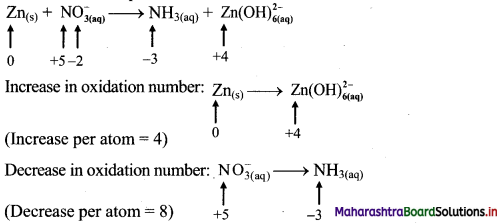
Consider He+:
Number of electrons = (Number of electrons in He – 1) = 2 – 1 = 1
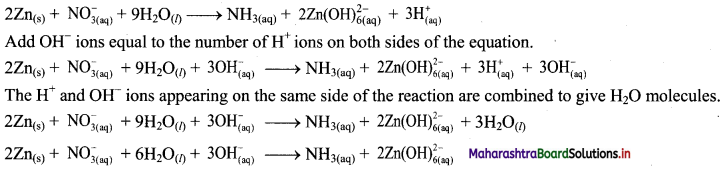

Thus, \({ }_{1}^{2} \mathrm{H}\) and He+ are hydrogen-like species.
[Note: Bohr’s theory is applicable to hydrogen atom and hydrogen-like species, which contain only one electron.]

Question 39.
Describe how the line spectrum of hydrogen is explained by Bohr theory.
Answer:
i. According to second postulate of Bohr theory, radiation is emitted when an electron moves from an outer orbit of higher principal quantum number (ni) to an inner orbit of lower principal quantum number (nf). The energy difference (ΔE) between the initial and final orbit of the electronic transition corresponds to the energy of the emitted radiation.
ii. From the third postulate of Bohr theory, ΔE can be expressed as
ΔE = Ei – Ef …….(1)
iii. According to the results derived from Bohr theory, the energy (En) of an orbit is related to its principal quantum number ‘n’ by the equation:
E = \(-\mathrm{R}_{\mathrm{H}}\left(\frac{1}{\mathrm{n}^{2}}\right)\) ……(2)
iv. On combining these two equations, we get:
Maharashtra Board Class 11 Chemistry Important Questions Chapter 4 Structure of Atom 14
v. Substituting the value of RH in joules, we get
Maharashtra Board Class 11 Chemistry Important Questions Chapter 4 Structure of Atom 15
vi. This expression can be rewritten in the terms of wavenumber of the emitted radiation in the following steps:
(ΔE) J = (h) J s × (ν) Hz
and
Maharashtra Board Class 11 Chemistry Important Questions Chapter 4 Structure of Atom 16
This equation appears like the Rydberg equation, where, nf = n1 and ni = n2.
In other words, Bohr theory successfully accounts for the empirical Rydberg equation for the line emission spectrum of hydrogen.

Question 40.
Observe the following diagram showing electronic transition in the hydrogen spectrum.
Maharashtra Board Class 11 Chemistry Important Questions Chapter 4 Structure of Atom 17
i. Electron jumps from higher energy level to n = 1. Which series does it correspond to?
ii. Electron jumps from higher energy level to n = 4. Which series does it correspond to?
iii. Which transition will give second line of Balmer series?
Answer:
i. When electron jumps from higher energy level to n = 1, it corresponds to Lyman series.
ii. When electron jumps from higher energy level to n = 1, it corresponds to Bracket series.
iii. When electron jumps from n = 4 to n = 1, the second line of Balmer series is observed.

Maharashtra Board Class 11 Chemistry Important Questions Chapter 4 Structure of Atom

Question 41.
Explain de Broglie’s equation.
Answer:
de Broglie’s equation:

  • de Broglie proposed (in 1924) that matter should exhibit a dual behaviour. That is, every object which possesses a mass and velocity behaves both as a particle and as a wave. An electron has mass and velocity. This means that an electron should have momentum (p), a property of particle as well as wavelength (λ), a property of wave.
  • According to de Broglie, the wavelength λ of a particle of mass m moving with a velocity v is
    λ = \(\frac{\mathrm{h}}{\mathrm{mv}}\) where, h is Planck’s constant.
  • The quantity mv gives the momentum of the particles.
    λ = \(\frac{\mathrm{h}}{\mathrm{p}}\) where, p represents the momentum of the particle.
  • de Broglie’s prediction was confirmed by diffraction experiments (a wave property).

[Note: According to de Broglie’s equation, the wavelength of a moving particle is inversely proportional to its mass. Therefore, heavier particles have much smaller wavelength than lighter particles like electrons.]

Question 42.
Write a note on Heisenberg’s uncertainty principle.
Answer:
i. Uncertainty principle was proposed by Wemer Heisenberg in 1927. It can be stated as “It is impossible to determine simultaneously, the exact position and exact momentum (or velocity) of an electron ”.
ii. If Δx is the uncertainty in the determination of the position of a very small moving particle and Δpx is the uncertainty in the determination of its momentum, then
Δx Δpx ≥ \(\frac{\mathrm{h}}{4 \pi}\) …….(1) where h is Planck’s constant
iii. The above equation can alternatively be stated as,
Δx × m × Δvx ≥ \(\frac{\mathrm{h}}{4 \pi}\), because Δpx = m × Δvx ……..(2)
where Δvx is the uncertainty in the determination of velocity and m is the mass of the particle.

Question 43.
Calculate the radius and energy associated with the first orbit of He.
Solution:
Given: n = 1
To find: Radius and energy associated with the first orbit of He+
Formulae:
Maharashtra Board Class 11 Chemistry Important Questions Chapter 4 Structure of Atom 18
Calculation: He+ is a hydrogen-like species having Z = 2.
Using formula (i),
Radius of the first orbit of He+ = r1 = \(\frac{52.9 \times(1)^{2}}{2} \mathrm{pm}\)
= 26.45 pm
Using formula (ii),
Energy of the first orbit of He+ = E1 = -2.18 × 10⁻¹⁸ \(\left(\frac{2^{2}}{1^{2}}\right) \mathrm{J}\)
= -8.72 × 10⁻¹⁸ J
Ans: Radius of the first orbit of He+ is 26.45 pm and energy of the first orbit of He+ is -8.72 × 10⁻¹⁸ J.

Question 44.
What is the wavelength of the photon emitted during the transition from the orbit of n = 5 to that of n = 2 in hydrogen atom?
Solution:
Given: ni = 5, nf = 2
To find: Wavelength of the photon emitted
Maharashtra Board Class 11 Chemistry Important Questions Chapter 4 Structure of Atom 19
Ans: Wavelength of the photon emitted is 434 nm.

Question 45.
Calculate the mass of a hypothetical particle having wavelength 5894 A and velocity 1.0 × 10⁸ ms-1.
Solution:
Given: Wavelength (λ) = 5894 Å, Velocity (ν) = 1.0 × 10⁸ ms-1
To find: Mass of a particle
Formula: λ = \(\frac{\mathrm{h}}{\mathrm{mv}}\) or m = \(\frac{\mathrm{h}}{\lambda \mathrm{v}}\) (according to de-Broglie equation)
Calculation: m = \(\frac{\mathrm{h}}{\lambda \mathrm{v}}\)
∴ m = \(\frac{6.626 \times 10^{-34} \mathrm{~kg} \mathrm{~m}^{2} \mathrm{~s}^{-1}}{\left(5894 \times 10^{-10} \mathrm{~m}\right) \times\left(1.0 \times 10^{8} \mathrm{~ms}^{-1}\right)}\)
= 1.124 × 10⁻³⁵ kg
Ans: Mass of a particle is 1.124 × 10⁻³⁵ kg.

[Calculation using log table:
\(\frac{6.626 \times 10^{-34}}{5894 \times 10^{-10} \times 1.0 \times 10^{8}}=\frac{6.626}{5894} \times 10^{-32}\)
= Antilog10 [log10 6.626 – log10 5894] × 10-32
= Antilog10 [0.8213 – 3.7704] × 10-32
= Antilog10 [latex]\overline{3} .0509[/latex] × 10-32 = 1.124 × 10⁻³⁵]

Maharashtra Board Class 11 Chemistry Important Questions Chapter 4 Structure of Atom

Question 46.
Write a short note on Schrodinger equation.
Answer:
Schrodinger equation or wave equation:
i. Schrodinger developed the fundamental equation of quantum mechanics which incorporates wave particle duality of matter. The Schrodinger equation or wave equation is written as:
It \(\hat{\mathbf{H}}\)ψ = Eψ
Here \(\hat{\mathbf{H}}\) is a mathematical operator called Hamiltonian, ψ (psi) is the wave function and E is the total energy of the system.

ii. When Schrodinger equation is solved for an electron in hydrogen atom, the possible values of energy states (E) that the electron may have along with the corresponding wave function (ψ) are obtained. As a consequence of solving this equation, a set of three quantum numbers characteristic of the quantized energy levels and the corresponding wave functions are obtained. These are: Principal quantum number (n), azimuthal quantum number (l) and magnetic quantum number (ml).

iii. The solution of Schrodinger wave equation led to three quantum numbers and successfully predicted features of hydrogen atom emission spectrum.

iv. Splitting of spectral lines in multi-electron atomic emission spectra could not be explained through such model. These were explained by George Uhlenbeck and Samuel Goudsmit (1925) who proposed the presence of the fourth quantum number called electron spin quantum number, ms.

Question 47.
Write a short note on magnetic orbital quantum number (ml).
Answer:
Magnetic orbital quantum number (ml):

  • Magnetic orbital quantum number describes the relative spatial orientation of the orbitals in a given subshell.
  • It is denoted by m; and it has values from -l to +l through zero, giving total values or total orientations equal to (2l + 1).
  • For s-subshell, 1 = 0, hence, ml = 0. Thus, s-subshell contains only one orbital.
  • For p-subshell, l = 1, hence, ml = +1, 0, -1. Thus, p-subshell contains three orbitals having distinct orientations.

Question 48.
If n = 2, what are the values of quantum number l and ml ?
Answer:
For a given n, l = 0 to (n – 1) and for given l, ml = -l…., 0…. + l
Therefore, the possible values of l and ml for n = 2 are:

Value of nValue of lValue of ml
20ml = 0
1ml = -1

ml = 0

ml = +1

Question 49.
What are the values of ml for f-subshell?
Answer:
For f-subshell, l = 3. Therefore, ml has seven values: + 3, + 2, + 1, 0, -1, -2, -3.

Maharashtra Board Class 11 Chemistry Important Questions Chapter 4 Structure of Atom

Question 50.
How many orbitals make the N-shell? What is the subshell wise distribution of orbitals in the N-shell?
Answer:
For N-shell principal quantum number n = 4
∴ Total number of orbitals in N-shell = n2 = 42 = 16. The total number of subshells in N-shell = n = 4.
The four subshells with their azimuthal quantum numbers and the constituent number of orbitals are as shown below:

Azimuthal quantum number (l)Symbol of subshellNumber of orbitals (2l + 1)
l = 0s(2 × 0) + 1 = 1
l = 1P(2 × 1) + 1 = 3
l = 2d(2 × 2) + 1 = 5
l = 3f(2 × 3) + 1 = 7

Question 51.
Complete the following flow chart:
Maharashtra Board Class 11 Chemistry Important Questions Chapter 4 Structure of Atom 20
Answer:
Maharashtra Board Class 11 Chemistry Important Questions Chapter 4 Structure of Atom 21

Question 52.
Write a short note on electron spin quantum number.
Answer:
Electron spin quantum number (ms):

  • Electron spin quantum number describes the spin state of the electron in an orbital. It is designated as ms.
  • An electron spins around its axis and this imparts spin angular momentum to it.
  • The two orientations which the spin angular momentum of an electron can take up give rise to the spin states which can be distinguished from each other by the spin quantum number, ms, which can be either +1/2 or -1/2.
  • The two spin states are represented by two arrows, ↑ (pointing up) and ↓ (pointing down) and thus have opposite spins.

Question 53.
An atom has two electrons in its 4s orbital. Write the values of the four quantum numbers for each of them.
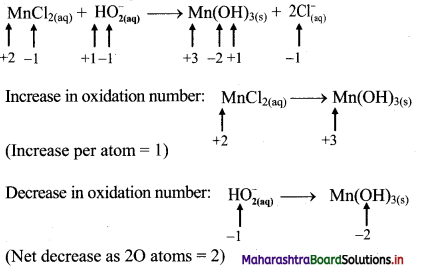
Answer:
For the 4s orbital, 4 stands for the principal quantum number n; s stands for the subshell s having the value of azimuthal quantum number, l = 0. In the ‘s’ subshell, there is only one orbital and has magnetic quantum number, ml = 0. The two electrons in this orbital have opposite spins. Thus, the four quantum numbers of two electrons in 4s orbital are:
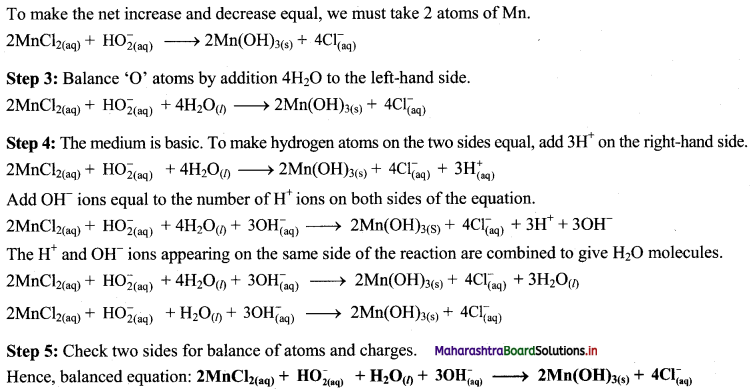
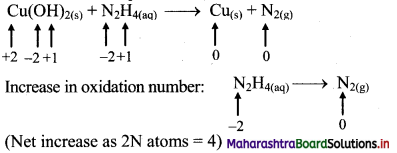
Maharashtra Board Class 11 Chemistry Important Questions Chapter 4 Structure of Atom 22

Maharashtra Board Class 11 Chemistry Important Questions Chapter 4 Structure of Atom
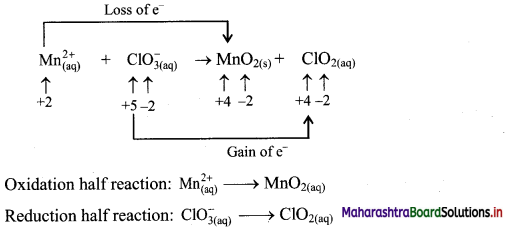
Question 54.
Write a short note on probability density of electron.
Answer:
i. The probability of finding an electron at a given point in an atom is proportional to the square of the wave function at that point (ψ2).

ii. According to Max Born, the square of wave function at a point in an atom is the probability density of the electron at that point.
The following figure shows the probability density diagrams of Is and 2s atomic orbitals. These diagrams appear like a cloud.
The electron cloud of 2s orbital shows one node, which is a region with nearly zero probability density and displays the change of sign for its corresponding wavefunction.
Diagram:
Maharashtra Board Class 11 Chemistry Important Questions Chapter 4 Structure of Atom 23

Question 55.
What is meant by the term ‘boundary surface diagram’?
Answer:
A boundary surface is drawn in space for an orbital such that the value of probability density (ψ2) is constant and encloses a region where the probability of finding electron is typically more than 90%. Such a boundary surface diagram is a good representation of shape of an orbital.
e.g. Boundary surface diagram of Is and 2s orbitals are spherical in shape.

Question 56.
Describe the shape of s orbital.
Answer:
Shape of s orbital:

  • For each value of principal quantum number ‘n’, there is only one s-orbital.
  • For s-orbital, l = 0 and ml = 0, hence s-orbital has only one orientation i.e., the probability of finding the electrons is same in all directions. Thus, s-orbital is spherically symmetrical around the nucleus.
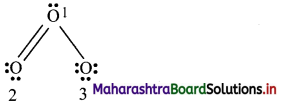
  • The value of n determines the size of an orbital. With increase in the value of n, the size of the s-orbital increases.

Diagram:
Maharashtra Board Class 11 Chemistry Important Questions Chapter 4 Structure of Atom 24

Question 57.
Describe the shape of 2p orbitals.
Answer:
Shape of 2p orbitals:
i. For p orbital, l = 1. For l = 1, ml = +1, 0, -1. Thus, p orbitals have three orientations.
ii. Each orbital has two lobes on the two sides of a nodal plane passing through the nucleus.
iii. Shape of 2p orbitals resembles a dumbbell.
iv. The size and energy of the three 2p orbitals are the same. However, their orientations in space are different. The lobes of the three 2p orbitals are along the x, y and z axes. Accordingly, the corresponding orbitals are designated as 2px, 2py and 2pz. The size and energy of the orbitals in p subshell increase with the increase of principal quantum number.
Diagram:
Maharashtra Board Class 11 Chemistry Important Questions Chapter 4 Structure of Atom 25

Question 58.
Describe the shape of 3d orbitals.
Answer:
Shape of 3d orbitals:

  • For d orbital, l = 2. For l = 2, ml = +2, +1, 0, -1, -2. Thus, d orbitals have five orientations.
  • They are designated as dxy, dyz, dzx, dx2-y2 and dz.
  • Shape of 3d orbitals are shown in the following figure. The first three have double dumb-bell shape. They lie in xy, yz and xz plane, respectively. The dx2-y2 is also dumb-bell shaped and lies along the x and y axes. dz2 is dumb-bell shaped along z axis with a dough-nut shaped ring of high electron density around the nucleus in xy plane.
  • In spite of difference in their shapes, the five d orbitals are equivalent in energy. The shapes of 4d, 5d, 6d…….. orbitals are similar to those of 3d orbitals, but their respective size and energies are large or they are said to be more diffused.

Diagram:
Maharashtra Board Class 11 Chemistry Important Questions Chapter 4 Structure of Atom 26

Maharashtra Board Class 11 Chemistry Important Questions Chapter 4 Structure of Atom

Question 59.
Explain (n + l) rule with respect to energies of orbitals.
Answer:
The lower the sum (n + l) for an orbital, the lower is its energy. If two orbitals have the same (n + l) values, then the orbital with the lower value of n is of lower energy. This is called the (n + l) rule.
Maharashtra Board Class 11 Chemistry Important Questions Chapter 4 Structure of Atom 27

Question 60.
What are the two methods of representing electronic configuration of an atom?
Answer:
The two methods of representing electronic configuration of an atom are:
i. Orbital notation: nsa npb ndc …..
In the orbital notation method, a shell is represented by the principal quantum number (n) followed by respective symbol of the subshell. The number of electrons occupying that subshell being written as superscript on right side of the symbol.
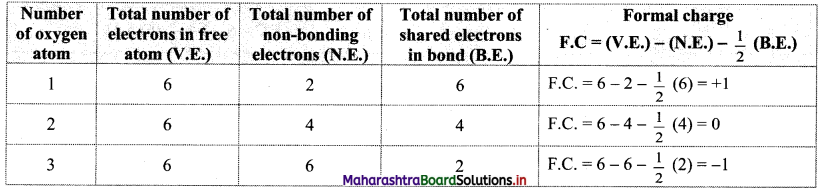
ii. Orbital diagram:
In the orbital diagram method, each orbital in a subshell is represented by a box and the electrons represented by an arrow (↑ for up spin and ↓ for down spin) are placed in the respective boxes. In this method, all the four quantum numbers of electron are accounted for.
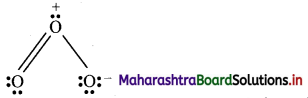
Maharashtra Board Class 11 Chemistry Important Questions Chapter 4 Structure of Atom 28
Note: Consider two electrons in 3s orbital:

Maharashtra Board Class 11 Chemistry Important Questions Chapter 4 Structure of Atom 29

Question 61.
Complete the following table:
Maharashtra Board Class 11 Chemistry Important Questions Chapter 4 Structure of Atom 30
Answer:
Maharashtra Board Class 11 Chemistry Important Questions Chapter 4 Structure of Atom 31

Question 62.
Explain condensed orbital notation of electronic configuration of an atom.
Answer:

  • The orbital notation of electronic configuration of an element with high atomic number comprises a long train of symbols of orbitals with an increasing order of energy.
  • It can be condensed by dividing it into two parts: Inner or core part of electronic configuration and outer electronic configuration.
  • Electronic configuration of the preceding inert gas is a part of the electronic configuration of any element. In the condensed orbital notation, it is implied by writing symbol of that inert gas in a square bracket. It is core part of the electronic configuration of that element. The outer electronic configuration is specific to a particular element and written immediately after the bracket.
  • For example, the orbital notation of potassium ‘K (Z = 19) is Is2 2s2 2p6 3s2 3p6 4s1’. Its core part is the electronic configuration of the preceding inert gas argon ‘Ar: 1s2 2s2 2p6 3s2 3p6, while ‘4s1’ is an outer part. Therefore, the condensed orbital notation of electronic configuration of potassium is ‘K: [Ar] 4s2.’

Note: Electronic configuration of the elements with atomic numbers 1 to 30 is as follows:
Maharashtra Board Class 11 Chemistry Important Questions Chapter 4 Structure of Atom 32
Maharashtra Board Class 11 Chemistry Important Questions Chapter 4 Structure of Atom 33

Maharashtra Board Class 11 Chemistry Important Questions Chapter 4 Structure of Atom

Question 63.
Write electronic configuration of 18Ar and 19K using orbital notation and orbital diagram method.
Answer:
From the atomic numbers, it is understood that 18 electrons are to be filled in Ar atom and 19 electrons are to be filled in K atom. These are to be filled in the orbitals according to the Aufbau principle. The electronic configuration of these atoms can be represented as:
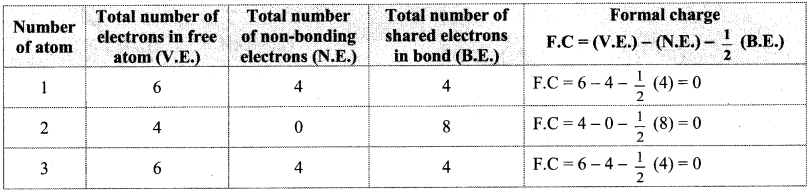
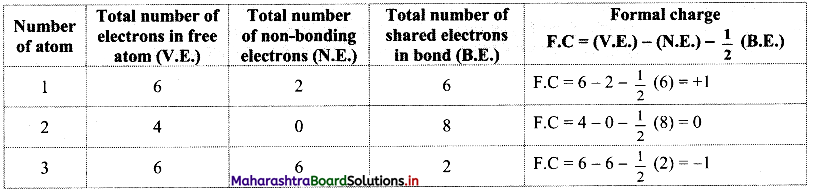
Maharashtra Board Class 11 Chemistry Important Questions Chapter 4 Structure of Atom 34

Question 64.
Write condensed orbital notation of electronic configuration of the following elements:
i. Fluorine (Z = 9)
ii. Scandium (Z = 21)
iii. Cobalt (Z = 27)
iv. Zinc (Z = 30)
Answer:

No.ElementCondensed orbital notation
i.Fluorine (Z = 9)[He] 2s2 2p5
ii.Scandium (Z = 21)[Ar] 4s2 3d1
iii.Cobalt (Z = 27)[Ar] 4s2 3d7
iv.Zinc (Z = 30)[Ar] 4s2 3d10

Question 65.
Find out one dinegative anion and one unipositive cation which are isoelectronic with Ne atom. Write their electronic configuration using orbital notations and orbital diagram method.
Answer:
Atomic number (Z) of Ne is 10. Therefore, Ne and its isoelectronic species contain 10 electrons each. The dinegative anionic species, isoelectronic with Ne is obtained by adding two electrons to the atom with Z = 8. This is O2- ion.
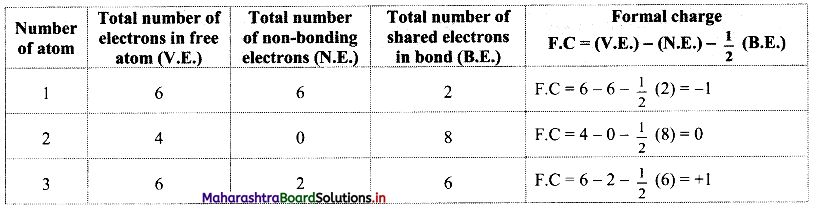

The unipositive cationic species, isoelectronic with Ne is obtained by removing one electron from an atom with Z = 11. It is Na+ ion.
These species and their electronic configurations are shown below:
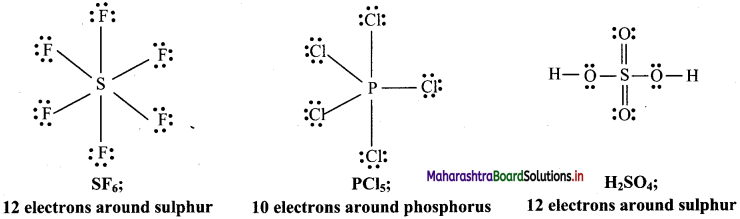
Maharashtra Board Class 11 Chemistry Important Questions Chapter 4 Structure of Atom 35
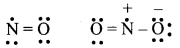
Question 66.
A student pictorially represented the electronic configuration of cobalt (Z = 27) in ground state as shown in the following figure.
Maharashtra Board Class 11 Chemistry Important Questions Chapter 4 Structure of Atom 36
i. Is this the correct representation?
ii. Identify the rules of electron filling that are violated (if any) in the above answer and give the correct representation.
Answer:
i. No, the electronic configuration of cobalt in ground state is incorrectly represented.
ii. The mles of electron filling that are violated in the above diagram are Pauli’s exclusion principle and Hund’s rule. The correct electronic configuration is:
Maharashtra Board Class 11 Chemistry Important Questions Chapter 4 Structure of Atom 37

Question 67.
With reference to the representative model of the gold foil experiment, answer the following questions:
Maharashtra Board Class 11 Chemistry Important Questions Chapter 4 Structure of Atom 38
i. What evidence regarding an atom do lines A, B and C provide?
ii. How does Rutherford’s model contradict Thomson’s plum-pudding model?
iii. What results would you expect from the experiment if Thomson’s plum-pudding model was correct?
Answer:
i. Line A – Most of the space inside the atom is empty because most of the α-particles passed through the gold foil without getting deflected.
Line B – The nucleus is positively charged since some α-particles were deflected at small angles.
Line C – The nucleus contains most of the atoms mass since few α-particles were deflected backward, i.e. toward the radioactive source.

ii. According to plum-pudding model, an atom was considered a positively charged sphere with negatively charged electrons embedded in it. However, Rutherford’s gold foil experiment proved that an atom consists of large empty space with positive charge concentrated only at the centre (nucleus) and negatively charged electrons revolve around the nucleus in various orbits.

iii. If Thomson’s plum-pudding model was correct, then in the gold foil experiment we would not expect to see any significant deflection of the α-particles, i.e., Most α-particles would pass through the foil with very small or no deflections.

Maharashtra Board Class 11 Chemistry Important Questions Chapter 4 Structure of Atom

Question 68.
Complete the following table:
Maharashtra Board Class 11 Chemistry Important Questions Chapter 4 Structure of Atom 39
Answer:
Maharashtra Board Class 11 Chemistry Important Questions Chapter 4 Structure of Atom 40

Multiple Choice Questions

1. Which of the following statements about the electron is INCORRECT?
(A) It is a negatively charged particle.
(B) The mass of electron is equal to the mass of neutron.
(C) It is a basic constituent of all atoms.
(D) It is a constituent of cathode rays.
Answer:
(B) The mass of electron is equal to the mass of neutron.

2. The isotopes of an element differ in
(A) the number of neutrons in the nucleus
(B) the charge on the nucleus
(C) the number of extra-nuclear electrons
(D) both the nuclear charge and the number of extra-nuclear electrons
Answer:
(A) the number of neutrons in the nucleus

3. The difference between U235 and U238 atoms is that U238 contains ………….
(A) 3 more protons
(B) 3 more protons and 3 more electrons
(C) 3 more neutrons and 3 more electrons
(D) 3 more neutrons
Answer:
(D) 3 more neutrons

Maharashtra Board Class 11 Chemistry Important Questions Chapter 4 Structure of Atom

4. The number of electrons, protons and neutrons in 31P3- ion is respectively ……………
(A) 15, 15, 16
(B) 15, 16, 15
(C) 18, 15, 16
(D) 15, 16, 18
Answer:
(C) 18, 15, 16

5. In vacuum, the speed of all types of electromagnetic radiation is equal to ………….
(A) 3.0 × 10⁶ m s-1
(B) 3.0 × 10⁸ m s-1
(C) 3.0 × 10¹⁰ m s-1
(D) 3.0 × 10¹² m s-1
Answer:
(B) 3.0 × 10⁸ m s-1

6. In the electromagnetic spectrum, the ultraviolet region is around ………….. Hz.
(A) 106
(B) 1010
(C) 1016
(D) 1026
Answer:
(C) 1016

7. In hydrogen spectrum, the series of lines appearing in ultraviolet region of electromagnetic spectrum are called ………….
(A) Lyman series
(B) Balmer series
(C) Pfund series
(D) Brackett series
Answer:
(A) Lyman series

8. The energy of electron in the nth Bohr orbit of H-atom is …………
Maharashtra Board Class 11 Chemistry Important Questions Chapter 4 Structure of Atom 41
Answer:
(C) \(-\frac{2.18 \times 10^{-18}}{\mathrm{n}^{2}} \mathrm{~J}\)

9. Which of the following is a hydrogen-like species?
(A) He2+
(B) Be3+
(C) Li+
(D) H+
Answer:
(B) Be3+

Maharashtra Board Class 11 Chemistry Important Questions Chapter 4 Structure of Atom

10. The de Broglie wavelength associated with a particle of mass 10-6 kg moving with a velocity of 10 m s-1 is ………..
(A) 6.63 × 10⁻²² m
(B) 6.63 × 10⁻²⁹ m
(C) 6.63 × 10⁻³¹ m
(D) 6.63 × 10⁻³⁴ m
Answer:
(B) 6.63 × 10⁻²⁹ m

11. An orbital is designated by …………. quantum numbers while an electron in an atom is designated by …………. quantum numbers.
(A) two, three
(B) three, two
(C) four, two
(D) three, four
Answer:
(D) three, four

12. In a multi-electron atom, the energy of the orbital depends on two quantum numbers: ……….
(A) n and ms
(B) n and ml
(C) ml and ms
(D) n and l
Answer:
(D) n and l

13. The number of subshells in a shell is equal to ………..
(A) n
(B) n2
(C) n – 1
(D) l + 1
Answer:
(A) n

14. The maximum number of electrons in a subshell for which l = 3 is …………..
(A) 14
(B) 10
(C) 8
(D) 4
Answer:
(A) 14

Maharashtra Board Class 11 Chemistry Important Questions Chapter 4 Structure of Atom

15. Which of the following is INCORRECT?
(A) A nodal plane has ψ2 very close to zero.
(B) The value of ψ2 at any finite distance from the nucleus is always zero.
(C) A boundary surface diagram enclosing 100 % probability density cannot be drawn.
(D) A boundary surface diagram is a good representation of shape of an orbtial.
Answer:
(B) The value of ψ2 at any finite distance from the nucleus is always zero.

16. pz-Orbital has ……….. nodal plane/planes.
(A) zero
(B) one
(C) two
(D) three
Answer:
(B) one

17. Which of the following pairs of d-orbitals will have electron density along the axis?
(A) dxy, dx2-y2
(B) dz2, dxz
(C) dxz, dyz
(D) dz2, dx2-y2
Answer:
(D) dz2, dx2-y2

18. The two electrons have the following set of quantum numbers:
P = 3, 2, -2, +\(\frac {1}{2}\)
Q = 3, 0, 0, +\(\frac {1}{2}\)
Which of the following statement is TRUE?
(A) P and Q have same energy
(B) P has greater energy than Q
(C) P has lesser energy than Q
(D) P and Q represent same electron
Answer:
(B) P has greater energy than Q

19. For 3d orbital, the values of n and l are ………… respectively.
(A) 0, 3
(B) 3, 2
(C) 3, 0
(D) 3, 3
Answer:
(B) 3, 2

20. For the electron present in 1 s orbital of helium atom, the correct set of values of quantum numbers is ………..
(A) 1, 0, 0, +1/2
(B) 1, 1, 0, +1/2
(C) 1, 1, 1, +1/2
(D) 2, 0, 0, +1/2
Answer:
(A) 1, 0, 0, +1/2

Maharashtra Board Class 11 Chemistry Important Questions Chapter 4 Structure of Atom

21. The ground state electronic configuration for chromium atom (Z = 24) is …………
(A) [Ar] 3d5 4s1
(B) [Ar] 3d4 4s2
(C) [Ar] 3d8
(D) [Ar] 4s1 4p5
Answer:
(A) [Ar] 3d5 4s1

22. The electronic configuration of Ni2+ is ……….. (Atomic number of Ni = 28)
(A) [Ar] 4s2 3d6
(B) [Ar] 4s1 3d8
(C) [Ar] 3d8
(D) [Ar] 4s2 3d8
Answer:
(C) [Ar] 3d8

Maharashtra Board Class 11 Chemistry Important Questions Chapter 3 Basic Analytical Techniques

Balbharti Maharashtra State Board 11th Chemistry Important Questions Chapter 3 Basic Analytical Techniques Important Questions and Answers.

Maharashtra State Board 11th Chemistry Important Questions Chapter 3 Basic Analytical Techniques

Question 1.
Give reason: Purification of a chemical substance is important before investigating its composition and properties.
Answer:

  • Chemical substances occur in nature in the impure stage.
  • Also, chemical substances synthesized in the laboratory are obtained in crude and impure form.
  • Impurities present in the chemical substances may interfere with the properties to be determined (e.g. melting point or boiling point).
  • Therefore, before investigating the composition and properties of a given chemical substance, it is important to obtain it in pure form.

Question 2.
What are the different types of impurities that a solid may contain?
Answer:
A solid substance may contain two types of impurities:

  • Impurities that are soluble in the same solvent as the main substance.
  • Impurities that are not soluble in the same solvent as the main substance.

Question 3.
For which of the following cases, is the process of filtration feasible? Why?
Case 1: A solid substance containing impurities that are soluble in the same solvent as the main substance.
Case 2: A solid substance containing impurities that are not soluble in the same solvent as the main substance.
Answer:
Impurities which are not soluble in the same solvent as the main compound can be separated by a simple process called filtration. Hence, for ‘Case 2’, filtration is more feasible.

Maharashtra Board Class 11 Chemistry Important Questions Chapter 3 Basic Analytical Techniques

Question 4.
Describe the process of filtration with a neat and labelled diagram.
Answer:
i. Impurities which are not soluble in the same solvent as the main compound can be separated by a simple process called filtration.
ii. Procedure:
a. A circular piece of filter paper is folded to form a cone and fitted in the funnel.
b. The funnel is fixed on a stand and a beaker is kept below.
c. The mixture which has to be purified is added to a suitable solvent in which the main compound dissolves.
d. The paper is made moist, and the solution to be filtered is poured on the filter paper.
e. Diagram:
Maharashtra Board Class 11 Chemistry Important Questions Chapter 3 Basic Analytical Techniques 1
iii. The insoluble part remaining on the filter paper is called residue and the liquid which pass through the filter paper and collected in the beaker is called filtrate.
iv. This process is similar to separating tea leaves from decoction of tea or sand from mixture of sand and water.

Question 5.
Why is safety bottle used when filtration is carried out under suction?
Answer:
The safety bottle is used to prevent sucking of the filtrate into suction pump.

Question 6.
Name the steps involved in the process of crystallization.
Answer:
Steps involved in the process of crystallization:

  • Preparation of a saturated solution
  • Hot filtration
  • Cooling of the filtrate
  • Filtration

Question 7.
How is saturated solution of the crude solid prepared?
Answer:

  • A saturated solution of the crude solid is prepared by boiling it in a small but sufficient quantity of a suitable solvent.
  • The main solute from the sample of the crude solid dissolves to form a saturated solution on boiling.

[Note: The solution is not saturated with respect to the soluble impurities, as they are in small proportion.]

Question 8.
Explain the following steps with respect to the process of crystallization.
i. Preparation of a saturated solution
ii. Hot filtration
iii. Cooling of the filtrate
iv. Filtration
Answer:
i. Preparation of a saturated solution:

  • A saturated solution of the crude solid is prepared by boiling it in a small but sufficient quantity of a suitable solvent.
  • On doing so the main solute forms an almost saturated solution, but the solution is not saturated with respect to the soluble impurities, as they are in small proportion.

ii. Hot filtration: The hot saturated solution is quickly filtered to remove undissolved impurities as residue. Filtration under suction can be employed for rapid filtration.

iii. Cooling of the filtrate:

  • The hot filtrate is allowed to cool.
  • On cooling, the filtrate becomes supersaturated with respect to the main dissolved solute because solubility of a substance decreases with lowering of temperature.
  • The excess quantity of the dissolved solute comes out of the solution in the form of crystals.
  • The dissolved impurities, however, do not supersaturate the solution, as their quantity is small.
  • These continue to stay in the solution in dissolved state even on cooling. Therefore, the separated crystals are free from soluble impurities.

iv. Filtration:

  • The crystals obtained on cooling are further purified by filtration to remove insoluble impurities.
  • The filtrate obtained is called as mother liquor.
  • The crystals obtained after filtration are free from soluble as well as insoluble impurities.

Maharashtra Board Class 11 Chemistry Important Questions Chapter 3 Basic Analytical Techniques

Question 9.
Name the common solvents used in the process of crystallization.
Answer:
The commonly used solvents are water, ethyl alcohol, methyl alcohol, acetone, ether or their combinations.

Question 10.
Describe the process of crystallization of common salt from impure sample with the help of a diagram.
Answer:

  • Impure sample of a common salt is added to the required quantity of water and stirred with a glass rod.
  • More amount of salt is added and the solution is heated till no more salt dissolves.
  • The hot saturated solution is filtered off to remove insoluble impurities while the filtrate is collected in an evaporating dish.
  • The filtrate is allowed to cool which results in the formation crystals of pure salt (NaCl) leaving behind the soluble impurities.
  • The crystals are filtered and dried.

The diagram is as follows:
Maharashtra Board Class 11 Chemistry Important Questions Chapter 3 Basic Analytical Techniques 2

Question 11.
Which solvent is used for the purification of copper sulphate and benzoic acid?
Answer:
The solvent used for the purification of copper sulphate and benzoic acid is water.

Question 12.
Define: Fractional crystallization
Answer:
Fractional crystallization is a process wherein two or more soluble substances having widely different solubilities in the same solvent at same temperature are separated by crystallization.

Question 13.
Give a brief description of the principle of fractional crystallization.
Answer:
Fractional crystallization is based on the differences in solubilities of two or more compounds in the same solvent at the same temperature. That is, the substance which is least soluble crystallizes out first and the most soluble substance crystallizes out last.
e.g. Mixture of two solutes A and B can be purified by fractional crystallization as follows:

  • Preparation of a saturated solution: Mixture of two solutes A and B are dissolved in a suitable hot solvent to prepare a saturated solution.
  • Hot filtration: The hot saturated solution is filtered to remove insoluble impurities.
  • Cooling of the filtrate: Hot filtrate is allowed to cool. On cooling, the solute which is least soluble crystallizes out first leaving behind the most soluble substance in the mother liquor.
  • Filtration: The crystals formed are filtered, washed with solvent and dried. Crystals obtained will be of a solute which is least soluble in a given solvent.
  • Concentration of a mother liquor: The mother liquor is concentrated by evaporating the solvent. These crystals are filtered and dried to obtain the second purified component (which was more soluble in given solvent).

Maharashtra Board Class 11 Chemistry Important Questions Chapter 3 Basic Analytical Techniques

Question 14.
Which type of impure liquids can be purified by the process of distillation?
Answer:
Distillation technique can be employed for the purification of

  • volatile liquids from non-volatile impurities.
  • liquids having sufficient difference in their boiling point.

Question 15.
Explain the construction of simple distillation unit using neat labelled diagram.
Answer:
i. The apparatus used for simple distillation is shown in the figure below:
Maharashtra Board Class 11 Chemistry Important Questions Chapter 3 Basic Analytical Techniques 3
ii. It consists of round bottom flask fitted with a cork having a thermometer.
iii. The flask has a sidearm through which it is connected to a condenser.
iv. The condenser has a jacket with two outlets through which water is circulated.
v. The liquid to be distilled is taken in the round bottom flask fixed by clamp.
vi. The flask is placed in a water bath or oil bath or sometimes wire gauze is kept on a stand as shown in the figure.

Question 16.
State the principle involved and describe the process to separate acetone and water from their mixture.
Answer:
i. Acetone and water can be separated from their mixture by simple distillation.

ii. Principle: Acetone and water are two miscible liquids having an appreciable difference (more than 30 K) in their boiling points. Acetone boils at 56 °C while boiling point of water is 100 °C. When the mixture of acetone and water is heated and temperature of the mixture reaches 56 °C acetone will distil out first. Once all acetone distils out, and when the temperature rises to 100 °C water will distil out.

iii. Process to separate acetone and water from their mixture:

  • Take the mixture of water and acetone in the distillation flask.
  • Heat the flask on a water bath carefully. At 56 °C acetone will distil out, collect it in receiver.
  • After all acetone distilled, change the receiver. Discard a few mL of the liquid. As the temperature reaches 100 °C water will begin to distil. Collect this in another receiver.

Question 17.
What is the advantage of fractional distillation over simple distillation?
Answer:
If in a mixture, the difference in boiling points of two liquids is not appreciable/large, they cannot be separated using simple distillation. To separate such liquids, fractional distillation is used.

Maharashtra Board Class 11 Chemistry Important Questions Chapter 3 Basic Analytical Techniques

Question 18.
Label the following diagram and explain the process by giving example.
Maharashtra Board Class 11 Chemistry Important Questions Chapter 3 Basic Analytical Techniques 4
Answer:
The labelled diagram is as follows:
Maharashtra Board Class 11 Chemistry Important Questions Chapter 3 Basic Analytical Techniques 5
i. In fractional distillation, vapours first pass through the fractionating column.
ii. Vapours of more volatile liquid with lower boiling point rise up more than the vapours of liquid having higher boiling point.
e.g.

  • Suppose we have a mixture of two liquid ‘A’ and ‘B’ having boiling points 363 K and 373 K respectively.
  • ‘A’ is more volatile and ‘B’ is less volatile. As the mixture is heated, vapours of ‘A’ along with a little vapours of ‘B’ rise up and come in contact with the large surface of the fractionating column.
  • Vapours of ‘B’ condense rapidly into the distillation flask. While passing through the fractionating column, there is an exchange between the ascending vapours and descending liquid. The vapours of ‘B’ are scrubbed off by the descending liquid, this makes the vapours richer in ‘A’.
  • This process is repeated each time the vapours and liquid come in contact with the surface in the fractionating column.
  • Rising vapours become richer in ‘A’ and escape through the fractionating column and reach the condenser while the liquid in the distillation flask is richer in ‘B.
  • The separated components are further purified by repeating the process.

Question 19.
Give two examples of a mixture that can be separated by fractional distillation.
Answer:

  1. Mixture of acetone (b.p. 329 K) and methyl alcohol (b.p. 337.7 K)
  2. Mixture of acetone (b.p. 329 K) and benzene (b.p. 353 K)

Question 20.
Give one industrial application of fractional distillation.
Answer:
Fractional distillation is used in petroleum industry to separate different fractions of crude oil.

Question 21.
Write a short note on distillation under reduced pressure.
Answer:

  • Liquids having very high boiling points or which decompose on heating are purified by the method of distillation under reduced pressure.
  • In this method, the liquid is made to boil at a temperature lower than its normal boiling point by reducing the pressure on its surface.
  • The external pressure is reduced using a water pump or vacuum pump, e.g. Glycerol can be separated from soap by using this method.

Maharashtra Board Class 11 Chemistry Important Questions Chapter 3 Basic Analytical Techniques

Question 22.
Write the principle of solvent extraction and explain the process with labelled diagram.
Answer:
Principle: Extraction of compound takes place based on the difference in solubility of compound in two liquids.

  • In this process, the solute distributes itself between two immiscible liquids. From the aqueous phase the solute gets extracted in the organic phase.
  • On shaking for a few times with small volumes of organic phase, most of the solute gets extracted into the organic phase.
  • Then solute is then recovered from organic solvent either by evaporation of organic solvent or distillation.

Diagram:
Maharashtra Board Class 11 Chemistry Important Questions Chapter 3 Basic Analytical Techniques 6

Question 23.
Write a short note on continuous extraction method.
Answer:

  • During solvent extraction, if the solute is found to be less soluble in organic phase, then continuous extraction method is employed.
  • In this method, the same amount of organic solvent is used repeatedly for extraction.
  • This ensures that the most of the solute gets extracted in the organic phase.
  • This technique involves continuous distillation of the solvent within the same assembly. Hence, the use of large quantity of organic solvent is avoided.

Question 24.
Match the following:

ProcessUsed in the purification/separation of
i.Crystallizationa.Acetone and benzene
ii.Simple distillationb.Benzoic acid and water
iii.Fractional distillationc.Impure copper sulphate
iv.Solvent extractiond.Acetone and water

Answer:
i – c,
ii – d,
iii – a,
iv – b

Question 25.
What is chromatography? Explain the principle behind it.
Answer:
Chromatography is a technique used to separate components of a mixture, and also purify compounds.
Principle: The principle of separation of substances in chromatography is based on the distribution of the solutes in two phases, i.e., stationary phase and mobile phase.

  • Chromatography uses two phases for separation.
  • This technique is based on the difference in rates at which components in the mixture move through the stationary phase under the influence of the mobile phase.
  • In this technique, first the mixture of components is loaded at one end of the stationary phase and then the mobile phase is allowed to move over the stationary phase. The mobile phase can be a pure solvent or a mixture of solvents.
  • Depending on the relative affinity of the components toward the stationary phase and mobile phase, they remain on the surface of the stationary phase or move along with the mobile phase, and gradually get separated.

Maharashtra Board Class 11 Chemistry Important Questions Chapter 3 Basic Analytical Techniques

Question 26.
Give a brief description of column chromatography with an illustration.
Answer:
Column chromatography involves the separation of components over a column of stationary phase. The stationary phase material can be alumina, silica gel.
Procedure:
Maharashtra Board Class 11 Chemistry Important Questions Chapter 3 Basic Analytical Techniques 7

  • A slurry of the stationary phase material is filled in a long glass tube provided with a stopcock at the bottom and a glass wool plug at the lower end.
  • The mixture to be separated is dissolved in a suitable solvent and then it is loaded on top of adsorbent column.
  • A suitable mobile phase which could be a single solvent or a mixture of solvents is then poured over the adsorbent column.
  • The mixture along with the mobile phase slowly moves down the column.
  • The solutes get adsorbed on the stationary phase and depending on the degree to which they are adsorbed, they get separated from each other.
  • The component which is readily adsorbed are retained on the column and others move down the column to various distances forming distinct bands.
  • The component which is less strongly adsorbed is desorbed first and leaves the column first, while the strongly adsorbed component is eluted later.
  • The solutions of these components are collected separately.
  • These different components can be recovered by evaporating the solvent.

Question 27.
How is TLC plate or chromplate prepared?
Answer:
TLC plate or chromplate is prepared by applying a thin layer (0.2 mm thick) of adsorbent silica gel or alumina spread over a glass plate.

Question 28.
Describe the process of thin layer chromatography (TLC) and separation of components in it.
Answer:
i. Process:

  • A thin layer (about 0.2 mm thick) of an adsorbent like silica gel or alumina is spread over a thin glass plate (called chromplate or TLC plate). This plate acts as a stationary phase.
  • With the help of a capillary tube, the solution of the mixture to be separated is spotted at above 2 cm (on base line) from one end of the TLC plate.
  • The TLC plate is then placed in a closed jar containing a suitable solvent (mobile phase or eluant).
  • As the mobile phase rises up the plate, the components of the mixture move up along with the mobile phase to different distances depending upon their degree of adsorption, thus resulting in complete separation.

ii. Separation of components:

  • If the components are coloured, they appear as separated coloured spots on the plate.
  • If the components are not coloured but have property of fluorescence, they can be visualised under UV light, or the plate can be kept in a chamber containing a few iodine crystals. The Iodine vapours are adsorbed by the components and the spots appear brown.
  • Amino acids are visualised by spraying the plate with a solution of ninhydrin. This is known as spraying agent.

Question 29.
Name the physical state each of stationary phase and mobile phase in partition chromatography.
Answer:
In partition chromatography, both stationary and mobile phases are in liquid state.

Maharashtra Board Class 11 Chemistry Important Questions Chapter 3 Basic Analytical Techniques

Question 30.
State the principle of partition chromatography.
Answer:
Partition chromatography is based on continuous differential partitioning of components of a mixture between stationary and mobile phases.

Question 31.
Describe the process of paper chromatography.
Answer:
Process of paper chromatography:

  • The mixture of the compound to be analysed is dissolved in a suitable solvent and spotted on the chromatography paper about 2 cm from one end of the paper using a glass capillary.
  • The paper is then suspended in a chamber containing the mobile phase.
  • The mobile phase rises up the paper and flows over the spot, due to capillary action.
  • Different solutes are retained differently on the paper depending on their selective partitioning between the two phases. The paper strip so developed, is known as chromatogram.

Question 32.
Name the following:
i. A glass plate coated with a thin layer of silica gel.
ii. A spraying agent used for the visualization of amino acids.
Answer:
i. Chromplate/TLC plate
ii. Ninhydrin

Question 33.
Write a short note on Rf value.
Answer:
i. In chromatography, migration of the solute relative to the solvent front gives an idea about the relative retention of the solutes (or components of t the mixture) on the stationary phase.
ii. The relative adsorption of solutes is expressed in terms of its Rf value.
The symbol Rf stands for Retardation Factor.
Maharashtra Board Class 11 Chemistry Important Questions Chapter 3 Basic Analytical Techniques 8
Maharashtra Board Class 11 Chemistry Important Questions Chapter 3 Basic Analytical Techniques 9

Question 34.
In a chemical laboratory, Priyal was asked to isolate an organic compound from its aqueous solution. She added ethyl acetate to the given sample, separated the organic layer and kept it for evaporation. At the end of her practical, Priyal found few crystals in the beaker which she kept for evaporation. Answer the following questions:
i. In the above passage, which method was used by Priyal for separation? State its principle.
ii. Why do you think the organic compound dissolved in ethyl acetate?
iii. Illustrate the method of separation used in the passage with an example.
Answer:
i. Method used: Solvent extraction method.
Principle: Extraction of compound takes place based on the difference in solubility of compound in two liquids,

  • In this process, the solute distributes itself between two immiscible liquids. From the aqueous phase the solute gets extracted in the organic phase.
  • On shaking for a few times with small volumes of organic phase, most of the solute gets extracted into the organic phase.
  • Then solute is then recovered from organic solvent either by evaporation of organic solvent or distillation.

ii. An organic compound (non-polar) dissolves in organic solvents (non-polar) because of the dipole-dipole interactions in between them (like dissolves like). Water is a polar solvent and it is unlikely that the covalent constituents of the organic substance is strong enough to break the ionic bonds. Any substance dissolves in other because it is able to break the bonds between the solvent molecules and form weak bonds with the solvent molecules. Hence, the organic compound will be more soluble in ethyl acetate as compared to water and this helps in its isolation from aqueous solution.

iii. An example for the separation of organic compound using solvents extraction method is: Benzoic acid in water can be extracted from its aqueous solution by using benzene.

Maharashtra Board Class 11 Chemistry Important Questions Chapter 3 Basic Analytical Techniques

Question 35.
Maharashtra Board Class 11 Chemistry Important Questions Chapter 3 Basic Analytical Techniques 10
Based on the above diagram, answer the following questions:
i. Name the chromatographic technique involved.
ii. From the developed chromatogram, state which has the highest and which has the lowest Rf value?
iii. Based on the TLC, which component would elute out at the end of a column chromatography?
iv. Mention two applications of TLC method.
Answer:
i. Thin layer chromatography
ii. Based on the developed chromatogram, spot ‘x’ has the highest Rf value while spot ‘z’ the lowest Rf value.
iii. Based on the TLC, spot ‘z’ being strongly adsorbed will elute at the end of a column chromatography.
iv. Applications of TLC are:

  • Separation of plant pigments from its mixture.
  • Separation of impurities from a given organic compound.
  • Separation of different amino acid.

Multiple Choice Questions

1. If a crude solid is made of mainly one substance and has some impurities then it is purified by ……………..
(A) crystallization
(B) distillation
(C) extraction
(D) sublimation
Answer:
(A) crystallization

2. Impure common salt can be purified by ……………
(A) crystallization
(B) distillation
(C) extraction
(D) sublimation
Answer:
(A) crystallization

3. Which of the following solvents is most commonly used for the crystallization of copper sulphate?
(A) Water
(B) Acetone
(C) Ether
(D) Methanol
Answer:
(A) Water

Maharashtra Board Class 11 Chemistry Important Questions Chapter 3 Basic Analytical Techniques

4. In distillation of liquid, water condenser is used ……………
(A) to boil the liquid
(B) to collect the liquid
(C) to condense hot vapours of the liquid
(D) to adsorb the liquid
Answer:
(C) to condense hot vapours of the liquid

5. Separation of binary mixture of acetone and methyl alcohol is done by ……………
(A) simple distillation
(B) fractional distillation
(C) fractional crystallization
(D) re-crystallization
Answer:
(B) fractional distillation

6. Which of the following method is used to separate different fractions of crude oil?
(A) Solvent extraction
(B) Simple distillation
(C) Fractional distillation
(D) TLC
Answer:
(C) Fractional distillation

7. The method used to separate a given organic compound present in aqueous solution by shaking with a suitable solvent in which the compound is more soluble than water is called ……………….
(A) simple distillation
(B) fractional distillation
(C) solvent extraction
(D) crystallization
Answer:
(C) solvent extraction

8. Adsorption chromatography is a chromatographic technique based on the principle of ……………
(A) differential adsorption
(B) differential solubility
(C) differential extraction
(D) all of these
Answer:
(A) differential adsorption

Maharashtra Board Class 11 Chemistry Important Questions Chapter 3 Basic Analytical Techniques

9. The stationary phase and mobile phase in TLC are ……………. respectively.
(A) solid and liquid
(B) solid and gas
(C) liquid and solid
(D) liquid and liquid
Answer:
(A) solid and liquid

10. Which of.the following is most commonly used for the visualization of amino acids in chromatography?
(A) Ultraviolet light
(B) Spraying agent
(C) Sunlight
(D) X-rays
Answer:
(B) Spraying agent

11. The stationary phase and mobile phase in partition chromatography are ………….. respectively.
(A) solid and liquid
(B) solid and gas
(C) liquid and solid
(D) liquid and liquid
Answer:
(D) liquid and liquid

12. Paper chromatography is based on the principle of …………….
(A) adsorption
(B) partition
(C) solubility
(D) volatility
Answer:
(B) partition

13. In paper chromatography, the mobile phase rises up the chromatography paper due to ………………
(A) evaporation of volatile solvent
(B) capillary action
(C) gravitational force
(D) differential adsorption
Answer:
(B) capillary action

Maharashtra Board Class 11 Chemistry Important Questions Chapter 3 Basic Analytical Techniques

14. Which of the following is a type of partition chromatography?
(A) Column chromatography
(B) Thin layer chromatography
(C) Paper chromatography
(D) Both (B) and (C)
Answer:
(C) Paper chromatography

15. The principle of differential adsorption is applicable for which of the following chromatographic technique?
(A) Column chromatography
(B) Thin layer chromatography
(C) Paper chromatography
(D) Both (A) and (B)
Answer:
(D) Both (A) and (B)

16. Which of the following method will give clean separation of a sample of chloroform (organic liquid) and water in a short time span?
(A) TLC
(B) Distillation under reduced pressure
(C) Solvent extraction
(D) Simple distillation
Answer:
(C) Solvent extraction

Maharashtra Board 11th Maths Solutions Chapter 5 Straight Line Miscellaneous Exercise 5

Balbharti Maharashtra State Board Class 11 Maths Solutions Pdf Chapter 5 Straight Line Miscellaneous Exercise 5 Questions and Answers.

Maharashtra State Board 11th Maths Solutions Chapter 5 Straight Line Miscellaneous Exercise 5

(I) Select the correct option from the given alternatives.

Question 1.
If A is (5, -3) and B is a point on the X-axis such that the slope of line AB is -2, then B ≡
(a) (7, 2)
(b) (\(\frac{7}{2}\), 0)
(c) (0, \(\frac{7}{2}\))
(d) (\(\frac{2}{7}\), 0)
Answer:
(b) (\(\frac{7}{2}\), 0)
Hint:
Let B(x, 0) be the point on X-axis.
We have A = (5, -3)
slope of AB = -2
⇒ \(\frac{0-(-3)}{x-5}\) = -2
⇒ 3 = -2(x – 5)
⇒ 3 = -2x + 10
⇒ x = \(\frac{7}{2}\)
Co-ordinates of point B = (\(\frac{7}{2}\), 0)

Maharashtra Board 11th Maths Solutions Chapter 5 Straight Line Miscellaneous Exercise 5

Question 2.
If the point (1, 1) lies on the line passing through the points (a, 0) and (0, b), then \(\frac{1}{a}+\frac{1}{b}=\)
(a) -1
(b) 0
(c) 1
(d) \(\frac{1}{a b}\)
Answer:
(c) 1
Hint:
Line passes through (a, 0), (0, b).
x-intercept = a, y-intercept = b
∴ Equation of line is \(\frac{x}{a}+\frac{y}{b}=1\) …….(i)
Since line (i) passes through (1, 1), (1, 1) satisfies (i)
∴ \(\frac{1}{a}+\frac{1}{b}=1\)

Question 3.
If A(1, -2), B(-2, 3) and C(2, -5) are the vertices of ΔABC, then the equation of median BE is
(a) 7x + 13y + 47 = 0
(b) 13x + 7y + 5 = 0
(c) 7x – 13y + 5 = 0
(d) 13x – 7y – 5 = 0
Answer:
(b) 13x + 7y + 5 = 0
Hint:
Maharashtra Board 11th Maths Solutions Chapter 5 Straight Line Miscellaneous Exercise 5 I Q3

Question 4.
The equation of the line through (1, 2), which makes equal intercepts on the axes, is
(a) x + y = 1
(b) x + y = 2
(c) x + y = 4
(d) x + y = 3
Answer:
(d) x + y = 3
Hint:
Let the equation of required line be
\(\frac{x}{a}+\frac{y}{b}=1\) ……..(i)
Since the line makes equal intercepts on the axes, a = b
\(\frac{x}{a}+\frac{y}{a}=1\)
∴ x + y = a ……(ii)
But, equation (ii) passes through (1, 2).
1 + 2 = a
∴ a = 3
Substituting a = 3 in equation (ii), we get
x + y = 3

Question 5.
If the line kx + 4y = 6 passes through the point of intersection of the two lines 2x + 3y = 4 and 3x + 4y = 5, then k =
(a) 1
(b) 2
(c) 3
(d) 4
Answer:
(b) 2
Hint:
Given two lines are
2x + 3y = 4 ……(i)
3x + 4y = 5 …….(ii)
Multiplying (i) by 3 and (ii) by 2 and then subtracting, we get
y = 2
Substituting y = 2 in (i), we get
x = -1
∴ Point of intersection of lines (i) and (ii) is (-1, 2).
Given that the line kx + 4y = 6 passes through (-1, 2).
k(-1) + 4(2) = 6
∴ k = 2

Maharashtra Board 11th Maths Solutions Chapter 5 Straight Line Miscellaneous Exercise 5

Question 6.
The equation of a line, having inclination 120° with positive direction of X-axis, which is at a distance of 3 units from the origin is
(a) √3x ± y + 6 = 0
(b) √3x + y ± 6 = 0
(c) x + y = 6
(d) x + y = -6
Answer:
(b) √3x + y ± 6 = 0
Hint:
Maharashtra Board 11th Maths Solutions Chapter 5 Straight Line Miscellaneous Exercise 5 I Q6
Here, α = 30° and p = 3 units
Equation of line with inclination a and distance from origin as p is
x cos α + y sin α = p
∴ x cos 30° + y sin 30° = ±3
∴ \(\frac{\sqrt{3} x}{2}+\frac{y}{2}=\pm 3\)
∴ √3x + y ± 6 = 0

Question 7.
A line passes through (2, 2) and is perpendicular to the line 3x + y = 3. Its y-intercept is
(a) \(\frac{1}{3}\)
(b) \(\frac{2}{3}\)
(c) 1
(d) \(\frac{4}{3}\)
Answer:
(d) \(\frac{4}{3}\)
Hint:
Slope of line 3x + y = 3 is -3
∴ Slope of line perpendicular to given line = \(\frac{1}{3}\)
Equation of required line passing through (2, 2) and having slope \(\frac{1}{3}\) is
y – 2 = \(\frac{1}{3}\)(x – 2)
3y – 6 = x – 2
∴ x – 3y + 4 = 0
∴ y-intercept = \(\frac{-4}{-3}=\frac{4}{3}\)

Question 8.
The angle between the line √3x – y – 2 = 0 and x – √3y + 1 = 0 is
(a) 15°
(b) 30°
(c) 45°
(d) 60°
Answer:
(b) 30°
Hint:
Maharashtra Board 11th Maths Solutions Chapter 5 Straight Line Miscellaneous Exercise 5 I Q8

Question 9.
If kx + 2y – 1 = 0 and 6x – 4y + 2 = 0 are identical lines, then determine k.
(a) -3
(b) \(-\frac{1}{3}\)
(c) \(\frac{1}{3}\)
(d) 3
Answer:
(a) -3
Hint:
Lines kx + 2y – 1 = 0 and 6x – 4y + 2 = 0 are identical.
∴ \(\frac{k}{6}=\frac{2}{-4}=\frac{-1}{2}\)
∴ k = -3

Maharashtra Board 11th Maths Solutions Chapter 5 Straight Line Miscellaneous Exercise 5

Question 10.
Distance between the two parallel lines y = 2x + 7 and y = 2x + 5 is
(a) \(\frac{\sqrt{2}}{\sqrt{5}}\)
(b) \(\frac{1}{\sqrt{5}}\)
(c) \(\frac{\sqrt{5}}{2}\)
(d) \(\frac{2}{\sqrt{5}}\)
Answer:
(d) \(\frac{2}{\sqrt{5}}\)
Hint:
Here, c1 = 7, c2 = 5, a = 2 and b = -1
Distance between parallel lines
Maharashtra Board 11th Maths Solutions Chapter 5 Straight Line Miscellaneous Exercise 5 I Q10

II. Answer the following questions.

Question 1.
Find the value of k:
(a) if the slope of the line passing through the points P(3, 4), Q(5, k) is 9.
(b) the points A(1, 3), B(4, 1), C(3, k) are collinear.
(c) the point P(1, k) lies on the line passing through the points A(2, 2) and B(3, 3).
Solution:
(a) Given, P(3, 4), Q(5, k) and
Slope of PQ = 9
\(\frac{\mathrm{k}-4}{5-3}\) = 9
\(\frac{\mathrm{k}-4}{2}\) = 9
k – 4 = 18
k = 22

(b) Given, points A(1, 3), B(4, 1) and C(3, k) are collinear.
Slope of AB = Slope of BC
\(\frac{1-3}{4-1}=\frac{k-1}{3-4}\)
\(\frac{-2}{3}=\frac{\mathrm{k}-1}{-1}\)
2 = 3k – 3
k = \(\frac{5}{3}\)

(c) Given, point P(1, k) lies on the line joining A(2, 2) and B(3, 3).
Slope of AB = Slope of BP
\(\frac{3-2}{3-2}=\frac{3-k}{3-1}\)
1 = \(\frac{3-\mathrm{k}}{2}\)
2 = 3 – k
k = 1

Maharashtra Board 11th Maths Solutions Chapter 5 Straight Line Miscellaneous Exercise 5

Question 2.
Reduce the equation 6x + 3y + 8 = 0 into slope-intercept form. Hence, find its slope.
Solution:
Given equation is 6x + 3y + 8 = 0, which can be written as
3y = – 6x – 8
y = \(\frac{-6 x}{3}-\frac{8}{3}\)
y = -2x – \(\frac{8}{3}\)
This is of the form y = mx + c with m = -2
y = -2x – \(\frac{8}{3}\) is in slope-intercept form with slope = -2

Question 3.
Find the distance of the origin from the line x = -2.
Solution:
Given equation of line is x = -2
This equation represents a line parallel to Y-axis and at a distance of 2 units to the left of Y-axis.
∴ Distance of the origin from the line is 2 units.

Question 4.
Does point A(2, 3) lie on the line 3x + 2y – 6 = 0? Give reason.
Solution:
Given equation is 3x + 2y – 6 = 0.
Substituting x = 2 and y = 3 in L.H.S. of given equation, we get
L.H.S. = 3x + 2y – 6
= 3(2) + 2(3) – 6
= 6
≠ R.H.S.
∴ Point A does not lie on the given line.

Question 5.
Which of the following lines passes through the origin?
(a) x = 2
(b) y = 3
(c) y = x + 2
(d) 2x – y = 0
Answer:
(d) 2x – y = 0
Hint:
Any line passing through origin is of the form y = mx or ax + by = 0.
Here in the given option, 2x – y = 0 is in the form ax + by = 0.
∴ Option (d) is the correct answer.

Question 6.
Obtain the equation of the line which is:
(a) parallel to the X-axis and 3 units below it.
(b) parallel to the Y-axis and 2 units to the left of it.
(c) parallel to the X-axis and making an intercept of 5 on the Y-axis.
(d) parallel to the Y-axis and making an intercept of 3 on the X-axis.
Solution:
(a) Equation of a line parallel to X-axis is y = k.
Since the line is at a distance of 3 units below X-axis, k = -3
∴ The equation of the required line is y = -3.

Maharashtra Board 11th Maths Solutions Chapter 5 Straight Line Miscellaneous Exercise 5

(b) Equation of a line parallel to Y-axis is x = h.
Since the line is at a distance of 2 units to the left of Y-axis, h = -2
∴ The equation of the required line is x = -2.

(c) Equation of a line parallel to X-axis with y-intercept ‘k’ is y = k.
Here, y-intercept = 5
∴ The equation of the required line is y = 5.

(d) Equation of a line parallel to Y-axis with x-intercept ‘h’ is x = h.
Here, x-intercept = 3
∴ The equation of the required line is x = 3.

Question 7.
Obtain the equation of the line containing the point:
(i) (2, 3) and parallel to the X-axis.
(ii) (2, 4) and perpendicular to the Y-axis.
Solution:
(i) Equation of a line parallel to X-axis is of the form y = k.
Since the line passes through (2, 3), k = 3
∴ The equation of the required line is y = 3.

(ii) Equation of a line perpendicular to Y-axis
i.e., parallel to X-axis, is of the form y = k.
Since the line passes through (2, 4), k = 4
∴ The equation of the required line is y = 4.

Question 8.
Find the equation of the line:
(a) having slope 5 and containing point A(-1, 2).
(b) containing the point T(7, 3) and having inclination 90°.
(c) through the origin which bisects the portion of the line 3x + 2y = 2 intercepted between the co-ordinate axes.
Solution:
(a) Given, slope(m) = 5 and the line passes through A(-1, 2).
Equation of the line in slope point form is y – y1 = m(x – x1)
The equation of the required line is
y – 2 = 5(x + 1)
y – 2 = 5x + 5
∴ 5x – y + 7 = 0

Maharashtra Board 11th Maths Solutions Chapter 5 Straight Line Miscellaneous Exercise 5

(b) Given, Inclination of line = θ = 90°
the required line is parallel to Y-axis.
Equation of a line parallel to Y-axis is of the form x = h.
Since the line passes through (7, 3), h = 7
∴ The equation of the required line is x = 7.

(c) Given equation of the line is 3x + 2y = 2.
Maharashtra Board 11th Maths Solutions Chapter 5 Straight Line Miscellaneous Exercise 5 II Q8
\(\frac{3 x}{2}+\frac{2 y}{2}=1\)
\(\frac{x}{\frac{2}{3}}+\frac{y}{1}=1\)
This equation is of the form \(\frac{x}{a}+\frac{y}{b}=1\), with a = \(\frac{2}{3}\), b= 1.
The line 3x + 2y = 2 intersects the X-axis at A(\(\frac{2}{3}\), 0) and Y-axis at B(0, 1).
Required line is passing through the midpoint of AB.
Midpoint of AB = \(\left(\frac{\frac{2}{3}+0}{2}, \frac{0+1}{2}\right)=\left(\frac{1}{3}, \frac{1}{2}\right)\)
∴ Required line passes through (0, 0) and \(\left(\frac{1}{3}, \frac{1}{2}\right)\).
Equation of the line in two point form is
\(\frac{y-y_{1}}{y_{2}-y_{1}}=\frac{x-x_{1}}{x_{2}-x_{1}}\)
∴ The equation of the required line is
\(\frac{y-0}{\frac{1}{2}-0}=\frac{x-0}{\frac{1}{3}-0}\)
2y = 3x
∴ 3x – 2y = 0

Question 9.
Find the equation of the line passing through the points S(2, 1) and T(2, 3).
Solution:
The required line passes through the points S(2, 1) and T(2, 3).
Since both the given points have same x co-ordinates i.e. 2
the given points lie on a line parallel to Y-axis.
∴ The equation of the required line is x = 2.

Question 10.
Find the distance of the origin from the line 12x + 5y + 78 = 0.
Solution:
Let p be the perpendicular distance of origin from the line 12x + 5y + 78 = 0.
Here, a = 12, b = 5, c = 78
Maharashtra Board 11th Maths Solutions Chapter 5 Straight Line Miscellaneous Exercise 5 II Q10

Question 11.
Find the distance between the parallel lines 3x + 4y + 3 = 0 and 3x + 4y + 15 = 0.
Solution:
Equations of the given parallel lines are 3x + 4y + 3 = 0 and 3x + 4y + 15 = 0
Here, a = 3, b = 4, c1 = 3 and c2 = 15
∴ Distance between the parallel lines
Maharashtra Board 11th Maths Solutions Chapter 5 Straight Line Miscellaneous Exercise 5 II Q11

Question 12.
Find the equation of the line which contains the point A(3, 5) and makes equal intercepts on the co-ordinates axes.
Solution:
Case I: Line not passing through origin.
Let the equation of the line be \(\frac{x}{a}+\frac{y}{b}=1\) …….(i)
This line passes through A(3, 5).
∴ \(\frac{3}{a}+\frac{5}{b}=1\) ……..(ii)
Since the required line makes equal intercepts on the co-ordinates axes,
a = b …….(iii)
Substituting the value of b in (ii), we get
\(\frac{3}{a}+\frac{5}{a}=1\)
∴ a = 8
∴ b = 8 …… [From (iii)]
Substituting the values of a and b in equation (i), the equation of the required line is
\(\frac{x}{8}+\frac{y}{8}=1\)
∴ x + y = 8

Maharashtra Board 11th Maths Solutions Chapter 5 Straight Line Miscellaneous Exercise 5

Case II: Line passing through origin.
Slope of line passing through origin and A(3, 5) is
m = \(\frac{5-0}{3-0}=\frac{5}{3}\)
∴ Equation of the line having slope m and passing through origin (0, 0) is y = mx.
∴ The equation of the required line is
y = \(\frac{5}{3}\)x
∴ 5x – 3y = 0

Question 13.
The vertices of a triangle are A(1, 4), B(2, 3) and C(1, 6). Find equations of
(a) the sides
(b) the medians
(c) perpendicular bisectors of sides
(d) altitudes of ?ABC
Solution:
Vertices of ∆ABC are A(1, 4), B(2, 3) and C(1, 6)
(a) Equation of the line in two point form is \(\frac{y-y_{1}}{y_{2}-y_{1}}\) = \(\frac{x-x_{1}}{x_{2}-x_{1}}\)
Equation of side AB is
\(\frac{y-4}{3-4}=\frac{x-1}{2-1}\)
y – 4 = -1(x – 1)
y – 4 = -x + 1
x + y = 5
Equation of side BC is
\(\frac{y-3}{6-3}=\frac{x-2}{1-2}\)
-1(y – 3) = 3(x – 2)
-y + 3 = 3x – 6
∴ 3x + y = 9
Since both the points A and C have same x co-ordinates i.e. 1
the points A and C lie on a line parallel to Y-axis.
∴ The equation of side AC is x = 1.

(b) Let D, E and F be the midpoints of sides AC and AB respectively of ∆ABC.
Maharashtra Board 11th Maths Solutions Chapter 5 Straight Line Miscellaneous Exercise 5 II Q13
Maharashtra Board 11th Maths Solutions Chapter 5 Straight Line Miscellaneous Exercise 5 II Q13.1

(c) Slope of side BC = \(\left(\frac{6-3}{1-2}\right)=\left(\frac{3}{-1}\right)\) = -3
Slope of perpendicular bisector of BC is \(\frac{1}{3}\) and the line passes through \(\left(\frac{3}{2}, \frac{9}{2}\right)\).
Equation of the perpendicular bisector of side BC is
\(\left(y-\frac{9}{2}\right)=\frac{1}{3}\left(x-\frac{3}{2}\right)\)
3(2y – 9) = (2x – 3)
6y – 27 = 2x – 3
2x – 6y + 24 = 0
∴ x – 3y + 12 = 0
Since both the points A and C have same x co-ordinates i.e. 1
the points A and C lie on the line x = 1.
AC is parallel to Y-axis and therefore, perpendicular bisector of side AC is parallel to X-axis.
Since, the perpendicular bisector of side AC passes through E(1, 5).
The equation of perpendicular bisector of side AC is y = 5.
Slope of side AB = \(\left(\frac{3-4}{2-1}\right)\) = -1
Slope of perpendicular bisector of AB is 1 and the line passes through \(\left(\frac{3}{2}, \frac{7}{2}\right)\).
Equation of the perpendicular bisector of side AB is
\(\left(y-\frac{7}{2}\right)=1\left(x-\frac{3}{2}\right)\)
2y – 7 = 2x – 3
2x – 2y + 4 = 0
∴ x – y + 2 = 0

(d) Let AX, BY, and CZ be the altitudes through the vertices A, B and C respectively of ∆ABC.
Maharashtra Board 11th Maths Solutions Chapter 5 Straight Line Miscellaneous Exercise 5 II Q13.2
Slope of BC = -3
Slope of AX = \(\frac{1}{3}\) ……[∵ AX ⊥ BC]
Since altitude AX passes through (1, 4) and has slope \(\frac{1}{3}\),
equation of altitude AX is
y – 4 = \(\frac{1}{3}\)(x – 1)
3y – 12 = x – 1
∴ x – 3y + 11 = 0
Since both the points A and C have same x co-ordinates i.e. 1
the points A and C lie on the line x = 1.
AC is parallel to Y-axis and therefore, altitude BY is parallel to X-axis.
Since the altitude BY passes through B(2, 3), the equation of altitude BY is y = 3.
Also, slope of AB = -1
Slope of CZ = 1
Since altitude CZ passes through (1, 6) and has slope 1,
equation of altitude CZ is
y – 6 = 1(x – 1)
∴ x – y + 5 = 0

Maharashtra Board 11th Maths Solutions Chapter 5 Straight Line Miscellaneous Exercise 5

Question 14.
Find the equation of the line which passes through the point of intersection of lines x + y – 3 = 0, 2x – y + 1 = 0 and which is parallel to X-axis.
Solution:
Let u ≡ x + y – 3 = 0 and v ≡ 2x – y + 1 = 0
Equation of the line passing through the point of intersection of lines u = 0 and v = 0 is given by u + kv = 0.
(x + y – 3) + k(2x – y + 1) = 0 …..(i)
x + y – 3 + 2kx – ky + k = 0
x + 2kx + y – ky – 3 + k = 0
(1 + 2k)x + (1 – k)y – 3 + k = 0
But, this line is parallel to X-axis
Its slope = 0
⇒ \(\frac{-(1+2 k)}{1-k}=0\)
⇒ 1 + 2k = 0
⇒ k = \(\frac{-1}{2}\)
Substituting the value of k in (i), we get
(x + y – 3) + \(\frac{-1}{2}\) (2x – y + 1) = 0
⇒ 2(x + y – 3) – (2x – y + 1 ) = 0
⇒ 2x + 2y – 6 – 2x + y – 1 = 0
⇒ 3y – 7 = 0, which is the equation of the required line.

Question 15.
Find the equation of the line which passes through the point of intersection of lines x + y + 9 = 0, 2x + 3y + 1 = 0 and which makes x-intercept 1.
Solution:
Let u ≡ x + y + 9 = 0 and v ≡ 2x + 3y + 1 = 0
Equation of the line passing through the point of intersection of lines u = 0 and v = 0 is given by u + kv = 0.
(x + y + 9) + k(2x + 3y + 1) = 0 ……(i)
⇒ x + y + 9 + 2kx + 3ky + k = 0
⇒ (1 + 2k)x + (1 + 3k)y + 9 + k = 0
But, x-intercept of this line is 1.
⇒ \(\frac{-(9+\mathrm{k})}{1+2 \mathrm{k}}\)
⇒ -9 – k = 1 + 2k
⇒ k = \(\frac{-10}{3}\)
Substituting the value of k in (i), we get
(x + y + 9) + (\(\frac{-10}{3}\)) (2x + 3y + 1) = 0
⇒ 3(x + y + 9) – 10(2x + 3y + 1) = 0
⇒ 3x + 3y + 27 – 20x – 30y – 10 = 0
⇒ -17x – 27y+ 17 = 0
⇒ 17x + 27y – 17 = 0, which is the equation of the required line.

Question 16.
Find the equation of the line through A(-2, 3) and perpendicular to the line through S(1, 2) and T(2, 5).
Solution:
Slope of ST = \(\frac{5-2}{2-1}\) = 3
Since the required line is perpendicular to ST,
slope of required line = \(\frac{-1}{3}\) and line passes through A(-2, 3)
Equation of the line in slope point form is y – y1 = m(x – x1)
The equation of the required line is
y – 3 = \(\frac{-1}{3}\)(x + 2)
⇒ 3(y – 3) = -(x + 2)
⇒ 3y – 9 = -x – 2
⇒ x + 3y = 7

Maharashtra Board 11th Maths Solutions Chapter 5 Straight Line Miscellaneous Exercise 5

Question 17.
Find the x-intercept of the line whose slope is 3 and which makes intercept 4 on the Y-axis.
Solution:
Equation of a line having slope ‘m’ and y-intercept ‘c’ is y = mx + c
Given, m = 3, c = 4
The equation of the line is y = 3x + 4
3x – y = -4
\(\frac{3 x}{(-4)}-\frac{y}{(-4)}=1\)
\(\frac{x}{\left(\frac{-4}{3}\right)}+\frac{y}{4}=1\)
This equation is of the form \(\frac{x}{a}+\frac{y}{b}=1\), where
x-intercept = a
x-intercept = \(\frac{-4}{3}\)

Alternate Method:
Maharashtra Board 11th Maths Solutions Chapter 5 Straight Line Miscellaneous Exercise 5 II Q17
Let θ be the inclination of the line.
Then tan θ = 3 …..[∵ slope = 3 (given)]
\(\frac{\mathrm{OB}}{\mathrm{OA}}=3\)
\(\frac{4}{\mathrm{OA}}=3\)
OA = \(\frac{4}{3}\)
x-intercept = –\(\frac{4}{3}\) as point A is to the left side of Y-axis.

Question 18.
Find the distance of P(-1, 1) from the line 12(x + 6) = 5(y – 2).
Solution:
Given equation of the line is
12(x + 6) = 5(y – 2)
12x + 72 = 5y – 10
12x – 5y + 82 = 0
Let p be the perpendicular distance of the point (-1, 1) from the line 12x – 5y + 82 = 0.
Maharashtra Board 11th Maths Solutions Chapter 5 Straight Line Miscellaneous Exercise 5 II Q18

Question 19.
Line through A(h, 3) and B(4,1) intersect the line lx – 9y -19 = 0 at right angle. Find the value of h.
Solution:
Given, A(h, 3) and B(4, 1)
Slope of AB (m1) = \(\frac{1-3}{4-h}\)
m1 = \(\frac{2}{h-4}\)
Slope of line 7x – 9y – 19 = 0 is m2 = \(\frac{7}{9}\)
Since line AB and line 7x – 9y – 19 = 0 are perpendicular to each other,
m1 × m2 = -1
\(\frac{2}{h-4} \times \frac{7}{9}=-1\)
14 = 9(4 – h)
14 = 36 – 9h
9h = 22
h = \(\frac{22}{9}\)

Maharashtra Board 11th Maths Solutions Chapter 5 Straight Line Miscellaneous Exercise 5

Question 20.
Two lines passing through M(2, 3) intersect each other at an angle of 45°. If slope of one line is 2, find the equation of the other line.
Solution:
Let m be the slope of the required line which make an angle of 45° with the other line.
Slope of one of the lines is 2.
tan 45° = \(\left|\frac{\mathrm{m}-2}{1+\mathrm{m}(2)}\right|\)
1 = \(\left|\frac{m-2}{1+2 m}\right|\)
\(\frac{m-2}{1+2 m}=\pm 1\)
\(\frac{\mathrm{m}-2}{1+2 \mathrm{~m}}\) = 1 or \(\frac{\mathrm{m}-2}{1+2 \mathrm{~m}}\) = -1
m – 2 = 1 + 2m or m – 2 = -1 – 2m
m = -3 or 3m = 1
m = -3 or m = \(\frac{1}{3}\)
Required line passes through M(2, 3)
When m = -3, equation of the line is
y – 3 = -3(x – 2)
y – 3 = -3x + 6
∴ 3x + y = 9
When m = \(\frac{1}{3}\), equation of the line is
y – 3 = \(\frac{1}{3}\)(x – 2)
3y – 9 = x – 2
∴ x – 3y + 7 = 0

Question 21.
Find the y-intercept of the line whose slope is 4 and which has x-intercept 5.
Solution:
Given, slope = 4, x-intercept = 5
Since the x-intercept of the line is 5, it passes through (5, 0).
Equation of the line in slope point form is y – y1 = m(x – x1)
Equation of the required line is
y – 0 = 4(x – 5)
y = 4x – 20
4x – y = 20
\(\frac{4 x}{20}-\frac{y}{20}=1\)
\(\frac{x}{5}+\frac{y}{(-20)}=1\)
This equation is of the form \(\frac{x}{a}+\frac{y}{b}=1\), where
x-intercept = b, y-intercept = -20

Question 22.
Find the equations of the diagonals of the rectangle whose sides are contained in the lines x = 8, x = 10, y = 11 and y = 12.
Solution:
Given, equations of sides of rectangle are x = 8, x = 10, y = 11 and y = 12
Maharashtra Board 11th Maths Solutions Chapter 5 Straight Line Miscellaneous Exercise 5 II Q22
From the above diagram,
Vertices of rectangle are A(8, 11), B(10, 11), C(10, 12) and D(8, 12).
Equation of diagonal AC is
\(\frac{y-11}{12-11}=\frac{x-8}{10-8}\)
\(\frac{y-11}{1}=\frac{x-8}{2}\)
2y – 22 = x – 8
x – 2y + 14 = 0
Equation of diagonal BD is
\(\frac{y-11}{12-11}=\frac{x-10}{8-10}\)
\(\frac{y-11}{1}=\frac{x-10}{-2}\)
-2y + 22 = x – 10
x + 2y = 32

Maharashtra Board 11th Maths Solutions Chapter 5 Straight Line Miscellaneous Exercise 5

Question 23.
A(1, 4), B(2, 3) and C(1, 6) are vertices of AABC. Find the equation of the altitude through B and hence find the co-ordinates of the point where this altitude cuts the side AC of ∆ABC.
Solution:
Vertices of triangle are A(1, 4), B(2, 3) and C(1, 6).
Let BD be the altitude through the vertex B.
Maharashtra Board 11th Maths Solutions Chapter 5 Straight Line Miscellaneous Exercise 5 II Q23
Since both the points A and C have same x co-ordinates i.e. 1
the given points lie on a line parallel to Y-axis.
The equation of the line AC is x = 1 …..(i)
AC is parallel to Y-axis and therefore, altitude BD is parallel to X-axis.
Since the altitude BD passes through B(2, 3), the equation of altitude BD is y = 3 ……(ii)
From (i) and (ii),
Point of intersection of AC and altitude BD is (1, 3).

Question 24.
The vertices of ∆PQR are P(2, 1), Q(-2, 3) and R(4, 5). Find the equation of the median through R.
Solution:
Maharashtra Board 11th Maths Solutions Chapter 5 Straight Line Miscellaneous Exercise 5 II Q24
Let S be the midpoint of side PQ.
Then RS is the median through R.
S = \(\left(\frac{2-2}{2}, \frac{3+1}{2}\right)\) = (0, 2)
The median RS passes through the points R(4, 5) and S(0, 2).
∴ Equation of median RS is
\(\frac{y-5}{2-5}=\frac{x-4}{0-4}\)
⇒ \(\frac{y-5}{-3}=\frac{x-4}{-4}\)
⇒ 4(y – 5) = 3(x – 4)
⇒ 4y – 20 = 3x – 12
∴ 3x – 4y + 8 = 0

Question 25.
A line perpendicular to segment joining A(1, 0) and B(2, 3) divides it internally in the ratio 1 : 2. Find the equation of the line. Solution:
Given, A(1, 0), B(2, 3)
Slope of AB = \(\frac{3-0}{2-1}\) = 3
Required line is perpendicular to AB.
Slope of required line = \(\frac{-1}{3}\)
Let point C divide AB in the ratio 1 : 2.
Maharashtra Board 11th Maths Solutions Chapter 5 Straight Line Miscellaneous Exercise 5 II Q25
Required line passes through \(\left(\frac{4}{3}, 1\right)\) and has slope = \(\frac{-1}{3}\)
Equation of the line in slope point form is y – y1 = m(x – x1)
The equation of the required line is
y – 1 = \(\frac{-1}{3}\left(x-\frac{4}{3}\right)\)
⇒ 3(y – 1) = \(-1\left(x-\frac{4}{3}\right)\)
⇒ 3y – 3 = -x + \(\frac{4}{3}\)
⇒ 9y – 9 = -3x + 4
⇒ 3x + 9y = 13

Question 26.
Find the co-ordinates of the foot of the perpendicular drawn from the point P(-1, 3) to the line 3x – 4y – 16 = 0.
Solution:
Maharashtra Board 11th Maths Solutions Chapter 5 Straight Line Miscellaneous Exercise 5 II Q26
Let M be the foot of perpendicular drawn from P(-1, 3) to the line 3x – 4y – 16 = 0
Slope of the line 3x – 4y – 16 = 0 is \(\frac{-3}{-4}=\frac{3}{4}\)
Since PM ⊥ to line (i),
slope of PM = \(\frac{-4}{3}\)
Equation of PM is
y – 3 = \(\frac{-4}{3}\) (x + 1)
⇒ 3(y – 3) = -4(x + 1)
⇒ 3y – 9 = -4x – 4
∴ 4x + 3y – 5 = 0 ……(ii)
The foot of perpendicular i.e., point M, is the point of intersection of equation (i) and (ii).
By (i) × 3 + (ii) × 4, we get
25x = 68
x = \(\frac{68}{25}\)
Substituting x = \(\frac{68}{25}\) in (ii), we get
Maharashtra Board 11th Maths Solutions Chapter 5 Straight Line Miscellaneous Exercise 5 II Q26.1
The co-ordinates of the foot of perpendicular M are \(\left(\frac{68}{25}, \frac{-49}{25}\right)\)

Maharashtra Board 11th Maths Solutions Chapter 5 Straight Line Miscellaneous Exercise 5

Question 27.
Find points on the X-axis whose distance from the line \(\frac{x}{3}+\frac{y}{4}=1\) is 4 units.
Solution:
The equation of line is \(\frac{x}{3}+\frac{y}{4}=1\)
i.e. 4x + 3y – 12 = 0 …..(i)
Let (h, 0) be a point on the X-axis.
The distance of this point from line (i) is 4.
⇒ \(\frac{|4 h+3(0)-12|}{\sqrt{4^{2}+3^{2}}}=4\)
⇒ \(\frac{|4 \mathrm{~h}-12|}{5}=4\)
⇒ |4h – 12| = 20
⇒ 4h – 12 = 20 or 4h – 12 = -20
⇒ 4h = 32 or 4h = -8
⇒ h = 8 or h = -2
∴ The required points are (8, 0) and (-2, 0).

Question 28.
The perpendicular from the origin to a line meets it at (-2, 9). Find the equation of the line.
Solution:
Maharashtra Board 11th Maths Solutions Chapter 5 Straight Line Miscellaneous Exercise 5 II Q28
Slope of ON = \(\frac{9-0}{-2-0}=\frac{-9}{2}\)
Since line AB ⊥ ON,
slope of the line AB perpendicular to ON is \(\frac{2}{9}\) and it passes through point N(-2, 9).
Equation of the line in slope point form is y – y1 = m(x – x1)
Equation of line AB is
y – 9 = \(\frac{2}{9}\)(x + 2)
⇒ 9(y – 9) = 2(x + 2)
⇒ 9y – 81 = 2x + 4
⇒ 2x – 9y + 85 = 0

Question 29.
P(a, b) is the midpoint of a line segment intercepted between the axes. Show that the equation of the line is \(\frac{x}{a}+\frac{y}{b}=2\).
Solution:
Let the intercepts of a line AB be x1 and y1 on the X and Y-axes respectively.
A ≡ (x1, 0), B = (0, y1)
P(a, b) is the midpoint of a line segment AB intercepted between the axes.
Maharashtra Board 11th Maths Solutions Chapter 5 Straight Line Miscellaneous Exercise 5 II Q29

Question 30.
Find the distance of the line 4x – y = 0 from the point P(4, 1) measured along the line making an angle of 135° with the positive X-axis.
Solution:
Maharashtra Board 11th Maths Solutions Chapter 5 Straight Line Miscellaneous Exercise 5 II Q30
Let a line L make angle 135° with positive X-axis.
Required distance = PQ, where PQ || line L
Slope of PQ = tan 135°
= tan (180° – 45°)
= -tan 45°
= -1
Equation of PQ is
y – 1 = (-1)(x – 4)
y – 1 = -x + 4
x + y = 5 …..(i)
To get point Q we solve the equation 4x – y = 0 with (i)
Substituting y = 4x in (i), we get
5x = 5
x = 1
Substituting x = 1 in (i), we get
1 + y = 5
y = 4
∴ Q = (1, 4)
PQ = \(\sqrt{(4-1)^{2}+(1-4)^{2}}\)
= \(\sqrt{9+9}\)
= 3√2

Maharashtra Board 11th Maths Solutions Chapter 5 Straight Line Miscellaneous Exercise 5

Question 31.
Show that there are two lines which pass through A(3, 4) and the sum of whose intercepts is zero.
Solution:
Case I: Line not passing through origin.
Let the equation of the line be \(\frac{x}{a}+\frac{y}{b}=1\) ……(1)
This line passes through (3, 4)
\(\frac{3}{a}+\frac{4}{b}=1\) …..(ii)
Since the sum of the intercepts of the line is zero,
a + b = 0
a = -b ……(iii)
Substituting the value of a in (ii), we get
\(\frac{3}{-b}+\frac{4}{b}=1\)
\(\frac{1}{b}\) = 1
b = 1
a = -1 ……[From (iii)]
Substituting the values of a and b in (i),
the equation of the required line is
\(\frac{x}{-1}+\frac{y}{1}=1\)
x – y = -1
∴ x – y + 1 = 0

Case II: Line passing through origin.
Slope of line passing through origin and A(3, 4) is
m = \(\frac{4-0}{3-0}=\frac{4}{3}\)
Equation of the line having slope m and passing through origin (0, 0) is y = mx.
The equation of the required line is
y = \(\frac{4}{3}\)x
∴ 4x – 3y = 0
∴ There are two lines which pass through A(3, 4) and the sum of whose intercepts is zero.

Maharashtra Board 11th Maths Solutions Chapter 5 Straight Line Miscellaneous Exercise 5

Question 32.
Show that there is only one line which passes through B(5, 5) and the sum of whose intercepts is zero.
Solution:
When line is passing through origin, the sum of intercepts made by the line is zero.
Slope of line passing through origin and B(5, 5) is
m = \(\frac{5-0}{5-0}\) = 1
Equation of the line having slope m and passing through origin (0, 0) is y = mx.
The equation of the required line is y = x
∴ x – y = 0
∴ There is only one line which passes through B(5, 5) and the sum of whose intercepts is zero.

Maharashtra Board Class 11 Chemistry Important Questions Chapter 2 Introduction to Analytical Chemistry

Balbharti Maharashtra State Board 11th Chemistry Important Questions Chapter 2 Introduction to Analytical Chemistry Important Questions and Answers.

Maharashtra State Board 11th Chemistry Important Questions Chapter 2 Introduction to Analytical Chemistry

Question 1.
Explain the statement: Analytical chemistry provides physical or chemical information about a sample.
Answer:

  • Analytical chemistry facilitates the investigation of the chemical composition of substances.
  • It uses the instruments and methods to separate, identify and quantify a sample under study.

Thus, analytical chemistry provides chemical or physical information about a sample.

Question 2.
What is the difference between qualitative analysis and quantitative analysis?
Answer:

  1. Qualitative analysis deals with the detection of the presence or absence of elements in compounds and of chemical compounds in mixtures.
  2. Quantitative analysis deals with the determination of the relative proportions of elements in compounds and of chemical compounds in mixtures.

Question 3.
Explain the importance of chemical analysis.
Answer:

  • Chemical analysis is one of the most important methods of monitoring the composition of raw materials, intermediates and finished products, and also the composition of air in streets and premises of industrial plants.
  • In agriculture, chemical analysis is used to determine the composition of soils and fertilizers.
  • In medicine, it is used to determine the composition of medicinal preparations.

Question 4.
Write a note on the applications of analytical chemistry.
Answer:

  • Analytical chemistry has applications in forensic science, engineering and industry.
  • Analytical chemistry is also useful in the field of agriculture and pharmaceutical industry.
  • Industrial process as a whole and the production of new kinds of materials are closely associated with analytical chemistry.

Maharashtra Board Class 11 Chemistry Important Questions Chapter 2 Introduction to Analytical Chemistry

Question 5.
What is semi-microanalysis?
Answer:

  • When the amount of a solid or liquid sample taken for analysis is a few grams, the analysis is called semi-microanalysis.
  • It is of two types: qualitative and quantitative analysis.

Question 6.
What does classical qualitative analysis method include?
Answer:
Classical qualitative analysis method includes separation and identification of compounds.

  • Separations may be done by methods such as precipitation, extraction and distillation.
  • Identification may be based on differences in colour, odour, melting point, boiling point, and reactivity.

Question 7.
Name two methods of classical quantitative analysis.
Answer:

  1. Volumetric analysis (Titrimetric analysis)
  2. Gravimetric analysis (i.e., decomposition, precipitation)

Question 8.
What are the two stages involved in the chemical analysis of a sample?
Answer:
The chemical analysis of a sample is carried out mainly in two stages: by the dry method and by the wet method. In dry method, the sample under test is not dissolved and in wet method, the sample under test is first dissolved and then analysed to determine its composition.

Question 9.
Explain: Qualitative analysis of organic compounds
Answer:

  • The majority of organic compounds are composed of a relatively small number of elements.
  • The most important ones are: carbon, hydrogen, oxygen, nitrogen, sulphur, halogen, phosphorus.
  • Elementary qualitative analysis is concerned with the detection of the presence of these elements.
  • The identification of an organic compound involves tests such as detection of functional group, determination of melting/boiling points, etc.

Maharashtra Board Class 11 Chemistry Important Questions Chapter 2 Introduction to Analytical Chemistry

Question 10.
What does qualitative analysis of inorganic compounds involve?
Answer:
The qualitative analysis of simple inorganic compounds involves detection and confirmation of cationic and anionic species (basic and acidic radical) in them.

Question 11.
Explain: Chemical methods of quantitative analysis
Answer:

  • Quantitative analysis of organic compounds involves methods such as determination of percentage of constituent elements, concentrations of a known compound in the given sample, etc.
  • Quantitative analysis of simple inorganic compounds involves methods such as gravimetric analysis (i.e., decomposition, precipitation, etc.) and the titrimetric or volumetric analysis (i.e., progress of reaction between two solutions till its completion).
  • The quantitative analytical methods involve measurement of quantities such as mass and volume using some equipment/apparatus such as weighing machine, burette, etc.

Question 12.
Why is accurate measurement crucial in science?
Answer:

  • The accuracy of measurement is of a great concern in analytical chemistry. This is because faulty equipment, poor data processing or human error can lead to inaccurate measurements. Also, there can be intrinsic errors in the analytical measurement.
  • When measurements are not accurate, this provides incorrect data that can lead to wrong conclusions. For example, if a laboratory experiment requires a specific amount of a chemical, then measuring the wrong amount may result in an unsafe or unexpected outcome.
  • Hence, the numerical data obtained experimentally are treated mathematically to reach some quantitative conclusion.
  • Also, an analytical chemist has to know how to report the quantitative analytical data, indicating the extent of the accuracy of measurement, perform the mathematical operation and properly express the quantitative error in the result.

Question 13.
Why are scientific notations (exponential notations) used?
Answer:
A chemist has to deal with numbers as large as 602,200,000,000,000,000,000,000 for the molecules of 2 g of hydrogen gas or as small as 0.00000000000000000000000166 g. that is, mass of a H atom. To avoid the writing of so many zeros in mathematical operations, scientific notations i.e. exponential notations are used.

Question 14.
How are numbers expressed in scientific notations (exponential notations)?
Answer:
In scientific notations, numbers are expressed in the form of N × 10n, where ‘n’ is an exponent with positive or negative values and N can have a value between 1 to 10.
e.g. i. The number, 602,200,000,000,000,000,000,000 is expressed as 6.022 × 10²³.
ii. The mass of a H atom, 0.00000000000000000000000166 g is expressed as 1.66 × 10⁻²⁴ g.
iii. The number 123.546 is written as 1.23546 × 10².
iv. The number 0.00015 is written as 1.5 × 10⁻⁴.

Maharashtra Board Class 11 Chemistry Important Questions Chapter 2 Introduction to Analytical Chemistry

Question 15.
Express the following quantities in scientific notations (exponential notations).
i. 0.0345
ii . 0.08
iii. 653.00
iv. 34.768
Answer:
i. 0.0345 = 3.45 × 10⁻²
ii. 0.08 = 8 × 10⁻²
iii. 653.00 = 6.5300 × 10²
iv. 34.768 = 3.4768 × 101

Question 16.
Define: Accuracy of measurement
Answer:
Nearness of the measured value to the true value is called the accuracy of measurement.

Question 17.
Explain with the help of a diagram how accuracy depends upon the sensitivity or least count of the measuring equipment.
Answer:
A burette reading of 10.2 mL is as shown in the diagram below:
Maharashtra Board Class 11 Chemistry Important Questions Chapter 2 Introduction to Analytical Chemistry 1

  • For all the three situations in the above figure, the reading would be noted is 10.2 mL.
  • It means that there is an uncertainty about the digit appearing after the decimal point in the reading 10.2 mL because the least count of the burette is 0.1 mL.
  • The meaning of the reading 10.2 mL is that the true value of the reading lies between 10.1 mL and 10.3 mL.
  • This is indicated by writing 10.2 ± 0.1 mL.
  • Here, the burette reading has an error of ± 0.1 mL.
  • Smaller the error, higher is the accuracy.

Question 18.
How is absolute error calculated?
Answer:
Absolute error is calculated by subtracting true value from observed value.
Absolute error = Observed value – Tme value

Question 19.
Explain the term: Relative error
Answer:

  1. Relative error is the ratio of an absolute error to the true value.
  2. Relative error is generally a more useful quantity than absolute error.
  3. Relative error is expressed as a percentage and can be calculated as follows:
    Relative error = \(\frac{\text { Absolute error }}{\text { True value }} \times 100 \%\)

Maharashtra Board Class 11 Chemistry Important Questions Chapter 2 Introduction to Analytical Chemistry

Question 20.
Explain the term: Precision in measurement
Answer:

  • Multiple readings of the same quantity are noted to minimize the error.
  • If the multiple readings of the same quantity match closely, they are said to have high precision.
  • High precision implies reproducibility of the readings.
  • High precision is a prerequisite for high accuracy.
  • Precision is expressed in terms of deviation (i.e. absolute deviation and relative deviation).

Question 21.
Explain the following terms with respect to precise measurement:
i. Absolute deviation
ii. Mean absolute deviation
iii. Relative deviation
Answer:
i. Absolute deviation: An absolute deviation is the modulus of the difference between an observed value and the arithmetic mean for the set of several measurements made in the same way. It is a measure of absolute error in the repeated observation. It is expressed as follows:
Absolute deviation = |Observed value – Mean|

ii. Mean absolute deviation: Arithmetic mean of all the absolute deviations is called the mean absolute deviation in the measurements.

iii. Relative deviation: The ratio of mean absolute deviation to its arithmetic mean is called relative deviation. It is expressed as follows:
Relative deviation = \(\frac{\text { Mean absolute deviation }}{\text { Mean }}\) × 100%

Question 22.
Explain the need of significant figures in measurement.
Answer:

  • Uncertainty in measured value leads to uncertainty in calculated result.
  • Uncertainty in a value is indicated by mentioning the number of significant figures in that value. e.g. Consider, the column reading 10.2 ± 0.1 mL recorded on a burette having the least count of 0.1 mL. Here, it is said that the last digit ‘2’ in the reading is uncertain, its uncertainty is ±0.1 mL. On the other hand, the figure ‘10’ is certain.
  • The significant figures in a measurement or result are the number of digits known with certainty plus one uncertain digit.
  • In a scientific experiment, a result is obtained by doing calculation in which values of a number of quantities measured with equipment of different least counts are used.

Question 23.
How many significant figures are present in the following measurements?
i. 4.065 m
ii. 0.32 g
iii. 57.98 cm3
iv. 0.02 s
v. 4.0 × 10⁻⁴ km
vi. 604.0820 kg
vii. 307.100 × 10⁻⁵ cm
Answer:
i. 4
ii. 2
iii. 4
iv. 1
v. 2
vi. 7
vii. 6

Question 24.
How many significant figures are present in each of the following?
i. 45.0
ii. 0.001
iii. 2.10 × 10⁻⁸
iv. 340000
v. 0.0100
vi. 7890320
vii. 100.00
viii. 100
Answer:
i. 3
ii. 1
iii. 3
iv. 2
v. 3
vi. 6
vii. 5
viii. 1

Maharashtra Board Class 11 Chemistry Important Questions Chapter 2 Introduction to Analytical Chemistry

Question 25.
State the rules used to round off a number to the required number of significant figures.
Answer:
The following rules are used to round off a number to the required number of significant figures:

  • If the digit following the last digit to be kept is less than five, the last digit is left unchanged, e.g. 46.32 rounded off to two significant figures is 46.
  • If the digit following the last digit to be kept is five or more, the last digit to be kept is increased by one. e.g. 52.87 rounded to three significant figures is 52.9.

Question 26.
Round off each of the following to the number of significant digits indicated:
i. 1.223 to two digits
ii. 12.56 to three digits
iii. 122.17 to four digits
iv. 231.5 to three digits
Answer:
i. 1.223 to two digits = 1.2
This is because the third digit is less than 5, so we drop it and all the other digits to its right.
ii. 12.56 to three digits = 12.6
This is because the fourth digit is greater than 5, so we drop it and add 1 to the third digit.
iii. 122.17 to four digits = 122.2
This is because the fifth digit is greater than 5, so we drop it and add 1 to the fourth digit.
iv. 231.5 to three digits = 232
This is because the fourth digit is 5, so we drop it and add 1 to the third digit.

Question 27.
Add 5.55 × 10⁴ and 6.95 × 10³ and express the result in scientific notation.
Solution:
To perform addition operation, first the numbers are written in such a way that they have the same exponent. The coefficients are then added.
(5.55 × 10⁴) + (6.95 × 10³)= (5.55 × 10⁴) + (0.695 × 10⁴)
= (5.55 +0.695) × 104
= 6.245 × 10⁴

Question 28.
Add 1.77 × 10² and 2.23 × 10³ and express the result in scientific notation.
Solution:
To perform addition operation, first the numbers are written in such a way that they have the same exponent. The coefficients are then added.
(1.77 × 10²) + (2.23 × 10³) = (0.177 × 10³) + (2.23 × 10³)
= (0.177 + 2.23) × 103
= 2.407 × 10³

Question 29.
Subtract 5.8 × 10⁻³ from 3.5 × 10⁻² and express result in scientific notation.
Solution:
To perform subtraction operation, first the numbers are written in such a way that they have the same exponent. Then subtraction of coefficients can be done.
(3.5 × 10⁻²)- (5.8 × 10⁻³) = (3.5 × 10⁻²) – (0.58 × 10⁻²)
= (3.5 – 0.58) × 10-2
= 2.92 × 10⁻²

Maharashtra Board Class 11 Chemistry Important Questions Chapter 2 Introduction to Analytical Chemistry

Question 30.
Subtract 6.90 × 10⁻⁵ from 5.11 × 10⁻⁴ and express the result in scientific notation.
Solution:
To perform subtraction operation, first the numbers are written in such a way that they have the same exponent. Then subtraction of coefficients can be done.
(5.11 × 10⁻⁴) – (6.90 × 10⁻⁵) = (5.11 × 10⁻⁴) – (0.690 × 10⁻⁴)
= (5.11 – 0.690) × 10-4
= 4.42 × 10⁻⁴

Question 31.
Perform following calculations and express results in scientific notations (exponential notations),
i. (1.5 × 10⁻⁶) – (5.8 × 10⁻⁷)
ii. (9.8 × 10⁻³) – (8.8 × 10⁻³)
iii. (6.5 × 10⁻⁸) – (5.5 × 10⁻⁹)
Solution:
To perform subtraction operation, first the numbers are written in such a way that they have the same exponent. Then subtraction of coefficients can be done.
i. (1.5 × 10⁻⁶) – (5.8 × 10⁻⁷) = (1.5 × 10⁻⁶) – (0.58 × 10⁻⁶)
= (1.5 – 0.58) × 10-6
= 0.92 × 10-6
= 9.2 × 10⁻⁷

ii. (9.8 × 10⁻³) – (8.8 × 10⁻³) = (9.8 – 8.8) × 10-3
= 1.0 × 10⁻³

iii. (6.5 × 10⁻⁸) – (5.0 × 10⁻⁹) = (6.5 × 10⁻⁸) – (0.50 × 10⁻⁸)
= (6.5 – 0.50) × 10-8
= 6.0 × 10⁻⁸

Question 32.
Multiply 5.6 × 10⁵ and 6.9 × 10⁸ and express result in scientific notation.
Solution:
(5.6 × 105) × (6.9 × 108) = (5.6 × 6.9) (105+8)
= 38.64 × 1013
= 3.864 × 10¹⁴

Question 33.
Multiply 9.8 × 10⁻² and 2.5 × 10⁻⁶ and express result in scientific notation.
Solution:
(9.8 × 10-2) × (2.5 × 10-6) = (9.8 × 2.5) (10-2+(-6))
= (9.8 × 2.5) × (10-2-6)
= 24.5 × 10-8
= 2.45 × 10⁻⁷

Question 34.
Perform following calculations and express results in scientific notations (exponential notations).
i. (2.5 × 10-6) × (1.8 × 10-7)
ii. (4.5 × 10-3) × (1.8 × 103)
iii. (8.5 × 107) × (3.5 × 109)
Solution:
i. (2.5 × 10-6) × (1.8 × 10-7) = (2.5 × 1.8) (10-6+(-7))
= (2.5 × 1.8) × (10-6-7)
= 4.5 × 10⁻¹³

ii. (4.5 × 10-3) × (1.8 × 103) = (4.5 × 1.8) (10-3+3)
= (4.5 × 1.8) × (100)
= 8.1

iii. (8.5 × 107) × (3.5 × 109) = (8.5 × 3.5) (107+9)
= (8.5 × 3.5) × 1016
= 29.75 × 1016
= 2.975 × 10¹⁷
[Note: To express number in scientific notation, the number has to be greater than or equal to 10 or less than 1. The number, 8.1 is greater than 1, but less than 10 and hence, it cannot be expressed in scientific notation.]

Maharashtra Board Class 11 Chemistry Important Questions Chapter 2 Introduction to Analytical Chemistry

Question 35.
In laboratory experiment, 10 g potassium chlorate sample on decomposition gives following data: The sample contains 3.8 g of oxygen and the actual mass of oxygen in the quantity of potassium chlorate is 3.92 g. Calculate absolute error and relative error.
Solution:
The observed value is 3.8 g and accepted (true) value is 3.92 g.
i. Absolute error = Observed value – True value
= 3.8 – 3.92
= -0.12 g
Maharashtra Board Class 11 Chemistry Important Questions Chapter 2 Introduction to Analytical Chemistry 2
[Note: The negative sign indicates that experimental result is lower than the true value.]
Ans: i. Absolute error = -0.12 g
ii. Relative error = -3.06%

Question 36.
12.15 g of magnesium gives 20.20 g of magnesium oxide on burning. The actual mass of magnesium oxide that should be produced is 20.15 g. Calculate absolute error and relative error.
Solution:
The observed value is 20.20 g and accepted (true) value is 20.15 g.
i. Absolute error = Observed value – True value
= 20.20 – 20.15
= 0.05 g
Maharashtra Board Class 11 Chemistry Important Questions Chapter 2 Introduction to Analytical Chemistry 3
Ans: i. Absolute error = 0.05 g
ii. Relative error = 0.25 %

Question 37.
The three identical samples of potassium chlorate are decomposed. The mass of oxygen is determined to be 3.87 g, 3.95 g and 3.89 g for the set. Calculate absolute deviation and relative deviation.
Solution:
Mean = \(\frac{3.87+3.95+3.89}{3}\) = 3.90

SampleMass of oxygen

Absolute deviation =
| Observed value – Mean |

13.87 g0.03 g
23.95 g0.05 g
33.89 g0.01 g

Maharashtra Board Class 11 Chemistry Important Questions Chapter 2 Introduction to Analytical Chemistry 4
Ans: i. Absolute deviation in each observation = 0.03 g, 0.05 g, 0.01 g
Relative deviation = 0.8%

Question 38.
In repeated measurements in volumetric analysis, the end-points were observed as 11.15 mL, 11.17 mL, 11.11 mL and 11.17 mL. Calculate mean absolute deviation and relative deviation.
Solution:
Mean = \(\frac{11.15+11.17+11.11+11.17}{4}\) = 11.15

MeasurementEnd-point

Absolute deviation =
|Observed value – Mean|

111.15 mL0
211.17 mL0.02 mL
311.11 mL0.04 mL
411.17 mL0.02 mL

Maharashtra Board Class 11 Chemistry Important Questions Chapter 2 Introduction to Analytical Chemistry 5
Ans: i. Mean absolute deviation = ±0.02 mL
ii. Relative deviation = 0.2%

Question 39.
Calculate the mass percentages of H, P and O in phosphoric acid if atomic masses are H = 1, P = 31 and O = 16.
Solution:
Atomic mass of H = 1, P = 31 and 0=16
The mass percentage of hydrogen, phosphorus, oxygen in H3PO4
Formula:
Maharashtra Board Class 11 Chemistry Important Questions Chapter 2 Introduction to Analytical Chemistry 6
Calculation: Molecular formula of phosphoric acid: H3PO4
∴ Molar mass of H3PO4 = 3 × (1) + 1 × (31) + 4 × (16)
= 3 + 31 + 64
= 98 g mol-1
Percentage of H = \(\frac {3}{98}\) × 100 = 3.06%
Percentage of P = \(\frac {31}{98}\) × 100 = 31.63%
Percentage of O = \(\frac {64}{98}\) × 100 = 65.31%
Ans: Mass percentage of H, P and O in phosphoric acid are 3.06%, 31.63% and 65.31% respectively.

Maharashtra Board Class 11 Chemistry Important Questions Chapter 2 Introduction to Analytical Chemistry

Question 40.
Calculate the percentage composition of the elements in HNO3 (H = 1, N = 14, O = 16).
Solution:
Atomic mass of H = 1, N = 14 and O = 16
The mass percentage of H, N and O in HNO3
Formula:
Maharashtra Board Class 11 Chemistry Important Questions Chapter 2 Introduction to Analytical Chemistry 7
Calculation: Molecular formula of HNO3
∴ Molar mass = 1 × (1) + 1 × (14) + 3 × (16) = 1 + 14 + 48 = 63 g mol-1
∴ Percentage of H = \(\frac {1}{63}\) × 100 = 1.59%
Percentage of N = \(\frac {14}{63}\) × 100 = 22.22%
Percentage of O = \(\frac {48}{63}\) × 100 = 76.19%
Ans: Mass percentage of H, N and O in HNO3 are 1.59%, 22.22% and 76.19% respectively.

Question 41.
A compound contains 4.07% hydrogen, 24.27% carbon and 71.65% chlorine by mass. Its molar mass is 98.96 g mol-1. What is its empirical formula and molecular formula? Atomic masses of hydrogen, carbon and chlorine are 1.008,12.000 and 35.453 u, respectively
Solution:
Given: Percentage of H, C and Cl = 4.07% , 24.27% and 71.65% by mass respectively.
To find: Empirical formula and molecular formula
Calculation: Step I:
Check whether the sum of all the percentages is 100.
4.07 + 24.27 + 71.65 = 99.99 ≈ 100
Therefore, no need to consider presence of oxygen atom in the molecule.

Step II:
Conversion of mass percent to grams. Since we are having mass percent, it is convenient to use 100 g of the compound as the starting material. Thus, in the 100 g sample of the above compound, 4.07 g hydrogen 24.27 g carbon and 71.65 g chlorine are present.

Step III:
Convert into number of moles of each element. Divide the masses obtained above by respective atomic masses of various elements.
Moles of hydrogen = \(\frac{4.07 \mathrm{~g}}{1.008 \mathrm{~g}}\) = 4.04 mol
Moles of carbon = \(\frac{24.27 \mathrm{~g}}{12.000 \mathrm{~g}}\) = 2.0225 mol
Moles of chlorine = \(\frac{71.65 \mathrm{~g}}{35.453 \mathrm{~g}}\) = 2.021 mol

Steps IV:
Divide the mole values obtained above by the smallest value among them.
Maharashtra Board Class 11 Chemistry Important Questions Chapter 2 Introduction to Analytical Chemistry 8
Hence, the ratio of number of moles of 2 : 1 : 1 for H : C : Cl.
In case the ratios are not whole numbers, then they may be converted into whole number by multiplying by the suitable coefficient.

Step V:
Write empirical formula by mentioning the numbers after writing the symbols of respective elements. CH2Cl is thus, the empirical formula of the above compound.

Step VI:
Writing molecular formula
a. Determine empirical formula mass: Add the atomic masses of various atoms present in the empirical formula.
For CH2Cl, empirical formula mass = 12.000 + 2 × 1.008 + 35.453 = 49.469 g mol-1
b. Divide molar mass by empirical formula mass
Maharashtra Board Class 11 Chemistry Important Questions Chapter 2 Introduction to Analytical Chemistry 9
c. Multiply empirical formula by r obtained above to get the molecular formula:
Molecular formula = r × empirical formula
∴ Molecular formula is 2 × CH2Cl i.e. C2H4Cl2.
Ans: The empirical formula of the compound is CH2Cl and the molecular formula of the compound is C2H4Cl2.
[Note: The question is modified to include the determination of molecular formula of the compound.]

Question 42.
A compound with molar mass 159 was found to contain 39.62% copper and 20.13% sulphur. Suggest molecular formula for the compound (Atomic masses: Cu = 63, S = 32 and O = 16).
Solution:
Given: Atomic mass of Cu = 63, S = 32, and O = 16
Percentage of copper and sulphur = 39.62% and 20.13% respectively.
To find: The molecular formula of the compound
Calculation: % copper + % sulphur = 39.62 + 20.13 = 59.75
This is less than 100 %. Hence, compound contains adequate oxygen so that the total percentage of elements is 100%.
Hence, % of oxygen = 100 – 59.75 = 40.25%
Maharashtra Board Class 11 Chemistry Important Questions Chapter 2 Introduction to Analytical Chemistry 10
Hence, empirical formula is CuSO4.
Empirical formula mass = 63 + 32 +16 × 4 = 159 g mol-1
Hence,
Molar mass = Empirical formula mass
∴ Molecular formula = Empirical formula = CuSO4
Ans: Molecular formula of the compound = CuSO4

Question 43.
An inorganic compound contained 24.75% potassium and 34.75% manganese and some other common elements. Give the empirical formula of the compound. (K = 39 u, Mn = 54.9 u, O = 16 u)
Solution:
Given: Atomic mass of K = 39 u, Mn = 59 u, and O = 16 u.
Percentage of potassium and manganese = 24.75 % and 34.75% respectively
To find: The empirical formula of the given inorganic compound
Calculation: Percentage of potassium = 24.75%
Percentage of manganese = 34.75%
Total percentage = 59.50%
∴ Remaining must be that of oxygen
∴ Percentage of oxygen = 100 – 59.50 = 40.50%
Moles of K = \(\frac{\% \text { of } \mathrm{K}}{\text { Atomic mass of } \mathrm{K}}=\frac{24.75}{39}\) = 0.635 mol
Maharashtra Board Class 11 Chemistry Important Questions Chapter 2 Introduction to Analytical Chemistry 11
Empirical formula = KMnO4
Ans: The empirical formula of given inorganic compound is KMnO4.

Maharashtra Board Class 11 Chemistry Important Questions Chapter 2 Introduction to Analytical Chemistry

Question 44.
An organic compound contains 40.92% carbon by mass, 4.58% hydrogen and 54.50% oxygen. Determine the empirical formula of the compound.
Solution:
Given: Percentage mass of carbon = 40.92%; Percentage mass of hydrogen = 4.58%
Percentage mass of oxygen = 54.50%
To find: The empirical formula of compound
Calculation:
Maharashtra Board Class 11 Chemistry Important Questions Chapter 2 Introduction to Analytical Chemistry 12
∴ Ratio = 1 : 1.34 : 1
Multiply by 3 to get whole number
∴ Ratio = 3 : 4.02 : 3 ≈ 3 : 4 : 3
∴ The empirical formula of the compound is C3H4O3.
Ans: Empirical formula of the compound is C3H4O3.

Question 45.
Define stoichiometric calculations.
Answer:
Calculations based on a balanced chemical equation are known as stoichiometric calculations.

Question 46.
Give reason: Balanced chemical equation is useful in solving problems based on chemical equations.
Answer:
Balanced chemical equation is symbolic representation of a chemical reaction. It provides the following information, which is useful in solving problems based on chemical equations:

  • It indicates the number of moles of the reactants involved in a chemical reaction and the number of moles of the products formed.
  • It indicates the relative masses of the reactants and products linked with a chemical change, and
  • It indicates the relationship between the volume/s of the gaseous reactants and products, at STP.

Hence, balanced chemical equation is useful in solving problems based on chemical equations.

Question 47.
What are different types of stoichiometric problems? Write steps involved in solving stoichiometric problems.
Answer:
i. Generally, problems based on stoichiometry are of the following types:

  • Problems based on mass-mass relationship
  • Problems based on mass-volume relationship
  • Problems based on volume-volume relationship.

ii. Steps involved in problems based on stoichiometric calculations:

  • Write down the balanced chemical equation representing the chemical reaction.
  • Write the number of moles and the relative masses or volumes of the reactants and products below the respective formulae.
  • Relative masses or volumes should be calculated from the respective formula mass referring to the condition of STP.
  • Apply the unitary method to calculate the unknown factors) as required by the problem.

Question 48.
Calculate the mass of carbon dioxide and water formed on complete combustion of 24 g of methane gas. (Atomic masses, C = 12 u, H = 1 u, O = 16 u)
Solution:
Mass of methane consumed in reaction = 24 g
Atomic mass: C = 12 u, H = 1 u, O = 16 u
To find: Mass of carbon dioxide and water formed
Calculation: The balanced chemical equation is,
Maharashtra Board Class 11 Chemistry Important Questions Chapter 2 Introduction to Analytical Chemistry 13
Hence, 16 g of CH4 on complete combustion will produce 44 g of CO2.
∴ 24 g of CH4 = \(\frac {24}{16}\) × 44 = 66 g of CO2
Similarly, 16 g of CH4 will produce 36 g of water.
∴ 24 g of CH4 = \(\frac {24}{16}\) × 36 = 54 g of water
Ans: Mass of carbon dioxide and water formed respectively are 66 g and 54 g.

Maharashtra Board Class 11 Chemistry Important Questions Chapter 2 Introduction to Analytical Chemistry

Question 49.
How much CaO will be produced by decomposition of 5 g CaCO3?
Solution:
Given: Mass of CaCO3 consumed in reaction = 5 g
To find: Mass of CaO produced
Calculation: Calcium carbonate decomposes according to the balanced equation,
Maharashtra Board Class 11 Chemistry Important Questions Chapter 2 Introduction to Analytical Chemistry 14
So, 100 g of CaCO3 produce 56 g of CaO.
Maharashtra Board Class 11 Chemistry Important Questions Chapter 2 Introduction to Analytical Chemistry 15
Ans: Mass of CaO produced = 2.8 g

Question 50.
How many litres of oxygen at STP are required to burn completely 2.2 g of propane, C3H8 ?
Solution:
Given: Mass of propane used up in reaction = 2.2 g
To find: Volume of oxygen required at STP
Calculation:
The balanced chemical equation for the combustion of propane is,
Maharashtra Board Class 11 Chemistry Important Questions Chapter 2 Introduction to Analytical Chemistry 16
(∵ 1 mol of ideal gas occupies 22.4 L of volume at STP)
Thus, 44 g of propane require 112 litres of oxygen at STP for complete combustion.
∴ 2.2 g of propane will require
\(\frac {112}{44}\) × 2.2 = 5.6 litres of O2 at STP for complete combustion.
Ans: Volume of O2 (at STP) required to bum 2.2 g propane = 5.6 litres

Question 51.
A piece of zinc weighing 0.635 g when treated with excess of dilute H2SO4 liberated 200 cm3 hydrogen at STP. Calculate the percentage purity of the zinc sample.
Solution:
Given: Mass of zinc = 0.635 g, volume of H2 liberated = 200 cm3
To find: % purity of zinc sample
Calculation: The relevant balanced chemical equation is,
Zn + H2SO4 → ZnSO4 + H2
It indicates that 22.4 L of hydrogen at STP = 65 g of Zn.
(where, atomic mass of Zn = 65 u)
∴ 0.200 L of hydrogen at STP
= \(\frac{65 \mathrm{~g}}{22.4 \mathrm{~L}}\) × 200 L
= 0.5803 g of Zn
∴ Percentage purity of Zn = \(\frac{0.5803}{0.635}\) × 100
= 91.37 % (by using log tables)
Ans: Percentage purity of Zn sample = 91.37%

[Calculation using log table:
\(\frac{65 \times 0.200}{22.4}\)
= Antilog10 [log10 (65) + log10 (0.200) – log10 (22.4)]
= Antilog10 [1.8129 + \(\overline{1} .3010\) – 1.3502]
= Antilog10 [latex]\overline{1} .7637[/latex] = 0.5803
\(\frac{0.5803}{0.635} \times 100=\frac{58.03}{0.635}\)
= Antilog10 [log10 (58.03) – log10 (0.635)]
= Antilog10 [1.7636 – \(\overline{1} .8028\)]
= Antilog10 [1.9608] = 91.37]

Question 52.
Explain with the help of a chemical reaction how limiting reagent works.
Answer:

  • Consider the formation of nitrogen dioxide (NO2) from nitric oxide (NO) and oxygen.
    2NO(g) + O2(g) → 2NO2(g)
  • Suppose initially, we take 8 moles of NO and 7 moles of O2.
  • To determine the limiting reagent, calculate the number of moles NO2 produced from the given initial quantities of NO and O2. The limiting reagent will yield the smaller amount of the product.
  • Starting with 8 moles of NO, the number of NO2 produced is,
    8 mol NO × \(\frac{2 \mathrm{~mol} \mathrm{NO}_{2}}{2 \mathrm{~mol} \mathrm{NO}}\) = 8 mol NO2
  • Starting with 7 moles of O2, the number of moles NO2 produced is,
    7 mol O2 × \(\frac{2 \mathrm{~mol} \mathrm{NO}_{2}}{1 \mathrm{~mol} \mathrm{NO}}\) = 14 mol NO2
  • Since, 8 moles NO result in a smaller amount of NO2, NO is the limiting reagent, and O2 is the excess reagent, before reaction has started.

Question 53.
Urea [(NH2)2CO] is prepared by reacting ammonia with carbon dioxide.
2NH3(g) + CO2(g) → (NH2)2CO(aq) + H2O(l)
In one process, 637.2 g of NH3 are treated with 1142 g of CO2.
i. Which of the two reactants is the limiting reagent?
ii. Calculate the mass of (NH2)2CO formed.
iii. How much excess reagent (in grams) is left at the end of the reaction?
Solution:
i. If 637.2 g of NH3 react completely, calculate the number of moles of (NH2)2CO, that could be produced, by the following relation.
Mass of NH3 → Moles of NH3 → Moles of (NH2)2CO
Maharashtra Board Class 11 Chemistry Important Questions Chapter 2 Introduction to Analytical Chemistry 17
If 1142 g of CO2 react completely, calculate the number of moles of (NH2)2CO, that could be produced, by the following relation.
Mass of CO2 → Moles of CO2 → Moles of (NH2)2CO
Maharashtra Board Class 11 Chemistry Important Questions Chapter 2 Introduction to Analytical Chemistry 18
Since NH3 produces smaller amount of (NH2)2CO, the limiting reagent is NH3.
Maharashtra Board Class 11 Chemistry Important Questions Chapter 2 Introduction to Analytical Chemistry 19
iii. Starting with 18.71 moles of (NH2)2CO, we can determine the mass of CO2 that reacted using the mole ratio from the balanced equation and the molar mass of CO2 by the following relation.
Moles of (NH2)2CO → Moles of CO2 → Grams of CO2
Maharashtra Board Class 11 Chemistry Important Questions Chapter 2 Introduction to Analytical Chemistry 20
The amount of CO2 remaining = 1142 g – 823.4 g = 318.6 g ≈ 319 g CO2 remaining
Ans: i. Limiting reagent = NH3
ii. Mass of (NH2)2CO produced = 1124 g
iii. Mass of CO2 remaining = 319 g

Maharashtra Board Class 11 Chemistry Important Questions Chapter 2 Introduction to Analytical Chemistry

Question 54.
6 g of H2 reacts with 32 g of O2 to yield water. Which is the limiting reactant? Find the mass of water produced and the amount of excess reagent left.
Solution:
i. The reaction is: 2H2(g) + O2(g) → 2H2O(l)
If 6 g of H2 react completely, calculate the number of moles of H2O, that could be produced, by the following relation.
Mass of H2 → Moles of H2 → Moles of H2O
Maharashtra Board Class 11 Chemistry Important Questions Chapter 2 Introduction to Analytical Chemistry 21
If 32 g of O2 react completely, calculate the number of moles of H2O, that could be produced, by the following relation.
Mass of O2 → Moles of O2 → Moles of H2O
Maharashtra Board Class 11 Chemistry Important Questions Chapter 2 Introduction to Analytical Chemistry 22
Since O2 produces smaller amount of H2O, the limiting reagent is O2.
Maharashtra Board Class 11 Chemistry Important Questions Chapter 2 Introduction to Analytical Chemistry 23
iii. Starting with 2 moles of H2O, we can determine the mass of H2 that reacted using the mole ratio from the balanced equation and the molar mass of H2 by the following relation.
Moles of H2O → Moles of H2 → Grams of H2
Maharashtra Board Class 11 Chemistry Important Questions Chapter 2 Introduction to Analytical Chemistry 24
The amount of H2 remaining = 6g – 4g = 2g H2 remaining
Ans: i. Limiting reagent = O2
ii. Mass of H2O produced = 36 g
iii. Mass of H2 remaining = 2 g

Question 55.
Name different ways to express the concentration of a solution (or the amount of substance in a given volume of solution).
Answer:

  • Mass percent or weight percent (w/w %)
  • Mole fraction
  • Molarity (M)
  • Molality (m)

Question 56.
State the formula to obtain mass percent.
Answer:
Mass percent (w/w %) = \(\frac{\text { Mass of Solute }}{\text { Massof solution }} \times 100\)

Question 57.
Why is molality NOT affected by temperature?
Answer:

  • Molality is the number of moles of solute present in 1 kg of solvent. Therefore, molality is mass dependent.
  • Mass remains unaffected with temperature.

Hence, molality is not affected by temperature.

Question 58.
State TRUE or FALSE. Correct the statement if false.
i. A majority of reactions in the laboratory are carried out in in gaseous forms.
ii. Molarity is the most widely used to express the concentration of solution.
iii. Molality of a solution changes with temperature.
Answer:
i. False
A majority of reactions in the laboratory are carried out in solution forms.
ii. Tme
iii. False
Molality of a solution does not change with temperature.

Question 59.
A solution is prepared by adding 2 g of a substance A to 18 g of water. Calculate the mass percent of the solute.
Solution:
Given: Mass of substance = 2 g, mass of water = 18 g
To find: Mass % of solute
Maharashtra Board Class 11 Chemistry Important Questions Chapter 2 Introduction to Analytical Chemistry 25
Ans: Mass percent of A = 10 % w/w

Maharashtra Board Class 11 Chemistry Important Questions Chapter 2 Introduction to Analytical Chemistry

Question 60.
Calculate the molarity of NaOH in the solution prepared by dissolving its 4 g in enough water to form 250 mL of the solution.
Solution:
Given: Mass of solute (NaOH) = 4 g, volume of solution = 250 mL = 0.250 L
To find: Molarity of the solution
Maharashtra Board Class 11 Chemistry Important Questions Chapter 2 Introduction to Analytical Chemistry 26
Ans: Molarity of the NaOH solution = 0.4 M

Question 61.
The density of 3 M solution of NaCl is 1.25 g mL-1. Calculate molality of the solution.
Solution:
Given: Molarity of the solution = 3 M, density of the solution = 1.25 g mL-1
To find: Molality of the solution
Formula:
Maharashtra Board Class 11 Chemistry Important Questions Chapter 2 Introduction to Analytical Chemistry 27
Calculation: Molarity = 3 mol L-1
∴ Mass of NaCl in 1 L solution = 3 × 58.5 = 175.5 g
Mass of 1 L solution = 1000 × 1.25 = 1250 g (∵ Density = 1.25 g mL-1)
Mass of water in solution = 1250 – 175.5 = 1074.5 g = 1.0745 kg
Maharashtra Board Class 11 Chemistry Important Questions Chapter 2 Introduction to Analytical Chemistry 28
Ans: Molality of the NaCl solution = 2.790 m

[Calculation using log table:
\(\frac{3}{1.0745}\)
= Antilog10 [log10 (3) – log10 (1.0745)]
= Antilog10 [0.4771 – 0.0315]
= Antilog10 [0.4456] = 2.790]

Question 62.
Calculate the molarity of 1.8 g HNO3 dissolved in 250 mL aqueous solution.
Solution:
Mass of HNO3 = 1.8 g,
volume of solution = 250 mL = 0.250 L
To find: Molarity
Formulae:
Maharashtra Board Class 11 Chemistry Important Questions Chapter 2 Introduction to Analytical Chemistry 29
Calculation: Molar mass of HNO3 = 63 g mol-1
Using formula (i),
Maharashtra Board Class 11 Chemistry Important Questions Chapter 2 Introduction to Analytical Chemistry 30
Ans: Molarity of the HNO3 solution = 0.114 M

Question 63.
What volume in mL of a 0.1 M H2SO4 solution will contain 0.5 moles of H2SO4?
Solution:
Given: Molarity of H2SO4 solution = 0.1 M
Moles of H2SO4 = 0.5 mol
To find: Volume of H2SO4 solution
Maharashtra Board Class 11 Chemistry Important Questions Chapter 2 Introduction to Analytical Chemistry 31
= 5 L
= 5000 L
Ans: Volume of a 0.1 M H2SO4 solution = 5000 mL

Maharashtra Board Class 11 Chemistry Important Questions Chapter 2 Introduction to Analytical Chemistry

Question 64.
A mixture has 18 g water and 414 g ethanol. What are the mole fractions of water and ethanol?
Solution:
Given: Mass of water = 18 g, mass of ethanol = 414 g
To find: Mole fractions of water and ethanol
Formulae:
Maharashtra Board Class 11 Chemistry Important Questions Chapter 2 Introduction to Analytical Chemistry 32
Maharashtra Board Class 11 Chemistry Important Questions Chapter 2 Introduction to Analytical Chemistry 33
Ans: Mole fraction of water = 0.1
Mole fraction of ethanol = 0.9

Question 65.
Explain in brief: Use of graphs in analytical chemistry.
Answer:
i. Analytical chemistry often involves deducing some relation between two or more properties of matter under study.
ii. For example, the relation between temperature and volume of a given amount of gas.
iii. A set of experimentally measured values of volume and temperature of a definite mass of a gas upon plotting on a graph paper appears as in the figure below:
Maharashtra Board Class 11 Chemistry Important Questions Chapter 2 Introduction to Analytical Chemistry 34
iv. When the points are directly connected, a zig zag pattern results as shown below:
Maharashtra Board Class 11 Chemistry Important Questions Chapter 2 Introduction to Analytical Chemistry 35
From the above pattern, no meaningful result can be deduced.
v. A smooth curve (or average curve) passing through these points can be drawn as shown below. This straight line is consistent with the V ∝ T .
Maharashtra Board Class 11 Chemistry Important Questions Chapter 2 Introduction to Analytical Chemistry 36
vi. While fitting the points into a smooth curve, all the plotted points should be evenly distributed. This can be verified mathematically, by drawing a perpendicular from each point to the curve. The perpendicular represents deviation of each point from the curve. Take sum of all the perpendiculars on side of the line and sum of all the perpendiculars on another side of the line separately. If the two sums are equal (or nearly equal), the curve drawn shows the experimental points in the best possible representation
Maharashtra Board Class 11 Chemistry Important Questions Chapter 2 Introduction to Analytical Chemistry 37

Question 66.
1.5 g of an impure sample of sodium sulphate dissolved in water was treated with excess of barium chloride solution when 1.74 g of BaSO4 was obtained as dry precipitate. Calculate the percentage purity of the sample.
Solution:
Maharashtra Board Class 11 Chemistry Important Questions Chapter 2 Introduction to Analytical Chemistry 38
The chemical equation representing the reaction is:
Maharashtra Board Class 11 Chemistry Important Questions Chapter 2 Introduction to Analytical Chemistry 39
To calculate the mass of Na2SO4 from which 1.74 g of BaSO4 is obtained:
233 g of BaSO4 is produced from 142 g of Na2SO4.
∴ Mass of Na2SO4 from which 1.74 g of BaSO4 would be obtained = \(\frac {142}{233}\) × 1.74 = 1.06 g
∴ The mass of pure Na2SO4 present in 1.5 g of impure sample = 1.06 g
To calculate the percentage purity of the impure sample:
1.5 g of impure sample contains 1.06 g of pure Na2SO4
∴ 100 g of the impure sample will contain = \(\frac{1.06}{1.5}\) × 100 = 70.67 g of pure Na2SO4
Ans: Percentage purity of the sample is 70.67 %.

Question 67.
Calculate the amount of lime Ca(OH)2, required to remove hardness of 50,000 L of well water which has been found to contain 1.62 g of calcium bicarbonate per 10 L .
Solution:
Calculation of total Ca(HCO3)2 present:
10 L of water contains 1.62 g of Ca(HCO3)
∴ 50,000 L of water will contain \(\frac{1.62}{10}\) × 50,000 = 8100 g of Ca(HCO3)
Calculation of lime required:
The balanced equation for the reaction:
Maharashtra Board Class 11 Chemistry Important Questions Chapter 2 Introduction to Analytical Chemistry 40
∴ 162 g of Ca(HCO3) requires 74 g of lime.
Mass of lime required by 8100 g of Ca(HCO3) = \(\frac {74}{162}\) × 8100 g = 3700 g = 3.7 kg
Ans: The amount of lime required to remove hardness of 50,000 L of well water, with 1.62 g of calcium bicarbonate per 10 L, is 3.7 kg.

Maharashtra Board Class 11 Chemistry Important Questions Chapter 2 Introduction to Analytical Chemistry

Multiple Choice Questions

1. The number of significant figures in 0.0110 is …………….
(A) 2
(B) 3
(C) 4
(D) 5
Answer:
(B) 3

2. For the following measurements in which the true value is 4.0 g, find the CORRECT statement.

StudentReadings (g)
A4.013.99
B4.053.95

(A) Results of both the students are neither accurate nor precise.
(B) Results of student A are both precise and accurate.
(C) Results of student A are neither precise nor accurate.
(D) Results of student B are both precise and accurate.
Answer:
(B) Results of student A are both precise and accurate.

3. 18.238 is rounded off to four significant figures as ………….
(A) 18.20
(B) 18.23
(C) 18.2360
(D) 18.24
Answer:
(D) 18.24

4. The % of H2O in Fe(CNS)3.3H2O is ……………..
(A) 34
(B) 11
(C) 19
(D) 46
Answer:
(C) 19

5. The molecular mass of an organic compound is 78 g mol-1. Its empirical formula is CH. The molecular formula is ………….
(A) C2H4
(B) C2H2
(C) C6H6
(D) C4H4
Answer:
(C) C6H6

6. The percentage of oxygen in NaOH is ……………
(A) 40%
(B) 60%
(C) 8%
(D) 10%
Answer:
(A) 40%

Maharashtra Board Class 11 Chemistry Important Questions Chapter 2 Introduction to Analytical Chemistry

7. 1.2 g of Mg (At. mass 24) will produce MgO equal to …………….
(A) 0.05 mol
(B) 0.03 mol
(C) 0.01 mol
(D) 0.02 mol
Answer:
(A) 0.05 mol

8. …………. reagent is the reactant that reacts completely but limits further progress of the reaction.
(A) Oxidizing
(B) Reducing
(C) Limiting
(D) Excess
Answer:
(C) Limiting

9. If a solution is made up of 1 mol ethanol and 9 mol water, then mole fraction of water in the solution is ……………
(A) 0.1
(B) 0.5
(C) 0.9
(D) 1.0
Answer:
(C) 0.9

10. 0.9 glucose (C6H12O6) is present in 1 L of solution. Find molarity.
(A) 5 M
(B) 50 M
(C) 0.005 M
(D) 0.5 M
Answer:
(C) 0.005 M

11. Molality of a solution is the ……………
(A) number of moles of solute present in 1 kg of solvent
(B) number of moles of solute present in 1 L of solution
(C) mass of solute present in 1 kg of solvent
(D) number of moles of solute present in 1 kg of solution
Answer:
(A) number of moles of solute present in 1 kg of solvent

Maharashtra State Board Class 11 Maths Solutions Book Pdf Part 1 & 2 | Std 11th Science Maths Digest

11th Maths Digest Pdf Science, Maharashtra State Board HSC 11th Science Maths Digest Pdf, Maharashtra State Board 11th Maths Book Solutions Pdf, Maharashtra State Board Class 11 Maths Solutions Pdf Part 1 & 2 free download in English Medium and Marathi Medium 2021-2022.

Maharashtra State Board 11th Maths Textbook Solutions Digest Guide

Maharashtra State Board Class 11 Maths Solutions Pdf Part 1

Maharashtra State Board Class 11 Maths Solutions Pdf Chapter 1 Angle and its Measurement

Maharashtra State Board 11th Maths Book Solutions Pdf Chapter 2 Trigonometry – I

Maharashtra State Board 11th Maths Textbook Chapter 3 Trigonometry – II

11th Science Maths Chapter 4 Determinants and Matrices

11th Std State Board Maths Solution Book Pdf Chapter 5 Straight Line

11th State Board Maths Solution Book Pdf Free Download Chapter 6 Circle

11th Maths Digest Pdf Science Chapter 7 Conic Sections

11th Maharashtra State Board Maths Solution Book Pdf Part 1 Chapter 8 Measures of Dispersion

11th Maths Book Solutions State Board Chapter 9 Probability

Maharashtra State Board 11th Maths Book Solutions Pdf Part 2

Maths Digest Std 11 Science Pdf Chapter 1 Complex Numbers

Maths Solutions for Class 11 State Board Chapter 2 Sequences and Series

Std 11 Maths Digest Chapter 3 Permutations and Combination

11 Std Maths Book Pdf Chapter 4 Methods of Induction and Binomial Theorem

State Board 11th Maths Book Answers Chapter 5 Sets and Relations

11th Maths Practical Handbook Pdf Chapter 6 Functions

11th Maths Solution Book Pdf Download Chapter 7 Limits

11th Standard State Board Maths Guide Chapter 8 Continuity

11th Std Maths Guide Free Download Chapter 9 Differentiation

Maharashtra State Board Class 11 Textbook Solutions

Maharashtra Board 11th Maths Solutions Chapter 4 Determinants and Matrices Miscellaneous Exercise 4(A)

Balbharti Maharashtra State Board Class 11 Maths Solutions Pdf Chapter 4 Determinants and Matrices Miscellaneous Exercise 4(A) Questions and Answers.

Maharashtra State Board 11th Maths Solutions Chapter 4 Determinants and Matrices Miscellaneous Exercise 4(A)

I. Select the correct option from the given alternatives.

Question 1.
The determinant D = \(\left|\begin{array}{ccc}
a & b & a+b \\
b & c & b+c \\
a+b & b+c & 0
\end{array}\right|\) = 0, if
(a) a, b, c are in A.P.
(b) a, b, c are in G.P.
(c) a, b, c are in H.P.
(d) α is a root of ax2 + 2bx + c = 0
Answer:
(b) a, b, c are in G.P.
Hint:
Applying R3 → R3 – (R1 + R2), we get
\(\left|\begin{array}{llc}
a & b & a+b \\
b & c & b+c \\
0 & 0 & -(a+2 b+c)
\end{array}\right|=0\)
∴ a[-c(a + 2b + c) – 0] – b[-b(a + 2b + c) – 0] + (a + b) (0 – 0) = 0
∴ (-ac + b2) (a + 2b + c) = 0
∴ -ac + b2 = 0 or a + 2b + c = 0
∴ b2 = ac
∴ a, b, c are in G.P.

Maharashtra Board 11th Maths Solutions Chapter 4 Determinants and Matrices Miscellaneous Exercise 4(A)

Question 2.
If \(\left|\begin{array}{lll}
x^{k} & x^{k+2} & x^{k+3} \\
y^{k} & y^{k+2} & y^{k+3} \\
z^{k} & z^{k+2} & z^{k+3}
\end{array}\right|\) = (x – y) (y – z) (z – x) \(\left(\frac{1}{x}+\frac{1}{y}+\frac{1}{z}\right)\) then
(a) k = -3
(b) k = -1
(c) k = 1
(d) k = 3
Answer:
(b) k = -1
Hint:
Maharashtra Board 11th Maths Solutions Chapter 4 Determinants and Matrices Miscellaneous Exercise 4(A) Q2

Question 3.
Let D = \(\left|\begin{array}{ccc}
\sin \theta \cdot \cos \phi & \sin \theta \cdot \sin \phi & \cos \theta \\
\cos \theta \cdot \cos \phi & \cos \theta \cdot \sin \phi & -\sin \theta \\
-\sin \theta \cdot \sin \phi & \sin \theta \cdot \cos \phi & 0
\end{array}\right|\) then
(a) D is independent of θ
(b) D is independent of φ
(c) D is a constant
(d) \(\frac{d D}{d}\) at θ = \(\frac{\pi}{2}\) is equal to 0
Answer:
(b) D is independent of φ

Question 4.
The value of a for which the system of equations a3x + (a + 1)y + (a + 2)3 z = 0, ax + (a + 1)y + (a + 2)z = 0 and x + y + z = 0 has a non zero solution is
(a) 0
(b) -1
(c) 1
(d) 2
Answer:
(b) -1
Hint:
The given system of equations will have a non-zero solution, if
Maharashtra Board 11th Maths Solutions Chapter 4 Determinants and Matrices Miscellaneous Exercise 4(A) Q4

Question 5.
\(\left|\begin{array}{lll}
b+c & c+a & a+b \\
q+r & r+p & p+q \\
y+z & z+x & x+y
\end{array}\right|=\)
(a) 2 \(\left|\begin{array}{lll}
c & b & a \\
r & q & p \\
z & y & x
\end{array}\right|\)
(b) 2 \(\left|\begin{array}{lll}
b & a & c \\
q & p & r \\
y & x & z
\end{array}\right|\)
(c) 2 \(\left|\begin{array}{lll}
a & b & c \\
p & q & r \\
x & y & z
\end{array}\right|\)
(d) 2 \(\left|\begin{array}{lll}
a & c & b \\
p & r & q \\
x & z & y
\end{array}\right|\)
Answer:
(c) 2 \(\left|\begin{array}{lll}
a & b & c \\
p & q & r \\
x & y & z
\end{array}\right|\)
Hint:
Maharashtra Board 11th Maths Solutions Chapter 4 Determinants and Matrices Miscellaneous Exercise 4(A) Q5

Maharashtra Board 11th Maths Solutions Chapter 4 Determinants and Matrices Miscellaneous Exercise 4(A)

Question 6.
The system 3x – y + 4z = 3, x + 2y – 3z = -2 and 6x + 5y + λz = -3 has atleast one solution when
(a) λ = -5
(b) λ = 5
(c) λ = 3
(d) λ = -13
Answer:
(a) λ = -5
Hint:
The given system of equations will have more than one solution if
Maharashtra Board 11th Maths Solutions Chapter 4 Determinants and Matrices Miscellaneous Exercise 4(A) Q6

Question 7.
If x = -9 is a root of \(\left|\begin{array}{lll}
x & 3 & 7 \\
2 & x & 2 \\
7 & 6 & x
\end{array}\right|=0\), has other two roots are
(a) 2, -7
(b) -2, 7
(c) 2, 7
(d) -2, -7
Answer:
(c) 2, 7
Hint:
Maharashtra Board 11th Maths Solutions Chapter 4 Determinants and Matrices Miscellaneous Exercise 4(A) Q7

Question 8.
If \(\left|\begin{array}{ccc}
6 i & -3 i & 1 \\
4 & 3 i & -1 \\
20 & 3 & i
\end{array}\right|\) = x + iy, then
(a) x = 3, y = 1
(b) x = 1, y = 3
(c) x = 0, y = 3
(d) x = 0, y = 0
Answer:
(d) x = 0, y = 0

Question 9.
If A(0, 0), B(1, 3) and C(k, 0) are vertices of triangle ABC whose area is 3 sq.units, then the value of k is
(a) 2
(b) -3
(c) 3 or -3
(d) -2 or 2
Answer:
(d) -2 or 2

Maharashtra Board 11th Maths Solutions Chapter 4 Determinants and Matrices Miscellaneous Exercise 4(A)

Question 10.
Which of the following is correct?
(a) Determinant is a square matrix
(b) Determinant is number associated to matrix
(c) Determinant is a number associated with a square matrix
(d) None of these
Answer:
(c) Determinant is a number associated with a square matrix

II. Answer the following questions.

Question 1.
Evaluate:
(i) \(\left|\begin{array}{ccc}
2 & -5 & 7 \\
5 & 2 & 1 \\
9 & 0 & 2
\end{array}\right|\)
(ii) \(\left|\begin{array}{ccc}
1 & -3 & 12 \\
0 & 2 & -4 \\
9 & 7 & 2
\end{array}\right|\)
Solution:
(i) \(\left|\begin{array}{ccc}
2 & -5 & 7 \\
5 & 2 & 1 \\
9 & 0 & 2
\end{array}\right|\)
Maharashtra Board 11th Maths Solutions Chapter 4 Determinants and Matrices Miscellaneous Exercise 4(A) II Q1
= 2(4 – 0) + 5(10 – 9) + 7(0 – 18)
= 2(4) + 5(1) + 7(-18)
= 8 + 5 – 126
= -113

(ii) \(\left|\begin{array}{ccc}
1 & -3 & 12 \\
0 & 2 & -4 \\
9 & 7 & 2
\end{array}\right|\)
Maharashtra Board 11th Maths Solutions Chapter 4 Determinants and Matrices Miscellaneous Exercise 4(A) II Q1.1
= 1(4 + 28) + 3(0 + 36) + 12(0 – 18)
= 1(32) + 3(36) + 12(-18)
= 32 + 108 – 216
= -76

Maharashtra Board 11th Maths Solutions Chapter 4 Determinants and Matrices Miscellaneous Exercise 4(A)

Question 2.
Evaluate determinant along second column \(\left|\begin{array}{ccc}
1 & -1 & 2 \\
3 & 2 & -2 \\
0 & 1 & -2
\end{array}\right|\)
Solution:
Maharashtra Board 11th Maths Solutions Chapter 4 Determinants and Matrices Miscellaneous Exercise 4(A) II Q2

Question 3.
Evaluate:
(i) \(\left|\begin{array}{ccc}
2 & 3 & 5 \\
400 & 600 & 1000 \\
48 & 47 & 18
\end{array}\right|\)
(ii) \(\left|\begin{array}{ccc}
101 & 102 & 103 \\
106 & 107 & 108 \\
1 & 2 & 3
\end{array}\right|\)
by using properties.
Solution:
Maharashtra Board 11th Maths Solutions Chapter 4 Determinants and Matrices Miscellaneous Exercise 4(A) II Q3
Maharashtra Board 11th Maths Solutions Chapter 4 Determinants and Matrices Miscellaneous Exercise 4(A) II Q3.1

Question 4.
Find the minors and cofactors of elements of the determinants.
(i) \(\left|\begin{array}{ccc}
-1 & 0 & 4 \\
-2 & 1 & 3 \\
0 & -4 & 2
\end{array}\right|\)
(ii) \(\left|\begin{array}{ccc}
1 & -1 & 2 \\
3 & 0 & -2 \\
1 & 0 & 3
\end{array}\right|\)
Solution:
Maharashtra Board 11th Maths Solutions Chapter 4 Determinants and Matrices Miscellaneous Exercise 4(A) II Q4
Maharashtra Board 11th Maths Solutions Chapter 4 Determinants and Matrices Miscellaneous Exercise 4(A) II Q4.1
Maharashtra Board 11th Maths Solutions Chapter 4 Determinants and Matrices Miscellaneous Exercise 4(A) II Q4.2
Maharashtra Board 11th Maths Solutions Chapter 4 Determinants and Matrices Miscellaneous Exercise 4(A) II Q4.3

Question 5.
Find the values of x, if
(i) \(\left|\begin{array}{ccc}
1 & 4 & 20 \\
1 & -2 & -5 \\
1 & 2 x & 5 x^{2}
\end{array}\right|=0\)
(ii) \(\left|\begin{array}{ccc}
1 & 2 x & 4 x \\
1 & 4 & 16 \\
1 & 1 & 1
\end{array}\right|=0\)
Solution:
(i) \(\left|\begin{array}{ccc}
1 & 4 & 20 \\
1 & -2 & -5 \\
1 & 2 x & 5 x^{2}
\end{array}\right|=0\)
⇒ 1(-10x2 + 10x) – 4(5x2 + 5) + 20(2x + 2) = 0
⇒ -10x2 + 10x – 20x2 – 20 + 40x + 40 = 0
⇒ -30x2 + 50x + 20 = 0
⇒ 3x2 – 5x – 2 = 0 …..[Dividing throughout by (-10)]
⇒ 3x2 – 6x + x – 2 = 0
⇒ 3x(x – 2) + 1(x – 2) = 0
⇒ (x – 2) (3x + 1) = 0
⇒ x – 2 = 0 or 3x + 1 = 0
⇒ x = 2 or x = \(-\frac{1}{3}\)

(ii) \(\left|\begin{array}{ccc}
1 & 2 x & 4 x \\
1 & 4 & 16 \\
1 & 1 & 1
\end{array}\right|=0\)
⇒ 1(4 – 16) – 2x(1 – 16) + 4x(1 – 4) = 0
⇒ 1(-12) – 2x(-15) + 4x(-3) = 0
⇒ -12 + 30x – 12x = 0
⇒ 18x = 12
⇒ x = \(\frac{12}{18}=\frac{2}{3}\)

Maharashtra Board 11th Maths Solutions Chapter 4 Determinants and Matrices Miscellaneous Exercise 4(A)

Question 6.
By using properties of determinant, prove that \(\left|\begin{array}{ccc}
x+y & y+z & z+x \\
z & x & y \\
1 & 1 & 1
\end{array}\right|=0\)
Solution:
Maharashtra Board 11th Maths Solutions Chapter 4 Determinants and Matrices Miscellaneous Exercise 4(A) II Q6

Question 7.
Without expanding the determinants, show that
Maharashtra Board 11th Maths Solutions Chapter 4 Determinants and Matrices Miscellaneous Exercise 4(A) II Q7
Solution:
Maharashtra Board 11th Maths Solutions Chapter 4 Determinants and Matrices Miscellaneous Exercise 4(A) II Q7.1
Maharashtra Board 11th Maths Solutions Chapter 4 Determinants and Matrices Miscellaneous Exercise 4(A) II Q7.2
Maharashtra Board 11th Maths Solutions Chapter 4 Determinants and Matrices Miscellaneous Exercise 4(A) II Q7.3
Maharashtra Board 11th Maths Solutions Chapter 4 Determinants and Matrices Miscellaneous Exercise 4(A) II Q7.4
Maharashtra Board 11th Maths Solutions Chapter 4 Determinants and Matrices Miscellaneous Exercise 4(A) II Q7.5
Maharashtra Board 11th Maths Solutions Chapter 4 Determinants and Matrices Miscellaneous Exercise 4(A) II Q7.6

Question 8.
If \(\left|\begin{array}{lll}
a & 1 & 1 \\
1 & b & 1 \\
1 & 1 & c
\end{array}\right|=0\) then show that \(\frac{1}{1-a}+\frac{1}{1-b}+\frac{1}{1-c}=1\)
Solution:
Maharashtra Board 11th Maths Solutions Chapter 4 Determinants and Matrices Miscellaneous Exercise 4(A) II Q8
Maharashtra Board 11th Maths Solutions Chapter 4 Determinants and Matrices Miscellaneous Exercise 4(A) II Q8.1

Question 9.
Solve the following linear equations by Cramer’s Rule.
(i) 2x – y + z = 1, x + 2y + 3z = 8, 3x + y – 4z = 1
(ii) \(\frac{1}{x}+\frac{1}{y}=\frac{3}{2}, \quad \frac{1}{y}+\frac{1}{z}=\frac{5}{6}, \quad \frac{1}{z}+\frac{1}{x}=\frac{4}{3}\)
(iii) 2x + 3y + 3z = 5, x – 2y + z = -4, 3x – y – 2z = 3
(iv) x + y + 2z = 7, 3x + 4y – 5z = 5, 2x – y + 3z = 12
Solution:
(i) Given equations are
2x – y + z = 1
x + 2y + 3z = 8
3x + y – 4z = 1
D = \(\left|\begin{array}{ccc}
2 & -1 & 1 \\
1 & 2 & 3 \\
3 & 1 & -4
\end{array}\right|\)
= 2(-8 – 3) – (-1)(-4 – 9) + 1(1 – 6)
= 2(-11) + 1(-13) + 1(-5)
= -22 – 13 – 5
= -40 ≠ 0

Dx = \(\left|\begin{array}{ccc}
1 & -1 & 1 \\
8 & 2 & 3 \\
1 & 1 & -4
\end{array}\right|\)
= 1(-8 – 3) – (-1)(-32 – 3) + 1(8 – 2)
= 1(-11) + 1(-35) + 1(6)
= -11 – 35 + 6
= -40

Dy = \(\left|\begin{array}{ccc}
2 & 1 & 1 \\
1 & 8 & 3 \\
3 & 1 & -4
\end{array}\right|\)
= 2(-32 – 3) -1(-4 – 9) + 1(1 – 24)
= 2(-35) – 1(-13) + 1(-23)
= -70 + 13 – 23
= -80

Dz = \(\left|\begin{array}{ccc}
2 & -1 & 1 \\
1 & 2 & 8 \\
3 & 1 & 1
\end{array}\right|\)
= 2(2 – 8) – (-1)(1 – 24) + 1(1 – 6)
= 2(-6) + 1(-23) + 1(-5)
= -12 – 23 – 5
= -40
By Cramer’s Rule,
Maharashtra Board 11th Maths Solutions Chapter 4 Determinants and Matrices Miscellaneous Exercise 4(A) II Q9
∴ x = 1, y = 2 and z = 1 are the solutions of the given equations.

Maharashtra Board 11th Maths Solutions Chapter 4 Determinants and Matrices Miscellaneous Exercise 4(A)

(ii) Let \(\frac{1}{x}\) = p, \(\frac{1}{y}\) = q, \(\frac{1}{z}\) = r
∴ The given equations become
p + q = \(\frac{3}{2}\)
i.e., 2p + 2q = 3
i.e., 2p + 2q + 0 = 3
q + r = \(\frac{5}{6}\)
i.e., 6q + 6r = 5,
i.e., 0p + 6q + 6r = 5
r + p = \(\frac{4}{3}\)
i.e., 3r + 3p = 4,
i.e., 3p + 0q + 3r = 4
D = \(\left|\begin{array}{lll}
2 & 2 & 0 \\
0 & 6 & 6 \\
3 & 0 & 3
\end{array}\right|\)
= 2(18 – 0) -2(0 – 18) + 0
= 2(18) – 2(-18)
= 36 + 36
= 72 ≠ 0

Dp = \(\left|\begin{array}{lll}
3 & 2 & 0 \\
5 & 6 & 6 \\
4 & 0 & 3
\end{array}\right|\)
= 3(18 – 0) – 2(15 – 24) + 0
= 3(18) – 2(-9)
= 54 + 18
= 72

Dq = \(\left|\begin{array}{lll}
2 & 3 & 0 \\
0 & 5 & 6 \\
3 & 4 & 3
\end{array}\right|\)
= 2(15 – 24) – 3(0 – 18) + 0
= 2(-9) – 3(-18)
= -18 + 54
= 36

Dr = \(\left|\begin{array}{lll}
2 & 2 & 3 \\
0 & 6 & 5 \\
3 & 0 & 4
\end{array}\right|\)
= 2(24 – 0) – 2(0 – 15) + 3(0 – 18)
= 2(24) – 2(-15) + 3(-18)
= 48 + 30 – 54
= 24
By Cramer’s Rule,
Maharashtra Board 11th Maths Solutions Chapter 4 Determinants and Matrices Miscellaneous Exercise 4(A) II Q9.1
∴ x = 1, y = 2 and z = 3 are the solutions of the given equations.

(iii) Given equations are
2x + 3y + 3z = 5
x – 2y + z = -4
3x – y – 2z = 3
D = \(\left|\begin{array}{ccc}
2 & 3 & 3 \\
1 & -2 & 1 \\
3 & -1 & -2
\end{array}\right|\)
= 2(4 + 1) – 3(-2 – 3) + 3(-1 + 6)
= 2(5) – 3(-5) + 3(5)
= 10 + 15 + 15
= 40 ≠ 0

Dx = \(\left|\begin{array}{ccc}
5 & 3 & 3 \\
-4 & -2 & 1 \\
3 & -1 & -2
\end{array}\right|\)
= 5(4 + 1) – 3(8 – 3) + 3(4 + 6)
= 5(5) – 3(5) + 3(10)
= 25 – 15 + 30
= 40

Dy = \(\left|\begin{array}{ccc}
2 & 5 & 3 \\
1 & -4 & 1 \\
3 & 3 & -2
\end{array}\right|\)
= 2(8 – 3) – 5(-2 – 3) + 3(3 + 12)
= 2(5) – 5(-5) + 3(15)
= 10 + 25 + 45
= 80

Dz = \(\left|\begin{array}{ccc}
2 & 3 & 5 \\
1 & -2 & -4 \\
3 & -1 & 3
\end{array}\right|\)
= 2(-6 – 4) – 3(3 + 12) + 5(-1 + 6)
= 2(-10) – 3(15) + 5(5)
= -20 -45 + 25
= -40
By Cramer’s Rule,
Maharashtra Board 11th Maths Solutions Chapter 4 Determinants and Matrices Miscellaneous Exercise 4(A) II Q9.2
∴ x = 1, y = 2 and z = -1 are the solutions of the given equations.

(iv) Given equations are
x – y + 2z = 7
3x + 4y – 5z = 5
2x – y + 3z = 12
D = \(\left|\begin{array}{ccc}
1 & -1 & 2 \\
3 & 4 & -5 \\
2 & -1 & 3
\end{array}\right|\)
= 1(12 – 5) – (-1)(9 + 10) + 2(-3 – 8)
= 1(7) + 1(19) + 2(-11)
= 7 + 19 – 22
= 4 ≠ 0

Dx = \(\left|\begin{array}{ccc}
7 & -1 & 2 \\
5 & 4 & -5 \\
12 & -1 & 3
\end{array}\right|\)
= 7(12 – 5) – (-1)(15 + 60) + 2(-5 – 48)
= 7(7) + 1(75) + 2(-53)
= 49 + 75 – 106
= 18

Dy = \(\left|\begin{array}{ccc}
1 & 7 & 2 \\
3 & 5 & -5 \\
2 & 12 & 3
\end{array}\right|\)
= 1(15 + 60) – 7(9 + 10) + 2(36 – 10)
= 1(75) – 7(19) + 2(26)
= 75 – 133 + 52
= -6

Dz = \(\left|\begin{array}{ccc}
1 & -1 & 7 \\
3 & 4 & 5 \\
2 & -1 & 12
\end{array}\right|\)
= 1(48 + 5) – (-1)(36 – 10) + 7(-3 – 8)
= 1(53) + 1(26) + 7(-11)
= 53 + 26 – 77
= 2
By Cramer’s Rule,
Maharashtra Board 11th Maths Solutions Chapter 4 Determinants and Matrices Miscellaneous Exercise 4(A) II Q9.3
∴ x = \(\frac{9}{2}\), y = \(\frac{-3}{2}\) and z = \(\frac{1}{2}\) are the solutions of the given equations.

Maharashtra Board 11th Maths Solutions Chapter 4 Determinants and Matrices Miscellaneous Exercise 4(A)

Question 10.
Find the value of k, if the following equations are consistent.
(i) (k + 1)x + (k – 1)y + (k – 1) = 0
(k – 1)x + (k + 1)y + (k – 1) = 0
(k – 1)x + (k – 1)y + (k + 1) = 0
(ii) 3x + y – 2 = 0, kx + 2y – 3 = 0 and 2x – y = 3
(iii) (k – 2)x + (k – 1)y = 17, (k – 1)x +(k – 2)y = 18 and x + y = 5
Solution:
(i) Given equations are
(k + 1)x + (k – 1)y + (k – 1) = 0
(k – 1)x + (k + 1)y + (k – 1) = 0
(k – 1)x + (k – 1)y + (k + 1) = 0
Since these equations are consistent,
Maharashtra Board 11th Maths Solutions Chapter 4 Determinants and Matrices Miscellaneous Exercise 4(A) II Q10
⇒ 2(2k + 2 + 2k – 2) – 0 + (k – 1) (4 – 0) = 0
⇒ 2(4k) + (k – 1)4 = 0
⇒ 8k + 4k – 4 = 0
⇒ 12k – 4 = 0
⇒ k = \(\frac{4}{12}=\frac{1}{3}\)

(ii) Given equations are
3x + y – 2 = 0
kx + 2y – 3 = 0
2x – y = 3, i.e., 2x – y – 3 = 0.
Since these equations are consistent,
\(\left|\begin{array}{rrr}
3 & 1 & -2 \\
k & 2 & -3 \\
2 & -1 & -3
\end{array}\right|=0\)
⇒ 3(-6 – 3) – 1(-3k + 6) – 2(-k – 4) = 0
⇒ 3(-9) – 1(-3k + 6) – 2(-k – 4) = 0
⇒ -27 + 3k – 6 + 2k + 8 = 0
⇒ 5k – 25 = 0
⇒ k = 5

(iii) Given equations are
(k – 2)x + (k – 1)y = 17
⇒ (k – 2)x + (k – 1)y – 17 = 0
(k – 1)x + (k – 2)y = 18
⇒ (k – 1)x + (k – 2)y – 18 = 0
x + y = 5
⇒ x + y – 5 = 0
Since these equations are consistent,
Maharashtra Board 11th Maths Solutions Chapter 4 Determinants and Matrices Miscellaneous Exercise 4(A) II Q10.1
⇒ -1(-5k + 10 + 18) – 1(-5k + 5 + 18) + 1(k – 1 – k + 2) = 0
⇒ -1(-5k + 28) – 1(-5k + 23) + 1(1) = 0
⇒ 5k – 28 + 5k – 23 + 1 = 0
⇒ 10k – 50 = 0
⇒ k = 5

Question 11.
Find the area of triangle whose vertices are
(i) A(-1, 2), B(2, 4), C(0, 0)
(ii) P(3, 6), Q(-1, 3), R(2, -1)
(iii) L(1, 1), M(-2, 2), N(5, 4)
Solution:
(i) Here, A(x1, y1) = A(-1, 2)
B(x2, y2) = B(2, 4)
C(x3, y3) = C(0, 0)
Maharashtra Board 11th Maths Solutions Chapter 4 Determinants and Matrices Miscellaneous Exercise 4(A) II Q11
Since area cannot be negative,
A(ΔABC) = 4 sq.units

(ii) Here, P(x1, y1) = P(3, 6)
Q(x2, y2) = Q(-1, 3)
R(x3, y3) = R(2, -1)
Maharashtra Board 11th Maths Solutions Chapter 4 Determinants and Matrices Miscellaneous Exercise 4(A) II Q11.1
A(ΔPQR) = \(\frac{25}{2}\) sq.units

(iii) Here, L(x1, y1) = L(1, 1)
M(x2, y2) = M(-2, 2)
N(x3, y3) = N(5, 4)
Maharashtra Board 11th Maths Solutions Chapter 4 Determinants and Matrices Miscellaneous Exercise 4(A) II Q11.2
Since area cannot be negative,
A(ΔLMN) = \(\frac{13}{2}\) sq.units

Maharashtra Board 11th Maths Solutions Chapter 4 Determinants and Matrices Miscellaneous Exercise 4(A)

Question 12.
Find the value of k,
(i) if the area of a triangle is 4 square units and vertices are P(k, 0), Q(4, 0), R(0, 2).
(ii) if area of triangle is \(\frac{33}{2}\) square units and vertices are L(3, -5), M(-2, k), N(1, 4).
Solution:
(i) Here, P(x1, y1) = P(k, 0)
Q(x2, y2) = Q(4, 0)
R(x3, y3) = R(0, 2)
A(ΔPQR) = 4 sq.units
Maharashtra Board 11th Maths Solutions Chapter 4 Determinants and Matrices Miscellaneous Exercise 4(A) II Q12

(ii) Here, L(x1, y1) = L(3, -5), M(x2, y2) = M(-2, k), N(x3, y3) = N(1, 4)
A(ΔLMN) = \(\frac{33}{2}\) sq. units
Area of a triangle = \(\frac{1}{2}\left|\begin{array}{lll}
x_{1} & y_{1} & 1 \\
x_{2} & y_{2} & 1 \\
x_{3} & y_{3} & 1
\end{array}\right|\)
\(\pm \frac{33}{2}=\frac{1}{2}\left|\begin{array}{ccc}
3 & -5 & 1 \\
-2 & k & 1 \\
1 & 4 & 1
\end{array}\right|\)
⇒ \(\pm \frac{33}{2}=\frac{1}{2}\) [3(k – 4) – (-5) (-2 – 1) + 1 (-8 – k)]
⇒ ±33 = 3k – 12 – 15 – 8 – k
⇒ ±33 = 2k – 35
⇒ 2k – 35 = 33 or 2k – 35 = -33
⇒ 2k = 68 or 2k = 2
⇒ k = 34 or k = 1

Question 13.
Find the area of quadrilateral whose vertices are A(0, -4), B(4, 0), C(-4,0), D (0, 4).
Solution:
A(0, -4), B(4, 0), C(-4, 0), D(0, 4)
Maharashtra Board 11th Maths Solutions Chapter 4 Determinants and Matrices Miscellaneous Exercise 4(A) II Q13
Maharashtra Board 11th Maths Solutions Chapter 4 Determinants and Matrices Miscellaneous Exercise 4(A) II Q13.1
∴ A(ABDC) = A(ΔABC) + A(ΔBDC)
= 16 + 16
= 32 sq.units

Question 14.
An amount of ₹ 5000 is put into three investments at the rate of interest of 6%, 7%, and 8% per annum respectively. The total annual income is ₹ 350. If the combined income from the first two investments is ₹ 70 more than the income from the third, find the amount of each investment.
Solution:
Let the amount of each investment be ₹ x, ₹ y and ₹ z.
According to the given conditions,
x + y + z = 5000,
6% x + 7% y + 8% z = 350
Maharashtra Board 11th Maths Solutions Chapter 4 Determinants and Matrices Miscellaneous Exercise 4(A) II Q14
Maharashtra Board 11th Maths Solutions Chapter 4 Determinants and Matrices Miscellaneous Exercise 4(A) II Q14.1
Maharashtra Board 11th Maths Solutions Chapter 4 Determinants and Matrices Miscellaneous Exercise 4(A) II Q14.2
Maharashtra Board 11th Maths Solutions Chapter 4 Determinants and Matrices Miscellaneous Exercise 4(A) II Q14.3
∴ The amounts of investments are ₹ 1750, ₹ 1500, and ₹ 1750.

Maharashtra Board 11th Maths Solutions Chapter 4 Determinants and Matrices Miscellaneous Exercise 4(A)

Question 15.
Show that the lines x – y = 6, 4x – 3y = 20 and 6x + 5y + 8 = 0 are concurrent. Also, find the point of concurrence.
Solution:
Given equations of the lines are
x – y = 6, i.e., x – y – 6 = 0 ……(i)
4x – 3y = 20, i.e., 4x – 3y – 20 = 0 …..(ii)
6x + 5y + 8 = 0 ……(iii)
The given lines will be concurrent, if
Maharashtra Board 11th Maths Solutions Chapter 4 Determinants and Matrices Miscellaneous Exercise 4(A) II Q15
= 1(-24 + 100) – (-1) (32 + 120) – 6(20 + 18)
= 1(76) + 1(152) – 6(38)
= 76 + 152 – 228
= 0
∴ The given lines are concurrent.
To find the point of concurrence, solve any two equations.
Multiplying (i) by 5, we get
5x – 5y – 30 = 0 …….(iv)
Adding (iii) and (iv), we get
11x – 22 = 0
∴ x = 2
Substituting x = 2 in (i), we get
2 – y – 6 = 0
∴ y = -4
∴ The point of concurrence is (2, -4).

Question 16.
Show that the following points are collinear using determinants:
(i) L(2, 5), M(5, 7), N(8, 9)
(ii) P(5,1), Q(1, -1), R(11, 4)
Solution:
(i) Here, L(x1, y1) = L(2, 5)
M(x2, y2) = M(5, 7)
N(X3 y3) = N(8, 9)
If A(ΔLMN) = 0, then the points L, M, N are collinear.
Maharashtra Board 11th Maths Solutions Chapter 4 Determinants and Matrices Miscellaneous Exercise 4(A) II Q16
∴ The points L, M, N are collinear.

Maharashtra Board 11th Maths Solutions Chapter 4 Determinants and Matrices Miscellaneous Exercise 4(A)

(ii) Here, P(x1, y1) = P(5, 1)
Q(x2, y2) = Q(1, -1)
R(x3, y3) = R(11, 4)
If A(ΔPQR) = 0, then the points P, Q, R are collinear.
Maharashtra Board 11th Maths Solutions Chapter 4 Determinants and Matrices Miscellaneous Exercise 4(A) II Q16.1
∴ The points P, Q, R are collinear.

Maharashtra Board 12th Maths Solutions Chapter 8 Binomial Distribution Miscellaneous Exercise 8

Balbharti 12th Maharashtra State Board Maths Solutions Book Pdf Chapter 8 Binomial Distribution Miscellaneous Exercise 8 Questions and Answers.

Maharashtra State Board 12th Maths Solutions Chapter 8 Binomial Distribution Miscellaneous Exercise 8

(I) Choose the correct option from the given alternatives:

Question 1.
The mean and the variance of a binomial distribution are 4 and 2 respectively. Then the probability of 2 successes is
(a) √50
(b) 5
(c) 25
(d) 10
Answer:
(b) 5

Maharashtra Board 12th Maths Solutions Chapter 8 Binomial Distribution Miscellaneous Exercise 8

Question 2.
The mean and the variance of a binomial distribution are 4 and 2 respectively. Then the probablity of 2 successes is
(a) \(\frac{128}{256}\)
(b) \(\frac{219}{256}\)
(c) \(\frac{37}{256}\)
(d) \(\frac{28}{256}\)
Answer:
(d) \(\frac{28}{256}\)
Maharashtra Board 12th Maths Solutions Chapter 8 Binomial Distribution Miscellaneous Exercise 8 I Q2

Question 3.
For a binomial distribution, n = 5. If P(X = 4) = P(X = 3) then p = ___________
(a) \(\frac{1}{3}\)
(b) \(\frac{3}{4}\)
(c) 1
(d) \(\frac{2}{3}\)
Answer:
(d) \(\frac{2}{3}\)
Maharashtra Board 12th Maths Solutions Chapter 8 Binomial Distribution Miscellaneous Exercise 8 I Q3

Question 4.
In a binomial distribution, n = 4. If 2 P(X = 3) = 3 P(X = 2) then p = ___________
(a) \(\frac{4}{13}\)
(b) \(\frac{5}{13}\)
(c) \(\frac{9}{13}\)
(d) \(\frac{6}{13}\)
Answer:
(c) \(\frac{9}{13}\)

Maharashtra Board 12th Maths Solutions Chapter 8 Binomial Distribution Miscellaneous Exercise 8

Question 5.
If X ~ B (4, p) and P (X = 0) = \(\frac{16}{81}\), then P (X = 4) = ___________
(a) \(\frac{1}{16}\)
(b) \(\frac{1}{81}\)
(c) \(\frac{1}{27}\)
(d) \(\frac{1}{8}\)
Answer:
(b) \(\frac{1}{81}\)
Maharashtra Board 12th Maths Solutions Chapter 8 Binomial Distribution Miscellaneous Exercise 8 I Q5

Question 6.
The probability of a shooter hitting a target is \(\frac{3}{4}\). How many minimum numbers of times must he fie so that the probability of hitting the target at least once is more than 0·99?
(a) 2
(b) 3
(c) 4
(d) 5
Answer:
(c) 4
Maharashtra Board 12th Maths Solutions Chapter 8 Binomial Distribution Miscellaneous Exercise 8 I Q6

Question 7.
If the mean and variance of a binomial distribution are 18 and 12 respectively, then n = ___________
(a) 36
(b) 54
(c) 18
(d) 27
Answer:
(b) 54
Maharashtra Board 12th Maths Solutions Chapter 8 Binomial Distribution Miscellaneous Exercise 8 I Q7

(II) Solve the following:

Question 1.
Let X ~ B(10, 0.2). Find
(i) P(X = 1)
(ii) P(X ≥ 1)
(iii) P(X ≤ 8).
Solution:
X ~ B(10, 0.2)
∴ n = 10, p = 0.2
∴ q = 1 – p = 1 – 0.2 = 0.8
The p,m.f. of X is given by
Maharashtra Board 12th Maths Solutions Chapter 8 Binomial Distribution Miscellaneous Exercise 8 II Q1

Maharashtra Board 12th Maths Solutions Chapter 8 Binomial Distribution Miscellaneous Exercise 8

Question 2.
Let X ~ B(n, p).
(i) If n = 10, E(X) = 5, find p and Var(X).
(ii) If E(X) = 5 and Var(X) = 2.5, find n and p.
Solution:
X ~ B(n, p)
(i) Given: n = 10 and E(X) = 5
But E(X) = np
∴ np = 5.
∴ 10p = 5
∴ p = \(\frac{1}{2}\)
∴ q = 1 – p = 1 – \(\frac{1}{2}\) = \(\frac{1}{2}\)
Var(X) = npq = 10(\(\frac{1}{2}\))(\(\frac{1}{2}\)) = 2.5.
Hence, p = \(\frac{1}{2}\) and Var(X) = 2.5

(ii) Given: E(X) = 5 and Var(X) = 2.5
∴ np = 5 and npq = 2.5
∴ \(\frac{n p q}{n p}=\frac{2.5}{5}\)
∴ q = 0.5 = \(\frac{5}{10}=\frac{1}{2}\)
∴ p = 1 – q = 1 – \(\frac{1}{2}\) = \(\frac{1}{2}\)
Substituting p = \(\frac{1}{2}\) in np = 5, we get
n(\(\frac{1}{2}\)) = 5
∴ n = 10
Hence, n = 10 and p = \(\frac{1}{2}\)

Question 3.
If a fair coin is tossed 10 times and the probability that it shows heads (i) 5 times (ii) in the first four tosses and tail in the last six tosses.
Solution:
Let X = number of heads.
p = probability that coin tossed shows a head
∴ p = \(\frac{1}{2}\)
q = 1 – p = 1 – \(\frac{1}{2}\) = \(\frac{1}{2}\)
Given: n = 10
∴ X ~ B(10, \(\frac{1}{2}\))
The p.m.f. of X is given by
P(X = x) = \({ }^{n} C_{x} P^{x} q^{n-x}\)
Maharashtra Board 12th Maths Solutions Chapter 8 Binomial Distribution Miscellaneous Exercise 8 II Q3

(i) P(coin shows heads 5 times) = P[X = 5]
Maharashtra Board 12th Maths Solutions Chapter 8 Binomial Distribution Miscellaneous Exercise 8 II Q3.1
Hence, the probability that can shows heads exactly 5 times = \(\frac{63}{256}\)

(ii) P(getting heads in first four tosses and tails in last six tosses) = P(X = 4)
Maharashtra Board 12th Maths Solutions Chapter 8 Binomial Distribution Miscellaneous Exercise 8 II Q3.2
Hence, the probability that getting heads in first four tosses and tails in last six tosses = \(\frac{105}{512}\).

Maharashtra Board 12th Maths Solutions Chapter 8 Binomial Distribution Miscellaneous Exercise 8

Question 4.
The probability that a bomb will hit a target is 0.8. Find the probability that out of 10 bombs dropped, exactly 2 will miss the target.
Solution:
Let X = the number of bombs hitting the target.
p = probability that bomb will hit the target
∴ p = 0.8 = \(\frac{8}{10}=\frac{4}{5}\)
∴ q = 1 – p = 1 – \(\frac{4}{5}\) = \(\frac{1}{5}\)
Given: n = 10
∴ X ~ B(10, \(\frac{4}{5}\))
The p.m.f. of X is given as:
P[X = x] = \({ }^{n} \mathrm{C}_{x} p^{x} q^{n-x}\)
i.e.p(x) = \({ }^{10} \mathrm{C}_{x}\left(\frac{4}{5}\right)^{x}\left(\frac{1}{5}\right)^{10-x}\)
P(exactly 2 bombs will miss the target) = P(exactly 8 bombs will hit the target)
= P[X = 8]
= p(8)
Maharashtra Board 12th Maths Solutions Chapter 8 Binomial Distribution Miscellaneous Exercise 8 II Q4
Hence, the probability that exactly 2 bombs will miss the target = 45\(\left(\frac{2^{16}}{5^{10}}\right)\)

Question 5.
The probability that a mountain bike travelling along a certain track will have a tire burst is 0.05. Find the probability that among 17 riders:
(i) exactly one has a burst tyre
(ii) at most three have a burst tyre
(iii) two or more have burst tyres.
Solution:
Let X = number of burst tyres.
p = probability that a mountain bike travelling along a certain track will have a tyre burst.
∴ p = 0.05
∴ q = 1 – p = 1 – 0.05 = 0.95
Given: n = 17
∴ X ~ B(17, 0.05)
The p.m.f. of X is given by
P(X = x) = \({ }^{n} \mathrm{C}_{x} P^{x} q^{n-x}\)
i.e.(x) = \({ }^{17} \mathrm{C}_{x}(0.05)^{x}(0.95)^{17-x}\), x = 0, 1, 2, ……, 17
(i) P(exactly one has a burst tyre)
P(X = 1) = p(1) = \({ }^{17} \mathrm{C}_{1}\) (0.05)1 (0.95)17-1
= 17(0.05) (0.95)16
= 0.85(0.95)16
Hence, the probability that riders has exactly one burst tyre = (0.85)(0.95)16

Maharashtra Board 12th Maths Solutions Chapter 8 Binomial Distribution Miscellaneous Exercise 8

(ii) P(at most three have a burst tyre) = P(X ≤ 3)
= P(X = 0) + P(X = 1) + P(X = 2) + P(X = 3)
= p(0) + p(1) + p(2) + p(3)
Maharashtra Board 12th Maths Solutions Chapter 8 Binomial Distribution Miscellaneous Exercise 8 II Q5
Maharashtra Board 12th Maths Solutions Chapter 8 Binomial Distribution Miscellaneous Exercise 8 II Q5.1
Hence, the probability that at most three riders have burst tyre = (2.0325)(0.95)14.

(iii) P(two or more have tyre burst) = P(X ≥ 2)
= 1 – P(X < 2)
= 1 – [P(X = 0) + P(X = 1)]
= 1 – [p(0) + p(1)]
= 1 – [\({ }^{17} \mathrm{C}_{0}\) (0.05)0 (0.95)17 + \({ }^{17} \mathrm{C}_{1}\) (0.05)(0.95)16]
= 1 – [1(1)(0.95)17 + 17(0.05)(0.95)16]
= 1 – (0.95)16[0.95 + 0.85]
= 1 – (1.80)(0.95)16
= 1 – (1.8)(0.95)16
Hence, the probability that two or more riders have tyre burst = 1 – (1.8)(0.95)16.

Question 6.
The probability that a lamp in a classroom will be burnt out is 0.3. Six such lamps are fitted in the classroom. If it is known that the classroom is unusable if the number of lamps burning in it is less than four, find the probability that the classroom cannot be used on a random occasion.
Solution:
Let X = number of lamps burnt out in the classroom.
p = probability of a lamp in a classroom will be burnt
∴ p = 0.3 = \(\frac{3}{10}\)
∴ q = 1 – p = 1 – \(\frac{3}{10}\) = \(\frac{7}{10}\)
Given: n = 6
∴ X ~ B(6, \(\frac{3}{10}\))
The p.m.f. of X is given as:
P[X = x] = \({ }^{n} \mathrm{C}_{x} p^{x} q^{n-x}\)
i.e., p(x) = \({ }^{6} \mathrm{C}_{x}\left(\frac{3}{10}\right)^{x}\left(\frac{7}{10}\right)^{6-x}\)
Since the classroom is unusable if the number of lamps burning in it is less than four, therefore
P(classroom cannot be used) = P[X < 4]
= P[X = 0] + P[X = 1] + P[X = 2] + P[X = 3]
= p(0) + p(1) + p(2) + p(3)
Maharashtra Board 12th Maths Solutions Chapter 8 Binomial Distribution Miscellaneous Exercise 8 II Q6
Hence, the probability that the classroom cannot be used on a random occasion is 0.92953.

Maharashtra Board 12th Maths Solutions Chapter 8 Binomial Distribution Miscellaneous Exercise 8

Question 7.
A lot of 100 items contain 10 defective items. Five items are selected at random from the lot and sent to the retail store. What is the probability that the store will receive at most one defective item?
Solution:
Let X = number of defective items.
p = probability that item is defective
∴ p = \(\frac{10}{100}=\frac{1}{10}\)
∴ q = 1 – p = 1 – \(\frac{1}{10}\) = \(\frac{9}{10}\)
Given: n = 5
∴ X ~ B(5, \(\frac{1}{10}\))
The p.m.f. of X is given as:
P[X = x] = \({ }^{n} \mathrm{C}_{x} p^{x} q^{n-x}\)
i.e., p(x) = \({ }^{5} C_{x}\left(\frac{1}{10}\right)^{x}\left(\frac{9}{10}\right)^{5-x}\)
P (store will receive at most one defective item) = P[X ≤ 1]
=P[X = 0] + P[X = 1]
= p(0) + p(1)
Maharashtra Board 12th Maths Solutions Chapter 8 Binomial Distribution Miscellaneous Exercise 8 II Q7
Hence, the probability that the store will receive at most one defective item is (1.4)(0.9)4.

Question 8.
A large chain retailer purchases a certain kind of electronic device from a manufacturer. The manufacturer indicates that the defective rate of the device is 3%. The inspector of the retailer picks 20 items from a shipment. What is the probability that the store will receive at most one defective item?
Solution:
Let X = number of defective electronic devices.
p = probability that device is defective
∴ p = 3% = \(\frac{3}{100}\)
∴ q = 1 – p = 1 – \(\frac{3}{100}\) = \(\frac{97}{100}\)
Given: n = 20
∴ X ~ B(20, \(\frac{3}{100}\))
The p.m.f. of X is given as:
Maharashtra Board 12th Maths Solutions Chapter 8 Binomial Distribution Miscellaneous Exercise 8 II Q8
Hence, the probability that the store will receive at most one defective item = (1.57)(0.97)19.

Maharashtra Board 12th Maths Solutions Chapter 8 Binomial Distribution Miscellaneous Exercise 8

Question 9.
The probability that a certain kind of component will survive a check test is 0.6. Find the probability that exactly 2 of the next 4 tested components tested survive.
Solution:
Let X = number of tested components survive.
p = probability that the component survives the check test
Maharashtra Board 12th Maths Solutions Chapter 8 Binomial Distribution Miscellaneous Exercise 8 II Q9
Hence, the probability that exactly 2 of the 4 tested components survive is 0.3456.

Question 10.
An examination consists of 10 multiple choice questions, in each of which a candidate has to deduce which one of five suggested answers is correct. A completely unprepared student guesses each answer completely randomly. What is the probability that this student gets 8 or more questions correct? Draw the appropriate moral.
Solution:
Let X = number of correct answers.
p = probability that student gets correct answer
∴ p = \(\frac{1}{5}\)
∴ q = 1 – p = 1 – \(\frac{1}{5}\) = \(\frac{4}{5}\)
Given: n = 10 (number of total questions)
∴ X ~ B(10, \(\frac{1}{5}\))
The p.m.f. of X is given by
Maharashtra Board 12th Maths Solutions Chapter 8 Binomial Distribution Miscellaneous Exercise 8 II Q10
Hence, the probability that student gets 8 or more questions correct = \(\frac{30.44}{5^{8}}\)

Maharashtra Board 12th Maths Solutions Chapter 8 Binomial Distribution Miscellaneous Exercise 8

Question 11.
The probability that a machine will produce all bolts in a production run within specification is 0.998. A sample of 8 machines is taken at random. Calculate the probability that (i) all 8 machines (ii) 7 or 8 machines (iii) at most 6 machines will produce all bolts within specification.
Solution:
Let X = number of machines which produce the bolts within specification.
p = probability that a machine produce bolts within specification
p = 0.998 and q = 1 – p = 1 – 0.998 = 0.002
Given: n = 8
∴ X ~ B(8, 0.998)
The p.m.f. of X is given by
P(X = x) = \({ }^{n} \mathrm{C}_{x} p^{x} q^{n-x}\)
i.e. p(x) = \({ }^{8} \mathrm{C}_{x}(0.998)^{x}(0.002)^{8-x}\), x = 0, 1, 2, …, 8
(i) P(all 8 machines will produce all bolts within specification) = P[X = 8]
= p(8)
= \({ }^{8} \mathrm{C}_{8}\) (0.998)8 (0.002)8-8
= 1(0.998)8 . (1)
= (0.998)8
Hence, the probability that all 8 machines produce all bolts with specification = (0.998)8.

(ii) P(7 or 8 machines will produce all bolts within i specification) = P (X = 7) + P (X = 8)
Maharashtra Board 12th Maths Solutions Chapter 8 Binomial Distribution Miscellaneous Exercise 8 II Q11
Hence, the probability that 7 or 8 machines produce all bolts within specification = (1.014)(0.998)7.

(iii) P(at most 6 machines will produce all bolts with specification) = P[X ≤ 6]
= 1 – P[x > 6]
= 1 – [P(X = 7) + P(X = 8)]
= 1 – [P(7) + P(8)]
= 1 – (1.014)(0.998)7
Hence, the probability that at most 6 machines will produce all bolts with specification = 1 – (1.014)(0.998)7.

Question 12.
The probability that a machine develops a fault within the first 3 years of use is 0.003. If 40 machines are selected at random, calculate the probability that 38 or more will develop any faults within the first 3 years of use.
Solution:
Let X = the number of machines who develop a fault.
p = probability that a machine develops a fait within the first 3 years of use
∴ p = 0.003 and q = 1 – p = 1 – 0.003 = 0.997
Given: n = 40
∴ X ~ B(40, 0.003)
The p.m.f. of X is given by
Maharashtra Board 12th Maths Solutions Chapter 8 Binomial Distribution Miscellaneous Exercise 8 II Q12
Hence, the probability that 38 or more machines will develop the fault within 3 years of use = (775.44)(0.003)38.

Maharashtra Board 12th Maths Solutions Chapter 8 Binomial Distribution Miscellaneous Exercise 8

Question 13.
A computer installation has 10 terminals. Independently, the probability that anyone terminal will require attention during a week is 0.1. Find the probabilities that (i) 0 (ii) 1 (iii) 2 (iv) 3 or more, terminals will require attention during the next week.
Solution:
Let X = number of terminals which required attention during a week.
p = probability that any terminal will require attention during a week
∴ p = 0.1 and q = 1 – p = 1 – 0.1 = 0.9
Given: n = 10
∴ X ~ B(10, 0.1)
The p.m.f. of X is given by
P(X = x) = \({ }^{n} \mathrm{C}_{x} p^{x} q^{n-x}\)
i.e. p(x) = \({ }^{10} C_{x}(0.1)^{x}(0.9)^{10-x}\), x = 0, 1, 2, …, 10
(i) P(no terminal will require attention) = P(X = 0)
Maharashtra Board 12th Maths Solutions Chapter 8 Binomial Distribution Miscellaneous Exercise 8 II Q13
Hence, the probability that no terminal requires attention = (0.9)10

(ii) P(1 terminal will require attention)
Maharashtra Board 12th Maths Solutions Chapter 8 Binomial Distribution Miscellaneous Exercise 8 II Q13.1
Hence, the probability that 1 terminal requires attention = (0.9)9.

(iii) P(2 terminals will require attention)
Maharashtra Board 12th Maths Solutions Chapter 8 Binomial Distribution Miscellaneous Exercise 8 II Q13.2
Hence, the probability that 2 terminals require attention = (0.45)(0.9)8.

(iv) P(3 or more terminals will require attention)
Maharashtra Board 12th Maths Solutions Chapter 8 Binomial Distribution Miscellaneous Exercise 8 II Q13.3
Hence, the probability that 3 or more terminals require attention = 1 – (2.16) × (0.9)8.

Question 14.
In a large school, 80% of the pupil like Mathematics. A visitor to the school asks each of 4 pupils, chosen at random, whether they like Mathematics.
(i) Calculate the probabilities of obtaining an answer yes from 0, 1, 2, 3, 4 of the pupils.
(ii) Find the probability that the visitor obtains answer yes from at least 2 pupils:
(a) when the number of pupils questioned remains at 4.
(b) when the number of pupils questioned is increased to 8.
Solution:
Let X = number of pupils like Mathematics.
p = probability that pupils like Mathematics
Maharashtra Board 12th Maths Solutions Chapter 8 Binomial Distribution Miscellaneous Exercise 8 II Q14

(i) The probabilities of obtaining an answer yes from 0, 1, 2, 3, 4 of pupils are P(X = 0), P(X = 1), P(X = 2), P(X = 3) and P(X = 4) respectively
Maharashtra Board 12th Maths Solutions Chapter 8 Binomial Distribution Miscellaneous Exercise 8 II Q14.1

(ii) (a) P(visitor obtains the answer yes from at least 2 pupils when the number of pupils questioned remains at 4) = P(X ≥ 2)
= P(X = 2) + P(X = 3) + P(X = 4)
Maharashtra Board 12th Maths Solutions Chapter 8 Binomial Distribution Miscellaneous Exercise 8 II Q14.2

(b) P(the visitor obtains the answer yes from at least 2 pupils when number of pupils questioned is increased to 8)
Maharashtra Board 12th Maths Solutions Chapter 8 Binomial Distribution Miscellaneous Exercise 8 II Q14.3

Maharashtra Board 12th Maths Solutions Chapter 8 Binomial Distribution Miscellaneous Exercise 8

Question 15.
It is observed that it rains 12 days out of 30 days. Find the probability that
(i) it rains exactly 3 days of the week.
(ii) it will rain at least 2 days of a given week.
Solution:
Let X = the number of days it rains in a week.
p = probability that it rains
Maharashtra Board 12th Maths Solutions Chapter 8 Binomial Distribution Miscellaneous Exercise 8 II Q15

(i) P(it rains exactly 3 days of week) = P(X = 3)
Maharashtra Board 12th Maths Solutions Chapter 8 Binomial Distribution Miscellaneous Exercise 8 II Q15.1
Hence, the probability that it rains exactly 3 days of week = 0.2903.

(ii) P(it will rain at least 2 days of the given week)
Maharashtra Board 12th Maths Solutions Chapter 8 Binomial Distribution Miscellaneous Exercise 8 II Q15.2
Hence, the probability that it rains at least 2 days of a given week = 0.8414

Question 16.
If the probability of success in a single trial is 0.01. How many trials are required in order to have a probability greater than 0.5 of getting at least one success?
Solution:
Let X = number of successes.
p = probability of success in a single trial
∴ p = 0.01
and q = 1 – p = 1 – 0.01 = 0.99
∴ X ~ B(n, 0.01)
The p.m.f. of X is given by
P(X = x) = \({ }^{n} \mathrm{C}_{x} p^{x} q^{n-x}\)
Maharashtra Board 12th Maths Solutions Chapter 8 Binomial Distribution Miscellaneous Exercise 8 II Q16
Hence, the number of trials required in order to have a probability greater than 0.5 of getting at least one success is \(\frac{\log 0.5}{\log 0.99}\) or 68.

Maharashtra Board 12th Maths Solutions Chapter 8 Binomial Distribution Miscellaneous Exercise 8

Question 17.
In binomial distribution with five Bernoulli’s trials, the probability of one and two success are 0.4096 and 0.2048 respectively. Find the probability of success.
Solution:
Given: X ~ B(n = 5, p)
The probability of X success is
Maharashtra Board 12th Maths Solutions Chapter 8 Binomial Distribution Miscellaneous Exercise 8 II Q17
Maharashtra Board 12th Maths Solutions Chapter 8 Binomial Distribution Miscellaneous Exercise 8 II Q17.1
Hence, the probability of success is \(\frac{1}{5}\).