Maharashtra Board Class 6 English Solutions Chapter 4.1 Sleep, My Treasure

Balbharti Maharashtra State Board Class 6 English Solutions Chapter 4.1 Sleep, My Treasure Notes, Textbook Exercise Important Questions and Answers.

Maharashtra State Board Class 6 English Solutions Chapter 4.1 Sleep, My Treasure

Class 6 English Chapter 4.1 Sleep, My Treasure Textbook Questions and Answers

1. Answer the following questions.

Question 1.
Who is the speaker in the poem?
Answer:
The mother is the speaker in the poem.

Maharashtra Board Class 6 English Solutions Chapter 4.1 Sleep, My Treasure

Question 2.
Whom is the poem being addressed to?
Answer:
The poem is addressed to the child/baby.

Question 3.
What time is being described in the poem?
Answer:
Nighttime is being described in the poem.

Question 4.
Name the white and bright things mentioned in the poem.
Answer:
Lilies and daisies are the white and bright things mentioned in the poem.

2. Guess the meaning of the following from the context.

Question 1.
The garden still is alight with.
Answer:
The garden which has now become still (motionless) because the birds have gone into their nests is brightly lit up due to the presence of the showy lilies.

Maharashtra Board Class 6 English Solutions Chapter 4.1 Sleep, My Treasure

Question 2.
Dawn wakes the starling.
Answer:
As soon as it is dawn, the starling, a commonly found black bird wakes up. This is due to the darkness that has disappeared because of dawn or daybreak.

Question 3.
The meadow is wrapped in shadow.
Answer:
The meadow, where there is plenty of grass appears dark because the sun has set and there is only the shadow of the night falling on it.

3. Which is your favorite time of the day? Describe it in detail.

Question 1.
Which is your favourite time of the day? Describe it in detail.
Answer:
I like the morning time of the day as I feel fresh at daybreak. This feeling of freshness is due to the morning rays of the sun that bring hope in my life. I also look forward to the whole day’s activities, playtime and fun. (Answer may vary).

4. Vist a library. Find and read stories and poems by Edith Hesbit.

Question 1.
Visit a library. Find and read stories and poems by Edith Hesbit.

Maharashtra Board Class 6 English Solutions Chapter 4.1 Sleep, My Treasure

5. Draw word webs for the following.

Question 1.
Begin with the given word and go on writing as many other words associated with it, as you can. Use these words to write other related words to form a word web.
Maharashtra Board Class 6 English Solutions Chapter 4.1 Sleep, My Treasure 1
Answer:
Maharashtra Board Class 6 English Solutions Chapter 4.1 Sleep, My Treasure 1.1

6. An activity.

Question 1.
Speak fust, think faster!
Form groups of 4-6. Discuss each of the following topics. Then each person in the group should choose a topic and speak about it for one minute. Try to say us many sentences as you can in that time.
Answer:
a. What may happen ………………..
1. I may study …………….
As I have to go out during the weekend and then I may not have enough time to complete my studies. I have decided to be hardworking and sincere so that I may excel in my studies and achieve satisfaction.

2. A bird may fly into the classroom ………….
It may possibly get hurt due to the presence of the fan. It may have to be taken care of. It is better that I try to see to it that it does not enter the classroom so that it does not get wounded.

3. The Principal may call me …………..
The Principal may call me as I had expressed my wish to stand for the post of Commander in the school elections. I may be given an opportunity to compete with my friends. I may select the Lion as my logo. I feel I may be elected as Commander or Vice-commander.

4. It may rain ………………..
It may rain as the sky appears very cloudy right now. It may pour heavily and we are eagerly looking forward to it because only then we will have enough water supply to last for the whole year. The water supply may help the farmer tremendously in cultivating the crops to be supplied to the country’s population.

5. Dog may chase a cat.
A dog may chase a cat as it is the way of nature. The cat has been hiding behind the car, running around looking for rats. The dog has been on the lookout for the cat which was the cutest and the tiniest of the lot.

6. A king ……………. kingdom
A king may lose his kingdom. If he does not do justice, his subjects may lose faith in him. They may not love or respect him and even may not want him as their ruler anymore. The king must try to regain the trust of his subjects by being just and noble.

7. My friend …………….. read
My friend may give a storybook to read. He mentioned that the book was very interesting and had a captivating story. The characters in the book were unforgettable and described beautifully. The story is set in a mountainside village with a description of natural scenery. Hence, I feel that I may get that book to read during this weekend.

8. Mother may make idlis today.
Mother may make idlis today as we are going to have all my cousins at home for dinner. My mom is a very good cook. She prepares very tasty chutney and sambhar too. She has bought the ingredients like coconut and coriander, etc. So, I have strong feeling that she may make idlis tonight.

Maharashtra Board Class 6 English Solutions Chapter 4.1 Sleep, My Treasure

b. What is not likely to happen or will never happen?

1. It won’t …………… classroom.
It won’t rain in the classroom even though it is on the top floor because we have a concrete ceiling over our heads. It is pouring cats and dogs outside. I have a strong temptation to go out of my classroom and get wet in the rain and dance and enjoy because it is absolutely very clear that however hard we try, it will never rain in the classroom.

2. I won’t ever …………… dinosaur
I won’t ever see a dinosaur even if I dream of seeing it. This is a sad fact and a reality too because the dinosaurs have been clearly wiped away from the surface of the earth and not a single one is alive today as they could not adapt themselves to the changing environment. So, it is very sad to accept that I won’t ever see a live dinosaur.

3. The sun …………….. east.

The sun will never set in the east. Every phenomenon follows the law of nature and as per the law of nature that the sun always rises in the east and sets in the west. This is due to rotation of the earth – and not the revolution of the sun. If these natural phenomena followed other schedules, things on earth would be very difficult and may go haywire.

c. Imagine yourself to be in a particular environment. Write your own ideas.

He says, “Come on, Monu” ………. Monu tries to strike a balance but is tilting the cycle to one side and falls down. He is only slightly hurt because of his uncle’s presence. His uncle holds him while falling. So, he has only a few bruises. Once again, he is trying hard to balance with a strong determination. Monu does manage to ride the bicycle without falling, but oh only a short distance is covered and Monu is back to square one.. .i.e., the same position as earlier.

Class 6 English Chapter 4.1 Sleep, My Treasure Additional Important Questions and Answers

Answer the following questions.

Question 1.
What had made the birds tired?
Answer:
The long day’s fun and pleasure has made the birds feel tired.

Maharashtra Board Class 6 English Solutions Chapter 4.1 Sleep, My Treasure

Question 2.
Where are the birds heading to, at the end of their long day?
Answer:
At the end of the long tiring day, the birds are heading to their nests.

Question 3.
What is the garden still alight with?
Answer:
The garden is still alight with freshly bloomed; merry and live lilies.

Question 4.
What are the daisies in the garden doing?
Answer:
The daisies in the garden are fast asleep.

Reading Skills and Poetic Device.

Question 1.
What does dawn do?
Answer:
Dawn (early morning) wakes the starling, a commonly seen black bird.

Maharashtra Board Class 6 English Solutions Chapter 4.1 Sleep, My Treasure

Question 2.
What does the sparrow do at daybreak?
Answer:
The sparrow starts moving slightly at the break of day to indicate that he has woken from his sleep.

Question 3.
What has happened to the meadows?
Answer:
The meadow is totally wrapped (covered) in the shadow of the night.

Question 4.
Till what time is the mother telling the child to remain asleep?
Answer:
The mother is telling the child to remain asleep till the daisies awaken themselves at dawn.

Question 5.
Pick out the rhyming words from the poem.
Answer:

  • 1st stanza: treasure – pleasure; creep – asleep; is – lilies
  • 2nd stanza: darling – starling; break – wake; meadow – shadow

Maharashtra Board Class 6 English Solutions Chapter 4.1 Sleep, My Treasure

Question 6.
Add a rhyming word of your own to each of the pairs given above.
Answer:
e.g.: treasure – pleasure – measure

Do you know:

Mother’s Day is a time to honour mother, grandmother, great grandmother for their contribution to family. It honours motherhood, material bonds and the influence of mother in society. It is celebrated in the second week of may., in almost 46 countries. It is an annual event but is held at different dates in the calendar, depending on the country.

Sleep, My Treasure Summary in English

The mother in the poem is putting her baby to sleep. The mother is addressing the baby as her ‘treasure’. She says that the birds are very tired due to the long day’s pleasure of doing a lot of work. Hence, they move slowly and quietly to their nests. Since all the birds have gone to their nests, the garden is still and no movement is seen anywhere, yet it is brightly lit up and appears lively due to the showy lily flowers. In contrast, all the daisies that had earlier bloomed in the garden are fast asleep.
As the mother is telling the baby to go to sleep, she also mentions that dawn wakes up the black birds. The sparrow starts moving and stirs itself when he sees dawn, but the whole meadow is covered in the shadow of the night. The baby too must sleep till it is daybreak and till the time the daisies wake up.

Introduction:

The ‘treasure’ in the poem is the baby who is being addressed by the mother. The mother is describing the night and telling the child to sleep. The mother is also telling the child to wake up in the morning while describing how the beautiful morning scenario would be.

Maharashtra Board Class 6 English Solutions Chapter 4.1 Sleep, My Treasure

Glossary:

  1. pleasure (n) – enjoyment, happiness or satisfaction
  2. treasure (n) – something that is precious lighly valued, (here) – the baby/child
  3. creep (v) – move slowly without any noise
  4. still (adj) – staying in the same position without moving
  5. alight (v) – brightly lit up
  6. stirs (v) – wakes up, moves slightly
  7. wrapped – covered

Maharashtra Board Class 7 English Solutions Chapter 3.3 A Crow in the House

Balbharti Maharashtra State Board Class 7 English Solutions Chapter 3.3 A Crow in the House Notes, Textbook Exercise Important Questions and Answers.

Maharashtra State Board Class 7 English Solutions Chapter 3.3 A Crow in the House

Class 7 English Chapter 3.3 A Crow in the House Textbook Questions and Answers

1. A. Find antonyms for the following from the story.

Question A.

  1. motionless × …………..
  2. captivity × …………..
  3. frequent × …………..
  4. dull × …………..
  5. gentle × …………..
  6. co-operated × …………..
  7. deep × …………..

Answer:

  1. motionless × restless
  2. captivity × freedom
  3. frequent × sometimes
  4. dull × gleaming
  5. gentle × throaty
  6. co-operated × objected
  7. deep × shallow

Maharashtra Board Class 7 English Solutions Chapter 3.3 A Crow in the House

B. Now try to find out synonyms (words that mean the same. for the following: (You may use a dictionary/thesaurus.

Question B.
Now try to find out synonyms (words that mean the same. for the following: (You may use a dictionary/thesaurus.

  1. disapproved: …………..
  2. bits / pieces: …………..
  3. achievement: …………..
  4. attracted: …………..
  5. nuisance: …………..
  6. mishap: …………..
  7. controlled: …………..
  8. rebuke: …………..

Answer:

  1. disapproved: objected
  2. bits/pieces: shreds
  3. achievement: success
  4. attracted: fascinated
  5. nuisance: pest
  6. mishap: disaster
  7. controlled: restricted
  8. rebuke: scold

2. Using your imagination, write how the other pets in the house could have objected to Caesar living in their house.

Question 1.
Using your imagination, write how the other pets in the house could have objected to Caesar living in their house.
Answer:
The pet dog Bruno and the little pet cat Tisca would have got upset about the author’s attention-getting divided. Tisca would have refused to eat or drink and Bruno must have barked each time the author would play with Caesar. Bruno and Tisca would have leapt onto the writer’s lap to get his attention like before. Their pet parrot in the cage would have squabbled and squawked at the very sight of Caesar and called him names to tease him.

Maharashtra Board Class 7 English Solutions Chapter 3.3 A Crow in the House

3. Prepare a table to show Caesar’s pranks at home and outside.

Question 1.
Prepare a table to show Caesar’s pranks at home and outside.
Answer:

Caesar’s pranks at homeCaesar’s pranks outside
1. He danced about on the dining table.
2. He fidgeted about and investigated things.
3. He would empty the matchbox.
4. He would rip the daily paper to shreds.
5. He would overturn a vase of flowers.
6. He would tug at the tail of a dog.
7. He would squabble with the Hornbill and peck at his feet.
8. He knocked off Aunt Mabel’s spectacles.
1. He would visit neighbors’ houses frequently.
2. He would steal pens and pencils, hair ribbons, combs, keys, shuttlecocks, toothbrushes and false teeth.
3. He would snatch sweets from children.
4. He would take off clothes pegs from the clothesline.

4. Relate the life-story of Caesar, rearranging the facts In a proper sequence in the form of a flow chart.

Question 1.
Relate the life-story of Caesar, rearranging the facts In a proper sequence in the form of a flow chart.
Answer:
Maharashtra Board Class 7 English Solutions Chapter 3.3 A Crow in the House 1

5. Rewrite in your own words.

Question a.
One event from the story.
Answer:
When Aunt Mabel paid the author a visit, Caesar impressed her by landing on her arm and demanding a kiss. As soon as Aunt Mabel (all delighted. put her cheeks forward, her spectacles grabbed his attention and he knocked them off.

Maharashtra Board Class 7 English Solutions Chapter 3.3 A Crow in the House

Question b.
One of the Caesar’s traits that makes you laugh.
Answer:
Begining with getting comfortable in the author’s house, caesar slowly started annoying the pets already there. He would tug at the tail of one of the dogs or sit on top of Harold, the hornbill’s cage and peck his feet and annoy him. This trait makes me laugh.

6. Hold a debate on ‘Pets or Pests’.

Question 1.
Hold a debate on ‘Pets or Pests’
Answer:
Pets are the most lovable beings around us. When it comes to dogs, loyalty is their trademark. Besides being friendly, they shower unconditional love. Their presence in itself is a stress buster. They have the art of lifting one’s spirit with their playfulness and joyful nature. Pets help combat depression. Most pets are least demanding.

When one comes home all tired from the workplace, pets are always there to welcome. Their cheerfulness is extremely contagious. Their very presence adds to the energy of the environment. Although they cannot speak like humans, they express their emotions far more effectively. When it comes to understanding emotions, pets sense it pretty fast.

So pets are a blessing to have. Pets are pests as they are quite demanding when it comes to food. All of us know how choosy a cat is. Besides, pets eat into one’s constructive time as they are dependent for their daily chores. They dirty the house and require special training. Not all pets are friendly. Some even create trouble for the neighbourhood and the owner of the pet is held responsible. Guests fear coming home when they know there is a pet dog.

Moreover, one cannot travel with a carefree mind when one has a pet back home. Making adjustments to keep the pet when one is away is another challenge. When one loses one’s pet, it becomes quite difficult to overcome the sorrow due to emotional attachment. Hence, at times, pets turn out to be pests.

Maharashtra Board Class 7 English Solutions Chapter 3.3 A Crow in the House

7. Do you have pet animals.

Question 1.
Write an interesting story about your own or your friend’s pet.
Answer:
Yes, I do have a pet dog named Brady. He usually gets along well with almost everyone. But one of my neighbours Ms. Miranda, an old woman, aged 70, never managed to impressed the canine. He would do did his utmost to make her life miserable. Sometimes tilting her dustbin kept outside her door, spreading garbage all over her entrance door, other times barking at her guests so fiercely to shoo them away before they could even meet her.

But one evening when Ms. Miranda got stuck in the lift, Brady immediately recognised her voice. He couldn’t bear to hear her cry of anxiety mixed with fear. Off he went running, searching for the security guard and rescued her. Since then both, Brady and Ms. Miranda are best friends.

8. Language Study.

Complement: There are two types of complement: subject complement and object complement. Subject complement Is a word or a phrase used after a verb that describes the subject. The underlined words and phrases in the following sentences are subject complements.
1. I am hungry.
2. My sister became a teacher.
The word ‘hungry’ and the phrase ‘a teacher’ describe the subjects of the verbs. Therefore, they are subject complements. An object complement comes after the object of a verb and gives us information about the object. The underlined words and phrases in the following sentences are object complements.
3. The class made her the monitor.
4. The teacher found my answer correct.
The phrase the monitor’ gives us information about the object ‘her’. The word ‘correct’ gives us information about the object ‘my answer’.

Class 7 English Chapter 3.3 A Crow in the House Additional Important Questions and Answers

Answer the following questions.

Question 1.
Who were the other members of the author’s family living in the same house?
Answer:
Author and his grandparents lived in the same house.

Maharashtra Board Class 7 English Solutions Chapter 3.3 A Crow in the House

Question 2.
Did the author’s Grandfather like animals? How do we know that? Give two examples from this page to support your answer.
Answer:
Yes, the author’s Grandfather liked animals. We know this from the fact that Grandfather already had some pets and Caesar was taken good care of by Grandfather when he was ailing.

Question 3.
What is implied in ‘He took over the administration of the house?
Answer:
Inspite of the opposition to caesar’s presence in the house from Grandmother, Aunt Mabel and Grandfather’s pets, he made himself comfortable there. This is what is meant by “He took over the administration of the house.”

Question 4.
Guess how Caesar learnt to say ‘Hello, hello’.
Answer:
The author laught caesar to, say ‘Hello, hello’ in a cracked throaty voice.

Question 5.
What is meant by ‘Aunt Mabel never was a success with the pets’? Can you think of the reasons why it was so?
Answer:
Aunt Mabel never was a success with the pets means she didn’t get along well with pets. She, probably, must be afraid of them or there must be some inherent dislike for pets. It came in the way of pets developing a rapport with her as they are very quick to sensing love.

Maharashtra Board Class 7 English Solutions Chapter 3.3 A Crow in the House

Question 6.
What is implied in the following sentence? Most of the neighbours were represented in our house by a toothbrush.
Answer:
Caeser stole and gathered toothbrush from his neighborhood and made a collection of them on top of the cupboard in his room. As, he was very fond of them. This implied that ‘Most of the neighbors were represented in our house by a toothbrush.

Question 7.
What actions of the author show that he loved Caesar?
Answer:
The author brought the injured crow home and called it Caesar. Despite Grandmother being unhappy about Caesar’s mischiefs, the author never got upset or thought of getting rid of him. When he died, the author dug a grave in the garden and buried Caesar there along with all the clothes, pegs and toothbrushes. He weven taught him how to talk and kiss These actions of the author show us that he loved Caesar.

Answer the following question in two or three sentences.

Question 1.
Why did the author not expect the crow to live?
Answer:
The author did not expect the crow to live because it was in a very sorry state with its beak gaping and head dropping.

Maharashtra Board Class 7 English Solutions Chapter 3.3 A Crow in the House

Question 2.
How did the author and his Grandfather revive the injured crow?
Answer:
The author and his Grandfather fed the crow little bread and milk; varied this diet with occassional doses of Grandmother’s home-made wine in order to revive the bird.

Question 3.
How did Caesar trouble Aunt Mabel?
Answer:
When caesar alighted on her arm, the delighted Aunt Mabel leaned forward for a kiss. But her glaming spectacles caught his altention and he knocked them off.

Question 4.
Where would the neighbours clothes be lying? Why?
Answer:
The neighbours clothes would be lying in the mud with no sign of pegs because Caesar would steal the pegs and take it to the writer’s house.

Reading Skills, Vocabulary and Grammar.

Simple Factual Questions.

Question 1.
Match the columns.

‘A’‘B’
1. A horse-drawn vehicle.a. shreds
2. Make small nervous movementb. prizing
3. Torn strips of paper.c. tonga
4. Use force to move apart.d. fidget

Answer:

‘A’‘B’
1. A horse-drawn vehicle.c. tonga
2. Make small nervous movementd. fidget
3. Torn strips of paper.a. shreds
4. Use force to move apart.b. prizing

Complex Factual Questions.

Question 1.
What dangers were likely to befall the young crow?
Answer:
The Young crow was in danger of being crushed by a cart or tonga or seized by a cat.

Maharashtra Board Class 7 English Solutions Chapter 3.3 A Crow in the House

Question 2.
To whom do these names refer?
1. Mabel
2. Caesar
Answer:
1. Mabel refers to the author’s aunt.
2. Caesar refers to the young crow brought home by the author.

Vocabulary.

Question 1.
Use appropriate form of the word given in brackets.
1. I picked it up and it home, (bring.
2. He was his freedom (offer.
Answer:
1. I picked it up and brought it home.
2. He was offered his freedom.

Grammar.

Complete the table.

Present TensePast TensePast Participle
……………broughtbrought
fall………………fallen
……………keptkept
give…………….given

Answer:

Present TensePast TensePast Participle
bringbroughtbrought
fallfellfallen
keepkeptkept
givegavegiven

Personal Response.

Question 1.
What pranks did Caesar engage in?
Answer:
During meal times Caesar would dance about on the dining table until he was given a bowl of meat soup and vegetables. He would empty the contents of the match-box, rip the daily paper to shreds, overturn a vase of flowers or tug at the tail of one of the dogs.

Maharashtra Board Class 7 English Solutions Chapter 3.3 A Crow in the House

Simple Factual Questions.

Complete the statements.

Question 1.
Caesar did not show any inclination to
Answer:
join the other crows in the banyan tree

Question 2.
Perching on top of Harold’s cage, Caesar would
Answer:
peck at the big bird’s feet

Complex Factual Questions.

Question 1.
Why did the writer not cage Caesar?
Answer:
When the writer put Caesar in a cage, he cawed and flapped his wings so fiercely that they thought that for their own peace of mind, it was best not to cage him.

Maharashtra Board Class 7 English Solutions Chapter 3.3 A Crow in the House

Question 2.
Why did Caesar not mingle with other crows, according to Grandfather?
Answer:
According to Grandfather, Caesar did not mingle with other crows because he was a jungle crow and looked at ordinary crows with contempt.

Vocabulary.

Question 1.
Use prefix ‘in’/’un’ with any two words from the extract to make its antonymns.
1. kind
2. human
Answer:
1. unkind
2. inhuman

Question 2.
Give verb forms.
1. little
2. inclination
Answer:
1. belittle
2. incline

Maharashtra Board Class 7 English Solutions Chapter 3.3 A Crow in the House

Question 3.
Give one word for the following.
1. to come down
2. shining brightly
Answer:
1. alighted
2. gleaming.

Grammar.

Question 1.
He would sit for hours outside the window. (Rewrite using modal auxiliary of past ability..
Answer:
He could sit for hours outside the window.

Question 2.
I had also taught him to sit on my arm. (Pick out the infinitive..)
Answer:
to sit – infinitive.

Personal Response.

Question 1.
Which two contrasting traits of Caesar does the passage highlight? Do all animals and birds have this?
Answer:
Caesar on one hand is a very snobbish and mischievous crow troubling the Hornbill and not mingling with other crows. But on the other hand, he comes across as a very loving bird greeting the writer and kissing him. Yes, I think all animals and birds have these contrasting traits just as we humans do. They are good to some people and mischievous with the ones who don’t like them.

Maharashtra Board Class 7 English Solutions Chapter 3.3 A Crow in the House

Simple Factual Questions.

State whether the following sentences true or false.
1. Caesar often managed to snatch sweets from children.
2. An occasional sip of Grandmother’s wine finally led to disaster.
Answer:
1. true
2. false.

Complex Factual Questions.

Question 1.
Where did Caesar store his stolen goods?
Answer:
Caesar stored his stolen goods on top of the author’s cupboard.

Question 2.
Why did Grandmother’s blood pressure go up?
Answer:
Watching Caesar steal combs, keys pens, pencils etc. from neighboring houses, Grandmother’s blood pressure went up.

Maharashtra Board Class 7 English Solutions Chapter 3.3 A Crow in the House

Question 3.
Where did the author bury him?
Answer:
The authors dug a shallow grave in the garden and buried him there.

Vocabulary.

Question 1.
Give norm forms for the following.

  1. restrict
  2. fascinate
  3. spy
  4. refuse

Answer:

  1. restriction
  2. fascination
  3. spy
  4. refusal

Question 2.
Use ‘spy’ as a noun and verb in sentences.
Answer:
Noun – Vijay’s brother worked as a spy for FBI
Verb – It is a very sensitive matter to spy for one’s country.

Grammar.

Grandfather and I washed and bandaged his leg and gave a sip of homemade wine. (Rewrite using ‘Not only but also’)
Answer:
Grandfather and I not only washed and bandaged his leg but also gave a sip of homemade wine.

Maharashtra Board Class 7 English Solutions Chapter 3.3 A Crow in the House

Personal Response.

Question 1.
Do you think the author had any feelings when he found Caesar dead?
Answer:
The expression “Poor Caesar!” by the author shows that he had a soft corner for Caesar. They both shared a loving relationship with Caesar welcoming the author back from school saying, ‘hello, hello’ and “Kiss, Kiss” by sitting on his arm and placing his head against the author’s mouth.

Language Study.

Question 1.
I dug a shallow grave in the garden. (End with ‘………. by me’)
Answer:
A shallow grave was dug in the garden by me.

Question 2.
He grew weaker day-by-day. (Make negative)
Answer:
He didn’t grow stronger day-by-day.

Make sentence.

Question 1.
to bring it round
Answer:
The doctors put in their best efforts to bring the patient round.

Maharashtra Board Class 7 English Solutions Chapter 3.3 A Crow in the House

Question 2.
to make oneself at home
Answer:
I made myself at home in the new hostel room within few days.

Question 3.
to tug at something
Answer:
The beggar tugged at my sleeve asking for some money.

Question 4.
to get rid off
Answer:
I got rid off the old story books by giving them to the child next door.

Question 5.
to find one’s way
Answer:
I found my way to the college on my own.

Question 6.
Caesar was joining us at mealtimes. (Identify the tense)
Answer:
was joining – past continuous tense.

Maharashtra Board Class 7 English Solutions Chapter 3.3 A Crow in the House

Question 7.
He danced about on the dining table. (Change into present continuous tense.)
Answer:
He is dancing about on the dining table.

Question 8.
Use the following phrases in sentence.
1. do your best
2. on the road to recovery
Answer:
1. My grandma tells me to do my best when I take up any task.
2. After the revaging floods, the state of of Kerala is on the road to recovery.

Writing Skills.

Question 1.
Write a character sketch on Caesar.
Answer:
Caesar was the author’s pet crow who had been brought home by him after an injury. Caesar, was typically wild with all his anti-social activities. He had made the life of his caretakers difficult. The other pets in the house too did not like him as he would not spare them as well. The fact that he did not mingle with other crows shows that he was too snobbish. He couldn’t be caged and so he made the most of the freedom that he got by troubling others.

He comes across as a hoarder who loved to amass various things ranging from essentials like toothbrushes and combs to false teeth. However, lying beneath this arrogant behaviour, was a layer of love and warmth for the writer whom he greeted with a ‘hello’ and a kiss. He was a good learner as he had learnt to say ‘hello’. But his own notorious action landed him in trouble and proved fatal when he was hit with a stick. In short, Caesar was a wild bird who loved to live a life on his own terms around the author’s house.

Maharashtra Board Class 7 English Solutions Chapter 3.3 A Crow in the House

Formative Assessment.

Question 1.
Crows are very common to India. Gather some information about them.

  1. Are crows intelligent?
  2. Can you teach a crow to talk?
  3. Are crows friendly?
  4. Do crows have funerals?

Answer:

  1. Crows are nearly as intelligent as ravens. They have a good memory for human faces and approach people differently.
  2. Several crows can mimic human speech.
  3. Crows are very social species and live in large extended family groups.
  4. When a bird dies, crows gather squawking loudly and gathering as many other birds as they can find to come and look at the dead body.

A Crow in the House Summary in English

This extract revolves around a crow who was injured and lying on the road. He was picked up and taken home by the author and nursed back to health. How he became a pet as well as a pest in -w the family is seen in this lesson.

Introduction:

Ruskin Bond is an Indian author of British descent. He has made significant contribution to the growth of children’s literature in India. He was a recipients of ‘Padmashri’ in 1999 and ‘Padmabhushan’ in 2014. His works reflect his love for things in nature and his keen sense of observation. The present extract is from his book “Grandfather’s Private Zoo”.

Maharashtra Board Class 7 English Solutions Chapter 3.3 A Crow in the House

Glossary:

  1. fluttering (v) – fly unsteadily
  2. tonga (n) – a light horse-drawn-two-wheeled vehicle used in India
  3. prizing (v) – use force to move apart
  4. recovery (n) – a return to a normal state of health
  5. grubs (n) – the larva of an insect, especially a beetle
  6. fidgeting (v) – to make small nervous movement of hands and feet
  7. rip (v) – tear or pull something away forcibly
  8. shreds (n) – torn strips or pieces of paper or cloth
  9. ruin (n) – destruction
  10. grumbled (v) – complain about something in a bad-tempered way
  11. fierce (adj) – violent and aggressive
  12. contemptuous (adj) – showing disregard
  13. squabble (v) – to quarrel noisily over a small matter
  14. gleaming (adj) – shining brightly
  15. engaging (adj) – charming and attractive
  16. spied (v) – to observe carefully and make out something
  17. disaster (n) – tragedy
  18. mend (v) – repair
  19. flung (v) – threw
  20. anti-social (adj) – contrary to the laws and customs of society
  21. grave (n) – burying place
  22. carrion crows (n) – crows feeding on dead or decaying flesh (and other garbage)

Maharashtra Board Class 6 Science Solutions Chapter 3 Diversity in Living Things and their Classification

Balbharti Maharashtra State Board Class 6 Science Solutions Chapter 3 Diversity in Living Things and their Classification Notes, Textbook Exercise Important Questions and Answers.

Maharashtra State Board Class 6 Science Solutions Chapter 3 Diversity in Living Things and their Classification

Class 6 Science Chapter 3 Diversity in Living Things and their Classification Textbook Questions and Answers

1. Match the pairs.

diversity in living things and their classification class 6 exercise Question 1.

Column ‘A’Column ‘B’
1. Amphibiansa. A monkey
2. Vertebratesb. A snake
3. With scalesc. A frog

Answer:

Column ‘A’Column ‘B’
1. Amphibiansc. A frog
2. Vertebratesa. A monkey
3. With scalesb. A snake

Maharashtra Board Class 6 Science Solutions Chapter 3 Diversity in Living Things and their Classification

2. Who is the odd one out?

Question a.
Fungus, mushroom, chrysanthemum, spirogyra
Answer:
Chrysanthemum (only flowering plants)
or
Spirogyra (only aquatic plant)

Question b.
Mango, banyan, palm, chickpea
Answer:
Chickpea (shrub, others are not)
or
Palm (tall tree without any branches, others have branches)

Maharashtra Board Class 6 Science Solutions Chapter 3 Diversity in Living Things and their Classification

Question c.
Grape, orange, lemon, hibiscus
Answer:
Grape (only creeper, others are not)
or
Hibiscus (flower, others are fruits)

Question d.
Sunflower, banyan, jowar, bajra
Answer:
Banyan (perinnial, others are not)

Question e.
Guava, radish, carrot, beetroot
Answer:
Gauva (fruit, others are roots)

Maharashtra Board Class 6 Science Solutions Chapter 3 Diversity in Living Things and their Classification

Question f.
Deer, fish, man, worms
Answer:
Worms (invertebrate, others are not)
or
Fish (aquatic animal, others are terristrial animals

3. What is the difference?

Question a.
Flowering plant and Non-flowering plant
Answer:

Flowering plantNon-flowering plant
1. Plants that bear flowers are called flowering plants.1. Plants that do not bear flowers are called non­flowering plants.
2. They have roots, stems and leaves.2. They may not have roots, stems or leaves.
e.g. Rose, sunflower, lotuse.g. Pine, fern, algae

Maharashtra Board Class 6 Science Solutions Chapter 3 Diversity in Living Things and their Classification

Question b.
A Tree and a Shrub
Answer:

TreeShrub
1. They have branches at some height above the ground.1. They give out branches close to the ground.
2. They grow very tall compared to shrubs.2. They grow upto 2 to 3 metres in height.
3. They have strong and hard stems.3. They have thick hard stems.
e.g. Mango tree, banyan treee.g. Hibiscus, oleander

Maharashtra Board Class 6 Science Solutions Chapter 3 Diversity in Living Things and their Classification

Question c.
Vertebrates and Invertebrates
Answer:

VertebratesInvertebrates
1. They have vertebral column.1. They do not have vertebral column.
2. The brain is well developed.2. The brain if present may not be developed.
e.g. Human, dog, fishes etc.e.g. earthworm, insects etc.

4. True or false?

Question a.
The snail is an aquatic animal.
Answer:
False

Question b.
Amphibians can live in air and in water.
Answer:
False

Question c.
The function of the brain is well developed in vertebrate.
Answer:
True

Maharashtra Board Class 6 Science Solutions Chapter 3 Diversity in Living Things and their Classification

Question d.
The amoeba is a multicellular animal.
Answer:
False

5. Write two names of each. 

Question a.
A flowering plant
Answer:
Rose, hibiscus

Question b.
A non-flowering plant
Answer:
Fern, algae

Question c.
A tree
Answer:
Mango, banyan

Question d.
A shrub
Answer:
Oleander, hibiscus

Question e.
A creeper
Answer:
Pumpkin, watermelon

Maharashtra Board Class 6 Science Solutions Chapter 3 Diversity in Living Things and their Classification

Question f.
An annual plant
Answer:
Jowar, sunflower

Question g.
A biennial plant
Answer:
Carrot, beetroot

Question h.
A perennial plant
Answer:
Mango, gulmohar

6. Write answers to the following. 

Question a.
What are the parts of a plant?
Answer:
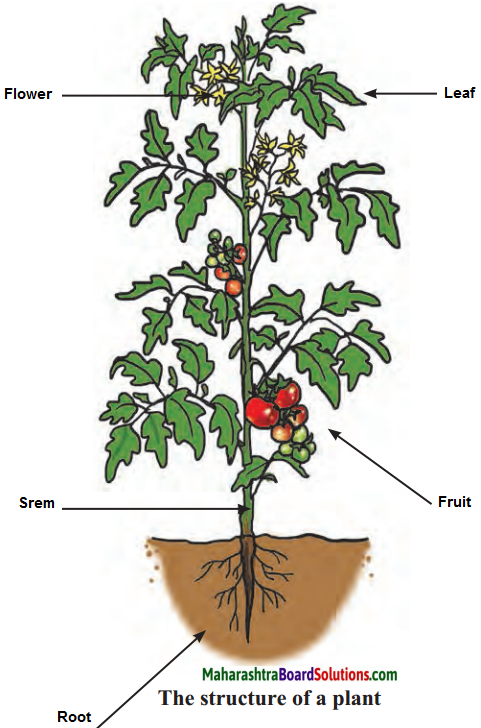
The parts of a plant are: root, stem, leaves, flowers, fruit and seed.

Question b.
What are the functions of root?
Answer:
The functions of root are:

  1. The root hold the soil firmly and anchor the plant.
  2. They absorb water, salt and minerals from the soil and transport it to stem.
  3. Some roots store food. e.g. Carrot, radish.

Maharashtra Board Class 6 Science Solutions Chapter 3 Diversity in Living Things and their Classification

Question c.
Why is it necessary to classify living things?
Answer:

  1. There is a great diversity in living things- both plants and animals on the earth.
  2. In order to identify them and to study their characteristics, systematic classification is necessary.

Question d.
What are the criteria used to classify living things?
Answer:
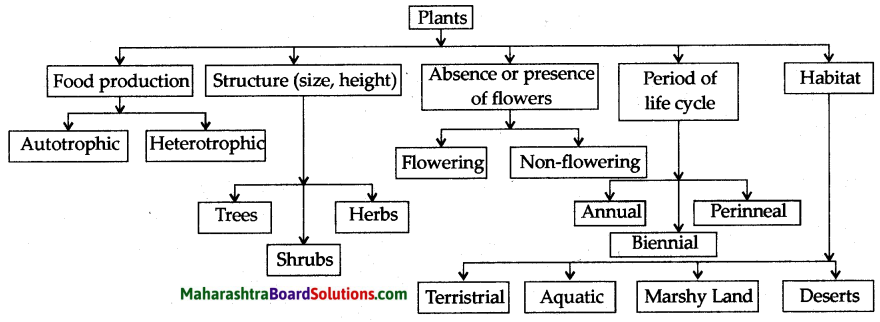
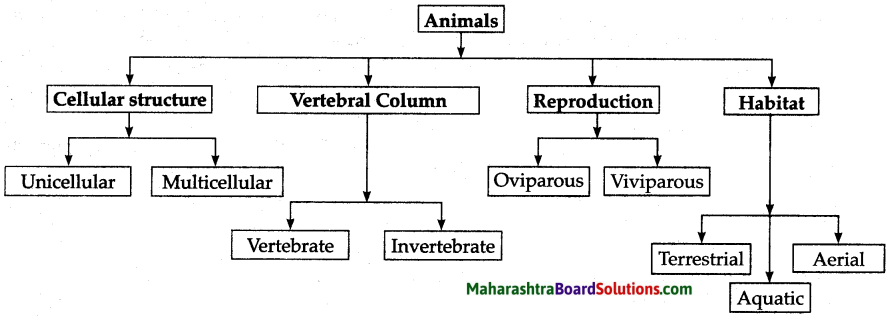
Following are the criteria used to classify living things:
a. Plants:

  • Mode of nutrition.
  • Similarities and differences in structure.
  • Presence of flowers or not.
  • Period of life cycles.
  • Habitat.

b. Animals:

  • Cell structure.
  • Presence of vertebral column.
  • Method of reproduction.
  • Habitat.

Maharashtra Board Class 6 Science Solutions Chapter 3 Diversity in Living Things and their Classification

Question e.
Tell some characteristics of creepers.
Answer:
The characteristics of creepers are:

  1. The stem of a creeper is very flexible, soft and green and need support to climb.
  2. Some climbers spread on the ground, e.g. Pumpkin
  3. Some have aerial roots, e.g. Money plant
  4. Some climbers develop tendrils, e.g. Cucumber

Question f.
Explain the characteristics of herbs with examples.
Answer:

  1. Herbs grow 1 to 1.5 m tall.
  2. Their stem is green and quite flexible.
  3. They may live for a few months or upto two years, e.g. Tulsi, oregano, etc.

Question g.
How is the body of animals protected?
Answer:
Body of animals are protected by special covering such as skins, feathers, scales, hair fur, etc.

Maharashtra Board Class 6 Science Solutions Chapter 3 Diversity in Living Things and their Classification

Question h.
On the basis of which criteria will you classify plants and animals?
Answer:
Diversity In Living Things And Their Classification Class 6 Exercise
Class 6 Science Chapter 3 Diversity In Living Things and Their Classification

7. Draw figures. 

Question a.
Draw the figure of a plant to show the parts, namely, the root, stem and leaves in it.
Answer:
Diversity In Living Things And Their Classification

Activity:

Question 1.
Visit a plant nursery and classify the plants there.

Question 2.
Visit a zoo and obtain information about the diversity in animals.

Maharashtra Board Class 6 Science Solutions Chapter 3 Diversity in Living Things and their Classification

Question 3.
Write an essay on diversity in plants.

Question 4.
Collect seeds of various plants during summer and throw them in open spaces (fallow land, moorland, hill, etc.) during the rainy season.

Class 6 Science Chapter 3 Diversity in Living Things and their Classification Important Questions and Answers

Fill in the blanks:

Question 1.
Plants that can prepare their own food are called ………….. plants.
Answer:
autotrophic

Question 2.
Pitcher plants are ………….. .
Answer:
insectivorous

Maharashtra Board Class 6 Science Solutions Chapter 3 Diversity in Living Things and their Classification

Question 3.
The ………….. is an important means of reproduction.
Answer:
flower

Question 4.
Animals that lay eggs are ………….. animals.
Answer:
oviparous

Question 5.
Animals that can live on land as well as water are called ………….. .
Answer:
amphibians

Choose the correct alternative:

Question 1.
The ………….. is a perennial.
(a) beetroot
(b) gulmohar
(c) grass
Answer:
(b) gulmohar

Maharashtra Board Class 6 Science Solutions Chapter 3 Diversity in Living Things and their Classification

Question 2.
The sunflower is a / an ………….. plant.
(a) annual
(b) biennial
(c) perennial
Answer:
(a) annual

Question 3.
Cactus is a ………….. plant.
(a) land
(b) water
(c) desert
Answer:
(c) desert

Question 4.
The …………….. is a unicellular animal.
(a) cockroach
(b) snail
(c) paramoecium
Answer:
(c) paramoecium

Question 5.
Hen is a …………….. animal.
(a) oviparous
(b) viviparous
(c) none of above
Answer:
(b) oviparous

Maharashtra Board Class 6 Science Solutions Chapter 3 Diversity in Living Things and their Classification

Question 6.
Earthworm is a / an ……………. animal.
(a) vertebrate
(b) invertebrate
(c) unicellular
Answer:
(b) invertebrate

True or False:

Question 1.
The pods of beans and peas are actually fruits.
Answer:
True

Question 2.
Fungus is heterotrophic.
Answer:
True

Write two names of each.

Question 1.
An invertebrate animal
Answer:
Earthworm, cockroach

Maharashtra Board Class 6 Science Solutions Chapter 3 Diversity in Living Things and their Classification

Question 2.
An oviparous animal.
Answer:
Hen, sparrow

Distinguish between:

Question 1.
Autotrophic plant and Heterotrophic plant
Answer:

Autotrophic plantHeterotrophic plant
1. They can produce their own food.1. They cannot produce their own food. They depend on other things for their food.
2. They are green in colour.2. They are non­green in colour.
e.g. Periwinkle, pomegranate etc.e.g. Dodder, loranthus etc

Classify as directed.

Question 1.
Into annual, biennial, perennial
Sunflower, carrot, bajra, mango, jowar, oleander, beetroot, coconut
Answer:

AnnualBiennialPerennial
SunflowerCarrotMango
bajrabeetrootoleander
jowarcoconut

Maharashtra Board Class 6 Science Solutions Chapter 3 Diversity in Living Things and their Classification

Question 2.
Into vertebrates and invertebrates
Fish, cat, earthworm, snail, hen, cockroach
Answer:

VertebratesInvertebrates
FishEarthworm
catsnail
hencockroach

Maharashtra Board Class 6 Science Solutions Chapter 3 Diversity in Living Things and their Classification

Define. 

Class 6 Science Chapter 3 Diversity In Living Things and Their Classification Question 1.
Unicellular animal
Answer:
Animals which have a single cell body performing all functions, are called unicellular animals, e.g. Amoeba

Diversity In Living Things And Their Classification Exercise Question 2.
Multicellular animals
Answer:
Animals which have many cells in their body, are called multicellular animals, e.g. Cat

Diversity In Living Things and Their Classification Question 3.
Vertebrates
Answer:
Animals with vertebral column are called vertebrates, e.g. Man

Maharashtra Board Class 6 Science Solutions Chapter 3 Diversity in Living Things and their Classification

Question 4.
Invertebrate animals
Answer:
Animals without vertebrate column are called invertebrate animals, e.g. Earthworm

Question 5.
Oviparous animals
Answer:
Animals which lay eggs and hatch them are called oviparous animals, e.g. Hen

Question 6.
Viviparous animals
Answer:
Animals which give birth to their young ones are called viviparous animals, e.g. Dog

Answer the following:

Question 1.
Give the functions of:
Answer:
a. Stem:
1. The stem gives support to the other parts of the plant.
2. The stem carries out the function of production, conduction and storage of the food.
3. In some cases it stores food.
b. Leaves: They play an important role in the production of food.
c. Flowers: The flowers are reproductive organ of plant.
d. Fruits: Fruits have seeds which give rise to new plant.
e. Seeds: From the seeds arise new plants.

Maharashtra Board Class 6 Science Solutions Chapter 3 Diversity in Living Things and their Classification

Answer the following in short.

Question 1.
What type of plants are toolstools and mushrooms?
Answer:
Toolstools and mushrooms are heterotrophs.

Question 2.
What type of plant is a fig?
Answer:
Fig is a tree.

Question 3.
Do ferns, algae and money plant bear flowers?
Answer:
Ferns, algae and money plants do not bear flowers. They are non-flowering plants.

Question 4.
Which is the largest flower and where is it found?
Answer:
Rafflesia Arnoldi is the world’s largest flower. It is found in Indonesia.

Maharashtra Board Class 6 Science Solutions Chapter 3 Diversity in Living Things and their Classification

Question 5.
Where does pomegranate grow?
Answer:
Pomegranate is a shrub which grows on land in soil.

Question 6.
Where do bulrushes and railroad creepers grow?
Answer:
Bulrushes is a water plant and railroad creepers grow along the ground.

Question 7.
Where does lotus grow?
Answer:
Lotus grows in water.

Question 8.
Where does the dodder plant grow?
Answer:
Dodder is a parasitic plant and grows on other plants.

Question 9.
Why does water hyacinth float?
Answer:
The stem of water hyacinth is filled with air and its leaves are specially modified, which helps it to float in water.

Maharashtra Board Class 6 Science Solutions Chapter 3 Diversity in Living Things and their Classification

Question 10.
Why is the stem of a cactus plant fleshy?
Answer:
Cactus is a desert plant. As there is a shortage of water, cactus stores water in its stem and hence, stem of cactus is fleshy.

Question 11.
Which spheres of the earth do living things exist?
Answer:
Living things exists in all three spheres of earth, i.e. Atmosphere, lithosphere and hydrosphere.

Question 12.
Are the plants and animals that you have seen all alike?
Answer:
No. They are all of different types.

Question 13.
What are the similarities between a mango, a banyan and a tamarind tree?
Answer:
They are tall, big and perennial plants.

Question 14.
What are the similarities between the hibiscus, oleander and lantana plants?
Answer:
They are shorter and smaller than trees.

Maharashtra Board Class 6 Science Solutions Chapter 3 Diversity in Living Things and their Classification

Question 15.
What are the similarities between fenugreek and periwinkle plants?
Answer:
They are smaller and shorter than trees and shrubs.

Question 16.
Have you seen vines like the pumpkin, the railroad creeper, kavali, watermelon or the grapvine? How do they grow?
Answer:
They have very soft, green and flexible stem. They grow with the help of a support.

Question 17.
For how many years do crops like bajra, wheat, corn, radish, marigold live?
Answer:
They live for about one year.

Question 18.
To which part of plants are butterflies and insects attracted?
Answer:
Butterflies and insects are attracted towards the flower of the plants.

Maharashtra Board Class 6 Science Solutions Chapter 3 Diversity in Living Things and their Classification

Question 19.
What is the chain of bones in the centre of our back called?
Answer:
A vertibral column.

Maharashtra Board Class 8 English Solutions Chapter 1.1 A Time To Believe

Balbharti Maharashtra State Board Class 8 English Solutions Chapter 1.1 A Time To Believe Notes, Textbook Exercise Important Questions and Answers.

Maharashtra State Board Class 8 English Solutions Chapter 1.1 A Time To Believe

Class 8 English Chapter 1.1 A Time To Believe Textbook Questions and Answers

Warming Up:

Question 1.
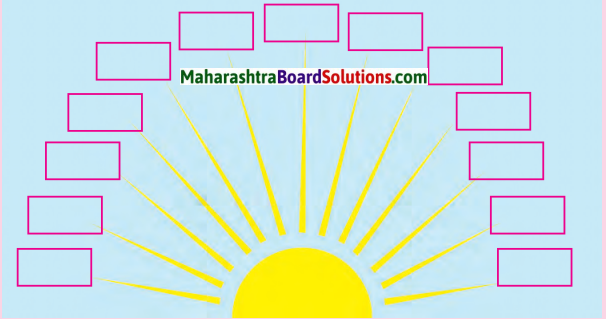
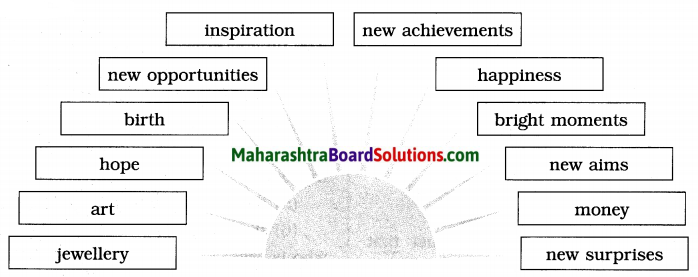
Think, choose and fill up the labels with what a ‘sunrise’ symbolizes.
(jewellery / art / hope / birth / anger / new opportunities / good manners / inspiration/ new achievements / happiness / misery / bright moments / new aims / money / newsurprises)
Maharashtra Board Class 8 English Solutions Chapter 1.1 A Time To Believe 4
Answer:
Maharashtra Board Class 8 English Solutions Chapter 1.1 A Time To Believe 5

Question 2.
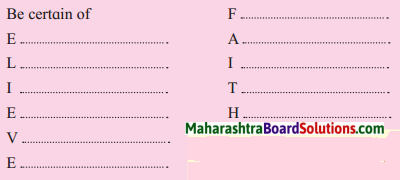
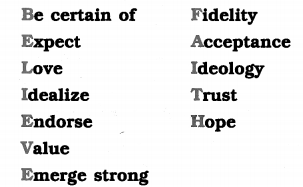
An acrostic is a poem or a write up in which the first letter of each line forms a word, when it is read vertically. Complete the acrostics of BELIEVE and FAITH.
Maharashtra Board Class 8 English Solutions Chapter 1.1 A Time To Believe 8
With your benchmate / group, complete the acrostic of BELIEVE and FAITH.
Answer:
Maharashtra Board Class 8 English Solutions Chapter 1.1 A Time To Believe 6

1.A. Rearrange the letters to make meaningful words, occurring in the poem.

  1. clearmis
  2. sowmid
  3. tabyue
  4. madres
  5. laveu
  6. downre

Answer:

  1. miracles
  2. wisdom
  3. beauty
  4. dreams
  5. value
  6. wonder

Maharashtra Board Class 8 English Solutions Chapter 1.1 A Time To Believe

1.B. Write words from the poem that describe the following.

  1. sky
  2. heart
  3. hand
  4. beginning

Answer:

  1. stardust sky
  2. nurturing heart
  3. aging hand
  4. new beginning

2. Say WHY. . . . .

Question a.
________ the sky has a magical quality.
Answer:
The sky has a magical quality because it has scurrying clouds, twinkling stars and a beautiful moon.

Question b.
_______ even an aging hand has beauty.
Answer:
because it can teach us how to love.

Question c.
_______we should believe that we are strong and courageous.
Answer:
We should believe that we are | strong and courageous so that we can recover after we have gone through difficulties and shocks, and return to our normal lives again.

3. Make a list of any six things that the poet wants us to accept as true.
Answer:
The poet wants us to accept as j true the following things :

  • that we have the strength and ( courage to get back to normal after a setback
  • that we are never alone
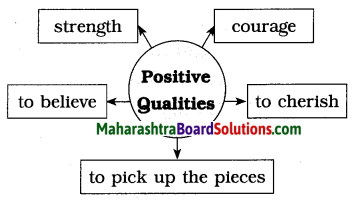
  • that life is a gift we must cherish
  • that there are wonderful surprises in store for us
  • that all our hopes and dreams are within reach
  • that great things will happen if we have belief in life and in ourselves

Maharashtra Board Class 8 English Solutions Chapter 1.1 A Time To Believe

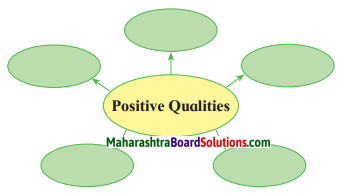
4. Find from the poem, positive qualities to fill up the web.
Maharashtra Board Class 8 English Solutions Chapter 1.1 A Time To Believe 3
Answer:
Maharashtra Board Class 8 English Solutions Chapter 1.1 A Time To Believe 2

5. Read the lines below.
(A) ‘To believe is to see angels dancing among the clouds’.
The above line contain a human characteristic ‘dancing’ given to something
non – human, ‘angels’. The Figure of Speech used in the line is called
‘Personification’.

(B) ‘To believe is to know that
Everyday is a new beginning’.

(C) To believe is to know ………. life is a gift
Lines in poetry, such as the above, state a general truth and can be used as sayings or
quotes etc. They contain the Figure of Speech called Epigram.
Epigram closely resembles a proverb.

Find from the poem three other examples of Epigram.
Answer:
(i) ‘To believe is to find the strength and courage that lies within us.’
(ii) ‘To believe is to know we are never alone, that life is a gift.’
(iii) ‘To believe is to know that wonderful surprises are just waiting to happen.’
(These lines state a general truth.)

Maharashtra Board Class 8 English Solutions Chapter 1.1 A Time To Believe

6. Divide the class into 5 groups. Each group can prepare a decorative chart / poster using an epigrammatic lines from the poem. You may use calligraphy / painting / or Paint programme on a computer. (With permission, put up these charts in your school.)

Class 8 English Chapter 1.1 A Time To Believe Additional Important Questions and Answers

Complete the following:

Question 1.
One should know and trust _______.
Answer:
One should know and trust that every day is a new beginning, that miracles happen and dreams really do come true.

Maharashtra Board Class 8 English Solutions Chapter 1.1 A Time To Believe

Question 2.
The two supernatural references in the second stanza _______.
Answer:
The two supernatural references in the second stanza are to angels and to the man in the moon.

Activities based on Poetic Devices/Vocabulary:

Question 1.
Find out an example of Personification from the extract.
Answer:
‘To believe is to see angels dancing among the clouds.’ (Here, the angels have been given the human quality of ‘dancing’.)

Question 2.
Pick out examples of Alliteration from the extract.
Answer:
(i) …. and the wisdom of the man in the moon’. (Repetition of the sound of the letter ‘m’.)
(ii) For it is through their teachings, we learn to love. (Repetition of the sound of the letters ‘t’ and T.)

Question 3.
Pick out an example of Repetition from the extract.
Answer:
The words ‘To believe is to ….’ are repeated at the beginning of each stanza. This provides emphasis to the message in the poem and gives rhythm to the stanzas.

Complete the following:

Question 1.
The two qualities that are needed to recover after a shocking event are _________.
Answer:
strength and courage.

Question 2.
The poet advises everybody to ______.
Answer:
have a positive attitude.

Maharashtra Board Class 8 English Solutions Chapter 1.1 A Time To Believe

Complex Factual Activities:

Question 1.
Explain why ….
…. we should believe that we are strong and courageous,
Answer:
We should believe that we are strong and courageous so that we can recover after we have gone through difficulties and shocks, and return to our normal lives again.

Activities based on Poetic Devices/Vocabulary :

Question 1.
Rearrange the letters to form meaningful words occurring in the extract.

  1. gearuoc
  2. rissupser
  3. gnehtrts
  4. irehchs

Answer:

  1. courage
  2. surprises
  3. strength
  4. cherish

Question 2.
Write word from the extract that describe the following :
surprises
Answer:
wonderful surprises

Question 3.
Pick out an example of Metaphor from the extract.
Answer:
‘That life is a gift.’ Life is implicitly compared to a gift.

Maharashtra Board Class 8 English Solutions Chapter 1.1 A Time To Believe

Question 4.
Pick out an example of Repetition from the extract.
Answer:
The words ‘To believe is to ….’ are repeated at the beginning of each stanza. This provides emphasis to the message in the poem and gives rhythm to the stanzas.

Question 5.
Analysis/Appreciation Of The Poem ‘A Time To Believe’
Answer:
Poem and poet: ‘A Time to Believe’ by B.J. Morbitzer.
Theme: To believe in ourselves and to have a positive and optimistic attitude towards life.
Tone: Serious and inspirational.
Structure and stanzas: 4 lines in each stanza, except in the last stanza, which has 5 lines.
Rhyme and Rhythm: No rhyme scheme; the poem is written in free verse.
Language and Imagery: The language is simple and direct. The only instances of Imagery are of ‘angels dancing among the clouds’ and the ‘stardust sky’.
Figures of Speech: Personification, Epigram, Repetition, Metaphor.

Maharashtra Board Class 7 Science Solutions Chapter 19 Properties of a Magnetic Field

Balbharti Maharashtra State Board Class 7 Science Solutions Chapter 19 Properties of a Magnetic Field Notes, Textbook Exercise Important Questions and Answers.

Maharashtra State Board Class 7 Science Solutions Chapter 19 Properties of a Magnetic Field

Class 7 Science Chapter 19 Properties of a Magnetic Field Textbook Questions and Answers

1. Write the appropriate terms in the blanks:

Question a.
The alloys called …………. and …………. are used for making industrial magnets.
Answer:
alnico, Nipermag

Question b.
A magnetic field can pass through ………… and …………. .
Answer:
cardboard, bottle

Maharashtra Board Class 7 Science Solutions Chapter 19 Properties of a Magnetic Field

Question c.
The intensity of a magnetic field is indicated by the lines of …………. .
Answer:
force

Question d.
The real test of a magnet is ……………… .
Answer:
repulsion

2. With whom should I pair up?

Question a.

Column ‘A’Column ‘B’
1. Compassa. The highest magnetic force
2. Door of a cupboardb. Like poles
3. Repulsionc. A magnet
4. Magnetic poled. A magnetic needle

Answer:

Column ‘A’Column ‘B’
1. Compassd. A magnetic needle
2. Door of a cupboardc. A magnet
3. Repulsionb. Like poles
4. Magnetic polea. The highest magnetic force

Maharashtra Board Class 7 Science Solutions Chapter 19 Properties of a Magnetic Field

3. Write answers to the following questions:

Question a.
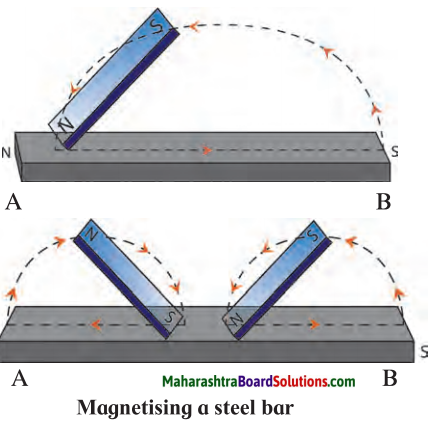
Distinguish between the two methods of making artificial magnets
Answer:

Single touch methodDouble touch method
1. In this method, one magnet is used to magnetise the steel bar.1. In this method, two magnets are used to magnetise the steel bar.
2. In this method, the magnet is dragged from one end of the steel bar to another end.2. In this method, two magnets are dragged from the middle of the steel bar to the opposite directions.
3. As only one magnet is used to induce magnetism, this method is called single touch method.3. As two bar magnets are used to induce magnetism, this method is called double-touch method.
4. The magnetism created by this method is of low strength and lasts for a short time.4. The magnetism created by this method is of high strength and lasts for a longer time.

Maharashtra Board Class 7 Science Solutions Chapter 19 Properties of a Magnetic Field

Question b.
Which substances are used for making electromagnets?
Answer:
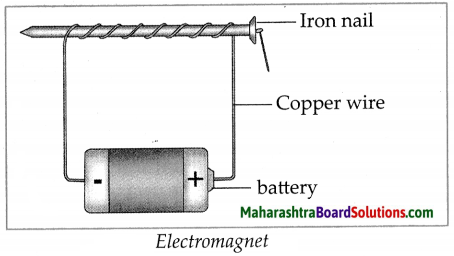
The substances used for making electromagnets are, an iron nail, insulated copper wire, one or more batteries and a pair of wire strippers.

Question c.
Write a note on magnetic field
Answer:
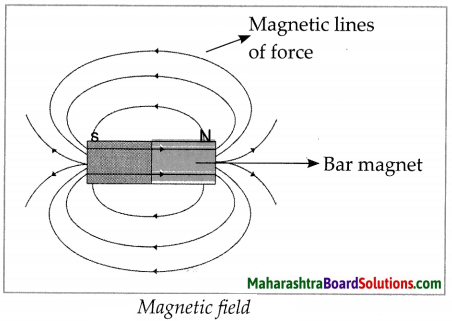
Maharashtra Board Class 7 Science Solutions Chapter 19 Properties of a Magnetic Field 1

  1. The region around a magnet where the magnetic force acts on an object is called a magnetic field.
  2. The magnetic field around a magnet can be shown by means of magnetic lines of force.
  3. The intensity of the magnetic field can be obtained from the number of lines of force.
  4. The intensity of a magnetic field is low where the lines of force are sparse and the intensity is high where the lines of force are concentrated.
  5. A magnetic field is the magnetic effect of electric currents and magnetic materials.
  6. The magnetic field at any given point is specified by both the direction and the magnitude.
  7. Magnetic fields are produced by electric current.

Maharashtra Board Class 7 Science Solutions Chapter 19 Properties of a Magnetic Field

Question d.
Why is a magnetic needle used in a compass?
Answer:
Maharashtra Board Class 7 Science Solutions Chapter 19 Properties of a Magnetic Field 2

  1. The magnetic compass is the most familiar compass type.
  2. It functions as a pointer to magnetic ‘north’ the local magnetic meridian, because the magnetized needle at its heart aligns itself with the horizontal component of the earth’s magnetic field.
  3. A compass is an instrument used for navigation and orientation that shows direction relative to the geographic cardinal direction.

Question e.
Explain with the help of a diagram how the intensity and direction of the magnetic field of a bar magnet can be determined.
Answer:
Maharashtra Board Class 7 Science Solutions Chapter 19 Properties of a Magnetic Field 1

  1. The region around a magnet where the magnetic force acts on an object is called a magnetic field.
  2. The magnetic field around a magnet can be shown by means of magnetic lines of force.
  3. The intensity of the magnetic field can be obtained from the number of lines of force.
  4. The intensity of a magnetic field is low where the lines of force are sparse and the intensity is high where the lines of force are concentrated.
  5. A magnetic field is the magnetic effect of electric currents and magnetic materials.
  6. The magnetic field at any given point is specified by both the direction and the magnitude.
  7. Magnetic fields are produced by electric current.

Maharashtra Board Class 7 Science Solutions Chapter 19 Properties of a Magnetic Field

4. Give detailed information about how the merchants of olden times used a magnet while travelling.

Question a.
Give detailed information about how the merchants of olden times used a magnet while travelling.
Answer:

  1. The merchants of older times used a magnet whose north-south side was known.
  2. When the magnet is freely suspended, the north pole of the magnet settles in the direction of the geographic north pole of the earth.
  3. This is how the merchants come to know the directions while travelling.
  4. The idea for using loadstone in a compass first appeared in China.
  5. The first compass were made of loadstone, a naturally magnetised ore of iron.
  6. The Chinese used “south pointing spoon” which when thrown upon the ground comes to rest pointing at the south.
  7. Then the transition was made from loadstone spoons to iron needles.
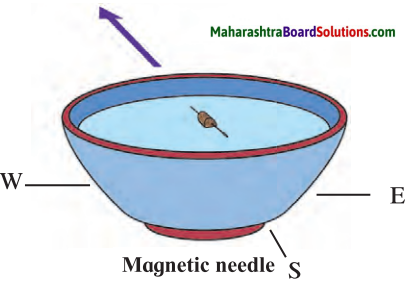
  8. In the medieval period a magnetic needle in the shape of a fish, floating in the bowl of water was used as a compass, pointing south.
  9. It was called floating compass.
  10. In the twentieth century, liquid filled magnetic compass began to appear.
  11. There is a lesser known compass called dry mariners compass.

Maharashtra Board Class 7 Science Solutions Chapter 19 Properties of a Magnetic Field

Project:

Question a.
Obtain information about the function of metal detectors.

Class 7 Science Chapter 19 Properties of a Magnetic Field Important Questions and Answers

Write the appropriate terms in the blanks:

Question 1.
The magnetic lines of force always run from the north pole to the ……………. .
Answer:
south pole

Question 2.
The unit of magnetic field strength is …………….. .
Answer:
A/M (Amperes per metre)

Question 3.
The earth behaves like a giant ………… .
Answer:
barmagnet

Maharashtra Board Class 7 Science Solutions Chapter 19 Properties of a Magnetic Field

Question 4.
The ……………. properties of magnetic field was proposed by scientist
Answer:
Michael Faraday

Question 5.
The region around a magnet where the magnetic force acts on an object is called the …………. .
Answer:
magnetic field

Question 6.
The ……………. of the magnetic field can be obtained from the number of lines of force.
Answer:
strength

Question 7.
The function of the metal detector is based on ………… .
Answer:
electromagnets

Question 8.
The magnetism is ………….. in the case of an electromagnet.
Answer:
temporary

Maharashtra Board Class 7 Science Solutions Chapter 19 Properties of a Magnetic Field

Match the following:

Question 1.

Column ‘A’Column ‘B’
1. Iron, nickel, cobalta. Electromagnet
2. Doorbell magnetb. Permanent magnet
3. Nickel, cobalt, aluminiumc. Iron, nickel, titanium, aluminium
4. Cupboard magnetd. Magnetic metals
5. Lodestonee. Mariner’s compass
6. Nipermagf. Alnico

Answer:

Column ‘A’Column ‘B’
1. Iron, nickel, cobaltd. Magnetic metals
2. Doorbell magneta. Electromagnet
3. Nickel, cobalt, aluminiumf. Alnico
4. Cupboard magnetb. Permanent magnet
5. Lodestonee. Mariner’s compass
6. Nipermagc. Iron, nickel, titanium, aluminium

Maharashtra Board Class 7 Science Solutions Chapter 19 Properties of a Magnetic Field

Write True or False correct and rewrite the false statements:

Question 1.
Material alnico is a mixture of aluminium, nickel and iron.
Answer:
False. Alnico is an alloy of aluminium, nickel and cobalt

Question 2.
Nipermag is alloy of iron, nickel, cobalt.
Answer:
False. Nipermag is an alloy of iron, nickel, aluminium and titanium

Question 3.
The magnetic force is concentrated at the centre of the magnet.
Answer:
False. The magnetic force is concentrated at the poles of the magnet.

Question 4.
Magnetism of electromagnet is permanent.
Answer:
False. Magnetism of electromagnet is temporary

Maharashtra Board Class 7 Science Solutions Chapter 19 Properties of a Magnetic Field

Question 5.
Like poles attract each other and unlike poles repel each other.
Answer:
False. Like poles repel each other and unlike poles attract each other

Question 6.
Two poles of a magnet cannot be separated from each other.
Answer:
True.

Answer in one or two sentences:

Question 1.
In which direction does a freely suspended magnet settle?
Answer:
The north pole of a freely suspended magnet settles in the direction of the geographic north pole of the earth. It settles in north-south direction.

Maharashtra Board Class 7 Science Solutions Chapter 19 Properties of a Magnetic Field

Question 2.
Write any two functions of metal detectors.
Answer:

  1. Metal detectors are used in very important places like an airport, bus station, certain temples and buildings to inspect those who are entering these places.
  2. To detect very precious articles.

Question 3.
Which magnetic poles attract each other?
Answer:
Opposite magnetic poles attract each other.

Question 4.
What metals are used for making magnets?
Answer:

  1. Magnets are made from alloys of iron, cobalt and nickel.
  2. Nipermag is an alloy made up of iron, nickel, aluminium and titanium whereas alnico is an alloy made up of aluminium, nickel and cobalt.

Give scientific reasons:

Question 1.
Earth is called as a gigantic magnet.
Answer:

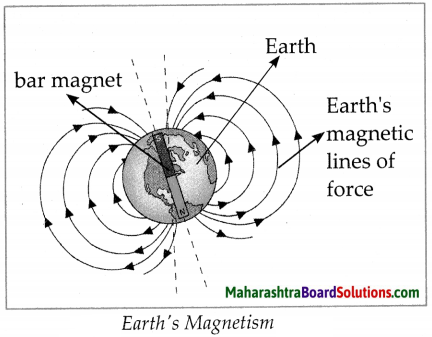
  1. The earth is called as a gigantic magnet because north pole of a freely suspended magnet always settles in the direction of the geographic north pole of the earth.
  2. It means that the South pole of some gigantic magnet must be near the geographic north pole of that magnet, near the geographic south pole of the earth.
  3. Gilbert inferred from this that the earth itself is a gigantic magnet.

Maharashtra Board Class 7 Science Solutions Chapter 19 Properties of a Magnetic Field

Question 2.
A bar magnet kept on the cardboard arranges the iron fillings in line.
Answer:

  1. A bar magnet kept on the cardboard arranges the iron fillings in line because of the ‘magnetic lines of force’.
  2. These magnetic lines gauge the intensity of the bar magnet.
  3. The intensity of the magnetic field is low where the lines of force are sparse and the intensity is high where the lines of force are concentrated.
  4. Therefore, the iron fillings arrange themselves according to intensity of the magnetic lines of force.

Write short note on:

Question 1.
Functions of metal detector.
Answer:

  1. A metal detector is an electronic instrument which detects the presence of metals nearby.
  2. The function of these machines is based on electromagnets.
  3. Metal detectors are useful for finding metal inclusions hidden within objects, or metal objects buried underground.
  4. They often consist of a handheld unit with a sensor probe which can be swept over the ground or other objects.
  5. Metal detectors in the food manufacturing industry are used to detect and eliminate threats of metal contaminants in food.
  6. Metal detectors are used in very important places like an airport, bus station, temples, hospitals, railway stations, theaters, malls.
  7. They are used for inspection of persons entering these places.
  8. In geology, these machines are used to detect the presence and quantity of metals.

Maharashtra Board Class 7 Science Solutions Chapter 19 Properties of a Magnetic Field

Question 2.
Write down the characteristics of magnets.
Answer:

  1. A freely suspended magnet settles in the north- south direction always.
  2. Magnets attract objects of iron, cobalt and nickel.
  3. The force of attraction of a magnet is greater at its poles than in the middle.
  4. Like poles of two magnets repel each other.
  5. Opposite poles of two magnets attract each other.
  6. If a bar magnet is suspended by a thread and if it is free to rotate its south pole will move towards the north pole of the earth.

Question 3.
Characteristic of magnetic lines of force
Answer:

  1. Magnetic lines of force start from the north pole and end at the south pole.
  2. They are continuous through the body of magnet. These are imaginary lines.
  3. Magnetic lines of force can pass through iron more easily than air
  4. The number of magnetic lines force determines the strength of the magnetic field at a particular point.
  5. Two magnetic lines of force do not intersect each other.
  6. They contract longitudinally and expand laterally.

Maharashtra Board Class 7 Science Solutions Chapter 19 Properties of a Magnetic Field

Can you tell?

Answer the following questions:

Question 1.
Why does freely suspended magnet always settle in the north-south direction?
Answer:
Maharashtra Board Class 7 Science Solutions Chapter 19 Properties of a Magnetic Field 3

  1. Gilbert gave a scientific explanation that earth itself is a gigantic magnet.
  2. The north pole of a freely suspended magnet settles in the direction of the geographic north pole of the earth since unlike poles attract.
  3. It means that the south pole of some gigantic magnet must be near the geographic north pole of the earth.
  4. In other words, the thing we call Earth’s geographic north pole is actually the south pole of the magnet inside the earth.
  5. That is why a freely suspended magnet always settles in geographic north-south attracted by opposite poles of the earth as a great magnet.

Maharashtra Board Class 7 Science Solutions Chapter 19 Properties of a Magnetic Field

Question 2.
Which magnetic poles attract each other?
Answer:
Opposite magnet poles attract each other.

Question 3.
Which pole of a spherical magnet will get attracted towards the south pole of the bar magnet?
Answer:
The north pole of the spherical magnet will get attracted towards the south pole of the bar magnet.

Question 4.
Why does a bar magnet kept at a distance doesn’t attract pins?
Answer:

  1. The region around the magnet where the magnetic force acts is known as the magnetic field.
  2. It has its influence over a certain distance where these magnetic lines of force act.
  3. As these pins are outside this area of influence, a bar magnet does not attract those pins which are at a distance.

Maharashtra Board Class 7 Science Solutions Chapter 19 Properties of a Magnetic Field

Question 5.
What is an electromagnet?
Answer:

  1. A soft metal core made into a magnet by the passage of electric current through a coil surrounding it is called an electromagnet.
  2. An electromagnet is a magnet in which the magnetic field is produced by electricity.
  3. The strength of an electromagnet can easily be changed by changing the amount of electric current that flows through it.
  4. The poles of an electromagnet can even be reversed by reversing the flow of electricity.
  5. An electromagnet works because an electric current produces a magnetic field.
  6. The magnetic field produced by electric current forms circles around the electric current.
  7. The magnetic field disappears when the current is turned off.

Question 6.
How can an electromagnet be made?
Answer:
Maharashtra Board Class 7 Science Solutions Chapter 19 Properties of a Magnetic Field 4

  1. It is easy to make an electromagnet. To make an electromagnet we needs an iron nail of 10 cm length 1 metre long insulated copper wire, a battery cell, pins.
  2. Neatly wrap some insulated copper wire around an iron nail.
  3. The more wires you wrap around the nail, the stronger will be the electromagnet.
  4. Attach a battery to the wire, an electric current will begin to flow and the iron nail will become magnetised.
  5. When the battery is disconnected the iron nail will lose its magnetism.

Maharashtra Board Class 7 Science Solutions Chapter 19 Properties of a Magnetic Field

Use your brainpower!

Answer the following questions:

Question 1.
Which direction will a magnetic needle show on the geographic north pole?
Answer:
North, all magnetic needle will show north direction.

Question 2.
Is magnetic force a vector or a scalar quantity?
Answer:

  1. It is a vector quantity. Because a magnetic field is the magnetic effect of electric current and magnetic materials.
  2. The magnetic field at any given point is specified by both direction and magnitude as such it is represented by a vector field.

Maharashtra Board Class 7 Science Solutions Chapter 19 Properties of a Magnetic Field

Question 3.
What is meant by magnetic force?
Answer:

  1. The magnetic force, is a consequence of the electromagnet force, one of the four fundamental forces of nature.
  2. It occurs whenever objects interact in which there is charge in motion, eg. compass, a motor.
  3. Magnetic force is an attraction or repulsion that arises between electrically charged particles because of their motion.

Question 4.
How does a magnetic force act without direct contact?
Answer:
Magnetic force acts without even direct contact because of the penetrating ability of the magnetic field.

Question 5.
What is the difference between the gravitational force and magnetic force?
Answer:

Gravitational ForceMagnetic Force
1. Gravitational force acts between any objects with mass.1. Magnetic force acts between objects with specific properties.
2. It depends on the mass of the objects.2. It does not depend on the mass of objects.
3. It acts over long-range as a gravitational field is large.3. It acts over short-range as magnetic field is short.
4. Object are always attracted to each other.4. Objects are either attracted or repelled.

Maharashtra Board Class 7 Science Solutions Chapter 19 Properties of a Magnetic Field

Question 6.
Why is repulsion the real test for identifying a magnet?
Answer:
A magnet can attract the opposite pole of the magnet as well as magnetic substances (iron, cobalt, nickel).
So if a magnet attracts another object, we cannot say that other object is a magnet or a magnetic substance.
But if the magnet repels the object then we can surely say that the other object is a magnet because like poles of magnets repel each other.

Question 7.
How will you find a magnet from among the various articles given to you?
Answer:

  1. Magnet has the property to attract things made of iron, cobalt, nickel.
  2. A magnet has magnetic field which is invisible but it has the property of attracting, pulling other
  3. ferromagnetic material such as iron, cobalt and nickle.
  4. So if we bring any iron, nickle objects near it, they will be pulled toward the magnet.
  5. The real test is repulsion.
  6. The article which shows repulsion when one of the poles of a magnet is brought near is surely a magnet.

Find out:

Answer the following questions:

Question 1.
Why does the magnetic needle of a compass not settle parallel to the ground but at an angle to it?
Answer:

  1. Freely suspended magnet does not point to north, but aligns to earth’s magnetic field axially ie – north-south.
  2. The magnetic pole of the earth is different from true north (geographic north) because the magnetic north is constantly changing.
  3. It leads to a margin of error called declination in which there is an angle of difference (11.51)° between Magnetic North and True North.
  4. That is the reason the magnetic needle does not settle parallel to the ground.

Maharashtra Board Class 7 Science Solutions Chapter 19 Properties of a Magnetic Field

Observe the diagrams and answer the questions given below:
Maharashtra Board Class 7 Science Solutions Chapter 19 Properties of a Magnetic Field 5

Question 1.
Name the methods shown.
Answer:
Single touch and Double touch methods of magnetising a steel bar.

Maharashtra Board Class 7 Science Solutions Chapter 19 Properties of a Magnetic Field

Question 2.
Give 2 points of difference between the methods.
Answer:

Single touch methodDouble touch method
1. In this method, one magnet is used to magnetise the steel bar.1. In this method, two magnets are used to magnetise the steel bar.
2. In this method, the magnet is dragged from one end of the steel bar to another end.2. In this method, two magnets are dragged from the middle of the steel bar to the opposite directions.
3. As only one magnet is used to induce magnetism, this method is called single touch method.3. As two bar magnets are used to induce magnetism, this method is called double-touch method.
4. The magnetism created by this method is of low strength and lasts for a short time.4. The magnetism created by this method is of high strength and lasts for a longer time.