Maharashtra Board 11th Maths Solutions Chapter 6 Circle Ex 6.2

Balbharti Maharashtra State Board Class 11 Maths Solutions Pdf Chapter 6 Circle Ex 6.2 Questions and Answers.

Maharashtra State Board 11th Maths Solutions Chapter 6 Circle Ex 6.2

Question 1.
Find the centre and radius of each of the following circles:
(i) x2 + y2 – 2x + 4y – 4 = 0
(ii) x2 + y2 – 6x – 8y – 24 = 0
(iii) 4x2 + 4y2 – 24x – 8y – 24 = 0
Solution:
(i) Given equation of the circle is x2 + y2 – 2x + 4y – 4 = 0
Comparing this equation with x2 + y2 + 2gx + 2fy + c = 0, we get
2g = -2, 2f = 4 and c = -4
⇒ g = -1, f = 2 and c = -4
Centre of the circle = (-g, -f) = (1, -2)
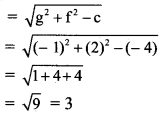
and radius of the circle
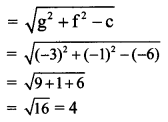
Maharashtra Board 11th Maths Solutions Chapter 6 Circle Ex 6.2 Q1

(ii) Given equation of the circle is x2 + y2 – 6x – 8y – 24 = 0
Comparing this equation with x2 + y2 + 2gx + 2fy + c = 0, we get
2g = -6, 2f = -8 and c = -24
⇒ g = -3, f = -4 and c = -24
Centre of the circle = (-g, -f) = (3, 4)
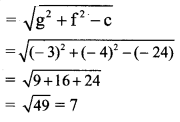
and radius of the circle
Maharashtra Board 11th Maths Solutions Chapter 6 Circle Ex 6.2 Q1.1

Maharashtra Board 11th Maths Solutions Chapter 6 Circle Ex 6.2

(iii) Given equation of the circle is 4x2 + 4y2 – 24x – 8y – 24 = 0
Dividing throughout by 4, we get x2 + y2 – 6x – 2y – 6 = 0
Comparing this equation with x2 + y2 + 2gx + 2fy + c = 0, we get
2g = -6, 2f = -2 and c = -6
⇒ g = -3, f = -1 and c = -6
Centre of the circle = (-g, -f) = (3, 1)
and radius of the circle
Maharashtra Board 11th Maths Solutions Chapter 6 Circle Ex 6.2 Q1.2

Question 2.
Show that the equation 3x2 + 3y2 + 12x + 18y – 11 = 0 represents a circle.
Solution:
Given equation is 3x2 + 3y2 + 12x + 18y – 11 = 0
Dividing throughout by 3, we get
x2 + y2 + 4x + 6y – \(\frac{11}{3}\) = 0
Comparing this equation with x2 + y2 + 2gx + 2fy + c = 0, we get
2g = 4, 2f = 6, c = \(\frac{-11}{3}\)
⇒ g = 2, f = 3, c = \(\frac{-11}{3}\)
Now, g2 + f2 – c = (2)2 + (3)2 – (\(\frac{-11}{3}\))
= 4 + 9 + \(\frac{11}{3}\)
= \(\frac{50}{3}\) > 0
∴ The given equation represents a circle.

Maharashtra Board 11th Maths Solutions Chapter 6 Circle Ex 6.2

Question 3.
Find the equation of the circle passing through the points (5, 7), (6, 6), and (2, -2).
Solution:
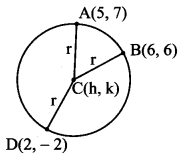
Let C(h, k) be the centre of the required circle.
Since the required circle passes through points A(5, 7), B(6, 6), and D(2, -2),
CA = CB = CD = radius
Maharashtra Board 11th Maths Solutions Chapter 6 Circle Ex 6.2 Q3
Consider, CA = CD
By distance formula,
\(\sqrt{(\mathrm{h}-5)^{2}+(\mathrm{k}-7)^{2}}=\sqrt{(\mathrm{h}-2)^{2}+[\mathrm{k}-(-2)]^{2}}\)
Squaring both the sides, we get
⇒ (h – 5)2 + (k – 7)2 = (h – 2)2 + (k + 2)2
⇒ h2 – 10h + 25 + k2 – 14k + 49 = h2 – 4h + 4 + k2 + 4k + 4
⇒ -10h – 14k + 74 = -4h + 4k + 8
⇒ 6h + 18k – 66 = 0
⇒ h + 3k – 11 = 0 …..(i)
Consider, CB = CD
By distance formula,
\(\sqrt{(h-6)^{2}+(k-6)^{2}}=\sqrt{(h-2)^{2}+[k-(-2)]^{2}}\)
Squaring both the sides, we get
⇒ (h – 6)2 + (k – 6)2 = (h – 2)2 + (k + 2)2
⇒ h2 – 12h + 36 + k2 – 12k + 36 = h2 – 4h + 4 + k2 + 4k + 4
⇒ -12h – 12k + 72 = -4h + 4k + 8
⇒ 8h + 16k – 64 = 0
⇒ h + 2k – 8 = 0 ……(ii)
By (i) – (ii), we get k = 3
Substituting k = 3 in (i), we get
h + 3(3) – 11 = 0
⇒ h + 9 – 11 = 0
⇒ h = 2
Centre of the circle is C(2, 3).
radius (r) = CD
= \(\sqrt{(2-2)^{2}+(3+2)^{2}}\)
= \(\sqrt{0+5^{2}}\)
= √25
= 5
The equation of a circle with centre at (h, k) and radius r is given by (x – h)2+ (y – k)2 = r2
Here, h = 2, k = 3
The required equation of the circle is
(x – 2)2 + (y – 3)2 = 52
⇒ x2 – 4x + 4 + y2 – 6y + 9 = 25
⇒ x2 + y2 – 4x – 6y + 4 + 9 – 25 = 0
⇒ x2 + y2 – 4x – 6y – 12 = 0

Maharashtra Board 11th Maths Solutions Chapter 6 Circle Ex 6.2

Question 4.
Show that the points (3, -2), (1, 0), (-1, -2) and (1, -4) are concyclic.
Solution:
Let the equation of the circle passing through the points (3, -2), (1, 0) and (-1, -2) be
x2 + y2 + 2gx + 2fy + c = 0 …..(i)
For point (3, -2),
Substituting x = 3 and y = -2 in (i), we get
9 + 4 + 6g – 4f + c = 0
⇒ 6g – 4f + c = -13 ….(ii)
For point (1, 0),
Substituting x = 1 andy = 0 in (i), we get
1 + 0 + 2g + 0 + c = 0
⇒ 2g + c = -1 ……(iii)
For point (-1, -2),
Substituting x = -1 and y = -2, we get
1 + 4 – 2g – 4f + c = 0
⇒ 2g + 4f – c = 5 …….(iv)
Adding (ii) and (iv), we get
8g = -8
⇒ g = -1
Substituting g = -1 in (iii), we get
-2 + c = -1
⇒ c = 1
Substituting g = -1 and c = 1 in (iv), we get
-2 + 4f – 1 = 5
⇒ 4f = 8
⇒ f = 2
Substituting g = -1, f = 2 and c = 1 in (i), we get
x2 + y2 – 2x + 4y + 1 = 0 ……….(v)
If (1, -4) satisfies equation (v), the four points are concyclic.
Substituting x = 1, y = -4 in L.H.S of (v), we get
L.H.S. = (1)2 + (-4)2 – 2(1) + 4(-4) + 1
= 1 + 16 – 2 – 16 + 1
= 0
= R.H.S.
Point (1, -4) satisfies equation (v).
∴ The given points are concyclic.

Maharashtra Board 11th Maths Solutions Chapter 4 Determinants and Matrices Miscellaneous Exercise 4(B)

Balbharti Maharashtra State Board Class 11 Maths Solutions Pdf Chapter 4 Determinants and Matrices Miscellaneous Exercise 4(B) Questions and Answers.

Maharashtra State Board 11th Maths Solutions Chapter 4 Determinants and Matrices Miscellaneous Exercise 4(B)

(I) Select the correct option from the given alternatives.

Question 1.
Given A = \(\left[\begin{array}{ll}
1 & 3 \\
2 & 2
\end{array}\right]\), I = \(\left[\begin{array}{ll}
1 & 0 \\
0 & 1
\end{array}\right]\) if A – λI is a singular matrix, then ___________
(a) λ = 0
(b) λ2 – 3λ – 4 = 0
(c) λ2 + 3λ – 4 = 0
(d) λ2 – 3λ – 6 = 0
Answer:
(b) λ2 – 3λ – 4 = 0
Hint:
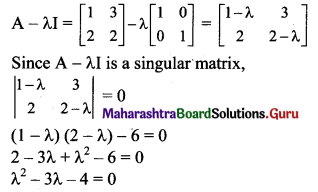
Maharashtra Board 11th Maths Solutions Chapter 4 Determinants and Matrices Miscellaneous Exercise 4(B) I Q1

Question 2.
Consider the matrices A = \(\left[\begin{array}{ccc}
4 & 6 & -1 \\
3 & 0 & 2 \\
1 & -2 & 5
\end{array}\right]\), B = \(\left[\begin{array}{cc}
2 & 4 \\
0 & 1 \\
-1 & 2
\end{array}\right]\), C = \(\left[\begin{array}{l}
3 \\
1 \\
2
\end{array}\right]\). Out of the given matrix products, ___________
(i) (AB)TC
(ii) CTC(AB)T
(iii) CTAB
(iv) ATABBTC
(a) Exactly one is defined
(b) Exactly two are defined
(c) Exactly three are defined
(d) all four are defined
Answer:
(c) Exactly three are defined
Hint:
A is of order 3 × 3, B is of order 3 × 2 and C is of order 3 × 1.
(AB)TC is of order 2 × 1.
CTC and (AB)T are of different orders.
CTC (AB)T is not defined.
CTAB is of order 1 × 2.
ATABBTC is of order 3 × 1.

Maharashtra Board 11th Maths Solutions Chapter 4 Determinants and Matrices Miscellaneous Exercise 4(B)

Question 3.
If A and B are square matrices of equal order, then which one is correct among the following?
(a) A + B = B + A
(b) A + B = A – B
(c) A – B = B – A
(d) AB = BA
Answer:
(a) A + B = B + A
Hint:
Matrix addition is commutative.
∴ A + B = B + A

Question 4.
If A = \(\left[\begin{array}{ccc}
1 & 2 & 2 \\
2 & 1 & -2 \\
a & 2 & b
\end{array}\right]\) is a matrix satisfying the equation AAT = 9I, where I is the identity matrix of order 3, then the ordered pair (a, b) is equal to ___________
(a) (2, -1)
(b) (-2, 1)
(c) (2, 1)
(d) (-2, -1)
Answer:
(d) (-2, -1)

Question 5.
If A = \(\left[\begin{array}{ll}
\alpha & 2 \\
2 & \alpha
\end{array}\right]\) and |A3| = 125, then α = ___________
(a) ±3
(b) ±2
(c) ±5
(d) 0
Answer:
(a) ±3
Hint:
|A3| = 125
|A|3 = 53 …….[∵ |An| = |A|n, n ∈ N]
∴ |A| = 5
\(\left|\begin{array}{ll}
\alpha & 2 \\
2 & \alpha
\end{array}\right|=5\)
α2 – 4 = 5
α2 = 9
∴ α = ± 3

Maharashtra Board 11th Maths Solutions Chapter 4 Determinants and Matrices Miscellaneous Exercise 4(B)

Question 6.
If \(\left[\begin{array}{ll}
5 & 7 \\
x & 1 \\
2 & 6
\end{array}\right]-\left[\begin{array}{cc}
1 & 2 \\
-3 & 5 \\
2 & y
\end{array}\right]=\left[\begin{array}{cc}
4 & 5 \\
4 & -4 \\
0 & 4
\end{array}\right]\), then ___________
(a) x = 1, y = -2
(b) x = -1, y = 2
(c) x = 1, y = 2
(d) x = -1, y = -2
Answer:
(c) x = 1, y = 2

Question 7.
If A + B = \(\left[\begin{array}{ll}
7 & 4 \\
8 & 9
\end{array}\right]\) and A – B = \(\left[\begin{array}{ll}
1 & 2 \\
0 & 3
\end{array}\right]\), then the value of A is ___________
(a) \(\left[\begin{array}{ll}
3 & 1 \\
4 & 3
\end{array}\right]\)
(b) \(\left[\begin{array}{ll}
4 & 3 \\
4 & 6
\end{array}\right]\)
(c) \(\left[\begin{array}{ll}
6 & 2 \\
8 & 6
\end{array}\right]\)
(d) \(\left[\begin{array}{cc}
7 & 6 \\
8 & 12
\end{array}\right]\)
Answer:
(b) \(\left[\begin{array}{ll}
4 & 3 \\
4 & 6
\end{array}\right]\)

Question 8.
If \(\left[\begin{array}{cc}
x & 3 x-y \\
z x+z & 3 y-w
\end{array}\right]=\left[\begin{array}{ll}
3 & 2 \\
4 & 7
\end{array}\right]\), then ___________
(a) x = 3, y = 7, z = 1, w = 14
(b) x = 3, y = -5, z = -1, w = -4
(c) x = 3, y = 6, z = 2, w = 7
(d) x = -3, y = -7, z = -1, w = -14
Answer:
(a) x = 3, y = 7, z = 1, w = 14

Question 9.
For suitable matrices A, B, the false statement is ___________
(a) (AB)T = ATBT
(B) (AT)T = A
(C) (A – B)T = AT – BT
(D) (A + B)T = AT + BT
Answer:
(a) (AB)T = ATBT
Hint:
(AB)T = BTAT

Maharashtra Board 11th Maths Solutions Chapter 4 Determinants and Matrices Miscellaneous Exercise 4(B)

Question 10.
If A = \(\left[\begin{array}{cc}
-2 & 1 \\
0 & 3
\end{array}\right]\) and f(x) = 2x2 – 3x, then f(A) = ___________
(a) \(\left[\begin{array}{cc}
14 & 1 \\
0 & -9
\end{array}\right]\)
(b) \(\left[\begin{array}{cc}
-14 & 1 \\
0 & 9
\end{array}\right]\)
(c) \(\left[\begin{array}{cc}
14 & -1 \\
0 & 9
\end{array}\right]\)
(d) \(\left[\begin{array}{cc}
-14 & -1 \\
0 & -9
\end{array}\right]\)
Answer:
(c) \(\left[\begin{array}{cc}
14 & -1 \\
0 & 9
\end{array}\right]\)
Hint:
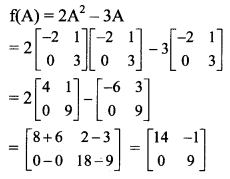
Maharashtra Board 11th Maths Solutions Chapter 4 Determinants and Matrices Miscellaneous Exercise 4(B) I Q10

(II) Answer the following questions.

Question 1.
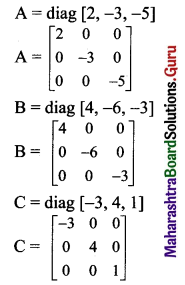
If A = diag[2, -3, -5], B = diag[4, -6, -3] and C = diag [-3, 4, 1], then find
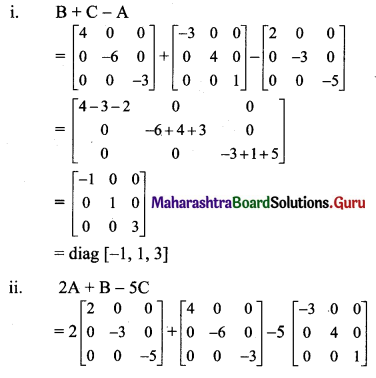
i. B + C – A
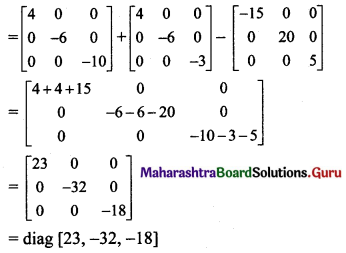
ii. 2A + B – 5C.
Solution:
Maharashtra Board 11th Maths Solutions Chapter 4 Determinants and Matrices Miscellaneous Exercise 4(B) II Q1
Maharashtra Board 11th Maths Solutions Chapter 4 Determinants and Matrices Miscellaneous Exercise 4(B) II Q1.1
Maharashtra Board 11th Maths Solutions Chapter 4 Determinants and Matrices Miscellaneous Exercise 4(B) II Q1.2

Maharashtra Board 11th Maths Solutions Chapter 4 Determinants and Matrices Miscellaneous Exercise 4(B)

Question 2.
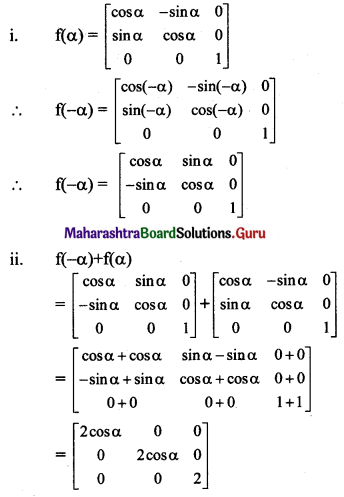
If f(α) = A = \(\left[\begin{array}{ccc}
\cos \alpha & -\sin \alpha & 0 \\
\sin \alpha & \cos \alpha & 0 \\
0 & 0 & 1
\end{array}\right]\), find
i. f(-α)
ii. f(-α) + f(α)
Solution:
Maharashtra Board 11th Maths Solutions Chapter 4 Determinants and Matrices Miscellaneous Exercise 4(B) II Q2

Question 3.
Find matrices A and B, where
(i) 2A – B = \(\left[\begin{array}{cc}
1 & -1 \\
0 & 1
\end{array}\right]\) and A + 3B = \(\left[\begin{array}{cc}
1 & -1 \\
0 & 1
\end{array}\right]\)
(ii) 3A – B = \(\left[\begin{array}{ccc}
-1 & 2 & 1 \\
1 & 0 & 5
\end{array}\right]\) and A + 5B = \(\left[\begin{array}{ccc}
0 & 0 & 1 \\
-1 & 0 & 0
\end{array}\right]\)
Solution:
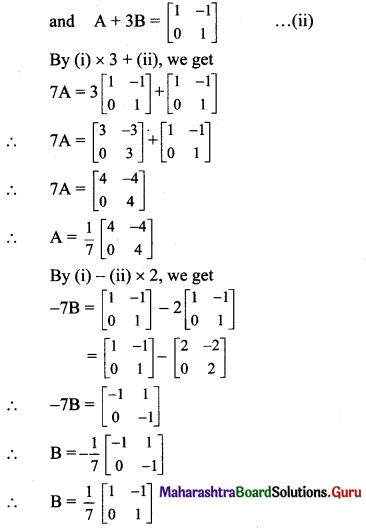
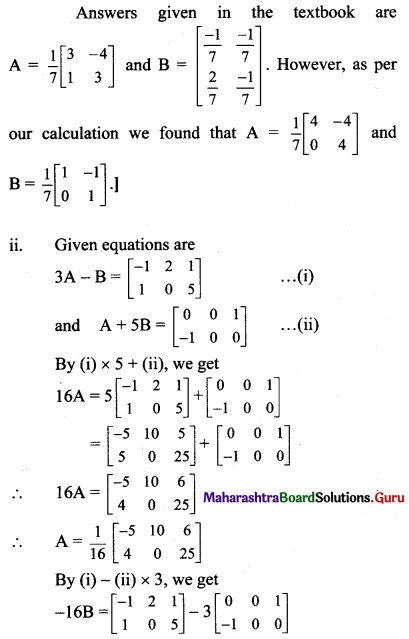
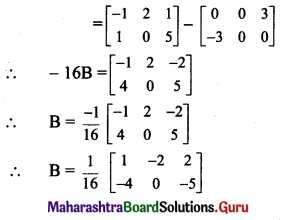
i. Given equations are
2A – B = \(\left[\begin{array}{cc}
1 & -1 \\
0 & 1
\end{array}\right]\) …….(i)
Maharashtra Board 11th Maths Solutions Chapter 4 Determinants and Matrices Miscellaneous Exercise 4(B) II Q3
Maharashtra Board 11th Maths Solutions Chapter 4 Determinants and Matrices Miscellaneous Exercise 4(B) II Q3.1
Maharashtra Board 11th Maths Solutions Chapter 4 Determinants and Matrices Miscellaneous Exercise 4(B) II Q3.2

Question 4.
If A = \(\left[\begin{array}{cc}
2 & -3 \\
3 & -2 \\
-1 & 4
\end{array}\right]\), B = \(\left[\begin{array}{ccc}
-3 & 4 & 1 \\
2 & -1 & -3
\end{array}\right]\), verify
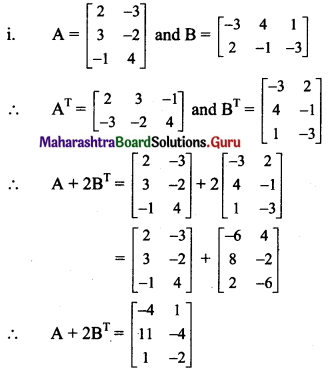
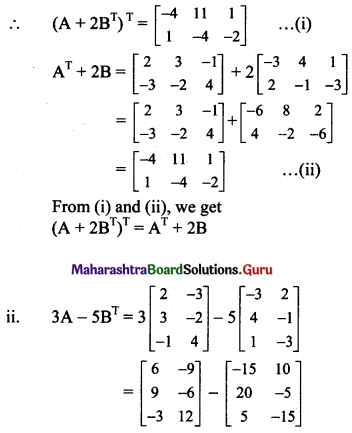
i. (A + 2BT)T = AT + 2B
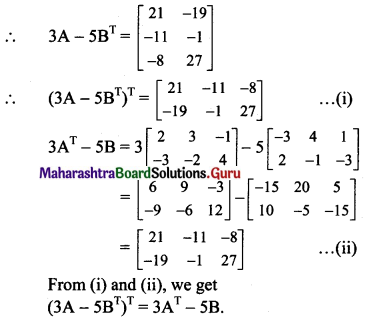
ii. (3A – 5BT)T = 3AT – 5B.
Solution:
Maharashtra Board 11th Maths Solutions Chapter 4 Determinants and Matrices Miscellaneous Exercise 4(B) II Q4
Maharashtra Board 11th Maths Solutions Chapter 4 Determinants and Matrices Miscellaneous Exercise 4(B) II Q4.1
Maharashtra Board 11th Maths Solutions Chapter 4 Determinants and Matrices Miscellaneous Exercise 4(B) II Q4.2

Maharashtra Board 11th Maths Solutions Chapter 4 Determinants and Matrices Miscellaneous Exercise 4(B)

Question 5.
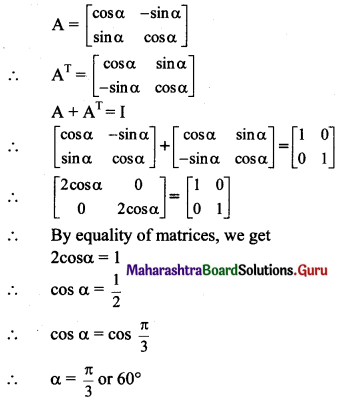
If A = \(\left[\begin{array}{cc}
\cos \alpha & -\sin \alpha \\
\sin \alpha & \cos \alpha
\end{array}\right]\) and A + AT = I, where I is a unit matrix of order 2 × 2, then find the value of α.
Solution:
Maharashtra Board 11th Maths Solutions Chapter 4 Determinants and Matrices Miscellaneous Exercise 4(B) II Q5

Question 6.
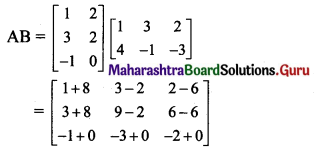
If A = \(\left[\begin{array}{cc}
1 & 2 \\
3 & 2 \\
-1 & 0
\end{array}\right]\) and B = \(\left[\begin{array}{ccc}
1 & 3 & 2 \\
4 & -1 & -3
\end{array}\right]\), show that AB is singular.
Solution:
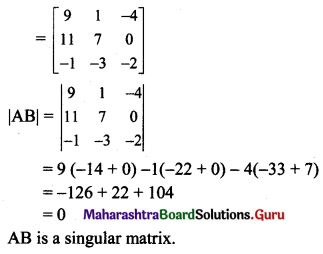
Maharashtra Board 11th Maths Solutions Chapter 4 Determinants and Matrices Miscellaneous Exercise 4(B) II Q6
Maharashtra Board 11th Maths Solutions Chapter 4 Determinants and Matrices Miscellaneous Exercise 4(B) II Q6.1

Question 7.
If A = \(\left[\begin{array}{lll}
1 & 2 & 3 \\
2 & 4 & 6 \\
1 & 2 & 3
\end{array}\right]\), B = \(\left[\begin{array}{ccc}
1 & -1 & 1 \\
-3 & 2 & -1 \\
-2 & 1 & 0
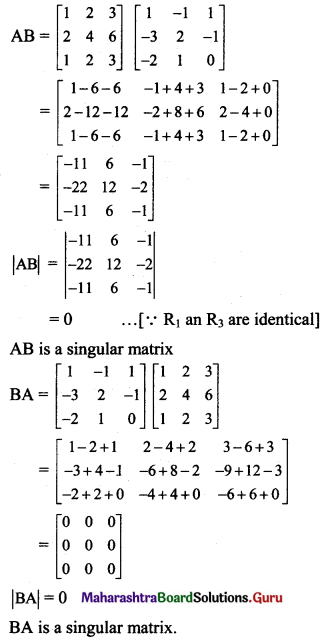
\end{array}\right]\), show that AB and BA are both singular matrices.
Solution:
Maharashtra Board 11th Maths Solutions Chapter 4 Determinants and Matrices Miscellaneous Exercise 4(B) II Q7

Question 8.
If A = \(\left[\begin{array}{ccc}
1 & -1 & 0 \\
2 & 3 & 4 \\
0 & 1 & 2
\end{array}\right]\), B = \(\left[\begin{array}{ccc}
2 & 2 & -4 \\
-4 & 2 & -4 \\
2 & -1 & 5
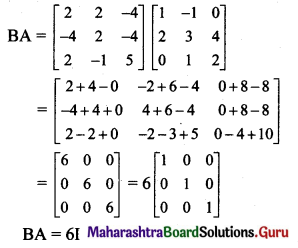
\end{array}\right]\), show that BA = 6I.
Solution:
Maharashtra Board 11th Maths Solutions Chapter 4 Determinants and Matrices Miscellaneous Exercise 4(B) II Q8

Maharashtra Board 11th Maths Solutions Chapter 4 Determinants and Matrices Miscellaneous Exercise 4(B)

Question 9.
If A = \(\left[\begin{array}{ll}
2 & 1 \\
0 & 3
\end{array}\right]\), B = \(\left[\begin{array}{cc}
1 & 2 \\
3 & -2
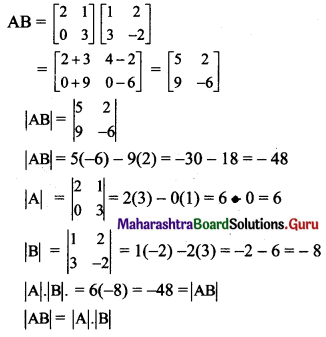
\end{array}\right]\), verify that |AB| = |A|.|B|.
Solution:
Maharashtra Board 11th Maths Solutions Chapter 4 Determinants and Matrices Miscellaneous Exercise 4(B) II Q9

Question 10.
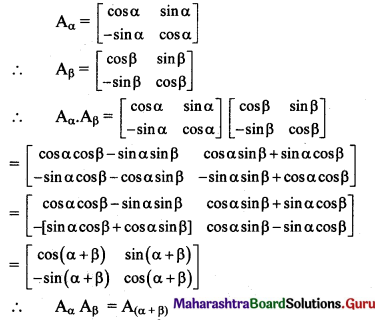
If Aα = \(\left[\begin{array}{cc}
\cos \alpha & \sin \alpha \\
-\sin \alpha & \cos \alpha
\end{array}\right]\), show that Aα . Aβ = Aα+β
Solution:
Maharashtra Board 11th Maths Solutions Chapter 4 Determinants and Matrices Miscellaneous Exercise 4(B) II Q10

Question 11.
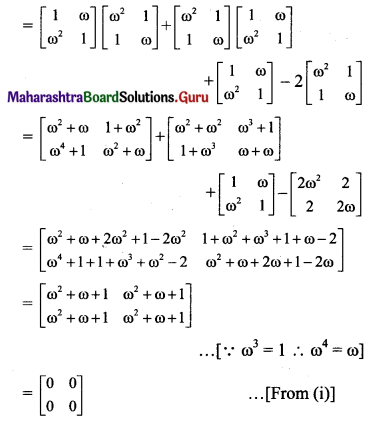
If A = \(\left[\begin{array}{cc}
1 & \omega \\
\omega^{2} & 1
\end{array}\right]\), B = \(\left[\begin{array}{cc}
\omega^{2} & 1 \\
1 & \omega
\end{array}\right]\), where ω is a complex cube root of unity, then show that AB + BA + A – 2B is a null matrix.
Solution:
ω is the complex cube root of unity.
ω3 = 1
ω3 – 1 = 0
(ω – 1) (ω2 + ω + 1) = 0
ω = 1 or ω2 + ω + 1 = 0
But, ω is a complex number.
1 + ω + ω2 = 0 …….(i)
AB + BA + A – 2B
Maharashtra Board 11th Maths Solutions Chapter 4 Determinants and Matrices Miscellaneous Exercise 4(B) II Q11
which is a null matrix.

Maharashtra Board 11th Maths Solutions Chapter 4 Determinants and Matrices Miscellaneous Exercise 4(B)

Question 12.
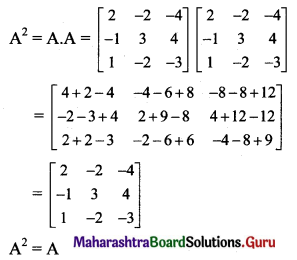
If A = \(\left[\begin{array}{lrr}
2 & -2 & -4 \\
-1 & 3 & 4 \\
1 & -2 & -3
\end{array}\right]\), show that A2 = A.
Solution:
Maharashtra Board 11th Maths Solutions Chapter 4 Determinants and Matrices Miscellaneous Exercise 4(B) II Q12

Question 13.
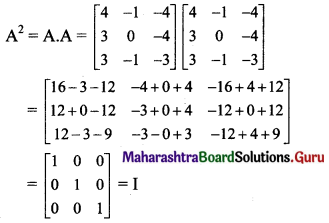
If A = \(\left[\begin{array}{ccc}
4 & -1 & -4 \\
3 & 0 & -4 \\
3 & -1 & -3
\end{array}\right]\), show that A2 = I.
Solution:
Maharashtra Board 11th Maths Solutions Chapter 4 Determinants and Matrices Miscellaneous Exercise 4(B) II Q13

Question 14.
If A = \(\left[\begin{array}{cc}
3 & -5 \\
-4 & 2
\end{array}\right]\), show that A2 – 5A – 14I = 0.
Solution:
Maharashtra Board 11th Maths Solutions Chapter 4 Determinants and Matrices Miscellaneous Exercise 4(B) II Q14

Question 15.
If A = \(\left[\begin{array}{cc}
2 & -1 \\
-1 & 2
\end{array}\right]\), show that A – 4A + 3I = 0.
Solution:
Maharashtra Board 11th Maths Solutions Chapter 4 Determinants and Matrices Miscellaneous Exercise 4(B) II Q15

Maharashtra Board 11th Maths Solutions Chapter 4 Determinants and Matrices Miscellaneous Exercise 4(B)

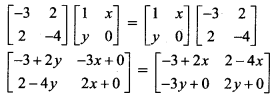
Question 16.
If A = \(\left[\begin{array}{cc}
-3 & 2 \\
2 & -4
\end{array}\right]\), B = \(\left[\begin{array}{ll}
1 & x \\
y & 0
\end{array}\right]\) and (A + B)(A – B) = A2 – B2, find x and y.
Solution:
(A + B)(A – B) = A2 – B2
A2 – AB + BA – B2 = A2 – B2
-AB + BA = 0
AB = BA
Maharashtra Board 11th Maths Solutions Chapter 4 Determinants and Matrices Miscellaneous Exercise 4(B) II Q16
By equality of matrices, we get
2 – 4x = -3x
∴ x = 2 and 2y = 2x
y = x
∴ y = 2
∴ x = 2, y = 2

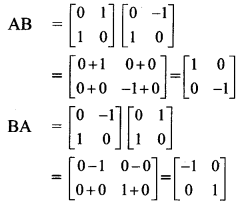
Question 17.
If A = \(\left[\begin{array}{ll}
0 & 1 \\
1 & 0
\end{array}\right]\) and B = \(\left[\begin{array}{cc}
0 & -1 \\
1 & 0
\end{array}\right]\), show that (A + B)(A – B) ≠ A2 – B2.
Solution:
We have to prove that
(A + B) . (A – B) ≠ A2 – B2
i.e., to prove that A(A – B) + B(A – B) ≠ A2 – B2
i.e., to prove that A2 – AB + BA – B2 ≠ A2 – B2
i.e., to prove that AB ≠ BA.
Maharashtra Board 11th Maths Solutions Chapter 4 Determinants and Matrices Miscellaneous Exercise 4(B) II Q17
∴ AB ≠ BA

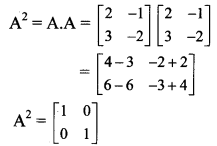
Question 18.
If A = \(\left[\begin{array}{ll}
2 & -1 \\
3 & -2
\end{array}\right]\), find A3.
Solution:
Maharashtra Board 11th Maths Solutions Chapter 4 Determinants and Matrices Miscellaneous Exercise 4(B) II Q18
∴ A2 = I
Multiplying throughout by A, we get
A3 = A . I
∴ A3 = A

Question 19.
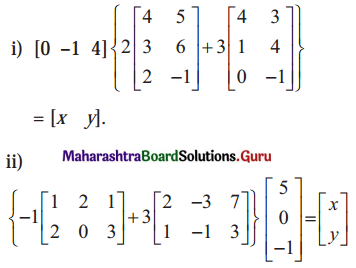
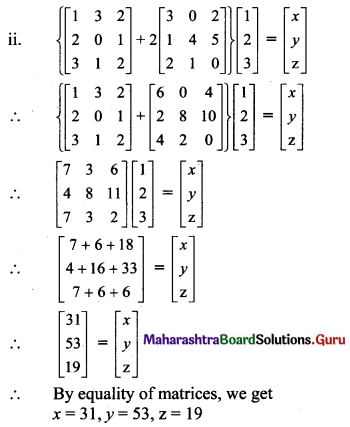
Find x, y if,
Maharashtra Board 11th Maths Solutions Chapter 4 Determinants and Matrices Miscellaneous Exercise 4(B) II Q19
Solution:
Maharashtra Board 11th Maths Solutions Chapter 4 Determinants and Matrices Miscellaneous Exercise 4(B) II Q19.1
Maharashtra Board 11th Maths Solutions Chapter 4 Determinants and Matrices Miscellaneous Exercise 4(B) II Q19.2

Maharashtra Board 11th Maths Solutions Chapter 4 Determinants and Matrices Miscellaneous Exercise 4(B)

Question 20.
Find x, y, z if
Maharashtra Board 11th Maths Solutions Chapter 4 Determinants and Matrices Miscellaneous Exercise 4(B) II Q20
Solution:
Maharashtra Board 11th Maths Solutions Chapter 4 Determinants and Matrices Miscellaneous Exercise 4(B) II Q20.1
Maharashtra Board 11th Maths Solutions Chapter 4 Determinants and Matrices Miscellaneous Exercise 4(B) II Q20.2

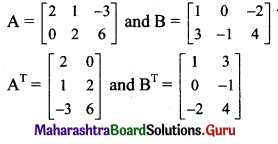
Question 21.
If A = \(\left[\begin{array}{ccc}
2 & 1 & -3 \\
0 & 2 & 6
\end{array}\right]\), B = \(\left[\begin{array}{ccc}
1 & 0 & -2 \\
3 & -1 & 4
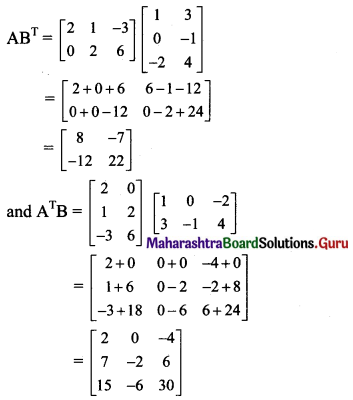
\end{array}\right]\), find ABT and ATB.
Solution:
Maharashtra Board 11th Maths Solutions Chapter 4 Determinants and Matrices Miscellaneous Exercise 4(B) II Q21
Maharashtra Board 11th Maths Solutions Chapter 4 Determinants and Matrices Miscellaneous Exercise 4(B) II Q21.1

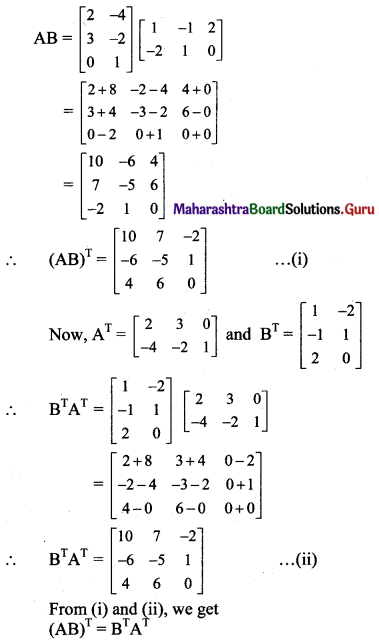
Question 22.
If A = \(\left[\begin{array}{cc}
2 & -4 \\
3 & -2 \\
0 & 1
\end{array}\right]\), B = \(\left[\begin{array}{ccc}
1 & -1 & 2 \\
-2 & 1 & 0
\end{array}\right]\), show that (AB)T = BTAT.
Solution:
Maharashtra Board 11th Maths Solutions Chapter 4 Determinants and Matrices Miscellaneous Exercise 4(B) II Q22

Maharashtra Board 11th Maths Solutions Chapter 4 Determinants and Matrices Miscellaneous Exercise 4(B)

Question 23.
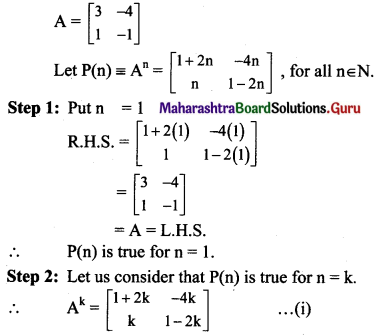
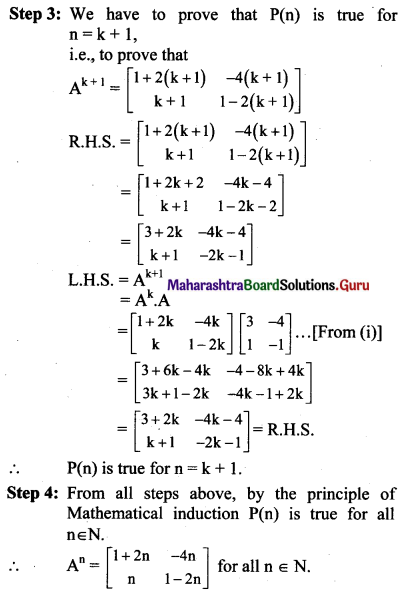
If A = \(\left[\begin{array}{ll}
3 & -4 \\
1 & -1
\end{array}\right]\), prove that An = \(\left[\begin{array}{cc}
1+2 n & -4 n \\
n & 1-2 n
\end{array}\right]\), for all n ∈ N.
Solution:
Maharashtra Board 11th Maths Solutions Chapter 4 Determinants and Matrices Miscellaneous Exercise 4(B) II Q23
Maharashtra Board 11th Maths Solutions Chapter 4 Determinants and Matrices Miscellaneous Exercise 4(B) II Q23.1

Question 24.
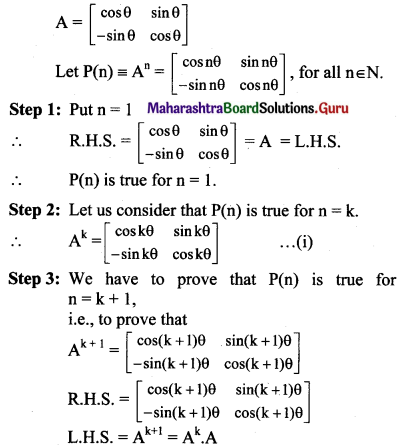
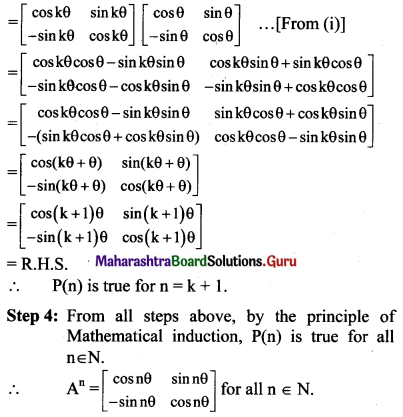
If A = \(\left[\begin{array}{cc}
\cos \theta & \sin \theta \\
-\sin \theta & \cos \theta
\end{array}\right]\), prove that An = \(\left[\begin{array}{cc}
\cos n \theta & \sin n \theta \\
-\sin n \theta & \cos n \theta
\end{array}\right]\), for all n ∈ N.
Solution:
Maharashtra Board 11th Maths Solutions Chapter 4 Determinants and Matrices Miscellaneous Exercise 4(B) II Q24
Maharashtra Board 11th Maths Solutions Chapter 4 Determinants and Matrices Miscellaneous Exercise 4(B) II Q24.1

Maharashtra Board 11th Maths Solutions Chapter 4 Determinants and Matrices Miscellaneous Exercise 4(B)

Question 25.
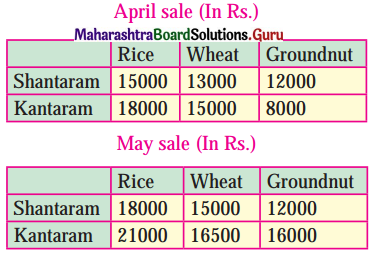
Two farmers Shantaram and Kantaram cultivate three crops rice, wheat, and groundnut. The sale (in Rupees) of these crops by both the farmers for the month of April and may 2008 is given below,
Maharashtra Board 11th Maths Solutions Chapter 4 Determinants and Matrices Miscellaneous Exercise 4(B) II Q25
Find
(i) the total sale in rupees for two months of each farmer for each crop.
(ii) the increase in sales from April to May for every crop of each farmer.
Solution:
(i) Total sale for Shantaram:
For rice = 15000 + 18000 = ₹ 33000.
For wheat = 13000 + 15000 = ₹ 28000.
For groundnut = 12000 + 12000 = ₹ 24000.
Total sale for Kantaram:
For rice = 18000 + 21000 = ₹ 39000
For wheat = 15000 + 16500 = ₹ 31500
For groundnut = 8000 + 16000 = ₹ 24000

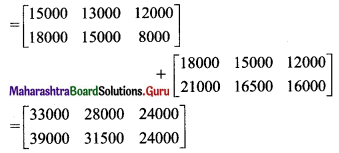
Alternate method:
Matrix form
Maharashtra Board 11th Maths Solutions Chapter 4 Determinants and Matrices Miscellaneous Exercise 4(B) II Q25.1
∴ The total sale of April and May of Shantaram in ₹ is ₹ 33000 (rice), ₹ 28000 (wheat), ₹ 24000 (groundnut), and that of Kantaram in ₹ is ₹ 39000(rice), ₹ 31500(wheat), and ₹ 24000 (groundnut).

(ii) Increase in sale from April to May for Shantaram:
For rice = 18000 – 15000 = ₹ 3000
For wheat = 15000 – 13000 = ₹ 2000
For groundnut = 12000 – 12000 = ₹ 0
Increase in sale from April to May for Kantaram:
For rice = 21000 – 18000 = ₹ 3000
For wheat = 16500 – 15000 = ₹ 1500
For groundnut = 16000 – 8000 = ₹ 8000

Maharashtra Board 11th Maths Solutions Chapter 4 Determinants and Matrices Miscellaneous Exercise 4(B)

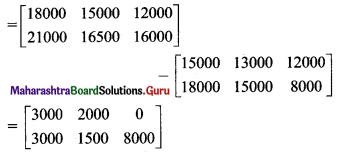
Alternate method:
Matrix form
Maharashtra Board 11th Maths Solutions Chapter 4 Determinants and Matrices Miscellaneous Exercise 4(B) II Q25.2
∴ The increase in sales for Shantaram from April to May in each crop is ₹ 3000 (rice), ₹ 2000(wheat), 0 (groundnut), and that for Kantaram is ₹ 3000 (rice), ₹ 1500 (wheat), and ₹ 8000 (groundnut).

Maharashtra Board 11th Maths Solutions Chapter 6 Circle Ex 6.1

Balbharti Maharashtra State Board Class 11 Maths Solutions Pdf Chapter 6 Circle Ex 6.1 Questions and Answers.

Maharashtra State Board 11th Maths Solutions Chapter 6 Circle Ex 6.1

Question 1.
Find the equation of a circle with
(i) centre at origin and radius 4.
(ii) centre at (-3, -2) and radius 6.
(iii) centre at (2, -3) and radius 5.
(iv) centre at (-3, -3) passing through point (-3, -6).
Solution:
(i) The equation of a circle with centre at origin and radius ‘r’ is given by
x2 + y2 = r2
Here, r = 4
∴ The required equation of the circle is x2 + y2 = 42 i.e., x2 + y2 = 16.

(ii) The equation of a circle with centre at (h, k) and radius ‘r’ is given by
(x – h)2 + (y – k)2 = r2
Here, h = -3, k = -2 and r = 6
∴ The required equation of the circle is
[x – (-3)]2 + [y – (-2)]2 = 62
⇒ (x + 3)2 + (y + 2)2 = 36
⇒ x2 + 6x + 9 + y2 + 4y + 4 – 36 = 0
⇒ x2 + y2 + 6x + 4y – 23 = 0

Maharashtra Board 11th Maths Solutions Chapter 6 Circle Ex 6.1

(iii) The equation of a circle with centre at (h, k) and radius ‘r’ is given by
(x – h)2 + (y – k)2 = r2
Here, h = 2, k = -3 and r = 5
The required equation of the circle is
(x – 2)2 + [y – (-3)]2 = 52
⇒ (x – 2)2 + (y + 3)2 = 25
⇒ x2 – 4x + 4 + y2 + 6y + 9 – 25 = 0
⇒ x2 + y2 – 4x + 6y – 12 = 0

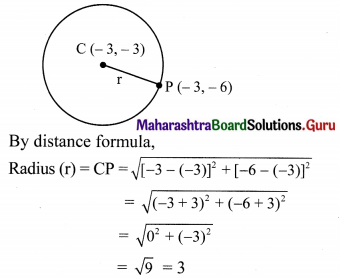
(iv) Centre of the circle is C (-3, -3) and it passes through the point P (-3, -6).
Maharashtra Board 11th Maths Solutions Chapter 6 Circle Ex 6.1 Q1
The equation of a circle with centre at (h, k) and radius ‘r’ is given by
(x – h)2 + (y – k)2 = r2
Here, h = -3, k = -3, r = 3
The required equation of the circle is
[x – (-3)]2 + [y – (-3)]2 = 32
⇒ (x + 3)2 + (y + 3)2 = 9
⇒ x2 + 6x + 9 + y2 + 6y + 9 – 9 = 0
⇒ x2 + y2 + 6x + 6y + 9 = 0

Check:
If the point (-3, -6) satisfies x2 + y2 + 6x + 6y + 9 = 0, then our answer is correct.
L.H.S. = x2 + y2 + 6x + 6y + 9
= (-3)2 + (-6)2 + 6(-3) – 6(-6) + 9
= 9 + 36 – 18 – 36 + 9
= 0
= R.H.S.
Thus, our answer is correct.

Question 2.
Find the centre and radius of the following circles:
(i) x2 + y2 = 25
(ii) (x – 5)2 + (y – 3)2 = 20
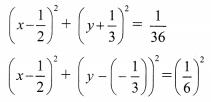
(iii) \(\left(x-\frac{1}{2}\right)^{2}+\left(y+\frac{1}{3}\right)^{2}=\frac{1}{36}\)
Solution:
(i) Given equation of the circle is
x2 + y2 = 25
⇒ x2 + y2 = (5)2
Comparing this equation with x2 + y2 = r2, we get r = 5
Centre of the circle is (0, 0) and radius of the circle is 5.

(ii) Given equation of the circle is
(x – 5)2 + (y – 3)2 = 20
⇒ (x – 5)2 + (y – 3)2 = (√20)2
Comparing this equation with (x – h)2 + (y – k)2 = r2, we get
h = 5, k = 3 and r = √20 = 2√5
Centre of the circle = (h, k) = (5, 3)
and radius of the circle = 2√5.

Maharashtra Board 11th Maths Solutions Chapter 6 Circle Ex 6.1

(iii) Given the equation of the circle is
Maharashtra Board 11th Maths Solutions Chapter 6 Circle Ex 6.1 Q2
Comparing this equation with (x – h)2 + (y – k)2 = r2, we get
h = \(\frac{1}{2}\), k = \(\frac{-1}{3}\) and r = \(\frac{1}{6}\)
Centre of the circle = (h, k) = (\(\frac{1}{2}\), \(\frac{-1}{3}\)) and radius of the circle = \(\frac{1}{6}\)

Question 3.
Find the equation of the circle with centre
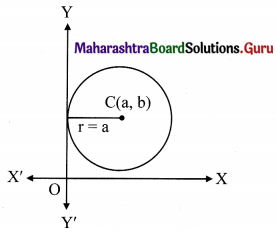
(i) at (a, b) and touching the Y-axis.
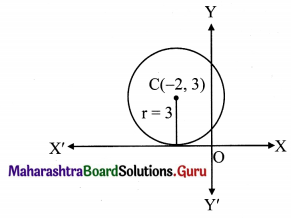
(ii) at (-2, 3) and touching the X-axis.
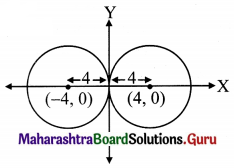
(iii) on the X-axis and passing through the origin having radius 4.
(iv) at (3, 1) and touching the line 8x – 15y + 25 = 0.
Solution:
(i) Since the circle is touching the Y-axis, the radius of the circle is X-co-ordinate of the centre.
Maharashtra Board 11th Maths Solutions Chapter 6 Circle Ex 6.1 Q3
∴ r = a
The equation of a circle with centre at (h, k) and radius r is given by
(x – h)2 + (y – k)2 = r2
Here, h = a, k = b
The required equation of the circle is
⇒ (x – a)2 + (y – b)2 = a2
⇒ x2 – 2ax + a2 + y2 – 2by + b2 = a2
⇒ x2 + y2 – 2ax – 2by + b2 = 0

(ii) Since the circle is touching the X-axis, the radius of the circle is the Y co-ordinate of the centre.
Maharashtra Board 11th Maths Solutions Chapter 6 Circle Ex 6.1 Q3.1
∴ r = 3
The equation of a circle with centre at (h, k) and radius r is given by
(x – h)2 + (y – k)2 = r2
Here, h = -2, k = 3
The required equation of the circle is
⇒ (x + 2)2 + (y – 3)2 = 32
⇒ x2 + 4x + 4 + y2 – 6y + 9 = 9
⇒ x2 + y2 + 4x – 6y + 4 = 0

Maharashtra Board 11th Maths Solutions Chapter 6 Circle Ex 6.1

(iii) Let the co-ordinates of the centre of the required circle be C (h, 0).
Since the circle passes through the origin i.e., O(0, 0)
OC = radius
⇒ \(\sqrt{(h-0)^{2}+(0-0)^{2}}=4\)
⇒ h2 = 16
⇒ h = ±4
Maharashtra Board 11th Maths Solutions Chapter 6 Circle Ex 6.1 Q3.2
the co-ordinates of the centre are (4, 0) or (-4, 0).
The equation of a circle with centre at (h, k) and radius r is given by
(x – h)2 + (y – k)2 = r2
Here, h = ± 4, k = 0, r = 4
The required equation of the circle is
⇒ (x – 4)2 + (y – 0)2 = 42 or (x + 4)2 + (y – 0)2 = 42
⇒ x2 – 8x + 16 + y2 = 16 or x2 + 8x + 16 + y2 = 16
⇒ x2 + y2 – 8x = 0 or x2 + y2 + 8x = 0

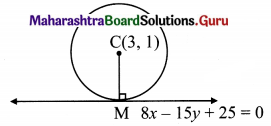
(iv) Centre of the circle is C (3, 1).
Let the circle touch the line 8x – 15y + 25 = 0 at point M.
Maharashtra Board 11th Maths Solutions Chapter 6 Circle Ex 6.1 Q3.3
CM = radius (r)
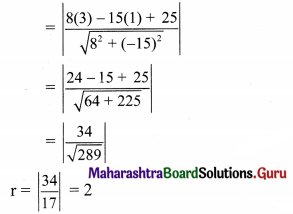
CM = Length of perpendicular from centre C(3, 1) on the line 8x – 15y + 25 = 0
Maharashtra Board 11th Maths Solutions Chapter 6 Circle Ex 6.1 Q3.4
The equation of a circle with centre at (h, k) and radius r is given by
(x – h)2 + (y – k)2 = r2
Here, h = 3, k = 1 and r = 2
The required equation of the circle is
⇒ (x – 3)2 + (y – 1)2 = 22
⇒ x2 – 6x + 9 + y2 – 2y + 1 = 4
⇒ x2 + y2 – 6x – 2y + 10 – 4 = 0
⇒ x2 + y2 – 6x – 2y + 6 = 0

Question 4.
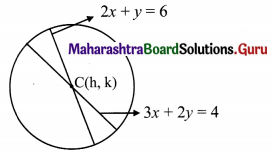
Find the equation of the circle, if the equations of two diameters are 2x + y = 6 and 3x + 2y = 4 and radius is 9.
Solution:
Maharashtra Board 11th Maths Solutions Chapter 6 Circle Ex 6.1 Q4
Given equations of diameters are 2x + y = 6 and 3x + 2y = 4.
Let C (h, k) be the centre of the required circle.
Since point of intersection of diameters is the centre of the circle,
x = h, y = k
Equations of diameters become
2h + k = 6 …..(i)
and 3h + 2k = 4 ……..(ii)
By (ii) – 2 × (i), we get
-h = -8
⇒ h = 8
Substituting h = 8 in (i), we get
2(8) + k = 6
⇒ k = 6 – 16
⇒ k = -10
Centre of the circle is C (8, -10) and radius, r = 9
The equation of a circle with centre at (h, k) and radius r is given by
(x – h)2 + (y – k)2 = r2
Here, h = 8, k = -10
The required equation of the circle is
⇒ (x – 8)2 + (y + 10)2 = 92
⇒ x2 – 16x + 64 + y2 + 20y + 100 = 81
⇒ x2 + y2 – 16x + 20y + 100 + 64 – 81 = 0
⇒ x2 + y2 – 16x + 20y + 83 = 0

Maharashtra Board 11th Maths Solutions Chapter 6 Circle Ex 6.1

Question 5.
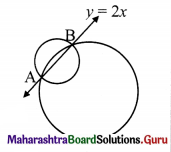
If y = 2x is a chord of the circle x2 + y2 – 10x = 0, find the equation of the circle with this chord as diameter.
Solution:
Maharashtra Board 11th Maths Solutions Chapter 6 Circle Ex 6.1 Q5
y = 2x is the chord of the given circle.
It satisfies the equation of a given circle.
Substituting y = 2x in x2 + y2 – 10x = 0, we get
⇒ x2 + (2x)2 – 10x = 0
⇒ x2 + 4x2 – 10x = 0
⇒ 5x2 – 10x = 0
⇒ 5x(x – 2) = 0
⇒ x = 0 or x = 2
When x = 0, y = 2x = 2(0) = 0
∴ A = (0, 0)
When x = 2, y = 2x = 2 (2) = 4
∴ B = (2, 4)
End points of chord AB are A(0, 0) and B(2, 4).
Chord AB is the diameter of the required circle.
The equation of a circle having (x1, y1) and (x2, y2) as end points of diameter is given by
(x – x1) (x – x2) + (y – y1) (y – y2) = 0
Here, x1 = 0, y1 = 0, x2 = 2, y2 = 4
The required equation of the circle is
⇒ (x – 0) (x – 2) + (y – 0) (y – 4 ) = 0
⇒ x2 – 2x + y2 – 4y = 0
⇒ x2 + y2 – 2x – 4y = 0

Question 6.
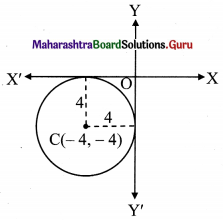
Find the equation of a circle with a radius of 4 units and touch both the co-ordinate axes having centre in the third quadrant. Solution:
The radius of the circle = 4 units
Since the circle touches both the co-ordinate axes and its centre is in the third quadrant,
the centre of the circle is C(-4, -4).
Maharashtra Board 11th Maths Solutions Chapter 6 Circle Ex 6.1 Q6
The equation of a circle with centre at (h, k) and radius r is given by (x – h)2 + (y – k)2 = r2
Here, h = -4, k = -4, r = 4
the required equation of the circle is
⇒ [x – (-4)]2 + [y – (-4)]2 = 42
⇒ (x + 4)2 + (y + 4)2 = 16
⇒ x2 + 8x + 16 + y2 + 8y + 16 – 16 = 0
⇒ x2 + y2 + 8x + 8y + 16 = 0

Maharashtra Board 11th Maths Solutions Chapter 6 Circle Ex 6.1

Question 7.
Find the equation of the circle passing through the origin and having intercepts 4 and -5 on the co-ordinate axes.
Solution:
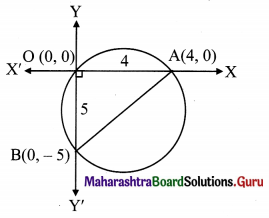
Let the circle intersect X-axis at point A and intersect Y-axis at point B.
the co-ordinates of point A are (4, 0) and the co-ordinates of point B are (0, -5).
Maharashtra Board 11th Maths Solutions Chapter 6 Circle Ex 6.1 Q7
Since ∠AOB is a right angle,
AB represents the diameter of the circle.
The equation of a circle having (x1, y1) and (x2, y2) as end points of diameter is given by
(x – x1) (x – x2) + (y – y1) (y – y2) = 0
Here, x1 = 4, y1 = 0, x2 = 0, y2 = -5
The required equation of the circle is
⇒ (x – 4) (x – 0) + (y – 0) [y – (-5)] = 0
⇒ x(x – 4) + y(y + 5) = 0
⇒ x2 – 4x + y2 + 5y = 0
⇒ x2 + y2 – 4x + 5y = 0

Question 8.
Find the equation of a circle passing through the points (1, -4), (5, 2) and having its centre on line x – 2y + 9 = 0.
Solution:
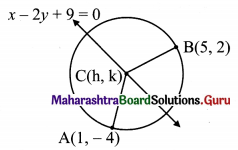
Maharashtra Board 11th Maths Solutions Chapter 6 Circle Ex 6.1 Q8
Let C(h, k) be the centre of the required circle which lies on the line x – 2y + 9 = 0.
Equation of line becomes
h – 2k + 9 = 0 …..(i)
Also, the required circle passes through points A(1, -4) and B(5, 2).
CA = CB = radius
CA = CB
By distance formula,
\(\sqrt{(\mathrm{h}-1)^{2}+[\mathrm{k}-(-4)]^{2}}=\sqrt{(\mathrm{h}-5)^{2}+(\mathrm{k}-2)^{2}}\)
Squaring both the sides, we get
⇒ (h – 1)2 + (k + 4)2 = (h – 5)2 + (k – 2)2
⇒ h2 – 2h + 1 + k2 + 8k + 16 = h2 – 10h + 25 + k2 – 4k + 4
⇒ -2h + 8k + 17 = -10h – 4k + 29
⇒ 8h + 12k – 12 = 0
⇒ 2h + 3k – 3 = 0 ……(ii)
By (ii) – (i) × 2, we get
7k = 21
⇒ k = 3
Substituting k = 3 in (i), we get
h – 2(3) + 9 = 0
⇒ h – 6 + 9 = 0
⇒ h = -3
Centre of the circle is C(-3, 3).
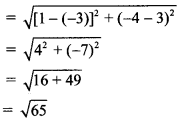
radius (r) = CA
Maharashtra Board 11th Maths Solutions Chapter 6 Circle Ex 6.1 Q8.1
The equation of a circle with centre at (h, k) and radius r is given by (x – h)2 + (y – k)2 = r2
Here, h = -3, k = 3, r = √65
The required equation of the circle is
⇒ [x – (-3)]2 + (y – 3)2 = (√65)2
⇒ (x + 3)2 + (y – 3)2 = 65
⇒ x2 + 6x + 9 + y2 – 6y + 9 – 65 = 0
⇒ x2 + y2 + 6x – 6y – 47 = 0

Maharashtra Board Class 11 Chemistry Important Questions Chapter 14 Basic Principles of Organic Chemistry

Balbharti Maharashtra State Board 11th Chemistry Important Questions Chapter 14 Basic Principles of Organic Chemistry Important Questions and Answers.

Maharashtra State Board 11th Chemistry Important Questions Chapter 14 Basic Principles of Organic Chemistry

Question 1.
How is the structural formula of a molecule represented? Give an example.
Answer:
Structural formula:
i. Structural formula of a molecule shows all the constituent atoms denoted with their respective chemical symbols and all the covalent bonds therein represented by a dash joining mutually bonded atoms.
ii. Structural formula of methane is:
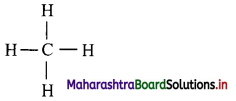
Maharashtra Board Class 11 Chemistry Important Questions Chapter 14 Basic Principles of Organic Chemistry 1

Question 2.
Write a note on Lewis structures with the help of an example.
Answer:
Lewis structures:
i. The electron dot structures are called as Lewis structures,
e. g. The Lewis structure of methane is shown below.
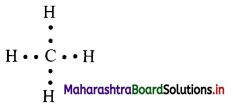
Maharashtra Board Class 11 Chemistry Important Questions Chapter 14 Basic Principles of Organic Chemistry 2
ii. All the valence electrons of carbon and hydrogen are shown as dots around them. Two dots drawn between two atoms indicate one covalent bond between them. The covalent bond can be represented by a dash joining mutually bonded atoms.
iii. The dash formula represents simplified Lewis formula of the molecule.
e.g. Dash formula of methane:
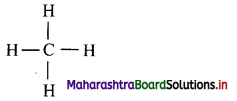
Maharashtra Board Class 11 Chemistry Important Questions Chapter 14 Basic Principles of Organic Chemistry 3

Question 3.
How is the condensed formula of an organic molecule written?
Answer:
The complete structural formula is further simplified by hiding some or all the covalent bonds and indicating the number of identical groups attached to an atom by a subscript. The resulting formula of a compound is known as condensed formula.
e.g.

  1. The condensed formula of ethane is written as CH3-CH3 or CH3CH3.
  2. The condensed formula of n-pentane is written as CH3CH2CH2CH2CH3 or CH3(CH2)3CH3.

Maharashtra Board Class 11 Chemistry Important Questions Chapter 14 Basic Principles of Organic Chemistry

Question 4.
What do you understand by the term bond-line formula?
Answer:
Bond-line or zig-zag formula:
i. The condensed formula is simplified into bond-line formula, which is also known as zig-zag formula.
ii. In this representation of an organic molecule, the symbols of carbon and hydrogen atoms are not written. The carbon-carbon bonds are represented by lines drawn in a zig-zag manner
iii. The terminals of the zig-zag line indicate methyl groups and the intersection of lines denote a carbon atom bonded to appropriate number of hydrogen atoms which satisfy the tetravalency of the carbon atom.
e.g. Propane is represented by bond-line or zig-zag formula:
Maharashtra Board Class 11 Chemistry Important Questions Chapter 14 Basic Principles of Organic Chemistry 4
iv. If a compound contains heteroatom(s) or H-atom(s) bonded to heteroatom(s), then they are represented by their symbols.
e.g. Ethanol is represented by bond-line or zig-zag formula:
Maharashtra Board Class 11 Chemistry Important Questions Chapter 14 Basic Principles of Organic Chemistry 5

Question 5.
Name the different methods used to represent three-dimensional structure of a molecule on the paper.
Answer:
Four different methods are used to represent three-dimensional structure of a molecule on the paper:

  1. Wedge formula
  2. Fischer projection formula or cross formula
  3. Newman projection formula
  4. Sawhorse or andiron or perspective formula

Question 6.
Write a short note on: Wedge formula.
Answer:
Wedge formula:
i. The three-dimensional (3-D) structure of organic molecules can be represented on plane paper by using solidMaharashtra Board Class 11 Chemistry Important Questions Chapter 14 Basic Principles of Organic Chemistry 6 and dashed Maharashtra Board Class 11 Chemistry Important Questions Chapter 14 Basic Principles of Organic Chemistry 7 wedges and normal line (-) for single bonds.
ii. In this formula, the solid wedge is used to indicate a bond projecting up from the plane of paper, towards the reader (observer), whereas the dashed wedge is used to depict a bond going backward, below the paper away from the reader.
iii. The bonds lying in plane of the paper are depicted by using a normal line (-).
iv. Wedge formula of methane molecule is shown below:

Maharashtra Board Class 11 Chemistry Important Questions Chapter 14 Basic Principles of Organic Chemistry 8

Question 7.
How is Fischer projection formula of a molecule drawn? Explian by giving an example.
Answer:
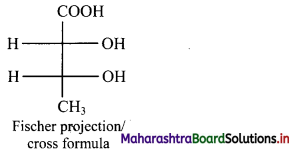
Fischer projection (cross) formula:

  • In this representation, a three dimensional molecule is projected on plane of paper.
  • Fischer projection formula can be drawn by visualizing the molecule with its main carbon chain vertical.
  • Each carbon on the vertical chain is represented by a cross. By convention, the horizontal lines of the cross represent bonds projecting up from the carbon and the vertical lines represent the bonds going below the carbon.

Fischer projection formula of a molecule along with its wedge formula is represented below:
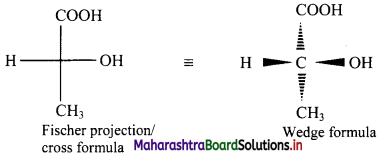
Maharashtra Board Class 11 Chemistry Important Questions Chapter 14 Basic Principles of Organic Chemistry 9
[Note: Fischer projection formula is more commonly used in carbohydrate chemistry.]

Maharashtra Board Class 11 Chemistry Important Questions Chapter 14 Basic Principles of Organic Chemistry

Question 8.
Write the Fischer projection and wedge formula for 2-chloro-propan-2-ol.
Answer:
2-Chloropropan-2-ol has formula CH3C(Cl)(OH)CH3.
Fischer projection and wedge formula for 2-chloropropan-2-ol can be given as:
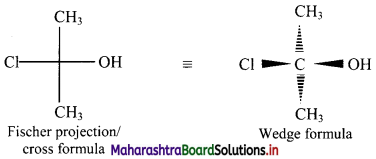
Maharashtra Board Class 11 Chemistry Important Questions Chapter 14 Basic Principles of Organic Chemistry 10

Question 9.
Convert the following wedge formula to Fischer projection formula:
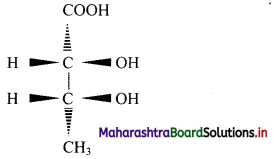
Maharashtra Board Class 11 Chemistry Important Questions Chapter 14 Basic Principles of Organic Chemistry 11
Answer:
Maharashtra Board Class 11 Chemistry Important Questions Chapter 14 Basic Principles of Organic Chemistry 12

Question 10.
Explain how will you represent the Newman projection formula and Sawhorse formula of ethane molecule?
Answer:
i. Newman projection formula of ethane molecule:
a. A Newman projection views the carbon-carbon single bond directly head-on. The front carbon atom is represented by a point while the rear carbon atom is represented by a circle. The point is drawn at the centre of the circle.
b. Bonds attached to the front carbon atom are represented by three lines drawn at an angle of 120° to each other from the centre of the circle and bonds attached to the rear carbon atom are represented by three lines drawn at an angle of 120° to each other from the circumference of the circle.
c. Newman projections of ethane molecule is represented in adjacent diagram.
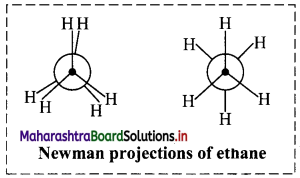
Maharashtra Board Class 11 Chemistry Important Questions Chapter 14 Basic Principles of Organic Chemistry 13

ii. Sawhorse (or andiron or perspective) formula of ethane molecule:
a. In this representation, a C-C single bond is represented by a long slanting line. The lower end of the line represents the front carbon and the upper end represents the rear carbon.
b. The remaining three bonds at the two carbons are shown to radiate from the respective carbons. (As the central C-C bond is drawn rather elongated the bonds radiating from the front and rear carbons do not intermingle.)
c. Sawhorse formula of ethane molecule is represented in adjacent diagram.
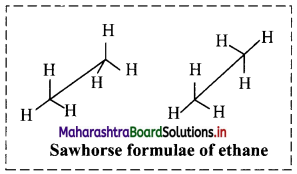
Maharashtra Board Class 11 Chemistry Important Questions Chapter 14 Basic Principles of Organic Chemistry 14

Question 11.
Explain the classification of organic compounds based on carbon skeleton.
Answer:
On the basis of their carbon skeleton, organic compounds are classified into two main groups:
i. Acyclic or aliphatic or open chain compounds:
a. Organic compounds in which carbon atoms are joined to form an open chain are called aliphatic compounds.
b. Their structure may consist of straight chains (in which carbon atoms are bonded to one or two other carbon atoms) or branched chains (in which at least one carbon atom is bonded to three or four other carbon atoms).
e.g.
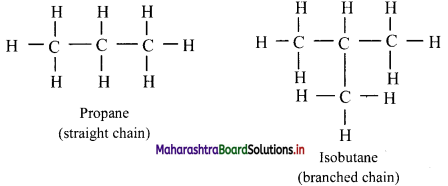
Maharashtra Board Class 11 Chemistry Important Questions Chapter 14 Basic Principles of Organic Chemistry 15

ii. Cyclic or closed chain or ring compounds:
a. Organic compounds in which carbon atoms are joined to form one or more closed rings with or without hetero atom are called cyclic compounds.
b. They are further divided into two types: Homocyclic and heterocyclic compounds.
1. Homocyclic or carbocyclic compounds: The cyclic organic compounds which have a ring made up of only carbon atoms are called as homocyclic or carbocyclic compounds.
They are further divided into:
i. Alicyclic compounds: These are cyclic compounds (ring of 3 or more C-atoms) exhibiting properties similar to those of aliphatic compounds.
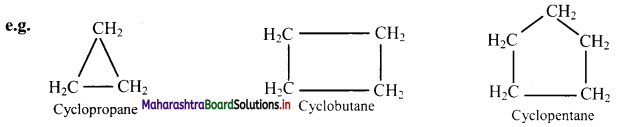
Maharashtra Board Class 11 Chemistry Important Questions Chapter 14 Basic Principles of Organic Chemistry 16
ii. Aromatic compounds: These compounds have special stability.
Aromatic compounds are further classified as benzenoid and non-benzenoid aromatics.
a. Benzenoid aromatics contain at least one benzene ring in the structure.
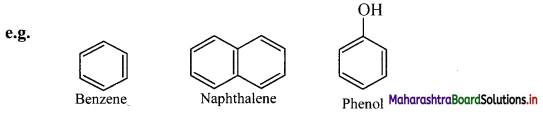
Maharashtra Board Class 11 Chemistry Important Questions Chapter 14 Basic Principles of Organic Chemistry 17
b. Non-benzenoid aromatics contain an aromatic ring, other than benzene.
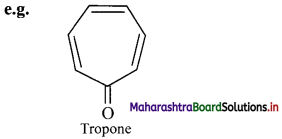
Maharashtra Board Class 11 Chemistry Important Questions Chapter 14 Basic Principles of Organic Chemistry 18

2. Heterocyclic compounds: Cyclic organic compounds which contain one or more heteroatoms (such as O, N, S, etc.) in the ring are called heterocyclic compounds.
They are further divided into:
i. Heterocyclic aromatic compounds: Aromatic compounds which contain at least one heteroatom in the ring are called heterocyclic aromatic (hetero-aromatic) compounds.

Maharashtra Board Class 11 Chemistry Important Questions Chapter 14 Basic Principles of Organic Chemistry 19
ii. Heterocyclic non-aromatic compounds: Alicyclic compounds, which contain at least one heteroatom in the ring are called heterocyclic non-aromatic compounds (hetero-alicyclic) compounds.
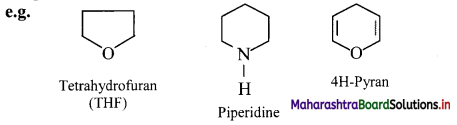
Maharashtra Board Class 11 Chemistry Important Questions Chapter 14 Basic Principles of Organic Chemistry 20

Question 12.
What is a functional group? Give two examples.
Answer:
Functional group:
i. A part of an organic molecule which undergoes change as a result of a reaction is called functional group.
OR
An atom or a group of atoms in the organic molecule which determines its characteristic chemical
properties is called functional group.
e.g. a. The functional group in alcohols is -OH group.
b. The functional group in aldehydes is -CHO group.

ii. There are a large variety of functional groups in organic compounds. Hence, organic compounds can be classified based on the nature of functional group present in them.
iii. The resulting individual class of compounds is called a family and is named after the constituent functional group.
e.g. Family of alcohols, which includes organic compounds having -OH functional group.

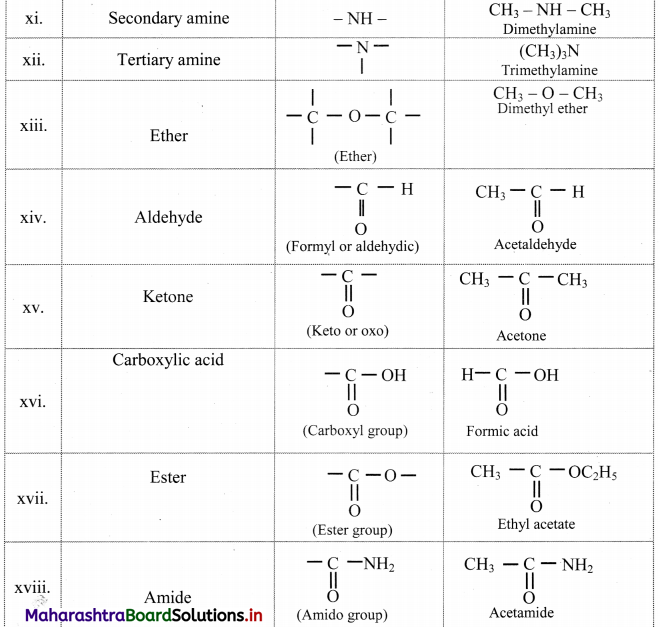
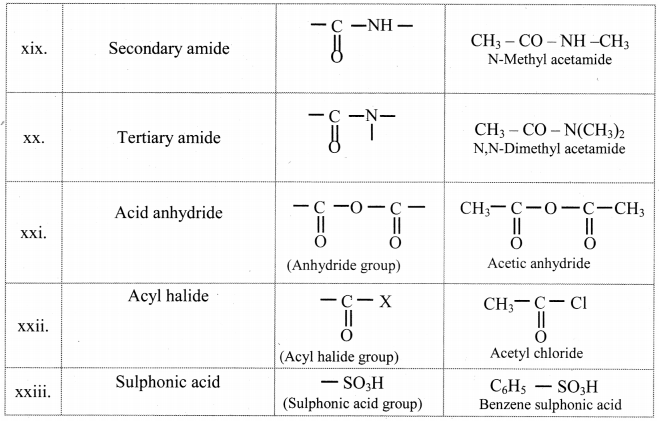
Note: Functional groups in organic compounds:
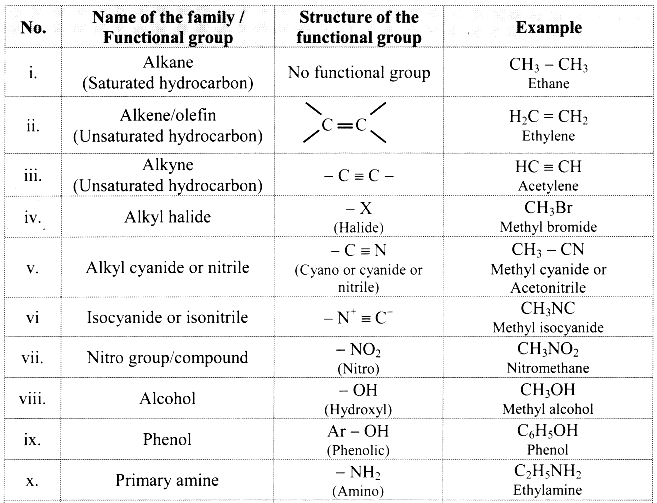
Maharashtra Board Class 11 Chemistry Important Questions Chapter 14 Basic Principles of Organic Chemistry 21
Maharashtra Board Class 11 Chemistry Important Questions Chapter 14 Basic Principles of Organic Chemistry 22
Maharashtra Board Class 11 Chemistry Important Questions Chapter 14 Basic Principles of Organic Chemistry 23

Maharashtra Board Class 11 Chemistry Important Questions Chapter 14 Basic Principles of Organic Chemistry

Question 13.
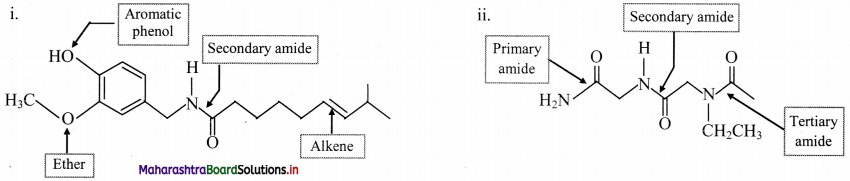
Indicate all the functional groups present in the following compounds.

Maharashtra Board Class 11 Chemistry Important Questions Chapter 14 Basic Principles of Organic Chemistry 24
Answer:
Maharashtra Board Class 11 Chemistry Important Questions Chapter 14 Basic Principles of Organic Chemistry 25

Question 14.
Identify the functional group in the following compounds:
i. n-Butyl alcohol
ii. Propanone
iii. Acetylene
Answer:

Maharashtra Board Class 11 Chemistry Important Questions Chapter 14 Basic Principles of Organic Chemistry 26

Question 15.
Write the name of the family of the following organic compounds:
i. CH3(CH2)3CH2Cl
ii. CH3CH2CH2NH2
iii. CH3CH2COCH3
iv. CH3CH2OCH3
Answer:

Maharashtra Board Class 11 Chemistry Important Questions Chapter 14 Basic Principles of Organic Chemistry 27

Question 16.
Write a note on homologous series.
Answer:
Homologous series:

  • A series of compounds of the same family in which each member has the same type of carbon skeleton and functional group, and differs from the next member by a constant difference of one methylene group (-CH2-) in its molecular and structural formula is called as homologous series.
  • The individual members of the series are called homologues and they can be represented by a same general formula.
  • Two successive homologues differ by one – CH2 (methylene) unit (i.e., molecular weight of each successive member differs by 14 units).
  • Homologues show similar chemical properties.
  • Physical properties (like melting point, boiling point, density, solubility, etc.) of the homologues show a gradual change with increase in the molecular weight of the member.

Note: Consider the homologous series of straight chain aldehydes. The boiling point increases down the series as molecular weight increases.

NameMolecular formulaBoiling point
FormaldehydeHCHO-21 °C
AcetaldehydeCH3CHO21 °C
PropionaldehydeC2H5CHO48 °C
ButyraldehydeC3H7CHO75 °C
ValeraldehydeC4H9CHO103 °C

Maharashtra Board Class 11 Chemistry Important Questions Chapter 14 Basic Principles of Organic Chemistry

Question 17.
Alkanes constitute a homologous series of straight chain saturated hydrocarbons. Write down the structural formulae of the first five homologues of this series. Write their molecular formulae and deduce the general formula of such homologous series.
Answer:
The first five homologues are generated by adding one – CH2 – at a time, starting with the first homologue, methane (CH4).

Maharashtra Board Class 11 Chemistry Important Questions Chapter 14 Basic Principles of Organic Chemistry 28
By counting carbon and hydrogen atoms in the five homologues, we get their molecular formulae as CH4, C2H6, C3H8, C4H10 and C5H12.
Comparing these molecular formulae and assigning the number of carbon atoms as ‘n’, the following general formula is deduced: CnH2n+2.

Question 18.
Write down structural formulae of (i) the third higher and (ii) the second lower homologue of CH3CH2COOH.
Answer:
i. Structural formula of the third higher homologue is obtained by adding three – CH2 – units to the carbon chain of the given structure.

Maharashtra Board Class 11 Chemistry Important Questions Chapter 14 Basic Principles of Organic Chemistry 29
ii. Structural formula of the second lower homologue is obtained by removing two – CH2 – units from the carbon chain of the given structure.

Maharashtra Board Class 11 Chemistry Important Questions Chapter 14 Basic Principles of Organic Chemistry 30

Question 19.
Write the general formula of homologous series of alcohols.
Answer:
General formula of homologous series of alcohols can be represented as, CnH2n+1OH (where n = 1, 2, 3, …).

Question 20.
Write the name and molecular formulae of the first three higher homologues of propyl chloride.
Answer:
General formula: CnH2n+1Cl (where n = 1, 2, 3, …)

No. of carbon atomsMolecular formulaName
n = 3C3H7ClPropyl chloride
n = 4C4H9ClButyl chloride
n = 5C5H11ClPentyl chloride
n = 6C6H13ClHexyl chloride

Question 21.
What is the molecular formula of:
i. first higher homologue of propionic acid?
ii. first lower homologue of propionic acid?
Answer:
i. First higher homologue of propionic acid:
(Addition of 1-CH3 group to CH3CH2COOH)
Butyric acid: C3H7COOH

ii. First lower homologue of propionic acid:
(1-CH3 group less from CH3CH3COOH)
Acetic acid: CH3COOH

Maharashtra Board Class 11 Chemistry Important Questions Chapter 14 Basic Principles of Organic Chemistry

Question 22.
How are the saturated (sp3) carbon atoms in a molecule classified based on the number of other carbon atoms bonded to it? Give an example that has all the four types of carbon atoms.
Answer:
i. The saturated (sp3) carbons in a molecule are classified as primary, secondary, tertiary and quaternary in accordance with the number of other carbons bonded to it by single bonds.

  • Primary carbon atom (1°): This carbon atom is bonded to only one other carbon atom. Terminal carbon atoms are always 1° carbon atoms.
  • Secondary carbon atom (2°): This carbon atom is bonded to two other carbon atoms.
  • Tertiary carbon atom (3°): This carbon atom is bonded to three other carbon atoms.
  • Quaternary carbon atom (4°): This carbon atom is bonded to four other carbon atoms.

ii. An example molecule having all the four types of carbon atoms:
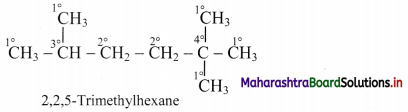
Maharashtra Board Class 11 Chemistry Important Questions Chapter 14 Basic Principles of Organic Chemistry 31
Thus, in 2,2,5-trimethylhexane, there are five primary, two secondary, one tertiary and one quaternary carbon atoms.
[Note: Hydrogen atoms attached to primary’, secondary and tertiary carbon atoms are referred to as primary, secondary and tertiary H-atoms respectively.]

Question 23.
Give common name/trivial name of the following compounds.
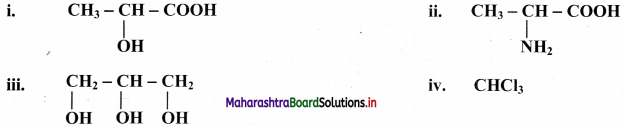
Maharashtra Board Class 11 Chemistry Important Questions Chapter 14 Basic Principles of Organic Chemistry 32
Answer:
i. Lactic acid
ii. Glycine
iii. Glycerol
iv. Chloroform

Question 24.
Give a basic idea about IUPAC nomenclature system and comment on IUPAC names of straight chain alkanes.
Answer:
i. International Union of Pure and Applied Chemistry (IUPAC) was founded (in 1919) and a systematic method of nomenclature for organic compounds was developed under its banner.
ii. This was done because of growing number of organic compounds with increasingly complicated structures and it was difficult to name them. To simplify and avoid confusions, IUPAC system is accepted and widely used all over the world today. According to this system, a unique name is given to each organic compound.

Following things are taken into consideration while naming a particular organic compound:

  • To arrive at the IUPAC name of an organic compound, its structure is considered to be made of three main parts: parent hydrocarbon, branches and functional groups.
  • The IUPAC names of a compound are obtained by modifying the name of its parent hydrocarbon further incorporating names of the branches and functional groups as prefix and suffix.

IUPAC names of straight chain alkanes:
a. The homologous series of straight chain alkanes forms the parent hydrocarbon part of the IUPAC names of aliphatic compounds.
b. The IUPAC name of a straight chain alkane is derived from the number of carbon atoms it contains.
c. IUPAC names of the first twenty alkanes are mentioned in the following table:
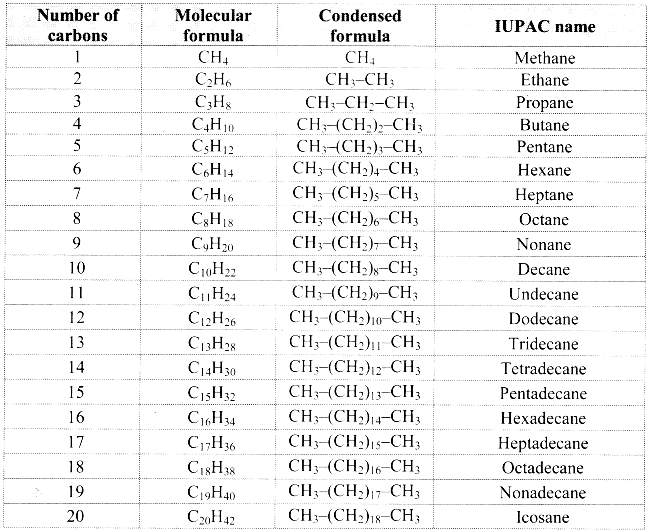
Maharashtra Board Class 11 Chemistry Important Questions Chapter 14 Basic Principles of Organic Chemistry 33

Maharashtra Board Class 11 Chemistry Important Questions Chapter 14 Basic Principles of Organic Chemistry

Question 25.
Match the following:

Column – IColumn – II
i.C19H40a.Undecane
ii.C12H26b.Nonadecane
iii.C11H24c.Dodecane
d.Nonane

Answer:
i – b,
ii – c,
iii – a

Question 26.
Explain the following with two examples:
i. straight chain alkyl groups
ii. branched chain alkyl group
Answer:
i. Straight chain alkyl group: It is obtained by removing one H-atom from the terminal carbon of an alkane molecule.
ii. It is named by replacing ‘ane’ of the alkane by ‘yl’.

Maharashtra Board Class 11 Chemistry Important Questions Chapter 14 Basic Principles of Organic Chemistry 34
iii. Branched chain alkyl group: It is obtained by removing a H-atom from any one of the non-terminal carbons of an alkane or any H-atom from a branched alkane.
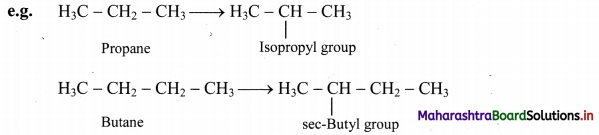
Maharashtra Board Class 11 Chemistry Important Questions Chapter 14 Basic Principles of Organic Chemistry 35

Note: Straight chain alkyl groups
Maharashtra Board Class 11 Chemistry Important Questions Chapter 14 Basic Principles of Organic Chemistry 36
Trivial names of small branched alkyl groups
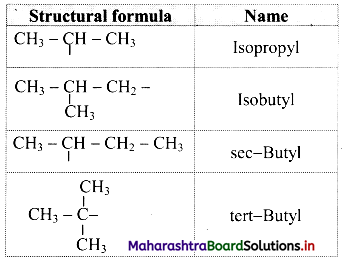
Maharashtra Board Class 11 Chemistry Important Questions Chapter 14 Basic Principles of Organic Chemistry 37

Question 27.
Write names of following groups.
i. C6H5
ii. (CH3)3C-
Answer:
i. Phenyl group
ii. tert-Butyl group

Question 28.
State the rules to assign IUPAC nomenclature of a branched chain alkane.
Answer:
i. Select the longest continuous chain of carbon atoms to be called the parent chain. All other carbon atoms not included in this chain constitute, side chains or branches or alkyl substituents. For example:

Maharashtra Board Class 11 Chemistry Important Questions Chapter 14 Basic Principles of Organic Chemistry 38
Parent chain has five carbon atoms and -CH3 group is alkyl substituent.

Maharashtra Board Class 11 Chemistry Important Questions Chapter 14 Basic Principles of Organic Chemistry 39
Parent chain has six carbon atoms and methyl group is the alkyl substituent.
If two chains of equal length are located, then the one with maximum number of substituents is selected as the parent chain.
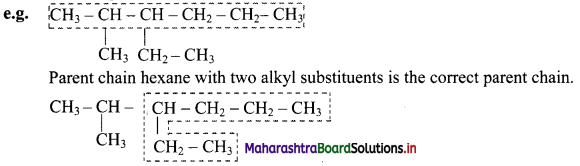
Maharashtra Board Class 11 Chemistry Important Questions Chapter 14 Basic Principles of Organic Chemistry 40
Parent chain hexane with one alkyl substituent is the incorrect chain.

ii. The parent chain is numbered from one end to the other to locate the position, called locant number of the alkyl substituent. The numbering is done in that direction which will result in lowest possible locant numbers.

Maharashtra Board Class 11 Chemistry Important Questions Chapter 14 Basic Principles of Organic Chemistry 41
iii. Names of the alkyl substituents are added as prefix to the name of the parent alkane. Different alkyl substituents are listed in alphabetical order with each substituent name preceded by the appropriate locant number. The name of the substituent is separated from the locant number by a hyphen.

Maharashtra Board Class 11 Chemistry Important Questions Chapter 14 Basic Principles of Organic Chemistry 42
The name is 4-ethyl-3-methylheptane and not 3-methyl-4-ethylheptane.
iv. When both the numberings give the same set of locants, that numbering is chosen which gives smaller locant to the substituent having alphabetical priority.

Maharashtra Board Class 11 Chemistry Important Questions Chapter 14 Basic Principles of Organic Chemistry 43
The name is 3-ethyl-4-methylhexane and not 3-methyl-4-ethylhexane.

v. If two or more identical substituents are present the prefix di (for 2), tri (for 3), tetra (for 4) and so on, are used before the name of the substituent to indicate how many identical substituents are there. The locants of identical substituents are listed together, separated by commas.

There must be as many numbers in the name as the substituents. A digit and an alphabet are separated by hyphen. The prefixes di, tri, tetra, sec and tert are ignored in alphabetizing the substituent names. Substituent and parent hydrocarbon names are joined into one word.

vi. Branched alkyl group having no accepted trivial name is named with the longest continuous chain beginning at the point of attachment as the base name. Carbon atom of this group attached to parent chain is numbered as ‘1’. The name of such substituent is enclosed in bracket.

Maharashtra Board Class 11 Chemistry Important Questions Chapter 14 Basic Principles of Organic Chemistry 44

Question 29.
Complete the following table.
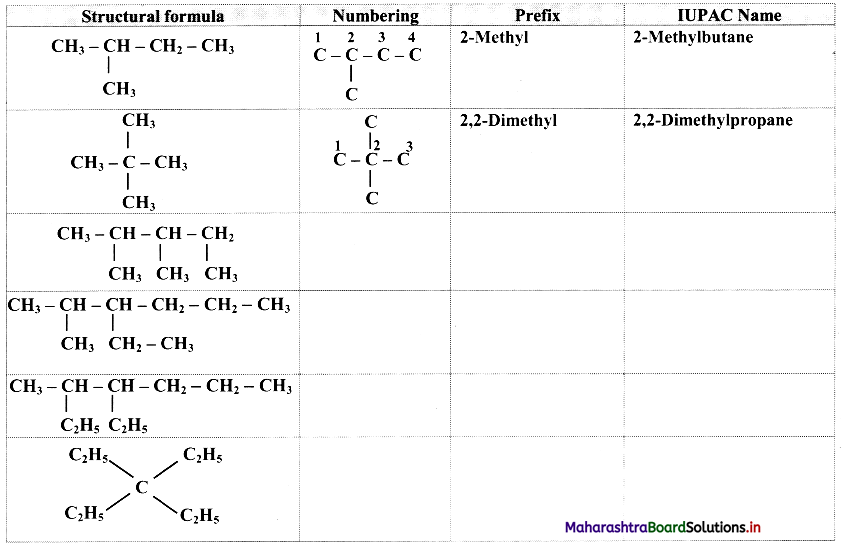
Maharashtra Board Class 11 Chemistry Important Questions Chapter 14 Basic Principles of Organic Chemistry 45
Answer:
Maharashtra Board Class 11 Chemistry Important Questions Chapter 14 Basic Principles of Organic Chemistry 46
Maharashtra Board Class 11 Chemistry Important Questions Chapter 14 Basic Principles of Organic Chemistry 47

Maharashtra Board Class 11 Chemistry Important Questions Chapter 14 Basic Principles of Organic Chemistry

Question 30.
Explain the rules for IUPAC nomenclature of unsaturated hydrocarbons (Alkenes and Alkynes).
Answer:
While writing IUPAC names of alkenes and alkynes following rules are to be followed in addition to rules for alkanes.
i. The longest continuous chain must include carbon-carbon multiple bond. Thus, the longest continuous chains in 1 and II contain four and six carbons, respectively.
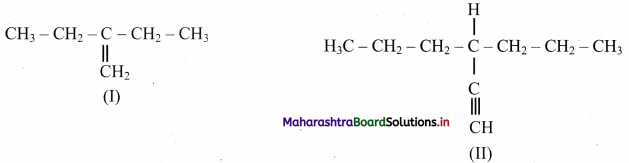
Maharashtra Board Class 11 Chemistry Important Questions Chapter 14 Basic Principles of Organic Chemistry 48
ii. Numbering of this chain must be done such that carbon-carbon multiple bond has the lowest possible locant number.

Maharashtra Board Class 11 Chemistry Important Questions Chapter 14 Basic Principles of Organic Chemistry 49
iii. The ending ‘ane’ of alkane is replaced by ‘ene’ for an alkene and ‘yne’ for an alkyne.
iv. Position of carbon atom from which multiple bond starts is indicated by smaller locant number of two multiple bonded carbons before the ending ‘ene’ or ‘yne’. e.g.

Maharashtra Board Class 11 Chemistry Important Questions Chapter 14 Basic Principles of Organic Chemistry 50
v. If the multiple bond is equidistant from both the ends of a selected chain, then carbon atoms are numbered from that end, which is nearer to first branching.

Maharashtra Board Class 11 Chemistry Important Questions Chapter 14 Basic Principles of Organic Chemistry 51
vi. If the parent chain contains two double bonds or two triple bonds, then it is named as diene or diyne. In all these cases ‘a’ of ‘ane’ (alkane) is retained.

Maharashtra Board Class 11 Chemistry Important Questions Chapter 14 Basic Principles of Organic Chemistry 52
vii. If the parent chain contains both double and triple bond, then carbon atoms are numbered from that end where multiple bond is nearer. Such systems are named by putting ‘en’ ending first followed by ‘yne’. The number indicating the location of multiple bond is placed before the name.

Maharashtra Board Class 11 Chemistry Important Questions Chapter 14 Basic Principles of Organic Chemistry 53
viii. If there is a tie between a double bond and a triple bond, the double bond gets the lower number.

Maharashtra Board Class 11 Chemistry Important Questions Chapter 14 Basic Principles of Organic Chemistry 54

Question 31.
Give IUPAC rules for naming simple monocyclic hydrocarbons.
Answer:
i. A saturated monocyclic hydrocarbon is named by attaching prefix ‘cyclo’ to the name of the corresponding open chain alkane.

Maharashtra Board Class 11 Chemistry Important Questions Chapter 14 Basic Principles of Organic Chemistry 55
ii. An unsaturated monocyclic hydrocarbon is named by substituting ‘ene’, ‘yne’, etc. for ‘ane’ in the name of corresponding cycloalkane.

Maharashtra Board Class 11 Chemistry Important Questions Chapter 14 Basic Principles of Organic Chemistry 56
iii. If side chains are present then the numbering of the ring carbon is started from a side chain.
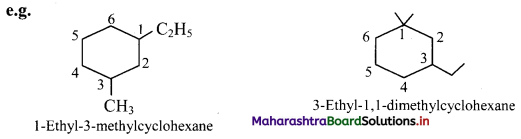
Maharashtra Board Class 11 Chemistry Important Questions Chapter 14 Basic Principles of Organic Chemistry 57
iv. If alkyl groups contain greater number of carbon atoms than the ring, the compound is named as derivative of alkane. Ring is treated as substituent.

Maharashtra Board Class 11 Chemistry Important Questions Chapter 14 Basic Principles of Organic Chemistry 58

Question 32.
Give the IUPAC names of the following compounds:
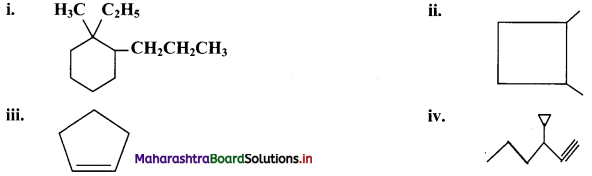
Maharashtra Board Class 11 Chemistry Important Questions Chapter 14 Basic Principles of Organic Chemistry 59
Answer:
i. 1-Ethyl-1-methyl-2-propylcyclohexane
ii. 1,2-Dimethylcyclobutane
iii. Cyclopentene
iv. 3-Cyclopropylhex-1-yne

Question 33.
Explain in short how naming of monofunctional compound is done.
Answer:
Naming of monofunctional compounds: When a molecule contains only one functional group, the longest carbon chain containing that functional group is identified as the parent chain and numbered so as to give the smallest locant number to the carbon bearing the functional group. The parent name is modified by applying appropriate suffix. Location of the functional group is indicated where necessary and when it is NOT numbered ‘1’.
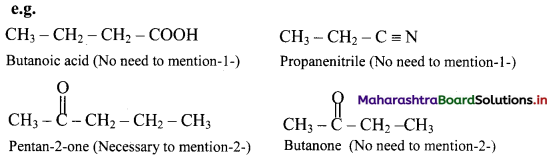
Maharashtra Board Class 11 Chemistry Important Questions Chapter 14 Basic Principles of Organic Chemistry 60
When the functional group cannot be used as suffix, and can be only the prefix, the molecule is named as parent alkane carrying the functional group as substituent at specified carbon.
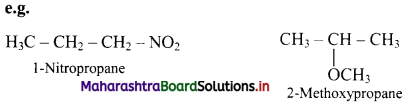
Maharashtra Board Class 11 Chemistry Important Questions Chapter 14 Basic Principles of Organic Chemistry 61

Question 34.
Complete the following.
Maharashtra Board Class 11 Chemistry Important Questions Chapter 14 Basic Principles of Organic Chemistry 62
Answer:
Maharashtra Board Class 11 Chemistry Important Questions Chapter 14 Basic Principles of Organic Chemistry 63

Question 35.
Give examples of functional groups which can appear only as prefix?
Answer:
Functional groups which can appear only as prefix are as follows:
i. Nitro group (-NO2)
ii. Halides (-X): Represented by prefix “halo” (like fluoro, chloro, bromo, iodo).
iii. Alkoxy group (-OR): Groups like methoxy (-OCH3), ethoxy (-OC2H5), etc.

Note: Functional groups appearing as prefix and suffix

Functional GroupPrefixSuffix
-COOHCarboxy– oic acid
-COORalkoxycarbonyl– oate
-COClChlorocarbonyl– oyl chloride
-CONH2Carbamoyl– amide
-CNCyano– nitrile
-CHOFormyl– al
-CO-Oxo– one
-OHHydroxy– ol
-NH2Amino– amine

Maharashtra Board Class 11 Chemistry Important Questions Chapter 14 Basic Principles of Organic Chemistry

Question 36.
Write a note on principal functional group.
Answer:
i. The organic compounds possessing two or more functional groups (same or different) in their molecules are called polyfunctional compounds.
ii. When there are two or more different functional groups, one of them is selected as the principal functional group and the others are considered as substituents.
iii. The principal functional group is used as suffix of the IUPAC name while the other substituents are written with appropriate prefixes. The principal functional group is decided on the basis of the following order of priority:
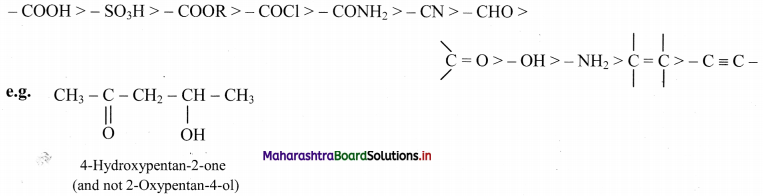
Maharashtra Board Class 11 Chemistry Important Questions Chapter 14 Basic Principles of Organic Chemistry 64

Question 37.
Explain the rules for naming mono or polyfunctional compounds.
Answer:

  • Identification of parent chain: The longest carbon chain containing the single or the principal functional group is identified as parent chain.
    e.g. Ethers are named as alkoxyalkane. While naming it, the larger alkyl group is chosen as parent chain.
  • Numbering of parent chain: It is done so as to give the lowest possible locant numbers to the carbon atom of this functional group.
  • Suffix: The name of the parent hydrocarbon is modified adequately with appropriate suffix in accordance with the single/principal functional group.
  • Names of the other functional groups (if any) are attached to this modified name as prefixes. The locant numbers of all the functional groups are indicated before the corresponding suffix/prefix.

[Note: The carbon atom in -COOR, -COCl, -CONH2, -CN and -CHO is C – 1 by rule and therefore, is not mentioned in the IUPAC name.]

Question 38.
Write IUPAC names for the following structures:
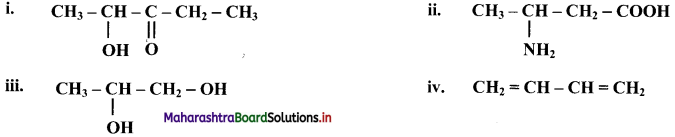
Maharashtra Board Class 11 Chemistry Important Questions Chapter 14 Basic Principles of Organic Chemistry 65
Answer:
Maharashtra Board Class 11 Chemistry Important Questions Chapter 14 Basic Principles of Organic Chemistry 66
Here, the principal functional group, ketone is located at the C-3 on the five carbon chain. The -OH group, the hydroxyl substituent is at C-2. Therefore, the IUPAC name is 2-hydroxypentan-3-one.
Maharashtra Board Class 11 Chemistry Important Questions Chapter 14 Basic Principles of Organic Chemistry 67
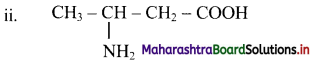
Here, the principal functional group is carboxylic acid. The amino substituent is located at C-3 on four carbon chain. Therefore, the IUPAC name 3-aminobutanoic acid.

Maharashtra Board Class 11 Chemistry Important Questions Chapter 14 Basic Principles of Organic Chemistry 68
Here, two same functional groups are present at C-1 and C-2 position. They are indicated by using the term ‘di’ before the class suffix. Therefore, the IUPAC name is propane-1,2-diol.
iv. CH2 = CH – CH = CH2
Here, the parent chain contains two double bonds at C-1 and C-3, hence it is named as diene. Therefore, the IUPAC name is buta-1,3-diene.

Question 39.
Give IUPAC rules for naming substituted benzene.
Answer:
i. Monosubstituted benzene : The IUPAC name of a monosubstituted benzene is obtained by placing the name of substituent as prefix to the parent skeleton which is benzene.

Maharashtra Board Class 11 Chemistry Important Questions Chapter 14 Basic Principles of Organic Chemistry 69

ii. Some monosubstituted benzenes have trivial names which may show no resemblance with the name of the attached substituent group. For example, methylbenzene is known as toluene, aminobenzene as aniline, hydroxybenzene as phenol and so on. The common names written in the bracket are also used universally and accepted by IUPAC.
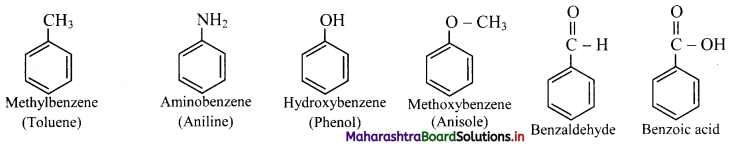
Maharashtra Board Class 11 Chemistry Important Questions Chapter 14 Basic Principles of Organic Chemistry 70

iii. If the alkyl substituent is larger than benzene ring (7 or more carbon atoms) the compound is named as phenyl-substituted alkane.

Maharashtra Board Class 11 Chemistry Important Questions Chapter 14 Basic Principles of Organic Chemistry 71

iv. Benzene ring can as well be considered as substituent when it is attached to an alkane with a functional group.
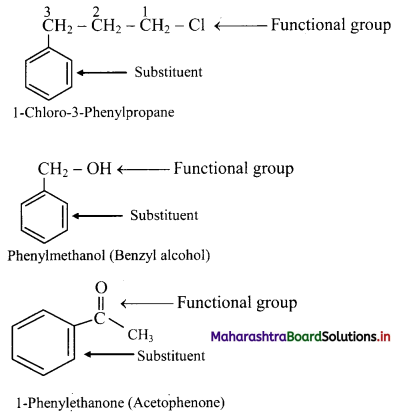
Maharashtra Board Class 11 Chemistry Important Questions Chapter 14 Basic Principles of Organic Chemistry 72

v. Disubstituted benzene derivatives:
Common names of the three possible isomers of disubstitued benzene derivatives are given using one of the prefixes ortho (o-), meta (m-) or para (p-).
IUPAC system, however, uses numbering instead of prefixes, o-, m-, or p-.
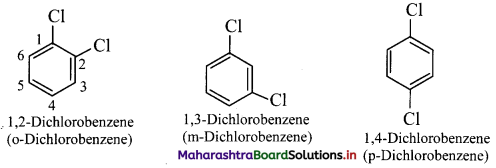
Maharashtra Board Class 11 Chemistry Important Questions Chapter 14 Basic Principles of Organic Chemistry 73

vi. If two substituents are different, then they enter in alphabetical order.
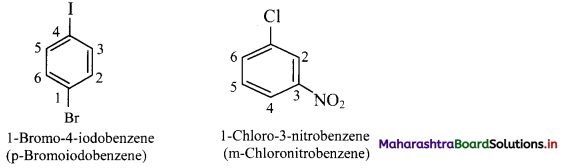
Maharashtra Board Class 11 Chemistry Important Questions Chapter 14 Basic Principles of Organic Chemistry 74

vii. If one of the two groups gives special name to the molecule then the compound is named as derivative of the special compound.
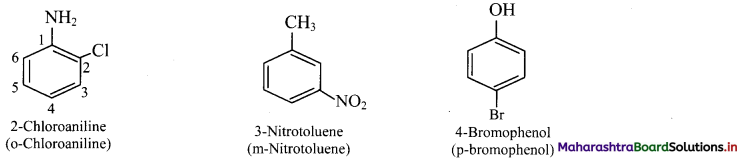
Maharashtra Board Class 11 Chemistry Important Questions Chapter 14 Basic Principles of Organic Chemistry 75

viii. Trisubstituted benzene derivatives : If more than two substituents are attached to benzene ring, numbers are used to indicate their relative positions following the alphabetical order and lowest locant rule. In some cases, common name of benzene derivatives is taken as parent compound.
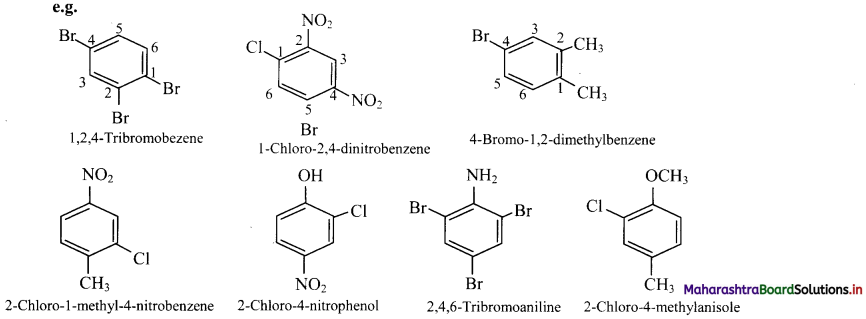
Maharashtra Board Class 11 Chemistry Important Questions Chapter 14 Basic Principles of Organic Chemistry 76

Question 40.
Write the structural formula of following derivatives of benzene.
i. 2,4,6-Trinitrotoluene
ii. 1-Chloro-2,4-dinitrobenzene
iii. 4-Broniobenzaldehyde
iv. 1-Iodo-3-phenylpentane
v. 2-Hydroxybenzaldehyde
Answer:
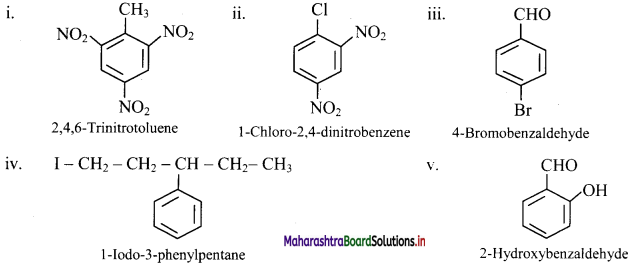
Maharashtra Board Class 11 Chemistry Important Questions Chapter 14 Basic Principles of Organic Chemistry 77

Question 41.
Write the IUPAC names of the following compounds.

Maharashtra Board Class 11 Chemistry Important Questions Chapter 14 Basic Principles of Organic Chemistry 78
Answer:
i. 5-Phenylpent-1-ene
ii. 2-Hydroxybenzoic acid

Maharashtra Board Class 11 Chemistry Important Questions Chapter 14 Basic Principles of Organic Chemistry

Question 42.
Define the terms:
i. Isomerism
ii. Isomers
Answer:
i. Isomerism: The phenomenon of existence of two or more compounds possessing the same molecular formula is known as isomerism.

ii. Isomers: Two or more compounds having the same molecular formula are called as isomers of each other. [Note: The isomers are different compounds having same molecular formula and therefore they exhibit different physical and chemical properties.]

Question 43.
Define: Structural isomerism
Answer:
Structural isomerism: When two or more compounds have same molecular formula but different structural formulae, they are said to be structural isomers of each other and the phenomenon is known as structural isomerism.

Question 44.
Define: Stereoisomerism
Answer:
When different compounds have the same structural formula but different relative arrangement of groups/atoms in space, that is, different spatial arrangement of groups/atoms, it is called as stereoisomerism.

Question 45.
Give different types of structural isomerism that organic compounds can exhibit.
Answer:
Different types of structural isomerism that organic compounds may exhibit are as follows:

  • Chain isomerism
  • Position isomerism
  • Functional group isomerism
  • Metamerism
  • Tautomerism

Question 46.
Explain chain isomerism in alkanes with two suitable examples.
Answer:
Chain isomerism: When two or more compounds have the same molecular formula but different parent chain or different carbon skeletons, it is referred to as chain isomerism and such isomers are known as chain isomers.
e.g.
i. Butane (C4H10) exists in two isomeric forms:

Maharashtra Board Class 11 Chemistry Important Questions Chapter 14 Basic Principles of Organic Chemistry 79
Here, n-butane contains longest chain of four carbon atoms whereas isobutane contains longest chain of three carbon atoms. Such isomers having different carbon skeletons are called as chain isomers.
[Note: Methylpropane has no other branched isomers, hence locant (2) can be dropped.]

ii. Pentene (C5H12) exists in three isomeric forms:
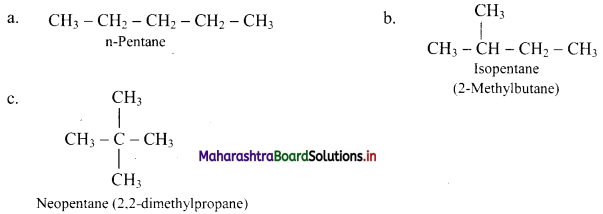
Maharashtra Board Class 11 Chemistry Important Questions Chapter 14 Basic Principles of Organic Chemistry 80
[Note: The numbers of chain isomers increase with the increase in the number of carbon atoms in the molecule.]

Maharashtra Board Class 11 Chemistry Important Questions Chapter 14 Basic Principles of Organic Chemistry

Question 47.
Write a note on position isomerism.
Answer:
i. The phenomenon in which diffèrent compounds having the same functional group at different positions on the parent chain is known as position isomerism.
ii. e.g. But-1-ene and but-2-ene are position isomers of each other as they have the same molecular formula (C4H8) and the sanie carbon skeleton hut the double bonds are located at different positions.

Maharashtra Board Class 11 Chemistry Important Questions Chapter 14 Basic Principles of Organic Chemistry 81

Question 48.
Define: Functional group isomerism
Answer:
Different compounds having the same molecular formula but different functional groups are called as futictional group isomers and the phenomenon is called as junctional group isomerism.
e.g. CH3 – O – CH3 (Dimethyl ether) and C2H5 – OH (ethyl alcohol) have same molecular formula (C2H6O) but former has ether (-O-) functional group and the latter has alcoholic (-OH) functional group.

Question 49.
Explain: Metamerism
Answer:
i. Metamerism may be defined as a type of isomerism in which different compounds have same molecular formula and the same functional group but have unequal distribution of carbon atoms on either side of the functional group. Such isomers are known as metamers.

ii. e.g. Ether with molecular formula C4H10O has three metamers. They have same functional group as ether but have different distribution of carbon atoms attached to etheral oxygen. These metamers are:

Maharashtra Board Class 11 Chemistry Important Questions Chapter 14 Basic Principles of Organic Chemistry 82

Question 50.
Explain: Tautomerism
Answer:
When same compound exists as mixture of two or more structurally distinct molecules which are in rapid equilibrium with each other, then the phenomenon is referred to as tautomerism. Such interconverting isomers are called tautomers.
i. In nearly all the cases, it is the proton which shifts from one atom to another atom in the molecule to form its tautomer.
ii. Keto-enol tautomerism is very common form of tautomerism.
iii. Here, a hydrogen atom shifts reversibly from the a-carbon of the keto form to oxygen atom of the enol. This type of isomerism is known as keto-enol tautomerism.
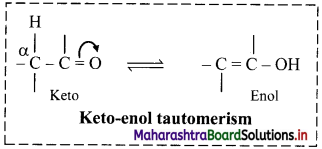
Maharashtra Board Class 11 Chemistry Important Questions Chapter 14 Basic Principles of Organic Chemistry 83

Question 51.
Explain the terms substrate, reagent and byproduct in an organic reaction.
Answer:

  • Organic molecules primarily contain various types of covalent bonds between the constituent atoms. During an organic reaction, molecules of the reactant undergo change in their structure. A covalent bond at a carbon atom in the reactant is broken and a new covalent bond is formed at it, giving rise to the product.
  • The reactant that provides carbon to the new bond is called substrate. In other words, substrate is a chemical species which reacts with reagent to give corresponding products.
  • The other reactant which brings about this change is called reagent.
  • Apart from the product of interest, some other products are also formed in an organic reaction. These are called byproducts.

e.g. In following reaction, methane is the substrate and chlorine is the reagent. The product of interest is methyl chloride and the byproduct is HCl.

Maharashtra Board Class 11 Chemistry Important Questions Chapter 14 Basic Principles of Organic Chemistry 84

Question 52.
Explain: Organic reactions are often a multi-step process.
Answer:

  • Organic molecules contain covalent bonds, which are made of valence electrons of the constituent atoms.
  • During an organic reaction, molecules of the reactant undergo change in their structure due to redistribution of valence electrons of constituent atoms.
  • This results in the bond breaking or bond forming processes as organic reaction proceeds. However, these processes are usually not instantaneous.
  • As a result of this, the overall organic reaction occurs by the formation of one or more unstable species called intermediates.

Thus, organic reactions are often a multi-step process.

Maharashtra Board Class 11 Chemistry Important Questions Chapter 14 Basic Principles of Organic Chemistry

Question 53.
What do you mean by reaction mechanism? Give importance of reaction mechanism.
Answer:
i. Mechanism of an organic reaction is the complete step by step description of exactly which bonds break and which bonds form, in what manner and in what order to give the observed products.

ii. In general, reaction mechanism is a sequential account of:

  • the electron movement taking place during each step
  • the bond cleavage and/or bond formation
  • accompanying changes in energy and shapes of various species and
  • rate of the overall reaction.

The individual steps, constitute the reaction mechanism.

iii. Importance of reaction mechanism:
The knowledge of mechanism of a reaction is useful for understanding the reactivity of the concerned organic compounds and, in turn, helpful for planning synthetic strategies.

Question 54.
What are the different ways in which a covalent bond fission can takes place?
Answer:
The covalent bond fission/cleavage takes place in two ways:

  1. Homolytic fission
  2. Heterolytic fission

Question 55.
Explain homolytic cleavage of a bond with suitable example.
Answer:
Homolytic cleavage:
i. A covalent bond consists of two electrons (i.e., a bond pair of electrons) shared between the two bonded atoms.
ii. In homolytic cleavage of a covalent bond, one of the two electrons go to one of the bonded atoms and the other is bound to the other atom.
iii. This type of cleavage gives rise to two neutral species carrying one unpaired electron each. Such a species with single unpaired electron is called as free radical.
iv. The free radicals are short lived (transitory) and unstable. Therefore, they are very reactive, having tendency to seek an electron for pairing.
v. Homolytic cleavage can be represented as follows:

Maharashtra Board Class 11 Chemistry Important Questions Chapter 14 Basic Principles of Organic Chemistry 85
where movement of a single electron is represented by a half-headed curved arrow or fish hook,
vi. Thus, the symmetrical breaking of a covalent bond between two atoms such that each atom retains one electron of the shared pair forming free radicals is known as homolytic cleavage (homolysis).

Question 56.
What conditions favour homolytic cleavage?
Answer:
Homolytic cleavage is favoured in the presence of UV radiation or in presence of catalyst such as peroxides (H2O2) or at high temperatures.

Question 57.
Write a short note on free radical.
Answer:
Free radical:
i. A species with unpaired electron is called free radical.
OR
An uncharged species which is electrically neutral and which contains a single electron is called free radical.
ii. A free radical is highly reactive, unstable and therefore has a transitory existence (short-lived).
iii. Free radicals are formed as reaction intermediate which subsequently react with another radical/molecule to restore stable bonding pair.
iv. In a carbon free radical, the carbon atom having unpaired electron is sp hybridized and has planar trigonal geometry.
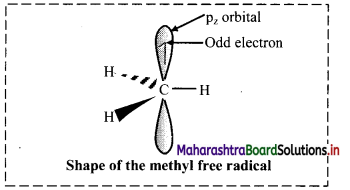
Maharashtra Board Class 11 Chemistry Important Questions Chapter 14 Basic Principles of Organic Chemistry 86
v. The alkyl free radicals are classified as primary, secondary or tertiary depending upon the number of carbon atoms attached to the C-atom carrying the unpaired electron.
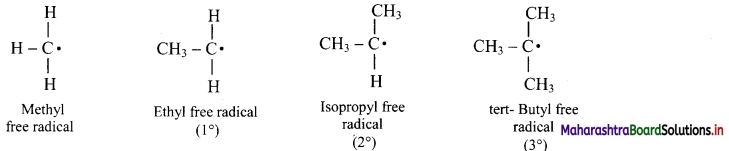
Maharashtra Board Class 11 Chemistry Important Questions Chapter 14 Basic Principles of Organic Chemistry 87
vi. Stability of alkyl free radicals decreases in the order 3° > 2° > 1° > methyl free radical.

Maharashtra Board Class 11 Chemistry Important Questions Chapter 14 Basic Principles of Organic Chemistry

Question 58.
Explain heterolytic cleavage with suitable example.
Answer:
Heterolytic cleavage:
i. In hetcrolytic cleavage of a covalent bond, both shared electrons go to one of the two bonded atoms.
ii. This type of cleavage gives rise to two charged species, one with negative charge (anion) and the other with positive charge (cation).
iii. The negatively charged species has the more electronegative atom which has taken away the shared pair of electrons with it.
iv. Heterolytic cleavage can be represented as follows:

Maharashtra Board Class 11 Chemistry Important Questions Chapter 14 Basic Principles of Organic Chemistry 88
Where B is more electronegative than A and the movement of an electron pair is represented by a curved arrow.
v. Thus, the unsymmetrical breaking of a covalent bond between two atoms in such a way that the more electronegative atom acquires both the electrons of the shared pair. thereby fòrming charged ions is known as heterolytic fission or heterolysis.

Question 59.
What is carbocation? Explain with the help of an example and comment on the stability of carbocation.
Answer:
Carbocation:
i. A carbon atom having sextet of electrons and a positive charge is called a carbocation.
ii. They are unstable and highly reactive species formed as intermediates in many organic reactions.
iii. In a carbocation, the central carbon atom is sp2 hybridized and has trigonal planar geometry.
e. g. In a methyl carbocation C If, the positively charged carbon atom is covalently bonded to three hydrogen atoms. It is planar with H-C-H bond angle of 120°.
The unhybridized pz orbital is vacant and lies perpendicular to the plane containing the three sigma C-H bonds.
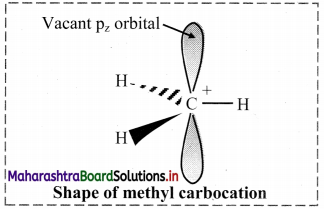
Maharashtra Board Class 11 Chemistry Important Questions Chapter 14 Basic Principles of Organic Chemistry 89
iv. Carbocation are classified as primary (1°), secondary (2°) and tertiary (3°).
v. The stability of carbocations decreases in the order:
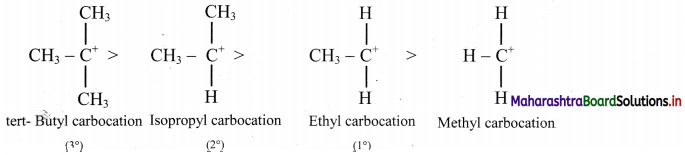
Maharashtra Board Class 11 Chemistry Important Questions Chapter 14 Basic Principles of Organic Chemistry 90

Question 60.
Write a short note on carbanion.
Answer:
Carbanion:
i. Carbanion is a species with a negatively charged carbon atom having complete octet (eight electrons) in its valence shell.
ii. It is formed due to heterolytic bond fission when carbon atom is bonded to the more electropositive atom.
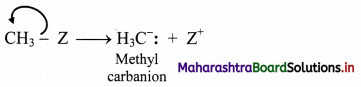
Maharashtra Board Class 11 Chemistry Important Questions Chapter 14 Basic Principles of Organic Chemistry 91
(Where Z is more electropositive than C)
iii. Carbanions are unstable and highly reactive species formed as intermediates in many organic reactions.

Question 61.
Give the types of reagents used to carry out polar organic reactions.
Answer:
The polar organic reactions are brought about by two types of reagents.
Depending upon the ability to accept or donate electrons from or to the substrate, reagents are classified as

  1. Electrophiles (E+)
  2. Nucleophiles (Nu:)

Maharashtra Board Class 11 Chemistry Important Questions Chapter 14 Basic Principles of Organic Chemistry

Question 62.
Explain the term electrophile. Give examples.
Answer:
Electrophiles:
i. The species which accept electron pairs from the substrate during the reaction are called electrophiles.
ii. The electrophiles are electron seeking (or electron loving) species because they themselves are electron deficient.
iii. e.g. a. Positively charged/cationic electrophiles:

Maharashtra Board Class 11 Chemistry Important Questions Chapter 14 Basic Principles of Organic Chemistry 92
b. Neutral species with vacant orbitals or incomplete octet of electrons in the outermost orbit: AlCl3, BF3, FeCl3, SO2, BeCl2, ZnCl2, PCl5, etc.
iv. A polyatomic electrophile has an electron deficient atom in it called the electrophilic centre.
e.g. The electrophilic centre of the electrophile AlCl3 is AlCl3 which has only 6 valence electrons.

Question 63.
Explain the term nucleophile. Give examples.
Answer:
Nucleophiles:
i. The species which donate (give away) electron pairs to the substrate during the reaction are called nucleophiles.
ii. Since, nucleophiles are electron rich species, they donate a pair of electrons to acceptor atoms and thus, they are nucleus seeking (or nucleus loving) species.
iii. e.g. a. Negatively charged nucleophiles: OH, CN, Cl, Br, etc.
b. Neutral species containing at least one lone pair of electrons:
H2O, NH3, H2S, R – OH, R – NH2, R – OR, etc.
iv. A polyatomic nucleophile has an electron rich atom in it called the nucleophilic centre.
e.g. The nucleophilic centre of the nucleophile H2O is ‘O’ which has two lone pairs of electrons.

Question 64.
Identify the nucleophile and electrophile from NH3 and \(\stackrel{+}{\mathrm{C}} \mathrm{H}_{3}\). Also indicate the nucleophilic and electrophilic centres in them. Justify.
Answer:
The structural formulae of two reagents showing all the valence electrons are:
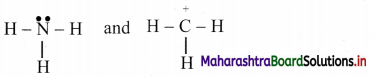
Maharashtra Board Class 11 Chemistry Important Questions Chapter 14 Basic Principles of Organic Chemistry 93
Thus, NH3 contains N with a lone pair of electrons which can be given away to another species. Therefore, NH3 is a nucleophile and ‘N’ in it is the nucleophilic centre.
The \(\stackrel{+}{\mathrm{C}} \mathrm{H}_{3}\) is a positively charged electron deficient species having a vacant orbital on the carbon. It is an electrophile and the ‘C’ in it is the electrophilic centre.

Question 65.
What is the difference between nucleophilic reaction and electrophilic reaction. Give one example.
Answer:
In nucleophilic reaction nucleophile attacks the electrophilic centre in the substrate and brings about a nucleophilic reaction whereas, in electrophilic reaction an electrophile attacks a nucleophilic centre in the substrate and brings about an electrophilic reaction.

Maharashtra Board Class 11 Chemistry Important Questions Chapter 14 Basic Principles of Organic Chemistry 94
Here, the nucleophilic centre N: in the nucleophile NH3 attacks the electrophilic centre ‘B’ in the electrophile BF3 to form the product.
[Note: Given reaction is not an organic reaction.]

Maharashtra Board Class 11 Chemistry Important Questions Chapter 14 Basic Principles of Organic Chemistry

Question 66.
How electrophilic or nucleophilic centre is generated in a neutral substrate?
Answer:

  • The displacement of valence electrons resulting in polarization of an organic molecule is called electronic effect.
  • Polarization can be either due to the presence of an atom or substituent group, or due to the influence of certain atornattacking reagent or due to the certain structural feature present in the molecule.
  • Such polarization results in the formation of electrophilic or nucleophilic centre in the neutral organic molecule.

Question 67.
Explain the difference between permanent electronic effect and temporary electronic effect.
Answer:
i. Permanent electronic effect:
The electronic effect that occurs in a substrate in the ground state is a permanent effect.
e.g. Inductive effect and resonance effect are two examples of permanent electronic effect.

ii. Temporary electronic effect:
The electronic effect that occurs in a substrate due to approach of the attacking reagent is a temporary effect. This type of electronic effect is called as electromeric effect or polarizability effect.

Question 68.
Define: Inductive effect
Answer:
Inductive effect: When an organic molecule has a polar covalent bond in its structure, polarity is induced in adjacent carbon-carbon single bonds too. This effect is called as inductive effect.

Question 69.
Describe inductive effect in detail.
Answer:
Inductive effect:
i. When an organic molecule has a polar covalent bond in its structure, polarity is induced in adjacent carbon- carbon single bonds too. This effect is called as inductive effect.

ii. For example, in chloroethane molecule, the covalent bond between ‘C’ and ‘Cl’ is a polar covalent bond whereas C-2 and C-1 bond (C-C bond) is expected to be nonpolar covalent bond. But, this bond acquires some polarity as chlorine is more electronegative than carbon. Chlorine pulls the bonding pair of electrons towards itself. Thus, the chlorine atom acquires a fractional negative charge, while the C-1 carbon atom acquires a fractional positive charge. As C-1 is further bonded to C-2, the positive polarity of C-1 pulls the shared pair of electrons of the C-2 – C-l bond more towards itself. As a result, a smaller positive charge is developed on C-2. Thus, the electron density gets displaced towards the chlorine atom not only along the [C-1 – Cl] bond, but also along the [C-2 – C-1] bond due to the inductive effect of Cl. This is represented as follows:
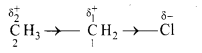
Maharashtra Board Class 11 Chemistry Important Questions Chapter 14 Basic Principles of Organic Chemistry 95

iii. The arrow head shown in the centre of the bond represents inductive effect. The direction of the arrow head indicates the direction of the permanent electron displacement along the sigma bond in the ground state.
iv. The inductive effect of an influencing group is transmitted along a chain of C-C bonds. However, this effect decreases rapidly with the increase in the number of intervening C-C single bonds and it becomes negligible beyond three C-C bonds.

Maharashtra Board Class 11 Chemistry Important Questions Chapter 14 Basic Principles of Organic Chemistry 96

v. The direction of the inductive effect of a bonded group depends upon whether electron density of the bond is withdrawn from the bonded carbon or donated by the bonded carbon. On the basis of this ability, the groups/substituents are classified as either electron withdrawing (accepting) or electron donating (releasing) groups with respect to hydrogen.
e.g. In chloroethane, Cl withdraws electron density from the carbon chain and is electron withdrawing. Therefore, chlorine is said to exert an electron withdrawing inductive effect or negative inductive effect (-I effect) on the carbon chain.

vi. a. Substituents or groups that shows -I effect: -Cl, -NO2, -CN, -COOH, -COOR, -OAr, etc.
b. Substituents or groups that shows +I effect: Alkyl groups such as -CH3, -CH2CH3, etc.

Question 70.
Consider the following molecules and answer the questions:
CH3 – CH2 – CH2 – Cl, CH3 – CH2 – CH2 – Br, CH3 – CH2 – CH2 – I.
i. What type of inductive effect is expected to operate in these molecules?
ii. Identify the molecules from these three, having the strongest and the weakest inductive effect.
Answer:
i. The groups responsible for inductive effect in these molecules are -Cl, -Br and -I, respectively. All these are halogen atoms which are more electronegative than carbon. Therefore, all of them exert -I effect, that is, electron withdrawing inductive effect.
ii. The -I effect of halogens is due to their electronegativity. A decreasing order of electronegativity in these halogens follows Cl > Br > I. Therefore, the strongest -I effect is expected in CH3 – CH2 – CH2 – Cl, while the weakest -I effect is expected for CH3 – CH2 – CH2 – I.

Maharashtra Board Class 11 Chemistry Important Questions Chapter 14 Basic Principles of Organic Chemistry

Question 71.
Which of the CH3 – CHCl2 and CH3CH2Cl is expected to have stronger -I effect?
Answer:
The group exerting -I effect is -Cl. In CH3CH2Cl, there is only one -Cl atom while in CH3 – CHCl2 there are two -Cl atoms. Therefore, CH3 – CHCl2 is expected to have strong -I effect.

Question 72.
Give an account of expected and observed values of carbon-carbon bond lengths in benzene.
Answer:

  • In cyclic structure of benzene, three alternating C – C single bonds and C=C double bonds are present.
  • Expected values of bond length of the C – C bond and C = C are 154 pm and 133 pm respectively.
  • Experimental measurements show that benzene has a regular hexagonal shape and all the six carbon-carbon bonds have the same bond length of 138 pm, which is intermediate between C – C single bond and C=C double bond.
  • This means that all the six carbon-carbon bonds in benzene are equivalent.

Note: Structure of benzene
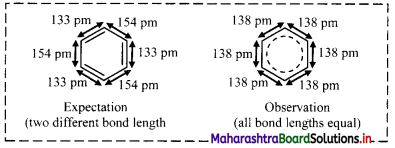
Maharashtra Board Class 11 Chemistry Important Questions Chapter 14 Basic Principles of Organic Chemistry 97

Question 73.
What do you understand by the term conjugated system of π bonds?
Answer:
When Lewis structure of a compound has two or more multiple bonds alternating with single bonds, it is called a conjugated system of π bonds.
e.g. Benzene molecule
[Note: In such a system or in species having an atom carrying p orbital attached to a multiple bond, resonance theory is applicable.]

Question 74.
Identify the species that contains a conjugated system of π bonds. Explain your answer,
i. CH2 = CH – CH2 – CH = CH2
ii. CH2 = CH – CH = CH – CH3
Answer:
i. It does not contain conjugated system of π bonds, as the two C = C double bonds are separated by two C – C single bonds.
ii. It contains a conjugated system of π bonds, as the two C = C double bonds are separated by only one C – C single bond.

Maharashtra Board Class 11 Chemistry Important Questions Chapter 14 Basic Principles of Organic Chemistry

Question 75.
Explain in detail the important points of resonance theory.
Answer:
Resonance theory:
i. The π electrons in conjugated system of π bonds are not localized to a particular π bond.
ii. For a compound having a conjugated system of π bonds (or similar other systems), two or more Lewis structures are written by showing movement of π electrons (that is, delocalization of π electrons) using curved arrows.
The Lewis structures so generated are linked by double headed arrow and are called resonance structures or contributing structures or cononical structures of the species. Thus, two resonance structures can be drawn for benzene by delocalizing or shifting the π electrons :
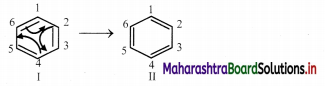
Maharashtra Board Class 11 Chemistry Important Questions Chapter 14 Basic Principles of Organic Chemistry 98
iii. The positions of the carbon atoms in the conjugated system of π bonds remain unchanged, but the positions of π electrons are different in different resonance structures.
e.g. In the resonance structure I of benzene there is a single bond between C1 and C2 while in the resonance structure II there is a double bond between C1 and C2.

iv. Any resonance structure is hypothetical and does not by itself represent any real molecule and can explain all the properties of the compound. The real molecule has, however, character of all the resonance structures those can be written. The real or actual molecule is said to be the resonance hybrid of all the resonance structures.
e.g. An actual benezene molecule is the resonance hybrid of structures I and II and exhibit character of both these structures. Its approximate representation can be shown as a dotted.circle inscribed in a regular hexagon. Thus, each carbon-carbon bond in benzene has single as well as double bond character and the ring has a regular hexagonal shape.
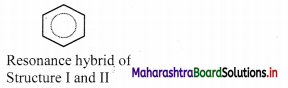
Maharashtra Board Class 11 Chemistry Important Questions Chapter 14 Basic Principles of Organic Chemistry 99
v. Hypothetical energy of an individual resonance structure can be calculated using bond energy values. The energy of actual molecule is, however, lower than that of any one of the resonance structures. In other words, resonance hybrid is more stable than any of the resonance structures. The difference in the actual energy and the lowest calculated energy of a resonance structure is called resonance stabilization energy or just resonance energy. Thus, resonance leads to stabilization of the actual molecule.

Question 76.
State the rules to be followed for writing resonating structures.
Answer:
Rules to be followed for writing resonating structures:

  1. Resonance structures can be written only when all the atoms involved in the n conjugated system lie in the same place.
  2. All the resonance structures must have the same number of unpaired electrons.
  3. Resonance structures contribute to the resonance hybrid in accordance to their energy or stability. More stable (having low energy) resonance structures contribute largely and thus are important.

Question 77.
What are the important points considered while selecting the most stable resonance structure if there are several contributing/resonance structures for a compound?
Answer:
When several resonance structures are compared, then the resonance structure is considered to be more stable if it has:

  • more number of covalent bonds,
  • more number of atoms with complete octet or duplet,
  • less separation, if any, of opposite charges,
  • negative charge, if any, on more electronegative atom and positive charge, if any, on more electropositive atom and
  • more dispersal of charge.

[Note: When all the resonance structures of a species are equivalent to each other, the species is highly resonance stabilized. For example, R – COO-, \(\mathrm{CO}_{3}^{2-}\)]

Question 78.
Write resonance structures of H – COO and comment on their relative stability.
Answer:
i. First the detailed bond structure of H – COO showing all the valence electron is drawn and then other resonance structures are generated using curved arrow to show movement of π-electrons.
ii. Two resonance structures are written for H – COO.
Maharashtra Board Class 11 Chemistry Important Questions Chapter 14 Basic Principles of Organic Chemistry 100
Both the resonance structures I and II are equivalent to each other, and therefore, are equally stable.

Question 79.
Identify the species which has resonance stabilization. Justify your answer.

Maharashtra Board Class 11 Chemistry Important Questions Chapter 14 Basic Principles of Organic Chemistry 101
Answer:
i. The bond structure shows that there is no π bond. Therefore, no resonance and no resonance stabilization.
ii.
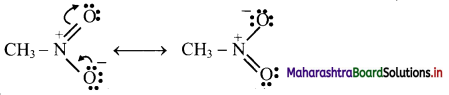
Maharashtra Board Class 11 Chemistry Important Questions Chapter 14 Basic Principles of Organic Chemistry 102
N = O double b5itd is attached to ‘O’ which carries lone pair of electrons in a p orbital.
Therefore, resonance structures can be written as shown and species is resonance stabilized.
iii.

Maharashtra Board Class 11 Chemistry Important Questions Chapter 14 Basic Principles of Organic Chemistry 103
The Lewis structure shows two C = C double bonds alternating with a C – C single bond.
Therefore, resonance structures can be written as shown and the species is resonance stabilized.

Maharashtra Board Class 11 Chemistry Important Questions Chapter 14 Basic Principles of Organic Chemistry

Question 80.
Write three resonance structures for CH3 – CH = CH – CHO. Indicate their relative stabilities and explain.
Answer:
Three resonance structures are:

Maharashtra Board Class 11 Chemistry Important Questions Chapter 14 Basic Principles of Organic Chemistry 104
Stability order: I > II > III
I: Contains more number of covalent bonds, each carbon atom and oxygen atom has complete octet, and involves no separation of opposite charges. Therefore, the most stable resonance structure.

II: Contains one covalent bond less than in I, one carbon (C+) has only 6 valence electrons, involves separation of opposite charges; the resonance structure II has -ve charge on more electronegative ‘O’ and +ve charge on more electropositive ‘C’. It has intermediate stability.

III: Contains one covalent bond less than in I, oxygen has only 6 valence electrons, involves separation of opposite charge, has -ve charge on the more electropositive ‘C’ and +ve charge on more electronegative ‘O’. All these factors are unfavourable for stability. Therefore, it is the least stable.

Question 81.
Define: Resonance effect.
Answer:
The polarity produced in the molecule by the interaction between conjugated n bonds (or that between n bond and p orbital on attached atom) is called the resonance effect or mesomeric effect.

Question 82.
Explain in short:
i. Positive resonance (+R) effect
ii. Negative resonance (-R) effect
Answer:
i. Positive resonance (+R) effect or electron donating/releasing resonance effect:
a. If the substituent group has a lone pair of electrons to donate to the attached K bond or conjugated system of π bonds, the effect is called +R effect.
b. The +R effect increases electron density at certain positions in a molecule.
e.g. +R effect in aniline increases the electron density at ortho and para positions.
c. Halogen, -OH, -OR, -O, -NH2, -NHR, -NR2, – NHCOR, -OCOR, etc. are the groups which show +R effect.

ii. Negative resonance (-R) effect:
a. If the substituent group has a tendency to withdraw electrons from the attached π bond or conjugated system of π bonds towards itself the effect is called -R effect.
b. The -R effect results in developing a positive polarity at certain positions in a molecule.
e.g. -R effect in nitrobenzene develops positive polarity at ortho and para positions.
c. -COOH, -CHO, – CO -, -CN, -NO2, -COOR, etc., are the groups which represent -R effect.

Question 83.
Draw resonance structures showing +R effect in aniline.
Answer:
The following resonance structures can be drawn for aniline:
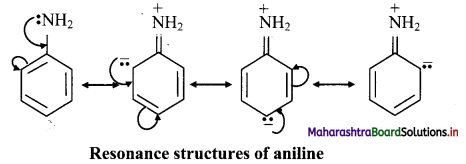
Maharashtra Board Class 11 Chemistry Important Questions Chapter 14 Basic Principles of Organic Chemistry 105

Question 84.
Draw resonance structures showing -R effect in nitrobenzene.
Answer:
The following resonance structures can be drawn for nitrobenzene:
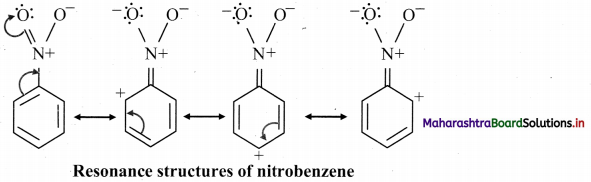
Maharashtra Board Class 11 Chemistry Important Questions Chapter 14 Basic Principles of Organic Chemistry 106

Question 85.
Write a note on electromeric effect.
Answer:
Electromeric effect:
i. This is a temporary electronic effect exhibited by multiple-bonded groups in the excited state in the presence of a reagent.
ii. When a reagent approaches a multiple bond, the electron pair gets completely shifted to one of the multiply, bonded atoms, giving a charge separated structure.
iii.

Maharashtra Board Class 11 Chemistry Important Questions Chapter 14 Basic Principles of Organic Chemistry 107
This effect is temporary and disappears when the reagent is removed from the reacting system.

Maharashtra Board Class 11 Chemistry Important Questions Chapter 14 Basic Principles of Organic Chemistry

Question 86.
Explain the term hyperconjugation in short.
Answer:
Hyperconjugation:
i. Hyperconjugation is a permanent electronic effect.
ii. It explains the stability of a carbocation, free radical or alkenes.
iii. It involves delocalization of sigma electrons of a C – H bond of an alkyl group directly attached to a carbon atom, which is part of an unsaturated system or has an empty p orbital or a p orbital with an unpaired electron.
iv. Following species are stabilized by resonance:
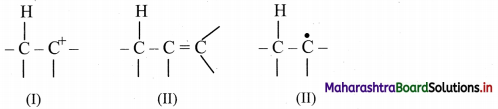
Maharashtra Board Class 11 Chemistry Important Questions Chapter 14 Basic Principles of Organic Chemistry 108

Question 87.
Explain hyperconjugation in ethyl carbocation.
Answer:
i. In ethyl cation \(\mathrm{CH}_{3} \stackrel{+}{\mathrm{CH}}_{2}\), positively charged carbon atom is attached to a methyl group.
ii. The positively charged carbon atom has six electrons; it is sp2 hybridized and has an empty p orbital available for hyperconjugation.
iii. One of the C – H bonds of the methyl group can align in plane of the empty p orbital. The sigma electrons constituting the C – H bond can be delocalized into this empty p orbital.
iv. Therefore, hyperconjugation arises due to the partial overlap of a C-H bond with the empty p orbital of an adjacent positively charged carbon atom. Thus, hyperconjugation is a σ-π conjugation.
v. Hyperconjugation structures in ethyl carbocation can be represented as:

Maharashtra Board Class 11 Chemistry Important Questions Chapter 14 Basic Principles of Organic Chemistry 109
vi. In the contributing structures, there is no covalent bond shown between the carbon and one of the α-hydrogens. Hence, hyperconjugation is also called as ‘no bond resonance’.
vii. This type of overlap stabilizes the cation, because the electron density from the adjacent a bond helps in dispersing the positive charge.
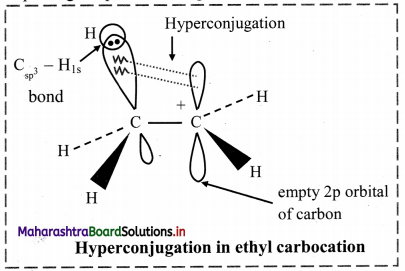
Maharashtra Board Class 11 Chemistry Important Questions Chapter 14 Basic Principles of Organic Chemistry 110

Question 88.
Explain the stability of tert-butyl cation, isopropyl cation, ethyl cation and methyl cation on the basis of hyperconjugation.
Answer:
i. Greater the number of alkyl groups attached to a positively charged carbon atom, more is the number of α-hydrogens, more is the hyperconjugation structures and more is the stability of the cation.

ii. Thus, the relative stability of the cations decreases in the order:
3° carbocation > 2° carbocation > 1° carbocation > Methyl cation

Maharashtra Board Class 11 Chemistry Important Questions Chapter 14 Basic Principles of Organic Chemistry 111

Question 89.
Explain hyperconjugation in propene.
Answer:
i. In propene, CH3 – CH = CH2, one of the sp2 hybridized carbon atom of the double bond is attached to sp3 hybridized carbon atom of methyl group.
ii. One of the C-H bonds of the methyl group can align in plane of the p orbital of sp2 hybridized C-atom and the electrons constituting the C-H bond in plane with this p orbital can then be delocalized into the p orbital.
iii. Therefore, hyperconjugation arises due to the partial overlap of a C-H bond with the p orbital of an adjacent sp2 hybridized carbon atom.
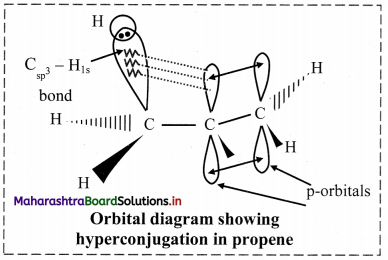
Maharashtra Board Class 11 Chemistry Important Questions Chapter 14 Basic Principles of Organic Chemistry 112
iv. Hyperconjugation (no bond resonance) structures for propene can be represented as:

Maharashtra Board Class 11 Chemistry Important Questions Chapter 14 Basic Principles of Organic Chemistry 113

Question 90.
Write the Lewis dot structures of but-1-ene and but-2-ene? Also, write the bond line formula of both the compounds.
Answer:
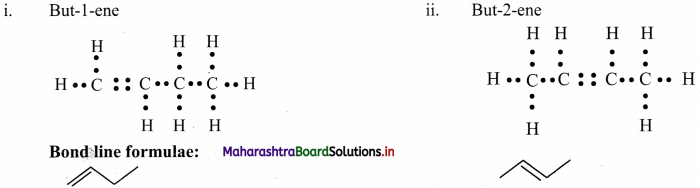
Maharashtra Board Class 11 Chemistry Important Questions Chapter 14 Basic Principles of Organic Chemistry 114

Question 91.
Due to contamination by viruses, the hospital authorities had asked Ranjan, the ward boy, to keep cleaning the hospital lobby using some antiseptic. Ranjan would wipe the floor by adding Dettol to water and would always keep the premises clean. One of the active ingredients in Dettol is chloroxylenol (4-chloro-3,5-dimethylphenol). Ranjan was also actively associated with an NGO, which was involved in Swachh Bharat campaign. Based on this passage, answer the following questions.
i. Which functional groups are present in chloroxylenol?
ii. Write the bond line and molecular formula of chloroxylenol.
iii. Identify one group each in chloroxylenol which show +I and -I effect, respectively.
Answer:
i. chloroxylenol is
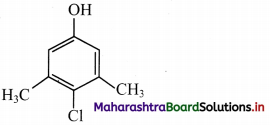
Maharashtra Board Class 11 Chemistry Important Questions Chapter 14 Basic Principles of Organic Chemistry 115
Functional groups present in chloroxylenol are chloro (-Cl) and phenolic -OH group.

ii. The bond line formula of chloroxylenol can be shown as,
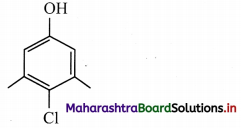
Maharashtra Board Class 11 Chemistry Important Questions Chapter 14 Basic Principles of Organic Chemistry 116
Its molecular formula is C8H9OCl or C8H8ClOH

iii. Group which shows +I effect = -CH3; group which shows -I effect = -Cl

Maharashtra Board Class 11 Chemistry Important Questions Chapter 14 Basic Principles of Organic Chemistry

Multiple Choice Questions

1. Which of the following method can be used to represent 3-D structure of organic molecules?
i. Wedge formula
ii. Fischer projection formula
iii. Newman projection formula
iv. Sawhorse formula
(A) Only ii and iii.
(B) Only i and iii.
(C) Only iii and iv.
(D) All of the above
Answer:
(D) All of the above

2. Which one is the INCORRECT statement?
(A) Open chain compounds are called aliphatic compounds.
(B) Unsaturated compounds contain multiple bonds in them.
(C) Saturated hydrocarbons are called alkenes.
(D) Aromatic compounds possess a characteristic aroma.
Answer:
(C) Saturated hydrocarbons are called alkenes.

3. Choose the INCORRECT statement from the following.
(A) Cyclohexane is an alicyclic compound.
(B) Pyridine is a heterocyclic compound.
(C) Piperidine is an aromatic compound.
(D) Tropone is a non-benzenoid compound.
Answer:
(C) Piperidine is an aromatic compound.

4. Which of the following is NOT a cyclic compound?
(A) Anthracene
(B) Pyrrole
(C) Phenol
(D) Neopentane
Answer:
(D) Neopentane

5. Which of the following is a cycloalkane?
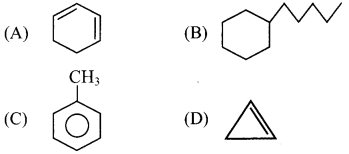
Maharashtra Board Class 11 Chemistry Important Questions Chapter 14 Basic Principles of Organic Chemistry 117
Answer:
Maharashtra Board Class 11 Chemistry Important Questions Chapter 14 Basic Principles of Organic Chemistry 118

Maharashtra Board Class 11 Chemistry Important Questions Chapter 14 Basic Principles of Organic Chemistry

6. Which one of the following could be a cyclic alkane?
(A) C5H5
(B) C3H6
(C) C4H6
(D) C2H6
Answer:
(B) C3H6

7. Which of the following is a heterocyclic compound?
(A) Naphthalene
(B) Thiophene
(C) Phenol
(D) Aniline
Answer:
(B) Thiophene

8. Which of the following is NOT aromatic?
(A) Benzene
(B) Toluene
(C) Cyclopentane
(D) Phenol
Answer:
(C) Cyclopentane

9. Cyclohexene is …………….
(A) aromatic
(B) alicyclic
(C) benzenoid
(D) aliphatic
Answer:
(B) alicyclic

10. An organic compound ‘X’ (molecular formula C6H7O2N) has six carbons in a ring system, two double bonds and also a nitro group as a substituent, ‘X’ is …………..
(A) homocyclic and aromatic
(B) homocyclic but not aromatic
(C) heterocyclic
(D) aromatic but not homocyclic
Answer:
(B) homocyclic but not aromatic

Maharashtra Board Class 11 Chemistry Important Questions Chapter 14 Basic Principles of Organic Chemistry

11. Which of the following structure represents an aldehyde?
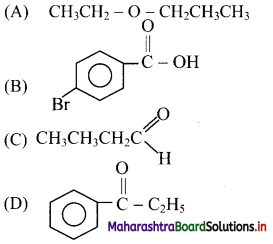
Maharashtra Board Class 11 Chemistry Important Questions Chapter 14 Basic Principles of Organic Chemistry 119
Answer:
Maharashtra Board Class 11 Chemistry Important Questions Chapter 14 Basic Principles of Organic Chemistry 120

12. A member of a homologous series differs from immediate above or below member by …………… group.
(A) – CH3
(B) – CH2
(C) – CH2CH3
(D) – C6H5
Answer:
(B) – CH2

13. Which of the following is NOT a branched chain alkyl group?
(A) Isobutyl group
(B) n-Butyl group
(C) sec-Butyl group
(D) tert-Butyl group
Answer:
(B) n-Butyl group

14. In IUPAC nomenclature, the number which indicates the position of the substituent is called ………….
(A) locant
(B) delocant
(C) prefix
(D) suffix
Answer:
(A) locant

15. The IUPAC name of the following compound is …………..
(A) 1,1 -dimethyl-2-ethylcyclohexane
(B) 2-ethyl-1,1 -dimethylcyclohexane
(C) 1 -ethyl-2,2-dimethylcyclohexane
(D) 2,2-dimethyl-1-ethylcyclohexane
Answer:
(B) 2-ethyl-1,1 -dimethylcyclohexane

Maharashtra Board Class 11 Chemistry Important Questions Chapter 14 Basic Principles of Organic Chemistry

16. Which is the CORRECT name of ………….

Maharashtra Board Class 11 Chemistry Important Questions Chapter 14 Basic Principles of Organic Chemistry 121
(A) Propyl ethanoate
(B) Ethyl propanoate
(C) Methyl butanoate
(D) Butyl methanoate
Answer:
(C) Methyl butanoate

17. Homolytic fission is NOT favourable in presence of …………..
(A) UV light
(B) catalyst like peroxide
(C) polar solvent
(D) high temperature
Answer:
(C) polar solvent

18. The total number of electrons in the carbon atom of methyl free radical is ………….
(A) six
(B) seven
(C) eight
(D) nine
Answer:
(B) seven

19. The most unstable carbocation amongst the following is ……………
(A) (CH3)3C+
(B) (CH3)2CH+
(C) CH3 – CH2+
(D) CH3+
Answer:
(D) CH3+

20. Which of the following represents a pair of electrophiles?
(A) BF3, H2O
(B) AlCl3, NH3
(C) CN, ROH
(D) BF3, AlCl3
Answer:
(D) BF3, AlCl3

Maharashtra Board Class 11 Chemistry Important Questions Chapter 14 Basic Principles of Organic Chemistry

21. This group shows +I effect.
(A) -Br
(B) -CN
(C) -COOH
(D) -CH2CH3
Answer:
(D) -CH2CH3

22. Which of the following group shows negative resonance effect?
(A) -O-
(B) -COOH
(C) -NHCOR
(D) -NH2
Answer:
(B) -COOH

23. Resonance is NOT exhibited by ………….
(A) phenol
(B) aniline
(C) nitrobenzene
(D) cyclohexane
Answer:
(D) cyclohexane

24. All bonds in benzene are equal due to ………….
(A) tautomerism
(B) metamerism
(C) resonance
(D) isomerism
Answer:
(C) resonance

Maharashtra Board Class 11 Chemistry Important Questions Chapter 13 Nuclear Chemistry and Radioactivity

Balbharti Maharashtra State Board 11th Chemistry Important Questions Chapter 13 Nuclear Chemistry and Radioactivity Important Questions and Answers.

Maharashtra State Board 11th Chemistry Important Questions Chapter 13 Nuclear Chemistry and Radioactivity

Question 1.
Explain the term nuclear chemistry. Give a few examples of nuclear reactions.
Answer:
Nuclear chemistry is a branch of physical chemistry and it deals with the study of reactions involving changes in atomic nuclei. This branch started with the discovery of natural radioactivity by physicist Antoine Henri Becquerel.

Examples of nuclear reactions are as follows:

  • Radioactive decay
  • Artificial transmutation
  • Nuclear fission
  • Nuclear fusion

Question 2.
Write a short note on similarity between the solar system and structure of atom.
Answer:
Solar system: It consists of the Sun and planets in which Sun is at the centre of solar system and planets move around it under the force of gravity.

Atomic system: It consists of tiny central core called as nucleus at the centre of atom around which electrons are present. Like in solar system, electrostatic attractions hold subatomic particles in a structure of atom. The nucleus consists of protons and neutrons.

Question 3.
Answer the following.
i. Give the symbolic representation for calcium, (no. of protons = 20, mass number = 40)
ii. Calculate the number of neutrons for calcium.
Answer:
i. \({ }_{20}^{40} \mathrm{Ca}\), in which Z = 20 and A = 40.
ii. Number of neutrons: It can be calculated from formula (A = Z + N).
For calcium, N = A – Z = 40 – 20 = 20
Nucleus of the calcium atom contains 20 neutrons.

Question 4.
Explain the term nucleons with examples.
Answer:
The term nucleon refers to the sum of protons (p) and neutrons (n) present in atom, e.g. Number of nucleons present in \({ }_{20}^{40} \mathrm{Ca}\) are 40 (i.e., 20 protons and 20 neutrons). Number of nucleons present in \({ }_{11}^{23} \mathrm{Na}\) are 23 (i.e., 11 protons and 12 neutrons).

Maharashtra Board Class 11 Chemistry Important Questions Chapter 13 Nuclear Chemistry and Radioactivity

Question 5.
Define: Nuclide
Answer:
The nucleus of a specific isotope is called as nuclide.

Question 6.
Atom as a whole is electrically neutral. Justify.
Answer:

  • The magnitude of electronic charge (e) on the nucleus is +Ze and that of outer sphere is -Ze. Number of protons and number of electrons are always equal in an atom.
  • As a result of this, the charges get nullified, therefore, the atom as a whole is electrically neutral.

Question 7.
Define:
i. Isotopes
ii. Isobars
Answer:
i. Isotopes: Nuclides which contain same number of protons but different number of neutrons in their nuclei are called as isotopes. e.g. \({ }_{11}^{22} \mathrm{Na}\), \({ }_{11}^{23} \mathrm{Na}\) and \({ }_{11}^{24} \mathrm{Na}\)
ii. Isobars: Nuclides (of different element) which have same mass number but have different number of protons and neutrons in their nuclei are called as isobars.
OR
The atoms of different elements having the same mass number but different atomic numbers are called isobars.
e.g. \({ }_{6}^{14} \mathrm{C}\) and \({ }_{7}^{14} \mathrm{N}\)

Question 8.
Define mirror nuclei and isotones.
Answer:

  • Isobars in which the number of protons and neutrons differ by 1 unit and are interchanged are called as mirror nuclei.
  • Isotones are defined as nuclides having the same number of neutrons but different number of protons and hence, different mass numbers.

Question 9.
Name the following.
i. Nuclides in which number of protons and neutrons differ by 1 and are interchanged.
ii. Nuclides having the same number of neutrons but different number of protons.
iii. Nuclides with the same mass number which differ in energy states.
Answer:
i. Mirror nuclei
ii. Isotones
iii. Nuclear isomers

Maharashtra Board Class 11 Chemistry Important Questions Chapter 13 Nuclear Chemistry and Radioactivity

Question 10.
Explain the term nuclear isomers?
Answer:

  • The nuclides with the same number of protons (Z) and neutrons (N) or the same mass number (A) which differ in energy states are called nuclear isomers.
  • In this, the isomer of higher energy is said to be in the metastable state which is represented by writing “m” after the mass number.
    e.g. Nuclear isomers of cobalt can be represented as, 60mCo and 60Co.

Question 11.
State true or false. Correct the false statement.
i. The number of nucleons in C-12 atom is 6.
ii. N-13 and C-13 are mirror nuclei.
iii. Nuclear isomers have same number of protons and neutrons.
Answer:
i. False,
The number of nucleons in C-12 atom is 12.
ii. True
iii. True

Question 12.
Give classification of nuclides on the basis of nuclear stability.
Answer:
Nuclides can be classified into stable and unstable/radioactive nuclides on the basis of nuclear stability.

  • Stable nuclides: In this type of nuclides, the number of electrons and the location of nuclei may change in outer sphere but the number of protons and neutrons remain unchanged.
  • Radioactive (unstable) nuclides: These nuclides undergo spontaneous change forming new nuclides.

Question 13.

Number of protons (Z)Number of neutrons (N)Number of such nuclides
i.EvenEven165
ii.EvenOdd55

What conclusion can be drawn from the above given data?
Answer:

  • Number of nuclides with even ‘Z’ and even ‘N’ are higher in number as compared to nuclides with even ‘Z’ and odd ‘N’
  • Nuclides with even number of ‘Z’ and odd number of ‘N’ are about 1/3rd of nuclides where both ‘Z’ and ‘N’ are even.
  • Nuclides with even number of protons (Z) and even number of neutrons (N) are most stable. These nuclides tend to fonn proton-proton and neutron-neutron pairs. This impart stability to the nucleus.

Question 14.
Write a note on naturally occurring nuclides with either odd number of protons or odd number of neutrons.
Answer:
i. The number of stable nuclides with either Z or N odd is about one third of nuclides where both are even.
ii. These nuclides are less stable than those having even number of protons and neutrons.
iii. In these nuclides one nucleon has no partner and therefore, these nuclides are less stable.
iv. Further the number of nuclides with odd A are nearly the same, irrespective of Z or N is odd. This indicates that protons and neutrons behave similarly in the respect of stability.
v. Following table gives the estimate of such nuclides occurring in nature.

Number of protons (Z)Number of neutrons (N)Number of such nuclides
i.EvenOdd55
ii.OddEven50

Maharashtra Board Class 11 Chemistry Important Questions Chapter 13 Nuclear Chemistry and Radioactivity

Question 15.
State true or false. Correct the false statements.
i. The nuclides with even Z and even N constitute 85% of earth crust.
ii. Nuclides with either ‘Z’ or ‘N’ odd are more stable than those having even number of both ‘Z’ and ‘N’
iii. The number of nuclides with odd number of ‘Z’ and odd number of ‘N’ are only four.
Answer:
i. True
ii. False
Nuclides with either ‘Z’ or ‘N’ odd are less stable than nuclides having even number of both ‘Z’ and ‘N’.
iii. True

Question 16.
Heavier nuclides require greater number of neutrons (than protons) to attain stability. Justify.
Answer:

  • The heavier nuclides with the increasing number of protons lead to large coulombic repulsions.
  • Increased number of neutrons will separate the protons within the nuclei, which will impart stability. Thus, in order to attain stability heavier nuclide need more number of neutrons.

Question 17.
Consider the graph of neutron (N) plotted against proton number (Z). How will you identify radioactive nuclides from the graph?
Answer:
Nuclides which fall outside the belt or stability zone are radioactive nuclides.

Question 18.
Write a note Magic numbers.
Answer:
Magic numbers: The nuclei with 2, 8, 20, 28, 50, 82 and 126 neutrons or protons are particularly stable and abundant in nature. These numbers are known as magic numbers.
e.g. Lead (\({ }_{82}^{208} \mathrm{~Pb}\)) has two magic numbers, 82 protons and 126 neutrons.

Question 19.
What is the order of distance between two protons present in the nucleus?
Answer:
The order of distance between two protons present in the nucleus is typically of order of 10-15 m.

Question 20.
Which factor is responsible for nuclear stability?
Answer:
Nuclear forces of attractions exist within nuclei. These are attractions between proton-proton (p-p), neutron-neutron(n-n) and proton-neutron(p-n). They constitute or give rise to nuclear potential which is responsible for nuclear stability.

Question 21.
Write short notes on: nuclear potential.
Answer:

  • Nuclear potential is the attraction between p-p, n-n and p-n.
  • These attractive forces are independent of the charge on nucleons or attraction between p-p, n-n and p-n are equal.
  • These attractive forces operate over short range within the nucleus.
  • Nuclear potential is responsible for the nuclear stability.

Maharashtra Board Class 11 Chemistry Important Questions Chapter 13 Nuclear Chemistry and Radioactivity

Question 22.
State true or false. Correct the false statement.
i. The nuclear forces of attractions are dependent on the charge on the nucleons.
ii. The actual mass of an atom is observed to be more than sum of the masses of its constituents.
Answer:
i. False
The nuclear forces of attractions are independent of the charge on the nucleons.
ii. False
The actual mass of an atom is observed to be less than sum of the masses of its constituents.

Question 23.
Define: Nuclear binding energy
Answer:
An energy equivalent to the mass lost is released during the formation of nucleus. This is called the nuclear binding energy.
OR
The energy requiredfor holding the nucleons together within the nucleus of an atom is called as the nuclear binding energy.

Question 24.
Explain the term: mass defect.
Answer:
During the formation of nucleus, certain mass is lost. This phenomenon is known as mass defect (Δm).
The exact mass of nucleus is slightly less than sum of the exact masses of the constituent nucleons. This difference is called as mass defect. It is represented by symbol Δm.
Formulae: Δm = calculated mass – observed mass

Question 25.
Explain the relation between nuclear mass and energy? Also give the energy released in the conversion of one atomic mass unit into energy.
Answer:
i. The nuclear mass is expressed in atomic mass unit (u) which is exactly 1/12th of the mass of 12C atom. Thus, u = 1/12th mass of C-12 atom = 1.66 × 10⁻² kg.
ii. The conversion of mass into energy is established through Einstein’s equation, E = mc2.
Where m is the mass of matter converted into energy (E) and velocity of light (c).
iii. The energy released in the conversion of one u mass into energy is given by:
E = mc2 = (1.66 × 10⁻²⁷kg) × (3 × 10⁸ m s-1)2

Maharashtra Board Class 11 Chemistry Important Questions Chapter 13 Nuclear Chemistry and Radioactivity

Question 26.
Derive the expression for nuclear binding energy for a nuclide.
Answer:
Expression for nuclear binding energy:
i. Consider a nuclide \({ }_{z}^{A} X\) that contains Z protons and (A – Z) neutrons. Suppose the mass of the nuclide is m. The mass of proton is mp and that of neutron is mn.

ii. Total mass = (A – Z)mn + Zmp + Zme …..(1)
Δm = [(A – Z)mn + Zmp + Zme] – m
= [(A – Z)mn + Z(mp + me] – m
= [(A – Z)mn + ZmH] – m …..(2)
Where (mp + me) = mH = mass of H atom.
Thus, (Δm) = [Zmp + (A – Z)mn] – m
Where Z = atomic number
A = mass number
(A – Z) = neutron number
mp and mn = masses of proton and neutron, respectively
m = mass of nuclide

iii. The mass defect, Δm is related to binding energy of nucleus by Einstein’s equation,
ΔE = Δm × c2
Where, ΔE = Binding energy, Δm = mass defect.
iv. Nuclear energy is measured in million electro volt (MeV).
v. The total binding energy is then given by,
B.E. = Δm (u) × 931.4
Where 1.00 u = 931.4 MeV
B.E. = 931.4 [ZmH + (A – Z)mn – m] ……(3)
Total binding energy of nucleus containing A nucleons is the B.E.
vi. The binding energy per nucleon is then given by,
\(\bar{B}\) = B.E./A

Question 27.
Calculate the mean binding energy per nucleon for the formation of \({ }_{8}^{16} \mathrm{O}\) nucleus. The mass of oxygen atom is 15.994 u. The masses of H atom and neutron are 1.0078 u and 1.0087 u, respectively.
Solution:
Given: mH = 1.0078 u
mn= 1.0087 u
m= 15.994 u
Z = 8, A= 16
To find: Mean binding energy per nucleon (\(\bar{B}\))
Formulae: i. Δm = ZmH + (A – Z)mn – m
ii. B.E. = Δm × 931.4 MeV
iii. \(\overline{\mathrm{B}}=\frac{\mathrm{B} . \mathrm{E} .}{\mathrm{A}}\)
Calculation: i. The mass defect, Δm = ZmH + (A – Z)mn – m
Δm = 8 × 1.0078 u + 8 × 1.0087 u – 15.994 u = 0.138 u
ii. Total binding energy, B.E. (MeV) = Δm (amu) × 931.4
Hence, B.E. = 0.138 × 931.4 = 128.533 MeV
iii. Binding energy per nucleon, \(\overline{\mathrm{B}}=\frac{\mathrm{B} . \mathrm{E} .}{\mathrm{A}}\)
Hence, \(\bar{B}\) = \(\frac{128.533}{16}\) = 8.033 MeV/nucleon
Ans: Binding energy per nucleon for the formation of \({ }_{8}^{16} \mathrm{O}\) nucleus = 8.033 MeV/nucleon

Question 28.
Calculate the binding energy per nucleon for the formation of \({ }_{2}^{4} \mathrm{He}\) nucleus. Mass of \({ }_{2}^{4} \mathrm{He}\) atom = 4.0026 u.
Solution:
Given: m = 4.0026 u
Z = 2, A = 4
To find: Binding energy per nucleon (\(\bar{B}\))
Formulae: i. Δm = ZmH + (A – Z)mn – m
ii. B.E. = Δm × 931.4 MeV
iii. \(\overline{\mathrm{B}}=\frac{\mathrm{B} . \mathrm{E} .}{\mathrm{A}}\)
The mass defect, Δm = [ZmH + (A – Z)mn] – m
Δm = [(2 × 1.0078) + (2 × 1.0087)] – 4.0026 = 0.0304 u
Total binding energy, B.E. (MeV) = Δm (amu) × 931.4
= 0.0304 × 931.4
= 28.315 MeV
iii. B.E. per nucleon, \(\overline{\mathrm{B}}=\frac{\mathrm{B} . \mathrm{E} .}{\mathrm{A}}\)
\(\bar{B}\) = \(\frac{28.315}{4}\) = 7.079 Mey/nucleon
Ans: Binding energy per nucleon for formation of \({ }_{2}^{4} \mathrm{He}\) nucleus = 7.079 MeV/nucleon

Question 29.
Define radioactivity and give examples of two radioactive elements.
Answer:
Radioactivity is a phenomenon in which the nuclei spontaneously emit a nuclear particle and gamma radiation transforming to a different nuclide. e.g. Uranium and radium
[Note: Radioactivity is the phenomenon related to the nucleus.]

Question 30.
What is the criteria for an element to be known as radioactive element?
Answer:

  • An element is considered to be radioactive if the nuclei of its atoms are unstable.
  • That is, when element undergoes nuclear changes (i.e., emission of nuclear particles and gamma radiation), it is said to be radioactive.

Maharashtra Board Class 11 Chemistry Important Questions Chapter 13 Nuclear Chemistry and Radioactivity

Question 31.
What are the different types of radiations emitted by radioactive element?
Answer:
The radiations emitted by radioactive elements are as follows:

  • Alpha (α) radiations
  • Beta (β) radiations
  • Gamma (γ) radiations

Question 32.
Write the unit of rate of decay.
Answer:
The rate of decay is expressed in the form of disintegrations per second (dps).

Question 33.
Derive the equation λ = \(\frac{\left(-\frac{\mathbf{d} \mathbf{N}}{\mathbf{d} \mathbf{t}}\right)}{\mathbf{N}}\) and write what does λ denotes.
Answer:
The rate of decay of a radioelement at any instant is proportional to the number of nuclei (atoms) present at that instant. It can be represented as,
\(-\frac{\mathrm{d} \mathrm{N}}{\mathrm{dt}} \propto \mathrm{N} \quad \text { or }-\frac{\mathrm{d} \mathrm{N}}{\mathrm{dt}}=\lambda \mathrm{N}\) …….(i)
Where, \(-\frac{\mathrm{d} \mathrm{N}}{\mathrm{dt}}\) = Rate of decay at any time, t
λ = Decay constant
N = Number of nuclei (atoms) present at time, t
From equation (i),
Maharashtra Board Class 11 Chemistry Important Questions Chapter 13 Nuclear Chemistry and Radioactivity 1
Decay constant (λ) is the fraction of nuclei decaying in unit time.
OR
It is the ratio of the amount of substance disintegrated per unit time to the amount of substance present at that time.

Question 34.
Derive the expression for decay constant.
Answer:
Decay constant (λ) is the fraction of nuclei decaying in unit time.
Thus,
λ = \(-\frac{d N}{d t} \times \frac{1}{N}\) …(i)
Rearranging equation (i) we get,
\(\frac{\mathrm{d} \mathrm{N}}{\mathrm{N}}\) = -λ dt
On integrating above equation, we get
∫\(\frac{\mathrm{d} \mathrm{N}}{\mathrm{N}}\) = -∫ λ dt …(ii)
On performing the integration, we get lnN = -λt + C ……(iii)
where C is the constant of integration whose value is obtained as follows:
Let N0 be the number of nuclei present at some arbitrary zero time. At time t, the number of nuclei is N. So, at t = 0, N = N0, substituting in equation (iii), we get
lnN0 = C
With this value of C, equation (iii) becomes
lnN = -λt + lnN0
or λt = lnN0 – InN = ln \(\frac{\mathrm{N}_{0}}{\mathrm{~N}}\) ……(iv)
Hence, λ = \(\frac{1}{t} \ln \frac{N_{0}}{N}\) …….(v)
Converting natural logarithm (ln) to logarithm to the base 10, equation (v) becomes
λ = \(\frac{2.303}{t} \log _{10} \frac{N_{0}}{N}\) ………(vi)
The equation (iv) can be expressed as ln \(\frac{\mathrm{N}_{0}}{\mathrm{~N}}\) = -λt. Taking antilog of both sides, we get
\(\frac{\mathrm{N}}{\mathrm{N}_{0}}=\mathrm{e}^{-\lambda \mathrm{t}} \text { or } \mathrm{N}=\mathrm{N}_{0} \mathrm{e}^{-\lambda t}\) …….(vii)
The equation (vi) and equation (vii) give the decay constant.

Maharashtra Board Class 11 Chemistry Important Questions Chapter 13 Nuclear Chemistry and Radioactivity

Question 35.
Write a note on half-life of a radioelement.
Answer:

  • Half-life of a radioelement (t1/2): It is the time needed for a given number of nuclei (atoms) of radioelement to decay exactly to half of its initial value.
  • Each radio isotope has its own half-life.
  • Half-life of a radioelement can be expressed in seconds, minutes, hours, days or years.
  • Mathematical expression for half-life of a radioelement can be given as,
    \(t_{1 / 2}=\frac{0.693}{\lambda}\)

Question 36.
Complete the following statements based on the given graph.
i. As decay progresses, the number of radioactive atoms will ……….. with time.
ii. As decay progresses, the rate of decay will …………..
iii. Rate of radioactive decay at any instant is ………… to the number of atoms of the radioactive element present at that instant.
Answer:
i. decrease
ii. decrease
iii. proportional

Question 37.
218Po decays initially at a rate of 816 dps. The rate falls to 408 dps after 24 min. Calculate the decay constant.
Solution:
Maharashtra Board Class 11 Chemistry Important Questions Chapter 13 Nuclear Chemistry and Radioactivity 2
Maharashtra Board Class 11 Chemistry Important Questions Chapter 13 Nuclear Chemistry and Radioactivity 3

Question 38.
After how many seconds will the concentration of radioactive element X will be halved, if the decay constant is 1.155 × 10⁻³ s-1?
Solution:
Maharashtra Board Class 11 Chemistry Important Questions Chapter 13 Nuclear Chemistry and Radioactivity 4
Ans: Concentration of radioactive element (X) will be halved in 600 s.

Question 39.
41Ar decays initially at a rate of 575 Bq. The rate falls to 358 dps after 75 minutes. What is the half-life of 41Ar?
Solution:
Maharashtra Board Class 11 Chemistry Important Questions Chapter 13 Nuclear Chemistry and Radioactivity 5
Maharashtra Board Class 11 Chemistry Important Questions Chapter 13 Nuclear Chemistry and Radioactivity 6
Ans: The half-life of Ar is 109.7 min.

Maharashtra Board Class 11 Chemistry Important Questions Chapter 13 Nuclear Chemistry and Radioactivity

Question 40.
The half-life of 32P is 14.26 d. What percentage of 32P sample will remain after 40 d?
Solution:
Given: t1/2 = 14.26 d,
N0 = 100,
t = 40 d
To find: Percentage of 32P sample remaining after 40 d
Maharashtra Board Class 11 Chemistry Important Questions Chapter 13 Nuclear Chemistry and Radioactivity 7
Maharashtra Board Class 11 Chemistry Important Questions Chapter 13 Nuclear Chemistry and Radioactivity 8

Question 41.
The half-life of 34Cl is 1.53 s. How long does it take for 99.9 % of sample of 34Cl to decay?
Solution:
Given: t1/2 = = 1.53 s,
N0 = 100,
N = 100 – 99.9 = 0.1,
To find: Time (t)
Maharashtra Board Class 11 Chemistry Important Questions Chapter 13 Nuclear Chemistry and Radioactivity 9

Question 42.
The half-life of 209Po is 102 y. How much of 1 mg sample of polonium decays in 62 y?
Solution:
Given: t1/2 = 102y,
t = 62 y,
N0 = 1 mg
To find: Amount of polonium that decayed in 62 y
Maharashtra Board Class 11 Chemistry Important Questions Chapter 13 Nuclear Chemistry and Radioactivity 10
Taking antilog of both sides we get,
\(\frac{\mathrm{N}_{0}}{\mathrm{~N}}\) = antilog (0.1829) = 1.524
N = \(\frac{\mathrm{N}_{0}}{1.524}=\frac{1 \mathrm{mg}}{1.524}\) = 0.656 mg
N is the amount that remains after 62 y.
Hence, the amount decayed in 62 y = 1 mg – 0.656 mg = 0.344 mg
Ans: The amount decayed in 62 y is 0.344 mg

Question 43.
What will be the approximate time taken for 90 % decay of 174Ir in terms of its half-life?
Solution:
Given: N0 = 100
N = 100 – 90 = 10
To find: Time (t)
Maharashtra Board Class 11 Chemistry Important Questions Chapter 13 Nuclear Chemistry and Radioactivity 11
Ans: Thus, the approximate time required for 90 % decay of 174Ir in terms of its half-life is 3.3t1/2.

Maharashtra Board Class 11 Chemistry Important Questions Chapter 13 Nuclear Chemistry and Radioactivity

Question 44.
A radioactive decay of element X (Z = 35) is 30 % complete in 2 hours. Calculate its half-life period.
Solution:
Given: t = 2 hrs,
N0 = 100
N= 100 – 30 = 70
To find: t1/2
Maharashtra Board Class 11 Chemistry Important Questions Chapter 13 Nuclear Chemistry and Radioactivity 12

Question 45.
What are the different modes by which radio elements decay?
Answer:
There are 3 modes by which radio elements decay: α-decay, β-decay and γ-emission.

Question 46.
What is α-decay?
Answer:
Radioactive isotope/radioelement when undergoes decay by the emission of α-particle from the nuclei then the process involved is referred to as α-decay.

Question 47.
Give equation for radium-222 when it undergoes decay by emission of an α-particle.
\({ }_{88}^{226} \mathrm{Ra} \longrightarrow{ }_{86}^{222} \mathrm{X}+{ }_{2}^{4} \mathrm{He}\)
Answer:
\({ }_{88}^{226} \mathrm{Ra} \longrightarrow{ }_{86}^{222} \mathrm{X}+{ }_{2}^{4} \mathrm{He}\)
Thus, atomic number of element ‘X’ will be 86 and atomic mass number will be 222.

Question 48.
Identify the mode of decay and state whether following equation is CORRECT or NOT. Justify.
\({ }_{92}^{238} \mathbf{U} \longrightarrow{ }_{90}^{234} \mathrm{Th}+{ }_{2}^{4} \mathbf{H e}\)
Ans:
i. It involves α-decay process.
ii. As uranium undergoes decay by emission of an α-particle (i.e., \({ }_{2}^{4} \mathrm{He}\)), daughter nuclei (in this case thorium) ‘will observe the decrease in atomic number by 2 units and decrease in atomic mass number by 4 units.
Hence, the given equation is correct.

Maharashtra Board Class 11 Chemistry Important Questions Chapter 13 Nuclear Chemistry and Radioactivity

Question 49.
If radioactive element ‘X’ undergoes α-emission then what will be the position of daughter nuclei in the periodic table with respect to element ‘X’.
Answer:
If radioactive element ‘X’ undergoes α-emission, then corresponding daughter nuclei formed will occupy two places to the left of the periodic table with respect to element ‘X’.

Question 50.
What is β – decay? Also explain the changes that occur in the parent nuclei due to β-emission with one example.
Answer:
β – decay: The emission of negatively charged stream of β particles from the nucleus is called β – decay.
i. β – Particles are electrons with a charge and mass of an electron, mass being negligible as compared to the nuclei.
ii. When a nucleus decays by emitting a high-speed electron called a beta particle (β), a new nucleus is formed with the same mass number as the original nucleus and with an atomic number that is one unit greater than the parent nuclei.
General equation:
Maharashtra Board Class 11 Chemistry Important Questions Chapter 13 Nuclear Chemistry and Radioactivity 13
Note: The mass number A does not change, the atomic number changes when a nuclei undergoes β-decay. e.g. Neptunium-238 decays to form plutonium-238:
Maharashtra Board Class 11 Chemistry Important Questions Chapter 13 Nuclear Chemistry and Radioactivity 14

Question 51.
Mention the atomic number and atomic mass number of the parent radioelement ‘X’ in the following case if parent nuclei undergo β-emission.
i. \(\mathrm{X} \longrightarrow{ }_{94}^{238} \mathrm{Pu}\)
ii. \(\mathrm{X} \longrightarrow{ }_{95}^{241} \mathrm{Am}\)
Answer:
Maharashtra Board Class 11 Chemistry Important Questions Chapter 13 Nuclear Chemistry and Radioactivity 15

Question 52.
How many α and β-particles are emitted in the following?
\({ }_{93}^{237} \mathrm{~Np} \longrightarrow{ }_{83}^{209} \mathrm{Bi}\)
Answer:
The emission of one α-particle decreases the mass number by 4 whereas the emission of β particles has no effect on mass number.
Net decrease in mass number = 237 – 209 = 28. This decrease is only due to α- particles. Hence, number of α- particles emitted = \(\frac {28}{4}\) = 7
Now, the emission of one α-particle decreases the atomic number by 2 and one β-particle emission increases it by 1.
The net decrease in atomic number = 93 – 83 = 10
The emission of 7 α-particles causes decrease in atomic number by 14. However, the actual decrease is only 10. It means atomic number increases by 4. This increase is due to emission of 4 β-particles.
Thus, 7 α and 4 β- particles are emitted.

Maharashtra Board Class 11 Chemistry Important Questions Chapter 13 Nuclear Chemistry and Radioactivity

Question 53.
Explain the process of γ-decay in detail with a suitable example.
Answer:
γ-decay:
i. γ-Radiation is always accompanied with α and β decay processes.
ii. During γ-radiation, the daughter nucleus is left in energetically excited state which decays to the ground state of product with emission of γ-rays.
For example, \({ }_{92}^{238} \mathrm{U} \longrightarrow{ }_{90}^{234} \mathrm{Th}+{ }_{2}^{4} \mathrm{He}+\gamma\)
iii. \({ }_{92}^{238} \mathrm{U}\) emits α-particles of two different energies, 4.147 MeV (23%) and 4.195 MeV (77%).
iv. When α-particles of energy 4.147 MeV are emitted, 234Th is left in an excited state which de-excites to the ground state with emission of γ-ray photons with energy 0.0048 MeV.

Question 54.
Half-life of 209Po is 102 y. How many α-particles are emitted in 1 s from 2 mg sample of Po?
Solution:
Given: t1/2 = 102 y,
t = 1 s,
Amount of sample = 2 mg
To find: Number of α-particles emitted
Maharashtra Board Class 11 Chemistry Important Questions Chapter 13 Nuclear Chemistry and Radioactivity 16

Question 55.
Nuclear transmutation is a spontaneous or non-spontaneous process?
Answer:
Nuclear transmutation is a non-spontaneous (man-made) process.

Question 56.
What is nuclear transmutation?
Answer:
Nuclear transmutation:

  • It is the process of transformation of a stable nucleus into another nucleus which can be stable or unstable.
  • It can occur by the radioactive decay of a nucleus or the reaction of a nucleus with another particle.

Question 57.
Differentiate between chemical reactions and nuclear reactions.
Answer:
Chemical reactions:

  • Rearrangement of atoms by breaking and forming of chemical bonds.
  • Different isotopes of an element have same behaviour.
  • Only outer shell electrons take part in the chemical reaction.
  • The chemical reaction is accompanied by relatively small amounts of energy.
    e.g. chemical combustion of 1.0 g methane releases only 56 kJ energy.
  • The rates of reaction are influenced by the temperature, pressure, concentration and catalyst.

Nuclear reactions:

  • Elements or isotopes of one element are converted into another element in a nuclear reaction.
  • Isotopes of an element behave differently.
  • In addition to electrons, protons, neutrons, other elementary particles may be involved.
  • The nuclear reaction is accompanied by a large amount of energy change, e.g. The nuclear transformation of 1 g of Uranium – 235 release 8.2 × 10⁷ kJ
  • The rate of nuclear reactions is unaffected by temperature, pressure and catalyst.

Question 58.
What will happen when a nucleus of J’B is bombarded with α-particle? Identify the process involved.
Answer:
i. When a stable nucleus of \({ }_{5}^{10} \mathrm{~B}\) is is bombarded with α-particle, it transforms into \({ }_{7}^{13} \mathrm{~N}\), which is radioactive and spontaneously emits positrons to produces \({ }_{6}^{13} \mathrm{C}\).
This can be represented as,
Maharashtra Board Class 11 Chemistry Important Questions Chapter 13 Nuclear Chemistry and Radioactivity 17
ii. The process involved is known as induced radioactivity or artificial radioactivity.

Maharashtra Board Class 11 Chemistry Important Questions Chapter 13 Nuclear Chemistry and Radioactivity

Question 59.
Define: Nuclear fission
Answer:
Nuclear fission is defined as a process which involves splitting of the heavy nucleus of an atom into two nearly equal fragments accompanied by release of the large amount of energy.

Question 60.
Nuclear fission of 235U is a chain process. Justify.
Answer:

  • Nuclear fission of 235U occurs when nucleus absorbs neutron. When a uranium nucleus absorbs neutron, it breaks into two lighter fragments and releases energy (heat), more neutrons, and other radiation.
  • When one uranium 235 nucleus undergoes fission, three neutrons are emitted.
  • These neutrons emitted in fission cause more fission of the uranium nuclei which yield more neutrons. These neutrons again bring forth fission producing further neutrons.
  • The process continues indefinitely leading to chain reaction which continues even after the removal of bombarding neutrons.

Question 61.
Explain the term: Nuclear fusion and give one example.
Answer:
Nuclear fusion: In this process, the lighter nuclei combine (fuse) together and form a heavy nucleus which is accompanied by an enormous amount of energy.
e. g. The energy received by earth from the sun is due to the nuclear fusion reactions.

Question 62.
Which will produce more energy: Nuclear fission or fusion?
Answer:
Nuclear fusion will produce relatively more energy per given mass of fuel.

Question 63.
What is the range of temperature required to carry out nuclear fusion reaction?
Answer:
Nuclear fusion reaction requires extremely high temperature typically of the order of 108 K.

Question 64.
Distinguish between nuclear fission and nuclear fusion.
Answer:
Nuclear fission:

  • It is the process in which a heavy nucleus splits up into two lighter nuclei of nearly equal masses.
  • About 200 MeV of energy is available per fission in case of \({ }_{92}^{235} \mathrm{U}\).
  • The products of nuclear fission are, in general, radioactive.

Nuclear fusion:

  • It is the process in which two lighter nuclei combine together to form a heavy nucleus.
  • Energy available per fusion is much less but the energy per unit mass of material is much greater than that for fission of heavy nuclei.
  • The products of fusion are, in general, non-radioactive.

Maharashtra Board Class 11 Chemistry Important Questions Chapter 13 Nuclear Chemistry and Radioactivity

Question 65.
Estimate the energy released in the fusion reaction.
\({ }_{1}^{2} \mathbf{H}+{ }_{2}^{3} \mathbf{H e} \longrightarrow{ }_{2}^{4} \mathbf{H e}+{ }_{1}^{1} \mathbf{H}\)
(Given atomic masses: 2H = 2.0141 u. 3He = 3.0160 u, 4He = 4.0026 u, 1H = 1.0078 u)
Answer:
Maharashtra Board Class 11 Chemistry Important Questions Chapter 13 Nuclear Chemistry and Radioactivity 18

Question 66.
Explain the term: Radiocarbon dating in detail.
Answer:
Radiocarbon dating: The technique is used to find the age of historic and archaeological organic samples such as old wood samples and animal or human fossils.
Radioisotope used for carbon dating is 14C.
i. Radioactive 14C is formed in the upper atmosphere by bombardment of neutrons from cosmic ray on 14N.
\({ }_{7}^{14} \mathrm{~N}+{ }_{0}^{1} \mathrm{n} \longrightarrow{ }_{6}^{14} \mathrm{C}+{ }_{1}^{1} \mathrm{H}\)
ii. 14C combines with atmospheric oxygen to form 14CO2 which mixes with ordinary 12CO2.
iii. This carbon dioxide is absorbed by plants during photosynthesis.
iv. Animals eat plants which have absorbed a carbon dioxide (14CO2 + 12CO2). Hence, 14C becomes a part of plant and animal bodies.
v. As long as the plant is alive, the ratio 14C/12C remains constant.
vi. When the plant dies, photosynthesis will not occur and the ratio 14C/12C decreases with the decay of radioactive 14C which has a half-life 5730 years.
vii. The decay process of 14C is given below:
\({ }_{6}^{14} \mathrm{C} \longrightarrow{ }_{7}^{14} \mathrm{~N}+{ }_{-1}^{0} \mathrm{e}\)
viii. The activity (N) of given wood sample and that of fresh sample of live plant (N0) is measured, where, N0 denotes the activity of the given sample at the time of death.
ix. The age of the given wood sample, can be determined by applying following Formulae:
Maharashtra Board Class 11 Chemistry Important Questions Chapter 13 Nuclear Chemistry and Radioactivity 19

Question 67.
What is nuclear power?
Answer:
Nuclear power is the electricity generated from the fission of uranium and plutonium.

Question 68.
Nuclear power is a clean source of energy. Justify.
Answer:
Nuclear power offers huge environmental benefits in producing electricity because,

  • it releases zero carbon dioxide.
  • it releases zero sulphur and nitrogen oxides.
  • these are atmospheric pollutants which pollute the air.

Thus, nuclear power is a clean source of energy.

Question 69.
How much energy will be produced by fission of 1 gram of 235U?
Answer:
Fission of 1 gram of uranium-235 produces about 24,000 kW/h of energy.

Maharashtra Board Class 11 Chemistry Important Questions Chapter 13 Nuclear Chemistry and Radioactivity

Question 70.
Nuclear fission is an alternative energy source. Explain.
Answer:

  • Fission of 1 gram of uranium-235 produces about 24,000 kW/h of energy.
  • This is the same amount of energy produced by burning 3 tons of coal or 12 barrels of oil, or nearly 5000 m3 of natural gas.
  • The sources like coal, oil, natural gas are depleting very fast.
  • Also, the costs of petrol and other products from petroleum industry is increasing.
  • Thus, we need to depend on the nuclear fission as an alternative source of energy for electricity.

Question 71.
Label the follow ing diagram of simplified nuclear reactor.
Maharashtra Board Class 11 Chemistry Important Questions Chapter 13 Nuclear Chemistry and Radioactivity 20
Answer:
Maharashtra Board Class 11 Chemistry Important Questions Chapter 13 Nuclear Chemistry and Radioactivity 21

Question 72.
Explain in brief: Nuclear reactor
Answer:
Nuclear reactor: Nuclear reactor is a device for using atomic energy in controlled manner for peaceful purposes. During nuclear fission energy is released. The released energy can be utilized to generate electricity in a nuclear reactor.

Working of a nuclear reactor:

  • In a nuclear reactor, U235 or U239, a fissionable material is stacked with heavy water (D2O deuterium oxide) or graphite called moderator.
  • The neutrons produced in the fission pass through the moderator and lose a part of their energy. The slow neutrons produced during the process are captured which initiate new fission.
  • Cadmium rods are inserted in the moderator as they have ability to absorb neutrons. This controls the rate of chain reaction.
  • The energy released during the reaction appears as heat and removed by circulating a liquid (coolant). The coolant which has absorbed excess of heat from the reactor is passed over a heat exchanger for producing steam.
  • Steam is then passed through the turbines to produce electricity. Thus, the atomic energy produced with the use of fission reaction can be controlled in the nuclear reactor.
  • This process can be explored for peaceful purpose such as conversion of atomic energy into electrical energy which can be used for civilian purposes, ships, submarines, etc.

Note: Schematic diagram of nuclear power plant:
Maharashtra Board Class 11 Chemistry Important Questions Chapter 13 Nuclear Chemistry and Radioactivity 22

Question 73.
Why cadmium rods are used in nuclear reactor?
Answer:
Cadmium rods are inserted in the moderator as they have ability to absorb neutrons which help to control the rate of chain reaction.

Question 74.
Why short-lived isotopes are used for diagnostic purposes?
Answer:
For diagnostic purpose, short-lived isotopes are used in order to limit the exposure time to radiation. Note: Diagnostic Radioisotopes are listed below:
Maharashtra Board Class 11 Chemistry Important Questions Chapter 13 Nuclear Chemistry and Radioactivity 23

Question 75.
Give one application of therapeutic radioisotopes.
Answer:
Therapeutic radioisotopes are used to destroy abnormal cell growth in the body, e.g. cancerous cells.
Note: Therapeutic Radioisotopes are listed below:
Maharashtra Board Class 11 Chemistry Important Questions Chapter 13 Nuclear Chemistry and Radioactivity 24

Maharashtra Board Class 11 Chemistry Important Questions Chapter 13 Nuclear Chemistry and Radioactivity

Question 76.
Give example of isotopes used in following.
i. Isotope used in the treatment of leukaemia.
ii. Isotopes used in the preservation of agricultural products by irradiation.
Answer:
i. Isotope of phosphorus, \({ }_{15}^{35} \mathrm{P}\).
ii. 60Co or 137Cs

Question 77.
At which places has BARC Mumbai set up irradiation plants for preservation of agricultural produce?
Answer:
Bhabha Atomic Research Centre (BARC) Mumbai has set up irradiation plants for preservation of agricultural produce such as mangoes, onion and potatoes at Vashi (Navi Mumbai) and Lasalgaon (Nashik).

Question 78.
Why radiotracer technique is used in chemistry?
Answer:
Radiotracer technique is used to trace the path/mechanism followed by a reaction in the system.

Question 79.
The half-life for radioactive decay of an element X is 140 days. Complete the following flow chart showing decay of 1 g of X.
Maharashtra Board Class 11 Chemistry Important Questions Chapter 13 Nuclear Chemistry and Radioactivity 25
Answer:
Maharashtra Board Class 11 Chemistry Important Questions Chapter 13 Nuclear Chemistry and Radioactivity 26
Shortcut method:
Amount of the element X left after n half-lives is given as [X] = \(\frac{[\mathrm{X}]_{0}}{2^{n}}\)
e.g. \(\frac{1}{2^{4}} \mathrm{~g}=\frac{1}{16} \mathrm{~g}\)

Question 80.
A sample of 35S complete its 10% decay in 20 min, then calculate the time required to complete decay by 19%.
Answer:
When decay is 10 % complete, if N0 = 100 , then N = 100 – 10 = 90 and t = 20 minutes
When decay is 19 % complete, N = 100 – 19 = 81
Substituting these values in formula we get,
Maharashtra Board Class 11 Chemistry Important Questions Chapter 13 Nuclear Chemistry and Radioactivity 27

Multiple Choice Questions

1. Radius of the nucleus is related to the mass number A by ………….
(A) R = R0A1/2
(B) R = R0A
(C) R = R0A2
(D) R = R0A1/3
Answer:
(D) R = R0A1/3

2. Which of the following nuclides has the magic number of both protons and neutrons?
(A) \({ }_{50}^{115} \mathrm{Sn}\)
(B) \({ }_{81}^{206} \mathrm{Pb}\)
(C) \({ }_{82}^{208} \mathrm{Pb}\)
(D) \({ }_{50}^{118} \mathrm{Pb}\)
Answer:
(C) \({ }_{82}^{208} \mathrm{Pb}\)

Maharashtra Board Class 11 Chemistry Important Questions Chapter 13 Nuclear Chemistry and Radioactivity

3. The probability of decay of a radioactive element depends on …………..
i. the age of nucleus
ii. the presence of catalyst
iii. pressure
iv. temperature
(A) only i. and iv
(B) all of these
(C) only ii. And iii.
(D) none of these
Answer:
(D) none of these

4. The decay constant for 67Ga is 7.0 × 10⁻⁴ s-1. If initial concentration of is 0.07 g, what is the half-life of 67Ga?
(A) 990 s
(B) 79.2 s
(C) 12375 s
(D) 10.10 × 10⁻⁴ s
Answer:
(A) 990 s

5. The half-life of radioactive element X having decay constant of 1.7 × 10⁻⁵ s-1 is …………
(A) 21.5 h
(B) 19.7 h
(C) 11.3 h
(D) 2.8 h
Answer:
(C) 11.3 h

6. A radioactive decay of element X (Z = 90) is 30 % complete in 30 minutes. It has a half-life period of ……………
(A) 24.3 min
(B) 58.3 min
(C) 102.3 min
(D) 120.3 min
Answer:
(B) 58.3 min

Maharashtra Board Class 11 Chemistry Important Questions Chapter 13 Nuclear Chemistry and Radioactivity

7. The half-life of radium is 1600 years. The fraction of a sample of radium that would remain after 6400 year is ……….
(A) \(\frac {1}{2}\)
(B) \(\frac {1}{4}\)
(C) \(\frac {1}{8}\)
(D) \(\frac {1}{16}\)
Answer:
(D) \(\frac {1}{16}\)

8. The half-life of an element is 5 d. How much time is required for the decay of 7/8th of the sample?
(A) 5 d
(B) 10 d
(C) 15 d
(D) 35/8 d
Answer:
(C) 15 d

9. The composition of an α-particle can be expressed as ……………….
(A) 1p + 1n
(B) 1p + 2n
(C) 2p + 1n
(D) 2p + 2n
Answer:
(D) 2p + 2n

10. If a radioactive nuclide of group 15 element undergoes β-particle emission, the daughter element will be found in ………………..
(A) 16 group
(B) 14 group
(C) 13 group
(D) same group
Answer:
(A) 16 group

Maharashtra Board Class 11 Chemistry Important Questions Chapter 12 Chemical Equilibrium

Balbharti Maharashtra State Board 11th Chemistry Important Questions Chapter 12 Chemical Equilibrium Important Questions and Answers.

Maharashtra State Board 11th Chemistry Important Questions Chapter 12 Chemical Equilibrium

Question 1.
Explain irreversible reaction.
Answer:
Irreversible reaction:
i. Reactions which occur only in one direction, namely, from reactant to products are called irreversible reactions.
ii. They proceed in only a single direction until one of the reactants is exhausted.
iii. The direction in which an irreversible reaction occurs is indicated by an arrow (→) pointing towards the products in the chemical equation.
e.g. a. \(\mathrm{C}_{(\mathrm{s})}+\mathrm{O}_{2(\mathrm{~g})} \stackrel{\text { Burn }}{\longrightarrow} \mathrm{CO}_{2(\mathrm{~g})}\)
b. \(2 \mathrm{KClO}_{3(\mathrm{~s})} \stackrel{\Delta}{\longrightarrow} 2 \mathrm{KCl}_{(\mathrm{s})}+3 \mathrm{O}_{2(\mathrm{~g})}\)

Question 2.
What is a closed system?
Answer:
A system in which there is no exchange of matter with the surroundings is called a closed system.

Question 3.
What is an open system?
Answer:
A system in which exchange of both matter and heat occurs with the surroundings is called an open system.

Question 4.
Why was calcium oxide used in theatre lighting?
Answer:
Calcium oxide (CaO) on strong heating glows with a bright white light. Hence, CaO was used in theatre lighting, which gave rise to the phrase ‘in the limelight’.

Maharashtra Board Class 11 Chemistry Important Questions Chapter 12 Chemical Equilibrium

Question 5.
Explain liquid-vapour equilibrium with an example.
Answer:
Liquid-vapour equilibrium:
i. Consider reversible physical process of evaporation of liquid water into water vapour in a closed vessel. Initially, there is practically no water vapour in the vessel.

ii. When the liquid evaporates in the closed container, the liquid molecules escape from the liquid surface into vapour phase building up vapour pressure. They also condense back into liquid state because the container is closed.

iii. In the beginning the rate of evaporation is high and the rate of condensation is low. But with time, as more and more vapour is formed, the rate of evaporation goes down and the rate of condensation increases. Eventually the two rates become equal. This gives rise to a constant vapour pressure. This state is known as an ‘equilibrium state’.
In this state, the rate of evaporation is equal to the rate of condensation.
It may be represented as: H2O(l) ⇌ H2O(Vapour)

iv. At equilibrium, the pressure exerted by the gaseous water molecules at a given temperature remains constant, known as the equilibrium vapour pressure of water (or saturated vapour pressure of water or aqueous tension). The saturated vapour pressure increases with increase of temperature.
Maharashtra Board Class 11 Chemistry Important Questions Chapter 12 Chemical Equilibrium 1
[Note: The saturated vapour pressure of water at 100 °C is 1 atm (1.013 bar). Hence, water boils at 100 °C when pressure is 1 atm.]

Question 6.
What is meant by the term ‘normal boiling point’ of a liquid?
Answer:
For any pure liquid at 1 atm pressure, the temperature at which its saturated vapour pressure equals to atmospheric pressure is called the normal boiling point of that liquid.
e.g. The boiling point of ethyl alcohol is 78 °C i.e., the saturated vapour pressure of ethyl alcohol at 78 °C is 1 atm (1.013 bar).

Question 7.
Give an example of solid-liquid equilibrium.
Answer:
A mixture of ice and water in a perfectly insulated thermos flask at 273 K is an example of solid-liquid equilibrium.
H2O(s) ⇌ H2O(l)

Question 8.
Identify the type of equilibrium in the following physical processes:
i. Camphor(s) ⇌ Camphor(g)
ii. Ammonium chloride(s) ⇌ Ammonium chloride(g)
iii. Carbon dioxide gas ⇌ Dry ice
iv. Water ⇌ Ice
Answer:
i. Solid – vapour equilibrium
ii. Solid – vapour equilibrium Solid
iii. Solid – vapour equilibrium
iv. Solid – liquid equilibrium

Maharashtra Board Class 11 Chemistry Important Questions Chapter 12 Chemical Equilibrium

Question 9.
Name two substances that undergoes sublimation.
Answer:
Camphor, ammonium chloride.

Question 10.
Write a short note on chemical equilibrium.
Answer:
Chemical equilibrium:

  • If a reaction takes place in a closed system so that the products and reactants cannot escape, we often find that reaction does not give a 100% yield of products. Instead some reactants remain after the concentrations stop changing.
  • When there is no further change in concentration of reactant and product, the chemical reaction has attained equilibrium, with the rates of forward and reverse reactions being equal.
  • Chemical equilibrium at a given temperature is characterized by constancy of measurable properties such as pressure, concentration, density, etc.
  • Chemical equilibrium can be approached from either side of the chemical reaction.

Question 11.
Explain the law of mass action and give its mathematical representation.
Answer:
Statement: The law of mass action states that the rate of a chemical reaction at each instant is proportional to the product of concentrations of all the reactants.
Explanation: A rate equation can be written for a reaction by applying the law of mass action as follows: Consider a reaction, A + B → C
Here A and B are the reactants and C is the product. The concentrations of chemical species are expressed in mol L-1 and denoted by putting the formula in square brackets. On applying the law of mass action to this
reaction, a proportionality expression can be written as: Rate ∝ [A] [B]
This proportionality expression is transformed into an equation by introducing a proportionality constant, k, as follows:
Rate = k [A] [B]
This equation is called the rate equation and the proportionality constant, k, is called the rate constant of the reaction.

Question 12.
Write the rate equation for the following reactions:
i. C + O2 → CO2
ii. 2KClO3 → 2KCl + 3O2
Answer:
The rate equation is written by applying the law of mass action.
i. The reactants are C and O2
Rate ∝ [C] [O2]
∴ Rate = k [C] [O2]
ii. The reactant is KClO3 and its 2 molecules appear in the balanced equation.
∴ Rate ∝ [KClO3]2
∴ Rate = k [KClO3]2

Maharashtra Board Class 11 Chemistry Important Questions Chapter 12 Chemical Equilibrium

Question 13.
Derive the expression of equilibrium constant, KC for the reaction:
A + B ⇌ C + D
Answer:
Consider a hypothetical reversible reaction A + B ⇌ C + D.
Two reactions, namely, forward and reverse reactions occur simultaneously in a reversible chemical reaction. The rate equations for the forward and reverse reactions are:
Rateforward ∝ [A][B]
∴ Rateforward = kf [A] [B] …… (1)
∴ Ratereverse ∝ [C] [D]
∴ Ratereverse = kr [C] [D] …. (2)
At equilibrium, the rates of forward and reverse reactions are equal. Thus,
Rateforward = Ratereverse
∴ kf [A] [B] = kr [C] [D]
∴ \(\frac{\mathrm{k}_{\mathrm{f}}}{\mathrm{k}_{\mathrm{r}}}=\mathrm{K}_{\mathrm{C}}=\frac{[\mathrm{C}][\mathrm{D}]}{[\mathrm{A}][\mathrm{B}]}\) …….. (3)
KC is called the equilibrium constant.

Question 14.
Show that the equilibrium constant of the reverse chemical reaction (KC) is the reciprocal of the equilibrium constant (KC).
Answer:
Consider a reversible chemical reaction:
aA + bB ⇌ cC + dD
The equilibrium constant, KC = \(\frac{[C]^{c}[D]^{d}}{[A]^{a}[B]^{b}}\)
Consider the reverse reaction:
cC + dD ⇌ aA + bB.
The equilibrium constant, KC is:
KC = \(\frac{[\mathrm{A}]^{a}[\mathrm{~B}]^{\mathrm{b}}}{[\mathrm{C}]^{\mathrm{c}}[\mathrm{D}]^{\mathrm{d}}}=\frac{1}{\mathrm{~K}_{\mathrm{C}}}\)
Thus, equilibrium constant of the reverse chemical reaction (KC) is the reciprocal of the equilibrium constant KC.

Question 15.
Write equilibrium constant expressions for both forward and reverse reaction for the synthesis of ammonia by the Haber process.
Answer:
Synthesis of ammonia by Haber process:
N2(g) + 3H2(g) ⇌ 2NH3(g)
Maharashtra Board Class 11 Chemistry Important Questions Chapter 12 Chemical Equilibrium 2

Question 16.
How are the equilibrium constants of the following pair of equilibrium reactions related?
Maharashtra Board Class 11 Chemistry Important Questions Chapter 12 Chemical Equilibrium 3
Answer:
Maharashtra Board Class 11 Chemistry Important Questions Chapter 12 Chemical Equilibrium 4
ii. KC = \(\frac{\left[\mathrm{CO}_{2}\right]\left[\mathrm{N}_{2}\right]}{[\mathrm{CO}]\left[\mathrm{N}_{2} \mathrm{O}\right]}\)

Question 17.
Write KP expression for the reaction:
aA(g) + bB(g) ⇌ cC(g) + dD(g)
Answer:
For the given reaction,
KP = \(\frac{\left(P_{c}\right)^{c}\left(P_{D}\right)^{d}}{\left(P_{A}\right)^{a}\left(P_{B}\right)^{b}}\)

Question 18.
N2(g) + 3H2(g) ⇌ 2NH3(g)
Write expressions for KP and substitute expressions for PN2, PH2 and PNH3 using ideal gas equation.
Answer:
For the given reaction, KP = \(\frac{\left(P_{N H_{3}}\right)^{2}}{\left(P_{N_{2}}\right)\left(P_{H_{2}}\right)^{3}}\)
Maharashtra Board Class 11 Chemistry Important Questions Chapter 12 Chemical Equilibrium 5
[Note: The above question is modified to apply appropriate textual context, i. e., to indicate that students need to use ideal gas equation to derive expressions for PN2, PH2 and PNH3]

Maharashtra Board Class 11 Chemistry Important Questions Chapter 12 Chemical Equilibrium

Question 19.
For a chemical equilibrium reaction
H2(g) + I2(g) ⇌ 2HI(g),
write an expression for KP (and relate it to KC).
Answer:
Maharashtra Board Class 11 Chemistry Important Questions Chapter 12 Chemical Equilibrium 6

Question 20.
Write the relationship between KC and KP for the following equilibria:
Maharashtra Board Class 11 Chemistry Important Questions Chapter 12 Chemical Equilibrium 7
Answer:
Maharashtra Board Class 11 Chemistry Important Questions Chapter 12 Chemical Equilibrium 8
Maharashtra Board Class 11 Chemistry Important Questions Chapter 12 Chemical Equilibrium 9

Question 21.
Write the expressions for KC and KP and the relationship between them for the equilibrium reaction,
2A(g) + B(g) ⇌ 3C(g) + 2D(g)
Answer:
Maharashtra Board Class 11 Chemistry Important Questions Chapter 12 Chemical Equilibrium 10

Question 22.
Explain in short homogeneous equilibrium and heterogeneous equilibrium.
Answer:
i. In a homogeneous equilibrium, the reactants and products are in the same phase.
e.g. Dissociation of HI:
2HI(g) ⇌ H2(g) + I2(g)
ii. In a heterogeneous equilibrium, the reactants and products exist in different phases, e.g. Formation of NH4Cl:
NH3(g) + HCl(g) ⇌ NH4Cl(s)

Maharashtra Board Class 11 Chemistry Important Questions Chapter 12 Chemical Equilibrium

Question 23.
The unit of KC is different for different reactions. Explain this statement with suitable examples.
Answer:
Unit of equilibrium constant:
i. The unit of equilibrium constant depends upon the expression of KC which is different for different equilibria. Therefore, the unit of KC is also different for different reactions.
ii. Consider the following equilibrium reaction:
Maharashtra Board Class 11 Chemistry Important Questions Chapter 12 Chemical Equilibrium 11

iii. Consider the following equilibrium reaction:
Maharashtra Board Class 11 Chemistry Important Questions Chapter 12 Chemical Equilibrium 12

Question 24.
Write the equilibrium constant expression for the decomposition of baking soda. Deduce the unit of KC from the above expression.
Answer:
Maharashtra Board Class 11 Chemistry Important Questions Chapter 12 Chemical Equilibrium 13

[Note: Considering gaseous reactants and products, in this reaction, Δn = 2 – 0 = 2
∴ Units of KC = (mol dm-3)Δn
= (mol dm-3)2
= mol2 dm-6
Thus, the units of the above reaction is mol2 dm-6.]

Question 25.
What are the characteristics of equilibrium constant?
Answer:
Characteristics of equilibrium constant:

  • The value of equilibrium constant is independent of initial concentrations of either the reactants or products.
  • Equilibrium constant is temperature dependent. Hence, KC and KP change with change in temperature.
  • Equilibrium constant has a characteristic value for a particular reversible reaction represented by a balanced equation at a given temperature.
  • Higher value of KC or KP means more concentration of products is formed and the equilibrium point is more towards right hand side and vice versa.

Question 26.
Explain how equilibrium constant helps in predicting the direction of the reaction.
Answer:
Prediction of the direction of the reaction:
i. For the reaction, aA + bB ⇌ cC + dD,
The equilibrium constant (KC) is given as:
KC = \(\frac{[C]^{c}[D]^{d}}{[A]^{a}[B]^{b}}\)
where, all the concentrations are equilibrium concentrations.
ii. When the reaction is not necessarily at equilibrium, the concentration ratio is called QC i.e.,
QC = \(\frac{[C]^{c}[D]^{d}}{[A]^{a}[B]^{b}}\)
iii. By comparing QC with KC for a reaction under given conditions, we can decide whether the forward or the reverse reaction should occur to establish the equilibrium.
a. QC < KC: The reaction will proceed from left to right, in forward direction, generating more product to attain the equilibrium.
b. QC > KC: The reaction will proceed from right to left, removing product to attain the equilibrium.
c. QC = KC: The reaction is at equilibrium and no net reaction occurs.
Maharashtra Board Class 11 Chemistry Important Questions Chapter 12 Chemical Equilibrium 14
[Note: The prediction of the direction of the reaction on the basis of QC and KC values makes no comment on the time required for attaining the equilibrium.]

Maharashtra Board Class 11 Chemistry Important Questions Chapter 12 Chemical Equilibrium

Question 27.
Explain how KC can be used to know the extent of the reaction?
Answer:
Extent of the reaction: The equilibrium constant expression indicates that the magnitude of KC is:
i. directly proportional to the concentrations of the products.
ii. inversely proportional to the concentrations of the reactants.
a. Value of KC is very high (KC > 103):
At equilibrium, there is a high proportion of products compared to reactants.
Forward reaction is favoured.
Reaction is in favour of products and nearly goes to completion.

b. Value of KC is very low (KC < 10-3):
At equilibrium, only a small fraction of the reactants is converted into products.
Reverse reaction is favoured.
Reaction hardly proceeds towards the products.

c. Value of KC is in the range of 10-3 to 103:
Appreciable concentrations of both reactants and products are present at equilibrium.
Maharashtra Board Class 11 Chemistry Important Questions Chapter 12 Chemical Equilibrium 15

Question 28.
For the following reactions, write KC expressions and predict direction of the reactions based on the magnitude of their equilibrium constants.
i. 2H2(g) + O2(g) ⇌ 2H2O(g), KC = 2.4 × 1047 at 500 K
ii. 2H2O(g) ⇌ 2H2(g) + O2(g), KC = 4.2 × 10-48 at 500 K
Answer:
i. a. KC expression:
KC = \(\frac{\left[\mathrm{H}_{2} \mathrm{O}_{(\mathrm{g})}\right]^{2}}{\left[\left[\mathrm{H}_{2(\mathrm{~g})}\right]\right]^{2}\left[\mathrm{O}_{2(\mathrm{~g})}\right]}\)
b. For the reaction, KC = 2.4 × 1047 at 500 K
If the value of KC >>> 103, forward reaction is favoured.
Hence, the given reaction will proceed in the forward direction and will nearly go to completion.

ii. a. KC expression:
KC = \(\frac{\left[\mathrm{H}_{2(\mathrm{~g})}\right]^{2}\left[\mathrm{O}_{2(\mathrm{~g})}\right]}{\left[\mathrm{H}_{2} \mathrm{O}_{(\mathrm{g})}\right]^{2}}\)
b. For the reaction, KC = 4.2 × 10-48 at 500 K
If the value of KC <<< 10-3, reverse reaction is favoured.
Hence, the given reaction will proceed in the backward direction and will nearly go to completion.

Question 29.
Describe how equilibrium constant can be used to calculate the composition of an equilibrium mixture.
Answer:
An equilibrium constant can be used to calculate the composition of an equilibrium mixture.
Consider an equilibrium reaction, A(aq) + B(aq) ⇌ C(aq) + D(aq)
The equilibrium constant is 4.0 at a certain temperature.
Let the initial amount of A and B be 2.0 mol in ‘V’ litres. Let x mol be the equilibrium amount of C.
Hence, we can construct a table as shown below:
Maharashtra Board Class 11 Chemistry Important Questions Chapter 12 Chemical Equilibrium 16
The expression for equilibrium constant can be written as:
Maharashtra Board Class 11 Chemistry Important Questions Chapter 12 Chemical Equilibrium 17
Substituting the value of equilibrium concentration, we get
Maharashtra Board Class 11 Chemistry Important Questions Chapter 12 Chemical Equilibrium 18
Therefore, equilibrium concentrations are 0.67 mol of A, 0.67 mol of B, 1.33 mol of C and 1.33 mol of D in V litres.

Question 30.
Explain the link between chemical equilibrium and chemical kinetics:
Answer:
Equilibrium constant (KC) is related to rate or velocity constants of forward reaction (kf) and reverse reaction (kr) as:
KC = \(\frac{\mathrm{k}_{\mathrm{f}}}{\mathrm{k}_{\mathrm{r}}}\)
This equation can be used to determine the composition of the reaction mixture
Maharashtra Board Class 11 Chemistry Important Questions Chapter 12 Chemical Equilibrium 19
[Note: The equilibrium refers to the relative amounts of reactants and products and thus a shift in equilibrium in a particular direction will imply the reaction in that direction will be favoured.]

Maharashtra Board Class 11 Chemistry Important Questions Chapter 12 Chemical Equilibrium

Question 31.
Equal concentrations of hydrogen and iodine are mixed together in a closed container at 700 K and allowed to come to equilibrium. If the concentration of HI at equilibrium is 0.85 mol dm-3, what are the equilibrium concentrations of H2 and I2 if KC = 54 at this temperature?
Solution:
Given: [HI(g)] = 0.85 mol dm-3
KC = 54 at 700 K
Equilibrium concentrations of H2 and I2
Formula: KC = \(\frac{[\mathrm{C}]^{\mathrm{c}}[\mathrm{D}]^{\mathrm{d}}}{[\mathrm{A}]^{\mathrm{a}}[\mathrm{B}]^{\mathrm{b}}}\)
Balanced chemical reaction: 2HI(g)
Maharashtra Board Class 11 Chemistry Important Questions Chapter 12 Chemical Equilibrium 20
Equilibrium concentration of I2(g) = Equilibrium concentration of H2(g)
Maharashtra Board Class 11 Chemistry Important Questions Chapter 12 Chemical Equilibrium 21
Ans: Equilibrium concentrations of H2 and I2 are equal to 0.12 mol dm-3.

Question 32.
Calculate Kc at 500 K for the reaction,
2HI(g) ⇌ H2(g) + I2(g) if the equilibrium concentrations are [HI] = 0.5 M, [H2] = 0.08 M and [I2] = 0.062 M.
Solution:
Given: T = 500 K,
At equilibrium, [HI] = 0.5 M, [H2] = 0.08 M, [I2] = 0.062 M.
To find: Equilibrium constant KC
Formula: KC = \(\frac{[C]^{c}[D]^{d}}{[A]^{a}[B]^{b}}\)
Calculation: The above equilibrium reaction is given as 2HI(g) ⇌ H2(g) + I2(g)
The expression of KC is
Maharashtra Board Class 11 Chemistry Important Questions Chapter 12 Chemical Equilibrium 22
Ans: KC at 500 K for the given reaction is 0.0198.

Question 33.
Calculate KC and KP for the reaction at 295 K, N2O4 ⇌ 2NO2(g) if the equilibrium concentrations are [N2O4] = 0.75 M and [NO2] = 0.062 M, R = 0.08206 L atm K-1 mol-1.
Solution:
Given: R = 0.08206 L atm K-1 mol-1, T = 295 K
At equilibrium , [N2O4] = 0.75 M, [NO2] = 0.062 M
To find: Equilibrium constants, KP and KC
Formulae: i. KC = \(\frac{[\mathrm{C}]^{\mathrm{c}}[\mathrm{D}]^{\mathrm{d}}}{[\mathrm{A}]^{\mathrm{a}}[\mathrm{B}]^{\mathrm{b}}}\)
ii. KP = KC (RT)Δn
Calculation : The equilibrium reaction is given as N2O4(g) ⇌ 2NO2(g)
The expression of KC is
Maharashtra Board Class 11 Chemistry Important Questions Chapter 12 Chemical Equilibrium 23
KP is related to KC by expression: KP = KC (RT)Δn
where, Δn = numbers of moles of gaseous products – number of moles of gaseous reactants
= 2 – 1 = 1
∴ KP = KC(RT)1
∴ KP = 5.13 × 10-3 × 0.08206 × 295
∴ KP= 123.9 × 10-3 = 0.124
Ans: KC and KP for the reaction at 295 K are 5.13 × 10⁻³ and 0.124 respectively.

Question 34.
The equilibrium constant KC for the reaction of hydrogen with iodine is 54.0 at 700 K.
Maharashtra Board Class 11 Chemistry Important Questions Chapter 12 Chemical Equilibrium 24
KC = 54.0 at 700 K
If kf is the rate constant for the formation of HI and kr is the rate constant for the decomposition of HI, deduce whether kr is larger or smaller than kr.
ii. If the value of kr at 700 K is 1.16 × 10⁻³, what is the value of kf ?
Solution:
Given: i. KC = 54.0 at 700 K
ii. kr = 1.16 × 10⁻³ at 700 K
To find: i. Whether kf is larger or smaller than kr.
ii. Value of kf.
Maharashtra Board Class 11 Chemistry Important Questions Chapter 12 Chemical Equilibrium 25

Question 35.
Given the equilibrium reaction, H2O(g) + CH4(g) ⇌ CO(g) + 3H2(g)
Using Le Chatelier’s principle, predict how concentration of CO will change when the equilibrium is disturbed by
i. adding CH4
ii. adding H2
iii. removing H2O
iv. removing H2
Answer:
i. Adding CH4: Adding CH4 will favour the forward reaction and the yield of CO and H2 will increase.
ii. Adding H2: Adding H2 will favour the reverse reaction and the yield of CO and H2 will decrease.
iii. Removing H2O: Removing H2O will favour the reverse reaction and the yield of CO and H2 will decrease.
iv. Removing H2: Removing H2 will favour the forward reaction and the yield of CO and H2 will increase.

Maharashtra Board Class 11 Chemistry Important Questions Chapter 12 Chemical Equilibrium

Question 36.
By using Le Chatelier’s principle, explain the effect of change in pressure (due to volume change) on the composition of equilibrium mixture.
Answer:
Change in pressure:
i. The change in pressure has no effect on the concentrations of solids and liquids. However, it appreciably affects the concentrations of gases.
From the ideal gas equation, PV = nRT or P = \(\frac{\mathrm{n}}{\mathrm{V}}\)RT
∴ P ∝ \(\frac{\mathrm{n}}{\mathrm{V}}\)
where, the ratio n/V is an expression for the concentration of the gas in mol dm-3.
ii. According to Le Chatelier’s principle at constant temperature, when pressure is increased, the equilibrium will shift in a direction in which the number of molecules decreases and when the pressure is decreased the equilibrium will shift in a direction in which the number of molecules increases.

[Note: For a reaction in which decrease in volume takes place, the reaction will be favoured by increasing pressure and for a reaction in which increase in volume takes place, the reaction will be favoured with lowering pressure, temperature being constant.]

Question 37.
An equilibrium mixture of dinitrogen tetroxide (colourless gas) and nitrogen dioxide (brown gas) is set up in a sealed flask at a particular temperature. Observe the effect of change of pressure on the gaseous equilibrium and complete the following table:
Maharashtra Board Class 11 Chemistry Important Questions Chapter 12 Chemical Equilibrium 26
Answer:
Maharashtra Board Class 11 Chemistry Important Questions Chapter 12 Chemical Equilibrium 27

Question 38.
By using Le Chatelier’s principle, explain the effect of change in pressure for the following equilibrium:
H2(g) + I2(g) ⇌ 2HI(g)
Answer:
As there is the same number of molecules of gas on both sides, change of pressure has no effect on the equilibrium.

Question 39.
Explain the effect of change in pressure due to volume change of the following equilibria:
i. 2NO(g) + Cl2(g) ⇌ 2NOCl(g)
ii. 2NO(g) ⇌ N2(g) + O2(g)
Answer:
i. 2NO(g) + Cl2(g) ⇌ 2NOCl(g)
In the forward reaction, the number of molecules decreases (3 to 2) and in the reverse reaction the number of molecules increases (2 to 3).
a. Effect of increase in pressure: According to Le Chatelier’s principle, when pressure is increased the forward reaction is favoured as the number of molecules decreases. Thus, when the pressure of the equilibrium system is increased at constant temperature by reducing the volume, the yield of NOCl increases.
b. Effect of decrease in pressure: When the pressure is decreased the equilibrium will shift from right to left. Therefore, the yield of NOCl will decrease.

ii. 2NO(g) ⇌ N2(g) + O2(g)
As both reactants and products have equal numbers of moles (or molecules), there is no effect of change in pressure (due to volume change) on the composition of the equilibrium mixture.

Question 40.
Explain the effect of change in temperature on the value of KC.
Answer:

  • The value of equilibrium constant is unaffected if temperature remains constant.
  • However, a change in temperature alters the value of equilibrium constant.
  • In a reversible reaction, one of the reactions is exothermic (heat is released) and the other is endothermic (heat is absorbed).
  • The value of equilibrium constant for an exothermic reaction decreases with increase in the temperature and that of endothermic reaction increases with the increase in temperature.

Question 41.
Explain the effect of change in temperature on the following equilibria:
CO(g) + 2H2(g) ⇌ CH3OH(g) ; ΔH = – 90 kJ
Answer:
i. The forward reaction is exothermic and reverse reaction is endothermic. According to Le Chatelier’s principle, when the temperature of the equilibrium mixture increases, the equilibrium shifts from right to left in endothermic direction. Therefore, the yield of CH3OH decreases at high temperature.

ii. When the temperature decreases, the forward exothermic reaction is favoured. Therefore, the yield of CH3OH increases at low temperature.
Thus, the decomposition of CH3OH into CO and H2 is favoured with increase in temperature, whereas formation of CH3OH is favoured with decrease in temperature.

Maharashtra Board Class 11 Chemistry Important Questions Chapter 12 Chemical Equilibrium

Question 42.
By using Le Chatelier’s principle, explain the effect of addition of a catalyst on the composition of equilibrium mixture.
Answer:

  • When a catalyst is added to the equilibrium mixture, the rates of forward and reverse reactions increases to the same extent. Hence, the position of equilibrium remains unaffected.
  • A catalyst does not change the composition of equilibrium mixture. The equilibrium concentrations of reactants and products remain same and catalyst does not shift the equilibrium in favour of either reactants or products.
  • The value of equilibrium constant is also not affected by the presence of a catalyst.

[Note: A catalyst does not appear in the balanced chemical equation and in the equilibrium constant expression.]

Question 43.
Consider an esterification reaction:
Maharashtra Board Class 11 Chemistry Important Questions Chapter 12 Chemical Equilibrium 28
What will happen if H+ ions are added to the reaction mixture?
Answer:
H+ ions act as catalyst in the esterification reaction. Hence, the addition of H+ ions reduces the time for the completion of reaction.

Question 44.
Complete the following table that shows the shifts in the equilibrium position for the reaction:
N2O4(g) + Heat ⇌ 2NO2(g)
Maharashtra Board Class 11 Chemistry Important Questions Chapter 12 Chemical Equilibrium 29
Answer:
Maharashtra Board Class 11 Chemistry Important Questions Chapter 12 Chemical Equilibrium 30

Question 45.
Summarize effects of following four factors on the position of equilibrium and value of KC:
i. Concentration
ii. Pressure
iii. Temperature
iv. Catalyst
Answer:

Effect ofPosition of equilibriumValue of KC
ConcentrationChangesNo change
PressureChanges if reaction involves change in number of gas moleculesNo change
TemperatureChangeChange
CatalystNo changeNo change

Question 46.
State TRUE or FALSE. Correct the false statement.
i. The value of equilibrium constant depends on temperature.
ii. If QC < KCC, the reaction will proceed from right to left consuming more product to attain equilibrium.
iii. Any change in the pressure of a gaseous reaction mixture at equilibrium, changes the value of KC.
iv. In a reversible reaction, the reverse reaction has an energy change that is equal and opposite to that of the forward reaction.
Answer:
i. True
ii. False
If QC > KC the reaction will proceed from right to left consuming more product to attain equilibrium.
iii. False
Any change in the pressure of a gaseous reaction mixture at equilibrium, does not change the value of KC.
iv. True

Maharashtra Board Class 11 Chemistry Important Questions Chapter 12 Chemical Equilibrium

Question 47.
Draw the flowchart showing the manufacture of NH3 by Haber process.
Answer:
Maharashtra Board Class 11 Chemistry Important Questions Chapter 12 Chemical Equilibrium 31

Question 48.
Explain in short: The Haber process.
Answer:
Haber process:

  • The Haber process is the process of synthesis of ammonia gas by reacting together hydrogen gas and nitrogen gas in a particular stoichiometric ratio by volumes and at selected optimum temperature and pressure.
  • The chemical reaction is: \(\mathrm{N}_{2(\mathrm{~g})}+3 \mathrm{H}_{2(\mathrm{~g})} \stackrel{\text { Catalyst }}{\rightleftharpoons} 2 \mathrm{NH}_{3(\mathrm{~g})}+\text { Heat }\)
    The reaction proceeds with a decrease in number of moles (Δn = -2) and the forward reaction is exothermic.
  • Iron (containing a small quantity of molybdenum) is used as catalyst.
  • The optimum temperature is about 773 K and the optimum pressure is about 250 atm.

Question 49.
Consider the reaction P(g) + Q(g) ⇌ PQ(g). Diagram ‘X’ represents the reaction at equilibrium.
Maharashtra Board Class 11 Chemistry Important Questions Chapter 12 Chemical Equilibrium 32
i. If each molecule (sphere) represents a partial pressure of 1 atm, calculate the value of KP.
ii. Predict the change in equilibrium, when the volume is increased by 50 percentage.
Answer:
i. For the given equilibrium mixture:

Chemical speciesPQPQ
Partial pressure467

KP = \(\frac{\mathrm{p}_{\mathrm{PQ}}}{\mathrm{p}_{\mathrm{p}} \times \mathrm{p}_{\mathrm{Q}}}=\frac{7}{4 \times 6}\) = 0.29
ii. Increasing the volume will shift the equilibrium position to the side with higher number of gaseous moles. In the given reaction, the equilibrium will shift to the left (toward reactant) resulting in an increase in the concentration of P and Q accompanied by a corresponding decrease in concentration of PQ.

Maharashtra Board Class 11 Chemistry Important Questions Chapter 12 Chemical Equilibrium

Multiple Choice Questions

1. Which of the following is expression of KC for
2NH3(g) ⇌ N2(g) + 3H2(g)?
Maharashtra Board Class 11 Chemistry Important Questions Chapter 12 Chemical Equilibrium 33
Answer:
(A) \(\frac{\left[\mathrm{N}_{2}\right]\left[\mathrm{H}_{2}\right]^{3}}{\left[\mathrm{NH}_{3}\right]^{2}}\)

2. For the system 3A + 2B ⇌ C, the expression for equilibrium constant is …………..
Maharashtra Board Class 11 Chemistry Important Questions Chapter 12 Chemical Equilibrium 34
Answer:
(D) \(\frac{[\mathrm{C}]}{[\mathrm{A}]^{3}[\mathrm{~B}]^{2}}\)

3. For the reaction C(s) + CO2(g) ⇌ 2CO(g) the partial pressure of CO2 and CO are 4 and 8 atm, respectively, then KP for the reaction is ……………
(A) 16 atm
(B) 2 atm
(C) 5 atm
(D) 4 atm
Answer:
(A) 16 atm

4. The equilibrium constant value for the reaction:
2H2(g) + O2(g) ⇌ 2H2O(g) is 2.4 × 1047 at 500 K. What is the value of equilibrium constant for the reaction:
2H2O(g) ⇌ 2H2(g) + O2(g) ?
(A) 0.41 × 10-46
(B) 0.41 × 1047
(C) 0.41 × 10-48
(D) 0.41 × 10-47
Answer:
(D) 0.41 × 10-47

Maharashtra Board Class 11 Chemistry Important Questions Chapter 12 Chemical Equilibrium

5. For the reaction CO(g) + Cl2(g) ⇌ COCl2(g), KP/KC is equal to ……………
(A) \(\frac{1}{\mathrm{RT}}\)
(B) RT
(C) \(\sqrt{\mathrm{RT}}\)
(D) 1.0
Answer:
(A) \(\frac{1}{\mathrm{RT}}\)

6. For which of the following reaction, KP = KC?
(A) PCl5(g) ⇌ PCl3(g) + Cl2(g)
(B) N2(g) + 3H2(g) ⇌ 2NH3(g)
(C) H2(g) + I2(g) ⇌ 2HI(g)
(D) 2NO2(g) ⇌ N2O4(g)
Answer:
(C) H2(g) + I2(g) ⇌ 2HI(g)

7. For the equilibrium reaction
2NO2(g) ⇌ N2O4(g) + 60.0 kJ, the increase in temperature ……………..
(A) favours the formation of N2O4
(B) favours the decomposition of N2O4
(C) does not affect the equilibrium
(D) stops the reaction
Answer:
(B) favours the decomposition of N2O4

8. The following reaction occurs in the blast furnace where iron ore is reduced to iron metal:
3Fe2O3(s) + 3CO(g) ⇌ 2Fe(l) + 3CO2(g)
Using the Le Chatelier’s principle, predict which one of the following will NOT disturb the equilibrium?
(A) Removal of CO
(B) Removal of CO2
(C) Addition of CO2
(D) Addition of Fe2O3
Answer:
(D) Addition of Fe2O3

Maharashtra Board Class 11 Chemistry Important Questions Chapter 12 Chemical Equilibrium

9. The reaction A + B ⇌ C + D + heat, has reached equilibrium. The reaction may be made to proceed forward by
(A) adding more C
(B) adding more D
(C) decreasing the temperature
(D) increasing the temperature
Answer:
(C) decreasing the temperature

10. Identify the CORRECT statement.
(A) Catalyst lowers activation energy for the forward and reverse reactions by exactly the same amount.
(B) The value of equilibrium constant decreases in presence of a catalyst.
(C) Catalyst affect the position of the equilibrium.
(D) Catalyst changes the equilibrium composition of a reaction mixture.
Answer:
(A) Catalyst lowers activation energy for the forward and reverse reactions by exactly the same amount.

11. The equilibrium constant for the reaction:
N2(g) + O2(g) ⇌ 2NO(g) is 4 × 10⁻⁴ at 2000 K. In presence of a catalyst, the equilibrium is attained ten times faster. Therefore, the equilibrium constant in presence of catalyst of 2000 K is …………..
(A) 40 × 10-4
(B) 4 × 10⁻²
(C) 4 × 10⁻³
(D) 4 × 10⁻⁴
Answer:
(D) 4 × 10⁻⁴

12. The rate of formation of NH3 can be increased by using catalyst …………….
(A) Fe + Co
(B) Mo + Fr
(C) Fe + Mo
(D) Fe + Mg
Answer:
(C) Fe + Mo

Maharashtra Board Class 11 Chemistry Important Questions Chapter 11 Adsorption and Colloids

Balbharti Maharashtra State Board 11th Chemistry Important Questions Chapter 11 Adsorption and Colloids Important Questions and Answers.

Maharashtra State Board 11th Chemistry Important Questions Chapter 11 Adsorption and Colloids

Question 1.
Explain the phenomenon of adsorption with the help of examples.
Answer:
Consider the following two examples:

  • Example 1: When a metal spoon is dipped in milk and taken out, it is observed that a film of milk particles covers the spoon’s surface.
  • Example 2: If a cold water bottle is taken out from the refrigerator and kept on a table for a while, water vapour is seen to condense on the outer surface of the bottle, forming droplets or a film.
  • In the above examples, the milk particles or the water molecules from the air get adsorbed on the surface of the spoon and the bottle, respectively.
  • Similarly, the surfaces of many objects around us are exposed to the atmosphere. Water molecules as well as other gas molecules such as N2, O2, from the air form an invisible multimolecular film on these objects. This is known as the phenomenon of adsorption.

Question 2.
Why does adsorption occur?
Answer:

  • The adsorption phenomenon is caused by dispersion forces (also known as London dispersion forces or van der Waals forces) which are short-range and additive. Adsorption force is the sum of all interactions between all the atoms.
  • The pulling interactions cause the surface of a liquid to tighten like an elastic film.
  • A measure of the elastic force at the surface of a liquid is called surface tension.
  • There is a tendency to have minimum surface tension, i.e., decrease of free energy, which leads to adsorption.

Question 3.
Define surface tension.
Answer:
A measure of the elastic force at the surface of a liquid is called surface tension.
OR
Surface tension is the amount of energy required to stretch or increase the surface of a liquid by a unit area.

Question 4.
Define the following terms.
i. Adsorbent
ii. Adsorbate
Answer:
i. Adsorbent: The material or substance present in the bulk, on the surface of which adsorption takes place is called adsorbent.
ii. Adsorbate: The substance getting adsorbed on the adsorbent is called as adsorbate.

Maharashtra Board Class 11 Chemistry Important Questions Chapter 11 Adsorption and Colloids

Question 5.
Give some examples of adsorption.
Answer:
Following are some examples of adsorption:

  • Adsorption of gases like hydrogen and oxygen by finely divided metals, namely, platinum, palladium, copper, nickel, etc.
  • Adsorption of gases like nitrogen and carbon dioxide by activated charcoal.
  • Removal of colouring matter like an organic dye, for example, methylene blue. When charcoal is added to methylene blue solution and shaken, it becomes colourless after some time as dye molecules accumulate on the surface of charcoal.

Question 6.
What is desorption?
Answer:
The process of removal of an adsorbed substance from a surface on which it was adsorbed is called desorption.

Question 7.
Define sorption.
Answer:
When both adsorption and absorption occur simultaneously, it is known as sorption.
e.g. When a chalk is dipped in ink, the ink molecules are adsorbed at the surface of the chalk while the solvent of the ink goes deeper into the chalk due to absorption.

Question 8.
What is physisorption? State its characteristics.
Answer:
When the adsorbent such as gas molecules are accumulated at the surface of a solid on account of weak van der Waals forces, the adsorption is termed as physical adsorption or physisorption.

Characteristics:

  • The van der Waals forces involved in physical adsorption are similar to forces causing condensation of gas into liquid. Thus, heat is released in physisorption.
  • The heat released during physisorption is of the same order of magnitude as heat of condensation.
  • Due to weak nature of van der Waals forces, physisorption is weak in nature.
  • The adsorbed gas forms several layers of molecules at high pressures.
  • The extent of adsorption is large at low temperatures.
  • The equilibrium is attained rapidly.
  • Physisorption is readily reversed by lowering of pressure of gas or by raising temperature.

Maharashtra Board Class 11 Chemistry Important Questions Chapter 11 Adsorption and Colloids

Question 9.
Define chemisorption, Write its main features.
Answer:
When the gas molecules accumulate at the surface of a solid or adsorbate by means of chemical bonds (covalent or ionic), the adsorption is termed as chemical adsorption or chemisorption.
Features of chemical adsorption:

  • Chemisorption is specific in nature.
  • Chemisorption involving the gas-solid as the adsorbate and adsorbent is usually exothermic i.e., heat is released during this process (Exception: The adsorption of hydrogen on glass is endothermic).
  • The heat evolved in chemisorption per mole of adsorbate is nearly the same order of magnitude as that accompanying chemical bonding.
  • Chemisorption involves a large energy of activation and hence, it is also referred as activated adsorption.
  • Chemisorption increases with increase in temperature in the beginning, as a greater number of molecules can have activation energy. But after certain temperature chemisorption decreases with increase in temperature as the chemical bonds break.
  • Sometimes at low’ temperature, physisorption occurs which passes into chemisorption as the temperature is raised.
  • Chemisorption is dependent on surface area of the adsorbent.

[Note: Chemisorption was first investigated in 1916 by American Chemist, Irving Langmuir (1881-1957).]

Question 10.
Why is chemisorption also known as activated adsorption?
Answer:
Chemisorption involves a large energy of activation and hence, it is also referred as activated adsorption.

Question 11.
Give reason: Adsorption of hydrogen on glass is an endothermic process.
Answer:
Adsorption of hydrogen on glass is an endothermic process because heat is absorbed during the process due to dissociation of hydrogen.

Question 12.
Explain graphically the effect of the following factors on the adsorption of gases by solids.
i. Temperature of the adsorbent surface
ii. Pressure of the gas (adsorbate)
Answer:
i. Temperature of the adsorbent surface:

  • Adsorption is an exothermic process.
  • According to Te Chatelier’s principle, it is favoured at low temperature.
  • Therefore, the amount of gas adsorbed is inversely proportional to the temperature.
  • The graph given below shows plots of volume of N? adsorbed per unit mass of adsorbent against the pressure of a gas at different temperatures.
  • As temperature increases from 193 K to 273 K at a constant pressure ‘P’, the amount of gas adsorbed decreases.

ii. Pressure of the gas:

  • At any temperature, the extent of gas adsorbed increases with an increase in pressure.
  • The extent of adsorption is directly proportional to pressure of the gas.
  • At high pressures extent of adsorption becomes independent of the pressure. The surface of adsorbent is then almost fully covered by adsorbed gaseous molecules.

Maharashtra Board Class 11 Chemistry Important Questions Chapter 11 Adsorption and Colloids 1

Question 13.
What are the applications of adsorption?
Answer:
Following are the various applications of adsorption:
i. Catalysis (Heterogeneous catalysis):

  • The solid catalysts are used in many industrial manufacturing processes.
  • For example, iron is used as a catalyst in manufacturing of ammonia, platinum in manufacturing of sulphuric acid, H2SO4 (by contact process) while finely divided nickel is employed as a catalyst in hydrogenation of oils.

ii. Gas masks:

  • It is a device which consists of activated charcoal or mixture of adsorbents.
  • It is used for breathing in coal mines to avoid inhaling of the poisonous gases.

iii. Control of humidity: Silica and alumina gels are good adsorbents of moisture.

iv. Production of high vacuum:

  • Lowering of temperature at a given pressure, increases the rate of adsorption of gases on charcoal powder. By using this principle, high vacuum can be attained by adsorption.
  • A vessel evacuated by vacuum pump is connected to another vessel containing coconut charcoal cooled by liquid air. The charcoal adsorbs the remaining traces of air or moisture to create a high vacuum.

v. Adsorption indicators: The adsorption is used to detect the end point of precipitation titrations. Dyes such as eosin, fluorescein are used as indicators.
e.g.
a. A solution of sodium chloride containing a small amount of fluorescein is titrated against silver nitrate solution.
Maharashtra Board Class 11 Chemistry Important Questions Chapter 11 Adsorption and Colloids 2
b. When chloride ions are over, fluorescein is adsorbed on white silver chloride precipitate and hence, red colour is developed.
c. Thus, colour changes from pale yellow to reddish pink at the end point.

vi. Separation of inert gases:

  • In a mixture of noble gases, different gases adsorb to different extent.
  • Due to selective adsorption principle, gases can be separated on coconut charcoal.

vii. Froth floatation process:

  • A low-grade sulphide ore is concentrated by separating it from silica and other earthy matter using pine oil as frothing agent.
  • Hydrophobic pine oil preferentially adsorbs sulphide ore which is taken up in the froth.

viii. Chromatographic analysis:

  • It is based on selective adsorption of ions from solution using powdered adsorbents such as silica or alumina gel.
  • It has several industrial and analytical applications. Other applications include surface area determination, purification of water, etc.

Maharashtra Board Class 11 Chemistry Important Questions Chapter 11 Adsorption and Colloids

Question 14.
Explain how high vacuum can be obtained by adsorption.
Answer:

  • Lowering of temperature at a given pressure, increases the rate of adsorption of gases on charcoal powder. By using this principle, high vacuum can be attained by adsorption.
  • A vessel evacuated by vacuum pump is connected to another vessel containing coconut charcoal cooled by liquid air. The charcoal adsorbs the remaining traces of air or moisture to create a high vacuum.

Question 15.
State whether TRUE or FALSE. Correct if false.
i. The rate of adsorption of gases on charcoal powder decreases on lowering of temperature at a given pressure.
ii. Noble gases can be separated from their mixture using the principle of selective adsorption as they adsorb to different extent.
iii. Pine oil is used as frothing agent in froth floatation process.
Answer:
i. False
The rate of adsorption of gases on charcoal powder increases on lowering of temperature at a given pressure.
ii. True
iii. True

Question 16.
Match the following.

Column AColumn B
i.Irona.Hydrogenation of oils
ii.Nickelb.Production of sulphuric acid
iii.Platinumc.Synthesis of ammonia

Answer:
i – c,
ii – a,
iii – b

Question 17.
What is a catalyst?
Answer:
A catalyst is a substance which when added to a reacting system, increases the rate of a reaction without itself undergoing any permanent chemical change.

Question 18.
Explain the importance of catalysts in chemical industries.
Answer:

  • A large number of the chemicals manufactured in industries make use of catalysts to obtain specific products.
  • The use of catalyst lowers the reaction temperature as well as energy costs significantly.
    Due to these advantages, catalysts are of great importance in chemical industry.

Maharashtra Board Class 11 Chemistry Important Questions Chapter 11 Adsorption and Colloids

Question 19.
Name two types of catalysis.
Answer:

  1. Homogeneous catalysis
  2. Heterogeneous catalysis

Question 20.
Define homogeneous catalysis and give any two examples.
Answer:
When the reactants and the catalyst are in the same phase, it is said to be homogeneous catalysis.
e.g.
i. Iodide ion (I) is used as homogeneous catalyst in decomposition of aqueous hydrogen peroxide because both I and H2O2 are present in the same aqueous phase.
ii. Hydrolysis of sugar is catalysed by H+ ions furnished by sulphuric acid.
Maharashtra Board Class 11 Chemistry Important Questions Chapter 11 Adsorption and Colloids 3
All reactants and catalyst are in same solution phase.
[Note: Enzyme catalysis is also an important type of homogeneous catalysis.]

Question 21.
Justify: Lead chamber process is an example of homogeneous catalysis.
Answer:
i. In the lead chamber process, sulphur dioxide is oxidized to sulphur trioxide with dioxygen (O2) in the presence of nitric oxide as catalyst.
Maharashtra Board Class 11 Chemistry Important Questions Chapter 11 Adsorption and Colloids 4
ii. Since all the reactants as well as the catalyst is present in gaseous state. i.e., in same phase, it is a homogeneous catalysis reaction.
Hence, lead chamber process is an example of homogeneous catalysis.

Question 22.
Describe heterogeneous catalysis with the help of one example.
Answer:
i. When the reactants and catalyst are in different phase, it is said to be heterogeneous catalysis.
ii. The heterogeneous catalyst is generally a solid and the reactants may either be gases or liquids.
iii. When the solid catalyst is added to the reaction mixture, it does not dissolve in the reacting system and the reaction occurs on the surface of the solid catalyst.
e.g. Dinitrogen (N2) and dihydrogen (H2) combine to form ammonia in Haber process in the presence of finely divided iron along with K2O and Al2O3.
Maharashtra Board Class 11 Chemistry Important Questions Chapter 11 Adsorption and Colloids 5
b. In the above reaction, Al2O3 and K2O are promoters of the Fe catalyst. Al2O3 is added to prevent the fusion of Fe particles. K2O causes chemisorption of nitrogen atoms. Molybdenum is also used as promoter.
c. Since the reactants are present in gaseous phase while the catalyst used is in solid phase, it represents heterogeneous catalysis.

Question 23.
Maharashtra Board Class 11 Chemistry Important Questions Chapter 11 Adsorption and Colloids 6
i. State whether the given reaction is an example of heterogeneous or homogeneous catalysis.
ii. What is the role of Fe, K2O and Al2O3 in this reaction?
Answer:
i. This reaction is an example of heterogeneous catalysis.
ii. Fe is used as a catalyst while K2O and Al2O3 are promoters of the Fe catalyst. Al2O3 is used to prevent the fusion of Fe particles while K2O causes chemisorption of nitrogen atoms.

Maharashtra Board Class 11 Chemistry Important Questions Chapter 11 Adsorption and Colloids

Question 24.
Describe hydrogenation reaction of vegetable oils.
Answer:
i. Hydrogenation reaction of vegetable oils used in food industry to produce solid fats. The reaction is as follows:
Maharashtra Board Class 11 Chemistry Important Questions Chapter 11 Adsorption and Colloids 7
ii. The reaction is catalysed by finely divided metals like Ni, Pd or Pt.
iii. Vegetable oil contains one or more carbon-carbon double bonds (C = C) in its structure.
iv. On hydrogenation, a solid product (which contains only carbon-carbon single bonds) is formed. It is called Vanaspati ghee.
v. The hydrogenation reaction of vegetable oils is an example of heterogeneous catalysis as the reactant and the catalyst are not present in the same phase.

Question 25.
i. Explain the role of catalytic converters in automobile exhaust.
ii. Why do automobiles with catalytic converter require unleaded petrol?
Answer:
i. a. An important application of heterogeneous catalysts is in automobile catalytic converters.
b. In automobile exhaust, large number of air pollutants such as carbon monoxide, nitric oxide, etc. are present.
c. The catalytic converter transforms these air pollutants into carbon dioxide, water, nitrogen and oxygen.
ii. The catalyst used in the catalytic converter gets poisoned by the adsorption of lead (Pb) present in the petrol. Hence, the automobiles with catalytic converter requires unleaded petrol.

Question 26.
What are inhibitors? Explain with an example.
Answer:
Inhibitors are substances that decreases the rate of chemical reactions.
e.g. Chloroform forms poisonous substance, carbonyl chloride, by air oxidation.
Maharashtra Board Class 11 Chemistry Important Questions Chapter 11 Adsorption and Colloids 8
When 2% ethanol is added to chloroform, the formation of COCl2 is suppressed because ethanol acts as an inhibitor and retards the above reaction.
[Note: Chloroform was earlier used as an anaesthetic.]

Question 27.
Write decomposition reaction of hydrogen peroxide. Suggest how this decomposition can be prevented.
Answer:
i. Hydrogen peroxide decomposes as,
Maharashtra Board Class 11 Chemistry Important Questions Chapter 11 Adsorption and Colloids 9
ii. The reaction can be inhibited by addition of dilute acid or glycerol as they act as inhibitors.

Question 28.
Explain why 2% ethanol is added to chloroform?
Answer:
Inhibitors are substances that decreases the rate of chemical reactions.
e.g. Chloroform forms poisonous substance, carbonyl chloride, by air oxidation.
Maharashtra Board Class 11 Chemistry Important Questions Chapter 11 Adsorption and Colloids 10
When 2% ethanol is added to chloroform, the formation of COCl2 is suppressed because ethanol acts as an inhibitor and retards the above reaction.
[Note: Chloroform was earlier used as an anaesthetic.]

Maharashtra Board Class 11 Chemistry Important Questions Chapter 11 Adsorption and Colloids

Question 29.
Describe the steps involved in heterogeneous catalysis by solid catalyst.
OR
Explain the mechanism involved in catalytic action of a heterogeneous catalyst.
Answer:
The catalytic action of a heterogeneous catalyst occurs on the surface of a catalyst.
The mechanism involves the following five steps.
i. Diffusion of reactants towards the surface of the catalyst.
ii. Adsorption of reactant molecules on the surface of the catalyst.
iii. Occurrence of chemical reaction on the catalyst surface and formation of an intermediate.
iv. Formation of the products.
v. Desorption of reaction products from the catalyst surface. Products leave the catalyst surface in the following steps.
Steps involved in desorption of reaction products:
Diffusion → Adsorption → Intermediate formation → Product formation → Desorption
vi. Fresh reactant molecules can replace the products to start the cycle again as in first step.
vii. This is why catalyst remains unchanged in mass and chemical composition at the end of the reaction.

Question 30.
Write a short note on catalytic activity.
Answer:

  • The catalytic activity of a catalyst depends on the strength of chemisorption.
  • If large number of reactant molecules (gas or liquid) are strongly adsorbed on the surface of solid catalyst, the catalyst is said to be active.
  • However, the adsorption of reactant molecules on the surface, that is, the bond formed between adsorbate and adsorbent surface should not be very strong so that they are not immobilized.
  • d-block metals such as Fe, V and Cr tend to be strongly active towards O2, C2H2, C2H4, CO, H2, CO2, N2, etc.
  • Mn and Cu are unable to adsorb N2 and CO2.
  • The metals Mg and Li adsorb O2 selectively.

Question 31.
Explain catalytic selectivity with suitable examples.
Answer:
i. Some solid catalysts are selective in their action.
ii. The same gaseous reactants produce different products when different catalysts are used.
e.g.
a. The gaseous ethylene and O2 react to produce different products with different catalysts.
Maharashtra Board Class 11 Chemistry Important Questions Chapter 11 Adsorption and Colloids 11

b. The gaseous carbon monoxide and H2 produce different products by using different catalysts.
Maharashtra Board Class 11 Chemistry Important Questions Chapter 11 Adsorption and Colloids 12

Question 32.
i. What are zeolites?
ii. Zeolites are shape selective catalysts. Explain.
iii. What is the use of a zeolite catalyst ZSM-5 in petroleum industry?
Answer:
i. a. Zeolites are aluminosilicates with three-dimensional network of silicates.
b. Some silicon atoms in this network are replaced by aluminium atoms giving Al – O – Si framework which results in microporous structure.

ii. a. The reactions in zeolites are dependent on the size and shape of reactant or products, b. It also depends on the pores and cavities of zeolites.
b. Therefore, zeolites are shape selective catalysts.

iii. In petroleum industry, zeolite catalyst ZSM-5 converts alcohols directly to gasoline (petrol) by dehydration which gives a mixture of hydrocarbons.

Question 33.
State the importance of colloids in day-to-day life.
Answer:

  • Colloid chemistry is the chemistry of everyday life.
  • A number of substances we use in our day-to-day life are colloids. For example, milk, butter, jelly, whipped cream, mayonnaise.
  • Knowledge of colloid chemistry is essential for understanding about many useful materials like cement, bricks, pottery, porcelain, glass, enamels, oils, lacquers, rubber, celluloid and other plastics, leather, paper, textiles, filaments, crayons, inks, road construction material, etc.
  • In many daily processes like cooking, washing, dyeing, painting, ore floatation, water purification, sewage disposal, smoke prevention, photography, pharmacy, use of colloids is important.

Maharashtra Board Class 11 Chemistry Important Questions Chapter 11 Adsorption and Colloids

Question 34.
What are colloids? Explain.
Answer:
i. Colloids are heterogeneous mixtures.
ii. The component of colloid present in the largest proportion is called dispersion medium and the other components are called dispersed phase.
iii. The particles of the dispersed phase are larger than the size of a molecule and smaller than the particles which we can see with naked eye.
e.g.

  • Observe the formation of solution of salt and water. Salt dissolves completely in water and forms homogeneous system.
  • On the other hand, ground coffee or tea leaves with milk form suspension.
  • Between the two extremes of solution and suspension exists a large group of systems called colloidal dispersions or simply colloids.

Question 35.
State the differences between colloids and solutions.
Answer:
Colloids:

  1. Colloids contain particles of dispersed phase with diameters in the range of 2 to 500 nm.
  2. They are translucent to light.
  3. e.g. Milk, fog, etc.

Solutions:

  1. Solutions contain solute particles with diameters in the range of 0.1 to 2 nm.
  2. They are transparent or may be coloured.
  3. e.g. NaCl solution

Question 36.
Explain: Natural phenomena of colloids observed in daily life.
Answer:
Following are some examples of colloids observed in daily life.
i. Blue colour of the sky: The sky appears blue to us because minute dust particles along with minute water droplets dispersed in air scatter blue light which reaches our eyes.
ii. Blood: It is a colloidal dispersion of plasma proteins and antibodies in water arid at the same time blood is also a suspension of blood cells and platelets in water.
iii. Soils: Fertile soils are colloidal in nature where humus acts as a protective colloid. Soil adsorbs moisture and nourishing materials due to its colloidal nature.
iv. Fog, mist and rain:

  • Mist is caused by small droplets of water dispersed in air.
  • Fog is formed whenever there is temperature difference between ground and air.
  • A large portion of air containing dust particles gets cooled below its dew point, the moisture from the air condenses on the surface of these particles which form fine droplets, which are colloidal particles and float in the air as fog or mist.

Question 37.
State different ways to classify colloids.
Answer:
Colloids can be classified in three different ways:

  • Physical states of dispersed phase and dispersion medium
  • Interaction or affinity of phases
  • Molecular size

Question 38.
Name the types of colloids based on the physical states of dispersed phase and dispersion medium. Give two examples of each.
Answer:
There are eight types of colloids based on the physical states of dispersed phase and dispersion medium as given below.

Sr. No.Type of ColloidsExamples
i.Solid sol (solid dispersed in solid)Coloured glasses, gemstones
ii.Sols and gels (solid in liquid)Gelatin, muddy water
iii.Aerosol (solid in gas)Smoke, dust
iv.Gel (liquid in solid)Cheese, jellies
v.Emulsion (liquid in liquid)Milk, hair cream
vi.Aerosol (liquid in gas)Fog, mist
vii.Solid sol (gas in solid)Foam rubber, plaster
viii.Foam (gas in liquid)Froth, soap lather

Maharashtra Board Class 11 Chemistry Important Questions Chapter 11 Adsorption and Colloids

Question 39.
Complete the following chart.
Maharashtra Board Class 11 Chemistry Important Questions Chapter 11 Adsorption and Colloids 13
Answer:
Maharashtra Board Class 11 Chemistry Important Questions Chapter 11 Adsorption and Colloids 14
[Note: Students can write any one example of the given type of colloids.]

Note: Types of colloids based on the physical states of dispersed phase and dispersion medium.
Maharashtra Board Class 11 Chemistry Important Questions Chapter 11 Adsorption and Colloids 15

Question 40.
Describe classification of colloids based on the interaction or affinity of phases.
Answer:
On the basis of interaction or affinity of phases, a colloidal solution is classified as lyophilic and lyophobic.
i. Lyophilic colloids:

  • A colloidal solution in which the particles of dispersed phase have a great affinity for the dispersion medium are lyophilic colloids.
  • If the lyophilic sol is evaporated, the dispersed phase separates. However, if it is remixed with the medium, the sol. can be formed again and hence, such sols are called reversible sols.
  • They are stable and difficult to coagulate.

ii. Lyophobic colloids:

  • Colloidal solution in which the particles of the dispersed phase have no affinity for the dispersion
    medium are called lyophobic colloids.
  • The common examples are Ag, Au, hydroxides like Al(OH)3, Fe(OH)3, metal sulphides.
  • Once precipitated or coagulated they have little tendency or no tendency to revert back to colloidal state.

[Note: Lyo means liquid and philic means loving whereas phobic means fearing and hence liquid hating. If water is the dispersion medium, the terms hydrophilic and hydrophobic are used.]

Question 41.
Give reason: Lyophilic sols are called reversible sols.
Answer:

  • When lyophilic sol is evaporated, the dispersed phase separates.
  • However, if the dispersed phase is remixed with the medium, the sol can be formed again.

Hence, lyophilic sols are called reversible sols.

Question 42.
How are colloids classified based on their molecular size?
Answer:
Colloids are classified into three types based on their molecular size as described below.
i. Multimolecular colloids:

  • In multimolecular colloids, the individual particles consist of an aggregate of atoms or small molecules with size less than 103 pm.
    e.g. Gold sol consists of particles of various sizes having several gold atoms.
  • Colloidal solution in which particles are held together with van der Waals force of attraction is called multimolecular colloid.
    e.g. S8 sulphur molecules

ii. Macromolecular colloids: In this type of colloids, the molecules of the dispersed phase are sufficiently large in size (macro) to be of colloidal dimensions.
e.g. Starch, cellulose, proteins, polythene, nylon, plastics.

iii. Associated colloids or micelles:

  • The substances behave as normal electrolytes at low concentration and associated in higher concentration forming a colloidal solution.
  • The associated particles are called micelles, e.g. Soaps and detergents

Maharashtra Board Class 11 Chemistry Important Questions Chapter 11 Adsorption and Colloids

Question 43.
How can be colloids prepared by chemical methods?
Answer:
i. Colloidal dispersions can be prepared by chemical reactions leading to formation of molecules by double decomposition, oxidation, reduction or hydrolysis.
ii. Molecules formed in these reactions are water-insoluble and thus, they aggregate leading to the formation of colloids.
e.g.
Maharashtra Board Class 11 Chemistry Important Questions Chapter 11 Adsorption and Colloids 16

Question 44.
Describe the process involved in peptization?
Answer:

  • During peptization a precipitate is converted into colloidal sol by shaking with dispersion medium in the presence of a small amount of an electrolyte. The electrolyte used is known as peptizing agent.
  • During the process, the precipitate adsorbs one of the ions of the electrolyte on its surface and as a result, positive or negative charge is developed on the precipitate which finally breaks up into small particles of colloidal size.

[Note: This method is generally applied to convert a freshly prepared precipitate into a colloidal sol.]

Question 45.
Why is it necessary to purify colloidal solutions?
Answer:

  • Colloidal solution generally contains excessive amount of electrolytes and some other soluble impurities.
  • A small quantity of an electrolyte is necessary for the stability of colloidal solution, however, a large quantity of electrolyte may result in coagulation.
  • It is also necessary to reduce soluble impurities.

Hence, it is necessary to purify colloidal solutions.

Question 46.
i. What is purification of colloidal solution?
ii. How can a colloidal solution be purified using the method of dialysis?
Answer:
i. The process used for reducing the amount of impurities to a requisite minimum is known as purification of colloidal solution.
Maharashtra Board Class 11 Chemistry Important Questions Chapter 11 Adsorption and Colloids 17

ii. a. Dialysis is a process of removing a dissolved substance from a colloidal solution by diffusion through a suitable membrane.
b. Purification of colloidal solution can be carried out using dialysis by the following method.

  • The apparatus used is dialyser.
  • A bag of suitable membrane containing the colloidal solution is suspended in a vessel through which fresh water is continuously flowing.
  • The molecules and ions diffuse through membrane into the outer water and pure colloidal solution is left behind.

Question 47.
What are the general properties exhibited by colloidal dispersions?
Answer:
General properties exhibited by colloidal dispersions:

  • Colloidal system is heterogeneous and consists of two phases, dispersed phase and dispersion medium.
  • The dispersed phase particles pass slowly through parchment paper or animal membrane, but readily pass through ordinary filter paper.
  • Colloidal particles are usually not detectable by powerful microscope.

Maharashtra Board Class 11 Chemistry Important Questions Chapter 11 Adsorption and Colloids

Question 48.
Discuss the factors that influence the colour of colloidal solutions.
Answer:

  • Colour of colloidal solution depends on the wavelength of light scattered by dispersed particles.
  • The colour of colloidal dispersion also changes with the manner in which the observer receives the light.
    e.g. Mixture of a few drops of milk and large amount of water appears blue when viewed by the scattered light and red when viewed by transmitted light.
  • It also depends on size of colloidal particles.
    e.g. Finest gold sol is red in colour whereas with increase in size it appears purple.

Question 49.
Give three examples each:
i. Positively charged sols
ii. Negatively charged sols
Answer:
i. Positively charged sols: Al2O3. xH2O, haemoglobin, TiO2 sol
ii. Negatively charged sols: Au sols, Congo red sol, clay

Note: Some common sols with the nature of charge on the particles are listed in the table below.

Positively charged solsNegatively charged sols
Hydrated metallic oxides: Al2O3.xH2O, CrO3.xH2O, Fe2O3.xH2O.Metals: Cu, Ag. Au sols

Metallic sulphides: As2S3, Sb2S3, CdS

Basic dye stuff, methylene blue solsAcid dye stuff, eosin, Congo red sol
Haemoglobin (blood)Sols of starch, gum
Oxides: TiO2 solGelatin, clay, gum sols

Question 50.
Explain the term electroosmosis.
Answer:

  • Movement of dispersed particles can be prevented by suitable means such as use of membrane.
  • On doing so, it is observed that the dispersion medium begins to move in an electric field. This is known as electroosmosis.

Question 51.
What is coagulation?
Answer:
The precipitation of colloids by removal of charge associated with colloidal particles is called coagulation.

Question 52.
How can we bring about precipitation of lyophobic colloids?
Answer:

  • The charge on the colloidal particles is due to the preferential adsorption of ions on their surface.
  • Hence, lyophobic colloids can be precipitated out by removing the charge on the colloidal particles (dispersed phase).

Maharashtra Board Class 11 Chemistry Important Questions Chapter 11 Adsorption and Colloids

Question 53.
Discuss various methods that are used to bring about coagulation of lyophobic sols.
Answer:
Coagulation of the lyophobic sols can be carried out in the following ways.

  • By electrophoresis: The colloidal particles move towards oppositely charged electrodes, get discharged and precipitate.
  • By mixing two oppositely charged sols: Oppositely charged sols when mixed in almost equal proportions neutralize their charges and get precipitated.
    e. g. Mixing of hydrated ferric oxide (positive sol) and arsenious sulphide (negative sol) brings them in the precipitated forms. This type of coagulation is called mutual coagulation.
  • By boiling: When a sol is boiled, the adsorbed layer is disturbed as a result of increased collisions with molecules in the dispersion medium. This reduces charge on the particles and subsequently particles settle down as a precipitate.
  • By persistent dialysis: On prolonged dialysis, traces of the electrolyte present in the sol are removed almost completely. The colloids then become unstable and finally precipitate.
  • By addition of electrolytes: When excess of an electrolyte is added, the colloidal particles are precipitated.

Question 54.
Write Hardy-Schulze rule.
Answer:
Generally, greater the valency of the flocculating ion added, greater is its power to cause precipitation. This is known as Hardy-Schulze rule.

Question 55.
Differentiate between oil in water and water in oil emulsions.
Answer:
Oil in water:

  1. Oil is the dispersed phase and water is the dispersion medium.
  2. If water is added, it will be miscible with the emulsion.
  3. Addition of small amount of an electrolyte makes the emulsion conducting.
  4. Continuous phase is water.
  5. Basic metal sulphates, water soluble alkali metal soaps are used as emulsifiers.

Water in oil:

  1. Water is the dispersed phase and oil is the dispersion medium.
  2. If oil is added, it will be miscible with the emulsion.
  3. Addition of small amount of an electrolyte has no effect on conducting power.
  4. Continuous phase is oil.
  5. Water insoluble soaps such as those of Zn, Al, Fe, alkaline earth metals are used as emulsifiers.

Question 56.
What are the properties of emulsion?
Answer:
Properties of emulsion:

  • Emulsion can be diluted with any amount of the dispersion medium. On the other hand, the dispersed liquid when mixed forms a separate layer.
  • The droplets in emulsions are often negatively charged and can be precipitated by electrolytes.
  • Emulsions show Brownian movement and Tyndall effect.
  • The two liquids in emulsions can be separated by heating, freezing, centrifuging, etc.

Question 57.
Give applications of colloids.
Answer:
Applications of colloids:
i. Electrical precipitation of smoke:

  • Smoke is a colloidal solution of solid particles of carbon, arsenic compound, dust, etc. in the air.
  • When smoke is allowed to pass through chamber containing charged plates, smoke particles lose their charge and get precipitated. The particles then settle down on the floor of the chamber.
  • The precipitator used is called Cottrell precipitator.

ii. Purification of drinking water:

  • Water obtained from natural sources contains colloidal impurities.
  • By addition of alum to such water, colloidal impurities get coagulated and settle down. This makes water potable.

iii. Medicines:

  • Usually medicines are colloidal in nature.
  • Colloidal medicines are more effective owing to large surface area to volume ratio of a colloidal particle and easy assimilation.
    e.g. Argyrol is a silver sol used as an eye lotion. Milk of magnesia, an emulsion is used in stomach disorders.

iv. Rubber industry: Rubber is obtained by coagulation of latex.
v. Cleansing action of soaps and detergents.
vi. Photographic plates, films, and industrial products like paints, inks, synthetic plastics, rubber, graphite lubricants, cement, etc. are colloids.

Maharashtra Board Class 11 Chemistry Important Questions Chapter 11 Adsorption and Colloids

Question 58.
Match column A with column B.

Column AColumn B
i.Tyndall effecti.Kinetic property
ii.Electrophoresisii.Argyrol
iii.Silver soliii.Optical property
iv.Brownian motioniv.Coagulation

Answer:
i – c,
ii – d,
iii – b,
iv – a

Question 59.
In drinking water treatment, often alum is added for the complete removal of suspended impurities. On complete dissolution, alum produces positive charge which neutralizes the charge on the suspended particles and thus, impurities are easily removed.
i. Name and define the process involved due to which charge on particles get neutralized.
ii. What is the role of alum in the above mentioned process?
Answer:
i. a. Charge on particles get neutralized due to coagulation.
b. The precipitation of colloids by removal of charge associated with colloidal particles is called coagulation.
ii. Alum acts as a reagent that helps in coagulation of the suspended particles by the removal of the charge associated with these particles.

Multiple Choice Questions

1. Which of the following is responsible for adsorption phenomenon?
(A) Hydrogen bonding
(R) Dipole-dipole forces
(C) Ion-dipole forces
(D) Dispersion forces
Answer:
(D) Dispersion forces

2. A substance which adsorbs another substance on its surface is called ……………..
(A) adsorbate
(B) absorbate
(C) adsorbent
(D) absorbent
Answer:
(C) adsorbent

3. During adsorption, the molecules of the substance which gets adsorbed are termed as
(A) adsorbent
(B) adsorbate
(C) absorbent
(D) absorbate
Answer:
(B) adsorbate

Maharashtra Board Class 11 Chemistry Important Questions Chapter 11 Adsorption and Colloids

4. in adsorption of acetic acid on charcoal, acetic acid is ……………
(A) adsorhate
(B) adsorbent
(C) absorbent
(D) absorbate
Answer:
(A) adsorhate

5. The process of removal of an adsorbed substance from the surface is known as
(A) sorption
(B) oxidation
(C) reduction
(D) desorption
Answer:
(D) desorption

6. ………….. is the process in which adsorbate molecules are held on the surface of the adsorbent by weak van der Waals forces.
(A) Chemisorption
(B) Absorption
(C) Physisorption
(D) Biosorption
Answer:
(C) Physisorption

7. Which of the following is an example of physical adsorption?
(A) Adsorption of acetic acid in solution by charcoal
(B) Adsorption of O2 on tungsten
(C) Adsorption of N2 on Fe
(D) Adsorption of H2 on Ni
Answer:
(A) Adsorption of acetic acid in solution by charcoal

8. Chemisorption is a slow process because …………….
(A) it forms multimolecular layer
(B) it is reversible
(C) it takes place at normal temperature
(D) it requires high activation energy
Answer:
(D) it requires high activation energy

9. The number of layer(s) formed on adsorbent in chemical adsorption is …………….
(A) one
(B) two
(C) three
(D) many
Answer:
(A) one

Maharashtra Board Class 11 Chemistry Important Questions Chapter 11 Adsorption and Colloids

10. Which of the following statements is CORRECT regarding chemical adsorption?
(A) It is highly specific in nature.
(B) It is relatively strong.
(C) It involves the formation of monolayer of adsorbed particles.
(D) All of these.
Answer:
(D) All of these.

11. Which of the following is adsorbed to maximum extent on charcoal?
(A) H2
(B) N2
(C) Cl2
(D) O2
Answer:
(C) Cl2

12. The relation between the amount of substance adsorbed by an adsorbent and the equilibrium pressure or …………. at any constant temperature is called adsorption isotherm.
(A) surface area
(B) volume
(C) circumference
(D) concentration
Answer:
(D) concentration

13. For equilibrium pressure (P), the mass of gas adsorbed (x) and mass of adsorbent (m) may be expressed as Freundlich adsorption isotherm as ……………
Maharashtra Board Class 11 Chemistry Important Questions Chapter 11 Adsorption and Colloids 18
Answer:
(B) \(\frac{\mathrm{x}}{\mathrm{m}}=\mathrm{kP}^{\frac{1}{\mathrm{n}}}\)

14. When log x/m is plotted against log P, the intercept obtained …………..
(A) on Y axis is equal to log K
(B) on Y axis is equal to K
(C) on X axis is equal to log K
(D) on X axis is equal to K
Answer:
(A) on Y axis is equal to log K

15. The adsorption isotherm tends to saturate at ………….. pressure.
(A) low
(B) moderate
(C) all of these
(D) high
Answer:
(D) high

Maharashtra Board Class 11 Chemistry Important Questions Chapter 11 Adsorption and Colloids

16. In Haber process for manufacture of NH3, the catalyst used is ……………
(A) iron
(B) copper
(C) vanadium pentoxide
(D) nickel
Answer:
(A) iron

17. A substance that decreases the rate of a chemical reaction is called ……………
(A) inhibitor
(B) prohibitor
(C) promoter
(D) reactor
Answer:
(A) inhibitor

18. Whether a given mixture forms a true solution or a colloidal dispersion depends on the …………….
(A) charge of solute particles
(B) size of solvent particles
(C) size of solute particles
(D) charge of solvent particles
Answer:
(C) size of solute particles

19. An aerosol is a dispersion of a ……………
(A) gas in a solid
(B) liquid in a gas
(C) solid in a gas
(D) both (B) and (C)
Answer:
(D) both (B) and (C)

20. The dispersed phase in Pumice stone is ……………
(A) solid
(B) liquid
(C) gas
(D) none of these
Answer:
(C) gas

21. Colloidal solution in which the dispersed phase has little affinity for the dispersion medium is called ………………
(A) lyophobic colloids
(B) lyophilic colloids
(C) hydrophilic colloids
(D) emulsions
Answer:
(A) lyophobic colloids

Maharashtra Board Class 11 Chemistry Important Questions Chapter 11 Adsorption and Colloids

22. Which of the following is NOT an example of macromolecular colloid?
(A) Starch
(B) Proteins
(C) S8 molecules
(D) Nylon
Answer:
(C) S8 molecules

23. Tyndall effect is useful ……………….
(A) to identify colloidal dispersions
(B) to count number of particles in colloidal dispersion.
(C) to determine the size of the colloidal particles
(D) all of these
Answer:
(D) all of these

24. Brownian movement is a ……………… type of property of the colloidal sol.
(A) electrical
(B) optical
(C) kinetic
(D) colligative
Answer:
(C) kinetic

25. The migration of colloidal particles under the influence of an electric field is called …………….
(A) catalysis
(B) Brownian movement
(C) electrophoresis
(D) Tyndall effect
Answer:
(C) electrophoresis

26. The capacity of an ion to coagulate a colloidal solution depends on ……………….
(A) its shape
(B) its valency
(C) the sign of charge
(D) both (B) and (C)
Answer:
(D) both (B) and (C)

Maharashtra Board Class 11 Chemistry Important Questions Chapter 11 Adsorption and Colloids

27. ……………… is an example of water in oil type of emulsion.
(A) Milk
(B) Cod liver oil
(C) Vanishing cream
(D) Paint
Answer:
(B) Cod liver oil

28. Which of the following has highest precipitation power to precipitate negative sol?
(A) Al3+
(B) Mg2+
(C) Na+
(D) K+
Answer:
(A) Al3+

Maharashtra Board Class 11 Chemistry Important Questions Chapter 10 States of Matter

Balbharti Maharashtra State Board 11th Chemistry Important Questions Chapter 10 States of Matter Important Questions and Answers.

Maharashtra State Board 11th Chemistry Important Questions Chapter 10 States of Matter

Question 1.
What are the three distinct physical forms of a substance?
Answer:
The three distinct physical forms of a substance are solid, liquid and gas.

Question 2.
What are the different forms (physical states) in which water exists?
Answer:
Water exists in the three different forms solid ice, liquid water and gaseous vapours.

Question 3.
Give the differences between the three states of matter.
OR
State the properties of three states of matter.
Answer:
Maharashtra Board Class 11 Chemistry Important Questions Chapter 10 States of Matter 1
Maharashtra Board Class 11 Chemistry Important Questions Chapter 10 States of Matter 2

Question 4.
With suitable diagram, explain how three states of matter are interconvertible by exchange of heat.
Answer:

  • On heating, solid changes to liquid, which on further heating changes to gas.
  • On cooling, gas condenses to liquid, which on further cooling change to solid.

Maharashtra Board Class 11 Chemistry Important Questions Chapter 10 States of Matter 3

Question 5.
What are intermolecular forces? Explain the role of these forces in different states of matter.
Answer:

  • Intermolecular forces are the attractive forces as well as repulsive forces present between the neighbouring molecules.
  • The attractive force decreases with the increase in distance between the molecules.
  • The intermolecular forces are strong in solids, less strong in liquids and very weak in gases. Thus, the three physical states of matter can be determined as per the strength of intermolecular forces.
  • The physical properties of matter such as melting point, boiling point, vapor pressure, viscosity, evaporation, surface tension and solubility can be studied with respect to the strength of attractive intermolecular forces between the molecules.
  • During the melting process, intermolecular forces are partially overcome, whereas they are overcome completely during the vapourization process.

Maharashtra Board Class 11 Chemistry Important Questions Chapter 10 States of Matter

Question 6.
Name the different types of intermolecular forces.
Answer:
The types of intermolecular forces are as follows:

  1. Dipole-dipole interactions
  2. Ion-dipole interactions
  3. Dipole-induced dipole interactions
  4. Hydrogen bonding
  5. London dispersion forces

Question 7.
Write a short note on dipole moment.
Answer:
Dipole moment:
i. Dipole moment (µ) is the product of the magnitude of the charge (Q) and the distance between the centres of positive and negative charge (r).
ii. It is designated by a Greek letter (µ) (mu) and its unit is Debye (D).
iii. Dipole moment is a vector quantity and is depicted by a small arrow with tail in the positive centre and head pointing towards the negative centre.
iv. For example, HCl is a polar molecule.
Maharashtra Board Class 11 Chemistry Important Questions Chapter 10 States of Matter 4
The crossed arrow Maharashtra Board Class 11 Chemistry Important Questions Chapter 10 States of Matter 5 above the structure represents an electron density shift. Thus, polar molecules have permanent dipole moments.

Question 8.
Explain dipole-dipole interactions.
Answer:
Dipole-dipole interactions:
i. When a polar molecule encounters another polar molecule, the positive end of one molecule is attracted to the negative end of another polar molecule. Interaction between such molecules is termed as dipole-dipole interaction.
ii. These forces are generally weak, with energies of the order of 3-4 kJ mol-1 and are significant only when molecules are in close contact, i.e., in a solid or a liquid state.
iii. For example, C4H9Cl, (butyl chloride), CH3 – O – CH3 (dimethyl ether), ICl (iodine chloride, B.P. 27 °C), are dipolar liquids.
iv. The molecular orientations due to dipole-dipole interaction in ICl liquid is shown in the following figure:
Maharashtra Board Class 11 Chemistry Important Questions Chapter 10 States of Matter 6
v. More polar the substance, greater the strength of its dipole-dipole interactions.

Question 9.
Explain the effect of dipole moment on boiling point with an example.
Answer:
Higher the dipole moment, stronger are the intermolecular forces. Thus, higher is the boiling point.
e.g. Dipole moment of dimethyl ether (CH3 – O – CH3) is 1.3 D while that of ethane (CH3 – CH2 – CH3) is 0.1 D. Since, dipole moment of dimethyl ether is higher than that of ethane, the boiling point of dimethyl ether is higher than that of ethane.
Note: Dipole moments and boiling points of some compounds:
Maharashtra Board Class 11 Chemistry Important Questions Chapter 10 States of Matter 7

Question 10.
Explain ion-dipole interactions.
Answer:
Ion-dipole interactions:
i. An ion-dipole force is the result of electrostatic interactions between an ion (cation or anion) and the partial charges on a polar molecule.
ii. The strength of this interaction depends on the charge and size of an ion. It also depends on the magnitude of dipole moment and size of the molecule.
iii. Ion-dipole forces are particularly important in aqueous solutions of ionic substances. When an ionic compound is dissolved in water, the ions get separated and surrounded by water molecules. This process is called hydration of ions.
iv. For example, Na+ ion (cation) – H2O interaction is shown in the following figure:
Maharashtra Board Class 11 Chemistry Important Questions Chapter 10 States of Matter 8
v. The charge density on Na+ is more concentrated than the charge density on Cl because Na+ is smaller in size than Cl. This makes the interaction between (Na+) and negative end of the polar H2O molecule stronger than the corresponding interaction between (Cl) and positive end of the polar H2O molecule.
vi. More the charge on cation, stronger is the ion-dipole interaction. For example, Mg2+ ion has higher charge and smaller ionic radius (78 pm) than Na+ ion (98 pm), hence Mg2+ ion is surrounded (hydrated) more strongly with water molecules and exerts strong ion-dipole interaction.
Thus, the strength of interaction increases with increase in charge on cation and with decrease in ionic size or radius.
Therefore, ion-dipole forces increase in the order: Na+ < Mg2+ < Al3+.

Maharashtra Board Class 11 Chemistry Important Questions Chapter 10 States of Matter

Question 11.
Write a short note on dipole-induced dipole interactions.
Answer:
Dipole-induced dipole interactions:
i. When polar molecules (like H2O, NH3) and nonpolar molecules (like benzene) approach each other, the polar molecules induce dipole in the nonpolar molecules. Hence, ‘Temporary dipoles’ are formed by shifting of electron clouds in nonpolar molecules.
ii. For example, ammonia (NH3) is polar and has permanent dipole moment while Benzene (C6H6) is nonpolar and has zero dipole moment. The force of attraction developed between the polar and nonpolar molecules is of the type dipole-induced dipole interaction. This is shown in the following figure:
Maharashtra Board Class 11 Chemistry Important Questions Chapter 10 States of Matter 9

Question 12.
Explain briefly London dispersion forces.
Answer:
London dispersion forces:

  • In nonpolar molecules and inert gases, only dispersion forces exist.
  • Dispersion forces are also called as London forces or van der Waals forces.
  • It is the weakest intermolecular force that develops due to interaction between two nonpolar molecules.
  • In general, all atoms and molecules experience London dispersion forces, which result from the motion of electrons.
  • At any given instant of time, the electron distribution in an atom may be asymmetrical, giving the atom a short-lived dipole moment. This momentary dipole on one atom can affect the electron distribution in the neighbouring atoms and induce momentary dipoles in them. As a result, weak attractive force develops.
  • For example, substances composed of molecules such as O2, CO2, N2, halogens, methane gas, helium and other noble gases show van der Waals force of attraction.
  • The strength of London forces increases with increase in molecular size, molecular mass and number of electrons present in an atom or molecule.

Question 13.
Give reason: Benzene has zero dipole moment and has no dipole-dipole forces yet it exists in liquid state.
Answer:

  • Benzene (C6H6) is nonpolar molecule and has zero dipole moment.
  • In benzene, only London forces exist due to momentary dipoles.
  • The strength of London forces increases with increase in molecular size, molecular mass and number of electrons present in an atom or molecule.
  • Hence, due to the presence of London forces, benzene exists in liquid state.

Question 14.
Explain the term polarizability.
Answer:
Polarizability:

  • When two nonpolar molecules approach each other, attractive and repulsive forces between their electrons and the nuclei will lead to distortions in the size of electron cloud, a property referred to as polarizability.
  • Polarizability is a measure of how easily an electron cloud of an atom is distorted by an applied electric field.
  • It is the property of atom.
  • The ability to form momentary dipoles, that means, the ability of the molecule to become polar by redistributing its electrons is known as polarizability of the atom or molecule.

Maharashtra Board Class 11 Chemistry Important Questions Chapter 10 States of Matter

Question 15.
Describe how London dispersion forces affect the boiling points of isomeric compounds like n-pentane and neopentane.
Answer:

  • More the spread out of shapes, higher the dispersion forces present between the molecules.
  • London dispersion forces are stronger in a long chain of atoms where molecules are not compact.
  • For example, n-Pentane boils at 309.4 K, whereas neopentane boils at 282.7 K.
  • Both the substances have the same molecular formula, C5H12, but n-pentane is longer and somewhat spread out, whereas neopentane is more spherical and compact.

Maharashtra Board Class 11 Chemistry Important Questions Chapter 10 States of Matter 10

Question 16.
Write a short note on hydrogen bonding.
Answer:
Hydrogen bonding:

  • The electrostatic force of attraction between positively polarised hydrogen atom of one molecule and a highly electronegative atom (which may be negatively charged) of other molecule is called as hydrogen bond.
  • Strong electronegative atoms that form hydrogen bonds are nitrogen, oxygen and fluorine.
  • A hydrogen bond is a special type of dipole-dipole attraction.
  • Hydrogen bonds are generally stronger than usual dipole-dipole and dispersion forces, and weaker than true covalent or ionic bonds.
  • Hydrogen bond is denoted by (….) dotted line.
    e.g. Water (H2O) and ammonia (NH3) show hydrogen bonding.

Maharashtra Board Class 11 Chemistry Important Questions Chapter 10 States of Matter 11

Question 17.
Explain intramolecular and intermolecular hydrogen bond with suitable examples.
Answer:
i. Hydrogen bond which occurs within one single molecule represents intramolecular hydrogen bond.
e.g. H-bonding in ethylene glycol:
Maharashtra Board Class 11 Chemistry Important Questions Chapter 10 States of Matter 12

ii. A hydrogen bond present between two like or unlike molecules represents intermolecular hydrogen bond.
e.g. H-bonding in H-F:
Maharashtra Board Class 11 Chemistry Important Questions Chapter 10 States of Matter 13

Question 18.
How does hydrogen bonding influence boiling points of compounds?
Answer:

  • Due to the presence of hydrogen bonding in the compounds, more energy is required to break the bonds.
  • Therefore, boiling point is more in case of liquid molecules containing hydrogen bond.
  • Hydrogen bonds can be quite strong with energies up to 40 kJ/mol.
  • The boiling point generally increases with increase in molecular mass, but the hydrides of nitrogen (NH3), oxygen (H2O) and fluorine (HF) have abnormally high boiling points due to the presence of hydrogen bonding between the molecules.

[Note: Due to presence of H-bond, viscosity’ of liquid increases. Hydrogen bonds play vital role in determining structure and properties of proteins and nucleic acids present in all living organisms.]

Question 19.
Observe the following figure and answer the questions:
Maharashtra Board Class 11 Chemistry Important Questions Chapter 10 States of Matter 14
i. What do the dotted lines represent?
ii. A water molecule can form how many H-bonds?
iii. Is this an example of intramolecular H-bonding?
Answer:
i. The dotted lines represent hydrogen bonds.
ii. A water molecule can form four H-bonds.
iii. No, it is an example of intermolecular H-bonding.

Maharashtra Board Class 11 Chemistry Important Questions Chapter 10 States of Matter

Question 20.
Explain the relation between intermolecular forces and thermal energy.
Answer:

  • Thermal energy is the measure of kinetic energy of the particles of matter that arises due to movement of particles.
  • It is directly proportional to the temperature; that means, thermal energy increases with increase in temperature and vice versa.
  • Three states of matter are the consequence of a balance between the intermolecular forces of attraction and the thermal energy of the molecules.
  • If the intermolecular forces are very weak, molecules do not come together to make liquid or solid unless thermal energy is decreased by lowering the temperature.
  • When a substance is to be converted from its gaseous state to solid state, its thermal energy (or temperature) has to be reduced. At this stage, the intermolecular forces become more important than thermal energy of the particles.

Maharashtra Board Class 11 Chemistry Important Questions Chapter 10 States of Matter 15

Note: Comparison of intermolecular forces:
Maharashtra Board Class 11 Chemistry Important Questions Chapter 10 States of Matter 16

Question 21.
State true or false. Correct the false statement.
i. London dispersion force is the weakest intermolecular force that develops due to interaction between two nonpolar molecules.
ii. More the charge on cation, stronger is the ion-dipole interaction.
iii. A hydrogen bond is a special type of dipole-induced dipole attraction.
iv. Thermal energy is directly proportional to the temperature.
Answer:
i. True
ii. True
iii. False,
A hydrogen bond is a special type of dipole-dipole attraction.
iv. True

Question 22.
Name the major intermolecular forces between:
i. Cl2 and CBr4
ii. SiH4 molecules
iii.He atoms in liquid He
iv. HCl molecules in liquid HCl
v. He and a polar molecule
vi. Water molecules
Answer:
i. London dispersion forces
ii. London dispersion forces
iii. London dispersion forces
iv. Dipole-dipole interactions
v. Dipole-induced dipole
vi. Hydrogen bonding

Question 23.
Why is the chemistry of atmospheric gases an important subject of study?
Answer:
The chemistry of atmospheric gases is an important subject of study as it involves air pollution. O2 in air is essential for survival of aerobic life.

Question 24.
What are the measurable properties of gases?
OR
Explain the following measurable properties of gases in detail: Mass, volume, pressure, temperature and diffusion.
Answer:
Measurable properties of gases are as follows:
i. Mass:

  • The mass (m) of a gas sample is measure of the quantity of matter it contains.
  • It can be measured experimentally.
  • The SI unit of mass is kilogram (kg).
    1 kg = 103 g.
  • The mass of a gas is related to the number of moles (n) by the expression:
    n = \(\frac{\text { mass in grams }}{\text { molar mass in grams }}=\frac{\mathrm{m}}{\mathrm{M}}\)

ii. Volume:

  • Volume (V) of a sample of gas is the amount of space it occupies.
  • It is expressed in terms of different units like Litres (L), millilitres (mL), cubic centimetre (cm3), cubic metre (m3) or decimetre cube (dm3).
  • The SI Unit of volume is cubic metre (m3).
  • Most commonly used unit to measure the volume of the gas is decimetre cube or litre.

iii. Pressure:

  • Pressure (P) is defined as force per unit area.
    Pressure = \(\frac{\text { Force }}{\text { Area }}=\frac{\mathrm{f}}{\mathrm{a}}\)
  • Pressure of gas is measured with ‘manometer’ and atmospheric pressure is measured by ‘barometer’.
  • The SI unit of pressure is pascal (Pa) or Newton per metre square (N m-2).

iv. Temperature:

  • It is the property of an object that determines direction in which energy will flow when that object is in contact with another object.
  • In scientific measurements, temperature (T) is measured either on the Celsius scale (°C) or the Kelvin scale (K).
  • The SI unit of temperature of a gas is Kelvin (K).
  • The Celsius and Kelvin scales are related by the expression: T(K) = t °C + 273.15

v. Density: Density (d) of a substance is the mass per unit volume.
d = \(\frac{\mathrm{m}}{\mathrm{V}}\)
∴ The SI unit of density is kg m-3.
In the case of gases, relative density is measured with respect to hydrogen gas and is called vapour density.
∴ Vapour density = \(\frac{\text { Molar mass }}{2}\)

vi. Diffusion:
a. Diffusion is the process of mixing two or more gases to form a homogeneous mixture.
b. The volume of gas diffused per unit time is the rate of diffusion of that gas.
Maharashtra Board Class 11 Chemistry Important Questions Chapter 10 States of Matter 17
c. SI Unit for rate of diffusion is dm3 s-1 or cm3 s-1.

Maharashtra Board Class 11 Chemistry Important Questions Chapter 10 States of Matter

Question 25.
Convert:
i. 3.5 atm to mm Hg
ii. 1520 torr to atm
iii. 5 m3 to dm3
iv. 580 °c to Kelvin
Answer:
I. 3.5 atm to mm Hg:
1 atm = 760 mm Hg
∴ 3.5 atm = 3.5 × 760
= 2660 mm Hg

ii. 1520 torr to aim:
1 atm = 760 torr
∴ 1 torr = \(\frac {1}{760}\) atrn
∴ 1520 torr = \(\frac {1520}{760}\) = atm

iii. 5 m3 to dm3:
1 m3 = 103 dm3
∴ 5m3 = 5 × dm3 = 5000 dm3

iv. 580 °C to Kelvin:
T(K) = t °C + 273.15
∴ T(K)= (580 °C) + 273.15 = 853.15 K

Question 26.
Name four measurable properties that are essential to study behaviour of gases.
Answer:

  • Pressure
  • Volume
  • Temperature
  • Number of moles

Question 27.
Explain Boyle’s law with the help of a diagram.
Answer:
Boyle’s law (Pressure-Volume relationship):
i. Statement: For a fixed mass (number of moles ‘n’) of a gas at constant temperature, the pressure (P) of the gas is inversely proportional to the volume (V) of the gas.
ii. Explanation:
The mathematical expression of Boyle’s law is:
P ∝ \(\frac{1}{\mathrm{~V}}\) (at constant T and n) k1
∴ P = \(\frac{\mathrm{k}_{1}}{\mathrm{~V}}\) (where, k1 is the proportionality constant)
On rearranging the above equation,
∴ PV = k1 = constant
This implies that at constant temperature, product of pressure and volume of the fixed amount of a gas is constant.
Thus, when a fixed amount of a gas at constant temperature (T) occupying volume V1 initially at pressure (P1) undergoes expansion or compression, volume of the gas changes to V2 and pressure to P2.
According to Boyle’s law,
P1V1 = P2V2 = constant

iii. Schematic illustration of Boyle’s law:
Maharashtra Board Class 11 Chemistry Important Questions Chapter 10 States of Matter 18

Question 28.
Give the different graphical representations of Boyle’s law.
Answer:
i. Graph of pressure (P) versus volume (V) of a gas at constant temperature:
If the pressure (P) is plotted against volume (V) at constant temperature, a curve is obtained.
Maharashtra Board Class 11 Chemistry Important Questions Chapter 10 States of Matter 19
As the pressure increases, the volume decreases exponentially. The product of pressure and volume is always constant (PV = k). For a given mass of a gas, the value of k varies only with temperature.
[Note: Each curve is an isotherm as it is plotted at constant temperature, (iso = constant, therm = temperature).]

ii. Graph of PV versus pressure (P) of a gas constant temperature:
If the product of pressure and volume (PV) is plotted against pressure (P), a straight line is obtained parallel to x-axis (pressure axis).
Maharashtra Board Class 11 Chemistry Important Questions Chapter 10 States of Matter 20

iii. Graph of pressure (P) of a gas versus reciprocal of volume (1/V) at constant temperature:
If the pressure (P) of the gas is plotted against (1/V), a straight line is obtained passing through the origin.
Maharashtra Board Class 11 Chemistry Important Questions Chapter 10 States of Matter 21
[Note: At high pressure, deviation from Boyle’s law is observed in the behaviour of gases.]

Question 29.
Derive the relationship between density and pressure.
Answer:
Relationship between density and pressure:
With increase in pressure, gas molecules get closer and the density (d) of the gas increases. Hence, at constant temperature, pressure is directly proportional to the density of a fixed mass of gas.
From Boyle’s law,
PV = k1 …….(1)
∴ V = \(\frac{\mathrm{k}_{1}}{\mathrm{P}}\)
But, d = \(\frac{\mathrm{m}}{\mathrm{V}}\)
On substituting, V from equation (2),
d = \(\frac{\mathrm{m}}{\mathrm{K}_{1}}\) × P
∴ d = k P …….(3)
where k = New constant
∴ d ∝ P
Above equation shows that at constant temperature, the pressure is directly proportional to the density of a fixed mass of the gas.

Maharashtra Board Class 11 Chemistry Important Questions Chapter 10 States of Matter

Question 30.
Write a short note on absolute temperature scale.
Answer:
Absolute temperature scale:

  • Absolute temperature scale is related to Celsius temperature scale by the equation:
    T K = t °C + 273.15
  • This also called thermodynamic scale of temperature.
  • The units of this absolute temperature scale is called (K) in the honour of Lord Kelvin who determined the accurate value of absolute zero as -273.15 °C in the year 1854.

Question 31.
Explain Charles’ law with the help of a diagram.
Answer:
Charles’ law (Temperature-Volume relationship):
i. Statement: At constant pressure, the volume of a fixed mass of a gas is directly proportional to its temperature in Kelvin.

ii. Explanation:
For an increase of every degree of temperature, volume of the gas increases by \(\frac{1}{273.15}\) of its original value at 0 °C. This is expressed mathematically as follows:
Vt = V0 + \(\frac{t}{273.15} V_{0}\) ………….(1)
Where Vt and V0 are the volumes of the given mass of gas at the temperatures t °C and 0 °C. Rearranging the Eq. (1) gives
Maharashtra Board Class 11 Chemistry Important Questions Chapter 10 States of Matter 22
The equation (3) on rearrangement takes the following form:
\(\frac{\mathrm{V}_{\mathrm{t}}}{\mathrm{T}_{\mathrm{t}}}=\frac{\mathrm{V}_{0}}{\mathrm{~T}_{0}}\)
From this, a general equation can be written as follows:
\(\frac{\mathrm{V}_{1}}{\mathrm{~T}_{1}}=\frac{\mathrm{V}_{2}}{\mathrm{~T}_{2}}\) …………(4)
\(\frac{\mathrm{V}}{\mathrm{T}}\) = K2 = constant (at constant P and n)
∴ V = k2T OR V ∝ T ……(5)
The equation (4) is the mathematical expression of Charles’ law.

iii. Schematic illustration of Charles’ law:
Maharashtra Board Class 11 Chemistry Important Questions Chapter 10 States of Matter 23
This shows that at constant pressure, gases expand on heating and contract on cooling.

Question 32.
Give the different graphical representation of Charles’ law.
Answer:
Graph of volume versus temperature at constant pressure:

  • According to Charles’ law, the graph of volume of a gas (at given constant pressure, say P1) versus its temperature in Celsius, is a straight line with a positive slope.
  • On extending the line to zero volume, the line intercepts the temperature axis at -273.15 °C.
  • At any other value of pressure, say P2, a different straight line for the volume temperature plot is obtained, but we get the same zero-volume temperature intercept at -273.15 °C.
  • The straight line of the volume versus temperature graph at constant pressure is called isobar.

Maharashtra Board Class 11 Chemistry Important Questions Chapter 10 States of Matter 24
[Note: Zero volume for a gas sample is a hypothetical state. In practice, all the gases get liquified at a temperature higher than -273.15 °C. This temperature is the lowest temperature that can be imagined but practically cannot be attained. It is the absolute zero temperature on the Kelvin scale (0 K).]

Question 33.
Write the statement for Gay-Lussac’s law.
Answer:
Statement for Gay-Lussac’s law:
At constant volume, pressure (P) of a fixed amount of a gas is directly proportional to its absolute temperature (T).

Maharashtra Board Class 11 Chemistry Important Questions Chapter 10 States of Matter

Question 34.
Give the mathematical expression for Gay-Lussac’s law.
Answer:
Gay-Lussac’s law (Pressure-Temperature relationship):
i. Statement: At constant volume, pressure (P) of a fixed amount of a gas is directly proportional to its absolute temperature (T).
ii. Explanation:
Gay-Lussac’s law can be mathematically expressed as:
P ∝ T
∴ P = k3T
∴ \(\frac{\mathrm{P}}{\mathrm{T}}\) = Constant (at constant V and n)
Thus, according to Gay-Lussac’s law,
\(\frac{\mathrm{P}_{1}}{\mathrm{~T}_{1}}=\frac{\mathrm{P}_{2}}{\mathrm{~T}_{2}}\) = constant

Question 35.
Give the graphical representation of Gay-Lussac’s law.
Answer:
Graph of pressure versus temperature of a gas at constant volume:
When a graph is plotted between pressure (P) in atm and temperature (T) in kelvin, a straight line is obtained It is known as isochore.
Maharashtra Board Class 11 Chemistry Important Questions Chapter 10 States of Matter 25

Question 36.
Define the following terms:
i. Isotherm
ii. Isobar
iii. Isochore
Answer:
i. A graph of pressure (P) versus volume (V) at a constant temperature is known as isotherm.
ii. A graph of volume (V) versus absolute temperature (T) at a constant pressure is known as isobar.
iii. A graph of pressure (P) versus absolute temperature (T) at a constant volume is known as isochore.

Question 37.
State and explain Avogadro law.
Answer:
Avogadro law (Volume-Amount relationship):
i. Statement: Equal volumes of all gases at the same temperature and pressure contain equal number of molecules.
ii. Explanation:
V is directly proportional to n (number of moles) at constant ‘P’ and ‘T’.
V ∝ n
V = k4 × n (where, k4 is proportionality constant)
∴ \(\frac{\mathrm{V}}{\mathrm{n}}\) = constant (at constant T and P)
Note: Representation of Avogadro law
Maharashtra Board Class 11 Chemistry Important Questions Chapter 10 States of Matter 26

Question 38.
What is molar volume?
Answer:
The volume occupied by one mole of an ideal gas at STP is 22.414 L. This volume is known as molar volume.

Maharashtra Board Class 11 Chemistry Important Questions Chapter 10 States of Matter

Question 39.
Derive the relation between density of a gas and its molar mass.
Answer:
Relation between density of a gas and its molar mass:
According to Avogadro’s law, V ∝ n
Now, n = \(\frac{\mathrm{m}}{\mathrm{M}}\) (where, m is the mass of the gas and M is the molar mass of the gas)
∴ V ∝ \(\frac{\mathrm{m}}{\mathrm{M}}\)
M ∝ \(\frac{\mathrm{m}}{\mathrm{V}}\)
But, \(\frac{\mathrm{m}}{\mathrm{V}}\) = d (where, d is the density of the gas)
∴ d ∝ M
Thus, density of a gas is directly proportional to its molar mass.

Question 40.
The volume occupied by a given mass of a gas at 298 K is 25 mL at 1 atmosphere pressure.
Calculate the volume of the gas if pressure is increased to 1.25 atmosphere at constant temperature.
Solution:
Given: P1 = Initial pressure = 1 atm, V1 = Initial volume = 25 mL
P2 = Final pressure = 1.25 atm
To find: V2 = Final volume of the gas
Formula: P1V1 = P2V2 (at constant n and T)
Calculation: According to Boyle’s law, P1V1 = P2V2
Substituting the values of P1, V1 and P2 in the above expression, we get
V2 = \(\frac{P_{1} V_{1}}{P_{2}}=\frac{1 \times 25}{1.25}\) = 20 mL
Ans: The volume occupied by the gas is 20 mL.

Question 41.
The volume of a given mass of a gas is 0.6 dm3 at a pressure of 2 atm. Calculate the volume of the gas if its pressure is increased to 2.4 at the same temperature.
Solution:
Given: P1 = Initial pressure = 2 atm
V1 = Initial volume of given mass of the gas = 0.6 dm3
P2 = Final pressure = 2.4 atm
To find: V2 = Final volume of the gas
Formula: P1V1 = P2V2 (at constant n and T)
Calculation: According to Boyle’s law,
P1V1 = P2V2 (at constant n and T)
V2 = \(\frac{\mathrm{P}_{1} \mathrm{~V}_{1}}{\mathrm{P}_{2}}=\frac{2 \times 0.6}{2.4}=0.5 \mathrm{dm}^{3}\)
Ans: The volume of the given gas is 0.5 dm3.

Question 42.
What will be the minimum pressure required to compress 500 dm3 of air at 5 bar to 200 dm3 at 25 °C.
Solution:
Given: P1 = Initial pressure = 5 bar
V1 = Initial volume = 500 dm3; V2 = Final volume = 200 dm3
To find: P2 = Final pressure
Formula: P1V1 = P2V2 (at constant n and T)
Calculation: According to Boyle’s law,
P1V1 = P2V2 (at constant n and T)
∴ P2 = \(\frac{\mathrm{P}_{1} \mathrm{~V}_{1}}{\mathrm{~V}_{2}}=\frac{5 \times 500}{200}\) = 12.5 bar
Ans: The minimum pressure required to compress 500 dm3 of air at 5 bar to 200 dm3 at 25 °C is 12.5 bar.

Question 43.
A balloon has certain volume at sea level. At what pressure (in kPa) will its volume be increased by 40% if the temperature is kept constant?
Solution:
Given: P1 = Initial pressure = 101.325 kPa (∵ The pressure at sea level = 101.325 kPa)
V1 = Initial volume at sea level = 100 dm3 (assumption)
V2 = Final volume = (100 + 40) = 140 dm3
To find: P2 = Final pressure
Formula: P1V1 = P2V2 (at constant n and T)
Calculation: According to Boyle’s law,
P1V1 = P2V2 (at constant n and T)
P2 = \(\frac{P_{1} V_{1}}{V_{2}}\)
∴ P2 = \(\frac{101.325 \times 100}{140}\) = 72.375 kPa
Ans: The pressure at which volume of the given balloon will be increased by 40% at a given temperature is 72.375 kPa.

Maharashtra Board Class 11 Chemistry Important Questions Chapter 10 States of Matter

Question 44.
At 300 K, a certain mass of a gas occupies 1 × 10⁻⁴ dm3 volume. Calculate its volume at 450 K and at the same pressure.
Solution:
Given: T1 = Initial temperature = 300 K, V1 = Initial volume = 1 × 10⁻⁴ dm3,
T2 = Final temperature = 450 K
To find: V2 = Final volume
Formula: \(\frac{V_{1}}{T_{1}}=\frac{V_{2}}{T_{2}}\) (at constant n and P)
Calculation: According to Charles’ law, at constant pressure.
Maharashtra Board Class 11 Chemistry Important Questions Chapter 10 States of Matter 27
Ans: The volume of given gas becomes 1.5 × 10⁻⁴ dm3 at the temperature of 450 K and same pressure.

Question 45.
A certain mass of a gas occupies a volume of 0.2 dm3 at the temperature, x K. Calculate the volume of the gas if its absolute temperature is doubled at same pressure.
Solution:
Given: V1 = Initial volume = 0.2 dm3, T1 = Initial temperature = x K
T2 = Final temperature = 2 × x = 2x K
To find: V2 = Final volume of the gas
\(\frac{V_{1}}{T_{1}}=\frac{V_{2}}{T_{2}}\) (at constant n and P)
Calculation: According to Charles’ law,
Maharashtra Board Class 11 Chemistry Important Questions Chapter 10 States of Matter 28
Ans: The volume of given gas becomes 0.4 dm3 when the temperature is doubled.

Question 46.
The volume of a given mass of a gas at 0 °C is 0.2 dm3. Calculate its volume at 100 °C, if the pressure remains the same.
Solution:
Given: V1 = Initial volume = 0.2 dm3, T1 = Initial temperature = 0 °C = 273.15 K,
T2 = Final temperature = 100 °C = 100 + 273.15 K = 373.15 K
To find: V2 = Volume at 100 °C
Formula: \(\frac{V_{1}}{T_{1}}=\frac{V_{2}}{T_{2}}\) (at constant n and P)
Calculation: According to Charles’ law,
Maharashtra Board Class 11 Chemistry Important Questions Chapter 10 States of Matter 29
Ans: The volume of gas at 100 °C is 0.273 dm3.

Question 47.
A glass container is sealed with a gas at 0.8 atm pressure and at 25 °C. The glass container sustains a pressure of 2 atm. Calculate the temperature to which the gas can be heated before bursting the container.
Solution:
Given: P1 = Initial pressure = 0.8 atm, P2 = Final pressure = 2 atm
T1 = Initial temperature = 25 °C = 25 + 273.15 K = 298.15 K
To find: T2= Final temperature
Maharashtra Board Class 11 Chemistry Important Questions Chapter 10 States of Matter 30
Ans: The temperature to which the gas can be heated before bursting the container is 472 °C.

Question 48.
An 8.0 L of sample at 0 °C and 5.6 atm of pressure contains 2.0 moles of a gas. If more 1.0 mole of gas at the same temperature and pressure is added, calculate the final volume.
Solution:
Given: V1 = Initial volume = 8.0 L
n1 = Initial mol = 2.0 mol
n2 = Final mol = (2.0 + 1.0) = 0.3 mol
To find: V2 = Final volume
Maharashtra Board Class 11 Chemistry Important Questions Chapter 10 States of Matter 31
Ans: The final volume is 12 L.

Maharashtra Board Class 11 Chemistry Important Questions Chapter 10 States of Matter

Question 49.
What is an ideal gas equation?
Answer:
Ideal gas equation is obtained by combining three gas laws, namely, Boyle’s law, Charles’ law and Avogadro law. Mathematically, it is given as:
PV = nRT
where,
P = Pressure of gas, V = Volume of gas, n = number of moles of gas,
R = Gas constant, T = Absolute temperature of gas

Question 50.
Derive the ideal gas equation.
Answer:
According to Boyle’s law,
V ∝ \(\frac{1}{\mathrm{P}}\) (at constant T and n) ………..(1)
According to Charles’ law,
V ∝ T (at constant P and n) …….(2)
According to Avogadro’s law,
V ∝ n (at constant P and T) …….(3)
Combining relations (1), (2) and (3), we get
V ∝ \(\frac{\mathrm{nT}}{\mathrm{P}}\)
Converting this proportionality into an equation by introducing a constant of proportionality (‘R’ known as gas constant), we get
∴ V = \(\frac{\mathrm{nRT}}{\mathrm{P}}\)
On rearranging the above equation, we get
PV = nRT
where,
P = Pressure of gas,
V = Volume of gas,
n = number of moles of gas,
R = Gas constant,
T = Absolute temperature of gas.
This is the ideal gas equation or equation of state.
[Note: In the ideal gas equation, R is called gas constant or universal gas constant, whose value is same for all the gases. In this equation, if three variables are known, fourth can be calculated. The equation describes the state of an ideal gas. Hence, it is also called as equation of state.]

Question 51.
Deduce values of gas constant ‘R’ in different units.
Answer:
i. R in SI Unit (in Joules): Value of R can be calculated by using the SI units of P, V and T. Pressure P is measured in N m-2 or Pa, volume V in meter cube (m3) and temperature T in Kelvin (K).
Maharashtra Board Class 11 Chemistry Important Questions Chapter 10 States of Matter 32

ii. R in litre atmosphere: If pressure (P) is expressed in atmosphere (atm) and volume in litre (L) or decimeter cube (dm3) and Temperature in kelvin (K), (that is, old STP conditions), then value of R is,
R = \(\frac{1 \mathrm{~atm} \times 22.414 \mathrm{~L}}{1 \mathrm{~mol} \times 273.15 \mathrm{~K}}\)
∴ R = 0.0821 L atm K-1 mol-1
OR
R = 0.0821 dm3 atm K-1 mol-1

iii. R in calories: We know, 1 calorie = 4.184 Joules
∴ R= \(\frac{8.314}{4.184}\) = 1.987 ≅ 2 cal K-1 mol-1

Question 52.
Derive the following expression:
M = \(\frac{\text { mRT }}{\text { PV }}\)
Answer:
According to ideal gas equation,
PV = nRT
n = \(\frac{\mathrm{PV}}{\mathrm{RT}}\)
Now, for a known mass ‘m’ of gas having molar mass ‘M’, number of moles ‘n’ is given as:
n = \(\frac{\mathrm{m}}{\mathrm{M}}\)
Therefore, \(\frac{m}{M}=\frac{P V}{R T}\)
On rearranging the equation, we get
M = \(\frac{\text { mRT }}{\text { PV }}\)

Question 53.
Derive the expression for combined gas law.
Answer:
The ideal gas equation is written as
PV = nRT …….(1)
On rearranging equation (1), we get,
Maharashtra Board Class 11 Chemistry Important Questions Chapter 10 States of Matter 33
The ideal gas equation used in this form is called combined gas law.

Maharashtra Board Class 11 Chemistry Important Questions Chapter 10 States of Matter

Question 54.
Derive the relation between density, molar mass and pressure.
Answer:
Relation between density, molar mass and pressure:
According to ideal gas equation,
PV = nRT …..(1)
On rearranging equation (1), we get
\(\frac{\mathrm{n}}{\mathrm{V}}=\frac{\mathrm{P}}{\mathrm{RT}}\) ……….(2)
Now, n = \(\frac{\mathrm{m}}{\mathrm{M}}\)
On substituting the value of n, equation (2) becomes
\(\frac{\mathrm{m}}{\mathrm{MV}}=\frac{\mathrm{P}}{\mathrm{RT}}\)
\(\frac{\mathrm{d}}{\mathrm{M}}=\frac{\mathrm{P}}{\mathrm{RT}}\) ……….(3)
where d = \(\frac{\mathrm{m}}{\mathrm{V}}\) = density of the gas
On rearranging the equation, we get
M = \(\frac{\mathrm{dRT}}{\mathrm{P}}\) ……(4)
This equation can be used to calculate molar mass of a gas in terms of its density.

Question 55.
State Boyle’s law in terms of density.
Answer:
Boyle’s law in terms of density is stated as ‘At constant temperature, pressure of a given mass of gas is directly proportional to its density’.

Question 56.
Derive the expression that relates partial pressure with mole fraction of a gas.
Answer:
The partial pressures of individual gases can be written in terms of ideal gas equation as follows:
Maharashtra Board Class 11 Chemistry Important Questions Chapter 10 States of Matter 34
Maharashtra Board Class 11 Chemistry Important Questions Chapter 10 States of Matter 35
Thus, partial pressure of a gas is obtained by multiplying the total pressure of mixture by mole fraction of that gas.

Question 57.
What is water vapour?
Answer:
The ‘gas’ above the surface of liquid water is described as water vapour.

Maharashtra Board Class 11 Chemistry Important Questions Chapter 10 States of Matter

Question 58.
Write a short note on aqueous tension.
Answer:
Aqueous tension:
i. When the liquid water is placed into a container and air above is pumped away and the container is sealed, then the liquid water evaporates and only water vapour remains in the above space. After sealing, the vapour pressure increases initially, then slows down as some water molecules condense back to form liquid water. After a few minutes, the vapour pressure reaches a maximum value, which is called the saturated vapour pressure. The pressure exerted by saturated water vapour is called aqueous tension (Paq).
ii. Aqueous tension increases with increase in temperature.

Question 59.
Explain how pressure of a dry gas can be calculated using aqueous tension.
Answer:
i. When a gas is collected over water in a closed container, it gets mixed with the saturated water vapour in that space. Therefore, the measured pressure corresponds to the pressure of the mixture of that gas and the saturated water vapour in that space.
ii. Pressure of pure and dry gas can be calculated by using the aqueous tension. It is obtained by subtracting the aqueous tension from the total pressure of the moist gas.
∴ PDry gas = PTotal – Paq
i.e., PDry gas = PTotal – Aqueous Tension
Note: Aqueous tension of water (vapour pressure) as a function of temperature.
Maharashtra Board Class 11 Chemistry Important Questions Chapter 10 States of Matter 36

Question 60.
A sample of N2 gas was placed in a flexible 9.0 L container at 300 K at a pressure of 1.5 atm. The gas was compressed to a volume of 3.0 L and heat was added until the temperature reached 600 K. What is the new pressure inside the container?
Solution:
Given: V1 = Initial volume = 9.0 L, V2 = Final volume = 3.0 L,
P1 = Initial pressure = 1.5 atm
T1 = Initial temperature = 300 K, T2 = Final temperature = 600 K
To find: P2 = Final pressure
Formula: \(\frac{\mathrm{P}_{1} \mathrm{~V}_{1}}{\mathrm{~T}_{1}}=\frac{\mathrm{P}_{2} \mathrm{~V}_{2}}{\mathrm{~T}_{2}}\)
Calculation: According to combined gas law,
Maharashtra Board Class 11 Chemistry Important Questions Chapter 10 States of Matter 37
Ans: The new pressure inside the container is 9 atm.

Question 61.
A gas at 772 mm Hg and at 35 °C occupies a volume of 6.851 L. Calculate its volume at STP.
Solution:
Given: V1 = Initial volume = 6.851 L
P1 = Initial pressure = 772 mm Hg, P2 = Final pressure = 760 mm Hg
T1 = Initial temperature = 35 °C = 35 + 273.15 K = 308.15 K
T2 = Final temperature = 273.15 K
To find: V2 = Final volume
Formula: \(\frac{\mathrm{P}_{1} \mathrm{~V}_{1}}{\mathrm{~T}_{1}}=\frac{\mathrm{P}_{2} \mathrm{~V}_{2}}{\mathrm{~T}_{2}}\)
Calculation: According to combined gas law,
Maharashtra Board Class 11 Chemistry Important Questions Chapter 10 States of Matter 38
Ans: The volume of gas at STP is 6.169 L.

Question 62.
Find the temperature in °C at which volume and pressure of 1 mol of nitrogen gas becomes 10 dm3 and 2.46 atmosphere respectively.
Solution.
P = 2.46 atm, V = 10 dm3, n = 1 mol, R = 0.0821 dm3-atm K-1 mol-1
To find: Temperature (T)
Formula: PV = nRT
According to ideal gas equation,
PV = nRT
∴ T = \(\frac{\mathrm{PV}}{\mathrm{nR}}=\frac{2.46 \times 10}{1 \times 0.0821}\)
T = 299.63 K
Temp, in °C = 299.63 – 273.15 = 26.48 °C
Ans: The temperature of the nitrogen gas under the given conditions is 26.48 °C.

Maharashtra Board Class 11 Chemistry Important Questions Chapter 10 States of Matter

Question 63.
Calculate the temperature of 5.0 mol of a gas occupying 5 dm3 at 3.32 bar.
(R = 0.083 bar dm3 K-1 mol-1)
Solution:
Given: n = number of moles = 5.0 mol, V = volume = 5 dm3
P = pressure = 3.32 bar, R = 0.083 bar dm3 K-1 mol-1
To find: Temperature (T)
Formula: PV = nRT
Calculation: According to ideal gas equation,
PV = nRT
∴ T = \(\frac{\mathrm{PV}}{\mathrm{nR}}=\frac{3.32 \times 5}{5.0 \times 0.083}\) = 40 K
Ans: The temperature of the gas is 40 K.

Question 64.
Calculate the number of moles of hydrogen gas present in a 0.5 dm3 sample of hydrogen gas at a pressure of 101.325 kPa at 27 °C.
Solution:
Given: V = 0.5 dm3 = 0.5 × 10⁻³ m3, P = 101.325 kPa = 101.325 × 10³ Pa = 101.325 × 10³ Nm-2
T = 27 °C = 27 + 273.15 K = 300.15 K, R = 8.314 J K-1 mol-1
To find: n = number of moles of gas
Formula: PV = nRT
Calculation: According to ideal gas equation,
Maharashtra Board Class 11 Chemistry Important Questions Chapter 10 States of Matter 39
Ans: The number of moles of hydrogen gas present in the given volume is 0.020 moles.

Question 65.
A mixture of 28 g N2, 8 g He and 40 g Ne has 20 bar pressure. What is the partial pressure of each of these gases?
Solution:
Given: mN2 = 28 g, mHe = 8 g, mNe = 40 g,
PTotal = 20 bar
To find: Partial pressure of each gas
Formula: P1 = x1 × PTotal
Calculation: Determine the number of moles (n) of each gas using the formula: n = \(\frac{\mathrm{m}}{\mathrm{M}}\)
Determine the mole fraction of each gas using the formula:
Maharashtra Board Class 11 Chemistry Important Questions Chapter 10 States of Matter 40
Ans: The partial pressure of nitrogen, helium and neon are 4 bar, 8 bar and 8 bar respectively.

Question 66.
What is an ideal gas?
Answer:
Ideal gas:

  • The gases which obey’ ideal gas equation over a complete range of temperature and pressure are called ideal gases.
  • For an ideal gas, the ratio of PV/RT = 1.
  • In an ideal gas, there are no interactive forces between the molecules and the molecular volume is negligibly small compared to the volume occupied by the gas. The gas particles are considered as point particles.

Question 67.
What are real gases?
Answer:
Real gases:

  • Gases, which do not obey ideal gas equation under all the conditions of temperature and pressure are called real gases.
  • For real gases, the ratio of PV/RT will be either greater than 1 or less than 1.
  • Real gases show deviation from ideal gas behaviour at higher pressures and lower temperatures.
  • The intermolecular attractive forces are not negligible in real gases.
  • In real gases, the actual volume of the molecules cannot be neglected as compared to the total volume of the container.

Maharashtra Board Class 11 Chemistry Important Questions Chapter 10 States of Matter

Question 68.
Explain the reason for deviations of gases from ideal behaviour.
Answer:
A deviation from the ideal behaviour is observed at high pressure and low temperature. It is due to two reasons.

  • The intermolecular attractive forces are not negligible in real gases. These do not allow the molecules to collide the container wall with full impact. This results in decrease in the pressure.
  • At high pressure, the molecules are very close to each other. The short range repulsive forces start operating and the molecules behave as small but hard spherical particles. The volume of the molecule is not negligible.
    Therefore, very less volume is available for molecular motion.
  • At very low temperature, the molecular motion becomes slow and the molecules are attracted to each other due to the attractive force. Hence, the behaviour of the real gas deviates from the ideal gas behaviour.
  • Deviation with respect to pressure can be studied by plotting pressure (P) vs volume (V) curve at a given temperature.
  • From the graph, it is clear that at very high pressure, the measured volume is more than theoretically calculated volume assuming ideal behaviour. However, at low pressure, measured and theoretically calculated volumes approach each other.

Maharashtra Board Class 11 Chemistry Important Questions Chapter 10 States of Matter 41

Question 69.
What is compressibility factor (Z)?
Answer:
Compressibility factor (Z):
i. It is defined as the ratio of product PV and nRT.
Z = \(\frac{\mathrm{PV}}{\mathrm{nRT}}\)
ii. Deviation from ideal behaviour is measured in terms of compressibility factor.
iii. For ideal gases, Z = 1 under all conditions of temperature and pressure. Therefore, the graph of Z versus P will be a straight line parallel to pressure axis.
iv. For gases that deviate from ideal behaviour, value of Z deviates from unity.
Note: Variation of compressibility factor for some gases
Maharashtra Board Class 11 Chemistry Important Questions Chapter 10 States of Matter 42

Question 70.
Show that the compressibility factor can be represented as Z = \(\frac{V_{\text {real }}}{V_{\text {ideal }}}\)
Answer:
For real gas,
Maharashtra Board Class 11 Chemistry Important Questions Chapter 10 States of Matter 43
Thus, the compressibility factor (Z) is the ratio of actual molar volume of a gas to its molar volume if it behaved ideally, at that temperature and pressure.

Question 71.
Explain: Liquefaction of CO2 with the help of pressure vs volume isotherm.
Answer:
Most gases behave like ideal gases at high temperature. For example, the PV curve of CO2 gas at 50 °C is like the ideal Boyle’s law curve. As the temperature is lowered, the PV curve shows a deviation from the ideal Boyle’s law curve. At a particular value of low temperature, the gas gets liquified at certain increased value of pressure. For example, CO2 gas liquifies at 38.98 °C and 73 atmosphere pressure. This is the highest temperature at which liquid CO2 can exist. Above this temperature, liquid CO2 cannot form even if very high pressure is applied. Other gases also show similar behaviour.
Maharashtra Board Class 11 Chemistry Important Questions Chapter 10 States of Matter 44

Question 72.
Define: Critical temperature, critical volume and critical pressure.
Answer:
i. The temperature above which a substance cannot be liquified by increasing pressure is called its critical temperature (Tc).
ii. The molar volume at critical temperature is called the critical volume (Vc).
iii. The pressure at the critical temperature is called the critical pressure (Pc).

Note: Critical constants for common gases
Maharashtra Board Class 11 Chemistry Important Questions Chapter 10 States of Matter 45
i. N2 and O2, have Tc values much below 0 °C and their Pc values are high. Consequently, liquefaction of O2 and N2 (and air) requires compression and cooling.
ii. The Tc value of CO2 nearly equals the room temperature; however, its Pc value is very high. Therefore, CO2 exists as gas under ordinary condition.

Question 73.
Water has Tc = 647.1 K and Pc = 220.6 bar. What do these values imply about the state of water under ordinary conditions?
Answer:
The Tc and Pc values of water are very high compared to the room temperature and common atmospheric pressure. As a result, water exists in liquid state under ordinary condition of temperature and pressure.

Maharashtra Board Class 11 Chemistry Important Questions Chapter 10 States of Matter

Question 74.
Gases possess characteristic critical temperature which depends upon the magnitude of intermolecular forces between the gas particles. Critical temperatures of ammonia and carbon dioxide are 405.5 K and 304.10 K respectively. Which of these gases will liquefy first when you start cooling from 500 K to their critical temperature?
Answer:
When cooling of ammonia and carbon dioxide gas is started from 500 K, then ammonia reaches its critical temperature first (i.e., 405.5 K.) and hence, it is also the first to get liquefied.
When the cooling is continued further, carbon dioxide gas is liquefied as it reaches its critical temperature (i.e., 304.10 K).

Question 75.
CO2 has Tc = 38.98 °C and Pc = 73 atm. How many phases of CO2 coexist at
i. 50 °C and 73 atm
ii. 20 °C and 50 atm.
Answer:
i. 50 °C and 73 atm represent a condition for CO2 above its Tc. Therefore, under this condition CO2 exists only as single phase.
ii. 20° C and 50 atm represent a condition for CO2 below its Tc. Therefore, under this condition two phases of CO2, namely, liquid and gas can coexist.

Question 76.
In which of the following cases, water will have the highest and the lowest boiling point?
i. Water is boiled in an open vessel.
ii. Water is boiled in a pressure cooker.
iii. Water is boiled in an evacuated vessel.
Answer:
Higher the pressure to which a liquid is exposed, higher will be its boiling point. The pressure to which water is exposed is maximum in the pressure cooker and minimum in the evacuated vessel. Therefore, boiling point of water is highest in a pressure cooker and lowest in an evacuated vessel.

Question 77.
Define: Liquid state
Answer:
Liquid state is the intermediate state between solid state and gaseous state.

Question 78.
Give reason: Liquid possesses properties such as fluidity, definite volume and ability to take shape of the bottom of the container in which it is placed.
Answer:
Molecules of liquid are held together by moderately strong intermolecular forces and can move about within the boundary of the liquid. As a result, liquid possesses properties such as fluidity, definite volume and ability to take shape of the bottom of the container in which it is placed.

Maharashtra Board Class 11 Chemistry Important Questions Chapter 10 States of Matter

Question 79.
Name some measurable properties of liquid.
Answer:

  • Density
  • Boiling point
  • Freezing point
  • Vapour pressure
  • Surface tension
  • Viscosity.

Question 80.
What are the factors affecting vapour pressure?
Answer:
Factors affecting vapour pressure:

  • Nature of liquid: Liquids having relatively weak intermolecular forces possess high vapour pressure. Such liquids are called volatile liquids.
    e. g. Petrol evaporates quickly than motor oil. Hence, petrol has higher vapour pressure than motor oil.
  • Temperature: When the liquid is gradually heated, its temperature rises and its vapour pressure increases.

Question 81.
Explain how temperature affects surface tension.
Answer:
Surface tension is a temperature dependent property. When attractive forces are large, surface tension is large. Surface tension decreases as the temperature increases. With increase in temperature, kinetic energy of molecules increases. So, intermolecular forces of attraction decrease, and thereby surface tension decreases.

Question 82.
Mention some applications of surface tension.
Answer:
Applications of surface tension:

  • Cleaning action of soap and detergent is due to the lowering of interfacial tension between water and oily substances. Due to lower surface tension, the soap solution penetrates into the fibre, surrounds the oily substance and washes it away.
  • Efficacy of toothpastes, mouthwashes and nasal drops is partly due to presence of substances having lower surface tension. This increases the efficiency of their penetrating action.

Question 83.
Give reason: Liquid droplets acquire spherical shape.
Answer:
For a given volume of a liquid, spherical shape always imparts minimum surface area thereby reducing the surface tension. Hence, liquid droplets acquire spherical shape.

Question 84.
Define: Coefficient of viscosity
Answer:
Coefficient of viscosity is defined as the degree to which a fluid resists flow under an applied force, measured by the tangential frictional force per unit area per unit velocity gradient when the flow is laminar.

Maharashtra Board Class 11 Chemistry Important Questions Chapter 10 States of Matter

Question 85.
Describe various factors affecting viscosity of a liquid.
Answer:
Factors affecting viscosity of a liquid:
i. Temperature: Viscosity is a temperature dependent property.
Viscosity ∝ \(\frac{1}{\text { Temperature }}\)
ii. Nature of liquid: Viscosity also depends on molecular size and shape. Larger molecules have more viscosity and spherical molecules offer the least resistance to flow and therefore are less viscous. Greater the viscosity, slower is the liquid flow.

Question 86.
Describe three daily life instances where viscosity plays an important role.
Answer:

  • Lubricating oils are viscous liquids. Gradation of lubricating oils is done on the basis of viscosity. A good quality lubricating oil does not change its viscosity with increase or decrease in temperature.
  • Increase blood viscosity than the normal value is taken as an indication of cardiovascular disease.
  • Glass panes of old buildings are found to become thicker with time near the bottom. This indicates that glass is not a solid but a supercooled viscous liquid.

Question 87.
For an experiment, a scientist fills different gases in four flasks as shown below:
Maharashtra Board Class 11 Chemistry Important Questions Chapter 10 States of Matter 46
i. What is the ratio of the number of molecules of the gases in flask A to flask B?
ii. Calculate the pressure exerted by nitrogen gas in flask B if the temperature is doubled.
iii. If the scientist transfers the gas in flask D to another flask of 2.5 L at 1 atm pressure, what will be the temperature of the gas in the new flask?
Answer:
i. 1:1
ii. P ∝ T (when V and n are constants)
∴ If temperature is doubled, pressure also doubles.
∴ P = 2 atm
iii. \(\frac{\mathrm{V}_{1}}{\mathrm{~T}_{1}}=\frac{\mathrm{V}_{2}}{\mathrm{~T}_{2}}\) (when P and n are constants)
∴ \(\frac{1}{298}=\frac{2.5}{T_{2}}\)
∴ T2 = 745 K

Question 88.
A balloon containing 0.6 mol of helium gas has a volume of 1.5 L.
i. Assuming that the temperature and pressure remains constant, what happens to the volume of the balloon if an additional 0.6 mol of helium is added?
ii. Assuming that the temperature and pressure remains constant, what happens to the volume of the balloon if 0.3 mol of helium is removed?
Answer:
i. The volume of the balloon increases.
ii. The volume of the balloon decreases.

Question 89.
In an experiment conducted to study the diffusion of gases using same experimental conditions, following data were recorded.
Gas A: 50 cm3 of gas A takes 7 minutes to diffuse from one container to the adjacent container.
Gas B: 50 cm3 of gas B takes 10 minutes to diffuse from one container to the adjacent container.
i. What is the rate of diffusion of gas A?
ii. What is the rate of diffusion of gas B?
iii. Which gas has higher molecular mass?
Answer:
i. Volume of gas A diffused = 50 cm3
Time required for diffusion = 7 minutes = 7 × 60 seconds
Maharashtra Board Class 11 Chemistry Important Questions Chapter 10 States of Matter 47
∴ The rate of diffusion of gas A is 0.12 cm3 s-1.
ii. The rate of diffusion of gas B is 0.083 cm3 s-1.
iii. Gas B has higher molecular mass.

Maharashtra Board Class 11 Chemistry Important Questions Chapter 10 States of Matter

Multiple Choice Questions

1. Which of the following is CORRECT for both gases and liquids?
(A) Indefinite volume
(B) Definite shape
(C) Indefinite shape
(D) Definite volume
Answer:
(D) Definite volume

2. The composition of …………. in air is about 78% by volume.
(A) CO2
(B) O2
(C) N2
(D) Ar
Answer:
(C) N2

3. Which of the following expression at constant pressure represents Charles’s law?
(A) V ∝ \(\frac{1}{\mathrm{~T}}\)
(B) V ∝ \(\frac{1}{\mathrm{~T}^{2}}\)
(C) V ∝ T
(D) V ∝ d
Answer:
(C) V ∝ T

4. The pressure of 2 mole of ideal gas at 546 K having volume 44.8 L is …………….
(A) 2 atm
(B) 3 atm
(C) 7 atm
(D) 1 atm 1023
Answer:
(A) 2 atm

5. At 300 K, the density of a certain gaseous molecule at 2 bar is double to that of dinitrogen at 4 bar. The molar mass of gaseous molecule is …………….
(A) 28 g mol-1
(B) 56 g mol-1
(C) 112 g mol-1
(D) 224 g mol-1
Answer:
(C) 112 g mol-1

Maharashtra Board Class 11 Chemistry Important Questions Chapter 10 States of Matter

6. As the temperature increases, average kinetic energy of molecules increases. What would be the effect of increase of temperature on pressure provided the volume is constant?
(A) Increases
(B) Decreases
(C) Remains same
(D) Becomes half
Answer:
(A) Increases

7. Assuming ideal gas behaviour, the ratio of density of ammonia to that of hydrogen chloride at same temperature and pressure is ………….. (Atomic wt. of Cl = 35.5 u)
(A) 1.46
(B) 0.46
(C) 1.64
(D) 0.64
Answer:
(B) 0.46

8. The number of moles of H2 in 0.224 L of hydrogen gas at STP (273 K, 1 atm) assuming ideal gas behaviour is …………..
(A) 1
(B) 0.1
(C) 0.01
(D) 0.001
Answer:
(C) 0.01

9. The volume occupied by 11.5 g of carbon dioxide at STP is approximately equal to:
(A) 5.9 L
(B) 22.5 L
(C) 86 L
(D) 259 L
Answer:
(A) 5.9 L

10. Which of the following is CORRECT regarding a fixed amount of ideal gas?
(A) Doubling the temperature, doubles the volume, provided the pressure remains the same.
(B) Doubling the temperature, halves the volume, provided the pressure remains the same.
(C) Doubling the pressure, doubles the volume, provided the temperature remains the same.
(D) Doubling the volume, doubles the pressure, provided the temperature remains the same.
Answer:
(A) Doubling the temperature, doubles the volume, provided the pressure remains the same.

Maharashtra Board Class 11 Chemistry Important Questions Chapter 10 States of Matter

11. When one mole of an ideal gas is heated from 300 K to 360 K at constant pressure of 1 atm, its volume …………….
(A) increases from V to 6.0V
(B) increases from V to 3.6V
(C) increases from V to 1.2V
(D) increases from V to 1.6V
Answer:
(C) increases from V to 1.2V

12. The partial pressure of a gas is obtained by multiplying the total pressure of mixture by …………… of that gas.
(A) molar mass
(B) moles
(C) mass
(D) mole fraction
Answer:
(D) mole fraction

13. The highest temperature at which liquid CO2 can exist is ……………..
(A) 18.98 °C
(B) 38.98 °C
(C) 50.0 °C
(D) 73.9 °C
Answer:
(B) 38.98 °C

14. The SI unit of surface tension is ……………..
(A) Pascal
(B) N s m-2
(C) km-2 s
(D) N m-1
Answer:
(D) N m-1

Maharashtra Board Class 11 Chemistry Important Questions Chapter 9 Elements of Group 13, 14 and 15

Balbharti Maharashtra State Board 11th Chemistry Important Questions Chapter 9 Elements of Group 13, 14 and 15 Important Questions and Answers.

Maharashtra State Board 11th Chemistry Important Questions Chapter 9 Elements of Group 13, 14 and 15

Question 1.
What are p-block elements?
Answer:

  • Elements in which the differentiating electron (the last filling electron) enters the outermost p orbital are p-block elements.
  • Since a maximum of six electrons can be accommodated in p-subshell i.e., three p-orbitals, the p-block contains six groups numbered from 13 to 18 in the modem periodic table.
  • The p-block elements show greater variation in the properties than s-block elements.

Question 2.
Write the names of the elements present in groups 13, 14, and 15.
Answer:

GroupName of familyName of the elements
13Boron familyBoron (5B), aluminium (13Al), gallium (31Ga), indium (49In), thallium (81Tl)
14Carbon familyCarbon (6C), silicon (14Si), germanium (32Ge), tin (50Sn), lead (82Pb)
15Nitrogen familyNitrogen (7N), phosphorus (15P), arsenic (33AS), antimony (51Sb), bismuth (83Bi)

Question 3.
i. Write the general outer electronic configuration of the elements of group 13, group 14 and group 15.
ii. By how many electrons do their outer electronic configurations differ from their nearest inert gas?
Answer:
i.

GroupGeneral outer electronic configuration
13ns2 np1
14ns2 np2
15ns2 np3

ii. The outer electronic configurations of the elements group 13, group 14 and group 15 differ from their nearest inert gas by 5, 4 and 3 electrons, respectively.

Maharashtra Board Class 11 Chemistry Important Questions Chapter 9 Elements of Group 13, 14 and 15

Question 4.
In which form do the elements of groups 13,14 and 15 occur in nature?
Answer:

  • The elements of groups 13, 14 and 15 do not occur in free monoatomic state and are found as compounds with other elements.
  • They also occur in the form of polyatomic molecules (such as N2, P4, C60) or polyatomic covalent arrays (such as graphite, diamond).

Question 5.
Write condensed electronic configurations of the following elements.
13Al, 49In, 14Si, 50Sn, 15P, 33As
Answer:
Condensed electronic configurations of
i. 13Al: [Ne]3s2 3p1
ii. 49In: [Kr]4d105s25p1
iii. 14Si: [Ne]3s23p2
iv. 50Sn: [Kr]4d105s25p2
v. 15P: [Ne]3s23p3
vi. 33As: [Ar]3d104s24p3

Note: Condensed electronic configurations of elements of groups 13, 14 and 15 are given in the table below.
Maharashtra Board Class 11 Chemistry Important Questions Chapter 9 Elements of Group 13, 14 and 15, 1

Question 6.
Name the following.
i. A metalloid present in group 13.
ii. A group 13 element which is the third most abundant element in the earth’s crust.
Answer:
i. Boron
ii. Aluminium

Question 7.
Why boron is classified as a metalloid?
Answer:
Boron is glossy and hard solid like metals but a poor conductor of electricity like nonmetals. Since it exhibits properties of both metals and nonmetals, boron is classified as a metalloid.

Maharashtra Board Class 11 Chemistry Important Questions Chapter 9 Elements of Group 13, 14 and 15

Question 8.
Describe the variation in the electronegativity of group 13 elements.
Answer:

  • In group 13, on moving down the group, the electronegativity decreases from B to Al.
  • However, there is a marginal increase in the electronegativity from Al to Tl.
  • This trend is a result of the irregularities observed in atomic size of elements.

Question 9.
Atomic numbers of the group 13 elements are in the order B < Al < Ga < In < Tl. Arrange these elements in increasing order of ionic radii of M3+.
Answer:

  • The given elements are in an increasing order of their atomic number.
  • The general outer electronic configuration of group 13 elements is ns2np1.
  • M3+ ion is formed by the removal of three electrons from the outermost shell ‘n’.
  • In the M3+ ions, the ‘n-1’ shell becomes the outermost shell. Size of the ‘n-1’ shell increases down the group.

Therefore, the ionic radii of M3+ ion increases down the group in the following order:
B3+ < Al3+ < Ga3+ < In3+ < Tl3+

Question 10.
Why the atomic radius of Gallium is less than that of aluminium?
Answer:

  • Atomic radius of the elements increases down the group due to addition of new shells.
  • Electronic configuration of Al is [Ne]3s23p1 while that of Ga is [Ar]3d104s24p1.
  • As Al does not have d-electrons, it offers an exception to this trend.
  • As we go from Al down to Ga the nuclear charge increases by 18 units. Out of the 18 electrons added, 10 electrons are in the inner 3d subshell of Ga. These d-electrons offer poor shielding effect.
  • Therefore, the effect of attraction due to increased nuclear charge is experienced prominently by the outer electrons of Ga and thus, its atomic radius becomes smaller than that of Al.

Hence, the atomic radius of gallium is less than that of aluminium.

Question 11.
The values of the first ionization enthalpy of Al, Si and P are 577, 786 and 1012 kJ mol-1 respectively. Explain the observed trend.
Answer:

  • The trend shows increasing first ionization enthalpy from Al to Si to P.
  • Al, Si and P belong to the third period in the periodic table and hence, they have same valence shell.
  • As we move across a period from left to right, the nuclear charge increases. Due to this, electrons in the valence shell are held more tightly by the nucleus as we go from Al to Si to P.
  • Therefore, more energy is required to remove an electron from its outermost shell.

Hence, the value of first ionization enthalpy increases from Al to Si to P.

Note: Atomic and physical properties of group 13 elements.
Maharashtra Board Class 11 Chemistry Important Questions Chapter 9 Elements of Group 13, 14 and 15, 2

Maharashtra Board Class 11 Chemistry Important Questions Chapter 9 Elements of Group 13, 14 and 15

Question 12.
Name metal(s), nonmetal(s) and metalloid(s) of group 14.
Answer:
i. Metal: Tin, lead
ii. Nonmetal: Carbon
iii. Metalloid: Silicon, germanium

Question 13.
Explain the variation in the following properties of the group 14 elements,
i. Atomic radii
ii. Ionization enthalpy
iii. Electronegativity
Answer:
i. Atomic radii (Covalent radii):

  • In the periodic table as we move down the group 14 from C to Pb, the atomic radii increases due to the addition of new shell at each succeeding element.
  • However, the increase is comparatively less after silicon due to poor shielding by inner d- and f-electrons in the atoms.

ii. Ionization enthalpy:

  • Due to increased effective nuclear charge, group 14 elements have higher value of ionization enthalpy than corresponding group 13 elements.
  • In the periodic table, as we move down the group 14 from C to Sn, the ionization enthalpy decreases.
  • From Si to Sn, the ionization enthalpy decreases slightly.
  • However, from Sn to Pb, the ionization enthalpy increases slightly. It is due to the poor shielding effect of intervening d and f orbitals and increase in the size of the atoms.

iii. Electronegativity:

  • Due to small atomic size, group 14 elements are slightly more electronegative than the corresponding group 13 elements.
  • As we move down the group 14 from C to Si in the periodic table, the electronegativity decreases.
  • The electronegativity values for elements from Si to Pb are almost the same.
  • Among group 14 elements, carbon is the most electronegative with electronegativity of 2.5.

Question 14.
Explain why there is a phenomenal decrease in ionization enthalpy from carbon to silicon.
Answer:

  • Carbon is the first element of group 14 and thus, it has the smallest atomic size.
  • The ionization enthalpy of carbon (1086 kJ mol-1) is very high due to its small atomic size (77 pm) and high electronegativity (2.5).
  • However, the ionization enthalpy of silicon (786 kJ mol-1) decreases phenomenally due to the increase in its atomic size (118 pm) and low electronegativity (1.8).

Note: Atomic and physical properties of group 14 elements.
Maharashtra Board Class 11 Chemistry Important Questions Chapter 9 Elements of Group 13, 14 and 15, 3

Question 15.
Which type of elements are present in group 15? Mention their physical state.
Answer:

  • Group 15 includes all the three traditional types of elements i.e., metals, nonmetals and metalloids.
  • Nitrogen is a gas whereas the remaining group 15 elements are solids.
  • The gaseous nitrogen and brittle phosphorus are nonmetals.
  • Arsenic and antimony are metalloids while bismuth is moderately reactive metal.

Maharashtra Board Class 11 Chemistry Important Questions Chapter 9 Elements of Group 13, 14 and 15

Question 16.
Explain the trends in physical properties of group 15 elements.
i. Atomic and ionic radii
ii. Ionization enthalpy
iii. Electronegativity
Answer:
i. Atomic and ionic radii:

  • Atomic size increases down the group with increasing atomic number.
  • The effective nuclear charge in case of group 15 elements is larger than that of group 14 elements. Due to the increased effective nuclear charge, electrons are strongly attracted by the nucleus. Thus, the atomic and ionic radii of group 15 elements are smaller than the atomic and ionic radii of the corresponding group 14 elements.
  • On moving down the group, number of shells increases which leads to increased shielding effect and as a result atomic radii and ionic radii increases.

ii. Ionization enthalpy:

  • Due to extra stability of half-filled p-orbitals and relatively smaller size of group 15 elements, ionization enthalpy of group 15 elements is much greater than that of the group 14 elements in the corresponding periods.
  • On moving down the group, increase in atomic size and screening effect overcome the effective nuclear charge and thus, ionization enthalpy decreases.

iii. Electronegativity:

  • Due to smaller size and greater effective nuclear charge of atoms, group 15 elements have higher electronegativity values than group 14 elements.
  • On moving down the group, electronegativity values decreases due to increase in the size of the atoms and shielding effect.
  • Nitrogen is the most electronegative element among group 15 elements. However, there is not much of a difference between the electronegativity values of other elements of group 15.

Note: Atomic and physical properties of group 15 elements.
Maharashtra Board Class 11 Chemistry Important Questions Chapter 9 Elements of Group 13, 14 and 15, 4

Question 17.
Write a note on the oxidation state of p-block elements with respect to groups 13, 14 and 15 elements.
Answer:

  • Oxidation state is the primary chemical property of all elements.
  • The highest oxidation state exhibited by the p-block elements is equal to the total number of valence electrons i.e., the sum of s- and p-electrons present in the valence shell. This is sometimes called the group oxidation state.
  • In boron, carbon and nitrogen families, the group oxidation state is the most stable oxidation state for the lighter elements.
  • Besides, the elements of groups 13, 14 and 15 exhibit other oxidation states which are lower than the group oxidation state by two units.
  • The lower oxidation states become increasingly stable as we move down to heavier elements in the groups.

Note: Group oxidation states and common oxidation states with examples for groups 13, 14 and 15.
Maharashtra Board Class 11 Chemistry Important Questions Chapter 9 Elements of Group 13, 14 and 15, 5

Question 18.
What are general oxidation states of group 13 elements? Explain.
Answer:

  • The general oxidation states of group 13 are +1 and +3.
  • The group 13 elements have the outermost electronic configuration ns2 np1.
  • If only np1 electron takes part in bonding, the oxidation state is +1 and if all the three electrons i.e., ns2 np1 take part in bonding, the oxidation state is +3. Hence, the expected oxidation states are +1 and +3.

Question 19.
Give reason: The increased stability of the oxidation state is lowered by 2 units than the group oxidation state in heavier p-block elements.
Answer:

  • The increased stability of the oxidation state lowered by 2 units than the group oxidation state in heavier p-block elements is due to inert pair effect.
  • In these elements, the two s-electrons are involved less readily in chemical reactions.
  • This is because, in heavier p-block elements, the s-electrons of valence shell experience poor shielding than valence p-electrons due to ten inner d-electrons.

Hence, the increased stability of the oxidation state is lowered by 2 units than the group oxidation state in heavier p-block elements.

Maharashtra Board Class 11 Chemistry Important Questions Chapter 9 Elements of Group 13, 14 and 15

Question 20.
Why Tl1+ ion is more stable than Tl3+?
Answer:

  • Tl is a heavy element which belongs to group 13 of the p-block.
  • The common oxidation state for this group is +3.
  • In p-block, the lower oxidation state is more stable for heavier elements due to inert pair effect.

Hence, Tl1+ ion is more stable than Tl3+ ion.

Question 21.
How can you explain the higher stability of BCl3 as compared to TlCl3?
Answer:

  • Boron is a light element in group 13 and has outermost electronic configuration 2s2 2p1 whereas thallium is a heavy element in group 13 and has outermost electronic configuration 6s2 6p1.
  • Because of its small ionic radius, boron forms stable compounds in +3 oxidation state.
  • Thallium has a large atomic size and due to the inert pair effect forms more stable compounds with lower oxidation state +1 than compounds with +3 oxidation state.

Therefore, BCl3 has higher stability than TlCl3.

Question 22.
State the oxidation state for the following:
i. The group oxidation state of group 14 elements.
ii. The stable oxidation state for lead.
iii. Oxidation state of carbon in CH4.
Answer:
i. +4
ii. +2
iii. -4

Question 23.
GeCl4 is more stable than GeCl2 while PbCl2 is more stable than PbCl4. Explain.
Answer:

  • Elements Ge and Pb belong to 4th and 6th period in the group 14.
  • The group oxidation state of group 14 elements is +4.
  • However, the stability of other oxidation state which is lower by 2 units i.e., +2, increases down the group due to inert pair effect.
  • Therefore, the stability of the oxidation state +4 is more in Ge than in Pb while the stability of the oxidation state +2 is more in Pb than in Ge.

Hence, GeCl4 is more stable than GeCl2 while PbCl2 is more stable than PbCl4.

Question 24.
Name the elements of group 14 which are generally occur in +2 oxidation state.
Answer:
The elements of group 14 that are generally occur in +2 oxidation state are tin (Sn) and lead (Pb).

Question 25.
Discuss the nature of bonding in compounds of group 13, 14 and 15 elements.
Answer:

  • The lighter elements in groups 13, 14 and 15 have small atomic radii and high ionization enthalpy values. They form covalent bonds with other atoms by overlapping of valence shell orbitals.
  • As we move down the group, the value of ionization enthalpy decreases. The atomic radius increases since the valence shell orbitals are more diffused.
  • The heavier elements in these groups tend to form ionic bonds. The first member of these groups belongs to second period and do not have d orbitals and hence, B, C and N cannot expand their octet.
  • The subsequent elements in the group possess vacant d orbital in their valence shell, which can expand their octet forming a variety of compounds.

Maharashtra Board Class 11 Chemistry Important Questions Chapter 9 Elements of Group 13, 14 and 15

Question 26.
Explain the reactivity of groups 13, 14 and 15 elements towards air.
Answer:
i. Group 13 elements:
a. On heating with air or oxygen, group 13 elements form oxide of the type E2O3.
\(4 \mathrm{E}_{(\mathrm{s})}+3 \mathrm{O}_{2(\mathrm{~g})} \stackrel{\Delta}{\longrightarrow} 2 \mathrm{E}_{2} \mathrm{O}_{3(\mathrm{~s})}\) (where, E = B, Al, Ga, In, Tl)

b. At high temperature, group 13 elements also react with nitrogen present in the air to form corresponding nitrides.
\(2 \mathrm{E}_{(\mathrm{s})}+\mathrm{N}_{2(\mathrm{~g})} \stackrel{\Delta}{\longrightarrow} 2 \mathrm{EN}_{(\mathrm{s})}\) (where, E = B, Al, Ga, In, Tl)

ii. Group 14 elements: The elements of group 14 on heating in air or oxygen form oxide of the type EO and EO2 in accordance with the stable oxidation state and availability of oxygen.
Maharashtra Board Class 11 Chemistry Important Questions Chapter 9 Elements of Group 13, 14 and 15, 6

iii. Group 15 elements: The elements of group 15 on heating in air or oxygen forms two types of oxide i.e., E2O3 and E2O5.
Maharashtra Board Class 11 Chemistry Important Questions Chapter 9 Elements of Group 13, 14 and 15, 7
Due to increase in metallic character down the groups 13, 14 and 15, the nature of their oxides gradually varies from acidic through amphoteric to basic.
[Note: The temperature required for the reaction of nitrogen with oxygen is very high. This is produced by striking an electric arc.]

Question 27.
Classify the following oxides into acidic, basic or amphoteric.
B2O3, Ga2O3, Tl2O3, In2O3, Al2O3
Answer:

Acidic oxideB2O3
Basic oxidesIn2O3, Tl2O3
Amphoteric oxidesAl2O3, Ga2O3

Question 28.
Match the following.

Column AColumn B
i.N2O5a.Amphoteric
ii.Bi2O3b.Acidic
iii.Sb2O3c.Basic

Answer:
i – b,
ii – c,
iii – a

Note: Nature of stable oxides of groups 13, 14 and 15 elements
Maharashtra Board Class 11 Chemistry Important Questions Chapter 9 Elements of Group 13, 14 and 15, 8

Question 29.
State TRUE or FALSE. Correct the false statement.
i. Sb is more stable in +3 oxidation state.
ii. Oxides of the type E2O5 are formed by group 15 elements.
iii. As4O6 is an acidic oxide.
Answer:
i. True
ii. True
iii. False
As4O6 is an amphoteric oxide.

Maharashtra Board Class 11 Chemistry Important Questions Chapter 9 Elements of Group 13, 14 and 15

Question 30.
What happens when the elements of groups 13, 14 and 15 react with water?
Answer:
i. Most of the elements of groups 13, 14 and 15 are unaffected by water.
ii. Aluminium reacts with water on heating and forms hydroxide while tin reacts with steam to form oxide.
Maharashtra Board Class 11 Chemistry Important Questions Chapter 9 Elements of Group 13, 14 and 15, 9
iii. Lead is unaffected by water due to the formation of a protective film of oxide.

Question 31.
Why is phosphorus stored under water?
Answer:
Phosphorus is highly reactive and hence, it is stored under water to prevent its reaction with air as it catches fire on being exposed to air.

Question 32.
Explain the reactivity of group 13 elements towards halogens.
Answer:
i. All the elements of group 13 react directly with halogens to form trihalides (EX3).
2E(S) + 3X2(g) → 2EX3(s) (where, E = B, Al, Ga, In and X = F, Cl, Br, I)
ii. Thallium is an exception as it forms monohalides (TlX).

Question 33.
Describe the reactivity of group 14 elements with halogens.
Answer:

  • All the elements of group 14 (except carbon) react directly with halogens to form tetrahalides (EX4).
  • The heavy elements Ge and Pb form dihalides as well.
  • Stability of dihalides increases down the group due to inert pair effect.
  • The ionic character of halides also increases steadily down the group.

Question 34.
Discuss the reactivity of group 15 elements with halogens.
Answer:

  • Elements of the group 15 reacts with halogens to form two series of halides i.e., trihalides (EX3) and pentahalides (EX5).
  • The pentahalides possess more covalent character due to availability of vacant d orbitals of the valence shell for bonding.
  • Nitrogen being second period element, does not have d orbitals in its valence shell, and therefore, does not form pentahalides.
  • Trihalides of the group 15 elements are predominantly covalent except BiF3. The only stable trihalide of nitrogen is NF3.

Maharashtra Board Class 11 Chemistry Important Questions Chapter 9 Elements of Group 13, 14 and 15

Question 35.
Nitrogen does not form pentahalides. Give reason.
Answer:

  • The electronic configuration of 7N is 1s2 2s2 2p3. It has 3 unpaired electrons which can form 3 covalent bonds, thus forming NX3 molecule.
  • Valence shell of nitrogen (n = 2) contains only s and p orbitals.
  • Thus, due to the absence of d orbitals in the valence shell, nitrogen cannot expand its octet, therefore, it cannot form compounds like NCl5 and NF5.

Hence, nitrogen does not form pentahalides.

Question 36.
Nitrogen does not form NCl5 or NF5 but phosphorus can. Explain.
Answer:

  • The electronic configuration of 7N is 1s2 2s2 2p3 while that of 15P is 1s2 2s2 2p6 3s2 3p3.
  • As phosphorus contains d orbitals, it can expand its octet to form MX3 as well MX5 compounds.
  • However, due to absence of d orbitals, nitrogen cannot form MX3 or MX5.

Hence, Nitrogen does not form NCl5 or NF5 but phosphoms can form compounds like PCl5 or PF5.

Question 37.
Define catenation.
Answer:
The property of self-linking of atoms of an element by covalent bonds to form chains and rings is called catenation.

Question 38.
Explain catenation of group 14 elements.
Answer:
i. The property of self-linking of atoms of an element by covalent bonds to form chains and rings is called catenation.
ii. The strength of the element-element bond determines the tendency of an element to form a chain.
iii. Among the elements of group 14, the bond strength is maximum for C-C bond (348 kJ mol-1). Hence, carbon has maximum tendency for catenation.

BondBond strength (Bond enthalpy kJ mol-1)
C-C348
Si-Si297
Ge-Ge260
Sn-Sn240

iv. From the values of bond enthalpy, it can be concluded that the tendency to form chains is maximum for carbon and much lesser for silicon. Germanium has still lesser tendency and tin has hardly any tendency for catenation. Lead does not show catenation.
Therefore, the order of catenation of group 14 elements is C >> Si > Ge = Sn.

Question 39.
State TRUE or FALSE. Correct the false statement.
i. Among the group 14 elements, Ge does not show the property of catenation.
Answer:
i. False
Among the group 14 elements, Pb (lead) does not shows the property of catenation.

Maharashtra Board Class 11 Chemistry Important Questions Chapter 9 Elements of Group 13, 14 and 15

Question 40.
Define allotropy.
Answer:
When a solid element exists in different crystalline forms with different physical properties such as colour, density, melting point, etc. the phenomenon is called allotropy.

Question 41.
i. What are allotropes?
ii. Name various allotropes of carbon.
Answer:
i. When a solid element exists in different crystalline forms with different physical properties such as colour, density, melting point, etc. the phenomenon is called allotropy and the individual crystalline forms are called allotropes.
ii. Diamond, graphite, fiillerenes, graphene and carbon nanotubes are various allotropes of carbon.

Question 42.
Explain the structure of diamond.
Answer:
Structure of diamond:

  • In diamond, each carbon atom undergoes sp3 hybridization and is linked to four other carbon atoms in tetrahedral manner.
  • The C – C bond length is 154 pm.
  • The tetrahedra are linked together forming a three-dimensional network structure involving strong C-C single bonds which makes diamond the hardest natural substance.

Maharashtra Board Class 11 Chemistry Important Questions Chapter 9 Elements of Group 13, 14 and 15, 10

Question 43.
Write physical properties of diamond. Also, state its uses.
Answer:
i. Physical properties

  • Diamond is the hardest natural substance.
  • It has abnormally high melting point (3930 °C).
  • It is a bad conductor of electricity.

ii. Uses: Diamond is used

  • for cutting glass and in drilling tools.
  • for making dies for drawing thin wire from metal.
  • for making jewellery.

Maharashtra Board Class 11 Chemistry Important Questions Chapter 9 Elements of Group 13, 14 and 15

Question 44.
Describe the structure of graphite.
Answer:

  • Graphite is composed of layers of two-dimensional sheets of carbon atoms.
  • Each sheet is made up of hexagonal net of sp2 carbons bonded to three neighbours forming three bonds.
  • The fourth electron in the unhybrid p-orbital of each carbon is shared by all carbon atoms resulting in a π bond. These it electrons are delocalized over the whole layer.
  • The C – C bond length in graphite is 141.5 pm.
  • The individual layers are held by weak van der Waals forces and separated by 335 pm.
  • Graphite is soft and slippery and is thermodynamically most stable allotrope of carbon.

Maharashtra Board Class 11 Chemistry Important Questions Chapter 9 Elements of Group 13, 14 and 15, 11

Question 45.
Diamond is very hard whereas graphite is soft. Explain.
Answer:

  • Diamond has three-dimensional network of sp3 hybridized carbon atoms joined by extended covalent bonds which are difficult to break. Therefore, diamond is hard.
  • Graphite has two-dimensional sheet like structure, like layers of hexagonal rings formed from sp2 hybridized carbon atoms. These layers are held by weak van der Waals forces, which can be broken easily. Therefore, graphite is soft and slippery.

Hence, diamond is very hard whereas graphite is soft.

Question 46.
i. What are fullerenes?
ii. How are they prepared?
Answer:
i. Fullerenes are allotropes of carbon in which carbon molecules are linked by a definite numbers of carbon atoms, for example as in C60.
ii. Fullerenes are produced when an electric arc is struck between the graphite electrodes in an inert atmosphere of argon or helium. The soot formed contains significant amount of C60 fullerene and smaller amounts of other fullerenes C32, C50, C70 and C84.

Question 47.
Discuss the structure and properties of fullerene (C6o).
Answer:

  • C60 has a shape like soccer ball and called Buckminsterfullerene or bucky ball.
  • It contains 20 hexagonal and 12 pentagonal fused rings of carbon.
  • The C60 fullerene structure exhibit separations between the neighbouring carbons as 143.5 pm and 138.3 pm.
  • Fullerenes are covalent and soluble in organic solvents.
  • Fullerene C60 reacts with group 1 metals forming solids such as K3C60.
  • The compound K3C60 behaves as a superconductor below 18 K, which means that its carries electric current with zero resistance.

Maharashtra Board Class 11 Chemistry Important Questions Chapter 9 Elements of Group 13, 14 and 15, 12

Question 48.
Explain the structure of carbon nanotubes.
Answer:

  • Carbon nanotubes are cylindrical in shape consisting of rolled-up graphite sheet.
  • Nanotubes can be single-walled (SWNTs) with a diameter of less than 1 nm or multi-walled (MWNTs) with diameter reaching more than 100 nm.
  • Their lengths range from several micrometres to millimetres.

Maharashtra Board Class 11 Chemistry Important Questions Chapter 9 Elements of Group 13, 14 and 15

Question 49.
Describe the properties of carbon nanotubes.
Answer:

  • Carbon nanotubes are robust. They can be bent, and when released, they will spring back to the original shape.
  • Carbon nanotubes have high electrical or heat conductivities and highest strength-to-weight ratio for any known material to date.
  • The researchers of NASA are combining carbon nanotubes with other materials into composites that can be used to build lightweight spacecraft.

Maharashtra Board Class 11 Chemistry Important Questions Chapter 9 Elements of Group 13, 14 and 15, 13

Question 50.
What is graphene?
Answer:

  • Isolated layer of graphite is called graphene.
  • Graphene sheet is a two dimensional solid.
  • It has unique electronic properties.

Maharashtra Board Class 11 Chemistry Important Questions Chapter 9 Elements of Group 13, 14 and 15, 14

Question 51.
Explain the structure of various allotropes of phosphorus.
Answer:
Phosphorus is found in different allotropic forms. White and red phosphorus are important allotropes of phosphorus.
i. White (yellow) phosphorus:

  1. White (yellow) phosphorus consists of discrete tetrahedral P4 molecules.
  2. The P – P – P bond angle is 60°.
  3. White phosphorus is less stable and hence more reactive, because of angular strain in the P4 molecule.

Maharashtra Board Class 11 Chemistry Important Questions Chapter 9 Elements of Group 13, 14 and 15, 15

ii. Red phosphorus:

  • Red phosphorus consists of chains of P4 linked together by covalent bonds.
  • Thus, it is polymeric in nature.

Maharashtra Board Class 11 Chemistry Important Questions Chapter 9 Elements of Group 13, 14 and 15, 16

Question 52.
Enlist properties of
i. white phosphorus.
ii. red phosphorus.
Answer:
i. Properties of white phosphorus:

  • It is translucent white waxy solid.
  • It glows in the dark (chemiluminescence).
  • It is insoluble in water but dissolves in boiling NaOH solution.
  • It is poisonous.

ii. Properties of red phosphorus:

  • It is stable and less reactive.
  • It is odourless and possess iron grey lustre.
  • It does not glow in the dark.
  • It is insoluble in water.
  • It is nonpoisonous.

Maharashtra Board Class 11 Chemistry Important Questions Chapter 9 Elements of Group 13, 14 and 15

Question 53.
How is red phosphorus prepared?
Answer:
Red phosphorus is prepared by heating white phosphorus at 573 K in an inert atmosphere.

Question 54.
State whether the following statement is TRUE or FALSE. Correct if false.
i. Covalent molecules have irregular shape described with the help of bond lengths and bond angles.
ii. It is difficult to understand the reactivity of covalent inorganic compounds from their structures.
iii. Inorganic molecules are often represented by molecular formulae indicating their elemental composition.
Answer:
i. False
Covalent molecules have definite shape described with the help of bond lengths and bond angles.
ii. False
The reactivity of covalent inorganic compounds is better understood from their structures.
iii. True

Maharashtra Board Class 11 Chemistry Important Questions Chapter 9 Elements of Group 13, 14 and 15

Question 55.
Describe structure of the following molecules.
i. Boron trichloride
ii. Aluminium chloride
iii. Orthoboric acid
Answer:
i. Structure of boron trichloride (BCl3) molecule:

  • Boron trichloride (BCl3) is a covalent compound.
  • In BCl3 molecule, boron atom is sp2 hybridized having one vacant unhybridized p orbital.
  • B in BCl3 has incomplete octet.
  • BCl3 is a nonpolar trigonal planar molecule.
  • Each Cl – B – Cl bond angle is 120°.

Maharashtra Board Class 11 Chemistry Important Questions Chapter 9 Elements of Group 13, 14 and 15, 17

ii. Structure of aluminium chloride (AlCl3) molecule:

  • Aluminium atom in aluminium chloride is sp2 hybridized, with one vacant unhybrid p-orbital.
  • Aluminium chloride exists as the dimer (Al2Cl6) formed by overlap of vacant 3d orbital of Al with a lone pair of electrons of Cl.

Maharashtra Board Class 11 Chemistry Important Questions Chapter 9 Elements of Group 13, 14 and 15, 18

iii. Structure of orthoboric or boric acid (H3BO3) molecule:

  • Orthoboric acid has central boron atom bound to three -OH groups.
  • The solid orthoboric acid has layered crystal structure in which trigonal planar B(OH)3 units are joined together by hydrogen bonds.

Maharashtra Board Class 11 Chemistry Important Questions Chapter 9 Elements of Group 13, 14 and 15, 19

Question 56.
Which are the different crystalline forms of silica?
Answer:
Quartz, cristobalite and tridymite are the different crystalline forms of silica.
[Note: These crystalline forms are inter-convertible at a suitable temperature.]

Question 57.
Explain the structure of silicon dioxide.
Answer:

  • Silicon dioxide (SiO2), is also known as silica.
  • It is a covalent three-dimensional network solid.
  • In SiO2, each silicon atom is covalently bound in tetrahedral manner to four oxygen atoms.
  • The crystal contains eight membered rings having alternate silicon and oxygen atoms.

Maharashtra Board Class 11 Chemistry Important Questions Chapter 9 Elements of Group 13, 14 and 15, 20

Question 58.
Discuss the nature and structure of the following compounds.
i. Nitric acid
ii. Phosphoric acid
Answer:
i. Nitric acid:

  • Nitric acid (HNO3) is a strong, oxidizing mineral acid.
  • The central nitrogen atom is sp2 hybridized.
  • HNO3 exhibits resonance phenomenon.
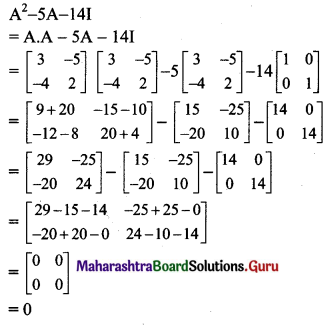
  • Figure (a) represents resonating structures of HNO3 while figure (b) represents resonance hybrid of HNO3.
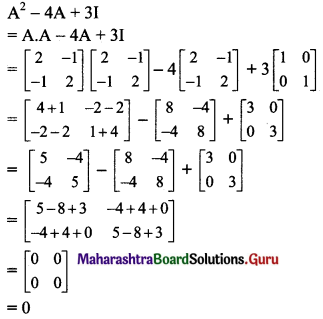
Maharashtra Board Class 11 Chemistry Important Questions Chapter 9 Elements of Group 13, 14 and 15, 21

ii. Phosphoric acid (Orthophosphoric acid):

  • Phosphorus forms number of oxyacids. Orthophosphoric acid (H3PO4) is a strong nontoxic mineral acid.
  • It contains three ionizable acidic hydrogens.
  • The central phosphorus atom is tetrahedral.

Maharashtra Board Class 11 Chemistry Important Questions Chapter 9 Elements of Group 13, 14 and 15, 22

Question 59.
Give the molecular formula of crystalline borax.
Answer:
The crystalline borax has formula Na2B4O7.10H2O or Na2[B4O5(OH)4].8H2O.

Maharashtra Board Class 11 Chemistry Important Questions Chapter 9 Elements of Group 13, 14 and 15

Question 60.
How is borax obtained from its mineral colemanite?
Answer:
Borax is obtained from its mineral colemanite by boiling it with a solution of sodium carbonate.
Maharashtra Board Class 11 Chemistry Important Questions Chapter 9 Elements of Group 13, 14 and 15, 23

Question 61.
Why is the aqueous solution of borax alkaline?
Answer:
On hydrolysis, borax forms a strong base (NaOH) and a weak acid (H3BO3). The presence of the strong base makes borax solution alkaline.
Maharashtra Board Class 11 Chemistry Important Questions Chapter 9 Elements of Group 13, 14 and 15, 24

Question 62.
What happens when borax is heated strongly?
Answer:
Borax is a white crystalline solid. On heating, borax loses water molecules and swells up. On further heating, it melts and forms a transparent liquid, which solidifies into a glass like material known as borax bead.
Maharashtra Board Class 11 Chemistry Important Questions Chapter 9 Elements of Group 13, 14 and 15, 25

Question 63.
Explain borax bead test.
Answer:
i. Borax bead test is used to detect coloured transition metal ions.
ii. On heating, borax loses water molecules and swells up. On further heating, it melts and forms a transparent liquid, which solidifies into a glass like material known as borax bead.
Maharashtra Board Class 11 Chemistry Important Questions Chapter 9 Elements of Group 13, 14 and 15, 26
iii. The borax bead consists of sodium metaborate and boric anhydride, which reacts with metals salts to form coloured bead.
e.g. When borax is heated in a Bunsen burner flame with CoO on a loop of platinum wire, a blue coloured Co(BO2)2 bead is formed.
Maharashtra Board Class 11 Chemistry Important Questions Chapter 9 Elements of Group 13, 14 and 15, 27

Question 64.
Write the uses of borax.
Answer:
Borax is used

  • to manufacture optical and hard borosilicate glasses.
  • as a flux for soldering and welding.
  • as a mild antiseptic in the preparation of medical soaps.
  • in qualitative analysis for borax bead test.
  • as a brightener in washing powder.

Question 65.
How are silicones prepared? Write their properties.
Answer:
i. Preparation of silicones:
a. Alkyl or aryl substituted silicon chlorides having general formula RnSiCl(4-n) (R = alkyl or aryl group) are used as the starting materials for manufacture of silicones.
b. When methyl chloride reacts with silicon in the presence of copper catalyst at a temperature 573 K, various types of methyl substituted chlorosilane of formula MeSiCl3, Me2SiCl2, Me3SiCl with small amounts of Me4Si are formed.
Maharashtra Board Class 11 Chemistry Important Questions Chapter 9 Elements of Group 13, 14 and 15, 28
c. Hydrolysis of dimethyldichlorosilane, (CH3)2SiCl2 followed by condensation polymerisation yields straight chain silicone polymers.
Maharashtra Board Class 11 Chemistry Important Questions Chapter 9 Elements of Group 13, 14 and 15, 29

d. The chain length of polymer can be controlled by adding (CH3)3SiCl at the end.
Maharashtra Board Class 11 Chemistry Important Questions Chapter 9 Elements of Group 13, 14 and 15, 30

ii. Properties:

  • Silicones are water repellent.
  • They have high thermal stability.
  • They are good electrical insulators.
  • They are resistant to oxidation and chemicals.

Maharashtra Board Class 11 Chemistry Important Questions Chapter 9 Elements of Group 13, 14 and 15

Question 66.
Explain the preparation of ammonia from nitrogeneous organic matter.
Answer:
Ammonia is formed by the decomposition of nitrogeneous organic matter such as urea. It is therefore, present naturally in small quantities in air and soil.
Maharashtra Board Class 11 Chemistry Important Questions Chapter 9 Elements of Group 13, 14 and 15, 31

Question 67.
Describe laboratory method for preparation of ammonia.
Answer:
Ammonia is prepared on laboratory scale by decomposition of the ammonium salts with calcium hydroxide or caustic soda.
Maharashtra Board Class 11 Chemistry Important Questions Chapter 9 Elements of Group 13, 14 and 15, 32

Question 68.
How is ammonia manufactured by Haber process?
Answer:

  • On the large scale, ammonia is prepared by direct combination of dinitrogen and dihydrogen by Haber process.
  • In this process, dinitrogen reacts with dihydrogen under high pressure of 200 × 105 Pa (200 atm) and temperature around 700 K to produce ammonia.
    N2(g) + 2H2(g) ⇌ 2NH3(g); ΔfH° = -46.1 kJ mol-1
  • Iron oxide with trace amounts of K2O and Al2O3 is used as catalyst in Haber process.
  • High pressure favours the formation of ammonia as equilibrium is attained rapidly under these conditions.

Question 69.
State the physical properties of ammonia.
Answer:

  • Ammonia is a colourless gas with pungent odour.
  • It has freezing point of 198.4 K and boiling point of 239.7 K.
  • It is highly soluble in water.

Question 70.
What is liquor ammonia?
Answer:
The concentrated aqueous solution of ammonia (NH3) is called liquor ammonia.

Question 71.
Give reason: Ammonia has higher melting and boiling points.
Answer:

  • In solid and liquid state, NH3 molecules get associated together through hydrogen bonding.
  • As a result, extra amount of energy is required to break such intermolecular hydrogen bonds. Hence, ammonia has higher melting and boiling points.

Maharashtra Board Class 11 Chemistry Important Questions Chapter 9 Elements of Group 13, 14 and 15

Question 72.
Why is ammonia basic in aqueous solution?
Answer:
i. As ammonia is highly soluble in water, it readily forms OH ions in its aqueous solution.
\(\mathrm{NH}_{3(\mathrm{~g})}+\mathrm{H}_{2} \mathrm{O}_{(l)} \rightleftharpoons \mathrm{NH}_{4(\mathrm{aq})}^{+}+\mathrm{OH}_{(a q)}^{-}\)
ii. Thus, due to the formation of OH ions, aqueous solution of ammonia is basic in nature.

Question 73.
How does the aqueous solution of ammonia react with the following salt solutions?
i. ZnSO4
ii. FeCl3
Answer:
Aqueous solution of ammonia precipitates out as hydroxides (or hydrated oxides) of metals solutions.
Maharashtra Board Class 11 Chemistry Important Questions Chapter 9 Elements of Group 13, 14 and 15, 33

Question 74.
Write applications of ammonia.
Answer:
Ammonia is used in

  • manufacture of fertilizers such as urea, diammonium phosphate, ammonium nitrate, ammonium sulphate etc.
  • manufacture of some inorganic compounds like nitric acid.
  • refrigerant (liq. ammonia).
  • laboratory reagent in qualitative and quantitative analysis (aq. solution of ammonia).

Question 75.
Give reactions involved in the formation of Nessler’s reagent.
Answer:
Maharashtra Board Class 11 Chemistry Important Questions Chapter 9 Elements of Group 13, 14 and 15, 34

Question 76.
How does ammonia react with Nessler’s reagent?
Answer:
Ammonia react with Nessler’s reagent (an alkaline solution of K2HgI4) to form a brown precipitate (Millon’s base).
Maharashtra Board Class 11 Chemistry Important Questions Chapter 9 Elements of Group 13, 14 and 15, 35

Question 77.
Complete and write the balanced chemical equations for:
i. Ca2B6O11 + Na2CO3
ii. CoO + B2O3
iii. AgCl + NH3
iv. ZnSO4 + 2NH4OH →
v. a. 2KI + HgCl2
b. 2KI + HgI2
Answer:
Maharashtra Board Class 11 Chemistry Important Questions Chapter 9 Elements of Group 13, 14 and 15, 36

Maharashtra Board Class 11 Chemistry Important Questions Chapter 9 Elements of Group 13, 14 and 15

Question 78.
Naina was preparing a compound in the laboratory. She added compound ‘A’ to (CaOH)2 solution. As a result of this, a compound ‘B’ was obtained which had a pungent smell. On adding Nessler’s reagent to the compound ‘B’, a brown precipitate of compound ‘C’ was obtained.
Write the chemical reactions involved and identify ‘A’, ‘B’ and ‘C’.
Answer:
i. When ammonium chloride is mixed with (CaOH)2 solution, ammonia is formed which has a pungent odour.
Maharashtra Board Class 11 Chemistry Important Questions Chapter 9 Elements of Group 13, 14 and 15, 37
ii. Ammonia react with Nessler’ s reagent (an alkaline solution of K2Hgl4) to form a brown precipitate (Millon’ s base).
Maharashtra Board Class 11 Chemistry Important Questions Chapter 9 Elements of Group 13, 14 and 15, 38

Multiple Choice Questions

1. The electronic configuration of boron family is ……………
(A) ns2 np2
(B) ns2 np5
(C) ns2 np6
(D) ns2 np1
Answer:
(D) ns2 np1

2. ………… has noble gas core plus 14 f-electrons and 10 d-electrons.
(A) Gallium
(B) Indium
(C) Thallium
(D) Boron
Answer:
(C) Thallium

3. The group 15 element having inner electronic configuration as of argon is …………..
(A) Phosphorus (Z = 15)
(B) Antimony (Z = 51)
(C) Arsenic (Z = 33)
(D) Nitrogen (Z = 7)
Answer:
(C) Arsenic (Z = 33)

Maharashtra Board Class 11 Chemistry Important Questions Chapter 9 Elements of Group 13, 14 and 15

4. Which of the following is NOT a metalloid?
(A) B
(B) Sn
(C) Ge
(D) Sb
Answer:
(B) Sn

5. Among the group 13 elements, melting point is highest for …………..
(A) B
(B) Al
(C) Ga
(D) In
Answer:
(A) B

6. On moving down the group 14, the ionization enthalpy
(A) increases slightly from Si to Sn and decreases slightly from Sn to Pb
(B) increases throughout uniformly from Si to Pb
(C) decreases throughout uniformly from Si to Pb
(D) decreases slightly from Si to Sn and increases slightly from Sn to Pb
Answer:
(D) decreases slightly from Si to Sn and increases slightly from Sn to Pb

7. ………… is the most electronegative element of group 14.
(A) Carbon
(B) Silicon
(C) Germanium
(D) Tin
Answer:
(A) Carbon

8. The stability of +3 oxidation state in aqueous solution is in order ……………
(A) Al > Ga > In > Tl
(B) Tl > In > Ga > Al
(C) Al > Tl > Ga > In
(D) Tl > Al > Ga > In
Answer:
(A) Al > Ga > In > Tl

9. Group oxidation state of group 15 elements is ……………
(A) +4
(B) +1
(C) +3
(D) +5
Answer:
(D) +5

Maharashtra Board Class 11 Chemistry Important Questions Chapter 9 Elements of Group 13, 14 and 15

10. …………. cannot expand its octet due to absence of d orbital in its valence shell.
(A) Ga
(B) C
(C) As
(D) Ge
Answer:
(B) C

11. Which one of the following statements about boron and aluminium is INCORRECT?
(A) Both exhibit oxidation state of +3.
(B) Both form oxides of the formula M2O3.
(C) Both form trihalides, MX3.
(D) Both form amphoteric oxides.
Answer:
(D) Both form amphoteric oxides.

12. Which of the following is basic oxide?
(A) Bi2O3
(B) CO2
(C) B2O3
(D) SiO2
Answer:
(A) Bi2O3

13. The reaction of Al with H2O produces ……………
(A) Al2O3
(B) AlH3
(C) Al(OH)3
(D) Al2H6
Answer:
(C) Al(OH)3

14. Which of the following is a stable halide of nitrogen?
(A) NF3
(B) NCl5
(C) NF5
(D) NBr5
Answer:
(A) NF3

Maharashtra Board Class 11 Chemistry Important Questions Chapter 9 Elements of Group 13, 14 and 15

15. Catenation is the ability of …………..
(A) atoms to form strong bonds with similar atoms
(B) elements to form giant molecules
(C) an element to form multiple bonds
(D) an element to form long chains of identical atoms
Answer:
(D) an element to form long chains of identical atoms

16. Among the group 13 elements, the property of allotropy is shown by ………………
(A) indium
(B) aluminium
(C) thallium
(D) boron
Answer:
(D) boron

17. Thermodynamically stable allotrope of carbon is …………..
(A) diamond
(B) graphite
(C) buckyball
(D) all of these
Answer:
(B) graphite

18. White phosphorus contains discrete …………… molecules.
(A) P5
(B) P4
(C) P6
(D) P52
Answer:
(B) P4

19. In white phosphorus, the P-P-P bond angle is ……………
(A) 60°
(B) 90°
(C) 109.5
(D) 120°
Answer:
(A) 60°

20. 3c-2e bonds are present in ………………
(A) NH3
(B) B2H6
(C) H3BO3
(D) SiCl4
Answer:
(B) B2H6

Maharashtra Board Class 11 Chemistry Important Questions Chapter 9 Elements of Group 13, 14 and 15

21. Which of the following is borax?
(A) Na2B4O7.4H2O
(B) Na2B4O7.10H2O
(C) H3BO3
(D) NaBO2
Answer:
(B) Na2B4O7.10H2O

22. In Borax bead test, the coloured ions give characteristic coloured beads due to formation of …………….
(A) metal borates
(B) metal metaborates
(C) metal phosphates
(D) metal tetraborates
Answer:
(B) metal metaborates

23. The catalyst used in Haber process contains …………..
(A) nickel
(B) palladium
(C) iron
(D) platinum
Answer:
(C) iron

24. Which of the following is used as refrigerant?
(A) Nessler’s reagent
(B) Liq. ammonia
(C) Borax
(D) Diborane
Answer:
(B) Liq. ammonia

Maharashtra Board Class 11 Chemistry Important Questions Chapter 8 Elements of Group 1 and 2

Balbharti Maharashtra State Board 11th Chemistry Important Questions Chapter 8 Elements of Group 1 and 2 Important Questions and Answers.

Maharashtra State Board 11th Chemistry Important Questions Chapter 8 Elements of Group 1 and 2

Question 1.
Why is hydrogen studied separately even though it appears at the top of group 1?
Answer:
Even though hydrogen appears at the top of group 1 containing alkali metals, it is studied separately because many of its properties differ from that of the alkali metals.

Question 2.
Give reason: Hydrogen (H2) molecule is also referred to as dihydrogen.
Answer:

  • The nucleus of a hydrogen atom consists of one positively charged proton i.e., a nuclear charge of +1, and one extranuclear electron.
  • As this electron is indirect influence of nuclear attraction, hydrogen has a little tendency to lose this electron.
  • However, it can easily pair with the other electron forming a covalent bond.
  • Therefore, it exists in diatomic form as H2 molecule and hence, it is also referred to as dihydrogen.

Question 3.
Why does hydrogen occur in a diatomic form rather than in monoatomic form under normal
conditions?
Answer:

  • Hydrogen atom has only one electron in its valence shell having electronic configuration 1s1.
  • It can acquire stable configuration of helium by sharing this electron with another hydrogen atom.
  • Therefore, it shares its single electron with electron of the other H-atom to achieve stable inert gas configuration of He.
  • Thus, hydrogen readily forms diatomic molecule and exists as H2 rather than in monoatomic form.

Maharashtra Board Class 11 Chemistry Important Questions Chapter 8 Elements of Group 1 and 2

Question 4.
Write a note on occurrence of hydrogen.
Answer:

  • In the free state hydrogen exists as dihydrogen gas.
  • Hydrogen is most abundant element in the universe and constitutes 70% of the total mass of the universe.
  • Hydrogen is also the principal element in the solar system.
  • On the earth, hydrogen is the tenth most abundant element on mass basis and the third most abundant element on atom basis.

Question 5.
State whether the following statements are TRUE or FALSE. Correct the false statement.
1. Electronic configuration of hydrogen is 1s1.
ii. H+ ion formed by loss of the electron from hydrogen atom exists freely.
iii. H+ is nothing but a proton.
iv. Metastable metallic hydrogen was discovered at Harvard university, USA, in January 2017.
Answer:
i. True
ii. False
Hydrogen atom does not exist freely and is always associated with other molecules i.e., H3O+.
iii. True
iv. True

Question 6.
Explain the laboratory methods for preparation of dihydrogen.
Answer:
Laboratory methods for preparation of dihydrogen:
i. By action of dilute HCl on zinc granules: Zinc granules on reaction with dilute hydrochloric acid (HCl) liberates hydrogen gas.
Maharashtra Board Class 11 Chemistry Important Questions Chapter 8 Elements of Group 1 and 2, 1

ii. By action of aqueous NaOH on zinc: Zinc on reaction with aqueous sodium hydroxide (NaOH) forms soluble sodium zincate and liberates hydrogen gas.
Maharashtra Board Class 11 Chemistry Important Questions Chapter 8 Elements of Group 1 and 2, 2

Question 7.
Describe the industrial method of preparation of dihydrogen by electrolysis of pure water.
Answer:
i. Pure water is a poor conductor of electricity. Therefore, a dilute aqueous solution of acid or alkali is used to prepare dihydrogen by electrolysis.
ii. For example, electrolysis of dilute aqueous solution of sulphuric acid yields two volumes of hydrogen at cathode and one volume of oxygen at anode.
Maharashtra Board Class 11 Chemistry Important Questions Chapter 8 Elements of Group 1 and 2, 3

Question 8.
How is pure dihydrogen (> 99.5% purity) gas obtained from barium hydroxide?
Answer:
Electrolysis of warm aqueous solution of barium hydroxide using nickel electrodes yields pure dihydrogen (> 99.5% purity).

Maharashtra Board Class 11 Chemistry Important Questions Chapter 8 Elements of Group 1 and 2

Question 9.
Explain the terms:
i. Syngas
ii. Water-gas shift reaction.
Answer:
i. Syngas:

  • Syngas is the mixture of CO and H2. It is also called ‘water-gas’.
  • It is used for the synthesis of CH3OH and many hydrocarbons, hence, the name syngas or ‘synthesis gas’.
  • Production of syngas is also the first stage of gasification of coal.

ii. Water-gas shift reaction:
The carbon monoxide in the water-gas is transformed into carbon dioxide by reacting with steam in presence of iron chromate as catalyst.
Maharashtra Board Class 11 Chemistry Important Questions Chapter 8 Elements of Group 1 and 2, 4
This reaction is called water-gas shift reaction.

Question 10.
Complete the following chemical reactions:
Maharashtra Board Class 11 Chemistry Important Questions Chapter 8 Elements of Group 1 and 2, 5
Answer:
Maharashtra Board Class 11 Chemistry Important Questions Chapter 8 Elements of Group 1 and 2, 6

Question 11.
Enlist physical properties of dihydrogen.
Answer:
Physical properties of dihydrogen:

  • Dihydrogen is a colourless, tasteless and odourless gas.
  • It bums with a pale blue flame.
  • It is a nonpolar and water-insoluble gas.
  • It is lighter than air.

Question 12.
What is the action of dihydrogen on the following?
i. Metals
ii. Dioxygen
Answer:
i. Action of dihydrogen on metals:
a. Dihydrogen combines with all the reactive metals including alkali metals, calcium, strontium and barium at high temperature to form metal hydrides.
b. For example: Dihydrogen combines with metallic sodium at high temperature to yield sodium hydride.
Maharashtra Board Class 11 Chemistry Important Questions Chapter 8 Elements of Group 1 and 2, 7

ii. Action of dihydrogen on dioxygen: Dihydrogen reacts with dioxygen in the presence of catalyst or by heating to form water. This reaction is highly exothermic.
Maharashtra Board Class 11 Chemistry Important Questions Chapter 8 Elements of Group 1 and 2, 8

Question 13.
Explain the effect of high bond dissociation energy of H-H bond on chemical reactivity of dihydrogen?
Answer:

  • The bond dissociation energy of H-H bond is very high i.e, 436 kJ mol-1. and thus, it does not react easily under normal conditions.
  • However, at high temperature or in the presence of catalysts, hydrogen combines with many metals and non-metals to form corresponding hydrides and halides respectively.

Maharashtra Board Class 11 Chemistry Important Questions Chapter 8 Elements of Group 1 and 2

Question 14.
What happens when dihydrogen reacts with halogens?
Answer:
i. Dihydrogen reacts with halogens (X2) to give the corresponding hydrogen halides (HX).
Maharashtra Board Class 11 Chemistry Important Questions Chapter 8 Elements of Group 1 and 2, 9
ii. Dihydrogen reacts with fluorine to form hydrogen fluoride even at very low temperature (-250°C) in dark.
Maharashtra Board Class 11 Chemistry Important Questions Chapter 8 Elements of Group 1 and 2, 10
iii. However, the reaction with iodine requires a catalyst as the vigour of reaction of dihydrogen decreases with increasing atomic number of halogen.

Question 15.
Explain the reducing nature of hydrogen with chemical reactions.
Answer:
Dihydrogen reduces oxides and ions of some metals that are less reactive than iron, to the corresponding number of halogen metals at moderate temperature.
e.g.
i. CuO(s) + H2(g) → Cu(s) + H2O(l)
ii. Fe3O4(s) + 4H2(g) → 3Fe(s) + 4H2O(s)
iii. Pd2+(aq) + H2(g) → Pd(s) + 2H+(aq)

Question 16.
What is hydrogenation?
Answer:
Hydrogenation is the reaction in which hydrogen gas reacts with unsaturated organic compounds in the presence of a catalyst to form hydrogenated (saturated) compounds.

Question 17.
How does dihydrogen react with various organic compounds to give useful, commercially important products?
Answer:
i. Hydrogenation of unsaturated organic compounds:
e.g. Hydrogenation of unsaturated organic compounds such as vegetable oil using nickel catalyst gives saturated organic compounds such as solid edible fats like vanaspati ghee.
Maharashtra Board Class 11 Chemistry Important Questions Chapter 8 Elements of Group 1 and 2, 11
ii. Hydroformylation of olefins and subsequent reduction of aldehyde to form alcohol:
Maharashtra Board Class 11 Chemistry Important Questions Chapter 8 Elements of Group 1 and 2, 12

Question 18.
Explain hydroformylation reaction of olefins using a suitable example.
Answer:
Hydroformylation of olefins gives aldehydes which on further reduction gives alcohols.
e.g. i. Hydroformylation of propene gives butyraldehyde.
Maharashtra Board Class 11 Chemistry Important Questions Chapter 8 Elements of Group 1 and 2, 13

ii. Butyraldehyde further undergoes reduction to give n-butyl alcohol.
Maharashtra Board Class 11 Chemistry Important Questions Chapter 8 Elements of Group 1 and 2, 14

Question 19.
What are the uses of dihydrogen?
Answer:
Dihydrogen is used in

  • the production of ammonia.
  • the formation of vanaspati ghee by catalytic hydrogenation of oils.
  • rocket fuel (mixture of liquid hydrogen and liquid oxygen).
  • the preparation of important organic compounds like methanol in bulk quantity.
    \(2 \mathrm{H}_{2(\mathrm{~g})}+\mathrm{CO}_{(\mathrm{g})} \stackrel{\text { Cobaltcatalyst }}{\longrightarrow} \mathrm{CH}_{3} \mathrm{OH}_{(l)}\)
  • the preparation of hydrogen chloride (HCl) and metal hydrides.

Maharashtra Board Class 11 Chemistry Important Questions Chapter 8 Elements of Group 1 and 2

Question 20.
Justify the placement of hydrogen in the group of alkali metals with the help of reaction with halogens.
Answer:
i. Hydrogen on reaction with halogens (X2) give compounds with general formula HX.
e.g. H2 + Cl2 → 2HCl
ii. Similarly, alkali metals (M) on reaction with halogens (X2) give compounds with general formula MX.
e.g. 2Na + Cl2 → 2NaCl
iii. Thus, H2 and alkali metals are monovalent elements and more electropositive than halogens. This similarity justifies the position of hydrogen in the group 1.

Question 21.
What do you mean by s-block elements? Where are they placed in the modern periodic table?
Answer:

  • Elements of group 1 and group 2 in which the last electron enters into ‘ns’ subshell are s-block elements.
  • The s-block elements are placed on the extreme left in the modem periodic table.

Question 22.
Name elements of group 1 and group 2.
Answer:

  • Group 1 of the periodic table consists of the elements: hydrogen, lithium, sodium, potassium, rubidium, caesium and francium.
  • Group 2 of the periodic table consists of elements: beryllium, magnesium, calcium, strontium, barium and radium.

Question 23.
What are alkali metals?
Answer:
The elements of group 1 except hydrogen are collectively called alkali metals.

Question 24.
What are alkaline earth metals?
Answer:
The elements of group 2 are collectively called alkaline earth metals because they occur as minerals in rocks.

Maharashtra Board Class 11 Chemistry Important Questions Chapter 8 Elements of Group 1 and 2

Question 25.
Write a note on occurrence of group 1 and group 2 elements:
Answer:
i. Group 1 (alkali metals):

  • Two elements of group 1 i.e., sodium and potassium are the sixth and seventh most abundant elements present in the earth’s crust.
  • However, francium does not occur appreciably in nature because it is radioactive and has short half-life period.

ii. Group 2 (alkaline earth metals):

  • The elements magnesium and calcium are found abundantly in earth’s crust.
  • Radium is radioactive and is not easy to find.

Question 26.
Give reasons: s-block elements are never found in free state in nature.
Answer:

  • s-Block elements contain group 1 and group 2 elements.
  • The general outer electronic configuration of the group 1 elements is ns1 and that of the group 2 elements is ns2.
  • The loosely held s-electrons in the valence shell of these elements can be easily removed to form metal ions.
  • As a result, they are highly reactive in nature and always found in combined state.

Hence, s-block elements are never found in free state in nature.

Note: Electronic configurations of group 1 elements
Maharashtra Board Class 11 Chemistry Important Questions Chapter 8 Elements of Group 1 and 2, 15

Note: Electronic configurations of group 2 elements
Maharashtra Board Class 11 Chemistry Important Questions Chapter 8 Elements of Group 1 and 2, 16

Question 27.
Describe the physical properties of alkali and alkaline earth metals.
Answer:

  • All the alkali and alkaline earth metals are silvery white in appearance.
  • Due to their large atomic size they have low density.
  • Both alkali and alkaline earth metals are soft, however, alkaline earth metals are harder than the alkali metals.
  • Alkali metals are the most electropositive elements while alkaline earth metals are comparatively less electropositive than alkali metals.

Question 28.
Explain why do the group 1 and group 2 elements form diamagnetic and colourless compounds.
Answer:

  • Unipositive ions of all the elements of group 1 have inert gas configuration and hence, they have no unpaired electron.
  • Similarly, group 2 elements can lose their two valence shell electrons and form divalent ions that have inert gas configuration with no unpaired electrons.

Hence, due to the absence of unpaired electrons, compounds formed by group 1 and group 2 elements are diamagnetic and colourless.

Maharashtra Board Class 11 Chemistry Important Questions Chapter 8 Elements of Group 1 and 2

Question 29.
Why do the properties of lithium and beryllium differ from the rest of the group 1 and group 2 elements?
Answer:
The properties of lithium and beryllium differ from the rest of the group 1 and group 2 elements due to their extremely small size and comparatively high electronegativity.

Question 30.
Complete the following table.

Group 1 elementsGroup 2 elements
……………….Alkaline earth metals
Outer electronic configuration: ……………….Outer electronic configuration: ns2
Monovalent positive ions……………….

Answer:

Group 1 elementsGroup 2 elements
Alkali metalsAlkaline earth metals
Outer electronic configuration: ns1Outer electronic configuration: ns2
Monovalent positive ionsDivalent positive ions

Question 31.
State the trends in the following properties of group 1 and group 2 elements down a group.
i. Atomic radii
ii. Ionic radii
iii. Ionization enthalpy
iv. Electronegativity
v. Standard reduction potential
Answer:

Sr. no.PropertyDown a group
i.Atomic radiiIncreases
ii.Ionic radiiIncreases
iii.Ionization enthalpyDecreases
iv.ElectronegativityDecreases
V.Standard reduction potentialDecreases

Question 32.
Give reasons: Potassium superoxide is used in breathing equipment used for mountaineers and in submarines and space.
Answer:
i. Potassium superoxide has ability to absorb carbon dioxide and give out oxygen at the same time.
Maharashtra Board Class 11 Chemistry Important Questions Chapter 8 Elements of Group 1 and 2, 17
ii. Due to this property of KO2, it is used in breathing equipment used for mountaineers and in submarines and space.

Maharashtra Board Class 11 Chemistry Important Questions Chapter 8 Elements of Group 1 and 2

Question 33.
What is the oxidation state of:
i. Na in Na2O2?
ii. K in KO2?
Answer:
i. Oxidation state of Na in sodium peroxide (Na2O2):
Let x be the oxidation state of Na in Na2O2.
The net charge on peroxide ion \(\left(\mathrm{O}_{2}^{2-}\right)\) is -2.
Since any compound is electrically neutral, it has an overall charge as zero.
∴ 2x + (-2) = 0
∴ x = + 1
∴ Oxidation state of Na in Na2O2 is +1.

ii. Oxidation state of K in potassium dioxide/potassium superoxide (KO2):
Let x be the oxidation state of K in KO2
The net charge on superoxide ion \(\left(\mathrm{O}_{2}^{-}\right)\) is -1.
Since any compound is electrically neutral, it has an overall charge as zero.
∴ x + (-1) = 0
x = + 1
∴ Oxidation state of K in KO2 is + 1.
[Note: Oxidation state of alkali metal is always +1.]

Question 34.
Magnesium strip slowly tarnishes on keeping in air but metallic calcium is readily attacked by air. Explain.
Answer:

  • The reactivity of group 2 metals increases with increasing atomic radius and lowering of ionization enthalpy
    down the groups.
  • Thus, calcium has lower ionization enthalpy. Therefore, calcium is more reactive than magnesium.
  • Hence, Mg reacts slowly with air forming a thin film of oxide resulting into tarnishing, whereas Ca reacts readily at room temperature with oxygen and nitrogen in the air.

Question 35.
What happens when alkali metals react with hydrogen and halogens?
Answer:
i. Reaction with hydrogen: Alkali metals react with hydrogen at high temperature to form the Corresponding metal hydrides.
Maharashtra Board Class 11 Chemistry Important Questions Chapter 8 Elements of Group 1 and 2, 18

ii. Reaction with halogens: All the alkali metals react vigorously with halogens to produce their ionic halide salts.
Maharashtra Board Class 11 Chemistry Important Questions Chapter 8 Elements of Group 1 and 2, 19
[Note: As we move down the group, the reactivity of alkali metals towards hydrogen and halogens decreases in the following order: Li > Na > K > Rb > Cs.]

Question 36.
NaCl is an ionic compound but LiCl has some covalent character, explain.
Answer:

  • Li+ ion has very small size and therefore, the charge density on Li+ is high.
  • Due to this, it has high tendency to distort the electron cloud around the negatively charged chloride ion (Cl) which is larger in size.
  • This results in partial covalent character of the LiCl bond.
  • Na+ ion cannot distort the electron cloud of Cl due to the bigger size of Na+ compared to Li+.

Hence, NaCl is an ionic compound but LiCl has some covalent character.

Maharashtra Board Class 11 Chemistry Important Questions Chapter 8 Elements of Group 1 and 2

Question 37.
Why is lithium iodide most covalent in nature among alkali halides?
Answer:

  • Among the alkali metal ions, Li+ ion is the smallest cation while among halides, anion I has the largest size.
  • Thus, electron cloud around I ion is easily distorted by Li+ ion leading to polarisation of anion and covalency.
  • Also, the difference in electronegativities of Li and I is small.

Hence, lithium iodide is most covalent in nature among alkali halides.

Question 38.
Explain the reactivity of alkaline earth metals towards:
i. Water
ii. Hydrogen
iii. Halogens
Answer:
i. Reaction with water:
a. The elements of group 2 (alkaline earth metals) react with water to form metal hydroxide and evolve hydrogen gas.
Maharashtra Board Class 11 Chemistry Important Questions Chapter 8 Elements of Group 1 and 2, 20
Maharashtra Board Class 11 Chemistry Important Questions Chapter 8 Elements of Group 1 and 2, 21

b. Be does not react with water at all, Mg reacts with boiling water while Ca, Sr, Ba react vigorously even with cold water.

ii. Reaction with hydrogen: All alkaline earth metals except beryllium (Be), when heated with hydrogen form MH2 type hydrides.
Maharashtra Board Class 11 Chemistry Important Questions Chapter 8 Elements of Group 1 and 2, 22

iii. Reaction with halogens: All the alkaline earth metals combine with halogens at high temperature to form their corresponding halides.
Maharashtra Board Class 11 Chemistry Important Questions Chapter 8 Elements of Group 1 and 2, 23
[Note: As we move down the group, the chemical reactivity of alkaline earth metals increases in the order Mg < Ca < Sr < Ba.]

Question 39.
Complete the following chemical equations.
Maharashtra Board Class 11 Chemistry Important Questions Chapter 8 Elements of Group 1 and 2, 24
Answer:
Maharashtra Board Class 11 Chemistry Important Questions Chapter 8 Elements of Group 1 and 2, 25

Question 40.
Describe the reducing nature of group 1 and group 2 elements.
Answer:
The reducing power of an element is measured in terms of standard electrode potential (E0) corresponding to the following transformation i.e, tendency to lose electron.
\(\mathrm{M}_{(\mathrm{s})} \longrightarrow \mathrm{M}_{(\mathrm{aq})}^{+}+\mathrm{e}^{-}\)
i. Reducing nature of group 1 elements:

  • All the alkali metals have high negative values of E0 which indicates that they have strong reducing nature and hence, they can be used as strong reducing agents.
  • Lithium is the most powerful and sodium is the least powerful reducing agent in the group.

ii. Reducing nature of group 2 elements:

  • All the alkaline earth metals have high negative values of stanard reduction potential (E0) and are strong reducing agents.
  • However, reducing power of alkaline earth metals is less than that of alkali metals.

Maharashtra Board Class 11 Chemistry Important Questions Chapter 8 Elements of Group 1 and 2

Question 41.
Explain the nature of the solution formed by group 1 and group 2 metals in liquid ammonia.
Answer:
i. The alkali metals are soluble in liquid ammonia and thus, they dissolve in it giving deep blue solutions which are conducting in nature.
M + (x + y)NH3 → [M(NH3)x]+ + [e(NH3)y]
ii. The blue colour of the solution is due to the ammoniated electron.
iii. These solutions are paramagnetic and on standing slowly liberate hydrogen resulting in the formation of amide.
\(\mathrm{M}_{(\mathrm{am})}^{+}+\mathrm{e}^{-}+\mathrm{NH}_{3(l)} \longrightarrow \mathrm{MNH}_{2(\mathrm{am})}+\frac{1}{2} \mathrm{H}_{2(\mathrm{~g})}\)
(where ‘am’ denotes solution in ammonia.)
iv. As a result, the blue colour of the solution changes to bronze and the solution becomes diamagnetic.
v. Similarly, the alkaline earth metals are also soluble in liquid ammonia which give deep blue-black coloured solutions.
M + (x + 2y) NH3 → [M(NH3)x]2+ + 2[e(NH3)y]

Question 42.
Explain: Diagonal relationship in group 1 and group 2.
Answer:

  • Elements belonging to the same group are expected to exhibit similarity and gradation in their properties.
  • However, first alkali metal, lithium, and the first alkaline earth metal, beryllium, do not fulfil this expectation.
  • Thus, lithium shows many differences when compared with the remaining alkali metals and shows similarity with magnesium, the second alkaline earth metal.
  • Similarly, beryllium shows many differences with remaining alkaline earth metals and shows similarity with aluminium, the second element of the next main group i.e., group 13.
  • The relative placement of these elements with similar properties in the periodic table is across a diagonal and thus, it is called diagonal relationship.

Maharashtra Board Class 11 Chemistry Important Questions Chapter 8 Elements of Group 1 and 2, 26

Question 43.
Explain diagonal relationship between lithium and magnesium with respect to:
i. Property of chlorides
ii. Thermal decomposition of their carbonates
Answer:
Both lithium and magnesium show similarities in various physical and chemical properties as follows:
i. Property of chlorides: Chlorides of lithium (LiCl) and magnesium (MgCl2) are deliquescent as group 2 elements form deliquescent chlorides. These chlorides form corresponding hydrates (LiCl.2H2O and MgCl2.8H2O) on crystallization from their aqueous solutions.

ii. Thermal decomposition of carbonates: Heating of lithium carbonate and magnesium carbonate results in their easy decomposition to form corresponding oxides and carbon dioxide (CO2).
Maharashtra Board Class 11 Chemistry Important Questions Chapter 8 Elements of Group 1 and 2, 27

Question 44.
Mention the properties of lithium that differ from rest of the alkali group metals.
Answer:

  • Reaction with nitrogen: Only lithium from alkali group metals reacts with nitrogen present in the air on heating, while rest of the members do not react with nitrogen.
  • Thermal decomposition of carbonates: Alkali metal carbonates show no reaction on heating, while lithium carbonate decomposes on heating to form the corresponding oxide and liberate carbon dioxide gas.
  • Property of chlorides: Lithium (LiCl) is deliquescent and forms corresponding hydrate (LiCl.2H2O). Other alkali chlorides are not deliquescent and do not form hydrates.

Maharashtra Board Class 11 Chemistry Important Questions Chapter 8 Elements of Group 1 and 2

Question 45.
Write a note on the diagonal relationship between Be and Al.
OR
What are the similarities between beryllium and aluminium?
Answer:
i. Beryllium is placed in the group 2 and period 2 of the modem periodic table. It resembles aluminium which is placed in group 13 and period 3.
Maharashtra Board Class 11 Chemistry Important Questions Chapter 8 Elements of Group 1 and 2, 28
ii. Due to nearly same charge to radius ratio of their ions, beryllium (\(\frac {2}{31}\) = 0.065) and aluminium (\(\frac {3}{53.55}\) = 0.056) exhibit diagonal relationship.
iii. Due to diagonal relationship, Be and Al show following similarities in their properties:
a. Nature of bonding: Both Be and Al have tendency to form covalent chlorides.
Maharashtra Board Class 11 Chemistry Important Questions Chapter 8 Elements of Group 1 and 2, 29
b. Lewis acids: BeCl2 and AlCl3 act as Lewis acids.
c. Solubility in organic solvents: BeCl2 and AlCl3 are soluble in organic solvents.
d. Nature of oxide: Both Be and Al form amphoteric oxides.

Question 46.
Explain the amphoteric nature of aluminium oxide with the help of reactions.
Answer:
Al2O3 (magnesium oxide) reacts with both acid (HCl) as well as base (NaOH) to form the corresponding products and therefore, it is amphoteric in nature.
Maharashtra Board Class 11 Chemistry Important Questions Chapter 8 Elements of Group 1 and 2, 30

Question 47.
Beryllium shows many differences with other alkaline earth metals. Discuss these differences with respect to chlorides and oxides.
Answer:
1. Properties of chlorides: Beryllium chloride is covalent whereas chlorides formed by other alkaline earth metals are ionic in nature. Beryllium chloride is a strong Lewis acid whereas chlorides formed by other alkaline earth metals are not Lewis acids. Beryllium chloride is soluble in organic solvents whereas chlorides formed by other alkaline earth metals are insoluble in organic solvents.

2. Properties of oxide: Beryllium oxide is amphoteric whereas oxides formed by other alkaline earth metals are basic in nature.

Question 48.
Complete the following chemical equations.
Maharashtra Board Class 11 Chemistry Important Questions Chapter 8 Elements of Group 1 and 2, 31
Answer:
Maharashtra Board Class 11 Chemistry Important Questions Chapter 8 Elements of Group 1 and 2, 32

Question 49.
Write the uses of
i. alkali metals
ii. alkaline earth metals
Answer:
i. Uses of alkali metals:

  • Lithium metal is used in long-life batteries used in digital watches, calculators and computers.
  • Liquid sodium is used for heat transfer in nuclear power stations.
  • Potassium chloride is used as a fertilizer.
  • Potassium is used in manufacturing potassium superoxide (KO2) for oxygen generation. It is good absorbent of carbon dioxide.
  • Caesium is used in photoelectric cells.

ii. Uses of alkaline earth metals:

  • Beryllium is used as a moderator in nuclear reactors.
  • Alloy of magnesium and aluminium is widely used as structural material and in aircrafts.
  • Calcium ions are important ingredient in biological system, essential for healthy growth of bones and teeth.
  • Barium sulphate is used in medicine as barium meal for intestinal X-ray.
  • Radium is used in radiotherapy for cancer treatment.

Question 50.
State the importance of sodium and potassium in biological system.
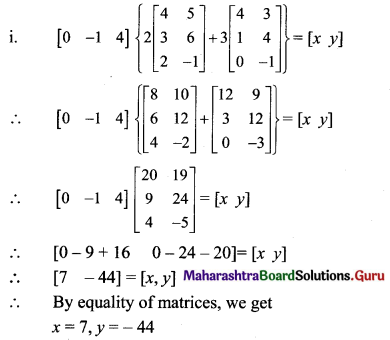
Answer:

  • Sodium ion is present as the largest supply in all extracellular fluids. These fluids provide medium for transporting nutrients to the cells.
  • The concentration of sodium ion in extracellular fluid regulates the flow of water across the membrane.
  • Sodium ions participate in the transmission of nerve signals.
  • Potassium ions are the most abundant ions within the cells. They are required for maximum efficiency in the synthesis of proteins and also in oxidation of glucose.

Maharashtra Board Class 11 Chemistry Important Questions Chapter 8 Elements of Group 1 and 2

Question 51.
How are the following ions of group 2 elements biologically important?
i. Mg2+
ii. Ca2+
Answer:
i. Magnesium ion (Mg2+)

  • Mg2+ ions are important part of chlorophyll in green plants.
  • They play an important role in the breakage of glucose and fat molecules, synthesis of proteins with enzymes and regulation of cholesterol level.

ii. Calcium ion (Ca2+)

  • Ca2+ ions are important for bones and teeth in the form of apatite [Ca3(PO4)2].
  • They play an important role in blood clotting.
  • Ca2+ ions are required for contraction and stretching of muscles.
  • They are also required to maintain the regular beating of heart.

Question 52.
Explain Solvay process for manufacture of sodium carbonate.
Answer:
Sodium carbonate (Na2CO3) is commercially prepared by Solvay process. Preparation of sodium carbonate by Solvay process involves two stages.
i. In the first stage of Solvay process, carbon dioxide gas is bubbled through a concentrated solution of NaCl which is saturated with NH3. This results in the formation of ammonium bicarbonate. Crystals of sodium bicarbonate separate as a result of the following reactions.
Maharashtra Board Class 11 Chemistry Important Questions Chapter 8 Elements of Group 1 and 2, 33
Maharashtra Board Class 11 Chemistry Important Questions Chapter 8 Elements of Group 1 and 2, 34
ii. Ammonium bicarbonate and sodium chloride undergoes double decomposition reaction to form sodium bicarbonate. As sodium bicarbonate has low solubility, it precipitates out in the form of crystals.
iii. In the second stage, the separated crystals of sodium bicarbonate are heated to obtain sodium carbonate (Na2CO3).
Maharashtra Board Class 11 Chemistry Important Questions Chapter 8 Elements of Group 1 and 2, 35
iv. NH4Cl obtained in this process is treated with slaked lime, Ca(OH)2, to recover NH3 while CaCl2 is obtained as a byproduct.
Maharashtra Board Class 11 Chemistry Important Questions Chapter 8 Elements of Group 1 and 2, 36

Question 53.
How is ammonia recovered in Solvay process? Name the important by-product obtained in the step?
Answer:
i. Ammonium chloride (NH4Cl) is obtained during the Solvay process which is used for the preparation of Na2CO3. When NH4Cl is treated with slaked lime, Ca(OH)2, ammonia is recovered.
Maharashtra Board Class 11 Chemistry Important Questions Chapter 8 Elements of Group 1 and 2, 37
ii. Calcium chloride is obtained as an important by-product in this reaction.

Question 54.
Why potassium carbonate cannot be obtained by Solvay process?
Answer:
Potassium hydrogen carbonate (KHCO3) is highly water soluble and cannot be precipitated out by reacting with potassium choride (KCl) and hence, potassium carbonate (K2CO3) cannot be obtained by Solvay process.

Maharashtra Board Class 11 Chemistry Important Questions Chapter 8 Elements of Group 1 and 2

Question 55.
What is the action of heat on crystalline sodium carbonate (washing soda)?
Answer:
i. On heating washing soda (decahydrate of sodium carbonate) up to 373 K, it loses water molecules to form corresponding monohydrate.
Maharashtra Board Class 11 Chemistry Important Questions Chapter 8 Elements of Group 1 and 2, 38
ii. On heating above 373 K, monohydrate further loses water and changes into white anhydrous powder called soda ash.
Maharashtra Board Class 11 Chemistry Important Questions Chapter 8 Elements of Group 1 and 2, 39

Question 56.
Give reason: Aqueous solution of sodium carbonate is alkaline in nature.
Answer:
i. Sodium carbonate is hydrolysed by water as shown in the reaction given below.
Maharashtra Board Class 11 Chemistry Important Questions Chapter 8 Elements of Group 1 and 2, 40
ii. One of the products formed as a result of hydrolysis is NaOH which is a strong base.
Hence, aqueous solution of sodium carbonate is alkaline in nature due to formation of strong base (NaOH).

Question 57.
What are the uses of sodium carbonate?
Answer:
Uses of sodium carbonate:

  • Due to its alkaline properties, sodium carbonate has an emulsifying effect on grease and dirt and hence, it is used as a cleaning material.
  • It is used to make hard water soft as it precipitates out the soluble calcium and magnesium salts in hard water as carbonates.
    For example: Ca(HCO3)2(aq) + Na2CO3(aq) → CaCO3(s) + 2NaHCO3(aq)
  • It is used for commercial production of soap and caustic soda.
  • Sodium carbonate is used as an important laboratory reagent.

Question 58.
Describe the preparation of sodium hydroxide by Castner-Kellner process.
OR
Explain the electrolysis method for preparation of sodium hydroxide.
Answer:
i. Sodium hydroxide (caustic soda) is commercially obtained by the electrolysis of aqueous sodium chloride solution (brine) in Castner-Kellner cell (mercury cathode cell).
ii. In Castner-Kellner cell, mercury is used as cathode, carbon rod as anode and brine solution is used as electrolyte which is subjected to electrolysis.

iii. During electrolysis, the following reactions take place:
a. At cathode: Sodium ions get reduced to metallic sodium, which combines with mercury to form sodium amalgam (Na-Hg).
\(\mathrm{Na}^{+}+\mathrm{e}^{-} \stackrel{\mathrm{Hg}}{\longrightarrow} \mathrm{Na} \text {-amalgam }\)
b. At anode: Chloride ions are oxidized and thus, chlorine gas is evolved.
\(\mathrm{Cl}^{-} \longrightarrow \frac{1}{2} \mathrm{Cl}_{2}+\mathrm{e}^{-}\)

iv. Sodium amalgam is then treated with water to obtain sodium hydroxide and hydrogen gas.
Maharashtra Board Class 11 Chemistry Important Questions Chapter 8 Elements of Group 1 and 2, 41

Question 59.
Enlist the physical properties of sodium hydroxide.
Answer:
Physical properties of sodium hydroxide:

  • Sodium hydroxide (NaOH) is a white deliquescent solid.
  • It has a melting point of 591 K.
  • It is highly water soluble and gives a strongly alkaline solution.
  • The surface of sodium hydroxide solution absorbs atmospheric CO2 to form Na2CO3.

Maharashtra Board Class 11 Chemistry Important Questions Chapter 8 Elements of Group 1 and 2

Question 60.
Explain how sodium hydroxide is commercially important.
Answer:
Commercial uses of sodium hydroxide:

  • Sodium hydroxide is used in purification of bauxite (the aluminium ore).
  • It is used in commercial production of soap, paper, artificial silk and many chemicals.
  • It is used for mercerising cotton fabrics.
  • It is used in petroleum refining.
  • It is also used as an important laboratory reagent.

Question 61.
Calcium carbonate occurs naturally in which forms?
Answer:
Calcium carbonate (CaCO3) occur naturally in the form of chalk, limestone and marble.

Question 62.
Describe the various methods used for preparation of calcium carbonate.
Answer:
i. a. Calcium carbonate is prepared by passing carbon dioxide through solution of calcium hydroxide (slaked lime). This results in the formation of water insoluble solid calcium carbonate.
Maharashtra Board Class 11 Chemistry Important Questions Chapter 8 Elements of Group 1 and 2, 42
b. However, excess carbon dioxide transforms the precipitate of CaCO3 into water-soluble calcium bicarbonate and therefore, it has to be avoided.

ii. Calcium carbonate can also be prepared by adding solution of calcium chloride to a solution of sodium carbonate. This results in the formation of calcium carbonate as precipitate.
Maharashtra Board Class 11 Chemistry Important Questions Chapter 8 Elements of Group 1 and 2, 43

Question 63.
Why controlled addition of CO2 is essential during preparation of calcium carbonate from slaked lime?
Answer:
When excess of CO2 is present, it leads to the formation of water-soluble calcium bicarbonate.
Maharashtra Board Class 11 Chemistry Important Questions Chapter 8 Elements of Group 1 and 2, 44
Hence, while preparing calcium carbonate from slaked lime, controlled addition of CO2 is essential.

Question 64.
Mention some physical properties of calcium carbonate.
Answer:

  • Calcium carbonate is soft, light, white powder.
  • It is practically insoluble in water.

Maharashtra Board Class 11 Chemistry Important Questions Chapter 8 Elements of Group 1 and 2

Question 65.
What happens when:
i. calcium carbonate is thermally decomposed?
ii. calcium carbonate reacts with dilute mineral acids?
Answer:
i. When calcium carbonate is heated to 1200 K, it decomposes into calcium oxide along with evolution of carbon dioxide gas.
Maharashtra Board Class 11 Chemistry Important Questions Chapter 8 Elements of Group 1 and 2, 45

ii. Calcium carbonate reacts with dilute mineral acids such as HCl and H2SO4 to give the corresponding calcium salt and liberate carbon dioxide gas.
Maharashtra Board Class 11 Chemistry Important Questions Chapter 8 Elements of Group 1 and 2, 46

Question 66.
Give the important uses of calcium carbonate.
Answer:

  • Calcium carbonate in the form of marble is used as building material.
  • It is used in the manufacture of quicklime (CaO) which is the major ingredient of cement.
  • A mixture of CaCO3 and MgCO3 is used as flux in the extraction of metals from their ores.
  • It is required for the manufacture of high-quality paper.
  • It is an important ingredient in toothpaste, chewing gum, dietary supplements of calcium and filler in cosmetics.

Question 67.
Match the pairs.

Column AColumn B
i.Castner-Kellner cella.Na2CO
ii.Slaked limeb.CaCO3
iii.Solvay processc.NaOH
iv.Limestoned.Ca(OH)2

Ans:
i – c,
ii – d,
iii – a,
iv – b

Question 68.
How is hydrogen peroxide prepared by the action of cold dilute H2SO4 on
i. Hydrated barium peroxide?
ii. sodium peroxide (Merck process)?
Answer:
Preparation of hydrogen peroxide by the action of cold dilute H2SO4 on
i. hydrated barium peroxide: When hydrated barium peroxide is treated with ice-cold dilute sulphuric acid, the precipitate of barium sulphate is obtained. This precipitate is then filtered off to get hydrogen peroxide solution.
Maharashtra Board Class 11 Chemistry Important Questions Chapter 8 Elements of Group 1 and 2, 47

ii. Sodium peroxide (Merck process): When small quantity of sodium peroxide is added to ice-cold solution of dilute sulphuric acid with stirring, it gives hydrogen peroxide.
Maharashtra Board Class 11 Chemistry Important Questions Chapter 8 Elements of Group 1 and 2, 48

Question 69.
Explain how hydrogen peroxide can be obtained by electrolysis method.
Answer:
i. H2O2 can be manufactured by electrolysis of 50% H2SO4. In this method, 50% solution of H2SO4 is subjected to an electrolytic oxidation to form peroxydisuiphuric acid at anode.
Maharashtra Board Class 11 Chemistry Important Questions Chapter 8 Elements of Group 1 and 2, 49
ii. On hydrolysis, peroxy sulphuric yields hydrogen peroxide.
Maharashtra Board Class 11 Chemistry Important Questions Chapter 8 Elements of Group 1 and 2, 50
iii. This method can be used for the laboratory preparation of D2O2.

Maharashtra Board Class 11 Chemistry Important Questions Chapter 8 Elements of Group 1 and 2

Question 70.
Describe the industrial method for preparation of hydrogen peroxide.
OR
How is hydrogen peroxide obtained from 2-ethylanthraquinol?
Answer:
i. Industrially hydrogen peroxide is prepared by air-oxidation of 2-ethylanthraquinol.
Maharashtra Board Class 11 Chemistry Important Questions Chapter 8 Elements of Group 1 and 2, 51
ii. 2-Ethylanthraquinone is reduced back to 2-ethylanthraquinol by catalytic hydrogenation.
Maharashtra Board Class 11 Chemistry Important Questions Chapter 8 Elements of Group 1 and 2, 52

Question 71.
What are the physical properties of hydrogen peroxide?
Answer:

  • Pure H2O2 is a very pale blue coloured liquid.
  • Its boiling point is 272.4 K.
  • H2O2 is miscible in water and forms a hydrate (H2O2. H2O).

Question 72.
How is strength of H2O2 solution expressed?
Answer:

  • Strength of aqueous solution of H2O2 is expressed in ‘volume’ units i.e., volume strength.
  • The commercially marketed 30% (by mass) solution of H2O2 has volume strength of 100 volume.
  • It means that 1 mL of 30% solution of H2O2 will give 100 mL oxygen at STP.

Thus, Volume strength refers to the volume of oxygen (O2) in litres at STP obtained by decomposition of 1 litre of the sample.

Question 73.
Write reactions depicting oxidising and reducing action of hydrogen peroxide in acidic medium.
Answer:
H2O2 acts as a mild oxidising as well as reducing agent.
i. Oxidising action of H2O2 in acidic medium.
\(2 \mathrm{Fe}_{(\mathrm{aq})}^{2+}+2 \mathrm{H}_{(\mathrm{aq})}^{+}+\mathrm{H}_{2} \mathrm{O}_{2(\mathrm{aq})} \longrightarrow 2 \mathrm{Fe}_{(\mathrm{aq})}^{3+}+2 \mathrm{H}_{2} \mathrm{O}_{(l)}\)

ii. Reducing action of H2O2 in acidic medium.
\(2 \mathrm{MnO}_{4}^{-}+6 \mathrm{H}^{+}+5 \mathrm{H}_{2} \mathrm{O}_{2} \rightarrow 2 \mathrm{Mn}^{2+}+8 \mathrm{H}_{2} \mathrm{O}+5 \mathrm{O}_{2}\)

Question 74.
Enlist uses of hydrogen peroxide.
Answer:

  • Hydrogen peroxide is used as mouthwash, germicide and mild antiseptic.
  • It is used as a preservative for milk and wine.
  • It is used as a bleaching agent for soft materials, due to its mild oxidising property.
  • Due to its reducing property, is used as an antichlor to remove excess chlorine from fabrics which have been bleached by chlorine.
  • Nowadays it is used in environmental chemistry for pollution control and restoration of aerobic condition of sewage water.

Maharashtra Board Class 11 Chemistry Important Questions Chapter 8 Elements of Group 1 and 2

Question 75.
Describe preparation and properties of lithium aluminium hydride (LAH).
Answer:
i. Preparation: Lithium hydride when treated with aluminium chloride, gives lithium aluminium hydride, (LiAlH4).
Maharashtra Board Class 11 Chemistry Important Questions Chapter 8 Elements of Group 1 and 2, 53

ii. Properties:

  • Lithium aluminium hydride is a colourless solid.
  • It reacts violently with water and even with atmospheric moisture.

Question 76.
How is lithium aluminium hydride (LAH) useful in organic synthesis?
Answer:
i. LAH is a source of hydride (H) and therefore, it is used as a reducing agent in organic synthesis.
For example:
Maharashtra Board Class 11 Chemistry Important Questions Chapter 8 Elements of Group 1 and 2, 54

ii. It is useful in the preparation of PH3 (phosphine).
4PCl3 + 3LiAlH4 → 4PH2 + AlCl3 + LiCl

Question 77.
Complete the following reactions by mentioning the reagent/reaction conditions under which these reactions are carried out.
Maharashtra Board Class 11 Chemistry Important Questions Chapter 8 Elements of Group 1 and 2, 55
Answer:
Maharashtra Board Class 11 Chemistry Important Questions Chapter 8 Elements of Group 1 and 2, 56

Question 78.
Calculate % (by mass) of a H2O2 solution which is 45.4 volume.
Answer:
Given: 45.4 volume H2O2 solution
To find: % (by mass) of H2O2
Formula: Percentage (%) by mass = \(\frac{\text { Mass of solute }}{\text { Mass of solution }} \times 100\)
calculation: 45.4 volume H2O2 solution means 1 L of this solution will liberate 45.4 L of O2 at STP.
Hydrogen peroxide (H2O2) decomposes as:
Maharashtra Board Class 11 Chemistry Important Questions Chapter 8 Elements of Group 1 and 2, 57
Ans: % (by mass) of H2O2 in 45.4 volume H2O2 solution is 13.6%.

Question 79.
Calculate the strength (g/L) of 20 volume solution of hydrogen peroxide.
Solution:
Given: 20 volume H2O2 solution
To find: Strength of H2O2 (g/L)
Formula: 20 volume H2O2 solution means that 1 L of this solution will liberate 20 L of oxygen at S.T.P. Let us calculate the amount of H2O2 (in grams) which gives 20 L of oxygen at S.T.P. This amount will be present in 1 L of 20 volume solution of H2O2.
Hydrogen peroxide (H2O2) decomposes as:
Maharashtra Board Class 11 Chemistry Important Questions Chapter 8 Elements of Group 1 and 2, 58
22.7 L of O2 at S.T.P. is produced from H2O2 = 68 g
20 L of O2 at S.T.P. is produced from H2O2 = \(\frac {68}{22.7}\) × 20 = 59.912g = 59.912 g/litre
Ans: Strength of H2O2 in 20 volume H2O2 solution is 59.912 g/L.

Maharashtra Board Class 11 Chemistry Important Questions Chapter 8 Elements of Group 1 and 2

Question 80.
Calculate the volume strength of a 5% solution of hydrogen peroxide.
Solution:
Given: 5% solution of H2O2
To find: Volume strength of H2O2 solution
Calculation: 100 mL of solution contains 5 g of H2O2
1000 mL of solution will contain \(\frac {5}{100}\) × 1000 = 50 g of H2O2
Maharashtra Board Class 11 Chemistry Important Questions Chapter 8 Elements of Group 1 and 2, 59
68 g of H2O2 will give O2 at S.T.P. = 22.7 L
50 g of H2O2 is present in 1000 mL of H2O2 or 1 L of H2O2
50 g of H2O2 will give O2 at S.T.P. = \(\frac {22.7}{68}\) × 50 = 16.691 L
∴ 1 L of H2O2 gives O2 at S.T.P. = 16.691 L
∴ Strength of H2O2 = 16.691 volume
Ans: The given 5% H2O2 solution is equivalent to 16.691 volume solution of hydrogen peroxide.

Question 81.
Naina is a school going kid. Every morning her mother makes her drink a glass of milk. When she asked her mother that why she has to drink a glass of milk daily, her mother told her that it is beneficial in maintaining healthy bones and teeth. Regular consumption of milk is recommended because it is a rich source of calcium.
i. In which form is calcium important for bones and teeth?
ii. Calcium belongs to which family in the modern periodic table?
iii. Write its electronic configuration.
iv. Calcium contain how many valence electrons?
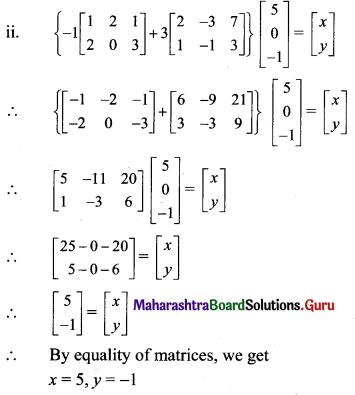
v. Give any two-biological importance of calcium.
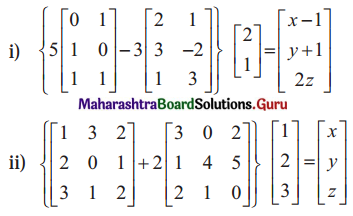
Answer:
i. Calcium is important for bones and teeth in the form of apatite [Ca(PO4)2].
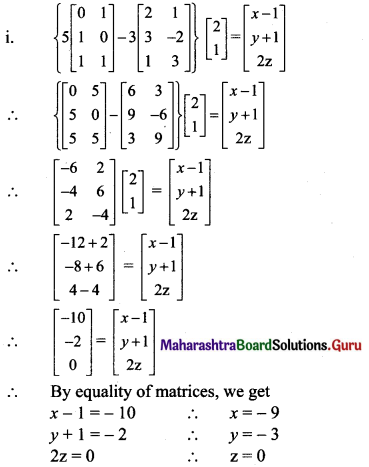
ii. It belongs to the family of alkaline earth metals in the modem periodic table.
iii. Electronic configuration of 20Ca is 1s2 2s2 2p6 3s2 3p6 4s2.
iv. Calcium contains two valence electrons as it has two electrons in its outermost shell (4s).

v. Calcium ion (Ca2+)

  • Ca2+ ions are important for bones and teeth in the fonn of apatite [Ca3(PO4)2].
  • They play an important role in blood clotting.
  • Ca2+ ions are required for contraction and stretching of muscles.
  • They are also required to maintain the regular beating of heart.

Multiple Choice Questions
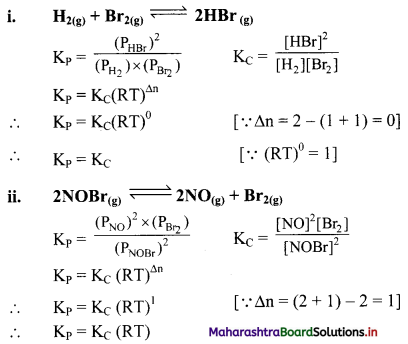
1. Of all the elements present in the periodic table, ………… has the simplest atomic structure.
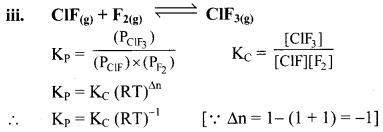
(A) lithium
(B) beryllium
(C) hydrogen
(D) helium
Answer:
(C) hydrogen

2. Electronic configuration of hydrogen is similar to that of ……………
(A) transition elements
(B) inert gases
(C) alkaline earth metals
(D) alkali metals
Answer:
(D) alkali metals

Maharashtra Board Class 11 Chemistry Important Questions Chapter 8 Elements of Group 1 and 2

3. Isotopes are atoms of the same element having different ………….. number.
(A) neutron
(B) proton
(C) electron
(D) Both (A) and (B)
Answer:
(A) neutron

4. Tritium, \(\left({ }_{1}^{3} \mathrm{H}\right)\) ……………
(A) is an isotope of hydrogen
(B) contains one electron, one proton and two neutrons
(C) is a beta particle emitter
(D) all of these
Answer:
(D) all of these

5. In the electrolysis of acidified water using, ………….. is liberated at the anode.
(A) dihydrogen
(B) sulphate ions
(C) oxygen
(D) chloride ions
Answer:
(C) oxygen

6. Water gas is a mixture of ………….
(A) CO + H2
(B) CO2 + H2
(C) O2 + H2
(D) CO + O2
Answer:
(A) CO + H2

7. During production of dihydrogen by water-gas shift reaction, which of the following is present as an impurity?
(A) Carbon monoxide
(B) Carbon dioxide
(C) Calcium carbonate
(D) Calcium oxide
Answer:
(B) Carbon dioxide

Maharashtra Board Class 11 Chemistry Important Questions Chapter 8 Elements of Group 1 and 2

8. Solution is used to remove carbon dioxide present in the mixture along with dihydrogen.
(A) Sodium hydroxide
(B) Hydrochloric acid
(C) Magnesium chloride
(D) Sodium arsenite
Answer:
(D) Sodium arsenite

9. The reaction between dihydrogen and …………… is highly exothermic.
(A) halogens
(B) dioxygen
(C) dinitrogen
(D) metals
Answer:
(B) dioxygen

10. The elements of group 1 and group 2 belong to which block of the modem periodic table?
(A) d-block
(B) s-block
(C) p-block
(D) f-block
Answer:
(B) s-block

11. Which of the following is NOT an alkaline earth metal?
(A) Beryllium
(B) Barium
(C) Calcium
(D) Caesium
Answer:
(D) Caesium

12. The common oxidation state for alkali metals is …………….
(A) +2
(B) +1
(C) +3
(D) +4
Answer:
(B) +1

13. All alkaline earth metals have ………….. valence electrons in the outermost orbit.
(A) one
(B) two
(C) three
(D) four
Answer:
(B) two

Maharashtra Board Class 11 Chemistry Important Questions Chapter 8 Elements of Group 1 and 2

14. Electronic configuration of potassium with respect to nearest noble gases is …………..
(A) [He]2s1
(B) [Ne]3s1
(C) [Ar]4s1
(D) [Kr]5s1
Answer:
(C) [Ar]4s1

15. Which of the following is radioactive alkali metal?
(A) Rubidium
(B) Caesium
(C) Francium
(D) Beryllium
Answer:
(C) Francium

16. Which of the following element is rarest amongst s-block elements?
(A) Strontium
(B) Barium
(C) Radium
(D) Calcium
Answer:
(C) Radium

17. Which of the following is FALSE?
(A) Alkali metals readily loose electron to form monovalent M+ ions.
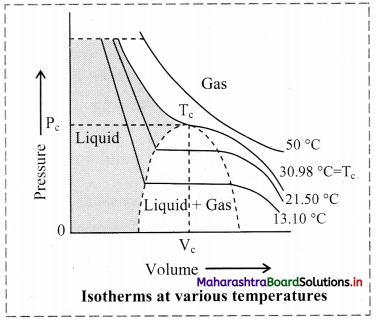
(B) In a group, from Li to Cs, atomic and ionic radii increase with atomic number.
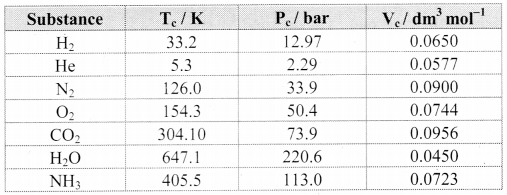
(C) The monovalent ions of alkali metals are larger in size than the parent atoms.

(D) Ionization enthalpies decrease down the group from Li to Cs.

Answer:
(C) The monovalent ions of alkali metals are larger in size than the parent atoms.

18. The first ionization enthalpies of alkaline earth metals are …………. than those of the corresponding alkali metals.
(A) higher
(B) lower
(C) same
(D) none of these
Answer:
(A) higher

19. Which of the following alkaline earth metal does NOT react with water?
(A) Sr
(B) Mg
(C) Ca
(D) Be
Answer:
(D) Be

Maharashtra Board Class 11 Chemistry Important Questions Chapter 8 Elements of Group 1 and 2

20. Oxides and hydroxides of alkaline earth metals except beryllium are ………….. in nature.
(A) acidic
(B) basic
(C) amphoteric
(D) neutral
Answer:
(B) basic

21. ………… is an excellent absorbent of carbon dioxide.
(A) KO2
(B) KCl
(C) KOH
(D) KHCO3
Answer:
(A) KO2

22. Lithium shows diagonal relationship with ……………
(A) beryllium
(B) magnesium
(C) calcium
(D) boron
Answer:
(B) magnesium

23. The diagonal relationship between Li and Mg is due to the similarity in ……………
(A) ionic sizes
(B) electronegativity value
(C) polarizing power
(D) all of the above
Answer:
(D) all of the above

24. The alkali metal that reacts with nitrogen directly to form nitride is ……………
(A) Li
(B) Na
(C) K
(D) Rb
Answer:
(A) Li

25. In the Solvay process, the chief products are ……………
(A) CaCO3 and Ca(HCO3)2
(B) Na2CO3 and NaHCO3
(C) Na2SO4 and NaHSO4
(D) CaCl2 and Ca(NO3)2
Answer:
(B) Na2CO3 and NaHCO3

Maharashtra Board Class 11 Chemistry Important Questions Chapter 8 Elements of Group 1 and 2

26. In Castner-Kellner process for preparation of sodium hydroxide, ………….. is subjected to electrolysis.
(A) NaCl
(B) NaOH
(C) Na2O
(D) Na2CO3
Answer:
(A) NaCl

27. Which of the following method of preparation of H2O2 is known as Merck’s method?
(A) BaO2.8H2O(s) + H2SO4(aq) → BaSO4(s) + H2O2(aq) + 8H2O(l)
(B) Na2O2 + H2SO4 → Na2SO4 + H2O2
(C) BaO2 + H2O + CO2 → BaCO3↓ + H2O2
(D) 3BaO2 + 2H3PO4 → Ba3(PO4)2↓ + 3H2O2
Answer:
(B) Na2O2 + H2SO4 → Na2SO4 + H2O2