Maharashtra Board 12th Commerce Maths Solutions Chapter 6 Linear Programming Ex 6.1

Balbharati Maharashtra State Board 12th Commerce Maths Solution Book Pdf Chapter 6 Linear Programming Ex 6.1 Questions and Answers.

Maharashtra State Board 12th Commerce Maths Solutions Chapter 6 Linear Programming Ex 6.1

Question 1.
A manufacturing firm produces two types of gadgets A and B, which are first processed in the foundry and then sent to a machine shop for finishing. The number of man-hours of labour required in each shop for production of A and B and the number of man-hours available for the firm is as follows.
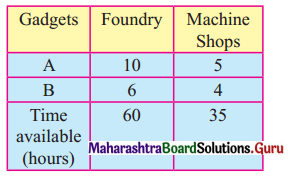
Maharashtra Board 12th Commerce Maths Solutions Chapter 6 Linear Programming Ex 6.1 Q1
Profit on the sale of A is ₹ 30 and B ₹ 20 Per unit Formulate the LPP to have maximum profit.
Solution:
Let the manufacturing firm produce x gadgets of type A and y gadgets of type B.
On selling x gadgets of type A the firm gets ₹ 30 and that on type B is ₹ 20.
∴ Total profit is z = ₹ 30x + 20y.
Since x and y are the numbers of gadgets, x ≥ 0, y ≥ 0
From the given table, the availability of man-hours of labour required in each shop and for the firm is given as 60 and 35.
∴ The inequation are 10x + 6y ≤ 60 and 5x + 4y ≤ 35.
Hence the given LPP can be formulated as Maximize z = 30x + 20y
Subject to 10x + 6y ≤ 60, 5x + 4y ≤ 35, x ≥ 0, y ≥ 0.

Maharashtra Board 12th Commerce Maths Solutions Chapter 6 Linear Programming Ex 6.1

Question 2.
In a cattle breeding farm, it is prescribed that the food ratio for one animal must contain 14, 22, and 1 unit of nutrients A, B, and C respectively. Two different kinds of fodder are available. Each unit weight of these two contains the following:
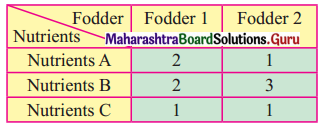
Maharashtra Board 12th Commerce Maths Solutions Chapter 6 Linear Programming Ex 6.1 Q2
The cost of fodder 1 is ₹ 3 per unit and that of fodder 2 is ₹ 2 per unit. Formulate the LPP to minimize the cost.
Solution:
Let x unit of fodder 1 and y unit of fodder 2 be included in the ration of an animal
The cost of 1 unit of fodder 1 is ₹ 3 and the cost of 1 unit of fodder 2 is ₹ 2.
∴ The total cost is ₹ 3x + 2y.
The minimum requirement of the nutrients A, B, and C is given as 14 units, 22 units, and 1 unit.
∴ From the given table, the daily food ration will include (2x + 2y) unit of Nutrient A, (2x + 3y) unit of Nutrient B, and (x + y) of Nutrient C.
The total cost is 2 = ₹ 3x + 2y
Hence the given LPP can be formulated as Minimize z = 3x + 2y
subject to 2x + y ≥ 14, 2x + 3y ≥ 22, x + y ≥ 1, x ≥ 0, y ≥ 0.

Question 3.
A Company manufactures two types of chemicals A and B. Each chemical requires two types of raw materials P and Q. The table below shows a number of units of P and Q required to manufacture one unit of A and one unit of B.
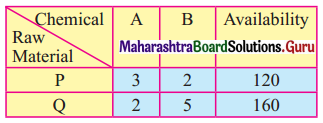
Maharashtra Board 12th Commerce Maths Solutions Chapter 6 Linear Programming Ex 6.1 Q3
The company gets profits of ₹ 350/- and ₹ 400/- by selling one unit of A and one unit of B respectively. Formulate the problem as LPP to maximize the profit.
Solution:
∴ Let the company manufactures x unit of chemical A and y unit of chemical B.
The availability of the raw materials for the production of chemicals A and B are given as 120 and 160 units.
The company gets ₹ 350 as profit on selling one unit of chemical A and ₹ 400 as profit on selling one unit of chemical B.
∴ Total profit is ₹ (350x + 400y).
The inequation can be written as.
3x + 2y ≤ 120
2x + 5y ≤ 160
and x & y cannot be negative
Hence the LPP can be formulated as follows,
Maximize z = 350x + 400y
Subject to 3x + 2y ≤ 120, 2x + 5y ≤ 160, x ≥ 0, y ≥ 0.

Maharashtra Board 12th Commerce Maths Solutions Chapter 6 Linear Programming Ex 6.1

Question 4.
A printing company prints two types of magazines A and B. The company earns ₹ 10 and ₹ 15 on magazines A and B per copy. These are processed on three machines I, II, III. Magazine A requires 2 hours on the machine I, 5 hours on machine II, and 2 hours on machine III. Magazine B requires 3 hours on machine 1, 2 hours on machine II and 6 hours on machine III. Machines I, II, III are available for 36, 50, 60 hours per week respective. Formulate the linear programming problem to maximize the profit.
Solution:
Let the company print x magazine of type A and y magazines of type B.
Then the total earnings of the company are ₹ 10x + 15y.
The given problem can be tabulated as follows.
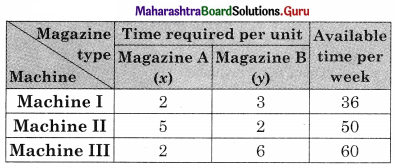
Maharashtra Board 12th Commerce Maths Solutions Chapter 6 Linear Programming Ex 6.1 Q4
From the table, the total time required for Machine I is (2x + 3y) hours, for machine II is (5x + 2y) hours, and for machine III is (2x + 6y) hours.
The machine I, II, and III are available for 36, 50, and 60 hours per work.
∴ The constraints are 2x + 3y ≤ 36, 5x + 2y ≤ 50 and 2x + 6y ≤ 60.
Since x and y cannot be negative, we have x ≥ 0, y ≥ 0.
Hence the given LPP can be formulated as
Maximize z = 10x + 15y
Subject to 2x + 3y ≤ 36, 5x + 2y ≤ 50, 2x + 6y ≤ 60, x ≥ 0, y ≥ 0.

Question 5.
Manufacture produces bulbs and tubes. Each of these must be processed through two machines M1 and M2. A package of bulbs requires 1 hour of work on machine M1 and 3 hours of work on M2. A package of tubes requires 2 hours on machine M1 and 4 hours on machine M2. He earns a profit of ₹ 13.5 per package of bulbs and ₹ 55 per package of tubes. Formulate the LPP to maximize the profit. He operates M1 for at most 10 hours and M2 for at most 12 hours a day.
Solution:
Let the manufacturer produce x packages of bulbs and y packages of tubes.
He earns a profit of ₹ 13.5 per packages of bulbs and ₹ 55 per package of tubes.
∴ His total profit = ₹ (13.5x + 55y).
The given problem can be tabulated as follows.
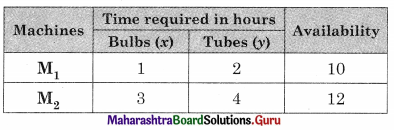
Maharashtra Board 12th Commerce Maths Solutions Chapter 6 Linear Programming Ex 6.1 Q5
From the above table, the total time required for M1 is (x + 2y), and that of M2 is (3x + 4y).
M1 and M2 are available for at most 10 hrs per day and 12 hours per day.
∴ The constraint for the objective function is x + 2y ≤ 10, 3x + 4y ≤ 12
Hence the give LPP can be formulated as
Maximize z = 13.5x + 55y
Subject to x + 2y ≤ 10, 3x + 4y ≤ 12, x ≥ 0, y ≥ 0.

Maharashtra Board 12th Commerce Maths Solutions Chapter 6 Linear Programming Ex 6.1

Question 6.
A Company manufactures two types of fertilizers F1 and F2. Each type of fertilizer requires two raw materials A and B. The number of units of A and B required to manufacture one unit of fertilizer F1 and F2 and availability of the raw materials A and B per day are given in the table below
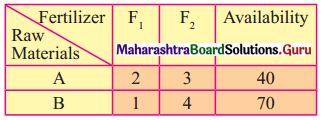
Maharashtra Board 12th Commerce Maths Solutions Chapter 6 Linear Programming Ex 6.1 Q6
By selling one unit of F1 and one unit of F2, the company gets a profit of ₹ 500 and ₹ 750 respectively. Formulate the problem as LPP to maximize the profit.
Solution:
Let the company manufacture x units of Fertilizers F1 and y units of fertilizer F2.
The company gets a profit of ₹ 500 and ₹ 750 by selling a unit of F1 and F2.
∴ Total profit = ₹ (500x + 750y)
The availability of raw materials A and B per day is given as 40 and 70.
∴ From the given table the constraints can be written as 2x + 3y ≤ 40 and x + 4y ≤ 70.
Since x & y cannot be negative, x ≥ 0, y ≥ 0
Hence the given LPP can be formulated as
Maximize z = 500x + 750y
Subject to 2x + 3y ≤ 40, x + 4y ≤ 70, x ≥ 0, y ≥ 0.

Question 7.
A doctor has prescribed two different kinds of feeds A and B to form a weekly diet for a sick person. The minimum requirement of fats, carbohydrates, and proteins are 18, 28,14 units respectively. One unit of food A has 4 units of fat, 14 units of carbohydrates, and 8 units of protein. One unit of food B has 6 units of fat, 12 units of carbohydrates and 8 units of protein. The price of food A is ₹ 4.5 per unit and that of food B is ₹ 3.5 per unit. Form the LPP so that the sick person’s diet meets the requirements at minimum cost.
Solution:
Let x unit of food A and y unit of food B be consumed by a sick person.
The cost of food A in ₹ 4.5 per unit and food B is ₹ 3.5 per unit.
∴ Total cost = ₹ (4.5x + 3.5y)
The given conditions can be tabulated as follows.
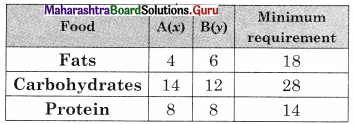
Maharashtra Board 12th Commerce Maths Solutions Chapter 6 Linear Programming Ex 6.1 Q7
∴ The given LPP can be formulated as
Minimise z = 4.5x + 3.5y
Subject to 4x + 6y ≥ 18, 14x + 12y ≥ 28, 8x + 8y ≥ 14, x ≥ 0, y ≥ 0.

Question 8.
If John drives a car at a speed of 60 kms/hour he has to spend ₹ 5 per km on petrol. If he drives at a faster speed of 90 km/ hour, the cost of petrol increases to ₹ 8 per km. He has ₹ 600 to spend on petrol and wishes to travel the maximum distance within an hour. Formulate the above problem as LPP.
Solution:
Let John drive x km at a speed of 60 km/hr and y km at a speed of 90 km/hr.
∴ Time required to drive a distance of x km is \(\frac{x}{60}\) hours and the time require to drive at a distance of y km is \(\frac{y}{90}\) hours.
∴ Total time required \(\left(\frac{x}{60}+\frac{y}{90}\right)\) hours.
Since he wishes to drive maximum distance within an hour,
\(\frac{x}{60}+\frac{y}{90} \leq 1\)
He has to spend ₹ 5 per km at a speed of 60 km/hr and ₹ 8 per km at a speed of 90 km/hr.
He has ₹ 600 on petrol to spend, 5x + 8y ≤ 600
The total distance he wishes to travel is (x + y) hours.
∴ The given LPP can be formulated as
Maximize z = x + y
Subject to \(\frac{x}{60}+\frac{y}{90}\) ≤ 1, 5x + 8y ≤ 600, x ≥ 0, y ≥ 0.

Maharashtra Board 12th Commerce Maths Solutions Chapter 6 Linear Programming Ex 6.1

Question 9.
The company makes concrete bricks made up of cement and sand. The weight of a concrete brick has to be at least 5 kg. Cement costs ₹ 20 per kg. and sand costs ₹ 6 per kg. Strength considerations dictate that a concrete brick should contain a minimum of 4 kg of cement and not more than 2 kg of sand. Formulate the LPP for the cost to be minimum.
Solution:
Let the concrete brick contain x kg of cement and y kg of sand.
The cost of cement is ₹ 20 per kg and sand is ₹ 6 per kg.
∴ The total cost = ₹ (20x + 6y)
Since the weight of the concrete brick has to be at least 5 kg, therefore, x + y ≥ 5
Also, the concrete brick should contain a minimum of 4 kg of cement, i.e. x ≥ 4, and not more than 2 kg of sand, i.e, y ≤ 2.
∴ The LPP can be formulated as
Minimize z = 20x + 6y
Subject to x + y ≥ 5, x ≥ 4, y ≤ 2, x ≥ 0, y ≥ 0.
Maharashtra Board 12th Commerce Maths Solutions Chapter 1 Commission, Brokerage and Discount Ex 1.2

Balbharati Maharashtra State Board 12th Commerce Maths Digest Pdf Chapter 1 Commission, Brokerage and Discount Ex 1.2 Questions and Answers.

Maharashtra State Board 12th Commerce Maths Solutions Chapter 1 Commission, Brokerage and Discount Ex 1.2

Question 1.
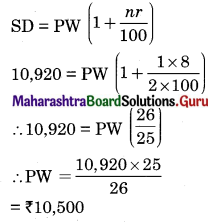
What is the present worth of a sum of ₹ 10,920 due six months hence at 8% p.a simple interest?
Solution:
Given, SD = ₹ 10,920
n = \(\frac{6}{12}\) year = \(\frac{1}{2}\) year
r = 8%
We have,
Maharashtra Board 12th Commerce Maths Solutions Chapter 1 Commission, Brokerage and Discount Ex 1.2 Q1
Thus the present worth is ₹ 10,500

Question 2.
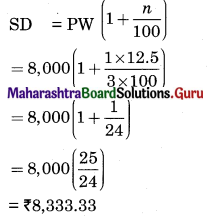
What is the sum due of ₹ 8,000 due 4 months at 12.5% simple interest?
Solution:
Given, PW = ₹ 8,000, n = \(\frac{4}{12}\) year = \(\frac{1}{3}\) year, r = 12.5%
We have,
Maharashtra Board 12th Commerce Maths Solutions Chapter 1 Commission, Brokerage and Discount Ex 1.2 Q2
Thus, the sum due is ₹ 8,333.33

Question 3.
The true discount on the sum due 8 months hence at 12% p.a. is ₹ 560. Find the sum due and present worth of the bill.
Solution:
Given, TD = ₹ 560, n = \(\frac{8}{12}\) year = \(\frac{2}{3}\) year, r = 12%
We have,
TD = \(\frac{\mathrm{PW} \times n \times r}{100}\)
∴ 560 = \(\frac{\mathrm{PW} \times 2 \times 12}{3 \times 100}\)
∴ PW = 560 × \(\frac{25}{2}\) = ₹ 7,000
Now, SD = PW + TD
= 7,000 + 560
= ₹ 7,560

Maharashtra Board 12th Commerce Maths Solutions Chapter 1 Commission, Brokerage and Discount Ex 1.2

Question 4.
The true discount on a sum is \(\frac{3}{8}\) of the sum due at 12% p.a. Find the period of the bill.
Solution:
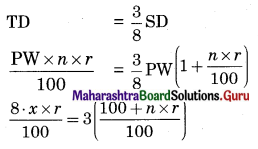
Maharashtra Board 12th Commerce Maths Solutions Chapter 1 Commission, Brokerage and Discount Ex 1.2 Q4
8 × n × 12 = 3(100 + n × 12)
96n = 300 + 36n
60n = 300
∴ n = 5
∴ Period of the bill = 5 years.

Question 5.
20 copies of a book can be purchased for a certain sum payable at the end of 6 months and 21 copies for the same sum in ready cash. Find the rate of interest.
Solution:
Given, n = \(\frac{6}{12}\) year = \(\frac{1}{2}\) year
Let the sum payable be ₹ x
Let the rate of interest be r%
According to given condition,
PW of one book = \(\frac{x}{21}\)
SD of one book = \(\frac{x}{20}\)
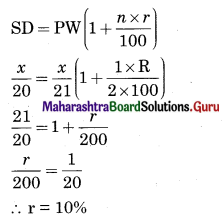
Maharashtra Board 12th Commerce Maths Solutions Chapter 1 Commission, Brokerage and Discount Ex 1.2 Q5
Thus, the rate of interest is 10%.

Question 6.
Find the true discount, Banker’s discount, and Banker’s gain on a bill of ₹ 4,240 due 6 months hence at 9% p.a.
Solution:
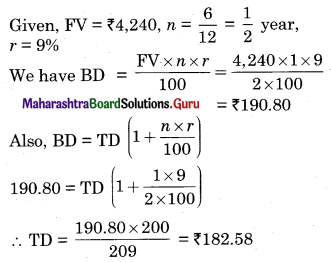
Maharashtra Board 12th Commerce Maths Solutions Chapter 1 Commission, Brokerage and Discount Ex 1.2 Q6
And, Banker’s Gain (BG) = BD – TD
= 190.80 – 182.58
= ₹ 8.22

Question 7.
The true discount on a bill is ₹ 2,200 and bankers discount is ₹ 2,310. If the bill is due 10 months, hence, find the rate of interest.
Solution:
Given, TD = ₹ 2,200, BD = ₹ 2,310
n = \(\frac{10}{12}=\frac{5}{6}\) year
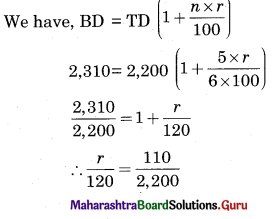
Maharashtra Board 12th Commerce Maths Solutions Chapter 1 Commission, Brokerage and Discount Ex 1.2 Q7
∴ \(\frac{r}{120}=\frac{1}{20}\)
∴ r = 6%
Thus, rate of interest is 6%

Maharashtra Board 12th Commerce Maths Solutions Chapter 1 Commission, Brokerage and Discount Ex 1.2

Question 8.
A bill of ₹ 6,395 drawn on 19th January 2015 for 8 months was discounted on 28th February 2015 at 8% p.a. interest. What is the banker’s discount? What is the cash value of the bill?
Solution:
Face value = ₹ 6,395
Date of drawing = 19/01/2015
Period of the bill = 8 months
Nominal Due date = 19/09/2015
Legal due date = 22/09/2015
Date of discounting = 28/02/2015
Now, the unexpired period = Legal due date – Date of discounting
= 22/09/2015 – 28/02/2015
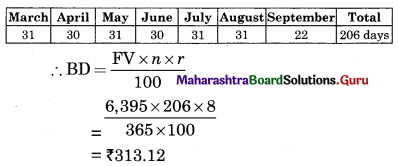
= days (as shown below)
Maharashtra Board 12th Commerce Maths Solutions Chapter 1 Commission, Brokerage and Discount Ex 1.2 Q8
Cash Value = FV – BD
= 6,395 – 313.12
= ₹ 6,621.38

Question 9.
A bill of ₹ 8,000 drawn on 5th January 1998 for 8 months was discounted for ₹ 7,680 on a certain date. Find the date on which it was discounted at 10% p.a.
Solution:
Bankers discount (BD) = FV – cash value
= 8,000 – 7,680
= ₹ 320
Let the unexpired period be x days
∴ BD = \(\frac{\mathrm{FV} \times x \times r}{365 \times 100}\)
∴ 320 = \(\frac{8,000 \times x \times 10}{365 \times 100}\)
∴ x = 146 days
∴ The unexpired days = 146 days
Date of drawing = 05/01/1998
Period of bill = 8 months
Nominal due date = 05/09/1998
Legal due date = 08/09/1998
Thus, the date of discounting is 146 days before the legal due date
Maharashtra Board 12th Commerce Maths Solutions Chapter 1 Commission, Brokerage and Discount Ex 1.2 Q9
∴ Date of discounting of the bill is 15th April 1998

Question 10.
A bill drawn on 5th June for 6 months was discounted at the rate of 5% p.a. on 19th October. If the cash value of the bill is ₹ 43,500, find the face value of the bill.
Solution:
Date of drawing = 5th June
Period of bill = 6 months
Nominal due date = 5th December
Legal due date = 8th December
Date of discounting = 19th October
Rate of interest = 5% p.a.
Let the face value of the bill be ₹ x
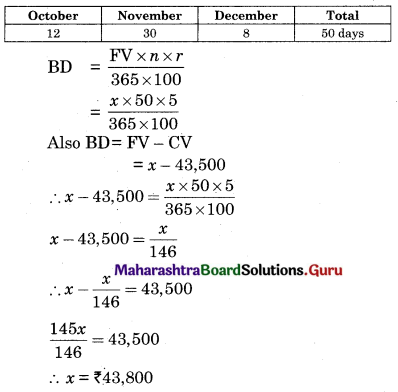
The unexpired period
Maharashtra Board 12th Commerce Maths Solutions Chapter 1 Commission, Brokerage and Discount Ex 1.2 Q10

Question 11.
A bill was drawn on 14th April for ₹ 7,000 and was discounted on 6th July at 5% p.a. The Banker paid ₹ 6,930 for the bill. Find the period of the bill.
Solution:
Face value = ₹ 7,000, cash value = ₹ 6,930
∴ Banker’s discount = 7,000 – 6,930 = ₹ 70
Date of drawing = 14/04
Date of discounting = 06/07
Rate of interest = 5%
Let the unexpired period = x days
∴ BD = \(\frac{7,000 \times x \times 5}{365 \times 100}\)
∴ 70 = \(\frac{70 \times x}{73}\)
∴ x = 73 days
∴ Legal due date of the bill is 73 days after the date of discounting.
Maharashtra Board 12th Commerce Maths Solutions Chapter 1 Commission, Brokerage and Discount Ex 1.2 Q11
∴ Legal due date = 17/09
∴ Nominal due date = 14/09
∴ Period of the bill = 5 months

Maharashtra Board 12th Commerce Maths Solutions Chapter 1 Commission, Brokerage and Discount Ex 1.2

Question 12.
If the difference between true discount and banker’s discount on a sum due 4 months hence is ₹ 20. Find true discount, banker’s discount and amount of bill, the rate of simple interest charged is 5% p.a.
Solution:
Banker’s gain (BG) = Banker’s discount (BD) – True Discount (TD)
∴ BG = ₹ 20
Also, BG = \(\frac{\mathrm{TD} \times n \times r}{100}\)
∴ 20 = \(\frac{\mathrm{TD} \times 4 \times 5}{12 \times 100}\)
∴ 20 = \(\frac{\mathrm{TD}}{60}\)
∴ TD = ₹ 1200
Now, BD = BG + TD
= 20 + 1,200
= ₹ 1,220
Also, BD = \(\frac{\mathrm{FV} \times n \times r}{100}\)
∴ 1,220 = \(\frac{\mathrm{FV} \times 4 \times 5}{12 \times 100}\)
∴ FV = 1,200 × 60 = ₹ 73,200
∴ Amounting the bill = ₹ 73,200

Question 13.
A bill of ₹ 51,000 was drawn on 18th February 2010 for 9 months. It was encashed on 28th June 2010 at 5% p.a. Calculate the banker’s gain and true discount.
Solution:
Face Value = ₹ 51,000
Date of drawing = 18/02/2010
Period of the bill = 9 months
Nominal due date = 18/11/2010
Legal due date = 21/11/2010
Date of discounting = 28/06/2010
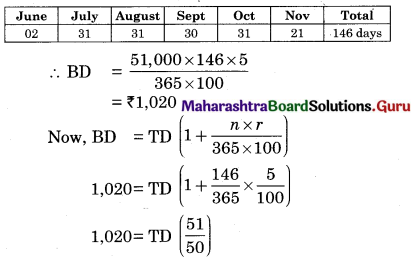
Unexpired period
Maharashtra Board 12th Commerce Maths Solutions Chapter 1 Commission, Brokerage and Discount Ex 1.2 Q13
∴ TD = ₹ 1,000
∴ BG = BD – TD
= 1,020 – 1,000
= ₹ 20

Question 14.
A certain sum due 3 months hence is \(\frac{21}{20}\) of the present worth, what is the rate of interest.
Solution:
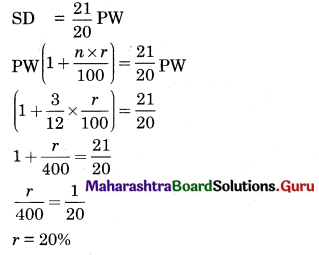
Maharashtra Board 12th Commerce Maths Solutions Chapter 1 Commission, Brokerage and Discount Ex 1.2 Q14

Maharashtra Board 12th Commerce Maths Solutions Chapter 1 Commission, Brokerage and Discount Ex 1.2

Question 15.
A bill of a certain sum drawn on 28th February 2007 for 8 months was encashed on 26th March 2007 for ₹ 10,992 at 14% p.a. Find the face value of the bill.
Solution:
Date drawing = 28/02/2007
Period of the bill = 8 months
Nominal due date = 28/10/2007
Legal due date = 31/10/2007
Date of discounting = 26/03/2007
Cash value = ₹ 10,992
Rate of interest = 14%
Let face value of the bill = ₹ x
Bankers discount = Face value – Cash value = x – 10,992
Also, Banker s discount = \(\frac{F V \times n \times r}{365 \times 100}\)
Where n is the unexpired days
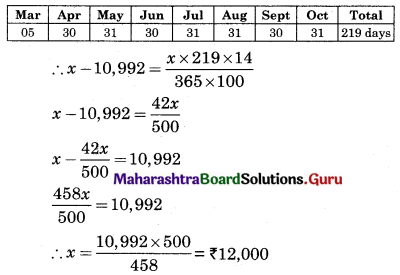
Maharashtra Board 12th Commerce Maths Solutions Chapter 1 Commission, Brokerage and Discount Ex 1.2 Q15
Thus face value of the bill = ₹ 12,000

Maharashtra Board 12th Commerce Maths Solutions Chapter 1 Commission, Brokerage and Discount Ex 1.1

Balbharati Maharashtra State Board 12th Commerce Maths Digest Pdf Chapter 1 Commission, Brokerage and Discount Ex 1.1 Questions and Answers.

Maharashtra State Board 12th Commerce Maths Solutions Chapter 1 Commission, Brokerage and Discount Ex 1.1

Question 1.
An agent charges a 12% commission on the sales. What does he earn if the total sale amounts to ₹ 48,000? What does the seller get?
Solution:
Rate of commission = 12%
Total sales = ₹ 48,000
Agent’s commission = \(\frac {12}{100}\) × 48,000
= ₹ 5,760
Amount received by the seller = Total sales – commission
= ₹ 8,000 – ₹ 5760
= ₹ 2,240

Question 2.
A salesman receives a 3% commission on sales up to ₹ 50,000 and a 4% commission on sales over ₹ 50,000. Find his total income on the sale of ₹ 2,00,000.
Solution:
Total sales = ₹ 2,00,000
Rate of commission upto ₹ 50,000 = 3%
= \(\frac{3}{100}\) × 50,000
= ₹ 1,500
Rate of commission on the sales over ₹ 50,000 = 4%
Sales over ₹ 50,000 is 2,00,000 – 50,000 = ₹ 1,50,000
Commission on sales over ₹ 50,000 = \(\frac{4}{100}\) × 1,50,000 = ₹ 6,000
His total income = ₹ 1,500 + ₹ 6,000 = ₹ 7,500

Maharashtra Board 12th Commerce Maths Solutions Chapter 1 Commission, Brokerage and Discount Ex 1.1

Question 3.
Ms. Saraswati was paid ₹ 88,000 as commission on the sale of computers at the rate of 12.5%. If the price of each computer was ₹ 32,000, how many computers did she sell?
Solution:
Total commission = ₹ 88,000
Rate of commission = 12.5%
Let the number of computers sold be x
since price of each computer = ₹ 32,000
Total sales = ₹ 32,000x
Total commission = 12.5% of total sales
88,000 = \(\frac{12.5}{100}\) × 32,000x
= \(\frac{125}{1000}\) × 32,000x
x = \(\frac{88,000}{125 \times 32}\)
x = 22

Question 4.
Anita is allowed 6.5% commission on the total sales made by her, plus, a bonus of \(\frac{1}{2}\)% on the sale over ₹ 20,000. If her total commission amounts to ₹ 3,400. Find the sales made by her.
Solution:
Let the total sales made by Anita be ₹ x
Rate of commission = 6.5% of total sales
= \(\frac{6.5}{100} \times x\)
= \(\frac{65 x}{1,000}\)
= \(\frac{13 x}{200}\)
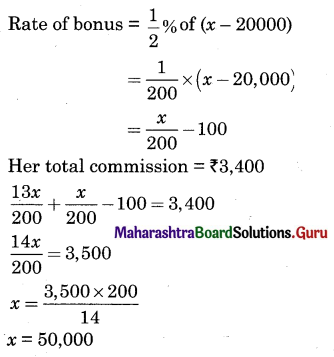
Maharashtra Board 12th Commerce Maths Solutions Chapter 1 Commission, Brokerage and Discount Ex 1.1 Q4

Question 5.
Priya gets a salary of ₹ 15,000 per month and a commission of 8% on sales over ₹ 50,000. If she gets ₹ 17,400 in a certain month. Find the sales made by her in that month.
Solution:
Let the total sales made by Priya be ₹ x
Salary of Priya = ₹ 15,000
Commission = Total earning – salary
= ₹ 17,400 – ₹ 15,000
= ₹ 2,400
Commission = 8% on the sales over ₹ 50,000
2400 = \(\frac{8}{100}\) (x – 50000)
\(\frac{2,400 \times 100}{8}\) = x – 50,000
30,000 = x – 50,000
30,000 + 50,000 = x
∴ x = ₹ 80,000

Maharashtra Board 12th Commerce Maths Solutions Chapter 1 Commission, Brokerage and Discount Ex 1.1

Question 6.
The income of the broker remains unchanged though the rate of commission is increased from 4% to 5%. Find the percentage reduction in the value of the business.
Solution:
Let the original value of business be ₹ 100
Original rate of commission = 4%
∴ Original commission = \(\frac{4}{100}\) × 100 = ₹ 4
Let the new value of business be ₹ x
The new rate of commission = 5%
∴ New commission = \(\frac{5}{100}\) × x = \(\frac{x}{20}\)
Given, original income = New income
4 = \(\frac{x}{20}\)
∴ x = ₹ 80
Thus there is 20% reduction in the value of the business.

Question 7.
Mr. Pavan is paid a fixed weekly salary plus commission based on a percentage of sales made by him. If on the sale of ₹ 68,000 and ₹ 73,000 in two successive weeks, he received in all ₹ 9,880 and ₹ 10,180. Find his weekly salary and the rate of commission paid to him.
Solution:
Let the weekly salary of Mr. Pavan be ₹ x and the rate of commission paid to him be y%
Income = Weekly salary + Commission on the sales
∴ 9,880 = x + \(\frac{y}{100}\) × 68,000
i.e. 9,880 = x + 680y …….(1)
Also, 10,180 = x + \(\frac{y}{100}\) × 73,000
i.e 10,180 = x + 730y ………(2)
Subtracting (1) from (2), we get
50y = 300
∴ y = 6
Substituting y = 6 in equation (1)
9,880 = x + 680(6) ‘
∴ 9,880 – 4,080 = x
∴ x = 5,800
Weekly salary = ₹ 5,800
Rate of commission = 6%

Question 8.
Deepak’s salary was increased from ₹ 4,000 to ₹ 5,000. The sales being the same, due to a reduction in the rate of commission from 3% to 2%, his income remained unchanged. Find his sales.
Solution:
Let Deepak’s total sales be ₹ x
Original salary of Deepak = ₹ 4,000
Original rate of commission = 3%
His new salary = ₹ 5,000
New rate of commission = 2%
Original income = New income (given)
4000 + \(\frac{3 x}{100}\) = 5000 + \(\frac{2 x}{100}\)
\(\frac{3 x}{100}-\frac{2 x}{100}\) = 5,000 – 4,000
\(\frac{x}{100}\) = 1000
x = ₹ 1,00,000
∴ His total sales = ₹ 1,00,000

Maharashtra Board 12th Commerce Maths Solutions Chapter 1 Commission, Brokerage and Discount Ex 1.1

Question 9.
An agent is paid a commission of 7% on cash sales and 5% on credit sales made by him. If on the sale of ₹ 1,02,000 the agent claims a total commission of ₹ 6,420, find his cash sales and credit sales.
Solution:
Total Sales = ₹ 1,02,000
Let cash sales ₹ x
∴ Credit sales = ₹ (1,02,000 – x)
Agent’s commission on cash sales = 7%
= \(\frac{7}{100}\) × x
= \(\frac{7x}{100}\)
Commission on credit sales = 5%
= \(\frac{5}{100}\)(1,02,000 – x)
Given, Total commission = ₹ 6,420
∴ \(\frac{7x}{100}\) + \(\frac{5}{100}\)(1,02,000 – x) = 6420
∴ \(\frac{7x}{100}\) + 5100 – \(\frac{5x}{100}\) = 6,420
∴ \(\frac{2x}{100}\) = 6,420 – 5,100
∴ \(\frac{2x}{100}\) = 1320
∴ x = ₹ 66,000
∴ Cash sales = ₹ 66,000
∴ Credit sales = 1,02000 – 66,000 = ₹ 36,000

Question 10.
Three cars were sold through an agent for ₹ 2,40,000, ₹ 2,22,000 and ₹ 2,25,000 respectively. The rates of the commission were 17.5% on the first, 12.5% on the second. If the agent overall received 14% commission on the total sales, find the rate of commission paid on the third car.
Solution:
Total selling price of three cars = 2,40,000 + 2,22,000 + 2,25,000 = ₹ 6,87,000
Commission on total sales = 14%
= \(\frac{14}{100}\) × 6,87,000
= ₹ 96,180
Selling price of first car = ₹ 2,40,000
Rate of commission = 17.5% = \(\frac{17.5}{100}\) × 2,40,000
∴ Commission on first car = ₹ 42,000
Selling price of second car = ₹ 2,22,000
Rate of commission = 12.5% = \(\frac{12.5}{100}\) × 2,22,000
∴ Commission on second car = ₹ 27,750
Selling price of third car = ₹ 2,25,000
Let the rate of commission be x%
Commission on third car = \(\frac{x}{100}\) × 2,25,000
96,180 – (42,000 + 27,750) = \(\frac{x}{100}\) × 2,25,000
\(\frac{26,430 \times 100}{2,25,000}\) = x
∴ x = 11.75
∴ Rate of commission on the third car = 11.75%

Question 11.
Swatantra Distributors allows a 15% discount on the list price of the washing machines. Further 5% discount is giver for cash payment. Find the list price of the washing machine if it was sold for the net amount of ₹ 38,356.25.
Solution:
Let the list price of the washing machine be ₹ 100
Trade discount = 15% = \(\frac{15}{100}\) × 100 = ₹ 15
∴ Invoice price =100 – 15 = ₹ 85
Cash discount = 5% = \(\frac{5}{100}\) × 85 = ₹ 4.25
∴ Net price = 85 – 4.25 = ₹ 80.75
Thus if List price is 100 than Net price is 80.75
if List price is x than Net price is 38,356.25.
∴ x = \(\frac{38356.25 \times 100}{80.75}\)
∴ x = ₹ 47,500
The list price of the washing machine is ₹ 47,500

Maharashtra Board 12th Commerce Maths Solutions Chapter 1 Commission, Brokerage and Discount Ex 1.1

Question 12.
A bookseller received ₹ 1,530 as a 15% commission on the list price. Find the list price of the books.
Solution:
Let the list price of the books be ₹ x
Rate of commission = 15%
Book seller’s commission = ₹ 1,530
∴ \(\frac{15}{100}\) × x = 1,530
∴ x = \(\frac{1,530 \times 100}{15}\)
∴ x = ₹ 10,200

Question 13.
A retailer sold a suit for ₹ 8,832 after allowing an 8% discount on market price and a further 4% cash discount. If he made 38% profit, find the cost price and the market price of the suit.
Solution:
Let the marked price of the suit be ₹ 100
Trade discount = 8% = \(\frac{8}{100}\) × 100 = ₹ 8
Invoice price = 100 – 8 = ₹ 92
Cash discount = 4% = \(\frac{4}{100}\) × 92 = ₹ 3.68
∴ Net price = 92 – 3.68 = ₹ 88.32
Thus if list price is 100 then net price is 88.32, if list price is x then net price is 8,832
∴ x = \(\frac{8,832 \times 100}{88.32}\)
∴ x = ₹ 10,000
The retailer made 38% profit.
Let the CP of the suit be ₹ 100
∴ SP of the suit = 100 + 38 = ₹ 138
Thus if the SP of the suit is ₹ 138 then its CP is ₹ 100
If the SP of the suit is 88.32 then its
CP = \(\frac{88.32 \times 100}{138}\) = ₹ 6400

Question 14.
An agent charges 10% commission plus 2% delcredere. If he sells goods worth ₹ 37,200, find his total earnings.
Solution:
Total sales = ₹ 37,200
Rate of commission = 10%
Agents commission = \(\frac{4}{100}\) × 37200 = ₹ 3720
Rate of delcredere = 2%
Amount of delcredere = \(\frac{2}{100}\) × 37,200 = ₹ 744
Total earning of the agent = ₹ 3,720 + ₹ 744 = ₹ 4,464

Maharashtra Board 12th Commerce Maths Solutions Chapter 1 Commission, Brokerage and Discount Ex 1.1

Question 15.
A whole seller allows a 25% trade discount and 5% cash discount. What will be the net price of an article marked at ₹ 1600?
Solution:
Marked price of the article = ₹ 1,600
Trade discount = 25%
= \(\frac{25}{100}\) × 1,600
= ₹ 400
∴ Invoice price = 1,600 – 400 = ₹ 1,200
Cash discount = 5%
= \(\frac{5}{100}\) × 1,200
= ₹ 60
∴ Net price = 1,200 – 60 = ₹ 1,140

Maharashtra Board 12th Commerce Maths Solutions Chapter 8 Probability Distributions Ex 8.4

Balbharati Maharashtra State Board 12th Commerce Maths Solution Book Pdf Chapter 8 Probability Distributions Ex 8.4 Questions and Answers.

Maharashtra State Board 12th Commerce Maths Solutions Chapter 8 Probability Distributions Ex 8.4

Question 1.
If X has Poisson distribution with m = 1, then find P(X ≤ 1) given e-1 = 0.3678.
Solution:
∵ m = 1
∵ X follows Poisson Distribution
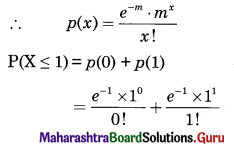
Maharashtra Board 12th Commerce Maths Solutions Chapter 8 Probability Distributions Ex 8.4 Q1
= e-m × 1 + e-m × 1
= e-1 + e-1
= 2 × e-1
= 2 × 0.3678
= 0.7356

Maharashtra Board 12th Commerce Maths Solutions Chapter 8 Probability Distributions Ex 8.4

Question 2.
If X ~ P(\(\frac{1}{2}\)), then find P(X = 3) given e-0.5 = 0.6065.
Solution:
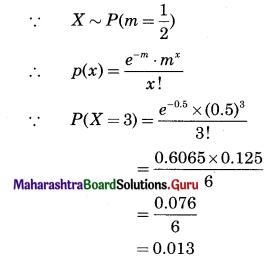
Maharashtra Board 12th Commerce Maths Solutions Chapter 8 Probability Distributions Ex 8.4 Q2

Question 3.
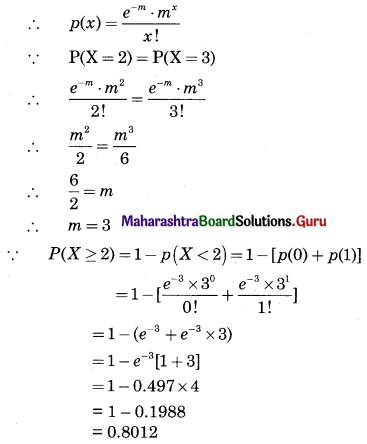
If X has Poisson distribution with parameter m and P(X = 2) = P(X = 3), then find P(X ≥ 2). Use e-3 = 0.0497
Solution:
∵ X follows Poisson Distribution
Maharashtra Board 12th Commerce Maths Solutions Chapter 8 Probability Distributions Ex 8.4 Q3

Question 4.
The number of complaints which a bank manager receives per day follows a Poisson distribution with parameter m = 4. Find the probability that the manager receives (i) only two complaints on a given day, (ii) at most two complaints on a given day. Use e-4 = 0.0183.
Solution:
∵ m = 1
∵ X ~ P(m = 4)
∴ p(x) = \(\frac{e^{-m} \cdot m^{x}}{x !}\)
X = No. of complaints recieved
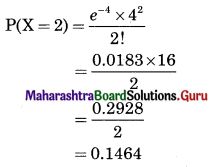
(i) P(Only two complaints on a given day)
Maharashtra Board 12th Commerce Maths Solutions Chapter 8 Probability Distributions Ex 8.4 Q4

(ii) P(Atmost two complaints on a given day)
P(X ≤ 2) = p(0) + p(1) + p(2)
= \(\frac{e^{-4} \times 4^{0}}{0 !}+\frac{e^{-4} \times 4^{1}}{1 !}\) + 0.1464
= e-4 + e-4 × 4 + 0.1464
= e-4 [1 + 4] + 0.1464
= 0.0183 × 5 + 0.1464
= 0.0915 + 0.1464
= 0.2379

Maharashtra Board 12th Commerce Maths Solutions Chapter 8 Probability Distributions Ex 8.4

Question 5.
A car firm has 2 cars, which are hired out day by day. The number of cars hired on a day follows a Poisson distribution with a mean of 1.5. Find the probability that
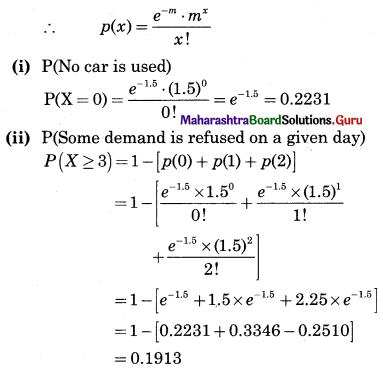
(i) no car is used on a given day.
(ii) some demand is refused on a given day, given e-1.5 = 0.2231.
Solution:
Let X = No. of demands for a car on any day
∴ No. of cars hired
n = 2
m = 1.5
∵ X ~ P(m = 1.5)
Maharashtra Board 12th Commerce Maths Solutions Chapter 8 Probability Distributions Ex 8.4 Q5

Question 6.
Defects on plywood sheets occur at random with an average of one defect per 50 sq. ft. Find the probability that such a sheet has (i) no defect, (ii) at least one defect. Use e-1 = 0.3678.
Solution:
∵ X = No. of defects on a plywood sheet
∵ m = -1
∵ X ~ P(m = -1)
∴ p(x) = \(\frac{e^{-m} \cdot m^{x}}{x !}\)
(i) P(No defect)
P(X = 0) = \(\frac{e^{-1} \times 1^{0}}{0 !}\)
= e-1
= 0.3678

(ii) P(At least one defect)
P(X ≥ 1) = 1 – P(X < 1)
= 1 – p(0)
= 1 – 0.3678
= 0.6322

Maharashtra Board 12th Commerce Maths Solutions Chapter 8 Probability Distributions Ex 8.4

Question 7.
It is known that, in a certain area of a large city, the average number of rats per bungalow is five. Assuming that the number of rats follows Poisson distribution, find the probability that a randomly selected bungalow has
(i) exactly 5 rats
(ii) more than 5 rats
(iii) between 5 and 7 rats, inclusive. Given e-5 = 0.0067.
Solution:
X = No. of rats
∵ m = 5
∴ X ~ P(m = 5)
∴ p(x) = \(\frac{e^{-m} \cdot m^{x}}{x !}\)
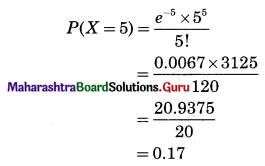
(i) P(Exactly five rats)
Maharashtra Board 12th Commerce Maths Solutions Chapter 8 Probability Distributions Ex 8.4 Q7

(ii) P(More than five rats)
P(X > 5) = 1 – P(X ≤ 5)
Maharashtra Board 12th Commerce Maths Solutions Chapter 8 Probability Distributions Ex 8.4 Q7.1

(iii) P(between 5 and 7 rats, inclusive)
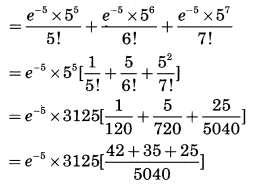
P(5 ≤ x ≤ 7) = p(5) + p(6) + p(7)
Maharashtra Board 12th Commerce Maths Solutions Chapter 8 Probability Distributions Ex 8.4 Q7.2
= 0.0067 × 3125 × 0.02
= 0.0067 × 62.5
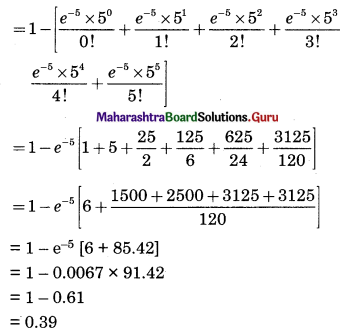
= 0.42

Maharashtra Board 12th Commerce Maths Solutions Chapter 8 Probability Distributions Ex 8.3

Balbharati Maharashtra State Board 12th Commerce Maths Solution Book Pdf Chapter 8 Probability Distributions Ex 8.3 Questions and Answers.

Maharashtra State Board 12th Commerce Maths Solutions Chapter 8 Probability Distributions Ex 8.3

Question 1.
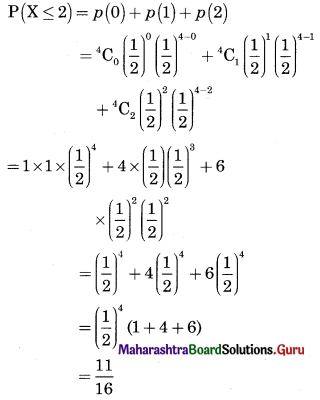
A die is thrown 4 times. If ‘getting an odd number’ is a success, find the probability of (i) 2 successes (ii) at least 3 successes (iii) at most 2 successes.
Solution:
X: Getting an odd no.
p: Probability of getting an odd no.
A die is thrown 4 times
∴ n = 4
∵ p = \(\frac{3}{6}=\frac{1}{2}\)
∴ q = 1 – p = 1 – \(\frac{1}{2}\) = \(\frac{1}{2}\)
∵ X ~ B(3, \(\frac{1}{2}\))
∴ p(x) = \({ }^{n} \mathrm{C}_{x} p^{x} q^{n-x}\)
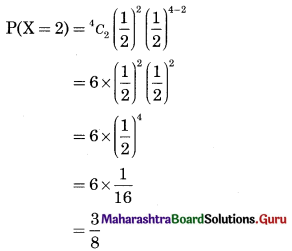
(i) P(Two Successes)
Maharashtra Board 12th Commerce Maths Solutions Chapter 8 Probability Distributions Ex 8.3 Q1
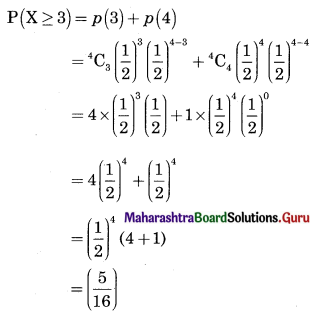
(ii) P(Atleast 3 Successes)
Maharashtra Board 12th Commerce Maths Solutions Chapter 8 Probability Distributions Ex 8.3 Q1.1
(iii) P(Atmost 2 Successes)
Maharashtra Board 12th Commerce Maths Solutions Chapter 8 Probability Distributions Ex 8.3 Q1.2

Maharashtra Board 12th Commerce Maths Solutions Chapter 8 Probability Distributions Ex 8.3

Question 2.
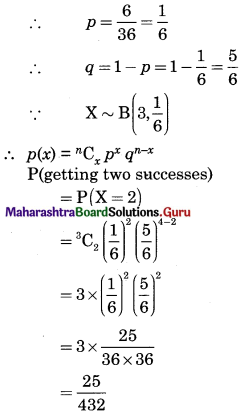
A pair of dice is thrown 3 times. If getting a doublet is considered a success, find the probability of two successes.
Solution:
n: No. of times die is thrown = 3
X: No. of doublets
p: Probability of getting doublets
Getting a doublet means, same no. is obtained on 2 throws of a die
There are 36 outcomes
No. of doublets are (1, 1), (2, 2), (3, 3), (4, 4), (5, 5), (6, 6)
Maharashtra Board 12th Commerce Maths Solutions Chapter 8 Probability Distributions Ex 8.3 Q2

Question 3.
There are 10% defective items in a large bulk of items. What is the probability that a sample of 4 items will include not more than one defective item?
Solution:
n: No of sample items = 4
X: No of defective items
p: Probability of getting defective items
∴ p = 0.1
∴ q = 1 – p = 1 – 0.1 = 0.9
X ~ B(4, 0.1)
∴ p(x) = \({ }^{n} \mathrm{C}_{x} p^{x} \mathrm{q}^{n-x}\)
P(Not include more than 1 defective)
P(X ≤ 1) = p(0) + p(1)
= 4C0 (0.1)0 (0.9)4 + 4C1 (0.1)1 (0.9)4-1
= 1 × 1 × (0.9)4 + 4 × 0.1 × (0.9)3
= (0.9)3 [0.9 + 0.4]
= (0.9)3 × 1.3
= 0.977

Maharashtra Board 12th Commerce Maths Solutions Chapter 8 Probability Distributions Ex 8.3

Question 4.
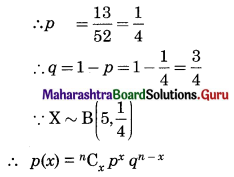
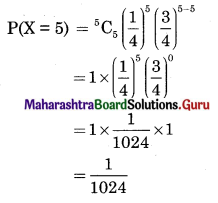
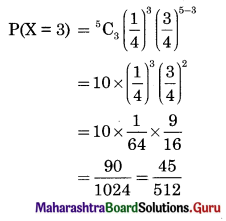
Five cards are drawn successively with replacement from a well-shuffled deck of 52 cards. Find the probability that (i) all the five cards are spades, (ii) only 3 cards are spades, (iii) none is a spade.
Solution:
X: No. of spade cards
Number of cards drawn
∴ n = 5
p: Probability of getting spade card
Maharashtra Board 12th Commerce Maths Solutions Chapter 8 Probability Distributions Ex 8.3 Q4
(i) P(All five cards are spades)
Maharashtra Board 12th Commerce Maths Solutions Chapter 8 Probability Distributions Ex 8.3 Q4.1
(ii) P(Only 3 cards are spades)
Maharashtra Board 12th Commerce Maths Solutions Chapter 8 Probability Distributions Ex 8.3 Q4.2
(iii) P(None is a spade)
Maharashtra Board 12th Commerce Maths Solutions Chapter 8 Probability Distributions Ex 8.3 Q4.3

Question 5.
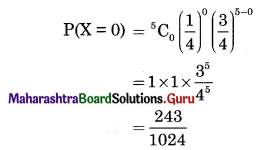
The probability that a bulb produced by a factory will use fuse after 200 days of use is 0.2. Let X denote the number of bulbs (out of 5) that fuse after 200 days of use. Find the probability of (i) X = 0, (ii) X ≤ 1, (iii) X > 1, (iv) X ≥ 1.
Solution:
X : No. of bulbs fuse after 200 days of use
p : Probability of getting fuse bulbs
No. of bulbs in a sample
∴ n = 5
∴ p = 0.2
∴ q = 1 – p = 1 – 0.2 = 0.8
∵ X ~ B(5, 0.2)
∴ p(x) = \({ }^{n} \mathrm{C}_{x} p^{x} q^{n-x}\)
(i) P(X = 0) = 5C0 (0.2)0 (0.8)5-0
= 1 × 1 × (0.8)5
= (0.8)5

(ii) P(X ≤ 1) = p(0) + p(1)
= 5C0 (0.2)0 (0.8)5-0 + 5C1 (0.2)1 (0.8)5-1
= 1 × 1 × (0.8)5 + 5 × 0.2 × (0.8)4
= (0.8)4 [0.8 + 1]
= 1.8 × (0.8)4

(iii) P(X > 1) = 1 – [p(0) + p(1)]
= 1 – 1.8 × (0.8)4

(iv) P(X ≥ 1) = 1 – p(0)
= 1 – (0.8)5

Maharashtra Board 12th Commerce Maths Solutions Chapter 8 Probability Distributions Ex 8.3

Question 6.
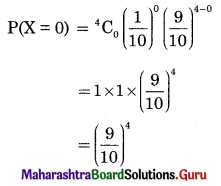
10 balls are marked with digits 0 to 9. If four balls are selected with replacement. What is the probability that none is marked 0?
Solution:
X : No. of balls drawn marked with the digit 0
n : No. of balls drawn
∴ n = 4
p : Probability of balls marked with 0.
∴ p = \(\frac{1}{10}\)
∴ q = 1 – p = 1 – \(\frac{1}{10}\) = \(\frac{9}{10}\)
p(x) = \({ }^{n} C_{x} p^{x} q^{n-x}\)
P(None of the ball is marked with digit 0)
Maharashtra Board 12th Commerce Maths Solutions Chapter 8 Probability Distributions Ex 8.3 Q6

Question 7.
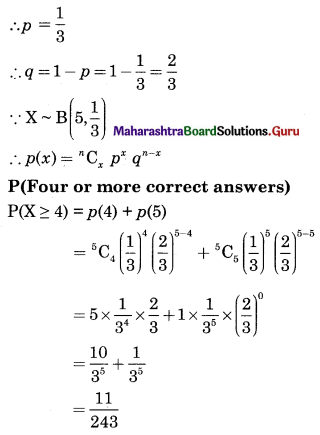
In a multiple-choice test with three possible answers for each of the five questions, what is the probability of a candidate getting four or more correct answers by random choice?
Solution:
n: No. of Questions
∴ n = 5
X: No. of correct answers by guessing
p: Probability of getting correct answers
Maharashtra Board 12th Commerce Maths Solutions Chapter 8 Probability Distributions Ex 8.3 Q7

Question 8.
Find the probability of throwing at most 2 sixes in 6 throws of a single die.
Solution:
X : No. of sixes in 6 throws
n : No. of times dice thrown
∴ n = 6
p : Probability of getting six
∴ p = \(\frac{1}{6}\)
∴ q = 1 – p = 1 – \(\frac{1}{6}\) = \(\frac{5}{6}\)
∵ X ~ B(6, \(\frac{1}{6}\))
∴ p(x) = \({ }^{n} \mathrm{C}_{x} p^{x} q^{n-x}\)
P(At most 2 sixes)
P(X ≤ 2) = p(0) + p(1) + p(2)
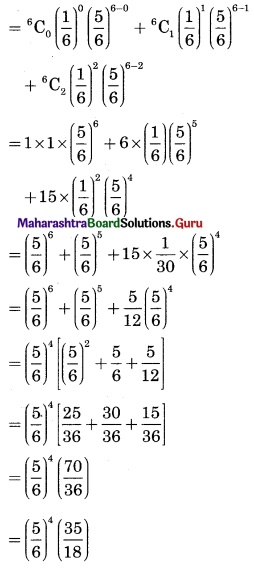
Maharashtra Board 12th Commerce Maths Solutions Chapter 8 Probability Distributions Ex 8.3 Q8

Maharashtra Board 12th Commerce Maths Solutions Chapter 8 Probability Distributions Ex 8.3

Question 9.
Given that X ~ B(n, p),
(i) if n = 10 and p = 0.4, find E(X) and Var(X).
(ii) if p = 0.6 and E(X) = 6, find n and Var(X).
(iii) if n = 25, E(X) = 10, find p and Var(X).
(iv) if n = 10, E(X) = 8, find Var(X).
Solution:
∵ X ~ B (n, p), E(X) = np, V(X) = npq, q = 1 – p
(i) E(X) = np = 10 × 0.4 = 4
∵ q = 1 – p = 1 – 0.4 = 0.6
V(X) = npq = 10 × 0.4 × 0.6 = 2.4

(ii) ∵ p = 0.6
∴ q = 1 – p = 1 – 0.6 = 0.4
E(X) = np
∴ 6 = n × 0.6
∴ n = 10
∴ V(X) = npq = 10 × 0.6 × 0.4 = 2.4

(iii) E(X) = np
∴ 10 = 25 × p
∴ p = 0.4
∴ q = 1, p = 1 – 0.4 = 0.6
∴ S.D.(X) = √V(X)
= \(\sqrt{n p q}\)
= \(\sqrt{25 \times 0.4 \times 0.6}\)
= √6
= 2.4494

(iv) ∵ E(X) = np
∴ 8 = 10p
∴ p = 0.8
∴ q = 1 – p = 1 – 0.8 = 0.2
∵ V(X) = npq = 10 × 0.8 × 0.2 = 1.6

Maharashtra Board 12th Commerce Maths Solutions Chapter 8 Probability Distributions Ex 8.2

Balbharati Maharashtra State Board 12th Commerce Maths Solution Book Pdf Chapter 8 Probability Distributions Ex 8.2 Questions and Answers.

Maharashtra State Board 12th Commerce Maths Solutions Chapter 8 Probability Distributions Ex 8.2

Question 1.
Check whether each of the following is p.d.f.
(i) \(f(x)= \begin{cases}x & \text { for } 0 \leq x \leq 1 \\ 2-x & \text { for } 1<x \leq 2\end{cases}\)
Solution:
Given function is
f(x) = x, 0 ≤ x ≤ 1
Each f(x) ≥ 0, as x ≥ 0.
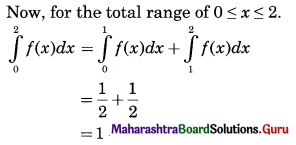
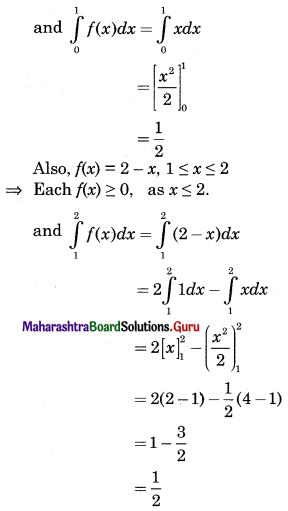
Maharashtra Board 12th Commerce Maths Solutions Chapter 8 Probability Distributions Ex 8.2 Q1(i)
Maharashtra Board 12th Commerce Maths Solutions Chapter 8 Probability Distributions Ex 8.2 Q1(i).1
∴ The given function is a p.d.f. of x.

(ii) f(x) = 2 for 0 < x < 1
Solution:
Given function is
f(x) = 2 for 0 < x < 1 Each f(x) > 0,
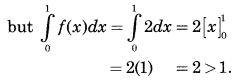
Maharashtra Board 12th Commerce Maths Solutions Chapter 8 Probability Distributions Ex 8.2 Q1(ii)
∴ The given function is not a p.d.f.

Maharashtra Board 12th Commerce Maths Solutions Chapter 8 Probability Distributions Ex 8.2

Question 2.
The following is the p.d.f. of a r.v. X.
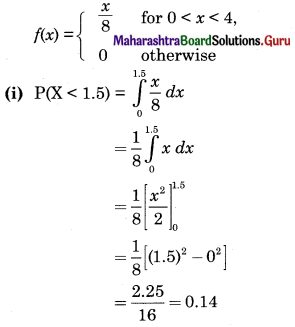
\(f(x)= \begin{cases}\frac{x}{8} & \text { for } 0<x<4 \\ 0 & \text { otherwise }\end{cases}\)
Find (i) P(X < 1.5), (ii) P(1 < X < 2), (iii) P(X > 2)
Solution:
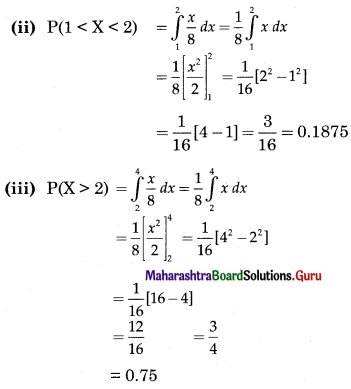
Maharashtra Board 12th Commerce Maths Solutions Chapter 8 Probability Distributions Ex 8.2 Q2
Maharashtra Board 12th Commerce Maths Solutions Chapter 8 Probability Distributions Ex 8.2 Q2.1

Question 3.
It is felt that error in measurement of reaction temperature (in Celsius) in an experiment is a continuous r.v. with p.d.f.
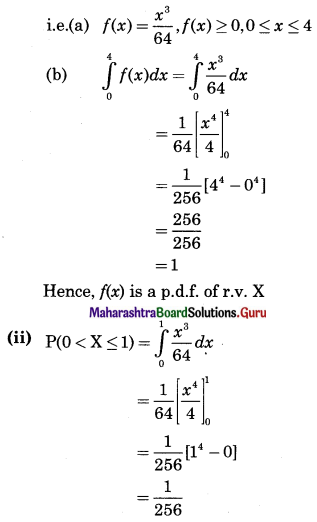
\(f(x)= \begin{cases}\frac{x^{3}}{64} & \text { for } 0 \leq x \leq 4 \\ 0 & \text { otherwise }\end{cases}\)
(i) Verify whether f(x) is a p.d.f.
(ii) Find P(0 < X ≤ 1).
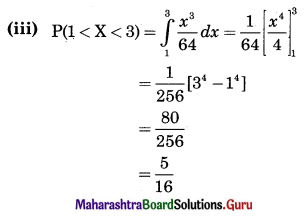
(iii) Find the probability that X is between 1 and 3.
Solution:
(i) f(x) is p.d.f. of r.v. X if
(a) f(x) ≥ 0, ∀ x ∈ R
(b) \(\int_{0}^{4} f(x) d x\) = 1
Maharashtra Board 12th Commerce Maths Solutions Chapter 8 Probability Distributions Ex 8.2 Q3
Maharashtra Board 12th Commerce Maths Solutions Chapter 8 Probability Distributions Ex 8.2 Q3.1

Question 4.
Find k, if the following function represents the p.d.f. of a r.v. X.
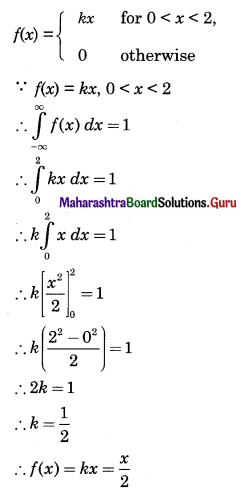
(i) \(f(x)= \begin{cases}k x & \text { for } 0<x<2 \\ 0 & \text { otherwise }\end{cases}\)
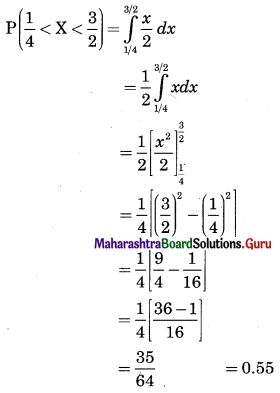
Also find P[\(\frac{1}{4}\) < X < \(\frac{1}{2}\)]
Solution:
Maharashtra Board 12th Commerce Maths Solutions Chapter 8 Probability Distributions Ex 8.2 Q4(i)
Maharashtra Board 12th Commerce Maths Solutions Chapter 8 Probability Distributions Ex 8.2 Q4(i).1

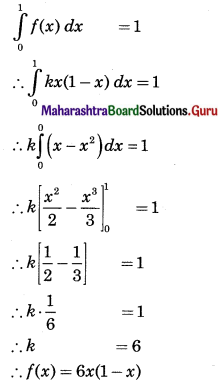
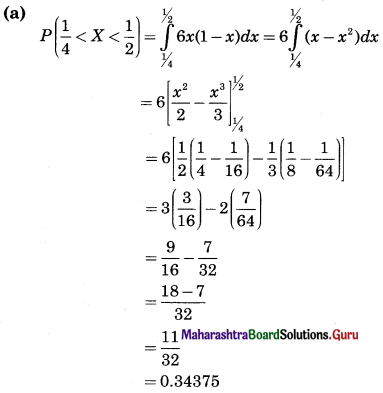
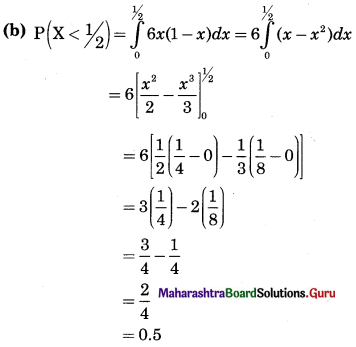
(ii) \(f(x)= \begin{cases}k x(1-x) & \text { for } 0<x<1 \\ 0 & \text { otherwise }\end{cases}\)
Also find (a) P[\(\frac{1}{4}\) < X < \(\frac{1}{2}\)], (b) P[X < \(\frac{1}{2}\)]
Solution:
We know that
Maharashtra Board 12th Commerce Maths Solutions Chapter 8 Probability Distributions Ex 8.2 Q4(ii)
Maharashtra Board 12th Commerce Maths Solutions Chapter 8 Probability Distributions Ex 8.2 Q4(ii).1
Maharashtra Board 12th Commerce Maths Solutions Chapter 8 Probability Distributions Ex 8.2 Q4(ii).2

Maharashtra Board 12th Commerce Maths Solutions Chapter 8 Probability Distributions Ex 8.2

Question 5.
Let X be the amount of time for which a book is taken out of the library by a randomly selected student and suppose that X has p.d.f.
\(f(x)= \begin{cases}0.5 x & \text { for } 0 \leq x \leq 2 \\ 0 & \text { otherwise }\end{cases}\)
Calculate (i) P(X ≤ 1), (ii) P(0.5 ≤ X ≤ 1.5), (iii) P(X ≥ 1.5).
Solution:
Given p.d.f. of X is f(x) = 0.5x for 0 ≤ x ≤ 2
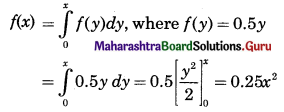
∴ Its c.d.f. F(x) is given by
Maharashtra Board 12th Commerce Maths Solutions Chapter 8 Probability Distributions Ex 8.2 Q5

(i) P(X < 1) = F(1)
= 0.25(1)2
= 0.25

(ii) P(0.5 < X < 1.5) = F(1.5) – F(0.5)
= 0.25(1.5)2 – 0.25(0.5)2
= 0.25[2.25 – 0.25]
= 0.25(2)
= 0.5

(iii) P(X ≥ 1.5) = 1 – P(X ≤ 1.5)
= 1 – F(1.5)
= 1 – 0.25(1.5)2
= 1 – 0.25(2.25)
= 1 – 0.5625
= 0.4375

Question 6.
Suppose X is the waiting time (in minutes) for a bus and its p.d.f. is given by
\(f(x)=\left\{\begin{array}{cl}
\frac{1}{5} & \text { for } 0 \leq x \leq 5 \\
0 & \text { otherwise }
\end{array}\right.\)
Find the probability that (i) waiting time is between 1 and 3 minutes, (ii) waiting time is more than 4 minutes.
Solution:
p.d.f. of r.v. X is given by
f(x) = \(\frac{1}{5}\) for 0 ≤ x ≤ 5
This is a constant function.
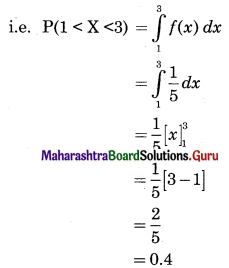
(i) Probability that waiting time X is between 1 and 3 minutes
Maharashtra Board 12th Commerce Maths Solutions Chapter 8 Probability Distributions Ex 8.2 Q6
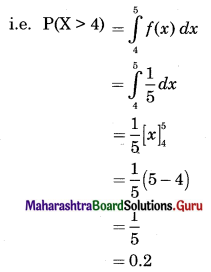
(ii) Probability that waiting time X is more than 4 minutes
Maharashtra Board 12th Commerce Maths Solutions Chapter 8 Probability Distributions Ex 8.2 Q6.1

Question 7.
Suppose error involved in making a certain measurement is a continuous r.v. X with p.d.f.
\(f(x)= \begin{cases}k\left(4-x^{2}\right) & \text { for }-2 \leq x \leq 2 \\ 0 & \text { otherwise }\end{cases}\)
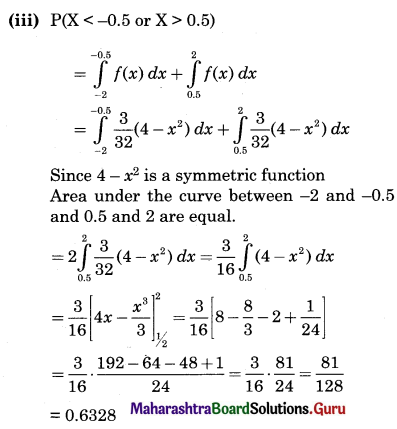
Compute (i) P(X > 0), (ii) P(-1 < X < 1), (iii) P(X < -0.5 or X > 0.5)
Solution:
Since given f(x) is a p.d.f. of r.v. X
Since -2 ≤ x ≤ 2
∴ x2 ≤ 4
∴ 4 – x2 ≥ 0
∴ k(4 – x2) ≥ 0
∴ k ≥ 0 [∵ f(x) ≥ 0]
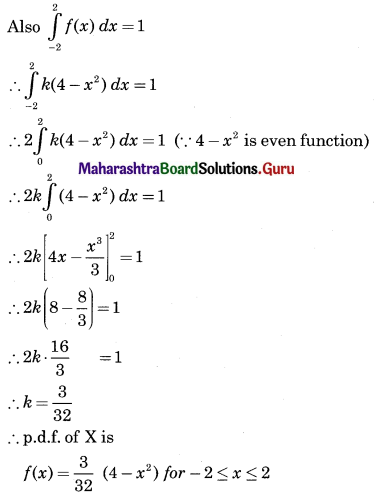
Maharashtra Board 12th Commerce Maths Solutions Chapter 8 Probability Distributions Ex 8.2 Q7
Maharashtra Board 12th Commerce Maths Solutions Chapter 8 Probability Distributions Ex 8.2 Q7.1
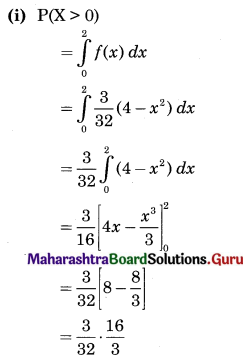
Maharashtra Board 12th Commerce Maths Solutions Chapter 8 Probability Distributions Ex 8.2 Q7.2
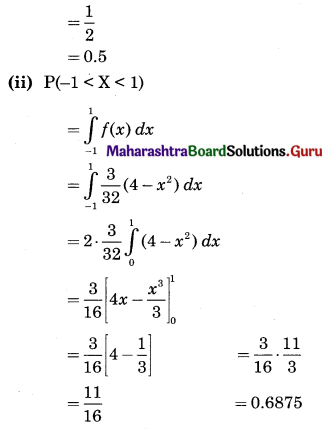
Maharashtra Board 12th Commerce Maths Solutions Chapter 8 Probability Distributions Ex 8.2 Q7.3

Question 8.
Following is the p.d.f. of a continuous r.v. X.
\(f(x)= \begin{cases}\frac{x}{8} & \text { for } 0<x<4 \\ 0 & \text { otherwise }\end{cases}\)
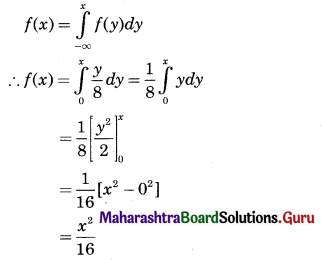
(i) Find an expression for the c.d.f. of X.
(ii) Find F(x) at x = 0.5, 1.7, and 5.
Solution:
The p.d.f. of a continuous r.v. X is
\(f(x)= \begin{cases}\frac{x}{8} & \text { for } 0<x<4 \\ 0 & \text { otherwise }\end{cases}\)
(i) c.d.f. of continuous r.v. X is given by
Maharashtra Board 12th Commerce Maths Solutions Chapter 8 Probability Distributions Ex 8.2 Q8

(ii) F(0.5) = \(\frac{(0.5)^{2}}{16}=\frac{0.25}{16}=\frac{1}{64}\) = 0.015
F(1.7) = \(\frac{(1.7)^{2}}{16}=\frac{2.89}{16}\) = 0.18
For any of x greater than or equal to 4, F(x) = 1
∴ F(5) = 1

Maharashtra Board 12th Commerce Maths Solutions Chapter 8 Probability Distributions Ex 8.2

Question 9.
The p.d.f. of a continuous r.v. X is
\(f(x)=\left\{\begin{array}{cl}
\frac{3 x^{2}}{8} & \text { for } 0<x<2 \\
0 & \text { otherwise }
\end{array}\right.\)
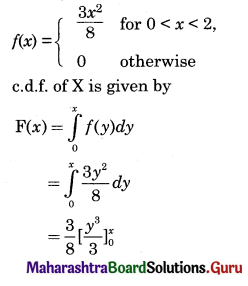
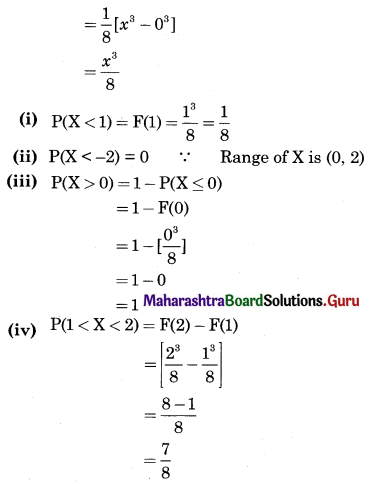
Determine the c.d.f. of X and hence find (i) P(X < 1), (ii) P(X < -2), (iii) P(X > 0), (iv) P(1 < X < 2).
Solution:
The p.d.f. of a continuous r.v. X is
Maharashtra Board 12th Commerce Maths Solutions Chapter 8 Probability Distributions Ex 8.2 Q9
Maharashtra Board 12th Commerce Maths Solutions Chapter 8 Probability Distributions Ex 8.2 Q9.1

Question 10.
If a r.v. X has p.d.f.
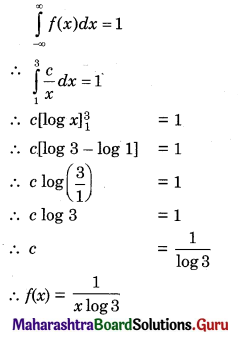
\(f(x)= \begin{cases}\frac{c}{x} & \text { for } 1<x<3, c>0 \\ 0 & \text { otherwise }\end{cases}\)
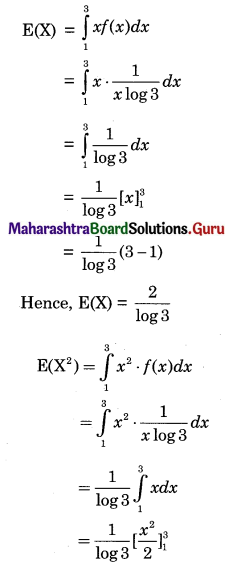
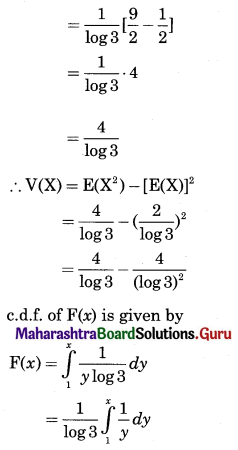
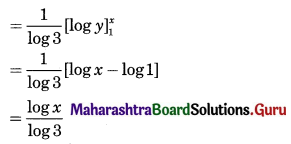
Find c, E(X) and V(X). Also find f(x).
Solution:
The p.d.f. of r.v. X is
f(x) = \(\frac{c}{x}\), 1 < x < 3, c > 0
For p.d.f. of X, we have
Maharashtra Board 12th Commerce Maths Solutions Chapter 8 Probability Distributions Ex 8.2 Q10
Maharashtra Board 12th Commerce Maths Solutions Chapter 8 Probability Distributions Ex 8.2 Q10.1
Maharashtra Board 12th Commerce Maths Solutions Chapter 8 Probability Distributions Ex 8.2 Q10.2
Maharashtra Board 12th Commerce Maths Solutions Chapter 8 Probability Distributions Ex 8.2 Q10.3

Maharashtra Board 11th Commerce Maths Solutions Chapter 9 Differentiation Ex 9.2

Balbharati Maharashtra State Board 11th Commerce Maths Solution Book Pdf Chapter 9 Differentiation Ex 9.2 Questions and Answers.

Maharashtra State Board 11th Commerce Maths Solutions Chapter 9 Differentiation Ex 9.2

I. Differentiate the following functions w.r.t. x.

Question 1.
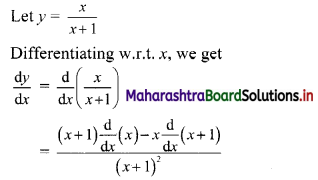
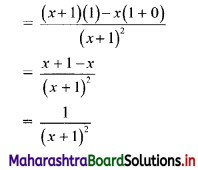
\(\frac{x}{x+1}\)
Solution:
Maharashtra Board 11th Commerce Maths Solutions Chapter 9 Differentiation Ex 9.2 I Q1
Maharashtra Board 11th Commerce Maths Solutions Chapter 9 Differentiation Ex 9.2 I Q1.1

Question 2.
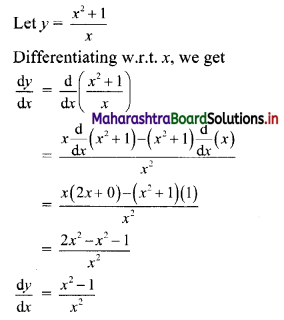
\(\frac{x^{2}+1}{x}\)
Solution:
Maharashtra Board 11th Commerce Maths Solutions Chapter 9 Differentiation Ex 9.2 I Q2

Maharashtra Board 11th Commerce Maths Solutions Chapter 9 Differentiation Ex 9.2

Question 3.
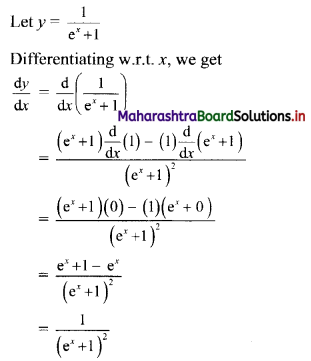
\(\frac{1}{e^{x}+1}\)
Solution:
Maharashtra Board 11th Commerce Maths Solutions Chapter 9 Differentiation Ex 9.2 I Q3

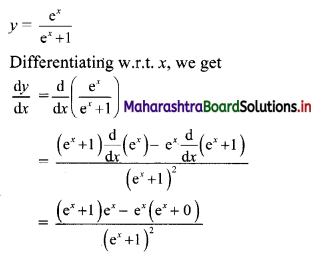
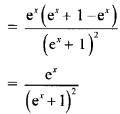
Question 4.
\(\frac{e^{x}}{e^{x}+1}\)
Solution:
Maharashtra Board 11th Commerce Maths Solutions Chapter 9 Differentiation Ex 9.2 I Q4
Maharashtra Board 11th Commerce Maths Solutions Chapter 9 Differentiation Ex 9.2 I Q4.1

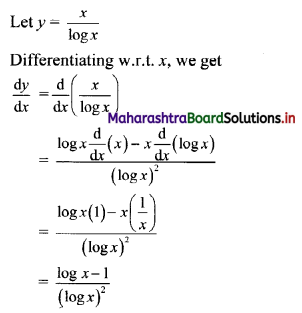
Question 5.
\(\frac{x}{\log x}\)
Solution:
Maharashtra Board 11th Commerce Maths Solutions Chapter 9 Differentiation Ex 9.2 I Q5

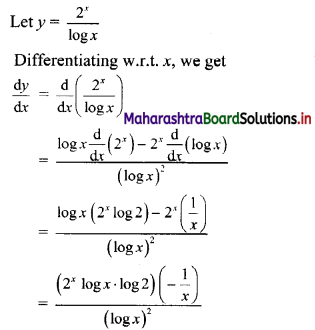
Question 6.
\(\frac{2^{x}}{\log x}\)
Solution:
Maharashtra Board 11th Commerce Maths Solutions Chapter 9 Differentiation Ex 9.2 I Q6

Maharashtra Board 11th Commerce Maths Solutions Chapter 9 Differentiation Ex 9.2

Question 7.
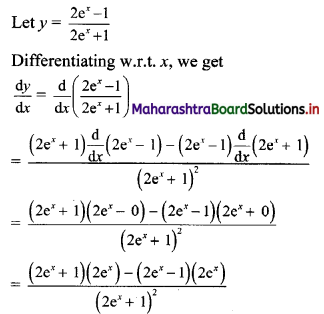
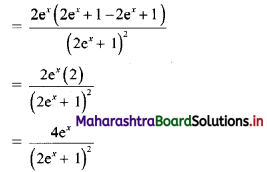
\(\frac{\left(2 e^{x}-1\right)}{\left(2 e^{x}+1\right)}\)
Solution:
Maharashtra Board 11th Commerce Maths Solutions Chapter 9 Differentiation Ex 9.2 I Q7
Maharashtra Board 11th Commerce Maths Solutions Chapter 9 Differentiation Ex 9.2 I Q7.1

Question 8.
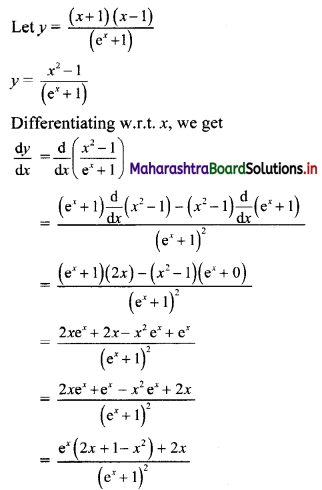
\(\frac{(x+1)(x-1)}{\left(e^{x}+1\right)}\)
Solution:
Maharashtra Board 11th Commerce Maths Solutions Chapter 9 Differentiation Ex 9.2 I Q8

II. Solve the following examples:

Question 1.
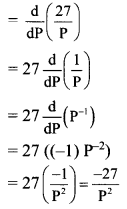
The demand D for a price P is given as D = \(\frac{27}{P}\), find the rate of change of demand when the price is 3.
Solution:
Demand, D = \(\frac{27}{P}\)
Rate of change of demand = \(\frac{dD}{dP}\)
Maharashtra Board 11th Commerce Maths Solutions Chapter 9 Differentiation Ex 9.2 II Q1
When price P = 3,
Rate of change of demand,
\(\left(\frac{\mathrm{dD}}{\mathrm{dP}}\right)_{\mathrm{P}=3}=\frac{-27}{(3)^{2}}=-3\)
∴ When price is 3, Rate of change of demand is -3.

Question 2.
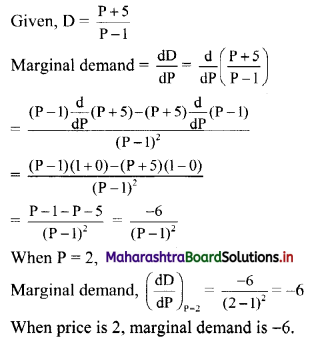
If for a commodity; the price-demand relation is given as D = \(\frac{P+5}{P-1}\). Find the marginal demand when the price is 2.
Solution:
Maharashtra Board 11th Commerce Maths Solutions Chapter 9 Differentiation Ex 9.2 II Q2

Question 3.
The demand function of a commodity is given as P = 20 + D – D2. Find the rate at which price is changing when demand is 3.
Solution:
Given, P = 20 + D – D2
Rate of change of price = \(\frac{dP}{dD}\)
= \(\frac{d}{dD}\)(20 + D – D2)
= 0 + 1 – 2D
= 1 – 2D
Rate of change of price at D = 3 is
\(\left(\frac{\mathrm{dP}}{\mathrm{dD}}\right)_{\mathrm{D}=3}\) = 1 – 2(3) = -5
∴ Price is changing at a rate of -5, when demand is 3.

Maharashtra Board 11th Commerce Maths Solutions Chapter 9 Differentiation Ex 9.2

Question 4.
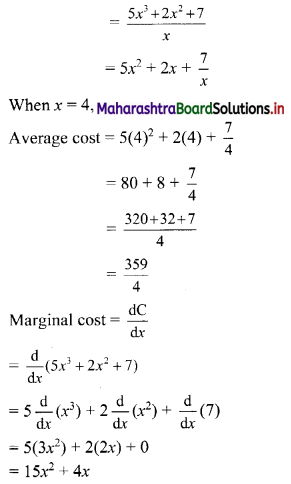
If the total cost function is given by; C = 5x3 + 7x2 + 7; find the average cost and the marginal cost when x = 4.
Solution:
Total cost function, C = 5x3 + 7x2 + 7
Average cost = \(\frac{C}{x}\)
Maharashtra Board 11th Commerce Maths Solutions Chapter 9 Differentiation Ex 9.2 II Q4
When x = 4, Marginal cost = \(\left(\frac{\mathrm{dC}}{\mathrm{d} x}\right)_{x=4}\)
= 15(4)2 + 4(4)
= 240 + 16
= 256
∴ the average cost and marginal cost at x = 4 are \(\frac{359}{4}\) and 256 respectively.

Question 5.
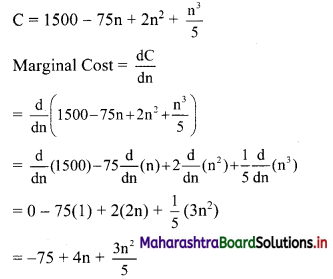
The total cost function of producing n notebooks is given by
C = 1500 – 75n + 2n2 + \(\frac{n^{3}}{5}\)
Find the marginal cost at n = 10.
Solution:
The total cost function,
Maharashtra Board 11th Commerce Maths Solutions Chapter 9 Differentiation Ex 9.2 II Q5
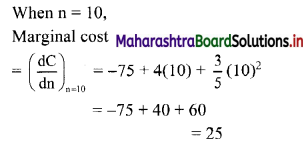
Maharashtra Board 11th Commerce Maths Solutions Chapter 9 Differentiation Ex 9.2 II Q5.1
∴ Marginal cost at n = 10 is 25.

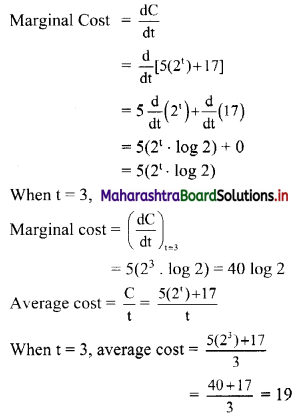
Question 6.
The total cost of ‘t’ toy cars is given by C = 5(2t) + 17. Find the marginal cost and average cost at t = 3.
Solution:
Total cost of ‘t’ toy cars, C = 5(2t) + 17
Maharashtra Board 11th Commerce Maths Solutions Chapter 9 Differentiation Ex 9.2 II Q6
∴ at t = 3, the Marginal cost is 40 log 2 and the Average cost is 19.

Maharashtra Board 11th Commerce Maths Solutions Chapter 9 Differentiation Ex 9.2

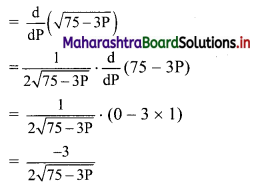
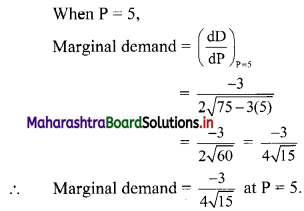
Question 7.
If for a commodity; the demand function is given by, D = \(\sqrt{75-3 P}\). Find the marginal demand function when P = 5.
Solution:
Demand function, D = \(\sqrt{75-3 P}\)
Now, Marginal demand = \(\frac{dD}{dP}\)
Maharashtra Board 11th Commerce Maths Solutions Chapter 9 Differentiation Ex 9.2 II Q7
Maharashtra Board 11th Commerce Maths Solutions Chapter 9 Differentiation Ex 9.2 II Q7.1

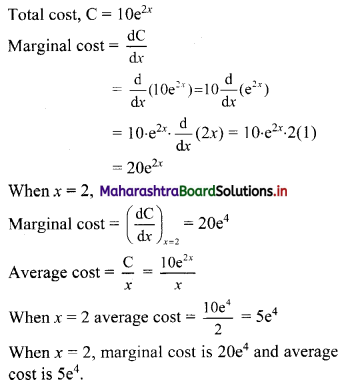
Question 8.
The total cost of producing x units is given by C = 10e2x, find its marginal cost and average cost when x = 2.
Solution:
Maharashtra Board 11th Commerce Maths Solutions Chapter 9 Differentiation Ex 9.2 II Q8

Question 9.
The demand function is given as P = 175 + 9D + 25D2. Find the revenue, average revenue, and marginal revenue when demand is 10.
Solution:
Given, P = 175 + 9D + 25D2
Total revenue, R = P.D
= (175 + 9D + 25D2)D
= 175D + 9D2 + 25D3
Average revenue = P = 175 + 9D + 25D2
Marginal revenue = \(\frac{dR}{dD}\)
= \(\frac{d}{dD}\) (175D + 9D2 + 25D3)
= 175 \(\frac{d}{dD}\) (D) + 9 \(\frac{d}{dD}\) (D2) + 25 \(\frac{d}{dD}\) (D3)
= 175(1) + 9(2D) + 25(3D2)
= 175 + 18D + 75D2
When D = 10,
Total revenue = 175(10) + 9(10)2 + 25(10)3
= 1750 + 900 + 25000
= 27650
Average revenue = 175 + 9(10) + 25(10)2
= 175 + 90 + 2500
= 2765
Marginal revenue = 175 + 18(10) + 75(10)2
= 175 + 180 + 7500
= 7855
∴ When Demand = 10,
Total revenue = 27650, Average revenue = 2765, Marginal revenue = 7855.

Maharashtra Board 11th Commerce Maths Solutions Chapter 9 Differentiation Ex 9.2

Question 10.
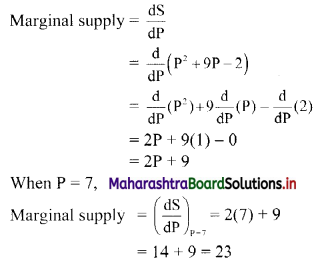
The supply S for a commodity at price P is given by S = P2 + 9P – 2. Find the marginal supply when the price is 7.
Solution:
Given, S = P2 + 9P – 2
Maharashtra Board 11th Commerce Maths Solutions Chapter 9 Differentiation Ex 9.2 II Q10
∴ The marginal supply is 23, at P = 7.

Question 11.
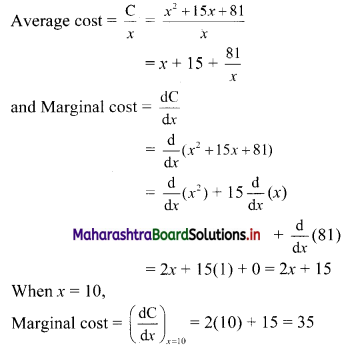
The cost of producing x articles is given by C = x2 + 15x + 81. Find the average cost and marginal cost functions. Find marginal cost when x = 10. Find x for which the marginal cost equals the average cost.
Solution:
Given, cost C = x2 + 15x + 81
Maharashtra Board 11th Commerce Maths Solutions Chapter 9 Differentiation Ex 9.2 II Q11
If marginal cost = average cost, then
2x + 15 = x + 15 + \(\frac{81}{x}\)
∴ x = \(\frac{81}{x}\)
∴ x2 = 81
∴ x = 9 …..[∵ x > 0]

Maharashtra Board 11th Commerce Maths Solutions Chapter 9 Differentiation Ex 9.1

Balbharati Maharashtra State Board 11th Commerce Maths Solution Book Pdf Chapter 9 Differentiation Ex 9.1 Questions and Answers.

Maharashtra State Board 11th Commerce Maths Solutions Chapter 9 Differentiation Ex 9.1

I. Find the derivatives of the following functions w.r.t. x.

Question 1.
x12
Solution:
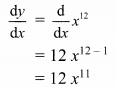
Let y = x12
Differentiating w.r.t. x, we get
Maharashtra Board 11th Commerce Maths Solutions Chapter 9 Differentiation Ex 9.1 I Q1

Question 2.
x-9
Solution:
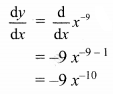
Let y = x-9
Differentiating w.r.t. x, we get
Maharashtra Board 11th Commerce Maths Solutions Chapter 9 Differentiation Ex 9.1 I Q2

Maharashtra Board 11th Commerce Maths Solutions Chapter 9 Differentiation Ex 9.1

Question 3.
\(x^{\frac{3}{2}}\)
Solution:
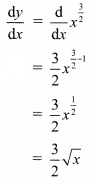
Let y = \(x^{\frac{3}{2}}\)
Differentiating w.r.t. x, we get
Maharashtra Board 11th Commerce Maths Solutions Chapter 9 Differentiation Ex 9.1 I Q3

Question 4.
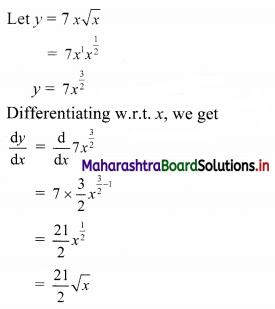
7x√x
Solution:
Maharashtra Board 11th Commerce Maths Solutions Chapter 9 Differentiation Ex 9.1 I Q4

Question 5.
35
Solution:
Let y = 35
Differentiating w.r.t. x, we get
\(\frac{d y}{d x}=\frac{d}{d x} 3^{5}=0\) …..[35 is a constant]

II. Differentiate the following w.r.t. x.

Question 1.
x5 + 3x4
Solution:
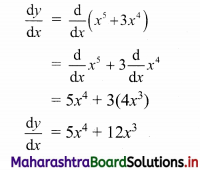
Let y = x5 + 3x4
Differentiating w.r.t. x, we get
Maharashtra Board 11th Commerce Maths Solutions Chapter 9 Differentiation Ex 9.1 II Q1

Maharashtra Board 11th Commerce Maths Solutions Chapter 9 Differentiation Ex 9.1

Question 2.
x√x + log x – ex
Solution:
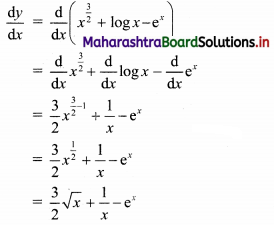
Let y = x√x + log x – ex
= \(x^{\frac{3}{2}}+\log x-e^{x}\)
Differentiating w.r.t. x, we get
Maharashtra Board 11th Commerce Maths Solutions Chapter 9 Differentiation Ex 9.1 II Q2

Question 3.
\(x^{\frac{5}{2}}+5 x^{\frac{7}{5}}\)
Solution:
Let y = \(x^{\frac{5}{2}}+5 x^{\frac{7}{5}}\)
Differentiating w.r.t. x, we get
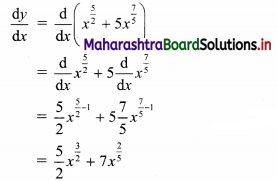
Maharashtra Board 11th Commerce Maths Solutions Chapter 9 Differentiation Ex 9.1 II Q3

Question 4.
\(\frac{2}{7} x^{\frac{7}{2}}+\frac{5}{2} x^{\frac{2}{5}}\)
Solution:
Let y = \(\frac{2}{7} x^{\frac{7}{2}}+\frac{5}{2} x^{\frac{2}{5}}\)
Differentiating w.r.t. x, we get
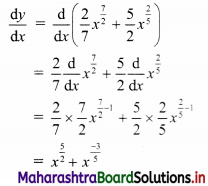
Maharashtra Board 11th Commerce Maths Solutions Chapter 9 Differentiation Ex 9.1 II Q4

Question 5.
\(\sqrt{x}\left(x^{2}+1\right)^{2}\)
Solution:
Let y = \(\sqrt{x}\left(x^{2}+1\right)^{2}\)
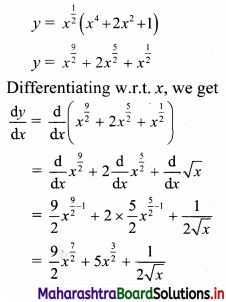
Maharashtra Board 11th Commerce Maths Solutions Chapter 9 Differentiation Ex 9.1 II Q5

III. Differentiate the following w.r.t. x.

Question 1.
x3 log x
Solution:
Let y = x3 log x
Differentiating w.r.t. x, we get
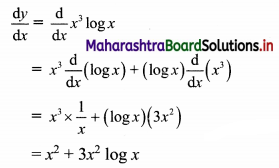
Maharashtra Board 11th Commerce Maths Solutions Chapter 9 Differentiation Ex 9.1 III Q1

Maharashtra Board 11th Commerce Maths Solutions Chapter 9 Differentiation Ex 9.1

Question 2.
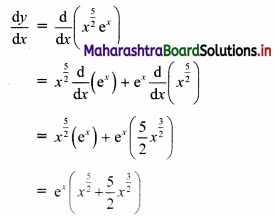
\(x^{\frac{5}{2}} e^{x}\)
Solution:
Let y = \(x^{\frac{5}{2}} e^{x}\)
Differentiating w.r.t. x, we get
Maharashtra Board 11th Commerce Maths Solutions Chapter 9 Differentiation Ex 9.1 III Q2

Question 3.
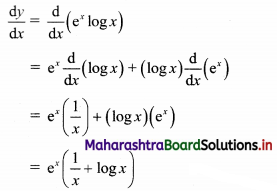
ex log x
Solution:
Let y = ex log x
Differentiating w.r.t. x, we get
Maharashtra Board 11th Commerce Maths Solutions Chapter 9 Differentiation Ex 9.1 III Q3

Question 4.
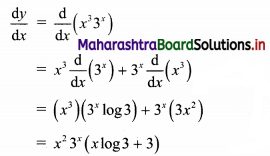
x3 . 3x
Solution:
Let y = x3 . 3x
Differentiating w.r.t. x, we get
Maharashtra Board 11th Commerce Maths Solutions Chapter 9 Differentiation Ex 9.1 III Q4

IV. Find the derivatives of the following w.r.t. x.

Question 1.
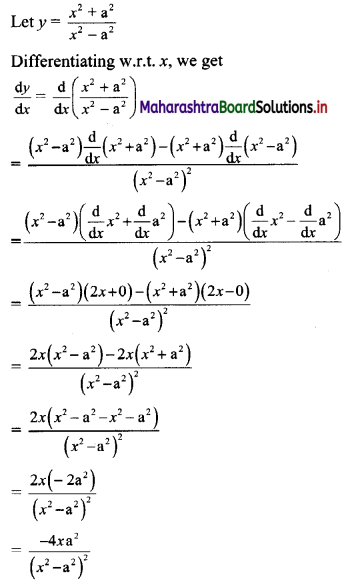
\(\frac{x^{2}+a^{2}}{x^{2}-a^{2}}\)
Solution:
Maharashtra Board 11th Commerce Maths Solutions Chapter 9 Differentiation Ex 9.1 IV Q1

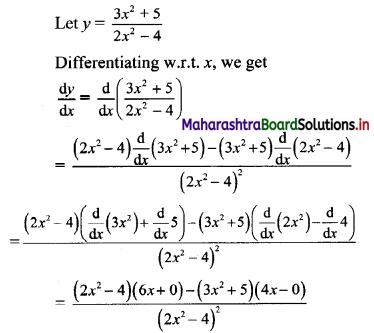
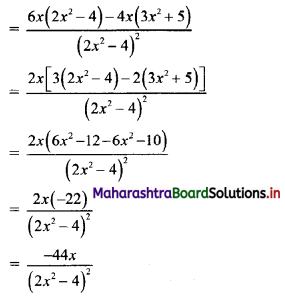
Question 2.
\(\frac{3 x^{2}+5}{2 x^{2}-4}\)
Solution:
Maharashtra Board 11th Commerce Maths Solutions Chapter 9 Differentiation Ex 9.1 IV Q2
Maharashtra Board 11th Commerce Maths Solutions Chapter 9 Differentiation Ex 9.1 IV Q2.1

Maharashtra Board 11th Commerce Maths Solutions Chapter 9 Differentiation Ex 9.1

Question 3.
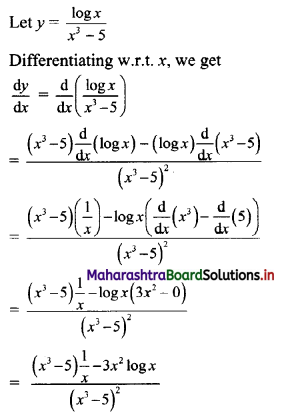
\(\frac{\log x}{x^{3}-5}\)
Solution:
Maharashtra Board 11th Commerce Maths Solutions Chapter 9 Differentiation Ex 9.1 IV Q3

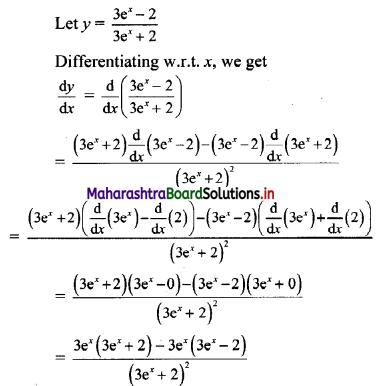
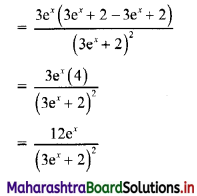
Question 4.
\(\frac{3 e^{x}-2}{3 e^{x}+2}\)
Solution:
Maharashtra Board 11th Commerce Maths Solutions Chapter 9 Differentiation Ex 9.1 IV Q4
Maharashtra Board 11th Commerce Maths Solutions Chapter 9 Differentiation Ex 9.1 IV Q4.1

Question 5.
\(\frac{x \mathrm{e}^{x}}{x+\mathrm{e}^{x}}\)
Solution:
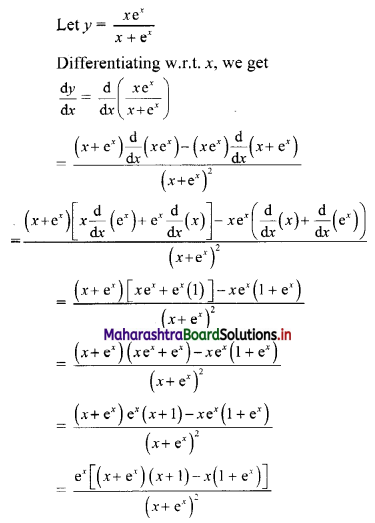
Maharashtra Board 11th Commerce Maths Solutions Chapter 9 Differentiation Ex 9.1 IV Q5

V. Find the derivatives of the following functions by the first principle:

Question 1.
3x2 + 4
Solution:
Let f(x) = 3x2 + 4
∴ f(x + h) = 3(x + h)2 + 4
= 3(x2 + 2xh + h2) + 4
= 3x2 + 6xh + 3h2 + 4
By first principle, we get
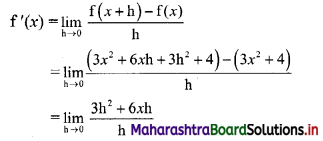
Maharashtra Board 11th Commerce Maths Solutions Chapter 9 Differentiation Ex 9.1 V Q1
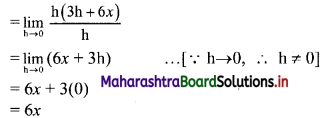
Maharashtra Board 11th Commerce Maths Solutions Chapter 9 Differentiation Ex 9.1 V Q1.1

Maharashtra Board 11th Commerce Maths Solutions Chapter 9 Differentiation Ex 9.1

Question 2.
x√x
Solution:
Let f(x) = x√x
∴ f(x + h) = \((x+h)^{\frac{3}{2}}\)
By first principle, we get
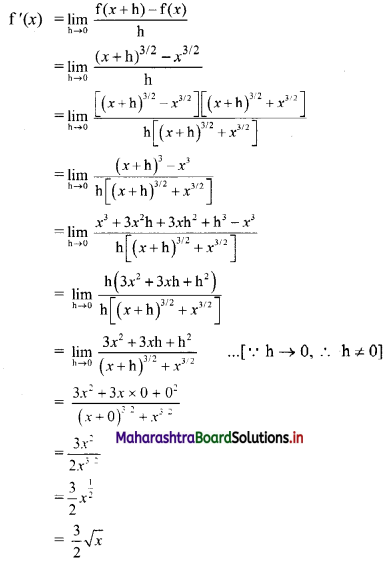
Maharashtra Board 11th Commerce Maths Solutions Chapter 9 Differentiation Ex 9.1 V Q2

Question 3.
\(\frac{1}{2 x+3}\)
Solution:
Let f(x) = \(\frac{1}{2 x+3}\)
∴ f(x + h) = \(\frac{1}{2(x+\mathrm{h})+3}=\frac{1}{2 x+2 \mathrm{~h}+3}\)
By first principle, we get
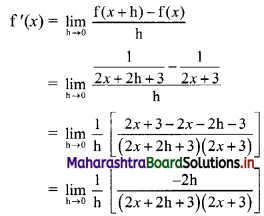
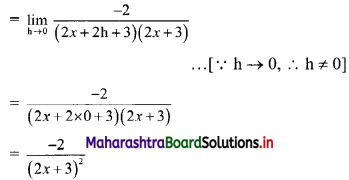
Maharashtra Board 11th Commerce Maths Solutions Chapter 9 Differentiation Ex 9.1 V Q3
Maharashtra Board 11th Commerce Maths Solutions Chapter 9 Differentiation Ex 9.1 V Q3.1

Maharashtra Board 11th Commerce Maths Solutions Chapter 9 Differentiation Ex 9.1

Question 4.
\(\frac{x-1}{2 x+7}\)
Solution:
Let f(x) = \(\frac{x-1}{2 x+7}\)
∴ f(x + h) = \(\frac{x+\mathrm{h}-1}{2(x+\mathrm{h})+7}=\frac{x+\mathrm{h}-1}{2 x+2 \mathrm{~h}+7}\)
By first principle, we get
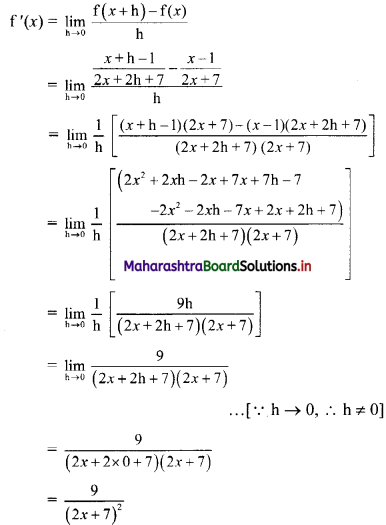
Maharashtra Board 11th Commerce Maths Solutions Chapter 9 Differentiation Ex 9.1 V Q4

Maharashtra Board 11th Commerce Maths Solutions Chapter 8 Continuity Miscellaneous Exercise 8

Balbharati Maharashtra State Board 11th Commerce Maths Solution Book Pdf Chapter 8 Continuity Miscellaneous Exercise 8 Questions and Answers.

Maharashtra State Board 11th Commerce Maths Solutions Chapter 8 Continuity Miscellaneous Exercise 8

I. Discuss the continuity of the following functions at the point(s) or in the interval indicated against them.

Question 1.
If f(x) = 2x2 – 2x + 5 for 0 ≤ x < 2
= \(\frac{1-3 x-x^{2}}{1-x}\) for 2 ≤ x < 4
= \(\frac{7-x^{2}}{x-5}\) for 4 ≤ x ≤ 7 on its domain.
Solution:
The domain of f is [0, 5) ∪ (5, 7]
We observe that x = 5 is not included in the domain as f is not defined at x = 5
a. For 0 ≤ x < 2
f(x) = 2x2 – 2x + 5
It is a polynomial function and is continuous at all point in [0, 2)

b. For 2 < x < 4
f(x) = \(\frac{1-3 x-x^{2}}{1-x}\)
It is a rational function and is continuous everwhere except at points where its denominator becomes zero.
Denominator becomes zero at x = 1
But x = 1 does not lie in the interval.
f(x) is continuous at all points in (2, 4)

c. For 4 < x ≤ 7, x ≠ 5
i.e. for x ∈ [4, 5) ∪ (5, 7]
∴ f(x) = \(\frac{7-x^{2}}{x-5}\)
It is a rational function and is continuous everywhere except possibly at points where its denominator becomes zero.
Denominator becomes zero at x = 5
But x = 5 ∉ [4, 5) ∪ (5, 7]
∴ f is continuous at all points in (4, 7] – {5}.

Maharashtra Board 11th Commerce Maths Solutions Chapter 8 Continuity Miscellaneous Exercise 8

d. Since the definition of function changes around x = 2, x = 4 and x = 7
∴ there is disturbance in behaviour of the function.
So we examine continuity at x = 2, 4, 7 separately.
Continuity at x = 2:
\(\lim _{x \rightarrow 2^{-}} f(x)=\lim _{x \rightarrow 2^{-}}\left(2 x^{2}-2 x+5\right)\)
= 2(2)2 – 2(2) + 5
= 8 – 4 + 5
= 9
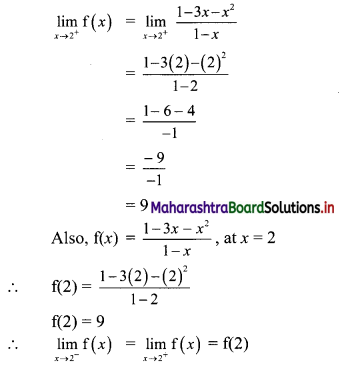
Maharashtra Board 11th Commerce Maths Solutions Chapter 8 Continuity Miscellaneous Exercise 8 I Q1(i)
∴ f is continuous at x = 2

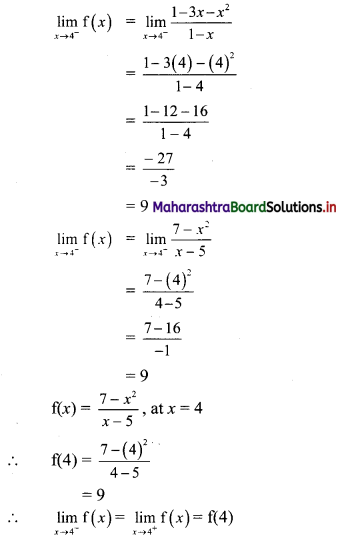
e. Continuity at x = 4:
Maharashtra Board 11th Commerce Maths Solutions Chapter 8 Continuity Miscellaneous Exercise 8 I Q1(i).1
∴ f is continuous at x = 4

Question 2.
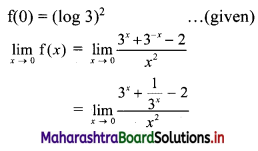
f(x) = \(\frac{3^{x}+3^{-x}-2}{x^{2}}\) for x ≠ 0
= (log 3)2 for x = 0 at x = 0
Solution:
Maharashtra Board 11th Commerce Maths Solutions Chapter 8 Continuity Miscellaneous Exercise 8 I Q2
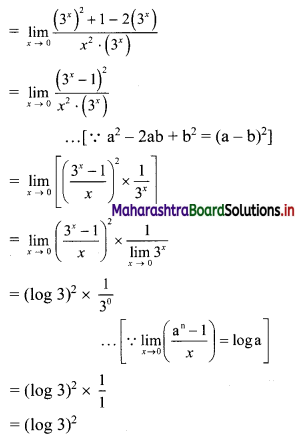
Maharashtra Board 11th Commerce Maths Solutions Chapter 8 Continuity Miscellaneous Exercise 8 I Q2.1
∴ \(\lim _{x \rightarrow 0} f(x)=f(0)\)
∴ f is continuous at x = 0

Maharashtra Board 11th Commerce Maths Solutions Chapter 8 Continuity Miscellaneous Exercise 8

Question 3.
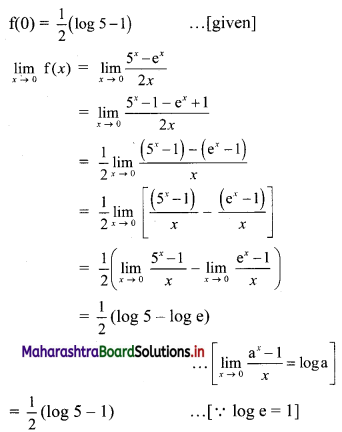
f(x) = \(\frac{5^{x}-e^{x}}{2 x}\) for x ≠ 0
= \(\frac{1}{2}\) (log 5 – 1) for x = 0 at x = 0
Solution:
Maharashtra Board 11th Commerce Maths Solutions Chapter 8 Continuity Miscellaneous Exercise 8 I Q3
∴ \(\lim _{x \rightarrow 0} f(x)=f(0)\)
∴ f is continuous at x = 0

Question 4.
f(x) = \(\frac{\sqrt{x+3}-2}{x^{3}-1}\) for x ≠ 1
= 2 for x = 1, at x = 1
Solution:
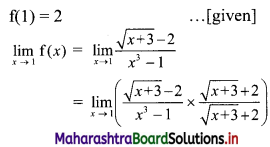
Maharashtra Board 11th Commerce Maths Solutions Chapter 8 Continuity Miscellaneous Exercise 8 I Q4
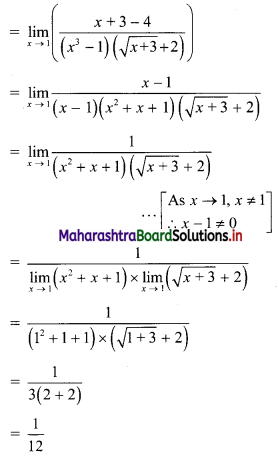
Maharashtra Board 11th Commerce Maths Solutions Chapter 8 Continuity Miscellaneous Exercise 8 I Q4.1
∴ \(\lim _{x \rightarrow 1} \mathrm{f}(x) \neq \mathrm{f}(1)\)
∴ f is discontinuous at x = 1

Question 5.
f(x) = \(\frac{\log x-\log 3}{x-3}\) for x ≠ 3
= 3 for x = 3, at x = 3
Solution:
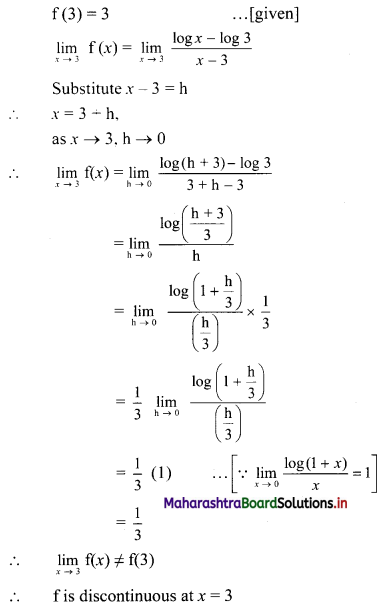
Maharashtra Board 11th Commerce Maths Solutions Chapter 8 Continuity Miscellaneous Exercise 8 I Q5

(II) Find k if following functions are continuous at the points indicated against them.

Question 1.
f(x) = \(\left(\frac{5 x-8}{8-3 x}\right)^{\frac{3}{2 x-4}}\) for x ≠ 2
= k for x = 2 at x = 2
Solution:
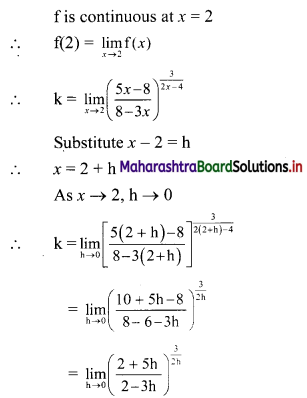
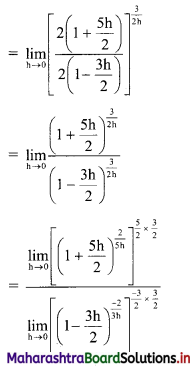
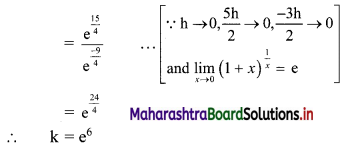
Maharashtra Board 11th Commerce Maths Solutions Chapter 8 Continuity Miscellaneous Exercise 8 II Q1
Maharashtra Board 11th Commerce Maths Solutions Chapter 8 Continuity Miscellaneous Exercise 8 II Q1.1
Maharashtra Board 11th Commerce Maths Solutions Chapter 8 Continuity Miscellaneous Exercise 8 II Q1.2

Maharashtra Board 11th Commerce Maths Solutions Chapter 8 Continuity Miscellaneous Exercise 8

Question 2.
f(x) = \(\frac{45^{x}-9^{x}-5^{x}+1}{\left(k^{x}-1\right)\left(3^{x}-1\right)}\) for x ≠ 0
= \(\frac{2}{3}\) for x = 0, at x = 0
Solution:
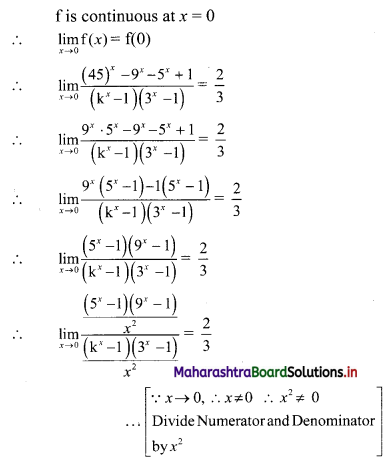
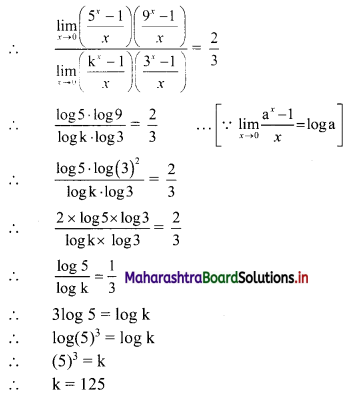
Maharashtra Board 11th Commerce Maths Solutions Chapter 8 Continuity Miscellaneous Exercise 8 II Q2
Maharashtra Board 11th Commerce Maths Solutions Chapter 8 Continuity Miscellaneous Exercise 8 II Q2.1

Question 3.
f(x) = \((1+k x)^{\frac{1}{x}}\), for x ≠ 0
= \(e^{\frac{3}{2}}\), for x = 0, at x = 0
Solution:
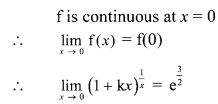
Maharashtra Board 11th Commerce Maths Solutions Chapter 8 Continuity Miscellaneous Exercise 8 II Q3
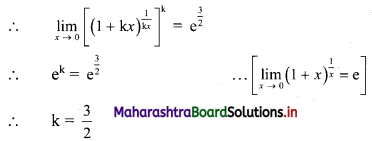
Maharashtra Board 11th Commerce Maths Solutions Chapter 8 Continuity Miscellaneous Exercise 8 II Q3.1

III. Find a and b if following functions are continuous at the point indicated against them.

Question 1.
f(x) = x2 + a, for x ≥ 0
= 2\(\sqrt{x^{2}+1}\) + b, for x < 0 and
f(1) = 2, is continuous at x = 0
Solution:
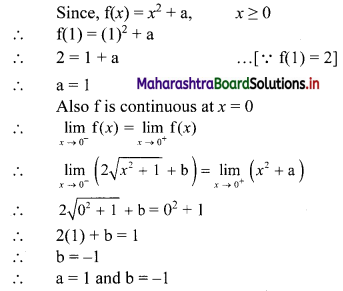
Maharashtra Board 11th Commerce Maths Solutions Chapter 8 Continuity Miscellaneous Exercise 8 III Q1

Question 2.
f(x) = \(\frac{x^{2}-9}{x-3}\) + a, for x > 3
= 5, for x = 3
= 2x2 + 3x + b, for x < 3
is continuous at x = 3
Solution:
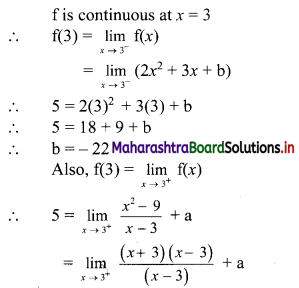
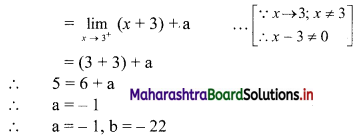
Maharashtra Board 11th Commerce Maths Solutions Chapter 8 Continuity Miscellaneous Exercise 8 III Q2
Maharashtra Board 11th Commerce Maths Solutions Chapter 8 Continuity Miscellaneous Exercise 8 III Q2.1

Maharashtra Board 11th Commerce Maths Solutions Chapter 8 Continuity Miscellaneous Exercise 8

Question 3.
f(x) = \(\frac{32^{x}-1}{8^{x}-1}\) + a, for x > 0
= 2, for x = 0
= x + 5 – 2b, for x < 0
is continuous at x = 0
Solution:
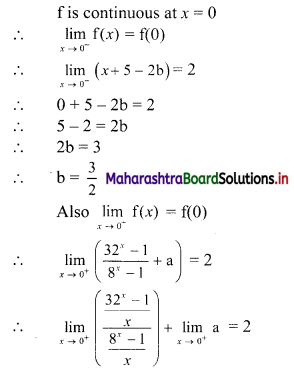
Maharashtra Board 11th Commerce Maths Solutions Chapter 8 Continuity Miscellaneous Exercise 8 III Q3
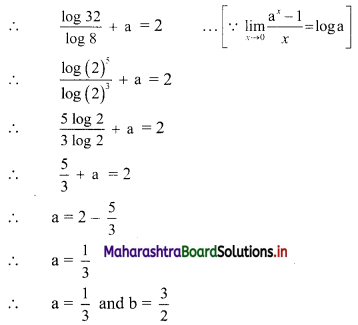
Maharashtra Board 11th Commerce Maths Solutions Chapter 8 Continuity Miscellaneous Exercise 8 III Q3.1

Maharashtra Board 11th Commerce Maths Solutions Chapter 8 Continuity Ex 8.1

Balbharati Maharashtra State Board 11th Commerce Maths Solution Book Pdf Chapter 8 Continuity Ex 8.1 Questions and Answers.

Maharashtra State Board 11th Commerce Maths Solutions Chapter 8 Continuity Ex 8.1

Question 1.
Examine the continuity of
(i) f(x) = x3 + 2x2 – x – 2 at x = -2
Solution:
f(x) = x3 + 2x2 – x – 2
Here f(x) is a polynomial function and hence it is continuous for all x ∈ R.
∴ f(x) is continuous at x = -2

(ii) f(x) = \(\frac{x^{2}-9}{x-3}\) on R
Solution:
f(x) = \(\frac{x^{2}-9}{x-3}\); x ∈ R
f(x) is a rational function and is continuous for all x ∈ R, except at the points where denominator becomes zero.
Here, denominator x – 3 = 0 when x = 3.
∴ Function f is continuous for all x ∈ R, except at x = 3, where it is not defined.

Maharashtra Board 11th Commerce Maths Solutions Chapter 8 Continuity Ex 8.1

Question 2.
Examine whether the function is continuous at the points indicated against them.
(i) f(x) = x3 – 2x + 1, for x ≤ 2
= 3x – 2, for x > 2, at x = 2
Solution:
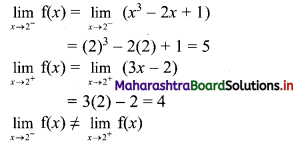
Maharashtra Board 11th Commerce Maths Solutions Chapter 8 Continuity Ex 8.1 Q2(i)
∴ Function f is discontinuous at x = 2

(ii) f(x) = \(\frac{x^{2}+18 x-19}{x-1}\) for x ≠ 1
= 20, for x = 1, at x = 1
Solution:
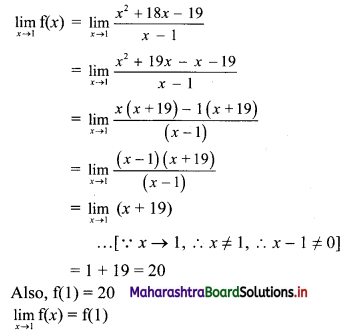
Maharashtra Board 11th Commerce Maths Solutions Chapter 8 Continuity Ex 8.1 Q2(ii)
∴ f(x) is continuous at x = 1

Question 3.
Test the continuity of the following functions at the points indicated against them.
(i) f(x) = \(\frac{\sqrt{x-1}-(x-1)^{\frac{1}{3}}}{x-2}\) for x ≠ 2
= \(\frac{1}{5}\) for x = 2, at x = 2
Solution:
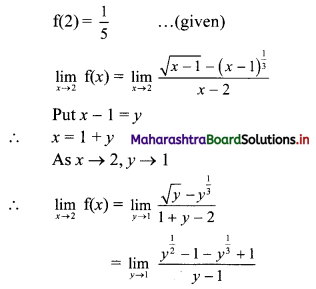
Maharashtra Board 11th Commerce Maths Solutions Chapter 8 Continuity Ex 8.1 Q3(i)
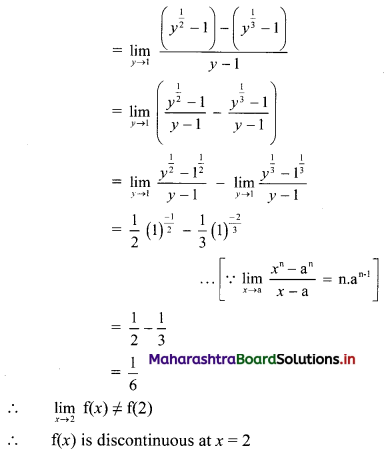
Maharashtra Board 11th Commerce Maths Solutions Chapter 8 Continuity Ex 8.1 Q3(i).1

(ii) f(x) = \(\frac{x^{3}-8}{\sqrt{x+2}-\sqrt{3 x-2}}\) for x ≠ 2
= -24 for x = 2, at x = 2
Solution:
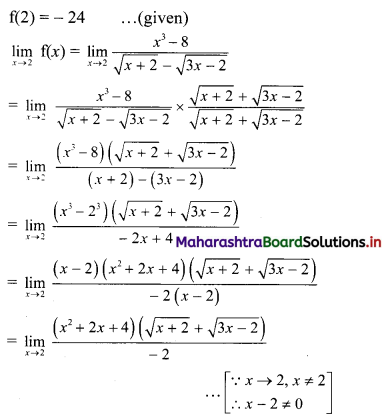
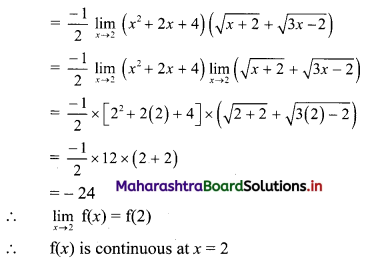
Maharashtra Board 11th Commerce Maths Solutions Chapter 8 Continuity Ex 8.1 Q3(ii)
Maharashtra Board 11th Commerce Maths Solutions Chapter 8 Continuity Ex 8.1 Q3(ii).1

(iii) f(x) = 4x + 1 for x ≤ \(\frac{8}{3}\)
= \(\frac{59-9 x}{3}\), for x > \(\frac{8}{3}\), at x = \(\frac{8}{3}\)
Solution:
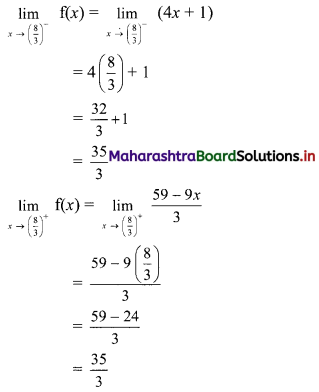
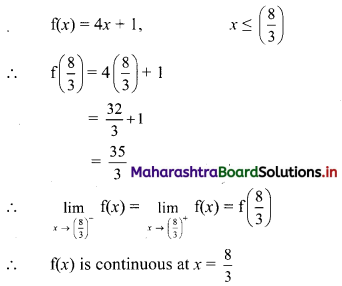
Maharashtra Board 11th Commerce Maths Solutions Chapter 8 Continuity Ex 8.1 Q3(iii)
Maharashtra Board 11th Commerce Maths Solutions Chapter 8 Continuity Ex 8.1 Q3(iii).1

Maharashtra Board 11th Commerce Maths Solutions Chapter 8 Continuity Ex 8.1

(iv) f(x) = \(\frac{x^{3}-27}{x^{2}-9}\) for 0 ≤ x < 3
= \(\frac{9}{2}\), for 3 ≤ x ≤ 6, at x = 3
Solution:
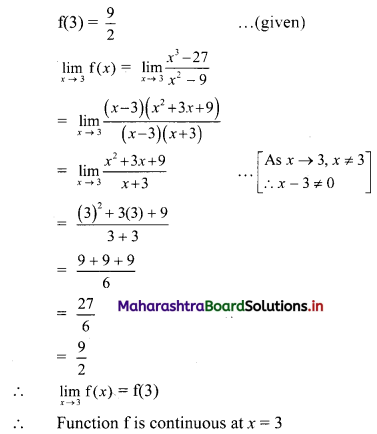
Maharashtra Board 11th Commerce Maths Solutions Chapter 8 Continuity Ex 8.1 Q3(iv)

Question 4.
(i) If f(x) = \(\frac{24^{x}-8^{x}-3^{x}+1}{12^{x}-4^{x}-3^{x}+1}\), for x ≠ 0
= k, for x = 0
is continuous at x = 0, find k.
Solution:
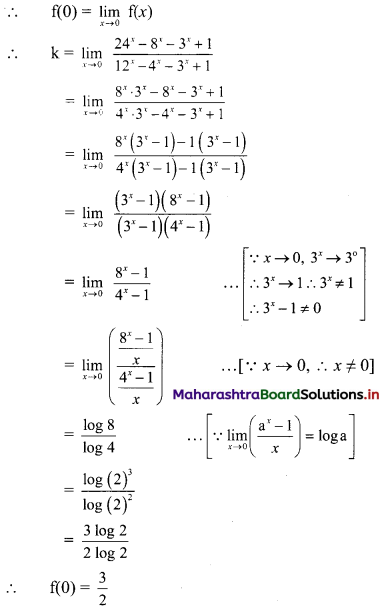
Function f is continuous at x = 0
Maharashtra Board 11th Commerce Maths Solutions Chapter 8 Continuity Ex 8.1 Q4(i)

(ii) If f(x) = \(\frac{5^{x}+5^{-x}-2}{x^{2}}\), for x ≠ 0
= k for x = 0
is continuous at x = 0, find k.
Solution:
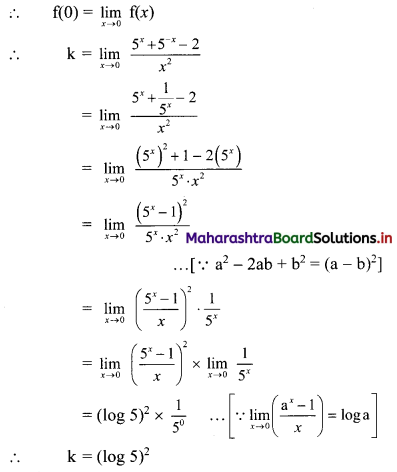
Function f is continuous at x = 0
Maharashtra Board 11th Commerce Maths Solutions Chapter 8 Continuity Ex 8.1 Q4(ii)

(iii) For what values of a and b is the function
f(x) = ax + 2b + 18 for x ≤ 0
= x2 + 3a – b for 0 < x ≤ 2 = 8x – 2 for x > 2,
continuous for every x?
Solution:
Function f is continuous for every x.
∴ Function f is continuous at x = 0 and x = 2
As f is continuous at x = 0.
∴ \(\lim _{x \rightarrow 0^{-}} \mathrm{f}(x)=\lim _{x \rightarrow 0^{+}} \mathrm{f}(x)\)
∴ \(\lim _{x \rightarrow 0^{-}}(a x+2 b+18)=\lim _{x \rightarrow 0^{+}}\left(x^{2}+3 a-b\right)\)
∴ a(0) + 2b + 18 = (0)2 + 3a – b
∴ 3a – 3b = 18
∴ a – b = 6 …..(i)
Also, Function f is continous at x = 2
∴ \(\lim _{x \rightarrow 2^{-}} \mathrm{f}(x)=\lim _{x \rightarrow 2^{-}} \mathrm{f}(x)\)
∴ \(\lim _{x \rightarrow 2^{-}}\left(x^{2}+3 a-b\right)=\lim _{x \rightarrow 2^{-}}(8 x-2)\)
∴ (2)2 + 3a – b = 8(2) – 2
∴ 4 + 3a – b = 14
∴ 3a – b = 10 …..(ii)
Subtracting (i) from (ii), we get
2a = 4
∴ a = 2
Substituting a = 2 in (i), we get
2 – b = 6
∴ b = -4
∴ a = 2 and b = -4

Maharashtra Board 11th Commerce Maths Solutions Chapter 8 Continuity Ex 8.1

(iv) For what values of a and b is the function
f(x) = \(\frac{x^{2}-4}{x-2}\) for x < 2
= ax2 – bx + 3 for 2 ≤ x < 3
= 2x – a + b for x ≥ 3
continuous in its domain.
Solution:
Function f is continuous for every x on R.
∴ Function f is continuous at x = 2 and x = 3.
As f is continuous at x = 2.
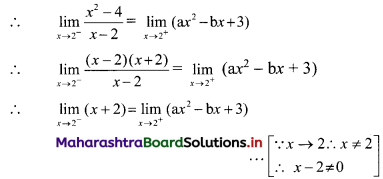
∴ \(\lim _{x \rightarrow 2^{-}} f(x)=\lim _{x \rightarrow 2^{+}} f(x)\)
Maharashtra Board 11th Commerce Maths Solutions Chapter 8 Continuity Ex 8.1 Q4(iv)
∴ 2 + 2 = a(2)2 – b(2) + 3
∴ 4 = 4a – 2b + 3
∴ 4a – 2b = 1 …..(i)
Also function f is continuous at x = 3
∴ \(\lim _{x \rightarrow 3^{-}} f(x)=\lim _{x \rightarrow 3^{+}} f(x)\)
∴ \(\lim _{x \rightarrow 3^{-}}\left(a x^{2}-b x+3\right)=\lim _{x \rightarrow 3^{+}}(2 x-a+b)\)
∴ a(3)2 – b(3) + 3 = 2(3) – a + b
∴ 9a – 3b + 3 = 6 – a + b
∴ 10a – 4b = 3 …..(ii)
Multiplying (i) by 2, we get
8a – 4b = 2 …..(iii)
Subtracting (iii) from (ii), we get
2a = 1
∴ a = \(\frac{1}{2}\)
Substituting a = \(\frac{1}{2}\) in (i), we get
4(\(\frac{1}{2}\)) – 2b = 1
∴ 2 – 2b = 1
∴ 1 = 2b
∴ b = \(\frac{1}{2}\)
∴ a = \(\frac{1}{2}\) and b = \(\frac{1}{2}\)