Maharashtra Board 11th Commerce Maths Solutions Chapter 7 Limits Miscellaneous Exercise 7

Balbharati Maharashtra State Board 11th Commerce Maths Solution Book Pdf Chapter 7 Limits Miscellaneous Exercise 7 Questions and Answers.

Maharashtra State Board 11th Commerce Maths Solutions Chapter 7 Limits Miscellaneous Exercise 7

I.

Question 1.
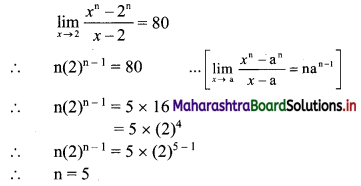
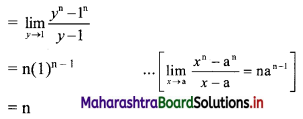
If \(\lim _{x \rightarrow 2} \frac{x^{n}-2^{n}}{x-2}=80\) then find the value of n.
Solution:
Maharashtra Board 11th Commerce Maths Solutions Chapter 7 Limits Miscellaneous Exercise 7 I Q1

II. Evaluate the following Limits:

Question 1.
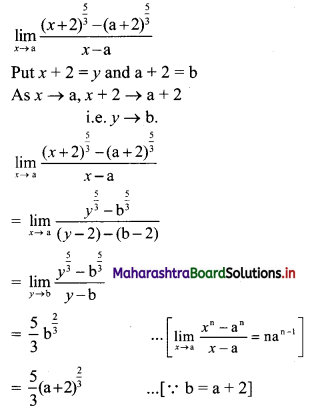
\(\lim _{x \rightarrow a} \frac{(x+2)^{\frac{5}{3}}-(a+2)^{\frac{5}{3}}}{x-a}\)
Solution:
Maharashtra Board 11th Commerce Maths Solutions Chapter 7 Limits Miscellaneous Exercise 7 II Q1

Maharashtra Board 11th Commerce Maths Solutions Chapter 7 Limits Miscellaneous Exercise 7

Question 2.
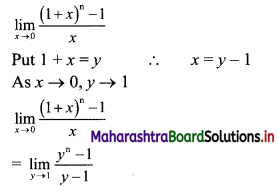
\(\lim _{x \rightarrow 0} \frac{(1+x)^{n}-1}{x}\)
Solution:
Maharashtra Board 11th Commerce Maths Solutions Chapter 7 Limits Miscellaneous Exercise 7 II Q2
Maharashtra Board 11th Commerce Maths Solutions Chapter 7 Limits Miscellaneous Exercise 7 II Q2.1

Question 3.
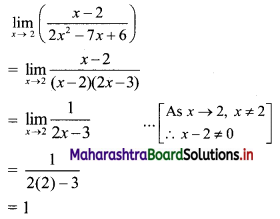
\(\lim _{x \rightarrow 2}\left[\frac{(x-2)}{2 x^{2}-7 x+6}\right]\)
Solution:
Maharashtra Board 11th Commerce Maths Solutions Chapter 7 Limits Miscellaneous Exercise 7 II Q3

Question 4.
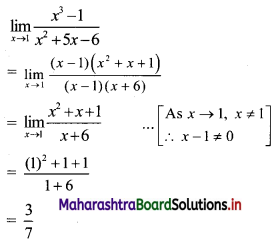
\(\lim _{x \rightarrow 1}\left[\frac{x^{3}-1}{x^{2}+5 x-6}\right]\)
Solution:
Maharashtra Board 11th Commerce Maths Solutions Chapter 7 Limits Miscellaneous Exercise 7 II Q4

Question 5.
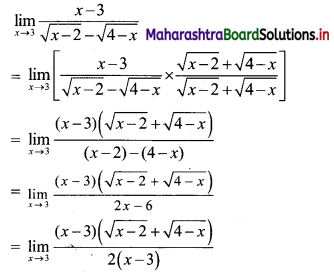
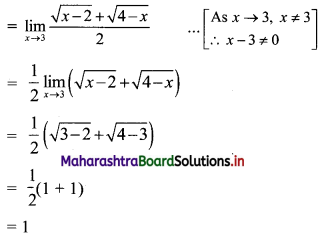
\(\lim _{x \rightarrow 3}\left[\frac{x-3}{\sqrt{x-2}-\sqrt{4-x}}\right]\)
Solution:
Maharashtra Board 11th Commerce Maths Solutions Chapter 7 Limits Miscellaneous Exercise 7 II Q5
Maharashtra Board 11th Commerce Maths Solutions Chapter 7 Limits Miscellaneous Exercise 7 II Q5.1

Question 6.
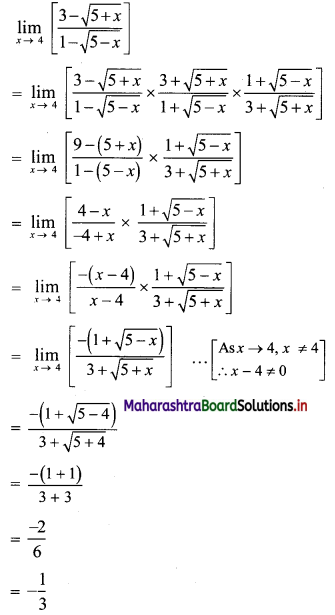
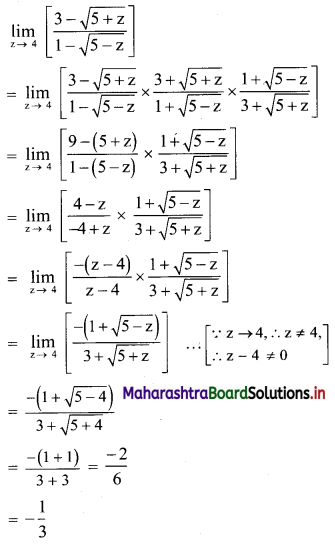
\(\lim _{x \rightarrow 4}\left[\frac{3-\sqrt{5+x}}{1-\sqrt{5-x}}\right]\)
Solution:
Maharashtra Board 11th Commerce Maths Solutions Chapter 7 Limits Miscellaneous Exercise 7 II Q6

Maharashtra Board 11th Commerce Maths Solutions Chapter 7 Limits Miscellaneous Exercise 7

Question 7.
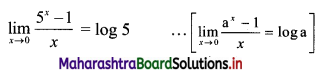
\(\lim _{x \rightarrow 0}\left[\frac{5^{x}-1}{x}\right]\)
Solution:
Maharashtra Board 11th Commerce Maths Solutions Chapter 7 Limits Miscellaneous Exercise 7 II Q7

Question 8.
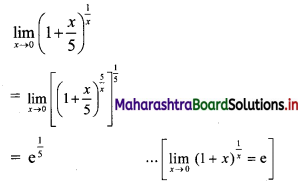
\(\lim _{x \rightarrow 0}\left(1+\frac{x}{5}\right)^{\frac{1}{x}}\)
Solution:
Maharashtra Board 11th Commerce Maths Solutions Chapter 7 Limits Miscellaneous Exercise 7 II Q8

Question 9.
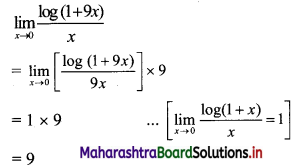
\(\lim _{x \rightarrow 0}\left[\frac{\log (1+9 x)}{x}\right]\)
Solution:
Maharashtra Board 11th Commerce Maths Solutions Chapter 7 Limits Miscellaneous Exercise 7 II Q9

Question 10.
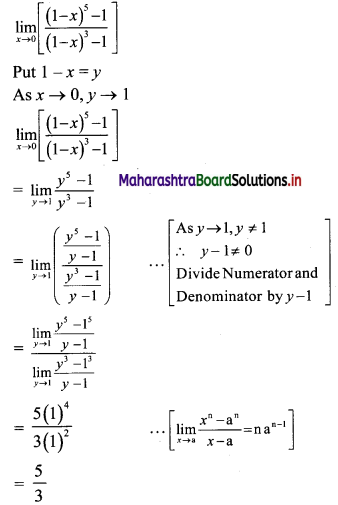
\(\lim _{x \rightarrow 0} \frac{(1-x)^{5}-1}{(1-x)^{3}-1}\)
Solution:
Maharashtra Board 11th Commerce Maths Solutions Chapter 7 Limits Miscellaneous Exercise 7 II Q10

Question 11.
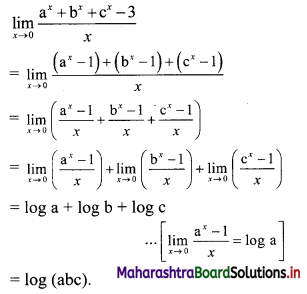
\(\lim _{x \rightarrow 0}\left[\frac{a^{x}+b^{x}+c^{x}-3}{x}\right]\)
Solution:
Maharashtra Board 11th Commerce Maths Solutions Chapter 7 Limits Miscellaneous Exercise 7 II Q11

Question 12.
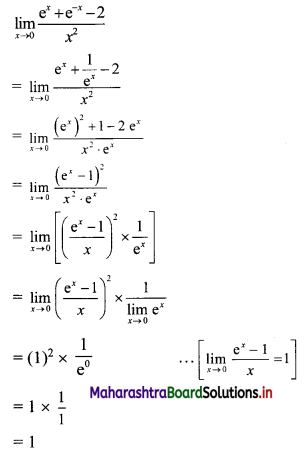
\(\lim _{x \rightarrow 0} \frac{e^{x}+e^{-x}-2}{x^{2}}\)
Solution:
Maharashtra Board 11th Commerce Maths Solutions Chapter 7 Limits Miscellaneous Exercise 7 II Q12

Question 13.
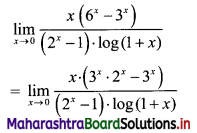
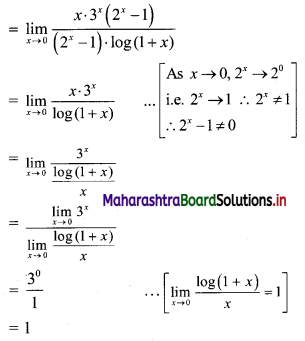
\(\lim _{x \rightarrow 0}\left[\frac{x\left(6^{x}-3^{x}\right)}{\left(2^{x}-1\right) \cdot \log (1+x)}\right]\)
Solution:
Maharashtra Board 11th Commerce Maths Solutions Chapter 7 Limits Miscellaneous Exercise 7 II Q13
Maharashtra Board 11th Commerce Maths Solutions Chapter 7 Limits Miscellaneous Exercise 7 II Q13.1

Maharashtra Board 11th Commerce Maths Solutions Chapter 7 Limits Miscellaneous Exercise 7

Question 14.
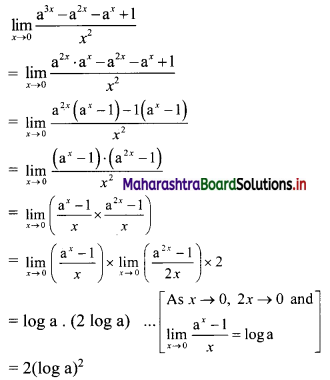
\(\lim _{x \rightarrow 0}\left[\frac{a^{3 x}-a^{2 x}-a^{x}+1}{x^{2}}\right]\)
Solution:
Maharashtra Board 11th Commerce Maths Solutions Chapter 7 Limits Miscellaneous Exercise 7 II Q14

Question 15.
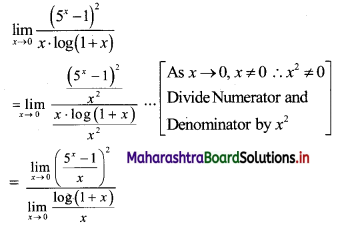
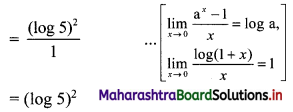
\(\lim _{x \rightarrow 0}\left[\frac{\left(5^{x}-1\right)^{2}}{x \cdot \log (1+x)}\right]\)
Solution:
Maharashtra Board 11th Commerce Maths Solutions Chapter 7 Limits Miscellaneous Exercise 7 II Q15
Maharashtra Board 11th Commerce Maths Solutions Chapter 7 Limits Miscellaneous Exercise 7 II Q15.1

Question 16.
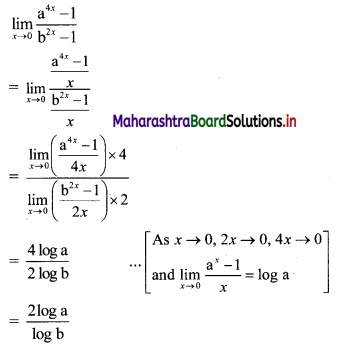
\(\lim _{x \rightarrow 0}\left[\frac{a^{4 x}-1}{b^{2 x}-1}\right]\)
Solution:
Maharashtra Board 11th Commerce Maths Solutions Chapter 7 Limits Miscellaneous Exercise 7 II Q16

Question 17.
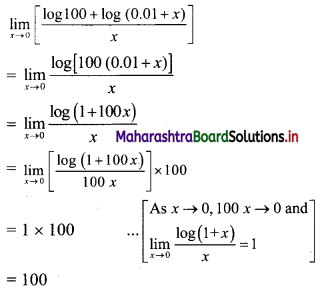
\(\lim _{x \rightarrow 0}\left[\frac{\log 100+\log (0.01+x)}{x}\right]\)
Solution:
Maharashtra Board 11th Commerce Maths Solutions Chapter 7 Limits Miscellaneous Exercise 7 II Q17

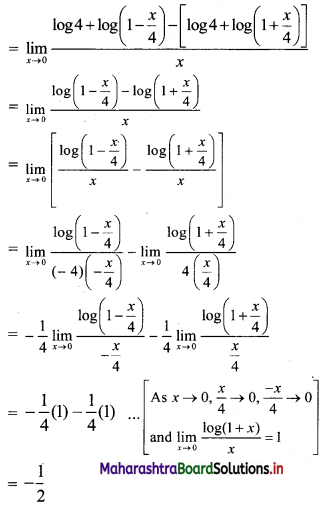
Question 18.
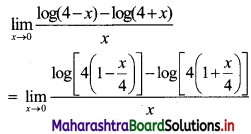
\(\lim _{x \rightarrow 0}\left[\frac{\log (4-x)-\log (4+x)}{x}\right]\)
Solution:
Maharashtra Board 11th Commerce Maths Solutions Chapter 7 Limits Miscellaneous Exercise 7 II Q18
Maharashtra Board 11th Commerce Maths Solutions Chapter 7 Limits Miscellaneous Exercise 7 II Q18.1

Maharashtra Board 11th Commerce Maths Solutions Chapter 7 Limits Miscellaneous Exercise 7

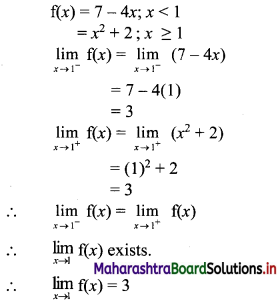
Question 19.
Evaluate the limit of the function if exist at x = 1 where,
\(f(x)= \begin{cases}7-4 x & x<1 \\ x^{2}+2 & x \geq 1\end{cases}\)
Solution:
Maharashtra Board 11th Commerce Maths Solutions Chapter 7 Limits Miscellaneous Exercise 7 II Q19

Maharashtra Board 11th Commerce Maths Solutions Chapter 7 Limits Ex 7.4

Balbharati Maharashtra State Board 11th Commerce Maths Solution Book Pdf Chapter 7 Limits Ex 7.4 Questions and Answers.

Maharashtra State Board 11th Commerce Maths Solutions Chapter 7 Limits Ex 7.4

I. Evaluate the following:

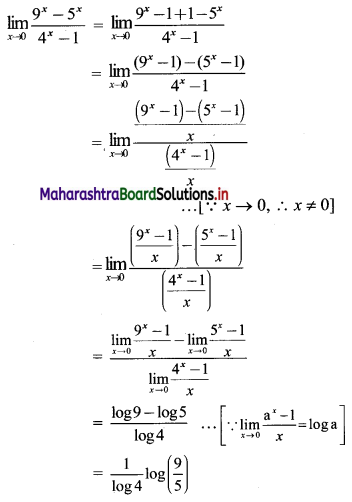
Question 1.
\(\lim _{x \rightarrow 0}\left[\frac{9^{x}-5^{x}}{4^{x}-1}\right]\)
Solution:
Maharashtra Board 11th Commerce Maths Solutions Chapter 7 Limits Ex 7.4 Q1(i)

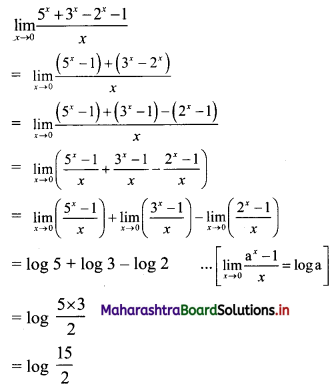
Question 2.
\(\lim _{x \rightarrow 0}\left[\frac{5^{x}+3^{x}-2^{x}-1}{x}\right]\)
Solution:
Maharashtra Board 11th Commerce Maths Solutions Chapter 7 Limits Ex 7.4 Q1(ii)

Maharashtra Board 11th Commerce Maths Solutions Chapter 7 Limits Ex 7.4

Question 3.
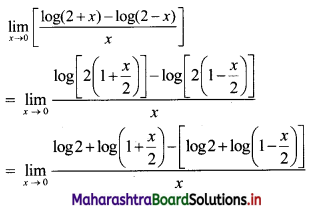
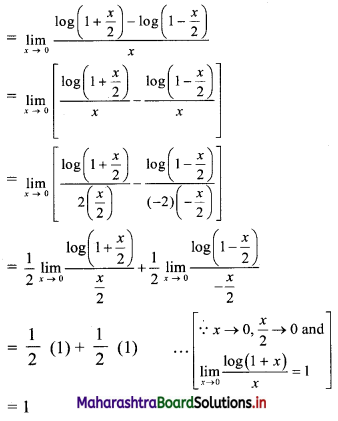
\(\lim _{x \rightarrow 0}\left[\frac{\log (2+x)-\log (2-x)}{x}\right]\)
Solution:
Maharashtra Board 11th Commerce Maths Solutions Chapter 7 Limits Ex 7.4 Q1(iii)
Maharashtra Board 11th Commerce Maths Solutions Chapter 7 Limits Ex 7.4 Q1(iii).1

II. Evaluate the following:

Question 1.
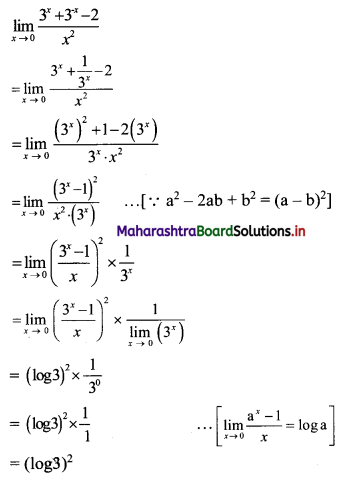
\(\lim _{x \rightarrow 0}\left[\frac{3^{x}+3^{-x}-2}{x^{2}}\right]\)
Solution:
Maharashtra Board 11th Commerce Maths Solutions Chapter 7 Limits Ex 7.4 Q2(i)

Question 2.
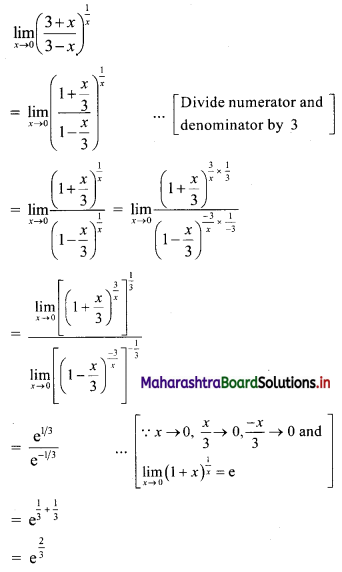
\(\lim _{x \rightarrow 0}\left[\frac{3+x}{3-x}\right]^{\frac{1}{x}}\)
Solution:
Maharashtra Board 11th Commerce Maths Solutions Chapter 7 Limits Ex 7.4 Q2(ii)

Maharashtra Board 11th Commerce Maths Solutions Chapter 7 Limits Ex 7.4

Question 3.
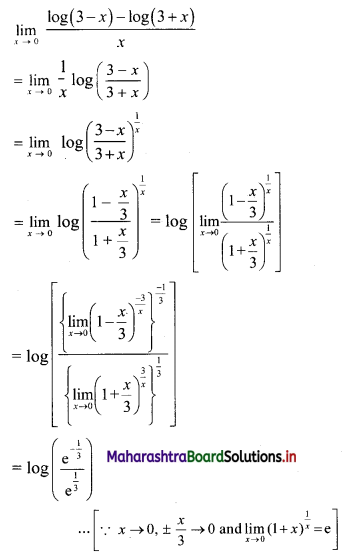
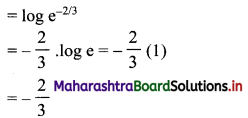
\(\lim _{x \rightarrow 0}\left[\frac{\log (3-x)-\log (3+x)}{x}\right]\)
Solution:
Maharashtra Board 11th Commerce Maths Solutions Chapter 7 Limits Ex 7.4 Q2(iii)
Maharashtra Board 11th Commerce Maths Solutions Chapter 7 Limits Ex 7.4 Q2(iii).1

III. Evaluate the following:

Question 1.
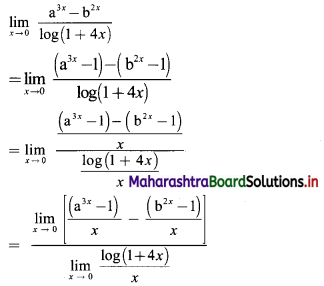
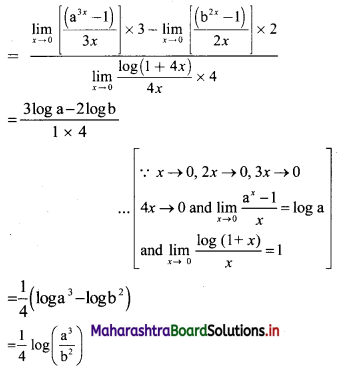
\(\lim _{x \rightarrow 0}\left[\frac{a^{3 x}-b^{2 x}}{\log (1+4 x)}\right]\)
Solution:
Maharashtra Board 11th Commerce Maths Solutions Chapter 7 Limits Ex 7.4 Q3(i)
Maharashtra Board 11th Commerce Maths Solutions Chapter 7 Limits Ex 7.4 Q3(i).1

Question 2.
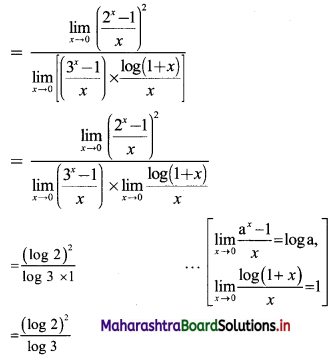
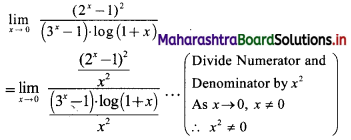
\(\lim _{x \rightarrow 0}\left[\frac{\left(2^{x}-1\right)^{2}}{\left(3^{x}-1\right) \cdot \log (1+x)}\right]\)
Solution:
Maharashtra Board 11th Commerce Maths Solutions Chapter 7 Limits Ex 7.4 Q3(ii)
Maharashtra Board 11th Commerce Maths Solutions Chapter 7 Limits Ex 7.4 Q3(ii).1

Maharashtra Board 11th Commerce Maths Solutions Chapter 7 Limits Ex 7.4

Question 3.
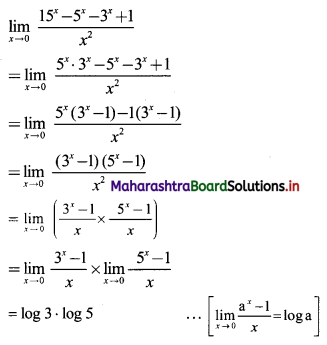
\(\lim _{x \rightarrow 0}\left[\frac{15^{x}-5^{x}-3^{x}+1}{x^{2}}\right]\)
Solution:
Maharashtra Board 11th Commerce Maths Solutions Chapter 7 Limits Ex 7.4 Q3(iii)

Question 4.
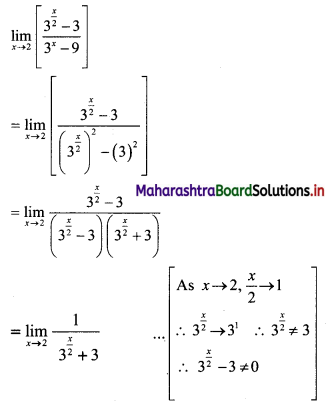
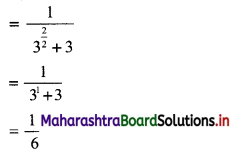
\(\lim _{x \rightarrow 2}\left[\frac{3^{\frac{x}{2}}-3}{3^{x}-9}\right]\)
Solution:
Maharashtra Board 11th Commerce Maths Solutions Chapter 7 Limits Ex 7.4 Q3(iv)
Maharashtra Board 11th Commerce Maths Solutions Chapter 7 Limits Ex 7.4 Q3(iv).1

IV. Evaluate the following:

Question 1.
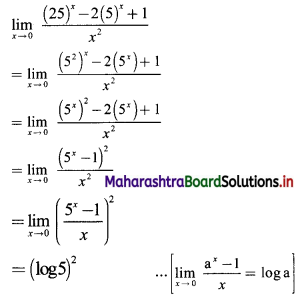
\(\lim _{x \rightarrow 0}\left[\frac{(25)^{x}-2(5)^{x}+1}{x^{2}}\right]\)
Solution:
Maharashtra Board 11th Commerce Maths Solutions Chapter 7 Limits Ex 7.4 Q4(i)

Maharashtra Board 11th Commerce Maths Solutions Chapter 7 Limits Ex 7.4

Question 2.
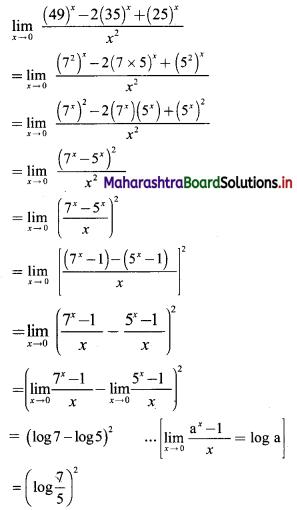
\(\lim _{x \rightarrow 0}\left[\frac{(49)^{x}-2(35)^{x}+(25)^{x}}{x^{2}}\right]\)
Solution:
Maharashtra Board 11th Commerce Maths Solutions Chapter 7 Limits Ex 7.4 Q4(ii)

Maharashtra Board 11th Commerce Maths Solutions Chapter 7 Limits Ex 7.3

Balbharati Maharashtra State Board 11th Commerce Maths Solution Book Pdf Chapter 7 Limits Ex 7.3 Questions and Answers.

Maharashtra State Board 11th Commerce Maths Solutions Chapter 7 Limits Ex 7.3

I. Evaluate the following limits:

Question 1.
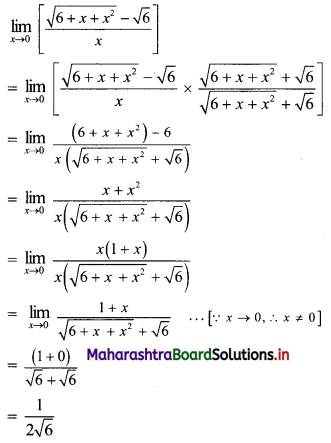
\(\lim _{x \rightarrow 0}\left[\frac{\sqrt{6+x+x^{2}}-\sqrt{6}}{x}\right]\)
Solution:
Maharashtra Board 11th Commerce Maths Solutions Chapter 7 Limits Ex 7.3 Q1 (i)

Question 2.
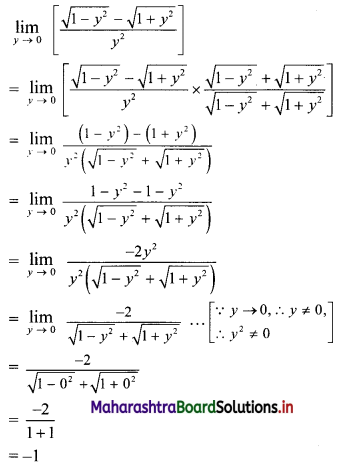
\(\lim _{y \rightarrow 0}\left[\frac{\sqrt{1-y^{2}}-\sqrt{1+y^{2}}}{y^{2}}\right]\)
Solution:
Maharashtra Board 11th Commerce Maths Solutions Chapter 7 Limits Ex 7.3 Q1 (ii)

Maharashtra Board 11th Commerce Maths Solutions Chapter 7 Limits Ex 7.3

Question 3.
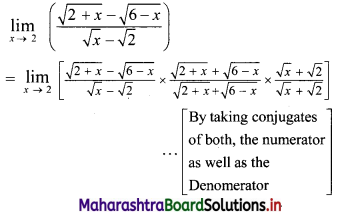
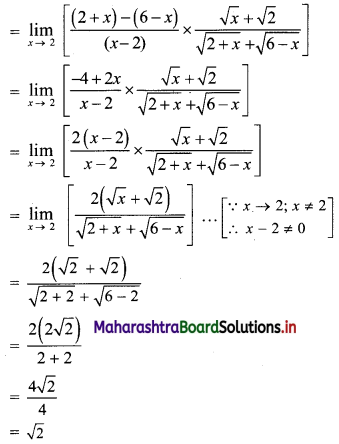
\(\lim _{x \rightarrow 2}\left[\frac{\sqrt{2+x}-\sqrt{6-x}}{\sqrt{x}-\sqrt{2}}\right]\)
Solution:
Maharashtra Board 11th Commerce Maths Solutions Chapter 7 Limits Ex 7.3 Q1 (iii)
Maharashtra Board 11th Commerce Maths Solutions Chapter 7 Limits Ex 7.3 Q1 (iii).1

II. Evaluate the following limits:

Question 1.
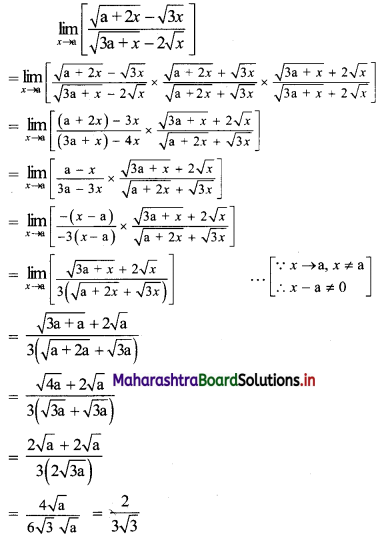
\(\lim _{x \rightarrow a}\left[\frac{\sqrt{a+2 x}-\sqrt{3 x}}{\sqrt{3 a+x}-2 \sqrt{x}}\right]\)
Solution:
Maharashtra Board 11th Commerce Maths Solutions Chapter 7 Limits Ex 7.3 Q2 (i)

Question 2.
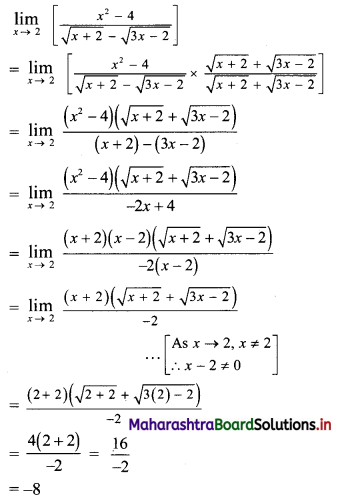
\(\lim _{x \rightarrow 2}\left[\frac{x^{2}-4}{\sqrt{x+2}-\sqrt{3 x-2}}\right]\)
Solution:
Maharashtra Board 11th Commerce Maths Solutions Chapter 7 Limits Ex 7.3 Q2 (ii)

III. Evaluate the following limits:

Question 1.
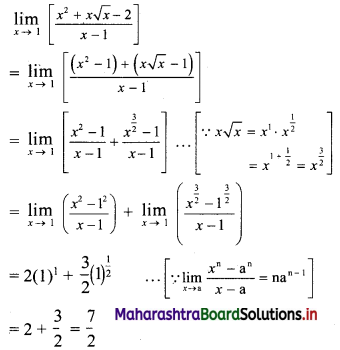
\(\lim _{x \rightarrow 1}\left[\frac{x^{2}+x \sqrt{x}-2}{x-1}\right]\)
Solution:
Maharashtra Board 11th Commerce Maths Solutions Chapter 7 Limits Ex 7.3 Q3 (i)

Maharashtra Board 11th Commerce Maths Solutions Chapter 7 Limits Ex 7.3

Question 2.
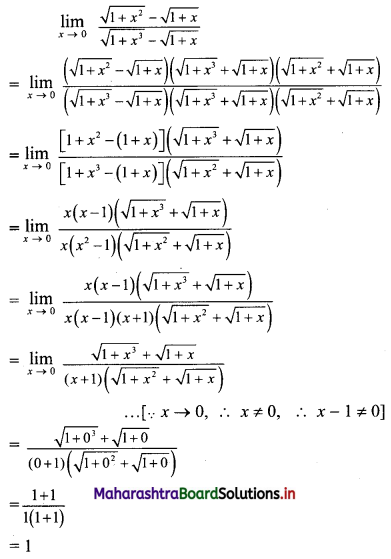
\(\lim _{x \rightarrow 0}\left[\frac{\sqrt{1+x^{2}}-\sqrt{1+x}}{\sqrt{1+x^{3}}-\sqrt{1+x}}\right]\)
Solution:
Maharashtra Board 11th Commerce Maths Solutions Chapter 7 Limits Ex 7.3 Q3 (ii)

Question 3.
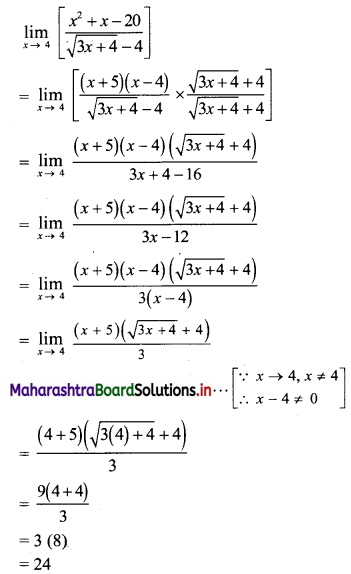
\(\lim _{x \rightarrow 4}\left[\frac{x^{2}+x-20}{\sqrt{3 x+4}-4}\right]\)
Solution:
Maharashtra Board 11th Commerce Maths Solutions Chapter 7 Limits Ex 7.3 Q3 (iii)

Question 4.
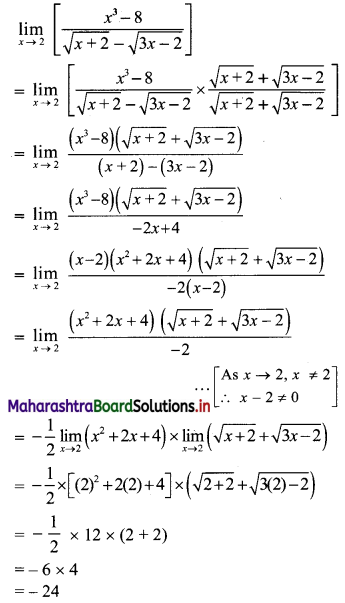
\(\lim _{x \rightarrow 2}\left[\frac{x^{3}-8}{\sqrt{x+2}-\sqrt{3 x-2}}\right]\)
Solution:
Maharashtra Board 11th Commerce Maths Solutions Chapter 7 Limits Ex 7.3 Q3 (iv)

IV. Evaluate the following limits:

Question 1.
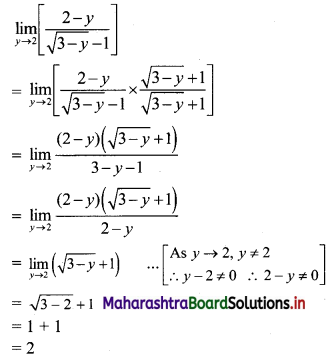
\(\lim _{y \rightarrow 2}\left[\frac{2-y}{\sqrt{3-y}-1}\right]\)
Solution:
Maharashtra Board 11th Commerce Maths Solutions Chapter 7 Limits Ex 7.3 Q4 (i)

Maharashtra Board 11th Commerce Maths Solutions Chapter 7 Limits Ex 7.3

Question 2.
\(\lim _{z \rightarrow 4}\left[\frac{3-\sqrt{5+z}}{1-\sqrt{5-z}}\right]\)
Solution:
Maharashtra Board 11th Commerce Maths Solutions Chapter 7 Limits Ex 7.3 Q4 (ii)

Maharashtra Board 11th Commerce Maths Solutions Chapter 7 Limits Ex 7.2

Balbharati Maharashtra State Board 11th Commerce Maths Solution Book Pdf Chapter 7 Limits Ex 7.2 Questions and Answers.

Maharashtra State Board 11th Commerce Maths Solutions Chapter 7 Limits Ex 7.2

I. Evaluate the following limits:

Question 1.
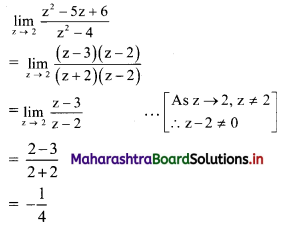
\(\lim _{z \rightarrow 2}\left[\frac{z^{2}-5 z+6}{z^{2}-4}\right]\)
Solution:
Maharashtra Board 11th Commerce Maths Solutions Chapter 7 Limits Ex 7.2 I Q1

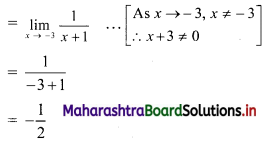
Question 2.
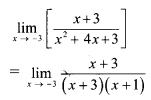
\(\lim _{x \rightarrow-3}\left[\frac{x+3}{x^{2}+4 x+3}\right]\)
Solution:
Maharashtra Board 11th Commerce Maths Solutions Chapter 7 Limits Ex 7.2 I Q2
Maharashtra Board 11th Commerce Maths Solutions Chapter 7 Limits Ex 7.2 I Q2.1

Maharashtra Board 11th Commerce Maths Solutions Chapter 7 Limits Ex 7.2

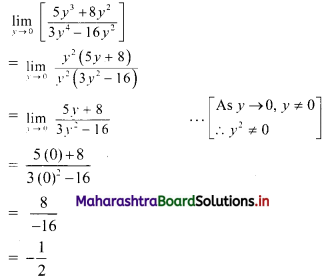
Question 3.
\(\lim _{y \rightarrow 0}\left[\frac{5 y^{3}+8 y^{2}}{3 y^{4}-16 y^{2}}\right]\)
Solution:
Maharashtra Board 11th Commerce Maths Solutions Chapter 7 Limits Ex 7.2 I Q3

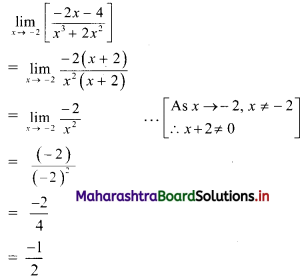
Question 4.
\(\lim _{x \rightarrow-2}\left[\frac{-2 x-4}{x^{3}+2 x^{2}}\right]\)
Solution:
Maharashtra Board 11th Commerce Maths Solutions Chapter 7 Limits Ex 7.2 I Q4

II. Evaluate the following limits:

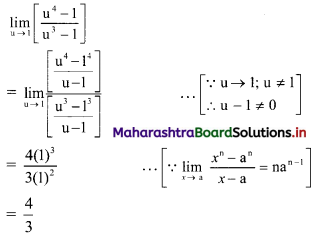
Question 1.
\(\lim _{u \rightarrow 1}\left[\frac{u^{4}-1}{u^{3}-1}\right]\)
Solution:
Maharashtra Board 11th Commerce Maths Solutions Chapter 7 Limits Ex 7.2 II Q1

Question 2.
\(\lim _{x \rightarrow 3}\left[\frac{1}{x-3}-\frac{9 x}{x^{3}-27}\right]\)
Solution:
Maharashtra Board 11th Commerce Maths Solutions Chapter 7 Limits Ex 7.2 II Q2

Maharashtra Board 11th Commerce Maths Solutions Chapter 7 Limits Ex 7.2

Question 3.
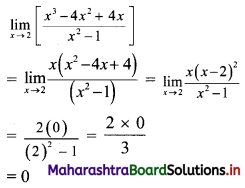
\(\lim _{x \rightarrow 2}\left[\frac{x^{3}-4 x^{2}+4 x}{x^{2}-1}\right]\)
Solution:
Maharashtra Board 11th Commerce Maths Solutions Chapter 7 Limits Ex 7.2 II Q3

III. Evaluate the following limits:

Question 1.
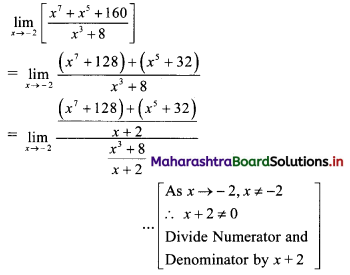
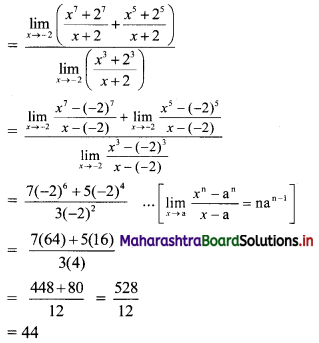
\(\lim _{x \rightarrow-2}\left[\frac{x^{7}+x^{5}+160}{x^{3}+8}\right]\)
Solution:
Maharashtra Board 11th Commerce Maths Solutions Chapter 7 Limits Ex 7.2 III Q1
Maharashtra Board 11th Commerce Maths Solutions Chapter 7 Limits Ex 7.2 III Q1.1

Question 2.
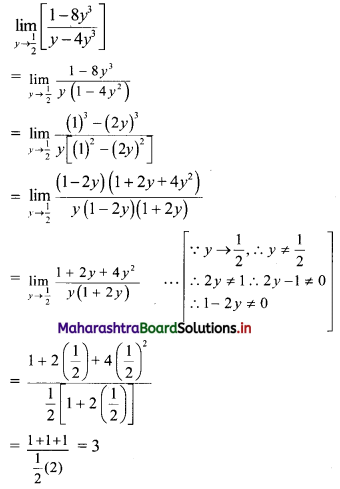
\(\lim _{y \rightarrow \frac{1}{2}}\left[\frac{1-8 y^{3}}{y-4 y^{3}}\right]\)
Solution:
Maharashtra Board 11th Commerce Maths Solutions Chapter 7 Limits Ex 7.2 III Q2

Question 3.
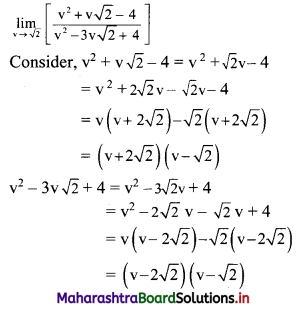
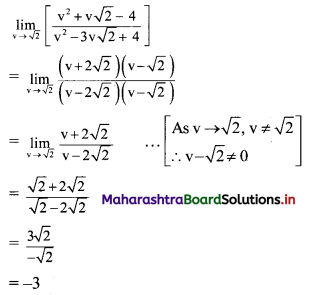
\(\lim _{v \rightarrow \sqrt{2}}\left[\frac{v^{2}+v \sqrt{2}-4}{v^{2}-3 v \sqrt{2}+4}\right]\)
Solution:
Maharashtra Board 11th Commerce Maths Solutions Chapter 7 Limits Ex 7.2 III Q3
Maharashtra Board 11th Commerce Maths Solutions Chapter 7 Limits Ex 7.2 III Q3.1

Maharashtra Board 11th Commerce Maths Solutions Chapter 7 Limits Ex 7.2

Question 4.
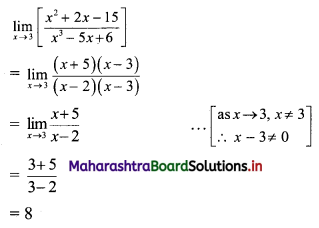
\(\lim _{x \rightarrow 3}\left[\frac{x^{2}+2 x-15}{x^{2}-5 x+6}\right]\)
Solution:
Maharashtra Board 11th Commerce Maths Solutions Chapter 7 Limits Ex 7.2 III Q4

Maharashtra Board 11th Commerce Maths Solutions Chapter 7 Limits Ex 7.1

Balbharati Maharashtra State Board 11th Commerce Maths Solution Book Pdf Chapter 7 Limits Ex 7.1 Questions and Answers.

Maharashtra State Board 11th Commerce Maths Solutions Chapter 7 Limits Ex 7.1

I. Evaluate the following limits:

Question 1.
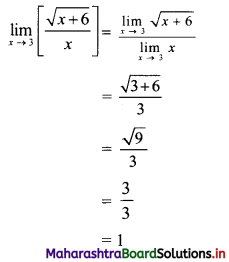
\(\lim _{x \rightarrow 3}\left[\frac{\sqrt{x+6}}{x}\right]\)
Solution:
Maharashtra Board 11th Commerce Maths Solutions Chapter 7 Limits Ex 7.1 I Q1

Question 2.
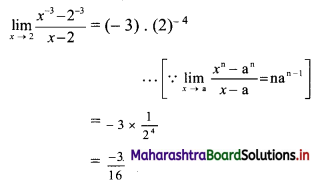
\(\lim _{x \rightarrow 2}\left[\frac{x^{-3}-2^{-3}}{x-2}\right]\)
Solution:
Maharashtra Board 11th Commerce Maths Solutions Chapter 7 Limits Ex 7.1 I Q2

Maharashtra Board 11th Commerce Maths Solutions Chapter 7 Limits Ex 7.1

Question 3.
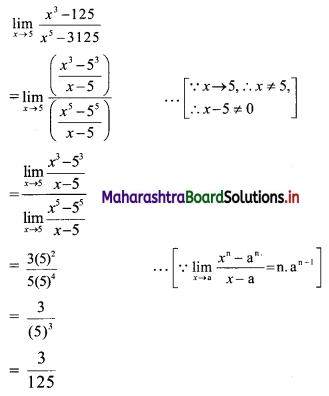
\(\lim _{x \rightarrow 5}\left[\frac{x^{3}-125}{x^{5}-3125}\right]\)
Solution:
Maharashtra Board 11th Commerce Maths Solutions Chapter 7 Limits Ex 7.1 I Q3

Question 4.
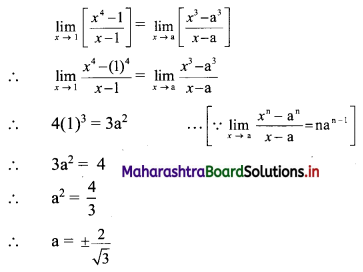
If \(\lim _{x \rightarrow 1}\left[\frac{x^{4}-1}{x-1}\right]=\lim _{x \rightarrow a}\left[\frac{x^{3}-a^{3}}{x-a}\right]\), find all possible values of a.
Solution:
Maharashtra Board 11th Commerce Maths Solutions Chapter 7 Limits Ex 7.1 I Q4

II. Evaluate the following limits:

Question 1.
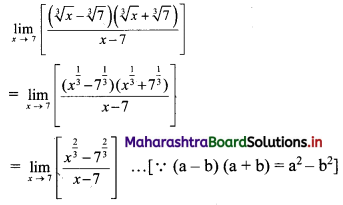
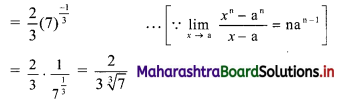
\(\lim _{x \rightarrow 7}\left[\frac{(\sqrt[3]{x}-\sqrt[3]{7})(\sqrt[3]{x}+\sqrt[3]{7})}{x-7}\right]\)
Solution:
Maharashtra Board 11th Commerce Maths Solutions Chapter 7 Limits Ex 7.1 II Q1
Maharashtra Board 11th Commerce Maths Solutions Chapter 7 Limits Ex 7.1 II Q1.1

Maharashtra Board 11th Commerce Maths Solutions Chapter 7 Limits Ex 7.1

Question 2.
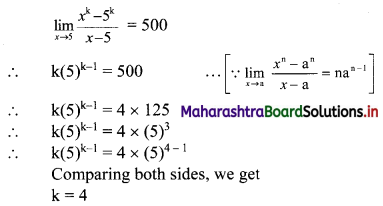
If \(\lim _{x \rightarrow 5}\left[\frac{x^{k}-5^{k}}{x-5}\right]=500\), find all possible values of k.
Solution:
Maharashtra Board 11th Commerce Maths Solutions Chapter 7 Limits Ex 7.1 II Q2

Question 3.
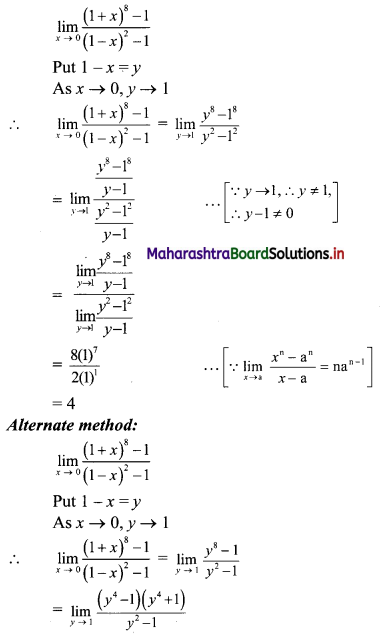
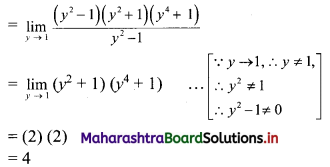
\(\lim _{x \rightarrow 0}\left[\frac{(1-x)^{8}-1}{(1-x)^{2}-1}\right]\)
Solution:
Maharashtra Board 11th Commerce Maths Solutions Chapter 7 Limits Ex 7.1 II Q3
Maharashtra Board 11th Commerce Maths Solutions Chapter 7 Limits Ex 7.1 II Q3.1

III. Evaluate the following limits:

Question 1.
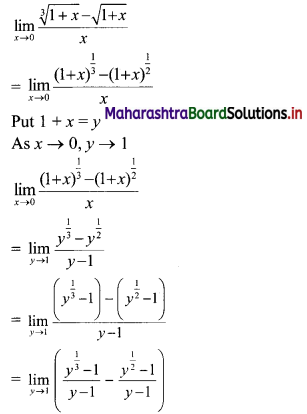
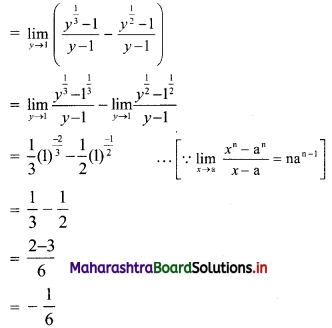
\(\lim _{x \rightarrow 0}\left[\frac{\sqrt[3]{1+x}-\sqrt{1+x}}{x}\right]\)
Solution:
Maharashtra Board 11th Commerce Maths Solutions Chapter 7 Limits Ex 7.1 III Q1
Maharashtra Board 11th Commerce Maths Solutions Chapter 7 Limits Ex 7.1 III Q1.1

Question 2.
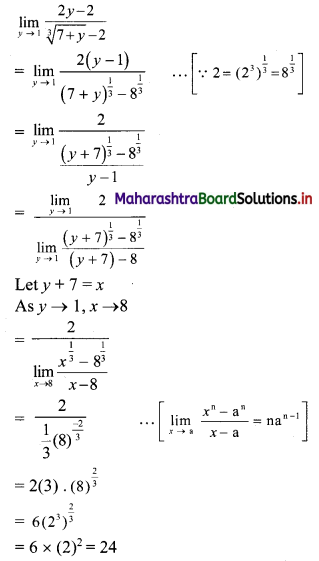
\(\lim _{y \rightarrow 1}\left[\frac{2 y-2}{\sqrt[3]{7+y}-2}\right]\)
Solution:
Maharashtra Board 11th Commerce Maths Solutions Chapter 7 Limits Ex 7.1 III Q2

Question 3.
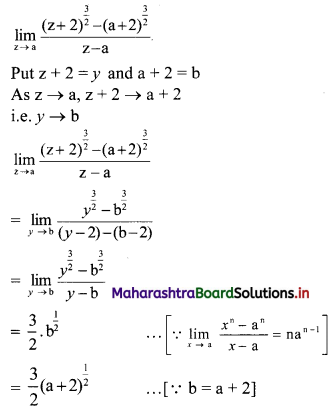
\(\lim _{z \rightarrow a}\left[\frac{(z+2)^{\frac{3}{2}}-(a+2)^{\frac{3}{2}}}{z-a}\right]\)
Solution:
Maharashtra Board 11th Commerce Maths Solutions Chapter 7 Limits Ex 7.1 III Q3

Maharashtra Board 11th Commerce Maths Solutions Chapter 7 Limits Ex 7.1

Question 4.
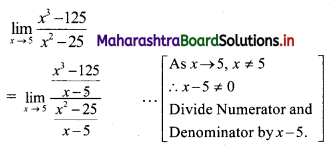
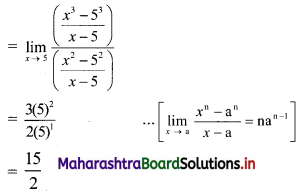
\(\lim _{x \rightarrow 5}\left[\frac{x^{3}-125}{x^{2}-25}\right]\)
Solution:
Maharashtra Board 11th Commerce Maths Solutions Chapter 7 Limits Ex 7.1 III Q4
Maharashtra Board 11th Commerce Maths Solutions Chapter 7 Limits Ex 7.1 III Q4.1

Maharashtra Board 11th Commerce Maths Solutions Chapter 6 Determinants Miscellaneous Exercise 6

Balbharati Maharashtra State Board 11th Commerce Maths Solution Book Pdf Chapter 6 Determinants Miscellaneous Exercise 6 Questions and Answers.

Maharashtra State Board 11th Commerce Maths Solutions Chapter 6 Determinants Miscellaneous Exercise 6

Question 1.
Evaluate:
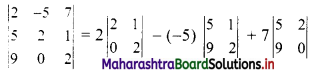
(i) \(\left|\begin{array}{ccc}
2 & -5 & 7 \\
5 & 2 & 1 \\
9 & 0 & 2
\end{array}\right|\)
Solution:
Maharashtra Board 11th Commerce Maths Solutions Chapter 6 Determinants Miscellaneous Exercise 6 Q1(i)
= 2(4 – 0) + 5(10 – 9) + 7(0 – 18)
= 2(4) + 5(1) + 7(-18)
= 8 + 5 – 126
= -113

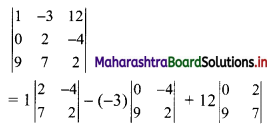
(ii) \(\left|\begin{array}{ccc}
1 & -3 & 12 \\
0 & 2 & -4 \\
9 & 7 & 2
\end{array}\right|\)
Solution:
Maharashtra Board 11th Commerce Maths Solutions Chapter 6 Determinants Miscellaneous Exercise 6 Q1(ii)
= 1(4 + 28) + 3(0 + 36) + 12(0 – 18)
= 1(32) + 3(36) + 12(-18)
= 32 + 108 – 216
= -76

Maharashtra Board 11th Commerce Maths Solutions Chapter 6 Determinants Miscellaneous Exercise 6

Question 2.
Find the value(s) of x, if
(i) \(\left|\begin{array}{ccc}
1 & 4 & 20 \\
1 & -2 & -5 \\
1 & 2 x & 5 x^{2}
\end{array}\right|=0\)
Solution:
\(\left|\begin{array}{ccc}
1 & 4 & 20 \\
1 & -2 & -5 \\
1 & 2 x & 5 x^{2}
\end{array}\right|=0\)
∴ 1(-10x2 + 10x) – 4(5x2 + 5) + 20(2x + 2) = 0
∴ -10x2 + 10x – 20x2 – 20 + 40x + 40 = 0
∴ -30x2 + 50x + 20 = 0
∴ 3x2 – 5x – 2 = 0 ……[Dividing throughout by (-10)]
∴ 3x2 – 6x + x – 2 = 0
∴ 3x(x – 2) + 1(x – 2) = 0
∴ (x – 2) (3x + 1) = 0
∴ x – 2 = 0 or 3x + 1 = 0
∴ x = 2 or x = \(-\frac{1}{3}\)

(ii) \(\left|\begin{array}{ccc}
1 & 2 x & 4 x \\
1 & 4 & 16 \\
1 & 1 & 1
\end{array}\right|=0\)
Solution:
\(\left|\begin{array}{ccc}
1 & 2 x & 4 x \\
1 & 4 & 16 \\
1 & 1 & 1
\end{array}\right|=0\)
∴ 1(4 – 16) – 2x(1 – 16) + 4x(1 – 4) = 0
∴ 1(-12) – 2x(-15) + 4x(-3) = 0
∴ -12 + 30x – 12x = 0
∴ 18x = 12
∴ x = \(\frac{2}{3}\)

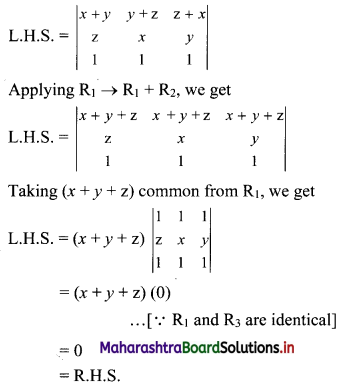
Question 3.
By using properties of determinants, prove that \(\left|\begin{array}{ccc}
x+y & y+z & z+x \\
z & x & y \\
1 & 1 & 1
\end{array}\right|=0\).
Solution:
Maharashtra Board 11th Commerce Maths Solutions Chapter 6 Determinants Miscellaneous Exercise 6 Q3

Maharashtra Board 11th Commerce Maths Solutions Chapter 6 Determinants Miscellaneous Exercise 6

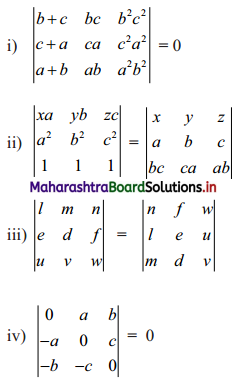
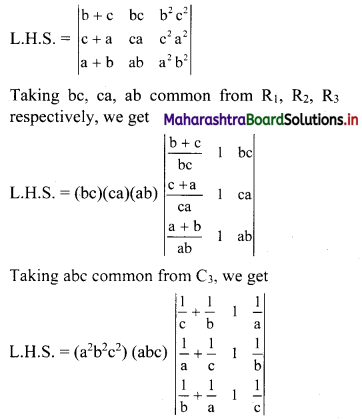
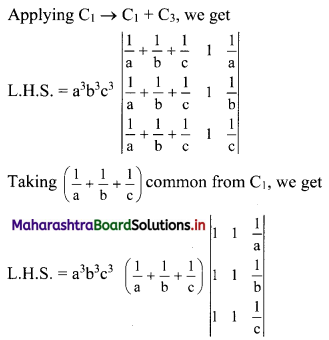
Question 4.
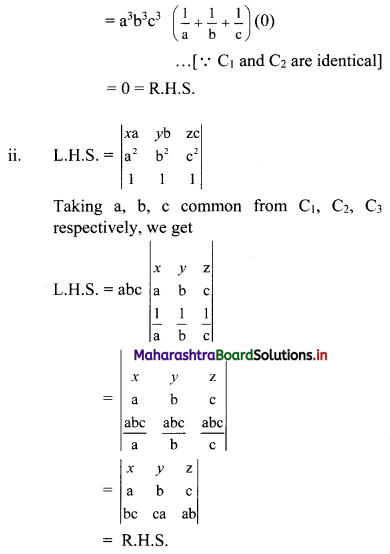
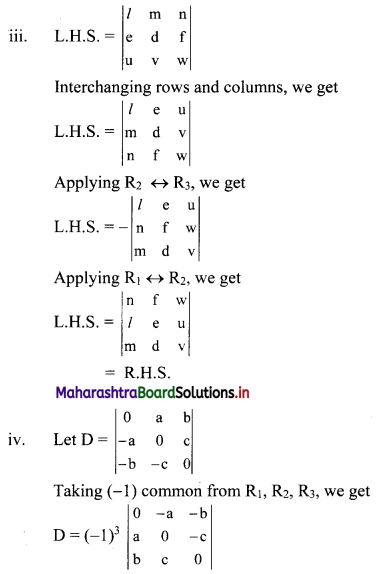
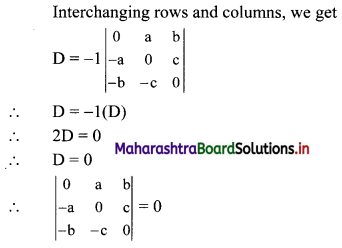
Without expanding the determinants, show that
Maharashtra Board 11th Commerce Maths Solutions Chapter 6 Determinants Miscellaneous Exercise 6 Q4
Solution:
Maharashtra Board 11th Commerce Maths Solutions Chapter 6 Determinants Miscellaneous Exercise 6 Q4.1
Maharashtra Board 11th Commerce Maths Solutions Chapter 6 Determinants Miscellaneous Exercise 6 Q4.2
Maharashtra Board 11th Commerce Maths Solutions Chapter 6 Determinants Miscellaneous Exercise 6 Q4.3
Maharashtra Board 11th Commerce Maths Solutions Chapter 6 Determinants Miscellaneous Exercise 6 Q4.4
Maharashtra Board 11th Commerce Maths Solutions Chapter 6 Determinants Miscellaneous Exercise 6 Q4.5

Question 5.
Solve the following linear equations by Cramer’s Rule.
(i) 2x – y + z = 1, x + 2y + 3z = 8, 3x + y – 4z = 1
Solution:
Given equations are
2x – y + z = 1
x + 2y + 3z = 8
3x + y – 4z = 1
D = \(\left|\begin{array}{ccc}
2 & -1 & 1 \\
1 & 2 & 3 \\
3 & 1 & -4
\end{array}\right|\)
= 2(-8 – 3) – (-1)(-4 – 9) + 1(1 – 6)
= 2(-11) + 1(-13) + 1(-5)
= -22 – 13 – 5
= -40 ≠ 0
Dx = \(\left|\begin{array}{ccc}
1 & -1 & 1 \\
8 & 2 & 3 \\
1 & 1 & -4
\end{array}\right|\)
= 1(-8 – 3) – (-1)(-32 – 3) + 1(8 – 2)
= 1(-11) + 1(-35) + 1(6)
= -11 – 35 + 6
= -40
Dy = \(\left|\begin{array}{ccc}
2 & 1 & 1 \\
1 & 8 & 3 \\
3 & 1 & -4
\end{array}\right|\)
= 2(-32 – 3) – 1(-4 – 9) + 1(1 – 24)
= 2(-35) – 1(-13) + 1(-23)
= -70 + 13 – 23
= -80
Dz = \(\left|\begin{array}{ccc}
2 & -1 & 1 \\
1 & 2 & 8 \\
3 & 1 & 1
\end{array}\right|\)
= 2(2 – 8) – (-1)(1 – 24) + 1(1 – 6)
= 2(-6) + 1(-23) + 1(-5)
= -12 – 23 – 5
= -40
By Cramer’s Rule,
x = \(\frac{D_{x}}{D}=\frac{-40}{-40}\) = 1
y = \(\frac{\mathrm{D}_{y}}{\mathrm{D}}=\frac{-80}{-40}\) = 2
z = \(\frac{\mathrm{D}_{z}}{\mathrm{D}}=\frac{-40}{-40}\) = 1
∴ x = 1, y = 2 and z = 1 are the solutions of the given equations.

Maharashtra Board 11th Commerce Maths Solutions Chapter 6 Determinants Miscellaneous Exercise 6

(ii) \(\frac{1}{x}+\frac{1}{y}+\frac{1}{z}=-2\), \(\frac{1}{x}-\frac{2}{y}+\frac{1}{z}=3\), \(\frac{2}{x}-\frac{1}{y}+\frac{3}{z}=-1\)
Solution:
Let \(\frac{1}{x}\) = p, \(\frac{1}{y}\) = q, \(\frac{1}{z}\) = r
The given equations become
p + q + r = -2
p – 2q + r = 3
2p – q + 3r = -1
D = \(\left|\begin{array}{ccc}
1 & 1 & 1 \\
1 & -2 & 1 \\
2 & -1 & 3
\end{array}\right|\)
= 1(-6 + 1) – 1(3 – 2) + 1(-1 + 4)
= -5 – 1 + 3
= -3
Dp = \(\left|\begin{array}{rrr}
-2 & 1 & 1 \\
3 & -2 & 1 \\
-1 & -1 & 3
\end{array}\right|\)
= -2(-6 + 1) – 1(9 + 1) + 1(-3 – 2)
= 10 – 10 – 5
= -5
Dq = \(\left|\begin{array}{ccc}
1 & -2 & 1 \\
1 & 3 & 1 \\
2 & -1 & 3
\end{array}\right|\)
= 1(9 + 1) + 2(3 – 2) + 1(-1 – 6)
= 10 + 2 – 7
= 5
Dr = \(\left|\begin{array}{rrr}
1 & 1 & -2 \\
1 & -2 & 3 \\
2 & -1 & -1
\end{array}\right|\)
= 1(2 + 3) – 1(-1 – 6) – 2(-1 + 4)
= 5 + 7 – 6
= 6
By Cramer’s Rule,
p = \(\frac{\mathrm{D}_{\mathrm{p}}}{\mathrm{D}}=\frac{-5}{-3}=\frac{5}{3}\)
q = \(\frac{\mathrm{D}_{y}}{\mathrm{D}}=\frac{-80}{-40}\) = 2
r = \(\frac{D_{2}}{D}=\frac{-40}{-40}\) = 1
∴ x = \(\frac{3}{5}\), y = \(\frac{-3}{5}\), z = \(\frac{-1}{2}\) are the solutions of the given equations.

(iii) x – y + 2z = 7, 3x + 4y – 5z = 5, 2x – y + 3z = 12
Solution:
Given equations are
x – y + 2z = 1
3x + 4y – 5z = 5
2x – y + 3z = 12
D = \(\left|\begin{array}{ccc}
1 & -1 & 2 \\
3 & 4 & -5 \\
2 & -1 & 3
\end{array}\right|\)
= 1(12 – 5) – (-1)(9 + 10) + 2(-3 – 8)
= 1(7) + 1(19) + 2(-11)
= 7 + 19 – 22
= 4 ≠ 0
Dx = \(\left|\begin{array}{ccc}
7 & -1 & 2 \\
5 & 4 & -5 \\
12 & -1 & 3
\end{array}\right|\)
= 7(12 – 5) – (-1)(15 + 60) + 2(-5 – 48)
= 7(7)+ 1(75) +2(-53)
= 49 + 75 – 106
= 18
Dy = \(\left|\begin{array}{ccc}
1 & 7 & 2 \\
3 & 5 & -5 \\
2 & 12 & 3
\end{array}\right|\)
= 1(15 + 60) – 7(9 + 10) + 2(36 – 10)
= 1(75) – 7(19) + 2(26)
= 75 – 133 + 52
= -6
Dz = \(\left|\begin{array}{ccc}
1 & -1 & 7 \\
3 & 4 & 5 \\
2 & -1 & 12
\end{array}\right|\)
= 1(48 + 5) – (-1)(36 – 10) + 7(-3 – 8)
= 1(53)+ 1(26) + 7(-11)
= 53 + 26 – 77
= 2
By Cramer’s Rule,
x = \(\frac{\mathrm{D}_{x}}{\mathrm{D}}=\frac{18}{4}=\frac{9}{2}\)
y = \(\frac{D_{y}}{D}=\frac{-6}{4}=\frac{-3}{2}\)
z = \(\frac{D_{z}}{D}=\frac{2}{4}=\frac{1}{2}\)
∴ x = \(\frac{9}{2}\), y = \(\frac{-3}{2}\) and z = \(\frac{1}{2}\) are the solutions of the given equations.

Maharashtra Board 11th Commerce Maths Solutions Chapter 6 Determinants Miscellaneous Exercise 6

Question 6.
Find the value(s) of k, if the following equations are consistent.
(i) 3x + y – 2 = 0, kx + 2y – 3 = 0 and 2x – y = 3
Solution:
Given equations are
3x + y – 2 = 0
kx + 2y – 3 = 0
2x – y = 3 i.e. 2x – y – 3 = 0
Since, these equations are consistent.
∴ \(\left|\begin{array}{rrr}
3 & 1 & -2 \\
k & 2 & -3 \\
2 & -1 & -3
\end{array}\right|=0\)
∴ 3(-6 – 3) – 1(-3k + 6) – 2(-k – 4) = 0
∴ 3(-9) – 1 (-3k + 6) – 2(-k – 4) = 0
∴ -27 + 3k – 6 + 2k + 8 = 0
∴ 5k – 25 = 0
∴ k = 5

(ii) kx + 3y + 4 = 0, x + ky + 3 = 0, 3x + 4y + 5 = 0
Solution:
Given equations are
kx + 3y + 4 = 0
x + ky + 3 = 0
3x + 4y + 5 = 0
Since, these equations are consistent.
∴ \(\left|\begin{array}{lll}
\mathrm{k} & 3 & 4 \\
1 & \mathrm{k} & 3 \\
3 & 4 & 5
\end{array}\right|=0\)
∴ k(5k – 12) – 3(5 – 9) + 4(4 – 3k) = 0
∴ 5k2 – 12k + 12 + 16 – 12k = 0
∴ 5k2 – 24k + 28 = 0
∴ 5k2 – 10k – 14k + 28 = 0
∴ 5k(k – 2) – 14(k – 2) = 0
∴ (k – 2) (5k – 14) = 0
∴ k – 2 = 0 or 5k – 14 = 0
∴ k = 2 or k = \(\frac{14}{5}\)

Question 7.
Find the area of triangles whose vertices are
(i) A(-1, 2), B(2, 4), C(0, 0)
Solution:
Here, A(x1, y1) ≡ A(-1, 2), B(x2, y2) ≡ B(2, 4), C(x3, y3) ≡ C(0, 0)
Area of a triangle = \(\frac{1}{2}\left|\begin{array}{lll}
x_{1} & y_{1} & 1 \\
x_{2} & y_{2} & 1 \\
x_{3} & y_{3} & 1
\end{array}\right|\)
∴ A(∆ABC) = \(\frac{1}{2}\left|\begin{array}{ccc}
-1 & 2 & 1 \\
2 & 4 & 1 \\
0 & 0 & 1
\end{array}\right|\)
= \(\frac{1}{2}\) [-1(4 – 0) – 2(2 – 0) + 1(0 – 0)]
= \(\frac{1}{2}\) (-4 – 4)
= \(\frac{1}{2}\) (-8)
= -4
Since, area cannot be negative.
∴ A(∆ABC) = 4 sq.units

(ii) P(3, 6), Q(-1, 3), R(2, -1)
Solution:
Here, P(x1, y1) ≡ P(3, 6), Q(x2, y2) ≡ Q(-1, 3), R(x3, y3) ≡ R(2, -1)
Area of a triangle = \(\frac{1}{2}\left|\begin{array}{lll}
x_{1} & y_{1} & 1 \\
x_{2} & y_{2} & 1 \\
x_{3} & y_{3} & 1
\end{array}\right|\)
A(∆PQR) = \(\frac{1}{2}\left|\begin{array}{ccc}
3 & 6 & 1 \\
-1 & 3 & 1 \\
2 & -1 & 1
\end{array}\right|\)
= \(\frac{1}{2}\) [3(3 + 1) – 6(-1 – 2) + 1(1 – 6)]
= \(\frac{1}{2}\) [3(4) – 6(-3) + 1(-5)]
= \(\frac{1}{2}\) (12 + 18 – 5)
∴ A(∆PQR) = \(\frac{25}{2}\) sq.units

Maharashtra Board 11th Commerce Maths Solutions Chapter 6 Determinants Miscellaneous Exercise 6

(iii) L(1, 1), M(-2, 2), N(5, 4)
Solution:
Here, L(x1, y1) ≡ L(1, 1), M(x2, y2) ≡ M(-2, 2), N(x3, y3) ≡ N(5, 4)
Area of a triangle = \(\frac{1}{2}\left|\begin{array}{lll}
x_{1} & y_{1} & 1 \\
x_{2} & y_{2} & 1 \\
x_{3} & y_{3} & 1
\end{array}\right|\)
A(∆LMN) = \(\frac{1}{2}\left|\begin{array}{rrr}
1 & 1 & 1 \\
-2 & 2 & 1 \\
5 & 4 & 1
\end{array}\right|\)
= \(\frac{1}{2}\) [1(2 – 4) -1(-2 – 5) + 1(-8 – 10)]
= \(\frac{1}{2}\) [1(-2) – 1(-7) + 1(-18)]
= \(\frac{1}{2}\) (-2 + 7 – 18)
= \(\frac{-13}{2}\)
Since, area cannot be negative.
∴ A(∆LMN) = \(\frac{13}{2}\) sq.units

Question 8.
Find the value of k,
(i) if the area of ∆PQR is 4 square units and vertices are P(k, 0), Q(4, 0), R(0, 2).
Solution:
Here, P(x1, y1) ≡ P(k, 0), Q(x2, y2) ≡ Q(4, 0), R(x3, y3) ≡ R(0, 2)
A(∆PQR) = 4 sq.units
Area of a triangle = \(\frac{1}{2}\left|\begin{array}{lll}
x_{1} & y_{1} & 1 \\
x_{2} & y_{2} & 1 \\
x_{3} & y_{3} & 1
\end{array}\right|\)
∴ ±4 = \(\frac{1}{2}\left|\begin{array}{lll}
k & 0 & 1 \\
4 & 0 & 1 \\
0 & 2 & 1
\end{array}\right|\)
∴ ±4 = \(\frac{1}{2}\) [k(0 – 2) – 0 + 1(8 – 0)]
∴ ±8 = -2k + 8
∴ 8 = -2k + 8 or -8 = -2k + 8
∴ -2k = 0 or 2k = 16
∴ k = 0 or k = 8

Maharashtra Board 11th Commerce Maths Solutions Chapter 6 Determinants Miscellaneous Exercise 6

(ii) if area of ∆LMN is \(\frac{33}{2}\) square units and vertices are L(3, -5), M(-2, k), N(1, 4).
Solution:
Here, L(x1, y1) ≡ L(3, -5), M(x2, y2) ≡ M(-2, k), N(x3, y3) ≡ N(1, 4)
A(∆LMN) = \(\frac{33}{2}\) sq.units
Area of a triangle = \(\frac{1}{2}\left|\begin{array}{lll}
x_{1} & y_{1} & 1 \\
x_{2} & y_{2} & 1 \\
x_{3} & y_{3} & 1
\end{array}\right|\)
∴ \(\pm \frac{33}{2}=\frac{1}{2}\left|\begin{array}{ccc}
3 & -5 & 1 \\
-2 & \mathrm{k} & 1 \\
1 & 4 & 1
\end{array}\right|\)
∴ ±\(\frac{33}{2}\) = \(\frac{1}{2}\) [3(k – 4) – (-5) (-2 – 1) + 1(-8 – k)]
∴ ±33 = 3k – 12 – 15 – 8 – k
∴ 33 = 2k – 35
∴ 2k – 35 = 33 or 2k – 35 = -33
∴ 2k = 68 or 2k = 2
∴ k = 34 or k = 1

Maharashtra Board 11th Commerce Maths Solutions Chapter 4 Sequences and Series Ex 4.4

Balbharati Maharashtra State Board 11th Commerce Maths Solution Book Pdf Chapter 4 Sequences and Series Ex 4.4 Questions and Answers.

Maharashtra State Board 11th Commerce Maths Solutions Chapter 4 Sequences and Series Ex 4.4

Question 1.
Verify whether the following sequences are H.P.
(i) \(\frac{1}{3}, \frac{1}{5}, \frac{1}{7}, \frac{1}{9}, \ldots\)
(ii) \(\frac{1}{3}, \frac{1}{6}, \frac{1}{9}, \frac{1}{12}, \ldots \ldots \ldots \ldots\)
(iii) \(\frac{1}{7}, \frac{1}{9}, \frac{1}{11}, \frac{1}{13}, \frac{1}{15}, \ldots\)
Solution:
(i) \(\frac{1}{3}, \frac{1}{5}, \frac{1}{7}, \frac{1}{9}, \ldots\)
Here, the reciprocal sequence is 3, 5, 7, 9, …
∴ t1 = 3, t2 = 5, t3 = 7, …..
∵ t2 – t1 = t3 – t2 = t4 – t3 = 2, constant
∴ The reciprocal sequence is an A.P.
∴ the given sequence is H.P.

(ii) \(\frac{1}{3}, \frac{1}{6}, \frac{1}{9}, \frac{1}{12}, \ldots \ldots \ldots \ldots\)
Here, the reciprocal sequence is 3, 6, 9, 12 …
∴ t1 = 3, t2 = 6, t3 = 9, t4 = 12, …
∵ t2 – t1 = t3 – t2 = t4 – t3 = 3, constant
∴ The reciprocal sequence is an A.P.
∴ The given sequence is H.P.

(iii) \(\frac{1}{7}, \frac{1}{9}, \frac{1}{11}, \frac{1}{13}, \frac{1}{15}, \ldots\)
Here, the reciprocal sequence is 7, 9, 11, 13, 15, ……
∴ t1 = 7, t2 = 9, t3 = 11, t4 = 13, …..
∵ t2 – t1 = t3 – t2 = t4 – t3 = 2, constant
∴ The reciprocal sequence is an A.P.
∴ The given sequence is H.P.

Maharashtra Board 11th Commerce Maths Solutions Chapter 4 Sequences and Series Ex 4.4

Question 2.
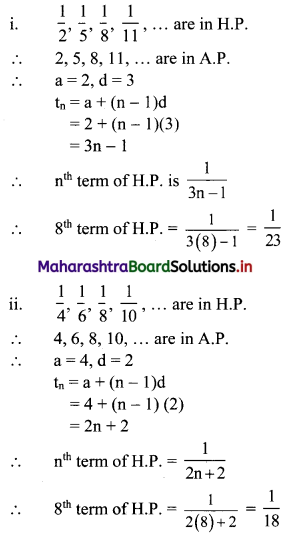
Find the nth term and hence find the 8th term of the following H.P.s:
(i) \(\frac{1}{2}, \frac{1}{5}, \frac{1}{8}, \frac{1}{11}, \ldots \ldots \ldots\)
(ii) \(\frac{1}{4}, \frac{1}{6}, \frac{1}{8}, \frac{1}{10}, \ldots \ldots \ldots \ldots\)
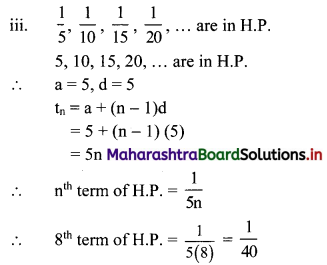
(iii) \(\frac{1}{5}, \frac{1}{10}, \frac{1}{15}, \frac{1}{20}, \cdots \cdots \cdots\)
Solution:
Maharashtra Board 11th Commerce Maths Solutions Chapter 4 Sequences and Series Ex 4.4 Q2
Maharashtra Board 11th Commerce Maths Solutions Chapter 4 Sequences and Series Ex 4.4 Q2.1

Question 3.
Find A.M. of two positive numbers whose G.M. and H.M. are 4 and \(\frac{16}{5}\).
Solution:
G.M. = 4, H.M. = \(\frac{16}{5}\)
∵ (G.M.)2 = (A.M.) (H.M.)
∴ 16 = A.M. × \(\frac{16}{5}\)
∴ A.M. = 5

Question 4.
Find H.M. of two positive numbers whose A.M. and G.M. are \(\frac{15}{2}\) and 6.
Solution:
A.M. = \(\frac{15}{2}\), G.M. = 6
Now, (G.M.)2 = (A.M.) (H.M.)
∴ 62 = \(\frac{15}{2}\) × H.M.
∴ H.M. = 36 × \(\frac{2}{15}\)
∴ H.M. = \(\frac{24}{5}\)

Question 5.
Find G.M. of two positive numbers whose A.M. and H.M. are 75 and 48.
Solution:
A.M. = 75, H.M. = 48
(G.M.)2 = (A.M.) (H.M.)
∵ (G.M.)2 = 75 × 48
∵ (G.M.)2 = 25 × 3 × 16 × 3
∵ (G.M.)2 = 52 × 42 × 32
∴ G.M. = 5 × 4 × 3
∴ G.M. = 60

Maharashtra Board 11th Commerce Maths Solutions Chapter 4 Sequences and Series Ex 4.4

Question 6.
Insert two numbers between \(\frac{1}{7}\) and \(\frac{1}{13}\) so that the resulting sequence is a H.P.
Solution:
Let the required numbers be \(\frac{1}{\mathrm{H}_{1}}\) and \(\frac{1}{\mathrm{H}_{2}}\).
∴ \(\frac{1}{7}, \frac{1}{\mathrm{H}_{1}}, \frac{1}{\mathrm{H}_{2}}, \frac{1}{13}\) are in H.P.
∴ 7, H1, H2 and 13 are in A.P.
∴ t1 = a = 7 and t4 = a + 3d = 13
∴ 7 + 3d = 13
∴ 3d = 6
∴ d = 2
∴ H1 = t2 = a + d = 7 + 2 = 9
and H2 = t3 = a + 2d = 7 + 2(2) = 11
∴ \(\frac{1}{9}\) and \(\frac{1}{11}\) are the required numbers to be inserted between \(\frac{1}{7}\) and \(\frac{1}{13}\) so that the resulting sequence is a H.P.

Question 7.
Insert two numbers between 1 and -27 so that the resulting sequence is a G.P.
Solution:
Let the required numbers be G1 and G2.
∴ 1, G1, G2, -27 are in G.P.
∴ t1 = 1, t2 = G1, t3 = G2, t4 = -27
∴ t1 = a = 1
tn = arn-1
∴ t4 = (1) r4-1
∴ -27 = r3
∴ r3 = (-3)3
∴ r = -3
∴ G1 = t2 = ar = 1(-3) = -3
∴ G2 = t3 = ar = 1(-3)2 = 9
∴ -3 and 9 are the required numbers to be inserted between 1 and -27 so that the resulting sequence is a G.P.

Question 8.
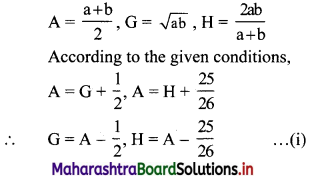
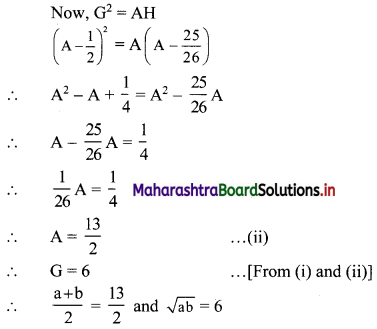
Find two numbers whose A.M. exceeds their G.M. by \(\frac{1}{2}\) and their H.M. by \(\frac{25}{26}\).
Solution:
Let a, b be the two numbers.
Maharashtra Board 11th Commerce Maths Solutions Chapter 4 Sequences and Series Ex 4.4 Q8
Maharashtra Board 11th Commerce Maths Solutions Chapter 4 Sequences and Series Ex 4.4 Q8.1
∴ a + b = 13
∴ b = 13 – a …….(iii)
and ab = 36
∴ a(13 – a) = 36 …… [From (iii)]
∴ a2 – 13a + 36 = 0
∴ (a – 4)(a – 9) = 0
∴ a = 4 or a = 9
When a = 4, b = 13 – 4 = 9
When a = 9, b = 13 – 9 = 4
∴ the two numbers are 4 and 9.

Maharashtra Board 11th Commerce Maths Solutions Chapter 4 Sequences and Series Ex 4.4

Question 9.
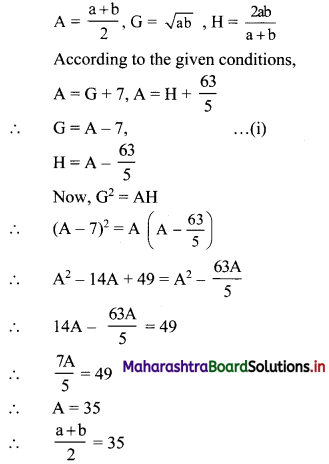
Find two numbers whose A.M. exceeds G.M. bv 7 and their H.M. by \(\frac{63}{5}\).
Solution:
Let a, b be the two numbers.
Maharashtra Board 11th Commerce Maths Solutions Chapter 4 Sequences and Series Ex 4.4 Q9
∴ a + b = 70
∴ b = 70 – a …..(ii)
∴ G = A – 7 = 35 – 7 = 28 …….[From (i)]
∴ √ab = 28
∴ ab = 282 = 784
∴ a(70 – a) = 784 ……[From (ii)]
∴ 70a – a2 = 784
∴ a2 – 70a + 784 = 0
∴ a2 – 56a – 14a + 784 = 0
∴ (a – 56) (a – 14) = 0
∴ a = 14 or a = 56
When a = 14, b = 70 – 14 = 56
When a = 56, b = 70 – 56 = 14
∴ the two numbers are 14 and 56.

Maharashtra Board 11th Commerce Maths Solutions Chapter 4 Sequences and Series Ex 4.3

Balbharati Maharashtra State Board 11th Commerce Maths Solution Book Pdf Chapter 4 Sequences and Series Ex 4.3 Questions and Answers.

Maharashtra State Board 11th Commerce Maths Solutions Chapter 4 Sequences and Series Ex 4.3

Question 1.
Determine whether the sum to infinity of the following G.P’.s exist. If exists, find it.
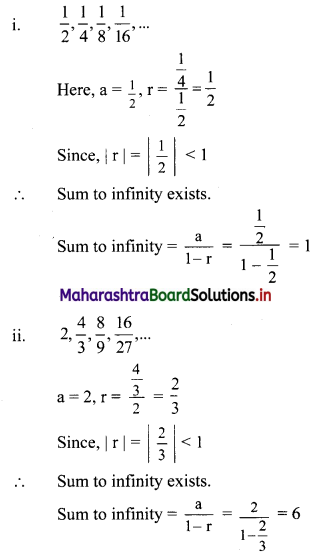
(i) \(\frac{1}{2}, \frac{1}{4}, \frac{1}{8}, \frac{1}{16}, \ldots\)
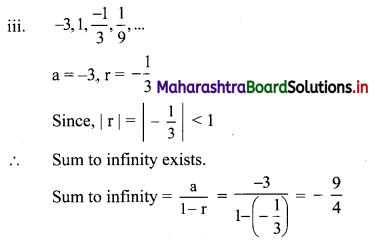
(ii) \(2, \frac{4}{3}, \frac{8}{9}, \frac{16}{27}, \ldots\)
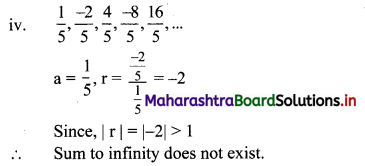
(iii) \(-3,1, \frac{-1}{3}, \frac{1}{9}, \ldots\)
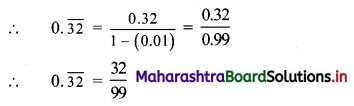
(iv) \(\frac{1}{5}, \frac{-2}{5}, \frac{4}{5}, \frac{-8}{5}, \frac{16}{5}, \ldots\)
Solution:
Maharashtra Board 11th Commerce Maths Solutions Chapter 4 Sequences and Series Ex 4.3 Q1
Maharashtra Board 11th Commerce Maths Solutions Chapter 4 Sequences and Series Ex 4.3 Q1.1
Maharashtra Board 11th Commerce Maths Solutions Chapter 4 Sequences and Series Ex 4.3 Q1.2

Maharashtra Board 11th Commerce Maths Solutions Chapter 4 Sequences and Series Ex 4.3

Question 2.
Express the following recurring decimals as a rational number.
(i) \(0 . \overline{32}\)
(ii) 3.5
(iii) \(4 . \overline{18}\)
(iv) \(0.3 \overline{45}\)
(v) \(3.4 \overline{56}\)
Solution:
(i) \(0 . \overline{32}\) = 0.323232…..
= 0.32 + 0.0032 + 0.000032 + …..
Here, 0.32, 0.0032, 0.000032, … are in G.P. with a = 0.32 and r = 0.01
Since, |r| = |0.01| < 1
∴ Sum to infinity exists.
∴ Sum to infinity = \(\frac{a}{1-r}\)
Maharashtra Board 11th Commerce Maths Solutions Chapter 4 Sequences and Series Ex 4.3 Q2

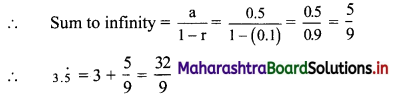
(ii) 3.5 = 3.555… = 3 + 0.5 + 0.05 + 0.005 + …
Here, 0.5, 0.05, 0.005, … are in G.P. with a = 0.5 and r = 0.1
Since, |r| = |0.1| < 1
∴ Sum to infinity exists.
Maharashtra Board 11th Commerce Maths Solutions Chapter 4 Sequences and Series Ex 4.3 Q2.1

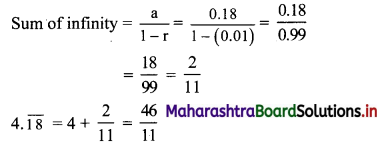
(iii) \(4 . \overline{18}\) = 4.181818…..
= 4 + 0.18 + 0.0018 + 0.000018 + …..
Here, 0.18, 0.0018, 0.000018, … are in G.P. with a = 0.18 and r = 0.01
Since, |r| = |0.01| < 1
∴ Sum to infinity exists.
Maharashtra Board 11th Commerce Maths Solutions Chapter 4 Sequences and Series Ex 4.3 Q2.2

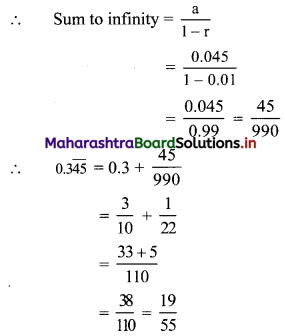
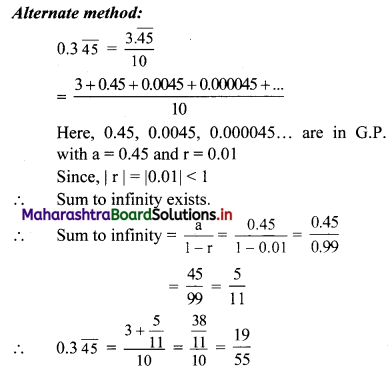
(iv) 0.345 = 0.3454545…..
= 0.3 + 0.045 + 0.00045 + 0.0000045 + …..
Here, 0.045, 0.00045, 0.0000045, … are in G.P. with a = 0.045, r = 0.01
Since, |r| = |0.01| < 1
∴ Sum to infinity exists.
Maharashtra Board 11th Commerce Maths Solutions Chapter 4 Sequences and Series Ex 4.3 Q2.3
Maharashtra Board 11th Commerce Maths Solutions Chapter 4 Sequences and Series Ex 4.3 Q2.4

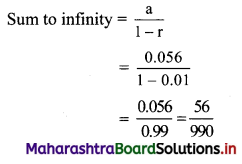
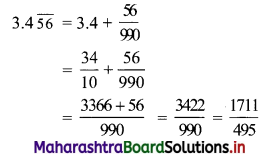
(v) \(3.4 \overline{56}\) = 3.4565656 …..
= 3.4 + 0.056 + 0.00056 + 0.0000056 + ….
Here, 0.056, 0.00056, 0.0000056, … are in G.P. with a = 0.056 and r = 0.01
Since, |r| = |0.01| < 1
∴ Sum to infinity exists.
Maharashtra Board 11th Commerce Maths Solutions Chapter 4 Sequences and Series Ex 4.3 Q2.5
Maharashtra Board 11th Commerce Maths Solutions Chapter 4 Sequences and Series Ex 4.3 Q2.6

Question 3.
If the common ratio of a G.P. is \(\frac{2}{3}\) and sum of its terms to infinity is 12. Find the first term.
Solution:
r = \(\frac{2}{3}\), sum to infinity = 12 … [Given]
Sum to infinity = \(\frac{a}{1-r}\)
∴ 12 = \(\frac{a}{1-\frac{2}{3}}\)
∴ a = 12 × \(\frac{1}{3}\)
∴ a = 4

Maharashtra Board 11th Commerce Maths Solutions Chapter 4 Sequences and Series Ex 4.3

Question 4.
If the first term of a G.P. is 16 and sum of its terms to infinity is \(\frac{176}{5}\), find the common ratio.
Solution:
a = 16, sum to infinity = \(\frac{176}{5}\) … [Given]
Sum to infinity = \(\frac{a}{1-r}\)
∴ \(\frac{176}{5}=\frac{16}{1-r}\)
∴ \(\frac{11}{5}=\frac{1}{1-r}\)
∴ 11 – 11r = 5
∴ 11r = 6
∴ r = \(\frac{6}{11}\)

Question 5.
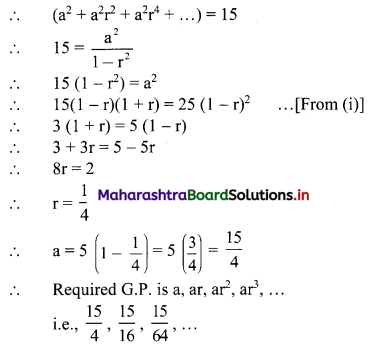
The sum of the terms of an infinite G.P. is 5 and the sum of the squares of those terms is 15. Find the G.P.
Solution:
Let the required G.P. be a, ar, ar2, ar3, …..
Sum to infinity of this G.P. = 5
∴ 5 = \(\frac{a}{1-r}\)
∴ a = 5(1 – r) ……(i)
Also, the sum of the squares of the terms is 15.
Maharashtra Board 11th Commerce Maths Solutions Chapter 4 Sequences and Series Ex 4.3 Q5

Maharashtra Board 11th Commerce Maths Solutions Chapter 4 Sequences and Series Ex 4.2

Balbharati Maharashtra State Board 11th Commerce Maths Solution Book Pdf Chapter 4 Sequences and Series Ex 4.2 Questions and Answers.

Maharashtra State Board 11th Commerce Maths Solutions Chapter 4 Sequences and Series Ex 4.2

Question 1.
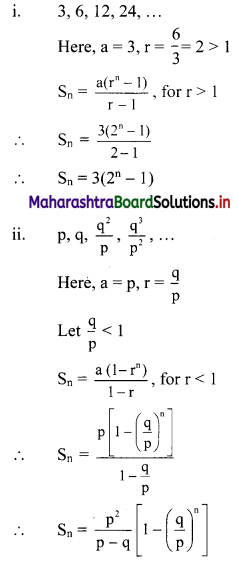
For the following G.P.’s, find Sn.
(i) 3, 6, 12, 24, …..
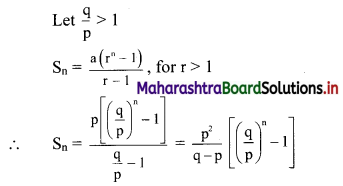
(ii) \(\mathbf{p}, \mathbf{q}, \frac{\mathbf{q}^{2}}{\mathbf{p}}, \frac{\mathbf{q}^{3}}{\mathbf{p}^{2}}, \ldots\)
Solution:
Maharashtra Board 11th Commerce Maths Solutions Chapter 4 Sequences and Series Ex 4.2 Q1
Maharashtra Board 11th Commerce Maths Solutions Chapter 4 Sequences and Series Ex 4.2 Q1.1

Question 2.
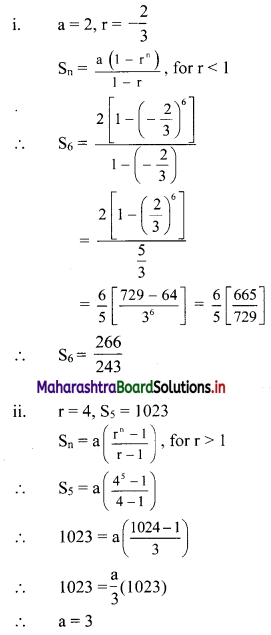
For a G.P., if
(i) a = 2, r = \(-\frac{2}{3}\), find S6.
(ii) S5 = 1023, r = 4, find a.
Solution:
Maharashtra Board 11th Commerce Maths Solutions Chapter 4 Sequences and Series Ex 4.2 Q2

Maharashtra Board 11th Commerce Maths Solutions Chapter 4 Sequences and Series Ex 4.2

Question 3.
For a G. P., if
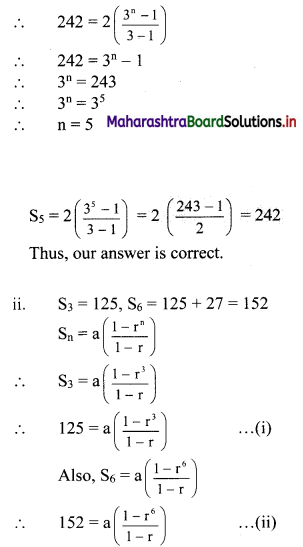
(i) a = 2, r = 3, Sn = 242, find n.
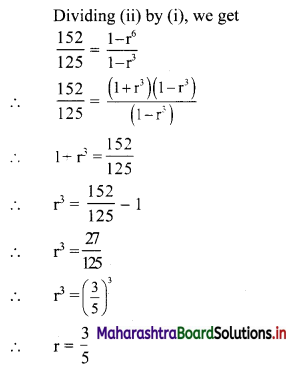
(ii) sum of the first 3 terms is 125 and the sum of the next 3 terms is 27, find the value of r.
Solution:
(i) a = 2, r = 3, Sn = 242
Sn = \(a\left(\frac{r^{n}-1}{r-1}\right)\), for r > 1
Maharashtra Board 11th Commerce Maths Solutions Chapter 4 Sequences and Series Ex 4.2 Q3
Maharashtra Board 11th Commerce Maths Solutions Chapter 4 Sequences and Series Ex 4.2 Q3.1

Question 4.
For a G. P.,
(i) if t3 = 20, t6 = 160, find S7.
(ii) if t4 = 16, t9 = 512, find S10.
Solution:
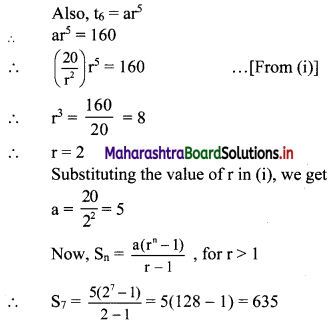
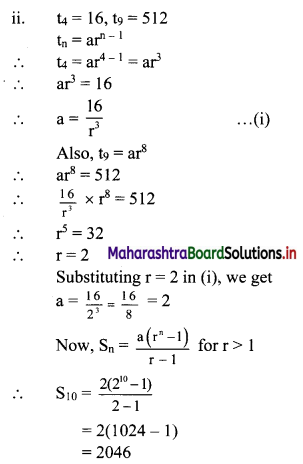
(i) t3 = 20, t6 = 160
tn = arn-1
∴ t3 = ar3-1 = ar2
∴ ar2 = 20
∴ a = \(\frac{20}{\mathrm{r}^{2}}\) ……(i)
Maharashtra Board 11th Commerce Maths Solutions Chapter 4 Sequences and Series Ex 4.2 Q4
Maharashtra Board 11th Commerce Maths Solutions Chapter 4 Sequences and Series Ex 4.2 Q4.1

Question 5.
Find the sum to n terms:
(i) 3 + 33 + 333 + 3333 + ……
(ii) 8 + 88 + 888 + 8888 + ……..
Solution:
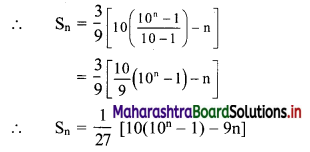
(i) Sn = 3 + 33 + 333 +….. upto n terms
= 3(1 + 11 + 111 +….. upto n terms)
= \(\frac{3}{9}\)(9 + 99 + 999 + … upto n terms)
= \(\frac{3}{9}\)[(10 – 1) + (100 – 1) + (1000 – 1) +… upto n terms]
= \(\frac{3}{9}\)[(10 + 100 + 1000 + … upto n terms) – (1 + 1 + 1 + … n times)]
But 10, 100, 1000, … n terms are in G.P.
with a = 10, r = \(\frac{100}{10}\) = 10
Maharashtra Board 11th Commerce Maths Solutions Chapter 4 Sequences and Series Ex 4.2 Q5

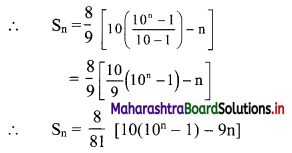
(ii) Sn = 8 + 88 + 888 + … upto n terms
= 8(1 + 11 + 111 + … upto n terms)
= \(\frac{8}{9}\) (9 + 99 + 999 + … upto n terms)
= \(\frac{8}{9}\) [(10 – 1) + (100 – 1) + (1000 – 1) +… upto n terms]
= \(\frac{8}{9}\) [(10 + 100 + 1000 + … upto n terms) – (1 + 1 + 1 + … n times)]
But 10, 100, 1000, … n terms are in G.P. with
a = 10, r = \(\frac{100}{10}\) = 10
Maharashtra Board 11th Commerce Maths Solutions Chapter 4 Sequences and Series Ex 4.2 Q5.1

Maharashtra Board 11th Commerce Maths Solutions Chapter 4 Sequences and Series Ex 4.2

Question 6.
Find the sum to n terms:
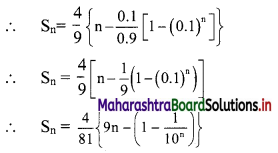
(i) 0.4 + 0.44 + 0.444 + ……
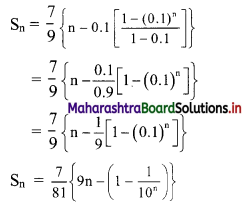
(ii) 0.7 + 0.77 + 0.777 + …..
Solution:
(i) Sn = 0.4 + 0.44 + 0.444 + ….. upto n terms
= 4(0.1 + 0.11 + 0.111 + …. upto n terms)
= \(\frac{4}{9}\) (0.9 + 0.99 + 0.999 + … upto n terms)
= \(\frac{4}{9}\) [(i – 0.1) + (1 – 0.01) + (1 – 0.001) … upto n terms]
= \(\frac{4}{9}\) [(1 + 1 + 1 + …n times) – (0.1 + 0.01 + 0.001 +… upto n terms)]
But 0.1, 0.01, 0.001, … n terms are in G.P.
with a = 0.1, r = \(\frac{0.01}{0.1}\) = 0.1
∴ Sn = \(\frac{4}{9}\left\{\mathrm{n}-0.1\left[\frac{1-(0.1)^{\mathrm{n}}}{1-0.1}\right]\right\}\)
Maharashtra Board 11th Commerce Maths Solutions Chapter 4 Sequences and Series Ex 4.2 Q6

(ii) Sn = 0.7 + 0.77 + 0.777 + … upto n terms
= 7(0.1 + 0.11 + 0.111 + … upto n terms)
= \(\frac{7}{9}\) (0.9 + 0.99 + 0.999 + … upto n terms)
= \(\frac{7}{9}\) [(1 – 0.1) + (1 – 0.01) + (1 – 0.001) +… upto n terms]
= \(\frac{7}{9}\) [(1 + 1 + 1 +… n times) – (0.1 + 0.01 + 0.001 +… upto n terms)]
But 0.1, 0.01, 0.001, … n terms are in G.P.
with a = 0.1, r = \(\frac{0.01}{0.1}\) = 0.1
Maharashtra Board 11th Commerce Maths Solutions Chapter 4 Sequences and Series Ex 4.2 Q6.1

Question 7.
Find the nth terms of the sequences:
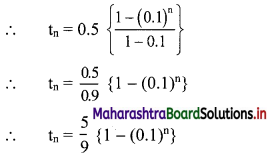
(i) 0.5, 0.55, 0.555,…..
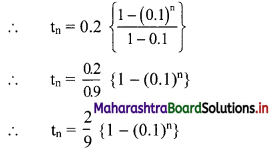
(ii) 0.2, 0.22, 0.222,…..
Solution:
(i) Let t1 = 0.5, t2 = 0.55, t3 = 0.555 and so on.
t1 = 0.5
t2 = 0.55 = 0.5 + 0.05
t3 = 0.555 = 0.5 + 0.05 + 0.005
∴ tn = 0.5 + 0.05 + 0.005 + … upto n terms
But 0.5, 0.05, 0.005, … upto n terms are in G.P. with a = 0.5 and r = 0.1
∴ tn = the sum of first n terms of the G.P.
Maharashtra Board 11th Commerce Maths Solutions Chapter 4 Sequences and Series Ex 4.2 Q7

(ii) Let t1 = 0.2, t2 = 0.22, t3 = 0.222 and so on
t1 = 0.2
t2 = 0.22 = 0.2 + 0.02
t3 = 0.222 = 0.2 + 0.02 + 0.002
∴ tn = 0.2 + 0.02 + 0.002 + … upto n terms
But 0.2, 0.02, 0.002, … upto n terms are in G.P. with a = 0.2 and r = 0.1
∴ tn = the sum of first n terms of the G.P.
Maharashtra Board 11th Commerce Maths Solutions Chapter 4 Sequences and Series Ex 4.2 Q7.1

Question 8.
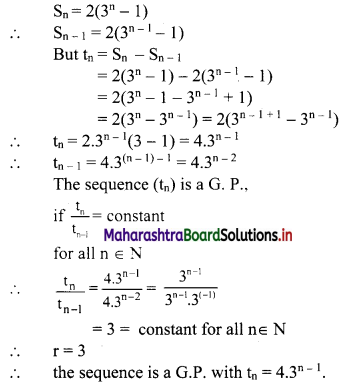
For a sequence, if Sn = 2(3n-1), find the nth term, hence showing that the sequence is a G.P.
Solution:
Maharashtra Board 11th Commerce Maths Solutions Chapter 4 Sequences and Series Ex 4.2 Q8

Question 9.
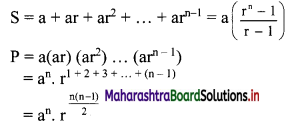
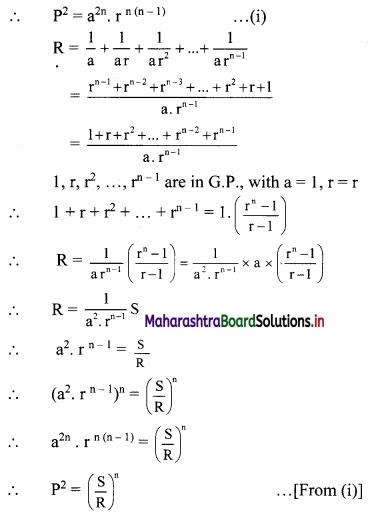
If S, P, R are the sum, product and sum of the reciprocals of n terms of a G.P. respectively, then verify that \(\left(\frac{\mathbf{S}}{\mathbf{R}}\right)^{\mathbf{n}}\) = P2.
Solution:
Let a be the 1st term and r be the common ratio of the G.P.
∴ the G.P. is a, ar, ar2, ar3, …, arn-1
Maharashtra Board 11th Commerce Maths Solutions Chapter 4 Sequences and Series Ex 4.2 Q9
Maharashtra Board 11th Commerce Maths Solutions Chapter 4 Sequences and Series Ex 4.2 Q9.1

Maharashtra Board 11th Commerce Maths Solutions Chapter 4 Sequences and Series Ex 4.2

Question 10.
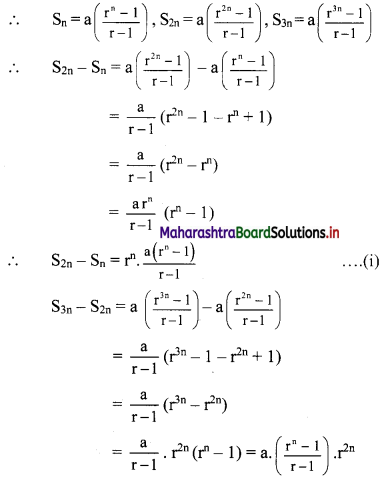
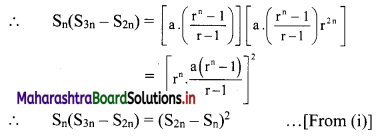
If Sn, S2n, S3n are the sum of n, 2n, 3n terms of a G.P. respectively, then verify that Sn (S3n – S2n) = (S2n – Sn)2.
Solution:
Let a and r be the 1st term and common ratio of the G.P. respectively.
Maharashtra Board 11th Commerce Maths Solutions Chapter 4 Sequences and Series Ex 4.2 Q10
Maharashtra Board 11th Commerce Maths Solutions Chapter 4 Sequences and Series Ex 4.2 Q10.1

Maharashtra Board 12th Commerce Maths Solutions Chapter 8 Probability Distributions Ex 8.1

Balbharati Maharashtra State Board 12th Commerce Maths Solution Book Pdf Chapter 8 Probability Distributions Ex 8.1 Questions and Answers.

Maharashtra State Board 12th Commerce Maths Solutions Chapter 8 Probability Distributions Ex 8.1

Question 1.
Let X represent the difference between a number of heads and the number of tails obtained when a coin is tossed 6 times. What are the possible values of X?
Solution:
∵ A coin is tossed 6 times
S = {6H and 0T, 5H and 1T, 4H and 2T, 3H and 3T, 2H and 4T, 1H and 5T, 0H and 6T}
X: Difference between no. of heads and no. of tails.
X = 6 – 0 = 6
X = 5 – 1 = 4
X = 4 – 2 = 2
X = 3 – 3 = 0
X = 2 – 4 = -2
X = 1 – 5 = -4
X = 0 – 6 = -6
X = {-6, -4, -2, 0, 2, 4, 6}

Maharashtra Board 12th Commerce Maths Solutions Chapter 8 Probability Distributions Ex 8.1

Question 2.
An urn contains 5 red and 2 black balls. Two balls are drawn at random. X denotes the number of black balls drawn. What are the possible values of X?
Solution:
S : Two bolts are drawn from the Urn
S = {RR, RB, BR, BB}
X : No. of black balls
∴ X = {0, 1, 2}

Question 3.
Determine whether each of the following is a probability distribution. Give reasons for your answer.
(i)
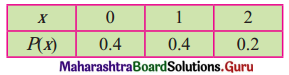
Maharashtra Board 12th Commerce Maths Solutions Chapter 8 Probability Distributions Ex 8.1 Q3(i)
Solution:
Here, P(X = x) ≥ 0, ∀ x and
\(\sum_{x=0}^{2} \mathrm{P}(\mathrm{X}=x)\) = p(0) + p(1) + p(2)
= 0.4 + 0.4 + 0.2
= 1
∴ The function is a p.m.f.

(ii)
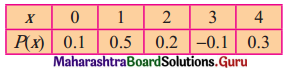
Maharashtra Board 12th Commerce Maths Solutions Chapter 8 Probability Distributions Ex 8.1 Q3(ii)
Solution:
Here, p(3) = -0.1 < 0
∴ P(X = x) ≯ 0, ∀ x
∴ The function is not a p.m.f.

(iii)
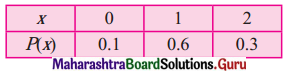
Maharashtra Board 12th Commerce Maths Solutions Chapter 8 Probability Distributions Ex 8.1 Q3(iii)
Solution:
Here, P(X = x) ≥ 0, ∀ x and
\(\sum_{x=0}^{2} \mathrm{P}(\mathrm{X}=x)\) = p(0) + p(1) + p(2)
= 0.1 + 0.6 + 0.3
= 1
∴ The function is a p.m.f.

(iv)
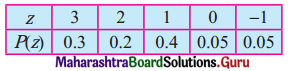
Maharashtra Board 12th Commerce Maths Solutions Chapter 8 Probability Distributions Ex 8.1 Q3(iv)
Solution:
Here, P(Z = z) ≥ 0, ∀ z and
\(\sum_{x=-1}^{3} \mathrm{P}(\mathrm{Z}=z)\) = p(-1) + p(0) + p(1) + p(2) + p(3)
= 0.05 + 0 + 0.4 + 0.2 + 0.3
= 0.95
≠ 1
∴ The function is not a p.m.f.

Maharashtra Board 12th Commerce Maths Solutions Chapter 8 Probability Distributions Ex 8.1

(v)
Maharashtra Board 12th Commerce Maths Solutions Chapter 8 Probability Distributions Ex 8.1 Q3(v)
Solution:
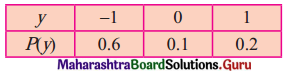
Here, P(Y = y) ≥ 0, ∀ y and
\(\sum_{x=-1}^{2} \mathrm{P}(\mathrm{Y}=y)\) = p(-1) + p(0) + p(1)
= 0.1 + 0.6 + 0.2
= 0.9
≠ 1
∴ The function is not a p.m.f.

(vi)
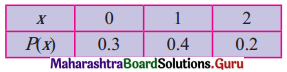
Maharashtra Board 12th Commerce Maths Solutions Chapter 8 Probability Distributions Ex 8.1 Q3(vi)
Solution:
Here, P(X = x) ≥ 0, ∀ x and
\(\sum_{x=0}^{0} \mathrm{P}(X=x)\) = p(-2) + p(-1) + p(0)
= 0.3 + 0.4 + 0.2
= 0.9
≠ 1
∴ The function is not a p.m.f.

Question 4.
Find the probability distribution of
(i) number of heads in two tosses of a coin,
(ii) number of trails in three tosses of a coin,
(iii) number of heads in four tosses of a coin.
Solution:
(i) S: Coin is tossed two times
S = {HH, HT, TH, TT}
n(S) = 4
X: No. of heads
Range of X = {0, 1, 2}
p.m.f. Table
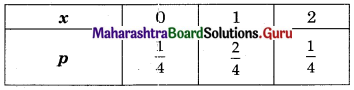
Maharashtra Board 12th Commerce Maths Solutions Chapter 8 Probability Distributions Ex 8.1 Q4(i)

(ii) S: 3 coin are tossed
S = {HHH, HHT, HTH, HTT, THH, THT, TTH, TTT}
n(S) = 8
X: No. of heads
Range of X = {0, 1, 2, 3}
p.m.f. Table
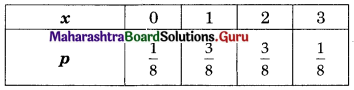
Maharashtra Board 12th Commerce Maths Solutions Chapter 8 Probability Distributions Ex 8.1 Q4(ii)

(iii) S: Four coin are tossed
S = {HHHH, HHHT, HHTH, HHTT, HTHH, HTHT, HTTH, HTTT, THHH, THHT, THTH, THTT, TTHH, TTHT, TTTH, TTTT}
n(S) = 16
X: No. of heads
Range of X = {0, 1, 2, 3, 4}
p.m.f. Table
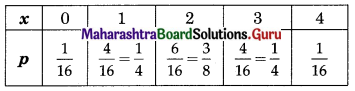
Maharashtra Board 12th Commerce Maths Solutions Chapter 8 Probability Distributions Ex 8.1 Q4(iii)

Question 5.
Find the probability distribution of the number of successes in two tosses of a die if successes are defined as getting a number greater than 4.
Solution:
S = A die is tossed 2 times
S = {(1, 1), (1, 2), (1, 3), (1, 4), (1, 5), (1, 6), (2, 1), (2, 2), (2, 3), (2, 4), (2, 5), (2, 6), (3, 1), (3, 2), (3, 3), (3, 4), (3, 5), (3, 6), (4, 1), (4, 2), (4, 3), (4, 4), (4, 5), (4, 6), (5, 1), (5, 2), (5, 3), (5, 4), (5, 5), (5, 6), (6, 1), (6, 2), (6, 3), (6, 4), (6, 5), (6, 6)}
n(S) = 36
X = No. getting greater than 4
Range of X = {0, 1, 2}
p(0) = \(\frac{16}{36}=\frac{4}{9}\)
p(1) = \(\frac{16}{36}=\frac{4}{9}\)
p(2) = \(\frac{4}{36}=\frac{1}{9}\)
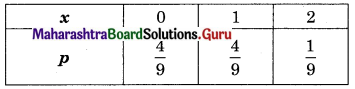
Maharashtra Board 12th Commerce Maths Solutions Chapter 8 Probability Distributions Ex 8.1 Q5

Question 6.
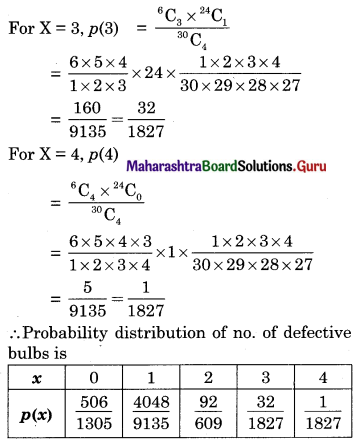
A sample of 4 bulbs is drawn at random with replacement from a lot of 30 bulbs which includes 6 defective bulbs. Find the probability distribution of the number of defective bulbs.
Solution:
Total no. of bulbs = 30
No. of defective bulbs = 6
A sample of 4 bulbs are drawn from 30 bulbs.
∴ n(S) = \({ }^{30} \mathrm{C}_{4}\)
∴ No. of non-defective bulbs = 24
Let X = No. of defective bulbs drawn in sample of 4 bulbs.
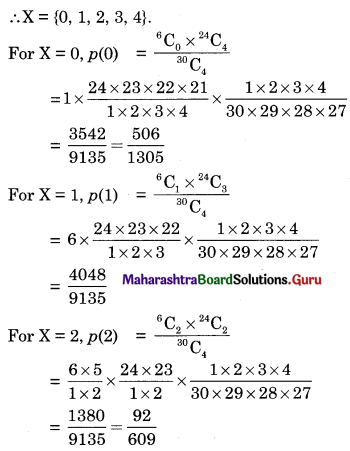
Maharashtra Board 12th Commerce Maths Solutions Chapter 8 Probability Distributions Ex 8.1 Q6
Maharashtra Board 12th Commerce Maths Solutions Chapter 8 Probability Distributions Ex 8.1 Q6.1

Maharashtra Board 12th Commerce Maths Solutions Chapter 8 Probability Distributions Ex 8.1

Question 7.
A coin is biased so that the head is 3 times as likely to occur as the tail. Find the probability distribution of a number of tails in two tosses.
Solution:
Here, the head is 3 times as likely to occur as the tail.
i.e., If 4 times coin is tossed, 3 times there will be a head and 1 time there will be the tail.
∴ p(H) = \(\frac{3}{4}\) and p(T) = \(\frac{1}{4}\)
Let X : No. of tails in two tosses.
And coin is tossed twice.
∴ X = {0, 1, 2}
For X = 0,
p(0) = p(both heads)
= p(H) × p(H)
= \(\frac{3}{4} \times \frac{3}{4}\)
= \(\frac{9}{16}\)
For X = 1,
p(1) = p(HT or TH)
= p(HT) + p(TH)
= p(H) × p(T) + p(T) × p(H)
= \(\frac{3}{4} \times \frac{1}{4}+\frac{1}{4} \times \frac{3}{4}\)
= \(\frac{6}{16}\)
For X = 2,
p(2) = p(both tails)
= p(T) × p(T)
= \(\frac{1}{4} \times \frac{1}{4}\)
= \(\frac{1}{16}\)
The probability distribution of the number of tails in two tosses is
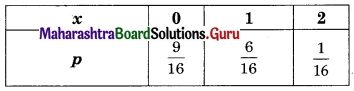
Maharashtra Board 12th Commerce Maths Solutions Chapter 8 Probability Distributions Ex 8.1 Q7

Question 8.
A random variable X has the following probability distribution:
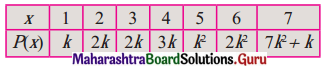
Maharashtra Board 12th Commerce Maths Solutions Chapter 8 Probability Distributions Ex 8.1 Q8
Determine (i) k, (ii) P(X < 3), (iii) P(0 < X < 3), (iv) P(X > 4).
Solution:
(i) It is a p.m.f. of r.v. X
∴ Σp(x) = 1
∴ p(1) + p(2) + p(3) + p(4) + p(5) + p(6) + p(7) = 1
∴ k + 2k + 2k + 3k + k2 + 2k2 + (7k2 + k) = 1
∴ 10k2 + 9k = 1
∴ 10k2 + 9k – 1 = 0
∴ 10k2 + 10k – k – 1 = 0
∴ 10k(k + 1) – (k + 1) = 0
∴ (10k – 1)(k + 1) = 0
∴ 10k – 1 = 0 or k + 1 = 0
∴ k = \(\frac{1}{10}\) or k = -1
but k = -1 is not accepted
∴ k = \(\frac{1}{2}\) is accepted

(ii) P(X < 3) = p(1) + p(2)
= k + 2k
= 3k
= 3 × \(\frac{1}{10}\)
= \(\frac{3}{10}\)

(iii) P(0 < X < 3) = p(1) + p(2)
= k + 2k
= 3k
= 3 × \(\frac{1}{10}\)
= \(\frac{3}{10}\)

(iv) P(X > 4) = p(5) + p(6) + p(7)
= k2 + 2k2 + (7k2 + k)
= 10k2 + k
= \(10\left(\frac{1}{10}\right)^{2}+\frac{1}{10}\)
= \(\frac{2}{10}\)
= \(\frac{1}{5}\)

Question 9.
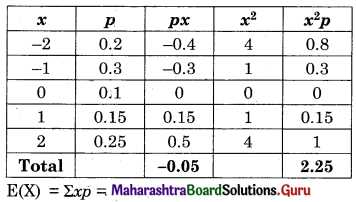
Find expected value and variance of X using the following p.m.f.
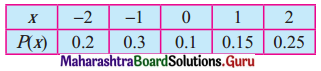
Maharashtra Board 12th Commerce Maths Solutions Chapter 8 Probability Distributions Ex 8.1 Q9
Solution:
Maharashtra Board 12th Commerce Maths Solutions Chapter 8 Probability Distributions Ex 8.1 Q9.1
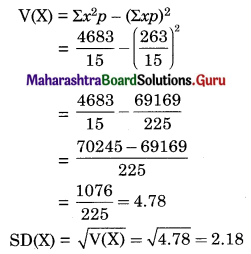
E(X) = Σxp = -0.05
V(X) = Σx2p – (Σxp)2
= 2.25 – (-0.05)2
= 2.25 – 0.0025
= 2.2475

Question 10.
Find expected value and variance of X, the number on the uppermost face of a fair die.
Solution:
S : A fair die is thrown
S = {1, 2, 3, 4, 5, 6}
n(S) = 6
X: No obtained on uppermost face of die
Range of X = {1, 2, 3, 4, 5, 6}
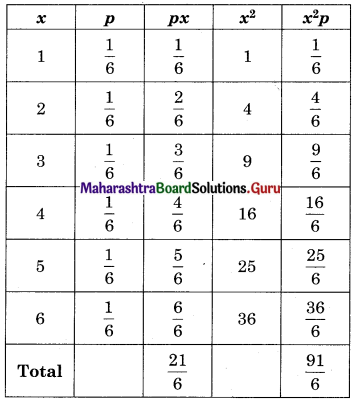
Maharashtra Board 12th Commerce Maths Solutions Chapter 8 Probability Distributions Ex 8.1 Q10
E(X) = Σxp = \(\frac{21}{6}=\frac{7}{2}\) = 3.5
V(X) = Σx2p – (Σxp)2
= \(\frac{91}{6}\) – (3.5)2
= 15.17 – 12.25
= 2.92

Question 11.
Find the mean of the number of heads in three tosses of a fair coin.
Solution:
S : A coin is tossed 3 times
S = {HHH, HHT, HTH, HTT, THH, THT, TTH, TTT}
n(S) = 8
Range of X = {0, 1, 2, 3}
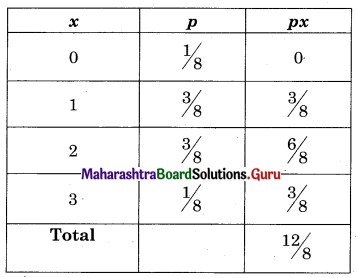
Maharashtra Board 12th Commerce Maths Solutions Chapter 8 Probability Distributions Ex 8.1 Q11
∴ Mean = E(X) = Σxp = \(\frac{12}{8}=\frac{3}{2}\) = 1.5

Question 12.
Two dice are thrown simultaneously. If X denotes the number of sixes, find the expectation of X.
Solution:
S : Two dice are thrown
S = {(1, 1), (1, 2), (1, 3), ……, (6, 6)}
n(S) = 36
Range of X = {0, 1, 2}
First 6 positive integers are 1, 2, 3, 4, 5, 6
X = Larger two numbers selected
S = {(1, 1), (1, 2), (1, 3), (1, 4), (1, 5), (1, 6), (2, 1), (2, 2), (2, 3), (2, 4), (2, 5), (2, 6), (3, 1), (3, 2), (3, 3), (3, 4), (3, 5), (3, 6), (4, 1), (4, 2), (4, 3), (4, 4), (4, 5), (4, 6), (5, 1), (5, 2), (5, 3), (5, 4), (5, 5), (5, 6), (6, 1), (6, 2), (6, 3), (6, 4), (6, 5), (6, 6)}
n(S) = 36
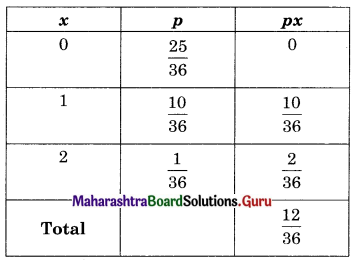
Maharashtra Board 12th Commerce Maths Solutions Chapter 8 Probability Distributions Ex 8.1 Q12
∴ E(X) = Σxp = \(\frac{12}{36}=\frac{1}{3}\)

Maharashtra Board 12th Commerce Maths Solutions Chapter 8 Probability Distributions Ex 8.1

Question 13.
Two numbers are selected at random (without replacement) from the first six positive integers. Let X denote the larger of the two numbers. Find E(X).
Solution:
First 6 positive integers are 1, 2, 3, 4, 5, 6
X : The larger of the selected two numbers
S = {(1, 2), (1, 3), (1, 4), (1, 5), (1, 6), (2, 1), (2, 3), (2, 4), (2, 5), (2, 6), (3, 1), (3, 2), (3, 4), (3, 5), (3, 6), (4, 1), (4, 2), (4, 3), (4, 5), (4, 6), (5, 1), (5, 2), (5, 3), (5, 4), (5, 6), (6, 1), (6, 2), (6, 3), (6, 4), (6, 5)}
n(S) = 30
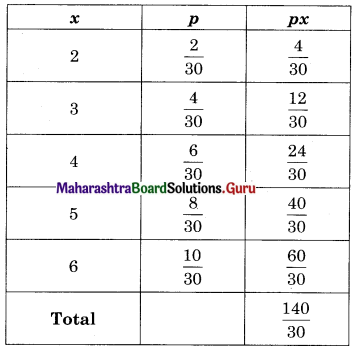
Maharashtra Board 12th Commerce Maths Solutions Chapter 8 Probability Distributions Ex 8.1 Q13
E(X) = Σxp = \(\frac{140}{30}=\frac{14}{3}\) = 4.67

Question 14.
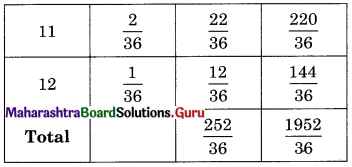
Let X denote the sum of the numbers obtained when two fair dice are rolled. Find the variance of X.
Solution:
S : Two fair dice are rolled
S = {(1, 1), (1, 2), (1, 4), ……, (6, 6)}
n(S) = 36
X : Sum of the two numbers.
Range of X = {2, 3, 4, 5, 6, 7, 8, 9, 10, 11, 12}
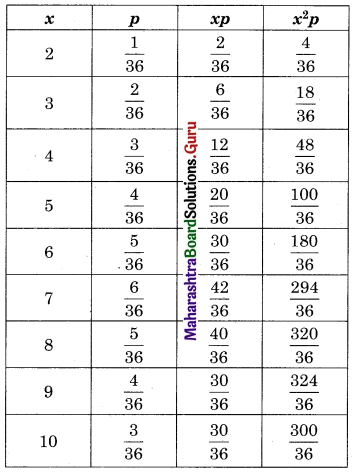
Maharashtra Board 12th Commerce Maths Solutions Chapter 8 Probability Distributions Ex 8.1 Q14
Maharashtra Board 12th Commerce Maths Solutions Chapter 8 Probability Distributions Ex 8.1 Q14.1
V(X) = Σx2p – (Σxp)2
= \(\frac{1952}{36}-\left(\frac{252}{36}\right)^{2}\)
= 54.22 – (7)2
= 5.22
SD(X) = √V(X) = √5.22 = 2.28

Question 15.
A class has 15 students whose ages are 14, 17, 15, 14, 21, 17, 19, 20, 16, 18, 20, 17, 16, 19 and 20 years. If X denotes the age of a randomly selected student, find the probability distribution of X. Find the mean and variance of X.
Solution:
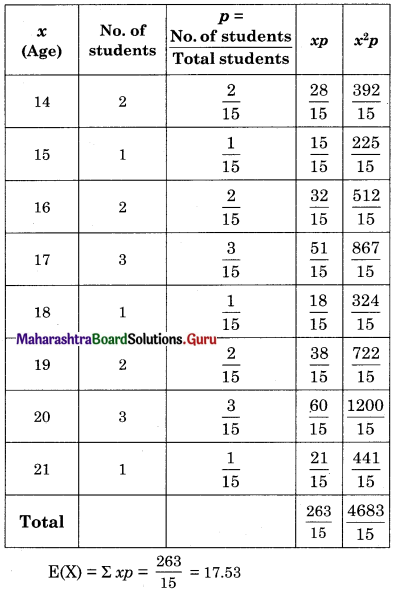
Maharashtra Board 12th Commerce Maths Solutions Chapter 8 Probability Distributions Ex 8.1 Q15
Maharashtra Board 12th Commerce Maths Solutions Chapter 8 Probability Distributions Ex 8.1 Q15.1

Maharashtra Board 12th Commerce Maths Solutions Chapter 8 Probability Distributions Ex 8.1

Question 16.
70% of the member’s favour and 30% oppose a proposal in a meeting. The random variable X takes the value 0 if a member opposes the proposal and the value 1 if a member is in favour. Find E(X) and V(X).
Solution:
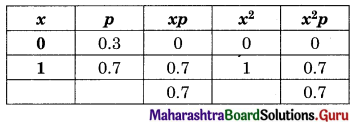
Maharashtra Board 12th Commerce Maths Solutions Chapter 8 Probability Distributions Ex 8.1 Q16
E(X) = Σxp = 0.7
V(X) = Σx2p – (Σxp)2
= 0.7 – (0.7)2
= 0.7 – 0.49
= 0.21