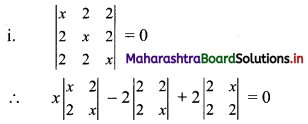
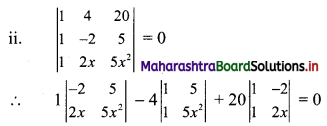
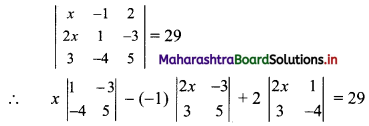
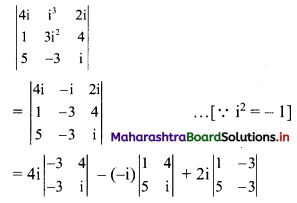
Maharashtra Board 12th Commerce Maths Solutions Chapter 7 Assignment Problem and Sequencing Ex 7.2

Balbharati Maharashtra State Board 12th Commerce Maths Solution Book Pdf Chapter 7 Assignment Problem and Sequencing Ex 7.2 Questions and Answers.

Maharashtra State Board 12th Commerce Maths Solutions Chapter 7 Assignment Problem and Sequencing Ex 7.2

Question 1.
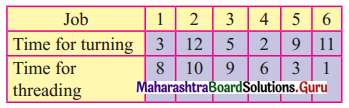
A machine operator has to perform two operations, turning and threading on 6 different jobs. The time required to perform these operations (in minutes) for each job is known. Determine the order in which the jobs should be processed in order to minimize the total time required to complete all the jobs. Also, find the total processing time and idle times for turning and threading operations.
Maharashtra Board 12th Commerce Maths Solutions Chapter 7 Assignment Problem and Sequencing Ex 7.2 Q1
Solution:
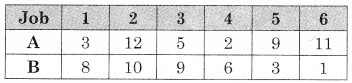
Let turning to be A and threading be B.
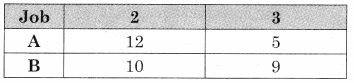
Maharashtra Board 12th Commerce Maths Solutions Chapter 7 Assignment Problem and Sequencing Ex 7.2 Q1.1
∴ Observe Min{A, B} = 1 for job 6 on B.
Maharashtra Board 12th Commerce Maths Solutions Chapter 7 Assignment Problem and Sequencing Ex 7.2 Q1.2
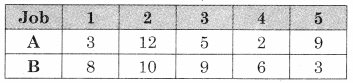
Then the problem reduces to
Maharashtra Board 12th Commerce Maths Solutions Chapter 7 Assignment Problem and Sequencing Ex 7.2 Q1.3
∴ Now Min {A, B} = 2 for job 4 on A
Maharashtra Board 12th Commerce Maths Solutions Chapter 7 Assignment Problem and Sequencing Ex 7.2 Q1.4
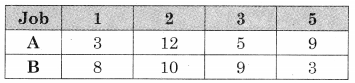
Then the problem reduce to
Maharashtra Board 12th Commerce Maths Solutions Chapter 7 Assignment Problem and Sequencing Ex 7.2 Q1.5
Now Min {A, B} = 3 for job 1 on A and job 5 on B
Maharashtra Board 12th Commerce Maths Solutions Chapter 7 Assignment Problem and Sequencing Ex 7.2 Q1.6
Then the problem reduces to
Maharashtra Board 12th Commerce Maths Solutions Chapter 7 Assignment Problem and Sequencing Ex 7.2 Q1.7
Now Min {A, B) = 5 for job 3 on A
Maharashtra Board 12th Commerce Maths Solutions Chapter 7 Assignment Problem and Sequencing Ex 7.2 Q1.8
Only job 2 is left so the optimal sequence is
Maharashtra Board 12th Commerce Maths Solutions Chapter 7 Assignment Problem and Sequencing Ex 7.2 Q1.9
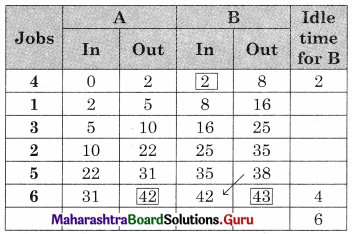
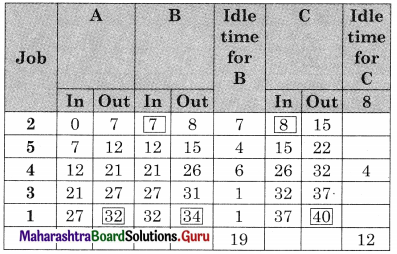
Worktable is given by
Maharashtra Board 12th Commerce Maths Solutions Chapter 7 Assignment Problem and Sequencing Ex 7.2 Q1.10
Total elapsed time = 43 minutes
Idle time for A (turning) = 43 – 42 = 1 min
Idle time for B (threshing) = 2 + 4 = 6 min

Maharashtra Board 12th Commerce Maths Solutions Chapter 7 Assignment Problem and Sequencing Ex 7.2

Question 2.
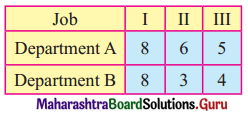
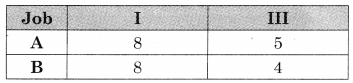
A company has three jobs on hand, Each of these must be processed through two departments, in the AB where
Department A: Press shop and
Department B: Finishing
The table below gives the number of days required by each job each department
Maharashtra Board 12th Commerce Maths Solutions Chapter 7 Assignment Problem and Sequencing Ex 7.2 Q2
Find the sequence in which the three jobs should be processed so as to take minimum time to finish all the three jobs. Also find idle time for both the departments.
Solution:
Observe Min {A, B} = 3 for job II on B.
Maharashtra Board 12th Commerce Maths Solutions Chapter 7 Assignment Problem and Sequencing Ex 7.2 Q2.1
Then the problem is reduced to
Maharashtra Board 12th Commerce Maths Solutions Chapter 7 Assignment Problem and Sequencing Ex 7.2 Q2.2
Now Min {A, B} = 4 for job III at B
Maharashtra Board 12th Commerce Maths Solutions Chapter 7 Assignment Problem and Sequencing Ex 7.2 Q2.3
Now only job I in left
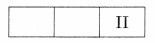
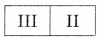
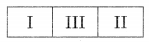
∴ the optimal sequence is given by
Maharashtra Board 12th Commerce Maths Solutions Chapter 7 Assignment Problem and Sequencing Ex 7.2 Q2.4
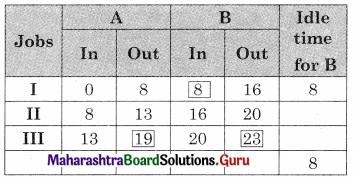
The work table is
Maharashtra Board 12th Commerce Maths Solutions Chapter 7 Assignment Problem and Sequencing Ex 7.2 Q2.5
Total elapsed time = 23 days
Idle time for A = 23 – 19 = 4 days
Idle time for B = 8 days

Maharashtra Board 12th Commerce Maths Solutions Chapter 7 Assignment Problem and Sequencing Ex 7.2

Question 3.
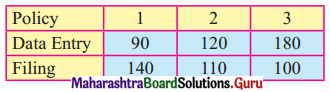
An insurance company receives three types of policy application bundles daily from its head office for data entry and filing. The time (in minutes) required for each type for these two operations is given in the following table:
Maharashtra Board 12th Commerce Maths Solutions Chapter 7 Assignment Problem and Sequencing Ex 7.2 Q3
Find the sequence that minimizes the total time required to complete the entire task. Also, find the total elapsed time and idle times for each operation.
Solution:
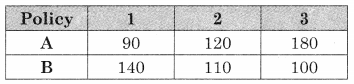
Let Data entry be A and filing be B. So
Maharashtra Board 12th Commerce Maths Solutions Chapter 7 Assignment Problem and Sequencing Ex 7.2 Q3.1
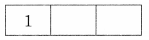
Observe min {A, B} = 90 for policy 1 at A
Maharashtra Board 12th Commerce Maths Solutions Chapter 7 Assignment Problem and Sequencing Ex 7.2 Q3.2
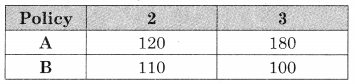
Then the problem reduces to
Maharashtra Board 12th Commerce Maths Solutions Chapter 7 Assignment Problem and Sequencing Ex 7.2 Q3.3
Observe min {A, B} = 100 for policy 3 at B
Maharashtra Board 12th Commerce Maths Solutions Chapter 7 Assignment Problem and Sequencing Ex 7.2 Q3.4
Now only policy 2 is left
∴ The optimal sequence is
Maharashtra Board 12th Commerce Maths Solutions Chapter 7 Assignment Problem and Sequencing Ex 7.2 Q3.5
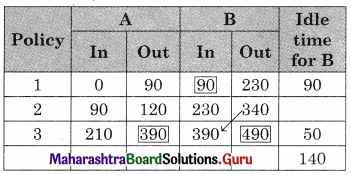
Worktable
Maharashtra Board 12th Commerce Maths Solutions Chapter 7 Assignment Problem and Sequencing Ex 7.2 Q3.6
So Total elapsed time = 490 min
Idle time for A (data entry) = 490 – 390 = 100 min
Idle time for B (filing) = 140 min.

Maharashtra Board 12th Commerce Maths Solutions Chapter 7 Assignment Problem and Sequencing Ex 7.2

Question 4.
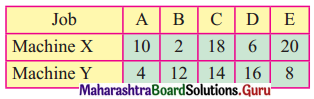
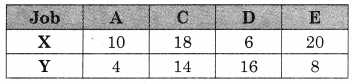
There are five jobs, each of which must go through two machines in the order XY. Processing times (in hours) are given below. Determine the sequence for the jobs that will minimize the total elapsed time. Also, find the total elapse time and idle time for each machine.
Maharashtra Board 12th Commerce Maths Solutions Chapter 7 Assignment Problem and Sequencing Ex 7.2 Q4
Solution:
Observe min {x, y} = 2 for job B on x
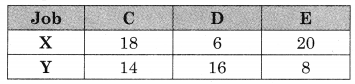
Maharashtra Board 12th Commerce Maths Solutions Chapter 7 Assignment Problem and Sequencing Ex 7.2 Q4.1
The problem reduces to
Maharashtra Board 12th Commerce Maths Solutions Chapter 7 Assignment Problem and Sequencing Ex 7.2 Q4.2
Now min [x, y] = 4 for job A on x
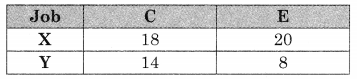
Maharashtra Board 12th Commerce Maths Solutions Chapter 7 Assignment Problem and Sequencing Ex 7.2 Q4.3
The problem reduces to
Maharashtra Board 12th Commerce Maths Solutions Chapter 7 Assignment Problem and Sequencing Ex 7.2 Q4.4
Now min [x, y] = 6 for job D on x
Maharashtra Board 12th Commerce Maths Solutions Chapter 7 Assignment Problem and Sequencing Ex 7.2 Q4.5
The problem reduces to
Maharashtra Board 12th Commerce Maths Solutions Chapter 7 Assignment Problem and Sequencing Ex 7.2 Q4.7
Now min [x, y] = 8 for job E on y
Maharashtra Board 12th Commerce Maths Solutions Chapter 7 Assignment Problem and Sequencing Ex 7.2 Q4.6
Now only job C in left
∴ The optimal sequence is
Maharashtra Board 12th Commerce Maths Solutions Chapter 7 Assignment Problem and Sequencing Ex 7.2 Q4.8
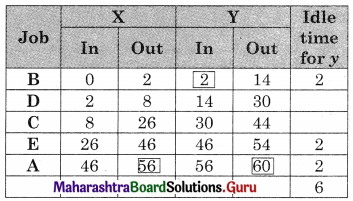
Worktable
Maharashtra Board 12th Commerce Maths Solutions Chapter 7 Assignment Problem and Sequencing Ex 7.2 Q4.9
Total elapsed time = 60 hrs
Idle time for X = 60 – 56 = 4 hrs
Idle time for Y = 6 hrs

Maharashtra Board 12th Commerce Maths Solutions Chapter 7 Assignment Problem and Sequencing Ex 7.2

Question 5.
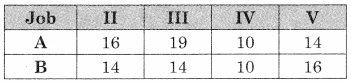
Find the sequence that minimizes the total elapsed time to complete the following jobs in the order AB. Find the total elapsed time and idle times for both machines.
Maharashtra Board 12th Commerce Maths Solutions Chapter 7 Assignment Problem and Sequencing Ex 7.2 Q5
Solution:
Observe min {A, B} = 5 for job VI for B and job VII for A
Maharashtra Board 12th Commerce Maths Solutions Chapter 7 Assignment Problem and Sequencing Ex 7.2 Q5.1
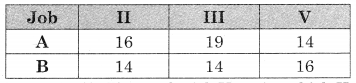
The problem reduces to
Maharashtra Board 12th Commerce Maths Solutions Chapter 7 Assignment Problem and Sequencing Ex 7.2 Q5.2
Now min {A, B] = 7 for job I on A
Maharashtra Board 12th Commerce Maths Solutions Chapter 7 Assignment Problem and Sequencing Ex 7.2 Q5.3
The problem reduces to
Maharashtra Board 12th Commerce Maths Solutions Chapter 7 Assignment Problem and Sequencing Ex 7.2 Q5.4
Now min {A, B] = 10 for job IV on A and B so we have two options.
Maharashtra Board 12th Commerce Maths Solutions Chapter 7 Assignment Problem and Sequencing Ex 7.2 Q5.5
Or
Maharashtra Board 12th Commerce Maths Solutions Chapter 7 Assignment Problem and Sequencing Ex 7.2 Q5.6
we take the 1st one.
The problem reduces to
Maharashtra Board 12th Commerce Maths Solutions Chapter 7 Assignment Problem and Sequencing Ex 7.2 Q5.7
Now min {A, B} = 14 for job V on A and job II and III for job B.
∴ We have
Maharashtra Board 12th Commerce Maths Solutions Chapter 7 Assignment Problem and Sequencing Ex 7.2 Q5.8
Or
Maharashtra Board 12th Commerce Maths Solutions Chapter 7 Assignment Problem and Sequencing Ex 7.2 Q5.9
We take the optimal sequence as.
VII – I – IV – V – III – II – VI
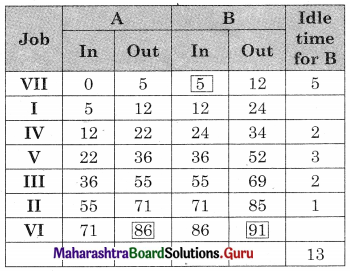
Worktable
Maharashtra Board 12th Commerce Maths Solutions Chapter 7 Assignment Problem and Sequencing Ex 7.2 Q5.10
Total elapsed time = 91 units
Idle time for A = 91 – 86 = 5 units
Idle time for B = 13 units

Maharashtra Board 12th Commerce Maths Solutions Chapter 7 Assignment Problem and Sequencing Ex 7.2

Question 6.
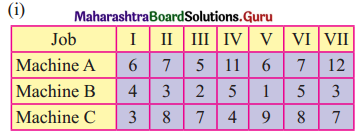
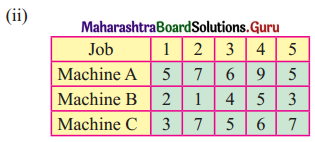
Find the optimal sequence that minimizes the total time required to complete the following jobs in the order ABC. The processing times are given in hrs.
Maharashtra Board 12th Commerce Maths Solutions Chapter 7 Assignment Problem and Sequencing Ex 7.2 Q6
Maharashtra Board 12th Commerce Maths Solutions Chapter 7 Assignment Problem and Sequencing Ex 7.2 Q6.1
Solution:
(i) Min A = 5, Max B = 5
As min A ≥ max B.
The problem can be converted into two machine problems.
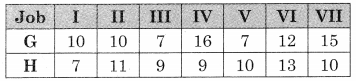
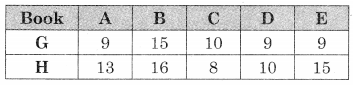
Let G and H be two fictitious machines such that G = A + B and H = B + C we get
Maharashtra Board 12th Commerce Maths Solutions Chapter 7 Assignment Problem and Sequencing Ex 7.2 Q6.2
Now min {G, H} = 7 for job III & V for G and job I for H
∴ We have two options
Maharashtra Board 12th Commerce Maths Solutions Chapter 7 Assignment Problem and Sequencing Ex 7.2 Q6.3
Or
Maharashtra Board 12th Commerce Maths Solutions Chapter 7 Assignment Problem and Sequencing Ex 7.2 Q6.4
We take the first one
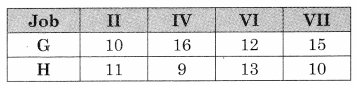
The problem reduces to
Maharashtra Board 12th Commerce Maths Solutions Chapter 7 Assignment Problem and Sequencing Ex 7.2 Q6.5
Min {G, H} = 9 for job IV on H
Maharashtra Board 12th Commerce Maths Solutions Chapter 7 Assignment Problem and Sequencing Ex 7.2 Q6.6
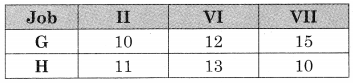
The problem reduces to
Maharashtra Board 12th Commerce Maths Solutions Chapter 7 Assignment Problem and Sequencing Ex 7.2 Q6.7
Now min {G, H} = 10 for job II for G and job VII for H
Maharashtra Board 12th Commerce Maths Solutions Chapter 7 Assignment Problem and Sequencing Ex 7.2 Q6.8
Now job VI is left
∴ The optimal sequence is
Maharashtra Board 12th Commerce Maths Solutions Chapter 7 Assignment Problem and Sequencing Ex 7.2 Q6.9
The work table is
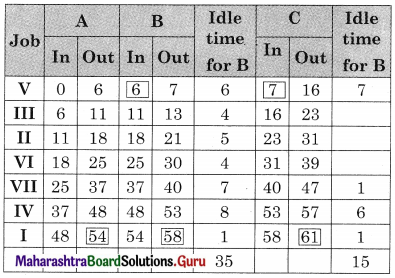
Maharashtra Board 12th Commerce Maths Solutions Chapter 7 Assignment Problem and Sequencing Ex 7.2 Q6.10
Total elapsed time = 61 hrs
Idle time for A = 61 – 54 = 7 hrs
Idle time for B = 35 + [61 – 58] = 38 hrs
Idle time for C = 15 hrs

Maharashtra Board 12th Commerce Maths Solutions Chapter 7 Assignment Problem and Sequencing Ex 7.2

(ii) Min A = 5, Max B = 5
Min A ≥ Max B.
The problem can be converted into two machine problems.
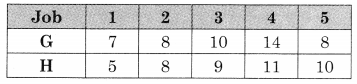
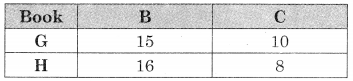
Let G and H be two fictitious machines such that G = A + B and H = B + C we get
Maharashtra Board 12th Commerce Maths Solutions Chapter 7 Assignment Problem and Sequencing Ex 7.2 Q6.11
Now min {G, H} = 5 for job 1 for H.
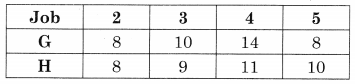
Maharashtra Board 12th Commerce Maths Solutions Chapter 7 Assignment Problem and Sequencing Ex 7.2 Q6.12
The problem reduces to
Maharashtra Board 12th Commerce Maths Solutions Chapter 7 Assignment Problem and Sequencing Ex 7.2 Q6.13
Now min {G, H} = 8 for job 2 for G and job H also job 5 for G
∴ We have two options
Maharashtra Board 12th Commerce Maths Solutions Chapter 7 Assignment Problem and Sequencing Ex 7.2 Q6.14
Or
Maharashtra Board 12th Commerce Maths Solutions Chapter 7 Assignment Problem and Sequencing Ex 7.2 Q6.15
We take the first one
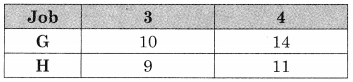
The problem reduces to
Maharashtra Board 12th Commerce Maths Solutions Chapter 7 Assignment Problem and Sequencing Ex 7.2 Q6.16
Now min {G, H} = 9 for job 3 for H
Maharashtra Board 12th Commerce Maths Solutions Chapter 7 Assignment Problem and Sequencing Ex 7.2 Q6.17
Now only job 4 is left
∴ The optimal sequence is
Maharashtra Board 12th Commerce Maths Solutions Chapter 7 Assignment Problem and Sequencing Ex 7.2 Q6.18
Worktable
Maharashtra Board 12th Commerce Maths Solutions Chapter 7 Assignment Problem and Sequencing Ex 7.2 Q6.20
Total elapsed time = 40 hrs
Idle time for A = 40 – 32 = 8 hrs
Idle time for B = 19 + [40 – 34] = 25 hrs
Idle time for C = 12 hrs

Maharashtra Board 12th Commerce Maths Solutions Chapter 7 Assignment Problem and Sequencing Ex 7.2

Question 7.
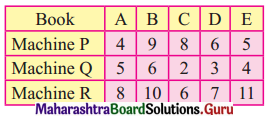
A publisher produces 5 books on Mathematics. The books have to go through composing, printing, and binding was done by 3 machines P, Q, E. The time schedule for the entire task in the proper unit is as follows.
Maharashtra Board 12th Commerce Maths Solutions Chapter 7 Assignment Problem and Sequencing Ex 7.2 Q7
Determine the optimum time required to finish the entire task.
Solution:
Min R = 6, Max Q = 6
As min R ≥ max Q.
The problem can be converted into a two-machine problem.
Let G and H be two fictitious machines such that G = P + Q and H = Q + R we get
Maharashtra Board 12th Commerce Maths Solutions Chapter 7 Assignment Problem and Sequencing Ex 7.2 Q7.1
Min {G, H} = 9 for books A, D, E for G.
∴ We have more than one option we take
Maharashtra Board 12th Commerce Maths Solutions Chapter 7 Assignment Problem and Sequencing Ex 7.2 Q7.2
The problem reduces to
Maharashtra Board 12th Commerce Maths Solutions Chapter 7 Assignment Problem and Sequencing Ex 7.2 Q7.3
Min {G, H} = 8 for book C on H
Maharashtra Board 12th Commerce Maths Solutions Chapter 7 Assignment Problem and Sequencing Ex 7.2 Q7.4
Now only B is left. So the optimal sequence is
Maharashtra Board 12th Commerce Maths Solutions Chapter 7 Assignment Problem and Sequencing Ex 7.2 Q7.5
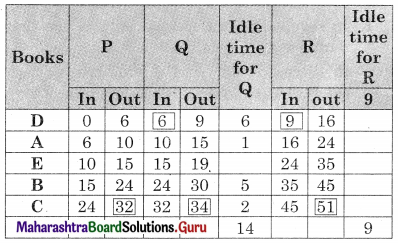
Worktable
Maharashtra Board 12th Commerce Maths Solutions Chapter 7 Assignment Problem and Sequencing Ex 7.2 Q7.6
Total elapsed time = 51 units
Idle time for P = 51 – 32 = 19 units
Idle time for Q = 14 + [51 – 34] = 31 units
Idle time for R = 9 units

Maharashtra Board 12th Commerce Maths Solutions Chapter 6 Linear Programming Miscellaneous Exercise 6

Balbharati Maharashtra State Board 12th Commerce Maths Solution Book Pdf Chapter 6 Linear Programming Miscellaneous Exercise 6 Questions and Answers.

Maharashtra State Board 12th Commerce Maths Solutions Chapter 6 Linear Programming Miscellaneous Exercise 6

(I) Choose the correct alternative.

Question 1.
The value of objective function is maximized under linear constraints.
(a) at the centre of feasible region
(b) at (0, 0)
(c) at any vertex of feasible region.
(d) The vertex which is at maximum distance from (0, 0).
Answer:
(a) at the centre of feasible region

Question 2.
Which of the following is correct?
(a) Every LPP has on optional solution
(b) Every LPP has unique optional solution
(c) If LPP has two optional solutions then it has infinitely many solutions
(d) The set of all feasible solutions LPP may not be a convex set.
Answer:
(c) If LPP has two optional solutions then it has infinitely many solutions

Maharashtra Board 12th Commerce Maths Solutions Chapter 6 Linear Programming Miscellaneous Exercise 6

Question 3.
Objective function of LPP is
(a) a constraint
(b) a function to be maximized or minimized
(c) a relation between the decision variables
(d) a feasible region.
Answer:
(b) a function to be maximized or minimized

Question 4.
The maximum value of z = 5x + 3y. subject to the constraints 3x + 5y = 15; 5x + 2y ≤ 10, x, y ≥ 0 is
(a) 235
(b) \(\frac{235}{9}\)
(c) \(\frac{235}{19}\)
(d) \(\frac{235}{3}\)
Answer:
(c) \(\frac{235}{19}\)

Question 5.
The maximum value of z = 10x + 6y. subject to the constraints 3x + y ≤ 12, 2x + 5y ≤ 34, x ≥ 0, y ≥ 0 is.
(a) 56
(b) 65
(c) 55
(d) 66
Answer:
(a) 56

Question 6.
The point at which the maximum value of z = x + y subject to the constraint x + 2y ≤ 70, 2x + y ≤ 15, x ≥ 0, y ≥ 0 is
(a) (36, 25)
(b) (20, 35)
(c) (35, 20)
(d) (40, 15)
Answer:
(d) (40, 15)

Question 7.
Of all the points of the feasible region the optimal value of z is obtained at a point
(a) Inside the feasible region
(b) at the boundary of the feasible region
(c) at vertex of feasible region
(d) on x -axis
Answer:
(c) at vertex of feasible region

Maharashtra Board 12th Commerce Maths Solutions Chapter 6 Linear Programming Miscellaneous Exercise 6

Question 8.
Feasible region; the set of points which satisfy
(a) The objective function
(b) All of the given function
(c) Some of the given constraints
(d) Only non-negative constraints
Answer:
(b) All of the given function

Question 9.
Solution of LPP to minimize z = 2x + 3y subjected to x ≥ 0, y ≥ 0, 1 ≤ x + 2y ≤ 10 is
(a) x = 0, y = \(\frac{1}{2}\)
(b) x = \(\frac{1}{2}\), y = 0
(c) x = 1, y = -2
(d) x = y = \(\frac{1}{2}\)
Answer:
(a) x = 0, y = \(\frac{1}{2}\)

Question 10.
The corner points of the feasible region given by the inequation x + y ≤ 4, 2x + y ≤ 7, x ≥ 0, y ≥ 0, are
(a) (0, 0), (4, 0), (3, 1), (0, 4)
(b) (0, 0), (\(\frac{7}{2}\), 0), (3, 1), (0, 4)
(c) (0, 0), (\(\frac{7}{2}\), 0), (3, 1), (5, 7)
(d) (6, 0), (4, 0), (3, 1), (0, 7)
Answer:
(b) (0, 0), (\(\frac{7}{2}\), 0), (3, 1), (0, 4)

Question 11.
The corner point of the feasible region are (0, 0), (2, 0), (\(\frac{12}{7}\), \(\frac{3}{7}\)) and (0, 1) then the point of maximum z = 6.5x + y = 13
(a) (0, 0)
(b) (2, 0)
(c) (\(\frac{11}{7}\), \(\frac{3}{7}\))
(d) (0, 1)
Answer:
(b) (2, 0)

Question 12.
If the corner points of the feasible region are (0, 0), (3, 0), (2, 1) and (0, \(\frac{7}{3}\)) the maximum value of z = 4x + 5y is
(a) 12
(b) 13
(c) \(\frac{35}{2}\)
(d) 0
Answer:
(b) 13

Maharashtra Board 12th Commerce Maths Solutions Chapter 6 Linear Programming Miscellaneous Exercise 6

Question 13.
If the comer points of the feasible region are (0, 10), (2, 2), and (4, 0) then the point of minimum z = 3x + 2y is.
(a) (2, 2)
(b) (0, 10)
(c) (4, 0)
(d) (2, 4)
Answer:
(a) (2, 2)

Question 14.
The half plane represented by 3x + 2y ≤ 0 contains the point.
(a) (1, \(\frac{5}{2}\))
(b) (2, 1)
(c) (0, 0)
(d) (5, 1)
Answer:
(c) (0, 0)

Question 15.
The half plane represented by 4x + 3y ≥ 14 contains the point
(a) (0, 0)
(b) (2, 2)
(c) (3, 4)
(d) (1, 1)
Answer:
(c) (3, 4)

(II) Fill in the blanks.

Question 1.
Graphical solution set of the in equations x ≥ 0, y ≥ 0 is in _________ quadrant.
Answer:
First

Question 2.
The region represented by the in equations x ≥ 0, y ≥ 0 lines in _________ quadrants.
Answer:
First

Question 3.
The optimal value of the objective function is attained at the _________ points of feasible region.
Answer:
End

Question 4.
The region represented by the inequality y ≤ 0 lies in _________ quadrants
Answer:
Third and Fourth

Maharashtra Board 12th Commerce Maths Solutions Chapter 6 Linear Programming Miscellaneous Exercise 6

Question 5.
The constraint that a factory has to employ more women (y) than men (x) is given by _________
Answer:
y > x

Question 6.
A garage employs eight men to work in its showroom and repair shop. The constants that there must be not least 3 men in showroom and repair shop. The constrains that there must be at least 3 men in showroom and at least 2 men in repair shop are _________ and _________ respectively.
Answer:
x ≥ 3 and y ≥ 2

Question 7.
A train carries at least twice as many first class passengers (y) as second class passangers (x). The constraint is given by _________
Answer:
x ≥ 2y

Question 8.
A dishwashing machine hold up to 40 pieces of large crockery (x) this constraint is given by _________
Answer:
x ≤ 40

(III) State whether each of the following is True or False.

Question 1.
The region represented by the inequalities x ≥ 0, y ≥ 0 lies in first quadrant.
Answer:
True

Question 2.
The region represented by the inqualities x ≤ 0, y ≤ 0 lies in first quadrant.
Answer:
False

Maharashtra Board 12th Commerce Maths Solutions Chapter 6 Linear Programming Miscellaneous Exercise 6

Question 3.
The optimum value of the objective function of LPP occurs at the center of the feasible region.
Answer:
False

Question 4.
Graphical solution set of x ≤ 0, y ≥ 0 in xy system lies in second quadrant.
Answer:
True

Question 5.
Saina wants to invest at most ₹ 24000 in bonds and fixed deposits. Mathematically this constraints is written as x + y ≤ 24000 where x is investment in bond and y is in fixed deposits.
Answer:
True

Question 6.
The point (1, 2) is not a vertex of the feasible region bounded by 2x + 3y ≤ 6, 5x + 3y ≤ 15, x ≥ 0, y ≥ 0.
Answer:
True

Question 7.
The feasible solution of LPP belongs to only quadrant I. The Feasible region of graph x + y ≤ 1 and 2x + 2y ≥ 6 exists.
Answer:
True

(IV) Solve the following problems.

Question 1.
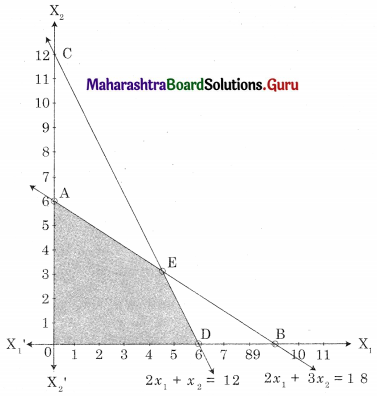
Maximize z = 5x1 + 6x2, Subject to 2x1 + 3x2 ≤ 18, 2x1 + x2 ≤ 12, x ≥ 0, y ≥ 0
Solution:
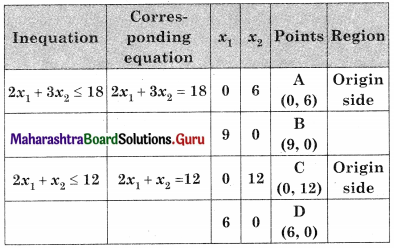
Maharashtra Board 12th Commerce Maths Solutions Chapter 6 Linear Programming Miscellaneous Exercise 6 IV Q1
Maharashtra Board 12th Commerce Maths Solutions Chapter 6 Linear Programming Miscellaneous Exercise 6 IV Q1.1
OAED is the feasible region O(0, 0) A(0, 6) D (6, 0)
and E is the intersection of 2x1 + 3x2 = 18 and 2x1 + x2 = 12
For E, Solving, 2x1 + 3x2 = 18 …….(i)
2x1 + x2 = 12 ……(ii)
We get x1 = 4.5, x2 = 3
∴ E = (4.5, 3)
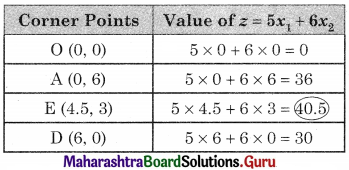
Maharashtra Board 12th Commerce Maths Solutions Chapter 6 Linear Programming Miscellaneous Exercise 6 IV Q1.2
∴ Maximum value of z = 40.5 at E(4.5, 3)

Question 2.
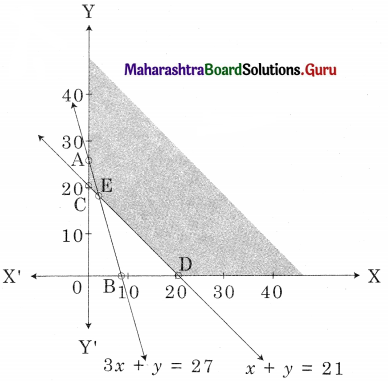
Minimize z = 4x + 2y, Subject to 3x + y ≥ 27, x + y ≥ 21, x ≥ 0, y ≥ 0
Solution:
Maharashtra Board 12th Commerce Maths Solutions Chapter 6 Linear Programming Miscellaneous Exercise 6 IV Q2.2
AED is the feasible region A(0, 27), D(21, 0)
and E is the point of intersection of 3x + y = 27 and x + y = 21
For E, Solving 3x + y = 27 ………(i)
x + y = 21 …….(ii)
We get x = 3, y = 18
∴ E(3, 18)
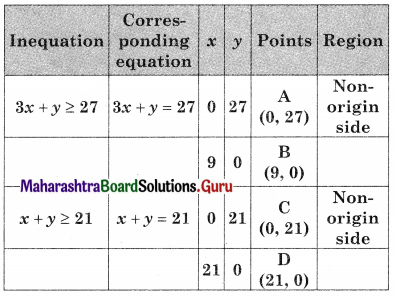
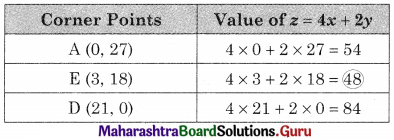
Maharashtra Board 12th Commerce Maths Solutions Chapter 6 Linear Programming Miscellaneous Exercise 6 IV Q2
Maharashtra Board 12th Commerce Maths Solutions Chapter 6 Linear Programming Miscellaneous Exercise 6 IV Q2.1
∴ Minimum value of z = 48 at (3, 18)

Maharashtra Board 12th Commerce Maths Solutions Chapter 6 Linear Programming Miscellaneous Exercise 6

Question 3.
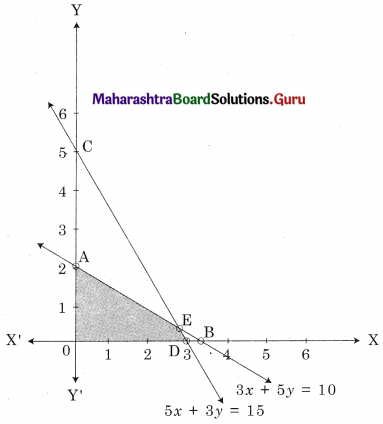
Maximize z = 6x + 10y, subject to 3x + 5y ≤ 10, 5x + 3y ≤ 15, x ≥ 0, y ≥ 0
Solution:
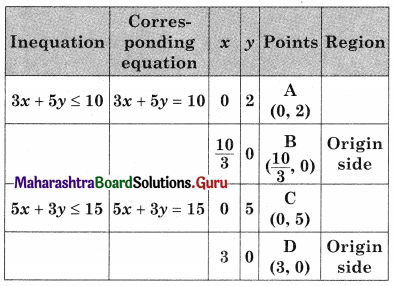
Maharashtra Board 12th Commerce Maths Solutions Chapter 6 Linear Programming Miscellaneous Exercise 6 IV Q3
Maharashtra Board 12th Commerce Maths Solutions Chapter 6 Linear Programming Miscellaneous Exercise 6 IV Q3.1
OAED is the feasible region;
O(0, 0), A (0, 2) D (3, 0) and E is the point of intersection of 3x + 5y = 10 and 5x + 3y = 15
For E, Solving 3x + 5y = 10
5x + 3y = 15
We get, x = \(\frac{45}{16}\), y = \(\frac{5}{16}\)
∴ E(\(\frac{45}{16}\), \(\frac{5}{16}\))
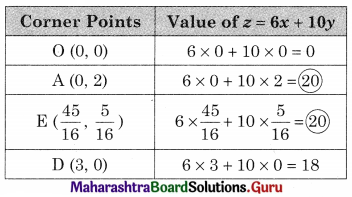
Maharashtra Board 12th Commerce Maths Solutions Chapter 6 Linear Programming Miscellaneous Exercise 6 IV Q3.2
Since the maximum value of z = 20 at two points i.e, at A(0, 2) and E(\(\frac{45}{16}\), \(\frac{5}{16}\)).
z is maximum at all points on segment AE.
Hence it has infinite number of solutions.

Question 4.
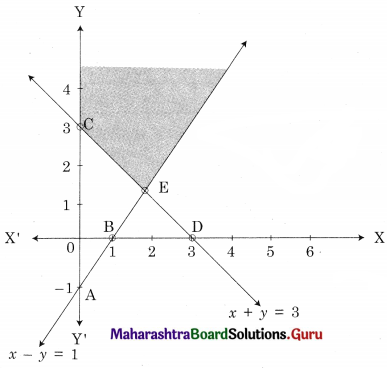
Minimize z = 2x + 3y, Subject to x – y ≤ 1, x + y ≥ 3, x ≥ 0, y ≥ 0
Solution:
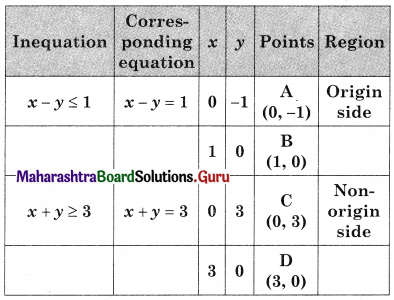
Maharashtra Board 12th Commerce Maths Solutions Chapter 6 Linear Programming Miscellaneous Exercise 6 IV Q4
Maharashtra Board 12th Commerce Maths Solutions Chapter 6 Linear Programming Miscellaneous Exercise 6 IV Q4.1
Shaded portion CE is the feasible region
Where C = (0, 3) and E is the point of intersection of x – y = 1 and x + y = 3
For E, Solving x – y = 1 …….(i)
x + y = 3 ………(ii)
We get, x = 2, y = 1
∴ E(2, 1)
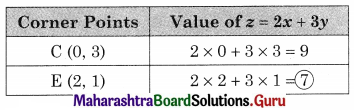
Maharashtra Board 12th Commerce Maths Solutions Chapter 6 Linear Programming Miscellaneous Exercise 6 IV Q4.2
∴ Minimum value z = 7 at E(2, 1)

Question 5.
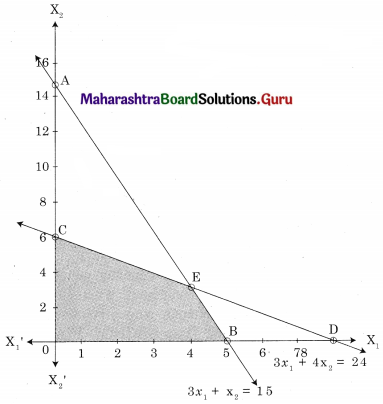
Maximize z = 4x1 + 3x2, Subject to 3x1 + x2 ≤ 15, 3x1 + 4x2 ≤ 24, x ≥ 0, y ≥ 0
Solution:
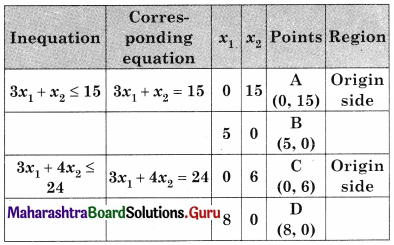
Maharashtra Board 12th Commerce Maths Solutions Chapter 6 Linear Programming Miscellaneous Exercise 6 IV Q5
Maharashtra Board 12th Commerce Maths Solutions Chapter 6 Linear Programming Miscellaneous Exercise 6 IV Q5.1
OCEB is the feasible region where O(0, 0), C(0, 6), B(5, 0)
E is the point of intersection of 3x1 + x2 = 15 and 3x1 + 4x2 = 24
For E, Solving 3x1 + x2 = 15 ……..(i)
3x1 + 4x2 = 24 …….(ii)
We get, x1 = 4, x2 = 3
∴ E(4, 3)
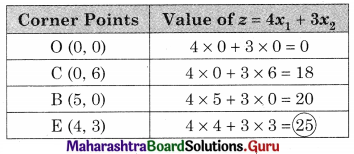
Maharashtra Board 12th Commerce Maths Solutions Chapter 6 Linear Programming Miscellaneous Exercise 6 IV Q5.2
∴ Maximum value of z = 25 at (4, 3)

Maharashtra Board 12th Commerce Maths Solutions Chapter 6 Linear Programming Miscellaneous Exercise 6

Question 6.
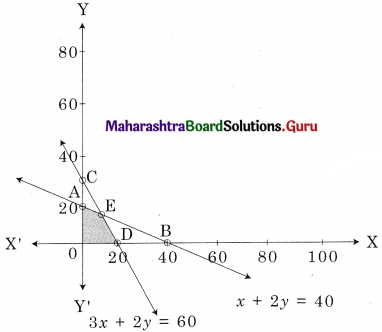
Maximize z = 60x + 50y, Subject to x + 2y ≤ 40, 3x + 2y ≤ 60, x ≥ 0, y ≥ 0
Solution:
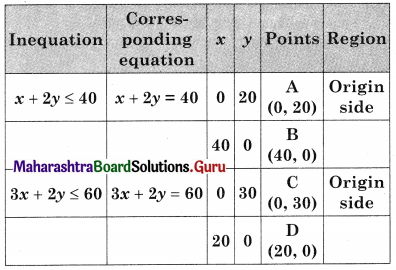
Maharashtra Board 12th Commerce Maths Solutions Chapter 6 Linear Programming Miscellaneous Exercise 6 IV Q6
Maharashtra Board 12th Commerce Maths Solutions Chapter 6 Linear Programming Miscellaneous Exercise 6 IV Q6.1
OAED is the feasible region O(0, 0), A(0, 20), D(20, 0)
E is x + 2y = 40 and 3x + 2y = 60
For E, Solving x + 2y = 40
3x + 2y = 60
We get, x = 10, y = 15
∴ E = (10, 15)
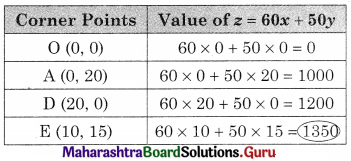
Maharashtra Board 12th Commerce Maths Solutions Chapter 6 Linear Programming Miscellaneous Exercise 6 IV Q6.2
∴ Maximum value of z = 1350 at E(10, 15).

Question 7.
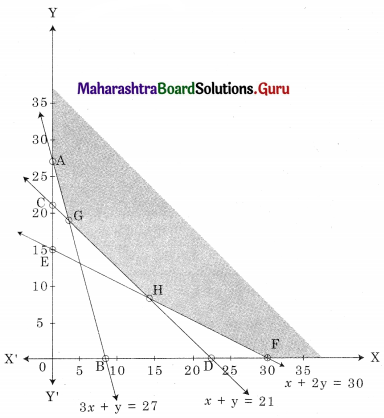
Minimize z = 4x + 2y, Subject to 3x + y ≥ 27, x + y ≥ 21, x + 2y ≥ 30, x ≥ 0, y ≥ 0
Solution:
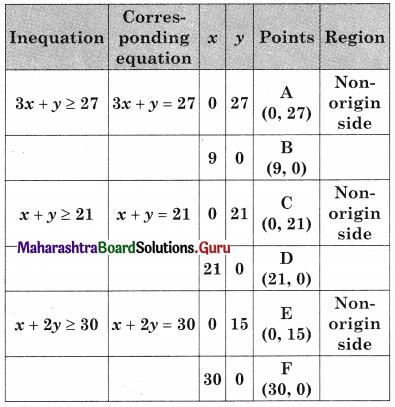
Maharashtra Board 12th Commerce Maths Solutions Chapter 6 Linear Programming Miscellaneous Exercise 6 IV Q7
Maharashtra Board 12th Commerce Maths Solutions Chapter 6 Linear Programming Miscellaneous Exercise 6 IV Q7.1
AGHF is the feasible region where A(0, 27) F(30, 0)
G is the point of intersection of 3x + y = 27 and x + y = 21
H is the point of intersection of x + y = 21 and x + 2y = 30
For G, Solving 3x + y = 27 …….(i)
x + y = 21 ………(ii)
We get, x = 3, y = 18
∴ G(3, 8)
For H, Solving x + y = 21 …….(i)
x + 2y = 30 ……..(ii)
We get, x = 12, y = 9
∴ G = (12, 9)
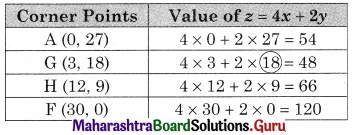
Maharashtra Board 12th Commerce Maths Solutions Chapter 6 Linear Programming Miscellaneous Exercise 6 IV Q7.2
∴ Maximum value of z = 48 at G(3, 18)

Question 8.
A carpenter makes chairs and table profit are ₹ 140 per chair and ₹ 210 per table Both products are processed on three machines, Assembling, Finishing and Polishing the time required for each product in hours and availability of each machine is given by the following table.
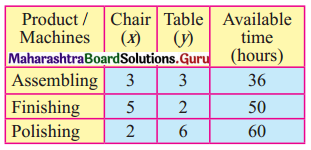
Maharashtra Board 12th Commerce Maths Solutions Chapter 6 Linear Programming Miscellaneous Exercise 6 IV Q8
Formulate and solve the following Linear programming problem using graphical method.
Solution:
Let z be the profit which can be made by selling x chair and y table.
∴ x ≥ 0, y ≥ 0
Total profit = 140x + 210y
According to the table, the constraints can be written as
3x + 3y ≤ 36
5x + 2y ≤ 50
2x + 6y ≤ 60
∴ The given LPP can be formulated as.
Maximize z = 140x + 210y
Subject to 3x + 3y ≤ 36, 5x + 2y ≤ 50, 2x + 6y ≤ 60, x ≥ 0, y ≥ 0.
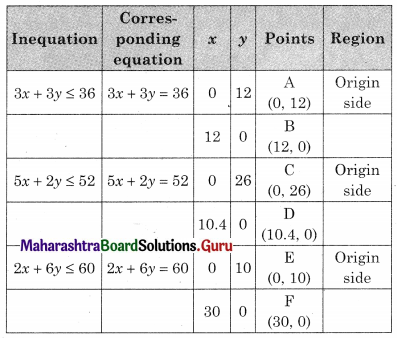
Maharashtra Board 12th Commerce Maths Solutions Chapter 6 Linear Programming Miscellaneous Exercise 6 IV Q8.1
Maharashtra Board 12th Commerce Maths Solutions Chapter 6 Linear Programming Miscellaneous Exercise 6 IV Q8.2
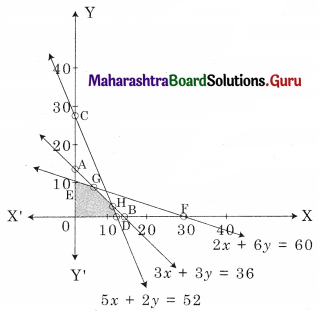
OEGH is the feasible region
O(0, 0), D(10.4, 0), E(0, 10)
For G, Solving 3x + 3y = 36 ……..(i)
2x + 6y = 60 …….(ii)
∴ G = (3, 9)
For H, Solving 5x + 2y = 52 ………(i)
3x + 3y = 36 ……..(ii)
We get, x = \(\frac{28}{3}\), y = \(\frac{8}{3}\)
∴ H(\(\frac{28}{3}\), \(\frac{8}{3}\))
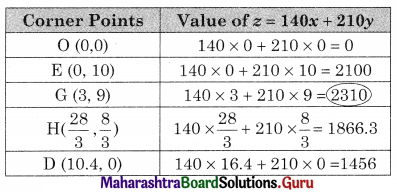
Maharashtra Board 12th Commerce Maths Solutions Chapter 6 Linear Programming Miscellaneous Exercise 6 IV Q8.3
∴ z in maximum at (3, 9) and maximum profit = ₹ 2310.

Maharashtra Board 12th Commerce Maths Solutions Chapter 6 Linear Programming Miscellaneous Exercise 6

Question 9.
A company manufactures bicycles and tricycles, each of which must be processed through two machines A and B Maximum availability of machines A and B are respectively 120 and 180 hours. Manufacturing a bicycle requires 6 hours on machine A and 3 hours on machine B manufacturing a tricycle requires 4 hours on machine A and 10 hours on machine B. If profits are ₹ 180 for a bicycle and ₹ 220 on a tricycle, determine the number of bicycles and tricycles that should be manufactured in order to maximize the profit.
Solution:
Let x number of bicycle and y number of tricycle has to be manufactured and to be sold to get the profit (z)
∴ x ≥ 0, y ≥ 0
Total profit = 180x + 220y.
The given LPP can be tabulated as follows:
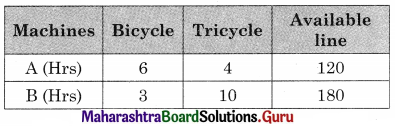
Maharashtra Board 12th Commerce Maths Solutions Chapter 6 Linear Programming Miscellaneous Exercise 6 IV Q9
∴ The given LPP can be formulated as
Maximize z = 180x + 220y
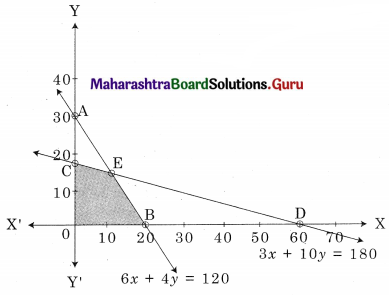
Subject to 6x + 4y ≤ 120, 3x + 10y ≤ 180, x ≥ 0, y ≥ 0
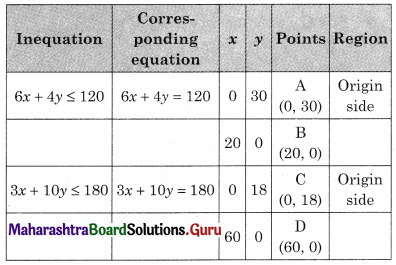
Maharashtra Board 12th Commerce Maths Solutions Chapter 6 Linear Programming Miscellaneous Exercise 6 IV Q9.1
Maharashtra Board 12th Commerce Maths Solutions Chapter 6 Linear Programming Miscellaneous Exercise 6 IV Q9.2
OCEB is the feasible region where O(0, 0) C(0, 18) B(20, 0)
E is the point of intersection of 6x + 4y = 120 and 3x + 10y = 180
For E, Solving 6x + 4y = 120 ……..(i)
3x + 10y = 180 …….(ii)
We get, x = 10, y = 15
∴ E(10, 15)
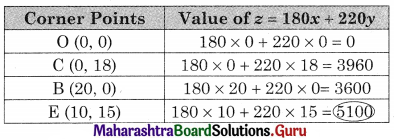
Maharashtra Board 12th Commerce Maths Solutions Chapter 6 Linear Programming Miscellaneous Exercise 6 IV Q9.3
∴ Maximum value of z is 5100 at E(10, 15)
Hence 10 bicycles and 15 tricycles should be produced to get maximum profit.

Question 10.
A factory produced two types of chemicals A and B. The following table gives the units of ingredients P and Q (per kg) of chemicals A and B as well as minimum requirements of P and Q and also cost per kg. Chemicals A and B:
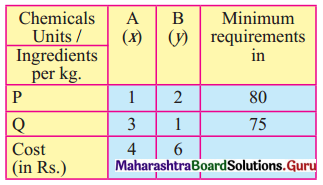
Maharashtra Board 12th Commerce Maths Solutions Chapter 6 Linear Programming Miscellaneous Exercise 6 IV Q10
Find the number of units of chemicals A and B should be produced sp as to minimize the cost.
Solution:
Let x be the no. of units of chemicals, A produced and y be the no. of units of chemical B produced.
Total cost is 4x + 6y
The LPP is. Minimise z = 4x + 6y
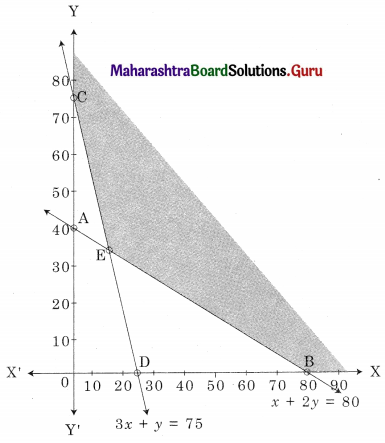
Subject to x + 2y ≥ 80, 3x + y ≥ 75, x ≥ 0, y ≥ 0.
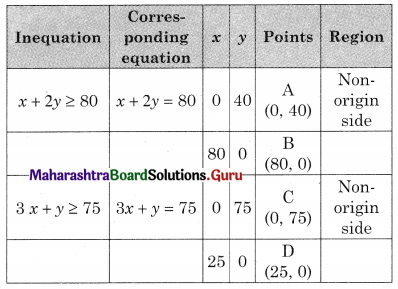
Maharashtra Board 12th Commerce Maths Solutions Chapter 6 Linear Programming Miscellaneous Exercise 6 IV Q10.1
Maharashtra Board 12th Commerce Maths Solutions Chapter 6 Linear Programming Miscellaneous Exercise 6 IV Q10.2
The shaded region BEC in the feasible region B(80, 0) C(0, 75)
and E is the point of intersection of x + 2y = 80 and 3x + y = 75
For E, Solving x + 2y = 80 …….(i)
3x + y = 75 …….(ii)
We get, x = 14, y = 33
∴ E(14, 33)
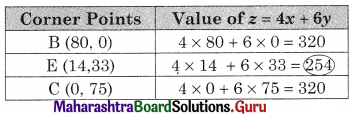
Maharashtra Board 12th Commerce Maths Solutions Chapter 6 Linear Programming Miscellaneous Exercise 6 IV Q10.3
∴ z is minimum at E(14, 33) and the minimum value of z = 254.
Hence 14 units of chemical A and 33 units of chemical B are produced to get a minimum cost of ₹ 254.

Question 11.
A company produces mixers and food processors. Profit on selling one mixer and one food processor is ₹ 2,000/- and ₹ 3,000/- respectively. Both the products are processed through three Machines A, B, C. The time required in hours by each product and total time available in hours per week on each machine are as follows:
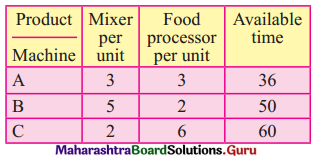
Maharashtra Board 12th Commerce Maths Solutions Chapter 6 Linear Programming Miscellaneous Exercise 6 IV Q11
How many mixes and food processors should be produced to maximize profit?
Solution:
Let x be the no. of mixers produced and y be the no.of food processors produced.
The profit is 2000x + 3000y
The LPP is Maximize 2 = 2000x + 3000y
Subject to 3x + 3y ≤ 36, 5x + 2y ≤ 50, 2x + 6y ≤ 60 x, y ≥ 0.
Let 3x + 3y = 36,
i.e. x + y = 12
x = 0, y = 12, (0, 12)
y = 0, x = 12, (12, 0)
5x + 2y = 50
x = 0, y = 25, (0, 25)
y = 0, x = 10, (10, 0)
Let 2x + 6y = 60, x + 3y = 30
x = 0, y = 10 (0, 10)
y = 0, x = 30 (30, 0)
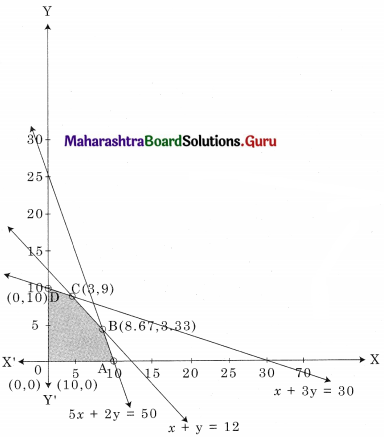
Maharashtra Board 12th Commerce Maths Solutions Chapter 6 Linear Programming Miscellaneous Exercise 6 IV Q11.1
The Shaded region OABCD is the feasible region.
O(0, 0) A (10, 0) D(0, 10)
B is the intersection of x + y = 12 and 5x + 2y = 50
Solving we get x = 8.67, y = 3.33
∴ B(8.67, 3.33)
C is the intersection of x + y = 12 and x + 3y = 30
Solving we get x = 3, y = 9
∴ C(3, 9)
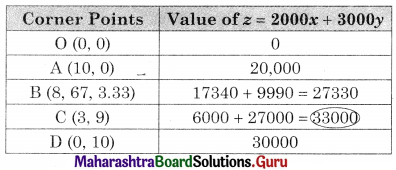
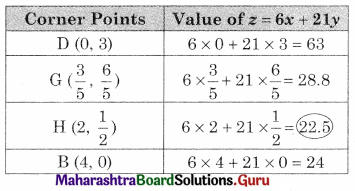
Maharashtra Board 12th Commerce Maths Solutions Chapter 6 Linear Programming Miscellaneous Exercise 6 IV Q11.2
∴ Maximum value of z is 330000 at C(3, 9)
Hence 3 mixers and 9 food processors should be produced to get a maximum profit of ₹ 33,000.

Maharashtra Board 12th Commerce Maths Solutions Chapter 6 Linear Programming Miscellaneous Exercise 6

Question 12.
A chemical company produces a chemical containing three basic elements A, B, C so that it has at least 16 liters of A, 24 liters of B, and 18 liters of C. This chemical is made by mixing two compounds I and II. Each unit of compound I has 4 liters of A, 12 liters of B, 2 liters of C. Each unit of compound II has 2 liters of A, 2 liters of B and 6 liters of C. The cost per unit of compound is ₹ 800/- and that of compound II is ₹ 640/- Formulate the problem as L.P.P and solve it to minimize the cost.
Solution:
Let x be the no. of units of compound I used and y be the no of units of compound II used.
The data can be tabulated as
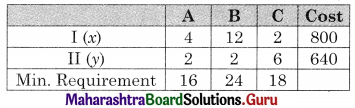
Maharashtra Board 12th Commerce Maths Solutions Chapter 6 Linear Programming Miscellaneous Exercise 6 IV Q12
The LPP is minimize z = 800x + 640y
Subject to 4x + 2y ≥ 16, 12x + 2y ≥ 24, 2x + 6y ≥ 18, x, y ≥ 0.
Let 4x + 2 y = 16,
2x + y = 8
x = 0, y = 8, (0, 8)
y = 0, x = 4, (4, 0)
12x + 2y = 24,
6x + y = 12
x = 0, y = 12, (0, 12)
y = 0, x = 2, (2, 0)
2x + 6y = 18
x + 3y = 9
x = 0, y = 3, (0, 3)
y = 0, x = 9, (9, 0)
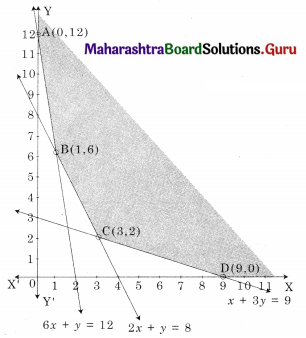
Maharashtra Board 12th Commerce Maths Solutions Chapter 6 Linear Programming Miscellaneous Exercise 6 IV Q12.1
The Shaded region ABCD is the feasible region.
A(0, 12) D(9, 0)
B is the intersection of 6x + y = 12 and 2x + y = 8
Solving we get x = 1, y = 6
∴ B(1, 6)
C is the intersection of 2x + y = 8 and x + 3y = 9
Solving we get x = 3, y = 2
∴ C(3, 2)
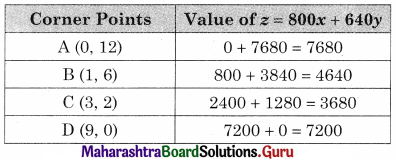
Maharashtra Board 12th Commerce Maths Solutions Chapter 6 Linear Programming Miscellaneous Exercise 6 IV Q12.2
∴ The minimum value of z = 3680 at (3, 2)
Hence 3 unit of compound I and 2 units of compound II should be used to get the minimum cost of ₹ 3680.

Question 13.
A person who makes two types of gift items A and B requires the services of a cutter and a finisher. Gift item A requires 4 hours of the cutter’s time and 2 hours of the finisher’s time. B required 2 hours of the cutter’s time and 4 hours of finisher‘s time. The cutter and finisher have 208 hours and 152 hours available times respectively every month. The profit of one gift item of type A is ₹ 75/- and on gift item B is ₹ 125/-. Assuming that the person can sell all the gift items produced, determine how many gift items of each type should he make every month to obtain the best returns?
Solution:
Let x be the no. of gift A produced and y be the no. of gift B produced.
The data can be tabulated as
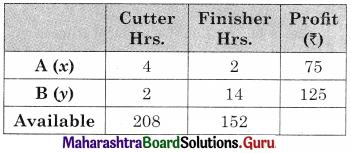
Maharashtra Board 12th Commerce Maths Solutions Chapter 6 Linear Programming Miscellaneous Exercise 6 IV Q13
The LLP is maximize z = 75x + 125y
Subject to 4x + 2y ≤ 208, 2x + 4y ≤ 152, x, y ≥ 0
Let 4x + 2y = 208, 2x + 4y = 152,
2x + y = 104, x + 2y = 76,
x = 0, y = 104; (0, 104), x = 0, y = 38; (0, 38)
y = 0, x = 52; (52, 0), y = 0, x = 76; (76, 0)
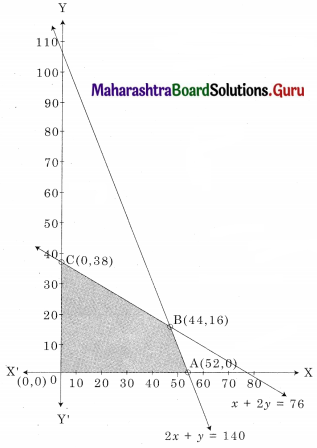
Maharashtra Board 12th Commerce Maths Solutions Chapter 6 Linear Programming Miscellaneous Exercise 6 IV Q13.1
The shaded region OABC is the feasible region.
O(0,0) A (52, 0) C(0, 38)
B is the intersection of 2x + y = 104 and x + 2y = 76
Solving we get x = 44, y = 16
∴ B(44, 16)
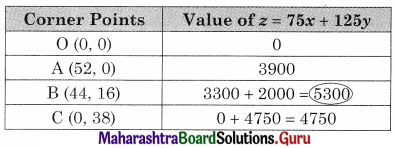
Maharashtra Board 12th Commerce Maths Solutions Chapter 6 Linear Programming Miscellaneous Exercise 6 IV Q13.2
∴ Maximum value of z = 5300 at B(44, 16)
Hence he should produce 44 gifts of type A & 16 of type B to get a maximum profit of ₹ 5300.

Question 14.
A firm manufactures two products A and B on which profit is earned per unit ₹ 3/- and ₹ 4/- respectively. Each product is processed on two machines M1 and M2. Product A requires one minute of processing time on Mx and two minutes of processing time on M2. B requires one minute of processing time on M1 and one minute processing time on M2 Machine M1 is available for use for 450 minutes while M2 is available for 600 minutes during any working day. Final the number of units of products A and B to be manufactured to get the maximum profit.
Solution:
Let x denote the number of units of product A and y denote the number of units of product B.
The total profit in ₹ 3x + 4y,
The given statements can be tabulated as
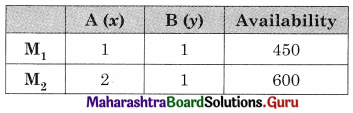
Maharashtra Board 12th Commerce Maths Solutions Chapter 6 Linear Programming Miscellaneous Exercise 6 IV Q14
The constraints are x + y ≤ 450, 2x + y ≤ 600, x ≥ 0, y ≥ 0
∴ The LPP can be formulated as
Maximize z = 3x + 4y
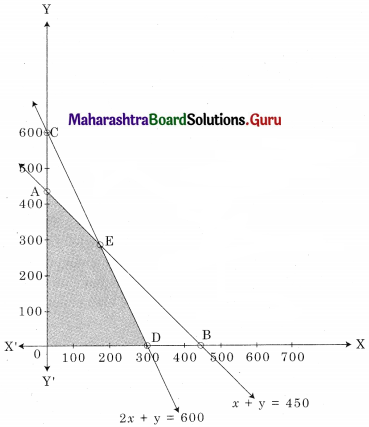
Subject to x + y ≤ 450, 2x + y ≤ 600, x ≥ 0, y ≥ 0.
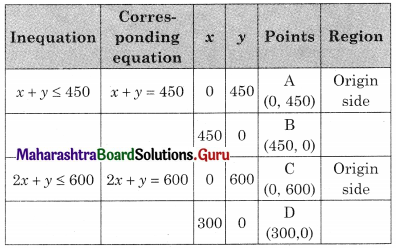
Maharashtra Board 12th Commerce Maths Solutions Chapter 6 Linear Programming Miscellaneous Exercise 6 IV Q14.1
Maharashtra Board 12th Commerce Maths Solutions Chapter 6 Linear Programming Miscellaneous Exercise 6 IV Q14.2
OAED in the feasible region O(0, 0) A(0, 450) D(300, 0)
E is the intersection of x + y = 450 and 2x + y = 600
For E, Solving x + y = 450 ……..(i)
2x + y = 600 ……..(ii)
Solving x = 150, y = 300
∴ E(150, 300)
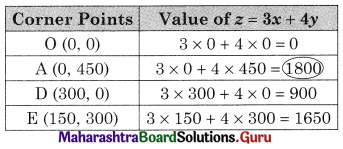
Maharashtra Board 12th Commerce Maths Solutions Chapter 6 Linear Programming Miscellaneous Exercise 6 IV Q14.3
∴ Maximum value of z = 1800 at (0, 450)

Maharashtra Board 12th Commerce Maths Solutions Chapter 6 Linear Programming Miscellaneous Exercise 6

Question 15.
A firm manufacturing two types of electrical items A and B, can make a profit of ₹ 20/- per unit of A and ₹ 30/- per unit of B. Both A and B make use of two essential components a motor and a transformer. Each unit of A requires 3 motors and 2 transformers and each unit of B required 2 motors and 4 transformers. The total supply of components per month is restricted to 210 motors and 300 transformers. How many units of A and B should they manufacture per month to maximize profit? How much is the maximum profit?
Solution:
Let x be the no. of electrical item A and y be the no. of electrical items to be manufactured per month to maximize the profit.
Total profit is ₹ 20x + 30y
The given condition can be tabulated as.
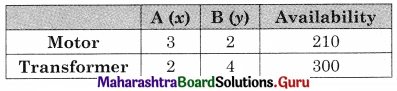
Maharashtra Board 12th Commerce Maths Solutions Chapter 6 Linear Programming Miscellaneous Exercise 6 IV Q15
The given LPP can be formulated as
Maximize z = 20x + 30y
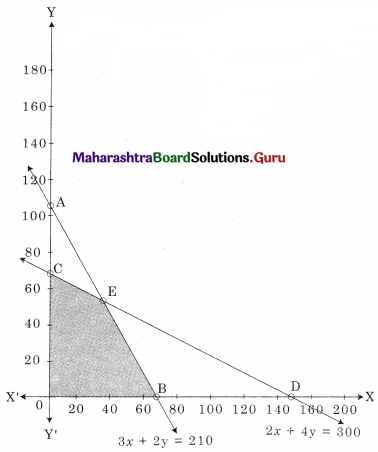
Subject of 3x + 2y ≤ 210, 2x + 4y ≤ 300, x ≥ 0, y ≥ 0.
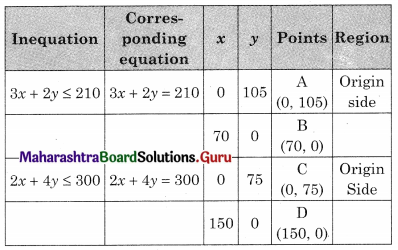
Maharashtra Board 12th Commerce Maths Solutions Chapter 6 Linear Programming Miscellaneous Exercise 6 IV Q15.1
Maharashtra Board 12th Commerce Maths Solutions Chapter 6 Linear Programming Miscellaneous Exercise 6 IV Q15.2
BOCE is the feasible region
B(70, 0) O(0, 0) C(0, 75)
E is the intersection of 3x + 2y = 210 and 2x + 4y = 300
For E, Solving 3x + 2y = 210 ……….(i)
2x + 4y = 300 …….(ii)
We get x = 30, y = 60
∴ E(30, 60)
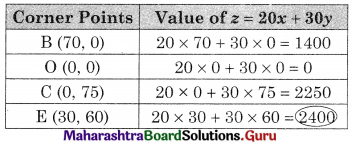
Maharashtra Board 12th Commerce Maths Solutions Chapter 6 Linear Programming Miscellaneous Exercise 6 IV Q15.3
∴ Maximum value of z = ₹ 2400 at (30, 60)
Hence 30 units of A and 60 units of B should be manufactured per month to get the maximum profit of ₹ 2400

Maharashtra Board 11th Commerce Maths Solutions Chapter 1 Partition Values Miscellaneous Exercise 1

Balbharati Maharashtra State Board 11th Commerce Maths Solution Book Pdf Chapter 1 Partition Values Miscellaneous Exercise 1 Questions and Answers.

Maharashtra State Board 11th Commerce Maths Solutions Chapter 1 Partition Values Miscellaneous Exercise 1

Question 1.
The data gives the number of accidents per day on a railway track. Compute Q2, P17, and D7.
4, 2, 3, 5, 6, 3, 4, 1, 2, 3, 2, 3, 4, 3, 2
Solution:
The given data can be arranged in ascending order as follows:
1, 2, 2, 2, 2, 3, 3, 3, 3, 3, 4, 4, 4, 5, 6
Here, n = 15
Q2 = value of 2\(\left(\frac{n+1}{4}\right)^{\text {th }}\) observation
= value of 2\(\left(\frac{15+1}{4}\right)^{\text {th }}\) observation
= value of (2 × 4)th observation
= value of 8th observation
∴ Q2 = 3
P17 = value of 17\(\left(\frac{n+1}{100}\right)^{\text {th }}\) observation
= value of 17\(\left(\frac{15+1}{100}\right)^{\text {th }}\) observation
= value of (17 × 0.16)th observation
= value of (2.72)th observation
= value of 2nd observation + 0.72 (value of 3rd observation – value of 2nd observation)
= 2 + 0.72 (2 – 2)
∴ P17 = 2
D7 = value of 7\(\left(\frac{n+1}{10}\right)^{\text {th }}\) observation
= value of 7\(\left(\frac{15+1}{10}\right)^{\text {th }}\) observation
= value of (7 × 1.6)th observation
= value of (11.2)th observation
= value of 11th observation + 0.2(value of 12th observation – value of 11th observation)
= 4 + 0. 2(4 – 4)
∴ D7 = 4

Maharashtra Board 11th Commerce Maths Solutions Chapter 1 Partition Values Miscellaneous Exercise 1

Question 2.
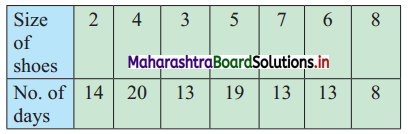
The distribution of daily sales of shoes (size-wise) for 100 days from a certain shop is as follows:
Maharashtra Board 11th Commerce Maths Solutions Chapter 1 Partition Values Miscellaneous Exercise 1 Q2
Compute Q1, D2, and P95.
Solution:
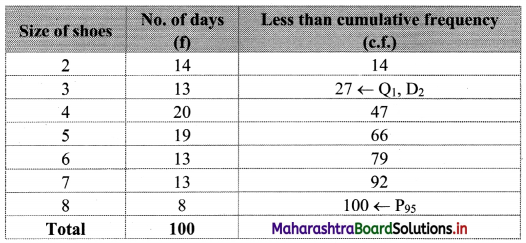
By arranging the given data in ascending order, we construct the less than cumulative frequency table as given below:
Maharashtra Board 11th Commerce Maths Solutions Chapter 1 Partition Values Miscellaneous Exercise 1 Q2.1
Here, n = 100
Q1 = value of \(\left(\frac{n+1}{4}\right)^{\text {th }}\) observation
= value of \(\left(\frac{100+1}{4}\right)^{\text {th }}\) observation
= value of (25.25)th observation
Cumulative frequency which is just greater than (or equal) to 25.25 is 27.
∴ Q1 = 3
D2 = value of 2\(\left(\frac{n+1}{10}\right)^{\text {th }}\) observation
= value of 2\(\left(\frac{100+1}{10}\right)^{\text {th }}\) observation
= value of (2 × 10.1)th observation
= value of (20.2)th observation
Cumulative frequency which is just greater than (or equal) to 20.2 is 27.
∴ D2 = 3
P95 = value of 95\(\left(\frac{n+1}{100}\right)^{\text {th }}\) observation
= value of 95\(\left(\frac{100+1}{100}\right)^{\text {th }}\) observation
= value of (95 × 1.01)th observation
= value of (95.95)th observation
The cumulative frequency which is just greater than (or equal) to 95.95 is 100.
∴ P95 = 8

Question 3.
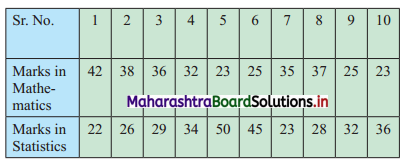
Ten students appeared for a test in Mathematics and Statistics and they obtained the marks as follows:
Maharashtra Board 11th Commerce Maths Solutions Chapter 1 Partition Values Miscellaneous Exercise 1 Q3
If the median will be the criteria, in which subject, the level of knowledge of the students is higher?
Solution:
Marks in Mathematics can be arranged in ascending order as follows:
23, 23, 25, 25, 32, 35, 36, 37, 38, 42
Here, n = 10
∴ Median = value of \(\left(\frac{n+1}{2}\right)^{\text {th }}\) observation
Median = value of \(\left(\frac{10+1}{2}\right)^{\text {th }}\) observation
= value of (5.5)th observation
= value of 5th observation + 0.5(value of 6th observation – value of 5th observation)
= 32 + 0.5 (35 – 32)
= 32 + 0.5(3)
= 32 + 1.5
= 33.5
Marks in Statistics can be arranged in ascending order as follows:
22, 23, 26, 28, 29, 32, 34, 36, 45, 50
Here, n = 10
∴ Median = value of \(\left(\frac{n+1}{2}\right)^{\text {th }}\) observation
= value of \(\left(\frac{10+1}{2}\right)^{\text {th }}\) observation
= value of (5.5)th observation
= value of 5th observation + 0.5(value of 6th observation – value of 5th observation)
= 29 + 0.5(32 – 29)
= 29 + 0.5(3)
= 29 + 1.5
= 30.5
∴ Median marks for Mathematics = 33.5 and
Median marks for Statistics = 30.5
∴ The level of knowledge in Mathematics is higher than that of Statistics.

Maharashtra Board 11th Commerce Maths Solutions Chapter 1 Partition Values Miscellaneous Exercise 1

Question 4.
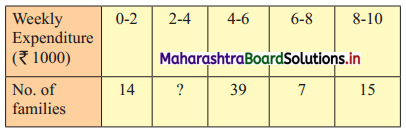
In the frequency distribution of families given below, the number of families corresponding to expenditure group 2000 – 4000 is missing from the table. However, the value of the 25th percentile is 2880. Find the missing frequency.
Maharashtra Board 11th Commerce Maths Solutions Chapter 1 Partition Values Miscellaneous Exercise 1 Q4
Solution:
Let x be the missing frequency of expenditure group 2000 – 4000.
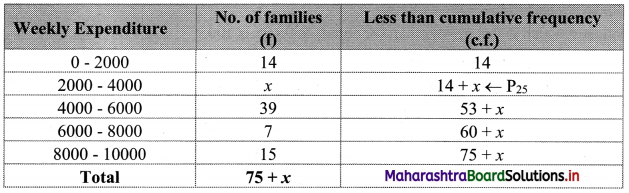
We construct the less than cumulative frequency table as given below:
Maharashtra Board 11th Commerce Maths Solutions Chapter 1 Partition Values Miscellaneous Exercise 1 Q4.1
Here, N = 75 + x
Given, P25 = 2880
∴ P25 lies in the class 2000 – 4000.
∴ L = 2000, h = 2000, f = x, c.f. = 14
∴ P25 = L + \(\frac{h}{f}\left(\frac{25 \mathrm{~N}}{100}-\text { c.f. }\right)\)
∴ 2880 = 2000 + \(\frac{2000}{x}\left(\frac{75+x}{4}-14\right)\)
∴ 2880 – 2000 = \(\frac{2000}{x}\left(\frac{75+x-56}{4}\right)\)
∴ 880x = 500(x + 19)
∴ 880x = 500x + 9500
∴ 880x – 500x = 9500
∴ 380x = 9500
∴ x = 25
∴ 25 is the missing frequency of the expenditure group 2000 – 4000.

Question 5.
Calculate Q1, D6, and P15 for the following data:
Maharashtra Board 11th Commerce Maths Solutions Chapter 1 Partition Values Miscellaneous Exercise 1 Q5
Solution:
Since the difference between any two consecutive mid values is 50, the width of each class interval is 50.
∴ the class intervals will be 0 – 50, 50 – 100, etc.
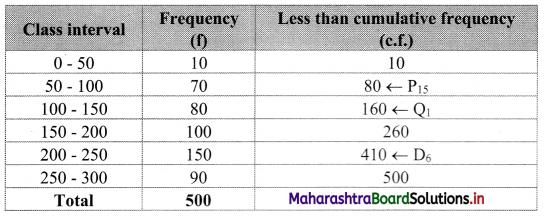
We construct the less than cumulative frequency table as given below:
Maharashtra Board 11th Commerce Maths Solutions Chapter 1 Partition Values Miscellaneous Exercise 1 Q5.1
Here, N = 500
Q1 class = class containing \(\left(\frac{\mathrm{N}}{4}\right)^{\text {th }}\) observation
∴ \(\frac{\mathrm{N}}{4}=\frac{500}{4}\) = 125
Cumulative frequency which is just greater than (or equal) to 125 is 160.
Q1 lies in the class 100 – 150.
∴ L = 100, h = 50, f = 80, c.f. = 80
∴ Q1 = L + \(\left(\frac{\mathrm{N}}{4}-\text { c.f. }\right)\)
= 100 + \(\frac{50}{80}\)(125 – 80)
= 100 + \(\frac{5}{8}\)(45)
= 100 + 28.125
= 128.125
D6 class = class containing \(\left(\frac{6 \mathrm{~N}}{10}\right)^{\text {th }}\) observation
∴ \(\frac{6 \mathrm{~N}}{10}=\frac{6 \times 500}{10}\) = 300
Cumulative frequency which is just greater than (or equal) to 300 is 410.
∴ D6 lies in the class 200 – 250.
∴ L = 200, h = 50, f = 150, c.f. = 260
∴ D6 = L + \(\frac{\mathrm{h}}{\mathrm{f}}\left(\frac{6 \mathrm{~N}}{10}-\text { c.f. }\right)\)
= 200 + \(\frac{50}{150}\)(300 – 260)
= 200 + \(\frac{1}{3}\)(40)
= 200 + 13.33
= 213.33
P15 class = class containing \(\left(\frac{15 \mathrm{~N}}{100}\right)^{\text {th }}\) observation
∴ \(\frac{15 \mathrm{~N}}{100}=\frac{15 \times 500}{100}\) = 75
Cumulative frequency which is just greater than (or equal) to 75 is 80.
∴ P15 lies in the class 50 – 100.
∴ L = 50, h = 50, f = 70, c.f. = 10
∴ P15 = L + \(\frac{\mathrm{h}}{\mathrm{f}}\left(\frac{15 \mathrm{~N}}{100}-\text { c.f. }\right)\)
= 50 + \(\frac{50}{70}\) (75 – 10)
= 50 + \(\frac{5}{7}\) (65)
= 50 + \(\frac{325}{7}\)
= 50 + 46.4286
= 96.4286
∴ Q1 = 128.125, D6 = 213.33, P15 = 96.4286

Maharashtra Board 11th Commerce Maths Solutions Chapter 1 Partition Values Miscellaneous Exercise 1

Question 6.
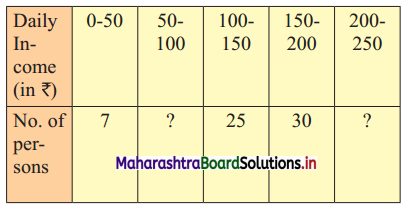
Daily income for a group of 100 workers are given below:
Maharashtra Board 11th Commerce Maths Solutions Chapter 1 Partition Values Miscellaneous Exercise 1 Q6
P30 for this group is ₹ 110. Calculate the missing frequencies.
Solution:
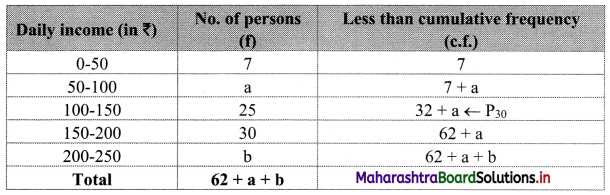
Let a and b be the missing frequencies of class 50 – 100 and class 200 – 250 respectively.
We construct the less than cumulative frequency table as given below:
Maharashtra Board 11th Commerce Maths Solutions Chapter 1 Partition Values Miscellaneous Exercise 1 Q6.1
Here, N = 62 + a + b
Since, N = 100
∴ 62 + a + b = 100
∴ a + b = 38 ……(i)
Given, P30 = 110
∴ P30 lies in the class 100 – 150.
∴ L = 100, h = 50, f = 25, c.f. = 7 + a
\(\frac{30 \mathrm{~N}}{100}=\frac{30 \times 100}{100}\) = 30
∴ P30 = L + \(\frac{\mathrm{h}}{\mathrm{f}}\left(\frac{30 \mathrm{~N}}{100}-\text { c.f. }\right)\)
∴ 110 = 100 + \(\frac{50}{25}\) [30 – (7 + a)]
∴ 110 – 100 = 2(30 – 7 – a)
∴ 10 = 2(23 – a)
∴ 5 = 23 – a
∴ a = 23 – 5
∴ a = 18
Substituting the value of a in equation (i), we get
18 + b = 38
∴ b = 38 – 18
∴ b = 20
∴ 18 and 20 are the missing frequencies of the class 50 – 100 and class 200 – 250 respectively.

Question 7.
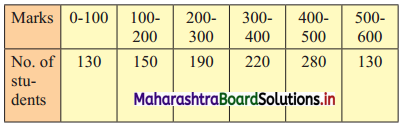
The distribution of a sample of students appearing for a C.A. examination is:
Maharashtra Board 11th Commerce Maths Solutions Chapter 1 Partition Values Miscellaneous Exercise 1 Q7
Help C.A. institute to decide cut-off marks for qualifying for an examination when 3% of students pass the examination.
Solution:
To decide cut-off marks for qualifying for an examination when 3% of students pass, we have to find P97.
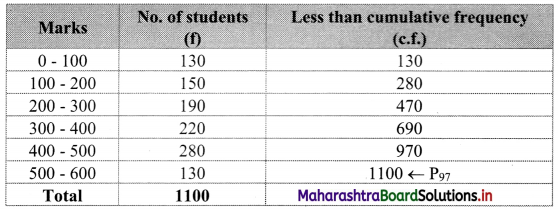
We construct the less than cumulative frequency table as given below:
Maharashtra Board 11th Commerce Maths Solutions Chapter 1 Partition Values Miscellaneous Exercise 1 Q7.1
Here, N = 1100
P97 class = class containing \(\left(\frac{97 \mathrm{~N}}{100}\right)^{\text {th }}\) observation
∴ \(\frac{97 \mathrm{~N}}{100}=\frac{97 \times 1100}{100}\) = 1067
Cumulative frequency which is just greater than (or equal) to 1067 is 1100.
∴ P97 lies in the class 500 – 600.
∴ L = 500, h = 100, f = 130, c.f. = 970
∴ P97 = L + \(\frac{\mathrm{h}}{\mathrm{f}}\left(\frac{97 \mathrm{~N}}{100}-\text { c.f. }\right)\)
= 500 + \(\frac{100}{130}\)(1067 – 970)
= 500 + \(\frac{10}{13}\) (97)
= 500 + 74.62
= 574.62 ~ 575
∴ the cut off marks for qualifying an examination is 575.

Maharashtra Board 11th Commerce Maths Solutions Chapter 1 Partition Values Miscellaneous Exercise 1

Question 8.
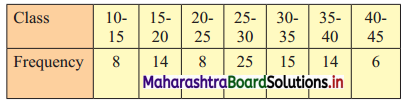
Determine graphically the value of median, D3, and P35 for the data given below:
Maharashtra Board 11th Commerce Maths Solutions Chapter 1 Partition Values Miscellaneous Exercise 1 Q8
Solution:
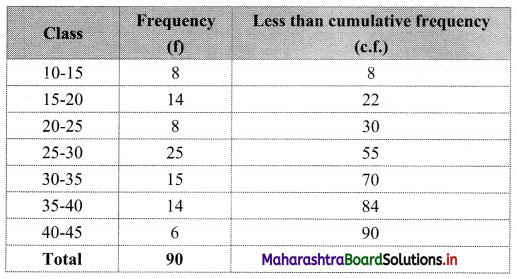
To draw an ogive curve, we construct the less than cumulative frequency table as given below:
Maharashtra Board 11th Commerce Maths Solutions Chapter 1 Partition Values Miscellaneous Exercise 1 Q8.1
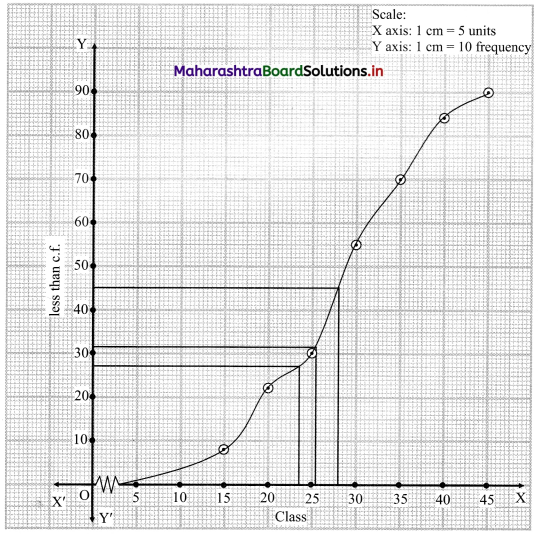
The points to be plotted for less than ogive are (15, 8), (20, 22), (25, 30), (30, 55), (35, 70), (40, 84), (45, 90).
Maharashtra Board 11th Commerce Maths Solutions Chapter 1 Partition Values Miscellaneous Exercise 1 Q8.2
N = 90
For median, consider \(\frac{\mathrm{N}}{2}=\frac{90}{2}\) = 45
For D3, consider \(\frac{3 \mathrm{~N}}{10}=\frac{3 \times 90}{10}\) = 27
For P35, consider \(\frac{35 \mathrm{~N}}{100}=\frac{35 \times 90}{100}\) = 31.5
∴ We take the values 45, 27 and 31.5 on the Y-axis and draw lines from these points parallel to X-axis.
From the points where they intersect the less than ogive, we draw perpendicular on the X-axis.
Foot of the perpendicular represent the values of median, D3 and P35 respectively.
∴ Median ~ 29, D3 ~ 23.5, P35 ~ 26

Question 9.
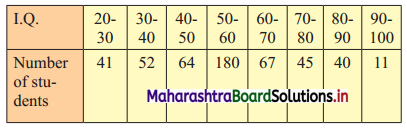
The I.Q. test of 500 students of a college is as follows:
Maharashtra Board 11th Commerce Maths Solutions Chapter 1 Partition Values Miscellaneous Exercise 1 Q9
Find graphically the number of students whose I.Q. is more than 55 graphically.
Solution:
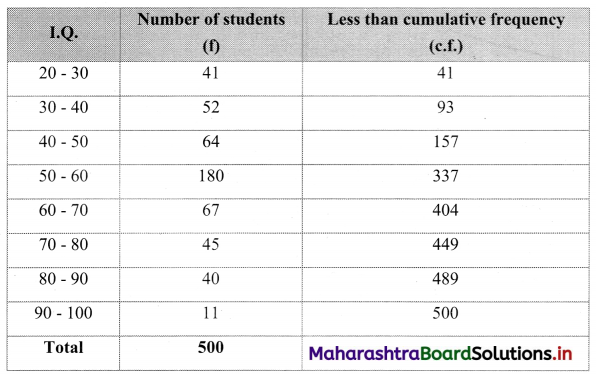
To draw an ogive curve, we construct the less than cumulative frequency table as given below:
Maharashtra Board 11th Commerce Maths Solutions Chapter 1 Partition Values Miscellaneous Exercise 1 Q9.1
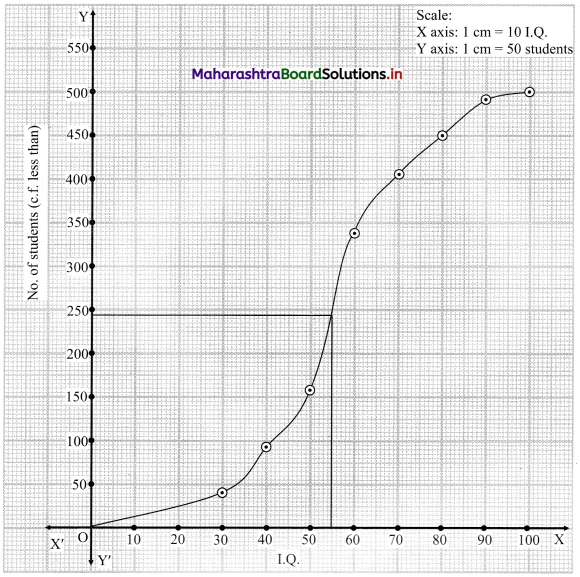
The points to be plotted for less than ogive are (30, 41), (40, 93), (50, 157), (60, 337), (70, 404), (80, 449), (90, 489), (100, 500)
Maharashtra Board 11th Commerce Maths Solutions Chapter 1 Partition Values Miscellaneous Exercise 1 Q9.2
To find the number of students whose I.Q. is more than 55, we consider the value 55 on the X-axis.
From this point, we draw a line that is parallel to Y-axis.
From the point this line intersects the less than ogive, we draw a perpendicular on the Y-axis.
The foot of perpendicular gives the number of students whose I.Q. is less than 55.
∴ The foot of perpendicular ~ 244
∴ No. of students whose I.Q. is less than 55 ~ 244
∴ No. of Students whose I.Q. is more than 55 = 500 – 244 = 256

Maharashtra Board 11th Commerce Maths Solutions Chapter 1 Partition Values Miscellaneous Exercise 1

Question 10.
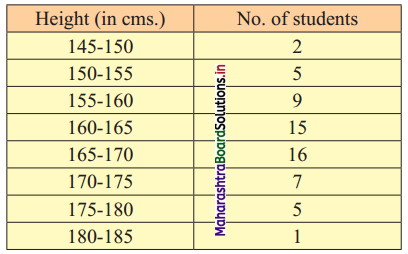
Draw an ogive for the following distribution. Determine the median graphically and verify your result by a mathematical formula.
Maharashtra Board 11th Commerce Maths Solutions Chapter 1 Partition Values Miscellaneous Exercise 1 Q10
Solution:
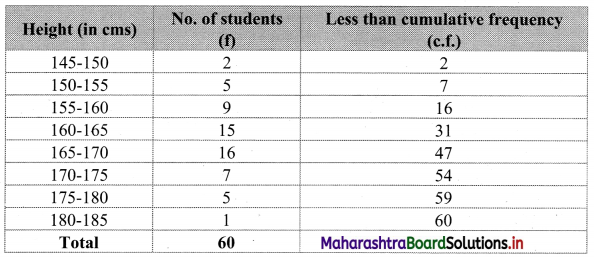
To draw an ogive curve, we construct the less than cumulative frequency table as given below:
Maharashtra Board 11th Commerce Maths Solutions Chapter 1 Partition Values Miscellaneous Exercise 1 Q10.1
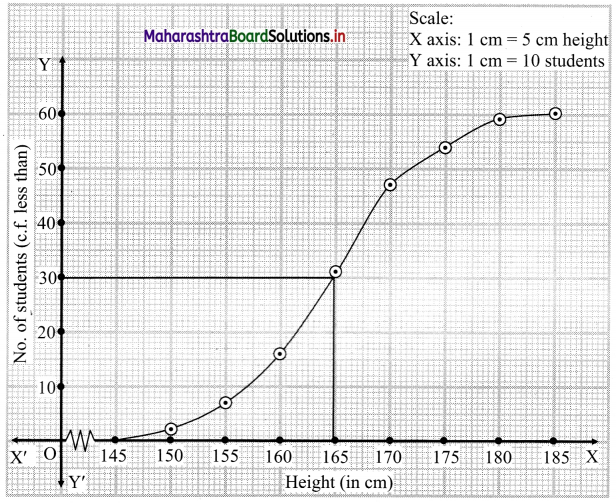
The points to be plotted for less than ogive are (150, 2), (155, 7), (160, 16), (165, 31), (170, 47), (175, 54), (180, 59) and (185, 60).
Maharashtra Board 11th Commerce Maths Solutions Chapter 1 Partition Values Miscellaneous Exercise 1 Q10.2
N = 60
∴ \(\frac{\mathrm{N}}{2}=\frac{60}{2}\) = 30
∴ We take the value 30 on the Y-axis and from this point, we draw a line parallel to X-axis.
From the point where this line intersects the less than ogive, we draw a perpendicular on X-axis.
The foot perpendicular gives the value of the median.
∴ Median ~ 164.67
Now, let us calculate the median from the mathematical formula.
∴ \(\frac{\mathrm{N}}{2}\) = 30
The median lies in the class interval 160 – 165.
∴ L = 160, h = 5, f = 15, c.f. = 16
Median = L + \(\frac{\mathrm{h}}{\mathrm{f}}\left(\frac{\mathrm{N}}{2}-\mathrm{c} . \mathrm{f} .\right)\)
= 160 + \(\frac{5}{15}\) (30 – 16)
= 160+ \(\frac{1}{3}\) × 14
= 160 + 4.67
= 164.67

Question 11.
In a group of 25 students, 7 students failed and 6 students got distinction and the marks of the remaining 12 students are 61, 36, 44, 59, 52, 56, 41, 37, 39, 38, 41, 64. Find the median marks of the whole group.
Solution:
n = 25
Median = \(\frac{\mathrm{n}+1}{2}=\frac{25+1}{2}\) = 13th observation
We have been stated that 7 students failed (assuming passing marks on 35) and 6 students got distinction (assuming distinction as 70+), and the marks of the remaining 12 students (who will be situated between the two groups mentioned above, if arranged in ascending order), we have,
F, F, F, F, F, F, F, 36, 37, 38, 39, 41, 41, 44, 52, 56, 59, 61, 64, D, D, D, D, D, D
∴ median = 13th observation = 41.

Maharashtra Board 11th Commerce Maths Solutions Chapter 1 Partition Values Miscellaneous Exercise 1

Question 12.
The median weight of a group of 79 students is found to be 55 kg. 6 more students are added to this group whose weights are 50, 51, 52, 59.5, 60, 61 kg. What will be the value of the median of the combined group if the lowest and the highest weights were 53 kg and 59 kg respectively?
Solution:
n = 79
Median = 55kg
Lowest observation = 53 kg
Flighest observation = 59 kg
6 new students are added to the group having weights in Kg as follows:
50, 51, 52, 59.5, 60, 61
From the above, we see that of the 6 new students, 3 have weights which are below the lowest weight of the earlier group and 3 have weights which are above the highest weight of the earlier group.
∴ the median remains the same
∴ median = 55 kg.

Question 13.
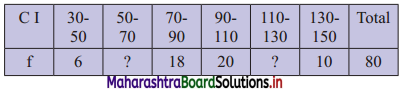
The median of the following incomplete table is 92. Find the missing frequencies:
Maharashtra Board 11th Commerce Maths Solutions Chapter 1 Partition Values Miscellaneous Exercise 1 Q13
Solution:
Let a and b be the missing frequencies of class 50 – 70 and class 110 – 130 respectively.
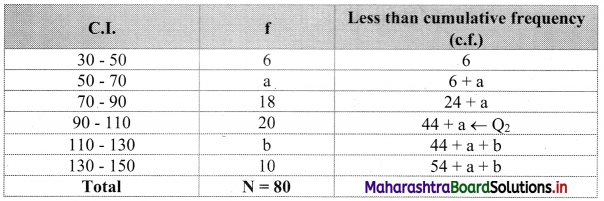
We construct the less than cumulative frequency table as given below:
Maharashtra Board 11th Commerce Maths Solutions Chapter 1 Partition Values Miscellaneous Exercise 1 Q13.1
Here, N = 54 + a + b
Since, N = 80
∴ 54 + a + b = 80
∴ a + b = 26 …..(i)
Given, Median = Q2 = 92
∴ Q2 lies in the class 90 – 110.
∴ L = 90, h = 20, f = 20, c.f. = 24 + a
\(\frac{2 \mathrm{~N}}{4}=\frac{2 \times 80}{4}\) = 40
∴ Q2 = L + \(\frac{h}{f}\left(\frac{2 N}{4}-\text { c.f. }\right)\)
∴ 92 = 90 + \(\frac{20}{20}\) [40 – (24 + a)
∴ 92 – 90 = 40 – 24 – a
∴ 2 = 16 – a
∴ a = 14
Substituting the value of a in equation (i), we get
14 + b = 26
∴ b = 26 – 14 = 12
∴ 14 and 12 are the missing frequencies of the class 50 – 70 and class 110 – 130 respectively.

Maharashtra Board 11th Commerce Maths Solutions Chapter 1 Partition Values Miscellaneous Exercise 1

Question 14.
A company produces tables which are packed in batches of 100. An analysis of the defective tubes in different batches has received the following information:
Maharashtra Board 11th Commerce Maths Solutions Chapter 1 Partition Values Miscellaneous Exercise 1 Q14
estimate the number of defective tubes in the central batch.
Solution:
To find the number of defective tubes in the central batch, we have to find Q2.
Since the given data is not continuous, we have to convert it into a continuous form by subtracting 0.5 from the lower limit and adding 0.5 to the upper limit of every class interval.
∴ the class intervals will be Less than 4.5, 4.5 – 9.5, etc.
We construct the less than cumulative frequency table as given below:
Maharashtra Board 11th Commerce Maths Solutions Chapter 1 Partition Values Miscellaneous Exercise 1 Q14.1
Here, N = 251
Q2 class = class containing \(\left(\frac{2 \mathrm{~N}}{4}\right)^{\mathrm{th}}\) observation
∴ \(\frac{2 \mathrm{~N}}{4}=\frac{2 \times 251}{4}\) = 125.5
Cumulative frequency which is just greater than (or equal to) 125.5 is 180.
∴ Q2 lies in the class 9.5 – 14.5.
∴ L = 9.5, h = 5, f = 84, c.f. = 96
∴ Q2 = L + \(\frac{\mathrm{h}}{\mathrm{f}}\left(\frac{2 \mathrm{~N}}{4}-\text { c.f. }\right)\)
= 9.5 + \(\frac{5}{84}\) (125.5 – 96)
= 9.5 + \(\frac{5}{84}\) × 29.5
= 9.5 + \(\frac{147.5}{84}\)
= 9.5 + 1.76
= 11.26

Question 15.
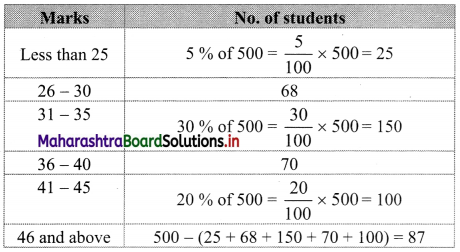
In a college, there are 500 students in junior college, 5% score less than 25 marks, 68 scores from 26 to 30 marks, 30% score from 31 to 35 marks, 70 scores from 36 to 40 marks, 20% score from 41 to 45 marks and the rest score 46 and above marks. What are the median marks?
Solution:
Given data can be written in tabulated form as follows:
Maharashtra Board 11th Commerce Maths Solutions Chapter 1 Partition Values Miscellaneous Exercise 1 Q15
Since the given data is not continuous, we have to convert it into the continuous form by subtracting 0.5 from the lower limit and adding 0.5 to the upper limit of every class interval.
∴ the class intervals will be Less than 25.5, 25.5 – 30.5, etc.
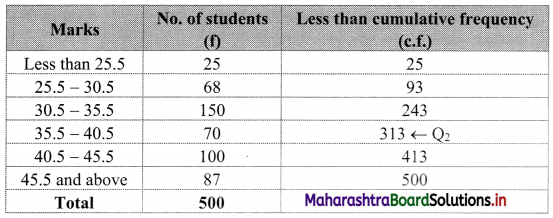
We construct the less than cumulative frequency table as given below:
Maharashtra Board 11th Commerce Maths Solutions Chapter 1 Partition Values Miscellaneous Exercise 1 Q15.1
Here, N = 500
Q2 class = class containing \(\left(\frac{2 \mathrm{~N}}{4}\right)^{\text {th }}\) observation
∴ \(\frac{2 \mathrm{~N}}{4}=\frac{2 \times 500}{4}\) = 250
Cumulative frequency which is just greater than (or equal to) 250 is 313.
∴ Q2 lies in the class 35.5 – 40.5.
∴ L = 35.5, h = 5, f = 70, c.f. = 243
∴ Median = Q2 = L + \(\frac{\mathrm{h}}{\mathrm{f}}\left(\frac{2 \mathrm{~N}}{4}-\text { c.f. }\right)\)
= 35.5 + \(\frac{5}{70}\) (250 – 243)
= 35.5 + \(\frac{1}{14}\) (7)
= 35.5 + 0.5
= 36

Maharashtra Board 11th Commerce Maths Solutions Chapter 1 Partition Values Miscellaneous Exercise 1

Question 16.
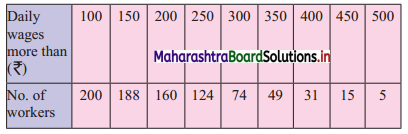
Draw a cumulative frequency curve more than typical for the following data and hence locate Q1 and Q3. Also, find the number of workers with daily wages
(i) Between ₹ 170 and ₹ 260
(ii) less than ₹ 260
Maharashtra Board 11th Commerce Maths Solutions Chapter 1 Partition Values Miscellaneous Exercise 1 Q16
Solution:
For more than ogive points to be plotted are (100, 200), (150, 188), (200, 160), (250, 124), (300, 74), (350, 49), (400, 31), (450, 15), (500, 5)
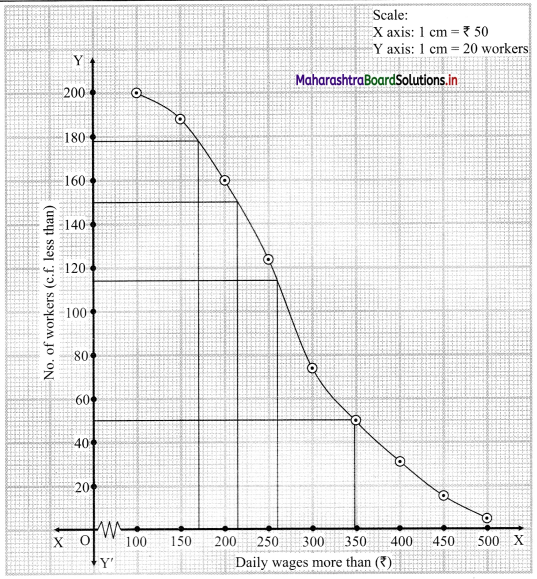
Maharashtra Board 11th Commerce Maths Solutions Chapter 1 Partition Values Miscellaneous Exercise 1 Q16.1
Here, N = 200
For Q1, \(\frac{\mathrm{N}}{4}=\frac{200}{4}\) = 4
For Q3, \(\frac{3 \mathrm{~N}}{4}=\frac{3 \times 200}{4}\) = 150
We take the points having Y co-ordinates 50 and 150 on Y-axis.
From these points, we draw lines which are parallel to X-axis.
From the points of intersection of these lines with the curve, we draw perpendicular on X-axis.
X-Co-ordinates of these points gives the values of Q1 and Q3.
Since X-axis has daily wages more than and not less than the given amounts.
∴ Q1 = Q3 and Q3 = Q1
∴ Q2 ~ 215 , Q3 ~ 348

(i) To find the number of workers with daily wages between ₹ 170 and ₹ 260,
Take the values 170 and 260 on X-axis. From these points, we draw lines parallel to Y-axis.
From the point where they intersect the more than ogive, we draw perpendiculars on Y-axis.
The points where they intersect the Y-axis gives the values 178 and 114.
∴ Number of workers having daily wages between ₹ 170 and ₹ 260 = 178 – 114 = 64

(ii) To find the number of workers having daily wages less than ₹ 260, we consider the value 260 on the X-axis.
From this point, we draw a line that is parallel to Y-axis.
From the point where the line intersects the more than ogive, we draw a perpendicular on the Y-axis.
The foot of perpendicular gives the number of workers having daily wages of more than 260.
The foot of perpendicular ~ 114
∴ No. of workers whose daily wages are more than ₹ 260 ~ 114
∴ No. of workers whose daily wages are less than ₹ 260 = 200 – 114 = 86

Question 17.
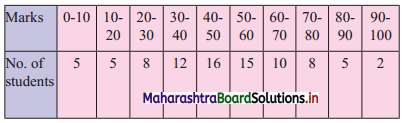
Draw ogive of both the types for the following frequency distribution and hence find the median.
Maharashtra Board 11th Commerce Maths Solutions Chapter 1 Partition Values Miscellaneous Exercise 1 Q17
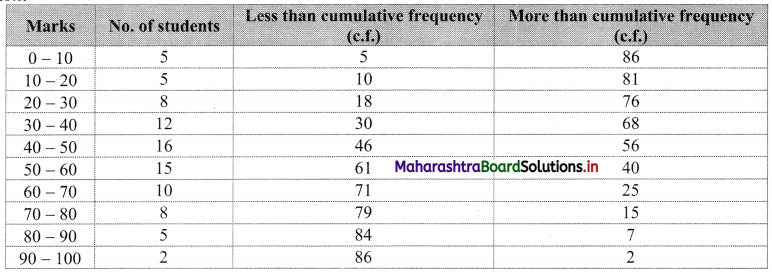
Solution:
Maharashtra Board 11th Commerce Maths Solutions Chapter 1 Partition Values Miscellaneous Exercise 1 Q17.1
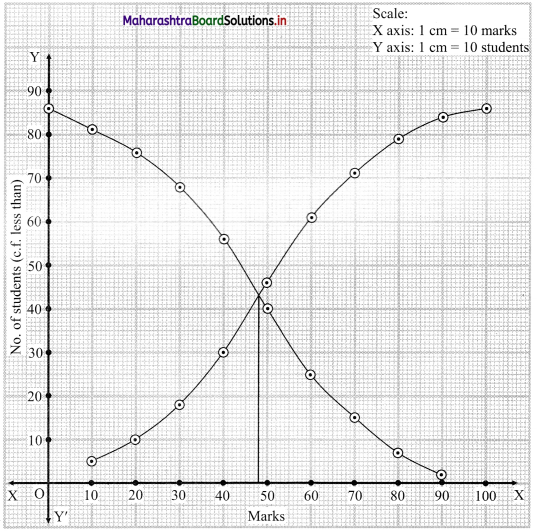
For less than given points to be plotted are (10, 5), (20, 10), (30, 18), (40, 30), (50, 46), (60, 61), (70, 71), (80, 79), (90, 84), (100, 86)
For more than given points to be plotted are (0, 86), (10, 81), (20, 76), (30, 68), (40, 56), (50, 40), (60, 25), (70, 15), (80, 7), (90, 2)
Maharashtra Board 11th Commerce Maths Solutions Chapter 1 Partition Values Miscellaneous Exercise 1 Q17.2
From the point of intersection of two ogives. We draw a perpendicular on X-axis.
The point where it meets the X-axis gives the value of the median.

Maharashtra Board 11th Commerce Maths Solutions Chapter 1 Partition Values Miscellaneous Exercise 1

Question 18.
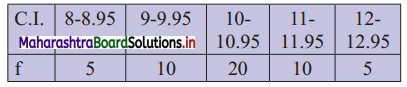
Find Q1, D6 and P78 for the following data:
Maharashtra Board 11th Commerce Maths Solutions Chapter 1 Partition Values Miscellaneous Exercise 1 Q18
Solution:
Since the given data is not in the form of a continuous frequency distribution, we have to convert it into that form by subtracting 0.025 from the lower limit and adding 0.025 to the upper limit of each class interval.
∴ the class intervals will be 7.975 – 8.975, 8.975 – 9.975, etc.
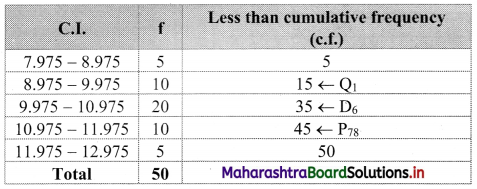
We construct the less than cumulative frequency table as given below:
Maharashtra Board 11th Commerce Maths Solutions Chapter 1 Partition Values Miscellaneous Exercise 1 Q18.1
Here, N = 50
Q1 class = class containing \(\left(\frac{\mathrm{N}}{4}\right)^{\text {th }}\) observation
∴ \(\frac{N}{4}=\frac{50}{4}\) = 12.5
Cumulative frequency which is just greater than (or equal) to 12.5 is 15.
∴ Q1 lies in the class 8.975 – 9.975.
∴ L = 8.975, h = 1, f = 10, c.f. = 5
Q1 = L + \(\frac{\mathrm{h}}{\mathrm{f}}\left(\frac{\mathrm{N}}{4}-\mathrm{c} . \mathrm{f} .\right)\)
= 8.975 + \(\frac{1}{10}\) (12.5 – 5)
= 8.975 + 0.1(7.5)
= 8.975 + 0.75
= 9.725
D6 class = class containing \(\left(\frac{6 \mathrm{~N}}{10}\right)^{\text {th }}\) observation
∴ \(\frac{6 \mathrm{~N}}{10}=\frac{6 \times 50}{10}\) = 30
Cumulative frequency which is just greater than (or equal) to 30 is 35.
∴ D6 lies in the class 9.975 – 10.975.
∴ L = 9.975, h = 1, f = 20, c.f. = 15
D6 = L + \(\frac{h}{f}\left(\frac{6 N}{10}-\text { c.f. }\right)\)
= 9.975 + \(\frac{1}{20}\) (30 – 15)
= 9.975 + 0.05(15)
= 9.975 + 0.75
= 10.725
P78 class = class containing \(\left(\frac{78 \mathrm{~N}}{100}\right)^{\text {th }}\) observation
\(\frac{78 \mathrm{~N}}{100}=\frac{78 \times 50}{100}\) = 39
Cumulative frequency which is just greater than (or equal) to 39 is 45.
∴ P78 lies in the class 10.975 – 11.975.
∴ L = 10.975, h = 1, f = 10, c.f. = 35
∴ P78 = L + \(\frac{\mathrm{h}}{\mathrm{f}}\left(\frac{78 \mathrm{~N}}{100}-\text { c.f. }\right)\)
= 10.975 + \(\frac{1}{10}\) (39 – 35)
= 10.975 + 0.1(4)
= 10.975 + 0.4
= 11.375

Question 19.
Maharashtra Board 11th Commerce Maths Solutions Chapter 1 Partition Values Miscellaneous Exercise 1 Q19
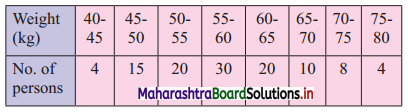
For the above data, find all quartiles and number of persons weighing between 57 kg and 72 kg.
Solution:
We construct the less than cumulative frequency table as given below:
Maharashtra Board 11th Commerce Maths Solutions Chapter 1 Partition Values Miscellaneous Exercise 1 Q19.1
Here, N = 111
Q1 class = class containing \(\left(\frac{\mathrm{N}}{4}\right)^{\text {th }}\) observation
∴ \(\frac{N}{4}=\frac{111}{4}\) = 27.75
Cumulative frequency which is just greater than (or equal) to 27.75 is 39.
∴ Q1 lies in the class 50 – 55.
∴ Q1 = L + \(\frac{\mathrm{h}}{\mathrm{f}}\left(\frac{\mathrm{N}}{4}-\text { c.f. }\right)\)
= 50 + \(\frac{5}{20}\) (27.75 – 19)
= 50 + \(\frac{1}{4}\) × 8.75
= 50 + 2.1875
= 52.1875
Q2 class = class containing \(\left(\frac{2 \mathrm{~N}}{4}\right)^{\mathrm{th}}\) observation
∴ \(\frac{2 N}{4}=\frac{2 \times 111}{4}\) = 55.5
Cumulative frequency which is just greater than (or equal) to 55.5 is 69.
∴ Q2 lies in the class 55 – 60.
∴ L = 55, h = 5, f = 30, c.f. = 39
∴ Q2 = L + \(\frac{h}{f}\left(\frac{2 N}{4}-\text { c.f. }\right)\)
= 55 + \(\frac{5}{30}\) (55.5 – 39)
= 55 + \(\frac{1}{6}\) × 16.5
= 55 + 2.75
= 57.75
Q3 class = class containing \(\left(\frac{3 \mathrm{~N}}{4}\right)^{\mathrm{th}}\) observation
∴ \(\frac{3 \mathrm{~N}}{4}=\frac{3 \times 111}{4}\) = 83.25
Cumulative frequency which is just greater than (or equal) to 83.25 is 89.
∴ Q3 lies in the class 60 – 65.
∴ L = 60, h = 5, f = 20, c.f. = 69
∴ Q3 = L + \(\frac{h}{f}\left(\frac{3 N}{4}-c . f .\right)\)
= 60 + \(\frac{5}{20}\) (83.25 – 69)
= 60 + \(\frac{1}{4}\) × 14.25
= 60 + 3.5625
= 63.5625
In order to find the number of persons between 57 kg and 72 kg,
We need to find x in Px, where Px = 57 kg and y in Py, where Py = 72 kg
Then (y – x) would be the % of persons weighing between 57 kg and 72 kg
Px = 57
∴ L + \(\frac{\mathrm{h}}{\mathrm{f}}\left(\frac{x \times \mathrm{N}}{100}-\mathrm{c} . \mathrm{f} .\right)\) = 57
∴ 55 + \(\frac{5}{30}\) (1.11x – 39) = 57
∴ \(\frac{1}{6}\) (1.11x – 39) = 2
∴ 1.11x – 39 = 12
∴ 1.11x = 51
∴ x = 45.95
∴ Py = 72
∴ L + \(\frac{\mathrm{h}}{\mathrm{f}}\left(\frac{y \times \mathrm{N}}{100}-\mathrm{c} . \mathrm{f} .\right)\) = 72
∴ 70 + \(\frac{5}{8}\) (1.11y – 99) = 72
∴ 0.625(1.11y – 99) = 2
∴ 1.11y – 99 = 3.2
∴ 1.11y = 102.2
∴ y = 92.07
∴ % of people weighing between 57 kg and 72 kg = 92.07 – 45.95 = 46.12 %
∴ No. of people weighing between 57 kg and 72 kg = 111 × 46.12% = 51.1932 ~ 51

Maharashtra Board 11th Commerce Maths Solutions Chapter 1 Partition Values Miscellaneous Exercise 1

Question 20.
For the following data showing weights of 100 employees, find the maximum weight of the lightest 25% of employees.
Maharashtra Board 11th Commerce Maths Solutions Chapter 1 Partition Values Miscellaneous Exercise 1 Q20
Solution:
We construct the less than cumulative frequency table as given below:
Maharashtra Board 11th Commerce Maths Solutions Chapter 1 Partition Values Miscellaneous Exercise 1 Q20.1
Here, N = 100
Q1 class = class containing \(\left(\frac{N}{4}\right)^{\text {th }}\) observation
∴ \(\frac{\mathrm{N}}{4}=\frac{100}{4}\) = 25
Cumulative frequency which is just greater than (or equal) to 25 is 29.
∴ Q1 lies in the class 55 – 60.
∴ L = 55, h = 5, f = 15, c.f. = 14
∴ Q1 = L + \(\frac{\mathrm{h}}{\mathrm{f}}\left(\frac{\mathrm{N}}{4}-\mathrm{c} . \mathrm{f} .\right)\)
= 55 + \(\frac{5}{15}\) (25 – 14)
= 55 + \(\frac{1}{3}\) × 11
= 55 + 3.67
= 58.67
∴ Maximum weight of the lightest 25% of employees is 58.67 kg.

Maharashtra Board 11th Commerce Maths Solutions Chapter 1 Partition Values Ex 1.3

Balbharati Maharashtra State Board 11th Commerce Maths Solution Book Pdf Chapter 1 Partition Values Ex 1.3 Questions and Answers.

Maharashtra State Board 11th Commerce Maths Solutions Chapter 1 Partition Values Ex 1.3

Question 1.
The following table gives the frequency distribution of marks of 100 students in an examination.
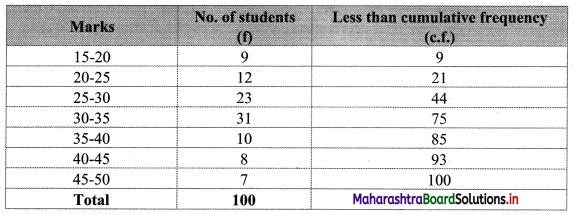
Maharashtra Board 11th Commerce Maths Solutions Chapter 1 Partition Values Ex 1.3 Q1
Determine D6, Q1, and P85 graphically.
Solution:
To draw an ogive curve, we construct the less than cumulative frequency table as given below:
Maharashtra Board 11th Commerce Maths Solutions Chapter 1 Partition Values Ex 1.3 Q1.1
The points to be plotted for less than ogive are (20, 9), (25, 21), (30, 44), (35, 75), (40, 85), (45, 93), (50, 100).
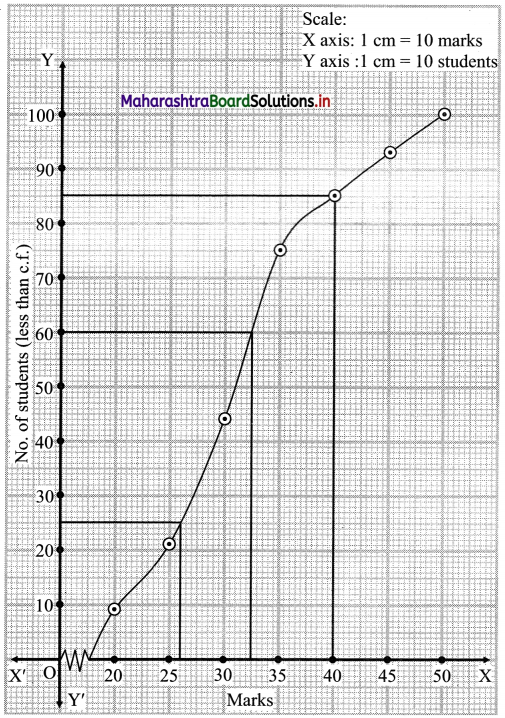
Maharashtra Board 11th Commerce Maths Solutions Chapter 1 Partition Values Ex 1.3 Q1.2
Here, N = 100
For D6, \(\frac{6 \mathrm{~N}}{10}=\frac{6 \times 100}{10}\) = 60
For Q1, \(\frac{\mathrm{N}}{4}=\frac{100}{4}\) = 25
For P85, \(\frac{85 \mathrm{~N}}{100}=\frac{85 \times 100}{100}\) = 85
∴ We take the points having Y co-ordinates 60, 25 and 85 on Y-axis.
From these points, we draw lines parallel to X-axis.
From the points where these lines intersect the curve, we draw perpendiculars on X-axis.
X co-ordinates of these points give the values of D6, Q1 and P85.
∴ D6 = 32.5, Q1 = 26, P85 = 40

Maharashtra Board 11th Commerce Maths Solutions Chapter 1 Partition Values Ex 1.3

Question 2.
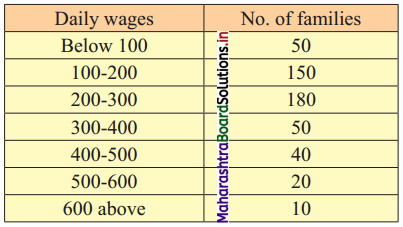
The following table gives the distribution of daily wages of 500 families in a certain city.
Maharashtra Board 11th Commerce Maths Solutions Chapter 1 Partition Values Ex 1.3 Q2
Draw a ‘less than’ ogive for the above data. Determine the median income and obtain the limits of income of central 50% of the families.
Solution:
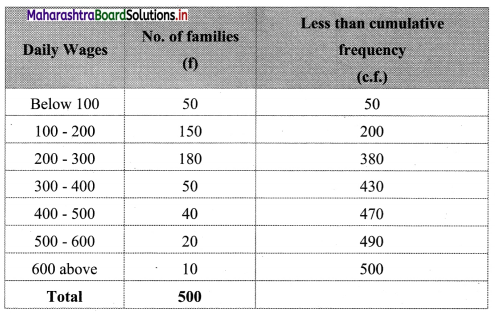
To draw an ogive curve, we construct the less than cumulative frequency table as given below:
Maharashtra Board 11th Commerce Maths Solutions Chapter 1 Partition Values Ex 1.3 Q2.1
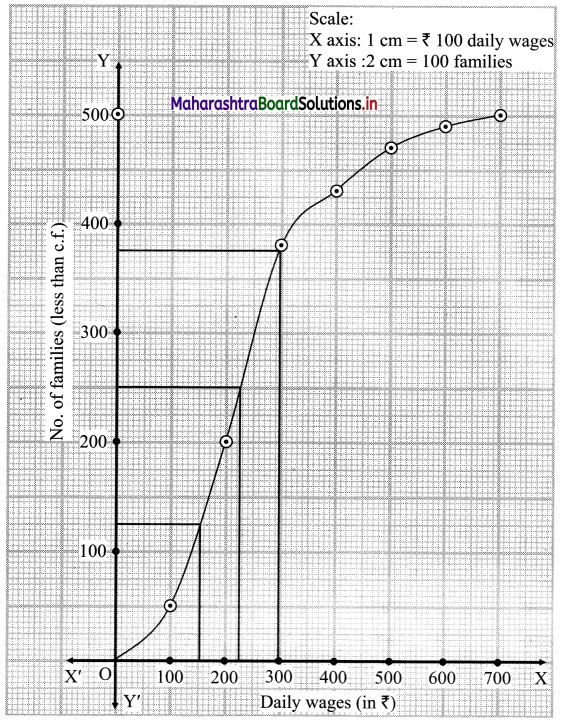
The points to be plotted for less than ogive are (100, 50), (200, 200), (300, 380), (400, 430), (500, 470), (600, 490) and (700, 500).
Maharashtra Board 11th Commerce Maths Solutions Chapter 1 Partition Values Ex 1.3 Q2.2
Here, N = 500
For Q1, \(\frac{\mathrm{N}}{4}=\frac{500}{4}\) = 125
For Q2, \(\frac{\mathrm{N}}{2}=\frac{500}{2}\) = 250
For Q3, \(\frac{3 \mathrm{~N}}{4}=\frac{3 \times 500}{4}\) = 375
∴ We take the points having Y co-ordinates 125, 250 and 375 on Y-axis.
From these points we draw lines parallel to X-axis.
From the points where these lines intersect the curve, we draw perpendiculars on X-axis.
X-Co-ordinates of these points give the values of Q1, Q2 and Q3.
∴ Q1 ~ 150, Q2 ~ 228, Q3 ~ 297
∴ Median = 228
50% families lie between Q1 and Q3
∴ Limits of income of central 50% families are from ₹ 150 to ₹ 297

Question 3.
From the following distribution, determine the median graphically.
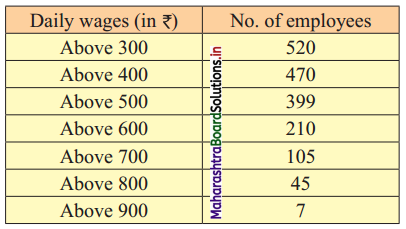
Maharashtra Board 11th Commerce Maths Solutions Chapter 1 Partition Values Ex 1.3 Q3
Solution:
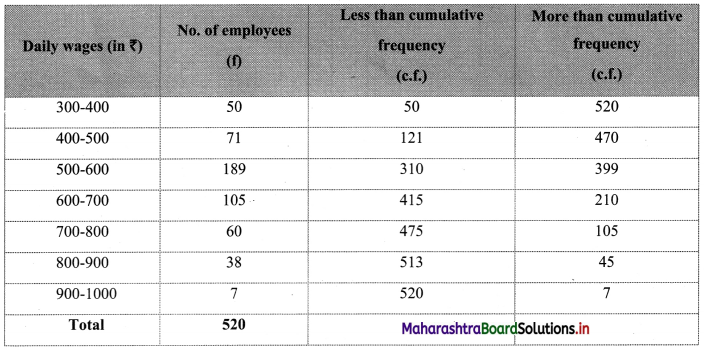
To draw an ogive curve, we construct the less than and more than cumulative frequency table as given below:
Maharashtra Board 11th Commerce Maths Solutions Chapter 1 Partition Values Ex 1.3 Q3.1
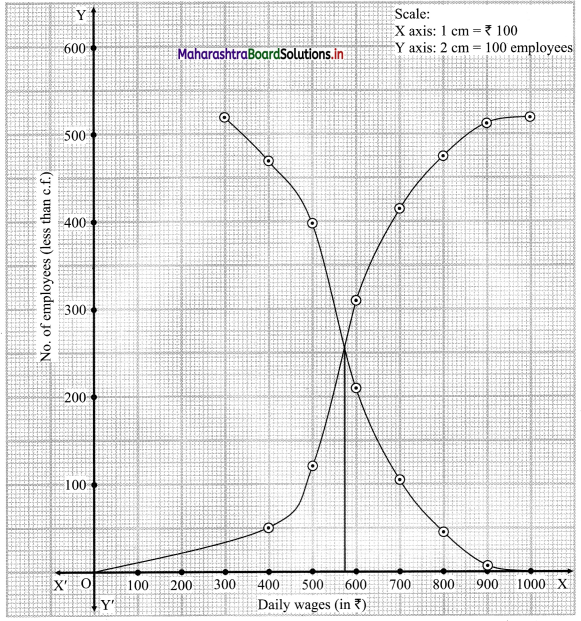
The points to be plotted for less than ogive are (400, 50), (500, 121), (600, 310), (700, 415), (800, 475), (900, 513) and (1000, 520) and that for more than ogive are (300, 520), (400, 470), (500, 399), (600, 210), (700, 105), (800, 45), (900, 7).
Maharashtra Board 11th Commerce Maths Solutions Chapter 1 Partition Values Ex 1.3 Q3.2
From the point of intersection of two ogives, we draw a perpendicular on X-axis.
The point where it meets the X-axis gives the value of the median.
∴ Median ~ 574

Maharashtra Board 11th Commerce Maths Solutions Chapter 1 Partition Values Ex 1.3

Question 4.
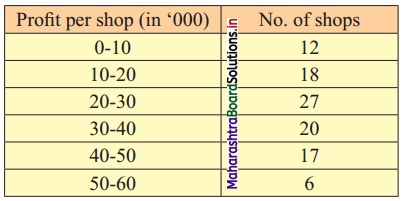
The following frequency distribution shows the profit (in ₹) of shops in a particular area of the city.
Maharashtra Board 11th Commerce Maths Solutions Chapter 1 Partition Values Ex 1.3 Q4
Find graphically
(i) the Unfits of middle 40% shops.
(ii) the number of shops having a profit of fewer than 35,000 rupees.
Solution:
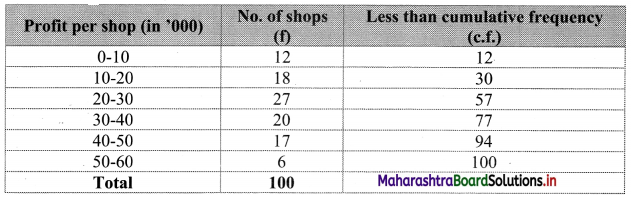
To draw an ogive curve, we construct a less than cumulative frequency table as given below:
Maharashtra Board 11th Commerce Maths Solutions Chapter 1 Partition Values Ex 1.3 Q4.1
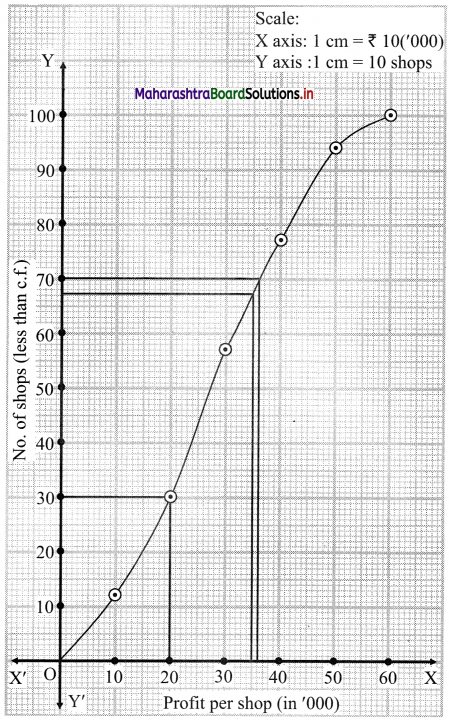
Points to be plotted are (10, 12), (20, 30), (30, 57), (40, 77), (50, 94), (60, 100).
Maharashtra Board 11th Commerce Maths Solutions Chapter 1 Partition Values Ex 1.3 Q4.2
The Middle 40% value lies in between P30 and P70.
N = 100
For P30 = \(\frac{30 \mathrm{~N}}{100}=\frac{30 \times 100}{100}\) = 30
For P70 = \(\frac{70 \mathrm{~N}}{100}=\frac{70 \times 100}{100}\) = 70
∴ We take the points having Y co-ordinates 30 and 70 on Y-axis. From these points we draw lines parallel to X-axis.
From the points where these lines intersect the curve, we draw perpendiculars on X-axis.
X-Co-ordinates of these points give the values of P30 and P70.
∴ P30 ~ 20, P70 ~ 36
Limits of middle 40% shops lie between ₹ 20,000 to ₹ 36,000
To find the number of shops having a profit of less than ₹ 35,000, we take the value 35 on the X-axis.
From this point, we draw a line parallel to Y-axis, and from the point where it intersects the less than ogive we draw a perpendicular on Y-axis. It intersects the Y-axis at approximately 67.
∴ No. of shops having profit less than ₹ 35,000 is 67.

Question 5.
The following is the frequency distribution of overtime (per week) performed by various workers from a certain company. Determine the values of D2, Q2, and P61 graphically.
Maharashtra Board 11th Commerce Maths Solutions Chapter 1 Partition Values Ex 1.3 Q5
Solution:
To draw an ogive curve, we construct a less than cumulative frequency table as given below:
Maharashtra Board 11th Commerce Maths Solutions Chapter 1 Partition Values Ex 1.3 Q5.1
Points to be plotted are (8, 4), (12, 12), (16, 28), (20, 46), (24, 66) and (28, 80)
Here, N = 80
Maharashtra Board 11th Commerce Maths Solutions Chapter 1 Partition Values Ex 1.3 Q5.2
For D2, we have to consider \(\frac{2 \mathrm{~N}}{10}=\frac{2 \times 80}{10}\) = 16
For Q2, we have to consider \(\frac{\mathrm{N}}{2}=\frac{80}{2}\) = 40
and for P61, we have to consider \(\frac{61 \mathrm{~N}}{100}=\frac{61 \times 80}{100}\) = 48.8
∴ We consider the values 16, 40 and 48.8 on the Y-axis.
From these points, we draw the lines which are parallel to the X-axis.
From the points where they intersect the less than ogive, we draw perpendiculars to X-axis.
The values at the foot of perpendiculars represent the values of D2, Q2, and P61 respectively.
∴ D2 ~ 13, Q2 ~ 19, P61 ~ 20.5

Maharashtra Board 11th Commerce Maths Solutions Chapter 1 Partition Values Ex 1.3

Question 6.
Draw ogive for the following data and hence find the values of D1, Q1, and P40.
Maharashtra Board 11th Commerce Maths Solutions Chapter 1 Partition Values Ex 1.3 Q6
Solution:
N = 100
To draw the less than ogive we have to plot the points (10, 4), (20, 6), (30, 24), (40, 46), (50, 67), (60, 86), (70, 96), (80, 99), (90, 100).
Maharashtra Board 11th Commerce Maths Solutions Chapter 1 Partition Values Ex 1.3 Q6.1
For D1, we have to consider \(\frac{\mathrm{N}}{10}=\frac{100}{10}\) = 10
For Q1, we have to consider \(\frac{\mathrm{N}}{4}=\frac{100}{4}\) = 25
For P40, we have to consider \(\frac{40 \mathrm{~N}}{100}=\frac{40 \times 100}{100}\) = 40
∴ We consider the values 10, 25 and 40 on the Y-axis. From these points we draw lines parallel to X-axis.
From the points where they intersect the less than ogive, we draw perpendiculars on the X-axis.
The values at the foot of perpendicular represent the values of D1, Q1 and P40 respectively.
∴ D1 ~ 22, Q1 ~ 30.5, P40 ~ 37

Question 7.
The following table shows the age distribution of heads of the families in a certain country. Determine the third, fifth, and eighth decile of the distribution graphically.
Maharashtra Board 11th Commerce Maths Solutions Chapter 1 Partition Values Ex 1.3 Q7
Solution:
To draw an ogive curve, we construct a less than cumulative frequency table as given below:
Maharashtra Board 11th Commerce Maths Solutions Chapter 1 Partition Values Ex 1.3 Q7.1
Points to be plotted are (35, 46), (45, 131), (55, 195), (65, 270), (75, 360), (85, 400).
Maharashtra Board 11th Commerce Maths Solutions Chapter 1 Partition Values Ex 1.3 Q7.2
N = 400
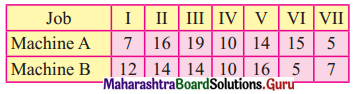
For D3, we have to consider \(\frac{3 \mathrm{~N}}{10}=\frac{3 \times 400}{10}\) = 120
For D5, we have to consider \(\frac{5 \mathrm{~N}}{10}=\frac{5 \times 400}{10}\) = 200

For D8, we have to consider \(\frac{8 \mathrm{~N}}{10}=\frac{8 \times 400}{10}\) = 320
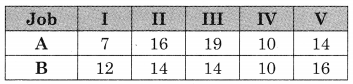
∴ We consider the values 120, 200 and 320 on Y-axis. From these points we draw the lines parallel to X-axis.
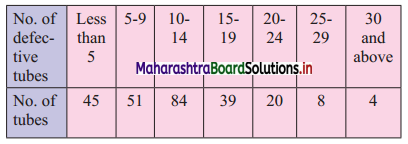
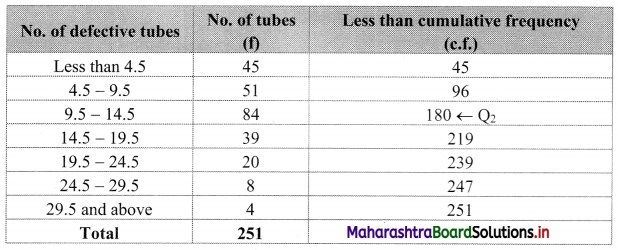
From the points where they intersect the less than ogive, we draw perpendiculars on the X-axis.
The foot of perpendicular represent the values of D3, D5 and D8.
∴ D3 ~ 44, D5 ~ 55.5 and D8 ~ 70

Maharashtra Board 11th Commerce Maths Solutions Chapter 1 Partition Values Ex 1.3

Question 8.
The following table gives the distribution of females in an Indian village. Determine the median age graphically.
Maharashtra Board 11th Commerce Maths Solutions Chapter 1 Partition Values Ex 1.3 Q8
Solution:
To draw an ogive curve, we construct the less than cumulative frequency table as given below:
Maharashtra Board 11th Commerce Maths Solutions Chapter 1 Partition Values Ex 1.3 Q8.1
Maharashtra Board 11th Commerce Maths Solutions Chapter 1 Partition Values Ex 1.3 Q8.2
Points to be plotted are (10, 175), (20, 275), (30, 343), (40, 391), (50, 416), (60, 466), (70, 489), (80, 497), (90, 499), (100, 500).
Maharashtra Board 11th Commerce Maths Solutions Chapter 1 Partition Values Ex 1.3 Q8.3
N = 500
For median we have to consider \(\frac{\mathrm{N}}{2}=\frac{500}{2}\) = 250
∴ We consider the value 250 on Y-axis. From this point, we draw a line parallel to X-axis.
From the point it intersects the less than ogive, we draw a perpendicular to X-axis.
The foot perpendicular represents the value of the median.
∴ Median ~ 17.5

Question 9.
Draw ogive for the following distribution and hence find graphically the limits of the weight of middle 50% fishes.
Maharashtra Board 11th Commerce Maths Solutions Chapter 1 Partition Values Ex 1.3 Q9
Solution:
Since the given data is not continuous, we have to convert it into the continuous form by subtracting 5 from the lower limit and adding 5 to the upper limit of every class interval.
To draw an ogive curve, we construct the less than cumulative frequency table as given below:
Maharashtra Board 11th Commerce Maths Solutions Chapter 1 Partition Values Ex 1.3 Q9.1
Points to be plotted are (895, 8), (995, 24), (1095, 44), (1195, 69), (1295, 109), (1395, 115), (1495, 120).
Maharashtra Board 11th Commerce Maths Solutions Chapter 1 Partition Values Ex 1.3 Q9.2
N = 120
For Q1 and Q3 we have to consider
\(\frac{\mathrm{N}}{4}=\frac{120}{4}\) = 30
\(\frac{3 \mathrm{~N}}{4}=\frac{3 \times 120}{4}\) = 90
For finding Q1 and Q3 we consider the values 30 and 90 on the Y-axis.
From these points, we draw the lines which are parallel to X-axis.
From the points where these lines intersect the less than ogive, we draw perpendicular on X-axis.
The feet of perpendiculars represent the values Q1 and Q2.
∴ Q1 ~ 1025 and Q3 ~ 1248
∴ the limits of the weight of the middle 50% of fishes lie between 1025 to 1248.

Maharashtra Board 11th Commerce Maths Solutions Chapter 1 Partition Values Ex 1.3

Question 10.
Find graphically the values of D3 and P65 for the data given below:
Maharashtra Board 11th Commerce Maths Solutions Chapter 1 Partition Values Ex 1.3 Q10
Solution:
Since the given data is not continuous, we have to convert it into a continuous form by subtracting 0.5 from the lower limit and adding 0.5 to the upper limit of every class interval.
To draw an ogive curve, we construct the less than cumulative frequency table as given below:
Maharashtra Board 11th Commerce Maths Solutions Chapter 1 Partition Values Ex 1.3 Q10.1
Points to be plotted are (69.5, 20), (79.5, 60), (89.5, 110), (99.5, 160), (109.5, 180), (119.5, 190), (129.5, 200).
Maharashtra Board 11th Commerce Maths Solutions Chapter 1 Partition Values Ex 1.3 Q10.2
N = 200
For D3, \(\frac{3 \mathrm{N}}{10}=\frac{3 \times 200}{10}\) = 60
For P65, \(\frac{65 \mathrm{N}}{100}=\frac{65 \times 200}{100}\) = 130
∴ We take the values 60 and 130 on the Y-axis.
From these points we draw lines parallel to X-axis and from the points where these lines intersect less than ogive, we draw perpendiculars on X-axis.
The foot of perpendiculars represents the median of the values, D3 and P65.
∴ D3 = 79.5, P65 = 93.5

Maharashtra Board 11th Commerce Maths Solutions Chapter 6 Determinants Ex 6.3

Balbharati Maharashtra State Board 11th Commerce Maths Solution Book Pdf Chapter 6 Determinants Ex 6.3 Questions and Answers.

Maharashtra State Board 11th Commerce Maths Solutions Chapter 6 Determinants Ex 6.3

Question 1.
Solve the following equations using Cramer’s Rule.
(i) x + 2y – z = 5, 2x – y + z = 1, 3x + 3y = 8
Solution:
Given equations are
x + 2y – z = 5
2x – y + z = 1
3x + 3y = 8 i.e. 3x + 3y + 0z = 8
∴ D = \(\left|\begin{array}{ccc}
1 & 2 & -1 \\
2 & -1 & 1 \\
3 & 3 & 0
\end{array}\right|\)
= 1(0 – 3) – 2(0 – 3) – 1(6 + 3)
= -3 + 6 – 9
= -6
Dx = \(\left|\begin{array}{ccc}
5 & 2 & -1 \\
1 & -1 & 1 \\
8 & 3 & 0
\end{array}\right|\)
= 5(0 – 3) – 2(0 – 8) + (-1)(3 + 8)
= -15 + 16 – 11
= -10
Dy = \(\left|\begin{array}{ccc}
1 & 5 & -1 \\
2 & 1 & 1 \\
3 & 8 & 0
\end{array}\right|\)
= 1(0 – 8) – 5(0 – 3) + 1(16 – 3)
= -8 + 15 – 13
= -6
Dz = \(\left|\begin{array}{ccc}
1 & 2 & 5 \\
2 & -1 & 1 \\
3 & 3 & 8
\end{array}\right|\)
= 1(-8 – 3) – 2(16 – 3) + 5(6 + 3)
= -11 – 26 + 45
= 8
By Cramer’s Rule,
Maharashtra Board 11th Commerce Maths Solutions Chapter 6 Determinants Ex 6.3 Q1(i)
x = \(\frac{5}{3}\), y = 1 and z = \(\frac{-4}{3}\) are the solutions of the given equations.

Check:
We can check if our answer is right or wrong.
In order to do so, substitute the values of x, y and z in the given equations.
x = \(\frac{5}{3}\), y = 1 and z = \(\frac{-4}{3}\) satisfy the given equations.
If either one of the equations is not satisfied, then our answer is wrong.
If x = \(\frac{5}{3}\), y = 1 and z = \(\frac{-4}{3}\) are the solutions of the given equations.
L.H.S. = x + 2y – z
= \(\frac{5}{3}+2-\frac{4}{3}\)
= \(\frac{7}{3}\)
≠ R.H.S.
L.H.S. = 2x – y + z
= \(\frac{10}{3}-1+\frac{4}{3}\)
= \(\frac{11}{3}\)
≠ R.H.S.
L.H.S. = 3x + 3y
= 5 + 3
= 8
= R.H.S.

Maharashtra Board 11th Commerce Maths Solutions Chapter 6 Determinants Ex 6.3

(ii) 2x – y + 6z = 10, 3x + 4y – 5z = 11, 8x – 7y – 9z = 12
Solution:
Given equations are
2x – y + 6z = 10
3x + 4y – 5z = 11
8x – 7y – 9z = 12
∴ D = \(\left|\begin{array}{ccc}
2 & -1 & 6 \\
3 & 4 & -5 \\
8 & -7 & -9
\end{array}\right|\)
= 2(-36 – 35) – (-1)(-27 + 40) + 6(-21 – 32)
= -142 + 13 – 318
= -447
Dx = \(\left|\begin{array}{ccc}
10 & -1 & 6 \\
11 & 4 & -5 \\
12 & -7 & -9
\end{array}\right|\)
= 10(-36 – 35) – (-1)(-99 + 60) + 6(-77 – 48)
= -710 – 39 – 750
= -1499
Dy = \(\left|\begin{array}{ccc}
2 & 10 & 6 \\
3 & 11 & -5 \\
8 & 12 & -9
\end{array}\right|\)
= 2(-99 + 60) – 10(-27 + 40) + 6(36 – 88)
= -78 – 130 – 312
= -520
Dz = \(\left|\begin{array}{ccc}
2 & -1 & 10 \\
3 & 4 & 11 \\
8 & -7 & 12
\end{array}\right|\)
= 2(48 + 77) – (-1)(36 – 88) + 10(-21 – 32)
= 250 – 52 – 530
= -332
By Cramer’s Rule,
Maharashtra Board 11th Commerce Maths Solutions Chapter 6 Determinants Ex 6.3 Q1(ii)
∴ x = \(\frac{1499}{447}\), y = \(\frac{520}{447}\) and z = \(\frac{332}{447}\) are the solutions of the given equations.

(iii) 11x – y – z = 31, x – 6y + 2z = -26, x + 2y – 7z = -24
Solution:
Given equations are
11x – y – z = 31
x – 6y + 2z = -26
x + 2y – 7z = -24
D = \(\left|\begin{array}{ccc}
11 & -1 & -1 \\
1 & -6 & 2 \\
1 & 2 & -7
\end{array}\right|\)
= 11(42 – 4) – (-1)(-7 – 2) + (-1)(2 + 6)
= 418 – 9 – 8
= 401
Dx = \(\left|\begin{array}{ccc}
31 & -1 & -1 \\
-26 & -6 & 2 \\
-24 & 2 & -7
\end{array}\right|\)
= 31(42 – 4) – (-1)(182 + 48) + (-1)(-52 – 144)
= 1178 + 230 + 196
= 1604
Dy = \(\left|\begin{array}{ccc}
11 & 31 & -1 \\
1 & -26 & 2 \\
1 & -24 & -7
\end{array}\right|\)
= 11(182 + 48) – 31(-7 – 2) + (-1)(-24 + 26)
= 2530 + 279 – 2
= 2807
Dz = \(\left|\begin{array}{ccc}
11 & -1 & 31 \\
1 & -6 & -26 \\
1 & 2 & -24
\end{array}\right|\)
= 11(144 + 52) – (-1)(-24 + 26) + 31(2 + 6)
= 2156 + 2 + 248
= 2406
By Cramer’s Rule,
Maharashtra Board 11th Commerce Maths Solutions Chapter 6 Determinants Ex 6.3 Q1(iii)
∴ x = 4, y = 7 and z = 6 are the solutions of the given equations.

Maharashtra Board 11th Commerce Maths Solutions Chapter 6 Determinants Ex 6.3

(iv) \(\frac{1}{x}+\frac{1}{y}+\frac{1}{z}=-2\), \(\frac{1}{x}-\frac{2}{y}+\frac{1}{z}=3\), \(\frac{2}{x}-\frac{1}{y}+\frac{3}{z}=-1\)
Solution:
Let \(\frac{1}{x}\) = p, \(\frac{1}{y}\) = q, \(\frac{1}{z}\) = r
The given equations become
p + q + r = -2
p – 2q + r = 3
2p – q + 3r = -1
D = \(\left|\begin{array}{ccc}
1 & 1 & 1 \\
1 & -2 & 1 \\
2 & -1 & 3
\end{array}\right|\)
= 1(-6 + 1) – 1(3 – 2) + 1(-1 + 4)
= -5 – 1 + 3
= -3
Dp = \(\left|\begin{array}{rrr}
-2 & 1 & 1 \\
3 & -2 & 1 \\
-1 & -1 & 3
\end{array}\right|\)
= -2(-6 + 1) – 1(9 + 1) + 1(-3 – 2)
= 10 – 10 – 5
= -5
Dq = \(\left|\begin{array}{ccc}
1 & -2 & 1 \\
1 & 3 & 1 \\
2 & -1 & 3
\end{array}\right|\)
= 1(9 + 1) + 2(3 – 2) + 1(-1 – 6)
= 10 + 2 – 7
= 5
Dr = \(\left|\begin{array}{rrr}
1 & 1 & -2 \\
1 & -2 & 3 \\
2 & -1 & -1
\end{array}\right|\)
= 1(2 + 3) – 1(-1 – 6) – 2(-1 + 4)
= 5 + 7 – 6
= 6
By Cramer’s Rule,
Maharashtra Board 11th Commerce Maths Solutions Chapter 6 Determinants Ex 6.3 Q1(iv)
∴ x = \(\frac{3}{5}\), y = \(\frac{-3}{5}\), z = \(\frac{-1}{2}\) are the solutions of the given equations.

(v) \(\frac{2}{x}-\frac{1}{y}+\frac{3}{z}=4, \frac{1}{x}-\frac{1}{y}+\frac{1}{z}=2, \frac{3}{x}+\frac{1}{y}-\frac{1}{z}=2\)
Solution:
Let \(\frac{1}{x}\) = p, \(\frac{1}{y}\) = q, \(\frac{1}{z}\) = r
The given equations become
2p – q – 3r = 4
p – q + r = 2
3p + q – r = 2
D = \(\left|\begin{array}{ccc}
2 & -1 & 3 \\
1 & -1 & 1 \\
3 & 1 & -1
\end{array}\right|\)
= 2(1 – 1) – (-1)(-1 – 3) + 3(1 + 3)
= 0 – 4 + 12
= 8
Dp = \(\left|\begin{array}{ccc}
4 & -1 & 3 \\
2 & -1 & 1 \\
2 & 1 & -1
\end{array}\right|\)
= 4(1 – 1) – (-1)(-2 – 2) + 3(2 + 2)
= 0 – 4 + 12
= 8
Dq = \(\left|\begin{array}{ccc}
2 & 4 & 3 \\
1 & 2 & 1 \\
3 & 2 & -1
\end{array}\right|\)
= 2(-2 – 2) – 4(-1 – 3) + 3(2 – 6)
= -8 + 16 – 12
= -4
Dr = \(\left|\begin{array}{ccc}
2 & -1 & 4 \\
1 & -1 & 2 \\
3 & 1 & 2
\end{array}\right|\)
= 2(-2 – 2) – (-1)(2 – 6) + 4(1 + 3)
= -8 – 4 + 16
= 4
By Cramer’s Rule,
Maharashtra Board 11th Commerce Maths Solutions Chapter 6 Determinants Ex 6.3 Q1(v)
∴ x = 1, y = -2 and z = 2 are the solutions of the given equations.

Maharashtra Board 11th Commerce Maths Solutions Chapter 6 Determinants Ex 6.3

Question 2.
An amount of ₹ 5,000 is invested in three plans at rates 6%, 7% and 8% per annum respectively. The total annual income from these investments is ₹ 350. If the total annual income from first two investments is ₹ 70 more than the income from the third, find the amount invested in each plan by using Cramer’s Rule.
Solution:
Let the amount of each investment be ₹ x, ₹ y and ₹ z.
According to the given conditions,
x + y + z = 5000
6%x + 7%y + 8%z = 350
∴ \(\frac{6}{100} x+\frac{7}{100} y-\frac{8}{100} z=350\)
∴ 6x + 7y + 8z = 35000
6%x + 7%y = 8%z + 70
∴ \(\frac{6}{100} x+\frac{7}{100} y=\frac{8}{100} z+70\)
∴ 6x + 7y = 8z + 7000
∴ 6x + 7y – 8z = 7000
Maharashtra Board 11th Commerce Maths Solutions Chapter 6 Determinants Ex 6.3 Q2
Maharashtra Board 11th Commerce Maths Solutions Chapter 6 Determinants Ex 6.3 Q2.1
Maharashtra Board 11th Commerce Maths Solutions Chapter 6 Determinants Ex 6.3 Q2.2
∴ Amounts of investments are ₹ 1750, ₹ 1500, and ₹ 1750.

Check:
First condition:
1750 + 1500 + 1750 = 5000
Second condition:
6% of 1750 + 7% of 1500 + 8% of 1750
= 105 + 105 + 140
= 350
Third condition:
Combined income = 105 + 105
= 210
= 140 + 70
Thus, all the conditions are satisfied.

Question 3.
Show that the following equations are consistent.
2x + 3y + 4 = 0, x + 2y + 3 = 0, 3x + 4y + 5 = 0
Solution:
Given equations are
2x + 3y + 4 = 0
x + 2y + 3 = 0
3x + 4y + 5 = 0
∴ \(\left|\begin{array}{lll}
2 & 3 & 4 \\
1 & 2 & 3 \\
3 & 4 & 5
\end{array}\right|\)
= 2(10 – 12) – 3(5 – 9) + 4(4 – 6)
= 2(-2) – 3(-4) + 4(-2)
= -4 + 12 – 8
= 0
∴ The given equations are consistent.

Maharashtra Board 11th Commerce Maths Solutions Chapter 6 Determinants Ex 6.3

Question 4.
Find k, if the following equations are consistent.
(i) x + 3y + 2 = 0, 2x + 4y – k = 0, x – 2y – 3k = 0
Solution:
Given equations are
x + 3y + 2 = 0
2x + 4y – k = 0
x – 2y – 3k = 0
Since, these equations are consistent.
∴ \(\left|\begin{array}{ccc}
1 & 3 & 2 \\
2 & 4 & -k \\
1 & -2 & -3 k
\end{array}\right|=0\)
∴ 1(-12k – 2k) – 3(-6k + k) + 2(-4 – 4) = 0
∴ -14k + 15k – 16 = 0
∴ k – 16 = 0
∴ k = 16
Check:
If the value of k satisfies the condition for the given equations to be consistent, then our answer is correct.
Substitute k = 16 in the given equation.
\(\left|\begin{array}{ccc}
1 & 3 & 2 \\
2 & 4 & -16 \\
1 & -2 & -48
\end{array}\right|\)
= 1(-192 – 32) – 3(-96 + 16) + 2(-4 – 4)
= 0
Thus, our answer is correct.

(ii) (k – 2)x + (k – 1)y = 17, (k – 1)x + (k – 2)y = 18, x + y = 5
Solution:
Given equations are
(k – 2)x + (k – 1)y = 17
(k – 1)x + (k – 2)y = 18
x + y = 5
Since, these equations are consistent.
∴ \(\left|\begin{array}{ccc}
k-2 & k-1 & -17 \\
k-1 & k-2 & -18 \\
1 & 1 & -5
\end{array}\right|=0\)
Applying R1 → R1 – R2, we get
\(\left|\begin{array}{ccc}
-1 & 1 & 1 \\
k-1 & k-2 & -18 \\
1 & 1 & -5
\end{array}\right|=0\)
∴ -1(-5k + 10 + 18) – 1(-5k + 5 + 18) + 1(k – 1 – k + 2) = 0
∴ -1(-5k – 28) – 1(- 5k + 23) + 1(1) = 0
∴ 5k – 28 + 5k – 23 – 1 = 0
∴ 10k – 50 = 0
∴ k = 5

Question 5.
Find the area of the triangle whose vertices are:
(i) (4, 5), (0, 7), (-1, 1)
Solution:
Here, A(x1, y1) ≡ A(4, 5), B(x2, y2) ≡ B(0, 7), C(x3, y3) ≡ C(-1, 1)
Area of a triangle = \(\frac{1}{2}\left|\begin{array}{lll}
x_{1} & y_{1} & 1 \\
x_{2} & y_{2} & 1 \\
x_{3} & y_{3} & 1
\end{array}\right|\)
∴ A(ΔABC) = \(\frac{1}{2}\left|\begin{array}{ccc}
4 & 5 & 1 \\
0 & 7 & 1 \\
-1 & 1 & 1
\end{array}\right|\)
= \(\frac{1}{2}\) [4(7 – 1) – 5(0 + 1) + 1(0 + 7)]
= \(\frac{1}{2}\) (24 – 5 + 7)
= 13 sq.units.

(ii) (3, 2), (-1, 5), (-2, -3)
Solution:
Here, A(x1, y1) ≡ A(3, 2), B(x2, y2) = B(-1, 5), C(x3, y3) ≡ C(-2, -3)
Area of a triangle = \(\frac{1}{2}\left|\begin{array}{lll}
x_{1} & y_{1} & 1 \\
x_{2} & y_{2} & 1 \\
x_{3} & y_{3} & 1
\end{array}\right|\)
∴ A(ΔABC) = \(\frac{1}{2}\left|\begin{array}{ccc}
3 & 2 & 1 \\
-1 & 5 & 1 \\
-2 & -3 & 1
\end{array}\right|\)
= \(\frac{1}{2}\) [3(5 + 3) – 2(-1 + 2) + 1(3 + 10)]
= \(\frac{1}{2}\) (24 – 2 + 13)
= \(\frac{35}{2}\) sq. units

Maharashtra Board 11th Commerce Maths Solutions Chapter 6 Determinants Ex 6.3

(iii) (0, 5), (0, -5), (5, 0)
Solution:
Here, A(x1, y1) ≡ A(0, 5), B(x2, y2) ≡ B(0, -5), C(x3, y3) ≡ C(5,0)
Area of a triangle = \(\left|\begin{array}{lll}
x_{1} & y_{1} & 1 \\
x_{2} & y_{2} & 1 \\
x_{3} & y_{3} & 1
\end{array}\right|\)
∴ A(ΔABC) = \(\frac{1}{2}\left|\begin{array}{ccc}
0 & 5 & 1 \\
0 & -5 & 1 \\
5 & 0 & 1
\end{array}\right|\)
= \(\frac{1}{2}\) [0(-5 – 0) – 5(0 – 5) + 1(0 + 25)]
= \(\frac{1}{2}\) (0 + 25 + 25)
= \(\frac{50}{2}\)
= 25 sq.units

Question 6.
Find the value of k, if the area of the triangle with vertices at A(k, 3), B(-5, 7), C(-1, 4) is 4 square units.
Solution:
Here, A(x1, y1) ≡ A(k, 3), B(x2, y2) ≡ B(-5, 7), C(x3, y3) ≡ C(-1, 4)
A(ΔABC) = 4 sq.units
Area of a triangle = \(\frac{1}{2}\left|\begin{array}{lll}
x_{b} & y_{1} & 1 \\
x_{2} & y_{2} & 1 \\
x_{3} & y_{3} & 1
\end{array}\right|\)
∴ \(\frac{1}{2}\left|\begin{array}{ccc}
k & 3 & 1 \\
-5 & 7 & 1 \\
-1 & 4 & 1
\end{array}\right|\) = ±4
∴ k(7 – 4) – 3(-5 + 1) + 1(-20 + 7) = ±8
∴ 3k + 12 – 13 = ±8
∴ 3k – 1 = ±8
∴ 3k – 1 = 8 or 3k – 1 = -8
∴ 3k = 9 or 3k = -7
∴ k = 3 or k = \(\frac{-7}{3}\)

Check:
For k = 3,
Maharashtra Board 11th Commerce Maths Solutions Chapter 6 Determinants Ex 6.3 Q6
Thus, our answer is correct.

Question 7.
Find the area of the quadrilateral whose vertices are A(-3, 1), B(-2, -2), C(4, 1), D(2, 3).
Solution:
A(-3, 1), B(-2, -2), C(4, 1), D(2, 3)
Maharashtra Board 11th Commerce Maths Solutions Chapter 6 Determinants Ex 6.3 Q7
A(ABCD) = A(ΔABC) + A(ΔACD)
= \(\frac{21}{2}\) + 7
= \(\frac{35}{2}\) sq.units.

Question 8.
By using determinant, show that the following points are collinear.
P(5, 0), Q(10, -3), R(-5, 6)
Solution:
Here, P(x1, y1) ≡ P(5, 0), Q(x2, y2) ≡ Q(10, -3), R(x3, y3) ≡ R(-5, 6)
If A(ΔPQR) = 0, then the points P, Q, R are collinear.
∴ A(ΔPQR) = \(\frac{1}{2}\left|\begin{array}{ccc}
5 & 0 & 1 \\
10 & -3 & 1 \\
-5 & 6 & 1
\end{array}\right|\)
= \(\frac{1}{2}\) [5(-3 – 6) – 0(10 + 5) + 1(60 – 15)]
= \(\frac{1}{2}\) (-45 + 0 + 45)
= 0
∴ A(ΔPQR) = 0
∴ Points P, Q and R are collinear.

Maharashtra Board 11th Commerce Maths Solutions Chapter 6 Determinants Ex 6.3

Question 9.
The sum of three numbers is 15. If the second number is subtracted from the sum of first and third numbers, then we get 5. When the third number is subtracted from the sum of twice the first number and the second number, we get 4. Find the three numbers.
Solution:
Let the three numbers be x, y and z.
According to the given conditions,
x + y + z = 15
x + z – y = 5 i.e. x – y + z = 5
2x + y – z = 4
D = \(\left|\begin{array}{ccc}
1 & 1 & 1 \\
1 & -1 & 1 \\
2 & 1 & -1
\end{array}\right|\)
= 1(1 – 1) – 1 (-1 – 2) + 1(1 + 2)
= 1(0) – 1(-3) + 1(3)
= 0 + 3 + 3
= 6 ≠ 0
Dx = \(\left|\begin{array}{ccc}
15 & 1 & 1 \\
5 & -1 & 1 \\
4 & 1 & -1
\end{array}\right|\)
= 15(1 – 1) – 1(-5 – 4) + 1(5 + 4)
= 15(0) – 1(-9) + 1(9)
= 0 + 9 + 9
= 18
Dy = \(\left|\begin{array}{ccc}
1 & 15 & 1 \\
1 & 5 & 1 \\
2 & 4 & -1
\end{array}\right|\)
= 1(-5 – 4) – 15(-1 – 2) + 1(4 – 10)
= 1(-9) – 15(-3) + 1(-6)
= -9 + 45 – 6
= 30
Dz = \(\left|\begin{array}{ccc}
1 & 1 & 15 \\
1 & -1 & 5 \\
2 & 1 & 4
\end{array}\right|\)
= 1(-4 – 5) – 1(4 – 10) + 15(1 + 2)
= 1(-9) – 1(-6) + 15(3)
= -9 + 6 + 45
= 42
By Cramer’s Rule,
x = \(\frac{D_{x}}{D}=\frac{18}{6}\) = 3
y = \(\frac{D_{y}}{D}=\frac{30}{6}\) = 5
z = \(\frac{D_{z}}{D}=\frac{42}{6}\) = 7
∴ The three numbers are 3, 5 and 7.

Maharashtra Board 11th Commerce Maths Solutions Chapter 6 Determinants Ex 6.2

Balbharati Maharashtra State Board 11th Commerce Maths Solution Book Pdf Chapter 6 Determinants Ex 6.2 Questions and Answers.

Maharashtra State Board 11th Commerce Maths Solutions Chapter 6 Determinants Ex 6.2

Question 1.
Without expanding, evaluate the following determinants.
(i) \(\left|\begin{array}{lll}
1 & a & b+c \\
1 & b & c+a \\
1 & c & a+b
\end{array}\right|\)
Solution:
Maharashtra Board 11th Commerce Maths Solutions Chapter 6 Determinants Ex 6.2 Q1(i)

(ii) \(\left|\begin{array}{ccc}
2 & 3 & 4 \\
5 & 6 & 8 \\
6 x & 9 x & 12 x
\end{array}\right|\)
Solution:
Maharashtra Board 11th Commerce Maths Solutions Chapter 6 Determinants Ex 6.2 Q1(ii)

(iii) \(\left|\begin{array}{lll}
2 & 7 & 65 \\
3 & 8 & 75 \\
5 & 9 & 86
\end{array}\right|\)
Solution:
Maharashtra Board 11th Commerce Maths Solutions Chapter 6 Determinants Ex 6.2 Q1(iii)

Question 2.
Using properties of determinants, show that \(\left|\begin{array}{ccc}
a+b & a & b \\
a & a+c & c \\
b & c & b+c
\end{array}\right|\) = 4abc
Solution:
Maharashtra Board 11th Commerce Maths Solutions Chapter 6 Determinants Ex 6.2 Q2

Maharashtra Board 11th Commerce Maths Solutions Chapter 6 Determinants Ex 6.2

Question 3.
Solve the following equation.
\(\left|\begin{array}{ccc}
x+2 & x+6 & x-1 \\
x+6 & x-1 & x+2 \\
x-1 & x+2 & x+6
\end{array}\right|=0\)
Solution:
\(\left|\begin{array}{ccc}
x+2 & x+6 & x-1 \\
x+6 & x-1 & x+2 \\
x-1 & x+2 & x+6
\end{array}\right|=0\)
Applying R2 → R2 – R1 and R3 → R3 – R1, we get
\(\left|\begin{array}{ccc}
x+2 & x+6 & x-1 \\
4 & -7 & 3 \\
-3 & -4 & 7
\end{array}\right|=0\)
∴ (x + 2)(-49 + 12) – (x + 6)(28 + 9) + (x – 1)(-16 – 21) = 0
∴ (x + 2) (-37) – (x + 6) (37) + (x – 1) (-37) = 0
∴ -37(x + 2 + x + 6 + x – 1) = 0
∴ 3x + 7 = 0
∴ x = \(\frac{-7}{3}\)

Question 4.
If \(\left|\begin{array}{lll}
4+x & 4-x & 4-x \\
4-x & 4+x & 4-x \\
4-x & 4-x & 4+x
\end{array}\right|=0\), then find the values of x.
Solution:
Maharashtra Board 11th Commerce Maths Solutions Chapter 6 Determinants Ex 6.2 Q4
∴ (12 – x)[1(4x2 – 0) – (4 – x)(0 – 0) + (4 – x)(0 – 0)] = 0
∴ (12 – x)(4x2) = 0
∴ x2(12 – x) = 0
∴ x = 0 or 12 – x = 0
∴ x = 0 or x = 12

Question 5.
Without expanding determinants, show that
\(\left|\begin{array}{ccc}
1 & 3 & 6 \\
6 & 1 & 4 \\
3 & 7 & 12
\end{array}\right|+4\left|\begin{array}{lll}
2 & 3 & 3 \\
2 & 1 & 2 \\
1 & 7 & 6
\end{array}\right|=10\left|\begin{array}{lll}
1 & 2 & 1 \\
3 & 1 & 7 \\
3 & 2 & 6
\end{array}\right|\)
Solution:
Maharashtra Board 11th Commerce Maths Solutions Chapter 6 Determinants Ex 6.2 Q5
Maharashtra Board 11th Commerce Maths Solutions Chapter 6 Determinants Ex 6.2 Q5.1

Question 6.
Without expanding determinants, find the value of
(i) \(\left|\begin{array}{lll}
10 & 57 & 107 \\
12 & 64 & 124 \\
15 & 78 & 153
\end{array}\right|\)
Solution:
Maharashtra Board 11th Commerce Maths Solutions Chapter 6 Determinants Ex 6.2 Q6(i)

(ii) \(\left|\begin{array}{lll}
2014 & 2017 & 1 \\
2020 & 2023 & 1 \\
2023 & 2026 & 1
\end{array}\right|\)
Solution:
Maharashtra Board 11th Commerce Maths Solutions Chapter 6 Determinants Ex 6.2 Q6(ii)

Maharashtra Board 11th Commerce Maths Solutions Chapter 6 Determinants Ex 6.2

Question 7.
Without expanding determinants, prove that
(i) \(\left|\begin{array}{lll}
a_{1} & b_{1} & c_{1} \\
a_{2} & b_{2} & c_{2} \\
a_{3} & b_{3} & c_{3}
\end{array}\right|=\left|\begin{array}{lll}
b_{1} & c_{1} & a_{1} \\
b_{2} & c_{2} & a_{2} \\
b_{3} & c_{3} & a_{3}
\end{array}\right|=\left|\begin{array}{lll}
c_{1} & a_{1} & b_{1} \\
c_{2} & a_{2} & b_{2} \\
c_{3} & a_{3} & b_{3}
\end{array}\right|\)
Solution:
Maharashtra Board 11th Commerce Maths Solutions Chapter 6 Determinants Ex 6.2 Q7(i)
Maharashtra Board 11th Commerce Maths Solutions Chapter 6 Determinants Ex 6.2 Q7(i).1

(ii) \(\left|\begin{array}{lll}
1 & y z & y+z \\
1 & z x & z+x \\
1 & x y & x+y
\end{array}\right|=\left|\begin{array}{lll}
1 & x & x^{2} \\
1 & y & y^{2} \\
1 & z & z^{2}
\end{array}\right|\)
Solution:
Maharashtra Board 11th Commerce Maths Solutions Chapter 6 Determinants Ex 6.2 Q7(ii)
In 1st determinant, taking (x + y + z) common from C3 and in 2nd determinant, taking \(\frac{1}{x}, \frac{1}{y}, \frac{1}{z}\) common from R1, R2, R3 respectively, we get
Maharashtra Board 11th Commerce Maths Solutions Chapter 6 Determinants Ex 6.2 Q7(ii).1

Maharashtra Board 11th Commerce Maths Solutions Chapter 6 Determinants Ex 6.1

Balbharati Maharashtra State Board 11th Commerce Maths Solution Book Pdf Chapter 6 Determinants Ex 6.1 Questions and Answers.

Maharashtra State Board 11th Commerce Maths Solutions Chapter 6 Determinants Ex 6.1

Question 1.
Evaluate the following determinants:
Maharashtra Board 11th Commerce Maths Solutions Chapter 6 Determinants Ex 6.1 Q1
Maharashtra Board 11th Commerce Maths Solutions Chapter 6 Determinants Ex 6.1 Q1.1
Solution:
(i) \(\left|\begin{array}{cc}
4 & 7 \\
-7 & 0
\end{array}\right|\)
= 4(0) – (-7)(7)
= 0 + 49
= 49

Maharashtra Board 11th Commerce Maths Solutions Chapter 6 Determinants Ex 6.1 Q1.2
= 3(0 – 63) – 5(0 – 27) + 2(7 – 24)
= 3(-63) + 5 (-27) + 2(-17)
= – 189 – 135 – 34
= -358

Maharashtra Board 11th Commerce Maths Solutions Chapter 6 Determinants Ex 6.1 Q1.3
= 1(2 – 10) – i(-i – 15) + 3(-2i – 6)
= -8 + i2 + 15i – 6i – 18
= i2 – 26 + 9i
= -1 – 26 + 9i …[∵ i2 = -1]
= -27 + 9i

Maharashtra Board 11th Commerce Maths Solutions Chapter 6 Determinants Ex 6.1 Q1.4
= 5(32 – 16) – 5(40 – 20) + 5(20 – 20)
= 5(16) – 5(20) + 5(0)
= 80 – 100
= -20

(v) \(\left|\begin{array}{cc}
2 \mathrm{i} & 3 \\
4 & -\mathrm{i}
\end{array}\right|\)
= 2i(-i) – 3(4)
= -2i2 – 12
= -2(-1) – 12 …[∵ i2 = -1]
= 2 – 12
= -10

Maharashtra Board 11th Commerce Maths Solutions Chapter 6 Determinants Ex 6.1 Q1.5
= 3(1 + 6) + 4(1 + 4) + 5(3 – 2)
= 3(7)+ 4(5) + 5(1)
= 21 + 20 + 5
= 46

Maharashtra Board 11th Commerce Maths Solutions Chapter 6 Determinants Ex 6.1 Q1.6
= a(bc – f2) – h(hc – gf) + g(hf – gb)
= abc – af2 – h2c + fgh + fgh – g2b
= abc + 2fgh – af2 – bg2 – ch2

Maharashtra Board 11th Commerce Maths Solutions Chapter 6 Determinants Ex 6.1 Q1.7
= 0 – a(0 + bc) – b(-ac – 0)
= -a(bc) – b(-ac)
= -abc + abc
= 0

Maharashtra Board 11th Commerce Maths Solutions Chapter 6 Determinants Ex 6.1

Question 2.
Find the value(s) of x, if
Maharashtra Board 11th Commerce Maths Solutions Chapter 6 Determinants Ex 6.1 Q2
Solution:
(i) \(\left|\begin{array}{ll}
2 & 3 \\
4 & 5
\end{array}\right|=\left|\begin{array}{cc}
x & 3 \\
2 x & 5
\end{array}\right|\)
∴ 10 – 12 = 5x – 6x
∴ -2 = -x
∴ x = 2

Check:
We can check if our answer is right or wrong.
In order to do so, substitute x = 2 in the given determinant.
For x = 2,
L.H.S. = \(\left|\begin{array}{ll}
2 & 3 \\
4 & 5
\end{array}\right|\)
= 10 – 12
= -2
R.H.S. =\(\left|\begin{array}{cc}
x & 3 \\
2 x & 5
\end{array}\right|\)
= \(\left|\begin{array}{ll}
2 & 3 \\
4 & 5
\end{array}\right|\)
= 10 – 12
= -2
Thus, our answer is correct.

Maharashtra Board 11th Commerce Maths Solutions Chapter 6 Determinants Ex 6.1 Q2.1
∴ 2(9 – 20) – 1 (-3 – 0) + (x + 1) (5 – 0) = 0
∴ 2(-11) – 1(-3) + (x + 1)(5) = 0
∴ -22 + 3 + 5x + 5 = 0
∴ 5x = 14
∴ x = \(\frac{14}{5}\)

Maharashtra Board 11th Commerce Maths Solutions Chapter 6 Determinants Ex 6.1 Q2.2
∴ (x – 1)[(x – 2)(x – 3) – 0] – x(0 – 0) + (x – 2)(0 – 0) = 0
∴ (x – 1)(x – 2)(x – 3) = 0
∴ x – 1 = 0 or x – 2 = 0 or x – 3 = 0
∴ x = 1 or x = 2 or x = 3

Maharashtra Board 11th Commerce Maths Solutions Chapter 6 Determinants Ex 6.1

Question 3.
Solve the following equations.
Maharashtra Board 11th Commerce Maths Solutions Chapter 6 Determinants Ex 6.1 Q3
Solution:
Maharashtra Board 11th Commerce Maths Solutions Chapter 6 Determinants Ex 6.1 Q3.1
∴ x(x2 – 4) – 2(2x – 4) + 2(4 – 2x) = 0
∴ x(x2 – 4) – 2(2x – 4) – 2(2x – 4) = 0
∴ x(x + 2)(x – 2) – 4(2x – 4) = 0
∴ x(x + 2)(x – 2) – 8(x – 2) = 0
∴ (x – 2)[x(x + 2) – 8] = 0
∴ (x – 2)(x2 + 2x – 8) = 0
∴ (x – 2)(x2 + 4x – 2x – 8) = 0
∴ (x – 2)(x + 4)(x – 2) = 0
∴ (x – 2)2 (x + 4) = 0
∴ (x – 2)2 = 0 or x + 4 = 0
∴ x – 2 = 0 or x = -4
∴ x = 2 or x = -4

Maharashtra Board 11th Commerce Maths Solutions Chapter 6 Determinants Ex 6.1 Q3.2
∴ 1(-10x2 – 10x) – 4(5x2 – 5) + 20(2x + 2) = 0
∴ -10x2 – 10x – 20x2 + 20 + 40x + 40 = 0
∴ -30x2 + 30x + 60 = 0
∴ x2 – x – 2 = 0 …..[Dividing throughout by (-30)]
∴ x2 – 2x + x – 2 = 0
∴ (x – 2)(x + 1) = 0
∴ x – 2 = 0 or x + 1 = 0 x = 2 or x = -1

Maharashtra Board 11th Commerce Maths Solutions Chapter 6 Determinants Ex 6.1

Question 4.
Find the value of x, if
\(\left|\begin{array}{ccc}
x & -1 & 2 \\
2 x & 1 & -3 \\
3 & -4 & 5
\end{array}\right|\) = 29
Solution:
Maharashtra Board 11th Commerce Maths Solutions Chapter 6 Determinants Ex 6.1 Q4
∴ x(5 – 12) + 1(10x + 9) + 2(-8x – 3) = 29
∴ -7x + 10x + 9 – 16x – 6 = 29
∴ -13x + 3 = 29
∴ -13x = 26
∴ x = -2

Maharashtra Board 11th Commerce Maths Solutions Chapter 6 Determinants Ex 6.1

Question 5.
Find x and y if \(\left|\begin{array}{ccc}
4 i & i^{3} & 2 i \\
1 & 3 i^{2} & 4 \\
5 & -3 & i
\end{array}\right|\) = x + iy, where i = √-1.
Solution:
Maharashtra Board 11th Commerce Maths Solutions Chapter 6 Determinants Ex 6.1 Q5
= 4i(-3i + 12) + i(i – 20) + 2i(-3 + 15)
= -12i2 + 48i + i2 – 20i + 24i
= -11i2 + 52i
= -11(-1) + 52i …..[∵ i2 = -1]
= 11 + 52i
Comparing with x + iy, we get
x = 11, y = 52

Maharashtra Board 11th Commerce Maths Solutions Chapter 5 Locus and Straight Line Miscellaneous Exercise 5

Balbharati Maharashtra State Board 11th Commerce Maths Solution Book Pdf Chapter 5 Locus and Straight Line Miscellaneous Exercise 5 Questions and Answers.

Maharashtra State Board 11th Commerce Maths Solutions Chapter 5 Locus and Straight Line Miscellaneous Exercise 5

Question 1.
Find the slopes of the lines passing through the following points:
(i) (1, 2), (3, -5)
(ii) (1, 3), (5, 2)
(iii) (-1, 3), (3, -1)
(iv) (2, -5), (3, -1)
Solution:
(i) Let A = (1, 2) = (x1, y1) and B = (3, -5) = (x2, y2) say.
Slope of line AB = \(\frac{y_{2}-y_{1}}{x_{2}-x_{1}}=\frac{-5-2}{3-1}=\frac{-7}{2}\)

(ii) Let C = (1, 3) = (x1, y1) and D = (5, 2) = (x2, y2) say.
Slope of line CD = \(\frac{y_{2}-y_{1}}{x_{2}-x_{1}}=\frac{2-3}{5-1}=\frac{-1}{4}\)

(iii) Let E = (-1, 3) = (x1, y1) and F = (3, -1) = (x2, y2) say.
Slope of line EF = \(\frac{y_{2}-y_{1}}{x_{2}-x_{1}}=\frac{-1-3}{3-(-1)}=\frac{-4}{4}\) = -1

(iv) Let P = (2, -5) = (x1, y1) and Q = (3, -1) = (x2, y2) say.
Slope of line PQ = \(\frac{y_{2}-y_{1}}{x_{2}-x_{1}}=\frac{-1-(-5)}{3-2}\) = \(\frac{-1+5}{1}\) = 4

Maharashtra Board 11th Commerce Maths Solutions Chapter 5 Locus and Straight Line Miscellaneous Exercise 5

Question 2.
Find the slope of the line which
(i) makes an angle of 120° with the positive X-axis.
(ii) makes intercepts 3 and -4 on the axes.
(iii) passes through the points A(-2, 1) and the origin.
Solution:
(i) θ = 120°
Slope of the line = tan 120°
= tan (180° – 60°)
= -tan 60° …..[tan(180° – θ) = -tan θ]
= -√3

(ii) Given, x-intercept of line is 3 and y-intercept of line is -4
∴ The line intersects X-axis at (3, 0) and Y-axis at (0, -4).
∴ The line passes through (3, 0) = (x1, y1) and (0, -4) = (x2, y2) say.
∴ Slope of line = \(\frac{y_{2}-y_{1}}{x_{2}-x_{1}}=\frac{-4-0}{0-3}=\frac{-4}{-3}=\frac{4}{3}\)

(iii) Required line passes through O(0, 0) = (x1, y1) and A(-2, 1) = (x2, y2) say.
Slope of line OA = \(\frac{y_{2}-y_{1}}{x_{2}-x_{1}}=\frac{1-0}{-2-0}=\frac{1}{-2}\) = \(\frac{-1}{2}\)

Question 3.
Find the value of k:
(i) if the slope of the line passing through the points (3, 4), (5, k) is 9.
(ii) the points (1, 3), (4, 1), (3, k) are collinear.
(iii) the point P(1, k) lies on the line passing through the points A(2, 2) and B(3, 3).
Solution:
(i) Let P(3, 4), Q(5, k).
Slope of PQ = 9 …….[Given]
∴ \(\frac{\mathrm{k}-4}{5-3}\) = 9
∴ \(\frac{\mathrm{k}-4}{2}\) = 9
∴ k – 4 = 18
∴ k = 22

(ii) The points A(1, 3), B(4, 1) and C(3, k) are collinear.
∴ Slope of AB = Slope of BC
∴ \(\frac{1-3}{4-1}=\frac{k-1}{3-4}\)
∴ \(\frac{-2}{3}=\frac{\mathrm{k}-1}{-1}\)
∴ 2 = 3k – 3
∴ k = \(\frac{5}{3}\)

(iii) Given, point P(1, k) lies on the line joining A(2, 2) and B(3, 3).
∴ Slope of AB = Slope of BP
∴ \(\frac{3-2}{3-2}=\frac{3-k}{3-1}\)
∴ 1 = \(\frac{3-k}{2}\)
∴ 2 = 3 – k
∴ k = 1

Maharashtra Board 11th Commerce Maths Solutions Chapter 5 Locus and Straight Line Miscellaneous Exercise 5

Question 4.
Reduce the equation 6x + 3y + 8 = 0 into slope-intercept form. Hence, find its slope.
Solution:
Given equation is 6x + 3y + 8 = 0, which can be written as
3y = -6x – 8
∴ y = \(\frac{-6 x}{3}-\frac{8}{3}\)
∴ y = -2x – \(\frac{8}{3}\)
This is of the form y = mx + c with m = -2
∴ y = -2x – \(\frac{8}{3}\) is in slope-intercept form with slope = -2

Question 5.
Verify that A(2, 7) is not a point on the line x + 2y + 2 = 0.
Solution:
Given equation is x + 2y + 2 = 0.
Substituting x = 2 and y = 7 in L.H.S. of given equation, we get
L.H.S. = x + 2y + 2
= 2 + 2(7) + 2
= 2 + 14 + 2
= 18
≠ R.H.S.
∴ Point A does not lie on the given line.

Question 6.
Find the X-intercept of the line x + 2y – 1 = 0.
Solution:
Given equation of the line is x + 2y – 1 = 0
To find the x-intercept, put y = 0 in given equation of the line
∴ x + 2(0) – 1 = 0
∴ x + 0 – 1 = 0
∴ x = 1
∴ X-intercept of the given line is 1.
Alternate method:
Given equation of the line is x + 2y – 1 = 0
i.e. x + 2y = 1
∴ \(\frac{x}{1}+\frac{y}{\frac{1}{2}}=1\)
Comparing with \(\frac{x}{\mathrm{a}}+\frac{y}{\mathrm{~b}}=1\), we get a = 1
X-intercept of the line is 1.

Maharashtra Board 11th Commerce Maths Solutions Chapter 5 Locus and Straight Line Miscellaneous Exercise 5

Question 7.
Find the slope of the line y – x + 3 = 0.
Solution:
Equation of given line is y – x + 3 = 0
i.e. y = x – 3
Comparing with y = mx + c, we get
m = Slope = 1

Question 8.
Does point A(2, 3) lie on the line 3x + 2y – 6 = 0? Give reason.
Solution:
Given equation is 3x + 2y – 6 = 0.
Substituting x = 2 and y = 3 in L.H.S. of given equation, we get
L.H.S. = 3x + 2y – 6
= 3(2)+ 2(3) – 6
= 6
≠ R.H.S.
∴ Point A does not lie on the given line.

Question 9.
Which of the following lines passes through the origin?
(a) x = 2
(b) y = 3
(c) y = x + 2
(d) 2x – y = 0
Solution:
Any line passing through origin is of the form y = mx or ax + by = 0.
Here in the given option, 2x – y = 0 is in the form ax + by = 0.

Question 10.
Obtain the equation of the line which is:
(i) parallel to the X-axis and 3 units below it.
(ii) parallel to the Y-axis and 2 units to the left of it.
(iii) parallel to the X-axis and making an intercept of 5 on the Y-axis.
(iv) parallel to the Y-axis and making an intercept of 3 on the X-axis.
Solution:
(i) Equation of a line parallel to X-axis is y = k.
Since, the line is at a distance of 3 units below X-axis.
∴ k = -3
∴ the equation of the required line is y = -3
i.e., y + 3 = 0.

(ii) Equation of a line parallel to Y-axis is x = h.
Since, the line is at a distance of 2 units to the left of Y-axis.
∴ h = -2
∴ the equation of the required line is x = -2
i.e., x + 2 = 0.

(iii) Equation of a line parallel to X-axis with y-intercept ‘k’ is y = k.
Here, y-intercept = 5
∴ the equation of the required line is y = 5.

(iv) Equation of a line parallel to Y-axis with x-intercept ‘h’ is x = h.
Here, x-intercept = 3
∴ the equation of the required line is x = 3.

Maharashtra Board 11th Commerce Maths Solutions Chapter 5 Locus and Straight Line Miscellaneous Exercise 5

Question 11.
Obtain the equation of the line containing the point:
(i) (2, 3) and parallel to the X-axis.
(ii) (2, 4) and perpendicular to the Y-axis.
(iii) (2, 5) and perpendicular to the X-axis.
Solution:
(i) Equation of a line parallel to X-axis is of the form y = k.
Since, the line passes through (2, 3).
∴ k = 3
∴ the equation of the required line is y = 3.

(ii) Equation of a line perpendicular to Y-axis
i.e., parallel to X-axis, is of the form y = k.
Since, the line passes through (2, 4).
∴ k = 4
∴ the equation of the required line is y = 4.

(iii) Equation of a line perpendicular to X-axis
i.e., parallel to Y-axis, is of the form x = h.
Since, the line passes through (2, 5).
∴ h = 2
∴ the equation of the required line is x = 2.

Question 12.
Find the equation of the line:
(i) having slope 5 and containing point A(-1, 2).
(ii) containing the point (2, 1) and having slope 13.
(iii) containing the point T(7, 3) and having inclination 90°.
(iv) containing the origin and having inclination 90°.
(v) through the origin which bisects the portion of the line 3x + 2y = 2 intercepted between the co-ordinate axes.
Solution:
(i) Given, slope (m) = 5 and the line passes through A(-1, 2).
Equation of the line in slope point form is y – y1 = m(x – x1)
∴ the equation of the required line is y – 2 = 5(x + 1)
∴ y – 2 = 5x + 5
∴ 5x – y + 7 = 0

(ii) Given, slope (m) = 13 and the line passes through (2, 1).
Equation of the line in slope point form is y – y1 = m(x – x1)
∴ the equation of the required line is y – 1 = 13(x – 2)
∴ y – 1 = 13x – 26
∴ 13x – y = 25.

(iii) Given, Inclination of line = θ = 90°
∴ the required line is parallel to Y-axis (or lies on the Y-axis.)
Equation of a line parallel to Y-axis is of the form x = h.
Since, the line passes through (7, 3).
∴ h = 7
∴ the equation of the required line is x = 7.

(iv) Given, Inclination of line = θ = 90°
∴ the required line is parallel to Y-axis (or lies on the Y-axis.)
Equation of a line parallel to Y-axis is of the form x = h.
Since, the line passes through origin (0, 0).
∴ h = 0
∴ the equation of the required line is x = 0.

(v) Given equation of the line is 3x + 2y = 2.
∴ \(\frac{3 x}{2}+\frac{2 y}{2}=1\)
∴ \(\frac{x}{\frac{2}{3}}+\frac{y}{1}=1\)
Maharashtra Board 11th Commerce Maths Solutions Chapter 5 Locus and Straight Line Miscellaneous Exercise 5 Q12(v)
This equation is of the form \(\frac{x}{\mathrm{a}}+\frac{y}{\mathrm{~b}}=1\), with
a = \(\frac{2}{3}\), b = 1
∴ the line 3x + 2y = 2 intersects the X-axis at A(\(\frac{2}{3}\), 0) and Y-axis at B(0, 1).
Required line is passing through the midpoint of AB.
∴ Midpoint of AB = \(\left(\frac{\frac{2}{3}+0}{2}, \frac{0+1}{2}\right)=\left(\frac{1}{3}, \frac{1}{2}\right)\)
∴ Required line passes through (0, 0) and \(\left(\frac{1}{3}, \frac{1}{2}\right)\).
Equation of the line in two point form is
\(\frac{y-y_{1}}{y_{2}-y_{1}}=\frac{x-x_{1}}{x_{2}-x_{1}}\)
∴ the equation of the required line is
\(\frac{y-0}{\frac{1}{2}-0}=\frac{x-0}{\frac{1}{3}-0}\)
∴ 2y = 3x
∴ 3x – 2y = 0

Question 13.
Find the equation of the line passing through the points A(-3, 0) and B(0, 4).
Solution:
Since, the required line passes through the points A(-3, 0) and B(0, 4).
Equation of the line in two point form is
\(\frac{y-y_{1}}{y_{2}-y_{1}}=\frac{x-x_{1}}{x_{2}-x_{1}}\)
Here, (x1, y1) = (-3, 0) and (x2, y2) = (0, 4)
∴ the equation of the required line is
∴ \(\frac{y-0}{4-0}=\frac{x-(-3)}{0-(-3)}\)
∴ \(\frac{y}{4}=\frac{x+3}{3}\)
∴ 4x + 12 = 3y
∴ 4x – 3y + 12 = 0

Maharashtra Board 11th Commerce Maths Solutions Chapter 5 Locus and Straight Line Miscellaneous Exercise 5

Question 14.
Find the equation of the line:
(i) having slope 5 and making intercept 5 on the X-axis.
(ii) having an inclination 60° and making intercept 4 on the Y-axis.
Solution:
(i) Since, the x-intercept of the required line is 5.
∴ it passes through (5, 0).
Also, slope(m) of the line is 5
Equation of the line in slope point form is y – y1 = m(x – x1)
∴ the equation of the required line is y – 0 = 5(x – 5)
∴ y = 5x – 25
∴ 5x – y – 25 = 0

(ii) Given, Inclination of line = θ = 60°
∴ Slope of the line (m) = tan θ
= tan 60°
= √3
and the y-intercept of the required line is 4.
∴ it passes through (0, 4).
Equation of the line in slope point form is y – y1 = m(x – x1)
∴ the equation of the required line is y – 4 = √3(x – 0)
∴ y – 4 = √3x
∴ √3x – y + 4 = 0

Question 15.
The vertices of a triangle are A(1, 4), B(2, 3), and C(1, 6). Find equations of
(i) the sides
(ii) the medians
(iii) Perpendicular bisectors of sides
(iv) altitudes of ∆ABC
Solution:
Vertices of ∆ABC are A(1, 4), B(2, 3), and C(1, 6)
(i) Equation of the line in two-point form is
Maharashtra Board 11th Commerce Maths Solutions Chapter 5 Locus and Straight Line Miscellaneous Exercise 5 Q15(i)
Since, both the points A and C have same x co-ordinates i.e. 1
∴ the points A and C lie on a line parallel to Y-axis.
∴ the equation of side AC is x = 1.

(ii) Let D, E, and F be the midpoints of sides BC, AC, and AB respectively of ∆ABC.
Maharashtra Board 11th Commerce Maths Solutions Chapter 5 Locus and Straight Line Miscellaneous Exercise 5 Q15(ii)
Maharashtra Board 11th Commerce Maths Solutions Chapter 5 Locus and Straight Line Miscellaneous Exercise 5 Q15(ii).1

(iii) Slope of side BC = \(\left(\frac{6-3}{1-2}\right)=\left(\frac{3}{-1}\right)\) = -3
∴ Slope of perpendicular bisector of BC is \(\frac{1}{3}\) and the line passes through \(\left(\frac{3}{2}, \frac{9}{2}\right)\)
∴ Equation of the perpendicular bisector of side BC is \(\left(y-\frac{9}{2}\right)=\frac{1}{3}\left(x-\frac{3}{2}\right)\)
∴ \(\frac{2 y-9}{2}=\frac{1}{3}\left(\frac{2 x-3}{2}\right)\)
∴ 3(2y – 9) = (2x – 3)
∴ 2x – 6y + 24 = 0
∴ x – 3y + 12 = 0
Since, both the points A and C have the same x co-ordinates i.e. 1
∴ the points A and C lie on the line x = 1.
AC is parallel to Y-axis and therefore, the perpendicular bisector of side AC is parallel to X-axis.
Since, the perpendicular bisector of side AC passes through E(1, 5).
∴ the equation of the perpendicular bisector of side AC is y = 5.
Slope of side AB = \(\left(\frac{3-4}{2-1}\right)\) = -1
∴ Slope of perpendicular bisector of AB is 1 and the line passes through \(\left(\frac{3}{2}, \frac{7}{2}\right)\).
∴ Equation of the perpendicular bisector of side AB is \(\left(y-\frac{7}{2}\right)=1\left(x-\frac{3}{2}\right)\)
∴ \(\frac{2 y-7}{2}=\frac{2 x-3}{2}\)
∴ 2y – 7 = 2x – 3
∴ 2x – 2y + 4 = 0
∴ x – y + 2 = 0

Maharashtra Board 11th Commerce Maths Solutions Chapter 5 Locus and Straight Line Miscellaneous Exercise 5

(iv) Let AX, BY and CZ be the altitudes through the vertices A, B, and C respectively of ∆ABC.
Maharashtra Board 11th Commerce Maths Solutions Chapter 5 Locus and Straight Line Miscellaneous Exercise 5 Q15(iv)
Slope of BC = -3
∴ Slope of AX = \(\frac{1}{3}\) …..[∵ AX ⊥ BC]
Since, altitude AX passes through (1, 4) and has slope \(\frac{1}{3}\)
∴ equation of altitude AX is y – 4 = \(\frac{1}{3}\)(x – 1)
∴ 3y – 12 = x – 1
∴ x – 3y + 11 = 0
Since, both the points A and C have the same x co-ordinates i.e. 1
∴ the points A and C lie on the line x = 1.
AC is parallel to Y-axis and therefore, altitude BY is parallel to X-axis.
Since, the altitude BY passes through B(2, 3).
∴ the equation of altitude BY is y = 3.
Also, slope of AB = -1
∴ Slope of CZ = 1 …..[∵ CZ ⊥ AB]
Since, altitude CZ passes through (1, 6) and has slope 1
∴ equation of altitude CZ is y – 6 = 1(x – 1)
∴ y – 6 = x – 1
∴ x – y + 5 = 0

Maharashtra Board 11th Commerce Maths Solutions Chapter 5 Locus and Straight Line Ex 5.4

Balbharati Maharashtra State Board 11th Commerce Maths Solution Book Pdf Chapter 5 Locus and Straight Line Ex 5.4 Questions and Answers.

Maharashtra State Board 11th Commerce Maths Solutions Chapter 5 Locus and Straight Line Ex 5.4

Question 1.
Find the slope, x-intercept, y-intercept of each of the following lines.
(a) 2x + 3y – 6 = 0
(b) x + 2y = 0
Solution:
(a) Given equation of the line is 2x + 3y – 6 = 0
Comparing this equation with ax + by + c = 0, we get
a = 2, b = 3, c = -6
∴ Slope of the line = \(\frac{-a}{b}=\frac{-2}{3}\)
x-intercept = \(\frac{-\mathrm{c}}{\mathrm{a}}=\frac{-(-6)}{2}\) = 3
y-intercept = \(\frac{-\mathrm{c}}{\mathrm{b}}=\frac{-(-6)}{3}\) = 2

(b) Given equation of the line is x + 2y = 0
Comparing this equation with ax + by + c = 0, we get
a = 1, b = 2, c = 0
∴ Slope of the line = \(\frac{-a}{b}=\frac{-1}{2}\)
x-intercept = \(\frac{-c}{a}=\frac{-0}{1}\) = 0
y-intercept = \(\frac{-\mathrm{c}}{\mathrm{b}}=\frac{-0}{2}\) = 0

Maharashtra Board 11th Commerce Maths Solutions Chapter 5 Locus and Straight Line Ex 5.4

Question 2.
Write each of the following equations in ax + by + c = 0 form.
(a) y = 2x – 4
(b) y = 4
(c) \(\frac{x}{2}+\frac{y}{4}=1\)
(d) \(\frac{x}{3}=\frac{y}{2}\)
Solution:
(a) y = 2x – 4
∴ 2x – y – 4 = 0 is the equation in ax + by + c = 0 form.

(b) y = 4
∴ 0x + 1y – 4 = 0 is the equation in ax + by + c = 0 form.

(c) \(\frac{x}{2}+\frac{y}{4}=1\)
∴ \(\frac{2 x+y}{4}=1\)
∴ 2x + y = 4
∴ 2x + y – 4 = 0 is the equation in ax + by + c = 0 form.

(d) \(\frac{x}{3}=\frac{y}{2}\)
∴ 2x = 3y
∴ 2x – 3y + 0 = 0 is the equation in ax + by + c = 0 form.

Question 3.
Show that the lines x – 2y – 7 = 0 and 2x – 4y + 5 = 0 are parallel to each other.
Solution:
Let m1 be the slope of the line x – 2y – 7 = 0.
∴ m1 = \(\frac{-1}{-2}=\frac{1}{2}\)
Let m2 be the slope of the line 2x – 4y + 5 = 0.
∴ m2 = \(\frac{-2}{-4}=\frac{1}{2}\)
Since, m1 = m2
∴ The given lines are parallel to each other.

Question 4.
If the line 3x + 4y = p makes a triangle of area 24 square units with the co-ordinate axes, then find the value of p.
Solution:
Let the line 3x + 4y = p cuts the X and Y-axes at points A and B respectively.
Maharashtra Board 11th Commerce Maths Solutions Chapter 5 Locus and Straight Line Ex 5.4 Q4
3x + 4y = p
∴ \(\frac{3 x}{\mathrm{p}}+\frac{4 y}{\mathrm{p}}=1\)
∴ \(\frac{x}{\frac{p}{3}}+\frac{y}{\frac{p}{4}}=1\)
The equation is of the form \(\frac{x}{a}+\frac{y}{b}=1\), with a = \(\frac{p}{3}\) and b = \(\frac{p}{4}\)
∴ A = (a, 0) = (\(\frac{p}{3}\), 0) and B = (0, b) = (0, \(\frac{p}{4}\))
∴ OA = \(\frac{p}{3}\) and OB = \(\frac{p}{4}\)
Given, A(∆OAB) = 24 sq. units
∴ \(\frac{1}{2}\) × OA × OB = 24
∴ \(\frac{1}{2}\) × \(\frac{p}{3}\) × \(\frac{p}{4}\) = 24
∴ p2 = 576
∴ p = ±24

Maharashtra Board 11th Commerce Maths Solutions Chapter 5 Locus and Straight Line Ex 5.4

Question 5.
Find the co-ordinates of the circumcentre of the triangle whose vertices are A(-2, 3), B(6, -1), C(4, 3).
Solution:
Here, A(-2, 3), B(6, -1), C(4, 3) are the vertices of ∆ABC.
Let F be the circumcentre of ∆ABC.
Let FD and FE be the perpendicular bisectors of the sides BC and AC respectively.
Maharashtra Board 11th Commerce Maths Solutions Chapter 5 Locus and Straight Line Ex 5.4 Q5
∴ D and E are the midpoints of side BC and AC respectively.
∴ D = \(\left(\frac{6+4}{2}, \frac{-1+3}{2}\right)\) = (5, 1)
and E = \(\left(\frac{-2+4}{2}, \frac{3+3}{2}\right)\) = (1, 3)
Now, slope of BC = \(\frac{-1-3}{6-4}\) = -2
∴ slope of FD = \(\frac{1}{2}\) …..[∵ FD ⊥ BC]
Since, FD passes through (5, 1) and has slope \(\frac{1}{2}\)
∴ Equation of FD is y – 1 = \(\frac{1}{2}\)(x – 5)
∴ 2(y – 1) = x – 5
∴ x – 2y – 3 = 0 ……(i)
Since, both the points A and C have same y co-ordinates i.e. 3
∴ the points A and C lie on the liney = 3.
Since, FE passes through E(1, 3).
∴ the equation of FE is x = 1. …….(ii)
To find co-ordinates of circumcentre, we have to solve equations (i) and (ii).
Substituting the value of x in (i), we get
1 – 2y – 3 = 0
∴ y = -1
∴ Co-ordinates of circumcentre F = (1, -1).

Question 6.
Find the equation of the line whose x-intercept is 3 and which is perpendicular to the line 3x – y + 23 = 0.
Solution:
Slope of the line 3x – y + 23 = 0 is 3.
∴ slope of the required line which is perpendicular to 3x – y + 23 = 0 is \(\frac{-1}{3}\).
Since, the x-intercept of the required line is 3.
∴ it passes through (3, 0).
∴ the equation of the required line is
y – 0 = \(\frac{-1}{3}\) (x – 3)
∴ 3y = -x – 3
∴ x – 3y = 3

Maharashtra Board 11th Commerce Maths Solutions Chapter 5 Locus and Straight Line Ex 5.4

Question 7.
Find the distance of the point A(-2, 3) from the line 12x – 5y – 13 = 0.
Solution:
Let p be the perpendicular distance of the point A(-2, 3) from the line 12x – 5y – 13 = 0
Here, a = 12, b = -5, c = -13, x1 = -2, y1 = 3
Maharashtra Board 11th Commerce Maths Solutions Chapter 5 Locus and Straight Line Ex 5.4 Q7

Question 8.
Find the distance between parallel lines 9x + 6y – 1 = 0 and 9x + 6y – 32 = 0.
Solution:
Equations of the given parallel lines are 9x + 6y – 7 = 0 and 9x + 6y – 32 = 0.
Here, a = 9, b = 6, C1 = -7 and C2 = -32
∴ Distance between the parallel lines
Maharashtra Board 11th Commerce Maths Solutions Chapter 5 Locus and Straight Line Ex 5.4 Q8

Question 9.
Find the equation of the line passing through the point of intersection of lines x + y – 2 = 0 and 2x – 3y + 4 = 0 and making intercept 3 on the X-axis.
Solution:
Given equations of lines are
x + y – 2 = 0 ……(i)
and 2x – 3y – 4 = 0 ……(ii)
Multiplying equation (i) by 3, we get
3x – 3y – 6 = 0 …..(iii)
Adding equation (ii) and (iii), we get
5x – 2 = 0
∴ x = \(\frac{2}{5}\)
Substituting x = \(\frac{2}{5}\) in equation (i), we get
\(\frac{2}{5}\) + y – 2 = 0
∴ y = 2 – \(\frac{2}{5}\) = \(\frac{8}{5}\)
∴ The required line passes through point (\(\frac{2}{5}\), \(\frac{8}{5}\)).
Also, the line makes intercept of 3 on X-axis
∴ it also passes through point (3, 0).
∴ required equation of line passing through points (\(\frac{2}{5}\), \(\frac{8}{5}\)) and (3, 0) is
Maharashtra Board 11th Commerce Maths Solutions Chapter 5 Locus and Straight Line Ex 5.4 Q9
∴ 13(5y – 8) = -8(5x – 2)
∴ 65y – 104 = -40x + 16
∴ 40x + 65y – 120 = 0
∴ 8x + 13y – 24 = 0 which is the equation of the required line.

Maharashtra Board 11th Commerce Maths Solutions Chapter 5 Locus and Straight Line Ex 5.4

Question 10.
D(-1, 8), E(4, -2), F(-5, -3) are midpoints of sides BC, CA and AB of ∆ABC. Find
(i) equations of sides of ∆ABC.
(ii) co-ordinates of the circumcentre of ∆ABC.
Solution:
(i) Let A(x1, y1), B(x2, y2) and C(x3, y3) be the vertices of ∆ABC.
Given, points D, E and F are midpoints of sides BC, CA and AB respectively of ∆ABC.
Maharashtra Board 11th Commerce Maths Solutions Chapter 5 Locus and Straight Line Ex 5.4 Q10
For x-coordinates:
Adding (i), (iii) and (v), we get
2x1 + 2x2 + 2x3 = -4
∴ x1 + x2 + x3 = -2 …..(vii)
Solving (i) and (vii), we get x1 = 0
Solving (iii) and (vii), we get x2 = -10
Solving (v) and (vii), we get x3 = 8
For y-coordinates:
Adding (ii), (iv) and (vi), we get
2y1 + 2y2 + 2y3 = 6
∴ y1 + y2 + y3 = 3 …..(viii)
Solving (ii) and (viii), we get y1 = -13
Solving (iv) and (viii), we get y2 = 7
Solving (vi) and (viii), we get y3 = 9
∴ Vertices of ∆ABC are A(0, -13), B(-10, 7), C(8, 9)
Maharashtra Board 11th Commerce Maths Solutions Chapter 5 Locus and Straight Line Ex 5.4 Q10.1

(ii) Here, A(0, -13), B(-10, 7), C(8, 9) are the vertices of ∆ABC.
Let F be the circumcentre of ∆ABC.
Let FD and FE be perpendicular bisectors of the sides BC and AC respectively.
Maharashtra Board 11th Commerce Maths Solutions Chapter 5 Locus and Straight Line Ex 5.4 Q10.2
∴ D and E are the midpoints of side BC and AC.
∴ D = \(\left(\frac{-10+8}{2} \cdot \frac{7+9}{2}\right)\) = (-1, 8)
and E = \(\left(\frac{0+8}{2}, \frac{-13+9}{2}\right)\) = (4, -2)
Now, slope of BC = \(\frac{7-9}{-10-8}=\frac{1}{9}\)
∴ slope of FD = -9 ……[∵ FD ⊥ BC]
Since, FD passes through (-1, 8) and has slope -9
∴ Equation of FD is y – 8 = -9(x + 1)
∴ y – 8 = -9x – 9
∴ y = -9x – 1 …..(i)
Also, slope of AC = \(\frac{-13-9}{0-8}=\frac{11}{4}\)
∴ Slope of FE = \(\frac{-4}{11}\) ….[∵ FE ⊥ AC]
Since, FE passes through (4, -2) and has slope \(\frac{-4}{11}\)
∴ Equation of FE is y + 2 = \(\frac{-4}{11}\)(x – 4)
∴ 11(y + 2) = -4(x – 4)
∴ 11y + 22 = -4x + 16
∴ 4x + 11y = -6 ….(ii)
To find co-ordinates of circumcentre, we have to solve equations (i) and (ii).
Substituting the value of y in (ii), we get
∴ 4x + 11(-9x – 1) = -6
∴ 4x – 99x – 11 = -6
∴ -95x = 5
∴ x = \(\frac{-1}{19}\)
Substituting the value of x in (i), we get
y = -9(\(\frac{-1}{19}\)) – 1 = \(\frac{-10}{19}\)
∴ Co-ordinates of circumcentre F = \(\left(\frac{-1}{19}, \frac{-10}{19}\right)\)

Maharashtra Board 12th Commerce Maths Solutions Chapter 6 Linear Programming Ex 6.2

Balbharati Maharashtra State Board 12th Commerce Maths Solution Book Pdf Chapter 6 Linear Programming Ex 6.2 Questions and Answers.

Maharashtra State Board 12th Commerce Maths Solutions Chapter 6 Linear Programming Ex 6.2

Solve the following LPP by graphical method.

Question 1.
Maximize z = 11x + 8y, Subject to x ≤ 4 ,y ≤ 6 x + y ≤ 6, x ≥ 0, y ≥ 0.
Solution:
Maharashtra Board 12th Commerce Maths Solutions Chapter 6 Linear Programming Ex 6.2 Q1
Maharashtra Board 12th Commerce Maths Solutions Chapter 6 Linear Programming Ex 6.2 Q1.1
The feasible solution is AOBE
Where A(4, 0) O(0, 0) B(0, 6)
E is the point of intersection of x + y = 6 and x = 4.
∴ 4 + y = 6
∴ y = 2
∴ E = (4, 2)
Maharashtra Board 12th Commerce Maths Solutions Chapter 6 Linear Programming Ex 6.2 Q1.2
∴ z is maximum at (4, 12) and the maximum value of z = 60

Maharashtra Board 12th Commerce Maths Solutions Chapter 6 Linear Programming Ex 6.2

Question 2.
Maximize z = 4x + 6y, Subject to 3x + 2y ≤ 12, x + y ≥ 4 x, y ≥ 0.
Solution:
Maharashtra Board 12th Commerce Maths Solutions Chapter 6 Linear Programming Ex 6.2 Q2
Maharashtra Board 12th Commerce Maths Solutions Chapter 6 Linear Programming Ex 6.2 Q2.1
From figure, ABC is the feasible region
Where A(0, 6) B(4, 0) C(0, 4)
Maharashtra Board 12th Commerce Maths Solutions Chapter 6 Linear Programming Ex 6.2 Q2.2
Maximum value of z = 36 at A(0, 6)

Question 3.
Maximize z = 7x + 11y, Subject to 3x + 5y ≤ 26, 5x + 3y ≤ 30, x ≥ 0, y ≥ 0.
Solution:
Maharashtra Board 12th Commerce Maths Solutions Chapter 6 Linear Programming Ex 6.2 Q3
Maharashtra Board 12th Commerce Maths Solutions Chapter 6 Linear Programming Ex 6.2 Q3.1
∴ AODE is the feasible region where
A(0, 5.2) O(0, 0) D(6, 0) and E is the intersection of 3x + 5y = 26 and 5x + 3y = 30
For E,
Solving 3x + 5y = 26 ……(i)
5x + 3y = 30 ……(ii)
We get, x = 4.5, y = 2.5
∴ E = (4.5, 2.5)
Maharashtra Board 12th Commerce Maths Solutions Chapter 6 Linear Programming Ex 6.2 Q3.2
∴ Maximum value of z = 59 at E(4.5, 2.5)

Maharashtra Board 12th Commerce Maths Solutions Chapter 6 Linear Programming Ex 6.2

Question 4.
Maximize z = 10x + 25y, Subject to 0 ≤ x ≤ 3, 0≤ y ≤ 3, x + y ≤ 5.
Solution:
The constraints can be written as, x ≤ 3, x ≥ 0, y ≥ 0, y ≤ 3, x + y ≤ 5
Maharashtra Board 12th Commerce Maths Solutions Chapter 6 Linear Programming Ex 6.2 Q4
Maharashtra Board 12th Commerce Maths Solutions Chapter 6 Linear Programming Ex 6.2 Q4.1
ABCDE is the feasible region where A(3, 0) B(0, 0) and C(0, 3) D is the intersection of y = 3 and x + 5y = 5 and E is the intersection of x = 3 and x + 7 = 5
For D,
Solving y = 3 ………(i)
x + y = 5 ……..(ii)
We get x = 2, y = 3
∴ D = (2, 3)
For E,
Solving x = 3 …….(i)
x + y = 5 ……….(ii)
We get x = 3, y = 2
∴ E = (3, 2)
Maharashtra Board 12th Commerce Maths Solutions Chapter 6 Linear Programming Ex 6.2 Q4.2
∴ Maximum value of z = 90 at D(2, 3)

Question 5.
Maximize z = 3x + 5y, Subject to x + 4y ≤ 24, 3x + y ≤ 21, x + y ≤ 9, x ≥ 0, y ≥ 0.
Solution:
Maharashtra Board 12th Commerce Maths Solutions Chapter 6 Linear Programming Ex 6.2 Q5
Maharashtra Board 12th Commerce Maths Solutions Chapter 6 Linear Programming Ex 6.2 Q5.1
OAGHD is the feasible region where O(0, 0), A(0, 6), D(7, 0) G is the intersecting point of x + 4y = 24 and x + y = 9
H is the intersecting points of 3x + y = 21 and x + y = 9.
For G, Solving x + 4y = 24 …….(i)
x + y = 9 ………(ii)
We get, x = 4, y = 5
∴ G (4, 5)
For H, Solving x + y = 9 ………(i)
3x + y = 21 ……..(ii)
We get x = 6, y = 3
∴ H(6, 3)
Maharashtra Board 12th Commerce Maths Solutions Chapter 6 Linear Programming Ex 6.2 Q5.2
∴ Maximum value of z = 37 at the point G(4, 5)

Maharashtra Board 12th Commerce Maths Solutions Chapter 6 Linear Programming Ex 6.2

Question 6.
Minimize z = 7x + y Subject to 5x + y ≥ 5, x + y ≥ 3, x ≥ 0, y ≥ 0
Solution:
Maharashtra Board 12th Commerce Maths Solutions Chapter 6 Linear Programming Ex 6.2 Q6
Maharashtra Board 12th Commerce Maths Solutions Chapter 6 Linear Programming Ex 6.2 Q6.1
AED is the feasible region where A(0, 5) D(3, 0) and E is the point of intersection of 5x + y = 5 and x + y = 3.
For E, Solving 5x + y = 5 ………(i)
x + y = 3 ……..(ii)
We get, x = \(\frac{1}{2}\), y = \(\frac{5}{2}\)
∴ E(\(\frac{1}{2}\), \(\frac{5}{2}\))
Maharashtra Board 12th Commerce Maths Solutions Chapter 6 Linear Programming Ex 6.2 Q6.2
∴ Minimum value of z = 5 at A(0, 5)

Question 7.
Minimize z = 8x + 10y, Subject to 2x + y ≥ 7, 2x + 3y ≥ 15 ,y ≥ 2, x ≥ 0, y ≥ 0
Solution:
Maharashtra Board 12th Commerce Maths Solutions Chapter 6 Linear Programming Ex 6.2 Q7
Maharashtra Board 12th Commerce Maths Solutions Chapter 6 Linear Programming Ex 6.2 Q7.1
AEG is the feasible solution where A(0, 7)
F is the point of intersection of 2x + y = 7 and 2x + 3y = 15
G is the point of intersection of y = 2 and 2x + 3y = 15
For F, Solving 2x + y = 7 ……..(i)
2x + 3y = 15 ……..(ii)
We get x = \(\frac{3}{2}\), y = 4
∴ F = (\(\frac{3}{2}\), 4)
For G, Solving 2x + 3y = 15 ……..(i)
y = 2 …….(ii)
We get x = 4.5, y = 2
∴ G = (4.5, 2)
Maharashtra Board 12th Commerce Maths Solutions Chapter 6 Linear Programming Ex 6.2 Q7.2
∴ Minimum value of z = 52 at F(\(\frac{3}{2}\), 4)

Maharashtra Board 12th Commerce Maths Solutions Chapter 6 Linear Programming Ex 6.2

Question 8.
Minimize z = 6x + 2y, Subject to x + 2y ≥ 3, x + 4y ≥ 4, 3x + y ≥ 3, x ≥ 0, y ≥ 0.
Solution:
Maharashtra Board 12th Commerce Maths Solutions Chapter 6 Linear Programming Ex 6.2 Q8
Maharashtra Board 12th Commerce Maths Solutions Chapter 6 Linear Programming Ex 6.2 Q8.1
DGHB is the feasible region where D(0, 3), B(4, 0)
G is the point of intersection of 3x + y = 3 and x + 2y = 3 and H is the point of intersection of x + 2y = 3 and x + 4y = 4
For G, Solving 3x + y = 3 ……(i)
x + 2y = 3 ………(ii)
W e get x = \(\frac{3}{5}\), y = \(\frac{6}{5}\)
∴ G(\(\frac{3}{5}\), \(\frac{6}{5}\))
For H, Solving x + 2y = 3 ……..(i)
x + 4y = 4 ………(ii)
We get, x = 2, y = \(\frac{1}{2}\)
∴ H(2, \(\frac{1}{2}\))
Maharashtra Board 12th Commerce Maths Solutions Chapter 6 Linear Programming Ex 6.2 Q8.2
∴ Minimum value of z = 22.5 at H(2, \(\frac{1}{2}\))