Maharashtra Board 11th Commerce Maths Solutions Chapter 4 Bivariate Frequency Distribution and Chi Square Statistic Miscellaneous Exercise 4

Balbharati Maharashtra State Board 11th Commerce Maths Solution Book Pdf Chapter 4 Bivariate Frequency Distribution and Chi Square Statistic Miscellaneous Exercise 4 Questions and Answers.

Maharashtra State Board 11th Commerce Maths Solutions Chapter 4 Bivariate Frequency Distribution and Chi Square Statistic Miscellaneous Exercise 4

Question 1.
Following data gives the coded price (X) and demand (Y) of a commodity.
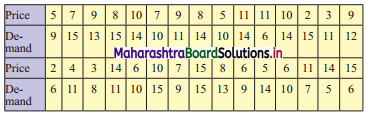
Maharashtra Board 11th Commerce Maths Solutions Chapter 4 Bivariate Frequency Distribution and Chi Square Statistic Miscellaneous Exercise 4 Q1
Classify the data by taking classes 0 – 4, 5 – 9, etc. for X and 5 – 8, 9 – 12, etc. for Y.
Also find
(i) marginal frequency distribution of X and Y.
(ii) conditional frequency distribution of Y when X is less than 10.
Solution:
Given, X = coded price
Y = demand
Bivariate frequency table can be prepared by taking class intervals 0 – 4, 5 – 9,… etc for X and 5 – 8, 9 – 12,… etc for Y.
Bivariate frequency distribution is as follows.
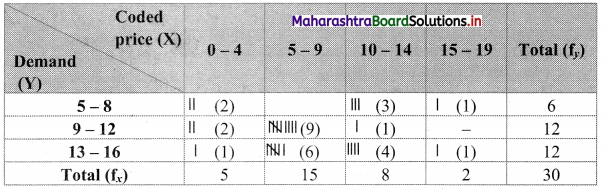
Maharashtra Board 11th Commerce Maths Solutions Chapter 4 Bivariate Frequency Distribution and Chi Square Statistic Miscellaneous Exercise 4 Q1.1
(i) Marginal frequency distribution of X:

Maharashtra Board 11th Commerce Maths Solutions Chapter 4 Bivariate Frequency Distribution and Chi Square Statistic Miscellaneous Exercise 4 Q1.2
Marginal frequency distribution of Y:

Maharashtra Board 11th Commerce Maths Solutions Chapter 4 Bivariate Frequency Distribution and Chi Square Statistic Miscellaneous Exercise 4 Q1.3
(ii) Conditional frequency distribution of Y when X < 10:

Maharashtra Board 11th Commerce Maths Solutions Chapter 4 Bivariate Frequency Distribution and Chi Square Statistic Miscellaneous Exercise 4 Q1.4

Maharashtra Board 11th Commerce Maths Solutions Chapter 4 Bivariate Frequency Distribution and Chi Square Statistic Miscellaneous Exercise 4

Question 2.
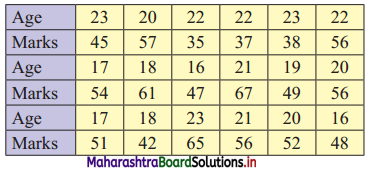
Following data gives the age in years and marks obtained by 30 students in an intelligence test.
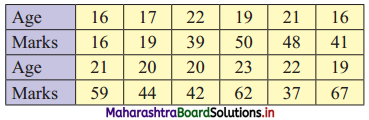
Maharashtra Board 11th Commerce Maths Solutions Chapter 4 Bivariate Frequency Distribution and Chi Square Statistic Miscellaneous Exercise 4 Q2
Maharashtra Board 11th Commerce Maths Solutions Chapter 4 Bivariate Frequency Distribution and Chi Square Statistic Miscellaneous Exercise 4 Q2.1
Prepare a bivariate frequency distribution by taking class intervals 16 – 18, 18 – 20,…,etc. for age and 10 – 20, 20 – 30,…, etc. for marks.
Find
(i) marginal frequency distributions.
(ii) conditional frequency distribution of marks obtained when age of students is between 20 – 22.
Solution:
Let X = Age in years
Y = Marks
Bivariate frequency table can be prepared by taking class intervals 16 – 18, 18 – 20,…, etc for X and 10 – 20, 20 – 30,…, etc for Y.
Bivariate frequency distribution is as follows:
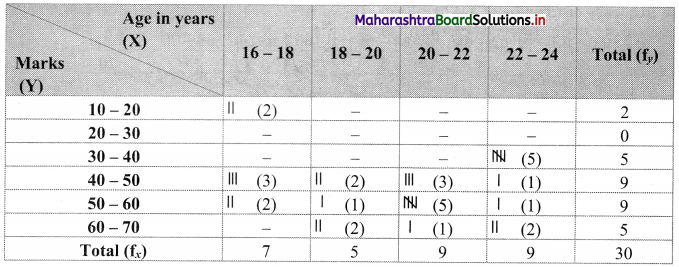
Maharashtra Board 11th Commerce Maths Solutions Chapter 4 Bivariate Frequency Distribution and Chi Square Statistic Miscellaneous Exercise 4 Q2.2
(i) Marginal frequency distribution of X:

Maharashtra Board 11th Commerce Maths Solutions Chapter 4 Bivariate Frequency Distribution and Chi Square Statistic Miscellaneous Exercise 4 Q2.3
Marginal frequency distribution of Y:

Maharashtra Board 11th Commerce Maths Solutions Chapter 4 Bivariate Frequency Distribution and Chi Square Statistic Miscellaneous Exercise 4 Q2.4
(ii) Conditional frequency distribution of Y when X is between 20 – 22:

Maharashtra Board 11th Commerce Maths Solutions Chapter 4 Bivariate Frequency Distribution and Chi Square Statistic Miscellaneous Exercise 4 Q2.5

Question 3.
Following data gives Sales (in Lakh ?) and Advertisement Expenditure (in Thousand ₹) of 20 firms.
(115, 61) (120, 60) (128, 61) (121, 63) (137, 62) (139, 62) (143, 63) (117, 65) (126, 64) (141, 65) (140, 65) (153, 64) (129, 67) (130, 66) (150, 67) (148, 66) (130, 69) (138, 68) (155, 69) (172, 68)
(i) Construct a bivariate frequency distribution table for the above data by taking classes 115 – 125, 125 – 135, ….etc. for sales and 60 – 62, 62 – 64, …etc. for advertisement expenditure.
(ii) Find marginal frequency distributions
(iii) Conditional frequency distribution of Sales when the advertisement expenditure is between 64 – 66 (Thousand ₹)
(iv) Conditional frequency distribution of advertisement expenditure when the sales are between 125 – 135 (lakh ₹)
Solution:
(i) Let X = Sales (in lakh ₹)
Y = Advertisement Expenditure (in Thousand ₹)
Bivariate frequency table can be prepared by taking class intervals 115 – 125, 125 – 135, …. etc for X and 60 – 62, 62 – 64, ….etc for Y.
Bivariate frequency distribution is as follows:
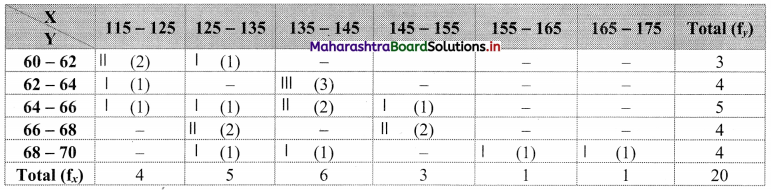
Maharashtra Board 11th Commerce Maths Solutions Chapter 4 Bivariate Frequency Distribution and Chi Square Statistic Miscellaneous Exercise 4 Q3
(ii) Marginal frequency distribution of X:

Maharashtra Board 11th Commerce Maths Solutions Chapter 4 Bivariate Frequency Distribution and Chi Square Statistic Miscellaneous Exercise 4 Q3.1
Marginal frequency distribution of Y:

Maharashtra Board 11th Commerce Maths Solutions Chapter 4 Bivariate Frequency Distribution and Chi Square Statistic Miscellaneous Exercise 4 Q3.2
(ii) Conditional frequency distribution of X when Y is between 64 – 66:

Maharashtra Board 11th Commerce Maths Solutions Chapter 4 Bivariate Frequency Distribution and Chi Square Statistic Miscellaneous Exercise 4 Q3.3
(iii) Conditional frequency distribution of Y when X is between 125 – 135:

Maharashtra Board 11th Commerce Maths Solutions Chapter 4 Bivariate Frequency Distribution and Chi Square Statistic Miscellaneous Exercise 4 Q3.4

Maharashtra Board 11th Commerce Maths Solutions Chapter 4 Bivariate Frequency Distribution and Chi Square Statistic Miscellaneous Exercise 4

Question 4.
Prepare a bivariate frequency distribution for the following data, taking class intervals for X as 35 – 45, 45 – 55, …. etc and for Y as 115 – 130, 130 – 145, … etc where, X denotes the age in years and Y denotes blood pressure for a group of 24 persons.
(55, 151) (36, 140) (72, 160) (38, 124) (65, 148) (46, 130) (58, 152) (50, 149) (38, 115) (42, 145) (41, 163) (47, 161) (69, 159) (60, 161) (58, 131) (57, 136) (43, 141) (52, 164) (59, 161) (44, 128) (35, 118) (62, 142) (67, 157) (70, 162)
Also find
(i) Marginal frequency distribution of X.
(ii) Conditional frequency distribution of Y when X < 45.
Solution:
Given X = Age in years
Y = Blood pressure
Bivariate frequency table can be prepared by taking class intervals 35 – 45, 45 – 55, …, etc for X and 115 – 130, 130 – 145, ….., etc for Y.
Bivariate frequency distribution is as follows:
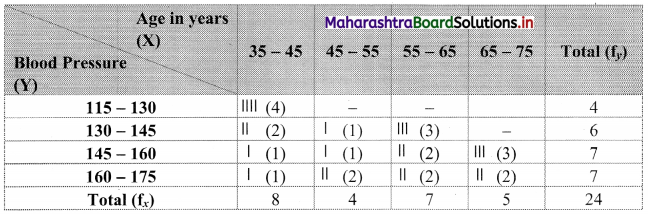
Maharashtra Board 11th Commerce Maths Solutions Chapter 4 Bivariate Frequency Distribution and Chi Square Statistic Miscellaneous Exercise 4 Q4
(i) Marginal frequency distribution of X:

Maharashtra Board 11th Commerce Maths Solutions Chapter 4 Bivariate Frequency Distribution and Chi Square Statistic Miscellaneous Exercise 4 Q4.1
(ii) Conditional frequency distribution of Y when X < 45:

Maharashtra Board 11th Commerce Maths Solutions Chapter 4 Bivariate Frequency Distribution and Chi Square Statistic Miscellaneous Exercise 4 Q4.2

Question 5.
Thirty pairs of values of two variables X and Y are given below. Form a bivariate frequency table. Also find marginal frequency distributions of X and Y.
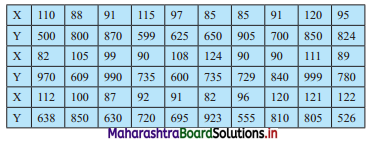
Maharashtra Board 11th Commerce Maths Solutions Chapter 4 Bivariate Frequency Distribution and Chi Square Statistic Miscellaneous Exercise 4 Q5
Solution:
Bivariate frequency table can be prepared by taking class intervals 80 – 90, 90 – 100, etc for X and 500 – 600, 600 – 700, …., etc for Y.
Bivariate frequency distribution is as follows:
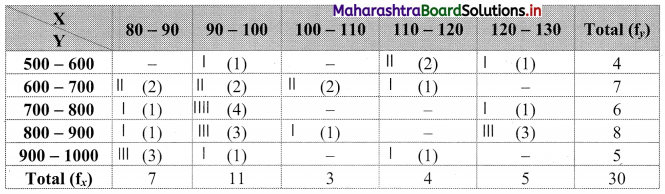
Maharashtra Board 11th Commerce Maths Solutions Chapter 4 Bivariate Frequency Distribution and Chi Square Statistic Miscellaneous Exercise 4 Q5.1
Marginal frequency distribution of X:

Maharashtra Board 11th Commerce Maths Solutions Chapter 4 Bivariate Frequency Distribution and Chi Square Statistic Miscellaneous Exercise 4 Q5.2
Marginal frequency distribution of Y
Maharashtra Board 11th Commerce Maths Solutions Chapter 4 Bivariate Frequency Distribution and Chi Square Statistic Miscellaneous Exercise 4 Q5.3

Question 6.
The following table shows how the samples of Mathematics and Economics scores of 25 students are distributed:
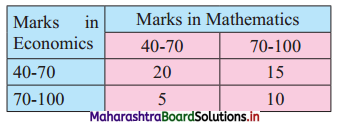
Maharashtra Board 11th Commerce Maths Solutions Chapter 4 Bivariate Frequency Distribution and Chi Square Statistic Miscellaneous Exercise 4 Q6
Find the value of ϰ2 statistic.
Solution:
Table of observed frequencies.
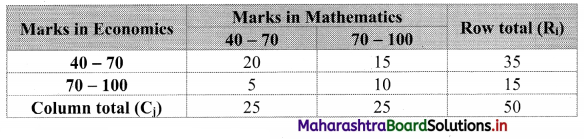
Maharashtra Board 11th Commerce Maths Solutions Chapter 4 Bivariate Frequency Distribution and Chi Square Statistic Miscellaneous Exercise 4 Q6.1
Expected frequencies are given by
Eij = \(\frac{R_{i} \times C_{j}}{N}\)
E11 = \(\frac{35 \times 25}{50}\) = 17.5
E12 = \(\frac{35 \times 25}{50}\) = 17.5
E21 = \(\frac{15 \times 25}{50}\) = 7.5
E22 = \(\frac{15 \times 25}{50}\) = 7.5
Table of expected frequencies.
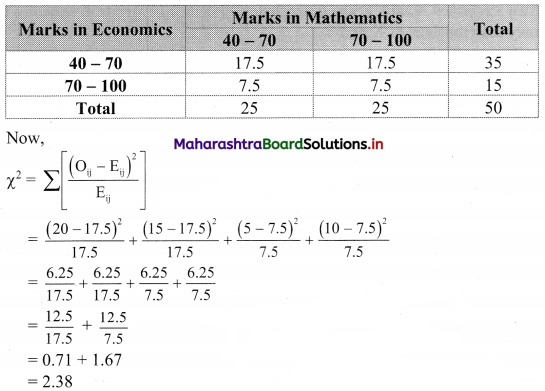
Maharashtra Board 11th Commerce Maths Solutions Chapter 4 Bivariate Frequency Distribution and Chi Square Statistic Miscellaneous Exercise 4 Q6.2

Maharashtra Board 11th Commerce Maths Solutions Chapter 4 Bivariate Frequency Distribution and Chi Square Statistic Miscellaneous Exercise 4

Question 7.
Compute ϰ2 statistic from the following data:
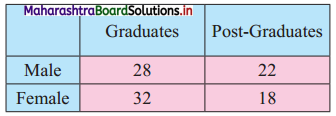
Maharashtra Board 11th Commerce Maths Solutions Chapter 4 Bivariate Frequency Distribution and Chi Square Statistic Miscellaneous Exercise 4 Q7
Solution:
Table of observed frequencies.
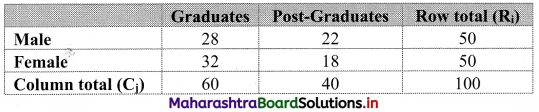
Maharashtra Board 11th Commerce Maths Solutions Chapter 4 Bivariate Frequency Distribution and Chi Square Statistic Miscellaneous Exercise 4 Q7.1
Expected frequencies are given by
Eij = \(\frac{\mathrm{R}_{\mathrm{i}} \times \mathrm{C}_{\mathrm{j}}}{\mathrm{N}}\)
E11 = \(\frac{50 \times 60}{100}\) = 30
E12 = \(\frac{50 \times 40}{100}\) = 20
E21 = \(\frac{50 \times 60}{100}\) = 30
E22 = \(\frac{50 \times 40}{100}\) = 20
Table of expected frequencies.
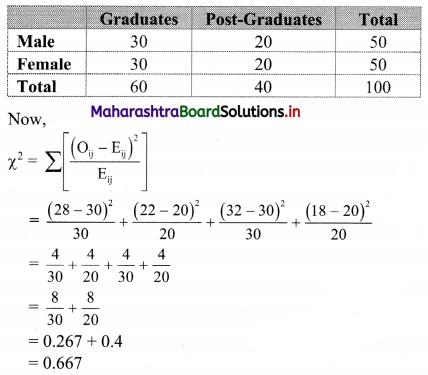
Maharashtra Board 11th Commerce Maths Solutions Chapter 4 Bivariate Frequency Distribution and Chi Square Statistic Miscellaneous Exercise 4 Q7.2

Question 8.
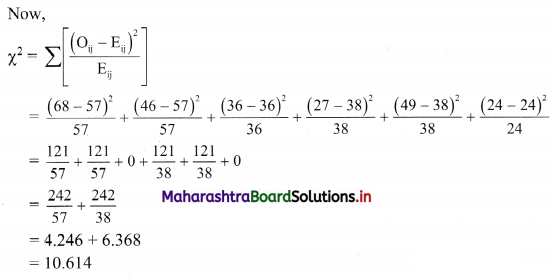
The attitude of 250 employees towards a proposed policy of the company is as observed in the following table. Calculate ϰ2 statistic.
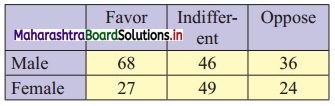
Maharashtra Board 11th Commerce Maths Solutions Chapter 4 Bivariate Frequency Distribution and Chi Square Statistic Miscellaneous Exercise 4 Q8
Solution:
Table of observed frequencies

Maharashtra Board 11th Commerce Maths Solutions Chapter 4 Bivariate Frequency Distribution and Chi Square Statistic Miscellaneous Exercise 4 Q8.1
Expected frequencies are given by
Eij = \(\frac{\mathrm{R}_{\mathrm{i}} \times \mathrm{C}_{\mathrm{j}}}{\mathrm{N}}\)
E11 = \(\frac{150 \times 95}{250}\) = 57
E12 = \(\frac{150 \times 95}{250}\) = 57
E13 = \(\frac{150 \times 60}{250}\) = 36
E21 = \(\frac{100 \times 95}{250}\) = 38
E22 = \(\frac{100 \times 95}{250}\) = 38
E23 = \(\frac{100 \times 60}{250}\) = 24
Table of observed frequencies.

Maharashtra Board 11th Commerce Maths Solutions Chapter 4 Bivariate Frequency Distribution and Chi Square Statistic Miscellaneous Exercise 4 Q8.2
Maharashtra Board 11th Commerce Maths Solutions Chapter 4 Bivariate Frequency Distribution and Chi Square Statistic Miscellaneous Exercise 4 Q8.3

Question 9.
In a certain sample of 1000 families, 450 families are consumers of tea. Out of 600 Hindu families, 286 families consume tea. Calculate ϰ2 statistic.
Solution:
The given data can be arranged in the following table.

Maharashtra Board 11th Commerce Maths Solutions Chapter 4 Bivariate Frequency Distribution and Chi Square Statistic Miscellaneous Exercise 4 Q9
Table of observed frequencies.
Maharashtra Board 11th Commerce Maths Solutions Chapter 4 Bivariate Frequency Distribution and Chi Square Statistic Miscellaneous Exercise 4 Q9.1
Expected frequencies are given by
Eij = \(\frac{R_{i} \times C_{j}}{N}\)
E11 = \(\frac{600 \times 450}{1000}\) = 270
E12 = \(\frac{600 \times 550}{1000}\) = 330
E21 = \(\frac{400 \times 450}{1000}\) = 180
E22 = \(\frac{400 \times 550}{1000}\) = 220
Table of expected frequencies.
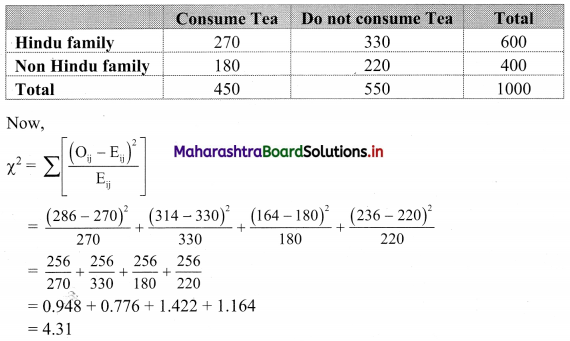
Maharashtra Board 11th Commerce Maths Solutions Chapter 4 Bivariate Frequency Distribution and Chi Square Statistic Miscellaneous Exercise 4 Q9.2

Maharashtra Board 11th Commerce Maths Solutions Chapter 4 Bivariate Frequency Distribution and Chi Square Statistic Miscellaneous Exercise 4

Question 10.
A sample of boys and girls were asked to choose their favourite sport, with the following results. Find the value of ϰ2 statistic.
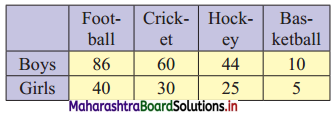
Maharashtra Board 11th Commerce Maths Solutions Chapter 4 Bivariate Frequency Distribution and Chi Square Statistic Miscellaneous Exercise 4 Q10
Solution:
Table of observed frequencies.

Maharashtra Board 11th Commerce Maths Solutions Chapter 4 Bivariate Frequency Distribution and Chi Square Statistic Miscellaneous Exercise 4 Q10.1
Expected frequencies are given by
Eij = \(\frac{R_{i} \times C_{j}}{N}\)
E11 = \(\frac{200 \times 126}{300}\) = 84
E12 = \(\frac{200 \times 90}{300}\) = 60
E13 = \(\frac{200 \times 69}{300}\) = 46
E14 = \(\frac{200 \times 15}{300}\) = 10
E21 = \(\frac{100 \times 126}{300}\) = 42
E22 = \(\frac{100 \times 90}{300}\) = 30
E23 = \(\frac{100 \times 69}{300}\) = 23
E24 = \(\frac{100 \times 15}{300}\) = 5
Table of expected frequencies.
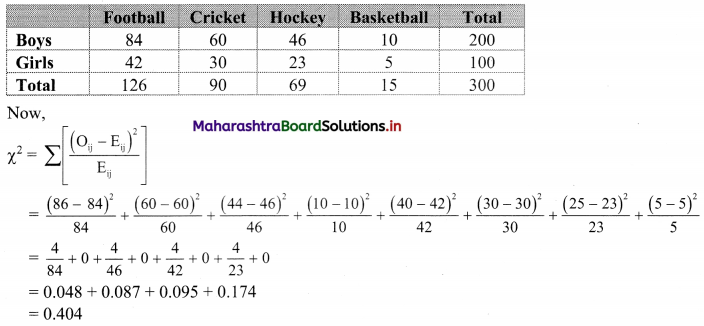
Maharashtra Board 11th Commerce Maths Solutions Chapter 4 Bivariate Frequency Distribution and Chi Square Statistic Miscellaneous Exercise 4 Q10.2

Maharashtra Board 11th Commerce Maths Solutions Chapter 4 Bivariate Frequency Distribution and Chi Square Statistic Ex 4.2

Balbharati Maharashtra State Board 11th Commerce Maths Solution Book Pdf Chapter 4 Bivariate Frequency Distribution and Chi Square Statistic Ex 4.2 Questions and Answers.

Maharashtra State Board 11th Commerce Maths Solutions Chapter 4 Bivariate Frequency Distribution and Chi Square Statistic Ex 4.2

Question 1.
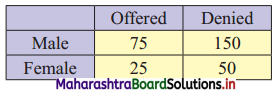
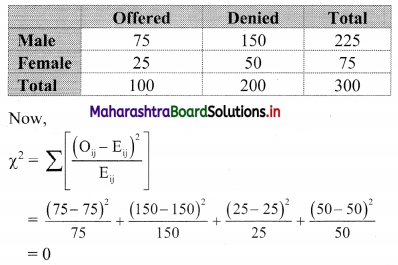
The following table shows the classification of applications for secretarial and for sales positions according to gender. Calculate the value of ϰ2 statistic.
Maharashtra Board 11th Commerce Maths Solutions Chapter 4 Bivariate Frequency Distribution and Chi Square Statistic Ex 4.2 Q1
Solution:
Table of observed frequencies.
Maharashtra Board 11th Commerce Maths Solutions Chapter 4 Bivariate Frequency Distribution and Chi Square Statistic Ex 4.2 Q1.1
Expected frequencies are given by
Eij = \(\frac{R_{i} \times C_{j}}{N}\)
E11 = \(\frac{225 \times 100}{300}\) = 75
E12 = \(\frac{225 \times 200}{300}\) = 150
E21 = \(\frac{75 \times 100}{300}\) = 25
E22 = \(\frac{75 \times 200}{300}\) = 50
Table of expected frequencies.

Maharashtra Board 11th Commerce Maths Solutions Chapter 4 Bivariate Frequency Distribution and Chi Square Statistic Ex 4.2 Q1.2

Maharashtra Board 11th Commerce Maths Solutions Chapter 4 Bivariate Frequency Distribution and Chi Square Statistic Ex 4.2

Question 2.
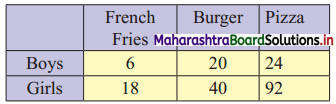
200 teenagers were asked which takeaway food do they prefer – French fries, burgers, or pizza. The results were-
Maharashtra Board 11th Commerce Maths Solutions Chapter 4 Bivariate Frequency Distribution and Chi Square Statistic Ex 4.2 Q2
Compute ϰ2 statistic.
Solution:
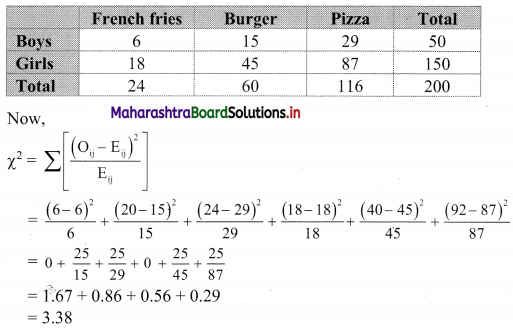
Table of observed frequencies.
Maharashtra Board 11th Commerce Maths Solutions Chapter 4 Bivariate Frequency Distribution and Chi Square Statistic Ex 4.2 Q2.1
Expected frequencies are given by
Eij = \(\frac{\mathrm{R}_{\mathrm{i}} \times \mathrm{C}_{\mathrm{j}}}{\mathrm{N}}\)
E11 = \(\frac{50 \times 24}{200}\) = 6
E12 = \(\frac{50 \times 60}{200}\) = 15
E13 = \(\frac{50 \times 116}{200}\) = 29
E21 = \(\frac{150 \times 24}{200}\) = 18
E22 = \(\frac{150 \times 60}{200}\) = 45
E23 = \(\frac{150 \times 116}{200}\) = 87
Table of expected frequencies.
Maharashtra Board 11th Commerce Maths Solutions Chapter 4 Bivariate Frequency Distribution and Chi Square Statistic Ex 4.2 Q2.2

Question 3.
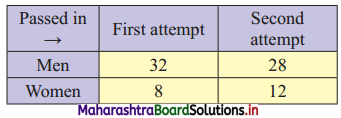
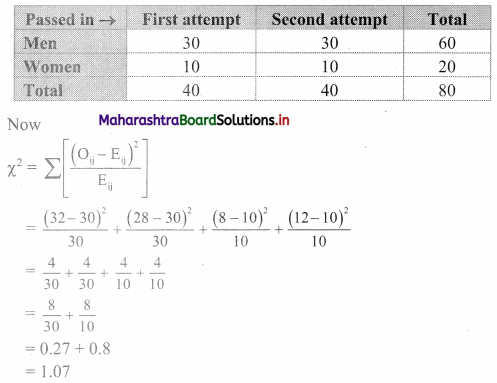
A sample of men and women who had passed their driving test either in 1st attempt or in 2nd attempt
were surveyed. Compute ϰ2 statistic.
Maharashtra Board 11th Commerce Maths Solutions Chapter 4 Bivariate Frequency Distribution and Chi Square Statistic Ex 4.2 Q3
Solution:
Table of observed frequencies.
Maharashtra Board 11th Commerce Maths Solutions Chapter 4 Bivariate Frequency Distribution and Chi Square Statistic Ex 4.2 Q3.1
Expected frequencies are given by
Eij = \(\frac{R_{i} \times C_{j}}{N}\)
E11 = \(\frac{60 \times 40}{80}\) = 30
E12 = \(\frac{60 \times 40}{80}\) = 30
E21 = \(\frac{20 \times 40}{80}\) = 10
E22 = \(\frac{20 \times 40}{80}\) = 10
Table of expected frequencies.
Maharashtra Board 11th Commerce Maths Solutions Chapter 4 Bivariate Frequency Distribution and Chi Square Statistic Ex 4.2 Q3.2

Maharashtra Board 11th Commerce Maths Solutions Chapter 4 Bivariate Frequency Distribution and Chi Square Statistic Ex 4.2

Question 4.
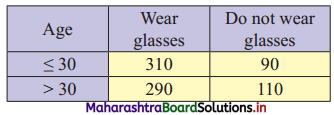
800 people were asked whether they wear glasses for reading with the following results.
Maharashtra Board 11th Commerce Maths Solutions Chapter 4 Bivariate Frequency Distribution and Chi Square Statistic Ex 4.2 Q4
Compute the ϰ2 square statistic.
Solution:
Table of observed frequencies.
Maharashtra Board 11th Commerce Maths Solutions Chapter 4 Bivariate Frequency Distribution and Chi Square Statistic Ex 4.2 Q4.1
Expected frequencies are given by
Eij = \(\frac{\mathrm{R}_{\mathrm{i}} \times \mathrm{C}_{\mathrm{j}}}{\mathrm{N}}\)
E11 = \(\frac{400 \times 600}{800}\) = 300
E12 = \(\frac{400 \times 200}{800}\) = 100
E21 = \(\frac{400 \times 600}{800}\) = 300
E22 = \(\frac{400 \times 200}{800}\) = 100
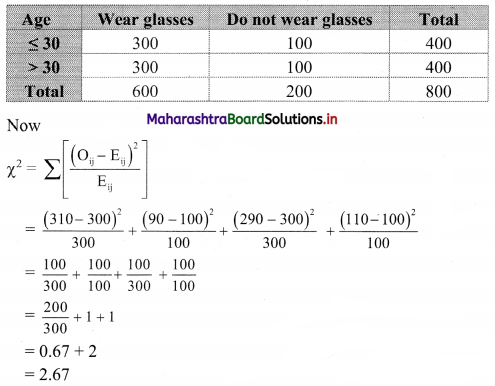
Table of expected frequencies.

Maharashtra Board 11th Commerce Maths Solutions Chapter 4 Bivariate Frequency Distribution and Chi Square Statistic Ex 4.2 Q4.2

Question 5.
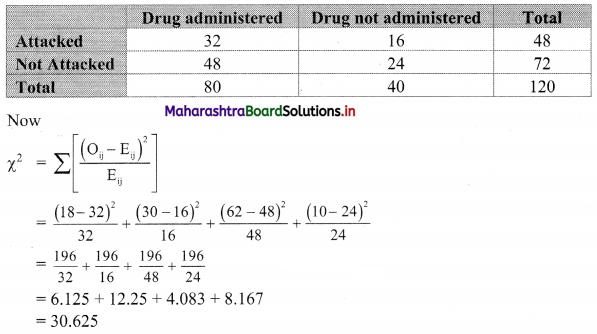
Out of a sample of 120 persons in a village, 80 were administered a new drug for preventing influenza, and out of the 18 were attacked by influenza. Out of those who are not administered the new drug, 10 persons were not attacked by influenza:
(i) Prepare a two-way table showing frequencies.
(ii) Compute the ϰ2 square statistic.
Solution:
(i) The given data can be arranged in the following table.
Maharashtra Board 11th Commerce Maths Solutions Chapter 4 Bivariate Frequency Distribution and Chi Square Statistic Ex 4.2 Q5
The observed frequency table can be prepared as follows:
Maharashtra Board 11th Commerce Maths Solutions Chapter 4 Bivariate Frequency Distribution and Chi Square Statistic Ex 4.2 Q5.1

(ii) Expected frequencies are given by
Eij = \(\frac{R_{i} \times C_{j}}{N}\)
E11 = \(\frac{48 \times 80}{120}\) = 32
E12 = \(\frac{48 \times 40}{120}\) = 16
E21 = \(\frac{72 \times 80}{120}\) = 48
E22 = \(\frac{72 \times 40}{120}\) = 24
Table of expected frequencies.
Maharashtra Board 11th Commerce Maths Solutions Chapter 4 Bivariate Frequency Distribution and Chi Square Statistic Ex 4.2 Q5.2

Maharashtra Board 11th Commerce Maths Solutions Chapter 4 Bivariate Frequency Distribution and Chi Square Statistic Ex 4.1

Balbharati Maharashtra State Board 11th Commerce Maths Solution Book Pdf Chapter 4 Bivariate Frequency Distribution and Chi Square Statistic Ex 4.1 Questions and Answers.

Maharashtra State Board 11th Commerce Maths Solutions Chapter 4 Bivariate Frequency Distribution and Chi Square Statistic Ex 4.1

Question 1.
The following table gives income (X) and expenditure (Y) of 25 families:
Maharashtra Board 11th Commerce Maths Solutions Chapter 4 Bivariate Frequency Distribution and Chi Square Statistic Ex 4.1 Q1
Find
(i) Marginal frequency distributions of income and expenditure.
(ii) Conditional frequency distribution of X when Y is between 300 – 400.
(iii) Conditional frequency distribution of Y when X is between 200 – 300.
(iv) How many families have their income ₹ 300 and more and expenses ₹ 400 and less?
Solution:
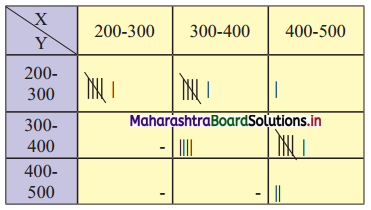
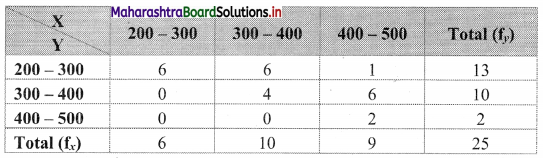
The bivariate frequency distribution table for Income (X) and Expenditure (Y) is as follows:
Maharashtra Board 11th Commerce Maths Solutions Chapter 4 Bivariate Frequency Distribution and Chi Square Statistic Ex 4.1 Q1.1
(i) Marginal frequency distribution of income (X):
Maharashtra Board 11th Commerce Maths Solutions Chapter 4 Bivariate Frequency Distribution and Chi Square Statistic Ex 4.1 Q1.2
Marginal frequency distribution of expenditure ( Y):
Maharashtra Board 11th Commerce Maths Solutions Chapter 4 Bivariate Frequency Distribution and Chi Square Statistic Ex 4.1 Q1.3
(ii) Conditional frequency distribution of X when Y is between 300 – 400:
Maharashtra Board 11th Commerce Maths Solutions Chapter 4 Bivariate Frequency Distribution and Chi Square Statistic Ex 4.1 Q1.4
(iii) Conditional frequency distribution of Y when X is between 200 – 300:
Maharashtra Board 11th Commerce Maths Solutions Chapter 4 Bivariate Frequency Distribution and Chi Square Statistic Ex 4.1 Q1.5
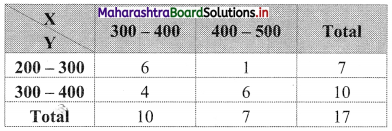
(iv) The cells 300 – 400 and 400 – 500 are having income ₹ 300 and more and the cells 200 – 300 and 300 – 400 are having expenditure ₹ 400 and less.
Now, the following table indicates the number of families satisfying the above condition.
Maharashtra Board 11th Commerce Maths Solutions Chapter 4 Bivariate Frequency Distribution and Chi Square Statistic Ex 4.1 Q1.6
∴ There are 17 families with income ₹ 300 and more and expenditure ₹ 400 and less.

Maharashtra Board 11th Commerce Maths Solutions Chapter 4 Bivariate Frequency Distribution and Chi Square Statistic Ex 4.1

Question 2.
Two dice are thrown simultaneously 25 times. The following pairs of observations are obtained.
(2, 3) (2, 5) (5, 5) (4, 5) (6, 4) (3, 2) (5, 2) (4, 1) (2, 5) (6, 1) (3, 1) (3, 3) (4, 3) (4, 5) (2, 5) (3, 4) (2, 5) (3, 4) (2, 5) (4, 3) (5, 2) (4, 5) (4, 3) (2, 3) (4, 1)
Prepare a bivariate frequency distribution table for the above data. Also, obtain the marginal distributions.

Solution:
Let X = Observation on 1st die
Y = Observation on 2nd die
Now, the minimum value of X is 1 and the maximum value is 6.

Also, the minimum value of Y is 1 and the maximum value is 6.
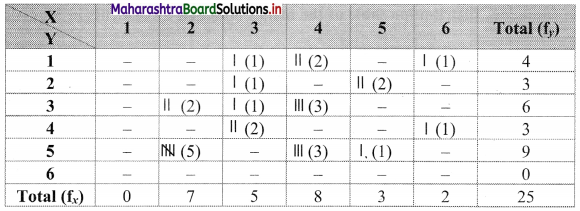
A bivariate frequency distribution can be prepared by taking X as row and Y as a column.
Bivariate frequency distribution is as follows:
Maharashtra Board 11th Commerce Maths Solutions Chapter 4 Bivariate Frequency Distribution and Chi Square Statistic Ex 4.1 Q2
Marginal frequency distribution of X:
Maharashtra Board 11th Commerce Maths Solutions Chapter 4 Bivariate Frequency Distribution and Chi Square Statistic Ex 4.1 Q2.1
Marginal frequency distribution of Y:
Maharashtra Board 11th Commerce Maths Solutions Chapter 4 Bivariate Frequency Distribution and Chi Square Statistic Ex 4.1 Q2.2

Question 3.
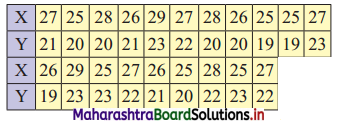
Following data gives the age of husbands (X) and age of wives (Y) in years. Construct a bivariate frequency distribution table and find the marginal distributions.
Maharashtra Board 11th Commerce Maths Solutions Chapter 4 Bivariate Frequency Distribution and Chi Square Statistic Ex 4.1 Q3
Find conditional frequency distribution of age of husbands when the age of wife is 23 years.
Solution:
Given, X = Age of Husbands (in years)
Y = Age of Wives (in years)
Now, the minimum value of X is 25 and the maximum value is 29.
Also, the minimum value of Y is 19 and the maximum value is 23.
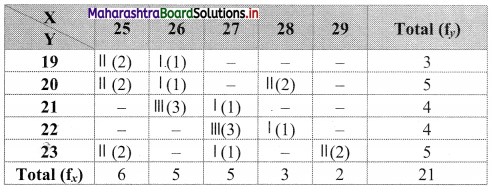
Bivariate frequency distribution is as follows:
Maharashtra Board 11th Commerce Maths Solutions Chapter 4 Bivariate Frequency Distribution and Chi Square Statistic Ex 4.1 Q3.1
Marginal frequency distribution of X:
Maharashtra Board 11th Commerce Maths Solutions Chapter 4 Bivariate Frequency Distribution and Chi Square Statistic Ex 4.1 Q3.2
Marginal frequency distribution of Y:
Maharashtra Board 11th Commerce Maths Solutions Chapter 4 Bivariate Frequency Distribution and Chi Square Statistic Ex 4.1 Q3.3
Conditional frequency distribution of X when Y is 23:
Maharashtra Board 11th Commerce Maths Solutions Chapter 4 Bivariate Frequency Distribution and Chi Square Statistic Ex 4.1 Q3.4

Maharashtra Board 11th Commerce Maths Solutions Chapter 4 Bivariate Frequency Distribution and Chi Square Statistic Ex 4.1

Question 4.
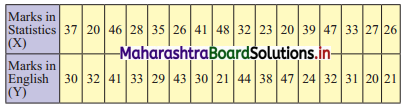
Construct a bivariate frequency distribution table of the marks obtained by students in Statistics (X) and English (Y).
Maharashtra Board 11th Commerce Maths Solutions Chapter 4 Bivariate Frequency Distribution and Chi Square Statistic Ex 4.1 Q4
Construct a bivariate frequency distribution table for the above data by taking class intervals 20 – 30, 30 – 40, …. etc. for both X and Y. Also find the marginal distributions and conditional frequency distribution of Y when X lies between 30 – 40.
Solution:
Given, X = Marks in Statistics
Y = Marks in English
A bivariate frequency table can be prepared by taking class intervals 20 – 30, 30 – 40,…, etc for both X and Y.
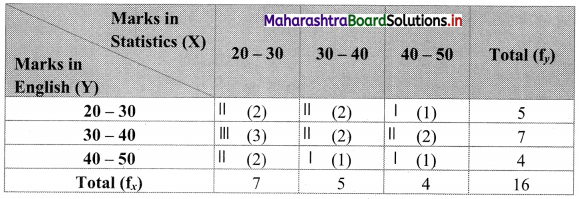
Bivariate frequency distribution is as follows:
Maharashtra Board 11th Commerce Maths Solutions Chapter 4 Bivariate Frequency Distribution and Chi Square Statistic Ex 4.1 Q4.1
Marginal frequency distribution of X:
Maharashtra Board 11th Commerce Maths Solutions Chapter 4 Bivariate Frequency Distribution and Chi Square Statistic Ex 4.1 Q4.2
Marginal frequency distribution of Y:
Maharashtra Board 11th Commerce Maths Solutions Chapter 4 Bivariate Frequency Distribution and Chi Square Statistic Ex 4.1 Q4.3
Conditional frequency distribution of Y when X lies between 30 – 40:
Maharashtra Board 11th Commerce Maths Solutions Chapter 4 Bivariate Frequency Distribution and Chi Square Statistic Ex 4.1 Q4.4

Maharashtra Board 11th Commerce Maths Solutions Chapter 4 Bivariate Frequency Distribution and Chi Square Statistic Ex 4.1

Question 5.
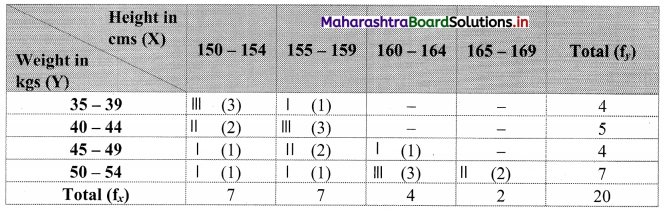
Following data gives height in cms (X) and weight in kgs (Y) of 20 boys. Prepare a bivariate frequency table taking class intervals 150 – 154, 155 – 159,…etc. for X and 35 – 39, 40 – 44,…, etc for Y. Also, find
(i) Marginal frequency distributions.
(ii) Conditional frequency distribution of Y when 155 ≤ X ≤ 159.
(152,40) (160,54) (163,52) (150,35) (154,36) (160,49) (166,54) (157,38)
(159,43) (153,48) (152,41) (158,51) (155,44) (156,47) (156,43) (166,53)
(160,50) (151,39) (153,50) (158,46)
Solution:
Given X = Height in cms.
Y = Weight in kgs.
Bivariate frequency table can be prepared by taking class intervals 150 – 154, 155 – 159, …, etc for X and 35 – 39, 40 – 44,…etc for Y.
The bivariate frequency distribution table is as follows:
Maharashtra Board 11th Commerce Maths Solutions Chapter 4 Bivariate Frequency Distribution and Chi Square Statistic Ex 4.1 Q5
Marginal frequency distribution of X:
Maharashtra Board 11th Commerce Maths Solutions Chapter 4 Bivariate Frequency Distribution and Chi Square Statistic Ex 4.1 Q5.1
Marginal frequency distribution of Y:
Maharashtra Board 11th Commerce Maths Solutions Chapter 4 Bivariate Frequency Distribution and Chi Square Statistic Ex 4.1 Q5.2
Conditional frequency distribution of Y when 155 ≤ X ≤ 159:
Maharashtra Board 11th Commerce Maths Solutions Chapter 4 Bivariate Frequency Distribution and Chi Square Statistic Ex 4.1 Q5.3

Maharashtra Board 11th Commerce Maths Solutions Chapter 3 Skewness Miscellaneous Exercise 3

Balbharati Maharashtra State Board 11th Commerce Maths Solution Book Pdf Chapter 3 Skewness Miscellaneous Exercise 3 Questions and Answers.

Maharashtra State Board 11th Commerce Maths Solutions Chapter 3 Skewness Miscellaneous Exercise 3

Question 1.
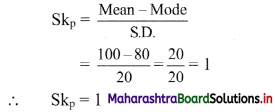
For u distribution, mean = 100, mode = 80 and S.D. = 20. Find Pearsonian coefficient of skewness Skp.
Solution:
Given, Mean = 100, Mode = 80, S.D. = 20
Maharashtra Board 11th Commerce Maths Solutions Chapter 3 Skewness Miscellaneous Exercise 3 Q1

Question 2.
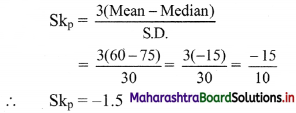
For a distribution, mean = 60, median = 75 and variance = 900. Find Pearsonian coefficient of skewness Skp.
Solution:
Given. Mean = 60, Median = 75, Variance = 900
∴ S.D. = √Variance = √900 = 30
Maharashtra Board 11th Commerce Maths Solutions Chapter 3 Skewness Miscellaneous Exercise 3 Q2

Maharashtra Board 11th Commerce Maths Solutions Chapter 3 Skewness Miscellaneous Exercise 3

Question 3.
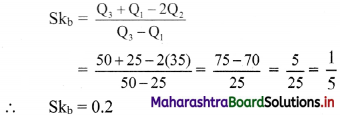
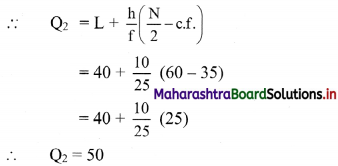
For a distribution, Q1 = 25, Q2 = 35 and Q3 = 50. Find Bowley’s coefficient of skewness Skb.
Solution:
Given Q1 = 25, Q2 = 35, Q3 = 50
Maharashtra Board 11th Commerce Maths Solutions Chapter 3 Skewness Miscellaneous Exercise 3 Q3

Question 4.
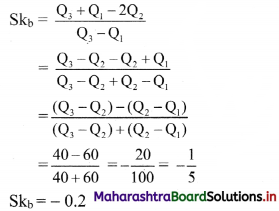
For a distribution Q3 – Q2 = 40, Q2 – Q1 = 60. Find Bowlev’s coefficient of skewness Skb.
Solution:
Given, Q3 – Q2 = 40, Q2 – Q1 = 60
Maharashtra Board 11th Commerce Maths Solutions Chapter 3 Skewness Miscellaneous Exercise 3 Q4

Question 5.
For a distribution, Bowley’s coefficient of skewness is 0.6. The sum of upper and lower quartiles is 100 and median is 38. Find the upper and lower quartiles.
Solution:
Given, Skb = 0.6, Q3 + Q1 = 100,
Median = Q2 = 38
Skb = \(\frac{Q_{3}+Q_{1}-2 Q_{2}}{Q_{3}-Q_{1}}\)
∴ 0.6 = \(\frac{100-2(38)}{Q_{3}-Q_{1}}\)
∴ 0.6(Q3 – Q1) = 100 – 76 = 24
∴ Q3 – Q1 = 40 ….(i)
Q3 + Q1 = 100 …..(ii) (given)
Adding (i) and (ii), we get
2Q3 = 140
∴ Q3 = 70
Substituting the value of Q3 in (ii), we get
70 + Q1 = 100
∴ Q1 = 100 – 70 = 30
∴ upper quartile = 70 and lower quartile = 30

Maharashtra Board 11th Commerce Maths Solutions Chapter 3 Skewness Miscellaneous Exercise 3

Question 6.
For a frequency distribution, the mean is 200, the coefficient of variation is 8% and Karl Pearsonian’s coefficient of skewness is 0.3. Find the mode and median of the distribution.
Solution:
Mean = \(\bar{x}\) = 200
Coefficient of variation, C.V. = 8%, Skp = 0.3
C.V. = \(\frac{\sigma}{\bar{x}} \times 100\), where σ = standard deviation
∴ 8 = \(\frac{\sigma}{200} \times 100\)
∴ σ = \(\frac{8 \times 200}{100}\) = 16
Now, Skp = \(\frac{\text { Mean – Mode }}{\text { S.D. }}\)
∴ 0.3 = \(\frac{200-\text { Mode }}{16}\)
∴ 0.3 × 16 = 200 – Mode
∴ Mode = 200 – 4.8 = 195.2
Since, Mean – Mode = 3(Mean – Median)
∴ 200 – 195.2 = 3(200 – Median)
∴ 4.8 = 600 – 3Median
∴ 3Median = 600 – 4.8 = 595.2
∴ Median = 198.4

Question 7.
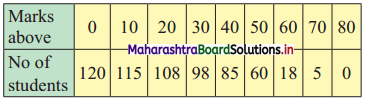
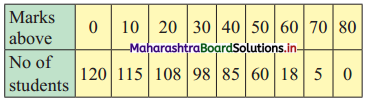
Calculate Karl Pearsonian’s coefficient of skewness Skp from the follow ing data:
Maharashtra Board 11th Commerce Maths Solutions Chapter 3 Skewness Miscellaneous Exercise 3 Q7
Solution:
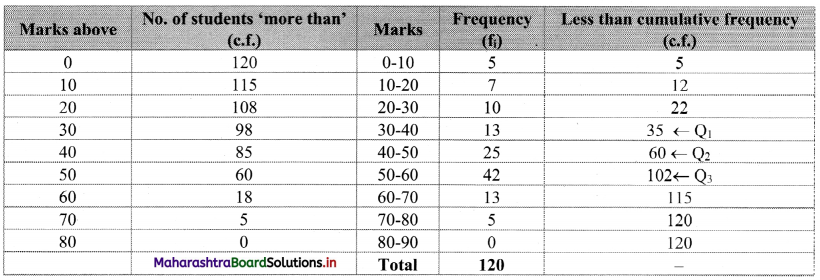
The given table is the cumulative frequency table of more than type.
From this table, we have to prepare the frequency distribution table and then calculate the value of Skp.
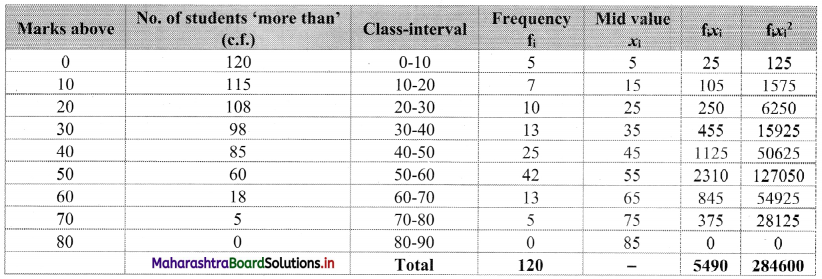
Construct the following table:
Maharashtra Board 11th Commerce Maths Solutions Chapter 3 Skewness Miscellaneous Exercise 3 Q7.1
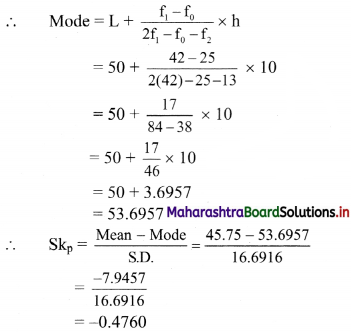
From the table, N = 120, Σfixi = 5490 and \(\sum \mathrm{f}_{\mathrm{i}} x_{\mathrm{i}}^{2}\) = 284600
Mean = \(\bar{x}=\frac{\sum f_{i} x_{i}}{N}=\frac{5490}{120}\) = 45.75
Maximum frequency 42 is of the class 50 – 60
∴ Mode lies in the class 50 – 60
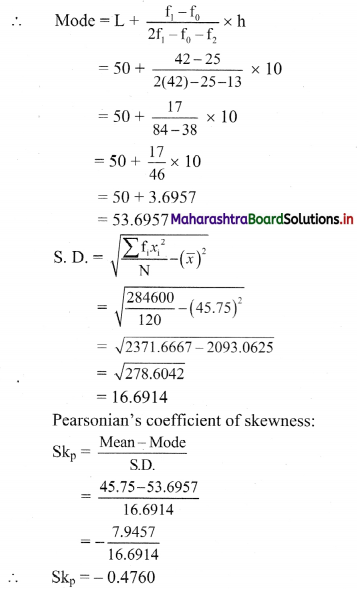
∴ L = 50, f1 = 42, f0 = 25, f2 = 13, h = 10
Maharashtra Board 11th Commerce Maths Solutions Chapter 3 Skewness Miscellaneous Exercise 3 Q7.2

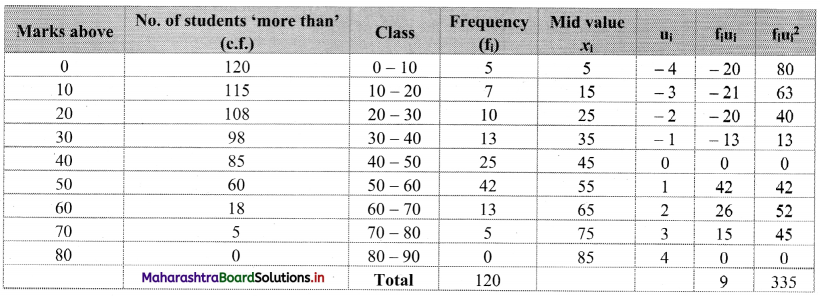
Alternate Method:
Let u = \(\frac{x-45}{10}\)
Maharashtra Board 11th Commerce Maths Solutions Chapter 3 Skewness Miscellaneous Exercise 3 Q7.3
\(\overline{\mathrm{u}}=\frac{\sum \mathrm{f}_{\mathrm{i}} \mathrm{u}_{\mathrm{i}}}{\mathrm{N}}=\frac{9}{120}\) = 0.075
∴ \(\bar{x}\) = 45 + 10(\(\bar{u}\))
= 45 + 10(0.075)
= 45 + 0.75
= 45.75
Var(u) = \(\sigma_{u}^{2}=\frac{\sum f_{i} u_{i}{ }^{2}}{N}-(\bar{u})^{2}\)
= \(\frac{335}{120}\) – (0.075)2
= 2.7917 – 0.0056
= 2.7861
Var(X) = h2 × Var(u)
= 100 × 2.7861
= 278.61
S.D. = √278.61 = 16.6916
Maximum frequency 42 is of the class 50 – 60.
∴ Mode lies in the class 50 – 60.
∴ L = 50, f1 = 42, f0 = 25, f2 = 13, h = 10
Maharashtra Board 11th Commerce Maths Solutions Chapter 3 Skewness Miscellaneous Exercise 3 Q7.4

Maharashtra Board 11th Commerce Maths Solutions Chapter 3 Skewness Miscellaneous Exercise 3

Question 8.
Calculate Bowley’s coefficient of skewness Skb from the following data.
Maharashtra Board 11th Commerce Maths Solutions Chapter 3 Skewness Miscellaneous Exercise 3 Q8
Solution:
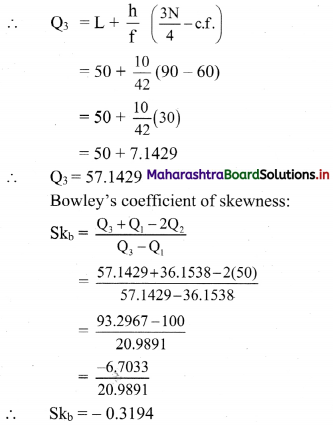
To calculate Bowley’s coefficient of skewness Skb, we construct the following table:
Maharashtra Board 11th Commerce Maths Solutions Chapter 3 Skewness Miscellaneous Exercise 3 Q8.1
Here, N = 120
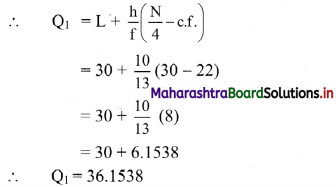
Q1 class = class containing the \(\left(\frac{N}{4}\right)^{t h}\) observation
∴ \(\frac{N}{4}=\frac{120}{4}\) = 30
Cumulative frequency which is just greater than (or equal to) 30 is 35.
∴ Q1 lies in the class 30-40.
∴ L = 30, h = 10, f = 13, c.f. = 22
Maharashtra Board 11th Commerce Maths Solutions Chapter 3 Skewness Miscellaneous Exercise 3 Q8.2
Q2 class = class containing the \(\left(\frac{N}{2}\right)^{t h}\) observation
∴ \(\frac{\mathrm{N}}{2}=\frac{120}{2}\) = 60
Cumulative frequency which is just greater than (or equal to) 60 is 60.
∴ Q2 lies in the class 40-50.
∴ L = 40, h = 10, f = 25, c.f. = 35
Maharashtra Board 11th Commerce Maths Solutions Chapter 3 Skewness Miscellaneous Exercise 3 Q8.3
Q3 class = class containing the \(\left(\frac{3 \mathrm{~N}}{4}\right)^{\text {th }}\) observation
∴ \(\frac{3 \mathrm{~N}}{4}=\frac{3 \times 120}{4}\) = 90
Cumulative frequency which is just greater than (or equal to) 90 is 102.
∴ Q3 lies in the class 50 – 60
∴ L = 50, h = 10, f = 42, c.f. = 60
Maharashtra Board 11th Commerce Maths Solutions Chapter 3 Skewness Miscellaneous Exercise 3 Q8.4

Question 9.
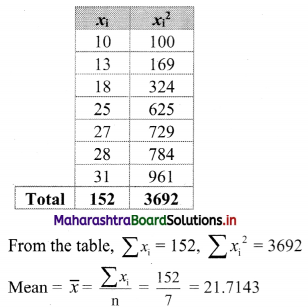
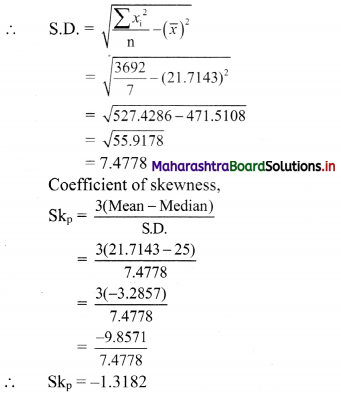
Find Skp for the following set of observations:
18, 27, 10, 25, 31, 13, 28
Solution:
The given data can be arranged in ascending order as follows:
10, 13, 18, 25, 27, 28, 31
Here, n = 7
∴ Median = value of \(\left(\frac{n+1}{2}\right)^{\text {th }}\) observation
= value of \(\left(\frac{7+1}{2}\right)^{\text {th }}\) observation
= value of 4th observation
= 25
For finding standard deviation, we construct the following table:
Maharashtra Board 11th Commerce Maths Solutions Chapter 3 Skewness Miscellaneous Exercise 3 Q9
Maharashtra Board 11th Commerce Maths Solutions Chapter 3 Skewness Miscellaneous Exercise 3 Q9.1

Maharashtra Board 11th Commerce Maths Solutions Chapter 3 Skewness Miscellaneous Exercise 3

Question 10.
Find Skb for the following set of observations:
18, 27, 10, 25, 31, 13, 28
Solution:
The given data can be arranged in ascending order as follows:
10, 13, 18, 25, 27, 28, 31
Here, n = 7
∴ Q1 = value of \(\left(\frac{n+1}{4}\right)^{\text {th }}\) observation
= value of \(\left(\frac{7+1}{4}\right)^{\text {th }}\) observation
= value of 2nd observation
∴ Q1 = 13
Q2 = value of 2\(\left(\frac{n+1}{4}\right)^{\text {th }}\) observation
= value of 2\(\left(\frac{7+1}{4}\right)^{\text {th }}\) observation
= value of (2 × 2)th observation
= value of 4th observation
∴ Q2 = 25
Q3 = value of 3\(\left(\frac{n+1}{4}\right)^{\text {th }}\) observation
= value of 3\(\left(\frac{7+1}{4}\right)^{\text {th }}\) observation
= value of (3 × 2)th observation
= value of 6th observation
∴ Q3 = 28
Coefficient of skewness,
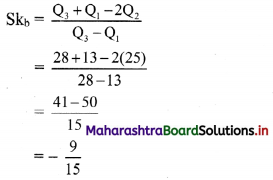
Maharashtra Board 11th Commerce Maths Solutions Chapter 3 Skewness Miscellaneous Exercise 3 Q10
∴ Skb = -0.6

Maharashtra Board 11th Commerce Maths Solutions Chapter 5 Locus and Straight Line Ex 5.3

Balbharati Maharashtra State Board 11th Commerce Maths Solution Book Pdf Chapter 5 Locus and Straight Line Ex 5.3 Questions and Answers.
Maharashtra State Board 11th Commerce Maths Solutions Chapter 5 Locus and Straight Line Ex 5.3

Question 1.
Write the equation of the line:
(a) parallel to the X-axis and at a distance of 5 units from it and above it.
(b) parallel to the Y-axis and at a distance of 5 units from it and to the left of it.
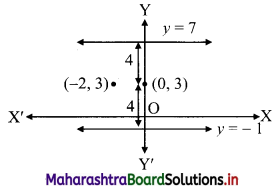
(c) parallel to the X-axis and at a distance of 4 units from the point (-2, 3).
Solution:
(a) Equation of a line parallel to the X-axis is y = k.
Since the line is at a distance of 5 units above the X-axis.
∴ k = 5
∴ the equation of the required line is y = 5.

(b) Equation of a line parallel to the Y-axis is x = h.
Since the line is at a distance of 5 units to the left of the Y-axis.
∴ h = -5
∴ the equation of the required line is x = -5.

(c) Equation of a line parallel to the X-axis is of the form y = k (k > 0 or k < 0).
Since, the line is at a distance of 4 units from the point (-2, 3).
∴ k = 3 + 4 = 7 or k = 3 – 4 = -1
∴ the equation of the required line is y = 7 or y = -1.
Maharashtra Board 11th Commerce Maths Solutions Chapter 5 Locus and Straight Line Ex 5.3 Q1

Question 2.
Obtain the equation of the line:
(a) parallel to the X-axis and making an intercept of 3 units on the Y-axis.
(b) parallel to the Y-axis and making an intercept of 4 units on the X-axis.
Solution:
(a) Equation of a line parallel to X-axis with y-intercept ‘k’ is y = k.
Here, y-intercept = 3
∴ the equation of the required line is y = 3.

(b) Equation of a line parallel to Y-axis with x-intercept ‘h’ is x = h.
Here, x-intercept = 4
∴ the equation of the required line is x = 4.

Maharashtra Board 11th Commerce Maths Solutions Chapter 5 Locus and Straight Line Ex 5.3

Question 3.
Obtain the equation of the line containing the point:
(a) A(2, -3) and parallel to the Y-axis.
(b) B(4, -3) and parallel to the X-axis.
Solution:
(a) Equation of a line parallel to the Y-axis is of the form x = h.
Since, the line passes through A(2, -3).
∴ h = 2
∴ the equation of the required line is x = 2.

(b) Equation of a line parallel to the X-axis is of the form y = k.
Since, the line passes through B(4, -3)
∴ k = -3
∴ the equation of the required line is y = -3.

Question 4.
Find the equation of the line passing through the points A(2, 0) and B(3, 4).
Solution:
The required line passes through the points A(2, 0) = (x1, y1) and B(3, 4) = (x2, y2) say.
Equation of the line in two-point form is
\(\frac{y-y_{1}}{y_{2}-y_{1}}=\frac{x-x_{1}}{x_{2}-x_{1}}\)
∴ the equation of the required line is
∴ \(\frac{y-0}{4-0}=\frac{x-2}{3-2}\)
∴ \(\frac{y}{4}=\frac{x-2}{1}\)
∴ y = 4(x – 2)
∴ y = 4x – 8
∴ 4x – y – 8 = 0

Check:
If the points A(2, 0) and B(3, 4) satisfy 4x – y – 8 = 0, then our answer is correct.
For point A(2, 0),
L.H.S. = 4x – y – 8
= 4(2) – 0 – 8
= 8 – 8
= 0
= R.H.S.
For point B(3, 4),
L.H.S. = 4x – y – 8
= 4(3) – 4 – 8
= 12 – 12
= 0
= R.H.S.
Thus, our answer is correct.

Maharashtra Board 11th Commerce Maths Solutions Chapter 5 Locus and Straight Line Ex 5.3

Question 5.
Line y = mx + c passes through the points A(2, 1) and B(3, 2). Determine m and c.
Solution:
Given, A(2, 1) and B(3, 2).
Equation of a line in two-point form is
\(\frac{y-y_{1}}{y_{2}-y_{1}}=\frac{x-x_{1}}{x_{2}-x_{1}}\)
∴ the equation of the passing through A and B line is
∴ \(\frac{y-1}{2-1}=\frac{x-2}{3-2}\)
∴ \(\frac{y-1}{1}=\frac{x-2}{1}\)
∴ y – 1 = x – 2
∴ y = x – 1
Comparing this equation with y = mx + c, we get
m = 1 and c = -1

Alternate method:
Points A(2, 1) and B(3, 2) lie on the line y = mx + c.
∴ They must satisfy the equation.
∴ 2m + c = 1 ……..(i)
and 3m + c = 2 ……(ii)
equation (ii) – equation (i) gives m = 1
Substituting m = 1 in (i), we get
2(1) – c = 1
∴ c = 1 – 2 = -1

Question 6.
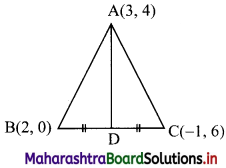
The vertices of a triangle are A(3, 4), B(2, 0), and C(-1, 6). Find the equations of
(a) side BC
(b) the median AD
(c) the midpoints of sides AB and BC.
Solution:
Vertices of ∆ABC are A(3, 4), B(2, 0) and C(-1, 6).
(a) Equation of a line in two-point form is
\(\frac{y-y_{1}}{y_{2}-y_{1}}=\frac{x-x_{1}}{x_{2}-x_{1}}\)
∴ the equation of the side BC is
\(\frac{y-0}{6-0}=\frac{x-2}{-1-2}\) ……[B = (x1, y1) = (2, 0), C = (x2, y2) = (-1, 6)]
∴ \(\frac{y}{6}=\frac{x-2}{-3}\)
∴ y = -2(x – 2)
∴ 2x + y – 4 = 0

(b) Let D be the midpoint of side BC.
Then, AD is the median through A.
∴ D = \(\left(\frac{2-1}{2}, \frac{0+6}{2}\right)=\left(\frac{1}{2}, 3\right)\)
The median AD passes through the points A(3, 4) and D(\(\frac{1}{2}\), 3)
Maharashtra Board 11th Commerce Maths Solutions Chapter 5 Locus and Straight Line Ex 5.3 Q6
∴ the equation of the median AD is
\(\frac{y-4}{3-4}=\frac{x-3}{\frac{1}{2}-3}\)
∴ \(\frac{y-4}{-1}=\frac{x-3}{-\frac{5}{2}}\)
∴ \(\frac{1}{2}\) (y – 4) = x – 3
∴ 5y – 20 = 2x – 6
∴ 2x – 5y + 14 = 0

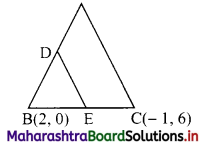
(c) Let D and E be the midpoints of side AB and side BC respectively.
∴ D = \(\left(\frac{3+2}{2}, \frac{4+0}{2}\right)=\left(\frac{5}{2}, 2\right)\) and
E = \(\left(\frac{2-1}{2}, \frac{0+6}{2}\right)=\left(\frac{1}{2}, 3\right)\)
Maharashtra Board 11th Commerce Maths Solutions Chapter 5 Locus and Straight Line Ex 5.3 Q6.1
the equation of the line DE is
\(\frac{y-2}{3-2}=\frac{x-\frac{5}{2}}{\frac{1}{2}-\frac{5}{2}}\)
∴ \(\frac{y-2}{1}=\frac{2 x-5}{-4}\)
∴ -4(y – 2) = 2x – 5
∴ -4y + 8 = 2x – 5
∴ 2x + 4y – 13 = 0

Maharashtra Board 11th Commerce Maths Solutions Chapter 5 Locus and Straight Line Ex 5.3

Question 7.
Find the x and y-intercepts of the following lines:
(a) \(\frac{x}{3}+\frac{y}{2}=1\)
(b) \(\frac{3 x}{2}+\frac{2 y}{3}=1\)
(c) 2x – 3y + 12 = 0
Solution:
(a) Given equation of the line is \(\frac{x}{3}+\frac{y}{2}=1\)
This is of the form \(\frac{x}{a}+\frac{y}{b}=1\),
where x-intercept = a, y-intercept = b
∴ x-intercept = 3, y-intercept = 2

(b) Given equation of the line is \(\frac{3 x}{2}+\frac{2 y}{3}=1\)
∴ \(\frac{x}{\left(\frac{2}{3}\right)}+\frac{y}{\left(\frac{3}{2}\right)}=1\)
This is of the form \(\frac{x}{a}+\frac{y}{b}=1\),
where x-intercept = a, y-intercept = b
∴ x-intercept = \(\frac{2}{3}\) and y-intercept = \(\frac{3}{2}\)

(c) Given equation of the line is 2x – 3y + 12 = 0
∴ 2x – 3y = -12
∴ \(\frac{2 x}{(-12)}-\frac{3 y}{(-12)}=1\)
∴ \(\frac{x}{-6}+\frac{y}{4}=1\)
This is of the form \(\frac{x}{a}+\frac{y}{b}=1\),
where x-intercept = a, y-intercept = b
∴ x-intercept = -6 and y-intercept = 4

Question 8.
Find the equations of a line containing the point A(3, 4) and make equal intercepts on the co-ordinate axes.
Solution:
Let the equation of the line be
\(\frac{x}{a}+\frac{y}{b}=1\) …..(i)
Since, the required line make equal intercepts on the co-ordinate axes.
∴ a = b
∴ (i) reduces to x + y = a …..(ii)
Since the line passes through A(3, 4).
∴ 3 + 4 = a
i.e. a = 7
Substituting a = 7 in (ii) to get
x + y = 7

Maharashtra Board 11th Commerce Maths Solutions Chapter 5 Locus and Straight Line Ex 5.3

Question 9.
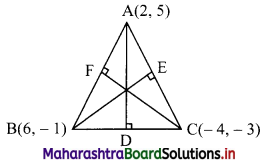
Find the equations of the altitudes of the triangle whose vertices are A(2, 5), B(6, -1) and C(-4, -3).
Solution:
Maharashtra Board 11th Commerce Maths Solutions Chapter 5 Locus and Straight Line Ex 5.3 Q9
A(2, 5), B(6, -1), C(-4, -3) are the vertices of ∆ABC.
Let AD, BE and CF be the altitudes through the vertices A, B and C respectively of ∆ABC.
Slope of BC = \(\frac{-3-(-1)}{-4-6}=\frac{-2}{-10}=\frac{1}{5}\)
∴ slope of AD = -5 ……..[∵ AD ⊥ BC]
Since, altitude AD passes through (2, 5) and has slope -5.
∴ the equation of the altitude AD is
y – 5 = -5(x – 2)
∴ y – 5 = – 5x + 10
∴ 5x + y – 15 = 0
Now, slope of AC = \(\frac{-3-5}{-4-2}=\frac{-8}{-6}=\frac{4}{3}\)
∴ slope of BE = \(\frac{-3}{4}\) …..[∵ BE ⊥ AC]
Since, altitude BE passes through (6, -1) and has slope \(\frac{-3}{4}\).
∴ the equation of the altitude BE is
y – (-1) = \(\frac{-3}{4}\)(x – 6)
∴ 4(y + 1) = -3(x – 6)
∴ 3x + 4y – 14 = 0
Also, slope of AB = \(\frac{-1-5}{6-2}=\frac{-6}{4}=\frac{-3}{2}\)
∴ slope of CF = \(\frac{2}{3}\) ………[∵ CF ⊥ AB]
Since, altitude CF passes through (-4, -3) and has slope \(\frac{2}{3}\).
∴ the equation of the altitude CF is
y – (-3) = \(\frac{2}{3}\) [x – (-4)]
∴ 3(y + 3) = 2(x + 4)
∴ 2x – 3y – 1 = 0

Maharashtra Board 11th Commerce Maths Solutions Chapter 5 Locus and Straight Line Ex 5.2

Balbharati Maharashtra State Board 11th Commerce Maths Solution Book Pdf Chapter 5 Locus and Straight Line Ex 5.2 Questions and Answers.

Maharashtra State Board 11th Commerce Maths Solutions Chapter 5 Locus and Straight Line Ex 5.2

Question 1.
Find the slope of each of the following lines which pass through the points:
(a) (2, -1), (4, 3)
(b) (-2, 3), (5, 7)
(c) (2, 3), (2, -1)
(d) (7, 1), (-3, 1)
Solution:
(a) Let A = (x1, y1) = (2, -1) and B = (x2, y2) = (4, 3).
Slope of line AB = \(\frac{y_{2}-y_{1}}{x_{2}-x_{1}}\)
= \(\frac{3-(-1)}{4-2}\)
= \(\frac{4}{2}\)
= 2

(b) Let C = (x1, y1) = (-2, 3) and D = (x2, y2) = (5, 7)
Slope of line CD = \(\frac{y_{2}-y_{1}}{x_{2}-x_{1}}\)
= \(\frac{7-3}{5-(-2)}\)
= \(\frac{4}{7}\)

Maharashtra Board 11th Commerce Maths Solutions Chapter 5 Locus and Straight Line Ex 5.2

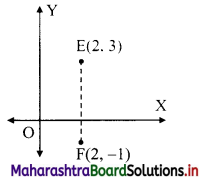
(c) Let E = (2, 3) = (x1, y1) and F = (2, -1) = (x2, y2)
Since x1 = x2 = 2
∴ The slope of EF is not defined. ……[EF || y-axis]
Maharashtra Board 11th Commerce Maths Solutions Chapter 5 Locus and Straight Line Ex 5.2 Q1

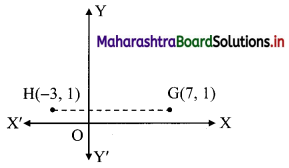
(d) Let G = (7, 1) = (x1, y1) and H = (-3, 1) = (x2, y2) say.
Since y1 = y2
∴ The slope of GH = 0 …..[GH || x-axis]
Maharashtra Board 11th Commerce Maths Solutions Chapter 5 Locus and Straight Line Ex 5.2 Q1.1

Question 2.
If the X and Y-intercepts of line L are 2 and 3 respectively, then find the slope of line L.
Solution:
Given, x-intercept of line L is 2 and y-intercept of line L is 3
∴ the line L intersects X-axis at (2, 0) and Y-axis at (0, 3).
i.e. the line L passes through (2, 0) = (x1, y1) and (0, 3) = (x2, y2) say.
Slope of line L = \(\frac{y_{2}-y_{1}}{x_{2}-x_{1}}\)
= \(\frac{3-0}{0-2}\)
= \(\frac{-3}{2}\)

Question 3.
Find the slope of the line whose inclination is 30°.
Solution:
Given, inclination (θ) = 30°
Slope of the line = tan θ = tan 30° = \(\frac{1}{\sqrt{3}}\)

Question 4.
Find the slope of the line whose inclination is 45°.
Solution:
Given, inclination (θ) = 45°
Slope of the line = tan θ = tan 45° = 1

Question 5.
A line makes intercepts 3 and 3 on the co-ordinate axes. Find the slope of the line.
Solution:
Given, x-intercept of line is 3 and y-intercept of line is 3
∴ The line intersects X-axis at (3, 0) and Y-axis at (0, 3).
i.e. the line passes through (3, 0) = (x1, y1) and (0, 3) = (x2, y2) say.
Slope of line = \(\frac{y_{2}-y_{1}}{x_{2}-x_{1}}\)
= \(\frac{3-0}{0-3}\)
= -1

Maharashtra Board 11th Commerce Maths Solutions Chapter 5 Locus and Straight Line Ex 5.2

Question 6.
Without using Pythagoras theorem, show that points A(4, 4), B(3, 5) and C(-1, -1) are the vertices of a right-angled triangle.
Solution:
Given, A(4, 4) = (x1, y1), B(3, 5) = (x2, y2), C(-1, -1) = (x3, y3)
Slope of AB = \(\frac{y_{2}-y_{1}}{x_{2}-x_{1}}=\frac{5-4}{3-4}=-1\)
Slope of BC = \(\frac{y_{3}-y_{2}}{x_{3}-x_{2}}=\frac{-1-5}{-1-3}=\frac{-6}{-4}=\frac{3}{2}\)
Slope of AC = \(\frac{y_{3}-y_{1}}{x_{3}-x_{1}}=\frac{-1-4}{-1-4}=\frac{-5}{-5}=1\)
Slope of AB × slope of AC = -1 × 1 = -1
∴ side AB ⊥ side AC
∴ ΔABC is a right angled triangle, right angled at A.
∴ The given points are the vertices of a right angled triangle.

Question 7.
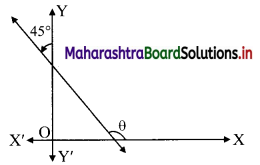
Find the slope of the line which makes angle of 45° with the positive direction of the Y-axis measured clockwise.
Solution:
Maharashtra Board 11th Commerce Maths Solutions Chapter 5 Locus and Straight Line Ex 5.2 Q7
Since, the line makes an angle of 45° with positive direction of Y-axis in anticlockwise direction.
∴ Inclination of the line (θ) = (90° + 45°)
∴ Slope of the line = tan(90° + 45°)
= -cot 45° …….[tan(90 + θ°) = -cot θ]
= -1

Question 8.
Find the value of k for which the points P(k, -1), Q(2, 1), and R(4, 5) are collinear.
Solution:
Given, points P(k, -1), Q(2, 1), and R(4, 5) are collinear.
∴ Slope of PQ = Slope of QR
∴ \(\frac{1-(-1)}{2-k}=\frac{5-1}{4-2}\)
∴ \(\frac{2}{2-k}=\frac{4}{2}\)
∴ 1 = 2 – k
∴ k = 2 – 1 = 1

Check:
For collinear points P, Q, R,
Slope of PQ = Slope of QR = Slop of PR
For k = 1, if the given points are collinear, then our answer is correct.
P(1, -1), Q(2, 1) and R(4, 5)
Slope of PQ = \(\frac{1-(-1)}{2-1}=\frac{2}{1}=2\)
Slope of QR = \(\frac{5-1}{4-2}=\frac{4}{2}=2\)
Slope of PQ = Slope of QR
∴ The given points are collinear.
Thus, our answer is correct.

Maharashtra Board 11th Commerce Maths Solutions Chapter 5 Locus and Straight Line Ex 5.1

Balbharati Maharashtra State Board 11th Commerce Maths Solution Book Pdf Chapter 5 Locus and Straight Line Ex 5.1 Questions and Answers.

Maharashtra State Board 11th Commerce Maths Solutions Chapter 5 Locus and Straight Line Ex 5.1

Question 1.
If A(1, 3) and B(2, 1) are points, find the equation of the locus of point P such that PA = PB.
Solution:
Let P(x, y) be any point on the required locus.
Given, A(1, 3) and B(2, 1).
PA = PB
∴ PA2 = PB2
∴ (x – 1)2 + (y – 3)2 = (x – 2)2 + (y – 1)2
∴ x2 – 2x + 1 + y2 – 6y + 9 = x2 – 4x + 4 + y2 – 2y + 1
∴ -2x – 6y + 10 = -4x – 2y + 5
∴ 2x – 4y + 5 = 0
∴ The required equation of locus is 2x – 4y + 5 = 0.

Maharashtra Board 11th Commerce Maths Solutions Chapter 5 Locus and Straight Line Ex 5.1

Question 2.
A(-5, 2) and B(4, 1). Find the equation of the locus of point P, which is equidistant from A and B.
Solution:
Let P(x, y) be any point on the required locus.
P is equidistant from A(-5, 2) and B(4, 1).
∴ PA = PB
∴ PA2 = PB2
∴ (x + 5)2 + (y – 2)2 = (x – 4)2 + (y – 1)2
∴ x2 + 10x + 25 + y2 – 4y + 4 = x2 – 8x + 16 + y2 – 2y + 1
∴ 10x – 4y + 29 = -8x – 2y + 17
∴ 18x – 2y + 12 = 0
∴ 9x – y + 6 = 0
∴ The required equation of locus is 9x – y – 6 = 0

Question 3.
If A(2, 0) and B(0, 3) are two points, find the equation of the locus of point P such that AP = 2BP.
Solution:
Let P(x, y) be any point on the required locus.
Given, A(2, 0), B(0, 3) and AP = 2BP
∴ AP2 = 4BP2
∴ (x – 2)2 + (y – 0)2 = 4[(x – 0)2 + (y – 3)2]
∴ x2 – 4x + 4 + y2 = 4(x2 + y2 – 6y + 9)
∴ x2 – 4x + 4 + y2 = 4x2 + 4y2 – 24y + 36
∴ 3x2 + 3y2 + 4x – 24y + 32 = 0
∴ The required equation of locus is 3x2 + 3y2 + 4x – 24y + 32 = 0

Question 4.
If A(4, 1) and B(5, 4), find the equation of the locus of point P if PA2 = 3PB2.
Solution:
Let P(x, y) be any point on the required locus.
Given, A(4, 1), B(5, 4) and PA2 = 3PB2
∴ (x – 4)2 + (y – 1)2 = 3[(x – 5)2 + (y – 4)2]
∴ x2 – 8x + 16 + y2 – 2y + 1 = 3(x2 – 10x + 25 + y2 – 8y + 16)
∴ x2 – 8x + y2 – 2y + 17 = 3x2 – 30x + 75 + 3y2 – 24y + 48
∴ 2x2 + 2y2 – 22x – 22y + 106 = 0
∴ x2 + y2 – 11x – 11y + 53 = 0
∴ The required equation of locus is x2 + y2 – 11x – 11y + 53 = 0.

Maharashtra Board 11th Commerce Maths Solutions Chapter 5 Locus and Straight Line Ex 5.1

Question 5.
A(2, 4) and B(5, 8), find the equation of the locus of point P such that PA2 – PB2 = 13.
Solution:
Let P(x, y) be any point on the required locus.
Given, A(2, 4), B(5, 8) and PA2 – PB2 = 13
∴ [(x – 2)2 + (y – 4)2] – [(x – 5)2 + (y – 8)2] = 13
∴ (x2 – 4x + 4 + y2 – 8y + 16) – (x2 – 10x + 25 + y2 – 16y + 64) = 13
∴ 6x + 8y – 69 = 13
∴ 6x + 8y – 82 = 0
∴ 3x + 4y – 41 = 0
∴ The required equation of locus is 3x + 4y – 41 = 0

Question 6.
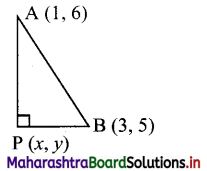
A(1, 6) and B(3, 5), find the equation of the locus of point P such that segment AB subtends a right angle at P. (∠APB = 90°)
Solution:
Let P(x. y) be any point on the required locus.
Given, A(1, 6) and B(3, 5), ∠APB = 90°
∴ ΔAPB is a right-angled triangle.
Maharashtra Board 11th Commerce Maths Solutions Chapter 5 Locus and Straight Line Ex 5.1 Q6
By Pythagoras theorem,
AP2 + PB2 = AB2
∴ [(x – 1)2 + (y – 6)2] + [(x – 3)2 + (y – 5)2] = (1 – 3)2 + (6 – 5)2
∴ x2 – 2x + 1 + y2 – 12y + 36 + x2 – 6x + 9 + y2 – 10y + 25 = 4 + 1
∴ 2x2 + 2y2 – 8x – 22y + 66 = 0
∴ x2 + y2 – 4x – 11y + 33 = 0
∴ The required equation of locus is x2 + y2 – 4x – 11y + 33 = 0

Question 7.
If the origin is shifted to the point O'(2, 3), the axes remaining parallel to the original axes, find the new co-ordinates of the points (a) A(1, 3) (b) B(2, 5)
Solution:
Origin is shifted to (2, 3) = (h, k)
Let the new co-ordinates be (X, Y).
∴ x = X + h and y = Y + k
∴ x = X + 2 and y = Y + 3 …..(i)
(a) Given, A(x, y) = A(1, 3)
x = X + 2 and y = Y + 3 …..[From (i)]
∴ 1 = X + 2 and 3 = Y + 3
∴ X = -1 and Y = 0
∴ the new co-ordinates of point A are (-1, 0).

(b) Given, B(x, y) = B(2, 5)
x = X + 2 andy = Y + 3 ……[From (i)]
∴ 2 = X + 2 and 5 = Y + 3
∴ X = 0 and Y = 2
∴ the new co-ordinates of point B are (0, 2).

Maharashtra Board 11th Commerce Maths Solutions Chapter 5 Locus and Straight Line Ex 5.1

Question 8.
If the origin is shifted to the point O'(1, 3), the axes remaining parallel to the original axes, find the old co-ordinates of the points (a) C(5, 4) (b) D(3, 3)
Solution:
Origin is shifted to (1, 3) = (h, k)
Let the new co-ordinates be (X, Y)
x = X + h and y = Y + k
∴ x = X + 1 and 7 = Y + 3 …..(i)
(a) Given, C(X, Y) = C(5, 4)
∴ x = X + 1 andy = Y + 3 …..[From(i)]
∴ x = 5 + 1 = 6 and y = 4 + 3 = 7
∴ the old co-ordinates of point C are (6, 7).

(b) Given, D(X, Y) = D(3, 3)
∴ x = X + 1 and y = Y + 3 …..[From (i)]
∴ x = 3 + 1 = 4 and y = 3 + 3 = 6
∴ the old co-ordinates of point D are (4, 6).

Question 9.
If the co-ordinates (5, 14) change to (8, 3) by the shift of origin, find the co-ordinates of the point, where the origin is shifted.
Solution:
Let the origin be shifted to (h, k).
Given, (x,y) = (5, 14), (X, Y) = (8, 3)
Since, x = X + h and y = Y + k
∴ 5 = 8 + h and 14 = 3 + k
∴ h = -3 and k = 11
∴ the co-ordinates of the point, where the origin is shifted are (-3, 11).

Question 10.
Obtain the new equations of the following loci if the origin is shifted to the point O'(2, 2), the direction of axes remaining the same:
(a) 3x – y + 2 = 0
(b) x2 + y2 – 3x = 7
(c) xy – 2x – 2y + 4 = 0
Solution:
Given, (h, k) = (2, 2)
Let (X, Y) be the new co-ordinates of the point (x, y).
∴ x = X + h and y = Y + k
∴ x = X + 2 and y = Y + 2
(a) Substituting the values of x and y in the equation 3x – y + 2 = 0, we get
3(X + 2) – (Y + 2) + 2 = 0
∴ 3X + 6 – Y – 2 + 2 = 0
∴ 3X – Y + 6 = 0, which is the new equation of locus.

(b) Substituting the values of x and y in the equation x2 + y2 – 3x = 7, we get
(X + 2)2 + (Y + 2)2 – 3(X + 2) = 7
∴ X2 + 4X + 4 + Y2 + 4Y + 4 – 3X – 6 = 7
∴ X2 + Y2 + X + 4Y – 5 = 0, which is the new equation of locus.

Maharashtra Board 11th Commerce Maths Solutions Chapter 5 Locus and Straight Line Ex 5.1

(c) Substituting the values of x and y in the equation xy – 2x – 2y + 4 = 0, we get
(X + 2) (Y + 2) – 2(X + 2) – 2(Y + 2) + 4 = 0
∴ XY + 2X + 2Y + 4 – 2X – 4 – 2Y – 4 + 4 = 0
∴ XY = 0, which is the new equation of locus.

Maharashtra Board 11th Commerce Maths Solutions Chapter 4 Sequences and Series Miscellaneous Exercise 4

Balbharati Maharashtra State Board 11th Commerce Maths Solution Book Pdf Chapter 4 Sequences and Series Miscellaneous Exercise 4 Questions and Answers.

Maharashtra State Board 11th Commerce Maths Solutions Chapter 4 Sequences and Series Miscellaneous Exercise 4

Question 1.
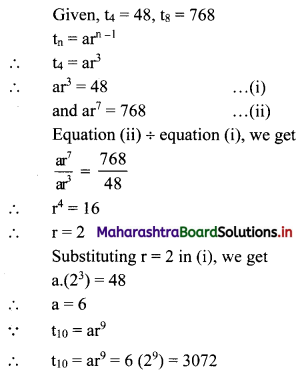
In a G.P., the fourth term is 48 and the eighth term is 768. Find the tenth term.
Solution:
Maharashtra Board 11th Commerce Maths Solutions Chapter 4 Sequences and Series Miscellaneous Exercise 4 Q1

Question 2.
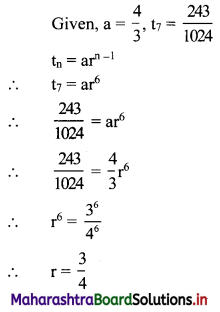
For a G.P. a = \(\frac{4}{3}\) and t7 = \(\frac{243}{1024}\), find the value of r.
Solution:
Maharashtra Board 11th Commerce Maths Solutions Chapter 4 Sequences and Series Miscellaneous Exercise 4 Q2

Maharashtra Board 11th Commerce Maths Solutions Chapter 4 Sequences and Series Miscellaneous Exercise 4

Question 3.
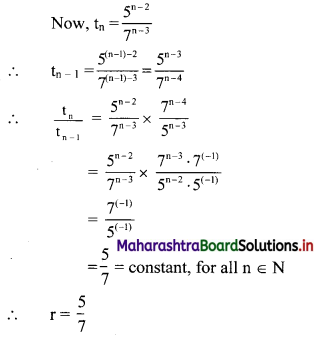
For a sequence, if tn = \(\frac{5^{n-2}}{7^{n-3}}\), verify whether the sequence is a G.P. If it is a G.P., find its first term and the common ratio.
Solution:
The sequence (tn) is a G.P., if \(\frac{5^{n-2}}{7^{n-3}}\) = constant, for all n ∈ N.
Maharashtra Board 11th Commerce Maths Solutions Chapter 4 Sequences and Series Miscellaneous Exercise 4 Q3
∴ the sequence is a G.P. with common ratio = \(\frac{5}{7}\)
∴ first term = t1 = \(\frac{5^{1-2}}{7^{1-3}}=\frac{5^{-1}}{7^{-2}}=\frac{7^{2}}{5}=\frac{49}{5}\)

Question 4.
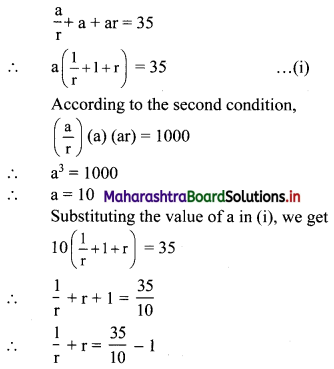
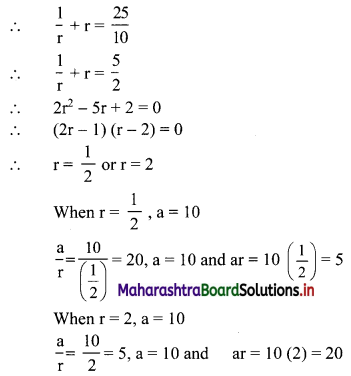
Find three numbers in G.P., such that their sum is 35 and their product is 1000.
Solution:
Let the three numbers in G.P. be \(\frac{a}{r}\), a, ar.
According to the first condition,
Maharashtra Board 11th Commerce Maths Solutions Chapter 4 Sequences and Series Miscellaneous Exercise 4 Q4
Maharashtra Board 11th Commerce Maths Solutions Chapter 4 Sequences and Series Miscellaneous Exercise 4 Q4.1
∴ the three numbers in G.P. are 20, 10, 5 or 5, 10, 20.

Question 5.
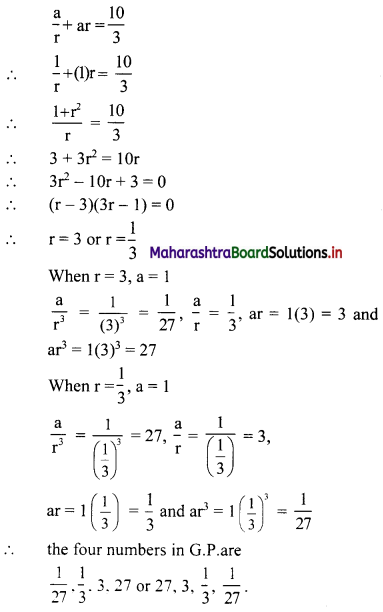
Find 4 numbers in G. P. such that the sum of the middle 2 numbers is \(\frac{10}{3}\) and their product is 1.
Solution:
Let the four numbers in G.P. be \(\frac{a}{r^{3}}, \frac{a}{r}, a r, a r^{3}\).
According to the second condition,
\(\frac{\mathrm{a}}{\mathrm{r}^{3}}\left(\frac{\mathrm{a}}{\mathrm{r}}\right)(\mathrm{ar})\left(\mathrm{ar}^{3}\right)=1\)
∴ a4 = 1
∴ a = 1
According to the first condition,
Maharashtra Board 11th Commerce Maths Solutions Chapter 4 Sequences and Series Miscellaneous Exercise 4 Q5

Maharashtra Board 11th Commerce Maths Solutions Chapter 4 Sequences and Series Miscellaneous Exercise 4

Question 6.
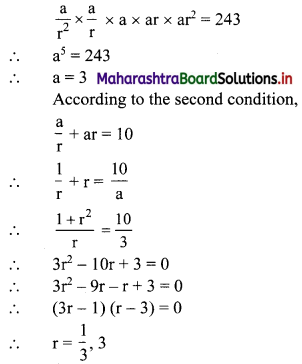
Find five numbers in G.P. such that their product is 243 and the sum of the second and fourth numbers is 10.
Solution:
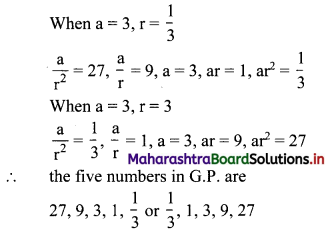
Let the five numbers in G.P. be
\(\frac{a}{r^{2}}, \frac{a}{r}, a, a r, a r^{2}\)
According to the first condition,
Maharashtra Board 11th Commerce Maths Solutions Chapter 4 Sequences and Series Miscellaneous Exercise 4 Q6
Maharashtra Board 11th Commerce Maths Solutions Chapter 4 Sequences and Series Miscellaneous Exercise 4 Q6.1

Question 7.
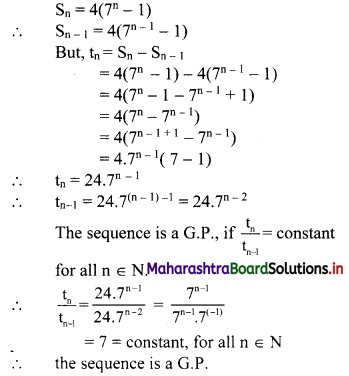
For a sequence, Sn = 4(7n – 1), verify whether the sequence is a G.P.
Solution:
Maharashtra Board 11th Commerce Maths Solutions Chapter 4 Sequences and Series Miscellaneous Exercise 4 Q7

Question 8.
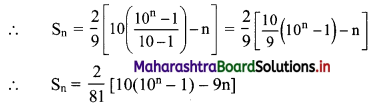
Find 2 + 22 + 222 + 2222 + …… upto n terms.
Solution:
Sn = 2 + 22 + 222 +….. upto n terms
= 2(1 + 11 + 111 +…… upto n terms)
= \(\frac{2}{9}\) (9 + 99 + 999 + … upto n terms)
= \(\frac{2}{9}\) [(10 – 1) + (100 – 1) + (1000 – 1) +…… upto n terms]
= \(\frac{2}{9}\) [(10 + 100 + 1000 + … upto n terms) – (1 + 1 + 1 + ….. n times)]
Since, 10, 100, 1000, …… n terms are in G.P.
with a = 10, r = \(\frac{100}{10}\) = 10
Maharashtra Board 11th Commerce Maths Solutions Chapter 4 Sequences and Series Miscellaneous Exercise 4 Q8

Question 9.
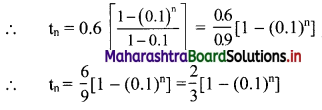
Find the nth term of the sequence 0.6, 0.66, 0.666, 0.6666,…..
Solution:
0.6, 0.66, 0.666, 0.6666, ……
∴ t1 = 0.6
t2 = 0.66 = 0.6 + 0.06
t3 = 0.666 = 0.6 + 0.06 + 0.006
Hence, in general
tn = 0.6 + 0.06 + 0.006 + …… upto n terms.
The terms are in G.P.with
a = 0.6, r = \(\frac{0.06}{0.6}\) = 0.1
∴ tn = the sum of first n terms of the G.P.
Maharashtra Board 11th Commerce Maths Solutions Chapter 4 Sequences and Series Miscellaneous Exercise 4 Q9

Maharashtra Board 11th Commerce Maths Solutions Chapter 4 Sequences and Series Miscellaneous Exercise 4

Question 10.
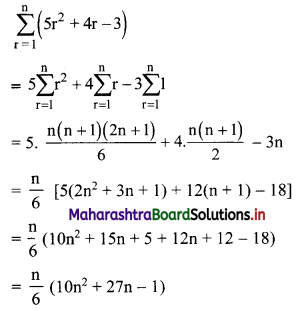
Find \(\sum_{r=1}^{n}\left(5 r^{2}+4 r-3\right)\).
Solution:
Maharashtra Board 11th Commerce Maths Solutions Chapter 4 Sequences and Series Miscellaneous Exercise 4 Q10

Question 11.
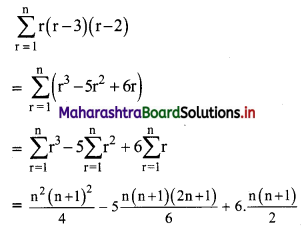
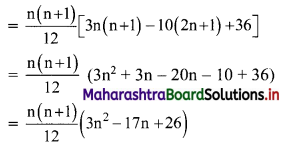
Find \(\sum_{\mathbf{r}=1}^{\mathbf{n}} \mathbf{r}(\mathbf{r}-\mathbf{3})(\mathbf{r}-\mathbf{2})\).
Solution:
Maharashtra Board 11th Commerce Maths Solutions Chapter 4 Sequences and Series Miscellaneous Exercise 4 Q11
Maharashtra Board 11th Commerce Maths Solutions Chapter 4 Sequences and Series Miscellaneous Exercise 4 Q11.1

Question 12.
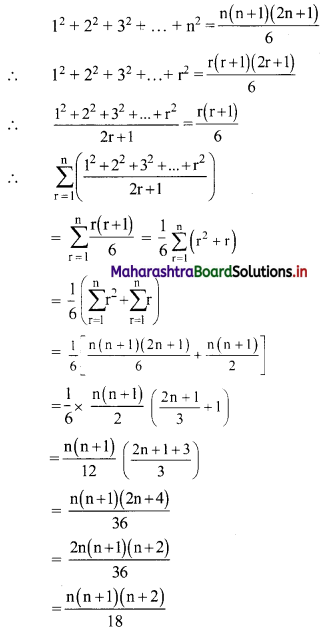
Find \(\sum_{r=1}^{n} \frac{1^{2}+2^{2}+3^{2}+\ldots+r^{2}}{2 r+1}\)
Solution:
We know that,
Maharashtra Board 11th Commerce Maths Solutions Chapter 4 Sequences and Series Miscellaneous Exercise 4 Q12

Question 13.
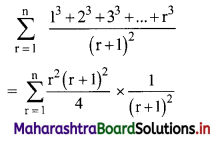
Find \(\sum_{r=1}^{n} \frac{1^{3}+2^{3}+3^{3}+\ldots+r^{3}}{(r+1)^{2}}\)
Solution:
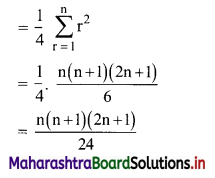
Maharashtra Board 11th Commerce Maths Solutions Chapter 4 Sequences and Series Miscellaneous Exercise 4 Q13
Maharashtra Board 11th Commerce Maths Solutions Chapter 4 Sequences and Series Miscellaneous Exercise 4 Q13.1

Question 14.
Find 2 × 6 + 4 × 9 + 6 × 12 + …… upto n terms.
Solution:
2, 4, 6, … are in A.P.
∴ rth term = 2 + (r – 1)2 = 2r
6, 9, 12, … are in A.P.
∴ rth term = 6 + (r – 1) (3) = (3r + 3)
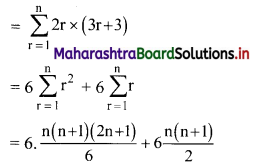
∴ 2 × 6 + 4 × 9 + 6 × 12 +…… upto n terms
Maharashtra Board 11th Commerce Maths Solutions Chapter 4 Sequences and Series Miscellaneous Exercise 4 Q14
= n(n + 1) (2n + 1 + 3)
= 2n(n + 1)(n + 2)

Maharashtra Board 11th Commerce Maths Solutions Chapter 4 Sequences and Series Miscellaneous Exercise 4

Question 15.
Find 122 + 132 + 142 + 152 + …… + 202.
Solution:
122 + 132 + 142 + 152 + …… + 202
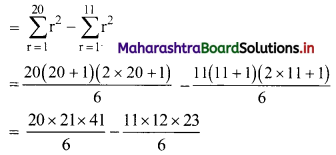
= (12 + 22 + 32 + 42 + ……. + 202) – (12 + 22 + 32 + 42 + …… + 112)
Maharashtra Board 11th Commerce Maths Solutions Chapter 4 Sequences and Series Miscellaneous Exercise 4 Q15
= 2870 – 506
= 2364

Question 16.
Find (502 – 492) + (482 – 472) + (462 – 452) + …… + (22 – 12).
Solution:
(502 – 492) + (482 – 472) + (462 – 452) + …… + (22 – 12)
= (502 + 482 + 462 + …… + 22) – (492 + 472 + 452 + …… + 12)
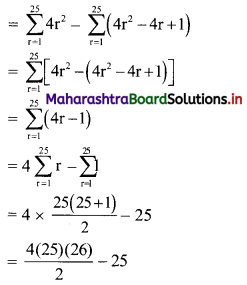
= \(\sum_{r=1}^{25}(2 r)^{2}-\sum_{r=1}^{25}(2 r-1)^{2}\)
Maharashtra Board 11th Commerce Maths Solutions Chapter 4 Sequences and Series Miscellaneous Exercise 4 Q16
= 1300 – 25
= 1275

Question 17.
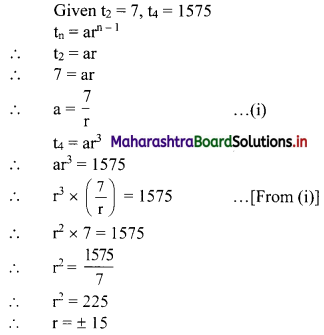
In a G.P., if t2 = 7, t4 = 1575, find r.
Solution:
Maharashtra Board 11th Commerce Maths Solutions Chapter 4 Sequences and Series Miscellaneous Exercise 4 Q17

Question 18.
Find k so that k – 1, k, k + 2 are consecutive terms of a G.P.
Solution:
Since k – 1, k, k + 2 are consecutive terms of a G.P.
∴ \(\frac{k}{k-1}=\frac{k+2}{k}\)
∴ k2 = k2 + k – 2
∴ k – 2 = 0
∴ k = 2

Maharashtra Board 11th Commerce Maths Solutions Chapter 4 Sequences and Series Miscellaneous Exercise 4

Question 19.
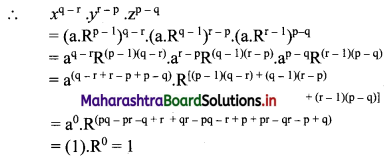
If pth, qth and rth terms of a G.P. are x, y, z respectively, find the value of \(x^{q-r} \cdot y^{r-p} \cdot z^{p-q}\).
Solution:
Let a be the first term and R be the common ratio of the G.P.
∴ tn = \(\text { a. } R^{n-1}\)
∴ x = \(\text { a. } R^{p-1}\), y = \(\text { a. } R^{q-1}\), z = \(\text { a. } R^{r-1}\)
Maharashtra Board 11th Commerce Maths Solutions Chapter 4 Sequences and Series Miscellaneous Exercise 4 Q19

Maharashtra Board 11th Commerce Maths Solutions Chapter 4 Sequences and Series Ex 4.5

Balbharati Maharashtra State Board 11th Commerce Maths Solution Book Pdf Chapter 4 Sequences and Series Ex 4.5 Questions and Answers.

Maharashtra State Board 11th Commerce Maths Solutions Chapter 4 Sequences and Series Ex 4.5

Question 1.
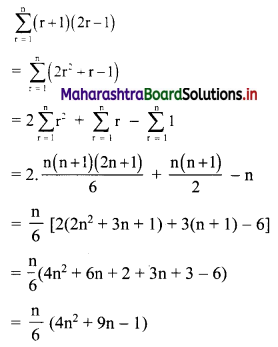
Find the sum \(\sum_{r=1}^{n}(r+1)(2 r-1)\).
Solution:
Maharashtra Board 11th Commerce Maths Solutions Chapter 4 Sequences and Series Ex 4.5 Q1

Question 2.
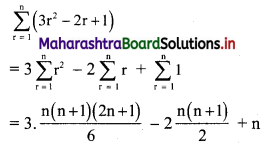
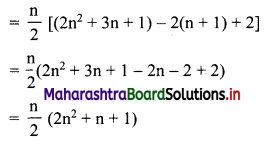
Find \(\sum_{r=1}^{n}\left(3 r^{2}-2 r+1\right)\).
Solution:
Maharashtra Board 11th Commerce Maths Solutions Chapter 4 Sequences and Series Ex 4.5 Q2
Maharashtra Board 11th Commerce Maths Solutions Chapter 4 Sequences and Series Ex 4.5 Q2.1

Question 3.
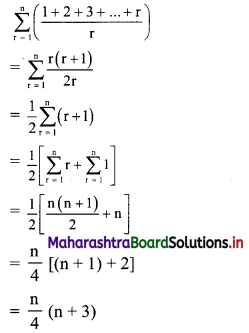
Find \(\sum_{r=1}^{n} \frac{1+2+3+\ldots+r}{r}\).
Solution:
Maharashtra Board 11th Commerce Maths Solutions Chapter 4 Sequences and Series Ex 4.5 Q3

Maharashtra Board 11th Commerce Maths Solutions Chapter 4 Sequences and Series Ex 4.5

Question 4.
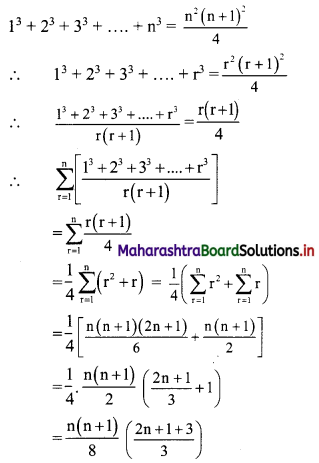
Find \(\sum_{r=1}^{n} \frac{1^{3}+2^{3}+\ldots+r^{3}}{r(r+1)}\).
Solution:
We know that,
Maharashtra Board 11th Commerce Maths Solutions Chapter 4 Sequences and Series Ex 4.5 Q4
Maharashtra Board 11th Commerce Maths Solutions Chapter 4 Sequences and Series Ex 4.5 Q4.1

Question 5.
Find the sum 5 × 7 + 7 × 9 + 9 × 11 + 11 × 13 + …… upto n terms.
Solution:
5 × 7 + 7 × 9 + 9 × 11 + 11 × 13 + ….. upto n terms
Now, 5, 7, 9, 11, … are in A.P.
rth term = 5 + (r – 1) (2) = 2r + 3
7, 9, 11,. … are in A.P.
rth term = 7 + (r – 1) (2) = 2r + 5
∴ 5 × 7 + 7 × 9 + 9 × 11 + 11 × 13 + …… upto n terms
Maharashtra Board 11th Commerce Maths Solutions Chapter 4 Sequences and Series Ex 4.5 Q5

Question 6.
Find the sum 22 + 42 + 62 + 82 + …… upto n terms.
Solution:
22 + 42 + 62 + 82 + …… upto n terms
= (2 × 1)2 + (2 × 2)2 + (2 × 3)2 + (2 × 4)2 + ……
Maharashtra Board 11th Commerce Maths Solutions Chapter 4 Sequences and Series Ex 4.5 Q6

Question 7.
Find (702 – 692) + (682 – 672) + (662 – 652) + ……. + (22 – 12)
Solution:
Let S = (702 – 692) + (682 – 672) + …… +(22 – 12)
∴ S = (22 – 12) + (42 – 32) + …… + (702 – 692)
Here, 2, 4, 6,…, 70 is an A.P. with rth term = 2r
and 1, 3, 5,….., 69 in A.P. with rth term = 2r – 1
Maharashtra Board 11th Commerce Maths Solutions Chapter 4 Sequences and Series Ex 4.5 Q7

Maharashtra Board 11th Commerce Maths Solutions Chapter 4 Sequences and Series Ex 4.5

Question 8.
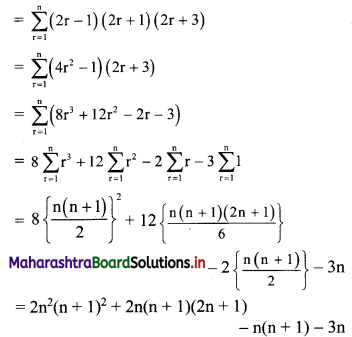
Find the sum 1 × 3 × 5 + 3 × 5 × 7 + 5 × 7 × 9 + …… + (2n – 1) (2n + 1) (2n + 3)
Solution:
1 × 3 × 5 + 3 × 5 × 7 + 5 × 7 × 9 + …… + (2n – 1) (2n + 1) (2n + 3)
Now, 1, 3, 5, 7, … are in A.P. with a = 1 and d = 2.
∴ rth term = 1 + (r – 1)2 = 2r – 1
3, 5, 7, 9, … are in A.P. with a = 3 and d = 2
∴ rth term = 3 + (r – 1)2 = 2r + 1
and 5, 7, 9, 11, … are in A.P. with a = 5 and d = 2
∴ rth term = 5 + (r – 1)2 = 2r + 3
∴ 1 × 3 × 5 + 3 × 5 × 7 + 5 × 7 × 9 + …… upto n terms
Maharashtra Board 11th Commerce Maths Solutions Chapter 4 Sequences and Series Ex 4.5 Q8
= n(n + 1)[2n(n + 1) + 4n + 2 – 1] – 3n
= n(n + l)(2n2 + 6n + 1) – 3n
= n(2n3 + 8n2 + 7n + 1 – 3)
= n(2n3 + 8n2 + 7n – 2)

Question 9.
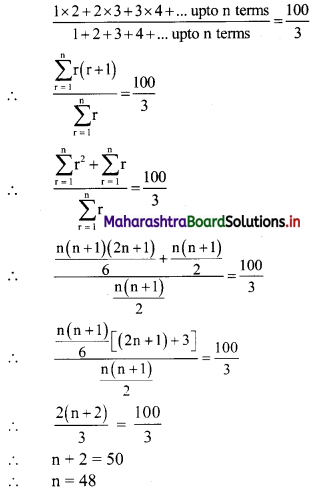
Find n, if \(\frac{1 \times 2+2 \times 3+3 \times 4+4 \times 5+\ldots+\text { upto } n \text { terms }}{1+2+3+4+\ldots+\text { upto } n \text { terms }}\) = \(\frac{100}{3}\)
Solution:
Maharashtra Board 11th Commerce Maths Solutions Chapter 4 Sequences and Series Ex 4.5 Q9

Maharashtra Board 11th Commerce Maths Solutions Chapter 4 Sequences and Series Ex 4.5

Question 10.
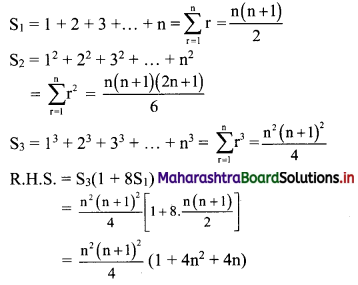
If S1, S2, and S3 are the sums of first n natural numbers, their squares, and their cubes respectively, then show that:
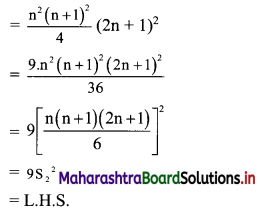
9\(S_{2}^{2}\) = S3(1 + 8S1).
Solution:
Maharashtra Board 11th Commerce Maths Solutions Chapter 4 Sequences and Series Ex 4.5 Q10
Maharashtra Board 11th Commerce Maths Solutions Chapter 4 Sequences and Series Ex 4.5 Q10.1

Maharashtra Board 12th Commerce Maths Solutions Chapter 7 Assignment Problem and Sequencing Ex 7.1

Balbharati Maharashtra State Board 12th Commerce Maths Solution Book Pdf Chapter 7 Assignment Problem and Sequencing Ex 7.1 Questions and Answers.

Maharashtra State Board 12th Commerce Maths Solutions Chapter 7 Assignment Problem and Sequencing Ex 7.1

Question 1.
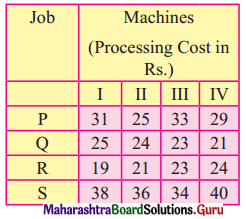
A job production unit has four jobs A, B, C, D which can be manufactured on each of the four machine P, Q, R and S. The processing cost of each job for each machine is given in the following table:
Maharashtra Board 12th Commerce Maths Solutions Chapter 7 Assignment Problem and Sequencing Ex 7.1 Q1
Find the optimal assignment to minimize the total processing cost.
Solution:
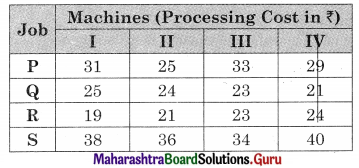
The cost matrix is given by
Maharashtra Board 12th Commerce Maths Solutions Chapter 7 Assignment Problem and Sequencing Ex 7.1 Q1.1
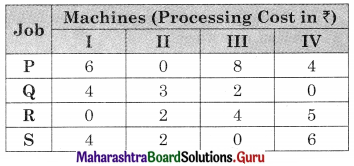
Subtracting row minimum from all the elements in that row we get
Maharashtra Board 12th Commerce Maths Solutions Chapter 7 Assignment Problem and Sequencing Ex 7.1 Q1.2
Subtracting column minimum from all the elements in that column we get the same matrix.
As all the rows and columns have single zeros the allotment can be done as follows.
Maharashtra Board 12th Commerce Maths Solutions Chapter 7 Assignment Problem and Sequencing Ex 7.1 Q1.3
As per the table, the job allotments are
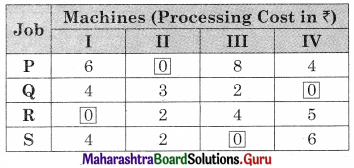
P → II, Q → IV, R → I, S → III
The total minimum cost = 25 + 21 + 19 + 34 = ₹ 99

Maharashtra Board 12th Commerce Maths Solutions Chapter 7 Assignment Problem and Sequencing Ex 7.1

Question 2.
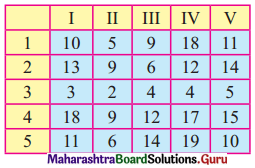
Five wagons are available at stations 1, 2, 3, 4, and 5. These are required at 5 stations I, II, III, IV, and V. The mileage between various stations are given in the table below. How should the wagons be transported so as to minimize the mileage covered?
Maharashtra Board 12th Commerce Maths Solutions Chapter 7 Assignment Problem and Sequencing Ex 7.1 Q2
Solution:
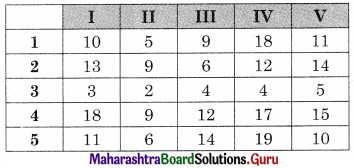
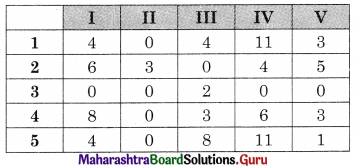
The mileage matrix is given by
Maharashtra Board 12th Commerce Maths Solutions Chapter 7 Assignment Problem and Sequencing Ex 7.1 Q2.1
Subtracting row minimum from all elements in that row we get
Maharashtra Board 12th Commerce Maths Solutions Chapter 7 Assignment Problem and Sequencing Ex 7.1 Q2.2
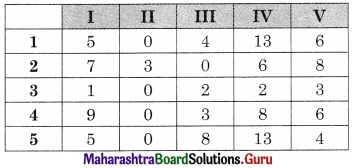
Subtracting column minimum from all elements in that column we get
Maharashtra Board 12th Commerce Maths Solutions Chapter 7 Assignment Problem and Sequencing Ex 7.1 Q2.3
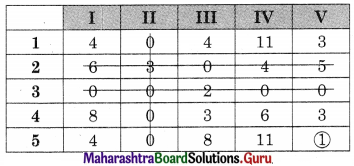
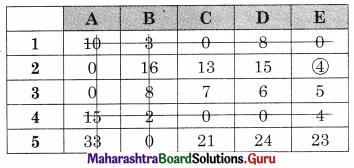
Draw minimum lines covering all the zeros
Maharashtra Board 12th Commerce Maths Solutions Chapter 7 Assignment Problem and Sequencing Ex 7.1 Q2.4
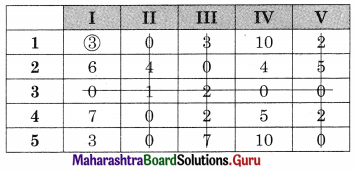
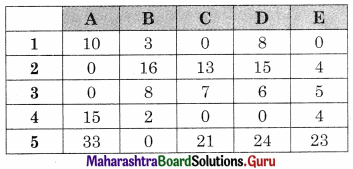
The number of lines covering all the zeros (3) is less than the order of the matrix (5). Hence an assignment is not possible. The modification is required. The minimum uncovered value 1 is subtracted from uncovered values and added to the values at the intersection. The numbers on the lines remain the same we get
Maharashtra Board 12th Commerce Maths Solutions Chapter 7 Assignment Problem and Sequencing Ex 7.1 Q2.5
Drawing a minimum number of lines covering all the zeros.
No. of lines covering all the zeros (4) is less than the order of the matrix (5).
Hence assignment is not possible.
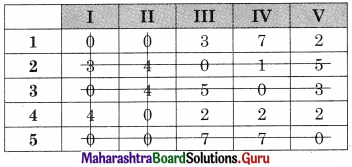
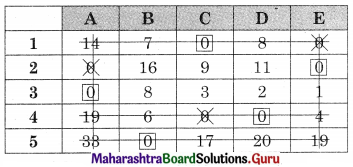
Again modification is required. The minimum uncovered value 3 is subtracted from the uncovered values and added to the values at the intersection.
The numbers on the lines remain the same we get
Maharashtra Board 12th Commerce Maths Solutions Chapter 7 Assignment Problem and Sequencing Ex 7.1 Q2.6
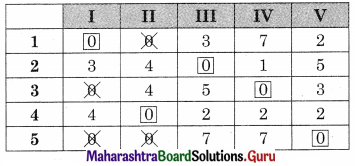
No. of lines covering all the zeros (5) are equal to the order of the matrix so the assignment is possible.
Maharashtra Board 12th Commerce Maths Solutions Chapter 7 Assignment Problem and Sequencing Ex 7.1 Q2.7
According to the table the assignment is
1 → I, 2 → II, 3 → IV, 4 → II, 5 → V
Total minimum mileage = 10 + 6 + 4 + 9 + 10 = 39 units

Maharashtra Board 12th Commerce Maths Solutions Chapter 7 Assignment Problem and Sequencing Ex 7.1

Question 3.
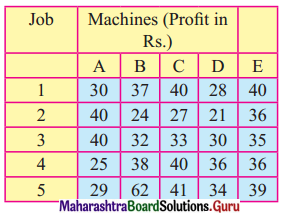
Five different machines can do any of the five required jobs, with different profits five required jobs, with different profits resulting from each assignment as shown below:
Maharashtra Board 12th Commerce Maths Solutions Chapter 7 Assignment Problem and Sequencing Ex 7.1 Q3
Find the optimal assignment schedule.
Solution:
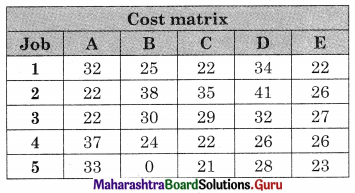
This profit matrix has to be reduced to cost matrix by subtracting all the values of the matrix from the largest value (62) we get
Maharashtra Board 12th Commerce Maths Solutions Chapter 7 Assignment Problem and Sequencing Ex 7.1 Q3.2
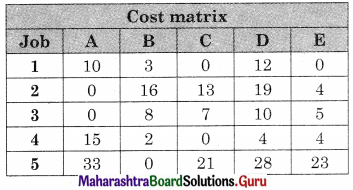
Subtracting row minimum value from all the elements in that column we get
Maharashtra Board 12th Commerce Maths Solutions Chapter 7 Assignment Problem and Sequencing Ex 7.1 Q3.3
Subtracting column minimum from all the elements in that column we get
Maharashtra Board 12th Commerce Maths Solutions Chapter 7 Assignment Problem and Sequencing Ex 7.1 Q3.4
Drawing minimum lines covering all zeros we get
Maharashtra Board 12th Commerce Maths Solutions Chapter 7 Assignment Problem and Sequencing Ex 7.1 Q3.5
No. of lines (4) is less than the order of the matrix (5). Hence assignment is not possible. The modification is required. The minimum uncovered value (4) is subtracted from the uncovered value and added to the values at the intersection. The values on the lines remain the same, we get
Maharashtra Board 12th Commerce Maths Solutions Chapter 7 Assignment Problem and Sequencing Ex 7.1 Q3.6
No. of lines (5) are equal to the order of the matrix (5). So assignments are possible
1 → C, 2 → E, 3 → A, 4 → D, 5 → B
For the minimum profit look at the corresponding in the profit matrix given.
Maximum profit = 40 + 36 + 40 + 36 + 62 = 214 units

Maharashtra Board 12th Commerce Maths Solutions Chapter 7 Assignment Problem and Sequencing Ex 7.1

Question 4.
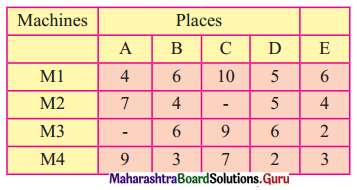
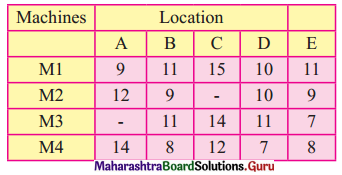
Four new machines M1, M2, M3, and M4 are to be installed in a machine shop. There are five vacant places A, B, C, D, and E available. Because of limited space, machine M2 cannot be placed at C and M1 cannot be placed at A. The cost matrix is given below.
Maharashtra Board 12th Commerce Maths Solutions Chapter 7 Assignment Problem and Sequencing Ex 7.1 Q4
Find the optimal assignment schedule.
Solution:
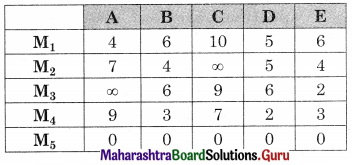
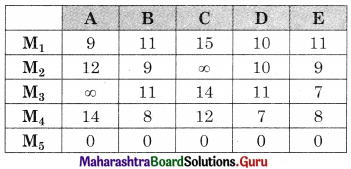
This is a restricted assignment so we assign a very high cost ‘∞’ to the prohibited all.
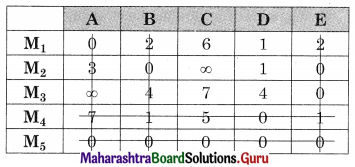
Also as it is an unbalanced problem we add a dummy row M5 with all values as ‘0’, we get
Maharashtra Board 12th Commerce Maths Solutions Chapter 7 Assignment Problem and Sequencing Ex 7.1 Q4.1
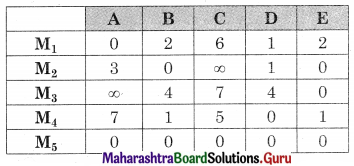
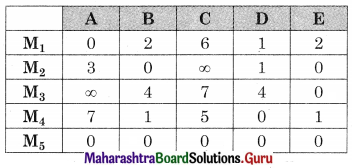
Subtracting row minimum from all the elements in that row, we get
Maharashtra Board 12th Commerce Maths Solutions Chapter 7 Assignment Problem and Sequencing Ex 7.1 Q4.2
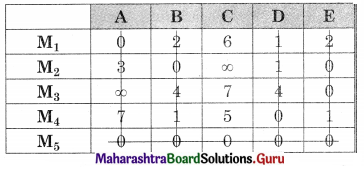
Subtracting column minimum from all the elements in that column we get the same matrix.
Maharashtra Board 12th Commerce Maths Solutions Chapter 7 Assignment Problem and Sequencing Ex 7.1 Q4.3
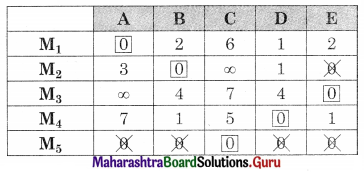
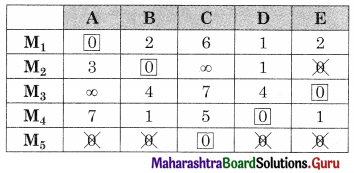
As minimum no. of lines covering all zeros (5) is equal to the order of the matrix, Assignment is possible
Maharashtra Board 12th Commerce Maths Solutions Chapter 7 Assignment Problem and Sequencing Ex 7.1 Q4.4
The assignments are given by
M1 → A, M2 → B, M3 → E, M4 → D, M5 → C
As M5 is dummy no machine is installed at C
For minimum cost taking the corresponding values in the cost matrix we get
Minimum cost = 4 + 4 + 2 + 2 = 12 units

Maharashtra Board 12th Commerce Maths Solutions Chapter 7 Assignment Problem and Sequencing Ex 7.1

Question 5.
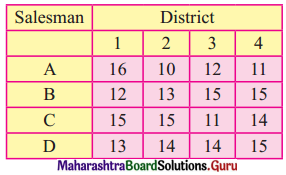
A company has a team of four salesmen and there is four districts where the company wants to start its business. After taking into account the capabilities of salesmen and the nature of districts, the company estimates that the profit per day in rupees for each salesman in each district is as below:
Maharashtra Board 12th Commerce Maths Solutions Chapter 7 Assignment Problem and Sequencing Ex 7.1 Q5
Find the assignments of a salesman to various districts which will yield maximum profit.
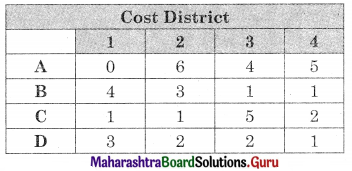
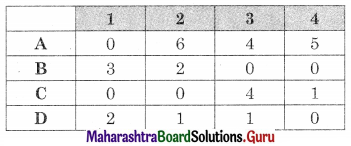
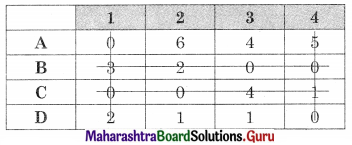
Solution:
The profit matrix has to be reduced to the cost matrix. Subtracting all the values from the maximum value (16) we get
Maharashtra Board 12th Commerce Maths Solutions Chapter 7 Assignment Problem and Sequencing Ex 7.1 Q5.1
Subtracting row minimum from all values in that row we get
Maharashtra Board 12th Commerce Maths Solutions Chapter 7 Assignment Problem and Sequencing Ex 7.1 Q5.2
Subtracting column minimum from each column we get the same matrix
Maharashtra Board 12th Commerce Maths Solutions Chapter 7 Assignment Problem and Sequencing Ex 7.1 Q5.3
As minimum no. of lines covering all zeros (4) is equal to the order of the matrix (4) Assignment is possible
Maharashtra Board 12th Commerce Maths Solutions Chapter 7 Assignment Problem and Sequencing Ex 7.1 Q5.4
∴ A → 1, B → 3, C → 2, D → 4
For maximum profit, we take the corresponding values in the profit matrix. We get
Maximum profit = 16 + 15 + 15 + 15 = ₹ 61

Maharashtra Board 12th Commerce Maths Solutions Chapter 7 Assignment Problem and Sequencing Ex 7.1

Question 6.
In the modification of a plant layout of a factory four new machines M1, M2, M3, and M4 are to be installed in a machine shop. There are five vacant places A, B, C, D, and E available. Because of limited space, machine M2 can not be placed at C and M3 can not be placed at A the cost of locating a machine at a place (in hundred rupees) is as follows.
Maharashtra Board 12th Commerce Maths Solutions Chapter 7 Assignment Problem and Sequencing Ex 7.1 Q6
Find the optimal assignment schedule.
Solution:
This is an unbalanced problem so we add a dummy row M5 with all values as ‘0’.
Also, this is on restricted assignment problem. So we assign a very high-cost W to the prohibited cells we have
Maharashtra Board 12th Commerce Maths Solutions Chapter 7 Assignment Problem and Sequencing Ex 7.1 Q6.1
Subtracting row minimum from all values in that row we get
Maharashtra Board 12th Commerce Maths Solutions Chapter 7 Assignment Problem and Sequencing Ex 7.1 Q6.2
Subtracting column minimum from all values in that column we get the same matrix
Maharashtra Board 12th Commerce Maths Solutions Chapter 7 Assignment Problem and Sequencing Ex 7.1 Q6.3
As minimum no. of lines covering all zeros (5) is equal to the order of the matrix (5) assignment is possible.
Maharashtra Board 12th Commerce Maths Solutions Chapter 7 Assignment Problem and Sequencing Ex 7.1 Q6.4
The assignment is
M1 → A, M2 → B, M3 → E, M4 → D, M5 → C
As M5 is dummy, no machine is installed at C.
The minimum cost is found by taking the corresponding values in the cost matrix
Minimum cost = 9 + 9 + 7 + 7 + 0 = 32 (in hundred ₹)