Maharashtra Board 11th Commerce Maths Solutions Chapter 9 Commercial Mathematics Ex 9.4

Balbharati Maharashtra State Board 11th Commerce Maths Solution Book Pdf Chapter 9 Commercial Mathematics Ex 9.4 Questions and Answers.

Maharashtra State Board 11th Commerce Maths Solutions Chapter 9 Commercial Mathematics Ex 9.4

Question 1.
Kanchan purchased a Maruti car for ₹ 2,45,000/- and the rate of depreciation is 14\(\frac{2}{7}\)% per annum. Find the value of the car after two years?
Solution:
Given, purchase price of the car = V = ₹ 2,45,000
Rate of depreciation per annum = r
= 14\(\frac{2}{7}\)%
= \(\frac{100}{7}\)%
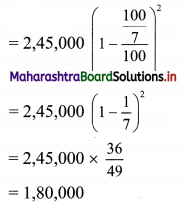
∴ Value of the car after two years = \(\mathrm{V}\left(1-\frac{\mathrm{r}}{100}\right)^{\mathrm{n}}\)
Maharashtra Board 11th Commerce Maths Solutions Chapter 9 Commercial Mathematics Ex 9.4 Q1
∴ The value of the car after two years is ₹ 1,80,000.

Question 2.
The value of a machine depreciates from ₹ 32,768 to ₹ 21,952/- in three years. What is the rate of depreciation?
Solution:
Given, initial value of machine = V = ₹ 32,768/-
Depreciated value of the machine = D.V. = ₹ 21,952/-
Numher of years = n = 3
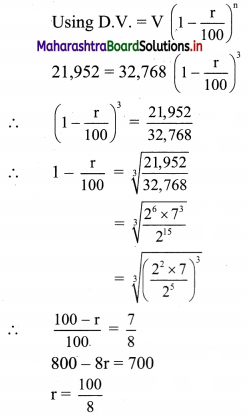
Maharashtra Board 11th Commerce Maths Solutions Chapter 9 Commercial Mathematics Ex 9.4 Q2
∴ r = 12.5%
∴ Rate of depreciation is 12.5% per annum.

Maharashtra Board 11th Commerce Maths Solutions Chapter 9 Commercial Mathematics Ex 9.4

Question 3.
The value of a machine depreciates at the rate of 10% every year. It was purchased 3 years ago. Its present value is ₹ 2,18,700/-. What was the purchase price of the machine?
Solution:
Given, the rate of depreciation per annum = r = 10%
Number of years = n = 3
Present value of the machine = P.V. = ₹ 2,18,700/-
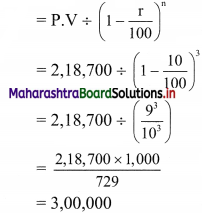
∴ Purchase price of the machine
Maharashtra Board 11th Commerce Maths Solutions Chapter 9 Commercial Mathematics Ex 9.4 Q3
∴ The purchase price of the machine is ₹ 3,00,000.

Question 4.
Mr. Manish purchased a motorcycle at ₹ 70,000/-. After some years he sold his motorcycle at its exact depreciated value of it that is ₹ 51,030/-. The rate of depreciation was taken as 10%. Find out how many years he sold his motorcycle.
Solution:
Given, purchase price of the motorcycle = V = ₹ 70,000/-
Depreciated value of the motorcycle = D.V. = ₹ 51,030/-
∴ Rate of depreciation = r = 10%
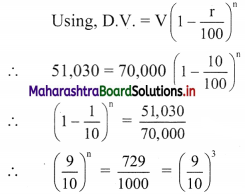
Maharashtra Board 11th Commerce Maths Solutions Chapter 9 Commercial Mathematics Ex 9.4 Q4
∴ n = 3
∴ Manish sold his motorcycle after 3 years.

Question 5.
Mr. Chetan purchased furniture for his home at ₹ 5,12,000/-. Considering the rate of depreciation as 12.5%, what will be the value of furniture after 3 years.
Solution:
Given, purchase price of furniture = V = ₹ 5,12,000/-
Rate of depreciation = r = 12.5%
Number of years = n = 3 years
∴ Value of furniture after 3 years = \(\mathrm{V}\left(1-\frac{\mathrm{r}}{100}\right)^{\mathrm{n}}\)
= 5,12,000 \(\left(1-\frac{12.5}{100}\right)^{3}\)
= 5,12,000 \(\left(1-\frac{1}{8}\right)^{3}\)
= 5,12,000 \(\left(\frac{7}{8}\right)^{3}\)
= 5,12,000 × \(\frac{343}{512}\)
= 3,43,000
∴ The value of furniture will be ₹ 3,43,000/-

Maharashtra Board 11th Commerce Maths Solutions Chapter 9 Commercial Mathematics Ex 9.4

Question 6.
Grace Fashion Boutique purchased a sewing machine at ₹ 25,000/-. After 3 years machine was sold at depreciated value of ₹ 18,225/-. Find the rate of depreciation.
Solution:
Given, purchase price of sewing machine = V = ₹ 25,000/-
Selling price of machine = D.V. = ₹ 18,225/-
Number of years = n = 3 years
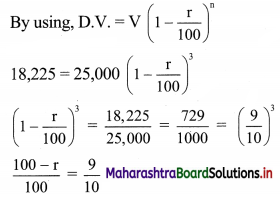
Maharashtra Board 11th Commerce Maths Solutions Chapter 9 Commercial Mathematics Ex 9.4 Q6
∴ 100 – r = 90
∴ r = 10%
∴ Rate of depreciation is 10% per annum.

Question 7.
Mr. Pritesh reduced the value of his assets by 5% each year, which were purchased for ₹ 50,00,000/-. Find the value of assets after 2 years.
Solution:
Given, initial value of assets = V = ₹ 50,00,000/-
Rate of depreciation per annum = r = 5%
Number of years = n = 2 years
∴ Value of assets aftertwo years = \(V\left(1-\frac{r}{100}\right)^{n}\)
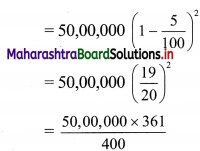
Maharashtra Board 11th Commerce Maths Solutions Chapter 9 Commercial Mathematics Ex 9.4 Q7
= 12,500 × 361
= 45,12,500
∴ The value of assets after two years is ₹ 45,12,500/-.

Maharashtra Board 11th Commerce Maths Solutions Chapter 9 Commercial Mathematics Ex 9.4

Question 8.
A manufacturing company is allowed to charge 10% depreciation on its stock. The initial value of the stock was ₹ 60,000/-. After how many years value of the stock will be ₹ 39366?
Solution:
Given, rate of depreciation = r = 10%
Initial value of stock = V = ₹ 60,000
Depreciated value of stock = D.V. = ₹ 39,366/-
By using,
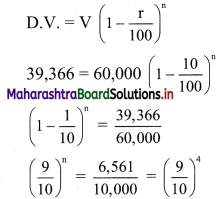
Maharashtra Board 11th Commerce Maths Solutions Chapter 9 Commercial Mathematics Ex 9.4 Q8
∴ n = 4
∴ The value of the stock will be ₹ 39,366/- after 4 years.

Maharashtra Board 11th Commerce Maths Solutions Chapter 9 Commercial Mathematics Ex 9.3

Balbharati Maharashtra State Board 11th Commerce Maths Solution Book Pdf Chapter 9 Commercial Mathematics Ex 9.3 Questions and Answers.

Maharashtra State Board 11th Commerce Maths Solutions Chapter 9 Commercial Mathematics Ex 9.3

Question 1.
What would be the simple interest on an amount of ₹ 9,600 at the rate of 6% per annum after 3 years?
Solution:
Given Principal P = ₹ 9600
Rate of interest R = 6% p.a.
Number of years = T = 3
Simple Interest I = \(\frac{\text { PRT }}{100}\)
= \(\frac{9600 \times 3 \times 6}{100}\)
= 96 × 18
= 1728
∴ Simple interest after 3 years would be ₹ 1728

Question 2.
What would be the simple interest at the rate of 9\(\frac{1}{2}\)% per annum on ₹ 6,000 for 2\(\frac{1}{2}\) years?
Solution:
Rate of interest per annum R = 9\(\frac{1}{2}\)% = \(\frac{19}{2}\)%
Principal P = ₹ 6000
Duration T = 2\(\frac{1}{2}\) = \(\frac{5}{2}\) years
∴ Simple Interest, I = \(\frac{\text { PRT }}{100}\)
= 6000 × \(\frac{19}{2} \times \frac{5}{2} \times \frac{1}{100}\)
= 15 × 19 × 5
= 1425
∴ Simple interest would be ₹ 1425.

Maharashtra Board 11th Commerce Maths Solutions Chapter 9 Commercial Mathematics Ex 9.3

Question 3.
What would be the simple interest on ₹ 8,400 in 9 months at the rate of 8.25 percent per annum?
Solution:
Principal P = ₹ 8400
Rate of interest R = 8.25%
Duration T = 9 months = \(\frac{3}{4}\) years
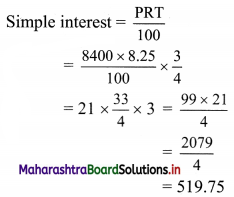
Maharashtra Board 11th Commerce Maths Solutions Chapter 9 Commercial Mathematics Ex 9.3 Q3
∴ Simple interest would be ₹ 519.75.

Question 4.
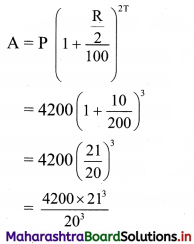
What would be the compound interest on ₹ 4200 for 18 months at 10% per annum compounded half yearly?
Solution:
Principal P = ₹ 4200
Rate of interest R = 10%
Duration T = 18 months = 1.5 years
compounding is done half yearly
Maharashtra Board 11th Commerce Maths Solutions Chapter 9 Commercial Mathematics Ex 9.3 Q4
= \(\frac{4200 \times 9261}{2000}\)
= 4862.025
I = A – P
= 4862.025 – 4200
= 662.025
∴ Compound interest would be ₹ 662.025.

Maharashtra Board 11th Commerce Maths Solutions Chapter 9 Commercial Mathematics Ex 9.3

Question 5.
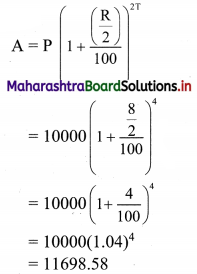
Find compound interest on ₹ 10,000 for 2 years at 8% per annum compounded half yearly.
Solution:
Principal P = ₹ 10,000
Rate of interest R = 8% p.a. compounded half yearly
Duration T = 2 years
Maharashtra Board 11th Commerce Maths Solutions Chapter 9 Commercial Mathematics Ex 9.3 Q5
I = A – P
= 11648.58 – 10000
= 1698.58
∴ Compound interest is ₹ 1698.58.

Question 6.
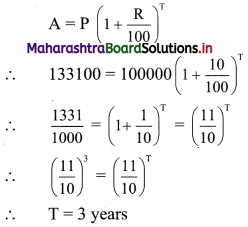
In how many years ₹ 1,00,000 will become ₹ 1,33,100 at compound interest rate of 10% per annum?
Solution:
Principal P = ₹ 1,00,000
Amount A = ₹ 1,33,100
Rate of interest R = 10% p.a.
Maharashtra Board 11th Commerce Maths Solutions Chapter 9 Commercial Mathematics Ex 9.3 Q6
∴ ₹ 1,00,000 will become ₹ 1,33,100 after 3 years.

Question 7.
A certain sum of money becomes three times of itself in 20 years at simple interest. In how many does it become double of itself at the same rate of simple interest?
Solution:
Given that, sum of money triples itself in 20 years
∴ P + I = 3P
∴ I = 2P
and T = 20 years
Now simple interest I = \(\frac{\text { PRT }}{100}\)
∴ 2P = \(\frac{\mathrm{P} \times \mathrm{R} \times 20}{100}\)
∴ R = 10
∴ Rate of interest = 10% per annum
The time period is to be calculated for the condition that the sum doubles itself i.e. for the condition
P + I = 2P
i.e. I = P
\(\frac{\mathrm{P} \times \mathrm{R} \times \mathrm{T}}{100}\) = P
∴ \(\frac{10 \times T}{100}\) = 1
∴ T = 10
∴ The sum will become double of itself in 10 years.

Question 8.
A person borrows 10,000 for 2 year at 4% p.a. simple interest he immediately lends it to another person at 6.5% p.a. for 2 years. Find his total gain in the transaction.
Solution:
Person borrows money at 4% per annum and lends it at 6.5% per annum.
∴ His gain is (6.5 – 4) = 2.5% on ₹ 10000 for 2 years
i.e. gain = \(\frac{1000 \times 2.5 \times 2}{100}\)
= 100 × 5
= ₹ 500
∴ The person will gain ₹ 500 in this transaction.

Maharashtra Board 11th Commerce Maths Solutions Chapter 9 Commercial Mathematics Ex 9.3

Question 9.
A man deposits X 200 at the end of each year in recurring account at 5% compound interest. How much will it become at the end of 3 years?
Solution:
At end of 1st year, 2nd year and 3rd year ₹ 200 were deposited.
Rate of interest R = 5% p.a.
At end of 3 years, amount
= 200 + \(200\left[1+\frac{5}{100}\right]+200\left[1+\frac{5}{100}\right]^{2}\)
= 200 [1 + 1.05 + (1.05)2]
= 200 [2.05 + 1.1025]
= 200 [3.1525]
= 630.5
At end of 3 years, the account will have a balance of ₹ 630.5.

Question 10.
A man gets a simple interest of ₹ 2,000 on a certain principal at the rate of 5% p.a. in 4 years. What compound interest will the man get on twice the principal in 2 years at the same rate.
Solution:
Let Principal amount = P
Simple Interest I = ₹ 2000
Rate of interest R = 5% p.a.
Time duration T = 4 years
I = \(\frac{\text { PRT }}{100}\)
∴ 2000 = \(\frac{\mathrm{P} \times 5 \times 4}{100}\)
∴ P = 10000
Twice the principal was invested for compound interest with the same rate of interest for 2 years.
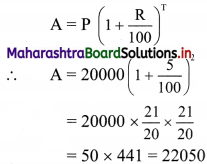
Here, P = 2 × 10,000 = ₹ 20,000
∴ Amount received,
Maharashtra Board 11th Commerce Maths Solutions Chapter 9 Commercial Mathematics Ex 9.3 Q10
I = A – P = 22050 – 20000 = 2050
The man will receive ₹ 2050 as compound interest.

Maharashtra Board 11th Commerce Maths Solutions Chapter 9 Commercial Mathematics Ex 9.3

Question 11.
The difference between simple interest and compound interest on a certain sum of money is ₹ 32 at 8% per annum for 2 years. Find the amount.
Solution:
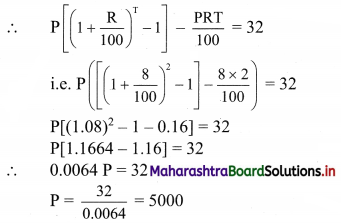
Compound Interest = A – P = \(\mathrm{P}\left(1+\frac{\mathrm{R}}{100}\right)^{\mathrm{T}}-\mathrm{P}\)
Simple interest = \(\frac{\text { PRT }}{100}\)
Given R = 8%, T = 2 years and
compound interest – simple interest = ₹ 32
Maharashtra Board 11th Commerce Maths Solutions Chapter 9 Commercial Mathematics Ex 9.3 Q11
∴ The man will receive a compound interest of ₹ 5000.

Maharashtra Board 11th Commerce Maths Solutions Chapter 9 Commercial Mathematics Ex 9.2

Balbharati Maharashtra State Board 11th Commerce Maths Solution Book Pdf Chapter 9 Commercial Mathematics Ex 9.2 Questions and Answers.

Maharashtra State Board 11th Commerce Maths Solutions Chapter 9 Commercial Mathematics Ex 9.2

Question 1.
Mr. Sarad purchased a laptop for ₹ 24,000 and sold it for ₹ 30,000. What was the profit percentage?
Solution:
Cost price (C.P.) = ₹ 24000
Selling price (S. P.) = ₹ 30,000
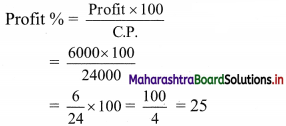
Profit = S.P. – C.P.
= 30,000 – 24,000
= 6,000
Maharashtra Board 11th Commerce Maths Solutions Chapter 9 Commercial Mathematics Ex 9.2 Q1
∴ Profit Percentage = 25%

Question 2.
Shraddha purchased a mobile phone and refrigerator for ₹ 18,000 and ₹ 15,000 respectively. She sold the refrigerator at a loss of 20% and the mobile at a profit of 20%. What is her overall profit or loss?
Solution:
C.P. of mobile phone = ₹ 18,000
Profit percentage on mobile phone = 20%
Selling price (S.P.) of mobile phone = 18,000 (1 + \(\frac{20}{100}\))
= 18,000 (1 + \(\frac{1}{5}\))
= 18,000 × \(\frac{6}{5}\)
= ₹ 21,600
C.P. of refrigerator = 15,000
Loss percentage on refrigerator = 20%
∴ Selling price (S.P.) = 15,000(1 – \(\frac{20}{100}\))
= 15,000(1 – \(\frac{1}{5}\))
= 15,000 × \(\frac{4}{5}\)
= ₹ 12,000
∴ Total gelling price for the transaction = 21,600 + 12,000 = ₹ 33,600
Total cost price (purchase price) for the transaction = 18,000 + 15,000 = ₹ 33,000
∴ Overall profit made by Shraddha = Total S.P. – Total C.P.
= 33,600 – 33,000
= ₹ 600
Thus, Shraddha made on overall profit of ₹ 600.

Maharashtra Board 11th Commerce Maths Solutions Chapter 9 Commercial Mathematics Ex 9.2

Question 3.
A vendor bought toffees at 6 for ₹ 10. How many for ₹ 10 must he sell to gain 20%?
Solution:
Vendor bought toffees at the rate of 6 for ₹ 10
∴ Cost price of one toffee = \(\frac{10}{6}\)
i.e. C.P. = \(\frac{10}{6}\) …….(i)
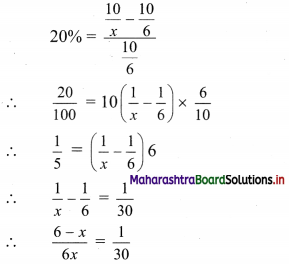
Let x be the number of toffees he must sell in ₹ 10 to gain 20%
i.e. S.P. = \(\frac{10}{x}\) …….(ii)
Profit percentage = \(\frac{\text { S.P. }-\text { C.P. }}{\text { C.P. }}\)
Using (i) and (ii) we have
Maharashtra Board 11th Commerce Maths Solutions Chapter 9 Commercial Mathematics Ex 9.2 Q3
∴ 30(6 – x) = 6x
∴ 180 – 30x = 6x
∴ 36x = 180
∴ x = 5
The vendor must sell 5 toffees for ₹ 10 in order to gain 20%.

Question 4.
The percentage profit earned by selling an article for ₹ 2,880 is equal to the percentage loss incurred by selling the same article for ₹ 1,920. At what price the article should be sold to earn a 25% profit?
Solution:
Let x be C.P. of the article
Let y % be both, the gain and loss made when article is sold at ₹ 2,880 and ₹ 1,920 respectively. Then
x + \(\frac{y}{100}\) x = 2880 ……(i)
x – \(\frac{y}{100}\) x = 1920 …..(ii)
Adding (i) and (ii), we get
2x = 4800
∴ x = 2400
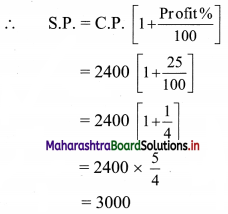
i.e. C.P. of the article = ₹ 2400
Required profit percentage = 25%
Maharashtra Board 11th Commerce Maths Solutions Chapter 9 Commercial Mathematics Ex 9.2 Q4
∴ The article should be sold at ₹ 3000 to earn 25% profit.

Question 5.
A cloth merchant advertises for selling cloth at a 4% loss. By using a faulty meter scale, he is earning a profit of 20%. What is the actual length of the scale?
Solution:
Let the cost price of the cloth be ₹ ‘x’ per meter
He claims a loss of 4%
∴ Selling price of the cloth
S.P. = C.P.(1 – \(\frac{loss%}{100}\))
= x(1 – \(\frac{4}{100}\))
= 0.96x …..(i)
The actual cost price of the cloth is lower as the cloth is measured by a faulty meter scale.
Given that shopkeeper’s profit = 20%
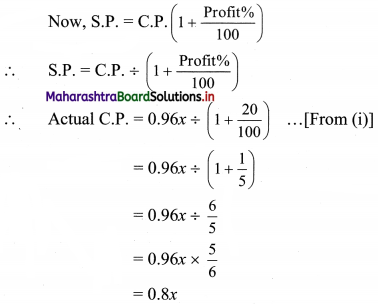
Maharashtra Board 11th Commerce Maths Solutions Chapter 9 Commercial Mathematics Ex 9.2 Q5
∴ The actual cost price is 0.8 times the cost price as advertised.
In other words, the meter scale used for the fraud is 0.8 times the meter scale that should have been used.
∴ The length of the faulty meter scale used = 0.8 × 1 = 0.8 meter
∴ The actual length of the scale is 0.8 meters.

Maharashtra Board 11th Commerce Maths Solutions Chapter 9 Commercial Mathematics Ex 9.2

Question 6.
Sunil sells his bike worth ₹ 25,000 to Rohit at a profit of 20%. After 6 months Rohit sells the bike back to Sunil at a loss of 20%. Find the total profit percent of Sunil considering both the transactions.
Solution:
Sunil sells his bike to Rohit at 20% profit.
So S.P. of the bike for Sunil
= 25000 + \(\frac{20}{100}\) × 25000
= 25000 + 5000
= 30000
∴ Cost price of bike to Rohit = ₹ 30000
Rohit sells the bike back to Sunil at 20% loss
∴ S.P. of the bike for Rohit = 30000 – \(\frac{20}{100}\) × 30000
= 30000 – 6000
= 24000
∴ In second transaction Sunil pays 24000 to Rohit
In the first transaction, he had received 30000 from Rohit
∴ Sunil made a profit of ₹ (30000 – 24000) = ₹ 6000
Sunil earned this profit on the bike which costed him ₹ 25000
∴ Total profit % that Sunil makes = \(\frac{6000}{25000}\) × 100
= \(\frac{600}{25}\)
= 24
∴ Sunil makes 24% profit considering both the transactions.

Question 7.
By selling a book at ₹ 405 bookseller incurs a loss of 25%. Find the cost price of the book.
Solution:
S.P. = ₹ 405
Loss% = 25
S.P. when there is a loss is given by
S.P. = C.P. × \(\frac{\text { Loss } \%}{100}\)
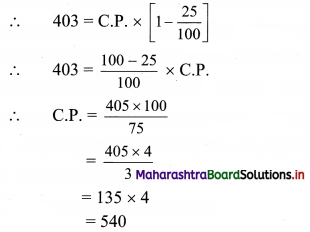
Maharashtra Board 11th Commerce Maths Solutions Chapter 9 Commercial Mathematics Ex 9.2 Q7
∴ The cost price of the book is ₹ 540.

Question 8.
A cloth costs ₹ 675. If it is sold at a loss of 20%, what is its cost price as a percentage of its selling price?
Solution:
C.P. = ₹ 675
Loss% = 20%
∴ Loss made in selling = \(\frac{20}{100}\) × 675 = ₹ 135
S.P. = C.P. – Loss
= 675 – 135
= ₹ 540
Let C.P. be x % S.P.,
Then 675 = \(\frac{x}{100}\) × 540
∴ x = \(\frac{675 \times 100}{540}\) = 125
∴ Cost price is 125% of the selling price.

Maharashtra Board 11th Commerce Maths Solutions Chapter 9 Commercial Mathematics Ex 9.2

Question 9.
Ashwin buys an article for ₹ 500. He marks it for sale at 75% more than the cost price. He offers a 25% discount on the marked price to his customer. Calculate the actual percentage of profit made by Ashwin.
Solution:
C.P. = ₹ 500
Marked price = C.P. + \(\frac{75}{100}\) × C.P.
= \(\frac{75}{100}\) × 500
= 500 + 75 × 5
= 500 + 375
= 875
25% discount was given on marked price
∴ Discount = \(\frac{25}{100}\) × 875 = \(\frac{875}{4}\)
Selling price = marked price – discount
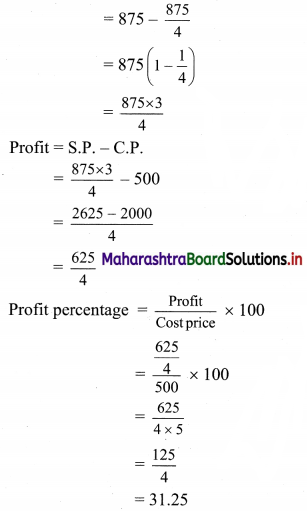
Maharashtra Board 11th Commerce Maths Solutions Chapter 9 Commercial Mathematics Ex 9.2 Q9
∴ Ashwin makes 31.25% profit.

Question 10.
The combined cost price of a refrigerator and a mixer is ₹ 12,400. If the refrigerator costs 600% more than the mixer, find the cost price of the mixer.
Solution:
Let ₹ x be the cost price of the mixer.
The cost price of the refrigerator = x + \(\frac{600}{100}\) x
= x + 6x
= 7x
Total cost price =12400 …..[Given]
i.e. x + 7x = 12400
i.e. 8x = 12400
∴ x = \(\frac{12400}{8}\) = 1550
∴ The cost price of mixer is ₹ 1550.

Question 11.
Find the single discount equivalent to the discount series of 5%, 7%, and 9%.
Solution:
Let the marked price be ₹ 100
After 1st discount the price = 100(1 – \(\frac{5}{100}\)) = 95
After 2nd discount the price = 95(1 – \(\frac{7}{100}\)) = \(\frac{95 \times 93}{100}\)
After 3rd discount the price = \(\frac{95 \times 93}{100}\left(1-\frac{9}{100}\right)\)
= \(\frac{95 \times 93 \times 91}{100 \times 100}\)
= \(\frac{803985}{10000}\)
= 80.3985 ~ 80.4
Selling price after 3 discounts is ₹ 80.4
Single equivalent discount = Marked price – Selling price
= 100 – 80.4
= ₹ 19.6
∴ Single equivalent discount is 19.6%.

Maharashtra Board 11th Commerce Maths Solutions Chapter 9 Commercial Mathematics Ex 9.2

Question 12.
The printed price of a shirt is ₹ 390. Lokesh pays ₹ 175.50 for it after getting two successive discounts. If the first discount is 10%, find the second discount.
Solution:
Marked price = ₹ 390
After the first discount of 10%, the price of the shirt
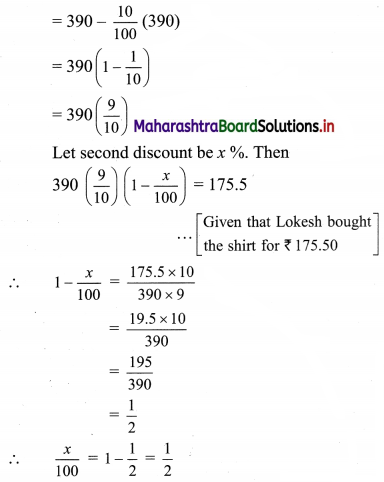
Maharashtra Board 11th Commerce Maths Solutions Chapter 9 Commercial Mathematics Ex 9.2 Q12
∴ x = 50
∴ Second discount is 50%

Question 13.
Amar, a manufacturer, gives a discount of 25% on the list price to his distributor Akbar, Akbar sells at a 10% discount on the list price to his customer Anthony. Anthony paid ₹ 540 for the article. What is the profit percentage of Akbar on his cost price?
Solution:
Let ₹ ‘x’ be the list price of the article.
Amar gives a discount of 25% on the list price.
∴ Selling price for Amar = \(x\left(1-\frac{25}{100}\right)\)
= \(x\left(1-\frac{1}{4}\right)\)
= ₹ \(\frac{3 x}{4}\)
Amar sells the article to Akbar
Cost price of article for Akbar = ₹ \(\frac{3 x}{4}\) ……(i)
Akbar sells the article to Anthony at 10% discount on list price
∴ Selling price for Akbar = \(x\left(1-\frac{10}{100}\right)\)
= \(x\left(1-\frac{1}{10}\right)\)
= ₹ \(\frac{9 x}{10}\) …..(ii)
Profit percentage = \(\frac{\text { S.P. }-\text { C.P. }}{\text { C.P. }} \times 100\)
Using (i) and (ii), we have the profit percentage for Akbar as,
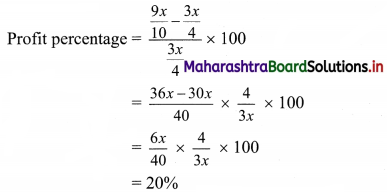
Maharashtra Board 11th Commerce Maths Solutions Chapter 9 Commercial Mathematics Ex 9.2 Q13
∴ Akbar gets a profit of 20% on his cost price.

Question 14.
A man sells an article at a profit of 25%. If he had bought it at a 10% loss and sold it for ₹ 7 less, he would have gained 35%. Find the cost price of the article.
Solution:
Let ₹ ‘x’ be the C.P. of the article
∴ Article was sold at 25% profit
∴ S.P. of the article = \(x\left(1+\frac{25}{100}\right)\)
= \(x\left(1+\frac{1}{4}\right)\)
= 1.25x
If the article was bought at 10% loss
i.e., the new C.P. = \(x\left(1-\frac{10}{100}\right)\)
= \(x\left(\frac{9}{10}\right)\)
= 0.9x
and sold at ₹ 7 less
∴ New S.P. = 1.25x – 7
Then, the profit would have been 35%
Using profit percentage = \(\frac{\text { S.P.-C.P. }}{\text { C.P. }} \times 100\)
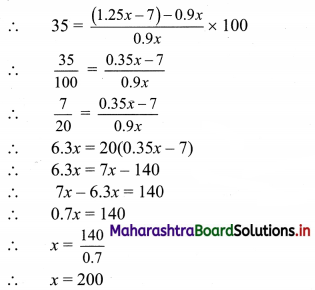
Maharashtra Board 11th Commerce Maths Solutions Chapter 9 Commercial Mathematics Ex 9.2 Q14
∴ Cost price of the article is ₹ 200

Maharashtra Board 11th Commerce Maths Solutions Chapter 9 Commercial Mathematics Ex 9.2

Question 15.
Mr. Mehta sold his two luxury cars at ₹ 39,10,000 each. On one he gains 15% but on the other, he loses 15%. How much does he gain or lose in the whole transaction?
Solution:
Let x, y be the C.P. of two cars.
S.P. of both the cars = 39,10,000 …..[Given]
∴ One car is sold at 15% loss
∴ S.P. of the first car = x – \(\frac{15}{100}\)x
∴ \(\frac{85}{100}\)x = 39,10,000
∴ x = \(\frac{39,10,000 \times 100}{85}\)
∴ x = 46,000 × 100
∴ x = 46,00,000
Other car is sold at 15% gain
∴ S.P. of second car = y + \(\frac{15}{100}\) y
∴ y + \(\frac{15}{100}\) y = 39,10,000
∴ \(\frac{115}{100}\)y = 39,10,000
∴ y = \(\frac{39,10,000 \times 100}{115}\)
∴ y = 34,000 × 100
∴ y = 34,00,000
x + y = Total C.P. of two cars
= 46,00,000 + 34,00,000
= 80,00,000
Total S.P. = 39,10,000 + 39,10,000 = 78,20,000
∴ S.P. < C.P.
∴ There is a loss of ₹ (80,00,000 – 78,20,000) = ₹ 1,80,000
∴ Loss % = \(\frac{1,80,000}{80,00,000} \times 100\)
= \(\frac{18}{8}\)
= 2.25
∴ Mr. Mehta bears a 2.25% loss in the whole transaction.

Maharashtra Board 11th Commerce Maths Solutions Chapter 9 Commercial Mathematics Ex 9.1

Balbharati Maharashtra State Board 11th Commerce Maths Solution Book Pdf Chapter 9 Commercial Mathematics Ex 9.1 Questions and Answers.

Maharashtra State Board 11th Commerce Maths Solutions Chapter 9 Commercial Mathematics Ex 9.1

Question 1.
Find 77% of 580 + 34% of 390.
Solution:
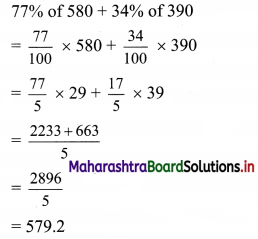
Maharashtra Board 11th Commerce Maths Solutions Chapter 9 Commercial Mathematics Ex 9.1 Q1

Question 2.
240 candidates appeared for an examination, of which 204 passed. What is the pass percentage?
Solution:
We find the pass percentage using the unitary method
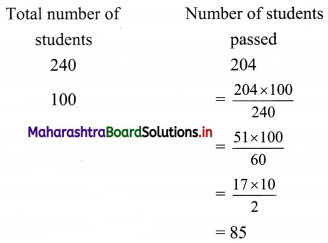
Maharashtra Board 11th Commerce Maths Solutions Chapter 9 Commercial Mathematics Ex 9.1 Q2
∴ The pass percentage for the examination is 85%.

Question 3.
What percent of 8.4 kg are 168 grams?
Solution:
Let 168 gms be x% of 8.4 kg
i.e., let 168 gms be \(\frac{x}{100}\) of 8400 gms
∴ 168 = \(\frac{x}{100}\) × 8400
∴ x = \(\frac{168}{84}\) = 2
∴ 168 gms is 2% of 8.4 kg.

Maharashtra Board 11th Commerce Maths Solutions Chapter 9 Commercial Mathematics Ex 9.1

Question 4.
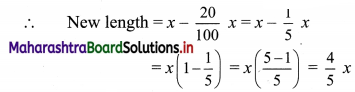
If the length of a rectangle is decreased by 20%, what should be the increase in the breadth of the rectangle so that the area remains the same?
Solution:
Let x and y represent the length and breadth of the rectangle respectively.
∴ The original area of the rectangle = xy
There is a 20% decrease in length.
Maharashtra Board 11th Commerce Maths Solutions Chapter 9 Commercial Mathematics Ex 9.1 Q4
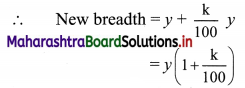
Let k % be the required increase in breadth
Maharashtra Board 11th Commerce Maths Solutions Chapter 9 Commercial Mathematics Ex 9.1 Q4.1
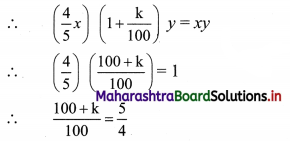
Given that the new and old areas should be equal.
Maharashtra Board 11th Commerce Maths Solutions Chapter 9 Commercial Mathematics Ex 9.1 Q4.2
∴ 100 + k = 125
∴ k = 125 – 100 = 25
∴ Breadth should be increased by 25% so that the area remains same.

Question 5.
The price of rice increased by 20%, as a result, a person can have 5kg rice for ₹ 600. What was the initial price of rice per kg?
Solution:
A person can buy 5 kg of rice for ₹ 600 after the increase in price
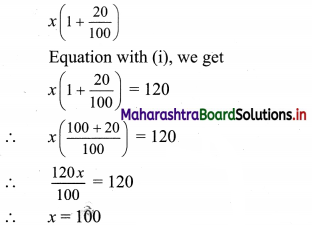
∴ New price of rice = \(\frac{600}{5}\) = ₹ 120/kg …..(i)
Let ‘x’ be the initial price per kg of rice.
There is a 20% increase in the price of rice.
Thus the new price of the rice will be given as
Maharashtra Board 11th Commerce Maths Solutions Chapter 9 Commercial Mathematics Ex 9.1 Q5
∴ The initial price of rice is ₹ 100 per kg

Question 6.
What percent is 3% of 5%?
Solution:
Let 3% be x % of 5%.
Then \(\frac{3}{100}=\frac{x}{100} \times \frac{5}{100}\)
∴ x = \(\frac{3 \times 100}{5}\) = 60
∴ 3% is 60% of 5%.

Maharashtra Board 11th Commerce Maths Solutions Chapter 9 Commercial Mathematics Ex 9.1

Question 7.
After availing of two successive discounts of 20% each, Madhavi paid ₹ 64 for a book. If she would have got only one discount of 20%, how much additional amount would she have paid?
Solution:
Let the price of the book be ₹ x.
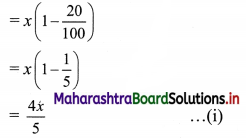
After the first 20% discount, the price of the book becomes
Maharashtra Board 11th Commerce Maths Solutions Chapter 9 Commercial Mathematics Ex 9.1 Q7
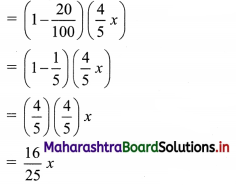
After another 20% discount, the price of the book becomes
Maharashtra Board 11th Commerce Maths Solutions Chapter 9 Commercial Mathematics Ex 9.1 Q7.1
This price = ₹ 64 …..[Given]
∴ \(\frac{16}{25}\)x = 64
∴ x = 4 × 25 = 100
Thus, Amount of the book after one discount = \(\frac{4}{5}\)(100) = 80 …..[from (i)]
∴ The additional amount that Madhavi would have paid = 80 – 64 = ₹ 16

Question 8.
The price of the table is 40% more than the price of a chair. By what percent price of a chair is less than the price of a table?
Solution:
Let ₹ x and ₹ y be the price of a table and chair respectively.
The price of the table is 40% more than the price of a chair
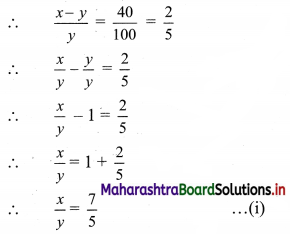
∴ \(\frac{x-y}{y}\) × 100 = 40
Maharashtra Board 11th Commerce Maths Solutions Chapter 9 Commercial Mathematics Ex 9.1 Q8
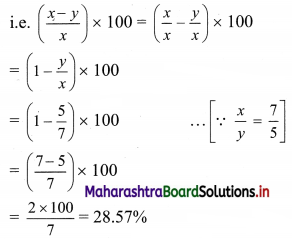
We need to find by how much percent is the price of a chair less than that of a table.
Maharashtra Board 11th Commerce Maths Solutions Chapter 9 Commercial Mathematics Ex 9.1 Q8.1
∴ The price of a chair is 28.57% less than the price of a table.

Maharashtra Board 11th Commerce Maths Solutions Chapter 9 Commercial Mathematics Ex 9.1

Question 9.
A batsman scored 92 runs which includes 4 boundaries 5 sixes. He scored other runs by running between the wickets. What percent of his total score did he make by running between the wickets?
Solution:
Batsman scores 4 fours (boundaries) and 5 sixes in 92 runs.
Number of runs scored by fours and sixes = 4 × 4 + 5 × 6 = 46
∴ 92 – 46 = 46
Let 46 be x% of 92.
Then 46 = \(\frac{x}{100}\) × 92
∴ x = \(\frac{46 \times 100}{92}=\frac{100}{2}\) = 50
∴ 50% of the total runs were scored by running between the wickets.

Maharashtra Board 11th Commerce Maths Solutions Chapter 6 Permutations and Combinations Ex 6.4

Balbharati Maharashtra State Board 11th Commerce Maths Solution Book Pdf Chapter 6 Permutations and Combinations Ex 6.4 Questions and Answers.

Maharashtra State Board 11th Commerce Maths Solutions Chapter 6 Permutations and Combinations Ex 6.4

Question 1.
Find the number of permutations of letters in each of the following words:
(i) DIVYA
(ii) SHANTARAM
(iii) REPRESENT
(iv) COMBINE
Solution:
(i) There are 5 letters in the word DIVYA which can be arranged in 5! Way = 120 ways

(ii) There are 9 letters in the word SHANTARAM in which ‘A’ repeats 3 times.
∴ Number of permutations of the letters of the word SHANTARAM = \(\frac{9 !}{3 !}\)
= 9 × 8 × 7 × 6 × 5 × 4
= 60480

(iii) There are 9 letters in the word REPRESENT in which ‘E’ repeats 3 times and ‘R’ repeats 2 times.
∴ Number of permutations of the letters of the word REPRESENT = \(\frac{9 !}{3 ! 2 !}\)
= \(\frac{9 \times 8 \times 7 \times 6 \times 5 \times 4}{2}\)
= 30240

(iv) There are 7 distinct letters in the word COMBINE which can be arranged among themselves in 7! = 5040 ways

Maharashtra Board 11th Commerce Maths Solutions Chapter 6 Permutations and Combinations Ex 6.4

Question 2.
You have 2 identical books on English, 3 identical books on Hindi and 4 identical books on Mathematics. Find the number of distinct ways of arranging them on a shelf.
Solution:
There are total 9 books to be arranged on a shelf.
Out of these 9 books, 2 books on English, 3 books on Hindi and 4 books on Mathematics are identical.
∴ Total number of arrangements = \(\frac{9 !}{2 ! 3 ! 4 !}\)
= \(\frac{9 \times 8 \times 7 \times 6 \times 5 \times 4 !}{2 \times 3 \times 2 \times 4 !}\)
= 9 × 4 × 7 × 5
= 1260
∴ In 1260 distinct ways the books can be arranged on a shelf.

Question 3.
A coin is tossed 8 times. In how many ways can we obtain
(i) 4 heads and 4 tails?
(ii) at least 6 heads?
Solution:
A coin is tossed 8 times. All heads are identical and all tails are identical.
(i) We can obtain 4 heads and 4 tails in \(\frac{8 !}{4 ! 4 !}\)
= \(\frac{8 \times 7 \times 6 \times 5}{4 \times 3 \times 2}\)
= 70 ways
∴ In 70 different ways we can obtain 4 heads and 4 tails.

(ii) When at least 6 heads are to be obtained
∴ Outcome can be (6 heads and 2 tails) or (7 heads and 1 tail) or (8 heads)
∴ Number of ways in which it can be obtained = \(\frac{8 !}{6 ! 2 !}+\frac{8 !}{7 ! 1 !}+\frac{8 !}{8 !}\)
= \(\frac{8 \times 7}{2}\) + 8 + 1
= 28 + 8 + 1
= 37
∴ In 37 different ways we can obtain at least 6 heads.

Question 4.
A bag has 5 red, 4 blue, and 4 green marbles. If all are drawn one by one and their colours are recorded, how many different arrangements can be found?
Solution:
There is a total of 13 marbles in a bag.
Out of these 5 are Red, 4 Blue, and 4 are Green marbles.
All balls of the same colour are taken to be identical.
∴ Required number of arrangements = \(\frac{13 !}{5 ! 4 ! 4 !}\)

Maharashtra Board 11th Commerce Maths Solutions Chapter 6 Permutations and Combinations Ex 6.4

Question 5.
Find the number of ways of arranging letters of the word MATHEMATICAL. How many of these arrangements have all vowels together?
Solution:
There are 12 letters in the word MATHEMATICAL in which ‘M’ repeats 2 times, ‘A’ repeats 3 times, and ‘T’ repeats 2 times.
∴ Total number of arrangements = \(\frac{12 !}{2 ! 3 ! 2 !}\)
When all the vowels
i.e., ‘A’, ‘A’, ‘A’, ‘E’, T are to be kept together
Number of arrangements of these vowels = \(\frac{5 !}{3 !}\) ways.
Let us consider these vowels together as one unit.
This unit is to be arranged with 7 other letters in which ‘M’ and ‘T’ repeated 2 times each.
∴ Number of arrangements = \(\frac{8 !}{2 ! 2 !}\)
∴ Total number of arrangements = \(\frac{8 ! \times 5 !}{2 ! 2 ! 3 !}\)

Question 6.
Find the number of different arrangements of letters in the word MAHARASHTRA. How many of these arrangements have
(i) letters M and T never together?
(ii) all vowels together?
Solution:
There are 11 letters in the word MAHARASHTRA in which ‘A’ is repeated 4 times, ‘H’ repeated 2 times, and ‘R’ repeated 2 times.
∴ Total number of arrangements is \(\frac{11 !}{4 ! 2 ! 2 !}\)
∴ \(\frac{11 !}{4 ! 2 ! 2 !}\) different words can be formed from the letters of the word MAHARASHTRA.
(i) Other than M and T. there are 9 letters in which A repeats 4 times, H repeats twice, R repeats twice
The number of arrangements of the a letter = \(\frac{9 !}{4 ! 2 ! 2 !}\)
These 9 letters create 10 gaps in which M and T are to be arranged
The number of arrangements of M and T = 10P2
∴ Total number arrangement having M and T never together = \(\frac{9 ! \times{ }^{10} \mathrm{P}_{2}}{4 ! 2 ! 2 !}\)

(ii) When all vowels are together.
There are 4 vowels in the word MAHARASHTRA i.e., A, A, A, A
Let us consider these 4 vowels as one unit, they themselves can be arranged in \(\frac{4 !}{4 !}\) = 1 way.
This unit is to be arranged with 7 other letters which can be done in 8! ways
∴ Total number of arrangements = \(\frac{8 !}{2 ! 2 !}\)
∴ \(\frac{8 !}{2 ! 2 !}\) different words can be formed if vowels are always together.

Question 7.
How many different words are formed if the letter R is used thrice and letters S and T are used twice each?
Solution:
When ‘R’ is used thrice, ‘S’ is used twice and ‘T’ is used twice,
∴ Total number of letters available = 7, of which ‘S’ and ‘T’ repeat 2 times each, ‘R’ repeats 3 times.
∴ Required number of arrangements = \(\frac{7 !}{2 ! 2 ! 3 !}\)
= \(\frac{7 \times 6 \times 5 \times 4 \times 3 !}{2 \times 1 \times 2 \times 1 \times 3 !}\)
= 7 × 6 × 5
= 210
∴ 210 different words can be formed with the letter R is used thrice and letters S and T are used twice each.

Question 8.
Find the number of arrangements of letters in the word MUMBAI so that the letter B is always next to A.
Solution:
There are 6 letters in the word MUMBAI.
These letters are to be arranged in such a way that ‘B’ is always next to ‘A’.
Let us consider AB as one unit. This unit with other 4 letters in which ‘M’ repeats twice, is to be arranged.
∴ Total number of arrangements when B is always next to A = \(\frac{5 !}{2 !}\)
= \(\frac{5 \times 4 \times 3 \times 2 !}{2 !}\)
= 60

Maharashtra Board 11th Commerce Maths Solutions Chapter 6 Permutations and Combinations Ex 6.4

Question 9.
Find the number of arrangements of letters in the word CONSTITUTION that begin and end with N.
Solution:
There are 12 letters in the word CONSTITUTION, in which ‘O’, ‘N’, T repeat two times each, ‘T’ repeats 3 times.
The arrangement starts and ends with ‘N’, 10 letters other than N can be arranged between two N, in which ‘O’ and ‘I’ repeat twice each and ‘T’ repeats 3 times.
∴ Total number of arrangements with the letter N at the beginning and at the end = \(\frac{10 !}{2 ! 2 ! 3 !}\)

Question 10.
Find the number of different ways of arranging letters in the word ARRANGE. How many of these arrangements have two R’s and two A’s not together?
Solution:
(i) There are 7 letters in the word ARRANGE in which A is repeated 2 times and R is repeated 2 times
∴ The number of arrangements = \(\frac{7 !}{2 ! 2 !}\) = 1260

(ii) A: set of words having 2A together
B: set of words having 2R together
Number of words having both A and both R not together
= 1260 – n(A ∪ B)
= 1260 – [n(a) + n(B) – n(A ∩ B)] ……(i)
n(A) = number of ways in which (AA) R, R, N, G, E are to be arranged
∴ n(A) = \(\frac{6 !}{2 !}\) = 360
n(B) = number of ways in which (RR), A, A, N, G, E are to be arranged
∴ n(B) = \(\frac{6 !}{2 !}\) = 360
n(A ∩ B) = number of ways in which (AA), (RR), N, G, E are to be arranged
∴ n(A ∩ B) = 5! = 120
Substituting n(A), n(B), n(A ∩ B) in (i), we get
Number of words having both A and both R not together
= 1260 – [360 + 360 – 120]
= 1260 – 600
= 660

Question 11.
How many distinct 5 digit numbers can be formed using the digits 3, 2, 3, 2, 4, 5.
Solution:
5 digit numbers are to be formed from 2, 3, 2, 3, 4, 5.
Case I: Numbers formed from 2, 2, 3, 4, 5 OR 2, 3, 3, 4, 5
Number of such numbers = \(\frac{5 !}{2 !}\) × 2
= 5!
= 120

Case II: Numbers formed from 2, 2, 3, 3 and any one of 4 or 5
Number of such numbers = \(\frac{5 !}{2 ! 2 !}\) × 2 = 60
Required number = 120 + 60 = 180
∴ 180 distinct 5 digit numbers can be formed using the digit 3, 2, 3, 2, 4, 5.

Maharashtra Board 11th Commerce Maths Solutions Chapter 6 Permutations and Combinations Ex 6.4

Question 12.
Find the number of distinct numbers formed using the digits 3, 4, 5, 6, 7, 8, 9, so that odd positions are occupied by odd digits.
Solution:
A number is to be formed with digits 3, 4, 5, 6, 7, 8, 9 such that odd digits always occupy the odd places.
There are 4 odd digits i.e. 3, 5, 7, 9.
They can be arranged at 4 odd places among themselves in 4! ways = 24 ways
3 even places of the number are occupied by even digits (i.e. 4, 6, 8).
∴ They can be arranged in 3! ways = 6 ways
∴ Total number of arrangements = 24 × 6 = 144
∴ 144 numbers can be formed so that odd digits always occupy the odd positions.

Question 13.
How many different 6-digit numbers can be formed using digits in the number 659942? How many of them are divisible by 2?
Solution:
A 6-digit number is to be formed using digits of 659942, in which 9 repeats twice.
∴ Total number of arrangements = \(\frac{6 !}{2 !}\)
= \(\frac{6 \times 5 \times 4 \times 3 \times 2 !}{2 !}\)
= 360
∴ 360 different 6-digit numbers can be formed.
For a number to be divisible by 2,
Last digits can be selected in 3 ways
Remaining 5 digit in which, 9 appears twice are arranged in \(\frac{5 !}{2 !}\) ways
∴ Total number of arrangements = \(\frac{5 !}{2 !}\) × 3 = 180
∴ 180 numbers are divisible by 2.

Question 14.
Find the number of distinct words formed from letters in the word INDIAN. How many of them have the two N’s together?
Solution:
There are 6 letters in the word INDIAN in which I and N repeat twice.
Number of different words that can be formed using the letters of the word INDIAN = \(\frac{6 !}{2 ! 2 !}\)
= \(\frac{6 \times 5 \times 4 \times 3 \times 2 !}{2 \times 2 !}\)
= 180
∴ 180 different words can be formed with the letters of the word INDIAN.
When two N’s are together.
Let us consider the two N’s as one unit.
They can be arranged with 4 other letters in \(\frac{5 !}{2 !}\)
= \(\frac{5 \times 4 \times 3 \times 2 !}{2 !}\)
= 60 ways.
∴ 2N can be arranged in 1 way
∴ Total number of arrangements = 60 × 1 = 60 ways
∴ 60 words are such that two N’s are together.

Maharashtra Board 11th Commerce Maths Solutions Chapter 6 Permutations and Combinations Ex 6.4

Question 15.
Find the number of different ways of arranging letters in the word PLATOON if
(i) the two O’s are never together.
(ii) consonants and vowels occupy alternate positions.
Solution:
(i) When the two O’s are never together:
Let us arrange the other 5 letters first, which can be done in 5! = 120 ways.
The letters P, L, A, T, N create 6 gaps, in which O’s are arranged.
∴ Two O’s in 6 gaps can be arranged in \(\frac{{ }^{6} \mathrm{P}_{2}}{2 !}\) ways
= \(\frac{\frac{6 !}{(6-2) !}}{2 !}\) ways
= \(\frac{6 \times 5 \times 4 !}{4 ! \times 2 \times 1}\) ways
= 3 × 5 ways
= 15 ways
∴ Total number of arrangements if the two O’s are never together = 120 × 15 = 1800

(ii) When consonants and vowels occupy alternate positions:
There are 4 consonants and 3 vowels in the word PLATOON.
∴ At odd places consonants occur and at even places vowels occur.
4 consonants can be arranged among themselves in 4! ways
3 vowels in which O occurs twice and A occurs once.
∴ They can be arranged in \(\frac{3 !}{2 !}\) ways
∴ Required number of arrangements if the consonants and vowels occupy alternate positions = 4! × \(\frac{3 !}{2 !}\)
= 4 × 3 × 2 × \(\frac{3 \times 2 !}{2 !}\)
= 72

Maharashtra Board 11th Commerce Maths Solutions Chapter 6 Permutations and Combinations Ex 6.3

Balbharati Maharashtra State Board 11th Commerce Maths Solution Book Pdf Chapter 6 Permutations and Combinations Ex 6.3 Questions and Answers.

Maharashtra State Board 11th Commerce Maths Solutions Chapter 6 Permutations and Combinations Ex 6.3

Question 1.
Find n if nP6 : nP3 = 120 : 1
Solution:
nP6 : nP3 = 120 : 1
∴ \(\frac{n !}{(n-6) !} \div \frac{n !}{(n-3) !}=\frac{120}{1}\)
∴ \(\frac{\mathrm{n} !}{(\mathrm{n}-6) !} \times \frac{(\mathrm{n}-3) !}{\mathrm{n} !}\) = 120
∴ \(\frac{n !}{(n-6) !} \times \frac{(n-3)(n-4)(n-5)(n-6) !}{n !}\) = 120
∴ (n – 3) (n – 4) (n – 5) = 120
∴ (n – 3) (n – 4) (n – 5) = 6 × 5 × 4
Comparing on both sides, we get
n – 3 = 6
∴ n = 9

Maharashtra Board 11th Commerce Maths Solutions Chapter 6 Permutations and Combinations Ex 6.3

Question 2.
Find m and n if (m+n)P2 = 56 and (m-n)P2 = 12
Solution:
m+nP2 = 56
∴ \(\frac{(\mathrm{m}+\mathrm{n}) !}{(\mathrm{m}+\mathrm{n}-2) !}\) = 56
∴ \(\frac{(m+n)(m+n-1)(m+n-2) !}{(m+n-2) !}\) = 56
∴ (m + n) (m + n – 1) = 8 × 7
Comparing on both sides, we get
m + n = 8 …..(i)
Also m-nP2 = 12
∴ \(\frac{(m-n) !}{(m-n-2) !}\) = 12
∴ \(\frac{(m-n)(m-n-1)(m-n-2) !}{(m-n-2) !}\) = 12
∴ (m – n) (m – n – 1) = 4 × 3
Comparing on both sides, we get
m – n = 4 …..(ii)
Adding (i) and (ii), we get
2m = 12
∴ m = 6
Substituting m = 6 in (ii), we get
6 – n = 4
∴ n = 2

Question 3.
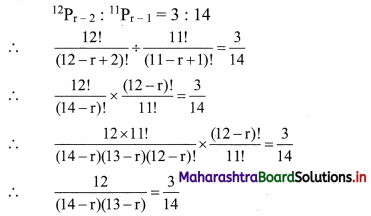
Find r if 12Pr-2 : 11Pr-1 = 3 : 14
Solution:
Maharashtra Board 11th Commerce Maths Solutions Chapter 6 Permutations and Combinations Ex 6.3 Q3
∴ (14 – r)(13 – r) = 8 × 7
Comparing on both sides, we get
14 – r = 8
∴ r = 6

Question 4.
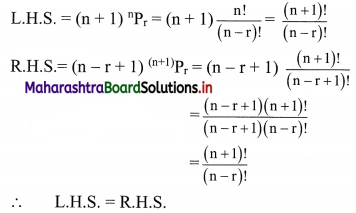
Show that (n + 1) nPr = (n – r + 1) (n+1)Pr.
Solution:
Maharashtra Board 11th Commerce Maths Solutions Chapter 6 Permutations and Combinations Ex 6.3 Q4

Question 5.
How many 4 letter words can be formed using letters in the word MADHURI if
(i) letters can be repeated?
(ii) letters cannot be repeated?
Solution:
There are 7 letters in the word MADHURI.
(i) A 4 letter word is to be formed from the letters of the word MADHURI and repetition of letters is allowed.
∴ 1st letter can be filled in 7 ways.
2nd letter can be filled in 7 ways.
3rd letter can be filled in 7 ways.
4th letter can be filled in 7 ways.
∴ Total no. of ways a 4-letter word can be formed = 7 × 7 × 7 × 7 = 2401
∴ 2401 four-lettered words can be formed when repetition of letters is allowed.

(ii) When repetition of letters is not allowed, the number of 4-letter words formed from the letters of the word MADHURI is
7P4 = \(\frac{7 !}{(7-4) !}=\frac{7 \times 6 \times 5 \times 4 \times 3 !}{3 !}\) = 840
∴ 840 four-letter words can be formed when repetition of letters is not allowed.

Maharashtra Board 11th Commerce Maths Solutions Chapter 6 Permutations and Combinations Ex 6.3

Alternate method:
There are 7 letters in the word MADHURI.
(i) Since letters can be repeated
∴ In all places of a four-letter word, any one of seven letters M, A, D, H, U, R, I can appear.
∴ Using the Multiplication theorem, we get
Number of four-letter words with repetition of letters M, A, D, H, U, R, I = 7 × 7 × 7 × 7 = 2401

(ii) Since the letters cannot be repeated therefore 1st, 2nd, 3rd, 4th places can be filled in 7, 6, 5, 4 ways respectively
∴ Using the multiplication theorem, we get
Number of four-letter words, with no repetition of letters M, A, D, H, U, R, I = 7 × 6 × 5 × 4 = 840

Question 6.
Determine the number of arrangements of letters of the word ALGORITHM if
(i) vowels are always together.
(ii) no two vowels are together.
(iii) Consonants are at even positions
(iv) O is first and T is last.
Solution:
A word is to be formed using the letters of the word ALGORITHM.
There are 9 letters in the word ALGORITHM.
(i) When vowels are always together:
There are 3 vowels in the word ALGORITHM. (i.e, A, I, O)
Let us consider these 3 vowels as one unit.
This unit with 6 other letters is to be arranged.
∴ It becomes an arrangement of 7 things which can be done in 7P7 i.e., 7! ways and 3 vowels can be arranged among themselves in 3P3 i.e., 3! ways.
∴ the total number of ways in which the word can be formed = 7! × 3!
= 5040 × 6
= 30240
∴ 30240 words can be formed if vowels are always together.

(ii) When no two vowels are together:
There are 6 consonants in the word ALGORITHM.
They can be arranged among themselves in 6P6 i.e., 6! ways.
Let consonants be denoted by C.
_C_C_ C_C_C_C_
6 consonants create 7 gaps in which 3 vowels are to arranged.
∴ 3 vowels can be filled in 7P3
= \(\frac{7 !}{(7-3) !}\)
= \(\frac{7 \times 6 \times 5 \times 4 !}{4 !}\)
= 210 ways
∴ total number of ways in which the word can be formed = 6! × 210
= 720 × 210
= 151200
∴ 151200 words can be formed if no two vowels are together.

(iii) When consonants are at even positions:
There are 4 even places and 6 consonants in the word ALGORITHM.
1st, 2nd, 3rd, 4th even places are filled in 6, 5, 4, 3 way respectively.
∴ The number of ways to fill four even places by consonants = 6 × 5 × 4 × 3 = 360
The remaining 5 letters (3 vowels and 2 consonants) can be arranged among themselves in 5P5 i.e., 5! ways.
∴ Total number of ways the words can be formed
In which even places are occupied by consonants = 360 × 5!
= 360 × 120
= 43200
∴ 43200 words can be formed if even positions are occupied by consonants.

(iv) When beginning with O and ends with T:
All the letters of the word ALGORITHM are to be arranged among themselves such that arrangement begins with O and ends with T.
7 letters other than O and T can be filled between O and T in 7P7 i.e., 7! ways = 5040 ways.
∴ 5040 words beginning with O and ending with T can be formed.

Question 7.
In a group photograph, 6 teachers and principals are in the first row and 18 students are in the second row. There are 12 boys and 6 girls among the students. If the middle position is reserved for the principal and if no two girls are together, find the number of arrangements.
Solution:
In 1st row middle seat is fixed for the principal.
Also 1st row, 6 teachers can be arranged among themselves in 6P6 i.e., 6! ways.
In the 2nd row, 12 boys can be arranged among themselves in 12P12 i.e., 12! ways.
13 gaps are created by 12 boys, in which 6 girls are to be arranged.
together which can be done in 13P6 ways.
∴ total number of arrangements = 6! × 12! × 13P6 …..[using Multiplications Principle]
= 6! × 12! × \(\frac{13 !}{(13-6) !}\)
= 6! × 12! × \(\frac{13 !}{7 !}\)
= \(\frac{6 ! \times 12 ! \times 13 !}{7 \times 6 !}\)
= \(\frac{12 ! 13 !}{7}\)

Maharashtra Board 11th Commerce Maths Solutions Chapter 6 Permutations and Combinations Ex 6.3

Question 8.
Find the number of ways letters of the word HISTORY can be arranged if
(i) Y and T are together
(ii) Y is next to T.
Solution:
There are 7 letters in the word HISTORY
(i) When ‘Y’ and ‘T’ are together.
Let us consider ‘ Y’ and ‘T’ as one unit
This unit with the other 5 letters is to be arranged.
∴ The number of arrangements of one unit and 5 letters = 6P6 = 6!
Also, ‘Y’ and ‘T’ can be arranged among themselves in 2P2 i.e., 2! ways.
∴ a total number of arrangements when Y and T are always together = 6! × 2!
= 720 × 2
= 1440
∴ 1440 words can be formed if Y and T are together.

(ii) When ‘Y’ is next to ‘T’
Let us take this (‘Y’ next to ‘T’) as one unit.
This unit with 5 other letters is to be arranged.
∴ The number of arrangements of 6 letters and one unit = 6P6 = 6!
Also ‘Y’ has to be always next to ‘T’.
So they can be arranged in 1 way.
∴ total number of arrangements possible when Y is next to T = 6! × 1 = 720
∴ 720 words can be formed if Y is next to T.

Question 9.
Find the number of arrangements of the letters in the word BERMUDA so that consonants and vowels are in the same relative positions.
Solution:
There are 7 letters in the word “BERMUDA” out of which 3 are vowels and 4 are consonants.
If relative positions of consonants and vowels are not changed.
3 vowels can be arranged among themselves in 3P3 i.e., 3! ways.
4 consonants can be arranged among themselves in 4P4 i.e., 4! ways.
∴ total no. of arrangements possible if relative positions of vowels and consonants are not changed = 3! × 4!
= 6 × 24
= 144

Question 10.
Find the number of 4-digit numbers that can be formed using the digits 1, 2, 4, 5, 6, 8 if
(i) digits can be repeated
(ii) digits cannot be repeated
Solution:
(i) A 4 digit number is to be made from the digits 1, 2, 4, 5, 6, 8 such that digits can be repeated.
∴ The unit’s place digit can be filled in 6 ways.
10’s place digit can be filled in 6 ways.
100’s place digit can be filled in 6 ways.
1000’s place digit can be filled in 6 ways.
∴ total number of numbers = 6 × 6 × 6 × 6 = 64 = 1296
∴ 1296 four-digit numbers can be formed if repetition of digits is allowed.

(ii) A 4 different digit number is to be made from the digits 1, 2, 4, 5, 6, 8 without repetition of digits.
∴ 4 different digits are to be arranged from 6 given digits which can be done in 6P4
= \(\frac{6 !}{(6-4) !}\)
= \(\frac{6 \times 5 \times 4 \times 3 \times 2 !}{2 !}\)
= 360 ways
∴ 360 four-digit numbers can be formed, if repetition of digits is not allowed.

Maharashtra Board 11th Commerce Maths Solutions Chapter 6 Permutations and Combinations Ex 6.3

Question 11.
How many numbers can be formed using the digits 0, 1, 2, 3, 4, 5 without repetition so that the resulting numbers are between 100 and 1000?
Solution:
A number between 100 and 1000 is a 3 digit number and is to be formed from the digits 0, 1, 2, 3, 4, 5, without repetition of digits.
∴ 100’s place digit must be a non-zero number which can be filled in 5 ways.
10’s place digits can be filled in 5 ways.
Unit’s place digit can be filled in 4 ways.
∴ total number of ways the number can be formed = 5 × 5 × 4 = 100
∴ 100 numbers between 100 and 1000 can be formed.

Question 12.
Find the number of 6-digit numbers using the digits 3, 4, 5, 6, 7, 8 without repetition. How many of these numbers are
(i) divisible by 5?
(ii) not divisible by 5?
Solution:
A number of 6 different digits is to be formed from the digits 3, 4, 5, 6, 7, 8 which can be done in 6P6 i.e., 6! = 720 ways
(i) If the number is divisible by 5, then
The unit’s place digit must be 5, and hence unit’s place can be filled in 1 way
Other 5 digits can be arranged among themselves in 5P5 i.e., 5! ways
∴ Total number of ways in which numbers divisible by 5 can be formed = 1 × 5! = 120

(ii) If the number is not divisible by 5, then
Unit’s place can be any digit from 3, 4, 6, 7, 8 which can be selected in 5 ways.
Other 5 digits can be arranged in 5P5 i.e., 5! ways
∴ The total number of ways in which numbers not divisible by 5 can be formed = 5 × 5!
= 5 × 120
= 600

Question 13.
A code word is formed by two distinct English letters followed by two non-zero distinct digits. Find the number of such code words. Also, find the number of such code words that end with an even digit.
Solution:
(i) There is a total of 26 alphabets.
A code word contains 2 English alphabets.
∴ 2 alphabets can be filled in 26P2
= \(\frac{26 !}{(26-2) !}\)
= \(\frac{26 \times 25 \times 24 !}{24 !}\)
= 650 ways
Also, alphabets to be followed by two distinct non-zero digits from 1 to 9 which can be filled in 9P2
= \(\frac{9 !}{(9-2) !}\)
= \(\frac{9 \times 8 \times 7 !}{7 !}\)
= 72 ways
∴ Total number of a code words = 650 × 72 = 46800

Maharashtra Board 11th Commerce Maths Solutions Chapter 6 Permutations and Combinations Ex 6.3

(ii) There are total 26 alphabets.
A code word contains 2 English alphabets.
∴ 2 alphabets can be filled in 26P2
= \(\frac{26}{(26-2) !}\)
= \(\frac{26 \times 25 \times 24 !}{24 !}\)
= 650 ways
For a code word to end with an even integer, the digit in the unit’s place should be an even number between 1 to 9 which can be filled in 4 ways.
Also, 10’s place can be filled in 8 ways.
∴ Total number of codewords = 650 × 4 × 8 = 20800 ways
∴ 20800 codewords end with an even integer.

Question 14.
Find the number of ways in which 5 letters can be posted in 3 post boxes if any number of letters can be posted in a post box.
Solution:
There are 5 letters and 3 post boxes and any number of letters can be posted in all three post boxes.
∴ Each letter can be posted in 3 ways.
∴ Total number of ways in which 5 letters can be posted = 3 × 3 × 3 × 3 × 3 = 243

Question 15.
Find the number of arranging 11 distinct objects taken 4 at a time so that a specified object
(i) always occurs
(ii) never occurs
Solution:
There are 11 distinct objects and 4 are to be taken at a time.
(i) The number of permutations of n distinct objects, taken r at a time, when one specified object will always occur is r × (n-1)P(r-1)
Here, r = 4, n = 11
∴ The number of permutations of 4 out of 11 objects when a specified object occurs.
= 4 × (11-1)P(4-1)
= 4 × 10P3
= 4 × \(\frac{10 !}{(10-3) !}\)
= 4 × \(\frac{10 !}{7 !}\)
= 4 × \(\frac{10 \times 9 \times 8 \times 7 !}{7 !}\)
= 2880
∴ There are 2880 permutations of 11 distinct objects, taken 4 at a time, in which one specified object always occurs.

Maharashtra Board 11th Commerce Maths Solutions Chapter 6 Permutations and Combinations Ex 6.3

(ii) When one specified object does not occur then 4 things are to be arranged from the remaining 10 things, which can be done in 10P4 ways
= 10 × 9 × 8 × 7 ways
= 5040 ways
∴ There are 5040 permutations of 11 distinct objects, taken 4 at a time, in which one specified object never occurs.

Maharashtra Board 11th Commerce Maths Solutions Chapter 6 Permutations and Combinations Ex 6.2

Balbharati Maharashtra State Board 11th Commerce Maths Solution Book Pdf Chapter 6 Permutations and Combinations Ex 6.2 Questions and Answers.

Maharashtra State Board 11th Commerce Maths Solutions Chapter 6 Permutations and Combinations Ex 6.2

Question 1.
Evaluate:
(i) 8!
Solution:
8!
= 8 × 7 × 6 × 5 × 4 × 3 × 2 × 1
= 40320

(ii) 6!
Solution:
6!
= 6 × 5 × 4 × 3 × 2 × 1
= 720

(iii) 8! – 6!
Solution:
8! – 6!
= 8 × 7 × 6! – 6!
= 6! (8 × 7 – 1)
= 6! (56 – 1)
= 6 × 5 × 4 × 3 × 2 × 1 × 55
= 39,600

(iv) (8 – 6)!
Solution:
(8 – 6)!
= 2!
= 2 × 1
= 2

Maharashtra Board 11th Commerce Maths Solutions Chapter 6 Permutations and Combinations Ex 6.2

Question 2.
Compute:
(i) \(\frac{12 !}{6 !}\)
Solution:
\(\frac{12 !}{6 !}\)
= \(\frac{12 \times 11 \times 10 \times 9 \times 8 \times 7 \times 6 !}{6 !}\)
= 12 × 11 × 10 × 9 × 8 × 7
= 665280

(ii) \(\left(\frac{12}{6}\right) !\)
Solution:
\(\left(\frac{12}{6}\right) !\)
= 2!
= 2 × 1
= 2

(iii) (3 × 2)!
Solution:
(3 × 2)!
= 6!
= 6 × 5 × 4 × 3 × 2 × 1
= 720

(iv) 3! × 2!
Solution:
3! × 2!
= 3 × 2 × 1 × 2 × 1
= 12

Question 3.
Compute:
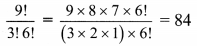
(i) \(\frac{9 !}{3 ! 6 !}\)
Solution:
Maharashtra Board 11th Commerce Maths Solutions Chapter 6 Permutations and Combinations Ex 6.2 Q3(i)

(ii) \(\frac{6 !-4 !}{4 !}\)
Solution:
Maharashtra Board 11th Commerce Maths Solutions Chapter 6 Permutations and Combinations Ex 6.2 Q3(ii)

(iii) \(\frac{8 !}{6 !-4 !}\)
Solution:
Maharashtra Board 11th Commerce Maths Solutions Chapter 6 Permutations and Combinations Ex 6.2 Q3(iii)

(iv) \(\frac{8 !}{(6-4) !}\)
Solution:
Maharashtra Board 11th Commerce Maths Solutions Chapter 6 Permutations and Combinations Ex 6.2 Q3(iv)

Question 4.
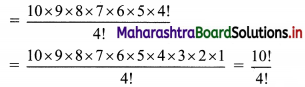
Write in terms of factorials
(i) 5 × 6 × 7 × 8 × 9 × 10
Solution:
5 × 6 × 7 × 8 × 9 × 10
= 10 × 9 × 8 × 7 × 6 × 5
Multiplying and dividing by 4!, we get
Maharashtra Board 11th Commerce Maths Solutions Chapter 6 Permutations and Combinations Ex 6.2 Q4(i)

(ii) 3 × 6 × 9 × 12 × 15
Solution:
3 × 6 × 9 × 12 × 15
= 3 × (3 × 2) × (3 × 3) × (3 × 4) × (3 × 5)
= (35) (5 × 4 × 3 × 2 × 1)
= 35 (5!)

Maharashtra Board 11th Commerce Maths Solutions Chapter 6 Permutations and Combinations Ex 6.2

(iii) 6 × 7 × 8 × 9
Solution:
6 × 7 × 8 × 9
= 9 × 8 × 7 × 6
Multiplying and dividing by 5!, we get
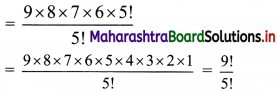
Maharashtra Board 11th Commerce Maths Solutions Chapter 6 Permutations and Combinations Ex 6.2 Q4(iii)

(iv) 5 × 10 × 15 × 20 × 25
Solution:
5 × 10 × 15 × 20 × 25
= (5 × 1) × (5 × 2) × (5 × 3) × (5 × 4) × (5 × 5)
= (55) (5 × 4 × 3 × 2 × 1)
= (55) (5!)

Question 5.
Evaluate: \(\frac{n !}{r !(n-r) !}\) for
(i) n = 8, r = 6
Solution:
n = 8, r = 6
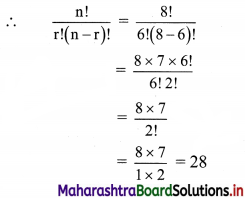
Maharashtra Board 11th Commerce Maths Solutions Chapter 6 Permutations and Combinations Ex 6.2 Q5(i)

(ii) n = 12, r = 12
Solution:
n = 12, r = 12
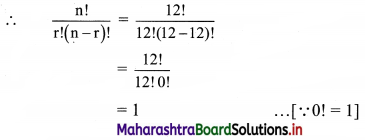
Maharashtra Board 11th Commerce Maths Solutions Chapter 6 Permutations and Combinations Ex 6.2 Q5(ii)

Question 6.
Find n, if
(i) \(\frac{n}{8 !}=\frac{3}{6 !}+\frac{1}{4 !}\)
Solution:
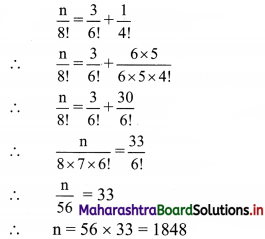
Maharashtra Board 11th Commerce Maths Solutions Chapter 6 Permutations and Combinations Ex 6.2 Q6(i)

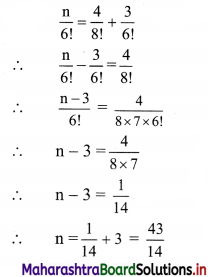
(ii) \(\frac{n}{6 !}=\frac{4}{8 !}+\frac{3}{6 !}\)
Solution:
Maharashtra Board 11th Commerce Maths Solutions Chapter 6 Permutations and Combinations Ex 6.2 Q6(ii)

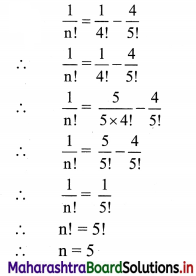
(iii) \(\frac{1}{n !}=\frac{1}{4 !}-\frac{4}{5 !}\)
Solution:
Maharashtra Board 11th Commerce Maths Solutions Chapter 6 Permutations and Combinations Ex 6.2 Q6(iii)

Question 7.
Find n, if
(i) (n + 1)! = 42 × (n – 1)!
Solution:
(n + 1)! = 42(n – 1)!
∴ (n + 1) n (n – 1)! = 42(n – 1)!
∴ n2 + n = 42
∴ n(n + 1) = 6 × 7
Comparing on both sides, we get
∴ n = 6

Maharashtra Board 11th Commerce Maths Solutions Chapter 6 Permutations and Combinations Ex 6.2

(ii) (n + 3)! = 110 × (n + 1)!
Solution:
(n + 3)! = 110 × (n + 1)!
∴ (n + 3) (n + 2) (n + 1)! = 110 (n + 1)!
∴ (n + 3) (n + 2) = (11) (10)
Comparing on both sides, we get
n + 3 = 11
∴ n = 8

Question 8.
Find n, if:
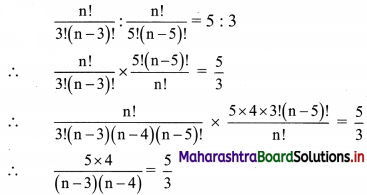
(i) \(\frac{n !}{3 !(n-3) !}: \frac{n !}{5 !(n-5) !}=5: 3\)
Solution:
Maharashtra Board 11th Commerce Maths Solutions Chapter 6 Permutations and Combinations Ex 6.2 Q8(i)
∴ 12 = (n – 3)(n – 4)
∴ (n – 3)(n – 4) = 4 × 3
Comparing on both sides, we get
n – 3 = 4
∴ n = 7

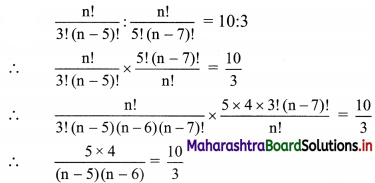
(ii) \(\frac{n !}{3 !(n-5) !}: \frac{n !}{5 !(n-7) !}=10: 3\)
Solution:
Maharashtra Board 11th Commerce Maths Solutions Chapter 6 Permutations and Combinations Ex 6.2 Q8(ii)
∴ (n – 5) (n – 6) = 3 × 2
Comparing on both sides, we get
n – 5 = 3
∴ n = 8

Question 9.
Find n, if:
(i) \(\frac{(17-n) !}{(14-n) !}\) = 5!
Solution:
\(\frac{(17-n) !}{(14-n) !}\) = 5!
∴ \(\frac{(17-n)(16-n)(15-n)(14-n) !}{(14-n) !}\) = 5 × 4 × 3 × 2 × 1
∴ (17 – n) (16 – n) (15 – n) = 6 × 5 × 4
Comparing on both sides, we get
17 – n = 6
∴ n = 11

(ii) \(\frac{(15-n) !}{(13-n) !}\) = 12
Solution:
\(\frac{(15-n) !}{(13-n) !}\) = 12
∴ \(\frac{(15-\mathrm{n})(14-\mathrm{n})(13-\mathrm{n}) !}{(13-\mathrm{n}) !}\) = 12
∴ (15 – n) (14 – n) = 4 × 3
Comparing on both sides, we get
15 – n = 4
∴ n = 11

Question 10.
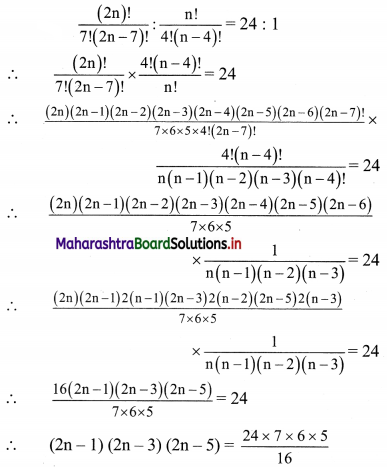
Find n if \(\frac{(2 n) !}{7 !(2 n-7) !}: \frac{n !}{4 !(n-4) !}\) = 24 : 1
Solution:
Maharashtra Board 11th Commerce Maths Solutions Chapter 6 Permutations and Combinations Ex 6.2 Q10
∴ (2n – 1) (2n – 3) (2n – 5) = 9 × 7 × 5
Comparing on both sides, we get
2n – 1 = 9
∴ n = 5

Maharashtra Board 11th Commerce Maths Solutions Chapter 6 Permutations and Combinations Ex 6.2

Question 11.
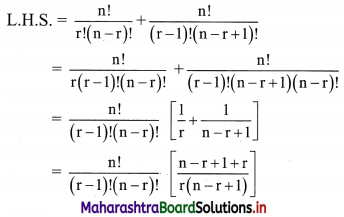
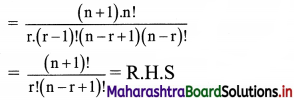
Show that \(\frac{n !}{r !(n-r) !}+\frac{n !}{(r-1) !(n-r+1) !}=\frac{(n+1) !}{r !(n-r+1)}\)
Solution:
Maharashtra Board 11th Commerce Maths Solutions Chapter 6 Permutations and Combinations Ex 6.2 Q11
Maharashtra Board 11th Commerce Maths Solutions Chapter 6 Permutations and Combinations Ex 6.2 Q11.1

Question 12.
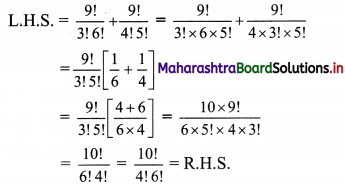
Show that \(\frac{9 !}{3 ! 6 !}+\frac{9 !}{4 ! 5 !}=\frac{10 !}{4 ! 6 !}\)
Solution:
Maharashtra Board 11th Commerce Maths Solutions Chapter 6 Permutations and Combinations Ex 6.2 Q12

Question 13.
Find the value of:
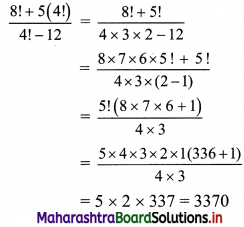
(i) \(\frac{8 !+5(4 !)}{4 !-12}\)
Solution:
Maharashtra Board 11th Commerce Maths Solutions Chapter 6 Permutations and Combinations Ex 6.2 Q13(i)

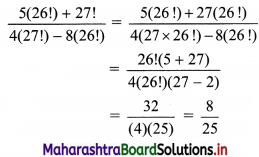
(ii) \(\frac{5(26 !)+(27 !)}{4(27 !)-8(26 !)}\)
Solution:
Maharashtra Board 11th Commerce Maths Solutions Chapter 6 Permutations and Combinations Ex 6.2 Q13(ii)

Maharashtra Board 11th Commerce Maths Solutions Chapter 6 Permutations and Combinations Ex 6.2

Question 14.
Show that
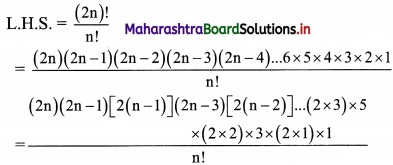
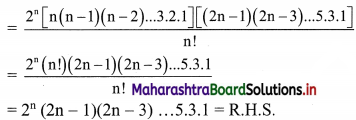
\(\frac{(2 n) !}{n !}\) = 2n (2n – 1) (2n – 3)…5.3.1
Solution:
Maharashtra Board 11th Commerce Maths Solutions Chapter 6 Permutations and Combinations Ex 6.2 Q14
Maharashtra Board 11th Commerce Maths Solutions Chapter 6 Permutations and Combinations Ex 6.2 Q14.1

Maharashtra Board 11th Commerce Maths Solutions Chapter 6 Permutations and Combinations Ex 6.1

Balbharati Maharashtra State Board 11th Commerce Maths Solution Book Pdf Chapter 6 Permutations and Combinations Ex 6.1 Questions and Answers.

Maharashtra State Board 11th Commerce Maths Solutions Chapter 6 Permutations and Combinations Ex 6.1

Question 1.
A teacher wants to select the class monitor in a class of 30 boys and 20 girls. In how many ways can he select a student if the monitor can be a boy or a girl?
Solution:
There are 30 boys and 20 girls in a class.
The teacher wants to select a class monitor from these boys and girls.
A boy can be selected in 30 ways and a girl can be selected in 20 ways.
∴ By using the fundamental principle of addition,
in a number of ways either a boy or a girl is selected as a class monitor = 30 + 20 = 50.

Question 2.
In question 1, in how many ways can the monitor be selected if the monitor must be a boy? What is the answer if the monitor must be a girl?
Solution:
(i) Since there are 30 boys in the class
∴ A boy monitor can be selected in 30 ways.
(ii) Since there are 20 girls in the class
∴ A girl monitor can be selected in 20 ways.

Maharashtra Board 11th Commerce Maths Solutions Chapter 6 Permutations and Combinations Ex 6.1

Question 3.
A Signal is generated from 2 flags by putting one flag above the other. If 4 flags of different colours are available, how many different signals can be generated?
Solution:
A signal is generated from 2 flags and there are 4 flags of different colours available.
∴ 1st flag can be any one of the available 4 flags.
∴ It can be selected in 4 ways.
Now, 2nd flag is to be selected for which 3 flags are available for a different signal.
∴ 2nd flag can be anyone from these 3 flags.
∴ It can be selected in 3 ways.
∴ By using the fundamental principle of multiplication,
Total number of ways in which a signal can be generated = 4 × 3 = 12
∴ 12 different signals can be generated.

Question 4.
How many two-letter words can be formed using letters from the word SPACE when repetition of letters
(i) is allowed
(ii) is not allowed
Solution:
A two-letter word is to be formed out of the letters of the word SPACE.
(i) When repetition of the letters is allowed
1st letter can be selected in 5 ways
2nd letter can be selected in 5 ways
∴ By using the fundamental principle of multiplication,
total number of 2-letter words = 5 × 5 = 25

(ii) When repetition of the letters is not allowed
1st letter can be selected in 5 ways
2nd letter can be selected in 4 ways
∴ By using the fundamental principle of multiplication,
total number of 2-letter words = 5 × 4 = 20

Maharashtra Board 11th Commerce Maths Solutions Chapter 6 Permutations and Combinations Ex 6.1

Question 5.
How many three-digit numbers can be formed from the digits 0, 1, 3, 5, 6 if repetitions of digits
(i) are allowed
(ii) are not allowed
Solution:
The three-digit number is to be formed from the digits 0, 1, 3, 5, 6
(i) When repetition of digits is allowed:
100’s place digit should be a non-zero number.
Hence, it can be anyone from digits 1, 3, 5, 6
∴ 100’s place digit can be selected in 4 ways.
0 can appear in 10’s and unit’s place and digits can be repeated.
∴ 10’s place digit can be selected in 5 ways and the unit’s place digit can be selected in 5 ways.
∴ By using the fundamental principle of multiplication,
the total number of three-digit numbers = 4 × 5 × 5 = 100

(ii) When repetition of digits is not allowed:
100’s place digit should be a non-zero number.
Hence, it can be anyone from digits 1, 3, 5, 6
∴ 100’s place digit can be selected in 4 ways
0 can appear in 10’s and unit’s place and digits can’t be repeated.
∴ 10’s place digit can be selected in 4 ways and the unit’s place digit can be selected in 3 ways
∴ By using the fundamental principle of multiplication,
total number of three-digit numbers = 4 × 4 × 3 = 48

Question 6.
How many three-digit numbers can be formed using the digits 2, 3, 4, 5, 6 if digits can be repeated?
Solution:
A 3-digit number is to be formed from the digits 2, 3, 4, 5, 6 where digits can be repeated.
∴ The unit’s place digit can be selected in 5 ways.
10’s place digit can be selected in 5 ways.
100’s place digit can be selected in 5 ways.
∴ By using fundamental principle of multiplication,
the total number of 3-digit numbers = 5 × 5 × 5 = 125

Maharashtra Board 11th Commerce Maths Solutions Chapter 6 Permutations and Combinations Ex 6.1

Question 7.
A letter lock has 3 rings and each ring has 5 letters. Determine the maximum number of trials that may be required to open the lock.
Solution:
A letter lock has 3 rings, each ring containing 5 different letters.
∴ A letter from each ring can be selected in 5 ways.
∴ By using fundamental principle of multiplication,
the total number of trials that can be made = 5 × 5 × 5 = 125
Out of these 124 wrong attempts are made and in the 125th attempt,
the lock gets opened, for a maximum number of trials.
∴ A maximum number of trials required to open the lock is 125.

Question 8.
In a test that has 5 true/false questions, no student has got all correct answers and no sequence of answers is repeated. What is the maximum number of students for this to be possible?
Solution:
For a set of 5 true/false questions, each question can be answered in 2 ways.
∴ By using fundamental principle of multiplication,
the total number of possible sequences of answers = 2 × 2 × 2 × 2 × 2 = 32
Since no student has written all the correct answers.
∴ Total number of sequences of answers given by the students in the class = 32 – 1 = 31
Also, no student has given the same sequence of answers.
∴ Maximum number of students in the class = Number of sequences of answers given by the students = 31

Question 9.
How many numbers between 100 and 1000 have 4 in the unit’s place?
Solution:
Numbers between 100 and 1000 are 3-digit numbers.
A 3-digit number is to be formed from the digits 0, 1, 2, 3, 4, 5, 6, 7, 8, 9 where the unit place digit is 4.
Since Unit’s place digit is 4.
∴ it can be selected in 1 way only.
10’s place digit can be selected in 10 ways.
For 3-digit number 100’s place digit should be a non-zero number.
∴ 100’s place digit can be selected in 9 ways.
∴ By using fundamental principle of multiplication,
total number of numbers between 100 and 1000 which have 4 in the units place = 1 × 10 × 9 = 90

Maharashtra Board 11th Commerce Maths Solutions Chapter 6 Permutations and Combinations Ex 6.1

Question 10.
How many numbers between 100 and 1000 have the digit 7 exactly once?
Solution:
Numbers between 100 and 1000 are 3-digit numbers.
A 3-digit number is to be formed from the digits 0, 1, 2, 3, 4, 5, 6, 7, 8, 9, where exactly one of the digits is 7.
When 7 is in the unit’s place
The unit’s place digit is 7.
∴ it can be selected in 1 way only.
10’s place digit can be selected in 9 ways.
100’s place digit can be selected in 8 ways.
∴ total number of numbers which have 7 in the unit’s place = 1 × 9 × 8 = 72
When 7 is in 10’s place
The unit’s place digit can be selected in 9 ways.
10’s place digit is 7
∴ it can be selected in 1 way only.
100’s place digit can be selected in 8 ways.
∴ total number of numbers which have 7 in 10’s place = 9 × 1 × 8 = 72
When 7 is in 100’s place
The unit’s place digit can be selected in 9 ways.
10’s place digit can be selected in 9 ways.
100’s place digit is 7
∴ it can be selected in 1 way.
∴ total numbers which have 7 in 100’s place = 9 × 9 × 1 = 81
∴ total number of numbers between 100 and 1000 having digit 7 exactly once = 72 + 72 + 81 = 225.

Question 11.
How many four-digit numbers will not exceed 7432 if they are formed using the digits 2, 3, 4, 7 without repetition?
Solution:
Among many set’s of digits, the greatest number is possible when digits are arranged in descending order.
∴ 7432 is the greatest number, formed from the digits 2, 3, 4, 7.
∴ Since a 4-digit number is to be formed from the digits 2, 3, 4, 7, where repetition of the digit is not allowed.
∴ 1000’s place digit can be selected in 4 ways.
100’s place digit can be selected in 3 ways.
10’s place digit can be selected in 2 ways.
The unit’s place digit can be selected in 1 way.
∴ Total number of numbers not exceeding 7432 that can be formed from the digits 2, 3, 4, 7
= Total number of four-digit numbers formed from the digits 2, 3, 4, 7
= 4 × 3 × 2 × 1
= 24

Maharashtra Board 11th Commerce Maths Solutions Chapter 6 Permutations and Combinations Ex 6.1

Question 12.
If numbers are formed using digits 2, 3, 4, 5, 6 without repetition, how many of them will exceed 400?
Solution:
Case I: Three-digit numbers with 4 occurring in hundred’s place:
100’s place digit can be selected in 1 way.
Ten’s place can be filled by any one of the numbers 2, 3, 5, 6.
∴ 10’s place digit can be selected in 4 ways.
The unit’s place digit can be selected in 3 ways.
∴ total number of numbers which have 4 in 100’s place = 1 × 4 × 3 = 12

Case II: Three-digit numbers more than 500
100’s place digit can be selected in 2 ways.
10’s place digit can be selected in 4 ways.
Unit’s place digit can be selected in 3 ways.
∴ total number of three digit numbers more than 500 = 2 × 4 × 3 = 24

Case III: Number of four digit numbers formed from 2, 3, 4, 5, 6
Since, repetition of digits is not allowed
∴ total four digit numbers formed = 5 × 4 × 3 × 2 = 120

Case IV: Number of five digit numbers formed from 2, 3, 4, 5, 6
Since, repetition of digits is not allowed
∴ total five digit numbers formed = 5 × 4 × 3 × 2 × 1 = 120
∴ total number of numbers that exceed 400 = 12 + 24 + 120 + 120 = 276

Question 13.
How many numbers formed with the digits 0, 1, 2, 5, 7, 8 will fall between 13 and 1000 if digits can be repeated?
Solution:
Case I: 2-digit numbers more than 13, less than 20, formed from the digits 0, 1, 2, 5, 7, 8
Number of such numbers = 3

Case II: 2-digit numbers more than 20 formed from 0, 1, 2, 5, 7, 8
Ten’s place digit is selected from 2, 5, 7, 8.
∴ Ten’s place digit can be selected in 4 ways.
Unit’s place digit is anyone from 0, 1, 2, 5, 7, 8
∴ The unit’s place digit can be selected in 6 ways.
Using the multiplication principle,
the number of such numbers (repetition allowed) = 4 × 6 = 24

Case III: 3-digit numbers formed from 0, 1, 2, 5, 7, 8
100’s place digit is anyone from 1, 2, 5, 7, 8.
∴ 100’s place digit can be selected in 5 ways.
As digits can be repeated, the 10’s place and unit’s place digits are selected from 0, 1, 2, 5, 7, 8
∴ 10’s place and unit’s place digits can be selected in 6 ways each.
Using multiplication principle,
the number of such numbers (repetition allowed) = 5 × 6 × 6 = 180
All cases are mutually exclusive and exhaustive.
∴ Required number = 3 + 24 + 180 = 207

Question 14.
A school has three gates and four staircases from the first floor to the second floor. How many ways does a student have to go from outside the school to his classroom on the second floor?
Solution:
A student can go inside the school from outside in 3 ways and from the first floor to the second floor in 4 ways.
∴ Number of ways to choose gates = 3
Number of ways to choose staircase = 4
∴ By using fundamental principle of multiplication,
number of ways in which a student has to go from outside the school to his classroom = 4 × 3 = 12

Maharashtra Board 11th Commerce Maths Solutions Chapter 6 Permutations and Combinations Ex 6.1

Question 15.
How many five-digit numbers formed using the digit 0, 1, 2, 3, 4, 5 are divisible by 3 if digits are not repeated?
Solution:
For a number to be divisible by 3.
The sum of digits must be divisible by 3.
Given 6 digits are 0, 1,2, 3, 4, 5.
Sum of 1, 2, 3, 4, 5 = 15, which is divisible by 3.
∴ There are two cases of 5 digit numbers formed from 0, 1, 2, 3, 4, 5 and divisible by 3.
Either 3 is selected in 5 digits (and 0 not selected) or 3 is not selected in 5 digits (and 0 is selected)
Case I:
3 is not selected (and 0 is selected) i.e., the digits are 0, 1, 2, 4, 5.
10000’s place digit can be selected in 4 ways (as 0 cannot appear).
As digits are not repeated, 1000’s place digit can be selected in 4 ways.
100’s place digit can be selected in 3 ways.
10’s place digit can be selected in 2 ways.
The unit’s place digit can be selected in 1 way.
∴ Using multiplication theorem,
Number of 5-digit number formed from 0, 1, 2, 4, 5 (with no repetition of digits) = 4 × 4 × 3 × 2 × 1 = 96

Case II:
3 is selected (and 0 is not selected) i.e., 1, 2, 3, 4, 5
10000’s place digit can be selected in 5 ways.
1000’s place digit can be selected in 4 ways.
100’s place digit can be selected in 3 ways.
10’s place digit can be selected in 2 ways.
The unit’s place digit can be selected in 1 way.
Using multiplication theorem,
Number of 5-digit numbers formed from 1, 2, 3, 4, 5 = 5 × 4 × 3 × 2 × 1 = 120
Both the cases are mutually exclusive and exhaustive.
∴ Required number = 96 + 120 = 216

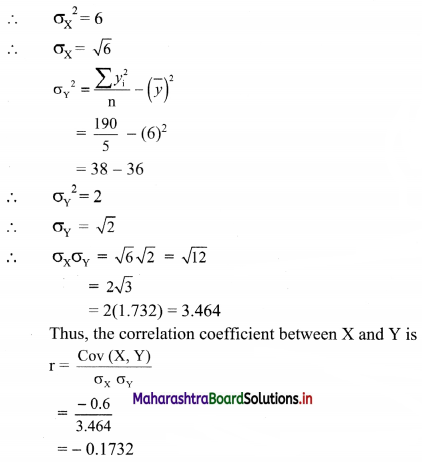
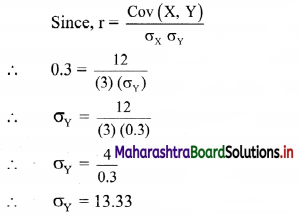
Maharashtra Board 11th Commerce Maths Solutions Chapter 5 Correlation Miscellaneous Exercise 5

Balbharati Maharashtra State Board 11th Commerce Maths Solution Book Pdf Chapter 5 Correlation Miscellaneous Exercise 5 Questions and Answers.

Maharashtra State Board 11th Commerce Maths Solutions Chapter 5 Correlation Miscellaneous Exercise 5

Question 1.
Two series of x and y with 50 items each have standard deviations of 4.8 and 3.5 respectively. If the sum of products of deviations of x and y series from respective arithmetic means is 420, then find the correlation coefficient between x and y.
Solution:
Maharashtra Board 11th Commerce Maths Solutions Chapter 5 Correlation Miscellaneous Exercise 5 Q1

Maharashtra Board 11th Commerce Maths Solutions Chapter 5 Correlation Miscellaneous Exercise 5

Question 2.
Find the number of pairs of observations from the following data,
r = 0.15, σy = 4, \(\sum\left(x_{\mathrm{i}}-\bar{x}\right)\left(y_{\mathrm{i}}-\bar{y}\right)\) = 12, \(\Sigma\left(x_{i}-\bar{x}\right)^{2}\) = 40.
Solution:
Given, r = 0.15, σy = 4, \(\sum\left(x_{\mathrm{i}}-\bar{x}\right)\left(y_{\mathrm{i}}-\bar{y}\right)\) = 12, \(\Sigma\left(x_{i}-\bar{x}\right)^{2}\) = 40
Maharashtra Board 11th Commerce Maths Solutions Chapter 5 Correlation Miscellaneous Exercise 5 Q2
Maharashtra Board 11th Commerce Maths Solutions Chapter 5 Correlation Miscellaneous Exercise 5 Q2.1

Question 3.
Given that r = 0.4, σy = 3, \(\sum\left(x_{\mathrm{i}}-\bar{x}\right)\left(y_{\mathrm{i}}-\bar{y}\right)\) = 108, \(\sum\left(x_{\mathrm{i}}-\bar{x}\right)^{2}\) = 900. Find the number of pairs of observations.
Solution:
Given, r = 0.4, σy = 3, \(\sum\left(x_{\mathrm{i}}-\bar{x}\right)\left(y_{\mathrm{i}}-\bar{y}\right)\) = 108, \(\sum\left(x_{\mathrm{i}}-\bar{x}\right)^{2}\) = 900
Maharashtra Board 11th Commerce Maths Solutions Chapter 5 Correlation Miscellaneous Exercise 5 Q3

Question 4.
Given the following information, Σ\(x_{\mathrm{i}}^{2}\) = 90, Σxiyi = 60, r = 0.8, σy = 2.5, where xi and yi are the deviations from their respective means, find the number of items.
Solution:
Here, Σ\(x_{\mathrm{i}}^{2}\) = 90, Σxiyi = 60, r = 0.8, σy = 2.5
Here, xi and yi are the deviations from their respective means.
∴ If Xi, Yi are elements of x and y series respectively, then
Xi – \(\bar{x}\) = xi and Yi – \(\bar{y}\) = yi
∴ Σxiyi = \(\Sigma\left(\mathrm{X}_{\mathrm{i}}-\bar{x}\right)\left(\mathrm{Y}_{\mathrm{i}}-\bar{y}\right)\) = 60, \(\sum x_{\mathrm{i}}^{2}=\sum\left(\mathrm{X}_{\mathrm{i}}-\bar{x}\right)^{2}\) = 90
Maharashtra Board 11th Commerce Maths Solutions Chapter 5 Correlation Miscellaneous Exercise 5 Q4

Maharashtra Board 11th Commerce Maths Solutions Chapter 5 Correlation Miscellaneous Exercise 5

Question 5.
A sample of 5 items is taken from the production of a firm. The length and weight of 5 items are given below. [Given: √0.8823 = 0.9393]
Maharashtra Board 11th Commerce Maths Solutions Chapter 5 Correlation Miscellaneous Exercise 5 Q5
Calculate the correlation coefficient between length and weight and interpret the result.
Solution:
Let length = xi (in cm), Weight = yi (in gm)
Maharashtra Board 11th Commerce Maths Solutions Chapter 5 Correlation Miscellaneous Exercise 5 Q5.1
Maharashtra Board 11th Commerce Maths Solutions Chapter 5 Correlation Miscellaneous Exercise 5 Q5.2
∴ the value of r indicates a high degree of positive correlation between length and weight of items.

Question 6.
Calculate the correlation coefficient from the following data and interpret it.
Maharashtra Board 11th Commerce Maths Solutions Chapter 5 Correlation Miscellaneous Exercise 5 Q6
Solution:
Maharashtra Board 11th Commerce Maths Solutions Chapter 5 Correlation Miscellaneous Exercise 5 Q6.1
Maharashtra Board 11th Commerce Maths Solutions Chapter 5 Correlation Miscellaneous Exercise 5 Q6.2
∴ the value of r indicates a perfect negative correlation between x and y.

Question 7.
Calculate the correlation coefficient from the following data and interpret it.
Maharashtra Board 11th Commerce Maths Solutions Chapter 5 Correlation Miscellaneous Exercise 5 Q7
Solution:
Maharashtra Board 11th Commerce Maths Solutions Chapter 5 Correlation Miscellaneous Exercise 5 Q7.1
Maharashtra Board 11th Commerce Maths Solutions Chapter 5 Correlation Miscellaneous Exercise 5 Q7.2
Maharashtra Board 11th Commerce Maths Solutions Chapter 5 Correlation Miscellaneous Exercise 5 Q7.3
∴ the value of r indicates a perfect positive correlation between x and y.

Question 8.
If the correlation coefficient between X and Y is 0.8, what is the correlation coefficient between
(i) 2X and Y
(ii) \(\frac{X}{2}\) and Y
(iii) X and 3Y
(iv) X – 5 and Y – 3
(v) X + 7 and Y + 9
(vi) \(\frac{X-5}{7}\) and \(\frac{Y-3}{8}\)?
Solution:
The correlation coefficient remains unaffected by the change of origin and scale.
i.e., if ui = \(\frac{x_{i}-\mathrm{a}}{\mathrm{h}}\) and vi = \(\frac{y_{i}-\mathrm{b}}{\mathrm{k}}\), then Corr(U, V) = ±Corr(X, Y).
according to the same or opposite signs of h and k.
(i) ui = \(\frac{2\left(x_{i}-0\right)}{1}\), vi = \(\frac{y_{i}-0}{1}\)
Here, h = 1 and k = 1 are of the same signs.
∴ Corr (U, V) = Corr (X, Y) = 0.8

(ii) ui = \(\frac{x_{i}-0}{2}\), vi = \(\frac{y_{\mathrm{i}}-0}{1}\)
Here, h = 2 and k = 1 are of the same signs.
∴ Corr (U, V) = Corr (X, Y) = 0.8

(iii) Corr (X, 3Y) = Corr (X, Y) = 0.8

(iv) Corr (X – 5, Y – 3) = Corr(X, Y) = 0.8

(v) Corr (X + 7, Y + 9) = Corr(X, Y) = 0.8

(vi) Corr(\(\frac{X-5}{7}, \frac{Y-3}{8}\)) = Corr(X, Y) = 0.8

Maharashtra Board 11th Commerce Maths Solutions Chapter 5 Correlation Miscellaneous Exercise 5

Question 9.
In the calculation of the correlation coefficient between the height and weight of a group of students of a college, one investigator took the measurements in inches and pounds while the other investigator took the measurements in cm. and kg. Will they get the same value of the correlation coefficient or different values? Justify your answer.
Solution:
The coefficient of correlation is a ratio of covariance and standard deviations.
Since covariance and standard deviations are independent of units of measurement.
∴ coefficient of correlation is also independent of units of measurement.
∴ values of coefficient of correlation obtained by first and second investigators are the same.

Maharashtra Board 11th Commerce Maths Solutions Chapter 5 Correlation Ex 5.1

Balbharati Maharashtra State Board 11th Commerce Maths Solution Book Pdf Chapter 5 Correlation Ex 5.1 Questions and Answers.

Maharashtra State Board 11th Commerce Maths Solutions Chapter 5 Correlation Ex 5.1

Question 1.
Draw a scatter diagram for the data given below and interpret it.
Maharashtra Board 11th Commerce Maths Solutions Chapter 5 Correlation Ex 5.1 Q1
Solution:
Maharashtra Board 11th Commerce Maths Solutions Chapter 5 Correlation Ex 5.1 Q1.1
Since all the points lie in a band rising from left to right.
Therefore, there is a positive correlation between the values of X and Y respectively.

Question 2.
For the following data of marks of 7 students in Physics (x) and Mathematics (y), draw scatter diagram and state the type of correlation.
Maharashtra Board 11th Commerce Maths Solutions Chapter 5 Correlation Ex 5.1 Q2
Solution:
We take marks in Physics on X-axis and marks in Mathematics on Y-axis and plot the points as below.
Maharashtra Board 11th Commerce Maths Solutions Chapter 5 Correlation Ex 5.1 Q2.1
We get a band of points rising from left to right. This indicates the positive correlation between marks in Physics and marks in Mathematics.

Question 3.
Draw a scatter diagram for the data given below. Is there any correlation between Aptitude score and Grade points?
Maharashtra Board 11th Commerce Maths Solutions Chapter 5 Correlation Ex 5.1 Q3
Solution:
Maharashtra Board 11th Commerce Maths Solutions Chapter 5 Correlation Ex 5.1 Q3.1
The points are completely scattered i.e., no trend is observed.
∴ there is no correlation between Aptitude score (X) and Grade point (Y).

Question 4.
Find correlation coefficient between x andy series for the following data:
n = 15, \(\bar{x}\) = 25, \(\bar{y}\) = 18, σx = 3.01, σy = 3.03, \(\sum\left(x_{\mathrm{i}}-\bar{x}\right)\left(y_{\mathrm{i}}-\bar{y}\right)\) = 122
Solution:
Here, n = 15, \(\bar{x}\) = 25, \(\bar{y}\) = 18, σx = 3.01, σy = 3.03, \(\sum\left(x_{\mathrm{i}}-\bar{x}\right)\left(y_{\mathrm{i}}-\bar{y}\right)\) = 122
Maharashtra Board 11th Commerce Maths Solutions Chapter 5 Correlation Ex 5.1 Q4

Question 5.
The correlation coefficient between two variables x and y are 0.48. The covariance is 36 and the variance of x is 16. Find the standard deviation of y.
Solution:
Given, r = 0.48, Cov(X, Y) = 36
Since \(\sigma_{X}^{2}\) = 16

∴ σx = 4
Maharashtra Board 11th Commerce Maths Solutions Chapter 5 Correlation Ex 5.1 Q5
∴ the standard deviation of y is 18.75.

Question 6.
In the following data, one of the values of y is missing. Arithmetic means of x and y series are 6 and 8 respectively. (√2 = 1.4142)
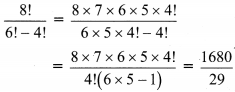
Maharashtra Board 11th Commerce Maths Solutions Chapter 5 Correlation Ex 5.1 Q6
(i) Estimate missing observation.
(ii) Calculate correlation coefficient.
Solution:
(i) Let X = xi, Y = yi and missing observation be ‘a’.
Given, \(\bar{x}\) = 6, \(\bar{y}\) = 8, n = 5
∴ 8 = \(\frac{35+a}{5}\)
∴ 40 = 35 + a
∴ a = 5
(ii) We construct the following table:
Maharashtra Board 11th Commerce Maths Solutions Chapter 5 Correlation Ex 5.1 Q6.1
Maharashtra Board 11th Commerce Maths Solutions Chapter 5 Correlation Ex 5.1 Q6.2

Question 7.
Find correlation coefficient from the following data. [Given: √3 = 1.732]
Maharashtra Board 11th Commerce Maths Solutions Chapter 5 Correlation Ex 5.1 Q7
Solution:
Maharashtra Board 11th Commerce Maths Solutions Chapter 5 Correlation Ex 5.1 Q7.1
Maharashtra Board 11th Commerce Maths Solutions Chapter 5 Correlation Ex 5.1 Q7.2
Maharashtra Board 11th Commerce Maths Solutions Chapter 5 Correlation Ex 5.1 Q7.3

Question 8.
The correlation coefficient between x and y is 0.3 and their covariance is 12. The variance of x is 9, find the standard deviation of y.
Solution:
Given, r = 0.3, Cov(X, Y) = 12,
\(\sigma_{X}^{2}\) = 9
∴ \(\sigma_{\mathrm{X}}\) = 3
Maharashtra Board 11th Commerce Maths Solutions Chapter 5 Correlation Ex 5.1 Q8
∴ the standard deviation of y is 13.33.