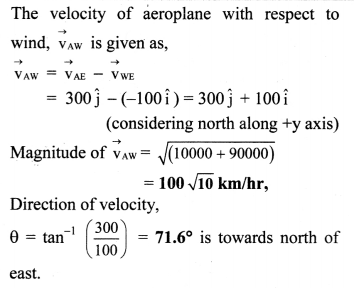
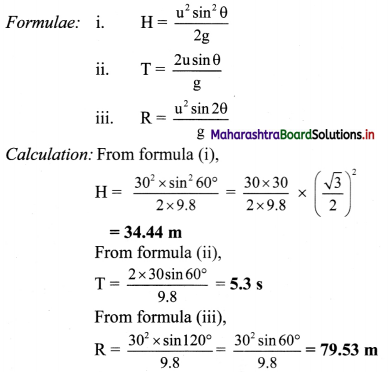
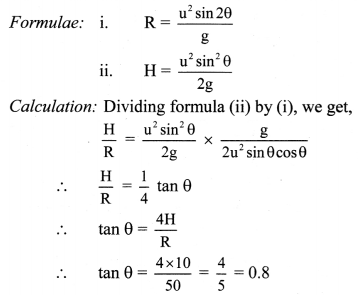
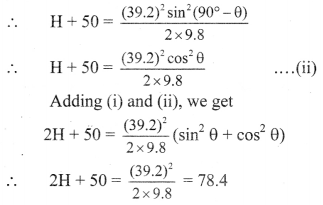
Maharashtra Board Class 11 Physics Important Questions Chapter 4 Laws of Motion

Balbharti Maharashtra State Board 11th Physics Important Questions Chapter 4 Laws of Motion Important Questions and Answers.

Maharashtra State Board 11th Physics Important Questions Chapter 4 Laws of Motion

Question 1.
‘Rest and motion are relative concepts.’ Explain the statement with an example.
Answer:

  1. A body can be described to be at rest or in motion with respect to a system of co¬ordinate axes known as the frame of reference.
  2. A body is in motion if it changes its position with respect to a fixed reference point in a frame of reference. On the other hand, a body is at rest if it does not change its position with respect to a fixed reference point in a frame of reference.
  3. An object can be said to be at rest with respect to a frame of reference while the same object can be said to be in motion with respect to a different frame of reference.
    Example: In a running train, all the travellers in the train are in a state of rest if the train is taken as the frame of reference. On the other hand, all the travellers in the train are in a state of motion if ground (or platform) is taken as the frame of reference.
  4. Thus, motion and rest always need a frame of reference to be described. Hence, rest and motion are relative concepts.

Question 2.
Explain how acceleration and initial velocity decides the trajectory of a motion.
Answer:

  1. The resultant motion is linear if:
    • initial velocity \(\overrightarrow{\mathrm{u}}\) = 0 (starting from rest) and acceleration \(\overrightarrow{\mathrm{a}}\) is in any direction.
    • initial velocity \(\overrightarrow{\mathrm{u}}\) ≠ 0 and acceleration a is in line with the initial velocity (same or opposite direction).
  2. The resultant motion is circular if initial velocity \(\overrightarrow{\mathrm{u}}\) ≠ 0 and acceleration \(\overrightarrow{\mathrm{a}}\) is perpendicular to the velocity throughout.
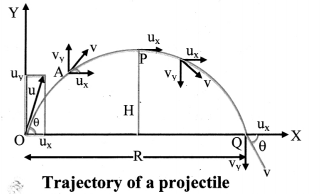
  3. The resultant motion is parabolic if the initial velocity \(\overrightarrow{\mathrm{u}}\) is not in line with the acceleration \(\overrightarrow{\mathrm{a}}\) and \(\overrightarrow{\mathrm{a}}\) = constant.
    e.g., the trajectory of a projectile motion.
  4. Similarly, various other combinations of initial velocity and acceleration will result into more complicated motions.

Maharashtra Board Class 11 Physics Important Questions Chapter 4 Laws of Motion

Question 3.
State Newton’s first law of motion.
Answer:
Statement: Every inanimate object continues to be in a state of rest or of uniform unaccelerated motion along a straight line, unless it is acted upon by an external, unbalanced force.

Question 4.
An astronaut accidentally gets separated out of his small spaceship accelerating in inter stellar space at a constant rate of 100 m s-2. What is the acceleration of the astronaut the instant after he is outside the spaceship? (Assume that there are no nearby stars to exert gravitational force on him.) (NCERT)
Answer:

  1. Assuming absence of stars in the vicinity, the only gravitational force exerted on astronaut is by the spaceship.
  2. But this force is negligible.
  3. Hence, once astronaut is out of the spaceship net external force acting on him can be taken as zero.
  4. From the first law of motion, the acceleration of astronaut is zero.

Question 5.
Give the magnitude and direction of the net force acting on:

  1. a drop of rain falling down with a constant speed.
  2. a cork of mass 10 g floating on water.
  3. a kite skilfully held stationary in the sky.
  4. a car moving with a constant velocity of 30 kmh-1 on a rough road.
  5. a high speed electron in space far from all gravitating objects, and free of electric and magnetic fields. (NCERT)

Answer:

  1. The drop of rain falls down with a constant speed, hence according to the first law of motion, the net force on the drop of rain is zero.
  2. Since the 10 g cork is floating on water, its weight is balanced by the up thrust due to water. Therefore, net force on the cork is zero.
  3. As the kite is skilfully held stationary in the sky, in accordance with first law of motion, the net force on the kite is zero.
  4. As the car is moving with a constant velocity of 30 km/h on a road, the net force on the car is zero.
  5. As the high-speed electron in space is far from all material objects, and free of electric and magnetic fields, it doesn’t accelerate and moves with constant velocity. Hence, net force acting on the electron is zero.

Question 6.
State Newton’s second law of motion and its importance.
Answer:
Statement: The rate of change of linear momentum of a rigid body is directly proportional to the applied (external unbalanced) force and takes place in the direction of force.
\(\overrightarrow{\mathrm{F}}=\frac{\mathrm{d} \overrightarrow{\mathrm{p}}}{\mathrm{dt}}\)
Where, \(\overrightarrow{\mathrm{F}}\) = Force applied
p = m\(\overrightarrow{\mathrm{v}}\) = linear momentum

Importance of Newton’s second law:

  1. It gives mathematical formulation for quantitative measure of force as rate of change of linear momentum.
  2. It defines momentum instead of velocity as the fundamental quantity related to motion.
  3. It takes into consideration the resultant unbalanced force on a body which is used to overcome Aristotle’s fallacy.

Question 7.
Explain why a cricketer moves his hands backwards while holding a catch. (NCERT)
Answer:

  1. In the act of catching the ball, by drawing hands backward, cricketer allows longer time for his hands to stop the ball.
  2. By Newton’s second law of motion, force applied depends on the rate of change of momentum.
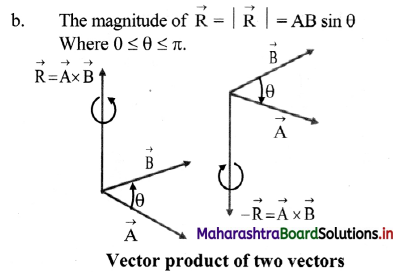
  3. Taking longer time to stop the ball ensures smaller rate of change of momentum.
  4. Due to this the cricketer can stop the ball by applying smaller amount of force and thereby not hurting his hands.

Question 8.
Large force always produces large change in momentum on a body than a small force. Is this correct?
Answer:
No. From Newton’s second law, we have.
\(\frac{\mathrm{dP}}{\mathrm{dt}}=\mathrm{F}\) …. (i)
dP = Fdt …. (ii)
From equation (ii), we can infer that a small force acting for a longer time can produce same change in momentum of a body as a large force acting in the same direction for a short time. Hence, the given statement is incorrect.

Question 9.
Newton’s first law is contained in the second law. Prove it.
Answer:

  1. From Newton’s second law of motion, we have, \(\overrightarrow{\mathrm{F}}=\frac{\mathrm{d} \overrightarrow{\mathrm{p}}}{\mathrm{dt}}=\frac{\mathrm{d}}{\mathrm{dt}}(\mathrm{m} \overrightarrow{\mathrm{v}})\)
  2. For a given body, mass m is constant.
    ∴ \(\overrightarrow{\mathrm{F}}=\mathrm{m} \frac{\mathrm{d} \overrightarrow{\mathrm{v}}}{\mathrm{dt}}=\mathrm{m} \overrightarrow{\mathrm{a}}\)
  3. If \(\overrightarrow{\mathrm{F}}\) = zero, \(\overrightarrow{\mathrm{v}}\) is constant. Hence if there is no force, velocity will not change. This is nothing but Newton’s first law of motion.

Question 10.
State Newton’s third law of motion
Answer:
Statement: To every action (force) there is always an equal and opposite reaction force).

Question 11.
State the importance of Newton’s third law of motion.
Answer:

  1. Newton’s third law of motion defines action and reaction as a pair of equal and opposite forces acting along the same line.
  2. Action and reaction forces always act on different objects.

Question 12.
State the consequences of Newton’s third law of motion.
Answer:

  1. Two interacting bodies exert forces which are always equal in magnitude, have the same line of action and are opposite in direction, upon each other. Thus, forces always occur in pairs.
  2. If a body A exerts an action force \(\overrightarrow{\mathrm{F}}_{\mathrm{BA}}\) on body B, then body B also exerts an equal and opposite reaction force \(\overrightarrow{\mathrm{F}}_{\mathrm{AB}}\) on body A, simultaneously.
  3. Body A experiences the force \(\overrightarrow{\mathrm{F}}_{\mathrm{AB}}\) only and
    body B experiences the force \overrightarrow{\mathrm{F}}_{\mathrm{BA}} only.
  4. Both the forces, action and reaction act at the same instant.
  5. Both the forces always act on different bodies. Hence, they never cancel each other.
  6. Both the forces do not necessarily arise due to contact i.e., they can be non-contact forces. Example: Repulsive forces between two magnets.

Maharashtra Board Class 11 Physics Important Questions Chapter 4 Laws of Motion

Question 13.
If a constant force of 800 N produces an acceleration of 5 m/s2 in a body, what is its mass? If the body starts from rest, how much distance will it travel in 10 s?
Solution:
Given: F = 800 N, a = 5 m/s2, u = 0, t = 10 s
To find: mass (m), distance travelled (s)
Formulae:

i. F = ma
ii. s = ut + \(\frac{1}{2} \mathrm{at}^{2}\)

Calculation:
From formula (i),
∴ m = \(\frac{\mathrm{F}}{\mathrm{a}}=\frac{800}{5}\) = 160 kg
From formula (ii),
s = \(\frac{1}{2}\) × 5 × (10)2 [∵ u = 0]
∴ s = 250 m
Answer:
Mass of the body is 160 kg and the distance travelled by the body is 250 m.

Question 14.
A constant force acting on a body of mass 3 kg changes its speed from 2 m s-1 to 3.5 m/s in 25 s. The direction of motion of the body remains unchanged. What is the magnitude and direction of the force? (NCERT)
Solution:
Given: u = 2 ms-1, m = 3 kg,
v = 3.5 m s-1, t = 25s
To find: Force (F)
Formula: F = ma
Calculation: Since, v = u + at
∴ 3.5 = 2 + a × 25
a = \(\frac{3.5-2}{25}\) = 0.06 m s-2
From formula,
F = 3 × 0.06 = 0.18 N
Since, the applied force increases the speed of the body, it acts in the direction of the motion.
Answer:
The applied force is 0.18 N along the direction of motion.

Question 15.
A constant retarding force of 50 N is applied to a body of mass 20 kg moving initially with a speed of 15 ms-1. How long does the body take to stop? (NCERT)
Solution:
Given: m = 20 kg, u = 15ms-1, v = 0,
F = – 50 N (retarding force)
To find: Time (t)
Formula: v = u + at
Calculation: Since, F = ma
∴ a = \(\frac{\mathrm{F}}{\mathrm{m}}=\frac{-50}{20}\) = -2.5 m s-2
From formula,
0 = 15 + (-2.5) × t
∴ t = 6s
Answer:
Time taken to stop the body is 6 s.

Question 16.
A hose pipe used for gardening is ejecting water horizontally at the rate of 0.5 m/s. Area of the bore of the pipe is 10 cm2. Calculate the force to be applied by the gardener to hold the pipe horizontally stationary.
Solution:
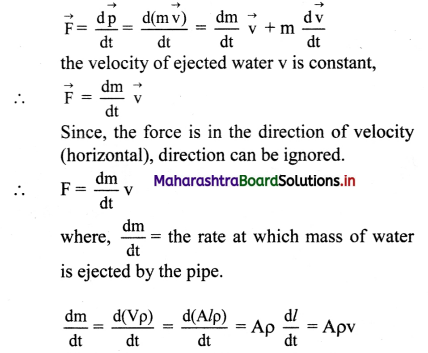
Let ejecting water horizontally be considered as the action force on the water, then the water exerts a backward force (called recoil force) on the pipe as the reaction force.
Maharashtra Board Class 11 Physics Important Questions Chapter 4 Laws of Motion 1
Where, V = volume of water ejected
A = area of cross section of bore = 10 cm2
ρ = density of water = 1 g/cc
l = length of the water ejected in time t
\(\frac{\mathrm{d} l}{\mathrm{dt}}\) = v = velocity of water ejected
= 0.5 m/s = 50 cm/s
F = \(\frac{\mathrm{dm}}{\mathrm{dt}} \mathrm{v}\)
= (Aρv) v
= Aρv2
= 10 × 1 × 502
∴ F = 25000 dyne = 0.25 N
Answer:
The gardener must apply an equal and opposite force of 0.25 N.

Question 17.
What does the term frame of reference mean?
Answer:
A system of co-ordinate axes with reference to which the position or motion of an object is described is called a frame of reference.

Question 18.
Explain the terms inertial and non-inertial frame of reference.
Answer:

  1. Inertial frame of reference:
    • A frame of reference in which Newton ‘s first law of motion is applicable is called inertia/frame of reference.
    • A body moves with a constant velocity (which can be zero) in the absence of a net force. The body does not accelerate.
    • Example: A rocket in inter-galactic space (gravity free space between galaxies) with all its engine shut.
  2. Non-inertial frame of reference:
    • A frame of reference in which an object suffers acceleration in absence of net force is called non-inertial frame of reference.
    • The body undergoes acceleration.
    • Example: If a car just start its motion from rest, then during the time of acceleration the car will be in a non-inertial frame of reference.

Question 19.
State the limitations of Newton’s laws of motion.
Answer:

  1. Newton’s laws of motion are not applicable in a non-inertial (accelerated) frame of reference.
  2. Newton’s laws are only applicable to point objects.
  3. Newton’s laws are only applicable to rigid bodies.
  4. Results obtained by applying Newton’s laws of motion for objects moving with speeds comparable to that of light do not match with the experimental results and Einstein special theory of relativity has to be used.
  5. Newton’s laws of motion fail to explain the behaviour and interaction of objects having atomic or molecular sizes, and quantum mechanics has to be used.

Question 20.
Name the different types of fundamental forces in nature.
Answer:
Fundamental forces in nature are classified into four types:

  1. Gravitational force
  2. Electromagnetic force
  3. Strong nuclear force
  4. Weak nuclear force

Question 21.
Define gravitational force. Give its examples.
Answer:
Force of attraction between two (point) masses separated by a distance is called as gravitational force.
F = \(\mathrm{G} \frac{\mathrm{m}_{1} \mathrm{~m}_{2}}{\mathrm{r}^{2}}\)
where ‘G’ is constant called the universal gravitational constant = 6.67 × 10⁻¹¹ Nm2/kg2

Examples:

  1. The motion of moon, artificial satellites around the earth and motion of planets around the sun is due to gravitational force of attraction.
  2. The concept of weight of a body in the earth’s gravitational field is due to gravitational force exerted by the earth on a body.

Question 22.
Write down the main characteristics of gravitational force.
Answer:
Characteristics of gravitational force:

  1. It is always attractive.
  2. It is the weakest of the four basic forces in nature.
  3. Its range is infinite.
  4. Structure of the universe is governed by this force.

Question 23.
Write a note on electromagnetic (EM) force.
Answer:
Electromagnetic force:

  1. The attractive and repulsive force between electrically charged particles is called electromagnetic force.
  2. It can be attractive or repulsive.
  3. It is stronger than the gravitational force.
  4. Example: force of friction, normal reaction, tension in strings, collision forces, elastic forces, fluid friction etc. are electromagnetic in nature.
  5. Reaction forces are a result of the action of electromagnetic forces.
  6. Since majority of forces are electromagnetic in nature, our life is practically governed by these forces.

Question 24.
Write a note on strong and weak nuclear force.
Answer:

  1. Strong nuclear force: The strong force which binds protons and neutrons (nucleons) together in the nucleus of an atom is called strong nuclear force.
    Characteristics of strong nuclear force:

    • It is a very strong attractive force.
    • It is a short range force of the order of 10-14 m.
    • it is charge independent.
  2. Weak nuclear force: The force of interaction between subatomic particles which results in the radioactive decay of atoms is called weak nuclear force.

Characteristics of weak nuclear force:

  • It acts between any two elementary particles (pair of subatomic particles).
  • It is a stronger force than gravitational force.
  • It is much weaker than electromagnetic force or strong nuclear force.
  • It is a short range force of the order of 10-16m.

Question 25.
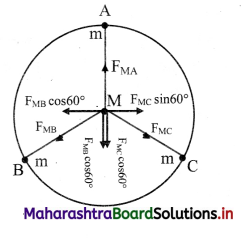
Three identical point masses are fixed symmetrically on the periphery of a circle. Obtain the resultant gravitational force on any point mass M at the centre of the circle. Extend this idea to more than three identical masses symmetrically located on the periphery. How far can you extend this concept?
Solution:
Maharashtra Board Class 11 Physics Important Questions Chapter 4 Laws of Motion 2
i. Consider three identical points A, B and C of mass m on the periphery of a circle of radius r. Mass M is at the centre of the circle.
Gravitational forces on M due to these masses are attractive and are given as,
In magnitude, \(\mathrm{F}_{\mathrm{MA}}=\mathrm{F}_{\mathrm{MB}}=\mathrm{F}_{\mathrm{MC}}=\frac{\mathrm{GMm}}{\mathrm{r}^{2}}\)

ii. Forces \(\overrightarrow{\mathrm{F}}_{\mathrm{MB}}\) and \(\overrightarrow{\mathrm{F}}_{\mathrm{MC}}\) are resolved along \(\overrightarrow{\mathrm{F}}_{\mathrm{MA}}\) and perpendicular to \(\overrightarrow{\mathrm{F}}_{\mathrm{MA}}\). Components perpendicular to \(\overrightarrow{\mathrm{F}}_{\mathrm{MA}}\) cancel each other. Components along \(\overrightarrow{\mathrm{F}}_{\mathrm{MA}}\) are,
FMB cos 60° = FMC cos 60° = \(\frac{1}{2} F_{M A}\) each.

Magnitude of their resultant is FMA and its direction is opposite to that of FMA. Thus, the
resultant force on mass M is zero. For any even number of equal masses, the force due to any mass m is balanced (cancelled) by diametrically opposite mass. For any odd number of masses, the components perpendicular to one of them cancel each other while the components parallel to one of these add up in such a way that the resultant is zero for any number of identical masses m located symmetrically on the periphery.

As the number of masses tends to infinity, their collective shape approaches circumference of the circle, which is nothing but a ring. Thus, the gravitational force exerted by a ring mass on any other mass at its centre is zero.

iii. This concept can be further extended to three-dimensions by imagining a uniform hollow sphere to be made up of infinite number of such rings with a common diameter. Thus, the gravitational force for any mass kept at the centre of a hollow sphere is zero.

Question 26.
A car of mass 1.5 ton is running at 72 kmph on a straight horizontal road. On turning the engine off, it stops in 20 seconds. While running at the same speed, on the same road, the driver observes an accident 50 m in front of him. He immediately applies the brakes and just manages to stop the car at the accident spot. Calculate the braking force.
Solution:
Given: m = 1.5 ton = 1500 kg,
u = 72 kmph = 72 × \(\frac{5}{18} \mathrm{~m} / \mathrm{s}\)m/s = 20 m
s-1 (on turning engine off),
v = 0, t = 20 s, s = 50 m
To find: Braking force (F)

Formula:

i. v = u + at
ii. v2 – u2 = 2as
iii. F = ma

Calculation:
On turning the engine off,
From formula (i),
a = \(\frac{0-20}{20}\) = -1 m s-2
This is frictional retardation (negative acceleration).
After seeing the accident,
From formula (ii),
a1 = \(\frac{0^{2}-20^{2}}{2(50)}\) = -4 m s-2
This retardation is the combined effect of braking and friction
∴ braking retardation =4 – 1 = 3 m s-2
From formula (iii), the braking force, F = 1500 × 3 = 4500 N
Answer:
The braking force is 4500 N.

Maharashtra Board Class 11 Physics Important Questions Chapter 4 Laws of Motion

Question 27.
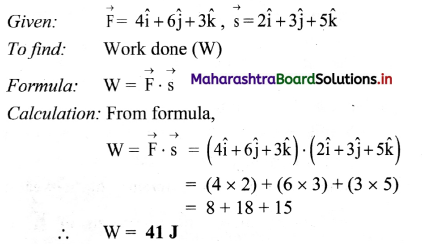
A body constrained to move along the z-axis of a coordinate system is subject to a constant force F given by \(\overrightarrow{\mathbf{F}}=(-\hat{\mathbf{i}}+2 \hat{\mathbf{j}}+3 \hat{\mathbf{k}})\) N where \(\hat{\mathbf{i}}\), \(\hat{\mathbf{j}}\), \(\hat{\mathbf{k}}\) are unit vectors along the x, y and z axis of the system respectively. What is the work done by this force in moving the body a distance of 4 m along the z-axis? (NCERT)
Solution:
Given: \(\overrightarrow{\mathbf{F}}=(-\hat{\mathbf{i}}+2 \hat{\mathbf{j}}+3 \hat{\mathbf{k}})\) N, \(\overrightarrow{\mathrm{s}}=4 \hat{\mathrm{k}}\)
To find: work done (W)

Formula: W = \(\overrightarrow{\mathrm{F}} \cdot \overrightarrow{\mathrm{s}}\)
Calculation: From formula,
W = \((-\hat{\mathrm{i}}+2 \hat{\mathrm{j}}+3 \hat{\mathrm{k}}) \cdot(4 \hat{\mathrm{k}})\)
= \(12 \hat{\mathrm{k}} \cdot \hat{\mathrm{k}}\) = 12 J
Answer:
The work done by the force is in moving the body 12 J.

Question 28.
Over a given region, a force (in newton) varies as F = 3x2 – 2x + 1. In this region, an object is displaced from x1 = 20 cm to x2 = 40 cm by the given force. Calculate the amount of work done.
Solution:
Given: F = 3x2 – 2x + 1, x1 = 20 cm = 0.2 m,
x2 = 40 cm = 0.4 m.
To find: Work done (W)
Formula: W = \(\int_{A}^{B} \vec{F} \cdot \overrightarrow{d s}\)
Calculation:
From formula,
W = \(\int_{x_{1}}^{x_{2}} F \cdot d x=\int_{0.2}^{0.4}\left(3 x^{2}-2 x+1\right) d x\)
= [x3 – x2 + x]0.4
= [0.43 – 0.42 + 0.4] – [0.23 – 0.22 + 0.2]
= 0.304 – 0.168 = 0.136 J
The work done is 0.136 J.

Question 29.
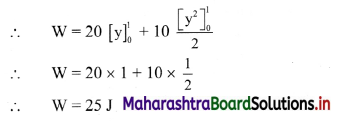
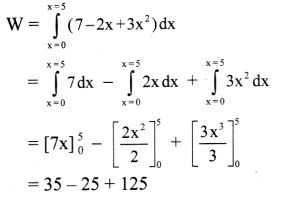
A position dependent force f = 7 – 2x + 3x2 newton acts on a small body of mass 2 kg and displaces from x = 0 m to x = 5 m, calculate the work done.
Solution:
Given: F = 7 – 2x + 3x2, x = 0 at A and x = 5 at B.
To find: Work done (W)
Formula: W = \(\int_{A}^{B} \vec{F} \cdot \overrightarrow{d s}\)
Calculation: From formula,
Maharashtra Board Class 11 Physics Important Questions Chapter 4 Laws of Motion 3
∴ W = 135 J
Answer:
The work done is 135 J.

Question 30.
State the principle of work-energy theorem in case of a conservative force and explain.
OR
Show that work done on a body by a conservative force is equal to the change in its kinetic energy
Answer:
Principle: Decrease in the potential energy due to work done by a conservative force is entirely converted into kinetic energy. Vice versa, for an object moving against a conservative force, its kinetic energy decreases by an amount equal to the work done against the force.

Work-energy theorem in case of a conservative force:

  1. Consider an object of mass m moving with velocity u experiencing a constant opposing force F which slows it down to v during displacement s.
  2. The equation of motion can be written as, v2 – u2 = -2as (negative acceleration for
    opposing force.)
    Multiplying throughout by \(\frac{\mathrm{m}}{2}\), we get,
    \(\frac{\mathrm{1}}{2}\)mu2 – \(\frac{\mathrm{1}}{2}\)mv2 = (ma)s …. (1)
  3. According to Newton’s second law of motion,
    F = ma … (2)
  4. From equations (1) and (2), we get,
    \(\frac{\mathrm{1}}{2}\)mu2 – \(\frac{\mathrm{1}}{2}\)mv2 = F.s
  5. But, \(\frac{\mathrm{1}}{2}\)mv2= Kf = final K.E of the body,
    \(\frac{\mathrm{1}}{2}\)mu2 = Ki = initial K.E of the body. and, work done by the force = F.s
    ∴ work done by the force = kf – ki
    = decrease in K.E of the body.
  6. Thus, work done on a body by a conservative force is equal to the change in its kinetic energy.

Question 31.
Explain the work-energy theorem in case of an accelerating conservative force along with a retarding non-conservative force.
Answer:

  1. Consider an object dropped from some point at height h.
  2. While coming down its potential energy decreases.
    ∴ Work done = decrease in P.E of the body.
  3. But, in this case, some part of the energy is used in overcoming the air resistance. This part of energy appears in some other forms such as heat, sound, etc. Thus, the work is not entirely converted into kinetic energy. In this case, the work-energy theorem can mathematically be written as,
    ∴ ∆ PE = ∆ K.E. + Wair resistance
    ∴ Decrease in the gravitational P.E. = Increase in the kinetic energy + work done against non-conservative forces.

Question 32.
A liquid drop of 1.00 g falls from height of cliff 1.00 km. It hits the ground with a speed of 50 m s-1. What is the work done by the unknown force? (Take g = 9.8 m/s2)
Solution:
Given: m = 1.0 g = 1.0 × 10⁻³ kg,
h = 1 km = 103 m, v = 50 ms-1
To find: Work done (Wf)
Formula: Wf = ∆ K.E – Wg

Calculation:

i. The change in kinetic energy of the drop
∆ K.E = (K.E.)final (K.E.)initial
∴ ∆ K.E. = \(\frac{1}{2} \mathrm{mv}^{2}-0\)
= \(\frac{1}{2} \times 1.0 \times 10^{-3} \times(50)^{2}\)
∴ ∆ K.E.= 1.25 J

ii. Work done by the gravitational force is,
Wg = mgh = 1.0 × 10-3 × 9.8 × 103 = 9.8 J
∴ Wg = 9.8J
From formula,
Wf = ∆K.E. – Wg = 1.25 – 9.8
Wf = -8.55 J
Answer:
Work done by the unknown force is – 8.55 J.

Question 33.
A body of mass 0.5 kg travels in a straight line with velocity y = ax3/2, where a = 5 m1/2s-1. What is the work done by the net force during its displacement from x = 0 to x = 2m? (NCERT)
Solution:
Given: M = 0.5 kg, y = ax3/2,
where a = 5 m-1/2s-1
Let v1 and v2 be the velocities of the body, when x = 0 and x = 2 m respectively. Then,
v1 = 5 × 03/2 = 0, v2 = 5 × 23/2 = \(10 \sqrt{2}\) m
To find: Work done (W)
Formula: Work done = Increase in kinetic energy
W = \(\frac{1}{2} \mathrm{M}\left(\mathrm{v}_{2}^{2}-\mathrm{v}_{1}^{2}\right)\)
Calculation: From formula,
W = \(\frac{1}{2}\) × 0.5 × [latex](10 \sqrt{2})^{2}-0^{2}[/latex]
∴ W = 50J
Answer:
Work done by the net force on the body is 50 J.

Question 34.
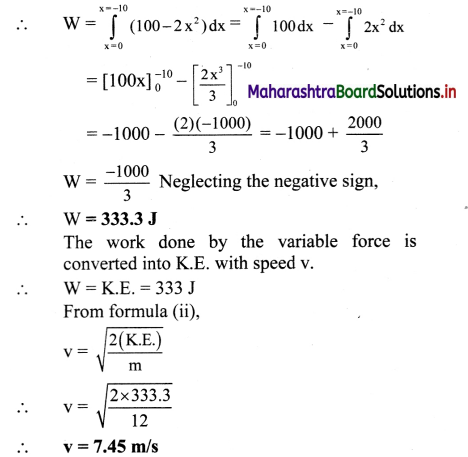
A particle of mass 12 kg is acted upon by a force f = (100 – 2x2) where f is in newton and ‘x’ is in metre. Calculate the work done by this force in moving the particle x = 0 to x = -10 m. What will be the speed at x = 10 m if it starts from rest?
Solution:
Given: F = 100 – 2x2
at A, x = 0 and at B, x = -10 m
To find: Work done (W), speed (v)

Formulae:

i. W = \(\int_{A}^{B} \vec{F} \cdot d s\)
ii. W = K.E. = \(\frac{1}{2} \mathrm{mv}^{2}\)

Calculation:
From formula (i),
W = \(\int_{A}^{B} \vec{F} \cdot \overline{d s}=\int_{x=0}^{x=-10} F d x\)
Maharashtra Board Class 11 Physics Important Questions Chapter 4 Laws of Motion 4
Answer:

  1. Work done by the force on the particle is 333.3 J.
  2. The speed of the particle at x = 10 will be 7.45 m/s.

Question 35.
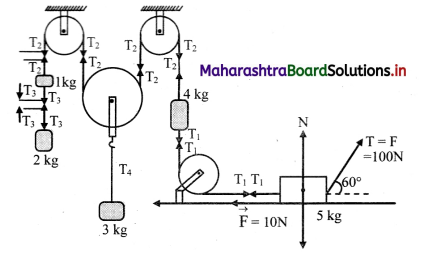
Define free body diagram. In the figure given below, draw the free body diagrams for mass of 2 kg, 4 kg and 5 kg and hence state their force equations.
Maharashtra Board Class 11 Physics Important Questions Chapter 4 Laws of Motion 5
Answer:
i. The diagram showing the forces acting on only one body at a time along-with its acceleration is called a free body diagram.

ii. The free body diagram for the mass of 2 kg is
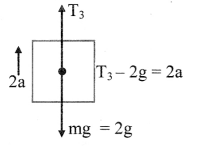
Maharashtra Board Class 11 Physics Important Questions Chapter 4 Laws of Motion 6
Free body diagram for 2 kg mass
The force equation is given as,
2a = T3 – 2g

iii. The free body diagram for the mass of 4 kg is,
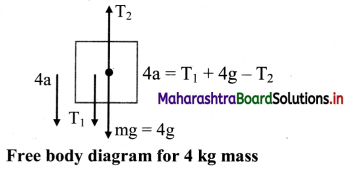
Maharashtra Board Class 11 Physics Important Questions Chapter 4 Laws of Motion 7
The force equation is given as, 4a = T1 + 4g – T2

iv. The free body diagram for the mass of 5kg is,
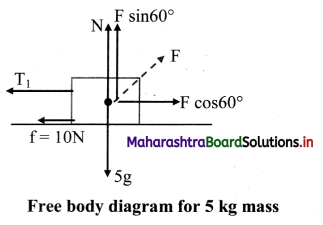
Maharashtra Board Class 11 Physics Important Questions Chapter 4 Laws of Motion 8

The force equation for the mass of 5 kg is given as,
N + F sin 60° = 5g, along the vertical direction.
T1 + 10 = F cos 60°, along the horizontal direction (Considering the mass is in equilibrium).

Question 36.
Figure shows a fixed pulley. A massless inextensible string with masses m1 and m2 > m1 attached to its two ends is passing over the pulley. Such an arrangement is called an Atwood machine. Calculate accelerations of the masses and force due to the tension along the string assuming axle of the pulley to be frictionless.
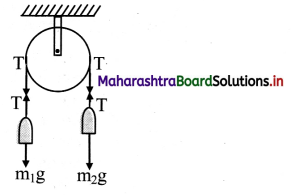
Maharashtra Board Class 11 Physics Important Questions Chapter 4 Laws of Motion 9
Solution:
Method I: As m2 > m1, mass m2 is moving downwards and mass m1 is moving upwards.
Net downward force = F = (m2) g – (m1) g
= (m2 – m1)g
the string being inextensible, both the masses travel the same distance in the same time. Thus, their accelerations are equal in magnitude (one upward, other downward). Let it be a.
Total mass in motion, M = m2 + m1
∴ a = \(\frac{F}{M}=\left(\frac{m_{2}-m_{1}}{m_{2}+m_{1}}\right) g\) …. (i)

For mass m1, the upward force is the force due to tension T and downward force is mg. It has upward acceleration a. Thus, T – m1g = m1a
∴ T = m1(g + a)
Using equation (i), we get,
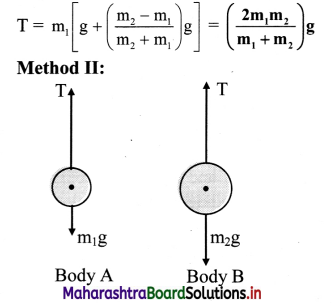
Maharashtra Board Class 11 Physics Important Questions Chapter 4 Laws of Motion 10
From the free body equation for the first body,
T – m1g = m1a .. (i)

From the free body equation for the second body,
m2g – T = m2a … (ii)
Adding (i) and (ii), we get,
a = \(\left(\frac{\mathrm{m}_{2}-\mathbf{m}_{1}}{\mathrm{~m}_{2}+\mathrm{m}_{1}}\right) \mathbf{g}\) ….(iii)
Solving equations. (ii) and (iii) for T, we get,
T = m2(g – a) = \(\left(\frac{2 m_{1} m_{2}}{m_{1}+m_{2}}\right) g\)

Question 37.
Write a note on elastic collision.
Answer:

  1. Collision between two bodies in which kinetic energy of the entire system is conserved along with the linear momentum is called as elastic collision.
  2. In an elastic collision,
    \(\mathrm{m}_{1} \overrightarrow{\mathrm{u}_{1}}+\mathrm{m}_{2} \overrightarrow{\mathrm{u}_{2}}=\mathrm{m}_{1} \overrightarrow{\mathrm{v}_{1}}+\mathrm{m}_{2} \overrightarrow{\mathrm{v}}_{2}\)
  3. In an elastic collision,
    \(\sum \mathrm{K} \cdot \mathrm{E}_{\text {‘initial }}=\sum \mathrm{K} \cdot \mathrm{E}_{\text {. final }}\)
  4. An elastic collision is impossible in daily life.
  5. However, in many situations, the interatomic and intermolecular collisions are considered to be elastic.

Question 38.
Write a note on inelastic collision.
Answer:

  1. A collision is said to be inelastic if there is a loss in the kinetic energy during collision, but linear momentum is conserved.
  2. In an inelastic collision, m1u1 + m2u2 = m1v1 + m2v2.
  3. In an inelastic collision,
    \(\sum \mathrm{K} \cdot \mathrm{E}_{\text {.initial }} \neq \sum \mathrm{K} \cdot \mathrm{E}_{\text {.final }}\)
  4. The loss in kinetic energy is either due to internal friction or vibrational motion of atoms causing heating effect.

Question 39.
Define perfectly inelastic collision. Give an example of it.
Answer:

  1. Collision in which the colliding bodies stick together after collision and move with a common velocity is called perfectly inelastic collision.
  2. The loss in kinetic energy is maximum in perfectly elastic collision.
  3. Example: Lump of mud thrown on a wall sticks to the wall due to the loss of kinetic energy.

Question 40.
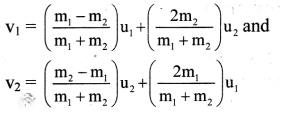
In case of an elastic head on collision between two bodies, derive an expression for the final velocities of the bodies in terms of their masses and velocities before collision.
Answer:
Head on elastic collision of two spheres:
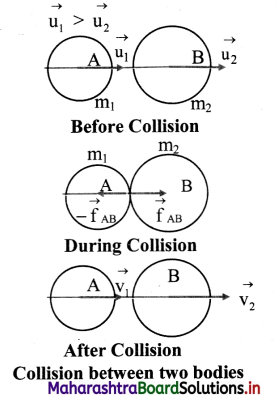
Maharashtra Board Class 11 Physics Important Questions Chapter 4 Laws of Motion 11

i. Consider two rotating smooth bodies A and B of masses m1 and m2 respectively moving
along the same straight line.

ii. Let \(\overrightarrow{\mathrm{u}}_{1}\) = initial velocity of the sphere A before collision.
\(\overrightarrow{\mathrm{u}}_{2}\) = initial velocity of the sphere B before collision.
\(\overrightarrow{\mathrm{v}}_{1}\) = velocity of the sphere A after collision.
\(\overrightarrow{\mathrm{v}}_{2}\) = velocity of the sphere B after collision.

iii. After the elastic collision, the spheres separate and move along the same straight line without rotation.

iv. According to the law of conservation of momentum,
m1\(\overrightarrow{\mathrm{u}}_{1}\) + m2\(\overrightarrow{\mathrm{u}}_{2}\) = m1\(\overrightarrow{\mathrm{v}}_{1}\) + m2\(\overrightarrow{\mathrm{v}}_{2}\) ….(i)
According to the law of conservation of energy (as kinetic energy is conserved during elastic collision),

Maharashtra Board Class 11 Physics Important Questions Chapter 4 Laws of Motion 12

v. Since kinetic energy is a scalar quantity, the terms involved in the above equations are scalars.

vi. The equation (1) can be written in scalar form as,
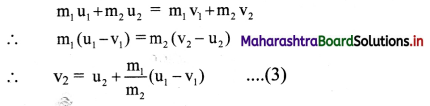
Maharashtra Board Class 11 Physics Important Questions Chapter 4 Laws of Motion 13

vii. Also the equation (2) can be written as,
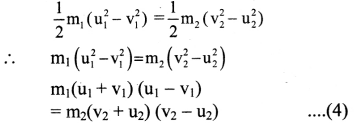
Maharashtra Board Class 11 Physics Important Questions Chapter 4 Laws of Motion 14

viii. Now dividing equation (4) by (3) we get,
(u1 + v1) = (u2 + v2)
∴ u1 + v1 = u2 + v2
∴ v2 = u1 – u2 + v1 … (5)

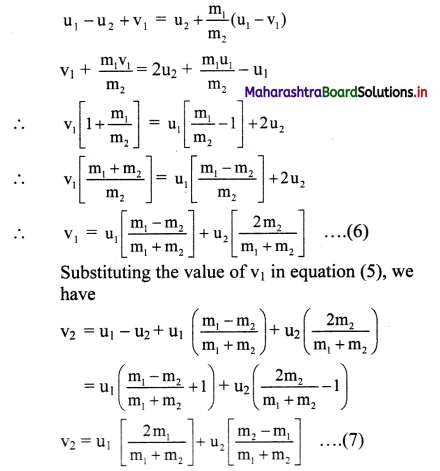
ix. Comparing equation (3) and (5),
Maharashtra Board Class 11 Physics Important Questions Chapter 4 Laws of Motion 15
Equations, (6) and (7), represent the final velocities of two spheres after collision.

Question 41.
Are you aware of elasticity of materials? Is there any connection between elasticity of materials and elastic collisions?
Answer:
(Students should answer the question as per their understanding).

Question 42.
Two bodies undergo one-dimensional, inelastic, head-on collision. State an expression for their final velocities in terms
of their masses, initial velocities and coefficient of restitution.
Answer:
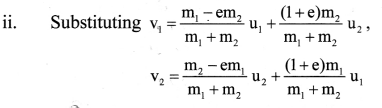
If e is the coefficient of restitution, the final velocities after an inelastic, head on collision are given as,

Maharashtra Board Class 11 Physics Important Questions Chapter 4 Laws of Motion 16

Question 43.
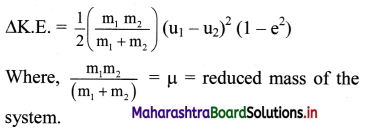
Two bodies undergo one-dimensional, inelastic, head-on collision. State an expression for the loss in the kinetic energy.
Answer:
Maharashtra Board Class 11 Physics Important Questions Chapter 4 Laws of Motion 17
ii. As e < 1, (1 – e2) is always positive. Thus, there is always a loss of kinetic energy in an inelastic collision.

Maharashtra Board Class 11 Physics Important Questions Chapter 4 Laws of Motion

Question 44.
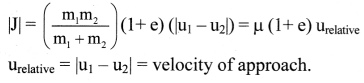
Two bodies undergo one-dimensional, inelastic, head-on collision. Obtain an expression for the magnitude of impulse.
Answer:
i. When two bodies undergo collision, the linear momentum delivered by the first body to the second body must be equal to the change in momentum or impulse of the second body and vice versa.
∴ Impulse,
|J| = |∆p1| = |∆p2|
= |m1v1 – m1u1| = |m2v2 – m2u2| ….(1)
Maharashtra Board Class 11 Physics Important Questions Chapter 4 Laws of Motion 18
In equation (1) and solving, we get,
Maharashtra Board Class 11 Physics Important Questions Chapter 4 Laws of Motion 19

Question 45.
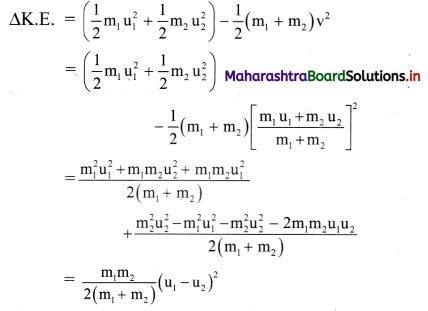
Two bodies undergo one-dimensional, perfectly inelastic, head-on collision. Derive an expression for the loss in the kinetic energy.
Answer:
i. Let two bodies A and B of masses m1 and m2 move with initial velocity \(\overrightarrow{\mathrm{u}}_{1}\) and \(\overrightarrow{\mathrm{u}}_{2}\), respectively such that particle A collides head on with particle B i.e., u1 > u2.

ii. If the collision is perfectly inelastic, the particles stick together and move with a common velocity \(\overrightarrow{\mathrm{v}}\) after the collision along the same straight line.
loss in kinetic energy = total initial kinetic energy – total final kinetic energy.

iii. By the law of conservation of momentum,
m1u1 + m2u2 = (m1 + m2)v
∴ v = \(\frac{\mathrm{m}_{1} \mathrm{u}_{1}+\mathrm{m}_{2} \mathrm{u}_{2}}{\mathrm{~m}_{1}+\mathrm{m}_{2}}\)

iv. Loss of Kinetic energy,
Maharashtra Board Class 11 Physics Important Questions Chapter 4 Laws of Motion 20

iv. Both the masses and the term (u1 – u2)2 are positive. Hence, there is always a loss in a perfectly inelastic collision. For a perfectly inelastic collision, as e = 0, the loss is maximum.

Question 46.
Distinguish between elastic and inelastic collision.
Answer:

No.Elastic CollisionInelastic Collision
i.In an elastic collision, both momentum and kinetic energy are conserved.In an inelastic collision, momentum is conserved but kinetic energy is not conserved.
ii.The total kinetic energy after collision is equal to the total kinetic energy before collision.The total kinetic energy after the collision is not equal to the total kinetic energy before collision.
iii.Coefficient of restitution (e) is equal to one.Coefficient of restitution (e) is less than one. For a perfectly inelastic collision coefficient of restitution is equal to zero.
iv.Bodies do not stick together in elastic collision.Bodies stick together in a perfectly inelastic collision.
v.Sound, heat and light are not produced.Sound or light or heat or all of these may be produced.

Question 47.
Explain elastic collision in two dimensions.
Answer:
i. Suppose a particle of mass mi moving with initial velocity \(\overrightarrow{\mathrm{u}_{1}}\), undergoes a non head-on collide with another particle of mass m2 and initial velocity \(\overrightarrow{\mathrm{u}_{2}}\).
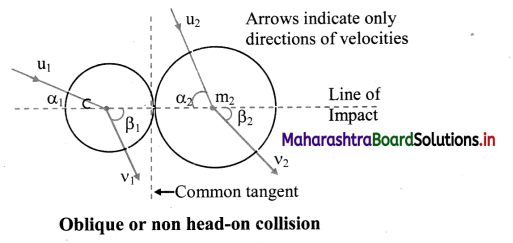
Maharashtra Board Class 11 Physics Important Questions Chapter 4 Laws of Motion 21

ii. Let us consider two mutually perpendicular directions; Common tangent at the point of impact, along which there is no force (or no change of momentum).
Line of impact which is perpendicular to the common tangent through the point of impact, in the two-dimensional plane of initial and final velocities.

iii. Applying the law of conservation of linear momentum along the line of impact, we have, m1u1 cos α1 + m2u2 cos α2 = m1v1 cos β1 + m2v2 cos β2
As there is no force along the common tangent,
m1u1 sin α1 = m1u1 sin β1 and m2u2 sin α2 = m2v2 sin β2
iv. Coefficient of restitution (e) along the line of impact is given as
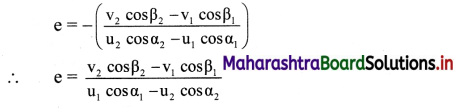
Maharashtra Board Class 11 Physics Important Questions Chapter 4 Laws of Motion 22

Question 48.
Two bodies undergo a two-dimensional collision. State an expression for the magnitude of impulse along the line of impact and the loss in kinetic energy.
Answer:
i. For two bodies undergoing a two-dimensional collision, the magnitude of impulse along the line of impact is given as, Magnitude of the impulse, along the line of impact,
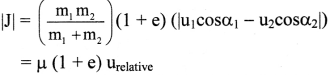
Maharashtra Board Class 11 Physics Important Questions Chapter 4 Laws of Motion 23

ii. The loss in the kinetic energy is given as Loss in the kinetic energy = ∆ (K.E.)
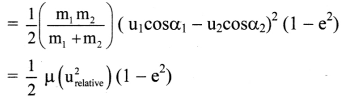
Maharashtra Board Class 11 Physics Important Questions Chapter 4 Laws of Motion 24

Question 49.
0ne marble collides head-on with another identical marble at rest. If the collision is partially inelastic, determine the ratio of their final velocities in terms of coefficient of restitution e.
Solution:
According to conservation of momentum,
m1u1 + m2u2 = m1v1 + m2v2
As m1 = m2, we get, u1 + u2 = v1 + v2
∴ If u2 = 0, we get, v1 + v2 = u1 ….. (i)
Coefficient of restitution,
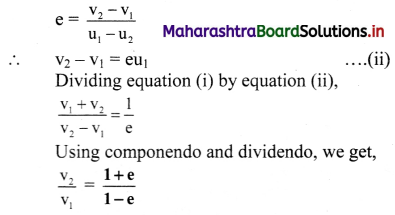
Maharashtra Board Class 11 Physics Important Questions Chapter 4 Laws of Motion 25

Question 50.
A 10 kg mass moving at 5 m/s collides head- on with a 4 kg mass moving at 2 m/s in the same direction. If e = \(\frac{1}{2}\), find their velocity after impact.
Solution:
Given: m1 = 10 kg, m2 = 4 kg
u1 = 5 m/s, u2 = 2 m/s, e = \(\frac{1}{2}\)
To find: Velocity after impact (v1 and v2)

Formulae:

i. m1u1 + m2u2 = m1v1 + m2v2
ii. e = \(\left(\frac{v_{2}-v_{1}}{u_{1}-u_{2}}\right)\)

Calculation:

From formula (i),
10 × 5 + 4 × 2 = 10v1 + 4v2
∴ 5v1 + 2v2 = 29 … (1)

From formula (ii),
v2 – v1 = e(u1 – u2) = \(\frac{1}{2}\) (5 – 2) = \(\frac{3}{2}\)
∴ 2v2 – 2v1 = 3 … (2)
Solving (1) and (2), we have
∴ v1 = \(\frac{26}{7}\) m/s and v2 = \(\frac{73}{14}\) m/s
Answer:
The respective velocities of the two masses are \(\frac{26}{7}\) m/s and \(\frac{73}{14}\) m/s.

Question 51.
A metal ball falls from a height 1 m on a steel plate and jumps upto a height of 0.81 m. Find the coefficient of restitution.
Solution:
As the ball falls to the steel plate P.E changes to kinetic energy.
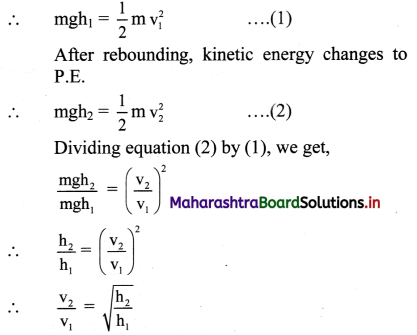
Maharashtra Board Class 11 Physics Important Questions Chapter 4 Laws of Motion 26
As ground is stationary, both its initial and final velocities are zero.
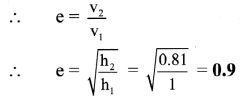
Maharashtra Board Class 11 Physics Important Questions Chapter 4 Laws of Motion 27

Question 52.
Two bodies of masses 5 kg and 3 kg moving in the same direction along the same straight line with velocities 5 m s-1 and 3 m s-1 respectively suffer one-dimensional elastic collision. Find their velocities after the collision.
Solution:
Given: m1 = 5kg, u1 = 5ms-1, m2 = 3kg, u2 = 3 m s-1
To find: velocities after collision (v1 and v2)
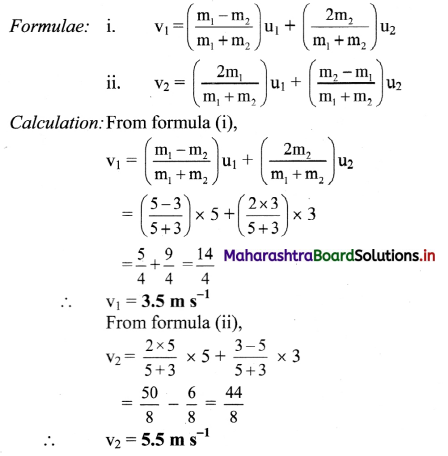
Maharashtra Board Class 11 Physics Important Questions Chapter 4 Laws of Motion 281
Answer:
The velocities of the two bodies after collision are 3.5 m/s and 5.5 m/s.

Question 53.
A 20 g bullet leaves a machine gun with a velocity of 200 m/s. If the mass of the gun is 20 kg, find its recoil velocity. If the gun fires 20 bullets per second, what force is to be applied to the gun to prevent recoil?
Solution:
Given: m1 = 20g = 0.02 kg, m2 = 20 kg, v1 = 200 m/s, t = \(\frac{1}{20}\) s,
To find: Recoil velocity (v2), applied force (F)

Formulae:

i. v2 = \(-\frac{\mathrm{m}_{1} \mathrm{v}_{1}}{\mathrm{~m}_{2}}\)
ii. F = ma

Calculation: From formula (i),
∴ v2 = \(-\frac{0.02}{20} \times 200\)
= -0.2 m/s

Negative sign shows that the machine gun moves in a direction opposite to that of the bullet.
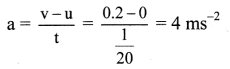
Maharashtra Board Class 11 Physics Important Questions Chapter 4 Laws of Motion 29
From formula (ii),
∴ F = m2 × a = 20 × 4 = 80N
Answer:
The recoil velocity of gun is 0.2 m/s and the required force to prevent recoil is 80 N.

Question 54.
A shell of mass 3 kg is dropped from some height. After falling freely for 2 seconds, it explodes into two fragments of masses 2 kg and 1 kg. Kinetic energy provided by the explosion is 300 J. Using g = 10 m/s2, calculate velocities of the fragments. Justify your answer if you have more than one options.
Solution:
Total mass = m1 + m2 = 3 kg
Initially, when the shell falls freely for 2 seconds, v = u+ at = 0 + 10(2) = 20 ms-1 = u1 = u2
According to conservation of linear momentum,
m1u1 + m2u2 = m1v1 + m2v2
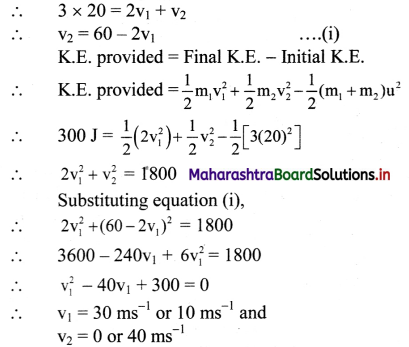
Maharashtra Board Class 11 Physics Important Questions Chapter 4 Laws of Motion 30
There are two possible answers since the positions of two fragments can be different as explained below.
Case 1: v1 = 30 m s-1 and v2 = 0 with the lighter fragment 2 above.
Case 2: v1 = 10 m s-1 and v2 = 40 m s-1 with the lighter fragment 2 below, both moving downwards.

Question 55.
Bullets of mass 40 g each, are fired from a machine gun at a rate of 5 per second towards a firmly fixed hard surface of area 10 cm2. Each bullet hits normal to the surface at 400 m/s and rebounds in such a way that the coefficient of restitution for the collision between bullet and the surface is 0.75. Calculate average force and average pressure experienced by the surface due to this firing.
Solution:
For the collision,
u1 = 400 m s-1, e = 0.75
For the firmly fixed hard surface, u2 = v2 = 0
e = 0.75 = \(\frac{v_{1}-v_{2}}{u_{2}-u_{1}}=\frac{v_{1}-0}{0-400}\)
∴ v1 = -300 m/s.
Negative sign indicates that the bullet rebounds in exactly opposite direction.
Change in momentum of each bullet = m(v1 – u1)
The same momentum is transferred to the surface per collision in opposite direction.
∴ Momentum transferred to the surface, per collision,
p = m (u1 – v1) = 0.04(400 – [-300]) = 28 Ns
The rate of collision is same as rate of firing.
∴ Momentum received by the surface per second, \(\frac{\mathrm{dp}}{\mathrm{dt}}\) = average force experienced by the surface = 28 × 5 = 140 N

This is the average force experienced by the surface of area A = 10 cm2 = 10-3 m2
∴ Average pressure experienced,
P = \(\frac{\mathrm{F}}{\mathrm{A}}=\frac{140}{10^{-3}}\) = 1.4 × 10⁵ N m-2
∴ P ≈ 1.4 times the atmospheric pressure.
Answer:
The average force and average pressure experienced by the surface due to the firing is 140 N and 1.4 × 10⁵ N m-2 respectively.

Question 56.
A shell of mass 0.020 kg is fired by a gun of mass 100 kg. If the muzzle speed of the shell is 80 m s-1, what is the recoil speed of the gun? (NCERT)
Solution:
Given: m1 = 0.02 kg, m2 = 100 kg, v1 = 80 m s-1
To find: Recoil speed (v2)
Formula: m1u1 + m2u2 = m1v1 + m2v2
Calculation: Initially gun and shell are at rest.
∴ m1u1 + m2u2 = 0
Final momentum = m1v1 – m2v2
Using formula,
0 = 0.02 (80) – 100(v2)
∴ v2 = \(\frac{0.02 \times 80}{100}\) = 0.016 ms-1
Answer:
The recoil speed of the gun is 0.016 m s-1.

Question 57.
Two billiard balls each of mass 0.05 kg moving in opposite directions with speed 6 m s-1 collide and rebound with the same speed. What is the impulse imparted to each bail due to the other? (NCERT)
Solution:
Given: m = 0.05 kg. u = 6 m/s, v = -6 m/s
To find: Impulse (J)
Formula: J = m (v – u)
calculation: From formula,
J = 0.05 (-6 – 6) = -0.6 kg m s-1
Answer:
Impulse received by each ball is -0.6 kg m s-1.

Question 58.
A bullet of mass 0.1 kg moving horizontally with a velocity of 20 m/s strikes a target and brought to rest in 0.1 s. Find the impulse and average force of impact.
Solution:
Given: m = 0.1 kg, u = 20 m/s, t = 0.1 s
To find: Impulse (J), Average force (F)

Formulae:

i. J = mv – mu
ii. F = \(m \frac{(v-u)}{t}\)

Calculation:

From formula (i).
J = m(v – u) = 0.1 (0 – 20) = -2 Ns
From formula (ii),
F = \(\frac{m(v-u)}{t}=\frac{2}{0.1}=20 N\)
Answer:
Magnitude of impulse is 2 Ns, average force of impact is 20 N.

Maharashtra Board Class 11 Physics Important Questions Chapter 4 Laws of Motion

Question 59.
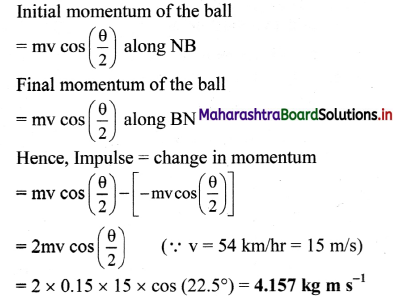
A batsman deflects a ball by an angle of 45° without changing its initial speed which is equal to 54 km/h. What is the impulse imparted to the ball? (Mass of the ball is 0.15 kg) (NCERT)
Answer:
Let the point B represents the position of bat. The ball strikes the bat with velocity v along the path AB and gets deflected with same velocity along BC. such that ∠ABC = 45°
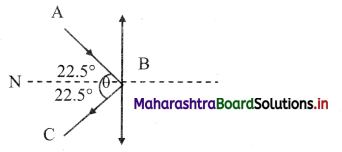
Maharashtra Board Class 11 Physics Important Questions Chapter 4 Laws of Motion 31
Maharashtra Board Class 11 Physics Important Questions Chapter 4 Laws of Motion 32
Thus, impulse imparted to the ball is 4.157 kg ms-1

Question 60.
A cricket ball of mass 150 g moving with a velocity of 12 m/s is turned back with a velocity of 20 m/s on hitting the bat. The force of the ball lasts for 0.01 s. Find the average force exerted on the ball by the bat.
Solution:
m = 0.150 kg, v = 20 m/s,
u = -12 m/s and t = 0.01 s
To find: Average force (F)
Formula: F = \(\frac{m(v-u)}{t}\)
Calculation: From formula,
F = \(\frac{0.150[20-(-12)]}{0.01}\) = 480 N
Answer:
The average force exerted on the ball by the bat is 480 N.

Question 61.
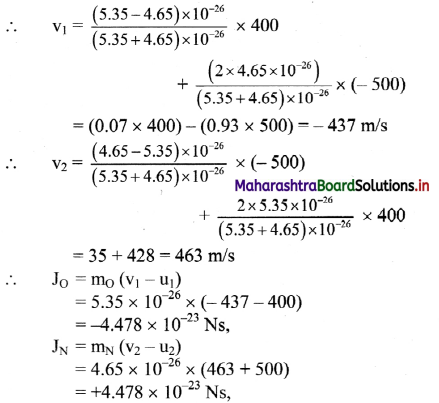
Mass of an Oxygen molecule is 5.35 × 10⁻²⁶ kg and that of a Nitrogen molecule is 4.65 × 10⁻²⁶ kg. During their Brownian motion (random motion) in air, an Oxygen molecule travelling with a velocity of 400 m/s collides elastically with a nitrogen molecule travelling with a velocity of 500 m/s in the exactly opposite direction. Calculate the impulse received by each of them during collision. Assuming that the collision lasts for
1 ms, how much is the average force experienced by each molecule?
Solution:
Let, m1 = mO = 5.35 × 10⁻²⁶ kg,
m2 = mN = 4.65 × 10⁻²⁶ kg,
∴ u1 = 400 ms-1 and u2 = -500 ms-1 taking direction of motion of oxygen molecule as the positive direction.
For an elastic collision,
Maharashtra Board Class 11 Physics Important Questions Chapter 4 Laws of Motion 33
Maharashtra Board Class 11 Physics Important Questions Chapter 4 Laws of Motion 34
Hence, the net impulse or net change in momentum is zero.
Maharashtra Board Class 11 Physics Important Questions Chapter 4 Laws of Motion 35
Answer:
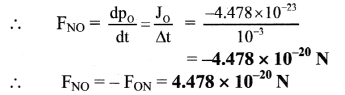
The average force experienced by the nitrogen molecule and the oxygen molecule are
-4.478 × 10⁻²⁰ N and 4.478 × 10⁻²⁰ N.

Question 62.
Explain rotational analogue of the force. On what factors does it depend? Represent it in vector form.
Answer:

  1. Rotational analogue of the force is called as moment of force or torque.
  2. It depends on the mass of the object, the point of application of the force and the angle between direction of force and the line joining the axis of rotation with the point of application.
  3. In its mathematical form, torque or moment of a force is given by
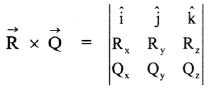
    \(\vec{\tau}=\overrightarrow{\mathrm{r}} \times \overrightarrow{\mathrm{F}}\)
    where \(\overrightarrow{\mathrm{F}}\) is the applied force and \(\overrightarrow{\mathrm{r}}\) is the position vector of the point of application of the force from the axis of rotation.

Question 63.
Illustrate with an example how direction of the torque acting on any object is determined.
Answer:
i. Consider a laminar object with axis of rotation perpendicular to it and passing through it as shown in figure (a).
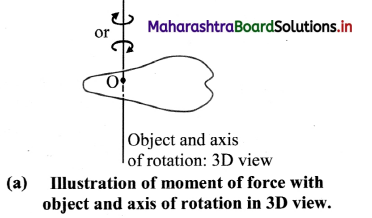
Maharashtra Board Class 11 Physics Important Questions Chapter 4 Laws of Motion 36

ii. Figure (b) indicates the top view of the object when the rotation is in anticlockwise direction
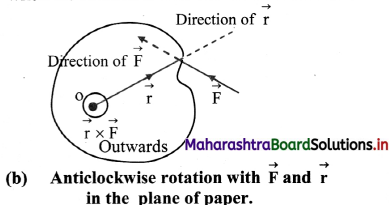
Maharashtra Board Class 11 Physics Important Questions Chapter 4 Laws of Motion 37

iii. Figure (c) shows the view from the top, if rotation is in clockwise direction.
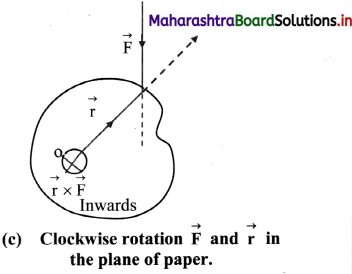
Maharashtra Board Class 11 Physics Important Questions Chapter 4 Laws of Motion 38

iv. The applied force \(\vec{F}\) and position vector \(\vec{r}\) of the point of application of the force are in the plane of these figures.

v. Direction of the torque is always perpendicular to the plane containing the vectors \(\vec{r}\) and \(\vec{F}\) and can be obtained from the rule of cross product or by using the right-hand thumb rule.

vi. In Figure (b), it is perpendicular to the plane of the figure and outwards while in the figure (c), it is inwards.

Question 64.
State the equation for magnitude of torque and explain various cases of angle between the direction of \(\overrightarrow{\mathbf{r}}\) and \(\overrightarrow{\mathbf{F}}\).
Answer:
Magnitude of torque, \(\tau\) = r F sin θ
where θ is the smaller angle between the directions of \(\overrightarrow{\mathbf{r}}\) and \(\overrightarrow{\mathbf{F}}\).

Special cases:

  1. If θ = 90°, \(\tau\) = \(\tau\)max = rF. Thus, the force should be applied along normal direction for easy rotation.
  2. If θ = 0° or 180°, \(\tau\) = \(\tau\)min = 0. Thus, if the force is applied parallel or anti-parallel to \(\overrightarrow{\mathrm{r}}\), there is no rotation.
  3. Moment of a force depends not only on the magnitude and direction of the force, but also on the point where the force acts with respect to the axis of rotation. Same force can have different torque as per its point of application.

Question 65.
A force \(\overrightarrow{\mathbf{F}}=\mathbf{3} \hat{\mathbf{i}}+\hat{\mathbf{j}}-\mathbf{4} \hat{\mathbf{k}}\) is applied at a point (3, 4, -2). Find its torque about the point (-1, 2, 4).
Solution:
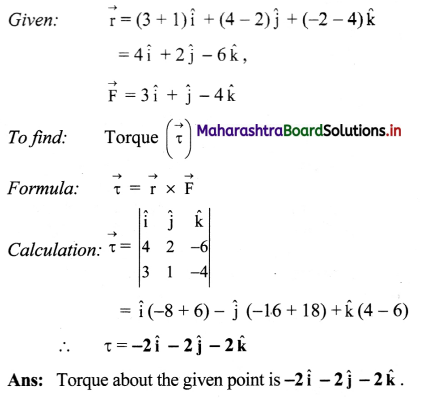
Maharashtra Board Class 11 Physics Important Questions Chapter 4 Laws of Motion 39

Maharashtra Board Class 11 Physics Important Questions Chapter 4 Laws of Motion

Question 66.
Define couple. Show that moment of couple is independent of the points of application of forces.
Answer:
A pair of forces consisting of two forces of equal magnitude acting in opposite directions along different lines of action is called a couple.

  1. Figure shows a couple consisting of two forces \(\overrightarrow{\mathrm{F}}_{1}\) and \(\overrightarrow{\mathrm{F}}_{2}\) of equal magnitudes and opposite directions acting along different lines of action separated by a distance r.
  2. Position vector of any point on the line of action of force \(\overrightarrow{\mathrm{F}}_{1}\) from the line of action of force \(\overrightarrow{\mathrm{F}}_{2}\) is \(\overrightarrow{\mathrm{r}}_{12}\). Similarly, the position vector of any point on the line of action of force \(\overrightarrow{\mathrm{F}}_{2}\) from the line of action of force \(\overrightarrow{\mathrm{F}}_{1}\) is \(\overrightarrow{\mathrm{r}}_{21}\).
  3. Torque or moment of the couple is then given mathematically as
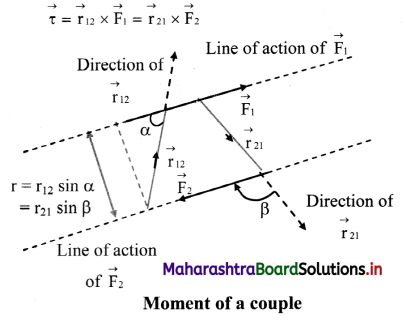
    Maharashtra Board Class 11 Physics Important Questions Chapter 4 Laws of Motion 40
  4. From the figure, it is clear that r12 sinα = r21 sin β = r.
  5. If \(\left|\overrightarrow{\mathrm{F}}_{1}\right|=\left|\overrightarrow{\mathrm{F}}_{2}\right|\) = F, the magnitude of torque is given by
    \(\tau=\mathrm{r}_{12} \mathrm{~F}_{1} \sin \alpha\) = \(r_{21} F_{2} \sin \beta=r F\)
  6. It clearly shows that the torque corresponding to a given couple, i.e., the moment of a given couple is constant, i.e., it is independent of the points of application of forces.

Question 67.
The figure below shows three situations of a ball at rest under the action of balanced forces. Is the bail in mechanical equilibrium? Explain how the three situations differ.
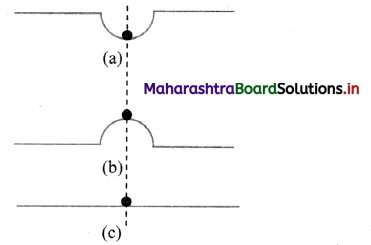
Maharashtra Board Class 11 Physics Important Questions Chapter 4 Laws of Motion 41
Answer:

  1. In all these cases, as the ball is at rest under the action of balanced forces i.e, there is no net force acting on it. Hence, it is in mechanical equilibrium.
    However, potential energy-wise, the three situations show the different states of mechanical equilibrium.
  2. Stable equilibrium: In situation (a), potential energy of the system is at its local minimum. If it is disturbed slightly from its equilibrium position and released, it tends to recover its position. In this situation, the ball is most stable and is said to be in stable equilibrium.
  3. Unstable equilibrium: In situation (b), potential energy of the system is at its local maximum. If it is slightly disturbed from its equilibrium position, it moves farther from that position. This happens because initially, if disturbed, it tries to achieve the configuration of minimum potential energy. In this situation, the ball is said to be in unstable equilibrium.
  4. Neutral equilibrium: in situation (e), potential energy of the system is constant over a plane and remains same at any position. Thus, even if the ball is disturbed, it still remains in equilibrium, practically at any position. In this situation, the ball is in neutral equilibrium.

Question 68.
Two weights 5 kg and 8 kg are suspended from a uniform rod of length 10 m and weighing 3 kg. The distances of the weights from one end are 2 m and 7 m. Find the point at which the rod balances.
Solution:
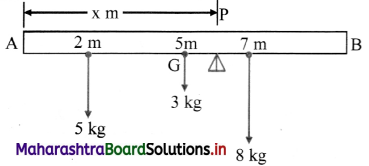
Maharashtra Board Class 11 Physics Important Questions Chapter 4 Laws of Motion 42
Let the rod balance at a point P, x m from the end A of the rod AB. The suspended weight and the centre of gravity of the rod G is shown in the figure.
P = 5 + 3 + 8 = 16kg
Taking moments about A,
16 × x = 5 × 2 + 3 × 5 + 8 × 7
16x = 10 + 15 + 56 = 81
∴ x = \(\frac{81}{16}\) = 5.1 m
Answer:
The rod balances at 5.1 m from end A.

Question69.
A metre stick is balanced on a knife edge at its centre. When two coins, each of mass 5 g are put one on top of the other at the 12.0 cm mark, the stick is found to be balanced at 45.0 cm. What is the mass of the metre stick? (NCERT)
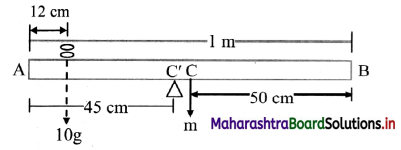
Maharashtra Board Class 11 Physics Important Questions Chapter 4 Laws of Motion 43
Consider the metre scale AB. Let its mass be concentrated at C at 50 cm. mark. Upon placing coins, balancing point of the scale and the coins system is shifted to C’ at 45 cm mark.
For equilibrium about C’
10(45 – 12) = m (50 – 45)
m = \(\frac{10 \times 33}{5}\) = 66g
Answer:
The mass of the metre scale is 66 g.

Question 70.
The diagram shows a uniform beam of length 10 m, used as a balance. The beam is pivoted at its centre. A 5.0 N weight is attached to one end of the beam and an empty pan weighing 0.25 N Is attached to the other end of the beam.
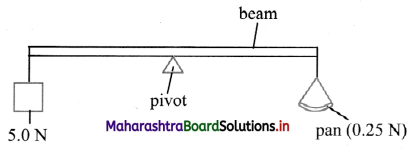
Maharashtra Board Class 11 Physics Important Questions Chapter 4 Laws of Motion 44
i. What is the moment of couple at pivot?
ii. If pivot is shifted 2 ni towards left, then what will be moment of couple at new position?
Answer:
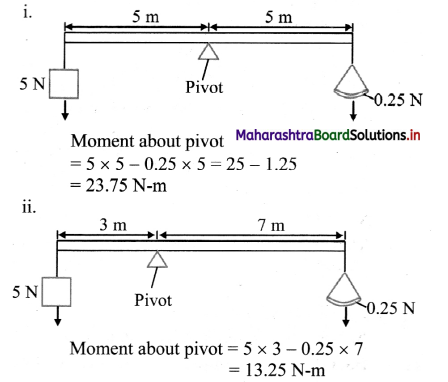
Maharashtra Board Class 11 Physics Important Questions Chapter 4 Laws of Motion 45
Answer:

  1. The moment of couple at center is 23.75 N-m.
  2. The moment of couple at new position is 13.25 N-m.
    ∴ For equilibrium,
    40 × x = 20 × 0.5
    ∴ x = \(\frac{1}{4}\) = 0.25 m

Hence, the total distance walked by the person is 1.25 m.

Ans
The person can walk 1.25 m before the plank topples.

Maharashtra Board Class 11 Physics Important Questions Chapter 4 Laws of Motion

Question 71.
Define centre of mass.
Answer:
Centre of mass of a body is a point about which the summation of moments of masses in the system is zero.

Question 72.
Derive an expression for the position of centre of mass of a system of n particles and for continuous mass distribution.
Answer:
System of n particles;
i. Consider a system of n particles of masses m1, m2, …, mn having position vectors \(\overrightarrow{\mathrm{r}_{1}}\), \(\overrightarrow{\mathrm{r}_{2}}\),….., \(\overrightarrow{\mathrm{r}_{n}}\) from the origin O.
The total mass of the system is,
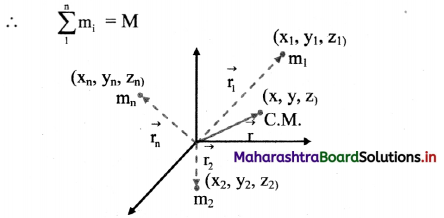
Maharashtra Board Class 11 Physics Important Questions Chapter 4 Laws of Motion 46
Centre of mass for n particles

ii. Position vector \(\vec{r}\) of their centre of mass from the same origin is then given by
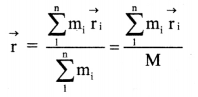
Maharashtra Board Class 11 Physics Important Questions Chapter 4 Laws of Motion 47

iii. If the origin is at the centre of mass, \(\overrightarrow{\mathbf{r}}\) = 0
∴ \(\sum_{1}^{\mathrm{n}} \mathrm{m}_{\mathrm{i}} \overrightarrow{\mathrm{r}}_{\mathrm{i}}\) = 0,

iv. In this case, \(\sum_{1}^{n} m_{i} \vec{r}_{i}\) gives the moment of masses (similar to moment of force) about the centre of mass.

v. If (x1, x2, …… xn), (y1, y2, …..yn), (z1, z2, …. zn) are the respective x, y and z – coordinates of (r1, r2,…….. rn) then x,y and z – coordinates of the centre of mass are given by,
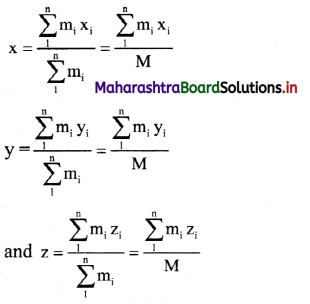
Maharashtra Board Class 11 Physics Important Questions Chapter 4 Laws of Motion 48

vi. Continuous mass distribution: For a continuous mass distribution with uniform density, the position vector of the centre of mass is given by,
r = \(\frac{\int \vec{r} d m}{\int d m}=\frac{\int \vec{r} d m}{M}\)
Where \(\int \mathrm{dm}=\mathrm{M}\) is the total mass of the object.

vii. The Cartesian coordinates of centre of mass are
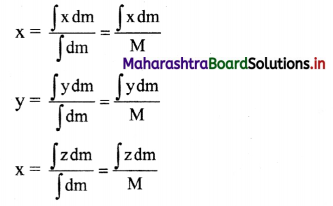
Maharashtra Board Class 11 Physics Important Questions Chapter 4 Laws of Motion 49

Question 73.
State the expression for velocity of the centre of mass of a system of n particles and for continuous mass distribution.
Answer:
Let v1, v2,…..vn be the velocities of a system of point masses m1, m2, … mn. Velocity of the centre of mass of the system is given by
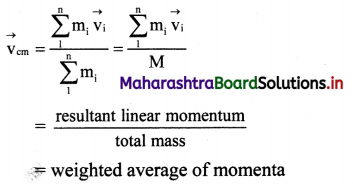
Maharashtra Board Class 11 Physics Important Questions Chapter 4 Laws of Motion 50
x, y and z components of \(\overrightarrow{\mathbf{v}}\) can be obtained similarly.
For continuous distribution, \(\overrightarrow{\mathrm{v}}_{\mathrm{cm}}\) = \(\frac{\int \vec{v} \mathrm{dm}}{\mathrm{M}}\)

Question 74.
State the expression for acceleration of the centre of mass of a system of n particles and for continuous mass distribution.
Answer:
Let a1, a2,…. an be the accelerations of a system of point masses m1, m2 … mn.
Acceleration of the centre of mass of the system is given by
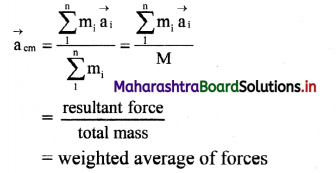
Maharashtra Board Class 11 Physics Important Questions Chapter 4 Laws of Motion 51
x, y and z components of can be obtained similarly.
For continuous distribution, \(\overrightarrow{\mathrm{a}}_{\mathrm{cm}}\) = \(\frac{\int \vec{a} d m}{\mathrm{M}}\)

Question 75.
State the characteristics of centre of mass.
Answer:

  1. Centre of mass is a hypothetical point at which entire mass of the body can be assumed to he concentrated.
  2. Centre of mass is a location, not a physical quantity.
  3. Centre of mass is particle equivalent of a given object for applying laws of motion.
  4. Centre of mass is the point at which applied force causes only linear acceleration and not angular acceleration.
  5. Centre of mass is located at the centroid, for a rigid body of uniform density.
  6. Centre of mass is located at the geometrical centre, for a symmetric rigid body of uniform density.
  7. Location of centre of mass can be changed only by an external unbalanced force.
  8. Internal forces (like during collision or explosion) never change the location of centre of mass.
  9. Position of the centre of mass depends only upon the distribution of mass, however, to describe its location we may use a coordinate system with a suitable origin.
  10. For a system of particles, the centre of mass need not coincide with any of the particles.
  11. While balancing an object on a pivot, the line of action of weight must pass through the centre of mass and the pivot. Quite often, this is an unstable equilibrium.
  12. Centre of mass of a system of only two particles divides the distance between the particles in an inverse ratio of their masses, i.e., it is closer to the heavier mass.
  13. Centre of mass is a point about which the summation of moments of masses in the system is zero.
  14. If there is an axial symmetry for a given object, the centre of mass lies on the axis of symmetry.
  15. If there are multiple axes of symmetry for a given object, the centre of mass is at their point of intersection.
  16. Centre of mass need not be within the body.
    Example: jumper doing fosbury flop.

Maharashtra Board Class 11 Physics Important Questions Chapter 4 Laws of Motion

Question 76.
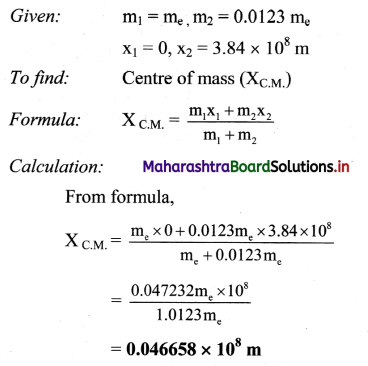
The mass of moon is 0.0 123 times the mass of the earth and separation between them is 3.84 × 10⁸ m. Determine the location of C.M as measured from the centre of the earth.
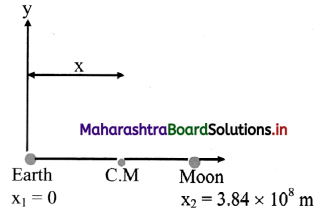
Maharashtra Board Class 11 Physics Important Questions Chapter 4 Laws of Motion 52
Solution:
Maharashtra Board Class 11 Physics Important Questions Chapter 4 Laws of Motion 53
Answer:
The location of centre of mass as measured from the center of the earth is 4.67 × 10⁶ m.

Question 77.
Three particles of masses 3 g, 5 g and 8 g are situated at point (2, 2, 2), (-3, 1, 4) and (-1, 3, -2) respectively. Find the position vector of their centre of mass.
Solution:
m1 = 3 g, m2 = 5 g, m3 = 8 g, x1 = 2, y1 = 2, z1 = 2
x2 = -3, y2 = 1, z2 = 4,
x3 = -1, y3 = 3, z3 = -2
Let (X, Y, Z) be co-ordinates of C.M., then
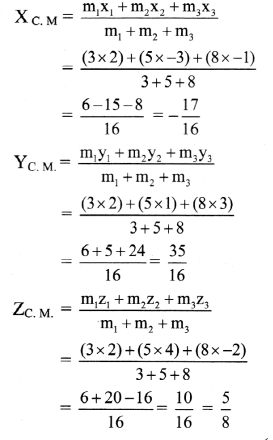
Maharashtra Board Class 11 Physics Important Questions Chapter 4 Laws of Motion 54
The co-ordinates of the C.M. are \(\left(-\frac{17}{16}, \frac{35}{16}, \frac{5}{8}\right)\)
Answer:
The position vector of the C.M. is \(-\frac{17}{16} \hat{\mathbf{i}}+\frac{35}{16} \hat{\mathbf{j}}+\frac{5}{8} \hat{\mathbf{k}}\)

Question 78.
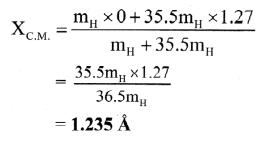
In the HCl molecule, the separation between the nuclei of the two atoms is about 1.27 Å (1 Å = 10-10 m). Find the approximate location of the CM of the molecule, given that a chlorine atom is about 35.5 times as massive as a hydrogen atom and nearly all the mass of an atom is concentrated in its nucleus. (NCERT)
Solution:
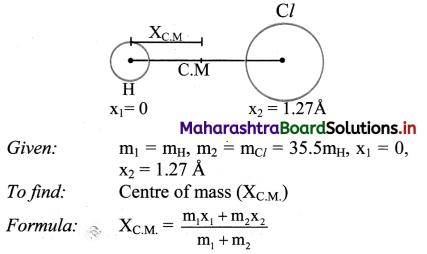
Maharashtra Board Class 11 Physics Important Questions Chapter 4 Laws of Motion 55
Claculation: From formula
Maharashtra Board Class 11 Physics Important Questions Chapter 4 Laws of Motion 56
Answer:
The location of centre of mass from the nucleus of hydrogen atom is 1.235 A.

Question 79.
Three thin walled uniform hollow spheres of radii 1 cm, 2 cm and 3 cm are so located that their centres are on the three vertices of an equilateral triangle ABC having each side 10 cm. Determine centre of mass of the system.
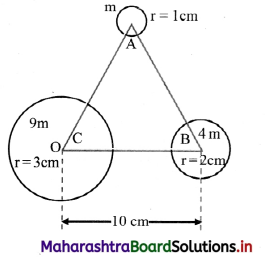
Maharashtra Board Class 11 Physics Important Questions Chapter 4 Laws of Motion 57
Solution:
Mass of a thin walled uniform hollow sphere is proportional to its surface area. (as density is constant) hence proportional to r2.

Thus, if mass of the sphere at A is mA = m, then mB = 4m and mC = 9m. By symmetry of the spherical surface, their centres of mass are at their respective centres, i.e., at A, B and C. Let us choose the origin to be at C, where the largest mass 9m is located and the point B with mass 4m on the positive x-axis. With this, the co-ordinates of C are (0, 0) and that of B are (10, 0). If A of mass m is taken in the first quadrant, its co-ordinates will be \([5,5 \sqrt{3}]\)
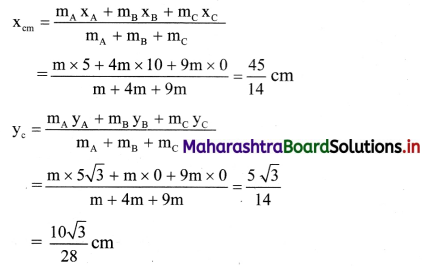
Maharashtra Board Class 11 Physics Important Questions Chapter 4 Laws of Motion 58

Question 80.
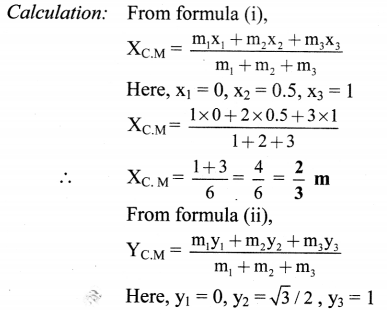
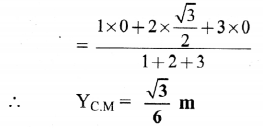
Locate the centre of mass of three particles of mass m1 = 1 kg, m2 = 2 kg and m3 = 3 kg at the corner of an equilateral triangle of each side of 1 m.
Solution:
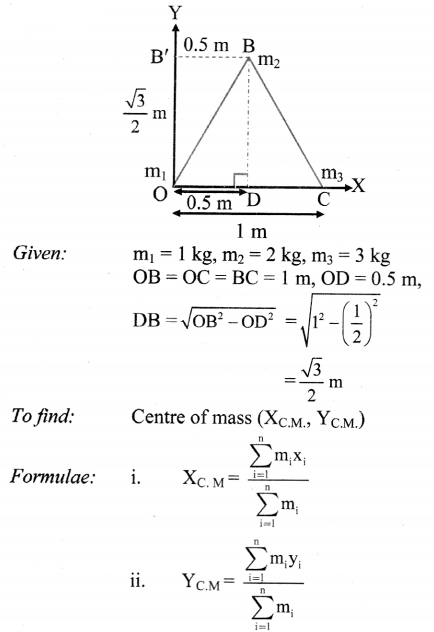
Maharashtra Board Class 11 Physics Important Questions Chapter 4 Laws of Motion 59
Maharashtra Board Class 11 Physics Important Questions Chapter 4 Laws of Motion 60
Maharashtra Board Class 11 Physics Important Questions Chapter 4 Laws of Motion 61
Answer:
The centre of mass of the system of three particles lies at \(\left(\frac{2}{3} m, \frac{\sqrt{3}}{6} m\right)\) with respect to the particle of mass 1 kg as the origin.

Maharashtra Board Class 11 Physics Important Questions Chapter 4 Laws of Motion

Question 81.
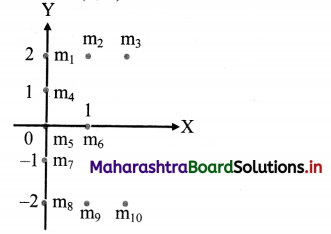
A letter ‘E’ is prepared from a uniform cardboard with shape and dimensions as shown in the figure. Locate its centre of mass.
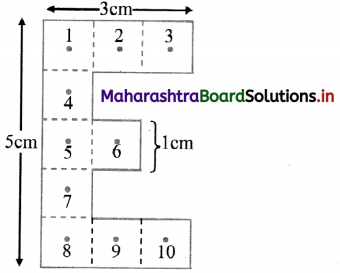
Maharashtra Board Class 11 Physics Important Questions Chapter 4 Laws of Motion 62
Solution:
As the sheet is uniform, each square can be taken to be equivalent to mass m concentrated at its respective centre. These masses will then be at the points labelled with numbers 1 to 10, as shown in figure. Let us select the origin to be at the left central mass m5, as shown and all the co-ordinates to be in cm.

By symmetry, the centre of mass of m1, m2 and m3 will be at m2 (1, 2) having effective mass 3m. Similarly, effective mass 3m due to m8, m9 and m10 will be at m9 (1, -2). Again, by symmetry, the centre of mass of these two (3m each) will have co-ordinates (1, 0). Mass m6 is also having co-ordinates (1, 0). Thus, the
effective mass at (1, 0) is 7m.
Maharashtra Board Class 11 Physics Important Questions Chapter 4 Laws of Motion 63
Using symmetry for m4, m5 and m7, there will be effective mass 3m at the origin (0, 0). Thus, effectively, 3m and 7m are separated by 1 cm along X-direction. Y-coordinate is not required.

Maharashtra Board Class 11 Physics Important Questions Chapter 4 Laws of Motion 64

Question 82.
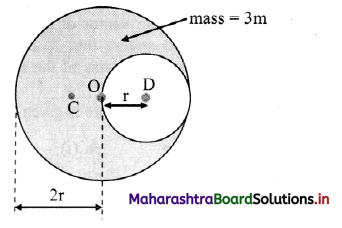
A hole of radius r is cut from a uniform disc of radius 2r. Centre of the hole is at a distance r from centre of the disc. Locate centre of mass of the remaining part of the disc.
Solution:
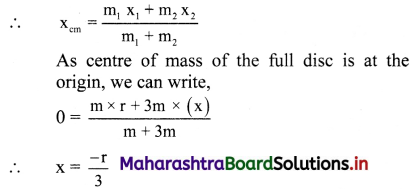
Before cutting the hole, c.în. of the full disc was at its centre. Let this be our origin O. Centre of mass of the cut portion is at its centre D. Thus, it is at a distance x1 = r form the origin. Let C be the centre of mass of the
remaining disc, which will he on the extension of the line DO at a distance x2 = x from the origin. As the disc is uniform, mass of any of its part is proportional to the area of that part.
Maharashtra Board Class 11 Physics Important Questions Chapter 4 Laws of Motion 65
Thus, if m is the mass of the cut disc, mass of the entire disc must be 4m and mass of the remaining disc will be 3m.
Maharashtra Board Class 11 Physics Important Questions Chapter 4 Laws of Motion 66

Alternate method: (Using negative mass):

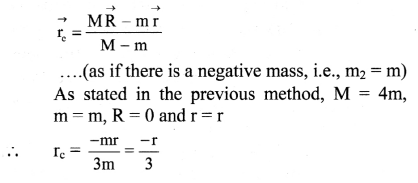
Let \(\overrightarrow{\mathrm{R}}\) be the position vector of the centre of mass of the uniform disc of mass M. Mass m is with centre of mass at position vector \(\overrightarrow{\mathrm{r}}\) from the centre of the disc be cut out from the complete disc. Position vector of the centre of mass of the remaining disc is then given by
Maharashtra Board Class 11 Physics Important Questions Chapter 4 Laws of Motion 67

Question 83.
Define centre of gravity of a body. Under what conditions the centre of gravity and centre of mass coincide?
Answer:

  1. centre of gravity of a body is the point around which the resultant torque due to force of gravity on the body is zero.
  2. The centre of mass coincides with centre of gravity when the body is in a uniform gravitational field.

Question 84.
Explain how to find the location of centre of mass or centre of gravity of a laminar object.
Answer:

  1. A laminar object is suspended from a rigid support at two orientations.
  2. Lines are drawn on the object parallel to the plumb line as shown in the figure.
  3. Plumb line is always vertical, i.e., parallel to the line of action of gravitational force.
  4. Intersection of the lines drawn is then the point through which line of action of the gravitational force passes for any orientation. Thus, it gives the location of the c.g. or c.m.
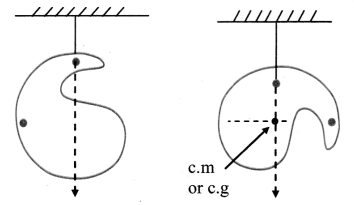
    Maharashtra Board Class 11 Physics Important Questions Chapter 4 Laws of Motion 68

Question 85.
Why do cricketers wear helmet and pads while playing? Is it related with physics?
Answer:
Helmet and pads used by cricketers protects the head, using principles of physics.

  1. The framing between the interior of the helmet and pads increases the time over which the impulse acts on the head resulting into reduction of force.
    (Impulse = force × time = constant)
  2. The pads spread the force applied by the ball over a wider area reducing pressure at a point.

Question 86.
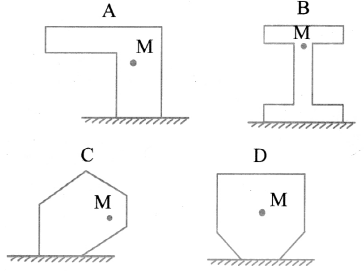
The diagram shows four objects placed on a flat surface.
Maharashtra Board Class 11 Physics Important Questions Chapter 4 Laws of Motion 69
The centre of mass of each object is marked M. Which object is likely to fall over?
Answer:
Object C will fall because its centre of mass is not exactly at centre, in turn applying more force on one side of the object resulting in to unbalance force. Whereas, in other objects center of mass is exactly at center resulting into zero rotational or translational motion maintaining their equilibrium.

Question 87.
A boy is about to close a large door by applying force at A and B as shown. State with a reason, which of the two positions, A or B, will enable him to close the door with least force.

Maharashtra Board Class 11 Physics Important Questions Chapter 4 Laws of Motion 70
Answer:
Boy has to apply more force at point B as compared to point A, because point B is at least distance from the hinge of the door while point A is at maximum distance from hinge of the door. Opening of door applies a moment, which is. given by,
M = F × perpendicular distance
F ∝ \(\frac{1}{\text { distance }}\)
More is the distance from the axis of rotation less will be the force.

Question 88.
How is a seat belt useful for safety?
Answer:
When car hits another car or an object with high speed it applies a high impulse on the driver and due to inertia driver tends to move in forward direction towards the steering. Seat belts spreads the force over large area of the body and holds the driver and protects him from crashing at the steering.

Question 89.
According to Newton’s third law of motion for every action there is equal and opposite reaction, why two equal and opposite forces don’t cancel each other?
Answer:
Forces of action and reaction always act on different bodies, hence they never cancel each other.

Question 90.
Linear momentum depends on frame of reference, but principle of conservation of linear momentum is independent of frame of reference. Why?
Answer:
Observers in different frame find different values of linear momentum of a system, hence linear momentum depends upon frame of reference, but each would observe that the value of linear momentum does not change with time (provided the system is isolated), hence principle of conservation of linear momentum is independent of frame of reference.

Question 91.
Multiple choice Questions

Question 1.
A body of mass 2 kg moving on a horizontal surface with initial velocity of 4 m s-1 comes to rest after two seconds. If one wants to keep this body moving on the same surface with a velocity of 4 m s-1, the force required is
(A) 2 N
(B) 4 N
(C) 0
(D) 8 N
Answer:
(B) 4 N

Maharashtra Board Class 11 Physics Important Questions Chapter 4 Laws of Motion

Question 2.
What force will change the velocity of a body of mass 1 kg from 20 m s-1 to 30 m s-1 in two seconds?
(A) 1N
(B) 5 N
(C) 10 N
(D) 25 N
Answer:
(B) 5 N

Question 3.
A force of 5 newton acts on a body of weight 9.80 newton. What is the acceleration produced in m/s2?
(A) 0.51
(B) 1.96
(C) 5.00
(D) 49.00
Answer:
(C) 5.00

Question 4.
A body of mass m strikes a wall with velocity v and rebounds with the same speed. Its change in momentum is
(A) 2 mv
(B) mv/2
(C) – mv
(D) Zero
Answer:
(A) 2 mv

Question 5.
A force of 6 N acts on a body of mass 1 kg initially at rest and during this time, the body attains a velocity of 30 m/s. The time for which the force acts on a body is
(A) 10 second
(B) 8 second
(C) 7 second
(D) 5 second
Answer:
(D) 5 second

Question 6.
A bullet of mass 10 g is fired from a gun of mass 1 kg with recoil velocity of gun = 5 m/s. The muzzle velocity will be
(A) 30 km/min
(B) 60 km/min
(C) 30 m/s
(D) 500 m/s
Answer:
(D) 500 m/s

Question 7.
The velocity of rocket with respect to ground is v1 and velocity of gases ejecting from rocket with respect to ground is v2 Then velocity of gases with respect to rocket is given by
(A) v2
(B) v1 + v2
(C) v1 × v2
(D) v1
Answer:
(B) v1 + v2

Question 8.
Two bodies A and B of masses 1 kg and 2 kg moving towards each other with velocities 4 m/s and 1 m/s suffers a head on collision and stick together. The combined mass will
(A) move in direction of motion of lighter mass.
(B) move in direction of motion of heavier mass.
(C) not move.
(D) move in direction perpendicular to the line of motion of two bodies.
Answer:
(A) move in direction of motion of lighter mass.

Question 9.
Which of the following has maximum momentum?
(A) A 100 kg vehicle moving at 0.02 m s-1.
(B) A 4 g weight moving at 1000 cm s-1’.
(C) A 200 g weight moving with kinetic energy of 10-6 J
(D) A 200 g weight after falling through one kilometre.
Answer:
(D) A 200 g weight after falling through one kilometre.

Question 10.
A bullet hits and gets embedded in a solid block resting on a horizontal frictionless table. What is conserved?
(A) Momentum alone.
(B) K.E. alone.
(C) Momentum and K.E. both.
(D) P.E. alone.
Answer:
(A) Momentum alone.

Maharashtra Board Class 11 Physics Important Questions Chapter 4 Laws of Motion

Question 11.
The force exerted by the floor of an elevator on the foot of a person standing there, is more than his weight, if the elevator is
(A) going down and slowing down.
(B) going up and speeding up.
(C) going up and slowing down.
(D) either (A) and (B).
Answer:
(D) either (A) and (B).

Question 12.
If E, G and N represents the magnitudes of electromagnetic, gravitational and nuclear forces between two electrons at a given separation, then,
(A) N = E = G
(B) E < N < G (C) N > G < E (D) E > G > N
Answer:
(D) E > G > N

Qestion 13.
For an inelastic collision, the value of e is
(A) greater than 1
(B) less than 1
(C) equal to 1
(D) none of these
Answer:
(B) less than 1

Question 14.
A perfect inelastic body collides head on with a wall with velocity y. The change in momentum is
(A) mv
(B) 2mv
(C) zero
(D) none of these.
Answer:
(A) mv

Question 15.
Two masses ma and rnb moving with velocitics va and vb in opposite direction collide
elastically and after the collision ma and mb move with velocities vb and va respectively. Then the ratio mamb is
(A) \(\frac{v_{a}-v_{b}}{v_{a}+v_{b}}\)
(B) \(\frac{\mathrm{m}_{\mathrm{a}}+\mathrm{m}_{\mathrm{b}}}{\mathrm{m}_{\mathrm{a}}}\)
(C) 1
(D) \(\frac{1}{2}\)
Answer:
(C) 1

Question 16.
The frictional force acts _____.
(A) in direction of motion
(B) against the direction of motion
(C) perpendicular to the direction of motion
(D) at any angle to the direction of motion
Answer:
(B) against the direction of motion

Question 17.
A marble of mass X collides with a block of mass Z, with a velocity Y. and sticks to it. The final velocity of the system is
(A) \(\frac{\mathrm{Y}}{\mathrm{X}+\mathrm{Y}} \mathrm{Y}\)
(B) \(\frac{X}{X+Z} Y\)
(C) \(\frac{X+Y}{Z}\)
(D) \(\frac{X+Z}{X}\)
Answer:
(B) \(\frac{X}{X+Z} Y\)

Question 18.
Two balls lying on the same plane collide. Which of the following will be always conserved?
(A) heat
(B) velocity
(C) kinetic energy
(D) linear momentum.
Answer:
(D) linear momentum.

Question 19.
A body is moving with uniform velocity of 50 km h-1, the force required to keep the body in motion in SI unit is
(A) zero
(B) 10
(C) 25
(D) 50
Answer:
(A) zero

Question 20.
A coolie holding a suitcase on his head of 20 kg and travels on a platform. then work done in joule by the coolie is
(A) 198
(B) 98
(C) 49
(D) zero
Answer:
(D) zero

Question 21.
Out of the following forces, which force is non-conservative?
(A) gravitational
(B) electrostatic
(C) frictional
(D) magnetic
Answer:
(C) frictional

Question 22.
The work done in conservative force is ____.
(A) negative
(B) zero
(C) positive
(D) infinite
Answer:
(B) zero

Question 23.
The angle between the line of action of force and displacement when no work done (in degree) is
(A) zero
(B) 45
(C) 90
(D) 120
Answer:
(C) 90

Question 24.
If the momentum of a body is doubled, its KE. increases by
(A) 50%
(B) 300%
(C) 100%
(L)) 400%
Answer:
(B) 300%

Maharashtra Board Class 11 Physics Important Questions Chapter 4 Laws of Motion

Question 25.
In perfectly inelastic collision, which is conserved?
(A) P.E. only
(B) K.E. only
(C) momentum only
(D) K.E. and momentum
Answer:
(C) momentum only

Question 26.
In case of elaine collision, which s
(A) Momentum and K.E. is conserved.
(B) Momentum conserved and K.E. not conserved,
(C) Momentum not conserved and K.E. conserved.
(D) Momentum and K.E. both not conserved,
Answer:
(A) Momentum and K.E. is conserved.

Question 27.
Pseudo force is true only in
(A) frame of reference which is at rest
(B) inertial frame of reference.
(C) frame of reference moving with constant velocity.
(D) non-inertial frame of reference
Answer:
(D) non-inertial frame of reference

Question 28.
A men weighing 90kg carries a stone of 20 kg to the top of the building 30m high. The work done by hint is (g = 9.8 m/s2)
(A) 80 J
(B) 100 J
(C) 980 J
(D) 29,400 J
Answer:
(D) 29,400 J

Question 29.
A weight lifter is holding a weight of 100 kg on his shoulders for 45 s, the amount of work done by him in joules is
(A) 4500
(B) 100
(C) 45
(D) zero
Answer:
(D) zero

Question 30.
If m is the mass of a body and E its K.E..then its linear momentum is
(A) \(\mathrm{m} \sqrt{\mathrm{E}}\)
(B) \(2 \sqrt{\mathrm{m}} \mathrm{E}\)
(C) \(\sqrt{m} E\)
(D) \(\sqrt{2 \mathrm{mE}}\)
Answer:
(D) \(\sqrt{2 \mathrm{mE}}\)

Question 31.
Torque applied is masimum when the angle between the directions of \(\overrightarrow{\mathrm{r}}\) and \(\overrightarrow{\mathrm{F}}\) is
(A) 90°
(B) 180°
(C) 0°
(D) 45°
Answer:
(A) 90°

Question 92.
A particle moving with velocity \(\vec{v}\) is acted by three forces shown by the vector triangle PQR. The velocity of the particle will:
(A) remain constant
(B) change according to the smallest force \(\overrightarrow{\mathrm{QR}}\)
(C) increase
(D) decrease
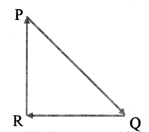
Maharashtra Board Class 11 Physics Important Questions Chapter 4 Laws of Motion 71
Hint: As the three forces acting on a particle represents a triangle (i.e., a closed loop)
∴ Fnet = 0
∴ m \(\vec{a}\) = 0
∴ m\(\frac{\mathrm{d} \overrightarrow{\mathrm{v}}}{\mathrm{dt}}\)
∴ v remains constant
Answer:
(A) remain constant

Question 93.
A force F = 20 + 10y acts on a particle in y-direction where F is in newton and y in meter. Work done by this force to move the particle from y = 0 to y = 1 m is:
(A) 25J
(B) 20J
(C) 30J
(D) SJ
Hint: Work done by variable force, W = \(\int_{y_{\text {initial }}}^{y_{\text {final }}} \mathrm{Fdy}\)
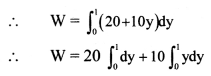
Maharashtra Board Class 11 Physics Important Questions Chapter 4 Laws of Motion 72
Maharashtra Board Class 11 Physics Important Questions Chapter 4 Laws of Motion 73
Answer:
(A) 25J

Question 94.
Body A of mass 4m moving with speed u collides with another body B of mass 2m, at rest. The collision is head on and elastic in nature. After the collision the fraction of energy lost by the colliding body A is:
(A) \(\frac{4}{9}\)
(B) \(\frac{5}{9}\)
(C) \(\frac{1}{9}\)
(D) \(\frac{8}{9}\)
Hint:
Fractional loss of K.E. of colliding bodies,
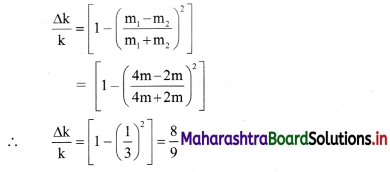
Maharashtra Board Class 11 Physics Important Questions Chapter 4 Laws of Motion 74
Answer:
(D) \(\frac{8}{9}\)

Question 95.
An object of mass 500 g, initially at rest, is acted upon by a variable force whose X-component varies with X in the manner shown. The velocities of the object at the points X = 8 m and X = 12 m, would have the respective values of
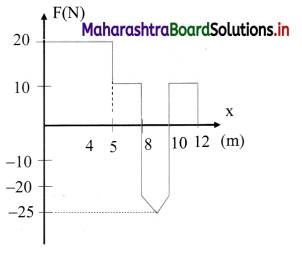
Maharashtra Board Class 11 Physics Important Questions Chapter 4 Laws of Motion 75
(A) 18m/s and 20.6 m/s
(B) 18 m/s and 24.4 m/s
(C) 23 m/s and 24.4 m/s
(D) 23 m/s and 20.6 m/s
Hint: From work-energy theorem
∆ K.E. = work = area under F-x graph
From x = 0 to x = 8m
\(\frac{1}{2} \mathrm{mv}^{2}\) = (5 × 20) + (3 × 10)
∴ \(\frac{1}{2} \mathrm{mv}^{2}\) = 100 + 30
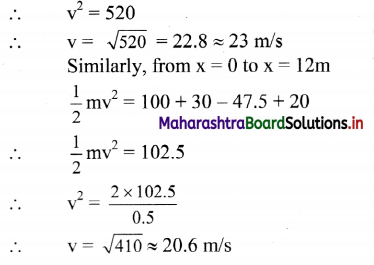
Maharashtra Board Class 11 Physics Important Questions Chapter 4 Laws of Motion 76
Answer:
(D) 23 m/s and 20.6 m/s

Question 96.
The centre of mass of two particles system lies
(A) at the midpoint on the line joining the two particles.
(B) at one end of line joining the two particles.
(C) on the line perpendicular in the line joining two particles.
(D) on the line joining the Iwo particles.
Answer:
(D) on the line joining the two particles.

Maharashtra Board Class 11 Physics Important Questions Chapter 4 Laws of Motion

Question 97.
A block of mass m is placed on a smooth inclined wedge ABC of inclination θ as shown in the figure. The wedge is given an acceleration ‘a’ towards the right. The relation between a and θ for the block to remain stationary on the wedge is
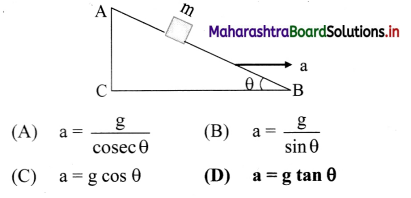
Maharashtra Board Class 11 Physics Important Questions Chapter 4 Laws of Motion 77
Hint:
Maharashtra Board Class 11 Physics Important Questions Chapter 4 Laws of Motion 78
The mass of block is given to be m. It will remain stationary if forces acting on it are in equilibrium i.e., ma cos θ = mg sin θ
Here, ma = Pseudo force on block.
∴ a = g tan θ
Answer:
a = g tan θ

Question 98.
A moving block having mass m, collides with another stationary block having mass 4m. The lighter block comes to rest after collision, When the initial velocity of the lighter block is v, then the value of coefficient of restitution
(e) will
(A) 0.5
(B) 0.25
(C) 0.8
(D) 0.4
Hint:
Given: m1 = m, m2 = 4m, u1 = v, u2 = 0, v1 = 0 According to law of conservation of momentum,
m1u1 + m2u2 = m1v1 + m2v2
mv + 4m × 0 = m × 0 + 4mv2
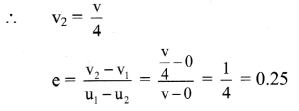
Maharashtra Board Class 11 Physics Important Questions Chapter 4 Laws of Motion 79
Answer:
(B) 0.25

Question 99.
In a collinear collision, a particle with an initial speed v0 strikes a stationary particle of the same mass. If the final total kinetic energy is 50% greater than the original kinetic energy, the magnitude of the relative velocity between the two particles, after collision, is:
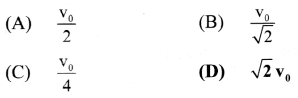
Maharashtra Board Class 11 Physics Important Questions Chapter 4 Laws of Motion 80
Hint:
According to law of conservation of momentum,
mv0 = mv1 + mv2
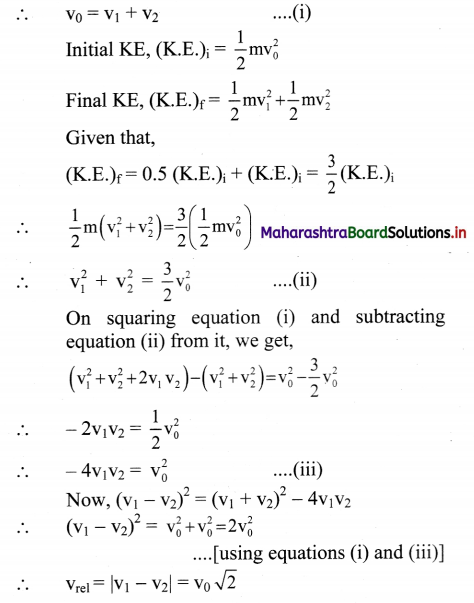
Maharashtra Board Class 11 Physics Important Questions Chapter 4 Laws of Motion 81
Answer:
(D) \(\sqrt{2} \mathbf{v}_{0}\)

Question 100.
The mass of a hydrogen molecule is 3.32 × 10⁻²⁷ kg. If 1023 hydrogen molecules strike, per second, a fixed wall of area 2 cm2 at an angle of 45° to the normal and rebound elastically with a speed of 103 m/s, then the pressure on the wall is nearly:
(A) 2.35 × 10² N/m2
(B) 4.70 × 10² N/m2
(C) 2.35 × 10³ N/m2
(D) 4.70 × 10³ N/m2
Hint:
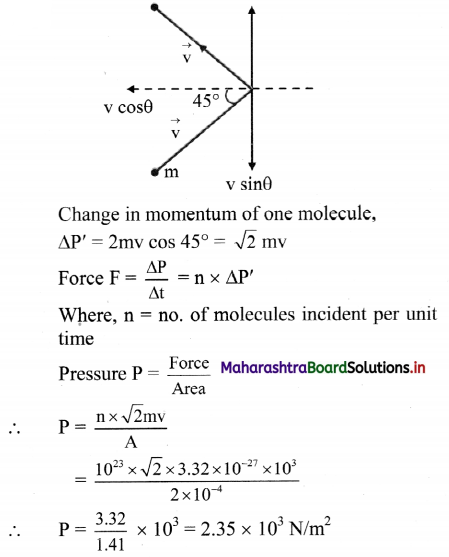
Maharashtra Board Class 11 Physics Important Questions Chapter 4 Laws of Motion 82
Answer:
(C) 2.35 × 10³ N/m2

Question 101.
A bomb at rest explodes into 3 parts of same mass. The momentum of two parts is -3P\(\hat{\mathrm{i}}\) and 2P\(\hat{\mathrm{j}}\) respectively. The magnitude of momentum of the third part is
(A) P
(B) \(\sqrt{5} \mathrm{P}\)
(C) \(\sqrt{11} \mathrm{P}\)
(D) \(\sqrt{13} \mathrm{P}\)
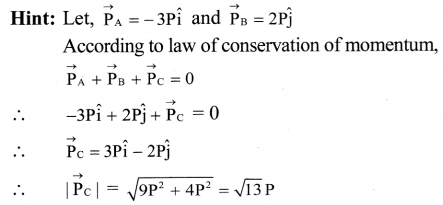
Maharashtra Board Class 11 Physics Important Questions Chapter 4 Laws of Motion 83
Answer:
(D) \(\sqrt{13} \mathrm{P}\)

Question 102.
A sphere of mass ‘m’ moving with velocity V collides head-on on another sphere of same mass which is at rest. The ratio of final velocity of second sphere to the initial velocity of the first sphere is (e is coefficient of restitution and collision is inelastic)
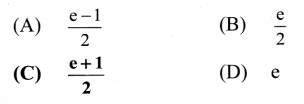
Maharashtra Board Class 11 Physics Important Questions Chapter 4 Laws of Motion 84
Hint:
Initial momentum = mv
Final momentum = mv1 + mv2
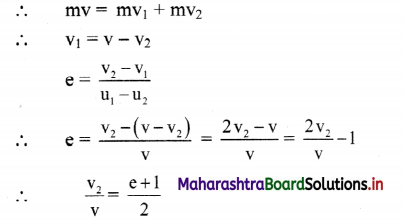
Maharashtra Board Class 11 Physics Important Questions Chapter 4 Laws of Motion 85
Answer:
(C) \(\frac{\mathrm{e}+1}{2}\)

Question 103.
Two blocks A and B of masses 3m and m respectively are connected by a massless and inextensible string. The whole system is suspended by a massless spring as shown in figure. The magnitudes of acceleration of A and B immediately after the string is cut, are respectively:
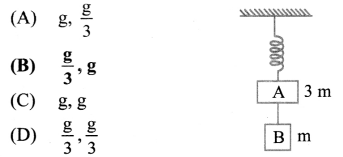
Maharashtra Board Class 11 Physics Important Questions Chapter 4 Laws of Motion 86
Hint:
Tension in spring before cutting the strip,
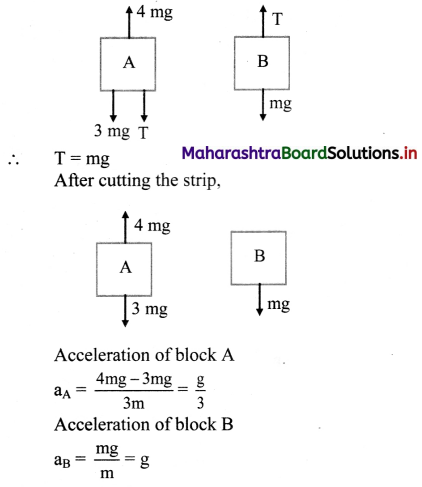
Maharashtra Board Class 11 Physics Important Questions Chapter 4 Laws of Motion 87
Answer:
(B) \(\frac{\mathrm{g}}{3}\), g

Question 104.
A time dependent force F = 6t acts on a particle of mass 1 kg. If the particle starts from rest, the work done by the force during the first 1 sec. will be
(A) 9 J
(B) 18 J
(C) 4.5 J
(D) 22 J
Hint:
F = 6t
m = 1 kg
∴ a = 6t
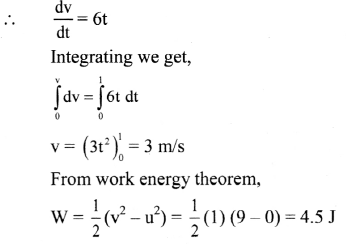
Maharashtra Board Class 11 Physics Important Questions Chapter 4 Laws of Motion 88
Answer:
(C) 4.5 J

Question 105.
Consider a drop of rain water having mass Ig falling from a height of 1 km. It hits the ground with a speed of 50 m/s. Take ‘g’ constant with a value 10 m/s2. The work done by the
(i) gravitational force and the
(ii) resistive force of air is:
(A) (i) -10 J
(ii) -8.25 J
(B) (i) 1.25 J
(ii) -8.25 J
(C) (i) 100 J
(ii) 8.75 J
(D) (i) 10 J
(ii) -8.75 J
Hint: Work done by gravitation force is given by (Wg)
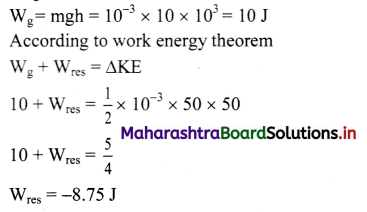
Maharashtra Board Class 11 Physics Important Questions Chapter 4 Laws of Motion 89
Answer:
(D) (i) 10 J
(ii) -8.75 J
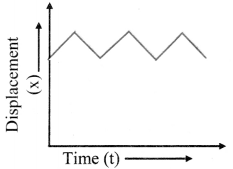
Maharashtra Board Class 11 Physics Important Questions Chapter 3 Motion in a Plane

Balbharti Maharashtra State Board 11th Physics Important Questions Chapter 3 Motion in a Plane Important Questions and Answers.

Maharashtra State Board 11th Physics Important Questions Chapter 3 Motion in a Plane

Question 1.
Explain the term: Displacement.
Answer:
Displacement:

  1. Displacement of a particle for a time interval is the difference between the position vectors of the object in that time interval.
  2. Let \(\overrightarrow{\mathrm{x}_{1}}\) and \(\overrightarrow{\mathrm{x}_{2}}\) be the position vectors of a particle at time t1 and t2 respectively. Then the displacement \(\overrightarrow{\mathrm{S}}\) in time ∆t = (t2 – t\overrightarrow{\mathrm{s}}=\Delta \overrightarrow{\mathrm{x}}=\overrightarrow{\mathrm{x}}_{2}-\overrightarrow{\mathrm{x}}_{1}) is given by \(\overrightarrow{\mathrm{s}}=\Delta \overrightarrow{\mathrm{x}}=\overrightarrow{\mathrm{x}}_{2}-\overrightarrow{\mathrm{x}}_{1}\)
  3. Dimensions of displacement are equal to that of length i.e.. [L1M0T0].
  4. Displacement is a vector quantity.
  5. Example:
    • For an object that has travelled through 1 m from time t1 to t2 along the positive X-direction, the magnitude of its displacement is I m and its direction is along the positive X-axis.
    • On the other hand, for an object that has travelled through I m from time t1 to t1 along the positive Y-direction, the magnitude of its displacement remains the same i.e., I m but the direction of the displacement is along the positive Y-axis.

Question 2.
Explain the term: Path length.
Answer:

  1. Path length is the actual distance travelled by the particle during its motion.
  2. It is a scalar quantity.
  3. Dimensions of path length are equal to that of length i.e.. [L1M0T0]
  4. Example:
    • If an object travels along the X-axis from x = 3 m to x = 6 m then the distance travelled is 3 m. In this case the displacement is also 3 m and its direction is along the positive X-axis.
    • However, if the object now comes back to x 5, then the distance through which the object has moved increases to 3 + I = 4 m. Its initial position was x 3 m and the final position is now x = 5 m and thus, its displacement is ∆x = 5 – 3 = 2 m, i.e., the magnitude of the displacement is 2 m and its direction is along the positive X-axis.
    • If the object now moves to x =1, then the distance travelled, i.e., the path length increases to 4 + 4 = 8 m while the magnitude of displacement becomes 3 – 1 = 2 m and its direction is along the negative X-axis.

Maharashtra Board Class 11 Physics Important Questions Chapter 3 Motion in a Plane

Question 3.
Explain the terms:
i. Average velocity
ii. Instantaneous velocity
iii. Average speed
iv. Instantaneous speed
Answer:
i) Average velocity:

  1. Average velocity (\(\overrightarrow{\mathrm{v}}_{\mathrm{av}}\)) of an object is the displacement (\(\Delta \overrightarrow{\mathrm{x}}\)) of the object during the time interval (∆t) over which average velocity is being calculated, divided by that time interval.
  2. Average velocity = (\(\frac{\text { Displacement }}{\text { Time interval }}\))
    \(\overrightarrow{\mathrm{V}_{\mathrm{av}}}=\frac{\overrightarrow{\mathrm{x}}_{2}-\overrightarrow{\mathrm{x}}_{1}}{\mathrm{t}_{2}-\mathrm{t}_{1}}=\frac{\Delta \overrightarrow{\mathrm{x}}}{\Delta \mathrm{t}}\)
  3. Average velocity is a vector quantity.
  4. Its SI unit is m/s and dimensions are [M0L1T-1]
  5. For example, if the positions of an object are x +4 m and x = +6 m at times t = O and t = 1 minute respectively, the magnitude of its average velocity during that time is Vav = (6 – 4)1(1 – 0) = 2 m per minute and its direction will be along the positive X-axis.
    ∴ \(\overrightarrow{\mathrm{v}}_{\mathrm{av}}\) = 2 i m/min
    Where, i = unit vector along X-axis.

ii) Instantaneous velocity:

  1. The instantaneous velocity (\(\overrightarrow{\mathrm{V}}\)) is the limiting value of ¡he average velocity of the object over a small time interval (∆t) around t when the value of lime interval goes to zero.
  2. It is the velocity of an object at a given instant of time.
  3. \(\overrightarrow{\mathrm{v}}=\lim _{\Delta t \rightarrow 0} \frac{\Delta \overrightarrow{\mathrm{x}}}{\Delta \mathrm{t}}=\frac{\mathrm{d} \overrightarrow{\mathrm{x}}}{\mathrm{dt}}\)
    where \(\frac{\mathrm{d} \overrightarrow{\mathrm{x}}}{\mathrm{dt}}\) derivative of \(\overrightarrow{\mathrm{x}}\) with respect to t.

iii) Average speed:

  1. Average speed of an object is the total path length (distance) travelled by the object during the time interval over which average speed is being calculated, divided by that time interval.
  2. Average speed = \(\frac{\text { Total path length }}{\text { Total time interval }}\)
  3. Average speed is a scalar quantity.
  4. Its S.I. unit is m/s and dimensions are [M0V1T-1].
  5. In rectilinear motion;
    • If the motion of the object is only in one direction, then the magnitude of displacement will be equal to the path length and hence the magnitude of average velocity will be equal to the average speed.
    • If the motion of the object reverses its direction, then the magnitude of displacement will be less then the path length and hence the magnitude of average velocity will be less than the average speed.

iv) Instantaneous speed:
The instantaneous speed is the limiting value of the average speed of the object over a small time interval ‘∆t’ around t when the value of time interval goes to zero.

Question 4.
Distinguish between uniform rectilinear motion and non-uniform rectilinear motion.
Answer:

No.Uniformly rectilinear motionNon-uniform rectilinear motion
i.The object is moving with constant velocity.The object is moving with variable velocity.
ii.The average and instantaneous velocities are same.The average and instantaneous velocities are different.
iii.The average and instantaneous speeds are the same.The average and instantaneous speeds are different.
iv.The average and instantaneous speeds are equal to the magnitude of the velocity.The average speed will be different from the magnitude of average velocity.

Question 5.
Explain the terms:

  1. Acceleration
  2. Average acceleration
  3. Instantaneous acceleration

Answer:

  1. Acceleration:
    • Acceleration is the rate of change of velocity with respect to time.
    • It is a vector quantity.
    • Dimension: [M0L1T-2]
    • If a particle moves with constant velocity, its acceleration is zero.
  2. Average acceleration:
    • Average acceleration is the change in velocity divided by the total time required for the change.
    • If \(\overrightarrow{\mathrm{v}_{\mathrm{1}}}\) and \(\overrightarrow{\mathrm{v}_{\mathrm{2}}}\) are the velocities of the T particle at time t1 and t2 respectively, then the change in velocity is \(\) and time required for this change is ∆t = t2 – t1
      ∴ \(\vec{a}_{a v}=\frac{\vec{v}_{2}-\vec{v}_{1}}{t_{2}-t_{1}}=\frac{\Delta \vec{v}}{\Delta t}\)
  3. Instantaneous acceleration:
    • The instantaneous acceleration a is the limiting value of the average acceleration of the object over a small time interval ‘∆t’ around t when the value of time interval goes to zero.
      \(\overrightarrow{\mathrm{a}}_{\text {inst }}=\lim _{\Delta t \rightarrow 0} \frac{\Delta \overrightarrow{\mathrm{v}}}{\Delta \mathrm{t}}=\frac{\mathrm{d} \overrightarrow{\mathrm{v}}}{\mathrm{d} \mathrm{t}}\)
    • Instantaneous acceleration is the slope of the tangent to the velocity-time graph at a position corresponding to given instant of time.
      [Note: Generally, when the term acceleration is used, it is an instantaneous acceleration.]

Maharashtra Board Class 11 Physics Important Questions Chapter 3 Motion in a Plane

Question 6.
Draw and explain the position-time graph of:

  1. An object at rest.
  2. An object moving with uniform velocity along positive x-axis.
  3. An object moving with uniform velocity along negative x-axis.
  4. An object moving with non-uniform velocity.
  5. An object performing oscillatory motion with constant speed.

Answer:

  1. The position-time graph of an object at rest:
    • For an object at rest, the position-time graph is a horizontal straight line parallel to time axis.
    • The displacement of the object is zero as there is no change in the object’s position.
    • Slope of the graph is zero, which indicates that velocity of the particle is zero.
      Maharashtra Board Class 11 Physics Important Questions Chapter 3 Motion in a Plane 1
  2. The position-time graph of an object moving with uniform velocity along positive x-axis:
    • When an object moves, the position of the particle changes with respect to time.
    • Since velocity is constant, displacement is proportional to elapsed time.
    • The graph is a straight line with positive slope, showing that the velocity is along the positive x-axis.
    • In this case, as the motion is uniform, the average velocity and instantaneous velocity are equal at all times.
    • Speed is equal to the magnitude of the velocity.
      Maharashtra Board Class 11 Physics Important Questions Chapter 3 Motion in a Plane 2
  3. Position-time graph of an object moving with uniform velocity along negative x- axis:
    • The graph is a straight line with negative slope, showing that the velocity is along the negative x-axis.
    • Displacement decreases with increase in time.
      Maharashtra Board Class 11 Physics Important Questions Chapter 3 Motion in a Plane 3
  4. Position-time graph of a particle moving with non-uniform velocity;
    • When the velocity of an object changes with time, slope of the graph is different at different points. Therefore, the average and instantaneous velocities are different.
    • Average velocity over time interval from t1 to t4 around time t0 = slope of line AB.
    • Average velocity over time interval from t2 to t3 = slope of line CD
    • On further reducing the time interval around t0, it can be deduced that, instantaneous interval at t0 = the slope of the tangent PQ at t0.
      Maharashtra Board Class 11 Physics Important Questions Chapter 3 Motion in a Plane 4
  5. Position-time graph of an object performing oscillatory motion with constant speed:
    For an object performing oscillatory motion with constant speed, the direction of velocity changes from positive to negative and vice versa over fixed intervals of time.
    Maharashtra Board Class 11 Physics Important Questions Chapter 3 Motion in a Plane 5

Question 7.
Explain the velocity-tune graphs of an object:
i) Moving with zero acceleration.
ii) Moving with constant positive acceleration.
iii) Moving with constant negative acceleration.
iv) Moving with non-uniform acceleration.
Answer:
i) Object is moving with zero acceleration:

  1. Maharashtra Board Class 11 Physics Important Questions Chapter 3 Motion in a Plane 6
  2. As the acceleration is zero, the graph will be a straight line parallel to time axis.
  3. Velocity of the particle is constant as the acceleration is zero.
  4. Magnitude of displacement of object from t1 to t2 = v0 × (t2 – t1) shaded area under velocity-time graph.

ii) Object is moving with constant positive acceleration:

  1. The velocity-time graph is linear.
  2. Velocity increases with increase in time. as acceleration is positive (along the direction of velocity).
  3. The area under the velocity-time graph between two instants of time t1 and t2 gives the displacement of the object during that time interval.
  4. Slope of the graph is \(\frac{\Delta \mathrm{v}}{\Delta \mathrm{t}}\) = positive acceleration
    Maharashtra Board Class 11 Physics Important Questions Chapter 3 Motion in a Plane 7

iii) Object is moving with constant negative acceleration:

  1. The velocity-time graph is linear.
  2. Velocity decreases with increase in time as acceleration is negative (opposite to the direction of velocities).
  3. The area tinder the velocity-time graph between two instants of time t1 and t2 gives the displacement 0f the object during that time interval.
  4. Slope of the graph is \(\frac{\Delta \mathrm{v}}{\Delta \mathrm{t}}\) negative acceleration
    Maharashtra Board Class 11 Physics Important Questions Chapter 3 Motion in a Plane 8

iv. Object is moving with non-uniform acceleration:

  1. Maharashtra Board Class 11 Physics Important Questions Chapter 3 Motion in a Plane 9
  2. Velocity-time graph is non-linear.
  3. The area under the velocity-time graph between two instants of time t1 and t2 gives the displacement of the object during that time interval area under the velocity-time curve =
    Maharashtra Board Class 11 Physics Important Questions Chapter 3 Motion in a Plane 10
    = x(t2) – x(t1)
    = displacement of the object from t1 to t2.

Question 8.
A ball thrown vertically upwards from a point P on earth reaches a point Q and returns back to earth striking at a point R. Draw speed-time graph to depict the motion of the ball (Neglect air resistance).
Answer:

  • Maharashtra Board Class 11 Physics Important Questions Chapter 3 Motion in a Plane 11
  • A ball which is thrown up with a certain initial speed goes up with decreasing speed to a certain height where its speed becomes zero.
  • Now, during its downward motion, the speed goes on increasing from zero and reaches its initial value when it strikes the ground.
  • The speed-time graph for the motion of a ball is as shown in the figure.

Maharashtra Board Class 11 Physics Important Questions Chapter 3 Motion in a Plane

Question 9.
Figure shows velocity-time graph for various situations. What does each graph indicate?
Maharashtra Board Class 11 Physics Important Questions Chapter 3 Motion in a Plane 12
Answer:

  1. Initial velocity, u > 0. Also, velocity is constant with time. Hence, acceleration is zero.
  2. As finite initial velocity is increasing with time, acceleration, a > 0 and is constant.
  3. Initial velocity, u = 0. Velocity is increasing with time so, acceleration a is positive. But it is decreasing in magnitude with time.
  4. Initial velocity, u = 0. Velocity is linearly increasing with time. Hence, starting from rest acceleration is constant.
  5. Initial velocity, u = 0. Acceleration and velocity is increasing with time.
  6. Initial velocity u > 0. Velocity decreases and ultimately comes to rest. Hence, acceleration a < 0.

Question 10.
‘The distances travelled by an object starting from rest and having a positive uniform acceleration in successive seconds are in the ratio 1:3:5:7….’ Prove it.
Answer:

  1. Consider an object under free fall, Initial velocity u = 0, acceleration a = g
  2. The distance travelled by the object in equal time intervals t0 can be given by the second law of motion as,
    s = ut0 + \(\frac{1}{2}\) gt02
  3. Distance travelled in the first time interval to,
    s1 = 0 + \(\frac{1}{2}\)gt02 = \(\frac{1}{2}\) gt02
    Substituting \(\frac{\mathrm{g}}{2}\) = A, we have s1 = At02
  4. Distance travelled in the time interval 2t0 = A (2t0)2
    ∴ The distance travelled in the second t0 interval, s2 = A(4t02 – t02) = 3At0\frac{\mathrm{g}}{2} = 3s1
  5. Distance travelled in the time interval 3t0 = A(3t0)2
    ∴ The distance travelled in the third to interval,
    s3 = A (9t02 – 4t02) = 5 At02 = 5s1
  6. On continuing, it can be seen that the distances travelled, (s1 : s2 : s3 ….) are in the ratio (1 : 3 : 5 :….)

Question 11.
Explain the concept of relative velocity along a straight line with the help of an example.
Answer:

  1. Consider two trains A and B moving on two parallel tracks in the same direction.
  2. Case 1: Train B overtakes train A.
    For a passenger in train A, train B appears to be moving slower than train A. This happens because the passenger in train A perceives the velocity of train B with respect to him/her i.e., the difference in the velocities of the two trains which is much smaller than the velocity of train A.
  3. Case 2: Train A overtakes train B.
    For a passenger in train A, train B appears to be moving faster than train A. This happens because the passenger in train A perceives the velocity of the train B w.r.t. to him/her i.e., the difference in the velocities of the two trains which is larger than the velocity of train A.
  4. If \(\vec{v}_{\mathrm{A}}\) and \(\vec{v}_{\mathrm{B}}\) be the velocities of two bodies then relative velocity of A with respect to B is given by \(\vec{v}_{A B}=\vec{v}_{A}-\vec{v}_{B}\).
  5. Similarly the velocity of B with respect to A is given by, \(\vec{v}_{A B}=\vec{v}_{B}-\vec{v}_{A}\).
    Thus, relative velocity of an object w.r.t. another object is the difference in their velocities
  6. If two objects start form the same point at t = 0, with different velocities, distance between them increases with time in direct proportion to the relative velocity between them.

Solved Problems

Question 12.
A person walks from point P to point Q along a straight road ¡n 10 minutes, then turns back and returns to point R which ¡s midway between P and Q after further 4 minutes. If PQ is 1 km, find the average speed and velocity of the person in going from P to R.
Solution:
Given: time taken (t) = 10 + 4 = 14 minutes,
distance (s) = PQ + QR = 1 + 0.5 = 1.5 km,
displacement = PQ – QR = 1 – 0.5 = 0.5km
To find: Average speed, average velocity (v)
Maharashtra Board Class 11 Physics Important Questions Chapter 3 Motion in a Plane 13
The average speed and average velocity of the person is 6.42 km/hr and 2.142 km/hr respectively.

Maharashtra Board Class 11 Physics Important Questions Chapter 3 Motion in a Plane

Question 13.
A car moves at a constant speed of 60 km/hr for 1 km and 40 km/hr for next 1 km. What ¡s the average speed of the car?
Solution:
Given. v1 = 60 km/hr, x1 = 1 km,
v2 = 40 km/hr, x2 = 1 km
To find: Average speed of car (Vav)
Formula: vav = \(\frac{\text { total path length }}{\text { total time interval }}\)
Calculation: From given data,
Maharashtra Board Class 11 Physics Important Questions Chapter 3 Motion in a Plane 14
∴ Average speed of car = 48 km/hr
The average speed of the car is 48 km/hr

Question 14.
A stone is thrown vertically upwards from the ground with a velocity 15 m/s. At the same instant a ball is dropped from a point directly above the stone from a height of 30 m. At what height from the ground will the stone and the ball meet and after how much time? (Use g = 10 m/s2 for ease of calculation).
Solution:
Let the stone and the ball meet after time t0. From second equation of motion, the distances travelled by the stone and the ball in that time is given as,
Sstone = 15 t0 – \(\frac{1}{2}\) gt02
Sball = \(\frac{1}{2}\) gt02
When they meet. Sstone + Sball = 30
∴ 15t0 – \(\frac{1}{2}\) gt02 + \(\frac{1}{2}\) gt02 = 30
t0 = \(\frac{30}{15}\) = 2 s
∴ Sstone = 15 (2) – \(\frac{1}{2}\) (10) (2)2 = 30 – 20 = 10 m
The stone and the ball meet at a height of 10 m after time 2s.

Question 15.
A ball is dropped from the top of a building 122.5 m high. How long will it take to reach the ground? What wilt be its velocity when it strikes the ground?
Solution:
Given: s = h = 122.5 m, u = 0,
a = g = 9.8 ms2
To find: i) Time taken to reach the ground (t)
ii) Velocity of ball when it strikes ground (v)

Formulae: i) s = ut + \(\frac{1}{2}\) at2
ii) v = u + gt
Calculation: From formula (i),
122.5 = 0 + \(\frac{1}{2}\) × 9.8 t2
t2 = \(\frac{122.5}{4.9}\) = 25
t = \(\sqrt {25}\) = 5 second
From formula (ii),
v = u + gt
v = 0 + 9.8 × 5 = 49 m/s

i) Time taken to reach the ground is 5 s.
ii) Velocity of the ball when it strikes the ground is 49 m/s.

Maharashtra Board Class 11 Physics Important Questions Chapter 3 Motion in a Plane

Question 16.
The position vectors of three particles are given by
\(\overrightarrow{\mathrm{x}}_{1}=(5 \hat{\mathrm{i}}+5 \hat{\mathrm{j}}) \mathrm{m}\), \(\overrightarrow{\mathrm{x}}_{2}=(5 \mathrm{t} \hat{\mathrm{i}}+5 \mathrm{t} \hat{\mathrm{j}}) \mathrm{m}\) and \(\overrightarrow{\mathrm{x}}_{3}=\left(5 \mathrm{t} \hat{\mathrm{i}}+10 \mathrm{t}^{2} \hat{\mathrm{j}}\right) \mathrm{m}\) as a function of time t.
Determine the velocity and acceleration for each, in SI units.
Solution:
Maharashtra Board Class 11 Physics Important Questions Chapter 3 Motion in a Plane 15
v2 = \(\sqrt{5^{2}+5^{2}}\) = 5\(\sqrt{2}\) m/s
tan θ = \(\frac{5}{5}\) = 1
∴ θ = 45°
Direction of v2 makes an angle of 45° to the horizontal.
Maharashtra Board Class 11 Physics Important Questions Chapter 3 Motion in a Plane 16
Thus, third particle is getting accelerated along the y-axis at 20 m/s2.

Question 17.
The initial velocity of an object is \(\overrightarrow{\mathrm{u}}=5 \hat{\mathrm{i}}+10 \hat{\mathrm{j}} \mathrm{m} / \mathrm{s}\). Its constant acceleration is \(\vec{a}=2 \hat{i}+3 \hat{j} \mathrm{~m} / \mathrm{s}^{2}\). Determine the velocity and the displacement after 5 s.
Solution:
Maharashtra Board Class 11 Physics Important Questions Chapter 3 Motion in a Plane 17
Maharashtra Board Class 11 Physics Important Questions Chapter 3 Motion in a Plane 18

Question 18.
An aeroplane A, is travelling in a straight line with a velocity of 300 km/hr with respect to Earth. Another aeroplane B, is travelling in the opposite direction with a velocity of 350 km/hr with respect to Earth. What is the relative velocity of A with respect to B? What should be the velocity of a third aeroplane C moving parallel to A, relative to the Earth if it has a relative velocity of 100 km/hr with respect to A?
Solution:
Given: vA = 300 km/hr, vB = 350 km/hr,
vCA = 100 km/hr
To find: i) Velocity of plane A relative to B (vA – vB)
ii) Velocity of aeroplane C (vC)

Formula: i) vAB = vA – vB
ii) vCA = vC – vA

Calculations: From formula (i),
vAB = vA – vB = 300 – (-350)
∴ vAB = 650 km/hr
From formula (ii),
vC = vCA + vA = 100 + 300 = 400 km/hr

i) The relative velocity of A with respect to B is 650 km/hr.
ii) The velocity of plane C relative to Earth is 400 km/hr.

Maharashtra Board Class 11 Physics Important Questions Chapter 3 Motion in a Plane

Question 19.
A car moving at a speed 10 m/s on a straight road is ahead of car B moving in the same direction at 6 m/s. Find the velocity of A relative to B and vice-versa.
Solution:
Given: vA = 10 m/s, vB = 6 m/s,
To find: i) Velocity of A relative to B (vA – vB)
ii) Velocity of B relative to A (vB – vA)

Formulae: i) vAB = vA – vB
ii) vBA = vB – vA

Calculation: From formula (i),
vAB = 10 – 6 = 4 m/s
From formula (ii),
vBA = 6 – 10 = -4 m/s
-ve sign indicates that driver of car A sees the car B lagging behind at the rate of 4 m/s.
∴ vAB = 4 m/s, vBA = -4 m/s

i) Velocity of A relative to B is 4 m/s.
ii) Velocity of B relative to A is -4 m/s.

Question 20.
Two trains 120 m and 80 m in length are running in opposite directions with velocities 42 km/h and 30 km/h respectively. In what time will they completely cross each other?
Solution:
Given: l1 = 120 m, l2 = 80 m,
vA = 42 km/h = 42 × \(\frac{5}{18}\) = \(\frac{35}{3}\) m/s,
vB = -30km/h= -30 × \(\frac{5}{18}\) = \(\frac{-25}{3}\) m/s
To find: Time taken by trains to cross each other (t)
Formula: Time = \(\frac{\text { Distance }}{\text { speed }}\)

Calculation :
Total distance to be travelled
= sum of lengths of two trains
= 120 + 80 = 200m
Relative velocity of A with respect to B is vAB,
vAB = vA – vB
= \(\frac{35}{3}\) – (\(\frac{-25}{3}\))
= \(\frac{60}{3}\)
∴ vAB = 20m/S
From formula,
∴ Time taken to cross each other (t) = \(\frac{\text { Distance }}{\text { speed }}\)
= \(\frac{200}{20}\)
= 10 s
Time taken by the two trains to cross each other is 10 s.

Question 21.
A jet aeroplane travelling at the speed of 500 km/hr ejects its products of combustion at speed of 1500 km/hr relative to jet plane. What is the relative velocity of the latter with respect to an observer on the ground?
Solution:
Let us consider the positive direction of motion towards the observer on the ground.
Suppose \(\vec{v}_{\mathrm{a}}\) and \(\vec{v}_{\mathrm{cj}}\) be the velocities of the aeroplane and relative velocity of combustion products w.r.t. aeroplane respectively.

∴ \(\vec{v}_{\mathrm{cj}}\) = 1,500 km/hr (towards the observer on the ground) and \(\vec{v}_{\mathrm{a}}\) = 500 km/hr (away from the observer on the ground)
∴ – \(\vec{v}_{\mathrm{a}}\) = -500 km/ hr (towards the observer on the ground)

Let \(\vec{v}_{\mathrm{c}}\) be the velocity of the combustion products towards the observer on ground then,
\(\vec{v}_{\mathrm{c} j}=\vec{v}_{\mathrm{c}}-\vec{v}_{\mathrm{a}}\)
∴ \(\vec{v}_{\mathrm{c} }=\vec{v}_{\mathrm{cj}}-\vec{v}_{\mathrm{a}}\)
= 1500 + (-500)
= 1000 km/hr
∴ \(\vec{v}_{\mathrm{c}}\) = 1000 km/hr
The relative velocity of the combustion products w.r.t. the observer is 1000 km/hr.

Maharashtra Board Class 11 Physics Important Questions Chapter 3 Motion in a Plane

Question 22.
Derive the expression for average velocity and instantaneous velocity for the motion of an object in x-y plane.
Answer:
i) Consider an object to be at point A at time t1 in an x—y plane.
Maharashtra Board Class 11 Physics Important Questions Chapter 3 Motion in a Plane 19
ii) At time t1, the position vector of the object is given as,
Maharashtra Board Class 11 Physics Important Questions Chapter 3 Motion in a Plane 20
vii) The instantaneous velocity of the object at point A along the trajectory is along the tangent to the curve at A. This is shown by the vector AB.
Maharashtra Board Class 11 Physics Important Questions Chapter 3 Motion in a Plane 21
Equation (3) is the slope of the tangent to the curve at the point at which we are calculating the instantaneous velocity.

Question 23.
Derive the expression for average acceleration and instantaneous acceleration for the motion of an object in x-y plane.
Answer:
i) Consider an object moving in an x-y plane.
Let the velocity of the particle be \(\vec{v}_{1}\) and \(\vec{v}_{2}\) at time t1 and t2 respectively.
ii) The average acceleration (\(\overrightarrow{\mathrm{a}}_{\mathrm{av}}\)) of the particle between t1 and t2 is given as,
Maharashtra Board Class 11 Physics Important Questions Chapter 3 Motion in a Plane 22
Maharashtra Board Class 11 Physics Important Questions Chapter 3 Motion in a Plane 23
Equation (1) is the slope of the tangent to the curve at the point at which we are calculating the instantaneous acceleration.

Question 24.
Explain relative velocity between two objects moving in a plane.
Answer:

  1. If \(\vec{v}_{A}\) and \(\vec{v}_{B}\) be the velocities of two bodies then relative velocity of A with respect to B is given by, \(\vec{v}_{A B}=\vec{v}_{A}-\vec{v}_{B}\)
  2. Similarly, the velocity of B with respect to A is given by, \(\vec{v}_{\text {BA }}=\vec{v}_{\text {B }}-\overrightarrow{v_{A}}\)
  3. Thus, the magnitudes of the two relative velocities are equal and their directions are opposite.
  4. For a number of objects A, B, C, D—Y, Z, moving with respect to the other. The velocity of A relative to Z can be given as, \(\overrightarrow{\mathrm{v}}_{\mathrm{AZ}}=\overrightarrow{\mathrm{v}}_{\mathrm{AB}}+\overrightarrow{\mathrm{v}}_{\mathrm{BC}}+\overrightarrow{\mathrm{v}}_{\mathrm{CD}}+\ldots+\overrightarrow{\mathrm{v}}_{\mathrm{XY}}+\overrightarrow{\mathrm{v}}_{\mathrm{YZ}}\)
    The order of subscripts is: A → B → C → D → Z

Maharashtra Board Class 11 Physics Important Questions Chapter 3 Motion in a Plane

Question 25.
Write a note on projectile motion.
Answer:

  1. An object in flight after being thrown with some velocity is called a projectile and its motion is called projectile motion.
  2. Example: A bullet fired from a gun, football kicked in air, a stone thrown obliquely in air etc.
  3. In projectile motion, the object is moving freely under the influence of Earth’s gravitational field.
  4. The projectile has two components of velocity, one in the horizontal i.e., along the x- direction and the other in the vertical i.e., along the y-direction.
  5. As acceleration due to gravity acts only along the vertically downward direction, the vertical component changes in accordance with the laws of motion with ax = 0 and ay = -g.
  6. As no force is acting in the horizontal direction, the horizontal component of velocity remains unchanged.
    [Note: Retarding forces like air resistance etc. are neglected in projectile motion unless otherwise stated.]

Question 26.
Obtain an expression for the time of flight of a projectile.
Answer:
Expression for time of flight:

  1. Consider a body projected with velocity \(\vec{u}\), at an angle θ of projection from point O in the co-ordinate system of the X-Y plane, as shown in figure.
    Maharashtra Board Class 11 Physics Important Questions Chapter 3 Motion in a Plane 24
  2. The initial velocity \(\vec{u}\) can be resolved into two rectangular components:
    ux = u cos θ (Horizontal component)
    uy = u sin θ (Vertical component)
  3. Thus, the horizontal component remains constant throughout the motion due to the absence of any force acting in that direction, while the vertical component changes according to, vy = uy + ay t with ay = – g and uy = u sin θ
  4. The components of velocity of the projectile at time t are given by, vx = ux = u cos θ
    vy = uy – gt = u sin θ – gt ………….. (1)
  5. At maximum height.
    vy = 0, t = tA = time of ascent = time taken to reach maximum height.
    ∴ 0 = u sin θ – gtA ……..[From(l)]
    u sin θ = gtA
    tA = \(\frac{\mathrm{u} \sin \theta}{\mathrm{g}}\) ………….. (2)
    This is time of ascent of projectile.
  6. The total time in air i.e., time of flight T is given as,
    T = 2tA ………… [From(2)]
    = \(\frac{2 \mathrm{u} \sin \theta}{\mathrm{g}}\) ………… (3)
    Equation (3) represents time of flight of projectile.

Question 27.
Define Horizontal range of projectile:
Answer:
The maximum horizontal distance travelled by the projectile is called the horizontal range (R) of the projectile.

Solved Examples

Question 28.
An aeroplane Is travelling northward with a velocity of 300 km/hr with respect to the Earth. Wind is blowing from east to west at a speed of 100 km/hr. What is the velocity of the aeroplane with respect to the wind?
Solution:
Given:
velocity of aeroplane w.r.t Earth,
\(\vec{v}_{A E}=300 \hat{j}\)
velocity of wind w.r.t Earth,
\(\vec{v}_{w E}=-100 \hat{i}\)
Maharashtra Board Class 11 Physics Important Questions Chapter 3 Motion in a Plane 25

Maharashtra Board Class 11 Physics Important Questions Chapter 3 Motion in a Plane

Question 29.
A hiker stands on the edge of a cliff 490 m above the ground and throws a stone horizontally with an initial speed of 15 ms-1. Neglecting air resistance, find the time taken by the stone to reach the ground, and the speed with which it hits the ground. Take = 9.8 m/s2.
Solution:
Given: h = 490m, ux = 15 ms-1, ay = 9.8 ms-1,
ax = 0
To find: i) Time taken (t)
ii) Velocity (v)

Formulae: i) t = \(\sqrt{\frac{2 \mathrm{~h}}{\mathrm{~g}}}\)
ii) v = \(\sqrt{v_{x}^{2}+v_{y}^{2}}\)

Calculation: t = \(\sqrt{\frac{2 \mathrm{~h}}{\mathrm{~g}}}=\sqrt{\frac{2 \times 490}{9.8}}\) = 10 s
vx = ux + axt= 15 + 0 × 10 = 15 m/s
uy = uy + ayt = 0 + 9.8 × 10 = 98 m/s
∴ v = \(\sqrt{\mathrm{v}_{\mathrm{x}}^{2}+\mathrm{v}_{\mathrm{y}}^{2}}=\sqrt{15^{2}+98^{2}}\)
= 99.1 m/s
The stone taken 10 s to reach the ground and hits the ground with 99.1 m/s.

Question 30.
A body is projected with a velocity of 40 ms-1. After 2 s it crosses a vertical pole of height 20.4 m. Find the angle of projection and horizontal range of projectile, (g = 9.8 ms-2).
Solution:
Given: u = 40 ms-1, t = 2 s, y = 20.4 m,
ay = -9.8 m/s2

To find: i) Angle of projection (θ)
ii) Horizontal range of projectile (R)

Formulae: i) y = uy t + \(\frac{1}{2}\) ay t2
ii) R = \(\frac{\mathrm{u}^{2} \sin 2 \theta}{\mathrm{g}}\)

Calculation: Taking vertical upward motion of the projectile from point of projection up to the top of vertical pole we have
uy = 40 sinθ,
From formula (i),
∴ 20.4 = 40 sinθ × 2 + \(\frac{1}{2}\) (-9.8) × 22
∴ 20.4 = 80 sinθ – 19.6
or sinθ = \(\frac{(20.4+19.6)}{80}=\frac{1}{2}\)
or θ = 30°.
From formula (ii),
Horizontal range = \(\frac{40^{2}}{9.8}\) sin 2 × 30°
= 141.4 m
The angle of projection is 30°. The horizontal range of projection is 141.4m

Question 31.
A stone is thrown with an initial velocity components of 20 m/s along the vertical, and 15 m/s along the horizontal direction. Determine the position and velocity of the stone after 3 s. Determine the maximum height that it will reach and the total distance travelled along the horizontal on reaching the ground. (Assume g = 10 m/s2)
Solution:
The initial velocity of the stone in x-direction = u cos θ = 15 m/s and in y-direction = u sin θ = 20 m/s
After 3 s, vx = u cos θ = 15 m/s
vy = u sin θ – gt
= 20 – 10(3)
= -10 m/s
10 m/s downwards.
∴ v = \(\sqrt{\mathrm{v}_{x}^{2}+\mathrm{v}_{\mathrm{y}}^{2}}=\sqrt{15^{2}+10^{2}}=\sqrt{225+100}=\sqrt{325}\)
∴ v = 18.03m/s
tan α = vy/vx = 10/15 = 2/3
∴ α = tan-1 (2/3) = 33° 41’ with the horizontal.
Sx = (u cos θ)t = 15 × 3 = 45m,
Sy = (u sin θ)t – \(\frac{1}{2}\)gt2 = 2o × 3 – 5(3)2
∴ Sy = 15m
The maximum vertical distance travelled is given by,
H = \(\frac{(\mathrm{u} \sin \theta)^{2}}{(2 \mathrm{~g})}=\frac{20^{2}}{(2 \times 10)}\)
∴ H = 20m
Maximum horizontal distance travelled
R = \(\frac{2 \cdot u_{x} \cdot u_{y}}{g}=\frac{2(15)(20)}{10}\) = 60 m

Maharashtra Board Class 11 Physics Important Questions Chapter 3 Motion in a Plane

Question 32.
A body is projected with a velocity of 30 ms-1 at an angle of 300 with the vertical.
Find
i) the maximum height
ii) time of flight and
iii) the horizontal range
Solution:
Given:
30 ms-1, θ = 90° – 30° = 60°

To find: i) The maximum height reached (H)
ii) Time of flight (T)
iii) The horizontal range (R)
Maharashtra Board Class 11 Physics Important Questions Chapter 3 Motion in a Plane 26
i) The maximum height reached by the body is 34.44 m.
ii) The time of flight of the body is 5.3 s.
iii) The horizontal range of the body is 79.53 m.

Question 33.
A projectile has a range of 50 m and reaches a maximum height of 10 m. What is the e1eation of the projectile?
Solution:
Given: R = 50m, H = 10 m
To find: Elevation of the projectile (θ)
Maharashtra Board Class 11 Physics Important Questions Chapter 3 Motion in a Plane 27
∴ θ = tan-1 (0.8)
∴ θ = 38.66°
The elevation of the projectile is 38.66°

Question 34.
A bullet fired at an angle of 300 with the horizontal hits the ground 3 km away. By adjusting the angle of projection, can one hope to hit a target 5 km away? Assume the muzzle speed to be fixed and neglect air resistance.
Solution:
R = 3km = 3000m, θ = 30°,
Distance of target R’ = 5km
Horizontal range, R = \(\frac{\mathrm{u}^{2} \sin 2 \theta}{\mathrm{g}}\)
∴ 3000 = \(\frac{\mathrm{u}^{2} \sin 60^{\circ}}{\mathrm{g}}\)
∴ \(\frac{\mathrm{u}^{2}}{\mathrm{~g}}=\frac{3000}{\sin 60^{\circ}}=\frac{3000 \times 2}{\sqrt{3}}\) = 2000\(\sqrt {3}\)
Maximum horizontal range,
Rmax = \(\frac{\mathrm{u}^{2}}{\mathrm{~g}}\) = 2000 \(\sqrt {3}\) m
= 2000 × 1.732 = 3464m = 3.46km
Since R’ > Rmax, Target cannot be hit.

Question 35.
Q.54. A ball is thrown at an angle θ and another ball ¡s thrown at an angle (90° – θ) with the horizontal direction from the same point with velocity 39.2 ms-1. The second ball reaches 50 m higher than the first balL find their individual heights. [Take g = 9.8 ms-2]
Solution:
For the first ball: Angle of projection = θ,
u = 39.2 ms-1
H = \(\frac{\mathrm{u}^{2} \sin ^{2} \theta}{2 \mathrm{~g}}\)
H = \(\frac{(39.2)^{2} \sin ^{2} \theta}{2 \times 9.8}\) …………… (i)
For the second ball: Angle of projection
= 90° – θ,
u = 39.2 ms-1,
maximum height reached = (H + 50) m
Maharashtra Board Class 11 Physics Important Questions Chapter 3 Motion in a Plane 28
or 2H = 78.4 – 50 = 28.4
∴ H = 14.2 m
∴ Height of first ball = H = 14.2 m
Height of second ball = H + 50 = 14.2 + 50 = 64.2 m

i) Height reached by the first ball is 14.2 m.
ii) Height reached by the second ball is 64.2m.

Maharashtra Board Class 11 Physics Important Questions Chapter 3 Motion in a Plane

Question 36.
A body is thrown with a velocity of 49 m/s at an angle of 30° with the horizontal. Find
i) the maximum height attained by it
ii) the time of flight and
iii) the horizontal range.
Solution:
Given: u = 49 m/s. θ = 30°
To find: i) The maximum height attained (H)
ii) The time of flight (T)
iii) The horizontal range (R)
Maharashtra Board Class 11 Physics Important Questions Chapter 3 Motion in a Plane 29
i) The maximum height attained by the body is 30.625 m
ii) The time of flight of the body is 5 s.
iii) The horizontal range of the body is 212.2 m.

Question 37.
A fighter plane flying horizontally at a altitude of 1.5 km with a speed of 720 km/h passes directly overhead an anti-aircraft gun. At what angle from the vertical should the gun be fired for the shell with a muzzle velocity of 600 m/s to hit the plane? At what minimum altitude should the pilot fly to avoid being hit? [Take g = 10 m /s2]
Solution:
Given: h = 1.5 km = 1500 m,
u = 600 m/s,
y = 720 km/h = 720 × \(\frac{5}{18}\) = 200 m/s

To find: i) Angle of firing (θ)
ii) Minimum altitude (H)

Formula: H = \(\frac{u^{2} \sin ^{2} \theta}{2 g}\)

Calculation:
Let the shell hit the plane t seconds after firing,
∴ 600 cos(90 – θ) × t = 200 t
∴ cos(90 – θ) = \(\frac{1}{6}\)
∴ 90° – θ = cos-1(\(\frac{1}{3}\))
cos -1(\(\frac{1}{3}\)) = 90° – θ
∴ 70°28’ = 90° – θ
∴ θ = 90° – cos-1 (\(\frac{1}{3}\))
∴ θ = 19°47’ with vertical
To avoid being hit, the plane must be at a minimum height, i.e., maximum height reached by the shell.
From formula,
Maharashtra Board Class 11 Physics Important Questions Chapter 3 Motion in a Plane 30
∴ H = 15.9 km

i) Angle made by gun with the vertical is 19°47′.
ii) Minimum altitude at which the pilot should fly is 15.9 km.

Question 38.
A both is thrown with a velocity of 40 m/s in a direction making an angle of 30° with the horizontal. Calculate
i) Horizontal range
ii) Maximum height and
iii) Time taken to reach the maximum height.
Solution:
Given: u = 40 m/s, θ = 30°
To find: i) Horizontal range (R)
ii) Maximum height (Hmax)
iii) Time to reach max. height (tA)
Maharashtra Board Class 11 Physics Important Questions Chapter 3 Motion in a Plane 31
i) Horizontal range of the body is 141.4 m.
ii) Maximum height reached by the body is 20.41 m.
iii) Time taken by the body to reach the maximum height is 2.041 s.

Maharashtra Board Class 11 Physics Important Questions Chapter 3 Motion in a Plane

Question 39.
If a child launches paper plane with a velocity of 6 m/s2 at an angle θ with vertical.
i) What will be the maximum range of the projectile?
ii) What will be the maximum height of the projectile?
iii) Will the plane hit a lady standing at a distance of 6m?
Solution:
i) Range of projectile to given by.
Maharashtra Board Class 11 Physics Important Questions Chapter 3 Motion in a Plane 32
Hmax = 1.63 m
iii) As maximum range of projectile is 6.53 m and lady is standing 6m away, plane will hit the lady.

Question 40.
Explain the term uniform circular motion.
Answer:

  1. The motion of a body along the circumference of a circle with constant speed is called uniform circular motion.
  2. The magnitude of velocity remains constant and its direction is tangential to its circular path.
  3. The acceleration is of constant magnitude and it is perpendicular to the tangential velocity. It is always directed towards the centre of the circular path. This acceleration is called centripetal acceleration.
  4. The centripetal force provides the necessary centripetal acceleration.
  5. Examples of U.C.M:
    • Motion of the earth around the sun.
    • Motion of the moon around the earth.
    • Revolution of electron around the nucleus of atom.

Question 41.
What is meant by period of revolution of U.C.M. Obtain an expression for the period of revolution of a particle performing uniform circular motion.
Answer:
The time taken by a particle performing uniform circular motion to complete one revolution is called as period of revolution. It is denoted by T.

Expression for time period:
During period T, particle covers a distance equal to circumference 2πr of circle with uniform speed v.
Maharashtra Board Class 11 Physics Important Questions Chapter 3 Motion in a Plane 33

Question 42.
For a particle performing uniform circular motion, derive an expression for angular speed and state its unit.
Answer:

  1. Consider an object of mass m, moving with a uniform speed v, along a circle of radius r. Let T be the time period of revolution of the object, i.e., the time taken by the object to complete one revolution or to travel a distance of 2πr.
    Thus, T = 2πr/v
    ∴ Speed, v = \(\frac{\text { Distance }}{\text { Time }}=\frac{2 \pi \mathrm{r}}{\mathrm{T}}\) …………….. (1)
  2. During circular motion of a point object, the position vector of the object from centre of the circle is the radius vector r. Its magnitude is radius r and it is directed away from the centre to the particle, i.e., away from the centre of the circle.
  3. As the particle performs UCM, this radius vector describes equal angles in equal intervals of time.
  4. The angular speed gives the angle described by the radius vector.
  5. During one complete revolution, the angle described is 2π and the time taken is period T. Hence, the angular speed ω is given as, ….[From (1)]
    ω = \(\frac{\text { Angle }}{\text { time }}=\frac{2 \pi}{\mathrm{T}}=\frac{\left(\frac{2 \pi \mathrm{r}}{\mathrm{T}}\right)}{\mathrm{r}}\) …………….. [From (1)]
    = \(\frac{\mathrm{v}}{\mathrm{r}}\)
  6. The unit of angular speed is radian/second.

Maharashtra Board Class 11 Physics Important Questions Chapter 3 Motion in a Plane

Question 43.
Derive an expression for centripetal acceleration of a particle performing uniform circular motion.
Answer:
Expression for centripetal acceleration by calculus method:
i) Suppose a particle is performing U.C.M in anticlockwise direction.
The co-ordinate axes are chosen as shown in the figure.
Let,
A = initial position of the particle which lies on positive X-axis
P = instantaneous position after time t
θ = angle made by radius vector
ω = constant angular speed
\(\overrightarrow{\mathrm{r}}\) = instantaneous position vector at time t

ii) From the figure,
\(\vec{r}=\hat{i} x+\hat{j} y\)
where, \(\hat{i}\) and \(\hat{j}\) are unit vectors along X-axis and Y-axis respectively.
Maharashtra Board Class 11 Physics Important Questions Chapter 3 Motion in a Plane 34
iii) Also, x = r cos θ and y = r sin θ
Maharashtra Board Class 11 Physics Important Questions Chapter 3 Motion in a Plane 35

iv) Velocity of the particle is given as rate of change of position vector.
Maharashtra Board Class 11 Physics Important Questions Chapter 3 Motion in a Plane 36

vi) From equation (1) and (2),
\(\overrightarrow{\mathrm{a}}=-\omega^{2} \overrightarrow{\mathrm{r}}\) ……….. (3)
Negative sign shows that direction of acceleration is opposite to the direction of position vector. Equation (3) is the centripetal acceleration.

vii) Magnitude of centripetal acceleration is given by,
a = ω2r

viii) The force providing this acceleration should also be along the same direction, hence centripetal.
∴ \(\overrightarrow{\mathrm{F}}=\mathrm{m} \overrightarrow{\mathrm{a}}=-\mathrm{m} \omega^{2} \overrightarrow{\mathrm{r}}\)
This is the expression for the centripetal force on a particle undergoing uniform circular motion.

ix) Magnitude of F = mω2r = \(\frac{\mathrm{mv}^{2}}{\mathrm{r}}\) = mωv

Question 44.
Discuss the factors on which time period of conical pendulum depends.
Answer:
Time period of conical pendulum is given by,
T = 2π \(\sqrt{\frac{\cos \theta}{\mathrm{g}}}\) …………. (i)
where, l = length of the string
g = acceleration due to gravity
θ = angle of inclination
From equation (i), it is observed that period of conical pendulum depends on following factors.
i) Length of pendulum (l): Time period of conical pendulum increases with increase in length of pendulum, i.e., T ∝ \(\sqrt {l}\)
ii) Acceleration due to gravity (g): Time period of conical pendulum decreases with increase in g. i.e., T ∝ \(\frac{1}{\sqrt{g}}\)
iii) Angle of inclination (θ): As θ increases, cos θ decreases, hence, time period of conical pendulum decreases with increase in θ. (For 0 < θ < π) i.e., T ∝ \(\sqrt{\cos \theta}\)

Question 45.
Is there any limitation on semi vertical angle in conical pendulum? Give reason.
Answer:
Yes.

  1. For a conical pendulum, Period T ∝ \(\sqrt{\cos \theta}\)
    ∴ Tension F ∝ \(\frac{1}{\cos \theta}\)
    Speed v ∝ \(\sqrt{\tan \theta}\)
    With increase in angle θ, cos θ decreases and tan θ increases. For θ = 90°, T = 0, F = ∞ and v = ∞ which cannot be possible.
  2. Also, θ depends upon breaking tension of string, and a body tied to a string cannot be resolved in a horizontal circle such that the string is horizontal. Hence, there is limitation of semi vertical angle in conical pendulum.

Solved Examples

Question 46.
An object of mass 50 g moves uniformly along a circular orbit with an angular speed of 5 rad/s. If the linear speed of the particle is 25 m/s, ¡s the radius of the circle? Calculate the centripetal force acting on the particle.
Solution:
Given: ω = 5 rad/s, v = 25 m/s,
m = 50 g = 0.05 kg
To find: radius (r), centipetal force (F)
Formula: i) v = ωr
ii) F = \(\frac{\mathrm{mv}^{2}}{\mathrm{r}}\)

Calculation: From formula (i),
r = v/ω = 25/5 m = 5 m.
From formula (ii),
F = \(\frac{0.05 \times 25^{2}}{5}\) = 6.25 N.

i) Radius of the circle is 5 m.
ii) Centripetal force acting on the particle is 6.25 N.

Maharashtra Board Class 11 Physics Important Questions Chapter 3 Motion in a Plane

Question 47.
An object is travelling in a horizontal circle with uniform speed. At t = 0, the velocity is given by \(\overrightarrow{\mathbf{u}}=20 \hat{\mathbf{i}}+35 \hat{\mathbf{j}}\) km/s. After one minute the velocity becomes \(\overrightarrow{\mathbf{v}}=-20 \hat{\mathbf{i}}-35 \hat{\mathbf{j}}\). What is the magnitude of the acceleration?
Solution:
Magnitude of initial and final velocities,
u= \(\sqrt{(20)^{2}+(35)^{2}}\) m/s
∴ u = \(\sqrt{1625}\) m/s
∴ u = 40.3 m/s
As the velocity reverses in 1 minute, the time period of revolution is 2 minutes.
T = \(\frac{2 \pi \mathrm{r}}{\mathrm{u}}\), giving r = \(\frac{\text { uT }}{2 \pi}\)
Now,
a = \(\frac{\mathrm{u}^{2}}{\mathrm{r}}=\frac{\mathrm{u}^{2} 2 \pi}{\mathrm{uT}}=\frac{2 \pi \mathrm{u}}{\mathrm{T}}=\frac{2 \times 3.142 \times 40.3}{2 \times 60}\)
= {antilog[log(3.142) + log(40.3) – log(60)]}
= {antilog(0.4972 + 1.6053 – 1.7782)}
= {antilog(0.3243)}
= 2.110.
∴ a = 2.11 m/s2
The magnitude of acceleration is 2.11 m/s2.

Question 48.
A racing car completes 5 rounds of a circular track in 2 minutes. Find the radius of the track if the car has uniform centripetal acceleration of π2/s2.
Solution:
Given: 5 rounds = 2πr(5),
t = 2minutes = 120s
To find: Radius (r)
Formula: acp = ω2r
Calculation: From formula,
acp = ω2r
∴ π2 = \(\frac{\mathrm{v}^{2}}{\mathrm{r}}\)
But v = \(\frac{2 \pi r(5)}{t}=\frac{10 \pi r}{t}\)
∴ π2 = \(\frac{100 \pi^{2} \mathrm{r}^{2}}{\mathrm{rt}^{2}}\)
∴ r = \(\frac{120 \times 120}{100}\) =144m
The radius of the track is 144 m.

Question 49.
A car of mass 1500 kg rounds a curve of radius 250m at 90 km/hour. Calculate the centripetal force acting on it.
Solution:
Given: m= 1500 kg, r = 250m,
v = 90 km/h = 90 × \(\frac{5}{18}\) = 25m/s
To find: Centripetal force (FCP)
Formula: FCP = \(\frac{\mathrm{mv}^{2}}{\mathrm{r}}\)
Calculation: From formula,
FCP = \(\frac{1500 \times(25)^{2}}{250}\)
∴ FCP = 3750 N
The centripetal force acting on the car is 3750 N.

Maharashtra Board Class 11 Physics Important Questions Chapter 3 Motion in a Plane

Question 50.
A one kg mass tied at the end of the string 0.5 m long is whirled ¡n a horizontal circle, the other end of the string being fixed. The breaking tension in the string is 50 N. Find the greatest speed that can be given to the mass.
Solution:
Given: Breaking tension, F = 50 N,
m = 1 kg, r = 0.5m
To find: Maximum speed (vmax)
Formula: B.T (F) = max. C.F \(\frac{m v_{\max }^{2}}{r}\)
Calculation: From formula,
v2max = \(\frac{F \times r}{m}\)
∴ v2max = \(\frac{50 \times 0.5}{1}\)
∴ vmax = \(\sqrt{50 \times 0.5}\) = 5 m/s
The greatest speed that can be given to the mass is 5 m/s.

Question 51.
A mass of 5 kg is tied at the end of a string 1.2 m long revolving in a horizontal circle. If the breaking tension in the string is 300 N, find the maximum number of revolutions per minute the mass can make.
Solution:
Given: Length of the string, r = 1.2 m,
Mass attached. m = 5 kg,
Breaking tension, T = 300 N
To find: Maximum number of revolutions per minute (nmax)
Formula: Tmax = Fmax = mrω2max
Calculation: From formula,
∴ 5 × 1.2 × (2πn)2 = 300
∴ 5 × 1.2 × 4π2n2 = 300
∴ n2max = \(\frac{300}{4 \times(3.142)^{2} \times 6.0}\) = 1.26618
∴nmax = \(\sqrt{1.26618}\) = 1.125 rev/s
∴ nmax = 1.125 × 60
∴ nmax = 67.5 rev/min
The maximum number of revolutions per minute made by the mass is 67.5 rev /min.

Question 52.
A coin placed on a revolving disc, with its centre at a distance of 6 cm from the axis of rotation just slips off when the speed of the revolving disc exceeds 45 r.p.m. What should be the maximum angular speed of the disc, so that when the coin is at a distance of 12 cm from the axis of rotation, it does not slip?
Solution:
Given. r1 = 6cm, r2 = 12cm, n1 = 45 r.p.m
To Find: Maximum angular speed (n2)
Formula: Max. C.F = mrω2
Calculation: Since, mr1ω12 mr2ω22 [As mass is constant]
Maharashtra Board Class 11 Physics Important Questions Chapter 3 Motion in a Plane 37
The maximum angular speed of the disc should be 31.8 r.p.m.

Question 53.
A stone of mass 0.25 kg tied to the end of a string is whirled in a circle of radius 1.5 m with a speed of 40 revolutions/min in a horizontal plane. What is the tension in the string? What is the maximum speed with which the stone can be whirled around if the string can withstand a maximum tension of 200 N?
Solution:
Given: m = 0.25 kg, r.= 1.5 m, Tmax = 200 N,
n = 40 rev. min-1 = \(\frac{40}{60}\) rev s-1
To find: i) Tension (T)
ii) Maximum speed (vmax)
Maharashtra Board Class 11 Physics Important Questions Chapter 3 Motion in a Plane 38
i) The tension in the string is 6.55 N.
ii) The maximum speed with which the stone can be whirled around is 34.64 m s-1.

Maharashtra Board Class 11 Physics Important Questions Chapter 3 Motion in a Plane

Question 54.
In a conical pendulum, a string of length 120 cm is fixed at rigid support and carries a mass of 150 g at its free end. If the mass is revolved in a horizontal circle of radius 0.2 m around a vertical axis, calculate tension in the string. (g = 9.8 m/s2)
Solution:
Given: l = 120 cm = 1.2rn, r = 0.2m,
m = 150 g = 0.15 kg
To find: Tension in the string (T)
Maharashtra Board Class 11 Physics Important Questions Chapter 3 Motion in a Plane 39
∴ Substituting in formula,
Maharashtra Board Class 11 Physics Important Questions Chapter 3 Motion in a Plane 40
Tension in the string is 1.491 N.

Question 55.
A conical pendulum has length 50 cm. Its bob of mass 100 g performs uniform circular motion in horizontal plane, so as to have radius of path 30 cm. Find
i) The angle made by the string with vertical
ii) The tension in the supporting thread and
iii) The speed of bob.
Solution:
Maharashtra Board Class 11 Physics Important Questions Chapter 3 Motion in a Plane 41
Given: l = 150 cm = 0.5 m, r = 30 cm = 0.3 m,
m = 100 g = 100 × 10-3 kg = 0.1 kg
To find: i) Angle made by the string with vertical (θ)
ii) Tension in the supporting thread (T)
iii) Speed of bob (y)

Formulae: i) tan θ = –\(\frac{r}{\mathrm{~h}}\)
ii) tan θ = \(\frac{\mathrm{v}^{2}}{\mathrm{rg}}\)

Calculation: By Pythagoras theorem, l2 = r2 + h2
h2 = l2 – r2
h2 = 0.25 – 0.09 = 0.16
h = 0.4m
i) From formula (1),
tan θ = \(\frac{0.3}{0.4}\) = 0.75
∴ θ = tan-1 (0.75)
θ = 36°52’

ii) The weight of bob is balanced by vertical component of tension T
∴ T cos θ = mg
cos θ = \(\frac{\mathrm{h}}{l}=\frac{0.4}{0.5}\) = 0.8
∴ T = \(\frac{\mathrm{mg}}{\cos \theta}=\frac{0.1 \times 9.8}{0.8}\)
∴ T = 1.225 N

iii) From formula (2),
v2 = rg tan θ
∴ v2 = 0.3 × 9.8 × 0.75 = 2.205
∴ v = 1.485 m/s

i) Angle made by the string with vertical is 36°52′. ‘
ii) Tension in the supporting thread is 1.225 N.
iii) Speed of the bob is 1.485 m/s

Apply Your Knowledge

Question 56.
Explain the variation of acceleration, velocity and distance with time for an object under free fall.
Answer:
Maharashtra Board Class 11 Physics Important Questions Chapter 3 Motion in a Plane 42
Maharashtra Board Class 11 Physics Important Questions Chapter 3 Motion in a Plane 43

  1. For a free falling object, considering the downward direction as negative, the object is released from rest.
    ∴ initial velocity u = 0 and a = -g = -9.8 m/s2
    ∴ The kinematical equations become,
    v = u + at = 0 – gt = -gt = -9.8t
    s = ut + \(\frac{1}{2}\)at2 = o + \(\frac{1}{2}\)(-g)t2 = –\(\frac{1}{2}\) 9.8t2
    = -4.9t2
    v2 = u2 + 2as = 0 + 2(-g)s
    = -2gs = -2 × 9.8s
    = -19.6s
  2. These equations give the velocity and the distance travelled as a function of time and also the variation of velocity with distance.
  3. The variation of acceleration, velocity and distance with the time is as shown in figure a, b and c respectively.

Question 57.
The position-time (x – t) graphs for two children A and B returning from their school O to their homes P and Q respectively are shown in figure. Choose the correct entries in the brackets below.
i) (A/B) lives closer to the school than (B/A)
ii) (A/B) starts from the school earlier than (B/A)
iii) (A/B) walks faster than (B/A)
iv) A and B reach home at the (same/different) time
v) (A/B) overtakes (B/A) on the road (once/twice)
Maharashtra Board Class 11 Physics Important Questions Chapter 3 Motion in a Plane 44
Answer:

  1. A lives closer to the school than B. This is because, OQ > OP, hence B has to cover larger distance than A.
  2. A starts from the school earlier than B. This is because, A starts at t = 0 whereas B starts at some finite time greater than zero.
  3. As slope of B is greater than that of A, hence B walks faster than A. iv. A and B reach home at different times.
  4. This is because the value of ‘t’ corresponding to P and Q for A and B respectively is different.
  5. B overtakes A on the road once. This is because A and B meet each other only once on their way back home. As B starts from school later than A and walks faster than A, hence B overtakes A once on his way home.

Maharashtra Board Class 11 Physics Important Questions Chapter 3 Motion in a Plane

Question 58.
A bowler throws the ball up to correct distance by controlling his velocity and angle of throw, as shown in the figure given below
Maharashtra Board Class 11 Physics Important Questions Chapter 3 Motion in a Plane 45
i) What will be the range of the projectile?
ii) What will be the height of the projectile from ground?
Answer:

  1. Range of projectile is given by,
    R = \(\frac{u^{2} \sin 2 \theta}{g}=\frac{6^{2} \times \sin (2 \times 30)}{9.8}\)
    R = 3.18 m
  2. Height of projectile is given by,
    H = \(\frac{\mathrm{u}^{2} \sin ^{2} \theta}{2 \mathrm{~g}}=\frac{6^{2} \times \sin ^{2} 30}{2 \times 9.8}\) = 0.46m
    Height achieved by ball from ground is
    H = 0.46 + 1 = 1.46m

i) The range of the projectile is 3.18 m.
ii) The height of the projectile is 1.46 m.

Question 59.
A child takes reading of two cars running on highway, for his school project. He draws a position-time graph of the two cars as shown in the figure
Maharashtra Board Class 11 Physics Important Questions Chapter 3 Motion in a Plane 46
i) What is the velocity of two cars when they meet together?
ii) What is the difference in velocities of the two cars when they cover their maximum distance?
iii) What will be acceleration of the two cars in first 20 s?
Solution:
i) According to graph, the velocity of two cars when they meet each other are,
x = 70m
t = 308
v = \(\frac{x}{t}=\frac{70}{30}\) = 2.33 m/s

ii) According to graph, for maximum distance.
For 1st car,
x1 = 120m
t1 = 50 s
v1 = \(\frac{x_{1}}{t_{1}}=\frac{120}{50}\)
v1 = 2.4 m/s

For 2nd car,
x2 = 90 m
t2 = 60 s
v2 = \(\frac{x_{2}}{t_{2}}=\frac{90}{60}\)
v2 = 1.5 m/s
Difference in velocities is given by,
v1 – v2 = 2.4 – 1.5 = 0.9 m/s

iii) According to graph,
Acceleration of 1st car in first 20 s
v1 = \(\frac{\mathrm{x}_{1}}{\mathrm{t}}\)
v1 = \(\frac{60}{20}\)
v1 = 3 m/s
a1 = \(\frac{\mathrm{v}_{1}}{\mathrm{t}}=\frac{3}{20}\)
a1 = 0.15 m/s2
Acceleration of 2nd car in first 20 s
v2 = \(\frac{\mathrm{x}_{2}}{\mathrm{t}}\)
v2 = \(\frac{40}{20}\)
v2 = 2 m/s
a2 = \(\frac{\mathrm{v}_{2}}{\mathrm{t}}=\frac{2}{20}\)
a2 = 0.1 m/s2
Now,
a1 – a2 = 0.15 – 0.1
= 0.05 m/s2

i) The velocity of two cars when they meet together is 2.33 m/s.
ii) The difference in velocities of two cars when they cover maximum distance is 0.9 m/s.
iii) The accelerator of two cars in 20 s is 0.05 m/s2.

Maharashtra Board Class 11 Physics Important Questions Chapter 3 Motion in a Plane

Question 60.
The speed of a projectile u reduces by 50% on reaching maximum height. What is the range on the horizontal plane?
Solution:
If θ is the angle of projection, then velocity of projectile at height point = u cos θ
u cos θ = \(\frac{50}{100}\) u = \(\frac{1}{2}\) u
or cos θ = \(\frac{1}{2}\) cos 60°
or θ = 60°
Horizontal range,
Maharashtra Board Class 11 Physics Important Questions Chapter 3 Motion in a Plane 47

Question 61.
In projectile motion, vertical motion and horizontal motion are dependent of each other. Yes or No? Justify your answer.
Answer:
No. In projectile motion, the horizontal and vertical motion are independent of each other because both motions don’t affect each other.

Question 62.
In angular projection of a projectile, at highest point, what will be the components of horizontal and vertical velocities?
Answer:
At highest point of angular projection of a projectile, the horizontal component of its velocity is non zero and the vertical component of its velocity is momentarily zero.

Question 63.
What angle will be described between velocity and acceleration at highest point of projectile path?
Answer:
At highest point of projectile path, the angle between velocity and acceleration is 90°.

Quick Review

Maharashtra Board Class 11 Physics Important Questions Chapter 3 Motion in a Plane 48
Maharashtra Board Class 11 Physics Important Questions Chapter 3 Motion in a Plane 49
Maharashtra Board Class 11 Physics Important Questions Chapter 3 Motion in a Plane 50

Multiple Choice Questions

Question 1.
The velocity-time relation of a particle starting from rest is given by v = kt where k = 2 m/s2. The distance travelled in 3 sec is
(A) 9 m
(B) 16 m
(C) 27 m
(D) 36 m
Answer:
(A) 9 m

Question 2.
If the particle is at rest, then the x – t graph can be only
(A) parallel to position – axis
(B) parallel to time – axis
(C) inclined with acute angle
(D) inclined with obtuse angle
Answer:
(B) parallel to time – axis

Maharashtra Board Class 11 Physics Important Questions Chapter 3 Motion in a Plane

Question 3.
A body is thrown vertically upwards, maximum height is reached, then it will have
(A) zero velocity and zero acceleration.
(B) zero velocity and finite acceleration.
(C) finite velocity and zero acceleration.
(D) finite velocity and finite acceleration.
Answer:
(B) zero velocity and finite acceleration.

Question 4.
Which of the following is NOT a projectile?
(A) A bullet fired from gun.
(B) A shell fired from cannon.
(C) A hammer thrown by athlete.
(D) An aeroplane in flight.
Answer:
(D) An aeroplane in flight.

Question 5.
The range of projectile is 1 .5 km when it is projected at an angle of 15° with horizontal. What will be its range when it is projected at an angle of 45° with the horizontal?
(A) 0.75 km
(B) 1.5 km
(C) 3 km
(D) 6 km
Answer:
(C) 3 km

Question 6.
Which of the following remains constant for a projectile fired from the earth?
(A) Momentum
(B) Kinetic energy
(C) Vertical component of velocity
(D) Horizontal component of velocity
Answer:
(D) Horizontal component of velocity

Question 7.
In case of a projectile, what is the angle between the instantaneous velocity and acceleration at the highest point?
(A) 45°
(B) 1800
(C) 90°
(D) 0°
Answer:
(C) 90°

Question 8.
A player kicks up a ball at an angle θ with the horizontal. The horizontal range is maximum when θ is equal to
(A) 30°
(B) 45°
(C) 60°
(D) 90°
Answer:
(B) 45°

Maharashtra Board Class 11 Physics Important Questions Chapter 3 Motion in a Plane

Question 9.
The greatest height to which a man can throw a stone is h. The greatest distance to which he can throw it will be
(A) h/2
(B) 2h
(C) h
(D) 3h
Answer:
(B) 2h

Question 10.
Two balls are projected at an angle θ and (90° – θ) to the horizontal with the same speed. The ratio of their maximum vertical
heights is
(A) 1 : 1
(B) tan θ : 1
(C) 1 : tan θ
(D) tan2 θ : 1
Answer:
(D) tan2 θ : 1

Question 11.
When air resistance is taken into account while dealing with the motion of the projectile, to achieve maximum horizontal range, the angle of projection should be,
(A) equal to 45°
(B) less than 45°
(C) greater than 90°
(D) greater than 45°
Answer:
(D) greater than 45°

Question 12.
The maximum height attained by projectile is found to be equal to 0.433 of the horizontal range. The angle of projection of this projectile is
(A) 30°
(B) 45°
(C) 60°
(D) 75°
Answer:
(C) 60°

Question 13.
A projectile is thrown with an initial velocity of 50 m/s. The maximum horizontal distance which this projectile can travel is
(A) 64m
(B) 128m
(C) 5m
(D) 255m
Answer:
(D) 255m

Question 14.
A jet airplane travelling at the speed of 500 kmh-1 ejects the burnt gases at the speed of 1400 kmh-1 relative to the jet airplane. The speed of burnt gases relative to stationary observer on the earth is
(A) 2.8 kmh-1
(B) 190 kmh-1
(C) 700 kmh-1
(D) 900 kmh-1
Answer:
(D) 900 kmh-1

Question 15.
A projectile projected with certain angle reaches ground with
(A) double angle
(B) same angle
(C) greater than 90°
(D) angle between 90° and 180°
Answer:
(B) same angle

Maharashtra Board Class 11 Physics Important Questions Chapter 3 Motion in a Plane

Question 16.
The time period of conical pendulum is _________.
Maharashtra Board Class 11 Physics Important Questions Chapter 3 Motion in a Plane 51
Answer:
(C) \(2 \pi \sqrt{\frac{l \cos \theta}{\mathrm{g}}}\)

Question 17.
A projectile projected with certain velocity reaches ground with (magnitude)
(A) zero velocity
(B) smaller velocity
(C) same velocity
(D) greater velocity
Answer:
(C) same velocity

Question 18.
The period of a conical pendulum in terms of its length (l), semivertical angle (θ) and acceleration due to gravity (g) is:
Maharashtra Board Class 11 Physics Important Questions Chapter 3 Motion in a Plane 52
Answer:
(C) \(4 \pi \sqrt{\frac{l \cos \theta}{4 \mathrm{~g}}}\)

Question 19.
Consider a simple pendulum of length 1 m. Its bob performs a circular motion in horizontal plane with its string making an angle 600 with the vertical. The period of rotation of the bob is(Take g = 10 m/s2)
(A) 2s
(B) 1.4s
(C) 1.98 s
(D) none of these
Answer:
(B) 1.4s

Question 20.
The period of a conical pendulum is
(A) equal to that of a simple pendulum of same length l.
(B) more than that of a simple pendulum of same length l.
(C) less than that of a simple pendulum of same length l.
(D) independent of length of pendulum.
Answer:
(C) less than that of a simple pendulum of same length l.

Competitive Corner

Question 1.
Two particles A and B are moving in uniform circular motion in concentric circles of radii rA and rB with speed vA and vB respectively. Their time period of rotation is the same. The ratio of angular speed of A to that of B will be:
(A) rB : rA
(B) 1 : 1
(C) rA : rB
(D) vA : vB
Answer:
(B) 1 : 1
Hint:
Time period of rotation (A and B) is same
Maharashtra Board Class 11 Physics Important Questions Chapter 3 Motion in a Plane 53

Question 2.
When an object is shot from the bottom of a long smooth inclined plane kept at an angle 60° with horizontal, it can travel a distance x1 along the plane. But when the inclination is decreased to 30° and the same object is shot with the same velocity, it can travel x2 distance. Then x1 : x2 will be:
(A) 1 : \(\sqrt {3}\)
(B) 1 : 2\(\sqrt {3}\)
(C) 1 : \(\sqrt {2}\)
(D) \(\sqrt {3}\) : 1
Answer:
(A) 1 : \(\sqrt {3}\)
Hint:
v2 = u2 + 2as
∴ v2 = u2 + 2 g sin θ x
sin θ. x = constant
∴ x ∝ \(\frac{1}{\sin \theta}\)
∴ \(\frac{x_{1}}{x_{2}}=\frac{\sin \theta_{2}}{\sin \theta_{1}}=\frac{1 / 2}{\sqrt{3} / 2}\) = 1 : \(\sqrt {3}\)

Question 3.
A person travelling in a straight line moves with a constant velocity v1 for certain distance x’ and with a constant velocity v2 for next equal distance. The average velocity y is given by the relation
Maharashtra Board Class 11 Physics Important Questions Chapter 3 Motion in a Plane 54
Answer:
(C) \(\frac{2}{v}=\frac{1}{v_{1}}+\frac{1}{v_{2}}\)
Hint:
Let, t’ be the time taken to travel distance ‘x’ with constant velocity ‘v1
∴ t1 = \(\frac{\mathrm{x}}{\mathrm{v}_{2}}\)
Let ‘t2’ be the time taken to travel equal distance ‘x’ with constant velocity ‘v2
Maharashtra Board Class 11 Physics Important Questions Chapter 3 Motion in a Plane 55

Maharashtra Board Class 11 Physics Important Questions Chapter 3 Motion in a Plane

Question 4.
Two bullets are fired horizontally and simultaneously towards each other from roof tops of two buildings 100 m apart and of same height of 200 m, with the same velocity of 25 m/s. When and where will the two bullets collide? (g = 10 m/s2)
(A) They will not collide
(B) After 2 s at a height of 180 m
(C) After 2 s at a height of 20 m
(D) After 4 s at a height of 120 m
Answer:
(B) After 2 s at a height of 180 m
Hint:
Maharashtra Board Class 11 Physics Important Questions Chapter 3 Motion in a Plane 56
Let the bullets collide at time t
The horizontal displacement x1 and x2 is given by the equation
x1 = ut and x2 = ut
∴ x1 + x2 = 100
∴ 25t + 25t = 100
∴ t = 2s
Vertical displacement ‘y’ is given by
y = \(\frac{1}{2}\) gt2 = \(\frac{1}{2}\) × 10 × 22 = 20m
∴ h = 200 – 20= 180m

Question 5.
A toy car with charge q moves on a frictionless horizontal plane surface under the influence of a uniform electric field \(\vec{E}\). Due to the force q\(\vec{E}\), its velocity increases from 0 to 6 m/s in one second duration. At that instant the direction of the field is reversed. The car continues to move for two more seconds under the influence of this field. The average velocity and the average speed of the toy car between 0 to 3 seconds are respectively
(A) 2 m/s, 4 m/s
(B) 1 m/s, 3 m/s
(C) 1 m/s, 3.5 m/s
(D) 1.5 m/s, 3 m/s
Answer:
(B) 1 m/s, 3 m/s
Hint:
Car at rest attains velocity of 6 m/s in t1 = 1 s.
Now as direction of field is reversed, velocity of car will reduce to 0 m/s in next 1 s. i.e., at t2 = 2 s. But, it continues to move for next one second. This will give velocity of -6 m/s to car at t3 = 3 s.
Using this data, plot of velocity versus time will be
Maharashtra Board Class 11 Physics Important Questions Chapter 3 Motion in a Plane 57

Question 6.
All the graphs below are intended to represent the same motion. One of them does it incorrectly. Pick it up.
Maharashtra Board Class 11 Physics Important Questions Chapter 3 Motion in a Plane 58
Answer:
(D)
Hint:
The graphs (A), (B) and (C) represent the uniformly retarded motion, i.e., velocity decreases uniformly. However, the slope of the curve in graph (D), indicates increasing velocity. Hence, graph (D) is incorrect.

Maharashtra Board Class 11 Physics Important Questions Chapter 3 Motion in a Plane

Question 7.
A particle is moving with a uniform speed in a circular orbit of radius R in a central force inversely proportional to the nth power of R. If the period of rotation of the particle is T, then:
(A) T ∝ R(n+1)/2
(B) T ∝ Rn/2
(C) T ∝ R3/2 for any n
(D) T ∝ R\(\frac{n}{2}\)+1
Answer:
(A) T ∝ R(n+1)/2
Hint:
The centripetal force acting on the particle is provided by the central force,
Maharashtra Board Class 11 Physics Important Questions Chapter 3 Motion in a Plane 59

Question 8.
Preeti reached the metro station and found that the escalator was not working. She walked up the stationary escalator in time t1. On other days, if she remains stationary on the moving escalator, then the escalator takes her up in time t2. The time taken by her to walk up on the moving escalator will be:
(A) \(\frac{\mathrm{t}_{1}+\mathrm{t}_{2}}{2}\)
(B) \(\frac{t_{1} t_{2}}{t_{2}-t_{1}}\)
(C) \(\frac{\mathbf{t}_{1} t_{2}}{\mathbf{t}_{2}+t_{1}}\)
(D) t1 – t2
Answer:
(C) \(\frac{\mathbf{t}_{1} t_{2}}{\mathbf{t}_{2}+t_{1}}\)
Hint:
Let velocity of Preeti be v1, velocity of escalator be v2 and distance travelled be L.
Maharashtra Board Class 11 Physics Important Questions Chapter 3 Motion in a Plane 60

Maharashtra Board Class 11 Physics Important Questions Chapter 3 Motion in a Plane

Question 9.
A body is thrown vertically upwards. Which one of the following graphs correctly represent the velocity vs time?
Maharashtra Board Class 11 Physics Important Questions Chapter 3 Motion in a Plane 61
Answer:
(A)
Hint:
If a body is projected in vertically upward direction, then its acceleration is constant and negative. If direction of motion is positive i.e.. vertically up) and initial position of body is taken as origin, then the velocity decreases uniformly. At highest point its velocity is equal to zero and then it accelerates uniformly downwards returning to its reference position.

Maharashtra Board Class 11 Physics Important Questions Chapter 2 Mathematical Methods

Balbharti Maharashtra State Board 11th Physics Important Questions Chapter 2 Mathematical Methods Important Questions and Answers.

Maharashtra State Board 11th Physics Important Questions Chapter 2 Mathematical Methods

Question 1.
Explain the representation of a vector graphically and symbolically.
Answer:

  1. Graphical representation:
    A vector is graphically represented by a directed line segment or an arrow.
    eg.: displacement of a body from P to Q is represented as P → Q.
  2. Symbolic representation:
    Symbolically a vector is represented by a single letter with an arrow above it, such as \(\overrightarrow{\mathrm{A}}\). The magnitude of the vector \(\overrightarrow{\mathrm{A}}\) is denoted as |A| or | \(\overrightarrow{\mathrm{A}}\) | or A.

Question 2.
A vector has both magnitude and direction. Does it mean that anything that has magnitude and direction is necessarily a vector?
Answer:

  1. For a physical quantity, only having magnitude and direction is not a sufficient condition to be a vector.
  2. A physical quantity also has to obey vectors law of addition to be termed as vector.
  3. Hence, anything that has magnitude and direction is not necessarily a vector.
    Example: Though current has definite magnitude and direction, it is not a vector.

Maharashtra Board Class 11 Physics Important Questions Chapter 2 Mathematical Methods

Question 3.
Define and explain the following terms:
i. Zero vector (Null vector)
ii. Resultant vector
iii. Negative vectors
iv. Equal vectors
v. Position vector
Answer:
i. Zero vector (Null vector):
A vector having zero magnitude and arbitrary direction is called zero vector. It is denoted as \(\overrightarrow{0}\).
Example: Velocity vector of stationary particle, acceleration vector of a body moving with uniform velocity.

ii. Resultant vector:
The resultant of two or more vectors is defined as that single vector, which produces the same effect as produced by all the vectors together.

iii. Negative vectors:
A negative vector of a given vector is a vector of the same magnitude but opposite in direction to that of the given vector.
Negative vectors are antiparallel vectors.
In figure, \(\vec{b}\) = – \(\vec{a}\)
Maharashtra Board Class 11 Physics Important Questions Chapter 2 Mathematical Methods 1

iv. Equal vectors:
Two vectors A and B representing same physical quantity are said to be equal if and only if they have the same magnitude and direction.
Maharashtra Board Class 11 Physics Important Questions Chapter 2 Mathematical Methods 2
In the given figure |\(\overrightarrow{\mathrm{P}}\)| = |\(\overrightarrow{\mathrm{Q}}\)| = |\(\overrightarrow{\mathrm{R}}\)| = |\(\overrightarrow{\mathrm{S}}\)|

v. Position vector:
A vector which gives the position of a particle at a point with respect to the origin of chosen co-ordinate system is called position vector.
Maharashtra Board Class 11 Physics Important Questions Chapter 2 Mathematical Methods 3
In the given figure \(\overrightarrow{\mathrm{OP}}\) represents position vector of \(\vec{P}\) with respect to O.

Question 4.
Whether the resultant of two vectors of unequal magnitude be zero?
Answer:
The resultant of two vectors of different magnitude cannot give zero resultant.

Question 5.
Define unit vector and give its physical significance.
Answer:
Unit vector: A vector having unit magnitude in a given direction is called a unit vector in that direction.
If \(\vec{p}\) is a non zero vector (P ≠ 0) then the unit vector \(\hat{\mathrm{u}}_{\mathrm{p}}\) in the direction of \(\overrightarrow{\mathrm{P}}\) is given by,
\(\hat{\mathrm{u}}_{\mathrm{p}}\) = \(\frac{\overrightarrow{\mathrm{P}}}{\mathrm{P}}\)
∴ \(\overrightarrow{\mathrm{P}}\) = \(\hat{u}_{p} P\)

Significance of unit vector:

i. The unit vector gives the direction of a given vector.

ii. Unit vector along X, Y and Z direction of a rectangular (three dimensional) coordinate is represented by \(\hat{\mathrm{i}}\), \(\hat{\mathrm{j}}\) and \(\hat{\mathrm{k}}\) respectively Such that \(\hat{\mathbf{u}}_{x}\) = \(\hat{\mathrm{i}}\), \(\hat{\mathbf{u}}_{y}\) = \(\hat{\mathrm{j}}\) and \(\hat{\mathbf{u}}_{z}\) = \(\hat{\mathrm{k}}\)
This gives \(\hat{\mathrm{i}}\) = \(\frac{\overrightarrow{\mathrm{X}}}{\mathrm{X}}\), \(\hat{\mathrm{j}}\) = \(\frac{\overrightarrow{\mathrm{Y}}}{\mathrm{X}}\) and \(\hat{\mathrm{k}}\) = \(\frac{\overrightarrow{\mathrm{Z}}}{\mathrm{Z}}\)

Question 6.
Explain multiplication of a vector by a scalar.
Answer:

  1. When a vector \(\overrightarrow{\mathrm{A}}\) is multiplied by a scalar ‘s’, it becomes ‘s\overrightarrow{\mathrm{A}}’ whose magnitude is s times the magnitude of \(\overrightarrow{\mathrm{A}}\).
  2. The unit of \(\overrightarrow{\mathrm{A}}\) is different from the unit of ‘s \(\overrightarrow{\mathrm{A}}\)’.
    For example,
    If \(\overrightarrow{\mathrm{A}}\) = 10 newton and s = 5 second, then s\(\overrightarrow{\mathrm{A}}\) = 10 newton × 5 second = 50 Ns.

Question 7.
Explain addition of vectors.
Answer:

  1. The addition of two or more vectors of same type gives rise to a single vector such that the effect of this single vector is the same as the net effect of the original vectors.
  2. It is important to note that only the vectors of the same type (physical quantity) can be added.
  3. For example, if two vectors, \(\overrightarrow{\mathrm{P}}\) = 3 unit and \(\overrightarrow{\mathrm{Q}}\) = 4 unit are acting along the same line, then they can be added as, |\(\overrightarrow{\mathrm{R}}\)| = |\(\overrightarrow{\mathrm{P}}\)| + |\(\overrightarrow{\mathrm{Q}}\)|
    |\(\overrightarrow{\mathrm{R}}\)| = 3 + 4 = 7
    Maharashtra Board Class 11 Physics Important Questions Chapter 2 Mathematical Methods 4
    [Note: When vectors are not in the same direction, then they can be added using triangle law of vector addition.]

Maharashtra Board Class 11 Physics Important Questions Chapter 2 Mathematical Methods

Question 8.
State true or false. If false correct the statement and rewrite.
It is possible to add two vectors representing physical quantities having different dimensions.
Answer:
False.
It is not possible to add two vectors representing physical quantities having different dimensions.

Question 9.
Explain subtraction of vectors.
Answer:

  1. When two vectors are anti-parallel (in the opposite direction) to each other, the magnitude
  2. It is important to note that only vectors of the same type (physical quantity) can be subtracted.
  3. For example, if two vectors \(\overrightarrow{\mathrm{P}}\) = 3 unit and \(\overrightarrow{\mathrm{Q}}\) = 4 unit are acting in opposite direction, they are subtracted as, |\(\overrightarrow{\mathrm{R}}\)| = ||\(\overrightarrow{\mathrm{P}}\)| – |\(\overrightarrow{\mathrm{Q}}\)||
    = |3 – 4| = 1 unit, directed along \(\overrightarrow{\mathrm{Q}}\)
    Maharashtra Board Class 11 Physics Important Questions Chapter 2 Mathematical Methods 5

Question 10.
How can resultant of two vectors of a type inclined with each other be determined?
Answer:
When two vectors of a type are inclined with each other, their resultant can be determined by using triangle law of vector addition.

Question 11.
What is triangle law of vector addition?
Answer:
Triangle law of vector addition:
If two vectors describing the same physical quantity are represented in magnitude and direction, by the two sides of a triangle taken in order, then their resultant is represented in magnitude and direction by the third side of the triangle drawn in the opposite sense, i.e., from the starting point (tail) of the first vector to the end point (head) of the second vector.
Maharashtra Board Class 11 Physics Important Questions Chapter 2 Mathematical Methods 6
Let \(\overrightarrow{\mathrm{P}}\) and \(\overrightarrow{\mathrm{Q}}\) be the two vectors of same type taken in same order as shown in figure.
∴ Resultant vector will be given by third side taken in opposite order, i.e., \(\overline{\mathrm{OA}}\) + \(\overline{\mathrm{AB}}\) = \(\overline{\mathrm{OB}}\)
∴ \(\overrightarrow{\mathrm{P}}\) + \(\overrightarrow{\mathrm{Q}}\) = \(\overrightarrow{\mathrm{R}}\)

Question 12.
Using triangle law of vector addition, explain the process of adding two vectors which are not lying in a straight line.
Answer:
i. Two vectors in magnitude and direction are drawn in a plane as shown in figure (a)
Let these vectors be \(\overrightarrow{\mathrm{P}}\) and \(\overrightarrow{\mathrm{Q}}\)
Maharashtra Board Class 11 Physics Important Questions Chapter 2 Mathematical Methods 7

ii. Join the tail of \(\overrightarrow{\mathrm{Q}}\) to head of \(\overrightarrow{\mathrm{P}}\) in the given direction. The resultant vector will be the line which is obtained by joining tail of \(\overrightarrow{\mathrm{P}}\) to head of \(\overrightarrow{\mathrm{Q}}\) as shown in figure (b).
Maharashtra Board Class 11 Physics Important Questions Chapter 2 Mathematical Methods 8

iii. If \(\overrightarrow{\mathrm{R}}\) is the resultant vector of \(\overrightarrow{\mathrm{P}}\) and \(\overrightarrow{\mathrm{Q}}\) then using triangle law of vector addition, we have, \(\overrightarrow{\mathrm{R}}\) = \(\overrightarrow{\mathrm{P}}\) + \(\overrightarrow{\mathrm{Q}}\)

Question 13.
Is it possible to add two velocities using triangle law?
Answer:
Yes, it is possible to add two velocities using triangle law.

Question 14.
Explain, how two vectors are subtracted. Find their resultant by using triangle law of vector addition.
Answer:

  1. Let \(\overrightarrow{\mathrm{P}}\) and \(\overrightarrow{\mathrm{Q}}\) be the two vectors in a plane as shown in figure (a).
    Maharashtra Board Class 11 Physics Important Questions Chapter 2 Mathematical Methods 10
  2. To subtract \(\overrightarrow{\mathrm{Q}}\) from \(\overrightarrow{\mathrm{P}}\), vector \(\overrightarrow{\mathrm{Q}}\) is reversed so that we get the vector –\(\overrightarrow{\mathrm{Q}}\) as shown in figure (b).
  3. The resultant vector is obtained by –\(\overrightarrow{\mathrm{R}}\) joining tail of \(\overrightarrow{\mathrm{P}}\) to head of – \(\overrightarrow{\mathrm{Q}}\) as shown in figure (c).
  4. From triangle law of vector addition, \(\overrightarrow{\mathrm{R}}\) = \(\overrightarrow{\mathrm{P}}\) + (-\(\overrightarrow{\mathrm{Q}}\)) = \(\overrightarrow{\mathrm{P}}\) – \(\overrightarrow{\mathrm{Q}}\)

Question 15.
Prove that: Vector addition is commutative.
Answer:
Commutative property of vector addition:
According to commutative property, for two
vectors \(\overrightarrow{\mathrm{P}}\) and \(\overrightarrow{\mathrm{Q}}\), \(\overrightarrow{\mathrm{P}}\) + \(\overrightarrow{\mathrm{Q}}\) = \(\overrightarrow{\mathrm{Q}}\) + \(\overrightarrow{\mathrm{p}}\)

Proof:

i. Let two vectors \(\overrightarrow{\mathrm{P}}\) and \(\overrightarrow{\mathrm{Q}}\) be represented in magnitude and direction by two sides \(\overrightarrow{\mathrm{OA}}\) and \(\overrightarrow{\mathrm{AB}}\) respectively.
Maharashtra Board Class 11 Physics Important Questions Chapter 2 Mathematical Methods 11

ii. Complete a parallelogramOABC such that
\(\overrightarrow{\mathrm{OA}}\) = \(\overrightarrow{\mathrm{CB}}\) = \(\overrightarrow{\mathrm{P}}\) and \(\overrightarrow{\mathrm{AB}}\) = \(\overrightarrow{\mathrm{OC}}\) = \(\overrightarrow{\mathrm{Q}}\) then join OB.

iii. In △OAB, \(\overrightarrow{\mathrm{OA}}\) + \(\overrightarrow{\mathrm{AB}}\) = \(\overrightarrow{\mathrm{OB}}\)
(By triangle law of vector addition)
∴ \(\overrightarrow{\mathrm{P}}\) + \(\overrightarrow{\mathrm{Q}}\) = \(\overrightarrow{\mathrm{R}}\) … (1)
In △OCB, \(\overrightarrow{\mathrm{OC}}\) + \(\overrightarrow{\mathrm{CB}}\) = \(\overrightarrow{\mathrm{OB}}\)
(By triangle law of vector addition)
∴ \(\overrightarrow{\mathrm{Q}}\) + \(\overrightarrow{\mathrm{P}}\) = \(\overrightarrow{\mathrm{R}}\) … (2)

iv. From equation (1) and (2),
\(\overrightarrow{\mathrm{P}}\) + \(\overrightarrow{\mathrm{Q}}\) = \(\overrightarrow{\mathrm{Q}}\) + \(\overrightarrow{\mathrm{P}}\)
Hence, addition of two vectors obeys commutative law.

Maharashtra Board Class 11 Physics Important Questions Chapter 2 Mathematical Methods

Question 16.
Prove that: Vector addition is associative.
Answer:
Associative property of vector addition:
According to associative property, for three vectors \(\overrightarrow{\mathrm{P}}\), \(\overrightarrow{\mathrm{Q}}\) and \(\overrightarrow{\mathrm{R}}\),
(\(\overrightarrow{\mathrm{P}}\) + \(\overrightarrow{\mathrm{Q}}\)) + \(\overrightarrow{\mathrm{R}}\) = \(\overrightarrow{\mathrm{P}}\) + (\(\overrightarrow{\mathrm{Q}}\) + \(\overrightarrow{\mathrm{R}}\))
Maharashtra Board Class 11 Physics Important Questions Chapter 2 Mathematical Methods 12
Proof:
Maharashtra Board Class 11 Physics Important Questions Chapter 2 Mathematical Methods 13
Maharashtra Board Class 11 Physics Important Questions Chapter 2 Mathematical Methods 14
On comparing, equation (2) and (4), we get,
(\(\overrightarrow{\mathrm{P}}\) + \(\overrightarrow{\mathrm{Q}}\)) + \(\overrightarrow{\mathrm{R}}\) = \(\overrightarrow{\mathrm{P}}\) + (\(\overrightarrow{\mathrm{Q}}\) + \(\overrightarrow{\mathrm{R}}\))
Hence, associative law is proved.

Question 17.
State true or false. If false correct the statement and rewrite.
The subtraction of given vectors is neither commutative nor associative.
Answer:
True.

Question 18.
State and prove parallelogram law of vector addition and determine magnitude and direction of resultant vector.
Answer:

i. Parallelogram law of vector add addition;
If two vectors of same type starting from the same point (tails cit the same point), are represented in magnitude and direction by the two adjacent sides of a parallelogram then, their resultant vector is given in magnitude and direction, by the diagonal of the parallelogram starting from the same point.

ii. Proof:

a. Consider two vectors \(\overrightarrow{\mathrm{P}}\) and \(\overrightarrow{\mathrm{Q}}\) of the same type, with their tails at the point O’ and θ’ is the angle between \(\overrightarrow{\mathrm{P}}\) and \(\overrightarrow{\mathrm{Q}}\) as shown in the figure below.
Maharashtra Board Class 11 Physics Important Questions Chapter 2 Mathematical Methods 15
b. Join BC and AC to complete the parallelogram OACB, with \(\overline{\mathrm{OA}}\) = \(\overrightarrow{\mathrm{P}}\) and \(\overline{\mathrm{AC}}\) = \(\overrightarrow{\mathrm{Q}}\) as the adjacent sides. We have to prove that diagonal \(\overline{\mathrm{OC}}\) = \(\overrightarrow{\mathrm{R}}\), the resultant of sum of the two given vectors.

c. By the triangle law of vector addition, we have,
\(\overrightarrow{\mathrm{OA}}\) + \(\overrightarrow{\mathrm{AC}}\) = \(\overrightarrow{\mathrm{OC}}\) … (1)
As \(\overrightarrow{\mathrm{AC}}\) is parallel to \(\overrightarrow{\mathrm{OB}}\),
\(\overrightarrow{\mathrm{AC}}\) = \(\overrightarrow{\mathrm{OB}}\) = \(\overrightarrow{\mathrm{Q}}\)
Substituting \(\overrightarrow{\mathrm{OA}}\) and \(\overrightarrow{\mathrm{OC}}\) in equation (1) we have,
\(\overrightarrow{\mathrm{P}}\) + \(\overrightarrow{\mathrm{Q}}\) = \(\overrightarrow{\mathrm{R}}\)
Hence proved.

iii. Magnitude of resultant vector:

a. To find the magnitude of resultant vector \(\overrightarrow{\mathrm{R}}\) = \(\overrightarrow{\mathrm{OC}}\), draw a perpendicular from C to meet OA extended at S.
Maharashtra Board Class 11 Physics Important Questions Chapter 2 Mathematical Methods 16

c. Using Pythagoras theorem in right angled triangle, OSC
(OC)2 = (OS)2 + (SC)2
= (OA + AS)2 + (SC)2
∴ (OC)2 = (OA)2 + 2(OA).(AS) + (AS2) + (SC)2 . . . .(4)

d. From right angle trianle ASC,
(AS)2 + (SC)2 = (AC)2 …. (5)

e. From equation (4) and (5), we get
(OC)2 = (OA)2 + 2(OA) (AS) + (AC)2
… .(6)

f. Using (2) and (6), we get
(OC)2 = (OA)2 + (AC)2 + 2(OA)(AC) cos θ
∴ R2 = P2 + Q2 + 2 PQ cos θ
∴ R = \(\sqrt{\mathrm{P}^{2}+\mathrm{Q}^{2}+2 \mathrm{PQ} \cos \theta}\) ….(7)
Equation (7) gives the magnitude of resultant vector \(\overrightarrow{\mathrm{R}}\).

iv. Direction of resultant vector:
To find the direction of resultant vector \(\overrightarrow{\mathrm{R}}\), let \(\overrightarrow{\mathrm{R}}\) make an angle α with \(\overrightarrow{\mathrm{P}}\).
Maharashtra Board Class 11 Physics Important Questions Chapter 2 Mathematical Methods 17
Equation (9) represents direction of resultant vector.
[Note: If β is the angle between \(\overrightarrow{\mathrm{R}}\) and \(\overrightarrow{\mathrm{Q}}\), it can be similarly derived that
Maharashtra Board Class 11 Physics Important Questions Chapter 2 Mathematical Methods 18

Question 19.
Complete the table for two vectors \(\overrightarrow{\mathrm{P}}\) and \(\overrightarrow{\mathrm{Q}}\) inclined at angle θ.
Maharashtra Board Class 11 Physics Important Questions Chapter 2 Mathematical Methods 19
Answer:
Maharashtra Board Class 11 Physics Important Questions Chapter 2 Mathematical Methods 20

Question 20.
The diagonal of the parallelogram made by two vectors as adjacent sides is not passing through common point of two vectors. What does it represent?
Answer:
The diagonal of the parallelogram made by two vectors as adjacent sides not passing through common point of two vectors represents triangle law of vector addition.

Question 21.
If | \(\overrightarrow{\mathbf{A}}\) + \(\overrightarrow{\mathbf{B}}\) | = | \(\overrightarrow{\mathbf{A}}\) – \(\overrightarrow{\mathbf{B}}\) | then what can be the
angle between \(\overrightarrow{\mathbf{A}}\) and \(\overrightarrow{\mathbf{B}}\) ?
Answer:
Let θ be the angle between \(\overrightarrow{\mathbf{A}}\) and \(\overrightarrow{\mathbf{B}}\), then
Maharashtra Board Class 11 Physics Important Questions Chapter 2 Mathematical Methods 21

Thus, if |\(\overrightarrow{\mathrm{A}}\) + \(\overrightarrow{\mathrm{B}}\)| = |\(\overrightarrow{\mathrm{A}}\) – \(\overrightarrow{\mathrm{B}}\) |, then vectors \(\overrightarrow{\mathrm{A}}\) and \(\overrightarrow{\mathrm{B}}\) must be at right angles to each other.

Question 22.
Express vector \(\overrightarrow{\mathbf{A C}}\) in terms of vectors \(\overrightarrow{\mathbf{A B}}\) and \(\overrightarrow{\mathbf{C B}}\) shown in the following figure.
Maharashtra Board Class 11 Physics Important Questions Chapter 2 Mathematical Methods 22
Solution:
Using the triangle law of addition of vectors,
\(\overrightarrow{\mathbf{A C}}\) + \(\overrightarrow{\mathbf{C B}}\) = \(\overrightarrow{\mathbf{A B}}\)
∴\(\overrightarrow{\mathbf{A C}}\) = \(\overrightarrow{\mathbf{A B}}\) – \(\overrightarrow{\mathbf{C B}}\)

Question 23.
From the following figure, determine the resultant of four forces \(\overrightarrow{\mathbf{A}}_{1}\), \(\overrightarrow{\mathbf{A}}_{2}\), \(\overrightarrow{\mathbf{A}}_{3}\), \(\overrightarrow{\mathbf{A}}_{4}\).
Maharashtra Board Class 11 Physics Important Questions Chapter 2 Mathematical Methods 23
Solution:
Join \(\overrightarrow{\mathrm{OB}}\) to complete ∆OAB as shown in figure below
Maharashtra Board Class 11 Physics Important Questions Chapter 2 Mathematical Methods 24
Now, using triangle law of vector addition,
\(\overrightarrow{\mathrm{OB}}\) = \(\overrightarrow{\mathrm{OA}}\) + \(\overrightarrow{\mathrm{AB}}\) = \(\overrightarrow{\mathrm{A}}_{1}\) + \(\overrightarrow{\mathrm{A}}_{2}\)
Join \(\overrightarrow{\mathrm{OC}}\) to complete triangle OBC as shown figure below
Similarly, \(\overrightarrow{\mathrm{OC}}\) = \(\overrightarrow{\mathrm{OB}}\) + \(\overrightarrow{\mathrm{BC}}\) = \(\overrightarrow{\mathrm{A}}_{1}\) + \(\overrightarrow{\mathrm{A}}_{2}\) + \(\overrightarrow{\mathrm{A}}_{3}\)
Maharashtra Board Class 11 Physics Important Questions Chapter 2 Mathematical Methods 25
Answer:
\(\overrightarrow{O D}\) is the resultant of the four vectors.

Question 24.
Find the vector that should be added to the sum of (2\(\hat{\mathbf{i}}\) – 5\(\hat{\mathbf{j}}\) + 3\(\hat{\mathbf{k}}\)) and (4\(\hat{\mathbf{i}}\) + 7\(\hat{\mathbf{j}}\) – 4\(\hat{\mathbf{k}}\)) to give a unit vector along the X-axis.
Solution:
Let vector \(\overrightarrow{\mathrm{p}}\) be added to get unit vector (\(\hat{\mathbf{i}}\)) along X-axis.
Sum of given vectors is given as,
(2\(\hat{\mathbf{i}}\) – 5\(\hat{\mathbf{j}}\) + 3\(\hat{\mathbf{k}}\) ) + (4\(\hat{\mathbf{i}}\) + 7\(\hat{\mathbf{j}}\) – 4\(\hat{\mathbf{k}}\)) = 6\(\hat{\mathbf{i}}\) + 2\(\hat{\mathbf{j}}\) – \(\hat{\mathbf{k}}\)
According to given condition, (6\(\hat{\mathbf{i}}\) + 2\(\hat{\mathbf{j}}\) – \(\hat{\mathbf{k}}\)) + \(\hat{\mathbf{P}}\) = \(\hat{\mathbf{i}}\)
∴ \(\overrightarrow{\mathrm{P}}\) = \(\hat{\mathbf{i}}\) – (6\(\hat{\mathbf{i}}\) + 2\(\hat{\mathbf{j}}\) – \(\hat{\mathbf{k}}\)) = \(\hat{\mathbf{i}}\) – 6\(\hat{\mathbf{i}}\) – 2\(\hat{\mathbf{j}}\) + \(\hat{\mathbf{k}}\) = -5\(\hat{\mathbf{i}}\) – 2\(\hat{\mathbf{j}}\) + \(\hat{\mathbf{k}}\)
Answer:
The required vector is -5\(\hat{\mathbf{i}}\) – 2\(\hat{\mathbf{j}}\) + \(\hat{\mathbf{k}}\).

Question 25.
If \(\overrightarrow{\mathbf{P}}\) = 2\(\hat{\mathbf{i}}\) + 3\(\hat{\mathbf{j}}\) – \(\hat{\mathbf{k}}\) and \(\overrightarrow{\mathbf{Q}}\) = 2\(\hat{\mathbf{i}}\) – 5\(\hat{\mathbf{j}}\) + 2\(\hat{\mathbf{k}}\).Find
i. \(\overrightarrow{\mathbf{P}}\) + \(\overrightarrow{\mathbf{Q}}\)
ii. 3\(\overrightarrow{\mathbf{P}}\) – 2\(\overrightarrow{\mathbf{Q}}\)
Solution:
Given \(\overrightarrow{\mathbf{P}}\) = 2\(\hat{\mathbf{i}}\) + 3\(\hat{\mathbf{j}}\) – \(\hat{\mathbf{k}}\), \(\overrightarrow{\mathbf{Q}}\) = 2\(\hat{\mathbf{i}}\) – 5\(\hat{\mathbf{j}}\) + 2\(\hat{\mathbf{k}}\)
To find:

i. \(\overrightarrow{\mathbf{P}}\) + \(\overrightarrow{\mathbf{Q}}\)
ii. 3\(\overrightarrow{\mathbf{P}}\) – 2\(\overrightarrow{\mathbf{Q}}\)

Calculation:

i. \(\overrightarrow{\mathbf{P}}\) + \(\overrightarrow{\mathbf{Q}}\) = (2\(\hat{\mathbf{i}}\) + 3\(\hat{\mathbf{j}}\) – k) + (2\(\hat{\mathbf{i}}\) – 5\(\hat{\mathbf{j}}\) + 2k)
= (2 + 2)\(\hat{\mathbf{i}}\) + (3 – 5)\(\hat{\mathbf{j}}\) + (-1 + 2)\(\hat{\mathbf{k}}\)
= 4\(\hat{\mathbf{i}}\) – 2\(\hat{\mathbf{j}}\) + \(\hat{\mathbf{k}}\)

ii. 3\(\overrightarrow{\mathbf{P}}\) = 3(2\(\hat{\mathbf{i}}\) + 3\(\hat{\mathbf{j}}\) – \(\hat{\mathbf{k}}\)) = 6\(\hat{\mathbf{i}}\) + 9\(\hat{\mathbf{j}}\) – 3\(\hat{\mathbf{k}}\)
2\(\overrightarrow{\mathbf{Q}}\) = 2(2\(\hat{\mathbf{i}}\) – 5\(\hat{\mathbf{j}}\) + 2\(\hat{\mathbf{k}}\)) = 4\(\hat{\mathbf{i}}\) – 10\(\hat{\mathbf{j}}\) + 4\(\hat{\mathbf{k}}\)
Maharashtra Board Class 11 Physics Important Questions Chapter 2 Mathematical Methods 26

Question 26.
Find unit vector parallel to the resultant of the vectors \(\overrightarrow{\mathbf{A}}\) = \(\hat{\mathbf{i}}\) + 4\(\hat{\mathbf{j}}\) – 2\(\hat{\mathbf{k}}\) and \(\overrightarrow{\mathbf{B}}\) = 3\(\hat{\mathbf{i}}\) – 5\(\hat{\mathbf{j}}\) + \(\hat{\mathbf{k}}\).
Solution:
The resultant of \(\overrightarrow{\mathrm{A}}\) and \(\overrightarrow{\mathrm{B}}\) is,
Maharashtra Board Class 11 Physics Important Questions Chapter 2 Mathematical Methods 27
Answer:
The required unit vector is \(\frac{1}{3 \sqrt{2}}\)(4\(\hat{\mathbf{i}}\) – \(\hat{\mathbf{j}}\) – \(\hat{\mathbf{k}}\))

Question 27.
Two forces, F1 and F2, each of magnitude 5 N are inclined to each other at 60°. Find the magnitude and direction of their resultant force.
Solution:
Given: F1 = 5 N, F2 = 5 N, θ = 60°
To find: Magnitude of resultant force (R),
Direction of resultant force (α)
Maharashtra Board Class 11 Physics Important Questions Chapter 2 Mathematical Methods 28
Answer:
i. The magnitude of resultant force is 8.662 N.

ii. The direction of resultant force is 30° w.r.t. \(\overrightarrow{\mathrm{F}_{1}}\).

Question 28.
Water is flowing in a stream with velocity 5 km/hr in an easterly direction relative to the shore. Speed of a boat relative to still water is 20 km/hr. If the boat enters the stream heading north, with what velocity will the boat actually travel?
Answer:
The resultant velocity \(\overrightarrow{\mathrm{R}}\) of the boat can be obtained by adding the two velocities using ∆ OAB shown in the figure.
Maharashtra Board Class 11 Physics Important Questions Chapter 2 Mathematical Methods 29
The direction ot the resultant velocity is
Maharashtra Board Class 11 Physics Important Questions Chapter 2 Mathematical Methods 30
Answer: The velocity of the boat is 20.616 km/hr in a direction 14.04° east of north. .
[Note: tan-1 (0.25) ≈ 14.04° which equals 14°2]

Question 29.
Rain is falling vertically with a speed of 35 m/s. Wind starts blowing at a speed of 12 m/s in east to west direction. In which direction should a boy waiting at a bus stop hold his umbrella? (NCERT)
Solution:
Let the velocity of rain and wind be \(\overrightarrow{\mathbf{V}_{\mathrm{R}}}\) and \(\overrightarrow{\mathbf{V}_{\mathrm{W}}}\), then resultant velocity \(\overrightarrow{\mathrm{v}}\) has magnitude of
Maharashtra Board Class 11 Physics Important Questions Chapter 2 Mathematical Methods 31
If \(\overrightarrow{\mathrm{v}}\) makes an angle θ with vertical then, from the figure
Maharashtra Board Class 11 Physics Important Questions Chapter 2 Mathematical Methods 32
Answer: The boy should hold his umbrella in vertical plane at an angle of about 19° with vertical towards the east.

Maharashtra Board Class 11 Physics Important Questions Chapter 2 Mathematical Methods

Question 30.
What are components of a vector?
Answer:

  1. The given vector can be written as sum of two or more vectors along certain fixed directions. The vectors into which the given single vector is splitted are called components of the vector.
  2. Let \(\overrightarrow{\mathrm{A}}\) = \(\mathrm{A}_{1} \hat{\alpha}\) + \(\mathrm{A}_{2} \hat{\beta}\) + \(\mathrm{A}_{3} \hat{\gamma}\) where, \(\hat{\alpha}\), \(\hat{\beta}\) and \(\hat{\gamma}\) are unit vectors along chosen directions. Then, A1, A2 and A3 are known as components of \(\overrightarrow{\mathrm{A}}\) along three directions \(\hat{\alpha}\), \(\hat{\beta}\) and \(\hat{\gamma}\).
  3. It two vectors are equal then, their corresponding components are also equal and vice-versa.
    Maharashtra Board Class 11 Physics Important Questions Chapter 2 Mathematical Methods 33

[Note: The magnitude of a vector is a scalar while each component of a vector is always a vector.]

Question 31.
What is meant by resolution of vector?
Answer:

  1. The process of splitting a given vector into its components is called resolution of the vector.
  2. Resolution of vector is equal to replacing the original vector with the sum of the component vectors.

Question 32.
That are rectangular components of vectors? Explain their uses.
Answer:
i. Rectangular components of a vector:
If components of a given vector are mutually perpendicular to each other then they are called rectangular components of that vector.

ii. Consider a vector \(
\overrightarrow{\mathrm{R}}
\) = \(
\overrightarrow{\mathrm{OC}}
\) originating from the origin O’ of a rectangular co-ordinate system as shown in figure.
Maharashtra Board Class 11 Physics Important Questions Chapter 2 Mathematical Methods 34

iii. Draw CA ⊥ OX and CB ⊥ OY.
Let component of \(
\overrightarrow{\mathrm{R}}
\) along X-axis \(
\overrightarrow{\mathrm{R}}_{\mathrm{x}}
\) and component of \(
\overrightarrow{\mathrm{R}}
\) along Y-axis = \(
\overrightarrow{\mathrm{R}}_{\mathrm{y}}
\)
By parallelogram law of vectors,
Maharashtra Board Class 11 Physics Important Questions Chapter 2 Mathematical Methods 35
where, \(
\hat{i}
\) and \(
\hat{j}
\) are unit vectors along positive direction of X and Y axes respectively.

iv. If θ is angle made by \(
\overrightarrow{\mathrm{R}}
\) with X-axis, then
Maharashtra Board Class 11 Physics Important Questions Chapter 2 Mathematical Methods 36

v. Squaring and adding equation (1) and (2) we get,
Maharashtra Board Class 11 Physics Important Questions Chapter 2 Mathematical Methods 37
Equation (3) gives the magnitude of \(
\overrightarrow{\mathrm{R}}
\).

vi. Direction of \(
\overrightarrow{\mathrm{R}}
\) can be found out by dividing equation (2) by (1),
Maharashtra Board Class 11 Physics Important Questions Chapter 2 Mathematical Methods 38
Equation (4) gives direction of \(
\overrightarrow{\mathrm{R}}
\)

vii. When vectors are noncoplanar, it becomes necessary to use the third dimension. If \(
\overrightarrow{\mathrm{R}}_{\mathrm{x}}
\), \(
\overrightarrow{\mathrm{R}}_{\mathrm{y}}
\) and \(
\overrightarrow{\mathrm{R}}_{\mathrm{z}}
\) are three rectangular components of \(
\overrightarrow{\mathrm{R}}
\) along X, Y and Z axes of a three dimensional rectangular cartesian co-ordinate system then.
Maharashtra Board Class 11 Physics Important Questions Chapter 2 Mathematical Methods 39
Maharashtra Board Class 11 Physics Important Questions Chapter 2 Mathematical Methods 40

Question 33.
Find a unit vector in the direction of the vector 3\(
\hat{i}
\) + 4\(
\hat{j}
\).
Solution:
Maharashtra Board Class 11 Physics Important Questions Chapter 2 Mathematical Methods 41

Question 34.
Given \(
\overrightarrow{\mathbf{a}}
\) = \(
\hat{\mathbf{i}}
\) + 2\(
\hat{\mathbf{j}}
\) and \(
\overrightarrow{\mathbf{b}}
\) = 2\(
\hat{\mathbf{i}}
\) + \(
\hat{\mathbf{j}}
\), what are the magnitudes of the two vectors? Are these two vectors equal?
Solution:
Maharashtra Board Class 11 Physics Important Questions Chapter 2 Mathematical Methods 42
The magnitudes of \(
\vec{a}
\) and \(
\vec{b}
\) are equal. However, their corresponding components are not equal, i.e., ax ≠ bx and ay ≠ by. Hence, the two vectors are not equal.
Answer:
Magnitudes of two vectors are equal, but vectors are unequal.

Question 35.
Find the vector drawn from the point (-4, 10, 7) to the point (3, -2, 1). Also find its magnitude.
Solution:
If \(
\overrightarrow{\mathrm{A}}
\) is a vector drawn from the point (x1, y1, z1) to the point (x2, y2, z2), then
Maharashtra Board Class 11 Physics Important Questions Chapter 2 Mathematical Methods 43

Question 36.
In a cartesian co-ordinate system, the co-ordinates of two points P and Q are (2, 4, 4) and (-2, -3, 7) respectively, find \(
\overrightarrow{\mathbf{P Q}}
\) and its magnitude.
Solution:
Given: Position vector of P = (2,4,4)
Maharashtra Board Class 11 Physics Important Questions Chapter 2 Mathematical Methods 44
∴ |\(
\overrightarrow{\mathrm{PQ}}
\)| = 8.6 units
Answer: Vector \(
\overrightarrow{\mathrm{PQ}}
\) is -4\(
\hat{\mathbf{i}}
\) – 7\(
\hat{\mathbf{j}}
\) + 3\(
\hat{\mathbf{k}}
\) and its magnitude is 8.6 units.

Question 37.
If \(
\overrightarrow{\mathbf{A}}
\) = 3\(
\hat{i}
\) + 4[/latex] = 3\(
\hat{j}
\) and \(
\overrightarrow{\mathbf{B}}
\) = 7\(
\hat{i}
\) + 24\(
\hat{j}
\), find a vector having the same magnitude as \(
\overrightarrow{\mathbf{B}}
\) and parallel to \(
\overrightarrow{\mathbf{A}}
\).
Solution:
The magnitude of vector \(
\overrightarrow{\mathrm{A}}
\) is | \(
\overrightarrow{\mathrm{A}}
\) |
Maharashtra Board Class 11 Physics Important Questions Chapter 2 Mathematical Methods 45
Answer: The required vector is 15\(
\hat{\mathbf{i}}
\) + 20\(
\hat{\mathbf{j}}
\).

Maharashtra Board Class 11 Physics Important Questions Chapter 2 Mathematical Methods

Question 38.
Complete the table.
Maharashtra Board Class 11 Physics Important Questions Chapter 2 Mathematical Methods 46
Answer:
Maharashtra Board Class 11 Physics Important Questions Chapter 2 Mathematical Methods 47

Question 39.
State with reasons, whether the following algebraic operations with scalar and vector physical quantities are meaningful.
i. Adding any two scalars,
ii. Adding a scalar to a vector of the same dimensions,
iii. Multiplying any vector by any scalar,
iv. Multiplying any two scalars,
v. Adding any two vectors. (NCERT)
Answer:

  1. Not any two scalars can be added. To add two scalars it is essential that they represent same physical quantity.
  2. This operation is meaningless. Only a vector can be added to another vector.
  3. This operation is possible. When a vector is multiplied with a dimensional scalar, the resultant vector will have different dimensions.
    eg.: acceleration vector is multiplied with mass (a dimensional scalar), the resultant vector has the dimensions of force.
    When a vector is multiplied with non – dimensional scalar, it will be a vector having dimensions as that of the given vector.
    eg.: \(
    \overrightarrow{\mathrm{A}}
    \) × 3 = 3\(
    \overrightarrow{\mathrm{A}}
    \)
  4. This operation is possible. Multiplication of non-dimensional scalars is simply algebraic multiplication. Multiplication of non dimensional scalars will result into scalar with different dimensions.
    eg.: Volume × density = mass.
  5. Not any two vectors can be added. To add two vectors it is essential that they represent same physical quantity.

Question 40.
Explain scalar product of two vectors with the help of suitable examples.
Answer:
Scalar product of two vectors:

  1. The scalar product of two non-zero vectors is defined as the product of the magnitude of the two vectors and cosine of the angle θ between the two vectors.
  2. The dot sign is used between the two vectors to be multiplied therefore scalar product is also called dot product.
  3. The scalar product of two vectors \(
    \overrightarrow{\mathrm{P}}
    \) and \(
    \overrightarrow{\mathrm{Q}}
    \) is given by, \(
    \overrightarrow{\mathrm{P}}
    \) . \(
    \overrightarrow{\mathrm{Q}}
    \) = PQ cos θ
    where, p = magnitude of \(
    \overrightarrow{\mathrm{P}}
    \), Q = magnitude of \(
    \overrightarrow{\mathrm{Q}}
    \)
    θ = angle between \(
    \overrightarrow{\mathrm{P}}
    \) and \(
    \overrightarrow{\mathrm{Q}}
    \)
  4. Examples of scalar product:
    1. Power (P) is a scalar product of force (\(
      \overrightarrow{\mathrm{F}}
      \)) and velocity (\(
      \overrightarrow{\mathrm{v}}
      \))
      ∴ P = \(
      \overrightarrow{\mathrm{F}}
      \) . \(
      \overrightarrow{\mathrm{v}}
      \)
    2. Work is a scalar product of force (\(
      \overrightarrow{\mathrm{F}}
      \)) and displacement (\(
      \overrightarrow{\mathrm{s}}
      \)).
      ∴ W = \(
      \overrightarrow{\mathrm{F}} \cdot \overrightarrow{\mathrm{s}}
      \)

Question 41.
Discuss characteristics of scalar product of two vectors.
Answer:
Characteristics of the scalar product of two vectors:
i. The scalar product of two vectors is equivalent to the product of magnitude of one vector with component of the other in the direction of the first.
Maharashtra Board Class 11 Physics Important Questions Chapter 2 Mathematical Methods 48
Maharashtra Board Class 11 Physics Important Questions Chapter 2 Mathematical Methods 49
Maharashtra Board Class 11 Physics Important Questions Chapter 2 Mathematical Methods 50
vi. Scalar product of two vectors is expressed in terms of rectangular components as
\(
\overrightarrow{\mathrm{A}} \cdot \overrightarrow{\mathrm{B}}
\) = Ax + Bx + AyBy + AzBz

vii. For \(
\vec{a} \neq 0, \vec{a} \cdot \vec{b}=\vec{a} \cdot \vec{c}
\) does not necessarily mean \(
\vec{b}
\) = \(
\vec{c}
\)

Maharashtra Board Class 11 Physics Important Questions Chapter 2 Mathematical Methods

Question 42.
Complete the table vector given below:
Maharashtra Board Class 11 Physics Important Questions Chapter 2 Mathematical Methods 51
Answer:
Maharashtra Board Class 11 Physics Important Questions Chapter 2 Mathematical Methods 52

Question 43.
Define and explain vector product of two vectors with suitable examples.
Answer:
i. The vector product of two vectors is a third vector whose magnitude is equal to the product of magnitude of the two vectors and sine of the smaller angle θ between the two vectors.

ii. Vector product is also called cross product of vectors because cross sign is used to represent vector product.

iii. Explanation:

a. The vector product of two vectors \(
\overrightarrow{\mathrm{A}}
\) and \(
\overrightarrow{\mathrm{B}}
\), is a third vector \(
\overrightarrow{\mathrm{R}}
\) and is written as, \(
\overrightarrow{\mathrm{R}}
\) = \(
\overrightarrow{\mathrm{A}}
\) × \(
\overrightarrow{\mathrm{B}}
\) = AB sin θ \(
\hat{\mathrm{u}}_{\mathrm{r}}
\) where, \(
\hat{\mathrm{u}}_{\mathrm{r}}
\) is unit vector in direction of \(
\overrightarrow{\mathrm{R}}
\), i.e., perpendicular to plane containing two vectors. It is given by right handed screw rule.
Maharashtra Board Class 11 Physics Important Questions Chapter 2 Mathematical Methods 53
c. Examples of vector product:

1. Force experienced by a charge q moving with velocity \(\overrightarrow{\mathrm{V}}\) in uniform magnetic field of induction (strength) \(\overrightarrow{\mathrm{B}}\) is given as \(\overrightarrow{\mathrm{F}}\) = q\(\overrightarrow{\mathrm{V}}\) × \(\overrightarrow{\mathrm{B}}\)

2. Moment of a force or torque (\(\begin{aligned}
&\rightarrow\\
&\tau
\end{aligned}\)) is the vector product of the position vector (\(\vec{r}\)) and the force (\(\overrightarrow{\mathrm{F}}\)).
i.e., \(\begin{aligned}
&\rightarrow\\
&\tau
\end{aligned}\) = \(\overrightarrow{\mathrm{r}} \times \overrightarrow{\mathrm{F}}\)

3. The instantaneous velocity (\(\overrightarrow{\mathrm{v}}\)) of a rotating particle is equal to the cross product of its angular velocity (\(\vec{\omega}\)) and its position (\(\overrightarrow{\mathrm{r}}\)) from axis of rotation.
\(\overrightarrow{\mathrm{v}}\) = \(\overrightarrow{\mathrm{r}}\) × \(\vec{\omega}\)

Question 44.
State right handed screw rule.
Answer:
Statement of Right handed screw rule: Hold a right handed screw with its axis perpendicular to the plane containing vectors and the screw rotated from first vector to second vector through a small angle, the direction in which the screw tip would advance is the direction of the vector product of two vectors.

Question 45.
State the characteristics of the vector product (cross product) of two vectors.
Answer:
Characteristics of the vector product (cross product):
i. The vector product of two vectors does not obey the commutative law of multiplication.
Maharashtra Board Class 11 Physics Important Questions Chapter 2 Mathematical Methods 54
Maharashtra Board Class 11 Physics Important Questions Chapter 2 Mathematical Methods 55
vi. The magnitude of cross product of two vectors is numerically equal to the area of a parallelogram whose adjacent sides represent the two vectors.

Question 46.
Derive an expression for cross product of two vectors and express it in determinant form.
Answer:
Expression for cross product of two vectors:
i. Let two vectors \(\overrightarrow{\mathrm{R}}\) and \(\overrightarrow{\mathrm{Q}}\) be represented in magnitude and direction by,
Maharashtra Board Class 11 Physics Important Questions Chapter 2 Mathematical Methods 56
ii.
Maharashtra Board Class 11 Physics Important Questions Chapter 2 Mathematical Methods 57
iii. Determinant form of cross product of two vectors \(\overrightarrow{\mathrm{R}}\) and \(\overrightarrow{\mathrm{Q}}\) is given by,
Maharashtra Board Class 11 Physics Important Questions Chapter 2 Mathematical Methods 58

Question 47.
Show that magnitude of vector product of two vectors is numerically equal to the area of a parallelogram formed by the two
vectors.
Answer:
Suppose OACB is a parallelogram of adjacent sides, \(\overrightarrow{\mathrm{OA}}=\overrightarrow{\mathrm{P}}\) and \(\overrightarrow{\mathrm{OB}}=\overrightarrow{\mathrm{Q}}\).
Maharashtra Board Class 11 Physics Important Questions Chapter 2 Mathematical Methods 59
Maharashtra Board Class 11 Physics Important Questions Chapter 2 Mathematical Methods 60

Maharashtra Board Class 11 Physics Important Questions Chapter 2 Mathematical Methods

Question 48.
Distinguish between scalar product (dot product) and vector product (cross product).
Answer:
Maharashtra Board Class 11 Physics Important Questions Chapter 2 Mathematical Methods 61

Question 49.
Given \(\overrightarrow{\mathbf{P}}\) = 4\(\hat{\mathbf{i}}\) – \(\hat{\mathbf{j}}\) + 8\(\hat{\mathbf{k}}\) and \(\overrightarrow{\mathbf{Q}}\) = 2\(\hat{\mathbf{i}}\) – m\(\hat{\mathbf{j}}\) + 4\(\hat{\mathbf{k}}\) find m if \(\overrightarrow{\mathbf{P}}\) and \(\overrightarrow{\mathbf{Q}}\) have the same direction. Solution:
Since \(\overrightarrow{\mathbf{P}}\) and \(\overrightarrow{\mathbf{Q}}\) have the same direction, their corresponding components must be in the same proportion, i.e.,
Maharashtra Board Class 11 Physics Important Questions Chapter 2 Mathematical Methods 62

Question 50.
Find the scalar product of the two vectors \(\overrightarrow{\mathbf{v}}_{1}\) = \(\hat{\mathbf{i}}+2 \hat{\mathbf{j}}+\mathbf{3} \hat{\mathbf{k}}\) and \(\overrightarrow{\mathbf{v}}_{2}\) = \(3 \hat{\mathbf{i}}+4 \hat{\mathbf{j}}-\mathbf{5} \hat{\mathbf{k}}\)
Solution:
Maharashtra Board Class 11 Physics Important Questions Chapter 2 Mathematical Methods 63
Answer: Scalar product of two given vectors is – 4.

Question 51.
A force \(\overrightarrow{\mathbf{F}}\) = \(4 \hat{\mathbf{i}}+6 \hat{\mathbf{j}}+3 \hat{\mathbf{k}}\) acting on a particle produces a displacement of \(\overrightarrow{\mathbf{S}}\) = \(\overrightarrow{\mathrm{s}}=2 \hat{\mathbf{i}}+3 \hat{\mathbf{j}}+\mathbf{5} \hat{\mathbf{k}}\) where F is expressed in newton and s in metre. Find the work done by the force.
Solution:
Maharashtra Board Class 11 Physics Important Questions Chapter 2 Mathematical Methods 64
Answer: The work done by the force is 41 J.

Question 52.
Find ‘a’ if \(\overrightarrow{\mathbf{A}}\) = \(3 \hat{\mathbf{i}}-2 \hat{\mathbf{j}}+4 \hat{\mathbf{k}}\) and \(\overrightarrow{\mathbf{B}}\) = \(\mathbf{a} \hat{\mathbf{i}}+2 \hat{\mathbf{j}}-\hat{\mathbf{k}}\) are perpendicular to one another.
Solution:
Maharashtra Board Class 11 Physics Important Questions Chapter 2 Mathematical Methods 65

Question 53.
If \(\overrightarrow{\mathbf{A}}\) = \(5 \hat{\mathbf{i}}+6 \hat{\mathbf{j}}+4 \hat{\mathbf{k}}\) and \(\overrightarrow{\mathbf{B}}\) = \(2 \hat{\mathbf{i}}-2 \hat{\mathbf{j}}+3 \hat{\mathbf{k}}\) determine the angle between \(\) and \(\). Solution:
Solution:
Maharashtra Board Class 11 Physics Important Questions Chapter 2 Mathematical Methods 66

Question 54.
Find the angle between the vectors
\(\overrightarrow{\mathbf{A}}\) = \(\hat{\mathbf{i}}+2 \hat{\mathbf{j}}-\hat{\mathbf{k}}\) and \(\overrightarrow{\mathbf{B}}\) = \(-\hat{\mathbf{i}}+\hat{\mathbf{j}}-\mathbf{2} \hat{\mathbf{k}}\).
Solution:
Let angle between the vectors be θ
Maharashtra Board Class 11 Physics Important Questions Chapter 2 Mathematical Methods 67
Answer: The angle between the vectors is 60°.

Question 55.
If \(\overrightarrow{\mathbf{A}}\) = \(2 \hat{\mathbf{i}}+7 \hat{\mathbf{j}}+3 \hat{\mathbf{k}}\) and \(\vec{B}\) = \(3 \hat{\mathbf{i}}+2 \hat{\mathbf{j}}+\mathbf{5} \hat{\mathbf{k}}\), find the component of \(\overrightarrow{\mathbf{A}}\) along \(\overrightarrow{\mathbf{B}}\).
Solution:
Maharashtra Board Class 11 Physics Important Questions Chapter 2 Mathematical Methods 68

Question 56.
\(\hat{\mathbf{i}}\) and \(\hat{\mathbf{j}}\) are unit vectors along X-axis and Y-axis respectively. What is the magnitude and direction of the vector \(\hat{\mathbf{i}}+\hat{\mathbf{j}}\) and \(\hat{\mathbf{i}}-\hat{\mathbf{j}}\)? What are the components of a vector
\(\overrightarrow{\mathbf{A}}=2 \hat{\mathbf{i}}+\mathbf{3} \hat{\mathbf{j}}\) along the directions of \((\hat{\mathbf{i}}+\hat{\mathbf{j}})\) and \((\hat{\mathbf{i}}-\hat{\mathbf{j}})\)? (NCERT)
Answer:
Maharashtra Board Class 11 Physics Important Questions Chapter 2 Mathematical Methods 69
Maharashtra Board Class 11 Physics Important Questions Chapter 2 Mathematical Methods 70

Question 57.
The angular momentum \(\overrightarrow{\mathrm{L}}=\overrightarrow{\mathrm{r}} \times \overrightarrow{\mathrm{p}}\), where \(\overrightarrow{\mathbf{r}}\) is a position vector and \(\overrightarrow{\mathrm{p}}\) is linear momentum of a body.
Maharashtra Board Class 11 Physics Important Questions Chapter 2 Mathematical Methods 71
Solution:
Maharashtra Board Class 11 Physics Important Questions Chapter 2 Mathematical Methods 72

Maharashtra Board Class 11 Physics Important Questions Chapter 2 Mathematical Methods

Question 58.
If \(\overrightarrow{\mathbf{A}}=2 \hat{\mathbf{i}}-\hat{\mathbf{j}}+\hat{\mathbf{k}}\) and \(\overrightarrow{\mathbf{B}}=\hat{\mathbf{i}}+2 \hat{\mathbf{j}}-\hat{\mathbf{k}}\) are two vectors, find \(|\overrightarrow{\mathbf{A}} \times \overrightarrow{\mathbf{B}}|\)
Answer:
Maharashtra Board Class 11 Physics Important Questions Chapter 2 Mathematical Methods 73

Question 59.
Find unit vectors perpendicular to the plane of the vectors, \(\overrightarrow{\mathbf{A}}\) = \(\) and
\(\overrightarrow{\mathbf{B}}\) = \(2 \hat{\mathbf{i}}-\hat{\mathbf{k}}\)
Solution:
Let required unit vector be \(\hat{\mathrm{u}}\).
Maharashtra Board Class 11 Physics Important Questions Chapter 2 Mathematical Methods 74
Maharashtra Board Class 11 Physics Important Questions Chapter 2 Mathematical Methods 75

Question 60.
\(\overrightarrow{\mathbf{P}}\) = \(\hat{\mathbf{i}}+\mathbf{2} \hat{\mathbf{k}}\) and \(\overrightarrow{\mathbf{Q}}\) = \(2 \hat{\mathbf{i}}+\hat{\mathbf{j}}-2 \hat{\mathbf{k}}\) are two vectors, find the unit vector parallel to \(\overrightarrow{\mathbf{P}} \times \overrightarrow{\mathbf{Q}}\). Also find the vector perpendicular to P and Q of magnitude 6 units.
Solution:
Maharashtra Board Class 11 Physics Important Questions Chapter 2 Mathematical Methods 76

Question 61.
Find the area of a triangle formed by \(\overrightarrow{\mathbf{A}}\) = \(\hat{3} \hat{\mathbf{i}}-4 \hat{\mathbf{j}}+2 \hat{\mathbf{k}}\) and \(\overrightarrow{\mathbf{B}}\) = \(\hat{\mathbf{i}}+\hat{\mathbf{j}}-\boldsymbol{2} \hat{\mathbf{k}}\) as adjacent sides measure in metre. Solution:
Given: Two adjacent sides of triangle,
\(\overrightarrow{\mathrm{A}}\) = \(3 \hat{\mathrm{i}}-4 \hat{\mathrm{j}}+2 \hat{\mathrm{k}}\), \(\overrightarrow{\mathrm{B}}\) = \(\hat{i}+\hat{j}-2 \hat{k}\)
To find: Area of triangle
Formula: Area of triangle =
Maharashtra Board Class 11 Physics Important Questions Chapter 2 Mathematical Methods 77
Answer:
Area of the triangle is 6.1 m2.

Question 62.
Find the derivatives of the functions,
i. f(x) = x8
ii. f(x) = x3 + sin x
Solution:
i. Using \(\frac{\mathrm{dx}^{\mathrm{n}}}{\mathrm{dx}}\) = nxn-1,
\(\frac{d\left(x^{8}\right)}{d x}\) = 8x7

ii.
Maharashtra Board Class 11 Physics Important Questions Chapter 2 Mathematical Methods 78

Question 63.
Find derivatives of e2x – tan x
Solution:
Maharashtra Board Class 11 Physics Important Questions Chapter 2 Mathematical Methods 79

Question 64.
Find the derivatives of the functions.
f(x) = x3 sin x
Solution:
Using,
Maharashtra Board Class 11 Physics Important Questions Chapter 2 Mathematical Methods 80

Question 65.
Find derivatives of \(\frac{d}{d x}(x \times \ln x)\)
Solution:
Using,
Maharashtra Board Class 11 Physics Important Questions Chapter 2 Mathematical Methods 81

Question 66.
Evaluate the following integrals.

i. \(\int x^{8} d x\)
Solution:
Using formula \(\int x^{n} d x\) = \(\frac{x^{n+1}}{n+1}\),
\(\int x^{8} d x\) = \(\frac{x^{9}}{9}\)

ii. \(\int_{2}^{5} x^{2} d x\)
Answer:
Maharashtra Board Class 11 Physics Important Questions Chapter 2 Mathematical Methods 82

iii) \(\int(x+\sin x) d x\)
Solution:
Maharashtra Board Class 11 Physics Important Questions Chapter 2 Mathematical Methods 83

iv) \(\int\left(\frac{10}{x}+e^{x}\right) d x\)
Answer:
Maharashtra Board Class 11 Physics Important Questions Chapter 2 Mathematical Methods 84

v) \(\int_{1}^{4}\left(x^{3}-x\right) d x\)
Answer:
Using,
f1(x) – f2(x) = \(\int f_{1}(x)-\int f_{2}(x)\)
Here,
Maharashtra Board Class 11 Physics Important Questions Chapter 2 Mathematical Methods 85

Question 67.
A man applies a force of 10 N on a garbage crate. If another man applies a force of 8 N on the same crate at an angle of 60° with respect to previous, then what will be the resultant force and direction of the crate, if crate is stationary.
Answer:
Maharashtra Board Class 11 Physics Important Questions Chapter 2 Mathematical Methods 86
Answer:
A resultant force of 15.62 N is applied on a crate at an angle of 26.56°.

Question 68.
A lady dropped her wallet in the parking lot of a super market. A boy picked the wallet up and ran towards the lady. He set off at 60° to the verge, heading towards the lady with a speed of 10 m s-1, as shown in the diagram.
Find the component of velocity of boy directly across the parking strip.
Maharashtra Board Class 11 Physics Important Questions Chapter 2 Mathematical Methods 87
Answer:
The angle between velocity vector and the direction of path is 60°.
∴ Component of velocity across the parking strip
= v × cos 60°
= 10-1 × cos 60°
= 5 m s-1

Maharashtra Board Class 11 Physics Important Questions Chapter 2 Mathematical Methods

Question 69.
On an open ground, a biker follows a track that turns to his left by an angle of 60° after every 600 m. Starting from a given turn, specify the displacement of the biker at the third and sixth turn. Compare the magnitude of the displacement with the total path length covered by the motorist in each case.
Answer:
The path followed by the biker will be a closed hexagonal path. Suppose the motorist starts his journey from the point O.
Maharashtra Board Class 11 Physics Important Questions Chapter 2 Mathematical Methods 88
= 1200 m
= 1.2 km
∴ Total path length = \(|\overrightarrow{\mathrm{OA}}|+|\overrightarrow{\mathrm{AB}}|+|\overrightarrow{\mathrm{BC}}|\)
= 600 + 600 + 600
= 1800 m
= 1.8 km
The ratio of the magnitude of displacement to the total path-length = \(\frac{1.2}{1.8}\) = \(\frac{2}{3}\) = 0.67

ii. The motorist will take the sixth turn at O.
Displacement is zero.
path-length is = 3600 m or 3.6 km.
Ration of magnitude of displacement and path-length is zero.

Question 70.
What is the resultant of vectors shown in the figure below?
Maharashtra Board Class 11 Physics Important Questions Chapter 2 Mathematical Methods 89
Answer:
If number of vectors are represented by the various sides of a closed polygon taken in one order then, their resultant is always zero.

Question 71.
If \(\overrightarrow{\mathbf{P}}\) is moving away from a point and \(\overrightarrow{\mathbf{Q}}\) is moving towards a point then, can their resultant be found using parallelogram law of vector addition?
Answer:
No. Resultant cannot be found by parallelogram law of vector addition because to apply law of parallelogram of vectors the two vectors and should either act towards a point or away from a point.

Question 72.
Which of the throwing is a vector?
(A) speed
(B) displacement
(C) mass
(D) time
Answer:
(B) displacement

Question 73.
The equation \(\vec{a}+\vec{a}=\vec{a}\) is
(A) meaningless
(B) always truc
(C) may he possible for limited values of a’
(D) true only when \(\overrightarrow{\mathrm{a}}=0\)
Answer:
(D) true only when \(\overrightarrow{\mathrm{a}}=0\)

Question 74.
The minimum number of numerically equal vectors whose vector sum can be zero is
(A) 4
(B) 3
(C) 2
(D) 1
Answer:
(C) 2

Question 75.
If \(\vec{A}+\vec{B}=\vec{A}-\vec{B}\) then vector \(\overrightarrow{\mathrm{B}}\) must be
(A) zero vector
(B) unit vector
(C) Non zero vector
(D) equal to \(\overrightarrow{\mathrm{A}}\)
Answer:
(A) zero vector

Question 76.
If \(\hat{\mathrm{n}}\) is the unit vector in the direction of \(\overrightarrow{\mathrm{A}}\), then,
(A) \(\hat{n}=\frac{\vec{A}}{|\vec{A}|}\)
(B) \(\hat{\mathrm{n}}=\overrightarrow{\mathrm{A}}|\overrightarrow{\mathrm{A}}|\)
(C) \(\hat{\mathrm{n}}=\frac{|\overrightarrow{\mathrm{A}}|}{\overrightarrow{\mathrm{A}}}\)
(D) \(\hat{\mathrm{n}}=\hat{\mathrm{n}} \times \overrightarrow{\mathrm{A}}\)
Answer:
(A) \(\hat{n}=\frac{\vec{A}}{|\vec{A}|}\)

Question 77.
Two quantities of 5 and 12 unit when added gives a quantity 13 unit. This quantity is
(A) time
(B) mass
(C) linear momentum
(D) speed
Answer:
(C) linear momentum

Maharashtra Board Class 11 Physics Important Questions Chapter 2 Mathematical Methods

Question 78.
A force of 60 N acting perpendicular to a force of 80 N, magnitude of resultant force is
(A) 20N
(B) 70N
(C) 100 N
(D) 140 N
Answer:
(C) 100 N

Question 79.
A river is flowing at the rate of 6 km h-1. A man swims across it with a velocity of 9 km h-1. The resultant velocity of the man will be
(A) \(\sqrt{15} \mathrm{~km} \mathrm{~h}^{-1}\)
(B) \(\sqrt{45} \mathrm{~km} \mathrm{~h}^{-1}\)
(C) \(\sqrt{117} \mathrm{~km} \mathrm{~h}^{-1}\)
(D) \(\sqrt{225} \mathrm{~km} \mathrm{~h}^{-1}\)
Answer:
(C) \(\sqrt{117} \mathrm{~km} \mathrm{~h}^{-1}\)

Question 80.
If \(\overrightarrow{\mathrm{A}}=\overrightarrow{\mathrm{B}}+\overrightarrow{\mathrm{C}}\) and magnitudes of \(\overrightarrow{\mathrm{A}}\), \(\overrightarrow{\mathrm{B}}\) and \(\overrightarrow{\mathrm{C}}\) are 5, 4 and 3 unit respectively, then angle between \(\overrightarrow{\mathrm{A}}\) and \(\overrightarrow{\mathrm{B}}\) is
(A) sin-1 (3/4)
(B) cos-1 (4/5)
(C) tan-1 (5/3)
(D) cos-1 (3/5)
Answer:
(B) cos-1 (4/5)

Question 81.
If \(\vec{A}=\hat{i}+2 \hat{j}+3 \hat{k}\) and \(\overrightarrow{\mathrm{B}}=3 \hat{\mathrm{i}}-2 \hat{\mathrm{j}}+\hat{\mathrm{k}}\), then the area of parallelogram formed from these vectors as the adjacent sides will be
(A) 2\(\sqrt{3}\) square units
(B) 4\(\sqrt{3}\) square units
(C) 6\(\sqrt{3}\) square units
(D) 8\(\sqrt{3}\) square units
Answer:
(D) 8\(\sqrt{3}\) square units

Question 82.
A person moves from a point S and walks along the path which is a square of each side 50 m. He runs east, south, then west and finally north. Then the total displacement covered is
(A) 200m
(B) 100 m
(C) 50\(\sqrt{2}\) m
(D) zero
Answer:
(D) zero

Question 83.
The maximum value of magnitude of \((\vec{A}-\vec{B})\) is
(A) A – B
(B) A
(C) A + B
(D) \(\sqrt{\left(A^{2}+B^{2}\right)}\)
Answer:
(C) A + B

Question 84.
The magnitude of the X and Y components of \(\overrightarrow{\mathrm{A}}\) are 7 and 6. Also the magnitudes of the X and Y components of \(\vec{A}+\vec{B}\) are 11 and 9 respectively. What is the magnitude of
(A) 5
(B) 6
(C) 8
(D)
Answer:
(A) 5

Question 85.
What is the maximum n Limber of components into which a force can be resolved?
(A) Two
(B) Three
(C) Four
(D) Any number
Answer:
(D) Any number

Question 86.
The resultant of two vectors of magnitude \(|\overrightarrow{\mathrm{P}}|\) is also \(|\overrightarrow{\mathrm{P}}|\). They act at an angle
(A) 60°
(B) 90°
(C) 120°
(D) 180°
Answer:
(C) 120°

Question 87.
The vectors \(\overrightarrow{\mathrm{A}}\) and \(\overrightarrow{\mathrm{B}}\) are such that \(\overrightarrow{\mathrm{A}}\) + \(\overrightarrow{\mathrm{B}}\) = \(\overrightarrow{\mathrm{C}}\) and A2 + B2 = C2. Angle θ between positive directions of \(\overrightarrow{\mathrm{A}}\) and \(\overrightarrow{\mathrm{B}}\) is
(A) \(\frac{\pi}{2}\)
(B) 0
(C) π
(D) \(\frac{2 \pi}{3}\)
Answer:
(A) \(\frac{\pi}{2}\)

Maharashtra Board Class 11 Physics Important Questions Chapter 2 Mathematical Methods

Question 88.
The expression \(\frac{1}{\sqrt{2}}(\hat{\mathrm{i}}+\hat{\mathrm{j}})\) is a
(A) unit vector
(B) null vector
(C) vector of magnitude \(\sqrt{2}\)
(D) scalar
Answer:
(A) unit vector

Question 89.
What is the angle between \(\hat{i}+\hat{j}+\hat{k}\) and \(\hat{\mathrm{i}}\)?
(A) 0°
(B) \(\frac{\pi}{6}\)
(C) \(\frac{\pi}{3}\)
(D) None of the above
Answer:
(D) None of the above

Question 90.
\((\overrightarrow{\mathrm{P}}+\overrightarrow{\mathrm{Q}})\) is a unit vector along X-axis. If \(\overrightarrow{\mathrm{P}}=\hat{\mathrm{i}}-\hat{\mathrm{j}}+\hat{\mathrm{k}}\) then \(\overrightarrow{\mathrm{Q}}\) is
(A) \(\hat{\mathrm{i}}+\hat{\mathrm{j}}-\hat{\mathrm{k}}\)
(B) \(\hat{\mathrm{j}}-\hat{\mathrm{k}}\)
(C) \(\hat{i}+\hat{j}+\hat{k}\)
(D) \(\hat{\mathrm{j}}+\hat{\mathrm{k}}\)
Answer:
(B) \(\hat{\mathrm{j}}-\hat{\mathrm{k}}\)

Question 91.
The magnitude of scalar product of the vectors \(\overrightarrow{\mathrm{A}}=2 \hat{\mathrm{i}}+5 \hat{\mathrm{k}}\) and \(\overrightarrow{\mathrm{B}}=3 \hat{\mathrm{i}}+4 \hat{\mathrm{k}}\) is
(A) 20
(B) 22
(C) 26
(D) 29
Answer:
(C) 26

Question 92.
Three vectors \(\overrightarrow{\mathrm{A}}\), \(\overrightarrow{\mathrm{B}}\) and \(\overrightarrow{\mathrm{C}}\) satisfy the relation \(\overrightarrow{\mathrm{A}}\) . \(\overrightarrow{\mathrm{B}}\) = 0 and \(\overrightarrow{\mathrm{A}}\). \(\overrightarrow{\mathrm{C}}\) = 0, then \(\overrightarrow{\mathrm{A}}\) is parallel to
(A) \(\overrightarrow{\mathrm{B}}\)
(B) \(\overrightarrow{\mathrm{C}}\)
(C) \(\overrightarrow{\mathrm{B}}\) × \(\overrightarrow{\mathrm{C}}\)
(D) \(\overrightarrow{\mathrm{A}}\) . \(\overrightarrow{\mathrm{C}}\)
Answer:
(C) \(\overrightarrow{\mathrm{B}}\) × \(\overrightarrow{\mathrm{C}}\)

Question 93.
What vector must be added to the sum of two vectors \(2 \hat{\mathrm{i}}-\hat{\mathrm{j}}+3 \hat{\mathrm{k}}\) and \(3 \hat{\mathrm{i}}-2 \hat{\mathrm{j}}-2 \hat{\mathrm{k}}\) so that the resultant is a unit vector along Z axis?
(A) \(5 \hat{\hat{i}}+\hat{\mathrm{k}}\)
(B) \(-5 \hat{i}+3 \hat{j}\)
(C) \(3 \hat{j}+5 \hat{k}\)
(D) \(-3 \hat{\mathrm{j}}+2 \hat{\mathrm{k}}\)
Answer:
(B) \(-5 \hat{i}+3 \hat{j}\)

Question 94.
\(\overrightarrow{\mathrm{A}}=5 \overrightarrow{\mathrm{i}}-2 \overrightarrow{\mathrm{j}}+3 \overrightarrow{\mathrm{k}}\) and \(\overrightarrow{\mathrm{B}}=2 \overrightarrow{\mathrm{i}}+\overrightarrow{\mathrm{j}}+2 \overrightarrow{\mathrm{k}}\), then component of \(\overrightarrow{\mathrm{B}}\) along \(\overrightarrow{\mathrm{A}}\) is
(A) \(\frac{\sqrt{28}}{38}\)
(B) \(\frac{28}{\sqrt{38}}\)
(C) \(\frac{\sqrt{28}}{48}\)
(D) \(\frac{14}{\sqrt{38}}\)
Answer:
(D) \(\frac{14}{\sqrt{38}}\)

Question 95.
Choose the WRONG statement
(A) The division of vector by scalar is valid.
(B) The multiplication of vector by scalar is valid.
(C) The multiplication of vector by another vector is valid by using vector algebra.
(D) The division of a vector by another vector is valid by using vector algebra.
Answer:
(D) The division of a vector by another vector is valid by using vector algebra.

Question 96.
The resultant of two forces of 3 N and 4 N is 5 N, the angle between the forces is
(A) 30°
(B) 60°
(C) 90°
(D) 120°
Answer:
(C) 90°

Question 97.
The unit vector along \(\hat{\mathrm{i}}+\hat{\mathrm{j}}\) is
(A) \(\hat{\mathrm{k}}\)
(B) \(\hat{\mathrm{i}}+\hat{\mathrm{j}}\)
(C) \(\frac{\hat{\mathrm{i}}+\hat{\mathrm{j}}}{\sqrt{2}}\)
(D) \(\frac{\hat{\mathrm{i}}+\hat{\mathrm{j}}}{2}\)
Answer:
(C) \(\frac{\hat{\mathrm{i}}+\hat{\mathrm{j}}}{\sqrt{2}}\)

Maharashtra Board Class 11 Physics Important Questions Chapter 1 Units and Measurements

Balbharti Maharashtra State Board 11th Physics Important Questions Chapter 1 Units and Measurements Important Questions and Answers.

Maharashtra State Board 11th Physics Important Questions Chapter 1 Units and Measurements

Question 1.
What is a measurement? How is a measured quantity expressed?
Answer:

  1. A measurement is a comparison with an internationally accepted standard measuring unit.
  2. The measured quantity (M) is expressed in terms of a number (n) followed by a corresponding unit (u) i.e., M = nu.

Example:
Length of a wire when expressed as 2 m, it means the value of length is 2 in the unit of m (metre).

Question 2.
State true or false. If false correct the statement and rewrite. Different quantities are measured in different units.
Answer: True.
[Note: Choice of unit depends upon its suitability for measuring the magnitude of a physical quantity under consideration. Hence, we choose different scales for same physical quantity.]

Maharashtra Board Class 11 Physics Important Questions Chapter 1 Units and Measurements

Question 3.
Describe briefly different types of systems of units.
Answer:
System of units are classified mainly into four types:

  1. C.G.S. system:
    It stands for Centimetre-Gram-Second system. In this system, length, mass and time are measured in centimetre, gram and second respectively.
  2. M.K.S. system:
    It stands for Metre-Kilogram-Second system. In this system, length, mass and time are measured in metre, kilogram and second respectively.
  3. F.P.S. system:
    It stands for Foot-Pound-Second system. In this system, length, mass and time are measured in foot, pound and second respectively.
  4. S.I. system:
    It stands for System International. This system has replaced all other systems mentioned above. It has been internationally accepted and is being used all over world. As the SI units use decimal system, conversion within the system is very simple and convenient.

Question 4.
What are fundamental quantities? State two examples of fundamental quantities. Write their S.J. and C.G.S. units.
Answer:
Fundamental quantities:
The physical quantities which do not depend on any other physical quantity for their measurements i.e., they can be directly measured are called fundamental quantities.
Examples: mass, length etc.
Maharashtra Board Class 11 Physics Important Questions Chapter 1 Units and Measurements 1

Question 5.
What are fundamental units? State the S.l. units of seven fundamental quantities.
Answer:
Fundamental units:
The units used to measure fundamental quantities are called fundamental units.
S.I. Units of fundamental quantities:
Maharashtra Board Class 11 Physics Important Questions Chapter 1 Units and Measurements 2

Question 6.
State and describe the two supplementary units.
Answer:
The two supplementary units are:
i) Plane angle (dθ):
a. The ratio of kngth of arc (ds) of an circle to the radius (r) of the circle is called as Plane angle (dθ)
i.e., dθ = \(\frac{\mathrm{ds}}{\mathrm{r}}\)
Maharashtra Board Class 11 Physics Important Questions Chapter 1 Units and Measurements 3
b. Thus, dθ is angle subtended by the arc at the centre of the circle.
c. Unit: radian (rad)
d. Denoted as θc
e. Length of arc of circle = Circumference of circle = 2πr.
∴ plane angle subtended by entire circle at its centre is θ = \(\frac{2 \pi \mathrm{r}}{\mathrm{r}}\) = 2πc

ii) Solid angle (dΩ):
a. solid angle is 3-dimensional analogue of plane angle.
b. Solid angle is defined as area of a portion of surface of a sphere to the square of radius of the sphere.
i.e., dΩ = \(\frac{\mathrm{d} \mathrm{A}}{\mathrm{r}^{2}}\)
Maharashtra Board Class 11 Physics Important Questions Chapter 1 Units and Measurements 4
c. Unit: Steradian (sr)
d. Denoted as (Ω)
e. Surface area of sphere = 4πr2
∴ solid angle subtended by entire sphere at its centre is Ω = \(\frac{4 \pi r^{2}}{r^{2}}\) = 4π sr

Maharashtra Board Class 11 Physics Important Questions Chapter 1 Units and Measurements

Question 7.
Derive the relation between radian and degree. Also find out 1” and 1’ in terms of their respective values in radian. (Take π = 3.1416)
Answer:
We know that, 2 πc = 360°
∴ πc = 180°
Maharashtra Board Class 11 Physics Important Questions Chapter 1 Units and Measurements 5

Question 8.
What are derived quantities and derived units? State two examples. State the corresponding S.L. and C.G.S. units of the examples.
Answer:

  1. Derived quantities: Physical qUantities other than fundamental quantities which depend on one or more fundamental quantities for their measurements are called derived quantities.
  2. Derived units: The units of derived quantities which are expressed in terms of fundamental units for their measurements are called derived units.
  3. Examples and units:
    Maharashtra Board Class 11 Physics Important Questions Chapter 1 Units and Measurements 6

Question 9.
Classify the following quantities into fundamental and derived quantities: Length, Velocity, Area, Electric current, Acceleration, Time, Force, Momentum, Energy, Temperature, Mass, Pressure, Magnetic induction, Density.
Answer:
Fundamental Quantities: Length, Electric current, Time, Temperature, Mass.

Derived Quantities: Velocity, Area, Acceleration, Force, Momentum, Energy. Pressure, Magnetic induction, Density

Question 10.
Classify the following units into fundamental, supplementary and derived units:
newton, metre, candela, radian, hertz. square metre, tesla, ampere, kelvin, volt, mol, coulomb, farad, steradian.
Answer:
Maharashtra Board Class 11 Physics Important Questions Chapter 1 Units and Measurements 7

Question 11.
List the conventions followed while using SI units.
Answer:
Following conventions should be followed while writing S.I. units of physical quantities:

  1. Unit of every physical quantity should be represented by its symbol.
  2. Full name of a unit always starts with smaller letter even if it is named after a person, eg.: 1 newton, 1 joule, etc. But symbol for unit named after a person should be in capital letter, eg.: N after scientist Newton, J after scientist Joule, etc.
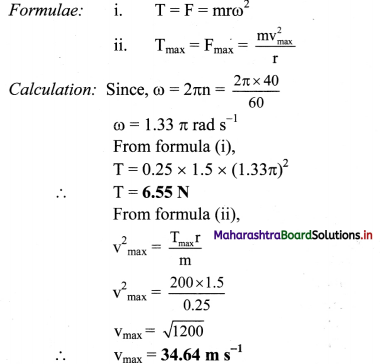
  3. Symbols for units do not take plural form.
  4. Symbols for units do not contain any full stops at the end of recommended letter.
  5. The units of physical quantities in numerator and denominator should be written as one ratio. For example the SI unit of acceleration is m/s2 or m s-2 but not m/s/s.
  6. Use of combination of units and symbols for units is avoided when physical quantity is expressed by combination of two. For example, The unit J/kg K is correct while joule/kg K is not correct.
  7. A prefix symbol is used before the symbol of the unit.
    • a. Prefix symbol and symbol of unit constitute a new symbol for the unit which can be raised to a positive or negative power of 10.
      For example,
      1 ms = 1 millisecond = 10-3 s
      1 μs = 1 microsecond = 10-6 s
      1 ns = 1 nanosecond = 10-9 s
    • b. Use of double prefixes is avoided when single prefix is available
      10-6 s = 1 μs and not 1 mms
      10-9 s = 1 ns and not 1 mμs
  8. Space or hyphen must be introduced while indicating multiplication of two units e.g., m/s should be written as m s-1 or m-s-1.

Solved Examples

Question 12.
What is the solid angle subtended by the moon at any point of the Earth, given the diameter of the moon is 3474 km and its distance from the Earth 3.84 × 10⁸ m?
Solution:
Given: Diameter (D) = 3474 km
∴ Radius of moon (R) = 1737 km
= 1.737 × 10⁶ m
Distance from Earth r = 3.84 × 10⁸ m
To find: Solid angle (dΩ)
Formula: dΩ = \(\frac{\mathrm{d} \mathrm{A}}{\mathrm{r}^{2}}\)

Calculation:
From formula,
dΩ = \(\frac{\pi \mathrm{R}^{2}}{\mathrm{r}^{2}}\) ……..( cross-sectional area of disc of moon = πR2)
dΩ = \(\frac{\pi \times\left(1.737 \times 10^{5}\right)^{2}}{\left(3.84 \times 10^{8}\right)^{2}}\)
= \(\frac{3.412 \times(1.737)^{2} \times 10^{10}}{(3.84)^{2} \times 10^{16}}\)
= antilog{log(3.142) + 2log(1.737) – 2log(3.84)} × 10-6
= antilog {0.4972 + 2(0.2397) – 2(0.5843)} × 10-6
= antilog{0.4972 + 0.4794 – 1.1686} × 10-6
= antilog{\(\overline{1}\) .8080} × 10-6
= 6.428 × 10-1 × 10-6
= 6.43 × 10⁻⁵ sr
Solid angle subtended by moon at Earth is 6.43 × 10⁻⁵ sr
[Note: Above answer is obtained substituting value of r as 3.142]

Maharashtra Board Class 11 Physics Important Questions Chapter 1 Units and Measurements

Question 13.
Pluto has mean diameter of 2,300 km and very eccentric orbit (oval shaped) around the Sun, with a perihelion (nearest) distance of 4.4 × 10⁹ km and an aphelion (farthest) distance of 7.3 × 10⁹ km. What are the respective solid angles subtended by Pluto from Earth’s perspective? Assume that distance from the Sun can be neglected.
Solution:
Given: Radius of Pluto. R = \(\frac{2300}{2}\) km
= 1150km
Perihelion distance rp = 4.4 × 10⁹ km
Aphelion distance ra = 7.3 × 10⁹ km
To find: Solid angles (dΩp and dΩa)
Maharashtra Board Class 11 Physics Important Questions Chapter 1 Units and Measurements 8
Solid angle at perihelion distance is 2.146 × 10⁻¹³ sr and at aphelion distance is 7.798 × 10⁻¹⁴ sr.

Question 14.
Define a metre.
Answer:
The metre is the length of the path travelled by light in vacuum during a time interval of 1/299, 792, 458 of a second.
Answer:

Question 15.
What ¡s parallax?
Answer:

  1. Parallax is defined as the apparent change in position of an object due to a change in position of an observer.
  2. Explanation: When a pencil is held in front of our eyes and we look at it once with our left eye closed and then with our right eye closed, pencil appears to move against the background. This effect is called parallax effect.

Question 16.
What is parallax angle?
Answer:
i) Angle between the two directions along which a star or planet is viewed at the two points of observation is called parallax angle (parallactic angle).
Maharashtra Board Class 11 Physics Important Questions Chapter 1 Units and Measurements 9
ii) It is given by θ = \(\frac{b}{D}\)
where, b = Separation between two points of observation.
D = Distance of source from any point of observation.

Question 17.
Explain the method to determine distance of a planet from the Earth.
Answer:

  1. Parallax method is used to determine distance of different planets from the Earth.
  2. To measure the distance ‘D’ of a far distant planet S, select two different observatories (E1 and E2).
  3. The planet should be visible from E1 and E2 observatories simultaneously i.e. at the same time.
  4. E1 and E2 are separated by distance ‘b’ shown in figure.
    ∴ E1E3 = b
    Maharashtra Board Class 11 Physics Important Questions Chapter 1 Units and Measurements 10
  5. The angle between the two directions along which the planet is viewed, can be measured. It is parallax angle, which in this case is L ∠E1E2 = θ
  6. The planet is far away from the (Earth) observers, hence
    b < <D
    ∴ \(\frac{b}{D}\) < < 1 and ‘θ’ is also very small.
    Hence, E1E2 can be considered as arc of length b of circle with S as centre and D as radius.
    :. E1S = E2S = D
    ∴ θ = \(\frac{b}{D}\) . . . .(θ is taken in radian)
    ∴ D = \(\frac{b}{\theta}\)
    Thus, the distance ‘D’ of a far away planet ‘S’ can be determined using the parallax method.

Maharashtra Board Class 11 Physics Important Questions Chapter 1 Units and Measurements

Question 18.
Explain how parallax method is used to measure distance of a star from Earth.
Answer:

  1. The parallax measured from two farthest distance points on Earth for stars will be too small and hence cannot be measured.
  2. Instead, parallax between two farthest points (i.e., 2 ΔU apart) along the orbit of Earth around the Sun (s) is measured.
    Maharashtra Board Class 11 Physics Important Questions Chapter 1 Units and Measurements 11

Question 19.
Explain how size of a planet or star is measured.
Answer:

  1. To determine the diameter (d) of a planet or star, two diametrically opposite points of the planet are viewed from the same observatory.
  2. If d is diameter of planet or star, angle subtended by it at any single point on the Earth is called angular diameter of planet.
  3. Let angle α be angle between these two directions.
  4. If distance between the Earth and planet or star (D) is known, α = \(\frac{\mathrm{d}}{\mathrm{D}}\)
  5. This relation gives, d = α D
    Thus, diameter (d) of planet or star can be determined.

Question 20.
Name the devices used to measure very small distances such as atomic size.
Answer:
Devices used are:
Electron microscope, tunnelling electron microscope.

Question 21.
Just as large distances are measured in AU, parsec or light year, atomic or nuclear distances are measured with the help of microscopic units. Match the units given in column A with their corresponding SI unit given in column B.
Maharashtra Board Class 11 Physics Important Questions Chapter 1 Units and Measurements 39
Answer:
i. – (b)
ii. – (a)

Solved Examples

Question 22.
A star is 5.5 light years away from the Earth. How much parallax in arcsec will it subtend when viewed from two opposite points along the orbit of the Earth?
Maharashtra Board Class 11 Physics Important Questions Chapter 1 Units and Measurements 12
Solution:
Two opposite points-A and B along the orbit of the Earth are 2 AU apart. The angle subtended by AB at the position of the star is
Maharashtra Board Class 11 Physics Important Questions Chapter 1 Units and Measurements 13
= antilog{log(2.992) – log(5.5) – log(9.46)} × 10-4
= antilog {0.4761 – 0.7404 – 0.9759} × 10-4
= antilog {\(\overline{2}\).7598} × 10-4
= 5.751 × 10-2 × 10-4
= 5.75 × 10-6
= 5.75 × 10⁻⁶ rad
= 5.75 × 10-6 × 57.297 × 60 × 60 arcsec
…. (converting radian into arcsecond)
= 1.186 arcsec
Parallax is 1.186 arcsec

Question 23.
The moon is at a distance of 3.84 × 10⁸ m from the Earth. If viewed from two diametrically opposite points on the Earth, the angle subtended at the moon is 1° 54′. What is the diameter of the Earth?
Solution:
Given
Distance (D) = 3.84 × 10⁸ m
Subtended angle (α)
= 1° 54′ = (60’+ 54′)= 114′
= 114 × 2.91 × 10-4 rad
= 3.317 × 10⁻² rad
To find: Diameter of Earth (d)
Formula: d = αD
Calculation: From formula,
d = 3.317 × 10-2 × 3.84 × 108
= 1.274 × 10⁷ m
Diameter of Earth is 1.274 × 10⁷ m.

Question 24.
Explain the method to measure mass.
Answer:
Method for measurement of mass:

  1. Mass, until recently, was measured with a standard mass of the international prototype of the kilogram (a platinum-iridium alloy cylinder) kept at international Bureau of Weights and Measures, at Serves, near Paris, France.
  2. As platinum – iridium piece was seen to pick up microparticles and found to be affected by atmosphere, its mass could no longer be treated as constant.
  3. Hence, a new definition of mass was introduced in terms of electric current on 20th May 2019.
  4. Now, one kilogram mass is described in terms of amount of current which has to be passed through electromagnet to pull one side of extremely sensitive balance to balance the other side which holds one standard kg mass.
  5. To measure mass of small entities such as atoms and nucleus, atomic mass unit (amu) is used.
    It is defined as (\(\frac{1}{12}\))th mass of an unexcited atom of carbon -12(C12).
    1 amu ≈ 1.66 × 10⁻²⁷ kg.

Maharashtra Board Class 11 Physics Important Questions Chapter 1 Units and Measurements

Question 25.
That can he the reason for choosing Carbon-12 to define atomic mass unit?
Answer:

  1. Unlike oxygen and hydrogen, which exhibit various isotopes in higher proportions, carbon- 12 is the single most abundant (98% of available carbon) isotope of carbon.
  2. it is also very stable.
    Hence, it makes more accurate unit of measuring mass and is used to define atomic mass unit.

Question 26.
Define mean solar day. Explain the method for measurement of time.
Answer:

  1. A mean solar day is the average time interval from one noon to the next noon.
    Method for measurement of time:
  2. The unit of time, the second, was considered to be \(\frac{1}{86400}\) of the mean solar day, where a mean solar day = 24 hours
    = 24 × 60 × 60
    = 86400 s
  3. However, this definition proved to be unsatisfactory to define the unit of time precisely because solar day varies gradually due to gradual slowing down of the Earth’s rotation. Hence, the definition of second was replaced by one based on atomic standard of time.
  4. Atomic standard of time is now used for the measurement of time. In atomic standard of time, periodic vibrations of caesium atom is used.
  5. One second is time required for 9,192.631,770 vibrations of the radiation corresponding to transition between two hyperfine energy states of caesium-133 (Cs- 133) atom.

Maharashtra Board Class 11 Physics Important Questions Chapter 1 Units and Measurements

Question 27.
Define dimensions and dimensional formula of physical quantities. Give few examples of dimensional formula.
Answer:

  1. Dimensions:
    The dimensions of a physical quantity are the powers to which the fundamental units must be raised in order to obtain the unit of a given physical quantity.
  2. Dimensional formula:
    When any derived quantity is represented with appropriate powers of symbols of the fundamental quantities, SUCh an expression is called dimensional formula.
    It is expressed by square bracket with no comma in between the symbols.
  3. Examples of dimensional formula:
    a. Speed = \(\frac{\text { Distance }}{\text { time }}\)
    ∴ Dimensions of speed = \(\frac{[\mathrm{L}]}{[\mathrm{T}]}\) = [L1M0T-1]
    [Note: As power of M is zero, it can be omitted from dimensional formula. Therefore, dimensions of speed can be written as [L1T1]
    Maharashtra Board Class 11 Physics Important Questions Chapter 1 Units and Measurements 14

Question 28.
A book with many printing errors contains four different formulae for the displacement y of a particle undergoing a certain periodic function:
i) y = a sin \(\frac{2 \pi t}{T}\)
ii) y = a sin v t
iii) y = \(\frac{\mathrm{a}}{\mathbf{T}} \sin \frac{\mathrm{t}}{\mathrm{a}}\)
iv) y = \(\frac{a}{\sqrt{2}}\left[\sin \frac{2 \pi t}{T}+\cos \frac{2 \pi t}{T}\right]\)
Here, a is maximum displacement of particle, y ¡s speed of particle, T is time period of motion. Rule out the wrong formulae on dimensional grounds.
Answer:
The argument of trigonometrical function, i.e., angle is dimensionless. Now,
i) The argument, \(\left[\frac{2 \pi \mathrm{t}}{\mathrm{T}}\right]=\frac{[\mathrm{T}]}{[\mathrm{T}]}\) = 1 = [L0M0T0]
which is a dimensionless quantity.
Hence, formula (i) is correct.

ii) The argument,
[vt] = [LT-1] [T] = [L] = [L1M0T0]
which is not a dimensionless quantity.
Hence, formula (ii) is incorrect.

iii) The argument,
\(\left[\frac{\mathrm{t}}{\mathrm{a}}\right]=\frac{[\mathrm{T}]}{[\mathrm{L}]}\) = [L-1M0T1]
which is not a dimensionless quantity.
Hence, formula (iii) is incorrect.

iv) The argument,
\(\left[\frac{2 \pi \mathrm{t}}{\mathrm{T}}\right]=\frac{[\mathrm{T}]}{[\mathrm{T}]}\) = 1 = [L0M0T0]
which is a dimensionless quantity.
Hence, formula (iv) is correct.

Question 29.
State principle of homogeneity of dimensions.
Answer:
Principle of homogeneity of dimensions: The dimensions of all the terms on the two sides of a physical equation relating different physical quantities must be same.

Maharashtra Board Class 11 Physics Important Questions Chapter 1 Units and Measurements

Question 30.
State the uses of dimensional analysis.
Answer:
Uses of dimensional analysis:

To check the correctness of a physical equation.
Correctness of a physical equation by dimensional analysis:

  1. A physical equation is correct only if the dimensions of all the terms on both sides of that equations are the same.
  2. For example, consider the equation of motion.
    v = u + at ……………. (1)
  3. Writing the dimensional formula of every term, we get
    Dimensions of LH.S. [v] [L1M0T-1],
    Dimensions of R.H.S. = [u] + [at]
    = [L1M0T-1] + [L1M0T-2] [L1M0T-1]
    = [L1M0T-1] + [L1M0T-1]
    ⇒ [L.HS.] = [R.H.S.]
  4. As dimensions of both side of equation is same, physical equation is dimensionally correct.

To derive the relationship between related physical quantities.
Expression for time period of a simple pendulum by dimensional analysis:

  1. Time period (T) of a simple pendulum depends upon length (l) and acceleration due to gravity (g) as follows:
    T ∝ la gb
    i.e., T = k la gb ………… (1)
    where, k = proportionality constant, which is dimensionless.
  2. The dimensions of T = [L0M0T1)
    The dimensions of l = [L1M0T0]
    The dimensions of g = [L1M0T2]
    Taking dimensions on both sides of equation (1),
    [L0M0T1] = [L1M0T0]a [L1M0T-2]b
    [L0M0T1] = [La+bM0T-2b]
  3. Equating corresponding power of L, M and T on both sides, we get
    a + b = 0 …………. (2)
    and -2b = 1
    ∴ b = –\(\frac{1}{2}\)
  4. Substituting ‘b’ in equation (2), we get
    a = \(\frac{1}{2}\)
  5. Substituting values of a and b in equation (1),
    we have,
    Maharashtra Board Class 11 Physics Important Questions Chapter 1 Units and Measurements 15
  6. Experimentally, it ¡s found that k = 2π
    ∴ T = 2π \(\sqrt{\frac{l}{\mathrm{~g}}}\)
    This is the required expression for time period of a simple pendulum.

To find the conversion factor between the units of the same physical quantity in two different systems of units.
Conversion factor between units of same physical quantity:

  1. let ‘n’ be the conversion factor between the units of work.
    ∴ 1 J = n erg ………….. (1)
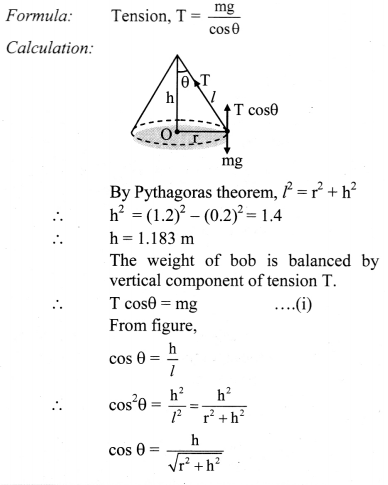
  2. Dimensions of work in S.l. system are \(\left[\mathrm{L}_{1}^{2} \mathrm{M}_{1}^{\prime} \mathrm{T}_{1}^{-2}\right]\) and in CGS system are \(\left[\mathrm{L}_{2}^{2} \mathrm{M}_{2}^{1} \mathrm{~T}_{2}^{-2}\right]\)
  3. From (1),
    \(1\left[\mathrm{~L}_{1}^{2} \mathrm{M}_{1}^{1} \mathrm{~T}_{1}^{-2}\right]=\mathrm{n}\left[\mathrm{L}_{2}^{2} \mathrm{M}_{2}^{1} \mathrm{~T}_{2}^{-2}\right]\)
    Maharashtra Board Class 11 Physics Important Questions Chapter 1 Units and Measurements 16
    n= 104 × 103 × 1 = 107
    Hence, the conversion factor, n = 107
    There fore, from equation (1), we have,
    ∴ 1 J = 107 erg.
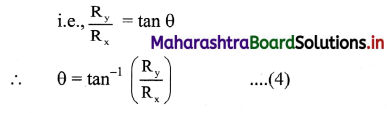
Question 31.
Explain the use of dimensional analysis to check the correctness of a physical equation.
Answer:
Correctness of a physical equation by dimensional analysis:

  1. A physical equation is correct only if the dimensions of all the terms on both sides of that equations are the same.
  2. For example, consider the equation of motion.
    v = u + at ……………. (1)
  3. Writing the dimensional formula of every term, we get
    Dimensions of LH.S. [v] [L1M0T-1],
    Dimensions of R.H.S. = [u] + [at]
    = [L1M0T-1] + [L1M0T-2] [L1M0T-1]
    = [L1M0T-1] + [L1M0T-1]
    ⇒ [L.HS.] = [R.H.S.]
  4. As dimensions of both side of equation is same, physical equation is dimensionally correct.

Question 32.
Time period of a simple pendulum depends upon the length of pendulum (l) and acceleration due to gravity (g). Using dimensional analysis, obtain an expression for time period of a simple pendulum.
Answer:
Expression for time period of a simple pendulum by dimensional analysis:
i) Time period (T) of a simple pendulum depends upon length (l) and acceleration due to gravity (g) as follows:
T ∝ la gb
i.e., T = k la gb ………… (1)
where, k = proportionality constant, which is dimensionless.

ii) The dimensions of T = [L0M0T1)
The dimensions of l = [L1M0T0]
The dimensions of g = [L1M0T2]
Taking dimensions on both sides of equation (1),
[L0M0T1] = [L1M0T0]a [L1M0T-2]b
[L0M0T1] = [La+bM0T-2b]

iii) Equating corresponding power of L, M and T
on both sides, we get
a + b = 0 …………. (2)
and -2b = 1
∴ b = –\(\frac{1}{2}\)

iv) Substituting ‘b’ in equation (2), we get
a = \(\frac{1}{2}\)

v) Substituting values of a and b in equation (1),
we have,
Maharashtra Board Class 11 Physics Important Questions Chapter 1 Units and Measurements 15

vi) Experimentally, it ¡s found that k = 2π
∴ T = 2π \(\sqrt{\frac{l}{\mathrm{~g}}}\)
This is the required expression for time period of a simple pendulum.

Question 33.
Find the conversion factor between the S.I. and the C.OES. units of work using dimensional analysis.
Answer:
Conversion factor between units of same physical quantity:

  1. let ‘n’ be the conversion factor between the units of work.
    ∴ 1 J = n erg ………….. (1)
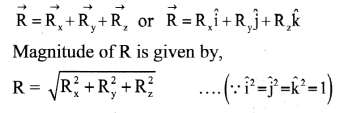
  2. Dimensions of work in S.l. system are \(\left[\mathrm{L}_{1}^{2} \mathrm{M}_{1}^{\prime} \mathrm{T}_{1}^{-2}\right]\) and in CGS system are \(\left[\mathrm{L}_{2}^{2} \mathrm{M}_{2}^{1} \mathrm{~T}_{2}^{-2}\right]\)
  3. From (1),
    \(1\left[\mathrm{~L}_{1}^{2} \mathrm{M}_{1}^{1} \mathrm{~T}_{1}^{-2}\right]=\mathrm{n}\left[\mathrm{L}_{2}^{2} \mathrm{M}_{2}^{1} \mathrm{~T}_{2}^{-2}\right]\)
    Maharashtra Board Class 11 Physics Important Questions Chapter 1 Units and Measurements 16
    n= 104 × 103 × 1 = 107
    Hence, the conversion factor, n = 107
    There fore, from equation (1), we have,
    ∴ 1 J = 107 erg.

Question 34.
State the limitations of dimensional analysis.
Answer:
Limitations of dimensional analysis:

  • The value of dimensionless constant can be obtained with the help of experiments only.
  • Dimensional analysis cannot be used to derive relations involving trigonometric (sin θ, cos θ, etc.), exponential (ex, ex2, etc.), and logarithmic functions (log x, log x3, etc) as these quantities are dimensionless.
  • This method is not useful if constant of proportionality is not a dimensionless quantity.
  • If the correct equation contains some more terms of the same dimension, it is not possible to know about their presence using dimensional equation.

Maharashtra Board Class 11 Physics Important Questions Chapter 1 Units and Measurements

Question 35.
If two quantities have same dimensions, do they always represent the same physical content?
Answer:
When dimensions of two quantities are same, they do not always represent the same physical content.
Example:
Force and momentum both have same dimensions but they represent different physical content.

Question 36.
A dimensionally correct equation need not actually be a correct equation but dimensionally incorrect equation is necessarily wrong. Justify.
Answer:
i) To justify a dimensionally correct equation need not be actually a correct equation, consider equation, v2 = 2as
Dimensions of L.H.S. = [v2] = [L2M0T2]
Dimensions of R.H.S. = [as]= [L2M0T2]
⇒ [L.H.S.] = [R.H.S.]
This implies equation v2 = 2as is dimensionally correct.
But actual equation is, v2 = u2 + 2as
This confirms a dimensionally correct equation need not be actually a correct equation.

ii) To justify dimensionally incorrect equation is necessarily wrong, consider the formula,
\(\frac{1}{2}\) mv = mgh
Dimensions of L.H.S. = [mv] = [L1M1T-1]
Dimensions of R.H.S. = [mgh] = [L2M1T-2]
Since the dimensions of R.H.S. and L.H.S. are not equal, the formula given by equation must be incorrect.
This confirms dimensionally incorrect equation is necessarily wrong.

Question 37.
State, whether all constants are dimensionless or unitless.
Answer:
All constants need not be dimensionless or unitless.
Planck’s constant, gravitational constant etc., possess dimensions and units. They are dimensional constants.

Solved Examples

Question 38.
If length ‘L’, force ‘F’ and time ‘T’ are taken as fundamental quantities, what would be the dimensional equation of mass and density?
Solution:
i) Force = Mass × Acceleration Force
Maharashtra Board Class 11 Physics Important Questions Chapter 1 Units and Measurements 17
∴ Dimensional equation of mass
Maharashtra Board Class 11 Physics Important Questions Chapter 1 Units and Measurements 18
= [F1L-4T2]

i) The dimensional equation of mass is [F1L-1T2].
ii) The dimensional equation of density is [F1L-4T2].

Question 39.
A calorie is a unit of heat and it equals 4.2 J, where 1 J = kg m2 s-2. A distant civilisation employs a system of units in which the units of mass, length and time are α kg, β m and δ s. Also J’ is their unit of energy. What will be the magnitude of calorie in their units?
Solution:
1 cal = 4.2 kg m2 s-2
Maharashtra Board Class 11 Physics Important Questions Chapter 1 Units and Measurements 19
New unit of energy is J’
Dimensional formula of energy is [L2M1T-2] According to the question,
Maharashtra Board Class 11 Physics Important Questions Chapter 1 Units and Measurements 20

Question 40.
Assume that the speed (v) of sound in air depends upon the pressure (P) and density (ρ) of air, then use dimensional analysis to obtain an expression for the speed of sound.
Solution:
It is given that speed (v) of sound in air depends upon the pressure (P) and density (ρ) of the air.
Hence, we can write, v = k Pa ρb ……….. (1)
where, k is a dimensionless constant and a and b are powers to be determined.
Dimensions of y = [L1M0T-1]
Dimensions of P = [L-1M1T-2]
Dimensions of ρ = [L-3M1T0]
Substituting the dimensions of the quantities on both sides of equation (1),
∴ [L1M0T-1] = [L-1M1T-2]a [L-3M1T0]b
∴ [L1M0T-1] = [L-aMaT-2a] [L-3bMbT0]
∴ [L1M0T-1] = [L-a-3bMa+bT-2a]
Comparing the powers of L, M and T on both sides, we get,
-2a = -1
∴ a = \(\frac{1}{2}\)
Also, a + b = O
∴ \(\frac{1}{2}\) + b = 0 b = – \(\frac{1}{2}\)
Substituting values of a and b in equation (1), we get
y = k P\(\frac{1}{2}\) ρ–\(\frac{1}{2}\)
∴ v = k \(\sqrt{\frac{\mathrm{p}}{\rho}}\)

Maharashtra Board Class 11 Physics Important Questions Chapter 1 Units and Measurements

Question 41.
Density of oil is 0.8 g cm3 in C.G.S. unit. Find its value in S.I. units.
Solution:
Dimensions of density is [L-3M1T0]
Maharashtra Board Class 11 Physics Important Questions Chapter 1 Units and Measurements 21
= 0.8 [10-3] [10-2]-3
= 0.8 [10-3] [10]6
n = 0.8 × 10³
Substituting the value of ‘n’ in equation (1).
we get, 0.8 g cm3 = 0.8 × 10³ kg m-3.
Density of oil in S.l unit is 0.8 × 10³ kg m-3.

Question 42.
The value of G in C.G.S system is 6.67 × 10⁻⁸ dyne cm2 g-2. Calculate its value in S.l. system.
Solution:
Dimensional formula of gravitational constant
[L3M-1T-2]
Maharashtra Board Class 11 Physics Important Questions Chapter 1 Units and Measurements 22
n = 6.67 × 10-8 × 10-6 × 10³
n = 6.67 × 10⁻¹¹
From equation (1),
6.67 × 10⁻⁸ dyne cm2 g-2
= 6.67 × 10⁻¹¹ N-m2 kg-2
Value ofG in S.l. system is 6.67 × 10⁻¹¹ N-m2 kg-2.

Question 43.
What is accuracy?
Answer:
Accuracy is how close a measurement is to the actual value of that quantity.

Question 44.
What is precision?
Answer:
Precision is a measure of how consistently a device records nearly identical values i.e., reproducible results.

Question 45.
A scale in a lab measures the mass of object consistently more by 500 g than their actual mass. How would you describe the scale in terms of accuracy and precision?
Answer:
The scale is precise but not accurate.
Explanation: Precision measures how consistently a device records the same answer; even though it displays the wrong value. Hence, the scale is precise.

Accuracy is how well a device measures something against its accepted value. As scale in the lab is always off by 500 g, it is not accurate.
[Note: The goal of the observer should be to get accurate as well as precise measurements.]

Question 46.
List reasons that may introduce possible uncertainties in an observation.
Answer:
Possible uncertainties in an observation may arise due to following reasons:

  1. Quality of instrument used,
  2. Skill of the person doing the experiment,
  3. The method used for measurement,
  4. External or internal factors affecting the result of the experiment.

Question 47.
What is systematic error? Classify errors into different categories.
Answer:

  1. Systematic errors are errors that are not determined by chance but are introduced by an inaccuracy (involving either the observation or measurement process) inherent to the system.
  2. Classification of errors:
    Errors are classified into following two groups:
  3. Systematic errors:
    • Instrumental error (constant error),
    • Error due to imperfection in experimental technique,
    • Personal error (human error).
  4. Random error (accidental error)

Maharashtra Board Class 11 Physics Important Questions Chapter 1 Units and Measurements

Question 48.
What is instrumental (constant) error?
Answer:
Instrumental error:

  1. It arises due to defective calibration of an instrument.
  2. Example: If a thermometer is not graduated properly, i.e., one degree on the thermometer actually corresponds to 0.99°, the temperature measured by such a thermometer will differ from its value by a constant amount.

Question 49.
What is error due to imperfection in experimental technique?
Answer:
Error due to imperfection in experimental technique:

  • The errors which occur due to defective setting of an instrument is called error due to imperfection in experimental technique.
  • For example the measured volume of a liquid in a graduated tube will be inaccurate if the tube is not held vertical.

Question 50.
What is personal error?
Answer:
Personal error (Human error):

  • The errors introduced due to fault of an observer taking readings are called personal errors.
  • For example, while measuring the length of an object with a ruler, it is necessary to look at the ruler from directly above. If the observer looks at it from an angle, the measured length will be wrong due to parallax.

Maharashtra Board Class 11 Physics Important Questions Chapter 1 Units and Measurements

Question 51.
What is random error (accidental)?
Answer:

  1. Random error (accidental):
    The errors which are caused due to minute change in experimental conditions like temperature, pressure change in gas or fluctuation in voltage, while the experiment is being performed are called random errors.
  2. They can be positive or negative.
  3. Random error cannot be eliminated completely but can be minimized by taking multiple observations and calculating their mean.

Question 52.
State general methods to minimise effect of systematic errors.
Answer:
Methods to minimise effect of systematic errors:

  1. By using correct instrument.
  2. Following proper experimental procedure.
  3. Removing personal error.

Question 53.
Define the term:
Arithmetic mean
Answer:
Arithmetic mean:
a. The most probable value of a large number of readings of a quantity is called the arithmetic mean value of the quantity. This value can be considered to be true value of the quantity.

b. If a1, a2, a3, …………… an are ‘n’ number of readings taken for measurement of a quantity, then their mean value is given by,
amean = \(\frac{a_{1}+a_{2}+\ldots \ldots .+a_{n}}{n}\)
∴ amean = \(\frac{1}{n} \sum_{i=1}^{n} a_{i}\)

Question 54.
What does a = amean ± ∆amean signify?
Answer:
a = amean ± ∆ amean signifies that the actual value of a lies between (amean – ∆ amean) and (amean + ∆ amean).

Question 55.
What is meant by the term combination of errors?
Answer:
Derived quantities may get errors due to individual errors of fundamental quantities, such type of errors are called as combined errors.

Question 56.
Explain errors in sum and in difference of measured quantity.
Answer:
Errors in sum and in difference:
i) Suppose two physical quantities A and B have measured values A ± ∆A and B ± ∆B. respectively, where ∆A and ∆B are their mean absolute errors.

ii) Then, the absolute error ∆Z in their sum.
Z = A + B
Z ± ∆Z = (A ± ∆A) + (B ± ∆B)
= (A + B) ± ∆A ± ∆B
∴ ± ∆Z = ± ∆A ± ∆B.

iii) For difference. i.e.. if Z = A – B.
Z ± ∆Z = A ± ∆A) – (B ± ∆B)
= (A – B) ± ∆A ∓ ∆B
∴ ± ∆Z = ± ∆A ∓ ∆B,

iv) There are four possible values for ∆Z. namely (+∆A – ∆B), (+∆A + ∆B), (-∆A -∆B), (-∆A + ∆B). Hence, maximLim value of absolute error is ∆Z = (∆A+ ∆B) in both the cases.

v) Thus. when two quantities are added or subtracted, the absolute error in the final result is the sum of the absolute errors in the individual quantities.

Maharashtra Board Class 11 Physics Important Questions Chapter 1 Units and Measurements

Question 57.
Explain errors in product of measured quantity.
Answer:
Errors in product:
i) Suppose Z = AB and measured values of A and B are (A ± ∆A) and (B ± ∆B) then,
Z ± ∆Z = (A ± ∆A) (B ± ∆B)
= AB ± A∆B ± B∆A ± ∆A∆B
Dividing L.H.S by Z and R.H.S. by AB we get
\(\left(1 \pm \frac{\Delta Z}{Z}\right)=\left[1 \pm \frac{\Delta B}{B} \pm \frac{\Delta A}{A} \pm\left(\frac{\Delta A}{A}\right)\left(\frac{\Delta B}{B}\right)\right]\)
Since ∆A/A and ∆B/B are very small, product is neglected. Hence, maximum relative error in Z is \(\frac{\Delta Z}{Z}=\frac{\Delta A}{A}+\frac{\Delta B}{B}\)

ii) Thus, when two quantities are multiplied, the maximum relative error in the result is the sum of relative errors in each quantity.

Question 58.
Explain errors due to power (index) of measured quantity.
Answer:
Errors due to the power (index) of measured quantity:

  1. Suppose
    Z = A3 = A × A × A
    then, \(\)
  2. Hence the relative error in Z = A3 is three times the relative error in A.
  3. This means if Z = An
    Maharashtra Board Class 11 Physics Important Questions Chapter 1 Units and Measurements 23
  4. This implies, the quantity in the formula which has large power is responsible for maximum error.

Question 59.
The radius of a sphere measured repeatedly yields values 5.63 m, 5.54 m, 5.44 m, 5.40 m and 5.35 m. Determine the most probable value of radius and the mean absolute, relative and percentage errors.
Solution:
Given: a1 = 5.63 m, a2 = 5.54 m, a3 = 5.44 m
a4 = 5.40 m, a5 = 5.35 m,
To find:
i) Most probable value (Mean value)
ii) Mean absolute error
iii) Relative error
iv) Percentage error
Maharashtra Board Class 11 Physics Important Questions Chapter 1 Units and Measurements 24
From formula (ii),
Absolute errors:
∆a1 = |amean – a1| = |5.472 – 5.63| = 0.158
∆a2 = |amean – a2| = |5.472 – 5.54| = 0.068
∆a3 = |amean – a3| = |5.472 – 5.44| = 0.032
∆a4 = |amean – a4| = |5.472 – 5.40| = 0.072
∆a5 = |amean – a5| = |5.472 – 5.35| = 0.122

From formula (ii),
∆amean = \(\frac{0.158+0.068+0.032+0.072+0.122}{5}\)
= \(\frac{0.452}{5}\)
= 0.0904 m
From formula (iii),
Relative error = \(\frac{0.0904}{5.472}\)
= 1.652 × 10⁻²
(after rounding off to correct significant digits)
= 1.66 × 10-2
= 0.0166
∴ Percentage error = 1.66 × 10-2 × 100 = 1.66%
i) The mean value is 5.472 m.
ii) The mean absolute error is 0.0904 m.
iii) The relative error is 0.0166.
iv) The percentage error is 1.66%
[Note: Answer to relative error is rounded off using rules of significant figures and of rounding off]

Question 60.
Lin an experiment to determine the volume of an object, mass and density are recorded as m = (5 ± 0.15) kg and p = (5 ± 0.2) kg m3 respectively. Calculate percentage error in the measurement of volume.
Solulion:
Given: M = 5kg, ∆M = 0.15 kg, ρ = 5 kg/m3,
∆ρ = 0.2 kg/m3
To find: Percentage error in volume (V)
Maharashtra Board Class 11 Physics Important Questions Chapter 1 Units and Measurements 25
The percentage error in the determination of volume is 7%.

Maharashtra Board Class 11 Physics Important Questions Chapter 1 Units and Measurements

Question 61.
The acceleration due to gravity is determined by using a simple pendulum of length l = (100 ± 0.1) cm. If its time period is T = (2 ± 0.01) s, find the maximum percentage error in the measurement of g.
Solution:
Given: ∆l = 0.1 cm, l = 100 cm, ∆T = 0.01 s,
T = 2s
To find: Percentage error
Maharashtra Board Class 11 Physics Important Questions Chapter 1 Units and Measurements 26
Percentage error in measurement of g is 1.1 %.

Question 62.
Find the number of significant figures in the following numbers,
i. 25.42
ii. 0.004567
iii. 35.320
iv. 91.000
Answer:
Maharashtra Board Class 11 Physics Important Questions Chapter 1 Units and Measurements 27

Solved Examples

Question 63.
Add 7.21, 12.141 and 0.0028 and express the result to an appropriate number of significant figures.
Solution:
Maharashtra Board Class 11 Physics Important Questions Chapter 1 Units and Measurements 28
In the given problem, minimum number of digits after decimal is 2.
∴ Result will be rounded off upto two places of decimal.
Corrected rounded off sum is 19.35.

Question 64.
The mass of a box measured by a grocer’s balance is 2.3 kg. Two gold pieces of masses 20.15 g and 20.17 g are added to the box. What is (i) the total mass of the box? (ii) the difference in the masses of the pieces to correct significant figures?
Solution:
i) Total mass of the box
= (2.3+ 0.02017 + 0.02015) kg
= 2.34032 kg
Since, the last number of significant figure is 2, therefore, the total mass of the box = 2.3 kg

ii) Difference of mass = (20.17 – 20.15) = 0.02g Since, there are two significant figures so the difference in masses to the correct significant figures is 0.02 g.

i) The total mass of the box to correct significant figures is 2.3 kg.
ii) The difference in the masses to correct significant figures is 0.02 g.

Apply Your Knowledge

Question 65.
Write the dimensions of a and b in the relation
E = \(\frac{b-x^{2}}{a}\)
Where E is energy, x ¡s distance and t is time.
Answer:
The given relation is E = \(\frac{b-x^{2}}{a}\)
As x is subtracted from b,
∴ dimensions of b are x2;
i.e., b = [L2]
∴ We can write equation as E = \(\frac{\mathrm{L}^{2}}{\mathrm{a}}\)
Or a = \(\frac{\mathrm{L}^{2}}{\mathrm{E}}=\frac{\mathrm{L}^{2}}{\left[\mathrm{~L}^{2} \mathrm{MT}^{-2}\right]}\) = [L0M-1T2]

Maharashtra Board Class 11 Physics Important Questions Chapter 1 Units and Measurements

Question 66.
What is the difference between 6.0 and 6.00? which Is more accurate?
Answer:
6.0 indicates the measurement is correct up to first decimal place, whereas 6.00 indicates that the measurement is correct up to second decimal place. Thus, 6.00 is a more accurate value than 6.0.

Question 67.
A child walking on a footpath notices that the width of the footpath is uneven. He reported this to his school principal and the complaint was forwarded to the municipal officer.
i. What is the possible error encountered?
ii. What is the relative error in width of footpath if width of footpath in 10 m length are noted as 5 m, 5.5 m, 5 m, 6 m and 4.5 m?
Answer:
i) The error encountered is personal error.

ii) Mean value of widths
Maharashtra Board Class 11 Physics Important Questions Chapter 1 Units and Measurements 29
The relative error in width of footpath is 0.084.

Question 68.
A factory owner kept five identical spheres between two wooden blocks on a ruler as shown in figure. He called all his workers and told them to take reading, to check their efficiency and knowledge.
Maharashtra Board Class 11 Physics Important Questions Chapter 1 Units and Measurements 30
i. What is the area of central sphere?
ii. What is the absolute error in reading of diameter of second sphere?
Answer:
i) From above diagram radius of central sphere is
r = 1 cm
∴ Area = πr2 = 3.142 × (1)2= 3.142 cm2
The area of central sphere is 3.142 cm2.

ii) Mean value of all reading of diameters
dmean = \(\frac{\mathrm{d}_{1}+\mathrm{d}_{2}+\mathrm{d}_{3}+\mathrm{d}_{4}+\mathrm{d}_{5}}{5}=\frac{2+2+2+2+2}{5}\)
= \(\frac{10}{5}\) = 2 cm
Absolute error in reading of second sphere.
∆d2 = |dmean – d2| = 2 – 2 = 0
The absolute error in reading of diameter of second sphere is zero.

Maharashtra Board Class 11 Physics Important Questions Chapter 1 Units and Measurements

Question 69.
A potential difference of V = 100 ± 2 volt, when applied across a resistance R gives a current of 10 ± 0.5 ampere. Calculate percentage error in R given by R V/I.
Answer:
Here. V = 100 ± 2 volt and I = 10 ± 0.5 ampere
Expressing limits of error as percentage error,
We have
V = 100 volt ± \(\frac{2}{100}\) × 100% = 10 volt ± 2%
and I = 10 ampere ± \(\frac{0.5}{10}\) × 100%
= 10 ampere ± 5%
∴ R = \(\frac{V}{I}\)
∴ %error in R = %error in V + %error in I
= 2% + 5% = 7%

Quick Review

Maharashtra Board Class 11 Physics Important Questions Chapter 1 Units and Measurements 31
Maharashtra Board Class 11 Physics Important Questions Chapter 1 Units and Measurements 32

Multiple Choice Questions

Question 1.
A physical quantity may be defined as
(A) the one having dimension.
(B) that which is immeasurable.
(C) that which has weight.
(D) that which has mass.
Answer:
(A) the one having dimension.

Question 2.
Which of the following is the fundamental unit?
(A) Length, force, time
(B) Length, mass, time
(C) Mass, volume, height
(D) Mass, velocity, pressure
Answer:
(B) Length, mass, time

Question 3.
Which of the following is NOT a fundamental quantity?
(A) Temperature
(B) Electric charge
(C) Mass
(D) Electric current
Answer:
(B) Electric charge

Question 4.
The distance of the planet from the earth is measured by __________.
(A) direct method
(B) directly by metre scale
(C) spherometer method
(D) parallax method
Answer:
(D) parallax method

Maharashtra Board Class 11 Physics Important Questions Chapter 1 Units and Measurements

Question 5.
The two stars S1 and S2 are located at distances d1 and d2 respectively. Also if d1 > d22 then following statement is true.
(A) The parallax of S1 and S2 are same.
(B) The parallax of S1 is twice as that of S2
(C) The parallax of S1 is greater than parallax of S2
(D) The parallax of S2 is greater than parallax of S1
Answer:
(D) The parallax of S2 is greater than parallax of S1

Question 6.
Which of the following is NOT a unit of time?
(A) Hour
(B) Nano second
(C) Microsecond
(D) parsec
Answer:
(D) parsec

Question 7.
An atomic clock makes use of _________.
(A) cesium-133 atom
(B) cesium-132 atom
(C) cesium-123 atom
(D) cesium-131 atom
Answer:
(A) cesium-133 atom

Question 8.
S.I. unit of energy is joule and it is equivalent to
(A) 106 erg
(B) 10-7 erg
(C) 107 erg
(D) 105 erg
Answer:
(C) 107 erg

Question 9.
[L1M1T-1] is an expression for __________.
(A) force
(B) energy
(C) pressure
(D) momentum
Answer:
(D) momentum

Question 10.
Dimensions of sin θ is
(A) [L2]
(B) [M]
(C) [ML]
(D) [M0L0T0]
Answer:
(D) [M0L0T0]

Question 11.
Accuracy of measurement is determined by
(A) absolute error
(B) percentage error
(C) human error
(D) personal error
Answer:
(B) percentage error

Question 12.
Zero error of an instrument introduces .
(A) systematic error
(B) random error
(C) personal error
(D) decimal error
Answer:
(A) systematic error

Maharashtra Board Class 11 Physics Important Questions Chapter 1 Units and Measurements

Question 13.
The diameter of the paper pin is measured accurately by using ________.
(A) Vernier callipers
(B) micrometer screw gauge
(C) metre scale
(D) a measuring tape
Answer:
(B) micrometer screw gauge

Question 14.
The number of significant figures in 11.118 × 10⁻⁶ is
(A) 3
(B) 4
(C) 5
(D) 6
Answer:
(C) 5

Question 15.
0.00849 contains ___________ significant figures.
(A) 6
(B) 5
(C) 3
(D) 2
Answer:
(C) 3

Question 16.
3.310 × 10² has ___________ significant figures.
(A) 6
(B) 4
(C) 2
(D) 1
Answer:
(B) 4

Question 17.
The Earth’s radius is 6371 km. The order of magnitude of the Earth’s radius is
(A) 103 m
(B) 109 m
(C) 107 m
(D) 102 m
Answer:
(C) 107 m

Maharashtra Board Class 11 Physics Important Questions Chapter 1 Units and Measurements

Question 18.
__________ is the smallest measurement that can be made using the given instrument
(A) Significant number
(B) Least count
(C) Order of magnitude
(D) Relative error
Answer:
(B) Least count

Competitive Corner

Question 1.
In an experiment, the percentage of error occurred in the measurement of physical quantities A, B, C and D are 1%, 2%, 3% and 4% respectively. Then the maximum percentage of error in the measurement X,
where X = \(\frac{A^{2} \frac{1}{B^{2}}}{C^{\frac{1}{3}} D^{3}}\), will be:
(A) -10 %
(B) 10 %
(C) \(\left(\frac{3}{13}\right) \%\)
(D) 16 %
Answer:
(D) 16 %
Hint:
Maharashtra Board Class 11 Physics Important Questions Chapter 1 Units and Measurements 33
Maharashtra Board Class 11 Physics Important Questions Chapter 1 Units and Measurements 34
∴ Percentage error in x is given as,
\(\frac{\Delta x}{x}\) × 100 – (error contributed by A) – (error contributed by B) + (error contributed by C) + (error contributed by D)
= 2% + 1% + 1% + 12%
= 16%

Question 2.
The main scale of a vernier callipers has n divisions/cm. n divisions of the vernier scale coincide with (n – 1) divisions of main scale. The least count of the vernier callipers is,
(A) \(\frac{1}{n(n+1)}\) cm
(B) \(\frac{1}{(n+1)(n-1)}\) cm
(C) \(\frac{1}{n}\) cm
(D) \(\frac{1}{n^{2}}\) cm
Answer:
(D) \(\frac{1}{n^{2}}\) cm
Hint:
1 V.S.D. = \(\frac{(n-1)}{n}\) M.S.D.
LC. = 1 M.S.D. – 1 V.S.D.
= 1 M.S.D. – \(\frac{(n-1)}{n}\) M.S.D.
= \(\frac{1}{n}\) M.S.D.
= \(\frac{1}{n}\) × \(\frac{1}{n}\) cm
∴ L.C. = \(\frac{1}{n^{2}}\) cm

Question 3.
A student measures time for 20 oscillations of a simple pendulum as 30 s. 32 s, 35 s and 31 s. 1f the minimum division in the measuring clock is I s, then correct mean time in second is
(A) 32 ± 3
(B) 32 ± 1
(C) 32 ± 2
(D) 32 ± 5
Answer:
(C) 32 ± 2
Hint:
Maharashtra Board Class 11 Physics Important Questions Chapter 1 Units and Measurements 35
Hence rounding off,
∆t = ± 2 s
∴ t ± ∆t = 32 ± 2 s

Question 4.
A student measured the diameter of a small steel ball using a screw gauge of least count 0.001 cm. The main scale reading is 5 mm and zero of circular scale division coincides with 25 divisions above the reference leveL If screw gauge has a zero error of— 0.004 cm, the correct diameter of the ball is
(A) 0.521 cm
(B) 0.525 cm
(C) 0.053 cm
(D) 0.29 cm
Answer:
(D) 0.29 cm

Hint:
Least count of screw gauge = 0.001 cm = 0.01mm
Main scale reading = 5 mm.
Zero error = – 0.004 cm = -0.04 mm
Zero correction = +0.04 mm
Observed reading = Mainscale reading + (Division × least count)
Observed reading = 5 + (25 × 0.01) = 5.25 mm
Corrected reading = Observed reading + Zero correction
Corrected reading = 5.25 + 0.04
= 5.29 mm = 0.529 cm

Maharashtra Board Class 11 Physics Important Questions Chapter 1 Units and Measurements

Question 5.
The density of the material in the shape of a cube is determined by measuring three sides of the cube and its mass. 1f the relative errors in measuring the mass and length are respectively 1.5% and 1%, the maximum error in determining the density is:
(A) 4.5%
(B) 6%
(C) 2.5°
(D) 3.5%
Answer:
(A) 4.5%
Maharashtra Board Class 11 Physics Important Questions Chapter 1 Units and Measurements 36

Question 6.
Let x = \(\left[\frac{a^{2} b^{2}}{c}\right]\) be the physical quantity. If the percentage error in the measurement of physical quantities a, b and c is 2, 3 and 4 percent respectively then percentage en-or in the measurement of x is
(A) 7%
(B) 14%
(C) 21%
(D) 28%
Answer:
(B) 14%
Hint:
Given: x = \(\frac{a^{2} b^{2}}{c}\)
Percentage error is given by.
\(\frac{\Delta x}{x}=\frac{2 \Delta a}{a}+\frac{2 \Delta b}{b}+\frac{\Delta c}{c}\)
= (2 × 2) + (2 × 3) + 4
= 4 + 6 + 4 = 14
∴ \(\frac{\Delta \mathrm{x}}{\mathrm{x}} \%\) = 14%

Question 7.
A physical quantity of the dimensions of length that can be formed out of c, G and \(\frac{\mathrm{e}^{2}}{4 \pi \varepsilon_{0}}\) is [c is velocity of light, G is universal constant of gravitation and e is charge]:
Maharashtra Board Class 11 Physics Important Questions Chapter 1 Units and Measurements 37
Answer:
(A) \(\frac{1}{\mathrm{c}^{2}}\left[\mathrm{G} \frac{\mathrm{e}^{2}}{4 \pi \varepsilon_{0}}\right]^{1 / 2}\)

Hint:
Let the physical quantity formed of the dimensions of length be given as.
[L] = [c]x [G]y \(\left[\frac{\mathrm{e}^{2}}{4 \pi \varepsilon_{0}}\right]^{z}\) …………….. (i)
Now,
Dimensions of velocity of light [c]x = [LT-1]x
Dimensions of universal gravitational constant
[G]y = [L3T2M-1]y
Dimensions of \(\left[\frac{\mathrm{e}^{2}}{4 \pi \varepsilon_{0}}\right]^{z}\) = [ML3T-2]z
Substitrning these in equation (i)
[L] [LT-1]x [M-1L3T-2]y [ML3T-2]z
= Lx+3y+3z M-y+z T-x-2y-2z
Solving for x, y, z
x + 3y + 3z = 1
-y + z = 0
x + 2y + 2z = O
Solving the above equation,
x = -2, y = \(\frac{1}{2}\), z = \(\frac{1}{2}\)
∴ L = \(\frac{1}{c^{2}}\left[\mathrm{G} \frac{\mathrm{e}^{2}}{4 \pi \varepsilon_{0}}\right]^{1 / 2}\)

Maharashtra Board Class 11 Physics Important Questions Chapter 1 Units and Measurements

Question 8.
The following observations were taken for determining surface tension T of water by capillary method:
diameter of capillary, D = 1.25 × 10⁻² m
rise of water, h = 1.45 × 10⁻² m
Using g = 9.80 m/s2 and the simplified relation
T = \(\frac{\mathrm{rhg}}{2}\) × 103 N/m, the possible error in surface tension is closest to:
(A) 0.15%
(B) 1.5%
(C) 2.4%
(D) 10%
Answer:
(B) 1.5%
Hint:
D = 1.25 × 10⁻² m; h = 1.45 × 10⁻² m
The maximum permissible error in D
= ∆D = 0.01 × 10⁻² m
The maximum permissible error in h
= ∆h = 0.01 × 10⁻² m
g is given as a constant and is errorless.
Maharashtra Board Class 11 Physics Important Questions Chapter 1 Units and Measurements 38

Maharashtra Board 12th Maths Solutions Chapter 8 Binomial Distribution Ex 8.1

Balbharti 12th Maharashtra State Board Maths Solutions Book Pdf Chapter 8 Binomial Distribution Ex 8.1 Questions and Answers.

Maharashtra State Board 12th Maths Solutions Chapter 8 Binomial Distribution Ex 8.1

Question 1.
A die is thrown 6 times. If ‘getting an odd number’ is a success, find the probability of
(i) 5 successes
(ii) at least 5 successes
(iii) at most 5 successes.
Solution:
Let X = number of successes, i.e. number of odd numbers.
p = probability of getting an odd number in a single throw of a die
∴ p = \(\frac{3}{6}=\frac{1}{2}\) and q = 1 – p = 1 – \(\frac{1}{2}\) = \(\frac{1}{2}\)
Given: n = 6
∴ X ~ B(6, \(\frac{1}{2}\))
The p.m.f. of X is given by
Maharashtra Board 12th Maths Solutions Chapter 8 Binomial Distribution Ex 8.1 Q1
Hence, the probability of 5 successes is \(\frac{3}{32}\).

(ii) P(at least 5 successes) = P[X ≥ 5]
= p(5) + p(6)
Maharashtra Board 12th Maths Solutions Chapter 8 Binomial Distribution Ex 8.1 Q1.1
Hence, the probability of at least 5 successes is \(\frac{7}{64}\).

(iii) P(at most 5 successes) = P[X ≤ 5]
= 1 – P[X > 5]
Maharashtra Board 12th Maths Solutions Chapter 8 Binomial Distribution Ex 8.1 Q1.2
Hence, the probability of at most 5 successes is \(\frac{63}{64}\).

Maharashtra Board 12th Maths Solutions Chapter 8 Binomial Distribution Ex 8.1

Question 2.
A pair of dice is thrown 4 times. If getting a doublet is considered a success, find the probability of two successes.
Solution:
Let X = number of doublets.
p = probability of getting a doublet when a pair of dice is thrown
∴ p = \(\frac{6}{36}=\frac{1}{6}\) and
q = 1 – p = 1 – \(\frac{1}{6}\) = \(\frac{5}{6}\)
Given: n = 4
∴ X ~ B(4, \(\frac{1}{6}\))
The p.m.f. of X is given by
Maharashtra Board 12th Maths Solutions Chapter 8 Binomial Distribution Ex 8.1 Q2
Hence, the probability of two successes is \(\frac{25}{216}\).

Question 3.
There are 5% defective items in a large bulk of items. What is the probability that a sample of 10 items will include not more than one defective item?
Solution:
Let X = number of defective items.
p = probability of defective item
∴ p = 5% = \(\frac{5}{100}=\frac{1}{20}\)
and q = 1 – p = 1 – \(\frac{1}{20}\) = \(\frac{19}{20}\)
∴ X ~ B(10, \(\frac{1}{20}\))
The p.m.f. of X is given by
Maharashtra Board 12th Maths Solutions Chapter 8 Binomial Distribution Ex 8.1 Q3
P(sample of 10 items will include not more than one defective item) = P[X ≤ 1]
Maharashtra Board 12th Maths Solutions Chapter 8 Binomial Distribution Ex 8.1 Q3.1
Hence, the probability that a sample of 10 items will include not more than one defective item = 29\(\left(\frac{19^{9}}{20^{10}}\right)\).

Maharashtra Board 12th Maths Solutions Chapter 8 Binomial Distribution Ex 8.1

Question 4.
Five cards are drawn successively with replacement from a well-shuffled deck of 52 cards, find the probability that
(i) all the five cards are spades
(ii) only 3 cards are spades
(iii) none is a spade.
Solution:
Let X = number of spade cards.
p = probability of drawing a spade card from a pack of 52 cards.
Since there are 13 spade cards in the pack of 52 cards.
∴ p = \(\frac{13}{52}=\frac{1}{4}\) and
q = 1 – p = 1 – \(\frac{1}{4}\) = \(\frac{3}{4}\)
Given: n = 5
∴ X ~ B(5, \(\frac{1}{4}\))
The p.m.f. of X is given by
Maharashtra Board 12th Maths Solutions Chapter 8 Binomial Distribution Ex 8.1 Q4
(i) P(all five cards are spade)
Maharashtra Board 12th Maths Solutions Chapter 8 Binomial Distribution Ex 8.1 Q4.1
Hence, the probability of all the five cards are spades = \(\frac{1}{1024}\)

(ii) P(only 3 cards are spade) = P[X = 3]
Maharashtra Board 12th Maths Solutions Chapter 8 Binomial Distribution Ex 8.1 Q4.2
Hence, the probability of only 3 cards are spades = \(\frac{45}{512}\)

(iii) P(none of cards is spade) = P[X = 0]
Maharashtra Board 12th Maths Solutions Chapter 8 Binomial Distribution Ex 8.1 Q4.3
Hence, the probability of none of the cards is a spade = \(\frac{243}{1024}\)

Question 5.
The probability of a bulb produced by a factory will fuse after 150 days of use is 0.05. Find the probability that out of 5 such bulbs
(i) none
(ii) not more than one
(iii) more than one
(iv) at least one, will fuse after 150 days of use.
Solution:
Let X = number of fuse bulbs.
p = probability of a bulb produced by a factory will fuse after 150 days of use.
∴ p = 0.05
and q = 1 – p = 1 – 0.05 = 0.95
Given: n = 5
∴ X ~ B(5, 0.05)
The p.m.f. of X is given by
P(X = x) = \({ }^{n} \mathrm{C}_{x} p^{x} q^{n-x}\)
i.e. p(x) = \({ }^{5} C_{x}(0.05)^{x}(0.95)^{5-x}\), x = 0, 1, 2, 3, 4, 5
(i) P(none of a bulb produced by a factory will fuse after 150 days of use) = P[X = 0]
= p(0)
= \({ }^{5} \mathrm{C}_{0}(0.05)^{0}(0.95)^{5-0}\)
= 1 × 1 × (0.95)5
= (0.95)5
Hence, the probability that none of the bulbs will fuse after 150 days = (0.95)5.

(ii) P(not more than one bulb will fuse after 150 days of j use) = P[X ≤ 1]
= p(0) + p(1)
= \({ }^{5} \mathrm{C}_{0} \cdot(0.05)^{0}(0.95)^{5-0}+{ }^{5} \mathrm{C}_{1}(0.05)^{1}(0.95)^{4}\)
= 1 × 1 × (0.95)5 + 5 × (0.05) × (0.95)4
= (0.95)4 [0.95 + 5(0.05)]
= (0.95)4 (0.95 + 0.25)
= (0.95)4 (1.20)
= (1.2) (0.95)4
Hence, the probability that not more than one bulb will fuse after 150 days = (1.2)(0.95)4.

(iii) P(more than one bulb fuse after 150 days)
= P[X > 1]
= 1 – P[X ≤ 1]
= 1 – (1.2)(0.95)4
Hence, the probability that more than one bulb fuse after 150 days = 1 – (1.2)(0.95)4.

(iv) P(at least one bulb fuse after 150 days)
= P[X ≥ 1]
= 1 – P[X = 0]
= 1 – p(0)
= 1 – \({ }^{5} C_{0}(0.05)^{0}(0.95)^{5-0}\)
= 1 – 1 × 1 × (0.95)5
= 1 – (0.95)5
Hence, the probability that at least one bulb fuses after 150 days = 1 – (0.95)5.

Maharashtra Board 12th Maths Solutions Chapter 8 Binomial Distribution Ex 8.1

Question 6.
A bag consists of 10 balls each marked with one of the digits 0 to 9. If four balls are drawn successively with replacement from the bag, what is the probability that none is marked with the digit 0?
Solution:
Let X = number of balls marked with digit 0.
p = probability of drawing a ball from 10 balls marked with the digit 0.
∴ p = \(\frac{1}{10}\)
and q = 1 – p = 1 – \(\frac{1}{10}\) = \(\frac{9}{10}\)
The p.m.f. of X is given by
Maharashtra Board 12th Maths Solutions Chapter 8 Binomial Distribution Ex 8.1 Q6
P(none of the ball marked with digit 0) = P(X = 0)
Maharashtra Board 12th Maths Solutions Chapter 8 Binomial Distribution Ex 8.1 Q6.1
Hence, the probability that none of the bulb marked with digit 0 is \(\left(\frac{9}{10}\right)^{4}\)

Question 7.
On a multiple-choice examination with three possible answers for each of the five questions. What is the probability that a candidate would get four or more correct answers just by guessing?
Solution:
Let X = number of correct answers.
p = probability that a candidate gets a correct answer from three possible answers.
∴ p = \(\frac{1}{3}\) and q = 1 – p = 1 – \(\frac{1}{3}\) = \(\frac{2}{3}\)
Given: n = 5
∴ X ~ B(5, \(\frac{1}{3}\))
The p.m.f. of X is given by
Maharashtra Board 12th Maths Solutions Chapter 8 Binomial Distribution Ex 8.1 Q7
P(four or more correct answers) = P[X ≥ 4]
= p(4) + p(5)
Maharashtra Board 12th Maths Solutions Chapter 8 Binomial Distribution Ex 8.1 Q7.1
Hence, the probability of getting four or more correct answers = \(\frac{11}{243}\).

Maharashtra Board 12th Maths Solutions Chapter 8 Binomial Distribution Ex 8.1

Question 8.
A person buys a lottery ticket in 50 lotteries, in each of which his chance of winning a prize is \(\frac{1}{100}\), find the probability that he will win a prize
(i) at least once
(ii) exactly once
(iii) at least twice.
Solution:
Let X = number of winning prizes.
p = probability of winning a prize
∴ p = \(\frac{1}{100}\)
and q = 1 – p = 1 – \(\frac{1}{100}\) = \(\frac{99}{100}\)
Given: n = 50
∴ X ~ B(50, \(\frac{1}{100}\))
The p.m.f. of X is given by
\(P(X=x)={ }^{n} C_{x} p^{x} q^{n-x}\)
i.e., p(x) = \({ }^{50} \mathrm{C}_{x}\left(\frac{1}{100}\right)^{x}\left(\frac{99}{100}\right)^{50-x}\), x = 0, 1, 2,… 50
(i) P(a person wins a prize at least once)
Maharashtra Board 12th Maths Solutions Chapter 8 Binomial Distribution Ex 8.1 Q8
Hence, probability of winning a prize at least once = 1 – \(\left(\frac{99}{100}\right)^{50}\)

(ii) P(a person wins exactly one prize) = P[X = 1] = p(1)
Maharashtra Board 12th Maths Solutions Chapter 8 Binomial Distribution Ex 8.1 Q8.1
Hence, probability of winning a prize exactly once = \(\frac{1}{2}\left(\frac{99}{100}\right)^{49}\)

(iii) P(a persons wins the prize at least twice) = P[X ≥ 2]
= 1 – P[X < 2]
= 1 – [p(0) + p(1)]
Maharashtra Board 12th Maths Solutions Chapter 8 Binomial Distribution Ex 8.1 Q8.2
Hence, the probability of winning the prize at least twice = 1 – 149\(\left(\frac{99^{49}}{100^{50}}\right)\).

Question 9.
In a box of floppy discs, it is known that 95% will work. A sample of three of the discs is selected at random. Find the probability that (i) none (ii) 1 (iii) 2 (iv) all 3 of the sample will work.
Solution:
Let X = number of working discs.
p = probability that a floppy disc works
∴ p = 95% = \(\frac{95}{100}=\frac{19}{20}\)
and q = 1 – p = 1 – \(\frac{19}{20}\) = \(\frac{1}{20}\)
Given: n = 3
∴ X ~ B(3, \(\frac{19}{20}\))
The p.m.f. of X is given by
Maharashtra Board 12th Maths Solutions Chapter 8 Binomial Distribution Ex 8.1 Q9
(i) P(none of the floppy discs work) = P(X = 0)
Maharashtra Board 12th Maths Solutions Chapter 8 Binomial Distribution Ex 8.1 Q9.1
Hence, the probability that none of the floppy disc will work = \(\frac{1}{20^{3}}\).

(ii) P(exactly one floppy disc works) = P(X = 1)
Maharashtra Board 12th Maths Solutions Chapter 8 Binomial Distribution Ex 8.1 Q9.2
Hence, the probability that exactly one floppy disc works = 3\(\left(\frac{19}{20^{3}}\right)\)

(iii) P(exactly two floppy discs work) = P(X = 2)
Maharashtra Board 12th Maths Solutions Chapter 8 Binomial Distribution Ex 8.1 Q9.3
Hence, the probability that exactly 2 floppy discs work = 3\(\left(\frac{19^{2}}{20^{3}}\right)\)

(iv) P(all 3 floppy discs work) = P(X = 3)
Maharashtra Board 12th Maths Solutions Chapter 8 Binomial Distribution Ex 8.1 Q9.4
Hence, the probability that all 3 floppy discs work = \(\left(\frac{19}{20}\right)^{3}\).

Maharashtra Board 12th Maths Solutions Chapter 8 Binomial Distribution Ex 8.1

Question 10.
Find the probability of throwing at most 2 sixes in 6 throws of a single die.
Solution:
Let X = number of sixes.
p = probability that a die shows six in a single throw
∴ p = \(\frac{1}{6}\)
and q = 1 – p = 1 – \(\frac{1}{6}\) = \(\frac{5}{6}\)
Given: n = 6
∴ X ~ B(6, \(\frac{1}{6}\))
The p.m.f. of X is given by
Maharashtra Board 12th Maths Solutions Chapter 8 Binomial Distribution Ex 8.1 Q10
Maharashtra Board 12th Maths Solutions Chapter 8 Binomial Distribution Ex 8.1 Q10.1
Hence, probability of throwing at most 2 sixes = \(\frac{7}{3}\left(\frac{5}{6}\right)^{5}\).

Question 11.
It is known that 10% of certain articles manufactured are defective. What is the probability that in a random sample of 12 such articles, 9 are defective?
Solution:
Let X = number of defective articles.
p = probability of defective articles.
∴ p = 10% = \(\frac{10}{100}=\frac{1}{10}\)
and q = 1 – p = 1 – \(\frac{1}{10}\) = \(\frac{9}{10}\)
Given: n = 12
∴ X ~ B(12, \(\frac{1}{10}\))
The p.m.f. of X is given by
Maharashtra Board 12th Maths Solutions Chapter 8 Binomial Distribution Ex 8.1 Q11
Hence, the probability of getting 9 defective articles = \(22\left(\frac{9^{3}}{10^{11}}\right)\)

Maharashtra Board 12th Maths Solutions Chapter 8 Binomial Distribution Ex 8.1

Question 12.
Given X ~ B(n, P)
(i) If n = 10 and p = 0.4, find E(x) and Var(X).
(ii) If p = 0.6 and E(X) = 6, find n and Var(X).
(iii) If n = 25, E(X) = 10, find p and SD(X).
(iv) If n = 10, E(X) = 8, find Var(X).
Solution:
(i) Given: n = 10 and p = 0.4
∴ q = 1 – p = 1 – 0.4 = 0.6
∴ E(X) = np = 10(0.4) = 4
Var(X) = npq = 10(0.4)(0.6) = 2.4
Hence, E(X) = 4, Var(X) = 2.4.

(ii) Given: p = 0.6, E (X) = 6
E(X) = np
6 = n(0.6)
n = \(\frac{6}{0.6}\) = 10
Now, q = 1 – p = 1 – 0.6 = 0.4
∴ Var(X) = npq = 10(0.6)(0.4) = 2.4
Hence, n = 10 and Var(X) = 2.4.

(iii) Given: n = 25, E(X) = 10
E(X) = np
10 = 25p
p = \(\frac{10}{25}=\frac{2}{5}\)
∴ q = 1 – p = 1 – \(\frac{2}{5}\) = \(\frac{3}{5}\)
Var(X) = npq = \(25 \times \frac{2}{5} \times \frac{3}{5}\) = 6
∴ SD(X) = √Var(X) = √6
Hence, p = \(\frac{2}{5}\) and S.D.(X) = √6.

Maharashtra Board 12th Maths Solutions Chapter 8 Binomial Distribution Ex 8.1

(iv) Given: n = 10, E(X) = 8
E(X) = np
8 = 10p
p = \(\frac{8}{10}=\frac{4}{5}\)
q = 1 – p = 1 – \(\frac{4}{5}\) = \(\frac{1}{5}\)
Var(X) = npq = \(10\left(\frac{4}{5}\right)\left(\frac{1}{5}\right)=\frac{8}{5}\)
Hence, Var(X) = \(\frac{8}{5}\).

Maharashtra Board Class 11 Physics Solutions Chapter 12 Magnetism

Balbharti Maharashtra State Board 11th Physics Textbook Solutions Chapter 12 Magnetism Textbook Exercise Questions and Answers.

Maharashtra State Board 11th Physics Solutions Chapter 12 Magnetism

1. Choose the correct option.

Question 1.
Let r be the distance of a point on the axis of a bar magnet from its center. The magnetic field at r is always proportional to
(A) \(\frac {1}{r^2}\)
(B) \(\frac {1}{r^3}\)
(C) \(\frac {1}{r}\)
(D) Not necessarily \(\frac {1}{r^3}\) at all points
Answer:
(B) \(\frac {1}{r^3}\)

Question 2.
Magnetic meridian is the plane
(A) perpendicular to the magnetic axis of Earth
(B) perpendicular to geographic axis of Earth
(C) passing through the magnetic axis of Earth
(D) passing through the geographic axis
Answer:
(C) passing through the magnetic axis of Earth

Maharashtra Board Class 11 Physics Solutions Chapter 12 Magnetism

Question 3.
The horizontal and vertical component of magnetic field of Earth are same at some place on the surface of Earth. The magnetic dip angle at this place will be
(A) 30°
(B) 45°
(C) 0°
(D) 90°
Answer:
(B) 45°

Question 4.
Inside a bar magnet, the magnetic field lines
(A) are not present
(B) are parallel to the cross sectional area of the magnet
(C) are in the direction from N pole to S pole
(D) are in the direction from S pole to N pole
Answer:
(D) are in the direction from S pole to N pole

Question 5.
A place where the vertical components of Earth’s magnetic field is zero has the angle of dip equal to
(A) 0°
(B) 45°
(C) 60°
(D) 90°
Answer:
(A) 0°

Question 6.
A place where the horizontal component of Earth’s magnetic field is zero lies at
(A) geographic equator
(B) geomagnetic equator
(C) one of the geographic poles
(D) one of the geomagnetic poles
Answer:
(D) one of the geomagnetic poles

Question 7.
A magnetic needle kept nonparallel to the magnetic field in a nonuniform magnetic field experiences
(A) a force but not a torque
(B) a torque but not a force
(C) both a force and a torque
(D) neither force nor a torque
Answer:
(C) both a force and a torque

2. Answer the following questions in brief.

Question 1.
What happens if a bar magnet is cut into two pieces transverse to its length/ along its length?
Answer:
i. When a magnet is cut into two pieces, then each piece behaves like an independent magnet.

ii. When a bar magnet is cut transverse to its length, the two pieces generated will behave as independent magnets of reduced magnetic length. However, the pole strength of all the four poles formed will be same as that of the original bar magnet. Thus, the new dipole moment of the smaller magnets will be,
Maharashtra Board Class 11 Physics Solutions Chapter 12 Magnetism 1

iii. When the bar magnet is cut along its length, the two pieces generated will behave like an independent magnet with reduced pole strength. However, the magnetic length of both the new magnets will be same as that of the original bar magnet. Thus, the new dipole moment of the smaller magnets will be,
Maharashtra Board Class 11 Physics Solutions Chapter 12 Magnetism 2

Question 2.
What could be the equation for Gauss’ law of magnetism, if a monopole of pole strength p is enclosed by a surface?
Answer:
i. According to Gauss’ law of electrostatics, the net electric flux through any Gaussian surface is proportional to net charge enclosed in it. The equation is given as,
øE = ∫\(\vec{E}\) . \(\vec{dS}\) = \(\frac {q}{ε_0}\)

ii. Similarly, if a monopole of a magnet of pole strength p exists, the Gauss’ law of magnetism in S.I. units will be given as,
øE = ∫\(\vec{B}\) . \(\vec{dS}\) = µ0P

Maharashtra Board Class 11 Physics Solutions Chapter 12 Magnetism

3. Answer the following questions in detail.

Question 1.
Explain the Gauss’ law for magnetic fields.
Answer:
i. Analogous to the Gauss’ law for electric field, the Gauss’ law for magnetism states that, the net magnetic flux (øB) through a closed Gaussian surface is zero. øB = ∫\(\vec{B}\) . \(\vec{dS}\) = 0

ii. Consider a bar magnet, a current carrying solenoid and an electric dipole. The magnetic field lines of these three are as shown in figures.
Maharashtra Board Class 11 Physics Solutions Chapter 12 Magnetism 3

iii. The areas (P) and (Q) are the cross – sections of three dimensional closed Gaussian surfaces. The Gaussian surface (P) does not include poles while the Gaussian surface (Q) includes N-pole of bar magnet, solenoid and the positive charge in case of electric dipole.

iv. The number of lines of force entering the surface (P) is equal to the number of lines of force leaving the surface. This can be observed in all the three cases.

v. However, Gaussian surface (Q) of bar magnet, enclose north pole. As, even thin slice of a bar magnet will have both north and south poles associated with it, the number of lines of Force entering surface (Q) are equal to the number of lines of force leaving the surface.

vi. For an electric dipole, the field lines begin from positive charge and end on negative charge. For a closed surface (Q), there is a net outward flux since it does include a net (positive) charge.

vii. Thus, according to the Gauss’ law of electrostatics øE = ∫\(\vec{E}\) . \(\vec{dS}\) = \(\frac {q}{ε_0}\), where q is the positive charge enclosed.

viii. The situation is entirely different from magnetic lines of force. Gauss’ law of magnetism can be written as øB = ∫\(\vec{B}\) . \(\vec{dS}\) = 0
From this, one can conclude that for electrostatics, an isolated electric charge exists but an isolated magnetic pole does not exist.

Question 2.
What is a geographic meridian? How does the declination vary with latitude? Where is it minimum?
Answer:
A plane perpendicular to the surface of the Earth (vertical plane) and passing through geographic axis is geographic meridian.

i. Angle between the geographic and the magnetic meridian at a place is called magnetic declination (a).
ii. Magnetic declination varies with location and over time. As one moves away from the true north the declination changes depending on the latitude as well as longitude of the place. By convention, declination is positive when magnetic north is east of true north, and negative when it is to the west. The declination is small in India. It is 0° 58′ west at Mumbai and 0° 41′ east at Delhi.

Maharashtra Board Class 11 Physics Solutions Chapter 12 Magnetism

Question 3.
Define the angle of dip. What happens to angle of dip as we move towards magnetic pole from magnetic equator?
Answer:
Angle made by the direction of resultant magnetic field with the horizontal at a place is inclination or angle of dip (ø) at the place.
At the magnetic pole value of ø = 90° and it goes on decreasing when we move towards equator such that at equator value of (ø) = 0°.

4. Solve the following problems.

Question 1.
A magnetic pole of bar magnet with pole strength of 100 Am is 20 cm away from the centre of a bar magnet. Bar magnet has pole strength of 200 Am and has a length 5 cm. If the magnetic pole is on the axis of the bar magnet, find the force on the magnetic pole.
Answer:
Given that, (qm)1 = 200 Am
and (2l) = 5 cm = 5 × 10⁻² m
∴ m = 200 × 5 × 10-2 = 10 Am²
For a bar magnet, magnetic dipole moment is,
m = qm (21)
For a point on the axis of a bar magnet at distance, r = 20 cm = 0.2 m,
Ba = \(\frac{\mu_{0}}{4 \pi} \times \frac{2 m}{r^{3}}\)
= 10-7 × \(\frac{2 \times 10}{(0.2)^{3}}\)
= 0.25 × 10-3
= 2.5 × 10⁻⁴ Wb/m²
The force acting on the pole will be given by,
F = qm Ba = 100 × 2.5 × 10-4
= 2.5 × 10⁻² N

Question 2.
A magnet makes an angle of 45° with the horizontal in a plane making an angle of 30° with the magnetic meridian. Find the true value of the dip angle at the place.
Answer:
Let true value of dip be ø. When the magnet is kept 45° aligned with declination 30°, the horizontal component of Earth’s magnetic field.
B’H = BH cos 30° Whereas, vertical component remains unchanged.
∴ For apparent dip of 45°,
tan 45° = \(\frac{\mathrm{B}_{\mathrm{V}}^{\prime}}{\mathrm{B}_{\mathrm{H}}^{\prime}}=\frac{\mathrm{B}_{\mathrm{V}}}{\mathrm{B}_{\mathrm{H}} \cos 30^{\circ}}=\frac{\mathrm{B}_{\mathrm{v}}}{\mathrm{B}_{\mathrm{H}}} \times \frac{1}{\cos 30^{\circ}}\)
But, real value of dip is,
tan ø = \(\frac {B_V}{B_H}\)
∴ tan 45° = \(\frac {tan ø}{cos 30°}\)
∴ tan ø = tan 45° × cos 30°
= 1 × \(\frac {√3}{2}\)
∴ ø = tan-1 (0.866)

Maharashtra Board Class 11 Physics Solutions Chapter 12 Magnetism

Question 3.
Two small and similar bar magnets have magnetic dipole moment of 1.0 Am² each. They are kept in a plane in such a way that their axes are perpendicular to each other. A line drawn through the axis of one magnet passes through the centre of other magnet. If the distance between their centres is 2 m, find the magnitude of magnetic field at the midpoint of the line joining their centres.
Answer:
Let P be the midpoint of the line joining the centres of two bar magnets. As shown in figure, P is at the axis of one bar magnet and at the equator of another bar magnet. Thus, the magnetic field on the axis of the first bar magnet at distance of 1 m from the centre will be,
Maharashtra Board Class 11 Physics Solutions Chapter 12 Magnetism 4
Ba = \(\frac{\mu_{0}}{4 \pi} \frac{2 m}{r^{3}}\)
= 10-7 × \(\frac {2×1.0}{(1)^3}\)
= 2 × 10⁻⁷ Wb/m²
Magnetic field on the equator of second bar magnet will be,
Beq = \(\frac{\mu_{0}}{4 \pi} \frac{m}{r^{3}}\)
= 10-7 × \(\frac {1.0}{(1)^3}\)
= 1 × 10⁻⁷ Wb/m²
The net magnetic field at P,
Bnet = \(\sqrt {B_a^2+B_{eq}^2}\)
= \(\sqrt {(2×10^{-7})^2+(1×10^{-7})^2}\)
= \(\sqrt {(10^{-7})^2×(4+1)}\)
= √5 × 10⁻⁷ Wb/m²

Question 4.
A circular magnet is made with its north pole at the centre, separated from the surrounding circular south pole by an air gap. Draw the magnetic field lines in the gap. Draw a diagram to illustrate the magnetic lines of force between the south poles of two such magnets.
Answer:
i. For a circular magnet:
Maharashtra Board Class 11 Physics Solutions Chapter 12 Magnetism 5

Question 5.
Two bar magnets are placed on a horizontal surface. Draw magnetic lines around them. Mark the position of any neutral points (points where there is no resultant magnetic field) on your diagram.
Answer:
The magnetic lines of force between two magnets will depend on their relative positions. Considering the magnets to be placed one besides the other as shown in figure, the magnetic lines of force will be as shown.
Maharashtra Board Class 11 Physics Solutions Chapter 12 Magnetism 6

11th Physics Digest Chapter 12 Magnetism Intext Questions and Answers

Can you recall? (Textbook page no. 221)

Question 1.
What are the magnetic lines of force?
Answer:
The magnetic field around a magnet is shown by lines going from one end of the magnet to the other. These lines are named as magnetic lines of force.

Maharashtra Board Class 11 Physics Solutions Chapter 12 Magnetism

Question 2.
What are the rules concerning the lines of force?
Answer:
i. Magnetic lines of force originate from the north pole and end at the south pole.
ii. The magnetic lines of force of a magnet or a solenoid form closed loops. This is in contrast to the case of an electric dipole, where the electric lines of force originate from the positive charge and end on the negative charge.
iii. The direction of the net magnetic field \(\vec {B}\) at a point is given by the tangent to the magnetic line of force at that point.
iv. The number of lines of force crossing per unit area decides the magnitude of magnetic field \(\vec {B}\)
v. The magnetic lines of force do not intersect. This is because had they intersected, the direction of magnetic field would not be unique at that point.

Question 3.
What is a bar magnet?
Answer:
Bar magnet is a magnet in the shape of bar having two poles of equal and opposite pole strengths separated by certain distance (2l).

Question 4.
If you freely hang a bar magnet horizontally, in which direction will it become stable?
Answer:
A bar magnet suspended freely in air always aligns itself along geographic N-S direction.

Try this (Textbook page no. 221)

You can take a bar magnet and a small compass needle. Place the bar magnet at a fixed position on a paper and place the needle at various positions. Noting the orientation of the needle, the magnetic field direction at various locations can be traced.
Answer:
When a small compass needle is kept at any position near a bar magnet, the needle always aligns itself in the direction parallel to the direction of magnetic lines of force.
Maharashtra Board Class 11 Physics Solutions Chapter 12 Magnetism 7
Hence, by placing it at different positions, A, B, C, D,… as shown in the figure, the direction of magnetic lines of force can be traced. The direction of magnetic field will be a tangent at that point.

Maharashtra Board Class 11 Physics Solutions Chapter 12 Magnetism

Internet my friend: (Text book page no. 227)

https://www.ngdc.noaa.gov
[Students are expected to visit above mentioned link and collect more information about Geomagnetism.]

Maharashtra Board Class 11 Physics Solutions Chapter 11 Electric Current Through Conductors

Balbharti Maharashtra State Board 11th Physics Textbook Solutions Chapter 11 Electric Current Through Conductors Textbook Exercise Questions and Answers.

Maharashtra State Board 11th Physics Solutions Chapter 11 Electric Current Through Conductors

1. Choose the correct Alternative.

Question 1.
You are given four bulbs of 25 W, 40 W, 60 W, and 100 W of power, all operating at 230 V. Which of them has the lowest resistance?
(A) 25 W
(B) 40 W
(C) 60 W
(D) 100 W
Answer:
(D) 100 W

Question 2.
Which of the following is an ohmic conductor?
(A) transistor
(B) vacuum tube
(C) electrolyte
(D) nichrome wire
Answer:
(D) nichrome wire

Maharashtra Board Class 11 Physics Solutions Chapter 11 Electric Current Through Conductors

Question 3.
A rheostat is used
(A) to bring on a known change of resistance in the circuit to alter the current.
(B) to continuously change the resistance in any arbitrary manner and there by alter the current.
(C) to make and break the circuit at any instant.
(D) neither to alter the resistance nor the current.
Answer:
(B) to continuously change the resistance in any arbitrary manner and there by alter the current.

Question 4.
The wire of length L and resistance R is stretched so that its radius of cross-section is halved. What is its new resistance?
(A) 5R
(B) 8R
(C) 4R
(D) 16R
Answer:
(D) 16R

Question 5.
Masses of three pieces of wires made of the same metal are in the ratio 1 : 3 : 5 and their lengths are in the ratio 5 : 3 : 1. The ratios of their resistances are
(A) 1 : 3 : 5
(B) 5 : 3 : 1
(C) 1 : 15 : 125
(D) 125 : 15 : 1
Answer:
(D) 125 : 15 : 1

Question 6.
The internal resistance of a cell of emf 2 V is 0.1 Ω, it is connected to a resistance of 0.9 Ω. The voltage across the cell will be
(A) 0.5 V
(B) 1.8 V
(C) 1.95 V
(D) 3V
Answer:
(B) 1.8 V

Question 7.
100 cells each of emf 5 V and internal resistance 1 Ω are to be arranged so as to produce maximum current in a 25 Ω resistance. Each row contains equal number of cells. The number of rows should be
(A) 2
(B) 4
(C) 5
(D) 100
Answer:
(A) 2

Question 8.
Five dry cells each of voltage 1.5 V are connected as shown in diagram
Maharashtra Board Class 11 Physics Solutions Chapter 11 Electric Current Through Conductors 1
What is the overall voltage with this arrangement?
(A) 0 V
(B) 4.5 V
(C) 6.0 V
(D) 7.5 V
Answer:
(B) 4.5 V

2. Give reasons / short answers

Question 1.
In given circuit diagram two resistors are connected to a 5V supply.
Maharashtra Board Class 11 Physics Solutions Chapter 11 Electric Current Through Conductors 2
i. Calculate potential difference across the 8Q resistor.
ii. A third resistor is now connected in parallel with 6 Ω resistor. Will the potential difference across the 8 Ω resistor be larger, smaller or same as before? Explain the reason for your answer.
Answer:
Total current flowing through the circuit,
I = \(\frac {V}{R_s}\)
= \(\frac {5}{8+6}\)
= \(\frac {5}{14}\) = 0.36 A
∴ Potential difference across 8 f2 (Vi) = 0.36 × 8
= 2.88 V

Maharashtra Board Class 11 Physics Solutions Chapter 11 Electric Current Through Conductors

ii. Potential difference across 8 Ω resistor will be larger.
Reason: As per question, the new circuit diagram will be
Maharashtra Board Class 11 Physics Solutions Chapter 11 Electric Current Through Conductors 3
When any resistor is connected parallel to 6 Ω resistance. Then the resistance across that branch (6 Ω and R Ω) will become less than 6 Ω. i.e., equivalent resistance of the entire circuit will decrease and hence current will increase. Since, V = IR, the potential difference across 8 Ω resistor will be larger.

Question 2.
Prove that the current density of a metallic conductor is directly proportional to the drift speed of electrons.
Answer:
i. Consider a part of conducting wire with its free electrons having the drift speed vd in the direction opposite to the electric field \(\vec{E}\).

ii. All the electrons move with the same drift speed vd and the current I is the same throughout the cross section (A) of the wire.

iii. Let L be the length of the wire and n be the number of free electrons per unit volume of the wire. Then the total number of free electrons in the length L of the conducting wire is nAL.

iv. The total charge in the length L is,
q = nALe ………….. (1)
where, e is the charge of electron.

v. Equation (1) is total charge that moves through any cross section of the wire in a certain time interval t.
∴ t = \(\frac {L}{v_d}\) ………….. (2)

vi. Current is given by,
I = \(\frac {q}{t}\) = \(\frac {nALe}{L/v_d}\) ……………. [From Equations (1) and (2)]
= n Avde
Hence
vd = \(\frac {1}{nAe}\)
= \(\frac {J}{ne}\) …………. (∵ J = \(\frac {1}{A}\))
Hence for constant ‘ne’, current density of a metallic conductor is directly proportional to the drift speed of electrons, J ∝ vd.

3. Answer the following questions.

Question 1.
Distinguish between ohmic and non ohmic substances; explain with the help of example.
Answer:

Ohmic substancesNon-ohmic substances
1. Substances which obey ohm’s law are called ohmic substances.Substances which do not obey ohm’s law are called non-ohmic substances.
2. Potential difference (V) versus current (I) curve is a straight line.Potential difference (V) versus current (I) curve is not a straight line.
3. Resistance of these substances is constant i.e. they follow linear I-V characteristic.Resistance of these substances
Expression for resistance is, R = \(\frac {V}{I}\)Expression for resistance is,
R = \(\lim _{\Delta I \rightarrow 0} \frac{\Delta V}{\Delta I}=\frac{d V}{d I}\)
Examples: Gold, silver, copper etc.Examples:  Liquid electrolytes, vacuum tubes, junction diodes, thermistors etc.

Maharashtra Board Class 11 Physics Solutions Chapter 11 Electric Current Through Conductors

Question 2.
DC current flows in a metal piece of non uniform cross-section. Which of these quantities remains constant along the conductor: current, current density or drift speed?
Answer:
Drift velocity and current density will change as it depends upon area of cross-section whereas current will remain constant.

4. Solve the following problems.

Question 1.
What is the resistance of one of the rails of a railway track 20 km long at 20°C? The cross-section area of rail is 25 cm² and the rail is made of steel having resistivity at 20°C as 6 × 10⁻⁸ Ω m.
Answer:
Given: l = 20 km = 20 × 10³ m,
A = 25 cm² = 25 × 10-4 m²,
ρ = 6 × 10⁻⁸ Ω m
To find: Resistance of rail (R)
Formula: ρ = \(\frac {RA}{l}\)
Calculation: From formula.
R = ρ\(\frac {l}{A}\)
∴ R = \(\frac {6×10^{-8}×20×10^3}{A}\) = \(\frac {6×4}{5}\) × 10-1
= 0.48 Ω

Question 2.
A battery after a long use has an emf 24 V and an internal resistance 380 Ω. Calculate the maximum current drawn from the battery. Can this battery drive starting motor of car?
Answer:
E = 24 V, r = 380 Ω
i. Maximum current (Imax)
ii. Can battery start the motor?
Formula: Imax = \(\frac {E}{r}\)
Calculation:
From formula,
Imax = \(\frac {24}{380}\) = 0,063 A
As, the value of current is very small compared to required current to run a starting motor of a car, this battery cannot be used to drive the motor.

Question 3.
A battery of emf 12 V and internal resistance 3 O is connected to a resistor. If the current in the circuit is 0.5 A,
i. Calculate resistance of resistor.
ii. Calculate terminal voltage of the battery when the circuit is closed.
Answer:
Given: E = 12 V, r = 3 Ω, I = 0.5 A
To find:
i. Resistance (R)
ii. Terminal voltage (V)
Formulae:
i. E = I (r + R)
ii. V = IR
Calculation: From formula (i),
E = Ir + IR
∴ R = \(\frac {E-Ir}{l}\)
= \(\frac {12-0.5×3}{0.5}\)
= 21 Ω
From formula (ii),
V = 0.5 × 21
= 10.5 V

Maharashtra Board Class 11 Physics Solutions Chapter 11 Electric Current Through Conductors

Question 4.
The magnitude of current density in a copper wire is 500 A/cm². If the number of free electrons per cm³ of copper is 8.47 × 10²², calculate the drift velocity of the electrons through the copper wire (charge on an e = 1.6 × 10⁻¹⁹ C)
Answer:
Given: J = 500 A/cm² = 500 × 104 A/m²,
n = 8.47 × 10²² electrons/cm³
= 8.47 × 1028 electrons/m³
e = 1.6 × 10⁻¹⁹ C
To Find: Drift velocity (vd)
Formula: vd = \(\frac {J}{ne}\)
Calculation:
From formula,
vd = \(\frac {500×10^4}{8.47×10^{28}×1.6×10^{-19}}\)
= \(\frac {500}{8.47×1.6}\) × 10-5
= {antilog [log 500 – log 8.47 – log 1.6]} × 10-5
= {antilog [2.6990 – 0.9279 -0.2041]} × 10-5
= {antilog [1.5670]} × 10-5
= 3.690 × 101 × 10-5
= 3.69 × 10⁻⁴ m/s

Question 5.
Three resistors 10 Ω, 20 Ω and 30 Ω are connected in series combination.
i. Find equivalent resistance of series combination.
ii. When this series combination is connected to 12 V supply, by neglecting the value of internal resistance, obtain potential difference across each resistor.
Answer:
Given: R1 = 10 Ω, R2 = 20 Ω,
R3 = 30 Ω, V = 12 V
To Find: i. Series equivalent resistance(Rs)
ii. Potential difference across each resistor (V1, V2, V3)
Formula: i. Rs = R1 + R2 + R3
ii. V = IR
Calculation:
From formula (i),
Rs = 10 + 20 + 30 = 60 Ω
From formula (ii),
I = \(\frac {V}{R}\) = \(\frac {12}{60}\) = 0.2 A
∴ Potential difference across R1,
V1 = I × R1 = 0.2 × 10 = 2 V
∴ Potential difference across R2,
V2 = 0.2 × 20 = 4 V
∴ Potential difference across R3,
V3 = 0.2 × 30 = 6 V

Question 6.
Two resistors 1 Ω and 2 Ω are connected in parallel combination.
i. Find equivalent resistance of parallel combination.
ii. When this parallel combination is connected to 9 V supply, by neglecting internal resistance, calculate current through each resistor.
Answer:
R1 = 1 kΩ = 10³ Ω,
R2 = 2 kΩ = 2 × 10³ Ω, V = 9 V
To find:
i. Parallel equivalent resistance (Rp)
ii. Current through 1 kΩ and 2 kΩ (I1 and I2)
Formula:
i. \(\frac {1}{R_p}\) = \(\frac {1}{R_1}\) + \(\frac {1}{R_2}\)
ii. V = IR
Calculation: From formula (i),
\(\frac {1}{R_p}\) = \(\frac {1}{10^3}\) + \(\frac {1}{2×10^3}\)
= \(\frac {3}{2×10^3}\)
∴ Rp = \(\frac {2×10^3}{3}\) = 0.66 kΩ
From formula (ii),
I1 = \(\frac {V}{R_1}\) + \(\frac {9}{10^3}\)
= 9 × 10⁻³ A
= 3 mA
I2 = \(\frac {V}{R_2}\) + \(\frac {9}{2×10^3}\)
= 4.5 × 10⁻³ A
= 4.5 mA

Question 7.
A silver wire has a resistance of 4.2 Ω at 27°C and resistance 5.4 Ω at 100°C. Determine the temperature coefficient of resistance.
Answer:
Given: R1 =4.2 Ω, R2 = 5.4 Ω,
T, = 27° C, T2= 100 °C
To find: Temperature coefficient of resistance (α)
Formula: α = \(\frac {R_2-R_1}{R_1(T_2-T_1)}\)
Calculation:
From Formula
α = \(\frac {5.4-4.2}{4.2(100-27)}\) = 3.91 × 10⁻³/°C

Maharashtra Board Class 11 Physics Solutions Chapter 11 Electric Current Through Conductors

Question 8.
A 6 m long wire has diameter 0.5 mm. Its resistance is 50 Ω. Find the resistivity and conductivity.
Answer:
Given: l = 6 m, D = 0.5 mm,
r = 0.25 mm = 0.25 × 10⁻³ m, R = 50 Ω
To find:
i. Resistivity (ρ)
ii. Conductivity (σ)
Formulae:
i. ρ = \(\frac {RA}{l}\) = \(\frac {Rπr^2}{l}\)
ii. σ = \(\frac {1}{ρ}\)
Calculation:
From formula (i),
ρ = \(\frac {50×3.142×(0.25×10^{-3})^2}{6}\)
= {antilog [log 50 + log 3.142 + 21og 0.25 -log 6]} × 10-6
= {antilog [ 1.6990 + 0.4972 + 2(1.3979) -0.7782]} × 10-6
= {antilog [2.1962 + 2 .7958 – 0.7782]} × 10-6
= {antilog [0.9920 – 0.7782]} × 10-6
= {antilog [0.2138]} × 10-6
= 1.636 × 10⁻⁶ Ω/m
From formula (ii),
σ = \(\frac {1}{1.636×10^{-6}}\)
= 0.6157 × 10⁶
….(Using reciprocal from log table)
= 6.157 × 10⁵ m/Ω

Question 9.
Find the value of resistances for the following colour code.
i. Blue Green Red Gold
ii. Brown Black Red Silver
iii. Red Red Orange Gold
iv. Orange White Red Gold
v. Yellow Violet Brown Silver
Answer:
i. Given: Blue – Green – Red – Gold
To find: Value of resistance
Formula: Value of resistance
= (xy × 10z ± T%)Ω
Calculation:

ColourBlue (x)Green (y)Red (z)Gold (T%)
Code652± 5

From formula,
Value of resistance = (65 × 10² ± 5%) Ω
Value of resistance = 6.5 kΩ ± 5%

ii. Given: Brown – Black – Red – Silver
To find: Value of resistance
Formula: Value of resistance
= (xy × 10z + T%) Ω
Calculation:

ColourBrown (x)Black (y)Red (z)sliver (T%)
Code102± 10

From formula,
Value of resistance = (10 × 10² ± 10%) Ω
Value of resistance = 1.0 kΩ ± 10%

iii. Given: Red – Red – Orange – Gold
To find: Value of the resistance
Formula: Value of the resistance
= (xy × 10z ± T%)
Calculation:

ColourRed (x)Red (y)Orange (z)Gold (T%)
Code223± 5

From formula,
Value of resistance = (22 × 10³ ± 5%)Ω
Value of resistance = 22 kΩ ± 5%
[Note: The answer given above is presented considering correct order of magnitude.]

iv. Given: Orange – White – Red – Gold
To find: Value of the resistance
Formula: Value of the resistance
= (xy × 10z ± T%)
Calculation:

ColourOrnage (x)White (y)Red (z)Gold (T%)
Code392± 5

From formula,
Value of resistance = (39 × 10² ± 5%) Ω
Value of resistance = 3.9 kΩ ± 5%

v. Given: Yellow-Violet-Brown-Silver
To find: Value of the resistance
Formula: Value of the resistance
= (xy × 10z ± T%)
Calculation:

ColourYellow (x)violet (y)Brown (z)Sliver (T%)
Code471± 10

From formula,
Value of resistance = (47 × 10 ± 10%) Ω
Value of resistance = 470 Ω ± 10%
[Note: The answer given above is presented considering correct order of magnitude.]

Question 10.
Find the colour code for the following value of resistor having tolerance ± 10%.
i. 330 Ω
ii. 100 Ω
iii. 47 kΩ
iv. 160 Ω
v. 1 kΩ
Answer:
Maharashtra Board Class 11 Physics Solutions Chapter 11 Electric Current Through Conductors 4

Maharashtra Board Class 11 Physics Solutions Chapter 11 Electric Current Through Conductors

Question 11.
A current of 4 A flows through an automobile headlight. How many electrons flow through the headlight in a time of 2 hrs?
Answer:
Given: I = 4 A, t = 2 hrs = 2 × 60 × 60 s
To find: Number of electrons (N)
Formula: I = \(\frac {q}{t}\) = \(\frac {Ne}{t}\)
Calculation: As we know, e = 1.6 × 10⁻¹⁹ C
From formula,
N = \(\frac {It}{e}\) = \(\frac {4×2×60×60}{1.6×10^{-19}}\) = 18 × 10-23

Question 12.
The heating element connected to 230 V draws a current of 5 A. Determine the amount of heat dissipated in 1 hour (J = 4.2 J/cal).
Answer:
Given: V = 230 V, I = 5 A,
At = 1 hour = 60 × 60 sec
To find: Heat dissipated (H)
Formula: H = ∆U = I∆tV
Calculation: From formula,
H = 5 × 60 × 60 × 230
= 4.14 × 10⁶ J
Heat dissipated in calorie,
H = \(\frac {4.14×10^6}{4.2}\) = 985.7 × 10³ cal
= 985.7 kcal

11th Physics Digest Chapter 11 Electric Current Through Conductors Intext Questions and Answers

Can you recall? (Textbookpage no. 207)

An electric current in a metallic conductor such as a wire is due to the flow of electrons, the negatively charged particles in the wire. What is the role of the valence electrons which are the outermost electrons of an atom?
Answer:
i. The valence electrons become de-localized when a large number of atoms come together in a metal.
ii. These electrons become conduction electrons or free electrons constituting an electric current when a potential difference is applied across the conductor.

Maharashtra Board Class 11 Physics Solutions Chapter 11 Electric Current Through Conductors

Internet my friend (Textbook page no. 218)

https://www.britannica.com/science/supercond activity physics

[Students are expected to visit the above-mentioned website and Collect more information about superconductivity.]

Maharashtra Board Class 11 Physics Solutions Chapter 10 Electrostatics

Balbharti Maharashtra State Board 11th Physics Textbook Solutions Chapter 10 Electrostatics Textbook Exercise Questions and Answers.

Maharashtra State Board 11th Physics Solutions Chapter 10 Electrostatics

1. Choose the correct option.

Question 1.
A positively charged glass rod is brought close to a metallic rod isolated from the ground. The charge on the side of the metallic rod away from the glass rod will be
(A) same as that on the glass rod and equal in quantity
(B) opposite to that on the glass of and equal in quantity
(C) same as that on the glass rod but lesser in quantity
(D) same as that on the glass rod but more in quantity
Answer:
(A) same as that on the glass rod and equal in quantity

Question 2.
An electron is placed between two parallel plates connected to a battery. If the battery is switched on, the electron will
(A) be attracted to the +ve plate
(B) be attracted to the -ve plate
(C) remain stationary
(D) will move parallel to the plates
Answer:
(A) be attracted to the +ve plate

Maharashtra Board Class 11 Physics Solutions Chapter 10 Electrostatics

Question 3.
A charge of + 7 µC is placed at the centre of two concentric spheres with radius 2.0 cm and 4.0 cm respectively. The ratio of the flux through them will be
(A) 1 : 4
(B) 1 : 2
(C) 1 : 1
(D) 1 : 16
Answer:
(C) 1 : 1

Question 4.
Two charges of 1.0 C each are placed one meter apart in free space. The force between them will be
(A) 1.0 N
(B) 9 × 10⁹ N
(C) 9 × 10⁻⁹ N
(D) 10 N
Answer:
(B) 9 × 10⁹ N

Question 5.
Two point charges of +5 µC are so placed that they experience a force of 80 × 10-3 N. They are then moved apart, so that the force is now 2.0 × 10⁻³ N. The distance between them is now
(A) 1/4 the previous distance
(B) double the previous distance
(C) four times the previous distance
(D) half the previous distance
Answer:
(B) double the previous distance

Question 6.
A metallic sphere A isolated from ground is charged to +50 µC. This sphere is brought in contact with other isolated metallic sphere B of half the radius of sphere A. The charge on the two sphere will be now in the ratio
(A) 1 : 2
(B) 2 : 1
(C) 4 : 1
(D) 1 : 1
Answer:
(D) 1 : 1

Question 7.
Which of the following produces uniform electric field?
(A) point charge
(B) linear charge
(C) two parallel plates
(D) charge distributed an circular any
Answer:
(C) two parallel plates

Question 8.
Two point charges of A = +5.0 µC and B = -5.0 µC are separated by 5.0 cm. A point charge C = 1.0 µC is placed at 3.0 cm away from the centre on the perpendicular bisector of the line joining the two point charges. The charge at C will experience a force directed towards
(A) point A
(B) point B
(C) a direction parallel to line AB
(D) a direction along the perpendicular bisector
Answer:
(C) a direction parallel to line AB

2. Answer the following questions.

Question 1.
What is the magnitude of charge on an electron?
Answer:
The magnitude of charge on an electron is 1.6 × 10⁻¹⁹ C

Question 2.
State the law of conservation of charge.
Answer:
In any given physical process, charge may get transferred from one part of the system to another, but the total charge in the system remains constant”
OR
For an isolated system, total charge cannot be created nor destroyed.

Question 3.
Define a unit charge.
Answer:
Unit charge (one coulomb) is the amount of charge which, when placed at a distance of one metre from another charge of the same magnitude in vacuum, experiences a force of 9.0 × 10⁹ N.

Question 4.
Two parallel plates have a potential difference of 10V between them. If the plates are 0.5 mm apart, what will be the strength of electric charge.
Answer:
V=10V
d = 0.5 mm = 0.5 × 10⁻³ m
To find: The strength of electric field (E)
Formula: E = \(\frac {V}{d}\)
Calculation: From formula,
E = \(\frac {10}{0.5×10^{-3}}\)
20 × 103 V/m

Question 5.
What is uniform electric field?
Answer:
A uniform electric field is a field whose magnitude and direction are same at all points. For example, field between two parallel plates as shown in the diagram.
Maharashtra Board Class 11 Physics Solutions Chapter 10 Electrostatics 1

Question 6.
If two lines of force intersect of one point. What does it mean?
Answer:
If two lines of force intersect of one point, it would mean that electric field has two directions at a single point.

Maharashtra Board Class 11 Physics Solutions Chapter 10 Electrostatics

Question 7.
State the units of linear charge density.
Answer:
SI unit of λ is (C / m).

Question 8.
What is the unit of dipole moment?
Answer:
i. Strength of a dipole is measured in terms of a quantity called the dipole moment.
Maharashtra Board Class 11 Physics Solutions Chapter 10 Electrostatics 2

ii. Let q be the magnitude of each charge and 2\(\vec{l}\) be the distance from negative charge to positive charge. Then, the product q(2\(\vec{l}\)) is called the dipole moment \(\vec{p}\).

iii. Dipole moment is defined as \(\vec{p}\) = q(2\(\vec{l}\))

iv. A dipole moment is a vector whose magnitude is q (2\(\vec{l}\)) and the direction is from the negative to the positive charge.

v. The unit of dipole moment is coulomb-metre (C m) or debye (D).

Question 9.
What is relative permittivity?
Answer:
i. Relative permittivity or dielectric constant is the ratio of absolute permittivity of a medium to the permittivity of free space.
It is denoted as K or εr.
i.e., K or εr = \(\frac {ε}{ε_0}\)

ii. It is the ratio of the force between two point charges placed a certain distance apart in free space or vacuum to the force between the same two point charges when placed at the same distance in the given medium.
i.e., K or εr = \(\frac {F_{vacuum}}{F_{medium}}\)

iii. It is also called as specific inductive capacity or dielectric constant.

3. Solve numerical examples.

Question 1.
Two small spheres 18 cm apart have equal negative charges and repel each other with the force of 6 × 10⁻⁸ N. Find the total charge on both spheres.
Solution:
Given: F = 6 × 10⁻⁸ N, r = 18 cm = 18 × 10-2 m
To find: Total charge (q1 + q2)
Formula: F = \(\frac {1}{4πε_0}\) \(\frac {q_1q_2}{r^2}\)
Calculation: From formula,
Maharashtra Board Class 11 Physics Solutions Chapter 10 Electrostatics 3
Taking square roots from log table,
∴ q = -4.648 × 10⁻¹⁰ C
….(∵ the charges are negative)
Total charge = q1 + q2 = 2q
= 2 × (-4.648) × 10-10
= -9.296 × 10⁻¹⁰ C

Question 2.
A charge + q exerts a force of magnitude – 0.2 N on another charge -2q. If they are separated by 25.0 cm, determine the value of q.
Answer:
Given: q1 = + q, q2 = -2q, F = -0.2 N
r = 25 cm = 25 × 10-2 m
To find: Charge (q)
Formula: F = \(\frac {1}{4πε_0}\) \(\frac {q_1q_2}{r^2}\)
Calculation: From formula,
Maharashtra Board Class 11 Physics Solutions Chapter 10 Electrostatics 4
[Note: The answer given above is calculated in accordance with textual method considering the given data]

Maharashtra Board Class 11 Physics Solutions Chapter 10 Electrostatics

Question 3.
Four charges of +6 × 10⁻⁸ C each are placed at the corners of a square whose sides are 3 cm each. Calculate the resultant force on each charge and show in direction on a diagram drawn to scale.
Answer:
Given: qA = qB = qC = qD = 6 × 10⁻⁸ C, a = 3 cm
Maharashtra Board Class 11 Physics Solutions Chapter 10 Electrostatics 5
∴ Resultant force on ‘A’
= FAD cos 45 + FAB cos 45 + FAC
= (3.6 × 10⁻² × \(\frac {1}{√2}\)) + (3.6 × 10⁻² × \(\frac {1}{√2}\)) + 1.8 × 10-2
= 6.89 × 10⁻² N directed along \(\vec{F_{AC}}\)

Question 4.
The electric field in a region is given by \(\vec{E}\) = 5.0 \(\hat{k}\) N/C Calculate the electric flux through a square of side 10.0 cm in the following cases
i. The square is along the XY plane
ii. The square is along XZ plane
iii. The normal to the square makes an angle of 45° with the Z axis.
Answer:
Given: \(\vec{E}\) = 5.0 \(\hat{k}\) N/C, |E| = 5 N/C
l = 10 cm = 10 × 10-2 m = 10-1 m
A = l² – 10-2
To find: Electric flux in three cases.
1) (ø2) (ø3)
Formula: (ø1) = EA cos θ
Calculation:
Case I: When square is along the XY plane,
∴ θ = 0
ø1 = 5 × 10⁻² cos 0
= 5 × 10⁻² V m

Case II: When square is along XZ plane,
∴ θ = 90°
ø1 = 5 × 10⁻² cos 90° = 0 V m

Case III: When normal to the square makes an angle of 45° with the Z axis.
∴ 0 = 45°
∴ ø3 = 5 × 10⁻² × cos 45°
= 3.5 × 10⁻² V m

Question 5.
Three equal charges of 10 × 10-8 C respectively, each located at the corners of a right triangle whose sides are 15 cm, 20 cm and 25 cm respectively. Find the force exerted on the charge located at the 90° angle.
Answer:
Given: qA = qB = qC = 10 × 10-8
Maharashtra Board Class 11 Physics Solutions Chapter 10 Electrostatics 6
Force on B due to A,
Maharashtra Board Class 11 Physics Solutions Chapter 10 Electrostatics 7

Maharashtra Board Class 11 Physics Solutions Chapter 10 Electrostatics

Question 6.
A potential difference of 5000 volt is applied between two parallel plates 5 cm apart. A small oil drop having a charge of 9.6 x 10⁻¹⁹ C falls between the plates. Find (i) electric field intensity between the plates and (ii) the force on the oil drop.
Answer:
Given: V = 5000 volt, d = 5 cm = 5 × 10⁻² m
q = 9.6 × 10⁻¹⁹ C
To find:
i. Electric field intensity (E)
ii. Force (F)
Formula:
i. E = \(\frac {V}{d}\) \(\frac {q}{r}\)
ii. E = \(\frac {F}{q}\)
Calculation: From formula (i),
E = \(\frac {F}{q}\) = 105 N/C
From formula (ii)
F = E x q
= 105 × 9.6 × 10-19
= 9.6 × 10⁻¹⁴ N

Question 7.
Calculate the electric field due to a charge of -8.0 × 10⁻⁸ C at a distance of 5.0 cm from it.
Answer:
Given: q = – 8 × 10⁻⁸ C, r = 5 cm = 5 × 10⁻² m
To Find: Electric field (E)
Formula: E = \(\frac {1}{4πε_0}\) \(\frac {q}{r^2}\)
Calculation: From formula,
E = 9 × 10⁹ × \(\frac {(-8×10^{-8})}{(5×10^{-2})^2}\)
= -2.88 × 10⁵ N/C

11th Physics Digest Chapter 10 Electrostatics Intext Questions and Answers

Can you recall? (Textbookpage no. 188)

Question 1.
Have you experienced a shock while getting up from a plastic chair and shaking hand with your friend?
Answer:
Yes, sometimes a shock while getting up from a plastic chair and shaking hand with friend is experienced.

Question 2.
Ever heard a crackling sound while taking out your sweater in winter?
Answer:
Yes, sometimes while removing our sweater in winter, some crackling sound is heard and the sweater appears to stick to body.

Question 3.
Have you seen the lightning striking during pre-monsoon weather?
Answer:
Yes, sometimes lightning striking during pre-pre-monsoon weather seen.

Can you tell? (Textbook page no. 189)

i. When a petrol or a diesel tanker is emptied in a tank, it is grounded.
ii. A thick chain hangs from a petrol or a diesel tanker and it is in contact with ground when the tanker is moving.
Answer:
i. When a petrol or a diesel tanker is emptied in a tank, it is grounded so that it has an electrically conductive connection from the petrol or diesel tank to ground (Earth) to allow leakage of static and electrical charges.

ii. Metallic bodies of cars, trucks or any other big vehicles get charged because of friction between them and the air rushing past them. Hence, a thick chain is hanged from a petrol or a diesel tanker to make a contact with ground so that charge produced can leak to the ground through chain.

Maharashtra Board Class 11 Physics Solutions Chapter 10 Electrostatics

Can you tell? (Textbook page no. 194)

Three charges, q each, are placed at the vertices of an equilateral triangle. What will be the resultant force on charge q placed at the centroid of the triangle?
Answer:
Maharashtra Board Class 11 Physics Solutions Chapter 10 Electrostatics 8
Since AD. BE and CF meets at O, as centroid of an equilateral triangle.
∴ OA = OB = OC
∴ Let, r = OA = OB = OC
Force acting on point O due to charge on point A,
\(\overrightarrow{\mathrm{F}}_{\mathrm{OA}}=\frac{1}{4 \pi \varepsilon_{0}} \frac{\mathrm{q}^{2}}{\mathrm{r}_{i}^{2}} \hat{\mathrm{r}}_{\mathrm{AO}}\)
Force acting on point O due to charge on point B,
\(\overrightarrow{\mathrm{F}}_{O \mathrm{~B}}=\frac{1}{4 \pi \varepsilon_{0}} \frac{\mathrm{q}^{2}}{\mathrm{r}^{2}} \hat{\mathrm{r}}_{\mathrm{BO}}\)
Force acting on point O due to charge on point C,
\(\overrightarrow{\mathrm{F}}_{\mathrm{OC}}=\frac{1}{4 \pi \varepsilon_{0}} \frac{\mathrm{q}^{2}}{\mathrm{r}^{2}} \hat{\mathrm{r}} \mathrm{co}\)
∴ Resultant force acting on point O,
F = \(\vec{F}\)OA + \(\vec{F}\)OB + \(\vec{F}\)OC
On resolving \(\vec{F}\)OB and \(\vec{F}\)OC, we get –\(\vec{F}\)OA
i.e., \(\vec{F}\)OB + \(\vec{F}\)OC = –\(\vec{F}\)OA
∴ \(\vec{F}\) = \(\vec{F}\)OA – \(\vec{F}\)OA = 0
Hence, the resultant force on the charge placed at the centroid of the equilateral triangle is zero.

Can you tell? (Textbook page no. 197)

Why a small voltage can produce a reasonably large electric field?
Answer:

  1. Electric field produced depends upon voltage as well as separation distance.
  2. Electric field varies linearly with voltage and inversely with distance.
  3. Hence, even if voltage is small, it can produce a reasonable large electric field when the gap between the electrode is reduced significantly.

Can you tell? (Textbook page no. 198)

Lines of force are imaginary; can they have any practical use?
Answer:
Yes, electric lines of force help us to visualise the nature of electric field in a region.

Can you tell? (Textbook page no. 204)

The surface charge density of Earth is σ = -1.33 nC/m². That is about 8.3 × 10⁹ electrons per square metre. If that is the case why don’t we feel it?
Answer:
The Earth along with its atmosphere acts as a neutral system. The atmosphere (ionosphere in particular) has nearly equal and opposite charge.

As a result, there exists a mechanism to replenish electric charges in the form of continual thunderstorms and lightning that occurs in different parts of the globe. This makes average charge on surface of the Earth as zero at any given time instant. Hence, we do not feel it.

Maharashtra Board Class 11 Physics Solutions Chapter 10 Electrostatics

Internet my friend (Textbook page no. 205)

i. https://www.physicsclassroom.com/class
ii. https://courses.lumenleaming.com/physics/
iii. https://www,khanacademy.org/science
iv. https://www.toppr.com/guides/physics/
[Students are expected to visit the above mentioned websites and collect more information about electrostatics.]

Maharashtra Board Class 11 Physics Solutions Chapter 9 Optics

Balbharti Maharashtra State Board 11th Physics Textbook Solutions Chapter 9 Optics Textbook Exercise Questions and Answers.

Maharashtra State Board 11th Physics Solutions Chapter 9 Optics

1. Multiple Choise Questions

Question 1.
As per the recent understanding, light consists of
(A) rays
(B) waves
(C) corpuscles
(D) photons obeying the rules of waves
Answer:
(D) photons obeying the rules of waves

Question 2.
Consider the optically denser lenses P, Q, R, and S drawn below. According to the Cartesian sign convention which of these have a positive focal length?
Maharashtra Board Class 11 Physics Solutions Chapter 9 Optics 1
(A) Only P
(B) Only P and Q
(C) Only P and R
(D) Only Q and S
Answer:
(B) Only P and Q

Maharashtra Board Class 11 Physics Solutions Chapter 9 Optics

Question 3.
Two plane mirrors are inclined at angle 40° between them. Number of images seen of a tiny object kept between them is
(A) Only 8
(B) Only 9
(C) 8 or 9
(D) 9 or 10
Answer:
(C) 8 or 9

Question 4.
A concave mirror of curvature 40 cm, used for shaving purpose produces image of double size as that of the object. Object distance must be
(A) 10 cm only
(B) 20 cm only
(C) 30 cm only
(D) 10 cm or 30 cm
Answer:
(D) 10 cm or 30 cm

Question 5.
Which of the following aberrations will NOT occur for spherical mirrors?
(A) Chromatic aberration
(B) Coma
(C) Distortion
(D) Spherical aberration
Answer:
(A) Chromatic aberration

Question 6.
There are different fish, monkeys and water of the habitable planet of the star Proxima b. A fish swimming underwater feels that there is a monkey at 2.5 m on the top of a tree. The same monkey feels that the fish is 1.6 m below the water surface. Interestingly, height of the tree and the depth at which the fish is swimming are exactly same. Refractive index of that water must be
(A) 6/5
(B) 5/4
(C) 4/3
(D) 7/5
Answer:
(B) 5/4

Question 7.
Consider following phenomena/applications: P) Mirage, Q) rainbow, R) Optical fibre and S) glittering of a diamond. Total internal reflection is involved in
(A) Only R and S
(B) Only R
(C) Only P, R and S
(D) all the four
Answer:
(A) Only R and S

Question 8.
A student uses spectacles of number -2 for seeing distant objects. Commonly used lenses for her/his spectacles are
(A) bi-concave
(B) piano concave
(C) concavo-convex
(D) convexo-concave
Answer:
(A) bi-concave

Question 9.
A spherical marble, of refractive index 1.5 and curvature 1.5 cm, contains a tiny air bubble at its centre. Where will it appear when seen from outside?
(A) 1 cm inside
(B) at the centre
(C) 5/3 cm inside
(D) 2 cm inside
Answer:
(B) at the centre

Question 10.
Select the WRONG statement.
(A) Smaller angle of prism is recommended for greater angular dispersion.
(B) Right angled isosceles glass prism is commonly used for total internal reflection.
(C) Angle of deviation is practically constant for thin prisms.
(D) For emergent ray to be possible from the second refracting surface, certain minimum angle of incidence is necessary from the first surface.
Answer:
(A) Smaller angle of prism is recommended for greater angular dispersion.

Question 11.
Angles of deviation for extreme colours are given for different prisms. Select the one having maximum dispersive power of its material.
(A) 7°, 10°
(B) 8°, 11°
(C) 12°, 16°
(D) 10°, 14°
Answer:
(A) 7°, 10°

Question 12.
Which of the following is not involved in formation of a rainbow?
(A) refraction
(B) angular dispersion
(C) angular deviation
(D) total internal reflection
Answer:
(D) total internal reflection

Question 13.
Consider following statements regarding a simple microscope:
(P) It allows us to keep the object within the least distance of distinct vision.
(Q) Image appears to be biggest if the object is at the focus.
(R) It is simply a convex lens.
(A) Only (P) is correct
(B) Only (P) and (Q) are correct
(C) Only (Q) and (R) are correct
(D) Only (P) and (R) are correct
Answer:
(D) Only (P) and (R) are correct

2. Answer the following questions.

Question 1.
As per recent development, what is the nature of light? Wave optics and particle nature of light are used to explain which phenomena of light respectively?
Answer:

  1. As per recent development, it is now an established fact that light possesses dual nature. Light consists of energy carrier photons. These photons follow the rules of electromagnetic waves.
  2. Wave optics explains the phenomena of light such as, interference, diffraction, polarisation, Doppler effect etc.
  3. Particle nature of light can be used to explain phenomena like photoelectric effect, emission of spectral lines, Compton effect etc.

Question 2.
Which phenomena can be satisfactorily explained using ray optics?
Answer:
Ray optics or geometrical optics: Ray optics can be used for understanding phenomena like reflection, refraction, double refraction, total internal reflection, etc.

Question 3.
What is focal power of a spherical mirror or a lens? What may be the reason for using P = \(\frac {1}{f}\) its expression?
Answer:
Maharashtra Board Class 11 Physics Solutions Chapter 9 Optics 2

  1. Converging or diverging ability of a lens or of a mirror is defined as its focal power.
  2. This implies, more the power of any spherical mirror or a lens, the more is its ability to converge or diverge the light that passes through it.
  3. In case of convex lens or concave mirror, more the convergence, shorter is the focal length as shown in the figure.
  4. Similarly, in case of concave lens or convex mirror, more the divergence, shorter is the focal length.
  5. This explains that the focal power of any spherical lens or mirror is inversely proportional to the focal length.
  6. Hence, the expression of focal power is given by the formula, P = \(\frac {1}{f}\).

Question 4.
At which positions of the objects do spherical mirrors produce (i) diminished image (ii) magnified image?
Answer:
i. Amongst the two types of spherical mirrors, convex mirror always produces a diminished image at all positions of the object.

ii. Concave mirror produces diminished image when object is placed:

  • Beyond radius of curvature (i.e., u > 2f)
  • At infinity (i.e., u = ∞)

iii. Concave mirror produces magnified image when object is placed:

  • between centre of curvature and focus (i.e., 2f > u > f)
  • between focus and pole of the mirror (i.e., u < f)

Maharashtra Board Class 11 Physics Solutions Chapter 9 Optics

Question 5.
State the restrictions for having images produced by spherical mirrors to be appreciably clear.
Answer:
i. In order to obtain clear images, the formulae for image formation by mirrors or lens follow the given assumptions:

  • Objects and images are situated close to the principal axis.
  • Rays diverging from the objects are confined to a cone of very small angle.
  • If there is a parallel beam of rays, it is paraxial, i.e., parallel and close to the principal axis.

ii. In case of spherical mirrors (excluding small aperture spherical mirrors), rays farther from the principle axis do not remain parallel to the principle axis. Thus, the third assumption is not followed and the focus gradually shifts towards the pole.

iii. The relation (f = \(\frac {R}{2}\)) giving a single point focus is not followed and the image does not get converged at a single point resulting into a distorted or defective image.

iv. This defect arises due to the spherical shape of the reflecting surface.

Question 6.
Explain spherical aberration for spherical mirrors. How can it be minimized? Can it be eliminated by some curved mirrors?
Answer:
Maharashtra Board Class 11 Physics Solutions Chapter 9 Optics 3

  1. In case of spherical mirrors (excluding small aperture spherical mirror), The rays coming from a distant object farther from principal axis do not remain parallel to the axis. Thus, the focus gradually shifts towards the pole.
  2. The assumption for clear image formation namely, ‘If there is a parallel beam of rays, it is paraxial, i.e., parallel and close to the principal axis’, is not followed in this case.
  3. The relation f (f = \(\frac {R}{2}\)) giving a single point focus is not followed and the image does not get converged at a single point resulting into a distorted or defective image.
  4. This phenomenon is known as spherical aberration.
  5. It occurs due to spherical shape of the reflecting surface, hence known as spherical aberration.
  6. The rays near the edge of the mirror converge at focal point FM Whereas, the rays near the principal axis converge at point FP. The distance between FM and FP is measured as the longitudinal spherical aberration.
  7. In spherical aberration, single point image is not possible at any point on the screen and the image formed is always a circle.
  8. At a particular location of the screen (across AB in figure), the diameter of this circle is minimum. This is called the circle of least confusion. Radius of this circle is transverse spherical aberration.

Remedies for Spherical Aberration:

  1. Spherical aberration can be minimized by reducing the aperture of the mirror.
  2. Spherical aberration in curved mirrors can be completely eliminated by using a parabolic mirror.

Question 7.
Define absolute refractive index and relative refractive index. Explain in brief with an illustration for each.
Answer:
i. Absolute refractive index of a medium is defined as the ratio of speed of light in vacuum to that in the given medium.

ii. A stick or pencil kept obliquely in a glass containing water appears broken as its part in water appears to be raised.

iii. As the speed of light is different in two media, the rays of light coming from water undergo refraction at the boundary separating two media.

iv. Consider speed of light to be v in water and c in air. (Speed of light in air ~ speed of light in vacuum)
∴ refractive index of water = \(\frac {n_w}{n_s}\) = \(\frac {n_w}{n_{vacuum}}\) = \(\frac {c}{v}\)

v. Relative refractive index of a medium 2 is the refractive index of medium 2 with respect to medium 1 and it is defined as the ratio of speed of light v1 in medium 1 to its speed v1 in medium 2.
∴ Relative refractive index of medium 2,
1n2 = \(\frac {v_1}{v_2}\)

vi. Consider a beaker filled with water of absolute refractive index n1 kept on a transparent glass slab of absolute refractive index n2.

vii. Thus, the refractive index of water with respect to that of glass will be,
nw2 = \(\frac {n_2}{n_1}\) = \(\frac {c/v_2}{c/v_1}\) = \(\frac {v_1}{v_2}\)

Question 8.
Explain ‘mirage’ as an illustration of refraction.
Answer:
i. On a hot clear Sunny day, along a level road, there appears a pond of water ahead of the road. Flowever, if we physically reach the spot, there is nothing but the dry road and water pond again appears some distance ahead. This illusion is called mirage.

ii. Mirage results from the refraction of light through a non-uniform medium.

iii. On a hot day the air in contact with the road is hottest and as we go up, it gets gradually cooler. The refractive index of air thus decreases with height. Hot air tends to be less optically dense than cooler air which results into a non-uniform medium.

iv. Light travels in a straight line through a uniform medium but refracts when traveling through a non-uniform medium.

v. Thus, the ray of light coming from the top of an object get refracted while travelling downwards into less optically dense air and become more and more horizontal as shown in Figure.
Maharashtra Board Class 11 Physics Solutions Chapter 9 Optics 4

vi. As it almost touches the road, it bends (refracts) upward. Then onwards, upward bending continues due to denser air.

vii. As a result, for an observer, it appears to be coming from below thereby giving an illusion of reflection from an (imaginary) water surface.

Question 9.
Under what conditions is total internal reflection possible? Explain it with a suitable example. Define critical angle of incidence and obtain an expression for it.
Answer:
Conditions for total internal reflection:
i. The light ray must travel from denser medium to rarer medium.

ii. The angle of incidence in the denser medium must be greater than critical angle for the given pair of media.

Total internal reflection in optical fibre:
iii. Consider an optical fibre made up of core of refractive index n1 and cladding of refractive index n2 such that, n1 > n2.

iv. When a ray of light is incident from a core (denser medium), the refracted ray is bent away from the normal.

v. At a particular angle of incidence ic in the denser medium, the corresponding angle of refraction in the rarer medium is 90°.

vi. For angles of incidence greater than ic, the angle of refraction become larger than 90° and the ray does not enter into rarer medium at all but is reflected totally into the denser medium as shown in figure.
Maharashtra Board Class 11 Physics Solutions Chapter 9 Optics 5

critical angle of incidence and obtain an expression:
i. Critical angle for a pair of refracting media can be defined as that angle of incidence in the denser medium for which the angle of refraction in the rarer medium is 90°.

ii. Let n be the relative refractive index of denser medium with respect to the rarer.

iii. Then, according to Snell’s law,
n = \(\frac {n_{denser}}{n_{rarer}}\) = \(\frac {sin r}{sin i_c}\) = \(\frac {sin 90°}{sin i_c}\)
∴ sin (ic) = \(\frac {1}{n}\)

Maharashtra Board Class 11 Physics Solutions Chapter 9 Optics

Question 10.
Describe construction and working of an optical fibre. What are the advantages of optical fibre communication over electronic communication?
Answer:
Maharashtra Board Class 11 Physics Solutions Chapter 9 Optics 6
Construction:

  1. An optical fibre consists of an extremely thin, transparent and flexible core surrounded by an optically rarer flexible cover called cladding.
  2. For protection, the whole system is coated by a buffer and a jacket.
  3. Entire thickness of the fibre is less than half a mm.
  4. Many such fibres can be packed together in an outer cover.

Working:
Maharashtra Board Class 11 Physics Solutions Chapter 9 Optics 7

  1. Working of optical fibre is based on the principle of total internal reflection.
  2. An optical signal (a ray of light) entering the core suffers multiple total internal reflections before emerging out after a several kilometres.
  3. The optical signal travels with the highest possible speed in the material.
  4. The emerged optical signal has extremely low loss in signal strength.

Advantages of optical fibre communication over electronic communication:

  1. Broad bandwidth (frequency range): For TV signals, a single optical fibre can carry over 90000 independent signals (channels).
  2. Immune to EM interference: Optical fibre being electrically non-conductive, does not pick up nearby EM signals.
  3. Low attenuation loss: loss being lower than 0.2 dB/km, a single long cable can be used for several kilometres.
  4. Electrical insulator: Optical fibres being electrical insulators, ground loops of metal wires or lightning do not cause any harm.
  5. Theft prevention: Optical fibres do not use copper or other expensive material which are prone to be robbed.
  6. Security of information: Internal damage is most unlikely to occur, keeping the information secure.

Question 11.
Why are prism binoculars preferred over traditional binoculars? Describe its working in brief.
Answer:

  1. Traditional binoculars use only two cylinders. Distance between the two cylinders can’t be greater than that between the two eyes. This creates a limitation of field of view.
  2. A prism binocular has two right angled glass prisms which apply the principle of total internal reflection.
  3. The incident light rays are reflected internally twice giving the viewer a wider field of view. For this reason, prism binoculars are preferred over traditional binoculars.

Working:
Maharashtra Board Class 11 Physics Solutions Chapter 9 Optics 8

  1. The prism binoculars consist of 4 isosceles, right angled prisms of material having critical angle less than 45°.
  2. The prism binoculars have a wider input range compared to traditional binoculars.
  3. The light rays incident on the prism binoculars, first get total internally reflected by the isosceles, right angled prisms 1 and 4.
  4. These reflected rays undergo another total internal reflection by prisms 2 and 3 to form the final image.

Question 12.
A spherical surface separates two transparent media. Derive an expression that relates object and image distances with the radius of curvature for a point object. Clearly state the assumptions, if any.
Answer:
i. Consider a spherical surface YPY’ of radius curvature R, separating two transparent media of refractive indices n1 and n2 respectively with ni1 < n2.

ii. P is the pole and X’PX is the principal axis. A point object O is at a distance u from the pole, in the medium of refractive index n1.

iii. In order to minimize spherical aberration, we consider two paraxial rays.

iv. The ray OP along the principal axis travels undeviated along PX. Another ray OA strikes the surface at A.
Maharashtra Board Class 11 Physics Solutions Chapter 9 Optics 9

v. As n1 < n2, the ray deviates towards the normal (CAN), travels along AZ and real image of point object O is formed at I.

vi. Let α, β and γ be the angles subtended by incident ray, normal and refracted ray with the principal axis.
∴ i = (α + β) and r = (β – γ)

vii. As, the rays are paraxial, all the angles can be considered to be very small.
i.e., sin i ≈ i and sin r ≈ r
Angles α, β and γ can also be expressed as,
Maharashtra Board Class 11 Physics Solutions Chapter 9 Optics 10

viii. According to Snell’s law,
n1 sin (i) = n2 sin (r)
For small angles, Snell’s law can be written
as, n1i = n2r
∴ n1 (α + β) = n2 (β – γ)
∴ (n2 – n1)β = n1α + n2γ
Substituting values of α, β and γ, we get,
(n2 – n1) \(\frac {arc PA}{R}\) = n1(\(\frac {arc PA}{-u}\)) + n2(\(\frac {arc PA}{v}\))
∴ \(\frac {(n_2-n_1)}{R}\) = \(\frac {n_2}{v}\) – \(\frac {n_1}{u}\)

Assumptions: To derive an expression that relates object and image distances with the radius of curvature for a point object, the two rays considered are assumed to be paraxial thus making the angles subtended by incident ray, normal and refracted ray with the principal axis very small.

Question 13.
Derive lens makers’ equation. Why is it called so? Under which conditions focal length f and radii of curvature R are numerically equal for a lens?
Answer:
i. Consider a lens of radii of curvature Ri and R2 kept in a medium such that refractive index of material of the lens with respect to the medium is denoted as n.

ii. Assuming the lens to be thin, P is the common pole for both the surfaces. O is a point object on the principal axis at a distance u from P.

iii. The refracting surface facing the object is considered as first refracting surface with radii R1.

iv. In the absence of second refracting surface, the paraxial ray OA deviates towards normal and would intersect axis at I1. PI1 = V1 is the image distance for intermediate image I1.
Maharashtra Board Class 11 Physics Solutions Chapter 9 Optics 11
Before reaching I1, the incident rays (AB and OP) strike the second refracting surface. In this case, image I1 acts as a virtual object for second surface.

vii. For second refracting surface,
n2 = 1, n1 = n, R = R2, u = v1 and PI = v
∴ \(\frac{(1-\mathrm{n})}{\mathrm{R}_{2}}=\frac{1}{\mathrm{v}}-\frac{\mathrm{n}}{\mathrm{v}_{1}}-\frac{(\mathrm{n}-1)}{\mathrm{R}_{2}}=\frac{1}{\mathrm{v}}-\frac{\mathrm{n}}{\mathrm{v}_{1}}\) ………… (2)

viii. Adding equations (1) and (2),
(n – 1) \(\left(\frac{1}{R_{1}}-\frac{1}{R_{2}}\right)=\frac{1}{v}-\frac{1}{u}\)
For object at infinity, image is formed at focus, i.e., for u = ∞, v = f. Substituting this in above equation,
\(\frac{1}{\mathrm{f}}=(\mathrm{n}-1)\left(\frac{1}{\mathrm{R}_{1}}-\frac{1}{\mathrm{R}_{2}}\right)\) …………. (3)
This equation in known as the lens makers’ formula.

ix. Since the equation can be used to calculate the radii of curvature for the lens, it is called the lens makers’ equation.

x. The numeric value of focal length f and radius of curvature R is same under following two conditions:
Case I:
For a thin, symmetric and double convex lens made of glass (n = 1.5), R1 is positive and R2 is negative but, |R1| = |R2|.
In this case,
\(\frac{1}{\mathrm{f}}=(1.5-1)\left(\frac{1}{\mathrm{R}}-\frac{1}{-\mathrm{R}}\right)=0.5\left(\frac{2}{\mathrm{R}}\right)=\frac{1}{\mathrm{R}}\)
∴ f = R

Case II:
Similarly, for a thin, symmetric and double concave lens made of glass (n = 1.5), R1 is negative and R2 is positive but, |R1| = |R2|.
In this case,
\(\frac{1}{\mathrm{f}}=(1.5-1)\left(\frac{1}{-\mathrm{R}}-\frac{1}{\mathrm{R}}\right)=0.5\left(-\frac{2}{\mathrm{R}}\right)=-\frac{1}{\mathrm{R}}\)
∴ f = -R or |f| = |R|

Maharashtra Board Class 11 Physics Solutions Chapter 9 Optics

3. Answer the following questions in detail.

Question 1.
What are different types of dispersions of light? Why do they occur?
Answer:
i. There are two types of dispersions:
a. Angular dispersion
b. Lateral dispersion

ii. The refractive index of material depends on the frequency of incident light. Hence, for different colours, refractive index of material is different.

iii. For an obliquely incident ray, the angles of refraction are different for each colour and they separate as they travel along different directions resulting into angular dispersion.

iv. When a polychromatic beam of light is obliquely incident upon a plane parallel transparent slab, emergent beam consists of all component colours separated out.

v. In this case, these colours are parallel to each other and are also parallel to their initial direction resulting into lateral dispersion

Question 2
Define angular dispersion for a prism. Obtain its expression for a thin prism. Relate it with the refractive indices of the material of the prism for corresponding colours.
Answer:
i. If a polychromatic beam is incident upon a prism, the emergent beam consists of all the individual colours angularly separated. This phenomenon is known as angular dispersion for a prism.

ii. For any two component colours, angular dispersion is given by,
δ21 = δ2 – δ1

iii. For white light, we consider two extreme colours viz., red and violet.
∴ δVR = δV – δR

iv. For thin prism,
δ = A(n – 1)
δ21 = δ2 – δ1
= A(n2 – 1) – A(n1 – 1) = A(n2 – n1)
where n1 and n2 are refractive indices for the two colours.

v. For white light,
δVR = δV – δR
= A(nV – 1) – A(nR – 1) = A(nV – nR).

Question 3.
Explain and define dispersive power of a transparent material. Obtain its expressions in terms of angles of deviation and refractive indices.
Answer:
Ability of an optical material to disperse constituent colours is its dispersive power.

It is measured for any two colours as the ratio of angular dispersion to the mean deviation for those two colours. Thus, for the extreme colours of white light, dispersive power is given by,
\(\omega=\frac{\delta_{\mathrm{V}}-\delta_{\mathrm{R}}}{\left(\frac{\delta_{\mathrm{V}}+\delta_{\mathrm{R}}}{2}\right)} \approx \frac{\delta_{\mathrm{V}}-\delta_{\mathrm{R}}}{\delta_{\mathrm{Y}}}=\frac{\mathrm{A}\left(\mathrm{n}_{\mathrm{V}}-\mathrm{n}_{\mathrm{R}}\right)}{\mathrm{A}\left(\mathrm{n}_{\mathrm{Y}}-1\right)}=\frac{\mathrm{n}_{\mathrm{V}}-\mathrm{n}_{\mathrm{R}}}{\mathrm{n}_{\mathrm{Y}}-1}\)

Question 4.
(i) State the conditions under which a rainbow can be seen.
Answer:
A rainbow can be observed when there is a light shower with relatively large raindrop occurring during morning or evening time with enough sunlight around.

(ii) Explain the formation of a primary rainbow. For which angular range with the horizontal is it visible?
Answer:
i. A ray AB incident from Sun (white light) strikes the upper portion of a water drop at an incident angle i.

ii. On entering into water, it deviates and disperses into constituent colours. The figure shows the extreme colours (violet and red).
Maharashtra Board Class 11 Physics Solutions Chapter 9 Optics 12

iii. Refracted rays BV and BR strike the opposite inner surface of water drop and suffer internal reflection.

iv. These reflected rays finally emerge from V’ and R’ and can be seen by an observer on the ground.

v. For the observer they appear to be coming from opposite side of the Sun.

vi. Minimum deviation rays of red and violet colour are inclined to the ground level at θR = 42.8° ≈ 43° and θV = 40.8 ≈ 41° respectively. As a result, in the rainbow, the red is above and violet is below.

(iii) Explain the formation of a secondary rainbow. For which angular range with the horizontal is it visible?
Answer:
i. A ray AB incident from Sun (white light) strikes the lower portion of a water drop at an incident angle i.

ii. On entering into water, it deviates and disperses into constituent colours. The figure shows the extreme colours (violet and red).
Maharashtra Board Class 11 Physics Solutions Chapter 9 Optics 13

iii. Refracted rays BV and BR finally emerge the drop from V’ and R’ after suffering two internal reflections and can be seen by an observer on the ground.

iv. Minimum deviation rays of red and violet colour are inclined to the ground level at θR ≈ 51° and θV ≈ 53° respectively. As a result, in the rainbow, the violet is above and red is below.

(iv) Is it possible to see primary and secondary rainbow simultaneously? Under what conditions?
Answer:
Yes, it is possible to see primary and secondary rainbows simultaneously. This can occur when the centres of both the rainbows coincide.

Maharashtra Board Class 11 Physics Solutions Chapter 9 Optics

Question 5.
(i) Explain chromatic aberration for spherical lenses. State a method to minimize or eliminate it.
Answer:
Lenses are prepared by using a transparent material medium having different refractive index for different colours. Hence angular dispersion is present.
If the lens is thick, this will result into notably different foci corresponding to each colour for a polychromatic beam, like a white light. This defect is called chromatic aberration.
As violet light has maximum deviation, it is focussed closest to the pole.
Maharashtra Board Class 11 Physics Solutions Chapter 9 Optics 14
Reducing/eliminating chromatic aberration:

  1. Eliminating chromatic aberrations for all colours is impossible. Hence, it is minimised by eliminating aberrations for extreme colours.
  2. This is achieved by using either a convex and a concave lens in contact or two thin convex lenses with proper separation. Such a combination is called achromatic combination.

(ii) What is achromatism? Derive a condition to achieve achromatism for a lens combination. State the conditions for it to be converging.
Answer:
i. To eliminate chromatic aberrations for extreme colours from a lens, either a convex and a concave lens in contact or two thin convex lenses with proper separation are used.

ii. This combination is called achromatic combination. The process of using this combination is termed as achromatism of a lens.

iii. Let ω1 and ω2 be the dispersive powers of materials of the two component lenses used in contact for an achromatic combination.

iv. Let V, R and Y denote the focal lengths for violet, red and yellow colours respectively.

v. For lens 1, let
K1 = (\(\frac {1}{R_1}\)–\(\frac {1}{R_2}\))1 and K2 = (\(\frac {1}{R_1}\)–\(\frac {1}{R_2}\))2

vi. For the combination to be achromatic, the resultant focal length of the combination must be the same for both the colours,
Maharashtra Board Class 11 Physics Solutions Chapter 9 Optics 15
This is the condition for achromatism of a combination of lenses.

Condition for converging:
For this combination to be converging, fY must be positive.
Using equation (3), for fY to be positive, (fY)1 < (fY)2 ⇒ ω1 < ω2

Question 6.
Describe spherical aberration for spherical lenses. What are different ways to minimize or eliminate it?
Answer:
i. All the formulae used for image formation by lenses are based on some assumption. However, in reality these assumptions are not always true.

ii. A single point focus in case of lenses is possible only for small aperture spherical lenses and for paraxial rays.

iii. The rays coming from a distant object farther from principal axis no longer remain parallel to the axis. Thus, the focus gradually shifts towards pole.

iv. This defect arises due to spherical shape of the refracting surface, hence known as spherical aberration. It results into a blurred image with unclear boundaries.
Maharashtra Board Class 11 Physics Solutions Chapter 9 Optics 16

v. As shown in figure, the rays near the edge of the lens converge at focal point FM. Whereas, the rays near the principal axis converge at point FP. The distance between FM and FP is measured as the longitudinal spherical aberration.

vi. In absence of this aberration, a single point image can be obtained on a screen. In the presence of spherical aberration, the image is always a circle.

vii. At a particular location of the screen (across AB in figure), the diameter of this circle is minimum. This is called the circle of least confusion. Radius of this circle is transverse spherical aberration.

Methods to eliminate/reduce spherical aberration in lenses:
i. Cheapest method to reduce the spherical aberration is to use a planoconvex or planoconcave lens with curved side facing the incident rays.

ii. Certain ratio of radii of curvature for a given refractive index almost eliminates the spherical aberration. For n = 1.5, the ratio is
\(\frac {R_1}{R_2}\) = \(\frac {1}{6}\) and for n = 2, \(\frac {R_1}{R_2}\) = \(\frac {1}{5}\)

iii. Use of two thin converging lenses separated by distance equal to difference between their focal lengths with lens of larger focal length facing the incident rays considerably reduces spherical aberration.

iv. Spherical aberration of a convex lens is positive (for real image), while that of a concave lens is negative. Thus, a suitable combination of them can completely eliminate spherical aberration.

Question 7.
Define and describe magnifying power of an optical instrument. How does it differ from linear or lateral magnification?
Answer:
i. Angular magnification or magnifying power of an optical instrument is defined as the ratio of the visual angle made by the image formed by that optical instrument (β) to the visual angle subtended by the object when kept at the least distance of distinct vision (α).

ii. The linear magnification is the ratio of the size of the image to the size of the object.

iii. When the distances of the object and image formed are very large as compared to the focal lengths of the instruments used, the magnification becomes infinite. Whereas, the magnifying power being the ratio of angle subtended by the object and image, gives the finite value.

iv. For example, in case of a compound microscope,
Mmin = \(\frac {D}{f}\) = \(\frac {25}{5}\) = 5 and Mmax = 1 + \(\frac {D}{f}\) = 6
Hence image appears to be only 5 to 6 times bigger for a lens of focal length 5 cm.
For Mmin = \(\frac {D}{f}\) = 5, V = ∞
∴ Lateral magnification (m) = \(\frac {v}{u}\) = ∞
Thus, the image size is infinite times that of the object, but appears only 5 times bigger.

Question 8.
Derive an expression for magnifying power of a simple microscope. Obtain its minimum and maximum values in terms of its focal length.
Answer:
i. Figure (a) shows visual angle a made by an object, when kept at the least distance of distinct vision (D = 25 cm). Without an optical instrument this is the greatest possible visual angle as we cannot get the object closer than this.
Maharashtra Board Class 11 Physics Solutions Chapter 9 Optics 17

ii. Figure (b) shows a convex lens forming erect, virtual and magnified image of the same object, when placed within the focus.

iii. The visual angle p of the object and the image in this case are the same. However, this time the viewer is looking at the image which is not closer than D. Hence the same object is now at a distance smaller than D.

iv. Angular magnification or magnifying power, in this case, is given by
M = \(\frac {Visual angle of theimage}{Visual angle of the object at D}\) = \(\frac {β}{α}\)
For small angles,
M = \(\frac {β}{α}\) ≈ \(\frac {tan(β)}{tan(α)}\) = \(\frac {BA/PA}{BA/D}\) = \(\frac {D}{u}\)

v. For maximum magnifying power, the image should be at D. For thin lens, considering thin lens formula.
Maharashtra Board Class 11 Physics Solutions Chapter 9 Optics 18

Question 9.
Derive the expressions for the magnifying power and the length of a compound microscope using two convex lenses.
Answer:
i. The final image formed in compound microscope (A” B”) as shown in figure, makes a visual angle β at the eye.
Visual angle made by the object from distance D is α.
Maharashtra Board Class 11 Physics Solutions Chapter 9 Optics 19
From figure,
tan β = \(\frac {A”B”}{v_c}\) = \(\frac {A’B’}{u_c}\)
and tan α = \(\frac {AB}{D}\)

Maharashtra Board Class 11 Physics Solutions Chapter 9 Optics

Question 10.
What is a terrestrial telescope and an astronomical telescope?
Answer:

  1. Telescopes used to see the objects on the Earth, like mountains, trees, players playing a match in a stadium, etc. are called terrestrial telescopes.
  2. In such case, the final image must be erect. Eye lens used for this purpose must be concave and such a telescope is popularly called a binocular.
  3. Most of the binoculars use three convex lenses with proper separation. The image formed by second lens is inverted with respect to object. The third lens again inverts this image and makes final image erect with respect to the object.
  4. An astronomical telescope is the telescope used to see the objects like planets, stars, galaxies, etc. In this case there is no necessity of erect image. Such telescopes use convex lens as eye lens.

Question 11.
Obtain the expressions for magnifying power and the length of an astronomical telescope under normal adjustments.
Answer:
i. For telescopes, a is the visual angle of the object from its own position, which is practically at infinity.

ii. Visual angle of the final image is p and its position can be adjusted to be at D. However, under normal adjustments, the final image is also at infinity making a greater visual angle than that of the object.
Maharashtra Board Class 11 Physics Solutions Chapter 9 Optics 20
iii. The parallax at the cross wires can be avoided by using the telescopes in normal adjustments.

iv. Objective of focal length f0 focusses the parallel incident beam at a distance f0 from the objective giving an inverted image AB.

v. For normal adjustment, the intermediate image AB forms at the focus of the eye lens. Rays refracted beyond the eye lens form a parallel beam inclined at an angle β with the principal axis.

vi. Angular magnification or magnifying power for telescope is given by,
M = \(\frac {β}{α}\) ≈ \(\frac {tan(β)}{tan(α)}\) = \(\frac {BA/P_cB}{BA/P_0B}\) = \(\frac {f_0}{f_e}\)

vii. Length of the telescope for normal adjustment is, L = f0 + fe.

Question 12.
What are the limitations in increasing the magnifying powers of (i) simple microscope (ii) compound microscope (iii) astronomical telescope?
Answer:
i. In case of simple microscope
\(\mathrm{M}_{\max }=\frac{\mathrm{D}}{\mathrm{u}}=1+\frac{\mathrm{D}}{\mathrm{f}}\)
Thus, the limitation in increasing the magnifying power is determined by the value of focal length and the closeness with which the lens can be held near the eye.

ii. In case of compound microscope,
M = \(\mathrm{m}_{0} \times \mathrm{M}_{\mathrm{e}}=\frac{\mathrm{v}_{0}}{\mathrm{u}_{\mathrm{o}}} \times \frac{\mathrm{D}}{\mathrm{u}_{\mathrm{e}}}\)
Thus, in order to increase m0, we need to decrease u0. Thereby, the object comes closer and closer to the focus of the objective. This increases v0 and hence length of the microscope. Therefore, mQ can be increased only within the limitation of length of the microscope.

iii. In case of telescopes,
M = \(\frac {f_0}{f_e}\)
Where f0 = focal length of the objective
fe = focal length of the eye-piece
Length of the telescope for normal adjustment is, L = f0 + fe.
Thus, magnifying power of telescope can be increased only within the limitations of length of the telescope.

4. Solve the following numerical examples

Question 1.
A monochromatic ray of light strikes the water (n = 4/3) surface in a cylindrical vessel at angle of incidence 53°. Depth of water is 36 cm. After striking the water surface, how long will the light take to reach the bottom of the vessel? [Angles of the most popular Pythagorean triangle of sides in the ratio 3 : 4 : 5 are nearly 37°, 53° and 90°]
Answer:
From figure, ray PO = incident ray
ray OA = refracted ray
QOB = Normal to the water surface.
Given that,
∠POQ = angle of incidence (θ1) = 53°
Seg OB = 36 cm and nwater = \(\frac {4}{3}\)
From Snell’s law,
n1 sin θ1 = n2 sin θ2
∴ nwater = \(\frac {sinθ_1}{sinθ_2}\)
Or sin θ2 = \(\frac {sinθ_1}{n_{water}}\) = \(\frac {sin(53°)×3}{4}\)
∴ θ2 ~ 37°
ΔOBA forms a Pythagorean triangle with angles 53°, 37° and 90°.
Thus, sides of ΔOBA will be in ratio 3 : 4 : 5 Such that OA forms the hypotenuse. From figure, we can infer that,
Seg OB = 4x = 36 cm
∴ x = 9
∴ seg OA = 5x = 45 cm and
seg AB = 3x = 27 cm.
This means the light has to travel 45 cm to reach the bottom of the vessel.
The speed of the light in water is given by,
v = \(\frac {c}{n}\)
∴ v = \(\frac {3×10^8}{4/3}\) = \(\frac {9}{4}\) × 108 m/s
∴ Time taken by light to reach the bottom of vessel is,
t = \(\frac {s}{v}\) = \(\frac {45×10^{-2}}{\frac {9}{4} × 10^8}\) = 20 × 10-10 = 2 ns or 0.002 µs

Question 2.
Estimate the number of images produced if a tiny object is kept in between two plane mirrors inclined at 35°, 36°, 40° and 45°.
Answer:
i. For θ1 =35°
n1 = \(\frac {360}{θ_1}\) = \(\frac {360}{35}\) = 10.28
As ni is non-integer, N1 = integral part of n1 = 10

ii. For θ2 = 36°
n2 = \(\frac {360}{36}\) = 10
As n2 is even integer, N2 = (n2 – 1) = 9

iii. For θ3 = 40°
n3 = \(\frac {360}{36}\) = 9
As n3 is odd integer.
Number of images seen (N3) = n3 – 1 = 8
(if the object is placed at the angle bisector) or Number of images seen (N3) = n3 = 9
(if the object is placed off the angle bisector)

iv. For θ4 = 45°
n4 = \(\frac {360}{45}\) = 8
As n4 is even integer,
N4 = n4 – 1 = 7

Maharashtra Board Class 11 Physics Solutions Chapter 9 Optics

Question 3.
A rectangular sheet of length 30 cm and breadth 3 cm is kept on the principal axis of a concave mirror of focal length 30 cm. Draw the image formed by the mirror on the same diagram, as far as possible on scale.
Maharashtra Board Class 11 Physics Solutions Chapter 9 Optics 21
Answer:
Maharashtra Board Class 11 Physics Solutions Chapter 9 Optics 22
[Note: The question has been modified and the ray digram is inserted in question in order to find the correct position of the image.]

Question 4.
A car uses a convex mirror of curvature 1.2 m as its rear-view mirror. A minibus of cross section 2.2 m × 2.2 m is 6.6 m away from the mirror. Estimate the image size.
Answer:
For a convex mirror,
f = +\(\frac {R}{2}\) = \(\frac {1.2}{2}\) = +0.6m
Given that, a minibus, approximately of a shape of square is at distance 6.6 m from mirror.
i.e., u = -6.6 m
Maharashtra Board Class 11 Physics Solutions Chapter 9 Optics 23
∴ h2 = 0.183 m
i.e., h2 0.2 m

Question 5.
A glass slab of thickness 2.5 cm having refractive index 5/3 is kept on an ink spot. A transparent beaker of very thin bottom, containing water of refractive index 4/3 up to 8 cm, is kept on the glass block. Calculate apparent depth of the ink spot when seen from the outside air.
Answer:
When observed from the outside air, the light coming from ink spot gets refracted twice; once through glass and once through water.
∴ When observed from water,
Maharashtra Board Class 11 Physics Solutions Chapter 9 Optics 24
∴ Apparent depth = 2 cm
Now when observed from outside air, the total real depth of ink spot can be taken as (8 + 2) cm = 10 cm.
∴ \(\frac {n_w}{n_{air}}\) = \(\frac {Real depth}{Apparent depth}\)
∴ Apparent depth = \(\frac {10}{4/3}\)
= \(\frac {10×3}{4}\) = 7.5 cm

Question 64.
A convex lens held some distance above a 6 cm long pencil produces its image of SOME size. On shifting the lens by a distance equal to its focal length, it again produces the image of the SAME size as earlier. Determine the image size.
Answer:
For a convex lens, it is given that the image size remains unchanged after shifting the lens through distance equal to its focal length. From given conditions, it can be inferred that the object distance should be u = –\(\frac {f}{2}\)
Also, h1 = 6 cm, v1 = v2
From formula for thin lenses,
Maharashtra Board Class 11 Physics Solutions Chapter 9 Optics 25

Question 7.
Figure below shows the section ABCD of a transparent slab. There is a tiny green LED light source at the bottom left corner B. A certain ray of light from B suffers total internal reflection at nearest point P on the surface AD and strikes the surface CD at point Question Determine refractive index of the material of the slab and distance DQ. At Q, the ray PQ will suffer partial or total internal reflection?
Maharashtra Board Class 11 Physics Solutions Chapter 9 Optics 26
Answer:
Maharashtra Board Class 11 Physics Solutions Chapter 9 Optics 27

As, the light ray undergo total internal reflection at P, the ray BP may be incident at critical angle.
For a Pythagorean triangle with sides in ratio 3 : 4 : 5 the angle opposite to side 3 units is 37° and that opposite to 4 units is 53°.
Thus, from figure, we can say, in ΔBAP
∠ABP = 53°
∠BPN = ic = 53°
∴ nglass = \(\frac {1}{sin_c}\) = \(\frac {1}{sin(53°)}\) ≈ \(\frac {1}{0.8}\) = \(\frac {5}{4}\)
∴ Refractive index (n) of the slab is \(\frac {5}{4}\)
From symmetry, ∆PDQ is also a Pythagorean triangle with sides in ratio QD : PD : PQ = 3 : 4 : 5.
PD = 2 cm ⇒ QD = 1.5 cm.
As critical angle is ic = 53° and angle of incidence at Q, ∠PQN = 37° is less than critical angle, there will be partial internal reflection at Question

Question 8.
A point object is kept 10 cm away from a double convex lens of refractive index 1.5 and radii of curvature 10 cm and 8 cm. Determine location of the final image considering paraxial rays only.
Answer:
Given that, R1 = 10 cm, R2 = -8 cm,
u = -10 cm and n = 1.5
From lens maker’s equation,
Maharashtra Board Class 11 Physics Solutions Chapter 9 Optics 28

Maharashtra Board Class 11 Physics Solutions Chapter 9 Optics

Question 9.
A monochromatic ray of light is incident at 37° on an equilateral prism of refractive index 3/2. Determine angle of emergence and angle of deviation. If angle of prism is adjustable, what should its value be for emergent ray to be just possible for the same angle of incidence.
Answer:
By Snell’s law, in case of prism,
Maharashtra Board Class 11 Physics Solutions Chapter 9 Optics 29
For equilateral prism, A = 60°
Also, A= r1 + r2
∴ r2 = A – r1 = 60° – 23°39′ = 36°21′
Applying snell’s law on the second surface of
Maharashtra Board Class 11 Physics Solutions Chapter 9 Optics 30
= sin-1 (0.889)
= 62°44′
≈ 63°
For any prism,
i + e = A + δ
∴ δ = (i + e) – A
= (37 + 63) – 60
= 40°
For an emergent ray to just emerge, the angle r’2 acts as a critical angle.
∴ r’2 = sin-1 (\(\frac {1}{n}\))
= sin-1 (\(\frac {2}{3}\))
= 41°48′
As, A = r’1 + r’2 and i to be kept the same.
⇒ A’ = r’1 + r’2
= 23°39′ + 41°48′
= 65°27’

Question 10.
From the given data set, determine angular dispersion by the prism and dispersive power of its material for extreme colours. nR = 1.62 nv = 1.66, δR = 3.1°
Answer:
Given: nR = 1.62, nV = 1.66, δR = 3.1°
To find:
i. Angular dispersion (δvr)
ii. Dispersive power (ωVR)
Formula:
i. δ = A (n – 1)
ii. δVR = δV – δR
(iii) ω = \(\frac{\delta_{\mathrm{V}}-\delta_{\mathrm{R}}}{\left(\frac{\delta_{\mathrm{V}}+\delta_{\mathrm{R}}}{2}\right)}\)
Calculation: From formula (i),
δR = A(nR – 1)
∴ A = \(\frac{\delta_{R}}{\left(n_{R}-1\right)}=\frac{3.1}{(1.62-1)}=\frac{3.1}{0.62}\)
= 5
δV = A(nv – 1) = 5 × (1.66 – 1) = 3.3C
From formula (ii),
δVR = 3.3 – 3.1 = 0.2°
From formula (iii),
ωVR = \(\frac{3.3-3.1}{\left(\frac{3.3+3.1}{2}\right)}=\frac{0.2}{6.4} \times 2=\frac{0.2}{3.2}=\frac{1}{16}\)
= 0.0625

Question 11.
Refractive index of a flint glass varies from 1.60 to 1.66 for visible range. Radii of curvature of a thin convex lens are 10 cm and 15 cm. Calculate the chromatic aberration between extreme colours.
Answer:
Given the refractive indices for extreme colours. As, nR < nV
nR = 1.60 and nV = 1.66
For convex lens,
R1 = 10 cm and R10 = -15 cm
Maharashtra Board Class 11 Physics Solutions Chapter 9 Optics 31
= 0.11
∴ fV = 11 cm
∴ Longitudinal chromatic aberration
= fV – fR = 11 – 10 = 1 cm

Question 12.
A person uses spectacles of ‘number’ 2.00 for reading. Determine the range of magnifying power (angular magnification) possible. It is a concave convex lens (n = 1.5) having curvature of one of its surfaces to be 10 cm. Estimate that of the other.
Answer:
For a single concavo-convex lens, the magnifying power will be same as that for simple microscope As, the number represents the power of the lens,
P = \(\frac {1}{f}\) = 2 ⇒ f = 0.5 m.
∴ Range of magnifying power of a lens will be,
Mmin = \(\frac {D}{f}\) = \(\frac {0.25}{0.5}\) = 0.5
and Mmin = 1 + \(\frac {D}{f}\) = 1 + 0.5 = 1.5
Given that, n = 1.5, |R1| = 10 cm
f = 0.5 m = 50 cm
From lens maker’s equation,
Maharashtra Board Class 11 Physics Solutions Chapter 9 Optics 32

Question 13.
Focal power of the eye lens of a compound microscope is 6 dioptre. The microscope is to be used for maximum magnifying power (angular magnification) of at least 12.5. The packing instructions demand that length of the microscope should be 25 cm. Determine minimum focal power of the objective. How much will its radius of curvature be if it is a biconvex lens of n = 1.5.
Answer:
Focal power of the eye lens,
Pe = \(\frac {1}{f_e}\) = 6D
∴ fe = \(\frac {1}{6}\) = 0.1667 m = 16.67 cm
Now, as the magnifying power is maximum,
ve = 25 cm,
Also (Me)max = 1 + \(\frac {D}{f_e}\) = 1 + \(\frac {25}{16.67}\) ≈ 2.5
Given that,
M = m0 × Me = 12.5
∴ m0 × 2.5 = 12.5
∴ m0 = \(\frac {v_0}{u_0}\) = 5 ……….. (1)
From thin lens formula,
Maharashtra Board Class 11 Physics Solutions Chapter 9 Optics 33
Length of a compound microscope,
L = |v0| +|u0|
∴ 25 = |v0| + 10
∴ |v0|= 15 cm
∴ |u0| = \(\frac {v_0}{5}\) = 3 cm …………… (from 1)
From lens formula for objective,
\(\frac {1}{f_0}\) = \(\frac {1}{v_0}\) – \(\frac {1}{u_0}\)
= \(\frac {1}{15}\) – \(\frac {1}{-3}\)
= \(\frac {2}{5}\)
∴ f0 = 2.5 cm = 0.025 m
Thus, focal power of objective,
P = \(\frac {1}{f_0(m)}\)
= \(\frac {1}{0.025}\) = 40 D
Using lens maker’s equation for a biconvex lens,
\(\frac{1}{f_{o}}=(n-1)\left(\frac{1}{R}-\frac{1}{-R}\right)\)
∴ \(\frac{1}{2.5}=(1.5-1)\left(\frac{2}{R}\right)=\frac{1}{R}\)
∴ R = 2.5 cm

11th Physics Digest Chapter 9 Optics Intext Questions and Answers

Can you recall? (Textbook rage no 159)

What are laws of reflection and refraction?
Answer:
Laws of reflection:
a. Reflected ray lies in the plane formed by incident ray and the normal drawn at the point of incidence and the two rays are on either side of the normal.
b. Angles of incidence and reflection are equal (i = r).

Laws of refraction:
a. Refracted ray lies in the plane formed by incident ray and the normal drawn at the point of incidence; and the two rays are on either side of the normal.

b. Angle of incidence (θ1) and angle of refraction (θ2) are related by Snell’s law, given by, n1 sin θ1 = n2 sin θ2 where, n1, n2 = refractive indices of medium 1 and medium 2 respectively.

Maharashtra Board Class 11 Physics Solutions Chapter 9 Optics

Can you recall? (Textbook page no. 159)

Question 1.
What is refractive index?
Answer:
The ratio of velocity of light in vacuum to the velocity’ of light in a medium is called the refractive index of the medium.

Question 2.
What is total internal reflection?
Answer:
For angles of incidence larger than the critical angle, the angle of refraction is larger than 90°. Thus, all the incident light gets reflected back into the denser medium. This is called total internal reflection.

Question 3.
How does a rainbow form?
Answer:

  1. The rainbow appears in the sky after a rainfall.
  2. Water droplets present in the atmosphere act as small prism.
  3. When sunlight enters these water droplets it gets refracted and dispersed.
  4. This dispersed light gets totally reflected inside the droplet and again is refracted while coming out of the droplet.
  5. As a combined effect of all these phenomena, the seven coloured rainbow is observed.

Question 4.
What is dispersion of light?
Answer:
Splitting of a white light into its constituent colours is known as dispersion of light.

Maharashtra Board Class 11 Physics Solutions Chapter 8 Sound

Balbharti Maharashtra State Board 11th Physics Textbook Solutions Chapter 8 Sound Textbook Exercise Questions and Answers.

Maharashtra State Board 11th Physics Solutions Chapter 8 Sound

1. Choose the correct alternatives

Question 1.
A sound carried by the air from a sitar to a listener is a wave of the following type.
(A) Longitudinal stationary
(B)Transverse progressive
(C) Transverse stationery
(D) Longitudinal progressive
Answer:
(D) Longitudinal progressive

Question 2.
When sound waves travel from air to water, which of these remains constant?
(A) Velocity
(B) Frequency
(C) Wavelength
(D) All of above
Answer:
(B) Frequency

Maharashtra Board Class 11 Physics Solutions Chapter 8 Sound

Question 3.
The Laplace’s correction in the expression for velocity of sound given by Newton is needed because sound waves
(A) are longitudinal
(B) propagate isothermally
(C) propagate adiabatically
(D) are of long wavelength
Answer:
(C) propagate adiabatically

Question 4.
Speed of sound is maximum in
(A) air
(B) water
(C) vacuum
(D) solid
Answer:
(D) solid

Question 5.
The walls of the hall built for music concerns should
(A) amplify sound
(B) Reflect sound
(C) transmit sound
(D) Absorb sound
Answer:
(D) Absorb sound

2. Answer briefly.

Question 1.
Wave motion is doubly periodic. Explain.
Answer:
i. A wave particle repeats its motion after a definite interval of time at every location, making it periodic in time.
ii. Similarly, at any given instant, the form of a wave repeats itself at equal distances making it periodic in space.
iii. Thus, wave motion is a doubly periodic phenomenon, i.e., periodic in time as well as periodic in space.

Question 2.
What is Doppler effect?
Answer:
The apparent change in the frequency of sound heard by a listener, due to relative motion between the source of sound and the listener is called Doppler effect in sound.

Question 3.
Describe a transverse wave.
Answer:
Transverse wave:
A wave in which particles of the medium vibrate in a direction perpendicular to the direction of propagation of the wave is called transverse wave.
Example: Ripples on the surface of water, light waves.

Characteristics of transverse waves:

  1. All the particles of medium in the path of wave vibrate in a direction perpendicular to the direction of propagation of wave with same period and amplitude.
  2. When transverse wave passes through the medium, the medium is divided into alternate crests i.e., regions of positive displacements and troughs i.e., regions of negative displacement, that are periodic in time.
  3. A crest and an adjacent trough form one cycle of a transverse wave. The distance between any two successive crests or troughs is called wavelength ‘λ’ of the wave.
  4. Crests and troughs advance in the medium and are responsible for transfer of energy.
  5. Transverse waves can travel only through solids and not through liquids and gases. Electromagnetic waves are transverse waves, but they do not require material medium for propagation.
  6. When transverse waves advance through a medium, there is no change of pressure and density at any point of the medium, but the shape changes periodically.
  7. Transverse wave can be polarised.
  8. Medium conveying a transverse wave must possess elasticity of shape, i.e., modulus of rigidity.

Question 4.
Define a longitudinal wave.
Answer:
A wave in which particles of medium vibrate in a direction parallel to the direction of propagation of the wave is called longitudinal wave. Example: Sound waves.

Maharashtra Board Class 11 Physics Solutions Chapter 8 Sound

Question 5.
State Newton’s formula for velocity of sound.
Answer:
Newton’s formula for velocity of sound:
i. Sound wave travels through a medium in the form of compression and rarefaction. At compression, the density of medium is greater while at rarefaction density is smaller. This is possible only in elastic medium.

ii. Thus, the velocity of sound depends upon density and elasticity of medium. It is given by
v = \(\sqrt{\frac {E}{ρ}}\) ….(1)
Where, E is the modulus of elasticity of medium and ρ is density of medium.

Assumptions:
1. Newton assumed that during propagation of sound wave in air, average temperature of the medium remains constant. Hence, propagation of sound wave in air is an isothermal process and isothermal elasticity should be considered.

2. The volume elasticity of air determined under isothermal change is called isothermal bulk modulus.

Calculations:
1. For a gas or air, the isothermal elasticity E is equal to the atmospheric pressure P.
Substituting this value in equation (1), the velocity of sound in air or a gas is given by
v = \(\sqrt{\frac {P}{ρ}}\) ….(∵ E = P)
This is the Newton’s formula for velocity of sound in air.

2. But atmospheric pressure is given by,
P = hdg
∴ v = \(\sqrt{\frac {hdg}{ρ}\) ….(2)

3. At N.T.P., h = 0.76 m of mercury, density of mercury d = 13600 kg/m³ and acceleration due to gravity, g = 9.8 m/s², density of air ρ = 1.293 kg/m³

4. From equation (2) we have velocity of sound,
v = \(\sqrt{\frac {0.76×13600×9.8}{1.293}}\) = 279.9 m/s at N.T.P

Question 6.
What is the effect of pressure on velocity of sound?
Answer:
Effect of pressure:
i. Let v be the velocity of sound in air when the pressure is P and density is ρ.

ii. Using Laplace’s formula, we can write,
v = \(\sqrt{\frac {γP}{ρ}}\) ….(1)

iii. If V be the volume of a gas having mass M then, ρ = \(\frac {M}{V}\)

iv. Substituting ρ in equation (1), we get,
v = \(\sqrt{\frac {γPV}{M}}\) ….(2)

v. But according to Boyle’s law,
PV = constant (at constant temperature)
Also, M and γ are constant.
∴ v = constant

vi. Hence, the velocity of sound does not depend upon the change in pressure, as long as the temperature remains constant.

vii. For a gaseous medium, PV= nRT.
Substituting in equation (2), we get,
v = \(\sqrt{\frac {γnRT}{M}}\)

viii. Thus, even for a gaseous medium obeying ideal gas equation, the velocity of sound does not depend upon the change in pressure, as long as the temperature remains constant.

Question 7.
What is the effect of humidity of air on velocity of sound?
Answer:
Effect of humidity:
i. Let vm and vd be the velocities of sound in moist air and dry air respectively.
Maharashtra Board Class 11 Physics Solutions Chapter 8 Sound 1

ii. Humid air contains a large proportion of water vapour. Density of water vapour at 0 °C is 0.81 kg/m³ while that of dry air at 0°C is 1.29 kg/m³. So, the density ρm of moist air is less than the density ρd of dry air i.e., ρm < ρd.

iii. Thus \(\frac {v_m}{v_d}\) > 1
∴ vm > vd

iv. Hence, sound travels faster in moist air than in dry air. It means that velocity of sound increases with increase in moistness (humidity) of air.

Maharashtra Board Class 11 Physics Solutions Chapter 8 Sound

Question 8.
What do you mean by an echo?
Answer:
An echo is the repetition of the original sound because of reflection from some rigid surface at a distance from the source of sound.

Question 9.
State any two applications of acoustics.
Answer:
Application of acoustics in nature:
i. Bats apply the principle of acoustics to locate objects. They emit short ultrasonic pulses of frequency 30 kHz to 150 kHz. The resulting echoes give them information about location of the obstacle. This helps the bats to fly in even in total darkness of caves.

ii. Dolphins navigate underwater with the help of an analogous system. They emit subsonic frequencies which can be about 100 Hz. They can sense an object about 1.4 m or larger.

Medical applications of acoustics:
i. High pressure and high amplitude shock waves are used to split kidney stones into smaller pieces without invasive surgery. A reflector or acoustic lens is used to focus a produced shock wave so that as much of its energy as possible converges on the stone. The resulting stresses in the stone causes the stone to break into small pieces which can then be removed easily.

ii. Ultrasonic imaging uses reflection of ultrasonic waves from regions in the interior of body. It is used for prenatal (before the birth) examination, detection of anomalous conditions like tumour etc. and the study of heart valve action.

iii. Ultrasound at a very high-power level, destroys selective pathological tissues which is helpful in treatment of arthritis and certain type of cancer.

Underwater applications of acoustics:
i. SONAR (Sound Navigational Ranging) is a technique for locating objects underwater by transmitting a pulse of ultrasonic sound and detecting the reflected pulse.
ii. The time delay between transmission of a pulse and the reception of reflected pulse indicates the depth of the object.
iii. Motion and position of submerged objects like submarine can be measured with the help of this system.

Applications of acoustics in environmental and geological studies:
i. Acoustic principle has important application to environmental problems like noise control. The quiet mass transit vehicle is designed by studying the generation and propagation of sound in the motor’s wheels and supporting structures.

Reflected and refracted elastic waves passing through the Earth’s interior can be measured by applying the principles of acoustics. This is useful in studying the properties of the Earth.

Principles of acoustics are applied to detect local anomalies like oil deposits etc. making it useful for geological studies.

Question 10.
Define amplitude and wavelength of a wave.
Answer:
i. Amplitude (A): The largest displacement of a particle of a medium through which the wave is propagating, from its rest position, is called amplitude of that wave.
SI unit: (m)

ii. Wavelength (λ): The distance between two successive particles which are in the same state of vibration is called wavelength of the wave.
SI unit: (m)

Question 11.
Draw a wave and indicate points which are (i) in phase (ii) out of phase (iii) have a phase difference of π/2.
Answer:
Maharashtra Board Class 11 Physics Solutions Chapter 8 Sound 2
i. In phase point: A and F; B and H; C and I; D and J
ii. Out of phase points: A and B, B and D, FI and J, E and F,
iii. Point having phase difference of π/2: A and B; B and C; D; D and F; F and H; H and I; J and I

Question 12.
Define the relation between velocity, wavelength and frequency of wave.
Answer:
i. A wave covers a distance equal to the wavelength (λ) during one period (T).
Therefore, the magnitude of the velocity (v) is given by,
Magnitude of velocity = \(\frac {Distance covered}{Corresponding time}\)

ii. v = \(\frac {22}{7}\) i.e., v = λ × (\(\frac {1}{T}\)) …………….. (1)

iii. But reciprocal of the period is equal to the frequency (n) of the waves.
∴ \(\frac {1}{T}\) = n …………… (2)

iv. From equations (1) and (2), we get
v = nλ
i.e., wave velocity = frequency × wavelength.

Question 13.
State and explain principle of superposition of waves.
Answer:
Principle:
As waves don’t repulse each other, they overlap in the same region of the space without affecting each other. When two waves overlap, their displacements add vectorially.

Explanation:
i. Consider two waves travelling through a medium arriving at a point simultaneously.

ii. Let each wave produce its own displacement at that point independent of the others. This displacement can be given as,
y1 = displacement due to first wave.
y2 = displacement due to second wave.

iii. Then according to superposition of waves, the resultant displacement at that point is equal to the vector sum of the displacements due to all the waves.
∴\(\vec{y}\) = \(\vec{y_1}\) + \(\vec{y_2}\)

Maharashtra Board Class 11 Physics Solutions Chapter 8 Sound

Question 14.
State the expression for apparent frequency when source of sound and listener are
i) moving towards each other
ii) moving away from each other
Answer:
i. Let,
n = actual frequency of the source.
n0 = apparent frequency of the source,
v = velocity of sound in air.
vs = velocity of the source.
vl = velocity of the listener.

ii. Apparent frequency heard by the listener is given by,
n = n0(\(\frac {v±v_L}{v±v_s}\))
Where upper signs (+ ve in numerator and -ve in denominator) indicate that source and observer move towards each other. Lower signs (-ve in numerator and +ve in denominator) indicate that source and listener move away from each other.

iii. If source and listener are moving towards each other, then apparent frequency is given by,
n = n0(\(\frac {v+v_L}{v-v_s}\)) i.e., apparent frequency increases.

iv. If source and listener are moving away from each other, then apparent frequency is given by,
n = n0(\(\frac {v-v_L}{v+v_s}\)) i.e., apparent frequency decreases.

Question 15.
State the expression for apparent frequency when source is stationary and listener is
1) moving towards the source
2) moving away from the source
Answer:
Let,
n = actual frequency of the source.
n0 = apparent frequency of the source,
v = velocity of sound in air.
vs = velocity of the source.
vl = velocity of the listener.

i. If listener is moving towards source then apparent frequency is given by,
n = n0(\(\frac {v+v_L}{v}\)) i.e., apparent frequency increases.

ii. If listener is receding away from source then apparent frequency is given by,
n = n0(\(\frac {v-v_L}{v}\)) i.e., apparent frequency decreases.

Question 16.
State the expression for apparent frequency when listener is stationary and source is.

(i) moving towards the listener
(ii) moving away from the listener
Answer:
Let,
n = actual frequency of the source.
n0 = apparent frequency of the source,
v = velocity of sound in air.
vs = velocity of the source.
vl = velocity of the listener.

i. If source is moving towards observer then apparent frequency is given by,
n = n0(\(\frac {v}{v-v_s}\)) i.e., apparent frequency increases.

ii. If source is receding away from observer then apparent frequency is given by,
n = n0(\(\frac {v}{v+v_s}\)) i.e., apparent frequency decreases.

Question 17.
Explain what is meant by phase of a wave.
Answer:
Maharashtra Board Class 11 Physics Solutions Chapter 8 Sound 3
i. The state of oscillation of a particle is called the phase of the particle.

ii. The displacement, direction of velocity and oscillation number of the particle describe the phase of the particle at a place.

iii. Particles r and t (q and u or v and s) have same displacements but the directions of their velocities are opposite.

iv. Particles having same magnitude of displacements and same direction of velocity are said to be in phase during their respective oscillations. Example: particles v and p.

v. Separation between two particles which are in phase is wavelength (λ).

vi. The two successive particles differ by ‘1’ in their oscillation number i.e., if particle v is at its nth oscillation, particle p will be at its (n + 1)th oscillation as the wave is travelling along + X direction.

vii. In the given graph, if the disturbance (energy) has just reached the particle w, the phase angle corresponding to particle is 0°. At this instant, particle v has completed quarter oscillation and reached its positive maximum (sin θ = +1). The phase angle θ of this particle v is \(\frac {π^c}{2}\) = 90° at this instant.

viii. Phase angles of particles u and q are πc (180°) and 2rcc (360°) respectively.

ix. Particle p has completed one oscillation and is at its positive maximum during its second oscillation.
∴ phase angle = 2πc + \(\frac {π^c}{2}\)
= \(\frac {5π^c}{2}\)

x. v and p are the successive particles in the same state (same displacement and same direction of velocity) during their respective oscillations. Phase angle between these two differs by 2πc.

Question 18.
Define progressive wave. State any four properties.
Answer:
i. Waves in which a disturbance created at one place travels to distant points and keeps travelling unless stopped by an external force are known as travelling or progressive waves.
Properties of progressive waves are:
Amplitude, wavelength, period, double periodicity, frequency and velocity.

Question 19.
Distinguish between traverse waves and longitudinal waves.
Answer:

Longitudinal waveTransverse wave
1. The particles of the medium vibrate along the direction of propagation of the wave.1. The particles of the medium vibrate perpendicular to the direction of propagation of the wave.
2. Alternate compressions and rarefactions are formed.2. Alternate crests and troughs are formed.
3. Periodic compressions and rarefactions, in space and time, produce periodic pressure and density variations in the medium.There are no pressure and density, variations in the medium.
4. For propagation of a longitudinal wave, the medium must be able to resist changes in volume.For propagation of a transverse wave, the medium must be able to resist shear or change in shape.
5. It can propagate through any material medium (solid, liquid or gas).It can propagate only through solids.
6. These waves cannot be polarised.These waves can be polarised.
7. eg.: Sound waveseg.: Light waves

Question 20.
Explain Newtons formula for velocity of sound. What is its limitation?
Answer:
Newton’s formula for velocity of sound:
i. Sound wave travels through a medium in the form of compression and rarefaction. At compression, the density of medium is greater while at rarefaction density is smaller. This is possible only in elastic medium.

ii. Thus, the velocity of sound depends upon density and elasticity of medium. It is given by
v = \(\sqrt{\frac {E}{ρ}}\) ….(1)
Where, E is the modulus of elasticity of medium and ρ is density of medium.

Assumptions:
1. Newton assumed that during propagation of sound wave in air, average temperature of the medium remains constant. Hence, propagation of sound wave in air is an isothermal process and isothermal elasticity should be considered.

2. The volume elasticity of air determined under isothermal change is called isothermal bulk modulus.

Calculations:
1. For a gas or air, the isothermal elasticity E is equal to the atmospheric pressure P.
Substituting this value in equation (1), the velocity of sound in air or a gas is given by
v = \(\sqrt{\frac {P}{ρ}}\) ….(∵ E = P)
This is the Newton’s formula for velocity of sound in air.

2. But atmospheric pressure is given by,
P = hdg
∴ v = \(\sqrt{\frac {hdg}{ρ}}\) ….(2)

3. At N.T.P., h = 0.76 m of mercury, density of mercury d = 13600 kg/m³ and acceleration due to gravity, g = 9.8 m/s², density of air ρ = 1.293 kg/m³

4. From equation (2) we have velocity of sound,
v = \(\sqrt{\frac {0.76×13600×9.8}{1.293}}\) = 279.9 m/s at N.T.P

Limitations:
1. Experimentally, it is found that the velocity of sound in air at N. T. P is 332 m/s. Thus, there is considerable difference between the value predicted by Newton’s formula and the experimental value.

2. Experimental value is 16% greater than the value given by the formula. Newton failed to provide a satisfactory explanation for the difference.

Maharashtra Board Class 11 Physics Solutions Chapter 8 Sound

3. Solve the following problems.

Question 1.
A certain sound wave in air has a speed 340 m/s and wavelength 1.7 m for this wave, calculate
(i) the frequency
(ii) the period.
Answer:
Given: v = 340 m/s, λ = 1.7 m
To find: frequency (n), period (T)
Formulae:
i. n = \(\frac {v}{λ}\)
ii. T = \(\frac {1}{n}\)
Calculation: From formula, (i)
n = \(\frac {340}{1.7}\)
∴ n = 200 Hz
From formula, (ii)
T = \(\frac {1}{n}\) = \(\frac {1}{2×10^2}\)
= 5 × 10⁻³
…….. (using reciprocal Table)
∴ T = 0.005 s

Question 2.
A tuning fork of frequency 170 Hz produces sound waves of wavelength 2m. Calculate speed of sound.
Answer:
Given: n = 170 Hz, λ = 2 m
To find: velocity of sound (v)
Formula: v = nλ
Calculation: From formula,
v = 170 × 2
∴ v = 340 m/s

Question 3.
An echo-sounder in a fishing boat receives an echo from a shoal of fish 0.45s after it was sent. If the speed of sound in water is 1500 m/s, how deep is the shoal?
Answer:
Given: t = 0.45 s, v = 1500 m/s,
To Find: depth (d)
Formula: speed (v) = \(\frac {distance}{time}\)
Calculation:
For an echo distance travelled by the sound wave = 2 × (distance between echo sounder and shoal) (d)
v = \(\frac {2 × d}{t}\)
∴ d = \(\frac {1500 × 0.45}{2}\) = 337.5 m

Question 4.
A girl stands 170 m away from a high wall and claps her hands at a steady rateso that each clap coincides with the echo of the one before.
a) If she makes 60 claps in 1 minute, what value should be the speed of sound in air?
b) Now, she moves to another location and finds that she should now make 45 claps in 1 minute to coincide with successive echoes. Calculate her distance for the new position from the wall.
Answer:
i. When the girl makes 60 claps in 1 minute, the value of speed of is 340 m/s.

ii. The girl is at a distance of 226.67 m from the wall when she produces 45 claps per minute.
[Note: The answer given above is calculated in accordance with textual method considering the given data]

Question 5.
Sound wave A has period 0.015 s, sound wave B has period 0.025. Which sound has greater frequency?
Answer:
Given: TA = 0.015 s, TB = 0.025 s
To find: greater frequency (n)
Formula: n = \(\frac {1}{T}\)
Calculation: From formula,
nA = \(\frac {1}{T_A}\) = \(\frac {1}{0.025}\) = \(\frac {1}{2.5 ×10^{-2}}\)
∴ nA = 66.67
…. (using reciprocal table)
nB = \(\frac {1}{T_B}\) = \(\frac {1}{0.025}\) = \(\frac {1}{2.5 ×10^{-2}}\)
∴ nB = 40 Hz
…. (using reciprocal table)
∴ nA > nB

Maharashtra Board Class 11 Physics Solutions Chapter 8 Sound

Question 6.
At what temperature will the speed of sound in air be 1.75 times its speed at N.T.P?
Answer:
Given:
vair = 1.75 VS.T.P = \(\frac {7}{4}\) vS.T.P
TS.T.P = 273 K
To find: temperature Tair
Formula: v ∝ √T
Calculation: From formula,
Maharashtra Board Class 11 Physics Solutions Chapter 8 Sound 4

Question 7.
A man standing between 2 parallel eliffs fires a gun. He hearns two echos one after 3 seconds and other after 5 seconds. The separation between the two cliffs is 1360 m, what is the speed of sound?
Answer:
distance (s) = 1360 m,
time for first echo = 3 s,
time for second echo = 5 s
To Find : speed of sound (v)
Formula : speed = \(\frac {distence}{time}\)
Calculation:
Time for first echo = 3 s
∴ time taken by sound to travel given distance t1
= \(\frac {3}{2}\) = 1.5 s
Time for second echo = 5 s
∴ time taken by sound to travel given distance t2
= \(\frac {5}{2}\) = 2.5 s
∴Total time taken by sound to travel given distance, T = 1.5 + 2.5 = 4 s
From formula,
v = \(\frac {1360}{4}\)
∴v = 340 m/s

Question 8.
If the velocity of sound in air at a given place on two different days of a given week are in the ratio of 1 : 1.1. Assuming the temperatures on the two days to be same what quantitative conclusion can your draw about the condition on the two days?
Answer:
Let v1 and v2 be the velocity of sound on day 1 and day 2 respectively.
\(\frac {v_1}{v_2}\) = \(\frac {1}{1.1}\)
We know, v ∝ \(\frac {1}{√ρ}\)
Let ρ1 and ρ2 be the density of air on day 1 and day 2 respectively.
∴ \(\sqrt{\frac {ρ_2}{ρ_1}}\) = \(\frac {1}{1.1}\)
∴ \(\frac {ρ_2}{ρ_1}\) = (\(\frac {1}{1.1}\))²
∴ ρ1 = 1.1² ρ2 = 1.21 ρ²
From above equation, we can conclude,
ρ1 > ρ2
∴ v2 > v1 i.e., the velocity of sound is greater on the second day than on the first day.
We know, speed of sound in moist air (vm) is greater than speed of sound in dry air (vd).
∴ We can conclude, air is moist on second day and dry on the first day.

Question 9.
A police car travels towards a stationary observer at a speed of 15 m/s. The siren on the car emits a sound of frequency 250 Hz. Calculate the recorded frequency. The speed of sound is 340 m/s.
Answer:
Given: vs = 15 m/s, n0 = 250 Hz, v = 340 m/s
To find: Frequency (n)
Formula: n = n0(\(\frac {v}{v-v_s}\))
Calculation: As the source approaches listener, apparent frequency is given by,
n = 250 (\(\frac {340}{340-15}\)) = \(\frac {3400}{13}\)
∴ n = 261.54 Hz

Maharashtra Board Class 11 Physics Solutions Chapter 8 Sound

Question 10.
The sound emitted from the siren of an ambulance has frequency of 1500 Hz. The speed of sound is 340 m/s. Calculate the difference in frequencies heard by a stationary observer if the ambulance initially travels towards and then away from the observer at a speed of 30 m/s.
Answer:
Given: vs = 30 m/s, n0 = 1500 Hz, v = 340 m/s
To find: Difference in apparent frequencies (nA – n’A)
Formulae:
i. When the ambulance moves towards he stationary observer then nA = n0(\(\frac {v}{v-v_s}\))

ii. When the ambulance moves away from the stationary observer then, n’A = n0(\(\frac {v}{v+v_s}\))

Calculation:
From formula (i), icon’ 340
nA = 1500(\(\frac {340}{340-30}\))
∴ nA = 1645 Hz
From (ii)
n’A = 1500(\(\frac {340}{340+30}\))
∴ nA = 1378 Hz
Difference between nA and n’A
= nA – n’A = 1645 – 1378 = 267 Hz

11th Physics Digest Chapter 8 Sound Intext Questions and Answers

Can you recall? (Textbook page no. 142)

i. What type of wave is a sound wave?
ii. Can sound travel in vacuum?
iii. What are reverberation and echo?
iv. What is meant by pitch of a sound?
Answer:
i. Sound wave is a longitudinal wave.

ii. Sound cannot travel in vacuum.

iii. a. Reverberation is the phenomenon in which sound waves are reflected multiple times causing a single sound to be heard more than once.
b. An echo is the repetition of the original sound because of reflection by some surface.

iv. The characteristic of sound which is determined by the value of frequency is called as the pitch of the sound.

Activity (Textbook page no. 144)

i. Using axes of displacement and distance, sketch two waves A and B such that A has twice the wavelength and half the amplitude of B.
ii. Determine the wavelength and amplitude of each of the two waves P and Q shown in figure below.
Maharashtra Board Class 11 Physics Solutions Chapter 8 Sound 5
Answer:
Maharashtra Board Class 11 Physics Solutions Chapter 8 Sound 6

WaveWavelength (λ)Amplitude (A)
A4 m2 m
B2 m4 m
WaveWavelength (λ)Amplitude (A)
P6 units3 units
Q4 units2 units