Maharashtra Board Class 11 Chemistry Important Questions Chapter 1 Some Basic Concepts of Chemistry

Balbharti Maharashtra State Board 11th Chemistry Important Questions Chapter 1 Some Basic Concepts of Chemistry Important Questions and Answers.

Maharashtra State Board 11th Chemistry Important Questions Chapter 1 Some Basic Concepts of Chemistry

Question 1.
Define chemistry.
Answer:
Chemistry is the study of matter, its physical and chemical properties, and the physical and chemical changes it undergoes under different conditions.

Question 2.
Why is chemistry called a central science?
Answer:

  1. Knowledge of chemistry is required in the studies of physics, biological sciences, applied sciences, and earth and space sciences.
  2. Chemistry is involved in every aspect of day-to-day life, i.e. the air we breathe, the food we eat, the fluids we drink, our clothing, transportation and fuel supplies, etc.

Hence, chemistry is called a central science.

Question 3.
Give reason: Although chemistry has ancient roots, it has developed as modern science.
Answer:
Technological development in sophisticated instruments has expanded knowledge of chemistry which, now, has been used in applied sciences such as medicine, dentistry, engineering, agriculture, and daily home use products. Hence, due to development and advancement in science and technology, chemistry has developed as modem science.

Question 4.
How is chemistry traditionally classified?
Answer:
Chemistry is traditionally classified into five branches:

  • Organic chemistry
  • Inorganic chemistry
  • Physical chemistry
  • Biochemistry
  • Analytical chemistry

Maharashtra Board Class 11 Chemistry Important Questions Chapter 1 Some Basic Concepts of Chemistry

Question 5.
Explain the following terms:
i. Organic chemistry
ii. Inorganic chemistry
iii. Physical chemistry
Answer:
i. Organic chemistry: It deals with properties and reactions of compounds of carbon.
ii. Inorganic chemistry: It deals with the study of all the compounds which are not organic.
iii. Physical chemistry: It deals with the study of properties of matter, the energy changes and the theories, laws and principles that explain the transformation of matter from one form to another. It also provides basic framework for all the other branches of chemistry.

Question 6.
Distinguish between
i. Mixtures and pure substances
ii. Mixtures and compounds
Answer:
i.

MixturesPure substances
a.Mixtures have no definite chemical composition.Pure substances have a definite chemical composition.
b.Mixtures have no definite properties.Pure substances always have the same properties regardless of their origin.
e.g.Paint (mixture of oils, pigment, additive), concrete (a mixture of sand, cement, water), etc.Pure metal, distilled water, etc.

ii.

MixturesCompounds
a.Mixtures have no definite chemical composition.Compounds are made up of two or more elements in fixed proportion.
b.The constituents of a mixture can be easily separated by physical method.The constituents of a compound cannot be easily separated by physical method.
e.g.Paint (mixture of oils, pigment, additive), concrete (a mixture of sand, cement, water), etc.Water, table salt, sugar, etc.

Question 7.
What is the difference between element and compound?
Answer:
Elements cannot be broken down into simpler substances while compounds can be broken down into simpler substances by chemical changes.

Question 8.
Explain: States of matter
Answer:
There are three different states of matter as follows:

  1. Solid: Particles are held tightly in perfect order. They have definite shape and volume.
  2. Liquid: Particles are close to each other but can move around within the liquid.
  3. Gas: Particles are far apart as compared to that of solid and liquid.

These three states of matter can be interconverted by changing the conditions of temperature and pressure.

Question 9.
Explain: Physical and chemical properties
Answer:
i. Physical properties: These are properties which can be measured or observed without changing the identity or the composition of the substance. e.g. Colour, odour, melting point, boiling point, density, etc.

ii. Chemical properties: These are properties in which substances undergo change in chemical composition. e.g. Coal bums in air to produce carbon dioxide, magnesium wire bums in air in the presence of oxygen to form magnesium oxide, etc.

Maharashtra Board Class 11 Chemistry Important Questions Chapter 1 Some Basic Concepts of Chemistry

Question 10.
How are properties of matter measured?
Answer:

  • Measurement involves comparing a property of matter with some fixed standard which is reproducible and unchanging.
  • Properties such as mass, length, area, volume, time, etc. are quantitative in nature and can be measured.
  • A quantitative measurement is represented by a number followed by units in which it is measured.
  • These units are arbitrarily chosen on the basis of universally accepted standards. e.g. Length of class room can be expressed as 10 m. Here, 10 is the number and ‘m’ is the unit ‘metre’ in which the length is measured.

Question 11.
Define: Units
Answer:
The arbitrarily decided and universally accepted standards are called units.
e.g. Metre (m), kilogram (kg).

Question 12.
What are the various systems in which units are expressed?
Answer:
Units are expressed in various systems like CGS (centimetre for length, gram for mass and second for time), FPS (foot, pound, second) and MKS (metre, kilogram, second) systems, etc.

Question 13.
What are SI units? Name the fundamental SI units.
Answer:
SI Units: In 1960, the general conference of weights and measures proposed revised metric system, called International system of Units i.e. SI system (abbreviated from its French name).
The seven fundamental SI units are as given below:

No.Base physical quantitySI unitSymbol
i.LengthMetrek
ii.MassKilogramkg
iii.TimeSeconds
iv.TemperatureKelvinK
v.Amount of substanceMolemol
vi.Electric currentAmpereA
vii.Luminous intensityCandelacd

[Note: Units for other quantities such as speed, volume, density, etc. can be derived from fundamental SI units.]

Question 14.
What is the basic unit of mass in the SI system?
Answer:
The basic unit of mass in the SI system is kilogram (kg).

Question 15.
Name the following:
i. Full form of CGS unit system
ii. Full form of FPS unit system
iii. The SI unit of length
iv. Symbol used for Candela unit
v. SI unit of electric current
vi. SI unit of electric current
Answer:
i. Centimetre Gram Second
ii. Foot Pound Second
iii. Metre (m)
iv. Cd
v. Kelvin (K)
vi. Ampere (A)

Maharashtra Board Class 11 Chemistry Important Questions Chapter 1 Some Basic Concepts of Chemistry

Question 16.
Give reason: The mass of a body is more fundamental property than its weight.
Answer:

  • Mass is an inherent property of matter and is the measure of the quantity of matter of a body.
  • The mass of a body does not vary with respect to its position.
  • On the other hand, the weight of a body is a result of the mass and gravitational attraction
  • Weight varies because the gravitational attraction of the earth for a body varies with the distance from the centre of the earth.

Hence, the mass of a body is more fundamental property than its weight.

Question 17.
How is gram related to the SI unit kilogram?
Answer:
The SI unit kilogram (kg) is related to gram (g) as 1 kg = 1000 g= 103 g.
[Note: ‘Gram’ is used for weighing small quantities of chemicals in the laboratories.
Other commonly used quantity is ‘milligram’. 1 kg = 1000 g = 106 mg]

Question 18.
Why are fractional units of the SI units of length often used? Give two examples of the fractional units of length. How are they related to the SI unit of length?
Answer:
i. Some properties such as the atomic radius, bond length, wavelength of electromagnetic radiation, etc. are very small and therefore, fractional units of the SI unit of length are often used to express these properties.
ii. Fractional units of length: Nanometre (nm), picometre (pm), etc.
iii. Nanometre (nm) and picometre (pm) are related to the SI unit of length (m) as follows:
1 nm = 10-9 m, 1 pm = 10-12 m

Question 19.
Define: Volume
Answer:
Volume is the amount of space occupied by a three-dimensional object. It does not depend on shape.

Question 20.
State the common unit used for the measurement of volume of liquids and gases.
Answer:
The common unit used for the measurement of volume of liquids and gases is litre (L).

Question 21.
How is the SI unit of volume expressed?
Answer:
The SI unit of volume is expressed as (metre)3 or m3.

Question 22.
Name some glassware that are used to measure the volume of liquids and solutions.
Answer:

  • Graduated cylinder
  • Burette
  • Pipette

Question 23.
What is a volumetric flask used for in laboratory?
Answer:
A volumetric flask is used to prepare a known volume of a solution in laboratory.

Maharashtra Board Class 11 Chemistry Important Questions Chapter 1 Some Basic Concepts of Chemistry

Question 24.
What is density of a substance? How is it measured?
Answer:
Density:

  • Density of a substance is its mass per unit volume. It is the characteristic property of any substance.
  • It is determined in the laboratory by measuring both the mass and the volume of a sample.
  • The density is calculated by dividing mass by volume.

Question 25.
How is the SI unit of density derived? State CGS unit of density.
Answer:
i. The SI unit of density is derived as follows:
Density = \(\frac{\text { SI unit mass }}{\text { SI unit volume }}\)
= \(\frac{\mathrm{kg}}{\mathrm{m}^{3}}\)
= kg m-3

ii. CGS unit of density: g cm-3
[Note: The CGS unit, g cm-3 is equivalent to \(\frac{\mathrm{g}}{\mathrm{mL}}\) or g mL-1.]

Question 26.
State three common scales of temperature measurement.
Answer:

  1. Degree Celsius (°C)
  2. Degree Fahrenheit (°F)
  3. Kelvin (K)

Question 27.
State the temperatures in Fahrenheit scale that corresponds to 0 °C and 100 °C.
Answer:
The temperature that corresponds to 0 °C is 32 °F and the temperature that corresponds to 100 °C is 212 °F.

Question 28.
Write the expression showing the relationship between:
i. Degree Fahrenheit and Degree Celsius
ii. Kelvin and Degree Celsius
Answer:
i. The relationship between degree Fahrenheit and degree Celsius is expressed as,
°F = \(\frac {9}{5}\) (°C) + 32
ii. The relationship between Kelvin and degree Celsius is expressed as,
K = °C + 273.15

Maharashtra Board Class 11 Chemistry Important Questions Chapter 1 Some Basic Concepts of Chemistry

Question 29.
Convert the following degree Fahrenheit temperature to degree Celsius.
i. 50 °F ii. 10 °F
Answer:
Given: Temperature in degree Fahrenheit = 50 °F
To find: Temperature in degree Celsius
Formula: °F = \(\frac {9}{5}\) (°C) + 32
Calculation: Substituting 50 °F in the formula,
°F = \(\frac {9}{5}\) (°C) + 32
50 = \(\frac {9}{5}\) (°C) + 32
°C = \(\frac{(50-32) \times 5}{9}\)
= 10 °C

ii. Given: Temperature in degree Fahrenheit = 10 °F
To find: Temperature in degree Celsius
Formula: °F = \(\frac {9}{5}\) (°C) + 32
Calculation: Substituting 10 °F in the formula,
°F = \(\frac {9}{5}\) (°C) + 32
10 = \(\frac {9}{5}\) (°C) + 32
°C = \(\frac{(10-32) \times 5}{9}\)
= -12.2 °C
Ans: i. The temperature 50 °F corresponds to 10 °C.
ii. The temperature 10 °F corresponds to -12.2 °C.

Question 30.
What is a chemical combination?
Answer:

  • The process in which the elements combine with each other to form compounds is called chemical combination.
  • The process of chemical combination is governed by five basic laws which were discovered before the knowledge of molecular formulae.

Question 31.
State and explain the law of definite proportions.
Answer:
Law of definite proportions:
i. The law states that “A given compound always contains exactly the same proportion of elements by weight”.
ii. French chemist, Joseph Proust worked with two samples of cupric carbonate; one of which was naturally occurring cupric carbonate and other was synthetic sample. He found the composition of elements present in both the samples was same as shown below:

Cupric carbonate% of copper% of carbon% of oxygen
Natural sample51.359.7438.91
Synthetic sample51.359.7438.91

iii. Thus, irrespective of the source, a given compound always contains same elements in the same proportion.

Question 32.
State and explain the law of multiple proportions.
Answer:
Law of multiple proportions:
i. John Dalton (British scientist) proposed the law of multiple proportions in 1803.
ii. It has been observed that two or more elements may combine to form more than one compound.
iii. The law states that, “ When two elements A and B form more than one compounds, the masses of element B that combine with a given mass of A are always in the ratio of small whole numbers”.
e.g. Hydrogen and oxygen combine to form two compounds, water and hydrogen peroxide.
Maharashtra Board Class 11 Chemistry Important Questions Chapter 1 Some Basic Concepts of Chemistry 1
Here, the two masses of oxygen (16 g and 32 g) which combine with the fixed mass of hydrogen (2 g) in these two compounds bear a simple ratio of small whole numbers, i.e. 16 : 32 or 1 : 2.

Question 33.
Show that NO and NO2 satisfy the law of multiple proportions.
Answer:
Nitrogen and oxygen combine to form two compounds, nitric oxide (NO) and nitrogen dioxide (NO2).
Maharashtra Board Class 11 Chemistry Important Questions Chapter 1 Some Basic Concepts of Chemistry 2
Here, the two masses of oxygen (16 g and 32 g) which combine with the fixed mass of nitrogen (14 g) in these two compounds bear a simple ratio of small whole numbers, i.e. 16 : 32 or 1 : 2.
This is in accordance with the law of multiple proportions.

Maharashtra Board Class 11 Chemistry Important Questions Chapter 1 Some Basic Concepts of Chemistry

Question 34.
Show that carbon monoxide and carbon dioxide satisfy the law of multiple proportions.
Answer:
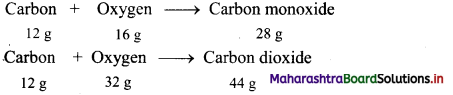
Chemical reaction of carbon with oxygen gives two compounds, carbon monoxide (CO) and carbon dioxide (CO2).
Maharashtra Board Class 11 Chemistry Important Questions Chapter 1 Some Basic Concepts of Chemistry 3
Here, the two masses of oxygen (16 g and 32 g) which combine with the fixed mass of carbon (12 g) in these two compounds bear a simple ratio of small whole numbers, i.e. 16 : 32 or 1 : 2.
This is in accordance with the law of multiple proportions.

Question 35.
Show that SO2 and SO3 satisfy the law of multiple proportions.
Answer:
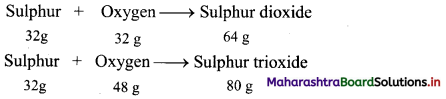
Chemical reaction of sulphur with oxygen gives two compounds, sulphur dioxide (SO2) and sulphur trioxide (SO3).
Maharashtra Board Class 11 Chemistry Important Questions Chapter 1 Some Basic Concepts of Chemistry 4
Here, the two masses of oxygen (32 g and 48 g) which combine with the fixed mass of sulphur (32 g) in these two compounds bear a simple ratio of small whole numbers, i.e. 32 : 48 or 2 : 3.
This is in accordance with the law of multiple proportions.

Question 36.
State and explain Gay Lussac’s law of gaseous volume with two examples.
Answer:
Gay Lussac’s law:
i. Gay Lussac proposed the law of gaseous volume in 1808.
ii. Gay Lussac’s law states that, “ When gases combine or are produced in a chemical reaction, they do so in a simple ratio by volume, provided all gases are at same temperature and pressure
e.g. a. Under identical conditions of temperature and pressure, 100 mL of hydrogen gas combine with 50 mL of oxygen gas to produce 100 mL of water vapour.
Maharashtra Board Class 11 Chemistry Important Questions Chapter 1 Some Basic Concepts of Chemistry 5
Thus, the simple ratio of volumes is 2 : 1 : 2.

b. Under identical conditions of temperature and pressure, 1 L of nitrogen gas combine with 3 L of hydrogen gas to produce 2 L of ammonia gas.
Maharashtra Board Class 11 Chemistry Important Questions Chapter 1 Some Basic Concepts of Chemistry 6
Thus, the simple ratio of volumes is 1 : 3 : 2.

Question 37.
Give two examples which support the Gay Lussac’s law of gaseous volume.
Answer:
i. Under identical conditions of temperature and pressure, 1 L of hydrogen gas reacts with 1 L of chlorine gas to produce 2 L of hydrogen chloride gas.
Maharashtra Board Class 11 Chemistry Important Questions Chapter 1 Some Basic Concepts of Chemistry 7
Thus, the ratio of volumes is 1 : 1 : 2
This is in accordance with Gay Lussac’s law.

ii. Under identical conditions of temperature and pressure, 200 mL sulphur dioxide combine with 100 mL oxygen to form 200 mL sulphur trioxide.
Maharashtra Board Class 11 Chemistry Important Questions Chapter 1 Some Basic Concepts of Chemistry 8
Thus, the ratio of volumes is 2 : 1 : 2.
This is in accordance with Gay Lussac’s law.

Question 38.
Match the following:

LawStatement
i.Law of definite proportionsa.When two elements A and B form more than one compounds, the masses of element B that combine with a given mass of A are always in the ratio of small whole numbers
ii.Gay Lussac’s lawb.Equal volumes of all gases at the same temperature and pressure contain equal number of molecules
iii.Law of multiple proportionsc.When gases combine or are produced in a chemical reaction they do so in a simple ratio by volume, provided all gases are at same temperature and pressure
iv.Avogadro’s lawd.A given compound always contains exactly the same proportion of elements by weight

Answer:
i – d,
ii – c,
iii – a,
iv – b

Maharashtra Board Class 11 Chemistry Important Questions Chapter 1 Some Basic Concepts of Chemistry

Question 39.
32 g of oxygen reacts with some carbon to make 56 grams of carbon monoxide. Find out how much mass must have been used.
Answer:
Given: Mass of oxygen (reactant) = 32 g, mass of carbon monoxide (product) = 56 g
To find: Mass of oxygen (reactant)
Calculation: 12 g of carbon combine with 16 g oxygen to form 28 g of carbon monoxide as follows:
Maharashtra Board Class 11 Chemistry Important Questions Chapter 1 Some Basic Concepts of Chemistry 9
Hence, (2 × 12 = 24 g) of carbon will combine with (2 × 16 = 32 g) of oxygen to give (2 × 28 = 56 g) carbon monoxide.
Ans: Mass of carbon used = 24 g

Question 40.
Calculate the mass of sulphur trioxide produced by burning 64 g of sulphur in excess of oxygen. (Average atomic mass: S = 32 u, O = 16 u).
Solution:
Given: Mass of sulphur (reactant) = 64 g
To find: Mass of sulphur dioxide (product)
Calculation: 32 g of sulphur combine with 48 g oxygen to form 80 g of sulphur trioxide as follows:
Maharashtra Board Class 11 Chemistry Important Questions Chapter 1 Some Basic Concepts of Chemistry 10
Hence, (2 × 32 = 64 g) of sulphur will combine with (2 × 48 = 96 g) of oxygen to give (2 × 80 = 160 g) sulphur trioxide.
Ans: Mass of sulphur trioxide produced = 160 g

Question 41.
Explain Dalton’s atomic theory.
Answer:
John Dalton published “A New System of chemical philosophy” in the year of 1808. He proposed the following features, which later became famous as Dalton’s atomic theory.

  • Matter consists of tiny, indivisible particles called atoms.
  • All the atoms of a given elements have identical properties including mass. Atoms of different elements differ in mass.
  • Compounds are formed when atoms of different elements combine in a fixed ratio.
  • Chemical reactions involve only the reorganization of atoms. Atoms are neither created nor destroyed in a chemical reaction.

Dalton’s atomic theory could explain all the laws of chemical combination.

Question 42.
Give reason: Dalton’s atomic theory explains the law of conservation of mass.
Answer:

  • The law of conservation of mass states that, “Mass can neither be created nor destroyed” during chemical combination of matter.
  • According to Dalton’s atomic theory, chemical reactions involve only the reorganization of atoms. Therefore, the total number of atoms in the reactants and products should be same and mass is conserved during a reaction.

Hence, Dalton’s atomic theory explains the law of conservation of mass.

Question 43.
Give reason: Dalton’s atomic theory explains the law of multiple proportion.
Answer:

  • The law of multiple proportion states that, “When two elements A and B form more than one compounds, the masses of element B that combine with a given mass of A are always in the ratio of small whole numbers
  • According to Dalton’s atomic theory, compounds are formed when atoms of different elements combine in fixed ratio.

Hence, Dalton’s atomic theory explains the law of multiple proportion.

Maharashtra Board Class 11 Chemistry Important Questions Chapter 1 Some Basic Concepts of Chemistry

Question 44.
Define: Atomic mass unit (amu).
Answer:
Atomic mass unit or amu is defined as a mass exactly equal to one twelth of the mass of one carbon-12 atom.

Question 45.
How is relative atomic mass of an atom measured?
Answer:

  • The mass of a single atom is extremely small, i.e. the mass of a hydrogen atom is 1.6736 × 10⁻²⁴ g. Hence, it is not possible to weigh a single atom.
  • In the present system, mass of an atom is determined relative to the mass of an atom of carbon-12 as the standard. This was decided in 1961 by international agreement.
  • The atomic mass of carbon-12 is assigned as 12.00000 atomic mass unit (amu).
  • The masses of all other elements are determined relative to the mass of an atom of carbon-12 (C-12).
  • The atomic masses are expressed in amu which is exactly equal to one twelth of the mass of one carbon-12 atom.
  • The value of 1 amu is equal to 1.6605 × 10⁻²⁴ g.

Question 46.
What is meant by Unified Mass unit?
Answer:

  • Presently, instead of amu, Unified Mass has now been accepted as the unit of atomic mass.
  • It is called Dalton and its symbol is ‘u’ or ‘Da’.

Question 47.
What is average atomic mass?
Answer:
The atomic mass of an element which exists as mixture of two or more isotopes is the average of atomic masses of its isotopes. This is called average atomic mass.

Question 48.
Define: Molecular mass
Answer:
Molecular mass of a substance is the sum of average atomic masses of the atoms of the elements which constitute the molecule.
OR
Molecular mass of a substance is the mass of one molecule of that substance relative to the mass of one carbon-12 atom.

Question 49.
How is molecular mass of a substance calculated? Give example.
Answer:
Molecular mass is calculated by multiplying average atomic mass of each element by the number of its atoms and adding them together.
e.g. Molecular mass of carbon dioxide (CO2) is calculated as follows:
Molecular mass of CO2 = (1 × average atomic mass of C) + (2 × average atomic mass of O)
= (1 × 12.0 u) + (2 × 16.0 u)
= 44.0 u

Maharashtra Board Class 11 Chemistry Important Questions Chapter 1 Some Basic Concepts of Chemistry

Question 50.
Mass of an atom of hydrogen in gram is 1.6736 × 10⁻²⁴ g. What is the atomic mass of hydrogen in u?
Solution:
Given: Mass of an atom of hydrogen in gram is 1.6736 × 10⁻²⁴ g.
To find: Atomic mass of hydrogen in u
Calculation: 1.66056 × 10⁻²⁴ g = 1 u
∴ 1.6736 × 10⁻²⁴ g = x
x = \(\frac{1.6736 \times 10^{-24} \mathrm{~g}}{1.66056 \times 10^{-24} \mathrm{~g} / \mathrm{u}}\) = 1.008u
Ans: The atomic mass of hydrogen in u = 1.008 u

Question 51.
The mass of an atom of one carbon atom is 12.011 u. What is the mass of 20 atoms of the same isotope?
Solution:
Mass of l atom of carbon = 12.011 u
∴ Mass of 20 atoms of same carbon isotope = 20 × 12.011 u = 240.220 u
Ans: The mass of 20 atoms of same carbon isotope = 240.220 u

Question 52.
Calculate the average atomic mass of neon using the following data:

IsotopeAtomic massNatural Abundance
20Ne19.9924 u90.92%
21Ne20.9940 u0.26 %
22Ne21.9914 u8.82 %

Solution:
Average atomic mass of Neon (Ne)
Maharashtra Board Class 11 Chemistry Important Questions Chapter 1 Some Basic Concepts of Chemistry 11
Ans: Average atomic mass of neon = 20.1707 u

Question 53.
Calculate the average atomic mass of argon from the following data:

IsotopeIsotopic mass (g mol-1)Abundance
36Ar35.967550.337%
38Ar37.962720.063%
40Ar39.962499.600%

Solution:
Average atomic mass of argon (Ar)
Maharashtra Board Class 11 Chemistry Important Questions Chapter 1 Some Basic Concepts of Chemistry 12
Ans: Average atomic mass of argon = 39.974 g mol-1

Question 54.
Calculate the molecular mass of the following in u:
i. H2O ii. C6H5Cl iii. H2SO4
Solution:
i. Molecular mass of H2O = (2 × Average atomic mass of H) + (1 × Average atomic mass of O)
= (2 × 1.0u) + (1 × 16.0 u)
= 18 u

ii. Molecular mass of C6H5Cl = (6 × Average atomic mass of C) + (5 × Average atomic mass of H) + (1 × Average atomic mass of Cl)
= (6 × 12.0 u) + (5 × 1.0 u) + (1 × 35.5 u)
= 112.5 u

iii. Molecular mass of H2SO4 = (2 × Average atomic mass of H) + (1 × Average atomic mass of S) + (4 × Average atomic mass of O)
= (2 × 1.0 u) + (1 × 32.0 u) + (1 × 16.0 u)
= 98 u
Ans: i. The molecular mass of H2O = 18 u
ii. The molecular mass of C6H5Cl = 112.5 u
iii. The molecular mass of H2SO4 = 98 u

Maharashtra Board Class 11 Chemistry Important Questions Chapter 1 Some Basic Concepts of Chemistry

Question 55.
Find the mass of 1 molecule of oxygen (O2) in amu (u) and in grams.
Solution:
Molecular mass of O2 = 2 × 16 u
∴ Mass of 1 molecule = 32 u
∴ Mass of 1 molecule of O2= 32 × 1.66056 × 10-24 g = 53.1379 × 10⁻²⁴ g
Ans: Mass of 1 molecule in amu = 32 u
Mass of 1 molecule in grams = 53.1379 × 10⁻²⁴ g

Question 56.
Find the formula mass of
i. NaCl ii. Cu(NO3)2
Solution:
i. Formula mass of NaCl
= Average atomic mass of Na + Average atomic mass of Cl
= 23.0 u + 35.5 u = 58.5 u

ii. Formula mass of Cu(NO3)2
= Average atomic mass of Cu + 2 × (Average atomic mass of N + Average atomic mass of three O)
= 63.5 + 2 × [14 + (3 × 16)] = 187.5 u
Ans: i. Formula mass of NaCl = 58.5 u
ii. Formula mass of Cu(NO3)2 = 187.5 u

Question 57.
Find the formula mass of
i. KCl
ii. AgCl
Atomic mass of K = 39 u, Ag =108 u and Cl = 35.5 u.
Solution:
i. Formula mass of KCl
= Average atomic mass of K + Average atomic mass of Cl
= 39 u + 35.5 u = 74.5 u

ii. Formula mass of AgCl
= Average atomic mass of Ag + Average atomic mass of Cl
= 108 + 35.5 = 143.5 u
Ans: i. Formula mass of KCl = 74.5 u
ii. Formula mass of AgCl = 143.5 u

Question 58.
Calculate the number of moles and molecules of urea present in 5.6 g of urea.
Solution:
Given: Mass of urea = 5.6 g
To find: The number of moles and molecules of urea
Formulae: i. Number of moles = \(\frac{\text { Mass of a substance }}{\text { Molar mass of a substance }}\)
ii. Number of molecules = Number of moles × Avogadro’s constant
Mass of urea = 5.6 g
Molecular mass of urea, NH2CONH2
= (2 × Average atomic mass of N) + (4 × Average atomic mass of H) + (1 × Average atomic mass of C) + (1 × average atomic mass of O)
= (2 × 14 u) + (4 × 1 u) + (1 × 12 u) + (1 × 16 u) = 60 u
∴ Molar mass of urea = 60 g mol-1
∴ Number of moles = \(\frac{\text { Mass of a substance }}{\text { Molar mass of a substance }}\)
= \(\frac{5.6 \mathrm{~g}}{60 \mathrm{~g} \mathrm{~mol}^{-1}}\)
= 0.09333 mol

[Calculation using log table:
\(\frac{5.6}{60}\)
= Antilog10 [log10 (5.6) – log10 (60)]
= Antilog10 [0.7482 – 1.7782]
= Antilog10 [latex]\overline{2} .9700[/latex]
= 0.09333]

Now,
Number of molecules of urea
= Number of moles × Avogadro’s constant
= 0.09333 mol × 6.022 × 1023 molecules/mol
= 0.5616 × 10²³ molecules (by using log table)
= 5.616 × 10²² molecules
Ans: Number of moles of urea = 0.0933 mol
Number of molecules of urea = 5.616 × 10²² molecules

[Calculation using log table:
0.09333 × 6.022
= Antilog10 [log10 (0.09333) + log10 (6.022)]
= Antilog10 [\(\overline{2} .9698\) + 0.7797]
= Antilog10 [latex]\overline{1} .7495[/latex]
= 0.5616]

Question 59.
Calculate the number of atoms in each of the following:
i. 64 u of oxygen (O)
ii. 42 g of nitrogen (N)
Solution:
i. 64 u of oxygen (O) = x atoms
Atomic mass of oxygen (O) = 16 u
∴ Mass of one oxygen atom = 16 u
∴ x = \(\frac{64 \mathrm{u}}{16 \mathrm{u}}\) = 4 atoms

ii. 42 g of nitrogen (N)
Atomic mass of nitrogen = 14 u
∴ Molar mass of nitrogen = 14 g mol-1
Now,
Number of moles = \(\frac{\text { Mass of a substance }}{\text { Molar mass of a substance }}\)
= \(\frac{42 \mathrm{~g}}{14 \mathrm{~g} \mathrm{~mol}^{-1}}\) = 3 mol
Now,
Number of atoms = Number of moles × Avogadro’s constant
= 3 mol × 6.022 × 1023 atoms/mol
= 18.07 × 10²³ atoms
= 1.807 × 1024 atoms
Ans: i. Number of oxygen atoms in 64 u = 4 atoms
ii. Number of nitrogen atoms in 42 g = 1.807 × 1024 atoms

Maharashtra Board Class 11 Chemistry Important Questions Chapter 1 Some Basic Concepts of Chemistry

Question 60.
Calculate the number of atoms in each of the following.
i. 52 moles of Argon (Ar)
ii. 52 u of Helium (He)
iii. 52 g of Helium (He)
Solution:
i. 52 moles of Argon
1 mole Argon atoms = 6.022 × 10²³ atoms of Ar
∴ Number of atoms = 52 mol × 6.022 × 1023 atoms/mol
= 313.144 × 10²³ atoms of Argon

ii. 52 g of He
Molar mass of He = mass of 1 atom of He = 4.0 u
4.0 u = 1 He
∴ 52 u = x
∴ x = 52 u × \(\frac{1 \text { atom of He }}{4.0 \mathrm{u}}\) = 13 atoms of He

iii. 52 g of He
Molar mass of He = 4.0 g mol-1
Number of moles = \(\frac{\text { Mass of a substance }}{\text { Molar mass of a substance }}\)
= \(\frac{52 \mathrm{~g}}{4.0 \mathrm{~g} \mathrm{~mol}^{-1}}\)
= 13 mol
Number of atoms of He = Number of moles × Avogadro’s constant
= 13 mol × 6.022 × 1023 atoms/mol
= 78.286 × 10²³ atoms of He
Ans. i. Number of argon atoms in 52 moles = 313.144 × 10²³ atoms of Argon
ii. Number of helium atoms in 52 u = 13 atoms of He
iii. Number of helium atoms in 52 g = 78.286 × 10²³ atoms of He

Question 61.
Calculate the number of atoms of ‘C’, ‘H’ and ‘O’ in 72.5 g of isopropanol, C3H7OH (molar mass 60 g mol-1).
Solution:
Mass of isopropanol(C3H7OH) = 72.5 g
The number of atoms of C, H, O
Calculation: Molecular formula of isopropanol, is C3H7OH.
Molar mass of C3H7OH = 60 g mol-1
Number of moles = \(\frac{\text { Mass of a substance }}{\text { Molar mass of a substance }}\)
= \(\frac{72.5 \mathrm{~g}}{60 \mathrm{~g} \mathrm{~mol}^{-1}}\)
= 1.208 mol
∴ Moles of isopropanol = 1.21 mol
Number of atoms = Number of moles × Avogadro’s constant
Now, 1 molecule of isopropanol has total 12 atoms, out of which 8 atoms are of H, 3 of C and 1 of O.
∴ Number of C atoms in 72.5 g isopropanol = (3 × 1.208) mol × 6.022 × 1023 atoms/mol
= 2.182 × 1024 atoms of carbon
∴ Number of ‘H’ atoms in 72.5 g isopropanol = (8 × 1.208) mol × 6.022 × 1023 atoms/mol
= 5.819 × 1024 atoms of hydrogen
∴ Number of ‘O’ atoms in 72.5 g isopropanol = (1 × 1.208) mol × 6.022 × 1023 atoms/mol
= 7.274 × 10²³ atoms of oxygen
Ans. 72.5g of isopropanol contain 2.182 ×1024 atoms of H and 7.274 × 10²³ atoms of O.

Question 62.
Calculate the number of moles and molecules of ammonia (NH3) gas in a volume 67.2 dm3 of it measured at STP.
Solution:
Given: Volume of ammonia at STP = 67.2 dm3
To find: Number of moles and molecules of ammonia
Formulae: i. Number of moles of a gas (n) = \(\frac{\text { Volume of a gas at STP }}{\text { Molar volume of a gas }}\)
ii. Number of molecules = Number of moles × 6.022 × 10²³ molecules mol-1
Calculation: Molar volume of a gas = 22.4 dm3 mol-1 at STP.
Number of moles (n) = \(\frac{\text { Volume of a gas at STP }}{\text { Molar volume of a gas }}\)
Number of moles of NH3 = \(\frac{67.2 \mathrm{dm}^{3}}{22.4 \mathrm{dm}^{3} \mathrm{~mol}^{-1}}\)
Number of molecules = Number of moles × 6.022 × 10²³ molecules mol-1
3.0 mol × 6022 × 1023 molecules mol-1
= 18.066 × 10²³ molecules
Ans: Number of moles of ammonia = 3.0 mol
Number of molecules of ammonia = 18.066 × 10²³ molecules

Question 63.
3.40 g of ammonia at STP occupies volume of 4.48 dm3. Calculate molar mass of ammonia.
Solution:
Given: Mass of ammonia = 3.40 g
Volume at STP = 4.48 dm3
To Find: Molar mass of ammonia
Calculation: Let ‘x’ grams be the molar mass of NH3.
Molar volume of a gas = 22.4 dm3 mol-1 at STP.
Volume occupied by 3.40 g of NH3 at S.T.P = 4.48 dm3
Volume occupied by ‘x’ g of NH3 at S.T.P = 22.4 dm3
∴ x = \(\frac{22.4 \times 3.40}{4.48}\) = 17.0 g mol-1
Ans: Molar mass of ammonia is 17.0 g mol-1.

Question 64.
Veg puffs from a particular bakery have an average mass of 27.0 g, whereas egg puffs from the same bakery have an average mass of 40 g.
i. Suppose a person buys 1 kg of veg puff from the bakery. Calculate the number of veg puffs he receives.
ii. Determine the mass of egg puffs (in kg) that will contain the same number of eggs puffs as in one kilogram of veg puffs.
Solution:
i. Mass of a veg puff = 27.0 g = 0.027 kg
∴ Number of veg puffs in 1 kg = 1 / 0.027 = 37
ii. One kilogram of veg puffs contains 37 veg puffs.
Mass of 37 egg puffs = 37 × 0.040 = 1.48 kg
Ans: i. 37 veg puffs in 1 kg of puff.
ii. Mass of 37 egg puffs is 1.48 kg

Maharashtra Board Class 11 Chemistry Important Questions Chapter 1 Some Basic Concepts of Chemistry

Multiple Choice Questions:

1. The branch of chemistry which deals with carbon compounds is called ……………. chemistry.
(A) organic
(B) inorganic
(C) carbon
(D) bio
Answer:
(A) organic

2. A/an is a simple combination of two or more substances in which the constituent substances retain their separate identities.
(A) compound
(B) mixture
(C) element
(D) All of these
Answer:
(B) mixture

3. Which one of the following is NOT a mixture?
(A) Paint
(B) Gasoline
(C) Liquefied Petroleum Gas (LPG)
(D) Distilled water
Answer:
(D) Distilled water

4. The sum of the masses of reactants and products is equal in any physical or chemical reaction. This is in accordance with ………………
(A) law of multiple proportion
(B) law of definite composition
(C) law of conservation of mass
(D) law of reciprocal proportion
Answer:
(C) law of conservation of mass

5. A sample of calcium carbonate (CaCO3) has the following percentage composition: Ca = 40 %; C = 12 %; O = 48 %. If the law of definite proportions is true, then the weight of calcium in 4 g of a sample of calcium
carbonate from another source will be ……………..
(A) 0.016 g
(B) 0.16 g
(C) 1.6 g
(D) 16 g
Answer:
(C) 1.6 g

Maharashtra Board Class 11 Chemistry Important Questions Chapter 1 Some Basic Concepts of Chemistry

6. Two elements, A and B, combine to form two compounds in which ‘a’ g of A combines with ‘b1’ and ‘b2’g of B respectively. According to law of multiple proportion ………………
(A) b1 = b2
(B) b1 and b2 bear a simple whole number ratio
(C) a and b1 bear a whole number ratio
(D) no relation exists between b1 and b2
Answer:
(B) b1 and b2 bear a simple whole number ratio

7. At constant temperature and pressure, two litres of hydrogen gas react with one litre of oxygen gas to produce two litres of water vapour. This is in accordance with ……………….
(A) law of multiple proportion
(B) law of definite composition
(C) law of conservation of mass
(D) law of gaseous volumes
Answer:
(D) law of gaseous volumes

8. One mole of oxygen molecule weighs …………….
(A) 8 g
(B) 32 g
(C) 16 g
(D) 6.022 × 10²³ g
Answer:
(B) 32 g

9. The mass of 0.002 mol of glucose (C6H12O6) is ………………
(A) 0.20 g
(B) 0.36 g
(C) 0.50 g
(D) 1.80 g
Answer:
(B) 0.36 g

10. Which of the following is CORRECT?
(A) 1 mole of oxygen atoms contains 6.0221367 × 10²³ atoms of oxygen.
(B) 1 mole of water molecules contains 6.0221367 × 10²³ molecules of water.
(C) 1 mole of sodium chloride contains 6.0221367 × 10²³ formula units of NaCl.
(D) All of these
Answer:
(D) All of these

Maharashtra Board Class 11 Chemistry Important Questions Chapter 1 Some Basic Concepts of Chemistry

11. 180 g of glucose (C6H12O6) contains ……………. carbon atoms.
(A) 1.8 × 10²³
(B) 1.8 × 1024
(C) 3.6 × 10²³
(D) 3.6 × 1024
Answer:
(C) 3.6 × 10²³

12. The number of molecules present in 8 g of oxygen gas is …………….
(A) 6.022 × 10²³
(B) 3.011 × 10²³
(C) 12.044 × 10²³
(D) 1.505 × 10²³
Answer:
(D) 1.505 × 10²³

13. The number of molecules in 22.4 cm3of ozone gas at STP is ……………….
(A) 6.022 × 10²⁰
(B) 6.022 × 10²³
(C) 22.4 × 10²⁰
(D) 22.4 × 10²³
Answer:
(A) 6.022 × 10²⁰

14. 11.2 cm3 of hydrogen gas at STP, contains …………….. moles.
(A) 0.0005
(B) 0.01
(C) 0.029
(D) 0.5
Answer:
(A) 0.0005

15. The mass of 224 mL of hydrogen gas at STP is
(A) 0.02 g
(B) 0.224 g
(C) 2.24 g
(D) 20.0 g
Answer:
(A) 0.02 g

16. 4.4 g of an unknown gas occupies 2.24 L of volume under STP conditions. The gas may be ………………
(A) CO2
(B) CO
(C) O2
(D) SO2
Answer:
(A) CO2

Maharashtra Board Class 11 Chemistry Solutions Chapter 14 Basic Principles of Organic Chemistry

Balbharti Maharashtra State Board 11th Chemistry Textbook Solutions Chapter 14 Basic Principles of Organic Chemistry Textbook Exercise Questions and Answers.

Maharashtra State Board 11th Chemistry Solutions Chapter 14 Basic Principles of Organic Chemistry

1. Answer the following :

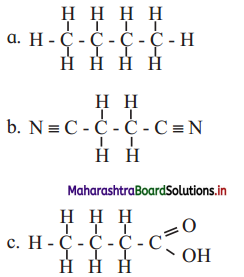
Question A.
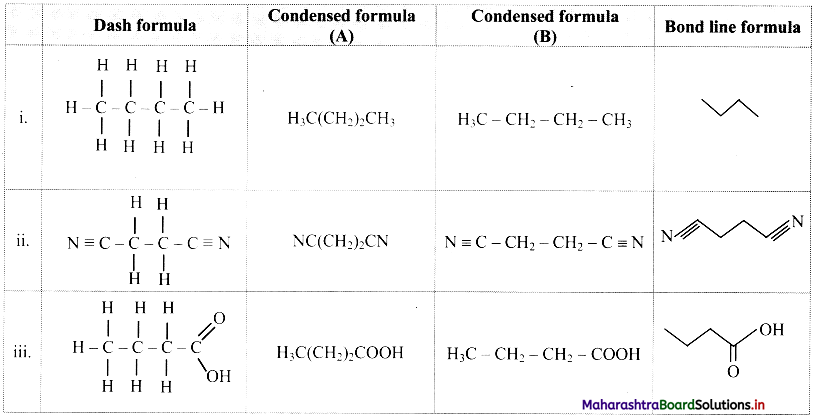
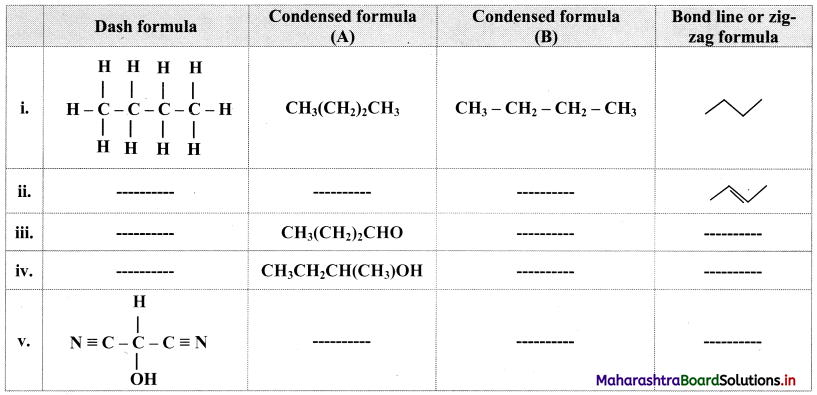
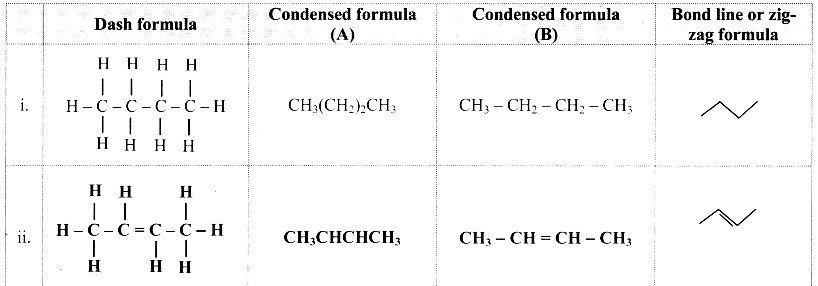
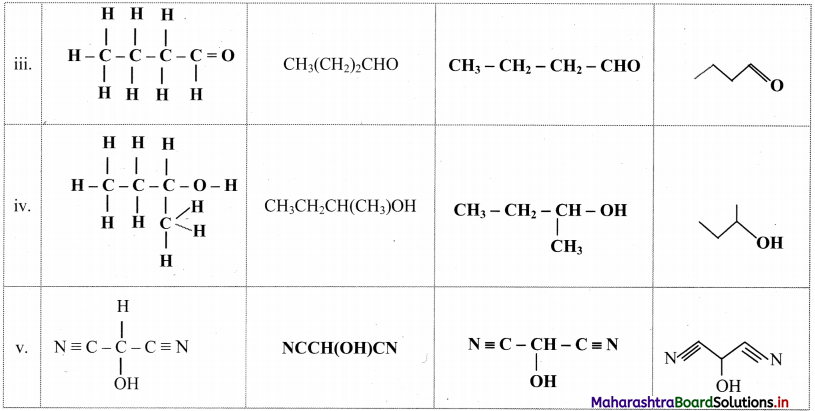
Write condensed formulae and bond line formulae for the following structures.
Maharashtra Board Class 11 Chemistry Solutions Chapter 14 Basic Principles of Organic Chemistry 1
Answer:
Maharashtra Board Class 11 Chemistry Solutions Chapter 14 Basic Principles of Organic Chemistry 2

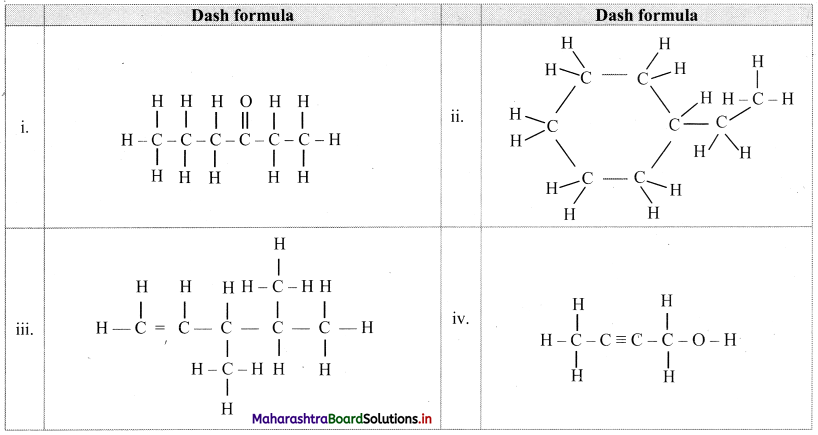
Question B.
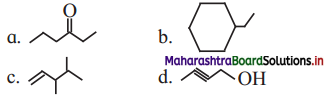
Write dash formulae for the following bond line formulae.
Maharashtra Board Class 11 Chemistry Solutions Chapter 14 Basic Principles of Organic Chemistry 3
Answer:
Maharashtra Board Class 11 Chemistry Solutions Chapter 14 Basic Principles of Organic Chemistry 4

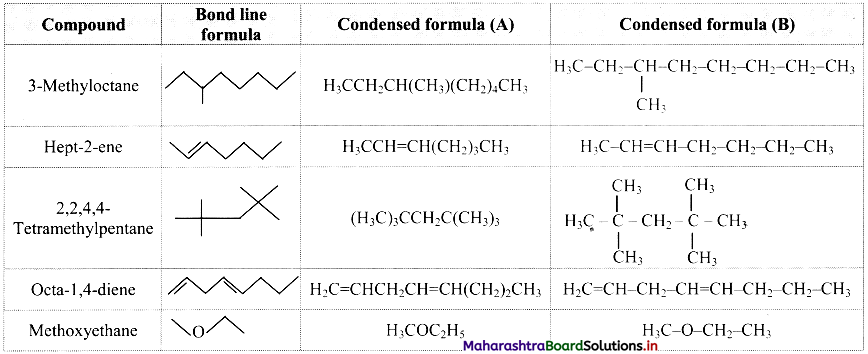
Question C.
Write bond-line formulae and condensed formulae for the following compounds
a. 3-methyloctane
b. hept-2-ene
c. 2, 2, 4, 4- tetramethylpentane
d. octa-1,4-diene
e. methoxy ethane
Answer:
Maharashtra Board Class 11 Chemistry Solutions Chapter 14 Basic Principles of Organic Chemistry 5

Maharashtra Board Class 11 Chemistry Solutions Chapter 14 Basic Principles of Organic Chemistry

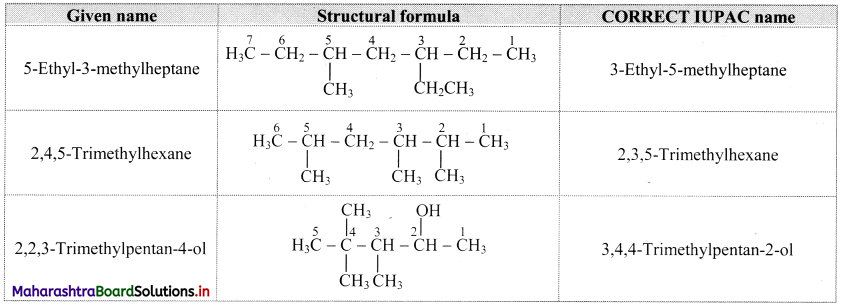
Question D.
Write the structural formulae for the following names and also write correct IUPAC names for them.
a. 5-ethyl-3-methylheptane
b. 2,4,5-trimethylthexane
c. 2,2,3-trimethylpentan-4-01
Answer:
Maharashtra Board Class 11 Chemistry Solutions Chapter 14 Basic Principles of Organic Chemistry 6

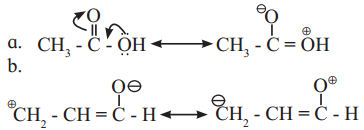
Question E.
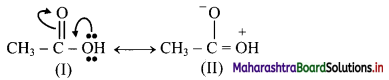
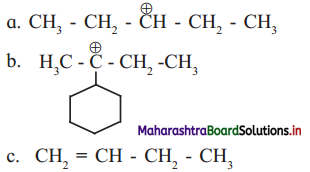
Identify more favourable resonance structure from the following. Justify.
Maharashtra Board Class 11 Chemistry Solutions Chapter 14 Basic Principles of Organic Chemistry 7
Answer:
a.
Maharashtra Board Class 11 Chemistry Solutions Chapter 14 Basic Principles of Organic Chemistry 8
Structure (I) will be more favourable resonance structure as structure (II) involves separation of opposite charges and the electronegative oxygen atom has a positive charge.
Maharashtra Board Class 11 Chemistry Solutions Chapter 14 Basic Principles of Organic Chemistry 9
Both structures (I) and (II) involves separation of opposite charges, but structure (I) has a positive charge on the more electropositive ‘C’ and a negative charge on more electronegative ‘O’. Thus, structure (I) will be more favourable resonance structure.

Question F.
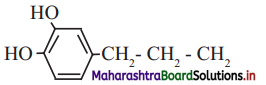
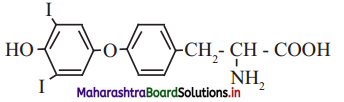
Find out all the functional groups present in the following polyfunctional compounds.
a. Dopamine a neurotransmitter that is deficient in Parkinson’s disease.
Maharashtra Board Class 11 Chemistry Solutions Chapter 14 Basic Principles of Organic Chemistry 10
b. Thyroxine the principal thyroid hormone.
Maharashtra Board Class 11 Chemistry Solutions Chapter 14 Basic Principles of Organic Chemistry 11
c. Penicillin G, a naturally occurring antibiotic
Maharashtra Board Class 11 Chemistry Solutions Chapter 14 Basic Principles of Organic Chemistry 12
Answer:
i. Functional groups: Phenolic -OH group (Ar-OH) and primary amine (-NH2) group are present in dopamine.
ii. Functional groups: Phenolic -OH group (Ar-OH), halide (-I), ether (Ar-O-Ar), primary amine (-NH2) carboxylic acid (-COOH) groups are present in thyroxine.
iii. Functional groups: Secondary amide
Maharashtra Board Class 11 Chemistry Solutions Chapter 14 Basic Principles of Organic Chemistry 13,
carboxylic acid (-COOH), tertiary amide
Maharashtra Board Class 11 Chemistry Solutions Chapter 14 Basic Principles of Organic Chemistry 14,
thioether (R-S-R) groups are present in penicillin G.

Maharashtra Board Class 11 Chemistry Solutions Chapter 14 Basic Principles of Organic Chemistry

Question G.
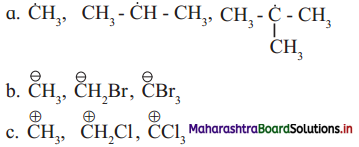
Find out the most stable species from the following. Justify.
Maharashtra Board Class 11 Chemistry Solutions Chapter 14 Basic Principles of Organic Chemistry 15
Answer:
a. The most stable species from the given species is \(\left(\mathrm{H}_{3} \mathrm{C}\right)_{3} \dot{\mathrm{C}}\) i.e., tert-butyl radical.
This is because it has greater number of alkyl groups attached to the C-atom having unpaired electron. More the number of the alkyl groups, the greater will be +1 inductive (electron releasing) effect, and thereby greater will be the stability of the free radical.

b. The most stable species from the given species is \(\mathrm{CBr}_{3}^{-}\).
This is because it contains 3 -Br atoms, which exhibits electron withdrawing inductive effect. Carbanions are stabilized by -I inductive (electron withdrawing) effect. Larger the number of -I groups attached to the negatively charged carbon atom, lower will be the electron density on the carbon atom and higher will be its stability.

c. The most stable species from the given species is \(\stackrel{+}{\mathbf{C}} \mathbf{H}_{3}\).
This because it does not contain Cl atom, which exhibits electron withdrawing inductive effect. Carbocations are destabilized by -I inductive (electron withdrawing) effect. When more number of-I groups are attached to the positively charged carbon atom, the positive charge on the carbon atom increases further, thus destabilizing the species. Hence, the species with no -I groups will be most stable.

Question H.
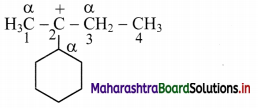
Identify the α-carbons in the following species and give the total number of α-hydrogen in each.
Maharashtra Board Class 11 Chemistry Solutions Chapter 14 Basic Principles of Organic Chemistry 16
Answer:
a.
Maharashtra Board Class 11 Chemistry Solutions Chapter 14 Basic Principles of Organic Chemistry 17
In structure (i), C-2 and C-4 are α-carbon atoms.
Hydrogen atoms(s) attached to α-C atoms is a α-H atom. Thus, structure (i) contains 4 α-H atoms.
b.
Maharashtra Board Class 11 Chemistry Solutions Chapter 14 Basic Principles of Organic Chemistry 18
In structure (ii), carbon atoms adjacent to C-2 are α-carbon atoms (as shown in the structure).
Thus, structure (ii) contains 6 α-H atoms.

c.
Maharashtra Board Class 11 Chemistry Solutions Chapter 14 Basic Principles of Organic Chemistry 19
C-3 carbon atom, that is, C-atom next to (H2C=CH-) is a α-C atom.
Thus, structure (iii) contains 2 α-H atoms.

Question I.
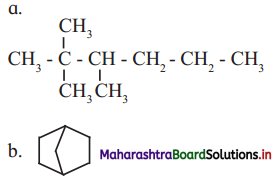
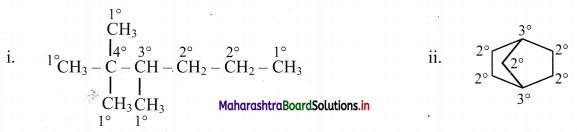
Identify primary, secondary, tertiary and quaternary carbon in the following compounds.
Maharashtra Board Class 11 Chemistry Solutions Chapter 14 Basic Principles of Organic Chemistry 20
Answer:
Maharashtra Board Class 11 Chemistry Solutions Chapter 14 Basic Principles of Organic Chemistry 21

2. Match the pairs

Column ‘A’Column ‘B’
i.Inductive effecta.Delocalization of π  electrons
ii.Hyperconjugationb.Displacement of π electrons
iii.Resonance effectc.Delocalization of σ electrons
d.Displacement of σ electrons

Answer:
i – d,
ii – c,
iii – a

Maharashtra Board Class 11 Chemistry Solutions Chapter 14 Basic Principles of Organic Chemistry

3. What is meant by homologous series ? Write the first four members of homologous series that begins with
A. CH3CHO
B. H-C≡C-H
Also write down their general molecular formula.
Answer:
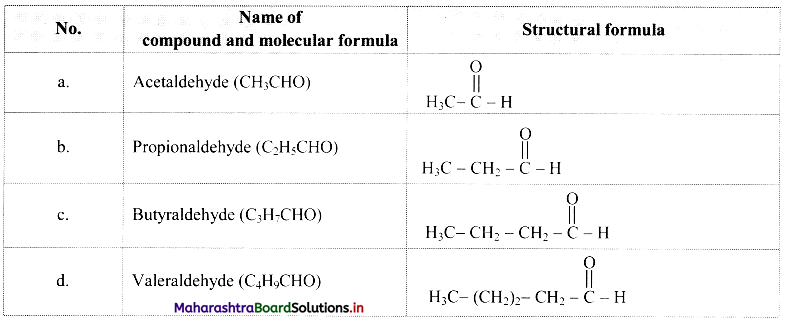
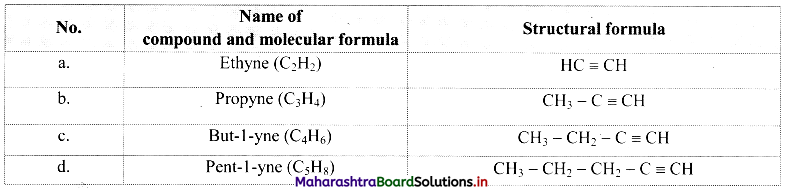
Homologous series: A series of compounds of the same family in which each member has the same type of carbon skeleton and functional group, and differs from the next member by a constant difference of one methylene group (-CH2-) in its molecular and structural formula is called as homologous series.
A. CH3CHO :
Maharashtra Board Class 11 Chemistry Solutions Chapter 14 Basic Principles of Organic Chemistry 22
Comparing these molecular formulae and assigning the number of carbon atoms as ‘n’, the following general formula is deduced: CnH2nO/CnH2n-1CHO (where n = 1, 2, 3, …).

B. H-C≡C-H :
Maharashtra Board Class 11 Chemistry Solutions Chapter 14 Basic Principles of Organic Chemistry 23
Comparing these molecular formulae and assigning the number of carbon atoms as ‘n’, the following general formula is deduced: CnH2n-2 (where n = 2, 3,4,….).

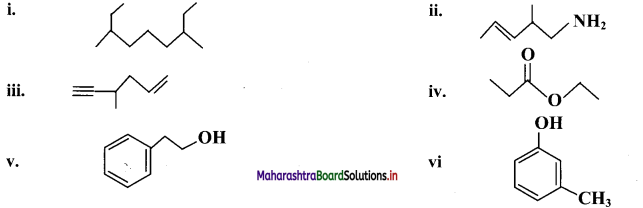
4. Write IUPAC names of the following
Maharashtra Board Class 11 Chemistry Solutions Chapter 14 Basic Principles of Organic Chemistry 24
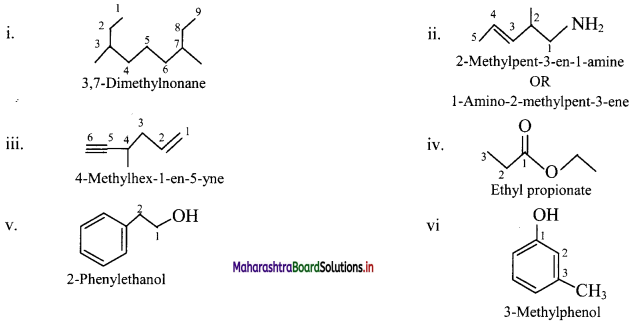
Answer:
Maharashtra Board Class 11 Chemistry Solutions Chapter 14 Basic Principles of Organic Chemistry 25

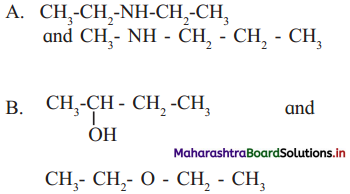
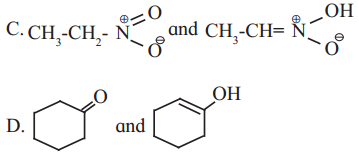
5. Find out the type of isomerism exhibited by the following pairs.
Maharashtra Board Class 11 Chemistry Solutions Chapter 14 Basic Principles of Organic Chemistry 26
Maharashtra Board Class 11 Chemistry Solutions Chapter 14 Basic Principles of Organic Chemistry 27
Answer:
A. Metamerism
B. Functional group isomerism
C. Tautomerism
D. Tautomerism

Maharashtra Board Class 11 Chemistry Solutions Chapter 14 Basic Principles of Organic Chemistry

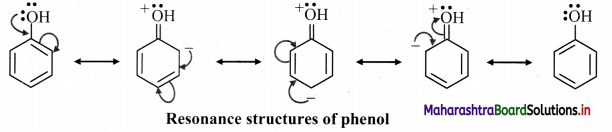
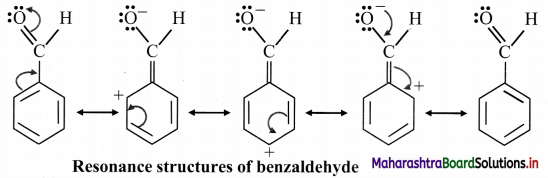
6. Draw resonance srtuctures of the following :

A. Phenol
B. Benzaldehyde
C. Buta-1,3-diene
D. Acetate ion
Answer:
A. Resonance structures for phenol:
Maharashtra Board Class 11 Chemistry Solutions Chapter 14 Basic Principles of Organic Chemistry 28

B. Resonance structures of benzaldehyde:
Maharashtra Board Class 11 Chemistry Solutions Chapter 14 Basic Principles of Organic Chemistry 29

C. Resonance structures of Buta-1,3-diene:
Maharashtra Board Class 11 Chemistry Solutions Chapter 14 Basic Principles of Organic Chemistry 30

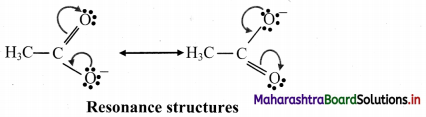
D. Resonance structures of acetate ion:
Maharashtra Board Class 11 Chemistry Solutions Chapter 14 Basic Principles of Organic Chemistry 31

7. Distinguish :

Question A.
Inductive effect and resonance effect
Answer:
Inductive effect:

  1. Presence of polar covalent bond is required.
  2. The polarity is induced in adjacent carbon- carbon single (covalent) bond due to a presence of influencing group (more electronegative atom than carbon).
  3. Depending on the nature of influencing group it is differentiated as +I effect and -I effect.
  4. The direction of the arrow head denotes the direction of the permanent electron displacement.

Resonance effect:

  1. Presence of conjugated n electron system or species having an atom carrying p orbital attached to a multiple bond is required.
  2. The polarity is produced in the molecule by the interaction of conjugated π bonds (or that between π bond and p orbital on the adjacent atom).
  3. Depending on the nature of influencing group it is differentiated as +R and -R effect.
  4. The delocalisation of n electrons is denoted by using curved arrows.

Question B.
Electrophile and nucleophile
Answer:
Electrophile:

  1. Electrophile is an electron deficient species.
  2. It is attracted towards negative charge (electron seeking).
  3. It attacks a nucleophilic centre in the substrate and brings about an electrophilic reaction
  4. It is an electron pair acceptor. (Lewis acid)
  5. It can be a positively charged ion or a neutral species having a vacant orbital.
    e.g. H+, Br , \(\mathrm{NO}_{2}^{+}\), BF3, AlCl3, etc.

Nucleophile:

  • Nucleophile is an electron rich species.
  • It is attracted towards positive charge (nucleus seeking).
  • It attacks the electrophilic centre in the substrate and brings about a nucleophilic reaction.
  • It is an electron pair donor. (Lewis base)
  • It can be negatively charged ion or neutral species having at least one lone pair of electrons.
    Maharashtra Board Class 11 Chemistry Solutions Chapter 14 Basic Principles of Organic Chemistry 32

C. Carbocation and carbanion
Answer:
Carbocation:

  • It is a species in which carbon carries a positive charge.
  • Positively charged carbon is sp2 hybridized.
  • It is electron-deficient.
  • e.g. tert-Butyl carbocation, (CH3)3C+

Carbanion:

  • It is a species in which carbon carries a negative charge.
  • Negatively charged carbon is sp3/sp2 hybridized.
  • It is electron-rich.
  • e.g.Methyl carbanion,
    Maharashtra Board Class 11 Chemistry Solutions Chapter 14 Basic Principles of Organic Chemistry 33

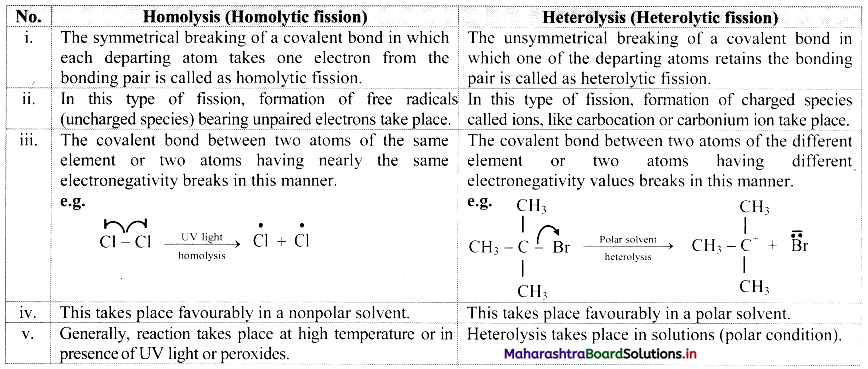
D. Homolysis and heterolysis
Answer:
Maharashtra Board Class 11 Chemistry Solutions Chapter 14 Basic Principles of Organic Chemistry 34

Maharashtra Board Class 11 Chemistry Solutions Chapter 14 Basic Principles of Organic Chemistry

8. Write true or false. Correct the false stament
A. Homolytic fission involves unsymmetrical breaking of a covalent bond.
B. Heterolytic fission results in the formation of free radicals.
C. Free radicals are negatively charged species
D. Aniline is heterocyclic compound.
Answer:
A. False
Homolytic fission involves symmetrical breaking of a covalent bond.
B. False
Heterolytic fission results in the formation of charged ions like cation and anion.
C. False
Free radicals are electrically neutral/uncharged species.
D. False
Aniline is a homocyclic aromatic compound.

9. Phytane is naturally occuring alkane produced by the alga spirogyra and is a constituent of petroleum. The IUPAC name for phytane is 2, 6, 10, 14-tetramethyl hexadecane. Write zig-zag formula for phytane. How many primary, secondary, tertiary and quaternary carbons are present in this molecule.
Answer:
Zig-zag formula of phytane (2,6,10,14-tetramethyl hexadecane) is as follows:
Maharashtra Board Class 11 Chemistry Solutions Chapter 14 Basic Principles of Organic Chemistry 35
Dash formula to represent types of C-atom:
Maharashtra Board Class 11 Chemistry Solutions Chapter 14 Basic Principles of Organic Chemistry 36
In phytane, six 1° C-atoms, ten 2° C-atoms, four 3° C-atoms are present. Phytane does not contain any quaternary carbon atom in its structure.

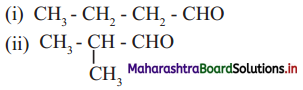
10. Observe the following structures and answer the questions given below.
Maharashtra Board Class 11 Chemistry Solutions Chapter 14 Basic Principles of Organic Chemistry 37
a. What is the relation between (i) and (ii) ?
b. Write IUPAC name of (ii).
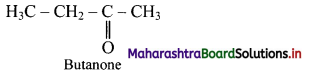
c. Draw the functional group isomer of (i).
Answer:
a. (a) and (b) are chain isomers of each other.
b. IUPAC name of structure (b) is 2-methylpropanal.
c. Functional group isomer of (a) is butanone.
Maharashtra Board Class 11 Chemistry Solutions Chapter 14 Basic Principles of Organic Chemistry 38

11. Observe the following and answer the questions given below
Maharashtra Board Class 11 Chemistry Solutions Chapter 14 Basic Principles of Organic Chemistry 39
a. Name the reactive intermediae produced
b. Indicate the movement of electrons by suitable arrow to produce this intermediate
c. Comment on stability of this intermediate produced.
Answer:
i. The reactive intermediates produced are methyl free radicals:
Maharashtra Board Class 11 Chemistry Solutions Chapter 14 Basic Principles of Organic Chemistry 40
ii. Stability order of alkyl free radicals is: \(\dot{\mathrm{C}} \mathrm{H}_{3}\) < 1° <2° <3°
Hence, \(\dot{\mathrm{C}} \mathrm{H}_{3}\) produced in the above reaction is least stable and highly reactive.

Maharashtra Board Class 11 Chemistry Solutions Chapter 14 Basic Principles of Organic Chemistry

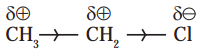
12. An electronic displacement in a covalent bond is represented by following notation.
Maharashtra Board Class 11 Chemistry Solutions Chapter 14 Basic Principles of Organic Chemistry 41
A. Identify the effect
B. Is the displacement of electrons in a covalent bond temporary or permanent.
Answer:
A. The electronic displacement represented above is inductive effect (-I effect).
B. Inductive effect is a permanent electronic effect as it depends on the electronegativity of the atoms. In the given example, the displacement of electrons is permanent as Cl is more electronegative than C.

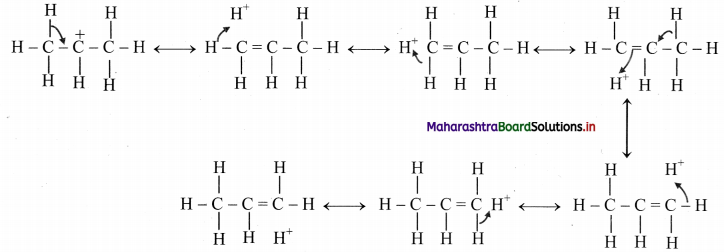
13. Draw all the no-bond resonance structures of isopropyl carbocation.
Answer:
Maharashtra Board Class 11 Chemistry Solutions Chapter 14 Basic Principles of Organic Chemistry 42

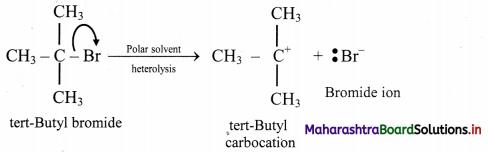
14. A covalent bond in tert-butyl bromide breaks in a suitable polat solvent to give ions.
A. Name the anion produced by this breaking of a covalent bond.
B. Indicate the type of bond breaking in this case.
C. Comment on geometry of the cation formed by such bond cleavage.
Answer:
A. The anion produced by breaking of the covalent C – Br bond is bromide
Maharashtra Board Class 11 Chemistry Solutions Chapter 14 Basic Principles of Organic Chemistry 43
B. Heterolytic cleavage/fission takes place as charged ions are produced.
C. tert-Butyl carbocation formed in the given cleavage has trigonal planar geometry.

15. Choose correct options

A. Which of the following statements are true with respect to electronic displacement in covalent bond ?
a. Inductive effect operates through π bond
b. Resonance effect operates through σ bond
c. Inductive effect operates through σ bond
d. Resonance effect operates through π bond
i. a. and b
ii. a and c
iii. c and d
iv. b and c
Answer:
iii. c and d

B. Hyperconjugation involves overlap of …………. orbitals
a. σ – σ
b. σ – p
c. p – p
d. π – π
Answer:
b. σ – p

Maharashtra Board Class 11 Chemistry Solutions Chapter 14 Basic Principles of Organic Chemistry

C. Which type of isomerism is possible in CH3CHCHCH3?
a. Position
b. Chain
c. Geometrical
d. Tautomerism
Answer:
a. Position

D. The correct IUPAC name of the compound
Maharashtra Board Class 11 Chemistry Solutions Chapter 14 Basic Principles of Organic Chemistry 44
is ……………
a. hept-3-ene
b. 2-ethylpent-2-ene
c. hex-3-ene
d. 3-methylhex-3-ene
Answer:
d. 3-methylhex-3-ene

E. The geometry of a carbocation is …………
a. linear
b. planar
c. tetrahedral
d. octahedral
Answer:
b. planar

F. The homologous series of alcohols has general molecular formula ………..
a. CnH2n+1OH
b. CnH2n+2OH
c. CnH2n-2OH
d. CnH2nOH
Answer:
a. CnH2n+1OH

G. The delocaalization of electrons due to overlap between p-orbital and sigma bond is called …………….
a. Inductive effect
b. Electronic effect
c. Hyperconjugation
d. Resonance
Answer:
c. Hyperconjugation

11th Chemistry Digest Chapter 14 Basic Principles of Organic Chemistry Intext Questions and Answers

Can you recall? (Textbook Page No. 204)

Question i.
Which is the essential element in all organic compounds?
Answer:
Carbon is the essential element in all organic compounds.

Question ii.
What is the unique property of carbon that makes organic chemistry a separate branch of chemistry?
Answer:

  • All organic compounds contain carbon.
  • Carbon atoms show catenation property in which carbon atoms combine with other carbon atoms to form long chains and rings.
  • Carbon atom can also form multiple bonds with other carbon atoms and with atoms of other elements.
  • Due to this property of self-linking of carbon, a large number of organic compounds like proteins, DNA, sugar, oils, etc., are formed.

Thus, the unique property of catenation of carbon makes organic chemistry a separate branch of chemistry.

Question iii.
Which classes of organic compounds are often used in our daily diet?
Answer:
Carbohydrates (sugars), proteins (pulses), fats (edible plant and animal oil) and vitamins are the major classes of organic compounds often used in our daily diet.

Maharashtra Board Class 11 Chemistry Solutions Chapter 14 Basic Principles of Organic Chemistry

Try this. (Textbook Page No. 204)

Question 1.
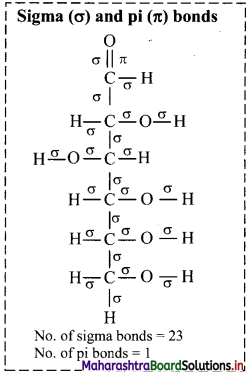
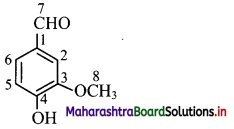
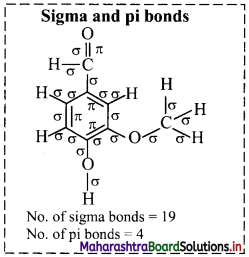
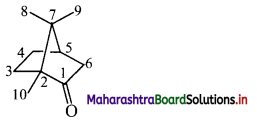
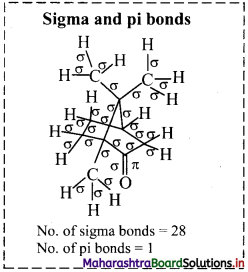
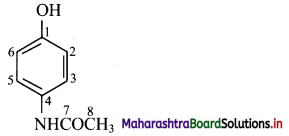
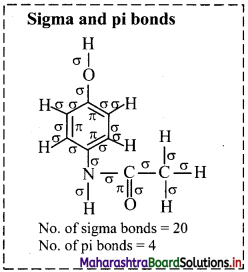
Find out the structures of glucose, vanillin, camphor and paracetamol using internet. Mark the carbon atoms present in them. Assign the hybridization state to each of the carbon and oxygen atom. Identify sigma (σ) and pi (π) bonds in these molecules.
Answer:
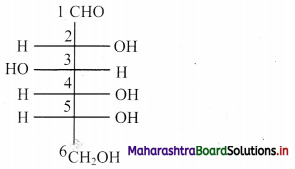
i. Structure of glucose:
Maharashtra Board Class 11 Chemistry Solutions Chapter 14 Basic Principles of Organic Chemistry 45
a. Hybridization of carbon: In glucose, only carbon at position C-1 is sp2 hybridized. On the other hand, carbons at C-2, C-3, C-4, C-5 and C-6 positions are sp3 hybridized.
b. Hybridization of oxygen: Oxygen atom attached to C-1 is sp2 hybridized, rest oxygen atoms attached to carbon at C-2, C-3, C-4, C-5 and C-6 are sp3 hybridized.
[Note: Here, the open chain structure of glucose is used to answer the given questions.]
Maharashtra Board Class 11 Chemistry Solutions Chapter 14 Basic Principles of Organic Chemistry 46

ii. Structure of vanillin:
Maharashtra Board Class 11 Chemistry Solutions Chapter 14 Basic Principles of Organic Chemistry 47
a. Hybridization of carbon: In vanillin, carbon atoms C-1 to C-7 are sp2 hybridized. Only C-8 carbon is sp3 hybridized.
b. Hybridization of oxygen: Oxygen atom bonded to C-7 sp2 hybridized whereas oxygen atom bonded to C-4 and C-8 are sp3 hybridized.
Maharashtra Board Class 11 Chemistry Solutions Chapter 14 Basic Principles of Organic Chemistry 48

iii. Structure of camphor:
Maharashtra Board Class 11 Chemistry Solutions Chapter 14 Basic Principles of Organic Chemistry 49
a. Hybridization of carbon: In camphor, all the carbons are sp3 hybridized except the carbonyl carbon which is sp2 hybridized.
b. Hybridization of oxygen: The carbonyl oxygen is sp2 hybridized.
Maharashtra Board Class 11 Chemistry Solutions Chapter 14 Basic Principles of Organic Chemistry 50

iv. Structure of paracetamol:
Maharashtra Board Class 11 Chemistry Solutions Chapter 14 Basic Principles of Organic Chemistry 51
a. Hybridization of carbon: In paracetamol, carbons present in the ring and carbon at C-7 position are sp2 hybridized. Only C-8 carbon is sp3 hybridized.
b. Hybridization of oxygen: Oxygen atom attached to carbon at ,C-1 position is sp3 hybridized. Oxygen atom attached to carbon at C-7 position is sp2 hybridized.
Maharashtra Board Class 11 Chemistry Solutions Chapter 14 Basic Principles of Organic Chemistry 52

Maharashtra Board Class 11 Chemistry Solutions Chapter 14 Basic Principles of Organic Chemistry

Question 2.
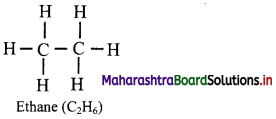
i. Draw the structural formula of ethane.
ii. Draw electron-dot structure of propane.
Ans:
i. Structural formula of ethane (C2H6) can be drawn as follows:
Maharashtra Board Class 11 Chemistry Solutions Chapter 14 Basic Principles of Organic Chemistry 53
ii. Electron-dot structure of propane is given as,
Maharashtra Board Class 11 Chemistry Solutions Chapter 14 Basic Principles of Organic Chemistry 54
Where ‘•’ represents valence electrons of carbon and hydrogen.

Try this (Textbook Page No. 205)

Complete the table:
Maharashtra Board Class 11 Chemistry Solutions Chapter 14 Basic Principles of Organic Chemistry 55
Answer:
Maharashtra Board Class 11 Chemistry Solutions Chapter 14 Basic Principles of Organic Chemistry 56
Maharashtra Board Class 11 Chemistry Solutions Chapter 14 Basic Principles of Organic Chemistry 57

Maharashtra Board Class 11 Chemistry Solutions Chapter 14 Basic Principles of Organic Chemistry

Try this. (Textbook Page No. 206)

Question 1.
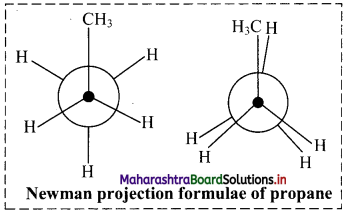
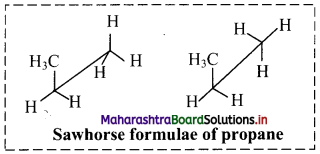
Draw two Newman projection formulae and two Sawhorse formulae for the propane molecule.
Answer:
Structural formula of propane is:
Maharashtra Board Class 11 Chemistry Solutions Chapter 14 Basic Principles of Organic Chemistry 58
Structural formula of propane:
i. Newman projection formulae for propane molecule can be given as:
Maharashtra Board Class 11 Chemistry Solutions Chapter 14 Basic Principles of Organic Chemistry 59
ii. Sawhorse formula for propane molecule can be given as:
Maharashtra Board Class 11 Chemistry Solutions Chapter 14 Basic Principles of Organic Chemistry 60

Can you tell? (Textbook Page No. 208)

Question 1.
Consider the following reaction:
2CH3 – CH2 – CH2 – OH + 2Na → 2CH3 – CH2 – CH2 – ONa + H2
Compare the structure of the substrate propanol with that of the product sodium propoxide. Which part of the substrate, the carbon skeleton or the OH group has undergone a change during the reaction?
Answer:
In above reaction, the -OH group of the substrate molecule has undergone a change. The H-atom of hydroxyl group (-OH) is replaced by sodium forming the product.

Activity: (Textbook Page No. 219)

Maharashtra Board Class 11 Chemistry Solutions Chapter 14 Basic Principles of Organic Chemistry 61
Observe the structural formulae (a) and (b).
i. Find out their molecular formulae.
ii. What is the difference between them?
iii. What is the relation between the two compounds represented by these structural formulae?
Answer:
i. Molecular formula of both (a) and (b) are same i.e., C3H6O.
ii. Compound (a), has a ketone (-CO-) functional group (i.e., acetone) and compound (b) has an aldehyde (-CHO) functional group (i.e., propionaldehyde). Both the compounds have different functional groups.
iii. Compound (a) and (b) are isomers of each other.
[Note: Aldehydes and ketones are the functional group isomers of each other.]

Maharashtra Board Class 11 Chemistry Solutions Chapter 14 Basic Principles of Organic Chemistry

Can you tell? (Textbook Page No. 222)

Question 1.
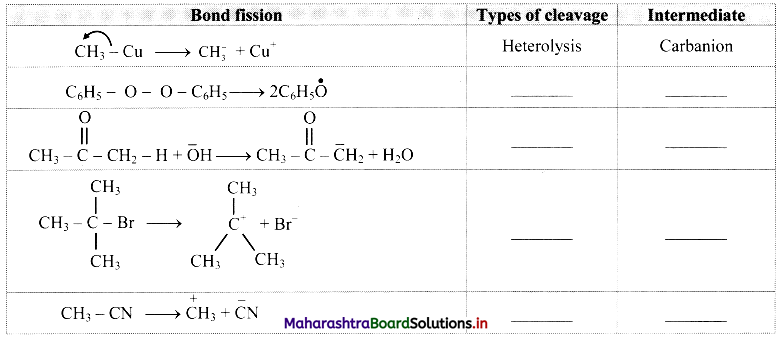
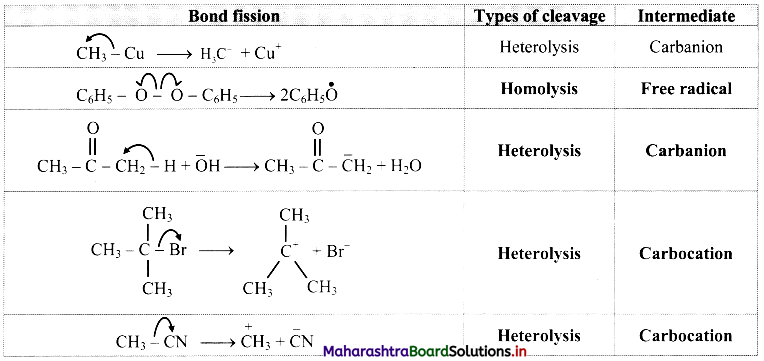
Some bond fissions are described in the following table. For each of them, show the movement of electron/s using curved arrow notation. Classify them as homolysis or heterolysis and identify the intermediate species produced as carbocation, carbanion or free radical.
Maharashtra Board Class 11 Chemistry Solutions Chapter 14 Basic Principles of Organic Chemistry 62
Answer:
Maharashtra Board Class 11 Chemistry Solutions Chapter 14 Basic Principles of Organic Chemistry 63

Can you recall? (Textbook Page No. 223)

i. What is meant by ‘reagent’?
ii. Identify the ‘reagent’, ‘substrate’, ‘product’ and ‘byproduct’ in the following reaction.
CH3COCl + NH3 → CH3CONH2 + HCl
Answer:
i. The reactant which reacts with a substrate to form corresponding products is known reagent.
ii.
Maharashtra Board Class 11 Chemistry Solutions Chapter 14 Basic Principles of Organic Chemistry 64

Can you recall? (Textbook Page No. 224)

i. How is covalent bond formed between two atoms?
ii. Consider two covalently bonded atoms Q and R where R is more electronegative than Q. Will these atoms share the electron pair equally between them?
iii. Represent the above polar covalent bond between Q and R using fractional charges δ+ and δ.
Answer:
i. A covalent bond is formed between two atoms by mutual sharing of electrons so as to complete their octets or duplets (in case of elements having only one shell).

ii. A covalent bond is formed between Q and R having different electronegativities, that is, R is more electronegative than Q. In such a case, the atom R with a higher value of electronegativity pulls the shared pair of electrons to a greater extent towards itself as compared to the atom Q with lower value of electronegativity. As a result of this, the shared pair of electrons will get shifted towards atom R. Thus, both the atoms Q and R will not share the electron pair equally between them.

iii. Polar covalent bond between Q and R can be represented as:
\(\mathrm{Q}^{\delta+}-\mathrm{R}^{\delta-}\)

Maharashtra Board Class 11 Chemistry Solutions Chapter 14 Basic Principles of Organic Chemistry

Try this (Textbook Page No. 225)

i. Draw a bond line structure of benzene (C6H6).
ii. How many C – C and C = C bonds are there in this structure?
iii. Write down the expected values of the bond lengths of the carbon-carbon bonds in benzene (Refer chapter 5).
Answer:
i. Bond line structure of benzene:
Maharashtra Board Class 11 Chemistry Solutions Chapter 14 Basic Principles of Organic Chemistry 65
ii. In benzene, there are three alternating C – C single bonds and C = C double bonds.
[Note: In benzene, there are six C – C sigma bonds and three C – C pi bonds.]
iii. The expected values of carbon-carbon bond lengths in benzene are:

BondBond length
C – C154 pm
C = C133 pm

Can you recall? (Textbook Page No. 225)

i. Write down two Lewis structures for ozone. (Refer chapter 5)
ii. How are these two Lewis structures related to each other?
iii. What are these two Lewis structures called?
Answer:
i. Lewis structures of ozone can be shown as follows:
Maharashtra Board Class 11 Chemistry Solutions Chapter 14 Basic Principles of Organic Chemistry 66
ii. In these two Lewis structures, the position of the atoms is same but the position of pair of electrons (or formal charge) is different. These two Lewis structures are considered equivalent to each other.
iii. These two Lewis structures are called as resonating or contributing or canonical structures.

Internet my friend (Textbook Page No. 229)

i. Basic principles of organic chemistry:
https://authors.library.caltech.edu/25034
ii. Collect information about isomerism.
Answer:
i. Students are expected to refer to the book provided in the above link to collect additional information on the basic principles of organic chemistry.

ii. https://www.compoundchem.com/2014/05/22/typesofisomerism/
chemdictionary.org/structural-isomers/
https://en.wikipedia.org/wiki/Structural_isomer
[Note: Students can use the above links as a reference and collect additional information about isomerism on their own.]

Maharashtra Board Class 11 Chemistry Solutions Chapter 13 Nuclear Chemistry and Radioactivity

Balbharti Maharashtra State Board 11th Chemistry Textbook Solutions Chapter 13 Nuclear Chemistry and Radioactivity Textbook Exercise Questions and Answers.

Maharashtra State Board 11th Chemistry Solutions Chapter 13 Nuclear Chemistry and Radioactivity

1. Choose the correct option.

Question A.
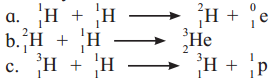
Identify nuclear fusion reaction
Maharashtra Board Class 11 Chemistry Solutions Chapter 13 Nuclear Chemistry and Radioactivity 1
Answer:
Among the given options, reactions (i) and (ii) represent nuclear fusion reactions wherein lighter nuclei combine to form a heavy nucleus.

Question B.
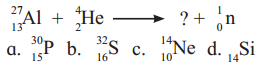
The missing particle from the nuclear reaction is
Maharashtra Board Class 11 Chemistry Solutions Chapter 13 Nuclear Chemistry and Radioactivity 2
Answer:
(A) \({ }_{15}^{30} \mathrm{P}\)

Question C.
\({ }_{27}^{60} \mathrm{CO}\) decays with half-life of 5.27 years to produce \({ }_{28}^{60} \mathrm{Ni}\). What is the decay constant for such radioactive disintegration ?
a. 0.132 y-1
b. 0.138
c. 29.6 y
d. 13.8%
Answer:
a. 0.132 y-1

Question D.
The radioactive isotope used in the treatment of Leukemia is
a. 60Co
b. 226Ra
c. 32P
d. 131I
Answer:
c. 32P

Question E.
The process by which nuclei having low masses are united to form nuclei with large masses is
a. chemical reaction
b. nuclear fission
c. nuclear fusion
d. chain reaction
Answer:
c. nuclear fusion

Maharashtra Board Class 11 Chemistry Solutions Chapter 13 Nuclear Chemistry and Radioactivity

2. Explain

Question A.
On the basis of even-odd of protons and neutrons, what type of nuclides are most stable ?
Answer:

  • Nuclides with even number of protons (Z) and even number of neutrons (N) are most stable.
  • These nuclides tend to form proton-proton and neutron-neutron pairs.
  • This impart stability to the nucleus.

Question B.
Explain in brief, nuclear fission.
Answer:
i. Nuclear fission: It is a process which involves splitting of the heavy nucleus of an atom into two nearly equal fragments accompanied by release of the large amount of energy.
e.g. Nuclear fission of 235U

ii. When a uranium nucleus absorbs neutron, it breaks into two lighter fragments and releases energy (heat), more neutrons, and other radiation. This can be given as,
Maharashtra Board Class 11 Chemistry Solutions Chapter 13 Nuclear Chemistry and Radioactivity 3

iii. Characteristics of nuclear fission reactions:

  • The mass of the fission products is less than the parent nucleus. A large amount of energy corresponding to the mass loss is released in each fission.
  • When one uranium 235 nucleus undergoes fission, three neutrons are emitted, which subsequently disintegrate three more uranium nuclei and thereby produce nine neutrons. Such a chain continues by itself.
  • In a very short time enormous amount of energy is liberated, which can be utilized for destructive or peaceful purposes.
  • Energy released per fission is approximately 200 MeV.

Note:

  • Each fission may lead to different products.
  • There is no unique way for fission of 235U that produces Ba and Kr. There are 400 ways for fission of 235U leading to 800 fission products.
  • Many of these fission products are radioactive which undergo spontaneous disintegrations giving rise to new elements in the periodic table.

Question C.
The nuclides with odd number of both protons and neutrons are the least stable. Why ?
Answer:

  • The nuclides with odd number of both protons and neutrons are the least stable because, odd number of protons and neutrons results in the presence of two unpaired nucleons.
  • These unpaired nucleons result in instability. Hence, such nuclides are the least stable.

Question D.
Referring the stabilty belt of stable nuclides, which nuclides are β and β+ emitters ? Why ?
Answer:

  • Beta decay occurs when an unstable nucleus emits a beta particle and energy. A beta particle is either an electron or a positron. An electron is a negatively charged particle, and a positron is a positively charged electron (or anti-electron).
  • When the beta particle is an electron, the decay is called beta-minus (β) decay. In beta-minus decay, a neutron breaks down to a proton and an electron, and the electron is emitted from the nucleus.
  • When the beta particle is a positron, the decay is called beta-plus (β+) decay. In beta-plus decay, a proton breaks down to a neutron and a positron, and the positron is emitted from the nucleus.
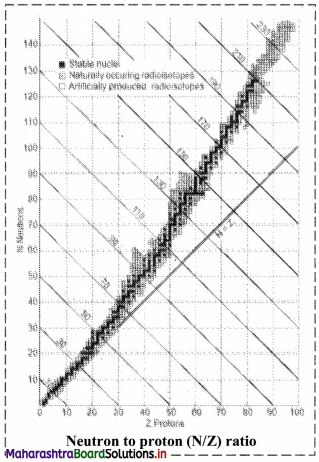
  • Thus, beta-minus decay occurs when a nucleus has too many neutrons relative to protons (i.e., N/Z > 1) and beta-plus decay occurs when a nucleus has too few neutrons relative to protons (i.e., N/Z < 1).
  • By referring the stability belt of stable nuclides, nuclides with N/Z > 1 are to the left of the stability zone. Such nuclides are beta-minus emitters as they become stable when a neutron converts to a proton.
  • Nuclides with N/Z < 1 are to the right of the stability zone. Such nuclides are beta-plus emitters as they become stable when a proton converts to a neutron.

Maharashtra Board Class 11 Chemistry Solutions Chapter 13 Nuclear Chemistry and Radioactivity

Question E.
Explain with an example each nuclear transmutation and artifiacial radioactivity. What is the difference between them ?
Answer:
i. Nuclear transmutation: It involves transformation of a stable nucleus into another nucleus takes place which can be either stable or unstable.
ii. Artificial (induced) radioactivity: It is nuclear transmutation where the product nucleus is radioactive. The product nucleus decays spontaneously with emission of radiation and particles.
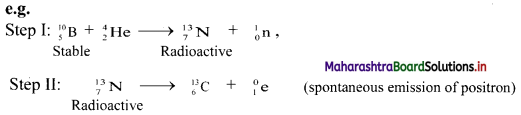
Maharashtra Board Class 11 Chemistry Solutions Chapter 13 Nuclear Chemistry and Radioactivity 4
Step-I can be considered as nuclear transmutation as it produces a new nuclide \({ }_{7}^{13} \mathrm{~N}\).
However, the new nuclide is unstable (radioactive). Hence, step-I involves artificial (induced) radioactivity. Thus, in artificial transmutation, a stable element is collided with high speed particles to form another radioactive element.

Question F.
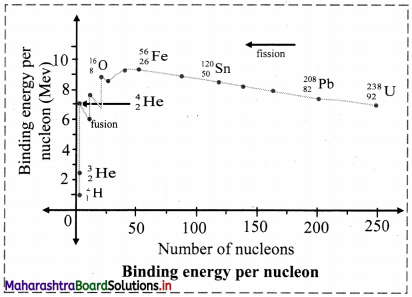
What is binding energy per nucleon ? Explain with the help of diagram how binding energy per nucleon affects nuclear stability ?
Answer:
Maharashtra Board Class 11 Chemistry Solutions Chapter 13 Nuclear Chemistry and Radioactivity 5
i. Binding energy per nucleon (\(\overline{\mathrm{B}}\)), for nucleus containing (A) nucleons with binding energy (B.E.) is given as,
\(\overline{\mathrm{B}}\) = B.E./A
ii. Mean binding energy per nucleon (\(\overline{\mathrm{B}}\)) for the most stable isotopes as a function of mass number is shown above. This plot leads to the following inferences:
a. Light nuclides: (A < 30)
The peaks with A values in multiples of 4. For example, \({ }_{2}^{4} \mathrm{He},{ }_{6}^{12} \mathrm{C},{ }_{8}^{16} \mathrm{O}\) are more stable.
b. Medium mass nuclides: (30 < A < 90)
\(\overline{\mathrm{B}}\) increases typically from 8 MeV for A = 16 to nearly 8.3 MeV for A between 28 and 32 and it remains nearly constant 8.5 MeV beyond this and shows a broad maximum. The nuclides falling on the maximum are most stable which turns possess high values. 56Fe with \(\overline{\mathrm{B}}\) value of 8.79 MeV is the most stable.
c. Heavy nuclides (A > 90)
\(\overline{\mathrm{B}}\) decreases from maximum 8.79 MeV to 7.7 MeV for A ≅ 210, 209Bi is the stable nuclide. Beyond this, all nuclides are radioactive (α-emitters).

Question G.
Explain with example α-decay.
Answer:
i. The emission of α-particle from the nuclei of an radioelement is called α-decay.
ii. The charge on an α-particle is +2 with a mass of 4 u.
It is identical with helium nucleus and hence an α-particle is designated as \({ }_{2}^{4} \mathrm{He}\).
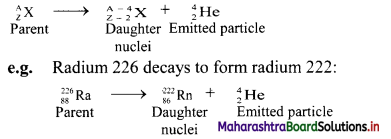
iii. In the α-decay process, the parent nucleus \({ }_{\mathrm{z}}^{\mathrm{A}} \mathrm{X}\) emits an α-particle and produces daughter nucleus Y. The parent nucleus thus loses two protons (charge +2) and two neutrons. The total mass lost is 4 u. The daughter nucleus will therefore, have mass 4 units less and charge 2 units less than its parent.
iv. General equation for α-decay process can be given as:
Maharashtra Board Class 11 Chemistry Solutions Chapter 13 Nuclear Chemistry and Radioactivity 6
In α-decay process of radium, radon (daughter nuclei) is formed with loses of two protons (charge +2) and two neutrons. The total mass lost is 4 u.
Thus, radon has a mass of 4 units less and charge 2 units less than its parent radium.

Question H.
Energy produced in nuclear fusion is much larger than that produced in nuclear fission. Why is it difficult to use fusion to produce energy ?
Answer:

  • Nuclear fusion involves the fusion of lighter nuclei to form a heavy nucleus which is accompanied by an enormous amount of energy (heat).
  • Fusion reaction requires extremely high temperature typically of the order of 108 K.

Maharashtra Board Class 11 Chemistry Solutions Chapter 13 Nuclear Chemistry and Radioactivity

Question I.
How does N/Z ratio affect the nuclear stability ? Explain with a suitable diagram.
Answer:

  • When the graph of number of neutrons (N) against protons (Z) is drawn, and all the stable isotopes are plotted on it, there is quite a clear correlation between N and Z. This graph is shown in the adjacent figure.
  • A large number of elements have several stable isotopes and hence, the curve appears as a belt or zone called stability zone. All stable nuclides fall with this zone and the nuclei that are to the left or to the right of the stability zone are unstable and exhibit radioactivity. Below the belt, a straight line which represents the ratio N/Z to be nearly unity (i.e., N = Z) is shown.
  • For nuclei lighter than \({ }_{20}^{40} \mathrm{Ca}\), the straight line (N = Z) passes through the belt. The lighter nuclides are therefore stable (N/Z being 1).
  • The N/Z ratio for the stable nuclides heavier than calcium gives a curved appearance to the belt with gradual increase of N/Z (> 1). The heavier nuclides therefore, need more number of neutrons than protons to attain stability. The heavier nuclides with increasing number of protons render large coulombic repulsions. With increased number of neutrons, the protons within the nuclei get more separated, which renders them stable.
  • Thus, nuclear stability is linked to the number of nucleons (neutrons and protons). In general, the lighter stable nuclei have equal numbers of protons and neutrons while heavier stable nuclei have increasingly more neutrons than protons.

Maharashtra Board Class 11 Chemistry Solutions Chapter 13 Nuclear Chemistry and Radioactivity 7
[Note: Atoms with unstable nuclei are radioactive (exhibit radioactivity). To become more stable, the nuclei undergo radioactive decay.]

Question J.
You are given a very old sample of wood. How will you determine its age ?
Answer:
The age of the wood sample can be determined by radiocarbon dating as 14C becomes a part of a plant due to the photosynthesis reaction (i.e., absorption of [14CO2 + 12CO2]).
i. The activity (N) of given wood sample and that of fresh sample of live plant (N0) is measured, where, N0 denotes the activity of the given sample at the time of death.
ii. The age of the given wood sample. can be determined by applying following Formulae:
Maharashtra Board Class 11 Chemistry Solutions Chapter 13 Nuclear Chemistry and Radioactivity 8
Note: The oldest rock found so far in Northern Canada is 3.96 billion years old.

3. Answer the following question

Question A.
Give example of mirror nuclei.
Answer:
Example of mirror nuclei: \({ }_{1}^{3} \mathrm{H}\) and \({ }_{2}^{3} \mathrm{He}\)

Question B.
Balance the nuclear reaction:
Maharashtra Board Class 11 Chemistry Solutions Chapter 13 Nuclear Chemistry and Radioactivity 9
Answer:
Maharashtra Board Class 11 Chemistry Solutions Chapter 13 Nuclear Chemistry and Radioactivity 10

Maharashtra Board Class 11 Chemistry Solutions Chapter 13 Nuclear Chemistry and Radioactivity

Question C.
Name the most stable nuclide known. Write two factors responsible for its stability.
Answer:
The most stable nuclide known is lead (\({ }_{82}^{208} \mathrm{~Pb}\)).
Two factors responsible for its stability are as follows:

  • It is a nuclide with even number of both protons (Z) and neutrons (N).
  • It has two magic numbers i.e., 82 (for protons) and 126 (for neutrons).

Question D.
Write relation between decay constant of a radioelement and its half life.
Answer:
Relation between decay constant of a radioelement and its half-life is given as, λ = \(\frac{0.693}{\mathrm{t}_{1 / 2}}\)
Where, λ = Decay constant, t1/2 = Half-life of a radioelement

Question E.
What is the difference between an α-particle and helium atom ?
Answer:

  • Helium atom is composed of 2 protons and 2 neutrons (or 1 neutron) along with 2 electrons in the outer shell.
  • On the other hand, α-particle constitutes 2 protons and 2 neutrons bound together to form a particle which is similar to helium (except presence of electrons).
  • Helium is one of the inert gas which is stable (duplet complete) whereas α-particle is unstable and highly reactive.

Question F.
Write one point that differentiates nuclear reations from chemical reactions.
Answer:
Chemical reactions:

  • Rearrangement of atoms by breaking and forming of chemical bonds.
  • Different isotopes of an element have same behaviour.

Nuclear reactions:

  • Elements or isotopes of one element are converted into another element in a nuclear reaction.
  • Isotopes of an element behave differently.

Question G.
Write pairs of isotones and one pair of mirror nuclei from the following :
Maharashtra Board Class 11 Chemistry Solutions Chapter 13 Nuclear Chemistry and Radioactivity 11
Answer:
Isotones: i. \({ }_{5}^{10} \mathrm{~B} \text { and }{ }_{6}^{11} \mathrm{C}\)
ii. \({ }_{13}^{27} \mathrm{Al} \text { and }{ }_{14}^{28} \mathrm{~S}\)
Mirror nuclei: Since there are no isobars the given set of nuclides does not contain a pair of mirror nuclei.

Maharashtra Board Class 11 Chemistry Solutions Chapter 13 Nuclear Chemistry and Radioactivity

Question H.
Derive the relationship between half life and decay constant of a radioelement.
Answer:
Equation for the decay constant is given as,
λ = \(\frac{2.303}{t} \log _{10} \frac{\mathrm{N}_{0}}{\mathrm{~N}}\) …(i)
Where, λ = Decay constant
N = Number of nuclei (atoms) present at time t
At t = 0, N = N0.
Hence, at t = t1/2, N = N0/2
Substitution of these values of N and t in equation (i) gives,
Maharashtra Board Class 11 Chemistry Solutions Chapter 13 Nuclear Chemistry and Radioactivity 12

Question I.
Represent graphically log10 (activity /dps) versus t/s. What is its slope ?
Answer:
Equation for a decay constant (λ) is given as,
Maharashtra Board Class 11 Chemistry Solutions Chapter 13 Nuclear Chemistry and Radioactivity 13
Hence, instead if log10N versus t, log10 \(\left(\frac{-\mathrm{d} \mathrm{N}}{\mathrm{dt}}\right)\) which is log10 (activity) is plotted.
The graph of log10 (activity/dps) versus t/s gives a straight line which can be represented as follows:
Maharashtra Board Class 11 Chemistry Solutions Chapter 13 Nuclear Chemistry and Radioactivity 14

Question J.
Write two units of radioactivity. How are they interrelated ?
Answer:
The unit of radioactivity is curie (Ci).
1 Ci = 3.7 × 10¹⁰ dps
ii. Other unit of radioactivity is Becquerel (Bq).
1 Bq = 1 dps
Thus, 1 Ci = 3.7 × 10¹⁰ dps = 3.7 × 10¹⁰ Bq

Question K.
Half life of 24Na is 900 minutes. What is its decay constant?
Answer:
Maharashtra Board Class 11 Chemistry Solutions Chapter 13 Nuclear Chemistry and Radioactivity 15

Question L.
Decay constant of 197Hg is 0.017 h-1. What is its half life ?
Answer:
Maharashtra Board Class 11 Chemistry Solutions Chapter 13 Nuclear Chemistry and Radioactivity 16

Question M.
The total binding energy of 58Ni is 508 MeV. What is its binding energy per nucleon ?
Answer:
Given: B.E. of 58Ni = 508 MeV,
A = 58
To find: Binding energy per nucleon \(\bar{B}\)
Maharashtra Board Class 11 Chemistry Solutions Chapter 13 Nuclear Chemistry and Radioactivity 17

Question N.
Atomic mass of \({ }_{16}^{32} \mathrm{~S}\) is 31.97 u. If masses of neutron and H atom are 1.0087 u and 1.0078 u respectively. What is the mass defect ?
Answer:
Given: m = 31.97 u, Z = 16, A = 32
mn = 1.0087 u
mH = 1.0078 u
To find: Δm
Formula: Δm = ZmH + (A – Z)mn – m
Calculation: Δm = ZmH + (A – Z)mn – m
= 16 × 1.0078 + (16 × 1.0087) – 31.97
= [16.1248 + 16.1392] – 31.97
= 0.294 u
Ans: The mass defect is 0.294 u.

Maharashtra Board Class 11 Chemistry Solutions Chapter 13 Nuclear Chemistry and Radioactivity

Question O.
Write the fusion reactions occuring in the Sun and stars.
Answer:
Fusion reactions occurring in the Sun and stars are can be represented as,
Maharashtra Board Class 11 Chemistry Solutions Chapter 13 Nuclear Chemistry and Radioactivity 18

Question P.
How many α and β – particles are emitted in the trasmutation
\({ }_{90}^{232} \mathrm{Th} \longrightarrow{ }_{82}^{208} \mathrm{~Pb}\)
Answer:
\({ }_{90}^{232} \mathrm{Th} \longrightarrow{ }_{82}^{208} \mathrm{~Pb}\)
The emission of one α-particle decreases the mass number by 4 whereas the emission of β-particles has no effect on mass number.
Net decrease in mass number = 232 – 208 = 24.
This decrease is only due to α-particles. Hence, number of α-particles emitted = \(\frac {24}{4}\) = 6
Now, the emission of one α-particle decrease the atomic number by 2 and one β-particle emission increases it by 1.
The net decrease in atomic number = 90 – 82 = 8
The emission of 6 α-particles causes decrease in atomic number by 12. However, the actual decrease is only 8. Thus, atomic number increases by 4. This increase is due to emission of 4 β-particles.
Thus, 6 α and 4 β-particles are emitted.

Question Q.
A produces B by α- emission. If B is in the group 16 of periodic table, what is the group of A ?
Answer:
Maharashtra Board Class 11 Chemistry Solutions Chapter 13 Nuclear Chemistry and Radioactivity 19
When α-emission occurs, atomic number decreases by 2 and atomic mass number by 4.
Thus, if ‘B’ belongs to group 16 of periodic table, that means outermost orbit will contain 6 electrons.
Thus, ‘A’ will have 8 electrons in its valence shell and it will belong to group 18 of the periodic table.

Question R.
Find the number of α and β- particles emitted in the process
\({ }_{86}^{222} \mathrm{Rn} \longrightarrow{ }_{84}^{214} \mathrm{PO}\)
Answer:
The emission of one α-particle decreases the mass number by 4 whereas the emission of β-particles has no effect on mass number.
Net decrease in mass number = 222 – 214 = 8. This decrease is only due to α-particle. Hence, number of α-particle emitted = 8/4 = 2
Now, the emission of one α-particle decreases the atomic number by 2 and one β-particle emission increases it by 1.
The net decrease in atomic number = 86 – 84 = 2
The emission of 2 α-particles causes decrease in atomic number by 4. However, the actual decrease is only 2. It means atomic number increases by 2. This increase is due to emission of 2 β-particles.
Thus, 2 α and 2 β-particles are emitted.

[Note: The above question is modified to include the final decay product so as to determine the number of α-particles and β-particles emitted in the process. Here, the final decay product is assumed to be Po-214.]

Maharashtra Board Class 11 Chemistry Solutions Chapter 13 Nuclear Chemistry and Radioactivity

4. Solve the problems

Question A.
Half life of 18F is 110 minutes. What fraction of 18F sample decays in 20 minutes ?
Answer:
Given: t1/2 = 110 min
t = 20 min
To find: Fraction of 18F simple that decays
Maharashtra Board Class 11 Chemistry Solutions Chapter 13 Nuclear Chemistry and Radioactivity 20
Maharashtra Board Class 11 Chemistry Solutions Chapter 13 Nuclear Chemistry and Radioactivity 21
∴ Fraction of 18F sample that decays = 1 – 0.882 = 0.118
Ans: Fraction of 18F sample that decays in 20 minutes is 0.118.

Question B.
Half life of 35S is 87.8 d. What percentage of 35S sample remains after 180 d ?
Answer:
Given: t1/2 = 87.8 d,
N0 = 100,
t = 180 d
To find: % of 35S that remains after 180 days
Maharashtra Board Class 11 Chemistry Solutions Chapter 13 Nuclear Chemistry and Radioactivity 22

Question C.
Half life 67Ga is 78 h. How long will it take to decay 12% of sample of Ga ?
Answer:
Given: t1/2 = 78 h,
N0 = 100,
N = 100 – 12 = 88
To find: t
Maharashtra Board Class 11 Chemistry Solutions Chapter 13 Nuclear Chemistry and Radioactivity 23
Maharashtra Board Class 11 Chemistry Solutions Chapter 13 Nuclear Chemistry and Radioactivity 24

Question D.
0.5 g Sample of 201Tl decays to 0.0788 g in 8 days. What is its half life ?
Answer:
Given: N0 = 0.5 g,
N = 0.0788 g,
t = 8 days
To find: t1/2
Maharashtra Board Class 11 Chemistry Solutions Chapter 13 Nuclear Chemistry and Radioactivity 25

Maharashtra Board Class 11 Chemistry Solutions Chapter 13 Nuclear Chemistry and Radioactivity

Question E.
65% of 111In sample decays in 4.2 d. What is its half life ?
Answer:
Given: N0 = 100,
N = 100 – 65 = 35,
t = 4.2d
To find: t1/2
Maharashtra Board Class 11 Chemistry Solutions Chapter 13 Nuclear Chemistry and Radioactivity 26
Maharashtra Board Class 11 Chemistry Solutions Chapter 13 Nuclear Chemistry and Radioactivity 27

Question F.
Calculate the binding energy per nucleon of \({ }_{36}^{84} \mathrm{Kr}\) whose atomic mass is 83.913 u. (Mass of neutron is 1.0087 u and that of H atom is 1.0078 u).
Answer:
Given: A = 84, Z = 36,
m = 83.913 u
mn = 1.0087 u
mH = 1.0078 u
To find: Binding energy per nucleon \((\bar{B})\)
Maharashtra Board Class 11 Chemistry Solutions Chapter 13 Nuclear Chemistry and Radioactivity 28

Question G.
Calculate the energy in Mev released in the nuclear reaction
\({ }_{77}^{174} \mathrm{Ir} \longrightarrow{ }_{75}^{170} \mathrm{Re}+{ }_{2}^{4} \mathrm{He}\)
Atomic masses : Ir = 173.97 u,
Re = 169.96 u and
He = 4.0026 u
Answer:
Given: mIr= 173.97 u
mRe = 169.96 u
mHe = 4.0026 u
To find: Energy released
Formulae: i. Δm = (mass of 174Ir) – (mass of 170Re + mass of 4He)
ii. E = Δm × 931.4 MeV
Calculation:i. Δm = (mass of 174Ir) – (mass of 170Re + mass of 4He)
= 173.97 – (169.96 + 4.0026)
= 7.4 × 10⁻³ u
ii. E = Δm × 931.4
= 7.4 × 10-3 × 931.4
= 6.89236 MeV ≈ 6.892 MeV
Ans: The energy released in given nuclear reaction is 6.892 MeV.

Question H.
A 3/4 of the original amount of radioisotope decays in 60 minutes. What is its half life ?
Answer:
Maharashtra Board Class 11 Chemistry Solutions Chapter 13 Nuclear Chemistry and Radioactivity 29

Question I.
How many – particles are emitted by 0.1 g of 226Ra in one year?
Answer:
Given: t = 1 y,
Amount of sample = 0.1 g
To find: Number of particles emitted
Maharashtra Board Class 11 Chemistry Solutions Chapter 13 Nuclear Chemistry and Radioactivity 30
Activity = \(\frac{-\mathrm{d} \mathrm{N}}{\mathrm{dt}}\) = λN
= 4.28 × 10-4 × 2.665 × 1020 atoms
= 1.141 × 10¹⁷ particles/year
Ans: Particles emitted by 0.1 g of 226Ra in one year = 1.141 × 10¹⁷ particles/year.
[Note: The half-life of radium is 1620 years. In order to apply appropriate textual concept, we have used this value in calculation.]

Maharashtra Board Class 11 Chemistry Solutions Chapter 13 Nuclear Chemistry and Radioactivity

Question J.
A sample of 32P initially shows activity of one Curie. After 303 days the activity falls to 1.5× 10⁴ dps. What is the half life of 32P ?
Answer:
Maharashtra Board Class 11 Chemistry Solutions Chapter 13 Nuclear Chemistry and Radioactivity 31

Question K.
Half life of radon is 3.82 d. By what time would 99.9 % of radon will be decayed.
Answer:
Given: t1/2 = 3.82 d,
N0 = 100
N = 100 – 99.9 = 0.1
To find: t
Maharashtra Board Class 11 Chemistry Solutions Chapter 13 Nuclear Chemistry and Radioactivity 32

Question L.
It has been found that the Sun’s mass loss is 4.34 × 10⁹ kg per second. How much energy per second would be radiated into space by the Sun ?
Answer:
Given: Sun’s mass loss = 4.34 × 10⁹ kg per second
To find: Energy radiated per second into space by Sun
calculation: Δm = 4.34 × 10⁹ kg per second
Now, 1.66 × 10⁻²⁷ kg = 1u
∴ Δm = \(\frac{4.34 \times 10^{9}}{1.66 \times 10^{-27}}\) u per second
= 2.614 × 1036 u per second
Now, 1 u = 931.4 MeV
2.614 × 1036 u per second = 2.614 × 1036 × 931.4
= 2.435 × 1039 MeV/s
Now, 1 MeV = 1.6022 × 10⁻¹⁹ J and 1 eV = 1 × 10⁻⁶ MeV
1 MeV = 1.6022 × 10⁻¹³ J
= 1.6022 × 10⁻¹⁶ LJ
E = 2.435 × 1039 MeV/s × 1.6022 × 10⁻¹⁶ kJ/MeV
= 3.901 × 10²³ kJ/s
Ans: Energy radiated per second into space by Sun is 3.901 × 10²³ kJ/s.

Question M.
A sample of old wood shows 7.0 dps/g. If the fresh sample of tree shows 16.0 dps/g, How old is the given sample of wood ? Half life of 14C 5730 y.
Answer:
Maharashtra Board Class 11 Chemistry Solutions Chapter 13 Nuclear Chemistry and Radioactivity 33

Activity :

1. Discuss five applications of radioactivity for peaceful purpose.
Answer:

  • Development in earth sciences: Like to understand various geographical changes occurring on earth.
  • Development in space technology: To study nuclear reactions in stars which may lead to new discoveries.
  • Development in medical sciences: Diagnosis and treatment of various diseases.
  • Development in industries: As a potent source of electricity or a power generator.
  • Development in agriculture: To study or monitor changes in soil like uptake of nutrients from the soil etc.

[Note: Students can use above points are reference to discuss topic in class].

2. Organize a trip to Bhabha Atomic Reasearch Centre, Mumbai to learn about nuclear reactor. This will have to be organized through your college.
Answer:
Students are expected to visit the place to understand more about nuclear reactors.

Maharashtra Board Class 11 Chemistry Solutions Chapter 13 Nuclear Chemistry and Radioactivity

11th Chemistry Digest Chapter 13 Nuclear Chemistry and Radioactivity Intext Questions and Answers

Do you know? (Textbook Page no. 190)

Question 1.
How small is the nucleus in comparison to the rest of the atom?
Answer:
The radius of nucleus is of the order of 10-15 m whereas that of the outer sphere is of the order of 10-10 m. The size of outer sphere, is 105 times larger than the nucleus i.e., if we consider the atom of size of football stadium then its nucleus will be the size of a pea.

(Textbook Page no. 191)

Question 1.
Identify the following nuclides as: isotopes, isobars and isotones.
Maharashtra Board Class 11 Chemistry Solutions Chapter 13 Nuclear Chemistry and Radioactivity 34
Answer:
Maharashtra Board Class 11 Chemistry Solutions Chapter 13 Nuclear Chemistry and Radioactivity 35

(Textbook Page No. 194)

Question 1.
i. What do you understand by the term rate of decay and give its mathematical expression.
ii. Why is minus sign required in the expression of decay rate?
Answer:
i. Rate of decay of a radioelement denotes the number of nuclei of its atoms which decay in unit time. It is also called activity of radioelement.
Rate of decay at any time t can be expressed as follows:
Rate of decay (activity) = \(-\frac{\mathrm{d} \mathrm{N}}{\mathrm{dt}}\)
where, dN is the number of nuclei that decay within time interval dt.
ii. Minus sign in the expression indicates that the number of nuclei decreases with time. Therefore, dN is a negative quantity. But, the rate of decay is a positive quantity. The negative sign is introduced in the rate expression to make the rate positive.

Try this. (Textbook Page No. 194)

Question 1.
Prepare a chart of comparative properties of the above three types of radiations.
Answer:
Maharashtra Board Class 11 Chemistry Solutions Chapter 13 Nuclear Chemistry and Radioactivity 36

Maharashtra Board Class 11 Chemistry Solutions Chapter 13 Nuclear Chemistry and Radioactivity

Just think (Textbook Page No. 195)

Question 1.
Does half-life increase, decrease or remain constant? Explain.
Answer:
Half-life of a particular radioelement remains constant at a given instant. A radioactive half-life refers to the amount of time it takes for half of the original isotope to decay. It is related to decay constant by the expression: t1/2 = 0.693 / λ

From the expression, it is evident that half-life of a radio isotope is dependent only on the decay constant and is independent of the initial amount of the radio isotope. Each successive half-life in which the amount of radio isotope decreases to its half value is the same.
Maharashtra Board Class 11 Chemistry Solutions Chapter 13 Nuclear Chemistry and Radioactivity 37
Thus, half-life remains constant.

Try this (Textbook Page No. 198)

Question 1.
24Mg and 27Al, both undergo (α, n) reactions and the products are radioactive. These emit β particles having positive charge (called positrons). Write balanced nuclear reactions in both.
Answer:
Maharashtra Board Class 11 Chemistry Solutions Chapter 13 Nuclear Chemistry and Radioactivity 38

Do you know? (Textbook Page No. 198)

Question 1.
What is the critical mass of 235U?
Answer:
i. The critical mass is the minimum mass of uranium-235 required to achieve a self-sustaining fission chain reaction under stated conditions.
ii. The chain reaction in fission of U-235 becomes self-sustaining when the critical mass of uranium-235 is about 50 kilograms.

Maharashtra Board Class 11 Chemistry Solutions Chapter 13 Nuclear Chemistry and Radioactivity

Activity (Textbook Page No. 200)

Question 1.
You have learnt in Std. 9th, medical, industrial and agricultural applications of radioisotopes. Write at least two applications each.
Answer:
i. The uses of radioactive isotopes in the field of medicine:
a. Polycythaemia: The red blood cell count increases in the disease polycythaemia. Phosphorus-32 is used in its treatment.
b. Bone cancer: Strontium-89, strontium-90, samarium-153 and radium-223 are used in the treatment of bone cancer.

ii. The uses of radioactive isotopes in the industrial field:
a. Luminescent paint and radioluminescence: The radioactive substances radium, promethium, tritium with some phosphorus are used to make certain objects visible in the dark.
e.g. Hands of a clock, krypton-85 is used in HID (High Intensity Discharge) lamps.
b. Use in ceramic articles:
1. Luminous colours are used to decorate ceramic tiles, utensils, plates, etc.
2. Uranium oxide was earlier used to colour ceramics.

iii. The uses of radioactive isotopes in the agriculture field:
a. The genes and chromosomes that give seeds its properties like fast growth, higher productivity, etc., can be modified by means of radiation.
b. Onions and potatoes are irradiated with gamma rays from cobalt-60 to prevent their sprouting.

Maharashtra Board Class 11 Chemistry Solutions Chapter 12 Chemical Equilibrium

Balbharti Maharashtra State Board 11th Chemistry Textbook Solutions Chapter 12 Chemical Equilibrium Textbook Exercise Questions and Answers.

Maharashtra State Board 11th Chemistry Solutions Chapter 12 Chemical Equilibrium

1. Choose the correct option

Question A.
The equilibrium, H2O(l) ⇌ H+(aq) + OH(aq) is
a. dynamic
b. static
c. physical
d. mechanical
Answer:
a. dynamic

Question B.
For the equilibrium, A ⇌ 2B + Heat, the number of ‘A’ molecules increases if
a. volume is increased
b. temperature is increased
c. catalyst is added
d. concentration of B is decreased
Answer:
b. temperature is increased

Question C.
For the equilibrium Cl2(g) + 2NO(g) ⇌ 2NOCl(g) the concentration of NOCl will increase if the equilibrium is disturbed by ………..
a. adding Cl2
b. removing NO
c. adding NOCl
d. removal of Cl2
Answer:
a. adding Cl2

Question D.
The relation between Kc and Kp for the reaction A(g) + B(g) ⇌ 2C(g) + D(g) is
a. Kc = Kp/RT
b. Kp = Kc2
c. Kc = \(\frac{1}{\sqrt{\mathrm{Kp}}}\)
d. Kp/Kc = 1
Answer:
a. Kc = Kp/RT

Question E.
When volume of the equilibrium reaction C(s) + H2O(g) ⇌ CO(g) + H2(g) is increased at constant temperature the equilibrium will
a. shift from left to right
b. shift from right to left
c. be unaltered
d. can not be predicted
Answer:
a. shift from left to right

Maharashtra Board Class 11 Chemistry Solutions Chapter 12 Chemical Equilibrium

2. Answer the following

Question A.
State Law of Mass action.
Answer:
Law of mass action: The law of mass action states that the rate of a chemical reaction at each instant is proportional to the product of concentrations of all the reactants.

Question B.
Write an expression for equilibrium constant with respect to concerntration.
Answer:
For a reversible chemical reaction at equilibrium, aA + bB ⇌ cD + dD
Equilibrium constant (Kc) = \(\frac{[C]^{\mathrm{c}}[\mathrm{D}]^{\mathrm{d}}}{[\mathrm{A}]^{\mathrm{a}}[\mathrm{B}]^{\mathrm{b}}}\)

Question C.
Derive mathematically value of Kp for A(g) + B(g) ⇌ C(g) + D(g).
Answer:
When the concentrations of reactants and products in gaseous reactions are expressed in terms of their partial pressure, then the equilibrium constant is represented as Kp.
∴ For the reaction,
A(g)+ B(g) ⇌ C(g) + D(g)
the equilibrium constant (KC) can be expressed using partial pressure as: Kp = \(\frac{P_{C} \times P_{D}}{P_{A} \times P_{B}}\)
Where PA, PB, PC and PD are equilibrium partial pressures of A, B, C and D respectively.

Question D.
Write expressions of KC for following chemical reactions
i. 2SO2(g) + O2(g) ⇌ 2SO3(g)
ii. N2O4(g) ⇌ 2NO2(g)
Answer:
i. 2SO2(g) + O2(g) ⇌ 2SO3(g)
Kc = \(\frac{\left[\mathrm{SO}_{3}\right]^{2}}{\left[\mathrm{SO}_{2}\right]^{2}\left[\mathrm{O}_{2}\right]}\)

ii. N2O4(g) ⇌ 2NO2(g)
Kc = \(\frac{\left[\mathrm{NO}_{2}\right]^{2}}{\left[\mathrm{~N}_{2} \mathrm{O}_{4}\right]}\)

Maharashtra Board Class 11 Chemistry Solutions Chapter 12 Chemical Equilibrium

Question E.
Mention various applications of equilibrium constant.
Answer:
Various applications of equilibrium constant:

  • Prediction of the direction of the reaction
  • To know the extent of the reaction
  • To calculate equilibrium concentrations
  • Link between chemical equilibrium and chemical kinetics

Question F.
How does the change of pressure affect the value of equilibrium constant ?
Answer:
The change of pressure does not affect the value of equilibrium constant.

Question J.
Differentiate irreversible and reversible reaction.
Answer:
Irreversible reaction:

  1. Products are not converted back to reactants.
  2. Reaction stops completely and almost goes to completion.
  3. It can be carried out in an open or closed vessel.
  4. It takes place only in one direction. It is represented by →
  5. e.g. C(s) + O2(g) → CO2(g)

Reversible reaction:

  1. Products arc converted back to reactants.
  2. Reaction appears to have stopped but does not undergo completion.
  3. It is generally carried out in a closed vessel.
  4. It takes place in both directions. It is represented by ⇌
  5. e.g. N2(g) + O2(g) ⇌ 2NO(g)

Question K.
Write suitable conditions of concentration, temperature and pressure used during manufacture of ammonia by Haber process.
Answer:
i. Concentration: Addition of H2 or N2 both favours forward reaction. This increases the yield of NH3.
ii. Temperature: The formation NH3 is exothermic. Hence, low temperature should favour the formation of NH3. However, at low temperatures, the rate of reaction is small. At high temperatures, the reaction occurs rapidly but decomposition of NH3 occurs. Hence, optimum temperature of about 773 K is used.
iii. Pressure: The forward reaction is favoured with high pressure as it proceeds with decrease in number of moles. At high pressure, the catalyst becomes inefficient. Therefore, optimum pressure needs to be used. The optimum pressure is about 250 atm.

Question L.
Relate the terms reversible reactions and dynamic equilibrium.
Answer:

  • Reversible reactions are the reactions which do not go to completion and occur in both the directions simultaneously.
  • If such a reaction is allowed to take place for a long time, so that the concentrations of the reactants and products do not vary with time, then the reaction will attain equilibrium.
  • Since, both the forward and backward reactions continue to take place in opposite directions in the same speed, the equilibrium achieved is dynamic in nature.

Thus, if the reaction is not reversible then it cannot attain dynamic equilibrium.

Question M.
For the equilibrium.
\(\mathrm{BaSO}_{4(\mathrm{~s})} \rightleftharpoons \mathrm{Ba}_{(\mathrm{aq})}^{2+}+\mathrm{SO}_{4(\mathrm{aq})}^{2-}\)
state the effect of
a. Addition of Ba2+ ion.
b. Removal of SO42- ion
c. Addition of BaSO4(s)
on the equilibrium.
Answer:
a. Addition of Ba2+ ion will favour the reverse reaction, (that is, equilibrium shifts from right to left). This increases the amount of BaSO4.
b. Removal of \(\mathrm{SO}_{4}^{2-}\) ion will favour the forward reaction, (that is, equilibrium shifts from left to right). This decreases the amount of BaSO4.
c. Addition of BaSO4(s) will not affect the equilibrium as the equilibrium constant expression does not include pure solids.

Maharashtra Board Class 11 Chemistry Solutions Chapter 12 Chemical Equilibrium

3. Explain :

Question A.
Dynamic nature of chemical equilibrium with suitable example.
Answer:
Dynamic nature of chemical equilibrium:
i. Consider a chemical reaction: A ⇌ B.
Kc = [B]/[A]
At equilibrium, the ratio of concentration of the product to that of the concentration of the reactant is constant and this is equal to Kc.

ii. At this stage reaction takes place in both the directions with same speed although the reaction appears to have stopped. Thus, the chemical equilibrium is dynamic in nature. Dynamic means moving and at a microscopic level, the system is in motion.

iii. For example, in the reaction between H2 and I2 to form HI, the colour of the reaction mixture becomes constant because the concentrations of H2, I2 and HI become constant at equilibrium.
H2 + I2 ⇌ 2HI
Thus, when equilibrium is reached, the reaction appears to have stopped. However, this is not the case. The reaction is still going on in the forward and backward direction but the rate of forward reaction is equal to the rate of backward reaction. Hence, chemical equilibrium is dynamic in nature and not static.

Question B.
Relation between Kc and Kp.
Answer:
Consider a general reversible reaction:
aA(g) + bB(g) ⇌ cC(g) + dD(g)
The equilibrium constant (Kp) in terms of partial pressure is given by equation:
Kp = \(\frac{\left(P_{C}\right)^{c}\left(P_{D}\right)^{d}}{\left(P_{A}\right)^{a}\left(P_{B}\right)^{b}}\) …………(1)
For a mixture of ideal gases, the partial pressure of each component is directly proportional to its concentration at constant temperature.
For component A,
PAV = nART
PA = \(\frac{\mathrm{n}_{\mathrm{A}}}{\mathrm{V}}\) × RT
\(\frac{\mathrm{n}_{\mathrm{A}}}{\mathrm{V}}\) is molar concentration of A in mol dm-3 V
∴ PA = [A]RT where, [A] = \(\frac{\mathrm{n}_{\mathrm{A}}}{\mathrm{V}}\)
Similarly, for other components, PB = [B]RT, PC = [C]RT, PD = [D]RT
Now substituting equations for PA, PB, PC, PD in equation (1), we get
Maharashtra Board Class 11 Chemistry Solutions Chapter 12 Chemical Equilibrium 1
where Δn = (number of moles of gaseous products) – (number of moles of gaseous reactants) in the balanced chemical equation.
R = 0.08206 L atm K-1 mol-1
[Note: While calculating the value of Kp, pressure should be expressed in bar, because standard state of pressure is 1 bar. 1 pascal (Pa) = 1 N m-2 and 1 bar = 105 Pa]

Question C.
State and explain Le Chatelier’s principle with reference to
1. change in temperature
2. change in concerntration.
Answer:
Statement: When a system at equilibrium is subjected to a change in any of the factors determining the equilibrium conditions of a system, system will respond in such a way as to minimize the effect of change.

1. Change in temperature:

  • Consider the equilibrium reaction,
    PCl5(g) ⇌ PCl3(g) + Cl2(g) + 92.5 kJ
  • The forward reaction is exothermic. According to Le Chatelier’s principle an increase in temperature shifts the position of equilibrium to the left.
  • The reverse reaction is endothermic. An endothermic reaction consumes heat. Therefore, the equilibrium must shift in the reverse direction to use up the added heat (heat energy converted to chemical energy).
  • Thus, an increase in temperature favours formation of PCl5 while a decrease in temperature favours decomposition of PCl5.

2. Change in concentration:

  • Consider reversible reaction representing production of ammonia (NH3).
    N2(g) + 3H2(g) ⇌ 2NH3(g) + Heat
  • According to Le Chatelier’s principle, when H2 or N2 is added to equilibrium, the effect of addition of H2 or N2 or is reduced by shifting the equilibrium from left to right so that the added N2 or H2 is consumed.
  • The forward reaction occurs to a large extent than the reverse reaction until the new equilibrium is established. As a result, the yield of NH3 is increases.
  • In general, if the concentration of one of the species in equilibrium mixture is increased, the position of equilibrium shifts in the opposite so as to reduce the concentration of this species. However, the equilibrium constant remains unchanged.

Maharashtra Board Class 11 Chemistry Solutions Chapter 12 Chemical Equilibrium

Question D.
a. Reversible reaction
b. Rate of reaction
Answer:
a. Reversible reaction:
i. Reactions which do not go to completion and occur in both the directions simultaneously are called reversible reactions.
ii. Reversible reactions proceed in both directions. The direction from reactants to products is the forward reaction, whereas the opposite reaction from products to reactants is called the reverse or backward reaction.
iii. A reversible reaction is denoted by drawing in between the reactants and product a double arrow, one pointing in the forward direction and other in the reverse direction (⇌ or ⇄).
ii. At high temperature in an open container, the CO2 gas formed will escape away. Therefore, it is not possible to obtain back
e.g. a. H2(g) + I2(g) ⇌ 2HI(g)
b. CH3COOH(aq) + H2O(l) ⇌ CH3COO(aq) + H3O+(aq)

b. Rate of reaction:
Rate of a chemical reaction:
i. The rate of a chemical reaction can be determined by measuring the extent to which the concentration of a reactant decreases in the given time interval, or extent to which the concentration of a product increases in the given time interval.
ii. Mathematically, the rate of reaction is expressed as:
Rate = \(-\frac{\mathrm{d}[\text { Reactant }]}{\mathrm{dT}}=\frac{\mathrm{d}[\text { Product }]}{\mathrm{dT}}\)
where, d[reactant] and d[product] are the small decrease or increase in concentration during the small time interval dT.

Question E.
What is the effect of adding chloride on the position of the equilibrium ?
AgCl(s) ⇌ Ag+(aq) + Cl(aq)
Answer:
Addition of Cl ion will favour the reverse reaction, (that is, equilibrium shift from right to left) This increases the amount of AgCl.

11th Chemistry Digest Chapter 12 Chemical Equilibrium Intext Questions and Answers

Can you recall? (Textbook Page No. 174)

Question 1.
What are the types of the following changes?
Natural waterfall, spreading of smoke from burning incense stick, diffusion of fragrance of flowers.
Answer: Natural waterfall, spreading of smoke from burning incense stick and diffusion of fragrance of flowers are irreversible physical changes.

Try this. (Textbook Page No. 174)

Question 1.
Dissolve 4 g cobalt chloride in 40 mL water. It forms a reddish pink solution. Add 60 mL concentrated HCl to this. It will turn blue. Take 5 mL of this solution in a test tube and place it in a beaker containing ice water mixture. The colour of solution will become pink. Place the same test tube in a beaker containing water at 90 °C. The colour of the solution turns blue.
Answer:
Inference: The colour change of the solution from pink to blue is caused by the chemical reaction. On changing the temperature, the direction of the reaction reverses. This indicates that the chemical reaction is reversible. This activity is an example of a reversible chemical reaction.
The reaction can be written as:
Maharashtra Board Class 11 Chemistry Solutions Chapter 12 Chemical Equilibrium 2
Maharashtra Board Class 11 Chemistry Solutions Chapter 12 Chemical Equilibrium 3

Can you tell? (Textbook Page No. 174)

Question 1.
What does violet colour of the solution in the activity mentioned in Q.2 indicate?
Answer:
In the reaction, the reactant \(\mathrm{Co}\left(\mathrm{H}_{2} \mathrm{O}\right)_{6}^{2+}\) is pink in colour and the product \(\mathrm{CoCl}_{4}^{2-}\) is blue in colour. When the solution contains both the reactant and product, the resulting solution will appear violet. This indicates that the reaction has attained equilibrium (that is, the reaction proceeds in both the direction with equal rates and is a reversible reaction).

Maharashtra Board Class 11 Chemistry Solutions Chapter 12 Chemical Equilibrium

(Textbook Page No. 174)

Question 1.
Calcium earbonate when heated strongly, decomposes to form calcium oxide and carbon dioxide.
i. If this reaction is carried out in a closed container, what will we observe?
ii. Consider this reaction occurring in an open system or container, what will happen? Can we obtain back calcium carbonate?
Answer:
At high temperature in a closed container, we will find that after certain time, some calcium carbonate is present. If we continue the experiment over a longer period of time at the same temperature, the concentrations of calcium carbonate, calcium oxide and carbon dioxide remain unchanged. The reaction thus appears to have stopped and the system has attained the equilibrium. Actually, the reaction does not stop but proceeds in both the directions with equal rates. In other words, calcium carbonate decomposes to give calcium oxide and carbon dioxide at a particular rate. Exactly at the same rate the calcium oxide and carbon dioxide recombine and form calcium carbonate. Thus, in closed container, reversible reaction occurs.
Maharashtra Board Class 11 Chemistry Solutions Chapter 12 Chemical Equilibrium 4
ii. At high temperature in an open container, the CO2 gas formed will escape away. Therefore, it is not possible to obtain back calcium carbonate. Thus, in an open container, irreversible reaction occurs.
\(\mathrm{CaCO}_{3(\mathrm{~s})} \stackrel{\text { Heat }}{\longrightarrow} \mathrm{CaO}_{(\mathrm{s})}+\mathrm{CO}_{2(\mathrm{~g})}\)

Internet my friend (Textbook Page No. 175)

Question 1.
i. Equilibrium existing in the formation of oxyhaemoglobin in human body
ii. Refrigeration system in equilibrium
Answer:
i. Equilibrium existing in the formation of oxyhaemoglobin in human body:
Oxygen is transported in the body with the assistance of red blood cells. The red blood cells contain a pigment called haemoglobin. Each haemoglobin molecule binds four oxygen molecules to form oxyhaemoglobin. Thus, the oxygen molecules are carried to individual cells in the body tissue where they are released.

The binding of oxygen to haemoglobin is a reversible reaction.
Hb + 4O2 ⇌ Hb.4O2
When the oxygen concentration is high (in the lungs), haemoglobin and oxygen combine to form oxyhaemoglobin and the reaction achieves equilibrium. But, when the oxygen concentration is low (in the body tissue), the reverse reaction occurs, that is, oxyhaemoglobin dissociates to haemoglobin and oxygen.
Thus, an equilibrium exists in the formation of oxyhaemoglobin in the human body.

ii. Refrigeration system in equilibrium:
a. Refrigeration system works on the principle of thermal equilibrium i.e., when a cold body comes in contact with a hot body then the heat flows from hot body to cold body until both the bodies attain the same temperature.
b. In the same way, a liquid (called as refrigerant) passes through the various compartments in the refrigerator and eventually lowers the temperature inside the refrigerator. This cycle is briefly described below:
Refrigerant flows through the compressor, which raises the pressure of the refrigerant. Next, the refrigerant flows through the condenser, where it condenses from vapor form to liquid form, giving off heat in the process. The heat given off is what j makes the condenser “hot to the touch.” After the condenser, the refrigerant goes through the expansion valve, where it experiences a pressure drop. Finally, the refrigerant goes to the evaporator. The refrigerant draws heat from the evaporator which causes the refrigerant to vaporize. The evaporator draws heat from the region that is to be cooled. The vaporized refrigerant goes back to the compressor to restart the cycle. In each of the heat transfer process, equilibrium is achieved (that is, heat given off is equivalent to the cooling achieved.)
Maharashtra Board Class 11 Chemistry Solutions Chapter 12 Chemical Equilibrium 5

[Note: Students are expected to collect additional information about equilibrium existing in the formation of oxyhaemoglobin in human body’ and ‘refrigeration system in equilibrium on their own.]

Try this. (Textbook Page No. 176)

Question 1.
i. Place some iodine crystals in a closed vessel. Observe the change in colour intensity in it.
ii. What do you see in the flask after some time?
Answer:
i. The vessel gets slowly filled up with violet coloured vapour of iodine. After a certain time, the intensity of violet colour becomes stable.
ii. After sometime, both solid iodine and iodine vapour are present in the closed vessel. Iodine crystals will be seen deposited near the mouth of the flask and violet coloured vapour will be filled in the entire flask. It means solid iodine sublimes to give iodine vapour and the iodine vapour condenses to form solid iodine. The stable intensity of the colour indicates a state of equilibrium between solid and vapour iodine.
Maharashtra Board Class 11 Chemistry Solutions Chapter 12 Chemical Equilibrium 6
Maharashtra Board Class 11 Chemistry Solutions Chapter 12 Chemical Equilibrium 7

Try this. (Textbook Page No. 176)

Question 1.
i. Dissolve a given amount of sugar in minimum amount of water at room temperature.
ii. Increase the temperature and dissolve more amount of sugar in the same amount of water to make a thick sugar syrup solution.
iii. Cool the syrup to the room temperature.
Answer:
Observation: Sugar crystals separate out.
Inference: The sugar syrup solution prepared is a saturated solution. Therefore, additional amount of sugar cannot be dissolved in it at room temperature.
In a saturated solution, there exists dynamic equilibrium between the solute molecules in the solid state and in dissolved state.
Sugar(aq) ⇌ Sugar(s)
The rate of dissolution of sugar = The rate of crystallization of sugar.
However, when it is heated, additional amount of sugar can be dissolved in it. But when such a thick sugar syrup is cooled again to room temperature, sugar crystals separate out.

Maharashtra Board Class 11 Chemistry Solutions Chapter 12 Chemical Equilibrium

Do you know? (Textbook Page No. 177)

Question 1.
What is a saturated solution?
Answer:
A saturated solution is the solution when additional solute cannot be dissolved in it at the given temperature. The concentration of solute in a saturated solution depends on temperature.

Observe and discuss. (Textbook Page No. 177)

Question 1.
Colourless N2O4 taken in a closed flask is converted to NO2 (a reddish brown gas).
Maharashtra Board Class 11 Chemistry Solutions Chapter 12 Chemical Equilibrium 8
Answer:
Observation: Initially, the colourless gas (N2O4) turns to reddish brown (NO2) gas. After sometime, the colour becomes lighter indicating the formation of N2O4 from NO2.
Inference: This indicates that the reaction is reversible. In such reaction, the reactants combine to form the products and the products combine to give the reactants. As soon as the forward reaction produces any NO2, the reverse reaction begins and NO2, starts combining back to N2O4. At equilibrium, the concentrations of N2O4 and NO2 remain unchanged and do not vary with time, because the rate of formation of NO2 is equal to the rate of formation of N2O4.
Maharashtra Board Class 11 Chemistry Solutions Chapter 12 Chemical Equilibrium 9

[Note: For any reversible reaction in a closed system whenever the opposing reactions (forward and reaction) are occurring at different rates, the forward reaction will gradually become slower and the reverse reaction will become faster. Finally, the rates become equal and equilibrium is established.]

Discuss (Textbook Page No. 177)

i. Consider the following dissociation reaction:
Maharashtra Board Class 11 Chemistry Solutions Chapter 12 Chemical Equilibrium 10
The reaction is carried out in a closed vessel starting with hydrogen iodide.
ii. Now, let us start with hydrogen and iodine vapour in a closed container at a certain temperature.
H2(g) + I2(g) ⇌ 2HI(g)
Answer:
i. Starting with hydrogen iodide:
Observations:
a. At first, there is an increase in the intensity of violet colour.
b. After certain time, the increase in the intensity of violet colour stops.
c. When contents in a closed vessel are analyzed at this stage, it is observed that reaction mixture contains the hydrogen iodide, hydrogen and iodine with their concentrations being constant over time.
Inference:
The rate of decomposition of HI becomes equal to the rate of combination of H2 and I2. At equilibrium, no net change is observed and both reactions continue to occur at equal rates.
Thus, the reaction represents chemical equilibrium.

ii. Starting with hydrogen and iodine:
Observations:
a. At first, there is a decrease in the intensity of violet colour.
b. After certain time, the decrease in the intensity of violet colour stops.
c. When contents in a closed vessel are analyzed at this stage, it is observed that reaction mixture contains hydrogen, iodine and hydrogen iodide with their concentrations being constant over time.
Inference:
The rate of combination of H2 and I2 becomes equal to the rate of decomposition of HI. The reaction attains chemical equilibrium.

Maharashtra Board Class 11 Chemistry Solutions Chapter 12 Chemical Equilibrium

Can you recall? (Textbook Page No. 180)

Question 1.
Write ideal gas equation with significance of each term involved in it.
Answer:
Ideal gas equation is PV = nRT.
where, P = Pressure of the gas
V = Volume of the gas
n = Number of moles of the gas
R = universal gas constant
T = Absolute temperature of the gas

Just think. (Textbook page no. 181)

Question 1.
Two processes, which are taking place in opposite directions are in equilibrium. How to write equilibrium constant expersions for heterogeneous equilibrium?
Answer:
Equilibrium in a system having more than one phase is called heterogeneous equilibrium.
If ethanol is placed in a conical flask, liquid-vapour equilibrium is established.
C2H5OH(l) ⇌ C2H5OH(g)
For a given temperature,
Kc = \(\frac{\left[\mathrm{C}_{2} \mathrm{H}_{5} \mathrm{OH}_{(g)}\right]}{\left[\mathrm{C}_{2} \mathrm{H}_{5} \mathrm{OH}_{(l)}\right]}\)
But [C2H5OH(l)] = 1
∴ Kc = [C2H5OH(g)]
Thus, at any given temperature, density is constant irrespective of the amount of liquid, and the term in the denominator is also constant.
ii. similarly, consider I2(g) ⇌ I2(g)
Kc = [I2(g)]
iii. Thus, the expression for equilibrium constant does not contain the concentration of pure solids and pure liquids. That is because for any pure liquid and solid, the concentration is simply its density and this will not change no matter how much solid or liquid is used. Hence, the expression for heterogeneous equilibrium only uses the concentration of gases and dissolved substances (aq.). Solids are pure substances with unchanging concentrations and thus equilibria including solids are simplified.

Can you tell? (Textbook Page No. 183)

Question 1.
Comment on the extent to which the forward reaction will proceed, from the magnitude of the equilibrium constant for the following reactions:
i. H2(g) + I2(g) ⇌ 2HI(g), Kc = 20 at 550 K
ii. H2(g) + Cl2(g) ⇌ 2HCl(g), Kc = 1018 at 550 K
Answer:
i. For the reaction, Kc = 20 at 550 K
If the value of Kc is the range of 10-3 to 103, the forward and reverse proceed to equal extents.
Hence, the given reaction will form appreciable concentrations of both reactants and the product at equilibrium.

ii. For the reaction, Kc = 1018 at 550 K
If the value of Kc >>> 103, forward reaction is favoured.
Hence, the given reaction will proceed in the forward direction and will nearly go to completion.

Use your brain power (Textbook Page No. 183)

Question 1.
The value of Kc for the dissociation reaction:
H2(g) ⇌ 2H(g) is 1.2 × 10-42 at 500 K.
Does the equilibrium mixture contain mainly hydrogen molecules or hydrogen atoms?
Answer:
When the value of Kc is very low (that is, Kc < 10-3), then at equilibrium, only a small fraction of the reactants is converted into products.
For the given reaction, Kc <<< 103 at 500 K.
Hence, the equilibrium mixture contains mainly hydrogen molecules.

Maharashtra Board Class 11 Chemistry Solutions Chapter 12 Chemical Equilibrium

Internet my friend (Textbook Page No. 183)

Question 1.
Collect information about chemical equilibrium.
Answer:
https://www.chemguide.co.uk/physical/equilibria/introduction.html
[Note: Students can use the above link as reference and collect information about chemical equilibrium.]

Can you tell? (Textbook Page No. 188)

i. If NH3 is added to the equilibrium system (Haber process), in which direction will the equilibrium shift to consume added NH3 to reduce the effect of stress?
ii. In this process, out of the reactions (reverse and forward reaction), which reaction will occur to a greater extent?
iii. What will be the effect on yield of NH3?
Answer:
i. If NH3 is added to the equilibrium system, the equilibrium will shift from right to left to consume added NH3 to reduce the effect of stress.
ii. If NH3 is added to the equilibrium system, then reverse reaction will occur to greater extent.
iii. If NH3 is added to the equilibrium system, the equilibrium will shift in reverse direction and the yield of NH3 will decrease.

Internet my friend (Textbook Page No. 188)

i. Collect information about Haber process in chemical equilibrium.
ii. Youtube.Freescienceslessons: The Haber process
Answer:
i. https://www.chemguide.co.uk/physical/equilibria/haber.html
[Note: Students can use the above link as reference and collect information about chemical equilibrium involved in Haber process.]
ii. Students are expected to refer ‘The Haber process ’ on YouTube channel ‘Freescienceslessons’

Maharashtra Board Class 11 Chemistry Solutions Chapter 11 Adsorption and Colloids

Balbharti Maharashtra State Board 11th Chemistry Textbook Solutions Chapter 11 Adsorption and Colloids Textbook Exercise Questions and Answers.

Maharashtra State Board 11th Chemistry Solutions Chapter 11 Adsorption and Colloids

1. Choose the correct option.

Question A.
The size of colloidal particles lies between
a. 10-10 m and 10-9 m
b. 10-9 m and 10-6 m
c. 10-6 m and 10-4 m
d. 10-5 m and 10-2 m
Answer:
b. 10-9 m and 10-6 m

Question B.
Gum in water is an example of
a. true solution
b. suspension
c. lyophilic sol
d. lyophobic sol
Answer:
c. lyophilic sol

Question C.
In Haber process of production of ammonia K2O is used as
a. catalyst
b. inhibitor
c. promotor
d. adsorbate
Answer:
c. promotor

Question D.
Fruit Jam is an example of-
a. sol
b. gel
c. emulsion
d. true solution
Answer:
b. gel

Maharashtra Board Class 11 Chemistry Solutions Chapter 11 Adsorption and Colloids

2. Answer in one sentence :

Question A.
Name type of adsorption in which van der Waals focres are present.
Answer:
Physical adsorption or physisorption.

Question B.
Name type of adsorption in which compound is formed.
Answer:
Chemical adsoiption or chemisorption.

Question C.
Write an equation for Freundlich adsorption isotherm.
Answer:
Freundlich proposed the following empirical equation for adsorption of a gas on solid.
\(\frac{x}{\mathrm{~m}}\) = k P1/n (n > 1) ……(i)
where,
x = Mass of the gas adsorbed
m = Mass of the adsorbent
\(\frac{x}{\mathrm{~m}}\) = Mass of gas adsorbed per unit mass of adsorbent
P = Equilibrium pressure
k and n are constants which depend on the nature of adsorbate, adsorbent and temperature.

Maharashtra Board Class 11 Chemistry Solutions Chapter 11 Adsorption and Colloids

3. Answer the following questions:

Question A.
Define the terms:
a. Inhibition
b. Electrophoresis
c. Catalysis.
Answer:
a. Inhibition:
The phenomenon in which the rate of chemical reaction is reduced by an inhibitor is called inhibition.

b. Electrophoresis:
The movement of colloidal particles under an applied electric potential is called electrophoresis.

c. Catalysis:
The phenomenon of increasing the rate of a chemical reaction with the help of a catalyst is known as catalysis.

Question B.
Define adsorption. Why students can read blackboard written by chalks?
Answer:

  • Adsorption is the phenomenon of accumulation of higher concentration of ‘one substance on the surface of another (in bulk) due to unbalanced/unsatisfied attractive forces on the surface.
  • When we write on blackboard using chalk, the chalk particles get adsorbed on the surface of the blackboard.

Hence, students can read blackboard written by chalks.

Question C.
Write characteristics of adsorption.
Answer:
Following are the characteristics of adsorption:

  • Adsorption is a surface phenomenon.
  • It depends upon the surface area of the adsorbent.
  • It involves physical forces (van der Waals forces) or chemical forces (chemical or covalent bonds).
  • Adsorbate is always present in higher concentration on the surface of an adsorbent than in the bulk.
  • Adsorption is dependent on temperature (of the surface) and pressure (of adsorbate gas).
  • It takes place with the evolution of heat (with some exceptions).

Question D.
Distinguish between Lyophobic and Lyophilic sols.
Answer:
Lyophobic sols (colloids):

  1. Lyophobic sols are formed only by special methods.
  2. They are irreversible.
  3. These are unstable and hence, require traces of stabilizers.
  4. Addition of small amount of electrolytes causes precipitation or coagulation of lyophobic sols.
  5. Viscosity of lyophobic sol is nearly the same as the dispersion medium.
  6. Surface tension of lyophobic sol is nearly the same as the dispersion medium.

Lyophilic sols (colloids):

  1. Lyophilic sols are formed easily by direct mixing.
  2. They are reversible.
  3. These are self-stabilized.
  4. Addition of large amount of electrolytes causes precipitation or coagulation of lyophilic sols.
  5. Viscosity of lyophilic sol is much higher than that of the dispersion medium.
  6. Surface tension of lyophilic sol is lower than that of dispersion medium.

Maharashtra Board Class 11 Chemistry Solutions Chapter 11 Adsorption and Colloids

Question E.
Identify dispersed phase and dispersion medium in the following colloidal dispersions.
a. milk
b. blood
c. printing ink
d. fog
Answer:

Colloidal dispersionDispersed phaseDispersion medium
MilkLiquidLiquid
BloodSolidLiquid
Printing inkSolidLiquid
FogLiquidGas

Question F.
Write notes on :
a. Tyndall effect
b. Brownian motion
c. Types of emulsion
d. Hardy-Schulze rule
Answer:
a. Tyndall effect:
i. Tyndall observed that when light passes through true solution, the path of light through it cannot be detected.
ii. However, if the light passes through a colloidal dispersion, the particles scatter some light in all directions and the path of the light through colloidal dispersion becomes visible to observer standing at right angles to its path.
iii. The phenomenon of scattering of light by colloidal particles and making path of light visible through the dispersion is referred as Tyndall effect and the bright cone of the light is called Tyndall cone.
iv. Tyndall effect is observed only when the following conditions are satisfied.

  • The diameter of the dispersed particles is not much smaller than the wavelength of light used.
  • The refractive indices of dispersed phase and dispersion medium differ largely.

v. Significance of Tyndall effect:

  • It is useful in determining number of particles in colloidal system and their particle size.
  • It is used to distinguish between colloidal dispersion and true solution.

Maharashtra Board Class 11 Chemistry Solutions Chapter 11 Adsorption and Colloids 1

b. Brownian motion:
i. The colloidal or microscopic particles undergo ceaseless random zig-zag motion in all directions in a fluid. This motion of dispersed phase particles is called Brownian motion.
ii. Cause of Brownian motion:

  • Particles of the dispersed phase constantly collide with the fast-moving molecules of dispersion medium (fluid).
  • Due to this, the dispersed phase particles acquire kinetic energy from the molecules of the dispersion medium.
  • This kinetic energy brings about Brownian motion.

c. Types of emulsion:
iii. There are two types of emulsions:
a. Emulsion of oil in water (o/w type): An emulsion in which dispersed phase is oil and dispersion medium is water is called emulsion of oil in water.
e.g. 1. Milk consists of particles of fat dispersed in water.
2. Other examples include vanishing cream, paint, etc.
b. Emulsion of water in oil (w/o type): An emulsion in which dispersed phase is water and dispersion medium is oil is called emulsion of water in oil.
e.g. 1. Cod liver oil consists of particles of water dispersed in oil.
2. Some other examples of this type include butter, cream, etc.

d. Hardy-Schulze rule:
i. Generally, greater the valency of the flocculating ion added, greater is its power to cause precipitation. This is known as Hardy-Schulze rule.
ii. In the coagulation of negative sol, the flocculating power follows the following order:
Al3+ > Ba2+ > Na+
iii. Similarly, in the coagulation of positive sol, the flocculating power is in the following order:
[Fe (CN)6]4- > PO43- > SO42- > Cl

Question G.
Explain Electrophoresis in brief with the help of diagram. What are its applications ?
Answer:
i. Electrophoresis: Electrophoresis set up is shown in the diagram below.
Maharashtra Board Class 11 Chemistry Solutions Chapter 11 Adsorption and Colloids 2

  • The diagram shows U tube set up in which two platinum electrodes are dipped in a colloidal solution.
  • When electric potential is applied across two electrodes, colloidal particles move towards one or other electrode.
  • The movement of colloidal particles under an applied electric potential is called electrophoresis.
  • Positively charged particles move towards cathode while negatively charged particles migrate towards anode and get deposited on the respective electrode.

ii. Applications of electrophoresis:

  • On the basis of direction of movement of the colloidal particles under the influence of electric field, it is possible to know the sign of charge on the particles.
  • It is also used to measure the rate of migration of sol particles.
  • Mixture of colloidal particles can be separated by electrophoresis, since different colloidal particles in mixture migrate with different rates.

Maharashtra Board Class 11 Chemistry Solutions Chapter 11 Adsorption and Colloids

Question H.
Explain why finely divided substance is more effective as adsorbent?
Answer:

  • Adsorption is a surface phenomenon and hence, the extent of adsorption depends upon surface area of the adsorbent.
  • Adsorption increases with increase in surface area of the adsorbent.
  • Finely divided powdered substances provide larger surface area for a given mass.

Hence, finely divided substance is more effective as adsorbent.

Question I.
What is the adsorption Isotherm?
Answer:
The relationship between the amount of a substance adsorbed per unit mass of adsorbent and the equilibrium pressure (in case of gas) or concentration (in case of solution) at a given constant temperature is called an adsorption isotherm.

Question J.
Aqueous solution of raw sugar, when passed over beds of animal charcoal, becomes colourless. Explain.
Answer:

  • When aqueous solution of raw sugar is passed over beds of animal charcoal, charcoal adsorbs the coloured particles from the raw sugar.
  • Thus, due to the adsorption of coloured particles, raw sugar becomes colourless when passed over beds of animal charcoal.

Question K.
What happens when a beam of light is passed through a colloidal sol?
Answer:
i. When a beam of light is passed through colloidal sol, it is observed that the colloidal particles scatter some of the incident light in all directions.
ii. Because of this scattering of light, the path of light through the colloidal dispersion becomes visible to observer standing at right angles to its path and the phenomenon is known as Tyndall effect.
iii.
Maharashtra Board Class 11 Chemistry Solutions Chapter 11 Adsorption and Colloids 3

Question L.
Mention factors affecting adsorption of gas on solids.
Answer:
Adsorption of gases on solids depends upon the following factors:

  • Nature of adsorbate (gas)
  • Nature of solid adsorbent
  • Surface area of adsorbent
  • Temperature of the surface
  • Pressure of the gas

Maharashtra Board Class 11 Chemistry Solutions Chapter 11 Adsorption and Colloids

Question M.
Give four uses of adsorption.
Answer:
i. Catalysis (Heterogeneous catalysis):

  • The solid catalysts are used in many industrial manufacturing processes.
  • For example, iron is used as a catalyst in manufacturing of ammonia, platinum in manufacturing of sulphuric acid, H2SO4 (by contact process) while finely divided nickel is employed as a catalyst in hydrogenation of oils.

ii. Gas masks:

  • It is a device which consists of activated charcoal or mixture of adsorbents.
  • It is used for breathing in coal mines to avoid inhaling of the poisonous gases.

iii. Control of humidity: Silica and alumina gels are good adsorbents of moisture.
iv. Production of high vacuum:

  • Lowering of temperature at a given pressure, increases the rate of adsorption of gases on charcoal powder. By using this principle, high vacuum can be attained by adsorption.
  • A vessel evacuated by vacuum pump is connected to another vessel containing coconut charcoal cooled by liquid air. The charcoal adsorbs the remaining traces of air or moisture to create a high vacuum.

Question N.
Explain Bredig’s arc method.
Answer:

  • Colloidal sols can be prepared by electrical disintegration using Bredig’s arc method.
  • This process involves vaporization as well as condensation.
  • Colloidal sols of metals such as gold, silver, platinum can be prepared by this method.
  • In this method, electric arc is struck between electrodes of metal immersed in the dispersion medium.
  • The intense heat produced vapourizes the metal which then condenses to form particles of colloidal sol.

Maharashtra Board Class 11 Chemistry Solutions Chapter 11 Adsorption and Colloids 4

Question O.
Explain the term emulsions and types of emulsions.
Answer:
i. A colloidal system in which one liquid is dispersed in another immiscible liquid is called an emulsion.
ii. There are liquid-liquid colloidal systems in which both liquids are either completely or partially immiscible.
iii. There are two types of emulsions:
a. Emulsion of oil in water (o/w type): An emulsion in which dispersed phase is oil and dispersion medium is water is called emulsion of oil in water.
e.g. 1. Milk consists of particles of fat dispersed in water.
2. Other examples include vanishing cream, paint, etc.
b. Emulsion of water in oil (w/o type): An emulsion in which dispersed phase is water and dispersion medium is oil is called emulsion of water in oil.
e.g. 1. Cod liver oil consists of particles of water dispersed in oil.
2. Some other examples of this type include butter, cream, etc.

Maharashtra Board Class 11 Chemistry Solutions Chapter 11 Adsorption and Colloids

4. Explain the following :

Question A.
A finely divided substance is more effective as adsorbent.
Answer:

  • Adsorption is a surface phenomenon and hence, the extent of adsorption depends upon the surface area of the adsorbent.
  • Adsorption increases with an increase in surface area of the adsorbent.
  • Finely divided powdered substances provide a larger surface area for a given mass. Hence, a finely divided substance is more effective as an adsorbent.

Question B.
Freundlich adsorption isotherm, with the help of a graph.
Answer:
Graphical representation of the Freundlich adsorption isotherm:
Maharashtra Board Class 11 Chemistry Solutions Chapter 11 Adsorption and Colloids 5
i. Freundlich proposed the following empirical equation for adsorption of a gas on solid.
\(\frac{x}{\mathrm{~m}}\) = k P1/n (n > 1) ………(i)
where,
x = Mass of the gas adsorbed
m = Mass of the adsorbent
\(\frac{x}{\mathrm{~m}}\) = Mass of gas adsorbed per unit mass of adsorbent
P = Equilibrium pressure
k and n are constants which depend on the nature of adsorbate, adsorbent and temperature.
ii. The graphical representation of Freundlich equation is as shown in the adjacent plot of x/m vs ‘P’.
iii. In case of solution, P in the equation (i) is replaced by the concentration (C) and thus,
\(\frac{x}{\mathrm{~m}}\) = k C1/n ………(ii)
iv. By taking logarithm on both sides of the equation (ii),
we get
log \(\frac{x}{\mathrm{~m}}\) = log k + \(\frac{1}{n}\) log C ……..(iii)
v. On plotting a graph of log \(\frac{x}{\mathrm{~m}}\) against log C or log P, a straight line is obtained as shown in the adjacent plot. The slope of the straight line is and intercept on Y-axis is log k.
vi. The factor \(\frac{1}{n}\) ranges from 0 to 1. Equation (iii) holds good over limited range of pressures.
a. When \(\frac{1}{n}\) → 0, \(\frac{x}{\mathrm{~m}}\) → constant, the adsorption is independent of pressure.
b. When \(\frac{1}{n}\) = 1, \(\frac{x}{\mathrm{~m}}\) = k P, i.e., \(\frac{x}{\mathrm{~m}}\) ∝ P, the adsorption varies directly with pressure.
c. The experimental isotherms tend to saturate at high pressure.
Maharashtra Board Class 11 Chemistry Solutions Chapter 11 Adsorption and Colloids 13

5. Distinguish between the following :

Question A.
Adsorption and absorption. Give one example.
Answer:
Adsorption:

  • Adsorption is a surface phenomenon as adsorbed matter is concentrated only at the surface and does not penetrate through the surface to the bulk of adsorbent.
  • Concentration of the adsorbate is high only at the surface of the adsorbent.
  • It is dependent on temperature and pressure.
  • It is accompanied by evolution of heat known as heat of adsorption.
  • It depends on surface area.
    e.g. Adsoiption of a gas or liquid like acetic acid by activated charcoal.

Absorption:

  • Absorption is a bulk phenomenon as absorbed matter is uniformly distributed inside as well as at the surface of the bulk of substance.
  • Concentration of the absorbate is uniform throughout the bulk of the absorbent.
  • It is independent of temperature and pressure.
  • It may or may not be accompanied by any evolution or absorption of heat.
  • It is independent of surface area.
    e.g. Absorption of water by cotton, absorption of ink by blotting paper.

Maharashtra Board Class 11 Chemistry Solutions Chapter 11 Adsorption and Colloids

Question B.
Physisorption and chemisorption. Give one example.
Answer:
Physisorption:

  1. In physisorption, the forces operating are weak van der Waals forces.
  2. It is not specific in nature as all gases adsorb on all solids. For example, all gases adsorb on charcoal.
  3. The heat of adsorption is low and lies in the range 20-40 kJ mol-1.
  4. It occurs at low temperature and decreases with an increase of temperature.
  5. It is reversible.
  6. Physisorbed layer may be multimolecular layer of adsorbed particles under high pressure.
    e.g. At low temperature N2 gas is physically adsorbed on iron.

Chemisorption:

  1. In chemisorption, the forces operating are of chemical nature (covalent or ionic bonds).
  2. It is highly specific and occurs only when chemical bond formation is possible between adsorbent and adsorbate. For example, adsorption of oxygen on tungsten, hydrogen on nickel, etc.
  3. The heat of adsorption is high and lies in the range 40-200 kJ mol-1.
  4. It is favoured at high temperature, however, the extent of chemical adsorption is lowered at very high temperature due to bond breaking.
  5. It is irreversible.
  6. Chemisorption forms monomolecular layer of adsorbed particles.
    e.g. N2 gas chemically adsorbed on iron at high temperature forms a layer of iron nitride, which desorbs at very high temperature.

6. Adsorption is surface phenomenon. Explain.
Answer:
Consider a surface of a liquid or a solid.

  • The molecular forces at the surface of a liquid are unbalanced or in unsaturation state.
  • In solids, the ions or molecules at the surface of a crystal do not have their forces satisfied by the close contact with other particles.
  • Because of the unsaturation, solid and liquid surfaces tend to attract gases or dissolved substances with which they come in close contact. Thus, the substance accumulates on the surface of solid or liquid i.e., the substance gets adsorbed on the surface.

Hence, adsorption is a surface phenomenon.
Maharashtra Board Class 11 Chemistry Solutions Chapter 11 Adsorption and Colloids 6

7. Explain how the adsorption of gas on solid varies with
a. nature of adsorbate and adsorbent
b. surface area of adsorbent
Answer:
i. a. Nature of adsorbate:
1. All solids adsorb gases to some extent. It is observed that gases having high critical temperature liquify easily and can be readily adsorbed.
2. The gases such as SO2, Cl2, NH3 which are easily liquefiable are adsorbed to a larger extent as compared to gases such as N2, O2, H2, etc. which are difficult to liquify.
3. Thus, the amount of gas adsorbed by a solid depends on the nature of the adsorbate gas i.e., whether it is easily liquefiable or not.

b. Nature of adsorbent: Substances which provide large surface area for a given mass are effective as adsorbents and adsorb appreciable volumes of gases.
e.g. Silica gel and charcoal are effective adsorbents due to their porous nature.

ii. Surface area of the adsorbent:

  • Adsorption is a surface phenomenon. Hence, the extent of adsorption increases with increase in surface area of the adsorbent.
  • Finely divided substances, rough surfaces, colloidal substances are good adsorbents as they provide larger surface area for a given mass.

Note: Critical temperature of some gases and volume adsorbed.
Maharashtra Board Class 11 Chemistry Solutions Chapter 11 Adsorption and Colloids 7

8. Explain two applications of adsorption.
Answer:
i. Catalysis (Heterogeneous catalysis):

  • The solid catalysts are used in many industrial manufacturing processes.
  • For example, iron is used as a catalyst in manufacturing of ammonia, platinum in manufacturing of sulphuric acid, H2SO4 (by contact process) while finely divided nickel is employed as a catalyst in hydrogenation of oils.

ii. Gas masks:

  • It is a device which consists of activated charcoal or mixture of adsorbents.
  • It is used for breathing in coal mines to avoid inhaling of the poisonous gases.

Maharashtra Board Class 11 Chemistry Solutions Chapter 11 Adsorption and Colloids

9. Explain micelle formation in soap solution.
Answer:

  • Soap molecule has a long hydrophobic hydrocarbon chain called tail which is attached to hydrophilic ionic carboxylate group, called head.
  • In water, the soap molecules arrange themselves to form spherical particles that are called micelles.
  • In each micelle, the hydrophobic tails of soap molecules point to the centre and the hydrophilic heads lie on the surface of the sphere.
  • As a result of this, soap dispersion in water is stable.

Maharashtra Board Class 11 Chemistry Solutions Chapter 11 Adsorption and Colloids 8

10. Draw labelled diagrams of the following :
a. Tyndall effect
b. Dialysis
c. Bredig’s arc method
d. Soap micelle
Answer:
a. Tyndall effect:
Maharashtra Board Class 11 Chemistry Solutions Chapter 11 Adsorption and Colloids 9

b. Dialysis:
Maharashtra Board Class 11 Chemistry Solutions Chapter 11 Adsorption and Colloids 10

c. Bredig’s arc method:
Maharashtra Board Class 11 Chemistry Solutions Chapter 11 Adsorption and Colloids 11

d. Soap micelle:
Maharashtra Board Class 11 Chemistry Solutions Chapter 11 Adsorption and Colloids 12

Activity :
Collect the information about methods to study surface chemistry.
Answer:
Following are the few methods that are employed to study surface chemistry.
i. X-ray photoelectron spectroscopy:
It is a surface-sensitive spectroscopic technique which is used to measure elemental composition of the surface, to determine elements that are present as contaminants on the surface, etc.

ii. Auger electron spectroscopy:
It is a common analytical technique which is used to study surfaces of materials.

iii. Temperature programmed desorption (TPD):
Adsorbed molecules get desorbed when the surface temperature is increased. TPD technique is used to observe these desorbed molecules and helps in providing information about binding energy between the adsorbate and adsorbent.

iv. Scanning Electron Microscopy:
In this technique, a scanning electron microscope is used to focus electron beam over the surface of the sample to be examined. The electron beam interacts with the sample and an image is obtained. This image provides information about surface structure and composition of the sample.

[Note: Students are expected to collect additional information about surface chemistry on their own.]

Maharashtra Board Class 11 Chemistry Solutions Chapter 11 Adsorption and Colloids

11th Chemistry Digest Chapter 11 Adsorption and Colloids Intext Questions and Answers

Can you tell? (Textbook Page No. 160)

Question 1.
What is adsorption?
Answer:
Adsorption is the phenomenon of accumulation of higher concentration of one substance on the surface of another (in bulk) due to unbalanced/unsatisfied attractive forces on the surface.

Try this. (Textbook Page No. 161)

Question 1.
Dip a chalk in ink. What do you observe?
Answer:
When a chalk is dipped in ink, it is observed that the ink molecules are adsorbed at the surface of chalk and the surface becomes coloured, while the solvent of the ink goes deeper into the chalk due to absorption.

Internet my friend. (Textbook Page No. 172)

Question i.
Brownian motion
Answer:
Students can search relevant videos on YouTube to visualize Brownian motion.

Question ii.
Collect information about Brownian motion.
Answer:
i. The colloidal or microscopic particles undergo ceaseless random zig-zag motion in all directions in a fluid. This motion of dispersed phase particles is called Brownian motion.
ii. Cause of Brownian motion:

  • Particles of the dispersed phase constantly collide with the fast-moving molecules of dispersion medium (fluid).
  • Due to this, the dispersed phase particles acquire kinetic energy from the molecules of the dispersion medium.
  • This kinetic energy brings about Brownian motion.

Maharashtra Board Class 11 Chemistry Solutions Chapter 11 Adsorption and Colloids

Internet my friend. (Textbook Page No. 172)

Question 1.
Collect information about surface chemistry.
Answer:

  • Surface or interface represents the boundary which separates two bulk phases.
    e.g. Boundary between water and its vapour is a liquid-gas interface.
  • Certain properties of substances, particularly of solids and liquids, depend upon the nature of the surface.
  • An interface usually has a thickness of a few molecules. However, its area depends on the size of the bulk phase particles.
  • Commonly considered bulk phases may be pure compounds or solutions.
  • A number of important phenomena, namely, dissolution, crystallization, heterogeneous catalysis, electrode processes and corrosion take place at an interface.
  • Thus, study of chemistry of surfaces is critical to many applications in industry, analytical investigations and day-to-day activities such as cleaning and softening of water.
  • The branch of chemistry which deals with the nature of surfaces and changes occurring on the surfaces is called surface chemistry.
  • Study of surfaces requires a rigorously clean surface. An ultra-clean metal surface can be obtained under very high vacuum, of the order of 10-8 to 10-9 pascal.
  • Adsorption, catalysis and colloids (such as emulsions and gels) are some of the important aspects of surface chemistry.

[Note: Students are expected to collect additional information about surface chemistry on their own.]

Activity. (Textbook Page No. 172)

Question 1.
Calculate surface area to volume ratio of spherical particle. See how the ratio increases with the reduction of radius of the particle. Plot the ratio against the radius.
Answer:
The graph below shows that as the radius of the spherical particle decreases, the surface-to-volume ratio increases steadily.
Maharashtra Board Class 11 Chemistry Solutions Chapter 11 Adsorption and Colloids 14

Maharashtra Board Class 11 Physics Important Questions Chapter 9 Optics

Balbharti Maharashtra State Board 11th Physics Important Questions Chapter 9 Optics Important Questions and Answers.

Maharashtra State Board 11th Physics Important Questions Chapter 9 Optics

Question 1.
Express the speed of EM waves in terms of permittivity and permeability of the medium.
Answer:
In a material medium, the speed of EM waves is given by, c = \(\sqrt{\frac {1}{εµ}}\)
Where, ε = Permittivity and µ = permeability.
These constants depend on the electric and magnetic properties of the medium.

Question 2.
How can one classify commonly observed phenomena of light on the basis of the nature of light?
Answer:
Commonly observed phenomena concerning light can be broadly split into three categories:

  1. Ray optics or geometrical optics: Ray optics can be used for understanding phenomena like reflection, refraction, double refraction, total internal reflection, etc.
  2. Wave optics or physical optics: Wave optics explains the phenomena of light such as, interference, diffraction, polarisation, Doppler effect etc.
  3. Particle nature of light: Particle nature of light can be used to explain phenomena like photoelectric effect, emission of spectral lines, Compton effect etc.

Maharashtra Board Class 11 Physics Important Questions Chapter 9 Optics

Question 3.
State the fundamental laws on which ray optics is based.
Answer:
Ray optics is based on the following fundamental laws:
i. Light travels in a straight line in a homogeneous and isotropic medium.

ii. Two or more rays can intersect at a point without affecting their paths beyond that point.

iii. Laws of reflection:
a. Reflected ray lies in the plane formed by incident ray and the normal drawn at the point of incidence and the two rays are on either side of the normal.
b. Angles of incidence and reflection are equal (i = r).

iv. Laws of refraction:
a. Refracted ray lies in the plane formed by incident ray and the normal drawn at the point of incidence; and the two rays are on either side of the normal.

b. Angle of incidence (90 and angle of refraction (62) are related by Snell’s law, given by,
n1 sin θ1 = n2 sin θ2
where, n1, n2 = refractive indices of medium 1 and medium 2 respectively.

Question 4.
Explain Cartesian sign conventions using a graph.
Answer:
According to Cartesian sign conventions:
i. All distances are measured from the optical centre or pole.

ii. Figures should be drawn in such a way that the incident rays travel from left to right. Thus, a real object should be shown to the left and virtual object or image to the right of pole (or optical centre).
Maharashtra Board Class 11 Physics Important Questions Chapter 9 Optics 1

iii. X-axis can be conveniently chosen as the principal axis with origin at the pole.

iv. Distances to the left of the pole are negative and those to the right of the pole are positive.

v. Distances above the principal axis (X-axis) are positive while those below it are negative.

Question 5.
Define and represent in a neat diagram the following terms:
i. Diverging beam
ii. Converging beam
Answer:
i. A diverging beam of light corresponds to rays of light coming from real point object.
Maharashtra Board Class 11 Physics Important Questions Chapter 9 Optics 2

ii. A converging beam corresponds to rays of light directed to a virtual point object or image.
Maharashtra Board Class 11 Physics Important Questions Chapter 9 Optics 3

Question 6.
Thickness of the glass of a spectacle is 2 mm and refractive index of its glass is 1.5. Calculate time taken by light to cross this thickness. Express your answer with most convenient prefix attached to the unit ‘second’.
Answer:
Speed of light in vacuum, c = 3 × 10⁸ m/s
Given that:
Refractive index, (nglass) = 1.5
Thickness of the glass = 2 mm
= 2 × 10sup>-3 m
∵ Re fractive index (nglass) = \(\frac{\text { speed of light in vacuum }(\mathrm{c})}{\text { speed of light in glass (v) }}\)
∵ v = \(\frac{\mathrm{c}}{\mathrm{n}_{\text {glass }}}=\frac{3 \times 10^{8}}{1.5}\) = 2 × 10⁸ m/s
As v = \(\frac {s}{t}\)
time taken (t) to cross the thickness (s),
t = \(\frac{\mathrm{s}}{\mathrm{v}}=\frac{2 \times 10^{-3}}{2 \times 10^{8}}\) = 1 × 10-11 s
Most convenient unit to express this small time is nano second. (1 ns = 10-9 s)
∴ t = 0.01 × 10⁻⁹ s = 0.01 ns

Question 7.
Explain the properties of the image formed after reflection of light from a plane surface.
Answer:

  1. The image of an object kept in front of a plane reflecting surface is virtual and laterally inverted.
  2. Image is of the same size as that of the object.
  3. It is situated at the same distance as that of object but on the other side of the reflecting surface.

Question 8.
Explain the formula to find the number of images formed when an object is placed in between two plane mirrors inclined at an angle θ.
Answer:

  1. If an object is kept between two plane mirrors inclined at an angle θ, multiple images (N) are formed due to multiple reflections from both the mirrors.
  2. The number of images can be calculated using formula n = \(\frac {360}{θ}\)
  3. Exact number of images seen (N) depends upon the angle between the mirrors and position of the object.
  4. When n is an even integer, for all positions of the object the number of images formed are N = n – 1.
  5. When n is an odd integer:
    a. For an object placed at the angle bisector of the mirrors: N = n- 1
    b. For an object placed off the angle bisector of the mirrors: N = n
  6. If n is not an integer, N = m, where m is integral part of n.

Question 9.
Define radius of curvature of a spherical mirror.
Answer:
Radius of the sphere of which a mirror is a part is called as radius of curvature of the mirror.

Question 10.
What is the focal length of a spherical mirror? Give its relation with the radius of curvature.
Answer:
i. For a concave mirror focal length is the distance at which parallel incident rays converge. For a convex mirror, it is the distance from where parallel rays appear to be diverging after reflection.

ii. In case of spherical mirrors, half of radius of curvature is focal length of the mirror,
f = \(\frac {R}{2}\)

Question 11.
Show with the help of a ray diagram that focal length of convex mirror is positive while that of concave mirror is negative.
Answer:
i. According to sign conventions, the incident rays are drawn from left of the mirror to the right as shown in the ray diagrams below.

ii. As the rays incident on convex mirror appear to converge at a point on the positive side of the origin, the focal length of the convex mirror is positive.
Maharashtra Board Class 11 Physics Important Questions Chapter 9 Optics 4

iii. However, in case of concave mirror, the rays converge at a point on negative side of the origin, the focal length of the concave mirror is negative.
Maharashtra Board Class 11 Physics Important Questions Chapter 9 Optics 5

Question 12.
Give relation between focal length, object distance and image distance for a small spherical mirror.
Answer:
For a point object or for a small finite object, the focal length of a small spherical mirror is related to object distance and image distance as,
\(\frac {1}{f}\) = \(\frac {1}{v}\) + \(\frac {1}{u}\)

Maharashtra Board Class 11 Physics Important Questions Chapter 9 Optics

Question 13.
What is lateral magnification? How does it vary in different types of spherical mirrors?
Answer:
i. Ratio of linear size of image to that of the object, measured perpendicular to the principal axis, is defined as the lateral magnification.
∴ m = \(\frac {h_2}{h_1}\) = \(\frac {v}{u}\) (for spherical lenses)
m = –\(\frac {v}{u}\) (for spherical mirrors)

ii. For any position of the object, a convex mirror always forms virtual, erect and diminished image. Thus, lateral magnification for convex lens is always m < 1.

iii. In the case of a concave mirror, it depends upon the position of the object.

Question 14.
Complete the following table for a concave mirror?

Position of objectPosition of imageLateral magnification
U = ∞v = fm = 0
u > 2f…………….m < 1
u = fV = ∞………………
……………|v| > |u|m > 1
2f > u > f………………m > 1

Answer:

Position of objectPosition of imageLateral magnification
U = ∞v = fm = 0
u > 2f2f > v > fm < 1
u = fV = ∞m = ∞
u < f|v| > |u|m > 1
2f > u > fv > 2fm > 1

Question 15.
Explain with proper diagram why parabolic mirrors are preferred over spherical one.
Answer:
i. Unlike spherical shape, every point on a parabola is equidistant from a straight line and a point.

ii. Consider given parabola having RS as directrix and F as the focus. Points A, B, C on it are equidistant from line RS and point F.
Maharashtra Board Class 11 Physics Important Questions Chapter 9 Optics 6

iii. Hence A’A = AF, B’B = BF, C’C = CF, and so on.

iv. If rays of equal optical path converge at a point, that point is the location of real image corresponding to that beam of rays.

v. From figure, the paths A”AA’, B”BB’. C”CC’, etc., are equal paths when mirror is neglected.

vi. If the parabola ABC is a mirror then by definition of parabola the respective optical paths,
A”AF = B”BF = C”CF

vii. Thus, F is the single point focus for entire beam of rays parallel to the axis and there is no spherical aberration.
Hence, parabolic mirrors are preferred over spherical one as there is no spherical aberration.

Question 16.
A small object is kept symmetrically between two plane mirrors inclined at 38°. This angle is now gradually increased to 41°, the object being symmetrical all the time. Determine the number of images visible during the process.
Answer:
The object is kept symmetrically between two plane mirrors. This implies the object is placed at angle bisector.
Thus, for θ = 38°,
n = \(\frac {360}{38}\) = 9.47
As it is not integral, N = 9 (the integral part of n)
∴ For going from 38° to 41°, the mirrors go through angles 39° and 40°. Number of images formed will remain 9 for all angles between 38° and 40°.
For angles > 40°, the n goes on decreasing and when θ = 41°,
n = \(\frac {360}{41}\) = 8.78 i.e., N = 8

Question 17.
A thin pencil of length 20 cm is kept along the principal axis of a concave mirror of curvature 30 cm. Nearest end of the pencil is 20 cm from the pole of the mirror. What will be the size of image of the pencil?
Answer:
For the pencil kept along the principal axis and the end of the pencil closest to pole is at 20 cm,
say, u1 = -20 cm
Flence, the other end of the stick is at distance, u2 = (u1 + 20) = -40 cm from pole of the mirror.
As R = -30 cm, F = \(\frac {R}{2}\) = -15 cm
Maharashtra Board Class 11 Physics Important Questions Chapter 9 Optics 7
∴ v2 = -24 cm
Here, negative signs indicate that images are formed on the left of the mirror.
Maharashtra Board Class 11 Physics Important Questions Chapter 9 Optics 8
The length of the image formed is given by,
v = v2 – v1 = -24 – (-60) = 36 cm.

Question 18.
An object is placed at 15 cm from a convex mirror having radius of curvature 20 cm. Find the position and kind of image formed by it.
Answer:
Given: u = – 15 cm,
f = \(\frac {R}{2}\) = + \(\frac {20}{2}\) = + 10cm
To find: Nature and position of image (v)
Formula: \(\frac {1}{v}\) + \(\frac {1}{u}\) = \(\frac {1}{f}\)
Calculation:
From formula,
∴ \(\frac {1}{v}\) = \(\frac {1}{f}\) – \(\frac {1}{u}\)
= \(\frac {1}{+10}\) – \(\frac {1}{-15}\) = \(\frac {1}{10}\) + \(\frac {1}{15}\)
= \(\frac {2+3}{30}\) = \(\frac {5}{30}\) = \(\frac {1}{6}\)
∴ v = 6 cm

Question 19.
Prove that refractive index of a glass slab is given by the formula,
n = \(\frac {Real depth}{Apparent depth}\)
Answer:
i. Consider a plane parallel slab of a transparent medium of refractive index n.

ii. A point object O at real depth R appears to be at I at apparent depth A, when seen from outside (air).

iii. Consider incident ray OA and OB as shown in figure.
Maharashtra Board Class 11 Physics Important Questions Chapter 9 Optics 9

iv. Assuming i and r to be very small, we can write,
tan r = \(\frac {x}{A}\) ≈ sin r and tan i = \(\frac {x}{R}\) ≈ sin i

v. According to Snell’s law, for a ray travelling from denser medium to rarer medium,
n = \(\frac{\sin \mathrm{r}}{\sin \mathrm{i}} \approx \frac{\left(\frac{\mathrm{x}}{\mathrm{A}}\right)}{\left(\frac{\mathrm{x}}{\mathrm{D}}\right)}=\frac{\mathrm{R}}{\mathrm{A}}=\frac{\text { Real depth }}{\text { Apparent depth }}\)

Question 20.
The depth of a pond is 10 m. What is the apparent depth for a person looking normally to the water surface? nwater = 4/3.
Answer:
Given: Real depth of pond, dreal = 10 m,
nw = \(\frac {4}{3}\)
To find: Apparent depth
Formula: n = \(\frac {Realdepth}{Apparent depth}\)
Calculation: From formula,
∴ Apparent depth = \(\frac {Realdepth}{n}\) = \(\frac {10}{(\frac{4}{3})}\)
= \(\frac {10×3}{4}\) = 7.5 m

Question 21.
A crane flying 6 m above a still, clear water lake sees a fish underwater. For the crane, the fish appears to be 6 cm below the water surface. How much deep should the crane immerse its beak to pick that fish?
For the fish, how much above the water surface does the crane appear? Refractive index of water = 4/3.
Answer:
For crane, apparent depth of fish = 6 cm,
Given that refractive index (nw) = \(\frac {4}{3}\)
nw = \(\frac {Realdepth}{Apparent depth}\)
∴ Apparent depth = \(\frac {4}{3}\) × 6 = 8 cm
Similarly, for fish, real height of crane = 6 m and
\(\frac{\mathrm{n}_{\mathrm{air}}}{\mathrm{n}_{\mathrm{w}}}=\frac{1}{\mathrm{n}_{\mathrm{w}}}=\frac{\text { Real height }}{\text { Apparent height }}\)
\(\frac {3}{4}\) = \(\frac {6}{Apparent height}\)
i.e., Apparent height = \(\frac {4×6}{3}\) = 8 m

Question 22.
Write a short note on Periscope.
Answer:
i. Instrument used to see the objects on the surface of a water body from inside of water is called periscope.
ii. It consists of two right angled prisms. The incident rays of light are reflected twice through these prisms.
iii. Total internal reflections occur inside these prisms and a clear view of the surface of water is obtained.
Maharashtra Board Class 11 Physics Important Questions Chapter 9 Optics 10

Question 23.
A ray of light passes from glass (ng = 1.52) to water (nw = 1.33). What is the critical angle of incidence?
Answer:
Given: ng = 1.52, nw = 1.33
To find: Critical angle (ic)
formula: sin ic = \(\frac {n_2}{n_1}\) = \(\frac {n_w}{n_g}\)
Calculation:
From formula,
ic = sin-1 (\(\frac {1.33}{1.52}\)) = sin-1 (0.875) = 61°2′

Question 24.
There is a tiny LED bulb at the center of the bottom of a cylindrical vessel of diameter 6 cm. Height of the vessel is 4 cm. The beaker is filled completely with an optically dense liquid. The bulb is visible from any inclined position but just visible if seen along the edge of the beaker. Determine refractive index of the liquid.
Answer:
Maharashtra Board Class 11 Physics Important Questions Chapter 9 Optics 11
As the bulb is just visible from the edge, the angle of incidence formed by ray OP must be equal to critical angle.
∴ refractive index (n) = \(\frac {1}{sin i_c}\)
From Figure,
tan ic = \(\frac {PQ}{OQ}\) = \(\frac {4}{3}\)
∴ sin ic = \(\frac {OQ}{OP}\) = \(\frac {3}{5}\)
∴ nliquid = \(\frac {5}{3}\)

Question 25.
What are convex and concave lenses? For which condition, convex lens will have negative focal length?
Answer:

  1. A lens is said to be convex if it is thicker in the middle and narrowing towards the periphery. According to Cartesian sign convention, its focal length is positive.
  2. Convex lens is visualized to be internal cross section of two spheres (or one sphere or a plane surface).
  3. A lens is concave if it is thicker at periphery and narrows down towards centre and has negative focal length.
  4. Concave lens is visualized to be external cross section of two spheres.
  5. For lenses of material optically rarer than the medium in which those are kept, convex lenses will have negative focal length and they will diverge the incident rays.

Question 26.
Which lenses can be considered as thin lenses?
Answer:
Lenses for which the maximum thickness is at least 50 times smaller than all the other distances are considered as thin lenses.

Question 27.
Give the expression for the focal length of combination of lenses when
i. Lenses are kept in contact with each other
ii. Two lenses kept at a distance d apart from each other.
Answer:
i. For thin lenses kept in contact:
\(\frac{1}{\mathrm{f}}=\frac{1}{\mathrm{f}_{1}}+\frac{1}{\mathrm{f}_{2}}+\frac{1}{\mathrm{f}_{3}}\) + ………

ii. For two lenses kept distance d apart:
\(\frac{1}{f}=\frac{1}{f_{1}}+\frac{1}{f_{2}}-\frac{d}{f_{1} f_{2}}\)

Question 28.
An object is placed infront of a convex surface separating two media of refractive index 1.1 and 1.5. The radius of curvature is 40 cm. Where is the image formed when an object is placed at 220 cm from the refracting surface?
Solution:
Given: n1 = 1.1, n2 = 1.5, R = + 40 cm,
u = -220 cm
To find: Position of image (v)
Formula: \(\frac{n_{2}}{v}-\frac{n_{1}}{u}=\frac{\left(n_{2}-n_{1}\right)}{R}\)
Calculation: From formula,
Maharashtra Board Class 11 Physics Important Questions Chapter 9 Optics 12

Question 29.
A glass paper-weight (n = 1.5) of radius 3 cm has a tiny air bubble trapped inside it. Closest distance of the bubble from the surface is 2 cm. Where will it appear when seen from the other end (from where it is farthest)?
Answer:
From figure, distance OR = 2 cm
∴ Distance OP = 4 cm
Maharashtra Board Class 11 Physics Important Questions Chapter 9 Optics 13
According to sign conventions,
OP = u = -4 cm and CP = R = -3 cm
For refraction at curved surface,
Maharashtra Board Class 11 Physics Important Questions Chapter 9 Optics 14

Question 30.
Double-convex lenses are to be manufactured from a glass of refractive index 1.55, with both faces of the same radius of curvature. What is the radius of curvature required if the focal length is to be 20 cm?
Answer:
Given: n = 1.55, f = 20 cm,
R1 = R and R2 = – R
(By sign convention)
To Find: Radius of curvature (R)
Formula: \(\frac{1}{\mathrm{f}}=(\mathrm{n}-1)\left(\frac{1}{\mathrm{R}_{1}}-\frac{1}{\mathrm{R}_{2}}\right)\)
Calculation: From formula,
\(\frac {1}{20}\) = (1.55 – 1) \(\left[\frac{1}{R}-\left(-\frac{1}{R}\right)\right]=0.55 \times \frac{2}{R}\)
∴ R = \(\frac {1.10}{1}\) × 20 = 22 cm

Maharashtra Board Class 11 Physics Important Questions Chapter 9 Optics

Question 31.
A dense glass double convex lens (n = 2) designed to reduce spherical aberration has |R1| : |R2| = 1:5. If a point object is kept 15 cm in front of this lens, it produces its real image at 7.5 cm. Determine R1 and R2.
Answer:
Given: |R1| : |R2| = 1 : 5, u = -15 cm,
v = +7.5 cm, n = 2
To Find: Radii of curvature of double convex lens (R1) and (R2)
Formula:
i. \(\frac{1}{\mathrm{f}}=\frac{1}{\mathrm{v}}-\frac{1}{\mathrm{u}}\)
ii. \(\frac {1}{f}\) = (n – 1) \(\left(\frac{1}{\mathrm{R}_{1}}-\frac{1}{\mathrm{R}_{2}}\right)\)
Calculation: From formula (i),
\(\frac{1}{f}=\frac{1}{7.5}-\frac{1}{(-15)}=\frac{1}{5}\)
∴ f = +5 cm
Substituting this value in formula (ii), we get,
\(\frac{1}{5}=(2-1)\left(\frac{1}{R_{1}}-\frac{1}{R_{2}}\right)\)
∴ \(\frac{1}{\mathrm{R}_{1}}-\frac{1}{\mathrm{R}_{2}}=\frac{1}{5}\)
By sign conventions,
\(\frac{1}{\mathrm{R}_{1}}-\frac{1}{\left(-\mathrm{R}_{2}\right)}=\frac{1}{5}\) ………….. (1)
Also \(\frac{\left|R_{1}\right|}{\left|R_{2}\right|}=\frac{1}{5}\)
∴ |R2| = 5 |R1| …………… (2)
Substituting in equation (1),
∴ \(\frac{1}{R_{1}}-\frac{1}{\left(-5 R_{1}\right)}=\frac{1}{5}\)
∴ \(\frac {6}{5R_1}\) = \(\frac {1}{5}\)
∴ R1 = 6 cm
Using in equation (2),
R2 = 5 × 6 = 30 cm

Question 32.
Why are prism preferred for dispersion over two parallel surfaces? Explain its construction in brief.
Answer:
i. In case of two parallel surfaces, for dispersion to be easily detectable, they must be separated over a large distance.
ii. In order to have appreciable and observable dispersion, two parallel surfaces are not useful. In such case we use prisms, in which two refracting surfaces inclined at an angle.
iii. Commonly used prisms have three rectangular surfaces forming a triangle.
iv. Two of which take part in refraction at a time. The one, not involved in refraction is called base of the prism.
v. Any section of prism perpendicular to the base is called principal section of the prism. Commonly all the rays considered during refraction lie in this plane.
Maharashtra Board Class 11 Physics Important Questions Chapter 9 Optics 15

Question 33.
Draw neat labelled diagrams showing refraction of a monochromatic light and white light through a prism.
Answer:
Maharashtra Board Class 11 Physics Important Questions Chapter 9 Optics 16

Question 34.
For a prism prove that i + e = A + δ where the symbols have their usual meanings.
Answer:
i. Consider a principal section ABC of a prism of absolute refractive index n kept in air as shown in figure.

ii. Let A be the refracting angle of prism and surface BC be the base.

iii. A monochromatic ray PQ obliquely strikes first reflecting surface AB such that, angle of incidence ∠PQM at Q is i.
Maharashtra Board Class 11 Physics Important Questions Chapter 9 Optics 17

iv. After refraction at Q, the ray deviates towards the normal and strikes second refracting surface AC at R which is the point of emergence.

v. Angles of refraction at Q (∠NQR) and at R (∠QRN) are r1 and r2 respectively.

vi. After R. the ray deviates away from normal and finally emerges along RS making e as the angle of emergence.

vii. Emergent ray RS meets an extended incident ray QT at X if traced backward. In this case, ∠TXS gives the angle of deviation.

viii. From figure,
∠AQN = ∠ARN = 90°
∴ From quadrilateral AQNR,
A + ∠QNR = 180° ………. (1)
From ∆ QNR,
r1 + r2 + ∠QNR = 180° ………. (2)
∴ A = r1 + r2 ……… (3)

ix. Angle δ forms an exterior angle for ∆ XQR.
∴ ∠XQR + ∠XRQ = δ
∴ (i – r1) + (e – r2) = δ
∴ (i + e) – (r1 + r2) = δ
From equation (3),
δ = i + e – A
∴ i + .e = A + δ

Question 35.
Explain δ versus i curve for refraction of light through a prism.
Answer:
i. Variation of angle of incidence i with angle of deviation δ is as shown in figure.
Maharashtra Board Class 11 Physics Important Questions Chapter 9 Optics 18

ii. It shows that, with increasing values of i, the angle of deviation δ decreases initially to a certain minimum (δm) value and then increases.

iii. The curve shown in the figure is not a symmetric parabola, but the slope in the part towards right is less.

iv. Except at δ = δm there are two values of i for any given δ. From principle of reversibility of light, we can conclude that if one of these values is i, the other must be e and vice versa. Thus at δ = δm, we have i = e.

Question 36.
Show that, at condition of minimum deviation, n = \(\frac{\sin \left(\frac{\mathbf{A}+\boldsymbol{\delta}_{\mathrm{m}}}{\mathbf{2}}\right)}{\sin \left(\frac{\mathbf{A}}{\mathbf{2}}\right)}\)
Maharashtra Board Class 11 Physics Important Questions Chapter 9 Optics 19
i. For every angle of deviation except angle of minimum deviation, there are two values of angle of incidence.

ii. However, at angle of minimum deviation there is only one corressponding angle of incidence.

iii. From principle of reversibility in path PQRS, the values of i and e are interchangeable for every δ. Thus, at minimum deviation, i = e.

iv. This implies the angles of refraction r1 and r2 are also equal. Also, A = r1 + r2
∴ A = 2 r i.e., r = \(\frac {A}{2}\) ……. (1)

v. In case of minimum deviation, QR is parallel to base BC and the figure is symmetric.

vi. Using i + e = A + δ,
i + i = A + δm
∴ i = \(\frac {A+δ_m}{2}\) …………….(2)

vii. According to Snell’s law,
n = \(\frac {sin i}{sin r}\)
Thus, using equations (1) and (2),
n = \(\frac{\sin \left(\frac{\mathrm{A}+\delta_{\mathrm{m}}}{2}\right)}{\sin \left(\frac{\mathrm{A}}{2}\right)}\)
This is the prism formula.

Question 37.
For grazing emergence of a ray in a prism, find out minimum possible values for angle of incidence (i) and angle of refraction (r1) for commonly used glass prism.
Answer:
Maharashtra Board Class 11 Physics Important Questions Chapter 9 Optics 20
i. At the point of emergence in prism, the ray travels from a denser medium into rarer.
Thus, if r2 = sin-1 (\(\frac {1}{n}\)) is the critical angle, the angle of emergence e = 90°. This is called grazing emergence.

ii. Angle of prism A is constant for a given prism and A = r1 + r2. Hence the corresponding r1 and i will have their minimum possible values.

iii. For commonly used glass prisms,
n = 1.5 (r2)max = sin-1 (\(\frac {1}{n}\)) = sin-1 (\(\frac {1}{1.5}\)) = 41.49°

iv. If, prism is symmetric (equilateral),
A = 60°
∴ r1 = 60° – 41°49′ = 18°11′
∴ n = 1.5 = \(\frac{\sin \left(\mathrm{i}_{\min }\right)}{\sin \left(18^{\circ} 11^{\prime}\right)}\)
sin (imin) = 1.5 × sin (18°11′)
∴ iimin = 27°55′ ≅ 28°.

Maharashtra Board Class 11 Physics Important Questions Chapter 9 Optics

Question 38.
Derive the formula for angle of deviation for thin prisms.
OR
Show that in a thin prism, for small angles of incidence, angle of deviation is constant (independent of angle of incidence).
Answer:
For thin prisms (refracting angle < sin 10°). sin θ ≈ θ
∴ Refractive index, n = \(\frac{\sin \mathrm{i}}{\sin \mathrm{r}_{1}} \approx \frac{\mathrm{i}}{\mathrm{r}_{1}}\)
Also n = \(\frac{\sin e}{\sin \mathrm{r}_{2}} \approx \frac{\mathrm{e}}{\mathrm{r}_{2}}\)
∴ i ≈ n r1 and e ≈ nr2

ii. Substituting this in, i + e = A + δ, we get,
i + e = n (r1 + r2) = nA = A + δ
∴ S = A(n – 1)
A and n are constant for a given prism. Thus, for a thin prism, for small angles of incidence, angle of deviation is constant (independent of angle of incidence).

Question 39.
Give the expression for mean deviation for a beam of white light.
Answer:
For a beam of white light, yellow colour is practically chosen to be the mean colour for violet and red.
This gives mean deviation as,
δVR = \(\frac{\delta_{\mathrm{V}}+\delta_{\mathrm{R}}}{2}\) ≈ δY = A(nY – 1)
Where, nY = refractive index for yellow colour.

Question 40.
A fine beam of white light is incident upon the longer side of a plane parallel glass slab of breadth 5 cm at angle of incidence 60°. Calculate lateral deviation of red and violet rays and lateral dispersion between them as they emerge from the opposite side. Refractive indices of the glass for red and violet are 1.51 and 1.53 respectively.
Answer:
As shown in figure,
VM = LV = lateral deviation for violet colour,
RT = LR = lateral deviation for red colour,
∴ Lateral dispersion between these colours, LVR = LV – LR
Maharashtra Board Class 11 Physics Important Questions Chapter 9 Optics 21
∴ rR = sin-1 (0.5735) ≈ 35°
Similarly,
sin rV = \(\frac{\sin 60^{\circ}}{1.53}=\frac{\sqrt{3}}{2 \times 1.53}=\frac{1.732}{3.06}\)
= antilog {log (1.732) – log (3.06)}
= antilog {0.2385 – 0.4857}
= antilog 11.7528}
= 0.5659
∴ sin rV = 0.566
∴ rV = sin-1 (0.566) = 34°28′
∴ Angle of deviation for red colour
= i – rR = 60° – 35° = 25°
and that for violet colur = i – rV = 60° – 34°28′
= 25°32′
From figure, in ∆ANR,
AR = \(\frac{\mathrm{AN}}{\cos \mathrm{r}_{\mathrm{R}}}=\frac{5}{\cos \left(35^{\circ}\right)}=\frac{5}{0.8192}\) = 6.104 cm
Similarly ∆ANV,
AV = \(\frac{\mathrm{AN}}{\cos \mathrm{r}_{\mathrm{V}}}=\frac{5}{\cos \left(34^{\circ} 28^{\prime}\right)}=\frac{5}{0.8244}\) = 6.065 cm
∴ For red colour, LR = RT = AR [sin(i – rR)]
= AR [sin (25°)]
= 6.104 × 0.4226
= 2.58 cm
For violet colour, LV = VM
= AV [sin (i – rV)]
= AV × sin (25° 32′)
= 6.065 × 0.431
= 2.61 cm
∴ LVR = LV – LR = 2.61 – 2.58 = 0.03 cm
= 0.3 mm

Question 41.
For a glass (n = 1.5) prism having refracting angle 60°, determine the range of angle of incidence for which emergent ray is possible from the opposite surface and the corresponding angles of emergence. Also calculate the angle of incidence for which i = e. How much is the corresponding angle of minimum deviation?
Answer:
For an equilateral prism of glass, the minimum angle of incidence for which the emergent ray just emerges is imin = 27° 55′. Corresponding angle of emergence is, emax = 90°.
From the principle of reversibility of light, imax = 90° and emin = 27°55′
Also, for equilateral glass prism at minimum deviation,
Maharashtra Board Class 11 Physics Important Questions Chapter 9 Optics 22
Also, from prism formula,
i + e = A + δ
At minimum deviation,
∴ i + i = 60 + 37°10′ = 97°10′
∴ i = 48°35′

Question 42.
For a dense flint glass prism of refracting angle 10°, obtain angular deviation for extreme colours and dispersive power of dense flint glass. (nred = 1.712, nviolet = 1.792)
Answer:
Given: A = 10°, nR = 1.712, nV = 1.792
To find:
i. Angular deviation for extreme colours (δV and δR)
ii. Dispersive power of flint glass (ω)
Formulae:
i. δ = A(n – 1)
ii. ω = \(\frac{\delta_{\mathrm{V}}-\delta_{\mathrm{R}}}{\left(\frac{\delta_{\mathrm{V}}+\delta_{\mathrm{R}}}{2}\right)}\)
Maharashtra Board Class 11 Physics Important Questions Chapter 9 Optics 23

Question 43.
The refractive indices of the material of the prism for red and yellow colour are 1.620 and 1.635 respectively. Calculate the angular dispersion and dispersive power, if refracting angle is 8°.
Solution:
Given: nR = 1.620, nY = 1.635, A = 8°
To find:
i. Angular dispersion (δV – δR)
ii. Dispersive power (ω)
Formulae:
i. δv – δr = A(nV – nR)
ii. ω = \(\frac{\mathrm{n}_{\mathrm{V}}-\mathrm{n}_{\mathrm{R}}}{\mathrm{n}_{\mathrm{Y}}-1}\)
Calculation: Since, nY = \(\frac {n_V+n_R}{2}\)
∴ nV = 2nY – nR
nV = 2 × 1.635 – 1.620 = 3.27 – 1.620
∴ nV = 1.65
From formula (i),
δV – δR = 8(1.65 – 1.620)
= 8 × 0.03 = 0.24°
∴ δV – δR = 0.24°
From formula (ii),
ω = \(\frac{1.65-1.620}{1.635-1}=\frac{0.03}{0.635}\) = 0.0472

Question 44.
What could be the possible reasons for the upward bending of the light ray during hot days?
Answer:
Possible reasons for the upward bending at the road could be:
i. Angle of incidence at the road is glancing. At glancing incidence, the reflection coefficient is very large which causes reflection.
ii. Air almost in contact with the road is not steady. The non-uniform motion of the air bends the ray upwards and once it has bent upwards, it continues to do so.

Maharashtra Board Class 11 Physics Important Questions Chapter 9 Optics

Question 45.
State some properties of rainbow.
Answer:

  1. It is seen during rains and on the opposite side of the Sun.
  2. It is seen only during mornings and evenings and not throughout the day.
  3. In the commonly seen rainbow red arch is outside and violet is inside.
  4. In the rarely occurring concentric secondary rainbow, violet arch is outside and red is inside.
  5. It is in the form of arc of a circle.
  6. Complete circle can be seen from a higher altitude, i.e. from an aeroplane.
  7. Total internal reflection is not possible in this case.

Question 46.
Why is total internal reflection not possible during formation of a rainbow ?
Answer:
i. For total internal reflection, the angle of incidence in the denser medium must be greater than critical angle for the given pair of media.

ii. The relative refractive index of air with the water drop is just less than 1 and hence the critical angle is almost equal to 90°.

iii. Angle of incidence i in air, at the water drop, can’t be greater than 90°.
Maharashtra Board Class 11 Physics Important Questions Chapter 9 Optics 24

iv. As a result, angle of refraction r in water will always be less than the critical angle.

v. The figures shown indicates that this angle r itself acts as an angle of incidence at any point for one or more internal reflections. But this does not indicate the total internal reflection.

Question 47.
Rainbow is seen only for a definite angle range with respect to the ground. Justify.
Answer:
i. For clear visibility of rainbow, a beam must have enough intensity.

ii. The curve for angle of deviation and angle of incidence is almost parallel to X-axis near minimum deviation i.e., for majority of angles of incidence in this range, the angle of deviation is nearly the same and those rays form a beam of enough intensity.

iii. Rays beyond this range suffer wide angular dispersion and thus will not have enough intensity for visibility. Hence, the rainbow is seen only for a definite angle range with respect to the ground for which the intensity of the beam is enough for the visibility.

Question 48.
How is the range of angles for which rainbows can be observed calculated?
Answer:
i. Angle of deviation for the final emergent ray, can be shown to be equal to δ = π + 2i – 4r for primary rainbow and δ = 2π + 2i – 6r for the secondary rainbow.
ii. Using these relations along with Snell’s law, sin i = n sin r, derivatives of angle of deviation (δ) is obtained.
iii. Second derivative of δ comes out to be negative, which shows that it is the minima condition.
iv. Equating first derivative to zero corresponding values of i and r are obtained. Thus, from the figures shown, the corresponding angles θR and θV at the horizontal are obtained. These angles give the visible angular position for the rainbow.

Question 49.
When can one see complete circle of a rainbow? Explain in detail.
Answer:
i. Figure given below illustrates formation of primary and secondary rainbows with their common centre O. It is the point where the line joining the sun and the observer meets the Earth when extended.

ii. P is location of the observer. Different colours of rainbows are seen on arches of cones of respective angles.

iii. Smallest half angle refers to the cone of violet colour of primary rainbow, which is 41°.
Maharashtra Board Class 11 Physics Important Questions Chapter 9 Optics 25

iv. As the Sun rises, the relative position of common centre of the rainbows with respect to observer shifts down. Hence as the Sun comes up, smaller and smaller part of the rainbows will be seen. If the Sun is above 41°, violet arch of primary rainbow cannot be seen.

v. Beyond 53°, no rainbows will be visible. That is why rainbows are visible only during mornings and evenings and in the shape of a bow.

vi. However, if observer moves up (may be in an aeroplane), the line PO itself moves up making lower part of the arches visible. After a certain minimum elevation, entire circle for all the cones can be visible.

Question 50.
Define following terms:
i. Longitudinal chromatic aberration
ii. Circle of least confusion
iii. Transverse chromatic aberration
Answer:
i. Longitudinal chromatic aberration:
Due to different refractive indices and angle of deviations, violet and red colours of a white light converge at different focal points, fV and fR. The distance between fV and fR is measured as the longitudinal chromatic aberration.

ii. Circle of least confusion:
In presence of aberration the image is not a single point but always a circle. At particular location on the screen, this circle has minimum diameter. This is called circle of least confusion.

iii. Transverse chromatic aberration:
Radius of the circle of least confusion is called the transverse chromatic aberration.

Question 51.
After Cataract operation, a person is recommended with concavo-convex spectacles of curvatures 10 cm and 50 cm. Crown glass of refractive indices 1.51 for red and 1.53 for violet colours is used for this. Calculate the lateral chromatic aberration occurring due to these glasses.
Answer:
For a concavo-convex lens, with convex shape facing the object, both the radii of curvature are positive as shown in the figure.
Maharashtra Board Class 11 Physics Important Questions Chapter 9 Optics 26
= (1.53 – 1) × 0.08 = 0.0424
∴ fv = 23.58 cm
∴ Longitudinal (lateral) chromatic aberration
= fV – fR = 24.51 – 23.58 = 0.93 cm

Question 52.
Why do we need optical instruments for?
Answer:
i. Due to the limitation for focusing the eye lens it is not possible to take an object closer than a certain distance. This distance is called least distance of distance vision D. For a normal, unaided human eye D = 25cm.
ii. If an object is brought closer than this, we cannot see it clearly.
iii. If an object is too small the corresponding visual angle from 25 cm is not enough to see it and if we bring it closer than that, its image on the retina is blurred.
iv. Also, the visual angle made by cosmic objects far away from us such as stars is too small to make out minor details and we cannot bring those closer.
v. In such cases we need optical instruments like microscope and telescopes to observe these things clearly.

Maharashtra Board Class 11 Physics Important Questions Chapter 9 Optics

Question 53.
A convex lens has focal length of 2.0 cm. Find its magnifying power if image is formed at DDV.
Answer:
Given: f = 2 cm, v = D = 25 cm
To find: Magnifying power (M.P.)
Formula: M.P = 1 + \(\frac {D}{f}\)
Calculation:
From formula,
M.P = 1 + \(\frac {25}{2}\)
M.P. = 1 + 12.5 = 13.5

Question 54.
A magnifying glass of focal length 10 cm is used to read letters of thickness 0.5 mm held 8 cm away from the lens. Calculate the image size. How big will the letters appear? Can you read the letters if held 5 cm away from the lens? If yes, of what size would the letters appear? If no, why not?
Answer:
Given that, f = +10 cm, u = -8 cm,
From thin lens formula,
\(\frac{1}{\mathrm{f}}=\frac{1}{\mathrm{v}}-\frac{1}{\mathrm{u}}\)
∴ \(\frac{1}{10}=\frac{1}{\mathrm{v}}-\frac{1}{-8}\)
∴ v = 40 cm
Magnification of a lens is,
m = \(\frac {v}{u}\) = \(\frac {Object size h-i}{Object size h-0}\)
∴ \(\frac {40}{8}\) = \(\frac {h_1}{0.5}\)
∴ h1 = 2.5 cm
This implies the height of the image is 5 times that of the object.
Magnifying power,
M = \(\frac {D}{u}\) = \(\frac {25}{8}\) = 3.125
∴ Image will appear to be 3.125 times bigger,
i.e., 3.125 × 0.5 = 1.5625 cm
For u = -5 cm, v will be -10 cm
For an average human being to see clearly, the image must be at or beyond 25 cm. Thus it will not possible to read the letters if held 5 cm away from the lens.

Question 55.
A compound microscope has a magnification of 15. If the object subtends an angle of 0.5° to eye, what will be the angle subtended by the image at the eye?
Answer:
Given: M.P = 15, α = 0.5°
To Find: Angle(β)
Formula: M.P = \(\frac {β}{α}\)
Calculation:
From formula,
β = M.P × α = 15 × 0.5 = 7.5°

Question 56.
A compound microscope has a magnifying power of 40. Assume that the final image is formed at DDV(25 cm). If the focal length of eyepiece 10 cm, calculate the magnification produced by objective.
Answer:
M.P = 40, D = 25 cm, fe = 10 cm
To Find: Magnification (m0)
Formula: M.P = m0 × Me
Calculation:
From the formula,
Maharashtra Board Class 11 Physics Important Questions Chapter 9 Optics 27

Question 57.
The pocket microscope used by a student consists of eye lens of focal length 6.25 cm and objective of focal length 2 cm. At microscope length 15 cm, the final image appears biggest. Estimate distance of the object from the objective and magnifying power of the microscope.
Answer:
Given: fe = 6.25 cm, f0 = 2 cm, L = 15 cm
As image appears biggest, Ve = -25 cm.
To find:
i. Distance of object from objective (u0)
ii. Magnifying power (M)
Formula:
i. \(\frac{1}{\mathrm{f}}=\frac{1}{\mathrm{v}}-\frac{1}{\mathrm{u}}\)
ii. L = |v0| + |ue|
iii. M = \(\left(\frac{v_{o}}{u_{o}}\right)\left(\frac{D}{u_{e}}\right)\)
Calculation: For eyelens, using formula (i),
Maharashtra Board Class 11 Physics Important Questions Chapter 9 Optics 28
∴ ue = 5 cm
From formula (ii),
|v0| = L – |ue|
= 15 – 5 = 10 cm
Using formula (i) for objective,
Maharashtra Board Class 11 Physics Important Questions Chapter 9 Optics 29

Question 58.
Focal length of the objective of an astronomical telescope is 1 m. Under normal adjustment, length of the telescope is 1.05 m. Calculate focal length of the eyepiece and magnifying power under normal adjustment.
Answer:
Given: f0 = 1 m, L = 1.05 m
To find:
i. Focal length of eyepiece (fe)
Magnifying power under normal adjustment (M)
Formula:
i. L = f0 + fe
ii. M = \(\frac {f_0}{f_e}\)
Calculation. From formula (i),
fe = L – f0 = 1.05 – 1 = 0.05 m
From formula (ii),
M = \(\frac {1}{0.05}\) = 20

Question 59.
Magnifying power of an astronomical telescope is 12 and the image is formed at D.D.V. If the focal length of the objective is 90 cm, what is the focal length of the eyepiece?
Answer:
Given: M.P = 12, v = D, f0 = 90 cm,
To find: Focal length of eye piece (fe)
Formula: M.P = \(\frac {f_0}{f_e}\) (1 + \(\frac {f_e}{D}\))
Calculation:
From formula.
12 = \(\frac {90}{f_e}\) (1 + \(\frac {f_e}{25}\))
∴ fe = 10.71 cm

Maharashtra Board Class 11 Physics Important Questions Chapter 9 Optics

Question 60.
Two convex lenses of an astronomical telescope have focal length 1.3 m and 0.05 m respectively. Find the magnifying power and the length of the telescope.
Answer:
Given: f0 = 1.3 m, fe = 0.05 m
To find:
i. Magnifying power of telescope (M.P.)
ii. Length of telescope (L)
Formulae:
i. M.P = \(\frac {f_0}{f_e}\)
ii. L = f0 + fe
Calculation: From formula (i),
M.P = \(\frac {1.3}{0.05}\) = 26
From formula (ii),
L = 1.3 + 0.05 = 1.35 m

Question 61.
What is the angle of deviation of reflected ray if ray of light is incident on a plane mirror at an incident angle θ?
Answer: When a ray of light is incident on a plane mirror at an angle θ, the reflected ray gets deviated by an angle of (π – 2θ).

Question 62.
Does nature of the image depend upon size of the mirror?
Answer:
No, nature of the image is independent of size of the mirror.

Question 63.
If a convex mirror is held in air and then dipped in oil, then what will be the change in its focal length?
Answer:
Focal length of spherical mirrors are independent of the medium.

Question 64.
When ray of light falls normally on a mirror, its angle of incidence is 90°. True or false? Justify your answer.
Answer:
False, when light falls normally on a mirror, its angle of incidence is zero degree.

Question 65.
In one of the performances, a magician keeps a gold ring beneath a thick glass slab (µ = \(\frac {3}{2}\)) Then he keeps a flask filled with water (µ = \(\frac {4}{3}\)), over the slab. Now when spectators one by one observe from the open end of the flask, the ring disappears at a certain angle of viewing.
i. What could be the reason behind the disappearance?
ii. At what angle of viewing the ring vanishes?
Answer:
i. The ring disappears due to total internal reflection of the light at water-air interface.

ii. aµw = \(\frac {4}{3}\)
sin ic = \(\frac {1}{µ}\)
∴ ic = sin-1 (\(\frac {1}{_aµ_w}\)) = sin-1 (\(\frac {3}{4}\)) = 48.6°
Hence, for angle of viewing for which angle of incidence of ring from water to air is greater that 48.6°, the ring will vanish.

Question 66.
Why dispersion of light is not observed in glass slab but it is observed in prism?
Answer:
When a light passes from one medium to another, at one interface, it changes its speed. The glass slab and prism both have two glass-air interfaces. Hence, the light undergoes refraction twice in both the cases. When the two interfaces are parallel to each other, although the colours are separated at first interface, they all travel the same path after refracting from second interface. However, in prism, the two interfaces are not parallel. Therefore, the colours separated at first interface do not travel the same path after second refraction but emerge out at different wavelengths producing spectrum.

Question 67.
A prism manufacturer is planning to build a dispersive prism out of following materials with the refracting angles as given.
i. Glass (µ = 1.5), A = 60°
ii. Plastic (µ = 1.4), A = 90°
iii. Fluorite (µ = 1.45), A = 64°
If he desires to give the prism following relations of i and δ, then which of the above combinations can be used to construct the prism?
Maharashtra Board Class 11 Physics Important Questions Chapter 9 Optics 30
Answer:
From the given values of i and δ, δm = 37°
From prism formula, µ = \(\frac{\sin \left(\frac{\mathrm{A}+\delta_{\mathrm{m}}}{2}\right)}{\sin \left(\frac{\mathrm{A}}{2}\right)}\)

i. For Glass (µ = 1.5), A = 60°;
µ = \(\frac{\sin \left(\frac{60^{\circ}+37^{\circ}}{2}\right)}{\sin \left(30^{\circ}\right)}\)
= 1.5
Hence, this combination can be used for fabricating the desired prism.

ii. For Plastic (µ = 1.4), A = 90°;
µ = \(\frac{\sin \left(\frac{90^{\circ}+37^{\circ}}{2}\right)}{\sin \left(45^{\circ}\right)}\)
= 1.26
As Ppiastic = 1-4, this combination cannot be used.

iii. For Fluorite (µ = 1.45), A = 64°
µ = \(\frac{\sin \left(\frac{64^{\circ}+37^{\circ}}{2}\right)}{\sin \left(32^{\circ}\right)}\)
= 1.45
Hence, this combination can also be used for fabrication of prism.

Question 68.
Find the refractive index of material of following prism if the ray of light incident at angle 45° suffers minimum deviation through the prism.
Maharashtra Board Class 11 Physics Important Questions Chapter 9 Optics 31
Answer:
Maharashtra Board Class 11 Physics Important Questions Chapter 9 Optics 32
A = 60°
Also, ray of light suffers minimum deviation.
∴ 2i = A + δm
∴ δm = 2i – A = 90° – 60° = 30°
From prism formula,
µ = \(\frac{\sin \left(\frac{\mathrm{A}+\delta_{\mathrm{m}}}{2}\right)}{\sin \left(\frac{\mathrm{A}}{2}\right)}\)
= \(\frac{\sin \left(\frac{60^{\circ}+30^{\circ}}{2}\right)}{\sin \left(30^{\circ}\right)}\)
= √2
Hence, refractive index of material of prism is √2.

Multiple Choice Questions

Question 1.
Time taken by light to cross a glass slab of thickness 4 mm and refractive index 3 is
(A) 4 × 10-11 s
(B) 2 × 10-11 ns
(C) 16 × 10-11 s
(D) 8 × 10⁻¹⁰ s
Answer:
(A) 4 × 10-11 s

Maharashtra Board Class 11 Physics Important Questions Chapter 9 Optics

Question 2.
If mirrors are inclined to each other at an angle of 90°, the total number of images seen for a symmetric position of an object will be
(A) 3
(B) 4
(C) 5
(D) 3 or 4
Answer:
(A) 3

Question 3.
In case of a convex mirror, the image formed is
(A) always on opposite side, virtual, erect.
(B) always on the same side, virtual, erect.
(C) always on opposite side, real, inverted.
(D) dependent on object distance.
Answer:
(A) always on opposite side, virtual, erect.

Question 4.
A glass slab is placed in the path of a beam of convergent light. The point of convergence of light
(A) moves towards the glass slab.
(B) moves away from the glass slab.
(C) remains at the same point.
(D) undergoes a lateral shift.
Answer:
(A) moves towards the glass slab.

Question 5.
For a person seeing an object placed in optically rarer medium,
(A) apparent depth of the object is more than real depth
(B) apparent depth is smaller than the real depth.
(C) apparent depthe might be smaller or greater depending on the position of the person.
(D) nothing can be concluded about the depth of object from given data.
Answer:
(A) apparent depth of the object is more than real depth

Question 6.
Light travels from a medium of refractive index µ1 to another of refractive index µ21 > µ2). For total internal reflection of light, which is NOT true?
(A) Light must travel from medium of refractive index µ1 to µ2.
(B) Angle of incidence must be greater than the critical angle.
(C) There is no refraction of light.
(D) Light must travel from the medium of refractive index µ2 to µ1.
Answer:
(D) Light must travel from the medium of refractive index µ2 to µ1.

Question 7.
Optical fibre is based on which of the following phenomenon?
(A) Reflection.
(B) Refraction.
(C) Total internal reflection.
(D) Dispersion.
Answer:
(C) Total internal reflection.

Question 8.
Commonly used glass have refractive index of 1.5. What is the critical angle for such glass?
(A) 49°
(B) 42°
(C) 45°
(D) 40°
Answer:
(B) 42°

Question 9.
If the refractive index of water is 4/3 and that of glass slab is 5/3. Then the critical angle of incidence for which a light ray tending to go from glass to water is totally reflected, is
(A) sin-1 (\(\frac {3}{4}\))
(B) sin-1 (\(\frac {3}{5}\))
(C) sin-1 (\(\frac {2}{3}\))
(D) sin-1 (\(\frac {4}{5}\))
Answer:
(D) sin-1 (\(\frac {4}{5}\))

Question 10.
While deriving prism formula, which of the following condition is NOT satisfied?
(A) I = e
(B) r1 = r2
(C) r = \(\frac {A}{2}\)
(D) δm = i + e + r
Answer:
(D) δm = i + e + r

Question 11.
If the critical angle for the material of a prism is C and the angle of the prism is A, then there will be no emergent ray when
(A) A < 2 C
(B) A = 2 C
(C) A > 2 C
(D) A < \(\frac {C}{2}\)
Answer:
(C) A > 2 C

Maharashtra Board Class 11 Physics Important Questions Chapter 9 Optics

Question 12.
Chromatic aberrations is caused due to
(A) spherical shape of lens
(B) spherical shape of mirrors
(C) angle of deviation for violet light being more than that for red light.
(D) refractive index for violet light being less than that for red light
Answer:
(C) angle of deviation for violet light being more than that for red light.

Question 13.
In normal adjustment, magnifying powser of a astronomical telescope is given by
(A) \(\frac {D}{f_0}\) \(\frac {L}{f_e}\)
(B) \(\frac {L}{D}\) \(\frac {f_e}{f_0}\)
(C) \(\frac {f_0}{f_e}\)
(D) \(\frac {f_e}{f_0}\)
Answer:
(C) \(\frac {f_0}{f_e}\)

Maharashtra Board Class 11 Physics Important Questions Chapter 8 Sound

Balbharti Maharashtra State Board 11th Physics Important Questions Chapter 8 Sound Important Questions and Answers.

Maharashtra State Board 11th Physics Important Questions Chapter 8 Sound

Question 1.
State the different types of waves.
Answer:

  1. Waves that require a material medium for their propagation are called mechanical waves. Example: Sound waves, string waves, seismic waves, etc.
  2. Waves that do not require a material medium for their propagation are called electromagnetic waves. Example: Light waves, radio waves, y-rays, etc.
  3. The wave associated with any object when it is in motion is called a matter-wave.
  4. Waves in which a disturbance created at one place travel to distant points and keeps travelling unless stopped by an external force are known as travelling or progressive waves.
  5. Waves are also of stationary type.

Maharashtra Board Class 11 Physics Important Questions Chapter 8 Sound

Question 2.
Define the following terms. Give their SI units.
i. Period
ii. Frequency
iii. Velocity
Answer:
i. Period (T):
The time taken by the particle of a medium to complete one vibration is called period of the wave.
SI unit: second (s)

ii. Frequency (n):
The number of vibrations performed by a particle per second is called frequency of a wave.
SI unit: hertz (Hz)

iii. Velocity (v):
The distance covered by a wave per unit time is called the velocity of the wave.
SI unit: m/s

Question 3.
State the properties that should be possessed by a medium for a mechanical wave to propagate through it.
Answer:

  1. The medium must be continuous and elastic so that it can regain its original state as soon as the deforming forces are removed.
  2. The medium should possess inertia. It must be capable of storing energy and transferring it in the form of waves.
  3. The frictional resistance of the medium should be negligible to avoid damped oscillations.

Question 4.
What are two types of progressive waves? State two characteristics of progressive waves.
Answer:
Progressive waves are classified into two types:
a. Transverse progressive waves
b. Longitudinal progressive waves.

Characteristics of progressive waves:
1. All the vibrating particles of medium have same amplitude, period and frequency.
2.. State of oscillation i.e., phase changes from particle to particle.

Question 5.
A violin string emits sound of frequency 510 Hz. How far will the sound waves reach when string completes 250 vibrations? The velocity of sound is 340 m/s.
Answer:
Given: n = 510 Hz, v = 340 m/s,
number of vibrations = 250
To find: Distance
Formula: v = nλ
Calculation:
From formula,
λ = \(\frac {v}{n}\) = \(\frac {340}{510}\) = \(\frac {2}{3}\) m
Distance covered in 1 vibration = \(\frac {2}{3}\) m
∴ Distance covered in 250 vibration
= \(\frac {2}{3}\) × 250 = 166.7 m 3
Answer: The distance covered by sound waves is 166.7 m

Question 6.
The speed of sound in air is 330 m/s and that in glass is 4500 m/s. What is the ratio of the wavelength of sound of a given frequency in the two media?
Answer:
Given: vair = 330 m/s, vglass = 4500 m/s
To find: \(\frac {λ_{air}}{λ_{glass}}\)
Formula: v = nλ
Calculation: From formula,
vair = n λair
vglass = n λglass
∴ \(\frac {λ_{air}}{λ_{glass}}\) = \(\frac {v_{air}}{v_{glass}}\) = \(\frac {330}{4500}\) = 7.33 × 10⁻²

Question 7.
The velocity of sound in gas is 498 m/s and in air is 332 m/s. What is the ratio of wavelength of sound waves in gas to air?
Answer:
vg = 498 m/s, va = 332 m/s
To find: Ratio of wavelengths (\(\frac {λ_g}{λ_a}\))
Formula: v = nλ
Calculation:
Frequency of sound wave remains same.
From formula,
For gas λg = \(\frac {v_g}{n}\) and for air λag = \(\frac {v_a}{n}\)
∴ \(\frac {v_g}{v_a}\) = \(\frac {v_g}{v_a}\) = \(\frac {498}{332}\) = \(\frac {3}{2}\)
∴ \(\frac {v_g}{v_a}\) = 3 : 2

Question 8.
A human ear responds to sound waves of frequencies in the range of 20 Hz to 20 kHz. What are the corresponding wavelengths, if the speed of sound in air is 330 m/s? Answer:
Given: v1 = vg = 330 m/s, n1 = 20 Hz,
n2 = 20 kHz = 20 × 10³ Hz
To find: Wavelength (λ1 and λ2)
Formula: v = nλ
Calculation:
From formula,
λ1 = \(\frac {v_1}{n_1}\) = \(\frac {330}{20}\) = 16.5 m
λ2 = \(\frac {v_2}{n_2}\) = \(\frac {330}{20×10^3}\) = 16.5 × 10-3 = 0.0165 m

Question 9.
A bat emits ultrasonic sound of frequency 1000 kHz in air. If the sound meets a water surface, what is the wavelength of (i) the reflected sound, (ii) the transmitted sound? Speed of sound in air is 340 m s-1 and in water is 1486 m s-1
Answer:
Given: n = 1000 kHz = 106 Hz,
va = 340 m/s,
vw = 1486 m/s
To find: Reflected wavelength (λR),
Transmitted wavelength (λT),
Formula: v = nλ
Calculation:
In different medium, frequency of sound wave remains same.
From formula,
Sound is reflected in air,
i. ∴ λR = \(\frac {v_a}{n}\) = \(\frac {330}{10^6}\) = 3.4 × 10⁻⁴ m
Sound is transmitted in water,
ii. ∴ λT = \(\frac {v_w}{n}\) = \(\frac {1486}{10^6}\) = 1.486 × 10⁻³ m

Maharashtra Board Class 11 Physics Important Questions Chapter 8 Sound

Question 10.
The wavelength of a sound note is 1 m in air and 2.5 m in a liquid. Find the speed of sound in the liquid, if the speed of the sound in air is 330 m/s.
Answer:
Given: λa = 1 m, λl = 2.5 m, va = 330 m/s,
To find: Speed of sound (vl)
Formula: v = nλ
Calculation:
From formula,
Since the frequency n remains the same,
va = nλa and vl = nλl
∴ \(\frac {v_l}{v_a}\) = \(\frac {λ_l}{λ_a}\)
∴ vl = va \(\frac {λ_l}{λ_a}\) = 330 × \(\frac {2.5}{1}\) = 825 m/s

Question 11.
Define a polarised wave.
Answer:
A wave in which the vibrations of all the particles along the path of a wave are constrained to a single plane is called a polarised wave.

Question 12.
Write down the main characteristics of longitudinal waves.
Answer:
Characteristics of longitudinal waves:

  1. All the particles of medium in the path of wave vibrate in a direction parallel to the direction of propagation of wave with same period and amplitude.
  2. When longitudinal wave passes through a medium, the medium is divided into alternate compressions (high pressure zone) and rarefactions (low pressure zone).
  3. A compression and adjacent rarefaction form one cycle of a longitudinal wave. The distance between any two consecutive points having same phase (successive compression or rarefactions) is called wavelength of the wave.
  4. For propagation of longitudinal waves, the medium should possess the property of elasticity of volume (bulk modulus). Thus, longitudinal waves can travel through solids, liquids and gases. Longitudinal wave cannot travel through vacuum or empty space.
  5. The compressions and rarefactions advance in the medium and are responsible for transfer of energy.
  6. When longitudinal wave advances through medium, there is periodic variations in pressure and density along the path of wave and with time.
  7. Since the direction of vibration of particles and direction of propagation of wave are same or parallel, longitudinal waves cannot be polarised.

Question 13.
State the mathematical expression for a transverse progressive wave travelling along the positive and negative x-axis.
Answer:
i. Consider a transverse progressive wave whose particle position is described by x and displacement from equilibrium position is described by y.
Such a sinusoidal wave can be written as follows:
∴ y (x, t) = a sin (kx – ωt + ø) ……… (1)
where a, k, ω and ø are constants,
y (x, t) = displacement as a function of position (x) and time (t)
a = amplitude of the wave,
ω = angular frequency of the wave
(kx0 – ωt + ø) = argument of the sinusoidal wave and is the phase of the particle at x at time t.

ii. At a particular instant, t = t0,
y (x, t0) = a sin (kx – ωt0 + ø)
= a sin (kx + constant)
Thus at t = t0, shape of wave as a function of x is a sine wave.

iii. At a fixed location x = x0
y(x0, t) = a sin (kx0 – ωt + ø)
= a sin (constant – ωt)
Hence the displacement y, at x = x0 varies as a sine function.

iv. This means that the particles of the medium, through which the wave travels, execute simple harmonic motion around their equilibrium position.

v. For (kx – ωt + ø) to remain constant, x must increase in the positive direction as time t increases. Thus, the equation (1) represents a wave travelling along the positive x axis.

vi. Similarly, a wave travelling in the direction of the negative x axis is represented by,
y(x, t) = a sin (kx + ωt +ø) …….(2)

Question 14.
Explain the Laplace’s correction to the Newton’s formula for the velocity of sound in air.
Answer:
Laplace’s correction:
Laplace suggested that the compression or rarefaction takes place too rapidly. Heat produced during compression and lost during rarefaction does not get sufficient time for dissipation. Due to this, the whole heat content remains same. Thus, it is an adiabatic process.

According to Laplace, E is the adiabatic modulus of elasticity of air medium which is given by,
E = γP ….(1)
where P = pressure of the air medium γ = ratio of specific heat of air at constant pressure (cp) and specific heat of air at constant volume (cv). i.e., γ = cp/cv.

iii. Using equation, v = \(\sqrt{\frac {E}{ρ}}\), we have velocity of sound in air,
v = \(\sqrt{\frac {γP}{ρ}}\), …. [From equation (1)]
For air, γ = 1.41
At NTP, P = 0.76 × 13600 × 9.8 N/m²
ρ = 1.293 kg/m³.
∴ v = \(\sqrt{\frac {1.41×0.76×13600×9.8}{1.293}}\) = 332.35 m/s
This value is in close agreement with the experimental value.

Question 15.
What is the effect of temperature on the velocity of sound in air?
Answer:
Effect of temperature on velocity of sound:
i. Let v0 and v be the velocity of sound in air at T0 and T Kelvin respectively. Let ρ0 and p be the densities of gas at temperature T0 and T respectively.

ii. Considering the number of moles n = 1 for the gas, we have,
Maharashtra Board Class 11 Physics Important Questions Chapter 8 Sound 1

iii. From above formula, we can conclude that velocity of sound in air increases with increase in temperature.

Question 16.
Show that for 1 °C rise in temperature, the velocity of sound in air increases by 0.61 m/s.
Answer:
Let v0 = velocity of sound at 0 °C or 273 K
v = velocity of sound at t °C or (273 + 1) K
we have, v ∝ √T
Maharashtra Board Class 11 Physics Important Questions Chapter 8 Sound 2
Hence, velocity of sound increases by 0.61 m/s when temperature increases by 1 °C.

Question 17.
Suppose you are listening to an out-door live concert sitting at a distance of 150 m from the speakers. Your friend is listening to the live broadcast of the concert in another country and the radio signal has to travel 3000 km to reach him. Who will hear the music first and what will be the time difference between the two? Velocity of light = 3 × 10⁸ m/s and that of sound is 330 m/s.
Answer:
Distance between me and the speakers
(s1) = 150 m, distance radio signal has to travel (S2) = 3000 km, vsound 330 m/s, vlight = 3 × 10⁸ m/s
Time taken by sound to reach me,
= \(\frac {s_1}{v_sound}\) = \(\frac {150}{330}\) = 0.4546 s
Time taken by the broadcasted sound (done by
EM waves = \(\frac {s_2}{v_light}\) = \(\frac {3000km}{30×10^5km/s}\) = \(\frac {3×1^30}{3×10^5}\) = 10-2 s
∴My friend will hear the sound first.
The time difference will be = 0.4546 – 0.01
= 0.4446 s.

Maharashtra Board Class 11 Physics Important Questions Chapter 8 Sound

Question 18.
Consider a closed box of rigid walls so that the density’ of the air inside it is constant. On heating, the pressure of this enclosed air is increased from P0 to P. It is now observed that sound travels 1.5 times faster than at pressure P0. Calculate P/P0.
Answer:
Given: vP = 1.5 vP0
To find: Ratio of pressure (\(\frac {p}{p_0}\))
Maharashtra Board Class 11 Physics Important Questions Chapter 8 Sound 3

Question 19.
The densities of nitrogen and oxygen at NTP are 1.25 kg/m³ and 1.43 kg/m³ respectively. If the speed of sound in oxygen at NTP is 320 m/s, calculate the speed in nitrogen, under the same conditions of temperature and pressure, (γ for both the gases is 1.4)
Answer:
Given: ρN = 1.25 kg/m³, ρ = 1.43 kg/m³,
v0 = 320 m/s,
To find: Speed in nitrogen (vN)
Formula: v = (\(\sqrt{\frac {γP}{ρ}}\) )
Calculation: From formula,
Maharashtra Board Class 11 Physics Important Questions Chapter 8 Sound 4

Question 20.
Find the temperature at which the velocity of sound in air will be 1.5 times its velocity at 0 °C
Answer:
Given: \(\frac {p}{p_0}\) = 1.5, T0 = 0 °C = 273 K
To find: Temperature (T)
Formula: \(\frac {v}{v_0}\) = \(\sqrt{\frac {T}{T_0}}\)
Calculation:
From formula,
\(\frac {T}{T_0}\) = (\(\frac {v}{v_0}\))²
∴ T = T0 (\(\frac {v}{v_0}\))²
∴ T = 273 (1.5)² = 614.25 K = 341.25 °C

Question 21.
The velocity of sound in air at 27 °C is 340 m/s. Calculate the velocity of sound in air at 127 °C.
Answer:
Given: T1 = 27 °C = 27 + 273 = 300 K,
v1 = 340 m/s,
T2 = 127 °C = 127 + 273 = 400 K
To find: Velocity (v2)
Formula: \(\frac {v_1}{v_2}\) = \(\sqrt{\frac {T_1}{T_2}}\)
Calculation: From formula,
v2 = v1 \(\sqrt{\frac {T_2}{T_1}}\) = 340, \(\sqrt{\frac {400}{300}}\)
= 340 × 1.1547
∴ v2 = 392.6 m/s

Question 22.
The wavelength of a note is 27 m in air when the temperature is 27 °C. What is the wavelength when the temperature is increased to 37 °C?
Answer:
Given: λ1 = 27 m,
T1 = 27 °C = 273 + 27 = 300 K,
T2 = 37 °C = 273 + 37 = 310 K
To find: Wavelength (λ2)
Maharashtra Board Class 11 Physics Important Questions Chapter 8 Sound 5

Question 23.
We cannot hear an echo at every place. Give reason.
Answer:

  1. Echo of sound depends upon the temperature of the surrounding and distance between source and reflecting surface.
  2. To hear a distinct echo at 22 °C, the minimum distance required between the source of sound and reflecting surface should be 17.2 metre.
  3. The velocity of sound depends on the temperature of air. Thus, the minimum distance will change with temperature. Hence, we cannot hear an echo at every place.

Question 24.
Write a short note on reverberation.
Answer:

  1. Reverberation is the phenomenon in which sound waves are reflected multiple times causing a single sound to be heard more than once.
  2. Sound wave gets reflected multiple times if the distance between reflecting surface and source of sound is less than 15 m.
  3. During reverberation, the time interval between the successive reflections of a sound is small.
  4. As a result, the reflected sound waves overlap and produce a continuously increasing loud sound which is at times difficult to understand. Measures to decrease reverberation:
  5. Reverberation can be decreased by making the walls and roofs rough and by using curtains in the hall to avoid reflection of sound.
  6. Chairs and wall surfaces should be covered with sound absorbing materials.
  7. Porous cardboard sheets, perforated acoustic tiles, gypsum boards, thick curtains etc. should be used on the ceilings and walls.

Question 25.
Define acoustics.
Answer:
The branch of physics which deals with the study of production, transmission and reception of sound is called acoustics.

Question 26.
State the conditions that must be satisfied for proper acoustics in an auditorium along-with their remedies.
Answer:
i. Acoustics of an auditorium should be such that the sound is heard sufficiently loudly at all the points in the auditorium. The surface behind the speaker should be parabolic with the speaker at its focus for uniform distribution of sound in the auditorium. Reflection of sound helps to maintain good loudness through the entire auditorium.

ii. Echoes and reverberations should be reduced. More absorptive reflecting surfaces and full auditoriums help in reducing echoes.

iii. Unnecessary focusing of sound, poor audibility zone or region of silence should be avoided. Curved surface of the wall or ceiling should be avoided for this purpose.

iv. Echelon effect which arises due to the mixing of sound produced in the hall by the echoes of sound produced in front of regular structure like stairs should be reduced. Stair type construction in the hall must be avoided for this purpose.

v. To avoid outside stray sound from entering, the auditorium should be sound-proof when closed.

vi. Inside fittings, seats, etc. should not produce any sound for proper acoustics. Air conditioners instead of fans and soft action door closers should be used.

Question 27.
State the applications of acoustics observed in nature.
Answer:
Application of acoustics in nature:
i. Bats apply the principle of acoustics to locate objects. They emit short ultrasonic pulses of frequency 30 kHz to 150 kHz. The resulting echoes give them information about location of the obstacle. This helps the bats to fly in even in total darkness of caves.

ii. Dolphins navigate underwater with the help of an analogous system. They emit subsonic frequencies which can be about 100 Hz. They can sense an object about 1.4 m or larger.

Maharashtra Board Class 11 Physics Important Questions Chapter 8 Sound

Question 28.
State the medical applications of acoustics.
Answer:
i. High pressure and high amplitude shock waves are used to split kidney stones into smaller pieces without invasive surgery. A reflector or acoustic lens is used to focus a produced shock wave so that as much of its energy as possible converges on the stone. The resulting stresses in the stone causes the stone to break into small pieces which can then be removed easily.

ii. Ultrasonic imaging uses reflection of ultrasonic waves from regions in the interior of body. It is used for prenatal (before the birth) examination, detection of anomalous conditions like tumour etc. and the study of heart valve action.

iii. Ultrasound at a very high-power level, destroys selective pathological tissues which is helpful in treatment of arthritis and certain type of cancer.

Question 29.
State the underwater applications of acoustics.
Answer:

  1. SONAR (Sound Navigational Ranging) is a technique for locating objects underwater by transmitting a pulse of ultrasonic sound and detecting the reflected pulse.
  2. The time delay between transmission of a pulse and the reception of reflected pulse indicates the depth of the object.
  3. Motion and position of submerged objects like submarine can be measured with the help of this system.

Question 30.
State the applications of acoustics in environmental and geological studies.
Answer:
i. Acoustic principle has important application to environmental problems like noise control. The quiet mass transit vehicle is designed by studying the generation and propagation of sound in the motor’s wheels and supporting structures.

ii. Reflected and refracted elastic waves passing through the Earth’s interior can be measured by applying the principles of acoustics.

iii. This is useful in studying the properties of the Earth. Principles of acoustics are applied to detect local anomalies like oil deposits etc. making it useful for geological studies.

Question 31.
A man shouts loudly close to a high wall. He hears an echo. If the man is at 40 m from the wall, how long after the shout will the echo be heard? (speed of sound in air = 330 m/s)
Answer:
Given s = 40m, v = 330 m/s
To Find: time (t)
Formula: Time = distance \(\frac {distence}{speed}\)
Calculation:
The distance travelled by the sound wave
= 2 × distance from man to wall.
= 2 × 40 = 80 m.
From formula,
∴ Time taken to travel the distance
\(\frac {distence}{speed}\) = \(\frac {80}{30}\) = 0.24 s

Question 32.
Write a short note on pitch of sound note.
Answer:

  1. Pitch refers to the sharpness or shrillness of sound.
  2. Increase in frequency of sound results in increase in the pitch and the sound is said to be sharper.
  3. Tone refers to a single frequency of a wave.
  4. A note may contain single or multiple tones.
  5. High frequency is generally referred as high pitch or high tone.
  6. Generally, speech of the men is of low pitch (shrill) and that of the women is of high pitch (sharp). Tones of an acoustic guitar are sharper than that of a base guitar. Sound of table is sharper than that of a dagga.

Question 33.
Write a short note on quality (timbre) of sound note.
Answer:
i. Timbre of a sound refers to the quality of the sound which depends upon the mixture of tones and overtones in the sound. Same sound played on different musical instruments feels significantly different and the musical instrument from which the sound generated can be easily identified.

Question 34.
Write a short note on loudness of sound.
OR
Explain how loudness affects the characteristics of sound.
Answer:
Loudness:
i. Loudness depends upon the intensity of vibration.

ii. Intensity of a wave is proportional to square of the amplitude (I ∝ A²) and is measured in the (SI) unit ofW/m²

iii. The human response to intensity is not linear, i.e., a sound of double intensity is louder but not doubly loud.

iv. Under ideal conditions, for a perfectly healthy human ear, the least audible intensity is I0 = 10-12 W/m².

v. Loudness of a sound of intensity I (measured in unit bel) is given by,
L2 = log10 (\(\frac {I}{I_0}\)) ………….. (1)

vi. Decibel is the commonly used unit for loudness.

vii. As, 1 decibel or 1 dB = 0.1 bel.
∴ 1 bel = 10 dB. Thus, loudness in dB is 10 times loudness in bel.
∴ LdB = 10Lbel = 10 log10 (\(\frac {I}{I_0}\))
For sound of least audible intensity I0
LdB = 10 log10 (\(\frac {I_0}{I_0}\)) = 10 log10 (1) = 0 ………… (2)
This corresponds to threshold of hearing.

viii. For sound of 10 dB,
10 = 10 log10 (\(\frac {I}{I_0}\))
∴ (\(\frac {I}{I_0}\)) = 10 1 or I = 10 I0
For sound of 20 dB,
20 = 10 log10 (\(\frac {I}{I_0}\))
= (\(\frac {I}{I_0}\)) = 10² or I = 100 I0 and so on.

ix. This implies, loudness of 20 dB sound is felt double that of 10 dB, but its intensity is 10 times that of the 10 dB sound. Similarly, 40 dB sound is left twice as loud as 20 dB sound but its intensity is 100 times as that of 20 dB sound and 10000 times that of 10 dB sound. This is the power of logarithmic or exponential scale. If we move away from a (practically) point source, the intensity of its sound varies inversely with square of the distance, i.e., I ∝ \(\frac {1}{r^2}\).

Question 35.
When heard independently, two sound waves produce sensations of 60 dB and 55 dB respectively. How much will the sensation be if those are sounded together, perfectly in phase?
Answer:
L1 = 60 dB = 10 log10 \(\frac {I_1}{I_0}\)
∴ \(\frac {I_1}{I_0}\) = 106
∴ I1 = 106I0
Similarly, I2 = 105.5 I0
As the waves combine perfectly in phase, the vector addition of their amplitudes will be given by A² = (A1 + A2)² = A\(_1^2\) + A\(_2^2\) + 2A1, A2 As intensity is proportional to square of the amplitude.
∴ I = I1 + I2 + 2\(\sqrt {I_1I_2}\) = 105 I0 (101 +100.5 + 2\(\sqrt {10^{1.5}}\))
= 105I0(10 + 3.1623 +2 × 100.75)
= 24.41 × 10⁵I0 = 2.441 × 10⁶I0
∴ L = 10 log10 (\(\frac {I}{I_0}\)) = 10 log10 (2.441 × 10⁶)
= 10[log10 (2.441) + log10(106)]
= 10(0.3876 + 6)
L = 63.876 dB ~ 64 dB

Maharashtra Board Class 11 Physics Important Questions Chapter 8 Sound

Question 36.
The noise level in a class-room in absence of the teacher is 50 dB when 50 students are present. Assuming that on the average each student outputs same sound energy per second, what will be the noise level if the number of students is increases to 100?
Answer:
Loudness of sound is given as,
Maharashtra Board Class 11 Physics Important Questions Chapter 8 Sound 6
∴ LB – LA = 0.301 × 10 = 3.01
∴ LB = LA + 3.01 = 53.01 dB

Question 37.
Calculate the decibel increase if there is a two-fold increase in the intensity of a wave. (Given: log10 2 = 0.3010)
Answer:
L = 10 log10 \(\frac {I}{I_0}\) decibel
L’ = 10 log10 \(\frac {2I}{I_0}\) decibel
L’ – L = 10 (log10 \(\frac {2I}{I_0}\) – log10 (\(\frac {I}{I_0}\))
= 10 log10 2
= 10 × 0.3010
∴ L’ – L = 3.01 dB

Question 38.
Derive the expression for apparent frequency when listener is stationary and source is moving away from the listener.
Answer:
Maharashtra Board Class 11 Physics Important Questions Chapter 8 Sound 7
i. Consider a source of sound S moving away from a stationary listener L with velocity vs. Let the speed of sound with respect to the medium be v (always positive). The listener uses a detector for counting each wave crest that reaches it.

ii. Let at t = 0, the source at point Si which is at a distance d from the listener, emit a crest. This crest reaches the listener at time t1, given as, t1 = d/v. …………(1)

iii. Let T0 be the time period at which the waves are emitted.
At t = T0, distance travelled by the source away from the stationary listener to reach point S2 = vsT0.
∴ Distance of point S2 from the listener = d + vsT0.
At S2, The source emits second crest. This crest reaches the listener at t2, given as,
t2 = T0 + (\(\frac {d+v_sT_0}{v}\)) …………. (2)

iv. Similarly, the time taken by the (p+1)th crest (where, p is an integer, p = 1, 2, 3,…), emitted by the source at time pT0, to reach the listener is given as,
tp+1 = pT0 + (\(\frac {d+pv_sT_0}{v}\)) …………. (3)
∴ the listener’s detector counts p crests in the time interval,
tp+1 – t1 = pT0 + (\(\frac {d+pv_sT_0}{v}\)) – \(\frac {d}{v}\)
The period of wave as recorded by the listener is,
Maharashtra Board Class 11 Physics Important Questions Chapter 8 Sound 8

Where, n = frequency recorded by the listener (apparent frequency)
n0 = frequency emitted by the source (actual frequency).
This is the expression for apparent frequency when the listener is stationary and the source is moving away from the listener.

Question 39.
Derive an expression for apparent frequency when listener is stationary and source is moving towards the listener.
Answer:
Maharashtra Board Class 11 Physics Important Questions Chapter 8 Sound 9
i. Consider a source of sound S moving towards a stationary listener L with velocity vs. Let the speed of sound with respect to the medium be v (always positive). The listener use a detector for counting each wave crest that reaches it.

ii. Let at t = 0, the source at point S1 which is at a distance d from the listener, emit a Crest. This crest reaches the listener at time t1, given as,
∴ t1 = d/v. ……….(1)

iii. Let T0 be the time period at which the waves are emitted.
At t = T0, distance travelled by the source away from the stationary listener to reach point S2 = vsT0.
Distance of S2 from the listener = d – vsT0.
At S2, The source emits second crest. This crest reaches the listener at
t2 = T0 + (\(\frac {d-v_sT_0}{v}\)) ………….. (2)

iv. Similarly, the time taken by the (p+1)th crest (where, p = 1,2,3,…), emitted by the source at time pT0, to reach the listener is given as,
tp+1 = pT0 + (\(\frac {d-pv_sT_0}{v}\)) ……………. (3)
∴ the listener’s detector counts p crests in the time interval,
tp+1 – t1 = pT0 + (\(\frac {d-pv_sT_0}{v}\)) – \(\frac {d}{v}\)
∴ the period of wave as recorded by the listener is,
Maharashtra Board Class 11 Physics Important Questions Chapter 8 Sound 10
Where, n = frequency recorded by the listener (apparent frequency)
n0 = frequency emitted by the source (actual frequency).
This is the expression for apparent frequency when the listener is stationary and the source is moving towards the listener.

Question 40.
Derive the expression for apparent frequency when the source is stationary and the listener is moving towards the source.
Answer:
Maharashtra Board Class 11 Physics Important Questions Chapter 8 Sound 11
i. Consider a listener approaching a stationary source S with velocity vL as shown in figure. Let the speed of sound with respect to the medium be v (always positive).

ii. Let at time t = 0, the source emits the first wave when the listener L1 is at an initial distance d from the source.
At time t = t1 the listener receives the first wave at the position L2.
Distance travelled by the listener towards the stationary source during time t1 = vLt1.
Distance travelled by the sound wave during time t1 = d – vLt1
∴ time taken by the sound wave to travel this distance, t1 = \(\frac {d-v_Lt_1}{v}\)
∴ t1 = \(\frac {d}{v+v_L}\) ………….. (1)

iii. Let at time t = T0 (time period of the waves emitted by the source), the source emits a second wave.
At t = t2, the listener receives the second wave. Distance travelled by the listener towards the stationary source during time t2 = vLt2.
Distance travelled by the sound wave during time t2 = d – vLt2
∴ time taken by the sound wave to travel this distance = \(\frac {d-v_Lt_2}{v}\)
However, this time should be counted after T0, as the second wave was emitted at t = T0.
∴ t2 = T0 + \(\frac {d-v_Lt_2}{v}\)
∴ t2 = \(\frac {vT_0+d}{v+v_L}\) …………. (2)

iv. Similarly, for the third wave, we get,
t3 = 2T0 + \(\frac {d-v_Lt_3}{v}\)
∴ t3 = \(\frac {2vT_0+d}{v+v_L}\) …………. (3)

v. Extending this argument to the (p + 1)th wave, we get,
tp+1 = pT0 + \(\frac {d-v_Lt_{p+1}}{v}\)
∴ tp+1 = \(\frac {pvT_0+d}{v+v_L}\) …………. (4)

vi. The observed or recorded period T is the time duration between instances of receiving successive waves.
Maharashtra Board Class 11 Physics Important Questions Chapter 8 Sound 12
This is the expression for apparent frequency when the source is stationary and the listener is moving towards the source.

Maharashtra Board Class 11 Physics Important Questions Chapter 8 Sound

Question 41.
Derive the expression for apparent frequency when the source is stationary and the listener is moving away from the source.
Answer:
Maharashtra Board Class 11 Physics Important Questions Chapter 8 Sound 13
i. Consider a listener moving away a stationary source S with velocity VL. Let the speed of sound with respect to the medium be y (always positive).

ii. Let at time t = 0, the source emits the first wave when the listener L1 is at an initial distance d from the source.
At time t = t1 the listener receives the first wave at the position L2.
Distance travelled by the listener away from the stationary source during time t1 = vLt1.
Distance travelled by the sound wave during time t1 = d + vLt1
∴ time taken by the sound wave to travel this distance,
t1 = \(\frac {d+v_Lt_1}{v}\)
∴ t1 = \(\frac {d}{v-v_L}\) ………….. (1)

iii. Let at time t = T0 (time period of the waves emitted by the source), the source emits a second wave.
At t = t2, the listener receives the second wave. Distance travelled by the listener away from the stationary source during time t2 = vLt2.
∴ Distance travelled by the sound wave during time t2 = d + vLt2.
∴ time taken by the sound wave to travel this distance = \(\frac {d+v_Lt_2}{v}\)
However, this time should be counted after T0, as the second wave was emitted at t = T0.
∴ t2 = T0 \(\frac {d+v_Lt_2}{v}\) ………….. (2)
∴ t2 = \(\frac {vT_0+d}{v-v_L}\)

iv. Similarly for the third wave, we get
t3 = 2T0 \(\frac {d+v_Lt_3}{v}\)
∴ t3 = \(\frac {2vT_0+d}{v-v_L}\) …………..(3)

v. Extending this argument to the (p + 1)th wave, we get,
tp+1 = pT0 + \(\frac {d+v_Lt_{p+1}}{v}\)
∴ tp+1 = \(\frac {pvT_0+d}{v-v_L}\) …………..(4)

vi. The observed or recorded period T is the time duration between instances of receiving successive waves.
Maharashtra Board Class 11 Physics Important Questions Chapter 8 Sound 14
This is the expression for apparent frequency when the source is stationary and the listener is moving away from the source.

Question 42.
State the common properties between Doppler effect of sound and light.
Answer:
i. The recorded frequency is different than the emitted frequency in case of relative motion between listener (or observer) and source (of sound or light waves).

ii. In case of relative approach, recorded frequency > emitted frequency.

iii. In case of relative recede, recorded frequency < emitted frequency.

iv. For values of listener velocity (vL) or source velocity (vs) much smaller then wave speed (speed of sound or light).
n = n0 (1±\(\frac {v_r}{v}\))
Where, vr = relative velocity
n = actual frequency of the source
n0 = apparent frequency of the source
v = velocity of sound in air.
(upper sign is used during relative approach and lower sign is during relative recede.)

v. If velocities of source and observer (listener) are along different lines, their respective components along the line joining them should be chosen for longitudinal Doppler effect and the same mathematical treatment is applicable.

Question 43.
State the major difference between Doppler effects of sound and light.
Answer:

  1. Speed of light being absolute, only relative velocity between the observer and the source matter irrespective of who is in motion. However, for obtaining exact Doppler shift for sound waves, it is absolutely important to know who is in motion.
  2. In case of light, classical and relativistic Doppler effects are different while sound only has classical doppler effect.
  3. Presence of wind affects the velocity of sound which affects the Doppler shift in sound.

Question 44.
A train, standing at the outer signal of a railway station blows a whistle of frequency 400 Hz in still air. (i) What is the frequency of the whistle for a platform observer when the train (a) approaches the platform with a speed of 10 m s-1 (b) recedes from the platform with a speed of 10 m s-1? (ii) What is the speed of sound in each case? The speed of sound in still air can be taken as 340 m s-1.
Answer:
Given: vs = 10 m/s, v = 340 m/s, n0 = 400 Hz
Apparent frequency (n), velocity of sound (vs) in each case
Formulae:
i. n = n0 (\(\frac {v}{v-v_s}\))
ii. n = n0 \(\frac {v}{v+v_s}\)
Calculation:
a. As the train approaches the platform, using formula (i),
n = 400 (\(\frac {340}{340-10}\)) = 421.12 Hz

b. As the train recedes from the platform, using formula (ii),
n = 400 (\(\frac {340}{340+10}\)) = 388.57 Hz

ii. The relative motion of source and observer results in the apparent change in the frequency but has no effect on the speed of sound. Hence, the speed of sound remains unchanged in both the cases.

Question 45.
A train blows a whistle of frequency 640 Hz in air. Find the difference in apparent frequencies of the whistle for a stationary observer, when the train moves towards and away from the observer with the speed of 72 km/hour. (Speed of sound in air = 340 m/s)
Answer:
Given: vs = 72 km/ hr = 20 m/s, n0 = 640 Hz,
v = 340 m/s
To find: Difference in apparent frequencies
(nA – n’A)
Formulae:
i. When the train moves towards the stationary observer then,
nA = n0 (\(\frac {v}{v-v_s}\))
ii. When the train moves away the stationary observer then,
n’A = n0 (\(\frac {v}{v+v_s}\))
Calculation: From formula (i),
nA = 640 (\(\frac {340}{340-20}\))
∴ nA = 680 Hz
From formula (ii),
n’A = 640 (\(\frac {340}{340+20}\))
∴ n’A = 604.4 Hz
Difference between nA and n’A
= nA – n’A = 75.6 Hz

Question 46.
The speed limit for a vehicle on road is 120 km/hr. A policeman detects a drop of 10% in the pitch of horn of a car as it passes him. Is the policeman justified in punishing the car driver for crossing the speed limit? (Given: Velocity of sound=340 m/s).
Answer:
Given: Speed limit, vL = 120 km/hr
n’A = nA – \(\frac {10}{100}\) nA = 0.9 nA
Velocity of sound, v = 340 m/s
To Find: Velocity of source (vs)
i. nA = (\(\frac {v}{v-v_s}\))n
ii. n’A = (\(\frac {v}{v+v_s}\))n
Calculation:
Dividing formula (i) by (ii),
Maharashtra Board Class 11 Physics Important Questions Chapter 8 Sound 15

Question 47.
A stationary source produces a note of frequency 350 Hz. An observer in a car moving towards the source measures the frequency of sound as 370 Hz. Find the speed of the car. What will be the frequency of sound as measured by the observer in the car if the car moves away from the source at the same speed? (Assume speed of sound = 340 m/s)
Answer:
Given: n0 = 350 Hz, v = 340 m/s,
nA = 370 Hz
To find: Speed (vL), Frequency (nA)
Formulae:
i. When the car moves towards the stationary source then,
nA = n0 (\(\frac {v+v_s}{v}\))

ii. When the car moves away from the stationary source then,
nA = n0 (\(\frac {v-v_L}{v}\))
Calculation: From formula (i),
370 = 35o (\(\frac {340+v_L}{340}\))
∴ 359.43 =340 +vL
∴ vL = 19.43 m/s
From formula (ii),
∴ nA = 35o (\(\frac {340-20}{340}\)) = \(\frac {35}{34}\) × 320
∴ nA = 329.41 Hz

Maharashtra Board Class 11 Physics Important Questions Chapter 8 Sound

Question 48.
A train, standing in a station-yard, blows a whistle of frequency 400 Hz in still air. The wind starts blowing in the direction from the yard to the station with a speed of 10 m s-1. What are the frequency, wavelength, and speed of sound for an observer standing on the station’s platform? Is the situation exactly identical to the case when the air is still and the observer runs towards the yard at a speed of 10 m s-1? The speed of sound in still air can be taken as 340 m s-1.
Answer:
Blowing of wind changes the velocity of sound. As the wind is blowing in the direction of sound, effective speed of sound ve = v + vw = 340 + 10 = 350 m/s
As the source and listener both are at rest, frequency is unchanged, i.e., n = 400 Hz.
∴ wavelength, λ = \(\frac {v_e}{n}\) = \(\frac {350}{400}\) = 0.875 m
For still air, vw = 0 and ve = v = 340 m/s
Also, as observer runs towards the stationary train vL = 10 m/s and vs = 0
The frequency now heard by the observer,
n = n0 (\(\frac {v+v_L}{v}\)) = 400 (\(\frac {340+10}{340}\))
= 411.76 Hz
As the source is at rest, wavelength does not change i.e., λ’ = λ = 0.875 m
Comparing the answers, it can be stated that, the situations in two cases are different.

Question 49.
A SONAR system fixed in a submarine operates at a frequency 40 kHz. An enemy submarine moves towards the SONAR with a speed of 360 km h-1. What is the frequency of sound reflected by the submarine? Take the speed of sound in water to be 1450 m s-1.
Answer:
Frequency of SONAR (source)
n = 40 kHz = 40 × 10³ Hz
Speed of sound waves, v = 1450 m s-1
Speed of the listener, vL = 360 km h-1
= 360 × \(\frac {5}{18}\) ms-1
= 100 m s-1
Since, the source is at rest and the observer moves towards the source (SONAR).
We have,
n = n0 (\(\frac {v+v_L}{v}\)) = 40 × 10³ × (\(\frac {1450+100}{14540}\))
∴ n = 4.276 × 10⁴ Hz
This frequency n’ is reflected by the enemy ship and is observed by the SONAR (which now acts as observer). Therefore, in this case vs = 100 m s-1
Apparent frequency,
n = n0 (\(\frac {v}{v-v_s}\))
= 4.276 × 10⁴ × (\(\frac {1450}{1450-100}\)) = 4.59 × 10⁴ Hz
∴ n = 45.9 kHz

Question 50.
A rocket is moving at a speed of 220 m s-1 towards a stationary target. While moving, it emits a wave of frequency 1200 Hz. Some of the sound reaching the target gets reflected back to the rocket as an echo. Calculate (i) the frequency of the sound as detected by the target and (ii) the frequency of the echo as detected by the rocket (velocity of sound = 330 m/s)
Answer:
Given: vs = 220 m/s, vL = 0 m/s, n = 1200 Hz
To find: Apparent frequency (n)
i. n = n0 (\(\frac {v}{v-v_s}\))
ii. n = n0 \(\frac {v+v_L}{v}\)
Calculation: For first case, observer is stationary and source i.e., rocket is moving towards the target.
Hence, using formula (i),
frequency of sound as detected by the target,
n = 1200 (\(\frac {330}{330-220}\)) = 3600 Hz
For second case, target acts as a source with frequency 3600 Hz as it is the source of echo. While rocket detector acts as an observer. This means, vs = 0 and VL = 220 m/s
Using formula (ii),
frequency of echo as detected by the rocket,
n = 3600 (\(\frac {330+220}{330}\)) = 600 Hz

Question 51.
A bat is flying about in a cave, navigating via ultrasonic beeps. Assume that the sound emission frequency of the bat is 40 kHz. During one fast swoop directly towards a flat wall surface, the bat is moving at 0.03 times the speed of sound in air. What frequency does the bat hear reflected off the wall?
Answer:
Here, frequency of sound emitted by bat,
n = 40 kHz
Velocity of bat, vs = 0.03 v
where v is velocity of sound.
The bat is moving towards the flat wall. This is the case of source in motion and the observer at rest.
Therefore, the frequency of sound reflected at the wall is,
n = ns (\(\frac {v}{v-v_s}\)) = n × (\(\frac {v}{v-0.03v}\))
= n × \(\frac {1}{0.97}\) = \(\frac {n}{0.97}\)
The frequency n’ is reflected by the wall and is again received by the bat moving towards the wall. This is the case of an observer moving towards the source with velocity vL = 0.03 v.
The frequency observed by bat,
Maharashtra Board Class 11 Physics Important Questions Chapter 8 Sound 16

Question 52.
A bat, flying at velocity VB = 12.5 m/s, is followed by a car running at velocity Vc = 50 m/s. Actual directions of the velocities of the car and the bat are as shown in the figure below, both being in the same horizontal plane (the plane of the figure). To detect the car, the bat radiates ultrasonic waves of frequency 36 kHz. Speed of sound at surrounding temperature is 350 m/s.
Maharashtra Board Class 11 Physics Important Questions Chapter 8 Sound 17
There is an ultrasonic frequency detector fitted in the car. Calculate the frequency recorded by this detector. The ultrasonic waves radiated by the bat are reflected by the car. The bat detects these waves and from the detected frequency, it knows about the speed of the car. Calculate the frequency of the reflected waves as detected by the bat. (sin 37° = cos 53° ~ 0.6, sin 53° = cos 37° ~ 0.8)
Answer:
The components of velocities of the bat and the car, along the line joining them, are
vc cos 53° ~ 50 × 0.6 = 30 m s-1 and
vB cos 37° ~ 12.5 × 0.8 = 10 m s-1
Maharashtra Board Class 11 Physics Important Questions Chapter 8 Sound 18
Doppler shifted frequency n = n0 (\(\frac {v±v_1}{v±v_s}\))
upper signs to be used during approach, lower signs during recede.
Case I: Frequency radiated by the bat
n0 = 36 × 10³ Hz,
The source (bat) is receding, while the listener (car) is approaching
vS = vB cos 37° = 10 m/s and
VL = vC cos 53° = 30 m/s
∴ Frequency detected by the detector in the car,
n = n0 (\(\frac {v+v_L}{v+v_s}\))
∴ n = 36 × 10³ (\(\frac {350+30}{350+10}\)) = 36 × 10³ × \(\frac {38}{36}\)
∴ n = 38 × 10³ Hz = 38 kHz

Case II: The car is the source.
Emitted frequency by the car, is given as,
n0 = 38 × 10³ Hz,
Car, the source, is approaching the listener (bat).
Now bat-the listener is receding while car the source is approaching,
∴ vs = vc cos 53° = 30 m/s
∴ vL = vB cos 37° = 10 m/s
∴ n = n0 (\(\frac {v-v_L}{v-v_s}\))
∴ n = 38 × 10³ (\(\frac {350-10}{350-30}\)) = 38 × 10³ × \(\frac {34}{33}\)
= 39.15 × 10³ Hz
∴ n = 39.15 kHz

Maharashtra Board Class 11 Physics Important Questions Chapter 8 Sound

Question 53.
Source of sound is placed at one end of a copper bar of length 1 km. Two sounds are heard at the other end at an interval of 2.75 seconds, (speed of sound in air = 330 m/s)
i. Why do we hear two sounds?
ii. Find the velocity of sound in copper.
Answer:
i. Two sounds are heard because sound travels through air as well as through copper.

ii. In air, t1 = \(\frac {distence}{time}\) = \(\frac {1000}{330}\) = 3.03 s
As the time interval is 2.75 seconds and sound travels faster in copper.
∴ In copper, t2 = 3.03 – 2.75 = 0.28 s
∴ velocity of sound in copper = \(\frac {1000}{0.28}\) = 3571 m/s

Question 54.
If all the persons mentioned in the table below are listening to a match commentary on the same channel at their respective locations positioning at same distance from television, then will they hear the same line of the commentary at same instant of time? Justify your answer.

Name of a personLocationHumidity
AijunBangalore65 %
VirendraHyderabad56%
VikasDelhi54%
NileshMumbai75%

Answer:
As the order of humidity for the above locations is Mumbai > Bangalore > Hyderabad > Delhi.
As velocity of sound increases with increase in humidity, the order of velocity of sound at their respective locations is Mumbai > Bangalore > Hyderabad > Delhi.
Hence, the order of persons who would listen the line of commentary first to last is Nilesh, Arjun, Virendra, Vikas.

Question 55.
Speed of sound is greater during day than at night. True or False? Justify your answer.
Answer:
True. At night, the amount of CO2 in atmosphere increases the density of atmosphere. Since, Speed of sound is inversely proportional to the square root of density. Hence, speed of sound is greater during day than in night.

Question 56.
Case I: During summer (33 °C), Prakash was waiting for a train at the platform, train arrived tt seconds after he heard train’s whistle.
Case II: During winter (19 °C), train arrived t2 seconds after Prakash heard the sound of train’s whistle.
i. Will t2 be equal to t1? Justify your answer.
ii. Calculate the velocity of sound in both the cases.
(velocity of sound in air at 0 °C = 330 m/s)
Answer:
i. Velocity of sound is directly proportional to square root of absolute temperature.
Hence, whistle’s sound will be first heard by Prakash in summer than in winter.
Therefore, the time interval between sound and train reaching Prakash in summer will be more than in winter.
i.e.,t1 > t2

ii. When t = 33 °C
∴ v1 = v0 + 0.61t
= 330 + 0.61 × 33
∴ v1 = 350.13 m/s
When t = 19 °C
v2 = v0 + 0.61t
= 330 + 0.61 × 19
v2 = 341.59 m/s

Question 57.
You are at a large outdoor concert, seated 300 m from speaker system. The concert is also being broadcast live. Consider a listener 5000 km away who receives the broadcast. Who will hear the music first, you or listener and by what time difference? (Speed of light = 3 × 10⁸ m/s and speed of sound in air = 343 m/s)
Answer:
s1 = 300 m,
v1 = 343 m/s,
∴ t1 = \(\frac {s_1}{v_1}\) = \(\frac {300}{343}\) = 0.8746 s
Now,
s2 = 5000 km = 5 × 10⁶ m,
v2 = c = 3 × 10⁸ m/s
∴ t2 = \(\frac {s_2}{c}\) = \(\frac {5×10^6}{3×10^8}\) = 0.0167 s
∴ t2 < t1
∴ Listener will hear the music first.
Time difference = t1 – t2
= 0.8746 – 0.0167
= 0.8579 s
The listener will hear the music first, about 0.8579 s before the person present at the concert.

Question 58.
When a source of sound moves towards a stationary observer, then the pitch increases. Give reason.
Answer:
When a source of sound moves towards a stationary observer, then the increase in pitch is due to actual or apparent change in wavelength. When the source of sound moves towards an observer at rest, waves get compressed and the effective velocity of sound waves relative to source becomes less than the actual velocity. Hence the wavelength of sound waves an decreases which results into increase in pitch.

Question 59.
In the examples given below, state if the wave motion is transverse, longitudinal or a combination of both?

  1. Light waves travelling from Sun to Earth.
  2. ultrasonic waves in air produced by a vibrating quartz crystal.
  3. Waves produced by a motor boat sailing in water.

Answer:

  1. Light waves (from Sun to Earth) are electromagnetic waves which are transverse in nature.
  2. Ultrasonic waves in air are basically sound waves of frequency greater than the audible frequencies. Therefore, these waves are longitudinal.
  3. The water surface is cut laterally and pushed backwards by the propeller of motor boat. Therefore, the waves produced are a mixture of longitudinal and transverse waves.

Maharashtra Board Class 11 Physics Important Questions Chapter 8 Sound

Question 60.
Internet my friend
Answer:
https://hyperphysics.phys-astr.gsu.edu/ hbase/hframe.html
[Students are expected to visit the above mentioned website and collect more information about sound.]

Multiple Choice Questions

Question 1.
Water waves are …………….
(A) longitudinal
(B) transverse
(C) both longitudinal and transverse
(D) neither longitudinal nor transverse
Answer:
(C) both longitudinal and transverse

Question 2.
Sound travels fastest in ……………..
(A) water
(B) air
(C) steel
(D) kerosene oil
Answer:
(C) steel

Question 3.
At room temperature, velocity of sound in air at 10 atmospheric pressure and at 1 atmospheric pressure will be in the ratio ……………..
(A) 10 : 1
(B) 1 : 10
(C) 1 : 1
(D) cannot say
Answer:
(C) 1 : 1

Question 4.
In a gas, velocity of sound varies directly as ………………
(A) square root of isothermal elasticity.
(B) square of isothermal elasticity.
(C) square root of adiabatic elasticity.
(D) adiabatic elasticity.
Answer:
(C) square root of adiabatic elasticity.

Question 5.
At a given temperature, velocity of sound in oxygen and in hydrogen has the ratio …………………
(A) 4 : 1
(B) 1 : 4
(C) 1 : 1
(D) 2 : 1
Answer:
(B) 1 : 4

Question 6.
With decrease in water vapour content in air, velocity of sound …………………..
(A) increases
(B) decreases
(C) remains constant
(D) cannot say
Answer:
(B) decreases

Question 7.
The temperature at which speed of sound in air becomes double its value at 0 °C is ……………….
(A) 546 °C
(B) 819 °C
(C) 273 °C
(D) 1092 °C
Answer:
(B) 819 °C

Question 8.
The velocity of sound in air at NTP is 330 m/s. What will be its value when temperature is doubled and pressure is halved?
(A) 330 m/s
(B) 165 m/s
(C) 330 √2 m/s
(D) \(\frac {330}{√2}\) m/s
Answer:
(D) \(\frac {330}{√2}\) m/s

Question 9.
A series of ocean waves, each 5.0 m from crest to crest, moving past the observer at a rate of 2 waves per second have wave velocity
(A) 2.5 m/s
(B) 5.0 m/s
(C) 8.0 m/s
(D) 10.0 m/s
Answer:
(D) 10.0 m/s

Maharashtra Board Class 11 Physics Important Questions Chapter 8 Sound

Question 10.
A radio station broadcasts at 760 kHz. What is the wavelength of the station?
(A) 395 m
(B) 790 m
(C) 760 m
(D) 197.5 m
Answer:
(A) 395 m

Question 11.
If the bulk modulus of water is 2100 MPa, what is the speed of sound in water?
(A) 1450 m/s
(B) 2100 m/s
(C) 0.21 m/s
(D) 21 m/s
Answer:
(A) 1450 m/s

Question 12.
If speed of sound in air at 0°C is 331 m/s. What will be its value at 35° C?
(A) 331 m/s
(B) 366 m/s
(C) 351.6 m/s
(D) 332 m/s.
Answer:
(C) 351.6 m/s

Question 13.
For a progressive wave, in the usual notation
(A) v = λT
(B) n = \(\frac {v}{λ}\)
(C) T = λv
(D) λ = \(\frac {1}{n}\)
Answer:
(B) n = \(\frac {v}{λ}\)

Question 14.
At normal temperature, for an echo to be heard the reflecting surface should be at a minimum distance of ………………. m.
(A) 34.4
(B) 17.2
(C) 10
(D) 20
Answer:
(B) 17.2

Question 15.
In a transverse wave, are regions of negative displacement.
(A) rarefactions
(B) compressions
(C) crests
(D) troughs
Answer:
(D) troughs

Question 16.
If pressure of air gets doubled at constant temperature then velocity of sound in air ……………….
(A) gets doubled
(B) remains unchanged
(C) √2 times initial velocity
(D) becomes half
Answer:
(B) remains unchanged

Question 17.
Wave motion has ……………………
(A) single periodicity.
(B) double periodicity.
(C) only periodicity in space.
(D) only periodicity in time.
Answer:
(B) double periodicity.

Question 18.
The speed of the mechanical wave depends upon ………………
(A) elastic properties of the medium only.
(B) density of the medium only.
(C) elastic properties and density of the medium
(D) initial speed.
Answer:
(C) elastic properties and density of the medium

Question 19.
Longitudinal waves CANNOT be …………………
(A) reflected
(B) refracted
(C) scattered
(D) polarised
Answer:
(D) polarised

Question 20.
Wavelength of the transverse wave is 30 cm. If the particle at some instant has displacement 2 cm, find the displacement of the particle 15 cm away at the same instant.
(A) 2 cm
(B) 17 cm
(C) -2 cm
(D) -17 cm
Answer:
(C) -2 cm

Question 21.
The wavelength of sound in air is 1.5 m and that in liquid is 2 m. If the velocity of sound in air is 330 m/s, the velocity of sound in liquid is
(A) 330 m/s
(B) 440 m/’s
(C) 495 m/s
(D) 660 m/s
Answer:
(B) 440 m/’s

Question 22.
The velocity of sound in a gas is 340 m/s at the pressure P, what will be the velocity of the gas when only pressure is doubled and temperature same?
(A) 170 m/s
(B) 243 m/s
(C) 340 m/s
(D) 680 m/s
Answer:
(C) 340 m/s

Question 23.
Choose the correct statement.
(A) For 1 °C rise in temperature, velocity of sound increases by 0.61 m/s.
(B) For 1 °C rise in temperature, velocity of sound decreases by 0.61 m/s.
(C) For 1 °C rise in temperature, velocity of sound decreases by \(\frac {1}{273}\) m/s.
(D) For 1 °C rise in temperature, velocity of sound increases by \(\frac {1}{273}\) m/s.
Answer:
(A) For 1 °C rise in temperature, velocity of sound increases by 0.61 m/s.

Question 24.
A sound note emitted from a certain source has a velocity of 300 m/s in air and 1050 m/s in water. If the wavelength of sound note in air is 2 m, the wavelength in water is …………
(A) 2 m
(B) 6 m
(C) 7 m
(D) 12 m
Answer:
(C) 7 m

Question 25.
A thunder clap was heard 6 seconds after a lightening flash was seen. If the speed of sound in air is 340 m/s at the time of observation, the distance of the listener from the thunder clap is ………………
(A) 56.6 m
(B) 346 m
(C) 1020 m
(D) 2040 m
Answer:
(D) 2040 m

Question 26.
The speed of sound in air at NTP is 330 m/s. The period of sound wave of wavelength 66 cm is …………………
(A) 0.2 s
(B) 0.1
(C) 0.1 × 10⁻² s
(D) 0.2 × 10⁻² s
Answer:
(D) 0.2 × 10⁻² s

Question 27.
If the velocity of sound in hydrogen is 1248 m/s, the velocity of sound in oxygen is [Given: MO = 32 and MH = 2]
(A) 1248 m/s
(B) 624 m/s
(C) 312 m/s
(D) 300 m/s
Answer:
(C) 312 m/s

Maharashtra Board Class 11 Physics Important Questions Chapter 8 Sound

Question 28.
If the source is moving away from the observer, then the apparent frequency …………..
(A) will increase
(B) will remain the same
(C) will be zero
(D) will decrease
Answer:
(D) will decrease

Question 29.
The working of SONAR is based on …………………
(A) resonance
(B) speed of a star
(C) Doppler effect
(D) speed of rotation of sun
Answer:
(C) Doppler effect

Question 30.
The formula for speed of a transverse wave on a stretched spring is ……………… (m = linear mass density, T = tension in Spring)
(A) v = \(\sqrt{\frac {m}{T}}\)
(B) v = \(\sqrt{\frac {T}{m}}\)
(C) v = (\(\frac {m}{T}\))\(\frac {3}{2}\)
(D) v = (\(\frac {T}{m}\))\(\frac {3}{2}\)
Answer:
(B) v = \(\sqrt{\frac {T}{m}}\)

Maharashtra Board Class 11 Physics Important Questions Chapter 7 Thermal Properties of Matter

Balbharti Maharashtra State Board 11th Physics Important Questions Chapter 7 Thermal Properties of Matter Important Questions and Answers.

Maharashtra State Board 11th Physics Important Questions Chapter 7 Thermal Properties of Matter

Question 1.
State various units of heat and relate them to SI units of heat.
Answer:

  1. CGS unit of heat: erg and it is related to SI unit as 1 J = 107 erg
  2. Thermodynamic unit of heat: calorie (cal) and it is related as 1 cal = 4.184 J

Question 2.
What is thermal equilibrium?
Answer:

  1. When two bodies at different temperatures come into the contact with each other, they exchange heat.
  2. After some time, temperature of two bodies become equal and heat transfer between them stops.
  3. The two bodies are then said to be in thermal equilibrium with each other.

Maharashtra Board Class 11 Physics Important Questions Chapter 7 Thermal Properties of Matter

Question 3.
State true of false. Correct the statement and rewrite if false.
i. Heat transfer takes place between the body and the surrounding medium until the body and the surrounding medium are at the same temperature.
ii. Whenever two bodies are in contact, there is a transfer of heat.
Answer:

  1. True.
  2. False.

Whenever two bodies at different temperature are in contact, there is a transfer of heat.

Question 4.
Give reason: Temperature is said to be a measure of average kinetic energy of the atoms/molecules of the body.
Answer:

  1. Matter consists of particles which are in continuous vibrational motion and thereby possess kinetic energy.
  2. When external energy is provided to these particles, internal energy of particles increases.
  3. This increase in internal energy is in the form of increased kinetic energy of atoms/molecules and raises temperature of body (except at melting or boiling point of the body).
  4. Greater the kinetic energy, faster the atoms/ molecules move and temperature of body becomes higher.
  5. Thus, temperature of body is directly proportional to its kinetic energy.
    Hence, temperature is said to be a measure of average kinetic energy of the atoms and molecules of the body.

Question 5.
Why do solid particles possess potential energy?
Answer:
The solid particles possess potential energy due to the interatomic forces that hold the particles together at some mean fixed positions.

Question 6.
What happens when heat is supplied to a solid at its melting point?
Answer:

  1. When heat is supplied to a solid at its melting point, average kinetic energy of constituent particles does not change.
  2. As a result, temperature of body remains constant.
  3. Supplied energy is used to weaken the bonds between constituent particles.
  4. While order of magnitude of average distance between the molecules remains almost same as solid, substance melts, i.e., changes into liquid state, at melting point.

Maharashtra Board Class 11 Physics Important Questions Chapter 7 Thermal Properties of Matter

Question 7.
Why do solids have definite shape and volume?
Answer:
The solid particles possess potential energy due to the interatomic forces that hold the particles together at some mean fixed positions.
Hence, solids have definite shape and volume.

Question 8.
Why is density of liquid at melting point nearly same as density of solids at melting point?
Answer:

  1. During change of state from solid to liquid, mass of substance does not change.
  2. Also, mean distance between particles during change of state does not alter at melting point.
  3. Density depends upon mass and volume, in turn, on mean distance between particles.
    Hence, density of liquid at melting point is nearly same as density of solids at melting point.

Question 9.
State true or false. If false correct the statement and rewrite.
Due to weakened interatomic bonds liquid do not possess definite volume but have definite shape.
Answer:
False.
Due to weakened bonds liquids do not possess definite shape but have definite volume.

Question 10.
What happens when heat is supplied to liquid its freezing point (melting point)?
Answer:

  1. On heating, the atoms/molecules in liquid gain kinetic energy and temperature of the liquid increases.
  2. If liquid is continued to heat further, at the boiling point, the constituents overcome the interatomic/molecular forces.
  3. The mean distance between the constituents increases so that the particles are farther apart.
  4. At boiling point, the liquid gets converted into gaseous state.

Question 11.
Why, according to kinetic theory of gases, gases have neither definite volume nor shape?
Answer:
As per kinetic theory of gases, for an ideal gas, there are no forces between the molecules of a gas. Hence, gases neither have a definite volume nor shape.

Question 12.
Match the pairs.
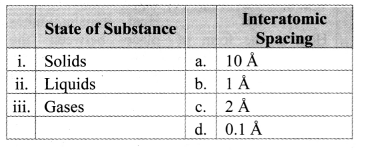
Maharashtra Board Class 11 Physics Important Questions Chapter 7 Thermal Properties of Matter 1
Answer:
i – b,
ii – c,
iii – a

Question 13.
Distinguish between an adiabatic wall and diathermic wall.
Answer:

Adiabatic wall

Diathermic wall

i.An ideal wall or partition separating two systems such that no heat exchange can take place between the systems is called adiabatic wall.A wall that allows exchange of heat energy between two systems is said to be diathermic wall.
ii.It is a perfect thermal insulator.It is not a perfect thermal insulator.
iii.It does not exist in reality.Partition like thin sheet of copper acts as diathermic wall.
iv.It is generally represented as thick cross-shaded (slanting lines region).It is represented as a thin dark region.

Maharashtra Board Class 11 Physics Important Questions Chapter 7 Thermal Properties of Matter

Question 14.
State and explain zeroth law of thermodynamics.
Answer:
Statement: If two bodies A and B are in thermal equilibrium and also A and C are in thermal equilibrium then B and C are also in thermal equilibrium.
Explanation:

  1. Consider two sections of a container separated by an adiabatic wall containing two different gases as system A and system B.
  2. Systems A and B are independently brought in thermal equilibrium with a system C.
  3. When the adiabatic wall separating systems A and B is removed, there will be no transfer of heat from system A to system B or vice versa.
  4. This indicates that systems A and B are also in thermal equilibrium.
  5. This means, if systems A and B are separately in thermal equilibrium with a system C, then A and B are also mutually in thermal equilibrium.

Question 15.
What is thermometry? What is thermometer?
Answer:
Thermometry is the science of temperature and its measurement. The device used to measure temperature is a thermometer.

Question 16.
State the principle used to measure the temperature of a system using a thermometer.
Answer:
When two or more systems/bodies are in thermal equilibrium, their temperatures are same. This principle is used to measure the temperature of a system by using a thermometer.

Question 17.
Explain how thermal equilibrium is attained between thermometer and the patient holding thermometer, in mouth.
Answer:

  1. Thermometer indicating lower temperature is held in mouth by patient.
  2. As body of patient is at higher temperature, heat energy is transferred from patient to thermometer.
  3. When temperature of thermometer becomes same as temperature of patient, heat exchange stops and thermal equilibrium is attained between thermometer and body of patient.

Question 18.
Define the following terms.
i) Ice point
ii) Steam point
Answer:

  1. Ice point: The temperature at which pure water freezes at one standard atmospheric pressure is called as ice point or freezing point.
  2. Steam point: The temperature at which pure water boils into steam or steam changes to liquid water at one standard atmospheric pressure is called as steam point or boiling point.

Maharashtra Board Class 11 Physics Important Questions Chapter 7 Thermal Properties of Matter

Question 19.
Explain Celsius and fahrenheit scale of temperature. Give relation between the two scales with the help of the graph.
Answer:

  1. Celsius scale:
    • The ice point (melting point of pure ice) is marked as 0 °C (lower point) and steam point (boiling point of water) is marked as 100 °C (higher point).
    • Both are taken at one atmospheric pressure.
    • The interval between these points is divided into loo equal pans. Each of these parts is called as one degree celsius and it is written as 1 oc.
  2. Fahrenheit scale:
    • The ice point (melting point of pure ice) is marked as 32 °F and steam point (boiling point of water) is marked as 212 °F.
    • The interval between these two reference points is divided into 180 equal parts. Each part is called as degree fahrenheit and is written as 1 °F.
  3. Relation between fahrenheit temperature and celsius temperature:
    \(\frac{\mathrm{T}_{\mathrm{F}}-32}{180}\) = \(\frac{T_{C}-0}{100}\)
    Where, TF = temperature in fahrenheit scales.
    TC = temperature in celsius scale.
    The graph of TF versus TC is as shown
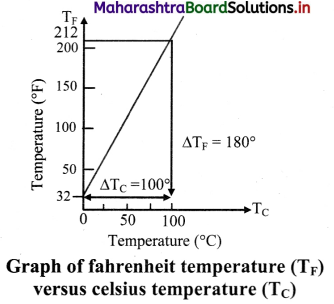
    Maharashtra Board Class 11 Physics Important Questions Chapter 7 Thermal Properties of Matter 2

Question 20.
What is thermometer? Explain with examples, the thermometric property used in a thermometer.
Answer:

  1. An instrument designed to measure temperature is called as thermometer.
  2. Any property of a substance which changes sufficiently with temperature can be used as a basis of constructing a thermometer and is known as the thermometric property.
  3. There are different types of thermometers.
    • In a constant volume gas thermometer, the pressure of a fixed volume of gas (measured by the difference in height) is used as the thermometric property.
    • The liquid-in-glass thermometer depends on the change in volume of the liquid with temperature. Small change in temperature changes the volume of liquid considerably. Two such liquids are mercury and alcohol. Mercury thermometers are used for measurement of temperature range -39 °C to 357 °C while alcohol thermometers are used only to measure temperatures near ice point (melting point of pure ice).
    • The resistance thermometer uses the change of electrical resistance of a metal wire with temperature.
    • Normally in research laboratories, a thermocouple is used to measure the temperature. A thermocouple is a junction of two different metals or alloys eg.: copper and iron joined together.
    • When two such junctions at the two ends of two dissimilar metal rods are kept at two different temperatures, an electromotive force is generated that can be calibrated to measure the temperature.
  4. Thermometers are calibrated so that a numerical value may be assigned to a given temperature. The standard fixed points are melting point of ice and boiling point of water.

Question 21.
State characteristics of thermometer.
Answer:

  1. Thermometer must be sensitive, i.e., a noticeable change in the thermometric property should be observed for a very small change in temperature.
  2. It has to be accurate.
  3. It should be easily reproducible.
  4. It is important that the system attains thermal equilibrium with the thermometer quickly.

Question 22.
Explain relation between unknown temperature T and thermodynamic property PT at temperature T.
Answer:
If the values of a thermometric property are P1 and P2 at the ice point (0 °C) and steam point (100 °C) respectively and the value of this property is PT at unknown temperature T, then T is given by the following equation.
T = \(\frac{100\left(P_{T}-P_{1}\right)}{P_{2}-P_{1}}\)

Question 23.
State true or false. If false correct the statement and rewrite.
Ideally, there should be no difference in temperatures recorded on two different thermometers.
Answer:
True.

Maharashtra Board Class 11 Physics Important Questions Chapter 7 Thermal Properties of Matter

Question 24.
List an advantage and a disadvantage of constant volume gas thermometer.
Answer:
Advantage: There is no difference in temperatures recorded on two different constant volume gas thermometers. Hence, it is very accurate.
Disadvantage: Constant volume gas thermometer is bulky instrument. Hence, it is not easily portable.

Question 25.
Give short note on liquid-in-glass thermometer.
Answer:

  1. Liquid-in-glass thermometer depends on the change in volume of the liquid with temperature.
  2. When the bulb is heated, the liquid in a glass bulb expands upward in a capillary tube.
  3. The liquid is such that it is easily seen and expands (or contracts) rapidly and by a large amount over a wide range of temperature.
  4. Most commonly used liquids are mercury and alcohol as they remain in liquid state over a wide range. Mercury freezes at -39 °C and boils at 357 °C; alcohol freezes at -115 °C and boils at 78 °C.

Question 26.
What are thermochromic liquids? Give two examples.
Answer:

  1. Thermochromic liquids are ones which change colour with temperature.
  2. These liquids are very sensitive to temperature, especially in range of room temperature.
  3. Hence, only specific liquids display distinct colour variations at normal temperature.
    Examples: Titanium dioxide and zinc oxide are white at room temperature but when heated change to yellow.

Question 27.
Write a note on resistance thermometer.
Answer:

  1. Resistance thermometer uses the change of electrical resistance of a metal wire with temperature.
  2. It measures temperature accurately in the range -2000 °C to 1200 °C is best for steady temperatures.
  3. It is bulky and hence not easily portable.

Solved Examples

Question 28.
If the temperature in the room is 29 °C, what is its temperature in degree fahrenheit?
Solution:
Given: TC = 29 °C
To find: Temperature in degree fahrenheit (TF)
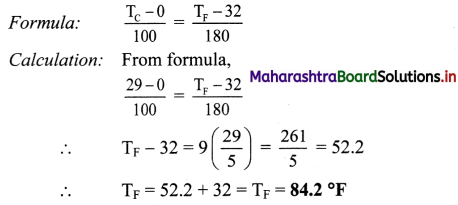
Maharashtra Board Class 11 Physics Important Questions Chapter 7 Thermal Properties of Matter 3
Answer:
Temperature in the room in degree fahrenheit is 84.2 °F.

Question 29.
Average room temperature on a normal day is 27 °C. What is the room temperature in °F?
Solution:
TC = 27 °C
Room temperature in °F
Calculation: From formula,
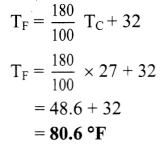
Maharashtra Board Class 11 Physics Important Questions Chapter 7 Thermal Properties of Matter 4
Answer:
Room temperature in °F is 80.6 °F.

Question 30.
Normal human body temperature in fahrenheit is 98.4 °F. What is the body temperature in °C?
Solution:
TF = 98.4 °F
Formula: Body temperature in °C (TC)
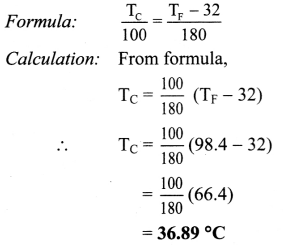
Maharashtra Board Class 11 Physics Important Questions Chapter 7 Thermal Properties of Matter 5
Body temperature in °C is 36.89 °C.

Question 31.
The length of a mercury column in a mercury-in-glass thermometer is 25 mm at the ice point and 180 mm at the steam point. What is the temperature when the length is 60 mm?
Solution:
Here the thermometric property P is the length of the mercury column.
Using equation,
T = \(\frac{100\left(\mathrm{P}_{\mathrm{T}}-\mathrm{P}_{1}\right)}{\left(\mathrm{P}_{2}-\mathrm{P}_{1}\right)}\)
For P1 = 25 mm,
P2 = 180 mm,
PT = 60 mm
T = \(\frac{100(60-25)}{(180-25)}\)
= 22.58 °C
The temperature corresponding to the length of 60 mm is 22.58 °C.

Maharashtra Board Class 11 Physics Important Questions Chapter 7 Thermal Properties of Matter

Question 32.
A resistance thermometer has resistance 95.2 Ω at the ice point and 138.6 Ω at the steam point. What resistance would be obtained if the actual temperature is 27 °C?
Solution:
Here the thermometric property P is the resistance. If R is the resistance at 27 °C,
Using equation,
T = \(\frac{100\left(\mathrm{P}_{\mathrm{T}}-\mathrm{P}_{1}\right)}{\left(\mathrm{P}_{\mathrm{T}}-\mathrm{P}_{1}\right)}\)
For T = 27 °C, P1 = 95.2 Ω, P2 = 138.6 Ω .
∴ 27 = \(\frac{100(\mathrm{R}-95.2)}{(138.6-95.2)}\)
∴ R = \(\frac{27 \times(138.6-95.2)}{100}\) + 95.2
= 11.72 + 95.2
= 106.92Ω
The resistance obtained would be 106.92 Ω.

Question 33.
Explain the need for thermodynamic (absolute) scale.
Answer:

  1. The two fixed point scale, Celsius scale and Fahrenheit scale had a practical shortcoming for calibrating the scale.
  2. It was difficult to precisely control the pressure and identify the fixed points, especially for the boiling point as the boiling temperature is very sensitive to changes in pressure.
  3. Hence, a one fixed point scale was adopted to define a temperature scale.
  4. This scale is called the absolute scale or thermodynamic scale.

Question 34.
What is triple point of water? State its physical significance.
Answer:

  1. The triple point of water is that point where water in a solid, liquid and gas state co-exists in equilibrium and this occurs only at a unique temperature and a pressure.
  2. To know the triple point, one has to see that three phases coexist in equilibrium and no one phase in dominating. This occurs for each substance at a single unique combination of temperature and pressure.
  3. Thus, if three phases of water solid ice, liquid water and water vapour coexist, the pressure and temperature are automatically fixed.
  4. Internationally, triple point of water has been assigned as 273.16 K at pressure equal to 6.11 × 10² Pa or 6.11 × 10⁻³ atmosphere, as the standard fixed point for calibration of thermometers.
  5. The physical significance of triple point of water is that, it represents unique condition and it is used to define the absolute temperature.

Question 35.
Write a short note on absolute scale of temperature.
Answer:

  1. The absolute scale of temperature, is so termed since ills based on the properties of an ideal gas and does not depend on the property of any particular substance.
  2. The zero of this scale is ideally the lowest temperature possible although it has not been achieved in practice.
  3. It is termed as Kelvin scale after Lord Kelvin with its zero at -273.15 °C and temperature intervals same as that on the Celsius scale. It is written as K (without °).

Question 36.
Draw a neat and well labelled diagram to show comparison of kelvin, Celsius and fahrenheit temperature scales.
Answer:
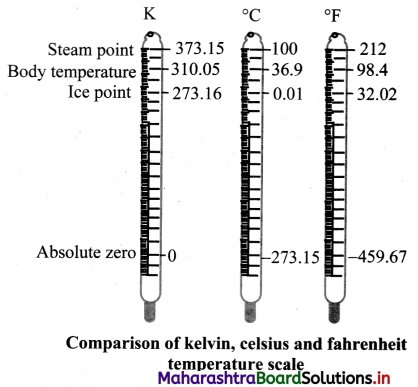
Maharashtra Board Class 11 Physics Important Questions Chapter 7 Thermal Properties of Matter 6

Question 37.
Answer the following:
i) The triple-point of water is a standard fixed point in modern thermometry. Why? What is wrong in taking the melting point of ice and the boiling point of water as standard fixed points (as was originally done in the Celsius scale)?
ii) The absolute temperature (Kelvin scale) T is related to temperature tc on the Celsius scale by tc = T – 273.15. Why do we have 273.15 in this relation and not 273.16?
Answer:
i) The triple point of water has been assigned a fixed value of 273.15 K. This number represents a unique value associated with a unique condition of temperature and pressure in which all the three phases of water co-exist. On the other hand, melting point of ice and boiling point of water do not have a unique set of values as they are subject to changes in pressure and volume. For this reason, triple point of water is a standard fixed point in modem thermometry.

ii) On Celsius scale, the melting point of ice at normal pressure has a value 0 °C. The value corresponding to this value on the absolute scale is 273.15 K. The value 273.16 K denotes the triple point of water which has a value,
273.16 – 273.15 = 0.01 °C on Celsius scale as per the given relation.

Question 38.
State Charles’ law and give its formula.
Answer:
Charles’ law:
At constant pressure, volume of a fixed mass of gas is directly proportional to its absolute temperature.
Mathematically,
V ∝ T … ( at constant pressure)
∴ V = kT
where k is constant of proportionality
∴ \(\frac{\mathrm{V}}{\mathrm{T}}\) = k = constant
For two gases, \(\frac{V_{1}}{T_{1}}\) = \(\frac{V_{2}}{T_{2}}\) = constant.

Maharashtra Board Class 11 Physics Important Questions Chapter 7 Thermal Properties of Matter

Question 39.
State Pressure law and give its formula.
Answer:
Pressure (Gay Lussac’s) law:
At constant volume, pressure of a fixed mass of gas is directly proportional to its absolute temperature.
Mathematically,
P ∝ T .. .(at constant volume)
∴ P = kT
Where, k is constant of proportionality P
∴ \(\frac{\mathrm{P}}{\mathrm{T}}\) = k = constant
For two gases, \(\frac{P_{1}}{T_{1}}=\frac{P_{2}}{T_{2}}\) = constant

Question 40.
State Boyle’s law and give its formula.
Answer:
Boyle’s law:
At constant temperature, the volume of a fixed mass of a gas is inversely proportional to its pressure.
Mathematically,
V ∝ \(\frac{1}{\mathrm{P}}\).. ..(at constant temperature)
V = k × \(\frac{1}{\mathrm{P}}\)
where, k is constant of proportionality.
PV = k = constant For two gases,
P1V1 = P2V2 = constant

Question 41.
Derive ideal gas equation PV = nRT.
Answer:

  1. The relation between three variables of a gas i.e., pressure, volume and absolute temperature is called as ideal gas equation.
    From Boyle’s law,
    V ∝ \(\frac{\mathrm{T}}{\mathrm{P}}\), at constant temperature ….(1)
    From Charles’ law,
    V ∝ T, at constant pressure … .(2)
  2. Combining equations (1) and (2) we get,
    ∴ V ∝ \(\frac{\mathrm{T}}{\mathrm{P}}\)
    ∴ \(\frac{\mathrm{PV}}{\mathrm{T}}\)= constant
  3. For one mole of a gas,
    \(\frac{\mathrm{PV}}{\mathrm{T}}\) = R or PV = RT … (3)
    where R is the constant of proportionality.
  4. Equation (3) is called ideal gas equation. The value of constant R is same for all gases. Therefore, R is called as universal gas constant. R = 8.31 JK-1mol-1.
  5. For ‘n’ moles of gas, i.e. if the gas contains ‘n’ moles, equation (3) can be written as,
    PV = nRT

Solved Examples

Question 42.
Express T = 24.57 K in Celsius and fahrenheit.
Solution:
Given: TK = 24.57 K
To find: Temperature in Celsius (TC),
Temperature in fahrenheit (TF)

Maharashtra Board Class 11 Physics Important Questions Chapter 7 Thermal Properties of Matter 7
Calculation:
From formula,
∴ TC = TK – 273.15
= 24.57 – 273.15
= -248.58 °C
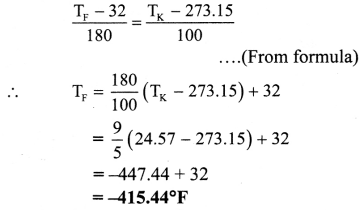
Maharashtra Board Class 11 Physics Important Questions Chapter 7 Thermal Properties of Matter 8
Temperature in celsius (TC) is – 248.58 °C
Temperature in fahrenheit (TF) is -415.44 °F

Question 43.
Calculate the temperature which has the same value on fahrenheit scale and kelvin scale.
Solution:
Given: TK = TF = x
To find: Temperature at which Kelvin and Fahrenheit scales coincide (x)
Formula: \(\frac{\mathrm{T}_{\mathrm{F}}-32}{180}\) = \(\frac{\mathrm{T}_{\mathrm{K}}-273.15}{100}\)
Calculation: From formula.
∴ \(\frac{x-32}{180}\) = \(\frac{x-273.15}{100}\)
∴ 5(x – 32) = 9(x – 273.15)
∴ 5x – 160 = 9x – 2458.35
∴ 4x = 2298.35
∴ x = \(\frac{2298.35}{4}\) = 574.6
∴ x = 574.6 °F
The temperature at which kelvin and fahrenheit scales coincide is 574.6 °F.

Maharashtra Board Class 11 Physics Important Questions Chapter 7 Thermal Properties of Matter

Question 44.
The triple points of neon and carbon dioxide are 24.57 K and 216.55 K, respectively. Express these temperatures on
the celsius and fahrenheit scales. (NCERT)
Solution:
Given: For neon, TK = 24.57 K
For carbon dioxide, TK = 216.55 K
To find:
i) Triple point of neon on celsius (TCN) and fahrenheit scale (TFN)
ii) Triple point of carbon dioxide on Celsius (TCC) and fahrenheit scale (TFC)

Formulae:
i) TK – 273.15 = TC
ii) \(\frac{\mathrm{T}_{\mathrm{K}}-273.15}{100}\) = \(\frac{\mathrm{T}_{\mathrm{c}}-32}{180}\)
Calculation: From formula (i),
TC = TK – 273.15
For neon, TCN = 24.57 – 273.15
∴ TCN = -248.58 °c
For carbon dioxide.
TCC = 216.55 – 273.15
∴ TCC = -56.60 °c
From formula (ii),
TF = \(\frac{9}{5}\)(Tk – 273.15) + 32
For neon, Tk = 24.57 K
∴ TFN = \(\frac{9}{5}\)[24.57 – 273.15] + 32
∴ TFN = -415.44 °F
For CO2, TK = 216.55 K
∴ TFC = \(\frac{9}{5}\)(216.55 – 273.15) + 32
∴ TFC = -69.88 °F
i) Triple point of neon on celsius scale is -248.58 °c and on a fahrenheit scale is -415.44 °F.
ii) Triple point of carbon-dioxide on celsius scale is -56.60 °C and on fahrenheit scale is -69.88 °F.

Question 45.
Two absolute scales A and B have triple points of water defined to be 200 A and 350 B. What is the relation between TA and TB?
Solution:
Triple point of water is, T = 273.16 K
Since the absolute scales measure the triple point as 200 A and 350 B.
∴ 200A = 350B = 273.16 K
∴ 1A = \(\frac{273.16}{200}\)K and 1B = \(\frac{273.16}{350}\)K
If TA and TB are the temperatures on the two scales, then
\(\frac{273.16}{200}\)TA = \(\frac{273.16}{350}\)TB
∴ TA = \(\frac{200}{350}\) TB = \(\frac{4}{7}\)TB
\(\frac{\mathbf{T}_{\mathbf{A}}}{\mathbf{T}_{\mathbf{B}}}\) = \(\frac{4}{7}\)
The relation between TA and TB is TA : TB = 4 : 7

Question 46.
The pressure reading in a thermometer at steam point is 1.367 × 10³ Pa. What is pressure reading at triple point knowing the linear relationship between temperature and pressure?
Solution:
Given: P = 1.367 × 10³ Pa at steam point (T) i.e., at 273.15 + 100 = 373.15 K.
Linear relationship between temperature and pressure means that.
P ∝ T ⇒ P1T1 = P2T2
To find: Pressure reading (Ptriple)
Formula: Ptriple = 273.16 × \(\left(\frac{\mathrm{P}}{\mathrm{T}}\right)\)
where Ptriple and P are the pressures at temperature of triple point (273.16 K) and T (375.15 K) respectively.
Calculation: From formula,
∴ Ptriple = 273.16 × \(\left(\frac{1.367 \times 10^{3}}{373.15}\right)\)
= 1000 × 103 Pa
Pressure reading is 1.000 × 10³ Pa.

Maharashtra Board Class 11 Physics Important Questions Chapter 7 Thermal Properties of Matter

Question 47.
When the pressure of 0.75 litre of a gas at 27 °C is doubled, its temperature rises to 111°C. Calculate the final volume of a gas.
Solution:
Given: V1 = 0.75 litre = 750 cm3,
T1 = 27 + 273.15 = 300.15 K,
T2 = 111 + 273.15 = 384.15 K,
P2 = 2P1
To find: Final volume (V2)
Formula: \(\frac{\mathrm{P}_{1} \mathrm{~V}_{1}}{\mathrm{~T}_{1}}\) = \(\frac{\mathrm{P}_{2} \mathrm{~V}_{2}}{\mathrm{~T}_{2}}\)
Calculation: From formula,

Maharashtra Board Class 11 Physics Important Questions Chapter 7 Thermal Properties of Matter 9
∴ V2 = 480 cm3
The final volume of the gas is 480 cm3.

Question 48.
A certain mass of a gas at 20 °C is heated until both its pressure and volume are doubled. Calculate the final temperature.
Solution:
T1 = 20 + 273.15 = 293.15 K,
P2 = 2P1, and V2 = 2V1
To find: Final temperature (T2)
Formula: \(\frac{\mathrm{P}_{1} \mathrm{~V}_{1}}{\mathrm{~T}_{1}}\) = \(\frac{\mathrm{P}_{2} \mathrm{~V}_{2}}{\mathrm{~T}_{2}}\)
Calculation: From formula,
\(\frac{\mathrm{P}_{1} \mathrm{~V}_{1}}{\mathrm{~T}_{1}}\) = \(\frac{\left(2 \mathrm{P}_{1}\right)\left(2 \mathrm{~V}_{1}\right)}{\mathrm{T}_{2}}\)
∴ \(\frac{1}{\mathrm{~T}_{1}}\) = \(\frac{4}{\mathrm{~T}_{2}}\)
∴ T2 = 4 × 293.15 = 1172.6 K
= 1172.6 – 273.15 = 899.45 °C
∴ T2 = 1172.6 K or 899.45 °C
The final temperature of the gas is 1172.6 K or 899.45 °C.

Question 49.
Explain how substances expand on the basis of vibrational motion of atoms.
Answer:

  1. The atoms in a solid vibrate about their mean positions.
  2. When heated, they vibrate faster and force each other to move a little farther apart. This results into expansion.
  3. The molecules in a liquid or gas move with certain speed.
  4. When heated, they move faster and force each other to move a little farther apart. This results
    in expansion of liquids and gases on heating.
  5. The expansion is more in liquids than in solids; gases expand even more.

Question 50.
What is thermal expansion? List types of thermal expansion.
Answer:

  1. A change in the temperature of a body causes change in its dimensions.
  2. The increase in the dimensions of a body due to an increase in its temperature is called thermal expansion.
  3. There are three types of thermal expansion:
    • Linear expansion
    • Areal expansion
    • Volume expansion

Question 51.
Define linear expansion of solids.
Answer:
The expansion in length of a solid due to thermal energy is called linear expansion.

Maharashtra Board Class 11 Physics Important Questions Chapter 7 Thermal Properties of Matter

Question 52.
Define coefficient of linear expansion of solid. State its unit and dimensions.
Answer:

  1. The coefficient of linear expansion of a solid is defined as increase in the length per unit original length at 0 °C per degree rise in temperature.
    It is denoted by α and given by,
    α = \(\frac{l_{2}-l_{1}}{l_{1}\left(\mathrm{~T}_{2}-\mathrm{T}_{1}\right)}\)
    where l1 = initial length at temperature T1 °C
    l2 = final length at temperature T2 °C
  2. Unit: °C-1 or K-1
  3. Dimensions: [L0M0T0K-1]

Question 53.
Derive an expression for the coefficient of linear expansion in solid.
Answer:
i) If the substance is in the form of a long rod of length l, then for small change ∆T, in temperature, the fractional change ∆l/l, in length is directly proportional to ∆T.
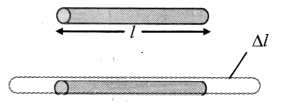
Maharashtra Board Class 11 Physics Important Questions Chapter 7 Thermal Properties of Matter 10
[Note: Linear expansion ∆l is exaggerated for explanation.]
\(\frac{\Delta l}{l}\) ∝ ∆T
∴ \(\frac{\Delta l}{l}\) = α∆T … (1)
where, α is called the coefficient of linear expansion of solid.

ii) Rearranging terms in equation (1),
α = \(\frac{\Delta l}{l \Delta \mathrm{T}}\)
= \(\frac{l_{\mathrm{T}}-l_{0}}{l_{0}\left(\mathrm{~T}-\mathrm{T}_{0}\right)}\)
where,
l0 = length of rod at 0 °C,
lT = length of rod when heated to T °C,
T0 = 0 °C (initial temperature)
T = final temperature,
∆l = lT – T0 = change in length,
∆T = T – T0 = rise in temperature.

iii) If l0 = 1 m and T – T0 = 1 °C, then α = lT – l0 (numerically).

iv) As magnitude of α varies negligibly with temperature, it is assumed to be constant for a particular material.
Hence, it is not essential to take initial temperature as 0 °C.
This modifies equation (2) into,
α = \(\frac{l_{2}-l_{1}}{l_{1}\left(\mathrm{~T}_{2}-\mathrm{T}_{1}\right)}\)
where l1 = initial length at temperature T1 °C
l2 = final length at temperature T2 °C

Question 54.
State true or false. If false correct the statement and rewrite.
i) Coefficient of linear expansion is same for all substances.
ii) Metals have high values for the coefficient of linear expansion, than non-metals.
Answer:

  1. False.
    Coefficient of linear expansion is different for different substances.
  2. True.

Question 55.
Define areal expansion of solids.
Answer:
The increase in the surface area of a solid, on heating is called areal expansion or superficial expansion of solids.

Maharashtra Board Class 11 Physics Important Questions Chapter 7 Thermal Properties of Matter

Question 56.
Define coefficient of superficial (areal) expansion of a solid, state its unit and dimensions.
Answer:

  1. Coefficient of superficial (areal) expansion of a solid is defined as the increase in area per unit original area at 0 °C per degree rise in temperature.
    It is denoted by β and given by,
    β = \(\frac{A_{2}-A_{1}}{A_{1}\left(T_{2}-T_{1}\right)}\)
    where, A1 = Area of solid sheet at T1 °C,
    A2 = Area of solid sheet at T2 °C
  2. Unit: 0°C-1 or K-1
  3. Dimensions: [L0M0T0K-1

Question 57.
Derive expression for coefficient of areal expansion.
Answer:
i) If a substance is in the form of a plate of area A, then for small change ∆T in temperature, the fractional change in area, ∆A/A in figure given below, is directly proportional to ∆T.
Maharashtra Board Class 11 Physics Important Questions Chapter 7 Thermal Properties of Matter 11
[Note: Areal expansion ∆A is exaggerated for explanation]
\(\frac{\Delta \mathrm{A}}{\mathrm{A}}\) ∝ ∆T
∴ \(\frac{\Delta \mathrm{A}}{\mathrm{A}}\) = β∆T … (1)
where β is called the coefficient of areal expansion of solid.

ii) Rearranging terms in equation (1),
β = \(\frac{\Delta \mathrm{A}}{\mathrm{A} \Delta \mathrm{T}}\)
= \(\frac{A_{T}-A_{0}}{A_{0}\left(T-T_{0}\right)}\)
where,
A0 = volume at 0 °C,
AT = volume when heated to T °C,
T0 = 0 °C (initial temperature),
T = final temperature,
∆A = AT – A0 = change in area,
∆T = T – T0 = rise in temperature.
iii) If A0 = 1 m2, T – To = 1 °C, then β = AT – A0 (numerically).
iv. As, β does not vary significantly with temperature. Hence, if A1 is the area of a metal plate at T1 °C and A2 is the area at higher temperature at T2 °C, then
β = \(\frac{A_{2}-A_{1}}{A_{1}\left(T_{2}-T_{1}\right)}\)

Question 58.
Define volume expansion of solids.
Answer:
The increase in volume due to heating is called volume expansion or cubical expansion.

Question 59.
Define coefficient of cubical (volume) expansion of a solid. State its unit and dimensions.
Answer:
i) Coefficient of cubical (volume) expansion:
Coefficient of cubical (volume) expansion of a solid is defined as increase in volume per unit original volume at O °C per degree rise in temperature.
It is denoted by γ and is given by,
γ = \(\frac{V_{2}-V_{1}}{V_{1}\left(T_{2}-T_{1}\right)}\)
where,
V1 = Volume of solid at T1 °C,
V2 = Volume of solid at T2 °C
ii) Dimensions: [L0M0T0K-1]

[Note: Units and dimension of areal expansion in solid (β) and cubical expansion in solid (γ) are same as that of linear expansion in solid (α).

Maharashtra Board Class 11 Physics Important Questions Chapter 7 Thermal Properties of Matter

Question 60.
Derive an expression for coefficient of cubical expansion.
Answer:
i) If the substance is in the form of a cube of volume V, then for small change ∆T in temperature, the fractional change, ∆/V in volume is directly proportional to ∆T.
Maharashtra Board Class 11 Physics Important Questions Chapter 7 Thermal Properties of Matter 12
[Note: Volume expansion ∆V is exaggerated for explanation.)
ii) γ = \(\frac{\Delta \mathrm{V}}{\mathrm{V} \Delta \mathrm{T}}\) = \(\frac{\mathrm{V}_{\mathrm{T}}-\mathrm{V}_{0}}{\mathrm{~V}_{0}\left(\mathrm{~T}-\mathrm{T}_{0}\right)}\)
where, V0 = volume at 0 °C,
VT = volume when heated to T °C,
T0 = 0 °C (initial temperature),
T = final temperature.
∆V = VT – V0 = change in volume,
γ = VT – T0 = rise in temperature.

iii) If V0 = 1 m3, T – T0 = 1 °C, then γ = VT – V0 (numerically).

iv) If V1 is the volume of a body at T1 °C and V2 is the volume at higher temperature T2 °C, then
γ1 = \(\frac{\mathrm{V}_{2}-\mathrm{V}_{1}}{\mathrm{~V}_{1}\left(\mathrm{~T}_{2}-\mathrm{T}_{1}\right)}\)
γ1, is the coefficient of volume expansion at temperature T1 °C.

Question 61.
How does coefficient of volume expansion depend upon temperature?
Answer:

  1. As compared to coefficient of linear expansion (α) and coefficient of areal expansion (β), γ changes more with temperature.
  2. It is constant only at high temperatures.

Question 62.
Do coefficient of areal expansion and coefficient of volume expansion depend upon nature of material?
Answer:
Yes, coefficient of areal expansion and coefficient of volume expansion depend upon nature of material.

Question 63.
Explain expansion in fluids.
Answer:

  1. Since fluids possess definite volume and take the shape of the container, they exhibit only change in volume significantly.
  2. Equations valid for cubical or volume expansion of fluids are:
    γ = \(\frac{\Delta V}{V \Delta T}=\frac{V_{T}-V_{0}}{V_{0}\left(T-T_{0}\right)}\)
    where, V0 = volume at 0 °C,
    VT = volume when heated to T °C,
    T0 = 0 °C (initial temperature),
    T = final temperature,
    ∆V = VT – V0 = change in volume,
    ∆T = T – T0 = rise in temperature.
    and γ1 = \(\frac{V_{2}-V_{1}}{V_{1}\left(T_{2}-T_{1}\right)}\)
    where, V1 is volume of body at T1 °C, V2 is volume of body at higher temperature T2 °C and γ1 is coefficient volume expansion at T1 °C.
  3. As fluids are kept in containers, while dealing with the volume expansion of fluids, expansion of the container also needs to be considered.
  4. If expansion of fluid results in a volume greater than the volume of the container, the fluid overflows if the container is open.
  5. If the container is closed, volume expansion of fluid causes additional pressure on the walls of the container.

Question 64.
Use the data given in the table below:

Materialsγ(K-1)
Invar2 × 10 -6
Steel(3.3 – 3.9) × 10-5
Aluminium6.9 × 10“-5
Mercury18.2 × 10-5
Water20.7 × 10-5
Paraffin58.8 × 10-5
Gasoline95.0 × 10-5
Alcohol (ethyl)110 × 10-5

What conclusions can be drawn using the data?
Answer:

  1. Coefficient of volume expansion (γ) is a characteristic of the substance.
  2. It (γ) has higher order of magnitude for liquids than that of solids.

Maharashtra Board Class 11 Physics Important Questions Chapter 7 Thermal Properties of Matter

Question 65.
Explain how behaviour of water is different than solids and liquids when heat is supplied.
Answer:

  1. Normally solids and liquids expand on heating. Hence their volume increases on heating.
  2. Since the mass is constant, it results in a decrease in the density on heating.
  3. Water expand on cooling from 4 °C to 0 °C.
  4. Hence its density decreases on cooling in this temperature range.

Question 66.
Derive relation between coefficient of linear expansion (α) and coefficient of areal expansion (β).
Answer:
Consider a square plate of side l0 at 0 °C and h at T °C.

  1. lT = lo (1 + αT) .
    If area of plate at 0 °C is Ao, Ao = \(l_{0}^{2}\)
    If area of plate at T °C is AT,
    AT = \(l_{\mathrm{T}}^{2}\) = \(l_{0}^{2}\)(1 + αT)2
    or AT = A0(1 + αT)2 …. (1)
    Also,
    AT = A0(1 + βT) … (2)
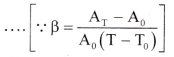
    Maharashtra Board Class 11 Physics Important Questions Chapter 7 Thermal Properties of Matter 13.1
  2. Using Equations (1) and (2), A0(1 + αT)2 = A0(1 + βT)
    ∴ 1 + 2αT + α2T2 = 1 + βT
  3. Since the values of a are very small, the term α2T2 is very small and may be neglected, ∴ β = 2α
  4. The result is general because any solid can be regarded as a collection of small squares.

Question 67.
Derive relation between coefficient of linear expansion (α) and coefficient of cubical expansion (γ).
Answer:

  1. Consider a cube of side lo at 0 °C and lT at T°C.
    ∴ lT = lo(l + αT)
    If volume of the cube at 0 °C is V0, V0 = \(l_{0}^{3}\)
    If volume of the cube at T °C is
    VT, VT = \(l_{\mathrm{T}}^{3}\) = \(l_{0}^{3}\)(1 + αT)3
    VT = V0 (1 + αT)3 ….(1)
    Also,
    VT = V0(1 + γT) ….(2)
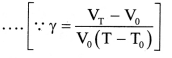
    Maharashtra Board Class 11 Physics Important Questions Chapter 7 Thermal Properties of Matter 14
  2. Using Equations (1) and (2),
    Vo(1 + αT)3 = V0(1 + γT)
    ∴ 1 + 3αT + 3α2T2 + α3T3 = 1 + γT
  3. Since the values of a are very small, the terms with higher powers of a may be neglected.
    ∴ γ = 3α
  4. The result is general because any solid can be regarded as a collection of small cubes.

Question 68.
State the relation between α, β and γ and write their meaning.
Answer:
Relation between α, β and γ is given by,
α = \(\frac{\beta}{2}\) = \(\frac{\gamma}{3}\)
where, α = coefficient of linear expansion.
β = coefficient of superficial expansion.
γ = coefficient of cubical expansion.

Solved Examples

Question 69.
The length of a rail on a railway line is 25 m at 10 °C. During summer, maximum temperature attained in the region is 50 °C. Find the minimum gap between the rails, (a = 1.2 × 10⁻⁵/°C)
Solution:
Given: L1 = 25 m, T1 = 10 °C, T2 = 50 °C,
α = 1.2 × 10⁻⁵/°C
To find: Minimum gap between rails (L2 – L1)
Formula: L2 – L1 = L1α(T2 – T1)
Calculation: From formula,
L2 – L1 = 25 × 1.2 × 10-5 × (50 – 10)
= 25 × 1.2 × 10-5 × 40
= 1.2 × 10⁻² m
∴ L2 – L1 = 1.2 cm
The minimum gap between the rails is 1.2 cm.

Maharashtra Board Class 11 Physics Important Questions Chapter 7 Thermal Properties of Matter

Question 70.
The length of a metal rod at 27 °C is 4 cm. The length increases to 4.02 cm when the metal rod is heated upto 387 °C. Determine the coefficient of linear expansion of the metal rod.
Solution:
Given: T1 = 27 °C, T2 = 387 °C
L1 = 4 cm = 4 × 10⁻² m
L1 = 4.02 cm = 4.02 × 10⁻² m
To find: Coefficient of linear expansion
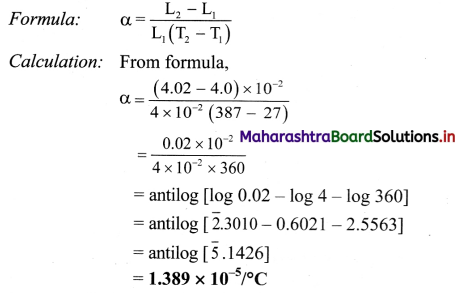
Maharashtra Board Class 11 Physics Important Questions Chapter 7 Thermal Properties of Matter 15
Coefficient of linear expansion is 1.389 × 10⁻⁵/°C

Question 71.
The length of a metal rod is 150 cm at 25 °C. Find its length when it is heated to 150 °C. (αsteel = 2.2 × 10⁵ /°C)
Solution:
Given. L1 = 150 cm, T1 = 25 °C, T2 = 150 °C,
αsteel = 2.2 × 10⁵ /°C
To find: Length of rod (L2)
Formula: α = \(\frac{L_{2}-L_{1}}{L_{1}\left(T_{2}-T_{1}\right)}\)
Calculation: From formula,
L2 – L1 = L1 α(T2 – T1)
∴ L2 = L1[1 + α(T2 – T1)]
= 150[1 + 2.2 × 105 × (150 – 25)]
= 150(1 + 2.2 × 105 × 125)
= 150(1 + 0.00275)
= 150× 1.00275 = 150.4125
∴ L2 = 150.4cm
Length of the rod at 150 °C) is 150.4 cm.

Question 72.
Length of a metal rod at temperature 27 °C is 4.256 m. Find the temperature at which the length of the same rod increases to 4.268 m. (α for iron = 1.2 × 10⁵ K-1)
Solution:
Given: T1 = 27°C, L1 = 4.256 m, L2 = 4.268 m,
α = 1.2 × 10⁵ K-1
To find: Temperature (T2)
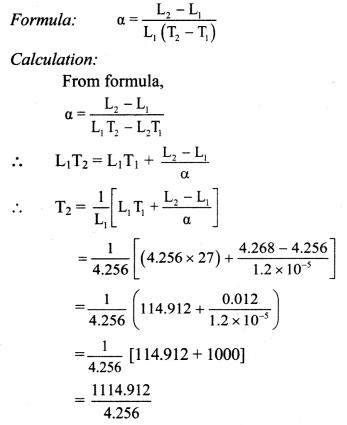
Maharashtra Board Class 11 Physics Important Questions Chapter 7 Thermal Properties of Matter 47
= antilog [log 1114.912 – log 4.256]
= antilog [3.0468 – 0.6290]
= antilog [2.4 1781
= 2.617 × 102
= 261.7°C
Required temperature is 261.7 °C.

Question 73.
A hole is drilled in a copper sheet. The diameter of the hole is 4.24 cm at 27 °C. What is the change in the diameter of the hole when the sheet is heated to 227 °C? Coefficient of linear expansion of copper = 1.70 × 10⁻⁵ °C-1.
Solution:
Given: d1 = 4.24 cm, ∆T = 227 – 27 = 200 °C,
α = 1.70 × 10⁻⁵ °C-1
To find: Change in diameter (∆d)
Formula: α = \(\frac{d_{2}-d_{1}}{d_{1} \Delta T}=\frac{\Delta d}{d_{1} \Delta T}\)
Calculation: From formula.
∆d = α x d1 x αT
= 1.70 × 10 × 4.24 × 200
∴ ∆d = 1.44 × 10⁻² cm
The change in diameter of the hole is 1.44 × 10⁻² cm.

Maharashtra Board Class 11 Physics Important Questions Chapter 7 Thermal Properties of Matter

Question 74.
A thin aluminium plate has an area 286 cm2 at 20 °C. Find its area when it is heated to 180 °C.
(β for aluminium = 4.9 × 10⁻⁵ °C)
Solution:
Given: T1 = 20°C, T2 = 180°C, A1 = 286 cm2
β = 4.9 × 10⁻⁵ °C
To find: Final area (A2)
Formula: β = \(\frac{A_{2}-A_{1}}{A_{1}\left(T_{2}-T_{1}\right)}\)
Calculation: From formula,
A2 = A1 [1 + β(T2 – T1)]
= 286[1 + 4.9 × 10⁻⁵ (180 – 20)]
= 286[1 + 4.9 × 10-5 × 160]
= 286 [1 + 784.0 × 10]
= 286 [1 + 0.00784]
= 286 [1.00784]
∴ A2 = 288.24 cm2
Its area when its heated is 288.24 cm2.

Question 75.
The surface area of the metal plate is 2.4 × 10⁻² m2 at 20°C. When the plate is heated to 185 °C, its area increases by 0.8 cm2. Find the coefficient of areal expansion of metal.
Solution:
Given: T1 = 20 °C, A1 = 2.4 × 10⁻² m2,
T2 = 185°C,
∆A = 0.8cm2 = 0.8 × 10⁻⁴ m2
To find: Coefficient of areal expansion (β)
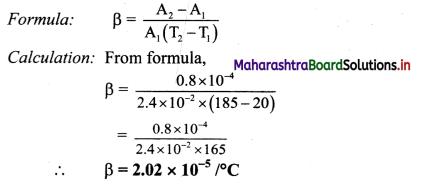
Maharashtra Board Class 11 Physics Important Questions Chapter 7 Thermal Properties of Matter 48
The coefficient of areal expansion of the metal is 2.02 × 10⁻⁵/ °C.

Question 76.
A liquid occupies a volume of 2 × 10⁻⁴ m3 at 0 °C. Calculate the increase in its volume If It is heated to 80 °C. [The coefficient of cubical expansion of the liquid is 4 × 10⁻⁴ K-1]
Solution:
Given: V0 = 2 × 10⁻⁴ m3, T0 = 0°C,T = 80°C,
γr = 4 × 10⁻⁴ K-1,
T – T0 = 80 – 0 = 80°C
To find: Increase in volume (∆V)
Formula. ∆V = V0γr(T – T0)
Calculation: From formula.
∆V = (2 × 10⁻⁴) (4 × 10-4) × 80
∴ ∆V = 6.4 × 10⁻⁶ m3
Increase m volume of the liquid is 6.4 × 10⁻⁶ m3.

Question 77.
A liquid at O °C is poured in a glass beaker of volume 600 cm3 to fill it completely. The beaker is then heated to 90 °C. How much liquid will overflow?
liquid = 1.75 × 10⁻⁴/ °C, γglass = 2.75 × 10⁻⁵/ °C)
Solution:
Given: V1 = 600 cm3, T1 = 0 °C, T2 = 90 °C
γliquid = 1.75 × 10⁻⁴/°C,
γglass = 2.75 × 10⁻⁴/°C
To find: Volume of liquid that overflows
Formula: γ = \(\frac{\mathrm{V}_{2}-\mathrm{V}_{1}}{\mathrm{~V}_{1}\left(\mathrm{~T}_{2}-\mathrm{T}_{1}\right)}\)
Calculation: From formula,
Increase is volume = V2 – V1
= γ V1(T2 – T1)
Increase in volume of beaker
= γglass × V1 (T2 – T1)
= 2.75 × 10-5 × 600 × (90 – 0)
= 2.75 × 10-5 × 600 × 90
= 148500 × 10-5 cm3
∴ Increase in volume of beaker = 1.485 cm3
Increase in volume of liquid
= γliquid × V1 (T2 – T1)
= 1.75 × 10-4 × 600 × (90 – 0)
= 1.75 × 10-4 × 600 × 90
= 94500 × 10-4 cm3
∴ Increase in volume of liquid = 9.45 cm3
∴ Volume of liquid which overflows
= (9.45 – 1.485) cm3
= 7.965 cm3
Volume of liquid that overflows is 7.965 cm3.

Maharashtra Board Class 11 Physics Important Questions Chapter 7 Thermal Properties of Matter

Question 78.
The surface area of an iron plate is 80 cm2 at 20 °C. Find its surface area at 120 °C. (αiron = 1.25 × 10⁻⁵ / °C)
Solution:
Given: A1 = 80 cm2, T1 = 20 °C, T2 = 120 °C,
αiron = 1.25 × 10⁻⁵ / °C
To find: Surface area (A2)
Formula: A2 = A1 [1 + β (T2 – T1)]
Calculation: βiron = 2 × αiron = 2.5 × 10⁻⁵ / °C
From formula,
A2 = 80[1 + 2.5 × 10⁻⁵ (120 – 20)]
∴ A2 = 80.2 cm2
Surface area of the iron plate at 120 °C is 80.2 cm2.

Question 79.
A sheet of brass is 50 cm long and 8 cm broad at 0 °C. If the surface area at 100 °C is 401.57 cm2 find the coefficient of linear expansion of brass.
Solution:
Given: l = 50 cm, b = 8cm.
∴ A1 = l × b = 50 x 8 = 400 cm2,
T1 = 0°C, T2 = 100°C,
A2 = 401.57 cm2
To find: coefficient of linear expansion (α)
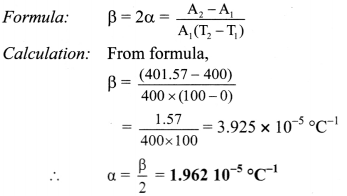
Maharashtra Board Class 11 Physics Important Questions Chapter 7 Thermal Properties of Matter 49
Coefficient of linear expansion of brass is 1.962 × 10⁻⁵/°C.

Question 80.
On heating a glass block of 10.000 cm3 from 25 °C to 40 °C, its volume increases by 4 cm3. Calculate coefficient of linear elipansion of glass.
Solution:
Given: V = 10,000 cm3, ∆V = 4 cm3,
∆T = 40 – 25 = 15°C,
To find: Coefficient of linear expansion (α)
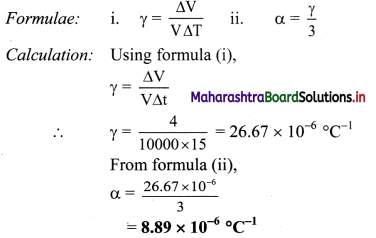
Maharashtra Board Class 11 Physics Important Questions Chapter 7 Thermal Properties of Matter 50
Coefficient of linear expansion of the glass block is 8.89 × 10⁻⁶ /°C.

Question 81.
Explain in detail what is specific heat or specific heat capacity of a substance.
Answer:

  1. Specific heat capacity is defined as the amount of heat per unit mass absorbed or given out by the substance to change its temperature by one uni! (one degree) Le., 1 °C or 1 K.
  2. The amount of heat (∆Q) required to change the temperature of a substance is directly proportional to:
    • the mass of the substance (m).
    • change in temperature of the substance (∆T).
      ∴ ∆Q ∝ m and ∆Q ∝∆T
      ∴ ∆Q ∝ m∆T
      ∴ ∆Q = sm∆T …………….. (1)
      where ‘s’ is specific heat or specific heat capacity of a substance.
      From equation (1).
      s = \(\frac{\Delta Q}{m \Delta T}\)
      If m = 1 kg and ∆T = 1 °C,then s = ∆Q.
  3. Unit: S.I. unit of specific heat is J kg-1 °C-1 or J kg-1 K-1 and C.G.S. unit is erg g-1 K-1 or erg g-1 °C-1.
  4. Example: The specific heat of water is 4.2 J kg-1 °C-1
    It means that 4.2 J of energy must be added to 1 kg of water to rise its temperature by 1 °C.
  5. The specific heat capacity is a property of the substance.
  6. Specific heat capacity weakly depends on temperature of object. Except for very low temperatures. the specific heat capacity is almost constant for all practical purposes.

Question 82.
State the heat equation.
Answer:
Heat received or given out (Q)
= mass (m) temperature change (∆T) × specific heat capacity (s).
or Q = m × ∆T × s

Maharashtra Board Class 11 Physics Important Questions Chapter 7 Thermal Properties of Matter

Question 83.
Write a note on: Molar specific heat.
Answer:

  1. If the amount of substance is specified in terms of moles (μ) instead of mass (m) in kg. then the specific heat is called molar specific heat (C).
  2. It is given by, C = \(\frac{1}{\mu} \frac{\Delta Q}{\Delta \mathrm{T}}\)
  3. The SI unit of molar specific heat capacity is J/mol °C or J/mol K.
  4. Like specific heat, molar specific heat also depends on the nature of the substance and its temperature.

Question 84.
Give reason: Water is used as a coolant in automobile radiators.
Answer:

  1. Water has the highest specific heat capacity compared to other substances.
  2. As a result, water requires higher amount of energy to get heated.
  3. This allows water to absorb heat readily while increasing its temperature minimally.
    Hence, water is used as a coolant in automobile radiators.

Question 85.
Give reason: Water is preferred as heater in hot water hag than other liquids.
Answer:

  1. Water has the highest specific heat capacity compared to other substances.
  2. This means certain mass of water heated to certain temperature contains more heat than the same mass of any other liquid heated to same temperature.
  3. As a result, water takes longer time to cool than any other liquid heated to same temperature.
    Hence, water is preferred as heater in hot water bag than other liquids.

Question 86.
Explain why specific heat capacity of a gas at constant pressure is greater than that at constant volume.
Answer:

  1. When the gas is heated at constant volume. there is no work done against external pressure.
  2. Hence, all the supplied heat is used in raising the temperature of the gas.
  3. But when the gas is heated at constant pressure, volume of the gas changes.
  4. Due to this, part of the supplied heat is used by the gas to expand against external pressure and remaining part of heat supplied is used to raise the temperature.
  5. Because of this, for the same rise in temperature, the heat to be supplied at constant pressure is greater than that for heating at constant volume.
    Hence, specific heat capacity of a gas at constant pressure is greater than specific heat capacity at constant volume.

Question 87.
Define principal and molar specific heat of a gas at constant volunie and constant pressure.
Answer:

  1. Principal specific heat:
    • Principal specific heat of a gas at constant volume (sv):
      Principal specific heat of a gas at constant volume is defined as the quantity of heat absorbed or released for rise or fall temperature of unit mass of a gas through 1 K (or 1 °C), when its volume is kept constant.
    • Principal specific heat of a gas at constant pressure (sp): Principal specfic heat of a gas at constant pressure is defined as the quantity of heat absorbed or released for rise or fall the temperature of unit mass of a gas through 1 K (or 1 °C), when its pressure is kept constant.
  2. Molar specific heat:
    • Molar specific heat of a gas at constant volume (CV): Molar specific heat of a gas at Constant volume is defined as the quantity of absorbed or released for rise or fall the temperature of one mole of the gas through 1 K (or 1 °C), when its volume is kept constant.
    • Molar specific heat of a gas at constant pressure (CP): Molar specific heat of a gas at constant pressure is defined as the quantity of heat absorbed or released for rise or fall the temperature of one mole of the gas through 1 K (or 1 °C), when its pressure is kept constant.

Question 88.
State the relation between principal specific heat capacity and molar specific heat capacity for a gas.
Answer:
Molar specific heat capacity = Molecular weight × principal specific heat capacity.
i.e. CV = μ × SP and CV = μ × SV
where, μ is the molecular weight of the gas.
[Note: Symbols (SV) and (SP) are used as per standard convention.]

Maharashtra Board Class 11 Physics Important Questions Chapter 7 Thermal Properties of Matter

Question 89.
What is heat capacity?
Answer:

  1. Heat capacity or thermal capacity of a body is the quantity of heat needed to raise or lower the temperature of the whole body by 1 o°C (or 1 K).
  2. Heat capacity can be written as Heat received or given out
    = mass × 1 × specific heat capacity
    Heat capacity = Q = m × s
    Heat capacity (thermal capacity) is measured in J/°C.

Solved Examples

Question 90.
If the temperature of 4 kg mass of a material of specific heat capacity 300 J/ kg °C rises from 20 °C to 30 °C. Find the heat received.
Solution:
m = 4 kg, s = 300 J/kg °C
∆T = 30 – 20 = 10 °C
To find: Heat received (Q)
Formula: Q = ms∆T
Calculation: From formula,
Q = 4 × 300 × 10
∴ Q = 12000 J
Heat received is 12000 J.

Question 91.
How much heat is required to raise temperature of 750 g of copper pot from 20 to 50 °C?
(The specific heat of copper is 0.094 kcal/kg °C)
Solution:
Given: s = 0.094 kcal/kg°C,
m = 750 g = 0.750kg,
T1 = 20°C and T2 = 50°C
Rise in temperature,
∆T = T2 – T1 = 50 – 20 = 30°C
To find: Heat required (Q)
Formula: Q = m × s × ∆T
Calculation: From formula,
Q = 0.750 × 0.094 × 30
∴ Q = 2.115 kcal
Heat required to raise the temperature of copper pot is 2.115 kcal.

Question 92.
Calculate the difference in the temperatures between the water at the top and bottom of a water fall 200 m high. Specific heat of water is 4200 J kg-1 °C-1.
Solution:
Given: s = 4200 J kg-1 °C-1, h = 200 m
To find: Difference in temperatures (∆T)
Formulae:
i) Q = ms∆T
ii) P.E. = mgh
Calculation: From formulae (j) and (ii)
When water falls from top to bottom. assuming no loss in energy, potential energy is converted into heat energy.
∴ Q = P.E.
∴ ms∆T = mgh
∴ s∆T = gh
∴ ∆T = \(\frac{\mathrm{gh}}{\mathrm{s}}=\frac{9.8 \times 200}{4200}\)
∴ ∆T = 0.467 °C
The difference in temperatures between the water at top and bottom is 0.467 °C.

Question 93.
Find thermal capacity for a copper block of mass 0.2 kg, if specific heat capacity of copper is 290 J/kg °C.
Solution:
Given: m = 0.2 kg, s = 290 J/kg °C
To find: Thermal capacity
Formula: Thermal capacity = m × s
Calculation: From formula,
Thermal capacity = 0.2 × 290
= 58 J/ °C
Thermal capacity is 58 J/ °C.

Question 94.
What is calorimetry?
Answer:
Calorimetry is an experimental technique for quantitative measurement of heat exchange.

Question 95.
Explain construction of calorimeter with the help of a labelled diagram.
Answer:

  1. A device in which heat measurement can be made is called calorimeter.
  2. It consists of a cylindrical vessel and stirrer as well as lid of the same material like copper or aluminium.
  3. The vessel is kept inside a wooden jacket which contains heat insulating materials like glass. wool etc. to prohibit any transfer of heat into or out of the calorimeter.
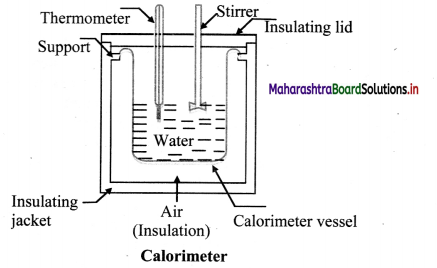
    Maharashtra Board Class 11 Physics Important Questions Chapter 7 Thermal Properties of Matter 26

Maharashtra Board Class 11 Physics Important Questions Chapter 7 Thermal Properties of Matter

Question 96.
State the principle behind working of calorimeter.
Answer:
Calorimeter being isolated system works on the principle of conservation of energy, where heat gained equals heat lost.

Question 97.
Explain the technique “method of mixtures’.
Answer:

  1. Method of mixtures is a technique used to determine specific heat capacity of a material using calorimeter.
  2. In this technique a sample ‘A’ of the substance is heated to a high temperature which is accurately measured.
  3. The sample ‘A’ is then placed quickly in the calorimeter containing water.
  4. The contents are stirred constantly until the mixture attains a final common temperature.
  5. The heat lost by the sample ‘A’ will be gained by the water and the calorimeter.
  6. The specific heat of the sample ‘A’ of the substance can be calculated as follows:
    • Let,
      m1 = mass of the sample ‘A’
      m22 = mass of the calorimeter and the stirrer
      m3 = mass of the water in calorimeter
      s1 = specific heat capacity of the substance of sample ‘A’
      s2 = specific heat capacity of the material of calorimeter (and stirrer)
      s3 = specific heat capacity of water
      T1 = initial temperature of the sample ’A’
      T2 = initial temperature of the calorimeter stirrer and water
      T = final temperature of the combined system
    • Using heat equation,
      Heat lost by the sample ‘A’ = m1s1 (T1 – T)
      Heat gained by the calorimeter and the stirrer = m2s2 (T – T2)
      Heat gained by the water = m3s3 (T – T2)
    • c. Assuming no loss of heat to the surroundings, the heat lost by the sample goes into the calorimeter, stirrer and water,
      ∴ m1s1(T1 – T) = m2s2(T – T2) + m3s3(T – T2) ………….. (1)
    • Knowing the specific heat capacity of water and copper material of the calorimeter and the stirrer, specific heat capacity (si) of material of sample ‘A’ can be calculated.
      e. Rearranging terms of equation (1),
      s1 = \(\frac{\left(\mathrm{m}_{2} \mathrm{~s}_{2}+\mathrm{m}_{3} \mathrm{~s}_{3}\right)\left(\mathrm{T}-\mathrm{T}_{2}\right)}{\mathrm{m}_{1}\left(\mathrm{~T}_{1}-\mathrm{T}\right)}\)
  7. One can find specific heat capacity of water or any liquid using the following expression, if the specific heat capacity of the material of calorimeter and sample is known
    s3 = \(\frac{\mathrm{m}_{1} \mathrm{~s}_{1}\left(\mathrm{~T}_{1}-\mathrm{T}\right)}{\mathrm{m}_{3}\left(\mathrm{~T}-\mathrm{T}_{2}\right)}-\frac{\mathrm{m}_{2} \mathrm{~s}_{2}}{\mathrm{~m}_{3}}\)

Question 98.
In method of mixtures, why is it essential that density of solid sample be greater than the liquid in calorimeter?
Answer:

  1. In method of mixtures, solid sample gives away heat to liquid, and heat exchange between, solid, liquid and calorimeter is considered as isolated.
  2. If density of solid sample is lesser than liquid in calorimeter, sample will float on liquid.
  3. This will cause partial heat loss to air inside the calorimeter and standard heat equations of calorimeter will no longer be applicable.
    Hence, in method of mixtures it is essential that density of solid sample be greater than liquid in calorimeter.

Solved Examples

Question 99.
A sphere of aluminium of 0.06 kg is placed for sufficient time in a vessel containing boiling water so that the sphere is at 100 °C. It is then immediately transferred to 0.12 kg copper calorimeter containing 0.30 kg of water at 25 °C. The temperature of water rises and attains a steady state at 28 °C. Calculate the specific heat capacity of aluminium.
(Specific heat capacity of water, sw = 4.18 × 10³ J kg-1 K-1, specific heat capacity of copper, sCu = 0.387 × 10³ J kg-1 K-1)
Solution:
Given: Mass of aluminium sphere = m1 = 0.06 kg
Mass of copper calorimeter = m2 = 0.12 kg
Mass of water in calorimeter = m3 = 0.30 kg
Specific heat capacity of copper
= SCu = s2 = 0.387 × 10³ J/kg K = 387 J/kg K
Specific heat capacity of water
= Sw = s3 = 4.18 × 10³ J/kg K = 4180 J/kg K
Initial temperature of aluminium sphere
= T1 = 100 °C
Initial temperature of calorimeter and water
= T2 = 25 °C
Final temperature of the mixture = T = 28 °C
To find: Specific heat capacity of aluminium (sal)
Maharashtra Board Class 11 Physics Important Questions Chapter 7 Thermal Properties of Matter 27
= 903.08 J/kg K
Specific heat capacity of aluminium is 903.08 J/kg K.

Maharashtra Board Class 11 Physics Important Questions Chapter 7 Thermal Properties of Matter

Question 100.
A copper sphere of 100 g mass is heated to raise its temperature to 100 °C and is released in water of mass 195 g and temperature 20 °C in a copper calorimeter. If the mass of calorimeter is 50 g, what will be the maximum temperature of water? (Given: specific heat of copper = 0.1 cal/g °C and specific heat of calorimeter = 0.1 cal/g °C)
Solution:
Let copper sphere, water and calorimeter attain final temperature T °C.
We have,
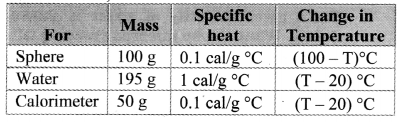
Maharashtra Board Class 11 Physics Important Questions Chapter 7 Thermal Properties of Matter 28
Heat lost by copper sphere
Q = msphere × Ssphere × ∆T
= 100 × 0.1 × (100 – T)
Heat gained by water in calorimeter
Q1 = mwater × Swater × ∆T
= 195 × 1 × (T – 20)
Heat gained by calorimeter
Q2 = mcalorimeter × mcalorimeter × ∆T
= 50 × 0.1 × (T – 20)
According to principle of heat exchange,
Q = Q1 + Q2
∴ 10 × (100 – T) = 195 × (T – 20) + 5 × (T – 20)
∴ 1000 – 10T = 200(T – 20)
∴ 210 T = 5000
∴ T ≈ 23.8 °C
Maximum temperature of water will be 23.8 °C.

Question 101.
What is a change of state? When does it occur?
Answer:

  1. Matter normally exists in three states: solid. liquid and gas. A transition from one of these states to another is called a change of state.
  2. This change can occur when exchange of heat takes place between the substance and its surroundings.

Question 102.
Explain the following temperature vs time graph obtained during process of boiling water.
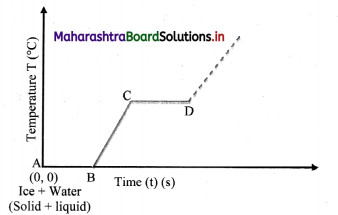
Maharashtra Board Class 11 Physics Important Questions Chapter 7 Thermal Properties of Matter 29
Variation of temperature with time
Answer:

  1. The given temperature v/s time graph demonstrates the behaviour of water when heated continuously and uniformly.
  2. Line segment AB indicates temperature of ice remaining constant at 0 °C for certain period of time.
    • This means, amount of heat (latent heat of fusion) supplied to ice is entirely used for changing its state from solid to liquid.
    • Thus, line segment AB denotes conversion of ice at 0 °C into water at 0 °C.
  3. Line segment BC indicates continuous rise in temperature of water from 0 °C to 100 °C.
    • At point C, boiling point of water is
      reached and heat energy (latent heat of vaporisation) supplied further is used to convert water into steam.
    • During this transformation, temperature remains unchanged as represented by line segment CD.
    • Thus, line segment CD denotes conversion of water at 100 °C into steam at 100 °C.
  4. Beyond point D, thermometer again shows rise in temperature.

Maharashtra Board Class 11 Physics Important Questions Chapter 7 Thermal Properties of Matter

Question 103.
Write a note on latent heat of substance.
Answer:

  1. Latent heat of a substance is the quantity of heat required to change the state of unit mass of the substance without changing its temperature.
  2. Mathematically, if mass m of a substance undergoes a change from one state to the other then the quantity of heat absorbed or released is given by, Q = mL
    where. L is known as latent heat.
  3. It is characteristic of the substance.
  4. Its SI unit is J/kg.
  5. The value of L depends on the pressure and is usually quoted at one standard atmospheric pressure.

Question 104.
Explain the following terms.
i) Latent heat of fusion
ii) Latent heat of vaporisation
Answer:

  1. Latent heat of fusion:
    • The quantity of heat required to convert unit mass of a substance from its solid state to the liquid state, at its melting point, without any change in its temperature is called its latent heat of fusion.
    • The S.I. unit of latent heat of fusion is J/kg and its C.G.S. unit is cal/’g.
  2. Latent heat of vaporisation:
    • The quantity of heat required to convert unit mass of a substance from its liquid state to vapour state, at its boiling point, without any change in its temperature is called its latent heat of vaporisation.
    • The S.I. unit of latent heat of vaporization is J/kg and its C.G.S unit is cal/g.

Question 105.
Explain why latent heat of vaporisation is much larger than latent heat of fusion.
Answer:

  1. The energy required to completely separate the molecules or atoms in liquids is greater than the energy needed to break the rigidity (rigid bonds between the molecules or atoms) in solids.
  2. Also, when the liquid is converted into vapour, it expands. Work has to be done against the surrounding atmosphere to allow this expansion.
    Hence, latent heat of vaporisation is larger than latent heat of fusion.

Question 106.
A plot of temperature versus heat energy for a given quantity of water is shown below. What can be inferred studying it?
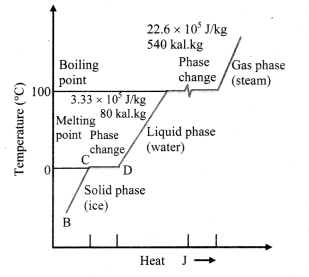
Maharashtra Board Class 11 Physics Important Questions Chapter 7 Thermal Properties of Matter 30
Temperature versus heat for water at one standard atmospheric pressure (not to scale)
Answer:
Inferences:

  1. When heat is added (or removed) during a change of state, the temperature remains constant.
  2. Also the slopes of the phase lines are not all the same, which indicates that specific heats of the various states are not equal.
  3. For water, the latent heat of fusion and vaporisation are Lf = 3.33 × 10⁵ J kg-1 and Lv = 22.6 × 10⁵ J kg-1 respectively, i.e., 3.33 × 10⁵ J of heat is needed to melt 1 kg of ice at 0 °C and 22.6 × 10⁵ J of heat is needed to convert 1 kg of water to steam at 100 °C.
  4. This means, steam at 100 °C carries 22.6 × 10⁵ J kg-1 more heat than water at 100 °C.

Question 107.
Compare change of state from solid to liquid and from liquid to vapour.
Answer:

Solid to liquidLiquid to vapour
i.The change of state from solid to liquid is called melting and from liquid to solid is called solidification.The change of state from liquid to vapour is called vaporisation while that from vapour to liquid is called condensation.
ii.Both the solid and liquid states of the substance co-exist in thermal equilibrium during the change of states from solid to liquid or vice versa.Both the liquid and vapour states of the substance coexists in thermal equilibrium during the change of state from liquid to vapour.
iii.The temperature at which the solid and the liquid states of the substance are in thermal equilibrium with each other is called the melting point of solid or freezing point of liquid. The freezing point describes the liquid to solid transition while melting point describes solid to liquid transition.The temperature at which the liquid and the vapour states of the substance coexist is called the boiling point of liquid. This is also the temperature at which water vapour condenses to form liquid.
iv.It is the characteristic of the substance and also depends on pressure.It is characteristic of substance and depends on pressure.

Question 108.
What is normal melting point?
Answer:
The melting point of a substance at one standard atmospheric pressure is called its normal melting point.
Example: Normal melting point of water is 0°C.

Maharashtra Board Class 11 Physics Important Questions Chapter 7 Thermal Properties of Matter

Question 109.
State true or false. If false correct the statement and rewrite.
Normal freezing point ice is 32 °C.
Answer:
False.
Normal freezing point ice is 0 °C or 32 °F.

Question 110.
What is normal boiling point?
Answer:
The boiling point of a substance at one standard atmospheric pressure is called its normal boiling point.
Example: Normal boiling point of water is 99.97 °C,

Question 111.
Distinguish between boiling and evaporation of liquid.
Answer:

Boiling of liquidEvaporation of liquid
i.Boiling of liquid takes place at boiling point which is fixed for a given pressure and unique for a given liquid.Evaporation of liquid can take place at any temperature.
ii.It occurs throughout the liquid.It occurs only at surface of liquid.
iii.The process does not depend on area of liquid surface exposed.The process depends upon area of liquid surface exposed. Higher the exposed surface area, higher the rate of evaporation.
iv.Source of energy is needed.Energy is taken from surrounding.
V.Boiling does not reduce temperature of liquid.When evaporation takes place, temperature of liquid decreases.
vi.During boiling process, bubbles are formed in liquid.During evaporation, no bubbles are formed in liquid.

Question 112.
Explain evaporation in terms of kinetic energy of liquid molecules.
Answer:

  1. Molecules in a liquid are moving about randomly.
  2. The average kinetic energy of the molecules decides the temperature of the liquid.
  3. However, all molecules do not move with the same speed.
  4. Some with higher kinetic energy may escape from the surface region by overcoming the interatomic forces.
  5. This process can take place at any temperature and is termed as evaporation.

Question 113.
Explain the dependence of evaporation on temperature of liquid.
Answer:

  1. If the temperature of the liquid is higher, more is the average kinetic energy.
  2. This implies that the number of fast moving molecules is more.
  3. Hence the rate of losing such molecules to atmosphere will be higher.
  4. Thus, higher is the temperature of the liquid, greater is the rate of evaporation.

Maharashtra Board Class 11 Physics Important Questions Chapter 7 Thermal Properties of Matter

Question 114.
Why does evaporation gives a cooling effect to the remaining liquid?
Answer:

  1. In the process of evaporation, faster moving molecules escape from surface of liquid overcoming the interatomic forces.
  2. Since faster molecules are lost, the average kinetic energy of the liquid is reduced.
  3. As a result, the temperature of the liquid is lowered.
    Hence, evaporation gives a cooling effect to the remaining liquid.

Question 115.
Explain two applications of evaporation in details.
Answer:

  1. Drying of clothes:
    • Clothes dry faster when hanged exposing more surface area than when kept folded.
    • Due to more surface area, water in clothes gets evaporated faster, drying clothes quickly.
  2. Using a spirit swab on skin before injecting gives cooling effect:
    • Before giving an injection to a patient, normally a spirit swab is used to disinfect the region.
    • A cooling effect is experienced by skin of patient due to evaporation of the spirit as explained before.

Question 116.
Write a note on sublimation.
Answer:

  1. All substances do not pass through the three states: solid-liquid-gas.
  2. There are certain substances which normally pass from the solid to the vapour state directly and vice versa.
  3. The change from solid state to vapour state without passing through the liquid state is called sublimation and the substance is said to sublime.
    Examples: Dry ice (solid CO2) and iodine.
  4. During the sublimation process, both the solid and vapour states of a substance coexist in thermal equilibrium.
  5. Most substances sublime at very low pressures.

Question 117.
What is a phase? Give an example.
Answer:
A phase is a homogeneous composition of a material.
Example: Graphite and diamond are two phases of carbon.

Question 118.
What is a phase diagram?
Answer:
A pressure-temperature (P-T) diagram particularly convenient for comparing different phases of a substance is called as a phase diagram.

Question 119.
Study phase diagrams given below and answer the following questions.
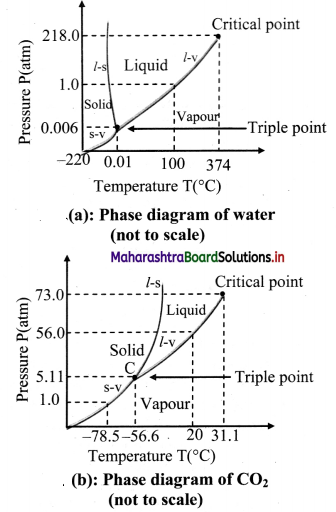
Maharashtra Board Class 11 Physics Important Questions Chapter 7 Thermal Properties of Matter 31
i)Explain vaporisation curve (l – v).
ii) Explain fusion curve (l – s).
iii) Explain sublimation curve (s – v).
iv) Explain triple point.
Answer:

    • The curve labelled l – v represents those points where the liquid and vapour phases are in equilibrium.
    • It is a graph of boiling point versus pressure.
    • The l – v curve of water correctly shows that at a pressure of 1 atmosphere, the boiling point of water is 100 °C and the boiling point gets lowered for a decreased pressure.
    • The l – v curve for CO2 yields that CO2 cannot exist as a liquid under normal atmospheric pressure conditions.
    • The curve l – s represents the points where the solid and liquid phases coexist in equilibrium.
    • It is a graph of the freezing point versus pressure.
    • At one standard atmosphere pressure, the freezing point of water is 0 °C which can be depicted using l – s curve of water.
    • At a pressure of one standard atmosphere water is in the liquid phase if the temperature is between 0 °C and 100 °C but is in the solid or vapour phase if the temperature is below 0 °C or above 100 °C.
    • Also, l – s curve for water slopes upward to the left i.e., fusion curve of water has a slightly negative slope.
    • This is true only of substances that expand upon freezing.
    • However, for most materials like CO2, the l – s curve slopes upwards to the right i.e., fusion curve has a positive slope. The melting point of C02 is -56 °C at higher pressure of 5.11 atm.
    • The curve labelled s – v is the sublimation point versus pressure curve.
    • Water sublimates at pressure less than 0.0060 atmosphere, while carbon dioxide, which in the solid state is called dry ice, sublimates even at atmospheric pressure at temperature as low as -78 °C.
    • The temperature and pressure at which the fusion curve, the vaporisation curve and the sublimation curve meet and all the three phases of a substance coexist is called the triple point of the substance.
    • The triple point of water is that point where water in solid, liquid and gaseous states coexist in equilibrium and this occurs only at a unique temperature and pressure.
    • The triple point of water is 273.16 K and 6.11 × 10⁻³ Pa and that of CO2 is -56.6 °C and 5.1 × 10 -5 Pa.

Question 120.
What is critical temperature of a gas?
Answer:
In order to liquefy a gas, it must be cooled to a certain temperature. This temperature is called critical temperature.

Maharashtra Board Class 11 Physics Important Questions Chapter 7 Thermal Properties of Matter

Question 121.
Compare gas and vapour.
Answer:

Gas

Vapour

i.A substance that is in gaseous phase above its critical temperature is called a gas.A substance that is in gaseous phase below its critical temperature is call vapour.
ii.Gas cannot be liquified only by pressure alone.Vapour can be liquified simply by increasing pressure.
iii.Gas exerts pressure.Vapour exerts pressure

Solved Examples

Question 122.
Calculate the amount of heat energy to be supplied to convert 2 kg of ice at 0 °C completely into water at 0 °C if latent heat of fusion for ice is 80 cal/g.
Solution:
Given:
Mass (m) = 2 kg = 2 × 10³ g. latent heat of fusion for ice (L) = 80 cal/g.
To find: Heat energy (Q)
Formula: Q = mL
From formula,
Q = 2 x× 103 × 80 = 160000 cal
= 160 kcal
Heat energy to be supplied is 160 kcal.

Question 123.
When 0.1 kg of ice at 0 °C is mixed with 0.32 kg of water at 35 °C in a container. The resulting temperature of the mixture is 7.8 °C. calculate the heat of fusion of ice (swater = 4186 J kg-1 K-1).
Solution:
Given:
mice = 0.1 kg, mwater = 0.32 kg,
Tice = 0 °C, Twater = 35 °C, TF = 7.8 °C
swater = 4186 J kg-1 K-1
To find: Heat of fusion (Lf)

Formula: i) Heat lost by water
Q1 = mwater × swater × (Twater – TF)
ii) Heat required to melt ice
Q2 = mice LF
iii) Heat required to raise temperature of molten ice (water now) to find temperature
Q3 = miceswater (T – Tice)
Calculation: From formula (j),
Q1 = 0.32 × 4186 × (35 – 7.8)
= 36434.944 J
From formula (ii),
Q2 = 0.1 × Lf
From formula (iii),
Q3 = 0.1 × 4186 × (7.8 – 0) = 3265.08J
According to principle of heat conservation,
heat lost = heat gained
Q1 = Q2 + Q3
∴ 36434.944 = 0.1 Lf + 3265.08
∴ Lf = \(\frac{36434.944-3265.08}{0.1}\)
= 331698.64 J kg-1
Rounding off to correct significant figure,
Lf = 3.31699 × 10⁵ J kg-1
Heat of fusion of ice 3.3 1699 × 10 5 J kg-1.

Question 124.
If 80 g steam of temperature 97 °C is released on an ¡ce slab of temperature 0 °C, how much ice will melt? How much energy will be transferred to the ice when the steam will be transformed to water?
(Given: Latent heat of melting the ice = Lmelt =80 cal/g ; Latent heat of vaporisation of water Lvap = 540 cal/g)
Solution:
Mass of steam (ms) = 80 g,
Change in temperature (∆T)
= 97 – 0 = 97 °C
We know that: Latent heat of melting of ice = Lmelt = 80 cal/g
Latent heat of vaporisation of water = Lvap = 540 cal/g
Specific heat of water cw = 1 cal /g °C
To find: i) Energy transferred (Q)
ii) Mass of ice that melts (mi)

Formula: i) Heat released during conversion of steam into water at 97 °C (Q1)= ms × Lvap
ii) Heat released during decrease of temperature of water from 97°C to 0°C (Q2) = ms × cw × ∆T
iii) Heat gained by ice (Q)= mi × Lmelt

From formula (i),
Q1 = 80 × 540 cal
From formula (ii),
Q2 = 80 × 1 × (97 – 0) = 80 × 97 cal
According to principle of heat conservation,
Total heat gained by ice
Q = Q1 + Q2
= 80 × 540 + 80 × 97
= 80 × (540 + 97)
= 80 × 637
= 50960 cal
This energy would cause m; mass of ice to melt,
From formula (iii),
∴ mi × Lmelt = 50960
∴ mi = \(\frac{50960}{80}=\frac{80 \times 637}{80}\) = 637 g
Energy transferred to ice is 50960 cal and it will melt 637 g of ice.

Question 125.
Name three modes of heat transfer.
Answer:
Three modes of heat transfer are conduction, convection and radiation.

Maharashtra Board Class 11 Physics Important Questions Chapter 7 Thermal Properties of Matter

Question 126.
Define conduction. State conditions for conduction of heat.
Answer:
Conduction is the process by which heat flows from the hot end to the cold end of a solid body without any net bodily movement of the particles of the body.
Conditions for conduction:

  1. The two points should be at different temperatures.
  2. There should be a medium between the two points.

Question 127.
Explain process of conduction in solid.
Answer:

  1. Heat passes through solids by conduction only.
  2. When one end of a rod is heated, the molecules near the hot end receive the thermal energy and start oscillating with larger amplitudes.
  3. In doing so, they collide with the neighbouring molecules and transfer a part of their energy to these molecules.
  4. The molecules which receive the energy vibrate with increased amplitudes and collide with the neighbouring molecules. Thus, energy of thermal motion is transferred by molecular collisions down the rod.
  5. As the distance of a molecule from the hot end increases, its amplitude of oscillation decreases and hence there is continuous decrease in temperature.
  6. This transfer of heat continues till two ends of the object are at the same temperature.
  7. In metals, mainly free electrons conduct the heat energy.

Question 128.
Define good conductors and bad conductors.
Answer:
Good conductors:
The substances which conduct heat easily are called good conductors of heat.
All metals are good conductor.
eg: Steel, silver, Aluminium etc.

Insulators:
The substances which do nor conduct heal easily are called insulators or bad condiciors of heal.
eg.: Glass. wood, air, paper. etc.
[Note: In general, good conductors of heat are also good conductors of electricity, while bad conductors of hear are had conductors of electricity.]

Question 129.
Explain why metals are good conductors of heat and electricity.
Answer:

  1. Metals like iron, copper. aluminium etc, contain free electrons in their atoms.
  2. These free electrons assist the atoms in transfer of thermal energy as well as electrical energy.
  3. Therefore, metal are good conductors of heat and electricity.

Question 130.
What is thermal conductivity?
Answer:

  • Thermal conductivity of a solid is a measure of the ability of the solid ¡o conduct heat through it.
  • Thus good conductors of heat have higher thermal conductivity than bad conductors.

Question 131.
Give reason: Hot water when poured in glass beaker, it cracks.
Answer:

  1. When hot water is poured in a glass beaker the inner surface of the glass expends on heating.
  2. Since glass is a bad conductor of heat, the heat from inside does not reach the outside surface so quickly.
  3. Hence the outer surface does not expand thereby causing a crack in the glass.

Question 132.
Explain mechanism of thermal conduction and temperature gradient.
Answer:

  1. When one end of a metal rod is heated, the heat flows by conduction from hot end to the cold end.
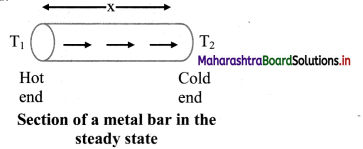
    Maharashtra Board Class 11 Physics Important Questions Chapter 7 Thermal Properties of Matter 32
  2. As a result, the temperature of every section of the rod starts increasing.
  3. Under this condition, the rod is said to be in a variable temperature state.
  4. After some time, the temperature at each section of the rod becomes steady i.e., does not change.
  5. Temperature of each cross-section of the rod now becomes constant though not the same. This is called steady state condition.
  6. Under steady state condition, the temperature at points within the rod decreases uniformly with distance from the hot end to the cold end.
  7. The fall of temperature with distance between the ends of the rod in the direction of flow of heat, is called temperature gradient.
    ∴ Temperature gradient = \(\frac{\mathrm{T}_{1}-\mathrm{T}_{2}}{\mathrm{x}}\)
    Where, T1 = temperature of hot end
    T2 = temperature of cold end
    x = length of the rod

Maharashtra Board Class 11 Physics Important Questions Chapter 7 Thermal Properties of Matter

Question 133.
State SI unit and dimensions of temperature gradient.
Answer:
S.I unit: = °C /m or K/m
Dimensions: [L-1M0T0K1]

Question 134.
State S.I. unit and dimensions of coefficient of thermal conductivity.
Answer:
SI unit of coefficient of thermal conductivity is J s-1 m-1 °C-1 or J s-1 m-1 K-1 and its dimensions are [L1M1T3K-1].

Question 135.
Explain how SI unit of coefficient of thermal conductivity be obtained as W/m °C or W/m K.
Answer:

  1. Consider equation, \(\frac{Q}{t}=\frac{k A\left(T_{1}-T_{2}\right)}{x}\)
  2. The quantity Q/t, denoted by Pcond, is the time rate of heat flow (i.e. heat flow per second) from the hotter face to the colder face, at right angles to the faces.
  3. Its SI unit is watt (W).
  4. SI unit of k can therefore be written as W m-1°C-1 or W m-1 K-1.
    [Note: Above equation, using calculus can be written as, \(\frac{d Q}{d t}\) = – kA \(\frac{d T}{d x}\), where \(\frac{d T}{d x}\) is the temperature gradient. The negative sign indicates that heat flow is in the direction of decreasing temperature. If A = 1 m2 and \(\frac{d T}{d x}\) = 1, then \(\frac{d Q}{d t}\) = k.]

Question 136.
Define coefficient of thermal conductivity in terms of temperature gradient.
Answer:
Coefficient of thermal conductivity of a material is defined as the rate of flow of heat per unit area per unit temperature gradient when the heat flow is at right angles to the faces of a thin parallel-sided slab of material.

Question 137.
Define conduction rate.
Answer:
Conduction rate (Pcond) is the amount of energy transferred per unit time through a slab of area A and thickness x, the two sides of the slab being at temperatures T1, and T2 (T1 > T2),
and is given Pcond = \(\frac{Q}{t}\) = kA \(\frac{\left(\mathrm{T}_{1}-\mathrm{T}_{2}\right)}{\mathrm{x}}\)

Question 138.
Explain the analogy between electrical resistance and thermal resistance.
Answer:

  1. Electrical resistance is ratio of \(\frac{V}{I}\) where, V is electrical potential difference between two ends of conductor and I is current or rate flow of charge.
  2. Consider expression for conduction rate,
    Pcond = kA \(\frac{\left(\mathrm{T}_{1}-\mathrm{T}_{2}\right)}{\mathrm{x}}\)
    ⇒ \(\frac{\mathrm{T}_{1}-\mathrm{T}_{2}}{\mathrm{P}_{\mathrm{cond}}}=\frac{\mathrm{x}}{\mathrm{kA}}\) ……………… (1)
  3. Comparing equation (1) with \(\frac{V}{I}\), (T1 – T2) is temperature difference between two ends and Pcond is rate of flow of heat.
  4. Ratio \(\frac{\mathrm{T}_{1}-\mathrm{T}_{2}}{\mathrm{P}_{\text {cond }}}\) is called as thermal resistance (RT) of material.
  5. Using (1), thermal resistance RT = \(\frac{\mathrm{x}}{\mathrm{kA}}\)
  6. Thermal resistance depends on the material and dimensions (length / breadth) of object.

Question 139.
What is thermal resistivity? What does it depend upon?
Answer:
i. Thermal resistivity (ρT) is the reciprocal of thermal conductivity (k).
ii. It is characteristic of a material.

Maharashtra Board Class 11 Physics Important Questions Chapter 7 Thermal Properties of Matter

Question 140.
Complete the table.
Maharashtra Board Class 11 Physics Important Questions Chapter 7 Thermal Properties of Matter 33
Answer:
Maharashtra Board Class 11 Physics Important Questions Chapter 7 Thermal Properties of Matter 34

Question 141.
Define convection.
Answer:
The process by which heat is transmitted through a substance from one point to another due to actual bodily movement of the heated particles of the substance is called convection.

Question 142.
Describe the mechanism of heat transfer by convection in liquids and gases.
Answer:

  1. Consider liquid being heated in a vessel from below.
  2. The liquid at the bottom of the vessel is heated
    first and consequently its density decreases i.e., liquid molecules at the bottom are separated farther apart.
  3. These hot molecules have high kinetic energy and rise upward to cold region while the molecules from cold region come down to take their place.
  4. Thus, each molecule at the bottom gets heated and rises then cool and descends.
  5. This action sets up the flow of liquid molecules called convection currents.
  6. The convection currents transfer heat to the entire mass of liquid via actual physical movement of the liquid molecules.
  7. Similar process takes place in case of a gas.

Question 143.
Give two applications of convection.
Answer:

  1. Heating and cooling of rooms:
    • The mechanism of heating a room by a heater is entirely based on convection.
    • The air molecules in immediate contact with the heater are heated up.
    • These air molecules acquire sufficient energy and rise upward.
    • The cool air at the top being denser moves down to take their place. This cool air in turn gets heated and moves upward.
    • In this way, convection currents are set up in the room which transfer heat to different parts of the room.
    • The same principle but in opposite direction is used to cool a room by an air-conditioner.
  2. Cooling of transformers:
    • Due to current flowing in the windings of the transformer, enormous heat is produced.
    • Therefore, transformer is always kept in a tank containing oil.
    • The oil in contact with transformer body heats up, creating convection currents.
    • The warm oil comes in contact with the cooler tank, gives heat to it and descends to the bottom. It again warms up to rise upward.
    • This process is repeated again and again. The heat of the transformer is thus carried away by convection to the cooler tank.
    • The cooler tank, in turn loses its heat by convection to the surrounding air.

Question 144.
Distinguish between free convection and forced convection.
Answer:

Free convectionForced convection
i.When a hot body is in contact with air under ordinary conditions, like air around a firewood, the air removes heat from the body by aprocess called free or natural convection.The convection process can be accelerated by employing a fan to create a rapid circulation of fresh air. This is called forced convection.
ii.Land and sea breezes are formed as a result of free convection currents in air.Heat convector, air conditioner, heat radiators in IC engine etc. operate using forced convection.

Question 145.
Define radiation.
Answer:
The transfer of heat energy from one place to another via emission of electromagnetic (EM) energy (in a straight line with the speed of light) without heating the intervening medium is called radiation.

Maharashtra Board Class 11 Physics Important Questions Chapter 7 Thermal Properties of Matter

Question 146.
Compare conduction, convection and radiation.
Answer:
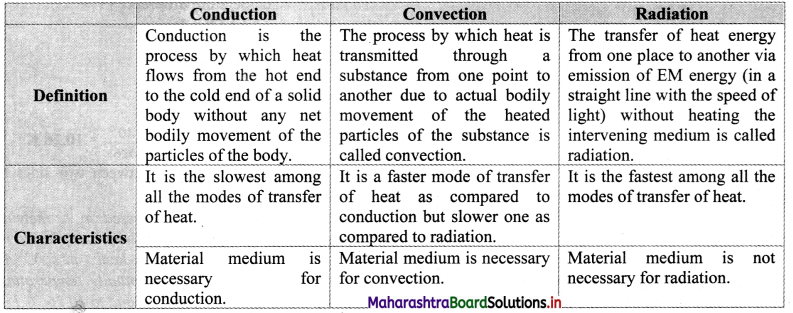
Maharashtra Board Class 11 Physics Important Questions Chapter 7 Thermal Properties of Matter 35
Maharashtra Board Class 11 Physics Important Questions Chapter 7 Thermal Properties of Matter 36

Solved Examples

Question 147.
The temperature difference between two sides of an iron plate. 2 cm thick, is 10 °C. Heat is transmitted through the plate at the rate of 600 kcal per minute per square metre at steady state. Find the thermal conductivity of iron.
Solution:
Given: \(\frac{\mathrm{Q}}{\mathrm{At}}\) = 600 kcal/min m2 = \(\frac{600}{60}\) kcal/s m2
= 10 kcal/s m2
x = 2cm = 2 × 10⁻² m
T1 – T2 = 10°C
To Find.- Thermal conductivity (k)
Formula: Q = \(\frac{\mathrm{kA}\left(\mathrm{T}_{1}-\mathrm{T}_{2}\right) \mathrm{t}}{\mathrm{x}}\)
Calculation: From formula.
∴ k = \(\frac{\mathrm{Q}}{\mathrm{At} \mathrm{t}} \frac{\mathrm{x}}{\mathrm{T}_{1}-\mathrm{T}_{2}}=\frac{10 \times 2 \times 10^{-2}}{10}\)
= 0.02 kcal / m s
Thermal conductivity is 0.02 kcal / m s °C.

Question 148.
Calculate the rate of loss of heat through a glass window of area 1000 cm2 and thickness of 4 mm. when temperature inside is 27 °C and outside is – 5 °C. Coefficient of thermal conductivity of glass is 0.022 cal /s cm °C.
Solution:
Given: A = 1000 cm2 1000 × 10 m2
k = 0.22 cal / s cm °C
= 0.22 × 10² cal/ m °C
x = 4mm = 0.4 × 10⁻² m
T1 = 27°C, T2 = -5°C
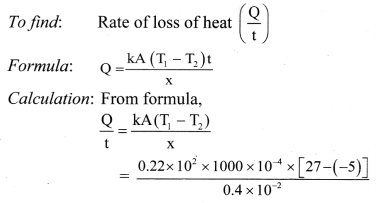
Maharashtra Board Class 11 Physics Important Questions Chapter 7 Thermal Properties of Matter 37
= 1.76 × 10³ cal/s = 1.76kcal / s
Rate of loss of heat is 1.76 kcal / s.

Question 149.
Heat is conducted through a copper plate at the rate of 460 cal/s-cm2. Calculate the temperature gradient when the steady state is reached. (kcopper = 92 cal/m-s °C)
Solution:
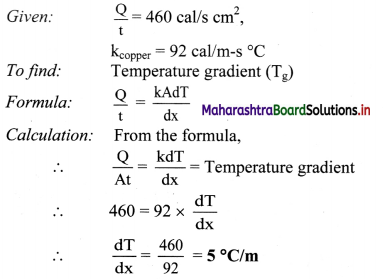
Maharashtra Board Class 11 Physics Important Questions Chapter 7 Thermal Properties of Matter 38
Temperature gradient of the copper plate is 5°C/m.

Question 150.
Two parallel slabs of metals A and B of thickness 5 cm and 3 cm respectively are joined together. The outer face of the metal A is maintained at 100 °C and that of metal B is maintained at 40 °C. If the thermal conductivities of metal A and B are 0.045 kcal/m-s K and 0.015 kcal/m-s K respectively, find the temperature of the interface of two plates.
Solution:
For metal A:
T1 = 100 °C, T2 = θ
dx1= 5 cm = 5 × 10⁻² m,
k1 = 0.045 kcal/m-s K
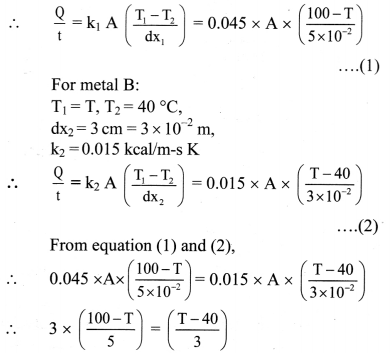
Maharashtra Board Class 11 Physics Important Questions Chapter 7 Thermal Properties of Matter 39
∴ 9(100 – T) = 5(T – 40)
∴ 900 – 9T = 5T – 200
∴ 14T = 1100
∴ T = 78.57°C
Temperature of the interlace of two plates is 78.57 °C.

Maharashtra Board Class 11 Physics Important Questions Chapter 7 Thermal Properties of Matter

Question 151.
What is the rate of energy loss in watt per square metre through a glass window 5 mm thick if outside temperature in -20 °C and inside temperature is 25 °C? (kglass = 1 W/m K)
Solution:
Given:
kglass = 1W/m K, T1 = 25 °C, T2 = -20 °C
T1 – T2 = 25- (-20)°C = 45 °C
X = 5 mm = 5 × 10⁻³ m
As one degree celsius equates to one kelvin, temperature difference of 450 C equals 45 K.
To find: Rate of energy loss per square metre \(\left(\frac{\mathrm{P}_{\text {cond }}}{\mathrm{A}}\right)\)
Formula: Pcond = \(\frac{Q}{t}=k A \frac{T_{1}-T_{2}}{x}\)
Calcula lion: From formula,
∴ The energy loss per square metre,
\(\frac{\mathrm{P}_{\text {oond }}}{\mathrm{A}}=\mathrm{k} \frac{\mathrm{T}_{1}-\mathrm{T}_{2}}{\mathrm{x}}=\frac{1 \times 45}{5 \times 10^{-3}}\)
= 9 × 10³ W/m2
Rate of energy loss per square metre is 9 × 10³ W/m2.

Question 152.
A metal sphere cools at the rate of 1.6 °C/min when its temperature is 70 °C. At what rate will it cool when its temperature is 40 °C? The temperature of surroundings is 30 °C.
Solution:
Given: T1 = 70°C, T2 = 40 °C, T3 = 30 °C
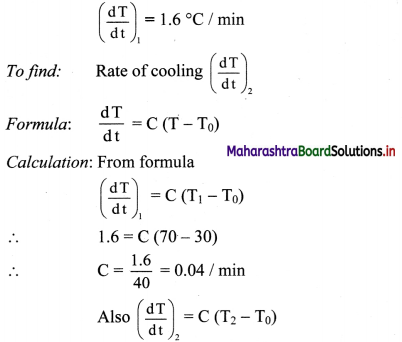
Maharashtra Board Class 11 Physics Important Questions Chapter 7 Thermal Properties of Matter 40
= 0.4 (40 – 30)
= 0.4 °C/mm
Rate of cooling is 0.4 °C/mm.

Question 153.
A body cools at the rate of 0.5 °C/s when it is at 50 °C above the surrounding temperature. What is its rate of cooling when ¡t is at 30 °C above the surrounding temperature?
Solution:
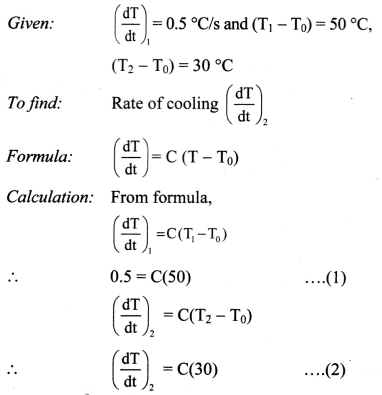
Maharashtra Board Class 11 Physics Important Questions Chapter 7 Thermal Properties of Matter 41
Divide equation (2) by (1),
\(\frac{\left(\frac{\mathrm{dT}}{\mathrm{dt}}\right)_{2}}{0.5}=\frac{\mathrm{C}(30)}{\mathrm{C}(50)}\)
∴ \(\left(\frac{\mathrm{dT}}{\mathrm{dt}}\right)_{2}\) = 0.5 × \(\frac{30}{50}\) = 0.3 °C/s
The rate of cooling of the body at 30 °C above the surrounding temperature is 0.3 °C/s.

Apply Your Knowledge

Question 154.
A metre scale made up of aluminium (αa = 24 × 10-6 /°C) measures length of a steel rod (αs = 12 × 10-6 /°C) at room temperature as 50.00 cm. Now the temperature of the room is increased by 100 °C. What can be said about the measured length of the rod at new temperature?
Answer:
At new temperature T °C,
change in length of rod is,
∆Ls = L0s∆T) = 50.00(12 × 10-6 × 100)
= 0.06 cm.
Hence, the actual length of rod at T °C,
Ls = 50.06 cm
Due to change in temperature, along with rod, the scale will also increase in length.
For aluminium, at T °C,
∆La = L0a∆t) = 100.00 × 24 × 10-6 × 100
= 0.24 cm
∴ Length of the scale will be,
La = 100.24 cm
As, the expansion in scale is more than that in rod, the reading recorded by the scale at t°C will be less than 50 cm.

Question 155.
A mercury thermometer calibrated to measure temperature in Fahrenheit scale is kept in liquid phosphorus at 150 °F. The liquid phosphorus is then heated continuously until it reaches its boiling point measured by the thermometer to be 500 °F. Find the percentage fractional change in the density of mercury during the whole process. (γHg = 10-4/°F)
(Assume that no heat is lost to the surrounding during the process.)
Answer:
Given:
T2 = 500°F, T1 = 150°F
γHg = 10-4 /°F
As the liquid phosphorus is heated, the mercury in the thermometer also gets heated.
Due to thermal expansion,
V2 = V1(1 + γ∆t)
= V1 [1 + 10-4 × (500 – 150)]
= 1.035 V1
Now, initial density of mercury is,
ρ1 = \(\frac{\mathrm{m}}{\mathrm{V}_{1}}\)
After heating,
ρ2 = \(\frac{\mathrm{m}}{\mathrm{V}_{2}}=\frac{\mathrm{m}}{1.035 \mathrm{~V}_{1}}=\frac{\rho_{1}}{1.035}\)
⇒ ρ2 < ρ1
∴ change in density of mercury is,
\(\frac{\rho_{1}-\rho_{2}}{\rho_{1}}=\frac{\rho_{1}(1-0.9662)}{\rho_{1}}\) = 0.0338
∴ Percentage fractional change = 3.38%

Maharashtra Board Class 11 Physics Important Questions Chapter 7 Thermal Properties of Matter

Question 155.
When ‘m’ g of ice is added to ‘M’g of water at 20 °C, state the conditions for m and M for which
i) temperature of the mixture remains 0° C.
ii) temperature of the mixture exceeds 0 °C. (Specific heat of water = sw = 4.2 × 10³ J kg-1 °C-1, latent heat of fusion = L = 3.36 × 10⁵ J kg-1 )
Answer:
The heat lost by water in going from 20 °C to 0°C,
Q1 = Msw ∆T = \(\frac{\mathrm{M}}{1000}\) × 4.2 × 103 × (20) = 84M J
Now, heat required to convert m g of ice into water at 0 °C,
Q2 = mL = \(\frac{\mathrm{M}}{1000}\) × 3.36 × 105 = 336m J

  1. For temperature of mixture to be 0 °C,
    Q2 > Q1
    ⇒ 336m > 84M
    ⇒ m > \(\frac{\mathrm{M}}{4}\)
  2. For temperature of mixture to exceed 0 °C,
    Q2 < Q1 ⇒ m < \(\frac{\mathrm{M}}{4}\)

Quick Review
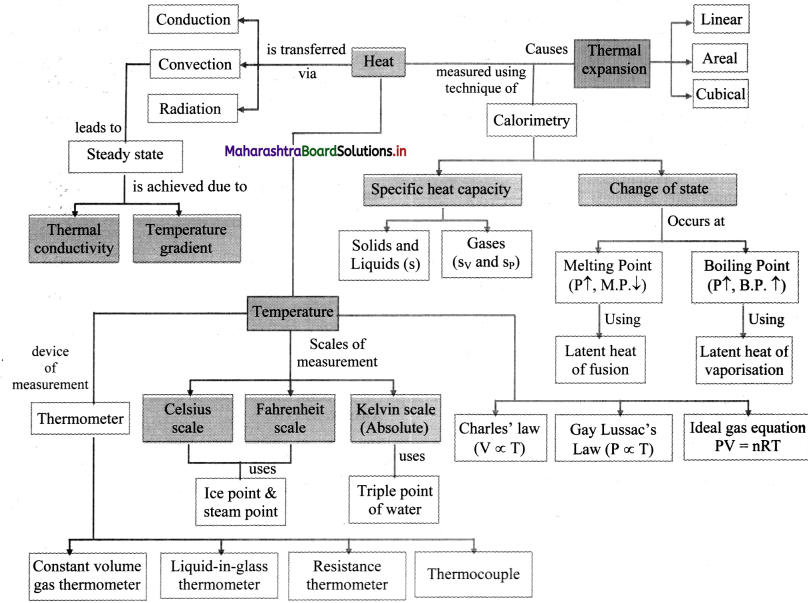
Maharashtra Board Class 11 Physics Important Questions Chapter 7 Thermal Properties of Matter 42

Multiple Choice Questions

Question 1.
Heat is transferred between two (or more) systems or a system and its surrounding by virtue of
(A) temperature difference.
(B) material difference.
(C) amount of heat difference.
(D) mass difference.
Answer:
(A) temperature difference.

Question 2.
On celsius scale, the two fixed points are marked as
(A) 0°C and 232°C
(B) 32°C and 100°C
(C) 0°C and 100°C
(D) 100°C and 180°C
Answer:
(C) 0°C and 100°C

Question 3.
If the temperature in a room is 30 °C, temperature in degree fahrenheit is
(A) 22 °F
(B) 62 °F
(C) 86 °F
(D) 96 °F
Answer:
(C) 86 °F

Question 4.
If the temperature on Fahrenheit scale is 140 °F, then the same temperature on kelvin scale will be
(A) 60.15 K
(B) 213.15 K
(C) 333.15 K
(D) 413.15 K
Answer:
(C) 333.15 K

Question 5.
In the gas equation, PV = RT, V stands for volume of
(A) any amount of gas .
(B) one gram mole of gas.
(C) one gram of a gas.
(D) one litre of a gas.
Answer:
(B) one gram mole of gas.

Maharashtra Board Class 11 Physics Important Questions Chapter 7 Thermal Properties of Matter

Question 6.
1 litre of an ideal gas at 27 °C is heated at constant pressure so as to attain temperature 297 °C. The final volume is approximately
(A) 1.2 litre
(B) 1.9 litre
(C) 19 litre
(D) 2.4 litre
Answer:
(B) 1.9 litre

Question 7.
How much should the pressure be increased in order to decrease the volume of a gas by 10% at a constant temperature?
(A) 7%
(B) 8%
(C) 10%
(D) 11.11%
Answer:
(D) 11.11%

Question 8.
Two rods of same material are equal in length, but one has cross-sectional area double the other. If they are heated through the same temperature then
(A) thick rod expands more.
(B) thin rod expands more.
(C) both rods will expand equally.
(D) none of these.
Answer:
(C) both rods will expand equally.

Question 9.
Two iron bars of same length with unequal radii are heated for the same rise in temperature. The linear expansion will be
(A) more in thin bar.
(B) more in thick bar.
(C) same for both.
(D) less in thick bar.
Answer:
(A) more in thin bar.

Question 10.
Which of the following has minimum coefficient of linear expansion?
(A) Gold
(B) Copper
(C) Platinum
(D) Invar steel
Answer:
(D) Invar steel

Question 11.
The coefficient of cubical expansion of a solid is the increase in volume per unit original volume at 0 °C per degree rise in _________.
(A) pressure
(B) volume
(C) temperature
(D) area
Answer:
(C) temperature

Question 12.
A disc has an area of 0.32 m2 at 20 °C, what will be its area at 100 °C? (α = 2 × 10⁻⁶ / °C)
(A) 0.12 m2
(B) 0.32 m2
(C) 0.51 m2
(D) 0.71 m2
Answer:
(B) 0.32 m2

Maharashtra Board Class 11 Physics Important Questions Chapter 7 Thermal Properties of Matter

Question 13.
The coefficient of linear expansion of iron is 1.1 × 10⁻⁵ per K. An iron is 10 m long at 27 °C. Length of the rod will be decreased by 1.1 mm when the temperature of the rod changes to
(A) 0°C
(B) 10 °C
(C) 17 °C
(D) 20 °C
Answer:
(C) 17 °C

Question 14.
The length of an aluminium rod is 120 cm at 20 °C. What is its length at 80 °C, if coefficient of linear expansion of aluminium is 2.5 × 10⁻⁵/°C?
(A) 130.18 cm
(B) 120.18 cm
(C) 110.18 cm
(D) 100.18 cm
Answer:
(B) 120.18 cm

Question 15.
A metal rod having a coefficient of linear expansion of 2 × 10⁻⁵ /°C has a length of 100 cm at 20 °C. The temperature at which it is shortened by 1 mm is
(A) -40 °C
(B) -30 °C
(C) -20 °C
(D) -10 °C
Answer:
(B) -30 °C

Question 16.
Iron sheet 50 cm × 20 cm is heated through 100 °C. If a = 12 × 10-6 / °C, the change in area is
(A) 2.4 cm2
(B) 3.4 cm2
(C) 4.2 cm2
(D) 5.3 cm2
Answer:
(A) 2.4 cm2

Question 17.
A liquid with coefficient of volume expansion γ is filled in a container of a material having the coefficient of linear expansion α. If the liquid over flows on heating then
(A) γ = 3α
(B) γ < 3α (C) γ > 3α
(D) γ = 3α2
Answer:
(B) γ < 3α

Question 18.
The volume of a metal block changes by 0.18% when it is heated through 20 °C. Its coefficient at cubical expansion will be
(A) 9 × 10⁻⁵ / °C
(B) 3 × 10⁻⁵ / °C
(C) 18 × 10-5 / °C
(D) 36 × 10-5 / °C
Answer:
(A) 9 × 10⁻⁵ / °C

Question 19.
The volume of liquid is 830 m3 at 30 °C and 850 m3 at 90 °C. The coefficient of volume expansion of liquid is
(A) 2 × 10⁻⁴ per °C
(B) 8 × 10⁻⁴ per °C
(C) 4 × 10⁻⁴ per °C
(D) 2.5 × 10⁻⁴ per °C
Answer:
(C) 4 × 10⁻⁴ per °C

Maharashtra Board Class 11 Physics Important Questions Chapter 7 Thermal Properties of Matter

Question 20.
The superficial expansivity is 1 / x times the cubic expansivity. The value of x is
(A) 2/3
(B) 3/2
(C) 2
(D) 3
Answer:
(B) 3/2

Question 21.
The unit of molar specific heat is
(A) JK-1 mole-1
(B) JK mole-1
(C) J-1 K-1mole-1
(D) JK-1 mole
Answer:
(A) JK-1 mole-1

Question 22.
The S.I. unit of latent heat is
(A) J-1 kg
(B) J kg-1
(C) J k-1 °C
(D) J-1 kg °C
Answer:
(B) J kg-1

Question 23.
The slowest mode of transfer of heat is
(A) conduction
(B) convection
(C) radiation
(D) specific heat
Answer:
(A) conduction

Question 24.
The quantity of heat which crosses unit area of a metal plate during conduction depends on
(A) the density of the metal.
(B) the temperature gradient perpendicular to the area.
(C) the temperature to which the metal is heated.
(D) the area of the metal plate.
Answer:
(B) the temperature gradient perpendicular to the area.

Question 25.
Which of the following is not the unit of thermal conductivity?
(A) J/m s °C
(B) K cal/m s K
(C) Watt/m °C
(D) J/m2 s °C
Answer:
(D) J/m2 s °C

Question 26.
The most desirable combination for the material of a cooking pot is
(A) high specific heat and high conductivity.
(B) low specific heat and high conductivity.
(C) high specific heat and low conductivity.
(D) low specific heat and low conductivity.
Answer:
(B) low specific heat and high conductivity.

Question 27.
While measuring thermal conductivity of a liquid, we keep the upper part hot and lower part cold, so that
(A) radiation may start.
(B) radiation may stop.
(C) convection may start.
(D) convection may be stopped.
Answer:
(D) convection may be stopped.

Question 28.
Convention currents in air in day time is from
(A) land to sea
(B) sea to land
(C) sea to sky
(D) land to land
Answer:
(B) sea to land

Maharashtra Board Class 11 Physics Important Questions Chapter 7 Thermal Properties of Matter

Question 29.
One end of a metal rod one metre long is kept in ice and the other end is at 100 °C. What is temperature gradient throughout the rod?
(A) 10 °C/m
(B) 100 °C/m
(C) 50 °C/m
(D) 1 °C/m
Answer:
(B) 100 °C/m

Question 30.
__________ amount of heat is required to raise the temperature of 100 g of kerosene from 10 °C to 30 °C (Given: specific heat of kerosene is 0.51 kcal/kg °C)
(A) 0.102 kcal
(B) 1.02 kcal
(C) 10.2 kcal
(D) 102 kcal
Answer:
(B) 1.02 kcal

Question 31.
One end of copper rod is in contact with water at 100 °C and the other end in contact with ice at 0 °C. The length of the rod is 100 cm. At a point which is at a distance of 35 cm from the cold end, temperature is (assuming steady state heat flow)
(A) 35 °C
(B) 65 °C
(C) 56 °C
(D) 53 °C
Answer:
(A) 35 °C

Question 32.
In Newton’s law of cooling, the rate of fall of temperature
(A) is constant
(B) increases
(C) decreases
(D) doubles
Answer:
(C) decreases

Question 33.
The metal sphere cools at 1 °C/min, when its temperature is 50 °C. If the temperature of environment is 30 °C, its rate of cooling at 35 °C is
(A) 0.25 °C/min
(B) 0.5 °C/min
(C) 0.75 °C/min
(D) 0.4 °C/min
Answer:
(A) 0.25 °C/min

Competitive Corner

Question 1.
A copper rod of 88 cm and an aluminium rod of unknown length have their increase in length independent of increase in temperature. The length of aluminum rod is:
Cu = 1.7 × 10⁻⁵ K-1 and αAl = 2.2 × 10⁻⁵ K-1)
(A) 88 cm
(B) 68 cm
(C) 6.8 cm
(D) 1 13.9 cm
Answer:
(B) 68 cm
Hint:
LCu αCu ∆T = LAl αAl ∆T
∴ 88 × (1.7 × 10-5) = LAl(2.2 × 10⁻⁵)
∴ LAl = \(\frac{88 \times 1.7}{2.2}\)
∴ LAl = 68 cm

Question 2.
The unit of thermal conductivity is:
(A) W m K-1
(B) W m-1 K-1
(C) JmK -1
(D) Jm-1K-1
Answer:
(B) W m-1 K-1
Hint:
Q = kA \(\left(\frac{\Delta \mathrm{T}}{\Delta \mathrm{x}}\right)\) t
Q = quantity of heat conducted.
A = area of cross section
t = time for which heat is passed
\(\left(\frac{\Delta \mathrm{T}}{\Delta \mathrm{x}}\right)\) = temperature gradient
∴ K = \(\frac{Q}{A t\left(\frac{\Delta T}{\Delta x}\right)}\)
∴ Unit of k = W m-1 K-1

Maharashtra Board Class 11 Physics Important Questions Chapter 7 Thermal Properties of Matter

Question 3.
A deep rectangular pond of surface area A, containing water (density = p, specific heat capacity = s), is located in a region where the outside air temperature is at a steady value of -26°C. The thickness of the frozen ice layer in this pond, at a certain instant is x. Taking the thermal conductivity of ice as K, and its specific latent heat of fusion as L, the rate of increase of the thickness of ice layer, at this instant, would be given by
(A) 26K/ρx(L + 4s)
(B) 26K/ρx(L – 4s)
(C) 26K/(ρx2 L)
(D) 26K/(ρxL)
Answer:
(D) 26K/(ρxL)
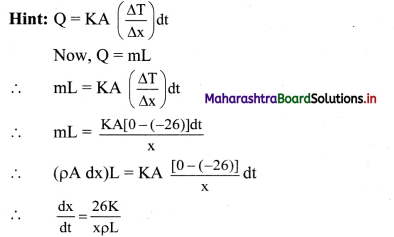
Maharashtra Board Class 11 Physics Important Questions Chapter 7 Thermal Properties of Matter 43

Question 4.
An object kept in a large room having air temperature of 25°C takes 12 minutes to cool from 80°C to 70°C. The time taken to cool for the same object from 70°C to 60°C would be nearly.
(A) 15 min
(B) 10mm
(C) 12mm
(D) 20mm
Answer:
(A) 15 min
Hint:
By Newton’s law of cooling,
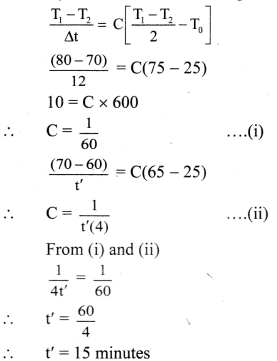
Maharashtra Board Class 11 Physics Important Questions Chapter 7 Thermal Properties of Matter 44

Question 5.
A thermally insulated vessel contains 150 g of water at 0 °C. Then the air from the vessel ispumped out adiabatically. A fraction of water turns into ice and the rest evaporates at 0 °C itself. The mass of evaporated water will be closest to :
(Latent heat of vaporization of water = 2.10 × 10⁶ J kg-1 and Latent heat of Fusion of water = 3.36 × 10⁵ J kg-1)
(A) 150g
(B) 20g
(C) 130g
(D) 35g
Answer:
(B) 20g
Hint:
m= 150 g = 0.15 kg
The heat required to evaporate ‘m’ grams of water,
∆Qrequired = mLv ………. ( 1)
(015 – m) is the amount of mass that converts into ice
∴ ∆Qreleased = (0.15 – m) Lf …………. (2)
Now, amount of heat required = amount of heat released
∴ From (1) and (2),
mLv = (0.15 – m)Lf
∴ m(Lf + Lv) = 0.15 Lf
∴ m = \(\frac{0.15 \mathrm{~L}_{\mathrm{f}}}{\mathrm{L}_{\mathrm{f}}+\mathrm{L}_{\mathrm{v}}}\)
∴ m = \(\frac{0.15 \times 3.36 \times 10^{5}}{2.10 \times 10^{6}+3.36 \times 10^{5}}\)
∴ m=0.0206kg ≈ 20g

Question 6.
A copper ball of mass 100 g is at a temperature T. It is dropped in a copper calorimeter of mass 100 g, filled with 170 g of water at room temperature. Subsequently, thetemperature of the system is found to be 75 °C. T is given by: (Given: room temperature = 30°C, specific heat of copper 0.1 cal/g °C)
(A) 1250°C
(B) 825°C
(C) 800°C
(D) 885°C
Answer:
(D) 885°C
Hint:
Heat lost by copper ball = Heat gained by calorimeter and water
∴mbsc∆T1 = mccc∆T2 + mwsw∆T2
∴ (100)(0.1)(T – 75) = (100)(0.1)(75 – 30) + (170)(1)(75 – 30)
10(T – 75) = 450 + 7650 = 8100
T – 75 = 810
T = 885 °C

Maharashtra Board Class 11 Physics Important Questions Chapter 7 Thermal Properties of Matter

Question 7.
Coefficient of linear expansion of brass and steel rods are α1 and α2. Lengths of brass and steel rods are l1 and l2 respectively. If (l2 – l1) is maintained same at all temperatures, which one of the following relations holds good?
(A) α12l2 = α22l1
(B) α1l1 = α2l2
(C) α1l2 = α2l1
(D) α1l22 = α2l12
Answer:
(B) α1l1 = α2l2
Hint:
∆L = L(1 + α∆t)
i.e. ∆l2 = l2(1 + α2∆t)
and ∆l1 =11(1 + α1∆t)
It is given,
l2– l1 = ∆tl2 – ∆ll1
∴ l2 – l1 = l2 (1 + α2∆t) – l1 (1+ α1∆t)
= l2 + l2α2∆t – l1 – l1α1∆t
∴ – l2 + l2 + l2α2∆t = -l1 + l1 + l1α1∆t
∴ l2α2∆t = l1α1∆t
i.e., l2α2 = l1α1

Question 8.
A pendulum clock loses 12 s a day if the temperature is 40 °C and gains 4 s a day if the temperature is 20 °C. The temperature at which the clock will show correct time, and the coefficient of linear expansion (a) of the metal of the pendulum shaft are respectively:
(A) 60 πC, a = 1.85 × 10⁻⁴/πC
(B) 30 πC, a = 1.85 × 10⁻³/πC
(C) 55 πC, a = 1.85 × 10⁻²/πC
(D) 25 πC, a = 1.85 × 10⁻⁵/πC
Answer:
(D) 25 πC, a = 1.85 × 10⁻⁵/πC
Hint:
Period of pendulum, T = 2π\(\sqrt{\frac{\mathrm{L}}{\mathrm{g}}}\)
∴ T ∝ \(\sqrt{\mathrm{L}}\)
But, L = L0 (1 + α∆t)
∴ T ∝ \(\sqrt{\mathrm{L}_{0}(1+\alpha \Delta \mathrm{t})}\)
As L0 is constant,
⇒ T ∝ (1 + α ∆t)
Calculating fractional change in time period of pendulum, \(\frac{\Delta \mathrm{T}}{\mathrm{T}}=\frac{1}{2}(\alpha \Delta \mathrm{t})\)
For the given pendulum,
T = 24 × 60 × 60 = 864000 s
When t1 = 40 °C, ∆T = 12 s,
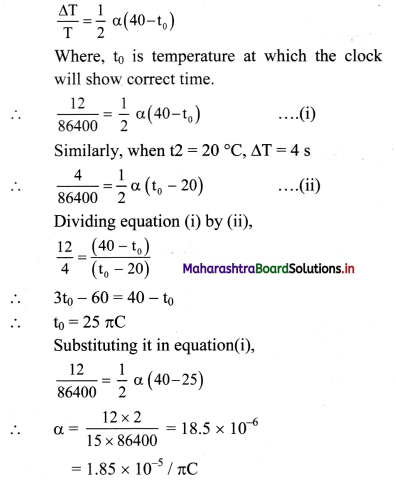
Maharashtra Board Class 11 Physics Important Questions Chapter 7 Thermal Properties of Matter 45

Question 9.
A piece of ice falls from a height h so that it melts completely. Only one — quarter of the heat produced is absorbed by the ice and all energy of ice gets converted into heat during its fall. The value of h is [Latent heat of ice is 3.4 × 10⁵ J/kg and g = 10 N/kg]
(A) 136 km
(B) 68km
(C) 34km
(D) 544km
Answer:
(A) 136 km
Hint:
When the piece of ice falls from the height h, it possesses potential energy, mgh.
This P.E. is converted to heat energy.
∴ Q = mgh
But only \(\frac{1^{\text {th }}}{4}\) of it is absorbed by ice which is used to change the state.
∴ \(\frac{\mathrm{mgh}}{4}\) = mL
∴ \(\frac{10 \times \mathrm{h}}{4}\) = 3.4 × 10⁵
∴ h = 13.6 × 10⁴ m = 136km

Maharashtra Board Class 11 Physics Important Questions Chapter 7 Thermal Properties of Matter

Question 10.
A body cools from a temperature 3T to 2T in 10 minutes. The room temperature is T. Assume that Newton’s law of cooling is applicable. The temperature of the body at the end of next 10 minutes will be
(A) T
(B) \(\frac{7}{4}\) T
(C) \(\frac{3}{2}\) T
(D) \(\frac{4}{3}\) T
Answer:
(C) \(\frac{3}{2}\) T
Hint:
By Newton’s law of cooling,
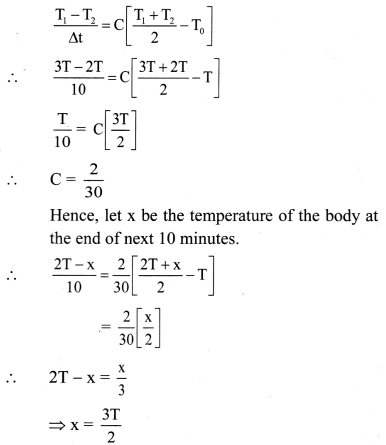
Maharashtra Board Class 11 Physics Important Questions Chapter 7 Thermal Properties of Matter 46

Maharashtra Board Class 11 Physics Important Questions Chapter 6 Mechanical Properties of Solids

Balbharti Maharashtra State Board 11th Physics Important Questions Chapter 6 Mechanical Properties of Solids Important Questions and Answers.

Maharashtra State Board 11th Physics Important Questions Chapter 6 Mechanical Properties of Solids

Question 1.
Explain the equilibrium state of solids at a given temperature.
Answer:

  1. Solids are made up of atoms or a group of atoms placed in a definite geometric arrangement.
  2. This arrangement is decided by nature so that the resultant force acting on each constituent due to others is zero. This is the equilibrium state of a solid at room temperature.
  3. This equilibrium arrangement does not change with time but it can only change when an external stimulus, like compressive force, is applied to a solid from all sides.
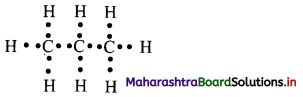

  4. The constituents vibrate about their equilibrium positions even at very low temperatures but cannot leave their fixed positions.
  5. As a result, the solids possess a definite shape and size.

Question 2.
Explain the effects of applied force on a rigid body.
Answer:

  1. When an external force is applied to a solid, the constituents are slightly displaced and restoring forces are developed in it.
  2. These restoring forces try to bring the constituents back to their equilibrium positions so that the solid can regain its shape.
  3. When the deforming forces are removed, the inter-atomic forces tend to restore the original positions of the molecules and thus the body regains its original shape and size.

Question 3.
Explain the concept of deforming force with the help of examples.
Answer:

  1. When a force (within specific limit) is applied to a solid (which is not free to move), the size or shape or both change due to changes in the relative positions of molecules. Such a force is called deforming force.
  2. The larger the deforming force on a body, the larger is its deformation.
  3. Deformation could be in the form of change in length of a wire, change in volume of an object or change in shape of a body.
  4. Examples:
    • When a deforming force such as stretching, is applied to a rubber band, it gets deformed (elongated) but when the force is removed, it regains its original length.
    • When a similar force is applied to a dough or a clay, it also gets deformed but it does not regain its original shape and size after removal of the deforming force.

Question 4.
Define plasticity.
Answer:
If a body does not regain its original shape and size and retains its altered shape or size upon removal of the deforming force, it is called a plastic body and the property is called plasticity.

Question 5.
When is a body said to be perfectly elastic? Give an example for perfectly elastic body and perfectly plastic body.
Answer:

  1. If a body regains its original shape and size completely and instantaneously upon removal of the deforming force, then it is said to be perfectly elastic.
    • There is no solid which is perfectly elastic or perfectly plastic,
    • The best example of a near perfectly elastic body is quartz fibre and that of a plastic body is putty.

Question 6.
State SI unit and dimensions of strain.
Answer:
Strain is the ratio of two similar quantities. Hence strain is a dimensionless physical quantity and it has no units.

Question 7.
State and explain longitudinal stress (Tensile stress and Compressive stress).
Answer:
i. Stress produced by a deforming force acting along the length of a body or a rod is called longitudinal stress.

ii. Tensile stress: Consider a force F is applied along a length of a wire, or perpendicular to its cross-section A of a wire (or along its length).

Maharashtra Board Class 11 Physics Important Questions Chapter 6 Mechanical Properties of Solids 1

[Note: Elongation of wire ∆l is exaggerated for explanation.]
This produces an elongation in the wire and the length of the wire increases, then
Maharashtra Board Class 11 Physics Important Questions Chapter 6 Mechanical Properties of Solids 2

iii. Compressive stress: When a rod is pushed from two ends with equal and opposite forces.
Maharashtra Board Class 11 Physics Important Questions Chapter 6 Mechanical Properties of Solids 3
[Note: Compression of wire ∆l is exaggerated for explanation.]
This restoring force per unit area is called compressive stress.
Compressive stress = \(\frac{|\overrightarrow{\mathrm{F}}|}{\mathrm{A}}\)

Question 8.
State and explain longitudinal strain (Tensile strain or Linear strain).
Answer:
The strain produced by a tensile deforming force is called longitudinal strain (tensile strain or linear strain,).
Maharashtra Board Class 11 Physics Important Questions Chapter 6 Mechanical Properties of Solids 4
where, L = Original length,
∆l = Change in length.

Question 9.
State and explain volume stress / hydraulic stress.
Answer:
When a deforming force acting on a body produces change in its volume, the stress is called volume stress.
Volume stress/hydraulic stress:
Maharashtra Board Class 11 Physics Important Questions Chapter 6 Mechanical Properties of Solids 5
[Note: Change in size is exaggerated for explanation.]
Maharashtra Board Class 11 Physics Important Questions Chapter 6 Mechanical Properties of Solids 6

  1. Let \(\vec{F}\) be a force acting perpendicular to the entire surface of the body.
  2. It acts normally and uniformly all over the surface area A of the body.
  3. Such a stress which produces change in size but no change in shape is called volume stress.
    Volume stress = \(\frac{|\overrightarrow{\mathrm{F}}|}{\mathrm{A}}\)
  4. Volume stress produces change in size without change in shape of body, hence it is also called as hydraulic or hydrostatic volume stress.

Question 10.
Explain volume strain.
Answer:

  1. A deforming force acting perpendicular to the entire surface of a body produces a volume strain.
  2. Maharashtra Board Class 11 Physics Important Questions Chapter 6 Mechanical Properties of Solids 7
    where ∆V = change in volume,
    V = original volume.

Question 11.
Define and explain shearing stress.
Answer:
The restoring force per unit area developed due to the applied tangential force is called shearing stress or tangential stress.
Shearing stress:

  1. When a deforming force acting on a body produces change in the shape of a body shearing stress is produced.
  2. Consider ABCD as a front face of a cube, a tangential force is applied to the cube so that the bottom of the cube is fixed and only the top surface is slightly displaced.
    Maharashtra Board Class 11 Physics Important Questions Chapter 6 Mechanical Properties of Solids 8

Question 12.
Explain shearing strain.
Answer:

  1. The relative displacement of the bottom face and the top face of the cube is called shearing strain.
  2. Shearing strain = \(\frac{\Delta l}{\mathrm{~L}}\) = tan θ
    where, ∆l = displaced length,
    L = Original length.
  3. When ∆l is very small,
    tan θ ≈ θ and shearing strain = θ

Question 13.
State and explain Hooke’s law.
Answer:
Statement: Within elastic limit, stress is directly proportional to strain.
Explanation:

  1. According to Hooke’s law,
    Stress-Strain
    Maharashtra Board Class 11 Physics Important Questions Chapter 6 Mechanical Properties of Solids 9
    This constant of proportionality is called modulus of elasticity.
  2. Modulus of elasticity of a material is the slope of stress-strain curve in elastic deformation region and depends on the nature of the material.
  3. The graph of strain (on X-axis) and stress (on Y-axis) within elastic limit is shown in the figure.
    Maharashtra Board Class 11 Physics Important Questions Chapter 6 Mechanical Properties of Solids 10

Question 14.
Define elastic limit.
Answer:
The maximum value of stress upto which stress is directly proportional to strain is called the elastic limit.

Question 15.
Define modulus of elasticity.
Answer:
The modulus of elasticity of a material is the ratio of stress to the corresponding strain.

Question 16.
State different types of modulus of elasticity.
Answer:

  1. Young’s modulus (Y): It is the modulus of elasticity related to change in length of an object like a metal wire, rod, beam, etc., due to the applied deforming force.
  2. Bulk modulus (K): It is the modulus of elasticity related to change in volume of an object due to applied deforming force.
  3. Shear modulus or Modulus of rigidity (η): The modulus of elasticity related to change in shape of an object is called modulus of rigidity.

Question 17.
Explain the usefulness of Young’s modulus.
Answer:

  1. Young’s modulus indicates the resistance of an elastic solid to elongation or compression.
  2. Young’s modulus of a material is useful for characterization of an object subjected to compression or tension.

Question 18.
Within elastic limit, prove that Young’s modulus of material of wire is the stress required to double the length of wire.
Answer:

(i) Let, L = Initial length of wire
2 L = Final length of wire
∴ Increase in length = ∆l = 2L – L = L

(ii) Longitudinal strain of wire = \(\frac{\Delta l}{\mathrm{~L}}=\frac{\mathrm{L}}{\mathrm{L}}=1\)

(iii)
Maharashtra Board Class 11 Physics Important Questions Chapter 6 Mechanical Properties of Solids 11
∴ Y = Longitudinal stress

(iv) Hence, Young’s modulus of material of wire is the stress required to double the length of wire.

Question 19.
What is bulk modulus? Derive an expression for bulk modulus.
Answer:
Definition:
Bulk modulus is defined as the ratio of volume stress to volume strain.
It is denoted by ‘K’.
Unit: N/m2 or Pa in SI system
Dimensions: [L-1M1T-2]
Expression for bulk modulus:

(i) If a sphere made from rubber is completely immersed in a liquid, it will be uniformly compressed from all sides.
Let, F = Compressive force,
dP = Change in pressure,
dV = Change in volume,
V = Original volume.

(ii) Volume stress = \(\frac{|\overrightarrow{\mathrm{F}}|}{\mathrm{A}}\) = dP

Maharashtra Board Class 11 Physics Important Questions Chapter 6 Mechanical Properties of Solids 12

(iii) The negative sign indicates that there is a decrease in volume.
The magnitude of the volume strain is \(\frac{\mathrm{dV}}{\mathrm{V}}\)

Maharashtra Board Class 11 Physics Important Questions Chapter 6 Mechanical Properties of Solids 13

Question 20.
Explain the usefulness of bulk modulus.
Answer:

  1. Bulk modulus indicates the resistance of gases, liquids or solids to change their volume.
  2. Materials with small bulk modulus and large compressibility are easier to compress.

Question 21.
State few applications of bulk modulus.
Answer:

  1. When a balloon is filled with air at high pressure, its walls experience a force from within. It tries to expand the balloon and change its size without changing shape. When the volume stress exceeds the limit of bulk elasticity, the balloon explodes.
  2. A gas cylinder explodes when the pressure inside it exceeds the limit of bulk elasticity of its material.
  3. A submarine when submerged under water is under volume stress. The depth it can reach within water depends upon its limit of bulk elasticity.

Question 22.
Define compressibility. State its unit and dimensions.
Answer:

  1. The reciprocal of bulk modulus of elasticity is called compressibility of the material.
    Maharashtra Board Class 11 Physics Important Questions Chapter 6 Mechanical Properties of Solids 14
  2. Compressibility is the fractional decrease in volume, (-dV/V) per unit increase in pressure.
    Compressibility = \(\frac{-\mathrm{dV}}{\mathrm{V} \mathrm{dP}}\)
  3. Unit: m2/N or Pa-1 in SI system.
  4. Dimensions: [L1M-1T2]

Question 23.
What is modulus of rigidity? Derive an expression for it.
Answer:
Definition: It is defined (is the ratio of shear stress to shear strain within elastic limit.
It is denoted by ‘η’.
Unit: N/m2 or Pa in SI system.
Dimension: [L-1M1T-2]

Expression for modulus of rigidity:

Consider a solid cube as shown in the figure.

Let, F = Tangential force
A = Cross sectional area
∆l = Relative displaced length
l = Original length
θ = Shear strain
Maharashtra Board Class 11 Physics Important Questions Chapter 6 Mechanical Properties of Solids 15
[Note: Displacement of upper surface is exaggerated for explanation.]
The forces applied on the block is subjected to a shear stress,
Shearing stress = F/A
The comer angle which changes by a small amount θ (expressed in radian) is given by,
Shearing strain = \(\frac{\Delta l}{l}\) ≈ θ
From definition,
Maharashtra Board Class 11 Physics Important Questions Chapter 6 Mechanical Properties of Solids 16

Question 24.
What does modulus of rigidity indicate?
Answer:
Modulus of rigidity indicates resistance offered by solid to change in its shape.

Question 25.
Explain the change of diameter of a wire when it is stretched and compressed.
Answer:
i. When a wire is fixed at one end and a force is applied at its free end so that the wire gets stretched, length of the wire increases and at the same time, its diameter decreases, i.e., the wire becomes longer and thinner as shown in figure.
Maharashtra Board Class 11 Physics Important Questions Chapter 6 Mechanical Properties of Solids 17
[Note: Linear expansion ∆l is exaggerated far explanation.]

ii. If equal and opposite forces are applied to an object along its length inwards, the object gets compressed. There is a decrease in dimensions along its length and at the same time there is an increase in its dimensions perpendicular to its length. When length of the wire decreases, its diameter increases.
Maharashtra Board Class 11 Physics Important Questions Chapter 6 Mechanical Properties of Solids 18

[Note: Compression of wire ∆l is exaggerated for explanation.]

Question 26.
Derive expression for Poisson’s ratio.
Answer:
i. Let,
L = original length
l = increase/decrease in length
D = original diameter
d = change in diameter

ii. The ratio of change in dimensions to original dimensions in the direction of the applied force is called linear strain.
Linear strain = \(\frac{l}{\mathrm{~L}}\) …. (1)

iii. The ratio of change in dimensions to original dimensions in a direction perpendicular to the applied force is called lateral strain.
Lateral strain = \(\frac{\mathrm{d}}{\mathrm{D}}\) ….(2)

iv. Poisson’s ration,
Maharashtra Board Class 11 Physics Important Questions Chapter 6 Mechanical Properties of Solids 19

Question 27.
A wire of length 20 m and area of cross section 1.25 × 10⁻⁴ m2 is subjected to a load of 2.5 kg. (1 kg wt = 9.8 N). The elongation produced in wire is 1 × 10⁻⁴ m. Calculate Young’s modulus of the material.
Solution:
L = 20 m, A = 1.25 × 10⁻⁴m2,
F = mg = 2.5 × 9.8 N, l = 10-4 m
Formula Y = \(\frac{\mathrm{FL}}{\mathrm{Al}}\)
To find: Young’s modulus (Y)
Calculation: From formula,
Y = \(\frac{2.5 \times 9.8 \times 20}{1.25 \times 10^{-4} \times 10^{-4}}\) = 3.92 × 10¹⁰Nm-2
Answer: The Young’s modulus of the material is 3.92 × 10¹⁰ Nm-2.

Question 28.
A wire of diameter 0.5 mm and length 2 m is stretched by applying a force of 2 kg wt. Calculate the increase in length of the wire, (g = 9.8 m/s2, Y = 9 × 10¹⁰ N/m2)
Solution:
Given:
L = 2 m, F = 2 kg wt, d = 0.5 mm = 5 × 10⁻⁴ m,
∴ r = \(\frac{\mathrm{d}}{2}\) = 2.5 × 10⁻⁴ m.
Y = 9 × 10¹⁰ N/m2, g = 9.8 m/s2
To find: Increase in length (l)
Formula: Y = \(\frac{\mathrm{FL}}{\mathrm{Al}}=\frac{\mathrm{MgL}}{\pi \mathrm{r}^{2} l}\)
Calculation:
From formula,
Maharashtra Board Class 11 Physics Important Questions Chapter 6 Mechanical Properties of Solids 20
Answer:
The increase in length of the wire is 2.218 × 10⁻³ m.

Question 29.
A brass wire of length 4.5 m with cross-section area of 3 × 10⁻⁵ m2 and a copper wire of length 5.0 m with cross section area 4 × 10⁻⁵ m2 are stretched by the same load. The same elongation is produced in both the wires. Find the ratio of Young’s modulus of brass and copper.
Solution:
LB = 4.5 m, AB = 3 × 10⁻⁵ m2
LC = 5 m, AC = 4 × 10⁻⁵ m2 lB = C, FB = FC
To find: Ratio of Young’s modulus \(\left(\frac{Y_{B}}{Y_{C}}\right)\)
Formula: Y = \(\frac{\mathrm{FL}}{\mathrm{Al}}\)
Calculation: For brass,
Maharashtra Board Class 11 Physics Important Questions Chapter 6 Mechanical Properties of Solids 21
= 1.2
Answer:
The ratio of Young’s modulus of brass and copper is 1.2 : 1.

Question 30.
The length of wire increases by 9 mm when weight of 2.5 kg is hung from the free end of wire. If all conditions are kept the same and the radius of wire is made thrice the original radius, find the increase in length.
Solution:
Given; l1 = 9mm = 9 × 10⁻³m,
M = 2.5 kg, r2 = 3r1,
Y1 = Y2 = Y (material is same)
To find: Increase in length (l2)
Formula: Y = \(\frac{\mathrm{FL}}{\mathrm{Al}}\)
Calculation: From formula,
Maharashtra Board Class 11 Physics Important Questions Chapter 6 Mechanical Properties of Solids 22
Answer:
The longitudinal strain produced in 1st wire is

Question 31.
Two wires of diameter 0.25 cm, one made of steel and the other made of brass are loaded as shown in the figure. The unloaded length of steel wire is 1.5 m and that of brass wire is 1.0 m. Compute the elongations of the steel and the brass wires.(Ys = 2.0 × 10¹¹ Nm-2, YB = 0.91 × 10¹¹ Nm-2) (NCERT)
Maharashtra Board Class 11 Physics Important Questions Chapter 6 Mechanical Properties of Solids 23
Solution:
Given: D = 0.25 cm = 0.25 × 10⁻² m,
LS = 1.5 m, LB = 1 m,
YS = 2.0 × 10¹¹ Nm-2,
YB = 0.91 × 10¹¹ Nm-2
To find: Elongations of brass wire (lB)
Elongations of steel wire (lS)

Formula: Y = \(\frac{\mathrm{FL}}{\mathrm{Al}}\)

Calculation: Since, A = \(\frac{\pi \mathrm{D}^{2}}{4}\)
Maharashtra Board Class 11 Physics Important Questions Chapter 6 Mechanical Properties of Solids 24
Answer:
The elongation of the steel wire is 1.5 × 10⁻⁴ m and that of brass wires is 1.32 × 10⁻⁴ m.

Question 32.
One end of steel wire is fixed to a ceiling and load of 2.5 kg is attached to the free end of the wire. Another identical wire is attached to the bottom of load and another load of 2.0 kg, is attached to the lower end of this wire as shown in the figure. Compute the longitudinal strain produced in both the wires, if the cross-sectional area of wires is 10-4m2, (Ysteel = 20 × 1010N/m2)
Maharashtra Board Class 11 Physics Important Questions Chapter 6 Mechanical Properties of Solids 25
Solution:
Given: M1 = 2.5 kg, M2 = 2kg, A = 10-4m2, Ysteel = 20 × 1010 N/m2, L1 = L2 = L
To find: Longitudinal strain of 1st wire (Strain1).
Longitudinal strain of 2nd wire (Strain2)
Maharashtra Board Class 11 Physics Important Questions Chapter 6 Mechanical Properties of Solids 26
Answer:
The longitudinal strain produced in 1st wire is 1.225 × 10⁻⁶ and in 2nd wire is 2.205 × 10⁻⁶

Question 33.
A steel wire having cross-sectional area 2 mm2 is stretched by 10 N. Find the lateral strain produced in the wire. (Given: Y for steel = 2 × 10¹¹ N/m2, Poisson’s ratio σ = 0.29)
Solution:
Given: A = 2 mm2 = 2 × 10⁻⁶ m2,
F = 10 N, Ystee; = 2 × 10¹¹ N/m2, σ = 0.29

To find: Lateral strain
Formulae:
Maharashtra Board Class 11 Physics Important Questions Chapter 6 Mechanical Properties of Solids 27
Calculation: From formula (i),
longitudinal stress = \(\frac{10}{2 \times 10^{-6}}\)
= 5 × 10⁶ N/m2
From formula (ii),
Maharashtra Board Class 11 Physics Important Questions Chapter 6 Mechanical Properties of Solids 28
From formula (iii),
lateral strain = σ × longitudinal strain
= 0.29 × 2.5 × 10-5
∴ lateral strain = 7.25 × 10⁻⁶
Answer:
Lateral strain produced in the wire is 7.25 × 10⁻⁶.

Question 34.
A brass wire of radius 1 mm is loaded by a mass of 31.42 kg. What would be the decrease in its radius? (Y = 9 × 10¹⁰ N/m2, Poisson’s ratio σ = 0.36)
Solution:
Given: R = 1 mm = 1 × 10⁻³ m, M = 31.42 kg, Y = 9 × 10¹⁰ N/m2, σ = 0.36
To find: Decrease in radius (r)

Formulae:

i. Y = \(\frac{\mathrm{FL}}{\mathrm{Al}}\)
ii. σ = \(\frac{\mathrm{Lr}}{l \mathrm{R}}\)

Calculation: From formula (i),
Maharashtra Board Class 11 Physics Important Questions Chapter 6 Mechanical Properties of Solids 29
Answer:
The decrease in radius of the brass wire would be 3.92 × 10⁻⁷ m

Question 35.
A metal cube of side 1 m is subjected to a force. The force acts normally on the whole surface of cube and its volume changes by 1.5 × 10⁻⁵ m3. The bulk modulus of metal is 6.6 × 10¹⁰ N/m2. Calculate the change in pressure.
Solution:
Given: L = 1 m, dV = 1.5 × 10⁻⁵ m3,
K = 6.6 × 10¹⁰ N/m2.
To find: Change in pressure (dP)
Formula: K = V\(\frac{\mathrm{dP}}{\mathrm{dV}}\)
Calculation: From formula,
Maharashtra Board Class 11 Physics Important Questions Chapter 6 Mechanical Properties of Solids 30
Answer:
The change in pressure is 9.9 × 10⁵ N/m2.

Question 36.
Determine the volume contraction of solid copper cube, 10 cm on an edge, when subjected to a hydraulic pressure of 7.0 × 10⁶ P.a. (Bulk modulus of copper = 140 × 109 pa)
Solution:
Given: L = 10 cm =0.1 m, ∆P = 7 × 10⁶ Pa, K = 140 × 109 pa
To find: Volume contraction (dV)
Formula: K = V × \(\frac{\mathrm{dP}}{\mathrm{dV}}\)
Calculation: From formula,
dV = \(\mathrm{L}^{3} \times \frac{\mathrm{dP}}{\mathrm{K}}\) = (0.1)3 × \(\frac{7 \times 10^{6}}{140 \times 10^{9}}\)
∴ dV = 5 × 10⁻⁸ m3
Answer:
The volume contraction of solid copper cube is 5 × 10⁻⁸ m3

Question 37.
Calculate the modulus of rigidity of a metal, if a metal cube of side 40 cm is subjected to a shearing force of 2000 N. The upper surface is displaced through 0.5 cm with respect to the bottom. Calculate the modulus of rigidity of the metal.
Solution:
Given: L = 40 cm = 0.4 m,
F = 2000 N = 2 × 10³N
l = 0.5 cm = 0.005 m, A = L2 = 0.16 m2
To find: Modulus of rigidity (η)

Formulae:

i. θ = \(\frac{l}{\mathrm{~L}}\)
ii. η = \(\frac{\mathrm{F}}{\mathrm{A} \theta}\)

Calculation:

From formula (i),
θ = \(\frac{0.005}{0.4}\) = 0.0125
From formula (ii),
η = \(\frac{2 \times 10^{3}}{0.16 \times 0.0125}\) = 1 × 10⁶ N/m2
Answer:
The modulus of rigidity of the metal cube is 1 × 10⁶ N/m2.

Question 38.
A piece of copper having a rectangular cross-section of 15.2 mm × 19.1 mm is pulled in tension with 44500 N forces producing only elastic deformation. Calculate the resulting strain. (Rigidity modulus of copper = 42 × 109 N m-2)
Solution:
Given: A = 15.2 × 19.14 × 10-6 m2,
F = 44500 N, η = 42 × 109 N m-2
To find: Strain (θ)
Formula: η = \(\frac{\mathrm{F}}{\mathrm{A} \theta}\)

Calculation:
From formula,
Maharashtra Board Class 11 Physics Important Questions Chapter 6 Mechanical Properties of Solids 31
Answer:
The strain produced in the piece of copper is 3.64 × 10⁻³

Question 39.
A copper metal cube has each side of length 1 m. The bottom edge of cube is fixed and tangential force 4.2 × 10⁸ N is applied to top surface. Calculate the lateral displacement of the top surface, if modulus of rigidity of copper is 14 × 1010 N/m2.
Solution:
Given: L = h = 1 m, F = 4.2 × 10⁸ N, η = 1.4 × 10¹¹ N/m2
To find: Lateral displacement (x)
Formula: η = \(\frac{\mathrm{F}}{\mathrm{A} / \theta}\) = \(\frac{\mathrm{Fh}}{\mathrm{Ax}}\)
Calculation: From formula,
x = \(\frac{\mathrm{Fh}}{\mathrm{A\eta}}\)
∴ x = \(\frac{4.2 \times 10^{8} \times 1}{(1 \times 1) \times 1.4 \times 10^{11}}\) = 3 × 10⁻³ m
∴ x = 3 mm
Answer:
The lateral displacement of top is 3 mm.

Question 40.
The area of the upper face of a rectangular block is 0.5 m × 0.5 m and the lower face is fixed. The height of the block is 1 cm. A shearing force applied at the top face produces a displacement of 0.0 15 mm. Find the strain and shearing force. (Modulus of rigidity: η = 4.5 × 10¹⁰ N/m2)
Solution:
Given: A = 0.5 m × 0.5 m = 0.25 m2,
h = 1 cm = 10-2m,
x = 0.015 mm = 15 × 10-6m
η = 4.5 × 10¹⁰ N/m2
To find: Strain (θ). Shearing force (F)

Formulae:

i. θ = \(\frac{\mathrm{x}}{\mathrm{h}}\)
ii. F = ηAθ

Calculations:

Using formula (i),
θ = \(\frac{15 \times 10^{-6}}{10^{-2}}\) = 1.5 × 10⁻³
Using formula (ii),
F = 4.5 × 1010 × 0.25 × 1.5 × 10-3
= 1.688 × 10⁷ N
Answer:
Shearing force is 1.688 × 10⁷ N and strain is 1.5 × 10⁻³

Question 41.
Explain the behaviour of metal wire under increasing load.
Answer:
Consider a metal wire suspended vertically from a rigid support and stretched by applying load to its lower end. The load is gradually increased in small steps until the wire breaks. The elongation produced in the wire is measured during each step. Stress and strain are noted for each load and a graph is drawn by taking tensile strain along X-axis and tensile stress along Y-axis. It is a stress-strain curve as shown in the figure.
Maharashtra Board Class 11 Physics Important Questions Chapter 6 Mechanical Properties of Solids 32

  1. Proportional limit: The initial part of the graph is a straight line OA. This is the region in which Hooke’s law is obeyed and stress is directly proportional to stain. The straight line portion ends at A. The stress at this point is called proportional limit.
  2. Yield point: If the load is further increased till point B is reached, stress and strain are no longer proportional and Hooke’s law is not valid. If the load is gradually removed starting at any point between O and B. The curve is retracted until the wire regains its original length. The change is reversible. The material of the wire shows elastic behaviour in the region OB. Point B is called the yield point. It is also known as the elastic limit.
  3. Permanent Set: When the stress is increased beyond point B, the strain continues to increase. If the load is removed at any point beyond B, for example (at C), the material does not regain its original length. It follows the line CE. Length of the wire when there is no stress is greater than the original length. The deformation is irreversible and the material has acquired a permanent set.
  4. Fracture point: Further increase in load causes a large increase in strain for relatively small increase in stress, until a point D is reached at which fracture takes place. The material shows plastic flow or plastic deformation from point B to point D. The material does not regain its original state when the stress is removed. The deformation is called plastic deformation.

Question 42.
Stress-strain curve for two materials A and B are shown in the figure. The graphs are drawn to the same scale.

  1. Which material has greater Young’s modulus?
  2. Which of the two is the stronger material? (NCERT)

Maharashtra Board Class 11 Physics Important Questions Chapter 6 Mechanical Properties of Solids 33
Answer:

  1. For a given strain, stress for A is more than that of B. Hence, Young’s modulus (= stress/strain) is greater for A than that of B.
  2. Material A is stronger than B because A can bear greater stress before the breaking of the wire.

Question 43.
Figure shows the stress-strain curve for a given material. What are

  1. Young’s modulus and
  2. approximate yield strength for this material? (NCERT)

Maharashtra Board Class 11 Physics Important Questions Chapter 6 Mechanical Properties of Solids 34
Answer:

  1. The graph, implies stress of 150 × 106 N m-2 corresponds to a strain of 0.002. Therefore, Young’s modulus is,
    Maharashtra Board Class 11 Physics Important Questions Chapter 6 Mechanical Properties of Solids 35
  2. The yield strength for the material is less than 300 × 106 N m-2, i.e.. 3 × 10⁸ N m-2 and greater than 2.5 × 10⁸ N m-2.

Question 44.
Explain the following terms:

  1. Ductile
  2. Malleable

Answer:

  1. Metals such as copper, aluminium, wrought iron, etc. have large plastic range of extension. They lengthen considerably and undergo plastic deformation till they break. They are called ductile.
  2. Metals such as gold, silver which can be hammered into thin sheets are called malleable.

Question 45.
Define strain energy.
Answer:
The elastic potential energy gained by a wire during elongation b a stretching force is called as strain energy.

Question 46.
A steel wire is acted upon by a load of 10 N. Calculate the extension produced in the wire, if the strain energy stored in the wire is 1.1 × 10⁻³ J.
Solution:
Given: F = 10 N, Strain energy =1.1 × 10⁻³ J,
To find: Extension (l)
Formula: W = \(\frac{1}{2}\) × F × l
Calculation:
From formula,
l = \(\frac{2 \mathrm{~W}}{\mathrm{~F}}\) = \(\frac{2 \times 1.1 \times 10^{-3}}{10}\) = 2.2 × 10⁻⁴ m.
Answer:
The extension produced in the wire is 2.2 × 10⁻⁴ m.

Question 47.
Calculate the strain energy per unit volume in a brass wire of length 3 m and area of cross-section 0.6 mm2 when it is stretched by 3 mm and a force of 6 kg-wt is applied to its free end.
Solution:
Given: L = 3 m, F = 6 kg wt = 6 × 9.8N = 58.8N, A = 0.6 mm2 = 0.6 × 10⁻⁶ m2, l = 3 mm = 3 × 10⁻³ m
To find: Strain energy per unit volume (u)

Formulae:

i. Stress = \(\frac{F}{A}\)
ii. Strain = \(\frac{l}{L}\)
iii. u = \(\frac{1}{2}\) × Stress × Strain

Calculation:

From formula (i),
Stress = \(\frac{F}{A}\) = \(\frac{58.8}{0.6 \times 10^{-6}}\) = 98 × 106 N/m2
From formula (ii),
Strain = \(\frac{l}{L}\) = \(\frac{3 \times 10^{-3}}{3}\) = 10-3
From formula (iii),
u = \(\frac{1}{2}\) × Stress × Strain
= \(\frac{1}{2}\) × 98 × 106 × 10-3
u = 49 × 103 J/m3
Answer:
Strain energy per unit volume in the brass wire is 49 × 103 J/m3

Question 48.
A steel wire of diameter 1 × 10⁻³ m is stretched by a force of 20 N. Calculate the strain energy per unit volume. (Ysteel = 2 × 10¹¹ N/m2)
Solution:
Given: d = 1 × 10⁻³ m, r = 5 × 10⁻⁴ m, ysteel = 2 × 10¹¹ N/m2
To find: Strain energy per unit volume
Formula: Strain energy per unit volume
= \(\frac{1}{2}\) × \(\frac{\text { (stress) }^{2}}{\mathrm{Y}}\)
Calculation:
From formula.
Strain energy per unit volume
Maharashtra Board Class 11 Physics Important Questions Chapter 6 Mechanical Properties of Solids 36
Answer:
The strain energy per unit volume of the steel wire is 1621 J.

Question 49.
A uniform steel wire of length 3 m and area of cross section 2 mm2 is extended through 3 mm. Calculate the energy stored in the wire, if the elastic limit is not exceeded. (Ysteel = 20 × 1010 N/m2)
Solution:
Given: L = 3 m, A = 2 mm2 = 2 × 10⁻⁶ m2,
l = 3 mm = 3 × 10⁻³ m,
Ysteel = 20 × 1010 N/m2
To find: Energy stored (U)
Formula: W = \(\frac{1}{2}\) × F × l
Calculation: Since, Y = \(\frac{\mathrm{FL}}{\mathrm{Al}}\)
Maharashtra Board Class 11 Physics Important Questions Chapter 6 Mechanical Properties of Solids 37
Answer:
The energy stored in the steel wire is 0.6 J.

Question 50.
Explain the following terms:
i. Hardness
ii. Strength
iii. Toughness
Answer:

i. Hardness:

  1. Hardness is the property of a material which enables it to resist plastic deformation.
  2. Hard materials have little ductility and they are brittle to some extent.
  3. The term hardness also refers to stiffness or resistance to bending, scratching, abrasion or cutting.
  4. It is the property of a material which gives it the ability to resist permanent deformation when a load is applied to it.
  5. The greater the hardness, greater is the resistance to deformation.
  6. Hardness of material is different from its strength and toughness.
  7. The most well known example for hard material is diamond, while metal with very low hardness is aluminium.

ii. Strength:

  1. If a force is applied to a body, it produces deformation in it.
  2. Higher is the force required for deformation, the stronger is the material, i.e., the material has more strength.
  3. Steel has high strength whereas plasticine clay is not strong because it gets easily deformed even by a small force.

iii. Toughness:

  1. Toughness is the ability of a material to resist fracturing when a force is applied to it.
  2. Plasticine clay is relatively tough as it can be stretched and deformed due to applied force without breaking.

Question 51.
Explain the concept of frictional force.
Answer:

  1. Whenever the surface of one body slides over another, each body exerts a certain amount of force on other body.
  2. These forces are tangential to the surfaces. The force on each body is opposite to the direction of motion between two bodies.
  3. It prevents or opposes the relative motion between two bodies.
  4. It is common experience that an object placed on any surface does not move easily when a small force is applied to it.
  5. This is because of certain force of opposition acting between the surface of the object and the surface on which it is placed.
  6. To initiate any motion between pair of surfaces, we need a certain minimum force. Also, after the motion begins, it is constantly opposed by some natural force.
  7. This mechanical force between two solid surfaces in contact with each other is called as frictional force.

Question 52.
Explain few examples of friction.
Answer:

  1. A rolling ball comes to rest after covering a finite distance on playground because of friction.
  2. Our foot ware is provided with designs at the bottom of its sole so as to produce force of opposition to avoid slipping. It is difficult to walk without such opposing force. When we try to walk fast on polished flooring at home with soap water spread on it. There is a possibility of slipping due to lack of force of friction.
  3. Relative motion between solids and fluids (i.e. liquids and gases) is also opposed naturally by friction, eg.: a boat on the surface of water experiences opposition to its motion.

Question 53.
Explain the origin of friction.
Answer:

  1. If smooth surfaces are observed under powerful microscope, many irregularities and projections are observed.
  2. Friction arises due to interlocking of these irregularities between two surfaces in contact.
  3. The surfaces can be made extremely smooth by polishing to avoid irregularities but then case also, friction does not decrease but may increase.
  4. Hence the interlocking of irregularities is not the real cause of friction.
  5. According to modem theory, cause of friction is the force of attraction between molecules of two surfaces in actual contact in addition to the. force due to the interlocking between the two surfaces.
  6. When one body is in contact with another body, the real microscopic area in contact is very small due to irregularities in contact.
    Maharashtra Board Class 11 Physics Important Questions Chapter 6 Mechanical Properties of Solids 38
  7. Due to small area, pressures at points of contact is very high. Hence there is strong force of attraction between the surfaces in contact.
  8. When the surfaces in contact become more and more smooth, the actual area of contact goes on increasing.
  9. Due to this, the force of attraction between the molecules increases and hence the friction also increases.

Question 54.
State the following terms:

  1. Cohesive force
  2. Adhesive force

Answer:

  1. When two Surfaces are of the same material, the force of attraction between them is called cohesive force.
  2. When two surfaces are of different materials, the force of attraction between them is called adhesive force.

Question 55.
Explain the concept of static friction.
Answer:

  1. Consider a wooden block placed on a horizontal surface as shown in the figure and small horizontal force F is applied to it.
    Maharashtra Board Class 11 Physics Important Questions Chapter 6 Mechanical Properties of Solids 39
  2. The block does not move with this force as it cannot overcome the frictional force between the block and horizontal surface.
  3. In this case the force of static friction is equal to F and balances it.
  4. The frictional force which balances applied force when the body is static is called force of static friction. In other words, static friction prevents sliding motion.
  5. If we keep increasing F, a stage will come
    • For F < Fmax, the force of static friction is equal to F.
    • when for F = Fmax, the object will start moving.
    • For F ≥ Fmax, the kinetic friction comes into play.
  6. Static friction opposes impending motion i.e. the motion that would take place in absence of frictional force under the applied force.

Question 56.
Define limiting force of friction.
Answer:
Just before the body starts sliding over another body, the value of frictional force is maximum, it is called as limiting force of friction.

Question 57.
Explain the concept of kinetic friction.
Answer:

  1. Once the sliding of block on the surface starts the force of friction decreases.
  2. The force required to keep the body sliding steadily is thus less than the force required to just start its sliding.
  3. The force of friction that comes into play when a body is in steady state of motion over another surface is called kinetic fòrce of friction.
  4. Friction between two surfaces in contact when one body is actually sliding over the other body, is called kinetic friction or dynamic friction.

Question 58.
Why ball bearings are used in machines?
Answer:

  1. For same pair of surfaces, the force of static friction is greater than the force of kinetic friction while the force of kinetic friction is greater than force of rolling friction.
  2. As ball bearing undergo rolling friction and rolling friction is the minimum, ball bearings are used to reduce friction in parts of machines to increase its efficiency.

Question 59.
The coefficient of static friction between a block of mass 0.25 kg and a horizontal surface is 0.4. Find the horizontal force applied to it.
Solution:
Given: μs = 0.4, m = 0.25 kg, g = 9.8 m/s2
To find: Force (FL)
Formula: FL = μsN = μs(mg)
Calculation: From formula,
FL = 0.4 × 0.25 × 9.8 = 0.98 N
Answer:
The horizontal force applied to it is 0.98 N.

Question 60.
Calculate the force required to move a block of mass 20 kg resting on a horizontal surface, if μs = 0.3 and g = 9.8 m/s2.
Solution:
Given: m = 20 kg, μs = 0.3, g = 9.8 m/s2
To find. Force required (F)
Formula: FS = μsN = μsmg
Calculation: From formula,
FS = 3 × 20 × 9.8 = 58.8N
Answer:
The force required to move the block is 58.8 N.

Question 61.
A block of mass 40 kg resting on a horizontal surface just begins to slide when a horizontal force of 120 N is applied to it. Once the motion starts, It can be maintained by a force of 80 N. Determine the coefficients of static friction and kinetic friction (g = 9.8 m/s2)
Solution:
Given: FL= 120N, Fk = 80N, m = 40 kg, g = 9.8 m/s2

To find:

i. Coefficient of static friction (μs)
ii. Coefficient of kinetic friction (μk)

Formulae:

i. μs = \(\frac{\mathrm{F}_{\mathrm{L}}}{\mathrm{N}}\)
ii. μk = \(\frac{\mathrm{F}_{\mathrm{k}}}{\mathrm{N}}\)

Calculation:

From formula (i) we get.
N = mg = 40 × 9.8 = 392 N
∴ μs = \(\frac{F_{L}}{N}\) = \(\frac{120}{392}\) = 0.306
From formula (ii) we get,
∴ μk = \(\frac{F_{k}}{N}\) = \(\frac{80}{392}\) = 0.204
Answer:

  1. The coefficient of static friction is 0.306.
  2. The coefficient of kinetic friction is 0.204.

Question 62.
A 20 kg metal block is placed on a horizontal surface. The block just begins to slide when horizontal force of 100 N is applied to it. Calculate the coefficient of static friction. If coefficient of kinetic friction is 0.4, then find minimum force to maintain its uniform motion.
Solution:
Given: m = 20 kg, FL = 100 N, μk = 0.4

To find:

i. Coefficient of static friction (μs)
ii. Minimum force required (Fk)

Formulae:

i. μs = \(\frac{F_{L}}{N}\) = \(\frac{\mathrm{F}_{\mathrm{L}}}{\mathrm{mg}}\)
ii. μs = \(\frac{F_{k}}{N}\)

Calculation:

From formula (i),
μs = \(\frac{100}{20 \times 9.8}\) = 0.5102
From formula (ii),
Fk = μkN = μk × mg = 0.4 × 20 × 9.8
∴ Fk = 78.4 N
Answer:

  1. The coefficient of static friction is 0.5102.
  2. The minimum force required is 78.4 N.

Question 63.
The Mariana trench is located in the Pacific Ocean and at one place it is nearly 11 km beneath the surface of water. The water pressure at the bottom of the trench is about 1.1 × 10⁸ Pa. A steel ball of initial volume 0.32 m3 is dropped into the ocean and falls to the bottom of the trench. What is the change in the volume of the ball when it reaches the bottom? (K = 1.6 × 10¹¹ N/m2)
Answer:
Given: V = 0.32 m3, K = 1.6 × 10¹¹ N/m2,
PW= 1.1 × 10⁸ Pa, Patm = 1.01 × 10⁵ Pa
∴ dP = PW – Patm = 1.1 × 10⁸ – 1.01 × 10⁵ ≈ 1.1 × 10⁸ Pa
As, bulk modulus is given as,
K = V × \(\frac{d P}{d V}\)
∴ dV = \(\frac{\mathrm{V} \times \mathrm{dP}}{\mathrm{K}}\) = \(\frac{\left(1.1 \times 10^{8}\right) \times 0.32}{1.6 \times 10^{11}}\)
∴ dV = 2.2 × 10⁻⁴ m3
The change in the volume of the ball when it reaches the bottom will be 2.2 × 10⁻⁴ m3.

Question 64.
Two spheres A and B having same volume are dropped from same height in ocean. Sphere A is made up of brass and sphere B is made up of steel. Will there be same change in volume of spheres at a certain depth inside water? What will be the ratio of change in volumes of the two spheres at this depth?
Answer:

  1. Brass and copper have different elastic moduli. Hence, there won’t be same change in the volume of spheres at a certain depth inside water.
  2. As two spheres are dropped from same height and are at same depth in water pressure exerted on them remains same.
    ∴ dPA = dPB = dP
    VA = VB = V
  3. If dVA and dVB be the change in volume of two spheres A and B then,
    dVA = \(\frac{\mathrm{V} \mathrm{dP}}{\mathrm{K}_{\mathrm{A}}}\) and dVB = \(\frac{\mathrm{V} \mathrm{dP}}{\mathrm{K}_{\mathrm{B}}}\)
  4. Ratio of change in volume,
    Maharashtra Board Class 11 Physics Important Questions Chapter 6 Mechanical Properties of Solids 40
    where, KA and KB are bulk modulus of material of spheres A and B respectively.

Question 65.
What is the basis of deciding the thickness of metallic ropes used in crane to lift the heavy weight?
Answer:

  1. The thickness of the metallic ropes used in cranes is decided on the basis of the elastic limit of the material of the rope and the factor of safety.
  2. To lift a load upto 104 kg, the rope is made for a factor of safety of 10.
  3. It should not break even when a load of (original load × factor of safety = 104 × 10) 105 kgf i.e., 105 × 9.8 N is applied on it.
  4. If ‘r’ is the radius of the rope, then maximum stress = \(\frac{10^{5}}{\pi r^{2}}\).
  5. The maximum stress (ultimate stress) should not exceed the breaking stress (5 to 20 × 108 N/m2) as well as elastic limit of steel Ys(30 × 107 N/m2).
    Maharashtra Board Class 11 Physics Important Questions Chapter 6 Mechanical Properties of Solids 41
  6. In order to have flexibility, the rope is made up of large number of thin wires twisted together.

Question 66.
Multiple choice questions

Which one of the following substances possesses the highest elasticity?
(A) Rubber
(B) Glass
(C) Steel
(D) Copper
Answer:
(C) Steel

Question 1.
S.I unit of stress is
(A) Newton/ metre
(B) Newton/ metre2
(C) Newton2/metre
(D) Newton/metre3
Answer:
(B) Newton/ metre2

Question 2.
A wire is stretched to double of its length. The strain is
(A) 2
(B) 1
(C) zero
(D) 0.5
Answer:
(B) 1

Question 3.
A and B are two steel wires and the radius of A is twice that of B. If they are stretched by the same load, then the stress on B is ____.
(A) four times that of A
(B) two times that of A
(C) three times that of A
(D) same as that of A
Answer:
(A) four times that of A

Question 4.
Two wires of the same material have radii rA and rB respectively. The radius of wire A is twice the radius of wire B. If they are stretched by same load then stress on wire B is ___
(A) equal to that of A
(B) half that of A.
(C) two times that of A.
(D) four times that of A.
Answer:
(D) four times that of A.

Question 5.
The length of a wire increases by 1% by a load of 2 kg wt. The linear strain produced in the wire will be
(A) 0.02
(B) 0.001
(C) 0.01
(D) 0.002
Answer:
(C) 0.01

Question 6.
A wire of length ‘L’, radius ‘r’ when stretched with a force ‘F’ changes in length by l’. What will be the change in length of a wire of same material having length ‘2L’ radius ‘2r and stretched by a force ‘2F’?
(A) l/2
(B) l
(C) 2l
(D) 4l
Answer:
(B) l

Question 7.
A force of 100 N produces a change of 0.1% in a length of wire of area of cross section 1 mm2. Young’s modulus of the wire is ____
(A) 105 N/m2
(B) 109 N/m2
(C) 1011 N/m2
(D) 1012 N/m2
Answer:
(C) 1011 N/m2

Question 8.
A copper wire (Y = 1 × 10¹¹ N/m2) of length 6 m and a steel wire (Y = 2 × 10¹¹ N/m2) of length 4 m each of cross-section 10-5 m2 are fastened end to end and stretched by a tension of 100 N. The elongation produced in the copper wire is
(A) 0.2 mm
(B) 0.4 mm
(C) 0.6 mm
(D) 0.8 mm
Answer:
(C) 0.6 mm

Question 9.
When a force is applied to the free end of a metal wire, metal wire undergoes
(A) longitudinal and lateral extension.
(B) longitudinal extension and lateral contraction.
(C) longitudinal contraction and lateral extension.
(D) longitudinal and lateral contraction.
Answer:
(B) longitudinal extension and lateral contraction.

Question 10.
A force of 1 N doubles the length of a cord having cross-sectional area 1 mm2. The Young’s modulus of the material of cord is
(A) 1 N m-2
(B) 0.5 × 10⁶ N m-2
(C) 106 N m-2
(D) 2 × 10⁶ N m-2
Answer:
(C) 106 N m-2

Question 11.
In equilibrium the tensile stress to which a wire of radius r is subjected by attaching a mass ‘m’ is ____.
(A) \(\frac{\mathrm{mg}}{\pi \mathrm{r}}\)
(B) \(\frac{\mathrm{mg}}{2 \pi \mathrm{r}}\)
(C) \(\frac{\mathrm{mg}}{\pi \mathrm{r}^{2}}\)
(D) \(\frac{\mathrm{mg}}{2 \pi \mathrm{r}^{2}}\)
Answer:
(C) \(\frac{\mathrm{mg}}{\pi \mathrm{r}^{2}}\)

Question 12.
When load is applied to a wire, the extension is 3 mm, the extension in the wire of same length but half the radius by the same load is
(A) 0.75 mm
(B) 6 mm
(C) 1.5 mm
(D) 12.0 mm
Answer:
(D) 12.0 mm

Question 13.
The S.I. unit of compressibility is ____.
(A) \(\frac{\mathrm{m}^{2}}{\mathrm{~N}}\)
(B) Nm2
(C) \(\frac{\mathrm{N}}{\mathrm{m}^{2}}\)
(D) \(\frac{\mathrm{kg}}{\mathrm{m}^{3}}\)
Answer:
(A) \(\frac{\mathrm{m}^{2}}{\mathrm{~N}}\)

Question 14.
When the pressure applied to one litre of a liquid is increased by 2 × 10⁶ N/m2. Its volume decreases by 1 cm3. The bulk modulus of the liquid is
(A) 2 × 10⁹ N/m2
(B) 2 × 10³ dyne/cm2
(C) 2 × 10³ N/m2
(D) 0.2 × 10⁹ N/m2
Answer:
(A) 2 × 10⁹ N/m2

Question 15.
A cube of aluminium of each side 0.1 m is subjected to a shearing force of 100 N. The top face of the cube is displaced through 0.02 cm with respect to the bottom face. The shearing strain would be
(A) 0.02
(B) 0.1
(C) 0.005
(D) 0.002
Answer:
(D) 0.002

Question 16.
A wire has Poisson’s ratio of 0.5. It is stretched by an external force to produce a longitudinal strain of 2 × 10⁻³. If the original diameter was 2 mm, the final diameter after stretching is
(A) 2.002 mm
(B) 1.998 mm
(C) 0.98 mm
(D) 1.999 mm
Answer:
(B) 1.998 mm

Question 17.
The compressibility of a substance is the reciprocal of ___.
(A) Young’s modulus
(B) Bulk modulus
(C) Modulus of rigidity
(D) Poisson’s ratio
Answer:
(B) Bulk modulus

Question 18.
For which of the following is the modulus of rigidity highest?
(A) Aluminium
(B) Quartz
(C) Rubber
(D) Water
Answer:
(B) Quartz

Question 19.
An elongation of 0.2% in a wire of cross-section 10-4 m2 causes a tension of 1000 N. Then its Young’s modulus is
(A) 6 × 10⁸ N/m2
(B) 5 × 10⁹ N/m2
(C) 108 N/m2
(D) 107 N/m2
Answer:
(B) 5 × 10⁹ N/m2

Question 20.
Within the elastic limit, the slope of graph between stress against strain gives ____
(A) compressibility
(B) Poisson’s ratio
(C) modulus of elasticity
(D) extension
Answer:
(C) modulus of elasticity

Question 21.
Solids which break or rupture before the elastic limits are called
(A) brittle
(B) ductile
(C) malleable
(D) elastic
Answer:
(A) brittle

Question 22.
Substances which break just after their elastic limit is reached are ___.
(A) ductile
(B) brittle
(C) malleable
(D) plastic
Answer:
(B) brittle

Question 23.
Which of the following substances is ductile?
(A) glass
(B) high carbon steel
(C) Steel
(D) copper
Answer:
(D) copper

Question 24.
The Young’s modulus of a material is 1011 Nm-2 and its Poisson’s ratio is 0.2. The modulus of rigidity of the material is
(A) 0.42 × 10¹¹ N/m2
(B) 0.42 × 10¹⁴ N/m2
(C) 0.42 × 10¹⁶ N/m2
(D) 0.42 × 10¹⁸ N/m2
Answer:
(A) 0.42 × 10¹¹ N/m2

Question 25.
Two pieces of wire A and B of the same material have their lengths in the ratio 1:2, and their diameters are in the ratio 2:1. If they are stretched by the same force, their elongations will be in the ratio
(A) 2 : 1
(B) 1 : 4
(C) 1 : 8
(D) 8 : 1
Answer:
(C) 1 : 8

Question 26.
Young’s modulus of material of wire is ‘Y’ and strain energy per unit volume is ‘E’, then the strain is
Maharashtra Board Class 11 Physics Important Questions Chapter 6 Mechanical Properties of Solids 42
Answer:
(C) \(\sqrt{\frac{2 \mathrm{E}}{\mathrm{Y}}}\)

Question 27.
Strain energy per unit volume is given by
Maharashtra Board Class 11 Physics Important Questions Chapter 6 Mechanical Properties of Solids 43
Answer:
(A) \(\frac{1}{2} \times \frac{(\text { stress })^{2}}{\mathrm{Y}}\)

Question 28.
The strain energy per unit volume of the wire under increasing load is
(A) \(\frac{1}{2}\) × (stress)2 × strain
(B) \(\frac{1}{2}\) × stress × (strain)2
(C) 0.5 × stress × strain
(D) 0.5 × (strain)2 × \(\frac{1}{Y}\)
Answer:
(C) 0.5 × stress × strain

Question 29.
The energy stored per unit volume of a strained wire is
(A) \(\frac{1}{2}\) × (load) × (extension)
(B) \(\frac{1}{2}\) × \(\frac{Y}{(\text { strain })^{2}}\)
(C) \(\frac{1}{2}\) × Y × (strain)2
(D) Stress × strain
Answer:
(C) \(\frac{1}{2}\) × Y × (strain)2

Question 30.
If work done in stretching a wire by 1 mm is 2 J, the work necessary for stretching another wire of same material, but with double the radius and half the length by 1 mm in joule is
(A) 1/4
(B) 4
(C) 8
(D) 16
Answer:
(D) 16

Question 31.
When the load on a wire is slowly increased from 3 to 5 kg wt, the elongation increases from 0.61 to 1.02 mm. The work done during the extension of wire is
(A) 0.16 J
(B) 0.016 J
(C) 1.6 J
(D) 16 J
Answer:
(B) 0.016 J

Question 32.
A body lies on a table. Its weight is balanced by the ___.
(A) frictional force
(B) normal force
(C) force causing motion on the body
(D) surface of the table
Answer:
(B) normal force

Question 33.
The friction that exists between the surface of two bodies in contact when one body is sliding over the other, is called ___.
(A) rolling friction
(B) friction
(C) kinetic friction
(D) static friction.
Answer:
(C) kinetic friction

Question 34.
Limiting force of static friction does NOT depend on
(A) actual area of contact.
(B) geometrical area of contact.
(C) interlocking between surfaces in contact.
(D) intermolecular forces of attraction between molecules of the two surfaces.
Answer:
(C) interlocking between surfaces in contact.

Question 35.
In case of coefficient of static friction (µs), kinetic friction (µk) and rolling friction (µr), which of the following relation is true
(A) µs > µk > µr
(B) µs > µr > µk
(C) µr > µs > µk
(D) µr > µk > µs
Answer:
(A) µs > µk > µr

Question 36.
A body of weight 50 N is placed on a smooth surface. If the force required to move the body on the surface is 30 N, the coefficient of friction is
(A) 0.6
(B) 0.4
(C) 0.3
(D) 0.8
Answer:
(A) 0.6

Question 37.
A wooden block of 50 kg is at rest on the table. A force of 70 N is required to just slide the block. The coefficient of static friction is
(A) \(\frac{6}{7}\)
(B) \(\frac{5}{7}\)
(C) \(\frac{7}{35}\)
(D) \(\frac{1}{7}\)
Answer:
(D) \(\frac{1}{7}\)

Question 38.
When a block of mass M is suspended by a long wire of length L, the length of the wire becomes (L + l). The elastic potential energy stored in the extended wire is:
(A) \(\frac{1}{2}\)Mgl
(B) \(\frac{1}{2}\)MgL
(C) Mgl
(D) MgL
Answer:
(A) \(\frac{1}{2}\)Mgl
Hint: elastic potential energy: \(\frac{1}{2}\) × F × L = \(\frac{1}{2}\)Mgl

Question 67.
A steel wire having a radius of 2.0 mm, carrying a load of 4 kg, is hanging from a ceiling. Given that g = 3.1 π ms-2, What will be the tensile stress that would be developed
(A) 6.2 × 10⁶ N m-2
(B) 5.2 × 10⁶ N m-2
(C) 3.1 × 10⁶ N m-2
(D) 4.8 × 10⁶ N m-2
Answer:
(C) 3.1 × 10⁶ N m-2
Maharashtra Board Class 11 Physics Important Questions Chapter 6 Mechanical Properties of Solids 44

Question 68.
A boy’s catapult is made of rubber cord which is 42 cm long, with 6 mm diameter of cross-section and of negligible mass. The boy keeps a stone weighing 0.02 kg on it and stretches the cord by 20 cm by applying a constant force. When released, the stone flies off with a velocity of 20 ms-1. Neglect the change in the area of cross-section of the cord while stretched. The Young’s modulus of rubber is closest to:
(A) 106 N m-2
(B) 104 N m-2
(C) 108 Nm-2
(D) 103 N m-2
Answer:
(A) 106 N m-2
Hint: d = 6 mm = 0.006 m, l = 42 cm = 0.42 m, ∆l = 20 cm = 0.2 m, m = 0.02 kg, v = 20 m/s
Energy stored in the catapult,
Maharashtra Board Class 11 Physics Important Questions Chapter 6 Mechanical Properties of Solids 45

Question 69.
The stress-strain curves are drawn for two different materials X and Y. It is observed that the ultimate strength point and the fracture point are close to each other for material X but are far apart for material Y. We can say that materials X and Y are likely to be (respectively),
(A) Plastic and ductile
(B) Ductile and brittle
(C) Brittle and ductile
(D) Brittle and plastic
Answer:
(C) Brittle and ductile
Hint: Ductile materials have a fracture strength lower than the ultimate Tensile strength (i.e., the points are far apart.) whereas in brittle materials, the fracture strength is equivalent to ultimate tensile strength (i.e., the points are close.)
∴ Material X is brittle and Y is ductile in nature.

Question 70.
The compressibility of water is ‘o’ per unit atmospheric pressure. The decrease in its volume ‘V’ due to atmospheric pressure ‘P’ will be
(A) \(\frac{\sigma \mathrm{V}}{\mathrm{P}}\)
(B) \(\frac{\sigma P}{\mathrm{~V}}\)
(C) σPV
(D) \(\frac{\sigma}{\mathrm{PV}}\)
Answer:
(C) σPV

Question 71.
Two wires are made of the same material and have the same volume. The first wire has cross-sectional area A and the second wire has cross-sectional area 3A. If the length of the first wire is increased by ∆l on applying a force F, how much force is needed to stretch the second wire by the same amount?
(A) 9 F
(B) 6 F
(C) 4 F
(D) F
Answer:
(A) 9 F
Hint: As material is same, Young’s modulus of two wires is same.
Also, volume of both wires is same.
V1 = V2
Maharashtra Board Class 11 Physics Important Questions Chapter 6 Mechanical Properties of Solids 46

Question 72.
A solid sphere of radius r made of a soft material of bulk modulus K is surrounded by a liquid in a cylindrical container. A massless piston of area a floats on the surface of the liquid, covering entire cross section of cylindrical container. When a mass m is placed on the surface of the piston to compress the liquid, the fractional decrement in the radius of the sphere, \(\left(\frac{\mathrm{dr}}{\mathrm{r}}\right)\),is:
where negative sign indicates volume decreases with increase in pressure.
(A) \(\frac{\mathrm{mg}}{\mathbf{3} \mathrm{Ka}}\)
(B) \(\frac{\mathrm{mg}}{\mathrm{Ka}}\)
(C) \(\frac{\mathrm{Ka}}{\mathrm{mg}}\)
(D) \(\frac{\mathrm{Ka}}{3 \mathrm{mg}}\)
Answer:
(A) \(\frac{\mathrm{mg}}{\mathbf{3} \mathrm{Ka}}\)
Hint:
Bulk modulus is given as,
K = \(\left(\frac{-\mathrm{dP}}{\mathrm{dV} / \mathrm{V}}\right)\)
where negative sign indicates volume decreases with increase in pressure.
∴ Fractional decrease in volume will be,
\(\frac{\mathrm{dV}}{\mathrm{V}}\) = \(\frac{\mathrm{dP}}{\mathrm{K}}\)
If area of cross-section of cylinder is a, then,
Maharashtra Board Class 11 Physics Important Questions Chapter 6 Mechanical Properties of Solids 47

Question 73.
Two metal wires ‘P’ and ‘Q’ of same length and material are stretched by same load. Their masses are in the ratio m1 : m2. The ratio of elongations of wire ‘P’ to that of’Q’ is
Maharashtra Board Class 11 Physics Important Questions Chapter 6 Mechanical Properties of Solids 48
Answer:
(C) m2 : m1
Hint:
Maharashtra Board Class 11 Physics Important Questions Chapter 6 Mechanical Properties of Solids 49

Question 74.
The increase in energy of a metal bar of length ‘L’ and cross-sectional area ‘A’ when compressed with a load ‘M’ along its length is (Y = Young’s modulus of the material of metal bar)
(A) \(\frac{\mathrm{FL}}{2 \mathrm{AY}}\)
(B) \(\frac{\mathbf{F}^{2} \mathbf{L}}{\mathbf{2 A Y}}\)
(C) \(\frac{\mathrm{FL}}{\mathrm{AY}}\)
(D) \(\frac{F^{2} L^{2}}{2 A Y}\)
Answer:
(B) \(\frac{\mathbf{F}^{2} \mathbf{L}}{\mathbf{2 A Y}}\)
Hint:
U = \(\frac{1}{2}\) × F × l
= \(\frac{1}{2}\) × F × \(\frac{\mathrm{FL}}{\mathrm{AY}}\) = \(\frac{\mathrm{F}^{2} \mathrm{~L}}{2 \mathrm{AY}}\)

Maharashtra Board Class 11 Physics Important Questions Chapter 5 Gravitation

Balbharti Maharashtra State Board 11th Physics Important Questions Chapter 5 Gravitation Important Questions and Answers.

Maharashtra State Board 11th Physics Important Questions Chapter 5 Gravitation

Question 1.
Mention some main characteristics of gravitational force.
Answer:
Characteristics of gravitational force:

  1. Every massive object in the universe experiences a gravitational force.
  2. It is the force of mutual attraction between any two objects by virtue of their masses.
  3. It is always an attractive force with infinite range.
  4. It does not depend upon the intervening medium.
  5. It is much weaker than other fundamental forces. Gravitational force is 10 times weaker than the strong nuclear force.

Question 2.
State and explain Kepler’s law of orbits.
Answer:
Statement:
All planets move in elliptical orbits around the Sun with the Sun at one of the foci of the ellipse.
Explanation:

  1. The figure M shows the orbit of a around the planet P Sun.
    Maharashtra Board Class 11 Physics Important Questions Chapter 5 Gravitation 1
  2. Here, S and S’ are the foci of the ellipse and the Sun is situated at S.
  3. P is the closest point along the orbit from S and is called perihelion.
  4. A is the farthest point from S and is called aphelion.
  5. PA is the major axis whose length is 2a. PO and AO are the semimajor axes with lengths ‘a’ each.
    MN is the minor axis whose length is 2b. MO and ON are the semiminor axes with lengths ‘b’ each.

Maharashtra Board Solutions

Question 3.
State and prove Kepler’s law of equal areas.
Answer:
Statement:
Maharashtra Board Class 11 Physics Important Questions Chapter 5 Gravitation 2
The line that joins a planet and the Sun sweeps equal areas in equal intervals of time.
Explanation:
i)Kepler observed that planets move faster when they are nearer to the Sun while they move slower when they are farther from the Sun.

ii) Suppose the Sun is at the origin. The position of planet is denoted by \(\vec{r}\) and its momentum is denoted by \(\vec{p}\) (component ⊥ \(\vec{r}\)).
Maharashtra Board Class 11 Physics Important Questions Chapter 5 Gravitation 35
vi) For central force the angular momentum is conserved. Hence, from equations (4) and (5),
\(\frac{\overrightarrow{\Delta \mathrm{A}}}{\Delta \mathrm{t}}=\frac{\overrightarrow{\mathrm{L}}}{2 \mathrm{~m}}\) = constant
This proves the law of areas.

Question 4.
What is a central force?
Answer:
A central force on an object is a force which is always directed along the line joining the position of object and a fired point usually taken to the origin of the coordinate system.

Question 5.
State and explain Kepler’s law of periods.
Answer:
Statement:
The square of the time period of revolution of a planet around the Sun is proportional to the cube of the semimajor axis of the ellipse traced by the planet.
Explanation:
If r is length of semi major axis then, this law states that.
T2 × r3 or \(\frac{\mathrm{T}^{2}}{\mathrm{r}^{3}}\) = constant

Maharashtra Board Solutions

Solved Examples

Question 6.
What would be the average duration of year if the distance between the Sun and the Earth becomes
i) thrice the present distance.
ii) twice the present distance.
Solution:
i) Consider r1 be the present distance between the Earth and Sun
We know, T1 = 365 days.
When the distance is made thrice, r2 = 3r1
According to Kepler’s law of period,
Maharashtra Board Class 11 Physics Important Questions Chapter 5 Gravitation 3
i) The duration of the year would be 1897 days when distance is made thrice.
ii) The duration of the year would be 1032 days when distance is made twice.

Question 7.
What would have been the duration of the year if the distance between the Earth and the Sun were half the present distance?
Solution:
Given: r2 = \(\frac{\mathrm{r}_{1}}{2}\)
∴ \(\frac{r_{2}}{r_{1}}=\frac{1}{2}\)
To find. Time period (T2)
Formula: \(\left(\frac{T_{2}}{T_{1}}\right)^{2}=\left(\frac{r_{2}}{r_{1}}\right)^{3}\)
Calculation: We know. T1 = 365 days
From formula,
Maharashtra Board Class 11 Physics Important Questions Chapter 5 Gravitation 36
= 365 × 0.3536
= 129.1
T2 = 129.1 days
The duration of the year would be 129.1 days.

Question 8.
Calculate the period of revolution of Jupiter around the Sun. The ratio of the radius of Jupiter’s orbit to that of the Earth’s orbit is 5.
(Period of revolution of the Earth is 1 year.)
Solution:
Given: \(\frac{\mathrm{r}_{\mathrm{J}}}{\mathrm{r}_{\mathrm{E}}}=\frac{5}{\mathrm{l}}\), TE = 1 year
To find: Period of revolution of Jupiter (TJ)
Formula: T2 ∝ r3
Calculation: From formula,
\(\left(\frac{T_{J}}{T_{E}}\right)^{2}=\left(\frac{r_{J}}{r_{E}}\right)^{3}\)
∴ TJ = 53/2
= 5 x \(\sqrt {5}\)
= 11.18 years.
Period of revolution of Jupiter around the Sun is 11.18 years.

Question 9.
A Saturn sear is 29.5 times the Earth’s year. How far is the Saturn from the Sun if the Earth is 1.50 × 10⁸ km away from the Sun?
Solution:
Given: TS = 29.5 TE,
rE = 1.50 × 10⁸ km
To find: Distance of Saturn form the Sun (rS)
Formula: T2 ∝ r3
Calculation: From formula,
Maharashtra Board Class 11 Physics Important Questions Chapter 5 Gravitation 37
∴ rS = 14.32 × 10⁸ km
Saturn is 14.32 × 10⁸ km away from the Sun.

Maharashtra Board Solutions

Question 10.
The distances of two planets from the Sun are 1013 m and 1012 m respectively. Find the ratio of time periods of the two planets.
Solution:
Given: r1 = 1013 m, r2 = 1012 m
Maharashtra Board Class 11 Physics Important Questions Chapter 5 Gravitation 4

Question 11.
Heavy and light objects are released from same height near the Earth’s surface. What can we conclude about their acceleration?
Answer:
Heavy and light objects, when released from the same height, fall towards the Earth at the same speed., i.e., they have the same acceleration.

Question 12.
Explain how Newton concluded that gravitational force F ∝ = \(\frac{\mathrm{Mm}}{\mathrm{r}^{2}}\)
Answer:
Before generalising and stating universal law of gravitation, Newton first studied the motion of moon around the Earth.

  1. The known facts about the moon were,
    • the time period of revolution of moon around the Earth (T) = 27.3 days.
    • distance between the Earth and the moon (r) = 3.85 × 10⁵ km.
    • the moon revolves around the Earth in almost circular orbit with constant angular velocity ω.
  2. Thus, the centripetal force experienced by moon (directed towards the centre of the Earth) is given by,
    F = mrω2 …………… (1)
    Where, m = mass of the moon
  3. From Newton’s laws of motion,
    F = ma
    ∴ a = rω2 ……………… (2)
  4. Maharashtra Board Class 11 Physics Important Questions Chapter 5 Gravitation 5
  5. This is the acceleration of the moon directed towards the centre of the Earth.
  6. This acceleration is much smaller than the acceleration felt by bodies near the surface of the Earth (while falling on Earth).
  7. The value of acceleration due to Earth’s gravity at the surface is 9.8 m/s2.
    Maharashtra Board Class 11 Physics Important Questions Chapter 5 Gravitation 6
  8. Newton therefore concluded that the acceleration of an object towards the Earth is inversely proportional to the square of distance of object from the centre of the Earth.
    ∴ a ∝ \(\frac{1}{r^{2}}\)
    x. As, F = ma
    Therefore, the force exerted by the Earth on an object of mass m at a distance r from it is
    F ∝ \(\frac{\mathrm{m}}{\mathrm{r}^{2}}\)
    Similarly, an object also exerts a force on the Earth which is
    FE ∝ \(\frac{\mathrm{M}}{\mathrm{r}^{2}}\)
    Where M is the mass of the Earth. .
  9. According to Newton’s third law of motion, F = FE. Thus, F is also proportional to the mass of the Earth. From these observations, Newton concluded that the gravitational force between the Earth and an object of mass m is F ∝ \(\frac{\mathrm{Mm}}{\mathrm{r}^{2}}\)

Question 13.
Discuss the vector form of gravitational force between two masses with the help of diagram.
Answer:

  1. Consider two point masses m1 and m2 having position vectors \(\overrightarrow{\mathrm{r}_{1}}\) and \(\overrightarrow{\mathrm{r}_{2}}\) from origin O respectively as shown in figure.
    Maharashtra Board Class 11 Physics Important Questions Chapter 5 Gravitation 7
  2. The position vector of mass m2 with respect to m1 is given by, \(\vec{r}_{2}-\vec{r}_{1}=\vec{r}_{21}\)
  3. Similarly, position vector of mass m1 with respect to m2 is, \(\overrightarrow{\mathrm{r}}_{1}-\overrightarrow{\mathrm{r}_{2}}=\overrightarrow{\mathrm{r}_{12}}\)
  4. Let \(\left|\overrightarrow{\mathrm{r}_{12}}\right|=\left|\overrightarrow{\mathrm{r}_{21}}\right|\) Then, the force acting on mass m2 due to mass m1 will be given as,
    \(\overrightarrow{\mathrm{F}_{21}}=\mathrm{G} \frac{\mathrm{m}_{1} \mathrm{~m}_{2}}{\mathrm{r}^{2}}\left(-\hat{\mathrm{r}}_{21}\right)\)
    where, \(\hat{\mathbf{r}}_{21}\) is the unit vector from m1 to m2.
    The force \(\overrightarrow{\mathrm{F}_{21}}\) is directed from m2 to m1.
  5. Similarly, force experienced by m1 due to m2 is given as, \(\overrightarrow{\mathrm{F}}_{12}=\mathrm{G} \frac{\mathrm{m}_{1} \mathrm{~m}_{2}}{\mathrm{r}^{2}}\left(-\hat{\mathrm{r}}_{12}\right)\)
    ∴ \(\overrightarrow{\mathrm{F}}_{12}=-\overrightarrow{\mathrm{F}}_{21}\)
    [Note: As \(\hat{\mathbf{r}}_{21}\) is defined as unit vector from m1 to m2, conceptually force \(\overrightarrow{\mathrm{F}}_{21}\) is directed from m2 lo m1.]

Maharashtra Board Solutions

Question 14.
Why Is the law of gravitation known as universal law of gravitation?
Answer:
The law of gravitation is applicable to all material objects in the universe. Hence it is known as the universal law of gravitation.

Question 15.
Give formula for the gravitational force due to a collection of masses and represent it diagrammatically.
Answer:
Maharashtra Board Class 11 Physics Important Questions Chapter 5 Gravitation 8
For a collection of point masses, the force on any one of them is the vector sum of the gravitational forces exerted by all the other point masses.
For n particles, force on ith mass \(\overrightarrow{\mathrm{F}}_{\mathrm{i}}=\sum_{\mathrm{j}=1 \atop \mathrm{j} \neq \mathrm{i}}^{n} \overrightarrow{\mathrm{F}}_{\mathrm{ij}}\)
where, \(\vec{F}_{\mathrm{ij}}\) is the force on ith particle due to jth particle.

Question 16.
Discuss qualitative idea for the gravitational force of attraction due to a hollow, thin spherical shell of uniform density on a point mass situated inside it.
Answer:

  1. Let us consider the case when the point mass A, is at the centre of the hollow thin shell.
  2. In this case as every point on the shell is equidistant from A, all points exert force of equal magnitude on A but the directions of these forces are different.
  3. Consider the forces on A due to two diametrically opposite points on the shell.
  4. The forces on A due to them will be of equal magnitude but will be in opposite directions and will cancel each other.
  5. Thus, forces due to all pairs of points diametrically opposite to each other will cancel and there will be no net force on A due to the shell.
  6. When the point object is situated elsewhere inside the shell, the situation is not symmetric. However, gravitational force varies directly with mass and inversely with square of the distance.
  7. When the point object is situated elsewhere inside the shell, the situation is not symmetric. However, gravitational force varies directly with mass and inversely with square of the distance.
  8. Thus, some part of the shell may be closer to point A, but its mass is less. Remaining part will then have larger mass but its centre of mass is away from A.
  9. In this way, mathematically it can be shown that the net gravitational force on A is still zero, so long as it is inside the shell.
  10. Hence, the gravitational force at any point inside any hollow closed object of any shape is zero.

Question 17.
Discuss qualitative idea for the gravitational force of attraction between a hollow spherical shell or solid sphere of uniform density and a point mass situated outside the shell / sphere.
Answer:

  • Gravitational force caused by different regions of shell can be resolved into components along the line joining the point mass to the centre and along a direction perpendicular to this line.
  • The components perpendicular to this line cancel each other and the resultant force remains along the line joining the point to the centre.
  • Mathematical calculations show that, this resultant force on this point equals the force that would get exerted by the shell whose entire mass is situated at its centre.

Solved Problems

Question 18.
The gravitational force between two bodies is 1 N. If distance between them is doubled, what will be the gravitational force between them?
Solution:
Let m1 and m2 be masses of the given two bodies. If they are r distance apart initially, then the force between them will be,
Maharashtra Board Class 11 Physics Important Questions Chapter 5 Gravitation 9
The force between two bodies reduces to 0.25 N.

Question 19.
Calculate the force of attraction between two metal spheres each of mass 90 kg, if the distance between their centres is 40 cm. (G = 6.67 × 10⁻¹¹ N m2/kg2)
Solution:
Given: m1 = 90 kg, m2 = 90 kg,
r = 40 cm = 40 × 10-2 m.
G = 6.67 × 10⁻¹¹ N m2/kg2
To find: Force of attraction (F)
Formula: F = \(\frac{\mathrm{Gm}_{1} \mathrm{~m}_{2}}{\mathrm{r}^{2}}\)
Calculation.
From formula,
F = \(\frac{6.67 \times 10^{-11} \times 90 \times 90}{\left(40 \times 10^{-2}\right)^{2}}\)
= \(\frac{6.67 \times 8100}{1600} \times 10^{-7}\)
∴ F = 3.377 × 10⁻⁶ N
The force of attraction between the two metal spheres is 3.377 × 10⁻⁶ N.

Maharashtra Board Solutions

Question 20.
Three particles A, B, and C each having mass m are kept along a straight line with AB = BC = 1. A fourth particle D is kept on the perpendicular bisector of AC at a distance ¡ from B. Determine the gravitational force on D.
Solution:
Maharashtra Board Class 11 Physics Important Questions Chapter 5 Gravitation 10
From figure,
distance of particle D, from particles A and C is.
ADCD = \(\sqrt{\mathrm{AB}^{2}+\mathrm{BD}^{2}}\)
= \(\sqrt{(l)^{2}+(l)^{2}}=l \sqrt{2}\)
Gravitational force on particle D is the vector sum of forces due to particles A, B, and C. Gravitational force due to A,
FA = \(\frac{\mathrm{Gmm}}{(l \sqrt{2})^{2}}=\frac{\mathrm{Gm}^{2}}{2 l^{2}}\) = along \(\overrightarrow{\mathrm{DA}}\)
This force can he resolved into horizontal and vertical components using rectangular unit vectors as shown in figure.
From figure,
Maharashtra Board Class 11 Physics Important Questions Chapter 5 Gravitation 11
Maharashtra Board Class 11 Physics Important Questions Chapter 5 Gravitation 12
Negative sign indicates net force is acting along DB.
The net force acting on particle D is \(\frac{\mathbf{G m}^{2}}{l^{2}}\left(\frac{1}{\sqrt{2}}+1\right)\) directed along \(\overrightarrow{\mathbf{D B}}\).

[Note: When force, in given case is resolved into its components, its horizontal component contains cos argument while vertical component contains sine argument.]

Question 21.
Three balls of masses 5 kg each are kept at points P(1, 2, 0) Q(2, 3, 0) and R(2, 2, 0). Find the gravitational force exerted on the ball at point R.
Solution:
The net force acting on ball placed at R will be vector sum of forces acting due to balls at P and Q.
Maharashtra Board Class 11 Physics Important Questions Chapter 5 Gravitation 13
= 2.358 × 10⁻⁹ N
The net force acting on the ball at point R will be 2.358 × 10⁻⁹ N.

Question 22.
For what purpose Cavendish balance is used?
Answer:
Cavendish balance is used to find the magnitude of the gravitational constant G.

Question 23.
Describe the construction of Cavendish balance with the help of neat labelled diagram.
Answer:

  1. The Cavendish balance consists of a light rigid rod. It is supported at the centre by a fine vertical metallic fibre about 100 cm long.
  2. Two small spheres, s1 and s2 of lead having equal mass m and diameter about 5 cm are mounted at the ends of the rod and a small mirror M is fastened to the metallic fibre as shown in figure.
    Maharashtra Board Class 11 Physics Important Questions Chapter 5 Gravitation 14
  3. The mirror can be used to reflect a beam of light onto a scale and thereby measure the angel through which the wire will be twisted.
  4. Two large lead spheres L1 and L2 of equal mass M and diameter of about 20 cm are kept close to the small spheres on opposite side as shown in figure.

Question 24.
Describe the working of the experiment performed to measure the value of gravitational constant.
Answer:

  1. In the experiment performed to find the magnitude of gravitational constant (G), Cavendish balance is used.
  2. The large spheres in the balance attract the nearby smaller spheres by equal and opposite force \(\overrightarrow{\mathrm{F}}\). Hence, a torque is generated without exerting any net force on the bar.
  3. Due to the torque the bar turns and the suspension wire gets twisted till the restoring torque due to the elastic property of the wire becomes equal to the gravitational torque.
  4. If r is the initial distance of separation between the centres of the large and the neighbouring small sphere, then the magnitude of the force between them is, F = G\(\frac{\mathrm{mM}}{\mathrm{r}^{2}}\)
  5. If length of the rod is L, then the magnitude of the torque arising out of these forces is
    τ = FL = G\(\frac{\mathrm{mM}}{\mathrm{r}^{2}}\)L
  6. At equilibrium, it is equal and opposite to the restoring torque.
    ∴ G\(\frac{\mathrm{mM}}{\mathrm{r}^{2}}\)L = Kθ
    Where, K is the restoring torque per unit angle and θ is the angle of twist.
  7. By knowing the values of torque τ1 it and corresponding angle of twist a, the restoring torque per unit twist can be determined as K = τ1/α.
  8. Thus, in actual experiment measuring θ and knowing values of τ, m, M and r, the value of G can be calculated from equation (2).

Maharashtra Board Solutions

Question 25.
Derive the expression for the acceleration due to gravity on the surface of the Earth.
Answer:

  1. The Earth is an extended object and can be assumed to be a uniform sphere.
  2. If the mass of the Earth is M and that of any point object is m, the distance of the point object from the centre of the Earth is r then the force of attraction between them is given by,
    F = \(\text { G } \frac{M m}{r^{2}}\) …. (1)
  3. If the point object is not acted upon by any other force, it will be accelerated towards the centre of the Earth under the action of this force. Its acceleration can be calculated by using Newton’s second law,
    F = ma … (2)
  4. From equations (1) and (2),
    ma = \(\frac{\mathrm{GMm}}{\mathrm{r}^{2}}\)
    ∴ Acceleration due to the gravity of the Earth
    \(=\frac{\mathrm{GMm}}{\mathrm{r}^{2}} \times \frac{1}{\mathrm{~m}}=\frac{\mathrm{GM}}{\mathrm{r}^{2}}\)
    This is denoted by g.
  5. If the object is close to the surface of the Earth, r ≈ R, then,
    gEarth’s surface = \(\frac{\mathrm{GM}}{\mathrm{R}^{2}}\)

Question 26.
Explain why the Earth doesn’t appear to move even though the object of mass m (m << M) kept on the Earth exerts equal and opposite gravitational force on it.
Answer:

  1. An object of mass m (much smaller than the mass of the Earth) is attracted towards the Earth and falls on it.
  2. At the same time, the Earth is also attracted by the equal and opposite force towards the mass m.
  3. However, its acceleration towards m will be,
    Maharashtra Board Class 11 Physics Important Questions Chapter 5 Gravitation 38
  4. As m << M, aEarth << g and is nearly zero. As, a result, practically only the mass m moves towards the Earth and the Earth doesn’t appear to move.

Solved Examples

Question 27.
Calculate mass of the Earth from given data, Acceleration due to gravity g = 9.81 m/s2, Radius of the Earth RE = 6.37 × 10⁶ m, G = 6.67 × 10⁻¹¹ N m2/kg2
Solution:
Given: g = 9.81 m/s2, RE = 6.37 × 10⁶ m,
G = 6.67 × 10⁻¹¹ N m2/kg2
To find: Mass of the Earth (ME)
Formula: g = \(\frac{\mathrm{GM}_{\mathrm{E}}}{\mathrm{R}_{\mathrm{E}}^{2}}\)
Calculation: From formula,
Maharashtra Board Class 11 Physics Important Questions Chapter 5 Gravitation 39
= antilog {0.9912 + 0.8041 + 0.8041 – 0.8241) × 1023
= antilog {1.7753} × 1023
= 59.61 × 1023
= 5.961 × 1024 kg
Mass of the Earth is 5.961 × 1024 kg.

Maharashtra Board Solutions

Question 28.
Calculate the acceleration due to gravity at the surface of the Earth from the given data. (Mass of the Earth = 6 × 1024 kg, Radius of the Earth = 6.4 × 10⁶ m, G = 6.67 × 10⁻¹¹ N m2/kg2)
Solution:
Given. M = 6 × 1024 kg, R = 6.4 × 10⁶ m, G = 6.67 × 10⁻¹¹ N m2/kg2
Tofind. Acceleration due to gravity (g)
Formula: g = \(\frac{\mathrm{GM}}{\mathrm{R}^{2}}\)
Calculation: From formula,
Maharashtra Board Class 11 Physics Important Questions Chapter 5 Gravitation 40
The acceleration due to gravity at the surface of the Earth is 9.77 m/s2.

Question 29.
Calculate the acceleration due to gravity on the surface of moon if mass of the moon is 1/80 times that of the Earth and diameter of the moon is 1/4 times that of the Earth (g = 9.8 m/s2)
Solution:
Given: Mm = \(\frac{\mathrm{M}_{\mathrm{E}}}{80}\), Rm = \(\frac{\mathrm{R}_{\mathrm{E}}}{4}\), g = 9.8 m/s2
To find: Acceleration due to gravity on the surface of moon (gm)
Formula: g = \(\frac{\mathrm{GM}}{\mathrm{R}^{2}}\)
Calculation: For moon, from formula,
Maharashtra Board Class 11 Physics Important Questions Chapter 5 Gravitation 41
Acceleration due to gravity on surface of the planet is 0.245 m/s2.

Question 30.
Find the acceleration due to gravity on a planet that is 10 times as massive as the Earth and with radius 20 times of the radius of the Earth (g = 9.8 m/s2).
Solution:
Given: MP = 10 × Mass of the Earth = 10 ME,
RP = 20 × radius of the Earth = 20 RE, g = 9.8 m/s2
To find: Acceleration due to gravity on surface of the planet (gP)
Formula: g = \(\frac{\mathrm{GM}}{\mathrm{R}^{2}}\)
Calculation: From formula,
Maharashtra Board Class 11 Physics Important Questions Chapter 5 Gravitation 42
Acceleration due to gravity on surface of the planet is 0.245 m/s2.

Maharashtra Board Solutions

Question 31.
Acceleration due to gravity on the Earth is g. A planet has mass and radius half that of the Earth. How much will be percentage change in the acceleration due to gravity on the planet?
Solution:
Maharashtra Board Class 11 Physics Important Questions Chapter 5 Gravitation 43
The percentage change in acceleration due to gravity between the planet and the Earth will be 100%.

Question 32.
Explain the graph showing variation of acceleration due to gravity with altitude and depth.
Answer:
The value of acceleration due to gravity is calculated to be maximum at the surface of the Earth. The value goes on decreasing with
i) increase in depth below the Earth’s surface. [varies linearly with (R – d) = r]

ii) increase in height above the Earth’s surface. [varies inversely with (R + h)2 = r2].
Maharashtra Board Class 11 Physics Important Questions Chapter 5 Gravitation 44
Graph of g, as a function of r, the distance from the centre of the Earth, is plotted as shown in figure.
For r< R,
gd = g\(\left(1-\frac{\mathrm{d}}{\mathrm{R}}\right)\)
if r = R – d,
g(r) = g\(\left(\frac{r}{R}\right) \Rightarrow g(r) \propto r\)
Hence, the graph shows a straight line passing through origin and having slope \(\frac{\mathrm{g}}{\mathrm{R}}\).
Maharashtra Board Class 11 Physics Important Questions Chapter 5 Gravitation 45
which is represented in the graph.

Question 33.
Why does the weight of a body of a finite mass m is zero at the centre of the Earth?
Answer:
Acceleration at depth d due to gravity is given
by,
gd = g\(\left(1-\frac{\mathrm{d}}{\mathrm{R}}\right)\)
As, at centre of the Earth d = R ⇒ gd = 0.
Hence, the weight of a body of a finite mass m is zero at the centre of the Earth.

Question 34.
Discuss the variation of acceleration due to gravity at poles and equator due to latitude of the Earth.
Answer:

  1. Effective acceleration due to gravity at P is given as,
    g’ = g – Rω2cos2θ.
  2. As the value of θ increases, cos θ decreases. Therefore g’ will increase as we move away from equator towards any pole due to the rotation of the Earth.
  3. At equator θ = 0°
    ∴ cos θ = 1
    ∴ g’e = g – Rω2
    The effective acceleration due to gravity (g’e) is minimum at equator, as here it is reduced by Rω2
  4. At poles θ = 90° cos θ = 0
    ∴ g’p = g – Rω2 cos θ
    = g – 0
    = g
    There is no reduction in acceleration due to gravity at poles, due to the rotation of the Earth as the poles are lying on the axis of rotation and do not revolve.

Question 35.
If g = 9.8 m/s2 on the surface of the Earth, find its value at h = \(\frac{\mathbf{R}}{\mathbf{2}}\) from the surface of the Earth.
Solution:
Given: g = 9.8 m/s2, h = \(\frac{\mathrm{R}}{2}\)
To find: Acceleration due to gravity (gh)
Formula: \(\frac{\mathrm{g}_{\mathrm{h}}}{\mathrm{g}}\) = \(\frac{\mathrm{R}^{2}}{(\mathrm{R}+\mathrm{h})^{2}}\)
Calculation:
From formula,
Maharashtra Board Class 11 Physics Important Questions Chapter 5 Gravitation 46
At h = \(\frac{\mathrm{R}}{2}\) from the surface of the Earth, the value of g is 4.35 m/s2.

Maharashtra Board Solutions

Question 36.
At what distance above the surface of Earth the acceleration due to gravity decreases by 10% of its value at the surface? (Radius of Earth = 6400 km)
Solution:
Given: gh = 90% of g i.e., \(\frac{g_{h}}{g}\) = 0.9,
R = 6400 km = 6.4 × 10⁶ m
To find: Distance above the surface of the Earth (h)
Maharashtra Board Class 11 Physics Important Questions Chapter 5 Gravitation 47

Question 37.
Find the altitude at which the acceleration due to gravity is 25% of that at the surface of the Earth.
(Radius of the Earth = 6400 km)
Solution:
Given: gh = 25% of g = \(\frac{25}{100} \times \mathrm{g}=\frac{\mathrm{g}}{4}\), R = 6400 km = 6.4 × 10⁶ m
To find: Height (h)
Formula: gh = g\(\left(\frac{R}{R+h}\right)^{2}\)
Calculation: From formula,
\(\frac{\mathrm{g}}{4}\) = g\(\left(\frac{R}{R+h}\right)^{2}\)
(R + h)2 = 4R2
R + h = 2R
∴ h = 2R – R
∴ h = R
∴ h = 6400 km

Question 38.
A hole is drilled half way to the centre of the Earth. A body is dropped into the hole. How much will it weigh at the bottom of the hole if the weight of the body on the Earth’s surface is 350 N?
Solution:
Given: W = mg = 350 N, d = \(\frac{\mathrm{R}}{2}\)
To find: Weight at certain depth (Wd)
Formula: gd = \(\mathrm{g}\left[1-\frac{\mathrm{d}}{\mathrm{R}}\right]\)
Calculation: Since Wd = mgd,
from formula,
Maharashtra Board Class 11 Physics Important Questions Chapter 5 Gravitation 48

Question 39.
Assuming the Earth to be a homogeneous sphere, determine the density of the Earth from following data. (g = 9.8 m/s2, G = 6.673 × 10⁻¹¹ N m2/kg2, R = 6400 km)
Solution:
Given g = 9.8 m/s2,
G = 6.673 × 10⁻¹¹ N m2/kg2, R = 6400 km = 6.4 × 10⁶ m
To find: Density (ρ)
Formula: g = \(\frac{4}{3} \pi \mathrm{R} \rho \mathrm{G}\)
Calculation: From formula,
Maharashtra Board Class 11 Physics Important Questions Chapter 5 Gravitation 49

Question 40.
If the Earth were a perfect sphere of radius 6.4 × 10⁶ m rotating about its axis with the period of one day (8.64 × 10⁴ s), what is the difference in acceleration due to gravity from poles to equator?
Solution:
Given: R = 6.4 × 10⁶ m, T = 8.64 × 10⁴ s
To find: Difference in acceleration due to gravity (gP – gE)
Formula: g’ = g – Rω2 cos2θ
Calculation: Since ω = \(\frac{2 \pi}{\mathrm{T}}\)
∴ ω = \(\frac{2 \times 3.14}{8.64 \times 10^{4}}\) = \(\frac{6.28}{8.64 \times 10^{4}}\)
= 0.7268 × 10⁻⁴
ω = 7.268 × 10⁻⁵ rad/s
At poles, θ = 90°
From formula,
gP = g – Rω2cos2 (90°)
= g – 0 ….(∵ cos 90° = 0)
∴ gP = g …. (i)
At equator, θ = 0°,
∴ gE = g – Rω2cos2
gE = g – Rω2 …. (ii)
Subtracting equation (ii) from equation (i), we have,
gP – gE = g – (g – Rω2)
∴ gP – gE = Rω2
= 6.4 × 106 × (7.268 × 10-5)2
= 6.4 × 106 × 52.82 × 10-10
= 338 × 10-4
∴ gP – gE = 3.38 × 10⁻² m/s2

Maharashtra Board Solutions

Question 41.
The Earth is rotating with angular velocity ω about its own axis. R is the radius of the Earth. If Rω2 = 0.03386 m/s2, calculate the weight of a body of mass 100 gram at latitude 25°. (g = 9.8 m/s2)
Solution:
Given: Rω2 = 0.03386 m/s2, θ = 25°,
m = 0.1 kg, g = 9.8 m/s2
To find: Weight (W)

Formulae:
i) g’ = g – Rω2 cos2 θ
ii) W = mg

Calculation:
From formula (i),
g’ = 9.8 – [0.03386 – cos2 (25°)]
∴ g’ = 9.8 – [0.03386 × (0.9063)2]
∴ g’ = 9.8 – 0.02781
∴ g’ = 9.772 m/s2
From formula (ii),
W = 0.1 × 9.772
∴ W = 0.9772 N

Question 42.
If the angular speed of the Earth is 7.26 × 10⁻⁵ rad/s and radius of the Earth is 6,400 km, calculate the change in weight of 1 kg of mass taken from equator to pole.
Solution:
Given: R = 6.4 × 10⁶ m, ω = 7.26 × 10⁻⁵ rad/s
To find: Change in weight (∆W)
Formulae:
i) ∆g = gp – geq = Rω2
ii) ∆W = m∆g

Calculation: From formula (i) and (ii),
∆W = m(Rω2)
= 1 × 6.4 × 106 × (7.26 × 10-5)2
= 3373 × 10-5 N

Question 43.
Define potential energy.
Answer:
Potential energy is the work done against conservative force (or forces) in achieving a certain position or configuration of a given system.

Question 44.
Explain with examples the universal law which states that “Every system always configures itself in order to have minimum potential energy or every system tries to minimize its potential energy”.
Answer:
Example 1:

  1. A spring in its natural state, possesses minimum potential energy. Whenever we stretch it or compress it, we perform work against the conservative force.
  2. Due to this work, the relative distances between the particles of the system change i.e., configuration changes and potential energy of the spring increases.
  3. The spring finally regains its original configuration of minimum potential energy on removal of the applied force.
    This explains that the spring always try to rearrange itself in order to attain minimum potential energy.

Example 2:

  1. When an object is lying on the surface of the Earth, the system of that object and the Earth has minimum potential energy.
  2. This is the gravitational potential energy of the system as these two are bound by the gravitational force. While lifting the object to some height, we do work against the conservative gravitational force.
  3. In its new position, the object is at rest due to balanced forces. However, now, the object has a capacity to acquire kinetic energy, when allowed to fall.
  4. This increase in the capacity is the potential energy gained by the system. The object falls on the Earth to achieve the configuration of minimum potential energy on dropping it from the new position.

Maharashtra Board Solutions

Question 45.
Obtain an expression for change in gravitational potential energy of any object displaced from one point to another.
Answer:
i) Work done against gravitational force in displacing an object through a small displacement, stored in the system in the form of increased potential energy of the system.
∴ dU = –\(\overrightarrow{\mathrm{F}}_{\mathrm{g}} \cdot \overrightarrow{\mathrm{dr}}\)
Negative sign appears because dU is the work done against the gravitational force \(\overrightarrow{\mathrm{F}_{\mathrm{g}}}\).

ii) For displacement of the object from an initial position \(\overrightarrow{\mathrm{r}_{\mathrm{i}}}\) to the final position \(\overrightarrow{\mathrm{r}_{\mathrm{f}}}\), the change in potential energy ∆U, can be obtained by integrating dU.
Maharashtra Board Class 11 Physics Important Questions Chapter 5 Gravitation 50


iii) Gravitational force of the Earth, \(\overrightarrow{\mathrm{F}}_{\mathrm{g}}\) = –\(\frac{\mathrm{GMm}}{\mathrm{r}^{2}} \hat{\mathrm{r}}\) where \(\hat{r}\) is the unit vector in the direction of \(\overrightarrow{\mathrm{r}}\).
Negative sign appears here because \(\overrightarrow{\mathrm{F}_{\mathrm{g}}}\) is directed towards centre of the Earth and opposite to \(\overrightarrow{\mathrm{r}}\).

iv) For Earth and mass system,
Maharashtra Board Class 11 Physics Important Questions Chapter 5 Gravitation 51
Hence, change in potential energy corresponds to the work done against conservative forces.

Question 46.
Using expression for change in potential energy, show that gravitational potential energy of the system of object of mass m and the Earth with separation of r is, –\(\frac{\text { GMm }}{\text { r }}\)
Answer:

  1. Change in P.E. for a system of Earth and mass is given by,
    ∆U = GMm\(\left(\frac{1}{r_{i}}-\frac{1}{r_{f}}\right)\)
  2. For gravitational force, point of zero potential energy is taken to be at r = ∞.
  3. Hence, U(ri) = 0 at ri = ∞
    Final point rf is the point where the potential energy of the system is to be determined.
  4. At rf = r
    Maharashtra Board Class 11 Physics Important Questions Chapter 5 Gravitation 52
    This is gravitational potential energy of the system of object of mass m and Earth of mass M having separation r (between their centres of mass).

Question 47.
Derive the formula for increase in gravitational potential energy of a Earth – mass system when the mass is lifted to a height h provided h << R.
Answer:

  1. If the object is on the surface of Earth, r = R
    U1 = –\(\frac{\mathrm{GMm}}{\mathrm{R}}\)
    If the object is lifted to height h above the surface of Earth, the potential energy becomes _ GMm 12 ~~ R+h
    U2 = –\(\frac{G M m}{R+h}\)
  2. Increase in the potential energy is given by
    Maharashtra Board Class 11 Physics Important Questions Chapter 5 Gravitation 53
  3. If g is acceleration due to gravity on the surface of Earth. GM = gR2
    ∴ ∆U = mgh\(\left(\frac{R}{R+h}\right)\) … (1)
  4. Equation (1) gives the work to be done to raise an object of mass rn to a height h, above the surface of the Earth.
  5. If h << R, we can use R + h ≈ R.
    ∴ ∆U = mgh
    Thus, mgh is increase in the gravitational potential energy of the Earth – mass system if an object of mass m is lifted to a height h, provided h << R.

Maharashtra Board Solutions

Question 48.
Write a short note on gravitational potential.
Answer:
The gravitational potential energy of the system of Earth and any mass m at a distance r from the centre of the Earth is given by,
Maharashtra Board Class 11 Physics Important Questions Chapter 5 Gravitation 54
The factor –\(\frac{\mathrm{GM}}{\mathrm{r}}\) = (VE)r is defined as the
gravitational potential of Earth at distance r from its centre.

As the potential depends only upon mass of the Earth and location of the object, it is same for any mass m bound to the Earth.

Question 49.
Explain the relation between the gravitational potential energy and the gravitational potential.
Answer:

  1. In terms of potential, we can write the potential energy of the Earth-mass system as, Gravitational potential energy (U) = Gravitational potential (Vr) × mass (m)
  2. Thus, gravitational potential is gravitational potential energy per unit mass.
    ∴ Vr = \(\frac{\mathrm{U}}{\mathrm{m}}\)
  3. For any conservative force field, the concept of potential can be defined on similar lines.
  4. Gravitational potential difference between any two points in gravitational field can be written as,
    V2 – V1 = \(\frac{U_{2}-U_{1}}{m}\)
    = \(\frac{\mathrm{dW}}{\mathrm{m}}\)
    This is the work done (or change in potential energy) per unit mass.
  5. Therefore, in general, for a system of any two masses m1 and m2, separated by distance r, we can write,
    U = –\(\frac{\mathrm{G} \mathrm{m}_{1} \mathrm{~m}_{2}}{\mathrm{r}}\)
    = (V1)m2
    = (V2)m1
    Here V1 and V2 are gravitational potentials at r due to m1 and m2 respectively.

Solved Exmaples

Question 50.
What will be the change in potential energy of a body of mass m when it is raised from height RE above the Earth’s surface to 5/2 RE above the Earth’s surface? RE and ME are the radius and mass of the Earth respectively.
Solution:
Change in potential energy (P.E.) of a body of mass m is given by,
∆U = GMEm\(\left(\frac{1}{r_{i}}-\frac{1}{r_{f}}\right)\)
Here, ri = RE + RE = 2 RE
Maharashtra Board Class 11 Physics Important Questions Chapter 5 Gravitation 55
[Note: Answer calculated above is in accordance with textual methods of calculation.]

Question 51.
What will be the change in potential energy of a body of mass m when it is placed on the surface of the Earth from height R above the Earth’s surface?
Solution:
Change in potential energy (P.E.) of a body of mass m is given by,
∆U = GMEm\(\frac{1}{r_{i}}-\frac{1}{r_{r}}\)
Here, ri = R + R = 2R
Similarly, rf = R
∴ ∆U = GMEm \(\left[\frac{1}{2 R}-\frac{1}{R}\right]\) = GMEm\(\left(-\frac{1}{2 R}\right)\)
∴ ∆U = –\(\frac{\mathbf{G} \mathbf{M} \mathbf{m}}{\mathbf{2 R}}\)
Negative sign indicates that potential energy is decreasing.

Question 52.
Determine the gravitational potential of a body of mass 80 kg whose gravitational potential energy is 5 × 10⁹ J on the surface of the Earth.
Solution:
Given: m = 80 kg, U = 5 × 10⁹ J
To find: Gravitational potential (V)
Formula: V = \(\frac{\mathrm{U}}{\mathrm{m}}\)
Calculation: From formula,
V = \(\frac{5 \times 10^{9}}{80}=\frac{25}{4}\) × 107
= 6.25 × 10⁷ J kg-1
Potential of the body at the surface of the Earth is 6.25 × 10⁷ J kg-1.

Maharashtra Board Solutions

Question 53.
Calculate the escape velocity of a body from the surface of the Earth.
(Average density of Earth = 5.5 × 10³ kg/m3, G = 6.67 × 10⁻¹¹ N m2/kg2, radius of Earth R = 6.4 × 10⁶ m)
Solution:
Given: ρ = 5.5 × 10³ kg/m3, R = 6.4 × 10⁶ m,
G = 6.67 × 10⁻¹¹ N m2/kg2
To find: Escape velocity (ve)
Maharashtra Board Class 11 Physics Important Questions Chapter 5 Gravitation 27
= 2 × 6.4 × 106 × 8.759 × 10-4
∴ ve = 11.21 × 10³ m/s = 11.21 km/s
The escape velocity of a body is 11.21 km/s.

Question 54.
What is a satellite?
Answer:
An object which revolves in an orbit around a planet is called as satellite.
Example:

  • Moon is a natural satellite of the Earth.
  • INSAT is an artificial satellite of the Earth.

Question 55.
Write a short note on Polar satellites.
Answer:

  1. Polar Satellites are placed in lower polar orbits.
  2. They are at low altitude 500 km to 800 km.
  3. Period of revolution of polar satellite is nearly 85 minutes, so it can orbit the Earth 16 time per day.
  4. They go around the poles of the Earth in a north-south direction while the Earth rotates in an east-west direction about its own axis.
  5. The polar satellites have cameras fixed on them. The camera can view small stipes of the Earth in one orbit. In entire day the whole Earth can be viewed strip by strip.
  6. Polar region and equatorial regions close to it can be viewed by these satellites.
  7. Polar satellites are used for weather forecasting and meteorological purpose. They are also used for astronomical observations and study of Solar radiations.

Maharashtra Board Solutions

Question 56.
Derive the expression for the critical velocity of a satellite revolving close to the surface of the Earth in terms of acceleration due to gravity.
Answer:

  1. When the satellite is revolving close to the surface of the Earth, the height is very small as compared to the radius of the Earth.
  2. Hence the height can be neglected and radius of the orbit is nearly equal to R, i.e., R + h ≈ R
  3. The critical speed of the satellite then becomes,
    vc = \(\sqrt{\frac{G M}{R}}\)
  4. G is related to acceleration due to gravity by the relation,
    g = \(\frac{G M}{R^{2}}\)
    ∴ GM = gR2
  5. Thus, critical speed in terms of acceleration due to gravity, neglecting the air resistance, can be obtained as,
    vc = \(\sqrt{\frac{\mathrm{gR}^{2}}{\mathrm{R}}}=\sqrt{\mathrm{gR}}\)

Question 57.
From an inertial frame of reference, explain the apparent weight for a person standing in a lift having zero acceleration.
Answer:

  1. A passenger inside a lift experiences only two forces:
    • Gravitational force mg directed vertically downwards and
    • normal reaction force N directed vertically upwards, exerted by the floor of the lift.
  2. As these forces are oppositely directed, the net force in the downward direction will be F = ma – N.
  3. Though the weight of a passenger is the gravitational force acting upon it, the person experiences his weight only due to the normal reaction force N exerted by the floor.
  4. A lift has zero acceleration when the lift is at rest or is moving upwards or downwards with constant velocity.
  5. Thus, a net force acting on the passenger inside the lift will be,
    F = 0 = mg – N
    ∴ mg = N
    Hence, in this case the passenger feels his normal weight mg.

Question 58.
What happens to the apparent weight of the person inside the lift moving with net upward acceleration?
Answer:

  1. The lift is said to be moving with net upward acceleration in two possible conditions:
    • when the lift just starts moving upwards or
    • is about to stop at a lower floor during its downward motion.
  2. As the net acceleration is upwards, the upward force must be greater.
    ∴ F = ma = N – mg
    ∴ N = mg + ma
    ∴ N > mg
  3. Thus, for a passenger inside this lift, his apparent weight is more than his actual weight when the lift was not accelerated.

Question 59.
Why does a passenger feel lighter when the lift is about to stop at a higher floor during its upward motion?
Answer:

  1. When the lift is about to stop at a higher floor during its upward motion it has a net downward acceleration.
  2. As the net acceleration is downwards, the downward force must be greater.
    ∴ F = ma = mg – N
    ∴ N = mg – ma
    i.e., N < mg
    Hence, a passenger feels lighter when the lift is about to stop at a higher floor during its upward motion.

Question 60.
When does a weighing machine will record zero for a passenger in a lift?
Answer:
If the cables of the lift are cut, the downward acceleration of the lift, ad = g. In this case, we get,
N = mg – mad = 0
Thus, there will not be any feeling of weight and the weighing machine will record zero.

Maharashtra Board Solutions

Question 61.
Define time period of a satellite.
Obtain an expression for the period of a satellite in a circular orbit round the Earth. Show that the square of the period of revolution of a satellite is directly proportional to the cube of the orbital radius.
Answer:
Definition:
The time taken by a satellite to complete one revolution around the Earth is called its time period.
Expression for time period:
i) Consider, m = mass of satellite, h = altitude of satellite. Thus, r = R + h = radius of orbit of the satellite.
ii) In one revolution, distance traced by satellite is equal to circumference of its circular orbit.
iii) If T is the time period of satellite, then
Maharashtra Board Class 11 Physics Important Questions Chapter 5 Gravitation 28
Since π2, G and M are constant,
∴ T2 ∝ r3
Hence, square of the period of revolution of a satellite is directly proportional to the cube of the radius of its orbit.

vi) Taking square roots on both the sides of equation (4), we get,
T = 2π\(\sqrt{\frac{\mathrm{r}^{3}}{\mathrm{GM}}}\)
T = 2π\(\sqrt{\frac{(R+h)^{3}}{G M}}\)
This is the required expression for period of satellite orbiting around the Earth in circular path.

Question 62.
For an orbiting satellite very close to surface of the Earth, show that T = 2π \(\sqrt{\frac{\mathrm{R}}{\mathrm{g}}}\).
Answer:

  1. Time period of an orbiting satellite at certain height is given by, T = 2π \(\sqrt{\frac{(R+h)^{3}}{G M}}\)
  2. If satellite is orbiting very close to the Earth’s surface, then h ≈ 0
    Maharashtra Board Class 11 Physics Important Questions Chapter 5 Gravitation 29

Solved Examples

Question 63.
Show that the critical velocity of a body revolving in a circular orbit very close to the surface of a planet of radius R and
mean density ρ is 2R\(\sqrt{\frac{G \pi \rho}{3}}\).
Solution:
Since the body is revolving very close to the surface of a planet,
∴ h << R
R = radius of planet
ρ = mean density of planet
Critical velocity of a body very close to Earth is given by,
Maharashtra Board Class 11 Physics Important Questions Chapter 5 Gravitation 30

Question 64.
Find the orbital speed of the satellite w hen satellite is revolving round the Earth in circular orbit at a distance 9 × 10⁶ m from its centre. (Given: Mass of Earth = 6 × 1024 kg, G = 6.67 × 10⁻¹¹ N m2/kg2)
Solution:
Given: r = 9 × 10⁶ m, M = 6 × 1024kg,
G = 6.67 × 10⁻¹¹ N m2/kg2
To find: Orbital speed (vc)
Formula: vc = \(\sqrt{\frac{\mathrm{GM}}{\mathrm{r}}}\)
Calculation: From formula,
Maharashtra Board Class 11 Physics Important Questions Chapter 5 Gravitation 31
∴ vc = 6.668 × 10³ m/s
The orbital speed of the satellite is 6.668 × 10³ m/s.

Question 65.
Taking radius of the Earth as 6400 km and g at the Earth’s surface as 9.8 m/s2, calculate the speed of revolution of a satellite orbiting close to the Earth’s surface.
Solution:
Given: R = 6400 km = 6.4 × 10⁶ m, g = 9.8 m/s2
To find: Critical velocity (vc)
Formula: vc = \(\sqrt{\mathrm{gR}}\)
Calculation: From formula,
vc = \(\sqrt{9.8 \times 6.4 \times 10^{6}}\)
= \(\sqrt{98 \times 64 \times 10^{4}}\)
= 7\(\sqrt{2}\) × 8 ×102
= 7.92 × 10³ m/s
The speed of revolution of the satellite orbiting close to the Earth’s surface is 7.92 × 10³ m/s.

Maharashtra Board Solutions

Question 66.
The critical velocity of a satellite revolving around the Earth is 10 km/s at a height where gh = 8 m/s 2. Calculate the height of the satellite from the surface of the Earth. (R = 6.4 × 10⁶ m)
Solution:
Given: vc = 10 km/s = 10 × 103 m/s,
gh = 8 m/s3, R = 6.4 × 10⁶ m
To find: Height of the satellite (h)
Formula: vc = \(\sqrt{g_{\mathrm{h}}(R+h)}\)
Calculation: From formula,
10 × 103 = \(\sqrt{8 \times(\mathrm{R}+\mathrm{h})}\)
Squaring both the sides, we get,
100 × 106 = 8(R + h)
∴ 8(R + h) = 100 × 106
∴ R + h = \(\frac{100}{8}\) × 106
∴ h = 12.5 × 10⁶ – R
= 12.5 × 10⁶ – 6.4 × 106
= 6.1 × 10⁶m
∴ h = 6100 km
The height of the satellite from the surface of the Earth is 6100 km.

Question 67.
An artificial satellite revolves around a planet in circular orbit close to its surface. Obtain the formula for period of the satellite in terms of density p and radius R of planet.
Solution:
Time period of a satellite revolving around the planet at certain height is given by,
Maharashtra Board Class 11 Physics Important Questions Chapter 5 Gravitation q 15

Question 68.
Calculate the period of revolution of a polar satellite orbiting close to the surface of the Earth. Given R = 6400 km, g = 9.8 m/s2.
Solution:
Given: For satellite close to Earth surface,
R + h ≈ R
R = 6400 km = 6.4 × 10⁶ m, g = 9.8 m/s2
To find: Time period of satellite (T)
Formula: T = 2π \(\sqrt{\frac{R}{g}}\)
Calculation: From Formula,
T = 2 × 3.14 × \(\sqrt{\frac{6.4 \times 10^{6}}{9.8}}\)
= 6.28 × 8.081 × 102
= 5.075 × 10³ sec
≈ 85 min
The time period of satellite very close to the Earth’s surface is nearly 85 minute.

Question 69.
A satellite orbits around the Earth at a height equal to R of the Earth. Find its period. (R = 6.4 × 10⁶ m, g = 9.8 m/s2)
Solution:
Given: h = R = 6.4 × 10⁶m, g = 9.8 m/s2
To find: Time period (T)
Maharashtra Board Class 11 Physics Important Questions Chapter 5 Gravitation 33
The time period of the satellite is 1.435 × 10⁴ s.

Maharashtra Board Solutions

Question 70.
Calculate the height of the communication satellite. (Given: G = 6.67 × 10⁻¹¹ N m2/kg2, M = 6 × 1024 kg, R = 6400 km)
Solution:
For communication satellite, T = 24 × 60 × 60 s,
Given: M = 6 × 1024 kg,
G = 6.67 × 10⁻¹¹ N m2/kg2,
R = 6400 km = 6.4 × 10⁶m
To find: Height (h)
Maharashtra Board Class 11 Physics Important Questions Chapter 5 Gravitation 34
The height of the communication satellite is 35910 km.

Question 71.
How will you ‘weigh the Sun’, that is estimate its mass? The mean orbital radius of the Earth around the Sun is 1.5 × 10⁸ km.
Solution:
Given: r = 1.5 × 108 × 103m,
T = 365 days = 365 × 24 × 60 × 60 s
To find: Mass (M)
Formula: T = 2π \(\sqrt{\frac{r^{3}}{G M}}\)
Calculation:
From formula,
M = \(\frac{4 \pi^{2} r^{3}}{G T^{2}}\)
= \(\frac{4 \times(3.14)^{2}\left(1.5 \times 10^{11}\right)^{3}}{\left(6.67 \times 10^{-11}\right)(365 \times 24 \times 60 \times 60)^{2}}\)
∴ M = 2.01 × 1030kg
The mass of the Sun is 2.01 × 1030 kg.
[Trick: To ‘weigh the Sun’, i.e., estimate its mass, one needs to know the period of one of its planets and the radius of the planetary orbit.]

Question 72.
Calculate the B.E. of a satellite of mass 2000 kg moving in an orbit very close to the surface of the Earth. (G = 6.67 × 10⁻¹¹ N m2/kg2)
Solution:
Given: m = 2 × 10³ kg, R = 6.4 × 10⁶ m,
R = 6.4 × 10⁶ m, M = 6 × 1024kg,
G = 6.67 × 10⁻¹¹ N m2/kg2,
M = 6 × 1024 kg
To find: Binding Energy (B.E.)
Formula: For satellite very close to Earth,
B.E. = \(\frac{1}{2} \times \frac{\mathrm{GMm}}{\mathrm{R}}\)
Calculation: From formula,
B.E. = \(\frac{1}{2} \times \frac{6.67 \times 10^{-11} \times 6 \times 10^{24} \times 2 \times 10^{3}}{6.4 \times 10^{6}}\)
∴ B.E. = 6.25 × 10¹⁰ joule
The binding energy of the satellite is 6.25 × 10¹⁰ joule.

Question 73.
Find the binding energy of a body of mass 50 kg at rest on the surface of the Earth. (Given: G = 6.67 × 10⁻¹¹ N m2/kg2, R = 6400 km, M = 6 × 1024 kg)
Solution:
Given: G = 6.67 × 10⁻¹¹ N m2/kg2,
R = 6400 km = 6.4 × 10⁶m,
M = 6 × 1024 kg, m = 50 kg
To find: Binding energy (B.E.)
Formula: B.E. = \(\frac{\text { GMm }}{\mathrm{R}}\)
Calculation: From formula,
B.E. = \(\frac{6.67 \times 10^{-11} \times 6 \times 10^{24} \times 50}{6.4 \times 10^{6}}\)
= \(\frac{2001}{6.4}\) × 107
∴ B.E. = 3.127 × 10⁹ J
The binding energy of the body 3.127 × 10⁹ J.

Maharashtra Board Solutions

Question 74.
Find the total energy and binding energy of an artificial satellite of mass 1000 kg orbiting at height of 1600 km above the Earth’s surface.
(Given: G = 6.67 × 10⁻¹¹ N m2/kg2, R = 6400 km, M = 6 × 1024 kg)
Solution:
Given: h = 1600 km = 1.6 × 10⁶ m,
G = 6.67 × 10⁻¹¹ N m2/kg2,
R = 6400 km = 6.4 × 10⁶m,
m = 1000 kg, M = 6 × 1024kg
To find:
i) Total Energy (T.E.)
ii) Binding Energy (B.E.)
Formulae: i. T.E. = –\(\frac{\mathrm{GMm}}{2(\mathrm{R}+\mathrm{h})}\)
ii. B.E. = -T.E.

Calculation: From formula (i),
T.E = – \(\frac{6.67 \times 10^{-11} \times 6 \times 10^{24} \times 1000}{2(6.4+1.6) \times 10^{6}}\)
= –\(\frac{40020 \times 10^{7}}{2 \times 8}\)
∴ T.E. = -2.501 × 10¹⁰J
From formula (ii),
B.E. = 2.501 × 10¹⁰ J
i) The total energy of the artificial satellite is -2.501 × 10¹⁰ J.
ii) The binding energy of the artificial satellite is 2.501 × 10¹⁰ J.

Question 75.
Determine the binding energy of satellite of mass 1000 kg revolving in a circular orbit around the Earth when it is close to the surface of Earth. Hence find kinetic energy and potential energy of the satellite. (Mass of Earth = 6 × 1024 kg, radius of Earth = 6400 km; gravitational constant G = 6.67 × 10⁻¹¹ N m2/kg2)
Solution:
Given: m = 1000 kg, M = 6 × 1024 kg,
R = 6400 km, G = 6.67 × 10⁻¹¹ N m2/kg2
To find:
i) Binding Energy (B.E.)
ii)Kinetic Energy (K.E.)
iii) Potential Energy (P.E.)

Formulae: For satellite very close to Earth,
i) B.E. = \(\frac{1}{2} \times \frac{\mathrm{GMm}}{\mathrm{R}}\)
ii) K.E.= B.E.
iii) P.E. = -2 K.E.

Calculation: From formula (i),
B.E. = \(\frac{6.67 \times 10^{-11} \times 6 \times 10^{24} \times 1000}{2 \times 6.4 \times 10^{6}}\)
∴ B.E. = 3.1265 × 10¹⁰ J
From formula (ii),
K.E. = 3.1265 × 10¹⁰
∴ K.E. = 3.1265 × 10¹⁰ J
From formula (iii),
P.E. = -2(3.1265 × 10¹⁰)
∴ P.E. = -6.2530 × l010J
i) The binding energy of the satellite is 3.1265 × 10¹⁰ J.
ii) The kinetic energy of the satellite is 3.1265 × 10¹⁰ J.
iii) The potential energy of the satellite is -6.2530 × 10¹⁰J.

Apply Your Knowledge

Question 76.
How are Kepler’s law of periods and Newton’s law of gravitation related?
Answer:
Consider a planet of mass m revolving around the Sun of mass M in a circular orbit.
Let,
r = radius of the circular orbit of the planet.
T = Time period of revolution of planet around the Sun.
ω = angular velocity of planet.
F = Centripetal force exerted by the Sun on the planet.
Centripetal force is given by,
F = mrω2;
But ω = \(\frac{2 \pi}{T}\)
∴ F = mr (\(\frac{2 \pi}{\mathrm{T}}\))2
∴ F = \(\frac{4 \pi^{2} \mathrm{mr}}{\mathrm{T}^{2}}\) …(i)
According to Kepler’s third law,
T2 ∝ r3
T2 = Kr3 ……….. (where, K = constant) (ii)
Substituting equation (ii) in equation (i),
F = \(\frac{4 \pi^{2} \mathrm{mr}}{\mathrm{Kr}^{3}}\)
∴ F = \(\frac{4 \pi^{2}}{\mathrm{~K}} \frac{\mathrm{m}}{\mathrm{r}^{2}}\)
∴ F ∝ \(\frac{\mathrm{m}}{\mathrm{r}^{2}}\) ….(∵ \(\frac{4 \pi^{2}}{\mathrm{~K}}\) is a constant quantity)
Since, the gravitational attraction between the Sun and the planet is mutual, force exerted by the planet on the Sun will be proportional to the mass M of the Sun.
∴ F ∝ \(\frac{\mathrm{Mm}}{\mathrm{r}^{2}}\)
∴ F = \(\frac{\mathrm{GMm}}{\mathrm{r}^{2}}\)
The above equation represents Newton’s law of gravitation. In this manner, Newton’s law of gravitation is derived from Kepler’s law of periods.

Maharashtra Board Solutions

Question 77.
Represent graphically the variation of total energy, kinetic energy and potential energy of a satellite with its distance from the centre of the Earth.
Answer:
For a satellite,
Potential energy (U) = \(\)
Kinetic energy (K) = \(\) and
Total energy (E) = \(\), where, r = R + h
Also, U and E remain negative whereas K remains positive.
Hence, the graph will be:
Maharashtra Board Class 11 Physics Important Questions Chapter 5 Gravitation q 1.1

Multiple Choice Questions

Question 1.
Kepler’s law of equal areas is an outcome of
(A) conservation of energy
(B) conservation of linear momentum
(C) conservation of angular momentum
(D) conservation of mass
Answer:
(C) conservation of angular momentum

Question 2.
Amongst given statements, choose the correct statement.
(I) Kepler derived the laws of planetary motion.
(II) Newton provided the reason behind the laws of planetary motion.
(A) (I) is correct.
(B) (II) is correct.
(C) Both (I) and (II) are correct.
(D) Neither (I) nor (II) is correct.
Answer:
(B) (II) is correct.

Question 3.
The figure shows the motion of a planet satellite in terms of mean density of Earth. around the Sun in an elliptical orbit with Sun at the focus. The shaded areas A and B are also shown in the figure which can be assumed to be equal. If t1 and t2 represent the time for the planet to move from a to b and d to c respectively, then
Maharashtra Board Class 11 Physics Important Questions Chapter 5 Gravitation q 16
(A) t1 < t2
(B) t1 >t2
(C) t1 = t2
(D) t1 ≤ t2
Answer:
(C) t1 = t2

Question 4.
A planet is revolving around a star in a circular orbit of radius R with a period T. If the gravitational force between the planet and the star is proportional to R-3/2, then
(A) T2 ∝ R5/2
(B) T2 ∝ R-7/2
(C) T2 ∝ R3/2
(D) T2 ∝ R4
Answer:
(A) T2 ∝ R5/2

Question 5.
Time period of revolution of a satellite around a planet of radius R is T. Period of revolution around another planet whose radius is 3R is
(A) T
(B) 9T
(C) 3T
(D) 3\(\sqrt{3}\) T
Answer:
(D) 3\(\sqrt{3}\) T

Question 6.
Newton’s law of gravitation is called universal law because
(A) force is always attractive.
(B) it is applicable to lighter and heavier bodies.
(C) it is applicable at all times,
(D) it is applicable at all places of universe for all distances between all particles.
Answer:
(D) it is applicable at all places of universe for all distances between all particles.

Question 7.
If the mass of a body is M on the surface of the Earth, the mass of the same body on the surface of the moon is
M
(A) 6M
(B) \(\frac{M}{6}\)
(C) M
(D) Zero
Answer:
(C) M

Maharashtra Board Solutions

Question 8.
Which of the following statements about the gravitational constant is true?
(A) It has no units.
(B) It has same value in all systems of units.
(C) It is a force.
(D) It does not depend upon the nature of medium in which the bodies lie.
Answer:
(D) It does not depend upon the nature of medium in which the bodies lie.

Question 9.
The gravitational force between two bodies is ______
(A) attractive at large distance only
(B) attractive at small distance only
(C) repulsive at small distance only
(D) attractive at all distances large or small
Answer:
(D) attractive at all distances large or small

Question 10.
Mass of a particle at the centre of the Earth is
(A) infinite.
(B) zero.
(C) same as at other places.
(D) greater than at the poles.
Answer:
(C) same as at other places.

Question 11.
Which of the following is not a property of gravitational force?
(A) It is an attractive force.
(B) It acts along the line joining the two bodies.
(C) The forces exerted by two bodies on each other form an action-reaction pair.
(D) It has a very finite range of action.
Answer:
(D) It has a very finite range of action.

Question 12.
If the distance between Sun and Earth is made two third times of the present value, then gravitational force between them will become
(A) \(\frac{4}{9}\)times
(B) \(\frac{2}{3}\)times
(C) \(\frac{1}{3}\)times
(D) \(\frac{9}{4}\) times
Answer:
(D) \(\frac{9}{4}\) times

Question 13.
The gravitational constant G is equal to 6.67 × 10⁻¹¹ N m2/kg2 in vacuum. Its value in a dense matter of density 1010 g/cm3 will be
(A) 6.67 × 10⁻¹ N m2/kg2
(B) 6.67 × 10⁻¹¹ N m2/kg2
(C) 6.67 × 10⁻¹⁰ N m2/kg2
(D) 6.67 × 10⁻²¹ N m2/kg2
Answer:
(B) 6.67 × 10⁻¹¹ N m2/kg2

Question 14.
Acceleration due to gravity above the Earth’s surface at a height equal to the radius of the Earth is ______
(A) 2.5 m/s2
(B) 5 m/s2
(C) 9.8 m/s2
(D) 10 m/s2
Answer:
(A) 2.5 m/s2

Question 15.
If R is the radius of the Earth and g is the acceleration due to gravity on the Earth’s surface, the mean density of the Earth is
Maharashtra Board Class 11 Physics Important Questions Chapter 5 Gravitation q 2
Answer:
(D) \(\frac{3 \mathrm{~g}}{4 \pi \mathrm{RG}}\)

Maharashtra Board Solutions

Question 16.
Variation of acceleration due to gravity (g) with distance x from the centre of the Earth is best represented by (R → Radius of the Earth)
Maharashtra Board Class 11 Physics Important Questions Chapter 5 Gravitation q 3
Answer:
(D)

Question 17.
Which of the following statements is not correct for the decrease in the value of acceleration due to gravity?
(A) As we go down from the surtce of the Earth towards its centre.
(B) As we go up from the surface of the Earth.
(C) As we go from equator to the poles on the surface on the Earth.
(D) As the rotational velocity of the Earth is increased.
Answer:
(C) As we go from equator to the poles on the surface on the Earth.

Question 18.
Calculate angular velocity of Earth so that acceleration due to gravity at 60° latitude becomes zero. (Radius of Earth = 6400 km, gravitational acceleration at poles = 10 m/s2, cos60° = 0.5)
(A) 7.8 × 10⁻² rad/s
(B) 0.5 × 10⁻³ radis
(C) 1 × 10⁻³ radis
(D) 2.5 × 10⁻³ rad/s
Answer:
(D) 2.5 × 10⁻³ rad/s

Question 19.
The gravitational potential energy per unit mass at a point gives ________ at that point.
(A) gravitational field
(B) gravitational potential
(C) gravitational potential energy
(D) gravitational force
Answer:
(B) gravitational potential

Question 20.
A satellite is orbiting around a planet at a constant height in a circular orbit. If the mass of the planet is reduced to half, the satellite would
(A) fall on the planet.
(B) go to an orbit of smaller radius.
(C) go to an orbit of higher radius,
(D) escape from the planet.
Answer:
(D) escape from the planet.

Question 21.
How does the escape velocity of a particle depend on its mass?
(A) m2
(B) m
(C) m0
(D) m-1
Answer:
(C) m0

Question 22.
Escape velocity on a planet is ve. If radius of the planet remains same and mass becomes 4 times, the escape velocity becomes
(A) 4ve
(B) 2ve
(C) ve
(D) 0.5 ve
Answer:
(B) 2ve

Question 23.
If the escape velocity of a body on Earth is 11.2 km/s, the escape velocity of the body thrown at an angle 45° with the horizontal will be
(A) 11.2 km/s
(B) 22.4 km/s
(C) \(\frac{11.2}{\sqrt{2}}\)km/s
(D) 11.2 \(\sqrt{2}\) km/s
Answer:
(A) 11.2 km/s

Question 24.
Potential energy of a body in the gravitational field of planet is zero. The body must be
(A) at centre of planet.
(B) on the surface of planet.
(C) at infinity.
(D) at distance equal to radius of Earth.
Answer:
(C) at infinity.

Maharashtra Board Solutions

Question 25.
If gravitational force of Earth disappears, what will happen to the satellite revolving round the Earth?
(A) Satellite will come back to Earth.
(B) Satellite will continue to revolve.
(C) Satellite will escape in tangential path.
(D) Satellite will start falling towards centre.
Answer:
(C) Satellite will escape in tangential path.

Question 26.
If ve and vo represent the escape velocity and orbital velocity of a satellite corresponding to a circular orbit of radius R respectively, then
(A) ve = vo
(B) \(\sqrt{2}\)vo = ve
(C) ve = \(\frac{1}{\sqrt{2}}\)vo
(D) ve and vo are not related
Answer:
(B) \(\sqrt{2}\)vo = ve

Question 27.
If the kinetic energy of a satellite is 2 × 10⁴ J, then its potential energy will be
(A) – 2 × 10⁴ J
(B) 4 × 10⁴ J
(C) -4 × 10⁴ J
(D) -104J
Answer:
(C) -4 × 10⁴ J

Competitive Corner

Question 1.
A body weighs 200 N on the surface of the Earth. How much will it weigh half way down to the centre of the Earth?
(A) 250 N
(B) 100 N
(C) 150 N
(D) 200 N
Answer:
(B) 100 N
Hint:
Acceleration due to gravity at depth d,
gd = g (1 – \(\frac{\mathrm{d}}{\mathrm{R}}\))
= g(1 – \(\frac{1}{2}\)) …(∵ d = \(\frac{1}{2}\))
∴ gd = \(\frac{\mathrm{g}}{2}\)
Weight of the body at depth d = R/2,
Wd = mgd = m × g/2 = \(\frac{1}{2}\) × 200
∴ Wd = 100 N

Maharashtra Board Solutions

Question 2.
The work done to raise a mass m from the surface of the Earth to a height h, which is equal to the radius of the Earth, is:
(A) \(\frac{1}{2}\) mgR
(B) \(\frac{3}{2}\) mgR
(C) mgR
(D) 2mgR
Answer:
(A) \(\frac{1}{2}\) mgR
Hint:
Initial potential energy on Earth’s surface,
Ui = \(\frac{-\mathrm{GMm}}{\mathrm{R}}\)
Final potential energy at height h = R
Uf = \(\frac{-\mathrm{GMm}}{2 \mathrm{R}}\)
Work done, W = Uf – Ui
Maharashtra Board Class 11 Physics Important Questions Chapter 5 Gravitation q 4
∴ W = \(\frac{1}{2}\) mgR

Question 3.
The time period of a geostationary satellite is 24 h, at a height 6RE (RE is radius of Earth) from surface of Earth. The time period of another satellite whose height is 2.5 RE from surface will be,
(A) \(\frac{12}{2.5}\)h
(B) 6\(\sqrt{2}\) h
(C) 12\(\sqrt{2}\) h
(D) \(\frac{24}{2.5}\)h
Answer:
(B) 6\(\sqrt{2}\) h
Hint:
By Kepler’s third law,
Maharashtra Board Class 11 Physics Important Questions Chapter 5 Gravitation q 5
Maharashtra Board Class 11 Physics Important Questions Chapter 5 Gravitation q 6

Question 4.
Assuming that the gravitational potential energy of an object at infinity is zero, the change in potential energy (final – initial) of an object of mass m, when taken to a height h from the surface of Earth (of radius R), is given by,
(A) \(\frac{\text { GMm }}{R+h}\)
(B) – \(\frac{\text { GMm }}{R+h}\)
(C) \(\frac{\text { GMmh }}{R(R+h)}\)
(D) mgh
Answer:
(C) \(\frac{\text { GMmh }}{R(R+h)}\)
Hint:
Potential energy of object of mass m on the surface of Earth,
P.E = \(\frac{-\mathrm{GMm}}{\mathrm{R}}\)
Potential energy of object of mass m at a height h from the surface of the Earth,
P.E.’ = \(\frac{-\mathrm{GMm}}{\mathrm{R}+\mathrm{h}}\)
∴ Change in potential energy
= P.E.’ – P.E.
Maharashtra Board Class 11 Physics Important Questions Chapter 5 Gravitation q 7

Question 5.
A body mass ‘m’ is dropped from height \(\), from Earth’s surface, where ‘R’ is the radius of Earth. Its speed when it will hit the Earth’s surface is (ve = escape velocity from Earth’s surface)
Maharashtra Board Class 11 Physics Important Questions Chapter 5 Gravitation q 8
Answer:
(B) \(\frac{\mathbf{v}_{\mathrm{e}}}{\sqrt{3}}\)
Hint:
Maharashtra Board Class 11 Physics Important Questions Chapter 5 Gravitation q 9
Maharashtra Board Class 11 Physics Important Questions Chapter 5 Gravitation q 10

Question 6.
According to Kepler’s Law, the areal velocity of the radius vector drawn from the Sun to any planet always
(A) decreases.
(B) first increases and then decreases.
(C) remains constant.
(D) increases.
Answer:
(C) remains constant.

Maharashtra Board Solutions

Question 7.
A body is thrown from the surface of the Earth with velocity ‘u’ m/s. The maximum height in m above the surface of the Earth upto which it will reach is (R = radius of Earth, g = acceleration due to gravity)
Maharashtra Board Class 11 Physics Important Questions Chapter 5 Gravitation q 11
Answer:
(A) \(\frac{u^{2} R}{2 g R-u^{2}}\)
Hint:
(T.E.) on surface = (T.E.) at height ‘h’
∴ (K.E.)1 + (P.E.)1 = (K.E.)2 + (P.E.)2
Maharashtra Board Class 11 Physics Important Questions Chapter 5 Gravitation q 12
Maharashtra Board Class 11 Physics Important Questions Chapter 5 Gravitation q 13

Question 8.
A satellite is revolving in a circular orbit at a height ‘h’ above the surface of the Earth of radius ‘R’. The speed of the satellite in its orbit is one-fourth the escape velocity from the surface of the Earth. The relation between ‘h’ and ‘R’ is
(A) h = 2R
(B) h = 3R
(C) h = 5R
(D) h = 7R
Answer:
(D) h = 7R
Hint:
Maharashtra Board Class 11 Physics Important Questions Chapter 5 Gravitation q 14

Question 9.
Two astronauts are floating in gravitational free space after having lost contact with their spaceship. The two will:
(A) keep floating at the same distance between them.
(B) move towards each other.
(C) move away from each other.
(D) will become stationary.
Answer:
(B) move towards each other.