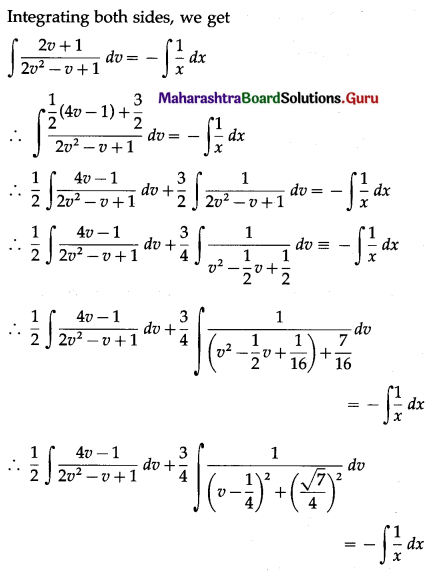
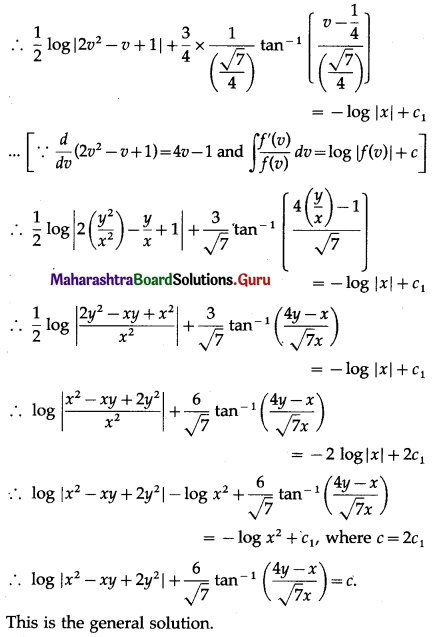
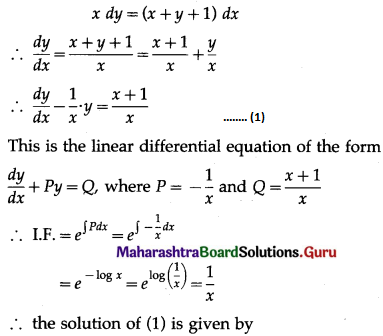
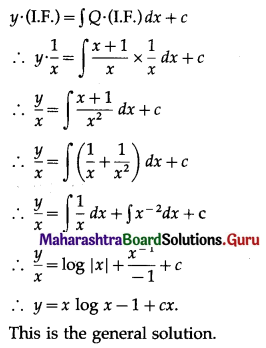
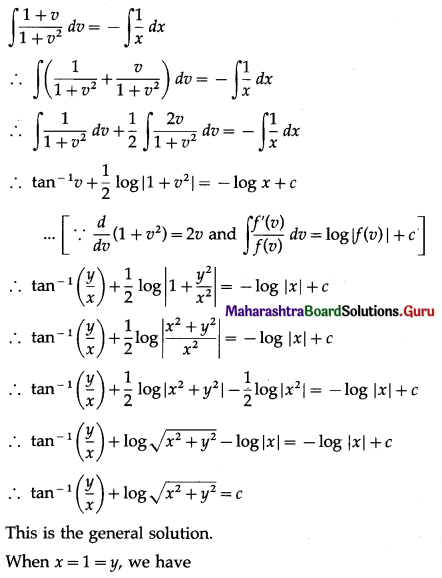
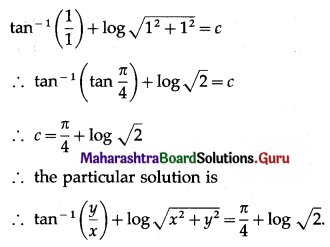
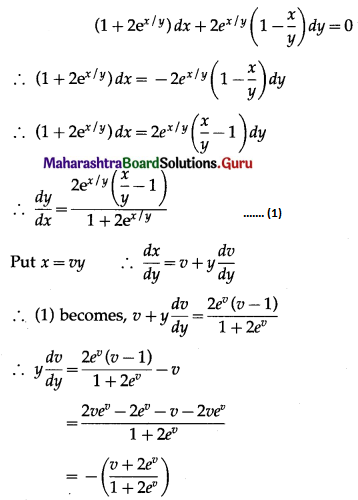
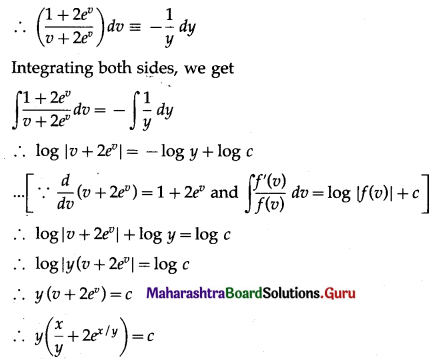
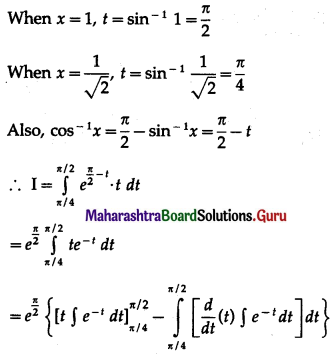
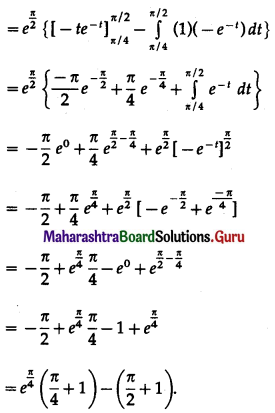
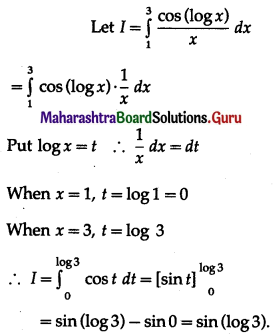
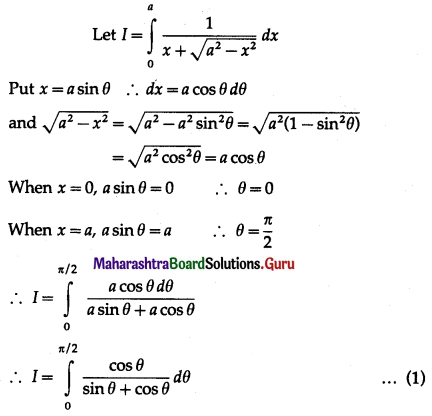
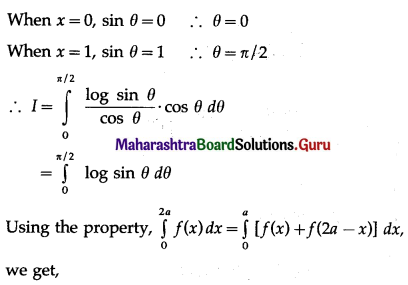
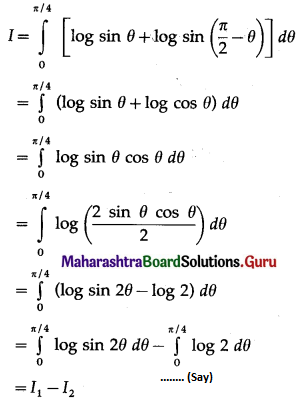
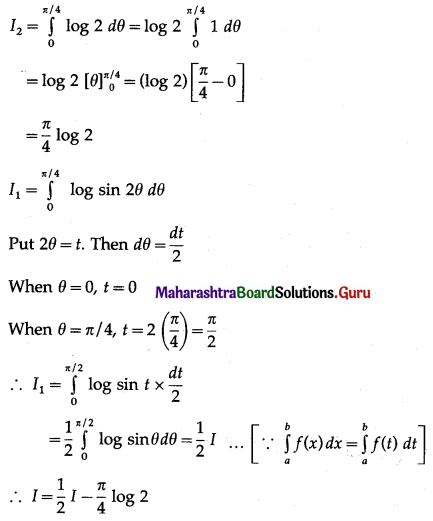
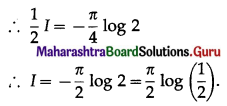
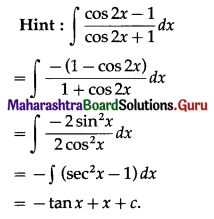
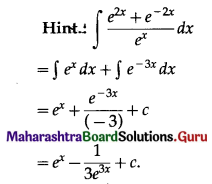
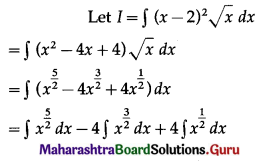
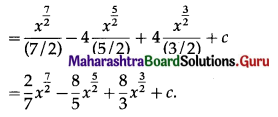
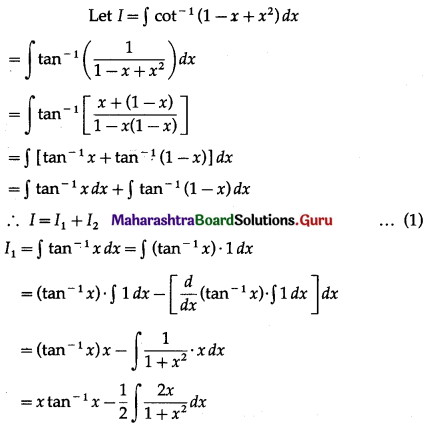
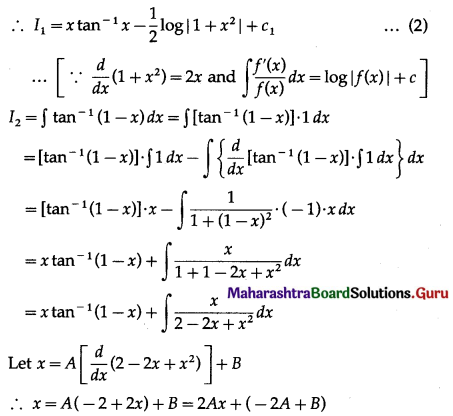
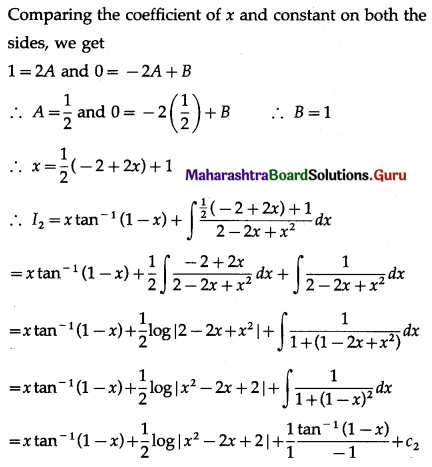
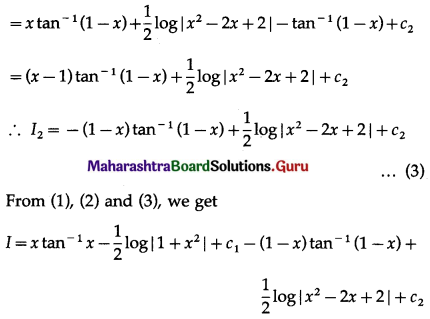
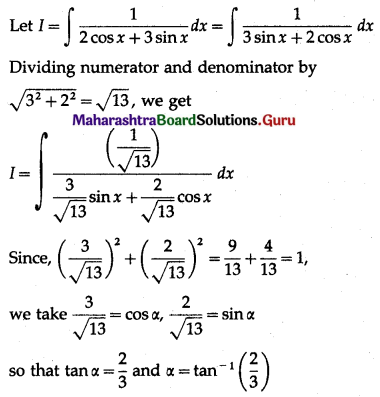
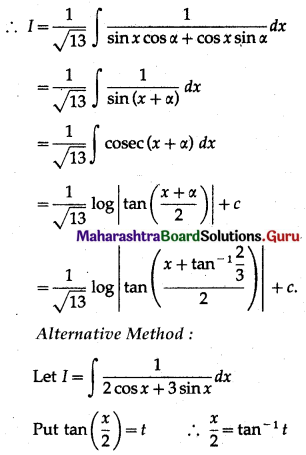
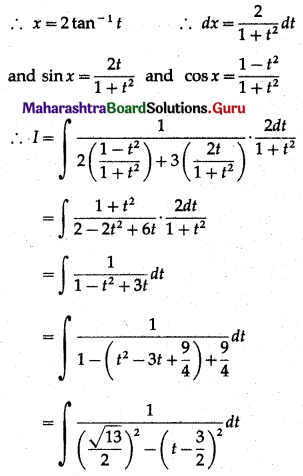
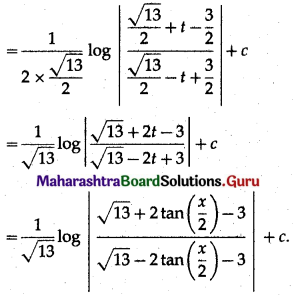
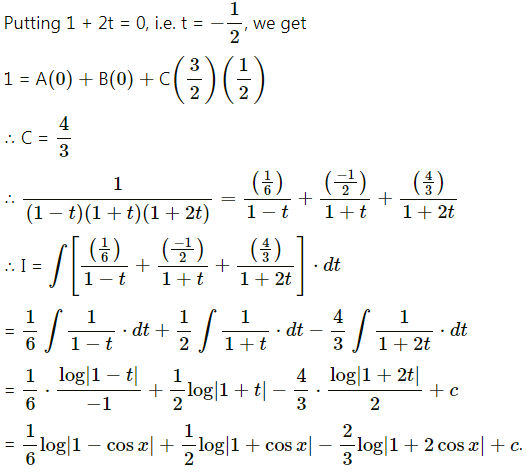
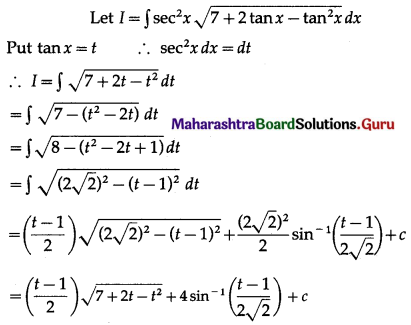
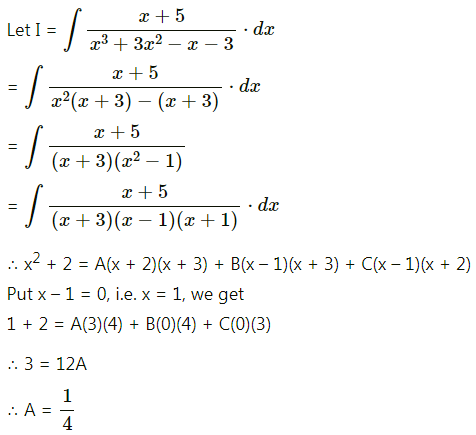
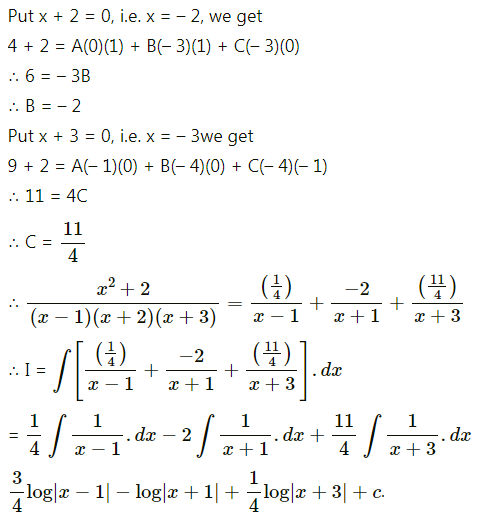
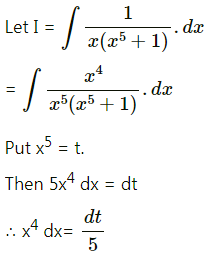
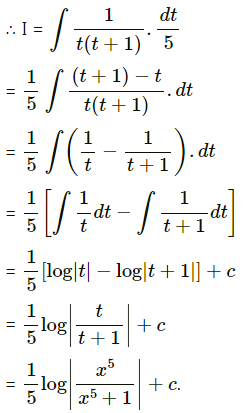
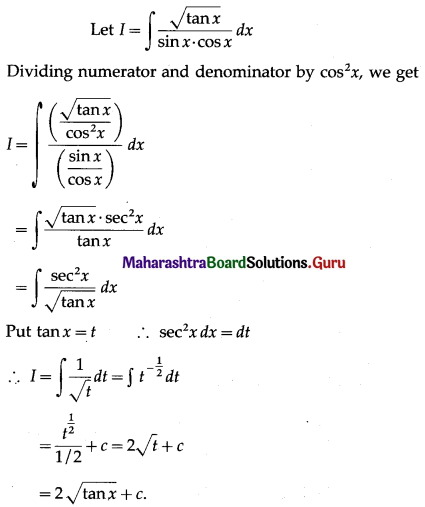
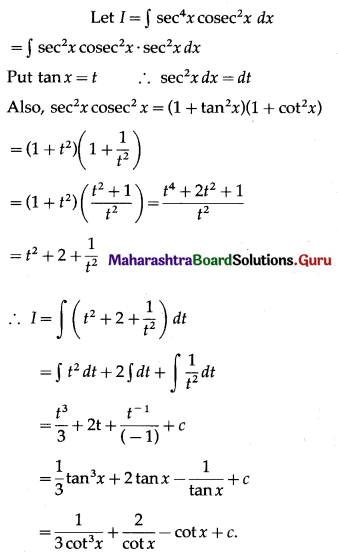
Maharashtra Board 12th Maths Solutions Chapter 6 Differential Equations Ex 6.4

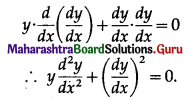
Balbharti 12th Maharashtra State Board Maths Solutions Book Pdf Chapter 6 Differential Equations Ex 6.4 Questions and Answers.

Maharashtra State Board 12th Maths Solutions Chapter 6 Differential Equations Ex 6.4

I. Solve the following differential equations:

Question 1.
\(x \sin \left(\frac{y}{x}\right) d y=\left[y \sin \left(\frac{y}{x}\right)-x\right] d x\)
Solution:
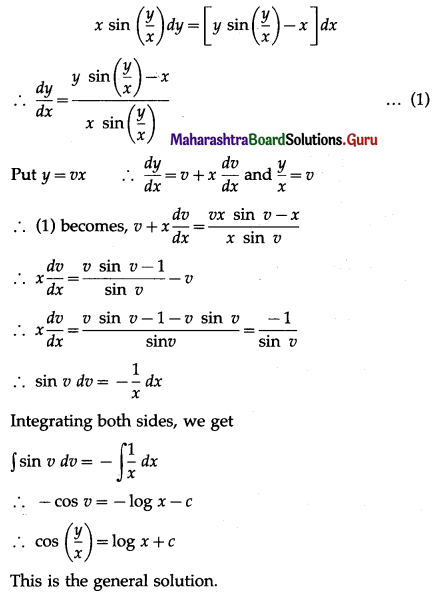
Maharashtra Board 12th Maths Solutions Chapter 6 Differential Equations Ex 6.4 Q1

Question 2.
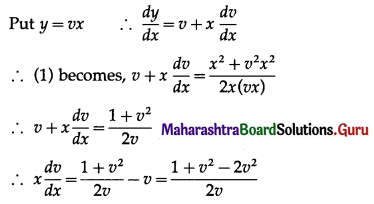
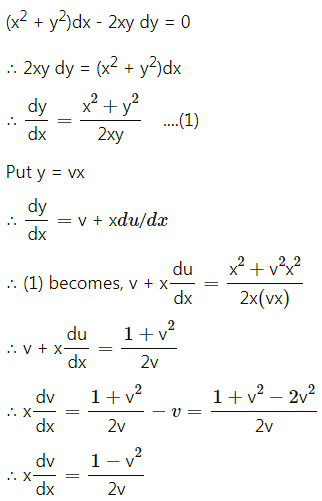
(x2 + y2) dx – 2xy . dy = 0
Solution:
(x2 + y2) dx – 2xy dy = 0
∴ 2xy dy = (x2 + y2) dx
∴ \(\frac{d y}{d x}=\frac{x^{2}+y^{2}}{2 x y}\) ………(1)
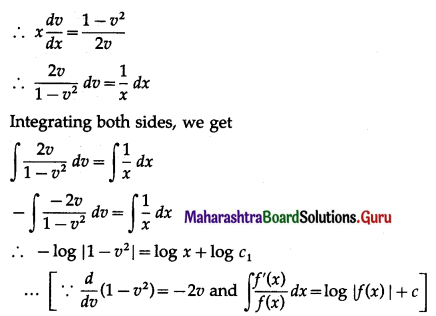
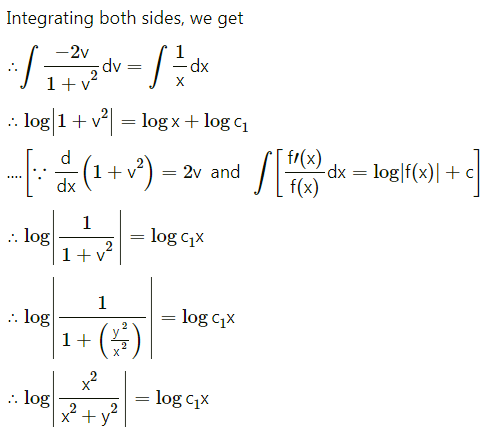
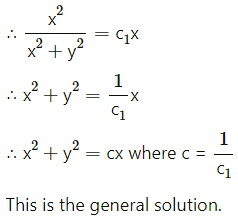
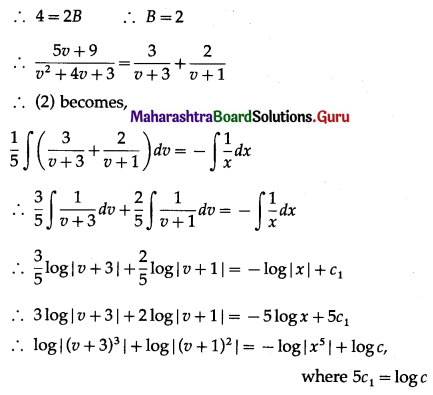
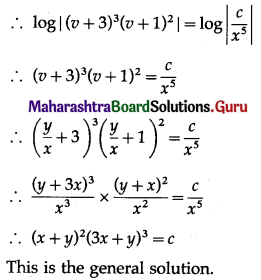
Maharashtra Board 12th Maths Solutions Chapter 6 Differential Equations Ex 6.4 Q2
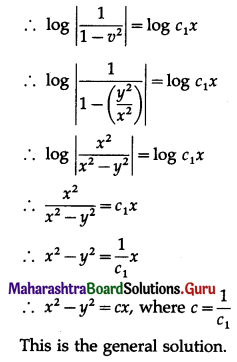
Maharashtra Board 12th Maths Solutions Chapter 6 Differential Equations Ex 6.4 Q2.1
Maharashtra Board 12th Maths Solutions Chapter 6 Differential Equations Ex 6.4 Q2.2

Maharashtra Board 12th Maths Solutions Chapter 6 Differential Equations Ex 6.4

Question 3.
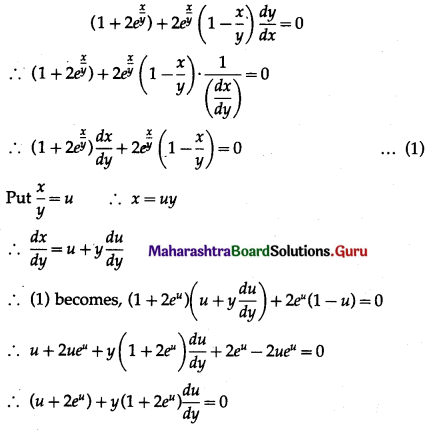
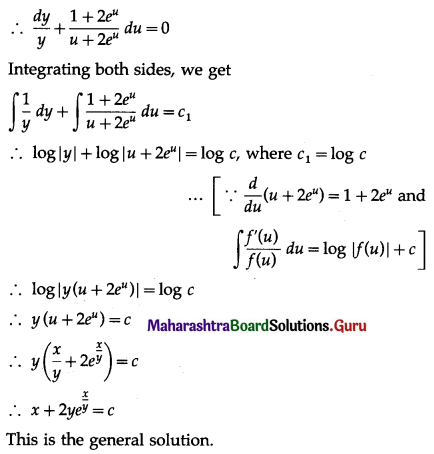
\(\left(1+2 e^{\frac{x}{y}}\right)+2 e^{\frac{x}{y}}\left(1-\frac{x}{y}\right) \frac{d y}{d x}=0\)
Solution:
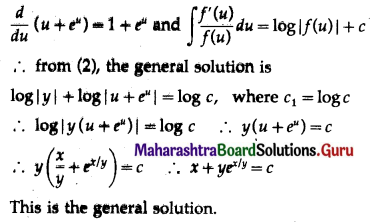
Maharashtra Board 12th Maths Solutions Chapter 6 Differential Equations Ex 6.4 Q3
Maharashtra Board 12th Maths Solutions Chapter 6 Differential Equations Ex 6.4 Q3.1

Question 4.
y2 dx + (xy + x2) dy = 0
Solution:
y2 dx + (xy + x2) dy = 0
∴ (xy + x2) dy = -y2 dx
∴ \(\frac{d y}{d x}=\frac{-y^{2}}{x y+x^{2}}\) ……..(1)
Put y = vx
∴ \(\frac{d y}{d x}=v+x \frac{d v}{d x}\)
Substituting these values in (1), we get
Maharashtra Board 12th Maths Solutions Chapter 6 Differential Equations Ex 6.4 Q4
Maharashtra Board 12th Maths Solutions Chapter 6 Differential Equations Ex 6.4 Q4.1

Maharashtra Board 12th Maths Solutions Chapter 6 Differential Equations Ex 6.4

Question 5.
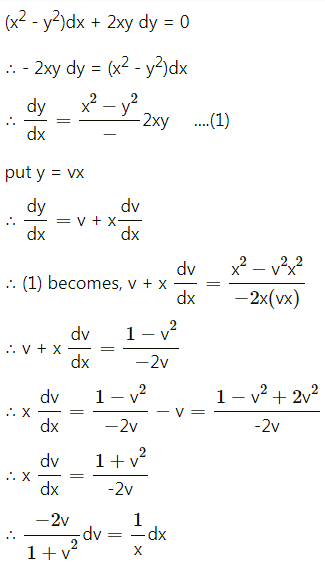
(x2 – y2) dx + 2xy dy = 0
Solution:
Maharashtra Board 12th Maths Solutions Chapter 6 Differential Equations Ex 6.4 Q5
Maharashtra Board 12th Maths Solutions Chapter 6 Differential Equations Ex 6.4 Q5.1
Maharashtra Board 12th Maths Solutions Chapter 6 Differential Equations Ex 6.4 Q5.2

Question 6.
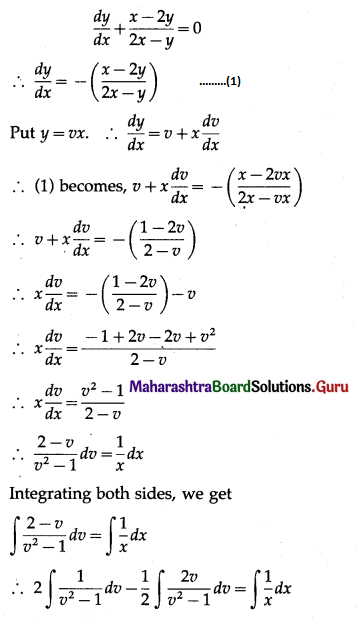
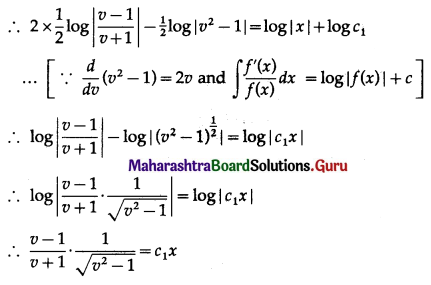
\(\frac{d y}{d x}+\frac{x-2 y}{2 x-y}=0\)
Solution:
Maharashtra Board 12th Maths Solutions Chapter 6 Differential Equations Ex 6.4 Q6
Maharashtra Board 12th Maths Solutions Chapter 6 Differential Equations Ex 6.4 Q6.1
Maharashtra Board 12th Maths Solutions Chapter 6 Differential Equations Ex 6.4 Q6.2

Maharashtra Board 12th Maths Solutions Chapter 6 Differential Equations Ex 6.4

Question 7.
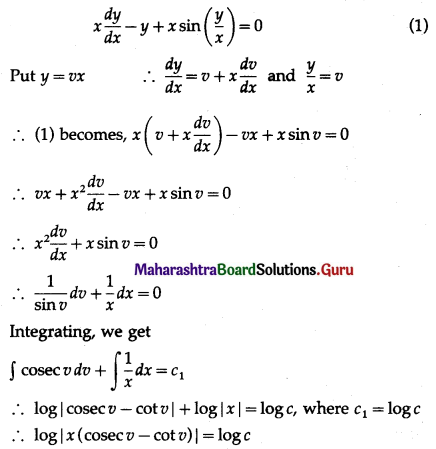
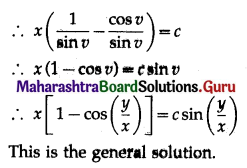
\(x \frac{d y}{d x}-y+x \sin \left(\frac{y}{x}\right)=0\)
Solution:
Maharashtra Board 12th Maths Solutions Chapter 6 Differential Equations Ex 6.4 Q7
Maharashtra Board 12th Maths Solutions Chapter 6 Differential Equations Ex 6.4 Q7.1

Question 8.
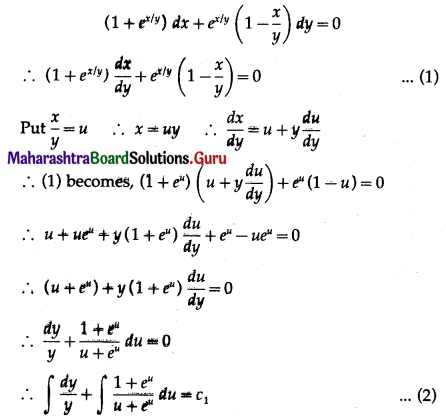
\(\left(1+e^{\frac{x}{y}}\right) d x+e^{\frac{x}{y}}\left(1-\frac{X}{y}\right) d y=0\)
Solution:
Maharashtra Board 12th Maths Solutions Chapter 6 Differential Equations Ex 6.4 Q8
Maharashtra Board 12th Maths Solutions Chapter 6 Differential Equations Ex 6.4 Q8.1

Maharashtra Board 12th Maths Solutions Chapter 6 Differential Equations Ex 6.4

Question 9.
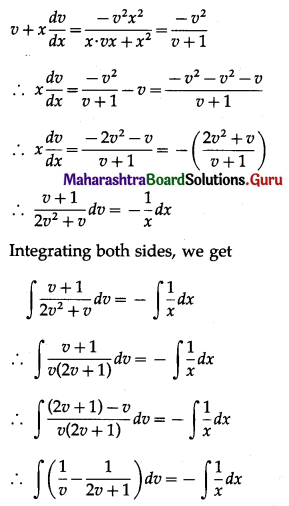
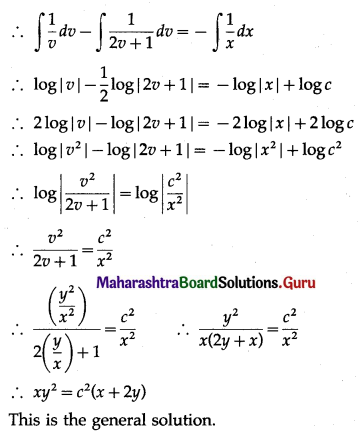
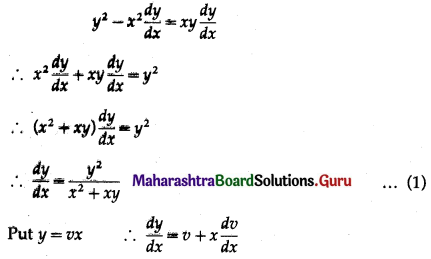
\(y^{2}-x^{2} \frac{d y}{d x}=x y \frac{d y}{d x}\)
Solution:
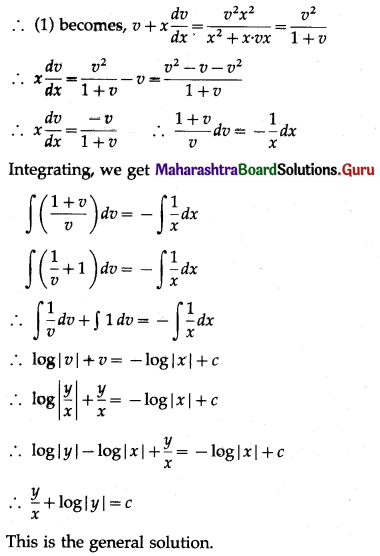
Maharashtra Board 12th Maths Solutions Chapter 6 Differential Equations Ex 6.4 Q9
Maharashtra Board 12th Maths Solutions Chapter 6 Differential Equations Ex 6.4 Q9.1

Question 10.
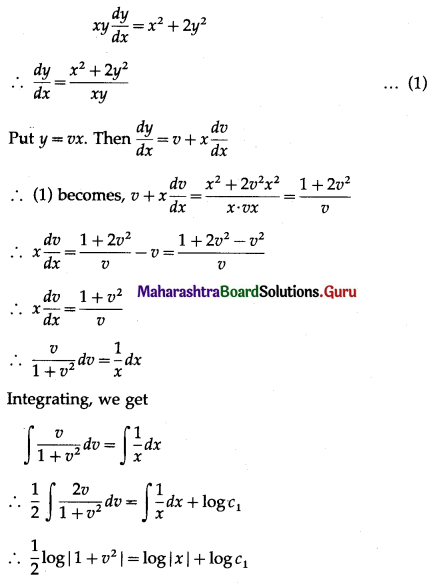
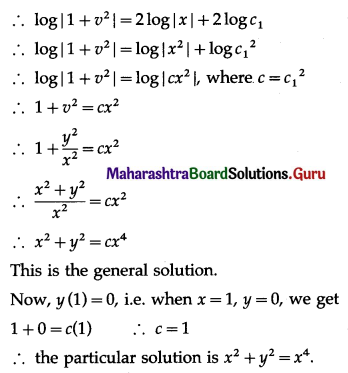
xy \(\frac{d y}{d x}\) = x2 + 2y2, y(1) = 0
Solution:
Maharashtra Board 12th Maths Solutions Chapter 6 Differential Equations Ex 6.4 Q10
Maharashtra Board 12th Maths Solutions Chapter 6 Differential Equations Ex 6.4 Q10.1

Maharashtra Board 12th Maths Solutions Chapter 6 Differential Equations Ex 6.4

Question 11.
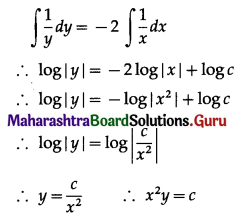
x dy + 2y · dx = 0, when x = 2, y = 1
Solution:
∴ x dy + 2y · dx = 0
∴ x dy = -2y dx
∴ \(\frac{1}{y} d y=\frac{-2}{x} d x\)
Integrating, we get
Maharashtra Board 12th Maths Solutions Chapter 6 Differential Equations Ex 6.4 Q11
This is the general solution.
When x = 2, y = 1, we get
4(1) = c
∴ c = 4
∴ the particular solution is x2y = 4.

Question 12.
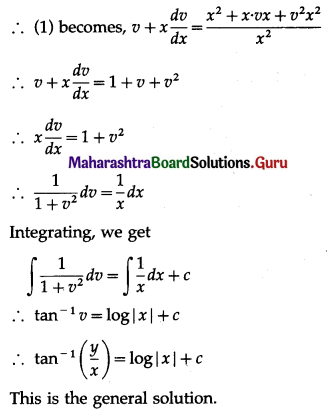
x2 \(\frac{d y}{d x}\) = x2 + xy + y2
Solution:
x2 \(\frac{d y}{d x}\) = x2 + xy + y2
∴ \(\frac{d y}{d x}=\frac{x^{2}+x y+y^{2}}{x^{2}}\) ………(1)
Put y = vx
∴ \(\frac{d y}{d x}=v+x \frac{d v}{d x}\)
Maharashtra Board 12th Maths Solutions Chapter 6 Differential Equations Ex 6.4 Q12

Maharashtra Board 12th Maths Solutions Chapter 6 Differential Equations Ex 6.4

Question 13.
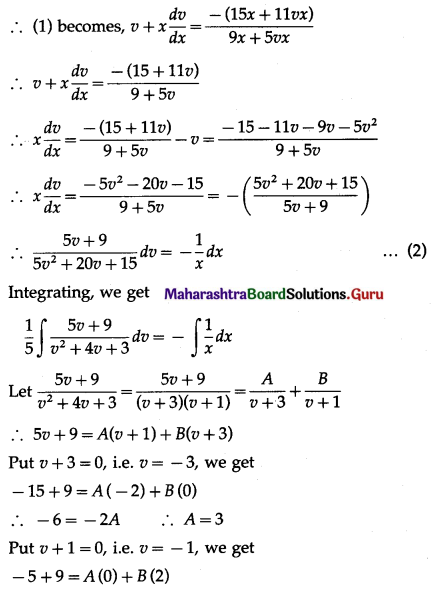
(9x + 5y) dy + (15x + 11y) dx = 0
Solution:
(9x + 5y) dy + (15x + 11y) dx = 0
∴ (9x + 5y) dy = -(15x + 11y) dx
∴ \(\frac{d y}{d x}=\frac{-(15 x+11 y)}{9 x+5 y}\) ………(1)
Put y = vx
∴ \(\frac{d y}{d x}=v+x \frac{d v}{d x}\)
Maharashtra Board 12th Maths Solutions Chapter 6 Differential Equations Ex 6.4 Q13
Maharashtra Board 12th Maths Solutions Chapter 6 Differential Equations Ex 6.4 Q13.1
Maharashtra Board 12th Maths Solutions Chapter 6 Differential Equations Ex 6.4 Q13.2

Question 14.
(x2 + 3xy + y2) dx – x2 dy = 0
Solution:
(x2 + 3xy + y2) dx – x2 dy = 0
∴ x2 dy = (x2 + 3xy + y2) dx
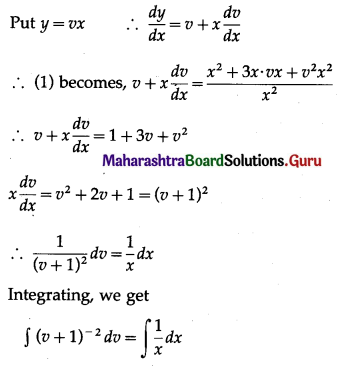
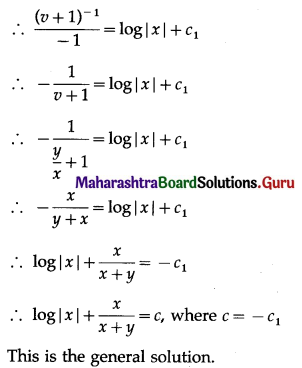
∴ \(\frac{d y}{d x}=\frac{x^{2}+3 x y+y^{2}}{x^{2}}\) ………(1)
Maharashtra Board 12th Maths Solutions Chapter 6 Differential Equations Ex 6.4 Q14
Maharashtra Board 12th Maths Solutions Chapter 6 Differential Equations Ex 6.4 Q14.1

Maharashtra Board 12th Maths Solutions Chapter 6 Differential Equations Ex 6.4

Question 15.
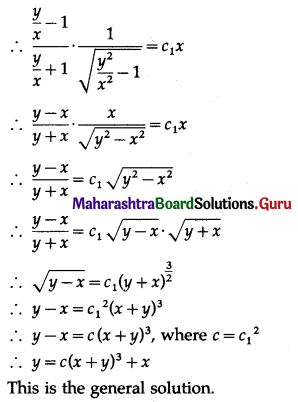
(x2 + y2) dx – 2xy dy = 0.
Solution:
Maharashtra Board 12th Maths Solutions Chapter 6 Differential Equations Ex 6.4 Q15
Maharashtra Board 12th Maths Solutions Chapter 6 Differential Equations Ex 6.4 Q15.1
Maharashtra Board 12th Maths Solutions Chapter 6 Differential Equations Ex 6.4 Q15.2

Maharashtra Board 12th Maths Solutions Chapter 6 Differential Equations Miscellaneous Exercise 6

Balbharti 12th Maharashtra State Board Maths Solutions Book Pdf Chapter 6 Differential Equations Miscellaneous Exercise 6 Questions and Answers.

Maharashtra State Board 12th Maths Solutions Chapter 6 Differential Equations Miscellaneous Exercise 6

(I) Choose the correct option from the given alternatives:

Question 1.
The order and degree of the differential equation \(\sqrt{1+\left(\frac{d y}{d x}\right)^{2}}=\left(\frac{d^{2} y}{d x^{2}}\right)^{\frac{3}{2}}\) are respectively……..
(a) 2, 1
(b) 1, 2
(c) 3, 2
(d) 2, 3
Answer:
(d) 2, 3

Question 2.
The differential equation of y = c2 + \(\frac{c}{x}\) is…….
(a) \(x^{4}\left(\frac{d y}{d x}\right)^{2}-x \frac{d y}{d x}=y\)
(b) \(\frac{d y}{d x^{2}}+x \frac{d y}{d x}+y=0\)
(c) \(x^{3}\left(\frac{d y}{d x}\right)^{2}+x \frac{d y}{d x}=y\)
(d) \(\frac{d^{2} y}{d x^{2}}+\frac{d y}{d x}-y=0\)
Answer:
(a) \(x^{4}\left(\frac{d y}{d x}\right)^{2}-x \frac{d y}{d x}=y\)

Maharashtra Board 12th Maths Solutions Chapter 6 Differential Equations Miscellaneous Exercise 6

Question 3.
x2 + y2 = a2 is a solution of ………
(a) \(\frac{d^{2} y}{d x^{2}}+\frac{d y}{d x}-y=0\)
(b) \(y=x \sqrt{1+\left(\frac{d y}{d x}\right)^{2}}+a^{2} y\)
(c) \(y=x \frac{d y}{d x}+a \sqrt{1+\left(\frac{d y}{d x}\right)^{2}}\)
(d) \(\frac{d^{2} y}{d x^{2}}=(x+1) \frac{d y}{d x}\)
Answer:
(c) \(y=x \frac{d y}{d x}+a \sqrt{1+\left(\frac{d y}{d x}\right)^{2}}\)
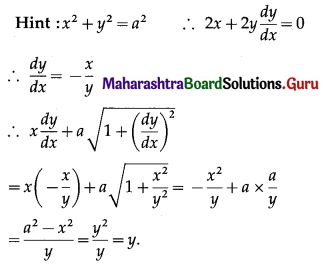
Maharashtra Board 12th Maths Solutions Chapter 6 Differential Equations Miscellaneous Exercise 6 I Q3

Question 4.
The differential equation of all circles having their centres on the line y = 5 and touching the X-axis is
(a) \(y^{2}\left(1+\frac{d y}{d x}\right)=25\)
(b) \((y-5)^{2}\left[1+\left(\frac{d y}{d x}\right)^{2}\right]=25\)
(c) \((y-5)^{2}+\left[1+\left(\frac{d y}{d x}\right)^{2}\right]=25\)
(d) \((y-5)^{2}\left[1-\left(\frac{d y}{d x}\right)^{2}\right]=25\)
Answer:
(b) \((y-5)^{2}\left[1+\left(\frac{d y}{d x}\right)^{2}\right]=25\)
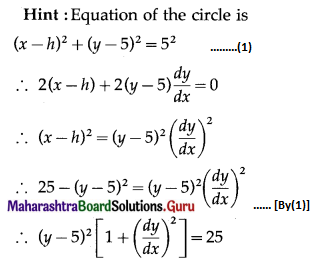
Maharashtra Board 12th Maths Solutions Chapter 6 Differential Equations Miscellaneous Exercise 6 I Q4

Question 5.
The differential equation y \(\frac{d y}{d x}\) + x = 0 represents family of ………
(a) circles
(b) parabolas
(c) ellipses
(d) hyperbolas
Answer:
(a) circles

Hint:
y \(\frac{d y}{d x}\) + x = 0
∴ ∫y dy + ∫x dx = c
∴ \(\frac{y^{2}}{2}+\frac{x^{2}}{2}=c\)
∴ x2 + y2 = 2c which is a circle.

Maharashtra Board 12th Maths Solutions Chapter 6 Differential Equations Miscellaneous Exercise 6

Question 6.
The solution of \(\frac{1}{x} \cdot \frac{d y}{d x}=\tan ^{-1} x\) is……
(a) \(\frac{x^{2} \tan ^{-1} x}{2}+c=0\)
(b) x tan-1x + c = 0
(c) x – tan-1x = c
(d) \(y=\frac{x^{2} \tan ^{-1} x}{2}-\frac{1}{2}\left(x-\tan ^{-1} x\right)+c\)
Answer:
(d) \(y=\frac{x^{2} \tan ^{-1} x}{2}-\frac{1}{2}\left(x-\tan ^{-1} x\right)+c\)
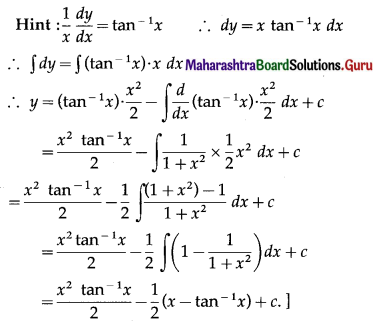
Maharashtra Board 12th Maths Solutions Chapter 6 Differential Equations Miscellaneous Exercise 6 I Q6

Question 7.
The solution of (x + y)2 \(\frac{d y}{d x}\) = 1 is…….
(a) x = tan-1(x + y) + c
(b) y tan-1(\(\frac{x}{y}\)) = c
(c) y = tan-1(x + y) + c
(d) y + tan-1(x + y) = c
Answer:
(c) y = tan-1(x + y) + c
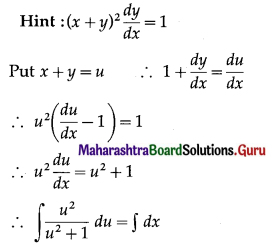
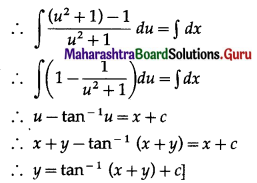
Maharashtra Board 12th Maths Solutions Chapter 6 Differential Equations Miscellaneous Exercise 6 I Q7
Maharashtra Board 12th Maths Solutions Chapter 6 Differential Equations Miscellaneous Exercise 6 I Q7.1

Question 8.
The Solution of \(\frac{d y}{d x}=\frac{y+\sqrt{x^{2}-y^{2}}}{2}\) is……
(a) sin-1(\(\frac{y}{x}\)) = 2 log |x| + c
(b) sin-1(\(\frac{y}{x}\)) = log |x| + c
(c) sin(\(\frac{x}{y}\)) = log |x| + c
(d) sin(\(\frac{y}{x}\)) = log |y| + c
Answer:
(b) sin-1(\(\frac{y}{x}\)) = log |x| + c
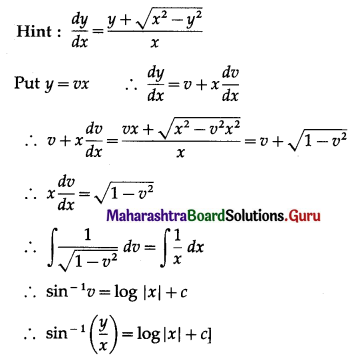
Maharashtra Board 12th Maths Solutions Chapter 6 Differential Equations Miscellaneous Exercise 6 I Q8

Question 9.
The solution of \(\frac{d y}{d x}\) + y = cos x – sin x is……
(a) y ex = cos x + c
(b) y ex + ex cos x = c
(c) y ex = ex cos x + c
(d) y2 ex = ex cos x + c
Answer:
(c) y ex = ex cos x + c
Hint:
\(\frac{d y}{d x}\) + y = cos x – sin x
I.F. = \(e^{\int 1 d x}=e^{x}\)
∴ the solution is y . ex = ∫(cos x – sin x) ex + c
∴ y . ex = ex cos x + c

Maharashtra Board 12th Maths Solutions Chapter 6 Differential Equations Miscellaneous Exercise 6

Question 10.
The integrating factor of linear differential equation x \(\frac{d y}{d x}\) + 2y = x2 log x is……..
(a) \(\frac{1}{x}\)
(b) k
(c) \(\frac{1}{n^{2}}\)
(d) x2
Answer:
(d) x2
Hint:
I.F. = \(e^{\int \frac{2}{x} d x}\)
= e2 log x
= x2

Question 11.
The solution of the differential equation \(\frac{d y}{d x}\) = sec x – y tan x is…….
(a) y sec x + tan x = c
(b) y sec x = tan x + c
(c) sec x + y tan x = c
(d) sec x = y tan x + c
Answer:
(b) y sec x = tan x + c

Hint:
\(\frac{d y}{d x}\) = sec x – y tan x
∴ \(\frac{d y}{d x}\) + y tan x = sec x
I.F. = \(e^{\int \tan x d x}=e^{\log \sec x}\) = sec x
∴ the solution is
y . sec x = ∫sec x . sec x dx + c
∴ y sec x = tan x + c

Question 12.
The particular solution of \(\frac{d y}{d x}=x e^{y-x}\), when x = y = 0 is……
(a) ex-y = x + 1
(b) ex+y = x + 1
(c) ex + ey = x + 1
(d) ey-x = x – 1
Answer:
(a) ex-y = x + 1
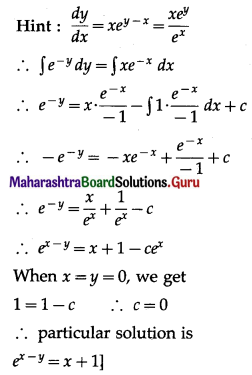
Maharashtra Board 12th Maths Solutions Chapter 6 Differential Equations Miscellaneous Exercise 6 I Q12

Maharashtra Board 12th Maths Solutions Chapter 6 Differential Equations Miscellaneous Exercise 6

Question 13.
\(\frac{x^{2}}{a^{2}}-\frac{y^{2}}{b^{2}}=1\) is a solution of……..
(a) \(\frac{d^{2} y}{d x^{2}}+y x+\left(\frac{d y}{d x}\right)^{2}=0\)
(b) \(x y \frac{d^{2} y}{d x^{2}}+2\left(\frac{d y}{d x}\right)^{2}-y \frac{d y}{d x}=0\)
(c) \(y \frac{d^{2} y}{d x^{2}}+2\left(\frac{d y}{d x}\right)^{2}+y=0\)
(d) \(x y \frac{d y}{d x}+y \frac{d^{2} y}{d x^{2}}=0\)
Answer:
(b) \(x y \frac{d^{2} y}{d x^{2}}+2\left(\frac{d y}{d x}\right)^{2}-y \frac{d y}{d x}=0\)
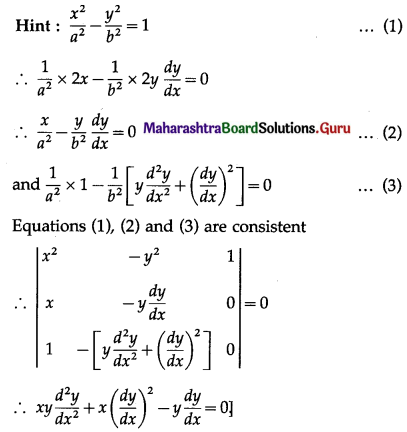
Maharashtra Board 12th Maths Solutions Chapter 6 Differential Equations Miscellaneous Exercise 6 I Q13

Question 14.
The decay rate of certain substances is directly proportional to the amount present at that instant. Initially, there are 27 grams of substance and 3 hours later it is found that 8 grams left. The amount left after one more hour is……
(a) 5\(\frac{2}{3}\) grams
(b) 5\(\frac{1}{3}\) grams
(c) 5.1 grams
(d) 5 grams
Answer:
(b) 5\(\frac{1}{3}\) grams

Question 15.
If the surrounding air is kept at 20°C and the body cools from 80°C to 70°C in 5 minutes, the temperature of the body after 15 minutes will be…..
(a) 51.7°C
(b) 54.7°C
(c) 52.7°C
(d) 50.7°C
Answer:
(b) 54.7°C

(II) Solve the following:

Question 1.
Determine the order and degree of the following differential equations:
(i) \(\frac{d^{2} y}{d x^{2}}+5 \frac{d y}{d x}+y=x^{3}\)
Solution:
The given D.E. is \(\frac{d^{2} y}{d x^{2}}+5 \frac{d y}{d x}+y=x^{3}\)
This D.E. has highest order derivative \(\frac{d^{2} y}{d x^{2}}\) with power 1.
∴ the given D.E. is of order 2 and degree 1.

(ii) \(\left(\frac{d^{3} y}{d x^{3}}\right)^{2}=\sqrt[5]{1+\frac{d y}{d x}}\)
Solution:
The given D.E. is \(\left(\frac{d^{3} y}{d x^{3}}\right)^{2}=\sqrt[5]{1+\frac{d y}{d x}}\)
\(\left(\frac{d^{3} y}{d x^{3}}\right)^{2 \times 5}=1+\frac{d y}{d x}\)
\(\left(\frac{d^{3} y}{d x^{3}}\right)^{10}=1+\frac{d y}{d x}\)
This D.E. has highest order derivative \(\frac{d^{3} y}{d x^{3}}\) with power 10.
∴ the given D.E. is of order 3 and degree 10.

(iii) \(\sqrt[3]{1+\left(\frac{d y}{d x}\right)^{2}}=\frac{d^{2} y}{d x^{2}}\)
Solution:
The given D.E. is \(\sqrt[3]{1+\left(\frac{d y}{d x}\right)^{2}}=\frac{d^{2} y}{d x^{2}}\)
On cubing both sides, we get
\(1+\left(\frac{d y}{d x}\right)^{2}=\left(\frac{d^{2} y}{d x^{2}}\right)^{3}\)
This D.E. has highest order derivative \(\frac{d^{2} y}{d x^{2}}\) with power 3.
∴ the given D.E. is of order 2 and degree 3.

Maharashtra Board 12th Maths Solutions Chapter 6 Differential Equations Miscellaneous Exercise 6

(iv) \(\frac{d y}{d x}=3 y+\sqrt[4]{1+5\left(\frac{d y}{d x}\right)^{2}}\)
Solution:
The given D.E. is
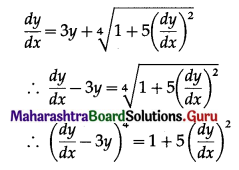
Maharashtra Board 12th Maths Solutions Chapter 6 Differential Equations Miscellaneous Exercise 6 II Q1 (iv)
This D.E. has the highest order derivative \(\frac{d y}{d x}\) with power 4.
∴ the given D.E. is of order 1 and degree 4.

(v) \(\frac{d^{4} y}{d x^{4}}+\sin \left(\frac{d y}{d x}\right)=0\)
Solution:
The given D.E. is \(\frac{d^{4} y}{d x^{4}}+\sin \left(\frac{d y}{d x}\right)=0\)
This D.E. has highest order derivative \(\frac{d^{4} y}{d x^{4}}\).
∴ order = 4
Since this D.E. cannot be expressed as a polynomial in differential coefficient, the degree is not defined.

Question 2.
In each of the following examples verify that the given function is a solution of the differential equation.
(i) \(x^{2}+y^{2}=r^{2} ; x \frac{d y}{d x}+r \sqrt{1+\left(\frac{d y}{d x}\right)^{2}}=y\)
Solution:
x2 + y2 = r2 ……. (1)
Differentiating both sides w.r.t. x, we get
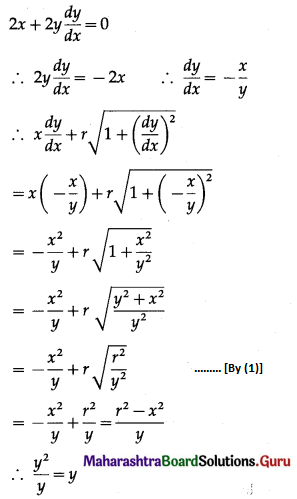
Maharashtra Board 12th Maths Solutions Chapter 6 Differential Equations Miscellaneous Exercise 6 II Q2 (i)
Hence, x2 + y2 = r2 is a solution of the D.E.
\(x \frac{d y}{d x}+r \sqrt{1+\left(\frac{d y}{d x}\right)^{2}}=y\)

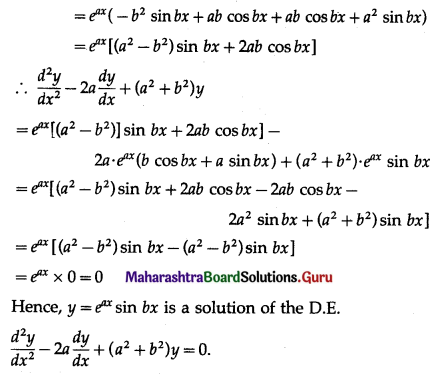
(ii) y = eax sin bx; \(\frac{d^{2} y}{d x^{2}}-2 a \frac{d y}{d x}+\left(a^{2}+b^{2}\right) y=0\)
Solution:
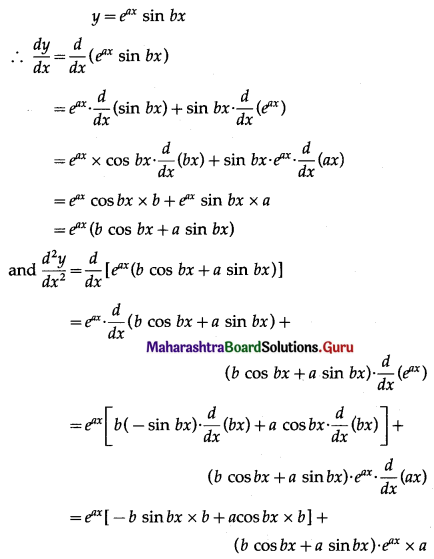
Maharashtra Board 12th Maths Solutions Chapter 6 Differential Equations Miscellaneous Exercise 6 II Q2 (ii)
Maharashtra Board 12th Maths Solutions Chapter 6 Differential Equations Miscellaneous Exercise 6 II Q2 (ii).1

(iii) y = 3 cos(log x) + 4 sin(log x); \(x^{2} \frac{d^{2} y}{d x^{2}}+x \frac{d y}{d x}+y=0\)
Solution:
y = 3 cos(log x) + 4 sin (log x) …… (1)
Differentiating both sides w.r.t. x, we get
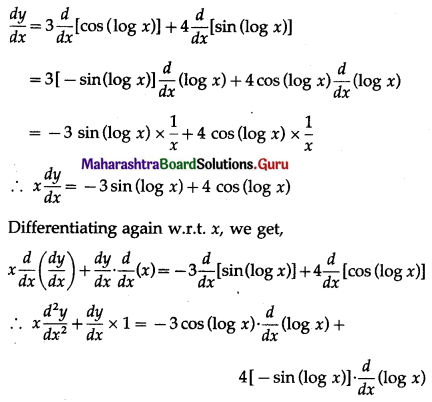
Maharashtra Board 12th Maths Solutions Chapter 6 Differential Equations Miscellaneous Exercise 6 II Q2 (iii)
Maharashtra Board 12th Maths Solutions Chapter 6 Differential Equations Miscellaneous Exercise 6 II Q2 (iii).1

Maharashtra Board 12th Maths Solutions Chapter 6 Differential Equations Miscellaneous Exercise 6

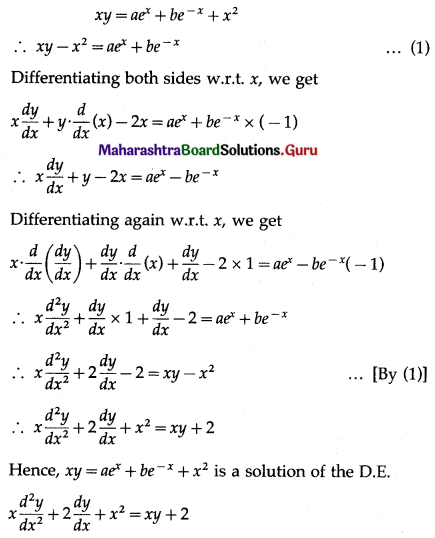
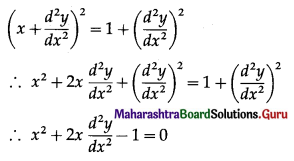
(iv) xy = aex + be-x + x2; \(x \frac{d^{2} y}{d x^{2}}+2 \frac{d y}{d x}+x^{2}=x y+2\)
Solution:
Maharashtra Board 12th Maths Solutions Chapter 6 Differential Equations Miscellaneous Exercise 6 II Q2 (iv)

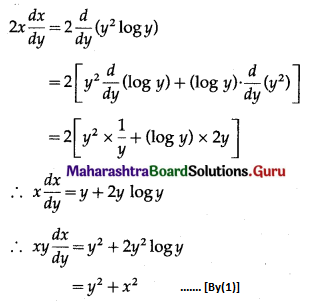
(v) x2 = 2y2 log y, x2 + y2 = xy \(\frac{d x}{d y}\)
Solution:
x2 = 2y2 log y ……(1)
Differentiating both sides w.r.t. y, we get
Maharashtra Board 12th Maths Solutions Chapter 6 Differential Equations Miscellaneous Exercise 6 II Q2 (v)
∴ x2 + y2 = xy \(\frac{d x}{d y}\)
Hence, x2 = 2y2 log y is a solution of the D.E.
x2 + y2 = xy \(\frac{d x}{d y}\)

Question 3.
Obtain the differential equation by eliminating the arbitrary constants from the following equations:
(i) y2 = a(b – x)(b + x)
Solution:
y2 = a(b – x)(b + x) = a(b2 – x2)
Differentiating both sides w.r.t. x, we get
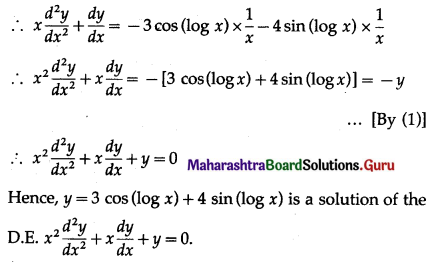
2y \(\frac{d y}{d x}\) = a(0 – 2x) = -2ax
∴ y \(\frac{d y}{d x}\) = -ax …….(1)
Differentiating again w.r.t. x, we get
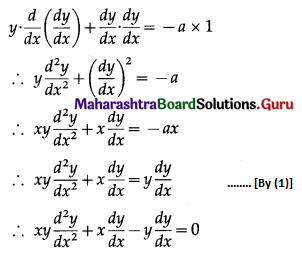
Maharashtra Board 12th Maths Solutions Chapter 6 Differential Equations Miscellaneous Exercise 6 II Q3 (i)
This is the required D.E.

(ii) y = a sin(x + b)
Solution:
y = a sin(x + b)
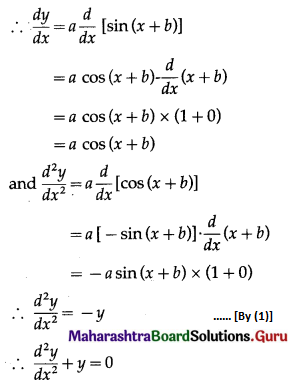
Maharashtra Board 12th Maths Solutions Chapter 6 Differential Equations Miscellaneous Exercise 6 II Q3 (ii)
This is the required D.E.

(iii) (y – a)2 = b(x + 4)
Solution:
(y – a)2 = b(x + 4) …….(1)
Differentiating both sides w.r.t. x, we get
\(2(y-a) \cdot \frac{d}{d x}(y-a)=b \frac{d}{d x}(x+4)\)
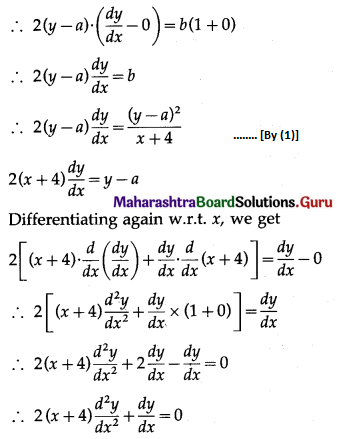
Maharashtra Board 12th Maths Solutions Chapter 6 Differential Equations Miscellaneous Exercise 6 II Q3 (iii)

Maharashtra Board 12th Maths Solutions Chapter 6 Differential Equations Miscellaneous Exercise 6

(iv) y = \(\sqrt{a \cos (\log x)+b \sin (\log x)}\)
Solution:
y = \(\sqrt{a \cos (\log x)+b \sin (\log x)}\)
∴ y2 = a cos (log x) + b sin (log x) …….(1)
Differentiating both sides w.r.t. x, we get
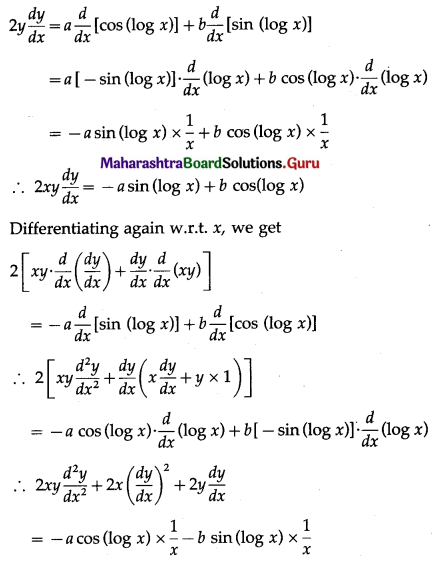
Maharashtra Board 12th Maths Solutions Chapter 6 Differential Equations Miscellaneous Exercise 6 II Q3 (iv)
Maharashtra Board 12th Maths Solutions Chapter 6 Differential Equations Miscellaneous Exercise 6 II Q3 (iv).1

(v) y = Ae3x+1 + Be-3x+1
Solution:
y = Ae3x+1 + Be-3x+1 …… (1)
Differentiating twice w.r.t. x, we get
Maharashtra Board 12th Maths Solutions Chapter 6 Differential Equations Miscellaneous Exercise 6 II Q3 (v)
This is the required D.E.

Question 4.
Form the differential equation of:
(i) all circles which pass through the origin and whose centres lie on X-axis.
Solution:
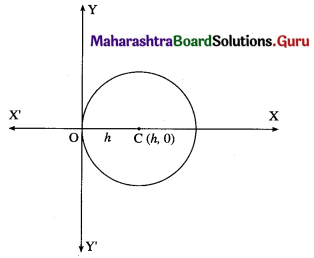
Maharashtra Board 12th Maths Solutions Chapter 6 Differential Equations Miscellaneous Exercise 6 II Q4 (i)
Let C (h, 0) be the centre of the circle which pass through the origin. Then radius of the circle is h.
∴ equation of the circle is (x – h)2 + (y – 0)2 = h2
∴ x2 – 2hx + h2 + y2 = h2
∴ x2 + y2 = 2hx ……..(1)
Differentiating both sides w.r.t. x, we get
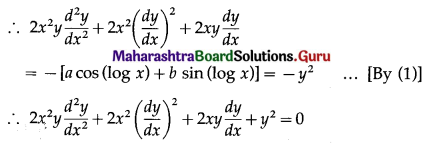
2x + 2y \(\frac{d y}{d x}\) = 2h
Substituting the value of 2h in equation (1), we get
x2 + y2 = (2x + 2y \(\frac{d y}{d x}\)) x
∴ x2 + y2 = 2x2 + 2xy \(\frac{d y}{d x}\)
∴ 2xy \(\frac{d y}{d x}\) + x2 – y2 = 0
This is the required D.E.

(ii) all parabolas which have 4b as latus rectum and whose axis is parallel to Y-axis.
Solution:
Let A(h, k) be the vertex of the parabola which has 4b as latus rectum and whose axis is parallel to the Y-axis.
Then equation of the parabola is
(x – h)2 = 4b(y – k) ……. (1)
where h and k are arbitrary constants.
Maharashtra Board 12th Maths Solutions Chapter 6 Differential Equations Miscellaneous Exercise 6 II Q4 (ii)
Differentiating both sides of (1) w.r.t. x, we get
2(x – h). \(\frac{d}{d x}\)(x – h) = 4b . \(\frac{d}{d x}\)(y – k)
∴ 2(x – h) x (1 – 0) = 4b(\(\frac{d y}{d x}\) – 0)
∴ (x – h) = 2b \(\frac{d y}{d x}\)
Differentiating again w.r.t. x, we get
1 – 0 = 2b \(\frac{d^{2} y}{d x^{2}}\)
∴ 2b \(\frac{d^{2} y}{d x^{2}}\) – 1 = 0
This is the required D.E.

Maharashtra Board 12th Maths Solutions Chapter 6 Differential Equations Miscellaneous Exercise 6

(iii) an ellipse whose major axis is twice its minor axis.
Solution:
Let 2a and 2b be lengths of the major axis and minor axis of the ellipse.
Then 2a = 2(2b)
∴ a = 2b
∴ equation of the ellipse is
\(\frac{x^{2}}{a^{2}}+\frac{y^{2}}{b^{2}}=1\)
∴ \(\frac{x^{2}}{(2 b)^{2}}+\frac{y^{2}}{b^{2}}=1\)
∴ \(\frac{x^{2}}{4 b^{2}}+\frac{y^{2}}{b^{2}}=1\)
∴ x2 + 4y2 = 4b2
Differentiating w.r.t. x, we get
2x + 4 × 2y \(\frac{d y}{d x}\) = 0
∴ x + 4y \(\frac{d y}{d x}\) = 0
This is the required D.E.

(iv) all the lines which are normal to the line 3x + 2y + 7 = 0.
Solution:
Slope of the line 3x – 2y + 7 = 0 is \(\frac{-3}{-2}=\frac{3}{2}\).
∴ slope of normal to this line is \(-\frac{2}{3}\)
Then the equation of the normal is
y = \(-\frac{2}{3}\)x + k, where k is an arbitrary constant.
Differentiating w.r.t. x, we get
\(\frac{d y}{d x}=-\frac{2}{3} \times 1+0\)
∴ 3\(\frac{d y}{d x}\) + 2 = 0
This is the required D.E.

(v) the hyperbola whose length of transverse and conjugate axes are half of that of the given hyperbola \(\frac{x^{2}}{16}-\frac{y^{2}}{36}=k\).
Solution:
The equation of the hyperbola is \(\frac{x^{2}}{16}-\frac{y^{2}}{36}=k\)
i.e., \(\frac{x^{2}}{16 k}-\frac{y^{2}}{36 k}=1\)
Comparing this equation with \(\frac{x^{2}}{a^{2}}-\frac{y^{2}}{b^{2}}=1\), we get
a2 = 16k, b2 = 36k
∴ a = 4√k, b = 6√k
∴ l(transverse axis) = 2a = 8√k
and l(conjugate axis) = 2b = 12√k
Let 2A and 2B be the lengths of the transverse and conjugate axes of the required hyperbola.
Then according to the given condition
2A = a = 4√k and 2B = b = 6√k
∴ A = 2√k and B = 3√k
∴ equation of the required hyperbola is
\(\frac{x^{2}}{A^{2}}-\frac{y^{2}}{B^{2}}=1\)
i.e., \(\frac{x^{2}}{4 k}-\frac{y^{2}}{9 k}=1\)
∴ 9x2 – 4y2 = 36k, where k is an arbitrary constant.
Differentiating w.r.t. x, we get
9 × 2x – 4 × 2y \(\frac{d y}{d x}\) = 0
∴ 9x – 4y \(\frac{d y}{d x}\) = 0
This is the required D.E.

Maharashtra Board 12th Maths Solutions Chapter 6 Differential Equations Miscellaneous Exercise 6

Question 5.
Solve the following differential equations:
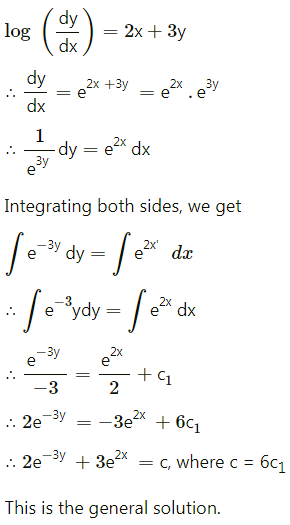
(i) log(\(\frac{d y}{d x}\)) = 2x + 3y
Solution:
Maharashtra Board 12th Maths Solutions Chapter 6 Differential Equations Miscellaneous Exercise 6 II Q5 (i)

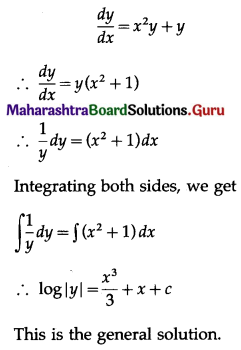
(ii) \(\frac{d y}{d x}\) = x2y + y
Solution:
Maharashtra Board 12th Maths Solutions Chapter 6 Differential Equations Miscellaneous Exercise 6 II Q5 (ii)

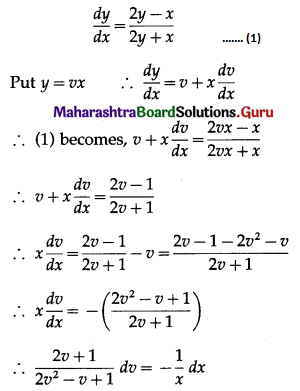
(iii) \(\frac{d y}{d x}=\frac{2 y-x}{2 y+x}\)
Solution:
Maharashtra Board 12th Maths Solutions Chapter 6 Differential Equations Miscellaneous Exercise 6 II Q5 (iii)
Maharashtra Board 12th Maths Solutions Chapter 6 Differential Equations Miscellaneous Exercise 6 II Q5 (iii).1
Maharashtra Board 12th Maths Solutions Chapter 6 Differential Equations Miscellaneous Exercise 6 II Q5 (iii).2

(iv) x dy = (x + y + 1) dx
Solution:
Maharashtra Board 12th Maths Solutions Chapter 6 Differential Equations Miscellaneous Exercise 6 II Q5 (iv)
Maharashtra Board 12th Maths Solutions Chapter 6 Differential Equations Miscellaneous Exercise 6 II Q5 (iv).1

(v) \(\frac{d y}{d x}\) + y cot x = x2 cot x + 2x
Solution:
\(\frac{d y}{d x}\) + y cot x = x cot x + 2x ……..(1)
This is the linear differential equation of the form
\(\frac{d y}{d x}\) + Py = Q, where P = cot x and Q = x2 cot x + 2x
∴ I.F. = \(e^{\int P d x}\)
= \(e^{\int \cot x d x}\)
= \(e^{\log (\sin x)}\)
= sin x
∴ the solution of (1) is given by
y(I.F.) = ∫Q . (I.F.) dx + c
∴ y sin x = ∫(x2 cot x + 2x) sin x dx + c
∴ y sinx = ∫(x2 cot x . sin x + 2x sin x) dx + c
∴ y sinx = ∫x2 cos x dx + 2∫x sin x dx + c
∴ y sinx = x2 ∫cos x dx – ∫[\(\frac{d}{d x}\left(x^{2}\right)\) ∫cos x dx] dx + 2∫x sin x dx + c
∴ y sin x = x2 (sin x) – ∫2x(sin x) dx + 2∫x sin x dx + c
∴ y sin x = x2 sin x – 2∫x sin x dx + 2∫x sin x dx + c
∴ y sin x = x2 sin x + c
∴ y = x2 + c cosec x
This is the general solution.

Maharashtra Board 12th Maths Solutions Chapter 6 Differential Equations Miscellaneous Exercise 6

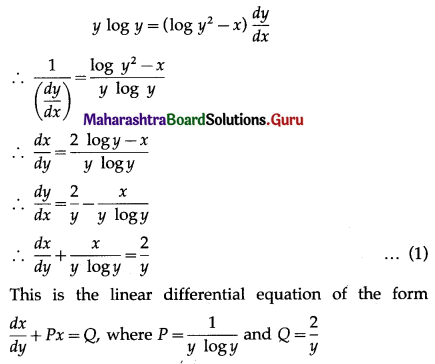
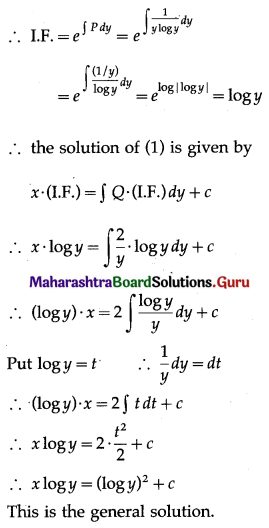
(vi) y log y = (log y2 – x) \(\frac{d y}{d x}\)
Solution:
Maharashtra Board 12th Maths Solutions Chapter 6 Differential Equations Miscellaneous Exercise 6 II Q5 (vi)
Maharashtra Board 12th Maths Solutions Chapter 6 Differential Equations Miscellaneous Exercise 6 II Q5 (vi).1

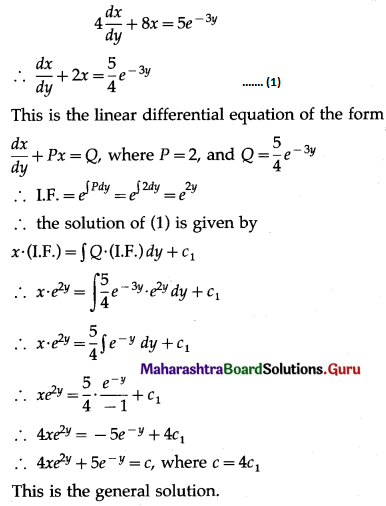
(vii) 4 \(\frac{d x}{d y}\) + 8x = 5e-3y
Solution:
Maharashtra Board 12th Maths Solutions Chapter 6 Differential Equations Miscellaneous Exercise 6 II Q5 (vii)

Question 6.
Find the particular solution of the following differential equations:
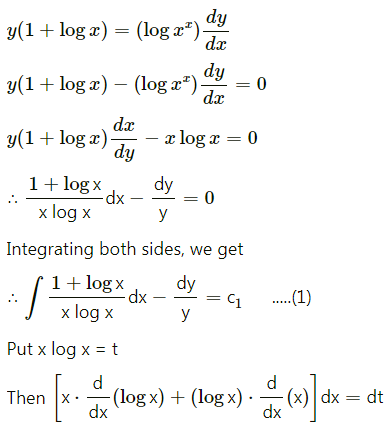
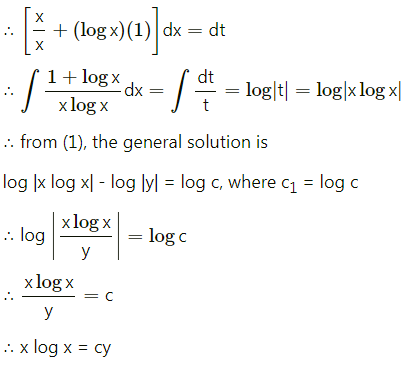
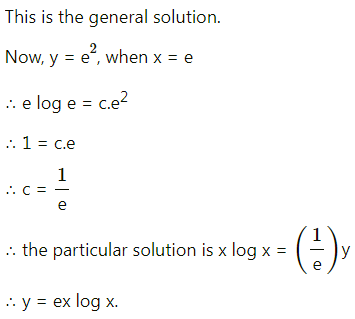
(i) y(1 + log x) = (log xx) \(\frac{d y}{d x}\), when y(e) = e2
Solution:
Maharashtra Board 12th Maths Solutions Chapter 6 Differential Equations Miscellaneous Exercise 6 II Q6 (i)
Maharashtra Board 12th Maths Solutions Chapter 6 Differential Equations Miscellaneous Exercise 6 II Q6 (i).1
Maharashtra Board 12th Maths Solutions Chapter 6 Differential Equations Miscellaneous Exercise 6 II Q6 (i).2

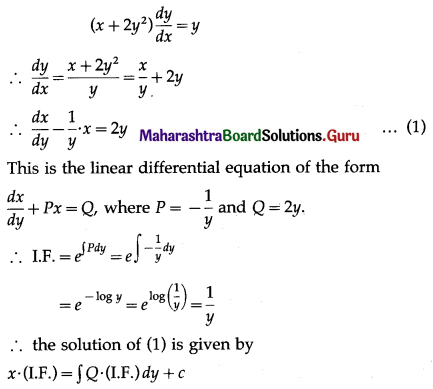
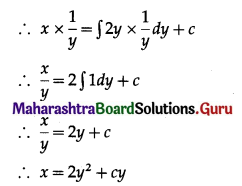
(ii) (x + 2y2) \(\frac{d y}{d x}\) = y, when x = 2, y = 1
Solution:
Maharashtra Board 12th Maths Solutions Chapter 6 Differential Equations Miscellaneous Exercise 6 II Q6 (ii)
Maharashtra Board 12th Maths Solutions Chapter 6 Differential Equations Miscellaneous Exercise 6 II Q6 (ii).1
This is the general solution.
When x = 2, y = 1, we have
2 = 2(1)2 + c(1)
∴ c = 0
∴ the particular solution is x = 2y2.

Maharashtra Board 12th Maths Solutions Chapter 6 Differential Equations Miscellaneous Exercise 6

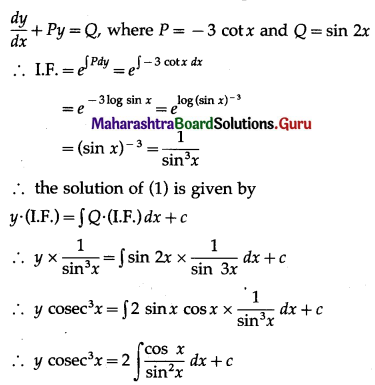
(iii) \(\frac{d y}{d x}\) – 3y cot x = sin 2x, when y(\(\frac{\pi}{2}\)) = 2
Solution:
\(\frac{d y}{d x}\) – 3y cot x = sin 2x
\(\frac{d y}{d x}\) = (3 cot x) y = sin 2x ……..(1)
This is the linear differential equation of the form
Maharashtra Board 12th Maths Solutions Chapter 6 Differential Equations Miscellaneous Exercise 6 II Q6 (iii)
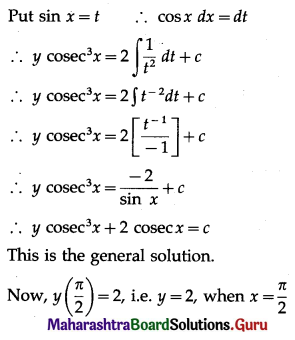
Maharashtra Board 12th Maths Solutions Chapter 6 Differential Equations Miscellaneous Exercise 6 II Q6 (iii).1
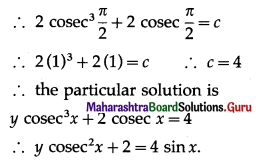
Maharashtra Board 12th Maths Solutions Chapter 6 Differential Equations Miscellaneous Exercise 6 II Q6 (iii).2

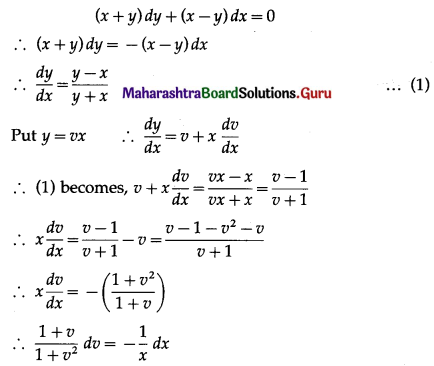
(iv) (x + y) dy + (x – y) dx = 0; when x = 1 = y
Solution:
Maharashtra Board 12th Maths Solutions Chapter 6 Differential Equations Miscellaneous Exercise 6 II Q6 (iv)
Maharashtra Board 12th Maths Solutions Chapter 6 Differential Equations Miscellaneous Exercise 6 II Q6 (iv).1
Maharashtra Board 12th Maths Solutions Chapter 6 Differential Equations Miscellaneous Exercise 6 II Q6 (iv).2

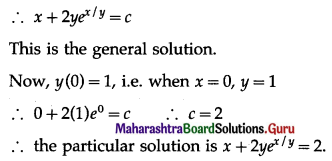
(v) \(2 e^{\frac{x}{y}} d x+\left(y-2 x e^{\frac{x}{y}}\right) d y=0\), when y(0) = 1
Solution:
Maharashtra Board 12th Maths Solutions Chapter 6 Differential Equations Miscellaneous Exercise 6 II Q6 (v)
Maharashtra Board 12th Maths Solutions Chapter 6 Differential Equations Miscellaneous Exercise 6 II Q6 (v).1
Maharashtra Board 12th Maths Solutions Chapter 6 Differential Equations Miscellaneous Exercise 6 II Q6 (v).2

Maharashtra Board 12th Maths Solutions Chapter 6 Differential Equations Miscellaneous Exercise 6

Question 7.
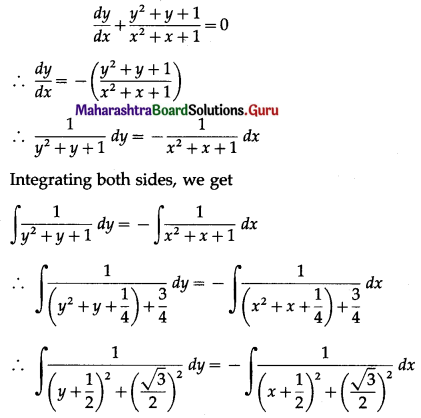
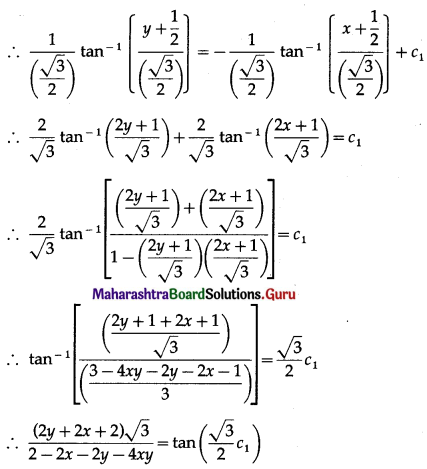
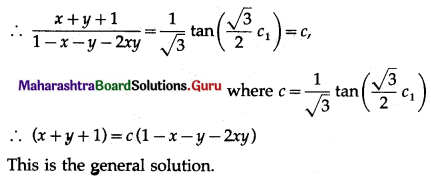
Show that the general solution of defferential equation \(\frac{d y}{d x}+\frac{y^{2}+y+1}{x^{2}+x+1}=0\) is given by (x + y + 1) = c(1 – x – y – 2xy).
Solution:
Maharashtra Board 12th Maths Solutions Chapter 6 Differential Equations Miscellaneous Exercise 6 II Q7
Maharashtra Board 12th Maths Solutions Chapter 6 Differential Equations Miscellaneous Exercise 6 II Q7.1
Maharashtra Board 12th Maths Solutions Chapter 6 Differential Equations Miscellaneous Exercise 6 II Q7.2

Question 8.
The normal lines to a given curve at each point (x, y) on the curve pass through (2, 0). The curve passes through (2, 3). Find the equation of the curve.
Solution:
Let P(x, y) be a point on the curve y = f(x).
Then slope of the normal to the curve is \(-\frac{1}{\left(\frac{d y}{d x}\right)}\)
∴ equation of the normal is
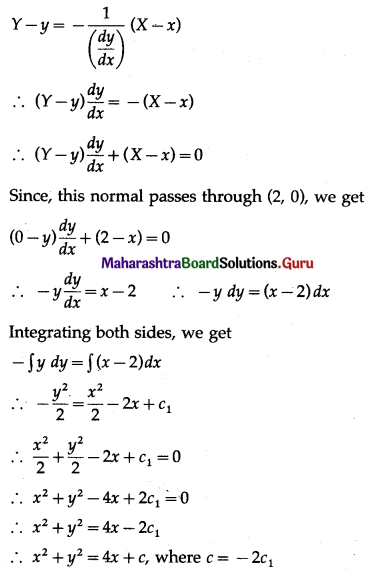
Maharashtra Board 12th Maths Solutions Chapter 6 Differential Equations Miscellaneous Exercise 6 II Q8
This is the general equation of the curve.
Since, the required curve passed through the point (2, 3), we get
22 + 32 = 4(2) + c
∴ c = 5
∴ equation of the required curve is x2 + y2 = 4x + 5.

Maharashtra Board 12th Maths Solutions Chapter 6 Differential Equations Miscellaneous Exercise 6

Question 9.
The volume of a spherical balloon being inflated changes at a constant rate. If initially its radius is 3 units and after 3 seconds it is 6 units. Find the radius of the balloon after t seconds.
Solution:
Let r be the radius and V be the volume of the spherical balloon at any time t.
Then the rate of change in volume of the spherical balloon is \(\frac{d V}{d t}\) which is a constant.
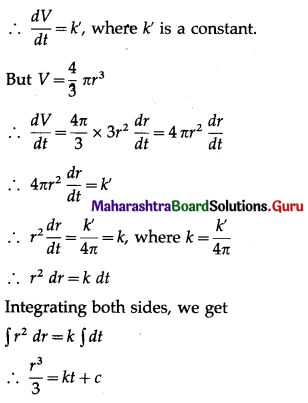
Maharashtra Board 12th Maths Solutions Chapter 6 Differential Equations Miscellaneous Exercise 6 II Q9
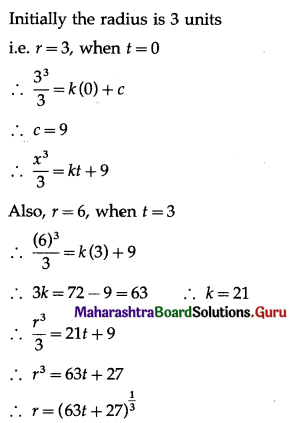
Maharashtra Board 12th Maths Solutions Chapter 6 Differential Equations Miscellaneous Exercise 6 II Q9.1
Hence, the radius of the spherical balloon after t seconds is \((63 t+27)^{\frac{1}{3}}\) units.

Maharashtra Board 12th Maths Solutions Chapter 6 Differential Equations Miscellaneous Exercise 6

Question 10.
A person’s assets start reducing in such a way that the rate of reduction of assets is proportional to the square root of the assets existing at that moment. If the assets at the beginning are ₹ 10 lakhs and they dwindle down to ₹ 10,000 after 2 years, show that the person will be bankrupt in 2\(\frac{2}{9}\) years from the start.
Solution:
Let x be the assets of the presort at time t years.
Then the rate of reduction is \(\frac{d x}{d t}\) which is proportional to √x.
∴ \(\frac{d x}{d t}\) ∝ √x
∴ \(\frac{d x}{d t}\) = -k√x, where k > 0
∴ \(\frac{d x}{\sqrt{x}}\) = -k dt
Integrating both sides, we get
\(\int x^{-\frac{1}{2}} d x\) = -k∫dt
∴ \(\frac{x^{\frac{1}{2}}}{\left(\frac{1}{2}\right)}\) = -kt + c
∴ 2√x = -kt + c
At the beginning, i.e. at t = 0, x = 10,00,000
2√10,00,000 = -k(0) + c
∴ c = 2000
∴ 2√x = -kt + 2000 ……..(1)
Also, when t = 2, x = 10,000
∴ 2√10000 = -k × 2 + 2000
∴ 2k = 1800
∴ k = 900
∴ (1) becomes,
∴ 2√x = -900t + 2000
When the person will be bankrupt, x = 0
∴ 0 = -900t + 2000
∴ 900t = 2000
∴ t = \(\frac{20}{9}=2 \frac{2}{9}\)
Hence, the person will be bankrupt in \(2 \frac{2}{9}\) years.

Maharashtra Board 12th Maths Solutions Chapter 4 Definite Integration Miscellaneous Exercise 4

Balbharti 12th Maharashtra State Board Maths Solutions Book Pdf Chapter 4 Definite Integration Miscellaneous Exercise 4 Questions and Answers.

Maharashtra State Board 12th Maths Solutions Chapter 4 Definite Integration Miscellaneous Exercise 4

I. Choose the correct option from the given alternatives:

Question 1.
\(\int_{2}^{3} \frac{d x}{x\left(x^{3}-1\right)}=\)
(a) \(\frac{1}{3} \log \left(\frac{208}{189}\right)\)
(b) \(\frac{1}{3} \log \left(\frac{189}{208}\right)\)
(c) \(\log \left(\frac{208}{189}\right)\)
(d) \(\log \left(\frac{189}{208}\right)\)
Answer:
(a) \(\frac{1}{3} \log \left(\frac{208}{189}\right)\)

Question 2.
\(\int_{0}^{\pi / 2} \frac{\sin ^{2} x \cdot d x}{(1+\cos x)^{2}}=\)
(a) \(\frac{4-\pi}{2}\)
(b) \(\frac{\pi-4}{2}\)
(c) 4 – \(\frac{\pi}{2}\)
(d) \(\frac{4+\pi}{2}\)
Answer:
(a) \(\frac{4-\pi}{2}\)

Maharashtra Board 12th Maths Solutions Chapter 4 Definite Integration Miscellaneous Exercise 4

Question 3.
\(\int_{0}^{\log 5} \frac{e^{x} \sqrt{e^{x}-1}}{e^{x}+3} \cdot d x=\)
(a) 3 + 2π
(b) 4 – π
(c) 2 + π
(d) 4 + π
Answer:
(b) 4 – π

Question 4.
\(\int_{0}^{\pi / 2} \sin ^{6} x \cos ^{2} x \cdot d x=\)
(a) \(\frac{7 \pi}{256}\)
(b) \(\frac{3 \pi}{256}\)
(c) \(\frac{5 \pi}{256}\)
(d) \(\frac{-5 \pi}{256}\)
Answer:
(c) \(\frac{5 \pi}{256}\)

Question 5.
If \(\int_{0}^{1} \frac{d x}{\sqrt{1+x}-\sqrt{X}}=\frac{k}{3}\), then k is equal to
(a) √2(2√2 – 2)
(b) \(\frac{\sqrt{2}}{3}\)(2 – 2√2)
(c) \(\frac{2 \sqrt{2}-2}{3}\)
(d) 4√2
Answer:
(d) 4√2

Question 6.
\(\int_{1}^{2} \frac{1}{x^{2}} e^{\frac{1}{x}} \cdot d x=\)
(a) √e + 1
(b) √e − 1
(c) √e(√e − 1)
(d) \(\frac{\sqrt{e}-1}{e}\)
Answer:
(c) √e(√e − 1)

Maharashtra Board 12th Maths Solutions Chapter 4 Definite Integration Miscellaneous Exercise 4

Question 7.
If \(\int_{2}^{e}\left[\frac{1}{\log x}-\frac{1}{(\log x)^{2}}\right] \cdot d x=a+\frac{b}{\log 2}\), then
(a) a = e, b = -2
(b) a = e, b = 2
(c) a = -e, b = 2
(d) a = -e, b = -2
Answer:
(a) a = e, b = -2

Question 8.
Let \(\mathrm{I}_{1}=\int_{e}^{e^{2}} \frac{d x}{\log x}\) and \(\mathrm{I}_{2}=\int_{1}^{2} \frac{e^{x}}{\boldsymbol{X}} \cdot d x\), then
(a) I1 = \(\frac{1}{3}\) I2
(b) I1 + I2 = 0
(c) I1 = 2I2
(d) I1 = I2
Answer:
(d) I1 = I2

Question 9.
\(\int_{0}^{9} \frac{\sqrt{X}}{\sqrt{X}+\sqrt{9-X}} \cdot d x=\)
(a) 9
(b) \(\frac{9}{2}\)
(c) 0
(d) 1
Answer:
(b) \(\frac{9}{2}\)

Maharashtra Board 12th Maths Solutions Chapter 4 Definite Integration Miscellaneous Exercise 4

Question 10.
The value of \(\int_{-\pi / 4}^{\pi / 4} \log \left(\frac{2+\sin \theta}{2-\sin \theta}\right) \cdot d \theta\) is
(a) 0
(b) 1
(c) 2
(d) π
Answer:
(a) 0

II. Evaluate the following:

Question 1.
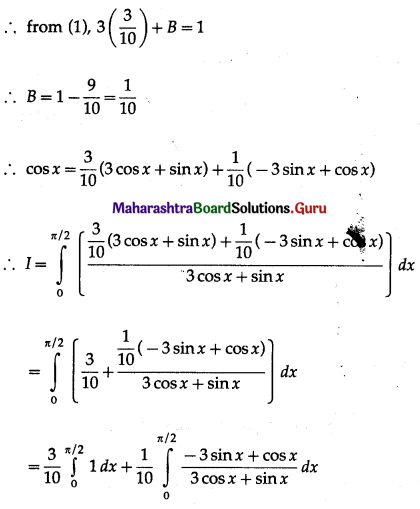
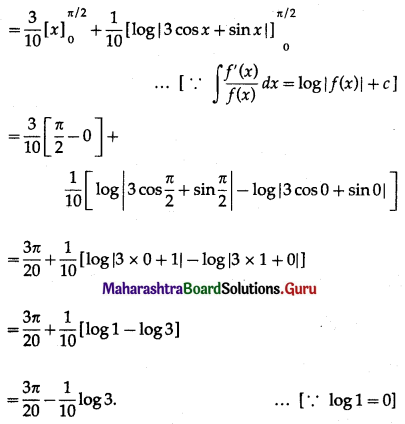
\(\int_{0}^{\pi / 2} \frac{\cos x}{3 \cos x+\sin x} d x\)
Solution:
Let I = \(\int_{0}^{\pi / 2} \frac{\cos x}{3 \cos x+\sin x} d x\)
Put Numerator = A(Denominator) + B[\(\frac{d}{d x}\)(Denominator)]
∴ cos x = A(3 cos x + sin x) + B[\(\frac{d}{d x}\)(3 cos x + sin x)]
= A(3 cos x + sin x) + B(-3 sin x + cos x)
∴ cos x + 0 . sin x = (3A + B) cos x + (A – 3B) sin x
Comparing the coefficients of sinx and cos x on both the sides, we get
3A + B = 1 ………. (1)
A – 3B = 0 ………. (2)
Multiplying equation (1) by 3, we get
9A + 3B = 3 ………(3)
Adding (2) and (3), we get
10A = 3
∴ A = \(\frac{3}{10}\)
Maharashtra Board 12th Maths Solutions Chapter 4 Definite Integration Miscellaneous Exercise 4 II Q1
Maharashtra Board 12th Maths Solutions Chapter 4 Definite Integration Miscellaneous Exercise 4 II Q1.1

Question 2.
\(\int_{\pi / 4}^{\pi / 2} \frac{\cos \theta}{\left[\cos \frac{\theta}{2}+\sin \frac{\theta}{2}\right]^{3}} d \theta\)
Solution:
Maharashtra Board 12th Maths Solutions Chapter 4 Definite Integration Miscellaneous Exercise 4 II Q2
Maharashtra Board 12th Maths Solutions Chapter 4 Definite Integration Miscellaneous Exercise 4 II Q2.1

Maharashtra Board 12th Maths Solutions Chapter 4 Definite Integration Miscellaneous Exercise 4

Question 3.
\(\int_{0}^{1} \frac{1}{1+\sqrt{x}} d x\)
Solution:
Let I = \(\int_{0}^{1} \frac{1}{1+\sqrt{x}} d x\)
Put √x = t
∴ x = t2 and dx = 2t . dt
When x = 0, t = 0
When x = 1, t = 1
Maharashtra Board 12th Maths Solutions Chapter 4 Definite Integration Miscellaneous Exercise 4 II Q3

Question 4.
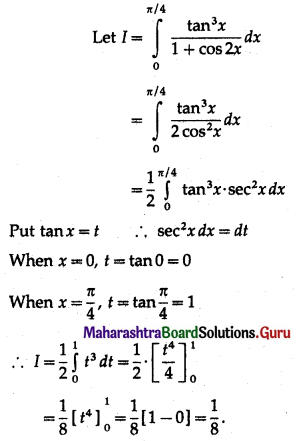
\(\int_{0}^{\pi / 4} \frac{\tan ^{3} x}{1+\cos 2 x} d x\)
Solution:
Maharashtra Board 12th Maths Solutions Chapter 4 Definite Integration Miscellaneous Exercise 4 II Q4

Question 5.
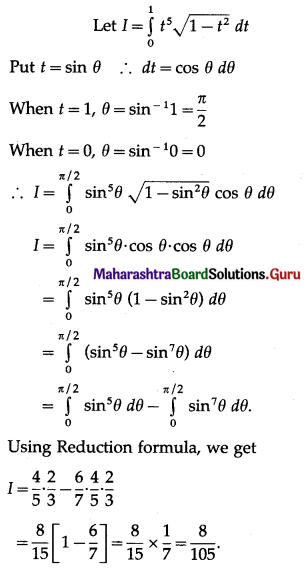
\(\int_{0}^{1} t^{5} \sqrt{1-t^{2}} d t\)
Solution:
Maharashtra Board 12th Maths Solutions Chapter 4 Definite Integration Miscellaneous Exercise 4 II Q5

Question 6.
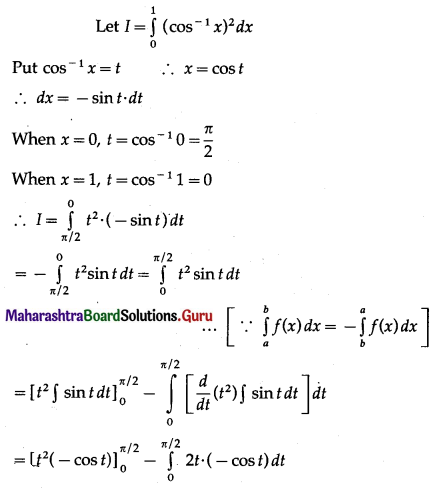
\(\int_{0}^{1}\left(\cos ^{-1} x\right)^{2} d x\)
Solution:
Maharashtra Board 12th Maths Solutions Chapter 4 Definite Integration Miscellaneous Exercise 4 II Q6
Maharashtra Board 12th Maths Solutions Chapter 4 Definite Integration Miscellaneous Exercise 4 II Q6.1

Question 7.
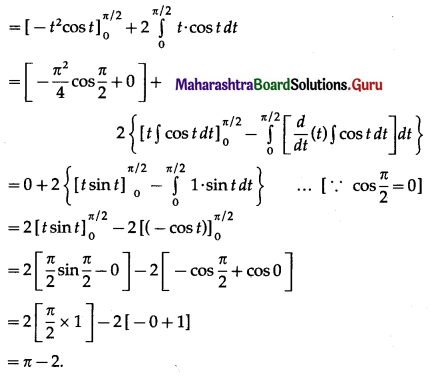
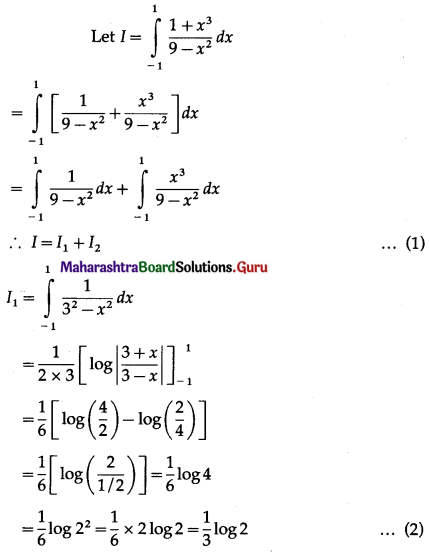
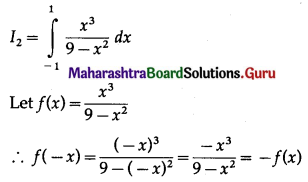
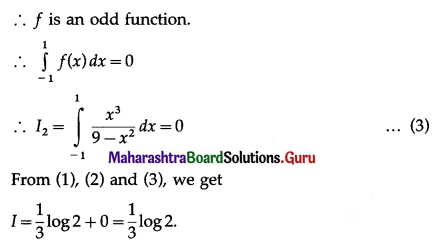
\(\int_{-1}^{1} \frac{1+x^{3}}{9-x^{2}} d x\)
Solution:
Maharashtra Board 12th Maths Solutions Chapter 4 Definite Integration Miscellaneous Exercise 4 II Q7
Maharashtra Board 12th Maths Solutions Chapter 4 Definite Integration Miscellaneous Exercise 4 II Q7.1
Maharashtra Board 12th Maths Solutions Chapter 4 Definite Integration Miscellaneous Exercise 4 II Q7.2

Maharashtra Board 12th Maths Solutions Chapter 4 Definite Integration Miscellaneous Exercise 4

Question 8.
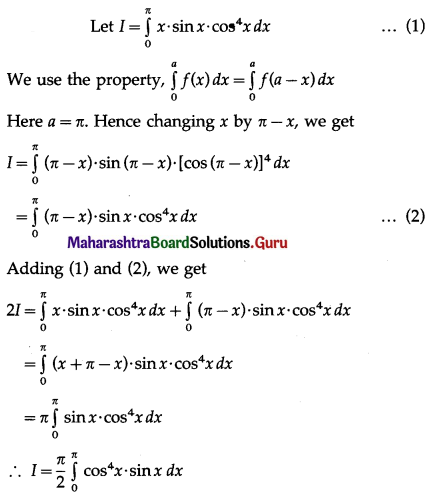
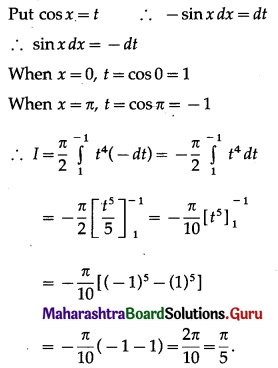
\(\int_{0}^{\pi} x \cdot \sin x \cdot \cos ^{4} x d x\)
Solution:
Maharashtra Board 12th Maths Solutions Chapter 4 Definite Integration Miscellaneous Exercise 4 II Q8
Maharashtra Board 12th Maths Solutions Chapter 4 Definite Integration Miscellaneous Exercise 4 II Q8.1

Question 9.
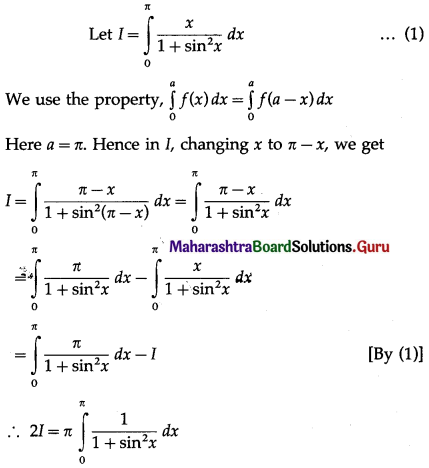
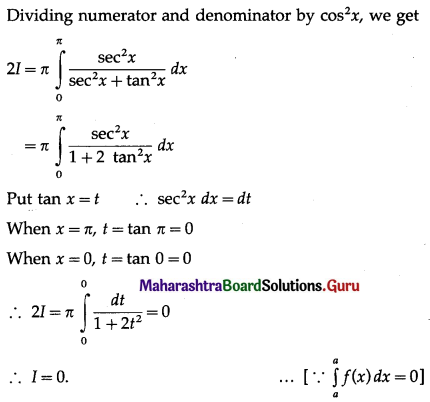
\(\int_{0}^{\pi} \frac{x}{1+\sin ^{2} x} d x\)
Solution:
Maharashtra Board 12th Maths Solutions Chapter 4 Definite Integration Miscellaneous Exercise 4 II Q9
Maharashtra Board 12th Maths Solutions Chapter 4 Definite Integration Miscellaneous Exercise 4 II Q9.1

Question 10.
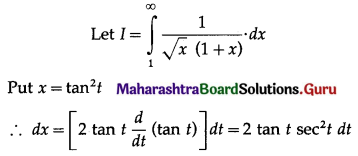
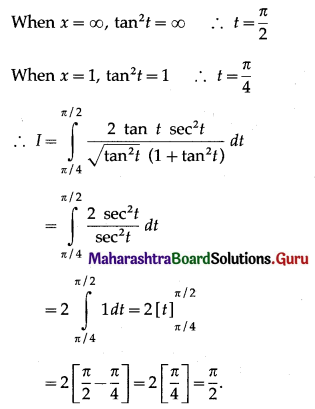
\(\int_{1}^{\infty} \frac{1}{\sqrt{x}(1+x)} d x\)
Solution:
Maharashtra Board 12th Maths Solutions Chapter 4 Definite Integration Miscellaneous Exercise 4 II Q10
Maharashtra Board 12th Maths Solutions Chapter 4 Definite Integration Miscellaneous Exercise 4 II Q10.1

III. Evaluate the following:

Question 1.
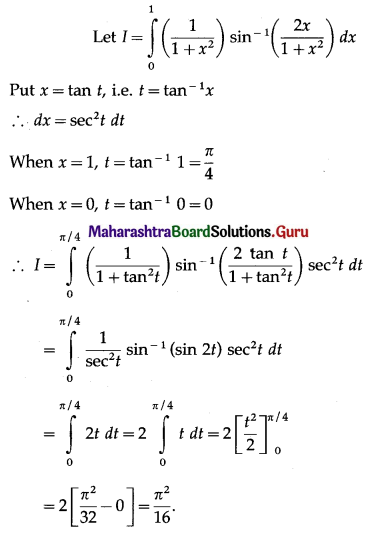
\(\int_{0}^{1}\left(\frac{1}{1+x^{2}}\right) \sin ^{-1}\left(\frac{2 x}{1+x^{2}}\right) d x\)
Solution:
Maharashtra Board 12th Maths Solutions Chapter 4 Definite Integration Miscellaneous Exercise 4 III Q1

Maharashtra Board 12th Maths Solutions Chapter 4 Definite Integration Miscellaneous Exercise 4

Question 2.
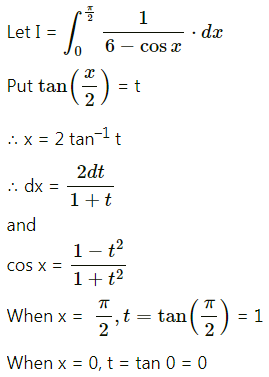
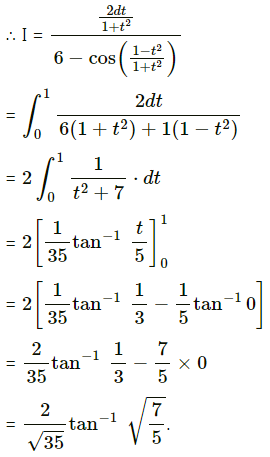
\(\int_{0}^{\pi / 2} \frac{1}{6-\cos x} d x\)
Solution:
Maharashtra Board 12th Maths Solutions Chapter 4 Definite Integration Miscellaneous Exercise 4 III Q2
Maharashtra Board 12th Maths Solutions Chapter 4 Definite Integration Miscellaneous Exercise 4 III Q2.1

Question 3.
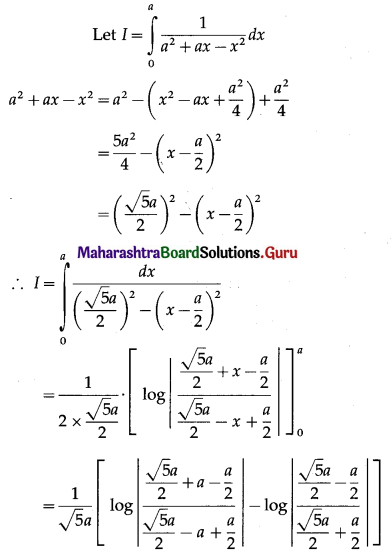
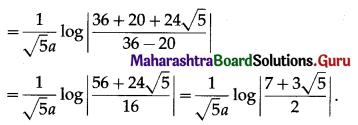
\(\int_{0}^{a} \frac{1}{a^{2}+a x-x^{2}} d x\)
Solution:
Maharashtra Board 12th Maths Solutions Chapter 4 Definite Integration Miscellaneous Exercise 4 III Q3
Maharashtra Board 12th Maths Solutions Chapter 4 Definite Integration Miscellaneous Exercise 4 III Q3.1
Maharashtra Board 12th Maths Solutions Chapter 4 Definite Integration Miscellaneous Exercise 4 III Q3.2

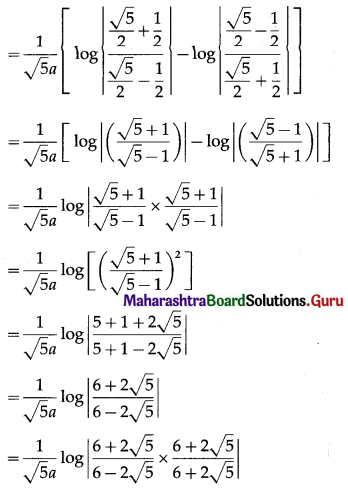
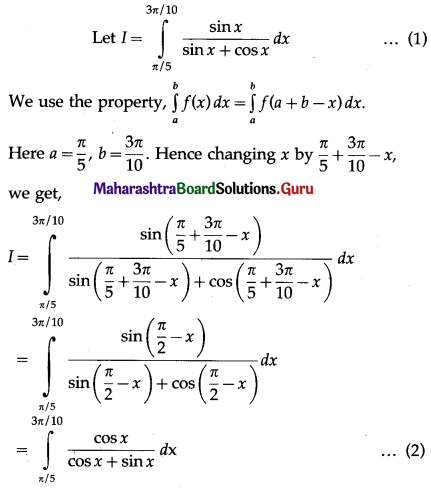
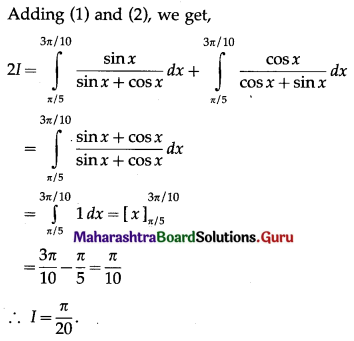
Question 4.
\(\int_{\pi / 5}^{3 \pi / 10} \frac{\sin x}{\sin x+\cos x} d x\)
Solution:
Maharashtra Board 12th Maths Solutions Chapter 4 Definite Integration Miscellaneous Exercise 4 III Q4
Maharashtra Board 12th Maths Solutions Chapter 4 Definite Integration Miscellaneous Exercise 4 III Q4.1

Maharashtra Board 12th Maths Solutions Chapter 4 Definite Integration Miscellaneous Exercise 4

Question 5.
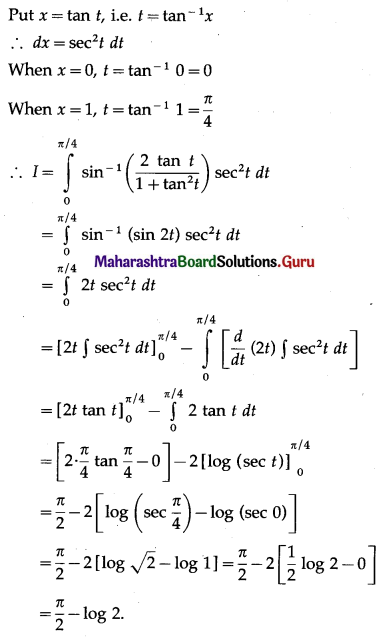
\(\int_{0}^{1} \sin ^{-1}\left(\frac{2 x}{1+x^{2}}\right) d x\)
Solution:
Let I = \(\int_{0}^{1} \sin ^{-1}\left(\frac{2 x}{1+x^{2}}\right) d x\)
Maharashtra Board 12th Maths Solutions Chapter 4 Definite Integration Miscellaneous Exercise 4 III Q5

Question 6.
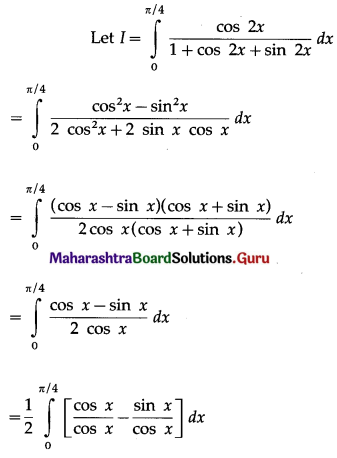
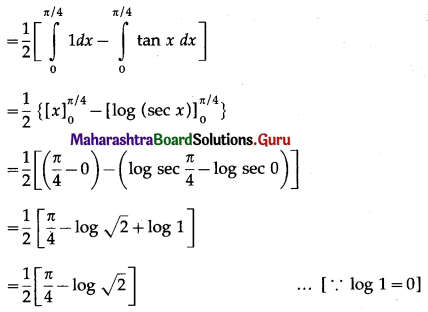
\(\int_{0}^{\pi / 4} \frac{\cos 2 x}{1+\cos 2 x+\sin 2 x} d x\)
Solution:
Maharashtra Board 12th Maths Solutions Chapter 4 Definite Integration Miscellaneous Exercise 4 III Q6
Maharashtra Board 12th Maths Solutions Chapter 4 Definite Integration Miscellaneous Exercise 4 III Q6.1

Question 7.
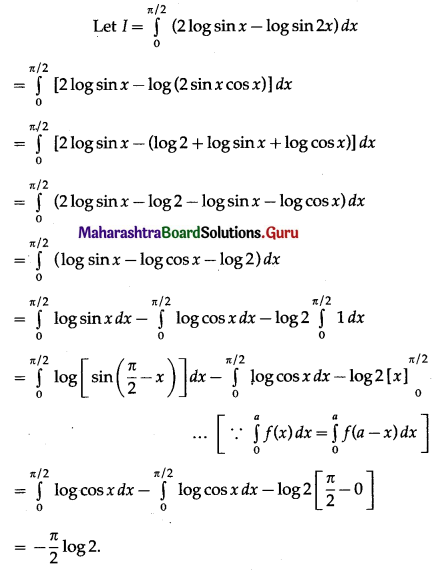
\(\int_{0}^{\pi / 2}[2 \log (\sin x)-\log (\sin 2 x)] d x\)
Solution:
Maharashtra Board 12th Maths Solutions Chapter 4 Definite Integration Miscellaneous Exercise 4 III Q7

Question 8.
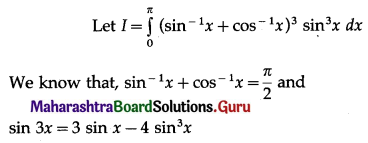
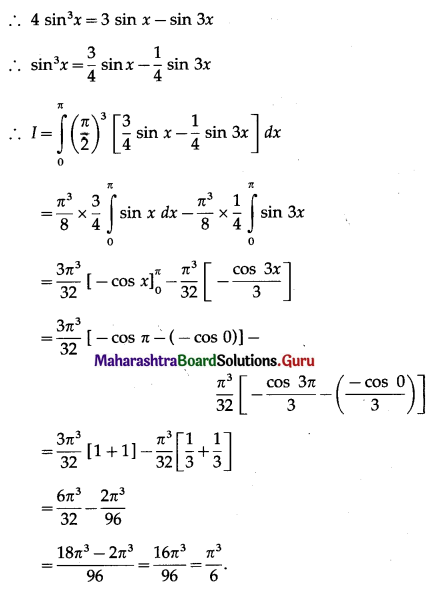
\(\int_{0}^{\pi}\left(\sin ^{-1} x+\cos ^{-1} x\right)^{3} \sin ^{3} x d x\)
Solution:
Maharashtra Board 12th Maths Solutions Chapter 4 Definite Integration Miscellaneous Exercise 4 III Q8
Maharashtra Board 12th Maths Solutions Chapter 4 Definite Integration Miscellaneous Exercise 4 III Q8.1

Maharashtra Board 12th Maths Solutions Chapter 4 Definite Integration Miscellaneous Exercise 4

Question 9.
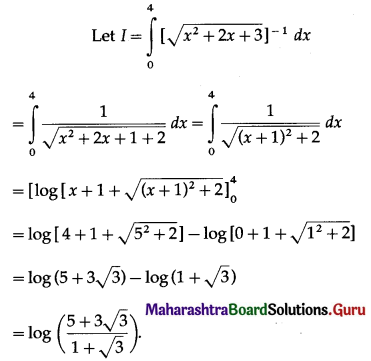
\(\int_{0}^{4}\left[\sqrt{x^{2}+2 x+3}\right]^{-1} d x\)
Solution:
Maharashtra Board 12th Maths Solutions Chapter 4 Definite Integration Miscellaneous Exercise 4 III Q9

Question 10.
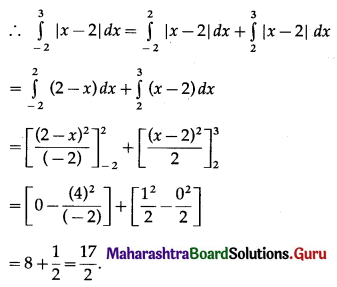
\(\int_{-2}^{3}|x-2| d x\)
Solution:
|x – 2|= 2 – x, if x < 2
= x – 2, if x ≥ 2
Maharashtra Board 12th Maths Solutions Chapter 4 Definite Integration Miscellaneous Exercise 4 III Q10

IV. Evaluate the following:

Question 1.
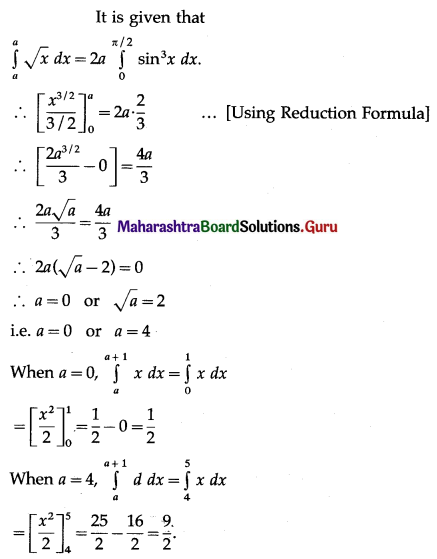
If \(\int_{a}^{a} \sqrt{x} d x=2 a \int_{0}^{\pi / 2} \sin ^{3} x d x\), find the value of \(\int_{a}^{a+1} x d x\).
Solution:
Maharashtra Board 12th Maths Solutions Chapter 4 Definite Integration Miscellaneous Exercise 4 IV Q1

Question 2.
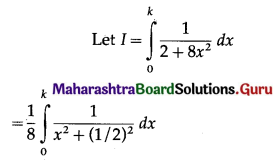
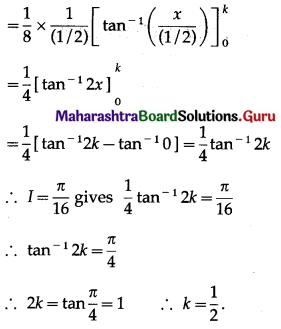
If \(\int_{0}^{k} \frac{1}{2+8 x^{2}} \cdot d x=\frac{\pi}{16}\), find k.
Solution:
Maharashtra Board 12th Maths Solutions Chapter 4 Definite Integration Miscellaneous Exercise 4 IV Q2
Maharashtra Board 12th Maths Solutions Chapter 4 Definite Integration Miscellaneous Exercise 4 IV Q2.1

Maharashtra Board 12th Maths Solutions Chapter 4 Definite Integration Miscellaneous Exercise 4

Question 3.
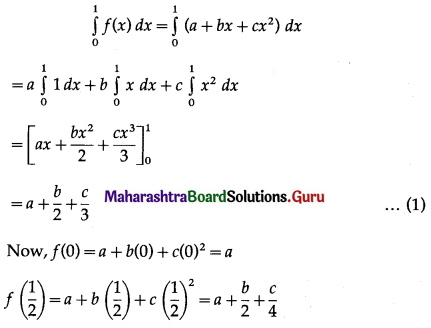
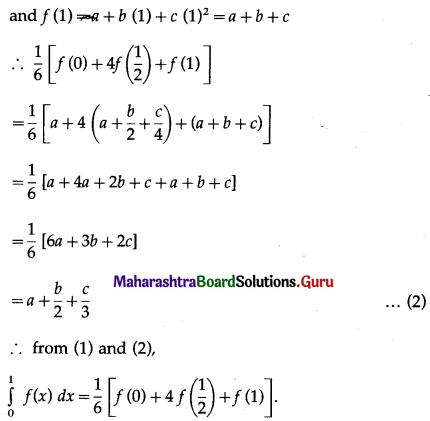
If f(x) = a + bx + cx2, show that \(\int_{0}^{1} f(x) d x=\frac{1}{6}\left[f(0)+4 f\left(\frac{1}{2}\right)+f(1)\right]\)
Solution:
Maharashtra Board 12th Maths Solutions Chapter 4 Definite Integration Miscellaneous Exercise 4 IV Q3
Maharashtra Board 12th Maths Solutions Chapter 4 Definite Integration Miscellaneous Exercise 4 IV Q3.1

Maharashtra Board 12th Maths Solutions Chapter 6 Differential Equations Ex 6.3

Balbharti 12th Maharashtra State Board Maths Solutions Book Pdf Chapter 6 Differential Equations Ex 6.3 Questions and Answers.

Maharashtra State Board 12th Maths Solutions Chapter 6 Differential Equations Ex 6.3

Question 1.
In each of the following examples verify that the given expression is a solution of the corresponding differential equation.
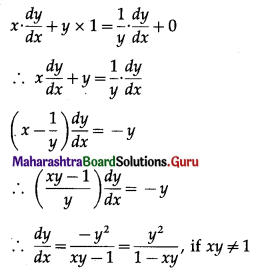
(i) xy = log y + c; \(\frac{d y}{d x}=\frac{y^{2}}{1-x y}\)
Solution:
xy = log y + c
Differentiating w.r.t. x, we get
Maharashtra Board 12th Maths Solutions Chapter 6 Differential Equations Ex 6.3 Q1 (i)
Hence, xy = log y + c is a solution of the D.E.
\(\frac{d y}{d x}=\frac{y^{2}}{1-x y^{\prime}}, x y \neq 1\)

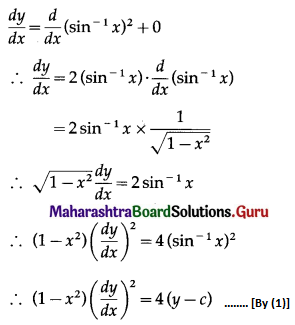
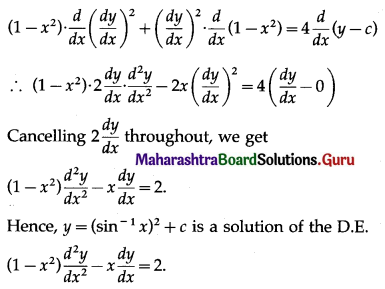
(ii) y = (sin-1x)2 + c; (1 – x2) \(\frac{d^{2} y}{d x^{2}}-x \frac{d y}{d x}=2\)
Solution:
y = (sin-1 x)2 + c …….(1)
Differentiating w.r.t. x, we get
Maharashtra Board 12th Maths Solutions Chapter 6 Differential Equations Ex 6.3 Q1 (ii)
Differentiating again w.r.t. x, we get
Maharashtra Board 12th Maths Solutions Chapter 6 Differential Equations Ex 6.3 Q1 (ii).1

Maharashtra Board 12th Maths Solutions Chapter 6 Differential Equations Ex 6.3

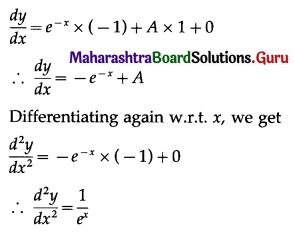
(iii) y = e-x + Ax + B; \(e^{x} \frac{d^{2} y}{d x^{2}}=1\)
Solution:
y = e-x + Ax + B
Differentiating w.r.t. x, we get
Maharashtra Board 12th Maths Solutions Chapter 6 Differential Equations Ex 6.3 Q1 (iii)
∴ \(e^{x} \frac{d^{2} y}{d x^{2}}=1\)
Hence, y = e-x + Ax + B is a solution of the D.E.
\(e^{x} \frac{d^{2} y}{d x^{2}}=1\)

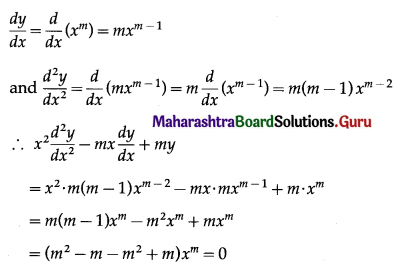
(iv) y = xm; \(x^{2} \frac{d^{2} y}{d x^{2}}-m x \frac{d y}{d x}+m y=0\)
Solution:
y = xm
Differentiating twice w.r.t. x, we get
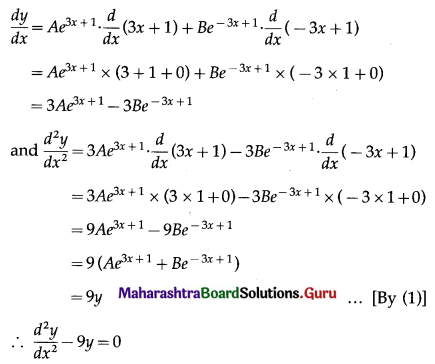
Maharashtra Board 12th Maths Solutions Chapter 6 Differential Equations Ex 6.3 Q1 (iv)
This shows that y = xm is a solution of the D.E.
\(x^{2} \frac{d^{2} y}{d x^{2}}-m x \frac{d y}{d x}+m y=0\)

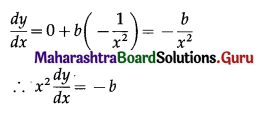
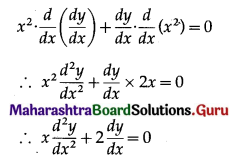
(v) y = a + \(\frac{b}{x}\); \(x \frac{d^{2} y}{d x^{2}}+2 \frac{d y}{d x}=0\)
Solution:
y = a + \(\frac{b}{x}\)
Differentiating w.r.t. x, we get
Maharashtra Board 12th Maths Solutions Chapter 6 Differential Equations Ex 6.3 Q1 (v)
Differentiating again w.r.t. x, we get
Maharashtra Board 12th Maths Solutions Chapter 6 Differential Equations Ex 6.3 Q1 (v).1
Hence, y = a + \(\frac{b}{x}\) is a solution of the D.E.
\(x \frac{d^{2} y}{d x^{2}}+2 \frac{d y}{d x}=0\)

Maharashtra Board 12th Maths Solutions Chapter 6 Differential Equations Ex 6.3

(vi) y = eax; x \(\frac{d y}{d x}\) = y log y
Solution:
y = eax
log y = log eax = ax log e
log y = ax …….(1) ……..[∵ log e = 1]
Differentiating w.r.t. x, we get
\(\frac{1}{y} \cdot \frac{d y}{d x}\) = a × 1
∴ \(\frac{d y}{d x}\) = ay
∴ x \(\frac{d y}{d x}\) = (ax)y
∴ x \(\frac{d y}{d x}\) = y log y ………[By (1)]
Hence, y = eax is a solution of the D.E.
x \(\frac{d y}{d x}\) = y log y.

Question 2.
Solve the following differential equations.
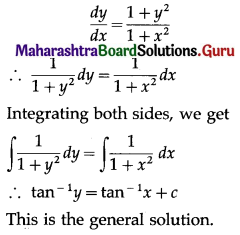
(i) \(\frac{d y}{d x}=\frac{1+y^{2}}{1+x^{2}}\)
Solution:
Maharashtra Board 12th Maths Solutions Chapter 6 Differential Equations Ex 6.3 Q2 (i)

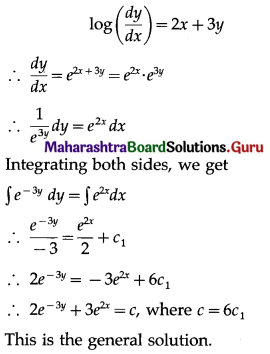
(ii) log(\(\frac{d y}{d x}\)) = 2x + 3y
Solution:
Maharashtra Board 12th Maths Solutions Chapter 6 Differential Equations Ex 6.3 Q2 (ii)

(iii) y – x \(\frac{d y}{d x}\) = 0
Solution:
y – x \(\frac{d y}{d x}\) = 0
∴ x \(\frac{d y}{d x}\) = y
∴ \(\frac{1}{x} d x=\frac{1}{y} d y\)
Integrating both sides, we get
\(\int \frac{1}{x} d x=\int \frac{1}{y} d y\)
∴ log |x| = log |y| + log c
∴ log |x| = log |cy|
∴ x = cy
This is the general solution.

Maharashtra Board 12th Maths Solutions Chapter 6 Differential Equations Ex 6.3

(iv) sec2x . tan y dx + sec2y . tan x dy = 0
Solution:
sec2x . tan y dx + sec2y . tan x dy = 0
∴ \(\frac{\sec ^{2} x}{\tan x} d x+\frac{\sec ^{2} y}{\tan y} d y=0\)
Integrating both sides, we get
\(\int \frac{\sec ^{2} x}{\tan x} d x+\int \frac{\sec ^{2} y}{\tan y} d y=c_{1}\)
Each of these integrals is of the type
\(\int \frac{f^{\prime}(x)}{f(x)} d x\) = log |f(x)| + c
∴ the general solution is
∴ log|tan x| + log|tan y | = log c, where c1 = log c
∴ log |tan x . tan y| = log c
∴ tan x . tan y = c
This is the general solution.

(v) cos x . cos y dy – sin x . sin y dx = 0
Solution:
cos x . cos y dy – sin x . sin y dx = 0
\(\frac{\cos y}{\sin y} d y-\frac{\sin x}{\cos x} d x=0\)
Integrating both sides, we get
∫cot y dy – ∫tan x dx = c1
∴ log|sin y| – [-log|cos x|] = log c, where c1 = log c
∴ log |sin y| + log|cos x| = log c
∴ log|sin y . cos x| = log c
∴ sin y . cos x = c
This is the general solution.

(vi) \(\frac{d y}{d x}\) = -k, where k is a constant.
Solution:
\(\frac{d y}{d x}\) = -k
∴ dy = -k dx
Integrating both sides, we get
∫dy = -k∫dx
∴ y = -kx + c
This is the general solution.

Maharashtra Board 12th Maths Solutions Chapter 6 Differential Equations Ex 6.3

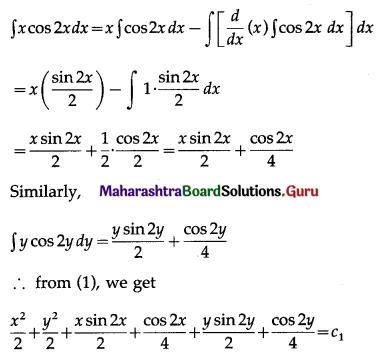
(vii) \(\frac{\cos ^{2} y}{x} d y+\frac{\cos ^{2} x}{y} d x=0\)
Solution:
\(\frac{\cos ^{2} y}{x} d y+\frac{\cos ^{2} x}{y} d x=0\)
∴ y cos2y dy + x cos2x dx = 0
∴ \(x\left(\frac{1+\cos 2 x}{2}\right) d x+y\left(1+\frac{\cos 2 y}{2}\right) d y=0\)
∴ x(1 + cos 2x) dx + y(1 + cos 2y) dy = 0
∴ x dx + x cos 2x dx + y dy+ y cos 2y dy = 0
Integrating both sides, we get
∫x dx + ∫y dy + ∫x cos 2x dx + ∫y cos 2y dy = c1 ……..(1)
Using integration by parts
Maharashtra Board 12th Maths Solutions Chapter 6 Differential Equations Ex 6.3 Q2 (vii)
Multiplying throughout by 4, this becomes
2x2 + 2y2 + 2x sin 2x + cos 2x + 2y sin 2y + cos 2y = 4c1
∴ 2(x2 + y2) + 2(x sin 2x + y sin 2y) + cos 2y + cos 2x + c = 0, where c = -4c1
This is the general solution.

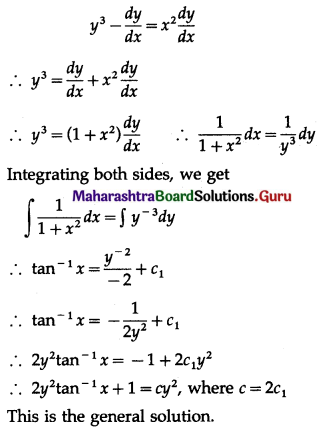
(viii) \(y^{3}-\frac{d y}{d x}=x^{2} \frac{d y}{d x}\)
Solution:
Maharashtra Board 12th Maths Solutions Chapter 6 Differential Equations Ex 6.3 Q2 (viii)

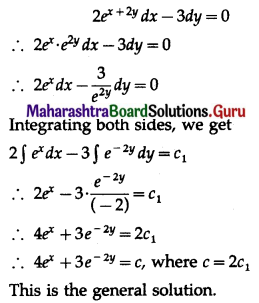
(ix) 2ex+2y dx – 3 dy = 0
Solution:
Maharashtra Board 12th Maths Solutions Chapter 6 Differential Equations Ex 6.3 Q2 (ix)

Maharashtra Board 12th Maths Solutions Chapter 6 Differential Equations Ex 6.3

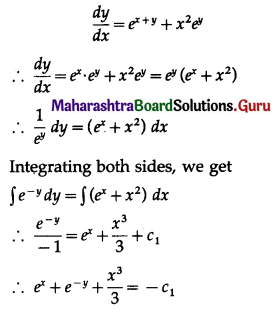
(x) \(\frac{d y}{d x}\) = ex+y + x2 ey
Solution:
Maharashtra Board 12th Maths Solutions Chapter 6 Differential Equations Ex 6.3 Q2 (x)
∴ 3ex + 3e-y + x3 = -3c1
∴ 3ex + 3e-y + x3 = c, where c = -3c1
This is the general solution.

Question 3.
For each of the following differential equations, find the particular solution satisfying the given condition:
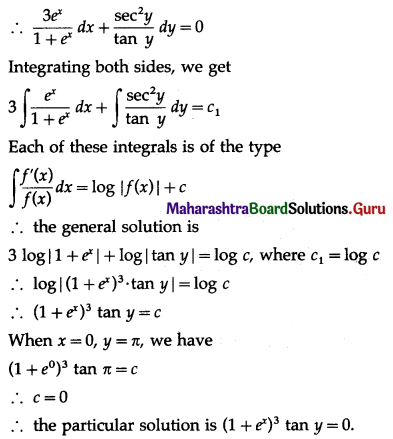
(i) 3ex tan y dx + (1 + ex) sec2y dy = 0, when x = 0, y = π
Solution:
3ex tan y dx + (1 + ex) sec2y dy = 0
Maharashtra Board 12th Maths Solutions Chapter 6 Differential Equations Ex 6.3 Q3 (i)

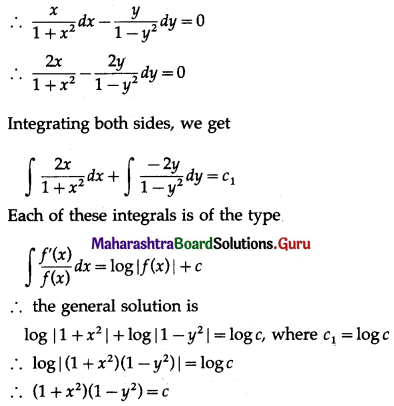
(ii) (x – y2x) dx – (y + x2y) dy = 0, when x = 2, y = 0
Solution:
(x – y2x) dx – (y + x2y) dy = 0
∴ x(1 – y2) dx – y(1 + x2) dy = 0
Maharashtra Board 12th Maths Solutions Chapter 6 Differential Equations Ex 6.3 Q3 (ii)
When x = 2, y = 0, we have
(1 + 4)(1 – 0) = c
∴ c = 5
∴ the particular solution is (1 + x2)(1 – y2) = 5.

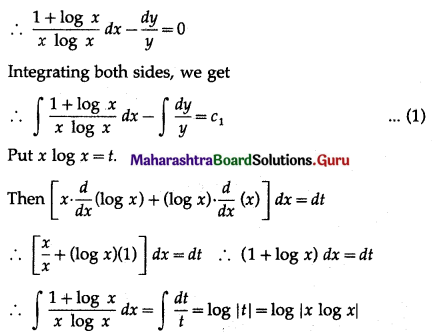
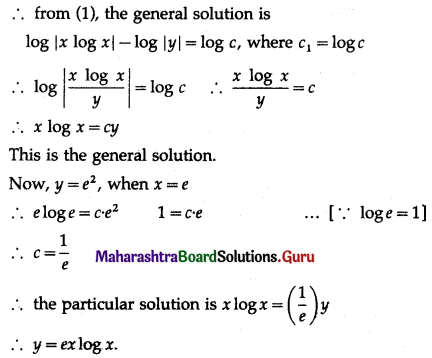
(iii) y(1 + log x) \(\frac{d x}{d y}\) – x log x = 0, y = e2, when x = e
Solution:
y(1 + log x) \(\frac{d x}{d y}\) – x log x = 0
Maharashtra Board 12th Maths Solutions Chapter 6 Differential Equations Ex 6.3 Q3 (iii)
Maharashtra Board 12th Maths Solutions Chapter 6 Differential Equations Ex 6.3 Q3 (iii).1

Maharashtra Board 12th Maths Solutions Chapter 6 Differential Equations Ex 6.3

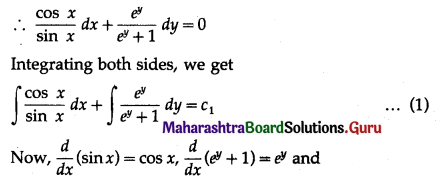
(iv) (ey + 1) cos x + ey sin x \(\frac{d y}{d x}\) = 0, when x = \(\frac{\pi}{6}\), y = 0
Solution:
(ey + 1) cos x + ey sin x \(\frac{d y}{d x}\) = 0
Maharashtra Board 12th Maths Solutions Chapter 6 Differential Equations Ex 6.3 Q3 (iv)
\(\int \frac{f^{\prime}(x)}{f(x)} d x\) = log|f(x)| + c
∴ from (1), the general solution is
log|sin x| + log|ey + 1| = log c, where c1 = log c
∴ log|sin x . (ey + 1)| = log c
∴ sin x . (ey + 1) = c
When x = \(\frac{\pi}{4}\), y = 0, we get
\(\left(\sin \frac{\pi}{4}\right)\left(e^{0}+1\right)=c\)
∴ c = \(\frac{1}{\sqrt{2}}\)(1 + 1) = √2
∴ the particular solution is sin x . (ey + 1) = √2

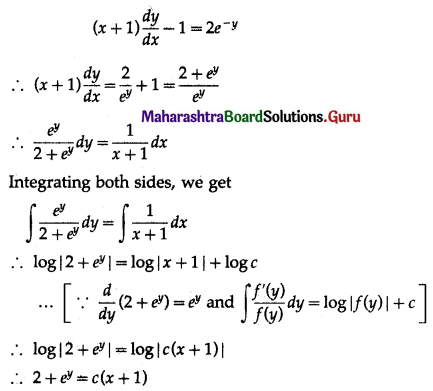
(v) (x + 1) \(\frac{d y}{d x}\) – 1 = 2e-y, y = 0, when x = 1
Solution:
Maharashtra Board 12th Maths Solutions Chapter 6 Differential Equations Ex 6.3 Q3 (v)
This is the general solution.
Now, y = 0, when x = 1
∴ 2 + e0 = c(1 + 1)
∴ 3 = 2c
∴ c = \(\frac{3}{2}\)
∴ the particular solution is 2 + ey = \(\frac{3}{2}\) (x + 1)
∴ 2(2 + ey) = 3(x + 1).

Maharashtra Board 12th Maths Solutions Chapter 6 Differential Equations Ex 6.3

(vi) cos(\(\frac{d y}{d x}\)) = a, a ∈ R, y (0) = 2
Solution:
cos(\(\frac{d y}{d x}\)) = a
∴ \(\frac{d y}{d x}\) = cos-1 a
∴ dy = (cos-1 a) dx
Integrating both sides, we get
∫dy = (cos-1 a) ∫dx
∴ y = (cos-1 a) x + c
∴ y = x cos-1 a + c
This is the general solution.
Now, y(0) = 2, i.e. y = 2,
when x = 0, 2 = 0 + c
∴ c = 2
∴ the particular solution is
∴ y = x cos-1 a + 2
∴ y – 2 = x cos-1 a
∴ \(\frac{y-2}{x}\) = cos-1a
∴ cos(\(\frac{y-2}{x}\)) = a

Question 4.
Reduce each of the following differential equations to the variable separable form and hence solve:
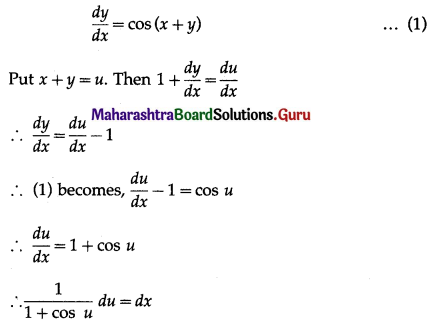
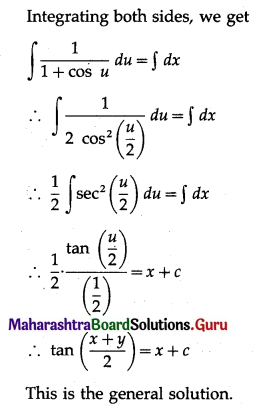
(i) \(\frac{d y}{d x}\) = cos(x + y)
Solution:
Maharashtra Board 12th Maths Solutions Chapter 6 Differential Equations Ex 6.3 Q4 (i)
Maharashtra Board 12th Maths Solutions Chapter 6 Differential Equations Ex 6.3 Q4 (i).1

Maharashtra Board 12th Maths Solutions Chapter 6 Differential Equations Ex 6.3

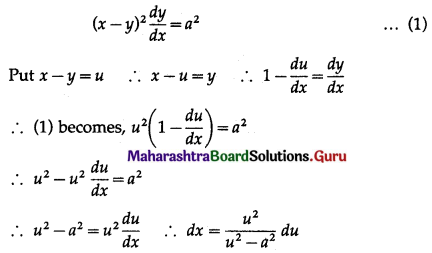
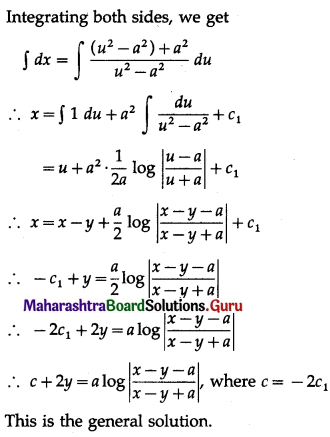
(ii) (x – y)2 \(\frac{d y}{d x}\) = a2
Solution:
Maharashtra Board 12th Maths Solutions Chapter 6 Differential Equations Ex 6.3 Q4 (ii)
Maharashtra Board 12th Maths Solutions Chapter 6 Differential Equations Ex 6.3 Q4 (ii).1

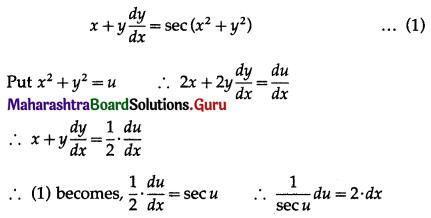
(iii) x + y \(\frac{d y}{d x}\) = sec(x2 + y2)
Solution:
Maharashtra Board 12th Maths Solutions Chapter 6 Differential Equations Ex 6.3 Q4 (iii)
Integrating both sides, we get
∫cos u du = 2 ∫dx
∴ sin u = 2x + c
∴ sin(x2 + y2) = 2x + c
This is the general solution.

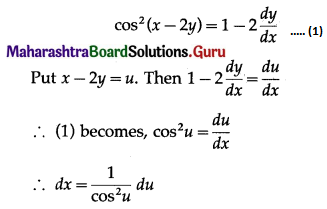
(iv) cos2(x – 2y) = 1 – 2 \(\frac{d y}{d x}\)
Solution:
Maharashtra Board 12th Maths Solutions Chapter 6 Differential Equations Ex 6.3 Q4 (iv)
Integrating both sides, we get
∫dx = ∫sec2u du
∴ x = tan u + c
∴ x = tan(x – 2y) + c
This is the general solution.

Maharashtra Board 12th Maths Solutions Chapter 6 Differential Equations Ex 6.3

(v) (2x – 2y + 3) dx – (x – y + 1) dy = 0, when x = 0, y = 1
Solution:
(2x – 2y + 3) dx – (x – y + 1) dy = 0
∴ (x – y + 1) dy = (2x – 2y + 3) dx
∴ \(\frac{d y}{d x}=\frac{2(x-y)+3}{(x-y)+1}\) ………(1)
Put x – y = u, Then \(1-\frac{d y}{d x}=\frac{d u}{d x}\)
Maharashtra Board 12th Maths Solutions Chapter 6 Differential Equations Ex 6.3 Q4 (v)
∴ u – log|u + 2| = -x + c
∴ x – y – log|x – y + 2| = -x + c
∴ (2x – y) – log|x – y + 2| = c
This is the general solution.
Now, y = 1, when x = 0.
∴ (0 – 1) – log|0 – 1 + 2| = c
∴ -1 – o = c
∴ c = -1
∴ the particular solution is
(2x – y) – log|x – y + 2| = -1
∴ (2x – y) – log|x – y + 2| + 1 = 0

Maharashtra Board 12th Maths Solutions Chapter 4 Definite Integration Ex 4.2

Balbharti 12th Maharashtra State Board Maths Solutions Book Pdf Chapter 4 Definite Integration Ex 4.2 Questions and Answers.

Maharashtra State Board 12th Maths Solutions Chapter 4 Definite Integration Ex 4.2

I. Evaluate:

Question 1.
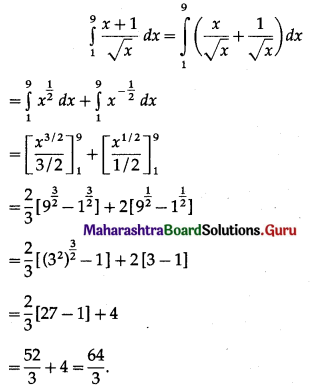
\(\int_{1}^{9} \frac{x+1}{\sqrt{x}} \cdot d x\)
Solution:
Maharashtra Board 12th Maths Solutions Chapter 4 Definite Integration Ex 4.2 I Q1

Question 2.
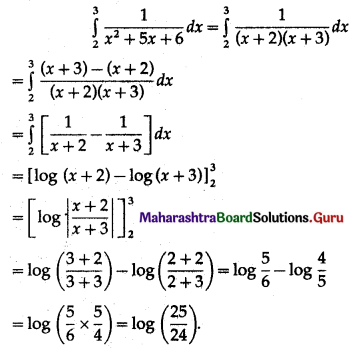
\(\int_{2}^{3} \frac{1}{x^{2}+5 x+6} \cdot d x\)
Solution:
Maharashtra Board 12th Maths Solutions Chapter 4 Definite Integration Ex 4.2 I Q2

Question 3.
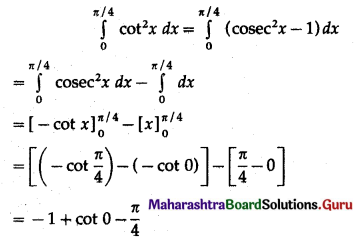
\(\int_{0}^{\pi / 4} \cot ^{2} \cdot d x\)
Solution:
Maharashtra Board 12th Maths Solutions Chapter 4 Definite Integration Ex 4.2 I Q3
The integral does not exist since cot 0 is not defined.

Maharashtra Board 12th Maths Solutions Chapter 4 Definite Integration Ex 4.2

Question 4.
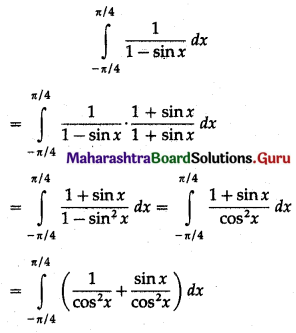
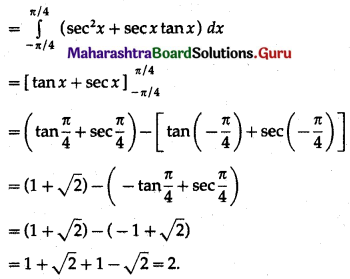
\(\int_{-\pi / 4}^{\pi / 4} \frac{1}{1-\sin x} \cdot d x\)
Solution:
Maharashtra Board 12th Maths Solutions Chapter 4 Definite Integration Ex 4.2 I Q4
Maharashtra Board 12th Maths Solutions Chapter 4 Definite Integration Ex 4.2 I Q4.1

Question 5.
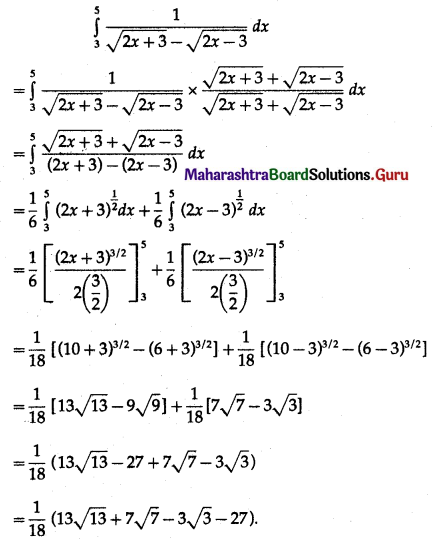
\(\int_{3}^{5} \frac{1}{\sqrt{2 x+3}-\sqrt{2 x-3}} \cdot d x\)
Solution:
Maharashtra Board 12th Maths Solutions Chapter 4 Definite Integration Ex 4.2 I Q5

Question 6.
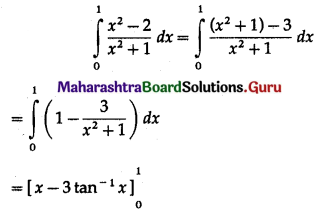
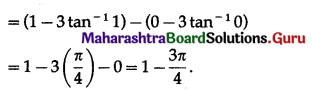
\(\int_{0}^{1} \frac{x^{2}-2}{x^{2}+1} \cdot d x\)
Solution:
Maharashtra Board 12th Maths Solutions Chapter 4 Definite Integration Ex 4.2 I Q6
Maharashtra Board 12th Maths Solutions Chapter 4 Definite Integration Ex 4.2 I Q6.1

Question 7.
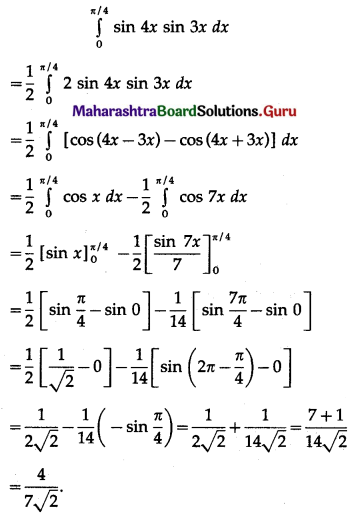
\(\int_{0}^{\pi / 4} \sin 4 x \sin 3 x \cdot d x\)
Solution:
Maharashtra Board 12th Maths Solutions Chapter 4 Definite Integration Ex 4.2 I Q7

Maharashtra Board 12th Maths Solutions Chapter 4 Definite Integration Ex 4.2

Question 8.
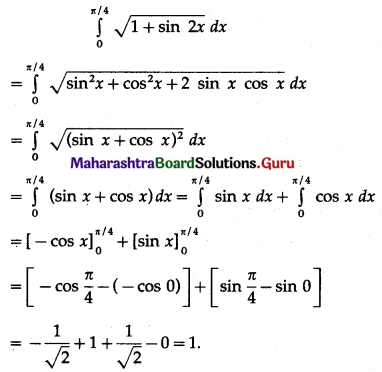
\(\int_{0}^{\pi / 4} \sqrt{1+\sin 2 x} \cdot d x\)
Solution:
Maharashtra Board 12th Maths Solutions Chapter 4 Definite Integration Ex 4.2 I Q8

Question 9.
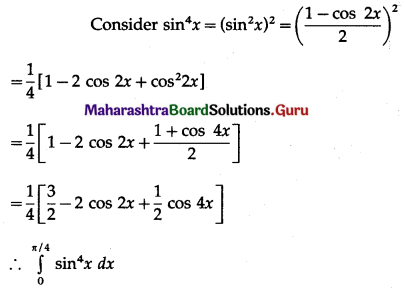
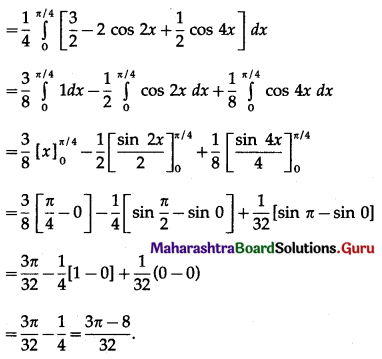
\(\int_{0}^{\pi / 4} \sin ^{4} x \cdot d x\)
Solution:
Maharashtra Board 12th Maths Solutions Chapter 4 Definite Integration Ex 4.2 I Q9
Maharashtra Board 12th Maths Solutions Chapter 4 Definite Integration Ex 4.2 I Q9.1

Question 10.
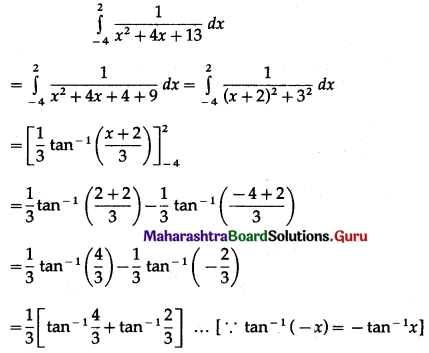
\(\int_{-4}^{2} \frac{1}{x^{2}+4 x+13} \cdot d x\)
Solution:
Maharashtra Board 12th Maths Solutions Chapter 4 Definite Integration Ex 4.2 I Q10

Question 11.
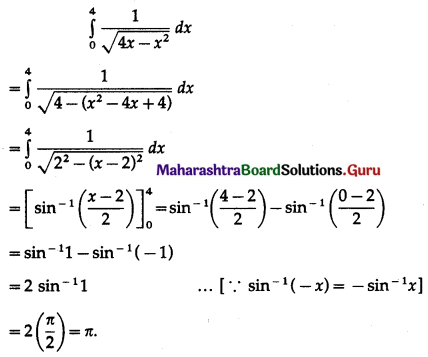
\(\int_{0}^{4} \frac{1}{\sqrt{4 x-x^{2}}} \cdot d x\)
Solution:
Maharashtra Board 12th Maths Solutions Chapter 4 Definite Integration Ex 4.2 I Q11

Question 12.
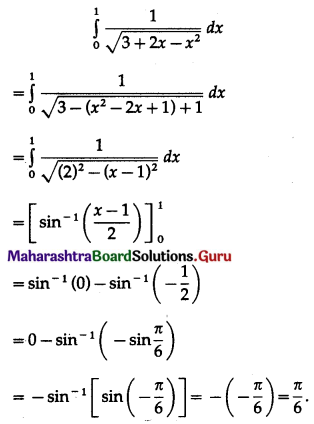
\(\int_{0}^{1} \frac{1}{\sqrt{3+2 x-x^{2}}} \cdot d x\)
Solution:
Maharashtra Board 12th Maths Solutions Chapter 4 Definite Integration Ex 4.2 I Q12

Question 13.
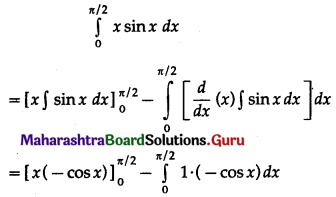
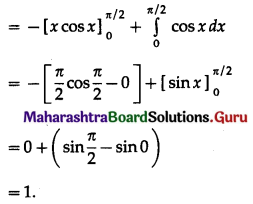
\(\int_{0}^{\pi / 2} x \cdot \sin x \cdot d x\)
Solution:
Maharashtra Board 12th Maths Solutions Chapter 4 Definite Integration Ex 4.2 I Q13
Maharashtra Board 12th Maths Solutions Chapter 4 Definite Integration Ex 4.2 I Q13.1

Maharashtra Board 12th Maths Solutions Chapter 4 Definite Integration Ex 4.2

Question 14.
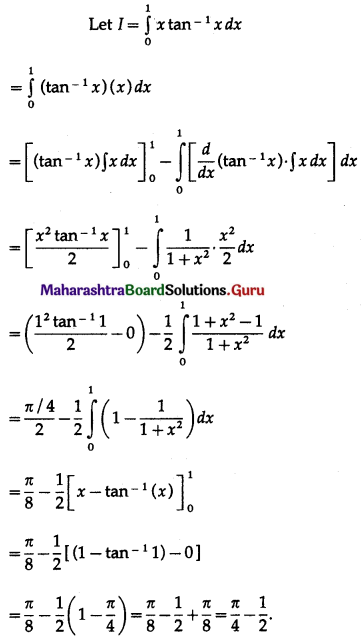
\(\int_{0}^{1} x \cdot \tan ^{-1} x \cdot d x\)
Solution:
Maharashtra Board 12th Maths Solutions Chapter 4 Definite Integration Ex 4.2 I Q14

Question 15.
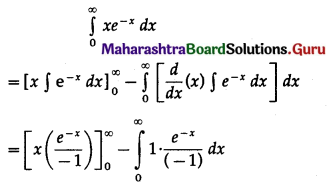
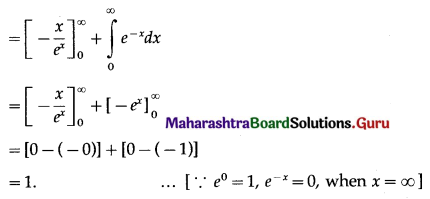
\(\int_{0}^{\infty} x \cdot e^{-x} \cdot d x\)
Solution:
Maharashtra Board 12th Maths Solutions Chapter 4 Definite Integration Ex 4.2 I Q15
Maharashtra Board 12th Maths Solutions Chapter 4 Definite Integration Ex 4.2 I Q15.1

II. Evaluate:

Question 1.
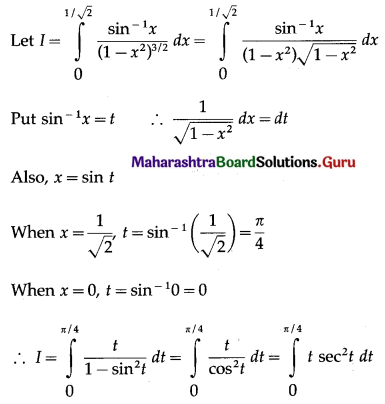
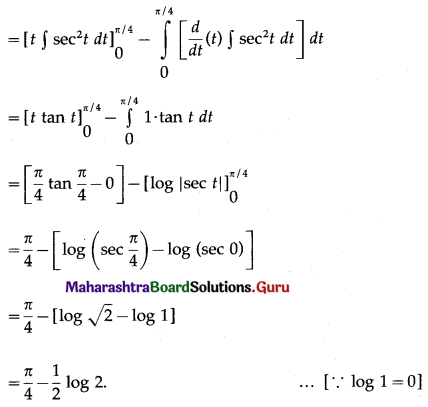
\(\int_{0}^{\frac{1}{\sqrt{2}}} \frac{\sin ^{-1} x}{\left(1-x^{2}\right)^{\frac{3}{2}}} \cdot d x\)
Solution:
Maharashtra Board 12th Maths Solutions Chapter 4 Definite Integration Ex 4.2 II Q1
Maharashtra Board 12th Maths Solutions Chapter 4 Definite Integration Ex 4.2 II Q1.1

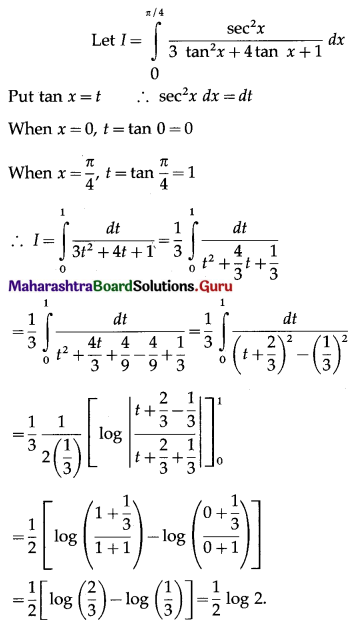
Question 2.
\(\int_{0}^{\pi / 4} \frac{\sec ^{2} x}{3 \tan ^{2} x+4 \tan x+1} \cdot d x\)
Solution:
Maharashtra Board 12th Maths Solutions Chapter 4 Definite Integration Ex 4.2 II Q2

Maharashtra Board 12th Maths Solutions Chapter 4 Definite Integration Ex 4.2

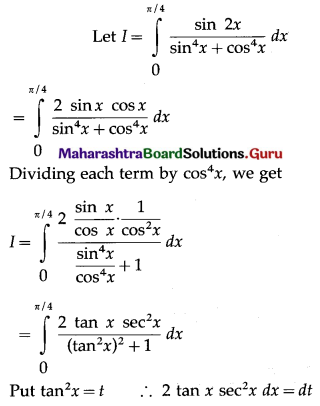
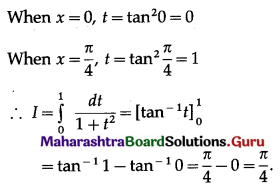
Question 3.
\(\int_{0}^{4 \pi} \frac{\sin 2 x}{\sin ^{4} x+\cos ^{4} x} \cdot d x\)
Solution:
Maharashtra Board 12th Maths Solutions Chapter 4 Definite Integration Ex 4.2 II Q3
Maharashtra Board 12th Maths Solutions Chapter 4 Definite Integration Ex 4.2 II Q3.1

Question 4.
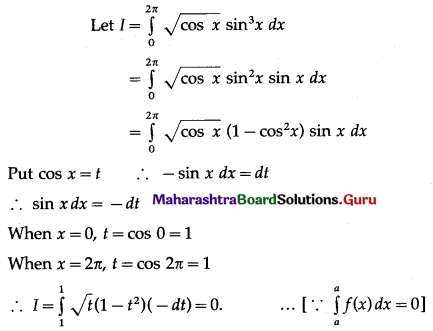
\(\int_{0}^{2 \pi} \sqrt{\cos x} \cdot \sin ^{3} x \cdot d x\)
Solution:
Maharashtra Board 12th Maths Solutions Chapter 4 Definite Integration Ex 4.2 II Q4

Question 5.
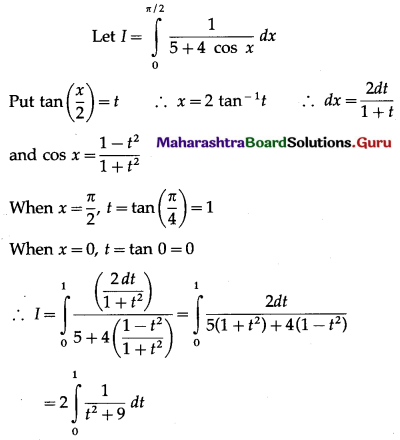
\(\int_{0}^{\pi / 2} \frac{1}{5+4 \cos x} \cdot d x\)
Solution:
Maharashtra Board 12th Maths Solutions Chapter 4 Definite Integration Ex 4.2 II Q5

Question 6.
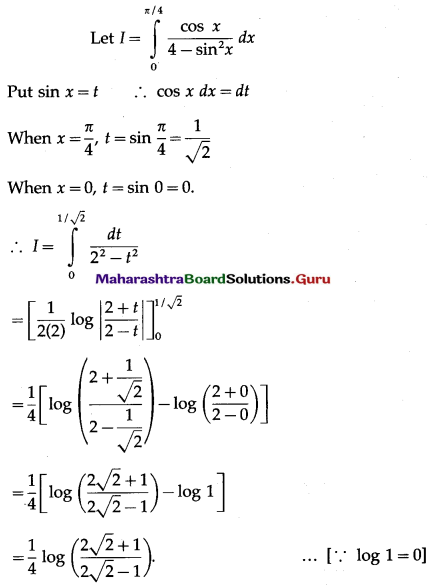
\(\int_{0}^{\pi / 4} \frac{\cos x}{4-\sin ^{2} x} \cdot d x\)
Solution:
Maharashtra Board 12th Maths Solutions Chapter 4 Definite Integration Ex 4.2 II Q6

Question 7.
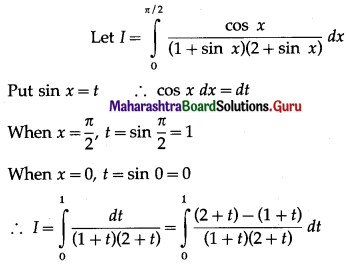
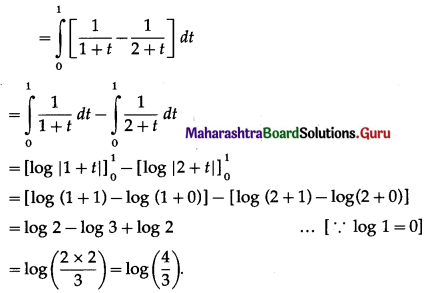
\(\int_{0}^{\pi / 2} \frac{\cos X}{(1+\sin x)(2+\sin x)} \cdot d x\)
Solution:
Maharashtra Board 12th Maths Solutions Chapter 4 Definite Integration Ex 4.2 II Q7
Maharashtra Board 12th Maths Solutions Chapter 4 Definite Integration Ex 4.2 II Q7.1

Question 8.
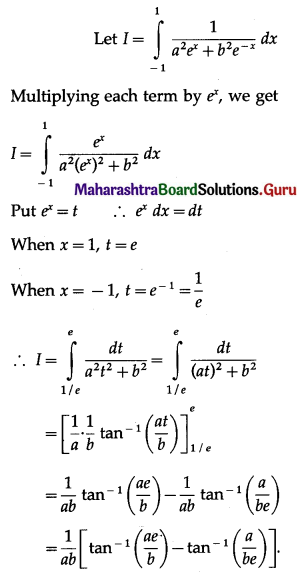
\(\int_{-1}^{1} \frac{1}{a^{2} e^{x}+b^{2} e^{-x}} \cdot d x\)
Solution:
Maharashtra Board 12th Maths Solutions Chapter 4 Definite Integration Ex 4.2 II Q8

Maharashtra Board 12th Maths Solutions Chapter 4 Definite Integration Ex 4.2

Question 9.
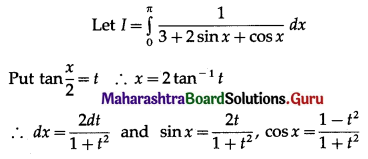
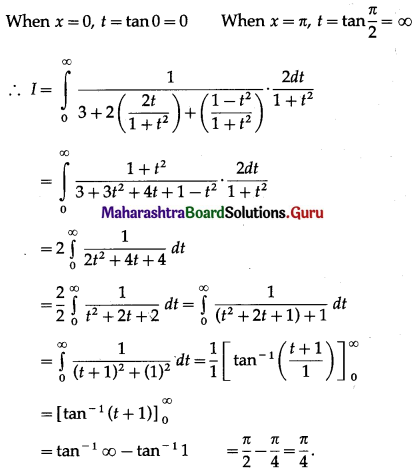
\(\int_{0}^{\pi} \frac{1}{3+2 \sin x+\cos x} \cdot d x\)
Solution:
Maharashtra Board 12th Maths Solutions Chapter 4 Definite Integration Ex 4.2 II Q9
Maharashtra Board 12th Maths Solutions Chapter 4 Definite Integration Ex 4.2 II Q9.1

Question 10.
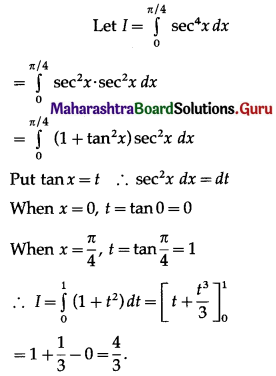
\(\int_{0}^{\pi / 4} \sec ^{4} x \cdot d x\)
Solution:
Maharashtra Board 12th Maths Solutions Chapter 4 Definite Integration Ex 4.2 II Q10

Question 11.
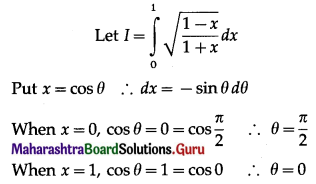
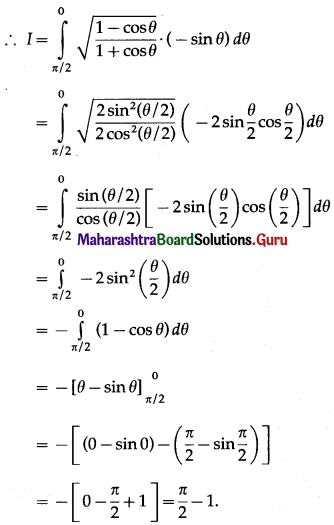
\(\int_{0}^{1} \sqrt{\frac{1-x}{1+x}} \cdot d x\)
Solution:
Maharashtra Board 12th Maths Solutions Chapter 4 Definite Integration Ex 4.2 II Q11
Maharashtra Board 12th Maths Solutions Chapter 4 Definite Integration Ex 4.2 II Q11.1

Question 12.
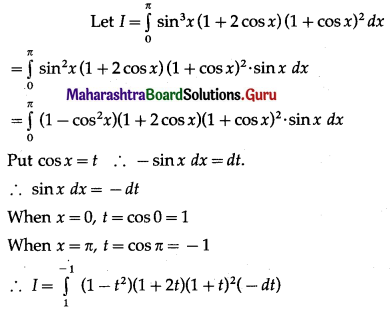
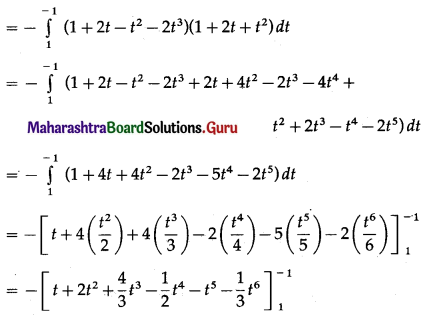
\(\int_{0}^{\pi} \sin ^{3} x(1+2 \cos x)(1+\cos x)^{2} \cdot d x\)
Solution:
Maharashtra Board 12th Maths Solutions Chapter 4 Definite Integration Ex 4.2 II Q12
Maharashtra Board 12th Maths Solutions Chapter 4 Definite Integration Ex 4.2 II Q12.1
Maharashtra Board 12th Maths Solutions Chapter 4 Definite Integration Ex 4.2 II Q12.2

Question 13.
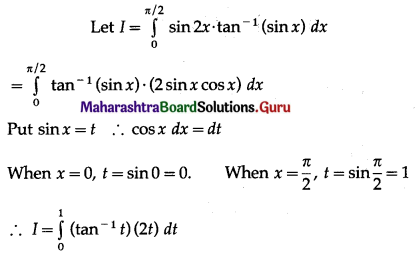
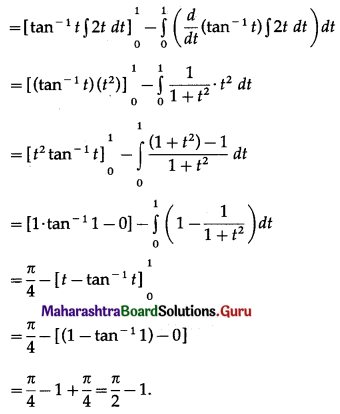
\(\int_{0}^{\pi / 2} \sin 2 x \cdot \tan ^{-1}(\sin x) \cdot d x\)
Solution:
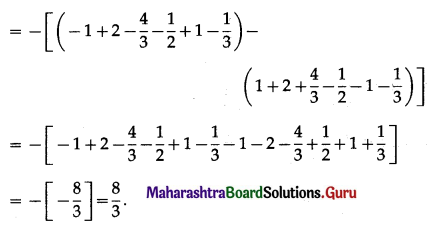
Maharashtra Board 12th Maths Solutions Chapter 4 Definite Integration Ex 4.2 II Q13
Maharashtra Board 12th Maths Solutions Chapter 4 Definite Integration Ex 4.2 II Q13.1

Maharashtra Board 12th Maths Solutions Chapter 4 Definite Integration Ex 4.2

Question 14.
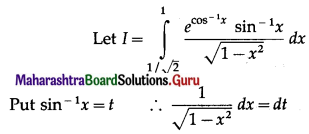
\(\int_{\frac{1}{\sqrt{2}}}^{1} \frac{\left(e^{\cos ^{-1} x}\right)\left(\sin ^{-1} x\right)}{\sqrt{1-x^{2}}} \cdot d x\)
Solution:
Maharashtra Board 12th Maths Solutions Chapter 4 Definite Integration Ex 4.2 II Q14
Maharashtra Board 12th Maths Solutions Chapter 4 Definite Integration Ex 4.2 II Q14.1
Maharashtra Board 12th Maths Solutions Chapter 4 Definite Integration Ex 4.2 II Q14.2

Question 15.
\(\int_{2}^{3} \frac{\cos (\log x)}{x} \cdot d x\)
Solution:
Maharashtra Board 12th Maths Solutions Chapter 4 Definite Integration Ex 4.2 II Q15

III. Evaluate:

Question 1.
\(\int_{0}^{a} \frac{1}{x+\sqrt{a^{2}-x^{2}}} \cdot d x\)
Solution:
Maharashtra Board 12th Maths Solutions Chapter 4 Definite Integration Ex 4.2 III Q1
Maharashtra Board 12th Maths Solutions Chapter 4 Definite Integration Ex 4.2 III Q1.1

Maharashtra Board 12th Maths Solutions Chapter 4 Definite Integration Ex 4.2

Question 2.
\(\int_{0}^{\pi / 2} \log \tan x \cdot d x\)
Solution:
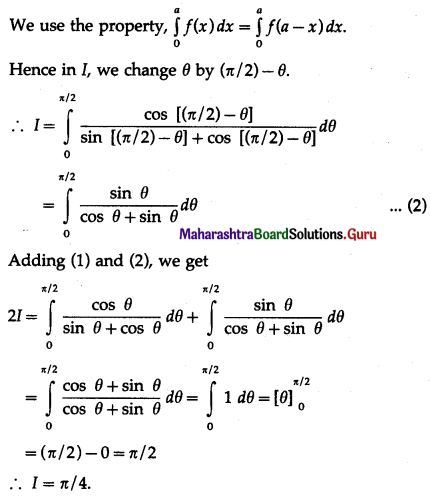
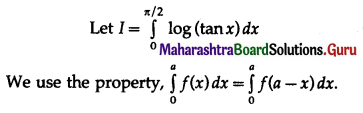
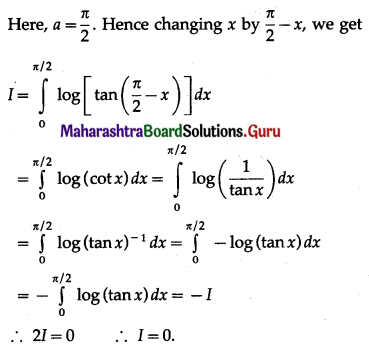
Maharashtra Board 12th Maths Solutions Chapter 4 Definite Integration Ex 4.2 III Q2
Maharashtra Board 12th Maths Solutions Chapter 4 Definite Integration Ex 4.2 III Q2.1

Question 3.
\(\int_{0}^{1} \log \left(\frac{1}{x}-1\right) \cdot d x\)
Solution:
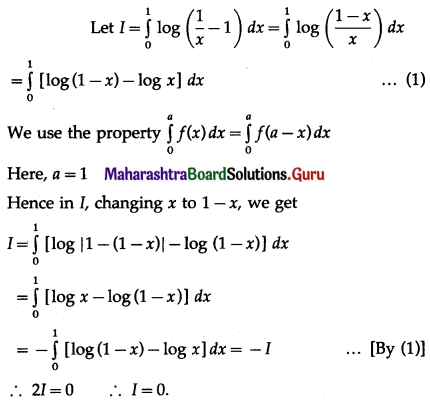
Maharashtra Board 12th Maths Solutions Chapter 4 Definite Integration Ex 4.2 III Q3

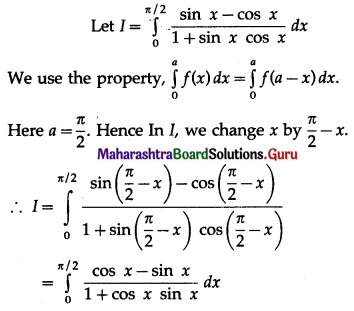
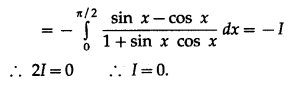
Question 4.
\(\int_{0}^{\pi / 2} \frac{\sin x-\cos x}{1+\sin x \cdot \cos x} \cdot d x\)
Solution:
Maharashtra Board 12th Maths Solutions Chapter 4 Definite Integration Ex 4.2 III Q4
Maharashtra Board 12th Maths Solutions Chapter 4 Definite Integration Ex 4.2 III Q4.1

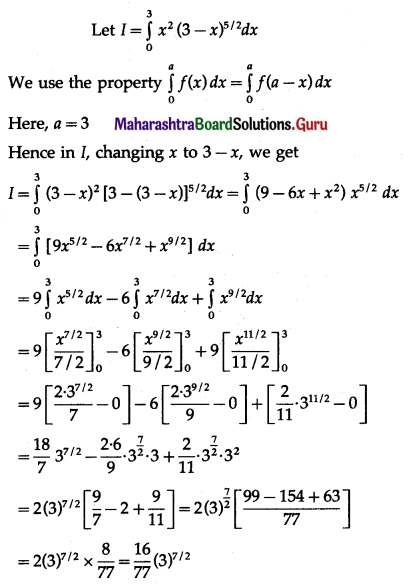
Question 5.
\(\int_{0}^{3} x^{2}(3-x)^{\frac{5}{2}} \cdot d x\)
Solution:
Maharashtra Board 12th Maths Solutions Chapter 4 Definite Integration Ex 4.2 III Q5

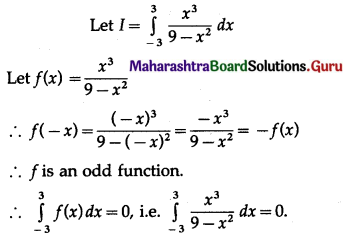
Question 6.
\(\int_{-3}^{3} \frac{x^{3}}{9-x^{2}} \cdot d x\)
Solution:
Maharashtra Board 12th Maths Solutions Chapter 4 Definite Integration Ex 4.2 III Q6

Maharashtra Board 12th Maths Solutions Chapter 4 Definite Integration Ex 4.2

Question 7.
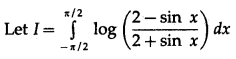
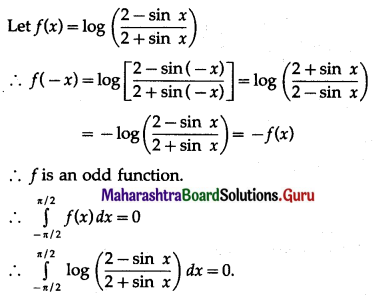
\(\int_{-\pi / 2}^{\pi / 2} \log \left(\frac{2+\sin x}{2-\sin x}\right) \cdot d x\)
Solution:
Maharashtra Board 12th Maths Solutions Chapter 4 Definite Integration Ex 4.2 III Q7
Maharashtra Board 12th Maths Solutions Chapter 4 Definite Integration Ex 4.2 III Q7.1

Question 8.
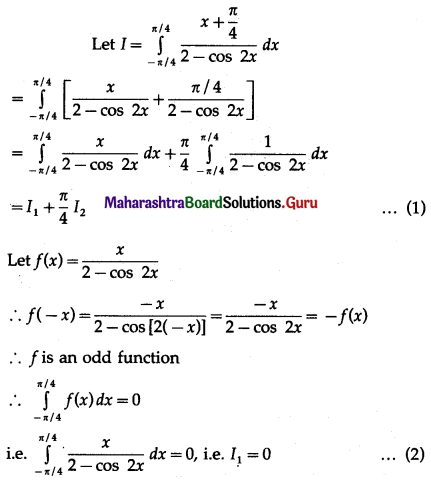
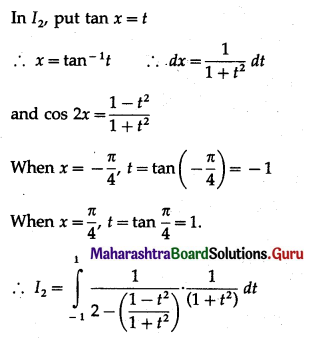
\(\int_{-\pi / 4}^{\pi / 4} \frac{x+\frac{\pi}{4}}{2-\cos 2 x} \cdot d x\)
Solution:
Maharashtra Board 12th Maths Solutions Chapter 4 Definite Integration Ex 4.2 III Q8
Maharashtra Board 12th Maths Solutions Chapter 4 Definite Integration Ex 4.2 III Q8.1
Maharashtra Board 12th Maths Solutions Chapter 4 Definite Integration Ex 4.2 III Q8.2

Question 9.
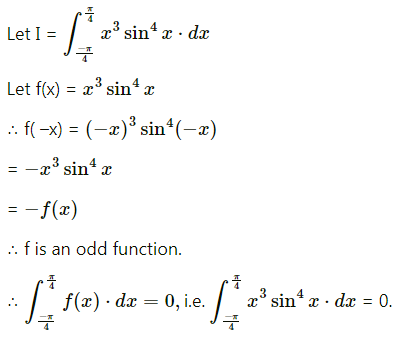
\(\int_{-\pi / 4}^{\pi / 4} x^{3} \cdot \sin ^{4} x \cdot d x\)
Solution:
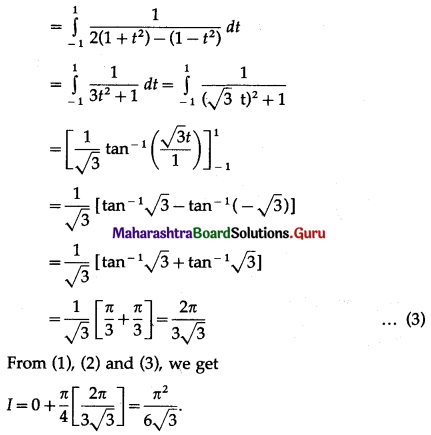
Maharashtra Board 12th Maths Solutions Chapter 4 Definite Integration Ex 4.2 III Q9

Question 10.
\(\int_{0}^{1} \frac{\log (x+1)}{x^{2}+1} \cdot d x\)
Solution:
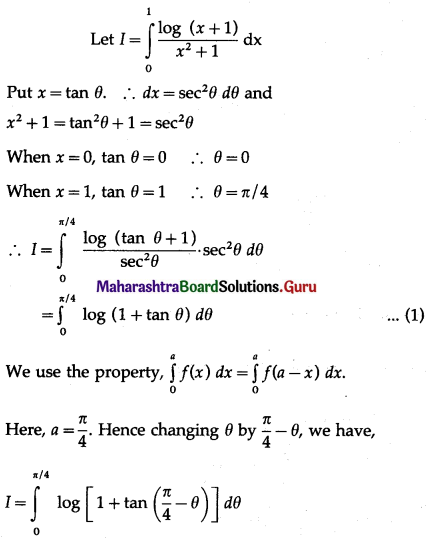
Maharashtra Board 12th Maths Solutions Chapter 4 Definite Integration Ex 4.2 III Q10
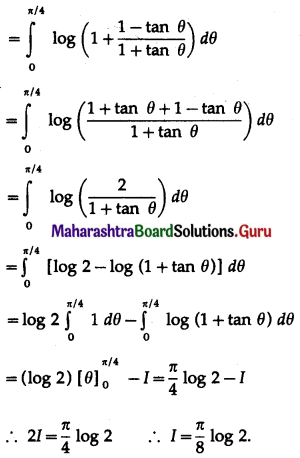
Maharashtra Board 12th Maths Solutions Chapter 4 Definite Integration Ex 4.2 III Q10.1

Maharashtra Board 12th Maths Solutions Chapter 4 Definite Integration Ex 4.2

Question 11.
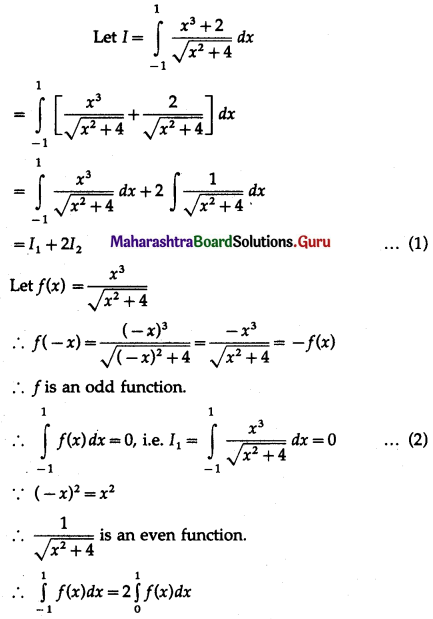
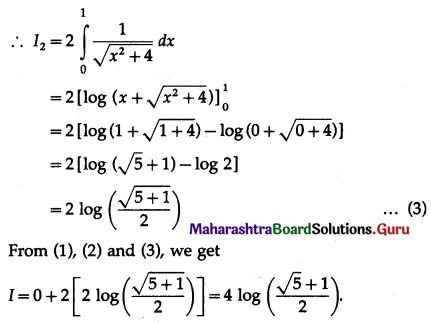
\(\int_{-1}^{1} \frac{x^{3}+2}{\sqrt{x^{2}+4}} \cdot d x\)
Solution:
Maharashtra Board 12th Maths Solutions Chapter 4 Definite Integration Ex 4.2 III Q11
Maharashtra Board 12th Maths Solutions Chapter 4 Definite Integration Ex 4.2 III Q11.1

Question 12.
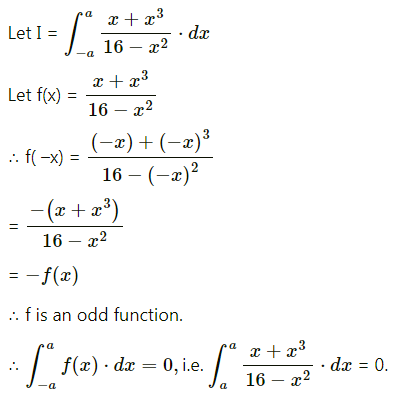
\(\int_{-a}^{a} \frac{x+x^{3}}{16-x^{2}} \cdot d x\)
Solution:
Maharashtra Board 12th Maths Solutions Chapter 4 Definite Integration Ex 4.2 III Q12

Question 13.
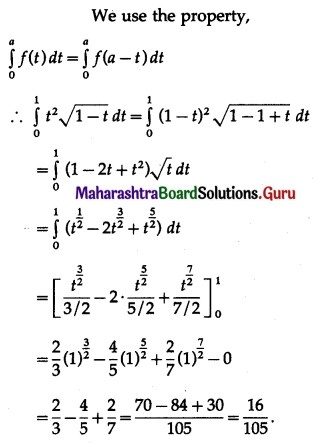
\(\int_{0}^{1} t^{2} \sqrt{1-t} \cdot d t\)
Solution:
Maharashtra Board 12th Maths Solutions Chapter 4 Definite Integration Ex 4.2 III Q13

Question 14.
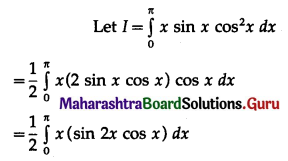
\(\int_{0}^{\pi} x \cdot \sin x \cdot \cos ^{2} x \cdot d x\)
Solution:
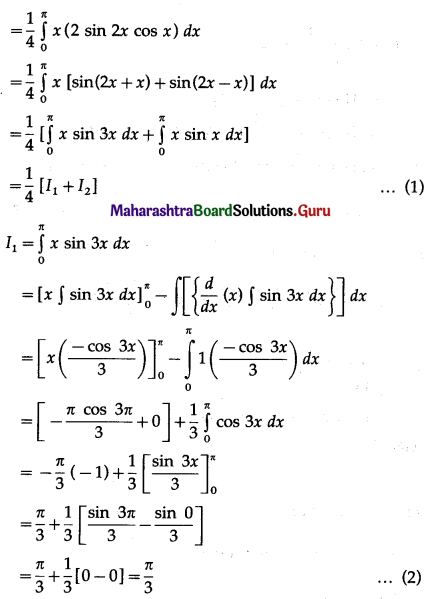
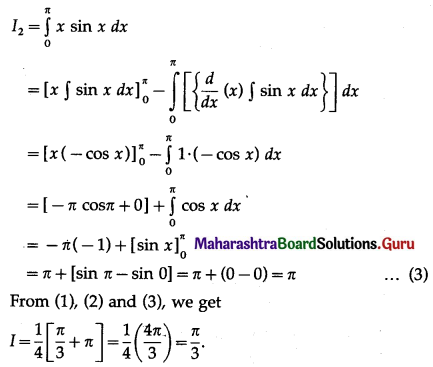
Maharashtra Board 12th Maths Solutions Chapter 4 Definite Integration Ex 4.2 III Q14
Maharashtra Board 12th Maths Solutions Chapter 4 Definite Integration Ex 4.2 III Q14.1
Maharashtra Board 12th Maths Solutions Chapter 4 Definite Integration Ex 4.2 III Q14.2

Maharashtra Board 12th Maths Solutions Chapter 4 Definite Integration Ex 4.2

Question 15.
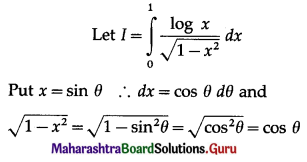
\(\int_{0}^{1} \frac{\log x}{\sqrt{1-x^{2}}} \cdot d x\)
Solution:
Maharashtra Board 12th Maths Solutions Chapter 4 Definite Integration Ex 4.2 III Q15
Maharashtra Board 12th Maths Solutions Chapter 4 Definite Integration Ex 4.2 III Q15.1
Maharashtra Board 12th Maths Solutions Chapter 4 Definite Integration Ex 4.2 III Q15.2
Maharashtra Board 12th Maths Solutions Chapter 4 Definite Integration Ex 4.2 III Q15.3
Maharashtra Board 12th Maths Solutions Chapter 4 Definite Integration Ex 4.2 III Q15.4

Maharashtra Board 12th Maths Solutions Chapter 6 Differential Equations Ex 6.2

Balbharti 12th Maharashtra State Board Maths Solutions Book Pdf Chapter 6 Differential Equations Ex 6.2 Questions and Answers.

Maharashtra State Board 12th Maths Solutions Chapter 6 Differential Equations Ex 6.2

Question 1.
Obtain the differential equation by eliminating the arbitrary constants from the following equations:
(i) x3 + y3 = 4ax
Solution:
x3 + y3 = 4ax ……..(1)
Differentiating both sides w.r.t. x, we get
3x2 + 3y2 \(\frac{d y}{d x}\) = 4a × 1
∴ 3x2 + 3y2 \(\frac{d y}{d x}\) = 4a
Substituting the value of 4a in (1), we get
x3 + y3 = (3x2 + 3y2 \(\frac{d y}{d x}\)) x
∴ x3 + y3 = 3x3 + 3xy2 \(\frac{d y}{d x}\)
∴ 2x3 + 3xy2 \(\frac{d y}{d x}\) – y3 = 0
This is the required D.E.

Maharashtra Board 12th Maths Solutions Chapter 6 Differential Equations Ex 6.2

(ii) Ax2 + By2 = 1
Solution:
Ax2 + By2 = 1
Differentiating both sides w.r.t. x, we get
A × 2x + B × 2y \(\frac{d y}{d x}\) = 0
∴ Ax + By \(\frac{d y}{d x}\) = 0 ……..(1)
Differentiating again w.r.t. x, we get
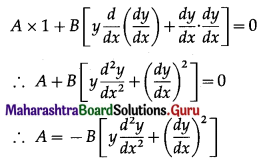
Maharashtra Board 12th Maths Solutions Chapter 6 Differential Equations Ex 6.2 Q1 (ii)
Substituting the value of A in (1), we get
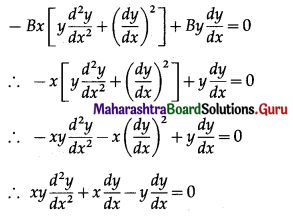
Maharashtra Board 12th Maths Solutions Chapter 6 Differential Equations Ex 6.2 Q1 (ii).1
This is the required D.E.

Alternative Method:
Ax2 + By2 = 1 ……..(1)
Differentiating both sides w.r.t. x, we get
A × 2x + B × 2y \(\frac{d y}{d x}\) = 0
∴ Ax + By \(\frac{d y}{d x}\) = 0 ……….(2)
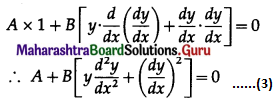
Differentiating again w.r.t. x, we get,
Maharashtra Board 12th Maths Solutions Chapter 6 Differential Equations Ex 6.2 Q1 (ii).2
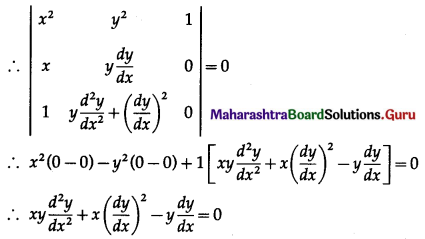
The equations (1), (2) and (3) are consistent in A and B.
∴ determinant of their consistency is zero.
Maharashtra Board 12th Maths Solutions Chapter 6 Differential Equations Ex 6.2 Q1 (ii).3
This is the required D.E.

(iii) y = A cos(log x) + B sin(log x)
Solution:
y = A cos(log x) + B sin (log x) ……. (1)
Differentiating w.r.t. x, we get
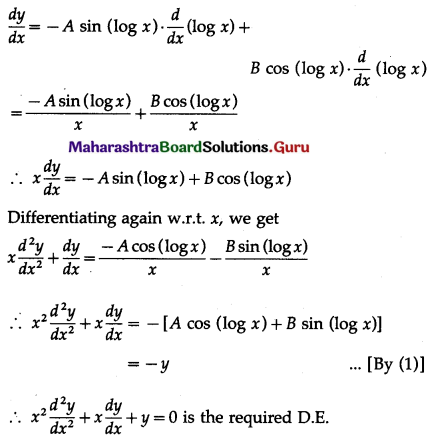
Maharashtra Board 12th Maths Solutions Chapter 6 Differential Equations Ex 6.2 Q1 (iii)

(iv) y2 = (x + c)3
Solution:
y2 = (x + c)3
Differentiating w.r.t. x, we get
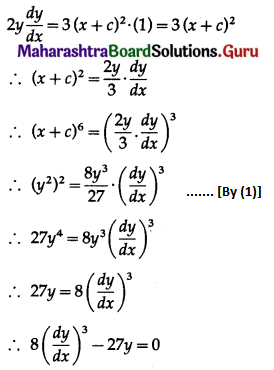
Maharashtra Board 12th Maths Solutions Chapter 6 Differential Equations Ex 6.2 Q1 (iv)
This is the required D.E.

Maharashtra Board 12th Maths Solutions Chapter 6 Differential Equations Ex 6.2

(v) y = Ae5x + Be-5x
Solution:
y = Ae5x + Be-5x ……….(1)
Differentiating twice w.r.t. x, we get
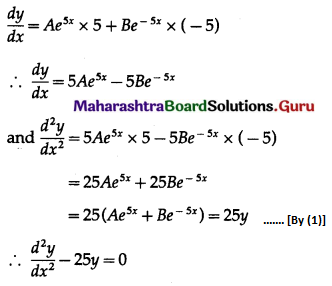
Maharashtra Board 12th Maths Solutions Chapter 6 Differential Equations Ex 6.2 Q1 (v)
This is the required D.E.

(vi) (y – a)2 = 4(x – b)
Solution:
(y – a)2 = 4(x – b)
Differentiating both sides w.r.t. x, we get
2(y – a) . \(\frac{d}{d x}\)(y – a) = 4 \(\frac{d}{d x}\)(x – b)
∴ 2(y – a) . (\(\frac{d y}{d x}\) – 0) = 4(1 – 0)
∴ 2(y – a) \(\frac{d y}{d x}\) = 4
∴ (y – a) \(\frac{d y}{d x}\) = 2 ……..(1)
Differentiating w.r.t. x, we get
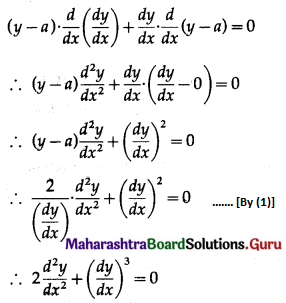
Maharashtra Board 12th Maths Solutions Chapter 6 Differential Equations Ex 6.2 Q1 (vi)
This is the required D.E.

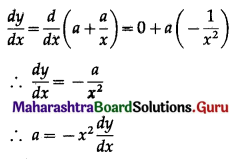
(vii) y = a + \(\frac{a}{x}\)
Solution:
y = a + \(\frac{a}{x}\)
Differentiating w.r.t. x, we get
Maharashtra Board 12th Maths Solutions Chapter 6 Differential Equations Ex 6.2 Q1 (vii)
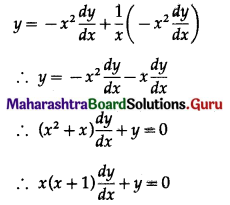
Substituting the value of a in (1), we get
Maharashtra Board 12th Maths Solutions Chapter 6 Differential Equations Ex 6.2 Q1 (vii).1
This is the required D.E.

(viii) y = c1e2x + c2e5x
Solution:
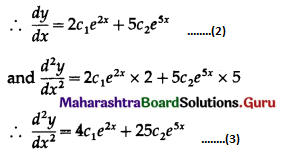
y = c1e2x + c2e5x ………(1)
Differentiating twice w.r.t. x, we get
\(\frac{d y}{d x}\) = c1e2x × 2 + c2e5x × 5
Maharashtra Board 12th Maths Solutions Chapter 6 Differential Equations Ex 6.2 Q1 (viii)
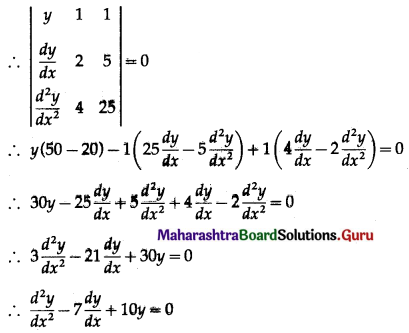
The equations (1), (2) and (3) are consistent in c1e2x and c2e5x
∴ determinant of their consistency is zero.
Maharashtra Board 12th Maths Solutions Chapter 6 Differential Equations Ex 6.2 Q1 (viii).1
This is the required D.E.

Maharashtra Board 12th Maths Solutions Chapter 6 Differential Equations Ex 6.2

Alternative Method:
y = c1e2x + c2e5x
Dividing both sides by e5x, we get
Maharashtra Board 12th Maths Solutions Chapter 6 Differential Equations Ex 6.2 Q1 (viii).2
This is the required D.E.

(ix) c1x3 + c2y2 = 5.
Solution:
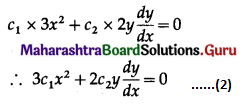
c1x3 + c2y2 = 5 ……….(1)
Differentiating w.r.t. x, we get
Maharashtra Board 12th Maths Solutions Chapter 6 Differential Equations Ex 6.2 Q1 (ix)
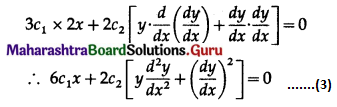
Differentiating again w.r.t. x, we get
Maharashtra Board 12th Maths Solutions Chapter 6 Differential Equations Ex 6.2 Q1 (ix).1
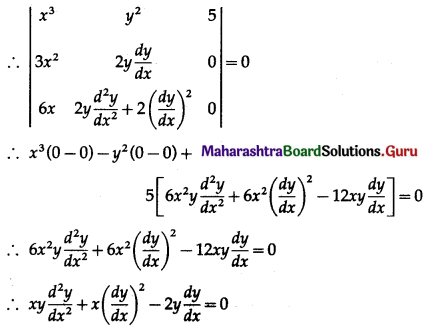
The equations (1), (2) and (3) in c1, c2 are consistent.
∴ determinant of their consistency is zero.
Maharashtra Board 12th Maths Solutions Chapter 6 Differential Equations Ex 6.2 Q1 (ix).2
This is the required D.E.

Maharashtra Board 12th Maths Solutions Chapter 6 Differential Equations Ex 6.2

(x) y = e-2x(A cos x + B sin x)
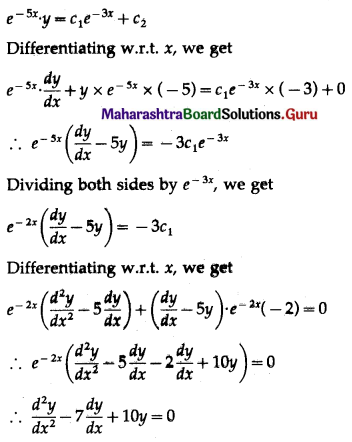
Solution:
y = e-2x(A cos x + B sin x)
∴ e2x . y = A cos x + B sin x ………(1)
Differentiating w.r.t. x, we get
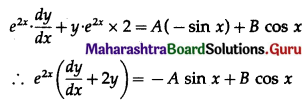
Maharashtra Board 12th Maths Solutions Chapter 6 Differential Equations Ex 6.2 Q1 (x)
Differentiating again w.r.t. x, we get
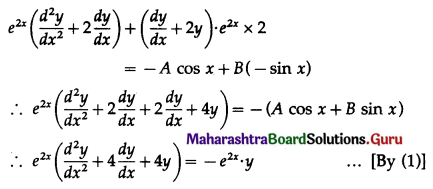
Maharashtra Board 12th Maths Solutions Chapter 6 Differential Equations Ex 6.2 Q1 (x).1
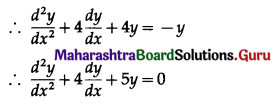
Maharashtra Board 12th Maths Solutions Chapter 6 Differential Equations Ex 6.2 Q1 (x).2
This is the required D.E.

Question 2.
Form the differential equation of family of lines having intercepts a and b on the coordinate axes respectively.
Solution:
The equation of the line having intercepts a and b on the coordinate axes respectively, is
\(\frac{x}{a}+\frac{y}{b}=1\) ……….(1)
where a and b are arbitrary constants.
[For different values of a and b, we get, different lines. Hence (1) is the equation of family of lines.]
Differentiating (1) w.r.t. x, we get
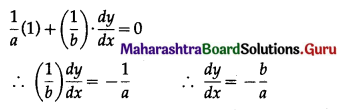
Maharashtra Board 12th Maths Solutions Chapter 6 Differential Equations Ex 6.2 Q2
Differentiating again w.r.t. x, we get \(\frac{d^{2} y}{d x^{2}}=0\)
This is the required D.E.

Maharashtra Board 12th Maths Solutions Chapter 6 Differential Equations Ex 6.2

Question 3.
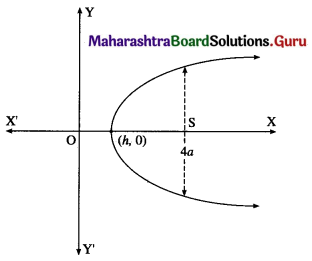
Find the differential equation all parabolas having length of latus rectum 4a and axis is parallel to the X-axis.
Solution:
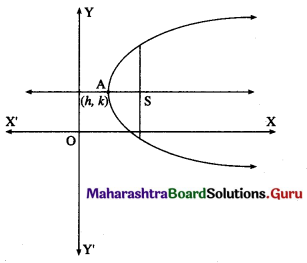
Maharashtra Board 12th Maths Solutions Chapter 6 Differential Equations Ex 6.2 Q3
Let A(h, k) be the vertex of the parabola whose length of latus rectum is 4a.
Then the equation of the parabola is (y – k)2 = 4a (x – h), where h and k are arbitrary constants.
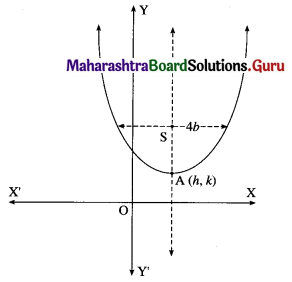
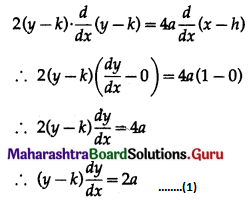
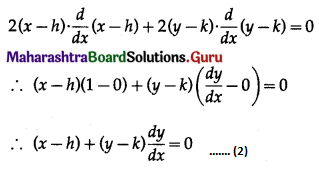
Differentiating w.r.t. x, we get
Maharashtra Board 12th Maths Solutions Chapter 6 Differential Equations Ex 6.2 Q3.1
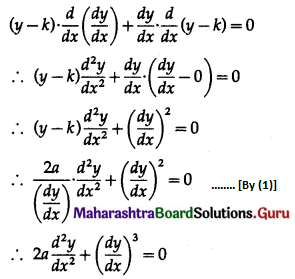
Differentiating again w.r.t. x, we get
Maharashtra Board 12th Maths Solutions Chapter 6 Differential Equations Ex 6.2 Q3.2
This is the required D.E.

Question 4.
Find the differential equation of the ellipse whose major axis is twice its minor axis.
Solution:
Let 2a and 2b be lengths of major axis and minor axis of the ellipse.
Then 2a = 2(2b)
∴ a = 2b
∴ equation of the ellipse is
\(\frac{x^{2}}{a^{2}}+\frac{y^{2}}{b^{2}}=1\)
i.e., \(\frac{x^{2}}{(2 b)^{2}}+\frac{y^{2}}{b^{2}}=1\)
∴ \(\frac{x^{2}}{4 b^{2}}+\frac{y^{2}}{b^{2}}=1\)
∴ x2 + 4y2 = 4b2
Differentiating w.r.t. x, we get
2x + 4 × 2y \(\frac{d y}{d x}\) = 0
∴ x + 4y \(\frac{d y}{d x}\) = 0
This is the required D.E.

Maharashtra Board 12th Maths Solutions Chapter 6 Differential Equations Ex 6.2

Question 5.
Form the differential equation of family of lines parallel to the line 2x + 3y + 4 = 0.
Solution:
The equation of the line parallel to the line 2x + 3y + 4 = 0 is 2x + 3y + c = 0, where c is an arbitrary constant.
Differentiating w.r.t. x, we get
2 × 1 + 3 \(\frac{d y}{d x}\) + 0 = 0
∴ 3 \(\frac{d y}{d x}\) + 2 = 0
This is the required D.E.

Question 6.
Find the differential equation of all circles having radius 9 and centre at point (h, k).
Solution:
Equation of the circle having radius 9 and centre at point (h, k) is
(x – h)2 + (y – k)2 = 81 …… (1)
where h and k are arbitrary constant.
Differentiating (1) w.r.t. x, we get
Maharashtra Board 12th Maths Solutions Chapter 6 Differential Equations Ex 6.2 Q6
Differentiating again w.r.t. x, we get
Maharashtra Board 12th Maths Solutions Chapter 6 Differential Equations Ex 6.2 Q6.1
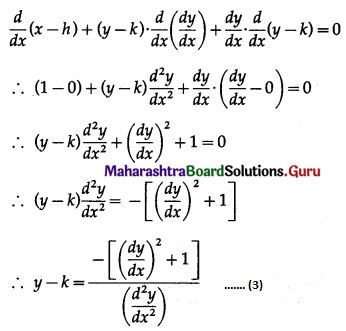
From (2), x – h = -(y – k) \(\frac{d y}{d x}\)
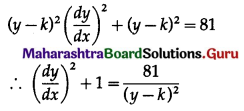
Substituting the value of (x – h) in (1), we get
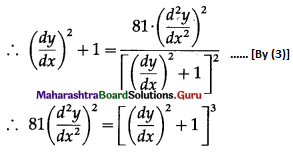
Maharashtra Board 12th Maths Solutions Chapter 6 Differential Equations Ex 6.2 Q6.2
Maharashtra Board 12th Maths Solutions Chapter 6 Differential Equations Ex 6.2 Q6.3
This is the required D.E.

Maharashtra Board 12th Maths Solutions Chapter 6 Differential Equations Ex 6.2

Question 7.
Form the differential equation of all parabolas whose axis is the X-axis.
Solution:
Maharashtra Board 12th Maths Solutions Chapter 6 Differential Equations Ex 6.2 Q7
The equation of the parbola whose axis is the X-axis is
y2 = 4a(x – h) …… (1)
where a and h are arbitrary constants.
Differentiating (1) w.r.t. x, we get
2y \(\frac{d y}{d x}\) = 4a(1 – 0)
∴ y \(\frac{d y}{d x}\) = 2a
Differentiating again w.r.t. x, we get
Maharashtra Board 12th Maths Solutions Chapter 6 Differential Equations Ex 6.2 Q7.1
This is the required D.E.

Maharashtra Board 12th Maths Solutions Chapter 4 Definite Integration Ex 4.1

Balbharti 12th Maharashtra State Board Maths Solutions Book Pdf Chapter 4 Definite Integration Ex 4.1 Questions and Answers.

Maharashtra State Board 12th Maths Solutions Chapter 4 Definite Integration Ex 4.1

I. Evaluate the following integrals as a limit of a sum.

Question 1.
\(\int_{1}^{3}(3 x-4) \cdot d x\)
Solution:
Let f(x) = 3x – 4, for 1 ≤ x ≤ 3
Divide the closed interval [1, 3] into n subintervals each of length h at the points
1, 1 + h, 1 + 2h, 1 + rh, ….., 1 + nh = 3
∴ nh = 2
∴ h = \(\frac{2}{n}\) and as n → ∞, h → 0
Here, a = 1
∴ f(a + rh) = f(1 + rh)
= 3(1 + rh) – 4
= 3rh – 1
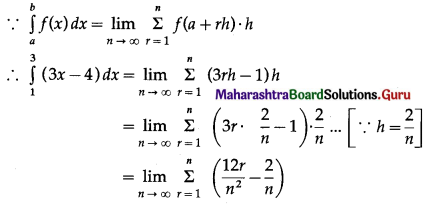
Maharashtra Board 12th Maths Solutions Chapter 4 Definite Integration Ex 4.1 Q1
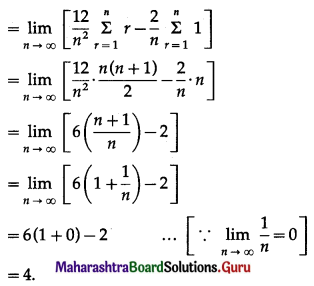
Maharashtra Board 12th Maths Solutions Chapter 4 Definite Integration Ex 4.1 Q1.1

Maharashtra Board 12th Maths Solutions Chapter 4 Definite Integration Ex 4.1

Question 2.
\(\int_{0}^{4} x^{2} d x\)
Solution:
Let f(x) = x2, for 0 ≤ x ≤ 4
Divide the closed interval [0, 4] into n subintervals each of length h at the points
0, 0 + h, 0 + 2h, ….., 0 + rh, ….., 0 + nh = 4
i.e. 0, h, 2h, ….., rh, ….., nh = 4
∴ h = \(\frac{4}{n}\) as n → ∞, h → 0
Here, a = 0
Maharashtra Board 12th Maths Solutions Chapter 4 Definite Integration Ex 4.1 Q2

Question 3.
\(\int_{0}^{2} e^{x} d x\)
Solution:
Let f(x) = ex, for 0 ≤ x ≤ 2
Divide the closed interval [0, 2] into n equal subntervals each of length h at the points
0, 0 + h, 0 + 2h, ….., 0 + rh, ….., 0 + nh = 2
i.e. 0, h, 2h, ….., rh, ….., nh = 2
∴ h = \(\frac{2}{n}\) and as n → ∞, h → 0
Here, a = 0
Maharashtra Board 12th Maths Solutions Chapter 4 Definite Integration Ex 4.1 Q3
Maharashtra Board 12th Maths Solutions Chapter 4 Definite Integration Ex 4.1 Q3.1

Maharashtra Board 12th Maths Solutions Chapter 4 Definite Integration Ex 4.1

Question 4.
\(\int_{0}^{2}\left(3 x^{2}-1\right) d x\)
Solution:
Let f(x) = 3x2 – 1, for 0 ≤ x ≤ 2
Divide the closed interval [0, 2] into n subintervals each of length h at the points.
0, 0 + h, 0 + 2h, ….., 0 + rh, ……, 0 + nh = 2
i.e. 0, h, 2h, ….., rh, ….., nh = 2
∴ h = \(\frac{2}{n}\) and as n → ∞, h → 0
Here, a = 0
∴ f(a + rh) = f(0 + rh)
= f(rh)
= 3(rh)2 – 1
= 3r2h2 – 1
Maharashtra Board 12th Maths Solutions Chapter 4 Definite Integration Ex 4.1 Q4

Maharashtra Board 12th Maths Solutions Chapter 4 Definite Integration Ex 4.1

Question 5.
\(\int_{1}^{3} x^{3} d x\)
Solution:
Let f(x) = x3, for 1 ≤ x ≤ 3.
Divide the closed interval [1, 3] into n equal su bintervals each of length h at the points
1, 1 + h, 1 + 2h, ……, 1 + rh, ……, 1 + nh = 3
∴ nh = 2
∴ h = \(\frac{2}{n}\) and as n → ∞, h → 0
Here a = 1
Maharashtra Board 12th Maths Solutions Chapter 4 Definite Integration Ex 4.1 Q5
Maharashtra Board 12th Maths Solutions Chapter 4 Definite Integration Ex 4.1 Q5.1

Maharashtra Board 12th Maths Solutions Chapter 6 Differential Equations Ex 6.6

Balbharti 12th Maharashtra State Board Maths Solutions Book Pdf Chapter 6 Differential Equations Ex 6.6 Questions and Answers.

Maharashtra State Board 12th Maths Solutions Chapter 6 Differential Equations Ex 6.6

Question 1.
In a certain culture of bacteria, the rate of increase is proportional to the number present. If it is found that the number doubles in 4 hours, find the number of times the bacteria are increased in 12 hours.
Solution:
Let x be the number of bacteria in the culture at time t.
Then the rate of increase is \(\frac{d x}{d t}\) which is proportional to x.
∴ \(\frac{d x}{d t}\) ∝ x
∴ \(\frac{d x}{d t}\) = kx, where k is a constant
∴ \(\frac{d x}{x}\) = k dt
On integrating, we get
\(\int \frac{d x}{x}\) = k∫dt + c
∴ log x = kt + c
Initially, i.e. when t = 0, let x = x0
log x0 = k × 0 + c
∴ c = log x0
∴ log x = kt + log x0
∴ log x – log x0 = kt
∴ log(\(\frac{x}{x_{0}}\)) = kt ………(1)
Since the number doubles in 4 hours, i.e. when t = 4, x = 2x0
Maharashtra Board 12th Maths Solutions Chapter 6 Differential Equations Ex 6.6 Q1
∴ the number of bacteria will be 8 times the original number in 12 hours.

Maharashtra Board 12th Maths Solutions Chapter 6 Differential Equations Ex 6.6

Question 2.
If the population of a country doubles in 60 years; in how many years will it be triple (treble) under the assumption that the rate of increase is proportional to the number of inhabitants?
[Given log 2 = 0.6912, log 3 = 1.0986]
Solution:
Let P be the population at time t years.
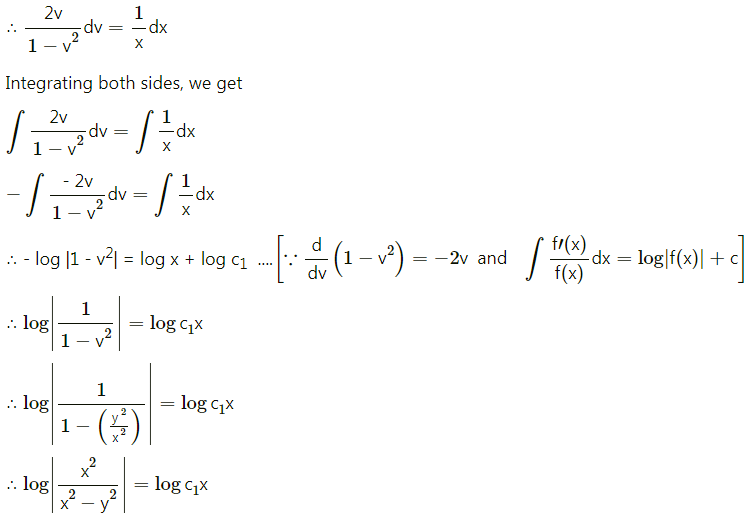
Then \(\frac{d P}{d t}\), the rate of increase of population is proportional to P.
∴ \(\frac{d P}{d t}\) ∝ P
∴ \(\frac{d P}{d t}\) = kP, where k is a constant
∴ \(\frac{d P}{P}\) = k dt
On integrating, we get
\(\int \frac{d P}{P}\) = k∫dt + c
∴ log P = kt + c
Initially i.e. when t = 0, let P = P0
∴ log P0 = k x 0 + c
∴ c = log P0
∴ log P = kt + log P0
∴ log P – log P0 = kt
∴ log(\(\frac{P}{P_{0}}\)) = kt ……(1)
Since, the population doubles in 60 years, i.e. when t = 60, P = 2P0
Maharashtra Board 12th Maths Solutions Chapter 6 Differential Equations Ex 6.6 Q2
∴ the population becomes triple in 95.4 years (approximately).

Question 3.
If a body cools from 80°C to 50°C at room temperature of 25°C in 30 minutes, find the temperature of the body after 1 hour.
Solution:
Let θ°C be the temperature of the body at time t minutes.
The room temperature is given to be 25°C.
Then by Newton’s law of cooling, \(\frac{d \theta}{d t}\), the rate of change of temperature, is proportional to (θ – 25).
Maharashtra Board 12th Maths Solutions Chapter 6 Differential Equations Ex 6.6 Q3
Maharashtra Board 12th Maths Solutions Chapter 6 Differential Equations Ex 6.6 Q3.1
∴ the temperature of the body will be 36.36°C after 1 hour.

Maharashtra Board 12th Maths Solutions Chapter 6 Differential Equations Ex 6.6

Question 4.
The rate of growth of bacteria is proportional to the number present. If initially, there were 1000 bacteria and the number doubles in 1 hour, find the number of bacteria after 2½ hours. [Take √2 = 1.414]
Solution:
Let x be the number of bacteria at time t.
Then the rate of increase is \(\frac{d x}{d t}\) which is proportional to x.
∴ \(\frac{d x}{d t}\) ∝ x
∴ \(\frac{d x}{d t}\) = kx, where k is a constant
∴ \(\frac{d x}{x}\) = k dt
On integrating, we get
\(\int \frac{d x}{x}\) = k∫dt + c
∴ log x = kt + c
Initially, i.e. when t = 0, x = 1000
∴ log 1000 = k × 0 + c
∴ c = log 1000
∴ log x = kt + log 1000
∴ log x – log 1000 = kt
∴ log(\(\frac{x}{1000}\)) = kt ……(1)
Now, when t = 1, x = 2 × 1000 = 2000
∴ log(\(\frac{2000}{1000}\)) = k
∴ k = log 2
Maharashtra Board 12th Maths Solutions Chapter 6 Differential Equations Ex 6.6 Q4
∴ the number of bacteria after 2½ hours = 5656.

Question 5.
The rate of disintegration of a radioactive element at any time t is proportional to its mass at that time. Find the time during which the original mass of 1.5 gm will disintegrate into its mass of 0.5 gm.
Solution:
Let m be the mass of the radioactive element at time t.
Then the rate of disintegration is \(\frac{d m}{d t}\) which is proportional to m.
Maharashtra Board 12th Maths Solutions Chapter 6 Differential Equations Ex 6.6 Q5
Maharashtra Board 12th Maths Solutions Chapter 6 Differential Equations Ex 6.6 Q5.1
∴ log(3)-1 = -kt
∴ -log 3 = -kt
∴ t = \(\frac{1}{k}\) log 3
∴ the original mass will disintegrate to 0.5 gm when t = \(\frac{1}{k}\) log 3

Maharashtra Board 12th Maths Solutions Chapter 6 Differential Equations Ex 6.6

Question 6.
The rate of decay of certain substances is directly proportional to the amount present at that instant. Initially, there is 25 gm of certain substance and two hours later it is found that 9 gm are left. Find the amount left after one more hour.
Solution:
Let x gm be the amount of the substance left at time t.
Then the rate of decay is \(\frac{d x}{d t}\), which is proportional to x.
Maharashtra Board 12th Maths Solutions Chapter 6 Differential Equations Ex 6.6 Q6
Maharashtra Board 12th Maths Solutions Chapter 6 Differential Equations Ex 6.6 Q6.1
∴ \(\frac{x}{25}=\frac{27}{125}\)
∴ x = \(\frac{27}{5}\)
∴ the amount left after 3 hours \(\frac{27}{5}\) gm.

Question 7.
Find the population of a city at any time t, given that the rate of increase of population is proportional to the population at that instant and that in a period of 40 years, the population increased from 30,000 to 40,000.
Solution:
Let P be the population of the city at time t.
Then \(\frac{d P}{d t}\), the rate of increase of population is proportional to P.
∴ \(\frac{d P}{d t}\) ∝ P
∴ \(\frac{d P}{d t}\) = kP, where k is a constant.
∴ \(\frac{d P}{P}\) = k dt
On integrating, we get
\(\int \frac{1}{P} d P\) = k∫dt + c
∴ log P = kt + c
Initially, i.e. when t = 0, P = 30000
∴ log 30000 = k × 0 + c
∴ c = log 30000
∴ log P = kt + log 30000
∴ log P – log 30000 = kt
∴ log(\(\frac{P}{30000}\)) = kt …….(1)
Now, when t = 40, P = 40000
Maharashtra Board 12th Maths Solutions Chapter 6 Differential Equations Ex 6.6 Q7
∴ the population of the city at time t = 30000\(\left(\frac{4}{3}\right)^{\frac{t}{40}}\).

Maharashtra Board 12th Maths Solutions Chapter 6 Differential Equations Ex 6.6

Question 8.
A body cools according to Newton’s law from 100°C to 60°C in 20 minutes. The temperature of the surroundings is 20°C. How long will it take to cool down to 30°C?
Solution:
Let θ°C be the temperature of the body at time t.
The temperature of the surrounding is given to be 20°C.
According to Newton’s law of cooling
Maharashtra Board 12th Maths Solutions Chapter 6 Differential Equations Ex 6.6 Q8
Maharashtra Board 12th Maths Solutions Chapter 6 Differential Equations Ex 6.6 Q8.1
∴ the body will cool down to 30°C in 60 minutes, i.e. in 1 hour.

Question 9.
A right circular cone has a height of 9 cm and a radius of the base of 5 cm. It is inverted and water is poured into it. If at any instant the water level rises at the rate of \(\left(\frac{\pi}{A}\right)\) cm/sec, where A is the area of the water surface
at that instant, show that the vessel will be full in 75 seconds.
Solution:
Maharashtra Board 12th Maths Solutions Chapter 6 Differential Equations Ex 6.6 Q9
Let r be the radius of the water surface and h be the height of the water at time t.
∴ area of the water surface A = πr2 sq cm.
Since height of the right circular cone is 9 cm and radius of the base is 5 cm.
\(\frac{r}{h}=\frac{5}{9}\)
∴ r = \(\frac{5}{9} h\)
∴ area of water surface, i.e. A = \(\pi\left(\frac{5}{9} h\right)^{2}\)
∴ A = \(\frac{25 \pi h^{2}}{81}\) ……..(1)
The water level, i.e. the rate of change of h is \(\frac{d h}{d t}\) rises at the rate of \(\left(\frac{\pi}{A}\right)\) cm/sec.
Maharashtra Board 12th Maths Solutions Chapter 6 Differential Equations Ex 6.6 Q9.1
∴ t = \(\frac{81 \times 9 \times 25}{3 \times 81}\) = 75
Hence, the vessel will be full in 75 seconds.

Maharashtra Board 12th Maths Solutions Chapter 6 Differential Equations Ex 6.6

Question 10.
Assume that a spherical raindrop evaporates at a rate proportional to its surface area. If its radius originally is 3 mm and 1 hour later has been reduced to 2 mm, find an expression for the radius of the raindrop at any time t.
Solution:
Let r be the radius, V be the volume and S be the surface area of the spherical raindrop at time t.
Then V = \(\frac{4}{3}\)πr3 and S = 4πr2
The rate at which the raindrop evaporates is \(\frac{d V}{d t}\) which is proportional to the surface area.
∴ \(\frac{d V}{d t}\) ∝ S
∴ \(\frac{d V}{d t}\) = -kS, where k > 0 ………(1)
Maharashtra Board 12th Maths Solutions Chapter 6 Differential Equations Ex 6.6 Q10
On integrating, we get
∫dr = -k∫dt + c
∴ r = -kt + c
Initially, i.e. when t = 0, r = 3
∴ 3 = -k × 0 + c
∴ c = 3
∴ r = -kt + 3
When t = 1, r = 2
∴ 2 = -k × 1 + 3
∴ k = 1
∴ r = -t + 3
∴ r = 3 – t, where 0 ≤ t ≤ 3.
This is the required expression for the radius of the raindrop at any time t.

Question 11.
The rate of growth of the population of a city at any time t is proportional to the size of the population. For a certain city, it is found that the constant of proportionality is 0.04. Find the population of the city after 25 years, if the initial population is 10,000. [Take e = 2.7182]
Solution:
Let P be the population of the city at time t.
Then the rate of growth of population is \(\frac{d P}{d t}\) which is proportional to P.
∴ \(\frac{d P}{d t}\) ∝ P
∴ \(\frac{d P}{d t}\) = kP, where k = 0.04
∴ \(\frac{d P}{d t}\) = (0.04)P
∴ \(\frac{1}{P}\) dP = (0.04)dt
On integrating, we get
\(\int \frac{1}{P} d P\) = (0.04) ∫dt + c
∴ log P = (0.04)t + c
Initially, i.e., when t = 0, P = 10000
∴ log 10000 = (0.04) × 0 + c
∴ c = log 10000
∴ log P = (0.04)t + log 10000
∴ log P – log 10000 = (0.04)t
∴ log(\(\frac{P}{10000}\)) = (0.04)t
When t = 25, then
∴ log(\(\frac{P}{10000}\)) = 0.04 × 25 = 1
∴ log(\(\frac{P}{10000}\)) = log e ……[∵ log e = 1]
∴ \(\frac{P}{10000}\) = e = 2.7182
∴ P = 2.7182 × 10000 = 27182
∴ the population of the city after 25 years will be 27,182.

Maharashtra Board 12th Maths Solutions Chapter 6 Differential Equations Ex 6.6

Question 12.
Radium decomposes at a rate proportional to the amount present at any time. If p percent of the amount disappears in one year, what percent of the amount of radium will be left after 2 years?
Solution:
Let x be the amount of the radium at time t.
Then the rate of decomposition is \(\frac{d x}{d t}\) which is proportional to x.
Maharashtra Board 12th Maths Solutions Chapter 6 Differential Equations Ex 6.6 Q12
Maharashtra Board 12th Maths Solutions Chapter 6 Differential Equations Ex 6.6 Q12.1
Hence, \(\left(10-\frac{p}{10}\right)^{2} \%\) of the amount will be left after 2 years.
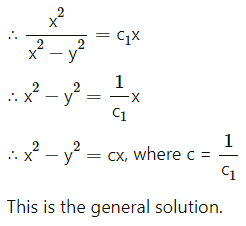
Maharashtra Board 12th Maths Solutions Chapter 3 Indefinite Integration Miscellaneous Exercise 3

Balbharti 12th Maharashtra State Board Maths Solutions Book Pdf Chapter 3 Indefinite Integration Miscellaneous Exercise 3 Questions and Answers.
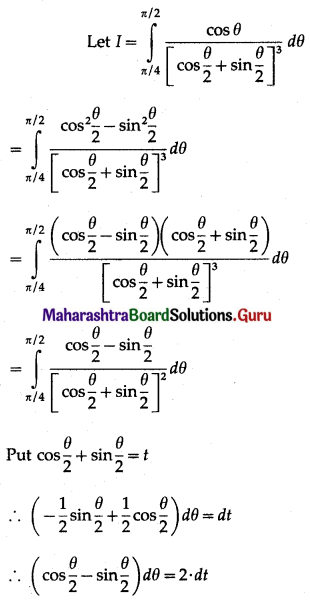
Maharashtra State Board 12th Maths Solutions Chapter 3 Indefinite Integration Miscellaneous Exercise 3

I. Choose the correct options from the given alternatives:

Question 1.
\(\int \frac{1+x+\sqrt{x+x^{2}}}{\sqrt{x}+\sqrt{1+x}} \cdot d x=\)
(a) \(\frac{1}{2} \sqrt{x+1}+c\)
(b) \(\frac{2}{3}(x+1)^{\frac{3}{2}}+c\)
(c) \(\sqrt{x+1}+c\)
(d) \(2(x+1)^{\frac{3}{2}}+c\)
Answer:
(b) \(\frac{2}{3}(x+1)^{\frac{3}{2}}+c\)

Maharashtra Board 12th Maths Solutions Chapter 3 Indefinite Integration Miscellaneous Exercise 3

Question 2.
\(\int \frac{1}{x+x^{5}} \cdot d x\) = f(x) + c, then \(\int \frac{x^{4}}{x+x^{5}} \cdot d x=\)
(a) log x – f(x) + c
(b) f(x) + log x + c
(c) f(x) – log x + c
(d) \(\frac{1}{5}\) x5 f(x) + c
Answer:
(a) log x – f(x) + c
Maharashtra Board 12th Maths Solutions Chapter 3 Indefinite Integration Miscellaneous Exercise 3 I Q2

Question 3.
\(\int \frac{\log (3 x)}{x \log (9 x)} \cdot d x=\)
(a) log(3x) – log(9x) + c
(b) log(x) – (log 3) . log(log 9x) + c
(c) log 9 – (log x) . log(log 3x) + c
(d) log(x) + log(3) . log(log 9x) + c
Answer:
(b) log(x) – (log 3) . log(log 9x) + c
Maharashtra Board 12th Maths Solutions Chapter 3 Indefinite Integration Miscellaneous Exercise 3 I Q3

Question 4.
\(\int \frac{\sin ^{m} X}{\cos ^{m+2} X} \cdot d x=\)
(a) \(\frac{\tan ^{m+1} \boldsymbol{X}}{m+1}+c\)
(b) (m + 2) tanm+1 x + c
(c) \(\frac{\tan ^{m} \boldsymbol{X}}{m}+c\)
(d) (m + 1) tanm+1 x + c
Answer:
(a) \(\frac{\tan ^{m+1} \boldsymbol{X}}{m+1}+c\)

Question 5.
∫tan(sin-1 x) . dx =
(a) \(\left(1-x^{2}\right)^{-\frac{1}{2}}+c\)
(b) \(\left(1-x^{2}\right)^{\frac{1}{2}}+c\)
(c) \(\frac{\tan ^{m} \boldsymbol{X}}{\sqrt{1-x^{2}}}+c\)
(d) \(-\sqrt{1-x^{2}}+c\)
Answer:
(d) \(-\sqrt{1-x^{2}}+c\)

Hint: sin-1 x = \(\tan ^{-1}\left(\frac{x}{\sqrt{1-x^{2}}}\right)\)

Maharashtra Board 12th Maths Solutions Chapter 3 Indefinite Integration Miscellaneous Exercise 3

Question 6.
\(\int \frac{x-\sin x}{1-\cos x} \cdot d x=\)
(a) x cot(\(\frac{x}{2}\)) + c
(b) -x cot(\(\frac{x}{2}\)) + c
(c) cot(\(\frac{x}{2}\)) + c
(d) x tan(\(\frac{x}{2}\)) + c
Answer:
(b) -x cot(\(\frac{x}{2}\)) + c
Maharashtra Board 12th Maths Solutions Chapter 3 Indefinite Integration Miscellaneous Exercise 3 I Q6
Maharashtra Board 12th Maths Solutions Chapter 3 Indefinite Integration Miscellaneous Exercise 3 I Q6.1

Question 7.
If f(x) = \(\frac{\sin ^{-1} x}{\sqrt{1-x^{2}}}\), g(x) = \(e^{\sin ^{-1} x}\), then ∫f(x) . g(x) . dx =
(a) \(e^{\sin ^{-1} x} \cdot\left(\sin ^{-1} x-1\right)+c\)
(b) \(e^{\sin ^{-1} x} \cdot\left(1-\sin ^{-1} x\right)+c\)
(c) \(e^{\sin ^{-1} x} \cdot\left(\sin ^{-1} x+1\right)+c\)
(d) \(e^{\sin ^{-1} x} \cdot\left(\sin ^{-1} X-1\right)+c\)
Answer:
(a) \(e^{\sin ^{-1} x} \cdot\left(\sin ^{-1} x-1\right)+c\)

Question 8.
If ∫tan3 x . sec3 x . dx = (\(\frac{1}{m}\)) secm x – (\(\frac{1}{n}\)) secn x + c, then (m, n) =
(a) (5, 3)
(b) (3, 5)
(c) \(\left(\frac{1}{5}, \frac{1}{3}\right)\)
(d) (4, 4)
Answer:
(a) (5, 3)

Hint: ∫tan3 x . sec3 x dx
= ∫sec2 x . tan2 x . sec x tan x dx
= ∫sec2 x (sec2 x – 1) sec x tan x dx
Put sec x = t.

Question 9.
\(\int \frac{1}{\cos x-\cos ^{2} x} \cdot d x=\)
(a) log(cosec x – cot x) + tan(\(\frac{x}{2}\)) + c
(b) sin 2x – cos x + c
(c) log(sec x + tan x) – cot(\(\frac{x}{2}\)) + c
(d) cos 2x – sin x + c
Answer:
(c) log(sec x + tan x) – cot(\(\frac{x}{2}\)) + c
Maharashtra Board 12th Maths Solutions Chapter 3 Indefinite Integration Miscellaneous Exercise 3 I Q9

Question 10.
\(\int \frac{\sqrt{\cot x}}{\sin x \cdot \cos x} \cdot d x=\)
(a) \(2 \sqrt{\cot x}+c\)
(b) \(-2 \sqrt{\cot x}+c\)
(c) \(\frac{1}{2} \sqrt{\cot x}+c\)
(d) \(\sqrt{\cot X}+c\)
Answer:
(b) \(-2 \sqrt{\cot x}+c\)

Maharashtra Board 12th Maths Solutions Chapter 3 Indefinite Integration Miscellaneous Exercise 3

Question 11.
\(\int \frac{e^{x}(x-1)}{x^{2}} \cdot d x=\)
(a) \(\frac{e^{x}}{x}+c\)
(b) \(\frac{e^{x}}{x^{2}}+c\)
(c) \(\left(x-\frac{1}{x}\right) e^{x}+c\)
(d) x e-x + c
Answer:
(a) \(\frac{e^{x}}{x}+c\)

Question 12.
∫sin(log x) . dx =
(a) \(\frac{x}{2}\) [sin(log x) – cos(log x)] + c
(b) \(\frac{x}{2}\) [sin(log x) + cos(log x)] + c
(c) \(\frac{x}{2}\) [cos(log x) – sin(log x)] + c
(d) \(\frac{x}{4}\) [cos(log x) – sin(log x)] + c
Answer:
(a) \(\frac{x}{2}\) [sin(log x) – cos(log x)] + c

Question 13.
∫xx (1 + log x) . dx =
(a) \(\frac{1}{2}\) (1 + log x)2 + c
(b) x2x + c
(c) xx log x + c
(d) xx + c
Answer:
(d) xx + c

Hint: \(\frac{d}{d x}\)(xx) = xx (1 + log x)

Question 14.
\(\int \cos ^{-\frac{3}{7}} x \cdot \sin ^{-\frac{11}{7}} x \cdot d x=\)
(a) \(\log \left(\sin ^{-\frac{4}{7}} x\right)+c\)
(b) \(\frac{4}{7} \tan ^{\frac{4}{7}} x+c\)
(c) \(-\frac{7}{4} \tan ^{-\frac{4}{7}} x+c\)
(d) \(\log \left(\cos ^{\frac{3}{7}} x\right)+c\)
Answer:
(c) \(-\frac{7}{4} \tan ^{-\frac{4}{7}} x+c\)

Hint: \(\int \cos ^{-\frac{3}{7}} x \sin ^{-\frac{11}{7}} x d x\)
= \(\int \frac{\sin ^{-\frac{11}{7}} x}{\cos ^{-\frac{11}{7}} x \cdot \cos ^{2} x} d x\)
= \(\int \tan ^{-\frac{11}{7}} x \sec ^{2} x d x\)
Put tan x = t.

Question 15.
\(2 \int \frac{\cos ^{2} x-\sin ^{2} x}{\cos ^{2} x+\sin ^{2} x} \cdot d x=\)
(a) sin 2x + c
(b) cos 2x + c
(c) tan 2x + c
(d) 2 sin 2x + c
Answer:
(a) sin 2x + c

Maharashtra Board 12th Maths Solutions Chapter 3 Indefinite Integration Miscellaneous Exercise 3

Question 16.
\(\int \frac{d x}{\cos x \sqrt{\sin ^{2} x-\cos ^{2} x}} \cdot d x=\)
(a) log(tan x – \(\sqrt{\tan ^{2} x-1}\)) + c
(b) sin-1 (tan x) + c
(c) 1 + sin-1 (cot x) + c
(d) log(tan x + \(\sqrt{\tan ^{2} x-1}\)) + c
Answer:
(d) log(tan x + \(\sqrt{\tan ^{2} x-1}\)) + c
Maharashtra Board 12th Maths Solutions Chapter 3 Indefinite Integration Miscellaneous Exercise 3 I Q16

Question 17.
\(\int \frac{\log x}{(\log e x)^{2}} \cdot d x=\)
(a) \(\frac{x}{1+\log x}+c\)
(b) x(1 + log x) + c
(c) \(\frac{1}{1+\log x}+c\)
(d) \(\frac{1}{1-\log x}+c\)
Answer:
(a) \(\frac{x}{1+\log x}+c\)

Question 18.
∫[sin(log x) + cos(log x)] . dx =
(a) x cos(log x) + c
(b) sin(log x) + c
(c) cos(log x) + c
(d) x sin(log x) + c
Answer:
(d) x sin(log x) + c

Question 19.
\(\int \frac{\cos 2 x-1}{\cos 2 x+1} \cdot d x=\)
(a) tan x – x + c
(b) x + tan x + c
(c) x – tan x + c
(d) -x – cot x + c
Answer:
(c) x – tan x + c
Maharashtra Board 12th Maths Solutions Chapter 3 Indefinite Integration Miscellaneous Exercise 3 I Q19

Question 20.
\(\int \frac{e^{2 x}+e^{-2 x}}{e^{x}} \cdot d x=\)
(a) \(e^{x}-\frac{1}{3 e^{3 x}}+c\)
(b) \(e^{x}+\frac{1}{3 e^{3 x}}+c\)
(c) \(e^{-x}+\frac{1}{3 e^{3 x}}+c\)
(d) \(e^{-x}-\frac{1}{3 e^{3 x}}+c\)
Answer:
(a) \(e^{x}-\frac{1}{3 e^{3 x}}+c\)
Maharashtra Board 12th Maths Solutions Chapter 3 Indefinite Integration Miscellaneous Exercise 3 I Q20

II. Integrate the following with respect to the respective variable:

Question 1.
(x – 2)2 √x
Solution:
Maharashtra Board 12th Maths Solutions Chapter 3 Indefinite Integration Miscellaneous Exercise 3 II Q1
Maharashtra Board 12th Maths Solutions Chapter 3 Indefinite Integration Miscellaneous Exercise 3 II Q1.1

Question 2.
\(\frac{x^{7}}{x+1}\)
Solution:
Maharashtra Board 12th Maths Solutions Chapter 3 Indefinite Integration Miscellaneous Exercise 3 II Q2

Maharashtra Board 12th Maths Solutions Chapter 3 Indefinite Integration Miscellaneous Exercise 3

Question 3.
\((6 x+5)^{\frac{3}{2}}\)
Solution:
Maharashtra Board 12th Maths Solutions Chapter 3 Indefinite Integration Miscellaneous Exercise 3 II Q3

Question 4.
\(\frac{t^{3}}{(t+1)^{2}}\)
Solution:
Maharashtra Board 12th Maths Solutions Chapter 3 Indefinite Integration Miscellaneous Exercise 3 II Q4
Maharashtra Board 12th Maths Solutions Chapter 3 Indefinite Integration Miscellaneous Exercise 3 II Q4.1

Question 5.
\(\frac{3-2 \sin x}{\cos ^{2} x}\)
Solution:
Maharashtra Board 12th Maths Solutions Chapter 3 Indefinite Integration Miscellaneous Exercise 3 II Q5

Question 6.
\(\frac{\sin ^{6} \theta+\cos ^{6} \theta}{\sin ^{2} \theta \cdot \cos ^{2} \theta}\)
Solution:
Maharashtra Board 12th Maths Solutions Chapter 3 Indefinite Integration Miscellaneous Exercise 3 II Q6

Maharashtra Board 12th Maths Solutions Chapter 3 Indefinite Integration Miscellaneous Exercise 3

Question 7.
cos 3x cos 2x cos x
Solution:
Maharashtra Board 12th Maths Solutions Chapter 3 Indefinite Integration Miscellaneous Exercise 3 II Q7
Maharashtra Board 12th Maths Solutions Chapter 3 Indefinite Integration Miscellaneous Exercise 3 II Q7.1

Question 8.
\(\frac{\cos 7 x-\cos 8 x}{1+2 \cos 5 x}\)
Solution:
Maharashtra Board 12th Maths Solutions Chapter 3 Indefinite Integration Miscellaneous Exercise 3 II Q8
Maharashtra Board 12th Maths Solutions Chapter 3 Indefinite Integration Miscellaneous Exercise 3 II Q8.1

Question 9.
\(\cot ^{-1}\left(\frac{1+\sin x}{\cos x}\right)\)
Solution:
Let I = \(\int \cot ^{-1}\left(\frac{1+\sin x}{\cos x}\right) d x\)
Maharashtra Board 12th Maths Solutions Chapter 3 Indefinite Integration Miscellaneous Exercise 3 II Q9

III. Integrate the following w.r.t. x:

Question 1.
\(\frac{(1+\log x)^{3}}{x}\)
Solution:
Maharashtra Board 12th Maths Solutions Chapter 3 Indefinite Integration Miscellaneous Exercise 3 III Q1

Maharashtra Board 12th Maths Solutions Chapter 3 Indefinite Integration Miscellaneous Exercise 3

Question 2.
cot-1 (1 – x + x2)
Solution:
Maharashtra Board 12th Maths Solutions Chapter 3 Indefinite Integration Miscellaneous Exercise 3 III Q2
Maharashtra Board 12th Maths Solutions Chapter 3 Indefinite Integration Miscellaneous Exercise 3 III Q2.1
Maharashtra Board 12th Maths Solutions Chapter 3 Indefinite Integration Miscellaneous Exercise 3 III Q2.2
Maharashtra Board 12th Maths Solutions Chapter 3 Indefinite Integration Miscellaneous Exercise 3 III Q2.3
Maharashtra Board 12th Maths Solutions Chapter 3 Indefinite Integration Miscellaneous Exercise 3 III Q2.4

Question 3.
\(\frac{1}{x \sin ^{2}(\log x)}\)
Solution:
Maharashtra Board 12th Maths Solutions Chapter 3 Indefinite Integration Miscellaneous Exercise 3 III Q3

Question 4.
\(\sqrt{x} \sec \left(x^{\frac{3}{2}}\right) \tan \left(x^{\frac{3}{2}}\right)\)
Solution:
Maharashtra Board 12th Maths Solutions Chapter 3 Indefinite Integration Miscellaneous Exercise 3 III Q4

Question 5.
log(1 + cos x) – x tan(\(\frac{x}{2}\))
Solution:
Maharashtra Board 12th Maths Solutions Chapter 3 Indefinite Integration Miscellaneous Exercise 3 III Q5
Maharashtra Board 12th Maths Solutions Chapter 3 Indefinite Integration Miscellaneous Exercise 3 III Q5.1

Question 6.
\(\frac{x^{2}}{\sqrt{1-x^{6}}}\)
Solution:
Maharashtra Board 12th Maths Solutions Chapter 3 Indefinite Integration Miscellaneous Exercise 3 III Q6

Maharashtra Board 12th Maths Solutions Chapter 3 Indefinite Integration Miscellaneous Exercise 3

Question 7.
\(\frac{1}{(1-\cos 4 x)(3-\cot 2 x)}\)
Solution:
Maharashtra Board 12th Maths Solutions Chapter 3 Indefinite Integration Miscellaneous Exercise 3 III Q7

Question 8.
log(log x) + (log x)-2
Solution:
Maharashtra Board 12th Maths Solutions Chapter 3 Indefinite Integration Miscellaneous Exercise 3 III Q8
Maharashtra Board 12th Maths Solutions Chapter 3 Indefinite Integration Miscellaneous Exercise 3 III Q8.1

Question 9.
\(\frac{1}{2 \cos x+3 \sin x}\)
Solution:
Maharashtra Board 12th Maths Solutions Chapter 3 Indefinite Integration Miscellaneous Exercise 3 III Q9
Maharashtra Board 12th Maths Solutions Chapter 3 Indefinite Integration Miscellaneous Exercise 3 III Q9.1
Maharashtra Board 12th Maths Solutions Chapter 3 Indefinite Integration Miscellaneous Exercise 3 III Q9.2
Maharashtra Board 12th Maths Solutions Chapter 3 Indefinite Integration Miscellaneous Exercise 3 III Q9.3

Question 10.
\(\frac{1}{x^{3} \sqrt{x^{2}-1}}\)
Solution:
Maharashtra Board 12th Maths Solutions Chapter 3 Indefinite Integration Miscellaneous Exercise 3 III Q10
Maharashtra Board 12th Maths Solutions Chapter 3 Indefinite Integration Miscellaneous Exercise 3 III Q10.1

Maharashtra Board 12th Maths Solutions Chapter 3 Indefinite Integration Miscellaneous Exercise 3

Question 11.
\(\frac{3 x+1}{\sqrt{-2 x^{2}+x+3}}\)
Solution:
Maharashtra Board 12th Maths Solutions Chapter 3 Indefinite Integration Miscellaneous Exercise 3 III Q11
Maharashtra Board 12th Maths Solutions Chapter 3 Indefinite Integration Miscellaneous Exercise 3 III Q11.1
Maharashtra Board 12th Maths Solutions Chapter 3 Indefinite Integration Miscellaneous Exercise 3 III Q11.2

Question 12.
log(x2 + 1)
Solution:
Maharashtra Board 12th Maths Solutions Chapter 3 Indefinite Integration Miscellaneous Exercise 3 III Q12

Question 13.
e2x sin x cos x
Solution:
Maharashtra Board 12th Maths Solutions Chapter 3 Indefinite Integration Miscellaneous Exercise 3 III Q13
Maharashtra Board 12th Maths Solutions Chapter 3 Indefinite Integration Miscellaneous Exercise 3 III Q13.1

Question 14.
\(\frac{x^{2}}{(x-1)(3 x-1)(3 x-2)}\)
Solution:
Maharashtra Board 12th Maths Solutions Chapter 3 Indefinite Integration Miscellaneous Exercise 3 III Q14
Maharashtra Board 12th Maths Solutions Chapter 3 Indefinite Integration Miscellaneous Exercise 3 III Q14.1

Question 15.
\(\frac{1}{\sin x+\sin 2 x}\)
Solution:
Maharashtra Board 12th Maths Solutions Chapter 3 Indefinite Integration Miscellaneous Exercise 3 III Q15
Maharashtra Board 12th Maths Solutions Chapter 3 Indefinite Integration Miscellaneous Exercise 3 III Q15.1
Maharashtra Board 12th Maths Solutions Chapter 3 Indefinite Integration Miscellaneous Exercise 3 III Q15.2

Maharashtra Board 12th Maths Solutions Chapter 3 Indefinite Integration Miscellaneous Exercise 3

Question 16.
\(\sec ^{2} x \sqrt{7+2 \tan x-\tan ^{2} x}\)
Solution:
Maharashtra Board 12th Maths Solutions Chapter 3 Indefinite Integration Miscellaneous Exercise 3 III Q16
Maharashtra Board 12th Maths Solutions Chapter 3 Indefinite Integration Miscellaneous Exercise 3 III Q16.1

Question 17.
\(\frac{x+5}{x^{3}+3 x^{2}-x-3}\)
Solution:
Maharashtra Board 12th Maths Solutions Chapter 3 Indefinite Integration Miscellaneous Exercise 3 III Q17
Maharashtra Board 12th Maths Solutions Chapter 3 Indefinite Integration Miscellaneous Exercise 3 III Q17.1

Question 18.
\(\frac{1}{x\left(x^{5}+1\right)}\)
Solution:
Maharashtra Board 12th Maths Solutions Chapter 3 Indefinite Integration Miscellaneous Exercise 3 III Q18
Maharashtra Board 12th Maths Solutions Chapter 3 Indefinite Integration Miscellaneous Exercise 3 III Q18.1

Question 19.
\(\frac{\sqrt{\tan x}}{\sin x \cdot \cos x}\)
Solution:
Maharashtra Board 12th Maths Solutions Chapter 3 Indefinite Integration Miscellaneous Exercise 3 III Q19

Maharashtra Board 12th Maths Solutions Chapter 3 Indefinite Integration Miscellaneous Exercise 3

Question 20.
sec4 x cosec2 x
Solution:
Maharashtra Board 12th Maths Solutions Chapter 3 Indefinite Integration Miscellaneous Exercise 3 III Q20

Maharashtra Board 12th Maths Solutions Chapter 6 Differential Equations Ex 6.1

Balbharti 12th Maharashtra State Board Maths Solutions Book Pdf Chapter 6 Differential Equations Ex 6.1 Questions and Answers.
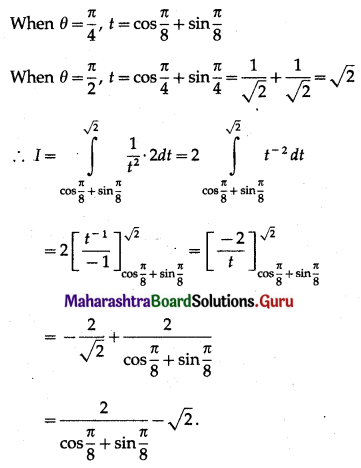
Maharashtra State Board 12th Maths Solutions Chapter 6 Differential Equations Ex 6.1

1. Determine the order and degree of each of the following differential equations:
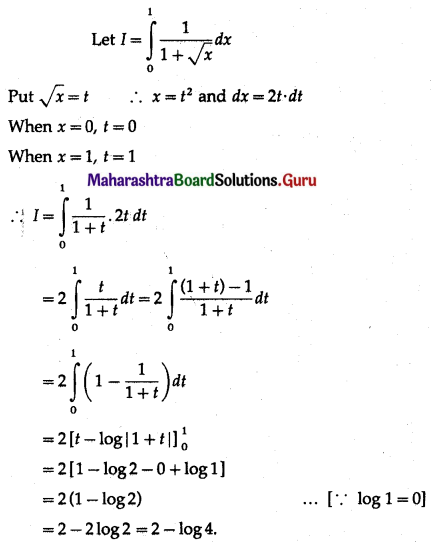
Question (i).
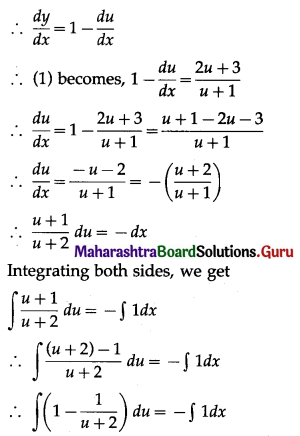
\(\frac{d y}{d x^{2}}+X\left(\frac{d y}{d x}\right)+y=2 \sin x\)
Solution:
The given D.E. is \(\frac{d y}{d x^{2}}+X\left(\frac{d y}{d x}\right)+y=2 \sin x\)
This D.E. has highest order derivative \(\frac{d^{2} y}{d x^{2}}\) with power 1.
∴ the given D.E. is of order 2 and degree 1.

Maharashtra Board 12th Maths Solutions Chapter 6 Differential Equations Ex 6.1

Question (ii).
\(\sqrt[3]{1+\left(\frac{d y}{d x}\right)^{2}}=\frac{d^{2} y}{d x^{2}}\)
Solution:
The given D.E. is \(\sqrt[3]{1+\left(\frac{d y}{d x}\right)^{2}}=\frac{d^{2} y}{d x^{2}}\)
On cubing both sides, we get
\(1+\left(\frac{d y}{d x}\right)^{2}=\left(\frac{d^{2} y}{d x^{2}}\right)^{3}\)
This D.E. has highest order derivative \(\frac{d^{2} y}{d x^{2}}\) with power 3.
∴ the given D.E. is of order 2 and degree 3.

Question (iii).
\(\frac{d y}{d x}=\frac{2 \sin x+3}{\frac{d y}{d x}}\)
Solution:
The given D.E. is \(\frac{d y}{d x}=\frac{2 \sin x+3}{\frac{d y}{d x}}\)
∴ \(\left(\frac{d y}{d x}\right)^{2}\) = 2 sin x + 3
This D.E. has highest order derivative \(\frac{d y}{d x}\) with power 2.
∴ the given D.E. is of order 1 and degree 2.

Question (iv).
\(\frac{d^{2} y}{d x^{2}}+\frac{d y}{d x}+x=\sqrt{1+\frac{d^{3} y}{d x^{3}}}\)
Solution:
The given D.E. is \(\frac{d^{2} y}{d x^{2}}+\frac{d y}{d x}+x=\sqrt{1+\frac{d^{3} y}{d x^{3}}}\)
On squaring both sides, we get
\(\left(\frac{d^{2} y}{d x^{2}}+\frac{d y}{d x}+x\right)^{2}=1+\frac{d^{3} y}{d x^{3}}\)
This D.E. has highest order derivative \(\frac{d^{3} y}{d x^{3}}\) with power 1.
∴ the given D.E. has order 3 and degree 1.

Maharashtra Board 12th Maths Solutions Chapter 6 Differential Equations Ex 6.1

Question (v).
\(\frac{d^{2} y}{d t^{2}}+\left(\frac{d y}{d t}\right)^{2}+7 x+5=0\)
Solution:
The given D.E. is \(\frac{d^{2} y}{d t^{2}}+\left(\frac{d y}{d t}\right)^{2}+7 x+5=0\)
This D.E. has highest order derivative \(\frac{d^{2} y}{d x^{2}}\) with power 1.
∴ the given D.E. has order 2 and degree 1.

Question (vi).
(y”‘)2 + 3y” + 3xy’ + 5y = 0
Solution:
The given D.E. is (y”‘)2 + 3y” + 3xy’ + 5y = 0
This can be written as:
\(\left(\frac{d^{3} y}{d x^{3}}\right)^{2}+3 \frac{d^{2} y}{d x^{2}}+3 x \frac{d y}{d x}+5 y=0\)
This D.E. has highest order derivative \(\frac{d^{3} y}{d x^{3}}\) with power 2.
∴ The given D.E. has order 3 and degree 2.

Question (vii).
\(\left(\frac{d^{2} y}{d x^{2}}\right)^{2}+\cos \left(\frac{d y}{d x}\right)=0\)
Solution:
The given D.E. is \(\left(\frac{d^{2} y}{d x^{2}}\right)^{2}+\cos \left(\frac{d y}{d x}\right)=0\)
This D.E. has highest order derivative \(\frac{d^{2} y}{d x^{2}}\)
∴ order = 2
Since this D.E. cannot be expressed as a polynomial in differential coefficients, the degree is not defined.

Maharashtra Board 12th Maths Solutions Chapter 6 Differential Equations Ex 6.1

Question (viii).
\(\left[1+\left(\frac{d y}{d x}\right)^{2}\right]^{\frac{3}{2}}=8 \frac{d^{2} y}{d x^{2}}\)
Solution:
The given D.E. is \(\left[1+\left(\frac{d y}{d x}\right)^{2}\right]^{\frac{3}{2}}=8 \frac{d^{2} y}{d x^{2}}\)
On squaring both sides, we get
\(\left[1+\left(\frac{d y}{d x}\right)^{2}\right]^{3}=8^{2} \cdot\left(\frac{d^{2} y}{d x^{2}}\right)^{2}\)
This D.E. has highest order derivative \(\frac{d^{2} y}{d x^{2}}\) with power 2.
∴ the given D.E. has order 2 and degree 2.

Question (ix).
\(\left(\frac{d^{3} y}{d x^{3}}\right)^{\frac{1}{2}} \cdot\left(\frac{d y}{d x}\right)^{\frac{1}{3}}=20\)
Solution:
The given D.E. is \(\left(\frac{d^{3} y}{d x^{3}}\right)^{\frac{1}{2}} \cdot\left(\frac{d y}{d x}\right)^{\frac{1}{3}}=20\)
∴ \(\left(\frac{d^{3} y}{d x^{3}}\right)^{3} \cdot\left(\frac{d y}{d x}\right)^{2}=20^{6}\)
This D.E. has highest order derivative \(\frac{d^{3} y}{d x^{3}}\) with power 3.
∴ the given D.E. has order 3 and degree 3.

Maharashtra Board 12th Maths Solutions Chapter 6 Differential Equations Ex 6.1

Question (x).
\(x+\frac{d^{2} y}{d x^{2}}=\sqrt{1+\left(\frac{d^{2} y}{d x^{2}}\right)^{2}}\)
Solution:
The given D.E. is \(x+\frac{d^{2} y}{d x^{2}}=\sqrt{1+\left(\frac{d^{2} y}{d x^{2}}\right)^{2}}\)
On squaring both sides, we get
Maharashtra Board 12th Maths Solutions Chapter 6 Differential Equations Ex 6.1 (x)
This D.E. has highest order derivative \(\frac{d^{2} y}{d x^{2}}\) with power 1.
∴ the given D.E. has order 2 and degree 1.