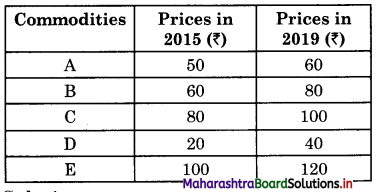
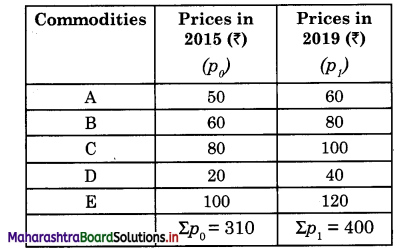
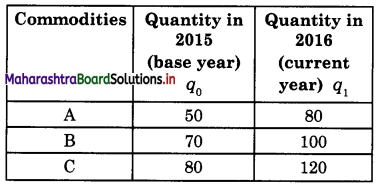
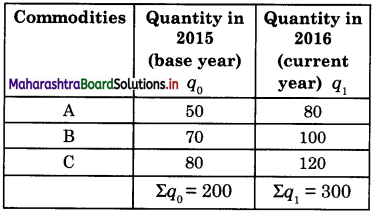
Maharashtra Board Class 12 Economics Important Questions Chapter 9 Money Market and Capital Market in India

Balbharti Maharashtra State Board Class 12 Economics Important Questions Chapter 9 Money Market and Capital Market in India Important Questions and Answers.

Maharashtra State Board 12th Economics Important Questions Chapter 9 Money Market and Capital Market in India

1. A. Choose the correct option:

Question 1.
Money Market is a market for lending and borrowing of ………….. funds.
(a) long term
(b) medium-term
(c) short term
(d) all of these
Answer:
(c) short term

Maharashtra Board Class 12 Economics Important Questions Chapter 9 Money Market and Capital Market in India

Question 2.
The financial system of the country is responsible for ………….. of funds.
(a) mobilization and allocation
(b) distribution of investment
(c) optimum resources
(d) all of these
Answer:
(a) mobilization and allocation

Question 3.
………….. is the only active money market centre in India.
(a) Nagpur
(b) Madras
(c) Mumbai
(d) Kolkata
Answer:
(c) Mumbai

Question 4.
Central Bank has the ………….. of cash reserve of commercial Bank in the country.
(a) monopsony
(b) monopoly
(c) oligopoly
(d) autopsony
Answer:
(b) monopoly

Question 5.
The Central Bank acts as a ………….. of cash reserve of Commercial Bank in the country,
(a) head
(b) leader
(c) custodian
(d) protector
Answer:

Question 6.
………….. is the apex body of the monetary and banking system of Commercial Banks in the country.
(a) Commercial Bank
(b) Central Bank
(c) Government
(d) Co-operative Bank
Answer:
(b) Central Bank

Maharashtra Board Class 12 Economics Important Questions Chapter 9 Money Market and Capital Market in India

Question 7.
Bank rate is ………….. measure of credit control.
(a) quantitative
(b) qualitative
(c) selective
(d) effective
Answer:
(a) quantitative

Question 8.
Reserve Bank of India was established in …………..
(a) 1937
(b) 1936
(c) 1935
(d) 1934
Answer:
(c) 1935

Question 9.
The operation of direct buying and selling of securities by central bank in the money market is called …………..
(a) open market operation
(b) credit creation
(c) moral suasion
(d) closed market operation
Answer:
(a) open market operation

Question 10.
………….. account is opened by businessmen, corporate bodies, etc.
(a) Saving
(b) Current
(c) Fixed
(d) Recurring
Answer:
(b) Current

Question 11.
………….. is a primary function of commercial banks.
(a) Safe deposit vault
(b) Letter of credit
(c) Accepting deposits
(d) Transfer of funds
Answer:
(c) Accepting deposits

Maharashtra Board Class 12 Economics Important Questions Chapter 9 Money Market and Capital Market in India

Question 12.
Every loan creates .
(a) deposits
(b) credit
(c) profit
(d) debit
Answer:
(a) deposits

Question 13.
Enactment of the Co-operative Credit Societies Act .
(a) 1903
(b) 1904
(c) 1905
(d) 1906
Answer:
(b) 1904

Question 14.
was the 1st Development Financial Institution to be established in 1948.
(a) IFCI
(b) IDBI
(c) ICICI
(d) HSCBI
Answer:
(a) IFCI

Question 15.
DFHI was set up on the recommendation of the committee.
(a) Narsimhan
(b) Vaghul
(c) Vaghale
(d) Tandon
Answer:
(b) Vaghul

Question 16.
The activities of unorganized money market are largely confined to the areas.
(a) city
(b) urban
(c) rural
(d) none of these
Answer:
(c) rural

Question 17.
important source of funds in unbanked areas which provide loans directly to agriculture, trade and industry.
(a) Indigenous bankers
(b) EXIM Bank
(c) IDBL
(d) HSCB Bank
Answer:
(a) Indigenous bankers

Question 18.
charge high rate of interest to the people.
(a) RBI
(b) Commercial Bank
(c) Money lenders
(d) LIC
Answer:
(c) Money lenders

Question 19.
………………. short term instruments issued by the RBI on behalf of the government to meet temporary liquidity shortfalls.
(a) Commercial papers
(b) Call money market
(c) Treasury Bills
(d) Commercial Bills
Answer:
(c) Treasury Bills

(B) Complete the Correlation 

  1. RBI was set up : Hilton Young Commission :: DFHI was set up : ………………..
  2. Open market operation : ……………….. :: Moral suasion : Qualitative method
  3. Deposits that are repayable after a certain period of time : Time deposits :: Deposits that are withdrawable on demand : ………………..
  4. Commercial Banks : Credit creation :: ……………….. : Controller of credit
  5. SEBI : 1998 :: NSE : ………….

Answer:

  1. Vaghul committee
  2. Quantitative method
  3. Demand deposits
  4. RBI
  5. 1992

Maharashtra Board Class 12 Economics Important Questions Chapter 9 Money Market and Capital Market in India

(C) Suggest the economic terms for the given statements.

(1) Account that are operated by salaried class and small traders.
(2) Accounts is opened by businessmen, corporation or trust.
(3) Source of funds in unbanked areas which provide loans directly to agriculture, trade and industry.
(4) It is unsecured negotiable instrument in bearer form issued by Commercial banks and Development Finance Institutions.
(5) It is also known as the gilt-edged market.
(6) Market deals with securities already issued by companies.
(7) It act as a link between the investors and the borrower to meet the financial objectives of both the parties.
(8) It deals with the shares and debentures issued by old and new companies.
(9) Market for long term funds.
(10) Fund to promote investors awareness.
Answer:

  1. Saving A/c
  2. Current A/c
  3. Indigenous bankers
  4. Certificates of deposits
  5. Government Securities
  6. Secondary Market
  7. Financial intermediaries
  8. Industrial Securities Market
  9. Capital Market
  10. IEPF

(D) Find the odd word

(1) Financial Instruments :
Bonds, Demand, Equity Shares, Derivatives.
Answer:
Demand

(2) Unorganised Sector :
Indigenous Bankers, Money lenders, Unregulated Non-Bank Financial Intermediaries, Co-operative Banks.
Answer:
Co-operative Banks

(3) Functions of RBI:
Collection and Publication of Data, Controller of Credit, Credit Creation, Bankers Bank.
Answer:
Credit Creation

(4) Functions of Commercial Bank :
Acceptance of Deposits, Lending loans and advances, Credit Creation, Banker’s Bank.
Answer:
Banker’s Bank

(5) Co-operative Credit Structure : State level, District level, Secondary level, Primary level
Answer:
Secondary Level

(6) Money Market Instruments :
Treasury Bills, Certificate of Deposits, Commercial Bills, Discount and Finance House of India.
Answer:
Discount and Finance House of India

(E) Complete the following statements.

(1) Method of withdrawing money without going to the bank is by
Answer:
ATM

(2) The Account in which certain amount of money is deposited every month regularly for a fixed duration is .
Answer:
Recurring A/c

(3) Credit creation is an important function of Bank.
Answer:
Commercial

(4) Saving Bank Account is suitable for people
Answer:
salaried

(5) Higher rate of interest is paid on deposits.
Answer:
Fixed

(6) Currency rate of India to other currency means
Answer:
exchange rate

Maharashtra Board Class 12 Economics Important Questions Chapter 9 Money Market and Capital Market in India

(7) system economies the use of cash.
Answer:
Clearing House

(8) The works as friend, philosopher and guide to Commercial Bank.
Answer:
Central Bank

(9) Bank grants loans to government.
Answer:
Central

(10) When money is borrowed or lent for a day, it is known as
Answer:
Call / Notice money

(11) A well-developed money market ensures successful implementation of the policy.
Answer:
monetary

(F) Choose the wrong pair :

I.

Group ‘A’Group ‘B’
1. Central BankApex Banking Institution
2. Clearing House systemSpecialised institution for agriculture
3. Credit ControlQuantitative measure
4. Money MarketShort term fund

Answer:
Wrong pair : Clearing House system Specialised institution for agriculture

II.

Group ‘A’Group ‘B’
1. Commercial BankAcceptance of Deposit
2. IFCI1948
3. Co-operative Credit Society Act1904
4 Discount and Finance House of India1980

Answer:
Wrong pair : Discount and Finance House of India – 1980

(G) Assertion and Reasoning.

Question 1.
Assertion (A) : Illegal practices have also affected the smooth functioning of capital market. :
Reasoning (R) : Price manipulation or ( price rigging on the other hand means to simply raise the prices of shares through ) buying and selling of shares within certain individual themselves for personal gains. ;
(i) (A) is true, but (R) is false
(ii) (A) is false but (R) is true
(iii) Both (A) and (R) are true and (R) is the correct explanation of (A)
(iv) Both (A) and (R) are true and (R) is not the correct explanation of (A)
Answer:
(iv) Both (A) and (R) are true and (R) is the correct explanation

(H) Choose the correct pair :

I.

Group ‘A’Group ‘B’
Demat Account(a) Commercial Bank
Overdraft(b)Ancillary function
Credit creation(c) 1949
Banking Regulation Act(d) 1935
(e) Amount withdrawn above the actual balance

Ans.
(1)-(b), (2)-(e), (3)-(a), (4) – (c)

II.

Group ‘A’Group ‘B’
Local area Banks(a) RBI
Liquidity Adjustment Facility (LAF)(b) Primary and Secondary markets
Industrial Securities market(c) Money Market
Stock Exchange(d) Capital Market
(e) August, 1996

Answer:
(1)-(e), (2)-(a), (3)-(b), (4) – (d)

Q.2.[A] Identify and explain the concept from given illustrations.

Question 1.
Santosh invested money in share market and the broker does fraud in company.
Answer:
Concept: Financial Scams
Explanation : Financial scams are the frauds and manipulations done by the stock brokers for their personal benefits. Increasing number of financial frauds have resulted in irreparable loss for the capital market.
It also leads to public distrust and loss of confidence among the individual investors.

Question 2.
XYZ Bank Provides cash credit, overdraft facility and loan to its customer.
Answer:
Concept: Providing loans and advances by Commercial Bank
Explanation : Commercial Bank mobilize savings and lend these funds to institutions and individuals for various purposes.
Based on tenures, loans include call loans, short term, medium term and long term loans.
Longer the duration of the loans, greater will be the rate of interest.
Beside this bank also provide cash credit, overdraft facility as well as discounting of bills of exchange.

Maharashtra Board Class 12 Economics Important Questions Chapter 9 Money Market and Capital Market in India

(B) Distinguish between:

Question 1.
Central Bank and Commercial Bank.
Answer:
Central Bank:

  1. The central bank is the apex banking institution whose main function is to control, regulate and stabilise the monetary system of the country in the national interest.
  2. The main function of central bank is to control, regulate and stabilise the banking and monetary system of the country.
  3. It does not deal with public directly. It acts as the banker to government and bankers bank.
  4. It enjoys the monopoly right to print and issue currency notes.
  5. Central Bank controls the credit.
  6. There is only one Central Bank in India. R.B.I. is owned by Government.

Commercial Bank:

  1. A commercial bank is abusiness organisation which basically accepts deposits from public and lends to others who need fund and create credit.
  2. The main function commercial bank is to accept deposits and lend loans and advances.
  3. It deals with the public directly. They are banker to general public.
  4. Commercial banks do not possess such rights.
  5. Commercial banks create credit.
  6. Owned by private or government. There are several commercial banks like State Bank of India, ICICI Bank, Canara Bank, etc.

Question 2.
Quantitative Credit Control and Qualitative Credit Control. (Mar. ’18)
Answer:
Quantitative Credit Control:

  1. This method aims at controlling credit by expanding or contracting the volume of credit in the banking system.
  2. The important quantitative measures to control credit are
    (1) Bank Rate
    (2) Open Market Operation
    (3) Varying Cash Reserve ratio.
  3. During inflation quantitative measures adopt the strategy of contracting the volume of credit so as to reduce money supply. During inflation such methods are applied to encourage expansion of credit and expand money supply.
  4. They are macro economic in nature and influence the whole economy.

Qualitative Credit Control:

  1. It aims at controlling credit by checking the purpose or use of the credit.
  2. Selective control measures include the following:
    (1) Changing the market.
    (2) Regulation of consumer credit
    (3) Issue of directives
    (4) Rationing of credit
    (5) Moral suasion.
  3. The main strategy of selective credit control measures is to ensure that credit money does not reach undesirable and non – productive channels.
  4. They are micro in nature and do not influence the whole economy.

Question 3.
Current Account and Saving Account.
Answer:
Current Account:

  1. This account is usually opened by businessmen, industrial enterprises, public bodies, etc.
  2. This account facilitates regular business transactions.
  3. There is no interest paid on current account.
  4. There is no restriction on withdrawals.

Saving Account:

  1. This account is held by the households, salaried class, small traders, etc.
  2. The main purpose of saving account is to encourage saving habits among people.
  3. The saving account earns a nominal rate of interest.
  4. Withdrawals are allowed subject to certain restrictions.

Question 4.
Fixed Deposits and Saving Deposits.
Answer:
Fixed Deposits:

  1. Fixed Deposits are time bound deposits, where money is deposited for a specific period of time.
  2. The main objective is to earn high interest and to get lumpsum amount on maturity.
  3. It cannot be withdrawn before maturity but one can close the account before maturity with loss of interest.
  4. The rate of interest is high. It can be 6% to 10% depending upon the period of deposit.

Saving Deposits:

  1. Saving deposits are a kind of demand deposits, which is held by households or individuals for the purpose of savings.
  2. Safety is the major objective of saving accounts.
  3. Withdrawals are allowed subject to certain restrictions.
  4. The saving account earns nominal rate of interest. At present it is about 4 to 4.5% per annum.

Question 5.
Current Deposits and Recurring Deposits.
Answer:
Current Deposits:

  1. It is a kind of demand deposit which is mostly held by companies, institutions, government and individual for the sake of business transactions.
  2. It is suitable for business firms for the purpose of transactions.
  3. There are no restrictions on withdrawals.
  4. There is no interest paid.

Recurring Deposits:

  1. These are deposits under which people pay a specified amount at a regular interval of time for a given period of time.
  2. It is suitable for the salaried, poor and lower middle class who can save a certain amount of money regularly every month.
  3. The amount can be withdrawn after a specific period of time.
  4. The interest rate is higher.

Maharashtra Board Class 12 Economics Important Questions Chapter 9 Money Market and Capital Market in India

Question 6.
Current Deposits and Fixed Deposits,
Answer:
Current Deposits:

  1. It is a kind of demand deposit which is usually held by companies, institutions, government and individuals for the sake of business transactions.
  2. There are no restriction on withdrawals.
  3. No interest is paid to current account or deposits.
  4. The main purpose of current account is to facilitate regular transactions.

Fixed Deposits:

  1. Fixed deposits are a kind of time deposits which is deposited for a specific period.
  2. The amount deposited cannot be withdrawn before maturity period.
  3. The rate of interest paid is high.
  4. The main purpose is to get a lumpsum amount on the maturity of the deposit.

3. Answer the following questions :

Question 1.
Explain the reforms introduced in the capital market.
Answer:
Reforms introduced in the Capital Market are as follows :

  • SEBI was established in 1988 and given statutory power in 1992 to protect interest of investors.
  • NSE, the leading stock exchange in India was established in 1992.
  • Introduction of Computerised Screen Based Trading System (SBTS).
  • Introduction of Demat A/c in 1996 to facilitate easy purchase and sale of securities.
  • Increased access to global funds, Indian companies was permitted through ADRs and GDRs.
  • Investors Education and Protection Fund (IEPF) was created in 2001 to promote awareness among investors and protecting the interest of the investors.

Question 5.
What are the reforms introduced in the money market?
Answer:
Following are the reforms introduced in the Money Market:

  • Introduction of New Money Market Instruments : In order to widen and diversify the Indian money market, RBI has introduced many new money market instruments such as 182 Days treasury bills, 364 day treasury bills, CDs and CPs. Through these instruments, the government, commercial banks, financial institutions and corporates can raise funds through the money market.
  • Liquidity Adjustment Facility (LAF) : RBI has introduced LAF for adjusting liquidity through repos and reverse repos to stabilise the short-term interest rates or call rates.
  • Deregulation of Interest Rates : Ceiling on interest rates on the call money and inter bank short term deposits was removed and the rates were permitted to be determined by the market forces.
  • National Electronic Fund Transfer (NEFT) and Real Time Gross Settlement (RTGS) were introduced as an improved payment infrastructure.
  • Electronic dealing system was introduced.

4. State with reasons whether you : agree or disagree with the following statements :

Question 1.
There is four tier co-operative credit l bank structure in India.
Answer:
No, I do not agree with this statement.
There are three tier of credit co- operative bank structure i.e. at –
Primary Level – Primary Co operative Credit Societies.
District Level – District Central Co operative Banks.
State Level – State Co operative Banks.
Maharashtra Board Class 12 Economics Important Questions Chapter 9 Money Market and Capital Market in India 1

Question 2.
Moneymarket consist only unorganised sector in India.
Answer:
No, I do not agree with this statement.
Money market consist organized as well as unorganized sector in India
The organized sector of money market consist of the RBI, Commercial Banks Co-operative Banks, Development Financial Institutions (DFIs) and Discount and Finance House of India (DFHI) and the unorganized sector of money market consist of Indigenous Bankers, Money lenders and Unregulated Non-Bank Financial Intermediaries.

Question 3.
Unit Trust of India was the first development financial institution in India.
Answer:
No, I do not agree with this statement.
Development Financial Institution are agencies that provide medium and long term financial assistance.
They help in the development of industry, agriculture and other key sectors.
In includes many financial institutions, like – ICICI, IDBI, IIBI and UTI.
IFCI was the first development financial institution established in 1948.

Question 4.
Compared to advanced countries, the Indian money market is less developed.
Answer:
Yes, I do agree with this statement.
Indian money market is relatively underdeveloped, when compared to advanced markets like London and New York money markets.
Its main weaknesses are explained as below:

Following are the problems of money market in India:
(a) Shortages of Funds : Generally, there is shortage of funds in Indian Money Market on account of various factors like inadequate banking facilities, low savings, lack of banking habits, existence of parallel economy,- etc. have also been responsible for the paucity of funds in the money market.

(b) Existence of Unorganised Money Market : This is one of the major defects of Indian Money Market. It does distinguish between short term and long term finance, and also between the purposes of finance. Since it is outside the control and supervision of RBI. It limits the RBI’s control over money market.

(c) Delays in technological up-gradation: Use of advanced technology is a pre requisite for the development and smooth functioning of financial markets. Delays in up-gradation of technology hampers the working of the money market.

(d) Absence of Well Organized Banking Sector : Branch expansion was very slow before bank nationalization in 1969. Even now the banks are largely concentrated in large towns and small cities. There is lack of movement of funds. Indian banking system is not yet a well organized sector.

(e) No Uniformity in the rates of interest:
There exists too many rates of interest in the Indian Money Market such as the borrowing rate of government, deposits and lending rates of co-operatives and commercial banks, lending rates of financial institutions, etc. This is due to lack of mobility of funds from one section of the money market to another.

Maharashtra Board Class 12 Economics Important Questions Chapter 9 Money Market and Capital Market in India

5. Answer in detail:

Question 1.
Explain the role of money market in India ?
Answer:
(A) Meaning:
Money market is a market for lending and borrowing short term funds.
It is a market for near money.
It deals in short term instruments like trade bills, government securities, promissory notes, etc.
Money market centres are located at Mumbai, Delhi and Kolkata. Money market consists of organised as well as unorganised sector.

Role of Money Market in India :
1. Portfolio Management : Money market deals with different types of financial instruments which are designed to suit the ( risk and return preferences of the investors. This enables the investors to hold a portfolio of different financial assets which in turn, helps in minimizing risk and maximizing returns.

2. Implementation of monetary policy :
Various monetary policies are implemented by the Central Bank, with an aim to manage the quantity of money, to meet the requirements of different sectors of the economy and to increase the pace of economic growth. Money market ensures successful implementation of these monetary policies. It also guides the central bank in developing an appropriate interest policy.

3. Growth of Commerce, Industry and Trade : Money market facilitates discounting bills of exchange to local and international traders who are in urgent need of short-term funds. It also provides working capital for agriculture and small scale industries.

4. Financial requirements of the Government : Money market helps the Government to fulfil its short term financial requirements on the basis of Treasury Bills.

5. Economizes the use of cash : Money market deals with various financial instruments that are close substitutes of money and not actual money. Thus, it economizes the use of cash.

6. Equilibrating mechanism : Money market helps to establish equilibrium between the demand for and supply of short term funds by allocating rationally the available resources and thus mobilizing the savings of public into fruitful investment channels.

7. Liquidity Management : Money Market, through the monetary authorities facilitates better management of liquidity and money in the economy. This, in turn, leads to economic stability and development of the country.

8. Short-term requirements of borrowers :
Money market provides short-term financial needs of the borrowers at reasonable prices.

Question 4.
Write note on Recent Developments in banking sector.
Answer:
Recent developments in banking sector :

(a) Small Finance Banks : The main aim of small finance banks is to promote financial assistance to small business units, small and marginal farmers, micro and small industries and other unorganised sectors of the economy.
It also assists with high technology at low cost of operations.

(b) Payments Banks : Payment banks are like other banks only, but they operate on a smaller scale without involving any credit risk.
It can carry almost all banking operations but cannot advance loans or issue credit cards.
It can accept deposits upto ₹ one lakh.
It can offer following services to its customers – remittance services, mobile payments, ATM facility, Debit cards, net banking, etc.

(c) Universal Banks : Universal banks refer to those banks that offer a wide range of financial services like commercial banking and investment banking and also offer other services, especially insurance service. It is a multipurpose and multi-functional financial supermarket providing both banking and financial services through a single window.

(d) Local Area Banks : Local area bank scheme was introduced in August, 1996. It was established to mobilize rural savings by private local banks and make them available for investments in the local areas. This helps to bridge the gap in credit availability and strengthens the institutional credit system in the rural and semi-urban areas.

Maharashtra Board Class 12 Sociology Solutions Chapter 5 Social Movements in India

Balbharti Maharashtra State Board Class 12 Sociology Solutions Chapter 5 Social Movements in India Textbook Exercise Questions and Answers.

Maharashtra State Board Class 12 Sociology Solutions Chapter 5 Social Movements in India

1A. Complete the following statements by choosing the correct alternative given in the brackets and rewrite it.

Question 1.
The Chipko Movement is for ____________ (women’s empowerment, labour rights, saving the environment)
Answer:
saving the environment

Maharashtra Board Class 12 Sociology Solutions Chapter 5 Social Movements in India

Question 2.
The Bhartiya Lok Dal was started in the year ____________ (1954, 1964, 1974)
Answer:
1974

1B. Correct the incorrect pair and rewrite it.

Question 1.
(a) Women’s Movement – Gender equality
(b) International Decade of Women – From 1991-2001
(c) Towards Equality – Report on the Status of Women in India
(d) Feminist Movements – India after Independence
Answer:
(b) International Decade of Women – 1975-1998

1C. Identify the appropriate term from the given options in the box and rewrite it against the given statement.

S. A. Dange, Sarala Devi, Medha Patkar

Question 1.
Leader of Narmada Bachao Andolan.
Answer:
Medha Patkar

Question 2.
Significant role in the Trade Union Movement.
Answer:
S. A. Dange

1D. Correct underlined words and complete the statement.

Question 1.
The first Kisan Congress held in 1935 led to the establishment of the United Trade Union Congress.
Answer:
The first Kisan Congress held in 1935 led to the establishment of the All India Kisan Sabha.

Maharashtra Board Class 12 Sociology Solutions Chapter 5 Social Movements in India

Question 2.
The Women’s Indian Association was formed in Bombay.
Answer:
The Women’s Indian Association was formed in Madras.

2. Write short notes.

Question 1.
Farmers’ Movement
Answer:
Early Agitations: the early part of British rule was marked by an exploitative revenue system and zamindari system. Many small cultivators lost their rights over their hereditary land and resources. The famines and natural calamities during this period increased Indebtedness and exploitation This led to massive discontent among farmer Several revolts like the Deccan riots against money lenders, the upsurge by Bengal tenants against Zamindari, the Punjab Kisan struggles against money lenders, etc, took place during this period, two peasant struggles led by the National Congress the Champaran Struggle in Bihar against Indigo planters and the Satyagraha movement of the peasants in against collection of land revenue in a situation of crop failure

The emergence of Kisan Sabhas: many Kisan Sabhas were organised in Bengal, Punjab, and Uttar Pradesh to revolt against the initiative taken by the Congress party to support the interests of landlords. The Kisan Sabha movement started in Bihar under the leadership of Swami Sahajanand Saraswati, to oppose zamindari system Two struggles of the peasantry of the Bardoli district (Gujarat) broke out in succession which resulted in the formation of the All India Kisan Sabha (ALKS) at the Lucknow session of the Indian National Congress in April 1936. In Punjab, the farmers’ movement erupted under the leadership of Raja Mahendra Pratap. The Ghadar party played a very important role in mobilising farmers and peasants of Punjab together. In Gujarat, Mahatma Gandhi led the struggle of poor farmers against the British government in Kheda. In the Southern belt, the struggle erupted against the Forest Law. This phase is also characterized by the worsening of peasant position.

Post-Independence period: During this period the unrest was felt in the States were agriculturally, commercially developed States like Punjab, Haryana, Uttar Pradesh, Maharashtra, Gujarat, Karnataka, and Tamil Nadu, the movement became more organised, under Charansingh He opposed heavy mechanisation.the Bharatiya Kranti Dal (BKD) and the Bhartiya Lok Dal (BLD) in 1974. In 1973 a convention of farmers was held in New Delhi, followed by another convention in 1978. Which presented a 20-point charter of demands to the government like representation of farmers on decision-making bodies, bridging the imbalance between agriculture and industry, etc., In 1980, the formation of the Shetkari Sangatana under the leadership of Sharad Joshi and Karnataka Rajya Ryot Sangh under the leadership of M. D. Nanjundaswamy are milestones in the Farmers’ movement in India. With the processes of industrialization and globalisation, conditions have changed rapidly for farmers. In March 2018, thousands of farmers from different parts of Maharashtra got together to march to Azad Maidan (Mumbai), to convey to the government their grievances and frustrations.

Maharashtra Board Class 12 Sociology Solutions Chapter 5 Social Movements in India

Question 2.
Characteristics of Social Movement
Answer:
Social movement means when a group of people come together in an organized way, in order to bring change in society. Social Movements are different in nature, features, pace, and operations.

The important characteristics of Social Movements are:
Essentially collective in nature: Social movement is not an individual action. It involves collective action. A group collectively has to be part of the movement. A collective action that creates interest and awakening in a relatively large number of people.

Planned and deliberate action: Social movements have to be preplanned to be executed effectively. Movements are deliberate initiatives and not spontaneous or sudden in nature.

Ideology and objectives: A social movement is backed by an ideology. The ideology guides the course of the movement. There are set objectives and goals to achieve to bring about change in the social system.

Social change: Social movements are oriented towards bringing about a change. It usually demands a change in the already established order or it resists change initiated by the authorities.

Leadership: Collective action must be marked by some degree of organisation. The organisation must include leadership and a structure that defines how members relate to each other, make decisions and how to carry them. Leaders are must for guidance and person who influences others to accomplish the mission.

3. Write differences.

Question 1.
Pre-Independence and Post-Independence periods of the Women’s Movement in India.
Answer:

Pre-Independence period of women’s movementPost-Independence period of women’s movement
(i) Pre-Independence period of the women’s movement overlapped with the Social Reform Movement in many ways.(i) Post-Independence period of the women’s movement witnessed several issues like tribal unrest, economic crisis, which took away the singular focus of the women’s movement.
(ii) Pre-Independence movements challenged the customary practices which were discriminatory and revolted mainly against human rights violations in the form of Sati and ill-treatment of widows.(ii) Post-Independence movements focused more on violence against women, sex stereotyping, and further legislative demands for equality of women.
(iii) Pre-Independence movements were led by social reformers like Raja Rammohan Roy, Jyotiba Phule, Maharshi Karve, and so on.(iii) Post-Independence movements have mobilised masses in the form of women’s organisation, NGOs, SEWA, etc.
(iv) Pre-Independence movement needed the voice of others (social reformers) for the problems to be spoken.(iv) Post-independence movement women are educated and aware and are ready to speak up for themselves.
(v) Pre-Independence movement lacked revolutionary social media.(v) Social media plays a major role during the Post-Independence movement where these movements can reach across the globe and mobilised the youth on a large scale.
(vi) The Pre-Independence movement was more of a socio-religious movement.(vi) The Post-Independence movement was more progressive in nature.

4. Explain the following concepts with examples.

Question 1.
Social Movement
Answer:
A social movement is a collective action to change or influence the existing social system by a group. Herbert Blumer has defined the social movement as “Collective enterprises to establish a new order of life.”

A social movement is defined as a collectively acting with some continuity to promote ore resist a change in the society or group of which it is a part. Some movements are directed to modify certain aspects of the existing social order whereas others may aim to change it completely.

A social movement is an organised effort of a large group of people to achieve a particular goal typically a social or political or political one, this may be to carry out resistance or undo a social change.

It is a collective challenge to the authorities organised group of people to come together to establish a new order of life.

Examples

  • Environmental movements like the Chipko Movement and Narmada Bachao Andolan organised to protect and preserve our environment.
  • Workers movement to protest against the exploit action done on workers like the minimisation of wages, poor working conditions, etc. by the industrialisation factory owners.
  • Reform Movements – Arya Samaj, Satyashodhak Samaj, Peasant Movements, Backward Castes Movement, etc.

Question 2.
Environmental Movement
Answer:
Gadgil and Guha have defined Environmental Movement as, “An organised social activity consciously directed towards promoting sustainable use of the natural resource, halting environmental degradation or bringing about environmental restoration.” The terms Green Movement, Conservation Movement are also used alternatively to refer to the Environmental Movement.

Environmental Movement, is centered around a genuine concern for the conservation and improvement of the habitat around us, more specifically the environment and civilization.

Environmental Movement as an organized social activity consciously directed towards promoting sustainable use of natural resources halting Environmental degradation or bringing about Environmental restoration.

Environmental Movement has utilized non-violent ways to fight on issues like sustainable management of natural resources, protection of the Environment many movements are centered on ecology, tribal rights, human rights, ecofeminism, etc.

Environmental Movements are highly organised, its scope is wide ranges from being local to the global level.

The environmental movement surrounds issues related to ecology, health, human rights, tribal rights eco-feminism etc.

Harsh Sethi has presented five prominent categories of struggles associated with environmentalism, namely

  • forest and forest resources
  • land use
  • water
  • anti-dam
  • against different types of pollution and marine resources.

Examples
The Chipko Movement took place in 1973 in the Chamoli district of Uttarakhand where villagers and women in large numbers hugged the trees where the contractors reached the villages to cut the tree. This was to protest against deforestation and save the forest.
Narmada Bachao Andolan – When it was realised that the building of a dam would deprive local inhabitants of their livelihood and displace them, the need to mobilsed and protest against such a venture was felt. In 1985, the Narmada Bachao Andolan (NBA) emerged as one of the powerful resistance movements under the leadership of Medha Patkar.

5A. Complete the concept map.

Question 1.
Maharashtra Board Class 12 Sociology Solutions Chapter 5 Social Movements in India 5A Q1
Answer:
Maharashtra Board Class 12 Sociology Solutions Chapter 5 Social Movements in India 5A Q1.1

6. Give your personal response.

Question 1.
Has the study of Environmental Education had any effect on your behaviour?
Answer:
The study of environmental education has promoted pro-environmental behaviour which plays important role in solving the problem of the environment. It has increased concern about global and local environmental problems and issues.

Maharashtra Board Class 12 Sociology Solutions Chapter 5 Social Movements in India

Environmental education has created awareness about various environmental issues like how industrialisation and development have led to deforestation and after problems like various pollution, land sliding degradation that endangers our human life and society Above all it has made me release there is need to protect and preserve our environment.

It has helped me to engage in environmental activism like taking shorter showers, reducing private transport, etc. It has taught us how to use the present and future resources optimally to avoid further depletion of the ozone layer, global warming, etc.

Field trips and cleanliness drive camp has taught us to keep our surrounding clean and preserve our natural resources for future. Environmental education has promoted a sense of community involvement in me and has helped me to understand how nature works.

Question 2.
Why is it important to raise social concerns through social movements?
Answer:

  • In democratic societies, collective voice on various issues like rights, welfare, and well-being of people has brought changes in society.
  • Social movements are collective actions of organised groups who have goals or a demand to change the existing system.
  • For instance, during the women’s movement when various issues of consent like equal rights, education, women’s empowerment were raised they demanded a change in the existing system of authority.
  • The result of their protest brought various changes. The Constitution of India and Indian law laid down measures for the protection of women’s rights, all these have improved the position of women in present times.
  • So, when social concern is raised through social movement, it brings about changes in all aspects of society.

7. Answer the following question in detail. (About 150-200 words)

Question 1.
‘Social movements play an important role in bringing about changes in society. With reference to this statement, choose any two different social movements that you have studied and comment on:
(i) The Issues related to the movement, and
(ii) How the movement has brought about changes in Indian society.
Answer:
A social movement is an organized effort by a significant number of people to change or resist change. It is a collective action where individuals work tirelessly for months, years, or decades together to change that has mobilised the social structure and social system of the society.

The two movements that had a great impact in changing Indian society are:
(i) Women’s Movement
Women have suffered for countless centuries. The Women’s Movement is divided into three phases they are as follows:
The first phase covers the period of the 19th century where various social reformers like Raja Rammohan Roy, Jyotirao Phule. Justice Govind Ranade and many reformers. Who challenge the unwanted customs like Sati, child marriage, widow remarriage, etc., their efforts and supports of British legislation various laws were enacted like Sati Prohibition Act (1829), The Widow Remarriage Act (1856), The Female Infanticide (Prevention) Act (1870) and so on.

Maharashtra Board Class 12 Sociology Solutions Chapter 5 Social Movements in India

The second phase of the movement gave a new look to the Women’s Movement, it leads to women participating in the liberation of women and freedom movement till the 20th century.

Feminists like Margaret Cousins formed the Women’s Indian Association, they came up with new ideas about education for women. Participation of women in various national movements like civil disobedience, satyagraha’s, non-cooperation movement, etc., and the influence of Gandhian philosophy inspired women to speak up for themselves.

The third phase of the Women’s Movement shifted towards equality issues of patriarchy, violence against women, crime, dowry deaths, etc. In this phase, various women’s organisations, NGOs, etc. participated to fight for women’s rights and injustice done to them.

In the fourth phase, women from different walks of life joined their hands together in the mission of women’s empowerment in India, summarise women’s movements in India has certain ideologies and objectives like women’s liberation, right to education, struggle for equal rights, violence against women’s and their empowerment. These have changed the position of women in India to a great extent.

(ii) Workers Movement in India
Industrialization not only boomed the Indian economy but brought two classes in society i.e., the industrialist and the working class.

Modern Industry thrives on profit, this brought exploitation of workers. This occurred in terms of extraction of work, minimization of wages, long hours of work, delays in promotion, reduced wages, and poor working conditions.

These issues led to the formation of the Worker’s Movement in India.

The first phase of protest was a group of workers without planning and organization. In 1875 Shapurji Bengalee revolted against bad conditions of labour, his efforts resulted in the enactment of the First Factories Act 1881.

Narayan Meghaji Lokhande known as the father of the Indian workers’ movement set up the first workers’ organization in India i.e., The Bombay Mill hands association 1884, highlighted the problems of workers and passed resolutions to improve the conditions.

The second phase saw the formation of the Trade Union. Strikes became a Powerful Weapon in hands of labour, several strikes were seen from 1918 to 1920.

The Industrial disputes forced to organized Trade Union in India i.e., the establishment of AITUC- All India Trade Union Congress 1926, under the chairmanship of Lala Lajpat Rai, Bombay Textile Labour Union by N. M. Joshi first union to gets its recognition under Act in 1926.

Maharashtra Board Class 12 Sociology Solutions Chapter 5 Social Movements in India

Trade unions diversified on different ideologies, in order to bring in different coordination’s the National Trade Union Federation (NTUF) was established. Still, there were differences of opinion, in 1947s the Indian National UNION Congress (INUC) was established to safeguard and promote the rights of workers. Various trade unions emerged when Congress came into power, like the Bharatiya Mazdoor Sangh (BMS), United Trade Union Congress (UTUC), and so on.

There were strikes and disputes between management and factory workers meantime came the Industrial Dispute Act of 1947, which used mechanisms like conciliation, arbitration, and adjudication, to resolve the conflicts between management and workers.

The workers’ movement lost its momentum after the 1970s. Textile industries went on strikes, the Great Bombay Textile Strike 1982, under the leadership of Datta Samant. The demands of the workers were a hike in wages, bonuses, scrapping of the Bombay Industrial act of 1947. The strike lasted for a long time and resulted in a negative impact on the industrial relations between labour, industry, and the government.

Further in recent times, the Ministry of Labour gave recognition to central trade union organizations like AITUC, INTUC, AND SEWA.

To sum up, the worker’s movement, began with philanthropists working for the betterment of workers, later on, workers themselves became leaders who started fighting for the workers’ rights, the role of government to solve disputes with globalization the role of the government has altered.

Activity 1 (Textbook Page No. 70)

Small group discussion: Form groups of 5-7 students. Identify various forms of social injustice that you have observed in your village/town/locality. Make a list of the same. Find out names of various organisations that work to remove such injustices or which create awareness about the injustices. (For example, the problems faced by disabled persons, or migrants.)
Answer:
List of social injustice found in Indian society.
The caste system, poverty, child labor, child marriage, low status of women, gender inequality at work, dowry system, the problem faced by women, the problem faced by slum children, migrants, disabled, etc.

(i) Social injustice seen among slum children’s
Form of social injustice we see in our nearby slum area such as lack of proper sanitation, safe drinking water, shortage of space, lack of quality education in municipal schools, high proportion of girls are dropouts to support their family, they work as domestic maids. Though there are legal measures to protect human rights we see child labour is on rampant in slums.

Smile Foundation, beginning in the corridors of education, it has adopted a lifecycle approach with intensive programmes which addresses the needs of less privileged children, their families and the larger community.

Maharashtra Board Class 12 Sociology Solutions Chapter 5 Social Movements in India

Asha for education projects deal with educational issues from pre-primary schooling to professional education in locations from urban slums to isolated rural areas.

(ii) The problem faced by migrants
Migrants are more vulnerable to discrimination and exploitation as many of them are poor, illiterate, and live in slums and hazardous locations prone to disaster and natural calamities. There is a lack of urban policies and programmes catering to the needs and settlements of migrants.

The National Domestic Workers’ Movement.

(iii) Challenges faced by disability
Disabled face problem of loss of independence, transportation, accessibility issue, loss of independence, education, employment etc.

Narayan Seva Sansthan, established in 1985, is a non-profit charitable organization based in Udaipur, Rajasthan. It is known for providing philanthropic services in the field of treatment and rehabilitation of polio-affected people without discrimination of religion, region, caste, or gender.

Activity 2 (Textbook Page No. 72)

Find out about women’s groups/NGOs in your locality (e.g. anganwadi women teachers, lesbian women, Dalit women’s groups, Muslim women’s organisations). Visit their organisation to find out about the work that they do. You may interview the group members or their volunteers, to find out about the nature of their work or outreach programmes, problems they face etc. Present your findings in class. Initiate a discussion.
Answer:
(i) Self Employed Women’s Association: SEWA is a trade union registered in 1972. It is an organisation of poor, self-employed women workers. These are women who earn a living through their own labour or small businesses. They do not obtain regular salaried employment with welfare benefits like workers in the organised sector. They are the unprotected labour force of our country. Constituting 93% of the labour force, these are workers Of the unorganised sector. Of the female labour force in India, more than 94% are in the unorganised sector. However, their work is not counted and hence remains invisible.

(ii) National Federation of Dalit Women (NFDW): All India Dalit Women Forum and Maharashtra Dalit Mahila Sangasthan etc., address the issues of women empowerment from socially marginalized communities.

Activity 3 (Textbook Page No. 75)

Form groups of 6 students. Identify a workers’ movement in your locality or region. Make a PPT of 12 slides. The content should provide information on how they were established, the significant persons associated with the movement, their major output or successes, the challenges they faced. Make your presentation in class. All group members should discuss a minimum of 2-3 points. The presentation may be followed by a Q&A session.
Answer:
The National Domestic Workers’ Movement [Registered as National Domestic Workers’ Welfare Trust under the Bombay Public Trust Act 1950, Regd. No. E-17253-(Mumbai)] has been at the forefront of championing the rights of domestic workers, children in domestic work and migrant domestic workers, since 1985. It was founded by Dr. (Sr.) Jeanne Devos.
NDWM encourages empowerment of domestic workers through solidarity, participation and leadership training. Together we work for the labour rights of domestic workers, seeking dignity and justice.

Maharashtra Board Class 12 Sociology Solutions Chapter 5 Social Movements in India

The challenges faced by them are:

  • The stigmatisation of domestic workers and their work.
  • Total absence of Rights and Legal protection.
  • Absence of training, support and bargaining power.

The objectives of the movement are:

  • Dignity for domestic work and domestic workers.
  • Rights and Legal Protection.
  • Support and empowerment.

Activity 4 (Textbook Page No. 77)

Collect newspaper and journal reports on farmer suicides in the past year. Display this information on your class bulletin board.
Answer:
Articles on farmer’s suicide for reference
The geography of farmer suicide
Vishnu Padmanabhan, Pooja Dantewadia | Livemint | Updated : Jan 16, 2020

12 Nashik farmers ended lives in’ 20 so far, 63% drop since last year
Abhilash Botekar | TNN | Times of India | Updated : May 26, 2020

10,349 farmers committed suicide in 2018 : NCRB
PTI | Last Updated Jan 09, 2020 | The Economic Times

Activity 5 (Textbook Page No. 80)

(A) Have you heard of Greta Thunberg? Discuss the effect of her activism.
(B) View the film ‘Lakir ke is Taraf by Shilpa Ballal.
Then have a class discussion.
Answer:
(A) Swedish climate youth activist Greta Thunberg, has received worldwide recognition for her efforts to fight climate change. With the simple message “School strike for climate” handwritten on poster board, she began skipping school on Fridays and protesting outside the Swedish Parliament. Thanks to social media, her actions have spread and influenced millions of young people all over the world to organise and protest.

(B) ‘Lakir ke is taraf a documentary made by Shilpa Ballal, highlights some of the concerns surrounding the Sardar Sarovar Project that led to the beginning of the Narmada Bachao Andolan in 1985. It is 85 minute documentary which enables viewers to understand the situation through the lens of the disadvantaged villagers, who were compelled to leave their ancestral property and witness the submergence of their homes, land and cattle.

Activity 6 (Textbook Page No. 81)

(i) Identify any 5 conservation/environmental initiatives (e.g. Go Green, Save the Forests, Save Aarey, Eco-friendly Ganpati)
(ii) Make group presentations in class about their aims, objectives, and activities.
(iii) This may be followed by a class discussion or home assignment.
Answer:
(i) Swachh Bharat Abhiyaan, is a mass movement launched by Prime Minister Narendra Modi in 2014, develops the responsibility among Indian citizens to keep our surroundings clean and to achieve Mahatma Gandhiji’s aim to clean India.

Maharashtra Board Class 12 Sociology Solutions Chapter 5 Social Movements in India

(ii) Namami Gange Programme Narendra Modi took over as the Prime Minister of India in 2014. In June that year, recognizing the cultural and environmental importance of the river Ganga, the ‘Namami Gange Programme’ was approved by the Union Government.

(iii) Project Tiger, is a tiger conservation programme launched in April 1973 by the Government of India during Prime Minister Indira Gandhi’s tenure. The project aims at ensuring a viable population of Bengal tigers in their natural habitats, protecting them from extinction, and preserving areas of biological importance as a natural heritage.

Maharashtra Board Class 12 Sociology Solutions Chapter 6 Social Problems in India

Balbharti Maharashtra State Board Class 12 Sociology Solutions Chapter 6 Social Problems in India Textbook Exercise Questions and Answers.

Maharashtra State Board Class 12 Sociology Solutions Chapter 6 Social Problems in India

1A. Complete the following statements by choosing the correct alternative given in the brackets and rewrite it.

Question 1.
The Domestic Violence Act was passed in the year ___________ (1995, 2005, 2011)
Answer:
2005

Maharashtra Board Class 12 Sociology Solutions Chapter 6 Social Problems in India

Question 2.
One of the causes of farmer suicide is ___________ (multi-cropping, indebtedness, climate change)
Answer:
indebtedness

1B. Correct the incorrect pair and rewrite it.

Question 1.
(a) Marijuana – Drug addiction
(b) Violent films – Internet addiction
(c) Selfitis syndrome – Substance addiction
(d) Country liquor – Alcohol addiction
Answer:
(c) Selfitis Syndrome – Mobile addiction

1C. Identify the appropriate term from the given options in the box and rewrite it against the given statement.

Narcotic drugs, Patriarchy, Gender discrimination

Question 1.
A problem faced by transgender persons,
Answer:
Gender discrimination

Question 2.
It can lead to physical health problems.
Answer:
Narcotic drugs

1D. Correct underlined words and complete the statement.

Question 1.
Alcoholics Anonymous helps drug addicts.
Answer:
Narcotic Anonymous helps drug addicts

Maharashtra Board Class 12 Sociology Solutions Chapter 6 Social Problems in India

Question 2.
Aging is an artificial process.
Answer:
Aging is a natural process.

2. Write short notes.

Question 1.
Effects of addiction
Answer:
Addiction means, a situation of psychological and physical dependence on alcohol, drugs, the internet, or mobiles.
The psychological effect on the individual: Addiction leads to a dependency on alcohol, narcotic drugs, medicinal drugs, the internet, social media, and even mobile phone. There could emerge a need for validation for every single image that is uploaded.

Impact on family: Alcohol addiction problems pose a threat to stable family life resulting in domestic violence. Addiction to mobiles can lead to loneliness within the family because of a lack of communication.

Impact on health: The levels of stress, anxiety, and aggression can take their toll on the physical, mental and emotional well-being of addicts as well as others in the family.

Impact on work: it can adversely affect levels of commitment, efficiency, an increase in instances of sexual harassment, exploitation of vulnerable people, inability to focus on any activity, increased absenteeism, etc.

Question 2.
Measures to tackle the problem of aging.
Answer:
Aging is an inevitable and irreversible biological process.
Role of the Government – The Ministry of Social Justice and Empowerment has the responsibility to formulate policies and implement programmes for the care of the aged.

POLICY – The National Policy on Older Persons (NPOP) envisages support from the state government towards older persons’ care via. the provisions of shelter, support, healthcare facilities, etc.

Role of organizations/NGOs – NGOs HAVE contributed significantly towards helping the problem of the aged in India. For example, in Help Age India, Harmony India Today there are online communities that can lend support.

Maharashtra Board Class 12 Sociology Solutions Chapter 6 Social Problems in India

Role of Education – Schools can help through community service projects, outreach programmes, socially useful productive work and NSS create awareness about the problems of the elderly, aged, and senior which can inculcate values of caring for them.

Role of Family – Parents, and relatives can play a major role in creating a suitable atmosphere within the involving them in activities.

Above are the measures which we can implement to tackle the problem of aging.

3. Write differences.

Question 1.
Social Problem and Individual Problem
Answer:

Social ProblemIndividual Problem
(i) Meaning: A social problem is faced by numerous persons is described as a social problem.(i) Meaning: A problem that is faced by an individual and his/her family is described as an individual problem.
(ii) Effects: Anti-social norms behaviour is considered as a social problem as it affects the wellbeing of the entire society.(ii) Effects: An individual’s own habit, lethargy, inertia, personality is an individual problem that may affect the well-being of an individual, thus the cause of the problem rests with the individual.
(iii) Solution: Removal of social problems requires collective efforts to the wellbeing of the entire society.(iii) Solution: The efforts of the concerned individual may be sufficient to save his/her problem.
(iv) Nature: A social problem is rooted in the individuals who constitute the society. When the problem of poverty is tackled, the problem of poor individuals gets solved.(iv) Nature: When the scope of a personal problem enlarges and is faced by numerous individuals, it becomes a social problem, e.g. Unemployment
(v) For example, Ageing, Unemployment, Farmers’ Suicide, Domestic Violence, Addiction, corruption, overpopulation are social problems.(v) For example, lack of job opportunities, matching one’s education or skills, conventional mindsets of a community, lack of political will, etc., are individual problems.

Question 2.
Mobile addiction and Drug addiction
Answer:

Mobile addictionDrug addiction
(i) Nature: It refers to an obsession with mobile phones for various reasons, and a desire to constantly upgrade one’s mobile phone.(i) Nature: It refers to a physical and biological dependence on drugs which leads to unpleasant symptoms when the person stops using the substance.
(ii) Causes Easy access to the internet due to which it is flooded with information, misuse of mobile phones for destructive, negative, and vested purposes.(ii) Causes Peer pressure, curiosity, personal and psychological conditions such as depression/inferiority/superiority complex.
(iii) Effect: Almost constantly on call, cybersex addiction, online compulsions, virtual relationships, etc., are the effects of mobile addiction.(iii) Effect: Dependency on drugs, stress, anxiety, aggression or irritability can take its toll on addicts. Inability to focus on activity etc., are the effects of drug addiction.
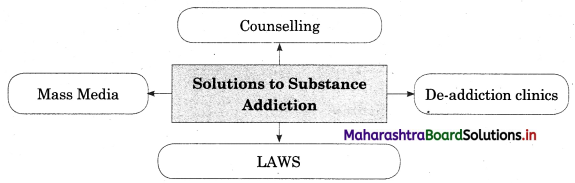
(iv) Measures: Self-assessment, getting involved in participative activities such as hobby classes, sports and games can help in building positive experiences for individuals which can help to tackle mobile addiction.(iv) Measures: Creating awareness among the public, counseling, laws, drug addiction clinic, mass media, etc., are the measures to tackle drug addiction.

4. Explain the following concepts with examples.

Question 1
Domestic Violence
Answer:

  • Domestic violence refers to abuse within the family, violence implies psychological, emotional, verbal, and physical torture. It is a repeated/habitual pattern of behaviour. Domestic violence cuts across all classes, ages, categories, stress, and genders.
  • Causes of domestic violence are patriarchal system, dysfunctional, relationships, vulnerability, etc.
  • It is necessary to create awareness of the fact that domestic violence is not acceptable in a civilised 21st-century society.
    Examples: Snide remarks, bickering, labelling, verbal spats, and physical assault.

Question 2.
Skill Development
Answer:

  • Skill development refers to the identification of skill gaps and developing the existing skills to enable a person to achieve his/her goals so that there will be no more problems of unemployment due to lack of adequate skills.
  • The current generation lacks the required skills and there is a humongous gap between the skills existing in a person and the skills demanded by the industry.
  • Hence there is a desperate need to cultivate skills especially those which are employment worthy or those which can promote self-employment, and develop the entrepreneurial potential of the learners.

Maharashtra Board Class 12 Sociology Solutions Chapter 6 Social Problems in India

For Example Rashtriya Uchchatar Shiksha Abhiyan (RUSA), the salient feature of which is to enable institutions of higher education for capacity building in different fields of employment, communication skills, analytical and research skill,s, etc.

5A. Complete the concept map.

Question 1.
Maharashtra Board Class 12 Sociology Solutions Chapter 6 Social Problems in India 5A Q1
Answer:
Maharashtra Board Class 12 Sociology Solutions Chapter 6 Social Problems in India 5A Q1.1

5B. State whether the following statements are True or False with reasons.

Question 1.
Technology is always useful for social progress.
Answer:
This statement is False.

Though technology produces skilled workers, good quality material and well-paid job opportunities, materialistic comfort, easy travel, communication of media, easy access to information, and present opportunities for social progress. It has an adverse impact too.

The Internet has given us access to data which is good for many reasons but the internet also is a means to an entire virtual world which can be problematic it may lead to internet addiction when there is a compelling need on the part of an individual to have to continuously access specific internet sites for gaming, adult sites, pornography, social media, entertainment, and stimulation.

Similarly, if one goes beyond a mobile phone like a gadget, to what the phone does for us, it opens a Pandora’s Box of possibilities like connectivity, social media networking, gaming, access to the web world, filming, editing, creative enterprises, and numerous apps serving a variety of needs which creates mobile addiction. It develops an urge to be on a call constantly and a habit of checking one’s messages during sleep also leads to anxiety caused by loss of one’s phone and contacts. Thus, technology can take a toll on mental and physical well-being too.

Question 2.
There is a strong causal relationship between addiction and socialisation.
Answer:
This statement is True.

Peer groups, family, neighbourhood, society, mass media are important agencies of socialisation. Generally, individuals do not opt consciously to become an ‘addict’. It is what they become over a period of time. Under the influence of several factors.

Maharashtra Board Class 12 Sociology Solutions Chapter 6 Social Problems in India

Peer pressure and social status – Friends in a group may knowingly or unknowingly pressurize others to adopt certain habits in order to ‘fit in’ which is common among students but it can also cut across other age categories e.g., the habit of smoking or ‘doing weed’ among friends.

Consuming narcotic drugs or imported brands of alcohol may be considered a fad in certain groups; non-conformity could lead to isolation or labelling. Thus, friends play important role in socialising addictive behaviour.

6. Give your personal response.

Question 1.
Why do you think women are usually the victims in most reported cases of domestic violence?
Answer:

  • Yes, most women are the victims in most reported cases of domestic violence.
  • Due to the patriarchal system in which says unwritten acceptance of male authority.
  • Religious outlook and traditional mind are set especially in institutions like marriage, family, religion which gives supremacy of men over women in almost every sphere of life.
  • Economic dependency of women on men.
  • And women are most vulnerable in the weaker sections of society.
  • So, I think women are usually the victims in most reported cases of domestic violence.

Question 2.
Discuss how keeping aged parents in a ‘Home for the Aged’ can have positive and negative consequences.
Answer:
Any statement/matter has two sides i.e., positive and negative. Same way keeping aged parents in a ‘Home for the aged’ can have positive and negative sides.
(i) First, we see the positive side:

  • In the 21st century, couples both go to work in that case to get the proper care they prefer ‘Home for the aged’
  • In these old age homes, elderly people meet many people of their age, this allows them to make new friends with whom they can talk and do various group activities.
  • Old age home provides food on time and health care facility also.

(ii) Negative side:

  • The materialist world and individualistic approach force people to depend on Home for Aged for taking care of their aging parents, depriving them of their responsibilities towards them.
  • It’s the youngster’s duty to care for our old people and handle their needs.
  • Most of the old age homes are lack basic amenities, so instead of caring for elderly persons, they may get face vulnerability in old age homes.

7. Answer the following question in detail. (About 150-200 words)

Question 1.
Discuss why farmers’ suicide is a social problem today. Suggest suitable socio-economic measures to support the farmers.
Answer:
India is described as an agrarian society, 70% Indian population is involved in agrarian work. Farmers are the pillar of the Indian agrarian workforce. The past decade has witnessed an increasing number of farmer suicides. Farmer suicide is a serious social problem. Farmer’s suicide is a social problem because it has an adverse impact on their families, spouse, children, economy, and society at large.

Following are the social-economic measures to support farmers:
Support to farmers in distress: Farmers need a support system to help them with various crises that arise due to irregular monsoons, crop failure, failure, indebtedness, etc.

Insurance: Life insurance for distressed farmers and this family and crop insurance against crop failure, failure of monsoons, destruction of agricultural produce by locusts or viruses, etc., should be provided to farmers.

Maharashtra Board Class 12 Sociology Solutions Chapter 6 Social Problems in India

Provisions for direct sales from farmers to buyers: Removal of middlemen, agents, brokers who grab a large share of the profits and leaving a meager sum for marginal/small farmers who actually put their sweat to grow the crop.

Water harvesting: Water is a basic and essential requirement for farming so for good yield. Effective measures for water harvesting and water management are necessary.

Role of banks: Banks and cooperative credit societies need to set up their systems in farmer-friendly ways. The disbursement of loans to farmers and also need to encourage a saving habit among farmers.

Multi cropping: Farmers need a strong support system from the government to provide training to farmers for growing two or more crops on the same piece of land in the same growing season.

Class 12 Sociology Chapter 6 Social Problems in India Intext Questions and Answers

Check your progress (Textbook Page No. 85)

Question 1.
State any three problems faced by the aging population.
Answer:
Problems faced by the aging population

  • Economic dependence
  • Lack of emotional empathy
  • Isolation / loneliness
  • Difficulty in accepting the aging problem

Maharashtra Board Class 12 Sociology Solutions Chapter 6 Social Problems in India

Question 2.
Suggest three measures for the problems faced by senior citizens.
Answer:

  • Government should formulate policies and implement programs for senior citizens.
  • Family should create a suitable atmosphere in the home, involving them in activities within the home.
  • Creating awareness via. Social media in the society will widely spread the country and hopefully, old age homes will close down and the young generation will take care of their parents.

Check your progress (Textbook Page No. 88)

Question 1.
In your opinion what do you think our educational system needs to do to solve the problem of unemployment among youth and young adults?
Answer:

  • There should be a change in the educational system, it should become need-based and learner-centered.
  • Education should cultivate skills apart from knowledge, which is employment-worthy, or those which can promote self-employment.
  • Vocational training.
  • Industry-Education symbiosis.

Question 2.
Give two reasons why unemployment is unhealthy for a democratic society.
Answer:

  • Unemployment leads to anti-social activities.
  • It leads to youth towards addiction.
  • Impact on mental health like frustration, disappointment, etc.

Question 3.
Is there a connection between population growth and unemployment? Discuss in brief.
Answer:
Yes, growing population growth is connected to other unemployment. The rising population is accompanied by rising in the labour force of the society which leads to a substantial chunk of the population to unemployment. Due to this, there is an imbalance between employment opportunities and popularity growth.

Maharashtra Board Class 12 Sociology Solutions Chapter 6 Social Problems in India

Check your progress (Textbook Page No. 91)

Question 1.
Discuss how multi-cropping will help farmers.
Answer:

  • Multi cropping is the practice of sequentially growing two or more crops in the same piece of land during one growing season instead of just one crop.
  • It allows farmers to achieve a better result by making practical use of resources such as soil, water, fertilizers, etc.
  • Utilization of nutrients is maximum as crops having different nutritional requirements and grows simultaneously in the same piece of land.

Question 2.
Why do you think there is a problem with irrigation? Give two reasons.
Answer:

  • Delays in completion of irrigation projects.
  • Inter-state water disputes.
  • Regional disparities in irrigation development.
  • Waterlogging and salinity.
  • The increasing cost of irrigation.

Question 3.
Discuss the role of counselling in tackling the problem of farmer’s suicide.
Answer:

  • Counselling plays a significant role in alleviating stress and helping depressed farmers to improve their self-esteem.
  • The cause of farmer suicide is mental stress, caused by debt, crop failure, social evil dowry, etc.
  • Counselling helps to relieve mental stress and develop self-esteem among farmers.

Check your progress (Textbook Page No. 93)

With reference to the ‘Bell Bajao Andolan’.

Question 1.
Show the usefulness of such a campaign.
Answer:
Bell Bajao campaign was launched in India on 20th August 2008, founder of this campaign is Malaika Dutta.
It is an anti-social domestic violence campaign that gives local residents to take and stand against physical abuse through simple acts means to interrupt domestic violence.

  • It is a great initiative that makes people stand against violence and fight for their rights.
  • Such a campaign can create awareness even if 15% of people support this initiative it could reduce the number of domestic violence in India. India contains a number of cases against domestic violence.
  • More than 200,000 phone calls are placed to the domestic violence hotline every year. Such initiative can decrease the number of domestic violence from 50% to 1%. If we spread this awareness to a large number.

Maharashtra Board Class 12 Sociology Solutions Chapter 6 Social Problems in India

Question 2.
What do you think is required for such a campaign to take off?
Answer:

  • To gear up Bell Bajao campaign there should be initiative taken from men or a boy.
  • The role of mass media plays a vital role for to create awareness about the Bell Bajao campaign.
  • Without any hesitation, victims should take help then and then only domestic violence can be under control and the campaign motto will be successful.

Question 3.
Do you think such a campaign will succeed in metropolitan cities? Justify your response.
Answer:
Yes, in a metropolitan city’s chances are more than 40% will get success, in the campaign. As compared to rural India, in metropolitan cities literate and understanding, the heterogeneous public is more which is, that they are highly exposed to the materialistic world. Since they have easy access to social media via. internet, T.V, mobile phones. So as per my opinion awareness created through mass media about this campaign will conveniently reach metropolitan cities and it will result in remarkable success in this campaign.

Check your progress (Textbook Page No. 98)

Question 1.
If you know a friend who has an addiction problem. What role can you play to help the person?
Answer:
If my friend is addicted, I will try to help him to get rid of it.

  • Involved him in a group activity.
  • Will explain to him the negative effects and harmful to the body so that he will get alert, which means I will do counselling for my friend.
  • Will ask him to develop some new hobbies like playing, dancing, etc.
  • I will talk with his parents and will take their help to lead my friend towards a normal life.
  • If any medical help is required then only I will avail health care facility to my friend.

Question 2.
Suggest two co-curricular activities that can be conducted in your school to solve the problem of mobile addiction.
Answer:

  • Introduction to dramatics
  • Elaborating library facility
  • Sports
  • Nature surfing
  • Encouragement to performing Art- Dance, Music

Question 3.
Identify three negative consequences of internet addiction.
Answer:
Consequences of internet addiction:

  • Lack of communication
  • Self-centeredness
  • Lack of confidence
  • Depression
  • Anxiety

Maharashtra Board Class 12 Sociology Solutions Chapter 6 Social Problems in India

Activity 1 (Textbook Page No. 83)

Hold a class discussion to share the problems faced by the aging population. Speak to your family members and share inputs.. If you can, speak to the elderly/aging people in your neighbourhood, informally and share these insights too.
Answer:
(i) Problems faced by the ageing population.

  • Older people are experiencing remarkable changes in their physical and social-economic circumstances. In nuclear families, they are gradually marginalised in the decision-making process. Hence, the family that traditionally took care of the elderly or sick people, widows, and orphans have started to rely on society as a whole.
  • Getting older or ageing process can seem daunting cause greying hair, wrinkles, forgetting the things apart from this ageing can bring about unique health issues.

(ii) Some of the problems faced by ageing people are listed down.

  • Chronic health condition
  • Physical injury
  • Malnutrition
  • Oral health
  • Less immunity
  • Mental health
  • Cognitive health
  • Sensory impairment
  • Loss of bladder control and constipation
  • Organ failure

Activity 2 (Textbook Page No. 85)

Form groups of 10 students. Each group collects data from 10 persons in your neighbourhood. Prepare a tool for data collection and use a personal interview technique or questionnaire to find out about their families: the size of family, educational level of each member, whether they are employed or not. Write a group report of about 10-15 pages. Present your findings in class.
Answer:
Sample of a survey/questionnaire
Topic-Research on unemployment
Gender…….
Age……….
No of members in family……
Yes/No Questions

  • Are you working?
  • Are you unemployed by choice?
  • Is there a minimum level of wage below which you will not work?
  • Are you trying to establish your own business?
  • Are all the educated adults in your house employed?
  • Is the market scenario difficult to get a well-paid job?

Maharashtra Board Class 12 Sociology Solutions Chapter 6 Social Problems in India

Activity 3 (Textbook Page No. 88)

Interview 5 working adults in the age group 22-30, in your local area. Find out about their educational background, work-life, and aspirations in life. Do you see any pattern in the responses that you receive? Discuss these in class.
Answer:

Person 1Person 2Person 3Person 4Person 5
NameXYZAB
Age3028232823
ResidenceWorliWorliWorliWorliLower Parel
QualificationS.S.CB.ComH.S.CB.Sc.B.Com
Work-lifeTailor stitching trousers, shirts, blazers as per customers demand. Design clothes on a computer also.Garment merchant purchasing raw material, finishing the garment.No job [Playing cricket]Chemist Own medical shop at Parel ‘Kumar Bros. Medical’Financial manager in India Bulls, Parel. Analysis of target, monitoring cash flow, back-office service, etc.
Aspirations in life/ambitions in lifeFond of music wanted a career in music.Wanted to become a famous merchant.Want to become a famous cricketer and wanted to play for the nation.To focus on my medical shop.No ambition, now at a good post and happy in that position.

Activity 4 (Textbook Page No. 93)

Find out information about the ‘Bell Bajao AndoiaiT. Then, enact a small skit in your class.
Answer:
According to the national family health survey (NFHS), 37% of Indian women’s have been abused and harassed by their husbands almost 50% of the Indian population both men and women believe that it is okay and even justifiable that man beat up their wives which is okay but which is actually not.

“Bell Bajao Andolan” this campaign was launched in India on 20th August 2008. Bell Bajao Andolan is an anti-domestic violence campaign that gives local residents to take and stand against physical abuse through simple acts means to interrupt domestic violence. This campaign promotes individual action against domestic violence. The founder of this initiative was Malaika Dutt.

In India Bell Bajao Andolan was an initiative that men have to take against domestic violence act is the campaign sought to reduce the occurrence of domestic violence and discrimination against women.

Activity 5 (Textbook Page No. 96)

Class Discussion:
The impact of Internet addiction and mobile addiction on human life.
Answer:
Smartphone/mobile addiction, sometimes colloquially known as “nomophobia” which means fear of being without a mobile phone, is often fueled by an Internet overuse problem or Internet addiction disorder.

Impact of internet and mobile addiction on human life:

  • Virtual relationships
  • Cybersex addiction
  • Anxiety
  • Lack of confidence
  • Self-centeredness
  • Information overload
  • Online compulsions
  • Depression
  • Lack of communication
  • Stress

Maharashtra Board Class 12 Sociology Solutions Chapter 6 Social Problems in India

Activity 6 (Textbook Page No. 97)

Prepare a 7-10 minute street play on The problem of internet addiction. End with a message of hope. Perform the street play on your campus and then in your neighbourhood. (After taking necessary permissions).
Answer:
Students can perform a street play to create awareness about problems of internet addiction keeping in mind the following points to pass on as a message.

Everyone these days are hooked to their mobile phones. While we may overlook this as a common behaviours in the current times, the truth is that it has deep behavioural and social impacts. It impacts our health, relationships as well as work. People suffering from mobile addiction suffer from nomophobia which is the fear of being without or unable to use your mobile phone for some reason or the other.

Activity 7 (Textbook Page No. 98)

Make a list of 10 students’ activities that can be carried out in their leisure time. Find out from 10 of your peers about the activities they would take up, at least once every week. Tabulate your findings and share them with your class.
Answer:

StudentActivities
Student No. 1Watching Netflix, Amazon Prime, playing PUBG
Student No. 2Drawing, Doing exercise, Playing PUBG
Student No. 3Studying, interested in political news, video chat with friends
Student No. 4Doing exercise, watching TV, cooking different dishes
Student No. 5Using DIY ideas for home, video chat with friends, watching Netflix
Student No. 6Helping parents for household work, playing video games
Student No. 7Working in mall
Student No. 8Attending online classes of Std. 12th, doing craft activities
Student No. 9Handling fruit shop, watching TV
Student No. 10Helping parents in farming work, doing domestication of animals in the village

Activity 8 (Textbook Page No. 100)

View 10-15 Television advertisements and analyse the extent to which advertisements promote or reinforce: gender stereotypes. Also, try to find out advertisements that do not present gender stereotypes.
Have a class discussion after viewing select advertisements.
Answer:
In the world, the biggest platform to influence people is none other than television. Television has been used in society for awareness campaigns such as for Polio, Literacy, Covid-19, etc., but as we know every coin has two sides. Similarly, this platform is misused by many companies for their vested interests.

Example:
In the advertisement of a fairness cream, it implies that only fair women are beautiful and only they can climb the ladder of success, and if they are dark or brown then you won’t be successful and aren’t considered beautiful.

Simply for the sale of their product, these companies resort to blatant racism and age-old gender stereotypes, indirectly stressing that women should be fair.

Some examples of advertisements that do not present gender stereotypes are Sasa detergent powder, Rambandhu papad masala, Bajaj LED bulbs, etc.

Maharashtra Board Class 12 Sociology Solutions Chapter 6 Social Problems in India

Activity 9 (Textbook Page No. 100)

Important legislation is taking shape in the Maharashtra Legislation Assembly regarding the situation of women’s sugarcane cutters of the Beed district. Many of them have undergone ‘hysterectomy’ or removal of the uterus. Collect information and discuss it in class.
Answer:
Beed district: In the sugarcane cutter community, menstrual periods are considered a problem and they think surgery is the only option to get rid of it. Women in Vanjarwadi village said, 50% of women who have had hysterectomies say that it is the norm in villages to remove the uterus after having two or three children.

The (Mukadam) contractor is keen to have women without wombs in his group of cane cutters. As per the contractors, menstrual periods make the cutting process slow, so there is no question of taking leave for a day or two, and work is halted. A contractor cannot afford to lose even a rupee.

Due to the removal of the uterus, there is a serious impact on the health of women, such as hormonal imbalance, mental health issues, gain weight, etc.

Action- of government: Maharashtra government has decided to make health check-up compulsory for them before and after the sugar cane cutting season.

Maharashtra Board Class 12 Sociology Solutions Chapter 6 Social Problems in India

The government has asked doctors to submit a monthly report on the hysterectomy operations conducted by them.

Maharashtra Board Class 12 Sociology Important Questions Chapter 3 Diversity and Unity in Indian Society

Balbharti Maharashtra State Board Class 12 Sociology Important Questions Chapter 3 Diversity and Unity in Indian Society Important Questions and Answers.

Maharashtra State Board 12th Sociology Important Questions Chapter 3 Diversity and Unity in Indian Society

1A. Complete the following statements by choosing the correct alternative given in the brackets and rewrite it.

Question 1.
India is a ___________ country. (homogenous, secular, non-religious)
Answer:
secular

Question 2.
Dr. B.S. Guha classifies the population of India into ___________ main racial groups. (four, five, six)
Answer:
six

Question 3.
___________ tends to bring together people of the faith to celebrate commonly cherished festivals and
events. (Race, Religion, Caste)
Answer:
Religion

Maharashtra Board Class 12 Sociology Important Questions Chapter 3 Diversity and Unity in Indian Society

Question 4.
In ___________ Indian States were organized on a linguistic basis. (1947, 1971, 1956)
Answer:
1956

Question 5.
The Constitution of India has approved ___________ Official languages. (20, 27, 22)
Answer:
22

Question 6.
21st February 2017 was declared as an International ___________ Language Day by the United Nation. (Mother, Father, Spiritual)
Answer:
Mother

Question 7.
___________ refers to territorial entities found within the country. (Religion, Language, Region)
Answer:
Region

Question 8.
Sharing of natural resources gives the people a sense of ___________ unity. (religious, cultural, geographical)
Answer:
geographical

Question 9.
___________ examines the role of religion in social integration as a binding force among individuals and groups. (M. N. Srinivas, Iravati Karve, G. S. Ghurye)
Answer:
M. N. Srinivas

Question 10.
___________ refers mainly to loyalty to one’s own religion before the nation. (Casteism, Communalism, Regionalism)
Answer:
Communalism

Question 11.
Indian States have been divided on a ___________ basis. (religious, caste, linguistic)
Answer:
linguistic

Maharashtra Board Class 12 Sociology Important Questions Chapter 3 Diversity and Unity in Indian Society

Question 12.
___________ is built into the fabric of society and passed down from one generation to the next. (Equality, Inequality, democracy)
Answer:
inequality

Question 13.
The spirit of tolerance promotes ___________ (economic growth, national integration, diversity)
Answer:
national integration

Question 14.
Economic disparity means ___________ distribution of wealth. (normal, uneven, even)
Answer:
uneven

Question 15.
India is federal Union comprising of ___________ states with seven union territories. (29, 30, 28)
Answer:
29

Question 16.
Language plays an important role of ___________ in an organisation. (interest, communication, transport)
Answer:
communication

Question 17.
Caste an example of ___________ (equality, inequality, none)
Answer:
inequality

Question 18.
___________ refers to loyalty to one’s own religion before nation. (Casteism, Communalism, Linguism)
Answer:
Communalism

Question 19.
Unity implies a sense of oneness meaning ___________ (uniformity, integration, identity)
Answer:
integration

Question 20.
After independence India has adopted ___________ system. (presidential, federal, dictatorship)
Answer:
federal

Question 21.
In the constitution of India there are ___________ fundamental rights. (six, seven, eight)
Answer:
six

Question 22.
State were formed on the linguistic basis in the year ___________ (1956, 1951, 1947)
Answer:
1956

Maharashtra Board Class 12 Sociology Important Questions Chapter 3 Diversity and Unity in Indian Society

Question 23.
___________ is a multi-religious Country. (India, Bangladesh, China)
Answer:
India

Question 24.
India has always ___________ different cultures. (assimilated, diversified, obstructed)
Answer:
assimilated

Question 25.
Thrissurpuram is the festival held which state ___________ (Tamil Nadu, Kerala, Karnataka)
Answer:
Kerala

Question 26.
A large section of the tribal population of India live in ___________ State. (North eastern, southern, western)
Answer:
Noth eastern

Question 27.
Gender expression is linked to gender ___________ (culture, biology, socialisation)
Answer:
socialisation

Question 28.
___________ implies respect and tolerance for people of all faiths. (communalism, secularism, casteism)
Answer:
secularism

Question 29.
The Constitution of India, allows affirmative action through ___________ in education and employment. (discrimination, reservation, tolerance)
Answer:
reservation

B. Correct the incorrect pair and rewrite it.

Question 1.
(a) Kerala – Onam
(b) Tamil Nadu – Pongal
(c) Punjab – Baisakhi
(d) Assam – Makar Sankranti
Answer:
(d) Assam – Bihu

Question 2.
(a) North – Badrainarayan
(b) South – Rameshwaram
(c) East – Golden Temple
(d) West – Dwarka
Answer:
(c) East – Puri

Maharashtra Board Class 12 Sociology Important Questions Chapter 3 Diversity and Unity in Indian Society

Question 3.
(a) Hindus – Diwali
(b) Muslims – Muharram
(c) Christians – Christmas
(d) Parsi – Easter
Answer:
(d) Parsi – Pateti

Question 4.
(a) Secularism – Sarvadharmasamabhav
(b) Linguism – Language patriotism
(c) Communalism – Religious patriotism
(d) Religionism – Excessive attachment of one’s own caste
Answer:
(d) Religionism – Excessive attachment of one’s own state

Question 5.
(a) Kaveri water dispute – Linguism
(b) Babari – Masjid demolition – Communalism
(c) Unequal distribution of wealth – Economic inequalities
(d) Caste-based vote banks – Casteism
Answer:
(a) Kaveri water dispute – Regionalism

Question 6.
(a) Sanskrit, Kashmiri, Hindi, Bengali – Indo-Aryan
(b) Telugu, Kurukh, Oraon, Maler – Dravidian
(c) Himalayan and Bhutia Languages – Austro-Asiatic
(d) Aka – Jeru, Ongan and Sentinelese – Andamanese
Answer:
(c) Himalayan and Bhutia Languages – Sino-Tibetan

Question 7.
(a) The Three Language Formula – Religious unity
(b) The rule of law – Political unity
(c) Celebration of festivals – Cultural unity
(d) Sharing of natural resources – Geographical unity
Answer:
(a) The Three Language Formula – Linguistic unity

Maharashtra Board Class 12 Sociology Important Questions Chapter 3 Diversity and Unity in Indian Society

Question 8.
(a) ‘Below Poverty Line’ – Private property
(b) Private school differences – Educational differences
(c) The mall culture – Social environment
(d) Capacities and capabilities – Individual differences
Answer:
(a) ‘Below Poverty Line’ – Family influence

1C. Identify the appropriate term from the given options in the box and rewrite it against the given statement.

Unity, Language, Race, Regionalism, Class, Gender fluidity, North East, Jajmani, Sexuality, Culture, Egalitarian society, Secularism, Kannada, Northeast, Ethnocentrism, Totalitarianism.

Question 1.
The state of togetherness and oneness.
Answer:
Unity

Question 2.
A classical language of India.
Answer:
Kannada

Question 3.
A group of people with set distinctive physical features.
Answer:
Race

Question 4.
The region comprises seven sisters.
Answer:
East North

Question 5.
Relating to another person physically, emotionally and/or sexually.
Answer:
Sexuality

Question 6.
Those who do not limit themselves within the binary.
Answer:
Gender fluidity

Question 7.
The exchange of goods and services between various jatis.
Answer:
Jajmani

Maharashtra Board Class 12 Sociology Important Questions Chapter 3 Diversity and Unity in Indian Society

Question 8.
People belonging to different religious feel that their religion is superior.
Answer:
Ethnocentrism

Question 9.
Respect and tolerance for people of all faith.
Answer:
Secularism

Question 10.
Loyalty to one’s own state or region before one’s nation.
Answer:
Regionalism

Question 11.
It is based on the principle of cultural integration.
Answer:
National Anthem

Question 12.
It is caused by Religious fundamentalism.
Answer:
Terrorism

Question 13.
Malnutrition deaths of infants.
Answer:
Below Poverty Line

1D. Correct underlined words and complete the statement.

Question 1.
In Kolkata, the festival of lights (Diwali) is celebrated along with the Parsis Festival of Lights (Hannukah).
Answer:
In Kolkata, the festival of lights (Diwali) is celebrated along with the Jewish Festival of Lights (Hannukah).

Question 2.
700 jatis are classified under the Scheduled Caste communities.
Answer:
750 jatis are classified under the Scheduled Caste communities.

Maharashtra Board Class 12 Sociology Important Questions Chapter 3 Diversity and Unity in Indian Society

Question 3.
Religion has become a means for competing for access to resources and power in modern India.
Answer:
Caste has become a means for competing for access to resources and power in modern India.

Question 4.
Communalism leads to Inter-State rivalries.
Answer:
Regionalism leads to Inter-State rivalries.

Question 5.
In all societies, we see economic equality.
Answer:
In all societies, we see economic inequality.

Question 6.
When people are identified on the basis of wealth, education and job is caste.
Answer:
When people are identified on the basis of wealth, education and job is class.

Question 7.
In traditional Indian society, importance was given to achieved status.
Answer:
In traditional Indian society, importance was given to ascribed status.

Question 8.
Due to racial discrimination, women are denied many rights privileges and opportunities that they deserve.
Answer:
Due to gender discrimination, women are denied many rights privileges, and opportunities that they deserve.

Question 9.
Class diversity is observed in various fields like costumes tradition, food, habits, norms, values, festivals, and lifestyle.
Answer:
Cultural diversity is observed in various fields like costumes tradition, food, habits, norms, values, festivals, and lifestyle.

Maharashtra Board Class 12 Sociology Important Questions Chapter 3 Diversity and Unity in Indian Society

Question 10.
Indians have faith in dictatorships.
Answer:
Indians have faith in democracy.

Question 11.
Regional fundamentalism can lead to acts of terrorism.
Answer:
Religious fundamentalism can lead to acts of terrorism.

Question 12.
Disputes created among the racists are the distribution of river water, constructions, dams, demand separate states, etc.
Answer:
Disputes created among the regions/states are the distribution of river water, constructions, dams, demand for separate state etc.

Question 13.
Many regions of south India disapprove of the acceptance of English as an official language.
Answer:
Many regions of south India disapprove of the acceptance of Hindi as an official language.

Question 14.
Religion participation is required to conserve language diversity.
Answer:
Community participation is required to conserve language diversity.

Question 15.
The role and significance of Chhatrapati Shivaji Maharaj are well-established in Gujarat.
Answer:
The role and significance of Chhatrapati Shivaji Maharaj are well-established in Maharashtra.

2. Write short notes.

Question 1.
Secularism
Answer:
Given the nature of our religious plurality, the concept of secularism in India fosters a modern outlook showing religious tolerance. In India, secularism implies respect and tolerance for people of all faiths, beautifully encapsulated in the term, ‘Sarva dharma samabhav’.

India has been and continues to be a land with multiple faith systems. This necessarily includes acceptance of people who do not subscribe to any religious identity, custom or practice, but who may express their loyalty and commitment to secular values such as scientific endeavor, humanitarianism, humanism, and so forth.

Maharashtra Board Class 12 Sociology Important Questions Chapter 3 Diversity and Unity in Indian Society

The term secularism implies respect and tolerance for people of all faith. The concept of secularism dates back to 2300 years ago by emperor Ashoka the term ‘Sarva Dharma Samabhav’ is one of the most cherished Indian values it is one of the biggest achievements of a democratic country. Secularism is a simple word that refers to an ideology that provides people with the right to follow any religion. It means separate religion from political, economic, social, and cultural aspects of life.

The constitution of India gives the right of freedom to all religions, protects the belief patterns and values of their religion. It permits the state with the responsibility to maintain neutrality in matters of religion. Secularism states that no one shall be subject to discrimination by any state or any social institution on grounds of religion or belief patterns.

Living in a secular state brings faith and acceptance of people from different religious backgrounds. In this way, secularism fosters a modern outlook showing religious tolerance, humanity and promotes the integration of all people in society.

Question 2.
Linguistic Unity
Answer:
Linguistic Unity means that every language in the country whether regional or national language must be treated equally. The Indian State recognizes linguistic diversities and makes special provisions to protect and support some of the languages and dialects that are on the verge of extinction.

People speaking different languages have been living harmoniously without any conflicts. The three-language formula followed by all State Education Boards enables the inculcation of Hindi and English as languages to connect with the Union, English to connect with the outside world, and the regional/local language for communication within the State.

As per the policy the three languages recommended were:

  • 1st language: Regional Language or Mother Tongue.
  • 2nd language: English or Modern Indian Language (in Hindi speaking States) Hindi or English (in non-Hindi speaking States)
  • 3rd language: English or Modern Indian Language (in Hindi speaking States)

Classical languages and languages of linguistic minorities have also found a place in the educational curriculum

Many educational bodies offer learners the option of answering their examinations in a range of mediums (e.g. Marathi, Hindi, Urdu, Gujarati, Kannada, English). Doordarshan and Akashwani have programmes in multiple Indian languages that reach out to millions of persons. These are measures that promote a sense of linguistic unity among multi-lingual people of the land.

Maharashtra Board Class 12 Sociology Important Questions Chapter 3 Diversity and Unity in Indian Society

Question 3.
Process of Unity in India
Answer:
At the root of all the co-existing diversities, there exists an underlying unity. This has created a composite culture decisively pan-Indian in nature. In India, secularism implies respect and tolerance for people of all faiths. India has been and continues to be a land with multiple faith systems

Following are the unifying factors in India:
Geographical unity: one would find unity in the agrarian cycles such as the sowing season and the harvest season. Sharing of natural resources gives people a sense of oneness. Festivals such as Onam in Kerala, Makar Sankrant in Western and South India, Pongal in Tamil Nadu, Baisakhi in Punjab, and Bihu in Assam revolve around the harvest season.

Religious Unity: Although various religious groups in India present external differences, there are some commonly shared elements. India is a land of diverse religious faiths. Religious unity in India finds its expression through places of worship scattered all over the country.

Political Unity: National unity and integrity have been maintained even though sharp economic and social inequalities have obstructed the emergence of an egalitarian society. The Five-Year Plans and several developmental schemes were geared towards uplifting the poor and weaker sections of society. The Constitution of India has established the “rule of law” throughout the country. All citizens are equal and subject to the same authority.

Linguistic diversity: The Indian State recognizes linguistic diversities and makes special provisions to protect and support some of the languages and dialects that are on the verge of extinction. The three-language formula followed by all State Education Boards enables the inculcation of Hindi and English as languages to connect with the Union, English to connect with the outside world, and the regional/local language for communication within the States.

3. Write differences.

Question 1.
Religious diversity and Caste diversity
Answer:

Religious diversityCaste diversity
(i) Meaning: Religious diversity means people practicing different religions living together Religions like Hinduism, Jainism, Buddhism, Christianity, Islam, Zoroastrianism, and Sikhism have flourished in India.(i) Meaning: There is caste diversity in India with four varnas or caste groups Caste diversity means people belonging to different castes living together.
(ii) Sub Division: Each major religion is subdivided along the lines of religious doctrines, sects, and cults.(ii) Sub Division: There are thousands of castes and subcastes in India.
(iii) Features: Each religion has its own philosophy, ideology, and rituals.(iii) Features: Each caste has its own lifestyle, rituals, festivals, and deities.
(iv) Impact: This diversity leads to communalism i.e. loyalty to one’s own religion leads.(iv) Impact: This diversity creates a negative and conservative attitudes and leads to casteism i.e. extreme loyalty to one’s own caste.
(v) Result: It creates a feeling of insecurity and gives rise to communal tensions.(v) Result: It breaks up the solidarity and creates disunity.
(vi) Function: Religion tends to bring together people of the faith to celebrate commonly cherished festivals and events.(vi) Function: The different castes functioned in an interdependent barter relationship which was the basis of the agrarian economy.

Question 2.
Gender Binary and Gender Diversity
Answer:

Gender BinaryGender Diversity
(i) Meaning: Gender binary is the classification of gender into two distinct, opposite forms of masculine and feminine, due to the social system.(i) Meaning: Gender diversity go beyond gender binaries of female-male, masculine and feminine, etc
(ii) Socialization: It results in Gender stereotypes determining people’s beliefs about the characteristics of males and females.(ii) Socialization: It results in gender plurality which seeks to identify all gender identities or expressions in addition to the binary.
(iii) Approach: It excludes non-conformists, and supports patriarchal values.(iii) Approach: It has an inclusive approach and promotes Constitutional gender equality.
(iv) Effect: It results in the dominance of heteronormativity in society and in all its institutions.(iv) Effect: It results in acceptance of gender fluidity.

4. Explain the following concepts with examples.

Question 1.
Regionalism
Answer:
Regionalism refers to loyalty to one’s own State or region before one’s nation. This interferes with national integration to a great extent. The history of a particular region is glorified and often it is misused to stress divisive forces, thus ignoring the common cultural legacy and heritage.

Regionalism emerges due to the desire of people speaking one language to have one State. There is also a strong urge to give priority to the economic development of one’s own region. This leads to Inter-State rivalries. So long as this Inter-State rivalry is economic and social (e.g. for funds and welfare schemes), it is healthy.

Maharashtra Board Class 12 Sociology Important Questions Chapter 3 Diversity and Unity in Indian Society

But when this rivalry takes political overtones, it becomes very dangerous. Political parties give more importance and weightage to local and regional matters and problems rather than the nation. Regionalism thus strengthens sectarian biases by political parties. Inter-regional tensions escalate over economic, political, and such issues. This has led to regional movements for State rights and militant movements for separatism.

Example: The Jammu and Kashmir issue, the Punjab problem, Assam issue, etc. All this, if unchecked, can strike at the very root of democracy.

Question 2.
Linguistic Unity
Answer:
Linguistic unity means that every language in the country, whether regional or national language, must be treated equally. The Indian State recognizes linguistic diversities and also makes special provisions to protect and support some of the languages and dialects that are on the verge of extinction.

Classical languages and languages of linguistic minorities have also found a place in educational curricula. Many educational bodies offer learners the option of answering their examinations in a range of mediums (e.g., Marathi, Hindi, Urdu, Gujarati, Kannada, and English). Doordarshan and Akashwani have programmes in multiple Indian languages that reach out to millions of persons who tune in to them. These are measures that promote a sense of linguistic unity among multi-lingual people of the land.

Example: The three-language formula followed by all State Education Boards enables the inculcation of Hindi and English as languages to connect with the Union, English to connect with the outside world, and the regional/local language for communication within the State.

5A. Complete the concept map.

Question 1.
Maharashtra Board Class 12 Sociology Important Questions Chapter 3 Diversity and Unity in Indian Society 5A Q1
Answer:
Maharashtra Board Class 12 Sociology Important Questions Chapter 3 Diversity and Unity in Indian Society 5A Q1.1

Question 2.
Maharashtra Board Class 12 Sociology Important Questions Chapter 3 Diversity and Unity in Indian Society 5A Q2
Answer:
Maharashtra Board Class 12 Sociology Important Questions Chapter 3 Diversity and Unity in Indian Society 5A Q2.1

Maharashtra Board Class 12 Sociology Important Questions Chapter 3 Diversity and Unity in Indian Society

Question 3.
Maharashtra Board Class 12 Sociology Important Questions Chapter 3 Diversity and Unity in Indian Society 5A Q3
Answer:
Maharashtra Board Class 12 Sociology Important Questions Chapter 3 Diversity and Unity in Indian Society 5A Q3.1

Question 4.
Maharashtra Board Class 12 Sociology Important Questions Chapter 3 Diversity and Unity in Indian Society 5A Q4
Answer:
Maharashtra Board Class 12 Sociology Important Questions Chapter 3 Diversity and Unity in Indian Society 5A Q4.1

Question 5.
Maharashtra Board Class 12 Sociology Important Questions Chapter 3 Diversity and Unity in Indian Society 5A Q5
Answer:
Maharashtra Board Class 12 Sociology Important Questions Chapter 3 Diversity and Unity in Indian Society 5A Q5.1

Question 6.
Maharashtra Board Class 12 Sociology Important Questions Chapter 3 Diversity and Unity in Indian Society 5A Q6
Answer:
Maharashtra Board Class 12 Sociology Important Questions Chapter 3 Diversity and Unity in Indian Society 5A Q6.1

Question 7.
Maharashtra Board Class 12 Sociology Important Questions Chapter 3 Diversity and Unity in Indian Society 5A Q7
Answer:
Maharashtra Board Class 12 Sociology Important Questions Chapter 3 Diversity and Unity in Indian Society 5A Q7.1

5B. State whether the following statements are True or False with reasons.

Question 1.
Discrimination based on caste is a major hurdle for national integration.
Answer:
This statement is True.

Casteism refers to loyalty to one’s own caste before loyalty to the nation. Caste ties are so strong that people are inclined to think in terms of caste before the nation. This may lead to caste members protecting their own caste group through social service, education, medical, and other welfare schemes. Caste members take with them their biases and prejudices into politics. They then begin to express their sectarian interests in various ways. People are influenced by them and vote for their own caste members. Those castes having numerical strength rise up through politics. Those who win the elections then favour their caste groups in various ways. In view of all this, the problem of national integration becomes very serious.

Maharashtra Board Class 12 Sociology Important Questions Chapter 3 Diversity and Unity in Indian Society

Despite laws, urbanization, industrialization, and education, the caste system continues in the mindsets of many people. Caste has become a means for competing for access to resources and power in modern India. Discrimination based on caste is a major hurdle for national integration. People engaged in weakening the unity of the country tried desperately to create divisions and rifts in the name of caste, creed, and culture. The feeling of social neglect among scheduled castes due to suppression by upper castes has disturbed the sense of ‘we feeling’ and unity which has resulted in caste atrocities and caste prejudices. Excessive caste-based loyalty is particularly evident at the time of elections, with political parties wooing members of their own caste for the sake of votes.

Question 2.
India is a diversified country
Answer:
This statement is True.

India is a land of variety, there is so much diversity along the lines of regions, language, religion, caste, etc. Here, we see various places of religious worship, a celebration of festivals, values of equality, secularism, humanity, etc., are nourished.

Some of the diversifying factors are:
(i) Religious diversity: Religion is one of the key facts of diversity in Indian society. Although India is a multi-religious and multi-cultural country, the Constitution of India ensures that the secular fabric of society is maintained. The Right to Freedom of Religion is also declared as a Fundamental Right by the Indian Constitution. Religion tends to bring together people of the faith to celebrate commonly cherished festivals and events.

(ii) Linguistic diversity: India is a land of many languages. The Constitution of India has approved 22 official languages. Among these, three languages have been recognized as classical languages viz. Sanskrit, Tamil, and Kannada. The Language Policy of India guarantees protection to linguistic minorities. A unique feature of India is the concept of protecting the interest of children to get basic education in their mother tongues (i.e., home language).

Maharashtra Board Class 12 Sociology Important Questions Chapter 3 Diversity and Unity in Indian Society

(iii) Caste diversity: Caste is a major source of diversity in Indian society. That there are about 3500 jatis found in India, out of which 751 are classified under the Scheduled Caste communities. The caste system provided the basis of social structure. The practice of the caste system is not confined to Hindus. Caste-like divisions are seen among Muslims, Christians, and Sikhs as well.

Maharashtra Board Class 12 Economics Important Questions Chapter 6 Index Numbers

Balbharti Maharashtra State Board Class 12 Economics Important Questions Chapter 6 Index Numbers Important Questions and Answers.

Maharashtra State Board 12th Economics Important Questions Chapter 6 Index Numbers

1. A. Choose the correct option:

Question 1.
Index Numbers are used –
(a) to determine production
(b) to determine the level of employment
(c) to revise dearness allowance
(d) to revise cost of living
Options :
(1) a, b and c
(2) b, c and d
(3) c and d
(4) only d
Answer:
(3) c and d

Maharashtra Board Class 12 Economics Important Questions Chapter 6 Index Numbers

Question 2.
Statements related to features of Index Numbers.
These are specialised form of averages. These help to determine price index.
These are not the barometers of economic activity.
Base year is taken as 100.
Options :
(1) a, b and d
(2) b, c and d
(3) b and c
(4) All of these
Answer:
(1) a, b and d

Question 3.
How does purchasing power changes with the increase in price level?
(a) Remains unchanged
(b) Increases
(c) Decreases
(d) None of these
Options :
(1) a, b and c
(2) b, c and d
(3) only c
(4) only b
Answer:
(3) only c

Question 4.
What do Index numbers measure?
(a) Value of money
(b) Relative prices
(c) Relative change in prices
(d) All of these
Options :
(1) b, c and d
(2) only b
(3) only c
(2) a, b and c
Answer:
(3) only c

(B) Complete the Correlation.

  1. Base year quantity : …………….. :: Current year quantity : 125
  2. Present period : Current period :: Past period : ……………..
  3. All commodities with equal importance : …………….. :: All commodities with different importance :: Weighted Index
  4. Dearness Allowance : Consumer Price Index :: Standard of Living : ……………..
  5. P01 = \(\frac{\Sigma p_{1} q_{0}}{\Sigma p_{0} q_{0}}\) x 100 : Laspeyre’s Index ::
    P01 = \(\frac{\Sigma p_{1} q_{1}}{\Sigma p_{0} q_{1}}\) x 100 = ……………..

Answers:

  1. 100
  2. Base period
  3. Simple Index
  4. Cost of Living Index
  5. Paasche’s Index

Maharashtra Board Class 12 Economics Important Questions Chapter 6 Index Numbers

(C) Give economic terms.

(1) Index number calculated from a single variate.
(2) Index number calculated from a group of variable.
(3) The year for which Index number is being prepared.
(4) The year from which the changes are measured.
(5) Barometer of economic activity.
(6) Index which measures price level of goods traded in whole sale market.
(7) Average of quantity of commodities produced in different sectors of the economy.
(8) Index which measures price level of goods in retail market.
(9) Base year index number.
(10) Purchasing power of money is measured by.
(11) Quantity Index number is also called.
(12) Index which helps in determining the depreciation cost of durable goods.
(13) Base year is also known as.
(14) Laspeyre uses period quantity as weights.
(15) Paasche uses period quantity as weights.
Answer:
(1) Unvariate index
(2) Composite index
(3) Current year
(4) Base year
(5) Index numbers
(6) Wholesale Price index
(7) Quantity Index number
(8) Retail Price Index number
(9) 100
(10) Cost of Living Index
(11) Volume Index number
(12) Price Index
(13) Reference year
(14) Base
(15) Current

(D) Complete the following sentences.

(1) Index numbers are ………….. averages.
(2) Index number is an ………….. barometer.
(3) A base year should be a………….. year.
(4) The ratio of current year price to the base year price multiplied by 100 is called ………….. index number.
(5) ………….. index number is the average of all quantity of commodities produced in different sectors.
(6) ………….. index number is a simple average of the index numbers of individual goods.
(7) ………….. Index number gives equal importance to all items.
(8) Purchasing power of money can be measured by………….. index number.
(9) To know the changes in production………….. index number is more useful.
(10) Index number for the base year is …………..
(11) ………….. refer to the relative importance of different items in the construction of Index Number.
Answers:

  1. specialised
  2. economic
  3. recent
  4. Price
  5. Quantity
  6. Simple
  7. Simple
  8. cost of living
  9. quantity
  10. 100
  11. Weights

Maharashtra Board Class 12 Economics Important Questions Chapter 6 Index Numbers

(E) Choose the correct pair :

I.
Maharashtra Board Class 12 Economics Important Questions Chapter 6 Index Numbers 22
Answer:
Options :
(1) (1) – d, (2) – c, (3) – a, (4) – b
(2) (1) – d, (2) – a, (3) – b, (4) – c
(3) (1) – b, (2) – c, (3) – d, (4) – a
(4) (1) – c, (2) – d, (3) – a, (4) – b
Answer:
(2) (1) – d, (2) – a, (3) – b, (4) – c

II.

Group ‘A’Group ‘B’
(1) Index Number(a) Cost of living
(2) Dearness Allowance(b) Economic Barometer
(3) Base year(c) Wholesale Price Index
(4) Whole sale market goods(d) 100

Options :
(1) (1) – b, (2) – a, (3) – d, (4) – c
(2) (1)- c, (2) – d, (3)- a, (4) – b
(3) (1)- d, (2) c, (3)- b, (4) – a
(4) (1)- a, (2) b, (3) c, (4) – d
Answer:
(1) (1) – b, (2) – a, (3) – d, (4) – c

2. Answer the following :

Question 1.
What are the different methods of constructing Index numbers?
Answer:
Following chart helps to know different methods of constructing Index Numbers:
Maharashtra Board Class 12 Economics Important Questions Chapter 6 Index Numbers 1
(A) Simple Index Number : A Simple Index Number is constructed when all the items like food, clothing, transport, housing, etc. are given equal importance. There are three methods of constructing it.

1. Price Index Number : It is calculated using the following formula:
P01 = \(\frac{\Sigma p_{1}}{\Sigma p_{0}}\) x 100
where – P01 = Price Index Number
Σp1 = Total of the current year price of various commodities.
Σp0 = Total of base year prices of various commodities.

2. Quantity Index Number : It is calculated by using the following formula :
Quality Index Number Q01 = \(\frac{\Sigma q_{1}}{\Sigma q_{0}}\) x 100
where, Σq1 = Sum total of current year quantities of all commodities
Σq0 = Sum total of base year quantities of all commodities

3. Value Index Number : It is calculated by using the following formula:
Value Index Number V01 = \(\frac{\Sigma p_{1} q_{1}}{\Sigma p_{0} q_{0}}\) x 100
where, Σp1q1 = Sum total of the product of the prices and quantities of the current year
Σp0q0 = Sum total of the product of the prices and quantities of the base year.

Maharashtra Board Class 12 Economics Important Questions Chapter 6 Index Numbers

(B) Weighted Index Number : Under this method, physical quantities are used as weights, therefore prices themselves are weighted by quantities. We can take either the base year quantities or current year quantities as weights or the average of the two.
These index numbers are the simple aggregative type with the fundamental difference that weights are assigned to the various items included in the index.
There are two methods of constructing it.
(1) Laspeyre’s Method
(2) Paasche’s Method

(1) Laspeyre’s Method : This method was devised by Laspeyre’s, a German economist in 1871. In this method the weights are determined by quantities in the base year.
P01 = \(\frac{\Sigma p_{1} q_{0}}{\Sigma p_{0} q_{0}}\) x 100
where, P01 = Price Index Number.
p0 = Prices of the base year.
q0 = Quantities of the base year,
p1 = Prices of the current year.
Σ p1q0 = Sum of all the products of p, and q0.
Σ p0q0 = Sum of all the products of p0 and q0.

(2) Paasche’s Method : This method was devised by a German economist known as Hermann Paasche in 1874. The weights of current year are used as base year in constructing the Index Number.

P01 = \(\frac{\Sigma p_{1} q_{1}}{\Sigma p_{0} q_{1}}\) x 100
where, P01 = Price Index Number.
p1 = Prices of the current year.
q1 = Quantities of the current year.
p0 = Prices of the base year.
Σp1q1 = Sum of all the products of p1 and q1,
Σp0q1 = Sum of all the products of p0 and q1

Question 2.
Explain the features of Index Numbers. ?
Answer:
Features of Index Numbers :

  • Index numbers are a specialised form of averages.
  • They are expressed in percentage form without using a percentage sign.
  • The year for which index number is being prepared is the current year.
  • The year from which index number is being prepared is called the base year which is always taken as 100.
  • They are used in measuring the changes in magnitudes which cannot be measured directly.
  • The formula used for Price Index Number = \(\frac { Total price of the current year }{ Total price of the base year }\) x 100
  • They are considered as barometer of economic activity.
  • Index number which is calculated from a single variable is called “univariate • index” and which is constructed from a group of variables is called a “composite index”.

Question 3.
Explain the steps involved in the construction of index numbers.
Answer:
Steps involved in the construction of index numbers are as follows :

  • Purpose of an Index Number : Before constructing an index number, one must know the purpose for which the index number is constructed. E.g. for the whole c sale price or retail price or for agricultural output, etc.
  • Selection of a Base Year : It is important to select a base year against which comparisons are made. So base year or reference year should be a recent year and not a distant past. it should be normal and free from natural calamities, war, etc.
  • Selection of Commodities: When the cost c of living index number of the middle class families is to be constructed, the items that are used by middle class families in everyday life should be included and items like big cars, AC’s, etc. should not be included.
  • Selection of Prices : Prices differ from city ‘I to city and even from shop to shop in the same city. Hence, we should take a few standard shops from where middle class families buy goods and take the average of the prices of goods sold by them. Otherwise index number constructed may be misleading.
  • Selection of suitable Average : An ; index number is a special kind of average, Generally arithmetic mean is commonly ? used for construction of index number as it is simple to calculate.
  • Selection of Formula : Number of formulae can be used for construction, of index numbers. Economists have to decide which formula to use for the construction of a particular index number.
  • Assigning proper Weights : Weights refer to the relative importance of different items in the construction of an index number. Weights may either be quantity weights (q) or value weights (p). All weights may not be equally important. Therefore, by s assigning specific weights better result can be obtained.

3. State with reasons whether you agree or disagree with the following statements:

Question 1.
Index Numbers can be constructed without the base year.
Answer:
No, I do not agree with this statement.
Index numbers can be constructed without the base year because :

  • Index Numbers are the tools for measuring the changes in the magnitude of a variable or a group of variables over time with respect to a chosen year.
  • Prices of some goods may increase and of other may decrease during the two periods. Index numbers solves this problem by taking the average change.
  • For example, to know cost of living of people in general in India, Government chooses a base year 2010 which is taken as 100. Then cost of living is calculated in 2019 which may be 140.
  • This difference of 40(140-100) shows that cost of living in India has increased by 40% since 2010.
    Hence, Index Numbers cannot be constructed – without the base year.

Maharashtra Board Class 12 Economics Important Questions Chapter 6 Index Numbers

Question 2.
Any year can be taken as a base year for index number.
Answer:
No, I do not agree with this statement.

  • In preparing index number the first step is c to select a year which serves as a reference)period.
  • The prices in any other year are compared to the prices in the base year.
  • The base year should be a recent year.
  • If the base year is in the distant past, the result will not be meaningful. E.g. if the index number of the cost of living is calculated for the current year and compared with adistant past of 1970 as a base year it will not be meaningful.
  • Base year should also be a year when the prices are regarded as normal prices.
    Hence, any year cannot be taken as a base year for index number.

Question 3.
Index numbers are very useful in economics and business.
OR
Index numbers are economic barometer.
Answer:
Yes, I do agree with this statement. Index numbers are very useful in economics and business and are used as powerful tools to measure the changes in various phenomena over a period of time like; measuring changes in the cost of living, wholesale prices, industrial production, exports, etc.
Uses of Index Numbers are :

  • They help in the study of trends.
  • They act as an economic barometer.
  • They measure the purchasing power of money.
  • They help to adjust national income.
  • They provide guidelines for formulating policies and arriving at decisions.
    Hence, Index numbers are very useful in economics and business.

4. Answer in detail

Question 1.
Define index number. What are its main features?
Answer:
(A) Definition:
Different economists define index numbers in different ways.

  • According to Spiegel, index number is, “a statistical measure to show changes in variable or a group of related variables with reference to time, geographical location and other characteristics such as income, profession, etc.”
  • Croxton and Cowden defines index numbers as, “a device for measuring difference in the magnitude of a group of related variables.”
  • According to Bewley, “Index Numbers are used to measure the changes in some quantity which cannot be observed directly. ”

(B) Meaning:
An index number is a specialised average which measures percentage changes in a variable (or a group of variables) over a specified time. When we say that the index of the whole sale price for the year 2018 is 125, taking the base year as 2015, it means that there is an increase of the wholesale price by 25%. Hence, index numbers are used to measure general changes in price, cost of living, wages, production, stock market, etc. Therefore, they are called “economic barometer”.

(C) Features of Index Numbers :

  • Index numbers are a specialised form of averages.
  • They are expressed in percentage form without using a percentage sign.
  • The year for which index number is being prepared is the current year.
  • The year from which index number is being prepared is called the base year which is always taken as 100.
  • They are used in measuring the changes in magnitudes which cannot be measured directly.
  • The formula used for Price Index Number = \(\frac { Total price of the current year }{ Total price of the base year }\) x 100
  • They are considered as barometer of economic activity.
  • Index number which is calculated from a single variable is called “univariate • index” and which is constructed from a group of variables is called a “composite index”.

Question 2.
What are the different types of Index Numbers?
Answer:
Index numbers may be of following types.
(A) Price Index Number It may be further classified into:

  • Retail Price Index Number
  • Wholesale Price Index Number
  • Cost of Living Index Number

(B) Quantity Index Number
(C) Special Purpose Index Number
(D) Value Index Number

(A) Price Index Number : A price index number measures the changes in the prices of an entire group of related commodities over a period of time. It may be of following three types.

(i) Retail Price Index Number : These are ; complied to measure the changes in the retail price of various commodities eg. index number of consumer prices, bonds, etc.

(ii) Wholesale Price Index Number : This measures price level of goods traded in the wholesale market. They indicate general changes in the purchasing power of money.

(iii) Cost of Living Index Number: It is special type of retail price index which shows the price variations in a group of commodities consumed by different classes of people over a period of time. This index number aims ‘ to measure the changes in cost of living of different classes of people over a period of time e.g. cost of living index number of middle class people, rich class people, etc.

(B) Quantity Index Number: It is the average of the quantity of commodities produced in different sectors of the economy. It helps us to know whether the level of production in the country is rising or falling as compared to the production in previous years. It is also called volume index number.

(C) Special Purpose Index Number : Special purpose index numbers are constructed to know the index of productivity of labour, exports and imports, shares on stock market, etc.

(D) Value Index Number : It measures the relative changes in the total value of items like retail sales, profit, etc. as compared to their level in the base year. It is obtained by multiplying the price of an item with its quantity (P x Q).

Maharashtra Board Class 12 Economics Important Questions Chapter 6 Index Numbers

Question 3.
Explain the significance / uses of index numbers in economics?
Answer:
Index numbers are significant tools of economic analysis in the following ways:
(1) Help in formulating Policies : Index numbers help the government and business organisations in framing their suitable economic policies for agriculture and industrial sector, wage and dearness allowance policies, etc.

(2) Help in the study of Trends and Tendencies : Index numbers study the relative changes in the level of phenomenon of different periods of time, so they can be used to predict future events. The economists can study the general trends of changes in price levels, agricultural and industrial production, export, imports, etc.

(3) Economic Barometer : Just as barometer is used to measure atmospheric pressure, index numbers measure the level of economic and business behaviour. They are very important for an economist, businessman, planners, policy makers, etc.

(4) Helps in Measurement of Inflation :
It helps the government to take measures against inflation by giving additional D.A. to the employees on the basis of Dearness Index.

(5) Help to adjust National Income : By comparing current year’s national product prices with the base year’s prices, the Domestic Product (GDP) produced. Hence, this shows changes in real national income.

(6) To present Financial Data in Real Income : Index numbers are used to adjust price change, wage change, etc. Thus deflating helps to present the financial data at constant prices.
(Note: Deflating means to make adj ustments / in the original data)

(7) Helps in determining Depreciation Cost: The price index helps in determining the depreciation cost of durable goods. At the time of inflation, it is useful to know the ) original cost of the commodities.

Question 4.
What are the limitation of Index Numbers?
Answer:
Although index numbers are very useful to business and industry, they suffer from the ) following limitations: ;

(1) Bias in the Data : Index numbers are constructed on the basis of various types of data. If the data is not collected properly, we may not get proper index numbers.

(2) Misuse of Index Numbers: Index numbers can be misused. We compare the index numbers with the base year. Hence a person may choose a base year which is suitable forhis purpose. A businessman may use a base year in which profits are high and show that his profits are falling now.

(3) Based on Samples : Index numbers are based on samples so it cannot include all the items in the consideration of index numbers. Hence index numbers are not free from sampling errors.

(4) Defects in the Formulae : There are number of formulae, but every formula suffers from some defects. Index number is an average , so index number may have the same limitations which an average may have.

(5) Changes in the Economy : In the long run, habits, tastes and expectations of people change, so it is difficult to incorporate all these changes in index numbers. For a good index number items should remain the same price wise over a period of time. But this is practically not possible.

(6) Neglecting Qualitative Change : The index number of price (or) production (or) quantity may ignore the change in quality of the commodities which may be significant at any point of time. A better quality commodity will cost more than an inferior commodity. So a rise in the price index may be due to an improvement in the quality and not due to a rise in prices.

(7) Arbitrary Weights : The weights (relative importance) assigned to different commodities may be random.

(8) Limited Scope : An index number is useful for the purpose for which it is designed. So its use is limited only to that phenomenon and not for another purpose.

5. Solved Examples Construction of Index Numbers

Question 1.
Calculate the price index number based for the following data.
Maharashtra Board Class 12 Economics Important Questions Chapter 6 Index Numbers 2
Solution:
Calculate the price index number
Maharashtra Board Class 12 Economics Important Questions Chapter 6 Index Numbers 3

where, P01 = Price Index
Σp1 = Sum total of current year prices of all commodities
Σp0 = Sum total of base year prices of all commodities
p01 = \(\frac{\Sigma p_{1}}{\Sigma p_{0}}\) x 100
= \(=\frac{400}{310}\) x 100
= 129.03 g
Hence, P01 = 129.03 g

Maharashtra Board Class 12 Economics Important Questions Chapter 6 Index Numbers

Question 2.
Calculate a Quantity Index number of g the given data.
Maharashtra Board Class 12 Economics Important Questions Chapter 6 Index Numbers 4
Solution :
Maharashtra Board Class 12 Economics Important Questions Chapter 6 Index Numbers 5
where, Σq0 = Sum total of all the commodities of the base year
Σq1 Sum total of all the commodities of the current year
Quantity Index Number Q01 = \(\frac{\Sigma q_{1}}{\Sigma q_{0}}\) x 100
= \(\frac{300}{200}\) x 100
= 150
Hence, Q01 = 150

Question 3.
Calculate Value Index number using a simple method of the following data:
Maharashtra Board Class 12 Economics Important Questions Chapter 6 Index Numbers 6
Solution:
Maharashtra Board Class 12 Economics Important Questions Chapter 6 Index Numbers 7
Maharashtra Board Class 12 Economics Important Questions Chapter 6 Index Numbers 8
Steps : Σp0q0 = Sum total of product of the p0 and q0 of base year
Σp1q1 = Sum total of product of the p1 and q1 of current year
Value Index Number V01 = \(\frac{\Sigma p_{1} q_{1}}{\Sigma p_{0} q_{0}}\) x 100
= \(\frac{4,200}{290}\) x 100
= 1,448
Hence, V01 = 1,448

Question 4.
Given below are the price quantity data with price quoted in Rs. per kg and production in quintals. Construct index number by Laspeyre’s method.
Maharashtra Board Class 12 Economics Important Questions Chapter 6 Index Numbers 9
Solution:
Maharashtra Board Class 12 Economics Important Questions Chapter 6 Index Numbers 10
Steps: Σp1q0 = Sum total of product p1 and q0
Σp0q0 = Sum total of product p0 and q0
P01 = \(\frac{\Sigma p_{1} q_{0}}{\Sigma p_{0} q_{0}}\) x 100
= \(\frac{34,370}{28,020}\) x 100
= 122.66
Hence P01 = 122.66

Maharashtra Board Class 12 Economics Important Questions Chapter 6 Index Numbers

Question 5.
Construct the index number by Paasche’s method.
Maharashtra Board Class 12 Economics Important Questions Chapter 6 Index Numbers 11
Solution :
Maharashtra Board Class 12 Economics Important Questions Chapter 6 Index Numbers 12
Steps : Σp1q1 = Sum total of product of the P1 and q1
Σp1q1= Sum total of product P0 and q1
p01 = \(\frac{\Sigma p_{1} q_{1}}{\Sigma p_{0} q_{1}}\) x 100
= \(\frac{38,720}{31,520}\) x 100
= 122.84
Hence P01 = 122.84

Question 6.
Calculate Laspeyre’s and Paasche’s Index from the given data.
Maharashtra Board Class 12 Economics Important Questions Chapter 6 Index Numbers 13
Answer:
(A) Calculation of Laspeyre’s Index Number:
Maharashtra Board Class 12 Economics Important Questions Chapter 6 Index Numbers 14
Laspeyre’s Index P01 = \(\frac{\Sigma p_{1} q_{0}}{\Sigma p_{0} q_{0}}\) x 100
= \(\frac{1,200}{660}\) x 100
= 181.81

Maharashtra Board Class 12 Economics Important Questions Chapter 6 Index Numbers

(B) Paasche’s Index Number :
Maharashtra Board Class 12 Economics Important Questions Chapter 6 Index Numbers 15
Paasche’s Index Number
P01 = \(\) x 100
= \(\) x 100
= 172.22
Laspeyre’s Index = 181.81
Paasche’s Index = 172.22

Question 7.
Construct Price Index Number from the given data.
Maharashtra Board Class 12 Economics Important Questions Chapter 6 Index Numbers 16
Answer:
Maharashtra Board Class 12 Economics Important Questions Chapter 6 Index Numbers 17
Price Index P01 = \(\) x 100
= \(\frac{42}{40}\) x 100
= 105
Hence, P01 = 105

Question 8.
Construct Value Index Number of the following data.
Maharashtra Board Class 12 Economics Important Questions Chapter 6 Index Numbers 18
Answer:
Maharashtra Board Class 12 Economics Important Questions Chapter 6 Index Numbers 19
V01 = \(\) x 100
= \(\) x 100
= 138.18
Hence V01 = 138.18

Question 9.
Calculate Laspeyre’s and Paasche’s Price Index numbers from the given data.
Maharashtra Board Class 12 Economics Important Questions Chapter 6 Index Numbers 20
Answer:
Construction of Laspeyre’s and Paasche’s Price index Numbers.
Maharashtra Board Class 12 Economics Important Questions Chapter 6 Index Numbers 21
(A) Laspeyre’s Price Index Number:
P01 = \(\frac{\Sigma p_{1} q_{0}}{\Sigma p_{0} q_{0}}\) x 100
= \(\frac{200}{110}\) x 100
= 181.81

Maharashtra Board Class 12 Economics Important Questions Chapter 6 Index Numbers

(B) Paasche’s Price Index Number:
P01 = \(\frac{\Sigma p_{1} q_{1}}{\Sigma p_{0} q_{1}}\) x 100
= \(\frac{187}{97}\) x 100
= 192.78
(A) Laspeyre’s P01 = 181.81
(B) Paasche’s P01 = 192.78

Maharashtra Board Class 12 Sociology Solutions Chapter 3 Diversity and Unity in Indian Society

Balbharti Maharashtra State Board Class 12 Sociology Solutions Chapter 3 Diversity and Unity in Indian Society Textbook Exercise Questions and Answers.

Maharashtra State Board Class 12 Sociology Solutions Chapter 3 Diversity and Unity in Indian Society

1A. Complete the following statements by choosing the correct alternative given in the brackets and rewrite it.

Question 1.
Gender is __________ (innate, genetic, learnt)
Answer:
learnt

Maharashtra Board Class 12 Sociology Solutions Chapter 3 Diversity and Unity in Indian Society

Question 2.
Social disparity encourages __________ (unity, divisiveness, homogeneity)
Answer:
divisiveness

1B. Correct the incorrect pair and rewrite it.

Question 1.
(a) Conflict based on language – Linguism
(b) Conflict based on religion – Terrorism
(c) Conflict based on caste – Casteism
(d) Conflict based on region – Regionalism
Answer:
(b) Conflict based on religion – Communalism

1C. Identify the appropriate term from the given options in the box and rewrite it against the given statement.

Totalitarianism, Class, Egalitarianism

Question 1.
It is an achieved status.
Answer:
Class

Question 2.
Promotes healthier relationships.
Answer:
Egalitarian society

1D. Correct underlined words and complete the statement.

Question 1.
Conflict based on caste is called communalism.
Answer:
Conflict based on caste is called casteism.

Question 2.
Saravadharmasamabhav denotes the Indian concept of unity amidst diversity.
Answer:
Saravadharmasamabhav denotes the Indian concept of secularism.

2. Write short notes.

Question 1.
Gender Diversity.
Answer:
Gender diversity is linked to the notion of ‘gender’ (a social construct), which in turn is related to concepts such as gender binary, gender expression, sexuality, and sexual orientation. Gender includes diversities that go beyond gender binaries of female-male, feminine-masculine, her- his, etc. Today, our understanding of gender diversity also includes the sexual orientation of people.

The acronym ‘LGBT’, Lesbian: Female-Female relationship, Gay: Male-Male relationship Bisexual: People who are attracted to two sexes (namely, Female and Male) Transgender: A person whose biological sex does not match one’s psychological sense of self emphasize the diversity of sexuality and gender identity.

There are individuals, groups, and societies that have challenged the notion of a binary and thus are more inclusive of sexual and gender pluralities. Most of us are coerced into conformity to follow the expectations of gender-linked to one’s sex known as gender expression linked to gender socialization also leads to diversity.

Today, societies are gradually opening up to understanding and accepting gender fluidity i.e. understanding that gender is not limited to binary and not necessarily tied to physical appearance or characteristics. One’s sexuality and helps us to understand the sexual orientation of a person is not a preference. Historic judgment of the Supreme Court of India on 6th September 2018 decriminalized homosexuality. The Government of India has also recognized transgender people and their rights.

Maharashtra Board Class 12 Sociology Solutions Chapter 3 Diversity and Unity in Indian Society

Awareness about and sensitivity to diversities based on gender will help:

  • dispel ignorance and myths related to gender
  • restore dignity to people with different gender identities
  • eradicate hate, violence prejudice, and discrimination towards gender non-conforming individuals
  • promote equality and justice as enshrined in the Indian Constitution.

Question 2.
Importance of Unity in Diversity
Answer:
India is a country whose society is united in diversity. The religions language, culture, etc. everything differs yet the people of our country are untied. The significance of unity in diversity is necessary for peaceful coexistence with different groups and diverse cultural backgrounds. It improves healthy human relationships and protects equal human rights for all.

According to D.P. Singhal, in his book- “India and World Civilizations” unity in diversity is a theme that runs through the entire course of Indian history. Though there is so much diversity in India along lines of region, language, religion, caste, etc., there are cross-cutting solidarities that help us as a nation to combine and recombine. India has always assimilated cultures that it came into contact with and at the same time has retained the essentials of its own.

Indians today, despite their differences, have adapted to political democracy, which indicates the underlying unity in diversity. One important point is that the Indian people have never regarded diversity as a problem but more as a treasure to be cherished. The inner strength of India lies in our ability to accommodate variety and multiplicity within the framework of a larger unity. It is the sign of a healthy organism that the processes of integration and differentiation go on side by side.

The underlying unity in diversity has created a composite culture decisively pan-Indian in nature. Unity amidst diversity can be seen in the geopolitical sphere, institution of pilgrimage, tradition of accommodation, the tradition of interdependence, emotional bonding, etc. Given the nature of our religious plurality, the concept of secularism in India fosters a modern outlook showing religious tolerance. In India, secularism implies respect and tolerance for people of all faiths, beautifully encapsulated in the term, ‘sarvadharmasamabhav’. India has been and continues to be a land with multiple faith systems. This necessarily includes acceptance of people who do not subscribe to any religious identity, custom or practice, but who may express their loyalty and commitment to secular values such as scientific endeavor, humanitarianism, humanism, and so forth.

Need for unity

  • To strengthen and enrich our cultural Heritage
  • To protect the multiple diversities of
  • To protect the Human Rights of all Indian society citizens.
  • To boost workplace, organizational, and community morale.
  • For effective and inclusive Communication.
  • For conflict resolution.
  • For peaceful coexistence.
  • For the welfare of all people irrespective of caste, creed, sex, gender, race, economic class, culture etc.
  • For the prosperity of our land and its people.

3. Write differences.

Question 1.
Regionalism and Linguism
Answer:

RegionalismLinguism
(i) Meaning: Regionalism refers to loyalty to one’s own State or region before one’s nation.(i) Meaning: Linguism is a form of excess loyalty towards one’s own language.
(ii) Causes: Regionalism emerges due to the desire of people speaking one language to have one State. Differences in states and regions create the problem of regionalism.(ii) Causes: Differences in State and regions creates the problem of regionalism linguism emerges if the minorities begin to feel that their interests are being disregarded and their welfare ignored.
(iii) Origin: It was developed by the British government.(iii) Origin: It develops from the idea of separation and division of people on the basis of language.
(iv) Impact: Regionalism is a divisive force that creates disrespect for people from other regions of the same country.(iv) Impact: Linguism has led to a definite form of linguistic nationalism which can provide enough fuel for separatism in India.
(v) Example: Regionalism has led to regional movements for State rights and militant movements for separatism. For example, the Jammu and Kashmir issue, the Punjab problem, Assam issue, etc.(v) Example: Linguism has led to the unacceptance of Hindi as an official language of the Union across the country. For example, the atrocities committed on linguistic minorities.

Question 2.
Casteism and Communalism
Answer:

CasteismCommunalism
(i) Meaning: Casteism refers to loyalty to One’s own caste before loyalty to the nation.(i) Meaning: Communalism refers to loyalty to one’s own religion before the nation.
(ii) Manifestations: Caste ties may lead to caste members protecting their own caste group through social service, education, medical and other welfare schemes.(ii) Manifestations: Religious fundamentalists try to impose their religious practices on others, which leads to communal conflict and antagonism between members of different religious communities.
(iii) Effects: Caste conflict has led to caste and Caste prejudices.(iii) Effects: Religious fundamentalism can lead to, acts of terrorism which can create a fear psychosis in the minds of people.
(iv) Impact: Casteism leads to excessive caste-based loyalty, particularly evident at the time of elections.(iv) Impact: Communal conflict weakens democracy, for example, Mumbai riots, etc. riots during India Pakistan partition.

4. Explain the following concepts with examples.

Question 1.
Heteronormativity
Answer:
Heteronormativity:
The belief is that people fall into distinct and complementary genders (man and women) with natural roles in life.

It assumes the heterosexuality is the only sexual orientation or only norm and states that sexual and marital relations are most fining between people of the opposite sex. Heteronormativity is an assumption that all people are straight and only a normal and natural expression of sexuality.

What constitutes appropriate behaviour for girls/women and boys/men is a result of social conditioning, indoctrination, and cultural definitions. Hence, there is variability between societies, as well as within groups in a specific society. This leads us to understand the dominance of ‘heteronormativity’ (that is the norm that reinforces and ‘normalizes’ the gender binary) in society and in all its institutions such as family, marriage, polity, economy, religion, etc.

Example: Marriage between men and women gives them social recognition and support for an intimate relationship i.e., socially and legally approved in our society.

Maharashtra Board Class 12 Sociology Solutions Chapter 3 Diversity and Unity in Indian Society

Question 2.
Communalism
Answer:
Communalism:
Communalism refers mainly to loyalty to one’s own religion before the nation. It implies extreme pride in and identification with one’s own religion. India is one of the countries in the world where so many religions co-exist side by side. Communal conflict is a displeasing factor that affects the unity of the nation.

Socially, communal conflict creates feelings of deep hatred, bitterness, and antagonism between members of different religious communities. Such conflicts also lead to feelings of insecurity and they loosen bonds of solidarity. Economically, communal conflicts retard economic growth and development. Often, resources have to be diverted for the damage caused by communal riots and clashes. Production suffers and there is a severe monetary loss for the nation. Politically, communal conflict weakens democracy. It allows politicians to use religion as a means to acquire positions of prominence for their vested interests.

Also, on the international front, communal conflict affects India’s image adversely and weakens it considerably. Religious antagonism has posed a serious challenge to national integration in India. People belonging to different religions feel that their religion is superior; this is a problem of enhanced ethnocentrism.

Political manipulation is often known to project one religion against the other which has resulted in communal riots, mutual distrust, and disintegration. Large-scale illiteracy and superstitions are responsible, along with other causes for the rise of communal violence and divisive tendencies in the country. Religious fundamentalism can lead to acts of terrorism which can create a fear psychosis in the minds of people. Communalism is a severe threat to the harmony and secular spirit of a country.

Example: Incidence of communal riots.
The Ram Mandir -Babari Masjid issue in the year 1990, Mumbai riots in 1992 & Godhra riots in 2002, the partition riots of 1947 – the worst incident of Hindu Muslim conflict in the history of India.

5A. Complete the concept map.

Question 1.
Maharashtra Board Class 12 Sociology Solutions Chapter 3 Diversity and Unity in Indian Society 5A Q1
Answer:
Maharashtra Board Class 12 Sociology Solutions Chapter 3 Diversity and Unity in Indian Society 5A Q1.1

B. State whether the following statements are True or False with reasons.

Question 1.
Economic inequality has no effect on society.
Answer:
This statement is False.

Economic inequality has an adverse effect on society. A high level of economic inequality means a high level or poverty, widening rich-poor gap intends to increase, unequal income distribution increases political instability and this hinders economic growth in the society.

The economic standard of people in a State depends on several factors like resources available, management and organization, fertility of land distribution of wealth and so on. All States are not equal in this regard and this leads to economic imbalances. Unequal distribution of wealth within a State causes tension and conflict. Very often, wealth is concentrated in the hands of a few. Profits from the private sector end up in the hands of a few privileged sections and not for the common good. This kind of monopoly does not allow healthy competition.

Thus, economic inequality leads to economic imbalance and hampers the development of the country. Effects of economic inequality can be seen on the society in the following way, e.g., if one belongs to the ‘Below Poverty Line (BPL) category it may be difficult for the parents to provide healthy nutrition.

The large part of resources available is consumed by relatively few people who have the means to do so, e.g., The ‘mall’ culture found in the big cities clearly favors who ‘have’ than the ‘have not’s.

Question 2.
Constitutional and legal provisions provide hope to weaker sections in Indian society.
Answer:
This statement is True.

Our Indian constitution has laid down certain provisions for the protection and welfare of the weaker sections. Article 14 to 18 of the constitution provides the right to equality in the interest of people belonging to minority groups.

Maharashtra Board Class 12 Sociology Solutions Chapter 3 Diversity and Unity in Indian Society

Representation and reservation of seats for minorities in the state and central services Abolition of practice untouchability, banning human trafficking and forced labour, provision of various welfare schemes, etc. All these constitutional measures aim at the upliftment of weaker sections in Indian society.

The Constitution of India has established the “rule of law” throughout the country. All citizens are equal and subject to the same authority. Religion, language, region, caste, gender, or community is no longer the basis of special social status, powers, and privileges. The weaker sections of society – the Scheduled Castes, the Scheduled Tribes, Denotified Tribes, other Backward Classes, Religious, Linguistic and Sexual Minorities have been given special concessions for their development.

6. Give your personal response.

Question 1.
How can participation in sports foster national integration?
Answer:

  • India is a country with great diversity and a large population. Sports can be a great means to promote national unity.
  • In any nation-state, unity and patriotism are two major benefits obtainable from sports.
  • When people of different cultures and colors participate in the same game, they stand united with a common goal to win.
  • Participation in sports creates sportsmanship, team spirit, leadership, and friendships that bring people of different backgrounds together. This fosters national unity and promotes a healthy lifestyle.
  • For instance, in a national football team members are from different religious groups, languages and geographical origins all are combined in a team. They put all their hardship together not only to win but to uplift the entire nation.
  • In the end, everyone overlooks the differences, giving way to patriotic spirit and feeling of oneness.
  • Thus, sports provide a healthy platform for youthful competition and encouraging youngsters in nation-building.

Question 2.
What is the significance of school uniforms in Indian schools, with regard to the value of unity?
Answer:

  • School is not just a temple of knowledge but school gives a platform to NURTURE our emotions in the early stages of life.
  • School uniforms are essential in Indian society, wearing the same dress brings a sense of oneness among students. In every school students come from different backgrounds, to promote a sense of togetherness and harmony school uniforms are a must.
  • Students come from different walks of life some can afford expensive clothes whereas others cannot afford them. This leads to superior and inferior mindsets. To avoid this situation school uniforms are made compulsory and develop equality among students.
  • The importance of school Uniforms is related to uniformity and gives an identity that they are the representatives of the same school. School uniforms play an important role in the maintenance of discipline in the students and make them safe by keeping an eye on everyone.
  • Hence school uniform builds a sense of teamwork and community spirit from early life. So when students come together from different environments with many differences, but when they stand together in the same uniforms, the phrase unity in diversity becomes reality.

7. Answer the following question in detail. (about 150-200 words)

Question 1.
What does unity mean to you? Discuss any three factors which hinder unity. Describe two ways in which tribal and urban people can benefit each other to promote unity. Give examples to illustrate yOur points.
Answer:
Meaning of unity
Unity means oneness or a state of togetherness. Unity is being in harmony or one in spirit feeling of unity brings the nation together.
In India we see unity in diversity, there are so many differences with respect to region language race, religion, caste, etc. Through all these differences there is solidarity and integrity.
After independence, India faced several challenges that obstruct national unity.

These obstacles to national integration are as follows:
Casteism
Casteism refers to loyalty to one own caste before the loyalty nation:
Discrimination based on caste is the major hurdle for national integration.
In India everything can change except ‘caste’, everything is organized on the line of caste.

Caste loyalty is looming large, different caste looks to the benefit of their own caste, in present times power of caste is concentrated in the hands of the dominant caste who develop the feeling of superiority or the low caste who faces exploitation.

The politicization of caste, various caste carry their vote banks with typical caste prejudice in politics and political party select candidate on the basis of caste moreover elected members use their privilege position for achieving interest in their own caste, in this way casteism is responsible for breaking the bonds of the unity among citizens.

Communalism
Communalism refers to extreme loyalty to one’s own religion. Religious fundamentalism and communal fanatism have created an atmosphere of hatred and violence. Communal conflicts create a sense of insecurity and loosen the bond of unity among the members of different religious groups.

Maharashtra Board Class 12 Sociology Solutions Chapter 3 Diversity and Unity in Indian Society

Examples of communal violence have strong motivation based on religious identity, 1947 partition of India, 1990 Babari Masjid demolition, 1992 Mumbai riots, 2002 Godhra riot and Gujarat violence, etc.
Communal conflicts weaken democracy and on the international front communal conflicts affect India’s image.

Regionalism
Regionalism is showing more loyalty to one on state or region before one’s nation.
In India, the most important factors responsible for the growth of regionalism have been regional imbalance and regional disparity.

On many occasions, people promote regional interest even at the cost of national priorities,
despite decades of plan development all regions in our country have not been developed in the desired manner.

Socio-economic development results in the demand for a new state e.g., separation of Telangana. Andhra Pradesh disputes over the distribution of water e.g., Tamil Nadu and Karnataka having a dispute over the Kaveri river. Other issues like the construction of dams and the supply of electricity.

Aggressive regionalism leads to separatism e.g., issues at Jammu and Kashmir. These challenges are a threat to national unity and hamper peace.

The two ways in which tribal and urban people can benefit each other in recent times are:

  • Tribal people live in isolation away from the modern world, in recent times due to industrialization new modes of transport and communication have emerged. Due to urbanization, we see the mobility of the tribal population in an urban setting.
  • Apart from employment opportunities, tribal exhibitions, tribal fairs or bazaar has given them the chance to improve their lives without any mediators.
  • Tribal art and handicraft are most valuable today especially across 100 smart cities, these handicraft items, paintings (Warli) are purchased by urban consumers. Tribal organic products like medicinal herbs, honey, flowers, fruits, pulses are in great demand in the urban markets.
  • On the other side industrialization has transformed tribal society for instance industrial development has taken place in tribal areas of Madhya Pradesh, Bihar, Orissa, e.g., iron and steel plants, this has brought drastic changes in the socio-economic lives of tribal people.
  • Here, we see both the community are advancing towards the integration of the population.
    Integration of tribals in the mainstream of national life has removed their backwardness and an identity that they are one among us.
  • From the above statement, tribal and urban people are interdependent on each other for their survival and this brings unity among them.

Class 12 Sociology Chapter 3 Diversity and Unity in Indian Society Intext Questions and Answers

Check your progress (Textbook Page No. 56)

Question 1.
Identify two Constitutional provisions to protect weaker sections in the Indian society.
Answer:
Article 14 confer equal rights and opportunities to all.
Article 15 prohibits discrimination against any citizen on the grounds of sex, religion, race, caste etc.

Question 2.
What do you understand by the three-language formula?
Answer:

  • The three-language formula enables the inculcation of Hindi and English as languages to connect with the Union, English to connect with the outside world, and the regional/local language for communication within the State. As per the policy, the three languages recommended are as following:
  • First language as regional language or mother tongue.
  • The second language is English or Modern Indian Language (Hindi speaking states), Hindi or English (in non-Hindi speaking states)
  • The third language is English or the modern Indian language (in Hindi-speaking states).
  • Most states in India have implemented the three-language formula and it is followed by all State Education Boards.

Maharashtra Board Class 12 Sociology Solutions Chapter 3 Diversity and Unity in Indian Society

Question 3.
Identify three factors that hinder National Unity.
Answer:
The three factors that hinder National Unity are as follows:
Casteism: It refers to extreme loyalty to one’s caste before loyalty to the nation, at the cost of peaceful co-existence and national integration. The members of the various castes carry with them their typical caste prejudices into politics.

Regionalism: It refers to loyalty to one’s own state or region before one’s nation. This interferes with national integration to a great extent. Regionalism emerges due to the desire of people speaking one language to have one state.

Communalism: It refers to loyalty to one’s own religion before the nation. This occurs mainly due to the conflict between different religions which give rise to communal conflict.

Activity 1 (Textbook Page No. 45)

Form groups of 5 -7 students. Identify a specific religion. Interview 5 people of the specific religion chosen by you and find out about their religious customs and traditions. Write a report and present your findings in your class.
Answer:
Report on five religions presented by students in the class, for example, Hinduism, Islam, Christianity, Buddhism, and Sikhism then identify any one specific religion.
For example, Sikhism — The world’s fifth-largest organized religion in the world.
Guru Nanak, the founder of this religion taught a monotheistic creed (belief in one God), opposed idol worships, caste system, preached the karma theory, equality and respect all religions, love, and affection for all fellow beings.

Another unique feature of this religion is the tenth Guru Gobind Singh who established the five Ks or the Khalsa Panth i.e., Kirpan (sword), Kuchera (short undergarments ending above the knee), Kesh (uncut hair), Kara (iron bangle) and Kangha (comb) this gave Sikhs a distinct identity.

Its holy book Guru Granth Sahib is not written by one human but by many saints who teaches to believe in one God and respect all humans of every religion.

A Sikh temple is called a Gurudwara. It’s not just place of worship but temple also serve free food called Langar where all come together, food is prepared and cooked by volunteers which is shared with all communities who visit the temple.

The most famous temple of Sikhs is the Golden Temple in Amritsar covered with gold.

Sikhism inspires us to uplift humankind to live a life of truth, righteousness and spirituality.

Activity 2 (Textbook Page No. 46)

Make groups of 5 students. Identify one state in India and the languages and dialects spoken in it. If possible make audio recordings of some languages and dialects. Share with your class. Display their written script (if any).
Answer:
For example, the State of Karnataka, having Kannada as an official language and native language spoken. English is also preferred for communication due to the spread of higher education and burgeoning IT industry.

The major linguistic minority groups in the state are comprised of Urdu, Telugu, Tulu, Tamil, Malayalam, Marathi, Konkani and Hindi speakers. Apart from this, there are 50 tribal languages, besides the speakers of 22 scheduled languages.

Maharashtra Board Class 12 Sociology Solutions Chapter 3 Diversity and Unity in Indian Society

We find the Tulu language spoken by people of southern coastal Karnataka. Malayalam is spoken near the coastal and borders of Kerala and Karnataka. Telegu and Tamil is used in the northeast and southeast of Karnataka districts bordering Telangana and Andhra Pradesh. Marathi is spoken in the Karnataka and Maharashtra borders.

Kannada is one of the classical languages of India. Tigalari script is the oldest surviving script, used by Brahmins to write the Sanskrit language. Kannada script is used for writing Tulu due to the non-availability of Tulu script.

Hence, Karnataka is one of the few states which has a great variety when it comes to languages.

Activity 3 (Textbook Page No. 49)

There have been protests regarding The Transgender Persons (Protection of Rights) Act, 2019. Find out more about this and hold a class discussion.
Answer:
The issues to be discussed are as follows:

  • The proposed measure would increase discrimination against transgender people.
  • These communities often live on extreme fringes of Indian society, with many forced into prostitution, begging or menial jobs.
  • Discrimination with regards to education, employment, and the ability to rent or buy a property.
  • The bill fails to maintain Civil Rights like marriage, adoption, social security benefits, etc.
  • Need to raise awareness and express solidarity with the transgender community.

Activity 4 (Textbook Page No. 51)

Class Discussion in small groups:
Topic – Religion can be a force that unifies and divides society. (Assignment based on discussion).
Answer:

  • Discuss the factors of unification and diversification of Indian society.
  • Unifying forces like festivals, religious celebrations exist throughout the many cultures in our nation. Every region has its own unique history which has shaped its present. Our country is multi-linguistic, multi-cultural, and secular this gives us a sense of oneness.
  • Dividing forces like disrespect toward other religions, terrorism, student unrest, the absence of strong ideal leaders, the vested interest of political parties, and other such factors create unrest in the society.

Activity 5 (Textbook Page No. 51)

Find out about various schemes started by the government for the welfare of (i) STs (ii) SCs (iii) Women (iv) Disabled persons. Share your findings in the class.
Answer:
Welfare schemes to uplift weaker sections are:
(i) Schemes and Programmes for STs and SCs:
Swarna Jayanti Gram Swarojgar Scheme – This programme was launched in April 1999. The objective of SGSY is to provide sustainable income to the rural poor. The programme aims at establishing a large number of micro-enterprises in the rural areas, based upon the potential of the rural poor. This programme cover families below the poverty line in rural areas of the country.

Indira Gandhi Awas Yojana – The government of India has decided the allocation of funds under IAY (Indira Gandhi Awas Yojana) will be on the basis of poverty ratio and housing shortage. The objective of IAY is primarily to help the construction of new dwelling units.

Nagari Dalit Vasti Sudhar Yojana – The State Government is implementing ‘Nagari Dalit Vasti Sudhar Yojana’ since 1995-96 in the urban areas having a higher population of backward class.

Maharashtra Board Class 12 Sociology Solutions Chapter 3 Diversity and Unity in Indian Society

Mahatma Gandhi National Rural Employment Guarantee Act – The Act aims at enhancing the livelihood security of households in rural areas of the country by providing at least one hundred days of guaranteed wage employment in a financial year to every household.

(ii) Welfare Schemes for Women:
Bharatiya Mahila Bank, Orient Mahila Vikas Yojana Scheme, Udyogini Scheme, Mudra Yojana for Women – These schemes aim at providing financial support, they give loans at very low-interest rates for start-ups or new ventures for women in India.
Annapurna Scheme – To start up your own catering business, the government provides financial support.
Beti Bachao, Beti Padhao – Aims to save girl child and encourage girls is with free education.
UJJAWALA – A comprehensive scheme for prevention of trafficking and rescue, rehabilitation of victims of trafficking, and sexual exploitation.

(iii) Welfare Schemes for Disabled:
Scholarships for persons with disabilities.
AD IP schemes financial support for disabled for purchase/fitting of aids/ appliances
National award for the empowerment of persons with disabilities.
Financial support to parents of students with disabilities from post-matric till higher education.
Divyangjan Swavalamban Yojana Scheme providing concessional loans for the economical and overall empowerment of disabled persons.

Activity 6 (Textbook Page No. 56)

Conduct a debate on:
(i) Laws to protect minority groups help to integrate them into society.
(ii) The caste system should be abolished.
(iii) Protective discrimination is necessary for Indian society.
Answer:
(i) List of constitutional measures that have abolished the caste system, discrimination, and upliftment of the weaker section.

  • Article 14: The right to equality, all citizens are given equal treatment and equal protection of the law. No state discriminates against any citizen on grounds of religion, caste, race, creed, gender, or place of birth, or any of.
  • Article 16: equal opportunities with matters relating to employment and appointment in any office at the state or central levels.
  • Article 25 to 28: all persons, belonging to any religious denominations or sections have been given the right to profess, practice, propagate their religion.
  • Article 30: all minorities, whether based on religion or language, shall have the right to establish and administer education or institution of their choice.
  • Article 39 A: to promote justice, aims at ensuring equal treatment before the law in securing justice.
  • Article 46: to protect and promote special care in terms of education and employment to the weaker sections.
  • Apart from these, there are various other measures laid down to uplift the weaker sections.

Maharashtra Board Class 12 Sociology Solutions Chapter 3 Diversity and Unity in Indian Society

(ii) Caste system can be made less relevant by creating awareness about the ill effects of the caste system and promotion of inter-caste marriages.

(iii) The Constitution has given more than 20 articles for the upliftment of the underprivileged, with policies on positive discrimination and affirmative action. They have helped in the educational development of scheduled castes, scheduled tribes, and other backward classes. Hence, it is necessary for India.

Activity 7 (Textbook Page No. 56)

Conduct a class/group discussion on: ‘Measures to promote National Unity.’
Answer:
Points to be discussed by making groups. Highlight the main points that bring peace and unity to society.

  • Building of national spirit and promoting secular ideas that unify all religions as one.
  • Religious harmony, respect all religious faiths, teachings, and belief patterns as one.
  • Role of education in promoting national unity by creating effective education policy.
  • The role of mass media for instance cinemas like Uri, Boarder, Range De Basanti — became an inspirational source to bring out feelings of oneness and patriotism.
  • Various constitutional measures were laid down to safeguard the interest of minorities and weaker sections of society.

Maharashtra Board Class 12 Sociology Important Questions Chapter 2 Segments of Indian Society

Balbharti Maharashtra State Board Class 12 Sociology Important Questions Chapter 2 Segments of Indian Society Important Questions and Answers.

Maharashtra State Board 12th Sociology Important Questions Chapter 2 Segments of Indian Society

1A. Complete the following statements by choosing the correct alternative given in the brackets and rewrite it.

Question 1.
_____________ community comprises of non-agricultural sectors like industries and services. (Rural, Tribal, Urban)
Answer:
Urban

Question 2.
_____________ people marked by a distinct culture living in relative isolation. (Rural, Tribal, Urban)
Answer:
Tribal

Maharashtra Board Class 12 Sociology Important Questions Chapter 2 Segments of Indian Society

Question 3.
The _____________ God is a prominent deity in the pantheon of gods in sacred groves in Maharashtra. (Tiger, Sun, Nature)
Answer:
Tiger

Question 4.
The term ‘____________’ is an umbrella term for a heterogeneous set of ethnic and tribal population of India. (adivasi, harijan, girijan)
Answer:
Adivasi

Question 5.
The occupations of _____________ community fall into the primary categories such as hunting, gathering, and agriculture. (rural, tribal, urban)
Answer:
tribal

Question 6.
_____________ labour is banned by Indian Law. (Bonded, Organised, Regular)
Answer:
Bonded

Question 7.
Article _____________ Prohibits discrimination against any citizen on the grounds of sex, religion, race, caste etc. (15, 14, 13)
Answer:
15

Question 8.
_____________ creates a cosmopolitan and tolerant approach. (Heterogeneity, Homogeneity, Alienation)
Answer:
Heterogeneity

Question 9.
Marketisation is an essential feature of _____________ centres today. (rural, tribal, urban)
Answer:
urban

Maharashtra Board Class 12 Sociology Important Questions Chapter 2 Segments of Indian Society

Question 10.
Individualism has led to the increase in _____________ families. (nuclear, joint, traditional)
Answer:
joint

Question 11.
The _____________ refers to a community of people claiming descent from a common ancestor. (tribe, local, herd)
Answer:
tribe

Question 12.
_____________ community is one that is agrarian in nature. (Rural, Tribal, Urban)
Answer:
Rural

Question 13.
According to the 2011 census _____________ of Indian population lives in the rural areas. (68.84%, 70%, 65%)
Answer:
68.84%

Question 14.
The internal community issues are managed by the tribal through _____________ (law, judiciary, tribal panchayat)
Answer:
tribal panchayat

Question 15.
_____________ refers to a number of families who are related in blood and who trace their descent from a real or imagined person, object, or being. (Group, Family, Clans)
Answer:
Clan

Question 16.
Most tribes in India are divided into _____________ clans and lineages. (endogamous, exogamous, ritual)
Answer:
exogamous

Question 17.
After Independence, the Community Development Programme (CDP) was started in _____________ (1952, 1949, 1962)
Answer:
1952

Maharashtra Board Class 12 Sociology Important Questions Chapter 2 Segments of Indian Society

Question 18.
_____________ is a situation in which too many people live in too little space. (Overcrowding, Beggary, Urban sprawl)
Answer:
Overcrowding

Question 19.
In Mumbai, beggary has been criminalised under the Bombay Prevention of Begging Act, _____________ (1940, 1959, 1905)
Answer:
1959

Question 20.
Urban society is _____________ in nature. (homogeneous, heterogeneous, informal)
Answer:
heterogeneous

Question 21.
About one-sixth of tribal population of India is found in the _____________ zone. (Western, Central, Southern)
Answer:
Southern

Question 22.
The tribal custom of worshipping a tree or any animal as the founding ancestor is known as _____________ (Animism, Naturism, Totemism)
Answer:
Totemism

1B. Correct the incorrect pair and rewrite it.

Question 1.
(a) Animism – Robert Marett
(b) Totemism – James Frazer
(c) Manaism – Robert Marett
(d) Naturism – Max Mueller
Answer:
(a) Animism – Edward Tylor

Question 2.
(a) Garo, Khasi, Jaintia – Himalayan region
(b) Gond, Santhal, Munda – Middle India Region
(c) Bhil, Katkari, Warli – Western Indian region
(d) Toda, Kota, Irula – The island region
Answer:
(d) Toda, Kota, Irula – South India region

Maharashtra Board Class 12 Sociology Important Questions Chapter 2 Segments of Indian Society

Question 3.
(a) Swachh Bharat Mission (SBM) – Urban development
(b) Pradhan Mantri Gram Sadak Yojana – Rural development
(c) Village Grain Banks – Tribal development
(d) Panchsheel – Rural development
Answer:
(d) Panchsheel – Tribal development

Question 4.
(a) Worshipping the soul or ancestors – Manamism
(b) Worshipping any non-living body like stone or wood – Animatism
(c) Worshipping a tree or any animal as a founding ancestor – Totemism
(d) Worshipping elements of nature like a river, sun, forest – Naturism
Answer:
(a) Worshipping the soul or ancestors – Animism

1C. Identify the appropriate term from the given options in the box and rewrite it against the given statement.

Question 1.
The custom of worshipping the soul or ancestors.
Answer:
Animism

Question 2.
Shifting cultivation.
Answer:
Jhum

Question 3.
Tribal development guidelines were created by the first Prime Minister, Pandit Jawaharlal Nehru.
Answer:
Panchseel

Question 4.
Confers equal rights and opportunities to all.
Answer:
Article 14

Maharashtra Board Class 12 Sociology Important Questions Chapter 2 Segments of Indian Society

Question 5.
A three-tier system of democratic functioning in villages.
Answer:
Panchayati Raj

Question 6.
Family is the unit of social responsibility.
Answer:
Familism

Question 7.
The inter-dependence among caste groups.
Answer:
Balutedari system

Question 8.
The root cause of urban problems.
Answer:
Urban sprawl

Question 9.
In mining areas, slums are known as Barack.
Answer:
Ghobara

Maharashtra Board Class 12 Sociology Important Questions Chapter 2 Segments of Indian Society

Question 10.
Tribal people look upon this as the primordial source of all energy.
Answer:
Sun

1D. Correct underlined words and complete the statement.

Question 1.
The custom of worshipping elements of nature like a river stream, Sun, etc, is totemism.
Answer:
The custom of worshipping elements of nature like a river stream, Sun, etc, is naturism.

Question 2.
Urban economic activities are based on rudimentary technology.
Answer:
Tribal economic activities are based on rudimentary technology.

Question 3.
Article 330 states the Reservation of seats for Scheduled Castes and Scheduled Tribes in the Legislative.
Answer:
Article 332 states the Reservation of seats for Scheduled Castes and Scheduled Tribes in the Legislative.

Question 4.
The rural way of life revolves around an egalitarian value system.
Answer:
The rural way of life revolves around a traditional value system.

Question 5.
The population of the world is largely urban.
Answer:
The population of the world is largely rural.

Question 6.
The relationship is informal, personal, and inclusive in urban communities.
Answer:
The relationship is informal, personal, and inclusive in rural communities.

Maharashtra Board Class 12 Sociology Important Questions Chapter 2 Segments of Indian Society

Question 7.
Education, law and legislation, police, and court are informal means of social control.
Answer:
Education, law and legislation, police, and court are formal means of social control.

2. Write short notes.

Question 1.
Characteristics of the rural community.
Answer:
The rural community has the following characteristics:
Community living in villages: The villages largely satisfy the needs of their residents.
They have a sense of togetherness. The development of villages is influenced considerably by the local needs.

Small size: It means that villages are comparatively smaller in size and population density. In the Indian context, a community with a population of about 5000 is designated as a “village”.

The dominance of agriculture: Agriculture is the major occupation in villages. However, it is not to be viewed as the only source of income but also as a way of life that needs to be ascertained. Almost 40% of our national income is obtained through agriculture and more than 60 % of the people still depend on agriculture. It was associated with various crafts like pottery, carpentry, smithy, basket-weaving, etc.

Primary relations: The impact of primary relations is still significant in Indian villages. The relationship is informal, personal, and inclusive. Community spirit prevails over individual interests. The ‘we feeling helps to build social cohesiveness.

Social homogeneity: Homogeneity is an underlying thread due to similarities in the ways of thinking, behaving, dressing, acting, and living. There is a tendency to conform to traditions and customs. Group feeling and mutual cooperation are evident among village dwellers. They cooperate with each other in times of exigencies.

Maharashtra Board Class 12 Sociology Important Questions Chapter 2 Segments of Indian Society

Question 2.
Characteristics of Tribes.
Answer:
The basic characteristics of tribal communities in India:
Geographical isolation: They have usually a well-demarcated geographical territory. They live in clusters (called ‘padas’), which are generally located in remote forests and hilly areas. Today, however, many tribal people have migrated to rural villages and cities and in the course of time, they have mixed with non-tribal populations.

Economic life: They are engaged in varied occupations such as hunting, fishing, and food gathering of forest produce, basket making, weaving, iron-smith, etc. Besides, they also practice simple agriculture and shifting cultivation. Their economic activities are based on rudimentary technology, usually resulting in low productivity. They have a low level of literacy and poor health. In addition, their economic and infrastructural and marketing facilities are poor. Some tribes still depend on the barter system. These are among the few causes that leave them economically backward, at bare subsistence level, still leading a hand-to-mouth existence.

Sense of identity: Tribal folk nurture a sense of exclusive identity, which strongly binds them together as a community. This sense of identity is characterized by an awareness of territorial boundaries. The very existence of a tribe depends upon its sense of identity. Each tribe has a common name (e.g., Warli, Irula, Gond, Naga, Khasi) which adds to their sense of cohesion and solidarity.

Endogamous group: Tribal people generally do not marry outside their tribe. Marriage within the tribe is the usual norm. Marriage among tribals is based on the rule of tribal endogamy. It is viewed as a contract and usually, there are no taboos on divorce and remarriage. Recently, the increased mobility among the tribals has changed this condition and now, inter-tribal marriages are not uncommon.

Maharashtra Board Class 12 Sociology Important Questions Chapter 2 Segments of Indian Society

Question 3.
Efforts towards Urban Development.
Answer:
Urbanization can be positively viewed as an engine of economic growth and an agent of socio-political transformation. But this is not sufficient, due to the high cost of living and partly and because of the growing economic disparity in urban areas. The rich are becoming richer and the poor are becoming poorer. Several steps have been initiated to meet the challenges posed by the urban crisis but with little or no success.

National Commission on Urbanisation (NCU) has, in its policy proposal of 1988, stressed the need for:

  • The evolution of a spatial pattern of economic development and hierarchies of human settlements.
  • Optimum distribution of population between rural and urban settlements and among towns and cities of various sizes.
  • Distribution of economic activities in small and medium-sized growth centers.
  • Dispersal of economic activities through the establishment of counter-magnets in the region.
  • Provision of optimum levels of services in urban and rural areas.

The other major development programmes include:

  • Urban Basic Services for the Poor (UBSP).
  • Environmental Improvement of Urban Slums (EIUS) programme.
  • Integrated Development of Small and Medium Towns (IDSMT).
  • Various housing and infrastructure financing schemes e.g. Housing and Urban Development Corporation (HUDCO).
  • Mega-Cities Project.
  • Integrated Urban Poverty Eradication Programme (IUPEP).

Recent urban development programmes in India

  • Smart Cities Mission.
  • Atal Mission for Rejuvenation and Urban Transformation (AMRUT) Project.
  • Pradhan Mantri Awas Yojana (Urban) or Housing for All by 2022 Mission.
  • Heritage City Development and Augmentation Yojana (HRIDAY).
  • Jawaharlal Nehru National Urban Renewal Mission.
  • Urban transportation.
  • Swachh Bharat Mission (SBM).

Maharashtra Board Class 12 Sociology Important Questions Chapter 2 Segments of Indian Society

Question 4.
Efforts towards Tribal Development.
Answer:
‘Panchsheel’ Philosophy of Pandit Jawaharlal Nehru
Since Indian Independence, particularly with the inception of Five-Year Plans, the concern for tribal development has always been high on the government’s agenda. The first Prime Minister, Pandit Jawaharlal Nehru created long-term guidelines in this regard. This is evident from his views, on should take place at the cost of tribal development termed as ‘Panchsheel’.

Summary of ‘Panchsheel’

  • People should develop along lines of their own genius and we should avoid imposing anything on them.
  • Tribal rights to land and forests should be protected.
  • We should try to train and build up a team of their own people to do the work of administration and development.
  • We should not over-administer these areas with a multiplicity of schemes. We should rather work together and not in rivalry with our own social and cultural institutions.
  • We should judge the results not by statistics or the amount of money spent on them, but by the quality of human life that is evolved.

A number of special schemes and programmes have evolved.in keeping with these broad Guidelines and the provisions of the Constitution.

Tribal Development Efforts after Independence
After Independence, the Government of India has taken various efforts for Tribal Development. The government made available, funding of Tribal Development Programmes i.e., State Plan.
Special Central Assistance, Sectorial Programmes of Central Ministries/Department, and Institutional Finance.

3. Write differences.

Question 1.
Tribal Community and Rural Community.
Answer:

Tribal CommunityRural Community
(i) Size: The tribal population of Indian comes to constitutes about 8.6 percent of the total population.(i) Size: The rural population of India constitutes about 68.84 percent of the total population.
(ii) Occupation: They are engaged in varied occupations such as hunting, fishing, and food gathering of forest produce, basket making, weaving, iron-smith, etc.(ii) Occupation: Agriculture is the major occupation in villages. It is also associated with various crafts like pottery, carpentry, smithy, basket-weaving, etc.
(iii) Technology: Tribal communities make use of our moded techniques and rudimentary technology like a bow, arrow, spear, etc.(iii) Technology: Rural community makes use of plough, animal power, fertilizers, pesticides, etc.
(iv) Nature of Social Control: Customs, traditions, religion, magic, tribal chief have effective social control over the members of the tribal community.(iv) Nature of Social Control: In rural community caste council and village panchayat have effective social control.
(v) Cultural Background: They have independent traditions with respect to social customs, folklore, ecology, and a belief system. Each tribe has its own dialect.(v) Cultural Background: There is social homogeneity in the rural community since their social and cultural background is the same.

Question 2.
Rural Community and Urban Community.
Answer:

Rural CommunityUrban Community
(i) Size: The rural population constitutes about 68.84 percent of the total population.(i) Size: The urban population constitutes about 31% percent of the total population.
(ii) Density: Villages are comparatively smaller in size and population density.(ii) Density: An urban area is a human settlement with a high population density.
(iii) Occupation: Agriculture is the major occupation in villages. It was associated with various crafts like pottery, carpentry, smithy, basket-weaving, etc.(iii) Occupation: The occupation in urban areas is mainly non-agricultural, i.e., based on manufacturing, trade, and commerce, professional and governance, services, etc.
(iv) Homogeneity/Heterogeneity: Rural areas are homogeneous in nature due to similarities in the ways of thinking, behaving, dressing, acting, and living.(iv) Homogeneity/Heterogeneity: Urban areas are heterogeneous in nature, people belonging to diverse groups such as class, occupation, caste, language, and religion, etc., all reside in the same territory.
(v) Status of Women: In rural communities status of women is very low due to the impact of the patriarchal system of the family.(v) Status of Women: The status of women is higher due to factors such as the spread of education, employment opportunities, etc.
(vi) Nature of Relations: The impact of primary relations is significant, in Indian villages. The relationship is informal, face to face Personal, and inclusive.(vi) Nature of Relations: The impact of secondary relations is significant in urban areas characterized by formal interactions, and impersonal relationships.

4. Explain the following concepts with examples.

Question 1.
Rural Development Programme
Answer:
Rural Development programme: Rural social change has been among the most important subjects of study in the ‘developing countries since the 1950s, partly because major national efforts in these countries have been directed towards economic development and such efforts have been located in predominantly agrarian social settings. We see changes in rural communities due to the efforts of the Government.

After Independence, the Community Development Programme (CDP) was started in 1952. It was an initiative meant for the all-around development of villages. The aim of CDP was to facilitate villages. The aim of CDP was to facilitate involvement and participation of the village community for its own welfare later on in 1957, Panchayati Raj (Local Self Government) was started. The Integrated Rural Development Programme (IRDP) replaced the CDP in 1979.

Examples: Some important recent schemes for Rural Development launched by the Government of India are Pradhan Mantri Gram Sadak Yojana, Deen Dayal Upadhyaya Grameen Kaushalya Yojana, Swarnjayanti Gram Swarozgar Yojana (SGSY)/ National Rural Livelihood Mission, Prime Minister Rural Development Fellows Scheme, Mahatma Gandhi National Rural Employment Guarantee Scheme (MGNREGS), Sampoorna Grameen Rozgar Yojana (SGRY), Sarva Shiksha Abhiyan (SSA).

Maharashtra Board Class 12 Sociology Important Questions Chapter 2 Segments of Indian Society

Question 2.
Scheduled Tribe
Answer:

  • Article 366 (25) of the Constitution of India refers to ‘Scheduled Tribes’ as those communities which are protected under a schedule, according to Article 342 of the Constitution.
  • As per this, Scheduled Tribes are groups or communities that have been declared by the President of India, as possessing the following characteristics:
    • Primitive traits
    • Geographic isolation
    • Distinct culture
    • Shy of contact with the larger community
    • Economic backwardness
  • Scheduled Tribes’ can also be ascertained by the fact that they live apart in hills in isolation.
  • Example – Schedule Tribes in Island region Andamanese, Jarawas Nicobarese Onges

5A. Complete the concept map.

Question 1.
Maharashtra Board Class 12 Sociology Important Questions Chapter 2 Segments of Indian Society 5A Q1
Answer:
Maharashtra Board Class 12 Sociology Important Questions Chapter 2 Segments of Indian Society 5A Q1.1

Question 2.
Maharashtra Board Class 12 Sociology Important Questions Chapter 2 Segments of Indian Society 5A Q2
Answer:
Maharashtra Board Class 12 Sociology Important Questions Chapter 2 Segments of Indian Society 5A Q2.1

Question 3.
Maharashtra Board Class 12 Sociology Important Questions Chapter 2 Segments of Indian Society 5A Q3
Answer:
Maharashtra Board Class 12 Sociology Important Questions Chapter 2 Segments of Indian Society 5A Q3.1

Question 4.
Maharashtra Board Class 12 Sociology Important Questions Chapter 2 Segments of Indian Society 5A Q4
Answer:
Maharashtra Board Class 12 Sociology Important Questions Chapter 2 Segments of Indian Society 5A Q4.1

Question 5.
Maharashtra Board Class 12 Sociology Important Questions Chapter 2 Segments of Indian Society 5A Q5
Answer:
Maharashtra Board Class 12 Sociology Important Questions Chapter 2 Segments of Indian Society 5A Q5.1

Question 6.
Maharashtra Board Class 12 Sociology Important Questions Chapter 2 Segments of Indian Society 5A Q6
Answer:
Maharashtra Board Class 12 Sociology Important Questions Chapter 2 Segments of Indian Society 5A Q6.1

5B. State whether the following statements are True or False with reasons.

Question 1.
Urban society is characterized by Informal social control and Primary relations.
Answer:
This statement is False.

  • Urban society is characterized by formal social control and secondary relations.
  • In urban areas, interaction among people is largely based on anonymity and secondary contact.
  • It is not personal nor face-to-face; rather cities are characterized by formal interactions and impersonal relationships that tend to become time-bound and based on vested interests.
  • Cultural diversity, formal communication, friends’ circle are hallmarks of cities. For instance, people spend their leisure time at multiplexes, gardens, hotels, social clubs, and markets. Formal means of social control such as formal education, law, and legislation, police, and court are needed, in addition to informal means for regulating the behaviour of people.
  • The traditional authority vested in figures such as family elders, religious leaders, and teachers has decreased greatly.

Question 2.
There are a large number of villages which suffer from major problems.
Answer:
This statement is True.
There are a large number of villages that suffer from major problems such as poverty, unemployment, illiteracy, indebtedness, superstition, and the like. Problems faced by the rural community are as follows:

Maharashtra Board Class 12 Sociology Important Questions Chapter 2 Segments of Indian Society

Poverty: Poverty is a socio-economic phenomenon in which a section of rural society is not able to fulfill even its basic necessities of life. A vast majority of the rural population works in villages under the shadow of poverty, unemployment as well as pitiable economic conditions. Large portions of the rural poor are small and marginal farmers, agricultural laborers, and rural artisans.

Illiteracy: High illiteracy rates among children as well as adults continue even to this day because of inadequate budgetary provisions for rural education. The quality of education in rural areas is a matter of grave concern despite various programmes and provisions.

Traditionalism, conservatism, and superstitions: Rural India to date can be called a conservative society because it still holds on to traditional mindsets and beliefs. Conformity to traditional customs, religion, and ways of life is still rampant. There is usually a reluctance to change their way of life and outlook which have encouraged a fatalistic attitude.

Farmers’ suicides: A large percentage of farmers who take their own lives are financially indebted. Undoubtedly, there has been little positive impact of economic reforms in the agricultural sector in India

Question 2.
A majority of tribal people live below the poverty line.
Answer:
This statement is True.
A majority of tribal people live below the poverty line. The tribes practice simple occupations based on primitive technology. Most of the occupations fall into the primary categories such as hunting, gathering, and agriculture. There is no profit nor surplus making in such an economy.

Hence their per capita income is very low, far less compared to the national average. Most of them live in abject poverty and are steeped in debt. Local moneylenders and zamindars, take advantage of this situation and exploit the tribals. In order to repay the debts, they often have to mortgage or sell their land.

Though Bonded labour is banned by Indian Law, it still prevails in some tribal areas. Bonded labour is considered to be a serious problem, which started due to rampant poverty and lack of stable income among the tribals. In fact, land alienation, indebtedness, bonded labour, and poverty are problems that exist hand-in-hand.

Question 3.
The rapid growth of the urban population has put heavy pressure on public utilities and other social evils are rising.
Answer:
This statement is True.
Although India is one of the less urbanized countries of the world this country is, facing a serious crisis of urban growth at present. Poverty, unemployment, and under-employment among rural immigrants, beggars, theft, burglary and other social evils are on the rise.

The following urban problems are on rising:
Urban Sprawl: Urban sprawl or real expansion of the cities, both in population and geographical area, of rapidly growing cities is the root cause of urban problems. In most cities, the economic base is incapable of dealing with the problems created by their excessive size. Massive immigration from rural areas as well as from small towns into big cities has taken place almost consistently; thereby adding to the size of cities. The urban sprawl is taking place at the cost of valuable agricultural land.

Maharashtra Board Class 12 Sociology Important Questions Chapter 2 Segments of Indian Society

Overcrowding: Overcrowding is a situation in which too many people live in too little space. Overcrowding is a logical consequence of over-population in urban areas. It is naturally expected that cities having a large size of population squeezed in a small space will suffer from] r overcrowding. This is well exhibited by almost all the big cities of India.

Beggary: For a majority of the urban poor, beggary has become a way of life, due to sheer lack of education and skill to find employability. Many people are pushed into beggary, due to reasons that range from abject poverty to beggary as a profession. There are organized gangs of beggars which are known to operate in big cities. Also, there are instances of children who are sold into beggary by their parents or are kidnapped and then coerced into begging by maiming them. In Mumbai, beggary has been criminalized under the Bombay Prevention of Begging Act, 1959.

6. Give your personal response.

Question 1.
Discuss, ‘The tribes have their own social problems.
Answer:
The tribes have their own social problems. They are traditional and bound by customs. Due to lack of education and development, they are superstitious and believe in outmoded and meaningless practices which can be harmful at times.

Child marriage, infanticide, homicide, animal sacrifice, exchange of wives, black magic, and other detrimental practices are still prevalent among them. They believe in supernatural powers and have a keen desire to maintain these practices. They don’t want to change their significant tribal character and hence it’s said that “tribes are the tribesmen first, the tribesmen last, and the tribesmen all the time.”

7. Answer the following question in detail. (about 150-200 words)

Question 1.
Though the urban community is in an advanced stage of development, it is not free from any problems. Using examples of your own, explain the major urban problems. Also, discuss any two recent urban development programmes in India.
Answer:
The rapid growth of the urban population, both natural and through migration, has put heavy pressure on public utilities like housing, sanitation, transport, water, electricity, health, education, and so on.

The following urban problems are highlighted:
Transport: With traffic congestion, almost all cities and towns of India are suffering from acute transportation problems. Today, we have reached a stage where practically no city in India gets sufficient water to meet the needs of the city-dwellers. In big cities like Mumbai, water is resourced from the rivers and lakes in Thane and Palghar, thereby causing hardship in the lives of those people.

Sewerage problems: Urban areas in India are almost invariably plagued with insufficient and inefficient sewage facilities. Insufficient resources faced by municipalities and the unauthorized growth of cities are two major causes of this. Most cities do not have proper arrangements for treating the sewerage waste and it is drained into nearby rivers.

Trash disposal: Huge quantities of garbage generated by our cities pose serious health hazards. Most cities do not have proper arrangements for garbage disposal and the existing landfills are full to the brim, which becomes hotbeds of disease and innumerable poisons into the environment. Also, a poisonous liquid called leachate is emitted, which contaminates groundwater.

Maharashtra Board Class 12 Sociology Important Questions Chapter 2 Segments of Indian Society

Urban crime: Due to overcrowding poverty, unemployment many people in urban areas commit several types of crimes like thefts, robbery, cybercrime, gambling adulteration, corruption etc. Some criminals reach high political positions by using their money and muscle power.
Not only do the poor, deprived and slum dwellers take to crime; people from well-to-do families also resort to crime in order to make a fast wealth and to meet cravings for a lavish life.

Pollution: The intensity of air, water, and noise pollution has increased in the cities due to various factories and vehicles. Due to polluted air people suffer from various diseases like lung cancer, asthma, headache, etc., due to the polluted water, people suffer from various water-borne diseases.

Educational problems: Cities suffer from various educational problems like inadequate educational facilities, educational discrimination, costly education, indiscipline among the students.

Recent urban development programmes in India
(i) Swatch Bharat Abhiyan ( SBA ) or Swachh Bharat Mission (SBM) is a nationwide campaign in India for the period 2014 to 2019 that aims to clean up the streets, roads, and infrastructure of India’s cities, towns, urban and rural areas.to accelerate the efforts to achieve universal sanitation coverage and to put the focus on sanitation. The Prime Minister of India had launched the Swachh Bharat Mission on 2nd October 2014.

(ii) National Smart Cities Mission is an urban renewal program by the Government of India with the mission to develop smart cities across the country, making them citizen-friendly and sustainable The Union Ministry of Urban Development is responsible for implementing the mission in collaboration with the state governments of the respective cities. The mission initially included 100 cities, with the deadline for completion of the projects set between 2019 and 2023.

Maharashtra Board Class 12 Economics Important Questions Chapter 7 National Income

Balbharti Maharashtra State Board Class 12 Economics Important Questions Chapter 7 National Income Important Questions and Answers.

Maharashtra State Board 12th Economics Important Questions Chapter 7 National Income

1. A. Choose the correct option:

Question 1.
At present National, Income estimation is done by …………………
(a) Central Statistical Organization
(b) Finance Department
(c) National Income Committee
(d) Reserve Bank of India
Options :
(1) a, b and c
(2) c and d
(3) a and b
(4) only a
Answer:
(4) only a

Maharashtra Board Class 12 Economics Important Questions Chapter 7 National Income

Question 2.
National Income is the subject matter of ……………… economics.
(a) Micro
(b) Marco
(c) Managerial
(d) Business
Options:
(1) a and b
(2) only b
(3) only c
(4) None of these
Answer:
(2) only b

Question 3.
National income is a …………… concept
(a) static
(b) final
(c) flow
(d) reserve
Answer:
(a) static

Question 4.
The members of National Income Committee in 1949 were —
(a) Prof. P.C. Mahalanobis and Prof. D.R.Gadgil
(b) Prof. P.C. Mahalanobis and Kaushik Basu
(c) Abhijit Banerjee and Amartaya Sen
(d) Prof. P.C. Mahalanobis, D. R. Gadgil and Dr. V.KR.V. Rao
Answer:
(d) Prof. P.C. Mahalanobis, D. R. Gadgil and Dr. V.KR.V. Rao

Question 5.
According to National Income Committee, NI is ………………….
(a) volume of goods and services
(b) produce in one year
(c) goods and services counted without duplication
(d) all of these
Options :
(1) a and b
(2) a and c
(3) only a
(4) d
Answer:
(4) d

Question 6.
Statements incorrect with reference to A.C. Pigou definition –
(a) National income means national dividend
(b) Objective income of the community
(c) Income from abroad does not include
(d) Income from abroad in money term
Options :
(1) b and c
(2) only a
(3) only c
(4) all of these
Answer:
(3) only c

Maharashtra Board Class 12 Economics Important Questions Chapter 7 National Income

Question 7.
While measuring National Income value of ……………….
(a) all goods and services are considered
(b) final goods and services are considered
(c) only intermediate goods are considered
(d) none of these
Options :
(1) a and c
(2) only b
(3) a and b
(4) only d
Answer:
(2) only b

Question 8.
Net income from abroad includes
(a) Difference between export value and import value (X-M)
(b) Difference between receipts and payments made abroad (R-P)
(c) Difference between value of raw material and final goods
(d) None of these
Options :
(1) a and b
(2) b and c
(3) a and c
(4) only c
Answer:
(1) a and b

Question 9.
Three sector economy consists of ……………..
(a) households, business firms and industries
(b) households, business firms and government sector
(c) households, government and foreign sector
(d) all of these
Options :
(1) only a
(2) only b
(3) only c
(4) only d
Answer:
(2) only b

Question 10.
Which of the following is included in j four sector economy?
(a) Households, firms, industries and government
(b) Household, government, firms and organisation foreign sector
Options :
(1) only a
(2) c and d
(3) only d
(4) a and
Answer:
(3) only d

Maharashtra Board Class 12 Economics Important Questions Chapter 7 National Income

Question 11.
GDP (Gross Domestic Product) =
(a) C +1 + G + (X-M)
(d) GNP – depreciation
(c) GDP – depreciation
(b) C + I + G + (R-P)
Options :
(1) a
(2) b
(3) c
(4) d
Answer:
(1) a

Question 12.
GNP = C +1 + G + (X-M) + (R-P), R and P represents …………….
(b) R – receipts from abroad
(c) P – payments made abroad
(d) P – payments to government
Options :
(1) a and c
(2) b and c
(3) c and d
(4) a and d
Answer:
(2) b and c

Question 13.
Green Gross National Product (GNP) includes –
(a) Sustainable economic development
(b) Equitable distribution of benefits
(c) Promotes economic welfare
(d) All of these
Options :
(1) a and b
(2) b and c
(3) only c
(4) only d
Answer:
(4) only d

Question 14.
Value added approach is the difference between the value of ……………….
(a) Export and import
(b) Receipts and payment
(c) Inputs and final output
(d) None of these
Options :
(1) a and b
(2) b and c
(3) only c
(4) d
Answer:
(3) only c

Question 15.
Income method of measuring national income is the sum of …………………..
(a) Rent and profit
(b) Rent + Wages + Interest + Profit + MI + (X-M)
(c) C + I + G + (X-M)
(d) Interest + Wages
Options :
(1) a and d
(2) only b
(3) c and d
(4) b and c
Answer:
(2) only b

Maharashtra Board Class 12 Economics Important Questions Chapter 7 National Income

Question 16.
Transfer income includes ………………
(a) pension and scholarships
(b) gifts and donations
(c) donations and unemployment allowance
(d) all of these
Options :
(1) a and b
(2) b and c
(3) a and c
(4) d
Answer:
(4) d

Question 17.
WThile estimating National Income by income method the following precautions should be taken –
(a) transfer income should be ignored
(b) all unpaid services should be ignored
(c) income from sale of second hand goods should be ignored
(d) undistributed profits should be ignored
Options :
(1) a and b
(2) c and d
(3) a, b and c
(4) only d
Answer:
(3) a, b and c

Question 18.
In advance countries like USA and UK the ……………….. method of measuring NI is popular.
(a) Output Method / Product Method
(b) Income Method / Factor Cost Method
(c) Expenditure Method / Outlay Method
(d) None of these
Options :
(1) a and b
(2) only b
(3) b and c
(4) d
Answer:
(2) only b

Question 19.
Mixed Income (MI) refers to the income of ………………….
(a) Private and public sector
(b) Self-employed persons
(c) Sale of second hand goods
(d) All of these
Options :
(1) a
(2) b
(3) c
(4) d
Answer:
(2) b

Question 20.
There are many theoretical difficulties in the measurement of NI like –
(a) Transfer Payment
(b) Illegal Income
(c) Unpaid services
(d) All of these
Options :
(1) a and b
(2) b and c
(3) a and c
(4) d
Answer:
(4) d

Question 21.
There are many practical difficulties in the measurement of NI like –
(a) problem of double counting
(b) existence of non-monetize sector
(c) inadequate and unreliable data
(d) none of these
Options :
(1) a and b
(2) b and c
(3) a, b and c
(4) only d
Answer:
(3) a, b and c

Maharashtra Board Class 12 Economics Important Questions Chapter 7 National Income

Question 22.
National income is extremely useful for ……………..
(a) formulating national policies on employment, industry, etc.
(b) economic planning
(c) distribution of income
(d) all of these
Options
(1) a and b
(2) b and c
(3) a and c
(4) d
Answer:
(4) d

(B) Complete the correlation

  1. Personal income : Micro economics :: National Income : …………….
  2. Two sector economy : Household and business firms :: ……………. : Households, Business firms, Government and Foreign sector
  3. Three sector economy :Y=C + I + G:: Four sector economy : …………….
  4. (X-M) : ……………. :: (R-P) : difference between receipts and payment from abroad
  5. …………….: GDP – Depreciation :: NNP : GNP – Depreciation
  6. GNP : C + I + G + (X-M) + (R-P) :: ……………. : GNP – (net fall in stock of natural capital + pollution load)
  7. ……………. : Value of final goods and service ::
    Value added approach : Difference between value of output and input
  8. Output Method : Product Method :: ……………. Outlay Method
  9. ……………. : Unpaid services :: Practical difficulty : Problem of double counting

Answer:

  1. Marco economics
  2. Four sector economy
  3. Y = C + I + G + (X-M)
  4. Difference between value of export and import
  5. NDP
  6. Green GNP
  7. Final goods approach
  8. Expenditure Method
  9. Theoretical difficulty

[C] Give economic terms.

1. The gross market value of all final goods and services produced within a country in a year.
2. When depreciation is deducted from Gross National Product (GNP).
3. When the flow of income is circulated between households and business firms.
4. When value of total production of goods and services in a year is expressed in money term.
5. It is difference between export value and ) import value.
6. Organisation doing estimation of National Income.
7. In this approach value of final goods and services is considered.
8. In this approach value is added at each stage of the production process.
9. It is also known as factor cost method.
10. It is a sum/ total of income received by all ) factors of production.
11. In this method national income is R + W + I + P + MI + (X – M)
12. It is a method in which the total expenditure incurred by the society in a particular year is added together.
13. To avoid double counting these goods and services not considered while counting NI.
Answers:

  1. Gross Domestic Product (GDP)
  2. Net National Product (NNP)
  3. Two sector economy
  4. National Income (NI)
  5. Net income from abroad (X – M)
  6. Central Statistical Organization (CSO)
  7. Final Goods Approach
  8. Value Added Approach
  9. Income method
  10. Income method
  11. Income method
  12. Expenditure Method
  13. Intermediate goods

(D) Find the odd word out.

1. Members of NIC (National Income Committee) :
Prof. P.C. Mahalanobis, Prof.D.R. Gadgil, Dr .V.K.R.V. Rao, Kaushik Basu.
Answer:
Kaushik Basu2. Features of NI:
Marco economic concept, Money value, Static concept, Flow concept.
Answer:
Static concept3. Three sector economy :
Foreign sectors, Household, Business Firms, Government sector.
Answer:
Foreign sector

4. Concepts of NI:
GDP, NDP, NIC, GNP.
Answer:
NIC

5. Concept of Green GNP :
Sustainable economic development, equitable distribution of benefits, Promotes economic welfare, environmental degradation.
Answer:
Environmental degradation

6. Methods of measurement of NI:
Output method, Point method, Income method, Expenditure method.
Answer:
Point Method

7. In India output is applied to :
agriculture, mining and manufacturing, transport, handicrafts.
Answer:
transport

8. In India output is not applied for :
agriculture, transport, commerce, communication.
Answer:
agriculture

9. Income method excludes :
transfer income, unpaid services, revenue from direct taxes, imputed value of production kept for self-consumption.
Answer:
imputed value of production kept for self-consumption

10. Expenditure method consist of: Consumption expenditure, Investment expenditure, Government expenditure, Expenditure on raw material.
Answer:
Expenditure on raw material

11. Income method is used in :
USA, UK, Germany, India.
Answer:
India

12. Theoretical Difficulties :
Income of foreign firms, Valuation of inventories, Valuation of government services, Transfer income.
Answer:
Valuation of inventories

Maharashtra Board Class 12 Economics Important Questions Chapter 7 National Income

13. Practical difficulties :
Capital gain/loss, Depreciation, Problem of double counting, Illegal income.
Answer:
Illegal income

14. To obtain NI, these should be excluded : Sales tax, Direct tax, Subsidies, Indirect tax
Answer:
Subsidies

15. Transfer income is :
Pension, Gifts, Rent, Unemployment ( allowance.
Rent

(E) Complete the following statements.

1. National income is the net aggregate value which does not include …………….
Answer:
depreciation

2. In India, the financial year from 1st April to 31st March is used to express …………….
Answer:
National Income

3. Inclusion of value of intermediate goods leads to …………….
Answer:
double counting

4. Services of housewives are known as …………….
Answer:
unpaid services

5. In India, the calculation of NI is done by …………….
Answer:
Central Statistical Organisation

6. ……………. method is rarely used to calculate NI.
Answer:
Expenditure Method

7. National income is studied by ……………..
Answer:
Macro economists

8. ……………. refers to wear and tear of capital assets.
Answer:
Depreciation

9. In NI value of unpaid services are …………….
Answer:
ignored / excluded

10. ……………. approach is used to avoid double counting.
Answer:
Value added approach

11. The value of only final goods and services produced in primary, secondary and tertiary sector are included in …………….
Answer:
Final goods approach

12. ……………. sector includes exchange activities without the use of money.
Answer:
Non monetised sector

13. Due to lack of occupational specialization, the calculation of national income becomes difficult by ……………. method.
Answer:
the Output Method

14. Estimating the exact national income due to changing price level is ……………. difficulty.
Answer:
(17) theoretical difficulty

15. The expenditure incurred on law and order, defence, education, etc. is called as …………….
Answer:
Government Consumption expenditure

16. While estimating NI, expenditure on final goods and services, subsidies should be …………….
Answer:
(19) included

17. ……………. leads to overestimation of the national income.
Answer:
Double counting

(F) Choose the wrong pair :

I.

Group ‘A’Group ‘B’
Transfer incomepension/ gifts
National Incomeflow concept
Gross Domestic Product (GDP)C + I + G + (X – M) + (R-P)
CSOEstimation of NI

Answer:
Wrong pair : Gross Domestic Product C+I+G+(X-M) +(R-P)

II.

Group ‘A’Group ‘B’
National IncomeMoney value of goods and services
Unemployment allowancesTransfer payment
NNPGNP – Depreciation
Income MethodOutput method

Answer:
Wrong pair method : Income Method – Output

III.

Group ‘A’Group ‘B’
The Output methodProduct method
India usedExpenditure method
USA, UKIncome method
Illegal IncomeTheoretical difficulty

Answer:
Wrong pair : India used – Expenditure method

Maharashtra Board Class 12 Economics Important Questions Chapter 7 National Income

(G) Choose the correct pair

I.

Group ‘A’Group ‘B’
Three sector economyHouseholds, business firms, foreign sector
National incomeMoney value of final goods and services
Output methodIncome method
NNPGDP – Depreciation

Answer:
(2) National Income – Money value of final goods and services.

II.

Group ‘A’Group ‘B’
Expenditure MethodInventory method
GDPC + I + G + (X-M) + (R-P)
National incomeMicro economic concept
Unpaid servicesServices of housewife

Answer:
(4) Unpaid services – Services of housewife

III.

Group ‘A’Group ‘B’
Output methodThe final goods approach
Income methodProduct method
Expenditure methodNI = C + I + G
Illegal incomeincome from taxes

Answer:
(1) Output method The final goods approach.

IV.

Group ‘A’Group ‘B’
National Income Committee1956
Financial year1st April to 31st March
Income MethodNI = Rent + Wages + Interest + Profit + MI + (X-M)
Expenditure MethodNI + C + I + G + (X – M)

Answer:
(3) Income Method – NI = Rent + Wages + Interest + Profit + MI + (X – M)

(H) Assertion and Reasoning

Question 1.
Assertion (A) – National dividend is that part of objective income of the community including of course income derived from abroad which can be measured in money. Reasoning (R) – This is given by Prof. A. C. Pigou.
(1) Both (A) and (R) are true and (R) is the correct explanation of (A).
(ii) Both (A) and (R) are true but (R) is not the correct explanation of (A).
(iii) (A) is true but (R) is false.
(iv) (A) and (R) both are false.
Answer:
(i) Both (A) and (R) are true and (R) is the correct explanation of (A).

Question 2.
Assertion (A) – National income is the micro economic concept.
Reasoning (R) – Micro economics deals with aggregate.
(i) Both (A) and (R) are true and (R) is the correct explanation of (A).
(ii) Both (A) and (R) are true but (R) is not the correct explanation of (A).
(iii) (A) is true but (R) is false.
(iv) (A) and (R) both are false.
Answer:
(iv) (A) and (R) both are false.

Question 3.
Assertion (A) – National income is the flow concept.
Reasoning (R) – It considers the production of goods and services in the economy during a year.
(i) Both (A) and (R) are true and (R) is the correct explanation of (A).
(ii) Both (A) and (R) are true but (R) is not the correct explanation of (A).
(iii) (A) is true but (R) is false.
(iv) (A) and (R) both are false.
Answer:
(i) Both (A) and (R) are true and (R) is the correct explanation of (A).

Question 4.
Assertion (A) – In two sector model money flows from the firms to the households in the form of rent, wages, interest.
Reasoning (R) – Households purchase goods and services from firms by using this money.
(i) Both (A) and (R) are true and (R) is the correct explanation of (A).
(ii) Both (A) and (R) are true but (R) is not the correct explanation of (A).
(iii) (A) is true but (R) is false.
(iv) (A) and (R) both are false.
Answer:
(i) Both (A) and (R) are true and (R) is the correct explanation of (A).

Question 5.
Assertion (A) – NDP = GDP – Deprecation
Reasoning (R) – To get exact value of goods and services depreciation is deducted.
(i) Both (A) and (R) are true and (R) is the correct explanation of (A).
(ii) Both (A) and (R) are true but (R) is not the correct explanation of (A).
(iii) (A) is true but (R) is false.
(iv) (A) and (R) both are false.
Answer:
(i) Both (A) and (R) are true and (R) is the correct explanation of (A).

Question 6.
Assertion (A) – In output method value of final goods and services is considered.
Reasoning (R) – In output method value of intermediate goods also considered.
(i) Both (A) and (R) are true and (R) is the correct explanation of (A).
(ii) Both (A) and (R) are true but (R) is not the correct explanation of (A).
(iii) (A) is true but (R) is false.
(iv) (A) and (R) both are false.
Answer:
(iii) (A) is true but (R) is false.

Question 7.
Assertion (A) – Value added approach is the difference between the value of final output and inputs at each stage of production.
Reasoning (R) – To avoid double counting value added approach is used.
(i) Both (A) and (R) are true and (R) is the correct explanation of (A).
(ii) Both (A) and (R) are true but (R) is not the correct explanation of (A).
(iii) (A) is true but (R) is false.
(iv) (A) and (R) both are false.
Answer:
(i) Both (A) and (R) are true and (R) is the correct explanation of (A).

Question 8.
Assertion (A) – While estimating NI indirect taxes included in the market prices are to be deducted.
Reasoning (R) – Indirect taxes are deducted to get accurate estimation of NI.
(i) Both (A) and (R) are true and (R) is the correct explanation of (A).
(ii) Both (A) and (R) are true but (R) is not the correct explanation of (A).
(iii) (A) is true but (R) is false.
(iv) (A) and (R) both are false.
Answer:
(i) Both (A) and (R) are true and (R) is the correct explanation of (A).

Question 9.
Assertion (A) – Output method is more reliable.
Reasoning (R) – It is used in all developed countries.
(i) Both (A) and (R) are true and (R) is the correct explanation of (A).
(ii) Both (A) and (R) are true but (R) is not the } correct explanation of (A).
(iii) (A) is true but (R) is false.
(iv) (A) and (R) both are false.
Answer:
(iv) (A) and (R) both are false.

Maharashtra Board Class 12 Economics Important Questions Chapter 7 National Income

Question 10.
Assertion (A) – All unpaid services are ) excluded from NI.
Reasoning (R) – It’s difficult to get exact) value of unpaid services.
(i) Both (A) and (R) are true and (R) is the l correct explanation of (A).
(ii) Both (A) and (R) are true but (R) is not the correct explanation of (A).
(iii) (A) is true but (R) is false.
(iv) (A) and (R) both are false.
Answer:
(i) Both (A) and (R) are true and (R) is the l correct explanation of (A).

Question 11.
Assertion (A) – There are no uniform, common standard rates of depreciation
applicable to the various capital assets.
Reasoning (R) – It is easy to make correct deduction for deprecation.
(i) Both (A) and (R) are true and (R) is the correct explanation of (A).
(ii) Both (A) and (R) are true but correct explanation of (A).
(iii) (A) is true but (R) is false.
(iv) (A) and (R) both are false.
Answer:
(iii) (A) is true but (R) is false.

Question 12.
Assertion (A) – The small producers do not keep an account of their production. Reasoning (R) – Most of the small producers are ignorant and illiterate.
(i) Both (A) and (R) are true and (R) is the correct explanation of (A).
(ii) Both (A) and (R) are true but (R) is not the correct explanation of (A).
(iii) (A) is true but (R) is false.
(iv) (A) and (R) both are false.
Answer:
(i) Both (A) and (R) are true and (R) is the correct explanation of (A).

2 [A]. Identify and Explain the following concepts:

Question 1.
Suman is a math teacher by profession She also taught her son math at home.
Answer:
Concept: Unpaid services
Explanation : The services provided out of love, affection, mercy, sympathy and charity ( are not included in NI as they are not paid { (12) for. The value of unpaid services is not counted in NI.
Thus, Suman teaching math to her son is treated as unpaid service.

Question 2.
Renu paid ₹ 500 for her chest *X’ ray in $ private hospital and for the same ‘X’ ray she paid ₹ 50 in government hospital.
Answer:
Concept: Valuation of government services.
Explanation : The government provides various services lower than market price. So it is difficult to get real value of these while estimating NI.

Question 3.
Anil is a graduate but he is unemployed and receives ₹ 600 from the government.
Answer:
Concept: Unemployment Allowances. Explanation : It is considered as a transfer payment which is not included in NI.

Question 4.
Reena studies in government medical college and pays annual fees of ₹ 80,000 per year and Meena who studies in private medical college and pays annual fees of ₹ 8,00,000.
Answer:
Concept: Valuation of government services.
Explanation : The government provides various services lower than market price. It is difficult to get real value of such services while estimating NI.

Question 5.
Pooja, a cook earns ₹ 8,000 per month and she also cooks food in her house.
Answer:
Concept: Unpaid services.
Explanation : The services provided out of love, affection, mercy, sympathy and charity are not included in NI as they are not paid for. The value of unpaid services is not counted in NI.

Question 6.
Suresh regularly purchases sanitizer for ₹ 60, owing to the ‘Corona virus’ outbreak, it disappeared from the market and after few days it was sold at ₹ 100.
Answer:
Concept: Illegal income (Black Marketing)
Explanation: Illegal income is not included in NI. There will be underestimation of NI as income from illegal activities are not included.

Question 7.
To increases the production, Ambhuja cement recently purchased the machinery worth ₹ 2000 crores.
Answer:
Concept: Private Investment expenditure (I).
Explanation : It is the investment made by private businessman on capital goods like machinery, technology, plants, etc.

Question 8.
Rahul bought a car on June, 2020 from his friend Rajesh for 1 1,20,000 which is manufactured in
Answer:
Concept: Second hand goods.
Explanation : Expenditure on second hand goods should be excluded from NI. Such goods were accounted for in the year when it was produced and sold.

Maharashtra Board Class 12 Economics Important Questions Chapter 7 National Income

Question 9.
India incurred ₹ 40,000 crores to purchase missile systems S-400 from Russia.
Answer:
Concept : The Government’s Consumption expenditure.
Explanation : Government Consumption expenditure refers to the expenditure incurred by the government on various administrative services like, law and order, defence, education, health, etc.
Such government expenditures are included while calculating National Income by expenditure method.

Question 10.
The government of India is incurring ₹ 1600 crore on Delhi-Mumbai expressway which will complete by 2023 of the economy.
Answer:
Concept : The Governments Investments expenditure.
Explanation : Government Investment expenditure refers to the expenditure incurred by the government on creating infrastructural facilities like construction of roads, railways, bridges, dams, canals, etc. Such government expenditures are included while calculating National Income by expenditure method.

(B) Distinguish between

Question 1.
Gross National Product (GNP) and Gross Domestic Product (GDP).
Answer:
Gross National Product (GNP):

  1. Gross National Product refers to gross money value of all final goods and services produced in the country during one accounting year, including net income from abroad.
  2. GNP = C + I + G + (X – M) + (R – P)
  3. GNP includes income earned by Indian Nationals within or outside the country.

Gross Domestic Product (GDP):

  1. Gross Domestic Product refers to gross money value of all final goods and services produced within the domestic boundaries of a country during one accounting year.
  2. GDP = C + I + G + (X-M)
  3. GDP does not include income earned by Indian national outside the country.

Question 2.
Net National Product (NNP) and Net Domestic Product (NDP).
Answer:
Net National Product (NNP):

  1. NNP is the net value of all final goods and services produced in an economy for one accounting year. It includes income from abroad.
  2. It includes income earned by Indian Nationals within and outside the country.
  3. NNP = C + I + G + (X – M) + (R – P) – Depreciation
  4. NNP will be greater than NDP if (R – P) is positive.

Net Domestic Product (NDP):

  1. NDP is net value of all final goods and services produced within the domestic boundaries of the country.
  2. It does not include income earned by the Indian Nationals outside the country.
  3. NDP = C + I + G + (X-M)- Depreciation
  4. NDP will be less than NNP if (R – P) is positive and it can be more than NNP if (R – P) is negative.

Question 3.
Output Method Or Product Method and Income Method Or Factor Cost.
Answer:
Output Method Or Product Method:

  1. According to the product or output method, National Income is estimated by adding up the value of all final goods and services produced in the country during one year.
  2. NI = C+I+G+(X-M)+(R – P) – Depreciation – Income Tax + Subsidies
  3. In India, this method is applied to agriculture, mining and manufacturing.
  4. Here we look at National Income from production side.
  5. In this method we deduct indirect tax and then add subsidies to arrive at National Income at Factor Cost from Market Price.

Income Method Or Factor Cost:

  1. According to Income method the National Income is estimated by adding the factor Incomes that accrue to factors of production by way of rent, wages, interest and profit.
  2. NI = R + W + I + P + MI + (X-M) + (R-P) – Depreciation – Transfer Income.
  3. In India this method is used by National Income Committee in trade, transport, professionals, liberal arts, public administration.
  4. Here we look at National Income from distribution side.
  5. This method is a direct method as we arrive at National Income at factor cost.

Question 4.
Gross National Product (GNP) and Net National Product (NNP). (Feb. ‘16; Oct. ‘15)
Answer:
Gross National Product (GNP):

  1. Gross National Product refers to gross money value of all final goods and services produced in an economy during a year. It includes net income from abroad.
  2. Depreciation cost of capital assets are included.
  3. GNP = C + I + G + (X-M) + (R-P)Or GNP = NNP + Depreciation
  4. GNP value does not give us a true picture of the net increase in the production of the economy.
  5. It is a wider concept. It includes NNP.
  6. GNP will be greater than NNP.

Net National Product (NNP)

  1. Net National Product refers to the net money value of all goods and services produced in an economy during a year. It includes net income from abroad.
  2. Depreciation cost of capital assets are not included.
  3. NNP = GNP – Depreciation Or
    NNP = C + I + G + (X-M) + (R – P) –  Depreciation
  4. NNP is a better measure of National Income. It is a better index of judging the progress of the economy at any time.
  5. It is narrow concept. It is a part of GNP.
  6. NNP will be less than GNP.

Maharashtra Board Class 12 Economics Important Questions Chapter 7 National Income

Question 5.
Illegal Income and Transfer Income.
Answer:
Illegal Income:

  1. Illegal income means income which is earn from illegal activities.
  2. E.g. Income from gambling, black marketing, theft, smuggling, etc.

Transfer Income:

  1. Transfer income means money from the government in the form of benefits.
  2. E.g. income from pension, gift, unemployment allowance, etc.

Question 6.
Two Sector economy and Three Sector economy.
Answer:
Two Sector economy:

  • In this economy flow of goods and money is circulated in households and business firms.
  • Symbolically – Y = C + I

Three Sector economy:

  • In this economy flow of goods and money is circulated in households, business firms and government sector.
  • Symbolically – Y= C + I + G.

Question 7.
Three Sector economy and Four Sector economy.
Answer:
Three Sector economy:

  1. In this economy, flow of goods and money is circulated in households, business firms and government sector.
  2. Symbolically – Y = C + I + G

Four Sector economy:

  1. In this economy, flow of goods and money is circulated in households, business firms, government sector and foreign sector.
  2. Symbolically – Y= C + I + G + (X-M)

Question 8.
Income Method and Expenditure Method.
Answer:
Income Method:

  1. It is the sum of income earn by all factors of production in a year.
  2. In this method, national income is estimated from the distribution side
  3. Symbolically – NI = R + W + I + MI + (X-M)
  4. This method is extremely popular in developed countries.

Expenditure Method:

  1. It is the sum of expenditure incurred by private sector and government on consumption and investment in a year.
  2. In this method, national income is estimated from the expenditure side.
  3. Symbolically -NI = C + I + G + (X-M) + (R-P)
  4. This method is very rarely used by any country.

Question 9.
Closed Economy and Open Economy.
Answer:
Closed Economy:

  1. It is an economy which is not open to international trade and foreign investment.
  2. In a closed economy only the values of goods and services produced within the country are considered in the N.I. estimate.
  3. Net exports and net factor income from abroad are not included.
  4. GNP = GDP + C + I + G.

Open Economy:

  1. It is an economy which is open to international trade and foreign investment.
  2. In an open economy the values of goods and services produced within the country as well as net exports and net factor income from abroad are also considered in N.I. estimate.
  3. Net exports and net factor income from abroad are included.
  4. GDP(MP) = C + I + G + (X – M)
    GNP(MP) = GDP + (R – P)
    = C + I + 0 + (X – M) + (R – P)

Question 10.
Product / Output Method and Expenditure Method.
Answer:

Output Method Or Product Method:

  1. According to the product or output method, National Income is estimated by adding up the value of all final goods and services produced in the country during one year.
  2. NI = C+I+G+(X-M)+(R – P) – Depreciation – Income Tax + Subsidies
  3. In India, this method is applied to agriculture, mining and manufacturing.
  4. Here we look at National Income from production side.
  5. In this method we deduct indirect tax and then add subsidies to arrive at National Income at Factor Cost from Market Price.

Expenditure Method:

  1. It is the sum of expenditure incurred by private sector and government on consumption and investment in a year.
  2. In this method, national income is estimated from the expenditure side.
  3. Symbolically -NI = C + I + G + (X-M) + (R-P)
  4. This method is very rarely used by any country.

Maharashtra Board Class 12 Economics Important Questions Chapter 7 National Income

3. Answer the following questions:

Question 1.
Explain the income method of measuring National Income.
Answer:
Meaning:
In general sense of the term ‘National Income’ refers to the total money value of all final goods and services produced in the country during a period, usually one year. It includes net income from abroad. But does not include depreciation.

Definitions:

  • Prof. AC. Pigou: ‘The national dividend is that part of the objective income of the community including of course income derived from abroad, which can be measured in money.”
  • Prof. Irving Fisher: “National dividend or income consists solely of services as received by ultimate consumers whether from their material or from their human environments.”
  • National Income Committee: “A National Income estimate measures the volume of commodities and services turned out during a given period counted without duplication.” Here, the National Income is calculated without double counting.

Question 2.
Explain the expenditure method of measuring National Income.
Answer:

(B) Expenditure Method :
This method also known as outlay method. NI = C + I + G + (X – M) + (R – P)
National Income can also be calculated by adding up the expenditure incurred on purchase of final goods and services. We can get National Income by summing up all consumption expenditure, investment expenditure made by all individuals, firms as well as the government of a country during a year.

  • Consumption Expenditure (C) : It includes all expenditure incurred on goods and services by households during the year. It includes expenditure mostly on durable and non-durable goods, which are consumed by the consumers. E.g. food, medical care, clothing, car, computer and services, etc.
  • Investment Expenditure (I) : It refers to the investment made by private businessman on capital goods like machinery, plants, factories, warehouses, etc.
  • Government Expenditure on goods and services (G) : Government expenditure refers to expenditure on consumption and investment –
    • Consumption expenditure : It refers to expenditure incurred on various administrative services like law and order, defence education, generation and distribution of electricity.
    • Investment expenditure : It refers to expenditure incurred by government on construction of roads, railways, dams, canals, etc.
  • Net Exports (X – M): It refers to difference between exports and imports of the country. If the exports are more than imports then net exports will be positive, it is called Trade Surplus and if imports are greater than exports, the net exports will be negative, it is called as Trade Deficit.
  • Net Receipts (R-P) : It is the difference between expenditure incurred by foreigners in the country (R) and expenditure incurred abroad by Nationals (P). Net Receipts can also be Positive or Negative.
    Net National Expenditure = NNE = C + I + G + (X – M) + (R – P) – Depreciation. NNPFC or NI = C + I + G + (X -M) + (R -P) “Depreciation “ Indirect Tax + Subsidies.

Precautions :
The following precautions should be taken while estimating National Income.

  • To avoid double counting take the expenditure incurred only on final goods and services.
  • Government expenditure on transfer payments to be excluded like unemployment allowances, old age pension etc.
  • Expenditure on second hand goods like furniture, house, land and financial assets { like shares, bonds, etc. should be excluded.
  • Exclude expenditure incurred on purchase of financial assets such as shares, bonds, etc.
  • Deduct indirect tax and add subsidies. Out of these methods, output method and income method are extensively used. Expenditure method is rarely used because of its practical difficulties.
    In India, the Central Statistical Organisation (CSO) adopts a combination of output method and income method to estimate N.I. of India.

Question 3.
Give the definitions of National Income.
Answer:
Meaning:
In general sense of the term ‘National Income’ refers to the total money value of all final goods and services produced in the country during a period, usually one year. It includes net income from abroad. But does not include depreciation.

Definitions:

  • Prof. AC. Pigou: ‘The national dividend is that part of the objective income of the community including of course income derived from abroad, which can be measured in money.”
  • Prof. Irving Fisher: “National dividend or income consists solely of services as received by ultimate consumers whether from their material or from their human environments.”
  • National Income Committee: “A National Income estimate measures the volume of commodities and services turned out during a given period counted without duplication.” Here, the National Income is calculated without double counting.

4. State with reasons whether you agree or disagree with the following statements:

Question 1.
National Income is important to formulate only economic policies.
Answer:
No, I do not agree with this statement.
National Income data is important for many other purposes, like –

  • For the Economy : National Income data are very important for marco economic analysis and performance of the economy.
  • Economic Planning: The data of National Income is very important tools for long term and short term economic planning.
  • Economic Research: The data of National [ Income is very useful to the research students to study aggregate consumption expenditure, investment expenditure, etc.
  • Speed of Economic Growth : National Income makes it possible to know the trends or speed of the economic growth of our ( country in relation to previous years.

Maharashtra Board Class 12 Economics Important Questions Chapter 7 National Income

Question 2.
Income from second hand sale of goods is excluded from National Income.
Answer:
Yes, I agree with this statement.

  • National Income includes only the money value of final goods and services produced in ( the current year.
  • Income from sale and purchase of second hand goods is not included in National Income because these goods are not a part of current years production. Their value was included in the National Income of that year in which they were produced.
  • As the wealth of the country remains the same if they are included in the current years National Income it will lead to double counting.
  • So, National Income figures will get inflated due to over estimation.

Question 3.
National Income at factor cost includes subsidy.
Answer:
Yes, I agree with this statement.

  • National Income at factor cost is the income earned by the factor owners (landlord, labourer, capitalist) in the course of contributing to the country’s output.
  • NI(FC) = C + I + G + (X – M)+ (R – P) – Depreciation – Indirect Tax + Subsidies
  • Subsidies is a negative tax. It is a sought of concession or discount given by the government to the consumers and producers.
  • Subsidies are paid by the government to the firms / producers.
  • Also the goods are sold at a price lower than their cost.
  • Subsidies reduce the price of product below the factor cost. So to arrive at N.I. at factor cost we add subsidies.

Question 4.
National Income estimates are not accurate in India.
Answer:
Yes, I agree with this statement.
There are many statistical difficulties faced in the estimation of National Income due to which N.I. estimates are not accurate. They are as follows :

  • There is the danger of double counting by including the value of intermediate goods.
  • Inadequate and unreliable information regarding income and expenditure leads to inaccuracy in estimating N.I.
  • In India, people are illiterate and ignorant, so they do not maintain proper accounts.
  • To evade tax people do not reveal their exact income.
  • The sources from which data are obtained are not absolutely reliable.
  • Statistical staff are untrained and inefficient.

Question 5.
Old age pension is transfer income.
Answer:
Yes, I agree with this statement.

  • Transfer Income are income received by individuals without contributing anything to the current years production of goods and services. It is a flow of money without a reverse flow of goods or services.
  • Old age pension is received by a person after he retires from work.
  • To get this income tlje person actually does not contribute anything to production of goods and services during that period.
  • Old age pension is income transferred from the government.
  • So it is a government expenditure.
  • Transfer income are included in personal income. But they are not included in National Income because such payments do not result in any addition to the total production of goods.

Question 6.
Paid services are included in National Income.
OR Unpaid services are not included in National Income. (Mar. ‘15; Oct. ‘15)
Answer:
Yes, I agree with this statement.

  • In economic sense paid services refer to economic production which means they are production of those goods and services which are meant for sale and have market value.
  • Paid services are marketable. They have exchange value. We can determine its price and so it can be included in National Income.
  • Unpaid services cannot be marketed so they cannot be included in National Income. Although these services contribute to human welfare.
  • E.g. service of housewife. It is non-economic production, which is not marketable.
  • National Income is the sum of money value of all goods and services produced during the year by the resources of a country.

Question 7.
National Income is an important tool to measure the overall performance of the economy.
OR
The concept of National Income has an important place in Economic development.
Answer:
Yes, I agree with this statement.

  • National Income is one of the important indicators of economic growth and development.
  • National Income is a macro variable that represents the economy as a whole.
  • When there is an increase in National Income it indicates that the country’s production of goods and services have increased, employment increases, trade with rest of the world increases.
  • When National Income of a country increases at a higher rate than the rate of increase in population, it leads to improvement in the standard of living and welfare of the people.
  • The Per Capita Income also increases when  National Income increases.
  • Therefore, National Income is an important tool to measure the overall performance of the economy.

Question 8.
The services of housewife (unpaid services) is included in National Income.
Answer:
No, I do not agree with this statement.
OR
Services of housewives are excluded from National Income.
Answer:
Yes, I agree with this statement.

  • The National Income is the sum of money value of all goods and services produced during the year by the resources of a country.
  • But the goods and services which do not have exchange value or market value are not included in National Income as they are non-economic production.
  • Service of housewife is not considered an economic activity as it is non – economic production and so it does not have exchange value or market value.
  • Housewife is not paid by family members.
  • Therefore, the service of housewife is not included in National Income but the service of a maid servant is included.

Question 9.
Illegal income is not included in National Income.
Answer:
Yes, I agree with this statement.

  • The existence of a parallel or black economy is a common feature of most of the economies.
  • Productive activities in this sector are either concealed or under reported and as a result the income generated remain unreported. It is rather difficult to estimate this income correctly. So they are not included in National Income.
  • For example income originating from activities as smuggling, black-marketing, gambling, selling harmful drugs, etc. are excluded from National,Income.
  • Many rich people, businessmen and landlords hide their property and wealth. No authorised registration is available for the income received so they are not included.

Question 10.
Transfer income is included in National Income.
Answer:
No, I do not agree with this statement.
OR
Transfer Income cannot be included in National Income.
Answer:
Yes, I agree with this statement.

  • Transfer income is income received by individuals without contributing to the current years production of goods and services.
  • Transfer income received by people in the form of old age pension, gifts, lottery prize etc. are not included in National Income.
  • These incomes are included in Personal Income but not in National Income.
  • All transfer income are actually earned by some other people, by contributing to production originally and then transferred to another.
  • If such incomes are counted at both places two times, there will be a double counting.
  • Therefore, to avoid double counting and to get accurate estimation, transfer incomes are not included in National Income.
    National Income includes only income from production of goods and services.

Maharashtra Board Class 12 Economics Important Questions Chapter 7 National Income

Question 11.
National Income is a stock / reserve concept.
Answer:
No, I do not agree with this statement.
OR
National Income is not a stock. It is a flow concept.
Answer:
Yes, I agree with this statement.

  • National income is a flow concept.
  • National income is expressed per year.
  • National income refers to money value of all goods and services produced by the economy in a year.
  • It considers the production of current year and not previous year.

5. Study the following table / figures / passages and answers :

1. Subdivided Bar Diagram
Diagram 1 : Share of GDP by Sector for Selected Nations (2017)
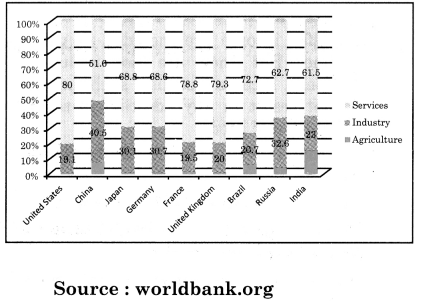
Maharashtra Board Class 12 Economics Important Questions Chapter 7 National Income 1

Question 1.
Which are the sectors contributing in National Income / GDP?
Answer:
There are three sectors contributing in GDP – agriculture, industry and tertiary (services) sector.

Question 2.
In the United States GDP, which sectors contribution is maximum and how much percent?
Answer:
The service (tertiary) sector’s contribution is maximum in United States GDP. It was 80%.

Question 3.
In which country, contribution of primary ‘ sector (agriculture) is lowest in GDP?
Answer:
UK (United Kingdom) and Germany’s; contribution of primary sector is lowest in GDP.

Question 4.
How much is the share of agriculture in India’s National Income in the year 2017?
Answer:
In the year 2017, the share of agriculture was 15.5%.

Question 5.
In which country, the share of industry is maximum and how much percent?
Answer:
In China, the share of industry is maximum. It is 40.5%.

Question 6.
Give your opinion on sectorwise contribution in India’s GDP.
Answer:
In India, share of agriculture sector is quite high as compared to developed countries. There is need to reduce the share of agriculture in GDP. The industry and service sector should be developed so their contribution in the GDP will rise.

2. Top 10 Economies in the world in terms of GDP at current US $ trillion.
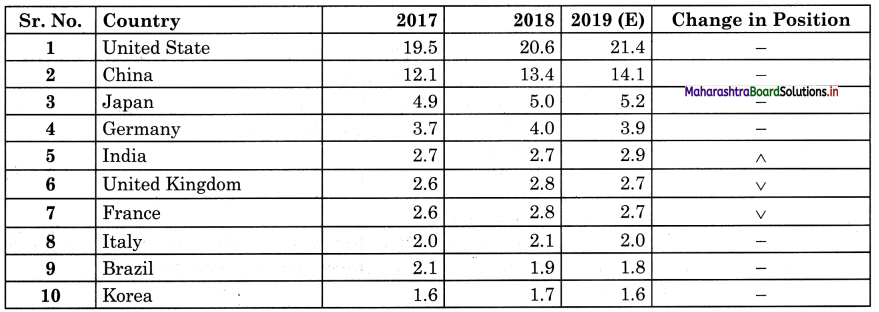
Maharashtra Board Class 12 Economics Important Questions Chapter 7 National Income 2
Data Source : World Economic Outlook, October 2019 database

Note : IMF’s estimate, A indicates improvement in rank, v indicates drop in rank and – indicates unchanged rank

Question 1.
Which country has highest GDP in the world?
Answer:
United State of America has the highest GDP in the world.

Question 2.
Which country has the least GDP in the world?
Answer:
Korea has the least GDP in the world.

Question 3.
At what position does India stand with respect to GDP rates?
Answer:
India stands at 5th position with respect to ) GDP rates.

Question 4.
Find out the difference in China’s GDP in the year 2017 and 2018.
Answer:
The China’s GDP has increased by 1.3 US $ trillion in the year 2018 as compared to the year 2017.

Question 5.
By how much India’s GDP has increased in the year 2017-2018.
Answer:
There is no increase in India’s GDP in the year 2017-18. India’s GDP is constant.

Question 6.
Given your opinion on India’s GDP.
Answer:
India’s is a developing economy, but it still stands at the 5th position in the worlds GDP’s.

India should focus on increasing the production of goods and services specially
from secondary and tertiary sector which will help to increase the GDP.

(3) Circular Flow of Income.
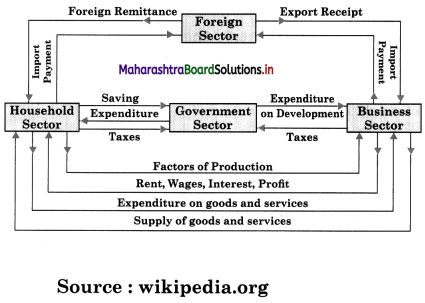
Maharashtra Board Class 12 Economics Important Questions Chapter 7 National Income 3

Question 1.
What does this diagram represent?
Answer:
This diagram represents model of four sector economy.

Question 2.
Which sectors are included in this type of economy?
Answer:
It includes households, firms, government and foreign sector.

Question 3.
What role does the government play in this economy?
Answer:
The government is playing very important ) role by incurring expenditure on consumption and investment. The government is also S collecting tax from household, business firm and through import.

Question 4.
Give your opinion on overseas or foreign sector.
Answer:
In four sector economy, foreign sector is playing important role. This is known as open economy which helps to earn foreign exchange, promote economic development, availability of imported goods, etc.

Maharashtra Board Class 12 Economics Important Questions Chapter 7 National Income

6. Answer in detail;

Question 1.
What is national income? Explain theoretical conceptual difficulties in the calculation of national income.
Answer:
National income means money value of goods and services produced in the country in a year.
According to National Income committee:
“A national income estimate, measures the volume of goods and services turned out during a given period without duplication. There are many practical difficulties in the measurement of NI.

  • Transfer payment: If it included in national income then there will be overestimation of NI. E.g. pension, gifts, unemployment allowances, etc. are excluded.
  • Unpaid services : The value of unpaid services are not included in national income as they are not paid for. E.g. services of housewife.
  • Illegal income : The income from illegal activities are not included in NI. E.g. black marketing, smuggling.
  • Production for self-consumption: It is very difficult to get data and value of goods kept for self-consumption as they do not enter market.
  • Income of foreign firms : Income of foreign firm should be included in the national income of the country where the firm undertakes production work. But the profit earn by these firms are transferred to their home own country.

Question 2.
Explain the difficulties in measuring National Income.
Answer:
National income means money value of goods and services produced in the country in a year.
According to National Income committee:
“A national income estimate, measures the volume of goods and services turned out during a given period without duplication. There are many practical difficulties in the measurement of NI.

(A) Theoretical difficulties

  • Transfer payment: If it included in national income then there will be overestimation of NI. E.g. pension, gifts, unemployment allowances, etc. are excluded.
  • Unpaid services : The value of unpaid services are not included in national income as they are not paid for. E.g. services of housewife.
  • Illegal income : The income from illegal activities are not included in NI. E.g. black marketing, smuggling.
  • Production for self-consumption: It is very difficult to get data and value of goods kept for self-consumption as they do not enter market.
  • Income of foreign firms : Income of foreign firm should be included in the national income of the country where the firm undertakes production work. But the profit earn by these firms are transferred to their home own country.

(B) Practical Difficulties or Statistical Difficulties:

  • Problem of double counting: In case of certain goods it is difficult to distinguish properly between final goods and intermediate goods. That’s why problem of double counting arises e.g. flour is final goods for housewife, but it is intermediate goods for the bakery.
  • Existence of non-monetised sector: In India large non-monetised sector exists in rural area specially in agriculture. In agriculture, many places goods and services are exchanged with goods that’s why it is difficult to count in national income.
  • Inadequate and unreliable data: Because of illiteracy it is difficult to get adequate and reliable data from unorganised sector, small enterprises, agriculture, etc.
  • Depreciation: Its difficult to measure exact value of depreciation. There are no uniform common accepted standard rates of depreciation applicable to the various capital assets.
  • Capital gain or loss: Due to capital gain there is overestimation and due to capital loss there is underestimation of national income.
  • Illiteracy and ignorance: Majority of small producer in developing counties are illiterate and ignorant and are not able to keep accounts of their productive activities.
  • Lack of systematic, occupational classification: There is lack of systematic occupational classification, which makes the calculation of national income difficult. Especially in rural areas where many villagers work on farms for some time and also take some other job during offseason.
  • Untrained and incompetent staff: Due to untrained and incompetent staff, accurate and timely, information cannot be obtained.

Question 3.
What is National Income? Explain the Output method of measuring National Income.
Answer:
Product Method or Output Method: This method is also called as Inventory Method.
According to this method economy is divided into various sectors like agriculture, mining, manufacturing, small enterprises, commerce, transport, communication, etc.

National income by this method can be calculated by either valuing all final goods and services
produced during a year at their market price or by adding up all values at each higher stage of
production, until these products are turned into final products.

In output method there are two approaches to measure national income.

(1) Final Goods Approach I Final Product Approach : According to this approach, value of all final goods and services produced in primary, secondary and tertiary sector are included and the value of all intermediate transactions are ignored.

2. Value Added Approach I Value Added Method: To avoid double-counting, the value-added approach is used to estimate the National Income. According to this method, it is necessary to obtain the total of value-added at each stage in the manufacture of a commodity to arrive at Gross National Product. The value-added method can be explained by means of a simple example.
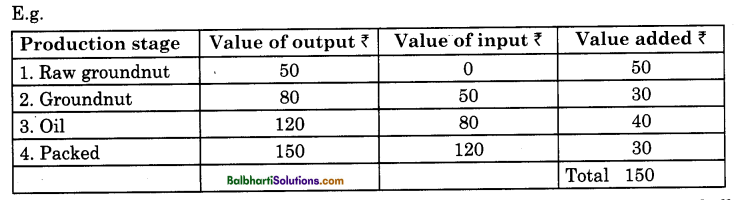
Maharashtra Board Class 12 Economics Important Questions Chapter 7 National Income 4
(a) In the above example, value of groundnut with shell is 50, after removing shells value of groundnut is 80, after crushing groundnut the value is 120 and when oil is packed in the packets its value is 150.
To avoid double-counting either the value of final output or the value – added should be taken in estimation of National Income.

The output method is widely used in the underdeveloped countries. In India, this method is applied in agriculture, mining and manufacturing sector.

Precautions:

  • Avoid Double Counting: The value of only final goods and services must be considered and not the value of raw – materials or intermediary goods, etc.
  • Self Consumption Goods: Goods used for self-consumption by farmers should be included in National Income.
  • Price Level Changes to be considered: The values of national output must be expressed in terms of prices in some base year to know the national output in real terms i.e. N.I. at constant price.
  • Net Income from Abroad: Care should be taken to include net income from abroad in National Income.
  • Depreciation: Depreciation of capital assets should be deducted from the value of gross investment during the year.
  • Indirect Taxes and Subsidies: To get National Income, deduct the indirect tax from the market price and add subsidies.
  • Second-Hand Goods: Sale and purchase of second-hand goods should be ignored as it is not a part of current production.

Question 4.
Explain the various method of measuring National Income. ?
Answer:
National Income is macro economic concept. National Income means money value of goods and services produced in the country in a year. There are three methods to measure national income.
(1) The Output Method,
(2) The Income Method,
(3) The Expenditure Method.

(A) The Income Method : This method is also known as factor cost method. According to this method national income is the sum of income received by all factors of production in a year. So national income is the income received by all the citizens of the country in a year. In income method national income studied from the distribution side. According to income method national income or GNP is
NI = R + W + I + P + MI + (X – M)

  • Rent (R) : Rent and Royalty is usually treated as the payment for the land, building, machines that are rented.
  • Wages (W) : It includes wages and salaries earned by labour as well as it includes commission, bonus, social security payments, fringe benefits, etc.
  • Interest (I) : Interest is the payment for using the services of capital. It includes interest paid by banks, insurance companies etc.
  • Profit (P) : It includes the profit of private and public sector companies.
  • Mixed Income (MI) : It is the income which is earned by self-employed. They earn income through various sources like wages for effort put, rent on own property, interest on own capital, etc.
  • Net Exports (X – M) : It is the difference between export and imports.

Precautions :

  • Transfer payment : It should not be included in national income. E.g. pension, gifts, unemployment allowances, lottery prize, etc.
  • Unpaid services : It should not be included in national income. E.g. services of housewife, teacher teaching her own child, etc.
  • Second hand goods : The income from sale of second hand goods should not be included.
  • Financial asset : The income from sale of shares and bonds should not be included in national income.
  • Tax revenue : The revenue of government through taxes should not be included in national income.
  • Undistributed profits of companies, income from government property and profits from public enterprise should be included.
  • Imputed value of production kept for self consumption and rental value of owner occupied houses should be included in national income.

(B) Expenditure Method :
This method also known as outlay method. NI = C + I + G + (X – M) + (R – P)
National Income can also be calculated by adding up the expenditure incurred on purchase of final goods and services. We can get National Income by summing up all consumption expenditure, investment expenditure made by all individuals, firms as well as the government of a country during a year.

  • Consumption Expenditure (C) : It includes all expenditure incurred on goods and services by households during the year. It includes expenditure mostly on durable and non-durable goods, which are consumed by the consumers. E.g. food, medical care, clothing, car, computer and services, etc.
  • Investment Expenditure (I) : It refers to the investment made by private businessman on capital goods like machinery, plants, factories, warehouses, etc.
  • Government Expenditure on goods and services (G) : Government expenditure refers to expenditure on consumption and investment –
    • Consumption expenditure : It refers to expenditure incurred on various administrative services like law and order, defence education, generation and distribution of electricity.
    • Investment expenditure : It refers to expenditure incurred by government on construction of roads, railways, dams, canals, etc.
  • Net Exports (X – M): It refers to difference between exports and imports of the country. If the exports are more than imports then net exports will be positive, it is called Trade Surplus and if imports are greater than exports, the net exports will be negative, it is called as Trade Deficit.
  • Net Receipts (R-P) : It is the difference between expenditure incurred by foreigners in the country (R) and expenditure incurred abroad by Nationals (P). Net Receipts can also be Positive or Negative.
    Net National Expenditure = NNE = C + I + G + (X – M) + (R – P) – Depreciation. NNPFC or NI = C + I + G + (X -M) + (R -P) “Depreciation “ Indirect Tax + Subsidies.

Precautions :
The following precautions should be taken while estimating National Income.

  • To avoid double counting take the expenditure incurred only on final goods and services.
  • Government expenditure on transfer payments to be excluded like unemployment allowances, old age pension etc.
  • Expenditure on second hand goods like furniture, house, land and financial assets { like shares, bonds, etc. should be excluded.
  • Exclude expenditure incurred on purchase of financial assets such as shares, bonds, etc.
  • Deduct indirect tax and add subsidies. Out of these methods, output method and income method are extensively used. Expenditure method is rarely used because of its practical difficulties.
    In India, the Central Statistical Organisation (CSO) adopts a combination of output method and income method to estimate N.I. of India.

Product Method or Output Method: This method is also called as Inventory Method.
According to this method economy is divided into various sectors like agriculture, mining, manufacturing, small enterprises, commerce, transport, communication, etc.

National income by this method can be calculated by either valuing all final goods and services
produced during a year at their market price or by adding up all values at each higher stage of
production, until these products are turned into final products.

In output method there are two approaches to measure national income.

(1) Final Goods Approach I Final Product Approach : According to this approach, value of all final goods and services produced in primary, secondary and tertiary sector are included and the value of all intermediate transactions are ignored.

2. Value Added Approach I Value Added Method: To avoid double-counting, the value-added approach is used to estimate the National Income. According to this method, it is necessary to obtain the total of value-added at each stage in the manufacture of a commodity to arrive at Gross National Product. The value-added method can be explained by means of a simple example.
Maharashtra Board Class 12 Economics Important Questions Chapter 7 National Income 4
(a) In the above example, value of groundnut with shell is 50, after removing shells value of groundnut is 80, after crushing groundnut the value is 120 and when oil is packed in the packets its value is 150.
To avoid double-counting either the value of final output or the value – added should be taken in estimation of National Income.

Maharashtra Board Class 12 Economics Important Questions Chapter 7 National Income

The output method is widely used in the underdeveloped countries. In India, this method is applied in agriculture, mining and manufacturing sector.

Precautions:

  • Avoid Double Counting: The value of only final goods and services must be considered and not the value of raw – materials or intermediary goods, etc.
  • Self Consumption Goods: Goods used for self-consumption by farmers should be included in National Income.
  • Price Level Changes to be considered: The values of national output must be expressed in terms of prices in some base year to know the national output in real terms i.e. N.I. at constant price.
  • Net Income from Abroad: Care should be taken to include net income from abroad in National Income.
  • Depreciation: Depreciation of capital assets should be deducted from the value of gross investment during the year.
  • Indirect Taxes and Subsidies: To get National Income, deduct the indirect tax from the market price and add subsidies.
  • Second-Hand Goods: Sale and purchase of second-hand goods should be ignored as it is not a part of current production.
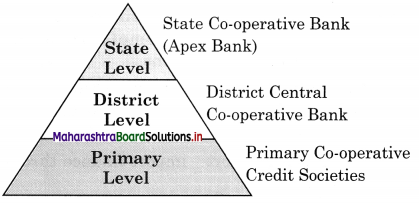
Maharashtra Board Class 12 Economics Important Questions Chapter 5 Forms of Market

Balbharti Maharashtra State Board Class 12 Economics Important Questions Chapter 5 Forms of Market Important Questions and Answers.

Maharashtra State Board 12th Economics Important Questions Chapter 5 Forms of Market

1. A. Choose the correct option:

Question 1.
Features of Perfect Competition are –
(a) Large number of buyers
(b) Large number of sellers
(c) Different prices
(d) Perfect mobility
Options :
(1) a, b and c
(2) a, b and d
(3) b, c and d
(4) c and d
Answer:
(2) a, b and d

Question 2.
Features of monopoly are –
(a) Single seller
(b) No close substitutes
(c) Control over supply
(d) Price taker
Options :
(1) a, b and d
(2) a, b, c and d
(3) c and d
(4) a, b and c
Answer:
(4) a, b and c

Question 3.
Features of Monopolistic Competition are –
(a) Homogeneous product
(b) Selling cost
(c) Downward sloping demand curve
(d) Few buyers
Options :
(1) b and c
(2) a, b and d
(3) c and d
(4) a, b and c
Answer:
(1) b and c

Question 4.
Legal monopoly is recognized by –
(a) Legal provision
(b) Trade Mark
(c) License
(d) Copyright
Options :
(1) a, b, c and d
(2) a, b and d
(3) a, b and c
(4) a and c
Answer:
(1) a, b, c and d

Question 5.
Examples of discriminating monopoly are –
(a) Doctors
(b) Lawyers
(c) Consultants
(d) All of the above
Options :
(1) a and d
(2) a, b and d
(3) a, b and c
(4) a, b, c and d
Answer:
(4) a, b, c and d

Question 6.
Types of imperfect market are –
(a) Monopoly
(b) Oligopoly
(c) Monopolistic Competition
(d) Perfect Competition
Options :
(1) b and c
(2) a, b and c
(3) only d
(4) all of these
Answer:
(2) a, b and c

(B) Complete the Correlation.

(1) Tata group : Private monopoly :: Indian Railways : ………………..
(2) Few sellers : Oligopoly :: Many sellers : ………………..
(3) Less than one year : Short period :: More than five years : ………………..
(4) Perfect competition : No selling cost :: Monopolistic competition : ………………..
(5) Natural monopoly : Wheat from Punjab :: ……………….. : Copy right
(6) Perfect competition : Homogeneous :: ……………….. : Differentiated products
(7). Theory of Monopolistic competition : Prof. Chamberlin :: Perfect competition : ………………..
(8) Perishable goods : Local market :: Non-perishable goods : ……………….
(9) OPEC : Group Monopoly :: RIL : ………………..
(10) Petroleum : ……………….. :: Scooter : National market.
Answers:

  1. Public monopoly
  2. Perfect competition
  3. Very long period
  4. Selling cost
  5. Legal monopoly
  6. Imperfect competition
  7. Mrs. Joan Robinson
  8. National Market
  9. Private monopoly
  10. International market

(C) Give economic terms.

  1. A monopoly recognised by law.
  2. The cost that can add to the price of the product in a distant market.
  3. A market in which laissez faire policy is adopted by the government.
  4. A network of dealings between buyers and sellers.
  5. A market in which a firm and industry are same.
  6. A monopoly that arises when a particular type of natural resources are located in a particular region.
  7. A price that is determined by intersection of demand and supply.
  8. Welfare oriented monopoly. Railways, Courier services, Water supply,
  9. A practice of charging different prices for the same product.
  10. A monopoly formed by an organisation of Petroleum Exporting countries.
  11. When there is no difference between the firm and industry.

Answer:

  1. Legal monopoly
  2. Transport cost
  3. Perfect competition
  4. Market
  5. Monopoly
  6. Natural monopoly
  7. Equilibrium price
  8. Public monopoly
  9. Price discrimination
  10. Voluntary monopoly
  11. Monopsony

(D) Find the odd word out

(1) Market structure on the basis of place :
Local, National, Oligopoly, International.
(2) Peculiarities of Perfect competition :
Many buyers, Few sellers, Price taker, No transport cost.
(3) Examples of Public Monopoly :
Railways, Courier services, Water supply, Electricity.
(4) Features of Monopoly :
Many sellers, Many buyers, Entry barriers to sellers, Firm coincides with industry.
(5) Natural Monopoly depends upon :
Climate, Rainfall, Specific location, Many sellers.
(6) Private monopoly :
Tata group, OPEC, Adani power, Post office.
(7) Imperfect competition :
Price discrimination, Uniform price, Barriers to entry, Price maker.
Answer:

  1. Oligopoly
  2. Few sellers
  3. Courier services
  4. Many sellers
  5. Many sellers
  6. Post office
  7. Uniform price

(E) Complete the following statements.

(1) Equilibrium price is that level of price where ………………
(2) A seller is price maker in ………………
(3) A welfare oriented monopoly is called ………………
(4) A Market in which sellers sell and buyers buy the product in the region in which it is produced is called ………………
(5) A market in which buyers and sellers trade in goods and services across the national borders is called ………………
(6) A classification of market on the basis of place are local, national and ………………
(7) A market on the basis of competition which is ideal and imaginary concept is called………………
(8) A market showing some but not all the features of a competitive market is called………………
(9) When a private body controls a monopoly firm, it is called ………………
(10) When the production is totally controlled and operated by the government it is known as………………
(11) Tea cultivation in Assam is an example of………………
(12) A firm which charges different prices to different buyers for the same product, it is called………………
(13) When some monopolists come together voluntarily to form a group of monopolists, it is called ………………
(14) Different brands of washing powders, liquid cleaners are examples of………………
(15) Selling cost is an important feature of………………
(16) Mobile service providers and cement companies are examples of ………………
(17) A period of production is so long that all inputs are variable is called ………………
(18) A market in which supply is fixed is called ………………
(19) A book “Theory of Monopolistic Competition is written by ………………
(20) The objective of the seller in monopoly market is ………………
(21) Under monopoly there is existence of ………………
Answer:

  1. market demand is equal to market supply
  2. monopoly .
  3. public monopoly
  4. local market
  5. international market
  6. international
  7. perfect competition
  8. imperfect market
  9. private monopoly
  10. public monopoly
  11. natural monopoly
  12. discriminating monopoly
  13. voluntary monopoly
  14. monopolistic competition
  15. monopolistic competition
  16. oligopoly market
  17. very long period market
  18. very short period market
  19. Prof. E. H. Chamberlin
  20. profit maximisation
  21. single seller

[F] Choose the wrong pair ;

I.

Group ‘A’Group ‘B’
1. Perfect competitionMany buyers and sellers
2. OligopolyMany buyers and few sellers
3. Imperfect marketMonopoly, International market

Answer:
3.

II.

Group ‘A’Group ‘B’
1. Market on the basis of placeLocal, National, International
2. Market on the basis of competitionPerfect competition, International
3. Market on the basis of timeVery short, short, long, Very long

Answer:
2

III.

Group ‘A’Group ‘B’
1. Public MonopolyWheat from Punjab
2. Natural MonopolyTea from Assam
3. Private MonopolyReliance Group

Answer:
1

(G) Choose the correct pair

I.

Group ‘A’Group ‘B’
1. Very short period(a) More than 5 years
2. Short period(b) Less than 1 year
3. Long period(c)Few days or weeks
4. Very long period(d) Upto 5 years

Answer:
(1)-(c), (2)-(b), (3)-(d), (4)-(a).

II.

Group AGroup B
1. Perfect Competition(a) Product Differentiation
2. Monopoly(b) Uniform Price
3. Monopolistic Competition(c) Few Sellers
4. Oligopoly(d) Single Seller

Answer:
(1)-(b), (2)-(d), (3)-(a), (4)-(c).

2.[A] Identify and explain the concept from given illustrations.

Question 1.

Output sold in unitsPrice of ‘X’ in ₹Price of ‘Y‘ in ₹
1005050
2005040
3005030

Identify the type of market of two goods X’ and ‘Y’ Give reason for your answer.
Answer:
Concept : Market for good ‘X’ is perfect competition.
Explanation : At the same price ? 50 sellers are ready to sell more and more in the market.
Concept : Market for good ‘Y’ is
monopolistic competition.
Explanation : As price of ‘Y’ falls, more and more sellers enter the market to sell their product.

Question 2.

ClientElec, per unit by GovernmentLawyer fee in ₹
A101000
B102000
C103000

(1) Identify the type of monopoly by the government and Lawyer. Give reason for your answer.

Answer:
Concept: Electricity charges by government – Public Monopoly.
Explanation : Public monopoly is welfare oriented monopoly and is owned by the government. Therefore, their price per unit remains uniform.
Answer:
Concept : Lawyer fee – Discriminating Monopoly.
Explanation : In case of lawyer, being a private practitioner, he can charge different fee from different customers. Hence, it is called discriminating monopoly.

Question 3.
A washing powder seller incurs extra cost in order to give free samples to the customers as a sales strategy.
Answre:
Concept : Monopolistic Competition (Selling Cost).
Explanation : In this type of market, there are many sellers who sell the product which are close substitutes of each other.
As there are many variety of washing powders available in the market, he distributes free samples to attract the customers to buy his product.

Question 4.
“A monopoly firm can exercise considerable influence on the supply of his commodity and thereby its price.”
Answre:
Concept : Price Maker (Feature of Monopoly).
Explanation : A monopolist is a single seller in the market for his product and has control over the supply and can determine the price for his product.
There are no close substitutes available for his product in the market.
So, he is a price maker.

[B] Distinguish between :

(1) Perfect Competition and Monopoly.
Answer:
Perfect Competition:

  1. Perfect competition is a type of market where there are large number of firms producing homogeneous product.
  2. The product sold are homogeneous and so they are perfect substitutes.
  3. The firm is a price taker so the demand curve is a horizontal demand curve.
  4. There is free entry and free exit.
  5. Single price prevails in the whole market.
  6. Maharashtra Board Class 12 Economics Important Questions Chapter 5 Forms of Market 1

Monopoly:

  1. Monopoly is a type of market where there is only one firm producing a product which has no substitute.
  2. The product has no substitute.
  3. The firm is a price maker. Thus firm has a downward sloping demand curve.
  4. There are strong entry barriers.
  5. Price discrimination is possible because seller has complete hold in the market.
  6. Maharashtra Board Class 12 Economics Important Questions Chapter 5 Forms of Market 2

Question 2.
Perfect Competition and Monopolistic Competition.
Answer:
Perfect Competition:

  1. It is a market situation in which there are large number of buyers and large number of sellers selling homogeneous product.
  2. Products are perfect substitute for another as they are identical.
  3. Uniform price prevails in the whole market. There is no selling cost.
  4. Firms are price takers. Thus the firm has a horizontal demand curve.
  5. It is an unrealistic market.

Monopolistic Competition:

  1. It is a market situation in which there are many buyers and many sellers selling differentiated products.
  2. Products are similar but not identical. They are close substitutes.
  3. Individual price policy is followed and huge selling cost is incurred on sales promotions.
  4. The firms are price makers. Thus the firms have a downward sloping demand curve.
  5. It is a realistic market.

Question 3.
Natural Monopoly and Social Monopoly.
Answer:
Natural Monopoly:

  1. The monopoly power is acquired by a firm due to natural advantages such as good location, control over scarce resources, natural skill, talent, etc.
  2. Natural monopoly is determined by the availability of natural resources or natural talents and skills.
  3. Normally the monopolist would charge higher prices for the goods.
  4. Main objective is to maximise profit.
  5. Gulf countries monopolies in production of oil. India’s monopoly in production of jute and cotton. Lata Mangeshkar monopolised as a professional singer once upon a time.

Social Monopoly / Public Monopoly:

  1. When government nationalises an industry and acquires complete control over its market that monopoly is called as social monopoly.
  2. Social monopoly is determined by economic aims and objectives of the government.
  3. Government may not charge higher prices keeping in mind the welfare aspect.
  4. The main objective is to provide social welfare.
  5. Public utility services like water supply, railway services etc., are examples of public monopoly.

Question 4.
Natural Monopoly and Legal Monopoly.
Answer:
Natural Monopoly:

  1. The monopoly power acquired by a firm due to natural advantages such as good location, control over scarce resources or natural skill, etc.
  2. The main objective of a natural monopolist is to maximise profits.
  3. Monopoly due to location or may be old establishment like the TATA products or Godrej Locks, Cupboards etc., or an actor like Amir Khan.

Legal Monopoly:

  1. It arises due to legal protection given to the producers by the government authorities.
  2. The objective is to prevent the competitors from producing identical products.
  3. Monopoly due to legal rights, conferred by the government such as patent right, copy right, trade marks etc.

Question 5.
Monopoly and Monopolistic Competition.
Answer:
Monopoly:

  1. Monopoly is a market structure in which there is a single seller of a product which has no close substitute.
  2. There is no competition.
  3. There are strong barriers to entry.
  4. The demand for the product is less elastic as there are no close substitute.
  5. There is no selling cost incurred.
  6. Firm and industry are identical.
  7. Pure monopoly is an inelastic market.

Monopolistic Competition:

  1. It is a market structure in which large number of firms produce and sell products that are differentiated but close substitutes.
  2. There is competition among the firms producing very close substitutes.
  3. There is free entry and exit for the firms.
  4. Demand of the product is elastic as there are close substitutes for the product.
  5. Selling cost has an important role in Monopolistic Market.
  6. Under monopolistic competition firm and industry are not identical. They are a group.
  7. It is a realistic market.

Question 6.
Perfect Competition and Imperfect Competition.
Answer:
Perfect Competition:

  1. Perfect competition is a type of market where there are large number of firms producing homogeneous product.
  2. Each seller is price taker.
  3. Each individual firm controls only a small portion of the total supply.
  4. Each seller and buyer has perfect knowledge about the market situation.
  5. There are no types in perfect competitive market.

Imperfect Competition:

  1. Imperfect competition is a type of market where the product produced by the sellers may be similar or differentiated.
  2. Each seller is price maker.
  3. Each seller may control more or less portion of the total supply.
  4. Each seller and buyer may not have perfect knowledge about the market situation.
  5. Examples of imperfect market are monopoly, oligopoly, monopolistic competition, etc.

Question 7.
Local Market and National Market.
Answer:
Local Market:

  1. Local market is one in which goods are produced and sold mostly in local areas.
  2. Generally, perishable goods like milk, vegetables and bulky goods like sand have local market.
  3. Demand is limited in local market.
  4. Less variety is available in this market.

National Market:

  1. National Market is a domestic market in which goods are produced and sold within the country.
  2. Generally goods demanded by common man like wheat, rice, soaps have national market.
  3. Demand is very high in national market.
  4. Huge variety is available in this market.

Question 8.
Short Period and Long Period.
Answer:
Short Period:

  1. A short period is one during which the stock of a commodity can be changed to some extent.
  2. This is done by changing the quantity of variable factors like labour and raw material.
  3. Supply can be slightly adjusted to the change in demand.
  4. Demand plays more important role in determining the price.
  5. This period is usually upto 8-10 months.

Long Period:

  1. A long period is one during which the stock of a commodity can be fully changed.
  2. This is done by changing the size of the plant because all factors are variable.
  3. Supply can be fully adjusted to the change in demand.
  4. Supply plays more important role in determining the price.
  5. This period is usually form 1 year to 4-5 years.

3. Answer the following questions;

Question 1.
Define market.
Answer:
In economics, ‘Market’ refers to an arrangement through which buyers and sellers come in close contact with each other directly or indirectly for exchange of goods at a particular price. Thus, market is a network of dealings between buyers and sellers.
According to Augustin Cournot, “Economist understand by the term market, not any particular market place in which things are bought and sold, but the whole of any region in which buyers and sellers are in such close contact with one another that prices of the same goods tend to equality, easily and quickly.”

Thus, market is said to exist when –

  1. there are many buyers and sellers.
  2. they may be spread either to a place, region, country or world.
  3. goods are bought and sold at a price.
  4. people have the knowledge about market price.
  5. there is freedom of entry and exit of firms.

Question 2.
Classify the market on basis of place and explain.
Answer:
On the basis of place, market can be classified as follows :

1. Local Market : When the goods are produced and sold in the local area mainly due to the high transport cost are called local markets. For example bricks, stone, etc. Also perishable goods like fish, milk, etc. have local market.

2. National Market : Market confined to a domestic market in a country is called national market. E.g. cars, scooters, TV sets. These goods can be easily transported within the country.

3. International Market : Goods which can be sold in any part of the world have international market. E.g. Tea, cotton, petroleum. Such goods can be exported and imported at a low transport cost.

Question 3.
Classify the market on the basis of time and explain.
Answer:
On the basis of time market can be classified into following four types :

1. Very short period market: A very short period market is one during which supply of a commodity is fixed as it is already produced. This market is for a few days or maximum a week. So the price of the product is determined by demand. Eg. During festival time supply of fruits can be increased, so price rises.

2. Short period market : A short period market is said be a market upto one year. In this market supply of goods can be increased by increasing the variable factors like labour and raw material with the given fixed factors like machinery.

3. Long period market : A long period market is a market upto five years. In this J supply of a commodity can fully increased on demand as all factors of production can j be changed.

4. Very long period market : A very long period market is for more than five years. In this period there can be full adjustment of supply to demand.

Question 4.
Classify the market on the basis of competition and explain.
On the basis of competition, market can be { classified into two main types :
1. Perfect competition
2. Imperfect competition : It is further classified into.
(A) Monopoly
(B) Oligopoly
(C) Monopolistic Competition

According to Mrs. Joan Robinson, “Perfect competition prevails when the demand for the output of each producer is perfectly elastic. ” Hence, it is a market where there are large number of buyers and sellers engaged in buying and selling a homogeneous product at a single price in the market.
Imperfect competition:

(A) Monopoly: According to E. H. Chamberlin, “A monopoly refers to a single firm which has control over the supply of a product which has no close substitutes.” Hence, he can charge different prices from different buyers on the basis of demand.

(B) Oligopoly : An oligopoly is a market situation in which there are few sellers and a large number of buyers. Sellers may sell similar or different products which are close substitutes of each other.

(C) Monopolistic Competition : According to E. H. Chamberlin, “Monopolistic competition refers to competition among a large number of sellers producing close but not perfect substitutes.” Hence, this is a market which has features of both monopoly and perfect competition. E.g. for soaps, washing powders, etc.

Question 5.
What are the main features of Monopoly?
Answer:
Features of Monopoly:

1. Single Seller and Many Buyers : In
Monopoly market, there is only one seller or producer and many buyers. Monopoly firm does not have a rival in the market. So there is no competition.

2. No Close Substitute : The commodity produced by the monopolist does not have close substitutes. Hence they do not face any competition.

3. Entry Barriers : The fact that there is only one firm under monopoly means that other firms are restricted from entering the market. The entry barriers may be natural, legal or financial in nature.

4. Firm Coincides with Industry : In monopoly market, the firm and industry are one and the same. In other words, there is no distinction between firm and industry.

5. Price Maker : In monopoly the seller is a Trice Maker’. Since the monopolist has control over the supply he can determine the price of his product.

6. Profit Maximisation (super normal profit) : A monopolist earns super normal profit. His decision regarding the price and the level of output are guided by profit maximisation motive.

7. Control Over Supply : The monopolisthas a complete hold over market supply as he is the sole producer.
Price discrimination : This implies charging different prices for the same l product to different buyers.

Question 6.
What are the different types of monopoly?
Answer:
There are different types of monopoly as analysed below:

1. Natural Monopoly : A natural monopoly arises when a particular type of natural resource is located in a particular region like petrol or crude oil in Gulf countries. Also natural advantages such as good location, business reputation, age – old establishment s etc., confer natural monopoly. Similarly, many professional skills, natural talents give monopoly power. E.g. A singer or actor has monopoly of his skill, talent.

2. Legal Monopoly : Legal monopolies are those monopolies which are recognised by law. Legal protection granted by the Government in the form of trade mark, copy rights, license etc., give monopoly power to the firms. Here the potential competitors are not allowed to copy the product registered under the given brand names, patents or trade marks according to the law.

3. Joint Monopoly or Voluntary
Monopoly : This monopoly arises through mutual agreement and business combinations like the formation of cartels, syndicate, trust etc. For e.g. Oil producing nations have come together and formed a Cartel OPEC (Organisation of Petroleum Exporting Countries).

4. Simple Monopoly : A simple monopoly firm charges a uniform price for its product to all the buyers.

5. Discriminating Monopoly : A discriminating monopoly firm charges different prices for the same product to different buyers. E.g. a doctor, a teacher, a lawyer, etc., charges different fees from the people. The practice of charging different prices from different buyers is called “Price discrimination.”

6. Private Monopoly : When an individual or a private firm enjoys the monopoly of manufacturing and supplying a particular product, it is called private monopoly. The main aim of private monopolist is profit maximisation.

7. Public Monopoly : When a field of production is solely owned, controlled and operated by the government, it is regarded as public monopoly. Eg. Public utility service like Railways, Electricity, Water Supply etc. Since these monopolies are service motivated and welfare oriented they are also called welfare monopolies.

Question 7.
What are the features of Oligopoly?
Answer:
The term Oligopoly is derived from the Greek words ‘Oligo’ which means few and ‘Poly’ which means sellers. Hence, following are its features –

1. Many buyers and few sellers : There are many buyers and a few sellers or firms (may be five or six) who dominate the market and have major control over the price of a product.

2. Interdependence : Since the number of firms are less, any change in price, output, product etc. by one firm will affect the rival firms and will force them to change their price, output, etc. E.g. In case of Coke and Pepsi in soft drink market.

3. Selling cost or advertising : Each firm in order to sell more of its product takes aggressive steps to advertise or through free samples. This helps them to capture larger sales.

4. Barrier to entry : The firm can easily exit from the industry whenever it wants, but to enter a new industry it has certain entry barriers like government license, patent right, etc.

5. Uncertainty : There is a great uncertainty in this market if the rival firms join hands and may try to fight each other.

6. Lack of Uniformity : The firms may produce either homogeneous or differentiated products. Eg. In automobile industry, Maruti, Indica are examples of differentiated product but cooking gas of Bharat Petroleum and Hindustan Petroleum are examples of homogeneous product or pure oligopoly.

4. State with reasons whether you agree or disagree with the following statements:

Question 1.
Single price prevails in perfect competition.
Answer:
Yes, I agree with this statement.
Single price prevails under perfect competition because.

  1. In perfect competition there are large number of buyers and sellers. A single seller nor a single buyer can influence the supply nor the demand and the price.
  2. In perfect competitive market price is determined by the interaction of the forces of demand and supply.
  3. Hence sellers and buyers are ‘Price takers’ only.
  4. Products sold in perfectly competitive market are homogeneous, and hence uniform or single price rules throughout the market for that product and also there is no selling cost incurred.
  5. There is perfect knowledge on the part of buyers and sellers about market conditions, which prevents price – discrimination, so single price prevails.
  6. Transport costs are ignored under perfect competition. If transport costs are involved then the prices of homogeneous goods would tend to differ.

Question 2.
Price discrimination is possible under monopoly.
Answer:
Yes, I agree with this statement.
Price discrimination is possible under Monopoly because :

  1. Monopoly is a market situation where there is only one seller who has complete control over the supply of commodity.
  2. So he is the price maker and also there is no close substitute for his product.
  3. Therefore, the buyer has no alternative but to buy the product from the monopolist or go without it.
  4. So a monopolist can charge different prices from different buyers for the same product.
  5. Generally he charges higher price from rich and lower price frpm poor.
  6. E.g. a doctor in a village may charge less fees from poor and high fees from rich.

Question 3.
Selling cost is incurred by a firm in Monopolistic Competition.
OR
In Monopolistic market, the selling cost is must.
Answer:
Yes, I agree with this statement.
Selling cost is incurred by a firm in Monopolistic Competition because –

  1. Monopolistic competition is a market where there are many sellers selling differentiated products which are substitutes for each other.
  2. So there is an element of ‘Monopoly’ and ‘Competition.’
  3. There is keen competition among group of monopolists producing same, though not identical product. So selling costs are incurred to increase the demand for the product.
  4. Selling costs are those costs which are incurred by the firms to create demand and increase the demand for its product through advertisements, publicity, salesmanship, etc.
  5. The main purpose of selling cost is to push up the sales of the product.
  6. The buyers in this market buy the product not by chance but by choice and preference. The advertisements, salesmanship etc can change the preference of the consumer towards their product.

Question 4.
A monopolist cannot control the supply of goods.
OR
Monopolist is price maker.
Answer:
No, I do not agree with this statement. A monopolist can control the supply of goods because –

  1. Monopoly is a market situation in which there is a single producer or seller of a product, which has no substitute.
  2. It means the entire production and supply of a particular product is in the hands of a single firm. Thus monopoly firm does not have a rival in the market. So he controls the supply.
  3. There is no distinction between a firm and an industry under monopoly.
  4. He is a price maker and normally fixes a higher price for profit maximisation.

Question 5.
Sellers and buyers are the price takers j in Perfect Competition.
Answer:
Yes, I agree with this statement.

  1. In perfect competition, there are large number of sellers.
  2. Individual seller contributes only a fraction of the total market supply.
  3. Similarly, there are large number of buyers.
  4. The individual buyers contribute only a fraction of the total market demand.
  5. Thus, a single seller or single buyer cannot influence the market price.
  6. The market price is determined by an interaction of market demand and market supply, which has to be accepted by the buyers and sellers.
  7. Therefore, a large number of sellers and buyers in a perfect competition are the price – takers.

Question 6.
The existence of Perfect Competition is an unrealistic concept. (Oct.’05)
Answer:
Yes, I agree with this statement.

  1. Perfect competition is based on certain fundamental assumptions, which are hard to realise because such ideal conditions are not found in real life.
  2. In real economic world, products are not homogeneous. Products are differentiated due to influence of advertisement, difference in quality, design, packing etc.
  3. Due to ignorance the buyers and sellers do not possess perfect knowledge of market conditions.
  4. This leads to imperfect competition and discriminatory price for identical product.
  5. Customs and sentiments, also curtail the freedom of buyers and sellers.
  6. Also due to social and moral constraints factors of production particularly labour is imperfectly mobile.
  7. For all these reasons perfect competition is a myth. It is an unrealistic market.

Question 7.
Monopolistic Competition is not found in real life.
OR
Monopolistic Competition does not enjoys practical existence. (Mar., ’09)
Answer:
No, I do not agree with this statement.
OR In reality, there is monopolistic competition.
Answer:
Yes, I agree with this statement.

  1. In real world we find a market in which the characteristics of both Monopoly and Competition are interwoven.
  2. For instance we find in the market many producers producing same product ‘Soap’ but it is not homogeneous.
  3. The soap for example produced by Hindustan Lever and ITC and Proctor & Gamble is slightly different in shape, size, fragrance etc., like Lux is different from Dove and Vivel.
  4. Each producer is the monopolist in a way of his own brand value but has to face competition from his rival.
  5. All these producers compete with each other in selling soaps.
  6. Thus monopolistic competition is found in real life.

Question 8.
A seller is a price maker in monopoly.
Answer:
Yes, I agree with this statement.

  1. In monopoly market there is a single seller of a product. The aim of the monopolist is to earn maximum profit.
  2. Being a single seller, the monopolist has complete control over the market supply.
  3. The monopolist can thus have control over the price. He is, thus, a price maker.

Question 9.
Public Monopoly is welfare oriented.
Answer:
Yes, I agree with this statement.

  • Public Monopoly is solely owned, operated and controlled by the Government.
  • Government owned firm provide utility service. It does not aim at profit but welfare maximisation.
  • Utility services like the Railways, banks, water supply etc., if left to the private firms will lead to exploitation.
  • This is because such services have inelastic demand, so if it is left to private firm they will charge high prices.

Question 10.
Perishable goods have local market.
Answer:
Yes, I agree with this statement.
Perishable goods have local market because:

  • Market confined to a particular area or locality like a village or town is called local market.
  • Perishable goods are those goods which last for 2-3 days e.g. Goods like fish, milk, fruits, vegetables, flowers, etc. usually have local market.
  • Since, such goods are get destroyed soon and if transported to far off markets places, transport cost would also be high, increasing the cost of goods.
    Hence, perishable goods usually have local market.

Question 11.
Market in Economic is a place where goods are bought and sold.
Answre:
No, I do not agree with this statement.

  1. In common language, the term market is generally understood as a place buyers and sellers meet to buy and sell the commodities.
  2. For market to exist, there should be arrangement through which buyers and sellers come in close contact with each other directly or indirectly for exchange of goods and services.
  3. This exchange may be by way of telephone, tele-marketing, internet all over the world.

5. Answer in detail:

Question 1.
What are the features / characteristics / conditions / assumptions / peculiarities of perfect competition?
Answer:
Maharashtra Board Class 12 Economics Important Questions Chapter 5 Forms of Market 3

(1) Perfect Mobility of Factors of Production : Factors of production that is land, labour, capital are perfectly free to move from one firm to another or from one industry to another from one region to another or from one occupation to another. This ensures freedom of entry and exit for individuals and firms.

(2) Single / Uniform Price : There exists a single price for homogeneous product in the entire market at a given point of time. The price is determined by forces of demand and supply.

(3) Large Numbers of ellers : There are many sellers in this market. The number of sellers (firms) are so large that a single seller cannot influence the market price nor the total output in the market (Industry). The contribution of one seller is insignificant and microscopic. The price in the market is determined by the forces of market demand and market supply. Hence, a firm or seller is a ‘price taker’ and not a ‘price maker.’
Maharashtra Board Class 12 Economics Important Questions Chapter 5 Forms of Market 4 Maharashtra Board Class 12 Economics Important Questions Chapter 5 Forms of Market 5
(4) Homogeneous Product : The products produced by all the firms in the industry are identical and are perfect substitute to each other. The products are identical in shape, size, colour, etc. and hence uniform price rules the market for the product.

(5) Large Number of Buyers : There are large number of buyers in the market. One individual buyer’s demand is only a small fraction of total market demand so he is not in a position to influence the price. He is a price taker.

(6) No Government Intervention : It is assumed that the government does not interfere with the working of market economy. There are no tariffs, subsidies, licensing policy or other government interventions. This non – intervention of government is necessary to permit free entry of firms and automatic adjustment of demand and supply. In short, laissez faire policy prevails under perfect

(7) Perfect Knowledge : There is perfect knowledge on the part of buyers and sellers regarding the market conditions especially regarding market price. As a result no buyer will pay a higher price than the market price and no seller will charge a lower price than the market price. So a single price would prevail for a commodity in the entire market.

(8) Free Entry and Free Exit : There is freedom for new firms or sellers to enter the industry or market. There are no legal, j economic or any other type of restrictions or; barriers for new firms to enter the industry or an existing firms to quit the industry, Entry of new firm usually takes place j when existing firms enjoy abnormal profit. Similarly, existing firms quit the industry when they face losses.

(9) No Transport Cost: It is assumed that all firms are close to the market and hence there  is no transport cost. If the transport cost are added to the price of product then the homogeneous commodity will have different prices depending upon the distance from the place of supply to the market

Question 2.
How is the equilibrium price determined under perfect competition?
Answre:
Under perfect competition price is determined by the two forces of Demand and Supply. The interaction of demand and supply determines the equilibrium price of a commodity in the market. Equilibrium price is that price at which quantity demanded is equal to the quantity supplied. According to Marshall, demand and supply are like two blades of a pair of scissors. Just as the cutting of cloth is not possible without the use of both the blades, the equilibrium price of a commodity cannot be determined either by the force of demand or supply alone. Both together determine the price. This can be explained with the help of a table and a graph.
Maharashtra Board Class 12 Economics Important Questions Chapter 5 Forms of Market 6

From the above table, we see that at price of ₹50 and ₹40 per unit, the supply is more than demand. This is because more sellers want to supply at higher prices due to greater profit margin but buyer’s demand is less at a higher price, so there is excess supply (i.e. S >D). Here the number of sellers are more than buyers, the competition among sellers will put a downward pressure on price. The price will fall to ₹30 as a result supply will contract and demand will expand. Now at ?30, the demand becomes equal to supply (D = S). So ₹30 is called the equilibrium price.

Now suppose the market price is ₹10, or ₹20 per unit, which is less than the equilibrium price, the demand is greater i.e. 500 and 400 units than supply which is 100 and 200 units (D > S). There is excess of demand because buyers want to buy more at a lower price but sellers want to sell less as the profit margin is less. Hence there will be shortage of supply. Now, since the buyers are more the competition among buyers will put a upward pressure on the price, so the price rises to ₹30.

Here, some of the sellers will exit the market due to the high cost of production and low market price, which lowers the profit margin. But there will be entry of new buyers with low marginal utility. So demand rises and becomes equal to supply. ₹30 will prevail in the market as long as demand and supply conditions remain the same. It is a stable price where quantity demanded and supplied is 300 units.

When the above demand and supply) schedule is represented graphically, we get S demand curve DD sloping downward and supply curve SS sloping upward.
Maharashtra Board Class 12 Economics Important Questions Chapter 5 Forms of Market 7

The demand curve DD intersects the; supply curve SS at point E at which the c equilibrium price determined is OP and OQ is equilibrium quantity demanded and supplied.

If the price is OP1 which is higher than the equilibrium price OP there is excess s supply i.e. ab. This will force the prices to ( fall downward from seller side. If the price ) falls to OP2 below the equilibrium price OP there is excess demand i.e. cd. This willforce the price to rise upward. In this way the equilibrium price OP is determined by forces of demand and supply. At equilibrium price quantity demanded is equal to quantity supplied i.e. OQ.

Question 3.
What are features of monopolistic competition?
Answer:
Features of Monopolistic Competition
Maharashtra Board Class 12 Economics Important Questions Chapter 5 Forms of Market 8
(1) Fairly large number of Sellers : There are large number of sellers selling closely related, but not identical products. There is tough competition among sellers. An individual seller supply is just a small part of the total supply, so he has limited degree l of control over market supply and price. Each firm (seller) can formulate its own price and output policy independently.

(2) Fairly large number of Buyers: There are large numbers of buyers in a monopolistic competition market. Each buyer enjoys his preference over a particular brand and chooses to buy a specific brand of product. Hence, the buying is by choice and not by chance.

(3) Product Differentiation : The most distinguishing feature of monopolistic competition is that the product produced by different firms are not identical, they are slightly different from each other but they are close substitutes. The product differentiation can be done in different ways like may be in the form of brand names say Raymonds. It can be differentiated in terms of colour, size, design, etc., say soap, mobiles etc., or through sales technique. For e.g. cars, two wheelers, air conditioners, etc.

(4) Free Entry of Firms: A firm is free to enter the market as there are no entry barriers. Similarly there are no restrictions if the firm wants to quit the market. Freedom of entry leads to occurrence of only normal profit in the long run.

(5) Selling Cost : One of the special features of monopolistic competition is the selling cost. Selling costs are those costs, which are incurred by firms to create more and more demand for its products through advertisement, salesmanship, free samples, exhibitions, etc.

(6) Downward Sloping Elastic Demand Curve : The demand curve faced by each firm is downward sloping and comparatively more elastic. It implies that an individual firm can sell more only by reducing the price.
Maharashtra Board Class 12 Economics Important Questions Chapter 5 Forms of Market 9

(7) Concept of Group : Under monopolistic competition, Prof. E. H. Chamberlin introduced the concept of group in place of Marshallian concept of industry. Industry means a number of firms producing identical products. A group means a number of firms producing differentiated product, which are close substitutes.

Question 4.
What is monopoly? Explain the features of monopoly.
Answer:
Monopoly: According to E. H. Chamberlin, “A monopoly refers to a single firm which has control over the supply of a product which has no close substitutes.” Hence, he can charge different prices from different buyers on the basis of demand.

Features of Monopoly:

1. Single Seller and Many Buyers : In
Monopoly market, there is only one seller or producer and many buyers. Monopoly firm does not have a rival in the market. So there is no competition.

2. No Close Substitute : The commodity produced by the monopolist does not have close substitutes. Hence they do not face any competition.

3. Entry Barriers : The fact that there is only one firm under monopoly means that other firms are restricted from entering the market. The entry barriers may be natural, legal or financial in nature.

4. Firm Coincides with Industry : In monopoly market, the firm and industry are one and the same. In other words, there is no distinction between firm and industry.

5. Price Maker : In monopoly the seller is a Trice Maker’. Since the monopolist has control over the supply he can determine the price of his product.

6. Profit Maximisation (super normal profit) : A monopolist earns super normal profit. His decision regarding the price and the level of output are guided by profit maximisation motive.

7. Control Over Supply : The monopolisthas a complete hold over market supply as he is the sole producer.
Price discrimination : This implies charging different prices for the same l product to different buyers.

Question 5.
Define perfect competition and explain price determination under perfect competition.
Answer:
According to Mrs. Joan Robinson, “Perfect competition prevails when the demand for the output of each producer is perfectly elastic. ” Hence, it is a market where there are large number of buyers and sellers engaged in buying and selling a homogeneous product at a single price in the market.
Imperfect competition:

Under perfect competition price is determined by the two forces of Demand and Supply. The interaction of demand and supply determines the equilibrium price of a commodity in the market. Equilibrium price is that price at which quantity demanded is equal to the quantity supplied. According to Marshall, demand and supply are like two blades of a pair of scissors. Just as the cutting of cloth is not possible without the use of both the blades, the equilibrium price of a commodity cannot be determined either by the force of demand or supply alone. Both together determine the price. This can be explained with the help of a table and a graph.
Maharashtra Board Class 12 Economics Important Questions Chapter 5 Forms of Market 6

From the above table, we see that at price of ₹50 and ₹40 per unit, the supply is more than demand. This is because more sellers want to supply at higher prices due to greater profit margin but buyer’s demand is less at a higher price, so there is excess supply (i.e. S >D). Here the number of sellers are more than buyers, the competition among sellers will put a downward pressure on price. The price will fall to ₹30 as a result supply will contract and demand will expand. Now at ?30, the demand becomes equal to supply (D = S). So ₹30 is called the equilibrium price.

Now suppose the market price is ₹10, or ₹20 per unit, which is less than the equilibrium price, the demand is greater i.e. 500 and 400 units than supply which is 100 and 200 units (D > S). There is excess of demand because buyers want to buy more at a lower price but sellers want to sell less as the profit margin is less. Hence there will be shortage of supply. Now, since the buyers are more the competition among buyers will put a upward pressure on the price, so the price rises to ₹30.

Here, some of the sellers will exit the market due to the high cost of production and low market price, which lowers the profit margin. But there will be entry of new buyers with low marginal utility. So demand rises and becomes equal to supply. ₹30 will prevail in the market as long as demand and supply conditions remain the same. It is a stable price where quantity demanded and supplied is 300 units.

When the above demand and supply) schedule is represented graphically, we get S demand curve DD sloping downward and supply curve SS sloping upward.
Maharashtra Board Class 12 Economics Important Questions Chapter 5 Forms of Market 7

The demand curve DD intersects the; supply curve SS at point E at which the c equilibrium price determined is OP and OQ is equilibrium quantity demanded and supplied.

If the price is OP1 which is higher than the equilibrium price OP there is excess s supply i.e. ab. This will force the prices to ( fall downward from seller side. If the price ) falls to OP2 below the equilibrium price OP there is excess demand i.e. cd. This willforce the price to rise upward. In this way the equilibrium price OP is determined by forces of demand and supply. At equilibrium price quantity demanded is equal to quantity supplied i.e. OQ.

Maharashtra Board Class 12 Sociology Important Questions Chapter 4 Processes of Social Change in India

Balbharti Maharashtra State Board Class 12 Sociology Important Questions Chapter 4 Processes of Social Change in India Important Questions and Answers.

Maharashtra State Board 12th Sociology Important Questions Chapter 4 Processes of Social Change in India

1A. Complete the following statements by choosing the correct alternative given in the brackets and rewrite it.

Question 1.
___________ is the process of the use of unbiotic power for the mass production of goods. (digitalisation, urbanisation, industrialisation)
Answer:
industrialization

Question 2.
Process of industrialization spread from ___________ to other regions of the world. (Asia, Europe, Australia)
Answer:
Europe

Maharashtra Board Class 12 Sociology Important Questions Chapter 4 Processes of Social Change in India

Question 3.
In the process of ___________ human society is transformed from a state pre-industrial to an industrial. (urbanisation, modernisation, industrialisation)
Answer:
industrialisation

Question 4.
The development of industries led to the of workplaces. (urbanisation, digitalisation, mechanisation)
Answer:
mechanisation

Question 5.
The use of precision techniques and accuracy in production is required in ___________ (mechanisation, computerisation, capital)
Answer:
mechanisation

Question 6.
In the process of mechanisation workers led to feel ___________ from the process of production. (alienated, integrated, neutral)
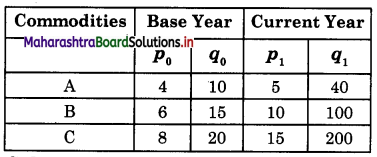
Answer:
alienated

Question 7.
The high mechanization and automation of industrial processes naturally depend on ___________ resources available. (social, financial, natural)
Answer:
financial

Maharashtra Board Class 12 Sociology Important Questions Chapter 4 Processes of Social Change in India

Question 8.
Industries required skilled workforce and ___________ of apprentices at the workplace. (specific training, unskill, eatables)
Answer:
specific training

Question 9.
Early industries required skilled and unskilled ___________ workforce to complete various tasks at all levels. (animal, human, machines)
Answer:
human

Question 10.
Special institutes like ___________ are established to impart technical education and also for professional education. (management training, urbanisation, modernisation)
Answer:
management training

Question 11.
Industrialisation led to ___________ on the basis of specialisation and expertise. (capital, labour, division of labour)
Answer:
division of labour

Question 12.
Modern ___________ was a result of industrialisation. (education, facilities, urbanisation)
Answer:
urbanisation

Question 13.
___________ is a typical feature of urban living. (urbanism, rural, tribal)
Answer:
urbanism

Question 14.
Urbanisation is a ___________ way process. (two, three, four)
Answer:
two

Maharashtra Board Class 12 Sociology Important Questions Chapter 4 Processes of Social Change in India

Question 15.
Urbanisation consists of large ___________ number of people from rural to urban areas. (outward flow, overflow, inward flow)
Answer:
inward flow

Question 16.
The gradual emergence of factories led to the ___________ of people from rural and tribal areas, to the factory locations. (communication, migration, specialisation)
Answer:
migration

Question 17.
The flux of people for the purpose of employment has resulted in cities getting ___________ (overpopulated, less dense, shut down)
Answer:
overpopulated

Question 18.
Overpopulated cities are expanding and turning into ___________ such as Mumbai, Pune. (rural, metropolises, tribal)
Answer:
metropolises

Question 19.
The place of residence and one’s place of which work drift apart with the passage of time which means ___________ (a division of labour, spatial segregation, capital intensive)
Answer:
spatial segregation

Maharashtra Board Class 12 Sociology Important Questions Chapter 4 Processes of Social Change in India

Question 20.
Urbanisation led to a ___________ gathering of people of different gender, sexuality, caste, creed, class, language and so forth. (homogeneous, barriers, heterogeneous)
Answer:
heterogeneous

Question 21.
Urbanism as a ___________ of life. (solution, way, tradition)
Answer:
way

Question 22.
Secondary modes of security control in urban areas are ___________ (law, belief, morals)
Answer:
law

Question 23.
Division of labour is based on one’s ___________ and ___________ (skills and expertise, knowledge and experience, limitations and unskilled)
Answer:
skills and expertise

Question 24.
The term modernisation was coined by ___________ (Anderson, Daniel Lerner, Giddens)
Answer:
Daniel Lerner

Question 25.
___________ is the application of modern science to human affairs. (Globalisation, Digitalisation, Modernisation)
Answer:
Modernisation

Question 26.
Self-criticism, willingness to introspect critically, is also an aspect of ___________ thinking. (logical, critical, analytical)
Answer:
critical

Question 27.
___________ means the approach and ability to provide logical explanations for any phenomenon. (rationalism, science, art)
Answer:
rationalism

Maharashtra Board Class 12 Sociology Important Questions Chapter 4 Processes of Social Change in India

Question 28.
Scientific reasoning explains ___________ relationships between factors. (mortal, casual, immortal)
Answer:
Causal

Question 29.
Being ‘modern’ cannot be limited to only using modern devices or gadgets but there should be a willingness to receive ___________ ideas. (new, old, superstitious)
Answer:
new

Question 30.
The new economic policy means ___________ policy. (PNG, LPG, CNG)
Answer:
LPG

Question 31.
LPG stands for Liberalisation, Privatisation and ___________ (Googlisation, Globalisation, Geometrisation)
Answer:
Globalisation

Question 32.
Process of ___________ opened up the skies for Indian economy. (modernisation, digitalisation, globalisation)
Answer:
globalisation

Question 33.
This new economic policy brought in much ___________ and criticism. (superstitions, beliefs, skepticism)
Answer:
skepticism

Question 34.
The principle of ___________ is an integral part of globalisation as a process of change. (laissez faire, loss, profit)
Answer:
laissezfaire

Question 35.
___________ is a process where government control services are opened up for private service providers. (privatisation, marketisation, globalisation)
Answer:
privatisation

Maharashtra Board Class 12 Sociology Important Questions Chapter 4 Processes of Social Change in India

Question 36.
Privatisation has encouraged many service providers to indulge in ___________ (donation, profiteering, social service)
Answer:
profiteering

Question 37.
Privatisation is mainly oriented to ___________ (production, marketing, profits)
Answer:
profits

Question 38.
Globalisation led to increase in production, this in turn has led to large-scale ___________ (marketisation, privatisation, liberalisation)
Answer:
marketisation

Question 39.
The term ___________ was coined by Capgemini and MIT. (bhakti movement, digital transformation, laissez-faire)
Answer:
digital transformation

Question 40.
___________ has led to frequent changes in business models. (consumerism, digitalisation, materialistic)
Answer:
digitalisation

Question 41.
Now a days we use ___________ for various purposes such as production, surgery, robotics etc. (artificial intelligence (AI), machines, capital)
Answer:
artificial intelligence (AI)

Question 42.
___________ has escalated the speed of the processes with a far greater extent of accuracy. (industrialisation, modernisation, digitalisation)
Answer:
digitalisation

Maharashtra Board Class 12 Sociology Important Questions Chapter 4 Processes of Social Change in India

Question 43.
___________ is based on technology, innovation, research and development. (modernisation, urbanisation, digitalisation)
Answer:
digitalisation

Question 44.
In the field of education, we are working towards ___________ technology for the purpose of education in the 21st century. (integrating, managing, old)
Answer:
integrating

Question 45.
Industrialization with the growth of cities has caused the breakdown of the ___________ (nuclear families, joint families, marriage)
Answer:
joint families

Question 46.
India is now an integral part of the ___________ economy. (personal, social, global,)
Answer:
global

Question 47.
___________ and ___________ has opened up a range of options to the user with a click of button. (computerisation and digitalisation, modernisation and urbanisation, transportation and communication)
Answer:
computerisation and digitalisation

Question 48.
Digitization has increased ___________ networking. (cultural, economic, social)
Answer:
social

1B. Correct the incorrect pair and rewrite it.

Question 1.
(a) Growth Of industries – Industrialisation
(b) Alienated from the process of production – Mechanisation
(c) Extent of mechanization and automation depend on – Finances
(d) Skilled workforce – Capital
Answer:
(d) Skilled workforce – Specific Training

Maharashtra Board Class 12 Sociology Important Questions Chapter 4 Processes of Social Change in India

Question 2.
(a) Formation of economic classes – Industrialisation
(b) Industrial expansion – Modernisation
(c) Tasks assigned on the basis of – Division of labour
(d) Emergence of metropolis – Urbanisation
Answer:
(b) Industrial expansion – Spatial Segregation

Question 3.
(a) Metropolises – Mumbai, Pune
(b) Heterogenous gathering of people – Urbanisation
(c) Secondary modes of security control – Family
(d) A way of life – Urbanism
Answer:
(c) Secondary modes of security control – Law, city traffic signal, police, etc

Question 4.
(a) Based on one’s skills of expertise – Division of labour
(b) Modernisation – Daniel Lerner
(c) Scientific reasoning – Causal Relationships
(d) Shift to secular and rational values from spiritual values – Nationalism
Answer:
(d) Shift to secular and rational values from spiritual values – Rationalism

Question 5.
(a) Scepticism and criticism – Self-criticism
(b) Technological advancement – Industrialisation
(c) Ability to explain the constructive and destructive aspect – Critical thinking
(d) New economic policy – LPG
Answer:
(a) Scepticism and criticism – New economic policy

Question 6.
(a) Free trade and free competition – Laissez Faire
(b) Private service provider – Insurance, radio, etc.
(c) Increase production need – Distribution
(d) To make max profit – Privatisation
Answer:
(c) Increase production need – Marketisation

Question 7.
(a) Increased consumerism – Large production
(b) Sharing of resources – Nationalist movement
(c) Materialistic – Globalisation
(d) All nations interdependent – Global economy
Answer:
(b) Sharing of resources – Technological outsourcing

Maharashtra Board Class 12 Sociology Important Questions Chapter 4 Processes of Social Change in India

Question 8.
(a) Use of digital technology – Digitalisation
(b) Digital transformation – Capgemini and MIT
(c) Use of computers – Computerisation
(d) Technology-driven – Rural
Answer:
(d) Technology-driven – Digitalisation

Question 9.
(a) Migration of people from rural to urban – Westernisation
(b) Developed scientific temperament – Modernisation
(c) India is part of the global economy – Globalisation
(d) Impact of computers on various aspects of life – Digitalisation
Answer:
(a) Migration of people from rural to urban – Urbanisation

1C. Identify the appropriate term from the given options in the box and rewrite it against the given statement.

Rational Outlook, Factory System, Division of Labour, Technological Advancement, Digitalisation, Mechanisation, Labour Intensive System, Global Economy, Marketisation, Industrialisation, Capital Intensive, Industrial Growth, Law and City Police, etc., Liberal Principle, Urbanisation, Modernisation, Scientific Temperament, Critical Thinking, Laissez-Faire, Profiteering, Interdependence, Outsourcing, Capgemini of MIT, Digitalisation, Computerisation.

Question 1.
Establishment of large factories for the purpose of production.
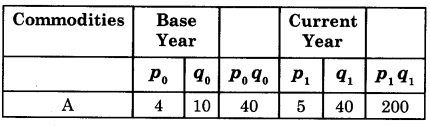
Answer:
Factory System

Question 2.
Use of heavy machines and techniques for the production of goods and services.
Answer:
Mechanisation

Question 3.
In industrialisation extent of automation and mechanisation.
Answer:
Capital Intensive

Question 4.
The need for skilled force at the workplace.
Answer:
Labour Intensive System

Question 5.
Individuals’ qualities, skills, efficiency, education, and training are the determinants.
Answer:
Division of Labour

Question 6.
A process of migration of rural population to urban areas.
Answer:
Urbanisation

Maharashtra Board Class 12 Sociology Important Questions Chapter 4 Processes of Social Change in India

Question 7.
Advanced means of commutation are the pre-requisites.
Answer:
Industrial Growth

Question 8.
Means of secondary control.
Answer:
Law and City Police etc.

Question 9.
Daniel Lerner coined the term.
Answer:
Modernisation

Question 10.
The development of a scientific way of understanding and explaining any phenomenon.
Answer:
Scientific Temperament

Question 11.
The approach and ability to provide logical explanations for any phenomenon.
Answer:
Rational Outlook

Question 12.
Use of advanced technology in industries.
Answer:
Technological Advancement

Question 13.
Ability to explain the constructive and destructive aspects of a phenomenon.
Answer:
Critical Thinking

Maharashtra Board Class 12 Sociology Important Questions Chapter 4 Processes of Social Change in India

Question 14.
Opening up of the economy to private players.
Answer:
Liberal Principle

Question 15.
Free trade and free competition.
Answer:
Laissez-Faire

Question 16.
Privatisation has encouraged many service providers to indulge in it.
Answer:
Profiteering

Question 17.
Increase in production results in large scale of.
Answer:
Marketization

Question 18.
Parts of a product being manufactured in one country and assembled in faraway places is an example of.
Answer:
Interdependence

Question 19.
It has made all people and nations interdependent.
Answer:
Global Economy

Question 20.
People go beyond geographical borders, to perform specific tasks without moving out from their location.
Answer:
Outsourcing

Question 21.
The integration of digital technologies into everyday life.
Answer:
Digitalisation

Question 22.
The term ‘digital transformation’ was coined by.
Answer:
Capgemini of MIT

Maharashtra Board Class 12 Sociology Important Questions Chapter 4 Processes of Social Change in India

Question 23.
Expansion of the use of computers in all walks of life.
Answer:
Computerisation

1D. Correct the underlined words and complete the statement.

Question 1.
Social change means a change in social life.
Answer:
Social change means a change in social structure.

Question 2.
The domestic production system is replaced by traders.
Answer:
The domestic production system is replaced by a factory system.

Question 3.
The process of industrialisation was started in India.
Answer:
The process of industrialisation was started in Europe.

Question 4.
Industrialisation leads to agrarianism.
Answer:
Industrialisation leads to urbanisation.

Question 5.
Urbanisation is a process of migration of rural populations to tribal areas.
Answer:
Urbanisation is a process of migration of rural population to urban areas.

Question 6.
Daniel Lerner coined the term industrialisation.
Answer:
Daniel Lerner coined the term modernisation.

Question 7.
Urbanism is a way of society.
Answer:
Urbanism is a way of life.

Maharashtra Board Class 12 Sociology Important Questions Chapter 4 Processes of Social Change in India

Question 8.
Urbanisation implies controls and obligations by traditional bodies.
Answer:
Urbanisation implied controls and obligations by civil administrations.

Question 9.
Industrialisation leads to unity.
Answer:
Industrialisation leads to urbanisation.

Question 10.
Urbanisation leads to homogeneity.
Answer:
Urbanisation leads to heterogeneity.

Question 11.
Industrialisation is a process whereby human energy to produce was replaced by the social process for higher production.
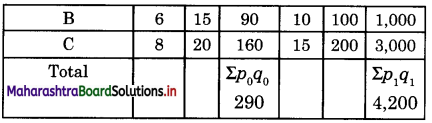
Answer:
Industrialisation is a process whereby human energy to produce was replaced by mechanical processes for higher production.
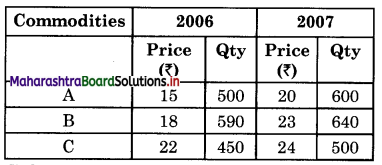
Question 12.
This is the era of computerisation and modernisation.
Answer:
This is the era of computerisation and digitalisation.

Question 13.
Digitalisation is based on belief.
Answer:
Digitalisation is based on technology.

Question 14.
The main aim of digitalisation is the importance of the material.
Answer:
The main aim of digitalisation is important to customers.

Maharashtra Board Class 12 Sociology Important Questions Chapter 4 Processes of Social Change in India

Question 15.
The principle of‘Laissez-Faire’ is an integral aspect of medicines.
Answer:
The principle of ‘Laissez-Faire’ is an integral aspect of globalisation.

Question 16.
The principle of ‘Laissez-Faire’ is originally a Greek term.
Answer:
The principle of ‘Laissez-Faire’ is originally a French term.

Question 17.
Being ‘modern’ means openness to traditional ideas.
Answer:
Being ‘modern’ means openness to new ideas.

Question 18.
Self- criticism, willingness to introspect critically is also an aspect of spiritual thinking.
Answer:
Self-criticism, willingness to introspect critically is also an aspect of critical thinking.

Question 19.
Globalisation involves two processes like liberalisation and generalisation.
Answer:
Globalisation involves two processes like liberalisation and privatisation.

Question 20.
Globalisation is the process of the creation of a global city.
Answer:
Globalisation is the process of the creation of a global economy.

Question 21.
Globalisation is a process that ‘opened up the skies’ for the Japanese economy.
Answer:
Globalisation is a process that ‘opened up the skies’ for the Indian economy.

Question 22.
The flux of people from all over the country to urban areas has resulted in cities getting popular.
Answer:
The flux of people from all over the country to urban areas has resulted in cities getting overpopulated.

Question 23.
Industrialisation is the way by which people go beyond geographical borders, without moving out from their location.
Answer:
Outsourcing is the way by which people go beyond geographical borders without moving out from their location.

Maharashtra Board Class 12 Sociology Important Questions Chapter 4 Processes of Social Change in India

Question 24.
Digital transformation means radically improving knowledge.
Answer:
Digital transformation means radically improving performance.

Question 25.
Maintain individual privacy in the web world is a great challenge in urbanisation.
Answer:
Maintaining individual privacy in the web world is a great challenge in digitalisation.

Question 26.
Due to growth in newer technologies business modules get frequent repetitions.
Answer:
Due to growth in newer technologies business modules get frequent changes.

Question 27.
Cap Gemini is a Spanish data processing company.
Answer:
Cap Gemini is a French data processing company.

2. Write short notes.

Question 1.
Privatisation/Private enterprise
Answer:

  • Privatisation signifies the process wherein, the government transfers ownership, management, and control of the public sector enterprises to the private sector entities.
  • Allows the private sector to set up industries in the field earlier reserved for the public sector.
  • Privatisation has substantially reduced the role of the government in economic activities.
  • Privatisation is an allied process that accompanies globalisation.
  • Under the process of privatisation, reducing the involvement of the state in economic activities and increasing the involvement of the private sector are expected.
  • The government has been thereby trying to mobilise resources for improving the efficiency of the remaining public sector units.
  • Under the policy of globalisation, various countries have adopted the process of privatisation.

Question 2.
Liberalisation/Liberal Principle
Answer:

  • Liberalisation implies the withdrawal of restrictions on industry and business.
  • It also means opening up the economy to private players.
  • It has more reliance on ‘Laissez-Faire’ means free trade and free competition.
  • It encourages foreign trade by a reduction in the tariff rates.
  • Adopting uniform exchange rate.
  • Removal of import/export duties.
  • Duty-free access to foreign goods and services.

Maharashtra Board Class 12 Sociology Important Questions Chapter 4 Processes of Social Change in India

Question 3.
Negative Impact of globalisation
Answer:

  • There is a considerable increase in the immigration of the young technocrats to the developed countries, leaving behind aging parents.
  • There is an increase in the family arguments and break up of more and more marriages and families.
  • The role of the state has been greatly curtailed in economic activities.
  • The role of the state-owned, managed, and controlled public sector has also been curtailed by privatisation and disinvestment.
  • The state also withdrawing from essential social services like health insurance and education by means of privatisation.
  • There is the cultural invasion of western culture. The traditional value and norms of behaviour have slackened up.
  • Consumerism and the pursuit of materialist culture are increasing.
  • The conflict of traditional and modern values has threatened the traditional culture of India.

Question 4.
Modernisation
Answer:

  • It is a process of social transformation.
  • It develops new attitudes, new values, and social relationships. There is a shift to secular and rational values from spiritual-religious values.
  • It has paved a way for developing a scientific temperament. Emphasis has been set on the need for empirical evidence in support of given arguments.
  • It encompasses social, economic, political, religious, and intellectual changes. There is a willingness to receive new ideas, to examine daily events, literature, culture, art, customs, beliefs from a critical point of view.
  • Modernisation is a current term of an old process of social change.

3. Write differences.

Question 1.
Liberalisation and Globalisation
Answer:

LiberalisationGlobalisation
(i) Meaning: Liberalisation refers to the removal of undue restrictions and eliminations of bureaucratic controls on productive activities and paves the way for economic development.(i) Meaning: Globalisation refers to the integration of the domestic economy with the world economy.
(ii) Liberalisation is a means to achieve globalisation.

e.g. reduction in tariff is a liberal measure.

(ii) Globalisation can be realised through external liberalisation.
e.g. if the tariff is reduced, transfer of resources, goods, etc., can be made easier.
(iii) Effect: Liberalisation has given a boost to foreign trades.(iii) Effect: Globalisation has led to the increase in foreign direct investment and technical collaboration.
(iv) Manifestations: Abolishing industrial licenses, scrapping the MRTP limit, etc., are the measures adopted to liberate the Indian economy.(iv) Manifestations: Relaxing the FEAR/FEMA regulations, eliminating the trade barriers, providing tax concessions and other incentives to the foreign investors.

Question 2.
Globalisation and Privatisation
Answer:

GlobalisationPrivatisation
(i) Globalisation refers to “all those processes by which the people of the world are incorporated, into a single world society.”(i) Privatisation means “transferring of ownership rights from public sector to the private sector”.
(ii) Eliminating the trade barriers, relaxing the FERA/FEMA regulations, and other incentives to the foreign investors.(ii) The policy of disinvestment is adopted to privatise the public sector enterprises.
(iii) Globalisation leads to sharing of resources, goods, and capital across the country.(iii) The public sector enterprises are taken over by the private sector. It enables the country to improve the efficiency of these enterprises.
(iv) It has adversely affected agriculture and is a cause of misery in the rural area.(iv) Their policies lead to an increase in unemployment.

Question 3.
Privatisation and Liberalisation
Answer:

PrivatisationLiberalisation
(i) Privatisation means reducing the involvement of the public sector and increasing the involvement of the private sector in the country’s economic activities.(i) Liberalisation means reducing or relaxing unnecessary restrictions over economic activities.
(ii) The policy of reduction investment is adopted to privatise the public sector.(ii) Automatic approval to the foreign technology, providing tax concessions and other incentives to the foreign investors, etc.
(iii) The public sector enterprises are taken over by the private sector. It enables the country to improve the efficiency of these enterprises.(iii) Liberalisation has given a boost to the industries in the private sector and given momentum to the industrial development of India.
(iv) Their policies lead to an increase in unemployment.(iv) It has encouraged the culture of consumerism.

4. Explain the following concepts with examples.

Question 1.
Industrialisation
Answer:

  • The process of industrialisation was started in England in the 17th and 18th Centuries.
  • Industrialisation means the process whereby human energy to produce was replaced by mechanical processes and machines to enable higher production.
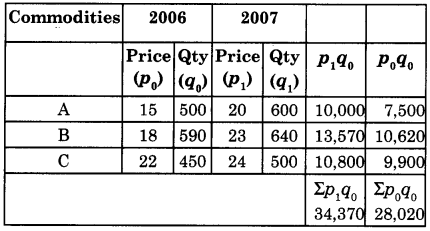
  • The village population migrated to the industrial centres in the search of employment.
  • Industrialisation signifies the mechanisation of the production process, growth of industries, division of labour and specialisation, capital and labour intensive, etc.
  • Due to industrialisation decline in the Baluta system, the emergence of industry-oriented economy, the emergence of the class system, etc.
  • Examples:
    • Industrial hubs like Mumbai, Pune, Bangalore.
    • The transformation of an urban area into an IT hub is an example of industrialisation.

Maharashtra Board Class 12 Sociology Important Questions Chapter 4 Processes of Social Change in India

Question 2.
Modernisation
Answer:

  • The term modernisation was coined by Daniel Lerner.
  • Modernisation is the process where there is the use of scientific and rational thinking that is deep-seated.
  • Modernisation has led to changes in values, beliefs, and norms.
  • Modernisation is a process of transformation from traditional society to technological modern society.
  • It is a notion of rationalism and the ability to provide scientific and logical explanations for any phenomenon.
  • Being ‘Modern’ means not only using modern devices or gadgets but also openness to receive new ideas, examine alternatives, find new pathways, use creative ways to solve problems, do critical thinking, etc.
  • Examples:
    • Acceptance of rational scientific outlook
    • Individualism
    • Secularism.

Question 3.
Globalisation
Answer:

  • The process of globalisation in the Indian context received an impetus in 1991.
  • In India, New Economic Policy was declared in 1991 by Finance Minister Dr. Manmohan Singh.
  • Globalisation is basically an economic process. It proposes to integrate the national economy with the global economy.
  • There is free flow not only of capital, goods, and technology but also of skilled human resources and ideas across the globe.
  • It proposes to remove barriers in the free movement of human beings and broaden their mental horizons.
  • Due to globalisation, the impact of the western culture and decline of the traditional values as well as changes in the social institutions like family, marriage, etc.
  • We are beset with the positive and negative impacts of globalisation.
  • Examples: International companies such as Pepsi, Coca-Cola, McDonald’s.

Question 4.
Rational outlook
Answer:
Rational outlook refers to an approach that is based on reasoning, and the ability to provide logical explanations for any phenomenon.

Explanation:
A rational outlook is based on the idea of rationalism or reasoning. This means Here, one seeks to establish laws that link facts and which govern social life. To have a rational outlook means that one’s view of a situation or a problem or an event is understood on the basis of reason. This refers to the development of a scientific way of understanding and explaining any phenomenon. Scientific reasoning explains causal relationships between factors. There is a shift to secular and rational values from spiritual-religious values.

For example, non-rational explanation of all-natural calamities are the expressions of God’s anger.
Rational explanation: Scientific explanation for natural calamities.

Maharashtra Board Class 12 Sociology Important Questions Chapter 4 Processes of Social Change in India

5A. Complete the concept map.

Question 1.
Maharashtra Board Class 12 Sociology Important Questions Chapter 4 Processes of Social Change in India 5A Q2
Answer:
Maharashtra Board Class 12 Sociology Important Questions Chapter 4 Processes of Social Change in India 5A Q2.1

Question 2.
Maharashtra Board Class 12 Sociology Important Questions Chapter 4 Processes of Social Change in India 5A Q3
Answer:
Maharashtra Board Class 12 Sociology Important Questions Chapter 4 Processes of Social Change in India 5A Q3.1

Question 3.
Maharashtra Board Class 12 Sociology Important Questions Chapter 4 Processes of Social Change in India 5A Q4
Answer:
Maharashtra Board Class 12 Sociology Important Questions Chapter 4 Processes of Social Change in India 5A Q4.1

Question 4.
Maharashtra Board Class 12 Sociology Important Questions Chapter 4 Processes of Social Change in India 5A Q5
Answer:
Maharashtra Board Class 12 Sociology Important Questions Chapter 4 Processes of Social Change in India 5A Q5.1

Maharashtra Board Class 12 Sociology Important Questions Chapter 4 Processes of Social Change in India

Question 5.
Maharashtra Board Class 12 Sociology Important Questions Chapter 4 Processes of Social Change in India 5A Q6
Answer:
Maharashtra Board Class 12 Sociology Important Questions Chapter 4 Processes of Social Change in India 5A Q6.1

Question 6.
Maharashtra Board Class 12 Sociology Important Questions Chapter 4 Processes of Social Change in India 5A Q7
Answer:
Maharashtra Board Class 12 Sociology Important Questions Chapter 4 Processes of Social Change in India 5A Q7.1

Question 7.
Maharashtra Board Class 12 Sociology Important Questions Chapter 4 Processes of Social Change in India 5A Q8
Answer:
Maharashtra Board Class 12 Sociology Important Questions Chapter 4 Processes of Social Change in India 5A Q8.1

Question 8.
Maharashtra Board Class 12 Sociology Important Questions Chapter 4 Processes of Social Change in India 5A Q9
Answer:
Maharashtra Board Class 12 Sociology Important Questions Chapter 4 Processes of Social Change in India 5A Q9.1

Question 9.
Maharashtra Board Class 12 Sociology Important Questions Chapter 4 Processes of Social Change in India 5A Q10
Answer:
Maharashtra Board Class 12 Sociology Important Questions Chapter 4 Processes of Social Change in India 5A Q10.1

5B. State whether the following statements are True or False with reasons.

Question 1.
In industrialisation workers feel alienated from the process of production.
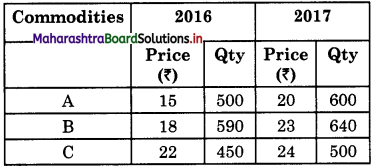
Answer:
This statement is True.

  • In industries for large-scale production, purpose capitalists started automation and mechanisation of workplaces.
  • It led to mass production due to which machine-made goods were much cheaper than hand-made goods.
  • The use of machines gives more precision, techniques, and accuracy in production.
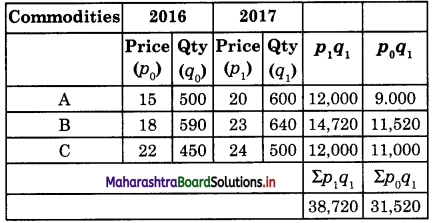
  • This leads to workers feeling less important in the work of production and they get alienated from the process of production.
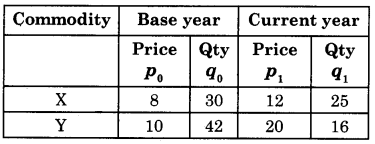
Maharashtra Board Class 12 Sociology Important Questions Chapter 4 Processes of Social Change in India

Question 2.
Industrialisation leads to Urbanisation.
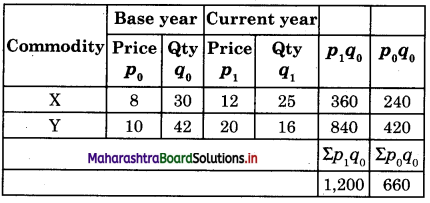
Answer:
This statement is True.
The process of industrial growth led to the large-scale emergence of factories. This in turn resulted in migration to places nearer the factory sites, leading to the growth of towns, which soon became cities and then metropolitan cities.
Since cities become the centres of trade, commerce, industry, education, etc, People from rural areas migrate towards urban areas for getting employment.
The process of urbanisation is the consequence of industrialisation as urbanisation is characteristic of industrialisation.
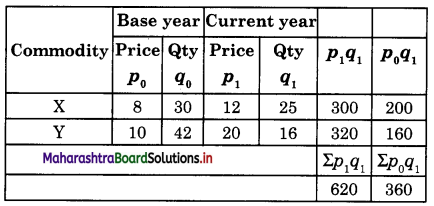
Question 3.
Urbanisation implies primary means of social control.
Answer:
This statement is False.

  • Urbanisation means a flux of people migrated from all over the country to urban areas.
  • Due to that urban centres are overpopulated. The hold of customs, traditions, religion on people’s behavior, has diminished.
  • The urban environment and way of life are more materialist, radical, commercial, individualist, and non-conforming.
  • Urbanisation implies controls and obligations that are not administered by traditional bodies such as panchayats There are secondary modes of security control, e.g., law enforcement systems such as traffic signals, city police, etc.
  • So, in urban areas, secondary means of social control are useful such as law, city police, etc.

Question 4.
Raj stays in Mumbai and has never faced any problems with commutation.
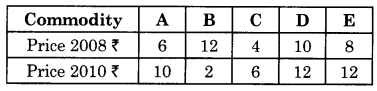
Answer:
This statement is False.
  • As per the above statement, Raj stays in Mumbai i.e., a Metropolitan city.
  • Which is overpopulated and has a shortage of means of transportation.
  • In metropolises, it is not uncommon to find people spending 3-4 hours commuting to and from the workplace.
  • So, Raj stays in Mumbai means every day he must face problems in commutation.

Question 5.
Modernisation is rational and scientific change.
Answer:
This statement is True.

  • Modernisation is the application of modern science to human affairs.
  • It is linked to the notion of rationalism; the approach and ability to provide logical explanations for any phenomenon.
  • Scientific reasoning explains causal relationships between factors. There N is a shift to secular and rational values from spiritual-religious values.
  • Persons who claim to be modern are willing to examine daily events, literature, culture, art, customs, beliefs from a critical point of view and be able to explain the constructive and destructive aspects of a phenomenon.
  • The ultimate aim of this rational and scientific perspective in modernisation is to make human life better and satisfactory.

Question 6.
In digitalisation, with one click of a button, one can open up a web world.
Answer:
This statement is True.

  • The impact of changes resulting from computerisation and digitisation. Processes have had far-reaching changes in
  • Indian society in terms of access to knowledge artificial intelligence, e-governance, e-commerce, e-learning, e-trade, e-shopping, etc., the list is endless.
  • Digitalisation has sped up the processes of data mining and data management and has made this world a global village.
  • The click of a button can open up a range of options to the user through a very simple procedure.

Question 7.
Digitisation is the use of digital technologies for handling data of various nature
Answer:
This statement is True.

  • Programming, information technology, and computer science have aided the process of computerisation, which in turn has digitised processes for several sectors, e.g., education, banking, revenue, taxation, marketing, etc.
  • Digitisation is based on technology, innovation, research, and development.
  • Digitisation had led to frequent changes in business models due to growth in newer technologies, e.g., Artificial
  • Intelligence is used for various purposes such as production, manufacturing, surgery, etc.

Maharashtra Board Class 12 Sociology Important Questions Chapter 4 Processes of Social Change in India

Question 8.
Globalisation is an eco-friendly process.
Answer:
This statement is False.

  • Due to globalisation, the environmental problem has become more serious.
  • To gain more and more profit, industrialists and multinational companies are excessively using natural resources.
  • Because of this, the intensity of environmental problems such as deforestation, pollution, rise in atmospheric temperature, etc.

6. Give your personal response.

Question 1.
Do you think, during the pandemic situation of COVID-19, people in India will accept digitalised ways for work from home? Why?
Answer:
Being a student of HSC, I feel yes most Indians will accept digitalised ways for work. Because being Indian this pandemic situation is such an eyewash situation for all. As our nation is a developing nation and if we want economic survival then most Indians will start to learn E-Content, even though this will be our first step towards standing in the market, but most Indians will accept digitalized way as this is need of the hour.

Question 2.
Being vigilant student how you will do an online awareness campaign on COVID-19.
Answer:
As COVID-19 is a pandemic and a contagious disease. I will create an online group of my friends and we will remain connected online while staying at home. United through social media groups we will jointly put posters and graffiti on social media to make the general public aware of the deadly disease.

Question 3.
Do you think in the 21st Century people prefer living in a nuclear family? Why?
Answer:
As we are in 2020, in the modern era, so I think yes people will prefer living in a nuclear family. Since the nuclear family provides them with extra space, quality of life and mainly in the nuclear family status of women are high, gender equality, the standard of living is high as the couple is working, less impact of traditional beliefs and superstitions. So, one will prefer individuality i.e. nuclear family.

7. Answer the following question in detail. (About 150-200 words)

Question 1.
You belong to a generation that has been by and large part of digital India. Discuss how digitalisation has brought about positive and negative effects.
Answer:
(i) Positive effects of digitalisation

  • Due to digitalisation, closer cross-border ties.
  • It makes our lives better and easy. It is a most essential technology.
  • It makes people become more efficient and this leads to increased productivity.
  • Digitalisation saves time, cost and gives quick and precise service,
  • Digitalisation boosts the country to do cashless transactions.
  • For example, for filing Income Tax returns, obtaining Birth and Death Certificates from the Municipal Corporation, for online admission, for declaration of election results, etc. Nowadays all these processes make use of digitalisation and it has radically transformed the processes, compared to those used just a few decades ago.

Maharashtra Board Class 12 Sociology Important Questions Chapter 4 Processes of Social Change in India

(ii) Negative effects of digitalisation

  • The excessive use of digital technology has health hazards like affecting sleep.
  • Preventing children from engaging in physical activity that resulting in cases of obesity among children.
  • In extreme cases, there can be mental illnesses like social isolation, aggression, etc.
  • In short, it affects social, physical, and mental health.
  • Due to the acceptance of digitalisation big industries take over the smaller ones.
  • One of the major problems is individual privacy in the web world. This is always under threat.