Maharashtra Board Class 12 Sociology Solutions Chapter 4 Processes of Social Change in India

Balbharti Maharashtra State Board Class 12 Sociology Solutions Chapter 4 Processes of Social Change in India Textbook Exercise Questions and Answers.

Maharashtra State Board Class 12 Sociology Solutions Chapter 4 Processes of Social Change in India

1A. Complete the following statements by choosing the correct alternative given in the brackets and rewrite it.

Question 1.
The use of computers to streamline job applications is called __________ (industrialization, globalisation, digitalization)
Answer:
digitalization

Maharashtra Board Class 12 Sociology Solutions Chapter 4 Processes of Social Change in India

Question 2.
An urban way of life is characterized by __________ (cohesiveness, uniformity, impersonality)
Answer:
impersonality

1B. Correct the incorrect pair and rewrite it.

Question 1.
(a) Copying western culture – Modernisation
(b) Growth of cities – Urbanisation
(c) Increase in production – Industrialisation
(d) Radical transformative use of technology – Digitalisation
Answer:
(a) Copying western culture – Westernisation

1C. Identify the appropriate term from the given options in the box and rewrite it against the given statement.

Urbanism, Industrialisation, Digitalisation

Question 1.
The FYJC On-line Admission process in metropolitan cities.
Answer:
Digitalisation

Question 2.
Mechanisation of the process of production.
Answer:
Industrialisation

1D. Correct the underlined words and complete the statement.

Question 1.
The Industrial Revolution took place in the sixteenth century.
Answer:
The Industrial Revolution took place in the 17th and 18th centuries.

Maharashtra Board Class 12 Sociology Solutions Chapter 4 Processes of Social Change in India

Question 2.
The LPG Policy was started by Smt. Indira Gandhi.
Answer:
The LPG Policy was started by Dr. Manmohan Singh.

2. Write short notes.

Question 1.
Negative effects of digitalisation
Answer:

  • Digitalisation is the use of digital technologies for handling data of various nature for various purposes. It has a negative impact on small-scale industries because large industries have greatly adapted to the changing scenario but small ones are finding it difficult to accept and get used to digitalisation.
  • Impact on marketing and consumer behaviour. Questions relating to individual privacy in the web world arises.
  • Excess and uncontrolled use of digital media results in addiction, cyberbullying, anxiety, depression, etc.
  • It affects not only social and physical but also mental health is hampered due to excessive and uncontrolled use of digitalisation.

Question 2.
Consequences of Industrialisation
Answer:

  • Industrialisation means the process of starting and encouraging heavy industries in society.
  • Due to industrialisation, a modern class system has emerged in India.
  • A spurt in the growth of factories and industries.
  • The development of industries led to the mechanisation of workplaces.
  • The emergence of division of labour and specialisation
  • The emergence of automation and mechanisation led to capital intensive.
  • The process of industrial growth led to the large-scale emergence of factories.
  • This in turn resulted in migration to places nearer the factory sites, leading to the growth of metropolitan cities, which have resulted in the breakdown of joint families.

3. Write differences.

Question 1.
Industrialisation and Urbanisation
Answer:

IndustrialisationUrbanisation
(i) Meaning: It means the use of unbiotic power such as electricity and steam for the mass production of goods.(i) Meaning: Urbanisation consists of an inward flow of a large number of people from scattered rural areas to urban communities.
(ii) Origin: Industrialization started in England due to the impact of the industrial revolution.(ii) Origin: Urbanization is the consequence of industrialization.
(iii) Nature: Industrialisation reflects mechanisation of workplaces and spurt in the growth of factories and industries.(iii) Nature: Urbanisation reflects the migration of people from all over the country continuously, in search of work.
(iv) Characteristics: The adoption of the revolutionary changes occurred in the production system i.e. use of heavy machinery and automation.(iv) Characteristics: The adoption of the civil administration like law and city police for the urban area.
(v) Impact: Due to industrialisation impact of scientific and technical knowledge has been increasing. So, people are accepting rationalism and secularism.(v) Impact: Due to urbanisation, the traditional belief system has been changed and become more secular in their outlooks, new educational fields are created in cities.
(vi) Effect: Industrialisation has led to the breakdown of joint families and the shrinking size of families.(vi) Effect: Urbanisation has led to the notion of being “lonely in a crowd”.

Question 2.
Modernisation and Globalisation
Answer:

ModernisationGlobalisation
(i) Meaning: “Modernisation is the current term of an old process of social change whereby less developed societies acquire the characteristics common to more developed societies.”(i) Meaning: Globalisation refers to “all those processes by which the people of the world are incorporated into a single world society.”
(ii) Characteristics: Modernisation reflects a rational outlook and scientific temperament and discarding traditional ways as these hinder the progress of the society.(ii) Characteristics: Globalisation reflects the new economic policy means LPG policy which opens the door for the Indian economy and India became part of a wider global economy.
(iii) Manifestations: The adoption of the progressive ideas of the developed countries such as industrialisation and computerisation are its manifestations.(iii) Manifestations: It leads to the transfer of resources, goods, and capital across the country.
(iv) Impact: Modernisation in every walk of life has contributed to the material progress of society and the well-being of individuals.(iv) Impact: Globalisation has promoted industrialisation, expanded market, increase export as well as export area. Globalisation has created various new opportunities of employment.

4. Explain the following concepts with examples.

Question 1.
Digitalisation
Answer:

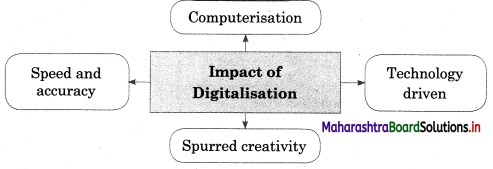
  • Digitalisation is the use of digital technologies for handling data of various nature for various purposes.
  • It involves the process of digital transformation, which improves the performance of the business.
  • It leads to frequent changes in business models due to growth in newer technologies.
  • Digitalisation is based on technology, innovation, research, and development.
  • Digitisation has escalated the speed of the processes with a far greater extent of accuracy.
  • Digitisation is based on technology, innovation, research, and development that has encouraged human minds to invent, innovate, patent, and create.
  • Example: Artificial intelligence, e-governance, e-commerce, e-learning, e-trade, e-shopping, integration of technology for the purpose of education in the 21st century, etc.

Maharashtra Board Class 12 Sociology Solutions Chapter 4 Processes of Social Change in India

Question 2.
Urbanisation
Answer:

  • Urbanisation is a process of migration of rural population to urban areas.
  • In this process, people also adopt the urban lifestyle, which means “urbanism as a way of life”.
  • It results in the decline of the joint family and the emergence of the nuclear family secondary type relations, calculative, independent, rational, less impact of traditions, family, religion, customs etc.
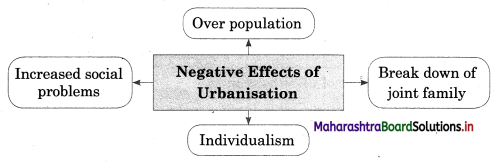
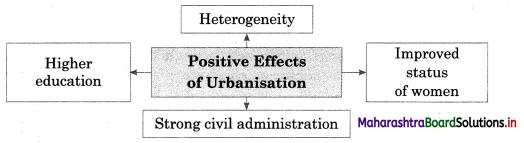
  • Urbanisation led to a heterogeneous gathering of people has led to the breakdown of several traditional barriers, where one’s contribution becomes more valued.
  • Overpopulated, mega metro cities.
  • Example: Mumbai, Pune, Nagpur.

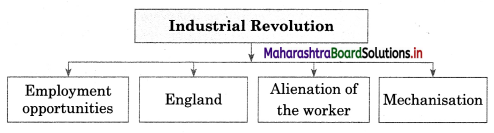
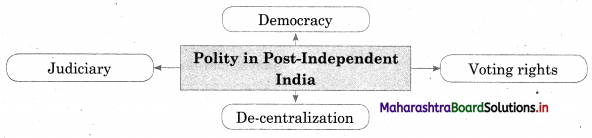
5A. Complete the concept map.

Question 1.
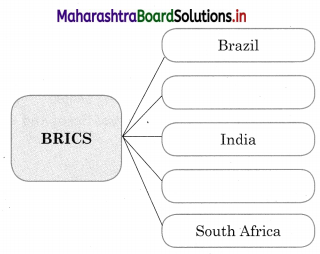
Maharashtra Board Class 12 Sociology Solutions Chapter 4 Processes of Social Change in India 5A Q1
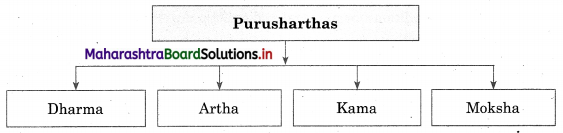
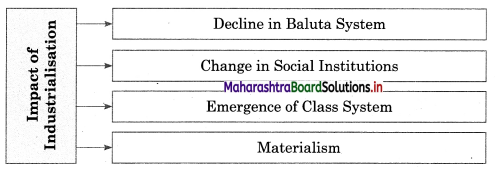
Answer:
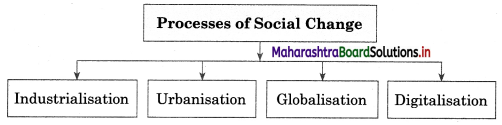
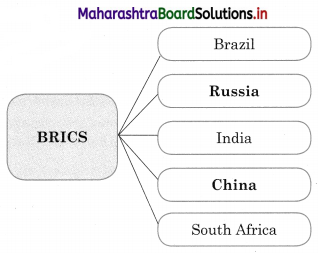
Maharashtra Board Class 12 Sociology Solutions Chapter 4 Processes of Social Change in India 5A Q1.1

5B. State whether the following statements are True or False with reasons.

Question 1.
The clothes one wears are indicative of an individual’s level of modernization.
Answer:
This statement is False.

  • Being modern doesn’t mean one should be loaded with devices, gadgets, and clothes.
  • Modernisation means rationalism, scientific outlook and willingness to receive new ideas, examine alternatives, find new pathways, to explore creative ways to solve problems.
  • Persons who claim to be modern are willing to examine daily events, literature, culture, art, customs, beliefs from a critical point of view and be able to explain the constructive and destructive aspects of a phenomenon.
  • Being ‘modern’ cannot be limited to only using modern devices or gadgets or fashionable clothes.

Maharashtra Board Class 12 Sociology Solutions Chapter 4 Processes of Social Change in India

Question 2.
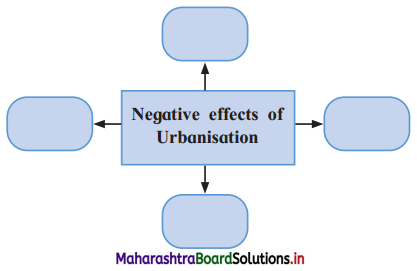
Urbanisation can have negative effects on our social relationships.
Answer:
This statement is True.

  • Urbanisation means the migration of rural people to urban areas, that results in family discords and breaking up of joint families.
  • Due to urbanisation materialistic approach is increased and reduces the emotional ties and develops secondary relationships among people.
  • They develop a certain way of life which is typical of the urban mindset: distant, secondary-type relations, calculative, independent, rational, less impact of traditions, family, religion, customs etc.
  • The urban environment and way of life are more materialist, radical, commercial, individualist, and non-conforming. Urbanisation has led to the notion of being “lonely in a crowd”.

6. Give your personal response.

Question 1.
Shagufta Ranawat and her joint family have been living in Nagpur city for almost three generations. Their grandchildren are uninclined to want to settle down in their grandparent’s village. Give two possible reasons for the grandchildren’s view.
Answer:
1st View: As Shagufta Ranawat and her family from last three generations living in Nagpur city. Nagpur is one of the mega metro cities of India which is loaded with full of infrastructural facilities as well as employment opportunities, gender equality even through materialistic approach it has a rational and scientific outlook. So, grandchildren don’t want to leave Nagpur city and settle down in the village.

2nd View: Grandchildren know that now grandparents are age-old and advanced medical facilities will not be easily available during emergencies. So for precautionary measure of grandparent’s health, living in Nagpur city which is a well-developed hub is good for them.

Question 2.
Some people feel insecure about digitalisation processes, for example, in banking or online purchasing. Why do you think this is the case?
Answer:
Yes, some people feel insecure about digitalisation processes because of being computer phobic or computer illiterate, as they don’t trust the internet and perceived security risks. The perception that someone else has access to your bank account is a deal-breaker for many. It’s a big jump into the unknown with your hard-earned money especially if you have no one to explain it to you.

7. Answer the following question in detail. (About 150-200 words)

Question 1.
“The World Wide Web is a source of information and misinformation”. Discuss this statement with regard to the impact of the internet on:
(i) Parents
(ii) Children
(iii) School
Answer:
(i) Impact of the Internet on Parents:

  • Parents know that the internet is a window opening to the whole world and as a tool to get information.
  • Parents are aware of the positive and negative effects of internet use.
  • Parents know that the internet is useful for attaining information.
  • They mainly consider it as an effective means of communication due to instant messaging services that can communicate to any part of the world.
  • It improves business, interactions, transactions saving vital time.
  • Banking, shopping online has made life less complicated for parents.

Maharashtra Board Class 12 Sociology Solutions Chapter 4 Processes of Social Change in India

(ii) Impact of the Internet on Children:

  • Maximum children are busy playing games online.
  • Increased use of the internet among children is making them feel lonely and depressed.
  • More time spent online means children spent less time with family and friends or working on hobbies.
  • Internet allows children to participate actively in a self-learning environment.

(iii) Impact of the Internet on School:

  • The internet has not only increased the amount of learning possibilities in the classroom but it has created infinite amounts of learning opportunities for students and teachers.
  • Use of internet in the school improves the quality of education in many ways.
  • Teachers can use online materials to prepare lessons.
  • The Internet plays a very vital role in education.

Activity 1 (Textbook Page No. 59)

Identify any four cities and study data about their industrial growth. Presents your findings to your class and follows them with a discussion.
Answer:
(i) Industrial growth in Mumbai:

  • Mumbai is the economic capital of India.
  • In earlier days cotton textile industry dominated Mumbai’s economy, but now Mumbai’s economic base is diversified.
  • Textiles industries still remain important, but the city’s industries include petrochemicals, automobile manufacturing, metals, electronics, engineering, food processing, and a wide range of light manufacturing.

(ii) Industrial growth in Pune:

  • From a small university town to IT hub, Pune has changed its face over the years.
  • Numerous automobile manufacturers and ancillary companies have today invested heavily in Pune.
    e.g. TATA motors, Cummins, etc.

(iii) Industrial growth in Nagpur:

  • One of the largest industrial estates approximately 6000 Hectares of Asia is located at Butibori near Nagpur.
  • About 47% of Maharashtra State’s power is generated around Nagpur.

(iv) Industrial growth in Kolkata:

  • Industrial growth rate of West Bengal is 1.1% higher than the national average.
  • The growth and development are around the capital city of Kolkata.
  • Kolkata is home to many industrial units, major sectors are steel, mining, minerals, cement, etc.

Activity 2 (Textbook Page No. 60)

Get 4 volunteers from your class to share their experiences (physical environment, economic life, customs, food, religious practices etc.) in a rural village or city, in 5-7 minutes each. They may make a PPT with visuals to support their presentations. Follow up with a class discussion.
Answer:

Volunteer – 1
Village – Khed, Junnar Taluka
Volunteer – 2
Village – Ghodegaon, Manchar Taluka
Volunteer – 3
City – Pune
Volunteer – 4
City – Mumbai
Physical EnvironmentClean, pure, and healthy airClean, pure and healthy airPollution and overcrowdedPollution and shortage of land
Economic LifeAgrarian (Poor)Agrarian and domestic businessIndustry and factory oriented (Rich)Industrialisation (Rich)
CustomsTraditional and superstition boundTradition and superstition boundThe rational and scientific perspectiveFollow the customs rationally
FoodJawar, wheat, rice (Homemade)Staple foodMaterialistic approachMaterialistic view
Religious practicesFollow judiciously and blindlyFollow blindlyModern/critical thinkingModern/critical thinking

Activity 3 (Textbook Page No. 62)

Conduct a 2-minute extempore speech competition in class on the topic: “Modernisation may be perceived as a challenge in a traditional society.”
Answer:
The following pointers will help you prepare a speech.

  • It is a process of social transformation.
  • The developing countries imitate the western model of development. Thereby the traditional society becomes a technologically modern society.
  • It develops new attitudes, new values and social relationships.
  • It has paved a way for developing a scientific temperament.
  • It encompasses social, economic, political, religious, and intellectual changes.
  • Modernisation is a current term of an old process of social change.

Maharashtra Board Class 12 Sociology Solutions Chapter 4 Processes of Social Change in India

Activity 4 (Textbook Page No. 63)

Given below is a way of finding out about people’s lives. It is called narrative research. It is all about hearing people’s stories.
Few volunteers from your class may speak to 1-2 small shops in the area and find out about their business. When did it start? Who started it? Are there changes in their sales? Are there changes in people’s behaviour? Are there any problems faced by the sellers? If so, what are they?
Write about their stories in about 200-300 words. Share with your class. See if you can see a pattern of experience or behaviour.
Answer:
The below example will provide you with pointers for your own narrative research.

  • Shop Name – Pooja (General Stores)
  • Owner Name – Mr. XYZ
  • Area – Badlapur (West), Thane
  • When did it start – 1990
  • Who started it – Mr. XYZ’s Father
  • Are there changes in their sales? – Yes, up and downs in profit margins.
  • Are there changes in people’s behavior – Yes, due to last 3 decades won the trust of the people
  • Are there any problems faced by the sellers – Yes
  • What are they – Loss of profit margins recession, natural calamity like a flood.

Activity 5 (Textbook Page No. 65)

Identify any three Higher Secondary School teachers in your locality or school. Collect information about (a) the subject they teach, (b) their qualifications (e) number of years of teaching experience, (d) whether they have computers in their school/college, (e) whether they use computers and if yes, for what purpose? Report your findings in class.
Answer:

QuestionsTeacher – 1 (Ms. L)Teacher – 2 (Ms. M)Teacher – 3 (Mr. X)
The subject they teachEnglishHistoryMarathi
QualificationM.A, B.Ed., M.Phil. (Eng.)M.A., B.Ed. (History)M.A., B.Ed. (Mar.)
Teaching experience5 Years10 Years9 Years
Whether they have computers in school/collegeYesYesYes
Whether they use computers and if yes, for what?Yes, for preparation of notes, questions papers, research work, and references.Yes, for making notes.Yes, for making notes.

Activity 6 (Textbook Page No. 65)

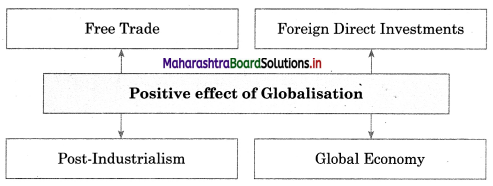
‘Globalisation has a positive effect on Indian society.’ Form two teams of four students each, and conduct a class debate. The teacher may prepare a blackboard summary of the learning points. It can be followed by an open discussion of observations made by students.
Answer:
(i) Globalisation has a positive effect on Indian Society: (Debate 1st side)

  • It’s a universal process.
  • Transformation of the national economy into global economy.
  • The growing economic interdependence of the countries of the world.
  • Integration of the world economy, free trade.

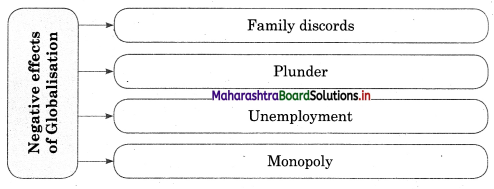
(ii) Globalisation has a negative effect on Indian Society: (Debate 2nd side)

  • The role of the state, the public sector has been curtailed by privatisation.
  • An increasing number of young immigrations of the young technocrats to the developed countries, leaving behind the aging parents.
  • There is an increase in the family discords and break up of more and more families and marriages.
  • The small-scale industries face stiff competition from the large-scale industries and their multinational counterparts.

Maharashtra Board Class 12 Sociology Solutions Chapter 4 Processes of Social Change in India

Activity 7 (Textbook Page No. 67)

Hold a class discussion at the end of each process of change, to discuss the positive and negative impact of each process. Develop a flow chart or concept map for each process of social change.
Answer:
Maharashtra Board Class 12 Sociology Solutions Chapter 4 Processes of Social Change in India 5A Q1

Maharashtra Board Class 12 Sociology Solutions Chapter 4 Processes of Social Change in India 5A Q1.1

Maharashtra Board Class 12 Sociology Solutions Chapter 4 Processes of Social Change in India 5A Q2

Maharashtra Board Class 12 Sociology Solutions Chapter 4 Processes of Social Change in India 5A Q2.1

Maharashtra Board Class 12 Sociology Solutions Chapter 4 Processes of Social Change in India 5A Q3

Maharashtra Board Class 12 Sociology Solutions Chapter 4 Processes of Social Change in India 5A Q3.1

Maharashtra Board Class 12 Sociology Solutions Chapter 4 Processes of Social Change in India 5A Q4

Maharashtra Board Class 12 Sociology Solutions Chapter 4 Processes of Social Change in India 5A Q4.1

Maharashtra Board Class 12 Sociology Solutions Chapter 4 Processes of Social Change in India 5A Q5

Maharashtra Board Class 12 Sociology Solutions Chapter 4 Processes of Social Change in India 5A Q5.1

Maharashtra Board Class 12 Sociology Solutions Chapter 4 Processes of Social Change in India 5A Q6

Maharashtra Board Class 12 Sociology Solutions Chapter 4 Processes of Social Change in India 5A Q6.1

Maharashtra Board Class 12 Sociology Solutions Chapter 4 Processes of Social Change in India 5A Q7

Maharashtra Board Class 12 Sociology Solutions Chapter 4 Processes of Social Change in India 5A Q7.1

Maharashtra Board Class 12 Sociology Solutions Chapter 4 Processes of Social Change in India 5A Q8

Maharashtra Board Class 12 Sociology Solutions Chapter 4 Processes of Social Change in India 5A Q8.1

Maharashtra Board Class 12 Sociology Solutions Chapter 4 Processes of Social Change in India 5A Q9

Maharashtra Board Class 12 Sociology Solutions Chapter 4 Processes of Social Change in India 5A Q9.1

Maharashtra Board Class 12 Sociology Solutions Chapter 4 Processes of Social Change in India 5A Q10

Maharashtra Board Class 12 Sociology Solutions Chapter 4 Processes of Social Change in India 5A Q10.1

Maharashtra Board Class 12 Economics Important Questions Chapter 4 Supply Analysis

Balbharti Maharashtra State Board Class 12 Economics Important Questions Chapter 4 Supply Analysis Important Questions and Answers.

Maharashtra State Board 12th Economics Important Questions Chapter 4 Supply Analysis

1.[A] Choose the correct option.

Question 1.
Net addition made to the total revenue by selling an extra unit of a commodity is
(a) total revenue
(b) marginal revenue
(c) average revenue
(d) marginal cost
Answer:
(b) marginal revenue

Question 2.
Determinants of supply are …………………..
(a) cost of production
(b) short period
(c) constant price
(d) local market
Answer:
(a) cost of production

Maharashtra Board Class 12 Economics Important Questions Chapter 4 Supply Analysis

Question 3.
Statement related to reservation price are
(a) maximum price
(b) constant price
(c) same for all seller
(d) differ from seller to seller
Answer:
(d) differ from seller to seller

Question 4.
Exceptions to the law of supply are
(a) need for cash
(b) upward sloping supply curve
(c) factory products
(d) future expectation of high price
Answer:
(a) need for cash

Question 5.
Average Revenue is obtained when .
(a) price is multiplied with quantity
(b) last unit is sold
(c) total revenue is divided by quantity sold
(d) all of these
Answer:
(c) total revenue is divided by quantity sold

Question 6.
Increase in supply is shown by
(a) price change only
(b) movement on the same supply curve
(c) shift of supply curve to the left
(d) shift of supply curve to the right
Answer:
(d) shift of supply curve to the right

(B) Complete Correlation

  1. Rare goods : Exception to Law of Supply :: Assumption of Law of Supply : ……………….
  2. ………………. : Individual supply :: Macro concept: Total supply
  3. Marginal Revenue : TRn – TRn-1 :: ……………….: TR/TQ
  4. Single seller : Individual Supply :: All sellers : ……………….
  5. Movement on same supply curve : ……………….:: Shift of supply curve: Change in supply.

Answers:

  1. No change in Government Policy
  2. Micro concept
  3. Average Revenue
  4. Market Supply
  5. Variation in supply

(C) Give economic terms.

  1. Creation of utility.
  2. Outcome of the process of production.
  3. Total quantity available with the producer for sale at time.
  4. Sum total of individual supply.
  5. Cost incurred on fixed factors like land, machinery etc.
  6. Minimum price below which a seller will not sell a single unit.
  7. Expansion and contraction of supply due to change in price.
  8. Rise in supply due to fall in taxes.
  9. Fall in supply due to fall in taxes.
  10. Cost incurred on variable factor like raw material.
  11. Net revenue earned by selling an additional unit.

Answer:

  1. Production
  2. Output
  3. Stock
  4. Market Supply
  5. Fixed Cost
  6. Reservation Price
  7. Variation in Supply
  8. Increase in Supply
  9. Decrease in Supply
  10. Variable Cost
  11. Marginal Revenue

Maharashtra Board Class 12 Economics Important Questions Chapter 4 Supply Analysis

(D) Find the odd word out:

(1) Land, Labour, Capital, Rent.
(2) Rent, Wages, Profit, Capital.
(3) AC, TC, TFC, AR.
(4) Samuelson, Marshall, Robbins, Abdul Kalam.
(5) [ncrease in supply, Decrease in supply, Extension in supply, Market supply.
Answer:

  1. Rent
  2. Capital
  3. AR
  4. Abdul Kalam
  5. Market supply

(E) Complete the following statements.

  1. Production consists of various processes through which ………………
  2. Stock determines ………………
  3. Stock and supply are same in case of ………………
  4. Sum total of individual supply is called ………………
  5. Graphical representation of market supply schedule is called ………………
  6. When quantity supplied rises due to an increase in price of a commodity, it is called ………………
  7. When more quantity is supplied at the same price of a commodity, it is called ………………
  8. Per unit cost of production is called ………………
  9. Total expenditure incurred by a firm on factors of production for the production of goods and services is called ………………
  10. An addition made to TR by selling one additional unit of a commodity is called ………………

Answer:

  1. utility is created
  2. potential supply
  3. perishable goods
  4. market supply
  5. market supply curve
  6. extension or expansion in supply
  7. increases in supply
  8. Average Cost
  9. Total Cost
  10. Marginal Revenue

(F) Choose the wrong pair:

I.

Group ‘A’Group ‘B’
1. Total OutputSum of quantity produced
2. StockReservation Price
3. SupplyQuantity offered for sale

Answer:
Wrong pair : Stock – Reservation price

II.

Group ‘A’Group ‘B’
1. Extension in supplyMore supply at higher price
2. Contraction in supplyLess supply at lower price
3. Increases in supplyPart of variation in supply

Answer:
Wrong pair : Increase in supply – Part of variation in supply

III.

Group ‘A’Group ‘B’
1. Total RevenuePrice x Quantity
2. Total CostTFC + TVC
3. Average CostTR x TQ

Wrong pair : Average Cost – TR x TQ

Maharashtra Board Class 12 Economics Important Questions Chapter 4 Supply Analysis

(G) Choose the correct pair:

I.

Group ‘A’Group ‘B’
1. Increase in supplyTechnology up gradation
2. Exception to law of supplyMore supply at higher price
3. Determination of law of supplyPerishable Goods

Answer:
Correct pair : Increases in supply – Technology up gradation

II.

Group ‘A’Group ‘B’
1. Individual supplyPotential supply
2. Determinants of law of supplyInfrastructural
facilities
3. Assumption of the law of supplyChange in government policy

Answer:
Correct pair : Determinations of the law of supply – Infrastructural facility

III.

Group ‘A’Group ‘B’
1. MCnTCn – TCn-1
2. TRQ/P
3. ARTR x TQ

Answer:
Correct pair : MCn – TCn – TCn-1

2.[A] Identify and explain the concept from given illustration.

Question 1.
All the seller of a similar product are willing to sell their product at a particular price in a given time.
Answer:
Concept: Market Supply
Explanation : Market supply refer to the quantity that all the producers are willing to produce and offer for sale at a particular price in a given time.
As all sellers are ready to sell their product at a particular price, each seller is price taker.
Thus, this concept is of market supply.

Question 2.
Price of old coins, antiques increases as demand increases, but supply cannot be increased.
Answer:
Concept: Exception to the law of supply
Explanation : As per the law of supply, when the price of a product rises, supply increases, but in this case supply cannot be increased.
So, this is an exception to the law and its supply curve is a vertical straight line instead of upward sloping. Thus, this is an exception to the law.

Question 3.
A seller is in urgent need for cash. Therefore, he sell more at lower price.
Answer:
Concept: Exception to the law of supply
Explanation : As per the law of supply, at higher price more is offered for sale.
In this case a seller is selling more at lower price because he is an urgent need for cash.

Question 4.
Due to the improvement in technology, supply of cell phones have increased even though price remains same.
Answer:
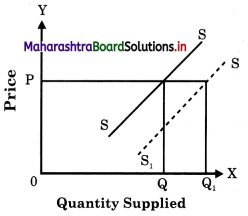
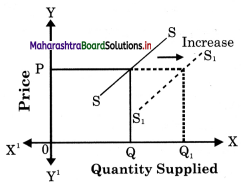
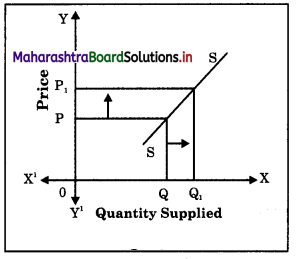
Concept: Increase in supply Explanation : Increase in supply is a situation when producers are willing to supply a larger quantity of a commodity at the same price.
Due to improvement in the technology of cell phone, producers cost of production falls and they can sell more in the market at the same price.
This is shown with graph.
Maharashtra Board Class 12 Economics Important Questions Chapter 4 Supply Analysis 1

At the same price OP, quantity supplied increases from 0Q to 0Q1
Thus, this is a case of increase in supply.

Maharashtra Board Class 12 Economics Important Questions Chapter 4 Supply Analysis

Question 5.
Mr. Kriplani produced 2000 bales of cloth during the year 2018-19.
Answer:
Concept: Total Output.
Explanation : Total Output is the sum total of the commodity produced at a given period of time.
So, total output of Mr. Kriplani is taken as total output for the year 2918-19.

Question 6.
Mr. Kriplani had 200 apples in hand. He bought 500 apples from wholesaler.
Answer:
Concept: Stock
Explanation : Stock is the total quantity of commodity available for sale with a seller at a particular point of time.
Now in our case, Mr. Kriplani has total stock of 700 apples (200+500) which he can offer for sale at particular price.

Question 7.
Mr. Chaturvedi has 5000 kg rice at his disposal. He offered 2000 kg rice in market at Rs. 25 per kg.
Answer:
Concept: Stock and Supply
Explanation : Supply means the various quantities of a commodity offered for sale by
producer during a given period of time at a particular price.
In above case, total stock is 5000 kg rice and total supply is 2000 kg rice.

Question 8.
At price Rs. 30 per kg Rameshbhai ( supplied 100 kg of wheat, Bhaveshbhai i supplied 150 kg of wheat and Dharmesh bhai supplied 200 kg of rice. ;
Answer:
Concept : Individual Supply and Market Supply.
Explanation : Individual supply means quantity offer by a single seller at a given price while market supply means total quantity supplied by all the seller in the market a given price.
In above case, 100kg, 150kg and 200 kg is called as individual supply while 450kg is called as market supply.

Question 9.
A seller has go to village urgently. So, he sells his product at low price even if other seller are selling similar product at higher price. Given economic reason in what way it is related to the law of supply.
Answer:
This is an exception to the law of supply. As per the law, more is sold at higher price and less at lower price. In this case an individual seller is in need of cash, as he has to go to village urgently, so he has to sell his product at lower price.

(B) Distinguish between:

Question 1.
Output and Supply
Answer:

OutputSupply
1. Output refers to the total quantity of a commodity that a producer produces with the help of factors of production using a particular technology during a given period of time.(a) Supply refers to the quantity of a commodity which producers are willing to offer for sale at a given price during a given period of time.
2. Output is a function of input. So, O = f (Inputs)(b) Supply is a function of stock. So, S =f (Stock)
3. Output depends upon the level of investment, technique of production, cost of production, availability of factors and natural resources, etc.(c) Supply depends on the stock and price.
4. Output forms the basis of stock.(d) Stock forms the basis of supply.

Question 2.
Individual Supply and Market Supply
Answer:
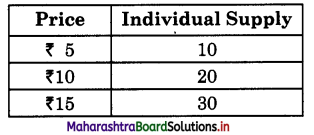
Individual Supply:
(a) Individual Supply schedule refers to various quantities of a commodity that an individual seller is willing to sell in the market at different prices during given period of time.
(b) Individual Supply is a narrow concept. It is a part of market_supply.
(c) Schedule:
Maharashtra Board Class 12 Economics Important Questions Chapter 4 Supply Analysis 2
(d) As price rises, a seller likes to sell more.

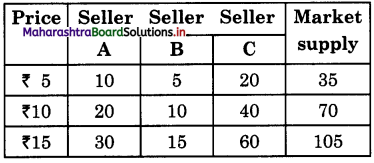
Market Supply:
(a) Market Supply schedule refers to various quantities of a commodity that all sellers are willing to sell in the market at different prices during given period of time.
(b) Market Supply is a broader concept. It is sum total of individual supply.
(c) Schedule:
Maharashtra Board Class 12 Economics Important Questions Chapter 4 Supply Analysis 3
(d) As price rises total quantity supplied in the market increases.

Maharashtra Board Class 12 Economics Important Questions Chapter 4 Supply Analysis

Question 3.
Individual Supply Curve and Market Supply Curve
Answer:
Individual Supply Curve:

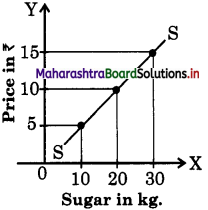
  1. Individual Supply Curve An individual supply curve is a graphical representation of various quantities of a commodity offered for sale by an individual seller at different prices during a given period of time.
  2. It is a narrow concept, as it is a part of market supply.
    Maharashtra Board Class 12 Economics Important Questions Chapter 4 Supply Analysis 4
  3. The above supply curve shows that as price rises quantity supplied increases to 10, 20, 30 kg.

Market Supply Curve:

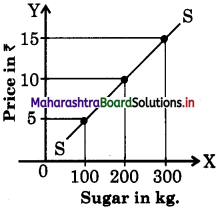
  1. Market supply curve is the graphical representation of the various quantities of a commodity offered for sale by all the sellers at different prices during a given period of time.
  2. It is a broader concept, as it sum total of individual supply.
    Maharashtra Board Class 12 Economics Important Questions Chapter 4 Supply Analysis 5
  3. The above supply curve shows that as price rises, total supply in the market rises to a greater extent to 100, 200, 300 kg.

Question 4.
Extension of Supply and Contraction of Supply.
Answer:
Extension of Supply:

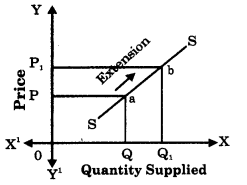
  1. When the supply of a commodity rises only due to increase in the price of that commodity, then it is said to be extension of supply.
  2. Extension in supply is shown by an upward movement to right on the same supply curve.
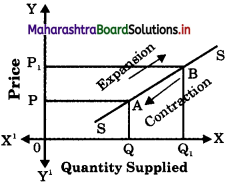
    Maharashtra Board Class 12 Economics Important Questions Chapter 4 Supply Analysis 6
  3. When price rises from OP to 0P1, Supply extends from 0Q to 0Q1.

Contraction of Supply :

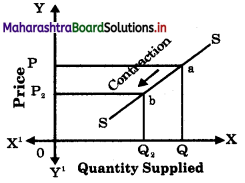
  1. When supply of a commodity falls only due to fall in the price of that commodity, then it is said to be contraction of supply.
  2. Contraction is shown by the downward movement to left on the same supply curve.
    Maharashtra Board Class 12 Economics Important Questions Chapter 4 Supply Analysis 7
  3. When prices falls from 0P to 0P2, Supply contracts from 0Q to 0Q2.

Question 5.
Variation in supply and Changes in Supply.
Answer:
Variation in Supply:

  1. Variation in supply refers to expansion and contraction of supply which takes place due to change in price.
  2. Expansion means more quantity is supplied at a high price while contraction means less quantity is supplied at a lower price.
  3. Variation in supply is caused by change in price.
  4. Variation is shown by a upward or downward movement on the same supply curve.

Maharashtra Board Class 12 Economics Important Questions Chapter 4 Supply Analysis 8

Changes in Supply:

  1. Changes in supply refers to increase and decrease in supply which takes place due to changes in factors other than price.
  2. Increase in supply means more quantity is supplied at same price and decrease means less quantity supplied at the same price.
  3. Changes in supply occurs due to change in factors like.
    (1) change in cost of production
    (2) change in techniques of production
    (3) change in government policy.
    (4) change in goal of producer.
    (5) change in climatic condition etc.
  4. Changes in supply is shown by a shift in supply curve to the right or left of the original supply curve.
    Maharashtra Board Class 12 Economics Important Questions Chapter 4 Supply Analysis 9

Question 6.
Total Cost (TC) and Total Revenue (TR).
Answer:
Total Cost (TC) :

  1. TC is the total expenditure incurred by a firm on the factors of production required for production of goods and services.
  2. TC is sum total of Total Fixed Cost (TFC) and Total Variable Cost (TVC). TC=TFC+TVC
  3. TC increases with the increase in output.
  4. TC depends on factors like cost of raw material, cost of factors like labour, land, capital, technology, cost of advertisement, management, etc.
  5. When TC > TR firm faces loss.

Total Revenue (TR) :

  1. TR refers to the amount received (income earned) by a firm from the sale of given quantity of a commodity at different price.
  2. TR is calculated by multiplying price with the quantity sold. TR = Price X Total Quantity
  3. TR increases with increase in sale.
  4. Total Revenue (TR) depends on the price of product, demand for the product, etc.
  5. When TR > TC firm earns profit.

Maharashtra Board Class 12 Economics Important Questions Chapter 4 Supply Analysis

Question 7.
Demand Curve and Supply Curve.
Answer:
Demand Curve:

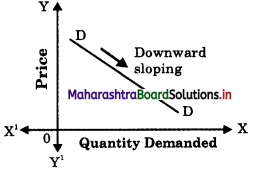
  1. Demand curve is the graphical representation of a given demand schedule.
  2. The demand curve slopes downward from left to right.
  3. The demand curve has a negative slope as price and demand are inversely related.
  4. The demand curve indicates the consumer’s behaviour in response to change in its price.

Maharashtra Board Class 12 Economics Important Questions Chapter 4 Supply Analysis 10

Supply Curve:

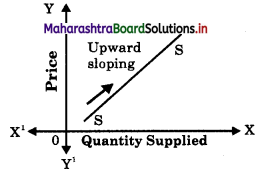
  1. Supply curve is a graphical representation of a given supply schedule.
  2. The supply curve slopes upward from left to right.
  3. The supply curve has a positive slope as price and supply are directly related.
  4. The supply curve indicates the seller’s behaviour in response to change in its price.

Maharashtra Board Class 12 Economics Important Questions Chapter 4 Supply Analysis 11

Question 8.
Increase in Supply and Decrease in Supply.
Answer:
Increase in Supply :

  1. The supply is said to increase if at the same price more is supplied.
  2. Increase in supply is a case of changes in supply.
  3. Supply increases due to
    (1) fall in cost of production
    (2) improvement in transport facility
    (3) introduction of modern technology
    (4) government subsidies
    (5) more imports etc.
  4. When there is an increase in supply, the supply curve shifts to the right of original supply curve.

Maharashtra Board Class 12 Economics Important Questions Chapter 4 Supply Analysis 31

Decrease in Supply

  1. Decrease in supply occurs when less quantity is supplied at the same price.
  2. It is a case of changes in supply.
  3. Supply decreases due to –
    (1) increase in cost of production
    (2) transport strike
    (3) outdated technique
    (4) heavy taxes imposed by government.
    (5) more exports etc.
  4. When there is curve shifts to curve.
    Maharashtra Board Class 12 Economics Important Questions Chapter 4 Supply Analysis 32

Question 9.
Demand and Supply.
Answer:
Demand:

  1. Demand is a desire backed by ability and willingness to pay.
  2. Demand is inversely related to price.
  3. Demand curve has negative slope.

Supply:

  1. Supply means the various quantities offered for sale by a producer at a given price and at a given period of time.
  2. Supply is directly related to price.
  3. Supply curve has positive slope.

3. Answer the following questions.

Question 1.
What are the exceptions of the law of supply?
Answer:
There are some exceptions to the law of s supply. Following are such cases when supply may fall with the rises in price or rise with the fall in price.

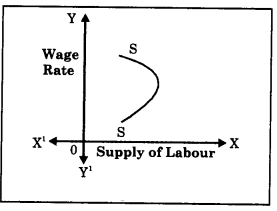
(1) Labour supply : Supply of labour in the terms of hours of work is an important exception pointed out by economists. Generally when wages rise, workers work more, but after a certain point if wages continue to rise, supply of labour falls i.e. workers wish to earn more by work in for less hours and supply curve of labour would bend backwards as shown below :
Maharashtra Board Class 12 Economics Important Questions Chapter 4 Supply Analysis 12
In this figure as wage rate rises up to 0W, ;i supply of labor also rises up to ON, but when wage rate rises to 0W1, labour supply falls from ON to 0N1 Hence an exception.

(2) Saving : In case of savings generally it is observed that as the rate of interest rises, savings also rises but some people want to have a fixed regular income by way of interest. They may save less at a higher rate ( of interest and save more at a lower rate of interest. For example : suppose a person is interested in earning a fixed income of ? 800 p.a. then he saves ₹ 10,000/- at 8% rate of interest but when rate of interest increases to 10%, he will save only ₹ 8,000/-.

(3) Future Expectations: If the seller expects a fall in price in future, then he will supply more today even at a low price. But if he expects the prices to rise further in future he will withhold the supply today to supply more in future at a high price.

(4) Need for Cash : When the sellers are in urgent need of liquid cash, then even at a lower price they will offer more goods for sale.

(5) Rare Goods : In case of rare collections such as rare painting, old coins, antique, the law is not applicable as the supply remains fixed. The supply curve is a vertical straight line parallel to Y axis.

(6) Agricultural Goods: Supply of agricultural product is influenced by natural factors like climatic conditions, rainfall etc., which cannot be controlled by man. So in bad weather condition, even at a higher price the supply of agricultural commodities will not increase.

Maharashtra Board Class 12 Economics Important Questions Chapter 4 Supply Analysis

Question 2.
Explain in detail labour supply as an exception to the law of supply.
Answer:
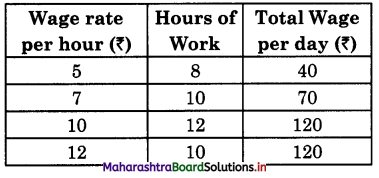
Labour Supply : An interesting exception to the law of supply is provided by the supply curve of labour. In case of supply of labour we come across an unusual phenomenon of the backward bending supply curve. In the beginning, the supply curve of labour slopes upwards as usual from left to right because at higher wage, the units of labour are tempted to offer more hours of work. This continues till the time wage rates have risen sufficiently. When wage rate goes beyond a particular level the worker prefers to substitute work by leisure and cut short the supply of labour. Hence, beyond a certain wage rate the supply curve of labour slopes backwards. This is called the backward bending supply curve of labour and is an exception to the law of supply as shown in the diagram.
Maharashtra Board Class 12 Economics Important Questions Chapter 4 Supply Analysis 13

In the above schedule, the supply of labour rises from 8 hours to 10 to 12 hours as the wage rate rises from ₹5 per hour to ₹7 to ₹10 per hours. But thereafter when wage rate – becomes ₹12 per hour the supply of labour ; falls to 10 hours. So the supply curve has a backward bend from point ‘A’. Initially, it slopes upwards i.e., SA then A to S1 upto it has a backward slope.
Maharashtra Board Class 12 Economics Important Questions Chapter 4 Supply Analysis 14

Question 3.
Explain variation in supply with the help of diagram.
Answer:
When quantity supplied of a commodity changes due to change in its price, other factors remaining constant, it is known as variation in supply. Variation in supply can be of two types :
(A) Expansion (or Extension) of Supply
(B) Contraction of Supply

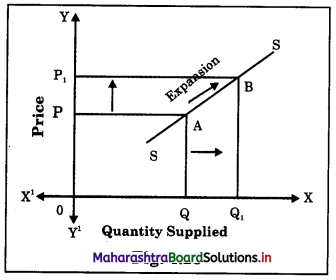
(A) Expansion (or Extension) of Supply : It refers to a rise in the quantity supplied due to an increase in price of a commodity, other factors remaining constant. Extension of supply leads to an upward movement on the same supply curve due to a rise in price as shown in the diagram :
Maharashtra Board Class 12 Economics Important Questions Chapter 4 Supply Analysis 15

In the above diagram, when price increases from P to P1, the quantity supplied rises or expands from Q to Q1 resulting in an upward movement from point A to point B along the same supply curve. It is known as extension of supply.

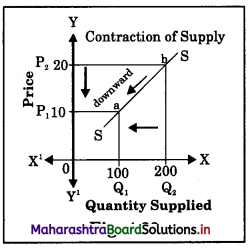
(B) Contraction of Supply : It refers to fall in quantity supplied due to fall in price, other things remaining constant. Contraction of supply leads to a downward movement on the same supply curve due to a fall in price as shown in the diagram.
Maharashtra Board Class 12 Economics Important Questions Chapter 4 Supply Analysis 16

In the diagram when price falls from P2 to P1, the quantity supplied falls or contracts from Q2 to Q1 resulting in a downward movement from point B to A along the same supply curve. It is known as contraction of supply.

Question 4.
Explain change in supply with the help of diagram.
OR
Explain increase in supply and decrease in supply.
Changes in supply occurs when the quantity supplied changes due to changes in factors other than price.
Changes in Supply are of two types :
(A) Increase in Supply
(B) Decrease in Supply

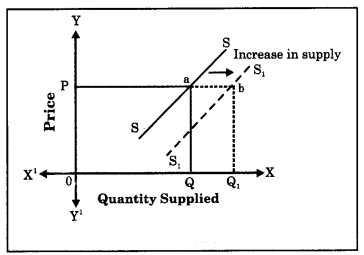
(A) Increase in Supply : It means when more quantity is supplied at the same price. Increase in supply occurs due to changes in factors other than change in price. It takes place when –

1. There is decrease in price of inputs
2. There is technological upgradation
3. Imports are more
4. There is decrease in tax, etc.

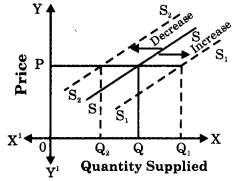
Increase in supply is shown by a shift in i the supply curve to the right of the original; supply curve.
Maharashtra Board Class 12 Economics Important Questions Chapter 4 Supply Analysis 17

In the diagram, at OP price when quantity supplied rises from OQ to OQ1 it indicates) an increase in supply. This is shown by a c shift in supply curve from SS to S1S1 to the right.

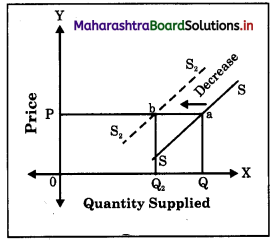
(B) Decrease in Supply : It means when less quantity is supplied at the same price.
Decrease in supply occurs due to change in factors other than change in price. It takes place when –

1. there is increase in price of inputs,
2. technological degradation or out dated technology used.
3. exports are more.
4. there is increase in taxes etc.

Decrease in supply is shown by a shift in the supply curve to the left of the original supply curve.
Maharashtra Board Class 12 Economics Important Questions Chapter 4 Supply Analysis 18
At OP price when quantity supplied falls from OQ to OQ2, it indicates a decrease in supply. This is shown by a shift in supply curve from SS to S2S2 to the left.

Question 5.
Explain concept of TC, AC and MC.
Answer:
Cost of production is an important factor in governing the supply of a product. Following are the three main types of costs :

(A) Total Cost (TC): It is the total expenditure incurred by a fir m on the factors of production required for the production of goods and services. Total cost is the sum of Total Fixed Cost (TFC) and Total Variable Cost (TVC). Total Fixed Cost is the cost incurred on fixed factors of production like land, factory, building, capital, etc. These factors cannot be changed in the short period. They remain constant. Total Variable Cost is the cost incurred on variable factors such as raw – materials, labour, etc. These factors can be varied or changed according to the change in output level. So the variable cost varies. Total Cost = Total Fixed Cost + Total Variable Cost i.e., TC = TFC + TVC
TC increases as the level of output increases.

(B) Average Cost (AC) : Refers to per unit total cost of production. The average cost is obtained by dividing Total Cost of production by the number of units of that commodity produced
i.e. AC = \(\frac{\mathrm{TC}}{\text { Total Output }}\)
Suppose the total cost of producing 100 units of commodity X is ₹ 1000. Then the average cost is
AC = \(\frac{\mathrm{TC}}{\text { Total Output }}=\frac{1000}{100}\) = 10
∴ AC = ₹ 10

(C) Marginal Cost (MC) : It is net addition made to the total cost (TC) by producing one ( more unit of output.
Suppose the total cost of producing 2 units is ₹ 200 and TC of producing 3 unit is ₹ 240.
MCn = TCn – TCn-1 = ₹ 240 – ₹ 200 = ₹ 40
Where,
n = Number of unit produced ?
MCn = Marginal Cost of the nth unit ?
TCn = Total Cost of n unit

Maharashtra Board Class 12 Economics Important Questions Chapter 4 Supply Analysis

Question 6.
Explain the concepts of TR, AR, and MR.
Answer:
Revenue refers to the income earned by a firm from the sale of given quantity of a commodity in the market at different prices. Following are the three main types.

(A) Total Revenue (TR) : Total Revenue (Income) refers to total receipts of the firm from its sales of commodity. It is obtained i by multiplying the price per unit of the commodity with the total number of units!; of commodity sold to the consumers. Thus, Total Revenue = Price per unit x Total Number of units of commodity sold.
TR = Price x Quantity Sold

Example : If the firm sells 10 units of) a commodity at ₹100 per unit then total?
revenue will be TR = 100 x 10. TR = ₹1000

(B) Average Revenue (AR): Average Revenue refers to the revenue (income) per unit of the commodity sold. It can be easily calculated by dividing Total Revenue (TR) by the number of units sold to the consumers. Thus, Average Revenue = Total Revenue + Number of units sold.
i.e., AR = \(\frac{\mathrm{TC}}{\text { Total Quantity Sold }}\)

For example : If the Total Revenue from? the sale of 10 units of commodity is ₹ 1000; then Average Revenue will be
AR = \(\frac{\mathrm{TR}}{\mathrm{Q}}=\frac{1000}{10}\) = ₹100

(C) Marginal Revenue (MR) : Marginal Revenue is the net addition made to TR by selling an additional unit of the commodity. In other words, marginal revenue is the addition made to the total revenue by selling one more unit of a commodity.

Example : If the total revenue from the sale of 10 units is ?1000 and that from the sale of 11th unit the total revenue is 1020 then the MR of 11th unit will be
MRn = TRn – TRn-1 = 1020 – 1000 = 20
Or we can also calculate Marginal Revenue as –
MR = \(\frac{\text { Change in Total Revenue }}{\text { Change in total number of units sold }}\)
MR = \(\frac{\Delta \mathrm{TR}}{\Delta \mathrm{T} Q}=\frac{20}{1}\) = 20
MR = 20

Question 7.
What are the assumptions to the law of supply?
Answer:
Assumptions of the Law of Supply : The law of supply is conditional. It is based on certain assumptions. They are as follows:

  1. No change in Cost of Production: The law will hold true only if the cost of production remains constant.
  2. No change in Technique of Production : It is assumed that there is no change in the method of production. If there is any improvement in the technique of production then supply will increase at the same price.
  3. 3. No change in Weather condition : Changes in weather and climatic condition would affect supply especially of agricultural products, so it is assumed to remain constant.
  4. No change in Government Policies : Any change in government policies will affect the supply, so it is assumed that there is no change in government tax policies, subsidies or industrial policy.
  5. No Speculations about Future Prices : It is assumed that the producers do not speculate about future changes in price.
  6. No change in Transport Cost : It is assumed that there is no change in transport facility and transport cost.
  7. Prices of Other Goods : It is assumed that the prices of competitive goods remain constant. If the price of competitive goods rises then it is quite likely that producer may transfer his resource to the production of those goods, whose price has arisen.
  8. No change in the quantity of goods kept for Self – consumption : If sellers keep more goods for their personal use then supply cannot be increased even at a high price.
  9. Constant Scale of Production : It is assumed that the scale of production remains constant during the given period of time.

4. State with resons whether you agree or disagree with the following statements.

Question 1.
Supply is directly related to price.
Answer:
Yes, I agree with this statement.
Maharashtra Board Class 12 Economics Important Questions Chapter 4 Supply Analysis 19

  • According to the Law of Supply, other things being equal, the supply varies directly with its price.
  • More quantity is offered for sale at a higher price and less is offered for sale at a lower price.
  • So supply is directly related to its price.
  • In order to earn a reasonable profit, the sellers tries to sells more at a higher price and less at a lower price.
    So the supply curve slopes upwards. It has a positive slope.
  • Thus, the supply is directly related to price.

Question 2.
Stock can exceed supply.
OR
Supply cannot exceed stock.
Answer:
Yes, I agree with this statement.
Maharashtra Board Class 12 Economics Important Questions Chapter 4 Supply Analysis 20

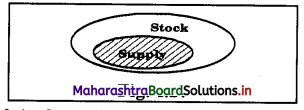
  • Stock is the entire quantity of a commodity, which is in the custody of the seller.
  • Supply refers to that part of stock of a commodity which is offered for sale at prevailing market price during a period of time.
  • Thus supply is a part of stock. c
  • Stock is the potential supply. It is a fund or reservoir from which supply flows.
  • Stock determines the ability of seller to supply.
    Thus, stock exceeds supply.

Question 3.
When price rises supply expands.
Answer:
Yes, I agree with this statement.
Maharashtra Board Class 12 Economics Important Questions Chapter 4 Supply Analysis 21

  • According to the Law of Supply “Other things remaining constant more is supplied < at a higher price and less at a lower price.”
  • The rise in price causes an expansion in supply because (i) the existing sellers will supply more than before in order to get larger profit and (ii) new suppliers with high reservation price will also now enter S the market.
  • So supply expands when price rises.

Question 4.
The supply curve has a positive slope..
OR
The supply curve slopes upwards from left to right.
OR
The relationship between price and supply is positive.
OR
There is direct relation between price and quantity supplied.
Answer:
Yes, I agree with this statement.
OR The supply curve slopes downward from left to right.
Answer:
No, I do not agree with this statement.

  • According to the Law of Supply “Other things remaining constant supply varies directly with price i.e., more quantity will be offered for sale at a higher price and less at a lower price. So there is a positive relationship between price and supply.”
    S = f(P)
  • The supply curve which is a graphical representation of supply schedule slopes upward from left to right indicating a positive slope.
  • In order to earn reasonable profit, the sellers try to sell more at higher prices and less at lower prices.
  • The sellers earn more profit when market price is greater than their reservation price.
  • Thus, the above statement is true.

Question 5.
Agricultural products are exceptions to the law of supply.
Answer:
Yes, I agree with this statement.

  • The law of supply states that the supply of a commodity varies directly with its price.
  • But in case of agricultural goods supply does not vary directly with price.
  • Agricultural product being perishable in nature cannot be stored for long time. The sellers cannot wait for price to rise. They have to sell off the whole stock even at a low price. Here supply coincides with stock.
  • Also agricultural production depends on unforeseen changes in weather. So even at higher price supply cannot be increased during drought or flood situation.
  • So, the above statement is true.

Question 6.
Due to speedy transport supply falls.
Answer:
No, I do not agree with this statement.

  • Transport facilities are one of the important determinants of supply.
  • Modern speedy transport facilities in widening r the market.
  • It increases the mobility of goods and helps in creating place utility for goods and services.
  • Speedy transport helps in domestic as well; as international trade of goods and services.
  • Thus, the above statement is false.

Question 7.
Reservation price is very low in respect of perishable commodities.
Answer:
Yes, I agree with this statement. ;

  • Reservation price is sellers minimum price, below which the seller will not supply any unit of the commodity.
  • Whether the sellers reservation price will be high or low depends upon number of factors. One of them is the durability of the commodity.
  • If the commodity is durable like TV set, car etc., then sellers reservation price will be high.
  • But if the commodity is perishable like fish, flowers, vegetables, milk etc., then reservation price will be low.
  • As perishable commodities cannot be stored for long, it can become stale and useless.
    Therefore, sellers are forced to clear stock as early as possible.
    So the reservation price is low.

Question 8.
Supply depends on many factors.
OR
Market Supply depends on many factors.
Answer:
Yes, I agree with this statement.
OR
Price is the only determinant of Supply.
Answer:
No, I do not agree with this statement.
Supply depends on many factors. Price is the main factor. There is a direct relationship between price and supply. Besides price there are many other factors such as

  • Cost of production and supply are indirectly related. Higher the cost, lesser will be the supply.
  • State of technology i.e., advanced technology increases supply.
  • Government policy like subsidies encourage production and increases supply, whereas heavy taxation decreases supply.
  • Natural conditions like favourable weather condition increases supply.
  • Exports decreases supply and imports increases supply.
    Better infrastructure facility increases supply.
  • Nature of market like competitive market increases supply.
    Thus, the above statement is true.

Question 9.
Total cost includes Total Fixed Cost and Total Variable Cost.
Answer:
Yes, I agree with this statement.

  • Total cost is the total cost incurred by a firm on the factors of production required for production of goods and services. Total cost is the sum total of fixed cost and variable cost.
  • Total fixed cost includes cost incurred on fixed factors like factory building, plant size, machinery etc. Fixed cost remains fixed in the short run but changes in the long period. Total variable cost includes cost on variable factors like raw materials, fuel, labour etc., which changes according to the output in the short period also. So while calculating Total Cost we include Total Fixed Cost (TFC) and Total Variable Cost (TVC). So, TC = TFC + TVC. Thus, the above statement is true.

Question 10.
Supply of perishable goods is equal to its production.
OR
There is no difference between stock and supply of perishable goods.
Answer:
Yes, I agree with this statement.

  • The stock of perishable goods like vegetables, flowers, fruits, milk, etc., is equal to supply.
  • This is because perishable goods cannot be stored for long time. They become stale.
  • They need to be sold within a short period of time irrespective of the price.
  • Also the cost of storage is high.
  • So, the above statement is true.

Question 11.
The supply curve of labour is backward bending.
Answer:
Yes, I agree with this statement.
Maharashtra Board Class 12 Economics Important Questions Chapter 4 Supply Analysis 22

  • When the wage rate in the industry rises, the supply of labour (i.e., hours of work) rises upto a certain limit.
  • Beyond certain limit with further rise in wages, supply of labour tends to fall.
  • This is because the labour prefers leisure to work i.e., he substitutes work with leisure,
  • With the increased wage rate he is able to satisfy his needs.
  • So the supply curve instead of rising upwards
    starts sloping backward as he reduces the hours of work.

Question 12.
AR is always more than TR.
Answer:
No, I do not agree with this statement.

  • TR or Total Revenue refers to total income earned by a firm from the sale of a given quantity of a commodity in the market of different price. It is derived by Price x l Quantity sold.
  • AR or Average Revenue refers to the income earned per unit of a commodity sold. It is derived by TR Quantity sold.
  • Hence, TR will always be greater than AR.
    Hence, the above statement is false.

Maharashtra Board Class 12 Economics Important Questions Chapter 4 Supply Analysis

Question 13.
Demand and Supply are opposite forces.
Answer:
Yes, I agree with this statement.
Both demand and supply are opposite forces.

  • Demand explains the consumer’s behaviour with respect to change in price of a commodity. Supply explains the producer’s behaviour with respect to change in price of a commodity.
  • Demand is inversely related to price of a commodity i.e., when price of a commodity rises the demand for it falls and when price falls the demand rises. Supply is directly related to the price i.e., when price rises, supply expands and when price falls, supply falls or contracts.
  • The demand curve slopes downwards. It has a negative slope. The supply curve slopes upwards from left to right. It has a positive slope. Both opposite forces together determine the equilibrium price.
  • A consumer aims at maximum satisfaction with his limited income. So he demands more at a lower price and less at a higher price. Whereas a producer aims at maximum profit so he supplies more at a higher price and less at a lower price.
  • Thus, the above statement is true.

Question 14.
There is difference between stock and supply.
Answer:
Yes, I agree with this statement.
OR
There is no difference between stock and supply.
Answer:
No, I do not agree with this statement.

StockSupply
(a) Stock refers to the total quantity of commodity available with producer for sale.(a)Supply is that part of stock which the seller is willing to offer for sale at a given price.
(b) It is outcome of production. If production increases, stock will also increase.(b) It is outcome of stock. Stock is the basis of supply.
(c) It is a fund or reservoir and a static concept (inelastic).(c) It is a flow concept. It changes according to change in price (elastic).
(d) It can exceed supply.(d) It cannot exceed stock.

Question 15.
There are no exceptions to law of supply.
Answer:
No, I do not agree with this statement.
There are some exceptions to the law of s supply. Following are such cases when supply may fall with the rises in price or rise with the fall in price.

(1) Labour supply : Supply of labour in the terms of hours of work is an important exception pointed out by economists. Generally when wages rise, workers work more, but after a certain point if wages continue to rise, supply of labour falls i.e. workers wish to earn more by work in for less hours and supply curve of labour would bend backwards as shown below :
Maharashtra Board Class 12 Economics Important Questions Chapter 4 Supply Analysis 12
In this figure as wage rate rises up to 0W, ;i supply of labor also rises up to ON, but when wage rate rises to 0W1, labour supply falls from ON to 0N1 Hence an exception.

(2) Saving : In case of savings generally it is observed that as the rate of interest rises, savings also rises but some people want to have a fixed regular income by way of interest. They may save less at a higher rate ( of interest and save more at a lower rate of interest. For example : suppose a person is interested in earning a fixed income of ? 800 p.a. then he saves ₹ 10,000/- at 8% rate of interest but when rate of interest increases to 10%, he will save only ₹ 8,000/-.

(3) Future Expectations: If the seller expects a fall in price in future, then he will supply more today even at a low price. But if he expects the prices to rise further in future he will withhold the supply today to supply more in future at a high price.

(4) Need for Cash : When the sellers are in urgent need of liquid cash, then even at a lower price they will offer more goods for sale.

(5) Rare Goods : In case of rare collections such as rare painting, old coins, antique, the law is not applicable as the supply remains fixed. The supply curve is a vertical straight line parallel to Y axis.

(6) Agricultural Goods: Supply of agricultural product is influenced by natural factors like climatic conditions, rainfall etc., which cannot be controlled by man. So in bad weather condition, even at a higher price the supply of agricultural commodities will not increase.

Question 16.
Price is the only determinant of supply.
Answer:
No, I do not agree with this statement.

  1. Cost of Production : Changes in the price of factors of production like rent, wages, interest affects the cost of production. When cost of production increases, supply decreases.
  2. Price of Other Goods : The supply of a given commodity depends on the price of other commodity. E.g. if the price of wheat rises and that of rice remains the constant, then the producer will think of producing more of wheat. This will affect the supply of rice.
  3. price of the Commodity : Price is an important factor influencing the supply. More is supplied at a higher price and less at a lower price. So price and supply are 5 directly related.
  4. Climatic Conditions : The supply of commodity is also influenced by the forces
  5. Government Policy : Government policies like taxation, subsidies, industrial policies etc., may encourage or discourage production and supply. A tax on the commodity will raise the cost of production and reduce the supply while a subsidy on the other hand will provide an incentive to increase production and supply.
  6. Exports and Imports : When the
    government resort to imports, supply expands, at the same time heavy exports would reduce the supply in the domestic market.
  7. Nature of Market : In a competitive market, the supply would be more but in a monopoly market the seller may create artificial scarcity to raise the price.
  8. Future Expectation : If future trends indicate a rise in price, the supply decreases at present. On the other hand if the sellers expect the future price to fall, supply would increase in the current period.
  9. Technique of Production : Improvement in the technique of production will lead to increase in supply. Application of advanced technology enables the producer to produce goods on large scale at a lower cost and lesser price.
  10. Infrastructure Facility : If means of transport and communication are well developed, the extent of market would be wide. i.e. supply will increase.
  11. Natural and Man-made Calamities : Natural calamities like earthquake, cyclone, flood etc., will affect the supply in the market. Even man-made calamities like a bomb-blast, affects supply. Even a strike call can affect supply in the market.

Maharashtra Board Class 12 Economics Important Questions Chapter 4 Supply Analysis

5. Study the following table / figures and answer the questions :

Question 1.
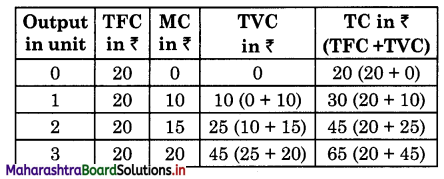
TFC (Total Fixed Cost) of a commodity ‘x’ of a firm is ₹ 20 Calculate (a) TVC and (b) TC from the following data.
Maharashtra Board Class 12 Economics Important Questions Chapter 4 Supply Analysis 23
Answer:
Maharashtra Board Class 12 Economics Important Questions Chapter 4 Supply Analysis 24

Question 2.
Find TR of a firm if it sells 500 units of £ commodity ‘X? at 25 ₹ per unit.
Answer:
TR is the revenue derived by a firm by multiplying total units sold by its price.
Hence, TR = P x Q
= 25 x 500
= 12, 500₹

Question 3.
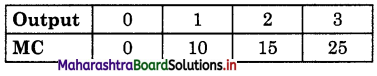
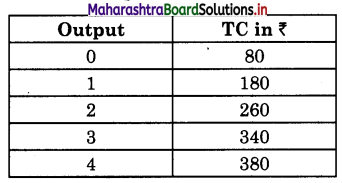
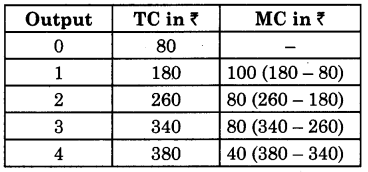
Calculate MC at each level of output of the following data.
Maharashtra Board Class 12 Economics Important Questions Chapter 4 Supply Analysis 25
Answer:
Maharashtra Board Class 12 Economics Important Questions Chapter 4 Supply Analysis 26

Question 4.
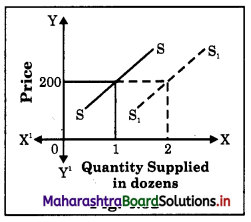
Workout : Price of oranges is ₹ 200 per dozen. During festival time at the same price 2 dozen, oranges are offered for sale. On the basis of this answer the following

1. Draw the figure for this.
Answer:
Maharashtra Board Class 12 Economics Important Questions Chapter 4 Supply Analysis 27

2. Is it the case of variation or change in supply. Give reason.
Answer:
It is a case of change in supply, as here the price remains the same at ? 200, while quantity increases from 1 dozen to 2 dozen. So, here supply changes due to festival season and due to change in price.

Maharashtra Board Class 12 Economics Important Questions Chapter 4 Supply Analysis

Question 5.
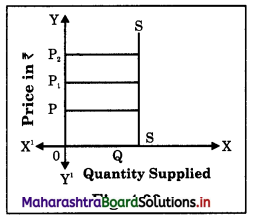
Demand in world market for Indian antique goods have increased but supply of these are fixed even though buyers are ready to pay high price for it. On the basis of this answer the following :

1. Draw figure for this.
Answer:
Maharashtra Board Class 12 Economics Important Questions Chapter 4 Supply Analysis 28

Question 6.
Does this justify the law of supply? Give reason for your answer.
Answer:
No, it does not justify the law of supply. As per law of supply, as the price increases, supply of a commodity should increase. But in above case even though the price is increasing supply remains the same. So it is an exception to the law of supply.

6. Answer in detail:

Question 1.
State and explain the law of supply. What are its assumptions?
Answer:
Law of Supply :
(A) Introduction : The law of supply was introduced by Dr. Alfred Marshall in his book “Principles of Economics” published in 1890. The law establishes a functional relationship between the price of a commodity and quantity supplied of that commodity. It explains the general tendency of the sellers in offering more goods for sale at a higher price than at a lower price.

(B) Statement of the Law : According to Prof. Alfred Marshall “Other things remaining constant, the higher the price of the commodity, greater is the quantity supplied and lower the price of the commodity, smaller is the quantity supplied.”In other words, quantity supplied of a commodity varies directly with price i.e., with a fall in price supply contract and with a rise in price supply expands.
S = f (P) [S = Supply, P = Price, f = Function of
The law can be better understood with the help of a market supply schedule and market supply curve.

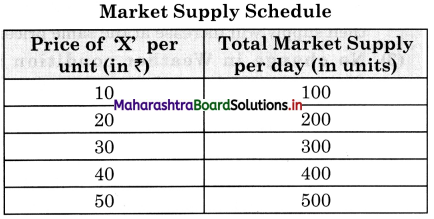
(C) Market Supply Schedule : Market supply schedule is a tabular representation of various quantities of a commodity offered for sale by all the sellers in the market at different prices during a given period of time. The schedule is a hypothetical one except one price rest are imaginary prices.

Maharashtra Board Class 12 Economics Important Questions Chapter 4 Supply Analysis 29

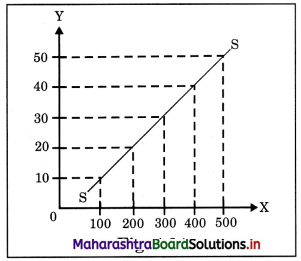
The above schedule clearly shows that sellers in general want to sell more at high prices and less at low price. E.g., at a low price of ₹10 per unit the seller supplies only 100 units per day and at high price of ₹ 50 the supply rises to 500 units of ‘X’ per day.

(D) Market Supply Curve : It is graphical representation of the above market supply schedule. Price is measured on ‘Y’ axis and quantity supplied on ‘X’ axis and above schedule is plotted. We derive a supply curve SS. ’

Maharashtra Board Class 12 Economics Important Questions Chapter 4 Supply Analysis 30

In the diagram, supply curve SS is a linear supply curve (straight – line). It slopes upwards from left to right. It has a positive slope indicating direct relationship between price and quantity supplied.

(E) Assumptions of the Law of Supply : The law of supply is conditional. It is based on certain assumptions. They are as follows:

  • No change in Cost of Production: The law will hold true only if the cost of production remains constant.
  • No change in Technique of Production : It is assumed that there is no change in the method of production. If there is any improvement in the technique of production then supply will increase at the same price.
  • No change in Weather condition : Changes in weather and climatic condition would affect supply especially of agricultural products, so it is assumed to remain constant.
  • No change in Government Policies : Any change in government policies will affect the supply, so it is assumed that there is no change in government tax policies, subsidies or industrial policy.
  • No Speculations about Future Prices : It is assumed that the producers do not speculate about future changes in price.
  • No change in Transport Cost : It is assumed that there is no change in transport facility and transport cost.
  • Prices of Other Goods : It is assumed that the prices of competitive goods remain constant. If the price of competitive goods rises then it is quite likely that producer may transfer his resource to the production of those goods, whose price has arisen.
  • change in the quantity of goods kept for Self – consumption : If sellers keep more goods for their personal use then supply cannot be increased even at a high price.
  • Constant Scale of Production : It is assumed that the scale of production remains constant during the given period of time.

Question 2.
State and explain the law of supply with exceptions.
Answer:
Law of Supply :
(A) Introduction : The law of supply was introduced by Dr. Alfred Marshall in his book “Principles of Economics” published in 1890. The law establishes a functional relationship between the price of a commodity and quantity supplied of that commodity. It explains the general tendency of the sellers in offering more goods for sale at a higher price than at a lower price.

(B) Statement of the Law : According to Prof. Alfred Marshall “Other things remaining constant, the higher the price of the commodity, greater is the quantity supplied and lower the price of the commodity, smaller is the quantity supplied.”In other words, quantity supplied of a commodity varies directly with price i.e., with a fall in price supply contract and with a rise in price supply expands.
S = f (P) [S = Supply, P = Price, f = Function of]
The law can be better understood with the help of a market supply schedule and market supply curve.

(C) Market Supply Schedule : Market supply schedule is a tabular representation of various quantities of a commodity offered for sale by all the sellers in the market at different prices during a given period of time. The schedule is a hypothetical one except one price rest are imaginary prices.

Maharashtra Board Class 12 Economics Important Questions Chapter 4 Supply Analysis 29

The above schedule clearly shows that sellers in general want to sell more at high prices and less at low price. E.g., at a low price of Rs. 10 per unit the seller supplies only 100 units per day and at high price of Rs. 50 the supply rises to 500 units of ‘X’ per day.

(D) Market Supply Curve : It is graphical representation of the above market supply schedule. Price is measured on ‘Y’ axis and quantity supplied on ‘X’ axis and above schedule is plotted. We derive a supply curve SS. ’

Maharashtra Board Class 12 Economics Important Questions Chapter 4 Supply Analysis 30

In the diagram, supply curve SS is a linear supply curve (straight – line). It slopes upwards from left to right. It has a positive slope indicating direct relationship between price and quantity supplied.

There are some exceptions to the law of s supply. Following are such cases when supply may fall with the rises in price or rise with the fall in price.

(1) Labour supply : Supply of labour in the terms of hours of work is an important exception pointed out by economists. Generally when wages rise, workers work more, but after a certain point if wages continue to rise, supply of labour falls i.e. workers wish to earn more by work in for less hours and supply curve of labour would bend backwards as shown below :
Maharashtra Board Class 12 Economics Important Questions Chapter 4 Supply Analysis 12
In this figure as wage rate rises up to 0W, ;i supply of labor also rises up to ON, but when wage rate rises to 0W1, labour supply falls from ON to 0N1 Hence an exception.

(2) Saving : In case of savings generally it is observed that as the rate of interest rises, savings also rises but some people want to have a fixed regular income by way of interest. They may save less at a higher rate ( of interest and save more at a lower rate of interest. For example : suppose a person is interested in earning a fixed income of ? 800 p.a. then he saves ₹ 10,000/- at 8% rate of interest but when rate of interest increases to 10%, he will save only ₹ 8,000/-.

(3) Future Expectations: If the seller expects a fall in price in future, then he will supply more today even at a low price. But if he expects the prices to rise further in future he will withhold the supply today to supply more in future at a high price.

(4) Need for Cash : When the sellers are in urgent need of liquid cash, then even at a lower price they will offer more goods for sale.

(5) Rare Goods : In case of rare collections such as rare painting, old coins, antique, the law is not applicable as the supply remains fixed. The supply curve is a vertical straight line parallel to Y axis.

(6) Agricultural Goods: Supply of agricultural product is influenced by natural factors like climatic conditions, rainfall etc., which cannot be controlled by man. So in bad weather condition, even at a higher price the supply of agricultural commodities will not increase.

Maharashtra Board Class 12 Economics Important Questions Chapter 4 Supply Analysis

Question 3.
What is meant by Supply? State its determinants.
Answer:
Law of Supply :
(A) Introduction : The law of supply was introduced by Dr. Alfred Marshall in his book “Principles of Economics” published in 1890. The law establishes a functional relationship between the price of a commodity and quantity supplied of that commodity. It explains the general tendency of the sellers in offering more goods for sale at a higher price than at a lower price.

(B) Statement of the Law : According to Prof. Alfred Marshall “Other things remaining constant, the higher the price of the commodity, greater is the quantity supplied and lower the price of the commodity, smaller is the quantity supplied.”In other words, quantity supplied of a commodity varies directly with price i.e., with a fall in price supply contract and with a rise in price supply expands.
S = f (P) [S = Supply, P = Price, f = Function of]
The law can be better understood with the help of a market supply schedule and market supply curve.

(C) Market Supply Schedule : Market supply schedule is a tabular representation of various quantities of a commodity offered for sale by all the sellers in the market at different prices during a given period of time. The schedule is a hypothetical one except one price rest are imaginary prices.

Maharashtra Board Class 12 Economics Important Questions Chapter 4 Supply Analysis 29

The above schedule clearly shows that sellers in general want to sell more at high prices and less at low price. E.g., at a low price of Rs. 10 per unit the seller supplies only 100 units per day and at high price of Rs. 50 the supply rises to 500 units of ‘X’ per day.

(D) Market Supply Curve : It is graphical representation of the above market supply schedule. Price is measured on ‘Y’ axis and quantity supplied on ‘X’ axis and above schedule is plotted. We derive a supply curve SS. ’

Maharashtra Board Class 12 Economics Important Questions Chapter 4 Supply Analysis 30

In the diagram, supply curve SS is a linear supply curve (straight – line). It slopes upwards from left to right. It has a positive slope indicating direct relationship between price and quantity supplied.

  1. Cost of Production : Changes in the price of factors of production like rent, wages, interest affects the cost of production. When cost of production increases, supply decreases.
  2. Price of Other Goods : The supply of a given commodity depends on the price of other commodity. E.g. if the price of wheat rises and that of rice remains the constant, then the producer will think of producing J more of wheat. This will affect the supply of rice.
  3. price of the Commodity : Price is an important factor influencing the supply. More is supplied at a higher price and less at a lower price. So price and supply are 5 directly related.
  4. Climatic Conditions : The supply of commodity is also influenced by the forces
  5. Government Policy : Government policies like taxation, subsidies, industrial policies etc., may encourage or discourage production and supply. A tax on the commodity will raise the cost of production and reduce the supply while a subsidy on the other hand will provide an incentive to increase production and supply.
  6. Exports and Imports : When the
    government resort to imports, supply expands, at the same time heavy exports would reduce the supply in the domestic market.
  7. Nature of Market : In a competitive market, the supply would be more but in a monopoly market the seller may create artificial scarcity to raise the price.
  8. Future Expectation : If future trends indicate a rise in price, the supply decreases at present. On the other hand if the sellers expect the future price to fall, supply would increase in the current period.
  9. Technique of Production : Improvement in the technique of production will lead to increase in supply. Application of advanced technology enables the producer to produce goods on large scale at a lower cost and lesser price.
  10. Infrastructure Facility : If means of transport and communication are well developed, the extent of market would be wide. i.e. supply will increase.
  11. Natural and Man-made Calamities : Natural calamities like earthquake, cyclone, flood etc., will affect the supply in the market. Even man-made calamities like a bomb-blast, affects supply. Even a strike call can affect supply in the market.

Maharashtra Board Class 12 Sociology Solutions Chapter 1 Introduction to Indian Society

Balbharti Maharashtra State Board Class 12 Sociology Solutions Chapter 1 Introduction to Indian Society Textbook Exercise Questions and Answers.

Maharashtra State Board Class 12 Sociology Solutions Chapter 1 Introduction to Indian Society

1A. Complete the following statements by choosing the correct alternative given in the brackets and rewrite it.

Question 1.
Monks in Buddhist monasteries were called __________ (Bhikkus, Bhikkhunis, Rishis)
Answer:
Bhikkus

Question 2.
The Special Marriage Act was passed in the year __________ (1950, 1952, 1954)
Answer:
1954

Maharashtra Board Class 12 Sociology Solutions Chapter 1 Introduction to Indian Society

1B. Correct the incorrect pair and rewrite it.

Question 1.
(a) Raj Marg – Hinduism
(b) Teerthankar – Jainism
(c) Saint Thomas – Sikhism
(d) Eight-fold Path – Buddhism
Answer:
(c) Saint Thomas – Christianity

1C. Identify the appropriate term from the given options in the box and rewrite it against the given statement.

Brahmo Samaj, Dr. B. R. Ambedkar, Harijan Sevak Sangh

Question 1.
An association was established by Raja Rammohan Roy.
Answer:
Brahmo Samaj

Question 2.
Head of the Drafting Committee of the Constitution of India.
Answer:
Dr. B.R Ambedkar

1D. Correct underlined words and complete the statement.

Question 1.
Elementary education was imparted in Khanqahs during the medieval period.
Answer:
Elementary education was imparted in Maktab during the medieval period.

Question 2.
The Theosophical Society was the Initiative of Mahatma Gandhi.
Answer:
The Theosophical Society was the Initiative of Annie Besant.

2. Write short notes.

Question 1.
Education during the Early Vedic period.
Answer:
During the Early Vedic period the content of education was based on sacred literature which was written in Sanskrit – which was not the language of the masses. The Yajur Veda commands education for all classes including women. The Atharva Veda states that “all classes have an equal right to study the Veda”.

To enter Vedic schools, it was a prerequisite for students of the first three Varnas to perform the Upanayana thread ceremony and they had to observe Brahmacharya for as long as they lived at the school to study the Vedas. There was an oral tradition of imparting knowledge, which was through rote-learning. Enunciation and pronunciation were an integral part of the oral tradition of learning. The aim of education was to sharpen the intellect as well as for character formation. Value was attached to being truthful, carrying out one’s duties (dharma), devotion to the guru and to one’s parents, hospitality, faith, and generosity.

The Kshatriyas learned the art of warfare and administration. Vaishyas studied trade and commerce and Shudras learned agriculture and animal husbandry. The Brahmanas stayed in the school until they attained mastery of the four Vedas They were known as Brahmanas – the possessors of Brahman (supreme knowledge)

Maharashtra Board Class 12 Sociology Solutions Chapter 1 Introduction to Indian Society

Question 2.
Status of women during the Medieval period.
Answer:
The status of women deteriorated in Medieval India. Invasions from the Central Asian region along with zealous Brahmanical iron laws were the main causes for the degradation were Invasions from the Central Asian region and zealous Brahmanical iron laws.

Freedom of women was curtailed, knowledge of the scriptures and literacy was denied to them and her status was reduced to being dependent on men throughout her lifetime. Only women from upper castes and aristocracy were given education in private.

Widow remarriage which was permitted in the Vedic period came to be considered taboo. Women continued to be excluded from family inheritances. Practices of child marriage, sati, purdah system, and Devadasi system made women the objects of exploitation.

The patriarchal joint family, the customs of polygamy, and early marriage – all contributed to Curtailing the free development and growth of women.

3. Write differences.

Question 1.
Status of Women in the Early Vedic period and Later Vedic period.
Answer:

Status of Women in the Early Vedic periodStatus of Women in the Later Vedic period
(i) Status: Indian women enjoyed a high status during the early Vedic period.(i) Status: There was a decline in the status of women in society in the Later Vedic period.
(ii) Education: Women during the Early Vedic period had access to Vedic education.(ii) Education: Women during the later Vedic period were denied access to education.
(iii) Participation in Social Activities: Women during the Early Vedic period could participate in social assemblies (vidath).(iii) Participation in Social Activities: Women during the Later Vedic period were barred from attending social assemblies.
(iv) Marriage: Women during the Early Vedic period could pursue their education just until they were married or could remain unmarried. Adult marriage was practiced.(iv) Marriage: Later Vedic period was the beginning of the practice of dowry and child marriage.

Question 2.
Education in the Ancient Period and Colonial Period in Indian society.
Answer:

Education in the Ancient Period in Indian societyEducation in the Colonial Period in Indian society
(i) Education: In ancient times, education was provided on the basis of the caste system under the guidance of a guru.(i) Education: Schools and colleges were open to all individuals, irrespective of caste, creed, gender, etc.
(ii) Medium of Instruction: During the ancient period education was imparted orally and the medium of instruction was Sanskrit.(ii) Medium of Instruction: During the coloanal period medium of instruction was English and in written form.
(iii) The Content of Education: The content of education was religion-oriented.(iii) The Content of Education: The content of education was not religion-oriented It was secular.
(iv) Values: The education was based on values like truthfulness, carrying out one’s duties (dharma), devotion to the guru and to one’s parents, hospitality, faith, and generosity.(iv) Values: The education was based on values like rationality, equality, social justice, secular approach, and individualism.
(v) Centre of Education: During ancient times Buddhists established Nalanda and Takshashila which were centers of education.Centre of Education: During the Buddhist period, the British established Universities, at Calcutta, Bombay, and Madras.

4. Explain the following concepts with examples.

Question 1.
Varna
Answer:
During the ancient period, Hindu society was divided into four Varna’s namely: The Kshatriyas learned the art of warfare and administration. Vaishyas studied trade and commerce and Shudras learned agriculture and animal husbandry.

The Brahmanas stayed in the school until they attained mastery of the four Vedas. The first three varnas began to call themselves the upper varnas. They became the ‘twice-born (dvija) because they were entitled to the initiation ceremony (upanayana)

In the beginning, there was flexibility and fluidity with respect to occupation. It was only towards the end of the Vedic period that Varna turned into a rigid jati (caste) hierarchy based on the ideology of purity and pollution. Notions of purity and pollution continue to be followed in everyday practices such as food and water intake, dressing, occupation, worship, social interactions, travel, etc. Thus, the flexible varna system was converted into a rigid caste system.
Example:

  • Brahmin – priests, teachers, intellectuals
  • Kshatriya – rulers, and warriors
  • Vaishya – merchants’ traders, farmers
  • Shudra – menial work

Maharashtra Board Class 12 Sociology Solutions Chapter 1 Introduction to Indian Society

Question 2.
Social Legislation
Answer:
It refers to laws passed to promote social justice, social welfare, desirable social change, as well as protection of vulnerable and weaker sections of Indian society.

The increase in the number of reformative groups enabled Indians to exert pressure upon the British government, for passing laws against prevalent social evils. Concerns and problems of people and administration get recognized through academic research, scientific studies, media, advocacy groups, and interest groups. Laws are enacted accordingly.

It may be noted that laws by themselves cannot transform society, but they provided hope to those who were victims of injustice oppression, exploitation, and abuse.

Example:
Some significant legislation include

  • 1829 – The Sati Prohibition Act
  • 1843 – The Indian Slavery Act
  • 1856 – The Hindu Widow Remarriage Act
  • 1872 – The Civil (or Special) Marriage ACT
  • 1929 – The Child Marriage Restraint Act

5A. Complete the concept map.

Question 1.
Maharashtra Board Class 12 Sociology Solutions Chapter 1 Introduction to Indian Society Q5A
Answer:
Maharashtra Board Class 12 Sociology Solutions Chapter 1 Introduction to Indian Society Q5A.1

5B. State whether the following statements are True or False with reasons.

Question 1.
The colonial rule has a significant impact on Indian society.
Answer:
This statement is True.

The British continued to rule India till the 20th century. Several systems were set in place under British rule in India. Some of the social reforms were also possible because of British policies. Let us look at some consequences of colonialism in India which had a significant impact on Indian society.

Education: The British set up a system of education that had a far-reaching impact on Indian society. The medium of instruction in the high school communication among the learned people now became English, schools, and colleges were open to all individuals, irrespective of caste, creed, gender, etc.

The content of education was secular – which included subjects like Mathematics, Science, Philosophy, Sociology, History, etc.

Maharashtra Board Class 12 Sociology Solutions Chapter 1 Introduction to Indian Society

This led to the rise of a new class of intelligentsia, who were of Indian origin but trained in ‘Western’ values, customs, and practices. Some of them played a significant role in the reform movements.

New values like rationality, equality, social justice, secular approach, and individualism gained firmer ground in Indian society.

Culture: Many of the educated elite took to the lifestyle of the British with respect to food habits, dressing, customs mannerisms, attitudes, beliefs, language, sports, and entertainment, etc., M. N. Srinivas referred to this process of imitation of the British, as ‘westernization’.

Administration: The British started new systems of administration like the Economic Service, Education Service, Revenue Service, and Administrative Service. It was the English-educated Indians who entered the administrative services to assist the British rulers in governing the land and its people.

A new judiciary system was created, which took into consideration the earlier legal traditions of the Indian communities. However, its implementation was carried out on a secular basis; each individual was judged on an equal basis, irrespective of one’s caste and creed.

The Indian Councils Act, The Indian High Court Act, and The Indian Civil Service Act of 1861, all led to major changes in the Executive, Legislative and Judicial administration of India.

Question 2.
Buddhism spread to several parts of India and beyond.
Answer:
This statement is True.

The teachings of Gautama Buddha did not make reference to the concept of God. Also, the sacred literature (Tripitkas) was written in the language of the common people, namely, Pali. Buddha made monasticism an inseparable part of his creed. The function of monasticism was to provide suitable conditions for personal and societal development.

Thus, Jainism and Buddhism are perceived as ‘protest religions’. Both these religious traditions opened their doors to all sections of society. The right to salvation was no longer limited to a particular stratum of society. Understandably, Buddhism with its fewer rigid rules and regulations in comparison to Jainism was embraced by many.

Buddhism gave great importance to the moral upliftment of human beings and directed people to lead moral lives. It insisted on virtues like charity, self-sacrifice, control over passions, and non-injury in thought and action. These virtues are also advocated in the Upanishads and also widely practiced through the Buddhist way of life.

Maharashtra Board Class 12 Sociology Solutions Chapter 1 Introduction to Indian Society

Buddhism thus spread far and wide even beyond the boundaries of India because of the patronage of the Mauryan emperor, Ashoka. As a missionary religion, Buddhism spread to foreign lands like Tibet, China, Japan, Mongolia, Burma, Java, Sumatra, and Sri Lanka.

6. Give your personal response.

Question 1.
Jainism and Buddhism provided hope to all people.
Answer:
In the Later Vedic period, the caste system and Brahminic supremacy became entrenched. Caste groups became rigid with the passage of time. The varna system now turned into an oppressive Jati (caste) system.

In all this, women became doubly oppressed. Jainism and Buddhism are perceived as “protest religions”. Both these religious traditions opened their doors to all sections of society.

The right to salvation was no longer limited to a particular stratum of society. Understandably, Buddhism with its fewer rigid rules and regulations in comparison to Jainism was embraced by many.

Gautama Buddha permitted women to join his monastic community and to fully participate in it. Buddhist doctrines do not differentiate between women and men, since everyone, regardless of gender, status or age, is subject to old age, illness, and mortality, thus suffering applies to all.

Several Jain nuns have played a very active part in the abolition of sati practice, abolition of slavery of women, and in the prohibition of animal sacrifices.

Jainism, being a religion of religious equality, is devoted to recognizing the rights of all living creatures. Jainism and Buddhism opposed the caste system in India. Thus, Jainism and Buddhism provided hope to all people.

Question 2.
Social reform movements are present even in 21st century India.
Answer:
A social movement is a mass movement and a collective attempt of people to bring about a change or to resist any change. In the 21st century, India, Industrialisation, and urbanisation technological advancements, and ongoing democratization have allowed people to push for change collectively, and question the legitimacy of the existing order. Social movements can be defined as collective challenges based on common purposes.

The emancipation of women, the spread of mass education, the removal of untouchability, the equality of opportunity for both the sexes and the growth of secularism are some examples of cultural drift which have led to the emergence of social movements today.

Changing society is, to some extent, disorganized because changes in different parts of society do not take place simultaneously. One part changes more rapidly than the other, thereby producing numerous lags. When there is an absence of social justice and a threat to the environmental system, social movements emerge.

Maharashtra Board Class 12 Sociology Solutions Chapter 1 Introduction to Indian Society

For example, Meira Paibi struggle in Manipur was for the safety and well-being of their community. They have shifted their focus from anti-alcoholism to human rights. Women played a major role in this movement. Meria Paibi led a boycott of elections and used relay hunger strikes as means to fight for their rights. Irom Sharmila had been on hunger strike for nearly 16 years.

7. Answer the following question in detail. (About 150-200 words)

Question 1.
Discuss with relevant examples, how the following factors have changed Indian society today.
(i) English medium of instruction
(ii) Lowering the age for voting
(iii) Social legislations
(iv) Transport and Communication
Answer:
(i) English medium of instruction: Education in the English language was introduced by the British in India. The increased economic and cultural influence of globalisation has spread English, as has the rapid spread of the Internet and other technologies. As a result of this, in many states throughout Indian society where English is not the predominant language, there are English-medium schools. Also in higher education, due to the recent trend towards internationalization an increasing number of degree courses, are being taught through the medium of English.

(ii) Lowering the age for voting: The present-day youth are literate and enlightened and the lowering of the voting age has provided the unrepresented youth of the country an opportunity to express their feelings and opinions and help them become a part of the political process. It has increased the political participation of the people and the creation of public opinion.

(iii) Social Legislation: It refers to laws passed to promote social justice, social protection of vulnerable and weaker sections of Indian society. Concerns and problems of people and administration get recognized through academic research, scientific studies, media, advocacy groups, and interest groups.

Laws are made by the Indian Parliament. Several laws related to civil and criminal matters have been enacted, which may be amended or repealed. The problems of differences in caste, sex, religion, poverty, terrorism are serious and therefore, the impetus is given to enactment and enforcement of laws.

For example, the untouchability offense act 1955, is enacted and enforced to curb the problem of practice untouchability, to eradicate gender inequality the government has passed various legislations. The Special Marriage Act 1954, The Hindu Dowry Prohibition Act 1961. Prohibition of early marriage and fixing the minimum age of marriage under the Child Marriage Restraint Act 1929, and the Hindu Marriage Act, 1955, have lengthened the period of education for girls.

Maharashtra Board Class 12 Sociology Solutions Chapter 1 Introduction to Indian Society

Now the position of women is far better as a result of the enactment of laws. Similarly, the distinction between touchable and untouchable is not much felt in modern times.

(iv) Transport and Communication: Transport facilitates trade and commerce by carrying goods from the areas of production to that of consumption. Goods from the areas that have surplus are shifted to those areas which are deficient in those items. Movement of people from one place to another place in search of job, education, and emergency through transport facility. Communication keeps us informed about the world’s events and trends. It has brought in positive changes in the life of the people and thereby enhancing their economic conditions.

Class 12 Sociology Chapter 1 Introduction to Indian Society Intext Questions and Answers

Check your progress (Textbook Page No. 15)

1. What was the nature of education during the Early Vedic Period?
Answer:

  • During the Early Vedic period the content of education was based on sacred literature which was written in Sanskrit.
  • The Yajur Veda commands education for all classes including women.
  • To enter Vedic schools it was a prerequisite for students of the first three Varnas to perform the upanayana (thread) ceremony and they had to observe Brahmacharya for as long as they lived at the school to study the Vedas.
  • There was an oral tradition of imparting knowledge, which was through rote-learning. Enunciation and pronunciation were an integral part of the oral were to sharpen the intellect as well as for character formation. Most scholars hold the view that the art of writing was unknown during this period.
  • Value was attached to being truthful, carrying out one’s duties (dharma), devotion to the guru and to one’s parents, hospitality, faith, and generosity.
  • The Kshatriyas learned the art of warfare and administration. Vaishyas studied trade and commerce and Shudras learned agriculture and animal husbandry. The Brahmanas probably stayed in the school until they attained mastery of the four Vedas.

2. State two indicators of the declining status of women during the Later Vedic Period.
Answer:
The first indicator of the declining status of women during the Later Vedic Period, is education being replaced by marriage and the practice of child marriage. In the Later Vedic Period, since education for girls was stopped, so was the sacrament of upanayana (thread ceremony) which initiated them into the Gurukul. It was replaced with marriage (‘vivaha) and child marriage. Marriage now became the only sacrament (samskara) permissible for women.

The second indicator of the declining status of women during the Later Vedic Period is the practice of dowry. The birth of a daughter began to be looked down upon and there is evidence to suggest the beginning of the practice of dowry.

3. Mention any two characteristics of Indian society in the Medieval Period.
Answer:
Status of women:
The status of women deteriorated in Medieval India. Invasions from the Central Asian region along with zealous Brahmanical iron laws were the main cause for this degradation. Freedom of women was curtailed; knowledge of the scriptures and literacy was denied to them and her status was reduced to being dependent on men throughout her lifetime.

Maharashtra Board Class 12 Sociology Solutions Chapter 1 Introduction to Indian Society

Nature of education:
Education during the Medieval Period is centered on the Quran. The Prophet Mohammed exhorts all people of faith to acquire knowledge. Unlike the previous systems of learning, there was no requirement for being through with Vedic schools nor renunciation of the world. The Islamic system of education is open to all followers of the faith irrespective of one’s status.

Check your progress (Textbook Page No. 18)

With reference to the Colonial period:
1. Name two educational changes.
2. State two economic changes.
3. Cite two administrative changes.
Answer:
1. Name two educational changes.

  • The medium of instruction in high school now became English which also became the common language of communication among the learned people.
  • Schools and colleges were open to all individuals, irrespective of caste, creed, gender, etc.

2. State two economic changes.

  • The economic system got transformed by industrial growth and the process of urbanization. Caste-based skills and occupations and social relationships gradually changed due to the impact of a changing economy and the rise of factories.
  • New revenue systems were started by the British in different parts of India which affected the peasants adversely. There was the commercialization of agriculture also. The subsistence economy was replaced by a market system that was profit-oriented.

3. Cite two administrative changes.

  • A new judiciary system was created, which took into consideration the earlier legal traditions of the Indian communities. However, its implementation was carried out on a secular basis, each individual judged on an equal basis, irrespective of one’s caste and creed.
  • The authority of feudal lords and zamindars was abolished, affecting the gradual spread of democratic values into Indian society.

Activity 1 (Textbook Page No. 4)

Find out about the Eight-Fold Path of Buddhism.
Answer:
The Eightfold Path is composed of eight primary teachings that Buddhists follow and use in their everyday lives:

  • Right View or Right Understanding: Insight into the true nature of reality
  • Right Intention: The unselfish desire to realize enlightenment
  • Right Speech: Using speech compassionately
  • Right Action: Using ethical conduct to manifest compassion
  • Right Livelihood: Making a living through ethical and no harmful means
  • Right Effort: Cultivating wholesome qualities and releasing unwholesome qualities
  • Right Mindfulness: Whole body-and-mind awareness
  • Right Concentration: Meditation or some other dedicated, concentrated practice
  • In Buddhist symbolism, the Noble Eightfold Path is often represented by means of the dharma wheel (dharma chakra), in which its eight spokes represent the eight elements of the path.

Maharashtra Board Class 12 Sociology Solutions Chapter 1 Introduction to Indian Society

Activity 2 (Textbook Page No. 8)

Discuss whether there are similarities between the status of women in the Later Vedic period and modern Indian women. To what extent are there changes? Do some beliefs and practices still continue in 21st century India?
Answer:
Similarities between the status of women in the Later Vedic:

  • The status of Hindu women in India has been fluctuating. It has gone through several changes during various historical stages.
  • The Rig-Vedic society was a free society. During later Vedic, Women were deprived of the Upanayana ceremony and thereby of education. Many evil social practices, like the practice of prepuberty marriages, denial of the right of women to education and also to mate selection, etc. were imposed on women. Efforts have been taken to improve the status of women. According to India’s Constitution, women are legal citizens of the country and have equal rights with men.
  • Because of the lack of acceptance from the male dominant society, Indian women suffer immensely. Women are responsible for bearing children, yet they are malnourished and in poor health. Most Indian women are uneducated, the constitutional dream of gender equality is miles away from becoming a reality.
  • Even today, ‘the mainstream remains very much a male stream’.
  • As compared to the past, the status of women in modern times has changed a lot but in reality, they have to still travel a long way.

Activity 3 (Textbook Page No. 12)

Find out more about the impact of Muslim rule on the following:

  • Painting
  • Architecture
  • Music

Present your findings in class.
Answer:
Painting: Both Hindus and Muslim artists were encouraged at Mughals courts. The development of painting was very fast in the reign, of Jahangir. King Jahangir was interested in collecting pictures of historical interests. Hindu artists were also famous during this period.

Architecture: Mugal architecture started during the reign of Babar. During Mughal, reign mosques were built at Dholapur, Gwalior, and any other places. Akbar was a lover of art. Akbar fort and many other beautiful buildings were constructed during Akbar’s reign. Shahjahan was a great lover of architecture. The Red Fort of Delhi, Jama Masjid, Taj Mahal erected in the memory of his wife Mumtaj are the unforgettable work of Shahjahan.

Maharashtra Board Class 12 Sociology Solutions Chapter 1 Introduction to Indian Society

Music: Babar and Humayun were interested in music. Tansen was one of the nine jewels of Akbar. Singers and musicians were encouraged during the Mughal period. Indian instruments were also influenced by Islam. The Indian Veena and the Irani Tambura merged together to emerge as Sitar.

Activity 4 (Textbook Page No. 18)

Discussion: Social reform movements are still present in India.
Answer:
Today, social movements have raised diverse demands pertaining to the environment, human rights, and equality. These are powerful means for ordinary people to participate directly in creating positive social change. These are deeply rooted in values of justice and democracy and many a time secure public support.

Example of social movements which we can see today: During the last few decades tribal and marginal farmers are also being threatened by commercial farmers, mining corporations, and dam projects. The Narmada Bachao Andolan (NBA) movement combines in itself many strands like the movement of indigenous people, the movement against neo-liberal policies, the struggle of farmers to hold on to their land as attempts are being made to take them over for dams, urbanization, industries, mines, and forests.

Maharashtra Board Class 12 History Important Questions Chapter 12 India Transformed Part 2

Balbharti Maharashtra State Board Class 12 History Important Questions Chapter 12 India Transformed Part 2 Important Questions and Answers.

Maharashtra State Board 12th History Important Questions Chapter 12 India Transformed Part 2

1A. Choose the correct alternative and rewrite the statement.

Question 1.
Sundarlal Bahuguna started ___________ movement.
(a) Civil Disobedience
(b) Right to Information
(c) Chipko
(d) Water conservation
Answer:
(c) Chipko

Question 2.
Rahibai Popere is popularly known as ___________
(a) Beejmata (seed mother)
(b) Adimata
(c) Narishakti
(d) Strishakti
Answer:
(a) Beejmata (seed mother)

Maharashtra Board Class 12 History Important Questions Chapter 12 India Transformed Part 2

Question 3.
As a result of work of ‘Sahyadri Nisarga Mitra’ ___________ were included in schedule I of the ‘Wildlife Protection Act – 1972.’
(a) Indian Blackege
(b) Sherpalite
(c) Indian Turtlelets
(d) Indian Swiftlets
Answer:
(d) Indian swiftlets

Question 4.
“Lets’s all learn, Let’s all progress” was the motto of ___________ programme.
(a) Khelo India
(b) Sarva Shiksha Abhiyan – SSA
(c) Padhega India
(d) Mid-day Meal
Answer:
(b) Sarva Shiksha Abhiyan – SSA

Question 5.
Indian wrestler ___________ earned fame in international wrestling.
(a) Kling Chang
(b) Muhammad Ali
(c) Bruce Lee
(d) Khashaba Jadhav
Answer:
(d) Khashaba Jadhav

Question 6.
Sachin Tendulkar was awarded the highest award of ___________
(a) Paramveer Chakra
(b) Bharat Ratna
(c) Dronacharya
(d) Padmacharya
Answer:
(b) Bharat Ratna

Maharashtra Board Class 12 History Important Questions Chapter 12 India Transformed Part 2

Question 7.
In 2011, Government of India announced a scheme named as ___________
(a) Play and music
(b) Play and chat
(c) Come and play
(d) run for India
Answer:
(c) Come and play

Question 8.
The Government of India established National Sports University at ___________ in 2018.
(a) Delhi
(b) Manipur
(c) Pune
(d) Kolkata
Answer:
(b) Manipur

Question 9.
___________ was an advertisement campaign designed to boost tourism.
(a) Mahan Bharat
(b) Atulya Bharat
(c) Enriched India
(d) The Indian Charisma
Answer:
(b) Atulya Bharat

Question 10.
On 6th July 2019, ___________ city in Rajasthan was inscribed as ‘World Heritage’ by UNESCO.
(a) Bikaner
(b) Jaipur
(c) Aajamghad
(d) Kotta
Answer:
(b) Jaipur

Maharashtra Board Class 12 History Important Questions Chapter 12 India Transformed Part 2

1B. Find the incorrect pair from group ‘B’ and write the corrected one.

Question 1.

Group ‘A’Group ‘B’
(a) Sahyadri Nisarg MitraInstitute for conservation of turtles
(b) Department of Ayurveda, Yoga and Naturopathy, Unani Medicine, Siddha and HomeopathyAYUR
(c) Federation of Association in Indian Tourism and Hospitality (FAITH)Organised Indian Tourism Mart – 2018
(d) National Education Policy (NEP)Emphasised on universalisation of education

Answer:
Department of Ayurveda, Yoga, and Naturopathy, Unani Medicine, Siddha, and Homeopathy – AYUSH

Question 2.

Group ‘A’Group ‘B’
(a) Medha PatkarNarmada Bachao Movement
(b) Sundarlal BahugunaChipko Movement
(c) Dr. Rajendra SinghSoil conservation
(d) Premsagar MestriSEESCAP

Answer:
Dr. Rajendra Singh – Water Conservation

Question 3.

Group ‘A’Group ‘B’
(a) (DPEP) District Primary Education ProgrammeProviding access to Primary Education
(b) Mid-day Mealto provide mid-day meals to children in Primary Schools
(c) Sarva Shiksha Abhiyan – SSAThe right to free education was granted to children
(d) SakharshalaNight Schools

Answer:
Sakharshala – Schools for the seasonal workers harvesting sugarcane

2A. Write the names of historical places/persons/events.

Question 1.
This programme was launched by the State Government of Maharashtra to save girl child –
Answer:
Lek Ladki

Question 2.
The fuel which is used for vehicles to overcome pollution problem –
Answer:
CNG – Compressed Natural Gas

Question 3.
Rahibai Popere was felicitated by the President of India by this award on 8th March 2018 –
Answer:
Nari Shakti Award

Maharashtra Board Class 12 History Important Questions Chapter 12 India Transformed Part 2

Question 4.
The annual event celebrated by ‘Sahyadri Nisarg Mitra’ every year –
Answer:
Turtle Festival

Question 5.
To achieve universalisation of education in India, this satellite was launched in 2004 –
Answer:
EDUSAT (GSAT-3)

Question 6.
The travel show was released on the discovery channel to boost tourism to places of unique nature and culture in the northeastern states of India –
Answer:
GO NORTHEAST

Question 7.
The founder of ‘Muslim Satyashodhak Samaj’ –
Answer:
Hamid Dalwai

Question 8.
The act which was formed to provide protection to women from domestic violence in 2005 –
Answer:
Domestic Violence Act

Question 9.
The movement started by Sunadarlal Bahuguna for the protection of the environment –
Answer:
Chipko Movement

Maharashtra Board Class 12 History Important Questions Chapter 12 India Transformed Part 2

Question 10.
The person who started first night school in Maharashtra –
Answer:
Mahatma Jotiba Phule

Question 11.
The schools started by the government for the children of seasonal workers harvesting sugarcane –
Answer:
Sakharshala

Question 12.
The programme is specially meant to benefit the students who work in the daytime –
Answer:
Ratrashala

Question 13.
The motto of Sarva Shiksha Abhiyan – SSA –
Answer:
“Let’s all learn, Let’s all progress”

Question 14.
The satellite launched in 2004 to achieve universalisation of education –
Answer:
EDUSAT (GSAT-3)

Question 15.
An institution established in Delhi, in 1984 which is working for heritage conservation –
Answer:
INTACH – Indian National Trust for Art and Cultural Heritage

Maharashtra Board Class 12 History Important Questions Chapter 12 India Transformed Part 2

Question 16.
The fund which was established for the development of sports in India –
Answer:
The ‘National Sports Development Fund’

Question 17.
The scheme launched by the Ministry of Tourism of the Indian government to chalk out tours to the pilgrim and spiritual centers –
Answer:
‘Swadesh Darshan’ or ‘Prasad’

Question 18.
The Samiti in which Rahibai Popere worked for the conservation of seeds –
Answer:
Kalasubai Parisar Biyanee Samvardhan Samiti

Question 19.
Bhau Katdare and his associates work for the conservation of nature through this institute –
Answer:
Sahyadri Nisarg Mitra

Question 20.
A non-governmental organisation in which Premsagar Mestri and his associates work for the conservation of vultures –
Answer:
SEESCAP ‘Society for Eco Endangered Species Conservation and Protection’.

2B. Choose the correct reason from those given below and complete the sentence.

Question 1.
The main objective of National Human Rights Commission is ___________
(a) to protect the girl child
(b) to protect fundamental human rights
(c) to provide shelter to all middle-class people
(d) to establish committee far environment conservation
Answer:
(b) to protect fundamental human rights

Maharashtra Board Class 12 History Important Questions Chapter 12 India Transformed Part 2

Question 2.
The pollution of water and food is increasing because ___________
(a) of artificial and non-biodegradable materials like plastic and pesticides
(b) increasing air pollution
(c) using oil for making food
(d) use of natural ingredients for the preparation of food
Answer:
(a) of artificial and non-biodegradable materials like plastic and pesticides

3. Complete the following concept map.

Question 1.

PlanYear ofObjective
1. (DPEP) District Primary Education Programme……………………….To provide access to primary education to all.
2. ………………………….13th August 1995To provide mid-day meals to children in primary school
3. Sarva Shiksha Abhiyan (SSA)………………………..The right to free education was granted to children in the age group of 6 – 14 years.

Answer:

PlanYear ofObjective
1. (DPEP) District Primary Education Programme1994To provide access to primary education to all.
2. Mid-day Meal (Shaley Poshan Ahar)13th August 1995To provide mid-day meals to children in primary school
3. Sarva Shiksha Abhiyan (SSA)2001The right to free education was granted to children in the age group of 6 – 14 years.

4A. Write short notes.

Question 1.
AYUSH
Answer:

  • For developing alternate medicine a new department was established by the ‘Ministry of Health and Family Welfare of the Government of India.
  • In 2009, this department was renamed as ‘Department of Ayurveda, Yoga, and Naturopathy, Unani Medicine, Siddha and Homeopathy (AYUSH).
  • This department is also working for the development of syllabi and education of these branches of medicine, advanced research, standardisation of medicine, etc.

Question 2.
Hamid Dalwai.
Answer:

  • Hamid Dalwai was a social reformer inspired by the work and thoughts of Mahatma Jotiba Phule.
  • He founded ‘Muslim Satyashodhak Samaj’ in 1970. His main concern was the rights of Muslim women.
  • He opposed the custom of ‘Triple Talaq’. The law passed by the Indian Parliament in 2019, has declared this custom illegal.
  • He was of the opinion that in Secular India uniform civil code should be applicable to all.

Maharashtra Board Class 12 History Important Questions Chapter 12 India Transformed Part 2

4B. Explain the following statements with reasons.

Question 1.
The Indian government launched a new scheme named ‘Khelo India’.
Answer:

  • The Indian government launched a new scheme named ‘Khelo India’ by combining some old schemes with some new objectives.
  • The main objective of this scheme was to establish excellence in sports by creating a larger popular platform.
  • The scheme also aimed at creating interest among the students about sports from early days in schools and to increase girl’s participation in sports.
  • For the development of sports, the ‘National Development Fund’ was established and donation to this fund is eligible for 100% exemption of income tax.
  • The Indian Government gives various awards for different sports each year. Some of them are the ‘Arjun Award’, ‘Rajiv Gandhi Khel Ratna award, Lifetime Achievement Award, Dronacharya’, etc.
  • ₹ 75,00,000 was given to the player who wins the gold medal in Olympics. Similarly visually impaired are given a good amount of rewards and jobs.
  • There is a provision of pension for a retired sportsperson. A winner of the Olympics is given a pension of ₹ 20,000 since 2018 and the winner of the Asian games gets ₹ 12,000 per month.
  • In this way, the Indian government launched various schemes for making the youth aware of sports as a life career.

Question 2.
The Government of Maharashtra decided to teach English from the 1st standard.
Answer:

  • The Government of Maharashtra decided to teach English from 1st standard so that the children could master the English language along with their mother tongue.
  • Emphasis was given on listening, speaking, reading, and writing skills with the emphasis on children enjoying the learning of English as a language.
  • Following the syllabus, the Maharashtra State Textbook Bureau (Balbharati) took up the responsibility of preparing best-illustrated textbooks. The initiative was appreciated by the national knowledge commission.

5. Answer the following question with the help of the given points.

Question 1.
Explain different policies implemented by the Indian Government in the field of education.
(a) Primary Education
(b) Mid-day Meal
(c) Sarva Shiksha Abhiyan
Answer:
The transformation of India is seen in the field of education as well. 1990 was declared as the ‘International Year of Literacy.’ During this year Kerala became the first state in India to achieve a 100% literacy rate. The government of India has started different innovative programmes to educate people:
(a) Primary Education:

  • District Primary Education Programme (DPEP) was started in 1994 aiming at providing access to primary education to all.
  • This programme was financially supported by the world bank and started in seven states including Maharashtra, Madhya Pradesh, Karnataka, Tamil Nadu, Kerala, Haryana, and Assam.
  • The main objective of this programme was to achieve 100% registration and attendance of children in primary schools and bringing down the number of drop-outs.

(b) Mid-day Meal (Shaley Poshan Ahar):

  • A programme was implemented by the government on 15th August 1995, to provide mid-day meals to children in primary schools.
  • If the facility to cook the food in schools was not available then food grains were distributed to each child to ensure his/her attendance in school.

Maharashtra Board Class 12 History Important Questions Chapter 12 India Transformed Part 2

(c) Sarva Shiksha Abhiyan:

  • This programme was launched in 2001. The motto of this programme was “Let’s all learn, Let’s all progress”.
  • By the 86th Amendment in the Constitution of India, the right to free education was granted to children in the age group of 6-14.
  • This programme was launched by combining the earlier programme of ‘Khadu-Phala Yojana’ and ‘Mid-day Meal’.
  • The programme gives special attention to the education of girl children and children with special needs (Divyang).

Question 2.
Explain the contribution of the following environment activists in the context of conservation and preservation of the environment with special reference to Maharashtra:
(a) Rahibai Popere
(b) Bhau Katdare
(c) Premsagar Mestri
Answer:
Efforts of a number of environmental activists have contributed to environmental conservation and preservation. In Maharashtra, the following three people worked tirelessly to further the goal of environmental conservation and to protect endangered animal species.
(a) Rahibai Popere:

  • She was facilitated by the ‘Nari Shakti Award’ by the President of India on 8th March 2018.
  • She is popularly known as ‘Beejmata’ (seed mother) for her work in ‘Kalasubai Parisar Biyanee Samvardhan Samiti.’
  • She has worked relentlessly to preserve seeds of native cultivars for the future generation.
  • The food made with hybrid varieties of food grains and vegetables caused many problems in the human body so thought to preserve native varieties of food grains to overcome the problems.
  • She began to cultivate native varieties of food grains and store the seeds of those landraces. She did not confine her efforts to only to her family, but through micro banking groups (bachat gat) she spread this movement into other villages.
  • This movement was supported by ‘Bharatiya Agro Industries Foundation (BAIF)’.
  • She preserves these seeds in an earthen pot which is covered by the plaster of soil and cow dung in order to save the seeds from ants and insects.
  • She has a collection of more than 50 landraces of food grains and 30 landraces of vegetables.
  • She is one of the three Indian women selected as ‘Women of the year 2018’ by BBC among 100 women from various countries.

Maharashtra Board Class 12 History Important Questions Chapter 12 India Transformed Part 2

(b) Bhau Katdare:

  • Bhau Katdare and his associates worked to save an endangered species of ‘White-breasted Sea Eagle’ through an institute called ‘Sahyadri Nisarg Mitra’.
  • He created public awareness to save and conserve this bird by trekking the sea coast of Ratnagiri district.
  • The nests of this bird were smuggled out and sold in foreign countries. Due to the efforts of Bhau Katdare and his associate’s Indian swiftlets were included in schedule ‘I’ of the ‘Wildlife Protection Act’ – 1972, which was a remarkable contribution of ‘Sahyadri Nisarg Mitra’.
  • Through his institution, he also worked to save Olive Ridley turtles. In the first year, they successfully protected 50 nests and 2734 baby turtles. From these 50 nests were released back into the sea. Hundreds of tourists come every year to watch the ‘Turtle festival’ to watch the occasion of baby turtles returning to sea.
  • To accommodate them, facilities of ‘Home Stay’ were developed and the peasants were trained in this.
  • Now, they started the protection of the endangered ‘Pangolin’ (anteater / Khavalya Manjar)

(c) Premsagar Mestri:

  • Prem Sagar Mestri and his associates are working for the protection of two species of vultures, ‘Long-billed vultures’ and ‘White back vultures’ which are observed in the region around Raigad.
  • They are also working for increasing the number of these species of vultures and to make available safe food for them through ‘Society for Eco Endangered Species Conservation and Protection – SEESCAP a non-governmental organisation.
  • The number of vultures is decreasing because of the painkillers given to animals which have proved to be toxic for these scavengers. Besides the dearth of trees with adequate height, scarcity of food, etc., are the causes responsible for the decrease in the vulture population. People working for SEESCAP are successful in saving the vultures of this vicinity.

Question 3.
Explain in detail India’s transformation in the social domain.
(a) Human Rights Protection Act-1993
(b) Establishment of Human Rights Commission
(c) The ‘Domestic Violence Act of 2005
(d) Low sex ratio of girls
(e) Government schemes to overcome this problem
Answer:
A lot of changes have been taken place in the field of the social domain. These changes are as follows:
(a) Human Rights Protection Act 1993: The government is trying hard to reduce the social disparity and to bring all the classes of people in the society into the mainstream of economic development. Human Rights Protection Act was passed in 1993.

(b) Establishment of Human Rights Commission: National Human Rights Commission was established under this act. The main objective of this act is to protect fundamental human rights like the right to life, equality, etc., and to see that nobody is deprived of these rights. According to this act, the commission can act on the basis of a report of a case of deprivation of fundamental rights, published in a newspaper or other media (‘Sui Moto cognizance’). A complaint can be lodged by a social activist or a social institute on behalf of the victim.

(c) The ‘Domestic Violence Act of 2005: The domestic violence act was passed in 2005 to provide protection to women from domestic violence. The most important provision of this act is the right of a woman to the house where she has been residing even if she doesn’t own the house.

(d) Low sex ratio of girls: According to the 2011 census, the sex ratio of girls in India is very low. In the age group of 0-6 years, the number of girls is 914 against 1000 boys. This is really an alarming situation and several women organizations raised a voice expressing their concern over this matter.

(e) Government schemes to overcome this problem: The state government of Maharashtra implemented different schemes to overcome the problem of the low sex ratio of girls. The Maharashtra state government banned sex/gender prediction tests of a fetus and launched a programme called ‘Lek Ladki’. After all these programmes, awareness has been created among the people and the social loathing for the birth of a girl is diminishing.

Maharashtra Board Class 12 History Important Questions Chapter 12 India Transformed Part 2

Question 4.
Explain the changes that took place in the field of education with special reference to Maharashtra.
(a) Need for modification in the school syllabi
(b) The guidelines for the new syllabi
(c) Recommendation of ‘Acharya Ram Murti committee
(d) Objectives of ‘Sarva Shiksha Abhiyan’
(e) Establishment of central schools with uniform syllabi
(f) The programs of ‘Ratrashala’ and ‘Sakharshala’
Answer:
Different positive changes that took place in the education field are as follows:
(a) Need for modification in the school syllabi: The National Council of Educational Research and Training, Delhi suggested some modifications in the school syllabi and the structure of school textbooks.

(b) The guidelines for the new syllabi: The guidelines in the new syllabi were based on democratic principles, social justice, awareness of duties and responsibilities, gender equality, protection of the environment, eradication of superstition, population education as also norms of individual behaviour. The syllabi were also formed for creating awareness among the students regarding unity in diversity. Several training programs are arranged for teachers all over Maharashtra for intensifying the effects to fulfill the objectives of the new syllabi. It helped to create awareness regarding the state-level training and school textbooks, comparable to the awareness created at the time of the ‘National Literacy Mission’.

(c) Recommendation of‘Acharya Ram Murti Committee: In 1990, the report of‘Acharya Ram Murti Committee was received by the Government of India. The committee examined the National Educational Policy (NEP). This committee emphasised on universalisation of education, education for women and backward classes, and educational democracy. The most important recommendation of this committee was to include education in fundamental rights and to raise the government funds allotted to education. The directives were issued related to the weight of school bags of children which leads to a reduction in the weight of a school bag. The practices of interviewing children before school admission were banned.

(d) Objectives of ‘Sarva Shiksha Abhiyan’:

  • To enroll every child in school to raise the standard of education.
  • To eliminate gender discrimination in education.
  • To achieve 100% attendance in school by 2010.

(e) Establishment of Central Schools with uniform syllabi: Central schools with uniform syllabi were created throughout the country so that the wards of Central Government’s and Armed forces employee may not have to suffer. The central schools focus on sports and extracurricular activities along with the academic syllabi.

Maharashtra Board Class 12 History Important Questions Chapter 12 India Transformed Part 2

(f) The programmes of ‘Ratrashala’ and ‘Sakharshala’: The Government started the programmes like ‘Ratrashala’ and ‘Sakharshala’. Mahatma Jotirao Phule started first night school in Maharashtra in the 19th century. A number of night schools are opened in Maharashtra inspired by Mahatma Phule’s work. This programme is specially meant to benefit the students who work in the daytime. In the season of sugarcane harvesting, many labourers migrate temporarily to the sites of various sugar factories. To facilitate the education of their children special schools known as ‘Sakharshala’ were started. The State Government also take help of voluntary organization to increase literacy rate. This has helped in increasing the literacy rate. The districts of Sindhudurg and Wardha achieved a 100% literacy rate. It provided an impetus to adult education. The government provided books to school children for supplementary reading.

Maharashtra Board Class 12 Economics Important Questions Chapter 3B Elasticity of Demand

Balbharti Maharashtra State Board Class 12 Economics Important Questions Chapter 3B Elasticity of Demand Important Questions and Answers.

Maharashtra State Board 12th Economics Important Questions Chapter 3B Elasticity of Demand

1.[A] Choose the correct option.

Question 1.
When percentage change in quantity demanded is less than the percentage change in price, the demand curve is ……………..
(a) flatter
(b) steeper
(c) rectangular
(d) vertical
Answer:
(b) steeper

Question 2.
When changes in price does not affect demand at all, it is called as ……………..
(a) unitary elastic
(b) perfectly inelastic
(c) relatively elastic
(d) perfectly elastic
Answer:
(b) perfectly inelastic

Question 3.
When slight change in price brings infinite change in demand, then ……………..
(a) Ed = 0
(b) Ed = ∞
(c) Ed <1 (d) Ed > 1
Answer:
(b) Ed = ∞

Question 4.
When percentage change in quantity demanded is equal to changes in price, the demand curve is …………
(a) steeper
(b) flatter
(c) rectangular hyperbola
(d) vertical
Answer:
(c) rectangular hyperbola

Question 5.
Demand for salt is …………….
(a) elastic
(b) inelastic
(c) perfectly elastic
(d) perfectly inelastic
Answer:
(d) perfectly inelastic

Question 6.
Demand for Medicine is ……………
(a) elastic
(b) inelastic
(c) relatively elastic
(d) relatively inelastic
Answer:
(d) relatively inelastic

Question 7.
Demand for cosmetics is ……………..
(a) relatively elastic
(b) relatively inelastic
(c) perfectly elastic
(d) perfectly inelastic
Answer:
(a) relatively elastic

Question 8.
Demand for air conditions is ………….
(a) elastic
(b) inelastic
(c) vertical
(d) horizontal
Answer:
(a) elastic

Question 9.
Demand for essential commodities in life is …………..
(a) elastic demand
(b) relatively inelastic
(c) perfectly elastic
(d) perfectly inelastic
Answer:
(b) relatively inelastic

Question 10.
Demand for school uniform is……………..
(a) relatively elastic
(b) relatively inelastic
(c) perfectly elastic
(d) none of the above
Answer:
(b) relatively inelastic

Question 11.
Demand for not habituated goods is ………….. demand.
(a) relatively inelastic
(b) perfectly inelastic
(c) perfectly elastic
(d) relatively inelastic
Answer:
(c) perfectly elastic

Question 12.
Specific uses of a commodity demand is …………………..
(a) relatively elastic
(b) relatively inelastic
(c) perfectly elastic
(d) none of the above
Answer:
(b) relatively inelastic

Question 13.
In case of inferior goods the income elasticity of demand is ………………..
(a) positive
(b) negative
(c) infinite
(d) zero
Answer:
(b) negative

Question 14.
In case of necessary goods the income elasticity of demand is ………………..
(a) positive
(b) negative
(c) infinite
(d) zero
Answer:
(d) zero

Question 15.
In case of substitute goods the cross elasticity of demand is ………………..
(a) negative
(b) positive
(c) zero
(d) infinite
Answer:
(b) positive

(B) Complete the Correlation . (1 mark each)

(1) Demand for pins : Inelastic :: Demand for perfume : ……………….
(2) Demand for specialised labour : ………………. :: Demand for luxury goods : Relatively Elastic
(3) The demand for durable goods : ………………. :: Demand for perishable goods : inelastic
(4) Normal goods the income elasticity of demand is : Positive :: Complementary goods the cross elasticity of demand is : ……………….
(5) After devaluation exports become : ………………. :: Devaluation succeeds when exports have elastic demand
(6) Demand for luxury goods : Elastic :: Demand for food grain : ……………….
(7) Rectangular hyperbola curve : Ed = 1 :: Steeper demand curve : ……………….
(8) Total outlay remains same : Ed = 1 :: Total outlay increases : ……………….
(9) Total outlay decreases : Ed < 1:: Total outlay remains same : ……………….
Answer:

  1. Elastic
  2. Inelastic
  3. Relatively elastic
  4. Negative
  5. Cheaper
  6. inelastic
  7. Ed < 1
  8. Ed > 1
  9. Ed = 1

(C) Give economic terms.

  1. Elasticity resulting from changes in price does not affect demand at all.
  2. Product of price and quantity demanded.
  3. Elasticity resulting from changes in demand is more than change in price.
  4. Elasticity of demand is measured with the following formula:
    \(\frac { Lower segment of demand curve below a given point }{ Upper segment of demand curve above a given point }\)
  5. A fall in the price of mobile handsets may lead to rise in the demand for sim cards.

Answer:

  1. Perfectly inelastic
  2. Total Expenditure
  3. Relatively elastic
  4. Point I Geometric method
  5. Complementary goods

[D] Find the odd word out.

  1. Types of price elasticity of demand:
    Perfectly elastic demand, Perfectly inelastic demand, Relatively inelastic demand, Cross elasticity of demand.
  2. Types of elasticity of demand:
    Total outlay, Cross elasticity, Income elasticity, Price elasticity.
  3. Methods of measuring price elasticity of demand:
    Ratio method, Geometric method, Total outlay method, Unitary elastic demand.
  4. Types of Income Elasticity of demand:
    Positive, Negative, Cross, Zero
  5. Examples of Substitute Goods:
    Coca-cola, Pepsi, Thumsup, Fanta
  6. Examples of Complementary Goods:
    Tea – Sugar, Car – Petrol, Tea – Coffee

Answers:

  1. Cross elasticity of demand
  2. Total outlay
  3. Unitary elastic demand
  4. Cross
  5. Fanta
  6. Tea – Coffee

(E) Complete the following statements.

(1) Price multiplied by quantity = …………………
(2) Demand for luxuries is ………………… demand.
(3) The life saving medicines have ………………… demand.
(4) A unitary elastic demand curve is a …………………
(5) The demand for necessaries is …………………
(6) The demand for durable goods tends to be …………………
(7) Degree of responsiveness of a change in quantity demanded to a change in the income is called as …………………
(8) Normal goods for which demand increases with increases in income …………………
(9) Inferior goods for which demand decreases with increase in income of consumer …………………
(10) Necessary goods for which demand remain constant with increase in income of the consumer …………………
(11) explained the concept of elasticity ………………… of demand.
(12) Demand for perishable goods is …………………
Answers:

  1. Total outlay
  2. elastic
  3. inelastic
  4. rectangular hyperbola
  5. inelastic
  6. elastic
  7. income elasticity
  8. positive income elasticity
  9. negative income elasticity
  10. zero income elasticity
  11. Prof. Alfred Marshall
  12. inelastic

(F) Choose the wrong pair

Group ‘A’Group ‘B’
1. Car and petrolComplementary goods
2. Point methodGeometric method
3. NecessariesInelastic demand
4. Unitary elasticSteeper curve

Answer:
Wrong pair : Unitary elastic – Steeper curve

II.

Group ‘A’Group ‘B’
1. Inelastic demandSteep slope of demand curve
2. BMW CarInelastic demand
3. Income elasticityResponsiveness of quantity demanded of a commodity to change in income
4. Elastic demandFlatter slope of demand curve

Answer:
Wrong pair: BMW Car – Inelastic demand

(G) Assertion and Reasoning

Question 1.
Assertion (A) Degree of Price Elasticity is less than one in case of relatively inelastic demand.
Reasoning (R) – Change in demand is less than the change in price.
(i) (A) is true but (R) is false.
(ii) (A) is false but (R) is true.
(iii) Both (A) and (R) are true and (R) is the correct explanation of (A).
(iv) Both (A) and (R) are true and (R) is not the correct explanation of (A).
Answer:
(i) (A) is true but (R) is false.

Question 2.
Assertion (A) – Substitute goods have positive elasticity.
Reasoning (R) – Increase in price of tea leads to increase in demand of coffee.
(i) (A) is true but (R) is false.
(ii) (A) is false but (R) is true.
(iii) Both (A) and (R) are true and (R) is the correct explanation of (A).
(iv) Both (A) and (R) are true and (R) is not the correct explanation of (A).
Answer:
(iii) Both (A) and (R) are true and (R) is the correct explanation of (A).

Question 3.
Assertion (A) – Cross elasticity of non – related goods is more than one.
Reasoning (R) – Tea and books are the examples of non-related goods.
(i) (A) is true but (R) is false.
(ii) (A) is false but (R) is true.
(iii) Both (A) and (R) are true and (R) is the correct explanation of (A).
(iv) Both (A) and (R) are true and (R) is not the correct explanation of (A).
Answer:
(ii) (A) is false but (R) is true.

Question 4.
Assertion (A) – Perfectly Elastic demand is infinite.
Reasoning (R) – 10 % fall in price leads to 200% increase in demand.
(i) (A) is true but (R) is false.
(ii) (A) is false but (R) is true.
(iii) Both (A) and (R) are true and (R) is the correct explanation of (A).
(iv) Both (A) and (R) are true and (R) is not the correct explanation of (A).
Answer:
(iii) Both (A) and (R) are true and (R) is the correct explanation of (A).

Question 5.
Assertion (A) – Unitary elastic demand has rectangular hyberbola curve.
Reasoning (R) – 50% decrease in price, brings 50% increase in demand of a commodity.
(i) (A) is true but (R) is false.
(ii) (A) is false but (R) is true.
(iii) Both (A) and (R) are true and (R) is the correct explanation of (A).
(iv) Both (A) and (R) are true and (R) is not the correct explanation of (A).
Answer:
(iii) Both (A) and (R) are true and (R) is the correct explanation of (A)’.

(H) Choose the correct pair

I.

Group ‘A’Group ‘B’
1. Salt(a) Demand  curve parallel to ‘X’ axis
2. Income elasticity(b) Flatter in shape
3. Perfectly elastic demand(c) Related goods
4. Relatively elastic demand(d) Inelastic demand
5. Cross elasticity(e) Change in demand due to change in income

Answer:
(1) – (d), (2) – (e), (3) – (a), (4) – (b), (5)-(c).

II.

Group ‘A’Group ‘B’
1. Essential commodities(a) flatter in shape
2. Unitary elastic demand(b) change in income
3. Elasticity of demand(c) Ed = 1
4. Relatively elastic demand(d) Prof. Alfred Marshall
5. Income Elasticity(e) Inelastic demand

Answer:
(1) – (e), (2) – (c), (3) – (d), (4) – (a), (5)-(b).

2. (B) Distinguish between :

Question 1.
Income Elasticity and Cross Elasticity.
Answer:
Income Elasticity:

  1. Income elasticity of demand is the proportionate change in quantity demanded of a commodity to a given change in the consumer’s income.
  2. Income Elasticity of demand are of three types –
    • Positive Income Elasticity is found in case of Normal Goods.
    • Negative Income Elasticity for inferior goods cheap bread, rice, etc.
    • Zero Income Elasticity.

Cross Elasticity:

  1. Cross Elasticity of demand is the proportionate change in the quantity demanded of a commodity to a given change in the price of substitute or complementary goods.
  2. Cross Elasticity of demand are of three types –
    • Positive Cross Elasticity is found in case of substitute goods like tea and coffee.
    • Negative Cross Elasticity is seen in case of Complementary Goods.
    • Zero Cross Elasticity in case of unrelated goods like cup and book.

Question 2.
Positive Income Elasticity and Negative Income Elasticity.
Answer:
Positive Income Elasticity

  1. When a change in income brings about change in demand in the same direction the Income Elasticity of demand is positive.
  2. When income rises demand also rises and fall in income brings a fall in demand.
  3. In case of normal goods, the Income Elasticity is positive.
  4. The slope of  Income Curve is positive. It slopes upward indicating that as income rises the demand also rises
    Maharashtra Board Class 12 Economics Important Questions Chapter 3B Elasticity of Demand 21

Negative Income Elasticity:

  1. When a change in income of the consumer brings about a change in demand of the commodity in the opposite direction then Income Elasticity is negative.
  2. When income increases the demand decreases and when income decreases demand increases.
  3. In case of inferior goods, the Income Elasticity is negative.
  4. The slope of the Income Curve is negative. It slopes downward indicating that as income increases, demand decreases.
    Maharashtra Board Class 12 Economics Important Questions Chapter 3B Elasticity of Demand 22

Question 3.
Perfectly Inelastic Demand and Perfectly Elastic Demand.
Answer:
Perfectly Inelastic Demand:

  1. When a change in price brings no change in quantity demanded, then demand is said to be Perfectly Inelastic demand.
  2. The numerical co-efficient is zero (e = 0).
  3. The demand curve is vertical straight line parallel to Y-axis.
    Maharashtra Board Class 12 Economics Important Questions Chapter 3B Elasticity of Demand 1

Perfectly Elastic Demand:

  1. When a small change in price brings infinite change in the quantity demanded, then demand is said to be Perfectly Elastic demand.
  2. The numerical co-efficient is infinity (e = ∞).
  3. The demand curve is a horizontal straight line parallel to X-axis.
    Maharashtra Board Class 12 Economics Important Questions Chapter 3B Elasticity of Demand 2

Question 6.
Price Elasticity and Income Elasticity.
Answer:
Price Elasticity:

  1. Price Elasticity of demand refers to the degree of responsiveness of quantity demanded of a commodity to given change in price.
  2. Symbolically:
    Maharashtra Board Class 12 Economics Important Questions Chapter 3B Elasticity of Demand 3
  3. There is inverse relation between price and demand.
  4. Price Elasticity of demand are of five type :
    1. Relatively elastic demand
    2. Relatively inelastic demand
    3. Unitary elastic demand
    4. Perfectly elastic demand
    5. erfectly inelastic demand

Income Elasticity:

  1. Income elasticity of demand refers, to the degree of responsiveness of quantity demanded of the commodity to a given change in income.
  2. Symbolically :
    Maharashtra Board Class 12 Economics Important Questions Chapter 3B Elasticity of Demand 4
  3. There is direct relation between Income and demand.
  4. Income elasticity of demand are of three types:
    • Positive Income elasticity
    • Negative Income elasticity
    • Zero Income elasticity

Question 7.
Perfectly Inelastic Demand and Relatively Inelastic Demand.
Answer:
Perfectly Inelastic Demand:

  1. When a change in price brings no change in quantity demanded then, demand is said to be Perfectly Inelastic demand.
  2. The numerical co-efficient is zero (e = 0).
  3. The slope of the demand curve is straight line parallel to Y-axis.
    Maharashtra Board Class 12 Economics Important Questions Chapter 3B Elasticity of Demand 5
  4. Example : life saving drugs, salt, etc

Relatively Inelastic Demand:

  1. When percentage change in quantity demanded is less than percentage change in price then, demand is said to be Relatively Inelastic demand.
  2. The numerical co-efficient is less than one (e < 1).
  3. The slope of the demand curve is steeper.
    Maharashtra Board Class 12 Economics Important Questions Chapter 3B Elasticity of Demand 6
  4. Example: food grains

Question 8.
Perfectly Elastic Demand and Relatively Elastic Demand.
Answer:
Perfectly Elastic Demand:

  1. When with a small change in price brings infinite change in the quantity then it is said to be Perfectly Elastic demand.
  2. The numerical co-efficient is infinity (e = ∞).
  3. The demand curve is a horizontal straight line parallel to X-axis.
    Maharashtra Board Class 12 Economics Important Questions Chapter 3B Elasticity of Demand 7

Relatively Elastic Demand :

  1. When percentage change in quantity demanded is greater than the percentage change in price demand then it is said to be Relatively Elastic demand.
  2. The numerical co-efficient is greater than one (e > 1)
  3. The demand curve slope is flatter.
    Maharashtra Board Class 12 Economics Important Questions Chapter 3B Elasticity of Demand 8

Question 9.
Percentage Method and Total Outlay Method.
Answer:
Percentage Method:

  1. According to this method elasticity of demand is equal to the ratio of percentage change in the quantity demanded to percentage change in the price.
  2. (1) If the result in one, the Elasticity is unitary.
    (2) If the result is > 1 the demand is relatively elastic and
    (3) If the result is < 1 then demand is relatively Inelastic.

Total Outlay Method:

  1. Under this method Elasticity is measured by observing the changes in outlay in response to change in price.
  2. Elasticity of demand is measured by the kind of changes in total expenditure.
    • When with increase or decrease in price, the outlay remain constant the elasticity is equal to one.
    • If outlay and price are inversely related then demand is relatively elastic.
    • If outlay and price are directly related then demand is relatively Inelastic.

3. Answer the following questions:

Question 1.
Explain the concept of Elasticity of Demand?
Answer:
The concept of Price Elasticity was developed by great neo-classical economist Dr. Alfred Marshall in the year 1890.

According to Dr. Alfred Marshall, “The elasticity or responsiveness of demand in a market is great or small, according to the amount demanded which increases much or little for a given fall in price, and diminishes much or little for a given rise in price. ”
Elasticity of demand in fact refers to the degree of responsiveness of the quantity demanded of a commodity to change in the variable on which demand depends.

Question 2.
Which are the types of Elasticity of Demand.
Answer:
Types of Elasticity of Demand :

  1. Price Elasticity of Demand
  2. Income Elasticity of Demand
  3. Cross Elasticity of Demand

1. Price Elasticity of Demand : It is a ratio of proportionate change in the quantity demanded of a commodity to a given proportionate change in its price.
ed = \(\frac { Percentage change in Quantity Demanded }{ Percentage change in Price }\)
There are 5 types of Price Elasticity of demand i.e.

  1. Perfectly Elastic demand (Ed = ∞)
  2. Perfectly Inelastic demand (Ed = 0)
  3. Unitary Elastic demand (Ed = 1)
  4. Relatively Elastic demand (Ed > 1)
  5. Relatively Inelastic demand (Ed < 1)

2. Income Elasticity of demand : It refers to the degree of responsiveness of a change in the quantity demanded to a change in the income only, other factors including price remaining unchanged.
\(\frac { Percentage change in Quantity Demanded }{ Percentage change in Income }\)
There are 3 types of Income elasticity i.e.:

  1. Positive Income elasticity
  2. Negative Income elasticity
  3. Zero Income elasticity

3. Cross Elasticity of Demand :
It refers to a change in quantity demanded of one commodity due to a change in the price of other commodity i.e. complementary goods or substitute goods.
\(\frac { of commodity ‘X’ }{ Percentage change in Price of commodity ‘Y’ }\)

Cross elasticity of demand are of 3 types i.e.

  1. Positive Cross elasticity
  2. Negative Cross elasticity
  3. Zero Cross elasticity

Question 3.
Explain any two types of price elasticity of demand.
Answer:
Types of price elasticity of demand :
(a) Perfectly Elastic Demand (Ed = ∞) :

When a change in price leads to infinite change in quantity demanded of a commodity it is called as perfectly elastic demand. It is an extreme case, which is very rare. It is a theoretical concept not found in real life.
Maharashtra Board Class 12 Economics Important Questions Chapter 3B Elasticity of Demand 10
In the diagram demand curve ‘DD’ is horizontal straight line parallel to X-axis,

(b) Perfectly Inelastic Demand (Ed = 0) : When a change in price has no effect on the quantity demanded of that commodity then it is called Perfectly Inelastic Demand. The demand does not respond to the change in price at all. For instance, if price changes by 10% and the demand does not change at all then e = 0.
Maharashtra Board Class 12 Economics Important Questions Chapter 3B Elasticity of Demand 11

In this case the numerical coefficient value is zero. It is also extreme case which rarely exists. Salt and life saving medicine are a ) few example of Perfectly Inelastic Demand as they are absolute necessity. The demand ) curve ‘DD’ is a vertical straight line parallel to Y-axis.

Question 4.
Explain the types of Income Elasticity.
Answer:
(a) Positive Income Elasticity (Normal goods)
(b) Negative Income Elasticity (Inferior goods
(c) Zero Income Elasticity

(a) Positive Income Elasticity : In case of normal goods the income elasticity of demand is positive. When a change in income brings about a change in demand in same direction then income elasticity is positive. There is a direct relationship between income and quantity demanded. Normal goods which include necessities, comforts and luxuries have positive Income Elasticity.

(b) Negative Income Elasticity : Inferior goods have a negative income elasticity. As income increases the demand for inferior goods fall. There is an inverse relation between income and quantity demanded of inferior commodity. Inferior goods are substituted by superior goods.

(c) Zero Income Elasticity : When change in income does not have any effect on the demand for a commodity then the income elasticity is Zero – for E.g. goods like salt, pins etc.

Question 5.
Explain the types of Cross Elasticity of Demand.
Answer:
(a) Positive Cross Elasticity (Substitutes)
(b) Negative Cross Elasticity (Complementary)
(c) Zero Cross Elasticity (Unrelated goods)

(a) Positive Cross Elasticity : Positive cross elasticity of demand takes place in the case of substitute such as tea and coffee, pepsi and coke. If the price of coffee rises it will lead to an increase in the demand for tea. Similarly a fall in price of coffee will cause a decrease in demand for tea. Thus price and demand move in the same direction in case of substitute.

(b) Negative Cross Elasticity : Negative cross elasticity takes place in the case of complementary goods. It takes place when a change in the price of (petrol) one complementary good brings about a change in demand for (car) another commodity in the opposite direction. For e.g. a rise in petrol prices may lead to fall in demand for car and vice-versa.

(c) Zero Cross Elasticity: Zero cross elasticity of demand takes place in case of unrelated goods. For instance a rise or fall in price of car may not affect the demand for books.

Question 6.
Explain the importance of the concept of Elasticity of Demand.
Or
Give the significance of Price elasticity of demand.
Answer:
Importance of Concept of Elasticity of Demand:
1. To a Producer : It helps the producer to decide the price for his product. If the demand for his product is relatively inelastic, he will fix higher price and vice versa.

2. To Government : In order to raise additional revenue by means of new taxes like excise duties on commodities Govt, has to keep in mind the elasticity of demand for a commodity. So a high tax can be imposed on commodities like petrol or cigarettes, the demand for which is relatively inelastic.

3. In International Trade : If the foreign demand for exportable products of a country is relatively elastic, its export will rise much after a slight reduction in their prices. But if foreign demand is relatively inelastic, the exporters can raise their prices without much fall in exports.

4. Trade Union : Knowledge of elasticity of demand can help the trade union in wage bargaining. They can ask the employees { to pay higher wages to the workers by changing the price policy of their product. If the demand for the product produced by them is inelastic then the trade unionist may suggest the employer to raise the price, so as to earn higher profit. Which then can be used to pay higher wages.

5. Public Utility Services : It is the Government who takes the decision to distribute certain essential goods and services, which have inelastic demand. For eg. Indian Railways, bank service, water supply, etc. If such services are left to private sector they will exploit the consumers by charging high prices.

6. Devaluation : Devaluation measure is adopted by the government to promote exports and correct deficit in the balance of payment. Devaluation makes our goods cheaper in the foreign market. However, devaluation is successful only if exports have elastic demand.

7. Factor Pricing: It is helpful in determining the prices of various factors of production like rent for land, wages or salary for labour, interest for capital, etc.

4. State with reasons whether you agtae or disagree with the following statements;

Question 1.
Various factors influence elasticity of demand.
Answer:
Yes, I agree with this statement.

  • Nature of Commodity : By nature, commodities are classified as necessaries, comforts and luxuries. Normally demand for necessaries like food grains are relatively inelastic and for comforts and luxuries like diamond, perfumes, etc is relatively elastic.
  • Availability of Substitutes : The larger the number of substitutes available for a commodity, the greater would be the elasticity. Demand for products like soap, soft drinks, detergents, tooth paste, etc. have many substitute so demand is elastic, ‘However, salt, garlic, onions have no substitute so demand is inelastic.
  • Durability of the Commodity : The demand for durable goods like T.V., car, fridge, etc is relatively inelastic in the short run and elastic in the long run. Whereas the demand for perishable goods is relatively inelastic.
  • Uses of Commodity : Single use commodities have less elastic demand and multi-use goods like coal, electricity, sugar, etc. have relatively elastic demand.
  • Range of Price : The demand for commodities which are highly priced and will have a inelastic demand like AC, car, etc. Even very low priced goods have inelastic demand.
  • Consumer’s Income : Generally if income is very high, the demand for over allcommodities tends to be relatively inelastic. The demand pattern of the rich people is rarely affected even when there is significant price change.

Question 2.
The price elasticity of demand depends only on the nature of commodity.
Answer:

  • Nature of Commodity : By nature, commodities are classified as necessaries, comforts and luxuries. Normally demand for necessaries like food grains are relatively inelastic and for comforts and luxuries like diamond, perfumes, etc is relatively elastic.
  • Availability of Substitutes : The larger the number of substitutes available for a commodity, the greater would be the elasticity. Demand for products like soap, soft drinks, detergents, tooth paste, etc. have many substitute so demand is elastic, ‘However, salt, garlic, onions have no substitute so demand is inelastic.
  • Durability of the Commodity : The demand for durable goods like T.V., car, fridge, etc is relatively inelastic in the short run and elastic in the long run. Whereas the demand for perishable goods is relatively inelastic.
  • Uses of Commodity : Single use commodities have less elastic demand and multi-use goods like coal, electricity, sugar, etc. have relatively elastic demand.
  • Range of Price : The demand for commodities which are highly priced and will have a inelastic demand like AC, car, etc. Even very low priced goods have inelastic demand.
  • Consumer’s Income : Generally if income is very high, the demand for over allcommodities tends to be relatively inelastic. The demand pattern of the rich people is rarely affected even when there is significant price change.

Question 3.
The Income Elasticity of Demand is only positive.
Answer:
No, I do not agree with this statement, s Income Elasticity of demand is not only positive but can also be negative or zero.

  • Negative Income Elasticity : Inferior goods have a negative income elasticity. As income increases the demand for inferior goods fall. There is an inverse relation s between income and quantity demanded of inferior commodity. Inferior goods are substituted by superior goods.
  • Zero Income Elasticity : When change in income does not have any effect on the demand for a commodity then the income elasticity is Zero – for E.g. goods like salt, pins etc.

Question 4.
Elasticity of Demand cannot be measured.
Answer:
No, I do not agree with this statement,
Elasticity of demand can be measured in 3 methods i.e. Percentage method, Point method or Total Outlay method.

(i) Percentage Method : This method is also known as Arithmetic Method. In this method we compare the percentage of change in demand with percentage of change in price. When we divide the percentage of change in demand by the percentage of change in price, we get Elasticity of demand.

By applying the above formula we can calculate and find the type of elasticity. If the result is one, then elasticity is unitary, if it is more than one, then it is relatively elastic and if it is less than one, it is relatively inelastic.
Ed = \(\frac { Percentage change in Quantity demanded }{ Percentage change in Price }\)

(ii) Point Method : In this method we can find elasticity of demand at a point on a given demand curve by using the following formula –
Ed = \(\frac { Lower segment of the demand curve }{ Upper segment of the demand curve }\)

(iii) Total Outlay Method : According to this method, elasticity of demand is measured on the basis of expenditure incurred by consumer when the price of a commodity changes.
Total outlay can be calculated by multiplying the price with the quantity demanded i.e. Total Outlay = Price x Quantity Demanded

5. Answer in detail:

Question 1.
What is Elasticity of demand? Explain the types of Elasticity of Demand.
Answer:

The concept of Price Elasticity was developed by great neo-classical economist Dr. Alfred Marshall in the year 1890.

According to Dr. Alfred Marshall, “The elasticity or responsiveness of demand in a market is great or small, according to the amount demanded which increases much or little for a given fall in price, and diminishes much or little for a given rise in price. ”
Elasticity of demand in fact refers to the degree of responsiveness of the quantity demanded of a commodity to change in the variable on which demand depends.

Types of Elasticity of Demand :

  1. Price Elasticity of Demand
  2. Income Elasticity of Demand
  3. Cross Elasticity of Demand

1. Price Elasticity of Demand : It is a ratio of proportionate change in the quantity demanded of a commodity to a given proportionate change in its price.
ed = \(\frac { Percentage change in Quantity Demanded }{ Percentage change in Price }\)
There are 5 types of Price Elasticity of demand i.e.

  1. Perfectly Elastic demand (Ed = ∞)
  2. Perfectly Inelastic demand (Ed = 0)
  3. Unitary Elastic demand (Ed = 1)
  4. Relatively Elastic demand (Ed > 1)
  5. Relatively Inelastic demand (Ed < 1)

2. Income Elasticity of demand : It refers to the degree of responsiveness of a change in the quantity demanded to a change in the income only, other factors including price remaining unchanged.
\(\frac { Percentage change in Quantity Demanded }{ Percentage change in Income }\)
There are 3 types of Income elasticity i.e.:

  1. Positive Income elasticity
  2. Negative Income elasticity
  3. Zero Income elasticity

3. Cross Elasticity of Demand :
It refers to a change in quantity demanded of one commodity due to a change in the price of other commodity i.e. complementary goods or substitute goods.
Percentage change in Quantity demanded
\(\frac { of commodity ‘X’ }{ Percentage change in Price of commodity ‘Y’ }\)

Cross elasticity of demand are of 3 types i.e.

  1. Positive Cross elasticity
  2. Negative Cross elasticity
  3. Zero Cross elasticity

Question 2.
What is Price Elasticity of Demand? Explain the types of Price Elasticity of Demand?
Answer:
(A) Price Elasticity of Demand :
Price Elasticity of demand refers to the degree of responsiveness of quantity demanded of a commodity to the change in its price, other factors remaining constant. According to Marshall Price Elasticity of Demand (Ed) is the ratio of proportionate change in quantity demanded of a commodity to a \ given proportionate change in its price.
Maharashtra Board Class 12 Economics Important Questions Chapter 3B Elasticity of Demand 9
∆ (delta) = Stands for change
∆Q = Change in Quantity demanded (New Qty. – Old Qty. demanded)
AP = Change in Price (New price – Old price)
P & Q = Original Price and Original Quantity Demanded

Using this formula price Elasticity of demand can be calculated for any set of data of demand and price. The value obtained may range from zero to infinity. Since quantity demanded has a negative relationship with price, the elasticity of demand so obtained will have negative sign, we ignore the negative sign altogether.

(B) Types of price elasticity of demand :
Answer:
Types of price elasticity of demand :
(a) Perfectly Elastic Demand (Ed = ∞) :
When a change in price leads to infinite change in quantity demanded of a commodity it is called as perfectly elastic demand. It is an extreme case, which is very rare. It is a theoretical concept not found in real life.
Maharashtra Board Class 12 Economics Important Questions Chapter 3B Elasticity of Demand 10
In the diagram demand curve ‘DD’ is horizontal straight line parallel to X-axis,

(b) Perfectly Inelastic Demand (Ed = 0) : When a change in price has no effect on the quantity demanded of that commodity then it is called Perfectly Inelastic Demand. The demand does not respond to the change in price at all. For instance, if price changes by 10% and the demand does not change at all then e = 0.
Maharashtra Board Class 12 Economics Important Questions Chapter 3B Elasticity of Demand 11

In this case the numerical coefficient value is zero. It is also extreme case which rarely exists. Salt and life saving medicine are a ) few example of Perfectly Inelastic Demand as they are absolute necessity. The demand ) curve ‘DD’ is a vertical straight line parallel to Y-axis.

(c) Relatively Elastic Demand (Ed > 1):
When the proportionate or percentage change in the quantity demanded of a commodity is greater than proportionate or percentage change in its price then, demand is said to the relatively elastic.
Here the amount demanded of a commodity rises much after a slight fall in its price. For instance a 5% fall in price will bring a 10% rise in demand for that commodity.
Maharashtra Board Class 12 Economics Important Questions Chapter 3B Elasticity of Demand 12
The numerical coefficient value is greater than one and lies between 1 and ∞.

Example : Luxury goods BMW Car, air – conditioners, LED TV etc. will have relatively elastic demand. In the diagram the demand curve DD has a flatter slope. It slopes gradually.

(d) Relatively Inelastic Demand (Ed < 1):
When the proportionate or percentage change in quantity demanded of a commodity is less than proportionate or percentage change in its price then demand is said to be relatively inelastic. Here the degree of responsiveness of demand is very little to a given change in its price. For instance, if price falls by 10% then quantity demanded may rise by say 5%.

Maharashtra Board Class 12 Economics Important Questions Chapter 3B Elasticity of Demand 13
The numerical coefficient value is less than one and lies between 0 and 1.
Example : The demand for necessary goods like wheat, rice, sugar etc. is said to be relatively inelastic as the demand is less responsive to a given change in price. In the diagram the demand curve DD has a rapid and steep slope.

(e) Unitary Elastic Demand (Ed = 1) :
When proportionate or percentage change in quantity demanded is exactly equal to proportionate or percentage change in price, then demand is said to be unitary elastic. For instance a 10% fall in price of a commodity leads to 10% rise in demand of that commodity.
Maharashtra Board Class 12 Economics Important Questions Chapter 3B Elasticity of Demand 14
In this case the demand curve slopes downwards uniformly. This demand curve is called a rectangular hyperbola as shown in the figure. The unity elasticity of demand is a dividing line to distinguish between relatively elastic demand and relatively inelastic demand.

Question 3.
Explain the different method of measuring Price Elasticity of Demand.
Answer:
(A) Percentage Method or Ratio Method : This method is also known as Arithmetic Method. In this method} we compare the percentage of change in demand with percentage of change in price. When we divide the percentage of change in demand by the percentage of change in price, we get Elasticity of demand.
Maharashtra Board Class 12 Economics Important Questions Chapter 3B Elasticity of Demand 15
ΔQ = Change in demand (Original – new ( quantity)
ΔP = Change in price (Original – new price)
Q = Original quantity
P = Original price
By applying the above formula we can ( calculate and find the type of elasticity. If the ) result is one, then elasticity is unitary. If it
Maharashtra Board Class 12 Economics Important Questions Chapter 3B Elasticity of Demand 16
[ ΔQ (Change in Qty) = (10 -14) = -4, Original Qty = 10, ΔP (Change in price) = (6 – 8) = -2, Original price = 8 ]
= \(\frac{-4}{-2} \times \frac{8}{10}=\frac{8}{5}\)
= 1.6 (e > 1)
So the commodity has Relatively Elastic Demand e > 1.
If the Answer was < 1 then it would have been relatively inelastic.

(B) Total Outlay Method : This method was introduced by Dr. Alfred Marshall. The limitation of this method is that in this method unlike ratio method, the exact numerical value of the elasticity of demand cannot be determined. According, to this method, the elasticity of demand is measured on the basis of expenditure incurred by consumer when the price of a commodity changes.

Total outlay or total expenditure can be calculated by multiplying the price with the quantity demanded (Price x Quantity demand = Total Expenditure). Depending upon the kind of change in total outlay, whether it increases, or decreases, or remain constant with the change in price we will be able to decide the type of elasticity. This can be explained with the following example:-
Maharashtra Board Class 12 Economics Important Questions Chapter 3B Elasticity of Demand 17

(1) If the total outlay remains the same with a rise or fall in price then the demand is said to be unitary (e = 1) elastic.
(2) If the total outlay decreases with a rise in price and increases with a fall in price, the elasticity of demand is greater than one or Relatively Elastic e > 1.
(3) If the total outlay increases with a rise in price and decreases with a fall in price, then elasticity is less than one or relatively inelastic, e < 1.
Maharashtra Board Class 12 Economics Important Questions Chapter 3B Elasticity of Demand 18

(C) Point Method : In this method given by Prof. Marshall we will be able to find out elasticity at a point on a given demand curve.
To find out elasticity at any given point ‘P on a linear demand curve DD (Straight Line) extend the demand curve towards Y axis and X axis to meet at point A and B respectively as shown in the diagram. Then measure the distance of segment PA and segment PB. Then divide the distance of lower segment PB by upper segment PA.
Point Elasticity of demand = \(\frac { Lower segment of the demand curve }{ Upper segment of the demand curve }\)
Maharashtra Board Class 12 Economics Important Questions Chapter 3B Elasticity of Demand 19
Suppose the distance of lower segment PB is 6 cm and upper segment PA is 4 cm.
\(\frac{6}{4}=\frac{\mathrm{PB}}{\mathrm{PA}}\) = 1.5
Then Elasticity at point “P” is 1.5 which is e > 1. So demand is Relatively Elastic. On a given linear demand curve elasticity of demand at different point is different as shown in the diagram.
Now to find elasticity of demand on a non-linear demand curve on a given point “P” as shown in the diagram. First draw a tangent line AB to meet Y and X axis at Point A and B. Then divide the
PB
lower Seg PB by the upper Seg PA i.e. \(\frac{\mathrm{PB}}{\mathrm{PA}}\)

Suppose distance PA’is 8 cm and PB is 4 cm, then ED = \(\frac{4}{8}\) = 0.5 i.e. e < 1. It is a case of Relatively Inelastic demand.
Maharashtra Board Class 12 Economics Important Questions Chapter 3B Elasticity of Demand 20

Question 4.
Explain Ratio method and Geometric method of measuring price elasticity of demand.
Answer:
(A) Percentage Method or Ratio Method : This method is also known as Arithmetic Method. In this method} we compare the percentage of change in demand with percentage of change in price. When we divide the percentage of change in demand by the percentage of change in price, we get Elasticity of demand.

Maharashtra Board Class 12 Economics Important Questions Chapter 3B Elasticity of Demand 15
ΔQ = Change in demand (Original – new ( quantity)
ΔP = Change in price (Original – new price)
Q = Original quantity
P = Original price
By applying the above formula we can ( calculate and find the type of elasticity. If the ) result is one, then elasticity is unitary. If it
Maharashtra Board Class 12 Economics Important Questions Chapter 3B Elasticity of Demand 16
[ ΔQ (Change in Qty) = (10 -14) = -4, Original Qty = 10, ΔP (Change in price) = (6 – 8) = -2, Original price = 8 ]
= \(\frac{-4}{-2} \times \frac{8}{10}=\frac{8}{5}\)
= 1.6 (e > 1)
So the commodity has Relatively Elastic Demand e > 1.
If the Answer was < 1 then it would have been relatively inelastic.

(C) Point Method : In this method given by Prof. Marshall we will be able to find out elasticity at a point on a given demand curve.
To find out elasticity at any given point ‘P on a linear demand curve DD (Straight Line) extend the demand curve towards Y axis and X axis to meet at point A and B respectively as shown in the diagram. Then measure the distance of segment PA and segment PB. Then divide the distance of lower segment PB by upper segment PA.
Point Elasticity of demand = \(\frac { Lower segment of the demand curve }{ Upper segment of the demand curve }\)
Maharashtra Board Class 12 Economics Important Questions Chapter 3B Elasticity of Demand 19
Suppose the distance of lower segment PB is 6 cm and upper segment PA is 4 cm.
\(\frac{6}{4}=\frac{\mathrm{PB}}{\mathrm{PA}}\) = 1.5
Then Elasticity at point “P” is 1.5 which is e > 1. So demand is Relatively Elastic. On a given linear demand curve elasticity of demand at different point is different as shown in the diagram.
Now to find elasticity of demand on a non-linear demand curve on a given point “P” as shown in the diagram. First draw a tangent line AB to meet Y and X axis at Point A and B. Then divide the
PB
lower Seg PB by the upper Seg PA i.e. \(\frac{\mathrm{PB}}{\mathrm{PA}}\)

Suppose distance PA’is 8 cm and PB is 4 cm, then ED = \(\frac{4}{8}\) = 0.5 i.e. e < 1. It is a case of Relatively Inelastic demand.
Maharashtra Board Class 12 Economics Important Questions Chapter 3B Elasticity of Demand 20

Maharashtra Board Class 12 History Solutions Chapter 12 India Transformed Part 2

Balbharti Maharashtra State Board Class 12 History Solutions Chapter 12 India Transformed Part 2 Textbook Exercise Questions and Answers.

Maharashtra State Board Class 12 History Solutions Chapter 12 India Transformed Part 2

1A. Choose the correct alternative and rewrite the statement.

Question 1.
In 1995, the health department of the Indian government launched the campaign, dubbed as __________
(a) Measles-Rubella
(b) Pulse Polio
(c) B.C.G.
(d) Triple vaccine
Answer:
(b) Pulse Polio

Maharashtra Board Class 12 History Solutions Chapter 12 India Transformed Part 2

Question 2.
The first district in __________ to become completely literate was Ernakulum.
(a) Gujrat
(b) Kerala
(c) Karnataka
(d) Tamil Nadu
Answer:
(b) Kerala

1B. Find the incorrect pair from group ‘B’ and write the corrected one.

Question 1.

Group ‘A’Group ‘B’
(a) National Human Rights CommissionProtection of Human Rights
(b) Centre for Science and EnvironmentStudy of Pollution in Delhi
(c) SEESCAPInstitute for conservation of turtles
(d) INTACHOrganisation creating awareness for conservation of heritage

Answer:
SEESCAP – Institute for conservation of long-billed vultures

2. Write the names of historical places/persons/events.

Question 1.
Commission established vide Human Right Protection Act –
Answer:
National Human Rights Commission

Question 2.
The player who was awarded the highest title, ‘Bharat Ratna’ –
Answer:
Mr. Sachin Tendulkar

3. Complete the following concept map.

Question 1.
Maharashtra Board Class 12 History Solutions Chapter 12 India Transformed Part 2 Q3
Answer:
Maharashtra Board Class 12 History Solutions Chapter 12 India Transformed Part 2 Q3.1

4. Write short notes.

Question 1.
Speed Post
Answer:

  • The Indian postal department started the service of speed post in 1986 which changed the nature of post service.
  • This service was used by the majority of Indians, more than three crore letters and parcels were delivered from this service.
  • The customer will get the message of successful delivery of their items.
  • The postal department now offers courier services like passport delivery, business parcels, cash-on-delivery, logistics posts, and air freights.
  • The post office even offers a packaging service. Over one lakh and fifty thousand post offices are offering the services like paying bills, sending festive cards and other objects.
  • Since 2016, the postal department has started service of delivering Ganges water from Rishikesh and Gangotri at personal addresses.
  • Buying personalised postage stamps with personal photographs and special schemes for philatelists are also available at ‘Post Shops’ opened at 80 post offices.

Maharashtra Board Class 12 History Solutions Chapter 12 India Transformed Part 2

Question 2.
Air Pollution
Answer:

  • The entire world, nowadays, is facing the problem of air pollution which is mainly done by vehicles.
  • All most every state in India is facing the problem of air pollution.
  • The ‘Centre for Science and Environment’, studied and proved that the increasing number of automobiles and vehicles of poor maintenance are the causes of air pollution in Delhi.
  • The institution recommended the following suggestions to curb air pollution:
    • Use of CNG (Compressed Natural Gas) as fuel.
    • It was decided that vehicles without a ‘PUC’ certificate will not qualify for insurance and renewal of insurance.
  • In this way, we can curb air pollution and make our environment clean and pure.

Question 3.
Eradication of Polio.
Answer:

  • The government of India launched a campaign for the eradication of polio from India.
  • The health department of the Indian government launched the campaign known as ‘Pulse Polio’ which was started with the joint sponsorship of‘World Health Organisation – WHO, Rotary International, UNICEF, and Indian Government.’
  • The objective of the campaign was not to leave a single child under the age of five years without administering the polio vaccine.
  • Awareness camps, home visits, and extensive advertising made this campaign successful.

5. Answer the following questions in detail.

Question 1.
Explain the sports policy of the Government of India.
Answer:
India is home to a diverse population playing and showing their talent in a variety of different sports. Every nation needs a well-knit sports policy.

  • In 2001, the Government of India announced its sports policy. The main objective of this policy is:
    • To take sports to all parts of India.
    • To help the players to develop special skills.
    • To build supportive and fundamental sports facilities.
    • To help the National Sports Federation of India and associated institutions to search for sports talent.
    • To initiate co-operation from industries, corporate and private institutions for the cause of sports.
    • To create awareness of the importance of sports and interest in sports among people.
  • In 2011, the Indian government announced a novel scheme for sports named ‘Come and Play’.
  • Sports Authority of India gave permission to use five sports complexes in Delhi to local youths.
  • They were also provided an opportunity to train under Sports Authority of India (SAI) coaches.
  • The National Sports University was founded in Manipur in 2018.
  • This university offers different courses from Bachelor and Masters to M.Phil. and Ph.D. Apart from this, sports universities also offer courses in sports, education, sports management, sports psychology, coaching, etc. Research in sports is also encouraged in the sports university.
  • Khelo India.

Maharashtra Board Class 12 History Solutions Chapter 12 India Transformed Part 2

Question 2.
Which programmes and facilities are created by the Ministry of Tourism of the Indian government to attract tourists?
Answer:
India has a rich cultural heritage. Several tourists visit India each year to see its cultural heritage, monuments, etc. The tourism industry is a continuously growing industry which also gives foreign exchange to the country. The Indian Government has adopted different policies to attract tourists. They are as follows:

  • The government provides different facilities to the tourists who visit India. The three ministries of home affairs, tourism, and foreign affairs together created the facility of e-visa which included e-business visas, e-medical visas, and e-visa.
  • A facility of giving information to tourists on mobile in Hindi and 10 other foreign languages, for 24 hours throughout the week was started.
  • To avail of this facility, tourists have to dial 1363. The information regarding cruise tours, health, and sports tourism, eco-friendly tourism, adventurous sports tourism, film festivals are given through this service.
  • Hotels with amenities and premium quality accommodation including luxurious services are available to the tourists.
  • The Institutes which offer training courses in ‘Hospitality and Hotel Management’ have been established in major cities of India.
  • An advertisement campaign called ‘Atulya Bharat’ was designed to attract tourists.
  • A travel show entitled ‘GONORTHEAST’ was released on the Discovery channel to boost the tourism of beautiful places in the northeastern states of India.
  • The government took the help of electronic and digital media channels like Discovery, BBC, History is showcasing various programs introducing India’s historical and cultural heritage.
  • Swadesh’ and ‘Prasad’ schemes were launched by the Ministry of Tourism of Government of India to encourage visits to 95 pilgrimage and spiritual centers in India.
  • The Ministry of Tourism, Government of India, and Federation of Associations in Indian Tourism and Hospitality (FAITH) organized Indian Tourism Mart – 2018. This was the first event based on the model of International Tourism Marts in other countries.

6. State your opinion.

Question 1.
Joint military practice sessions are beneficial for both participant countries.
Answer:

  • Such sessions are extremely helpful for both countries because of the technological exchange that happens on these occasions.
  • It also helps the armies of both the countries to know, learn and practice new methods of resolving problems.
  • The process of modernization of arms gives impetus to further research.
  • Due to the development of science and technology, there is increasing scope for the exchange of the latest technology to fight terrorism, to augment our own competencies, and optimum use of modern technology for the end of terrorism.
  • The Indian army carried out exercises with different countries e.g., exercise with Oman army at Bakloh, there were combined exercises of Mangolian army and Jammu and Kashmir Rifles.

Question 2.
All of us have the responsibility of taking care of our heritage places.
Answer:

  • India has an extraordinary and vast cultural heritage. It is in the form of ancient monuments, buildings, and other archaeological sites and remains.
  • These monuments are the living witnesses of our golden historic era.
  • It is our duty to preserve the monuments for the next generations. A little initiate from our side can save our heritage.
  • The tourism industry generated foreign exchange on a large scale. Tourists come to India every year to see its cultural heritage. Therefore, it is our duty to preserve and protect our heritage.
  • As a citizen of India, we should spread awareness among the people about the importance of the preservation of monuments. A little effort on our side can create desirable changes which will make past, present, and future generations of the country and the entire world proud of us.

Class 12 History Chapter 12 India Transformed Part 2 Intext Questions and Answers

Try to do this: (Textbook Page No. 100)

NRHM – Make a list of the benefits of the National Rural Health Mission to people.
Answer:

  • The Indian government launched National Rural Health Mission (NRHM) in April 2005 with an aim to strengthen the health systems in rural and urban areas. The list of the benefits of the NRHM are as follows:
  • It aims to provide equitable, affordable, and quality healthcare services.
  • It has strengthened the healthcare infrastructure.
  • It has brought down the maternal mortality rate among poor pregnant women.
  • The prevalence of tobacco use and the number of tobacco users have been reduced.
  • The Janani Shishu Suraksha Karyakram entitles pregnant women to give birth in public health institutions at no expense.
  • The government launched different schemes for community participation under NRHM. Rogi Kalyan Samiti is responsible for maintaining the facilities and ensuring the provision of better facilities for the patients in the hospital.
  • Established the Global Knowledge Hub for smokeless tobacco. It also issued an advisory to ban Electronic Nicotine Delivery Systems.
  • After the implementation of various initiates under NHRM many states have shown improved progress in healthcare facilities.

Maharashtra Board Class 12 History Solutions Chapter 12 India Transformed Part 2

Try to do this: (Textbook Page No. 100)

Make a list of solutions to reduce the levels of air pollution.
Answer:
Air pollution is the biggest threat to the environment and to all living species. Following are some of the solutions to reduce the level of air pollution:

  • Public Transport: Encourage greater use of public transport i.e. the use of railways, bus services or metros, etc. Instead of using private vehicles, people should encourage to use public transport.
  • Use of CNG Vehicles: Citizens should also be encouraged to use CNG vehicles as it is a much cleaner fuel than petrol or diesel. New registration should be discouraged by increasing registration charges of vehicles.
  • Use bicycles: Using bicycles is the best way to reduce air pollution. The government should mark out bicycle lanes in residential colonies as well as on roads.
  • Plant and care for trees: Trees filter pollutants and absorb carbon dioxide. Trees release oxygen into the atmosphere. The practice of planting trees provides more benefits to the environment.
  • Use less energy: Use energy-efficient appliances. Turn off electrical appliances when not in use. Get an energy audit done and follow the advice.
  • Avoid the use of crackers: Avoid the use of crackers during festivals and weddings as it creates a lot of air pollution and is harmful to birds and animals including human beings.
  • Reuse, Reduce and Recycle: The three ‘Rs’ are the best way to reduce air pollution.
  • Avoid using chemical products: Avoid using chemical products like paint, perfumes, sprays, etc as they contain harmful products. Try to use products with less chemical content.
  • Prevention of forest fires and burning of garbage: Don’t burn garbage or leaves because it releases harmful smoke in the air which decreases the quality of air.

Try to do this: (Textbook Page No. 102)

1990 was the ‘International Year of Literacy’. Make a list of similarly declared international years for special causes and campaigns launched on the occasion.
Answer:
The following are the international years currently observed by the United Nations.
2024:

  • International Year of Camelids

2022:

  • International Year of Artisanal Fisheries and Aquaculture

2021:

  • International Year of Peace and Trust
  • International Year of Creative Economy for Sustainable Development
  • International Year of Fruits and Vegetables
  • International Year of Eliminations of Child Labour

Maharashtra Board Class 12 History Solutions Chapter 12 India Transformed Part 2

2020:

  • International Year of Planet Health
  • International Year of the Nurse and Midwife

2019:

  • International Year of Indigenous Languages
  • International Year of Moderation
  • International Year of Periodic Table of Chemical Elements

2017:

  • International Year of Sustainable Tourism for Development.

2016:

  • International Year of Pulses

2015:

  • International Year of Light and Light-based Technologies
  • International Year of Soils

2014:

  • International Year of Solidarity with the Palestinian People
  • International Year of Small Island Developing States
  • International Year of Crystallography
  • International Year of Family Farming

2013:

  • International Year of Water cooperation
  • International Year of Quinoa

2012:

  • International Year of Cooperatives
  • International Year of Sustainable Energy for All

2011:

  • International Year of Forest
  • International Year of Chemistry
  • The International Year of African Descent

2010:

  • The International Year of Biodiversity
  • The International Year for the Rapprochement of cultures
  • The International Year of Youth

Maharashtra Board Class 12 History Solutions Chapter 12 India Transformed Part 2

2009:

  • The International Year of Astronomy
  • The International Year of Human Rights Learning
  • The International Year of Natural Fibres
  • The International Year of Reconciliation

2008:

  • The International Year of Languages
  • The International Year of Planet Earth
  • The International Year of the Potato
  • The International Year of Sanitation

2007-08:

  • International Polar Year

2006:

  • International Year of Deserts and Desertification

2005:

  • International Year of Physics
  • International Year of Sport and Physical Education
  • International Year of Microcredit

2004:

  • International Year of Rice
  • International Year to Commemorate the Struggle against Slavery and its Abolition

2003:

  • International Year of Freshwater
  • Year of Kyrgyz Statehood

2002:

  • International Year of Mountains
  • International Year of Eco-tourism
  • United Nations Year for Cultural Heritage

2001:

  • International Year of Volunteers
  • International Year of Mobilisation against Racism, Racial Discrimination, Xenophobia, and Related Intolerance
  • United Nations Year of Dialogue among Civilisation

Maharashtra Board Class 12 History Solutions Chapter 12 India Transformed Part 2

2000:

  • International Year of Thanksgiving
  • International Year for the Culture of Peace

Find out and tell us (Textbook Page No. 106)

Make a list of employment opportunities generated by the tourism industry.
Answer:
The travel and tourism industry in India is growing rapidly so many opportunities are available in the coming years in this field. Some of the opportunities that are available in the tourism industry are as follows:
(i) Hotels: Many job perspectives are available in the hotel industry. Some fields of hotel industries are

  • Manager
  • Operations
  • Housekeeping
  • Food and Beverage
  • Front office
  • Gardener
  • Security officer/personnel etc.

(ii) Airlines: One can take up the following job in airlines

  • Pilot
  • Ground staff (Traffic Assistant, Counter staff, Booking, and Reservation)
  • Flight Attendant

(iii) Tourism Department:

  • Tour guides
  • Tour planner
  • Information assistants
  • Reservation and counter staffs
  • Sales and Marketing
  • Interpreters
  • Translators

(iv) Transportation Industry:
This is an ever-growing industry where one can have many job opportunities. Job opportunities are available in all types of transportation i.e.

  • Railway service
  • Bus service
  • Cruise service or ferry service
  • Private transportation – Cars, Rickshaws, Horse riding, etc.

Maharashtra Board Class 12 History Solutions Chapter 12 India Transformed Part 2

(v) The employment opportunities are also available in the management of adventure sports, theme parks, amusement parks, water sports, mountaineering, children’s fantasy land, etc.

(vi) The other job opportunities in this field include Destination Manager, Itinerary Planner, Travel Agent, Foreign Exchange, Counselor, etc.

Find out and tell us (Textbook Page No. 106)

Suggest ways and means to enhance the heritage and historical tourism in India.
Answer:
Heritage and historical tourism tend to attract many tourists. Different ways and means to enhance, this type of tourism are as follows:

  • Build better roads and access points to the heritage sites, packaged train travel, proper bus connections should be provided to the tourists.
  • Aggressive tourism and marketing strategies are also necessary whether it is broadcasting the ‘Incredible India’ campaign abroad, holding different seminars, or offering Indian locations with facilities to promote foreign film productions in the country are some of the strategies.
  • The Government of India has already started making a lot of improvements in this area. We need to capitalize on India as a destination. The government should make a documentary based on the heritage of India. One can even design a promotional campaign to enhance historical tourism.
  • The historical places always have a story to tell. They offer amazing aesthetics and attract people from all over the world. If tourism is accompanied by mind-blowing hotels, resorts, good public transportation facilities, and delectable cuisine then it becomes an added advantage to the tourist.

Project (Textbook Page No. 108)

Make a list of various business opportunities available at tourist destinations.
Answer:
Introduction: Tourism is a continuously growing industry. By the early 21st century, international tourism had become one of the world’s most important activities. Various business opportunities are available at the tourist destinations and they are as follows:
(i) Travel Agency: Everyone needs a platform where customers can come to and take advice about tour packages of different places which travel agency provides. The travel agency helps tourists in planning their travel for which they charge their commission.

(ii) Hotel: Hotel business is the best opportunity from which you can gain a high rate of return as well as expand your chain of hotels in the future.

(iii) Online Travel Business: In the modern era, the way of doing business is changing. Now everything is available online. With the change in technology, the way of doing business has also changed. One can start an online business portal where customers have easy access to everything online.

Maharashtra Board Class 12 History Solutions Chapter 12 India Transformed Part 2

(iv) Photography: Tourists always want to save the memories of the places they visit and a photographer helps them to restore their memories through their art of photography. There is a huge demand for photographers.

(v) Vehicle Renting: Some tourists like to plan their tours according to their own wishes. They don’t want any unknown person to be a part of their travel for safety reasons. Such tourists search for a vehicle that they can get on rent and go in the direction that they want. To invest in this business is profitable.

(vi) Tour Guide: A Tourist guide is a person who guides visitors in the language of their choice and interprets the cultural and natural history of the particular place. This is a challenging field with an increase in tours and travels.

(vii) Executive Chef: The executive chef is in charge of a restaurant’s kitchen and is responsible for managing the kitchen staff, planning the menu, and making sure that food hygiene is maintained. This is a well suitable job for people who are passionate about cooking.

Maharashtra Board Class 12 Sociology Solutions Chapter 2 Segments of Indian Society

Balbharti Maharashtra State Board Class 12 Sociology Solutions Chapter 2 Segments of Indian Society Textbook Exercise Questions and Answers.

Maharashtra State Board Class 12 Sociology Solutions Chapter 2 Segments of Indian Society

1A. Complete the following statements by choosing the correct alternative given in the brackets and rewrite it.

Question 1.
Secondary type relations are significant in ___________ community. (rural, tribal, urban)
Answer:
urban

Maharashtra Board Class 12 Sociology Solutions Chapter 2 Segments of Indian Society

Question 2.
Over 55% of the tribal population in India is found in the ___________ region of the country. (Western, Central, Southern)
Answer:
central

1B. Correct the incorrect pair and rewrite it.

Question 1.
(a) Landlord – Zamindar
(b) Initiative for rural development programme – Community Development Programme
(c) Three-tier system of governance – Integrated Rural Development Programme
(d) Primary occupations – Traditional societies
Answer:
(c) Three-tier system of governance – The village panchayat

1C. Identify the appropriate term from the given options in the box and rewrite it against the given statement.

Urban society, Devrai, Gramdevata

Question 1.
Sacred groves in the tribal community.
Answer:
Devrai

Question 2.
Instances of white-collar crime.
Answer:
Urban society

1D. Correct underlined words and complete the statement.

Question 1.
Individual status in urban society is mostly ascribed.
Answer:
Individual status in urban society is mostly achieved.

Question 2.
The custom of worshipping non-living bodies is called animism.
Answer:
The custom of worshipping non-living bodies is called animatism.

2. Write short notes.

Question 1.
Problems of the tribal community.
Answer:
Problems faced by the tribal community:
Alienation from forest land: Many tribes engage in primary agriculture, food-gathering and hunting hence they are heavily dependent on the produce of the forest. Therefore, when outsiders exploit the tribal land and its resources, the natural eco-cycle and the tribal life dependent on it is greatly disturbed. Industrialization and construction of water reservoirs resulted in the further acquisition of land by the State.

Bonded labour: Though Bonded labour is banned by Indian Law, it still prevails in some tribal areas. Bonded labour is considered to be a serious problem, which started due to rampant poverty and lack of stable income among the tribals. In fact, land alienation, indebtedness, bonded labour, and poverty are problems that exist hand-in-hand. However, due to the efforts of the government and voluntary organizations, many tribals are being freed from this problem.

Maharashtra Board Class 12 Sociology Solutions Chapter 2 Segments of Indian Society

Shifting cultivation: Shifting cultivation among tribals is a problem since it involves large-scale deforestation and soil erosion. Shifting cultivation is known by various names such as Jhum, Khallu, and Podu.

Illiteracy: Illiteracy among tribal is a major hindrance towards their development. School hours often clash with agricultural and wage-earning activities of children. Children are looked upon as economic assets and are thus expected to supplement their parents’ income Also, schools are often not located in the vicinity of tribal settlements. The formal courses in schools are not taught in tribal languages, so children lose interest in learning, leading to a high dropout rate.

Question 2.
Characteristics of urban community.
Answer:
Urban community includes towns, cities, and metros with their different way of life.
Urban communities have the following characteristics:
Heterogeneity: In urban areas, you will find people belonging to diverse groups as there is continuous migration from tribal and rural areas as people come in search of employment, education, healthcare, and the hope of raising their standard of living.

The high density of population: Cities and towns have a higher density of population due to the large population and also because of a steady influx of people pouring into urban centers.

Different occupations: Occupations are more specialized, as there is a widespread division of labour and specializations.

Secondary relations: In urban areas, interaction among people is not personal rather characterized by formal interactions and impersonal relationships which are based on vested interests.

3. Write differences.

Question 1.
Rural Economy and Urban Economy.
Answer:

Rural economyUrban economy
(i) Occupation: The main occupation of the rural community is agriculture which is in a state of backwardness.(i) Occupation: The occupation in urban areas is mainly non-agricultural, i.e. based on manufacturing, trade and commerce, professional and governance, services, etc.
(ii) Technology: Rural economy is dependent on the use of plough, animal power, seeds, fertilizers for agricultural activities.(ii) Technology: The urban economy is dependent on advanced technology and up-to-date machinery for economic activities.
(iii) Division of Labour: There is less scope for division of labour and specializations in rural communities.(iii) Division of Labour: Occupations are more specialized and based on the division of labour.
(iv) Markets: Rural weekly market is the main economic institution as rural economy is associated with various crafts like pottery, carpentry, etc.(iv) Markets: Marketisation is an essential feature of urban centers today – E-marketing, E-biz, etc.
(v) Nature of Employment: Unemployment such as educated, total unemployment seasonal unemployment, underemployment are found in the rural community.(v) Nature of Employment: All types of unemployment like literate, illiterate, skilled unemployment, unskilled unemployment are found in cities.
(vi) Dependence on Nature: Rural economy depends upon natural factors like a monsoon for agriculture.(vi) Dependence on Nature: The problem of unemployment has intensified other problems like poverty, malnutrition, beggary, prostitution, etc.

Question 2.
Tribal Community and Urban Community.
Answer:

Tribal CommunityUrban Community
(i) Size: According to in 2011 census, the tribal population constitutes about 8.6 percent of the total population.(i) Size: According to the 2011 Census, 31% of the population lives in urban agglomerations/towns.
(ii) Density of Population: They are located in remote forests and hilly areas and the density of population is low.(ii) Density of Population: An urban area is a human settlement with a high population density.
(iii) Occupation: They are engaged in varied occupations such as hunting, fishing, and food gathering of forest produce, basket making, weaving, iron-smith, etc.(iii) Occupation: The occupation in urban areas is mainly non-agricultural, i.e. based on manufacturing, trade and commerce, professional and governance, services, etc.
(iv) Nature of Social Control: In tribal communities informal means of social control like Customs, traditions, religion, magic are effective social control mechanisms.(iv) Nature of Social Control: In urban community formal means of social control like laws, police, court, maintain law and order.
(v) Way of Life: Tribal community has its own culture i.e common way of life, they share common behavior patterns dialect traditions, norms, and values.(v) Way of Life: Urban community consists of people coming from different socio-cultural backgrounds belonging to different religions, caste, languages, etc, hence wide difference is found in the ways of living of urban people.

4. Explain the following concepts with examples.

Question 1.
Urban crime
Answer:
Urban crime: The problem of crime increases with the growth in urbanization.
The problem of urban crime is becoming more complicated in the present-day world because criminals often get protection from politicians, bureaucrats, and other urban elite.

Some criminals reach high political positions by using their money and muscle power. In fact, the increasing trend in urban crimes leads to much tension and insecurity which makes city life unsafe.

Maharashtra Board Class 12 Sociology Solutions Chapter 2 Segments of Indian Society

Not only the poor, deprived and slum dwellers take to crime; people from well-to-do families also resort to crime in order to make a fast buck and to meet cravings for a lavish life occasional failure in life also may drag youngsters to crime.

Examples: Violent urban crimes like abuse, rape, murder, kidnapping, cybercrime, economic offenses, and various forms of white-collar crime are rampant in many large cities.

Question 2.
Sacred groves
Answer:
Sacred groves:
Sacred groves are an integral part of tribal society. Sacred Groves are tracts of forest land dedicated to local deities who are manifestations of the energy of the universe. Since hunter-gatherer times, the tribal and rural people of India have been revering the ‘Earth-Energy’ and the ‘Cosmic-Forces’ manifested in the forests and the groves.

These deities are believed by the tribal people to be fiercely protective about the grove and the village. Sacred Groves are like a separate institution through which a myriad of relationships spread, giving rise to a cultural pattern. This pattern connects the local people with their fields, forests, and with one another.

Worship in the sacred groves is related to fields, forests, and to the survival of the tribal and rural which in turn have helped to conserve biodiversity.

Examples: “Shedoba Cha Van” (Forest of Shedoba) Sacred Grove in Murbad Taluka, Dist. Thane.
The common examples of sacred groves are Ficus Religiosa (Peepal tree), Ficus benghalensis (Banyan tree).

Other examples of sacred groves in India include:
Pavithravana in Andhra Pradesh, Gumpa Forests attached to Buddhist monasteries in Arunachal Pradesh, Sarana in Jharkhand, Kavu, and Sara Kavu in Kerala and Devrai, Devrahati, and Devgudi groves in Maharashtra.

5A. Complete the concept map.

Question 1.
Maharashtra Board Class 12 Sociology Solutions Chapter 2 Segments of Indian Society 5A Q1
Answer:
Maharashtra Board Class 12 Sociology Solutions Chapter 2 Segments of Indian Society 5A Q1.1

5B. State whether the following statements are True or False with reasons.

Question 1.
Division of labour is complex in urban communities.
Answer:
This statement is True.

  • A very clear and specialized division of labour is found in urban areas. People are trained for their job and skills according to institutional and professional requirements.
  • One can find the division of labour and specialization in every walk of life such as industry, trade, education, etc.
  • An interdependence of professions is observed in almost all fields of life.
  • Every work is divided among the employees, on the basis of age, sex, educational qualification, training, talents, etc.
  • For example, in the medical profession, there are gynecologists, radiologists, pediatricians, anesthetists, and physicians.

Maharashtra Board Class 12 Sociology Solutions Chapter 2 Segments of Indian Society

Question 2.
The traditional influence of caste has changed today.
Answer:
This statement is True.

  • Today the traditional influence of caste has changed due to the impact of industrialization, urbanization, advanced means of transport and communication, the spread of modern education, constitutional provisions, social legislations, etc.
    The restrictions of food habits of the Indian people have been relaxed. The distinction between touchable and untouchable is not felt in modern times.
  • The special civil and religious privileges enjoyed by the upper castes and disabilities by the lower castes have been removed by the constitutional provisions and social legislations.
  • Occupations are becoming more and more caste-free. The people have greater choice to take up an occupation based on their skills, education, and aptitude.
  • Inter-caste marriages have increased. The caste councils have disappeared and their authority has been transferred to the State.
  • The traditional rights, authorities, and sanctions based on caste hierarchy may not be apparent today, however, it is so deeply entrenched in people’s minds that it permeates social interactions Nevertheless, in the ordinary transactions of daily life, village people tend to cooperate with each other.

6. Give your personal response.

Question 1.
Why is there a lack of community feeling in cities?
Answer:
In cities, people are more individualistic in their attitudes. They behave and live independently without taking into consideration the will of others. Even the neighbors are often found to be strangers. Means of modern communications such as telephone, radio, and internet are mostly used by the people in cities for personal contacts. The connections in cities today are more superficial, less meaningful. City life is characterized by the predominance of secondary contacts, impersonal, casual, and short-lived relations. Due to these reasons we often find a lack of community feeling in cities.

Question 2.
Explain the need for rural development.
Answer:
The rural economy is an example of an agrarian economy. Although farming and agriculture are some of the most important primary activities, the problem lies in the fact that they share in the GDP of the agriculture sector is on a constant decline. At the same time, about two-thirds of India’s population depends on agriculture. As a result, productivity is not up to the mark. Moreover, public investment declined since 1991 coupled with a lack of adequate infrastructure, credit, transport, unemployment, etc. Henceforth the agricultural output has grown at only 3.2% during 2007-2011. All these factors have been denting the process of development. Therefore there is a need to focus on rural development and not just urban development.

7. Answer the following question in detail. (About 150-200 words)

Question 1.
Traditional communities tend to hold on to their customs, traditions, and beliefs.’ Using examples of your own, explain the statement with special reference to either family or religion. Also, discuss any three ways by which change is introduced into traditional communities.
Answer:
Traditions customs and beliefs bind people together and build bonds between them. By sharing a sacred quality and worshipping together a ‘collective conscience emerges’ religion is not just a set of beliefs, it involved sacred rituals. It creates a single moral community that is collective. Religion legitimizes society’s values, customs, and traditions by making them sacred. Hence ‘Traditional communities tend to hold on to their customs, traditions, and beliefs.’

With reference to family
In India in a typical joint family, all members reside together in one house. They eat food prepared jointly; they hold common property. In the Indian family, the feeling of dependence and discipline is found on a large scale. The social-economic, religious and cultural life of Indian families is collective in nature. In the family of traditional communities, the members believe in one religion and they worship the same deities. Various religious rituals are jointly celebrated and all the members participate in them. All family members take part in the common worship, rituals, rites, and ceremonies. They are homogeneous in nature and everybody works for a common goal and welfare of all members.it provides shelter to all its members, including the weak, aged, and widows.

Maharashtra Board Class 12 Sociology Solutions Chapter 2 Segments of Indian Society

The change introduced into traditional communities
Due to the impact of various factors like industrialization, urbanization, advanced means of transport and communication, social legislation, the spread of modern education, democratic political system, changes are occurring in the structure and functions of traditional communities. Accordingly, the family in India has undergone significant changes. Due to the impact of industrialization and urbanization traditional joint family is replaced by the nuclear family. Due to urbanization social relationships have become more formal and contractual. Customs, traditions, values, rituals, beliefs have changed.

Today the size of the family is decreasing. The power of patriarchal authority has been declining. Various social legislations have provided individuals many rights. Besides, due to the impact of the spread of education, individualism, democratic values like liberty and equality, personal desires are becoming dominant. Though the head of the family is the husband, and he has to make decisions by taking into consideration the opinions and desires of his wife and children. Families or religion in the traditional communities was based on collectivity. Due to the impact of individualism, the importance of kinship is decreasing. The recreational function of the family is losing its importance because modern means of recreation have become popular.

Class 12 Sociology Chapter 2 Segments of Indian Society Intext Questions and Answers

Check your progress (Textbook Page No. 28)

Question 1.
Name one tribe in South India, Western India, and North-East region.
Answer:

  • Tribe in South India – Toda, Kota.
  • Western India – Bhil, Warli.
  • North-East region – Garo, Khasi

Question 2.
Identify any three tribal occupations.
Answer:

  • Hunting and fishing.
  • Simple agriculture and shifting cultivation.
  • Food gathering of forest products.

Question 3.
Give examples of tribal belief systems.
Answer:
Belief in black and white magic, ancestor worship, benevolent and malevolent spirits. Sacred Groves are an integral part of tribal society, a tract of forest land dedicated to local deities who are believed by the tribal people to be fiercely protective about the grove and the village.

Check your progress (Textbook Page No. 30)

Question 1.
Why are tribal people slow to change? Give two reasons.
Answer:

  • Tribal people are slow to change because.
  • Tribal practice simple occupations based on primitive technology. Most of the occupations fall into the primary categories such as hunting, gathering, and agriculture. There is no profit nor surplus making in such an economy.
  • Illiteracy among tribal is a major hindrance to their development.

Maharashtra Board Class 12 Sociology Solutions Chapter 2 Segments of Indian Society

Question 2.
Identify three forms of tribal religion.
Answer:

  • Animism: The custom of worshipping the soul or ancestors.
  • Manaism: The custom of worshipping force which is believed to move swiftly across the world and enter into objects and people, giving them powers that they previously lacked.
  • Naturism: The custom of worshipping elements of nature like river, stream, Sun, Moon, forest, etc.

Question 3.
State two problems caused by cultural contact with non-tribal people.
Answer:
The two problems caused by cultural contact with non-tribal people are:

  • The exploitation of tribal resources, which were rich in minerals and natural resources.
  • Alienation of tribals from their traditional medicine due to the entry of specialists like medical professionals, agents, and vendors into the tribal areas.

Check your progress (Textbook Page No. 35)

Question 1.
State three characteristics of the rural community.
Answer:

  • The dominance of agriculture.
  • Primary relations.
  • Social homogeneity.

Question 2.
Enumerate three changes in rural communities.
Answer:

  • The joint family was once upon a time a significant pillar of village organization, has diminished significantly.
  • The traditional rights, authorities, and sanctions based on caste hierarchy is not apparent today in a rural community.
  • Abolition of intermediaries such as the zamindari system.

Question 3.
Identify any three programmes started by the Government for rural development.
Answer:

  • The Community Development Programme (CDP) was started in 1952.
  • The Integrated Rural Development Programme (IRDP) replaced the CDP in 1979.
  • Pradhan Mantri Gram Sadak Yojana.

Check your progress (Textbook Page No. 37)

Question 1.
State three characteristics of urban life.
Answer:

  • Large-scale social mobility.
  • Different occupations.
  • The high density of population

Maharashtra Board Class 12 Sociology Solutions Chapter 2 Segments of Indian Society

Question 2.
Why are nuclear families more common in urban than rural communities?
Answer:
Nuclear families are more common in urban than rural communities due to individualism which has led to a significant increase in nuclear families. Family is less stable today. More than the family as a unit, it is the individual who is given more importance. Joint families are comparatively less in number, nuclear families are on the rise in the cities.

Question 3.
Why are secondary relationships a significant characteristic of urban areas?
Answer:
In urban areas, interaction among people is largely based on anonymity and secondary contact. It is not personal nor face-to-face, rather, cities are characterized by formal interactions and impersonal relationships which tend to become time-bound and based on vested interests.

Activity 1 (Textbook Page No. 25)

Question 1.
Form groups of five students. Refer to the geographical classification of tribes in India. Choose a tribe and prepare a PPT / or Chart Presentation of 8 – 10 slides of its cultural traits.
Answer:
Geographical Distribution of Indian Tribes: L. P. Vidyarthi (1977) has given a five-fold geographical classification of tribes in India on the basis of ecological, social, economic, administrative, ethnic, and racial.

RegionLocationNames of Tribes
Himalayan RegionIt has three sub-regions:
(a) North-Eastern Himalayan region
(b) Central Himalayan region
(c) North-Western Himalayan region
Garo, Khasi, Jainta, Naga, Mizo, Khasa, Lepcha, Gaddi
Middle Indian RegionBihar, Jharkhand, West Bengal, Odisha, Madhya Pradesh, and Chhattisgarh. Over 55 percent of the tribal people of India live in this zone.Gond, Santhal, Munda, Ho, Oraon, Birhor
Western-Indian RegionRajasthan, Gujarat, Maharashtra, Goa, Dadra, and Nagar Haveli. It has about one crore tribal population.Bhil, Katkari, Warli, Baina
South India RegionAndhra Pradesh, Telangana, Tamil Nadu, Karnataka and Kerala. About one-sixth of the tribal population of India is found in the Southern zone.Toda, Kota, Irula, Badaga, Chenchu, Kurumba
The Island RegionThe Islands of Andaman and Nicobar in the Bay of Bengal and Lakshadweep in the Arabian Sea.Andamanese, Nicobarese, Onge, Jarawa, Sentinelese

[Presentation to be done in the classroom by students.]

Activity 2 (Textbook Page No. 29)

Visit a tribal settlement in your region and document different aspects of their life (e.g., clothing, shifting cultivation, sacred groves). If a physical visit is not possible then take information from the internet. Make a short presentation to your class and follow it up with a discussion.
Answer:
Presentation to be done in the classroom by students.

Activity 3 (Textbook Page No. 30)

Find out about any tribal scheme started by the government or an NGG. Share your findings with your class.
Answer:
Scheme of strengthening education among Scheduled Tribe (ST) girls in low literacy districts.
Objective – The scheme aims to bridge the gap in literacy levels between the general female population and tribal women, through facilitating 100% enrolment of tribal girls in the identified districts or blocks, more particularly in Naxal affected areas and in areas inhabited by Primitive Tribal Groups (PTGs), and reducing drop-outs at the elementary level by creating the required ambiance for education. Improvement of the literacy rate of tribal girls is essential to enable them to participate effectively in and benefit from socio-economic development.

Maharashtra Board Class 12 Sociology Solutions Chapter 2 Segments of Indian Society

The scheme is implemented through Voluntary Organisations/Non-governmental Organisations (NGOs) and autonomous society/institutions of State Government/Union Territory Administration.

Activity 4 (Textbook Page No. 35)

Class Debate/Discussion:
‘The impact of caste on Indian society has reduced today’.
Answer:
After India attained independence in 1947, the country introduced laws to make discrimination against lower castes illegal and to improve their socioeconomic positions. As a result, some from the underprivileged groups have made it to leading positions, such as Dr. B. R. Ambedkar, who wrote the Indian constitution, and KR Narayanan, who was elected president in 1997.

Reservations were introduced for college admissions and jobs. The scenario within the country has undergone a lot of change with the progress in technology, education, social outlook, urbanization, and modernization. With the spread of urbanization and secular education, the influence of caste has decreased. This has occurred especially in cities where inter-caste marriages and people of different castes living reside in societies. However, despite the growing changes the caste identity still holds a lot of importance in society.

Activity 5 (Textbook Page No. 36)

Debate the positive and negative effects of heterogeneity in an urban setting.
Answer:
In urban areas, you will find people belonging to diverse groups such as class, occupation, caste, language, and religion, etc., all living in the same territory. There is continuous migration from tribal and rural areas as people come in search of employment, education, and healthcare and with the hope of raising their standard of living. Heterogeneity can be an advantage because it creates a cosmopolitan and tolerant approach, traditions, values, and customs helps to improve the social life of people as they learn about a new culture, customs, and languages which helps to improve brotherhood among people.

It can also create tensions, the ways of life of a city’s inhabitants are culturally differentiated and most cities have significant minority populations that are dominated by specific ethnic groups/cultures.

Activity 6 (Textbook Page No. 39)

In schools located in urban areas conduct a survey using a questionnaire or interview techniques, to understand problems in slum areas. Students from rural and tribal areas should do the same exercise on farmers’ problems. Write and present your report to the class.
Answer:
A survey or interview is to be conducted by students to understand problems in slum areas or tribal/rural farmer’s problems.
Sample of a questionnaire for the slum survey

  • General Information
  • Location
  • No. of years you’ve been living here
  • No. of earning members
  • Total members in the family
  • Education level of male adults
  • Education level of female adults
  • The monthly income of the family
  • How often do the members fall in sick
  • No. of elderly people (above 60 years)
  • Principle occupation and industry of the adults.

Maharashtra Board Class 12 Sociology Solutions Chapter 2 Segments of Indian Society

Activity 7 (Textbook Page No. 40)

Gather information on various tribal, rural, and urban development programmes in your area. Present your findings to your class and follow them up with a discussion.
Answer:
(i) Urban Development Programmes
Pradhan Mantri Awas Yojana (Urban) or Housing for All by 2022 Mission:
The ‘Housing for All by 2022’ under the scheme of “Pradhan Mantri Awas Yojana — Housing for All (Urban)” launched by the Central Government aims to provide housing to all urban people by 2022. It provides central assistance to States and UTs for constructing houses to all eligible sections by concentrating on urban slums and economically weaker sections.

Swachh Bharat Mission (SBM):
A major associated urban development programme is making India’s urban centers clean. For this, the SBM targets to achieve 100 percent scientific management of municipal solid waste in 4041 statutory towns/ cities in the country by 2019.

(ii) Rural Development Programmes
The government assured to provide electricity and clean cooking facility to all willing rural families by 2022 under Ujjwala and Saubhagya Yojana.

Pradhan Mantri Awas Yojana – Gramin (PMAY-G) will provide 1.95 crore houses to eligible beneficiaries during its second phase (2019-20 to 2021-22) along with amenities like toilets, electricity, and LPG connections.

(iii) Tribal Development Programmes
On March 19, 2020, TRIFED, the Tribal Cooperative Marketing Development Federation of India launched the “Tech for Tribal” initiative. The initiative aims at providing entrepreneurship skills to the tribal people.
Pradhan Mantri Van Dhan Yojana It is an initiative that was launched in 2018. The Scheme aims to strengthen tribal producer companies. It was launched in 27 states.

Activity 8 (Textbook Page No. 42)

Visit a government primary or Ashram school in a tribal or rural or urban area. Find out from the school head about enrolment numbers, classes taught, the number of teachers, subjects they teach, problems they face, needs that they have. Write a report on your findings.
Answer:
[To be done by the student.]
General information:
There are a total number of 502 government Ashram schools under the tribal development department for the students belonging to socio-educationally backward tribal groups in the remote areas of the state. In order to provide quality education to the Scheduled Tribe students, the Central Government initiated “Ekalavya Residential Schools” on the basis of Navodaya Vidyalayas, through the funds distributed under Articles 275 (2) of the Indian constitutions, for the socio-economic development of the tribals in the country.

Maharashtra Board Class 12 Sociology Solutions Chapter 2 Segments of Indian Society

Activity 9 (Textbook Page No. 42)

What do you mean by rural reconstruction? Find out about programmes started by (a) government and (b) voluntary associations for people in rural India. Prepare a poster exhibition in your school or library.
Answer:
Rural reconstruction implies renovation of the villages for the total well-being of the people in villages. It is oriented to their social, economic, and political development. The principal objectives of rural reconstruction include (a) eradication of poverty by means of regeneration of cottage industries, the establishment of cooperative societies, improvement of transport, (b) spread of education, (c) progress of health, (d) the abolition of social malpractices like casteism, untouchability and the like.

In Post-Independence India, rural reconstruction programmes are affected through specific efforts. They include Land Reforms, Panchayati Raj, Co-operative Movement, Community Development Projects, and Five-Year Plans.

The Firka Development Scheme launched by Madras Government in 1946 aimed at the attainment of the Gandhian ideal of “Village Swaraj” by bringing about not only educational, economic, sanitary, and other developmental activities of villages but also by revitalizing the spirit of the people and making them self-confident and self-reliant. Sarvodaya Scheme was launched by the Bombay Government with a view to promoting the furtherance of Gandhiji’s constructive programme.

Maharashtra Board Class 12 Sociology Important Questions Chapter 1 Introduction to Indian Society

Balbharti Maharashtra State Board Class 12 Sociology Important Questions Chapter 1 Introduction to Indian Society Important Questions and Answers.

Maharashtra State Board 12th Sociology Important Questions Chapter 1 Introduction to Indian Society

1A. Complete the following statements by choosing the correct alternative given in the brackets and rewrite it.

Question 1.
Law of _________ is also known as the law of cause and effect. (artha, dharma, karma)
Answer:
karma

Question 2.
_________ is the ultimate goal of salvation according to Hinduism. (Moksha, Artha, karma)
Answer:
Moksha

Maharashtra Board Class 12 Sociology Important Questions Chapter 1 Introduction to Indian Society

Question 3.
_________ refers to the acquisition of wealth through the path of righteousness through hard work. (Moksha, Artha, karma)
Answer:
Artha

Question 4.
Ahimsa and tapas are integral components of the _________ way of life. (Jain, Hindu, Buddhist)
Answer:
Jain

Question 5.
The society in the _________ Vedic period was less rigid with respect to occupation-based divisions. (Later, Early, Medieval)
Answer:
Early

Question 6.
_________ advocated an austere and strict lifestyle based on penance. (Jainism, Buddhism, Hinduism)
Answer:
Jainism

Question 7.
_________ is the sacred literature of Buddhism. (Puranas, Tripitkas, Vedas)
Answer:
Tripitkas

Question 8.
_________ promoted the spread of Buddhism across ancient Asia. (Akbar, Harshvardhan, Ashoka)
Answer:
Ashoka

Maharashtra Board Class 12 Sociology Important Questions Chapter 1 Introduction to Indian Society

Question 9.
The _________ period is the period of history of ancient peninsular India. (Ancient, Sangham, Vedic)
Answer:
Sangham

Question 10.
_________ do not permit proselytisation. (Zoroastrianism, Judaism, Islam)
Answer:
Zoroastrianism

Question 11.
The _________ movement brought religious reform in Hinduism during the medieval period. (Peasant, Tribal, Bhakti)
Answer:
Bhakti

Question 12.
Some important exponents of _________ are Kabir, Rahim and Guru Nanak. (Jainism, Sufism, Buddhism)
Answer:
Sufism

Question 13.
During the early Vedic period, those women who pursued their education until they were married were known as _________ (Sadyavadhu, Brahmavadinis, Sola Sati)
Answer:
Sadyavadhu

Question 14.
In the _________ Vedic period, the caste system became entrenched. (Early, Later, Medieval)
Answer:
Later

Question 15.
The _________ Vedic period witnessed a decline in the status of women in society. (Early, Later, Medieval)
Answer:
Later

Question 16.
_________ Jains believe that the principle of nudity is an essential element in the path of liberation. (Digambara, Swetambara, Hinayana)
Answer:
Digambara

Question 17.
The _________ learnt the art of warfare and administration. (Shudras, Kshatriyas, Brahmins)
Answer:
Kshatriyas

Maharashtra Board Class 12 Sociology Important Questions Chapter 1 Introduction to Indian Society

Question 18.
Education during the medieval period is centred on the _________ (Vedas, Bible, Quran)
Answer:
Quran

Question 19.
_________ included comprehensive study of the Quran. (Maktabs, Madrasas, Khanqahs)
Answer:
Madrasas

Question 20.
_________ literature makes reference to tribes and traditional castes. (Sangham, Vedic, Puranic)
Answer:
Sangham

Question 21.
_________ referred to the four stages in the life of a Hindu. (Purusharthas, Ashramvyavastha, Varna)
Answer:
Ashramvyavastha

Question 22.
Path of knowledge is _________ marg. (Bhatki, Jnana, Raja)
Answer:
Juana

Question 23.
Sadhus are people who choose the path of _________ (Bhatki, Jnana, Asceticism)
Answer:
Asceticism

Question 24.
The _________ Dynasty believed to be the “Golden Age”. (Maurya, Gupta, Kushan)
Answer:
Gupta

Question 25.
_________ wrote on astronomy and astrology during the classical period. (Aryabhatta, Varahamihira, Dhanvantri)
Answer:
Varahamihira

Maharashtra Board Class 12 Sociology Important Questions Chapter 1 Introduction to Indian Society

Question 26.
_________ wrote on medicine during the classical period. (Aryabhatta, Varahamihira, Dhanvantri)
Answer:
Dhanvantri

Question 27.
_________ wrote on geometry and cosmology. (Aryabhatta, Varahamihira, Dhanvantri)
Answer:
Aryabhatta

Question 28.
During the _________ society experienced a synthesis of Indian and Islamic culture. (Maurya dynasty, Gupta dynasty, Delhi Sultanate)
Answer:
Delhi Sultanate

Question 29.
_________ gave India a strong and stable political administration. (Akbar, Ashoka, Chandragupta Maurya)
Answer:
Akbar

Question 30.
_________ is referred to as first urbanisation. (Harappa, Mesopotamia, Malwa)
Answer:
Harappa

Question 31.
The small Indo-Aryan chieftaincies are called _________ (Mahajanpadas, Janapadas, Republics)
Answer:
Janapadas

Question 32.
In the year _________ the Suez Canal was opened to promote trade interests. (1869, 1969, 1828)
Answer:
1869

Question 33.
The _________ century saw the emergence of the Indian National Congress. (18th, 19th, 20th)
Answer:
19th

Question 34.
The abrogation of Article _________ in August 2019 gave special status to Jammu and Kashmir. (371, 370, 374)
Answer:
370

Maharashtra Board Class 12 Sociology Important Questions Chapter 1 Introduction to Indian Society

Question 35.
The Juvenile Justice Act was passed in the year _________ (2019, 2015, 2005)
Answer:
2015

Question 36.
The Transgender Persons Act was passed in the year _________ (2019, 2015, 2005)
Answer:
2019

1B. Correct the incorrect pair and rewrite it.

Question 1.
(a) Doing one’s duties – Dharma
(b) Sensuous pleasure – Kama
(c) Acquisition of wealth – Dharma
(d) Ultimate goal of salvation – Moksha
Answer:
(c) Acquisition of wealth – Artha

Question 2.
(a) Priests, teachers, intellectuals – Brahmin
(b) Rulers and warriors – Jajman
(c) Menial work – Shudra
(d) Traders, farmers – Vaishya
Answer:
(b) Rulers and warriors – Kshatriya

Question 3.
(a) Studenthood and celibacy – Brahmacharyaashram
(b) Householder – Grihasthashram
(c) Hermithood and retirement – Dharmashastras
(d) Renunciation – Sanyasashram
Answer:
(c) Hermithood and retirement – Vanaprasthashram

Question 4.
(a) Path of Knowledge – Moksha Marg
(b) Path of Devotion – Bhakti Marg
(c) Path of Meditation – Raja Marg
(d) Path of Action – Karma
Answer:
(a) Path of Knowledge – Jnana Marg

Maharashtra Board Class 12 Sociology Important Questions Chapter 1 Introduction to Indian Society

Question 5.
(a) Skyclad – Digambaras
(b) White clad – Shvetambaras
(c) Lesser vehicle – Hinayana
(d) Greater vehicle – Vajarayan
Answer:
(d) Greater vehicle – Mahayana

Question 6.
(a) Advisory and supervisory powers – Sangham priests
(b) Nomadic ballad singers – Khema
(c) Hunter and highway robbers – Vedars
(d) Warrior section – Marrakudi
Answer:
(b) Nomadic ballad singers – The Bards

Question 7.
(a) Sultans and their relatives – Aristocrats and nobles
(b) Ulemas and Brahmin – Peasants
(c) Urban wealthy merchants, traders – Townspeople
(d) Rural agriculturalists – Peasants
Answer:
(b) Ulemas and Brahmin – Priests

Question 8.
(a) Brahmo Samaj – Raja Rammohan Roy
(b) Arya Samaj – Swami Dayanand Saraswati
(c) Prathana Samaj – Mahatma Jyotirao Phule
(d) Harijan Sevak Sangh – Mahatma Gandhi
Answer:
(c) Prathana Samaj – Aatmaram Pandurang

Question 9.
(a) The Sati Prohibition Act – 1829
(b) The Indian Slavery Act – 1843
(c) The Caste Disabilities Removal Act – 1850
(d) The Hindu Widow Remarriage Act – 1870
Answer:
(c) The Hindu Widow Remarriage Act – 1856

1C. Identify the appropriate term from the given options in the box and rewrite it against the given statement.

Puranas, Purusharthas, Jati System, Vardhaman Mahavir, Sola Sati, Ardhamagadhi, Jainism, Holy Sabbath, Din-i-Ilahi, Langar, Brahmo Samaj, Social Legislations, Dr. B. R. Ambedkar, Viharas, Buddhism, Animism, Guru Granth Sahib, Lopamudra

Question 1.
Tribal belief system.
Answer:
Animism

Question 2.
Code of Conduct based on the Law of Karma.
Answer:
Puranas

Maharashtra Board Class 12 Sociology Important Questions Chapter 1 Introduction to Indian Society

Question 3.
The four aims of Hindu life.
Answer:
Purusharthas

Question 4.
It is based on the principle of “purity and pollution”.
Answer:
Jati system

Question 5.
24th Tirthankar of Jainism.
Answer:
Vardhaman Mahavir

Question 6.
The language of teachings of Mahavir.
Answer:
Ardhamagadhi

Question 7.
It advocated an austere and strict lifestyle based on penance.
Answer:
Jainism

Question 8.
It spread because of the patronage of the Mauryan emperor, Ashoka.
Answer:
Buddhism

Question 9.
A sacred observance of Jews.
Answer:
Holy Sabbath

Question 10.
A religion started by Akbar.
Answer:
Din-i-Ilahi

Question 11.
The sacred literature of Sikhs.
Answer:
Guru Granth Sahib

Question 12.
The Punjabi term for a community kitchen.
Answer:
Langar

Maharashtra Board Class 12 Sociology Important Questions Chapter 1 Introduction to Indian Society

Question 13.
One of the notable Vedic and Upanishadic woman scholars.
Answer:
Lopamudra

Question 14.
It highlights exemplary religious qualities which are emulated as role models by Jain women.
Answer:
‘Sola Sati’

Question 15.
Buddhist monasteries.
Answer:
Viharas

Question 16.
It refers to laws passed to promote social justice.
Answer:
Social Legislation

1D. Correct underlined words and complete the statement.

Question 1.
Widow remarriage was permitted in the Later Vedic period.
Answer:
Widow remarriage was permitted in the Early Vedic period.

Question 2.
The Yajur Veda states that “all classes have an equal right to study the Veda”.
Answer:
The Atharva Veda states that “all classes have an equal right to study the Veda”.

Question 3.
Those who never married and continued studying and imparting education throughout their lives were known as Sadyavadhu.
Answer:
Those who never married and continued studying and imparting education throughout their lives were known as Brahmavadinis.

Question 4.
Puducherry had gained prominence and formed the base of the Mauryan Empire.
Answer:
Magadha had gained prominence and formed the base of the Mauryan Empire.

Question 5.
The drainage system is one indicator of the collective life of the Harrapan people.
Answer:
The Great Bath is one indicator of the collective life of the Harrapan people.

Maharashtra Board Class 12 Sociology Important Questions Chapter 1 Introduction to Indian Society

Question 6.
Great Traditions include folk art, folklore, and the religious traditions of the local people.
Answer:
Little Traditions include folk art, folklore, and the religious traditions of the local people.

Question 7.
The period c.500 BCE to c.200 BCE is considered the period of First urbanization’.
Answer:
The period c.500 BCE to c.200 BCE is considered the period of Second urbanization’.

Question 8.
The Portuguese entered India for trade in the 17th century CE.
Answer:
The Portuguese entered India for trade in the 16th century CE.

Question 9.
The implementation of the Judiciary system during the time of the British was carried out on a traditional basis.
Answer:
The implementation of the Judiciary system during the time of the British was carried out on a secular basis.

Question 10.
The Wahabi Movement was the Initiative of Behramji Malabari.
Answer:
The Wahabi Movement was the Initiative of Syed Waliullah.

Question 11.
The Constituent Assembly of India was founded on 6th December 1947.
Answer:
The Constituent Assembly of India was founded on 6th December 1946.

Question 12.
The Female Infanticide Prevention Act was passed in the year 1870.
Answer:
The Female Infanticide Prevention Act was passed in the year 1872.

Question 13.
The Narcotic Drugs and Psychotropic Substances Act was enacted in the year 1920.
Answer:
The Narcotic Drugs and Psychotropic Substances Act was enacted in the year 1985.

Question 14.
The economic growth of India until recently was guided by Planned Development, through ten Five-Year Plans till 2017.
Answer:
The economic growth of India until recently was guided by Planned Development, through twelve Five-Year Plans till 2017.

2. Write short notes.

Question 1.
Education during the Later Vedic period.
Answer:
During the Later Vedic period, women were denied access to the Upanayana ceremony, which then denied them access to learning. There was an emphasis on the institution of sacrifice and this led to the growth of large amounts of literature related to sacrifice. The first millennium CE saw the disintegration of tribal units and chieftains were overthrown. In this situation of hopelessness emerges asceticism as a means for salvation from worldly life which was now preached by the Upanishads.

In eastern parts of India, there was the rise of free speculation and the emergence of humanitarian and theistic movements, which in turn led to new centers of spiritual leadership – the ascetics and wanderers (Sramanas or Parivrayakas) who rejected the authority of the Vedas and of Vedic priests. They criticized blood sacrifices which became a part of Brahminic ritual and gave importance to the practice of ahimsa or non-injury of living beings.

Maharashtra Board Class 12 Sociology Important Questions Chapter 1 Introduction to Indian Society

After Mahavir became a Kevalin (omniscient), a Jina (conqueror), and Mahavir (a great hero), he now became part of the sect called Nirgranthas, which came to be referred to as Jainas (following of Jina). Mahavir was a religious teacher for three decades.

Buddha borrowed and adapted from the popular beliefs of the region. The Buddhist system of education was conducted through Buddhist monasteries (viharas). The center of the Buddhist system of learning revolved around the Order (Sangh) of monks (bhikkus); later Buddha permitted the entry of women as nuns (bhikkhunis). Religious instruction was imparted in the viharas and like the Brahmanical system of education, there was a special relationship between the learner and teacher; the student had to live with the teacher (Upajjhaya or Acharya) and serve him.

Just as Vedic culture centred on sacrifices, Buddhist education and learning revolved around monasteries. Education in the Sangham period was a widespread social activity. It was a secular factor and not the privilege of any one community. Works on grammar, poetry, mathematics, astronomy, and fine arts (music, dance, drama, painting, sculpture), and architecture were the specializations.

The decline of Buddhist Viharas resulted in the decline of an organized system of education.

Question 2.
Nature of education during Medieval Period.
Answer:
Education during the Medieval Period is centred on the Quran. Without the ability to read and write, it would have been impossible to study the Quran, the Hadith, and other sciences. The Prophet Mohammed exhorts all people of faith to acquire knowledge.

However, unlike the previous systems of learning, there was no requirement for the strictness associated with Vedic schools nor renunciation (rejection) of the world. The Islamic system of education is open to all followers of the faith irrespective of one’s status.

Education was imparted in three ways:

  • Maktab (for elementary education)
  • Madrasa (for higher learning and generally attached to a mosque)
  • Khanqah (theological training)

Maktabs had an age of admission around four years, which was marked by a religious ceremony. Early training focused on the R’s of learning – reading, recitation, writing, and arithmetic. The study of the Quran would start from around age seven.

Madrasas included a comprehensive study of the Quran and its commentary by established theologians alongside practical subjects like agriculture, accountancy, astrology, astronomy history, geography, mathematics, Islamic law and jurisprudence and statecraft i.e., the art of administration) and languages such as Arabic and Persian. Akbar enabled the study of Sanskrit and Upanishads for Hindu students who wished to learn at the Madrasa. The education was based upon the political, social and economic needs of the community at large. Students had the freedom to choose subjects according to one’s interests and their aims in life.

Maharashtra Board Class 12 Sociology Important Questions Chapter 1 Introduction to Indian Society

Post-madrasa training could be followed up by engaging the services of a learned teacher (for example, Abdul Qadir Badaoni, Abul Fazl, Faizi). Madrasas provided facilities for residence for both, students and teachers. In this regard, they were similar to Buddhist Viharas and temple colleges of South India from after the 7th century CE. Khanqahs can be linked to monasteries of Medieval Europe and they were often linked to the tombs of celebrated, much loved, and respected saints. These came to be regarded as Dargahs.

In the course of time, the arts themselves came to be influenced by the tast.es, ideas, and interests of the patrons, namely, Muslim rulers in Medieval India.

During the Medieval Period, education suffered a setback due to changed political circumstances. Educational work was carried out in the villages and towns by private individuals and institutions. The mediums of instruction were Sanskrit, Arabic, and Persian. Education, however, was made available to only a small section of people e.g., the elite and the ulema, the Brahmins, and a few upper caste groups. The education of girls was perceived as being a personal matter to be decided by their fathers or guardians. Women from the Muslim nobility were permitted to receive education in their homes at the hands of teachers who were presented with expensive gifts. Since, only a relatively small number of people belonging to the upper strata of society, it is reasonable to assume that the education of girls and women during the Medieval period was bleak.

Question 3.
Urbanisation during the ancient and medieval periods.
Answer:
The archaeological evidence from the Harappan civilization suggests that Harappa was indeed a well-planned town with a ‘way of life that can be referred to as ‘first urbanisation’. The city had a covered drainage system and a well-developed drainage system underground. The social conditions were well-advanced like other contemporary civilizations.

Towards the end of the Later Vedic period, after the pastoral and nomadic Indo-Aryans spread from Punjab to the Gangetic Plain; they deforested large areas of land to pave way for agriculture.

The period c.500 BCE to c.200 BCE is considered the period of ‘second urbanisation’ which brought a large-scale beginning of town life in the middle Gangetic basin. Magadha had gained prominence and formed the base of the Mauryan Empire.

Sixteen monarchies and “republics” known as Mahajanpadas, stretched across the Indo- Gangetic Plain from modern-day Afghanistan to Bengal and Maharashtra.

This period saw the second major rise of urbanism in India after the Harappan civilisation. Evidence for it comes through archaeological excavations, especially those of the Northern Black Polished Ware (NBPW) culture. Jain, Buddhist, and Sutra literature are among the important sources of information about cities and socio-political life of this period.

The beginning of coinage (metallic coins) started in this period. These cities became the centres of administration as well as of trade and commerce. This led to the emergence of city-based artisan and merchant guilds. A network of routes for internal and distant trade developed in both eastern and western regions. The position of ‘king’ gained much strength and respect the king was assisted by ministers and officials, who often came from the Brahmin and Kshatriya caste.

Question 4.
Religious beliefs and practices during the ancient and medieval periods.
Answer:
The impact of three ancient indigenous religions – Hinduism, Jainism, and Buddhism are significant especially up to the end of the Later Vedic period. The Vedic period is usually divided into – Early Vedic Period (c.1500 BCE to c.1000 BCE) and the Later Vedic Period (c.1000 BCE to c.500 BCE).

Maharashtra Board Class 12 Sociology Important Questions Chapter 1 Introduction to Indian Society

For Hindus, the Puranas and Dharmashastras laid out a Code of Conduct based on the Law of Karma (Action) rebirth, until it can attain moksha (salvation). The four aims of Hindu life (Purusharthas) are:

  • Dharma
  • Kama
  • Artha
  • Moksha

Jainism is said to have been revealed by 24 Tirthankaras of which Vardhaman Mahavir was the last. Similar to the Hindu Doctrine of Karma, Jain teachings are also based on the Theory of Karma. However, ahimsa (non-harming) and tapas (penance) are important and integral components of the Jain way of life. Buddha, with his teachings, advocated the middle path based on the Four Noble Truths and the Eightfold Path.

The Medieval Period (c. 650 CE – c. 1500 CE), saw several religions come to India from outside. These include Judaism, Christianity, Islam, and much later Zoroastrianism. The Sangham Period (6th century BCE to 3rd century CE) is the period of the history of ancient peninsular India.

The roots of Zoroastrianism are found in the Middle East region. People of the Jewish faith are believed to be one of the early foreign religions to come to India. It is in the 1st century CE that Saint Thomas, an Apostle of Jesus Christ, brought Christianity to the shores of Malabar in South India the essential foundation of the Christian faith is the principle of love and all Christians believe in the Death and Resurrection of Jesus Christ, their Saviour.

Islam first came to India in the 8th century CE, the impact and influence of the religion is seen only much later. Like Judaism and Christianity, Islam also preaches monotheism, and the faith centers on the Holy Quran. Muslims believe in the Five Pillars of Faith.

Sikhism emerged in the late 15th century CE and was founded by Guru Nanak (1469 CE – 1539 CE). Like Hinduism, Jainism, and Buddhism, Sikhism too preached the Karma theory.

The Bhakti Movement emerged with the need to bring religious reform in Hinduism during the medieval period.

Question 5.
The Islamic system of education.
Answer:
The Islamic system of education is open to all followers of the faith irrespective of one’s status.

Education was imparted in three ways:

  • Maktab (for elementary education)
  • Madrasa (for higher learning and generally attached to a mosque), and
  • Khanqah (theological training)

Maktabs had an age of admission around four years, which was marked by a rite of entry. Early training focused on the R’s of learning – reading, recitation, writing, and arithmetic.

Maharashtra Board Class 12 Sociology Important Questions Chapter 1 Introduction to Indian Society

Several hours were spent on developing the art of writing. The study of the Quran would start from around age seven.

Madrasas included a comprehensive study of the Quran and its commentary by established theologians alongside practical subjects like agriculture, accountancy, astrology, astronomy, history, geography, mathematics, Islamic law and jurisprudence and statecraft (i.e., the art of administration) and languages such as Arabic and Persian (which were languages also taught elsewhere in the contemporary Islamic world). Noted scholar Abul Fazl informs us that Akbar enabled the study of Sanskrit and Upanishads for Hindu students who wished to learn at the Madrasa. The education was based upon the political, social and economic needs of the community at large students had the freedom to choose subjects according to one’s interests and their aims in life.

Khanqahs can be likened to monasteries of Medieval Europe and they were often linked to the tombs of celebrated, much loved, and respected saints. These came to be regarded as Dargahs.

Education of women: Muslim rulers at the imperial capitals at Delhi and Agra did not do anything remarkable for the promotion of the education of women.

The education of girls was perceived as being a personal matter to be decided by their fathers or guardians. Women from the Muslim nobility were permitted to receive education in their homes at the hands of teachers who were presented with expensive gifts.

Art: In the course of time, the arts themselves came to be influenced by the tastes, ideas, and interests of the patrons, namely, Muslim rulers in Medieval India. The mediums of instruction were Sanskrit, Arabic, and Persian. Education, however, was made available to only a small section of people e.g., the elite and the ulema, the Brahmins, and a few upper caste groups.

Question 6.
Zoroastrianism.
Answer:
The roots of Zoroastrianism are found in the Middle East region. Persecution of the people of this faith brought them to the Western coast of India, near present-day Gujarat, into which they culturally assimilated.

Zoroastrianism is the only outside religious community that still practices endogamy; it did not permit proselytization i.e., conversions into their faith. Fire temples are their place of worship and entry into their Fire temples is restricted to members of the community.

It is one of the world’s oldest and continuously practiced religions. It is centered on a dualistic cosmology of good and evil (Heaven and Hell).

Their sacred scripture is Avesta in which it is stated that the supreme creator is Ahura Mazda, from whom Asha (cosmic order) originates. Fire and clean water are agents of ritual purity. The Holy Flame was brought by priests from Persia to Navsari in Gujarat (c. 9th century CE).

While maintaining their strong sense of identity and culture, despite their diminishing numerical strength, Parsis has contributed in all walks of life.

Maharashtra Board Class 12 Sociology Important Questions Chapter 1 Introduction to Indian Society

Question 7.
Social life during the ancient and medieval periods.
Answer:
Harappan civilisation was known for its well-planned towns covered drainage system, its granary which was used for storing and trading surplus grain. The Great Bath is one indicator of the collective life of the people. Thus, there were peasants, artisans, traders, fishermen, priests, administrators, artists, weavers, etc.

Sangham literature makes reference to tribes and traditional castes. This indicates their coexistence. Though the Brahmins constituted a numerical minority, they played an important role in the development of Tamilian culture. Sangham priests though not dominating were in the process of assuming advisory and supervisory powers. The Bards (nomadic ballad singers) were a special class. Vedars (hunter and highway robbers) were much feared. The Marrakudi was a separate warrior section that had its own traditions and beliefs. Then, there were the fishermen, salt manufacturers, weavers, agriculturalists, shepherds, and cowherds who were also important.

The Varna System during the Vedic period referred to the social order or class of people. There was flexibility and fluidity with respect to occupation. It was only towards the end of the Vedic period that Varna turned into a rigid jati (caste) hierarchy based on the ideology of purity and pollution.

  • Brahmin – priests, teachers, intellectuals
  • Kshatriya – rulers, and warriors
  • Vaishya – merchants, traders, farmers
  • Shudra – menial work

The first three varnas began to call themselves the upper varnas. They became the ‘twice-born (dvija) because they were entitled to the initiation ceremony (upanayana).

Ashramvyavastha was prescribed for the so-called twice-born castes. This referred to the four stages in the life of a Hindu.

  • Brahmacharyashram – Student hood, single status, and celibacy
  • Grihasthashram – Householder
  • Vanaprasthashram – hermithood and retirement.
  • Sanyasashram – renunciation

The Classical Period (i.e. the period of the Gupta Dynasty) believed to be the ‘Golden Age, is when Indian society grew and thrived, setting the foundations in arts, science, politics, religion, philosophy, and economics that define Indian culture to this day. It became a global trade center arid an epicenter of artistic and intellectual achievement. Eventually, the smaller kingdoms broke away. This allowed the Huns of Central Asia to invade and defeat the Gupta dynasty around 550 CE and finally, the classical period declined by 650 CE.

Many texts (Nitishastras and Dharmashastras) were written during a period of ‘second urbanisation’, which elaborated on socio-political laws.

Maharashtra Board Class 12 Sociology Important Questions Chapter 1 Introduction to Indian Society

The Medieval Period of India witnessed the Muslim invasion of India’s material resources. During the Delhi Sultanate, society experienced a synthesis of Indian and Islamic culture Amir Khusro, used a form of Hindustani, which he called Hindavi. At the same time, the Delhi Sultanate was also responsible for the large-scale destruction and desecration of temples.

During this period also, a rigid caste system was followed. Efforts of Emperor Akbar gave India a strong and stable political administration.

The Medieval Period is often stated to be the darkest period in the history of India however, there emerged several changes that transformed Indian society also. Performing arts, architecture and sculpture flourished alongside internal and foreign trade and commerce. The establishment of Din-I-Ilahi by Akbar was a new religion based on ethical rationalism. Towards the 19th century CE there emerged a widening gap between liberals and orthodox groups from various faiths.

3. Write differences.

Question 1.
Status of women in the Early Vedic period and medieval period.
Answer:

Status of women in the Early Vedic periodStatus of women in the Medieval period
(i) Status: Indian women enjoyed a high status during the early Vedic period.(i) Status: The status of women deteriorated in Medieval India.
(ii) Education: Women during the Early Vedic period had access to Vedic education.(ii) Education: Only women from upper castes and aristocracy were given education in private.
(iii) Access of Knowledge: There were qualified women and some notable Vedic and Upanishadic women scholars during the early Vedic period.(iii) Access of Knowledge: Knowledge of the scriptures and literacy was denied to Women and her status was reduced to being dependent on men.
(iv) Widow Remarriage: Widow remarriage was permitted in the Vedic period.(iv) Widow Remarriage: Widow remarriage was considered taboo.
(v) Marriage: The main form of marriage was Monogamy and women in early Vedic marriage could marry late or decide not to marry.(v) Marriage: Practices of child marriage, sati, and devadasi system, the customs of polygamy, and early marriage made women the objects of exploitation.
(vi) Freedom: Women were considered as useful and productive members of society and they were given the freedom to choose their life partners for marriage.(vi) Freedom: Freedom of women was curtailed and was reduced to being dependent on men throughout her lifetime.

Question 2.
Buddhism and Jainism.
Answer:

BuddhismJainism
(i) Founder: The founder of Buddhism is Gautama Buddha.(i) Founder: The founder of Jainism is Vardhaman Mahavir.
(ii) Teaching: The teachings of Gautam Buddha were in the language of the common people, Pali.(ii) Teaching: The teachings of Mahavira were in the language of the common people, Ardhamagadhi.
(iii) Sacred books: The Sacred book of Buddhists is Tipitaka.(iii) Sacred books: The Sacred books of Jains is Agamas.
(iv) Principles: Buddhism advocated the middle path based on the Four Noble Truths and the Eightfold Path.(iv) Principles: Jainism preached (1) Ahimsa (2) Satya (3) Asteya (4) Aparigraha.

4. Explain the following concepts with examples.

Question 1.
Social Reform Movements
Answer:
It was the educated Indians, often from the upper social strata, who campaigned the agenda for change at the micro-socio levels. The 19th century is witness to the emergence of many social and religious reform movements.

All these groups struggled to bring about changes at the local level in which they operated. They aimed in solving social problems which were socio-religious-cultural in nature.

They worked towards reforming obsolete, repressive, and regressive religious practices. The urge for reform was generated largely as a result of their interaction with the West.

Maharashtra Board Class 12 Sociology Important Questions Chapter 1 Introduction to Indian Society

Many groups worked to promote education among the ‘weaker sections – especially women and so-called lower castes. Organisations like the Arya Samaj aimed at restoring Vedic traditions and integrating Vedic knowledge with the modern curriculum.

Examples of some movements of social reforms:

  • Brahmo Samaj – Raja Rammohan Roy
  • Arya Samaj – Swami Dayanand Saraswati
  • Prathana Samaj – Aatmaram Pandurang
  • Harijan Sevak Sangh – Mahatma Gandhi
  • Theosophical Society – Annie Besant

Question 2.
Westernisation
Answer:
Many of the educated elite took to the lifestyle of the British with respect to food habits, dressing, customs, mannerisms, attitudes, beliefs, language, sports, and entertainment, etc. Eminent Indian sociologist, M. N. Srinivas referred to this process of imitation of the British, as ‘Westerisation’.

The impact of Western culture has been classified into four types by Alatas. They are :

  • eliminative changes (i.e., fading out of cultural elements)
  • additive changes (i.e., new cultural additions)
  • supportive changes (i.e., changes that support existing cultural traits)
  • synthetic changes (i.e., the synthesis of old and new culture)

Examples: Drinking tea and coffee, changes in eating habits, using the dining table, crockery, and cutlery, hugging and kissing as a form was adopted universally, western sports like cricket, became popular.

5A. Complete the concept map.

Question 1.
Maharashtra Board Class 12 Sociology Important Questions Chapter 1 Introduction to Indian Society 5 Q1
Answer:
Maharashtra Board Class 12 Sociology Important Questions Chapter 1 Introduction to Indian Society 5 Q1.1

Question 2.
Maharashtra Board Class 12 Sociology Important Questions Chapter 1 Introduction to Indian Society 5 Q2
Answer:
Maharashtra Board Class 12 Sociology Important Questions Chapter 1 Introduction to Indian Society 5 Q2.1

Question 3.
Maharashtra Board Class 12 Sociology Important Questions Chapter 1 Introduction to Indian Society 5 Q3
Answer:
Maharashtra Board Class 12 Sociology Important Questions Chapter 1 Introduction to Indian Society 5 Q3.1

Question 4.
Maharashtra Board Class 12 Sociology Important Questions Chapter 1 Introduction to Indian Society 5 Q4
Answer:
Maharashtra Board Class 12 Sociology Important Questions Chapter 1 Introduction to Indian Society 5 Q4.1

Maharashtra Board Class 12 Sociology Important Questions Chapter 1 Introduction to Indian Society

Question 5.
Maharashtra Board Class 12 Sociology Important Questions Chapter 1 Introduction to Indian Society 5 Q5
Answer:
Maharashtra Board Class 12 Sociology Important Questions Chapter 1 Introduction to Indian Society 5 Q5.1

Question 6.
Maharashtra Board Class 12 Sociology Important Questions Chapter 1 Introduction to Indian Society 5 Q6
Answer:
Maharashtra Board Class 12 Sociology Important Questions Chapter 1 Introduction to Indian Society 5 Q6.1

5B. State whether the following statements are True or False with reasons.

Question 1.
The Bhakti Movement brought religious reform to Hinduism during the medieval period.
Answer:
This statement is True.

The Bhakti Movement rejected the caste system. It criticized excessive ritualism and advocated simplicity in worship. It professed that all human beings were equal in the eyes of God. The focus was on devotional singing and the repetition of his name.

Sufism also preached the unity of humanity and believed in the equality of all human beings in the eyes of God. Some important exponents of this are Kabir, Rahim, and Guru Nanak. Kabir and Rahim denounced external observances of religion such as rituals, superstitious practices, idolatry. Guru Nanak decried the caste system, ritualism, and idol worship.

Bhakti Movement in Maharashtra began in the 13th century CE with Dnyaneshwar. Namdev was his contemporary who criticized fasts, pilgrimages, and all other external forms of religious practices.

Question 2.
After Independence, the goals and programmes of the country have not seen many changes.
Answer:
This statement is False.

After Independence, the goals and programmes of the country have seen numerous changes. Some significant factors that have affected India after 1947.

Constitution of India:

  • The Constitution of India was framed by the Constituent Assembly which was founded on 6th December 1946 to write the Constitution of India.
  • The head of the Drafting Committee of the Constitution was Dr. B. R. Ambedkar.
  • It is a document based on the strengths of the diversity of Indian society. It cherishes the goals of liberty, equality, and fraternity. It supports secularism.
  • There have been numerous amendments to the Indian Constitution. A recent change has been the abrogation of Article 370 in August 2019 which gave special status to Jammu and Kashmir.

Economy: The economic growth of India recently was guided by Planned Development, through twelve Five-Year Plans till 2017. Each plan period has had its own objectives. It was in 1991, globalisation was introduced in India which has its share of positives and negative sides.

Maharashtra Board Class 12 Sociology Important Questions Chapter 1 Introduction to Indian Society

Since 2014, changes such as demonetization, single taxation policy under GST, welfare schemes, borderless trade practices, Swachh Bharat drives, promoting entrepreneurship, etc. have been key points.

Education: There has been a significant expansion of the number of anganwadis, schools, universities, deemed universities, autonomous institutions, IITs (Indian Institute of Technology), IIMs (Indian Institute of Management), IIITs (Indian Institute of Information Technology), NITs (National Institute of Technology), vocational programmes, open learning, online education, self-learning opportunities and so on.

  • Enrolment numbers have been swelling beyond control in several cases.
  • The number of teachers has also risen.
  • The Draft New Education Policy has been formulated in 2019.

Question 3.
India is the most populous democracy in the world. –
Answer:
This statement is True.

In Post-Independent India, we have taken on a system of governance based on the principle of democracy. The three arms of government are the Executive, Assembly Legislature as well as Judiciary. We have the principle of democratic decentralization where power percolates down to the grassroots level.

The Indian political system no longer recognizes the former statuses of prince, nawab, raja or rani. All citizens are equal in the eyes of law. Modern India has embraced the principles and practice of free and fair elections. Voting rights are given to all citizens of India, on the attainment of age 18. India also has a multi-party system – and parties may be national, state or regional in character. Individuals also have the right to contest in elections. We also have a federal system of governance – Centre, and State/Union Territory.

The goals, policies, and agenda of each government are guided by its own principles or ideologies. There are differences and multiple views (for example, Left, Right, and Centre). The role of the opposition is the responsibility of keeping a check on the government in power. Consensus is an important value in a democratic society. Thus, India is the most populous democracy in the world.

Maharashtra Board Class 12 Sociology Important Questions Chapter 1 Introduction to Indian Society

6. Give your personal response.

Question 1.
India is a melting pot of culture.
Answer:

  • India is a melting pot of many cultures and traditions, It is endowed with rich traditions of art, craft, culture, and cuisine, We have assimilated cultures of all civilizations that have come to our shores.
  • Indian society is formed by the incorporation of culture followed by Indians since ancient times.
  • Undoubtedly, Indian culture is one of the oldest existing cultures in the world. With each passing decade, it’s evolving.
  • Western culture has also influenced Indian society. It has led to a few advancements, but at the same time, has caused Indians to disconnect from their roots rapidly.

7. Answer the following question in detail in about 150-200 words.

Question 1.
Discuss with relevant examples, consequences of Colonialism in India with respect to the following factors.
(i) Introduction of the new education system
(ii) Introduction of new administration system
(iii) Introduction of new7 economic system
(iv) Introduction of Transport and Communication
(v) Nationalist Movement
Answer:
(i) Introduction of the new education system: The British set up a system of education that had a far-reaching impact on Indian society. The medium of instruction in high school now became English. It became the common language of communication among the learned people. Schools and colleges were open to all individuals, irrespective of caste, creed, gender, etc.

The Indian Universities Act, 1856, enabled the establishment of the first universities in Calcutta, Bombay, and Madras. The content of education was secular – which included subjects like Mathematics, Science, Philosophy, Sociology, History, etc. This led to the rise of a new class of intelligentsia, who were of Indian origin but trained in ‘Western’ values customs, and practices. Some of them played a significant role in the reform movements. New values like rationality, equality, social justice, secular approach, and individualism gained firmer ground.

(ii) Introduction of new administration system: The British set in place new systems of administration. They started the system of services like the Economic Service, Education Service, Revenue Service, and Administrative Service. A new judiciary system was created, which took into consideration the earlier legal traditions of the Indian communities.

However, its implementation was carried out on a secular basis; each individual was judged on an equal basis, irrespective of one’s caste and creed. The authority of feudal lords and zamindars was abolished.
The Indian Councils Act, The Indian High Court Act, and The Indian Civil Service Act of 1861 all led to major changes in the Executive, Legislative and Judicial administration of India.

(iii) Introduction of new economic system: The economic system got transformed by industrial growth and its twin process of urbanization. Caste-based skills and occupations and, social relationships were gradually changing due to the impact of a changing economy and the rise of factories. The emergence of economic and educated classes was on the rise. New Revenue systems were started by the British in different parts of India which affected the peasants adversely.

Maharashtra Board Class 12 Sociology Important Questions Chapter 1 Introduction to Indian Society

(iv) Introduction of Transport and Communication: Systems of railways and roadways, and, Post and Telegraph offices were set up through the length and breadth of the country. These were ways in which it became possible to reach people in all parts of the country and access resources. In 1869, the Suez Canal was opened to promote trade interests. Development of transportation and communication led to an increase in market outlets for Indian raw materials.

(v) Nationalist Movement: Use of English as a common language of communication among. the educated elite played a significant role in networking, the nationalist movement received momentum. The awakening among the Indian masses against alien rule resulted in the call for the expulsion of the British from India and to fight for independence. The 19th century saw the emergence of the Indian National Congress and Mahatma Gandhi as the key figure in the call for independence.

Maharashtra Board Class 12 Economics Solutions Chapter 10 Foreign Trade of India

Balbharti Maharashtra State Board Class 12 Economics Solutions Chapter 10 Foreign Trade of India Textbook Exercise Questions and Answers.

Maharashtra State Board Class 12 Economics Solutions Chapter 10 Foreign Trade of India

1. Choose the correct option:

Question 1.
Types of foreign trade
a) Import trade
b) Export trade
c) Entrepot trade
d) Internal trade
Options:
1) a and b
2) a, b and c
3) a, b, c and d
4) None of these
Answer:
2) a, b and c

Maharashtra Board Class 12 Economics Solutions Chapter 10 Foreign Trade of India

Question 2.
Export trends of India’s foreign trade includes
a) Engineering goods
b) Gems and Jewellery
c) Textiles and ready-made garments
d) Gold
Options:
1) a and c
2) a, b and c
3) b, c and d
4) None of these
Answer:
2) a, b and c

Question 3.
Role of foreign trade is
a) To earn foreign exchange
b) To encourage investment
c) Lead to division of labour
d) Bring change in composition of exports
Options:
1) a and b
2) a, b and c
3) b and d
4) None of these
Answer:
2) a, b and c

2. Identify and explain the concepts from the given illustrations:

Question 1.
India purchased petroleum from Iran.
Answer:
Concept: Import trade
Explanation: Import trade means purchase of goods and services by one country from another country.

Question 2.
Maharashtra purchased wheat from Punjab.
Answer:
Concept: Internal/Home/Domestic trade Explanation : Internal trade is also known as home trade or domestic trade. This trade is within the country. It is between two or more states of the country.

Question 3.
England imported cotton from India, made readymade garments from it and sold them to Malaysia.
Answer:
Concept: Entrepot trade
Explanation : It means purchase of goods and services from one country and selling the same to another country.

Question 4.
Japan sells smart phones to Myanmar.
Answer:
Concept: Export trade
Explanation : It means sell of goods and services by one country to another country.

3. Distinguish between the following:

Question 1.
Internal trade and International trade.
Answer:

Internal / Domestic / Home tradeExternal / Foreign / International trade
(a) It means exchange of goods and services within the country.(a) It means exchange of goods and services between two or more countries.
(b) The goods and services are produced and sold within the country.(b) The goods and services are produced in one country and sold in other country.
(c) E.g. Kashmir apples sold in Maharashtra.(c) E.g. Kashmir apples sold in Dubai.

Question 2.
Trends in imports and Trends in exports of foreign trade.
Answer:

Trends in importsTrends in exports
(a) It means year wise numerical changes in imports of a country.(a) It means year wise numerical changes in exports of a country.
(b) India’s major imported goods are – petroleum, gold, fertilizers, iron and steel, etc.(b) India’s major exported goods are engineering goods, petroleum and chemical products, gems and jewellery, etc.
(c) Petroleum has highest import percent of 22.6 in 2016-17.(c) Engineering goods has highest export percent 23.7 in 2016-17.

Question 3.
Balance of payments and Balance of trade.
Answer:

Balance in paymentBalance in trade
(a) It means systematic recording of all international economic transactions of that country during a year.(a) It means the difference between the value of a country’s exports and imports in a year.
(b) It is a broad concept.(b) It is narrow concept.

4. Answer the following:

Question 1.
Explain the concept of foreign trade and its types.
Answer:

Foreign trade is the exchange of goods and c services between two or more countries, Foreign trade is the trade across the j boundaries of a country.

There are three important types of foreign trade.

  • Import trade : It is a buying of goods and services from other country by home country. Excessive import can have a negative impact on home country. E.g. India buying petroleum from Iraq, Kuwait, etc.
  • Export trade : It is selling of goods and services by home country to another country.
    Excessive export can have a positive impact on the home country. E.g. India exporting tea and spices to USA, China, etc.
  • Entrepot trade : It means buying of goods and services from one country and selling them to another country. E.g. England importing cotton from India, making readymade garments from it and selling them to Malaysia.

Maharashtra Board Class 12 Economics Solutions Chapter 10 Foreign Trade of India

Question 2.
Explain any four features of composition of Indias foreign trade.
Answer:
There are many changes in India’s foreign trade from last seven decades (70 years)

  • Gross National Income : India’s foreign trade has great significance for its GNP. It increased upto 48.8% in the year 2016-17.
  • Change in composition of exports : After independence there was change in the composition of India’s export trade from primary products to manufactured goods.
  • Change in composition of imports :
    After independence there was change in the composition of India’s import trade from consumer goods to capital goods.
  • Development of new ports : India’s foreign trade is handled mainly by Mumbai, Calcutta and Chennai ports. India has developed more new ports at Kandla, Cochin, Vishakhapatnam.
  • Oceanic trade : Most of India’s foreign trade is by sea. About 68% of India’s trade is by sea.

Question 3.
Explain the trend in India’s imports.
Answer:
India is importing various goods from other countries. Following are the major imported goods of India :

  • Petroleum : It has largest share in India’s import. In the year 2016-17, it has 22.6% share in India’s total import.
  • Gold: After petroleum, the second most imported item is gold. In the year 2011, ) India’s import of gold was $53.9 billion and in the year 2018-19 it declined upto $32.8 billion.
  • Fertilizers: The share of fertilizers in import expenditure declined from 4.1% in 1990-91 to only 1.3% in 2016-17.
  • Iron and Steel: In the year 2016-17, the share of iron and steel in India’s total import was 2.1%.

5. State with reasons whether you agree or disagree with the following statements:

Question 1.
During British nile, indigenous handicrafts suffered a severe blow.
Answer:
Yes, I do agree with this statement.

  • During the British rule India was exporting raw materials to England and was importing final goods from England.
  • Indian handicraft was unable to face competition with imported goods from England.
  • An imported goods were cheaper as compared to handicraft goods.
  • The demand for machine made cheap commodity had raised in Indian market.
  • That’s why Indian handicraft industries suffered during the British rule.

Question 2.
Trade is an engine of growth for an economy.
Answer:
Yes, I agree with this statement.

  • Trade permits a more efficient allocation of national resources.
  • Foreign trade provide foreign exchange which can be used to import modern machinery and technology from advanced countries.
  • Foreign trade encourages producers to produce more goods for export.
  • It leads to an increase in total investment in an economy.
  • Thus, we can say, trade is an engine to growth for an economy.

Question 3.
Foreign trade leads to division of labour and specialization at world level.
Answer:
Yes, I agree with this statement.

  • Some countries have abundant natural resources.
  • These countries should export raw material and import finished goods from countries which are advanced in skilled man power
  • Under specialisation specific work is given to the workers within a production process.
  • Specialisation can increase the productivity of a firm or economy.
  • Eg. Incase of car manufacturing company, some workers will design the cars, some workers will work on different section of assembly line, some workers will work on j testing cars, some workers will work on marketing of cars.

Maharashtra Board Class 12 Economics Solutions Chapter 10 Foreign Trade of India

6. Observe the following table and answer the questions geven below it.

Direction of Indias imports
Maharashtra Board Class 12 Economics Solutions Chapter 10 Foreign Trade of India 1

Questions:

Question 1.
Which organisation has the least share in the direction of India’s imports in 2015-16?
Answer:
Eastern Europe has the least share in the direction of India’s import.

Question 2.
Which orgamsation has maximum share in India’s direction of imports in 1990-91?
Answer:
OECD [Organisation for Economic Co-operation and Development has maximum share in India’s direction of imports in 1990-91.

Question 3.
Expand the abbreviations of OECD and OPEC
Answer:
OECD : Organisation for Economic Co-operation and Development.
OPEC : Organisation of Petroleum Exporting Countries.

Question 4.
State your opinion regarding the direction of India’s imports from 1990-91 to 2015-16.
Answer:
In the year 1990-91, OECD (54.0%) and in the year 2015-16, Developing nations (43.2%) has the highest share in the direction of India’s imports. India should encourage industries those are producing import substitute goods,which will help to reduce import from developing nations and help to save foreign exchange.

Question 5.
How much is the percentage of increase in the imports of developing nations in 2015-16 as
compared to 1990-9 1?
Answer:
There is 24.6% increase in the imports of developing nations.

7. Answer in detail :

Question 1.
Explain the meaning and role of foreign trade.
Answer:
Trade means buying and selling of goods and services. Foreign trade means when goods and services are exchanged between two or more countries.
According to Wasserman and Hultman “International trade consists of transaction between residents of different countries”.
Role of foreign trade :

  • Brings reputation and helps earn goodwill : Exporting country can earn reputation and goodwill in the international market. Eg. Japan in electronic goods- Panasonic, Canon, Sony, Hitachi. Germany in Automobile – BMW, Audi, Mercedes- Benz, Volkswagen, Porsche. USA in food- McDonalds, KFC, USA in computers – Dell HP, IBM.
  • Division of labour and specialisation: It helps to increase the productivity of a firm or economy. Under specialisation specific work is given to the workers within a production process. Eg. Some workers will design cars, some workers will work on assembly lines, some workers will work on testing cars, some workers will work on marketing of cars.
  • To earn foreign exchange: Foreign trade is playing very important role in earning foreign exchange. This foreign exchange can be used to import advanced technology and machinery from developed countries.
  • Encourages investment : Foreign trade leads to an increase in total investment in an economy. The rise in investment help to produce more goods and services for export.
  • Availability of multiple choices : Due to availability of imported goods, it helps to improve standard of living of the people in the country.
  • Stability in price level : Foreign trade helps to control the changes in price level by keeping demand and supply position stable,
  • Helpful during natural calamities : Foreign trade enables a country to import food grains and medicines from other countries to help the affected people.
  • Optimum allocation and utlization of resources : Due to foreign trade those goods are produced which have demand in international market. There is maximum allocation and utlisation of resources to produce more goods and services for export.
  • Promotes world peace : Foreign trade is bringing countries closer which leads to better understanding, co-operation and integration.

Maharashtra Board Class 12 Economics Solutions Chapter 10 Foreign Trade of India

Question 2.
Explain the recent trends in India’s exports.
Answer:
Export means selling of goods and services by home country to another country. Excessive export can have a positive impact on the home country.

(i) Engineering Goods : Engineering goods includes transport equipment, automobiles and auto components, machinery and instruments. India’s top export item is engineering goods accounting for 22.5% in India’s total export in 2014-15 and this share has increased upto 25% in the year 2017-18. India is exporting engineering goods to Sri Lanka, UAE and USA.

(ii) Petroleum Products : India’s refining capacity increased significantly since 2001-02 due to which India turned a net exporter of petroleum refinery products. In the year 2013-14 the share of petroleum products in total export was 20.1% and in the year 2016-17 it declined upto 11.7%.

(iii) Chemicals and chemical products:
It includes drugs (Medicines) and pharmaceuticals. This is one sector where India is highly competitive on both quality and pricing factor. India became global hub for pharma production. India is exporting its chemicals and chemical products to USA, China and Germany. The share of this item was 10.4% in 2014-15.

(iv) Gems and Jewellery: Gems and Jewellery plays an important role in earning the foreign exchange for India. In the year 2014¬15 the share of Gems and Jewellery was 13.3% in India’s total export and it declined upto 5.32% in the year 2018-19.

(v) Textiles and readymade garments :
India’s readymade garments have huge demand in the international market. India is exporting textiles to USA, China and Bangladesh. India is exporting readymade garments to USA, UAE and UK. In the year 2014-15 India’s export of textile and garments was 11.3% of total export of India and it has declined upto 6.3% in the year 2016-17.

Intext Questions

Try this : (Text Book Page No. 94)

Name the goods exported to and imported from India to China and Japan in recent years
Answer:

Goods exported by IndiaGoods imported by India
To China :From China :
raw materials and industrial inputs like organic chemicals, mineral fuels, cotton, ores, plastic materials, etc.electronic items, machinery, and plastic items.
To Japan :From Japan :
fisheries products, wheat, tea, coffee, species and herbs.mineral   fuels, machinery and food items.

Find out: (Text Book Page No. 95)

Find the recent share of India’s foreign trade in Gross National Income.
Answer:
India’s foreign trade accounts for 48.8% of her Gross National Income.

Maharashtra Board Class 12 Economics Solutions Chapter 10 Foreign Trade of India

Find out: (Text Book Page No. 97)

List the countries coming under OPEC and OECD.
Answer:
The countries coming under OPEC (Organisation of Petroleum Exporting Countries) are :
(a) Algeria, (b) Angola, (c) Congo, (d) Equatorial Guinea, (e) Gabon, (f) Iran, (g) Iraq, (h) Kuwait, (i) Libya, (j) Nigeria, (k) Saudi Arabia (1) United Arab Emirates, 0 Venezuela.

Maharashtra Board Class 12 History Important Questions Chapter 11 India Transformed Part 1

Balbharti Maharashtra State Board Class 12 History Important Questions Chapter 11 India Transformed Part 1 Important Questions and Answers.

Maharashtra State Board 12th History Important Questions Chapter 11 India Transformed Part 1

1A. Choose the correct alternative and rewrite the statement.

Question 1.
On 1st January 1995, 123 nations together founded an organisation known as ____________
(a) United Nations Organisation (UNO)
(b) World Trade Organisation (WTO)
(c) SEATO
(d) I.C.A.R.
Answer:
(b) World Trade Organisation (WTO)

Question 2.
In 1998, with a view to provide support to farmers in difficult times, ____________ plan was started.
(a) Kisan Credit Card
(b) Kisan Housing Plan
(c) Kisan Employment Card
(d) National Farmer’s Bank
Answer:
(a) Kisan Credit Card

Maharashtra Board Class 12 History Important Questions Chapter 11 India Transformed Part 1

Question 3.
Under ____________ scheme, each family in rural areas was given assurance of at least 100 day’s work.
(a) Agriculture and Livestock Scheme
(b) Pradhan Mantri Peek Vima Yojana
(c) Jawahar Gram-Samruddhi Yojana
(d) Rashtriya Gramin Rojgar Hami Yojana
Answer:
(d) Rashtriya Gramin Rojgar Hami Yojana

Question 4.
____________ ranks the first in fish production while ____________ ranks the second.
(a) China, Turkey
(b) India, China
(c) India, Brazil
(d) China, India
Answer:
(d) China, India

Question 5.
The Government of India, knowing the importance of having roads in good conditions in the interior areas, started ____________ in 2000.
(a) Pradhan Mantri Gram Sadak Yojana
(b) National Highway Plan
(c) Golden Quadrilateral
(d) Metro Railway
Answer:
(a) Pradhan Mantri Gram Sadak Yojana

Question 6.
The 11th conference of BRICS was organised in ____________
(a) India
(b) China
(c) Brazil
(d) South Africa
Answer:
(c) Brazil

Question 7.
In 2008, India launched ____________ the first lunar probe.
(a) Aaryabhatt I
(b) Chandrayaan 1
(c) Mangalyan
(d) Earth 2
Answer:
(b) Chandrayan 1

Question 8.
In 1946, ‘United Nations’ declared the ____________ to be the fundamental human right.
(a) Right to Information
(b) Right to Freedom
(c) Right to Speech and Expression
(d) Right to Mercy
Answer:
(a) Right to Information

Question 9.
In 1990, ____________ started the movement called as ‘Majdoor Kisan Shakti’.
(a) Medha Patkar
(b) Arimdhati Roy
(c) Aruna Roy
(d) L.K. Kulwal
Answer:
(c) Aruna Roy

Maharashtra Board Class 12 History Important Questions Chapter 11 India Transformed Part 1

Question 10.
In 2001, ____________ started a movement in Maharashtra in support of ‘Right to Information’ Act.
(a) Anna Hazare
(b) Rahi Sarnobat
(c) Aruna Roy
(d) Arvind Kejriwal
Answer:
(a) Anna Hazare

Question 11.
The state of Jammu-Kashmir and Ladakh was given a special status by ____________ of the Constitution of India.
(a) Article 356
(b) Preamble
(c) Article 375
(d) Article 370
Answer:
(d) Article 370

Question 12.
In 1947, ____________ established ‘Jammu Praja Parishad’ party.
(a) Prem Nath Dogra
(b) Dr. Shyama Prasad Mukherjee
(c) Omar Abdulla
(d) Atal Bihari Vajpayee
Answer:
(a) Prem Nath Dogra

1B. Find the incorrect pair from group ‘B’ and write the corrected one.

Question 1.

Group ‘A’Group ‘B’
(a) TelanganaTelangana Rashtriya Samiti
(b) Jammu-KashmirJammu Praja Party
(c) JharkhandBhartiya Jharkhand Parishad
(d) UttarakhandUttarakhand Parvatiya Rajya Parishad

Answer:
Jharkhand – All India Jharkhand Party

2A. Write the names of historical places/persons/events.

Question 1.
The Director of WTO who prepared a draft for the establishment of this organisation –
Answer:
Arthur Dunkel

Question 2.
This plan was launched by merging together ‘Rojgar Aashwasan Yojana’ and ‘Jawahar Gram-Samruddhi Yojana’ –
Answer:
Sampoorna Gramin Rojgar Yojana

Maharashtra Board Class 12 History Important Questions Chapter 11 India Transformed Part 1

Question 3.
The scheme which is implemented for the economic welfare of the farmer –
Answer:
Pradhan Mantri Vima Yojana

Question 4.
The programme which was launched for massive modernisation of cities in 2005 –
Answer:
Jnnurm-Jawaharlal Nehru National Urban Renewal Mission

Question 5.
The service which changed the very nature of the Indian Postal Service –
Answer:
Speed Post

Question 6.
Its mathematical potential was enormous because of which India entered the global computer market –
Answer:
Param-10000

Question 7.
The place where India conducted underground nuclear test two times to prove its nuclear strength –
Answer:
Pokhran in Rajasthan

Question 8.
The first female scientist to be elected as the General President of the 62nd Indian Science Congress Association –
Answer:
Asima Chatterjee

Question 9.
The war which was fought between India and Pakistan over the issue of intrusion of Pakistan military forces in Ladakh –
Answer:
Kargil War

Question 10.
The name of the operation given to the Kargil War –
Answer:
Operation Vijay

Maharashtra Board Class 12 History Important Questions Chapter 11 India Transformed Part 1

Question 11.
The first nuclear submarine was built in India –
Answer:
Strategic Strike Nuclear Submarine of Arihant Class

2B. Choose the correct reason from those given below and complete the sentence.
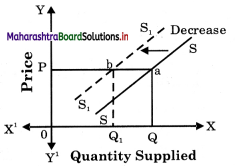
Question 1.
Several plans for rural development have been implemented, so that ____________
(a) the rural sector should not get neglected and the balance between rural and urban development be maintained
(b) the rural sector becomes richer than urban areas
(c) people could donate money for the development of the rural sector
(d) rural sector becomes richer than urban sector
Answer:
(a) the rural sector should not get neglected and the balance between rural and urban development be maintained

Question 2.
Rojgar Hami Yojana was started by the ‘Ministry of Commerce and Industry of the Government of India ____________
(a) to provide employment to urban youth
(b) to give pension to the retired army personnel
(c) to assure daily wages to the unemployed agricultural labourers
(d) to increase the employment rate in tribal areas
Answer:
(c) to assure daily wages to the unemployed agricultural labourers

Question 3.
The Government of India established a separate ‘Ministry of Disinvestment’ ____________
(a) to give credits to private firms
(b) to show sympathy towards private firms
(c) to invest more money in the government sector
(d) to take care of its disinvestment policy, i.e. the gradual withdrawal of governmental investment in the public sectors
Answer:
(d) to take care of its disinvestment policy, i.e. the gradual withdrawal of governmental investment in the public sectors

3. Complete the following concept map.

Question 1.
Maharashtra Board Class 12 History Important Questions Chapter 11 India Transformed Part 1 Q3
Answer:
Maharashtra Board Class 12 History Important Questions Chapter 11 India Transformed Part 1 Q3.1

Question 2.

Name of the StateDate of Formation
1. ………………….1st November 2000
2. Uttarakhand…………………………
3. ………………….15th November 2000
4. Telangana………………………….
5. Jammu-Kashmir31st October 2019
6. Ladakh………………………….

Answer:

Name of the StateDate of Formation
1. Chhattisgarh1st November 2000
2. Uttarakhand9th November 2000
3. Jharkhand15th November 2000
4. Telangana2nd June 2014
5. Jammu-Kashmir31st October 2019
6. Ladakh31st October 2019

4A. Write short notes.

Question 1.
BRICS
Answer:

  • This organisation was established in 2006. Its name is formed by adopting the first letter of the names of the participant countries. The participant members are Brazil, Russia, India, China, and South Africa.
  • This organisation was established with an aim of enhancing trade among these countries.
  • The 11th conference of BRICS was organised in Brazil. The theme of this conference was ‘Economic Growth for an Innovative Future’.
  • Subjects like technological co-operation, technology, and innovation, digital economy, international crime, financial scams were discussed.

Maharashtra Board Class 12 History Important Questions Chapter 11 India Transformed Part 1

Question 2.
GATT
Answer:

  • During the times of the Second World War, many countries had adopted the policy of imposing various duties and taxes on imported goods, with a view to protecting their home markets.
  • It resulted in declining in trade. A meeting was called in Cuba to discuss this problem, which was attended by 56 nations.
  • It was decided to establish a permanent organisation to resolve the problems related to international trade. A legal agreement was signed by 23 nations on 30th October 1947, which is known as GATT. This agreement was the first multinational trade agreement.
  • GATT gave priority to economic development through production and trade, to treat the member nation as ‘most favoured nation’.
  • An annual meeting of the member countries of GATT used to be held in Geneva. It was attended by the representative of the member countries.
  • Each country is entitled to one vote. Problems faced by individual nations regarding the difficulties of international trade were discussed in the meeting and the decision was based on these discussions.
  • Later GATT became a part of the ‘World Trade Organisation’.

Question 3.
World Trade Organisation
Answer:

  • On 1st January 1995, 123 nations together founded an organisation with the objective of opening the world for free trade. It was called World Trade Organisation (WTO). It’s a global trade organisation and India is a member of it.
  • Arthur Dunkel, the Director-General of WTO, prepared a draft which has been fundamental to the establishment of the organisation. This draft is known as ‘Dunkel Draft’.
  • The crux of this draft emphasis on trade is free from governmental custom duty and other restrictions. This approach is known as ‘liberalisation’.
  • All participating countries agreed upon a set of rules and a premise common to all that would promote international trade.
  • Provisions were made in the spheres of grants, exports-imports, foreign investments, reserved sectors, agriculture, technology, and the service sector.
  • After becoming a member of WTO, India put a thrust on economic progress. The contribution of Prime Minister Narsimha Rao, Atal Bihar Vajpayee, and Manmohan Singh is very important in this aspect.
  • The report published in 2006 has made a special mention of the increasing economic growth rate of India.

Question 4.
VVPAT
Answer:

  • VVPAT means Voter Verified Paper Audit Trail.
  • The Government of India started using this machine for the Nagaland Assembly Election in 2011.
  • Since 2019, this device has been widely used for the Lok Sabha elections. The slip generated by the machine can be checked to determine whom you voted for.
  • The voter sees the slip a few seconds after the vote. The voter can confirm his or her own vote through this machine.

Question 5.
Indian Science Congress Association.
Answer:

  • This association was established on 15th January 1914 with the objective of promoting the scientific environment in India and publishing dissertations, research papers, and periodicals.
  • In 1975, Asima Chatterjee became the first female scientist to be elected as the General President of the 62nd Indian Science Congress Association.

Maharashtra Board Class 12 History Important Questions Chapter 11 India Transformed Part 1

Question 6.
Speed Post
Answer:

  • The Indian postal department started the service of speed post in 1986 which changed the nature of post service.
  • This service was used by the majority of Indians, more than three crore letters and parcels were delivered from this service.
  • The customer will get the message of successful delivery of their items.
  • The postal department now offers courier services like passport delivery, business parcels, cash-on-delivery, logistics posts, and air freights.
  • The post office even offers a packaging service. Over one lakh and fifty thousand post offices are offering the services like paying bills, sending festive cards and other objects.
  • Since 2016, the postal department has started service of delivering Ganges water from Rishikesh and Gangotri at personal addresses.
  • Buying personalized postage stamps with personal photographs and special schemes for philatelists are also available at ‘Post Shops’ opened at 80 post offices.

4B. Explain the following statements with reasons.

Question 1.
The service of ‘Speed Post’ changed the very nature of the Indian Postal Service.
Answer:

  • The service of ‘Speed Post’ was started by the Indian Postal Department’ in 1986. Many people take advantage of this service, to the tune of more than three crores of letters and parcels is being delivered every month.
  • The postal department sends a message of successful delivery on the mobile phone of the sender. This facility has made the speed post service more reliable.
  • In addition, the postal department now offers courier services like delivery of passport, business parcel, cash-on-delivery, logistics post, and air freights.
  • Now the post office offers the packaging service at an extra charge. This has increased the business of the postal department.
  • It also offers services like paying various bills, sending festive greetings cards, and similar objects. The postal department has started a very novel service since 2016 of delivering Ganges water (Ganga Jal) at personal addresses from Rishikesh and Gangotri.
  • Along with its facilities like buying personalized postage stamps with a personal photograph, buying newly issued postage stamps at philatelic centers, special schemes for philatelists are available at ‘post-shops’ opened at 80 post offices.
  • Special limited issues of artistic postal stamps are published by the postal department in order to fulfill the requirement of philatelists.
  • In this way, the service of speed post changed the very nature of the Indian postal service.

5. Answer the following questions in detail.

Question 1.
Explain India’s progress in the field of science and technology.
Answer:

  • A supercomputer named ‘Param-8000’ was created with the help of C-DAC (Centre for Development of Advanced Computing, Pune. In 1998, an advanced version of ‘Param-8000’ was made which was named ‘Param-10000’.
  • Its mathematical potential was enormous because of which India entered the global computer market. In 1999, India created a further version of ‘Param-10000’ which was named ‘Parampadma’. In 2003, ‘Parampadma Super Computer’ was dedicated to the nation.
  • The central government’s favourable policies for the software industry, the foresightedness of Indian entrepreneurs, the nationwide spread of computer and information technology, computer engineers who are proficient in the use of the English language resulted in an increase in the Indian export of software.
  • In 1995, internet services began in India. In 2004, Tata Consultancy Services was the biggest firm in Asia providing software services. Pune and Bengaluru were developed as IT hubs. Indian IT engineers are great in demand all over the world.
  • In the field of science, to prove its nuclear strength, India conducted an underground nuclear test. The Indian satellite, ‘Oceansat-1’ launched and entered orbit in 1999.
  • In 2000, ‘Bharat Sanchar Nigam Ltd’ (BSNL) was established to provide services like mobile phones, internet, and broadband.
  • In this way, India achieved lots of progress in the field of science and technology.

Maharashtra Board Class 12 History Important Questions Chapter 11 India Transformed Part 1

Question 2.
Explain different Government schemes related to agriculture.
Answer:
According to the 2011 census, nearly 54% of India’s population is related to agriculture and agro related sector. The Government of India introduced different schemes for the progress of the agricultural sector, these schemes are as follows:

  • The ‘Soil Health Card’ aims at increasing soil fertility and agricultural production.
  • Pradhan Mantri Krishi Sinchan Yojana started for giving priority to water supply and irrigation facilities.
  • Krishi Vikas Yojana aims at organic cultivation and increases farmer’s income.
  • Pradhan Mantri Vima Yojana is implemented for the economic welfare of farmers and given the emphasis on animal husbandry, fisheries, agriculture research, and education. It also focuses on developing agriculture, co-operative establishment, and work for farmer’s welfare.
  • In 2007, a national policy for farmers was adopted. If there is crop failure because of things like natural calamities, epidemics, or adverse climate, the farmers get compensated through Pradhan Mantri Peek Vima Yojana.
  • Research Institute of Agricultural Sciences is supported through Indian Council for Agricultural Research. Agricultural exhibitions are organized for farmers.
  • Indigenous seeds and indigenous breeds of cattle and poultry farming of indigenous variety is given priority. Goat keeping (Sheli Palan) is encouraged as an occupation.
  • The ‘National Livestock Mission’ was established in 2014-15 and since then there is a rapid growth in the agricultural sector. India ranks second in fish production after China ranks first.

6. Answer the following question with the help of the given points.

Question 1.
Explain the achievement of India in the defense field.
(a) Operation Vijay
(b) Modernisation of Indian army
(c) Make in India
(d) Practice session with different countries
Answer:
(a) Operation Vijay: In 1999, Pakistan intruded Kashmir. This intrusion started a war between India and Pakistan. This war was fought in the Kargil-Drass area in Ladakh. Hence, it is known as the “Kargil War.” It is also referred to as ‘Operation Vijay’ by the Indian army. ‘Operation Vijay’ was successful and India emerged victorious in it.

(b) Modernisation of the Indian army:

  • This war alerted the Indian authorities for the modernization of the Indian military. The process of updating the military, equipment, and arms, training, etc. were further intensified.
  • India is the sixth country in the world to develop indigenous technology for building nuclear submarines. In 2009, India successfully built a ‘Strategic Strike Nuclear Submarine’ of the ‘Arihant class’ with the help of Russia.

Maharashtra Board Class 12 History Important Questions Chapter 11 India Transformed Part 1

(c) Make in India:

  • The Government of India emphasized indigenous technology (Make in India) on recruiting women officers in the military and also on combined exercise with militaries of other countries. Women can join eight sections of the Indian army through Union Public Service Commission.
  • There is an increasing focus on the exchange of the latest technology, to fight terrorism, augment our own competencies, and optimum use of modern technology for ending terrorism.

(d) Practice session with different countries: The practice session and exercise with the armies of different countries were arranged to fight terrorism. The exercise with the Oman military, Mongolian army, Sri Lankan army, and Russian army was arranged.

Question 2.
Explain the reorganization process of the states.
(a) Chhattisgarh
(b) Uttarakhand
(c) Jharkhand
(d) Telangana
(e) Jammu-Kashmir and Ladakh
Answer:
In 2000, new states were formed for the first time in India after the formation of lingual states in India.
(a) Chhattisgarh:

  • Indian National Congress first put forward the demand for Chhattisgarh before independence but it was rejected by Fazal Ali Commission.
  • The proposal of creating a separate state of Chhattisgarh was passed in the session of the Legislative Assembly of Madhya Pradesh in 1998.
  • The state of Chhattisgarh was created by the initiative of the Government of India on 1st November 2000.

(b) Uttarakhand:

  • Since 1930, the people of Garhwal and Kumaon were demanding a separate state.
  • This demand was supported in the 1938 session of the Indian National Congress, however, Fazal Ali Commission ruled it out.
  • The people started a movement for their demand in 1957. They also formed ‘Uttarakhand Parvatiya Rajya Parishad’ in 1973.
  • In 1994, the people’s movement got intensified, hence, in recognition of popular sentiments, a bill was passed by Uttar Pradesh Legislative Assembly.
  • The state of Uttaranchal, later renamed Uttarakhand, was formed on 9th November 2000.

(c) Jharkhand:

  • In the year 1929, the demand for the separate state of Jharkhand was staged for the first time. It got intensified after the formation of the All India Jharkhand Party in 1947.
  • An appeal was presented to the President and Prime Minister in 1973. The Bihar Legislative Assembly passed the bill ‘Jharkhand Area Autonomous Council’ in 1973. (JAAC).
  • A bill providing for the division of Bihar and the creation of a separate state of Jharkhand was passed in the lower house of the parliament in August 2000 and accordingly, on 15th November 2000, a separate state of Jharkhand came into existence.
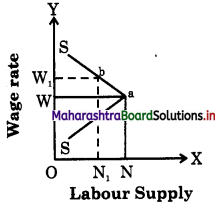
(d) Telangana:

  • The state of Telangana was earlier an integral part of the state of Andhra Pradesh. A movement was started by ‘Telangana Rashtriya Samiti’ for the creation of a separate Telangana.
  • In 2001, the Government of India announced the decision of the separate state of Telangana.
  • The Parliament approved this demand in 2014 and on 2nd June 2014, the separate state of Telangana was formed.

Maharashtra Board Class 12 History Important Questions Chapter 11 India Transformed Part 1

(e) Jammu-Kashmir and Ladakh:

  • Article 370 of the Indian Constitution gave a special status to the state of Jammu and Kashmir. In 1947, Prem Nath Dogra established the ‘Jammu Praja Parishad’ party. The motto of this party changed from ‘Ek Vidhan, Ek Pradhan, Ek Nishan’ to ‘Ek Desh me Do Vidhan, Do Pradhan, Do Nishan, Nahi Chalenge, Nahi Chalenge.
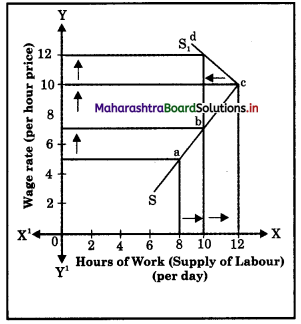
  • This party demanded complete accession of Jammu-Kashmir to India but the party in power, National Conference rejected the demand.
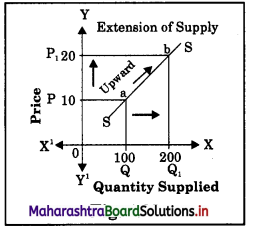
  • Dr. Shyama Prasad Mukherjee supported the demand for a complete merger. Recently in August 2019, the Government of India revoked article 370.
  • From 31st October 2019, the state of Jammu and Kashmir was reconstructed as two separate Union Territories of Jammu-Kashmir and Ladakh.