Maharashtra Board Class 11 Economics Solutions Chapter 4 The Economy of Maharashtra

Balbharti Maharashtra State Board Class 11 Economics Solutions Chapter 4 The Economy of Maharashtra Textbook Exercise Questions and Answers.

Maharashtra State Board Class 11 Economics Solutions Chapter 4 The Economy of Maharashtra

1. Give economic terms:

Question 1.
Investments did by foreign companies in our country.
Answer:
Liberalisation

Question 2.
Programme for development of the small, medium, and micro industries.
Answer:
MSICDP

Maharashtra Board Class 11 Economics Solutions Chapter 4 The Economy of Maharashtra

Question 3.
The basic requirement for facilitating the production and distribution of goods and services for economic development.
Answer:
Social infrastructure

Question 4.
A movement that promotes values of self-help democracy and equality.
Answer:
Co-operative movement

2. Find the odd word out:

Question 1.
Agricultural Indebtedness, dry farming, lack of capital, engineering
Answer:
Engineering

Question 2.
Tourism, Banking, Automobile Production, Insurance
Answer:
Automobile Production

Question 3.
Pune, Hyderabad, Nasik, Nagpur
Answer:
Hyderabad

Maharashtra Board Class 11 Economics Solutions Chapter 4 The Economy of Maharashtra

Question 4.
MTDC, MAITRI, SEZ, MIDC
Answer:
MTDC

Question 5.
Primary education, Hospitality, Higher education, Skill-based education.
Answer:
Hospitality

3. Identify and explain the concepts from the given illustrations:

Question 1.
To facilitate research in robotic technology, Japan has invested ₹ 1000 crores in India.
Answer:
Liberalisation – Foreign Direct Investment (FDI).
Due to the Liberalisation Act of 1991, foreign direct investment became easy in the Indian Industrial Sector. This led Japan to invest ₹ 1000 crores in India.
The FDI inflow in Maharashtra till September 2017 was ₹ 6,11,760 crores.

Question 2.
Prajakta and her family visited the beaches during her eight-day Diwali vacation.
Answer:
Tourism.
It is a business of providing and arranging holidays and the tourism department focuses to attract more and more tourists to Maharashtra to earn revenue for the state. To promote tourism, the government formulated Maharashtra Tourism Policy, 2016.

Question 3.
Pravin from Latur works as a technician in the films division at Mumbai city.
Answer:
Entertainment Industry.
The Entertainment Sector of Maharashtra generates employment opportunities for a large number of people. Thus, Pravin came to Mumbai and worked as a technician in the film division.

Question 4.
Rani Gond from Chandrapur works as a hostess with the Mumbai-Goa cruise ship.
Answer:
Hospitality.
It means friendly and generous receptions and entertainment of guests, visitors, or strangers. Hospitality is a broader industry than other industries and has grown rapidly in Maharashtra due to the development of the tourism business in Maharashtra.

Maharashtra Board Class 11 Economics Solutions Chapter 4 The Economy of Maharashtra

4. Distinguish between:

Question 1.
Economic Infrastructure and Social Infrastructure.
Answer:

Economic InfrastructureSocial Infrastructure
(i) Economic Infrastructure is the basic facilities of production and distribution of goods and services for economic development.(i) Social infrastructure is the basic facilities to improve the quality of human life.
(ii) It includes telecommunication, electricity, transportation, energy, etc.(ii) It includes health, education, and housing.

Question 2.
The agriculture sector and Service sector.
Answer:

Agricultural SectorService Sector
(i) Agricultural sector is known as the primary sector. It includes the production of raw materials and basic foods.(i) The service sector is known as the tertiary sector. They mainly provide services to the general population and to the business.
(ii) E.g. farming, fishing, hunting, mining, etc.(ii) E.g. restaurants, tourism, banking, insurance, etc.

Question 3.
Tourism and Hospitality.
Answer:

TourismHospitality
(i) Tourism refers to the business of providing and arranging holidays and services to the people who are visiting a place.(i) Hospitality refers to the relationship between a guest and host, wherein the host receives the guest with goodwill.
(ii) It includes activities such as sightseeing and camping.(ii) It includes reception, entertainment of guests, visitors, etc.

Question 4.
Education and Health Services.
Answer:

EducationHealth Services
(i) Education is about teaching, learning skills, and knowledge. It also means helping people to learn and think about what they learn.(i) Health services refer to medical professionals, organizations, and ancillary health care workers who provide medical care to those in need.
(ii) Education refers to a profession where people are educated for their personal development.(ii) Health refers to mental health, physical health, etc.

5. Answer the following:

Question 1.
Explain the role of Co-operative movement in Maharashtra.
Answer:
Following is the role of the Co-operative movement in Maharashtra:

  • Co-operative movements have been vastly successful in the overall improvement of the quality of life in rural areas.
  • The co-operative movement has improved the lives of the people and has made a significant contribution to the economy of Maharashtra.
  • Due to cooperative movement, Maharashtra is considered as the land of opportunities, as it is one of the most developed states, not only economical but also in terms of infrastructure.
  • There are some other roles of co-operative movements such as agro-processing industry, agro-marketing, sugar co-operatives, fisheries Co-operative societies, Co-operative dairy societies, textiles, housing societies, etc.

Maharashtra Board Class 11 Economics Solutions Chapter 4 The Economy of Maharashtra

Question 2.
Explain in detail the measures taken by the government for the agricultural development of Maharashtra.
Answer:
Following are the measures are taken by the government for the agriculture development of Maharashtra:

  • Availability and distribution of quality seeds, fertilizers, pesticides, water sources by dams, well, turbines, etc.
  • Establishment of Centre of Excellence to transfer technologies, creating awareness about agricultural information.
  • Use of renewable energy in agriculture and allied activities.
  • Creation of water resources for round the year cultivation.
  • The Pradhan Mantri Krishi Sinchai Yojana(PMKSY) is another scheme to expand the cultivated areas with assured irrigation and reduce wastage of water.
  • National Agriculture Market (NAM) has been introduced to promote reform of the agricultural marketing sector.

Question 3.
Explain the major problems in the industrial sector of Maharashtra.
Answer:
Major problems in the industrial sector are as follows:

  • On the government level, the decision-making system is so poor that it results in huge cost escalation, increasing interest burden, and higher burden on consumers.
  • India’s population is very high but there is a shortage of trained, well-educated, energetic, and experienced people.
  • The technology used in industries is outdated and it affects production.
  • Lack of infrastructures like transportation, communication, sewage, water, and electric system available at a high cost, results in an increase in production cost.
  • Due to a lack of motivation for new entrepreneurs, self-motivation will help to achieve the entrepreneurial goals.
  • Regional imbalances exist in all sectors of the economy. Especially, it is found more in the industrial sector.

Question 4.
Explain the measures taken to develop social infrastructure in Maharashtra.
Answer:
Measures taken to develop social infrastructure in Maharashtra are as follows:

(i) Education:

  • Right to Education (RTE) to children in the age group of 6-14 years.
  • Free and compulsory education under the program Sarva Shiksha Abhiyan (SSA).
  • Rashtriya Madhyamik Shiksha Abhiyan (RMSA) was launched in 2009 to improve access and quality secondary education.
  • Efforts are taken to expand opportunities in higher education.
  • Other measures like inclusive education, girl’s education, adult literacy, and tribal education were also taken by the government.

(ii) Health Services:
Various programmes like National Rural Health Mission (NRHM) and National Urban Health Mission – (NUHM) were undertaken to strengthen the health system in rural and urban areas created 3 tier health infrastructure to provide comprehensive health services.

(iii) Tourism:

  • Formulated Maharashtra Tourism Policy, 2016.
  • Organises different events like the Ellora festival, Elephanta festival, etc.
  • Launched the scheme of ‘Mahabhraman’.

(iv) Hospitality:
Provides services through, Airlines, Mumbai-Goa cruise ships, fancier trains (Deccan Odyssey), restaurants, etc.

Maharashtra Board Class 11 Economics Solutions Chapter 4 The Economy of Maharashtra

(v) Entertainment:
Generated employment opportunities by producing a large number of films.

6. Read the following passage and answer the questions given below:

The government of India has launched an ambitious programme of ‘Bharatnet’ for rural India by keeping in mind today’s modern era. More than one lakh rural (Grampanchayat) areas have been connected under Bharatnet’s high-speed broadband scheme. Maharashtra has become the best-performing state. East Uttar Pradesh, Chattisgarh, Rajasthan, and Jharkhand have also been placed among the best performing states in the first phase of the Bharatnet broadband connection scheme.

Question 1.
Why did the Government of India launch the Bharatnet project?
Answer:
The Government of India launched the ambitious programme of Bharatnet especially for rural India to get connected under Bharatnet’s high-speed broadband scheme.

Question 2.
How many Gram panchayats have received Internet services?
Answer:
More than one lakh Gram panchayats have received internet services.

Question 3.
Which states have been placed as the best performing states in the first phase of Bharatnet?
Answer:
Maharashtra, East Uttar Pradesh, Chattisgarh, Rajasthan, and Jharkhand have been placed as the best-performing state in the first phase of Bharatnet.

Question 4.
‘Internet has brought the world closer’ – Express your views on it.
Answer:
Yes, Communication has become very simple through e-mails. People can get connected online through the internet which can see each other living in another corner of the world. Through the internet, we can get each and every piece of information required for studies, research, business, etc. Messaging apps are the fastest way of communication that can be connected through the internet which also saves cost.

11th Economics Digest Chapter 4 The Economy of Maharashtra Intext Questions and Answers

Find out: (Textbook Page No. 26)

Names of any five enterprises from each category producing the following goods in Maharashtra: chemicals, food processing, textiles, automobiles, I.T., and pharmaceuticals.
Answer:
Companies or Enterprises producing the following goods in Maharashtra:

ChemicalFood ProcessingTextilesAutomobilesI.T.Pharmaceutical
1. Core Chemical Mumbai Pvt. Ltd. (Mumbai)1. Malpani Food Industries (Pune)1. Tuni Textile Mills Ltd. Mumbai)1. Force Motors (Pune)1. Computer World (Pune)1. Aarey Drugs and Pharmaceuticals Pvt. Ltd. (Boisar)
2. Dai Ichi Karkaria Ltd. (Mumbai)2. Protein Food Industries (Hadapsar, Pune)2. Bafna Textile Mumbai)2. Maruti Udyog Ltd. Mumbai)2. Wizertech Informatics Pvt. Ltd. Mumbai)2. Aditya Air Products Pvt. Ltd. (Nagpur)
3. Molychem (Mumbai)3. Vista Processed Foods Pvt. Ltd. (Navi Mumbai)3. Baba Weaving Mills (Solapur)3. Volvo India Pvt. Ltd Mumbai)3. Marvell India Pvt. Ltd. (Pune)3. Allwin Medical Pvt. Ltd. (Raigad)
4. Hindustan Organic Chemical (Rasayani)4. Forstal Frozen Foods Pvt Ltd. (Navi Mumbai)4. Aruna Fabrics (Kolhapur)4. DSK Toyota DSK Motors Ltd. (Pune)4. Ideal Computer and Softwares (Mumbai)4. Ambica Diagnostics (Aurangabad)
5. Sanika Chemicals Pvt Ltd (Mahad)5. Tastel Fine Food Pvt Ltd. (Mumbai)5. Navjeevan Mills Pvt Ltd. Mumbai)5. Arihant Auto Industries (Nashik)5. Lotus Info System (Mumbai)5. Cellulose Pharma Chem (Nashik)

[Source: Internet]

Maharashtra Board Class 11 Economics Solutions Chapter 4 The Economy of Maharashtra

Try this: (Textbook Page No. 27)

Classify the services into services for business and services for final consumers.
[Fintech, IT/ITES, Startups, Cloud Computing, Electric Vehicles, Defence, Tourism and Private Universities]
Answer:

Services for BusinessServices for Final Consumers
1. Fintech(a) Electric Vehicles
2. IT/ITES(b) Defence
3. Startups(c) Tourism
4. Cloud Computing(d) Private Universities
5. Defence

Think about it: (Textbook Page No. 25)

What will happen if the farmers sell their farm produce without the middlemen?
Answer:

  • Middleman charge commission and make a profit by taking goods from farmers and selling them to the general public.
  • If the middleman is removed then farmers will get more price for their produce as well as consumers will also get products at a lesser price.
  • Sometimes middlemen create an artificial shortage of products which increases the price, thus this artificial shortage can be cut down by abolishing middlemen.
  • Farmer can get right to fix price for their own product after adding sufficient profit margin which will help them to grow in future.

Find out: (Textbook Page No. 28)

Symbols of the following:
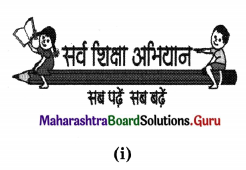
(i) Sarva Shiksha Abhiyan (SSA)
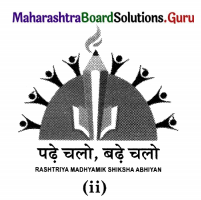
(ii) Rashtriya Madhyamik Shiksha Abhiyan (RMSA)
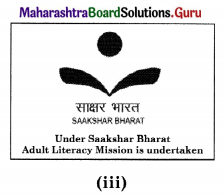
(iii) Adult Literacy Mission (ALM)
Answer:
Maharashtra Board Class 11 Economics Solutions Chapter 4 The Economy of Maharashtra Q4

Maharashtra Board Class 11 Economics Solutions Chapter 4 The Economy of Maharashtra Q4.1

Maharashtra Board Class 11 Economics Solutions Chapter 4 The Economy of Maharashtra Q4.2

Maharashtra Board Class 11 Economics Important Questions Chapter 2 Money

Balbharti Maharashtra State Board Class 11 Economics Important Questions Chapter 2 Money Important Questions and Answers.

Maharashtra State Board 11th Economics Important Questions Chapter 2 Money

1A. Choose the correct option:

Question 1.
Qualities of Money
(a) General Acceptability
(b) Durability
(c) Non-divisibility
(d) Portability
Options:
(1) a, c, d
(2) a, b, c
(3) a, b, d
(4) b, c, d
Answer:
(3) a, b, d

Question 2.
Difficulties in Barter System
(a) Problem of Double coincidence of wants
(b) Lack of common measure of value
(c) Difficulties in the storage of goods
(d) Divisibility of goods possible
Options:
(1) b, c, d
(2) a, b, c
(3) a, b, c, d
(4) a, b, d
Answer:
(2) a, b, c

Maharashtra Board Class 11 Economics Important Questions Chapter 2 Money

Question 3.
Statement related to Barter System
(a) Exchange of goods for goods
(b) Mobile Phone, Tablet, Smart Cards, Digital Wallet
(c) Problem of deferred payments
(d) Lack of common measure of value
Options:
(1) a, c, d
(2) a, b, c
(3) b, c, d
(4) b, d
Answer:
(1) a, c, d

Question 4.
Statement not related to Standard coins
(a) Face value greater than the intrinsic value
(b) It is also called as full-bodied coins
(c) It is made of gold or silver
(d) Face value is equal to intrinsic value
Options:
(1) a, b, c
(2) b, c
(3) a, b, d
(4) b, c, d
Answer:
(4) b, c, d

Question 5.
Not a Commodity money
(a) Feathers
(b) Tusk
(c) Aluminium
(d) Animal skin
Options:
(1) b, a
(2) c, d
(3) c
(4) a, c
Answer:
(3) c

Question 6.
Features of non-legal tender money
(a) No legal compulsion
(b) Cheques, Bill of exchange, etc
(c) Generally, used by people for final payment
(d) It is backed by law
Options:
(1) a, c, d
(2) a, b, c
(3) b, d
(4) b, c, d
Answer:
(2) a, b, c

Maharashtra Board Class 11 Economics Important Questions Chapter 2 Money

Question 7.
Secondary functions of money
(a) Standard of Deferred payments
(b) Store of value
(c) Medium of Exchange
(d) Transfer of value
Options:
(1) b, c
(2) a, b, c
(3) a, b, d
(4) b, c, d
Answer:
(3) a, b, d

Question 8.
Contingent functions of money
(a) Imparts liquidity to wealth
(b) Measurement of National Income
(c) Basis of Credit
(d) Estimation of macro-economic variable
Options:
(1) a, b, c
(2) b, c, d
(3) a, c, d
(4) a, b, c, d
Answer:
(4) a, b, c, d

Question 9.
Concept of Black money
(a) Money not accounted for
(b) tax evaded money
(c) encourages bribery, hoarding, etc
(d) discourages illegal activities
Options:
(1) a, d
(2) b, c, d
(3) a, b, c
(4) a, b, d
Answer:
(3) a, b, c

Question 10.
Features of Bank money
(a) Refers to deposits saved by people
(b) Demand draft, cheque, etc
(c) Legal tender money
(d) Nonlegal tender money
Options:
(1) a, b, d
(2) b, c, d
(3) a, c, d
(4) b, d
Answer:
(1) a, b, d

1B. Complete the correlation:

Question 1.
Bills of exchange : Credit money : : Feathers : __________
Answer:
Commodity Money

Question 2.
Primary function of money : Medium of exchange : : __________ : Deferred payment.
Answer:
Secondary functions of money

Maharashtra Board Class 11 Economics Important Questions Chapter 2 Money

Question 3.
Commodity money : Metals, Rice : : __________ : Credit card.
Answer:
Plastic money

Question 4.
Standard coins : Gold, silver : : __________ : Cheap metal.
Answer:
Token coins

Question 5.
India : Rupees : : __________ : Dollar.
Answer:
USA

Question 6.
Animal money : Oldest form of money : : __________ : Latest form of money.
Answer:
Electronic money

Question 7.
Currency notes : Unlimited legal tender : : Token coins : __________
Answer:
Limited legal tender

Question 8.
U.K. : Pound : : __________ : Yen
Answer:
Japan

Question 9.
Credit Cards : Plastic Money : : Digital Wallet : __________
Answer:
Electronic money

Question 10.
₹ 1 note : __________ : : ₹ 100 note : Reserve Bank of India.
Answer:
Govt, of India

1C. Suggest the economic terms for the given statements.

Question 1.
A financial institution that accepts deposits of money from the public.
Answer:
Bank

Maharashtra Board Class 11 Economics Important Questions Chapter 2 Money

Question 2.
Exchange of goods for goods without the use of money.
Answer:
Barter system

Question 3.
Coins whose face value is higher than their intrinsic value.
Answer:
Token coins

Question 4.
Coins whose face value is equal to their intrinsic value.
Answer:
Standard or Full-bodied coins

Question 5.
Money that is backed by law and cannot be refused in transactions by anybody.
Answer:
Legal tender money

Question 6.
Money is generally used by the people but there is no legal compulsion of accepting it.
Answer:
Nonlegal tender money

Question 7.
Payment to be made at a future date.
Answer:
Deferred payment

Question 8.
Name the function of money when it serves as a medium of exchange and measure of value.
Answer:
Primary functions

Question 9.
Tool to control black money.
Answer:
Demonetization

1D. Arrange in proper order:

Question 1.
Evolution of money
(a) Paper money
(b) Animal money
(c) Plastic money
(d) electronic money
Answer:
b, a, c, d

Maharashtra Board Class 11 Economics Important Questions Chapter 2 Money

Question 2.
Function of money
(a) Transfer of value
(b) Medium of exchange
(c) Store of value
(d) Basis of credit
Answer:
b, c, a, d

1E. Find the odd word out.

Question 1.
Definitions of money not given by
(a) Walker
(b) Crowther
(c) Marshall
(d) Seligman
Answer:
(c) Marshall

Question 2.
Not a good quality of money
(a) Homogeneity
(b) Portability
(c) Cognizability
(d) Changing the value of money
Answer:
(d) Changing the value of money

Question 3.
Not a standard of deferred payment
(a) Paper money
(b) Commodity money
(c) Bills of exchange
(d) Demand drafts
Answer:
(b) Commodity money

Question 4.
Not a metallic money
(a) silver
(b) stones
(c) aluminium
(d) nickel
Answer:
(b) stones

1F. Complete the following statements:

Question 1.
Money is anything that is generally accepted as a means of exchange and at the same time __________
Answer:
acts as a measure and store of value

Question 2.
Token coins are those whose face value __________
Answer:
is higher than their intrinsic value

Maharashtra Board Class 11 Economics Important Questions Chapter 2 Money

Question 3.
Cow, sheep, horse, etc. used as a means of exchange are __________
Answer:
commodity money

Question 4.
Money that is backed by law and cannot be refused in the transaction are called __________
Answer:
legal tender money

Question 5.
Any two qualities of good money __________
Answer:
recognizability, divisibility

Question 6.
Money used for purchases and transactions globally is __________
Answer:
electronic money

Question 7.
In India, one rupee note and all coins are issued by the __________
Answer:
Government of India

Question 8.
Currency notes of higher denominations are issued by the __________
Answer:
Central Bank (RBI)

Question 9.
Money is a link between __________
Answer:
Present and future

Question 10.
Payments to be made at a future date is called __________
Answer:
deferred payments

Maharashtra Board Class 11 Economics Important Questions Chapter 2 Money

Question 11.
In the case of token coins, intrinsic value is __________
Answer:
less than its face value

Question 12.
The most liquid asset is __________
Answer:
money

Question 13.
Introduction of money removed __________
Answer:
the difficulties of the barter system

Question 14.
Money that leads to political, economic and social instability in a country is __________
Answer:
Black money

Question 15.
Bank draft is an example of __________
Answer:
Bank money

Question 16.
In India, paper currency is known as __________
Answer:
Legal tender money

Question 17.
Use of Debit and Credit cards are examples of __________
Answer:
Plastic money

Question 18.
“Money is what money does”, this definition is given by __________
Answer:
Prof. Walker

1G. Choose the wrong pair:

Question 1.

Group ‘A’Group ‘B’
1. Standard coin(a) Face value more than the intrinsic value
2. Bills of Exchange(b) Credit money
3. Black Money(c) Illegal money

Answer:
Wrong Pair: Standard coin – face value more than intrinsic value.

Question 2.

Group ‘A’Group ‘B’
1. Commodity money(a) cow, sheep, horse, etc.
2. Barter System(b) Double coincidence of wants
3. Electronic money(c) Gold coins

Answer:
Wrong Pair: Electronic money – Gold coins

Maharashtra Board Class 11 Economics Important Questions Chapter 2 Money

Question 3.

Group ‘A’Group ‘B’
1. Quality of money(a) Cognizability
2. Secondary function of money(b) Medium of Exchange
3. Rs. 100(c) Legal tender money

Answer:
Wrong Pair: Secondary function of money – Medium of Exchange.

1H. Choose the correct option:

Question 1.

Group ‘A’Group ‘B’
1. Near Money(a) Seashells
2. Secondary function of money(b) Double coincidence of wants
3. Commodity money(c) Bills of Exchange
4. Barter System(d) Standard of deferred payments
5. Legal tender(e) Paper money

Options:
(A) 1 – e; 2 – b; 3 – a; 4 – d; 5 – c
(B) 1 – b; 2 – a; 3 – d; 4 – c; 5 – e
(C) 1 – c; 2 – d; 3 – a; 4 – b; 5 – e
(D) 1 – a; 2 – d; 3 – c; 4 – e; 5 – b
Answer:
(C) 1 – c; 2 – d; 3 – a; 4 – b; 5 – e

Question 2.

Group ‘A’Group ‘B’
1. Token Coin(a) Credit Money
2. Standard coin(b) Not steady
3. Money(c) Medium of Exchange
4. Value of Money(d) Face value more than intrinsic value
5. Bills of Exchange(e) Face value equal to intrinsic value

Options:
(A) 1 – a; 2 – b; 3 – c; 4 – e; 5 – d
(B) 1 – d; 2 – e; 3 – c; 4 – b; 5 – a
(C) 1 – c; 2 – e; 3 – d; 4 – a; 5 – b
(D) 1 – e; 2 – c; 3 – b; 4 – a; 5 – d
Answer:
(B) 1 – d; 2 – e; 3 – c; 4 – b; 5 – a

Question 3.

Group ‘A’Group ‘B’
1. Metallic Coins(a) Latest development in credit money
2. Commodity Money(b) Cheques
3. Paper Money(c) Currency Notes
4. Bank Money(d) Problem of divisibility
5. Electronic money(e) Gold coins

Options:
(A) 1 – a; 2 – b; 3 – c; 4 – d; 5 – e
(C) 1 – d; 2 – e; 3 – a; 4 – b; 5 – c
(B) 1 – c; 2 – b; 3 – a; 4 – e; 5 – d
(D) 1 – e; 2 – d; 3 – c; 4 – b; 5 – a.
Answer:
(D) 1 – e; 2 – d; 3 – c; 4 – b; 5 – a

Maharashtra Board Class 11 Economics Important Questions Chapter 2 Money

2. Distinguish between:

Question 1.
Barter Economy and Money Economy.
Answer:

Barter EconomyMoney Economy
(i) Barter economy is a moneyless economy where goods are exchanged for goods.(i) Money economy is one where money is commonly used as a medium of exchange.
(ii) In this economy exchange of goods for goods is direct.(ii) In this economy exchange of goods is indirect i.e. through money.
(iii) Exchange of transactions is few and difficult.(iii) Exchange of transactions is many and smooth.
(iv) Barter economies are rarely found.(iv) Almost all economics in the world are money economies.

Question 2.
Metallic Money and Paper Money.
Answer:

Metallic MoneyPaper Money
(i) It refers to money which is made of metals like gold, silver, and copper, etc.(i) It refers to that money which is in form of paper currency notes issued by the Govt, and the Central Bank of the country.
(ii) They are durable.(ii) They are less durable.
(iii) Metallic money is not easily portable.(iii) Paper money is more convenient and they are light in weight, so it is portable.
(iv) They are suitable for small transactions.(iv) They are suitable for larger transactions.
(v) Metallic money was introduced earlier to paper money.(v) Paper money was subsequently issued after metallic money.
(vi) Metallic money is not economical to produce.(vi) Paper money is easier and cheaper to print.

Question 3.
Standard Coins and Token Coins.
Answer:

Standard CoinsToken Coins
(i) Standard coins are those coins whose face value is equal to its intrinsic value.(i) Token coins are those coins whose face value is greater than its intrinsic value or metal value.
(ii) These are made of costly metals like gold, silver, etc.(ii) These are made of cheap metals like nickel, aluminium, etc.
(iii) Indian rupees during the king’s rule were made of gold, silver, etc.(iii) In today’s time these are used for making small payments.
(iv) These are rarely used now.(iv) Token coins in India are ₹ 10, 5, 2, 1.

Question 4.
Legal Tender Money and Non-Legal tender Money.
Answer:

Legal Tender MoneyNon-Legal Tender Money
(i) Legal Tender Money is the money that is backed by law and refusal to accept will be punishable by law.(i) Non-legal tender money is the money that is generally used by people but there is no legal compulsion to accept it.
(ii) It is issued by the Central bank of the country.(ii) It is issued by commercial banks.
(iii) It is freely accepted as a medium of exchange.(iii) It is not legal tender money. No one can force you to accept it.
(iv) Currency notes issued by RBI in denominations ₹ 5, 10, 20, 50, 100, 200, 500, 2000 are legal tender money.(iv) Negotiable instruments such as cheques, bank drafts, bills of exchange are non-legal tender money.

3. Answer the following:

Question 1.
Write any two most commonly accepted definitions of money.
Answer:
Some most commonly accepted definitions are as follows:

  • Prof. Walker – “Money is what money does”.
  • Prof Crowther – He has given the most acceptable definition. “Money is anything that is generally accepted as a means of exchange and at the same time, acts as a measure and as a store of value”.

Question 2.
What are the qualities of good money?
Answer:
Qualities of good money are as follows:

  • General Acceptability: It must be generally accepted as a medium of exchange.
  • Stability of Value: The purchasing power of money should be stable because money serves as a store of value.
  • Cognizability: It must be easily recognizable or identifiable. For E.g. Notes of different denominations must be of different sizes, colours, etc., so that they can be easily identified.
  • Durability: Money should be durable also. Its value should not fluctuate too much.
  • Divisibility: Money should be divisible into units of smaller denominations.
  • Portability: It should be easy to handle and carry from one place to another.
  • Homogeneity: Money of the same denomination should be identical in shape, size, colour, etc.

Maharashtra Board Class 11 Economics Important Questions Chapter 2 Money

Question 3.
What is meant by
(i) Black money
(ii) Electronic money
Answer:
(i) Concept of black money: Black money is unaccounted money which is illegally obtained and not declared for tax purposes. It encourages illegal activities, corruption, bribes, etc. This creates an obstacle to economic development.

(ii) Electronic Money: It is also called E-money. It is a monetary value that is stored and transferred electronically through mobile phones or tablets or smart cards or computers. It is backed by Central Bank and is used for purchases and other transactions globally.

Question 4.
What are the advantages of cashless payments or plastic money?
Answer:
Advantages of cashless payments or plastic money:

  • It reduces the burden of carrying cash while traveling.
  • It is easy to use plastic money like debit cards and credit cards.
  • It will restrict the inflow of duplicate money as cash is not used at all.
  • Fear of loss of money while traveling will not be there. If the card is lost we can inform our banks and get all transactions stopped.
  • Corruption and black money transaction will be controlled as all transactions will be done through banks which will bring transparency to our transactions.
  • We also get a credit period if payments are made through credit cards.

4. State with the reasons whether you agree or disagree with the following statements:

Question 1.
Money is the most liquid asset.
Answer:
Yes, I agree with the statement.

  • Money is the most liquid asset because it is generally acceptable.
  • It is a 100% liquid asset in the sense that it can be converted into any type of asset with no loss in its value
  • Money helps to transfer immovable properties like land by selling it at one place and purchasing similar property at another place or from one person to another without any difficulty.
  • In other words, it makes illiquid assets like land, buildings, etc., into liquid assets.
  • Money as a store of value is also the most liquid asset, as compared to other assets like diamonds, houses, land, etc.

Question 2.
Money has no store of value.
Answer:
No, I do not agree with the statement.

  • Money performs an important function as a store of value.
  • Although wealth can be stored in a form other than money, money is the most convenient form in which wealth can be stored. Since money is the most liquid asset, it can be used for future use whenever needed.
  • Money can be stored without the loss in its value.
  • This was not possible under barter exchange because goods could not be stored for a long time and there could be lost in the value of commodities.
  • This function of money enables people to save a part of their income and store it for future use.
  • Savings lead to capital formation which in turn will lead to the economic development of a country.

Maharashtra Board Class 11 Economics Important Questions Chapter 2 Money

Question 3.
There are no disadvantages to paper money.
Answer:
No, I do not agree with the statement.
Although paper money has many advantages and it has economized the use of precious metals it suffers from the following disadvantages:

  • The government may over the issue when there is a deficit in the budget and this may lead to inflation.
  • It is less durable as compared to metallic money.
  • It can be circulated only in the domestic economy, it is not useful for international trade.

Question 4.
Credit Money can be refused.
Answer:
Yes, I agree with the statement.
Credit money can be refused because

  • Credit money refers to Bank money.
  • Bank money is not legal tender money.
  • No one can force to accept this money.
  • It is not punishable if it is not accepted.
  • Hence, Credit Money can be refused.

Question 5.
Plastic money can play an important role in eradicating corruption in India.
Answer:
Yes, I agree with the statement.
More and more use of plastic money can help in eradicating corruption in India in the following ways:

  • Every transaction detail is recorded by the bank when the transaction is done through plastic money.
  • None of the money transactions are illegal as these take place through banks.
  • At the international level, all the conversion of Indian currency into dollars or Swiss dollars can be recorded with transactions done through plastic money.
  • It’s only when transactions take place in cash, bribery and other illegal activities take place.
  • But the use of plastic money is easy to use, easy to keep records, and hence will help in removing corruption.

5. Answer in detail:

Question 1.
Define barter system. What are the difficulties faced by people under this system?
Answer:
Barter system refers to the system where goods are exchanged for goods without the use of money. Difficulties of barter system:
(a) Problem of double coincidence of wants: Lack of double coincidence of wants means when two persons may not desire to purchase each other’s goods. For example Mr. A has wheat and wants salt. So Mr. A has to search for Mr. B who wants wheat and has salt, otherwise, the exchange would not be possible.

(b) Lack of common measure of value: In olden times there was no common unit in terms of which the value of goods could be measured.

(c) Indivisibility of certain goods: There was a problem of exchange when a person had large commodities which could not be divided into smaller units Eg. 1 goat = 20 kg rice. If a person wanted 5 kg of rice, the goat could not be cut and exchanged.

Maharashtra Board Class 11 Economics Important Questions Chapter 2 Money

(d) Difficulty in the storage of goods: It was necessary to store goods for future use but as most of the things were perishable, it was difficult to store.

(e) Problem of making deferred payments: It means a payment to be made in the future. For E.g. taking a loan and making a payment in the future was not possible in the barter system. So, to overcome these difficulties of the barter system, people invented some other kind of money.

Question 2.
What are the different stages in the evolution of money? Or Explain the different types of money.
Answer:
The evolution of money has passed through various stages with the development of civilization.
Following are the various stages of money which evolved gradually with the need and time:
(a) Animal money: In the primitive age (prehistoric period) animals like cows, goats, sheep, etc. were used as a common medium of exchange. In hot climatic countries cow, ox, etc. were chosen as a medium of exchange.

(b) Commodity money: In certain countries, commodities like shells, wheat, rice, tobacco, wool, fur, salt, etc. were used as money. In cold countries, skin and fur were used as a medium of exchange. But due to the lack of uniformity and storage, metallic money was evolved.

(c) Metallic money: With the progress of civilization, precious metals like gold and silver came into use as money. Initially, metallic money was imperfect in size, shape, weight, etc. But the scarcity of precious metals gave rise to the of use of metallic coins.

(d) Metallic coins: Use of metals led to the introduction of coins. Rulers in olden times affixed their seal on metallic money. These coins were of two types.

  • Standard or full-bodied coins : Coins for which the face value is equal to its intrinsic (metal) value are known as standard or full-bodied coins. E.g. gold and silver coins.
  • Token coins: Coins for which the face value is greater than intrinsic value are known as token coins. E.g. coins made of nickel, copper, aluminium, etc. In India token coins are of ₹ 1, ₹ 2, ₹ 5, and ₹ 10. But difficulties in the transportation of token coins gave rise to paper money.

(e) Paper money: Paper money is made of paper. In India all currency notes of ₹ 5, ₹ 10, ₹ 50, ₹ 100, ₹ 200,
₹ 500, and ₹ 2000 are issued by the Reserve Bank of India (RBI) on behalf of the Government of India. Paper money has a very small intrinsic value of its own.

(f) Bank money or Credit money: Bank money refers to bank deposits. This can be withdrawn or transferred on demand by means of cheque, demand draft, etc. These are not legal tender money, but through credit instruments, money can be transferred from one place to another and from one person to another. Today most of the big payments are made or received through cheques.

(g) Plastic money: In recent years due to the advancement of technology use of plastic money like credit cards, debit cards also have become very popular.

(h) Electronic money: It is the most recent development of money. Funds are electronically transferred through mobile phones, smart cards, etc. With this invention, transactions through worldwide have become very easy and popular.

Maharashtra Board Class 11 Economics Important Questions Chapter 2 Money

Question 3.
Explain in detail the main functions of money.
Answer:
Functions of money can be broadly divided into the following 3 groups:

  • Primary functions
  • Secondary functions
  • Contingent functions.

(a) Primary Functions:

  • Medium of exchange: The most important function of money is to make buying and selling of goods and services possible in the market ie. it serves as a medium of exchange. Thus, money facilitates the sale and purchase of goods in the
  • market.
  • Measure of value or unit of account: Price is the value of a commodity or service expressed in terms of money. Hence it becomes easier for anyone to compare or know the value of any two or more commodities.

Different countries use different currencies to express the value of their commodities. E.g. Rupee in India, Pound in the UK, Dollar in the USA, etc. Thus, money as a measure of value helps in estimating the cost, revenue, and profits of the business firms.

(b) Secondary Functions

  • Standard of deferred payment: Deferred payments are the payments that are to be made at a future date. Buying and lending were not possible in a barter economy. Now, this function of money develops financial and capital markets and helps in the growth of the economy.
  • Store of value: Money acts as a store of value. It is a convenient form in which we can store the value or savings for future use. According to J.M. Keynes, money is a link between the present and future. .
  • Transfer of value: Money helps to transfer values from one place to another or from one person to another due to its general acceptability. One can sell his movable or immovable belonging at one place and buy at another place. Values can thus be transferred. In modern times people generally use cheques, electronic transfers, etc instead of using currency notes for transferring values.

(c) Contingent Functions:

  • Measurement of National Income: Country’s National Income accounting is possible only because of money as a unit of account.
  • Basis of credit: Modern economy is based on credit i.e. promise to pay. Hence lending and borrowing activities are made easy by using money. Money Provides a base for the creation of credit money.
  • Estimates of macroeconomic variables: Macroeconomic variables such as Gross National Product (GNP), total investments, total savings, taxes, etc. can be easily estimated in money terms.
  • Imparts liquidity: Money is the most liquid asset which can be easily converted into any other asset. For example land, machinery, shares, etc. can be bought and sold in terms of money.

6. Case Study:

Read the passage and answer the following questions:

Shiv is working in the USA and his old parents live in Mumbai. Every month he transfers money from there in father’s bank account and also pays all their utility bills from there.

Question (a).
What type of money is used by Shiv?
Answer:
Shiv uses an electronic, mode of money for transferring money from the USA.

Question (b).
Write any one way how parents can withdraw cash?
Answer:
Parents of Shiv can withdraw money by means of a cheque or withdrawal slip.

Maharashtra Board Class 11 Economics Important Questions Chapter 2 Money

Question (c).
Suggest anyone App that can be used by parents.
Answer:
Parents in Mumbai can use the app – called “Google Pay”.

Maharashtra Board Class 11 Economics Solutions Chapter 2 Money

Balbharti Maharashtra State Board Class 11 Economics Solutions Chapter 2 Money Textbook Exercise Questions and Answers.

Maharashtra State Board Class 11 Economics Solutions Chapter 2 Money

1. Complete the correlation:

Question 1.
Primary function of money : Medium of exchange : : ___________ : Transfer of value
Answer:
Secondary function of money

Question 2.
___________ : Basis of credit : : Secondary functions of money : Standard of deferred payments.
Answer:
Contingent function of money

Question 3.
Commodity money : Shells : : ___________ : Credit card
Answer:
Plastic money

Maharashtra Board Class 11 Economics Solutions Chapter 2 Money

Question 4.
Divisibility : Smaller denomination : : ___________ : Easy to carry from one place to another.
Answer:
Portability

Question 5.
Barter system : Goods : : Modern economy : ___________
Answer:
Money

2. Give economic terms:

Question 1.
The act of exchanging goods for goods – ___________
Answer:
Barter System

Question 2.
Provision for making payments in future – ___________
Answer:
Deferred payment

Question 3.
System that makes use of currency for facilitating payments – ___________
Answer:
Digital system

Maharashtra Board Class 11 Economics Solutions Chapter 2 Money

Question 4.
Credit instrument through which bank deposits are transferable – ___________
Answer:
Cheque/Demand Draft

Question 5.
Monetary value stored and transferred electronically by means of computer hard drive or servers – ___________
Answer:
E-money

Question 6.
Money not accounted for in the bank and not disclosed to the government – ___________
Answer:
Black money

3. Choose the correct option:

Question 1.
Arrange in order of evolution of money.
(a) Metallic money
(b) Animal money
(c) Metallic coins
(d) Commodity money
Options:
1) a, b, c, d
2) b, d, a, c
3) d, c, a, b
4) c, a, b, d
Answer:
2) b, d, a, c

Maharashtra Board Class 11 Economics Solutions Chapter 2 Money

Question 2.
Arrange in order of Evolution of money.
(a) Plastic money
(b) Electronic money
(c) Paper money
(d) Credit money
Options:
1) b, d, a, c
2) a, b, c, d
3) d, c, b, a
4) c, d, a, b
Answer:
4) c, d, a, b

4. Identify and explain the concepts from the given illustrations:

Question 1.
Vasantsheth provides coal from his shop to farmers in exchange for foodgrains.
Answer:
Barter System.
The barter system refers to the exchange of goods against goods. In the above case, it is a barter exchange as Vasantsheth exchanges coal against food grains.

Question 2.
Babanrao deposits his money in a nationalized bank.
Answer:
Bank Money.
Bank money or credit money refers to cash deposits saved by people. It can be withdrawn or transferred or demanded by means of cheque, draft, etc. In the above case, it is bank money, because Mr. Babanrao deposits his cash into the bank as deposits.

Question 3.
Charu used her debit card to purchase a shirt for her younger brother.
Answer:
Plastic Money.
Plastic money is optional money in the form of Debit cards and Credit cards. In the above case, Charu purchases a shirt with a debit card. Hence, she is using a form of Plastic money.

Question 4.
Malathi purchased a house through an agent. The agent accepted the commission amount in cash but did not issue a receipt to her.
Answer:
Black money.
Money that is received in cash but not accounted for and on which tax is not paid to Government is called Black Money. In the above case, the agent did not issue a receipt to Malathi, hence it will be a case of Black money.

Maharashtra Board Class 11 Economics Solutions Chapter 2 Money

Question 5.
To prevent misuse/fraudulent use of the national currency, a note ban is imposed on its use at certain times.
Answer:
Demonetization.
Demonetization is a tool to control black money in a country. A note ban is a case of demonetization.

5. State with reasons whether you agree or disagree with the following statements:

Question 1.
There are no difficulties in the barter system.
Answer:
No, I do not agree with the statement.
A barter system is a process of exchange under which people exchange goods and services produced by them with goods and services produced by others. With the progress of civilization, human wants to be multiplied and the barter system of exchange became obsolete. This was because of various inherent limitations. They are as follows:

  • Lack of double coincidence of wants: Barter exchange cannot take place unless there is a double coincidence of wants. Under Barter System wants may not always coincide.
  • Lack of common measure of value: In the Barter System, there was no common measuring unit of account, so it was difficult to calculate the value of goods to be exchanged.
  • The problem of storage: There was the problem of storage under Barter exchange because most of the commodities exchanged were agricultural in nature. Such as rice, wheat, etc. which were perishable.
  • The problem of divisibility: There was the problem of divisibility when it was a bulky commodity. E.g. exchange of rice and wheat with the horse was difficult.
  • The problem of making deferred payments: Future payment was not possible in the Barter exchange. Borrowing and lending were difficult.

Question 2.
There are many good qualities found in modern currency.
Answer:
Yes, I agree with the statement.
There are many good qualities found in a modern currency like:

  • General Acceptability: It must be generally accepted as a medium of exchange.
  • Stability: The purchasing power of money should be stable because money serves as a store of value.
  • Cognizability: It must be easily recognizable or identifiable. For E.g. Notes of different denominations must be of different sizes, colours, etc. so that they can be easily identified.
  • Durability: Money should be durable also i.e. its value should not fluctuate too much.
  • Divisibility: Money should be divisible into units of smaller denominations.
  • Portability: It should be easy to handle and carry from one place to another.
  • Homogeneity: Money of the same denomination should be identical in shape, size, colour, etc.

Maharashtra Board Class 11 Economics Solutions Chapter 2 Money

Question 3.
Many tasks are accomplished with money.
Answer:
Yes, I do agree with the statement.
Money performs a number of functions in today’s economy. They are as follows:

  • Medium of Exchange: It serves as a medium of exchange, i.e. any commodity can be purchased or sold for money.
  • The measure of Value: Money helps to compare the price of commodities in the modern economy, which was not possible during the Barter period. Value of commodity can be expressed in different currencies like Rupee in India, Dollar in the U.S.A., etc.
  • Standard of deferred payment: Deferred payment means making payment at a future date. This was not possible in a barter economy, because taking loans was easy, but its repayment was difficult as the loan was in form of grains, cattle, etc.
  • Store of value: Money made possible the habit of saving for the future. Saving was not possible during the barter economy as commodities started deteriorating after a certain period of time. But with the invention of money, now it can be saved for a longer period.
  • Transfer of value: Transfer of money from one person to another and from one place to another place, became possible due to the invention of money.
  • Contingent Functions: Besides the above functions of money, there are other functions of money, like
    • it helps to measure National Income.
    • it forms the basis of credit.
    • it imparts liquidity to wealth.
    • it helps to estimate macroeconomic variables.

Question 4.
Money can be sent anywhere through electronic means.
Answer:
Yes, I do agree with the statement.

  • With the invention of new technologies, like mobile phones, tablets, smart cards, computers, etc, money can be sent anywhere nationally or globally.
  • E-money is a monetary value that is stored and transferred as and when desired through various means.
  • It is the safest mode of transfer as it is backed and monitored by the Central Bank.
  • It is also called a digital wallet.
  • Hence, money can be sent anywhere through electronic means.

6. Answer the following questions on the basis of the following information:

Ganesh travelled to the mall by bus. He gave the conductor ₹ 10 coins for the ticket. He purchased many commodities from the mall. At the billing counter, he gave his credit card for payment but the billing clerk informed him that only debit cards were accepted. Since Ganesh had forgotten his debit card at home, he offered to make payment by cash.

Question 1.
Identify the types of money used in the information.
Answer:
Types of money used in the above information are:

  • Plastic money – Credit card and Debit card
  • Paper money
  • Token coin.

Question 2.
Explain any two of them.
Answer:
(a) Paper money: It is a substitute for metallic money. It consists of paper currency which is issued by the Central Bank of the country. Currency notes of higher denominations are issued by the Central Bank i.e. Reserve Bank of India.

Maharashtra Board Class 11 Economics Solutions Chapter 2 Money

(b) Bank money: It is also called Credit money. It refers to deposits that are in the form of cash saved by the people. Such money can be withdrawn or transferred with the help of instruments like cheques, drafts, etc.

Class 11 Economics Chapter 2 Money Intext Questions and Answers

Find out: [Textbook Page No. 11]

Recent changes introduced by the banks for the safe use of plastic money.
Answer:
Various changes and instructions are given by the banks for the safe use of plastic money:

  • Do not save the 16 digit card number using multiple payment gateways.
  • On the backside of the card, there is 3 digit number which is an added security feature that protects our card from making fraudulent transactions.
  • For safe usage, a One Time Password (OTP) is provided by the bank on a client’s personal registered number (mobile number) to use for each transaction.
  • Banks are instructed by RBI to move to chip and pin-based cards and avoid the use of magnetic stripe cards. The chip and pin-based cards create a unique token, every time the card is used. This provides a higher level of security than the magnetic strip.

You Should Know: [Textbook Page No. 11]

Explain the terms legal tender money and non-legal tender money.
Answer:
(i) Legal Tender Money: It is the money that is backed by law and refusal to accept this is punishable by law. It is issued by the Central Bank of the country.
E.g.: Currency note of any denominations like ₹ 5, ₹ 10, ₹ 50, ₹ 100, ₹ 200, ₹ 500, and ₹ 2000.

(ii) Non-Legal Tender Money: It is the money that is generally used by people in final payment but there is no legal compulsion to accept (i.e. no one can force to accept it). It is issued by commercial banks.
E.g. cheques, drafts, bill of exchange, etc.

Find out: [Textbook Page No. 11]

List the various modes of digital transactions.
Answer:
Various modes of digital transactions are Debit cards, Credit cards, Mobile wallets, Internet banking, Digital Payment App (Google pay, Paytm, etc), UPI (United Payments Interface), Mobile Banking, Bank prepaid card, etc.

Maharashtra Board Class 11 Economics Important Questions Chapter 1 Basic Concept in Economics

Balbharti Maharashtra State Board Class 11 Economics Important Questions Chapter 1 Basic Concept in Economics Important Questions and Answers.

Maharashtra State Board 11th Economics Important Questions Chapter 1 Basic Concept in Economics

1A. Choose the correct option:

Question 1.
Key points in Adam Smith’s definition:
(a) Non-intervention of the Government.
(b) Capital & Wealth accumulation.
(c) Study of an ordinary man.
(d) Economics is a science of wealth.
Options:
(1) a, b and c
(2) a and b
(3) a, b and d
(4) b, c, and d
Answer:
(3) a, b and d

Question 2.
Statement incorrect with reference to Robbins definition:
(a) Means have specific uses.
(b) Welfare-oriented definition.
(c) Wants are unlimited.
(d) Means are scarce.
Options:
(1) a, b and c
(2) a and b
(3) c and d
(4) a, b and d
Answer:
(2) a and b

Maharashtra Board Class 11 Economics Important Questions Chapter 1 Basic Concept in Economics

Question 3.
Statements related to National Income:
(a) Money value of goods and services produced in a year.
(b) It reveals the total economic performance of a nation.
(c) It is a macroeconomic concept.
(d) Income received by the person from all sources.
Options:
(1) a, b and d
(2) a, b, c, and d
(3) a, b and c
(4) b, c, and d
Answer:
(3) a, b and c

Question 4.
Aspects considered in microeconomics:
(a) Micro means small.
(b) It deals with the behaviour of the individual economic units.
(c) It covers the study of the entire economy.
(d) It includes national income.
Options:
(1) a, b and c
(2) a and b
(3) b, c, and d
(4) a, b and d
Answer:
(2) a and b

Question 5.
Statements related to features of Land:
(a) Resources available on, below, and above the surface.
(b) It is a natural factor of production.
(c) It is a man-made factor of production.
(d) It earns rent as a reward.
Options:
(1) a, b
(2) a, b, c, d
(3) a, b, d
(4) c, d
Answer:
(3) a, b, d

Question 6.
Statements related to features of Labour:
(a) Physical or mental effort undergone.
(b) It earns wages as a reward.
(c) Playing football for self-satisfaction.
(d) Gives coaching for football in XYZ school.
Options:
(1) a, c
(2) a, b, d
(3) a, b, c, and d
(4) b, d
Answer:
(2) a, b, d

Maharashtra Board Class 11 Economics Important Questions Chapter 1 Basic Concept in Economics

Question 7.
Statement not related to Kenneth Boulding definition of Macro Economics:
(a) Macro Economic deals with totality or aggregate.
(b) Macro Economic deals with individual output.
(c) Macro Economic deals with National Income.
(d) Macro Economic deals individual price level.
Options:
(1) a, b, c
(2) c, d
(3) b, c
(4) b, d
Answer:
(4) b, d

1B. Complete the correlation:

Question 1.
Chemistry : Natural Science : : Economics : __________
Answer:
Social Science

Question 2.
Natural Science : __________ : : Social Science : Inexact
Answer:
Exact

Question 3.
Adam Smith : Wealth of Nation : : Kautilya : __________
Answer:
Arthashastra

Question 4.
Land : __________ : : Labour : Wages
Answer:
Rent

Question 5.
Necessity : Water : : __________ : Air conditioned car.
Answer:
Luxury

Question 6.
National Income : Macro economics : : Personal Income : __________
Answer:
Micro economics

Question 7.
Goods : Chalk : : __________ : Teaching
Answer:
Services

Maharashtra Board Class 11 Economics Important Questions Chapter 1 Basic Concept in Economics

Question 8.
Prof. Marshall : Welfare oriented definition : : __________ : Scarcity oriented definition.
Answer:
Prof. Robbins

Question 9.
Wages : Fixed income : : Profit : __________
Answer:
Fluctuating income

Question 10.
Economic Want : Medicine : : Non-Economic Want : __________
Answer:
air/sun-shine

1C. Suggest the economic terms for the given statements:

Question 1.
Unemployment is created due to cyclical fluctuations.
Answer:
Cyclical Unemployment

Question 2.
Continuous fall in overall prices in an economy.
Answer:
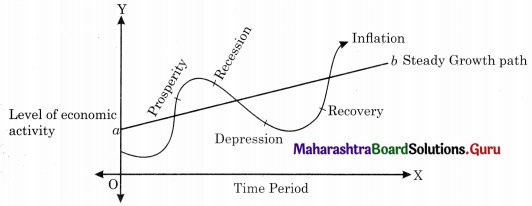
Depression

Question 3.
Continuous rise in the general price level in an economy.
Answer:
Inflation

Question 4.
The aggregate monetary value of all final goods and services produced in a country during a year.
Answer:
National Income

Question 5.
Want satisfying capacity of a commodity.
Answer:
Utility

Maharashtra Board Class 11 Economics Important Questions Chapter 1 Basic Concept in Economics

Question 6.
Earnings are received by a person from all sources.
Answer:
Personal Income

Question 7.
Leftover income after payment of taxes etc.
Answer:
Personal Disposable Income

Question 8.
Income is received in the actual currency of the country.
Answer:
Money Income

Question 9.
Wants which are satisfied at the individual level.
Answer:
Individual Wants

Question 10.
An economic study of a particular firm, a particular household, etc.
Answer:
Micro Economics

Question 11.
A great statesman, philosopher during Mourya Period.
Answer:
Kautilya

Question 12.
Wants that are meant for pleasure and enjoyment.
Answer:
Luxuries

Maharashtra Board Class 11 Economics Important Questions Chapter 1 Basic Concept in Economics

Question 13.
Wants that are basic in nature.
Answer:
Necessities

Question 14.
Income received without indulging in any productive activity.
Answer:
Unearned Income

Question 15.
Increase in Real National Income of the country over a long period of time.
Answer:
Economic growth

Question 16.
Real captain of industry.
Answer:
Entrepreneur

1D. Find the odd word out:

Question 1.
Mathematics, Economics, Physics, Chemistry
Answer:
Economics

Question 2.
Psychology, Sociology, Economics, Chemistry
Answer:
Chemistry

Question 3.
Adam Smith, David Ricardo, J.M.Keynes, J.S. Mill.
Answer:
J. M. Keynes

Maharashtra Board Class 11 Economics Important Questions Chapter 1 Basic Concept in Economics

Question 4.
Food, Medicines, Sunshine, Toothpaste
Answer:
Sunshine

Question 5.
Washing machine, AC – Car, Pressure Cooker, Geyser.
Answer:
AC – Car

Question 6.
Land, Interest, Labour, Entrepreneur
Answer:
Interest

Question 7.
National Income, National Output, Individual Income, Aggregate Supply.
Answer:
Individual Income

Question 8.
Investment, Want, Utility, Wealth.
Answer:
Investment

Question 9.
Rain, Air, Sunrays, Book.
Answer:
Book

Maharashtra Board Class 11 Economics Important Questions Chapter 1 Basic Concept in Economics

Question 10.
Rent, Labour, Interest, Profit.
Answer:
Labour

1E. Complete the following statements:

Question 1.
Commodity which satisfies human wants is called __________
Answer:
Utility

Question 2.
Actual transfer of goods from one person to another is termed as __________
Answer:
Physical transfer

Question 3.
Income which is paid as per terms and condition is called as __________
Answer:
Contractual Income

Question 4.
Anything which has market value and can be exchanged for money is termed as __________
Answer:
Wealth

Question 5.
Adam Smith defines Economics as __________
Answer:
A Science of wealth

Maharashtra Board Class 11 Economics Important Questions Chapter 1 Basic Concept in Economics

Question 6.
Scarcity oriented definition of economics was given by __________
Answer:
Lionel Robbins

Question 7.
Wealth oriented definition of economics was given by __________
Answer:
Prof. Alfred Marshall

Question 8.
Kautilya authored the Indian Political treatise called __________
Answer:
the ‘Arthashastra’

Question 9.
Paul Samuelson referred economics as __________
Answer:
“Queen of Social Science”

Question 10.
Psychology, Sociology, Political Science are the examples of __________
Answer:
Social Science/Abstract Science

Question 11.
Kautilya is also known by the name __________
Answer:
Chanakya or Vishnugupta

Maharashtra Board Class 11 Economics Important Questions Chapter 1 Basic Concept in Economics

Question 12.
The term microeconomics and macroeconomics was coined by __________
Answer:
Sir Ragnar Frisch

1F. Choose the wrong pair:

Question 1.

Group ‘A’Group ‘B’
1. Physics, Chemistry, etc(a) Natural Science
2. Kautilya(b) Arthshastra
3. Psychology, Sociology, etc(c) Social Science
4. Prof. Alfred Marshall(d) Father of Economics

Answer:
Wrong Pair: Prof. Alfred Marshall – Father of Economics

Question 2.

Group ‘A’Group ‘B’
1. Alfred Marshall(a) Welfare Oriented Definition
2. Lionel Robbins(b) Scarcity Oriented Definition
3. Adam Smith(c) Scarcity Oriented Definition
4. J. M. Keynes(d) Modern School of Thought

Answer:
Wrong Pair: Adam Smith – Scarcity Oriented Definition

1G. Choose the correct pair:

Question 1.

Group ‘A’Group ‘B’
1. Economic Wants(a) Travelling by Bus
2. Non-Economic Wants(b) Air, Sunshine, etc.
3. Individual Wants(c) Food, Medicine, etc.
4. Collective Wants(d) Doctor using Stethoscope

Options:
(a) 1 – d; 2 – c; 3 – a; 4 – b
(b) 1 – b; 2 – c; 3 – d; 4 – a
(c) 1 – c; 2 – b; 3 – d; 4 – a
(d) 1 – a; 2 – d; 3 – b; 4 – c
Answer:
(c) 1 – c; 2 – b; 3 – d; 4 – a

2. Identify and explain the concepts from the given illustrations:

Question 1.
Mangesh saves ₹ 200/- every month out of his pocket money.
Answer:
Savings.
Saving is a part of income, which is kept aside to meet future needs. In the above illustration, since Mangesh is foregoing his current consumption, it forms his part of savings.

Maharashtra Board Class 11 Economics Important Questions Chapter 1 Basic Concept in Economics

Question 2.
People drink water when they are thirsty because water has the capacity to satisfy thirst.
Answer:
Utility.
The utility is a power of a commodity or service which satisfies human want. In this case, water has utility, as it satisfies the thirst of people.

Question 3.
A farmer sold 2 kg rice for ₹ 100/-
Answer:
Exchange.
It refers to the worth of a commodity or a service expressed in terms of a commodity. In the above case farmer exchanges rice i.e. commodity for cash.

Question 4.
₹ 45,000/- remained in the hands of Mr. Shah from his income, after paying tax.
Answer:
Personal Disposable Income.
It is that part of a personal income that is left over after the payment of direct taxes. In the above case, ₹ 45,000 forms part of Mr. Shah’s Personal Disposable Income, as it is leftover income after payment of his tax.

Question 5.
Raju’s mother purchased a blanket. It helps her to keep warm during winter.
Answer:
Necessity Want and Utility.
Want is referred to as a need of a person. Here, in the above case, the blanket is a need of Raju’s mother, which falls under necessity want.
The utility is a power of a commodity or service to satisfy human wants. Here, in the above case, the blanket provides utility to Raju’s mother by giving her warmth during winter.

Question 6.
Alka uses a washing machine to wash clothes.
Answer:
Comforts Want.
A commodity that provides comfort to our life is termed comfort goods. In the above case, the washing machine provides comfort to Alka, as she does not need to wash clothes with her hands anymore.

Maharashtra Board Class 11 Economics Important Questions Chapter 1 Basic Concept in Economics

Question 7.
Sahil utilized his bank balance to start a fruit shop.
Answer:
Investment.
Investment refers to the creation of capital assets through the mobilization of savings. In the above case, Sahil mobilizes his bank savings into investment in a fruit shop.

Question 8.
National income estimates help to measure the economic performance of a country.
Answer:
Macro-economics.
Macroeconomics means studying the economy at a large or whole. It includes the study of total employment, total savings, total consumption, aggregate supply, aggregate demand, etc. In the above case, the study of the whole country’s income leads to the measurement of the economic performance of a country.

Question 9.
A carpenter makes furniture and earns wages.
Answer:
Labour.
Labour means any kind of physical or mental effort/exertion undergone during the process of production against a certain reward. In the above case, labour makes furniture and earns wages as a reward.

Question 10.
Tanvi goes to the office in an air-conditioned car.
Answer:
Luxury.
The commodity which satisfies the want of pleasure and enjoyment means luxury goods. In the above case, the air-conditioned car is treated as a luxury good.

Maharashtra Board Class 11 Economics Important Questions Chapter 1 Basic Concept in Economics

3. Distinguish between:

Question 1.
Fixed Income and Fluctuating Income.
Answer:

Fixed IncomeFluctuating Income
(i) Income that is stable or remains the same over a period of time is called fixed income.(i) Income that is unstable and keeps on changing is called fluctuating income.
(ii) Earnings of the landlord, labour, etc. are fixed income.(ii) Earnings of businessmen, organisers, self-employed persons, etc. are fluctuating income.
(iii) It cannot be zero or negative.(iii) It can be positive, negative, or zero.

Question 2.
Value-in-use and Value-in-exchange.
Answer:

Value-in-useValue-in-exchange
(i) It refers to the usefulness of a commodity.(i) It refers to the value of a commodity or a service expressed in terms of another commodity.
(ii) Value-in-use depends upon utility.(ii) Value-in-exchange depends upon scarcity.
(iii) Free goods like water, air, sunshine, etc. have greater value in use but less value in exchange.(iii) Economic goods like a diamond, gold, etc. have greater value-in-exchange but less value-in-use.

Question 3.
Contractual Income and Residual Income.
Answer:

Contractual IncomeResidual Income
(i) When income is given as per the terms and conditions of the contract it is called contractual income.(i) The income which is left over after making payment to other factors of production is called residual income.
(ii) Rent, Wages, etc. are examples of contractual income.(ii) Profit is an example of residual income.
(iii) Contractual income is fixed and certain.(iii) Residual income is fluctuating and uncertain.
(iv) It is neither zero nor negative.(iv) It can be zero or even negative.

Question 4.
Money Income and Real Income.
Answer:

Money IncomeReal Income
(i) Money income refers to income received in form of the currency of a country.(i) Real income refers to the purchasing power of money income.
(ii) E.g. Income received in cash, ₹ 50,000/- per month.(ii) E.g. Commodities purchased out of given income.
(iii) It is not influenced by a change in the price level.(iii) It declines with a rise in the price level.

Question 5.
Land and Labour.
Answer:

LandLabour
(i) Land is any natural resource, available above and below the surface of the earth.(i) Labour is any physical or mental effort undergone during the production process to earn some remuneration.
(ii) Land is a natural factor of production.(ii) Labour is a human factor of production.
(iii) Land earns ‘Rent’ as a factor reward.(iii) Labour earns ‘Wages’ as a factor reward.
(iv) Land is a durable factor.(iv) Labour is a perishable factor.

Question 6.
Land and Capital.
Answer:

LandCapital
(i) Land is any natural resource available above and below the surface of the earth.(i) Capital is a produced means for further production.
(ii) Land is a natural factor of production.(ii) Capital is a man-made factor of production.
(iii) Land earns a reward in the form of ‘Rent’.(iii) Capital earns a reward in the form of ‘Interest’.
(iv) In economics, minerals, soil, mountains, etc., are considered as land.(iv) Machinery, factory building, tools, etc. are examples of capital.

Question 7.
Natural Sciences and Social Sciences.
Answer:

Natural SciencesSocial Sciences
(i) Natural Sciences are those sciences whose laws are universally acceptable.(i) Social Sciences are those sciences whose laws are not universal. They are statements of general human tendencies.
(ii) Chemistry, Mathematics, Physics, etc. are examples of natural sciences.(ii) Sociology, Psychology, Economics, etc. are examples of social sciences.
(iii) Natural sciences are also called exact sciences.(iii) Social sciences are also called abstract or behavioural inexact sciences.
(iv) The validity of natural sciences can be tested in the laboratory.(iv) The validity of social sciences cannot be tested in the laboratory.

Question 8.
Economic Growth and Economic Development.
Answer:

Economic GrowthEconomic Development
(i) Economic growth refers to an increase in the real N.I. of the country over a long period of time.(i) Economic development means economic growth plus progressive changes in the socio-economic structure which determine the well-being of the people.
(ii) It is a quantitative term.(ii) It is a qualitative term.
(iii) It is a narrow concept.(iii) It is a broad concept.
(iv) It is an automatic and natural process.(iv) It is the result of purposeful and planned efforts.
(v) It is spontaneous and reversible.(v) It is deliberate and irreversible.
(vi) Economic growth is related to the economic aspect only.(vi) Economic development is related to economic, social, and political aspects.
(vii) It is uni-dimensional.(vii) It is multi-dimensional.
(viii) Economic growth can be measured in terms of N.I. and per capita income.(viii) Economic development is measured in terms of quality of human life, better infrastructure, political freedom, etc.
(ix) It is possible without economic development.(ix) It is not possible without economic growth.

Maharashtra Board Class 11 Economics Important Questions Chapter 1 Basic Concept in Economics

Question 9.
Labour and Entrepreneur.
Answer:

LabourEntrepreneur
(i) Any physical or mental effort undergone during the production process to earn a reward is called labour.(i) Entrepreneur is the organiser who coordinates all factors of production. He is regarded as a captain of the industry.
(ii) Labour earns ‘Wages’ as a factor reward.(ii) Entrepreneur enjoys ‘Profit’ as a factor reward.
(iii) Earnings of labour are certain, fixed, and always positive.(iii) Earnings of an entrepreneur are uncertain, fluctuating, and not always positive.

Question 10.
Economic Wants and Non-economic Wants.
Answer:

Economic WantsNon-economic Wants
(i) Economic wants are those wants for which price has to be paid.(i) Non-economic wants are those wants that can be satisfied without paying price.
(ii) Eg. a dress, a book, medicine, etc. satisfy economic wants.(ii) Eg. rain, air, sun rays, etc. satisfy non-economic wants.
(iii) It is necessary to make monetary payments for them due to scarcity.(iii) Monetary payment is not necessary, as they are available in plenty.

4. Answer the following:

Question 1.
Explain various factors of production.
Answer:
Production means the creation of utility.
There are four factors of production. They are land, labour, capital, and entrepreneur.
They are explained as follows:

(i) Land: In economics, the land is a wider concept. It is the primary, natural and original factor of production. According to Prof. Marshall, land means all natural resources, available on, above, and below the surface of the earth.
E.g. On the surface of the earth – mountains, rivers, forests, etc.
Above the surface of the earth – air, sunshine, etc.
Below the surface of the earth – gold, silver, coal, etc.
E.g. A landlord gets rent for the productive use of land.

(ii) Labour: Labour is a living factor of production. It is the most active and human factor of production. Any physical or mental effort undergone during the production process to earn a reward is called labour. The remuneration of labour is wages. E.g. a labourer working in a factory.

(iii) Capital: Capital refers to produced means of production. It is the stock of capital assets that yield income. Capital earns interest for its productive use. Capital is a man-made factor of production.
E.g. machinery, raw material, etc.

(iv) Entrepreneur: The entrepreneur is the organizer and the controller of a business. He combines all the factors of production. He supervises the production process. He is a special kind of labourer who gets rewarded in the form of profit. An entrepreneur is regarded as a real captain of the industry.

Maharashtra Board Class 11 Economics Important Questions Chapter 1 Basic Concept in Economics

Question 2.
Write a note on Kautilya’s views on Economics.
Answer:
Kautilya was traditionally known as ‘Chanakya’ or ‘Vishnugupta’. He is identified as the pioneer in the field of Political Science and Economics in India.
He was a teacher, philosopher, economist, and royal advisor of the Mourya Empire.
He wrote the ancient Indian Political treatise named “Arthashastra”, where Artha’ means ‘Wealth’ and ‘Shastra’ means ‘Science’. It covers various aspects of the political, social, economic, and military organization of the past economy.

Key-points based on Kautilya’s views are as follows:

  • The role of the State or Government is crucial. The state should regulate economic activities.
  • He focused on creating wealth as a means, to ensure the welfare of the state.
  • He stated a great need for efficient administrative machinery for good governance.
  • Compilation of Political ideas into Arthashastra.
  • Kautilya attached great significance to public finance.

Question 3.
Explain ‘Trade Cycle’ in economics.
Answer:
The Trade cycle is also called the ‘business cycle’. It takes place due to fluctuations in business.
There are ups and downs in overall economic activities. These fluctuations arise due to inflation and depression.
It can be explained with the help of the following diagram.
Maharashtra Board Class 11 Economics Important Questions Chapter 1 Basic Concept in Economics 4 Q3
Inflation means a continuous rise in the general price. Depression is a continuous fall in overall prices and lowering down economic activities in general.
In the given diagram, the ‘X’-axis indicates the time period and the ‘Y’-axis shows the level of economic activity. Line ab shows a steady growth path.
Various phases of the business cycle or trade cycle like Prosperity, Recession, Depression, Recovery, and Inflation indicate fluctuations in economic activities.
When unemployment is created due to the trade cycle (cyclical fluctuation), it is called cyclical unemployment. It is temporary in nature.

5. State with reasons whether you agree or disagree with the following statements:

Question 1.
Profit is a contractual income.
Answer:
No, I do not agree with the statement.

  • Contractual income is that income that is paid as per the terms and conditions of payment.
  • Profit is not a contractual income.
  • It is residual income because profit is the earning of an entrepreneur.
  • It is the income that is left over after making payments to all factors of production.
  • Profit may not be always positive.
  • It can be zero or even negative.
  • Thus, it is a fluctuating income.

Maharashtra Board Class 11 Economics Important Questions Chapter 1 Basic Concept in Economics

Question 2.
The concepts of economic development and economic growth are interrelated but not the same.
Answer:
Yes, I agree with the statement.

  • Economic development and economic growth go hand in hand. They are interrelated but they do not mean the same.
  • Economic growth refers to an increase in a country’s real output of goods and services, whereas economic development refers to the progressive changes in the socio-economic structure of a country.
  • Also, economic growth considers the quantitative aspect whereas economic development considers the qualitative aspect.
  • Again, economic growth is possible without economic development but, economic development is not possible without economic growth.
  • Hence, economic development is a wider term and economic growth is a part of it which makes them two different concepts.

Question 3.
An entrepreneur plays an important role in the economic development of a country.
Answer:
Yes, I agree with the statement.

  • In the history of developed countries, it has been shown that entrepreneurs have played a very important role in economic development. Hence quality entrepreneurship is a crucial indicator of economic development.
  • Economic development requires a class of talented entrepreneurs because they are the ones who keep the wheels of the economy moving.
  • An entrepreneur is a person who has the ability to recognize business opportunities.
  • He is a person with some special qualities such as the ability to innovate, do hard work, have the vision, risk-taking capacity, social responsibility, positive thinking, etc.

Question 4.
There is no difference between individual wants and collective wants.
Answer:
No, I do not agree with the statement.

  • Individual wants refer to those wants which are satisfied at the individual level. While collective wants are those wants that are satisfied at the general level or macro level.
  • A doctor using a stethoscope is an example of individual wants while people travelling by train or bus is an example of collective want.
  • Thus, there is a difference between individual wants and collective wants.

Maharashtra Board Class 11 Economics Important Questions Chapter 1 Basic Concept in Economics

Question 5.
Microeconomic and macroeconomic are two different phenomena.
Answer:
Yes, I agree with the statement.

  • Microeconomics deals with the economic behaviour of small units while macroeconomics deals with the economic behaviour of large units.
  • Microeconomics uses the slicing method while macroeconomics uses the lumping method.
  • Microeconomics is based on partial equilibrium analysis, while macroeconomics is based on general equilibrium analysis.
  • The microeconomic analysis is also called a “Price theory” while macroeconomic analysis is also called an “Income theory”.
  • Thus, microeconomics and macroeconomics are two different phenomena.

6. Answer in detail:

Question 1.
Explain the basic concepts of microeconomics.
Answer:
“Micro Economics is the study of particular firms, particular households, individual prices, wages, incomes, individual industries, particular commodities”.

Basic Concepts of Micro Economics:
(i) Want: Want denotes a feeling of ‘lack of satisfaction. This feeling enables the individual to satisfy his want.
Characteristics of wants:

  • Wants are unlimited.
  • Wants are recurring in nature.
  • Wants differ with age.
  • Wants differ with gender.
  • Wants differ due to preferences.
  • Wants differ with seasons.
  • Wants differ due to culture.

Classification of Wants:
Wants can be classified into.

  • Economic and Non-economic want.
  • Individual Wants and Collective wants.
  • Necessities, Comforts, and Luxuries.

(ii) Goods and Services:
Anything that satisfies human wants is termed as a ‘good’ and has material existence while services also satisfy human wants but do not have any material existence.

(iii) Utility: Want satisfying power of a commodity is called utility.

(iv) Value: Value has two approaches in economics, i.e. ‘value-in-use and ‘value in exchange’.

  • Value-in-use: It refers to the worth of a commodity or it is the usefulness of a commodity.
  • Value-in-exchange: It refers to the worth of a commodity or a service expressed in terms of another commodity.

(v) Wealth: Wealth refers to “anything which has market value and can be exchanged for money.” A commodity must possess the following characteristics to be wealthy.

  • Utility
  • Scarcity
  • Transferability
  • Externality

(vi) Personal Income: Earnings received by a person from all sources is called his personal income.

(vii) Personal Disposable Income (PDI): It is that part of personal income which is left over after payment of direct taxes such as income tax, wealth tax, etc.

Maharashtra Board Class 11 Economics Important Questions Chapter 1 Basic Concept in Economics

Question 2.
Explain the various types of income.
Answer:
Following are the various types of income.
(i) Fixed income: Income that remains stable over a period of time is called fixed income. It is always positive.
E.g. rent, wages, etc.

(ii) Fluctuating income: Income that is not fixed but keeps on changing is called Fluctuating income.
E.g. profit. It can be positive, negative, or zero.

(iii) Money income: Income received in the actual currency of the country is called Money income. It is the income in cash.
E.g. ₹ 70,000.

(iv) Real income: The purchasing power of money income is called Real income.
E.g. Commodities purchased out of money income.

(v) Contractual income: Income paid as per the terms and conditions of the contract is called Contractual income.
E.g. rent, wages, etc.

(vi) Residual income: Income that is left over after making payments to all factors of production is called residual income.
E.g. profit.

(vii) Earned income: Income obtained after participating in the productive activity is called Earned income.
E.g. rent, wages, interest, profit.

(viii) Unearned income: Income received from all sources without indulging in any productive activity is called Unearned income.
E.g. windfall gains, lottery prizes.

Maharashtra Board Class 11 Economics Important Questions Chapter 1 Basic Concept in Economics

(ix) Economic activity: Economic activities can be classified into four types which include production, distribution, exchange, and consumption.

Maharashtra Board Class 12 English Yuvakbharati Solutions Chapter 1.7 Why We Travel

Balbharti Yuvakbharati English 12th Digest Chapter 1.7 Why We Travel Notes, Textbook Exercise Important Questions and Answers.

Maharashtra State Board Class 12 English Yuvakbharati Solutions Chapter 1.7 Why We Travel

12th English Digest Chapter 1.7 Why We Travel Textbook Questions and Answers

Question 1.
Share your views on how travelling can be a hobby:
Answer:
Students can discuss their views on travelling, both in India and in foreign countries, and how it can be a leisure time activity.

Maharashtra Board Solutions

Question 2.
Discuss in the class the benefits of travelling and complete the web:
Maharashtra Board Class 12 English Yuvakbharati Solutions Chapter 1.7 Why We Travel 1
Answer:
Maharashtra Board Class 12 English Yuvakbharati Solutions Chapter 1.7 Why We Travel 2
Make a list of your expectations when you travel to some new place:
Answer:
(a) Food should be delicious and available whenever hungry.
(b) Travelling should be easy and comfortable.
(c) Hotel accommodation should be inexpensive and clean.
(d) Weather should be sunny and pleasant.

Question 3.
Discuss in the class the various types of travels. Add your own to ones given below:
Maharashtra Board Class 12 English Yuvakbharati Solutions Chapter 1.7 Why We Travel 3
Answer:
Maharashtra Board Class 12 English Yuvakbharati Solutions Chapter 1.7 Why We Travel 4

Maharashtra Board Solutions

(A1)

Question 1.
Read the first two paragraphs and write down the reasons one needs to travel.
Answer:
One needs to travel:

  1. initially, to lose ourselves next, to find ourselves
  2. to open our hearts and eyes and learn more about the world than our newspapers tell us.
  3. to bring our ignorance and knowledge to cultures which are rich in ways different from ours.
  4. to become young fools again
  5. to slow time down and to get taken in to fall in love once more
  6. to escape into open solitudes, into aimlessness, into accepting dangers and risks
  7. to sharpen the edge of life, and to taste hardship
  8. to leave all one’s beliefs and certainties at home, and see everything in a different light

(A2)

Question (i)
Read the sentence ‘If a diploma can famously ……………. in cultural relativism.’ of this extract on page 67 of the textbook. Pick the sentence which gives the meaning of the above statement from the alternatives given below.
(a) A diploma certificate can be used as a passport and a passport can be used as a diploma certificate.
(b) If one has a diploma, he does not need a passport and if he has a passport, he does not need a diploma.
(c) One can acquire permission to travel to foreign countries for educational purposes based on one’s academic achievements, and travelling to foreign countries enriches one the most regarding the knowledge and wisdom of the world.
Answer:
(c) One can acquire permission to travel to foreign countries for educational purposes based on one’s academic achievements, and travelling to foreign countries enriches one the most regarding the knowledge and wisdom of the world.

Question (ii)
Prepare a list of the litterateurs and their quotations mentioned by the writer in the extract.
Answer:
Names of the litterateurs: Camus, Christopher Isherwood
Quotations: Camus said, “What gives value to travel is fear”- Christopher Isherwood once said, “The ideal travel book should be perhaps a little like a crime story in which you’re in search of something.”

Maharashtra Board Solutions

Question (iii)
‘The real voyage of discovery consists not in seeing new places but in seeing with new eyes.’ – Marcel Proust. Justify with the help of the text.
Answer:
This means that we don’t really have to discover new landscapes or new sights to be in the real process of discovery. Often, we simply need to change our perspective, the way we look at things, to understand them and to raise them to a new, exhilarating level.

Question (iv)
Read the third paragraph and find the difference between a tourist and a traveller as revealed through the complaints made by them.
Answer:
1. A tourist is someone who does not leave his assumptions at home and complains, ‘Nothing here is the way it is at home’.
2. A traveller is someone who leaves his assumptions at home but grumbles, ‘Everything here is the same as it is in Cairo – or Cuzco or Kathmandu.’

Question (v)
Write sentences from the extract conveying the fact that travelling brings together the various cultures of the different parts of the world.
Answer:
1. You can teach them what they have to celebrate as much as you celebrate what they have to teach.
2. This, I think, is how tourism, which so obviously destroys cultures, can also resuscitate or revive them, how it has created new “traditional” dances in Bali, and caused craftsmen in India to pay s new attention to their works.

Maharashtra Board Solutions

Question (vi)
By quoting Camus, the writer has stated that travelling emancipates us from circumstances and all the habits behind which we hide. Write in detail your views about that.
Answer:
When we are at home, we have set ideas and habits, which we are reluctant to change. We dress in a particular way and we behave in a particular way, because the people around us know us and expect that behaviour. We hide behind all this. However, when we travel, no one knows us and there are no expectations about a particular type of behaviour, dress or habits. Hence, we have a feeling of freedom and emancipation from our circumstances and habits.

(A3)

Question (i)
Read the following groups of words:
Maharashtra Board Class 12 English Yuvakbharati Solutions Chapter 1.7 Why We Travel 5

  1. crooked angle
  2. censored limits
  3. impoverished places
  4. walking video screens
  5. living newspapers
  6. searching questions

Discuss in pairs and make a list of some more adjectives like this and make sentences using them.
Answer:
1. burnt cottage
2. disturbed night
3. hidden house
4. missing necklace
5. probing questions
6. standing instructions
Sentences:
1. burnt cottage – The mystery of the burnt cottage was finally solved.
2. disturbed night – Rohan had a disturbed night because of the noise from the road construction.
3. hidden house – I could see the hidden house only after climbing a hill.
4. missing necklace – The detective was sure that the missing necklace would be soon found.
5. probing questions – The lawyer asked the witness some probing questions.
6. standing instructions – The queen had given standing instructions that she was never to be disturbed while sleeping.

Maharashtra Board Solutions

Question 1.
Read the following sentence and pick out the phrasal verb.
We travel, then, in part just to shake up our complacencies.
Answer:
shake-up

(A4)

Question 1.
Read the following sentences carefully and find out the infinitives :
(a) We travel, initially, to lose ourselves; and we travel, next, to find ourselves.
(b) We travel to bring what little we can, …………
(c) Yet one of the subtler beauties of travel is that it enables you to bring new eyes to the people you encounter.
Answer:
(a) to lose, to find
(b) to bring
(c) to bring

Question (ii)
Combine the two sentences into one using the word given in the brackets:
(a) I go to Iceland. I visit the lunar spaces within me. (to)
(b) We have the opportunity. We come into contact with more essential parts of ourselves, (of)
(c) Romantic poets inaugurated an era of travel. They were great apostles of open eyes.
(d) The travel spins us around. It shows us the sights and values ordinarily ignored, (showing)
Answer:
(a) I go to Iceland to visit the lunar spaces within me.
(b) We have the opportunity of coming into contact with more essential parts of ourselves.
(c) Romantic poets, being great apostles of open eyes, inaugurated an era of travel.
(d) The travel spins us around, showing us the sights and values ordinarily ignored.

Question (iii)
Read the sentences given below and state whether the underlined words are gerunds or present participles.
(a) As it’s a hot day, many people are swimming
(b) This is a swimming pool.
(c) It’s very bad that children are begging.
(d) Begging is a curse on humanity.
Answer:
(a) present participle
(b) present participle
(c) present participle
(d) gerund

(A5)

Question 1.
Write an email to your friends about your proposed trek. You can take help of the points given below. You can keep your parents informed about it by adding them in BCC.

  • A trek in the forest of Kodaikanal
  • Time and duration
  • Type of trek (cycle/ motorbike/ walk)
  • Facilities provided
  • Last date for registration
  • Fees

Maharashtra Board Solutions

(A6)

Question 1.
There is a boom in ‘Travel and Tourism’ career. Find information about different options in this field.

(A7)

Question (i)
Find information about:
(a) Fa Hien
(b) Huen Tsang
(c) Ibn Batuta
(d) Marco Polo
(e) Sir Richard Burton

Question (ii)
Further reading:

  • ‘Childe Harold’s Pilgrimage’ – Lord Byron
  • ‘Gulliver’s Travels’ – Jonathan Swift
  • ‘Twenty Thousand Leagues Under The Sea’ – Jules Verne
  • ‘Travelling Souls’ – Brian Bouldrey

Yuvakbharati English 12th Digest Chapter 1.7 Why We Travel Additional Important Questions and Answers

Read the extract and complete the activities given below:

Global Understanding:

Question 1.
Write the name of the litterateur and his quotation mentioned by the writer in the extract.
Answer:
Name of the litterateur – George Santayana.
Quotation:
George Santayana writes, “We need sometimes to escape into open solitudes, into aimlessness, into the moral holiday of running some pure hazard, in order to sharpen the edge of life, to taste hardship, and to be compelled to work desperately for a moment at no matter what.”

Question 2.
Based on the extract, complete the web:
(The answers are given directly and underlined.)
Answer:
Maharashtra Board Class 12 English Yuvakbharati Solutions Chapter 1.7 Why We Travel 6

Question 3.
From the extract, write the names of:
Answer:
1. 2 litterateurs : Proust, Hazlitt
2. 2 places : Bali, Tibet

Maharashtra Board Solutions

Question 4.
Pick out the false statements and write them correctly :
1. Holidays help you to appreciate your own home more.
2. Tourism can also revive cultures.
3. The writer spent many days in Bali in temples.
4. The writer finds Iceland full of chatter and routine.
Answer:
False statements:
3. The writer spent many days in Bali in temples.
4. The writer finds Iceland full of chatter and routine.

Corrected statements:
3. The writer spent many days in Tibet in temples.
4. The writer finds Iceland quiet and empty.

Question 5.
Write the name of the litterateur and his quotation mentioned by the writer in the extract.
Answer:
Name of the litterateur – Oliver Cromwell Quotation : “A man never goes so far as when he doesn’t know where he is going.”

Question 6.
Write if the following statements are True or False. Correct the false statements :
1. The posters at McDonald’s outlet in Kyoto have pictures of places in San Francisco.
2. The young people in Kyoto McDonald’s outlet look very American.
3. The writer was born in America.
4. Cities like Sydney and Toronto are a mix of many cultures.
True statements:
1. The posters at McDonald’s outlet in Kyoto have pictures of places in San Francisco.
4. Cities like Sydney and Toronto are a mix of many cultures.

False statements:
2. The young people in Kyoto McDonald’s outlet look very American.
3. The writer was born in America.

Corrected statements:
2. The young people in Kyoto McDonald’s outlet look very Japanese.
3. The writer was born in England.

Question 7.
Write from the extract:
Answer:
1. Names of 4 cities: Kyoto, Toronto, Sydney, Addis Ababa
2. Names of two food items: Teriyaki McBurgers, Bacon Potato Pies.

Maharashtra Board Solutions

Question 8.
Write the name of the litterateurs and their quotations mentioned by the writer in the extract.
Answer:
Names of the litterateurs: Sir John Mandeville, Emerson, Thoreau and Sir Thomas Browne.
Quotations: Emerson said, “Travelling is a fool’s paradise.”
Thoreau said, “I have travelled a good deal in Concord.”
Sir Thomas Browne sagely put it, “We carry within us the wonders we seek without us. There is Africa and her prodigies in us.”

Complex Factual:

Question 1.
Write sentences from the extract conveying the fact that travelling brings together the various cultures of the different parts of the world :
Answer:
1. We can become a kind of carrier pigeon in transporting back and forth what every culture needs.
2. I find that I always take Michael Jordan posters to Kyoto, and bring woven ikebana baskets back to California.
3. We become walking video screens and living newspapers, the only channels that can take people out of the censored limits of their homelands.
4. In closed or impoverished places, like Pagan or Lhasa or Havana, we are the eyes and ears of the people we meet, their only contact with the world outside and, very often, the closest, quite literally, they will ever come to Michael Jackson or Bill Clinton.
5. Not the least of the challenges of travel, therefore, is learning how to import – and export – dreams with tenderness.
6. We carry values and beliefs and news to the places we go.

Maharashtra Board Solutions

Question 2.
Complete the following:
Travel spins us round in two ways at once:
Answer:
Travel spins us round in two ways at once: It shows us the sights and values and issues that we might ordinarily ignore. It also shows us all the parts of ourselves that might otherwise grow rusty. For in travelling to a truly foreign place, we inevitably travel to moods and states of mind that we’d otherwise ignore.

Question 3.
Write sentences from the extract conveying the fact that travelling brings together the various cultures of the different parts of the world.
Answer:
1. For when we go to France, we often migrate to French, and the more childlike self, simple and polite, that speaking a foreign language educes.
2. Even when I’m not speaking pidgin English in Hanoi, I’m simplified in a positive way, and concerned not with expressing myself, but simply making sense.

Question 4.
Write sentences from the extract conveying the fact that travelling brings together the various cultures of the different parts of the world.
Answer:
1. When we go abroad we are objects of scrutiny as much as the people we scrutinize, and we are being consumed by the cultures we consume, as much on the road as when we are at home.
2. At the very least, we are objects of speculation (and even desire), who can seem as exotic to the people around us as they do to us.

Question 5.
Write the sentences from the extract conveying the fact that travelling brings together the various cultures of the different parts of the world.
Answer:
1. When you go to a McDonald’s outlet in Kyoto, you will find Teriyaki McBurgers and Bacon Potato Pies.
2. The placemats offer maps of the great temples of the city, and the posters all around broadcast the wonders of San Francisco.
3. And-most crucial of all-the young people eating their Big Macs, with baseball caps worn backwards, and tight 501 jeans, are still utterly and inalienably Japanese in the way they move, they nod, they sip their Oolong teas – and never to be mistaken for the patrons of a McDonald’s outlet in Rio, Morocco or Managua.
4. These days a whole new realm of exotica arises out of the way one culture colours and appropriates the products of another,
5. The other factor complicating and exciting all of this is people, who are, more and more, themselves as many-tongued and mongrel as cities like Sydney or Toronto or Hong Kong.
6. Besides, even those who don’t move around the world find the world moving more and more around them. Walk just six blocks, in Queens or Berkeley, and you’re travelling through several cultures in as many minutes; get into a cab outside the White House, and you’re often in a piece of Addis Ababa.

Maharashtra Board Solutions

Question 6.
Complete the following:
Answer:
1. Travel is a voyage into the imagination and is the conspiracy of perception and imagination.
2. Sir John Mandeville never visited the Far East but yet gave colourful accounts of it.
3. Emerson and Thoreau insist that reality is our creation and we invent the places we see as much as we do the books we read.

Question 7.
Complete the following, giving examples: (The answer is given directly.) The finest recent travel books are those that:
Answer:
1. undertake a parallel journey, matching the physical steps of a pilgrimage with the metaphysical steps of a questioning e.g. in Peter Matthiessen’s great “The Snow Leopard”.
2. chronicle a trip to the farthest reaches of human strangeness e.g. Oliver Sacks’ “Island of the Color-Blind,” which features a journey not just to a remote atoll in the Pacific, but to a realm where people actually see light differently).

Inference/Interpretation/Analysis:

Question 1.
Guess the difference : travel and travail:
Answer:
Travel guides us towards a better balance of wisdom and compassion, of seeing the world clearly and truly. Travail means agony, or hard toil, which will be the result of laborious travelling and hardships.

Question 2.
Describe the changes that come into us because of travels, especially to foreign countries.
Answer:
When we go abroad, we stay up late, do impulsive things and leave ourselves open to various experiences. We live for the moment, without any past or future; only the present. We may even become mysterious-to others, at first, and sometimes even to ourselves, behaving in new ways. We feel younger, as if we have been reborn.

Maharashtra Board Solutions

Question 3.
Explain in your own words how travel can be a kind of ‘monasticism’.
Answer:
‘Monasticism’ means living like monks, living a self-disciplined life that is isolated from other people. When we travel, even if we are living in a luxury hotel, we live more simply than we normally do at home. We have no more possessions than what we can carry, we surrender ourselves to chance, and to whatever may come in our way. Hence, travel can be a kind of ‘monasticism’.

Question 4.
Travelling abroad make us the object of scrutiny. Justify this statement,
Answer:
When we go abroad, the local people there are curious about us and our culture. We seem exotic and different to them and they scrutinize our ways and behaviour to learn and understand more about us.

Question 5.
The writer calls himself ‘many-tongued’ and ‘mongrel’. Give reasons.
Answer:
‘Many-tongued’ means that he knows many languages; ‘mongrel’ here means someone who has a mixed upbringing, someone of mixed cultures. The writer knows many languages. He was born of Indian parents, in England, and he moved to America when he was 7 years old. Hence, he says that he cannot really call himself an Indian, an American or an Englishman.

Question 6.
‘Get into a cab outside the White House, and you’re often in a piece of Addis Ababa.’ Explain the meaning of this sentence.
Answer:
Addis Ababa is the capital of Ethiopia, Africa. The sentence means that the driver of the cab outside the White House was probably an African American, may be originally from Africa.

Maharashtra Board Solutions

Question 7.
“We carry within us the wonders we seek without us.” Explain.
Answer:
This means that all the wonders and emotions are within us, and if we wish to, we can tap these forces. Everything is within our own hearts and imagination. Everything is internal. Whatever we find outside has first to be inside us for us to experience it. There is no necessity for any separate outside happenings for us to feel anything.

Personal Response:

Question 1.
Name the places you would like to visit the most. Give reasons to support your answer.
Answer:
I like to travel but I have not had much opportunity yet. I love seeing new places and meeting new people. I would love to travel to the North-Eastern parts of India and to foreign countries. I am also a nature lover and would love seeing high mountains, clear lakes and green pastures.

Question 2.
‘Travel helps you to appreciate your own home more’. Justify this statement.
Answer:
Holidays, especially holidays abroad, can certainly help us to appreciate our own homes more. For example, if we go to the African desert and see the problems they have with potable water supply, we will appreciate our own water resources more. If we see the problems faced by people living in very cold climates, we will appreciate the heat in our country, and even be grateful for it.

Question 3.
Do you think that people travel more, or in a different way, as compared to people fifty years back? Explain your view.
Answer:
Yes, people certainly travel more today. They also travel for different reasons. Fifty years back, in India, people generally travelled only for religious reasons or to meet relatives and family. Travelling for sightseeing was rarer. Today, in addition to these reasons, people also travel for fun, relaxation and sight-seeing. People also go on holidays abroad, which was not done often earlier.

Maharashtra Board Solutions

Question 4.
Do you think that we must always seek new experiences and new places? Or do you feel that the best place is home, and we must never move?
Answer:
If we just stick to our own homes, we will be like the frog in the pond, which thought its small pond was the whole world. This is not advisable in the world of today. To be happy and successful, we must be broad-minded and unbiased. We must see what the world and other cultures have to offer. We must try to imbibe the best from other cultures and places.

Language Study:

Question 1.
We carry values and beliefs and news to the places we go.
(Rewrite using ‘not only but also.)
Answer:
We carry not only values and beliefs but also news to the places we go.

Question 2.
Travel is the best way we have of rescuing the humanity of places.
(Use an infinitive in place of the gerund.)
Answer:
Travel is the best way we have to rescue the humanity of places.

Question 3.
The beauty of this process was best described by George Santayana.
(Rewrite beginning George Santayana)
Answer:
George Santayana best described the beauty of this process.

Maharashtra Board Solutions

Question 4.
Yet for me the first great joy of travelling is simply the luxury of leaving all my beliefs and certainties at home. (Pick out the finite verb and say whether the sentence is simple, compound or complex.)
Answer:
finite verb-is; simple sentence

Question 5.
Pick out the phrasal verb from this sentence:
Abroad is the place where we stay up late.
Answer:
stay up

Question 6.
Travelling is a way to reverse time. (Identify the part of speech of the underlined word.)
Answer:
travelling – gerund

Question 7.
I tend to believe more abroad than I do at home. (Rewrite using as….as..)
Answer:
I tend not to believe as much at home as I do abroad.

Question 8.
Pick out the phrasal verb from these sentences:
Answer:
1. I remember, in fact, after my first trip to Southeast Asia, more than a decade ago, how I would come back to my apartment in New York.
2. All, in that sense, believed in, “being moved”
Answer:
1. come back
2. believed in

Maharashtra Board Solutions

Question 9.
Anyone witnessing this strange scene would have drawn the right conclusion.
(Rewrite using ‘who’)
Answer:
Anyone who witnessed this strange scene would have drawn the right conclusion.

Question 10.
I remember how I would come back to my apartment in New York. (Rewrite using ‘used, to’.)
Answer:
I remember how I used to come back to my apartment in New York.

Question 11.
We have to carry our sense of destination. (Rewrite beginning‘Our sense….’)
Answer:
Our sense of destination has to be carried by us.

Question 12.
The most valuable Pacifies we explore will always be the vast expanses within us.
(Rewrite using more…than..)
Answer:
We will never explore more valuable Pacifies than the vast expanses within us.

Question 13.
It keeps the mind nimble. (Rewrite using the present perfect tense of the verb.)
Answer:
It has kept the mind nimble.

Vocabulary:

Question 1.
Guess the meaning: riches are differently dispersed
Answer:
cultures that are rich in ways different from ours.

Question 2.
Find out a past/present participle from the extract that has been used as an adjective :
Answer:
crooked angle (crooked-past participle)

Question 3.
Find out two pairs of antonyms from the extract:
Answer:
1. lose × find
2. ignorance × knowledge

Maharashtra Board Solutions

Question 4.
Guess the difference between provisional and provincial.
Answer:
Provisional means temporary, whereas provincial means limited in outlook narrow.

Question 5.
Find out from the extract a few past / present participles that have been used as adjectives:
1. walking video screens
2. censored limits
3. living newspapers
4. impoverished places
Answer:
censored, impoverished – past participles used as adjectives
walking, living – present participles used as adjectives

Question 6.
Pick out four proper nouns for places from the extract.
Answer:
Kyoto, Pagan, Lhasa, Havana.

Question 7.
Find from the extract one word for the following :
1. A Japanese art of flower arrangement
2. Satisfaction of one with oneself or one’s own achievements.
Answer:
1. ikebana
2. complacencies

Question 8.
Complete the table with the words given in the brackets:
(values celebrate now deeply discovery apprehend wonderfully distant quietude foreign appreciative spins)
Answer:

NounVerbAdjectiveAdverb
discoverycelebratedistantwonderfully
valuesapprehendforeigndeeply
quietudespinsappreciativenow

Maharashtra Board Solutions

Question 9.
Find out a past/present participle from the extract that has been used as an adjective:
Answer:
searching questions (searching – present participle)

Question 10.
Discuss the pun implied by the writer, ecstasy (ex-stasis):
Answer:
ecstasy – great joy. ex-stasis – previous period of inactivity or boredom. The words sound alike but have different meanings.

Question 11.
Guess the meaning:

  1. many-tongued
  2. mongrel
  3. inheritance
  4. notions

Answer:

  1. many-tongued – a person who speaks many languages.
  2. mongrel – (here) someone who has a mixed upbringing, someone of mixed cultures.
  3. inheritance – the acquisition of a possession, condition, or trait from past generations.
  4. notions – ideas.

Question 12.
Match the adjectives in Column A with the nouns in Column B, with reference to the extract:

AB
1. great(a) specimen
2. new(b) versions
3. typical(c) temples
4. essential(d) world
5. synthetic(e) realm
6. foreign(f) notions

Answer:

  1. great temples
  2. new realm
  3. typical specimen
  4. essential notions
  5. synthetic versions
  6. foreign world

Maharashtra Board Solutions

Question 13.
Give the adjective forms of:

  1. perception
  2. imagination
  3. friendship
  4. reality

Answer:

  1. perception – perceptive
  2. imagination – imaginative
  3. friendship – friendly
  4. reality – realistic

Question 14.
Give the verb forms of:

  1. perception
  2. imagination
  3. friendship
  4. conspiracy

Answer:

  1. perception – perceive
  2. imagination – imagine
  3. friendship – befriend
  4. conspiracy – conspire

Question 15.
Guess the meaning:

  1. atoll
  2. prejudice
  3. fosters

Answer:

  1. atoll – a coral island consisting of a reef surrounding a lagoon
  2. prejudice – bias
  3. fosters – encourages

Maharashtra Board Solutions

Question 17.
Find from the extract the antonyms of:

  1. worthless
  2. public
  3. nearest
  4. familiar
  5. outside
  6. slow

Answer:

  1. worthless × valuable
  2. public × private
  3. nearest × farthest
  4. familiar × unfamiliar
  5. outside × inside
  6. slow × quick

Do as directed:

Question 1.
The queen loved her people and looked after the affairs of her kingdom well.
(Rewrite using ‘who’.)
Answer:
The queen, who loved her people, looked after the affairs of her kingdom well.

Question 2.
But I want to test this. (Change the voice.)
Answer:
But I want this to be tested.

Question 3.
The husband had a small smile on his lips while the wife looked sad.
(Rewrite beginning with ‘Though’)
Answer:
Though the husband had a small smile on his lips, the wife looked sad.

Maharashtra Board Solutions

Spot the error in the following sentences and rewrite them correctly:

Question 1.
You must neither tell me the whole story or at least the first part of it.
Answer:
You must either tell me the whole story or at least the first part of it.

Question 2.
No sooner did the Minister begin speaking, some rogues started shouting loudly.
Answer:
No sooner did the Minister begin speaking, than some rogues started shouting loudly.

Maharashtra Board Class 12 Economics Important Questions Chapter 10 Foreign Trade of India

Balbharti Maharashtra State Board Class 12 Economics Important Questions Chapter 10 Foreign Trade of India Important Questions and Answers.

Maharashtra State Board 12th Economics Important Questions Chapter 10 Foreign Trade of India

1. A. Choose the correct option:

Question 1.
Before independence, India was exporting raw materials to
(a) USA (b) Japan
(c) England (Britain)
(d) None of these
Options :
(1) a and b
(2) c and a
(3) d
(4) only c
Answer:
(4) only c

Maharashtra Board Class 12 Economics Important Questions Chapter 10 Foreign Trade of India

Question 2.
Internal trade also known as –
(a) Domestic trade
(b) Home trade
(c) External trade
(d) all of these
Options :
(1) a, b and c
(2) b and c
(3) a and b
(4) only d
Answer:
(3) a and b

Question 3.
International or External trade takes place between –
(a) two or more districts
(b) two or more states
(c) two or more countries
(d) none of these
Options :
(1) a and b
(2) a and c
(3) a, b and c
(4) only c
Answer:
(4) only c

Question 4.
Most important commodity in India’s import is –
(a) Petroleum, oil and lubricants
(b) Food grains .
(c) Engineering goods
(d) Readymade garments
Options :
(1) a and b
(2) b and c
(3) only a
(4) c and d
Answer:
(3) only a

Question 5.
According to Walter Krause definition of Balance of Payment, value of exchange of goods and services is considered among –
(a) the citizens and businessmen
(b) the firms
(c) the government
(d) none of these
Options :
(1) a, b and c
(2) b and c
(3) c and d
(4) only a
Answer:
(1) a, b and c

Maharashtra Board Class 12 Economics Important Questions Chapter 10 Foreign Trade of India

Question 6.
Trade surplus means –
(a) Export value > Import value
(b) Export value < Import value
(c) Export value = Import value
(d) All of these
Options :
(1) only a
(2) b and c
(3) only b
(4) only d
Answer:
(1) only a

Question 7.
Balance of trade includes –
(a) the value of imports of visible and invisible goods
(b) the value of imports of only visible goods
(c) the value of imports and exports of visible and invisible goods
(d) the value of exports of visible and invisible goods.
Options :
(1) a and d
(2) only b
(3) only c
(4) All of these
Answer:
(3) only c

Question 8.
International trade is important because –
(a) it helps in optimal utilisation of resources
(b) it brings stability in price level
(c) it helps to earn foreign exchange
(d) it encourages investment
Options :
(1) a and b
(2) b and c
(3) a and c
(4) all of these
Answer:
(4) all of these

Question 9.
The share of India’s foreign trade in Gross National Income during 2016-17 was –
(a) 25%
(b) 17.55
(c) 48.8 %
(d) None of these
Options :
(1) only a
(2) only b
(3) only c
(4) only d
Answer:
(3) only c

Question 9.
In recent years India’s leading trading partners are –
(a) USA, Germany, Japan, UK
(b) Britain
(c) Nepal, Sri Lanka, UK
(d) None of these
Options :
(1) only a
(2) b and c
(3) a and c
(4) only d
Answer:
(1) only a

Question 10.
Which of the following is not a benefit of international trade –
(a) provides multiple choices of imported goods
(b) leads to division of labour
(c) high wage levels for all domestic workers
(d) can earn reputation and goodwill in the international market
Options :
(1) a and d
(2) only c
(3) a, c and d
(4) a, b and d
Answer:
(2) only c

Maharashtra Board Class 12 Economics Important Questions Chapter 10 Foreign Trade of India

Question 11.
There is a change in the composition of India’s exports from –
(a) primary products to manufactured products
(b) manufactured products to primary products
(c) manufactured products to software
(d) All of these Options:
(1) a and b
(2) only a
(3) a, b and e
(4) only d
Answer:
(2) only a

(B) Complete the Correlation

(1) Internal trade : Home trade :: …………. : Foreign trade
Answer:
International trade

(2) Trade surplus: …………. :: Trade deficit: Export > Import
Answer:
Export > Import

(3) …………. : jute, cotton :: Manufactured goods: readymade garments
Answer:
Primary goods

(4) OECD : Organisation for Economic Co-operation and Development :: …………. : Organisation of Petroleum Exporting Countries
Answer:
OPEC

(5) Import goods : …………. :: Export goods : Engineering goods
Answer:
Gold

(6) Trade within the country : Internal trade :: Trade between two or more countries : …………..
Answer:
External trade

(7) Highest share in export: Engineering goods :: Highest share in import: ………….
Answer:
Petroleum

(8) Old ports : Mumbai, Kolkata and Chennai:: …………. : Kandla, Cochin, Vishakhapatnam
Answer:
New ports

(9) International trade : External trade :: Domestic trade : …………. :
Answer:
Internal trade

(10) Foreign trade before independence : …………. :: Foreign trade after independence : USA
Answer:
Britain / England

(11) Machinery : Capital goods :: Motor vehicles : ………….
Answer:
Consumer goods

(C) Give economic terms.

(1) To purchase goods and services by one country from another country.
Answer:
Import trade

(2) To sale goods and services by one country to another country.
Answer:
Export trade

Maharashtra Board Class 12 Economics Important Questions Chapter 10 Foreign Trade of India

(3) To purchase goods and services from one country and then selling them to another country after processing.
Answer:
Entrepot trade

(4) Exchange of goods and services.
Answer:
Trade

(5) Export value is greater than the import value.
Answer:
Trade surplus

(6) Import value is greater than the export value.
Answer:
Trade deficit

(7) The trade is by sea.
Answer:
Oceanic trade

(8) This leads division of labour and specialization.
Answer:
Foreign trade

(9) We can see or touch these goods.
Answer:
Visible / tangible goods

(10) We can’t see or touch these goods.
Answer:
Invisible / intangible goods

(D) Find the odd word out.

(1) Internal trade, Domestic trade, Foreign trade, Home trade.
Answer:
Foreign trade

(2) International trade, Internal trade, External trade, Foreign trade.
Answer:
Internal trade

(3) Types of foreign trade :
Import trade, Export trade, National trade, Entrepot trade.
Answer:
National trade

(4) Need of Foreign trade :
To earn foreign exchange, To earn rupees, To encourage investment,To stabilize price ; level
Answer:
To earn rupees

(5) Important features of India’s foreign trade :
Change in the composition of exports, ; Change in composition of imports, Change in composition of internal trade
Answer:
Change in composition of internal trade

(6) Trade relation with neighbouring countries :
Nepal, Afghanistan, Myanmar, Sri Lanka, England
Answer:
England

(7) New ports for foreign trade :
Mumbai, Kandla, Cochin, Vishakhapatnam ;
Answer:
Mumbai

(8) Major imported goods :
Gold, Fertilizers, Gems and Jewellery, Petroleum
Answer:
Gems and jewellery

(9) Major exported goods :
Iron and Steel, ‘ Engineering goods, Chemicals, Textiles and readymade garments
Answer:
Iron and steel

(10) Useful concept in foreign trade :
Balance of payment, Balance of trade, Balance budget
Answer:
Balance budget

(11) Organisation related to foreign trade : OECD, OPEC, EGEPC, NABARD
Answer:
NABARD

(12) Manufactured products :
Gems and jewellery, Electronic goods, s Computer hardware and software, Food grains
Answer:
Food grains

(13) Primary products :
Jute and cotton, Readymade garments, Oil seeds, Mineral products
Answer:
Readymade garments

(14) Visible goods :
Gold, Petroleum, Fertilizers, Communication
Answer:
Communication

(15) Invisible goods (service):
Banking, Communication, Engineering goods, Transport
Answer:
Engineering goods

(16) Cloth, Machinery, Technology, Fertilizers
Answer:
Cloth

Maharashtra Board Class 12 Economics Important Questions Chapter 10 Foreign Trade of India

(E) Complete the sentences.

(1) During the British rule …………………. industries suffered set back.
Answer:
handicraft

(2) In the post World War II, …………………. trade is considered as an investment.
Answer:
Foreign trade

(3) Buying and selling of goods and services within the boundaries of a nation are known as ………………….
Answer:
Internal trade

(4) Internal trade is also known as ………………….
Answer:
Domestic / Home trade

(5) The trade between Maharashtra, Uttar Pradesh, Tamil Nadu, etc, is known as ………………….
Answer:
Internal trade

(6) International trade is also known as ………………….
Answer:
Foreign / External trade

(7) Trade which consists of transaction between residents of different countries is called ………………….
Answer:
International trade

(8) …………………. is a remarkable factor in expanding the market and encouraging the production of goods.
Answer:
Foreign trade

(9) …………………. helps to earn goodwill and reputation in the international market.
Answer:
Export trade

(10) After independence, there was change in the composition of imports from consumer goods to ………………….
Answer:
capital goods

(11) Share of …………………. trade-in-India is around 68%.
Answer:
Oceanic trade

(12) Goods such as cloth, motor vehicles, electrical goods, etc, are known as ………………….
Answer:
consumer goods

(13) Goods and services that are made in one country but purchased and consumed in another country is called ………………….
Answer:
export

(F) Choose the wrong pair ; (1 mark each)

I.

Group‘AGroup ‘B’
1. Internal tradeBetween two or more countries
2. Oceanic tradeTrade by sea
3. Export tradeSale of goods by one country to another country

Answer:
Wrong pair : Internal trade – Between two or more countries

II.

Group ‘A’Group ‘B’
1. Primary goodsJute, cotton, tea
2. Invisible goodsCloth, medicine, car
3. Capital goodsMachinery, technology, steel

Answer:
Wrong pair : Invisible goods – Cloth, medicine, car

III.

Group ‘A’Group ‘B’
1. Encourage investmentForeign trade
2. To earn foreign exchangeInternal trade
3. International tradeMultiple choices of imported goods

Answer:Wrong pair : To earn foreign exchange Internal trade

(G) Assertion and Reasoning:

Question 1.
Assertion (A): Trade is an engine of growth of an economy.
Reasoning (R) : It plays an important role for economic development.
(1) Both (A) and (R) are true and (R) is the correct reason for (A).
(ii) Both (A) and (R) are true but (R) is not the correct reason for (A).
(iii) (A) is true but (R) is false.
(iv) (A) and (R) both are false.
Answer:
(i) Both (A) and (R) are true and (R) is the correct reason for (A).

Question 2.
Assertion (A) : International trade consists of transaction between residents of different countries.
Reasoning (R): This is given by Wasserman and Hultman
(i) Both (A) and (R) are true and (R) is the correct reason for (A).
(ii) Both (A) and (R) are true but (R) is not the correct reason for (A).
(iii) (A) is true but (R) is false.
(iv) (A) and (R) both are false.
Answer:
(ii) Both (A) and (R) are true but (R) is not the correct reason for (A).

Question 3.
Assertion (A) : During the British rule foreign trade did not permit industrialisation in India.
Reasoning (R) : India was a supplier of raw material to the England and importer of manufactured goods.
(i) Both (A) and (R) are true and (R) is the correct reason for (A).
(ii) Both (A) and (R) are true but (R) is not the correct reason for (A).
(iii) (A) is true but (R) is false.
(iv) (A) and (R) both are false.
Answer:
(i) Both (A) and (R) are true and (R) is the correct reason for (A).

Maharashtra Board Class 12 Economics Important Questions Chapter 10 Foreign Trade of India

Question 4.
Assertion (A): Buying and selling of goods and services across the boundaries of a nation are known as internal trade. Reasoning (R) : Goods produced in
Maharashtra are sold to West Bengal then it is known as international trade.
(i) Both (A) and (R) are true and (R) is the correct reason for (A).
(ii) Both (A) and (R) are true but (R) is not the correct reason for (A).
(iii) (A) is true but (R) is false.
(iv) (A) and (R) both are false.

Question 5.
Assertion (A) : Due to specialization resources are channelized for the production of only those goods which would give highest ( return.
Reasoning (R): There is rational allocation and specialization.
(i) Both (A) and (R) are true and (R) is the correct reason for (A).
(ii) Both (A) and (R) are true but (R) is not the correct reason for (A).
(iii)(A) is true but (R) is false.
(iv)(A) and (R) both are false.
Answer:
(i) Both (A) and (R) are true and (R) is the correct reason for (A).

Question 6.
Assertion (A) : An increase in total investment leads to development of an economy. .
Reasoning (R) : Foreign trade creates an opportunity for the producers to reach beyond the domestic markets.
(i) Both (A) and (R) are true and (R) is the correct reason for (A).
(ii) Both (A) and (R) are true but (R) is not the correct reason for (A).
(iii) (A) is true but (R) is false.
(iv) (A) and (R) both are false.
Answer:
(i) Both (A) and (R) are true and (R) is the correct reason for (A).

Question 7.
Assertion (A) : Balance of payments is a summary statement of all the transaction between the residents of one country and the rest of the world.
Reasoning (R): This is given by Samuelson.
(i)Both (A) and (R) are true and (R) is the
correct reason for (A).
(ii) Both (A) and (R) are true but (R) is not the correct reason for (A).
(iii) (A) is true but (R) is false.
(iv)(A) and (R) both are false.
Answer:
(iii) (A) is true but (R) is false.

Question 8.
Assertion (A) : Balance of trade is the difference between the value of countries export and import for a given period. Reasoning (R) : Balance of trade is also referred to as international trade balance.
(i)Both (A) and (R) are true and (R) is the correct reason for (A).
(ii) Both (A) and (R) are true but (R) is not the correct reason for (A).
(iii)(A) is true but (R) is false.
(iv)(A) and (R) both are false.
Answer:
(iii) (A) is true but (R) is false.

(H) Choose the right group of pairs :

I.

Group ‘A’Group ‘B’
1. Balance of Trade(a)International trade balance
2. OPEC(b) Oil and Petrol Export Commission
3. Trade(c) Buying and selling of goods and services
4. Invisible goods(d) Banking, insurance
5. WTO(e) World Trade Organisation

II.

Group ‘A’Group ‘B’
1. OPEC(a) Organisation of Petroleum Exporting Countries
2. Trade deficit(b) Value of export < Value of import
3. Internal trade(c) Trade within the country
4. India’s imported goods(d) Petroleum, Gold, fertilizer
5. Entrepot Trade(e) Re-export

Answer:
II group is correct.

2.[A] Identify and explain the concept from given illustrations.

Question 1.
Antwerp city of Belgium imports raw diamonds and exports finished diamonds to other countries.
Answer:
Concept: Entrepot Trade
Explanation : It means purchase of goods and services from one country and selling them to another country after processing.

Question 2.
The country ‘A’ value of import was $200 billion and value of export was $150 billion.
Answer:
Concept: Trade deficit
Explanation : When value of import is greater than value of export it is called as trade deficit.

Question 3.
The country ‘X’ value of export was $500 billion and value of import was $200 billion.
Answer:
Concept: Trade Surplus
Explanation : When value of export is greater than value of import it is called as trade surplus.

Question 4.
Kashmir sold its apples to the other parts of country.
Answer:
Concept: Internal trade
Explanation : This trade is also known as home or domestic trade. It means buying and selling of goods and services within the country.

Question 5.
India is selling its spices to USA, China, Vietnam, etc.
Answer:
Concept: Export Trade
Explanation : It means selling of goods and services by one country to another country. It helps to earn foreign exchange.

Question 6.
India based Tata Consultancy Services (TCS) is selling their software and services to the USA.
Answer:
Concept: Export trade
Explanation : It means selling of goods and services by one country to another country. It helps to earn foreign exchange.

(B) Distinguish between

Question 1.
Import trade and Export trade.
Answer:
Import trade:

  1. It means to purchase of goods and services by one country from another country.
  2. E.g. India imports petroleum from Iraq, Kuwait
  3. It is inflow of goods and services.

Export trade:

  1. It means to the sale goods and services by one country to another country.
  2. E.g. India exports tea, rice, jute to China, Hong Kong, etc.
  3. It is outflow of goods and services.

Question 2.
Export trade and Entrepot trade.
Answer:
Export trade:

  1. Export trade means sale of goods by one country to another country.
  2. E.g. India selling its spices to USA, China, etc.

Entrepot trade:

  1. Entrepot trade means purchase of goods and services from one country and selling them to another country.
  2. E.g. Antwerp city of Belgium importing raw diamonds and exporting finished diamonds to other countries.

Question 3.
Trade surplus and Trade deficit.
Answer:
Trade surplus:

  1. When country’s exports are more than its imports, it is called as trade surplus.
  2. Generally, it is considered as a positive development.

Trade deficit:

  1. When country’s import are more than its exports, it is called as trade deficit.
  2. Generally, it is considered as a negative development.

Maharashtra Board Class 12 Economics Important Questions Chapter 10 Foreign Trade of India

3. Answer the following:

Question 1.
Explain the concepts of Balance of Trade.
Answer:
Balance of trade is the important concept of foreign trade. Balance of trade is the difference between the values of country’s exports and imports for a given period.
Balance of trade can be positive or negative.

(i) Trade surplus : When country’s value of export is more than its value of import, it is called trade surplus. It is also known as positive balance of trade.

(ii) Trade Deficit : When country’s value of import is more than its value of export, it is called as trade deficit. It is also known as negative balance of trade.

The formula for calculating balance of trade is as follows :
BOT = Total value of Exports – Total value of Imports.

4. State with reasons whether you agree or disagree with the following statements :

Question 1.
During British rule, indigenous handicraft suffered a severe blow.
Answer:
Yes, I do agree with this statement.

  1. During the British rule India was exporting raw materials to England and was importing final goods from England.
  2. Indian handicraft was unable to face competition with imported goods from England.
  3. An imported goods were cheaper as compared to handicraft goods.
  4. The demand for machine made cheap commodity had raised in Indian market.
  5. That’s why Indian handicraft industries suffered during the British rule.

Question 2.
Trade is an engine of growth for an economy.
Answer:
Yes, I agree with this statement.

  • Trade permits a more efficient allocation of national resources.
  • Foreign trade provide foreign exchange which can be used to import modern machinery and technology from advanced countries.
  • Foreign trade encourages producers to produce more goods for export.
  • It leads to an increase in total investment in an economy.
  • Thus, we can say, trade is an engine to growth for an economy.

Question 3.
Foreign trade leads to division of labour and specialisation at world level.
Answer:
Yes, I agree with this statement.

  • Some countries have abundant natural resources.
  • These countries should export raw material and import finished goods from countries which are advanced in skilled man power,
  • Under specialisation specific work is given to the workers within a production process.
  • Specialisation can increase the productivity of a firm or economy.
  • Eg. Incase of car manufacturing company, some workers will design the cars, some workers will work on different section of assembly line, some workers will work on testing cars, some workers will work on marketing of cars.

Question 4.
Foreign trade is not playing an important role for economic development.
Answer:
No, I do not agree with this statement.

  • It helps to earn foreign exchange which can be used for productive purpose.
  • It leads to an increase in a total investment in an economy.
  • It helps to control the changes in the price level.
  • It helps to maximum allocation and utlisation of resources at international level.
  • Due to availability of imported goods, it helps to improve standard of living of the people in the country.
  • During the natural calamities, foreign trade enables a country to import food grains and medicines from other countries to help the affected people.
  • It promotes world peace by bringing countries closer.

Question 5.
During the pre and post independence period, India’s composition of import and export is the same.
Answer:
No, I do not agree with this statement.

  • Prior to independence, India used to export primary products like Jute, Cotton, Tea, Oil-Seeds etc.
  • In the recent time India is exporting manufactured product like readymade garments, gems and jewellery, computer hardware and software, etc.
  • Prior to independence India used to import consumer goods like medicines, cloth, motor vehicles, electrical goods, etc.
  • In the recent time, India is importing capital goods like advanced technology and machinery, chemicals, fertilizers, steel, etc.

Question 6.
India is importing only petroleum from other countries.
Answer:
No, I do not agree with this statement. India is importing many commodities like :

  • Electronic goods : In the total import of country, share of electronic goods in 10.9% in the year 2016-17.
  • Pearls and Gems : In the total import, share of peals and gems was 6.2% in the year 2016-17.
  • Edible oils : India also imports edible oil from Malaysia and Indonesia and its share is 2.8% in the year 2016-17.
  • Gold : There was growing demand for gold in the Indian market. In the year 2018-19, the value of gold imported was upto $32.8 billion.
  • Fertilizers : India is importing fertilizers from China, US, Iraq, Russia. In the year 2016-17, the share of fertilizers was 1.3% in the total import of country.

Question 7.
India is exporting many commodities goods.
Answer:
Yes, I do agree with this statement. India exports many commodities like :

  • Engineering goods : It has the large share in the export of India. The share of engineering goods was 25% in the total exports in 2017-18.
  • Petroleum products : India turned as a net exporter of petroleum refinery products.
    India’s export of petroleum product was 20.1% in 2013-14.
  • Chemicals and chemical product :
    India is exporting chemicals and chemical products to many countries from last few years. In the year 2014-15 the share of chemicals was 10.4% in total exports of the country.
  • Gems and Jewellery : It is one of the major contributor which helps to earn foreign exchange. According to DGCI Kolkata, the value of Gems and Jewellery export was $38.96 billion in 2018-19.

5. Study the following table, chart, graph, passage and answer the questions.

1. India’s Merchandise Trade (US $ Billion)
Maharashtra Board Class 12 Economics Important Questions Chapter 10 Foreign Trade of India 1

Question 1.
In the above bar diagram during which year export was maximum and how much was it?
The export was maximum in the year 2018¬19. It was $331billion.

Question 2.
In which year import was maximum and how much was it?
In the year 2018-19 import was maximum and it was $507.4 billion.

Question 3.
In which year import was least and how much was it?
In the year 2015-16 import was least and it was $381 billion.

Question 4.
Find out the trade deficit in the year 2017-18?
Trade deficit = Export – Import = 303.5 – 465.6
= $162.1 billion.

Question 5.
How much is the export increase in the year 2018-19 as compared to 2014-15?
Answer:
In the year 2018-19 export has increased by $20.7 billion as compared to 2014-15.

Maharashtra Board Class 12 Economics Important Questions Chapter 10 Foreign Trade of India

Question 6.
How much is the import increase in the year 2018-19 as compared to 2017-18?
Answer:
In the year 2018-19 imports has increased by $41.8 billion as compared to 2017-18.

Question 7.
Express your views on India’s merchandise trade.
Answer:
In the above bar diagram, India’s import is always greater then its export. India should take measures to reduce the imports. The Government of India should encourage the industries those are exporting goods by providing them various facilities such as availability of raw materials at cheaper rate, credit at low interest, etc.

(2) Share of top Five Commodities in India’s Export 2018-19

Maharashtra Board Class 12 Economics Important Questions Chapter 10 Foreign Trade of India 2

Question 1.
Name the second largest exported commodity in the year 2018-19.
Petroleum products are second largest exported commodity in the year 2018-19.

Question 2.
How much is the share of drug formulations, biologicals (chemical products) in total export of India.
Answer:
The share of chemical products is 4.37% in the total export of India.

Question 3.
Which commodity has least share in the total export of India and how much was it?
Answer:
Iron and Steel has least share and it is 2.96%.

Question 4.
Give your opinion on India’s export.
Answer:
India should focus on above five commodities to increase their export. The government of India should provide credit at low rate of interest, easy availability of raw materials required by above industries, as it will help to produce more goods.

3. Table A : Trade data for period 2009 – 10 to 2017 – 18

Maharashtra Board Class 12 Economics Important Questions Chapter 10 Foreign Trade of India 3

Question 1.
In which year export growth was least and how much?
Answer:
In the year 2015-16, export growth was least and it was -9.49%.

Question 2.
In which year import growth was maximum and how much?
Answer:
In the year 2011-12, import growth was maximum and it was 39.32%.

Question 3.
During which year trade balance was minimum?
Answer:
In the year 2009-10 trade balance was minimum.

Question 4.
Which concept of Balance of Trade is applicable here?
Answer:
The concept of trade deficit is applicable here, because in the above data every year India’s imports are more than its exports.

Question 5.
How much was India’s export value in the year 2017-18?
Answer:
In the year 2017-18 India’s export value was ? 19,56,515 crores.

Maharashtra Board Class 12 Economics Important Questions Chapter 10 Foreign Trade of India

Question 6.
Give your opinion on India’s foreign trade.
Answer:
The above data shows that every year India’s trade balance is a deficit. It means imports are more than exports. The Government should formulate such policies that increase our export and reduces our imports.

Maharashtra Board Class 12 Sociology Passages Answers

Balbharti Maharashtra State Board Class 12 Sociology Solutions Passages Answers.

Maharashtra State Board Class 12 Sociology Passages Answers

Passage 1
Read the passages and answer the questions given below.

This is a real-life story of Rukmini Devi who lives in a small hut in Gaigotha Village in Wada Taluka of Palghar District in Maharashtra State. She belongs to the Warli tribe. Her husband is a marginal farmer who cultivates on two acres of land. They have two children, one daughter aged 10 years and an I son aged 6 years. Both the children walk to school and back daily (located about 3 miles away).

Maharashtra Board Class 12 Sociology Passages Answers

When cultivation season is over, (or if the rice crop is damaged due to heavy rains or pests) they face many hardships. A section of the crop is kept for their personal use, for the year. Tur Dal (lentil) is also grown in one small area, again for personal use. Ina small backyard, they grow vegetables like chilies, cucumber, and bitter gourd (karela).

During the off-season, both husband and wife go to the brick kilns (about 7 miles away) to do piece-rate work (That is, they get paid for each brick that they make.) While the men earn Rs. 300 per day, the women earn Rs. 150-200. Rukmini Devi stated that they prefer to walk the 7 miles both ways because the bus fare is Rs. 35/- per head one way. They cannot afford it.

Question 1.
Identify any three problems that the family of Rukmini Devi has to face.
Answer:
The main problem of the family of Rukmini Devi is poverty. The productivity of their economic activities is very less as they cannot use modern production techniques like fertilizers, pesticides, etc., their agriculture depends upon monsoons and there is a lack of adequate irrigation facilities. Due to the seasonal nature of agriculture, they have to face hardships and exploitation by non-tribal people. They are also being exploited by their employers who take maximum work from them and pay them minimum wages.

Question 2.
Point out and discuss briefly, gender discrimination in this setting.
Answer:
We find Rukmini Devi facing wage discrimination i.e., discrimination on the basis of sex in the payment of wages, where Rukmini Devi and her husband perform work of similar skill, effort, and responsibility for the same employer under similar working conditions but they don’t earn the same amount of money. This implies discriminative employers save on the cost by employing the tribal females. Rukmini Devi is working in, informal labour market where there is an absence of policies to safeguard gender rights.

Question 3.
Discuss the nature of the economy of the Warli tribes.
Answer:
The economy practiced by Warli Tribe is subsistence economy and simple. They use out model techniques therefore their production is insufficient. They cannot fulfill their basic needs. They try to fulfill their needs by collective efforts. Thus, the simple and collective economic life is an important characteristic of the tribal economy. The main occupation of the Warli tribe is agriculture which is in a state of backwardness. They live below the poverty line.

Passage 2
Read the passages and answer the questions given below.

Education, since the coming of the British to India, has been secular in content. By this we mean, the content of education did not include the study of sacred texts. Schools were open for all – to learn and climb the ladder of vertical mobility. The study of the English language, as well as the opportunity to study in the English medium, was available.

Maharashtra Board Class 12 Sociology Passages Answers

It is true that several Indians from certain social and economic strata were the first to access an English education. Many of them later constituted the intelligentsia of our society. We refer to many of them as social reformers, such as Raja Rammohan Roy, Ishwar Chandra Vidyasagar, Pandita Ramabai, Maharshi Dhondo Keshav Karve. They worked for religious, social, and educational reform in Indian society.

Such visionaries of society continue even in the post-Independence era, to the present time.

Educational opportunities have grown by leaps and bounds in the last 73 years since Independence. One questions if the educated have merely acquired education or if the education has helped citizens become gainfully employed and more importantly, enlightened enough to transform society at the micro-level.

It is necessary for the government to consider the interests of all sections of society.

Each citizen can play a dynamic role in the development of all people in our society.

Question 1.
Explain the impact of the introduction of a new education system by the British on Indian society.
Answer:
According to the new liberal education policy introduced by the British, education was not restricted to special sections of society. The spread of secular-based education widened the minds of the people living in India. Well-educated Indians were influenced by western values. They recognized that various customs and traditions were unjust and unfair. Therefore, they started various religious and social movements to reform Indian society.

Question 2.
Explain the role of education in the transformation of society at the micro-level.
Answer:
The role of education is effective to bring change at the individual level i.e., micro-level. The role of education as an agent or instrument of social change and social development is widely recognized today. Education can initiate social changes by bringing about a change in the outlook and attitude of man. It can bring about a change in the pattern of social relationships and thereby it may cause social changes Education has brought about phenomenal changes in every aspect of men’s life. Education is a process that brings about changes in the behaviour of society. It is a process that enables every individual to effectively participate in the activities of society and to make a positive contribution to the progress of society.

Question 3.
Discuss education as an instrument of social change.
Answer:
Education changes the outlook and traditional approach towards social and economic problems. It sharpens the skills, and knowledge of the children. Technical education helps in the process of industrialization which helps to bring a vast change in society. Education not only preserves the cultural traditions of the society but helps to transmit them from one generation to the next. Education fulfills needs of the society and propagates ideas to promote social change in all fields of life.

Maharashtra Board Class 12 Sociology Passages Answers

Passage 3
Read the passages and answer the questions given below.

Indian society is a melting pot of cultures. The history of Indian society gives enough evidence of the process of accommodation. From early times migrants integrated into Indian society and influenced its culture. Our historical past is testimony to this fact of cultural diffusion.

Today, we describe our society as a composite whole that includes tribal, rural, and urban communities. The way of life in these segments have their unique characteristics. However, is it also an observation that no one segment or community can be seen in its “pure” state. On the one hand, there is interdependence between communities and on the other, this would imply a certain extent of loss of cultural elements such as language, beliefs, customary practices, etc. Have we not seen how, for example, Warli or Madhubani Art has made it to T-shirts and wall hangings in many urban households? Also, how technology has reached the remotest corners of our country?

A question that may cross your mind may be, ‘Is there anything such as ‘pure culture? What constitutes “Indian culture”? ‘Can cultural extremism be valuable in the present world? These questions are valid
as they set us thinking. Perhaps there is no single “answer”?

Question 1.
What constitutes “Indian culture”, discuss with respect to cultural diffusion in Indian society.
Answer:
Over the years, India has changed a lot in terms of living standards and lifestyles, but even then the values and traditions are still intact and remain unchanged. Another aspect of India’s culture can be seen when someone is facing deep trouble. Irrespective of the class, tribe, or religion, everyone will step forward to provide help and support. Culture in India is a dimension that has been composed by its long history and its unique way of accepting customs and traditions, right since the Indus valley civilization took birth. India is a melting pot of various religions and cultures and it is the very nature of the unity in diversity, which has largely shaped the growth of Indian culture as a whole. The property of togetherness among people of various cultures and traditions has made India, a unique country.

Question 2.
Discuss tribal art and its role in cultural identity.
Answer:
Tribal art has progressed considerably due to the constant developmental efforts of the Indian government and other organizations. Tribal art generally reflects the creative energy found in the tribal areas. Tribal art ranges through a wide range of art forms, such as wall paintings, tribal dances, tribal music, and so on. Folk art in India apparently has great potential in the international market because of its traditional aesthetic sensibility. Some of the most famous folk paintings of India are the Madhubani paintings of Bihar, Warli folk paintings of Maharashtra

Maharashtra Board Class 12 Sociology Passages Answers

Question 3.
How interdependence between communities has resulted to a certain extent loss of cultural elements?
Answer:
Though the interdependence of communities connects all the cultures of the country it has also weakened cultural bonds of tribal and rural communities and also lead to the loss of cultural identity. It also makes one forget their own values, customs, and traditions. Although it has played an immense role in the unification of our country, a great amount of cultural identity and traditional values have also been lost.

Passage 4
Read the passages and answer the questions given below.

The causes of disharmony and strife are several-fold. Resistance to social change is one among many. Problems of contemporary Indian society include domestic violence, sexual abuse, child rights, problems of senior citizens, migrants, ethnocentrism, religious fundamentalism, linguistic fanaticism, environmental degradation, substance abuse and addiction to devices, mob lynching, and so on.

Given the varied types of social problems and their changing nature, there emerges a need to examine them in a scientific manner. The applicability of Sociology in its widest sense includes the exploration of various themes that cut across fields such as Masculinity Studies, Minority Studies, Film and Media Studies, Sociology of Sports, Environmental Sociology, Forensic Sociology, Gerontology, Sociology of Music, Medical Sociology, Marketing Sociology and so on.

Various government departments and voluntary organizations include sociologists on their panels to help steer policies and programmes. As Sociology is a people-centered discipline, it tends to create awareness and dialogue regarding human relationships. This is a valuable asset in governance and conflict resolution.

Question 1.
How does sociology perceive social problems in a scientific manner?
Answer:
Sociology views social problems as problems which arise out of the functioning of systems and structures in a society, or which are the result of group influences. They are also concerned with social relationships which emerge and are sustained because of the social problems. Thus, in analyzing alcoholism, a sociologist will be concerned with its effects on social relations and roles, that is, the relations with family members, with colleagues in the office, and with neighbours and friends as well as its effect on work efficiency, status, and so on. The study of social problems in sociology aspires toward a body of valid and logically related principles to get solutions for the social problems.

Question 2.
Discuss how resistance to social change leads to disharmony in society.
Answer:
Certain resistance to change is there everywhere. In no society, all the changes are welcomed by the people without questioning and resistance. To some extent, the removal of evil practices such as child marriage, human sacrifice, animal sacrifice, untouchability, taboos on inter-caste marriages, etc., could be achieved after a long struggle in India. Due to ignorance people often oppose new changes. Habit is another obstacle to social change. Individuals are very much influenced by habits and customs. People dislike or fear the unfamiliar. They are not ready to give up a practice to which they have been habituated and adopt a new one. Hence, the new practice is looked down upon or rejected which leads to social harmony.

Maharashtra Board Class 12 Sociology Passages Answers

Passage 5
Read the passages and answer the questions given below.

Given below is a make-believe scenario.
Yogini and Yogita are twins of the Patkar family who live in a small room measuring 225 sq. ft. in a
small town. Yogini is brilliant in studies and Kabbadi. Yogita is an outstanding cricketer who represents the Western India region; she also was a topper in the State-level Marathi language Competition.

Their parents come from a small village in Marathwada; they were farmers. For the sake of their daughters, they shifted to a small town to facilitate their children’s further education and sports training.

Their relatives and others in their village have heard of the Patkar girl’s success and are also encouraged to send their children to big cities with the hope that they too will become successful and famous one day.

Today, if one visits the village you will notice that in many homes, there are only the elderly folk. The youth seem to have migrated to better their prospects. Can you imagine the effect of such migration on the local village community?

Question 1.
What are the challenges faced by rural people while sending their children for higher education?
Answer:
Rural people migrate to cities for a better standard of living and better future prospects. They face lot of hardships, face all sorts of exploitations for survival and to shape the lives of their children. They work hard to meet the needs of their children and try to give them better education so that they have a decent life. Patkar’s family come from a small village in Marathwada, live in a small. For the sake of their daughters, they shifted to a small town to facilitate their children’s further education and sports training.

Question 2.
What makes rural people migrate to cities?
Answer:
Rural people are plagued with various problems of agriculture, the ownership of land, lack of cottage industries, lack of educational facilities like schools and colleges, lack of health care centers, unemployment, traditionalism, and conservatism all these factors force rural people to migrate to cities. Cites attract rural people with better job opportunities, education, and a better lifestyle. Cities are centers of opportunities for the rural people so they migrate in hope of having a better standard of livings.

Question 3.
What are the effects of migration on rural communities?
Answer:
When rural people migrate to urban areas for better prospects leaving behind everything. The negative impact of migration on rural communities are there is labour shortage in farms, only senior citizens, women and children are left behind, increase in child labour, children’s are forced, to work in fields, increased workload for women’s decreased population, disorganization of family, customs and in this way rural culture slowly fades away.

Maharashtra Board Class 12 Sociology Passages Answers

Passage 6
Read the passages and answer the questions given below.

Social movements arise generally from needs felt by one or more members of any given society. Through social interactions, these needs and concerns are communicated to many more persons. A network of people who share these concerns becomes the driving force for change in that particular society. Movements are usually guided by some underlying philosophies and goals. Indeed, several movements are associated with a founder or a core group. It can take several years, or even decades for a social movement to become very wide and expansive, across vast geographical territories.

Social movements such as the Social Reform Movement, Trade Union Movement, Tribal Movement, Dalit Movement, Women’s Movement, Chipko Movement, LGBT Movement, Civil Rights Movement, Rationalist Movement and so many more have emerged and grown.

As a social movement gains momentum, greater awareness is created in society. In fact, the study of several movements has found its way into the academic curriculum as well as research. For example, courses on Labour Studies, Gender Studies, minority’ Studies, and Environmental Studies. Social movements can stimulate critical thinking about social issues in the wider society of which we are apart. Some of these concerns lead to the passing of legislation. Every era or generation has its share of concerns from which may emerge new social movements.

Question 1.
What do you understand by social movement and discuss how it functions?
Answer:
Social Movement is a collection of a large group of people, who come with the desired objective to create a change or resist change. Through social interactions, individuals communicate and show their concern on various issues where they feel it necessary to change. Social movements arise generally from needs felt by one or more members of any given society. A network of people who share these concerns becomes the driving force for change in that particular society. Movements are usually guided by some underlying philosophies and goals. Indeed, several movements are associated with a founder. It can take several years, or even decades for a social movement to become very wide and expansive, across vast geographical territories.

Question 2.
How does the social movement arise in Society?
Answer:
Social movements arise in the society when certain issues bring unrest and discontent like unwanted social order and outdated norms like early child marriage, women emancipation, human rights, LGBT rights, etc., in the society. At this junction groups of people organize themselves, raise their voices and feelings and opinions set to influence the opinion and emotions of others, and prepare for reform. The need of society to bring changes in the existing system leads to a social movement.

Maharashtra Board Class 12 Sociology Passages Answers

Question 3.
Discuss any three social movements in the given passage.
Answer:
The three types of social movements are Social Reform Movements, Trade Union Movement, and Chipko Movement.
The social Reform Movement started in the 19th century. The movement promoted to change the traditional and conservative Indian society. Issues of main concern were religion, untouchability, early child marriage, sati, widowhood, exploitation of poor, etc. With the help of various social reformers and British legislative systems, changes took place.

Trade Union Movement was organized to fight against the exploitation of workers like they worked for long hours and were paid less, poor working conditions, lack of promotions, management disputes, strikes, etc.

Chipko movement took place in Uttarakhand, where Sunderlal Bahuguna and villagers came together and hugged the trees protected them from being chopped by the contractors. This was a protest to save forests and preserve the environment. The government set up a committee to look into the matter eventually ruled in favour of the villagers.

Question 4.
In what ways do you think the social movement is beneficial for society?
Answer:
Through social movements, various issues have been raised, which has brought changes. It has changed the mindset, attitudes and, behaviour patterns for instance women’s education, acceptance of transgender, etc. As a social movement gains momentum, greater awareness is created in society. The study of several movements has found its way into the academic curriculum as well as research.

For example, courses on Labour Studies, Gender Studies, minority’ Studies, and Environmental Studies. Social movements can stimulate critical thinking about social issues in the wider society of which we are apart. Some of these concerns lead to the passing of legislation like the untouchability removal act 1955, the sati act of 1829, the marriage act of 1954, the factory act of 1948, the child labour act 1986, and many more to go.

Passage 7
Read the passages and answer the questions given below.

Can human societies be flawless? What is considered acceptable, desirable, valuable varies from time to time, place to place, and in different contexts.

There is sometimes a tendency to encourage excessive ethnocentric attitudes about one’s culture or group to which one belongs. Ethnocentrism in its extreme form is an obstacle to social harmony. For the sake of social solidarity, respect of other cultures, self-criticism, critical appraisal, reflection, and introspection is necessary. This may help to develop a pluralist way of appreciating the diversities within which we live. The life stories of people are a useful means to understand underlying feelings, beliefs, threats, and so on.

Maharashtra Board Class 12 Sociology Passages Answers

Civil society can play a part in this process to eliminate or minimize factors that hinder progress, or those which divide us.

Question 1.
Explain the term Ethnocentrism. How it is an obstacle to social harmony?
Answer:
Ethnocentrism makes one feel that one’s own culture and way of life are superior to all others. Ethnocentrism can lead to a biased understanding of other cultures. The ethnocentric group feels their culture is superior, this creates a negative outlook which can lead to arrogance and hatred for others. Ethnocentrism in its extreme form is an obstacle to social harmony as there is sometimes a tendency to encourage excessive ethnocentric attitudes about one’s culture or group to which one belongs leading to antagonism and hatred among various religions and cultures.

Question 2.
What can one do to bring social solidarity to society?
Answer:
The term social solidarity means various social groups bind together as one in society.

We need to throw away prejudices, self-interest, self-criticism, learn to respect other’s cultures, reducing inequality and injustice in society. Solidarity can be cultivated through education. Promote new policies or initiatives to eradicate poverty, volunteering and practicing in charity events, donating money, food, clothes, etc. This brings empathy towards others encourages people to bring equality, justice, and peace.

For the sake of social solidarity, respect for other cultures, self-criticism, critical appraisal, reflection, and introspection is necessary. This may help to develop a pluralist way of appreciating the diversities within which we live. The life stories of people are a useful means to understand underlying feelings, beliefs, and threats, and so on.

Question 3.
What are the divisive forces that hinder the progress of Indian society?
Answer:
India is a secular, multilingual, and multicultural country. These diversities become at times challenges that hinder the progress of society. Various divisive forces like regional disputes, language problems, discrimination on the basis of caste, communal conflicts, terrorism, unequal distribution of wealth, poverty, etc. This divisive force obstructs progress and disturbs the peace and harmony in society.

Passage 8
Read the passages and answer the questions given below.

All of you have been studying Sociology for over a year. Sociology is the scientific study of human social behaviour. However, it is not the only discipline that studies human behaviour. The study of human behaviour is of interest to historians, psychologists, sociologists, economists, political scientists, etc. Surely, this question may have crossed your mind, or your family or friends might have asked you – ‘What is the use of studying Sociology? What work will you do with a degree in Sociology? Perhaps you too have wondered about the same.

Maharashtra Board Class 12 Sociology Passages Answers

As a start, you could surely consider a career in teaching. However, you must be prepared to read extensively, be creative and develop a learner-centric personality. Indeed, you would have to be passionate about teaching and interacting with learners. For some, a career in research is another possibility, though that route is a long journey to attain the status of ‘sociologist’. Many sociology students and others too, choose to offer Sociology as their subject of special study for Civil Service Examinations like UPSC (Central Services) and MPSC (in Maharashtra). To clear these highly ‘ competitive examinations, it is necessary to read widely and be well aware of the totality of Indian society – its past, present; goals, and plans for the future.

Then, of course, there are many allied occupations where a degree in Sociology can provide insights that are useful to take on other people-oriented professions such as Policy and Programme Development, Social Work with specialization in Family and Child Welfare, Community Development, Medical and Psychiatric Social Work, School Social Work, etc.

The fact remains: it is not merely an obtaining degree in sociology that matters today, but the skill sets, sensitivity, and personality that you develop; your ability to modify and adapt to new needs and challenging situations of even daily living. Also, your ability to have a humanistic perspective whether dealing with research or creating empowerment programmes, or programmes for social change.

Question 1.
What is the scope of sociology?
Answer:
Sociology is the scientific study of human social behaviour. The scope of sociology is wide they are: It studies social relationships, social institution patterns of human behaviour in society. Sociology deals with social changes, development, and analysis of various social problems like poverty, crime, suicide. Gender inequality population etc., and suggest various measures to solve them. One can surely consider a career in teaching; however, one must be passionate about teaching and interacting with learners.

A career in research is another possibility, one may choose to offer Sociology as their subject of special study for Civil Service Examinations like UPSC (Central Services) and MPSC (in Maharashtra). There are many allied occupations where a degree in Sociology can provide insights that are useful to take on other people-oriented professions such as Policy and Programme Development, Social Work with specialization in Family and Child Welfare, Community Development, Medical and Psychiatric Social Work, School Social work, etc.

Question 2.
Discuss the uses of Sociology in present society?
Answer:
In today’s changing world the importance of sociology is growing day by day.
It makes a scientific study of society detects and solves various social problems.
Helps in planning and development. The knowledge of sociology, its application is increasing in the field of industry, social work, law, competitive examinations like UPSC and MPSC, management studies public relations, journalism, etc.
Present time sociology has become useful in framing policies and programme for development like family and child welfare schemes, community development, etc.

Question 3.
Discuss how studying Sociology is beyond obtaining a degree.
Answer:
Today, it is not merely obtaining a degree in sociology that matters, but the skill sets, sensitivity, and personality that you develop; your ability to modify and adapt to new needs and challenging situations of even daily living. Also, your ability to have a humanistic perspective whether dealing with research or creating empowerment programmes or programmes for social change plays an important role.

Maharashtra Board Class 12 Sociology Passages Answers

Passage 9
Read the passages and answer the questions given below.

Read the make-believe speech made by a representative of the Governing Body to its Executive Committee meeting, in a well-known international firm located in Pune.

“Good morning. The Board of Directors has asked me to communicate with you all a policy decision that has been taken by the higher management. Two policies have been taken by our company. One, there shall be a confidential, two-way appraisal of all employees from the coming financial year. Every employee will be assessed by one’s immediate senior, one’s team members, and by oneself through self-appraisal. Juniors will also assess the seniors to whom they report. There are specific criteria on which assessment will take place. A second policy decision is for the company to make every effort to Go Green’s keeping with the international commitment towards a cleaner and greener environment. You may please share this decision with members of your respective departments today, through our e-portal systems. Feedback from all employees is welcome but they must be made within a week from today to the Human Resource Department, via the e-portal. ”

Question 1.
Explain the 1st policy decision that has been taken by the higher management.
Answer:
Two policies have been taken by the higher management. One, there shall be a confidential, two-way appraisal of all employees from the coming financial year. Every employee will be assessed by one’s immediate senior, one’s team members, and by oneself through self-appraisal. Juniors will also assess the seniors to whom they report. There are specific criteria on which assessment will take place.

Question 2.
Discuss the action to be taken by the employee with respect to ‘Go Green’.
Answer:
A second policy decision is for the company to make every effort to ‘Go Green’ in keeping with the international commitment towards a cleaner and greener environment which they can share with members of their respective departments, through the company’s e-portal systems.

Question 3.
Explain the advantages of appraisal.
Answer:
It is said that performance appraisal is an investment for the company. Performance appraisal helps the supervisors to chalk out the promotion programmes for efficient employees.

Passage 10
Read the passages and answer the questions given below.

Indian films have a history of their emergence, growth, and development. There were the days of silent films where viewers interpreted visuals on screen and constructed their own understanding of what the films may have tried to communicate. Then came the days of audio-visual films, black and white films, and later, colour films.

Maharashtra Board Class 12 Sociology Passages Answers

People who can afford to watch films at theatres and those who can do so on their television screens at home are entertained by the stories that films tell us. There are all kinds of ideas, ideologies, tragedies, themes, and values that films communicate. Today one can watch films on the internet on one’s mobile phone. Sometimes the explicit and implicit messages are received by viewers, but they can also be lost on them.

Besides actors’ abilities to ‘play varied roles or characters, there are a whole lot of persons involved with the production process as well as its marketing. This may include the film director, screenplay writers, designers, sound engineers, make-up artists and stylists, casting experts, musicians and so on.

Fields like Visual Sociology, Sociology of Mass Communication, and Marketing Sociology have a role to play in the study of these varied dimensions. Films as a source of knowledge play multiple roles even today. The storylines and types of films are ever-increasing. Films are not limited to nor bound by standard themes, love stories, or gender stereotyping. Films can cause much upheaval on the one hand and generate much interest on the other. Regional films and international films have been added to the list of viewing possibilities and multiple interests.

Question 1.
Write an account of the popularity of Indian cinema.
Answer:
Indian cinema was always enjoyed, whether it was the days of silent films where viewers interpreted visuals on screen and constructed their own understanding of what the films may have tried to communicate. Then came the days of audio-visual films, black and white films, and later, colour films. People entertained themselves by the stories that films conveyed either by watching films at theatres or on their television screens at home. The Hindi language film industry of Mumbai also known as Bollywood, it is the largest and most popular branch of Indian cinema. Hindi cinema initially explored issues of caste and culture in films such as Achhut Kanya (1936) and Sujata (1959). The audience’s reaction towards Hindi cinema is distinctive with involvement in the films by the audience’s clapping, singing, reciting familiar dialogue with the actors.

Question 2.
What do you understand by explicit and implicit messages of films?
Answer:
The film’s main message is loud and clear through the majority of films is known as an explicit message. It also has underlying morals for its audience known as implicit messages which are not so obvious. For example, morals such as, it’s not what’s on the outside, it’s on the inside that counts.

Question 3.
Discuss types of movie genres.
Answer:
Movies consist of many genres and categories like drama, comedy, action, thriller, horror, romance, experimental, documentaries, etc. The producers, directors try to create new genres experimenting with their creativity. The storylines and types of films are ever-increasing. There is no limitation to the subject matter of the films.

Maharashtra Board Class 12 Sociology Passages Answers

Question 4.
Discuss the impact of Indian cinema on society.
Answer:
Indian cinema is no longer restricted to India and is now being well appreciated by international audiences. The contribution of the overseas market to Bollywood box office collections is quite remarkable. Indian cinema has become a part and parcel of our daily life whether it is a regional or a Bollywood movie. It has a major role to play in our society. Though entertainment is the keyword of Indian cinema it has far more responsibility as it impacts the mind of the audiences.

Passage 11
Read the passages and answer the questions given below.

How does one tackle social problems? How do societies deal with the social problems that they have to confront? Why do social problems arise? These are some questions that learners of Sociology need to address.

Societies have culture; both of these are created by people, cumulatively, through the network of relationships over thousands of years. Every society has its normative system – customs, folkways, fashions, mores, taboos, fads, laws. Social norms are guidelines for human behaviour. They tell us what is expected of us and at the same time, what to expect from others.

Are these expectations permanent and unchanging? When can they change? Who changes them? Why must they change? Again, these are questions that one might ask. Social problems can arise when the expectations are not communicated effectively, or when individuals or groups choose to disagree with the expectation. This can lead to situations of conflict – not just ideological but also a conflict that leads to hurting others’ sentiments, abuse, violence, injustice, upheavals, normlessness, and even war.

Question 1.
What do you understand by normative aspects of culture, are these expectations permanent? When do they change?
Answer:
The normative aspects of culture consist of customs, folkways, fashions, mores, taboos, fads, laws. Social norms are guidelines for human behaviour. They tell us what is expected of us and at the same time, what to expect from others. These expectations are not permanent as appropriate and inappropriate behaviour often changes dramatically from one generation to the next. Norms can and do change over time. Karl Marx believed that norms are used to promote the creation of roles in society which allows people of different levels of social class structure to be able to function properly, hence any change in social structure may lead to change in the normative aspect of culture.

Maharashtra Board Class 12 Sociology Passages Answers

Question 2.
How does the social problems arise in society?
Answer:
Although not considered to be formal laws within society, norms still work to promote a great deal of control. Norms are more specific and they are rules of conduct that guide people’s behaviour. Therefore, when an individual or a group of people behave and act in a certain way that is in contradiction to society’s values or norms, it can create a social problem. Social problems can arise when the expectations are not communicated effectively, or when individuals or groups choose to disagree with the expectation. This can lead to situations of conflict – not just ideological but also a conflict that leads to hurting others’ sentiments, abuse, violence, injustice, upheavals, normlessness, and even war.

Passage 12
Read the passages and answer the questions given below.

Sarva Shiksha Abhiyan (SSA) is a Government of India programme that makes education for children between the ages 6-14 free and compulsory. This programme was pioneered by the former Indian Prime Minister Shri Atal Behari Vajpayee in 1993-94. It became totally operational from 2000-2001. This programme made education a Fundamental Right.

Along with this, the Government of India also launched the National Programme of Nutritional Support to Primary Education (NP-NSPE) on 15th August 1995. From here emerged the concept of free ‘Midday Meal’for for children going to schools which were managed by local bodies like Gram Panchayats and Municipal Corporations. The Midday Meal is mandatory. It is taken for granted that the children should be given good, nutritious food on a daily basis. A lot of organisation goes into the cooking and delivering of these meals to the schools on time.

Universal Education goes hand in hand with Nutrition. Children of the village and municipal schools look forward to this meal. For several of them, it is perhaps the main meal of the day.

Question 1.
Discuss the various child welfare programmes launched by the government of India.
Answer:
Sarva Shiksha Abhiyan (SSA) is a Government of India programme that makes education for children between the ages 6-14 free and compulsory. This programme was pioneered by the former Indian Prime Minister Shri. Atal Behari Vajpayee in 1993-94. It became totally operational from 2000-2001. This programme made education a Fundamental Right.

The Government of India also launched the National Programme of Nutritional Support to Primary Education (NP-NSPE) on 15th August 1995.

Maharashtra Board Class 12 Sociology Passages Answers

Free ‘Midday Meal’ for children going to schools which were managed by local bodies like Gram Panchayats and Municipal Corporations was also launched later. The Midday Meal is mandatory. It is based on the fact that the children should be given good, nutritious food on a daily basis.

Question 2.
What is the objective of the Midday Meal Scheme? Where does the responsibility of implementation of midday meal scheme lie?
Answer:
The Midday Meal Scheme is a school meal programme of the government of India designed to improve the nutritional status of school children nation wise. The objective of the Midday Meal Scheme is to provide a cooked meal to the children as should be given good, nutritious on a daily basis. The meal is mandatory.

A lot of organisation goes into the cooking and delivering of these meals to the schools on time. Universal Education goes hand in hand with nutrition. Children of the village and municipal schools look forward to this meal. For several of them, it is perhaps the main meal of the day.

The responsibility of implementation of the Midday Meal Scheme lies with local bodies like Gram Panchayats and Municipal Corporations.

Maharashtra Board Class 12 Sociology Passages Answers

Question 3.
How effective are the children’s welfare programmes in India?
Answer:
Keeping in view the problems and challenges faced by children various programmes and policies are implemented for the welfare of children in India. Sarva Shiksha Abhiyan (SSA) is a Government of India programme that makes education for children between the ages 6-14 free and compulsory. As a result, the enrolment percentage of school children has gone up. Similarly, Mid-day Meal is mandatory. A lot of organisations goes into the cooking and delivering of these meals to the schools on time. Universal Education goes hand in hand with Nutrition. Children of the village and municipal schools look forward to this meal. For several of them, it is perhaps the main meal of the day.

Maharashtra Board Class 12 Sociology Important Questions Chapter 6 Social Problems in India

Balbharti Maharashtra State Board Class 12 Sociology Important Questions Chapter 6 Social Problems in India Important Questions and Answers.

Maharashtra State Board 12th Sociology Important Questions Chapter 6 Social Problems in India

1A. Complete the following statements by choosing the correct alternative given in the brackets and rewrite it.

Question 1.
Several social movements emerged to solve __________ problems. (social, legal, political)
Answer:
social

Question 2.
The problems are a __________ process. (singular, mono, two-way)
Answer:
two-way

Maharashtra Board Class 12 Sociology Important Questions Chapter 6 Social Problems in India

Question 3.
An individual problem __________ may rest with the individual. (cause, solution, depth)
Answer:
cause

Question 4.
Lack of education or skills is __________ problem. (group, individual, normal)
Answer:
individual

Question 5.
A social problem is __________ than an individual problem. (same, old, different,)
Answer:
different

Question 6.
People feel the need for collection action to solve the __________ problem. (individual, social, legal)
Answer:
social

Question 7.
__________ is an inevitable and irreversible biological process of life. (Ageing, Workplace, Family)
Answer:
Ageing

Question 8.
The commonest criterion for measuring the process of ageing in an individual is one’s __________ age. (death, chronological, birth)
Answer:
chronological

Question 9.
In India, the age of __________ has been adopted by the Census of India for classifying and categorising ageing population. (50, 60, 70)
Answer:
60

Maharashtra Board Class 12 Sociology Important Questions Chapter 6 Social Problems in India

Question 10.
Many ages persons are fully or partially dependent for __________ support on their families. (government, financial, NGOs)
Answer:
financial

Question 11.
The National Policy on older persons was announced in __________ (Jan 1997, Jan 1998, Jan 1999)
Answer:
Jan 1999

Question 12.
__________ are helping to solve the problem of the aged in India. (NGOs, Family, Society)
Answer:
NGOs

Question 13.
Nowadays there are __________ communities which gives support to older persons. (dance, online, sports)
Answer:
online

Question 14.
Many __________ are lacking basic amenities and are impersonal in their care of the inhabitants. (old age homes, family, NGOs)
Answer:
old age homes

Question 15.
The term __________ means, “People who are jobless, actively seeking work and available to take a job”. (Job, Work, Unemployment)
Answer:
Unemployment

Question 16.
According to NSSO, an unemployed person is one who puts in less than __________ hours of paid work in a week. (14, 16, 20)
Answer:
14

Question 17.
Advances in technology have rendered numerous workers unemployed as their __________ has become redundant today. (skill sets, habits, experience)
Answer:
skillsets

Question 18.
When individuals are __________ jobs, there is a period of no employment between one job and the next. (joining, switching, enjoying)
Answer:
switching

Maharashtra Board Class 12 Sociology Important Questions Chapter 6 Social Problems in India

Question 19.
During the __________ periods, there are greater chances of workers to lose theirs in the construction sector. (important, boom, lull)
Answer:
lull

Question 20.
__________ of people to urban areas has an effect on urban unemployment. (Demand, Poverty, Seasonal migration)
Answer:
Seasonal migration

Question 21.
As per the Census of India definition, the productive category refers to people within the ages of __________ years. (11-49, 15-59, 20-60)
Answer:
15-59

Question 22.
An unemployed __________ population unable to add value to the economy becomes a burden on the working population. (adult, minor, aged)
Answer:
adult

Question 23.
Lack of __________ may drive people to engage in anti-social activities. (obstacles, jobs, opportunities)
Answer:
opportunities

Question 24.
__________ need to develop mindsets that are open to change. (Ageing, Academics, Addiction)
Answer:
Academics

Question 25.
The __________ programmes must be on choice-based, need-based and learner-centred. (educational, occupational, family)
Answer:
educational

Question 26.
The __________ has laid emphasis on vocational training from the secondary stage upwards. (RUSA, New Pension Policy, New Educational Policy)
Answer:
New Educational Policy

Question 27.
__________ is one measure to minimise the extent of unemployment. (Self-employment, Jobs, Shifts)
Answer:
Self-employment

Question 28.
__________ are a significant percentage of the agrarian workforce. (Farmers, Monsoon, Technology)
Answer:
Farmers

Maharashtra Board Class 12 Sociology Important Questions Chapter 6 Social Problems in India

Question 29.
Human intervention has led to increased __________ (problem, pollution, solution)
Answer:
pollution

Question 30.
The emission of greenhouse gases has caused depletion of the __________ layer. (Methane, Butane, Ozone)
Answer:
Ozone

Question 31.
Failure of the crops forces impoverished farmers to live a life in __________ (fun, bury, debt)
Answer:
debt

Question 32.
The psychological burden of being indebted passes on the __________ (next generation, neighbours, relatives)
Answer:
next generation

Question 33.
The __________ are farmers with large landholdings. (Zamindars, Deshmukh, Peasants)
Answer:
Zamindars

Question 34.
In rural India, the custom of __________ has wreaked havoc for farmers. (dowry, debt, ageing)
Answer:
dowry

Question 35.
Farmer’s suicide can dampen the spirit of __________ (trading, domestic work, farming)
Answer:
Farming

Question 36.
__________ insurance should be provided to farmers against crop failure. (Crop, Health, Mediclaim)
Answer:
Crop

Question 37.
Water harvesting and water management will help to channelise the use of __________ resources with great discretion. (natural, water, air)
Answer:
water

Question 38.
To stop the exploitation of farmers removal of the system of __________ is necessary. (debt, insurance, middlemen)
Answer:
middlemen

Maharashtra Board Class 12 Sociology Important Questions Chapter 6 Social Problems in India

Question 39.
__________ is an alternative to monoculture. (multi-cropping, water harvesting, domestication)
Answer:
multi-cropping

Question 40.
Domestic violence means within the family. (abuse, suicide, policy)
Answer:
abuse

Question 41.
Victims of domestic violence may need __________ (support, intensive counselling, medicines)
Answer:
intensive counselling

Question 42.
__________ plays an effective role to sensitize the public about domestic violence. (family, peers, media)
Answer:
media

Question 43.
NGOs are backed with services of __________ and __________ departments. (social and moral, fun and fair, legal and police)
Answer:
legal and police

Question 44.
__________ is a situation of psychological or physical dependence on alcohol, drugs, the internet, or mobiles. (Addiction, Ageing, Unemployment)
Answer:
Addiction

Question 45.
Addiction can also lead to __________ behaviour. (social and happy, anti-social and depression, moral and value)
Answer:
anti-social and depression

Question 46.
The addictive element in tobacco is __________ which impacts the brain. (amphetamine, nicotine, cocaine)
Answer:
nicotine

Maharashtra Board Class 12 Sociology Important Questions Chapter 6 Social Problems in India

Question 47.
The deadly effects of __________ addiction are mouth, throat and lung cancer. (tobacco, alcohol, cocaine)
Answer:
tobacco

Question 48.
__________ are types of drugs that have the potential to be addictive. (Narcotics, hookah, dhumti)
Answer:
Narcotics

Question 49.
__________ is chewing tobacco known as a carcinogen and is highly addictive. (Pan, Gutka, Chaini)
Answer:
Gutka

Question 50.
__________ addiction is on the rise among teenagers in India. (Smoking, Snacks, Whitener,)
Answer:
Whitener

Question 51.
__________ products are abused throughout the country. (Cannabis, Form, International)
Answer:
Cannabis

Question 52.
According to the present __________, smoking in public places is banned. (Friendly Smoking law, Anti-Smoking Law, Peer Smoking law)
Answer:
Anti-Smoking Law

Question 53.
The minimum age of buying tobacco products is __________ years of age. (14, 16, 18)
Answer:
18

1B. Correct the incorrect pair and rewrite it.

Question 1.
(a) Unacceptable behaviour by several persons – Social problem
(b) Degenerative process – Ageing
(c) Single, without a child, isolated people face the problem of – Loneliness
(d) Due to mechanical lifestyle – Weaker section
Answer:
(d) Due to mechanical lifestyle – Lack of empathy

Maharashtra Board Class 12 Sociology Important Questions Chapter 6 Social Problems in India

Question 2.
(a) Role of government – Educational stagnation
(b) Old age homes – Lack of basic amenities
(c) Weaker sections – Women, LGBT
(d) Exploitation – If dependent on others
Answer:
(a) Role of government – To care of the aged

Question 3.
(a) Unemployment – Jobless people
(b) Seasonal shift – Family
(c) Rural unemployment – 5.3%
(d) Urban unemployment – 7.8%
Answer:
(b) Seasonal shift – Agriculture

Question 4.
(a) Switching jobs – Influx of people migration in urban areas
(b) Changing economy – Face lull and the boom period
(c) Gap in demand and supply – Unemployment crisis
(d) Productive age group – 12-70 years
Answer:
(d) Productive of age group – 15 to 59 years

Question 5.
(a) Unutilised human resources – Adult employment
(b) Educational stagnation – Educated but skill-deficient
(c) Anti-Social activities – School
(d) Underemployment – Person with Ph.D. degree works as a clerk
Answer:
(c) Anti-social activities – Lack of opportunities

Question 6.
(a) Industry-Education symbiosis – Farmers
(b) Impact on mental health – Disappointed with life
(c) Academics need to change – learner-centered
(d) New educational policy – Vocational training
Answer:
(a) Industry-Education symbiosis – Industry-University

Maharashtra Board Class 12 Sociology Important Questions Chapter 6 Social Problems in India

Question 7.
(a) Entrepreneurship and self-employment – Start-ups
(b) Depletion of the ozone layer – Flood
(c) Farmers – Agrarian workforce
(d) Exploitation of natural resources – Environmental degradation
Answer:
(b) Depletion of the ozone layer – Greenhouse gases

Question 8.
(a) Impoverished farmers – Indebtedness
(b) Unaware of new technologies and method farming – Ignorance
(c) Landless – Labourers
(d) Indebted – Zamindars
Answer:
(d) Large landholdings – Zamindars

Question 9.
(a) Wreaked havoc in farmers life – Dowry system
(b) Criminal offense – Social evil dowry
(c) Health status – Life and Crop insurance
(d) Vidarbha and Marathwada regions – Farmer’s suicide
Answer:
(c) For distressed farmers and crop failure – Life and Crop insurance

Question 10.
(a) Multi-cropping – Monoculture
(b) Middlemen – Operator between farmer and markets
(c) Water harvesting – Use of water resources
(d) Role of Banks – Set the system as farmer-friendly
Answer:
(a) Multi-cropping – Polyculture

Question 11.
(a) Sensitise the public and create awareness – Role of media
(b) Support women, children – Role of NGOs
(c) Empowering LGBT – Role of law
(d) Enforcing law – Personal empowerment
Answer:
(d) Enforcing law – Role of Police

Question 12.
(a) Dysfunctional relationships – Snide remarks, bickering
(b) Traditional and religious outlook – The supremacy of man over women
(c) Gender binary – Family
(d) Heteronormativity – Heterosexism
Answer:
(c) Gender binary – Female and male

Question 13.
(a) Vulnerability – Lack of power, control, and finance.
(b) Victims of domestic violence – Psychological trauma
(c) Psycho-somatic disorder – Bedwetting, irregular menstrual cycle
(d) Section 377 – Role of NGO
Answer:
(d) Section 377 – Empowering LGBT persons

Maharashtra Board Class 12 Sociology Important Questions Chapter 6 Social Problems in India

1C. Identify the appropriate term from the given options in the box and rewrite it against the given statement.

Rashtriya Uchchatar Shiksha Abhiyan, Internet addiction, Unemployment crises, Narcotic drugs, Verbal spats, and physical assault, Switching job, Environmental deterioration, Peer pressure, Mobile phone, Cannabis, heroin, Gender discrimination, Educational change, Mobile addiction, Chronological age, Domestic violence, Multi cropping, Seva Dhan Foundation, Mumbai, Individual Problem, Inadequate Skills, Higher longevity, Substance addiction, 15-59 years, Startup, Nicotine, NGOs, Internet, NPCP, Domestic violence, Unutilised human resources.

Question 1.
One’s own habit is the root cause of the problem.
Answer:
Individual problem

Question 2.
Collective action is required to solve the problem.
Answer:
Social problem

Question 3.
The size of ageing population is continuously increasing.
Answer:
Higher longevity

Question 4.
The commonest criterion for measuring the process of ageing.
Answer:
Chronological age

Question 5.
In January 1999 a policy was announced for the matter of well-being of older persons.
Answer:
NPCP

Question 6.
Advances in technology have rendered many workers unemployed.
Answer:
Inadequate Skills

Maharashtra Board Class 12 Sociology Important Questions Chapter 6 Social Problems in India

Question 7.
It leads to an influx of people in urban areas.
Answer:
Switching job

Question 8.
More job applications and fewer vacancies.
Answer:
Unemployment crises

Question 9.
As per the census of India, the productive age group.
Answer:
15-59 years

Question 10.
The adult population is unemployed.
Answer:
Unutilised human resources

Question 11.
A young company founded by one or more entrepreneurs to develop a unique product and bring it to the market.
Answer:
Startup

Question 12.
Academics need to develop mindsets that are open to change.
Answer:
Educational change

Question 13.
The salient feature of which is to enable institutions of higher education for capacity building in different fields of employment.
Answer:
Rashtriya Uchchatar Shiksha Abhiyan

Maharashtra Board Class 12 Sociology Important Questions Chapter 6 Social Problems in India

Question 14.
Farmers find it difficult to engage in gainful agricultural activity.
Answer:
Environmental deterioration

Question 15.
The practice of growing two or more crops on the same price of land in the same growing season.
Answer:
Multi cropping

Question 16.
It finds in almost all classes, ages, categories, sexes, and genders.
Answer:
Domestic violence

Question 17.
Dysfunctional relationships between different members within the family can lead to.
Answer:
Verbal spats and physical assault

Question 18.
Not acceptable in the 21st century.
Answer:
Domestic violence

Question 19.
They provide legal and professional support to deal with domestic violence cases.
Answer:
NGOs

Question 20.
It’s an outcome of physical and biological dependence on chemical substances.
Answer:
Substance addiction

Question 21.
The addictive element in tobacco impacts the brain.
Answer:
Nicotine

Question 22.
The most frequently abused drugs in India.
Answer:
Cannabis, heroin

Maharashtra Board Class 12 Sociology Important Questions Chapter 6 Social Problems in India

Question 23.
It is a means to an entire virtual world and the world of social media.
Answer:
Internet

Question 24.
A constant need to access sites for gaming, adult sites, social media, entertainment and stimulation.
Answer:
Internet addiction

Question 25.
The need to almost constantly be on call.
Answer:
Mobile addiction

Question 26.
One of the reasons for the habit of smoking or doing weed among friends.
Answer:
Peer pressure

Question 27.
De-addiction centres in Maharashtra.
Answer:
Seva Dhan Foundation, Mumbai

Question 28.
Nowadays, it’s a status symbol in society.
Answer:
Mobile phone

1D. Correct underlined words and complete the statement.

Question 1.
Smoking in public places is permissible.
Answer:
Smoking in public places is banned.

Question 2.
The minimum age of buying tobacco products is 14 years of age.
Answer:
The minimum age of buying tobacco products is 18 years of age.

Question 3.
Alcohol is a drink that contains ozone.
Answer:
Alcohol is a drink that contains ethanol.

Maharashtra Board Class 12 Sociology Important Questions Chapter 6 Social Problems in India

Question 4.
An addict will try to access the car or vehicle at any cost to which he/she is addicted.
Answer:
An addict will try to access the substance or object at any cost to which he/she is addicted.

Question 5.
Games can also lead to anti-social behaviour and depression.
Answer:
Addiction can also lead to anti-social behaviour and depression.

Question 6.
Tobacco addiction refers to habituated tobacco drinking or swallowing.
Answer:
Tobacco addiction refers to habituated tobacco chewing or smoking.

Question 7.
The deadly effects of mobile addiction are mouth, throat, and lung cancer.
Answer:
The deadly effects of tobacco addiction are mouth, throat, and lung cancer.

Question 8.
Alcohol is a type of drug that has the potential to be addictive.
Answer:
Narcotics are types of drugs that have the potential to be addictive.

Question 9.
Codeine-based tablets continue to be diverted from the domestic market for drug abuse.
Answer:
Codeine-based cough syrups continue to be diverted from the domestic market for drug abuse.

Question 10.
Excessive use of garments diminishes the value of interpersonal relationships.
Answer:
Excessive use of the internet diminishes the value of interpersonal relationships.

Question 11.
Addiction is open Pandora’s box of possibilities.
Answer:
Internet/mobile phones are open Pandora’s box of possibilities.

Question 12.
Domestic violence refers to cooperation within the family.
Answer:
Domestic violence refers to abuse within the family.

Maharashtra Board Class 12 Sociology Important Questions Chapter 6 Social Problems in India

Question 13.
In a matriarchal context; there is the unwritten acceptance of male authority.
Answer:
In a patriarchal context; there is the unwritten acceptance of male authority.

Question 14.
Industrialists are a significant percentage of the agrarian workforce.
Answer:
Farmers are a significant percentage of the agrarian workforce.

Question 15.
Farmer’s rebirth is a serious social problem.
Answer:
Farmer’s suicide is a serious social problem.

Question 16.
Animal intervention has led to an increased population.
Answer:
Human intervention has led to an increased population.

Question 17.
The impoverished farmers live a life steeped in money.
Answer:
The impoverished farmers live a life steeped in debt.

Question 18.
The psychological burden at farmers being indebted passes on to the villagers.
Answer:
The psychological burden of farmers being indebted passes on to the next generation.

Maharashtra Board Class 12 Sociology Important Questions Chapter 6 Social Problems in India

Question 19.
Bt cotton seeds are cheaper.
Answer:
Bt cotton seeds are more expensive.

Question 20.
The seeds obtained from corn crops cannot be used for the next sowing.
Answer:
The seeds obtained from BT crops cannot be used for the next sowing.

Question 21.
Dowry is a social wealth.
Answer:
Dowry is a social evil.

Question 22.
Employed means “people who are jobless.”
Answer:
Unemployed means “people who are jobless.”

Question 23.
The periodic industrial boom is one of the causes of unemployment.
Answer:
The periodic industrial recession is one of the causes of unemployment.

Question 24.
Typing skills on the age-old manual printer has very limited use in present times.
Answer:
Typing skills on the age-old manual typewriter have very limited use in present times.

Question 25.
Addiction is intrinsic to the organism.
Answer:
Ageing is intrinsic to the organism.

Question 26.
Higher longevity and lower mortality have resulted in a decrease in the ageing population in India.
Answer:
Higher longevity and lower mortality have resulted in an increase in the ageing population in India.

Maharashtra Board Class 12 Sociology Important Questions Chapter 6 Social Problems in India

Question 27.
The loss of a spouse or loved one can cause much crowded.
Answer:
The loss of a spouse or loved one can cause much loneliness.

Question 28.
Anxiety and depression are significant among youngsters.
Answer:
Anxiety and depression are significant among the aged.

Question 29.
MGOs have contributed significantly towards helping the problem of the aged in India.
Answer:
NGOs have contributed significantly towards helping the problem of the aged in India.

Question 30.
Social problem is experienced by an individual.
Answer:
Individual problem is experienced by an individual.

Question 31.
The problems are one-way processes.
Answer:
The problems are a two-way process.

2. Write short notes.

Question 1.
Factors responsible for unemployment
Answer:
Unemployment means people who are jobless and actively seeking work and are available to take a job.
There are various factors responsible for employment they are as follows.
Inadequate skills – Advancement in technology has made many workers unemployed as their skill-sets have become redundant today. In short lack adequate skills many people face unemployment.

The frequent shift in jobs – Frequently switching jobs, creates a period of no employment between one job and the next. For example, a farmer may remain unemployed after the harvest season and may have to search for other odd jobs in urban areas.

Maharashtra Board Class 12 Sociology Important Questions Chapter 6 Social Problems in India

Changing economy – The world economy has ups and downs that affect the opportunities for employment. For example, the construction and real estate sector is well-known for periods of huge economic activity and lull periods In the lull periods there are greater chances of workers losing their jobs.

Seasonal shift – especially in agricultural fields, banking and shipping industry has an effect on urban unemployment.

The gap in demand and supply – Job aspirants are more but job opportunities are less, which creates unemployment crises. The number of individuals who fit a job is far higher than the openings available.
Above are the factors which are responsible for unemployment.

Question 2.
Effects of unemployment
Answer:
Unemployment means “people who are jobless and actively seeking work and available to take a job.”
The effects of unemployment are as follows:
Unutilised human resources – All individuals are valuable human resources whether they are skilled or unskilled but unutilized human resources become a burden on the working population.

Educational stagnation – Educational stagnation means their training has failed to equip them adequately for the world of work. The government spends crores of rupees on education and yet the educated output is largely skill-deficient or unemployable.

Underemployment – There are many examples of persons who are trained in one field but who work in a totally unrelated area are cases of unemployment. A person with a professional degree or Ph.D. may work as a clerk in absence of suitable employment.

Anti-social activities – Increase in anti-social activities due to lack of opportunities.

Impact on mental health – Those who end up being disappointed with life, studies or trapped in boredom. May become frustrated, develop a negative outlook on life; and even fee-lonely, depressed and suicidal.

Question 3.
Causes of Farmers’ suicide
Answer:
Impact of environmental deterioration – Due to environmental deterioration, farmers face many problems such as crops get completely destroyed and it creates adverse conditions wherein farmers find it difficult to engage in gainful agricultural activity. In India, we have in recent times seen instances of flooding and drought.

Impact of globalization – Dumping of agricultural products in India due to globalization’s free trade policy has adversely affected the pricing of local products.

Maharashtra Board Class 12 Sociology Important Questions Chapter 6 Social Problems in India

Indebtedness – Farmers who take loans from government agencies, private individuals or organisations, are often unable to repay loans and their interest if the crops fail for one or more seasons. The impoverished farmers live a life in debt.

The disparity of land holdings – Landless agricultural are the largest section of farmers who depend on others’ land for survival. Hence most farmers in India have small and marginal landholding. Their economic resources are inadequate which compel them to suicide. Most farmers in India have small and marginal landholding. Their economic resources are inadequate.

Dowry system – Farmers take money from institutions or money lenders on the pretext of agricultural needs, but end up utilizing the loans for personal purposes such as giving into dowry demands. This has been seen in the case of suicides in the Vidarbha and Marathwada regions of Maharashtra.

Thus, inability to repay the loans to avoid humiliation and out of depression, a large number of Indian farmers are committing suicide.

Question 4.
Causes of domestic violence
Answer:
Patriarchal system – Patriarchal family is the root cause of domestic violence. There is a huge imbalance of power between men and others in our society. There is the unwritten acceptance of male authority.

Insecurity – Insecurity of one partner, especially of men can lead to feelings of suspicion, the threat to one’s ego, one’s authority, notions of infidelity, etc. which are reasons enough to cause violence and abuse.

Heteronormativity – It refers to the social expectation that human behavior must fit into the gender binary. There are numerous instances of gender discrimination not merely against women, but also transgender persons, and gender non-conforming family members.

Maharashtra Board Class 12 Sociology Important Questions Chapter 6 Social Problems in India

Dysfunctional relationships – There are various factors responsible for strains in relationships between different members within the family, which can trigger snide remarks, bickering, labelling, verbal spats, and physical assault.

Question 5.
Measures to tackle addiction problems
Answer:
Creating awareness – The very first measure is to create awareness about various kinds of addiction, via educational programs and camps.

Counselling – It is necessary to recommend people with addiction problems to professionals such as counsellors or psychologists for professional intervention.

De-addiction Clinics – Are professional clinics that work as centres to help addicts through de-addiction which works as a support system for the addicts.

Laws – Legislative provisions for those drug peddlers who upload messages or data which are anti-social, dangerous, life-threatening, and so forth.

Mass media – Mass media is an effective tool to do societal awareness about awareness can be created. Through the World Wide Web.

The above listed are the few measures that we can utilize to tackle the addiction problems.

Question 6.
Social problem
Answer:
A social problem is a condition affecting a significant number of people in ways considered undesirable, able which it is felt that something can be done through collective social action.

Social problems are types of behavior seen as unacceptable by several persons and groups. Such behavior is problematic as it goes against existing social norms or the aspirations of people. People feel the need for collective action to solve the problem.

For example, some of the specific social problems which are widespread in 21st century India are ageing, domestic violence, addiction, gender inequality.

Maharashtra Board Class 12 Sociology Important Questions Chapter 6 Social Problems in India

The social problem means a violation of the established norm. It gives rise to stress, strain, tension, and conflicts. The social problem is a universal phenomenon. Although social problems are universal their nature differs from society to society.

3. Write differences.

Question 1.
Mobile/smartphones addiction and Internet addiction
Answer:

Mobile addictionInternet addiction
(i) Nature: It refers to obsession to mobile phone for various reasons ,and a desire to constantly upgrade one’s mobile phone.(i) Nature: It refers to a compelling need on the part of an individual to have to continuously access to specific internet sites for personal needs orobsessions.
(ii) Impact: Mobile addiction may cause injuries and deaths due to careless behaviours like speaking on the phone while driving, dangerously posing for selfies, anxiety caused by loss of one’s phone and contacts.(ii) Impact: Internet addiction increases stress or anxiety in the individual. It affects one’s physical health, interpersonal relationships, personal neglect and access to inaccurate, prejudiced, and exploitative data.
(iii) Nature of problem: Mobile addiction is a problem as it leads to the need to almost constantly be on call, taking selfies or photos, the need to post all images of oneself, forwarding messages etc.(iii) Nature of problem: Internet addiction is a problem because one constantly needs to access sites for gaming, adult sites, social media, entertainment and stimulation.
(iv) Solution: Self-assessment and social involvement in hobby, sports, games can help overcome mobile addiction.(iv) Solution: Laws to prevent cyber bullying, counselling, group activity can help overcome the problem of internet addiction.
(v) Effects: Smart phone addiction is often fueled by an overuse of internet.(v) Effects: Internet addiction results to mobile addiction as it give access to Connectivity, social media networking, gaming, web world etc.

4. Explain the following concepts with examples.

Question 1.
Dowry System
Answer:

  • Dowry is any property or valuable security given directly or indirectly to a man by his bride or brides family at the time of her marriage is the exploitation of the women by her in laws. Not only the women (bride) but also her family is held to ransom by demanding dowry.
  • The ill-treatment makes the life of the women so miserable that she may take recourse to suicide.
  • No consideration is paid to the economic conditions of the bride’s parents who may become bankrupt under the burden of the Dowry Prohibition Act-1961 abolishes practice of dowry.
  • Examples: Evil system deeply rooted in people give or take dowry for improving their social prestige.

Question 2.
Substance addiction
Answer:

  • Substance Addiction: refers to a physical and biological dependence on chemical substances which leads to unpleasant symptoms when the person stops using the substance.
  • Most common addictions involve the use of alcohol, tobacco, other legal and illegal drugs and other mood-altering substances. The use of these may be physically, biologically and psychologically harmful to the user and others. It can also lead to anti-social behaviour and depression.
  • The epidemic of substance abuse in the younger generations has assumed alarming dimensions in India. Causes for this are changing values, increasing economic stress and dwindling supportive bonds.
  • Example: Abuse of substances such as alcohol, marijuana, cocaine, tobacco, gutka, etc. can cause serious problems with family, friends, the workplace and the law.

Maharashtra Board Class 12 Sociology Important Questions Chapter 6 Social Problems in India

Question 3.
Mass Media
Answer:

  • Mass media communication is an effective tool to raise societal awareness about addiction.
  • The mass media has played a significant role in formulating and influencing public opinion on social issues by disseminating information.
  • The world wide web has numerous platforms such as FAQs answered, help lines, help groups etc., through which social awareness can be related.
  • Examples: Newspaper, T.V., Radio, Internet

Question 4.
Heteronormativity
Answer:

  • Heteronormativity refers to the social expectations of human behaviour; that it must necessarily fit into the ‘gender binary’.
  • The ‘gender binary’ is the division of gender into boy/man and girl/woman. Heteronormativity implies that boys/men and girls/women are expected to behave differently, according to the sex as male or female. Thus, their behaviour is understood to fall into two categories:
    • behaviour expected from boys and men
    • behaviour expected from girls and women.
  • Those who do not follow these expectations are criticized, made fun of, teased, harassed or even punished. However, today, heteronormativity and its related gender stereotypes are questioned or challenged.
  • Example: Examples of heteronormative expectations that are found in society are:
    • boys are strong and courageous
    • Teaching or nursing is a girl’s profession, they can be good caretakers.

Question 5.
Ageing
Answer:
According to Hess ageing is “An inevitable and irreversible biological process of life.”

Ageing is universal, it occurs in all members of the population, unlike disease. Ageing is progressive; it is a continuous process. Ageing is intrinsic to the organism. Ageing is degenerative. In India the size of ageing population is continuously increasing. Higher longevity andl ower mortality have resulted in the increase in the number of ageing population in India.

As one ages, there is a tendency for various parts of the physical body to begin deteriorating. There is a sense of being neglected by others in the family, or even in the neighbourhood leading to loneliness.Many aged are fully or partially dependent for financial support on their families.they may not have access to health care of any kind – for physical or psychological ailments.

Example: The youth, younger adults and care givers may also fail to understand the problems of the aged give rise to the problem of ageing

Maharashtra Board Class 12 Sociology Important Questions Chapter 6 Social Problems in India

Question 6.
Start-ups
Answer:

  • A Start-up is a young company founded by one or more entrepreneurs to develop a unique product or service and bring it to the market.
  • It can get its funding from incubators, they help start-ups get started and running.
  • The IT field has given a significant boost to start-ups in India.
  • Examples: OLA, Flipkart, Makemy Trip, Shop Clues, Trazoo

Question 7.
Patriarchy
Answer:

  • A family wherein the authority rests within the eldest male or in his absence, with the eldest son is called patriarchal family.
  • Descent is traced to paternal line. After marriage the woman lives in her husband’s house.
  • Property is transferred through the father and only the sons inherit it.
  • Patriarchal family is universal.
  • Examples: In India majority of families are patriarchal based.

5A. Complete the concept map.

Question 1.
Maharashtra Board Class 12 Sociology Important Questions Chapter 6 Social Problems in India 5A Q1
Answer:
Maharashtra Board Class 12 Sociology Important Questions Chapter 6 Social Problems in India 5A Q1.1

Question 2.
Maharashtra Board Class 12 Sociology Important Questions Chapter 6 Social Problems in India 5A Q2
Answer:
Maharashtra Board Class 12 Sociology Important Questions Chapter 6 Social Problems in India 5A Q2.1

Question 3.
Maharashtra Board Class 12 Sociology Important Questions Chapter 6 Social Problems in India 5A Q3
Answer:
Maharashtra Board Class 12 Sociology Important Questions Chapter 6 Social Problems in India 5A Q3.1

Maharashtra Board Class 12 Sociology Important Questions Chapter 6 Social Problems in India

Question 4.
Maharashtra Board Class 12 Sociology Important Questions Chapter 6 Social Problems in India 5A Q4
Answer:
Maharashtra Board Class 12 Sociology Important Questions Chapter 6 Social Problems in India 5A Q4.1

Question 5.
Maharashtra Board Class 12 Sociology Important Questions Chapter 6 Social Problems in India 5A Q5
Answer:
Maharashtra Board Class 12 Sociology Important Questions Chapter 6 Social Problems in India 5A Q5.1

Question 6.
Maharashtra Board Class 12 Sociology Important Questions Chapter 6 Social Problems in India 5A Q6
Answer:
Maharashtra Board Class 12 Sociology Important Questions Chapter 6 Social Problems in India 5A Q6.1

Question 7.
Maharashtra Board Class 12 Sociology Important Questions Chapter 6 Social Problems in India 5A Q7
Answer:
Maharashtra Board Class 12 Sociology Important Questions Chapter 6 Social Problems in India 5A Q7.1

Question 8.
Maharashtra Board Class 12 Sociology Important Questions Chapter 6 Social Problems in India 5A Q8
Answer:
Maharashtra Board Class 12 Sociology Important Questions Chapter 6 Social Problems in India 5A Q8.1

Question 9.
Maharashtra Board Class 12 Sociology Important Questions Chapter 6 Social Problems in India 5A Q9
Answer:
Maharashtra Board Class 12 Sociology Important Questions Chapter 6 Social Problems in India 5A Q9.1

Maharashtra Board Class 12 Sociology Important Questions Chapter 6 Social Problems in India

Question 10.
Maharashtra Board Class 12 Sociology Important Questions Chapter 6 Social Problems in India 5A Q10
Answer:
Maharashtra Board Class 12 Sociology Important Questions Chapter 6 Social Problems in India 5A Q10.1

Question 11.
Maharashtra Board Class 12 Sociology Important Questions Chapter 6 Social Problems in India 5A Q11
Answer:
Maharashtra Board Class 12 Sociology Important Questions Chapter 6 Social Problems in India 5A Q11.1

Question 12.
Maharashtra Board Class 12 Sociology Important Questions Chapter 6 Social Problems in India 5A Q12
Answer:
Maharashtra Board Class 12 Sociology Important Questions Chapter 6 Social Problems in India 5A Q12.1

Question 13.
Maharashtra Board Class 12 Sociology Important Questions Chapter 6 Social Problems in India 5A Q13
Answer:
Maharashtra Board Class 12 Sociology Important Questions Chapter 6 Social Problems in India 5A Q13.1

Question 14.
Maharashtra Board Class 12 Sociology Important Questions Chapter 6 Social Problems in India 5A Q14
Answer:
Maharashtra Board Class 12 Sociology Important Questions Chapter 6 Social Problems in India 5A Q14.1

Maharashtra Board Class 12 Sociology Important Questions Chapter 6 Social Problems in India

5B. State whether the following statements are True or False with reasons.

Question 1.
Problems are a two-way process.
Answer:
This statement is True.

  • Problems are of two types individual problem and social problem.
  • Individual problem are interconnected with social problem.
  • Individuals don’t live in isolation but are part of a larger group, e.g., an individual may have a personal of loneliness. This could be rooted in the fact that the people around her/him have’ isolated her/him due to some reason.
  • On the other hand, this same individual may feel lonely because of one’s own peculiar personality traits which the larger group disapproves of. e.g., having excess pride due to one’s self-image.
  • Hence problems are a two way process.

Question 2.
Ageing is an artificial and reversible process.
Answer:
This statement is False.

  • Ageing is an inevitable and irreversible biological process of life.lt is regular changes that occur in mature genetically representative organisms living under representative environmental conditions as they advance in chronological age.
  • Ageing is universal, it occurs in all members of the population, unlike disease. It is progressive; and a continuous process.
  • Ageing implies changes in the body and mind of a person along with it’s gradual impact on social life and life style.
  • Ageing is intrinsic to the organism and degenerative.

Question 3.
The problems of the ageing leads to social, physical and mental health issues.
Answer:
This statement is True.

  • Health concerns – Health includes physical, mental and emotional wellness. As one ages, there is a tendency for various parts of the physical body to begin deteriorating Problems can relate to any physiological/biological problem, such as dental, bones, stomach, heart, hearing, vision etc.
  • In addition to physical problems, there are mental health issues revolving around feelings of alienation, conflict, dissatisfaction, disappointment, anxiety, loneliness.
  • Psychological problems – Loss of a spouse or loved one can cause loneliness. Inability to do things which one was capable of previously can add to the sense of loneliness. Which is a psychological problem, ageing may also lead to Anxiety and depression accompanied by a sense of guilt; a tendency to feel that one is a burden to one’s family, friends and relatives.
  • Social concerns – The aged are forced to do all kinds of work and also subjected to cruelty, abuse, mockery, harassment – from within the family as well as from outside. Elderly/Aged persons may become victims of exploitation especially when they become increasingly dependent on others for all kinds of services.
  • Thus, the problems of the ageing leads to social, physical and mental health issues.

Maharashtra Board Class 12 Sociology Important Questions Chapter 6 Social Problems in India

Question 4.
Changes made in the content of educational courses will help overcome the problem of unemployment.
Answer:
This statement is True.

  • If educational programmes are relevant to community needs, local needs, industrial needs, they will help to develop useful human resources for needs in a changing world.
  • There is a need to cultivate skills through education especially those which are employment worthy or those which can promote self-employment, and develop entrepreneurial potential of the learners.
  • Vocationalisation will provide options for learner to branch into vocational programmes of study and industry.
  • Education symbiosis is encouraged in several institutions in areas of science, engineering, pharmacy, medicine, technology, media studies, fashion designing and management it provides employment opportunities.

Question 5.
Training of many individuals has failed to equip them adequately for the world of work.
Answer:
This statement is True.

  • There are many individuals who receive formal training and who continue to remain unemployed. Perhaps their training has failed to equip them adequately for the world of work.
  • It is true that many educational are out of touch with the needs of the outside world. Much of what is learnt is knowledge-centric. While the role of knowledge is invaluable, there is a desperate need to also cultivate skills, especially those which can promote self-employment, and develop entrepreneurial potential of the learners.
  • The government spends crores of rupees on education and yet the educated output is largely skill-deficient or unemployable.

Question 6.
Lack of employment opportunities may drive people to engage in social activities and a negative impact on national development.
Answer:
This statement is False.

  • Lack of employment opportunities may drive people to engage in anti-social activities.
  • Several children every year drop out from school system and find themselves engaged in anti-social activities. They do this to make quick and easy money.
  • An adult population which is unemployed are unable to add value to the economy but become dependent on others for satisfaction of their needs. They become a burden on the working population.
  • Youth and young adults make up the future of our society. Unemployment among them can have a negative effect on national development.

Question 7.
In 21st century a mobile phone is a status symbol.
Answer:
This statement is True.

  • It is a fact that sale of mobile phones are even increasing.
  • The market is flooded with all kinds of advance mobile phones.
  • Advertisements have trapping/encouraging the masses to purchase more sophisticated models, with large memories, battery life, camera and many more.
  • Above all proves that now mobile phones is not just a communication gadget but status quo.

Maharashtra Board Class 12 Sociology Important Questions Chapter 6 Social Problems in India

Question 8.
Internet and mobile addiction is not a serious problem.
Answer:
This statement is False.

  • The impact of mobile addiction is similar to the consequences of internet addiction, both have adverse impact on individuals overusing it.
  • A teenager or young adult may spend hours on gaming; an older adult could be obsessed with sex sites.
  • Internet addiction becomes a problem when it increases stress or anxiety in the individual affects one’s physical health, diminishes the value of interpersonal relationships, leads to personal neglect, leads individuals to data that is inaccurate, prejudiced, titillating, unreliable and exploitative.
  • Similarly, mobile addiction is a problem again, like in the case of internet addiction, it leads to a certain type of behaviour. It may create a need to almost constantly be on call, to almost continuously take selfies or photos of any and everything, an urge to post all images of oneself immediately on social media, the need to keep forwarding messages mindlessly to numerous people and so on.
  • Mobile phones and internet can be used for destructive, negative and vested purposes.
  • There are many accounts of injuries and deaths due to careless behaviours like speaking on the phone while driving, dangerously posing for selfies, being overemotional in a public space; checking one’s messages during sleep. The consequences take a toll on mental and physical well-being.
  • Hence, we can conclude mobile and internet have created serious problems.

6. Give your personal response.

Question 1.
Do you think de-addiction centres play a vital role in the life of addicts. Explain it.
Answer:

  • Yes, de-addiction centres play a vital rule in the life of addicts.
  • De-addiction centres treats the addicts carefully and monitoring their health. As per the requirement of addicts they give them moderate dosages of drugs for to recovery and to face withdrawal syndrome.
  • De-addiction centres make a support system for it to help addicts.

Question 2.
A farmer named Lahanu Tatya Khabale and his joint family have been living in Vidharbha region, Marathwada, Maharashtra for almost five generations. But last year all of a sudden, his grandfather committed suicide. Give possible reasons behind his suicide.
Answer:
As per the latest study of Vidharbha regions many farmers suicide focuses majorly on:

  • Crop failure, due to this, many farmers in Vidharbha region are switching to use BT cotton seeds.
  • BT cotton seeds provide higher yield but are expensive and require good irrigational facilities, which are not available in
  • Lahanu Khabale’s land and on top of that irregular monsoons leads to crop failure.
  • Besides this, BT seeds obtained from BT crops cannot be used for the next sowing.
  • Due to that Lahanu Khabale was deeply rooted in debt.
  • He was also in further debt to private money lenders because he had borrowed money for his daughters dowry.
  • Above mentioned economic burdens and social stigma provoked Lahanu Khabale’s grandfather to commit suicide.

Maharashtra Board Class 12 Sociology Important Questions Chapter 6 Social Problems in India

Question 3.
Youngsters nowadays pick up various forms of addictions even though they were not exposed to these addictions in their family. Explain how this happens.
Answer:

  • Today’s youth have access to a vast array of knowledge i.e., internet.
  • Many youngsters get exposed to different forms of addiction on the internet.
  • Due to a lack of reliable information they become vulnerable to various forms of addiction i.e., drugs.
  • Mostly youngsters aren’t introduced to these addictions through their families, but rather through they’re peers with whom they are closer due to the internet.
  • It is mostly these peers who provoke them towards addiction.
  • Peer pressure and social acceptance are the main driving forces behind addiction in the youth of today.

7. Answer the following question in detail. (About 150-200 words)

Question 1.
Discuss why domestic violence occur suggest remedial measures to prevent domestic violence.
Answer:
Domestic violence happen across all classes, age, categories, sexes and gender. Domestic violence means abuse within the family. Violence means abuse within the family. Violence implies psychological, emotional, verbal and physical torture.

Domestic violence occur because of various reasons such as

  • Patriarchy which demands unwritten acceptance of male authority.
  • Insecurity of one partner, can lead to feelings of suspicion causing domestic violence.
  • Dysfunctional relationships : strains a relationship .
  • Traditional and religious outlook.

Following are some of the measures to prevent domestic violence:

  • Creating awareness: It is necessary to create awareness that domestic violence is not acceptable in 21st century society.
  • Personal empowerment: Especially weaker section like women, child, transgender who are most vulnerable for abuse. It is necessary for them to empower themselves through Self-Help Groups (SHGs), NGOs, age-mates, social workers and so on.
  • Role of media: Various types of media can help for creating awareness and can help to dispel ignorance about domestic violence.
  • Role of NGOs: Non-governmental organisations play a vital role for dealing with domestic violence cases. NGOs are backed up with police department, legal professionals all together they can help victims to get justice.
  • Role of law: Only laws cannot make changes in the society but legal and constitutional provisions make remarkable changes for empowering individuals.
  • Role of police: It is very important that police staff become sensitive and serious about the cases of domestic violence. Today there are women police staff specially assigned to handle issues regarding violence towards women.

Maharashtra Board Class 12 Sociology Important Questions Chapter 6 Social Problems in India

Question 2.
“Social problem is universal”, discuss this statement with regards to factors responsible for ‘unemployment’.
Answer:
Social problem is when a society traditional or modern, faces some problems. When people feel the need for collective action to solve the problem, that problem is refer as social problem.
Now we will discuss about unemployment a social problem and factors affecting to it:

  • Lack of skills or inadequate skills: Due to technology advancement in industry the workers are lacking with required skills. So, such people face unemployment.
  • Switching of jobs: When individual switch the job that time, there is a period of no employment between one job and the next e.g., a farmer who is able to work during the monsoons, may remain unemployed after the harvest season.
  • Changing economy: The world economy has its up and downs e.g., real estate sector. Due to global economy industry face lull period and boom period and during lull period there are chances of workers to losing their jobs.
  • Seasonal shift: Like the season cycle, in certain sectors employment are facing seasonal period. This is seen in agriculture, banking sectors and shipping industry.
  • Gap in demand and supply: India is facing unemployment crisis means number of job vacancies are very less as compare to number of applicants.

Maharashtra Board Class 12 History Important Questions Chapter 5 India: Social and Religious Reforms

Balbharti Maharashtra State Board Class 12 History Important Questions Chapter 5 India: Social and Religious Reforms Important Questions and Answers.

Maharashtra State Board 12th History Important Questions Chapter 5 India: Social and Religious Reforms

1A. Choose the correct alternative and rewrite the statement.

Question 1.
The practice of Sati was abolished by a law passed in the year __________
(a) 1829
(b) 1830
(c) 1831
(d) 1832
Answer:
(a) 1829

Question 2.
Raja Ram Mohan Roy started a philosophical discussion circle named ‘ __________’.
(a) Prarthana Samaj
(b) Arya Samaj
(c) Satyashodhak Samaj
(d) Atmiya Sabha
Answer:
(d) Atmiya Sabha

Maharashtra Board Class 12 History Important Questions Chapter 5 India: Social and Religious Reforms

Question 3.
The Brahmo Samaj was founded in the year __________
(a) 1826
(b) 1827
(c) 1828
(d) 1829
Answer:
(c) 1828

Question 4.
The Mughal emperor of India conferred the title of ‘____________’ on Ram Mohan Roy.
(a) Pandit
(b) Raja
(c) Alamgir
(d) Badshah
Answer:
(b) Raja

Question 5.
__________ has its origins in Paramhamsa Sabha.
(a) Prarthana Samaj
(b) Arya Samaj
(c) Brahmo Samaj
(d) Satyashodhak Samaj
Answer:
(a) Prarthana Samaj

Question 6.
__________ established ‘Scientific Society’ for Muslims.
(a) Mahatma Phule
(b) Sir Sayyad Ahmad
(c) Swami Dayanand
(d) Tarabai Shinde
Answer:
(b) Sir Sayyad Ahmad

Question 7.
__________ participated in the Vykom Satyagraha in Travancore against untouchability.
(a) Ramaswamy Naikar
(b) Kamaladevi Chattopadhyay
(c) Dr. Ambedkar
(d) Swami Vivekananda
Answer:
(a) Ramaswamy Naikar

Maharashtra Board Class 12 History Important Questions Chapter 5 India: Social and Religious Reforms

Question 8.
Rajarshi Shahu Maharaj was strongly opposed to __________
(a) Bajubandi
(b) Setubandi
(c) Rajbandi
(d) Rotibandi
Answer:
(d) Rotibandi

1B. Find the incorrect pair from group ‘B’ and write the corrected one.

Question 1.

Group ‘A’Group ‘B’
(a) Sati Act1829
(b) Restriction of Press1830
(c) Arya Samaj1875
(d) Ramkrishna Mission1897

Answer:
Restriction of Press – 1824

2A. Write the names of historical places/persons/events.

Question 1.
Governor-General who abolished Sati in 1829 –
Answer:
Lord William Bentinck

Question 2.
The company that put restrictions on the freedom of the press –
Answer:
The British East India Company

Question 3.
The social reformer who severely criticized untouchability in his book ‘Vital Vidhwamsan’ –
Answer:
Gopalbaba Walangkar

Maharashtra Board Class 12 History Important Questions Chapter 5 India: Social and Religious Reforms

Question 4.
Editor of ‘Ain-i-Akbari’ written by Abul Fazl –
Answer:
Sir Sayyad Ahmad Khan

Question 5.
The movement led by Dr. Babasaheb Ambedkar at Mahad –
Answer:
Satyagraha of Chavadar Tank

Question 6.
Founder of ‘Independent Labour Party –
Answer:
Dr. Babasaheb Ambedkar

Question 7.
The ruler who organised‘Sahabhoj for all castes –
Answer:
Maharaja Sayajirao Gaikwad

Question 8.
The ruler who opposed ‘Vyavasaybandi’ –
Answer:
Rajarshi Shahu Maharaj

2B. Choose the correct reason from those given below and complete the sentence.

Question 1.
The progress of Indian society was stunted because of __________
(a) superstitions
(b) the orthodox way of life
(c) caste discriminations
(d) all of the above
Answer:
(d) all of the above

Maharashtra Board Class 12 History Important Questions Chapter 5 India: Social and Religious Reforms

Question 2.
Sati was abolished in 1829 because __________
(a) a law was passed by Lord William Bentinck abolishing this inhuman practice
(b) the people of India wanted this custom to be abolished
(c) the Brahmin class wanted Sati to be abolished
(d) women wanted to put an end to this custom
Answer:
(a) a law was passed by Lord William Bentinck abolishing this inhuman practice

Question 3.
The Mughal emperor conferred the title of‘Raja’ on Ram Mohan Roy because __________
(a) Ram Mohan Roy was the emperor’s favourite
(b) Ram Mohan Roy had gone to England to plead the case of the Mughal emperor
(c) Ram Mohan Roy was an efficient lawyer
(d) Ram Mohan Roy visited England
Answer:
(b) Ram Mohan Roy had gone to England to plead the case of the Mughal emperor

Question 4.
Swami Vivekanand established the Ramkrishna Mission because __________
(a) he was asked by his Guru to do so
(b) he wanted to compete with other organisations
(c) he wanted to serve the needy people
(d) so that many people join his Mission
Answer:
(c) he wanted to serve the needy people

3. Complete the following concept map.

Question 1.
Maharashtra Board Class 12 History Important Questions Chapter 5 India - Social and Religious Reforms 3B Q1
Answer:
Maharashtra Board Class 12 History Important Questions Chapter 5 India - Social and Religious Reforms 3B Q1.1

Question 2.

Social ReformersParticipated in Movements
1. Maharshi V.R.Shinde………………………………..
2. …………………………………Kala Ram Temple, Nasik
3. Ramaswamy Naikar………………………………..
4. Kamaladevi Chattopadhyay………………………………..
5. ………………………………..Non-Brahmanical Movement, Kolhapur

Answer:

Social ReformersParticipated in Movements
1. Maharshi V. R. ShindeParvati Temple, Pune
2. Dr. B. R. AmbedkarKala Ram Temple, Nasik
3. Ramaswamy NaikarVykom Satyagraha, Travancore
4. Kamaladevi ChattopadhyayQuit India Movement
5. Rajarshi Shahu MaharajNon-Brahminical Movement, Kolhapur

4A. Write short notes.

Question 1.
Arya Samaj.
Answer:
Arya Samaj:

  • Founded by Swami Dayanand Saraswati in 1875.
  • Regarded Vedas as holy.
  • Rejected discrimination based on caste differences.
  • Encouraged education of women, widow remarriage, and inter-caste marriage.

Maharashtra Board Class 12 History Important Questions Chapter 5 India: Social and Religious Reforms

Question 2.
Tarabai Shinde.
Answer:
Tarabai Shinde:

  • Born in 1839.
  • She demanded gender equality.
  • She was the first woman to challenge the patriarchal system.
  • She was of the opinion that religious systems suppress women because religions are created by men.

4B. Explain the following statements with reasons.

Question 1.
The British wanted to bring progress to Indian society.
Answer:
The progress of Indian society was stunted because of superstitions, an orthodox way of life, caste discriminations, false social notions, lack of curiosity, and rationality that prevailed on a large scale. The British felt the need to create a new society that was based on the values of ‘Freedom, Equality, Fraternity, and Humanism’.

Question 2.
Raja Ram Mohan Roy was the first Indian to oppose the custom of Sati.
Answer:
Raja Ram Mohan Roy witnessed his brother’s wife commit Sati and this disturbed him deeply. He pointed out that none of the religious texts mentioned the practice of Sati as a prescribed religious obligation. It is because of his efforts that a law was passed by Governor-General Lord William Bentinck abolishing the practice of Sati in 1829.

Question 3.
Dr. Babasaheb Ambedkar used print media to create public awareness.
Answer:
Dr. B. R. Ambedkar knew the importance of print media. For him, it was the best instrument to create awareness and to build the movement for social equality. Therefore, he began to publish his own newspapers namely ‘Mooknayak’, ‘Bahishkrut Bharat’, ‘Janata’ and ‘Samata’.

5. State your opinion.

Question 1.
Tarabai Shinde was the first Indian woman to challenge the patriarchal system.
Answer:
Tarabai Shinde was of the opinion that religious systems suppress women because religious systems are created by men. Therefore, she took a brave step in expressing her thoughts in a brave manner in her essay on women’s rights. In this essay, she not only discussed reforms like widow remarriage, women’s education, abolition of Sati but demanded greater gender equality.

Maharashtra Board Class 12 History Important Questions Chapter 5 India: Social and Religious Reforms

Question 2.
Arya Samaj was founded by Swami Dayanand Saraswati in 1875.
Answer:
Arya Samaj:

  • Founded by Swami Dayanand Saraswati in 1875.
  • Regarded Vedas as holy.
  • Rejected discrimination based on caste differences.
  • Encouraged education of women, widow remarriage, and inter-caste marriage.

6. Answer the following question with the help of the given points.

Question 1.
Discuss the role played by Religious Reform Organisations in the field of religious awakening.
(a) Prarthana Samaj
(b) Satyashodhak Samaj
(c) Arya Samaj
(d) Ramkrishna Mission
Answer:
(a) Prarthana Samaj:

  • Had its origins in Paramhamsa Sabha.
  • Founded by Dadoba Pandurang Tarkhadkar.
  • Founding members like Dr. Atmaram Pandurang, Justice M. G. Ranade, Dr. R. G. Bhandarkar opposed idol worship and emphasized monotheism.
  • Opened schools for girls, orphanages, and night schools for workers.
  • Focussed on gender equality, wiping outcaste discriminations, and appreciating the values of mundane life.

(b) Satyashodhak Samaj:

  • Founded in 1873 by Mahatma Jotirao Phule in Pune.
  • Cracked a whip on the social customs and practices which pushed the Indian masses into a miserable state.
  • Showed a new path to artisans, workers, and other downtrodden people.
  • Characteristics of Satyashodhak Samaj included monotheism, rejection of the authority of Vedas and Puranas, acceptance of rationality, opposition to the dominance of priests and idol worship, etc.
  • Mahatma Phule and his wife Savitribai Phule started a school for girls.
  • His work was continued by Gopalbaba Walangkar who criticized untouchability in his book ‘Vital Vidhwamsan’.
  • Shivram Janba drew attention to the problems of deprived women like Murali, Jagatini, and Devdasi.

(c) Arya Samaj:

  • Founded by Swami Dayanand Saraswati in 1875.
  • Regarded Vedas as holy.
  • Rejected discrimination based on caste differences.
  • Encouraged education of women, widow remarriage, and inter-caste marriage.

(d) Ramkrishna Mission:

  • Swami Vivekananda founded the Ramkrishna Mission in 1897.
  • Focussed on serving needy people, working for people affected by famine, health care for the sick people, education for women, etc.
  • It also gave a message to the Indian youth to get up to awaken and keep moving until the goal is achieved.

Maharashtra Board Class 12 History Important Questions Chapter 5 India: Social and Religious Reforms

Question 2.
What role did the following social reformers play in bringing about social change?
(a) Sir Sayyad Ahmad Khan
(b) Tarabai Shinde
(c) Maharshi Vitthal Ramji Shinde
(d) Kamaladevi Chattopadhyay.
(e) Ramaswamy Naikar
Answer:
(a) Sir Sayyad Ahmad Khan:

  • Was born in 1817 in Delhi.
  • Fluent in Urdu, Persian, Arabic, and English.
  • Established ‘Scientific Society’ for Muslims.
  • After returning from England he founded the Mohammadan Anglo-Oriental College in 1875 which later developed into ‘Aligarh Muslim University.
  • Started a periodical entitled ‘Mohammadan Social Reformer’.
  • Worked for the propagation of modern education, science, and technology.

(b) Tarabai Shinde:

  • Born in 1839.
  • She demanded gender equality.
  • She was the first woman to challenge the patriarchal system.
  • She was of the opinion that religious systems suppress women because religions are created by men.

(c) Maharshi Vitthal Ramji Shinde:

  • Opened Marathi schools and schools for technical training in Parel, Deonar in Mumbai under the umbrella of ‘Depressed Classes Mission’ that was established by him.
  • Worked to create public awareness about the issues affecting the depressed classes like entry into temples (for example, protestations for the right of entry in Parvati temple in Pune), agricultural conference, and joint electorate system of depressed classes.

(d) Kamaladevi Chattopadhyay:

  • Was an active volunteer of Congress.
  • She convinced Mahatma Gandhi to let women participate in salt satyagraha, and she participated in the satyagraha.
  • She worked for women’s rights.
  • Organized demonstrations to draw attention to the problems of workers and farmers.
  • Emphasized justice to female agricultural labourers.
  • Insisted that women working in factories should have the necessary facilities.
  • Followed up the issue of maternity leave to women.
  • Imprisoned by the British for one year for participating in the Quit India Movement.

Maharashtra Board Class 12 History Important Questions Chapter 5 India: Social and Religious Reforms

(e) Ramaswamy Naikar:

  • Born in ‘Erode’ in Tamil Nadu in 1879.
  • He became a follower of Mahatma Gandhi’s philosophy and worked for propagating the use of ‘Swadeshi’.
  • He participated in the Vykom Satyagraha in Travancore against untouchability.
  • Started the ‘Swabhiman Andolan’ in Tamil Nadu.
  • Fought against the varna system and child marriage.
  • He was addressed as ‘Periyar’ or Great Soul because of his magnanimous work.
  • Was a great speaker and author.
  • Took a radical position on issues like women’s rights and family planning.

మైత్రేయి స్తోత్రం

Maharashtra Board Class 12 Sociology Important Questions Chapter 5 Social Movements in India

Balbharti Maharashtra State Board Class 12 Sociology Important Questions Chapter 5 Social Movements in India Important Questions and Answers.

Maharashtra State Board 12th Sociology Important Questions Chapter 5 Social Movements in India

1A. Complete the following statements by choosing the correct alternative given in the brackets and rewrite it.

Question 1.
___________ led the famous home rule movement in India. (Lala Lajpat Rai, Annie Besant, Mahatma Gandhi)
Answer:
Annie Besant

Question 2.
The Quit India Resolution was passed in the year ___________ (1944, 1942, 1956)
Answer:
1942

Maharashtra Board Class 12 Sociology Important Questions Chapter 5 Social Movements in India

Question 3.
The Feminist Network, ___________ was published to bring women’s issues to the forefront. (Kesari, Gulamgiri, Manushi)
Answer:
Manushi

Question 4.
___________ is recognised as the Father of the Indian Workers’ Movement. (Lala Lajpat Rai, Meghaji Lokhande, Mahatma Gandhi)
Answer:
Meghaji lokhande

Question 5.
All India Trade Union Congress (AITUC) was established under the chairmanship of ___________ (Lala Lajpat Rai, Mahatma Gandhi, Shahapuri Bengalee)
Answer:
Lala Lajpat Rai

Question 6.
The Bombay Textile Labour Union was under the leadership of ___________ (Narayan Meghaji Lokhnde, N. M. Joshi, S. A. Dange)
Answer:
N. M. Joshi

Question 7.
In the year 1947, ___________ was formed. (National Trade Union Federation, The Indian National Trade Union Congress, Hind Mazdoor Sabha)
Answer:
The Indian National Trade Union Congress

Question 8.
The Kisan Sabha movement started in Bihar under the leadership of ___________ (P. N. Dhanagare, Raja Mahendra Pratap, Swami Sahajanand Saraswati)
Answer:
Swami Sahajanand Saraswati

Question 9.
The Chipko Movement began in the year ___________ (1983, 1973, 1992)
Answer:
1973

Question 10.
22nd April is celebrated as ___________ all over the world. (Child Labour Day, Earth Day, Environmental Day)
Answer:
Earth Day

Maharashtra Board Class 12 Sociology Important Questions Chapter 5 Social Movements in India

Question 11.
One of the prominent federations in the country which represents labour at a national level is the ___________ (Central Trade Union organisation, All Indian Kisan Sabha, Self-employed Women’s Association)
Answer:
Central trade union organisation

Question 12.
___________ is a major weapon in the hands of labour. (Strike, Dispute, Conciliation)
Answer:
Strike

Question 13.
___________ established the Women Indian Association in Madras. (Aruna Asaf Ali, Margaret Cousins, Sarala Devi)
Answer:
Margaret Cousins

Question 14.
___________ are the collective actions to change the existing Social System. (Social relationships, social pattern, Social Movement)
Answer:
Social Movement

Question 15.
The ___________ of 1947, allowed the usage of mechanisms like conciliation, arbitration, and adjudication to mitigate the conflict between workers and management. (Factories Act, Industrial Disputes Act, Trade Union)
Answer:
Industrial Disputes Act

Question 16.
The ___________ economy was primarily based on agriculture and forest produce. (mixed, subsistence, market)
Answer:
subsistence

Maharashtra Board Class 12 Sociology Important Questions Chapter 5 Social Movements in India

Question 17.
___________ led the struggle of poor farmers against the British government in Kheda. (Datta Samant, Mahatma Gandhi, Charan Singh)
Answer:
Mahatma Gandhi

Question 18.
___________ may imply rapid change in values, ideas and expectations in society. (Cultural diffusion, Cultural drift, Cultural lag)
Answer:
Cultural drift

Question 19.
The term Social Movement was introduced by the German Sociologist ___________ (Lorenz Von Stein, Auguste Comte, Durkheim)
Answer:
Lorenz Von Stein

Question 20.
Organised social movements for reform started since the ___________ century. (20th, 19th, 17th)
Answer:
19th

Question 21.
___________ strived for the progress of women and eradication of illiteracy. (Swami Dayanand Saraswati, Mahatma Gandhi, Raja Rammohan Roy)
Answer:
Swami Dayanand Saraswati

Question 22.
The Female Infanticide (Prevention) Act was enacted in ___________ (1856, 1891, 1870)
Answer:
1870

Question 23.
___________ worked for Women’s Suffrage. (Sarojini Naidu, Kasturba Gandhi, Vijayalakshmi Pandit)
Answer:
Sarojini Naidu

Question 24.
The ‘Bombay Mill Hands Association’ was started under the guidance of ___________ (Narayan Meghaji Lokhande, Shapurji Bengalee, Shripad Amrut Dange)
Answer:
Narayan Meghaji Lokhande

Maharashtra Board Class 12 Sociology Important Questions Chapter 5 Social Movements in India

Question 25.
The ‘Great Depression adversely affected the ___________ Movement in India. (Women’s, Worker’s, Tribals)
Answer:
Workers

Question 26.
The Indian National Trade Union Congress (INTUC) was formed in the year ___________ (1948, 1947, 1950)
Answer:
1947

Question 27.
Chipko Movement was started by ___________ (Amrita Devi, Medha Patkar, Sunderlal Bahuguna)
Answer:
Amrita Devi

Question 28.
In 1985, the Narmada Bachao Andolan emerged as one of the powerful movements under the leadership of ___________ (Medha Patkar, Amrita Devi, Sunderlal Bahuguna)
Answer:
Medha Patkar

1B. Correct the incorrect pair and rewrite it.

Question 1.
(a) The Sati Prohibition Act – 1817
(b) The Widow Remarriage Act – 1856
(c) The Female Infanticide (Prevention) Act – 1870
(d) The Age of Consent at Marriage Act – 1891
Answer:
(a) The Sati Prohibition Act – 1829

Question 2.
(a) Narmada Bachao Andolan – Medha Patkar
(b) Chipko Movement – Sunderlal Bahuguna
(c) The Indian Workers’ Movement – Narayan Meghaji Lokhande
(d) Farmers’ Movement in Punjab – Charan Singh
Answer:
(d) Farmers’ Movement in Punjab – Raja Mahendra Pratap

Question 3.
(a) The ‘Bombay Mill Hands Association’ – Meghaji Lokhande
(b) All India Trade Union Congress – Lala Lajpat Rai
(c) The Bombay Textile Labour Union – Charan Singh
(d) The Great Bombay Textile Act – Datta Samant
Answer:
(c) The Bombay Textile Labour Union – N. M. Joshi

Maharashtra Board Class 12 Sociology Important Questions Chapter 5 Social Movements in India

Question 4.
(a) The threats to ecological balance – Environmental Movement
(b) The practice of discriminatory customs – Women’s Movement
(c) The exploitation of workers – Tribal Movement
(d) The unrest and of peasant – Farmers’ Movement
Answer:
(c) The exploitation of workers – Workers’ Movement

Question 5.
(a) The Brahmo Samaj – Raja Rammohan Roy
(b) The Arya Samaj – Maharshi Karve
(c) The Satya Shodhak Samaj – Jyotirao Phule
(d) The Depressed Classes Education Society – Dr. B. R. Ambedkar
Answer:
(b) The Arya Samaj – Swami Dayanand Saraswati

Question 6.
(a) “Educate, organise, and agitate” – Dr. B. R. Ambedkar
(b) The SNDT Women’s University – Rajarshi Shahu Maharaj
(c) The abolition of Sati 1929 – Raja Rammohan Roy
(d) Swaraj (self-rule) – Mahatma Gandhi
Answer:
(b) The SNDT Women’s University – Maharshi Karve

1C. Identify the appropriate term from the given options in the box and rewrite it against the given statement.

S. A. Dange, Sarala Devi, Medha Patkar, Greater depression, Forest conservation, Women Movement, Raja Mahendra Pratap, Bharatiya Mazdoor Sangh, Charansingh, Datta Samant, Mahatma Gandhi, Cultural drift, Vishaka Guidelines, Chipko Movement.

Question 1.
A rapid change in values, ideas, and expectations in society.
Answer:
Cultural Drift

Question 2.
It ensures a safe and healthy work environment for women.
Answer:
Vishaka Guidelines

Maharashtra Board Class 12 Sociology Important Questions Chapter 5 Social Movements in India

Question 3.
Shapurji Bengaleeis recongnised as the Father of the Indian Workers’ Movement.
Answer:
Meghaji Lokhande

Question 4.
It is marked by the Gandhian principle of non-violence.
Answer:
Chipko Movement

Question 5.
The Great Bombay Textile Strike 1982 under the leadership.
Answer:
Datta Samant

Question 6.
The world economic crisis is known as.
Answer:
Great Depression

Question 7.
Participated in the non-violence movement.
Answer:
Sarala Devi

Question 8.
The movement that thrives to achieve equality for women.
Answer:
Women’s Movement

Question 9.
The farmer’s movement in Punjab was under the leadership of.
Answer:
Raja Mahendra Pratap

Question 10.
Answer:
Forest Conservation

Maharashtra Board Class 12 Sociology Important Questions Chapter 5 Social Movements in India

Question 11.
The largest trade union in India.
Answer:
Bharatiya Mazdoor Sangh

Question 12.
Gram Swarajya was based on the principles of
Answer:
Mahatma Gandhi

Question 13.
The leader opposed industrialisation and championed low capital investment in agriculture.
Answer:
Charan Singh

1D. Correct underlined words and complete the statement.

Question 1.
Chipko stands for chop the trees.
Answer:
Chipko stands for Hug the trees.

Question 2.
Radical Marxism views environmental degradation as rooted in the equalities in society.
Answer:
Radical Marxism views environmental degradation as rooted in the inequalities in society.

Question 3.
The Blue Movement in Germany north America plays an important role in the proceeding and preserving the Earth.
Answer:
The Green Movement in Germany north America plays an important role in the proceeding and preserving the Earth.

Question 4
Maharshi Karve’s mission was to end untouchability and achieve swaraj.
Answer:
Mahatma Gandhi’s mission was to end untouchability and achieve swaraj.

Question 5.
All India Women’s Conference was established in the year 1936.
Answer:
All India Women’s Conference was established in the year 1926.

Maharashtra Board Class 12 Sociology Important Questions Chapter 5 Social Movements in India

Question 6.
Mahatma Gandhi referred to dams as ‘Temples of Modern India’.
Answer:
Jawaharlal Nehru referred to dams as ‘Temples of Modern India’.

Question 7.
The historical Great Bombay Textile Strike started in August 1960.
Answer:
The historical Great Bombay Textile Strike started in January 1982.

Question 8.
A social movement is individual in nature.
Answer:
A social movement is collective in nature.

2. Write short notes.

Question 1.
Factors or Causes of Social Movements
Answer:
There are various factors of social unrest that lead to a social movement, they are as follows:
Cultural drift: A cultural drift may imply a rapid change in values, ideas, and expectations in society. When the gap between what is expected and what is accepted widens beyond the permissible range in a given society, conflict emerges, resulting in the possibility of a social movement. In the course of cultural drift, the people develop new ideas. To get these ideas operative in society they organize movements.
Example: Development of democratic society, the emancipation of women, removal of the caste system.

Social disorganisation: A changing society is to some extent disorganised because changes in different parts of society don’t take place simultaneously. One part changes and the other is left behind. Industrialisation and urbanisation brought uneven and inequitable growth in society which in turn caused a number of social problems in the already existing norms. New norms clash with the already established norms, which brings confusion and uncertainty.

Perceived social injustice: When a group of people develops a sense of dissatisfaction and discontent towards certain decisions taken by the authority, they feel frustrated and unhappy. Such a feeling can result in a sense of social injustice, eventually developing into a movement. Frustration and alienation can result in social movement, e.g., workers’ movement.

Rigidity in the normative structure: Social norms are set behaviour pattern that is seen every society to maintain order and stability. However, in certain cases, these norms lose their flexibility and thus do not match the expectations of the masses. Behaviour Patterns have to match with the normative structure of the society. Rigidity in the normative structure demands transformation in the social system, thus social movements arise where ever there is discontent and social unrest in the society.

Maharashtra Board Class 12 Sociology Important Questions Chapter 5 Social Movements in India

Question 2.
Chipko Movement
Answer:
It was started by Amrita Devi, marked by the Gandhian principle of non-violence, and is known for the active participation of women in it. Chipko stands for ‘hug-the-tree’. The movement was started in 1973, in Chamoli district, under the leadership of Sunderlal Bahuguna.

It is said that the villagers hugged or embraced or stuck to the trees in the forest to prevent them from being cut by the contractors. The livelihood of inhabitants residing there is closely linked to the forests. However, demographic and economic factors led to indiscriminate use of forests resulting in deforestation.

Processes of industrialisation and development led to improvement in the means of transport and communication. People involved in developmental projects challenged the established claim of local people on forests. Loss of means of livelihood affected and angered people leading to the emergence of the movement.

In April 1973, when the contractors along with the workers reached Mandal village to cut trees and to clear jungles spaces allotted to them by the State government, the inhabitants resisted this action of the government, and to mark their protest they hugged the trees. The action happened at a mass level, as a result of which the authorities had to retreat. The women of the village also participated in the protest. This incident boosted the morale of several other groups facing similar problems to get together and to protest against deforestation.

Later on, the government set up a committee to look into the matter which eventually ruled in favour of the villagers, here Chipko Movement became a turning point in the history of eco-development struggles in the region and around the world.

Question 3.
Workers’ Movement in India
Answer:
With the advent of the factory system, there emerged two classes in society namely, the industrialists and the labourers. Since modern industry thrives on profit maximisation, the exploitation of workers in terms of extraction of work, minimisation of wages, long hours of work, delays in promotion, reduced wages, poor work conditions, became a feature of industrialising societies. Such situations prompted workers to get together to protest against the system in India.

The course of the industrial working-class movement can broadly be divided into four phases.
(i) Emergence of the Workers’ Movement (1850 to 1918)
The first phase of protests was by groups of workers without prior planning and organisation.

Maharashtra Board Class 12 Sociology Important Questions Chapter 5 Social Movements in India

In March 1875 Shapurji Bengalee revolted against the bad conditions of labour, which resulted in the enactment of the First Factories Act in 1881.

The first workers’ organisation in India, the ‘Bombay Mill Hands Association’ was started on 23rd September 1884 under the guidance of Narayan Meghaji Lokhande who is recognised as the Father of the Indian Workers’ Movement.

He organised a conference of mill workers in the Bombay Presidency to consolidate the demands and problems of workers and passed resolutions to improve the conditions.

The second phase was marked by a conscious understanding of the issues and problems faced by workers which led to the formation of Trade Unions. According to many scholars, it was more like a movement for workers, than a movement by workers

(ii) Rise of Pressure Groups (1918 to 1947)
After World War I, several changes in the economy and industry took place. However, the wages and work conditions for workers did not improve. This resulted in mass discontent and unrest.

Several strikes from the period 1918 to 1920 made workers’ dissatisfaction intense.

The emergence of Trade Unions as a pressure group can be said to be a very important development in the Workers’ movement. All India Trade Union Congress (AITUC) was established under the chairmanship of Lala Lajpat Rai. Inl926, the government passed the Indian Trade Union Act whereby all registered unions were granted constitutional recognition. The Bombay Textile Labour Union which operated under the leadership of N. M. Joshi was the first union to get its recognition under the Act in 1926.

The period also witnessed the emergence of the Leftist ideology with a prominent influence of Marxian thought in the Workers’ Movement. The world economic crisis is known as the ‘Great Depression’ adversely affected. The strikes increased and leaders like Muzaffer Ahmed and Shripad Amrut Dange played an important role in intensifying workers’ struggle. The Trade Unions diversified according to different ideological orientations. In order to bring in coordination, the National Trade Union Federation (NTUF) was established.

(iii) Role of INTUC (1948 to 1960)
In the year 1947, the Indian National Trade Union Congress (INTUC) was formed. In1948 a separate organisation, independent of political affiliation, to safeguard and promote the rights of workers was established. It was known as Hind Mazdoor Sabha (HMS). Those who did not agree with the principles of HMS consequently established a parallel body called United Trade Union Congress UTUC) in 1949. The Bharatiya Mazdoor Sangh (BMS) was established in the yearl955. When Congress came to power inl947 the activities of Trade Unions were scrutinised and even criticised.

In the subsequent years strike continued to be used as a mechanism by workers, against industrialists. In thel960s the grievances among the workers were pertaining to wages, bonuses, overtime – which consequently changed to suspension from work, unfair dismissal, and workers’ rights. Every established political party developed its own Trade Union wing with the purpose of having an element of control on workers and expanding its vote bank.

Similarly, a split in a party resulted in the division of unions. For example, when the Communist wing split into CPI and CPM, the Union was taken over by CPI and the latter established a separate body called the Centre for Indian Trade Unions (CITU).

Maharashtra Board Class 12 Sociology Important Questions Chapter 5 Social Movements in India

(iv) Consolidation and Diversification of the Movement (after 1960)
The 1960s witnessed a lull in economic growth and expansion. The Industrial Disputes Act 1947, was passed to ensure industrial peace and harmony by providing a mechanism and procedure for the investigation and settlement of industrial disputes. The Workers’ Movement lost its momentum after the 1970s.

The historical Great Bombay Textile Strike started in January 1982, by the mill workers in Mumbai, under the Union leader Datta Samant. In all 65 textile mills, which implied 250,000 workers, stopped working. Along with the demand for a wage hike, Datta Samant also demanded scrapping of the Bombay Industrial Act of 1947. The then, the government firmly rejected the demand of the workers’ unions. The strike continued for years, resulting in a major loss for the industry and extreme pauperisation among workers.

As per the Report of Labour Bureau of the Ministry of Labour, Government of India, 2012, there were approximately 16,154 Trade Unions in India. Bharatiya Mazdoor Sangh continues to be the largest Trade Union in India Certain prominent Central Trade Union Organisations recognized by the Ministry of Labour, Government of India are AITUC (All India Trade Union Congress), INTUC (Indian National Trade Union Congress), and SEWA (Self Employed Women’s Association). The trade unions are often affiliated with larger federations.

Question 4.
Significant Environmental Movements in India
Answer:
The environmental movement surrounds issues related to ecology, health, human rights, tribal rights eco-feminism, etc. Harsh Sethi has presented five prominent categories of struggles associated with environmentalism, namely

  • forest and forest resources
  • land use
  • water
  • anti-dam
  • against different types of pollution and marine resources.

Some significant environmental movements are mentioned below:
(i) Chipko Movement
It was started by Amrita Devi, marked by the Gandhian principle of non-violence, and is known for the active participation of women in it. Chipko stands for ‘hug-the-tree’. The movement was started in 1973 in Chamoli district, under the leadership of Sunderlal Bahuguna.

The livelihood of inhabitants residing there is closely linked to the forests. However, demographic and economic factors led to indiscriminate use of forests resulting in deforestation.

Processes of industrialisation and development led to improvement in the means of transport and communication.

People involved in developmental projects challenged the established claim of local people on forests. Loss of means of livelihood affected and angered people leading to the emergence of the movement.

Maharashtra Board Class 12 Sociology Important Questions Chapter 5 Social Movements in India

In April 1973, when the contractors along with the workers reached Mandal village to cut trees and to clear jungles spaces allotted to them by the State government, the inhabitants resisted this action of the government, and to mark their protest they hugged the trees. The action happened at a mass level, as a result of which the authorities had to retreat. The women of the village also participated in the protest. This incident boosted the morale of several other groups facing similar problems to get together and to protest against deforestation.

(ii) Narmada Bachao Andolan
In the post-Independence period, several large-scale dam projects were sanctioned. The impact of building dams in most cases is displacement, which leads to loss of livelihood for tribal and local people.

Narmada is the largest West-flowing river supporting the habitat, which includes tribal and rural pockets also. The construction of the Sardar Sarovar Dam on the river Narmada would have generated huge revenue for the government. The supporters claimed that it would have been a source of power and drinking water to the neighbouring settlement, villages, and towns.

When it was realised that the building of a dam would deprive local inhabitants of their livelihood and displace them, the need to mobilise and protest against such a venture was felt. In 1985, the Narmada Bachao Andolan (NBA) emerged as one of the powerful resistance movements under the leadership of Medha Patkar.

It became an international movement and thousands of_ activists from India and abroad joined hands against the construction of this dam. In October 1994, Medha Patkar went on an indefinite dharna to pressurise the three State governments.

The movement suggested the use of alternative methods for the generation of electricity and adequate rehabilitation of the displaced.

The Narmada Bachao Andolan has brought issues of sustainable development to the forefront. It has questioned the validity of policy decisions about development and the utility of the same.

3. Write differences.

Question 1.
Social change and Social movement
Answer:

Social changeSocial movement
(i) Meaning: A social change is a change in social structure and social relationships.(i) Meaning: A social movement is a collectivity or a collective enterprise to establish a new order of life.
(ii) Feature: Social change is a continuous and ongoing process.(ii) Feature: Social movements are directed towards some specific goals.
(iii) Direction: Social change does not follow any sequence.(iii) Direction: A social movement has a life cycle – it emerges, operates for the specified cause, and declines.
(iv) Planned/Unplanned: Social change is embedded in society, it may not always be a deliberate and conscious struggle.(iv) Planned/Unplanned: A social movement is an organized and planned activity.
(v) Universality: Social change is universal and inevitable in society.(v) Universality: Social movements cannot be said that they are universally present all the time in all societies.
(vi) Effects: Social change effects are seen in all social, economic, political, and cultural aspects of society.(vi) Effects: Social movement’s effects are seen in certain specific aspects of society.

4. Explain the following concepts with examples.

Question 1.
Women’s Empowerment
Answer:

  • Women’s Empowerment includes the action of raising the status of women through education, raising awareness, literacy, and training.
  • Women’s empowerment is equipping and allowing women to make life-determining decisions through the different problems in society.
  • The basic objectives of women’s empowerment is equal rights for women elimination of discriminatory practices, realisation, and actualisation of women’s potential to empower themselves.
  • Example – Women from different professions like journalism, academics, medicines, and corporates have enthusiastically joined in the mission of empowering women.

Maharashtra Board Class 12 Sociology Important Questions Chapter 5 Social Movements in India

5A. Complete the concept map.

Question 1.
Maharashtra Board Class 12 Sociology Important Questions Chapter 5 Social Movements in India 5A Q1
Answer:
Maharashtra Board Class 12 Sociology Important Questions Chapter 5 Social Movements in India 5A Q1.1

Question 2.
Maharashtra Board Class 12 Sociology Important Questions Chapter 5 Social Movements in India 5A Q2
Answer:
Maharashtra Board Class 12 Sociology Important Questions Chapter 5 Social Movements in India 5A Q2.1

Question 3.
Maharashtra Board Class 12 Sociology Important Questions Chapter 5 Social Movements in India 5A Q3
Answer:
Maharashtra Board Class 12 Sociology Important Questions Chapter 5 Social Movements in India 5A Q3.1

Question 4.
Maharashtra Board Class 12 Sociology Important Questions Chapter 5 Social Movements in India 5A Q4
Answer:
Maharashtra Board Class 12 Sociology Important Questions Chapter 5 Social Movements in India 5A Q4.1

Maharashtra Board Class 12 Sociology Important Questions Chapter 5 Social Movements in India

Question 5.
Maharashtra Board Class 12 Sociology Important Questions Chapter 5 Social Movements in India 5A Q5
Answer:
Maharashtra Board Class 12 Sociology Important Questions Chapter 5 Social Movements in India 5A Q5.1

5B. State whether the following statements are True or False with reasons.

Question 1.
Social movements are individual actions.
Answer:
This statement is False.

Social movements are not an individual action it involves collective action. Social movements take place when a large group of people comes together to achieve a common goal to promote or resist change in society.

A single individual cannot demonstrate or struggle alone to change the social system. It is a type of group, of action that involves the collective action of individuals or organisation.

When a group of people develops a sense of dissatisfaction and discontent towards certain decisions taken by the authority, they feel frustrated and unhappy. Such a feeling can result in a sense of social injustice, eventually culminating in a movement.

For example, the roots of the Women’s Movement can roughly be traced to the beginning of the 19th century, when small groups of women and a few enlightened (progressive) men addressed the issue of the unequal status of women in India. Thus, a social movement is a collective effort.

Question 2.
A social movement is oriented toward bringing about social change.
Answer:
This statement is True.

Social movements and social change are interconnected. This implies that every social movement aims to alter society and thus is instrumental in bringing about change.

The social movement demands change. Social movements when takes place it aims to alter society.

The social change may be to establish a new order of life or it resists change initiated by authorities thus social movement’s promises to bring about social change. It takes decades to bring about change in the way things have always been done or sometimes to prevent such a change from coming about.

Maharashtra Board Class 12 Sociology Important Questions Chapter 5 Social Movements in India

The Women’s Movement started in the British period with social reforms, brought about changes for women The Workers’ Movement focuses on sees the emergence of trade unions to protect the rights of the workers in an industrializing society.

These are examples of social movements establishing a new order of life. The Environmental Movement has concentrated on the various issues affecting the environment is an example of resisting change.

Question 3.
The national movement witnessed decreased participation of women.
Answer:
This statement is False.

The Nationalist Movement witnessed increased participation of women. The impact of Gandhiji on the thought and participation of women was manifold. Women became aware of their rights and mobilised to fight for political independence. Women participated in large numbers in protests and agitations during the independence struggle. When men freedom fighters were imprisoned their women counterparts handled the difficult and challenging circumstances.

Women activities participated in the national movement, women leaders like Kasturba Gandhi, Yijayalakshmi Pandit, Annie Besant, and Sarojini Naidu and many more participated in various movements like Civil Disobedience Movement, Women Suffrage, (right to vote) Home Rule Movement, etc. In addition, Muthulaxmi Reddy, Rajkumari Amrit Kaur, Sarala Devi, Sucheta Kriplani, Aruna Asaf Ali participated in the Non-violence Movement. The Quit India Resolution passed in the year 1942, addressed women as ‘Disciplined Soldiers of Indian Freedom.

Mahatma Gandhi was an instrumental force in bringing women into the fold of the national movement. His thoughts influenced women to fight for political independence thus participation of women in various freedom struggles made them speak up for their rights and the importance of living life as conscious human beings.

Question 4.
The scope of the environmental movement is limited in bringing about changes in society.
Answer:
This statement is False.

The scope of the movement is wide and inclusive in the sense it has incorporated within its folds, categories that are marginalized for different reasons, like tribal, farmers, and women. The movement has utilized non-violent yet, assertive means to present its agenda of preservation of the environment.

Environmentalism is a broad philosophy. It is centered on a genuine concern for the conservation and improvement of the habitat around us, more specifically the environment and civilization. Several direct and indirect threats to the well-being of human life are perceived as an inevitable consequence of modernisation and industrialisation.

Thus, the scope of environmental movements is not limited, as it covers a wide range of issues.
The Movement stressed on protection of the environment, save forest life, ecology, health, and human rights issues, etc.

Maharashtra Board Class 12 Sociology Important Questions Chapter 5 Social Movements in India

This movement inspired many activists from different backgrounds and villagers. They came together to fight for their rights and save the environment.

The spatial scope of various environmental movements ranges from being local to almost global level bringing about drastic changes in the society.

Question 5.
Several revolts by peasants and farmers took place during the early part of British rule.
Answer:
This statement is True.

The early part of British rule was marked by an exploitative revenue system. The farmers and peasants had to rely on money-lenders to pay Lagaan (Taxes) to the British authorities. During this phase, the Zamindari system became prevalent, through which landlords could snatch away land from poor farmers when the farmers were unable to pay taxes.

Many small cultivators lost their rights over their hereditary land and resources. The problem was further compounded by famines and natural calamities during this period. Indebtedness increased and exploitation multiplied.

This led to massive discontent among farmers. Several revolts took place during this period. To name a few, the Deccan riots against money lenders, the upsurge by Bengal tenants against Zamindari, the Punjab Kisan struggles against money lenders, etc. During 1917-18 two peasant struggles led by the National Congress are important, namely, the Champaran Struggle in Bihar against indigo planters and the Satyagraha Movement of the peasants in Kaira against the collection of land revenue in a situation of crop failure. The Congress formed Peasant Committees to take note of the unrest and demands of peasant grievances.

Question 6.
The Post-Independence period witnessed a slowing down of the Women’s Movement.
Answer:
This statement is True.

The Post- Independence period witnessed a slowing down of the Women’s Movement because political independence overshadowed its focus and purpose. The Constitution of India incorporated several clauses highlighting equality and justice to the Indian citizens, men, and women alike.

Several issues like tribal unrest, economic crisis, and student agitation led to collective struggles and protests, thus taking away the singular focus of the women’s movement.

A committee was formed to study the status ‘Towards Equality’ addressed issues of invisibility of women, patriarchy, and violence against women.

Maharashtra Board Class 12 Sociology Important Questions Chapter 5 Social Movements in India

The committee published its report in the year 1974. The findings of the report proved to be of pivotal importance because they brought to the forefront the discriminatory and exploitative practices against women in Post-Independent India.

This phase of the Women’s Movement focused more on violence against women, sex stereotyping, and further legislative demands for the equality of women.

6. Answer the following question in detail in about 150 words.

Question 1.
“Farmers continue to suffer in India”.
With reference to this statement, Discuss the Farmers’ struggle in India is documented with reference to the following important phases and comment on how the movement has affected them
(i) Emergence of Kisan Sabhas
(ii) Post-Independence period
Answer:
India is predominantly an agricultural country. A majority of the Indian population follows agriculture-related occupations. Farmers are a geographically scattered category.

Unequal distribution of land, the uncertainty of rainfall, shortage of quality seeds, pesticides, etc., lead to less yield and is the root cause of farmers’ poor situation, it seems due to industrialisation, urbanisation, and globalisation primary sector is neglected and farmers are forced to commit suicide. However, instances of the consolidation of their power as a response to unrest and suppression are documented in Indian history.

(i) Emergence of Kisan Sabhas (1922 to 1946)
The initiative by the Congress party to support the interests of landlords and Zamindars triggered a protest among the farmers. The Congress supporting the capitalists did not go down well with a section of struggling farmers.

In 1926-27 many Kisan Sabhas were organised in Bengal, Punjab, and Uttar Pradesh with revolutionary plans in mind. The Kisan Sabha movement started in Bihar under the leadership of Swami Sahajanand Saraswati, with the purpose of -raising voices against the Zamindari system. The representatives of the Kisan Sabhas from Bihar and Uttar Pradesh, presented a memorandum in the All-Party Conference, covering the major demands.

Two struggles of the peasantry of Bardoli district (Gujarat) broke out in succession; the first in 1928-29 and the second in 1930-31. The movement gathered momentum in the 1930s. In 1935, the first Kisan Congress was held which was successful in putting forth the unrest and agony of farmers. This resulted in the formation of the All India Kisan Sabha.

The struggle spread to the other parts of India as well. In Punjab, the farmers’ movement erupted under the leadership of Raja Mahendra Pratap. The Ghadar party played a very important role in mobilising farmers and peasants of Punjab together. In Gujarat, Mahatma Gandhi led the struggle of poor farmers against the British government in Kheda. In the Southern belt (e.g. in Andhra Pradesh), the struggle erupted against the Forest Law. This phase is also characterised by the worsening of peasant position, consequently culminating in a series of revolts and rebellious actions.

Maharashtra Board Class 12 Sociology Important Questions Chapter 5 Social Movements in India

(ii) Post-Independence period
Political independence did not translate into the improvement of the conditions for peasants and farmers. The emergence of the farmers’ movement in the Post-Independence era can be located somewhere in the 1970s. Understandably the unrest was felt in the States that was agriculturally, commercially developed States, in their economic orientation. E.g. Punjab, Haryana, Uttar Pradesh, Maharashtra, Gujarat, Karnataka, and Tamil Nadu. New Ideological perspectives influenced the course of the movement in the Post¬Independence era.

In the 1960s and 70s, the movement became more organised. Charan Singh became a very important name in the farmers’ struggle. He opposed heavy mechanisation and industrialisation; and championed low capital investment in agriculture. He formed the Bharatiya Kranti Dal (BKD) and the Bhartiya Lok Dal (BLD) in 1974.

By the 1970s farmers started forming their groups, without the backing of any political organisation. In 1973 a convention of farmers was held in New Delhi; it was followed by yet another convention in 1978. It presented a 20-point charter of demands to the government. Demands like representation of farmers on decision-making bodies, bridging the imbalance between agriculture and industry, etc., were included during this time.

Tamil Nadu and Punjab witnessed the emergence of strong farmers’ organizations. In 1980, the formation of the Shetkari Sangatana under the leadership of Sharad Joshi a d Karnataka Rajya Ryot Sangh under the leadership of M. D. Nanjundaswamy are milestones in the Farmers’ movement in India.

With the processes of industrialisation and globalisation, conditions have changed rapidly for farmers. With seasonal fluctuations apathy of the government and negligence by the masses, farmers continue to suffer in India. Farmer’s suicide has become a common affair. In March 2018 thousands of farmers from different parts of Maharashtra got together to march to Azad Maidan (Mumbai), to convey to the government their grievances and frustrations.

Maharashtra Board Class 12 Sociology Important Questions Chapter 5 Social Movements in India

For the first time ever, the term ‘Farmers’ Strike’ was used by media personnel, when farmers ignored the market in disgust, throwing agricultural produce on roads. A radically new chapter was added to the farmers’ movement in India.