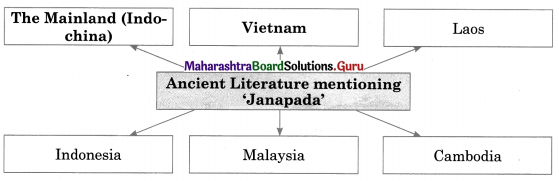
Maharashtra Board Class 11 History Solutions Chapter 16 Swarajya to Empire (Maratha Period)

Balbharti Maharashtra State Board Class 11 History Solutions Chapter 16 Swarajya to Empire (Maratha Period) Textbook Exercise Questions and Answers.

Maharashtra State Board Class 11 History Solutions Chapter 16 Swarajya to Empire (Maratha Period)

1A. Choose the correct alternative and complete sentences.

Question 1.
___________ is known as the Father of Indian Navy.
(a) Chhatrapati Shivaji Maharaj
(b) Chhatrapati Sambhaji Maharaj
(c) Chhatrapati Rajaram Maharaj
(d) Chhatrapati Shahu Maharaj
Answer:
(a) Chhatrapati Shivaji Maharaj

Maharashtra Board Class 11 History Solutions Chapter 16 Swarajya to Empire (Maratha Period)

Question 2.
The Pathans from Afghanistan had settled in ___________ the province at the foothills of the Himalayas.
(a) Varanasi
(b) Mathura
(c) Ayodhya
(d) Delhi
Answer:
(c) Ayodhya

Question 3.
Chhatrapati Sambhaji Maharaj wrote the Sanskrit text ___________
(a) Nayikabhed
(b) Budhabhushan
(c) Nakhshikh
(d) Satasattka
Answer:
(b) Budhabhushan

1B. Find the incorrect pair from set B and write the correct ones.

Question 1.

Set ‘A’Set ‘B’
(a) Naik-Nimbalkar WadaVathar
(b) Nana Phadanvis WadaMenavali
(c) Kalaram TempleJejuri
(d) Mohiniraj TempleNevase

Answer:
(c) Kalaram Temple – Nashik

1C. Write the names.

Question 1.
He was the Chief of the intelligence network of Chh. Shivaji Maharaj
Answer:
Bahirji Naik

Question 2.
He assisted in the provincial affairs
Answer:
Subhedars/Deshadhikari

Question 3.
Leader of the Rohillas
Answer:
Najib Khan

2. Complete the concept map.

Question 1.
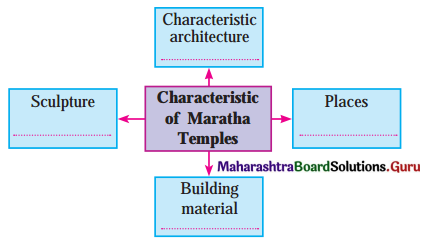
Maharashtra Board Class 11 History Solutions Chapter 16 Swarajya to Empire (Maratha Period) 2 Q1
Answer:
Maharashtra Board Class 11 History Solutions Chapter 16 Swarajya to Empire (Maratha Period) 2 Q1.1

Maharashtra Board Class 11 History Solutions Chapter 16 Swarajya to Empire (Maratha Period)

3. Explain the statement with reasons.

Question 1.
Shahajiraje is known as the visionary of Swarajya.
Answer:

  • Shahajiraje Bhosale was a prominent Sardar in the Nizamshahi kingdom. After the end of Nizamshahi’s rule, he accepted the rank of a Mansabdar in the Adilshahi court.
  • Shahajiraje was valiant, courageous, wise, and well-versed in the science of statehood.
  • He had successfully handled many Adilshahi expeditions in Maharashtra, Karnataka, and Tamil Nadu.
  • The provinces of Pune, Supe, Shirwal, Indapur, and Chakan were given to Shahajiraje as Jahangir.
  • He personally aspired to establish Swarajya. He is regarded as the visionary of Swarajya.
  • The concept of Swarajya was visualized by Shahajiraje and it was turned into reality by Chh. Shivaji Maharaj.
  • Chh. Shivaji Maharaj laid the foundation of Swarajya from the Mawal region. Several factors like the topography of Maharashtra, valour of the local Mawalas, the administrative and military experience gained by the Maratha sardars while working with Nizamshahi, and Adilshahi and above all these the able leadership of Chh. Shivaji Maharaj could make it possible.

Question 2.
Chhatrapati Shivaji Maharaj built the naval force.
Answer:

  • In the year 1657 C.E., after conquering Kalyan and Bhiwandi, the boundaries of Swarajya extended up to the coastline.
  • The British and the French were involved in the Salt trade. Chh. Shivaji Maharaj wanted to establish control over the sea waters.
  • Chh. Shivaji Maharaj was the only king in medieval India who attempted to build a navy.
  • He realized to check the activities of foreign traders so having a Navy was important.
  • It was necessary for his military strategy also. During the second sack of Surat, Chh. Shivaji Maharaj brought those ships to the coast of Surat and loaded the huge booty on them acquired from Surat.
  • It is apparent that Chh. Shivaji Maharaj wanted to establish complete control over the land as well as on the sea.

Question 3.
Chhatrapati Shivaji Maharaj charged heavy duty on the salt imported from the Portuguese territory.
Answer:

  • Chhatrapati Shivaji Maharaj was keen on protecting the local industries.
  • He protected the salt industry in Konkan. At that time, traders imported salt from the Portuguese territory and sold it in Swarajya.
  • That affected the local trade in the Konkan areas.
  • Chh. Shivaji Maharaj charged heavy duty on the salt imported into Swarajya from the Portuguese territory.
  • The intention was that the salt imported from the Portuguese territory would then cost more and as a result, its import would be discouraged and the sale of the local salt would increase.

Maharashtra Board Class 11 History Solutions Chapter 16 Swarajya to Empire (Maratha Period)

4. Write short notes.

Question 1.
Maratha Art:
Answer:

  • Developments of Maratha miniature paintings can be seen through illustrations on the manuscripts such as pothis, pattachitra, and patrikas. For example, the wooden stands of pothis have pictures of Ganapati, Riddhi-Siddhi, Gopalkrishna in dark red, green, and yellow colours.
  • Miniature paintings include human portraits and themes like ragamalas, talamala, processions, etc.
  • Murals are found on the fagade of the Wadas, as well on the walls of reception areas (Diwankhana) and bedrooms.
  • The 18th-century murals have survived till today at places like Naik-Nimbalkar Wada at Vathar, Rangamahal at Chandwad, Mayureshwar Mandir at Morgaon, Shiva Temple of Pandeshwar, and Matha at Benawadi.
  • The main theme of murals is mythological stories. They include scenes from Ramayana, Mahabharata, and Puranas.
  • The subjects of contemporary social life were also reflected in the paintings. The royal court, royal meetings, processions were also included in them.

Question 2.
Maratha Architecture:
Answer:

  • Chh. Shivaji Maharaj built forts, the tradition of which was prevalent in the Deccan for three centuries.
  • The Kasaba temple in Pune and Vitthal temple in Vitthalwadi were reconstructed by Veermata Jijabai.
  • During the Peshwa period, the Maratha kingdom regained its prosperity and all forms of art and architecture received patronage.
  • The construction of temples began on a large scale during the later Peshwa.
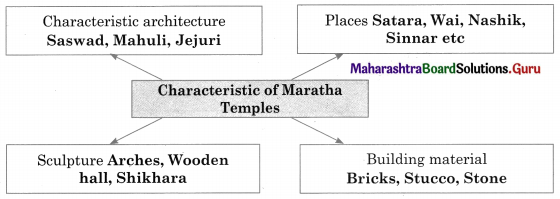
  • Period. These temples are of three types. Examples of temple architecture of this period are found at Saswad, Mahuli, Jejuri, etc.
  • These are huge in size. The plan of these temples is in star design, the foundation of the temple was multi-layered and was named accordingly.
  • The shikhara is made in bricks and stucco method.
  • The Kalaram, Goraram, and Sundarnarayan temples at Nasik and Mahadev temple at Trimbakeshwar, Mohiniraj temple at Nevasa is similar to the temples in Malwa and Rajasthan.
  • These temples are constructed in stone. These temples are embellished extensively with sculptures.
  • The third type of temple can be found at Pune, Satara, Wai, etc.
  • It included arches, a wooden hall, and a sanctum sanctorum(gabhara). The Shikhara slopes inwards at the top.
  • The stone ‘Deepamala’ is a remarkable feature of these temples. The stone deepamalas at Jejuri were built by Shahajiraje.
  • The Chhatris (Samadhis) at various places are noteworthy.

Maharashtra Board Class 11 History Solutions Chapter 16 Swarajya to Empire (Maratha Period)

Activity

Collect information about capable women in the medieval period and present it in class. Arrange a discussion on it.
Answer:

  • In Indian history, we find only a few women actively participating in public affairs.
  • In the Muslim period, Razia Sultan was the only woman who conducted the affairs of the government for a short time.
  • And in later times, Rani of Jhansi rose into prominence during the revolt of 1857.
  • During the Maratha period, there were women like Jijabai and Maharani Tarabai who performed public duties in the absence of their husbands.
Maharashtra Board Class 11 History Important Questions Chapter 15 India During Mughal Period

Balbharti Maharashtra State Board Class 11 History Important Questions Chapter 15 India During Mughal Period Important Questions and Answers.

Maharashtra State Board 11th History Important Questions Chapter 15 India During Mughal Period

1A. Choose the correct alternative and write the complete sentences.

Question 1.
___________ was the king of Farghana province in Central Asia.
(a) Taimurlang
(b) Babur
(c) Genghis khan
(d) Akbar
Answer:
(b) Babur

Question 2.
After Humayun, his son ___________ ascended the throne.
(a) Babur
(b) Aurangzeb
(c) Akbar
(d) Shershah
Answer:
(c) Akbar

Maharashtra Board Class 11 History Important Questions Chapter 15 India During Mughal Period

Question 3.
Rana Pratap was the ruler of ___________
(a) Mewar
(b) Jodhpur
(c) Jaipur
(d) Bundelkhand
Answer:
(a) Mewar

Question 4.
Baburnama was written by ___________
(a) Akbar
(b) Birbal
(c) Babur
(d) Jahangir
Answer:
(c) Babur

Question 5.
The Taj Mahal was built by ___________
(a) Babur
(b) Akbar
(c) Shahajahan
(d) Jahangir
Answer:
(c) Shahjahan

Question 6.
___________ was a Sanskrit scholar.
(a) Dara Shukoh
(b) Aurangzeb
(c) Shah Shuja
(d) Murad Baksh
Answer:
(a) Dara Shukoh

Maharashtra Board Class 11 History Important Questions Chapter 15 India During Mughal Period

1B. Find the incorrect pair from set B and write the correct ones.

Question 1.

Set ‘A’Set ‘B’
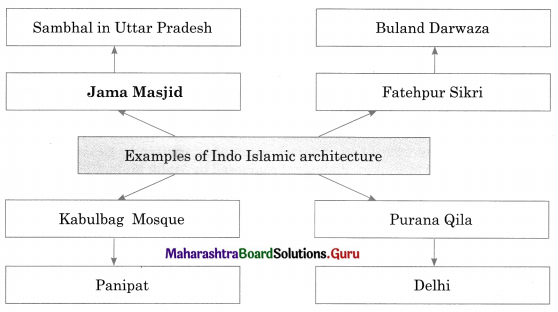
(a) Tombs of Salim ChistiFatehpur Sikri
(b) Kabulbag mosquePanipat
(c) Jama MasjidSambhal
(d) Purana QilaAjmer

Answer:
(d) Purana Qila – Delhi

Question 2.

Set ‘A’Set ‘B’
(a) FertileStupik
(b) InfertileNapik
(c) IrrigatedBagayat
(d) Dry cropJiyarat

Answer:
(a) Fertile – Supik

1C. Find the odd one out.

Question 1.
Diwan-i-Aam, Diwan-i-Khaas Jama Masjid, Kutub Minar
Answer:
Kutub Minar

Question 2.
Surat, Dabhol, Agra, Calicut
Answer:
Agra

Question 3.
Rajatarangini, Lilavati, Ramayana, Ramacharitamanas
Answer:
Ramacharitamanas

Question 4.
Pahari, Basauli, Gadhwali, Kangra
Answer:
Pahari

2A. Write the names of historical places, persons, and events.

Question 1.
Documents prepared after the fixing of the tax rate.
Answer:
Kabulayat and Patta

Maharashtra Board Class 11 History Important Questions Chapter 15 India During Mughal Period

Question 2.
He translated Upanishads texts in the Persian language from Sanskrit.
Answer:
Dara

Question 3.
He was born in Uzbekistan.
Answer:
Babur

Question 4.
After Humayun, his son ascended the throne.
Answer:
Akbar

2B. Choose the correct reason and complete the sentence.

Question 1.
The Mughals ruled over India for more than ___________
(a) four centuries
(b) two centuries
(c) one centuries
(d) three centuries
Answer:
(d) three centuries

Question 2.
The grand army of Ibrahim Lodi could not survive in front of ___________
(a) Babur, in the battle of Panipat
(b) Babur, Battle of Khanwa
(c) Rana Pratap, the ruler of Mewar
(d) Humayun’s son Akbar
Answer:
(a) Babur, in the battle of Panipat

2C. Write the correct chronological order.

Question 1.
(a) Babur established his rule in Delhi.
(b) Babur’s son Humayun ascended the throne.
(c) Babur defeated Ibrahim Lodi.
(d) Babur defeated Rajputs in the Battle of Khanwa.
Answer:
(a) Babur defeated Ibrahim Lodi.
(b) Babur established his rule in Delhi.
(c) Babur defeated Rajputs in Battle of Khanwa
(d) Babur’s son Humayun ascended the throne.

Maharashtra Board Class 11 History Important Questions Chapter 15 India During Mughal Period

2D. Complete the table.

Question 1.

1.Tarikh-i-Rashidi……………………………..
2. ……………………..Khafi Khan
3. Translation of Upanishads in Persian……………………………..
4. ………………………..4. Malik Muhammad Jayasi

Answer:

1. Tarikh-i-RashidiMirza Hyder
2. Tarikh-i-KhafikhanKhafi Khan
3. Translation of Upanishads in PersianDara Shukoh
4. PadmavatMalik Muhammad Jayasi

Question 2.

RulerBuildings Built
1. Babar…………………………..
2. …………………TajMahal
3. Akbar………………………….
4. ………………….Memorial at Sahastram (Bihar)

Answer:

RulerBuildings Built
1. BabarKabulbag Mosque
2. ShahjahanTajMahal
3. AkbarBuland Darwaza
4. Shershah SurMemorial at Sahastram (Bihar)

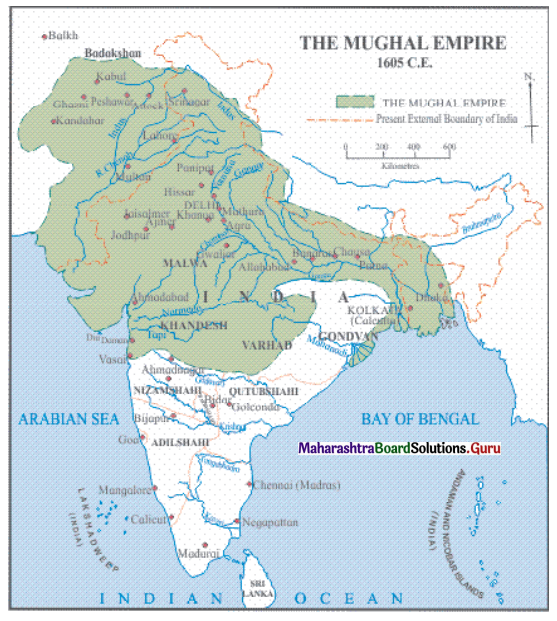
3. Observe the map on page 111 of your textbook and answer the following questions based on it.

Maharashtra Board Class 11 History Important Questions Chapter 15 India During Mughal Period 3

Question 1.
Name the kingdoms in Maharashtra during medieval times.
Answer:
Mughals, Adilshahi, Nizamshahi

Question 2.
Name the rivers in Maharashtra.
Answer:
Narmada, Tapi, Godavari

Question 3.
Name the islands shown on a map.
Answer:
Lakshadweep and Andaman and the Nicobar Islands

Question 4.
Name the ocean at the tip of India.
Answer:
Indian Ocean

Maharashtra Board Class 11 History Important Questions Chapter 15 India During Mughal Period

Question 5.
Name the sea shown on a map.
Answer:
Arabian Sea

4. Complete the concept maps.

Question 1.
Maharashtra Board Class 11 History Important Questions Chapter 15 India During Mughal Period 4 Q1
Answer:
Maharashtra Board Class 11 History Important Questions Chapter 15 India During Mughal Period 4 Q1.1

Question 2.
Maharashtra Board Class 11 History Important Questions Chapter 15 India During Mughal Period 4 Q2
Answer:
Maharashtra Board Class 11 History Important Questions Chapter 15 India During Mughal Period 4 Q2.1

Question 3.
Maharashtra Board Class 11 History Important Questions Chapter 15 India During Mughal Period 4 Q3
Answer:
Maharashtra Board Class 11 History Important Questions Chapter 15 India During Mughal Period 4 Q3.1

5. Explain the following statements with reasons.

Question 1.
For the expansion of the empire, Akbar adopted the strategy of persuasion with the Rajputs.
Answer:

  • Akbar faced many internal and external problems when he started his rule. Mughal power was not completely established and it was vulnerable to attacks.
  • During this period, Rana Pratap, the ruler of Mewar, put up a strong resistance against Akbar. Akbar could never win a war with Rana Pratap.
  • Hence for the expansion of the empire, he adopted the strategy of persuasion with the Rajputs.
  • Akbar had realized that if the Mughal rule has to be strengthened in India then he had to adopt non-offensive policies, which would be popular.

Maharashtra Board Class 11 History Important Questions Chapter 15 India During Mughal Period

Question 2.
Mughal Empire declined.
Answer:

  • After Akbar, Jahangir, Shahjahan, and Aurangzeb ruled efficiently.
  • Aurangzeb attempted to expand his empire in the Deccan with prolonged campaigns. There was a toll on the economic status of the Mughals. The campaign in the south drained huge wealth from the Mughal treasury.
  • Aurangzeb’s reign is notable for his wars in frontier provinces, his political policies in North and South India, staunch religious policies, and the Mughal- Maratha conflict. All these things ultimately resulted in the decline of Mughal power.
  • This period is marked by the expansion of the Maratha kingdom, interference by the Europeans in the political affairs of India, and the decline of Mughal power.
  • Finally, the aftermath of the struggle for Independence in 1857 C.E., saw the end of the Mughal rule under Bahadur Shah.

Question 3.
Akbar’s administration was welfare-oriented.
Answer:

  • An average of the annual yield in the last ten years was calculated and one-third of this average yield was fixed as the base for the tax to be paid.
  • The tax, thus fixed, was applicable for the span of ten years. This offered considerable respite to farmers for a span of ten years.
  • Documents are known as ‘Kabulayat’ and ‘Patta’ were prepared from the farmers after the fixing of the tax rate. The tax was collected in cash or in kind.
  • The farmers have sanctioned loans for tilling the land, which could be repaid in installments.
  • Concessions were also granted to the farmers during times of calamities like famine, floods, and epidemics. These were the Welfare policies of Emperor Akbar.
  • Todarmal in Emperor Akbar’s court is known for his insights regarding the welfare of common people.

6. State your opinion.

Question 1.
Arts flourished during the period of the Mughals.
Answer:

  • The reign of the three emperors, Akbar, Jahangir, and Shahjahan was a period of peace, order, and prosperity. Arts flourish when there is stability.
  • A new era began in the field of art and architecture. The etched designs on the marble walls of mosques, tombs, and palaces are evidence of the highly advanced styles of art and architecture.
  • During the period of Akbar and Jahangir, the art of ivory carving received royal patronage.
  • The Mughal paintings originated from the Persian styles of painting.
  • There are miniature paintings of Persian style in the manuscript of ‘Baburnama’. The art of painting received encouragement during the period of Akbar. He appointed skilled painters in his court.
  • During the period of Jahangir, paintings were done based on the court and hunting scenes. The paintings of this period were done in a more realistic style, which is vibrant and attractive. These paintings, portray birds and animals, cloud formations, human figures, and natural scenery.
  • During the Mughal period, the art of music seems to have received royal patronage.

Question 2.
Mughals could establish their rule in India.
Answer:

  • At the beginning of the 16th century, the political condition in India was somewhat disturbed.
  • The Sultanate’s rule had begun to decline after Muhammad Tughluq. The Delhi Sultanate broke down completely and many new independent kingdoms emerged in North, Central, and South India.
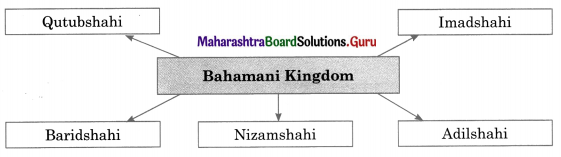
  • The Bahamani kingdom got divided into five branches. The prosperous Vijaynagar empire was’ destroyed by the five Islamic ruling houses in the South.
  • During the same period, the Portuguese began to settle on the western coast of India. The traditional military system of the Indian rulers in the medieval period was not capable of facing the onslaught of new challenges.
  • The Indians were not familiar with modern weaponry. Taking advantage of all this, the Mughals established their rule in India.

Maharashtra Board Class 11 History Important Questions Chapter 15 India During Mughal Period

Question 3.
India received silver every year in large quantities.
Answer:

  • Foreign trade flourished to a great extent during the Mughal period.
  • Exports from India were larger than the imports.
  • Many commodities including silk cloth, precious stones, spices, etc. were exported from India while the imported goods mainly included luxury items.
  • The foreign traders had to pay for the Indian goods in the form of silver.
  • Hence, India received silver every year in large quantities.

7. Answer the following questions with the help of given points.

Question 1.
Write in detail about Mughal Land Revenue System.
(a) Land Survey
(b) Rate of Tax
(c) Welfare Oriented Policy
Answer:
(a) Land Survey:

  • Akbar made further reforms in the revenue system implemented by Shershah Sur. This bought a certain discipline in the Mughal revenue system.
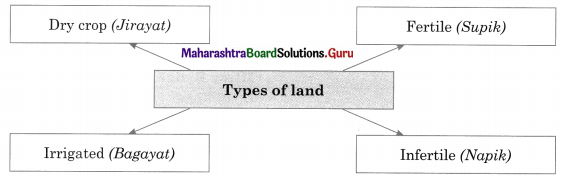
  • He graded the cultivable land based on the systematic land survey. The land was classified into four types on the basis of annual yield, i.e. fertile (supik), infertile (napik), irrigated (bagayat), and dry crop (jirayat) land.

(b) Rate of Tax:

  • Individual land holdings of farmers were registered. An average of the annual yield in the last ten years was calculated and one-third of this average yield was fixed as the base for the tax to be paid.
  • The tax, thus fixed, was applicable for the span of ten years. This offered considerable respite to farmers for a span of ten years. Documents knew as ‘Kabulayat’ and ‘Patta’ were prepared by the farmers after the fixing of the tax rate.

Maharashtra Board Class 11 History Important Questions Chapter 15 India During Mughal Period

(c) Welfare Oriented Policy:

  • The tax was collected in cash or in kind. The farmers have sanctioned loans for tilling the land, which could be repaid in installments.
  • Concessions were also granted to the farmers during times of calamities like famine, floods, and epidemics. These were the Welfare policies of Emperor Akbar.
  • Todarmal in emperor Akbar’s court is known for his insights regarding the welfare of common people. His insights were instrumental for Akbar’s land reforms.

Maharashtra Board Class 11 History Solutions Chapter 15 India During Mughal Period

Balbharti Maharashtra State Board Class 11 History Solutions Chapter 15 India During Mughal Period Textbook Exercise Questions and Answers.

Maharashtra State Board Class 11 History Solutions Chapter 15 India During Mughal Period

1A. Choose the correct alternative and write the complete sentences.

Question 1.
Mughal Emperor Babur was born in ___________
(a) Baluchistan
(b) Kazakhstan
(c) Uzbekistan
(d) Afghanistan
Answer:
(c) Uzbekistan

Question 2.
Mughal Emperor Humayun was defeated by ___________
(a) Ibrahim Lodi
(b) Shershah Sur
(c) Babur
(d) Akbar
Answer:
(b) Shershah Sur

Maharashtra Board Class 11 History Solutions Chapter 15 India During Mughal Period

Question 3.
Akbarnama was written by ___________
(a) Mohammad Qasim
(b) Abul Fazl
(c) Mirza Hyder
(d) Badauni
Answer:
(b) Abul Fazl

1B. Find the incorrect pair from set B and write the correct ones.

Question 1.

Set ‘A’Set ‘B’
(1) Khafi KhanAkbarnama
(2) Malik Muhammad JayasiPadmavat
(3) Sant KabirDoha
(4) Mirza HyderTarikh-i-Rashidi

Answer:
(1) Khafi Khan – Tarikh-i-Khafikhan

1C. Write the names.

Question 1.
He defeated Ibrahim Lodi.
Answer:
Babur

Question 2.
She successfully resisted the attack of Akbar and saved the Nizamshahi kingdom.
Answer:
Chand bibi

2. Explain the statements with reasons.

Question 1.
The Rajput rulers united against Babur.
Answer:

  • The grand army of Ibrahim Lodi could not survive in front of Babur in the battle of Panipat.
  • Babur defeated Ibrahim Lodi on the strength of configuration skills, strong artillery, a system of secret intelligence, and strong leadership. This was a direct threat to the Rajputs in Rajasthan.
  • Rajputs were brave warriors and proud advocates of their religion.
  • Babur established his rule in Delhi.
  • The Rajput kings came together under the leadership of Mewar King Rana Sangha to counter him.
  • Babur defeated the Rajputs in the Battle of Khanwa.

Maharashtra Board Class 11 History Solutions Chapter 15 India During Mughal Period

Question 2.
Shershah Sur was well-known for his ideal administration.
Answer:

  • Humayun was deprived of the kingdom due to the defeat at the hands of Shershah Sur of Bihar.
  • Shershah Sur made some reforms in the administrative setup. He also made changes in the land revenue system.
  • He erected the hierarchical setup of administrative units and officers.
  • He brought together the Afghan sardars scattered in North India and established Afghan rule.
  • The descendants of Shershah were not efficient. Thus, his power declined.

Question 3.
Emperor Akbar strengthened the foundation of his rule in India.
Answer:

  • After Humayun, his son Akbar ascended the throne.
  • He proved to be the greatest Mughal Emperor because of his qualities such as high intelligence, tolerance, firmness, and courage.
  • The kingdom established by Babur was transformed into a great empire by Akbar.
  • He established his rule from Kabul to Bengal and Kashmir to Varhad-Khandesh.
  • He entered into political matrimonial relations with the Rajputs in order to strengthen his kingdom.
  • He erected an efficient administrative setup.

Question 4.
Mughal art declined during the period of Aurangzeb.
Answer:

  • During the period of Aurangzeb, the royal patronage of the art of painting was withdrawn.
  • Aurangzeb was a fanatic ruler. Under Aurangzeb’s rule, art declined, since he had banned all art forms.
  • The artists were forced to seek patronage elsewhere under various rulers in Rajasthan, Bundelkhand, Gujarat, and the provinces of the Himalayan ranges.
  • New local styles of paintings emerged there.

3. Write short notes.

Question 1.
Mughal Art
Answer:

  • The reign of the three emperors, Akbar, Jahangir, and Shahjahan was a period of peace, order, and prosperity. Arts flourish when there is stability.
  • A new era began in the field of art and architecture.
  • The etched designs on the marble walls of mosques, tombs, and palaces are evidence of the highly advanced styles of art and architecture.
  • The influence of the Persian style of architecture was more prominent till Akbar’s period.
  • In the later period, it evolved by absorbing Indian elements, which came to be known as the Indo-Islamic style of architecture.
  • During the period of Akbar and Jahangir, the art of ivory carving received royal patronage.
  • The Mughal paintings originated from the Persian styles of painting.
  • There are miniature paintings of Persian style in the manuscript of ‘Baburnama’. The art of painting received encouragement during the period of Akbar. He appointed skilled painters in his court.
  • During the period of Jahangir, paintings were done based on the court and hunting scenes. The paintings of this period were done in a more realistic style, which is vibrant and attractive. These paintings, portray birds and animals, cloud formations, human figures, and natural scenery.
  • During the Mughal period, the art of music seems to have received royal patronage.

Maharashtra Board Class 11 History Solutions Chapter 15 India During Mughal Period

Question 2.
Mughal Literature
Answer:

  • During the Mughal period, excellent literature was created in the Persian language.
  • Babur himself knew Persian and Turkish languages. His autobiography known as ‘Baburnama’ is well known.
  • Another important text is ‘Tarikh-i-Rashidi’ by Mirza Hyder written during the period of Humayun.
  • Akbar got many Sanskrit texts translated in Persian which includes ‘Rajatarangini’, ‘Lilavati’, ‘Ramayana’, ‘Mahabharata’, ‘Harivamsh’ and ‘Panchatantra’. Abul Fazal wrote the famous ‘Akbarnama’ and ‘Ain-i- Akbari’.
  • Dara Shukoh, the son of Shahjahan, was a Sanskrit scholar. He translated the text of several Upanishads texts in the Persian language from Sanskrit.
  • During the Mughal period, a number of biographical, historical texts were written. Among them Khafi Khan’s ‘Tarikhi- Khafikhan’ is well-known.
  • During the Mughal period, a number of literary works of high quality were created in local north Indian dialects. To mention a few, ‘Ramacharitamanas’ written by Goswami Tulsidas, the compositions of Surdas and Meerabai, Padmavat composed by Malik Muhammad Jaysi, dohas of Saint Kabir.

4. Answer the following questions in detail.

Question 1.
During the Mughal period, what were the changes made in the revenue system?
Answer:

  • Akbar made further reforms in the revenue system implemented by Shershah Sur.
  • This bought a certain discipline in the Mughal revenue system.
  • He graded the cultivable land based on the systematic land survey.
  • The land was classified into four types on the basis of annual yield, i.e. fertile (supik), infertile (napik), irrigated (bagayat), and dry crop (jirayat) land.
  • Individual land holdings of farmers were registered.
  • An average of the annual yield in the last ten years was calculated and one-third of this average yield was fixed as the base for the tax to be paid.
  • The tax, thus fixed, was applicable for the span of ten years. This offered considerable respite to farmers for a span of ten years.
  • Documents are known as ‘Kabulayat’ and ‘Patta’ were prepared by the farmers after the fixing of the tax rate. The tax was collected in cash or in kind.

Maharashtra Board Class 11 History Solutions Chapter 15 India During Mughal Period

Question 2.
Elaborate on the features of Mughal architecture.
Answer:

  • The architectural style during the Sultanate period had great implements on strength and simplicity.
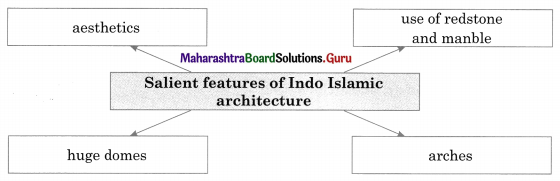
  • But during the Mughal period, the focus shifted to aesthetics.
  • During the period of Babur, the Kabulbag mosque at Panipat and Jama Masjid at Sambhal in Uttar Pradesh were built in Persian style.
  • The memorial built during the period of Shershah Sur at Sahastram (Bihar) is an excellent example of the Indo-Islamic style of architecture.
  • The Purana Qila was built by Shershah in Delhi. The city of Fatehpur Sikri was set up during Akbar’s period.
  • Later the buildings like Jama Masjid, Buland Darwaza were built in Fatehpur-Sikri.
  • Akbar built important forts like Agra fort, Lahore fort, Allahabad fort, and Attock fort.
  • The use of Red stone and marble, huge domes, arches were the salient features of the architecture of this period.
  • The period of Shahjahan was the most glorious period of Mughal architecture.
  • ‘Diwan-i-Aam’ and ‘Diwan-i-Khaas’ in Red fort, ‘Jama masjid’, ‘Moti Masjid’, were built during his period.
  • The ‘Taj Mahal’ of Agra built by him is incomparable and immortal.
  • Later, Mughal architecture began to decline.

Activity

Collect information about the expansion of Mughal rule by Emperor Akbar and the contemporary cities.
Answer:

  • Akbar was an Imperialist.
  • The first conquest of Akbar was that of Malwa.
  • His empire extended from Kabul in the west to Bengal in the east and from Kashmir in the north to Vindhyas in the south.
  • Had consolidated the whole of north India under his administration.
  • The following is the link for additional information: https://www.historydiscussion.net

Maharashtra Board Class 11 History Important Questions Chapter 14 Delhi Sultanate, Vijayanagar and Bahamani Kingdom

Balbharti Maharashtra State Board Class 11 History Important Questions Chapter 14 Delhi Sultanate, Vijayanagar and Bahamani Kingdom Important Questions and Answers.

Maharashtra State Board 11th History Important Questions Chapter 14 Delhi Sultanate, Vijayanagar and Bahamani Kingdom

1A. Choose the correct alternative and write the complete sentences.

Question 1.
___________ is the founder of the Slave Dynasty.
(a) Qutubuddin Aibak
(b) Mohd. Ghori
(c) Sultan of Ghazni
(d) Alauddin Khalji
Answer:
(a) Qutubuddin Aibak

Question 2.
Qutub Minar at Mehrauli is a well-known example of ___________ architecture.
(a) Indian
(b) Islamic
(c) Greek
(d) Roman
Answer:
(b) Islamic

Maharashtra Board Class 11 History Important Questions Chapter 14 Delhi Sultanate, Vijayanagar and Bahamani Kingdom

Question 3.
The Italian traveller Nicolo Conti visited ___________
(a) Vijayanagar
(b) Delhi
(c) Iran
(d) Karnataka
Answer:
(a) Vijaynagar

Question 4.
___________ wrote a text called ‘Amuktamalyada’.
(a) Harihara
(b) Bukka
(c) Krishnadeva Raya
(d) Purnaiya
Answer:
(c) Krishnadevaraya

Question 5.
Tuli translated the text of ___________
(a) Koshashastra
(b) Bhadvad Gita
(c) Ramayan
(d) Mahabharata.
Answer:
(a) Koshashatra

Question 6.
___________ built Alai Darwaza.
(a) Alberuni
(b) Alauddin Khalji
(c) Qutubuddin Aibak
(d) Iltutmish
Answer:
(b) Alauddin Khalji

1B. Find the incorrect pair from set B and write the correct ones.

Question 1.

Set ‘A’Set ‘B’
(a) MahmudSultan of Ghazni
(b) Muhammad GhuriTurkish Empire
(c) Qulibuddin AibakSultan of Delhi
(d) TaimurRuler of Iran

Answer:
(d) Taimur – Ruler of Mongol

Question 2.

Set ‘A’Set ‘B’
(a) KalachurisTripuri
(b) ChalukyasGujarat
(c) PalasBengal
(d) KalachurisMalwa

Answer:
(d) Kalachuris – Gorakhpur

Maharashtra Board Class 11 History Important Questions Chapter 14 Delhi Sultanate, Vijayanagar and Bahamani Kingdom

1C. Find the odd one out.

Question 1.
Monuments erected during Islamic Period:
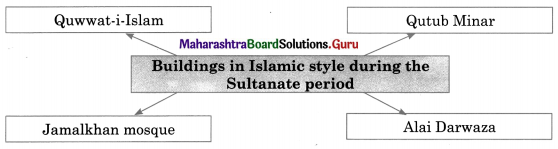
(a) Quwwat-i-Islam
(b) Qutub Minar
(c) Alai Darwaza
(d) Qawwali
Answer:
(d) Qawwali

Question 2.
Main centers of Textile during Sultan period:
(a) Delhi
(b) Chennai
(c) Agra
(d) Multan
Answer:
(b) Chennai

Question 3.
Cities set up by Sultan of Tughluq Dynasty:
(a) Mahajanapadas
(b) Tughluqabad
(c) Jahanpanha
(d) Firozabad
Answer:
(a) Mahajanapadas

Question 4.
Ruling houses of Bahamani Kingdom:
(a) Imadshahi of Varhad
(b) Baridshahi of Bidar
(c) Adilshahi of Bijapur
(d) Gawan of Golconda
Answer:
(d) Gawan of Golconda

2A. Write the names of historical places, persons, and events.

Question 1.
Rulers of Malwa –
Answer:
Parmars

Question 2.
Railway line near Peshawar in Pakistan –
Answer:
Jamrud

Question 3.
First Sultan of Delhi –
Answer:
Qutubuddin Aibak

Maharashtra Board Class 11 History Important Questions Chapter 14 Delhi Sultanate, Vijayanagar and Bahamani Kingdom

Question 4.
First and the only woman to ascend the throne of Delhi –
Answer:
Razia Sultan

Question 5.
Mongol rulers in Central Asia –
Answer:
Taimur

Question 6.
Well-known poet and scholar in the court of Sultan Balban –
Answer:
Amir Khusrow

Question 7.
The standard unit for the weight of coin –
Answer:
Tola

Question 8.
Mosque at Delhi built by Qutubuddin Aibak –
Answer:
Quwwat-i-Islam

Question 9.
Persian traveller who visited India during the period of Mahmud Ghazni –
Answer:
Al-Beruni

Question 10.
The text was written by Krishnadevaraya –
Answer:
Amuktamalyada

2B. Choose the correct reason and complete the sentence.

Question 1.
The transition of the ancient period to the medieval period is reflected in
Reason ___________
(a) Political
(b) Social
(c) Economic, religious and cultural
(d) All of the above
Answer:
(d) All of the above

Maharashtra Board Class 11 History Important Questions Chapter 14 Delhi Sultanate, Vijayanagar and Bahamani Kingdom

Question 2.
The Indian rules could be defeated easily by the Turks because of ___________
(a) internal dissent
(b) lack of bravery
(c) lack of stability
(d) they were soft targets
Answer:
(a) internal dissent

Question 3.
Alauddin Khilji sent his commander Malik Kafur to south because of ___________
(a) he wanted to subdue the Yadavas and collect tribute from them
(b) he devised some new economic reforms
(c) of social reasons
(d) he wanted to build his empire in the south
Answer:
(a) he wanted to subdue the Yadavas and collect tribute from them

2C. Write the correct chronological order.

Question 1.
(a) Prithviraj Chauhan was defeated in the Second Battle of Tarain.
(b) Muhammad Tughluq shifted the capital from Delhi to Devgiri.
(c) Sabuktgin, the Sultan of Ghazni attacked King Jaipal of Punjab.
(d) Qutubuddin Aibak became the first Sultan of Delhi.
Answer:
(a) Subuktigin, the Sultan of Ghazni attacked King Jaipal of Punjab.
(b) Prithviraj Chauhan was defeated in the Second Battle of Tarain.
(c) Qutubuddin Aibak became the first Sultan of Delhi.
(d) Muhammad Tughluq shifted the capital from Delhi to Devgiri.

Maharashtra Board Class 11 History Important Questions Chapter 14 Delhi Sultanate, Vijayanagar and Bahamani Kingdom

2D. Complete the concept Maps.

Question 1.
Maharashtra Board Class 11 History Important Questions Chapter 14 Delhi Sultanate, Vijayanagar and Bahamani Kingdom 2 Q1
Answer:
Maharashtra Board Class 11 History Important Questions Chapter 14 Delhi Sultanate, Vijayanagar and Bahamani Kingdom 2 Q1.1

Question 2.
Maharashtra Board Class 11 History Important Questions Chapter 14 Delhi Sultanate, Vijayanagar and Bahamani Kingdom 2 Q2
Answer:
Maharashtra Board Class 11 History Important Questions Chapter 14 Delhi Sultanate, Vijayanagar and Bahamani Kingdom 2 Q2.1

Question 3.
Maharashtra Board Class 11 History Important Questions Chapter 14 Delhi Sultanate, Vijayanagar and Bahamani Kingdom 2 Q3
Answer:
Maharashtra Board Class 11 History Important Questions Chapter 14 Delhi Sultanate, Vijayanagar and Bahamani Kingdom 2 Q3.1

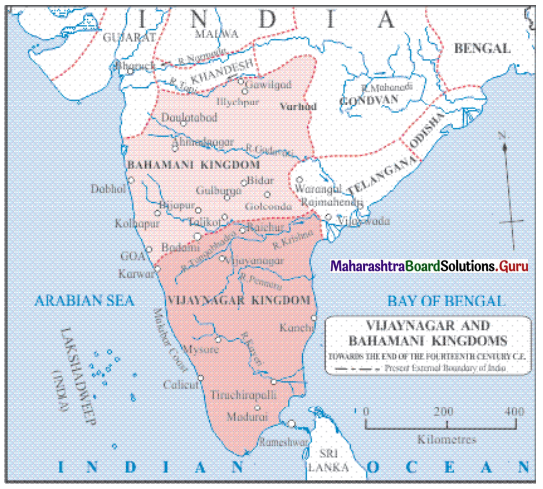
3. Observe the map on page 108 of your textbook and answer the following questions, based on it.

Maharashtra Board Class 11 History Important Questions Chapter 14 Delhi Sultanate, Vijayanagar and Bahamani Kingdom 3

Question 1.
What does the map show?
Answer:
The map shows the Vijayanagar and Bahamani Kingdom.

Question 2.
Name the four rivers in the Vijayanagar Kingdom.
Answer:
River Tungabhadra, River Krishna, River Penneru, and River Kaveri.

Question 3.
Where is Lakshadweep island?
Answer:
The island Lakshadweep is in the Arabian Sea.

Maharashtra Board Class 11 History Important Questions Chapter 14 Delhi Sultanate, Vijayanagar and Bahamani Kingdom

Question 4.
Name the famous coast near Calicut.
Answer:
Malabar Coast is the famous coast near Calicut.

Question 5.
Name the river in Gondvan.
Answer:
River Mahanadi.

4. Write short notes.

Question 1.
Amir Khusrow
Answer:

  • Amir Khusrow was a well-known poet and scholar who composed poetry in the Indian language.
  • He spent his life in the court of Sultan Balban in Delhi.
  • While describing the muslin of Dhaka, he says, “the Muslin is so fine that even if a hundred yards are tied around the head, one could still see the hair.”

5. Explain the statements with reasons.

Question 1.
The Islamic rule was established in India.
Answer:

  • The Islamic rule In India was established by the Turks.
  • They attacked India several times.
  • None of the rulers in India could resist them.
  • They looted enormous wealth from India.
  • Many kingdoms were destroyed and Islamic rule was established.

6. State your opinion.

Question 1.
Some cities gain importance as administrative centres while others gain importance as industrial centres.
Answer:

  • The rise and fall of the cities depend on its political and cultural graph of events.
  • The process of urbanisation is associated mainly with political and economic development.
  • The rulers play an important role in the settling and development of a city.
  • According to the Arab historian, Ibn Khaldun, trade gains momentum as a result of the conducive policies of the ruler.
  • Thus, some cities gain importance as administrative centres while others gain importance as industrial centres.

Maharashtra Board Class 11 History Important Questions Chapter 14 Delhi Sultanate, Vijayanagar and Bahamani Kingdom

7. Answer the following questions in detail.

Question 1.
Elaborate on the internal trade in India.
Answer:

  • During the sultanate period, there was an increase in internal trade.
  • The local markets operated through weekly markets(Bazaar) and market places (Mandi/Mandai).
  • New trade centers (Peth) arose due to expanding transactions of trading. Some of the trading centers were Delhi, Multan, Jaunpur, Banaras, Patna, etc.
  • The goods were further transported to various ports via land or riverways.
  • Goods were exported by the sea route to countries like Iran, Arabia, China, etc.
  • The goods mainly included cotton cloth, muslin, dyed cloth, scented oils, etc.
  • Horses were imported to India from Iraq, Turkey, and Iran.
  • Semi-precious stones, mercury, lead, alum, saffron, metals like gold and silver were imported from Mecca and Aden.

Question 2.
Write in detail about Vijayanagar Empire.
Answer:

  • At the end of the 13th century, Alauddin Khalji’s invasions, the coffers of local rulers in South India were emptied to a great extent.
  • This was the time when Harihara and Bukka established the new kingdom of ‘Vijaynagar’ in 1336 C.E.
  • During the rule of King Krishnadevaraya, the kingdom expanded into an empire spreading from South Konkan in the west to Vishakhapatnam in the East and Krishna river in the north to Kanyakumari in the south.
  • Krishnadevaraya wrote a text entitled, ‘Amuktamalyada’ which is about the State and Policy.

Maharashtra Board Class 11 History Solutions Chapter 14 Delhi Sultanate, Vijayanagar and Bahamani Kingdom

Balbharti Maharashtra State Board Class 11 History Solutions Chapter 14 Delhi Sultanate, Vijayanagar and Bahamani Kingdom Textbook Exercise Questions and Answers.

Maharashtra State Board Class 11 History Solutions Chapter 14 Delhi Sultanate, Vijayanagar and Bahamani Kingdom

1A. Choose the correct alternative and write the complete sentences.

Question 1.
The royal poet in the court of Balban was _________________
(a) Al-Beruni
(b) Tuli
(c) Amir Khusrow
(d) Husen Shah Sharukhi.
Answer:
(c) Amir Khusrow

Maharashtra Board Class 11 History Solutions Chapter 14 Delhi Sultanate, Vijayanagar and Bahamani Kingdom

Question 2.
The first ruler who built the buildings in Indo-Islamic style of architecture was _________________
(a) Ferozshah Tughluq
(b) Qutubuddin Aibak
(c) Alauddin Khalji
(d) Akbar
Answer:
(b) Qutubuddin Aibak

1B. Find the incorrect pair from set B and write the correct ones.

Question 1.

Set ‘A’Set ‘B’
(a) RajasthanChauhans
(b) KanaujPratiharas
(c) BundelkhandChandelas
(d) TripuriParamaras

Answer:
(d) Tripuri – Kalachuris

2. Complete the concept Maps.

Question 1.
Maharashtra Board Class 11 History Solutions Chapter 14 Delhi Sultanate, Vijayanagar and Bahamani Kingdom 2 Q1
Answer:
Maharashtra Board Class 11 History Solutions Chapter 14 Delhi Sultanate, Vijayanagar and Bahamani Kingdom 2 Q1.1

3. Explain the statements with reasons.

Question 1.
The Arab rule did not expand in India.
Answer:

  • There was political instability in India in the 13th century and the Turkish invaders took advantage of this instability.
  • Muhammad bin Qasim of the Ummayad dynasty attacked Sindh in the year 712 C.E.
  • He conquered the entire region from Sindh to Multan. After Muhammad bin Qasim, the Arabs rule in India grew unstable.

Maharashtra Board Class 11 History Solutions Chapter 14 Delhi Sultanate, Vijayanagar and Bahamani Kingdom

Question 2.
The Rajput rulers had to accept defeat in front of the Turkish invaders.
Answer:

  • In the 13th century, many petty rulers existed such as Chauhans of Rajasthan, Pratiharas, and Gadhwals (Rathod) of Kanauj, Chandellas of Bundelkhand, Parmars of Malwa, Kalachuris of Gorakhpur, Kalachuris of Tripuri (Madhya Pradesh), Chalukyas (Solanki) of Gujarat, Palas of Bengal, etc.
  • They did resist the invasions of the Turks individually but they did not unite for it.

4. State your opinion.

Question 1.
The textile industry flourished during the Sultanate’s rule.
Answer:

  • The textile industry flourished on large scale.
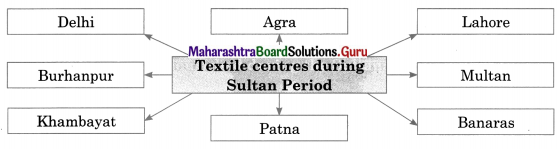
  • Delhi, Agra, Lahore, Multan, Banaras, Patna, Khambayat, Burhanpur, Devgiri were the main centers of the textile industry during this period.
  • The cotton cloth was exported on a large scale from Bengal to Gujarat.
  • The textile exports included muslin, linen cloth, satin, and jari cloth.
  • The textile dyeing industry gained importance. Golconda, Ahmedabad, Dhaka, etc. were the centers of this industry.

5. Write short notes.

Question 1.
Khyber Pass.
Answer:

  • The Khyber Pass has proved to be very important in Indian history.
  • During the ancient period, the trade between India and Central Asia was carried via. this pass.
  • After the Persian Emperor Darius, Alexander came, to India, via. this pass and so did Mahmud Ghazni, Babur, Nadir Shah, and Ahmed Shah Abdali.
  • The British built a railway line with its last destination at a place called ‘Jamrud’ near Peshawar in Pakistan, Jamrud in the doorway of Khyber Pass.

Maharashtra Board Class 11 History Solutions Chapter 14 Delhi Sultanate, Vijayanagar and Bahamani Kingdom

Question 2.
Coins during Sultanate period.
Answer:

  • During the sultanate period, there were major changes in the coinage system.
  • The names of the Khalifa and the Sultan were inscribed on the coins.
  • Details regarding the year of issue, place of minting, etc. were inscribed on it in the Arabic script.
  • ‘Tola’ came to be considered as a standard unit for the weight of the coin.

6. Answer the following questions with help of given points.

Question 1.
Write down the information about the invasion of Alauddin Khilji on Yadavas of Devgiri with the help of points given below.
(a) Reasons of invasion
(b) Invasion and events
(c) Effects of invasion
Answer:
(a) Reasons of invasion:

  • Devgiri was a prosperous city in the South.
  • King Ramadevarai Yadava was ruling over Devgiri.
  • Alauddin attacked Devgiri in 1296 C.E.
  • In face of the sudden attack, Ramadevarai took shelter in the fort of Devgiri (Daulatabad). Alauddin seized the fort and plundered the city.
  • Alauddin conquered nearby provinces of Devgiri as well and collected a large booty as part of the treaty.

(b) Invasion and events:

  • Ramadevarai, the ruler of Devgiri had stopped paying tribute to Alauddin for some time.
  • So Alauddin sent his commander Malik Kafur to the South.
  • There were political and economic reasons behind this campaign.
  • The most important reason was to subdue the Yadavas and to collect tribute from them.

Maharashtra Board Class 11 History Solutions Chapter 14 Delhi Sultanate, Vijayanagar and Bahamani Kingdom

(c) Effects of invasion:

  • Alauddin had increased his army in size.
  • He was the first Sultan to set up a permanent standing army on a large scale.
  • He devised new economic reforms for controlling market prices.
  • These new measures created a heavy strain on the state treasury.
  • It was also necessary to keep the newly increased army and its officers are busy by planning new campaigns.

Maharashtra Board Class 11 History Important Questions Chapter 13 India, Sri Lanka and Southeast Asia

Balbharti Maharashtra State Board Class 11 History Important Questions Chapter 13 India, Sri Lanka and Southeast Asia Important Questions and Answers.

Maharashtra State Board 11th History Important Questions Chapter 13 India, Sri Lanka and Southeast Asia

1A. Choose the correct alternative to write the complete sentences.

Question 1.
The first kingdom of Sri Lanka established was known as ____________
(a) Tambapanni
(b) Sopara
(c) Pulatthinagar
(d) Srivijaya
Answer:
(a) Tambapanni

Question 2.
____________ was the first woman to become a Buddhist nun in Sri Lanka.
(a) Sanghamitra
(b) Anula
(c) Anuradha
(d) Tara
Answer:
(b) Anula

Maharashtra Board Class 11 History Important Questions Chapter 13 India, Sri Lanka and Southeast Asia

Question 3.
The relics of Gautama Buddha are known as ____________
(a) Stupa
(b) Kesa
(c) Dhatu
(d) Galapotha
Answer:
(c) Dhatu

Question 4.
The ____________ enlist 64 Indian scripts.
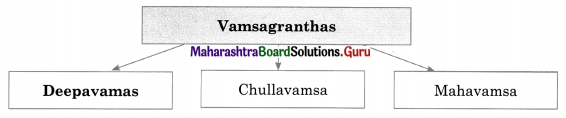
(a) Deepvamsa
(b) Mahavamsa
(c) Lalitvistar
(d) Chullavamsa
Answer:
(c) Lalitvistar

1B. Find the incorrect pair from set B and write the correct ones.

Question 1.

Set ‘A’Set ‘B’
(a) Sri LankaTambapanni
(b) ThailandMueng Thai
(c) CambodiaMalaydvipa
(d) Land of Southeast Asia‘Suvarnabhumi’

Answer:
(c) Cambodia – Kambujadesha

Question 2.

Set ‘A’Set ‘B’
(a) Shili FoshiSrivijaya
(b) RamakienRam Akhyana
(c) BuddhaDantdhatu
(d) MoonstoneChandrashala

Answer:
(d) Moonstone – Chandrashila

1C. Find the odd one out.

Question 1.
Indo-China, Vietnam, Laos, Sri Lanka
Answer:
Sri Lanka

Maharashtra Board Class 11 History Important Questions Chapter 13 India, Sri Lanka and Southeast Asia

Question 2.
Dambulla, Dulatthinagar, Yongan, Anuradhpur
Answer:
Yongan

Question 3.
Srivijaya, Loas, Majapahita, Shailendra
Answer:
Loas

Question 4.
Funan, Champa, Cambodia, Matram
Answer:
Matram

Question 5.
Shailendra, Indonesia, Thailand, Myanmar
Answer:
Shailendra

2A. Write the names of historical places, persons, and events.

Question 1.
Founder of the kingdom of Tambapanni
Answer:
King Vijaya

Question 2.
The first woman to become a Buddhist nun
Answer:
Anula

Question 3.
Earliest stupas at Mihinthale
Answer:
Kantakchetiya

Maharashtra Board Class 11 History Important Questions Chapter 13 India, Sri Lanka and Southeast Asia

Question 4.
Name of the stupa erected on the remains of Thera Mahinda
Answer:
Ambasthal Thupa

Question 5.
Noted Indian philosopher
Answer:
Buddhaghosha

Question 6.
The text was written by Buddhaghosha
Answer:
Vishuddhimagga

Question 7.
Temple of Dantdhatu in the city of Kandy
Answer:
Sri Dalad Maligava

Question 8.
Kingdom in the delta region of Mekong
Answer:
Funan

Question 9.
Ancient kingdom in the coastal region of Vietnam
Answer:
Champa

Question 10.
The ancient name of Cambodia
Answer:
Kambujadesha

Question 11.
Temple built by Suryavarman-II
Answer:
Angkor Wat

Maharashtra Board Class 11 History Important Questions Chapter 13 India, Sri Lanka and Southeast Asia

Question 12.
Name of the founder king of ‘Majapahita’
Answer:
Vijaya

2B. Choose the correct reason and complete the sentence.

Question 1.
The southern kingdom of China was not left with any alternative path to reach the Silk Route because ____________
(a) China was attacked by a foreign power
(b) China disintegrated into three parts
(c) they found a delta region
(d) the Silk Route was infested with robbers
Answer:
(c) they found a delta region

Question 2.
The Shailendra kings built many Buddhist temples and stupas because ____________
(a) they were followers of Buddhism
(b) they were lovers of Buddhist art
(c) they were Tolerant by nature
(d) they hailed from India
Answer:
(a) they were followers of Buddhism

3. Complete the concept maps.

Question 1.
Maharashtra Board Class 11 History Important Questions Chapter 13 India, Sri Lanka and Southeast Asia 3 Q1
Answer:
Maharashtra Board Class 11 History Important Questions Chapter 13 India, Sri Lanka and Southeast Asia 3 Q1.1

Question 2.
Maharashtra Board Class 11 History Important Questions Chapter 13 India, Sri Lanka and Southeast Asia 3 Q2
Answer:
Maharashtra Board Class 11 History Important Questions Chapter 13 India, Sri Lanka and Southeast Asia 3 Q2.1

Maharashtra Board Class 11 History Important Questions Chapter 13 India, Sri Lanka and Southeast Asia

Question 3.
Maharashtra Board Class 11 History Important Questions Chapter 13 India, Sri Lanka and Southeast Asia 3 Q3
Answer:
Maharashtra Board Class 11 History Important Questions Chapter 13 India, Sri Lanka and Southeast Asia 3 Q3.1

4. Explain the following statement with reasons.

Question 1.
The southern kingdom was not left with any alternative path to reach the Silk Route.
Answer:

  • When the rule of the Han dynasty ended, China disintegrated into three parts.
  • Because of this disintegration, China was not left with any alternative path to reach the Silk Route.
  • Hence, the kingdom of the Southern Kingdom sent some people to explore the Sea Route.

Question 2.
According to Buddhist philosophy, the universe exists at three planes.
Answer:
According to Buddhist philosophy, the universe exists at three planes:

  • Kamdhatu (Bondage in the form of desire)
  • Roopdhatu (Bondage in the form of physical appearance and appellations)
  • Aroopdhatu (State of being beyond any bondage).
  • The architectural design of Borobudur Stupa is based on the concept of these three planes.

5. State your opinion.

Question 1.
King Anawrahta the founder of the ‘Pagan empire’ is known as the greatest ruler.
Answer:

  • King Anawrahta is credited with the unification of north and south Myanmar.
  • This unification is said to have given Myanmar its national identity.
  • Anawrahta put a check to the increasing power of the Khmer empire of Cambodia.
  • During his reign, the ‘Theravada Buddhism’, which had grown weaker, was revived.

Maharashtra Board Class 11 History Important Questions Chapter 13 India, Sri Lanka and Southeast Asia

Question 2.
The contact of Indians with the various region in Southeast Asia was on the increase.
Answer:

  • The contact of Indians was on the increase because of trade during the 2nd-century B.C.E.
  • The merchants who had to travel for months together were naturally accompanied by a large retinue of priests, monks, also travelers who were out to test their luck, ambitious members of royal families, etc.
  • These were the people who proved instrumental in the spread of Indian culture in Southeast Asia.

Maharashtra Board Class 11 History Solutions Chapter 13 India, Sri Lanka and Southeast Asia

Balbharti Maharashtra State Board Class 11 History Solutions Chapter 13 India, Sri Lanka and Southeast Asia Textbook Exercise Questions and Answers.

Maharashtra State Board Class 11 History Solutions Chapter 13 India, Sri Lanka and Southeast Asia

1A. Choose the correct alternative to write the complete sentences.

Question 1.
Buddhaghosh was an Indian _____________ in Sri Lanka.
(a) Thinker
(b) Philosopher
(c) King
(d) Priest
Answer:
(b) Philosopher

Question 2.
The founder of Pagan empire was _____________
(a) Kyanzittha
(b) Anwrahta
(c) Ayuttha
(d) Jayavarman
Answer:
(b) Anwrahta

Maharashtra Board Class 11 History Solutions Chapter 13 India, Sri Lanka and Southeast Asia

Question 3.
The ancient name of Cambodia was _____________
(a) Kambuja Desh
(b) Laos
(c) Angkorwat
(d) Sumatra
Answer:
(a) Kambuja Desh

1B. Find the incorrect pair from set B and write the correct ones.

Question 1.

Set ‘A’Set ‘B’
(1) Finest example of stupa architecture in MyanmarShwedagon Pagoda
(2) Saivaite temples in the Champa kingdomMy Son
(3) The World famous temple in CambodiaAngkor wat
(4) The Centre of Angkor ThomDieng Temples

Answer:
(4) The centre of Angkorthom – Bayon Temple

1C. Write the names.

Question 1.
Son of Emperor Ashoka –
Answer:
Thera Mahinda

Question 2.
Ancient kingdom in Laos –
Answer:
Lao Sang

Question 3.
Kingdom of ‘Cham’ people –
Answer:
Champa

Maharashtra Board Class 11 History Solutions Chapter 13 India, Sri Lanka and Southeast Asia

Question 4.
Last king of Malayu –
Answer:
Eskandar Shah

2. Write short notes.

Question 1.
Chenla Kingdom
Answer:

  • The first kingdom, established in Cambodia was known by the name of ‘Chenla’.
  • The people who established Chenla were known as ‘Khmer’.
  • The influence of Indian culture in Cambodia dates back to the Chenla period.
  • The kingdom of Chenla was established by Jayavarman II. His capital’s name was ‘Hariharalaya’.
  • The kings of Chenla expanded their empire from Vietnam to Myanmar and to China in the north.
  • After King ‘Jayavarman VII’ the Khmer empire began to decline.

Question 2.
Vishnu temple at Angkorwat
Answer:

  • (i) The world-famous temple of ‘Angkorwat’ was built in Yashodharpura, the capital city built by Suryavarman II.
  • (ii) The temple area is about 500 acres, which is about 2 sq. km.
  • (iii) The main entrance is at the west and the temple is surrounded by a moat, which is 200 meters in depth.
  • (iv) Among the sculptural panels on the southeast walls of the temple the panel of ‘Samudramanthan’ is notable. Later, it was turned into a Buddhist temple.

Question 3.
Majapahit Kingdom
Answer:

  • In the 13th century C.E., in Eastern Java arose a kingdom known as ‘Majapahita’.
  • The name of the founder King of Majapahita was, Vijaya’.
  • He established his supremacy in some of the islands like Java, Bali and also some other islands and extended the kingdom of Java into an empire.

Maharashtra Board Class 11 History Solutions Chapter 13 India, Sri Lanka and Southeast Asia

Question 4.
Champa Kingdom
Answer:

  • ‘Champa’ was an ancient kingdom in the coastal region of Vietnam.
  • Champa was named after the ‘Cham’ tribe.
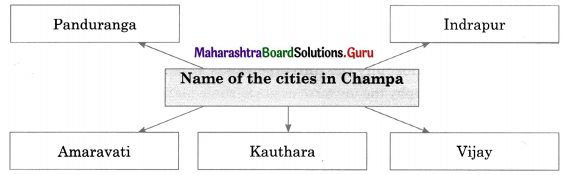
  • The names of the cities in Champa were ‘Indrapur’, ‘Amaravati’, ‘Vijay’, ‘Kauthara’, and ‘Panduranga’.
  • The city of Vijay was the capital of the Champa kingdom.
  • The inscriptions of Champa mention the names of its kings and queens and the temples of Hindu deities especially Shiva temples.

3. Answer the following questions in detail.

Question 1.
Explain the spread of Indian culture in Thailand.
Answer:

  • Thailand was referred to as ‘Mueng Thai’ by the ancient people. However, it was known as ‘ Siam’ in the world. In the 20th century, its name was changed to ‘Thailand’.
  • Thailand was ruled from the 6th century to the 11th century by the ‘Mon’ people. Indian culture was spread at this time.
  • The Indian traditions of sculpture, literature, ethics, judicial science, etc. had a great role in shaping up the Mon culture.
  • Dvaravati although smaller and weaker contributed greatly to the development of writing, arts, administration, religion, science, etc. in others kingdoms.
  • The remains of sculptures and architecture of the period have been found in Lop Buri (Lao Puri) and Ayuttha (Ayodhya).
  • The sculptures include Buddha images a few Shivalingas and images of Vishnu.
  • In the 14th century C.E, a new kingdom of Ayuttha was established in Thailand and the kings of Ayuttha bore names with the prefix ‘Ram’.
  • Thai Ramayana developed into an independent tradition. It is known as ‘Ramakien’ (Ram Akhyana).
  • The stories of ‘Ramakien’ have been preserved in all Thai art traditions including sculpture, folk music, dance, and theatre.

Question 2.
Write about the cultural interrelationship between India and Myanmar.
Answer:

  • ‘Myanmar’ is a neighbouring country of India. It was earlier known as ‘Brahmdesh’. In the 2nd century B.C.E. there were city-states known as ‘Pyu’ in the north and central regions of Myanmar.
  • Among the new ‘Pyu’ cities that came into existence at a later period were the cities of ‘Halin’ and ‘Shrikshetra’ were important.
  • Shrikshetra was the largest among the ‘Pyu’ cities. The founders of Shrikshetra belonged to the Shakya clan of Gautam Buddha.
  • The three Pyu cities of Halin, Beikthano, and Shrikshetra where archaeological excavations were conducted have brought into light many remains of buildings like stupas, cemeteries, and structures built for water management. The three sites have been declared as World Cultural Heritage sites.
  • The ‘Shwedagon’ pagoda built between the 6th-10th century C.E. at Yongan (Rangoon) is one of the finest examples of stupa architecture in Myanmar.
  • The ‘Shwedagon’ pagoda contains the hair of Gautama Buddha. This pagoda is covered with sheets of gold.
  • The ‘Anand Temple’ is another important monument built during the reign of Kyanzittha, the emperor of Pagan in the 11th century C.E. It is the finest example of the combined architectural style of India and Pagan.

Maharashtra Board Class 11 History Solutions Chapter 13 India, Sri Lanka and Southeast Asia

Activity

Find out the names of World Cultural Heritage in this lesson. Prepare a chart by using the following points: Name of the heritage, place, and country.
Answer:

Name of the HeritagePlaceCountry
1. Sri Dalad MaligavaKandySri Lanka
2. Dambulla CavesDambullaSri Lanka
3. Angkorwat, AngkorthomSiem ReapCambodia
4. Borobudur StupaJavaIndonesia
5. Prambanan TemplesYogyakartaIndonesia


Maharashtra Board Class 11 History Important Questions Chapter 12 India, Nations in the Northwest of the Indian Subcontinent and China

Balbharti Maharashtra State Board Class 11 History Important Questions Chapter 12 India, Nations in the Northwest of the Indian Subcontinent and China Important Questions and Answers.

Maharashtra State Board 11th History Important Questions Chapter 12 India, Nations in the Northwest of the Indian Subcontinent and China

1A. Choose the correct alternative and write the complete sentences.

Question 1.
___________ a port city is mentioned in the ‘Old Testament’.
(a) Ophir
(b) Lothal
(c) Meluhha
(d) Bet Dwaraka
Answer:
(a) Ophir

Question 2.
___________ trained by sailors to reach the coast safely were called ‘Dishakak’.
(a) Sparrows
(b) Crows
(c) Kingfishers
(d) Pigeons
Answer:
(b) Crows

Maharashtra Board Class 11 History Important Questions Chapter 12 India, Nations in the Northwest of the Indian Subcontinent and China

Question 3.
___________ is identified with Babylon.
(a) Nangarhar
(b) Gandhara
(c) Kandahar
(d) Baveru
Answer:
(d) Baveru

1B. Find the incorrect pair from set B and write the correct ones.

Question 1.

Set ‘A’Set ‘B’
(a) GeographiaStrabo
(b) Naturalis HistoriaYavana
(c) GeographiaClaudius Ptolemy
(d) IndicaArrian

Answer:
(b) Naturalis Historia – Pliny the Elder

Question 2.

Set ‘A’Set ‘B’
(a) PurushspurPeshawar
(b) Ancient KapishaBegram
(c) BhokardanBhogvardhan
(d) TheravadaKansu

Answer:
(d) Theravada – Hinayana

1C. Find the odd one out.

Question 1.
Spread of Indian culture:
(a) Afghanistan
(b) China
(c) Rome
(d) Japan
Answer:
(c) Rome

Question 2.
Indian trade with distant lands:
(a) Kathasaritsagara
(b) Bhokarda
(c) Deepvamsa
(d) Mahavamsa
Answer:
(b) Bhokarda

Maharashtra Board Class 11 History Important Questions Chapter 12 India, Nations in the Northwest of the Indian Subcontinent and China

Question 3.
Greek Literature:
(a) Geographia
(b) Naturalis Historia
(c) Indica
(d) Periplus of Erythrean Sea
Answer:
(d) Periplus of Erythrean Sea

Question 4.
Trading centers in Jalana district:
(a) Paithan
(b) Ter
(c) Gandhara
(d) Bhokardan
Answer:
(c) Gandhara

2. Write the names of historical places, persons, and events.

Question 1.
Port city is mentioned in the ‘Old Testament’ (Bible).
Answer:
Ophir

Question 2.
The Latin name of Periplus of the Erythrean Sea.
Answer:
Periplus Maris Erythraei

Question 3.
Greek mathematician geographer, author of Geographia.
Answer:
Claudius Ptolemy

Question 4.
Famous statues of Buddha away from Kabul.
Answer:
Bamiyan statues

Question 5.
The route that links Asia and Europe.
Answer:
Silk Route

Maharashtra Board Class 11 History Important Questions Chapter 12 India, Nations in the Northwest of the Indian Subcontinent and China

Question 6.
First Buddhist temple built in China
Answer:
White Horse Temple

Question 7.
Caves are located on the ancient Silk Route.
Answer:
Mogao Caves

Question 8.
The grandson of Genghis Khan had a great interest in Buddhism.
Answer:
Kubalai

3. Complete the concept maps.

Question 1.
Maharashtra Board Class 11 History Important Questions Chapter 12 India, Nations in the Northwest of the Indian Subcontinent and China 3 Q1
Answer:
Maharashtra Board Class 11 History Important Questions Chapter 12 India, Nations in the Northwest of the Indian Subcontinent and China 3 Q1.1

Question 2.
Maharashtra Board Class 11 History Important Questions Chapter 12 India, Nations in the Northwest of the Indian Subcontinent and China 3 Q2
Answer:
Maharashtra Board Class 11 History Important Questions Chapter 12 India, Nations in the Northwest of the Indian Subcontinent and China 3 Q2.1

Maharashtra Board Class 11 History Important Questions Chapter 12 India, Nations in the Northwest of the Indian Subcontinent and China

4. State your opinion.

Question 1.
The spread of Buddhism in China introduced a new trend in Chinese art.
Answer:

  • Many of the Buddhism monks who arrived in China hailed from central Asia.
  • Their presence in China inspired the making of images of Gautama Buddha and Bodhisattvas.
  • This art style that originated in the Xinjiang province is known as ‘Serendian Art Style’ (Seres meaning China + India)

5. Answer the following questions in detail.

Question 1.
Write a note on India’s relations with Afghanistan during Emperor Ashoka’s period.
Answer:

  • Emperor Ashoka’s period 13th edict is the names of Greek kings, who were his contemporaries.
  • People in their kingdoms were following the path of morality as outlined in his message of Dhammavijaya. Among these kingdoms was the kingdom of Kamboja in Afghanistan.
  • The Ashokan edict at Kandahar is in Greek language and the script used for it is Aramaic.
  • This inscription shows that Afghanistan was an integral part of Ashoka’s empire.
  • Ashoka had sent ‘Thera Mahyantika’ (Majjhantika) to Kashmir and Afghanistan and ‘Thera Maharakkhita’ to the Greek (Yona) kingdoms, for spreading the teachings of Gautama Buddha.

Question 2.
Write in detail about Kushana Period.
Answer:

  • In the Kushana period, Buddhism reached China by this trade route. Some of the coins of emperor Kanishka carry the image of Gautama Buddha. It also has a legend that reads, ‘Boddo’.
  • This is the oldest representation of Gautama Buddha in an image form on a coin.
  • The Chinese monks like Fa-Hien, Yuan Chwang, who travelled through India have described the Buddhist viharas and stupas in India.
  • There are numerous remains of viharas and stupas in Afghanistan.
  • Among them, a place called ‘Shahji-ki-Dheri’ near Peshawar in Pakistan was excavated.
  • The importance of the stupa discovered at this place is underlined by the fact that it was built during Kanishka’s period.

6. Answers the following questions with the help of given points.

Question 1.
Write about the relations between India and Rome.
(a) Literature (Source of Information)
(b) Trade relations
Answer:
(a) Literature (Source of Information):

  • A Sailor’s handbook of his sea travels is known as ‘Periplus of Erythrean Sea’ (Latin name: Periplus Maris Erythraei).
  • The ancient cities like Bharuch, Sopara, Kalyan, etc., are mentioned in this periplus.
  • There are other texts ‘Geographia’ written by the Greek mathematician-geographer Claudius Ptolemy, Tndica’

Maharashtra Board Class 11 History Important Questions Chapter 12 India, Nations in the Northwest of the Indian Subcontinent and China

(b) Trade relations:

  • The Indo-Roman trade had begun to grow. The silk route and the ports on the south and west coasts of India played a vital role in this trade.
  • The records of the Greek historians mention a group of merchants, who paid a visit to the court of the Roman Emperor Augustus.
  • The coin hoards found in Tamil Nadu had Roman gold coins in them, but they were valued for their gold.
  • Nero, the Roman emperor had paid one million gold coins for a single chalice of emerald of Indian made.
  • Pliny the elder had expressed concern about that the drain of gold from Rome into India.
  • Strabo tells us that animals such as snakes, hunting dogs, tigers, elephants, birds like parrots and peacocks, things like hides and horns of rhinoceros, expensive textiles, pearls, ivory, and spices, etc. from India were in great demand.
  • Apart from the Roman gold coins, many other things like lead, zinc, corals, wines, olive oil were the Roman imports coming to India.
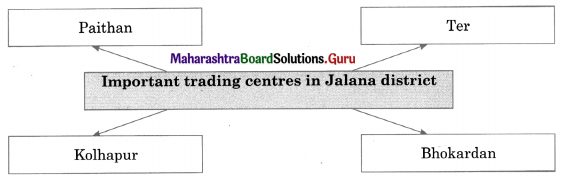
  • Cities like Paithan, Ter, Kolhapur, Bhokardan in the Jalana district were important trading centers.

Maharashtra Board Class 12 English Yuvakbharati Solutions Chapter 3.5 Drafting a Virtual Message

Balbharti Yuvakbharati English 12th Digest Chapter 3.5 Drafting a Virtual Message Notes, Textbook Exercise Important Questions and Answers.

Maharashtra State Board Class 12 English Yuvakbharati Solutions Chapter 3.5 Drafting a Virtual Message

12th English Digest Chapter 3.5 Drafting a Virtual Message Textbook Questions and Answers

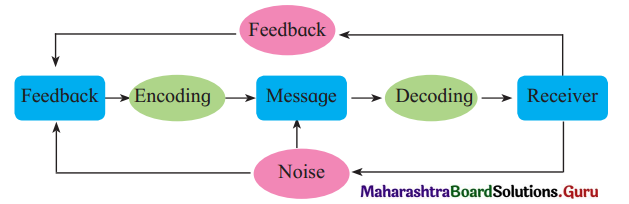
(i) Given below is a two-way communication cycle or the process of communication.

(a) Can you guess the role of the sender and the receiver in this process? What do we encode? What do we decode?

Question 1.
Can you guess the role of the sender and the receiver in this process?
Maharashtra Board Class 12 English Yuvakbharati Solutions Chapter 3.5 Drafting a Virtual Message 1
Answer:
The role of the sender is to transcribe what he/she wants to convey to the receiver in a message. The role of the receiver is to interpret the conveyed message and to grasp its meaning. As messages use commonly accepted components like words, symbols and signs, the receiver generally finds no difficulty in interpreting them. However, the sender must be careful to create a clear message so as to avoid any kind of misinterpretation or misreading.

Maharashtra Board Class 12 English Yuvakbharati Solutions Chapter 3.5 Drafting a Virtual Message

Question 2.
What do we encode?
Answer:
We encode what we want to convey to the I receiver in the form of an unambiguous (clear in meaning) message.

Question 3.
What do we decode?
Answer:
We decode from the message the idea that it conveys by way of interpreting it. A clear message is easy to interpret.

Question (b)
People send messages to others for different purposes. Mention at least five purposes/reasons for which messages are generally sent.
Answer:
1. To inform the receiver about the facts, events, etc.
2. To express feelings like sympathy, solidarity etc.

Maharashtra Board Class 12 English Yuvakbharati Solutions Chapter 3.5 Drafting a Virtual Message

Question (ii)
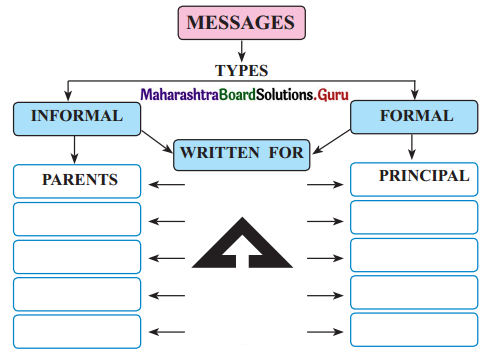
Given below is a tree-diagram explaining two major types of messages. Complete the blank boxes in the diagram. One is done for you.
Answer:
Maharashtra Board Class 12 English Yuvakbharati Solutions Chapter 3.5 Drafting a Virtual Message 2

(A1)

Question (i)
In pairs, enact the given conversation between Rakesh and Mrs Sarkar.
Answer:

  • Rakesh: Hello, may I speak to Dr Sarkar?
  • Mrs. Sarkar: He has gone to the hospital to attend the OPD. May I know who is speaking? ‘
  • Rakesh: Yes, I am Rakesh Sood. My wife has been having a severe headache since yesterday. Since this morning she has also developed a high temperature. I would be very grateful if the doctor could come over to our place to examine her.
  • Mrs. Sarkar: Of course. Please let me note down your address.
  • Rakesh: It is B-49, New Colony.
  • Mrs. Sarkar: I will give him your message as soon as he returns.
  • Rakesh: Thank you.

Maharashtra Board Class 12 English Yuvakbharati Solutions Chapter 3.5 Drafting a Virtual Message

Question (ii)
Mrs Sarkar had to leave for the school where she teaches. So she wrote a message for her husband. Draft the message in not more than 50 words.
(Students can enact the conversation in class.)
Answer:
22/06 – 9 am
Sumit

One Rakesh Sood staying at B-49, New Colony rang up this morning to say his wife has not been keeping well. She had headache yesterday and has been running a high temperature since this morning. He wanted you to go over their place and attend her at the earliest.

Sunita

Question (iii)
Using information from the dialogue given below, write the message which Amrita left for her brother, Sourajit. (Do not leave out any vital information or add any new information).
Answer:

  • Shekhar: Is this 28473892?
  • Amrita: Yes, May I know who is speaking?
  • Shekhar: I am Shekhar, I want to speak to Sourajit. I am his friend from IHM, Goa.
  • Amrita: I am his sister. Sourajit is not at home at the moment. Can you ring up a little later?
  • Shekhar: I shall be a little busy. Actually, I have got a placement at the Hotel Mumbai, and will have to join with immediate effect.

So right now I am trying to get all the formalities completed. This is the news that I wanted to give Sourajit. Will you do that for me? Also tell him that I will let him know my new cell phone number as soon as I get one.
Amrita: I’ll do that. Bye and all the best. Amrita had to leave for office. So she wrote a note for Sourajit. Draft her message in not more than 50 words.

Maharashtra Board Class 12 English Yuvakbharati Solutions Chapter 3.5 Drafting a Virtual Message

Question (iv)
You are Priyanka, a personal assistant to Ms Sen. She was away attending a meeting when Mr Garg rang up. You spoke to him and jotted down his message in your notepad.
Draft the message for Ms Sen using the information in your notes given below.
Mr Garg – rang up – 5 pm – has received the CDs and the posters – coming tomorrow – to thank Ms Sen and to personally hand over the cheque.
Answer:
5.15 pm [30th Sept.]
Madam,

Mr. Garg rang up at five in the evening while you were away attending the meeting. He said he had received the CDs and posters and would come tomorrow to express his thanks to you. He said he would also hand over the cheque to you personally.

Priyanka
(P.A)

Question (v)
Read the following conversation between Aashna and Mr. Singh.
Answer:
Aashna: Hello, may I speak to Ranajit, please?
I would like to see the notes which our biology teacher gave to the class during my absence.
Mr Singh: I will definitely do that.

Question (vi)
Since Mr Singh had to go for his morning walk he left a message for Ranajit. Draft that message in 50 words.
Answer:
Raj at comes home from school and finds the door locked. Since he has a duplicate key he enters and finds a note from his mother kept on the table. In it she explains that she had to rush to the hospital with Mrs Manohar, their neighbour, who had met with an accident. She has also written that he should have the rice and curry kept on the dining table for lunch. He could heat the food in the microwave oven if he wanted to, but he should be very careful while handling the switch.

Maharashtra Board Class 12 English Yuvakbharati Solutions Chapter 3.5 Drafting a Virtual Message

Question (vii)
Using the information given below, write biology notebook to school today. I was absent from school due to illness. a message which Manu left for his sister. Renu. (Do not add any new information.

The message should not exceed 50 words). Ruhaan rang up – book – reading session – ‘Children Ask Kalam’ – Dr A.P.J. Abdul Kalam – compilation of letters received by him from children and his answers – Oxford Book Store – 8 pm, this evening, – pick you up – 6:30 pm attend reading session together.
Answer:
28th Nov. 2 pm
Renu

Ruhaan rang up to say that there is a book reading session at Oxford Book Store this evening at 8 o’clock. The book is “Children Ask Kalam” – a compilation of letters received by Dr. Kalam and his answers. I will pick you up at 6:30 pm sharp. We will attend it together.

Manu

Question (viii)
Given below is a template tor a message. Imagine you are working as a receptionist in a company and you are supposed to maintain the call record.
Complete the details given in the template for a particular message
Maharashtra Board Class 12 English Yuvakbharati Solutions Chapter 3.5 Drafting a Virtual Message 3
Answer:
Maharashtra Board Class 12 English Yuvakbharati Solutions Chapter 3.5 Drafting a Virtual Message 4

Maharashtra Board Class 12 English Yuvakbharati Solutions Chapter 3.5 Drafting a Virtual Message

Explore:

(a) Browse the net and prepare a tabular column to explain the ‘Dos and Don’ts’ while drafting messages.
(b) Browse the net to find innovative ‘Message Templates’.
(c) Prepare a collection of short messages that are usually drafted and exchanged within the family members to keep them well informed and updated in case of different situations.
(d) Prepare a project titled, ‘The Importance of Messages in Everyday Life’.
(Students may attempt the above on their own.)

Maharashtra Board Class 12 English Yuvakbharati Solutions Chapter 3.4 Statement of Purpose

Balbharti Yuvakbharati English 12th Digest Chapter 3.4 Statement of Purpose Notes, Textbook Exercise Important Questions and Answers.

Maharashtra State Board Class 12 English Yuvakbharati Solutions Chapter 3.4 Statement of Purpose

12th English Digest Chapter 3.4 Statement of Purpose Textbook Questions and Answers

Question 1.
Match the professions with the desired qualities: (The answers are given directly.)
Answer:

  1. Businessman – c. convincing, selling, risk-taking
  2. Artist – d. imaginative, creative, thinking out of
  3. Advocate – e. logical reasoning, oratory, critical thinking.
  4. Police – b. alert, investigative, love for physical activity
  5. Scientist – a. reading, experimenting, researching

Maharashtra Board Class 12 English Yuvakbharati Solutions Chapter 3.4 Statement of Purpose

Question 2.
What is your career goal?
Answer:
My career goal is to be an astronaut.

Question 3.
Which of your qualities would help you in achieving your career goal?
Maharashtra Board Class 12 English Yuvakbharati Solutions Chapter 3.4 Statement of Purpose 1
Answer:
Maharashtra Board Class 12 English Yuvakbharati Solutions Chapter 3.4 Statement of Purpose 2

Question 4.
List the obstacles which might hamper in achieving your goals in life. One is done for you.
Answer:

  1. Lack of proper guidance.
  2. Opposition from family for choosing a strange career.
  3. Lack of knowledge about the career prospects.
  4. Lack of training centres in our country at present.

Maharashtra Board Class 12 English Yuvakbharati Solutions Chapter 3.4 Statement of Purpose

(A1)

Question 1.
Discuss and exchange your views with your partner about your career plan
Answer:

  • My Partner: I think I should now think of a definite career plan. Have you ever thought of a career plan?
  • Myself: Of course! I have a definite plan and I am quite focused on it.
  • My Partner: Would you mind sharing your goals with me?
  • Myself: Why not? You are my friend and you have every right to know it.
  • Myself: I want to be a doctor. It is not that primary school ambition when every one wants to be an engineer or a doctor.
  • My Partner: I wanted to be an airline pilot during those days.
  • Myself: There could be many like you. Those were just fleeting fancies. You just can’t call them career goals.
  • My Partner: Do you think your plan is real and practical?
  • Myself: Surely I do! That’s why I call it my career plan. My whole focus is on it. I work hard to achieve my goal.
  • My Partner: There are many doctors around and I don’t find any particular charm to be one among those ‘white coats’.
  • Myself: Oh, yes! You are free to have your opinions, but whatever I do will have my personal stamp on it. I am unique and I am going to be a unique doctor.
  • My Partner: Is that something like going to the villages barefoot?
  • Myself: Could be that. Perhaps much more than that. You will see it yourself sometime in the future. I am quite steadfast in my resolve.
  • My Partner: Okay, okay. I wish you all the best. I wish I had your will to win.

Maharashtra Board Class 12 English Yuvakbharati Solutions Chapter 3.4 Statement of Purpose

(A2)

Question 1.
You must have decided your aim in life. Which institute/university would you like to join for your diploma/ graduation. Write a Statement of Purpose as a part of your application to the institute/university.
Answer:
I would like to graduate in history from Birkbeck College under the University of London. Given below is my Statement of Purpose attached as part of my application.

Statement of Purpose:

For me, history was just a list of monarchs, a catalogue of wars and a chronicle of dynasties. All this changed when I reached the VUIth standard. I was, then, fortunate to study history under a dynamic teacher. He changed my perspectives. I realized that there is social history and economic history. There is history of science and ideas. The tipping point came when my teacher introduced me to the Bhakti Movement.

I realized that I belong to the land of Saints – Maharashtra. The lives of saints fascinated me. I delved deep into books to know more about their work and time. I read about Sant Namdeo, Sant Dynaneshwar, Sant Eknath, Sant Tukaram and Ramdas Swami. What I gained, of course, was very precious. My fascination with the subject grew by each passing day.

My aim in seeking admission to your college is that you have a very good department in South Asian History. I know that the late eminent historian Eric Hobsbawm taught in your college throughout his career. Likewise, the famous R. J. Evans and Roy Foster were once members among your faculty. So I am hopeful that I would get a chance to learn under world class teachers once I get into your esteemed institution.

My broad plan is to have a sound grounding in the medieval socio-economic history of India during my graduation years and then move on to the Bhakti Movement during my post-graduate studies. Doctoral and post-doctoral research would be focused on the life and work of a single saint.

I am an avid reader. I hope my exposure to saint literature in Marathi would stand me in good stead. I am a state-level chess player. Chess, as per the game theory, is a full information game. Your opponent see on the board as much as you see. However, the patient search for possibilities pay the dividend. The player processes the various permutations and combinations and finally makes that unique move – the winning move! I am sure that I have it in me.

I worked as an amateur research assistant to Dr. Pendse while he was working on his monumental work on the Bhakti Movement. I also have a diploma in “Indexing Books in Humanities”. I earnestly hope that an exposure to the excellent academic atmosphere prevailing in your prestigious institution would bring forth the best in me and thus allow me to contribute my mite to the rich cultural heritage of my land!

Maharashtra Board Class 12 English Yuvakbharati Solutions Chapter 3.4 Statement of Purpose

(A3)

Question 1.
Enrich your vocabulary.
Match the job terms with their meanings.
Maharashtra Board Class 12 English Yuvakbharati Solutions Chapter 3.4 Statement of Purpose 3
Answer:

  1. to be your own boss – (g) to have your own business
  2. a dead-end job – (f) a job with no promotional opportunities
  3. a good team player – (j) someone who can work well with other people
  4. a heavy workload – (h) to have a lot of work to do
  5. a high-powered job – (b) an important/ powerful job
  6. job satisfaction – (i) enjoying your job
  7. manual work – (a) work that requires physical activity
  8. to be stuck in a rut – (e) to be in a boring job that is hard to leave
  9. to be stuck behind a desk – (c) to be unhappy in an office job
  10. a nine-to-five job – (d) a normal job having a duty of 8 hours

(A4)

Question 1.
Read the dialogue given below and fill in the blanks with the appropriate job terms given above.
(The answer parts are underlined.)
Answer:
Varsha: Vivek, what kind of a job are you looking for?
Vivek: Varsha, I want to be my own boss. I don’t like a nine-to-five job. My present job is not challenging. I am stuck behind a desk. I am not afraid of a heavy workload and I am a good team player. Moreover, this is a dead-end job. I am looking for an opportunity to try new winds.

Maharashtra Board Class 12 English Yuvakbharati Solutions Chapter 3.4 Statement of Purpose

A5. Read the personal details given below and prepare a suitable Statement of Purpose:

Question (i)
University of Bath, UK is one of the leading Universities for Business Studies. You belong to a business family – wish to start your own business, carry forward your family business in future. In your junior college you have opted for commerce, scored well in your Std. X Board examination – You made profit in the stall you had put up in the business fair organized by your school/ college. Your hobbies are playing cricket/ hockey – you get along well with people.
Answer:
I belong to a family which had a long tradition in business. My father is a third generation businessman. I grew up meeting relatives who are in some business or the other. Naturally, I have never thought of any pursuit other than business.

My family business is doing quite well but the world of business is changing rapidly. To keep up with the changing times, I must keep abreast of the new developments in the world of business. Hence I aspire for a degree in business studies from an institution of high standing as yours.

I did exceedingly well in my Standard X Board Examination scoring impressive marks in Maths and English. For the junior college I opted commerce as my main stream. Accountancy is my favourite area of study. I feel quite comfortable with the subject because balance sheet analysis, stocks, trade, tariff, etc. have always been the words in currency during any of the family gatherings.

A cool head on his shoulders is a must for a businessman. With an agitated mind you can’t ever take the right decisions. I am cool by nature. I assess the pros and cons with a dispassionate mind. No wonder that I was always made the captain of our cricket team. Cricket being a mind game as well, one needs to make quick and effective decisions. Moreover, one needs to make one’s team mates believe that the decision is theirs! There lies the magic of a team player and leader and so far I have been a great hit at it.

As they say, the proof of the pudding is in the eating. Just thinking that I am endowed with great business acumen would remain a mere boast until I prove it with an example. Luckily I had a great chance coming my way during the business fair organized by our college.

What I proposed was a stall selling helmets. The principal flatly rejected the idea saying that in a college where most of the students are under-18 and are not eligible for a driving licence, it was preposterous to come out with such a bizarre idea. I persisted and somehow got the permission. It was a three-day fair.

On the first day, just as I had expected, many students told me that their siblings and parents do have helmets at home – but they don’t wear it. This was the tipping point. I asked them to bring those unworn helmets the next day. I would compensate for the old ones – they need to pay only the difference for the new ones. (I had already made a tie-up with a second-hand helmet dealer. I offered an environment-friendly bag as well to each prospective buyer.)

Students, especially girls, warmed towards the idea greatly. Being a gift, their brothers or parents just won’t be able to neglect the helmets. The magic word here was ‘gift’; and the sentimental aura surrounding the gesture. The venture clicked. I made a handsome profit. The satisfaction of being instrumental in saving many lives was a bonus.

I know for sure that the case narrated above is not a path-breaking event. But for me, it was an eye-opener. I realized that business is mainly a game based on human psychology. Reading a bit of behavioural economics taught me that not all economic demands stem from rational thought.

Yes, your prestigious institution can offer me what I seek. I seek something more than a degree in business studies. Your esteemed faculty, I hope, will provide me the right exposure I need. I look forward to novel ventures. I want to tread on an unbeaten path. For me, business is not just about making money. It is the thrill of living every moment in the exhilaration of weighing choices and making decisions. For that I need to learn new things. For that I need to get into an institution like yours.

Maharashtra Board Class 12 English Yuvakbharati Solutions Chapter 3.4 Statement of Purpose

Question (ii)
You are an avid animal lover. You have a pet dog and some lovebirds at home. You are extremely fond of them. You have been a member of bird watcher’s club. You have loved going on a safari. You have taken care of orphan animals, or animals who are hurt. In school you loved Biology. You wish to make a career in this field. The University of Cambridge offers an excellent course/ programme which would boost your career. Make a Statement of Purpose which will help you to get admission to this University.
Answer:
Statement of Purpose

I was captivated by the world of animals much early in my life. There are of course, many people around who love animals; but I doubt whether they share the same intensity which I have. I love animals of all softs. I care for animals big and small. I equally love the ones who fly and the ones who crawl.

My parents have been quite supportive of my passion. My collection of lovebirds and the pet dog which I have now are their gifts. I observe my pets and all other animals around me with undiminishing curiosity. Their behaviour fascinates me: Though ‘biology’ has been my favourite subject all along, I never knew that there are courses catering to my specific need. So your biology graduation course with focus on animal behaviour is “the one” I sought after.

I very well know that observation and study of animals demand infinite patience. Many senior members of our “Bird watchers’ club’ usually appreciate my great patience. I also have an eye for detail. Each time I go for a safari, I notice something new. Each time there seems to be a revelation of sort.

If I say I care for my pets that would be just stating the obvious. My love for animals goes beyond boundaries. Any animal suffering or struggling anywhere is my concern. There have been umpteen cases where I took care of and tended orphaned animals; but each case was unique and every one of them is etched in my memory in its vivid detail.

Though my interaction with animals has a long record, my theoretical studies about animals are not much to boast of. I have read the works of Nikolaas Tinbergin, Konrad Lorenz. Karl Von Frich and Ivan Pavlov – all pioneers in the field of animal behaviour. Nevertheless, I know that a lot has been happening of late. Moreover, I wish to learn the discipline in an organized way. And your esteemed institution is “the place” for it. I am hopeful that I will be able to contribute something significant to the field I love most.

Maharashtra Board Class 12 English Yuvakbharati Solutions Chapter 3.4 Statement of Purpose

(A6)

Question 1.
Browse different websites and find out the universities offering best courses in life Sciences, Arts, Sports, Music, Engineering and medicine. Collect and share any other additional information related to the course which seems important.
(Students may attempt this on their own.)