Maharashtra Board Class 12 English Yuvakbharati Solutions Chapter 3.3 Note-Making

Balbharti Yuvakbharati English 12th Digest Chapter 3.3 Note-Making Notes, Textbook Exercise Important Questions and Answers.

Maharashtra State Board Class 12 English Yuvakbharati Solutions Chapter 3.3 Note-Making

12th English Digest Chapter 3.3 Note-Making Textbook Questions and Answers

Question 1.
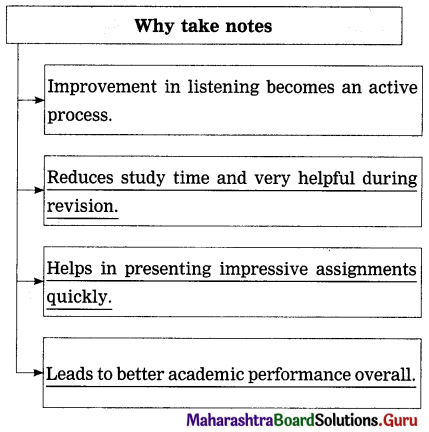
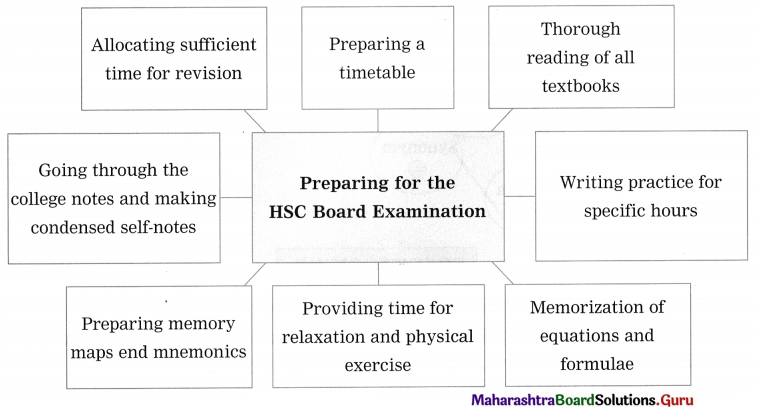
Complete the web.
Maharashtra Board Class 12 English Yuvakbharati Solutions Chapter 3.3 Note-Making 1
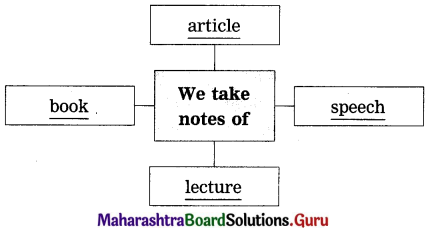
Answer:
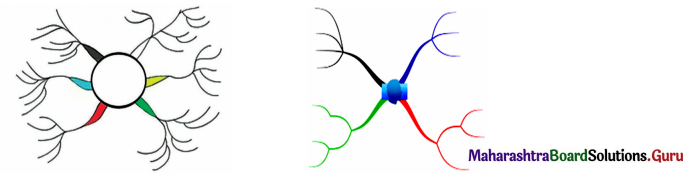
Maharashtra Board Class 12 English Yuvakbharati Solutions Chapter 3.3 Note-Making 2

Maharashtra Board Class 12 English Yuvakbharati Solutions Chapter 3.3 Note-Making

Question 2.
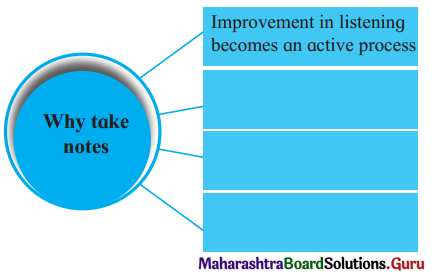
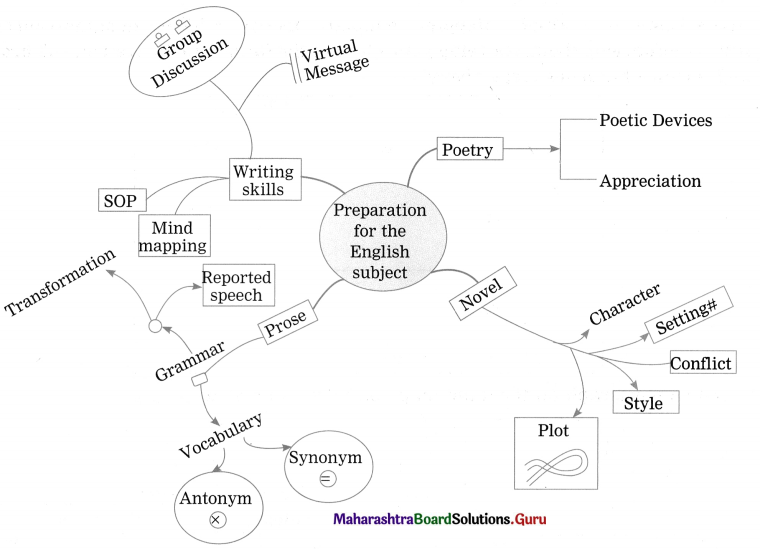
Discuss in groups why you take notes.
Maharashtra Board Class 12 English Yuvakbharati Solutions Chapter 3.3 Note-Making 3
Answer:
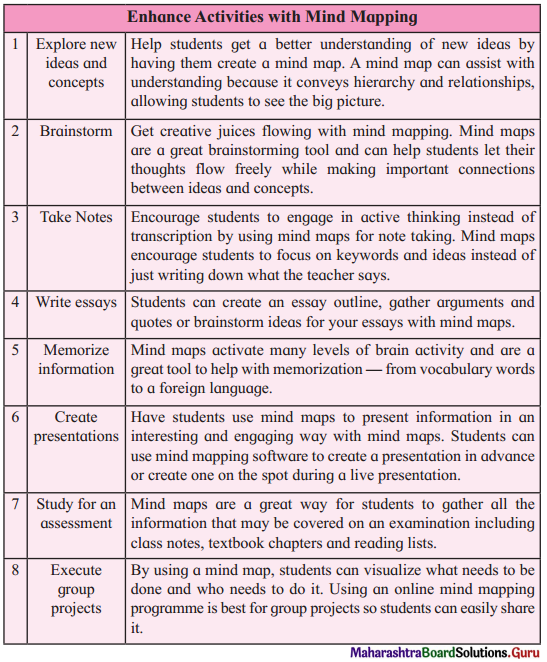
Maharashtra Board Class 12 English Yuvakbharati Solutions Chapter 3.3 Note-Making 4

Better notes will help you remember concepts, develop meaningful learning skills and gain better understanding of a topic. Discuss in groups different styles or methods you use in your note-making/taking. For example, to underlining iportant facts.
(We have given here a few of the methods employed in Note-making/Note-taking in blank formats. Students may experiment and find out the most useful method/ methods on their own. The selection of method largely depends upon the personal trait, taste and talent of j each individual student.)

Question 3.
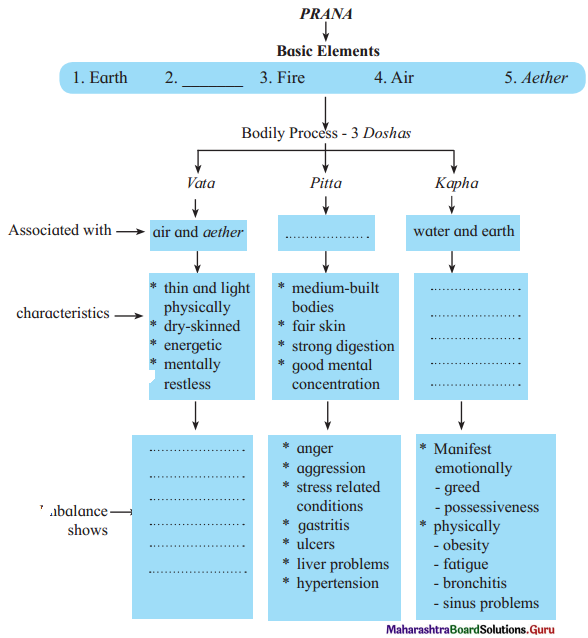
Now let’s complete the following diagram that represents Prana and its elements: (The answers are given directly. For the relevant article, refer to page 149 of the textbook.)
Maharashtra Board Class 12 English Yuvakbharati Solutions Chapter 3.3 Note-Making 5
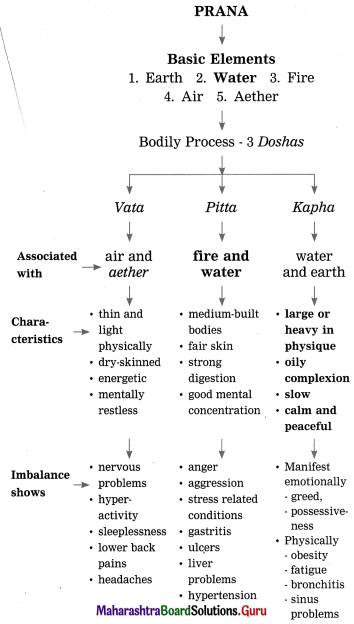
Answer:
Maharashtra Board Class 12 English Yuvakbharati Solutions Chapter 3.3 Note-Making 6

Example: Transfer the above information in the form of a table:
(Answers are given directly and underlined)
Bodily process

DoshasAssociated withCharacteristicsImbalance causes
Vataair and aetherenergeticnervous
Pittafire and waterstrong digestionaggression
Kaphawater and earthslowgreed

Maharashtra Board Class 12 English Yuvakbharati Solutions Chapter 3.3 Note-Making

(A1)

Question 1.
Read the following passage carefully and complete the activities.

(A2)

Question 1.
Read the passage given on page 151 of the textbook and complete the following points with the help of the above text. (Give a suitable title.)
The Perils of self-medication
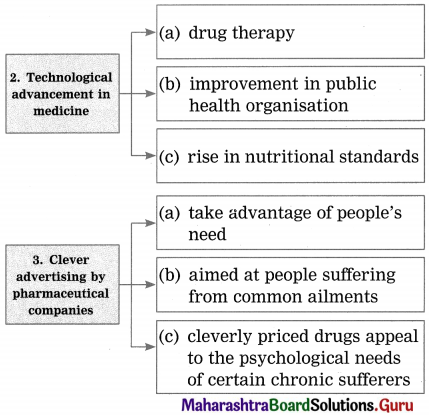
Answer:
Maharashtra Board Class 12 English Yuvakbharati Solutions Chapter 3.3 Note-Making 7
Maharashtra Board Class 12 English Yuvakbharati Solutions Chapter 3.3 Note-Making 8

Yuvakbharati English 12th Digest Chapter 3.3 Note-Making Additional Important Questions and Answers

Question 1.
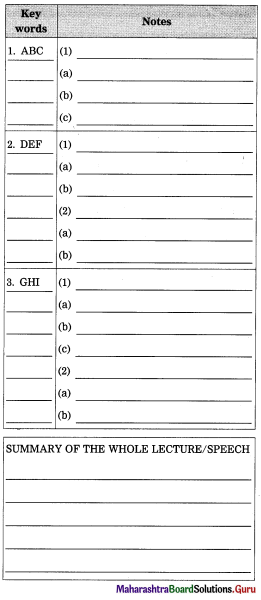
Cornell Two-column notes
Answer:
(Blank format)
Maharashtra Board Class 12 English Yuvakbharati Solutions Chapter 3.3 Note-Making 9

Maharashtra Board Class 12 English Yuvakbharati Solutions Chapter 3.3 Note-Making

Outlining method:

Question 1.
In Outlining method, you put the main idea/topic closest to the left side of your page as headers. Then use indentations (i.e. to leave space as if you begin a new paragraph and moving to the right each time) to arrange the related points one after the other.

Blank format:
Keyword:
• This is the main division.
• This is a sub-division.
• This is a supporting fact.
Keyword :
• This is the main topic.
• This is a sub-topic.
• This is an argument in support.

Box and Bullet method:

In this, a box is drawn for every main idea. Under each box are supporting points written against bullet points.
Blank format:
Title:
Author:
Central idea -1
______________
______________
______________

Central idea – 2
______________
______________
______________

Question 2.
Table:
Answer:

TermMeaningAdditional information
Tax avoidanceArranging one’s financial affairs to reduce taxIt is legal.
Tax evasionFiling false returns or failing to file returnsIt is illegal. It is a punishable offence.
Taxable incomePart of income that is liable to tax.Can be reduced by allowing deductions.
Tax assessmentDetermination of the amount of taxTax payers file returns.

Maharashtra Board Class 12 English Yuvakbharati Solutions Chapter 3.3 Note-Making

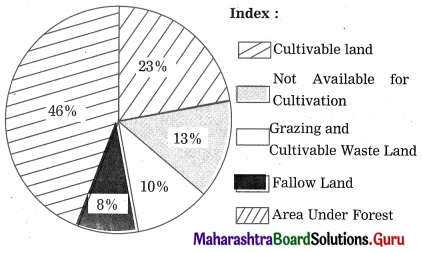
Pie Chart:

Question 1.
Pie Chart showing the land use in India.
Answer:
Maharashtra Board Class 12 English Yuvakbharati Solutions Chapter 3.3 Note-Making 10

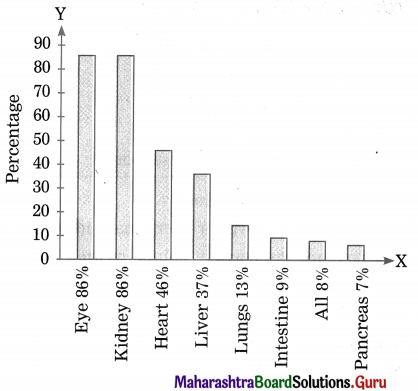
Bar Graph:

Question 1.
Bar Graph showing the Organ Donation Pattern in India (By a Study Group)
Answer:
Maharashtra Board Class 12 English Yuvakbharati Solutions Chapter 3.3 Note-Making 11

Maharashtra Board Class 12 English Yuvakbharati Solutions Chapter 3.3 Note-Making

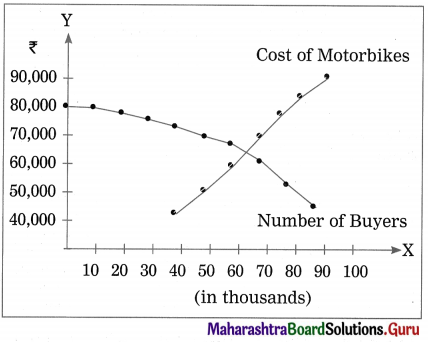
Line Graph:

Question 1.
Line Graph showing the price of motorbikes and the corresponding sales
Answer:
Maharashtra Board Class 12 English Yuvakbharati Solutions Chapter 3.3 Note-Making 12

Conclusion:

Organizing the notes is an essential component of Note-making or Note-taking. Students must remember that the ‘notes’ are for further use. If you fail to make any sense of your ‘notes’ later, the very purpose of Note-taking and Note-making is defeated. So the use of proper headings and sub-headings are very important. You must judiciously use numbers and letters for the sub-topics and derived points. Underlining and using asterisk (*) will help you to identify the main points at a glance. Above all, the method and style of Note-taking/Note-making should be in tune with your personal propensity of ordering things.

Maharashtra Board Class 11 History Solutions Chapter 11 Kingdoms in South India

Balbharti Maharashtra State Board Class 11 History Solutions Chapter 11 Kingdoms in South India Textbook Exercise Questions and Answers.

Maharashtra State Board Class 11 History Solutions Chapter 11 Kingdoms in South India

1A. Choose the correct alternative and write complete sentences.

Question 1.
The name of the well-known king of Vakatak dynasty was ______________
(a) Sarvasena
(b) Pravarasena
(c) Jaising
(d) Chandragupta
Answer:
(b) Pravarasena

Question 2.
After the conquest in South, Pulakeshin II took up the title of ______________
(a) Parameshwara
(b) Vishayapati
(c) Deshadhipati
(d) Satyajay
Answer:
(a) Parameshwara

Maharashtra Board Class 11 History Solutions Chapter 11 Kingdoms in South India

Question 3.
Kalidasa composed ______________ at Ramtek in Vidarbha.
(a) Shakuntal
(b) Meghdoot
(c) Malavikagnimitra
(d) Harivijay
Answer:
(b) Meghdoot

Question 4.
The world famous Kailasa temple was built during the ______________ period.
(a) Chalukya
(b) Pallava
(c) Cher
(d) Rashtrakuta
Answer:
(d) Rashtrakuta

1B. Find the incorrect pair from set B and write the correct ones.

Question 1.

Set ‘A’Set ‘B’
(a) SetubandhPanini
(b) HarivijaySarvasena
(c) IndicaMegasthenes
(d) Sangit RatnakarSharangdev

Answer:
(a) Ashtadhyayi – Panini

2. Explain the following statement with reasons.

Question 1.
A strong rule of the Chalukyas was created in south India.
Answer:

  • The Chalukya dynasty ruled in the south for approximately 200 years.
  • Jaising the founder of this dynasty established his capital at Vatapi (Badami) Pulakeshin I was an important king of this dynasty who performed the Ashwamedha sacrifice.
  • After him, his son Kirtivarman I came to power. During his reign, he conquered the Kadambas of Vanvasi (Karwar) and Mauryas of Aparanta (North Konkan) and expanded his rule.
  • The greatest king of the Chalukyas was Pulakeshin II.
  • He performed the Digvijaya and strengthened the power of the Chalukyas.
  • His achievements are described by Ravikirti, a poet. He defeated Harshavardhan thus, acquiring great fame.

Question 2.
Yadava period has special importance in the history of Maharashtra.
Answer:

  • Yadava dynasty is one of the important dynasties of Medieval Maharashtra.
  • During this period there was a notable development in the cultural sphere of Maharashtra.
  • The Mahanubhav and Warkari sects had a beginning in the Yadava period.
  • During this period, Patan in Khandesh, Solotagi in Karnataka, and Paithan in Maharashtra became important centers of learning.
  • Sanskrit texts were written on subjects like Dharmashastra, ‘Purva Mimansa’ (philosophical text), Nyaya, and Vedanta.
  • Many important texts were composed at this time for eg. the composition of saint poets like Namadeva, Janabai, etc.
  • Many temples were built of the Hemadipanti style at this time.
  • An important feature of the Hemadipanti temples is that no mortar was used.

Maharashtra Board Class 11 History Solutions Chapter 11 Kingdoms in South India

3. Write short notes.

Question 1.
The administrative system in South India
Answer:

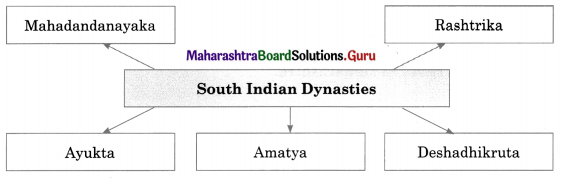
  • There were officials like ‘Mahadandanayaka’, ‘Rashtrika’, ‘Deshadhikruta’, ‘Amatya’, ‘Ayukta’, etc.
  • The council of officers in the Chola kingdom was called ‘Udankuttam’.
  • The kingdom was divided into many provinces. These provinces were known as ‘Mandalam’.
  • A member of the royal family was the chief of the Mandalam.
  • There were many officers under him such as ‘Vishayapati’, ‘Deshadhipati’, ‘Deshadhikrut’, ‘Rashtrika’, etc.
  • The administration of the Southern kingdoms was very efficient. Village autonomy was an important feature.
  • The ‘Gramasabha’ (village council) looked after the village administration.
  • The head of the Gramasabha was known by different names such as ‘Gramabhojaka’, ‘Gramakuta’ etc.
  • Land revenue was the main source of income for the state.
  • Apart from it the excise tax, professional tax, pilgrimage tax were the sources of income.

Question 2.
Coins in South Indian dynasties.
Answer:

  • The Maurya coins were in circulation in South India.
  • After the decline of Mauryas, the Pandyas issued their own punch-marked coins.
  • The images like sun, horse, stupa, tree, fish were carved on it.
  • On the Chera coins, there used to be a bow and arrow on one side and an image of an elephant on the other.
  • On the Chola coins, the symbol of the tiger as the royal emblem of Cholas is depicted.
  • The Chola coins were made of gold, silver and the legends were inscribed in the Devnagari script.
  • The coins belonging to Chalukya king Rajaraja are issued in three metals gold, silver, and copper, with the image of Rajaraja and a tiger.
  • Due to the trade with Rome, many Roman coins are found.

4. Answer the following questions in brief with the help of the points given below.

Question 1.
Describe the rule of the Shilahara dynasty
(a) Founder
(b) Shilahara of South Konkan
(c) Shilaharas of North Konkan
(d) Shilaharas of Kolhapur
Answer:
(a) Founder: Jimutvahan is considered to be the founder of all three branches. They ruled for almost three hundred years as the feudatories of Rashtrakutas and later the Chalukyas.

(b) Shilahara of South Konkan: Sanafulla established the South Konkan branch of Shilaharas. His son, Dhammiyar set up the village of Vallipattana and built a fort there. Later King Adityavarma expanded his kingdom from Thane to Goa. Rattaraj was the last ruler of this dynasty. One of the copper plates found at Kharepatan gives an account of the history of this dynasty.

Maharashtra Board Class 11 History Solutions Chapter 11 Kingdoms in South India

(c) Shilaharas of North Konkan: Kapardi established the North Konkan branch of Shilaharas. Their capital was at Sthanak (Thane). Aparajita was an important king of this branch. He ruled for around thirty-five years. He was followed by Chittaraj.

(d) Shilaharas of Kolhapur: The modern districts of Satara, Sangli, Ratnagiri, and Belgaum were included in this kingdom. Jatiga established the Kolhapur branch of Shilaharas. Bhoj II was an important king of this dynasty. Kolhapur, Valivade, and Panhala were the capitals of this kingdom. ‘Koppeshwar Mahadev’ temple at Khidrapur was the creation of Shilaharas.

Activity

Visit the Kailasa temple at Ellora and prepare a detailed note.
Answer:

  • The Kailasa temple is one of the 100 odd rock-cut cave temples and monasteries at Ellora.
  • It is carved from a single, gigantic rock.
  • Lies around 30 km northwest of Aurangabad in Maharashtra.
  • Only 34 are accessible to the public.
  • Ellora or Verul to the locals was located on an ancient South Asian trade.

Maharashtra Board Class 11 History Important Questions Chapter 10 Changing Times

Balbharti Maharashtra State Board Class 11 History Important Questions Chapter 10 Changing Times Important Questions and Answers.

Maharashtra State Board 11th History Important Questions Chapter 10 Changing Times

1A. Choose the correct alternative and write complete sentences.

Question 1.
The Shakas divided the state into various _____________
(a) provinces
(b) districts
(c) villages
(d) towns
Answer:
(a) Provinces

Question 2.
_____________ was an important king of the Kushana Empire.
(a) Chandragupta II
(b) Kanishka
(c) Harsha
(d) Gondophernes
Answer:
(b) Kanishka

Maharashtra Board Class 11 History Important Questions Chapter 10 Changing Times

Question 3.
Chandragupta I added the title _____________ to his name.
(a) Maharaja
(b) Lokaraja
(c) Samrat
(d) Maharajadhiraja
Answer:
(d) Maharajadhiraja

Question 4.
_____________ was the founder of the Vardhan dynasty.
(a) Harsha
(b) Pulakeshin I
(c) Pushyabhuti
(d) Samudragupta
Answer:
(c) Pushyabhuti

Question 5.
The history of Kashmir can be found in Rajatarangini of _____________
(a) Kalhana
(b) Harsha
(c) Ghatothkach
(d) Kalidasa
Answer:
(a) Kalhana

Question 6.
The use of _____________ script is seen on the Shaka coins.
(a) Brahmi
(b) Sanskrit
(c) Pali
(d) Kharoshthi
Answer:
(d) Kharoshthi

Maharashtra Board Class 11 History Important Questions Chapter 10 Changing Times

Question 7.
The Periplus of Erythrean Sea is written in the _____________ language.
(a) Latin
(b) Greek
(c) English
(d) Pali
Answer:
(b) Greek

Question 8.
Kanishka had organized the fourth Buddhist Council in the Vihara at Kundalvan in _____________
(a) Shigupta
(b) Kashmir
(c) Pallavas
(d) Gondophernes
Answer:
(b) Kashmir

1B. Find the incorrect pair from set B and write the correct ones.

Question 1.

Set ‘A’Set ‘B’
(a) BactriaGreeks
(b) Central AsiaShakas
(c) KashmirKarkotakas
(d) South IndiaVardhan’s

Answer:
(d) North India – Vardhan’s

Question 2.

Set ‘A’Set ‘B’
(a) DhanvantariPhysician
(b) KshapanakAstrologer
(c) AmarsinhaLexicographer
(d) SankuMagician

Answer:
(d) Sanku – Architect

Question 3.

Set ‘A’Set ‘B’
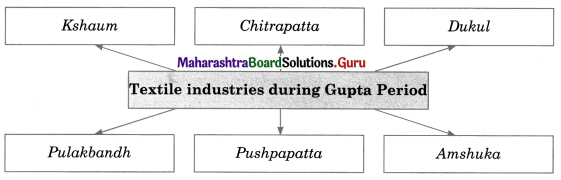
(a) ChitrapattaPrinted silk
(b) DukulSilk
(c) PulakbandhColoured cotton
(d) PushpapattaMuslin

Answer:
(d) Pushpapatta – Floral designs

1C. Find the odd one out.

Question 1.
Dhanvantari Kshapanak, Sanku, Chitrapatta
Answer:
Chitrapatta

Question 2.
Lokaraja, Maharaja, Maharajadhiraja, Vikramaditya
Answer:
Lokaraja

Maharashtra Board Class 11 History Important Questions Chapter 10 Changing Times

Question 3.
Shakuntalam, Pulakbandh, Pushpapatta, Amshuka
Answer:
Shakuntalam

Question 4.
Nigam, Shreni, Vishaya, Gana
Answer:
Vishaya

Question 5.
Dharnikot, Bhokardan, Amaravati, Nagarjunikonda
Answer:
Bhokardan

Question 6.
Saraswati, Vishnu, Surya, Kushana
Answer:
Kushana

2A. Write the names of historical places, persons, and events.

Question 1.
First Shaka king in India
Answer:
Moga

Question 2.
Sarvarajochchheta
Answer:
Samudragupta

Question 3.
Founder of Karkotaka dynasty
Answer:
Durlabhavardhan

Question 4.
Symbol of Goddess Athena
Answer:
Owl

Question 5.
Chinese traveller during Harsha’s reign
Answer:
Yuan Chwang

2B. Choose the correct reason and complete the sentence.

Question 1.
The Gupta period is considered as the classical age of Indian history because of _____________
(a) political stability
(b) help from foreign powers
(c) centralized Administration
(d) development in Art and Architecture
Answer:
(a) political stability

Maharashtra Board Class 11 History Important Questions Chapter 10 Changing Times

Question 2.
The Gupta kings changed the economic structure of agricultural system because, _____________
(a) many foreign communities came and settled in India
(b) their preference was on giving the land to local farmers for tilling
(c) king was appointed as Viceroy who looked after the provincial administration
(d) the human figure was the central theme of the sculptures in the Gupta period
Answer:
(b) their preference was on giving the land to local farmers for tilling

3. Complete the concept maps.

Question 1.
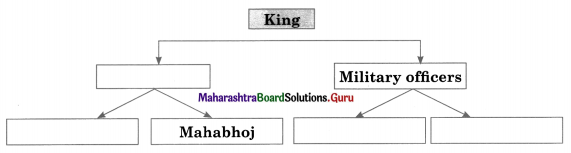
Maharashtra Board Class 11 History Important Questions Chapter 10 Changing Times 3 Q1
Answer:
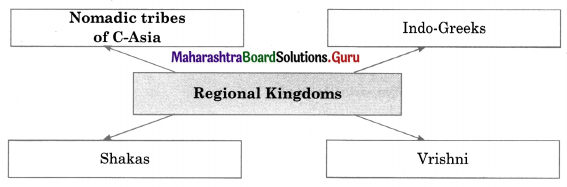
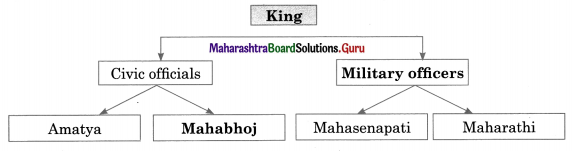
Maharashtra Board Class 11 History Important Questions Chapter 10 Changing Times 3 Q1.1

Question 2.
Maharashtra Board Class 11 History Important Questions Chapter 10 Changing Times 3 Q2
Answer:
Maharashtra Board Class 11 History Important Questions Chapter 10 Changing Times 3 Q2.1

Question 3.
Maharashtra Board Class 11 History Important Questions Chapter 10 Changing Times 3 Q3
Answer:
Maharashtra Board Class 11 History Important Questions Chapter 10 Changing Times 3 Q3.1

Maharashtra Board Class 11 History Important Questions Chapter 10 Changing Times

4. Write short notes.

Question 1.
Vardhan Empire
Answer:

  • The declining power of the Guptas saw the rise of dynasties such as Vardhans, Maukharis Maitrakas, etc.
  • The founder of the Vardhan Empire was Pushyabhuti.
  • He was followed by his son, Prabhakarvardhan who made the Vardhan dynasty powerful.
  • He took up the title of ‘Parambhattarak Maharajadhiraj’.
  • The most prominent ruler of this dynasty was Harshavardhan.
  • His empire extended from Nepal to Narmada and Saurashtra to Bengal.
  • ‘Harshacharita’ written by Banabhatta, a court poet, and also travel accounts of Yuan Chwang give information about this period.
  • Universities of Nalanda and Vallabhi became great centers of learning. Harshavardhan’s empire was the last powerful empire in ancient India.

Question 2.
Kushana Empire
Answer:

  • After winning over the small kingdoms, Kushanas followed the system of Shakas and established their Satrapi’s there.
  • A military officer called ‘Satrapa (Kshatrapa) was appointed on the satrapies.
  • The King was the chief of all the Satraps and adopted the titles like ‘Rajadhiraj’, ‘Maharaj’ etc.
  • The concept of the divinity of the King is seen for the first time in the inscriptions on the Kushana coins.
  • They called themselves ‘Devputra’(Son of God).

5. Explain the following statements with reasons.

Question 1.
During the Gupta period, India’s sea trade began to increase on a large scale.
Answer:

  • Indian goods were sent up to the Red Sea and from there via. Egypt to Rome.
  • From India, animals such as tiger, lion, and monkey, birds such as parrot and peacock, wool, silk, muslin, cotton cloth, ivory, pearls, spices, sandalwood, medicinal herbs, diamonds, precious stones, and other luxury terms were exported, whereas, from other countries goods such as lead, copper, glass, silver, gold, wines were imported.
  • Due to this trade, the flow of gold coins was constantly coming in India and hence India became prosperous.

6. State your opinion.

Question 1.
Some Bactrian coins resemble Greek coins.
Answer:

  • Some Bactrian coins resemble Greek coins in terms of their shape and weight.
  • On some of these coins, the image of the owl is seen.
  • Owl is the symbol of Goddess Athena. Athena was the main deity of Athens.
  • Indo-Greek coins are found in Bactria.
  • The Greek legends are written on the obverse side and the legends are written in Prakrit.
  • Kharoshthi script on the reverse side.

Maharashtra Board Class 11 History Important Questions Chapter 10 Changing Times

Question 2.
India became prosperous.
Answer:

  • In contemporary India, agriculture and animal husbandry were the main sources of livelihood.
  • Along with it various industries and trade developed during this period.
  • India’s contact with the foreigners proved to be beneficial for this.
  • During this period also merchant and artisans guilds (shrenis) were in existence.
  • During this period, India’s sea trade began to increase on a large scale.
  • Indian goods were sent up to the Red Sea and from there via Egypt to Rome.
  • From India, animals such as tiger, lion, and monkey; birds such as parrot and peacock; wool, silk, muslin, cotton cloth, ivory, pearls, spices, sandalwood, medicinal herbs, diamonds, precious stones, and other luxury items were exported and from other countries goods such as lead, copper, glass, silver, gold, wines, etc. were imported.
  • Due to this trade, the flow of gold coins was constantly coming in India and hence India became prosperous.

7. Answers the questions in detail.

Question 1.
Write a note on the Kushanas in detail.
Answer:

  • Kujula Khadphises declared himself as the king of Bactria and with this the Kushana rule was established up to Kabul, Kashmir.
  • The Chinese records, Greek and Roman literature provide information about this. The Kushanas’ are referred to as ‘Tukhar’ or ‘Tushar’.
  • The Kushanas followed the system of Shakas and established their Satrapi’s there. A military officer called ‘Satrapa (Kshatrapa) was appointed. The king was the chief of all the Satrapi’s.
  • The kings adopted titles like ‘Rajadhiraj’, ‘Maharaj’ etc.
  • The concept of the divinity of the kings is seen for the first time in the inscription on the Kushana coins.
  • They called themselves ‘Devputra’ (Son of God).
  • Kanishka obtained the status of an emperor. His empire extended from Kabul to Pataliputra and from Kashmir to Malwa.
  • He established two capitals, one at Purushpur (Peshawar) and the other at Mathura.
  • The fourth Buddhist council was organized by Kanishka at Kundalvam in Kashmir.
  • The Kushanas had adopted Indian cultures which is obvious from the name of the last Kushana king “Vasudeva’.

Question 2.
Discuss trade from 2nd C.B.C.E to 4th C.C.E.
Answer:

  • The period from 2nd C.B.C.E to 4th century C.E was the period of arrival of the central Asian tribes and the kingdoms that they established.
  • Various industries and trade developed during this period. India’s contact with the foreigners proved to be beneficial for this.
  • India’s sea trade began to increase on a large scale. Indian goods were sent up to the Red Sea and from there via Egypt to Rome.
  • The items of export were animals such as tigers, lions, and monkeys, birds such as parrots and peacocks, wool, silk, muslin, cotton cloth ivory, pearls, spices, and other luxury items.
  • The items of import were lead, copper, glass, silver, gold, wines, etc.
  • Due to this trade, the flow of gold coins was constantly coming in India and hence India became prosperous.

Maharashtra Board Class 11 History Important Questions Chapter 10 Changing Times

8. Answers the following questions with the help of given points.

Question 1.
Discuss coinage, art, and iconography between 2nd B.C.E and 4th C.E.
(a) Coinage
(b) Art
(c) Iconography
Answer:
(a) Coinage:

  • The flow of gold coins was constantly coming in India.
  • The portraits of kings and images of deities were inscribed on the gold coins of the Bactrian Greeks.
  • There was a great impact of the Greek and Roman coins on the coins of Shaka and Kushana rulers.
  • The Kharoshthi script is seen on the Shaka coins. The coins indicate the mixed impact of Greek, Indian and Persian cultures.
  • The Kushana kings depicted Indian cities on coins.
  • The image of Shiva has been found on gold and copper coins.
  • Kushana coins are found in the border regions of India and China.
  • The legends on the Kushana coins found in Central Asia are in the Prakrit language in the Kharoshthi script.

(b) Art:

  • The Gandhara region had become a melting pot of Indian, Greek, Roman, Persian, and Shaka cultures.
  • A new style of art developed in the cities of Pushkalavati, Taxila, Purushpur, etc. It is known as ‘Gandhara style’.
  • The theme was Indian but the style was Greek.
  • The Mahayana sect of Buddhism gave an impetus to this style of art.

Maharashtra Board Class 11 History Important Questions Chapter 10 Changing Times

(c) Iconography:

  • In the icons of the Gandhara style, there was more emphasis on physical beauty.
  • During the same time, Mathura and Varanasi’s styles of art developed.
  • The images of Gautama Buddha were completely Indian in nature.
  • Mathura was an important center of Indian art of sculpture.
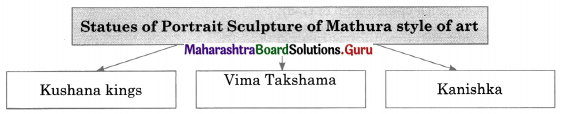
  • Portrait sculpture is the feature of the Mathura Style of art.
  • The statues of Kushan kings, Vima Takshama, and Kanishka are examples of portrait sculptures.
  • Similarly, images of Saraswati, Vishnu, Surya, Shiva, and Kartikeya saw the innovation in sculptural art.

Maharashtra Board Class 11 History Solutions Chapter 10 Changing Times

Balbharti Maharashtra State Board Class 11 History Solutions Chapter 10 Changing Times Textbook Exercise Questions and Answers.

Maharashtra State Board Class 11 History Solutions Chapter 10 Changing Times

1A. Choose the correct alternative and write complete sentences.

Question 1.
The history of Indo-Greeks is known through their _____________
(a) literature
(b) inscription
(c) coins
(d) pottery
Answer:
(c) coins

Question 2.
Gupta dynasty was founded by _____________
(a) Sri Gupta
(b) Ghatotkach
(c) Samudragupta
(d) Ramgupta
Answer:
(a) Sri Gupta

Maharashtra Board Class 11 History Solutions Chapter 10 Changing Times

Question 3.
After accession by defeating the Shakas _____________ took up the title of ‘Vikramaditya’.
(a) Chandragupta II
(b) Ramgupta
(c) Chandragupta I
(d) Kumaragupta
Answer:
(a) Chandragupta II

1B. Find the incorrect pair from set B and write the correct ones.

Question 1.

Set ‘A’Set ‘B’
(a) KshaumLinen Cloth
(b) PushpapttaCotton Cloth
(c) DukulSilk Cloth
(d) AmshukaMuslin Cloth

Answer:
(b) Pushpatta – Floral designs

2. Explain the following statements with reasons.

Question 1.
During the Gupta period, the power was concentrated in the hands of local landlords.
Answer:

  • During the Gupta period, lands were granted to civil and military officers instead of salaries.
  • The roots of the feudal system can be found in this period.
  • It is believed that the feudal economy brought about the decline of urban centers.
  • Because of revenue tax exemption on the donated land, the revenue too decreased and the royal treasury was depleted.
  • It was concentrated in the hands of locals’ landlords. Because of this the king no longer remained in the center of power.

Question 2.
Every tide of the Huna invasion made the Gupta rule weaker.
Answer:

  • During the period of Kumargupta son of Chandragupta II, the Huna in India began.
  • Kumargupta withheld the attacks of Hunas.
  • After Kumargupta, the succeeding kings proved to be incapable of protecting their kingdom.
  • Finally, the Gupta empire disintegrated into many and small kingdoms.

3. State your opinion.

Question 1.
Samudragupta performed the Asvamedha sacrifice after Digvijaya.
Answer:

  • Samudraguptas ambition was to rule entire India as a unified empire.
  • Samudragupta first conquered neighbouring kingdoms.
  • After the conquest in the North, he carried out an expedition in the south to conquer the southern kingdoms. The rulers of the regions beyond this conquered area became his feudatories.
  • He made them accept his suzerainty.
  • After this conquest (Digvijay) Samudragupta performed the Ashwamedha Sacrifice and proclaimed himself as Chakravarti king.

Maharashtra Board Class 11 History Solutions Chapter 10 Changing Times

4. Write short notes.

Question 1.
Gupta Sculptures
Answer:

  • The human figure was the central theme of the sculptures in the Gupta period.
  • Human sculptures and images of deities were created during this period.
  • Sculptures belonging to this period are found at many places such as Sarnath, Devgadh, Ajanta.
  • During this period, Hindu, Buddhist, and Jain religious icons were made of stone, metals, and terracotta.

Question 2.
Indo-Roman trade
Answer:

  • The Periplus of Erythrean Sea written in the mid 1st century C.E mentions the Red sea and the sea routes connecting coastal lines, ports, provinces, goods exchanged in trade.
  • Items like textiles, black pepper, precious stones, ivory, and animals such as monkeys, parrots, and peacocks for entertainment were exported from India.
  • Gold coins were the medium of exchange. Coral and liquor were items of import.
  • A large amount of these gold coins found in south India gives an extent of the trade.
  • The growing trade between Rome and India saw the rise of several markets and cities.
  • Ter, Nevasa, Bhokardan were some of the places where commodities were stored.
  • The port of Sopara and Kalyan were important centers of Indo-Roman trade.

5. Answers the following questions with the help of given points.

Question 1.
How did the standardization in various sections during the Gupta period take place?
(a) Division of Gupta administration
(b) Changes in economic structure economy of agriculture
(c) Development of Gupta coinage.
Answer:
(a) Division of Gupta Administrations:

  • During the Gupta period, the king was the center of administration. The Prince, Amatya (ministers), and advisors helped him. Many times, the prince was appointed as viceroy who looked after the provincial administration.
  • Every province was subdivisions These subdivisions were called Vishaya There was an independent administrator appointed to these Visayas. They were known as ‘Vishayapath’.
  • ‘Kumaramatya’ were the provincial officers and ‘Ayuktak’ were the officials who looked after the affairs of the districts.
  • Gupta’s administration was decentralized. Many decisions were taken.

Maharashtra Board Class 11 History Solutions Chapter 10 Changing Times

(b) Changes in the economic structure, economy of agriculture:

  • The economic structure of the agricultural system was changed by the Gupta kings.
  • They preferred giving land to local farmers for tilling. Land donations were also made for the cause of religion and learning. These lands were tax-free.
  • They were called Agraharas
  • The civil and military officers were granted land grants instead of salaries. Because of revenue tax exemption on the donated land.
  • The power was concentrated on the local landlord
  • Sugarcane and wheat were cultivated in the northwest province of the Gupta empire while the rice was cultivated in Magadha and eastern regions.

(c) Development of Gupta Coinage:

  • Gold Smiths enjoyed a high social status in this period.
  • The gold coins are excellent examples of their skills.
  • The beautiful and realistic portrayal of various aspects of the king is the characteristic of Gupta Coins.

Activity

Collect more information about ‘Harshacharita’ written by Banabhatta, with the help of the internet.
Answer:

  • ‘Harshacharita’ is a biography of Indian Emperor Harsha by Banabhatta also known as Bana, who was a Sanskrit writer of seventh century C.E., India.
  • This work is in Sanskrit. It has been categorized as an akhyayika (legend), a romanticized yet historical account.
  • Harshacharita has been written in a florid and fanciful style.
  • Bana has in detail and vividly described rural India’s natural environment as well as the extraordinary industry of the Indian people.
  • This work presents the emperor’s actions in an overly favourable light.

Maharashtra Board Class 11 History Important Questions Chapter 9 Post Mauryan India

Balbharti Maharashtra State Board Class 11 History Important Questions Chapter 9 Post Mauryan India Important Questions and Answers.

Maharashtra State Board 11th History Important Questions Chapter 9 Post Mauryan India

1A. Choose the correct alternative and write complete sentences.

Question 1.
___________ established a second capital at Vidisha.
(a) Chandragupta Maurya
(b) Bimbisara
(c) Pushyamitra Shunga
(d) Hala
Answer:
(c) Pushyamitra Sunga

Question 2.
The ___________ mention the ‘Andhras’ or ‘Andhrabhrutyas’.
(a) Puranas
(b) Upanishadas
(c) Vedas
(d) Jain Tools
Answer:
(a) Puranas

Maharashtra Board Class 11 History Important Questions Chapter 9 Post Mauryan India

Question 3.
___________ was the smallest unit of administration.
(a) Kingdom
(b) State
(c) Grama(village)
(d) District
Answer:
(c) Grama

Question 4.
___________ wrote Brihatkatha.
(a) Hala
(b) Gunadhya
(c) Patanjali
(d) Panini
Answer:
(b) Gunadhya

Question 5.
Gatha Saptashati reflects the social life in ___________ of the Satavahana period.
(a) Maharashtra
(b) Tamilnadu
(c) Uttar Pradesh
(d) Bihar
Answer:
(a) Maharashtra

Question 6.
___________ wrote the ‘Mahabhashya’ based on Panini’s Ashtadhyayi’
(a) Gunadhya
(b) Patanjali
(c) Banabhatta
(d) Kalidasa
Answer:
(b) Patanjali

Question 7.
___________ was the head of trade guilds.
(a) Shreshthi
(b) Sarthavaha
(c) Malakara
(d) Dasaka
Answer:
(a) Shreshthi

Maharashtra Board Class 11 History Important Questions Chapter 9 Post Mauryan India

1B. Find the incorrect pair from set B and write the correct ones.

Question 1.

Set ‘A’Set ‘B’
(a) Pushymitra shungaShisunaga dynasty
(b) Chandragupta MauryanMauryan dynasty
(c) Gautamiputra SatakarniSatavahana dynasty
(d) Mahapadma NandaNanda dynasty

Answer:
(a) Pushyamitra Shunga – Shunga dynasty

Question 2.

Set ‘A’Set ‘B’
(a) PratishthanPaithan
(b) TagarTer
(c) NasikNashik
(d) KarhatakViharas

Answer:
(d) Karhatak – Karhad

Question 3.

Set ‘A’Set ‘B’
(a) LekhanikaScribes
(b) VaidyaTraders of perfumes
(c) HalakiyaCultivators
(d) SuvarnakarGoldsmith

Answer:
(b) Vaidya – Physicians

1C. Find the odd one out.

Question 1.
Shri Satakarni Yajna Satakarni, Hala, Pushyamitra Shunga
Answer:
Pushyamitra Shunga

Question 2.
Vardhaki, Halakiya, Malakara, Lohavanija
Answer:
Halakiya

Question 3.
Amatya, Naigam, Dasaka, Sarthavaha
Answer:
Dasaka

Question 4.
Malakara, Lekhanika, Vaidya, Halakiya
Answer:
Malakara

Maharashtra Board Class 11 History Important Questions Chapter 9 Post Mauryan India

Question 5.
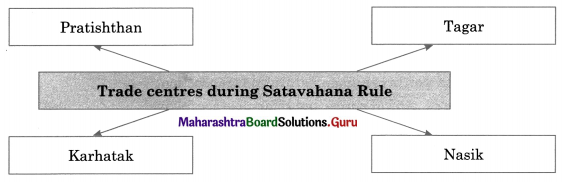
Pratishthan, Tagar, Nasik, Sarthavaha
Answer:
Sarthavaha

2A. Write the names of historical places, persons, and events.

Question 1.
Greek king defeated by Pushyamitra Shunga
Answer:
King Demetrius

Question 2.
Ashtadhyayi
Answer:
Panini

Question 3.
Last king of the Shunga dynasty
Answer:
Devbhuti

Question 4.
Mountain pass on the ancient trade route in Maharashtra
Answer:
Naneghat

Question 5.
Head of trade guilds
Answer:
Shreshthi

Question 6.
Blacksmith
Answer:
Lohavanija

Maharashtra Board Class 11 History Important Questions Chapter 9 Post Mauryan India

Question 7.
Chief of caravan merchant
Answer:
Sarthavaha

Question 8.
Traders of perfumes
Answer:
Gandhika

Question 9.
Goldsmith
Answer:
Suvarnakar

Question 10.
Physicians
Answer:
Vaidya

2B. Choose the correct reason and complete the sentence.

Question 1.
The Satavahana rule declined due to ___________
(a) weak rulers
(b) the constant struggle between Sakas and Satavahanas
(c) economic decline
(d) social decline
Answer:
(b) the constant struggle between Sakas and Satavahanas

Question 2.
Grama was an integral part of the ___________
(a) central machinery
(b) middle machinery
(c) outdoor machinery
(d) absolute machinery
Answer:
(a) central machinery

Maharashtra Board Class 11 History Important Questions Chapter 9 Post Mauryan India

Question 3.
Many Satavahana inscriptions are found in ___________
(a) South Maharashtra
(b) Northwest Maharashtra
(c) North Maharashtra
(d) Central Maharashtra
Answer:
(c) North Maharashtra

Question 4.
___________ reflects the social life in Maharashtra of Satavahana period.
(a) Lohavanija
(b) Dasaka
(c) Halakiya
(d) Gatha Saptashati
Answer:
(d) Gatha Saptashati

3. Complete the concept maps.

Question 1.
Maharashtra Board Class 11 History Important Questions Chapter 9 Post Mauryan India 3 Q1
Answer:
Maharashtra Board Class 11 History Important Questions Chapter 9 Post Mauryan India 3 Q1.1

Question 2.
Maharashtra Board Class 11 History Important Questions Chapter 9 Post Mauryan India 3 Q2
Answer:
Maharashtra Board Class 11 History Important Questions Chapter 9 Post Mauryan India 3 Q2.1

Maharashtra Board Class 11 History Important Questions Chapter 9 Post Mauryan India

Question 3.
Maharashtra Board Class 11 History Important Questions Chapter 9 Post Mauryan India 3 Q3
Answer:
Maharashtra Board Class 11 History Important Questions Chapter 9 Post Mauryan India 3 Q3.1

Question 4.
Maharashtra Board Class 11 History Important Questions Chapter 9 Post Mauryan India 3 Q4
Answer:
Maharashtra Board Class 11 History Important Questions Chapter 9 Post Mauryan India 3 Q4.1

4. Write short notes.

Question 1.
Guilds or Shrenis
Answer:

  • Many industries and trade flourished under the Satavahas.
  • Various shrenis (Guilds) emerged during this period.
  • The trade and industries were controlled with the help of these shrenis.
  • The shrenis also provided loans.

5. Explain the following statements with reasons.

Question 1.
Foreigners like Greek, Pallavas, and Kushanas were absorbed in the social structure.
Answer:

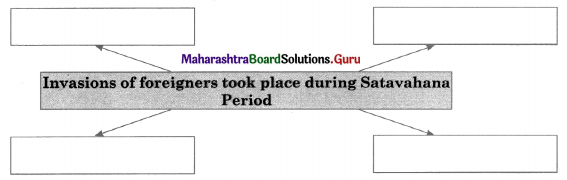
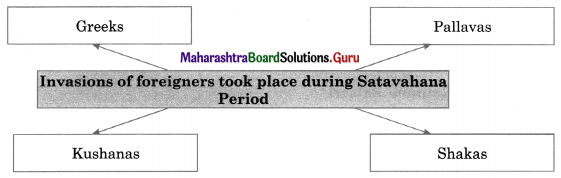
  • The invasion of foreigners like Greek, Pallavas, Shakas, and Kushanas took place during the Satavahana period.
  • But these foreigners were soon absorbed in the social structure.
  • This means that contemporary society was flexible enough to accommodate foreigners.
  • The political invasions brought about social, economic, and cultural changes.

Question 2.
The influence of Persian and Greek sculptural styles of the Mauryan period decreased during the Shunga and Satavahana period.
Answer:

  • A new native Indian style of architecture developed or emerged in this period.
  • For e.g., the four gateways (Toranas) of the Sanchi Stupa No. 1 built during this period are excellent examples of this style.
  • Many incidents from the life of Gautama Buddha are carved on these gateways.
  • A number of rock-cut caves (Viharas and Chaityas) at Bhaje, Nashik, Karle, etc. belong to the Satavahana period.
  • Especially the Chaitya at Karle, its magnificent facade entrance and sculptures are the finest examples of the sculptural art of this period.

Maharashtra Board Class 11 History Important Questions Chapter 9 Post Mauryan India

6. State your opinion.

Question 1.
Before Gautamiputra Satakarni some of the Satavahana kings were not capable.
Answer:

  • Taking advantage of the situation, the Shaka Satrapas established their rule in the western regions of India.
  • Gautamiputra Satakarni, the Satavahana king conquered the Shakas.
  • The Satavahana dynasty regained its strength with this victory.
  • Thus, before Gautamiputra Satakarni some of the Satavahana kings were not capable.

Question 2.
The Shungas contribution to the field of art is important.
Answer:

  • The Shunga’s contributed to art in a big way.
  • The stupas at Sanchi and Bharhut, Garuda pillar at Besnagar are excellent examples of art during this period.
  • The sculptural art in the Shunga period widened its horizons and depicted the life of common people on a large scale.
  • Thus, the Shungas’ contribution to the field of art is important.

7. Answers the questions in detail.

Question 1.
Write a detailed note on the Shunga Empire.
Answer:

  • The Shunga Empire was founded by Pushyamitra Shunga.
  • The Shunga Empire extended from Magadha in the east to Sialkot (Punjab) in the west as well as the Himalayas in the North to Vidarbha in the south.
  • Pushyamitra established a second capital at Vidisha although Pataliputra was the main capital. Pushyamitra was valiant and ambitious.
  • He strengthened his rule in the provinces of Kosala, Vatsa, Avanti, etc.
  • Later he conquered the lost provinces of the Magadha empire up to Sialkot.
  • The Greek king Demetrius was repelled by Pushyamitra.
  • After establishing his rule over North India and some parts of South India he performed the Ashwamedha sacrifice twice.
  • Sanskrit was encouraged. Many texts were reviewed. The Manusmriti was composed during this period.
  • Along with literature, art was encouraged for e.g., the Sanchi and Bharhut stupas and the Garuda pillar at Besnagar are excellent examples of art during this period.
  • Sculptural art widened its horizons and districted the life of common people on a large scale.

Maharashtra Board Class 11 History Important Questions Chapter 9 Post Mauryan India

Question 2.
Give an account of the rise of the Satavahana Empire.
Answer:

  • After the disintegration of the Mauryan Empire, many new powers arose. Among them, the Satavahanas are mentioned as the earliest ruling dynasty in Maharashtra.
  • The Satavahanas ruled over a vast region of Maharashtra, Andhra, and Karnataka.
  • Paithan in Maharashtra was the capital of the Satavahanas. The mention of Puranas the Andhras or ‘Andhrabhrutyas’ Probably these terms refer to the Satavahanas.
  • Simuka was the first Satavahana king to be mentioned in the Naneghat inscription.
  • The most important king of this dynasty was Shri Satakarni, Hala, Gautamiputra Satakarni and Yajna Satakarni.
  • Gautamiputra Satakarni conquered the Shakas and also Central India and the entire regions of Dakshinapatha.
  • He also established his dominance over the Republic states in Central India and Rajasthan.
  • Gautamiputra proved his strength by gaining victory over Nahapana.
  • The Satavahana rule became weak due to the constant struggle between Shakas and Satavahanas.

8. Explain the concept with examples.

Question 1.
Metronomic
Answer:
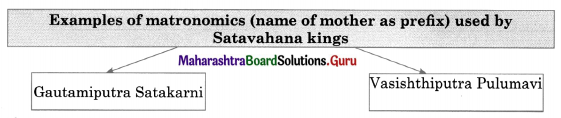
The Satavahana kings used Metronomics i.e., using the names of their mothers as prefixes for e.g., Gautamiputra Satakarni. Vasishthiputra Pulumavi etc.

Question 2.
Shakapahlavyavannisudan
Answer:
Gautamiputra Satakarni is mentioned as ‘Shakapahlavyavarnnisudan’ i.e. the destroyer of Shakas, Pallavas, and Greeks in the Nashik inscription of his mother Gautami Balashri.

Question 3.
Satavahanakulayashahpratishthapankar
Answer:
Gauthamiputra Satakarni has been referred to as ‘Satavahanakulayashahpratishapankar’ in the Nashik inscription of his mother Gauthami Balashri.

Maharashtra Board Class 11 History Important Questions Chapter 9 Post Mauryan India

Question 4.
Trisamudratoyapitavahana
Answer:
Gautamiputra Satakarni has been mentioned as ‘Trisamudratoyapitavahana’ i.e., One whose horses drank the water of the three seas. Such a type of mentioning indicates that many kings in the southern region must have accepted feudatory status and ruled under the suzerainty of Gautamiputra Satakarni.

Maharashtra Board Class 11 History Important Questions Chapter 11 Kingdoms in South India

Balbharti Maharashtra State Board Class 11 History Important Questions Chapter 11 Kingdoms in South India Important Questions and Answers.

Maharashtra State Board 11th History Important Questions Chapter 11 Kingdoms in South India

1A. Choose the correct alternative and write the complete sentences.

Question 1.

_____________ literature is one of the main sources of history of south India.
(a) Sangam
(b) Mahabharata
(c) Ramayana
(d) Indica
Answer:
(a) Sangam

Question 2.
_____________ language is spoken in Baluchistan.
(a) Tamil
(b) Brauhi
(c) Hindi
(d) Urdu
Answer:
(b) Brauhi

Maharashtra Board Class 11 History Important Questions Chapter 11 Kingdoms in South India

Question 3.
The first Chola king was _____________
(a) Raya Raja
(b) Rajendra Chola
(c) Karikala
(d) Rajendra II
Answer:
(c) Karikala

Question 4.
_____________ was the founder of the Vakataka dynasty.
(a) Vindhyashakti
(b) Pravarasena I
(c) Rudrasena
(d) Pravarasena II
Answer:
(a) Vindhyashakti

Question 5.
The founder of the Chalukyas is _____________
(a) Pulakeshin I
(b) Pulakeshin II
(c) Vikramaditya
(d) Jaising
Answer:
(d) Jaising

Question 6.
The capital of the Pallavas was _____________
(a) Chennai
(b) Kanchi
(c) Mahabalipuram
(d) Chingalpet
Answer:
(b) Kanchi

Question 7.
_____________ was a capable king of the Rashtrakuta dynasty.
(a) Dantidurga
(b) Krishna I
(c) Amoghvarsha
(d) Krishna II
Answer:
(c) Amoghvarsha

Maharashtra Board Class 11 History Important Questions Chapter 11 Kingdoms in South India

Question 8.
_____________ called themselves as ‘Tagarapuradhishwar’.
(a) Chalukyas
(b) Cheras
(c) Cholas
(d) Shilaharas
Answer:
(d) Shilaharas

Question 9.
The capital of Shilaharas of North Konkan was _____________
(a) Sthanak (Thane)
(b) Goa
(c) Kolhapur
(d) Panhala
Answer:
(a) Sthanak (Thane)

Question 10.
_____________ was the founder of the Gond dynasty.
(a) Ballal Singh
(b) Kol Bheel
(c) Rani Durgavati
(d) Nilkanth Shah
Answer:
(b) Kol Bheel

Question 11.
The Yadava king Shankardev was killed by _____________
(a) Malik Kafur
(b) Allaudin Khilji
(c) Mohd. Ghori
(d) Mohd. Gazni
Answer:
(a) Malik Kafur

1B. Find the incorrect pair from set B and write the correct ones.

Question 1.

Set ‘A’Set ‘B’
(a) CholasTanjavur
(b) CherasKerala
(c) PandyasPudukottai
(d) VakatakasKanchi

Answer:
(d) Vakatakas – Malwa

Question 2.

Set ‘A’Set ‘B’
(a) TiruchirappalliTamil Nadu
(b) KurnoolAndhra Pradesh
(c) NandirandhanNagpur district
(d) SthanakWashim district

Answer:
(d) Sthanak – Thane

1C. Find the odd one out.

Question 1.
Ancient King’s in South India:
(a) Chola
(b) Pandya
(c) Maurya
(d) Chera
Answer:
(c) Maurya

Maharashtra Board Class 11 History Important Questions Chapter 11 Kingdoms in South India

Question 2.
Examples of Dravida Style:
(a) Kailasnath temple
(b) Elephanta caves
(c) Vaikuntha Perumal temples
(d) Brihadeshwara temples
Answer:
(b) Elephanta caves

Question 3.
Texts composed in South India:
(a) Setubandha
(b) Ratnamalika
(c) Kavirajmarg
(d) Mattavilasa
Answer:
(d) Mattavilasa

Question 4.
Languages in the Dravidian group:
(a) Tamil
(b) Kannada
(c) Malayalam
(d) Marwari
Answer:
(d) Marwari

2A. Write the names of historical places, persons, and events.

Question 1.
Province of Thanjavur and Tiruchirappalli
Answer:
Cholamandala

Question 2.
The ancient name of Kolhapur
Answer:
Kuntala

Question 3.
Composition of Pravarasena II in Maharashtri Prakrit
Answer:
Setu bandha

Question 4.
The passion of art during the Chalukya period
Answer:
Kirtivarman

Question 5.
Sanskrit play written by Mahendravarman
Answer:
Mattavilasa

Maharashtra Board Class 11 History Important Questions Chapter 11 Kingdoms in South India

Question 6.
The famous temple at Ellora built during the time of Krishna I
Answer:
KailasaTemple

Question 7.
Texts composed by Amoghvarsh
Answer:
Ratnamalika and Kavirajmarg

Question 8.
Temple at Ambarnath
Answer:
Rameshwar Mahadev

Question 9.
Temple at Khidrapur
Answer:
Koppeshwar Mahadev

Question 10.
Gond Queen who fought against Akbar
Answer:
Queen Durgavati

Question 11.
Text composed by Sarvasena
Answer:
Harivijaya

Question 12.
Two styles of temple architecture in South India
Answer:
Dravida and Vesara

2B. Choose the correct reason and complete the sentence.

Question 1.
The Indian culture between north India and south India become diverse because of _____________
(a) cultural Exchange
(b) economic Unification
(c) political Unification
(d) the conflict between North and South India
Answer:
(a) cultural Exchange

Maharashtra Board Class 11 History Important Questions Chapter 11 Kingdoms in South India

Question 2.
The Rashtrakuta dynasty declined because of _____________
(a) attacks of Pallavas and Satavahanas.
(b) attacks of Parmars and Chalukyas of Kalyani
(c) attacks of Pallavas and Chalukyas and Satavahanas
(d) attacks of Cholas and Valatakas
Answer:
(b) attacks of Parmars and Chalukyas of Kalyani

3. Observe the map on page 78 of your textbook and answer the following questions, based on it.
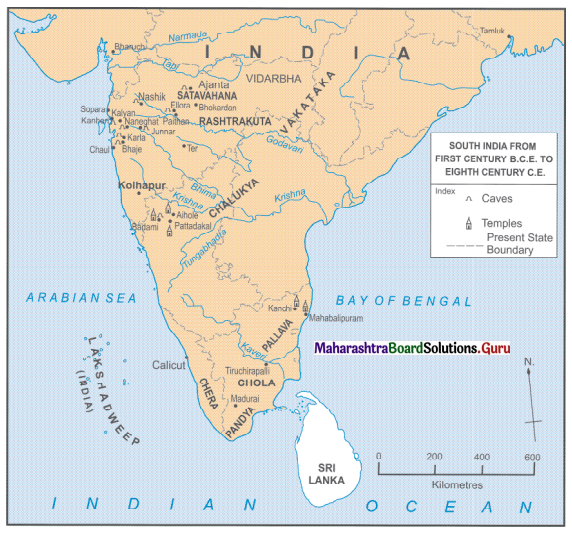
Maharashtra Board Class 11 History Important Questions Chapter 11 Kingdoms in South India 3

Question 1.
Name the two famous caves in Maharashtra.
Answer:
Ajanta and Ellora

Question 2.
Name the temples of Vesara style during the Chalukya rule.
Answer:
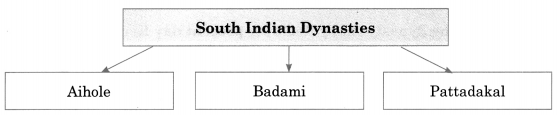
Aihole, Badami and Pattadakala

Question 3.
Name the two temples created during the Pallava period.
Answer:
Kanchi and Mahabalipuram

Question 4.
What was the capital of the Pandyas?
Answer:
Madurai

Question 5.
What is the name of the dynasty that ruled over present-day Kerala?
Answer:
Chera

4. Complete the concept maps.

Question 1.
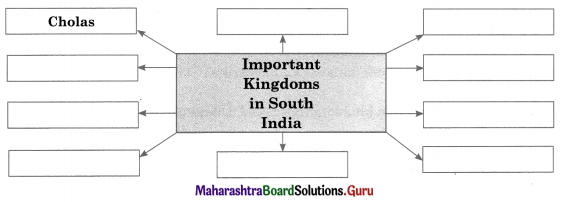
Maharashtra Board Class 11 History Important Questions Chapter 11 Kingdoms in South India 4 Q1
Answer:
Maharashtra Board Class 11 History Important Questions Chapter 11 Kingdoms in South India 4 Q1.1

Maharashtra Board Class 11 History Important Questions Chapter 11 Kingdoms in South India

Question 2.
Maharashtra Board Class 11 History Important Questions Chapter 11 Kingdoms in South India 4 Q2
Answer:
Maharashtra Board Class 11 History Important Questions Chapter 11 Kingdoms in South India 4 Q2.1

Question 3.
Maharashtra Board Class 11 History Important Questions Chapter 11 Kingdoms in South India 4 Q3
Answer:
Maharashtra Board Class 11 History Important Questions Chapter 11 Kingdoms in South India 4 Q3.1

5. Write short notes.

Question 1.
Trade-in south India.
Answer:

  • In the kingdom of Cholas, Pandyas, Cheras, Vakatakas, Chalukyas, Rashtrakutas, etc., many professions requiring specialized skills were practiced.
  • Ivory was obtained from the Malayagiri jungle.
  • The Cholamandalam provinces were well known for excellent quality textiles.
  • Plain and coloured cotton cloth, as well as silk cloth, was produced in this province.
  • The Chera kingdom produced fine cloth which was one of the important commodities in the Indo-Roman trade, Marco Polo has mentioned it in his travel accounts.
  • Cities like Paithan, Tagar (Ter), Nashik, etc. flourished because of it.
  • The goods produced in rural areas were brought for sale in the cities.

6. Explain the following statement with reasons.

Question 1.
The Sangham literature is the most ancient in the family tradition.
Answer:

  • The tradition of writing poetry and grammar was prevalent in south India from ancient times.
  • The Sangham literature is the most ancient literature available.
  • This literature is one of the main sources of the political history of south India.

Maharashtra Board Class 11 History Important Questions Chapter 11 Kingdoms in South India

7. State your opinion.

Question 1.
Two styles of architecture are seen in South India.
Answer:

  • Two styles of architecture ‘Dravida’ and ‘Vesara’ developed in South India.
  • The Dravida style emerged and developed in the regions from the Krishna river to Kanyakumari.
  • The important feature of Dravida architecture was identified by the construction of Shikhara.
  • In this type, the stories reduce in size as the Shikhara rises. Examples of this style can be seen in the Kailasnath and
  • Vaikuntha Perumal temples at Kanchi, Brihadeshwara temple at Tanjore.
  • The Chalukyas built temples at places like Aihole, Badami, and Pattadakal.
  • During the Rashtrakuta period, the world-famous ‘Kailasa’ temple was created.

Question 2.
The period during the rule of the kingdom in south India was important from the point of view of Sanskrit literature.
Answer:

  • Kalidasa composed the ‘Meghdoot’ at Ramtek in Vidarbha.
  • During the Vakataka rule, Compositions in the Prakrit language were created. Pravarsena II.
  • The Vakataka king wrote the well-known composition named ‘Setubandha’. ‘Harivijaya’ was composed by Sarvasena, the founder of the Vatsagulma branch of Vakatakas.

8. Answer the following questions in detail.

Question 1.
Write about trade in South India.
Answer:

  • Many professions requiring specialized skills were practiced.
  • Ivory was obtained from the Malayagiri jungle. The Cholamandalam provinces were famous for excellent quality textiles.
  • Plain and coloured cotton cloth, as well as silk clothes, were produced in this province.
  • In the Chera kingdom, the fine cloth was produced. It was one of the important commodities in the Indo-Roman trade.
  • The trade and industries in South India flourished during this period.
  • The goods produced in rural areas were brought for sale.
  • Shreni in South India played an important role in trade and the social system.

Question 2.
Write a note on Literature.
Answer:

  • The ‘Sangham literature’ is supposed to be most ancient in the Tamil tradition.
  • This literature is one of the main sources of the political history of South India.
  • This period is important from the point of view of Sanskrit literature.
  • Kalidasa composed the ‘Meghdoot’ at Ramtek in Vidarbha.
  • During the Vakataka rule, compositions in Prakrit were created.
  • Pravarsena II wrote ‘Setubandha’. ‘Harivijaya’ was composed by Sarvasena, the founder of the Vatsagulm branch of Vakatakas.

Maharashtra Board Class 11 History Important Questions Chapter 11 Kingdoms in South India

9. Answer the following questions with the help of given points.

Question 1.
The important Kingdom in south India.
(a) Cholas
(b) Cheras
(c) Pandyas
Answer:
(a) Cholas: The Cholas established their kingdom in the first century C.E. The Chola dynasty originated in Thanjavur and Tiruchirappalli (Tamil Naidu). This province was known as ‘Cholamandala’ (Coromandel) Karikala was the first Chola king who brought together eleven small kingdoms and build a strong army. He defeated the Chera and Pandya king and established Tamil dominance.

(b) Cheras: The Cheras ruled over Kerala. They are mentioned as ‘Kedalaputra’ (Keralaputra or sons of Kerala) in contemporary literature.

(c) Pandyas: The Pandyas had established their rule from Pudukkottai to Kanyakumari.

10. Explain the concept.

Question 1.
Mandalam
Answer:
The kingdoms of South India especially Cholas were divided into many provinces. These provinces were known as ‘Mandalam’. A member of the royal family was the chief of the Mandalam.

Question 2.
Gonds
Answer:
The Gond dynasty was established at Chanda (Chandrapur) during the Yadava period. Kol Bheel was the founder of this dynasty. He brought the people of the Gond tribe together and encouraged them to rebel against the Naga dynasty. He established the capital at Sirpur. In the later period, Khandkya Ballal Singh built a fort at Ballarpur and shifted the capital from Sirpur to Ballarpur. The temple at Achaleshwar was constructed during his period.

Question 3.
Yadavas
Answer:
Yadava dynasty is one of the important dynasties of medieval Maharashtra. Bhillam V (1185-93 C.E.) is the important king of the Yadava dynasty. He expanded the kingdom by defeating the Kalachuris. He established his capital at Devgiri and got himself coronated. In the later period, Singhan was an important ruler of this dynasty. He defeated the Hoysalas, Shilaharas and expanded the rule of Yadavas.

Maharashtra Board Class 11 History Important Questions Chapter 11 Kingdoms in South India

Question 4.
Rashtrakutas
Answer:
Dantidurga was the first powerful king of the Rashtrakuta dynasty. The rule of Rashtrakutas was spread from the Vindhyan ranges to Kanyakumari in the south. After Dantidurga, his uncle Krishna I became the king. He uprooted Chalukya’s rule. The famous Kailas temple at Ellora is ascribed to Krishna I. The succeeding Rashtrakuta rulers became influential in North India as well.

Question 5.
Shilaharas of North Konkan
Answer:
Kapardi established the north Kokan branch of Shilaharas. Rulers of this branch were initially the feudatories of the Rashtrakutas. Their capital was at Sthanak (Thane). Aparajita was another important king of this branch. He ruled for around thirty-five years. Chittaranjan followed Aparajita as King. His brothers fought for their claim to the throne.

Question 6.
Pallavas
Answer:
From the 6th century C.E. to the 9th century C.E., the Pallavas were known as the most powerful rulers in South India. Historians vary in their views regarding the origin of the Pallavas. Some copperplates of the Pallavas are found. There is a mention of Sinhavarman and Shivaskandavarman Pallava who ruled over the regions of the eastern coast. Kanchi was the capital of the Pallavas. We get detailed information about the Pallava dynasty beginning from the reign of Simhavishnu. He conquered the province of Cholas and extended his rule from Krishna to Kaveri. After Simhavishnu, his son Mahendravarman ascended the throne. He was a great scholar. He wrote the Sanskrit play ‘Mattavilasa’. He wrote books on subjects like music, dance, sculpture, painting, etc.

Maharashtra Board Class 11 History Important Questions Chapter 11 Kingdoms in South India

Question 7.
Chalukyas
Answer:
During the rule of Harshavardhan in North India, the Chalukya dynasty ruled in the south for approximately 200 years. Jaising was the founder of this dynasty. At the beginning of the 6th century C.E. he established his capital at Vatapi (Badami). His grandson Pulakeshin I was the first important king of the Chalukyas. He built the fort of Badami. He performed the Ashwamedha sacrifice and took up the title of ‘Maharaja’. He also took titles like ‘Prithvivallabha’ and ‘Satyashraya’.

Maharashtra Board Class 12 English Yuvakbharati Solutions Chapter 3.2 Do Schools Really Kill Creativity?

Balbharti Yuvakbharati English 12th Digest Chapter 3.2 Do Schools Really Kill Creativity? (Mind-Mapping) Notes, Textbook Exercise Important Questions and Answers.

Maharashtra State Board Class 12 English Yuvakbharati Solutions Chapter 3.2 Do Schools Really Kill Creativity? (Mind-Mapping)

12th English Digest Chapter 3.2 Do Schools Really Kill Creativity? Textbook Questions and Answers

Question 1.
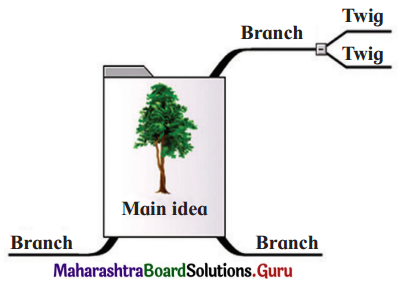
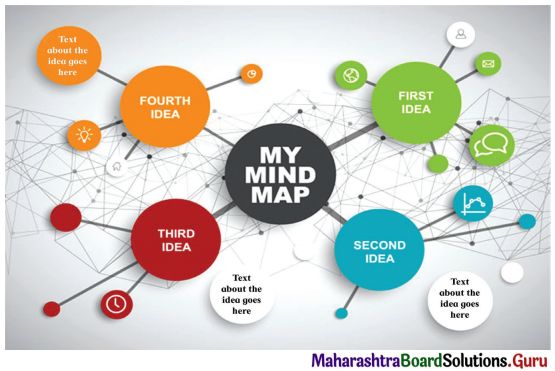
Observe the given figure and complete the activities that follow:
Maharashtra Board Class 12 English Yuvakbharati Solutions Chapter 3.2 Do Schools Really Kill Creativity 1
(a) Replace the ‘main idea’ by any other thought or title of your own.
(b) Add three supporting ideas to the main idea as their branches.
(c) Add two ideas to one of the branches that explains the meaning of the branch.
Answer:
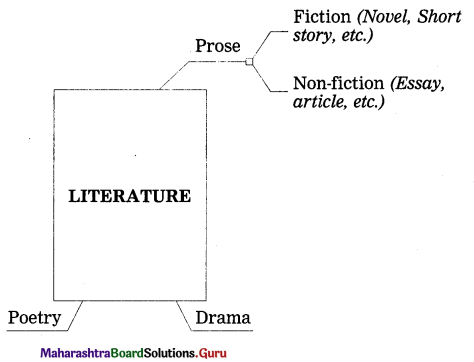
Maharashtra Board Class 12 English Yuvakbharati Solutions Chapter 3.2 Do Schools Really Kill Creativity 2

Maharashtra Board Class 12 English Yuvakbharati Solutions Chapter 3.2 Do Schools Really Kill Creativity?

Question 2.
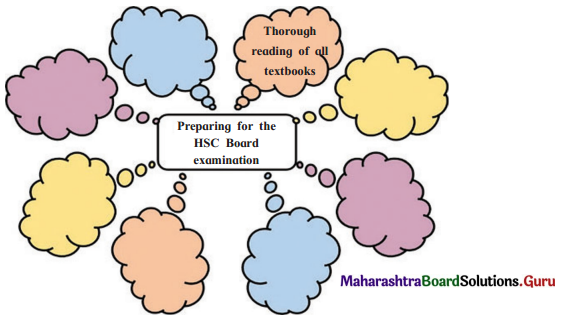
Complete the given blank spaces/balloons with your ideas in the figure that describes your basic preparation for the HSC Board Examination. Also complete the activities that follows:
Maharashtra Board Class 12 English Yuvakbharati Solutions Chapter 3.2 Do Schools Really Kill Creativity 3
Answer:
Maharashtra Board Class 12 English Yuvakbharati Solutions Chapter 3.2 Do Schools Really Kill Creativity 4

Activity:

Complete a similar type of detailed graphical figure in your own style showing the thoughts/ ideas/concepts that keep on generating in your mind and then you choose a particular style/design or a graphical representation to describe the same idea/facts/situations – then this type of presentation can be called ‘Mind – Mapping.’
Use different shapes, arrows, lines, connectors, balloons, boxes, curved arrows, callouts, scribbles, scrolls, explosions, etc. to describe your point of view.

For example:
Maharashtra Board Class 12 English Yuvakbharati Solutions Chapter 3.2 Do Schools Really Kill Creativity 5

Maharashtra Board Class 12 English Yuvakbharati Solutions Chapter 3.2 Do Schools Really Kill Creativity 6

Maharashtra Board Class 12 English Yuvakbharati Solutions Chapter 3.2 Do Schools Really Kill Creativity?

(A1)

Question 1.
Study the tabular column given on page 141 of the Textbook. In pairs, tell your partner the importance of each one: (The first one is given here as an example. Students may attempt 2 to 8 on their own in a manner akin to the one given below.) Enhance activities with Mind-Mapping.
Maharashtra Board Class 12 English Yuvakbharati Solutions Chapter 3.2 Do Schools Really Kill Creativity 7
Answer:

  • Student A: How does mind – mapping help us?
  • Student B: It helps us see an overall picture.
  • Student A: Would you kindly explain it a bit more?
  • Student B: See, as one would expect, mind – mapping conveys the whole idea through hierarchy and relationships.
  • Student A: By the way, what is ‘hierarchy’?
  • Student B: Hierarchy is a system in which classes, status, authority, etc. are ranked one above the other.
  • Student A: I think I’ve got it. With the help of mind – mapping we ‘maps out’ the points beginning from the more important ones and going on to the less important ones.
  • Student B: Exactly! It is a sort of branching out. What I find exciting is that the ‘mapping out’ originates from our brain quite spontaneously.
  • Student A: Being the creators we grasp it fully, don’t we?
  • Student B: Yes, we do. Now you got it fully right!

(A2)

Question 1.
Given below is a ‘Mind – Mapping’ template. Use your ideas/thoughts/concepts to illustrate/develop them. (Develop your ideas in the form of main branch, sub-branches and tertiary branches respectively).
Maharashtra Board Class 12 English Yuvakbharati Solutions Chapter 3.2 Do Schools Really Kill Creativity 8
Also, write a paragraph on the mind map you have completed.
Answer:
Maharashtra Board Class 12 English Yuvakbharati Solutions Chapter 3.2 Do Schools Really Kill Creativity 9
The above given figure is my Mind Map about infectious diseases. The four main ideas are the Spread, Precautions, Treatment and Containment of such infectious diseases. The best way to check the spread of infection is the practice of personal hygiene and social distancing. Maintenance of proper civic sense is called upon from each citizen. Containing the disease becomes a challenge when diseases like COVID-19 breaks out. Lack of vaccine or specific medicine makes the situation very grave. Self-isolation, quarantine, and in extreme situations, Lockdown, etc. are practised to curtail the community spread of the contagion.

A sudden spike in the cases put great strain on the health care system. Authorities try to circumvent the spike by flattening the curve of the spike. Whenever there is a pandemic, it is the duty of the citizens to help the authorities by obeying all the directives.

Maharashtra Board Class 12 English Yuvakbharati Solutions Chapter 3.2 Do Schools Really Kill Creativity?

(A3)

Question 1.
Develop a ‘Mind – Mapping’ frame/design to show the development in your personality seen with yourself in the last 5 years. You can take the help of the following points in order to develop each of them into further branches:
(Development in Physique, Self-learning Process, Communication Skills, Social Awareness, Family Responsibility)
Answer:

Development in physiqueSelf-learning processCommunication skillsSocial awarenessFamily responsibility
A sense of parting with childhoodBegan to assess the children around me criticallyAn awareness of what I speak and how I speakStill confined to my small world of family and friendsTook everything for granted and never bothered about the resources of my family
An earnest desire to join the club of grown-upsA great quest to know more about the world around meCensure of incorrect and impolite utterancesExposure to print and electronic media opened up a ne w worldSlow realisation of the hardships of my parents in educating me
A surge in physical energyAn enhanced sense of body ownershipAn earnest desire to impress others with my speechExploration of the world around me and my place in itSibling rivalry to my younger sister gave way to a sense of protective care
Interest in sports which are aggressive and dangerousA sense of bonding with societyStarted diary writing and found my skills wantingRealization that I am not an island floating in the ocean of humanityResolved to do well in academics
Realization of the passing of adolescence and being an adultA yearning to invent or discover something newLevel-headed effort to improve my speaking and writing skillsStill trying to figure out the nature of my social commitmentHope to take great care of my parents in their old age

(A4)

Question 1.
Develop a ‘Mind – Mapping’ frame/design to show the ‘Benefits of games and sports’ to the students. You can take the help of the following points in order to develop each of them into further branches:
(Fitness and stamina, team spirit and sportsmanship, group behaviour, killer’s instinct, will to win)
Answer:
Maharashtra Board Class 12 English Yuvakbharati Solutions Chapter 3.2 Do Schools Really Kill Creativity 10

Maharashtra Board Class 12 English Yuvakbharati Solutions Chapter 3.2 Do Schools Really Kill Creativity?

(A5)

Browse the internet to know the following:

Question 1.
Different Frames/Designs on Mind – Mapping :
(One example is given below. Students may browse the internet to find more.)
Answer:
Spidergram.
Maharashtra Board Class 12 English Yuvakbharati Solutions Chapter 3.2 Do Schools Really Kill Creativity 11

Question 2.
Benefits of Mind – Mapping:
Answer:
Mind – Mapping is an effective tool that helps us capture the logical thinking process that goes on in our mind. It enables us to put pieces of information in the proper slots. The gathered pieces of information then assume a compact and condensed format which can be committed to memory with vividness and clarity. Mind – Mapping also helps generate a stream of creative ideas. The speed and spontaneity of Mind – Mapping proves to be a great advantage during brainstorming sessions.

Question 3.
Uses of Mind – Mapping in note-taking:
Answer:
Mind – Mapping is a creative way of note-taking. We do not remain just passive listeners noting down points mechanically. On the contrary, Mind – Mapping helps us put our creative selves in the process. Thus, we become the co-producers of the information. Using Mind – Mapping in note-taking also enables us to structure the information to suit our natural inclinations of arrangement.

Maharashtra Board Class 12 English Yuvakbharati Solutions Chapter 3.2 Do Schools Really Kill Creativity?

Question 4.
Difference between Mind – Mapping and Concept Mapping:
Answer:
A Concept map is a diagram that shows the suggested relationships among concepts. Concept maps, unlike the Mind maps, allow more divergence due to their multiple hubs and clusters. Mind maps are often restricted to radial hierarchies and tree structures. Another feature that distinguishes Mind map from a Concept map is that in a Mind map the basic idea is embodied in the centre image and the main themes radiate from the centre as branches. This, then branches off further as twigs.

Maharashtra Board Class 12 English Yuvakbharati Solutions Chapter 3.1 Summary Writing

Balbharti Yuvakbharati English 12th Digest Chapter 3.1 Summary Writing Notes, Textbook Exercise Important Questions and Answers.

Maharashtra State Board Class 12 English Yuvakbharati Solutions Chapter 3.1 Summary Writing

12th English Digest Chapter 3.1 Summary Writing Textbook Questions and Answers

Discuss in pairs and guess the correct alternative for the following:

Question 1.
To summarize means …………… .
(a) Put information in chronological order.
(b) To recapitulate the main points in selection
(c) To introduce new information
(d) To write one’s opinion about selection
Answer:
(b) To recapitulate the main points in selection

Maharashtra Board Class 12 English Yuvakbharati Solutions Chapter 3.1 Summary Writing

Question 2.
The type of summary that consists of a paragraph to express the main idea is …………… .
(a) Outline
(b) Report
(c) Synopsis
(d) Written summary
Answer:
(d) Written summary

Question 3.
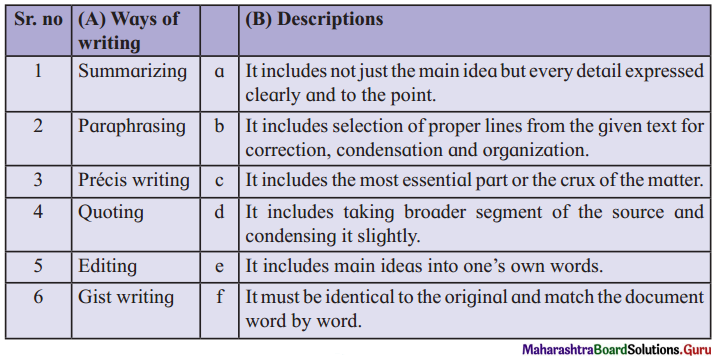
There are various ways of incorporating other writers’ works into your own writing. They differ according to the closeness of your writing to the source writing. Match the ways of writing in brief given in column (A) with their descriptions in column (B):
Maharashtra Board Class 12 English Yuvakbharati Solutions Chapter 3.1 Summary Writing 1
Answer:

  1. Summarizing – (e) It includes main ideas into one’s own words.
  2. Paraphrasing – (f) It must be identical to the original and match the document word by word.
  3. Precis writing – (d) It includes taking broader segment of the source and condensing it slightly.
  4. Quoting – (a) It includes not just the main idea but every detail expressed clearly and to the point.
  5. Editing – (b) It includes selection of proper lines from the given text for correction, condensation and organization.
  6. Gist writing – (c) It includes the most essential part or the crux of the matter.

Maharashtra Board Class 12 English Yuvakbharati Solutions Chapter 3.1 Summary Writing

(A1)

Question 1.
Complete the following as instructed:
Read the passage and write its summary according to the given steps:
Answer:
Use the following steps for summary writing:
Step 1: Read the article twice.
Step 2: The purpose of writing – To tell the reader about the interesting communication methods among birds and mammals.
Step 3: Identify the main idea – Surprising examples of communication methods among birds and mammals.
Steps 4 and 5: Write the first draft: Revise your first draft and edit it.
(Students may attempt this on their own.)
Step 5: Write the final draft (Given overleaf.)

(A2)

(ii) Avoid adverbs:
Delete the adverbs in italics and rewrite:

Question (a)
“That’s usually a good thing to do.”
Answer:
“That’s a good thing to do.”

Maharashtra Board Class 12 English Yuvakbharati Solutions Chapter 3.1 Summary Writing

Question (b)
“That’s fairly good coffee.”
Answer:
“That’s good coffee.”

Question (c)
“I totally agree.”
Answer:
“I agree.”

Question (d)
“Actually I disagree.”
Answer:
“I disagree.”

Question (iii)
One word substitution:
Find examples similar to those given in the textbook and make a list:
Answer:

  1. friendly relationship in which people understand well : rapport (pronounced as ‘rappo’)
  2. able to cause death: fatal
  3. seize by way of penalty: confiscate
  4. someone who goes into buildings in order to steal: burglar
  5. the principal character in a play or a story: protagonist
  6. the path described by an object moving in air: trajectory
  7. a person regarded as a symbol: icon
  8. a person who knows many languages: polyglot
  9. a badly behaved child: brat
  10. a period of ten years: decade
  11. a persistent increase in the general level of prices: inflation
  12. organisation of supplies and services for any, complex operation : logistics
  13. extremely careful about details: meticulous
  14. not harmful or offensive: innocuous
  15. present, appearing or found everywhere: ubiquitous

Maharashtra Board Class 12 English Yuvakbharati Solutions Chapter 3.1 Summary Writing

(ii) Change the following sentences into simple:

Question (a)
Mr. Rohit is the member and he is also the director.
Answer:
Mr. Rohit is the member and also the director.

Question (b)
The room is so small that it cannot accommodate many people.
Answer:
The room is too small to accommodate many people.

Question (c)
You have to prove that you are innocent.
Answer:
You have to prove your innocence.

Question (d)
He was late so he walked in a great hurry.
Answer:
Being late, he walked in a great hurry.

Maharashtra Board Class 12 English Yuvakbharati Solutions Chapter 3.1 Summary Writing

(A4)

Question (i)
Read any book of your choice and write its summary according to the steps explained in the chapter.

Question (ii)
Find some professions that require the skill of summary writing and editing. Write them
in your notebook.

Yuvakbharati English 12th Digest Chapter 3.1 Summary Writing Additional Important Questions and Answers

Question (i)
Cut redundant words:
Write five examples of redundant words:
Answer:

  1. puzzling mystery = ‘mystery’
  2. connect together = ‘connect’
  3. divide into two equal halves = ‘divide into halves
  4. surrounded on all sides = ‘surrounded’
  5. return back = ‘return’

Maharashtra Board Class 11 History Solutions Chapter 9 Post Mauryan India

Balbharti Maharashtra State Board Class 11 History Solutions Chapter 9 Post Mauryan India Textbook Exercise Questions and Answers.

Maharashtra State Board Class 11 History Solutions Chapter 9 Post Mauryan India

1A. Choose the correct alternative and write complete sentences.

Question 1.
The last emperor of the Mauryan dynasty was ______________
(a) Ajatshatru
(b) Chandragupta Maurya
(c) Brihadratha
(d) Emperor Ashoka
Answer:
(c) Brihadratha

Question 2.
The Nashik inscription, mentions king ______________ as ‘Trisamudratoyapitavahana’.
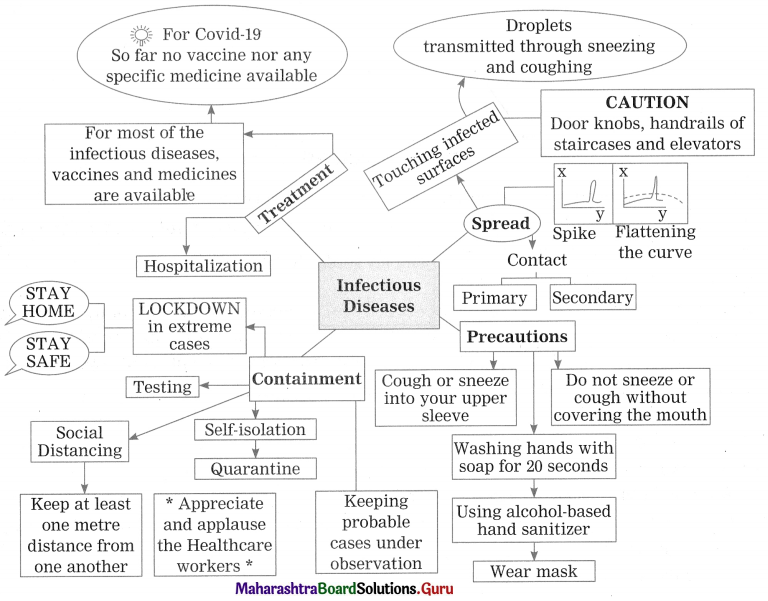
(a) Gautamiputra Satakarni
(b) Hala
(c) Yadnashre Satakarni
(d) Simuka
Answer:
(a) Gautamiputra Satakarni

Maharashtra Board Class 11 History Solutions Chapter 9 Post Mauryan India

Question 3.
Satavahana King, Hala, compiled ______________
(a) Brihatkatha
(b) Gatha Saptashati
(c) Katantra
(d) Meghadoota
Answer:
(b) Gadha saptashati

1B. Find the incorrect pair from set B and write the correct ones.

Question 1.

Set ‘A’Set ‘B’
(a) KalidasaMalavikagnimitram
(b) GunadhyaGatha Saptashati
(c) SarvavarmaKatantra
(d) PatanjaliMahabhashya

Answer:
(b) Gunadhya – Brihatkatha

2. Explain the following statements with reasons.

Question 1.
During the Satavahana period, there was the rise of many trade centers.
Answer:

  • During the Satavahana period, many industries and trade flourished.
  • Various shrenis (guilds) emerged during this period.
  • The trade and industries were controlled with the help of these shrenis. The shrenis also provided loans. Indo-Roman trade also flourished during this period.
  • Trade centres like Pratishthan (Paithan), Tagar (Ter), Nasik (Nashik), Karhatak (Karhad) during the Satavahana period.

Question 2.
The caste system became rigid during the Satavahana period.
Answer:

  • The society of Satavahanas was organized into four varnas.
  • The caste system during this period became deep-rooted.
  • The intermixture of varnas and castes, the closed nature of different guilds, need of including foreigners in the social structure were some of the reasons why the caste system became rigid.

Maharashtra Board Class 11 History Solutions Chapter 9 Post Mauryan India

3 Give your opinion.

Question 1.
Prakrit language was encouraged during the Satavahanas period.
Answer:

  • Learning and art received royal patronage during the Satavahana period.
  • Prakrit language and literature flourished during this period.
  • Hala, the seventeenth king of the Satavahanas compiled ‘Gathasaptashati’.
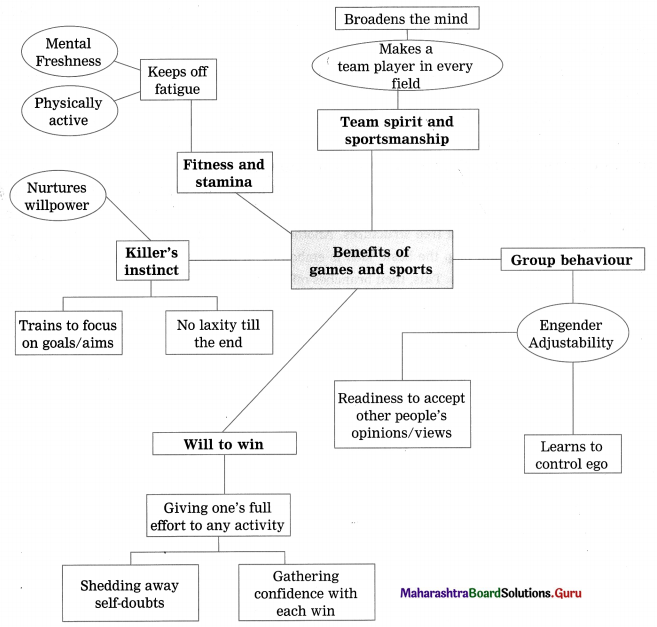
    Gunadhya, a minister in his court wrote a text ‘Brihatkatha’ in Prakrit language named Paishachi.
  • Thus, the Prakrit language was encouraged during the Satavahanas period.

4. Write short notes.

Question 1.
Nashik inscription of Gautami Balasri
Answer:

  • The reign and achievements of Satavahana Emperor Gautamiputra Satakarni can be found in the Nashik inscription of his mother Gautami Balashri.
  • Gautamiputra Satakarni is mentioned as ‘Shakapahlavyavannisudan’ i.e., destroyer of Shakas, Pallavas, and Greeks,
  • Satavahanakulayashahpratishthapankar’ i.e., one who reinstalled the success of the Satavahana family and ‘Trisamudratoyapitavahana’ i.e., one whose horses drank the water of the three seas.

Question 2.
Naneghat-ancient trade route in Maharashtra
Answer:

  • Naneghat is a mountain pass on the ancient trade route in Maharashtra.
  • This route connects the ancient town of ‘Jirnanagar’ (Junnar) and the Kokan province.
  • Sopara and Kalyan were the most important trade centers in ancient Maharashtra.
  • Internal as well as foreign trade was carried on from these towns.
  • Goods imported from Rome were unloaded at Sopara and from there it was carried over to Paithan and Kolhapur.

Question 3.
Gatha Saptashati
Answer:

  • Hala compiled several poems in Prakrit. He selected 700 verses and compiled them and named them ‘Gaha Sattasai’ (Gatha Saptashati).
  • This was the first text compared in the Maharashtri Prakrit language.
  • The subject of these poems portrays human nature and transaction.
  • Various religious observance, ethical norms, and contemporary festivals are described in it. Gathasaptasati reflects the social life in Maharashtra of the Satavahana period.

Maharashtra Board Class 11 History Solutions Chapter 9 Post Mauryan India

5. Write information about the Satavahana dynasty with the help of given points.

Question 1.
(a) Rise and expansion
(b) Administrative system
(c) Trade and industries
(d) Literature and art
Answer:
(a) Rise and expansion: After the disintegration of the Mauryan Empire, many new powers arose. Among them, the Satavahanas are mentioned as the earliest ruling dynasty in Maharashtra. The Satavahanas ruled over a vast region of Maharashtra, Andhra, and Karnataka. Parithan. Maharashtra was the capital of the Satavahanas. The mention of Puranas the Andhras or Andhrabhrutyas’ Probably these terms refer to the Satavahanas. Simuka was the first Satavahana king to be mentioned in the Naneghat inscription.

The most important king of this dynasty was Shri Satakarni, Hala, Gautamiputra Satakarni and Yajna Satakarni. Gautamiputra Satakarni conquered the Shakas and also Central India and the entire regions of Dakshinapatha. He also established his dominance over the Republic states in Central India and Rajasthan. Gautamiputra proved his strength by gaining victory over Nahapana. The Satavahana rule became weak due to the constant struggle between Shakas and Satavahanas.

(b) Administrative system: The state was divided into small provinces. Every province was under civil and military officials. Civil officials such as ‘Amatya’ ‘Mahabhoj’ and military officials such as ‘Mahasenapati’ and ‘Maharathi’ were appointed. Grama (village) was the smallest unit of administration. Grama was a source of revenue and also for the recruitment of soldiers during war-like situations. Grama was an integral part of the central machinery.

(c) Trade and industries: Agriculture was the main source of income. Along with it many industries and trade flourished. Various Shrenis (Guilds) also emerged during this period. The trade and industries were controlled with the help of these shrenis. Indo-Roman trade also flourished during the Satavahana period. Trade centers like Pratishthan (Paithan), Tagar (Ter), Nasik (Nashik), Karhatak (Karhad) developed during this period. Cotton cloth, muslin, and sackcloth, and other merchandise were the terms of trade. Kalyan, Sopara, Bhadoch were important trade centers.

Maharashtra Board Class 11 History Solutions Chapter 9 Post Mauryan India

(d) Literature and art: Learning and art received royal patronage. Prakrit language and literature flourished. Hala compiled ‘Gathasaptashati’. Gunadhya, a minister wrote Brihatkatha in a Prakrit language called Paishachi. Sarvavarma wrote a treatise on Sanskrit grammar named ‘ Katantra’. A new native Indian style emerged in this period. The four gateways (Toranas) of the Sanchi Stupa No.1 built during this period are excellent examples of this style. Many incidents from the life of Gautama Buddha are carved on these gateways. A number of rock-cut caves at Bhaje, Nashik, Karle, etc., belong to this period. Especially the Chaitya at Karle, its magnificent facade entrance and sculptural are the finest examples of the sculptural art of this period.

Activity

Collect information about historical remains in your surrounding area and prepare an information booklet based on the gathered information.
Answer:
Prepare a booklet based on the information gathered on the historical remains.

Maharashtra Board Class 11 History Important Questions Chapter 8 India During Mauryan Period

Balbharti Maharashtra State Board Class 11 History Important Questions Chapter 8 India During Mauryan Period Important Questions and Answers.

Maharashtra State Board 11th History Important Questions Chapter 8 India During Mauryan Period

1A. Choose the correct alternative and write complete sentences.

Question 1.
There existed ___________ Mahajanapadas in ancient India.
(a) Fourteen
(b) Fifteen
(c) Sixteen
(d) Seventeen
Answer:
(c) Sixteen

Question 2.
The empire of ___________ became strong during the struggle of four Mahajanapadas.
(a) Kasi
(b) Kosala
(c) Avanti
(d) Magadha
Answer:
(d) Magadha

Maharashtra Board Class 11 History Important Questions Chapter 8 India During Mauryan Period

Question 3.
The kingdom of Magadha acquired the form of an ___________
(a) Empire
(b) State
(c) Country
(d) District
Answer:
(a) Empire

Question 4.
The concept of ___________ occurs in the ancient literature on Indian polity.
(a) Raja
(b) Maharaja
(c) Chakravarti
(d) Maharajadhiraj
Answer:
(c) Chakravarti

Question 5.
___________ was the first Chakravarti Emperor.
(a) Chandragupta Maurya
(b) Bimbisara
(c) Mahapadma
(d) Bindusara
Answer:
(a) Chandragupta Maurya

Question 6.
In the 6th century BCE, the ___________ dynasty ruled over Magadha.
(a) Maurya
(b) Gupta
(c) Haryanka
(d) Sunga
Answer:
(c) Haryanka

Maharashtra Board Class 11 History Important Questions Chapter 8 India During Mauryan Period

Question 7.
The Haryanka dynasty is mentioned in the ___________
(a) Mahabharata
(b) Ramayana
(c) Upanishads
(d) Sangam literature
Answer:
(a) Mahabharata

Question 8.
___________ was the first well-known king of the Haryanka dynasty.
(a) Mahapadma
(b) Bimbisara
(c) Ajatashatru
(d) Chandragupta Maurya
Answer:
(b) Bimbisara

Question 9.
Pataligrama came to be known as ___________
(a) Pataliputra
(b) Magadha
(c) Kasi
(d) Kosala
Answer:
(a) Pataliputra

Question 10.
___________ was the founder of the Nanda dynasty.
(a) Shishunaga
(b) Ashoka
(c) Ajatashatru
(d) Mahapadma
Answer:
(d) Mahapadma

Maharashtra Board Class 11 History Important Questions Chapter 8 India During Mauryan Period

Question 11.
___________ was the last king of the Mauryan dynasty.
(a) Asoka
(b) Pushyamitra
(c) Brihadratha
(d) Dhanananda
Answer:
(c) Brihadratha

Question 12.
The great drama in Sanskrit literature Swapnavasavadatta was written by ___________
(a) Kautilya
(b) Bharat
(c) Kalidasa
(d) Bhasa
Answer:
(d) Bhasa

1B. Find the incorrect pair from set B and write the correct ones.

Question 1.

Set ‘A’Set ‘B’
(a) In the text of Mahavamsa, Chandragupta is referred asThe Emperor of Jambudvipa
(b) Ashoka called himself asDevanampiya Piyadasi
(c) Centre of Higher educationTaxila
(d) Tax paid by the people in the form of Physical LabourBhag

Answer:
(d) Tax paid by the people in the form of Physical Labour – Vishti

Question 2.

Set ‘A’Set ‘B’
(a) Antiochus II TheosSyria
(b) Ptolemy II PhiladelphusEgypt
(c) Antigonus GonatusMacedonia
(d) Magas(Epirus) Cyrene

Answer:
(d) Magas – Cyrene

1C. Find the odd one out.

Question 1.
Famous texts of Jain literature
(a) Dashavaikalika
(b) Tipitaka
(c) Upasakadashanga
(d) Acharanga Sutra
Answer:
(b) Tipitaka

Question 2.
Prakrit languages
(a) Pali
(b) Ardhamagadhi
(c) Shaurseni
(d) Sanskrit
Answer:
(d) Sanskrit

Question 3.
Bimbisara relations with royal houses
(a) Kosala
(b) Lichchhavi
(d) Madra
(c) Patali
Answer:
(c) Patali

Maharashtra Board Class 11 History Important Questions Chapter 8 India During Mauryan Period

Question 4.
Contemporary kings from the western world
(a) Maurya
(b) Ptolemy II Philadelphus
(c) Antigonus Gonatus
(d) Alexander of Epirus
Answer:
(a) Maurya

2A. Write the names of historical places, persons, and events.

Question 1.
First Buddhist Council
Answer:
Rajagriha

Question 2.
Revenue Minister in the Arthashastra
Answer:
Samaharta

Question 3.
The technique of mirror polish of the stone during the Mauryan period
Answer:
Mauryan polish

Question 4.
National Emblem of India
Answer:
Ashokan pillar

2B. Choose the correct reason and complete the sentence.

Question 1.
Rise of Magadha –
(a) Fertile and rich land
(b) Strong fort
(c) King’s position
(d) Political stability
Answer:
(a) Fertile and rich land

Maharashtra Board Class 11 History Important Questions Chapter 8 India During Mauryan Period

Question 2.
Ashoka’s Victory at Kalinga proved a turning point in the history as well as the life of Ashoka.
Reasons ___________
(a) Ambition of Ashoka
(b) Influence of Buddhism
(c) Great loss of human life
(d) Weak rules of Kalinga
Answer:
(c) Great loss of human life

2C. Write the correct chronological order.

Question 1.
(a) Maurya dynasty
(b) Nanda dynasty
(c) Haryanka dynasty
(d) Shishunaga dynasty
Answer:
(a) Haryanka dynasty
(b) Shishunaga dynasty
(c) Nanda dynasty
(d) Maurya dynasty

Question 2.
(a) Magas of Cyrene and Alexander of Epirus
(b) Ptolemy II, Philadelphus of Egypt
(c) Antigonus Gonatus of Macedonia
(d) Antiochus II, Theos of Syria.
Answer:
(a) Antiochus II, Theos of Syria.
(b) Ptolemy II, Philadelphus of Egypt
(c) Antigonus Gonatus of Macedonia
(d) Magas of Cyrene and Alexander of Epirus

3. Observe the map/picture on page 58 of your textbook and answer the questions based on it.

Maharashtra Board Class 11 History Important Questions Chapter 8 India During Mauryan Period 3

Question 1.
Name some locations of Ashoka’s pillar.
Answer:
Locations of Ashoka’s pillars is Mansehra, Taxila, Kalsi, Toshali, Maski, Kupaga, etc.

Question 2.
Name some locations of Ashoka’s stone inscriptions.
Answer:
The location of Ashoka’s stone inscriptions is Topra, Meerut, Nigliva, Rummindei, Lauruja Nandangarh, etc.

Maharashtra Board Class 11 History Important Questions Chapter 8 India During Mauryan Period

Question 3.
Name the mountain mentioned in a map.
Answer:
The mountain mentioned on the map is Hindukush Mountains.

4. Complete the concept maps.

Question 1.
Maharashtra Board Class 11 History Important Questions Chapter 8 India During Mauryan Period 4 Q1
Answer:
Maharashtra Board Class 11 History Important Questions Chapter 8 India During Mauryan Period 4 Q1.1

Question 2.
Maharashtra Board Class 11 History Important Questions Chapter 8 India During Mauryan Period 4 Q2
Answer:
Maharashtra Board Class 11 History Important Questions Chapter 8 India During Mauryan Period 4 Q2.1

Question 3.
Maharashtra Board Class 11 History Important Questions Chapter 8 India During Mauryan Period 4 Q3
Answer:
Maharashtra Board Class 11 History Important Questions Chapter 8 India During Mauryan Period 4 Q3.1

5. Write short notes.

Question 1.
Mauryan Polish
Answer:

  • During the Mauryan period, it appears that the artists had acquired the skill of cutting and carving the stone.
  • In both, the skill of specific expressions of art and the technique of mirror polish of the stone are seen.
  • This is known as ‘Mauryan Polish’.

Maharashtra Board Class 11 History Important Questions Chapter 8 India During Mauryan Period

Question 2.
Chakravarti
Answer:

  • The concept of ‘Chakravarti’ occurs in the literature of ancient Indian polity.
  • The sovereign ruler whose chariot could roll in all four directions without any obstruction was known as Chakravarti.
  • It was expected that his rule should be ethical and for the welfare of the state.
  • During his tenure, the wheel of ‘Ruta’ remains intact.
  • His rule is on an extended territory. Chandragupta Maurya was the first Chakravarti Emperor.

6. Explain the following Statements with reasons.

Question 1.
Magadha emerged as a powerful kingdom in the 6th century B.C.E.
Answer:

  • Magadha was an important kingdom among the mahajanapadas that existed in ancient India.
  • Fertile and rich land, perennial rivers, excellent facilities of navigation, availability of commercial markets, etc., were the reasons for the rise of Magadha as an empire.
  • In the 6th century BCE, the Haryanka dynasty ruled over Magadha.
  • Thus, Magadha emerged as a powerful kingdom in the 6th century B.C.E.

Question 2.
Bimbisara established matrimonial relations with many royal houses.
Answer:

  • Bimbisara started building the foundation of the Magadha Empire.
  • He attacked the neighbouring kingdom of Anga and conquered it.
  • This victory increased the power of Magadha.
  • Bimbisara established matrimonial relations with many royal houses such as Kosala, Lichchhavi, Videh, Madra to support his expansionist policy.
  • At the foot of the fort of Girivraja, he established the new capital of Rajgriha.

Question 3.
Ashoka erected many pillars.
Answer:

  • The destruction caused by the Kalinga war brought about a great change in the mind of Ashoka.
  • Great loss of human life diverted Ashoka’s mind towards the non-violent, peaceful Buddhist religion.
  • So, Ashoka erected many pillars to spread the religious ideals propagated by him.

7. State your opinion.

Question 1.
Literature of the Mauryan period reflects the thought process of the people.
Answer:

  • Literature of the Mauryan period not only reflects the thought process of the people but also the political, social, economic, and religious conditions of the period.
  • During the Mauryan period along with literature in the Sanskrit language, Pali and Ardhamagadhi were also used.
  • Jain and Buddhist Literature were created in the Prakrit language. The Prakrit language includes Pali, Ardhamagadhi, Shaurseni, Maharashtri, etc.
  • Panini’s Ashtadhyayi, Bhasa’s Swapnavasavadattam, Kautilya’s Arthashastra were some of the important works of this period.
  • Along with Sanskrit literature, many texts were written in the Prakrit language. The orders of Asoka inscribed on rocks and pillars are in Prakrit.
  • The famous Buddhist ‘Tipitakas’ were edited during this period. Abhidhammapitaka was composed after the 3rd Buddhist council.
  • Jam literature too flourished during this period for e.g., texts like ‘Dashavaikalika’, Upasakadashanga Bhagvati Sutra were composed during this period.

Maharashtra Board Class 11 History Important Questions Chapter 8 India During Mauryan Period

Question 2.
The Mauryan period has multiple dimensions.
Answer:

  • The Mauryan period obtained historical significance due to its multiple dimensions.
  • After the death of Ashoka, the centralized administration grew weak and the empire disintegrated into small kingdoms.
  • There was development in almost all aspects of human life.
  • Thus, The Mauryan period has multiple dimensions.

8. Answers the following questions in detail.

Question 1.
Write in detail on the Rise of Magadha.
Answer:

  • Magadha was an important kingdom among the Mahajanapadas Fertile land, perennial rivers, excellent facilities of navigation availability of commercial markets, etc were the reasons for the rise of Magadha as an empire.
  • The Haryanka dynasty ruled over Magadha in the 6th century BCE. Bimbisara was the first well-known king.
  • His father Mahapadma established the first capital at Magadha.
  • Bimbisara laid the foundation of the Magadha empire. Bimbisara made Rajagriha, the new capital.
  • Ajatashatru, son of Bimbisara became the next king and adopted the expansionist policy of his father, Bimbisara.
  • He expanded the Magadha kingdom up to the foot of the Vindhya ranges. Ajatashatru built a small fort on the bank of Ganga at acquired Pataligrama which later on became a center of trade for local commodities.
  • Pataliputra became the capital of the Mauryan Empire.
    Political stability as well as other factors were responsible for the strengthening of Magadha as an Empire.
  • The political ambitions of the rulers combined with wealth and prospering trade were the reasons for the development of Magadha’s rule and the establishment of a huge empire.

Question 2.
Write a note on Ashoka’s effort to spread Buddhism.
Answer:

  • Ashoka adopted his ancestor’s policy of Digvijaya and expansion of the kingdom.
  • He attacked Kalinga and conquered it.
  • Ashoka’s victory proved to be a turning point in history as well as in the life of Ashoka. There was a great loss of human life.
  • The destruction caused due to the Kalinga war brought about a great change in the mind of Ashoka.
  • He adopted a non-violent peaceful attitude. The desire of Digvijaya was replaced by Dhammavijaya.
  • For the implementation of Dhammavijaya, he introduced new policies, for example, the appointment of ‘Dharmamahamatras’ ban on intoxicating drinks, guiding principles regarding code of conduct, etc.
  • He also sent monks to various countries for the spread of Buddhism.

Question 3.
Write a note on the expansion of the Mauryan Empire in Maharashtra.
Answer:

  • The expansion of the Mauryan Empire in Maharashtra took place from 321 BCE to 181 BCE.
  • The Maurya’s must-have entered Sopara from Gujarat. Sopara and Chaul were prosperous trade centers and learning centers of Buddhism.
  • Bhagvanlal Indraji excavated the Stupa at Sopara which is known as ‘Baruda Rajacha kot’.
  • In this excavation, the fragments of the rock edict of Ashoka were found.
  • It is the 8th rock edict among the 14 edicts of Ashoka.
  • The 9th rock edict was found in the Bhuigaon village.

Maharashtra Board Class 11 History Important Questions Chapter 8 India During Mauryan Period

9. Answers the following questions with the help of given points.

Question 1.
Explain the role of the following:
(a) Trade
(b) Literature
(c) Art and Architecture
(d) Social life
Answer:
(a) Trade:

  • Due to a well-organized taxation system, there was an increase in revenue. Various kinds of taxes were levied, for e.g., ‘Bali’ was a tax to be given in the scale of land under cultivation, ‘Bhag’ was a share from the tax on production.
  • Agricultural land and the tax acquired from agricultural production were the basic foundation of the administrative system.
  • Industries gained momentum during this period for e.g., cloth industry, metallurgy, carpentry, etc.
  • The prosperous agriculture and flourishing industries led to a flourishing internal and foreign trade.
  • There was import and export trade and for the protection of the trading community, the government had appointed officers like Chorarajjuka and Seemaswami.

(b) Literature:

  • During the Mauryan period, along with literature in Sanskrit, the use of Pali and Ardhamagadhi literature in the Prakrit language is also seen.
  • For the spread of Jainism and Buddhism literature was created in the Prakrit language.
  • The world-famous work of Panini’s Ashtadhyayi was composed in this period.
  • Bhasa one of the greatest dramatists of Sanskrit literature flourished during this period. The most important work of this period is texts Kautilya’s Arthashastra
  • The orders of Ashoka are inscribed on the rocks and pillars in the Prakrit language.
  • The famous texts of Buddhist literature Tipitakas were edited during this period. Jain texts like Dashavaikalika, Upasakadashanga Acharanga Sutra Bhagvati Sutra, etc., were composed during this period.

(c) Art and Architecture:

  • Mauryan art is the beginning of ancient Indian architecture and sculptural art.
  • It appears that the artists had acquired the skill of cutting and carving the stone.
  • The technique of mirror polish of stone known as ‘Mauryan Polish’ was acquired during this period.
  • During this period stone statues of Yaksha and Yakshi were found, for e.g., the statue of Chauri bearer of Didarganj.
  • The pillars erected by Emperor Ashoka and the sculpture on them are excellent examples of Mauryan sculpture, the beginning of rock-cut caves.

(d) Social life:

  • Megasthenes mentions the seven classes of Indian society based on their professions.
  • Life was prosperous and happy.
  • The class of entertainers is mentioned. Chariot and horse racing wrestling as well as dance and singing competition were the popular means of entertainment.
  • The system of education during the Vedic period continued Cities of Taxila, Kashi, Ayodhya, etc became great centers of higher education and art.
  • Female education suffered but Kautilya’s Arthashastra mentions that women were given certain rights.
  • Women had complete control over Stridhana. The Mauryan period had multiple dimensions.

Maharashtra Board Class 11 History Important Questions Chapter 8 India During Mauryan Period

Question 2.
Write about the following:
(a) Nanda Dynasty
(b) Mauryan Empire
Answer:
(a) Nanda Dynasty:

  • The Nanda dynasty is mentioned in the Puranas. The Meghan empire established by Ajatashatru was further expanded by Mahapadma Nanda.
  • According to some scholars, the Nanda rule had spread up to Nanded in the South, whereas some scholars think that it was extended up to Mysore.
  • On this basis, it can be said that Mahapadma Nanda was the first great emperor of India. Dhana Nanda was the last ruler of the Nanda dynasty.
  • During his period, the state treasury was enormously rich. His military was also very huge. It consisted of 2,00,000 infantry, 60,000 cavalry, 6000 elephants and 2000 chariots.

(b) Mauryan Empire:

  • Mauryan Empire was the first well-organized and strongly controlled empire in the history of India.
  • Religious texts and other literature, inscriptions, coins, sculptures, etc. are the sources that help us to clearly understand the political, social, economic, and religious conditions of this period.
  • The Mauryan empire had spread on a large region of the Indian sub-continent and was controlled by a central power.
  • The Mauryan rule brought about the consolidation of the political system.