Maharashtra Board Class 11 Psychology Important Questions Chapter 3 Self

Balbharti Maharashtra State Board Class 11 Psychology Important Questions Chapter 3 Self Important Questions and Answers.

Maharashtra State Board 11th Psychology Important Questions Chapter 3 Self

1A. Complete the following statements.

Question 1.
Rentsch and Heffner found __________ categories by which the participants defined themselves.
(A) eight
(B) five
(C) three
Answer:
(A) eight

Question 2.
According to __________, self-concept is the way individual reacts to himself.
(A) Heffener
(B) Symonds
(C) Rogers
Answer:
(B) Symonds

Maharashtra Board Class 11 Psychology Important Questions Chapter 3 Self

Question 3.
The __________ determines whether the child will be a boy or a girl.
(A) nurture
(B) sex chromosome
(C) heredity
Answer:
(B) sex chromosome

Question 4.
There are __________ major aspects of self.
(A) four
(B) five
(C) nine
Answer:
(A) four

Question 5.
According to Piaget, self-consciousness starts emerging between __________ months.
(A) 15-24
(B) 17-24
(C) 15-22
Answer:
(A) 15-24

Question 6.
Self __________ is an internal dictionary that describes an individual
(A) image
(B) awareness
(C) efficacy
Answer:
(A) image

Question 7.
Maddux defined __________ as ‘what I believe I can do with my skills under certain conditions.
(A) self-efficacy
(B) self-esteem
(C) self-regulation
Answer:
(A) self-efficacy

Maharashtra Board Class 11 Psychology Important Questions Chapter 3 Self

Question 8.
People from East Asian culture tend to focus on __________ form of self-regulation.
(A) preventive
(B) promotive
(C) passive
Answer:
(A) preventive

Question 9.
__________ self is our inner personality.
(A) Real
(B) Ideal
(C) Own
Answer:
(A) Real

Question 10.
If ideal self and real self-concept is accurate self are __________, our self-concept is accurate.
(A) similar
(B) different
(C) distant
(A) similar

Question 11.
__________ means people recognise and explore their own potential.
(A) Self-actualisation
(B) Self-efficacy
(C) Self-concept
Answer:
(A) Self-actualisation

1B. State whether the following statements are true or false and give a reason for your answer.

Question 1.
Self-concept is defined as a person’s belief in his ability to accomplish some specific goal or a task.
Answer:
False
Reason: Self-concept is defined as the totality of perceptions each person has of themselves.

Maharashtra Board Class 11 Psychology Important Questions Chapter 3 Self

Question 2.
Between the age of three – twelve, self-concept is defined in terms of a child’s economic background.
Answer:
False
Reason: Between the age of three to twelve, self-concept is defined mainly in terms of sex, age, family, and what the child believes he or she can or can’t do.

Question 3.
Gender identity and gender role are two different concepts.
Answer:
True
Explanation: Gender identity is a biological aspect of self-concept while gender role is psycho-social in nature.

Question 4.
Gender role is an acquired attribute of self-concept.
Answer:
True
Explanation: Gender roles are acquired through imitation and observation of family atmosphere as well as cultural influences.

Question 5.
Body image is a part of self-awareness.
Answer:
False
Reason: Body image is a part of self-image.

Question 6.
Efficacy expectancies represent skills required to complete the goal.
Answer:
False
Reason: Outcome expectancies represent skills required to complete the goal while efficacy expectancies refer to a person’s analysis about whether he has those skills.

Question 7.
To have a healthy self-concept implies to be a highly capable person.
Answer:
True
Explanation: Self-concept is our total image of ourselves. A person who has a healthy and positive image of himself tends to be capable.

Maharashtra Board Class 11 Psychology Important Questions Chapter 3 Self

Question 8.
The real self represents our dynamic ambitions and goals.
Answer:
False
Reason: Ideal self represents our dynamic ambitions and goals.

Question 9.
A person who has high self-worth can’t tolerate failure.
Answer:
False
Reason: A person who has high self-worth can cope with challenges in life and also tolerates failure and sadness effectively.

2. Answer the following questions in around 35-40 words each.

Question 1.
What is self-concept?
Answer:

  • Self-concept is defined as the totality of perceptions each person has of themselves.
  • It is also defined as ‘the totality of the complex, organized and dynamic system of learned beliefs, attitudes, and opinions that each person holds to be true about his or her personal existence’.

Question 2.
Explain psychological components that help us to stay socially connected.
Answer:
Heatherton has identified the following psychological components that help us to stay socially connected:

  • We must be aware of our actions and evaluate them.
  • We must be able to predict other’s reactions to it.
  • We must detect any kind of threat or rejection from others.
  • We must do something constructive to improve the situation.

4. Write short notes in 50-60 words each.

Question 1.
Self-concept
Answer:

  • Self-concept is our total image of us, i.e. it is our total picture of our abilities and traits.
  • It is basically a cognitive construct that determines how we feel about ourselves and guides our actions.
  • According to Symonds, self-concept is the way an individual reacts to himself.
  • There are four aspects of self-concept, viz. How does a person perceive himself? What does he think about himself? How he values himself? and How he enhances or defends himself?
  • Our self-concept develops rapidly during early childhood and adolescence. It continues to form and change throughout our life span as we change.

Maharashtra Board Class 11 Psychology Important Questions Chapter 3 Self

Question 2.
Rentsch and Heffener’s research
Answer:

  • Rentsch and Heffner conducted research on the dimensions of self-concept.
  • When they asked 20 questions to 200 university students, they found eight categories by which the participants defined themselves.
  • Some of the categories were concerned with personal attributes, such as interpersonal characteristics (e.g. I am a student), interest (e.g. I like dancing), personal beliefs (e.g. I am against child abuse), and self-awareness (e.g. I don’t get angry without a valid reason).
  • Others referred to the social environments such as ascribed characteristics (e.g. I am a citizen of India) or social differentiation (e.g. I am from another country).
  • Although our answers to specific questions related to self-concept can be different, the overall organization of self-concept is common for all.

Question 3.
Steps to develop a positive self-image
Answer:
Self-image is a personal view or mental picture that we have of ourselves.
Some steps to develop a positive self-image are as follows:

  • Making a list of one’s positive qualities
  • Asking others to describe one’s positive qualities
  • Defining achievable personal goals and objectives
  • Trying to overcome illogical and irrational thinking
  • Avoiding comparing oneself to others
  • Developing one’s strengths
  • Learning to love oneself
  • Giving positive affirmations
  • Remembering one’s own uniqueness
  • Remembering how one dealt with problems

Maharashtra Board Class 11 Psychology Important Questions Chapter 3 Self

5. Answer the following questions in 150-200 words.

Question 1.
What is self-image and body image?
Answer:

  • Self-image is a personal view or mental picture that we have of ourselves. It is an internal dictionary that describes an individual as being intelligent, funny, kind, etc. It is a collection of an individual’s strengths and weaknesses.
  • Self-image is dynamic and changing. We can take steps to develop a healthier and accurate view of ourselves.
  • A healthy self-image starts with learning to accept and love ourselves. It also includes being accepted and loved by others.
  • Body image is a part of self-image. It goes beyond what we look like or how others see us. It also refers to how do we think, feel, and react to our physical attributes.
  • Body image development is affected by cultural images and the influence of family, peers, and others.
  • A positive body image contributes to enhanced psychological adjustment while a negative body image leads to maladjustment.

Maharashtra Board Class 12 English Yuvakbharati Solutions Chapter 4.1 History of Novel

Balbharti Yuvakbharati English 12th Digest Chapter 4.1 History of Novel Notes, Textbook Exercise Important Questions and Answers.

Maharashtra State Board Class 12 English Yuvakbharati Solutions Chapter 4.1 History of Novel

12th English Digest Chapter 4.1 History of Novel Textbook Questions and Answers

1. Match the columns:

Question 1.
Match the columns:

AB
1. Murasaki Shikibu(a) Cervantes
2. Novella(b) Bankimchandra Chattopadhyaya
3. Don Quixote(c) Tale of Genji
4. Rajmohan’s Wife(d) New

Answer:

AB
1. Murasaki Shikibu(c) Tale of Genji
2. Novella(d) New
3. Don Quixote(a) Cervantes
4. Rajmohan’s Wife(b) Bankimchandra Chattopadhyaya

Maharashtra Board Class 12 English Yuvakbharati Solutions Chapter 4.1 History of Novel

2. Pick out the odd element from each group:

Question (i)
Arun Joshi, Vikram Seth, Graham Greene, Kiran Nagarkar
Answer:
Graham Greene (Graham Greene was an English novelist; the others are Indian writers)

Question (ii)
Place, Period, Theme, Climate, Lifestyle
Answer:
Theme (the others are aspects of the setting)

Question (iii)
Theme, Plot, Character, Novella
Answer:
Novella (‘Novella’ is a ‘novel’; the others are the elements of a novel)

3. Complete the following statements:

Question 1.
Complete the following statements:
Answer:
(i) The two types of conflicts that the plot may have are internal (inside the mind of the character) or external (with other characters or entities).
(ii) The word ‘picaresque’ is originated from the Spanish word ‘picaro,’ which means a rogue.
(iii) The epistolary novel presents the narrative through a series of correspondence or other documents like letters or diary entries.
(iv) In the eighteenth century, the middle class could get the time for reading and discussing the novels because the spread of machines helped them in their work and could provide them with some spare time.

Maharashtra Board Class 12 English Yuvakbharati Solutions Chapter 4.1 History of Novel

4. Write short notes on:

Question 1.
Write short notes on:
(i) Style of the novel
(ii) Stream of consciousness novel
(iii) Novella
(iv) Indian tradition of novels.
Answer:
(i) Style of the novel: The language and the techniques used by the author for the narration of the course of events is known as the ‘style’. An author can use extensive vocabulary and difficult phrases or he may be brief and could write only to the point or he may mix both according to the requirement of his story. He may use linguistic devices like figures of speech to make the narrative effective. All these factors decide the ‘texture’ of the narration and create an impact on the readers.

(ii) Stream of consciousness novel: The phrase ‘Stream of consciousness’ means the flow of thoughts in the minds of the characters. This phrase was coined by William James in his treatise ‘Principles of Psychology.’ (1890). In such a novel, incidents in the plot are in the sequence of their occurrence. The novelist narrates them just as they occur in the minds of the characters. Sometimes they do not make sense; but they truthfully represent the thoughts without any censoring or editing.

(iii) Novella: The word ‘Novella’ which means new is originated from the Italian word ‘novelle’. A Novella is a type of prose fiction which is shorter than a full length novel and longer than short stories. It is a well-structured yet short narrative, often satiric or realistic in tone. Novella usually focuses on one incident or issue with one or two main characters and takes place at a single location. Given below are some of the famous novellas in English:

  1. ‘The Heart of Darkness’ by Joseph Conrad
  2. ‘The Turn of the Screw’ by Henry James
  3. ‘Billy Budd’ by Hermann Melville
  4. ‘Death in Venice’ by Thomas Mann
  5. ‘Seize The Day’ by Saul Bellow
  6. ‘Pearl’ by John Steinbeck

(iv) Indian tradition of novels: Indians have also played a major role in the writing of English Novels. ‘Rajmohan’s Wife’, by Bankim Chandra Chattopadhyaya was the first novel in English written by an Indian. The period after that is marked by a few more navels written by Indian writers. These novels were based on either nationalistic virtues or social issues. Mulkraj Anand, R.K. Narayan and Raja Rao were the major trio who prevailed in the period after that.

Novelists like Anita Desai, Nayantara Sahgal, Arun Joshi and Manohar Malgaonkar changed the current of Indian English novel through their works. Amitav Ghosh, Vikram Seth and Upamanyu Chatterjee improved upon the Indian novel in English by adding new features to it. In recent years, Indian novelists like Salman Rushdie, Arvind Adiga, Arundhati Roy, Kiran Desai and Kiran Nagarkar have come into the limelight. The tradition of the Indian English novel has undergone a vital change since its birth and has undoubtedly a very bright future.

Yuvakbharati English 12th Digest Chapter 4.1 History of Novel Additional Important Questions and Answers

Question 1.
Pick out the statements that are False. Rewrite them correctly:
1. Setting describes the behaviour of the characters in the story.
2. The main character in the story is referred to as the ‘novella’.
3. The struggle between the opposite forces in the story is called ‘conflict.’
4. Theme is the central idea in the novel which can be expressed in a nutshell.
5. The plot and character are affected due to the setting.
6. ‘Plot’ is the narrative style of the author.
Answer:
False statements:
1. Setting describes the behaviour of the characters in the story.
2. The main character in the story is referred to as the ‘novella’.
6. ‘Plot’ is the narrative style of the author.

Corrected statements:
1. Characterization describes the behaviour of the characters in the story.
2. The main character in the story is referred to as the ‘protagonist’.
6. Plot is the course of events that make up the theme.

Maharashtra Board Class 12 English Yuvakbharati Solutions Chapter 4.1 History of Novel

Question 2.
Rewrite the following statements in chronological order:
1. Mulkraj Anand, R.K. Narayan and Raja Rao were the major trio who prevailed in the period after that.
2. The novel originated as the literary form in England.
3. Indian novelists like Arvind Adiga, Arundhati Roy and Kiran Desai have dazzled with their writing.
4. Many stalwart novelists such as Charles Dickens, Walter Scott became famous.
Answer:
2. The novel originated as the literary form in England.
4. Many stalwart novelists such as Charles Dickens, Walter Scott became famous.
1. Mulkraj Anand, R.K. Narayan and Raja Rao were the major trio who prevailed in the period after that.
3. Indian novelists like Arvind Adiga, Arundhati Roy and Kiran Desai have dazzled with their writing.

Question 3.
List the types of novels.
Answer:
The types of novels are: Realistic
Novel, Picaresque Novel, Historical
Novel, Epistolary Novel, Gothic Novel, Autobiographical Novel, Allegorical Novel, Utopian/Dystopian Novel, Psychological Novel, Stream of Consciousness Novel, Bildungsroman Novel.

Question 4.
Choose the correct options from the brackets and fill in the blanks :
Answer:
1. The characters in the Realistic novel interact with other characters and undergo plausible and everyday experiences. (Realistic/Utopian)
2. A Picaresque novel narrates the adventures of the protagonist, who is an eccentric or a disreputable person, in an episodic form. (Picaresque/Realistic)
3. The Dystopian novel is about an imaginary community or society possessing the ideal qualities. (Dystopian/Picaresque)
4. In the Stream of Consciousness novel, the novelist narrates the character’s thoughts as they enter the mind of the character. (Stream of Consciousness/ Utopian)
5. The Bildungsroman novel is a fictional biography or autobiography which is concerned with the growth of the protagonist’s mind, spirit and character from childhood to adulthood. (Bildungsroman/Gothic)
6. The Gothic novel includes terror, mystery, horror, thriller, supernatural, doom, death or decay or haunted buildings. (Dystopian/Gothic)

Maharashtra Board Class 12 English Yuvakbharati Solutions Chapter 4.1 History of Novel

Glossary:

  1. genre – a style, especially in the arts, that involves a particular set of characteristics,
  2. embellishing – decorating.
  3. adopted – followed,
  4. precursor – something that happened or existed before another thing,
  5. profoundly – deeply,
  6. elite – upper class.
  7. aspirations – ambitions, desires,
  8. encompass – include,
  9. plenteous – plentiful,
  10. stalwart – (here) a person who has achieved great recognition and appreciation,
  11. innovative – new and original,
  12. pageant – a colourful or impressive procession of people.
  13. ameliorate – to make something better,
  14. dazzling – shining.
  15. satiric – sharp or sarcastic.
  16. interweaving – combining; twisting together,
  17. thumbnail sketch – brief description,
  18. antagonist – a person who is opposed to the hero,
  19. laconic – short and crisp.
  20. plausible – believable,
  21. eccentric – peculiar; crazy; out-of-the-way.
  22. disreputable – not respectable.
  23. speculative – unproven, unreal,
  24. extraterrestrial – of or from outside the earth or its atmosphere.
  25. amateur – inexperienced; unprofessional.

Maharashtra Board Class 11 Psychology Solutions Chapter 3 Self

Balbharti Maharashtra State Board Class 11 Psychology Solutions Chapter 3 Self Textbook Exercise Questions and Answers.

Maharashtra State Board Class 11 Psychology Solutions Chapter 3 Self

1A. Complete the following statements.

Question 1.
The self-concept begins to form when ___________
a. a one and half-year-old child recognizes her image in the mirror
b. an infant is able to distinguish his body from the rest in his surrounding
c. a child recognizes his/herself as a boy or a girl
Answer:
b. an infant is able to distinguish his body from the rest in his surrounding

Question 2.
According to Carl Rogers, every individual strives for ___________
a. achievement
b. self-actualization
c. status in society
Answer:
b. self-actualisation

Maharashtra Board Class 11 Psychology Solutions Chapter 3 Self

Question 3.
Self-esteem is a sense of self-worth that depends upon ___________
a. actual performance of an individual
b. self-perception of one’s own performance
c. other people’s performance perception of one’s
Answer:
b. self-perception of one’s own performance

Question 4.
Ability to monitor our actions and feelings, is called ___________
a. self-regulation
b. self-awareness
c. self-efficacy
Answer:
a. self-regulation

1B. State whether the following statements are true or false and give a reason for your answer.

Question 1.
Congruence between the real self and ideal self is an indicator of good mental health.
Answer:
True
Explanation: Congruence between the real self and ideal self leads to a greater sense of self-worth and thereby, indicates good mental health.

Question 2.
Namrata aspires to become a pilot but she should not be encouraged because one must choose a profession appropriate to their gender.
Answer:
False
Reason: It is wrong to think that profession should be chosen based on one’s gender. Gender roles are diluting in modern times.

Question 3.
People with high self-esteem are not necessarily the ones who are always successful.
Answer:
True
Explanation: People with high self-esteem may not always succeed. But they have high self-worth even when they encounter failure.

Maharashtra Board Class 11 Psychology Solutions Chapter 3 Self

Question 4.
Accepting mistakes helps improving self-esteem.
Answer:
True
Explanation: Accepting mistakes enables a person to take steps to correct them in the future and thereby, improve self-esteem.

Question 5.
Self-awareness is a necessary attribute to have a healthy self-concept.
Answer:
True
Explanation: Self-awareness enables a person to have realistic perception of oneself and thereby, helps in the formation of healthy self-concept.

1C. Identify the odd item from the following.

Question 1.
Goal-orientation, Internal values, Feeling of superiority, Positivity
Answer:
Feeling of superiority

Question 2.
Fear of risks, Fear of uncertainty, Self-confidence, Impression management
Answer:
Self-confidence

Question 3.
Self-indulgence, Self-awareness, Self-efficacy, Self-esteem
Answers:
Self-indulgence

1D. Match the following pairs.

Question 1.

AB
1. Rentsch and Heffener modela. A sense of self-worth
2. Carl Rogersb. Monitoring one’s own actions
3. Congruence between ideal and real selfc. Confidence in one’s own abilities to complete a task
4. Self-esteemd. Categories of self-concept
5. Self-regulatione. Fully functioning person
6. Self-efficacyf. Good mental health

Answer:

AB
1. Rentsch and Heffener modeld. Categories of self-concept
2. Carl Rogerse. Fully functioning person
3. Congruence between ideal and real selff. Good mental health
4. Self-esteema. A sense of self-worth
5. Self-regulationb. Monitoring one’s own actions
6. Self-efficacyc. Confidence in one’s own abilities to complete a task

2. Answer the following questions in around 35-40 words each.

Question 1.
How do we develop a concept of our ‘self’ as we grow?
Answer:

  • Till six months: A child is unaware of himself.
  • As the child grows, he develops a distinction between ‘me’ and ‘what is not me’.
  • By the age of two: The child becomes aware of general expectations.
  • By the age of three: The child starts recognizing himself and others as boys or girls.
  • At the age of five-six: The child begins to compare himself to others.
  • Between the age of three-twelve: Self-concept is based on developing talents and skills.
  • Adolescence: It involves perspective taking, i.e. understanding other’s points of view.

Maharashtra Board Class 11 Psychology Solutions Chapter 3 Self

Question 2.
Explain the sex identity and sex role as a part of the self-concept.
Answer:

  • Gender identity is the perception of oneself as male or female. It is the biological aspect of self-concept.
  • Gender role is psycho-social in nature as it is determined by the family atmosphere and cultural influences through which the child learns. It is an acquired attribute of self-concept.

Question 3.
What are the ways in which we can achieve congruence between the ideal self and the real self?
Answer:
Some of the ways in which we can achieve congruence between the ideal self and the real self are:

  • Recognizing one’s own potential
  • Taking steps to achieve one’s full potential
  • Having trust in one’s own competence
  • Being positive and rational

Question 4.
Why is the congruence between the ideal self and the real self is very significant to enjoy psychological well-being?
Answer:

  • High congruence between the real self and ideal self leads to the formation of accurate self-concept.
  • It also results in a greater sense of self-worth and contributes to a healthy productive life.
  • Hence, congruence between the ideal self and the real self is significant to enjoy psychological well-being.

Question 5.
What is meant by self-esteem?
Answer:

  • Self-esteem is a general evaluation of an individual along a dimension. It is the respect one has for himself.
  • According to Seligman, ‘self-esteem is your overall evaluation of your worth as a person, high or low, based on all positive and negative self-perceptions.

Question 6.
Describe the characteristics of individuals with high self-esteem.
Answer:
Some characteristics of individuals with high self-esteem are as follows:

  • Positive
  • Responsible
  • Committed to goals
  • Strong internal values
  • Genuine and forgiving
  • Desire for self-improvement

Maharashtra Board Class 11 Psychology Solutions Chapter 3 Self

Question 7.
What are the ways to improve one’s self-esteem? Give example.
Answer:

  1. Some ways to improve one’s self-esteem are as follows:
    • Eliminate negative self-talk
    • Recognize your strengths
    • Recognize self-worth
    • Accept mistakes
    • Accept rejection
  2. e.g. When Neha accepted rejection in interviews as a part of life, she started looking at it in a positive way. This improved her self-esteem.

Question 8.
What are the characteristics of individuals with self-efficacy? Give examples.
Answer:

  • Individuals with high self-efficacy have accurate self-evaluation and are willing to take risks. They are confident and experience a sense of accomplishment. e.g. Emerging entrepreneurs often have high self-efficacy.
  • Individuals with low self-efficacy fear uncertainty and failure. They are afraid to take risks. e.g. After losing five games in a row, players in the football team suffered from low self-efficacy.

Question 9.
What is self-image?
Answer:

  • Self-image is a personal view or mental picture that we have of ourselves. It is a collection of an individual’s assets (strengths) and liabilities (weaknesses).
  • Body image, i.e. how we think, feel, and react to our physical attributes, is also a part of self-image.

Question 10.
What are the ways to regulate self? Give examples.
Answer:

  1. Some ways to regulate self are as follows:
    • Being aware of one’s own actions
    • Being able to evaluate the impact of one’s actions
    • Being able to predict others’ reactions
  2. e.g. When Aditya realized that his anger outbursts scare his toddler, he felt guilty and decided to stop it. He used anger management techniques to regulate himself during such situations.

3. Compare and contrast

Question 1.
Ideal self — Real self
Answer:

  • The ideal self is what we want to be while the real self is what we actually are.
  • The ideal self represents our dynamic ambitions and goals. It comprises of some goals which are beyond our reach. On the other hand, the real self is our inner personality. It may not be perfect but it is our real part.

Maharashtra Board Class 11 Psychology Solutions Chapter 3 Self

Question 2.
Private self — Objective self-awareness
Answer:

  • The development of the private self takes place between the age of five to six while objective self-awareness develops during adolescence.
  • Private self begins to develop when children learn that they can lie and keep secrets. There is the hidden side of the self which includes thoughts, feelings, and desires which parents are unaware of. On the other hand, objective self-awareness develops when adolescents seek to become the center of attraction and popularity. To achieve this, they accept a group’s mannerisms and behavioural patterns.

Question 3.
People with high self-esteem and People with low self-esteem
Answer:

  • People with high self-esteem are positive, responsible, genuine, and committed to their goals. On the other hand, people with low self-esteem are negative, need externally oriented goals, and are impatient with themselves as well as others.
  • People with high self-esteem have strong internal values and forgiving nature. They continuously seek to improve themselves. Conversely, those with low self-esteem are unhappy and experience anxiety. They may also have a superiority or inferiority complex.

4. How will you deal with the following situations if it were you in those situations?

Question (a).
Grishma thinks she is extremely good-looking – which is not true in reality – she aspires to become a star model.
Answer:
I feel few important characteristics to become a star model are confidence, physical fitness, gracefulness, and determination.

I will talk to Grishma about the incongruence between her ‘real self’ (self-image) and ‘ideal self. I will also make her understand that even though she is not extremely good-looking, she can actualize her potential by taking efforts to sharpen her other positive attributes.

Question (b).
Harshad is avoiding places where he has to meet many people as he wears spectacles and he has got lot of pimples.
Answer:

  • I will make Harshad realize that his pimples or spectacles do not define ‘who he is’ or, determine his worth as a person. So, he should not let it impact him in a negative manner.
  • I will also highlight his strengths to make him understand that his ‘self-concept’ should be based on a broader range of aspects than just a body image. I will also encourage him to engage in diverse social interactions to improve his sense of self-worth.

Maharashtra Board Class 11 Psychology Solutions Chapter 3 Self

Question (c).
Sushma is too short so she does not mix with others.
Answer:

  • I will talk to Sushma that being short is not something she should be ashamed of. Her height is just one aspect of her personality. She should not let it come in the way of her social interactions.
  • I will also motivate Sushma to interact with others so that she can build strong and long-lasting social connections. It will make her feel positive and happy.

5. Write short notes in 50-60 words each.

Question 1.
Gender role
Answer:

  • Gender role is an acquired attribute of self-concept which is psycho-social by nature.
  • It is determined by the family atmosphere as well as cultural influences where the child learns through observation and imitation.
  • e.g. if a girl is assertive and practical, she may be considered to be ‘masculine. This is because these attributes are usually associated with boys.
  • However, gender-based roles are diluting in modern times. Society is approving and accepting these changes with an open mind.
  • e.g. Pt. Birjoo Maharaj, Sanjeev Kapoor, Vikram Gaikwad are famous in female-dominated areas while Phogat sisters, Kalpana Chawla, Kiran Bedi are successful in male-dominated areas.

For your understanding

  • Due to societal expectations, both males and females are expected to behave in certain ways, e.g. men are taught that they should be strong. If they cry, it is considered to be ‘girl’.
  • However, now people have begun to realize that there is nothing wrong if a man takes up a feminine role or a woman behaves in a masculine way.

Question 2.
Carl Rogers’ theory of self
Answer:

  • According to Carl Rogers, every individual has a tendency to actualize himself.
  • Two important concepts related to Roger’s theory are the real self and the ideal self.
  • The real self is what we actually are while the ideal self is what we want to be. The real self has a tendency to actualize himself. But the ideal self may consist of some goals which are beyond our reach.
  • High congruence between the real self and ideal self leads to healthy productive life while a large gap or incongruence between them leads to maladjustment.
  • By trying to achieve our full potential, we strive to be fully functioning individuals, i.e. achieve self-actualization.
  • People who achieve self-actualization are well-balanced, well-adjusted, and interesting.

Question 3.
Self-efficacy
Answer:

  • Self-efficacy is a person’s belief in his ability to accomplish some specific goal or a task.
  • It depends on his trust in his own competency. Competence can vary between different situations, e.g. a person’s self-efficacy may be high in painting but low in cooking.
  • Self-efficacy is based on ‘Social cognitive theory. The theory holds that humans actively shape their lives rather than passively reacting to the environment.
  • Maddux defined self-efficacy as ‘what I believe I can do with my skills under certain conditions.
  • Two factors related to efficacy are outcome expectancies (skills required to complete the goal) and efficacy expectancies (person’s analysis about whether he has those capacities).
  • Self-efficacy can be improved by reinforcing oneself, developing one’s own skillset, choosing a role model for a particular activity and following him, seeking constructive feedback from others, and learning techniques to control one’s own emotional arousal.

Maharashtra Board Class 11 Psychology Solutions Chapter 3 Self

Question 4.
Self-awareness
Answer:

  • Self-awareness is the quality or trait that involves conscious awareness of one’s thoughts, feelings, behaviours, and traits.
  • In order to have a proper self-concept, one must have some level of self-awareness, i.e. understanding that a person has a separate identity from others.
  • According to Piaget, self-consciousness starts emerging between 15-24 months.
  • Self-awareness is necessary before the child becomes aware of being a focus of attention. It enables him to understand what others are feeling. It also enables him to identify what belongs to him and what belongs to others.

Question 5.
Self-esteem
Answer:

  • According to Seligman, ‘self-esteem is your overall evaluation of your worth as a person, high or low, based on all positive and negative self-perceptions. It is the respect one has for himself.
  • A person may have various levels of self-esteem, e.g. a girl may have high self-esteem about her intelligence but may have low self-esteem about her looks.
  • People with high self-esteem are positive, responsible, genuine, and committed to their goals. They have strong internal values and forgiving nature. They continuously seek to improve themselves.
  • On the other hand, people with low self-esteem are negative, need externally oriented goals, and are impatient with themselves as well as others. They are unhappy and experience anxiety. They may also have a superiority or inferiority complex.
  • Some of the ways to improve one’s self-esteem are as follows:
    • Eliminate negative self-talk
    • Recognize your strengths
    • Recognise self-worth
    • Accept mistakes
    • Accept rejection

Question 6.
Self-regulation
Answer:

  • Self-regulation is being able to control our own thoughts, feelings, and actions for our own benefit.
  • It involves monitoring one’s own actions and reactions. When one engages in self-regulation, he avoids impulsive reactions.
  • It also involves predicting the consequences of our behaviour and avoiding behavioural patterns which can negatively affect ourselves or others in the future.
  • Self-regulation also involves focusing on certain parts of life and ignoring some other parts for the time being, e.g. as exams approach, a person will stop spending time on Netflix and focus on studies.
  • Higgins’ research on regulatory focus showed that people either have promotion regulatory focus or prevention regulatory focus.
  • It means people either focus on achieving positive outcomes or don’t do anything in order to prevent negative outcomes.
  • Self-regulation has crucial implications in our life.

Maharashtra Board Class 11 Psychology Solutions Chapter 3 Self

6. Answer the following questions in 150-200 words.

Question 1.
Give a detailed account of the development of an individual’s self-concept through the stages of life.
Answer:

  • On average, till the age of six months, the child is unaware of himself. As the child grows, he starts making distinctions between his own body and everything else.
  • In normal children, face recognition with a mirror occurs at the average age of one and half years. They are capable of pretend play. They also start using personal pronouns, (I, me, mine).
  • By the age of two, the child becomes aware of general expectations (what is good/ bad behaviour). They smile when people smile at them and frown when others get angry. They also develop a sense of self by comparing themselves with the standard role model (beginning of self-esteem).
  • By the age of three, children start recognizing themselves and others as boys or girls.
  • Between the age of three to twelve, the self-concept is defined mainly in terms of sex, age, family, and what the child believes he or she can or can’t do.
  • When schooling starts at the age of five-six, a child begins to compare himself to others (beginning of social comparison). Also, the development of the private self-concept takes place during this stage.
  • The final unfolding of self-concept during adolescence involves perspective taking, i.e. thinking and understanding other’s point of view. They might even enter into the stage of objective self-awareness.

Maharashtra Board Class 11 Psychology Solutions Chapter 3 Self

Question 2.
Explain the theory of the self as proposed by Carl Rogers.
Answer:

  • According to Carl Rogers, every individual has a tendency to actualize himself.
  • Rogers also asserted that mentally healthy individuals have congruence between their experience and their self-concept while neurotic individuals deny awareness of their sensory and emotional experience.
  • Two important concepts related to Roger’s theory are the real self and the ideal self.
  • The real self (self-image) is what we actually are while the ideal self is what we want to be. The real self is our inner personality while the ideal self represents our dynamic ambitions and goals.
  • The real self has a tendency to actualize himself. But the ideal self may consist of some goals which are beyond our reach. This may result in the gap between the real self and the ideal self.
  • High congruence between the real self and ideal self leads to a greater sense of self-worth and healthy productive life while a large gap or incongruence between them leads to maladjustment.
  • By trying to achieve our full potential, we strive to be fully functioning individuals, i.e., achieve self-actualization.
  • Self-actualization means recognizing and exploring one’s full potential. People who achieve self-actualization are well-balanced, well-adjusted, and interesting.

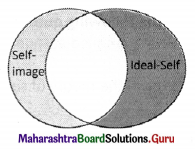
Congruent
Maharashtra Board Class 11 Psychology Solutions Chapter 3 Self 6 Q2
The self-image is similar to the ideal self.
There is more overlap.
This person can self-actualize.

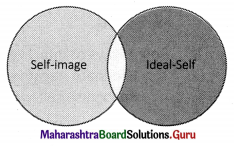
Incongruent
Maharashtra Board Class 11 Psychology Solutions Chapter 3 Self 6 Q2.1
The self-image is different from the ideal self.
There is only a little overlap.
Here self-actualization will be difficult.

Maharashtra Board Class 11 Psychology Important Questions Chapter 2 Branches of Psychology

Balbharti Maharashtra State Board Class 11 Psychology Important Questions Chapter 2 Branches of Psychology Important Questions and Answers.

Maharashtra State Board 11th Psychology Important Questions Chapter 2 Branches of Psychology

1A. Complete the following statements.

Question 1.
Online cheating and fraud have led to the development of a branch called __________ Psychology.
(A) Cyber
(B) Social
(C) Cognitive
Answer:
(A) Cyber

Question 2.
__________ psychologists conduct research effective child-rearing practices.
(A) Social
(B) Developmental
(C) Child
Answer:
(C) Child

Maharashtra Board Class 11 Psychology Important Questions Chapter 2 Branches of Psychology

Question 3.
According to __________, Social Psychology is the scientific study of how an individual’s behaviour is affected by others.
(A) Myers
(B) Freud
(C) Pavlov
Answer:
(A) Myers

Question 4.
Cognitive Psychology concentrates on higher __________ processes such as reasoning and decision making.
(A) emotional
(B) behavioural
(C) mental
Answer:
(C) mental

Question 5.
The __________ psychologist tries to understand the fundamental causes of behaviour.
(A) cognitive
(B) social
(C) experimental
Answer:
(C) experimental

Question 6.
__________ Psychology is concerned with the general problems of the teaching and learning process.
(A) Educational
(B) Clinical
(C) Experimental
Answer:
(A) Educational

Maharashtra Board Class 11 Psychology Important Questions Chapter 2 Branches of Psychology

Question 7.
__________ Psychology is similar to Clinical Psychology.
(A) Counselling
(B) Industrial
(C) Experimental
Answer:
(A) Counselling

Question 8.
__________ psychologists generally work with the law enforcement department.
(A) Social
(B) Criminal
(C) Abnormal
Answer:
(B) Criminal

Question 9.
__________ psychologists improve preparation for a competitive event.
(A) Sports
(B) Counselling
(C) Cognitive
Answer:
(A) Sports

Question 10.
__________ Psychology is a branch of Industrial Psychology.
(A) Military
(B) Clinical
(C) Consumer
Answer:
(C) Consumer

Maharashtra Board Class 11 Psychology Important Questions Chapter 2 Branches of Psychology

Question 11.
Air Force Psychologist is specialised in __________ Psychology.
(A) Rehabilitation
(B) Military
(C) Organisational
Answer:
(B) Military

1B. Match the following pairs.

Question 1.

AB
1. Clinical Psychologya. School counsellor
2. Educational Psychologyb. Remand home superintendent
3. Industrial Psychologyc. Hypnotherapist
4. Child Psychologyd. Labour welfare officer
5. Social Psychologye. Ergonomist

Answer:

AB
1. Clinical Psychologyc. Hypnotherapist
2. Educational Psychologya. School counsellor
3. Industrial Psychologye. Ergonomist
4. Child Psychologyb. Remand home superintendent
5. Social Psychologyd. Labour welfare officer

1C. State whether the following statements are true or false.

Question 1.
Today, there are more than 50 branches of Psychology.
Answer:
True

Question 2.
The main aim of applied branches is to develop principles and establish laws for explaining human behaviour.
Answer:
False

Question 3.
Developmental Psychology examines changes across three major dimensions.
Answer:
True

Question 4.
Child Psychology is a theoretical branch of Psychology.
Answer:
True

Question 5.
Social Psychology studies the role of reinforcement in motivating children.
Answer:
False

Maharashtra Board Class 11 Psychology Important Questions Chapter 2 Branches of Psychology

Question 6.
Cognitive Psychology is concerned with the study of attention and perception.
Answer:
True

Question 7.
Ivan Pavlov conducted experiments on classical conditioning taking dogs as his subject.
Answer:
True

Question 8.
Abnormal Psychology is an applied branch of Psychology.
Answer:
False

Question 9.
Educational psychologists help in preparing relevant curriculum.
Answer:
True

Question 10.
Clinical Psychology is the largest subfield of Psychology.
Answer:
True

Question 11.
Counselling psychologists offer guidance about adjustment issues faced by a person.
Answer:
True

Maharashtra Board Class 11 Psychology Important Questions Chapter 2 Branches of Psychology

Question 12.
Criminal Psychology is. closely related to Educational Psychology.
Answer:
False

Question 13.
Industrial psychologists help players to maintain their composure.
Answer:
False

Question 14.
There are many career opportunities in Psychology.
Answer:
True

2. Answer the following questions in around 35-40 words each

Question 1.
Explain the nature of questions studied under various theoretical branches.
Answer:

Developmental PsychologyQuestions related to changes that happen during the entire life span
Child PsychologyQuestions focusing on children and their responses
Social PsychologyQuestions focusing on individual’s response to group influence
Cognitive PsychologyQuestions focusing on specific cognitive abilities
Experimental PsychologyQuestions focusing on laboratory experiments to study human behaviour
Abnormal PsychologyQuestions focusing on abnormal behaviour of human beings

Maharashtra Board Class 11 Psychology Important Questions Chapter 2 Branches of Psychology

Question 2.
State any five goals associated with Sports Psychology.
Answer:
The goals associated with Sports Psychology are as follows:

  • Improve preparation for a competitive event.
  • Improve focus and concentration skills of sportspersons.
  • Improve teamwork and team cohesion.
  • Teach relaxation skills to sportspersons.
  • Develop self-awareness and increase the motivation of the team.

Maharashtra Board Class 11 Psychology Solutions Chapter 2 Branches of Psychology

Balbharti Maharashtra State Board Class 11 Psychology Solutions Chapter 2 Branches of Psychology Textbook Exercise Questions and Answers.

Maharashtra State Board Class 11 Psychology Solutions Chapter 2 Branches of Psychology

1A. Complete the following statements.

Question 1.
The branches of Psychology that explore relationships among different variables and human behaviour are known as ___________ Psychology.
a. Theoretical
b. Applied
c. Common
Answer:
a. Theoretical

Question 2.
The study of human behaviour at the workplace is the concern of ___________ Psychology.
a. Social
b. Industrial
c. Experimental
Answer:
b. Industrial

Maharashtra Board Class 11 Psychology Solutions Chapter 2 Branches of Psychology

Question 3.
One can study the problems of adolescence in ___________
a. Developmental
b. Social
c. Cognitive
Answer:
a. Developmental

Question 4.
___________ Psychology is concerned with diagnosis and treatment of psychological disorders.
a. Counselling
b. Cognitive
c. Clinical
Answer:
c. Clinical

1B. Identify the odd item from the following.

Question 1.
Experimental Psychology, Social Psychology, Industrial Psychology, Cognitive Psychology
Answer:
Industrial Psychology

Question 2.
Clinical psychology, Industrial Psychology, Sports Psychology, Abnormal Psychology
Answer:
Abnormal Psychology

1C. Match the following pairs.

Question 1.

AB
1. Developmental Psychologya) Studies organisations, human factor design, and employee training
2. Criminal Psychologyb) Studies how people become who they are from conception to death
3. Educational Psychologyc) Studies thinking process
4. Industrial Psychologyd) Helps educators to promote learning
5. Social Psychologye) Studies criminal behaviour
6. Cognitive Psychologyf) Studies the influence of other people upon an individual’s behaviour

Answer:

AB
1. Developmental Psychologyb) Studies how people become who they are from conception to death
2. Criminal Psychologye) Studies criminal behaviour
3. Educational Psychologyd) Helps educators to promote learning
4. Industrial Psychologya) Studies organisations, human factor design, and employee training
5. Social Psychologyf) Studies the influence of other people upon an individual’s behaviour
6. Cognitive Psychologyc) Studies thinking process

2. Compare and contrast.

Question 1.
Theoretical and applied branches of Psychology.
Answer:
In theoretical branches, psychologists concentrate on carrying out research and forming theories while applied branches help individuals to use the knowledge gained from research to solve their problems.

The main aim of theoretical branches is to develop principles and establish laws in order to explain behaviour of human beings while the main objective of applied branches is to put knowledge into practice by helping individuals to adjust to their real-life situations.

Maharashtra Board Class 11 Psychology Solutions Chapter 2 Branches of Psychology

Some theoretical branches are Developmental Psychology, Child Psychology, Social Psychology, Cognitive Psychology, Experimental Psychology, Abnormal Psychology while some applied branches are Educational Psychology, Clinical Psychology, Counselling Psychology, Criminal Psychology, Sports Psychology, Industrial Psychology.

For your understanding
The activities of applied psychology range from conducting field studies for finding practical solutions to problems to directly providing services to concerned individuals or organizations.

Question 2.
Abnormal Psychology and Clinical Psychology
Answer:
Abnormal Psychology is a theoretical branch that studies the unusual behavioural, emotional, and thinking patterns in individuals while Clinical Psychology is an applied branch that studies diagnoses and treats emotional and behavioural problems.

Abnormal Psychology aims to study the causes and factors leading to abnormal reactions like excessive suspiciousness, mental retardation, extreme mood swings, etc. On the other hand, Clinical Psychology deals with the diagnosis and treatment of mental illness, marital and familial conflicts, drug addiction, depression, delinquency, etc.

3. Write Short Notes.

Question 1.
Clinical Psychology
Answer:

  • Clinical Psychology is an applied branch that studies, diagnoses, and treats emotional and behavioural problems in individuals like mental illness, marital and familial conflict, drug addiction, severe depression, alcoholism, delinquency, etc.
  • For diagnosis, clinical psychologists collect detailed information regarding the client through psychological tests and by conducting interviews of clients as well as their family and friends.
  • Once the problem is diagnosed, they use appropriate psychotherapy to help the client overcome his problem.
  • Clinical psychologists usually work in hospitals and community health centers or they may have their private practice.
  • Clinical Psychology is the largest subfield of Psychology.

Question 2.
Cognitive Psychology
Answer:

  • Cognitive Psychology concentrates on higher mental processes such as thinking, reasoning, and decision making.
  • It is concerned with the study of attention, perception, language development, thinking, memory, and problem-solving.
  • It also answers questions related to the disruption of memory, different types of learning styles and disorders, causes of speech impairment as well as the functioning of decision-making mechanisms.

Maharashtra Board Class 11 Psychology Solutions Chapter 2 Branches of Psychology

Question 3.
Developmental Psychology
Answer:

  • Developmental Psychology studies changes in behaviour from conception to death.
  • It is the scientific study of how and why human beings change over the course of their life.
  • It examines changes across three major dimensions, viz. physical, cognitive, and social development.
  • It aims to explain how thinking, feeling, and behaviour change throughout life.
  • It may study a specific period of life like childhood, adolescence, adulthood, and old age.

Question 4.
Industrial Psychology
Answer:

  • Industrial Psychology is concerned with behaviour of people working in an organization.
  • Industrial psychologists play a crucial role in selection and placement, workforce motivation, and job satisfaction as well as appraisals and grievances.
  • They help to enhance motivation, group morale, and leadership skills among the employees.
  • Consumer Psychology is a branch of Industrial Psychology that deals with consumer behaviour, quality of products, brand loyalty, and influence of advertisement on purchasing.

4. Suggest an appropriate branch of psychology related to the following situations.

Question 1.
A husband and wife do not understand each other so they keep fighting.
Answer:
Counselling Psychology

Question 2.
My friend’s father lost his job and he is in depression.
Answer:
Clinical Psychology

Question 3.
A 5th standard student is unable to concentrate.
Answer:
Educational Psychology

Maharashtra Board Class 11 Psychology Solutions Chapter 2 Branches of Psychology

Question 4.
I want to study the process of thinking and learning.
Answer:
Cognitive Psychology

Question 5.
I want proper information about attitude, prejudice, or conflicts in a group.
Answers:
Social Psychology

5. Answer the following questions in detail.

Question 1.
Explain any five theoretical branches of Psychology.
Answer:
Some theoretical branches of Psychology are as follows:

Child Psychology: It deals with the biological, psychological, and emotional changes that occur during childhood. These changes occur as the individual progresses from being dependent to becoming independent. Child psychologists study problems related to children such as lying, bunking school, stealing, bedwetting. They also conduct researches on effective child-rearing practices and the role of reinforcement in motivating children.

Social Psychology: It studies how an individual influences other people and gets influenced by them. According to Myers, Social Psychology is the scientific study of how an individual’s behaviour is affected by others. The primary focus of Social Psychology is to understand how individuals are affected by other people. It examines issues such as co-operation or conflicts within groups, attitudes, prejudices, friendliness, and leadership qualities of an individual.

Experimental Psychology: It attempts to understand the fundamental causes of behaviour. It studies how people learn, remembers, reason, and respond emotionally. It deals with problems related to sensation, perception, learning and memory. Experimental psychologists conduct laboratory experiments to study how people react to sensory stimuli and perceive the world.

Maharashtra Board Class 11 Psychology Solutions Chapter 2 Branches of Psychology

Cognitive Psychology: It concentrates on higher mental processes such as thinking, reasoning, and decision making. It also answers questions related to the disruption of memory, different types of learning styles and disorders, causes of speech impairment as well as the functioning of decision-making mechanisms.

Abnormal Psychology: It studies unusual patterns of behaviour, emotions, and thinking. It aims to study the causes and factors leading to abnormal reactions such as excessive suspiciousness, extreme mood swings, perceiving objects or situations which are not real, mental retardation, extreme fear of objects, animals, or situations, etc.

Question 2.
Describe any five applied branches of Psychology.
Answer:
Some applied branches of Psychology are as follows:

Educational Psychology: It studies all factors related to education. It is concerned with increasing the efficiency of the teaching and learning process. It also focuses on the learning difficulties of slow learners, exceptional as well as average children. Educational psychologists are primarily associated with schools, colleges, and universities. They try to design intervention programs to develop motivation, effective study habits, and a better classroom environment. They also deal with behavioral issues of children such as learning disorders, hyperactivity, lack of concentration, ADHD.

Counselling Psychology: It deals with milder behavioural problems. Counselling psychologists offer guidance about adjustment issues faced by a person, e.g. difficulties experienced by a person in studies, personal life issues, or workplace issues. Counselling psychologists are also involved in vocational and career guidance.

Criminal Psychology: It deals with the motives behind criminal behaviour. Criminal psychologists are concerned with identifying the causes of crime, studying the personality of criminals, suggesting preventive measures to control criminal behaviour, and implementing plans for criminal rehabilitation. They play a significant role in the forensic department to uncover the scene of the crime. They generally work with the law enforcement department or the criminal investigation department or social organisations working for rehabilitation.

Sports Psychology: It helps sportspersons to maintain their motivation and stamina during the actual performance. It also aids sportspersons to maintain themselves when they are not on the field. Sports psychologists help players to maintain composure when they are under pressure, maintain emotional balance when they go through a bad patch, and maintain wellness when they are recovering from personal injuries.

Maharashtra Board Class 11 Psychology Solutions Chapter 2 Branches of Psychology

Industrial Psychology: It is concerned with the behaviour of people working in an organisation. Industrial psychologists play a crucial role in selection and placement, workforce motivation, and job satisfaction as well as appraisals and grievances. Consumer Psychology is a branch of Industrial Psychology that deals with consumer behaviour.
applied branch of Psychology. The development of aviation and space exploration programmes has accelerated growth in Engineering Psychology.

Question 3.
Write any five career opportunities in Psychology.
Answer:
Counselling Psychology: An individual can become an educational counsellor or vocational counsellor or marriage counsellor and help people to solve career-related or personal problems.

Social Psychology: An individual can become a public relations officer or social welfare officer or labour welfare officer.
These officers attempt to solve various social problems.

Sports Psychology: An individual can become a sports counsellor and work in gyms, schools, or professional sports teams. These counsellors help to improve the confidence, concentration, and morale of players.

Military Psychology: An individual can become an army mental health specialist or army psychologist, navy psychologist, air force psychologist, or marine psychologist. These psychologists play a role in the selection of army officers. They also improve the morale of people in defense services.

Rehabilitation Psychology: An individual can become a special educator or rehabilitation psychologist or disaster management and rehabilitation officer. A special educator works for specially-abled persons while a rehabilitation psychologist works in remand homes. A disaster management and rehabilitation officer helps in disaster management and rehabilitation.

Activities

Activity 3. (Textbook Page No. 14)

Try to find at least one example that can fit into each of the above sub-branches of theoretical Psychology.
Answer:

  • Developmental Psychology: Mr. Mehta conducted a comparative study of physical and cognitive development during early childhood and late childhood.
  • Child Psychology: Mr. Singh studied the impact of parental divorce on the social behaviour of a child.
  • Social Psychology: Mrs. Joshi examined the effect of peer pressure on a person’s dressing style.
  • Cognitive Psychology: Mr. Dsouza studied factors influencing the attention span of students during lectures.
  • Experimental Psychology: Mr. Iyer studied the reactions of individuals in a laboratory to disgusting events.
  • Abnormal Psychology: Mrs. Ajmera conducted a study on the genetic factors influencing depression.

Maharashtra Board Class 11 Psychology Solutions Chapter 2 Branches of Psychology

Activity 4. (Textbook Page No. 15)

Can you think of at least one problem that educational psychologists can find solutions to, concerning the following areas?

  1. Behaviour of the student
  2. Teaching methods
  3. Teacher’s behaviour in the class

Answer:

  1. Why do students bunk lectures?
  2. Do interactions with students during lectures improve learning outcomes?
  3. Is it possible to use reward and punishment techniques to motivate students?

Activity 6. (Textbook Page No. 16)

Can you think of at least one problem that a counselling psychologist can find solutions to, concerning the following areas?

  1. Adjusting with peers
  2. Adjusting with parents and siblings
  3. Making decisions about a career

Answer:

  1. How conflict with peers affects an individual’s mood?
  2. How generation gap may lead to a difference of opinion?
  3. How to choose a career that matches one’s interests and aptitude?

Activity 8. (Textbook Page No. 16)

Think of at least one problem that a sports psychologist can find solutions to, concerning the following areas.

  1. Improving team spirit
  2. Emotional management
  3. Improving self-confidence

Answer:

  1. How to build healthy relations with team members?
  2. How to remain calm and composed even after a failure?
  3. How to believe in one’s capabilities during challenging tournaments?

Maharashtra Board Class 11 Psychology Solutions Chapter 2 Branches of Psychology

Activity 9. (Textbook Page No. 17)

  1. Talk to your parents/teachers and enlist the factors that give them satisfaction at their work.
  2. While buying something from the market, which factors affect your desires? Enlist these factors that influence your choice. For example advertisements, brands, etc.

Answer:

  1. Some of the factors that are associated with job satisfaction are the extent to which one enjoys his work, relation with superiors and colleagues, rate of remuneration and other incentives as well as the scope of growth in the future.
  2. Some of the factors that influence consumer choices are quality of the product, price of the product, price of substitute and complementary products, the income of a person, latest trends, personal choices, habits, and opinions of significant others.

Maharashtra Board Class 12 English Yuvakbharati Solutions Chapter 3.6 Group Discussion

Balbharti Yuvakbharati English 12th Digest Chapter 3.6 Group Discussion Notes, Textbook Exercise Important Questions and Answers.

Maharashtra State Board Class 12 English Yuvakbharati Solutions Chapter 3.6 Group Discussion

12th English Digest Chapter 3.6 Group Discussion Textbook Questions and Answers

You must have discussed many things with your friends, classmates in a group. It might be about going on a picnic or selecting a gift for your teacher:

Question (i)
What do you think are the benefits of a group discussion?
Answer:
(a) A Group Discussion allows the participants to share their views and opinions.
(b) It allows each participant to analyse the topic or case.
(c) A Group Discussion allows the participants to reach a general consensus.

Maharashtra Board Class 12 English Yuvakbharati Solutions Chapter 3.6 Group Discussion

Question (ii)
Do you think some people are right and some are wrong in a group discussion? Why?
Answer:
Yes, I do think so. Generally, we hold a view on a topic or a situation. This view is either strengthened or weakened by the ongoing arguments in a Group Discussion. Due to j confirmation bias, we tend to think that the participants who strengthen our views j are right. Similarly, we think of those who go against our views are wrong. (The ideal situation is that we keep an open mind and assess each argument on its own merit but this is easier said than done.)

Question (iii)
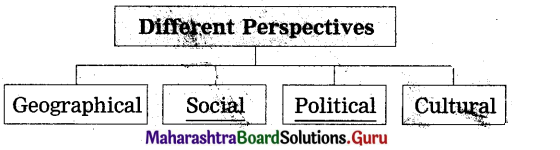
People have different views and opinions because:
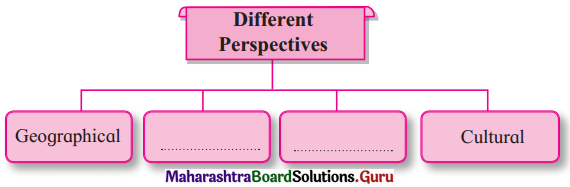
Maharashtra Board Class 12 English Yuvakbharati Solutions Chapter 3.6 Group Discussion 1
Answer:
Maharashtra Board Class 12 English Yuvakbharati Solutions Chapter 3.6 Group Discussion 2

Maharashtra Board Class 12 English Yuvakbharati Solutions Chapter 3.6 Group Discussion

Question (iv)
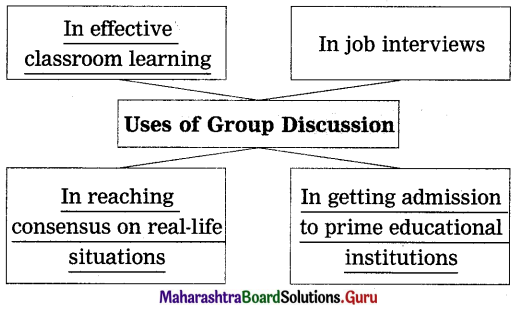
Complete the web highlighting the uses of ‘Group Discussion’. One is done for you.
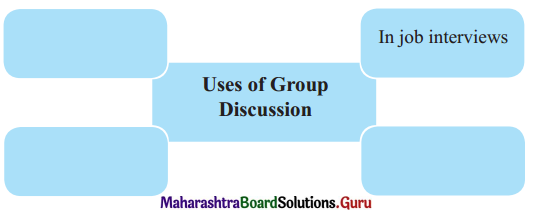
Maharashtra Board Class 12 English Yuvakbharati Solutions Chapter 3.6 Group Discussion 3
Answer:

(A1)

Question 1.
Rama, Asif, Rachana and Aarav are participating in a group discussion. The evaluator has given them a topic. ‘Teenagers are more inclined towards junk food nowadays.’ Write suitable dialogues for each participant giving his/her opinion on the topic.
Evaluator: You’ve all been given a few minutes to think on your topic for today’s group discussion, which is ‘Teenagers are more inclined towards junk food.’ You may now begin the discussion. Who would like to start?
Rama: ………………………………………………. .
Asif: ………………………………………………….. .
Aarav: ……………………………………………….. .
Rachana: ……………………………………………. .
Evaluator: Please conclude.
Aarav: ………………………………………………… .
Answer:
Rama: I think I will. In my opinion it is very true. Junk food leads to obesity and we find more obese teenagers around nowadays.
Asif: I am afraid I can’t agree with that statement. Most of the teenagers in our college look quite fit and active.
Aarav: I think we must see the issue in a wider perspective. The inclination towards junk food among teenagers is a worldwide phenomenon. One can’t jump to a conclusion by just looking around and citing a few examples in our college.
Rachana: It seems to me that Rama made a valid point. Teenagers world over are inclined towards junk food and it poses a great threat. I suggest the teenagers change their food habit and resort more to healthy snacks. Our tradition offers a wide variety of such snacks.
Evaluator: Please conclude.
Aarav: We can conclude by saying that our teenagers are inclined to junk food. They must change their food habit. It is high time they switched to healthy snacks. We need healthy citizens to take our country forward.

Maharashtra Board Class 12 English Yuvakbharati Solutions Chapter 3.6 Group Discussion

(A2)

Question 1.
Read the following statements, if you agree say ‘Yes’ and if you don’t agree, say ‘No’. State the reason for your opinion.
Answer:

StatementYes/NoReason
1. It is not possible to guess the topic for group discussion. Then there is no need to prepare.NoTopics for Group Discussion are mainly chosen from things happening around us. So, we must keep our minds open and receptive to the happenings around us. The knowledge thus received and the opinions and views we form about each such topic will prove to be our preparation for the group discussion.
2. Always have discussion with your family and friends on different topics.YesWe may be wrong in our opinions/views. Constant discussions with family and friends help us form the right sort of views/opinions.
3. You must aim to get noticed by the evaluators.NoWe must get noticed mainly by the force of our arguments and our active involvement in the discussion. Evaluators are experienced to assess our analytical power and assertive approach. Any deliberate effort to outshine other participants will do more harm than good.
4. Forget the evaluator and look at the participants during the discussion.YesThe evaluator is a passive observer. Discussion happens only among the participants. Glancing at the evaluator often could be treated as a sign of your distracted mind.
5. You should raise your voice to be heard by everyone and speak for a long time to show your knowledge.NoOur voice should neither be too high nor be too low. Raising one’s voice much more than necessary will create the impression of a rabble- rouser. Our grasp of the topic must come out naturally through the novelty of our arguments. Brevity and concision must be the watchwords. A long and verbose argument will surely produce a negative impact.
6. You should always take the opportunity to begin the argument.NoThough initiating a discussion shows our leadership qualities, an overzealous approach may at times go against us.
7. Take a strong position/view and defend it till the end.NoIf another participant contradicts our view with sound reasoning, we must concede to it. Taking a strong position beforehand may restrict us from considering other point of views.
8. Do not keep waiting for your turn to speak. You have to be alert and quick.YesWe must be alert and quick. We must sieze the opportunity to speak. Being too passive may even deny us a chance to present our views.
9. Listening to others also plays an important role in a group discussion.YesListening to others is a crucial element in group discussion. It helps,us to formulate new perspectives and modify our viewpoints in the course of the discussion.
10. You must interrupt a person if you do not agree to his opinion.NoEveryone has the right to hold individual opinions. Moreover, interruption denies the person the opportunity to complete his views. We can take up the counter-argument as soon as he finishes his views.
11. Show your leadership skills being assertive not aggressive.YesAssertiveness is a positive trait. It is a sign of leadership quality. We can be assertive by the force of our arguments and the conviction we have in our views. Aggression, on the other hand, will only expose our untamed personalities.
12.  Participating in a group discussion also means helping everyone to reach a consensus in spite of difference of opinion.YesAssertiveness is a positive trait. It is a sign of leadership quality. We can be assertive by the force of our arguments and the conviction we have in our views. Aggression, on the other hand, will only expose our untamed personalities.

Reason: Group discussion helps us realize that there are other possible views and opinions. A receptive and accommodative mind is a prerequisite for anyone who participate in a group discussion. Moreover, the candidate must be able to feel the pulse of the discussion. This, in turn, will help to reach a consensus.

Maharashtra Board Class 12 English Yuvakbharati Solutions Chapter 3.6 Group Discussion

(A3)

Question (i)
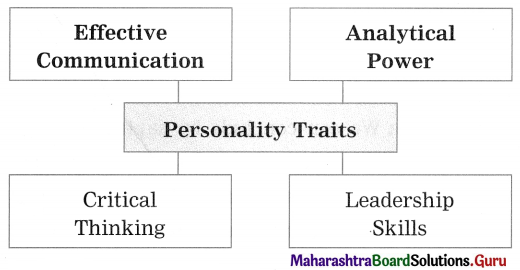
Group discussion helps to unravel the following personality traits in a person.
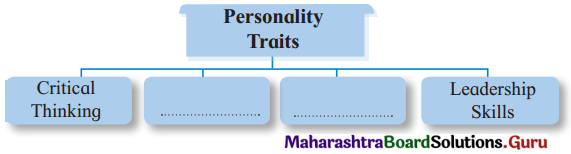
Maharashtra Board Class 12 English Yuvakbharati Solutions Chapter 3.6 Group Discussion 5
Answer:
Maharashtra Board Class 12 English Yuvakbharati Solutions Chapter 3.6 Group Discussion 6

Question (ii)
Match the following:

DiscussGive special importance or value to something in speaking or writing.
ArgueSay something again, a number of times.
DeliberateExpress opposite views in a heated or angry way.
ReiterateEngage in long and careful consideration.
EmphasizeTo talk about a subject with someone and tell each other your ideas and opinions.

Answer:

DiscussTo talk about a subject with someone and tell each other your ideas and opinions.
ArgueExpress opposite views in a heated or angry way.
DeliberateEngage in long and careful consideration.
ReiterateSay something again, a number of times.
EmphasizeGive special importance or value to something in speaking or writing.

Maharashtra Board Class 12 English Yuvakbharati Solutions Chapter 3.6 Group Discussion

(A4)

Question (i)
Write the following sentences in reported/indirect speech:
(a) He said, “If you find my answers satisfactory, will you give me five rupees?”
(b) The astrologer said, “You were left for dead. Am I right?”
(c) “I should have been dead if some passerby had not chanced to peep into the well,” exclaimed Guru Nayak.
(d) He told her, “Do you know a great load is gone from me today.”
Answer:
(a) He asked me whether I would give him five rupees if I found his answers satisfactory.
(b) The astrologer asked whether he was right in saying that I had been left for dead.
(c) Guru Nayak exclaimed that he would have been dead unless some passerby had chanced to peep into the well.
(d) He asked her whether she knew that a great load was gone from him that day.

Question (ii)
Read a part of a conversation between Neha and Nidhi.
Answer:
Neha: Where are you going, Nidhi?
Nidhi: I am going for my music lessons.
The above conversation is written in exact words spoken. If this conversation was to be reported by a third person then it would be written as:

Neha asked Nidhi where she was going. Nidhi replied that she was going for her music lessons. Notice the changes in the reported sentence.
Note the changes in pronouns, tenses, reporting and reported verbs and other changes.
Answer:
1. Table showing tense change:
Simple Present → Simple Past
Present Continuous → Past Continuous
Simple Past → Past Perfect
Past Continuous → Past Perfect Continuous
Simple Future → Conditional

2. Table showing change in Place and Time

  1. here – there
  2. now – then
  3. today – that day
  4. tomorrow – the next day
  5. yesterday – the day before
  6. next week – the following week
  7. last night- the previous night

3. Table showing the changes in Pronoun.

Ihe/sheourtheir
mehim/herourstheirs
myhis/heryou (subject)I/he/she/we/they
minehis/hersyou (object)me/his/her/us/them
wetheyyourmy/his/her/our/their
usthemyoursmine/his/hers/theirs

Maharashtra Board Class 12 English Yuvakbharati Solutions Chapter 3.6 Group Discussion

Question (iii)
Now find sentences from the text in the direct speech and convert them into the reported speech.
(Students may attempt this on their own.)
Read the following sentences given in the indirect speech and convert them into the direct speech.
(a) Shirish said that he would not be able to solve the problem.
(b) Lata told me to give her a glass of water.
(c) Ananya exclaimed with joy that she had received the Ph.D. degree.
(d) Shilpa asked us if there was any other Rian document to be typed.
(e) Swati said that she would not get the money.
Answer:
(a) Shirish said, “I will not be able to solve the problem.”
(b) Lata said, “Give me a glass of water.”
(c) Ananya said, “Hurrah! I have received the Ph.D. degree.”
(d) Shilpa said, “Is there any other document to be typed?”
(e) Swati said, “I will not get the money.”

(A5)

Question (i)
An economically deprived girl student in your class who has received admission in a reputed college abroad needs monetary help to pursue further studies there. Have a group discussion amongst your friends to seek solutions to help her. Write four/five views in the form of dialogues.
Answer:

  • Rian: Well, folks! we need to do something urgently in Tejaswini’s case. Money shouldn’t come in her way to pursue a course abroad. My parents offered 50,000/- right away!
  • Eugine: I managed to get a loan of rupees one lakh from my parents. I should take up some part-time job and repay it within three years. I hope I will be able to do it. Anyway, I am quite happy to be of some help to our dear friend.
  • Kanika: Only way before me was to ask for an advance from my music troupe. We don’t get much programmes of late. Still they agreed to pay me 75,000. Will that be okay?
  • Tabu: We thought you would raise a hefty sum, being ‘a great singer’ and all. Okay, jokes apart, I will present my case. My brother offered a donation of rupees two lakh right away. No conditions! No strings attached!!
  • Rian: Okay, folks! Now we have pooled 4.25 lakhs.

That will bankroll Tejaswini’s fee, travel, initial expenses, etc, etc. She can very well take up a summer job and the like to meet her further expenses. Let’s now congratulate ourselves for being such thick friends!

Maharashtra Board Class 12 English Yuvakbharati Solutions Chapter 3.6 Group Discussion

Question (ii)
There is an inter-school cricket match and your school is losing. As you are the captain, have a group discussion with your teammates in the tea-break about the strategy to be followed to save your school from losing the match. Give at least four /five suggestions.
Answer:

  • Captain: See, we must break this partnership anyhow. Both the batsmen appear very much settled and they are hitting all over the place.
  • Spinner: The pitch doesn’t support many turns. I suggest we bring back the fast bowlers.
  • Captain: You have a point there. What we need most now is a wicket. Right now. Otherwise, the game is as good as lost.
  • Fast bowler (1): I agree that we resume pace bowling. But remember: it’s a gamble. I think I will need a slip-in position. I will attack, outside the off-stump. Hope I get the right line.
  • Captain: What do you think, Sonu?
  • Sonu (Fast bowler) (2): Okay then. I will take up from the pavilion end. Think the wind is in favour.
  • Captain: Attempt yorkers.
  • Sonu: Sure. I suggest you keep a deep third man.
  • Captain: Done. Now, guys-no sloppy fielding-no dropped catches. And nothing short of a win. (All go into a huddle.)

Question (iii)
Form four groups in your class and have a group discussion on the following topics.
(a) Role of ICT in education
(b) Clean India

Yuvakbharati English 12th Digest Chapter 3.6 Group Discussion Additional Important Questions and Answers

Other writing skills:

Dos and Don’ts associated with ‘Expansion of Ideas’:

DosDon’ts
1. Begin impressively.1. Do not go off-track.
2. Have unity and clarity of thoughts.2. Do not forget to give the symbolic meaning of the statement.
3. Use discourse markers.3. Do not forget to include the topic sentence.
4. Use proverbs with similar meanings.4. Do not omit a proper conclusion.

Expand the idea inherent in the following:

Question 1.
Charity begins at home Ans. Charity is the noble deed of giving money, food or other help to people who are in need of these things. The given proverb is a warning to those who seek fame in the name of charity. The proverb reminds us that we must first help the needy people around us – our family and friends. Any deed of charity that forgets this principle goes against the spirit of this high ideal.

Our deeds of charity must begin from the centre and then radiate to the periphery. Or else, it would prove to be a selfish pursuit of chasing fame or other favour. We must first open our eyes to the miseries around us. We must first cater to the needs of these people. Then we can spread our work of charity farther afield.

We see that many people treat their family members and servants very shabbily. But when it comes to a photo opportunity to pose as a philanthropist, they jump at it. This is sheer hypocrisy and the saying serves as an eye opener to these hypocrites.

Maharashtra Board Class 12 English Yuvakbharati Solutions Chapter 3.6 Group Discussion

Question 2.
Make hay while the sun shines
Answer:
Hay making, that is the process of cutting and drying grass, must be done while the sun shines. Rain would spoil everything and the farmer knows it well. In other words, we should make the best use of opportunities and favourable conditions while they last.

When life presents opportunities, we must seize them and not let them go. Everyone in their lifetime gets a chance to move ahead in life. If we miss that opportunity, it may never come our way again. We will live all our life to regret the missed chance. In short, we should seize the chance while it exists. We must always be alert to notice the opportune moment. Grab it and move further in life. To put it in another way : “We must strike while the iron is hot”.

Question 3.
Prevention is better than cure.
Answer:
The proverb stresses the need for foresight and precaution in dealing with any possible eventuality in life. We often ignore the signs of trouble and when the trouble finally, occurs, we regret our neglect.

We must make it a practice to guard ourselves against diseases by taking adequate preventive measures. This will save us the trouble of undergoing costly treatments. Strangely, certain epidemics offer no cure or vaccine for a long time, then prevention becomes the only option before us. Wearing of masks, keeping social distance and maintaining hand-hygiene are the only ways to save us from such a threatening situation.

Metaphorically, the idea can be extended to fields other than disease and medicine. Proper maintenance of machines, roads and bridges can prevent their deterioration and thus forestall disaster. At the political and economical level too, many problems that we face today would not have existed had the authorities acted promptly, firmly and boldly at the very start.

Examples for Practice:

  1. Unity is Strength,
  2. Books – Our best friends,
  3. Honesty is the Best Policy
  4. Perseverance is the Key to Success
  5. Pollution: Earth’s enemy number one.

Formal Letters:

General Format for a Formal Letter:

  1. Sender’s Address
  2. Pin Code
  3. Date
  4. Name and address of the addressee
  5. Subject (a phrase about the general content of the letter)
  6. Reference (referring to a letter previously received/advertisement etc.)
  7. Salutation (Dear Sir/Madam or simply Sir/ Madam)
  8. Body of the letter (in 3 or 4 paragraphs)
  9. Subscription (Complimentary Close like Yours faithfully, Yours truly, etc.)
  10. The name given in the Activity Sheet/XYZ

Maharashtra Board Class 12 English Yuvakbharati Solutions Chapter 3.6 Group Discussion

Write the letters as instructed:

Question 1.
Write a letter to the editor of a newspaper drawing attention to the increasing noise pollution in your area.
Answer:
3 A, Ravikiran,
Chikuwadi,
Borivali (West),
Mumbai – 400 092.
1st September, 2020

The Editor,
The Indian Express,
Nariman Point,
Mumbai – 400 021.

Sir,

I wish to draw the attention of the authorities to the terrible noise pollution in our neighbourhood. There is deafening noise created by heavy traffic on the narrow roads of our locality throughout the day and night. The drivers honk continuously, and the vehicles emit poisonous fumes. The hawkers who sell their goods on the roads and footpaths shout at the top of their voices.

All this is literally making the people sick. With the approaching festival season, the beat of drums and the loud music accompanying it are bound to make life all the more unbearable for all of us who reside here.

I hope the authorities concerned wake up in time to the hazards of noise pollution and take prompt action to stop this menace.

Yours truly,
ABC

Question 2.
You want to visit a sugar factory to know more about the sugar production process. Write a letter to the Manager of the sugar factory near your college seeking permission. Give details about the intended visit.
Answer:
Ideal College,
Vidyapeeth Marg,
Beed – 431 122.
5th February 2020

The Manager,
Sakhar Factory Ltd.,
Beed – 431 122.
Sub: Request to visit your factory.

Dear Sir,

As part of our science project, 10 students of Std. XII (Ideal College) would like to visit your factory during the latter half of this month. We will be accompanied by our Chemistry Professor, Dr Ahirwal. It is our desire to have first hand information about the production of sugar. We believe that a visit to the factory will give us more valuable information than we can ever get out of textbooks.

Do let us know what would be the most suitable day and time for our visit. Since we now have study leave, any day and any time will be suitable for us. Also let us know if there are any special rules or conditions we need to follow during the visit. We do hope that you will not say no to our request.

Yours faithfully,
XYZ

Maharashtra Board Class 12 English Yuvakbharati Solutions Chapter 3.6 Group Discussion

Question 3.
Write a letter to a celebrity who supports a meaningful and innovative campaign and thus has become your idol.
Answer:
7, Vicky Apartments,
J.T. Road,
Nashik – 422 001.
17th September, 2020

Ms. Nandita Das,
Actor and Activist.
Dear Ms. Das,

Your support to the campaign ‘Black is Beautiful’ made a real impact on me. Honestly, I now look upon you as my guide, mentor, pathfinder and idol.

I have always found the discrimination based on colour really disgusting. It is nothing short of racial bias. I wish to join this campaign. I want to fight against the revolting obsession with the skin colour.

As you are a person who lived and proved this bias wrong, I take courage from you. You are a pathfinder and idol for today’s youth. I wish all those who are involved in the campaign the very best.

Yours sincerely,
RST

Question 4.
The New Arts, Science and Commerce College, Karad- 415 101, needs a librarian, They have advertised in the Indian Express, dated 17th October 2020. Write a letter of application to the Principal, with the help of the CV given below:

Curriculum Vitae (cv)
Name: Ms Deepali Rane
Address: A-303, Munir Apartments, Valkumbh, Karad – 415 110.
Email: [email protected]
Nationality: Indian
Date of Birth: 16-5-1990
Qualifications: B.Com., B. Lib. Sc.
Experience: Working as an Associate Librarian at the Karad Public Library.
Languages known: Marathi, English, Hindi
Interests: Reading, painting, music
Answer:
A-303, Munir Apartments,
Valkumbh,
Karad- 415 110.
17th October 2020

The Principal,
The New Arts, Science and Commerce College,
Karad – 415 101.
Sub: Application for the post of Librarian.
Ref: Your advertisement in the ‘Indian Express’, dated 17 October 2020.

Sir/Madam,

This is with reference to your advertisement in the ‘Indian Express’, dated 17 October 2020 for the post of librarian in your college.

I am a qualified librarian. I passed my B.Com. in 2011. I also passed the degree in library science in 2013, from Pune University, with First Class. Since then, I have been working at the Karad Public Library as an Associate Librarian. I can speak English, Hindi and Marathi fluently.

I am applying for the job in your renowned college as I feel that I now have sufficient experience to take up independently the job of a librarian. I get along well with the younger generation, and I can assure you that I will do my best to give you satisfaction, should you appoint me for the post. I enclose photocopies of the necessary certificates.

Thanking you,
Yours faithfully,
Deepali Rane
Enel. : Photocopies of B.Com, B. Lib. Sc. Certificates

Maharashtra Board Class 12 English Yuvakbharati Solutions Chapter 3.6 Group Discussion

Report Writing:

Write the reports as instructed:

Question 1.
During a global pandemic, a nationwide lockdown was announced. Write a newspaper report on this with the help of the following points :

  • Declaration of the lockdown
  • All movements stopped
  • Essential services allowed
  • Guidelines for safety laid down

Answer:
Biggest Lockdown Ever

Staff Reporter

New Delhi, March 25: Nation went into a lockdown at the stroke of midnight amidst the ongoing threat of COVID-19 pandemic. Though the scare of the pandemic has been in the air for some time, the lockdown came as a bolt from the blue to citizens all over.

The Prime Minister declared the step of lockdown in a live telecast on TV at 8:00 o’clock last night. The PM in his speech appealed to the citizens to maintain the lockdown rules fully and effectively. “There is no better option before us than going into this strict but painful measure,” he told the country during the telecast.

Flights, domestic as well as international, are now grounded. Railways suspended all services. Public transport came to a halt. Only essential services are allowed and the police are on the streets to ensure that everyone complies with the lockdown measures. Detailed guidelines for the lockdown have been laid down and citizens are advised to venture out only for emergencies. The message of social distancing and hand-hygiene are put across through various media.

“Stay Home and Stay Safe” is the new mantra. As normal life has been hit unlike anything that happened in the past, the citizens are grappling with the new norms. “We must sacrifice our liberty for a greater common good,” a senior citizen told this reporter.

Question 2.
Write a report of Republic Day Celebrations in your college.
Answer:
Republic Day at Model College Malegaon, January 28: This year, Republic Day was celebrated with great fanfare on the campus. It was a special occasion because Narendra Jain of the NCC was to be felicitated for winning the target-shooting gold medal by the Police Academy. The National Flag was unfurled at 7-30 a.m. by the Chairman of the College Management Trust.

The National Anthem was played by the college band while everyone stood respectfully to attention. Meera Pandit of Std. XII recited a poem composed by her, ‘Majha Desh Mahaan’. This was well appreciated by one and all. The Chief Guest spoke to us about our duties as citizens of the Republic of India. Then Narendra Jain was given the award by Senior Inspector Kale of the Police Academy. This was a solemn ceremony. Sweets were distributed and the gathering then dispersed.

Maharashtra Board Class 12 English Yuvakbharati Solutions Chapter 3.6 Group Discussion

Question 3.
Read the following headline of a news item “Cold Wave Sweeps North India”. Write a suitable dateline, lead paragraph and conclusion. Use a byline as well.
Answer:
Cold Wave Sweeps North India By A Special Correspondent Delhi, December 12 : Winter continued to send shivers across northern India, claiming another life in Uttar Pradesh. Delhi recorded the coldest day in the past fifty years on Monday.

A four-month-old boy died in Kanpur. The winter chill also swept through Punjab, x Haryana, Rajasthan, and Himachal Pradesh and minimum temperatures hovered between minus and plus five. The mercury dipped to a record low in many northern cities. In New Delhi, the air traffic has been severely hit by the fog.

Question 4.
Read the following headline of a news item “Milk for Millions” scheme inaugurated. Write a suitable dateline, lead paragraph and conclusion. Add a byline.
Answer:
‘Milk for Millions’ Scheme Inaugurated
By Sonali Mazumdar

New Delhi, August 29: Inaugurating the ‘Milk for Millions’ scheme of the National Dairy Development Board (NDDB) here, the Prime Minister called for a second white revolution to provide milk to the millions of undernourished infants of the country. “We must ensure at all costs that our infants get the basic nourishment, which is their right by birth,” he declared amidst loud applause.

The NDDB chairman said the projected 300 million output for 2020-21 would suffice to support the scheme. “A detailed plan with Panchayat-level participation has been already chalked out for the execution of the scheme,” he added.

Question 5.
Mumbai School Sports Association’s (MSSA) under-14 interschool football championship final was held on 17th November. Write a newspaper report on this with the help of following points :

  • Don Bosco School vs Gokuldham School
  • Don Bosco won by 3-1
  • Goals scored after the half time
  • Venue: Brabourne stadium
  • Shield awarded

Answer:

Don Bosco Bags Mssa Shield
By Sports Reporter

MUMBAI, November 18: In the Mumbai School Sports Association’s (MSSA) Under-14 interschool football championship final, Don Bosco beat Gokuldham 3-1 at Brabourne here today.

The clash of the old rivals was a sheer delight to the crowd. Till half time, it was anybody’s game. Expectedly, in the second half, Don Bosco went on the offensive hook, line and sinker. Their ace striker Vipul Shetty shot two marvellous goals within the span of six minutes. Later, Mukul Vanik’s header off a corner kick came as the saving grace for Gokuldham. Don Bosco’s captain Melvin D’sa received the shield amidst loud cheering.

Maharashtra Board Class 12 English Yuvakbharati Solutions Chapter 3.6 Group Discussion

Question 6.
An auto driver returns a bag of cash to a passenger who had forgotten the bag in the auto. Write a newspaper report on this with the help of following points :

  • Notices the bag after dropping the passenger
  • Began the search for the owner
  • Ultimately traced the passenger
  • Refuses reward
  • Honesty is the best policy.

Answer:
Auto Driver Shows The Way – By Aarohi Bokil
PUNE, March 12: Setting yet another example to prove ‘honesty is the best policy’, an auto driver here returned a bag containing two lakhs to its owner.

“I was queuing at the petrol pump after dropping my last passenger when I noticed a leather bag on the back seat. Opening it I found wads of notes; and then my hunt for the owner began,” Abdul Latif – the auto driver – said.

It took Latif two hours and two hundred rupees worth of fuel to trace the owner. “It is nothing short of a miracle that he traced me following such vague leads,” Hiten Vora – the bag’s owner- said with a voice breaking with emotion. Abdul Latif, however, refused to take any reward. When asked about the loss he incurred in the process, the youngster dismissed the issue with a hearty laugh.

Speech Writing

Draft the following speeches as instructed:

Question 1.
Prepare a short speech to be delivered by you in class on the occasion of the send off for students of Std. XII.
Answer:
A Hearty Farewell

Honourable Principal, Respected Professors and dear friends,

Today is an important day for us because it is the day we take leave of you in order to study for the coming HSC examinations. We hope that all of us will pass the examination with resounding success. Some of us may continue with higher education, some of us may seek employment hereafter. But we shall never forget these two years that we spent on this campus. These were years not only of great fun and freedom, but also of successful learning.

We got our first lessons in democracy here. We learnt to live in harmony with all kinds of people. Our professors were patient with us and were always there to clear our doubts. We are grateful to them. We are also grateful to all of you who made these years such a rich experience for us. A heartfelt thanks to you once again, and may God bless our efforts in the coming examinations.

Thank you.

Maharashtra Board Class 12 English Yuvakbharati Solutions Chapter 3.6 Group Discussion

Question 2.
Prepare a short speech to be delivered by you in class on the occasion of the Independence Day.
Answer:
India of My Dreams

Respected Sir/Madam and dear friends,

This is a very special and important day for us. On this day we remember those who fought for our freedom. On this day our National Flag flies atop all important buildings and institutions. I believe that Independence Day is a day when we need to pledge ourselves to the nation anew. It is a day when we need to make fresh commitments to all the ideals of our Constitution; ideals such as freedom, justice, equality and brotherhood. It is a day when we need to put to test whether we truly follow these ideals.

Let us carry forward the torch of freedom. Let us in fact be soldiers who will fight against the evils that this nation now faces; evils such as terrorism, corruption, inequality and superstition. Only when these evils are overcome, will our nation be truly free.

Jai Hind!

Question 3.
Write a speech on ‘Democracy’.
Answer:
Ideal Democracy

Honourable Judges, Respected Teachers and dear friends,

Unfortunately, democracy in India today does not work the way it should. It is limited to the day when the masses go to the polling booths and cast their votes. Then they return to their routine lives.

Most people do not actively participate in serious social issues. They do not react to the injustice happening around. Many among us do not bother to raise our voice against the corrupt practices going on around us. Casting our votes once in five years or so is not the sole idea of being a responsible citizen. A citizen should be always vigilant. Likewise, we also need a responsible media to expose those who are corrupt. Further, the people’s representatives should realize that they are accountable to the voters. If all these things work together then only can we reap the real fruits of democracy.

Thank you!

Maharashtra Board Class 12 English Yuvakbharati Solutions Chapter 3.6 Group Discussion

Dialogue Writing:

Write the dialogues as instructed:

Question 1.
You wish to open a postal savings account in the post office in your locality. Write the conversation between you and the Postmaster in the form of a dialogue.
Answer:

  • Myself: Good morning sir. I wish to open a I postal savings account. How do I go about it?
  • Postmaster: Just fill this form giving proper details about your name and address and sign on the dotted line there at the bottom.
  • Myself: What is the minimum amount that I can put in?
  • Postmaster: Oh, you can put in any amount you want. How much do you want to deposit right now?
  • Myself: I would like to open the account with 500.
  • Postmaster: Then hand over the money to me and I will give you a receipt for it.
  • Myself: Here is the form and the money. Postmaster : Here is your receipt. Now you have a postal savings account. You can collect your passbook after half an hour.
  • Myself: Thank you sir.
  • Postmaster: You’re welcome.

Question 2.
Write a conversation between you and your mother about ‘domestic duties’:
Answer:

  • Myself: Mother, do I have to do the dishes every day?
  • Mother: Well, dear, you’ve got to learn sometime. You can never tell when the need may arise.
  • Myself: But I have so much to study. And I have projects to complete.
  • Mother: I understand. But this work has also to be done.
  • Myself: Can’t the servant do it?
  • Mother: Oh, she will be coming late today and the dishes are all cluttered up. In the future it will be very difficult to get a domestic help. Then you will thank me for training you.
  • Myself: Mother, I plan to get a good job and earn a lot of money. I will employ a housemaid permanently in my house to look after everything, including looking after the children.
  • Mother: You can never be so sure about the future. So just get down to the dishes, and don’t argue.
  • Myself: Ok mother, if you say so.

Question 3.
You are in Std. XII in your college. On the first day of the new academic year you meet a student of Std. XI. Write a conversation you have with the ‘fresher’ :
Answer:

  • Myself: Hello. You’re new, aren’t you? What’s your name?
  • Fresher: Hello, I’m Nitin.
  • Myself: Which school are you from?
  • Fresher: I’m from Ideal School.
  • Myself: I guess you’ve taken Commerce. Right?
  • Fresher: Yes.
  • Myself: I’m in Commerce too. Have you found your class? You seem nervous.
  • Fresher: Yah. It’s the first day. And they say that the seniors rag the freshers.
  • Myself: Oh, nothing. Just a little teasing, that’s all. You don’t have to be scared. It’s only to make you feel at home.
  • Fresher: Will you be there?
  • Myself: Yes, I’ll be there. Don’t worry. My name is Ketan. I’ll say you’re my friend. No one will do anything to you.
  • Fresher: Hey, thanks a lot. You’re a real pal! I have to go and find my class. See you later. Bye.
  • Myself: Bye.

Maharashtra Board Class 12 English Yuvakbharati Solutions Chapter 3.6 Group Discussion

View-Counterview

Write the counterviews as instructed:

Question 1.
Write a Counterview for the topic: ‘The Cellphone has given us social networking- not society’. You may consider the following points for the View section of the topic and then write the Counterview. The cellphone has given us social networking – not society View:
– cellphone did not bring in any social change, except instant communication
– instead of being a means of social bonding (e.g. the railways or the loudspeaker earlier), the cellphones make the people live in their own individual islands
– cellphones have just succeeded in making too many people talk for too long a time on matters too silly.
Answer:
Cellphones did usher in a new society (Counterview)

Bringing instant communication to the poor itself is a social revolution. The poor was earlier deprived of both – speedy transport and quick communication. Speedy communication saves time, and time is money for the poor as it is to the rich. More so for the poor who sell their labour by hours and days. In addition, the availability of affordable handsets brought in a sort of socialism. Now even the unlettered can talk directly to his near and dear ones he needn’t pester a ‘babu’ to get his letters written.

When it comes to social bonding, the cellphones have played a major role of late in organizing protest rallies and morchas. It has become so much easier to connect people using cellphones. And about talking too long on things too silly – this is not a new phenomenon. Such people were there in the past, and will be there till the end of the world. For them, if not the cellphone, a pair of apparently listening ears will do. They will chat and chat. We cannot blame it on the cellphones.

Question 2.
Write a Counterview for the topic ‘Junk food should be replaced with organic food’. You may consider the following points for the View section of the topic and then write the Counterview. Junk food should be replaced with organic food (View Section)
– Junk food lacks nutrients
– it leads to obesity
– leads to many diseases
– organic food is a better option always
Answer:
Attacking fast food is the new fad (Counterview)
First of all, I object to the umbrella term ‘junk food’ which we indiscriminately use to brand a variety of food items. The dictionary defines ‘junk food’ as something ‘that is quick and easy to prepare and eat but that is thought to be bad for your health’. Yes, it is thought to be bad. There is no conclusive evidence to prove that the so called junk food is bad beyond doubt. Then again, such one-size-fits- all definition overlooks the fact that many fast food joints sell a variety of salads and greens, One can understand if someone brings out a list of items with their respective nutritional values and says that these are perfectly ‘junk’, But that is not happening. One has also to take into account’ the age and lifestyle of the eater, If you eat organic food and lead a sedentary life, obesity and diseases are assured results.

Moreover, I think, the passion for organic food is just another fad. People attach a sort of sophistication to organic food. To me, organic food is just the ordinary food with a university education socially more acceptable and stylish – nothing much different in essence.

Maharashtra Board Class 12 English Yuvakbharati Solutions Chapter 3.6 Group Discussion

Question 3.
Write a Counterview for the topic: ‘Sports should be optional in colleges’. You may consider the following points for the View section of the topic and then write the Counterview:
Sports should be optional in colleges (view section)
– Difficult syllabus; students need to prepare for entrance tests to competitive examinations
– Very little time for activities other than study -Not enough infrastructure to accommodate
all students
– Students have little sports background in schools
Answer:
Every student in college should take up some kind of sport (Counterview)
The College is the last chance that the student has to learn some game or sport that will stand him or her in good stead for the rest of his or her life. If a student hasn’t already played some sport during his or her school days, he or she should be encouraged to take up some activity during his or her college days. This will have the effect of bringing discipline into the campus, and providing students at that age with the much needed vent for their energies.

College campuses are usually large and can accommodate many games such as badminton, table tennis, squash, boxing and lawn tennis. Football, cricket and hockey are usually encouraged as a rule. Colleges can allot more funds to sports. This will help in the long run and will give to the nation citizens who have developed an all-round personality. It will reduce the time spent by students on undesirable activities such as eve-teasing, smoking and indulging in campus violence. Sports is never a waste, and the more students are encouraged to take part, the better.

Leaflet

Write the following leaflets as instructed:

Question 1.
Prepare a leaflet about a Tree Plantation Ceremony that your class is organizing. Give details about the venue and time. You may ask for help by way of manure, saplings, ideas, etc. Give details about whom the students should contact.
Answer:
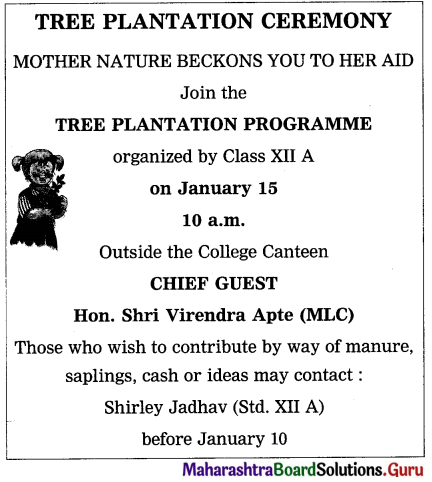
Maharashtra Board Class 12 English Yuvakbharati Solutions Chapter 3.6 Group Discussion 7

Maharashtra Board Class 12 English Yuvakbharati Solutions Chapter 3.6 Group Discussion

Question 2.
Prepare a leaflet on ‘Save the Earth’. Make use of the foUowing points:
– make the slogan attractive
– make a persuasive appeal
– give information about the programmes to be undertaken
– ask for contributions
– explain the need to save the environment
– add other ideas of your own
Answer:
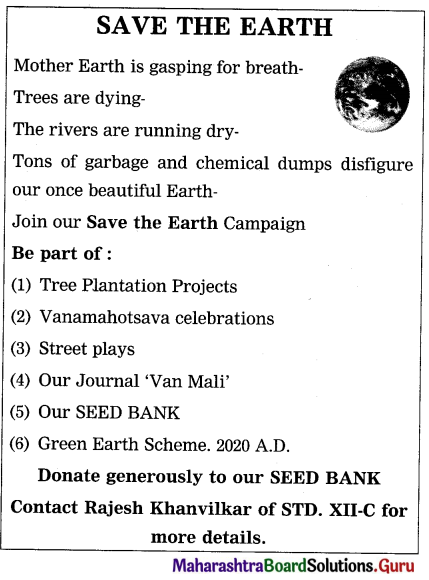
Maharashtra Board Class 12 English Yuvakbharati Solutions Chapter 3.6 Group Discussion 8

Question 2.
Prepare a short tourist leaflet on any seaside resort you have visited with the help of points given below :
1. How to reach there?
2. Accommodation.
3. Places worth-seeing.
4. Specialities.
5. Add your own points.
Answer:
Devbagh

Devbagh, a seaside resort, is a tiny island off the west coast of Karwar, in Karnataka. It is near the confluence of the Kali river and the sea.

  1. Ways to reach: Devbagh is well- connected to Mumbai and Bengaluru by road. It is 2 hours by road from Goa and a 20-minute boat ride from Karwar.
  2. Accommodation available : Devbagh forest beach resort offers cozily furnished tents and log cabins.
  3. Sight-seeing : Shivganga Falls, Magod Falls, Lalguli Falls, Dandeli Wildlife Sanctuary, Temples, Historical spots, Beautiful beaches, etc.
  4. Specialities : Spicy crab curry is the region’s speciality. Most food preparations are liberally garnished with coconut.
  5. Most suitable time for visits : Throughout the year, though the best season is from October to May.
  6. Additional information: Plenty of interesting activities for the adventurous – water sports, cruises to neighbouring uninhabited islands, snorkelling trips, sea kayaking, rafting trips, etc.

Maharashtra Board Class 12 English Yuvakbharati Solutions Chapter 3.6 Group Discussion

Appeal

Write the following appeals as instructed:

Question 1.
A student in your college seeks immediate medical help. His parents are unable to afford the huge amount needed for the operation. Prepare an appeal to be put on the college noticeboard requesting the students to donate generously. Take the help of the following points:
– the name of the illness
– the cost of the operation
– how the contributions can be made
Answer:
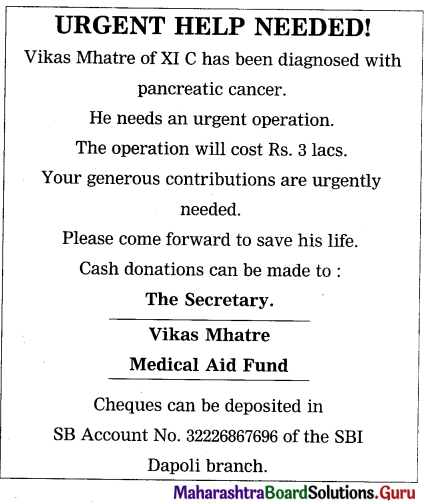
Maharashtra Board Class 12 English Yuvakbharati Solutions Chapter 3.6 Group Discussion 9

Question 2.
Prepare an appeal based on the information given below:
The Khadi and Village Industries Commission proposes to promote Khadi wear. They would like people to buy and wear Khadi for natural feel and elegant texture. The cloth also promotes good health and ensures quality. They propose to give a special discount on cotton, silk (spun), silk (reeled), woollen and polyvastra varieties of Khadi. Every metre of Khadi purchased by each of you will help provide employment to many.
Answer:

Maharashtra Board Class 12 English Yuvakbharati Solutions Chapter 3.6 Group Discussion 10

Interview

Maharashtra Board Class 12 English Yuvakbharati Solutions Chapter 3.6 Group Discussion 11

Maharashtra Board Class 12 English Yuvakbharati Solutions Chapter 3.6 Group Discussion

Write interview questions based on the given situation:

Question 1.
Imagine that you have to interview a social campaigner of your choice. Frame a set of 8-10 questions to interview him/ her as per the following points :

  • Introducing the guest
  • Background of the campaign
  • Setbacks/Criticism
  • Support/Achievements
  • Dreams/Message

Answer:
Good morning, Ms. Nandita Das! Glad to have you on our show. Your ‘Black is Beautiful’ campaign has been a great success and I think our viewers would like to know something more about it.

  1. Let me begin by asking you the most relevant question first: What had prompted you to take up such a radical campaign?
  2. What were the initial setbacks that you had faced?
  3. Were you apprehensive of the reaction from traditional society?
  4. How do you explain our deep-rooted obsession with skin colour?
  5. Has the Western World changed their attitude of “White supremacy” over the years?
  6. Does this “colour bias” affect the boys as much as the girls?
  7. Who supported you most during the campaign?
  8. Certain print media groups and television channels stopped accepting advertisements for the so called ‘fairness creams’ after your campaign. Do you expect many more such positive initiatives?
  9. Many people, especially young girls, look up to you as their idol. How do you hope to live up to their expectations?
  10. Is there any special message for our youth?

Question 2.
Imagine that yon have to interview the District Medical Officer during the outbreak of a serious epidemic. Frame a set of 8-10 questions to interview him/her as per the following points:

  • introduction
  • the gravity of the situation
  • briefing on technical terms
  • importance of precautions
  • preparedness to combat the disease

Answer:
Today we have with us our DMO to reassure us about the safety measures taken by the district authorities. Good morning Madam! Could you spare a few moments to enlighten our viewers about the unprecedented situation we face now.

  1. Thank you. Let me first ask you how grave is the situation as of now?
  2. There are many new term in currency now as quarantine, self-isolation, tracing contacts, etc. Could you briefly explain these terms for the benefit of our general viewers?
  3. How important is social-distancing in the present scenario?
  4. Should masks to be preserved for the frontline workers or is it a must for each and everyone?
  5. Do we have enough testing kits now?
  6. What is the difference between rapid test and RT-PCR test?
  7. What are the elementary precaution to be taken other than social-distancing and hand- hygiene?
  8. Do you have enough medical staff to tide over such an emergency?
  9. Do we have enough ventilators and ICU beds?
  10. How is the coordination between the various departments of the district administration?

Maharashtra Board Class 12 English Yuvakbharati Solutions Chapter 3.6 Group Discussion

Question 3.
Imagine that you have to interview a “Save the Trees” campaigner. Frame a set of 8-10 questions to interview him/her as per the following points:

  • introduction
  • success so far
  • forest conservation laws
  • attitude of people to climate change
  • factors working for and against the campaign

Answer:
Good evening Sir! I think it is the need of the time that our young generation realize the importance of your campaign. I am very glad to have you on our special “Environment Day” programme.

  1. How do you evaluate the success of your campaign so far?
  2. Do you think that people still show a callous disregard towards the threat of climate change?
  3. Why is there a lack of awareness among our countrymen about the importance of trees?
  4. Why doesn’t the government enforce the forest conservation laws effectively?
  5. What are the substitutes for timber in the construction industry?
  6. Have you ever felt that you are defending a lost cause?
  7. How far does the Indian tradition of worshipping trees help you in your campaign?
  8. Do you get enough funds to carry on your campaign?
  9. Is the younger generation more receptive to environmental issues?
  10. What piece of advice would you like to give to the school children?

Question 4.
Imagine that you have to interview a teacher who has received the President’s award. Prepare a set of 8-10 questions to interview him/her as per the following points:

  • Introducing the guest
  • Feeling during the moment
  • Reason for taking up teaching
  • Contentment/Satisfaction
  • Opinion about young teachers
  • Setback and reward of the profession

Answer:
Good morning Madam! I take it as a great privilege to be with you and have a chat. Thank you very much for sparing your valuable time.

  1. How did you feel during those brief moments with the President?
  2. Do you think that you have lived a complete life and it is time to retire?
  3. At what point of time in your life did you find that teaching is your calling?
  4. Many teachers find teaching a thankless job : What is your opinion about that?
  5. Was there any conflict between your personal life and professional life?
  6. Do you think teaching attracts real talent in this materialistic world?
  7. What, in your view, are the most essential qualities of a teacher?
  8. Do you find the young cro0p of teachers as great promise?
  9. What were the setbacks that you faced in your long career?
  10. How did your students, who are spread far and wide, react to this honour?

Maharashtra Board Class 12 English Yuvakbharati Solutions Chapter 3.6 Group Discussion

E-Mails:

Question 1.
Read the following advertisement and prepare a letter of application to be sent by email. (Do not give your bio-data.)
Situation Vacant
Wanted: A Computer Engineer
Candidate must have passed B.E. in
Computer Engineering.
Experience holder will be preferred.
Write giving details to:
Email: [email protected]

Sir/Madam,I have recently passed my B.E. in Computer Engineering from J L M Engineering College, Ratnagiri with a pass percentage of 61.1 also have three months of experience developing software for Pragati Electronics in Ratnagiri. The project was for the maintenance of accounts of MHEL Pvt. Ltd.

I do hope that you will consider me for appointment in your esteemed company. I shall be able to arrange my own accommodation in Pune. I anticipate an early call for an interview. My details are in the CV that I have attached.

I assure you of dedicated service, should I be considered for the post.

Yours truly,
XYZ

Blog Writing

A List of Blogging Sites/Apps.
Given below is a list of blogging sites/ apps from where you can begin blogging.

1. https://zapier.com/blog/best-blog-sites/
2. https://www.wpbeginner.com/beginners- guide/how-to-clioose-the-best-blogging- platform/
3. https: / /www. say ansamanta. com/best- android-apps-blogger.html
4. https://www.excellentwebworld.com/latest- blogging-trend/
5. https://www.livejournal.com
6. https:// www.wordpress.com
7. https://www.blogger.com
8. https://www.blogs.myspace.com.

Maharashtra Board Class 12 English Yuvakbharati Solutions Chapter 3.6 Group Discussion

Question 1.
Write blogs on the following topics
Say no to tobacco.
Answer:
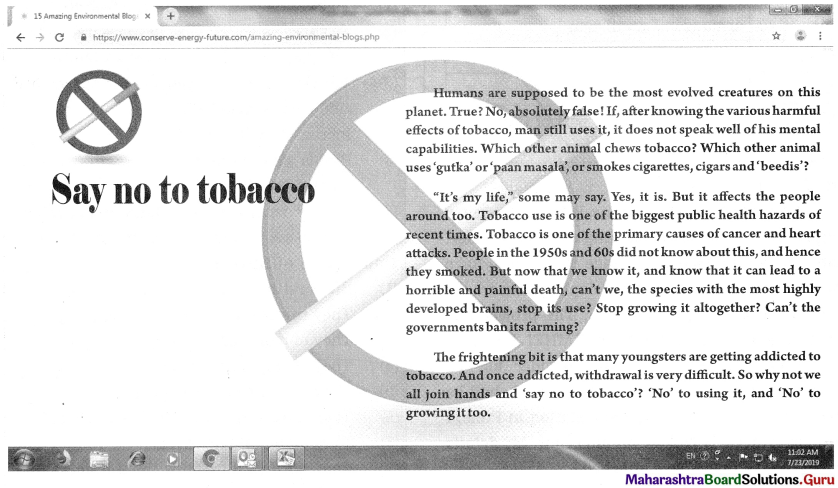
Maharashtra Board Class 12 English Yuvakbharati Solutions Chapter 3.6 Group Discussion 12

Question 2.
Man v/s Nature.
Answer:
Maharashtra Board Class 12 English Yuvakbharati Solutions Chapter 3.6 Group Discussion 13

Film Review:

Students are advised to read film reviews that appear in periodicals and online. This will familiarize them with the technical terms and expressions used in reviews.

After viewing a film, attempt to write your own review based on the guidelines given above. It is always a good practice to make a first draft and revise it after some time. This will help you eliminate any personal bias that has distorted the review. Revising the text also enables you to write comprehensive but concise reviews.

Maharashtra Board Class 12 English Yuvakbharati Solutions Chapter 3.6 Group Discussion

The Art of Compering

Imagine that you are a compere of the ‘Annual Day Celebrations’ of your college. Write a script for the same. You can take the help of the following points.

  • Brief introduction
  • Lighting of the Lamp
  • Welcome Speech
  • Speech of the Chief Guest
  • Entertainments
  • Vote of thanks

Answer:
1. Introduction and lighting the lamp: Good evening to all present here today on this special occasion. We have been awaiting this day with great anticipation. And finally here we are gathered to usher in that great day! Let’s begin the function with the lighting of the traditional lamp and I request our honourable Chief Guest Shri Ganesh Narvekar to inaugurate the function by lighting the lamp. [The chief guest together with certain other dignitaries on the dais lit the lamp.]
2. Welcome speech: Next we go to the Welcome Speech. Our respected Principal will now address the audience and welcome the Chief Guest. [Principal’s speech – 8-10 minutes.]
3. Speech of the Chief Guest: Now I request the honourable Chief Guest to take the podium.
[Chief Guest comes to the podium and delivers his speech – about 10 minutes.]
4. Entertainments: Now the curtains will be down for a few moments in preparation for the entertainment programme.
[Curtains down. The chief guest and other dignitaries are ushered to their seats in the audience. Stage is cleared. Curtain raises.]

(a) Now the college orchestra will delight you with their musical programme.
/Musical programme for 45 minutes]
(b) Yes, that was a big round of applause and a greatly deserved one! Let’s move on to our next item. Students of Std. XI will now perform a fusion dance. Welcome them with a warm applause!
[Dance lasts about 30 minutes.]
5. Vote of thanks: Now I call upon our Vice-principal to propose a vote of thanks. [About 2-3 minutes]
Now I thank you all once again. Special thanks to our talented artist-friends who made this evening a memorable one.

Maharashtra Board Class 11 Psychology Important Questions Chapter 1 Story of Psychology

Balbharti Maharashtra State Board Class 11 Psychology Important Questions Chapter 1 Story of Psychology Important Questions and Answers.

Maharashtra State Board 11th Psychology Important Questions Chapter 1 Story of Psychology

1A. Complete the following statements.

Question 1.
__________ thought that knowledge is acquired through learning and experience.
(A) Plato
(B) John Locke
(C) Wilhelm Wundt
Answer:
(B) John Locke

Question 2.
Wilhelm Wundt introduced the term __________ experience.
(A) conscious
(B) innate
(C) unconscious
Answer:
(A) conscious

Maharashtra Board Class 11 Psychology Important Questions Chapter 1 Story of Psychology

Question 3.
Dr. Sigmund Freud was an __________ physician and neurologist.
(A) German
(B) American
(C) Austrian
Answer:
(C) Austrian

Question 4.
__________ behaviour includes directly noticeable reactions and activities.
(A) Covert
(B) Overt
(C) Conscious
Answer:
(B) Overt

Question 5.
Watson established the school of __________
(A) behaviourism
(B) philosophy
(C) psychology
Answer:
(A) behaviourism

Question 6.
The S-O-R Model was developed by __________
(A) John Watson
(B) Sigmund Freud
(C) Plato
Answer:
(A) John Watson

Question 7.
In SOR, Model ‘R’ stands for __________
(A) reaction
(B) response
(C) rigour
Answer:
(B) response

Maharashtra Board Class 11 Psychology Important Questions Chapter 1 Story of Psychology

Question 8.
The first Psychology department was established in __________ University.
(A) Mumbai
(B) Calcutta
(C) Delhi
Answer:
(B) Calcutta

Question 9.
National Institute of Mental Health and Neurosciences (NIMHANS) was established in __________
(A) Bangalore
(B) Hyderabad
(C) Chennai
Answer:
(A) Bangalore

Question 10.
Patanjali explained deep thought about Psychology in __________
(A) Yogsutra
(B) Upanishada
(C) Ayurveda
Answer:
(A) Yogsutra

Question 11.
People who have Rajasi qualities are __________
(A) aristocratic
(B) calm
(C) sluggish
Answer:
(A) aristocratic

Question 12.
__________ means understanding the causes of behaviour.
(A) Description
(B) Explanation
(C) Prediction
Answer:
(B) Explanation

Maharashtra Board Class 11 Psychology Important Questions Chapter 1 Story of Psychology

Question 13.
__________ comprises of knowledge about the probable outcomes of behaviour.
(A) Explanation
(B) Prediction
(C) Control
Answer:
(B) Prediction

1B. Match the following pairs.

Question 1.

Group ‘A’Group ‘B’
i. Indian Psychological Association (IPA)a. 1916
ii. First Psychology departmentb. 1925
iii. National Institute of Mental Health and Neurosciences (NIMHANS)c. 1962
iv. Indian Academy of Applied Psychology (IAAP)d. 1955
v. Indian Association of Clinical Psychologistse. 1989
vi. National Academy of Psychology (NAOP)f. 1968

Answer:
i – b, ii – a, iii – d, iv – c, v – f, vi – e

1C. State whether the following statements are true or false.

Question 1.
Psychology emerged as a separate branch in the 17th century.
Answer:
False

Question 2.
The symbol of Psychology is Ω.
Answer:
False

Question 3.
Logos means a branch of knowledge.
Answer:
True

Question 4.
Wilhelm Wundt was an Austrian Physician.
Answer:
False

Maharashtra Board Class 11 Psychology Important Questions Chapter 1 Story of Psychology

Question 5.
Systematic study of Psychology begun in the year 1869.
Answer:
False

Question 6.
The introspection method was introduced by Wilhelm Wundt.
Answer:
True

Question 7.
John Watson conducted research on animal behaviour, child-rearing, and advertising.
Answer:
True

Question 8.
In the S-O-R model, S stands for stimulus.
Answer:
True

Question 9.
During the 1950-1960s, the focus of Psychology shifted to cognitive processes.
Answer:
True

Question 10.
The hospital for mental diseases was set up at Ranchi.
Answer:
False

Question 11.
There are only two Koshas.
Answer:
True

Question 12.
Gunas determine the characteristics of human beings.
Answer:
False

Maharashtra Board Class 11 Psychology Important Questions Chapter 1 Story of Psychology

Question 13.
The goal of description relates to ‘Why’.
Answer:
False

1D. Identify the odd item from the following and give reasons for the same.

Question 1.
Stimulus, Response, Organism, Reaction
Answer:
Reaction
Reason: Rest is the symbol in the S-O-R Model.

Question 2.
Rajas, Kapha, Vata, Pitta
Answer:
Rajas
Reason: The rest are the three types of Doshas.

Question 3.
Aristocratic, Idle, Sluggish, Depressed
Answer:
Aristocratic
Reason: The rest relate to Tamasi’s qualities.

Question 4.
Tirthankar, Kabir, Freud, Vivekanand
Answer:
Freud
Reason: The rests are Indian saints and philosophers.

Maharashtra Board Class 11 Psychology Important Questions Chapter 1 Story of Psychology

1E. Complete the following table

Question 1.

  1. __________ – Knowledge is innate
  2. Prof. Narendra Nath Sen Gupta – __________
  3. _________ – Lumbini Park Mental Hospital
  4. Yama, Pranayam, Samadhi – __________
  5. Describe, Explain, Predict, Control – __________

Answer:

  1. Plato – Knowledge is innate
  2. Prof. Narendra Nath Sen Gupta – First Psychology department, Calcutta University
  3. Calcutta, 1940 – Lumbini Park Mental Hospital
  4. Yama, Pranayam, Samadhi – Ashtangyoga, Patanjali
  5. Describe, Explain, Predict, Control – Goals of Psychology

2. Answer the following questions in 35-40 words

Question 1.
Explain the study of Sigmund Freud.
Answer:

  • Dr. Sigmund Freud was the founder of psychoanalysis. He believed that most human motives are hidden.
  • He stressed the importance of early childhood experiences and unconscious impulses in shaping adult personality.
  • He explained that any major psychological problems in a person’s life have their roots in the early years of life.

Question 2.
Explain the study of cognition.
Answer

  • During 1950s and 1960s, the concentration of Psychology shifted from behaviour to cognitive processes.
  • Psychologists were interested in studying the various internal processes that trigger a particular responsibility towards the stimulus.
  • These processes comprise attention, memory, reasoning, etc. and they play an active role in the cognitive processes.

For your understanding
Cognitive science is the scientific study of human thoughts. It examines mental actions of obtaining information as well as understanding through thoughts, experiences, and senses.

Maharashtra Board Class 11 Psychology Important Questions Chapter 1 Story of Psychology

Question 3.
Write a note on Ashtangyoga.
Answer:

  • In the fifth century B.C., sage Patanjali described deep thought about Psychology in Yogsutra.
  • He developed the theory of Ashtanga yoga.
  • The eight aspects of Ashtangyoga are Yama, Niyama, Aasana, Pranayam, Pratyahar, Dharana, Dhyan and Samadhi.
  • It helps us to control our wishes and desires.

3. Write short notes.

Question 1.
The latest definition of Psychology
Answer:

  • The latest definition of Psychology explains that it is the study of human behaviour and mental processes.
  • Important terms in this definition are behaviour, mental processes, and the scientific method.
  • Behaviour is the reaction of an organism to various stimuli present in the environment.
  • It is either overt or covert. Overt behaviour can be seen directly and includes responses such as walking, talking, dancing while Covert behaviour cannot be seen directly and includes responses such as thinking, feeling, etc.
  • The mental processes consist of thinking, memory, forgetting, emotion, motivation, attention, and perception.
  • In a scientific study, experiments are conducted in a controlled environment. It enables researchers to study sample populations and generalise certain observations to the entire population.

Question 2.
Doshas
Answer:
According to Ayurveda, there are three types of Doshas; viz. Kapha, Vata, and Pitta.

  • Kapha Dosha: Individuals who have Kapha as a dominant Dosha is calm, flexible, patient, and caring. They take a longer time to grasp a subject but have a strong memory.
  • Vata Dosha: Individuals who have Vata as a dominant Dosha are unpredictable and moody. They get angry very quickly but they also calm down very fast. They are art lovers,
  • Pitta Dosha: Individuals having Pitta as a dominant Dosha are very sharp. They are usually short-tempered.

Maharashtra Board Class 11 Psychology Important Questions Chapter 1 Story of Psychology

Question 3.
Gunas
Answer:

  • According to Ayurveda, a concept to understand human temperament is called Guna.
  • There are three types of Gunas, viz. Sattva, Rajas and Tamas.
  • The impacts of Gunas are seen in the behaviour of an individual.
  • People with Sattva Guna are calm and understanding. They do their work cautiously and promptly. They are aware of reality.
  • People with Rajas Guna are proud and have high self-respect. They are aggressive, (belligerent)
  • People with Tamas Guna are idle, sluggish, depressed, and not hard-working.

4. Answer the following questions in detail.

Question 1.
Explain the study of Wilhelm Wundt.
Answer:

  • Wilhelm Wundt was a German Physician and Philosopher.
  • In the late 19th century, he established the first Psychological laboratory at Leipzig University to study human behaviour.
  • He introduced the term conscious experience (i.e. awareness of the mental activities of an organism). This awareness includes the stored mental impressions of the past, present, and future.
  • Wundt introduced the Introspection method.
  • He also conducted experiments on reaction time, perception, and consciousness. After that, Psychology emerged as a science.

Question 2.
Explain the study of behaviour by John Watson.
Answer:

  • John Watson was an American Psychologist who defined Psychology as the Science of human behaviour.
  • He conducted research on animal behaviour, child-rearing, and advertising.
  • He explained human behaviour through the S-O-R Model.
  • Stimulus (S) refers to any physical event or condition that gives rise to a reaction. Organism (0) refers to a human being or an animal, who gives a response to the stimulus. Response (R) refers to the reaction of the organism to a given stimulus.
  • Watson also established the school of behaviourism.

Maharashtra Board Class 11 Psychology Important Questions Chapter 1 Story of Psychology

Question 3.
Explain Psychology from an Indian perspective.
Answer:

  • From 2000 B.C. to 500 A. C., Indian philosophers studied the mind and human behaviour from different viewpoints. They also described ideas like soul, mind, intuition, and so on.
  • Upanishads explain the self and personality structure with the help of a concept called Kosha. The different Koshas are Annamaya kosha, Pranmaya kosha, Manomaya kosha, Vidnyanmaya kosha, and Anandmaya kosha.
  • Ayurveda explained three types of Doshas; viz. Kapha, Vata, and Pitta and three types of Gunas; viz. Sattva Guna, Rajas Guna and Tamas Guna. Doshas determine characteristics of humans while Gunas explain human temperament.
  • In the fifth century B.C., sage Patanjali explained deep thought about Psychology in Yogsutra.
    His theory of Ashtangyoga consists of eight aspects; viz. Yama, Niyama, Asana, Pranayam, Pratyahara, Dharana, Dhyan, and Samadhi. He also studied levels of human consciousness and elaborated on how one can evolve spiritually.
  • Many other Indian philosophers and saints also studied the mind and human behaviour.

Maharashtra Board Class 11 History Important Questions Chapter 16 Swarajya to Empire (Maratha Period)

Balbharti Maharashtra State Board Class 11 History Important Questions Chapter 16 Swarajya to Empire (Maratha Period) Important Questions and Answers.

Maharashtra State Board 11th History Important Questions Chapter 16 Swarajya to Empire (Maratha Period)

1A. Choose the correct alternative and the complete sentences.

Question 1.
___________ defeated the Yadavas of Devgiri.
(a) Alauddin Khalji
(b) Muhmmad Tughluq
(c) Hasan Gangu Bahamani
(d) Qutubuddin Aibak
Answer:
(a) Alauddin Khalji

Question 2.
After the end of Nizamshahi rule, Shahaji Raje accepted the rank of a Mansabdar in the ___________ court.
(a) Qutubshahi
(b) Imadshahi
(c) Baridshahi
(d) Adilshahi
Answer:
(d) Adilshahi

Maharashtra Board Class 11 History Important Questions Chapter 16 Swarajya to Empire (Maratha Period)

Question 3.
___________ is regarded as the visionary of Swarajya.
(a) Veermata Jeejabai
(b) Shahaji Raje
(c) Chhatrapati Shivaji Maharaj
(d) Chhatrapati Sambhaji Maharaj
Answer:
(b) Shahaji Raje

Question 4.
He took over the fort of ___________ and laid the foundation of Swarajya.
(a) Raigad
(b) Pratapgad
(c) Torana
(d) Sinhgad
Answer:
(c) Torana

Question 5.
Chhatrapati Shivaji Maharaj established the first capital of Swaraiva at the fort of ___________
(a) Rajgad
(b) Pratapgad
(c) Raj gad
(d) Vishalgad
Answer:
(a) Rajgad

1B. Find the incorrect pair from set B and write the correct ones.

Question 1.

Set ‘A’Set ‘B’
(a) ‘Yatharthdeepika’Vaman Pandit
(b) ‘Naladamayanti Swayamvara’Raghunath Pandit
(c) PandavapratapaShridhar Pandit
(d) Translation of MahabharataMahipati

Answer:
(d) Translation of Mahabharata – Moropant

Question 2.

Set ‘A’Set ‘B’
(a) ‘Gulshane-i-Ibrahimi’History of India
(b) ‘Rajyavyavaharakosha’A text on Maratha polity
(c) ‘Budhabhushan’Overview of ancient texts on polity
(d) ‘NayikabhedText in Brij literature

Answer:
(b) ‘Rajyavyavaharakosha’ – A compilation of Sanskrit lexicon for Persian terms

Question 3.

Set ‘A’Set ‘B’
(a) DiwanMilitary Chief
(b) MajumdarAuditor and Accountant
(c) PhadnisDeputy Auditor
(d) SabnisOffice in-charge

Answer:
(a) Diwan – Secretary

Maharashtra Board Class 11 History Important Questions Chapter 16 Swarajya to Empire (Maratha Period)

Question 4.

Set ‘A’Set ‘B’
(a) KarkhanisCommissary
(b) ChitnisReligious Officer
(c) JamdarTreasurer
(d) PotdarAssay Master

Answer:
(b) Chitnis – Correspondence Clerk

1C. Find the odd one out.

Question 1.
Temples of Nashik:
(a) Mahadev
(b) Kalaram
(c) Goraram
(d) Sundarnarayan
Answer:
(a) Mahadev

Question 2.
Shahirs is known for beautiful composition:
(a) Anantafandi
(b) Prabhakar
(c) Ramjoshi
(d) Tulsidas
Answer:
(d) Tulsidas

Question 3.
Persons included in special posts of Ashtapradhans:
(a) Dhanaji
(b) Peshwa
(c) Mantri
(d) Senapati
Answer:
(a) Dhanaji

2A. Write the names of historical places, persons, and events.

Question 1.
Powerful General sent by the court of Bijapur against Chh. Shivaji Maharaj
Answer:
Afzal Khan

Question 2.
Portuguese Shipbuilders
Answer:
Rui Leitao Viegas and his son Fernao Viegas

Maharashtra Board Class 11 History Important Questions Chapter 16 Swarajya to Empire (Maratha Period)

Question 3.
Disguised himself as Chh. Shivaji Maharaj
Answer:
Shiva Kashid

Question 4.
Text ‘Nayikabhed’was written in this language
Answer:
Brij

Question 5.
Afghani Pathans are known as
Answer:
Rohillas

2B. Choose the correct reason and complete the sentence.

Question 1.
___________ was the leader of the Rohillas.
(a) Najib Khan
(b) Nizamshah
(c) Adilshah
(d) None of them
Answer:
(a) Najib Khan

Question 2.
After Chhatrapati Sambhaji Maharaj, ___________ took over the reins at Raigad.
(a) Chhatrapati Shivaji Maharaj
(b) Chhatrapati Rajaram Maharaj
(c) Chhatrapati Shahu Maharaj
(d) Shiva Maharaj
Answer:
(a) Chhatrapati Rajaram Maharaj

Maharashtra Board Class 11 History Important Questions Chapter 16 Swarajya to Empire (Maratha Period)

Question 3.
___________ defeated the Yadavas of Devgiri and the rule of Delhi Sultans began in south India.
(a) Akbar
(b) Babur
(c) Humayun
(d) Alauddin Khalji
Answer:
(d) Alauddin Khalji

3. Observe the map on page 123 of your textbook and answer the following questions based on it.

Maharashtra Board Class 11 History Important Questions Chapter 16 Swarajya to Empire (Maratha Period) 3

Question 1.
Write the names of Seats of Maratha power.
Answer:
Gaikwads of Vadodara, Shindes of Gwalior, Bhosales of Tanjavar, Bhosales of Nagpur, Pawars of Dhar, Holkars of Indore.

Question 2.
Write the extent of Chh. Shivaji Maharaj’s Swarajya.
Answer:
The regions in Maharashtra including Nashik, Pune, Satara, Sangli, Kolhapur, Sindhudurga, Ratnagiri, Raigad; Belgaum, Karwar, Dharwad in Karnataka; some regions of Andhra, Jinji, and Vellore in Tamil Nadu comprised Swarajya.

Question 3.
Name the places in Maratha Empire that are in today’s Pakistan.
Answer:
Attock, Peshawar, Multan, Lahore.

4. Complete the concept maps.

Question 1.
Maharashtra Board Class 11 History Important Questions Chapter 16 Swarajya to Empire (Maratha Period) 4 Q1
Answer:
Maharashtra Board Class 11 History Important Questions Chapter 16 Swarajya to Empire (Maratha Period) 4 Q1.1

Maharashtra Board Class 11 History Important Questions Chapter 16 Swarajya to Empire (Maratha Period)

Question 2.
Maharashtra Board Class 11 History Important Questions Chapter 16 Swarajya to Empire (Maratha Period) 4 Q2
Answer:
Maharashtra Board Class 11 History Important Questions Chapter 16 Swarajya to Empire (Maratha Period) 4 Q2.1

Question 3.
Maharashtra Board Class 11 History Important Questions Chapter 16 Swarajya to Empire (Maratha Period) 4 Q3
Answer:
Maharashtra Board Class 11 History Important Questions Chapter 16 Swarajya to Empire (Maratha Period) 4 Q3.1

Question 4.
Maharashtra Board Class 11 History Important Questions Chapter 16 Swarajya to Empire (Maratha Period) 4 Q4
Answer:
Maharashtra Board Class 11 History Important Questions Chapter 16 Swarajya to Empire (Maratha Period) 4 Q4.1

5. Write short notes.

Question 1.
Maratha-Adilshahi Relations
Answer:

  • The inception of Swarajya- After joining the Adilshahi court, Shahaji Maharaj entrusted the administration of his Jahagirs at Pune, Shirwal, and Supe region (pargana) to Chh. Shivaji Maharaj.
  • Yet the forts located in those Jahagirs and nearby areas were in the custody of Adilshahi court. The one ‘who owns the forts owns the land’ was the ruling of the day.
  • Hence, Chh. Shivaji Maharaj began with capturing the forts in the vicinity of his Jahagirs.
  • He took over the fort of Torana and laid the foundation of Swarajya.
  • Chh. Shivaji Maharaj established the first capital of Swarajya at the fort of Rajgad.

Javali episode – Chandrarao More proved to be a hindrance in Chh. Shivaji Maharaj’s efforts to create Swarajya. Chh. Shivaji Maharaj successfully took over Javali. After this victory the activities of Chh. Shivaji Maharaj in Konkan was escalated.

Maharashtra Board Class 11 History Important Questions Chapter 16 Swarajya to Empire (Maratha Period)

Afzal Khan – Realising the danger of the increasing activities of Chh. Shivaji Maharaj, the Bijapur court sent their powerful General Afzal Khan to curb the increasing power of Chh. Shivaji Maharaj. Chh. Shivaji Maharaj had anticipated the intentions of Afzal Khan who had taken up the challenge of killing Chh. Shivaji Maharaj. He met Afzal Khan at Pratapgad. As expected, Afzal khan attempted treachery but Chh. Shivaji Maharaj was well prepared and killed Afzal khan in self-defense. Afzal Khan’s huge army was set on the run and huge booty and weapons were collected left behind by them. This made Swarajya’s treasury richer.

Siddi Jauhar – After Afzal Khan’s defeat, the Bijapur court sent Siddi Jauhar to attack Swarajya. He seized the fort of Panhala and closed all possibilities of escape for Chh. Shivaji Maharaj. In this difficult situation Shiva Kashid, a loyal servant of Swarajya, disguised himself as Chh. Shivaji Maharaj and made it easy for Chh. Shivaji Maharaj to escape.

When Siddi came to know the truth, he killed Shiva Kashid. Thus, Shiva Kashid sacrificed his life for the cause of Swarajya. Baji Prabhu took up the task of blocking Siddhi Masud’s path in Ghodkhind and stop him in his chase of Chh. Shivaji Maharaj. Baji Prabhu was successful in doing this. He fell dead only after receiving the news of Chh. Shivaji Maharaj reaching Vishalgad safely.

Question 2.
Maratha – Mughal Relations
Answer:

  • At the time of ascending the throne, Aurangzeb was aware of the ambitious plans of Chh. Shivaji Maharaj.
  • He sent his maternal uncle Shaistakhan on an expedition against Chh. Shivaji Maharaj.
  • Shaistakhan camped in Lai Mahal in Pune. Chh. Shivaji Maharaj who knew Shaistakhan’s intentions manages to enter the Lai Mahal and cut off Shaistakhan’s fingers.
  • Shaistakhan had no alternative but to hastily leave Lai Mahal. Chh. Shivaji Maharaj gained more confidence and he attacked Surat, the prosperous economic capital of Aurangzeb, and collected a large booty.
  • Enraged by this, Aurangzeb sent his powerful sardars Mirza Raje Jaising and Diler Khan to attack Swarajya. They captured many forts in the Swarajya.
  • Chh. Shivaji Maharaj had the wisdom to comprehend the situation and decided to retreat tactically by signing the ‘Treaty of Purandar’.
  • According to the treaty, Chh. Shivaji Maharaj had to present himself before Aurangzeb at Agra, along with his son Sambhaji Maharaj.
  • Aurangzeb acted treacherously and put Chh. Shivaji Maharaj is under house arrest.
  • Chh. Shivaji Maharaj very cleverly misled the guards and escaped from Agra.
  • Soon after returning to Swarajya Chh. Shivaji Maharaj conquered the forts which were held by Aurangzeb.

Maharashtra Board Class 11 History Important Questions Chapter 16 Swarajya to Empire (Maratha Period)

Question 3.
Maharani Tarabai
Answer:

  • After the death of Rajaram Maharaj (March 1700 C.E.), his wife Maharani Tarabai continued to fight against Aurangzeb.
  • Maharani Tarabai led the Swarajya movement under extremely unfavourable conditions.
  • She single-handedly took charge of the administration and fought for Swarajya for twenty-five years with the help of her sardars.
  • At times, the Marathas had to fight the Mughals on lands beyond the boundaries of Swarajya, but she did not stop them.
  • This was an indication that the scenario of the war was changing. The Maratha War of Independence was a tussle between the Mughal ambition of expanding their Empire and the desire for independence cherished by the Marathas.
  • Finally, the death of Aurangzeb put an end to this fighting. In the beginning, the Mughal rulers adopted an aggressive policy while the Maratha policy remained that of defense.
  • But by the second half of the 18th century, this condition changed. With the weakening of Mughal power, the Marathas could extend their rule almost all over India.

6. Explain the following statement with reasons.

Question 1.
Chh. Shivaji Maharaj signed the Treaty of Purandar
Answer:

  • Aurangzeb sent his powerful sardars Mirza Raje Jaising and Diler Khan to attack Swarajya.
  • They captured many forts in the Swarajya. Mirza Raje Jaising was a powerful and competent military commander.
  • He blocked Chh. Shivaji Maharaj from all sides. Lives of Chh. Shivaji Maharaj’s men were endangered.
  • Chh. Shivaji Maharaj had the wisdom to comprehend the situation and decided to retreat tactically by signing the ‘Treaty of Purandar’.
  • According to the treaty, Chh. Shivaji Maharaj had to present himself before Aurangzeb at Agra, along with his son Sambhaji Maharaj.

Question 2.
Shivaji Maharaj coronated himself.
Answer:

  • Chh. Shivaji Maharaj decides to give legitimacy to his earned kingdom.
  • To announce the sovereign and independent status of Swarajya it was necessary to make it official.
  • Realizing this Chh, Shivaji Maharaj decided to get himself coronated.
  • With his coronation as a sovereign king, the provinces under his rule assumed the status of an independent kingdom.
  • He minted new coins after the coronation. He started ‘Rajyabhishek Shaka’ i.e., a new era after the coronation.

7. State your opinion.

Question 1.
The work of Sants created a sense of self-esteem among the people of Maharashtra.
Answer:

  • The saints created a sense of belonging among people toward their native region, language, literature, and culture.
  • They gave a message of equality to people. Their teachings were based on the principles of humanity.
  • They preached harmonious community life, unity, and love. Their efforts created social awakening.
  • Their teaching helped people to survive situations like foreign invasions, draughts, or other natural calamities.
  • Their devotional songs became a source of great moral support for people.
  • Their work created a sense of self-esteem among the people of Maharashtra.

Question 2.
Veermata Jeejabai’s role was important in the creation of Swarajya.
Answer:

  • Shahaji Raje sent his son Shivajiraje and his wife, Veermata Jijabai from Bengaluru to Pune along with his loyal and capable associates.
  • Veermata Jijabai encouraged Chh. ShivajiMaharajto fulfills the dream of Shahajiraje of establishing Swarajya.
  • She was a visionary and an efficient administrator.
  • She constantly guided her son in the mission of establishing Swarajya and provided him with the excellent education necessary for the king of Swarajya.

Maharashtra Board Class 11 History Important Questions Chapter 16 Swarajya to Empire (Maratha Period)

8. Answer the following questions in detail.

Question 1.
Write in detail about Peshwa Period
Answer:

  • After Balaji Vishwanath, his son, Bajirao I was appointed as the Peshwa. He expanded the Maratha empire up to Malwa, Rajasthan, and Bundelkhand. He defeated the Nizam.
  • After Bajirao I, Balaji Bajirao alias Nanasaheb was appointed as the Peshwa. Madhavrao Peshwa tried to re-establish the Maratha power.
  • The defeat in Panipat was not just a political defeat but also lowered the morale of the Marathas greatly.
  • Madhavrao Peshwa tried to elevate the spirits of Marathas as well as re-establish the Maratha power in the north.
  • The Marathas were successful in overcoming the great defeat at Panipat and create a politically strong position for themselves in the politics of the north.
  • Malharrao was the founder of the Holkar State at Indore. He served the Maratha power for a long time.

Question 2.
Write about Maratha’s War of Independence.
Answer:

  • After the death of Chhatrapati Shivaji Maharaj, Chhatrapati Sambhaji Maharaj was coronated as the King of Swarajya.
  • During his reign, a constant conflict continued with the Mughal Emperor Aurangzeb. Aurangzeb’s rebellious son, Akbar had established friendly relations with Sambhaji Maharaj.
  • Enraged by this Aurangzeb came down to Deccan along with a huge army and able sardars, who were veterans of warfare.
  • For the next 25 years, he camped in Maharashtra and fought against the Marathas.
  • After Chhatrapati Sambhaji Maharaj, Chhatrapati Rajaram Maharaj took over the reins at Raigad.
  • Aurangzeb sent Zulfikar Khan to seize the fort of Raigad.
  • Chhatrapati Rajaram Maharaj, Maharani Tarabai, Maharani Yesubai (Queen of Chhatrapati Sambhaji Maharaj), and her son Prince Shahu were staying on Raj gad.
  • After the death of Rajaram Maharaj (March 1700 C.E.), his wife Maharani Tarabai continued to fight against Aurangzeb.
  • Maharani Tarabai led the Swarajya movement under extremely unfavourable conditions.
  • She single-handedly took charge of the administration and fought for Swarajya for twenty-five years with the help of her sardars.

9. Answer the following questions with the help of given points.

Question 1.
Write in detail about Maratha’s administration under Chh. Shivaji Maharaj.
(a) Central administration
(b) Provincial administration
(c) Village administration
Answer:
(a) Central administration:

  • Chh. Shivaji Maharaj set up an ideal administrative system for the smooth running of Swarajya’s affairs.
  • The formation of the Ashtapradhan Mandal (council of eight ministers) and its growth took place along with the expansion of the kingdom.
  • After the coronation, Chhatrapati Shivaji Maharaj created special posts of Ashtapradhans. It included ‘Peshwa’, ‘Amatya’, ‘Sachiv’, ‘Mantri’, ‘Senapati, ‘Sumant’, ‘Nyayadhish’ and ‘Panditrao’.
  • Chh. Shivaji Maharaj had a strong intelligence network of his own. Bahirji Naik was the Chief of this network. Before starting on any expedition, Chh. Shivaji Maharaj obtained detailed information from his spies and then planned his expedition.

Maharashtra Board Class 11 History Important Questions Chapter 16 Swarajya to Empire (Maratha Period)

(b) Provincial administration:

  • The Kingdom was divided into two parts for the sake of administration. One of them was the province that was geographically bound together and the other comprised scattered regions in the south.
  • Sarsubhedars taking care of provincial administration were known as ‘Deshadhikari’.
  • Sarsubhas in the Swarajya was meant to be the zonal division for the overall administration, while under Islamic rulers a division merely served the purpose of revenue collection.

(c) Village administration:

  • The Subhedars were assisted by ‘Deshmukhs’ and ‘Deshpandes’.
  • The main task of a Deshmukh was to collect the land revenue, develop wasteland into cultivable land and settle new villages.
  • All government officials received salaries in the form of cash instead of a land grant (watan).
  • ‘Village’ was the basic unit of the administrative system. New villages were settled.
  • The people were provided with cattle, seed money, money for daily utilities.
  • The farmer was given a period of two years, to repay the advance after a good harvest. This system was known as the ‘Batai system’.

Question 2.
Write in detail about the social conditions during the Maratha period.
(a) Art
(b) Architecture
(c) Literature
Answer:
(a) Art:

  • The development of Maratha miniature paintings is seen through illustrations on the manuscripts such as pothis, pattachitra, and patrikas. The same style is maintained in the glass paintings as well.
  • Illustrated manuscripts of Sanskrit texts such as ‘Bhagvat Gita’, ‘Devi Saptashati’, ‘Bhagvat Purana’ as well as Marathi texts such as ‘Dnyaneshwari’ (Bhavarthadipika), ‘Shivaleelamrut’, ‘Pandavapratap’ etc. are available.
  • The paintings of Dashavatara are included in them. The wooden stands of the pothis have paintings of various deities in dark red, green, and yellow colours.
  • The miniature paintings, include human portraits and themes like ragamalas, talamala, processions, etc.
  • Remarkable portraits of Bajirao I, Nanasaheb Peshwa, Pilaji Jadhavrao are available. Murals are found on the facade of the wadas as well as on the walls of reception areas (Diwankhana) and bedrooms.
  • In the temples, the mandapa wall, owri (varanda), shikhara, gabhara (sanctum sanctorum), and chat (ceiling) were also decorated with paintings. Mythological stories form the main theme of these murals.
  • They include scenes from Ramayana and Mahabharata and Puranas. The paintings of Dashavatara and Krishnaleela are found almost everywhere.
  • The subjects of contemporary social life were also popular in the paintings. The royal court, royal meetings, processions were also included in them.
  • Keertan, Bhajana, Powadas (Ballads), Lavani were popular folk songs in Maharashtra.

(b) Architecture:

  • Forts – Chh. Shivaji Maharaj gave priority to building forts. The tradition of building forts was prevalent in the Deccan in the last three centuries. This tradition proved to be of advantage to Chh. Shivaji Maharaj..
  • Temples – The Kasaba temple in Pune and Vitthal temple in Vitthalwadi were reconstructed by Veermata Jijabai. The construction of temples began on a large scale during the later Peshwa period. These temples were of three types. Examples, of the temple architecture of this period, are found at Saswad (‘Vateshwar’ ‘Sangameshwar’), Mahuli (‘Vishweshwar’).
  • Town Planning – Pune, Satara, and Nashik developed into big cities. These cities had well-paved roads, wadas on both sides of the road, and arched gates at intervals.

Maharashtra Board Class 11 History Important Questions Chapter 16 Swarajya to Empire (Maratha Period)

(c) Literature:

  • Marathi literature developed greatly during this period. Sant Tukaram of this period was a poet of the Warkari sect.
  • Samarth Ramdas wrote ‘Dasbodh’ and ‘Manache Shlok’ in Marathi. Chhatrapati Shivaji Maharaj got the ‘Rajyavyavaharakosha’ prepared which was a compilation of Sanskrit lexicon for Persian terms.
  • Chhatrapati Sambhaji Maharaj was a great writer and Sanskrit scholar. The Sanskrit text ‘Budhabhushan’ was written by him.
  • This text is an overview of ancient texts on the polity. Apart from Sanskrit, he also knew many other languages.
  • He wrote texts in Brij language namely ‘Nayikabhed’, ‘Nakhshikh’ and ‘Satasattak’. Muhammad Qasim Ferishta wrote the history of India in 12 volumes named ‘Gulshane-i-Ibrahimi’.
  • In the 18th century, well-known literary works were composed such as ‘Yatharthdeepika’ by Vaman Pandit, ‘Naladamayanti Swayamvara’ by Raghunath Pandit, Pandavapratapa, Harivijay, Ramavijay by Shridhar Pandit, and the translation of Mahabharata by Moropant. Bakhar literature is important among the historical literature in Marathi.
  • It contains eulogies of the heroes and stories of historic events, battles, lives of great men. Sabhasad Bakhar, Bhausahebanchi Bakhar, Panipatchi Bakhar are some of its examples.
  • Krushna Dayarnav and Shridhar were the main poets during the Peshwa period. Poet Mahipati composed ‘Bhaktivijay’ in this period.

Maharashtra Board Class 11 Psychology Solutions Chapter 1 Story of Psychology

Balbharti Maharashtra State Board Class 11 Psychology Solutions Chapter 1 Story of Psychology Textbook Exercise Questions and Answers.

Maharashtra State Board Class 11 Psychology Solutions Chapter 1 Story of Psychology

1A. Complete the following statements.

Question 1.
Psychology is a study of ______________
(A) mind
(B) behaviour
(C) soul
Answer:
(B) behaviour

Maharashtra Board Class 11 Psychology Solutions Chapter 1 Story of Psychology

Question 2.
processes include thinking, memory, emotions, etc.
(A) Mental
(B) Cognitive
(C) Spiritual
Answer:
(B) Cognitive

1B. Match the following pairs.

Question 1.

AB
1. Tri-Doshasa. First laboratory of Psychology
2. Tri-Gunasb. Study of unconscious
3. Wilhelm Wundtc. Perception, thinking, memory, etc.
4. Sigmund Freudd. Sattva, Rajas, Tamas
5. Cognitive processese. Ashtanga Yog
6. Patanjalif. Kapha, Vata and Pitta

Answer:
1 – f, 2 – d, 3 – a, 4 – b, 5 – c, 6 – e

1C. State whether the following statements are true or false.

Question 1.
Psychology is a study of the mind.
Answer:
False

Question 2.
The first mental hospital in India was established in Mumbai.
Answer:
False

Question 3.
There was no study of mental processes in India till the formal discipline of Psychology was recognized as a science.
Answer:
False

Maharashtra Board Class 11 Psychology Solutions Chapter 1 Story of Psychology

Question 4.
Dr. Sigmund Freud proposed the concept of the unconscious.
Answer:
True

Question 5.
Control is one of the objectives of Psychology.
Answer:
True

1D. Identify the odd item from the following and give reasons for the same.

Question 1.
Soul, Mind, Feeling, Consciousness, Behaviour.
Answer:
Feeling
Reason: Rest is the term used in the definition of Psychology.

Question 2.
Walking, dancing, playing, thinking, eating.
Answer:
Thinking
Reason: The rest are overt behaviours.

Question 3.
Yam, Niyam, Karya, Aasana, Pratyahar.
Answer:
Karya
Reason: The rest are the aspects of Ashtanga Yoga.

Maharashtra Board Class 11 Psychology Solutions Chapter 1 Story of Psychology

Question 4.
Feeling, memory, attention, perception
Answer:
Feeling
Reason: The rest are the processes in the study of cognition.

1E. Complete the following table.

Question 1.
Maharashtra Board Class 11 Psychology Solutions Chapter 1 Story of Psychology 1E Q1
Answer:
1. Greek word: Psyche – Soul
2. John Locke – Empty slate
3. First Psychological Laboratory
4. Sigmund Freud – Founder of Psychoanalysis
5. John Watson OR Organism’s response to stimuli – Behaviour

2. Explain the following concepts.

Question 1.
Psychology
Answer:
The word Psychology is derived from Greek words – ‘Psyche’ and ‘Logos’. It is denoted by the Greek Alphabet “Psi” and the symbol is 4L Wilhelm Wundt defined it as “the study of consciousness”. Dr. Sigmund Freud defined it as “the study of unconsciousness”. John B. Watson defined it as “the science of human behaviour”. The latest definition of Psychology is ‘The study of human behaviour and mental processes.

For your understanding

  • Conscious mind: It is the level of mind that someone is aware of at any particular point in time.
  • Unconscious mind: It contains thoughts, memories, and desires that are buried deep in us. Although we are not aware of their existence, they exert great influence on our behaviour.

Maharashtra Board Class 11 Psychology Solutions Chapter 1 Story of Psychology

Question 2.
Behaviour
Answer:
In general, behaviour is an organism’s response to various internal and external stimuli.
John Watson defined behaviour as ‘anything that can be observed, recorded and studied in human beings and animals.’ Behaviour is either overt (seen) or covert (hidden).

Question 3.
Overt behaviour
Answer:
Overt behaviour is that behaviour that is directly noticeable or observable. It includes responses such as walking, talking, dancing.

Question 4.
Covert behaviour
Answer:
Covert behaviour is that which is not directly noticeable but can be inferred from behaviour like thinking, feeling. It basically includes mental processes.

Question 5.
Stimulus
Answer:
Stimulus is defined as any physical event or condition that gives rise to a reaction. It can be external or internal.
In simple words, it is an object or event that elicits a sensory or behavioural response in an organism.

Maharashtra Board Class 11 Psychology Solutions Chapter 1 Story of Psychology

Question 6.
Response
Answer:
A response is defined as a reaction of the organism to a given stimulus. All organisms respond differently to the same stimulus.
Example:
Stimulus (S): A teacher asks students to prepare a presentation.
Organism (O): All students present in class.
Response (R):

  • Some students actively participate in presentations.
  • Some students remain silent as they are scared to talk in front of the entire class.

3. Answer the following questions in 35-40 words.

Question 1.
Psychology is a science: explain why?
Answer:

  • Psychology is the scientific study of human behaviour and mental processes.
  • Through experiments and observations, Psychologists try to analyze and predict human behaviour. This shows the empirical nature of Psychology.
  • Wilhelm Wundt used scientific methods to study fundamental psychological processes. John Watson also conducted scientific research on animal behaviour and child-rearing.

Ques 2.
Explain the S-O-R model, with your own experience.
Answer:

  • The S-O-R model explains how organisms respond differently to the same stimulus. It can be explained as follows:
    Maharashtra Board Class 11 Psychology Solutions Chapter 1 Story of Psychology 3 Q2
  • Example: Suppose Neha is an excellent orator while her friend Seema is afraid of public speaking.
    • Stimulus: The teacher asks Neha and Seema to give speeches.
    • Organism: Neha and Seema.
    • Response: Neha will confidently give her speech.
      Seema is likely to get cold feet and become nervous.
  • This shows that different organisms (Neha and Seema) react differently to the same situation.

Maharashtra Board Class 11 Psychology Solutions Chapter 1 Story of Psychology

Question 3.
Explain the goals of Psychology.
Answer:

  1. Describe
    • To precisely identify and classify behaviours and mental processes
    • Involves recording behaviour using various tools
  2. Explain
    • To understand the causes of behaviour through meaningful explanation of facts
    • Involves the use of standardized tests
    • Behaviour observed in most people can be generalized
  3. iii. Predict
    • To predict how given conditions will lead to a particular behaviour and mental processes.
    • b. Involves knowledge of possible outcomes
  4. Control
    • To mould behaviour in a particular direction
    • Involves the use of psychological principles and psychotherapeutic techniques

4. Give a historical account of the emergence of Psychology as a science.
Answer:

  • Psychology is a vast field studying behavioural aspects of mankind and it started as a branch of Philosophy. It evolved as a separate branch in the 19th century.
  • The first attempt to define Psychology was made based on the terminology. The word ‘Psychology’ is derived from two Greek words: ‘Psyche’ (soul or mind) and ‘Logos’ (science or branch of knowledge).
  • Rational sciences establish facts based on observation and experimentation. However, neither soul nor mind can be observed. Hence, the definition of Psychology changed over time.
  • In the late 19th century, Wilhelm Wundt established the first psychological laboratory at Leipzig University. He defined Psychology as the study of consciousness.
  • Sigmund Freud defined Psychology as the study of the unconscious while John Watson defined it as ‘Science of human behaviour’.
  • The latest definition of Psychology is the ‘Study of human behaviour and processes.’
  • Psychology as a discipline evolved over time.

5. Describe the goals of Psychology.
Answer:

  1. Describe
    • To precisely identify and classify behaviours and mental processes
    • Involves recording behaviour using various tools
  2. Explain
    • To understand the causes of behaviour through meaningful explanation of facts
    • Involves the use of standardized tests
    • Behaviour observed in most people can be generalized
  3. Predict
    • To predict how given conditions will lead to a particular behaviour and mental processes.
    • Involves knowledge of possible outcomes
  4. Control
    • To mould behaviour in a particular direction
    • Involves the use of psychological principles and psychotherapeutic techniques

Maharashtra Board Class 11 Psychology Solutions Chapter 1 Story of Psychology

Activities

Activity 2. (Textbook Page No. 3)

Do you agree with the definition of Psychology as the Science which deals with the soul? If yes why? If no, why?
Answer:

  • No, I don’t agree with this definition since the soul refers to the spiritual part of a person; which is believed to exist in some form even after death.
  • Psychology is not a spiritual science. Since it studies the mental activities and behaviour of living beings, this definition seems to be incorrect.

Activity 3 (Textbook Page No. 3)

Collect information about Bahinabai Chaudhari: Mana (description of Mind)
Answer:

  • Bahinabai Chaudhari (11 Aug 1880 – 3 Dec 1951) was an illiterate cotton farmer from the Jalgaon district in Maharashtra.
  • She was a famous Marathi poet. Her poems captured the essence of her life, reflect the culture of the village and farming life, and present her wisdom.
  • She has beautifully compared the mind with different aspects of nature such as wind, waves, butterflies, small particles, etc. The poet stressed that the mind is a unique creation of God and nothing in this world compares to it.

Activity 5 (Textbook Page No. 4)

Do you agree with the definition that Psychology is the study of the unconscious? What could be the limitations of this definition?
Answer:
I agree with the above definition because Psychology studies unconscious behaviour. A person himself may not be aware of unconscious aspects of his personality even when it may have a significant impact on his thoughts and behaviour. Psychology enables us to understand this unconscious side of human beings and hence, I agree with this definition. However, the limitation of the definition is the unconscious mind. It can’t be observed directly and hence is difficult to study it. Furthermore, Psychology is also concerned with the study of the conscious mind.

Maharashtra Board Class 11 Psychology Solutions Chapter 1 Story of Psychology

Activity 6 (Textbook Page No. 5)

Make a note of how your friends react to the same stimulus in a different way. Example: examination.
Answer:

  • Nisha and Seema are two of my friends. During the examination, Seema gets extremely tensed. She is not able to concentrate. She even fails to sleep and eat peacefully.
  • She needs the constant emotional support of her parents and friends to overcome her fear.
  • Conversely, Nisha views the exam as a challenge. She does not get worked up.
  • Instead, her moderate tension motivates her to study sincerely.
  • She also knows that failure is a part and parcel of life and tries to learn from each mistake.
  • Hence, she remains calm and confident even during the exam period.

Activity 8 (Textbook Page No. 6)

Find out more attributes of Vata, Kapha, and Pitta.
Answer:
Vata:

  • Elements: Air + Space
  • Body Type: Slim, lean
  • Properties: Energetic, Moody, Creative

Kapha:

  • Elements: Earth + Water
  • Body Type: Average build, moderate weight
  • Properties: Strong build, Affectionate, Cool

Pitta:

  • Elements: Fire + Water
  • Body Type: Large frame, heavy
  • Properties: Smart, Fiery nature

Activity 9 (Textbook Page No. 6)

Find out different characteristics of Rajas, Tamas, and Sattva Guna.
Answer:
Rajas represent passion, action, energy, and motion. Tamas manifests itself as impurity, laziness, and darkness. Sattva manifests itself as purity, knowledge, and harmony.

Maharashtra Board Class 11 Psychology Solutions Chapter 1 Story of Psychology

Activity 10 (Textbook Page No. 7)

Look at the statements given below. Analyze each one of them and come up with goats of Psychology or the role that Psychology plays in real life.

Question 1.
A group of Psychologists observed 1000 individuals and recorded their behaviour and reactions.
Answer:
The goal of description (What): Describing what happens in a particular situation

Question 2.
After analyzing their responses, they tried to understand the reasons behind their behaviours.
Answer:
The goal of explanation (Why): Explaining why a particular instance happened

Question 3.
These observations can be generalized to the entire population. Therefore behaviour of an individual under stressful situations can be predicted.
Answer:
The goal of prediction (Anticipate): Predicting how people will behave under a given situation

Question 4.
The Psychologists came up with some conclusions so that people can change their responses to stressful situations for the better.
Answer:
The goal of control (Modify): Controlling actions of human beings with the help of psychological techniques.

Maharashtra Board Class 11 Psychology Solutions Chapter 1 Story of Psychology

Activity 11 (Textbook Page No. 8)

Find more examples of each of the above goals of Psychology. They could be real examples that you know or you have read about or they could be fictional examples.
Answer:

GoalExampleExplanation
i. DescribeRecording how different students behave during exam periodNeha is confident while Reena gets anxious.
ii. ExplainAnalyzing why different students behave in different ways during examNeha has always done well in exams while Reena gets tensed due to over-expectations from her parents.
iii. PredictAnticipating how students will react in other stressful situationsNeha is likely to handle stressful situations calmly than Reena
iv. ControlEnabling anxious students to control their anxiety level during exams and other stressful situationsReena could take counselling to improve her abilities to deal with examinations and other stressful situations.


Maharashtra Board Class 11 History Solutions Chapter 12 India, Nations in the Northwest of the Indian Subcontinent and China

Balbharti Maharashtra State Board Class 11 History Solutions Chapter 12 India, Nations in the Northwest of the Indian Subcontinent and China Textbook Exercise Questions and Answers.

Maharashtra State Board Class 11 History Solutions Chapter 12 India, Nations in the Northwest of the Indian Subcontinent and China

1A. Choose the correct alternative and write the complete sentences.

Question 1.
The coin hoards found in ____________ had Roman gold coins in it.
(a) Tamil Nadu
(b) Maharashtra
(c) Karnataka
(d) Kerala
Answer:
(a) Tamil Nadu

Question 2.
The famous king Hammurabi had ruled the kingdom of ____________
(a) Syria
(b) Babylon
(c) China
(d) Greece
Answer:
(b) Babylon

Maharashtra Board Class 11 History Solutions Chapter 12 India, Nations in the Northwest of the Indian Subcontinent and China

Question 3.
The route that links Asia and ____________ is referred as the ‘Silk Route’.
(a) Europe
(b) Africa
(c) America
(d) Russia
Answer:
(a) Europe

Question 4.
‘White Horse Temple is the first Buddhist temple built in ____________
(a) India
(b) Japan
(c) China
(d) Egypt
Answer:
(c) China

1B. Find the incorrect pair from set B and write the correct ones.

Question 1.

Set ‘A’Set ‘B’
(1) StraboGeographia
(2) Pliny the ElderNaturalis Historia
(3) HippalusHippokura
(4) ArrianIndica

Answer:
(3) Hippalus – Periplus of the Erythrean Sea

1C. Write the names.

Question 1.
A place in the Gandhara region enlisted as a World Cultural heritage.
Answer:
Takht-i-Bahi

Question 2.
Buddhist monks in the 4th century B.C.E. translated many Buddhist texts into the Chinese language.
Answer:
Kumarjeeva

2. Complete the concept maps.

Question 1.
Maharashtra Board Class 11 History Solutions Chapter 12 India, Nations in the Northwest of the Indian Subcontinent and China 2 Q1
Answer:
Maharashtra Board Class 11 History Solutions Chapter 12 India, Nations in the Northwest of the Indian Subcontinent and China 2 Q1.1

3. Explain the following statements with reasons.

Question 1.
Buddhism reached China during the Kushana period.
Answer:

  • The Ancient Kapisha (Begram)was an additional capital of the Kushanas which was located on the silk route at a vantage point.
  • The trade route from Afghanistan to China was under the rule of the Kushanas.
  • This route starting from Taxila crossing through Khyber Pass to Bamiyan in Afghanistan and from there to China through the plateau of Pamir.
  • In the Kushana period, Buddhism reached China by this trade route.

Maharashtra Board Class 11 History Solutions Chapter 12 India, Nations in the Northwest of the Indian Subcontinent and China

Question 2.
The merchants rarely used the shorter line of the Silk Route.
Answer:

  • One of the major lines of the Silk Route linked China and India and then extended further to Central Asia linking one oasis to the other in the desert.
  • It was easier for the merchants and travellers to find accommodation and food in the oasis cities. They also found a ready market for their merchandise.
  • Another line crossed through the stepped to the north of the mainline. The journey on this line is relatively shorter.
  • It was rarely used by merchants as it was infested by troublesome pastoral tribes and hardly have any accommodation and food facilities on route.

4. State your opinion.

Question 1.
There was a close cultural association between the Gandhara region and India before the advent of Islam.
Answer:

  • Gandhara was favourably situated on the trade route that linked India and Central Asia.
  • It had close cultural connections with India from the ancient period of Janapadas till the introduction of Islam.
  • Whether it was the invaders from Central Asia, or the Buddhist monks sent out by Emperor Ashoka, or the Chinese monks traveling to India, all had to pass through Afghanistan.
  • Thus, there were close cultural associations between the Gandhara region and India before the advent of Islam.

5. Write short notes.

Question 1.
Shahji-ki-Dheri
Answer:

  • The Chinese monks like Fa-Hien, Yuan Chwang, who travelled through India have described the Buddhist viharas and stupas in India.
  • There are numerous remains of viharas and stupas in Afghanistan. Among them, a place called ‘Shahji-ki-Dheri’ near Peshawar in Pakistan was excavated.
  • This stupa was built during Kanishka’s period.
  • It is also known as ‘Kanishaka’s Stupa’. According to prevailing tradition, the sacred remains in the box (karandaka) found there are of Gautama Buddha.
  • The box has an inscription. It also mentions the name ‘Agnishala’, the main supervisor of the building work of ‘Kanishka Vihara’.
  • This box is in the Peshawar museum at present.

Question 2.
The Bamiyan Buddhas.
Answer:

  • The Bamiyan Buddhas are in Bamiyan, 250 km away from Kabul.
  • About 750 caves have been hewn out in one of the cliffs of the mountain ranges known as ‘Kuh- e-Baba’.
  • Beautiful murals have been painted inside these caves.
  • The same cliff has niches of two standing Buddha statues in stucco. One of them was 53 meters tall the other was 38 meters.
  • The core was plastered with several layers of mud mixed with straw. The folds of Gautama Buddha’s robes were modeled in this clay plaster.
  • Buddha’s forearms were supported with the help of wooden armatures and fixed with wooden pegs.
  • According to Yuan Chwang, the statues were surrounded by colourful murals and even the statues were painted with gold coating and precious stones.
  • The ‘Bamiyan Statues of Buddha’ are declared as the World Cultural Heritage.

Maharashtra Board Class 11 History Solutions Chapter 12 India, Nations in the Northwest of the Indian Subcontinent and China

6. Answers the following questions with the help of given points.

Question 1.
Write about the ties between ancient India and China.
(a) Trade relations
(b) The spread of Buddhism in China
(c) Serendian art style
Answer:
(a) Trade relations:

  • The Silk Route links Asia and Europe. It runs more than 6000 km.
  • It was easier for Merchants and travellers to find facilities of accommodation and food in the oasis cities.
  • They also found a ready market for their merchandise.
  • Another line crossed through the steppes to the north of this mainline. The journey on this line was relatively shorter.
  • However, it was rarely used by merchants as it was infested by troublesome pastoral tribes and it hardly had any accommodation and food facilities en route.

(b) The spread of Buddhism in China:

  • Buddhism spread in the 1st century C.E. This also introduced a new trend in Chinese art.
  • Many of the Mahayana Buddhist monks who arrived in China hailed from Central Asia.
  • Their presence in China inspired the making of images of Gautama Buddha and Bodhisattva.

(c) Serendian art style:

  • Serendian art style that originated in the Xinjiang province is known as ‘Serendian Art Style’ (Seres meaning China + India).
  • This art was influenced by Gandhara art. It presents a combination of Greek, Persian, and Chinese art forms.
  • Many styles were brought to light during excavations by Sir Aurel Stein.

Maharashtra Board Class 11 History Solutions Chapter 12 India, Nations in the Northwest of the Indian Subcontinent and China

Activity

Collect more information about the ‘Silk Route’ with the help of the internet.
Answer:

  • The Silk Road was a network of trade routes that went along the northern borders of China, India, and Persia and ended up in Eastern Europe near today’s Turkey and the Mediterranean Sea.
  • The Silk Road was important because it helped to generate trade and commerce between a number of different kingdoms and empires.
  • The route included a group of trading posts and markets that were used to help in the storage, transport, and exchange of goods.