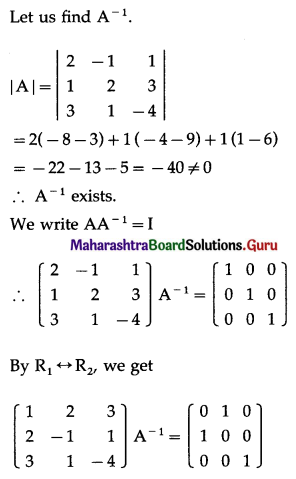
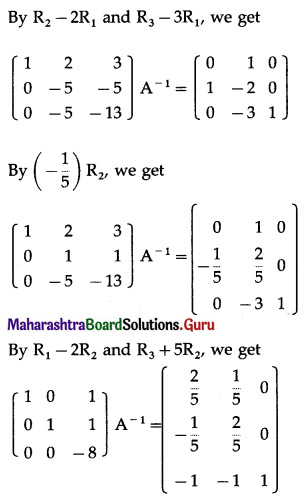
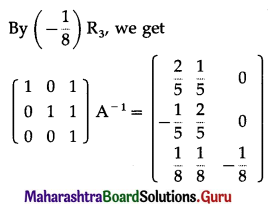
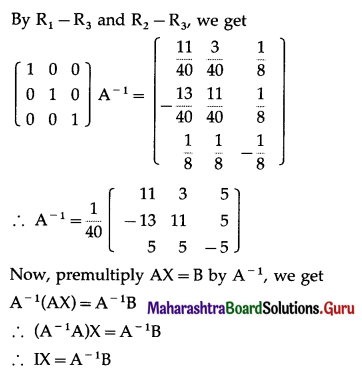
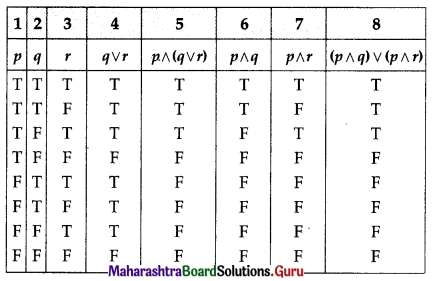
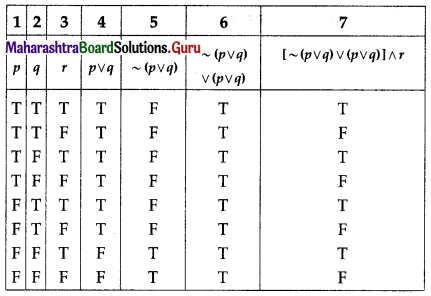
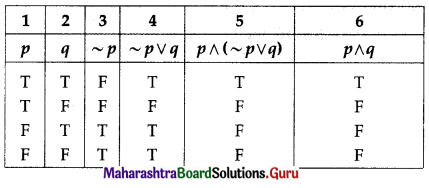
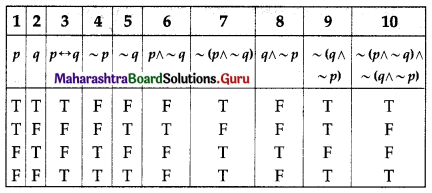
Maharashtra Board 12th Commerce Maths Solutions Chapter 2 Matrices Ex 2.1

Balbharati Maharashtra State Board 12th Commerce Maths Solution Book Pdf Chapter 2 Matrices Ex 2.1 Questions and Answers.

Maharashtra State Board 12th Commerce Maths Solutions Chapter 2 Matrices Ex 2.1

Question 1.
Construct a matrix A = [aij]3×2 whose elements aij isgiven by
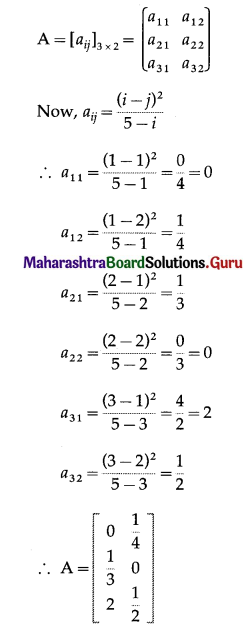
(i) aij = \(\frac{(i-j)^{2}}{5-i}\)
Solution:
Maharashtra Board 12th Commerce Maths Solutions Chapter 2 Matrices Ex 2.1 Q1 (i)

(ii) aij = i – 3j
Solution:
aij = i – 3j
∴ a11 = 1 – 3(1) = 1 – 3 = -2
a12 = 1 – 3(2) = 1 – 6 = -5
a21 = 2 – 3(1) = 2 – 3 = -1
a22 = 2 – 3(2) = 2 – 6 = -4
a31 = 3 – 3(1) = 3 – 3 = 0
a32 = 3 – 3(2) = 3 – 6 = -3
∴ A = \(\left[\begin{array}{cc}
-2 & -5 \\
-1 & -4 \\
0 & -3
\end{array}\right]\)

Maharashtra Board 12th Commerce Maths Solutions Chapter 2 Matrices Ex 2.1

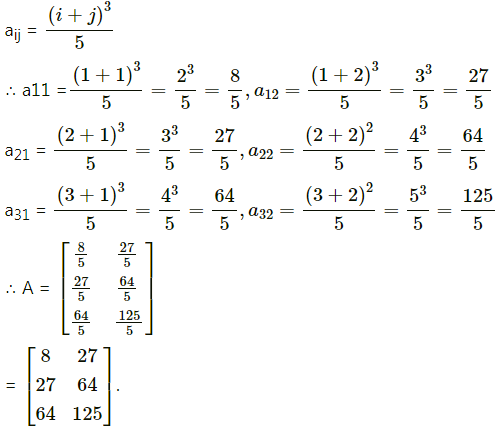
(iii) aij = \(\frac{(i+j)^{3}}{5}\)
Solution:
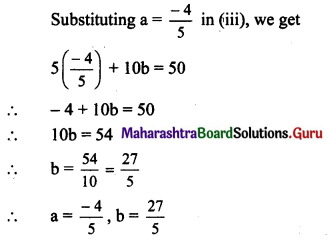
Maharashtra Board 12th Commerce Maths Solutions Chapter 2 Matrices Ex 2.1 Q1 (iii)

Question 2.
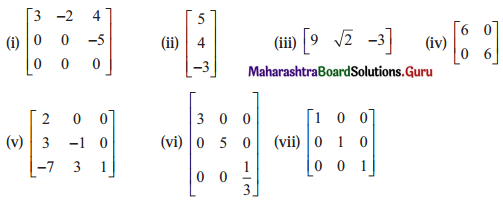
Classify each of the following matrices as a row, a column, a square, a diagonal, a scalar, a unit, an upper triangular, a lower triangular matrix:
Maharashtra Board 12th Commerce Maths Solutions Chapter 2 Matrices Ex 2.1 Q2
Solution:
(i) Since, all the elements below the diagonal are zero, it is an upper triangular matrix.
(ii) This matrix has only one column, it is a column matrix.
(iii) This matrix has only one row, it is a row matrix.
(iv) Since, diagonal elements are equal and non-diagonal elements are zero, it is a scalar matrix.
(v) Since, all the elements above the diagonal are zero, it is a lower triangular matrix.
(vi) Since, all the non-diagonal elements are zero, it is a diagonal matrix.
(vii) Since, diagonal elements are 1 and non-diagonal elements are 0, it is an identity (or unit) matrix.

Question 3.
Which of the following matrices are singular or non-singular:
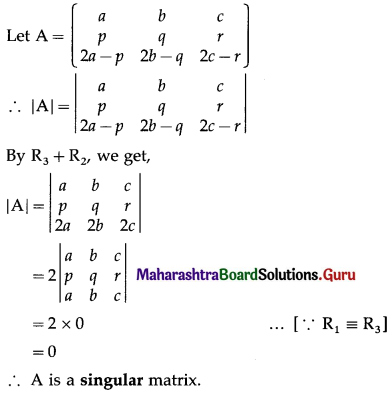
(i) \(\left[\begin{array}{ccc}
a & b & c \\
p & q & r \\
2 a-p & 2 b-q & 2 c-r
\end{array}\right]\)
Solution:
Maharashtra Board 12th Commerce Maths Solutions Chapter 2 Matrices Ex 2.1 Q3 (i)

(ii) \(\left[\begin{array}{ccc}
5 & 0 & 5 \\
1 & 99 & 100 \\
6 & 99 & 105
\end{array}\right]\)
Solution:
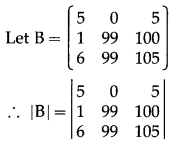
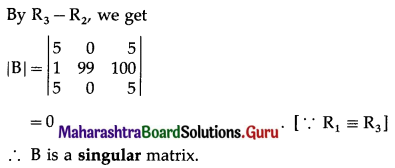
Maharashtra Board 12th Commerce Maths Solutions Chapter 2 Matrices Ex 2.1 Q3 (ii)
Maharashtra Board 12th Commerce Maths Solutions Chapter 2 Matrices Ex 2.1 Q3 (ii).1

Maharashtra Board 12th Commerce Maths Solutions Chapter 2 Matrices Ex 2.1

(iii) \(\left[\begin{array}{ccc}
3 & 5 & 7 \\
-2 & 1 & 4 \\
3 & 2 & 5
\end{array}\right]\)
Solution:
Let C = \(\left[\begin{array}{ccc}
3 & 5 & 7 \\
-2 & 1 & 4 \\
3 & 2 & 5
\end{array}\right]\)
∴ |C| = \(\left|\begin{array}{rrr}
3 & 5 & 7 \\
-2 & 1 & 4 \\
3 & 2 & 5
\end{array}\right|\)
= 3(5 – 8) – 5(-10 – 12) + 7(-4 – 3)
= -9 + 110 – 49
= 52 ≠ 0
∴ C is a non-singular matrix.

(iv) \(\left[\begin{array}{cc}
7 & 5 \\
-4 & 7
\end{array}\right]\)
Solution:
Let D = \(\left[\begin{array}{cc}
7 & 5 \\
-4 & 7
\end{array}\right]\)
∴ |D| = \(\left|\begin{array}{rr}
7 & 5 \\
-4 & 7
\end{array}\right|\)
= 49 – (-20)
= 69 ≠ 0
∴ D is a non-singular matrix.

Maharashtra Board 12th Commerce Maths Solutions Chapter 2 Matrices Ex 2.1

Question 4.
Find k, if the following matrices are singular:
(i) \(\left[\begin{array}{cc}
7 & 3 \\
-2 & K
\end{array}\right]\)
Solution:
Let A = \(\left[\begin{array}{cc}
7 & 3 \\
-2 & K
\end{array}\right]\)
Since, A is a singular matrix, |A| = 0
∴ \(\left|\begin{array}{rr}
7 & 3 \\
-2 & k
\end{array}\right|\) = 0
∴ 7k – (-6) = 0
∴ 7k = -6
∴ k = \(-\frac{6}{7}\)

(ii) \(\left[\begin{array}{ccc}
4 & 3 & 1 \\
7 & \mathrm{~K} & 1 \\
10 & 9 & 1
\end{array}\right]\)
Solution:
Let B = \(\left[\begin{array}{ccc}
4 & 3 & 1 \\
7 & \mathrm{~K} & 1 \\
10 & 9 & 1
\end{array}\right]\)
Since, B is a singular matrix, |B| = 0
∴ \(\left|\begin{array}{rrr}
4 & 3 & 1 \\
7 & k & 1 \\
10 & 9 & 1
\end{array}\right|\) = 0
∴ 4(k – 9) – 3(7 – 10) + 1(63 – 10k) = 0
∴ 4k – 36 + 9 + 63 – 10k = 0
∴ -6k + 36 = 0
∴ 6k = 36
∴ k = 6.

Maharashtra Board 12th Commerce Maths Solutions Chapter 2 Matrices Ex 2.1

(iii) \(\left[\begin{array}{ccc}
K-1 & 2 & 3 \\
3 & 1 & 2 \\
1 & -2 & 4
\end{array}\right]\)
Solution:
Let C = \(\left[\begin{array}{ccc}
K-1 & 2 & 3 \\
3 & 1 & 2 \\
1 & -2 & 4
\end{array}\right]\)
Since, C is a singular matrix, |C| = 0
∴ \(\left|\begin{array}{crr}
k-1 & 2 & 3 \\
3 & 1 & 2 \\
1 & -2 & 4
\end{array}\right|\) = 0
∴ (k – 1)(4 + 4) – 2(12 – 2) + 3(-6 – 1) = 0
∴ 8k – 8 – 20 – 21 = 0
∴ 8k = 49
∴ k = \(\frac{49}{8}\)

Maharashtra Board 11th Maths Solutions Chapter 2 Sequences and Series Ex 2.1

Balbharti Maharashtra State Board 11th Maths Book Solutions Pdf Chapter 2 Sequences and Series Ex 2.1 Questions and Answers.

Maharashtra State Board 11th Maths Solutions Chapter 2 Sequences and Series Ex 2.1

Question 1.
Check whether the following sequences are G.P. If so, write tn.
(i) 2, 6, 18, 54, ……
Solution:
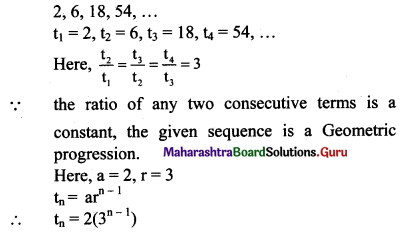
Maharashtra Board 11th Maths Solutions Chapter 2 Sequences and Series Ex 2.1 Q1 (i)

(ii) 1, -5, 25, -125, ………
Solution:
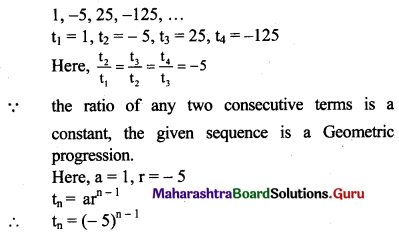
Maharashtra Board 11th Maths Solutions Chapter 2 Sequences and Series Ex 2.1 Q1 (ii)

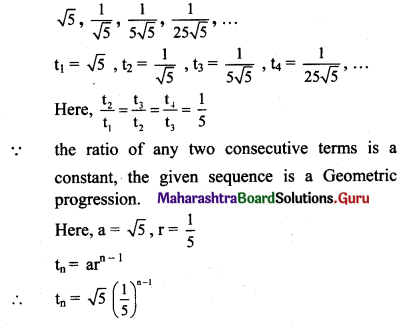
(iii) \(\sqrt{5}, \frac{1}{\sqrt{5}}, \frac{1}{5 \sqrt{5}}, \frac{1}{25 \sqrt{5}}, \cdots\)
Solution:
Maharashtra Board 11th Maths Solutions Chapter 2 Sequences and Series Ex 2.1 Q1 (iii)

Maharashtra Board 11th Maths Solutions Chapter 2 Sequences and Series Ex 2.1

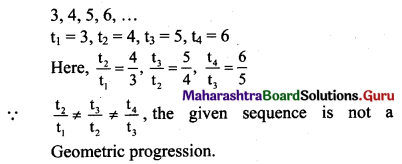
(iv) 3, 4, 5, 6, ……
Solution:
Maharashtra Board 11th Maths Solutions Chapter 2 Sequences and Series Ex 2.1 Q1 (iv)

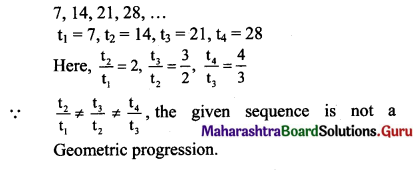
(v) 7, 14, 21, 28, ……
Solution:
Maharashtra Board 11th Maths Solutions Chapter 2 Sequences and Series Ex 2.1 Q1 (v)

Question 2.
For the G.P.
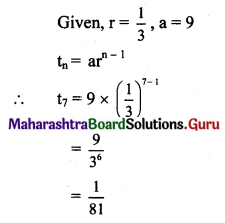
(i) If r = \(\frac{1}{3}\), a = 9, find t7.
Solution:
Maharashtra Board 11th Maths Solutions Chapter 2 Sequences and Series Ex 2.1 Q2 (i)

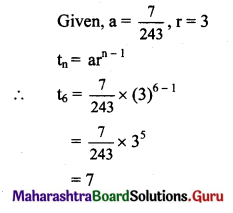
(ii) If a = \(\frac{7}{243}\), r = 3, find t6.
Solution:
Maharashtra Board 11th Maths Solutions Chapter 2 Sequences and Series Ex 2.1 Q2 (ii)

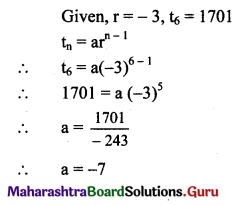
(iii) If r = -3 and t6 = 1701, find a.
Solution:
Maharashtra Board 11th Maths Solutions Chapter 2 Sequences and Series Ex 2.1 Q2 (iii)

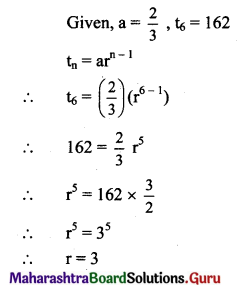
(iv) If a = \(\frac{2}{3}\), t6 = 162, find r.
Solution:
Maharashtra Board 11th Maths Solutions Chapter 2 Sequences and Series Ex 2.1 Q2 (iv)

Maharashtra Board 11th Maths Solutions Chapter 2 Sequences and Series Ex 2.1

Question 3.
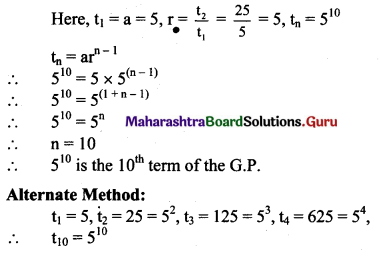
Which term of the G. P. 5, 25, 125, 625, …… is 510?
Solution:
Maharashtra Board 11th Maths Solutions Chapter 2 Sequences and Series Ex 2.1 Q3

Question 4.
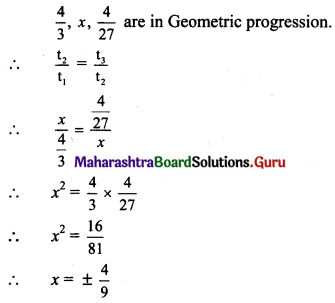
For what values of x, the terms \(\frac{4}{3}\), x, \(\frac{4}{27}\) are in G. P.?
Solution:
Maharashtra Board 11th Maths Solutions Chapter 2 Sequences and Series Ex 2.1 Q4

Question 5.
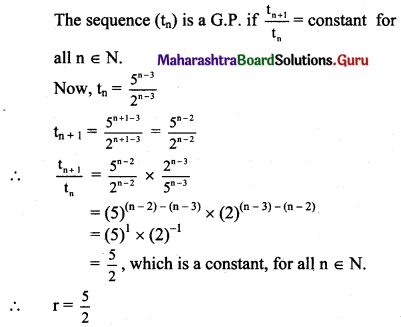
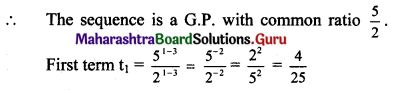
If for a sequence, \(\mathrm{t}_{\mathrm{n}}=\frac{5^{n-3}}{2^{n-3}}\), show that the sequence is a G. P. Find its first term and the common ratio.
Solution:
Maharashtra Board 11th Maths Solutions Chapter 2 Sequences and Series Ex 2.1 Q5
Maharashtra Board 11th Maths Solutions Chapter 2 Sequences and Series Ex 2.1 Q5.1

Question 6.
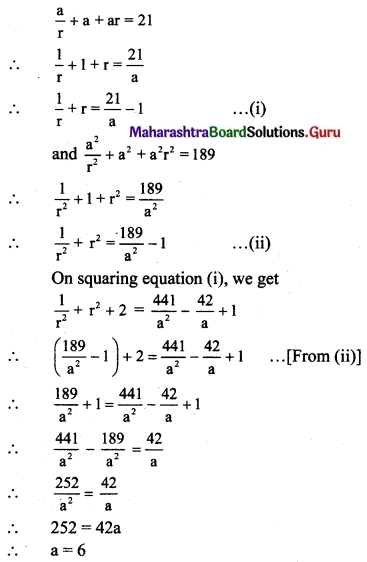
Find three numbers in G. P. such that their sum is 21 and the sum of their squares is 189.
Solution:
Let the three numbers in G. P. be \(\frac{a}{r}\), a, ar.
According to the given conditions,
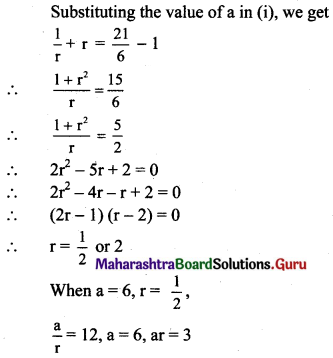
Maharashtra Board 11th Maths Solutions Chapter 2 Sequences and Series Ex 2.1 Q6
Maharashtra Board 11th Maths Solutions Chapter 2 Sequences and Series Ex 2.1 Q6.1
When a = 6, r = 2,
\(\frac{a}{r}\) = 3, a = 6, ar = 12
Hence, the three numbers in G.P. are 12, 6, 3 or 3, 6, 12.

Maharashtra Board 11th Maths Solutions Chapter 2 Sequences and Series Ex 2.1

Check:
If sum of the three numbers is 21 and sum of their squares is 189, then our answer is correct.
Sum of the numbers = 12 + 6 + 3 = 21
Sum of the squares of the numbers = 122 + 62 + 32
= 144 + 36 + 9
= 189
Thus, our answer is correct.

Question 7.
Find four numbers in G. P. such that the sum of the middle two numbers is \(\frac{10}{3}\) and their product is 1.
Solution:
Let the four numbers in G.P. be \(\frac{a}{r^{3}}, \frac{a}{r}, a r, a r^{3}\)
According to the given conditions,
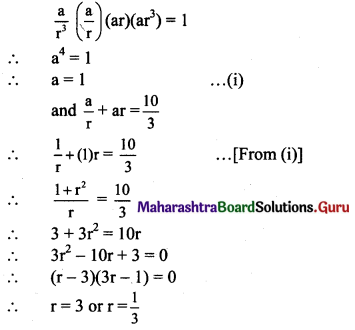
Maharashtra Board 11th Maths Solutions Chapter 2 Sequences and Series Ex 2.1 Q7
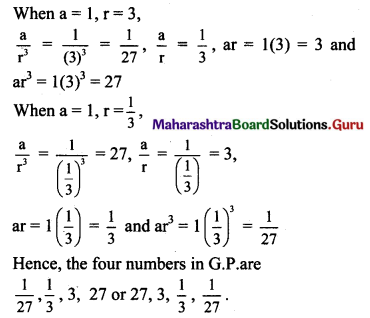
Maharashtra Board 11th Maths Solutions Chapter 2 Sequences and Series Ex 2.1 Q7.1

Question 8.
Find five numbers in G. P. such that their product is 1024 and the fifth term is square of the third term.
Solution:
Let the five numbers in G. P. be
\(\frac{a}{r^{2}}, \frac{a}{r}, a, a r, a r^{2}\)
According to the given conditions,
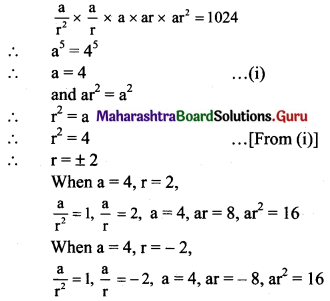
Maharashtra Board 11th Maths Solutions Chapter 2 Sequences and Series Ex 2.1 Q8
Hence, the five numbers in G.P. are
1, 2, 4, 8, 16 or 1, -2, 4, -8, 16.

Question 9.
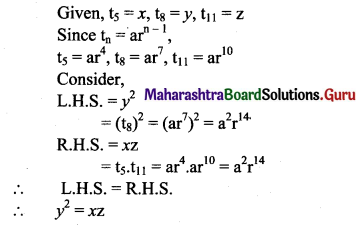
The fifth term of a G. P. is x, the eighth term of a G.P. is y and the eleventh term of a G.P. is z, verify whether y2 = xz.
Solution:
Maharashtra Board 11th Maths Solutions Chapter 2 Sequences and Series Ex 2.1 Q9

Question 10.
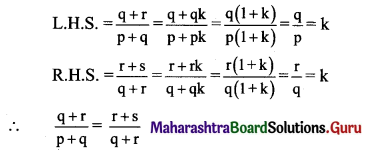
If p, q, r, s are in G.P., show that p + q, q + r, r + s are also in G. P.
Solution:
p, q, r, s are in G.P.
∴ \(\frac{\mathrm{q}}{\mathrm{p}}=\frac{\mathrm{r}}{\mathrm{q}}=\frac{\mathrm{s}}{\mathrm{r}}\)
Let \(\frac{\mathrm{q}}{\mathrm{p}}=\frac{\mathrm{r}}{\mathrm{q}}=\frac{\mathrm{s}}{\mathrm{r}}\) = k
∴ q = pk, r = qk, s = rk
We have to prove that p + q, q + r, r + s are in G.P.
i.e., to prove that \(\frac{\mathrm{q}+\mathrm{r}}{\mathrm{p}+\mathrm{q}}=\frac{\mathrm{r}+\mathrm{s}}{\mathrm{q}+\mathrm{r}}\)
Maharashtra Board 11th Maths Solutions Chapter 2 Sequences and Series Ex 2.1 Q10
∴ p + q, q + r, r + s are in G.P.

Maharashtra Board 11th Maths Solutions Chapter 2 Sequences and Series Ex 2.1

Question 11.
The number of bacteria in a culture doubles every hour. If there were 50 bacteria originally in the culture, how many bacteria will be there at the end of the 5th hour?
Solution:
Since the number of bacteria in culture doubles every hour, increase in number of bacteria after every hour is in G.P.
∴ a = 50, r = \(\frac{100}{50}\) = 2
tn = arn-1
To find the number of bacteria at the end of the 5th hour.
(i.e., to find the number of bacteria at the beginning of the 6th hour, i.e., to find t6.)
∴ t6 = ar5
= 50 × (25)
= 50 × 32
= 1600

Question 12.
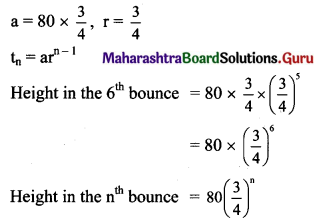
A ball is dropped from a height of 80 ft. The ball is such that it rebounds \(\left(\frac{3}{4}\right)^{\text {th }}\) of the height it has fallen. How high does the ball rebound on the 6th bounce? How high does the ball rebound on the nth bounce?
Solution:
Since the ball rebounds \(\left(\frac{3}{4}\right)^{\text {th }}\) of the height it has fallen, the height in successive bounce is in G.P.
1st height in the bounce = 80 × \(\frac{3}{4}\)
Maharashtra Board 11th Maths Solutions Chapter 2 Sequences and Series Ex 2.1 Q12

Question 13.
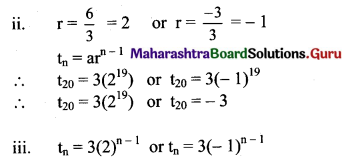
The numbers 3, x and x + 6 are in G. P. Find
(i) x
(ii) 20th term
(iii) nth term.
Solution:
(i) 3, x and x + 6 are in G. P.
\(\frac{x}{3}=\frac{x+6}{x}\)
x2 = 3x + 18
x2 – 3x – 18 = 0
(x – 6) (x + 3) = 0
x = 6, -3
Maharashtra Board 11th Maths Solutions Chapter 2 Sequences and Series Ex 2.1 Q13

Maharashtra Board 11th Maths Solutions Chapter 2 Sequences and Series Ex 2.1

Question 14.
Mosquitoes are growing at a rate of 10% a year. If there were 200 mosquitoes in the beginning, write down the number of mosquitoes after
(i) 3 years
(ii) 10 years
(iii) n years
Solution:
a = 200, r = 1 + \(\frac{10}{100}\) = \(\frac{11}{10}\)
Mosquitoes at the end of 1st year = 200 × \(\frac{11}{10}\)
(i) Number of mosquitoes after 3 years
= 200 × \(\frac{11}{10} \times\left(\frac{11}{10}\right)^{2}\)
= 200 \(\left(\frac{11}{10}\right)^{3}\)
= 200 (1.1)3

(ii) Number of mosquitoes after 10 years = 200 (1.1)10

(iii) Number of mosquitoes after n years = 200 (1.1)n

Question 15.
The numbers x – 6, 2x and x2 are in G. P. Find
(i) x
(ii) 1st term
(iii) nth term
Solution:
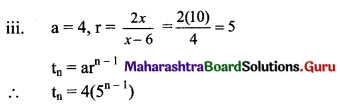
(i) x – 6, 2x and x are in Geometric progression.
∴ \(\frac{2 x}{x-6}=\frac{x^{2}}{2 x}\)
4x2 = x2(x – 6)
4 = x – 6
x = 10

Maharashtra Board 11th Maths Solutions Chapter 2 Sequences and Series Ex 2.1

(ii) t1 = x – 6 = 10 – 6 = 4

Maharashtra Board 11th Maths Solutions Chapter 2 Sequences and Series Ex 2.1 Q15

Maharashtra Board 11th Maths Solutions Chapter 9 Differentiation Ex 9.1

Balbharti Maharashtra State Board 11th Maths Book Solutions Pdf Chapter 9 Differentiation Ex 9.1 Questions and Answers.

Maharashtra State Board 11th Maths Solutions Chapter 9 Differentiation Ex 9.1

Question 1.
Find the derivatives of the following w.r.t. x by using the method of the first principle.
(a) x2 + 3x – 1
Solution:
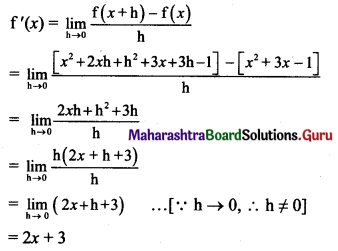
Let f(x) = x2 + 3x – 1
∴ f(x + h) = (x + h)2 + 3(x + h) – 1
= x2 + 2xh + h2 + 3x + 3h – 1
By first principle, we get
Maharashtra Board 11th Maths Solutions Chapter 9 Differentiation Ex 9.1 Q1 (i)

(b) sin(3x)
Solution:
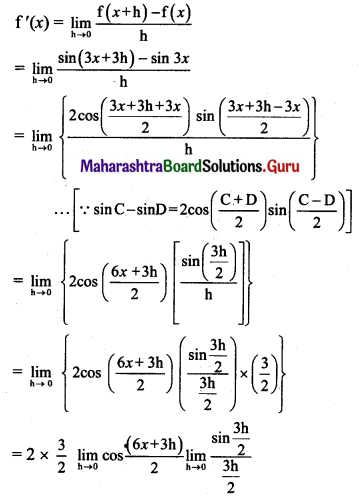
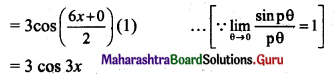
Let f(x) = sin 3x
f(x + h) = sin3(x + h) = sin(3x + 3h)
By first principle, we get
Maharashtra Board 11th Maths Solutions Chapter 9 Differentiation Ex 9.1 Q1 (ii)
Maharashtra Board 11th Maths Solutions Chapter 9 Differentiation Ex 9.1 Q1 (ii).1

Maharashtra Board 11th Maths Solutions Chapter 9 Differentiation Ex 9.1

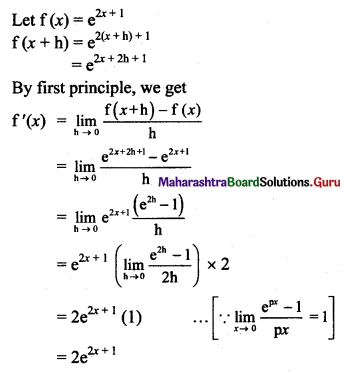
(c) e2x+1
Solution:
Maharashtra Board 11th Maths Solutions Chapter 9 Differentiation Ex 9.1 Q1 (iii)

(d) 3x
Solution:
Maharashtra Board 11th Maths Solutions Chapter 9 Differentiation Ex 9.1 Q1 (iv)

(e) log(2x + 5)
Solution:
Let f(x) = log(2x + 5)
∴ f(x + h) = log[2(x + h) + 5] = log (2x + 2h + 5)
By first principle, we get
Maharashtra Board 11th Maths Solutions Chapter 9 Differentiation Ex 9.1 Q1 (v)
Maharashtra Board 11th Maths Solutions Chapter 9 Differentiation Ex 9.1 Q1 (v).1

(f) tan(2x + 3)
Solution:
Let f(x) = tan(2x + 3)
∴ f(x + h) = tan[2(x + h) + 3] = tan(2x + 2h + 3)
By first principle, we get
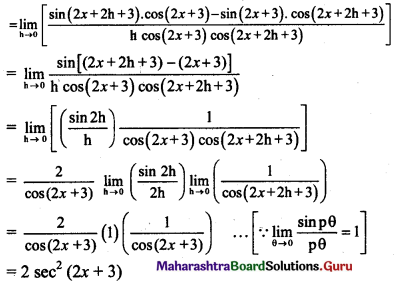
Maharashtra Board 11th Maths Solutions Chapter 9 Differentiation Ex 9.1 Q1 (vi)
Maharashtra Board 11th Maths Solutions Chapter 9 Differentiation Ex 9.1 Q1 (vi).1

(g) sec(5x – 2)
Solution:
Let f(x) = sec(5x – 2)
f(x + h) = sec[5(x + h) – 2] = sec(5x + 5h – 2)
By first principle, we get
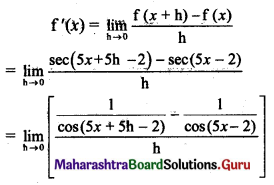
Maharashtra Board 11th Maths Solutions Chapter 9 Differentiation Ex 9.1 Q1 (vii)
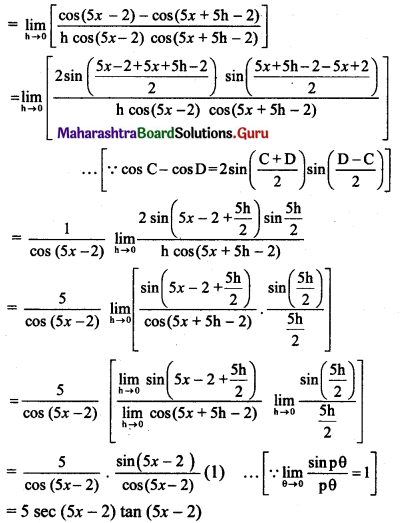
Maharashtra Board 11th Maths Solutions Chapter 9 Differentiation Ex 9.1 Q1 (vii).1

Maharashtra Board 11th Maths Solutions Chapter 9 Differentiation Ex 9.1

(h) x√x
Solution:
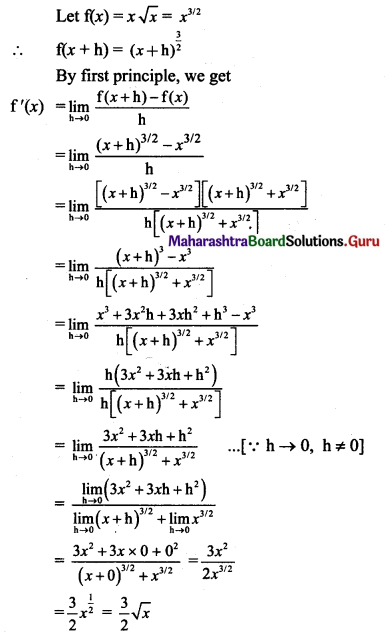
Maharashtra Board 11th Maths Solutions Chapter 9 Differentiation Ex 9.1 Q1 (viii)

Question 2.
Find the derivatives of the following w.r.t. x. at the points indicated against them by using the method of the first principle.
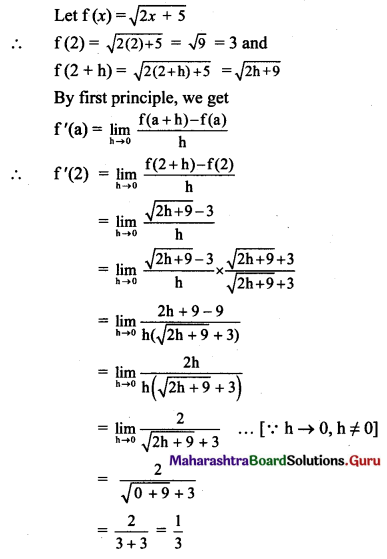
(i) \(\sqrt{2 x+5}\) at x = 2
Solution:
Maharashtra Board 11th Maths Solutions Chapter 9 Differentiation Ex 9.1 Q2 (i)

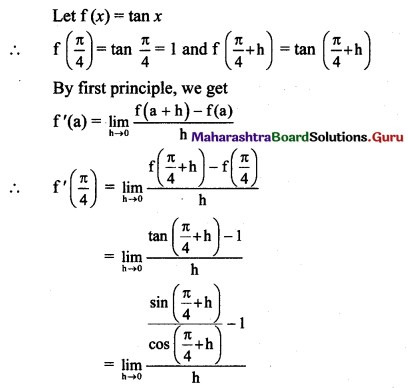
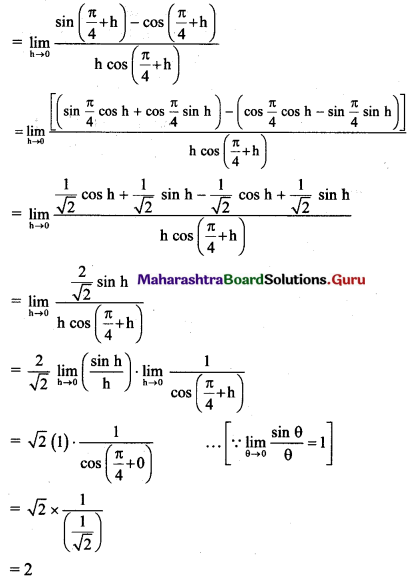
(ii) tan x at x = \(\frac{\pi}{4}\)
Solution:
Maharashtra Board 11th Maths Solutions Chapter 9 Differentiation Ex 9.1 Q2 (ii)
Maharashtra Board 11th Maths Solutions Chapter 9 Differentiation Ex 9.1 Q2 (ii).1

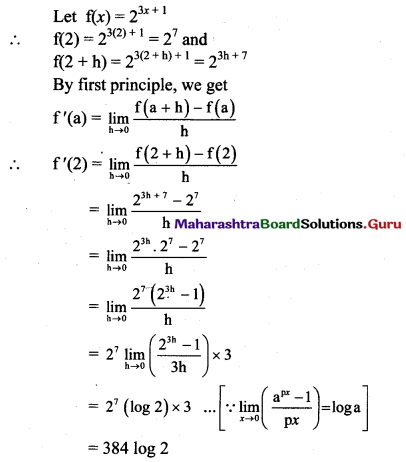
(iii) 23x+1 at x = 2
Solution:
Maharashtra Board 11th Maths Solutions Chapter 9 Differentiation Ex 9.1 Q2 (iii)

(iv) log(2x + 1) at x = 2
Solution:
Let f(x) = log(2x + 1)
∴ f(2) = log [2(2) + 1] = log 5 and
f(2 + h) = log [2(2 + h) + 1] = log(2h + 5)
By first principle, we get
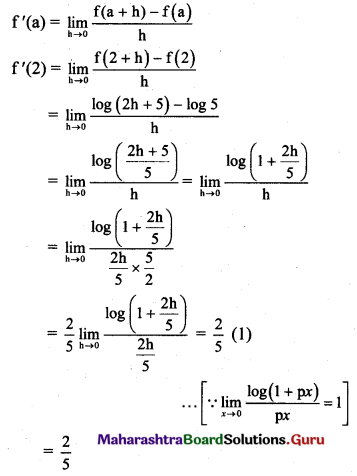
Maharashtra Board 11th Maths Solutions Chapter 9 Differentiation Ex 9.1 Q2 (iv)

(v) e3x-4 at x = 2
Solution:
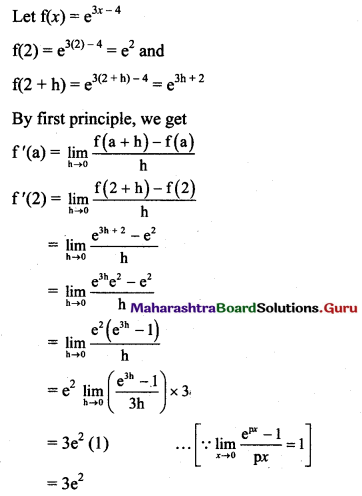
Maharashtra Board 11th Maths Solutions Chapter 9 Differentiation Ex 9.1 Q2 (v)

(vi) cos x at x = \(\frac{5 \pi}{4}\)
Solution:
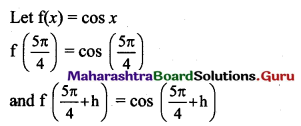
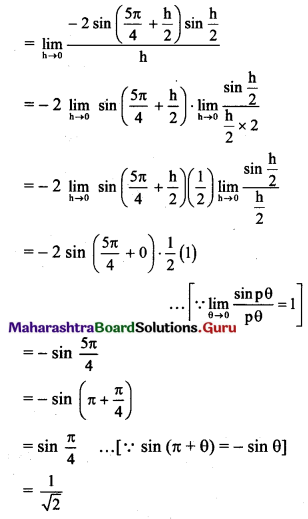
Maharashtra Board 11th Maths Solutions Chapter 9 Differentiation Ex 9.1 Q2 (vi)
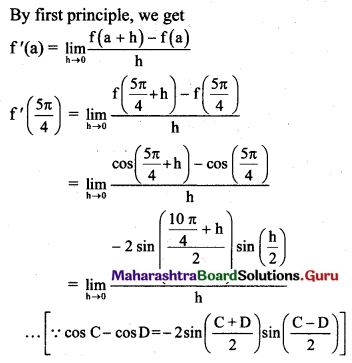
Maharashtra Board 11th Maths Solutions Chapter 9 Differentiation Ex 9.1 Q2 (vi).1
Maharashtra Board 11th Maths Solutions Chapter 9 Differentiation Ex 9.1 Q2 (vi).2

Maharashtra Board 11th Maths Solutions Chapter 9 Differentiation Ex 9.1

Question 3.
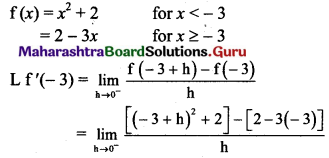
Show that the function f is not differentiable at x = -3,
where f(x) = x2 + 2 for x < -3
= 2 – 3x for x ≥ -3
Solution:
Maharashtra Board 11th Maths Solutions Chapter 9 Differentiation Ex 9.1 Q3
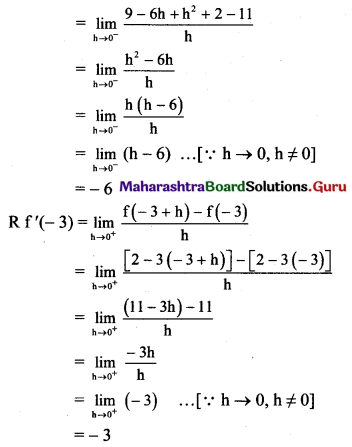
Maharashtra Board 11th Maths Solutions Chapter 9 Differentiation Ex 9.1 Q3.1
∴ L f'(-3) ≠ R f'(-3)
∴ f is not differentiable at x = -3.

Question 4.
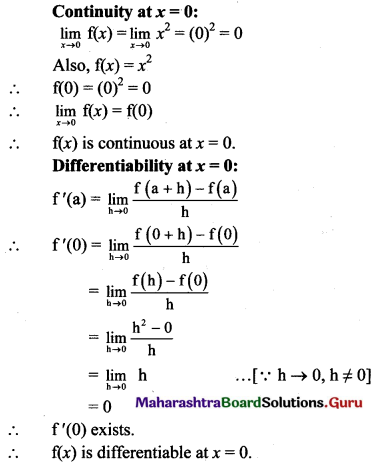
Show that f(x) = x2 is continuous and differentiable at x = 0.
Solution:
Maharashtra Board 11th Maths Solutions Chapter 9 Differentiation Ex 9.1 Q4

Question 5.
Discuss the continuity and differentiability of
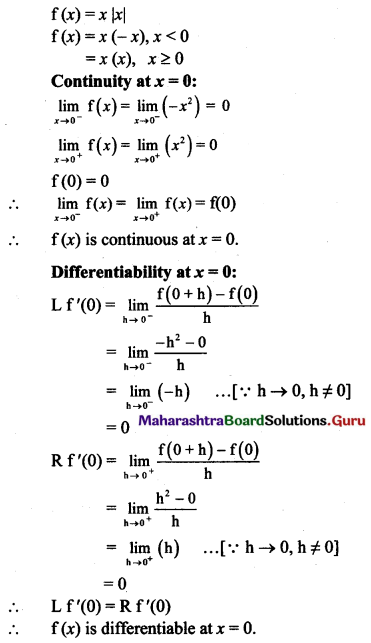
(i) f(x) = x |x| at x = 0
Solution:
Maharashtra Board 11th Maths Solutions Chapter 9 Differentiation Ex 9.1 Q5 (i)

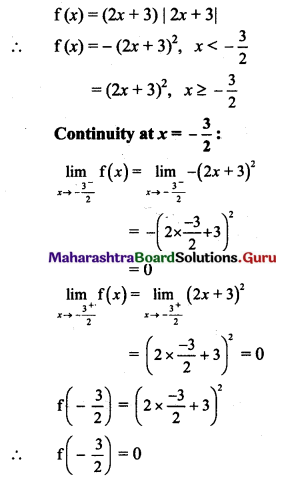
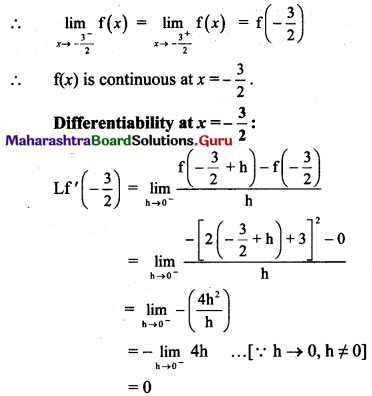
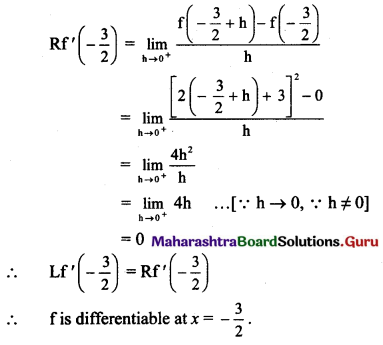
(ii) f(x) = (2x + 3) |2x + 3| at x = \(-\frac{3}{2}\)
Solution:
Maharashtra Board 11th Maths Solutions Chapter 9 Differentiation Ex 9.1 Q5 (ii)
Maharashtra Board 11th Maths Solutions Chapter 9 Differentiation Ex 9.1 Q5 (ii).1
Maharashtra Board 11th Maths Solutions Chapter 9 Differentiation Ex 9.1 Q5 (ii).2

Question 6.
Discuss the continuity and differentiability of f(x) at x = 2.
f(x) = [x] if x ∈ [0, 4). [where [ ] is a greatest integer (floor) function]
Solution:
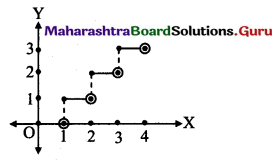
Explanation:
x ∈ [0, 4)
∴ 0 ≤ x < 4
We will plot graph for 0 ≤ x < 4
not for x < 0 and upto x = 4 making on X-axis.
Maharashtra Board 11th Maths Solutions Chapter 9 Differentiation Ex 9.1 Q6
f(x) = [x]
∴ Greatest integer function is discontinuous at all integer values of x and hence not differentiable at all integers.
∴ f is not continuous at x = 2.
∵ f(x) = 1, x < 2
= 2, x ≥ 2
x ∈ neighbourhood of x = 2.
∴ L.H.L. = 1, R.H.L. = 2
∴ f is not continuous at x = 2.
∴ f is not differentiable at x = 2.

Maharashtra Board 11th Maths Solutions Chapter 9 Differentiation Ex 9.1

Question 7.
Test the continuity and differentiability of
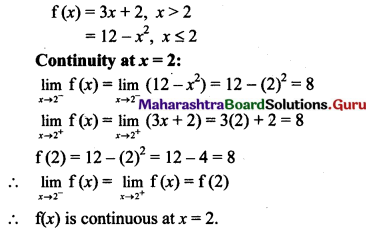
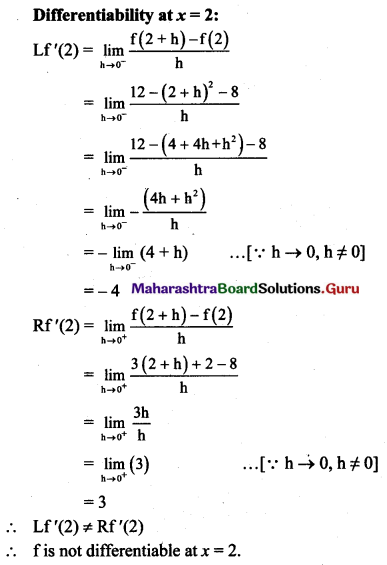
f(x) = 3x + 2 if x > 2
= 12 – x2 if x ≤ 2 at x = 2.
Solution:
Maharashtra Board 11th Maths Solutions Chapter 9 Differentiation Ex 9.1 Q7
Maharashtra Board 11th Maths Solutions Chapter 9 Differentiation Ex 9.1 Q7.1

Question 8.
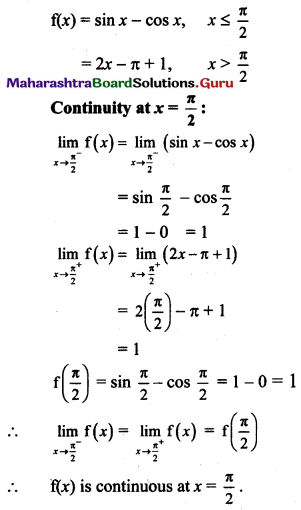
If f(x) = sin x – cos x if x ≤ \(\frac{\pi}{2}\)
= 2x – π + 1 if x > \(\frac{\pi}{2}\)
Test the continuity and differentiability of f at x = \(\frac{\pi}{2}\).
Solution:
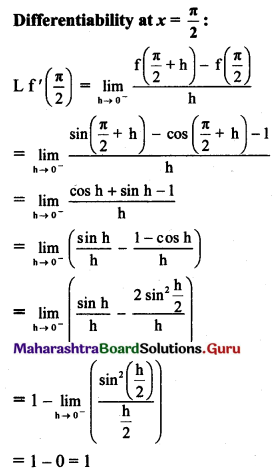
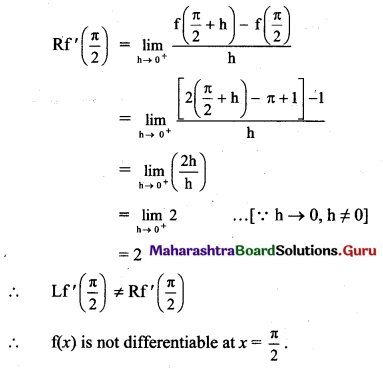
Maharashtra Board 11th Maths Solutions Chapter 9 Differentiation Ex 9.1 Q8
Maharashtra Board 11th Maths Solutions Chapter 9 Differentiation Ex 9.1 Q8.1
Maharashtra Board 11th Maths Solutions Chapter 9 Differentiation Ex 9.1 Q8.2

Maharashtra Board 11th Maths Solutions Chapter 9 Differentiation Ex 9.1

Question 9.
Examine the function
f(x) = x2 cos(\(\frac{1}{x}\)), for x ≠ 0
= 0, for x = 0
for continuity and differentiability at x = 0.
Solution:
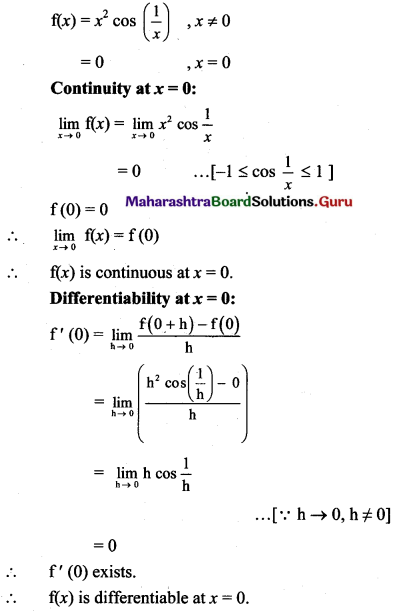
Maharashtra Board 11th Maths Solutions Chapter 9 Differentiation Ex 9.1 Q9

Maharashtra Board 11th Maths Solutions Chapter 4 Methods of Induction and Binomial Theorem Miscellaneous Exercise 4

Balbharti Maharashtra State Board 11th Maths Book Solutions Pdf Chapter 4 Methods of Induction and Binomial Theorem Miscellaneous Exercise 4 Questions and Answers.

Maharashtra State Board 11th Maths Solutions Chapter 4 Methods of Induction and Binomial Theorem Miscellaneous Exercise 4

(I) Select the correct answers from the given alternatives.

Question 1.
The total number of terms in the expression of (x + y)100 + (x – y)100 after simplification is:
(A) 50
(B) 51
(C) 100
(D) 202
Answer:
(B) 51
Hint:
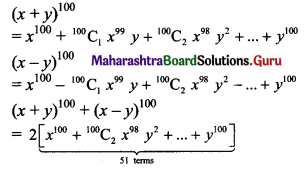
Maharashtra Board 11th Maths Solutions Chapter 4 Methods of Induction and Binomial Theorem Miscellaneous Exercise 4 I Q1

Question 2.
The middle term in the expansion of (1 + x)2n will be:
(A) (n – 1)th
(B) nth
(C) (n + 1)th
(D) (n + 2)th
Answer:
(C) (n + 1)th
Hint:
(1 + x)2n has (2n + 1) terms.
∴ (n + 1 )th term is the middle term.

Maharashtra Board 11th Maths Solutions Chapter 4 Methods of Induction and Binomial Theorem Miscellaneous Exercise 4

Question 3.
In the expansion of (x2 – 2x)10, the coefficient of x16 is
(A) -1680
(B) 1680
(C) 3360
(D) 6720
Answer:
(C) 3360
Hint:
(x2 – 2x)10 = x10 (x – 2)10
To get the coefficient of x16 in (x2 – 2x)10,
we need to check coefficient of x6 in (x – 2)10
∴ Required coefficient = 10C6 (-2)4
= 210 × 16
= 3360

Question 4.
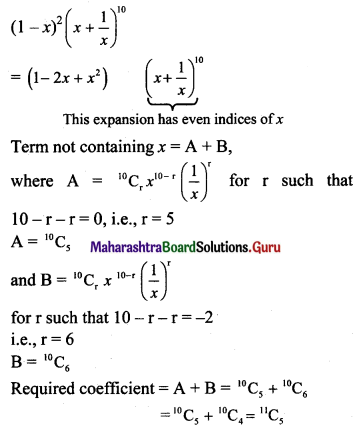
The term not containing x in expansion of \((1-x)^{2}\left(x+\frac{1}{x}\right)^{10}\) is
(A) 11C5
(B) 10C5
(C) 10C4
(D) 10C7
Answer:
(A) 11C5
Hint:
Maharashtra Board 11th Maths Solutions Chapter 4 Methods of Induction and Binomial Theorem Miscellaneous Exercise 4 I Q4

Question 5.
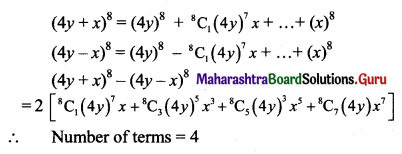
The number of terms in expansion of (4y + x)8 – (4y – x)8 is
(A) 4
(B) 5
(C) 8
(D) 9
Answer:
(A) 4
Hint:
Maharashtra Board 11th Maths Solutions Chapter 4 Methods of Induction and Binomial Theorem Miscellaneous Exercise 4 I Q5

Question 6.
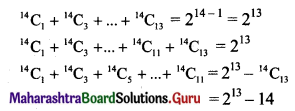
The value of 14C1 + 14C3 + 14C5 + …. + 14C11 is
(A) 214 – 1
(B) 214 – 14
(C) 212
(D) 213 – 14
Answer:
(D) 213 – 14
Hint:
Maharashtra Board 11th Maths Solutions Chapter 4 Methods of Induction and Binomial Theorem Miscellaneous Exercise 4 I Q6

Maharashtra Board 11th Maths Solutions Chapter 4 Methods of Induction and Binomial Theorem Miscellaneous Exercise 4

Question 7.
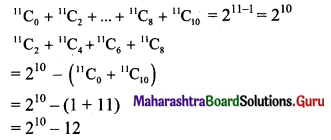
The value of 11C2 + 11C4 + 11C6 + 11C8 is equal to
(A) 210 – 1
(B) 210 – 11
(C) 210 + 12
(D) 210 – 12
Answer:
(D) 210 – 12
Hint:
Maharashtra Board 11th Maths Solutions Chapter 4 Methods of Induction and Binomial Theorem Miscellaneous Exercise 4 I Q7

Question 8.
In the expansion of (3x + 2)4, the coefficient of the middle term is
(A) 36
(B) 54
(C) 81
(D) 216
Answer:
(D) 216
Hint:
(3x + 2)4 has 5 terms.
∴ (3x + 2)4 has 3rd term as the middle term.
The coefficient of the middle term
Maharashtra Board 11th Maths Solutions Chapter 4 Methods of Induction and Binomial Theorem Miscellaneous Exercise 4 I Q8
= 6 × 9 × 4
= 216

Question 9.
The coefficient of the 8th term in the expansion of (1 + x)10 is:
(A) 7
(B) 120
(C) 10C8
(D) 210
Answer:
(B) 120
Hint:
r = 7
t8 = 10C7 x7 = 10C3 x7
∴ Coefficient of 8th term = 10C3 = 120

Maharashtra Board 11th Maths Solutions Chapter 4 Methods of Induction and Binomial Theorem Miscellaneous Exercise 4

Question 10.
If the coefficients of x2 and x3 in the expansion of (3 + ax)9 are the same, then the value of a is
(A) \(-\frac{7}{9}\)
(B) \(-\frac{9}{7}\)
(C) \(\frac{7}{9}\)
(D) \(\frac{9}{7}\)
Answer:
(D) \(\frac{9}{7}\)
Hint:
Maharashtra Board 11th Maths Solutions Chapter 4 Methods of Induction and Binomial Theorem Miscellaneous Exercise 4 I Q10

(II) Answer the following.

Question 1.
Prove by the method of induction, for all n ∈ N.
(i) 8 + 17 + 26 + ….. + (9n – 1) = \(\frac{n}{2}\) (9n + 7)
Solution:
Let P(n) ≡ 8 + 17 + 26 +…..+(9n – 1) = \(\frac{n}{2}\) (9n + 7), for all n ∈ N.
Step I:
Put n = 1
L.H.S. = 8
R.H.S. = \(\frac{1}{2}\) [9(1) + 7] = 8
∴ L.H.S. = R.H.S.
∴ P(n) is true for n = 1.

Step II:
Let us assume that P(n) is true for n = k.
∴ 8 + 17 + 26 +…..+ (9k – 1) = \(\frac{k}{2}\) (9k + 7) ……(i)

Step III:
We have to prove that P(n) is true for n = k + 1,
i.e., 8 + 17 + 26 + …… + [9(k + 1) – 1]
Maharashtra Board 11th Maths Solutions Chapter 4 Methods of Induction and Binomial Theorem Miscellaneous Exercise 4 II Q1 (i)
∴ P(n) is true for n = k + 1.

Step IV:
From all the steps above, by the principle of mathematical induction, P(n) is true for all n ∈ N.
∴ 8 + 17 + 26 +…..+ (9n – 1) = \(\frac{n}{2}\) (9n + 7) for all n ∈ N.

(ii) 12 + 42 + 72 + …… + (3n – 2)2 = \(\frac{n}{2}\) (6n2 – 3n – 1)
Solution:
Let P(n) = 12 + 42 + 72 + ….. + (3n – 2)2 = \(\frac{n}{2}\) (6n2 – 3n – 1), for all n ∈ N.
Step I:
Put n = 1
L.H.S.= 12 = 1
R.H.S.= \(\frac{1}{2}\) [6(1)2 – 3(1) – 1] = 1
∴ L.H.S. = R.H.S.
∴ P(n) is true for n = 1.

Step II:
Let us assume that P(n) is true for n = k.
∴ 12 + 42 + 72 +…..+ (3k – 2)2 = \(\frac{k}{2}\) (6k2 – 3k – 1) ……(i)

Step III:
We have to prove that P(n) is true for n = k + 1,
i.e., to prove that
Maharashtra Board 11th Maths Solutions Chapter 4 Methods of Induction and Binomial Theorem Miscellaneous Exercise 4 II Q1 (ii)
∴ P(n) is true for n = k + 1.

Step IV:
From all the steps above, by the principle of mathematical induction, P(n) is true for all n ∈ N.
∴ 12 + 42 + 72 + … + (3n – 2)2 = \(\frac{n}{2}\) (6n2 – 3n – 1) for all n ∈ N.

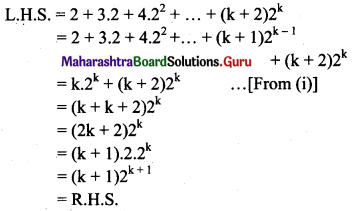
(iii) 2 + 3.2 + 4.22 + …… + (n + 1) 2n-1 = n . 2n
Solution:
Let P(n) ≡ 2 + 3.2 + 4.22 +…..+ (n + 1) 2n-1 = n.2n, for all n ∈ N.
Step I:
Put n = 1
L.H.S. = 2
R.H.S. = 1(21) = 2
∴ L.H.S. = R.H.S.
∴ P(n) is true for n = 1.

Step II:
Let us assume that P(n) is true for n = k.
∴ 2 + 3.2 + 4.22 + ….. + (k + 1) 2k-1 = k.2k …..(i)

Maharashtra Board 11th Maths Solutions Chapter 4 Methods of Induction and Binomial Theorem Miscellaneous Exercise 4

Step III:
We have to prove that P(n) is true for n = k + 1,
i.e., to prove that
2 + 3.2 + 4.22 +….+ (k + 2) 2k = (k + 1) 2k+1
Maharashtra Board 11th Maths Solutions Chapter 4 Methods of Induction and Binomial Theorem Miscellaneous Exercise 4 II Q1 (iii)
∴ P(n) is true for n = k + 1.

Step IV:
From all the steps above, by the principle of mathematical induction, P(n) is true for all n ∈ N.
∴ 2 + 3.2 + 4.22 +……+ (n + 1) 2n-1 = n.2n for all n ∈ N.

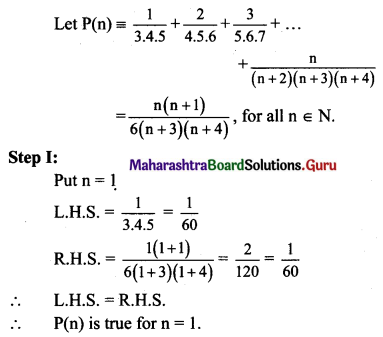
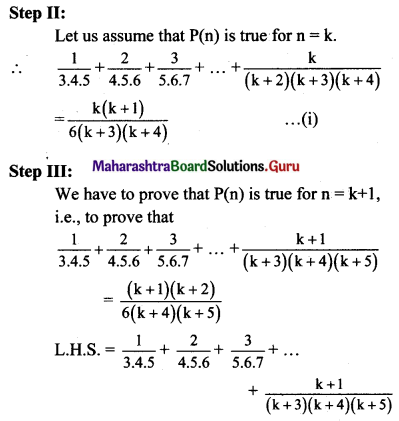
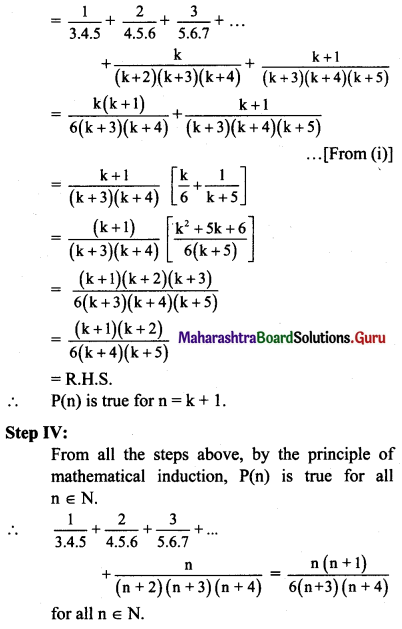
(iv) \(\frac{1}{3.4 .5}+\frac{2}{4.5 .6}+\frac{3}{5.6 .7}+\ldots+\frac{n}{(n+2)(n+3)(n+4)}\) = \(\frac{n(n+1)}{6(n+3)(n+4)}\)
Solution:
Maharashtra Board 11th Maths Solutions Chapter 4 Methods of Induction and Binomial Theorem Miscellaneous Exercise 4 II Q1 (iv)
Maharashtra Board 11th Maths Solutions Chapter 4 Methods of Induction and Binomial Theorem Miscellaneous Exercise 4 II Q1 (iv).1
Maharashtra Board 11th Maths Solutions Chapter 4 Methods of Induction and Binomial Theorem Miscellaneous Exercise 4 II Q1 (iv).2

Question 2.
Given that tn+1 = 5tn – 8, t1 = 3, prove by method of induction that tn = 5n-1 + 2.
Solution:
Let the statement P(n) has L.H.S. a recurrence relation tn+1 = 5tn – 8, t1 = 3
and R.H.S. a general statement tn = 5n-1 + 2.
Step I:
Put n = 1
L.H.S. = 3
R.H.S. = 51-1 + 2 = 1 + 2 = 3
∴ L.H.S. = R.H.S.
∴ P(n) is true for n = 1.
Put n = 2
L.H.S = t2 = 5t1 – 8 = 5(3) – 8 = 7
R.H.S. = t2 = 52-1 + 2 = 5 + 2 = 7
∴ L.H.S. = R.H.S.
∴ P(n) is tme for n = 2.

Step II:
Let us assume that P(n) is true for n = k.
∴ tk+1 = 5tk – 8 and tk = 5k-1 + 2

Step III:
We have to prove that P(n) is true for n = k + 1,
i.e., to prove that
tk+1 = 5k+1-1 + 2 = 5k + 2
tk+1 = 5tk – 8 and tk = 5k-1 + 2 ……[From Step II]
∴ tk+1 = 5(5k-1 + 2) – 8 = 5k + 2
∴ P(n) is true for n = k + 1.

Step IV:
From all the steps above, by the principle of mathematical induction, P(n) is true for all n ∈ N.
∴ tn = 5n-1 + 2, for all n ∈ N.

Maharashtra Board 11th Maths Solutions Chapter 4 Methods of Induction and Binomial Theorem Miscellaneous Exercise 4

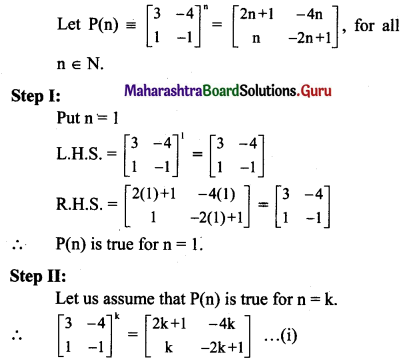
Question 3.
Prove by method of induction
\(\left(\begin{array}{cc}
3 & -4 \\
1 & -1
\end{array}\right)^{n}=\left(\begin{array}{cc}
2 n+1 & -4 n \\
n & -2 n+1
\end{array}\right)\), ∀ n ∈ N.
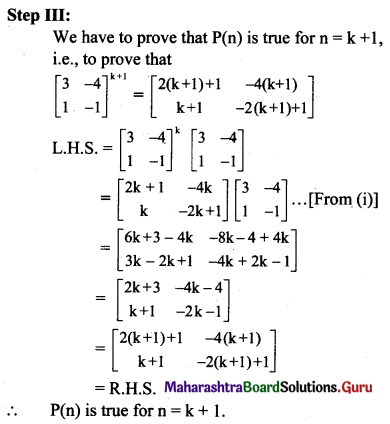
Solution:
Maharashtra Board 11th Maths Solutions Chapter 4 Methods of Induction and Binomial Theorem Miscellaneous Exercise 4 II Q3
Maharashtra Board 11th Maths Solutions Chapter 4 Methods of Induction and Binomial Theorem Miscellaneous Exercise 4 II Q3.1
Step IV:
From all the steps above, by the principle of mathematical induction, P(n) is true for all n ∈ N.
∴ \(\left(\begin{array}{cc}
3 & -4 \\
1 & -1
\end{array}\right)^{n}=\left(\begin{array}{cc}
2 n+1 & -4 n \\
n & -2 n+1
\end{array}\right)\), ∀ n ∈ N.

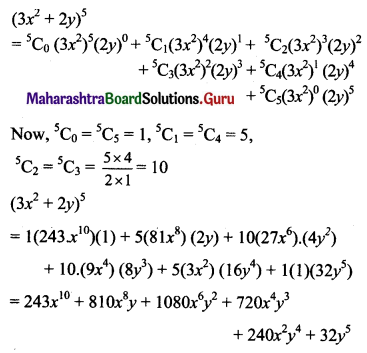
Question 4.
Expand (3x2 + 2y)5
Solution:
Here, a = 3x2, b = 2y, n = 5.
Using binomial theorem,
Maharashtra Board 11th Maths Solutions Chapter 4 Methods of Induction and Binomial Theorem Miscellaneous Exercise 4 II Q4

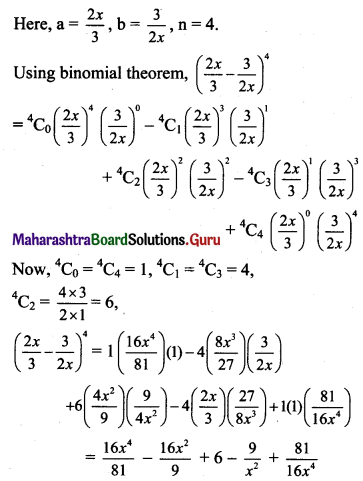
Question 5.
Expand \(\left(\frac{2 x}{3}-\frac{3}{2 x}\right)^{4}\)
Solution:
Maharashtra Board 11th Maths Solutions Chapter 4 Methods of Induction and Binomial Theorem Miscellaneous Exercise 4 II Q5

Question 6.
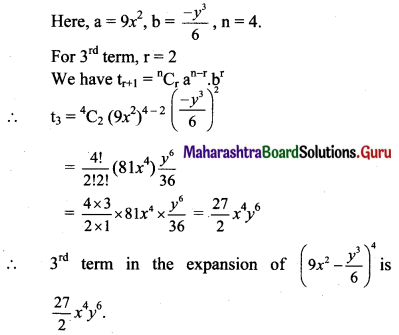
Find third term in the expansion of \(\left(9 x^{2}-\frac{y^{3}}{6}\right)^{4}\)
Solution:
Maharashtra Board 11th Maths Solutions Chapter 4 Methods of Induction and Binomial Theorem Miscellaneous Exercise 4 II Q6

Question 7.
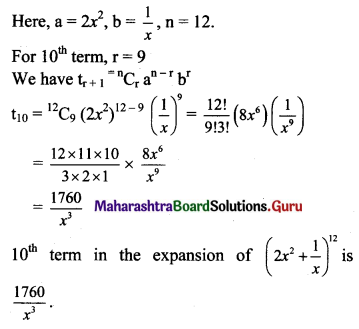
Find tenth term in the expansion of \(\left(2 x^{2}+\frac{1}{x}\right)^{12}\)
Solution:
Maharashtra Board 11th Maths Solutions Chapter 4 Methods of Induction and Binomial Theorem Miscellaneous Exercise 4 II Q7

Maharashtra Board 11th Maths Solutions Chapter 4 Methods of Induction and Binomial Theorem Miscellaneous Exercise 4

Question 8.
Find the middle term(s) in the expansion of
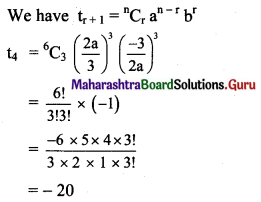
(i) \(\left(\frac{2 a}{3}-\frac{3}{2 a}\right)^{6}\)
Solution:
Here, a = \(\frac{2 a}{3}\), b = \(\frac{-3}{2 a}\), n = 6.
Now, n is even.
∴ \(\frac{\mathrm{n}+2}{2}=\frac{6+2}{2}=4\)
∴ Middle term is t4, for which r = 3.
Maharashtra Board 11th Maths Solutions Chapter 4 Methods of Induction and Binomial Theorem Miscellaneous Exercise 4 II Q8 (i)
∴ The Middle term is -20.

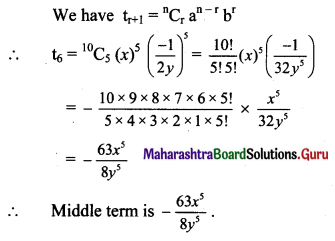
(ii) \(\left(x-\frac{1}{2 y}\right)^{10}\)
Solution:
Here, a = x, b = \(-\frac{1}{2 y}\), n = 10.
Now, n is even.
∴ \(\frac{\mathrm{n}+2}{2}=\frac{10+2}{2}=6\)
∴ Middle term is t6, for which r = 5
Maharashtra Board 11th Maths Solutions Chapter 4 Methods of Induction and Binomial Theorem Miscellaneous Exercise 4 II Q8 (ii)

(iii) (x2 + 2y2)7
Solution:
Here, a = x2, b = 2y2, n = 7.
Now, n is odd.
∴ \(\frac{\mathrm{n}+1}{2}=\frac{7+1}{2}=4, \frac{\mathrm{n}+3}{2}=\frac{7+3}{2}=5\)
∴ Middle terms are t4 and t5, for which r = 3 and r = 4 respectively.
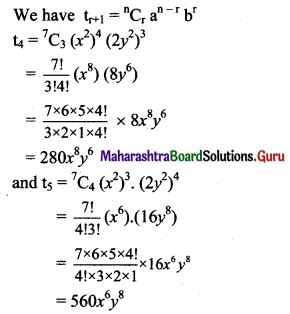
Maharashtra Board 11th Maths Solutions Chapter 4 Methods of Induction and Binomial Theorem Miscellaneous Exercise 4 II Q8 (iii)
∴ Middle terms are 280x8y6 and 560x6y8.

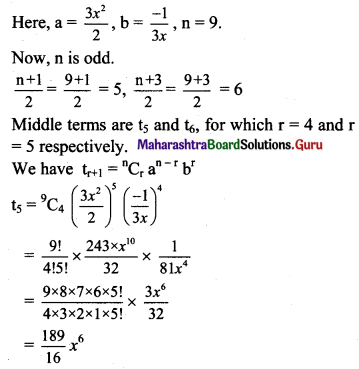
(iv) \(\left(\frac{3 x^{2}}{2}-\frac{1}{3 x}\right)^{9}\)
Solution:
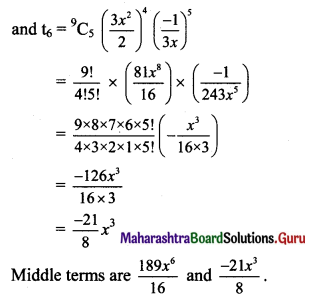
Maharashtra Board 11th Maths Solutions Chapter 4 Methods of Induction and Binomial Theorem Miscellaneous Exercise 4 II Q8 (iv)
Maharashtra Board 11th Maths Solutions Chapter 4 Methods of Induction and Binomial Theorem Miscellaneous Exercise 4 II Q8 (iv).1

Question 9.
Find the coefficients of
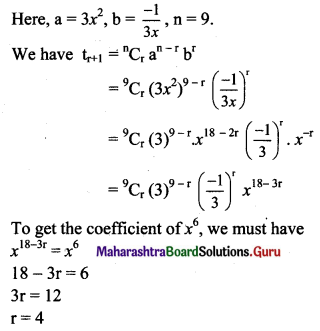
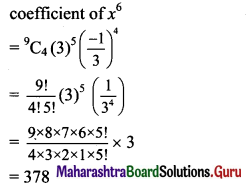
(i) x6 in the expantion of \(\left(3 x^{2}-\frac{1}{3 x}\right)^{9}\)
Solution:
Maharashtra Board 11th Maths Solutions Chapter 4 Methods of Induction and Binomial Theorem Miscellaneous Exercise 4 II Q9 (i)
Maharashtra Board 11th Maths Solutions Chapter 4 Methods of Induction and Binomial Theorem Miscellaneous Exercise 4 II Q9 (i).1

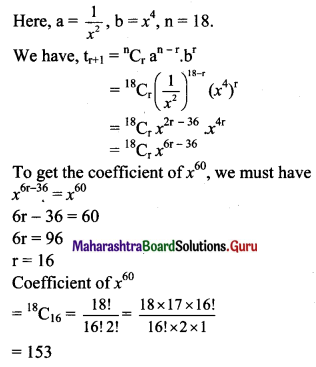
(ii) x60 in the expansion of \(\left(\frac{1}{x^{2}}+x^{4}\right)^{18}\)
Solution:
Maharashtra Board 11th Maths Solutions Chapter 4 Methods of Induction and Binomial Theorem Miscellaneous Exercise 4 II Q9 (ii)

Question 10.
Find the constant term in the expansion of
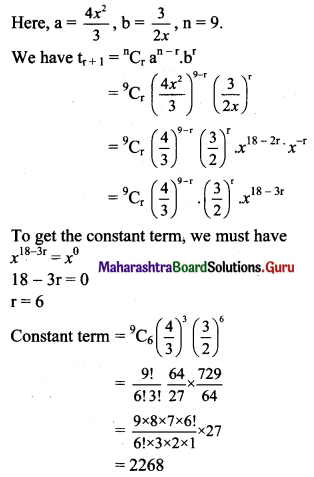
(i) \(\left(\frac{4 x^{2}}{3}+\frac{3}{2 x}\right)^{9}\)
Solution:
Maharashtra Board 11th Maths Solutions Chapter 4 Methods of Induction and Binomial Theorem Miscellaneous Exercise 4 II Q10 (i)

(ii) \(\left(2 x^{2}-\frac{1}{x}\right)^{12}\)
Solution:
Maharashtra Board 11th Maths Solutions Chapter 4 Methods of Induction and Binomial Theorem Miscellaneous Exercise 4 II Q10 (ii)

Maharashtra Board 11th Maths Solutions Chapter 4 Methods of Induction and Binomial Theorem Miscellaneous Exercise 4

Question 11.
Prove by method of induction
(i) loga xn = n loga x, x > 0, n ∈ N
Solution:
Maharashtra Board 11th Maths Solutions Chapter 4 Methods of Induction and Binomial Theorem Miscellaneous Exercise 4 II Q11 (i)

(ii) 152n-1 + 1 is divisible by 16, for all n ∈ N.
Solution:
152n-1 + 1 is divisible by 16, if and only if (152n-1 + 1) is is a multiple of 16.
Let P(n) ≡ 152n-1 + 1 = 16m, where m ∈ N.
Maharashtra Board 11th Maths Solutions Chapter 4 Methods of Induction and Binomial Theorem Miscellaneous Exercise 4 II Q11 (ii)
Step IV:
From all the steps above, by the principle of mathematical induction, P(n) is true for all n ∈ N.
∴ 152n-1 + 1 is divisible by 16, for all n ∈ N.

(iii) 52n – 22n is divisible by 3, for all n ∈ N.
Solution:
Maharashtra Board 11th Maths Solutions Chapter 4 Methods of Induction and Binomial Theorem Miscellaneous Exercise 4 II Q11 (iii)
Maharashtra Board 11th Maths Solutions Chapter 4 Methods of Induction and Binomial Theorem Miscellaneous Exercise 4 II Q11 (iii).1

Question 12.
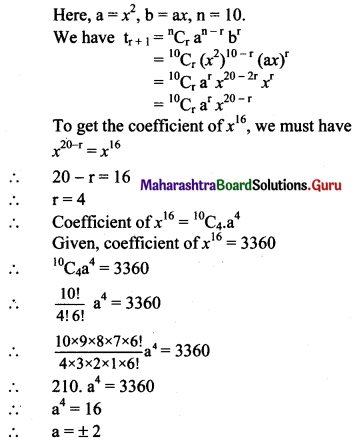
If the coefficient of x16 in the expansion of (x2 + ax)10 is 3360, find a.
Solution:
Maharashtra Board 11th Maths Solutions Chapter 4 Methods of Induction and Binomial Theorem Miscellaneous Exercise 4 II Q12

Question 13.
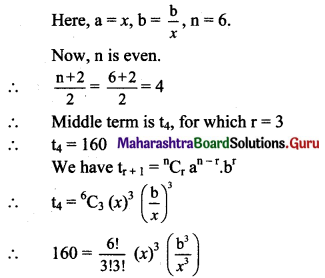
If the middle term in the expansion of \(\left(x+\frac{b}{x}\right)^{6}\) is 160, find b.
Solution:
Maharashtra Board 11th Maths Solutions Chapter 4 Methods of Induction and Binomial Theorem Miscellaneous Exercise 4 II Q13
∴ 160 = \(\frac{6 \times 5 \times 4 \times 3 !}{3 \times 2 \times 1 \times 3 !} \times b^{3}\)
∴ 160 = 20b3
∴ 8 = b3
∴ b = 2

Maharashtra Board 11th Maths Solutions Chapter 4 Methods of Induction and Binomial Theorem Miscellaneous Exercise 4

Question 14.
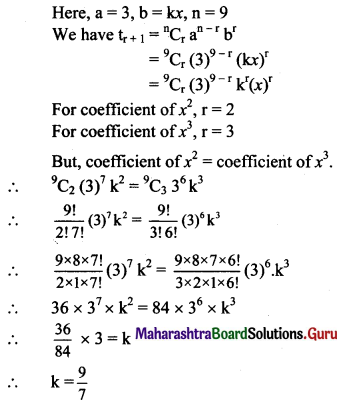
If the coefficients of x2 and x3 in theexpansion of (3 + kx)9 are equal, find k.
Solution:
Maharashtra Board 11th Maths Solutions Chapter 4 Methods of Induction and Binomial Theorem Miscellaneous Exercise 4 II Q14

Question 15.
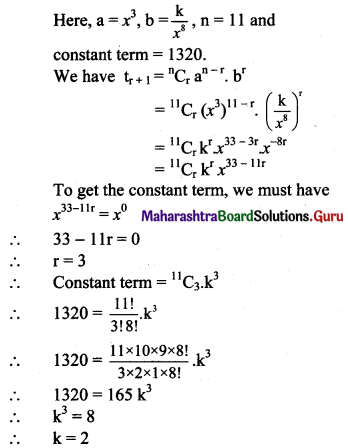
If the constant term in the expansion of \(\left(x^{3}+\frac{\mathrm{k}}{x^{8}}\right)^{11}\) is 1320, find k.
Solution:
Maharashtra Board 11th Maths Solutions Chapter 4 Methods of Induction and Binomial Theorem Miscellaneous Exercise 4 II Q15

Question 16.
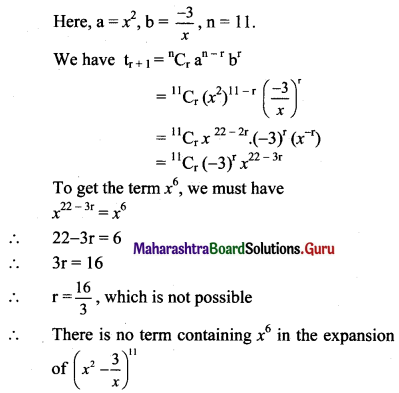
Show that there is no term containing x6 in the expansion of \(\left(x^{2}-\frac{3}{x}\right)^{11}\).
Solution:
Maharashtra Board 11th Maths Solutions Chapter 4 Methods of Induction and Binomial Theorem Miscellaneous Exercise 4 II Q16

Question 17.
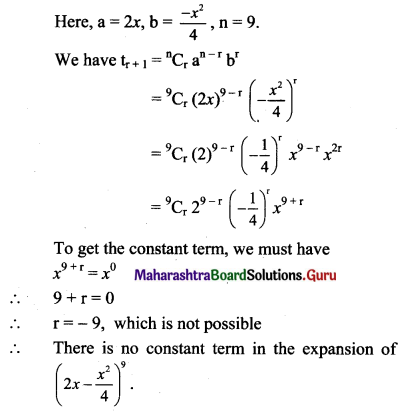
Show that there is no constant term in the expansion of \(\left(2 x-\frac{x^{2}}{4}\right)^{9}\)
Solution:
Maharashtra Board 11th Maths Solutions Chapter 4 Methods of Induction and Binomial Theorem Miscellaneous Exercise 4 II Q17

Question 18.
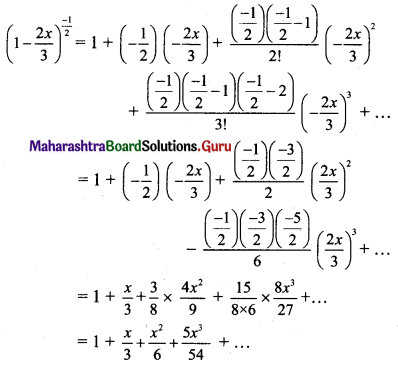
State, first four terms in the expansion of \(\left(1-\frac{2 x}{3}\right)^{-1 / 2}\)
Solution:
Maharashtra Board 11th Maths Solutions Chapter 4 Methods of Induction and Binomial Theorem Miscellaneous Exercise 4 II Q18

Question 19.
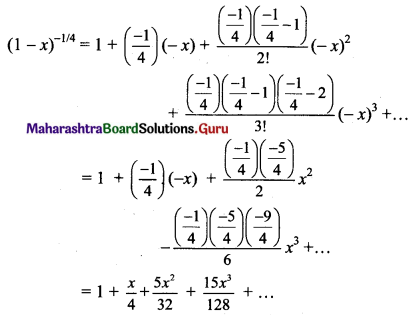
State, first four terms in the expansion of \((1-x)^{-1 / 4}\).
Solution:
Maharashtra Board 11th Maths Solutions Chapter 4 Methods of Induction and Binomial Theorem Miscellaneous Exercise 4 II Q19

Maharashtra Board 11th Maths Solutions Chapter 4 Methods of Induction and Binomial Theorem Miscellaneous Exercise 4

Question 20.
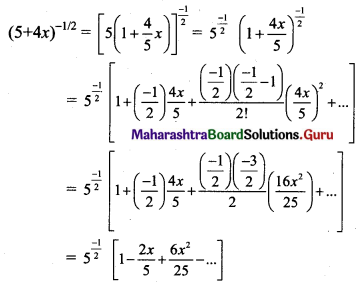
State, first three terms in the expansion of \((5+4 x)^{-1 / 2}\)
Solution:
Maharashtra Board 11th Maths Solutions Chapter 4 Methods of Induction and Binomial Theorem Miscellaneous Exercise 4 II Q20

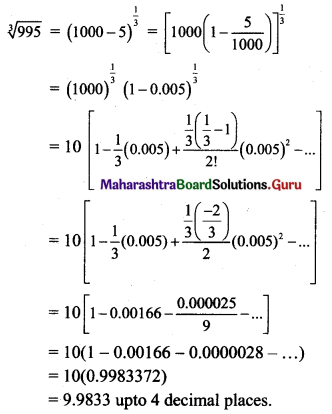
Question 21.
Using the binomial theorem, find the value of \(\sqrt[3]{995}\) upto four places of decimals.
Solution:
Maharashtra Board 11th Maths Solutions Chapter 4 Methods of Induction and Binomial Theorem Miscellaneous Exercise 4 II Q21

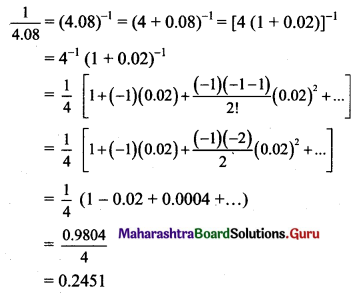
Question 22.
Find approximate value of \(\frac{1}{4.08}\) upto four places of decimals.
Solution:
Maharashtra Board 11th Maths Solutions Chapter 4 Methods of Induction and Binomial Theorem Miscellaneous Exercise 4 II Q22

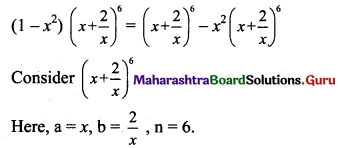
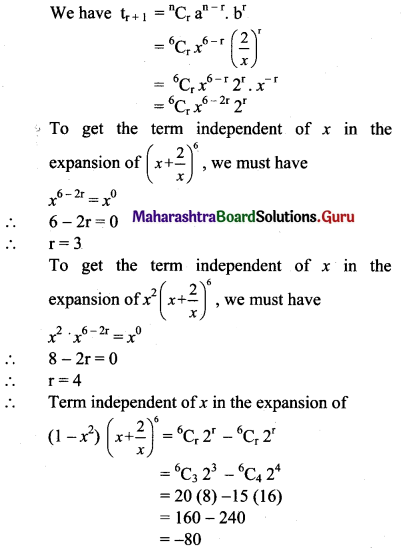
Question 23.
Find the term independent of x in the expansion of (1 – x2) \(\left(x+\frac{2}{x}\right)^{6}\).
Solution:
Maharashtra Board 11th Maths Solutions Chapter 4 Methods of Induction and Binomial Theorem Miscellaneous Exercise 4 II Q23
Maharashtra Board 11th Maths Solutions Chapter 4 Methods of Induction and Binomial Theorem Miscellaneous Exercise 4 II Q23.1

Maharashtra Board 11th Maths Solutions Chapter 4 Methods of Induction and Binomial Theorem Miscellaneous Exercise 4

Question 24.
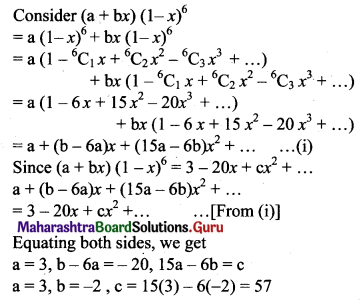
(a + bx) (1 – x)6 = 3 – 20x + cx2 + …, then find a, b, c.
Solution:
Maharashtra Board 11th Maths Solutions Chapter 4 Methods of Induction and Binomial Theorem Miscellaneous Exercise 4 II Q24

Question 25.
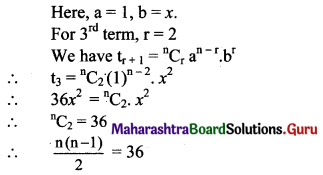
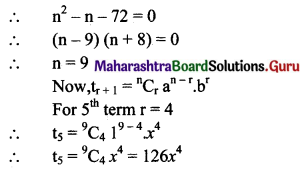
The 3rd term of (1 + x)n is 36x2. Find 5th term.
Solution:
Maharashtra Board 11th Maths Solutions Chapter 4 Methods of Induction and Binomial Theorem Miscellaneous Exercise 4 II Q25
Maharashtra Board 11th Maths Solutions Chapter 4 Methods of Induction and Binomial Theorem Miscellaneous Exercise 4 II Q25.1

Maharashtra Board 11th Maths Solutions Chapter 4 Methods of Induction and Binomial Theorem Miscellaneous Exercise 4

Question 26.
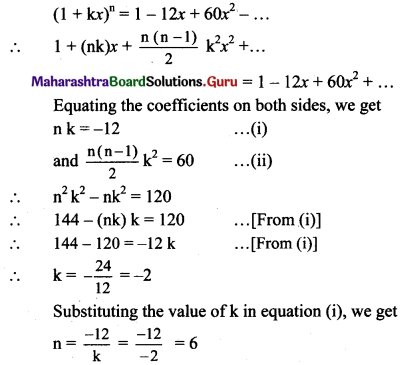
Suppose (1 + kx)n = 1 – 12x + 60x2 – …… find k and n.
Solution:
Maharashtra Board 11th Maths Solutions Chapter 4 Methods of Induction and Binomial Theorem Miscellaneous Exercise 4 II Q26

Maharashtra Board 12th Commerce Maths Solutions Chapter 2 Matrices Ex 2.6

Balbharati Maharashtra State Board 12th Commerce Maths Solution Book Pdf Chapter 2 Matrices Ex 2.6 Questions and Answers.

Maharashtra State Board 12th Commerce Maths Solutions Chapter 2 Matrices Ex 2.6

Question 1.
Solve the following equations by the method of inversion:
(i) x + 2y = 2, 2x + 3y = 3
Solution:
The given equations can be written in the matrix form as:
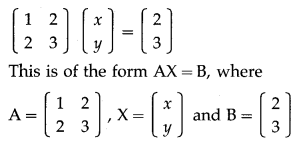
Maharashtra Board 12th Commerce Maths Solutions Chapter 2 Matrices Ex 2.6 Q1 (i)
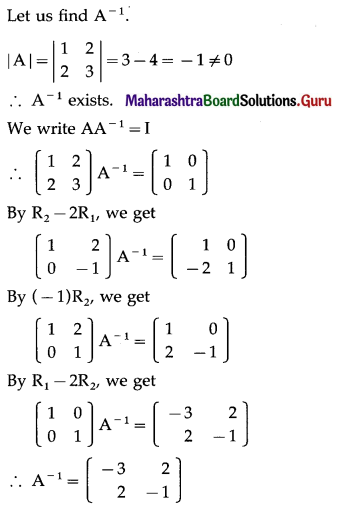
Maharashtra Board 12th Commerce Maths Solutions Chapter 2 Matrices Ex 2.6 Q1 (i).1
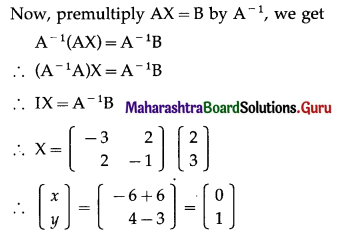
Maharashtra Board 12th Commerce Maths Solutions Chapter 2 Matrices Ex 2.6 Q1 (i).2
By equality of matrices,
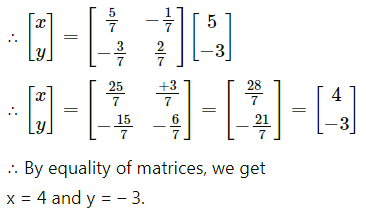
x = 0, y = 1 is the required solution.

(ii) 2x + y = 5, 3x + 5y = -3
Solution:
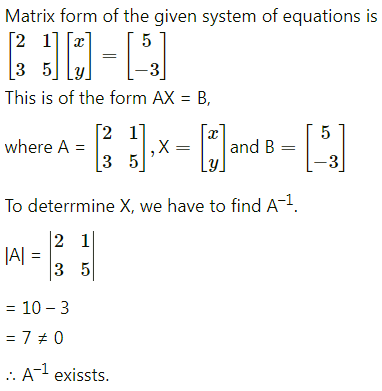
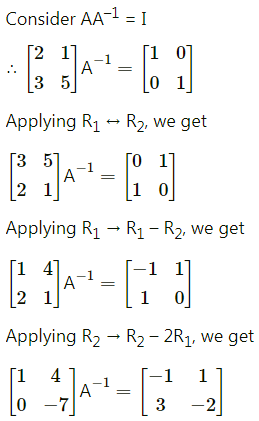
Maharashtra Board 12th Commerce Maths Solutions Chapter 2 Matrices Ex 2.6 Q1 (ii)
Maharashtra Board 12th Commerce Maths Solutions Chapter 2 Matrices Ex 2.6 Q1 (ii).1
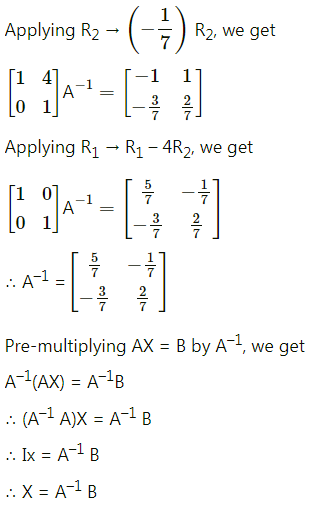
Maharashtra Board 12th Commerce Maths Solutions Chapter 2 Matrices Ex 2.6 Q1 (ii).2
Maharashtra Board 12th Commerce Maths Solutions Chapter 2 Matrices Ex 2.6 Q1 (ii).3

Maharashtra Board 12th Commerce Maths Solutions Chapter 2 Matrices Ex 2.6

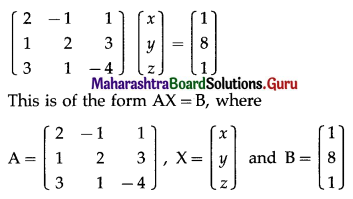
(iii) 2x – y + z = 1, x + 2y + 3z = 8 and 3x + y – 4z = 1
Solution:
The given equations can be written in the matrix form as:
Maharashtra Board 12th Commerce Maths Solutions Chapter 2 Matrices Ex 2.6 Q1 (iii)
Maharashtra Board 12th Commerce Maths Solutions Chapter 2 Matrices Ex 2.6 Q1 (iii).1
Maharashtra Board 12th Commerce Maths Solutions Chapter 2 Matrices Ex 2.6 Q1 (iii).2
Maharashtra Board 12th Commerce Maths Solutions Chapter 2 Matrices Ex 2.6 Q1 (iii).3
Maharashtra Board 12th Commerce Maths Solutions Chapter 2 Matrices Ex 2.6 Q1 (iii).4
Maharashtra Board 12th Commerce Maths Solutions Chapter 2 Matrices Ex 2.6 Q1 (iii).5
By equality of matrices,
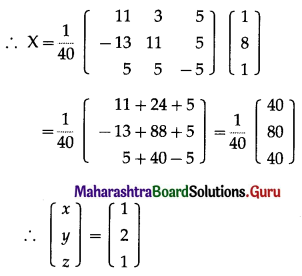
x = 1, y = 2, z = 1 is the required solution.

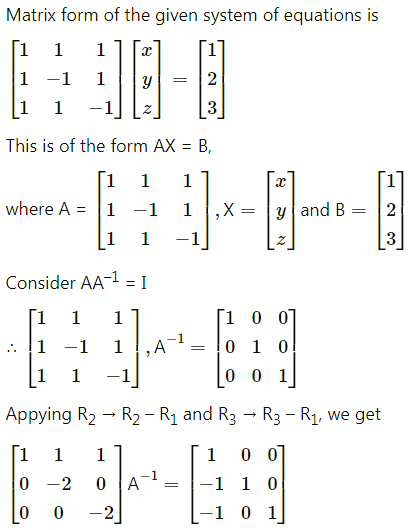
(iv) x + y + z = 1, x – y + z = 2 and x + y – z = 3
Solution:
Maharashtra Board 12th Commerce Maths Solutions Chapter 2 Matrices Ex 2.6 Q1 (iv)
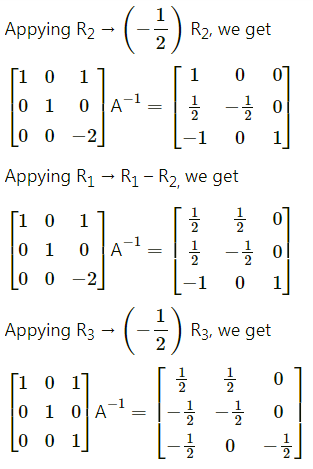
Maharashtra Board 12th Commerce Maths Solutions Chapter 2 Matrices Ex 2.6 Q1 (iv).1
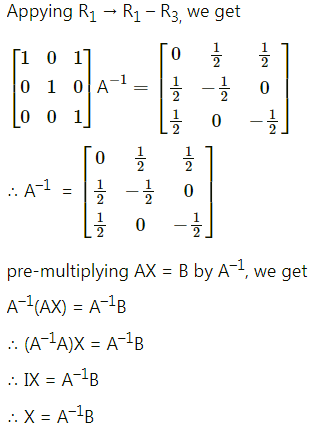
Maharashtra Board 12th Commerce Maths Solutions Chapter 2 Matrices Ex 2.6 Q1 (iv).2
Maharashtra Board 12th Commerce Maths Solutions Chapter 2 Matrices Ex 2.6 Q1 (iv).3

Maharashtra Board 12th Commerce Maths Solutions Chapter 2 Matrices Ex 2.6

Question 2.
Express the following equations in matrix form and solve them by method of reduction:
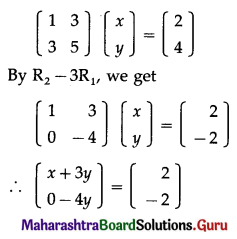
(i) x + 3y = 2, 3x + 5y = 4.
Solution:
The given equations can be written in the matrix form as:
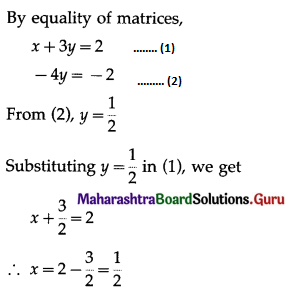
Maharashtra Board 12th Commerce Maths Solutions Chapter 2 Matrices Ex 2.6 Q2 (i)
Maharashtra Board 12th Commerce Maths Solutions Chapter 2 Matrices Ex 2.6 Q2 (i).1
Hence, x = \(\frac{1}{2}\), y = \(\frac{1}{2}\) is the required solution.

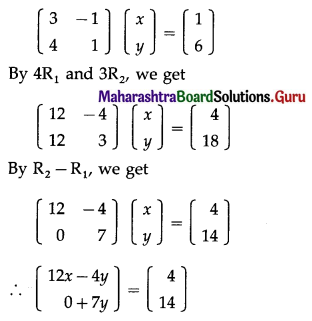
(ii) 3x – y = 1, 4x + y = 6.
Solution:
The given equations can be written in the matrix form as:
Maharashtra Board 12th Commerce Maths Solutions Chapter 2 Matrices Ex 2.6 Q2 (ii)
By equality of matrices,
12x – 4y = 4 …..(1)
7y = 14 …..(2)
From (2), y = 2
Substituting y = 2 in (1), we get
12x – 8 = 4
∴ 12x = 12
∴ x = 1
Hence, x = 1, y = 2 is the required solution.

Maharashtra Board 12th Commerce Maths Solutions Chapter 2 Matrices Ex 2.6

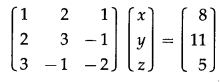
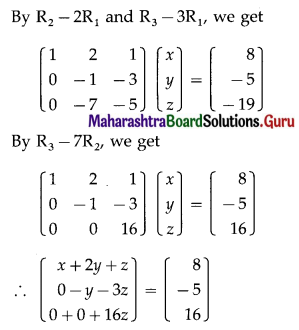
(iii) x + 2y + z = 8, 2x + 3y – z = 11 and 3x – y – 2z = 5.
Solution:
The given equations can be written in the matrix form as:
Maharashtra Board 12th Commerce Maths Solutions Chapter 2 Matrices Ex 2.6 Q2 (iii)
Maharashtra Board 12th Commerce Maths Solutions Chapter 2 Matrices Ex 2.6 Q2 (iii).1
By equality of matrices,
x + 2y + z = 8 ……(1)
-y – 3z = -5 …….(2)
16z = 16 ……….(3)
From (3), z = 1
Substituting z = 1 in (2), we get
-y – 3= -5
∴ y = 2
Substituting y = 2, z = 1 in (1), we get
x + 4 + 1 = 8
∴ x = 3
Hence, x = 3, y = 2, z = 1 is the required solution.

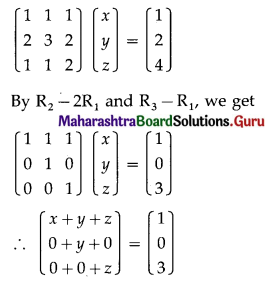
(iv) x + y + z = 1, 2x + 3y + 2z = 2 and x + y + 2z = 4.
Solution:
The given equations can be written in the matrix form as:
Maharashtra Board 12th Commerce Maths Solutions Chapter 2 Matrices Ex 2.6 Q2 (iv)
By equality of matrices,
x + y + z = 1 ……(1)
y = 0
z = 3
Substituting y = 0, z = 3 in (1), we get
x + 0 + 3 = 1
∴ x = -2
Hence, x = -2, y = 0, z = 3 is the required solution.

Maharashtra Board 12th Commerce Maths Solutions Chapter 2 Matrices Ex 2.6

Question 3.
The total cost of 3 T.V. and 2 V.C.R. is ₹ 35000. The shopkeeper wants a profit of ₹ 1000 per T.V. and ₹ 500 per V.C.R. He sells 2 T.V. and 1 V.C.R. and he gets total revenue of ₹ 21500. Find the cost and selling price of T.V. and V.C.R.
Solution:
Let the cost of each T.V. be ₹ x and each V.C.R. be ₹ y.
Then the total cost of 3 T.V. and 2 V.C.R. is ₹ (3x + 2y) which is given to be ₹ 35000.
∴ 3x + 2y = 35000
The shopkeeper wants a profit of ₹ 1000 per T.V. and ₹ 500 per V.C.R.
The selling price of each T.V. is ₹ (x + 1000) and of each V.C.R. is ₹ (y + 500).
∴ selling price of 2 T.V. and 1 V.C.R is
₹ [2(x + 1000) + (y + 500)] which is given to be ₹ 21500.
∴ 2(x + 1000) + (y + 500) = 21500
∴ 2x + 2000 + y + 500 = 21500
∴ 2x + y = 19000
Hence, the system of linear equations is
3x + 2y = 35000
2x + y = 19000
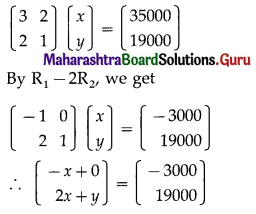
The equations can be written in matrix form as:
Maharashtra Board 12th Commerce Maths Solutions Chapter 2 Matrices Ex 2.6 Q3
By equality of matrices,
-x = -3000 …….(1)
2x + y = 19000 ……….(2)
From (1), x = 3000
Substituting x = 3000 in (2), we get
2(3000) + y = 19000
∴ y = 19000 – 6000 = 13000
Hence, the cost price of one T.V. is ₹ 3000 and of one V.C.R. is ₹ 13000 and the selling price of one T.V. is ₹ 4000 and of one V.C.R. is ₹ 13500.

Maharashtra Board 12th Commerce Maths Solutions Chapter 2 Matrices Ex 2.6

Question 4.
The sum of the cost of one Economics book, one Cooperation book, and one Account book is ₹ 420. The total cost of an Economic book, 2 Cooperation books, and an Account book is ₹ 480. Also, the total cost of an Economic book, 3 Cooperation books, and 2 Account books is ₹ 600. Find the cost of each book.
Solution:
Let the cost of 1 Economic book, 1 Cooperation book and 1 Account book be ₹ x, ₹ y and ₹ z respectively.
Then, from the given information
x + y + z = 420
x + 2y + z = 480
x + 3y + 2z = 600
These equations can be written in matrix form as:
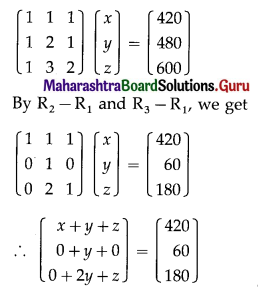
Maharashtra Board 12th Commerce Maths Solutions Chapter 2 Matrices Ex 2.6 Q4
By equality of matrices,
x + y + z = 420 …….(1)
y = 60
2y + z = 180 ………(2)
Substituting y = 60 in (2), we get
2(60) + z = 180
∴ z = 180 – 120 = 60
Substituting y = 60, z = 60 in (1), we get
x + 60 + 60 = 420
∴ x = 420 – 120 = 300
Hence, the cost of each Economic book is ₹ 300, each Cooperation book is ₹ 60 and each Account book is ₹ 60.

Maharashtra Board 11th Maths Solutions Chapter 5 Sets and Relations Miscellaneous Exercise 5

Balbharti Maharashtra State Board 11th Maths Book Solutions Pdf Chapter 5 Sets and Relations Miscellaneous Exercise 5 Questions and Answers.

Maharashtra State Board 11th Maths Solutions Chapter 5 Sets and Relations Miscellaneous Exercise 5

(I) Select the correct answer from the given alternative.

Question 1.
For the set A = {a, b, c, d, e} the correct statement is
(A) {a, b} ∈ A
(B) {a} ∈ A
(C) a ∈ A
(D) a ∉ A
Answer:
(C) a ∈ A

Question 2.
If aN = {ax : x ∈ N}, then set 6N ∩ 8N =
(A) 8N
(B) 48N
(C) 12N
(D) 24N
Answer:
(D) 24N
Hint:
6N = {6x : x ∈ N} = {6, 12, 18, 24, 30, ……}
8N = {8x : x ∈ N} = {8, 16, 24, 32, ……}
∴ 6N ∩ 8N = {24, 48, 72, …..}
= {24x : x ∈ N}
= 24N

Maharashtra Board 11th Maths Solutions Chapter 5 Sets and Relations Miscellaneous Exercise 5

Question 3.
If set A is empty set then n[P[P[P(A)]]] is
(A) 6
(B) 16
(C) 2
(D) 4
Answer:
(D) 4
Hint:
A = Φ
∴ n(A) = 0
∴ n[P(A)] = 2n(A) = 20 = 1
∴ n[P[P(A)]] = 2n[P(A)] = 21 = 2
∴ n[P[P[P(A)]]] = 2n[P[P(A)]] = 22 = 4

Question 4.
In a city 20% of the population travels by car, 50% travels by bus and 10% travels by both car and bus. Then, persons travelling by car or bus are
(A) 80%
(B) 40%
(C) 60%
(D) 70%
Answer:
(C) 60%
Hint:
Let C = Population travels by car
B = Population travels by bus
n(C) = 20%, n(B) = 50%, n(C ∩ B) = 10%
n(C ∪ B) = n(C) + n(B) – n(C ∩ B)
= 20% + 50% – 10%
= 60%

Question 5.
If the two sets A and B are having 43 elements in common, then the number of elements common to each of the sets A × B and B × A is
(A) 432
(B) 243
(C) 4343
(D) 286
Answer:
(A) 432

Question 6.
Let R be a relation on the set N be defied by {(x, y) / x, y ∈ N, 2x + y = 41} Then R is
(A) Reflexive
(B) Symmetric
(C) Transitive
(D) None of these
Answer:
(D) None of these

Maharashtra Board 11th Maths Solutions Chapter 5 Sets and Relations Miscellaneous Exercise 5

Question 7.
The relation “>” in the set of N (Natural number) is
(A) Symmetric
(B) Reflexive
(C) Transitive
(D) Equivalent relation
Answer:
(C) Transitive
Hint:
For any a ∈ N, a ≯ a
∴ (a, a) ∉ R
∴ > is not reflexive.
For any a, b ∈ N, if a > b, then b ≯ a.
∴ > is not symmetric.
For any a, b, c ∈ N,
if a > b and b > c, then a > c
∴ > is transitive.

Question 8.
A relation between A and B is
(A) only A × B
(B) An Universal set of A × B
(C) An equivalent set of A × B
(D) A subset of A × B
Answer:
(D) A subset of A × B

Question 9.
If (x, y) ∈ N × N, then xy = x2 is a relation that is
(A) Symmetric
(B) Reflexive
(C) Transitive
(D) Equivalence
Answer:
(D) Equivalence
Hint:
Let x ∈ R, then xx = x2
∴ x is related to x.
∴ Given relation is reflexive.
Letx = 0 and y = 2,
then xy = 0 × 2 = 0 = x2
∴ x is related to y.
Consider, yx = 2 × 0 = 0 ≠ y2
∴ y is not related to x.
∴ Given relation is not symmetric.
Let x be related to y and y be related to z.
∴ xy = x2 and yz = y2
∴ x = \(\frac{x^{2}}{y}\) and z = \(\frac{y^{2}}{y}\) = y …..[if y ≠ 0]
Consider, xz = \(\frac{x^{2}}{y}\) × y = x2
∴ x is related to z.
∴ Given relation is transitive.

Maharashtra Board 11th Maths Solutions Chapter 5 Sets and Relations Miscellaneous Exercise 5

Question 10.
If A = {a, b, c}, The total no. of distinct relations in A × A is
(A) 3
(B) 9
(C) 8
(D) 29
Answer:
(D) 29

(II) Answer the following.

Question 1.
Write down the following sets in set builder form:
(i) {10, 20, 30, 40, 50}
(ii) {a, e, i, o, u}
(iii) {Sunday, Monday, Tuesday, Wednesday, Thursday, Friday, Saturday}
Solution:
(i) Let A = {10, 20, 30, 40, 50}
∴ A = {x/x = 10n, n ∈ N and n ≤ 5}

(ii) Let B = {a, e, i, o, u}
∴ B = {x/x is a vowel of English alphabets}

(iii) Let C = {Sunday, Monday, Tuesday, Wednesday, Thursday, Friday, Saturday}
∴ C = {x/x is a day of a week}

Question 2.
If U = {x/x ∈ N, 1 ≤ x ≤ 12}, A = {1,4, 7,10}, B = {2, 4, 6, 7, 11}, C = {3, 5, 8, 9, 12}. Write down the sets.
(i) A ∪ B
(ii) B ∩ C
(iii) A – B
(iv) B ∩ C’
(v) A ∪ B ∪ C
(vi) A ∩ (B ∪ C)
Solution:
U = {x/x ∈ N, 1 ≤ x ≤ 12} = {1, 2, 3, …., 12}
A = {1, 4, 7, 10}, B = {2, 4, 6, 7, 11}, C = {3, 5, 8, 9, 12}
(i) A ∪ B = {1, 2, 4, 6, 7, 10, 11}

(ii) B ∩ C = {}

(iii) A – B = {1, 10}

(iv) C’ = {1, 2, 4, 6, 7, 10, 11}
∴ B ∩ C’ = {2, 4, 6, 7, 11}

(v) A ∪ B ∪ C = {1, 2, 3, 4, 5, 6, 7, 8, 9, 10, 11, 12}

(vi) B ∪ C = {2, 3, 4, 5, 6, 7, 8, 9, 11, 12}
∴ A ∩ (B ∪ C) = {4, 7}

Maharashtra Board 11th Maths Solutions Chapter 5 Sets and Relations Miscellaneous Exercise 5

Question 3.
In a survey of 425 students in a school, it was found that 115 drink apple juice, 160 drink orange juice, and 80 drink both apple as well as orange juice. How many drinks neither apple juice nor orange juice?
Solution:
Let A = set of students who drink apple juice
B = set of students who drink orange juice
X = set of all students
∴ n(X) = 425, n(A) = 115, n(B) = 160, n(A ∩ B) = 80
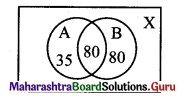
Maharashtra Board 11th Maths Solutions Chapter 5 Sets and Relations Miscellaneous Exercise 5 Q3
No. of students who neither drink apple juice nor orange juice = n(A’ ∩ B’) = n(A ∪ B)’
= n(X) – n(A ∪ B)
= 425 – [n(A) + n(B) – n(A ∩ B)]
= 425 – (115 + 160 – 80)
= 230

Question 4.
In a school, there are 20 teachers who teach Mathematics or Physics. Of these, 12 teach Mathematics and 4 teach both Physics and Mathematics. How many teachers teach Physics?
Solution:
Let A = set of teachers who teach Mathematics
B = set of teachers who teach Physics
∴ n(A ∪ B) = 20, n(A) = 12, n(A ∩ B) = 4
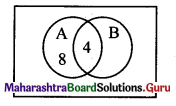
Maharashtra Board 11th Maths Solutions Chapter 5 Sets and Relations Miscellaneous Exercise 5 Q4
Since n(A ∪ B) = n(A) + n(B) – n(A ∩ B),
20 = 12 + n(B) – 4
∴ n(B) = 12
∴ Number of teachers who teach physics = 12

Question 5.
(i) If A = {1, 2, 3} and B = {2, 4}, state the elements of A × A, A × B, B × A, B × B, (A × B) ∩ (B × A).
(ii) If A = {-1, 1}, find A × A × A.
Solution:
(i) A = {1, 2, 3} and B = {2, 4}
A × A = {(1, 1), (1, 2), (1, 3), (2, 1), (2, 2), (2, 3), (3, 1), (3, 2), (3, 3)}
A × B = {(1, 2), (1, 4), (2, 2), (2, 4), (3, 2), (3, 4)}
B × A = {(2, 1), (2, 2), (2, 3), (4, 1), (4, 2), (4, 3)}
B × B = {(2, 2), (2, 4), (4, 2), (4, 4)}
∴ (A × B) ∩ (B × A) = {(2, 2)}

(ii) A = {-1, 1}
∴ A × A × A = {(-1, -1, -1), (-1, -1, 1), (-1, 1, -1), (-1, 1, 1), (1, -1, -1), (1, -1, 1), (1, 1, -1), (1, 1, 1)}

Maharashtra Board 11th Maths Solutions Chapter 5 Sets and Relations Miscellaneous Exercise 5

Question 6.
If A = {1, 2, 3}, B = {4, 5, 6}, check if the following are relations from A to B. Also, write its domain and range.
(i) R1 = {(1, 4), (1, 5), (1, 6)}
(ii) R2 = {(1, 5), (2, 4), (3, 6)}
(iii) R3 = {(1, 4), (1, 5), (3, 6), (2, 6), (3, 4)}
(iv) R4 = {(4, 2), (2, 6), (5, 1), (2, 4)}
Solution:
A = {1, 2, 3}, B = {4, 5, 6}
∴ A × B = {(1, 4), (1, 5), (1, 6), (2,4), (2, 5), (2, 6), (3, 4), (3, 5), (3, 6)}
(i) R1 = {(1, 4), (1, 5), (1, 6)}
Since R1 ⊆ A × B,
R1 is a relation from A to B.
Domain (R1) = Set of first components of R1 = {1}
Range (R1) = Set of second components of R1 = {4, 5, 6}

(ii) R2 = {(1, 5),(2, 4),(3, 6)}
Since R2 ⊆ A × B,
R2 is a relation from A to B.
Domain (R2) = Set of first components of R2 = {1, 2, 3}
Range (R2) = Set of second components of R2 = {4, 5, 6}

(iii) R3 = {(1, 4), (1, 5), (3, 6), (2, 6), (3, 4)}
Since R3 ⊆ A × B,
R3 is a relation from A to B.
Domain (R3) = Set of first components of R3 = {1, 2, 3}
Range (R3) = Set of second components of R3 = {4, 5, 6}

(iv) R4 = {(4, 2), (2, 6), (5, 1), (2, 4)}
Since (4, 2) ∈ R4, but (4, 2) ∉ A × B,
R4 ⊄ A × B
∴ R4 is not a relation from A to B.

Question 7.
Determine the domain and range of the following relations.
(i) R = {(a, b) / a ∈ N, a < 5, b = 4}
(ii) R = {(a, b) / b = |a – 1|, a ∈ Z, |a| < 3}
Solution:
(i) R = {(a, b) / a ∈ N, a < 5, b = 4}
∴ Domain (R) = {a / a ∈ N, a < 5} = {1, 2, 3, 4}
Range (R) = {b / b = 4} = {4}

(ii) R = {(a, b) / b = |a – 1|, a ∈ Z, |a| < 3}
Since a ∈ Z and |a| < 3,
a < 3 and a > -3
∴ -3 < a < 3
∴ a = -2, -1, 0, 1, 2
b = |a – 1|
When a = -2, b = 3
When a = -1, b = 2
When a = 0, b = 1
When a = 1, b = 0
When a = 2, b = 1
Domain (R) = {-2, -1, 0, 1, 2}
Range (R) = {0, 1, 2, 3}

Question 8.
Find R : A → A when A = {1, 2, 3, 4} such that
(i) R = {(a, b) / a – b = 10}
(ii) R = {(a, b) / |a – b| ≥ 0}
Solution:
R : A → A, A = {1, 2, 3,4}
(i) R = {(a, b)/a – b = 10} = { }

(ii) R = {(a, b) / |a – b| ≥ 0}
= {(1, 1), (1, 2), (1, 3), (1, 4), (2, 1), (2, 2), (2, 3), (2, 4), (3, 1), (3, 2), (3, 3), (3, 4), (4, 1), (4, 2), (4, 3), (4, 4)}
A × A = {(1, 1), (1, 2), (1, 3), (1, 4), (2, 1), (2, 2), (2, 3), (2, 4), (3, 1), (3, 2), (3, 3), (3, 4), (4, 1), (4, 2), (4, 3), (4, 4)}
∴ R = A × A

Maharashtra Board 11th Maths Solutions Chapter 5 Sets and Relations Miscellaneous Exercise 5

Question 9.
R : {1, 2, 3} → {1, 2, 3} given by R = {(1, 1), (2, 2), (3, 3), (1, 2), (2, 3)}. Check if R is
(i) reflexive
(ii) symmetric
(iii) transitive
Solution:
R = {(1, 1), (2, 2), (3, 3), (1, 2), (2, 3)}
(i) Here, (x, x) ∈ R, for x ∈ {1, 2, 3}
∴ R is reflexive.

(ii) Here, (1, 2) ∈ R, but (2, 1) ∉ R.
∴ R is not symmetric.

(iii) Here, (1, 2), (2, 3) ∈ R,
But (1, 3) ∉ R.
∴ R is not transitive.

Question 10.
Check if R : Z → Z, R = {(a, b) | 2 divides a – b} is an equivalence relation.
Solution:
(i) Since 2 divides a – a,
(a, a) ∈ R
∴ R is reflexive. .

(ii) Let (a, b) ∈ R
Then 2 divides a – b
∴ 2 divides b – a
∴ (b, a) ∈ R
∴ R is symmetric.

(iii) Let (a, b) ∈ R, (b, c) ∈ R
Then a – b = 2m, b – c = 2n,
∴ a – c = 2(m + n), where m, n are integers.
∴ 2 divides a – c
∴ (a, c) ∈ R
∴ R is transitive.
Thus, R is an equivalence relation.

Question 11.
Show that the relation R in the set A = {1, 2, 3, 4, 5} Given by R = {(a, b) / |a – b| is even} is an equivalence relation.
Solution:
(i) Since |a – a| is even,
∴ (a, a) ∈ R
∴ R is reflexive.

(ii) Let (a, b) ∈ R
Then |a – b| is even
∴ |b – a| is even
∴ (b, a) ∈ R
∴ R is symmetric.

(iii) Let (a, b), (b, c) ∈ R
Then a – b = ±2m, b – c = ±2n
∴ a – c = ±2(m + n), where m, n are integers.
∴ (a, c) ∈ R
∴ R is transitive
Thus, R is an equivalence relation.

Maharashtra Board 11th Maths Solutions Chapter 5 Sets and Relations Miscellaneous Exercise 5

Question 12.
Show that the following are equivalence relations:
(i) R in A is set of all books given by R = {(x, y) / x and y have same number of pages}
(ii) R in A = {x ∈ Z | 0 ≤ x ≤ 12} given by R = {(a, b) / |a – b| is a multiple of 4}
(iii) R in A = (x ∈ N/x ≤ 10} given by R = {(a, b) | a = b}
Solution:
(i) a. Clearly (x, x) ∈ R
∴ R is reflexive.

b. If (x, y) ∈ R then (y, x) ∈ R.
∴ R is symmetric.

c. Let (x, y) ∈ R, (y, x) ∈ R.
Then x, y, and z are 3 books having the same number of pages.
∴ (x, z) ∈ R as x, z has the same number of pages.
∴ R is transitive.
Thus, R is an equivalence relation.

(ii) a. Since |a – a| is a multiple of 4,
(a, a) ∈ R
∴ R is reflexive.

b. Let (a, b) ∈ R
Then a – b = ±4m,
∴ b – a = ±4m, where m is an integer
∴ (b, a) ∈ R
∴ R is symmetric.

c. Let (a, b), (b, c) ∈ R
a – b = ± 4m, b – c = ± 4n,
∴ a – c = ±4(m + n), where m, n are integers
∴ (a, c) ∈ R
∴ R is transitive
Thus, R is an equivalence relation.

(iii) a. Since a = a
∴ (a, a) ∈ R
∴ R is reflexive.

b. Let (a, b) ∈ R Then a = b
∴ b = a
∴ (b, a) ∈ R
∴ R is symmetric.

c. Let (a, b), (b, c) ∈ R
Then, a = b, b = c
∴ a = c
∴ (a, c) ∈ R
∴ R is transitive.
Thus, R is an equivalence relation.

Maharashtra Board 12th Commerce Maths Solutions Chapter 2 Matrices Ex 2.5

Balbharati Maharashtra State Board 12th Commerce Maths Solution Book Pdf Chapter 2 Matrices Ex 2.5 Questions and Answers.

Maharashtra State Board 12th Commerce Maths Solutions Chapter 2 Matrices Ex 2.5

Question 1.
Apply the given elementary transformation on each of the following matrices:
(i) \(\left[\begin{array}{cc}
3 & -4 \\
2 & 2
\end{array}\right]\), R1 ↔ R2
(ii) \(\left[\begin{array}{cc}
2 & 4 \\
1 & -5
\end{array}\right]\), C1 ↔ C2
(iii) \(\left[\begin{array}{ccc}
3 & 1 & -1 \\
1 & 3 & 1 \\
-1 & 1 & 3
\end{array}\right]\) 3R2 and C2 → C2 – 4C1
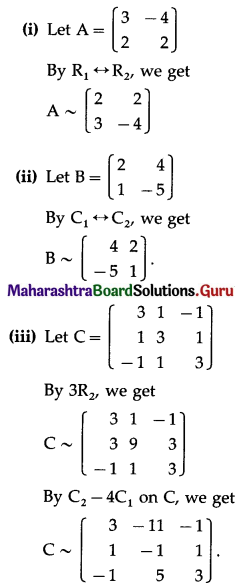
Solution:
Maharashtra Board 12th Commerce Maths Solutions Chapter 2 Matrices Ex 2.5 Q1

Question 2.
Transform \(\left[\begin{array}{ccc}
1 & -1 & 2 \\
2 & 1 & 3 \\
3 & 2 & 4
\end{array}\right]\) into an upper triangularmatrix by suitable row transformations.
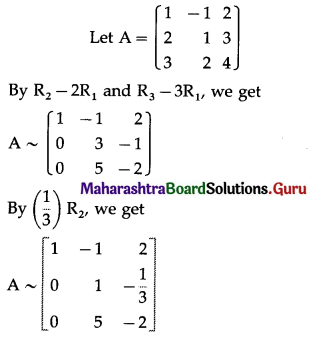
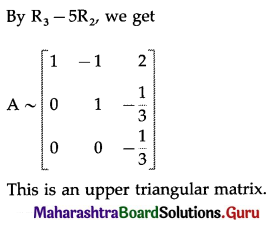
Solution:
Maharashtra Board 12th Commerce Maths Solutions Chapter 2 Matrices Ex 2.5 Q2
Maharashtra Board 12th Commerce Maths Solutions Chapter 2 Matrices Ex 2.5 Q2.1

Maharashtra Board 12th Commerce Maths Solutions Chapter 2 Matrices Ex 2.5

Question 3.
Find the cofactor matrix of the following matrices:
(i) \(\left[\begin{array}{cc}
1 & 2 \\
5 & -8
\end{array}\right]\)
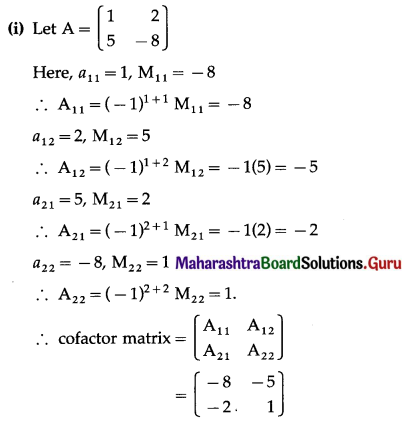
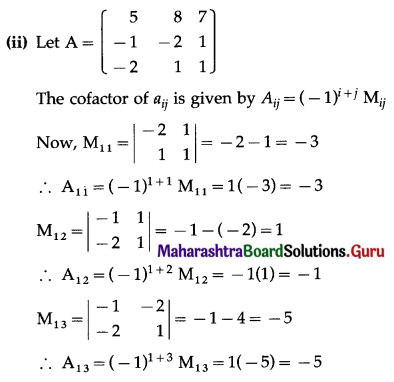
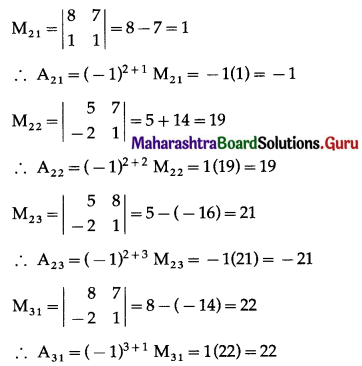
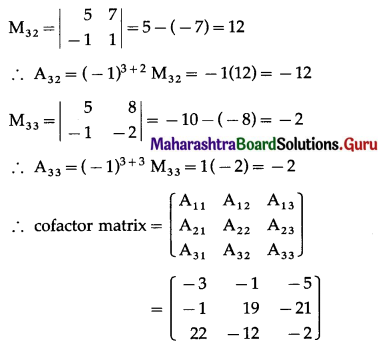
(ii) \(\left[\begin{array}{ccc}
5 & 8 & 7 \\
-1 & -2 & 1 \\
-2 & 1 & 1
\end{array}\right]\)
Solution:
Maharashtra Board 12th Commerce Maths Solutions Chapter 2 Matrices Ex 2.5 Q3
Maharashtra Board 12th Commerce Maths Solutions Chapter 2 Matrices Ex 2.5 Q3.1
Maharashtra Board 12th Commerce Maths Solutions Chapter 2 Matrices Ex 2.5 Q3.2
Maharashtra Board 12th Commerce Maths Solutions Chapter 2 Matrices Ex 2.5 Q3.3

Question 4.
Find the adjoint of the following matrices:
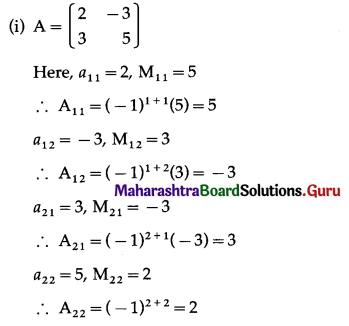
(i) \(\left[\begin{array}{cc}
2 & -3 \\
3 & 5
\end{array}\right]\)
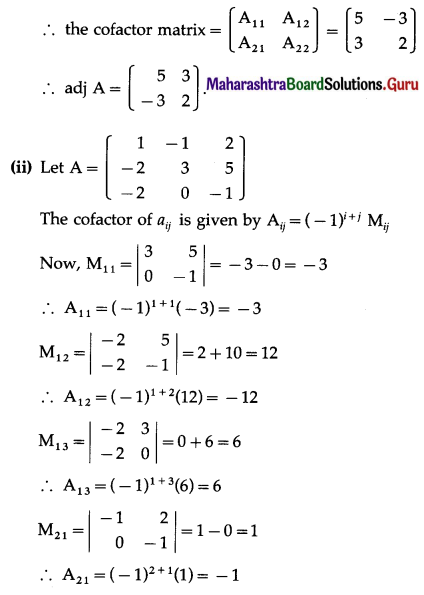
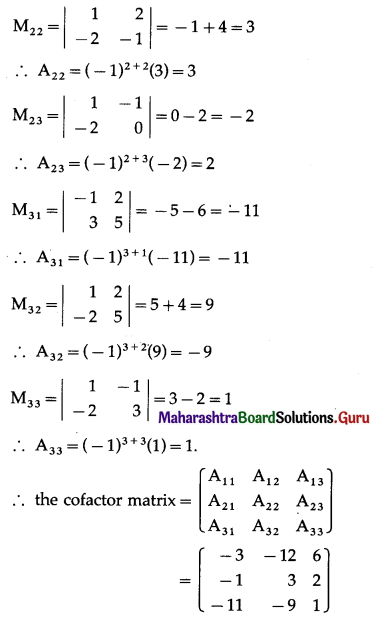
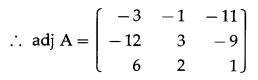
(ii) \(\left[\begin{array}{ccc}
1 & -1 & 2 \\
-2 & 3 & 5 \\
-2 & 0 & -1
\end{array}\right]\)
Solution:
Maharashtra Board 12th Commerce Maths Solutions Chapter 2 Matrices Ex 2.5 Q4
Maharashtra Board 12th Commerce Maths Solutions Chapter 2 Matrices Ex 2.5 Q4.1
Maharashtra Board 12th Commerce Maths Solutions Chapter 2 Matrices Ex 2.5 Q4.2
Maharashtra Board 12th Commerce Maths Solutions Chapter 2 Matrices Ex 2.5 Q4.3

Maharashtra Board 12th Commerce Maths Solutions Chapter 2 Matrices Ex 2.5

Question 5.
Find the inverses of the following matrices by the adjoint mathod:
(i) \(\left[\begin{array}{rr}
3 & -1 \\
2 & -1
\end{array}\right]\)
(ii) \(\left[\begin{array}{cc}
2 & -2 \\
4 & 5
\end{array}\right]\)
(iii) \(\left[\begin{array}{lll}
1 & 2 & 3 \\
0 & 2 & 4 \\
0 & 0 & 5
\end{array}\right]\)
Solution:
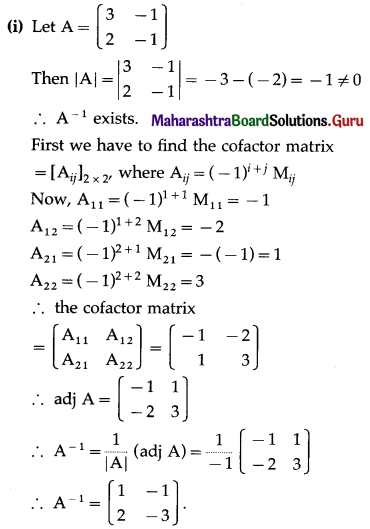
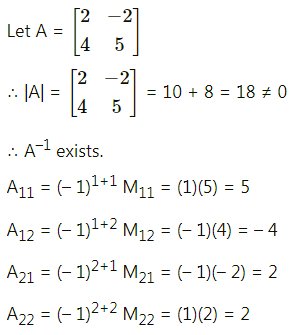
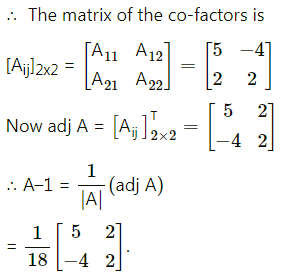
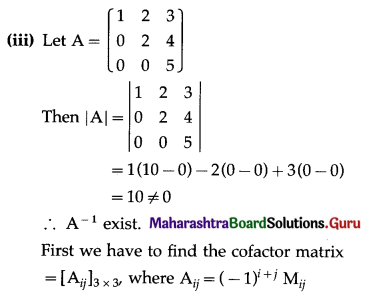
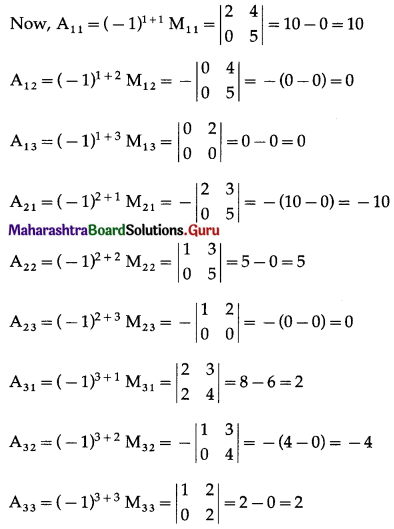
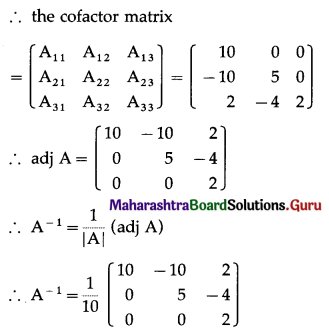
Maharashtra Board 12th Commerce Maths Solutions Chapter 2 Matrices Ex 2.5 Q5
Maharashtra Board 12th Commerce Maths Solutions Chapter 2 Matrices Ex 2.5 Q5.1
Maharashtra Board 12th Commerce Maths Solutions Chapter 2 Matrices Ex 2.5 Q5.2
Maharashtra Board 12th Commerce Maths Solutions Chapter 2 Matrices Ex 2.5 Q5.3
Maharashtra Board 12th Commerce Maths Solutions Chapter 2 Matrices Ex 2.5 Q5.4
Maharashtra Board 12th Commerce Maths Solutions Chapter 2 Matrices Ex 2.5 Q5.5

Question 6.
Find the inverses of the following matrices by the transformation method:
(i) \(\left[\begin{array}{cc}
1 & 2 \\
2 & -1
\end{array}\right]\)
(ii) \(\left[\begin{array}{ccc}
2 & 0 & -1 \\
5 & 1 & 0 \\
0 & 1 & 3
\end{array}\right]\)
Solution:
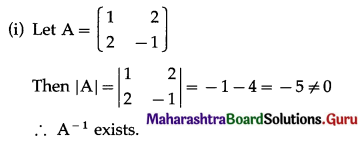
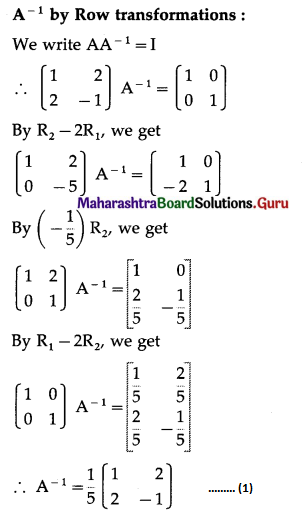
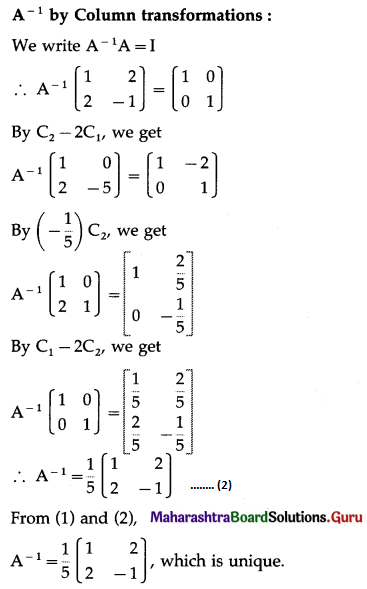
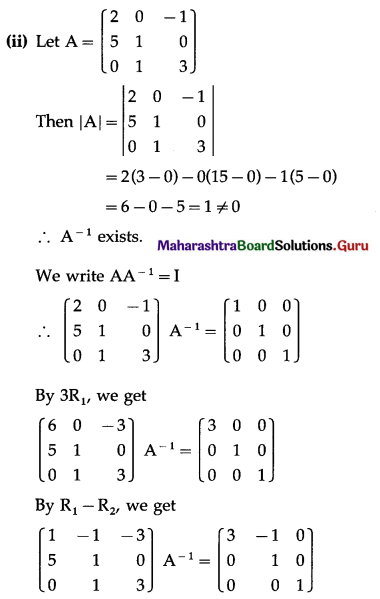
Maharashtra Board 12th Commerce Maths Solutions Chapter 2 Matrices Ex 2.5 Q6
Maharashtra Board 12th Commerce Maths Solutions Chapter 2 Matrices Ex 2.5 Q6.1
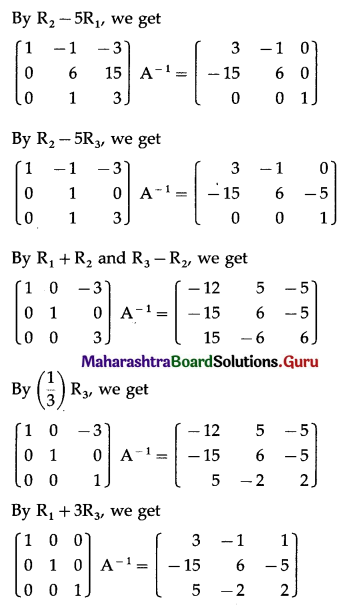
Maharashtra Board 12th Commerce Maths Solutions Chapter 2 Matrices Ex 2.5 Q6.2
Maharashtra Board 12th Commerce Maths Solutions Chapter 2 Matrices Ex 2.5 Q6.3
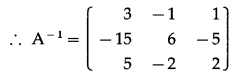
Maharashtra Board 12th Commerce Maths Solutions Chapter 2 Matrices Ex 2.5 Q6.4
Maharashtra Board 12th Commerce Maths Solutions Chapter 2 Matrices Ex 2.5 Q6.5

Maharashtra Board 12th Commerce Maths Solutions Chapter 2 Matrices Ex 2.5

Question 7.
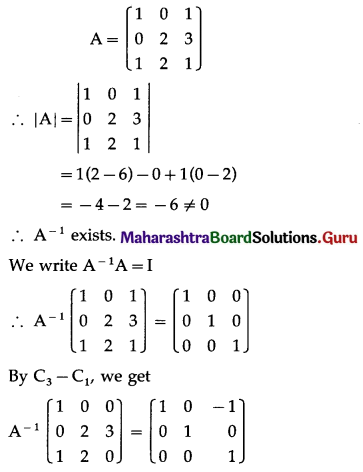
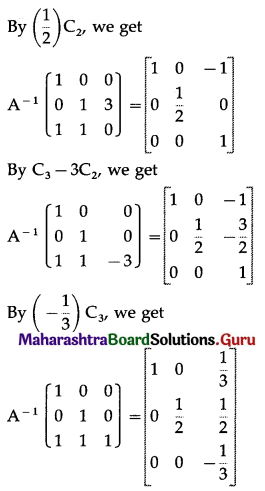
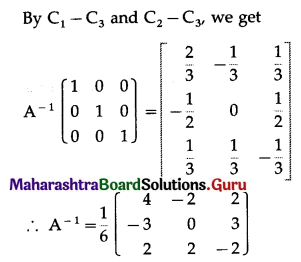
Find the inverse of A = \(\left[\begin{array}{lll}
1 & 0 & 1 \\
0 & 2 & 3 \\
1 & 2 & 1
\end{array}\right]\) by elementary column transformations.
Solution:
Maharashtra Board 12th Commerce Maths Solutions Chapter 2 Matrices Ex 2.5 Q7
Maharashtra Board 12th Commerce Maths Solutions Chapter 2 Matrices Ex 2.5 Q7.1
Maharashtra Board 12th Commerce Maths Solutions Chapter 2 Matrices Ex 2.5 Q7.2

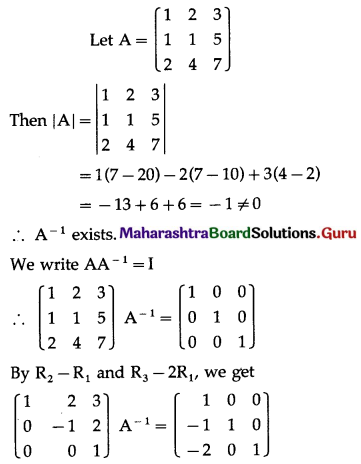
Question 8.
Find the inverse of \(\left[\begin{array}{lll}
1 & 2 & 3 \\
1 & 1 & 5 \\
2 & 4 & 7
\end{array}\right]\) by the elementary row transformations.
Solution:
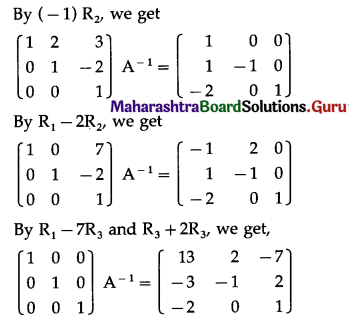
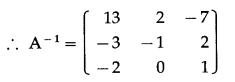
Maharashtra Board 12th Commerce Maths Solutions Chapter 2 Matrices Ex 2.5 Q8
Maharashtra Board 12th Commerce Maths Solutions Chapter 2 Matrices Ex 2.5 Q8.1
Maharashtra Board 12th Commerce Maths Solutions Chapter 2 Matrices Ex 2.5 Q8.2

Maharashtra Board 12th Commerce Maths Solutions Chapter 2 Matrices Ex 2.5

Question 9.
If A = \(\left[\begin{array}{lll}
1 & 0 & 1 \\
0 & 2 & 3 \\
1 & 2 & 1
\end{array}\right]\) and B = \(\left[\begin{array}{lll}
1 & 2 & 3 \\
1 & 1 & 5 \\
2 & 4 & 7
\end{array}\right]\), then find matrix X such that XA = B.
Solution:
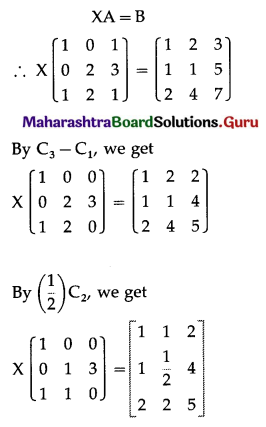
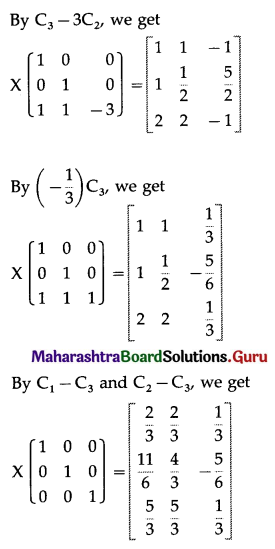
Maharashtra Board 12th Commerce Maths Solutions Chapter 2 Matrices Ex 2.5 Q9
Maharashtra Board 12th Commerce Maths Solutions Chapter 2 Matrices Ex 2.5 Q9.1
Maharashtra Board 12th Commerce Maths Solutions Chapter 2 Matrices Ex 2.5 Q9.2

Question 10.
Find matrix X, if AX = B, where A = \(\left[\begin{array}{ccc}
1 & 2 & 3 \\
-1 & 1 & 2 \\
1 & 2 & 4
\end{array}\right]\) and B = \(\left[\begin{array}{l}
1 \\
2 \\
3
\end{array}\right]\)
Solution:
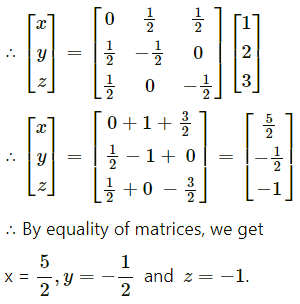
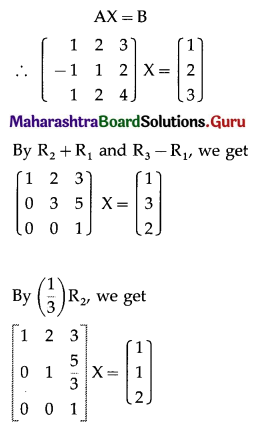
Maharashtra Board 12th Commerce Maths Solutions Chapter 2 Matrices Ex 2.5 Q10
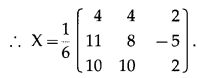
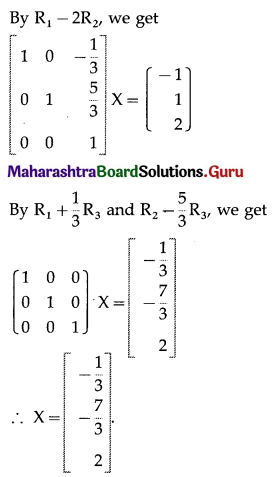
Maharashtra Board 12th Commerce Maths Solutions Chapter 2 Matrices Ex 2.5 Q10.1

Maharashtra Board 11th Maths Solutions Chapter 8 Continuity Miscellaneous Exercise 8

Balbharti Maharashtra State Board 11th Maths Book Solutions Pdf Chapter 8 Continuity Miscellaneous Exercise 8 Questions and Answers.

Maharashtra State Board 11th Maths Solutions Chapter 8 Continuity Miscellaneous Exercise 8

(I) Select the correct answer from the given alternatives.

Question 1.
f(x) = \(\frac{2^{\cot x}-1}{\pi-2 x}\), for x ≠ \(\frac{\pi}{2}\)
= log √2, for x = \(\frac{\pi}{2}\)
(A) f is continuous at x = \(\frac{\pi}{2}\)
(B) f has a jump discontinuity at x = \(\frac{\pi}{2}\)
(C) f has a removable discontinuity
(D) \(\lim _{x \rightarrow \frac{\pi}{2}} f(x)=2 \log 3\)
Answer:
(A) f is continuous at x = \(\frac{\pi}{2}\)
Hint:
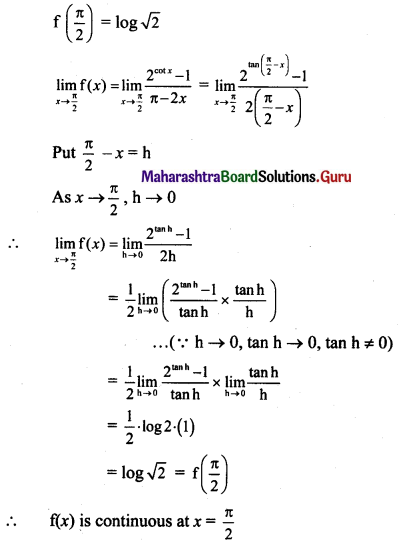
Maharashtra Board 11th Maths Solutions Chapter 8 Continuity Miscellaneous Exercise 8 I Q1

Question 2.
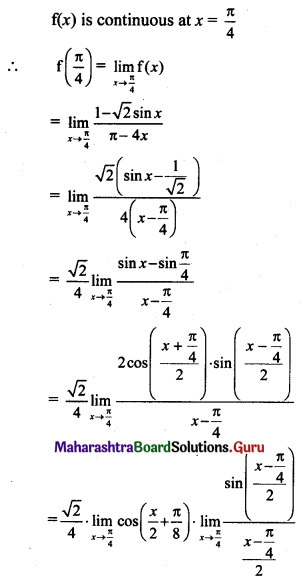
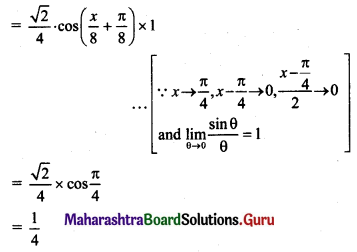
If f(x) = \(\frac{1-\sqrt{2} \sin x}{\pi-4 x}\), for x ≠ \(\frac{\pi}{4}\) is continuous at x = \(\frac{\pi}{4}\), then f(\(\frac{\pi}{4}\)) =
(A) \(\frac{1}{\sqrt{2}}\)
(B) \(-\frac{1}{\sqrt{2}}\)
(C) \(-\frac{1}{4}\)
(D) \(\frac{1}{4}\)
Answer:
(D) \(\frac{1}{4}\)
Hint:
Maharashtra Board 11th Maths Solutions Chapter 8 Continuity Miscellaneous Exercise 8 I Q2
Maharashtra Board 11th Maths Solutions Chapter 8 Continuity Miscellaneous Exercise 8 I Q2.1

Maharashtra Board 11th Maths Solutions Chapter 8 Continuity Miscellaneous Exercise 8

Question 3.
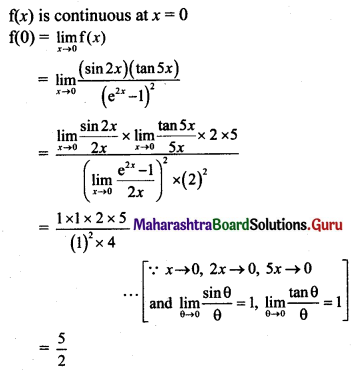
If f(x) = \(\frac{(\sin 2 x) \tan 5 x}{\left(e^{2 x}-1\right)^{2}}\), for x ≠ 0 is continuous at x = 0, then f(0) is
(A) \(\frac{10}{e^{2}}\)
(B) \(\frac{10}{e^{4}}\)
(C) \(\frac{5}{4}\)
(D) \(\frac{5}{2}\)
Answer:
(D) \(\frac{5}{2}\)
Hint:
Maharashtra Board 11th Maths Solutions Chapter 8 Continuity Miscellaneous Exercise 8 I Q3

Question 4.
f(x) = \(\frac{x^{2}-7 x+10}{x^{2}+2 x-8}\), for x ∈ [-6, -3]
(A) f is discontinuous at x = 2
(B) f is discontinuous at x = -4
(C) f is discontinuous at x = 0
(D) f is discontinuous at x = 2 and x = -4
Answer:
(B) f is discontinuous at x = -4
Hint:
f(x) = \(\frac{x^{2}-7 x+10}{x^{2}+2 x-8}\), for x ∈ [-6, -3]
= \(\frac{x^{2}-7 x+10}{(x+4)(x-2)}\)
Here f(x) is a rational function and is continuous everywhere except at the points Where denominator becomes zero.
Here, denominator becomes zero when x = -4 or x = 2
But x = 2 does not lie in the given interval.
∴ x = -4 is the point of discontinuity.

Question 5.
If f(x) = ax2 + bx + 1, for |x – 1| ≥ 3 and
= 4x + 5, for -2 < x < 4
is continuous everywhere then,
(A) a = \(\frac{1}{2}\), b = 3
(B) a = \(-\frac{1}{2}\), b = -3
(C) a = \(-\frac{1}{2}\), b = 3
(D) a = \(\frac{1}{2}\), b = -3
Answer:
(A) a = \(\frac{1}{2}\), b = 3
Hint:
f(x) = ax2 + bx + 1, |x – 1| ≥ 3
= 4x + 5; -2 < x < 4
The first interval is
|x – 1| ≥ 3
∴ x – 1 ≥ 3 or x – 1 ≤ -3
∴ x ≥ 4 or x ≤ -2
∴ f(x) is same for x ≤ -2 as well as x ≥ 4.
∴ f(x) is defined as:
f(x) = ax2 + bx + 1; x ≤ -2
= 4x + 5; -2 < x < 4
= ax2 + bx + 1; x ≥ 4
f(x) is continuous everywhere.
∴ f(x) is continuous at x = -2 and x = 4.
As f(x) is continuous at x = -2,
\(\lim _{x \rightarrow-2^{-}} f(x)=\lim _{x \rightarrow-2^{+}} f(x)\)
∴ \(\lim _{x \rightarrow-2}\left(a x^{2}+b x+1\right)=\lim _{x \rightarrow-2}(4 x+5)\)
∴ a(-2)2 + b(-2) + 1 = 4(-2) + 5
∴ 4a – 2b + 1 = -3
∴ 4a – 2b = -4
∴ 2a – b = -2 …..(i)
∵ f(x) is continuous at x = 4,
\(\lim _{x \rightarrow 4^{-}} \mathrm{f}(x)=\lim _{x \rightarrow 4^{+}} \mathrm{f}(x)\)
∴ \(\lim _{x \rightarrow 4}(4 x+5)=\lim _{x \rightarrow 4}\left(a x^{2}+b x+1\right)\)
4(4) + 5 = a(4)2 + b(4) + 1
16a + 4b + 1 = 21
16a + 4b = 20
4a + b = 5 …..(ii)
Adding (i) and (ii), we get
6a = 3
∴ a = \(\frac{1}{2}\)
Substituting a = \(\frac{1}{2}\) in (ii), we get
4(\(\frac{1}{2}\)) + b = 5
∴ 2 + b = 5
∴ b = 3
∴ a = \(\frac{1}{2}\), b = 3

Maharashtra Board 11th Maths Solutions Chapter 8 Continuity Miscellaneous Exercise 8

Question 6.
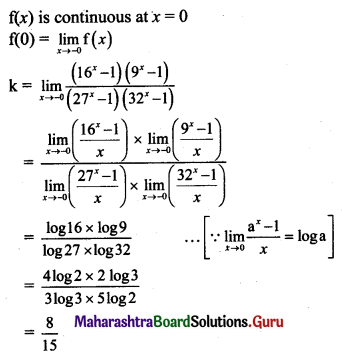
f(x) = \(\frac{\left(16^{x}-1\right)\left(9^{x}-1\right)}{\left(27^{x}-1\right)\left(32^{x}-1\right)}\), for x ≠ 0
= k, for x = 0
is continuous at x = 0, then ‘k’ =
(A) \(\frac{8}{3}\)
(B) \(\frac{8}{15}\)
(C) \(-\frac{8}{15}\)
(D) \(\frac{20}{3}\)
Answer:
(B) \(\frac{8}{15}\)
Hint:
Maharashtra Board 11th Maths Solutions Chapter 8 Continuity Miscellaneous Exercise 8 I Q6

Question 7.
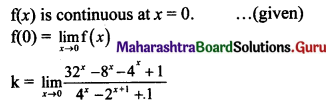
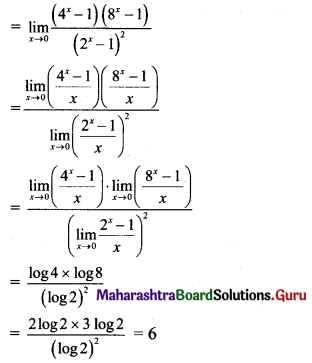
f(x) = \(\frac{32^{x}-8^{x}-4^{x}+1}{4^{x}-2^{x+1}+1}\), for x ≠ 0
= k, for x = 0,
is continuous at x = 0, then value of ‘k’ is
(A) 6
(B) 4
(C) (log 2) (log 4)
(D) 3 log 4
Answer:
(A) 6
Hint:
Maharashtra Board 11th Maths Solutions Chapter 8 Continuity Miscellaneous Exercise 8 I Q7
Maharashtra Board 11th Maths Solutions Chapter 8 Continuity Miscellaneous Exercise 8 I Q7.1

Question 8.
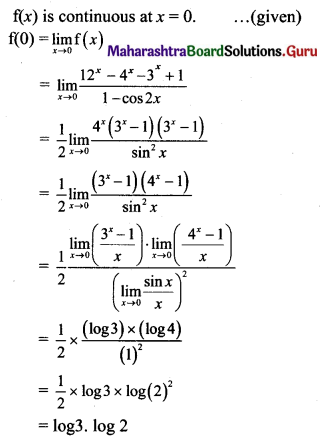
If f(x) = \(\frac{12^{x}-4^{x}-3^{x}+1}{1-\cos 2 x}\), for x ≠ 0 is continuous at x = 0 then the value of f(0) is
(A) \(\frac{\log 12}{2}\)
(B) log 2 . log 3
(C) \(\frac{\log 2 \cdot \log 3}{2}\)
(D) None of these
Answer:
(B) log 2 . log 3
Hint:
Maharashtra Board 11th Maths Solutions Chapter 8 Continuity Miscellaneous Exercise 8 I Q8

Question 9.
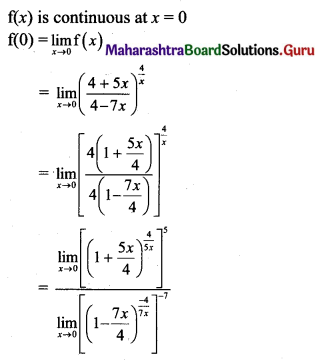
If f(x) = \(\left(\frac{4+5 x}{4-7 x}\right)^{\frac{4}{x}}\), for x ≠ 0 and f(0) = k, is continuous at x = 0, then k is
(A) e7
(B) e3
(C) e12
(D) \(e^{\frac{3}{4}}\)
Answer:
(C) e12
Hint:
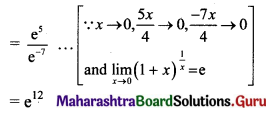
Maharashtra Board 11th Maths Solutions Chapter 8 Continuity Miscellaneous Exercise 8 I Q9
Maharashtra Board 11th Maths Solutions Chapter 8 Continuity Miscellaneous Exercise 8 I Q9.1

Maharashtra Board 11th Maths Solutions Chapter 8 Continuity Miscellaneous Exercise 8

Question 10.
If f(x) = \(\lfloor x\rfloor\) for x ∈ (-1, 2), then f is discontinuous at
(A) x = -1, 0, 1, 2
(B) x = -1, 0, 1
(C) x = 0, 1
(D) x = 2
Answer:
(C) x = 0, 1
Hint:
f(x) = \(\lfloor x\rfloor\), x ∈ (-1, 2)
This function is discontinuous at all integer values of x between -1 and 2.
∴ f(x) is discontinuous at x = 0 and x = 1.

II. Discuss the continuity of the following functions at the point(s) or on the interval indicated against them.

Question 1.
f(x) = \(\frac{x^{2}-3 x-10}{x-5}\), for 3 ≤ x ≤ 6, x ≠ 5
= 10, for x = 5
= \(\frac{x^{2}-3 x-10}{x-5}\), for 6 < x ≤ 9
Solution:
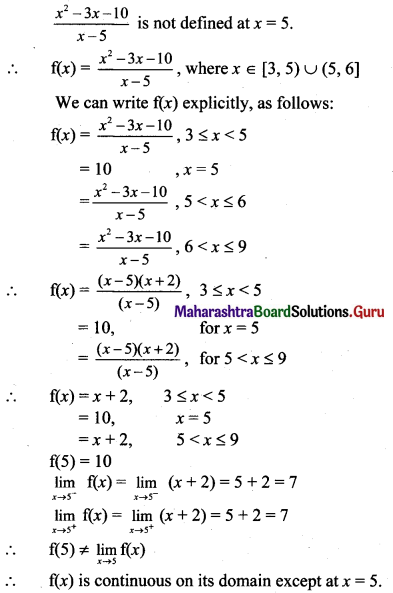
Maharashtra Board 11th Maths Solutions Chapter 8 Continuity Miscellaneous Exercise 8 II Q1

Question 2.
f(x) = 2x2 – 2x + 5, for 0 ≤ x ≤ 2
= \(\frac{1-3 x-x^{2}}{1-x}\), for 2 < x < 4
= \(\frac{x^{2}-25}{x-5}\), for 4 ≤ x ≤ 7 and x ≠ 5
= 7, for x = 5
Solution:
The domain of f(x) is [0, 7].
(i) For 0 ≤ x ≤ 2
f(x) = 2x2 – 2x + 5
It is a polynomial function and is Continuous at all point in [0, 2).

(ii) For 2 < x < 4
f(x) = \(\frac{1-3 x-x^{2}}{1-x}\)
It is a rational function and is continuous everwhere except at points where its denominator becomes zero.
Denominator becomes zero at x = 1
But x = 1 does not lie in the interval.
f(x) is continuous at all points in (2, 4).

Maharashtra Board 11th Maths Solutions Chapter 8 Continuity Miscellaneous Exercise 8

(iii) For 4 ≤ x ≤ 7, x ≤ 5
f(x) = \(\frac{x^{2}-25}{x-5}\)
It is a rational function and is continuous everywhere except at points where its denominator becomes zero.
Denominator becomes zero at x = 5
But x = 5 does not lie in the interval.
∴ f(x) is continuous at all points in (4, 7] – {5}.

(iv) For continuity at x = 2:
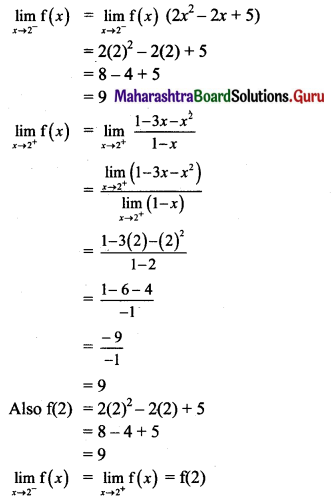
Maharashtra Board 11th Maths Solutions Chapter 8 Continuity Miscellaneous Exercise 8 II Q2 (iv)
∴ f(x) is continuous at x = 2.

(v) For continuity at x = 4:
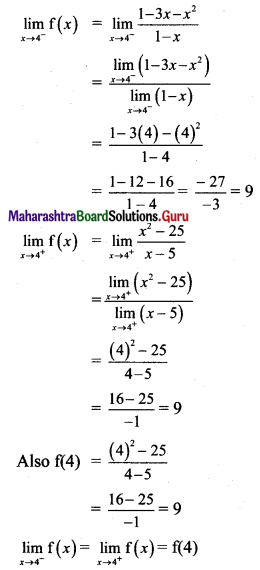
Maharashtra Board 11th Maths Solutions Chapter 8 Continuity Miscellaneous Exercise 8 II Q2 (v)
∴ f(x) is continuous at x = 4.

(vi) For continuity at x = 5.
f(5) = 7
Maharashtra Board 11th Maths Solutions Chapter 8 Continuity Miscellaneous Exercise 8 II Q2 (vi)
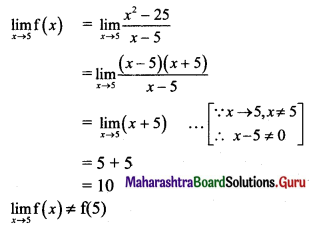
∴ f(x) is discontinuous at x = 5.
Thus, f(x) is continuous at all points on its domain except at x = 5.

Question 3.
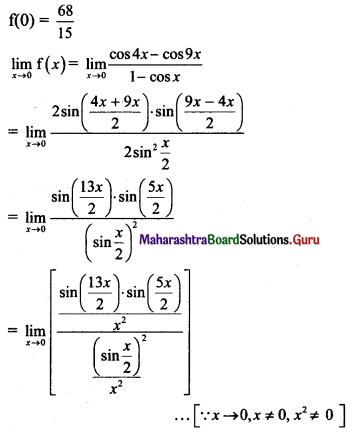
f(x) = \(\frac{\cos 4 x-\cos 9 x}{1-\cos x}\), for x ≠ 0
f(0) = \(\frac{68}{15}\), at x = 0 on \(-\frac{\pi}{2}\) ≤ x ≤ \(\frac{\pi}{2}\)
Solution:
The domain of f(x) is [\(-\frac{\pi}{2}\), \(\frac{\pi}{2}\)]
(i) For [\(-\frac{\pi}{2}\), \(\frac{\pi}{2}\)] – {0}:
f(x) = \(\frac{\cos 4 x-\cos 9 x}{1-\cos x}\)
It is a rational function and is continuous everywhere except at points where its denominator becomes zero.
Denominator becomes zero when cos x = 1,
i.e., x = 0
But x = 0 does not lie in the interval.
∴ f(x) is continuous at all points in [\(-\frac{\pi}{2}\), \(\frac{\pi}{2}\)] – {0}

(ii) For continuity at x = 0:
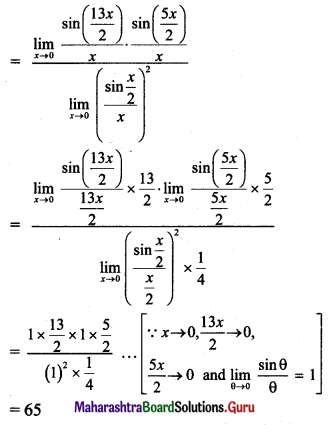
Maharashtra Board 11th Maths Solutions Chapter 8 Continuity Miscellaneous Exercise 8 II Q3 (ii)
Maharashtra Board 11th Maths Solutions Chapter 8 Continuity Miscellaneous Exercise 8 II Q3 (ii).1
∴ \(\lim _{x \rightarrow 0} f(x) \neq f(0)\)
∴ f(x) is discontinuous at x = 0.

Maharashtra Board 11th Maths Solutions Chapter 8 Continuity Miscellaneous Exercise 8

Question 4.
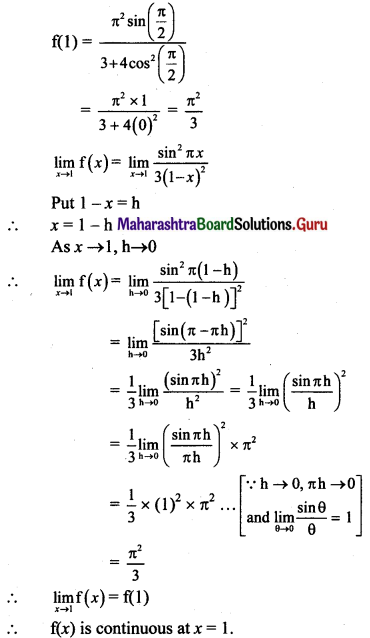
f(x) = \(\frac{\sin ^{2} \pi x}{3(1-x)^{2}}\), for x ≠ 1
= \(\frac{\pi^{2} \sin ^{2}\left(\frac{\pi x}{2}\right)}{3+4 \cos ^{2}\left(\frac{\pi x}{2}\right)}\), for x = 1, at x = 1
Solution:
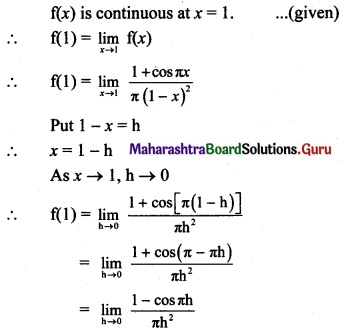
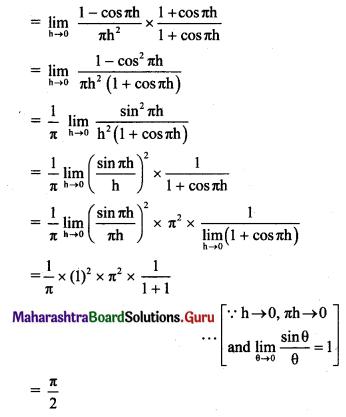
Maharashtra Board 11th Maths Solutions Chapter 8 Continuity Miscellaneous Exercise 8 II Q4

Question 5.
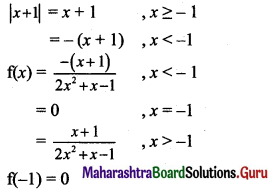
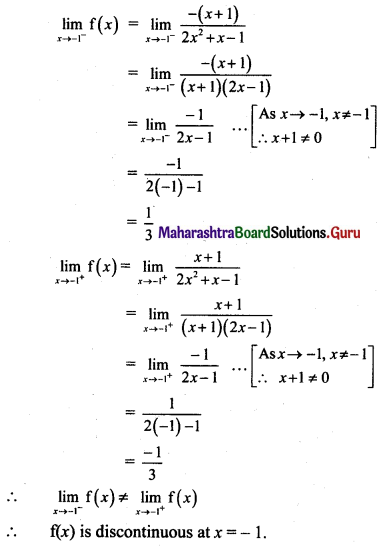
f(x) = \(\frac{|x+1|}{2 x^{2}+x-1}\), for x ≠ -1
= 0, for x = -1, at x = -1
Solution:
Maharashtra Board 11th Maths Solutions Chapter 8 Continuity Miscellaneous Exercise 8 II Q5
Maharashtra Board 11th Maths Solutions Chapter 8 Continuity Miscellaneous Exercise 8 II Q5.1

Question 6.
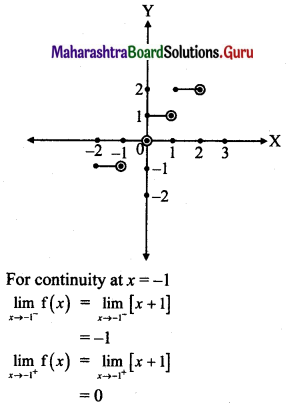
f(x) = [x + 1] for x ∈ [-2, 2)
Where [*] is greatest integer function.
Solution:
f(x) = [x + 1], x ∈ [-2, 2)
∴ f(x) = -1, x ∈ [-2, -1)
= 0, x ∈ [-1, 0)
= 1, x ∈ [0, 1)
= 2, x ∈ [1, 2)
Maharashtra Board 11th Maths Solutions Chapter 8 Continuity Miscellaneous Exercise 8 II Q6
∴ \(\lim _{x \rightarrow-1^{-}} \mathrm{f}(x)=\lim _{x \rightarrow-1^{+}} \mathrm{f}(x)\)
∴ f(x) is discontinuous at x = -1.
Similarly, f(x) is discontinuous at the points x = 0 and x = 1.

Maharashtra Board 11th Maths Solutions Chapter 8 Continuity Miscellaneous Exercise 8

Question 7.
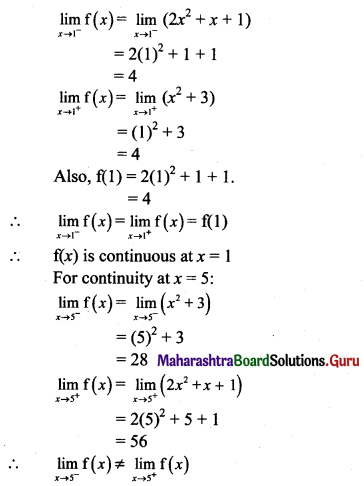
f(x) = 2x2 + x + 1, for |x – 3| ≥ 2
= x2 + 3, for 1 < x < 5
Solution:
|x – 3| ≥ 2
∴ x – 3 ≥ 2 or x – 3 ≤ -2
∴ x ≥ 5 or x ≤ 1
∴ f(x) = 2x2 + x + 1, x ≤ 1
= x2 + 3, 1 < x < 5
= 2x2 + x + 1, x ≥ 5
Consider the intervals
x < 1 , i.e., (-∞, 1)
1 < x < 5, i.e., (1, 5) x > 5, i.e., (5, ∞)
In all these intervals, f(x) is a polynomial function and hence is continuous at all points.
For continuity at x = 1:
Maharashtra Board 11th Maths Solutions Chapter 8 Continuity Miscellaneous Exercise 8 II Q7
∴ f(x) is discontinuous at x = 5.
∴ f(x) is continuous for all x ∈ R, except at x = 5.

III. Identify discontinuities if any for the following functions as either a jump or a removable discontinuity on their respective domains.

Question 1.
f(x) = x2 + x – 3, for x ∈ [-5, -2)
= x2 – 5, for x ∈ (-2, 5]
Solution:
f(-2) has not been defined.
\(\lim _{x \rightarrow-2^{-}} f(x)=\lim _{x \rightarrow-2^{-}}\left(x^{2}+x-3\right)\)
= (-2)2 + (-2) – 3
= 4 – 2 – 3
= -1
\(\lim _{x \rightarrow-2^{+}} f(x)=\lim _{x \rightarrow-2^{+}}\left(x^{2}-5\right)\)
= (-2)2 – 5
= 4 – 5
= -1
∴ \(\lim _{x \rightarrow-2^{-}} f(x)=\lim _{x \rightarrow-2^{+}} f(x)\)
∴ \(\lim _{x \rightarrow-2} f(x) \text { exists. }\)
But f(-2) has not been defined.
∴ f(x) has a removable discontinuity at x = -2.

Question 2.
f(x) = x2 + 5x + 1, for 0 ≤ x ≤ 3
= x3 + x + 5, for 3 < x ≤ 6
Solution:
\(\lim _{x \rightarrow 3^{-}} f(x)=\lim _{x \rightarrow 3^{-}}\left(x^{2}+5 x+1\right)\)
= (3)2 + 5(3) + 1
= 9 + 15 + 1
= 25
\(\lim _{x \rightarrow 3^{+}} f(x)=\lim _{x \rightarrow 3^{+}}\left(x^{3}+x+5\right)\)
= (3)3 + 3 + 5
= 27 + 3 + 5
= 35
∴ \(\lim _{x \rightarrow 3^{-}} f(x) \neq \lim _{x \rightarrow 3^{+}} f(x)\)
∴ \(\lim _{x \rightarrow 3} f(x)\) does not exist.
∴ f(x) is discontinuous at x = 3.
∴ f(x) has a jump discontinuity at x = 3.

Maharashtra Board 11th Maths Solutions Chapter 8 Continuity Miscellaneous Exercise 8

Question 3.
f(x) = \(\frac{x^{2}+x+1}{x+1}\), for x ∈ [0, 3)
= \(\frac{3 x+4}{x^{2}-5}\), for x ∈ [3, 6]
Solution:
Maharashtra Board 11th Maths Solutions Chapter 8 Continuity Miscellaneous Exercise 8 III Q3
Maharashtra Board 11th Maths Solutions Chapter 8 Continuity Miscellaneous Exercise 8 III Q3.1
∴ f(x) is continuous at x = 3.

IV. Discuss the continuity of the following functions at the point or on the interval indicated against them. If the function is discontinuous, identify the type of discontinuity and state whether the discontinuity is removable. If it has a removable discontinuity, redefine the function so that it becomes continuous.

Question 1.
f(x) = \(\frac{(x+3)\left(x^{2}-6 x+8\right)}{x^{2}-x-12}\)
Solution:
f(x) = \(\frac{(x+3)\left(x^{2}-6 x+8\right)}{x^{2}-x-12}\)
= \(\frac{(x+3)(x-2)(x-4)}{(x-4)(x+3)}\)
∴ f(x) is not defined at x = 4 and x = -3.
∴ The domain of function f = R – {-3, 4}.
For x ≠ -3 and 4,
Maharashtra Board 11th Maths Solutions Chapter 8 Continuity Miscellaneous Exercise 8 IV Q1
f(x) is discontinuous at x = 4 and x = -3.
This discontinuity is removable.
∴ f(x) can be redefined as
f(x) = \(\frac{(x+3)\left(x^{2}-6 x+8\right)}{x^{2}-x-12}\), for x ≠ 4, x ≠ -3
= -5, for x ∈ R – {-3, 4}, x = -3
= 2, for x ∈ R – {-3, 4}, x = 4

Question 2.
f(x) = x2 + 2x + 5, for x ≤ 3
= x3 – 2x2 – 5, for x > 3
Solution:
Maharashtra Board 11th Maths Solutions Chapter 8 Continuity Miscellaneous Exercise 8 IV Q2
∴ f(x) is discontinuous at x = 3.
This discontinuity is irremovable.

V. Find k if the following functions are continuous at the points indicated against them.

Question 1.
f(x) = \(\left(\frac{5 x-8}{8-3 x}\right)^{\frac{3}{2 x-4}}\), for x ≠ 2
= k, for x = 2 at x = 2.
Solution:
f(x) is continuous at x = 2. …..(given)
Maharashtra Board 11th Maths Solutions Chapter 8 Continuity Miscellaneous Exercise 8 V Q1
Maharashtra Board 11th Maths Solutions Chapter 8 Continuity Miscellaneous Exercise 8 V Q1.1

Maharashtra Board 11th Maths Solutions Chapter 8 Continuity Miscellaneous Exercise 8

Question 2.
f(x) = \(\frac{45^{x}-9^{x}-5^{x}+1}{\left(k^{x}-1\right)\left(3^{x}-1\right)}\), for x ≠ 0
= \(\frac{2}{3}\), for x = 0, at x = 0
Solution:
f(x) is continuous at x = 0 …..(given)
Maharashtra Board 11th Maths Solutions Chapter 8 Continuity Miscellaneous Exercise 8 V Q2
Maharashtra Board 11th Maths Solutions Chapter 8 Continuity Miscellaneous Exercise 8 V Q2.1

VI. Find a and b if the following functions are continuous at the points or on the interval indicated against them.

Question 1.
f(x) = \(\frac{4 \tan x+5 \sin x}{a^{x}-1}\), for x < 0
= \(\frac{9}{\log 2}\), for x = 0
= \(\frac{11 x+7 x \cdot \cos x}{b^{x}-1}\), for x < 0
Solution:
Maharashtra Board 11th Maths Solutions Chapter 8 Continuity Miscellaneous Exercise 8 VI Q1
Maharashtra Board 11th Maths Solutions Chapter 8 Continuity Miscellaneous Exercise 8 VI Q1.1

Maharashtra Board 11th Maths Solutions Chapter 8 Continuity Miscellaneous Exercise 8

Question 2.
f(x) = ax2 + bx + 1, for |2x – 3| ≥ 2
= 3x + 2, for \(\frac{1}{2}\) < x < \(\frac{5}{2}\)
Solution:
Maharashtra Board 11th Maths Solutions Chapter 8 Continuity Miscellaneous Exercise 8 VI Q2
Maharashtra Board 11th Maths Solutions Chapter 8 Continuity Miscellaneous Exercise 8 VI Q2.1
Maharashtra Board 11th Maths Solutions Chapter 8 Continuity Miscellaneous Exercise 8 VI Q2.2

VII. Find f(a), if f is continuous at x = a where,

Question 1.
f(x) = \(\frac{1+\cos (\pi x)}{\pi(1-x)^{2}}\), for x ≠ 1 and at a = 1.
Solution:
Maharashtra Board 11th Maths Solutions Chapter 8 Continuity Miscellaneous Exercise 8 VII Q1
Maharashtra Board 11th Maths Solutions Chapter 8 Continuity Miscellaneous Exercise 8 VII Q1.1

Question 2.
f(x) = \(\frac{1-\cos [7(x-\pi)]}{5(x-\pi)^{2}}\), for x ≠ π and at a = π.
Solution:
Maharashtra Board 11th Maths Solutions Chapter 8 Continuity Miscellaneous Exercise 8 VII Q2

VIII. Solve using intermediate value theorem.

Question 1.
Show that 5x – 6x = 0 has a root in [1, 2].
Solution:
Let f(x) = 5x – 6x
5x and 6x are continuous functions for all x ∈ R.
∴ 5x – 6x is also continuous for all x ∈ R.
i.e., f(x) is continuous for all x ∈ R.
A root of f(x) exists, if f(x) = 0 for at least one value of x.
f(1) = 51 – 6(1) = -1 < 0
f(2) = (5)2 – 6(2) = 13 > 0
∴ f(1) < 0 and f(2) > 0
∴ By intermediate value theorem, there has to be a point ‘c’ between 1 and 2 such that f(c) = 0.
∴ There is a root of the given equation in [1, 2].

Maharashtra Board 11th Maths Solutions Chapter 8 Continuity Miscellaneous Exercise 8

Question 2.
Show that x3 – 5x2 + 3x + 6 = 0 has at least two real roots between x = 1 and x = 5.
Solution:
Let f(x) = x3 – 5x2 + 3x + 6
f(x) is a polynomial function and hence it is continuous for all x ∈ R.
A root of f(x) exists, if f(x) = 0 for at least one value of x.
Here, we have been asked to show that f(x) has at least two roots between x = 1 and x = 5.
f(1) = (1)3 – 5(1)2 + 3(1) + 6
= 5 > 0
f(2) = (2)3 – 5(2)2 + 3(2) + 6
= 8 – 20 + 6 + 6
= 0
∴ x = 2 is a root of f(x).
Also, f(3) = (3)3 – 5(3)2 + 3(3) + 6
= 27 – 45 + 9 + 6
= -3 < 0
f(4) = (4)3 – 5(4)2 + 3(4) + 6
= 64 – 80 + 12 + 6
= 2 > 0
∴ f(3) < 0 and f(4) > 0
∴ By intermediate value theorem, there has to be a point ‘c’ between 3 and 4 such that f(c) = 0.
∴ There are two roots, x = 2 and a root between x = 3 and x = 4.
Thus, there are at least two roots of the given equation between x = 1 and x = 5.

Maharashtra Board 12th Commerce Maths Solutions Chapter 1 Mathematical Logic Miscellaneous Exercise 1

Balbharati Maharashtra State Board 12th Commerce Maths Solution Book Pdf Chapter 1 Mathematical Logic Miscellaneous Exercise 1 Questions and Answers.

Maharashtra State Board 12th Commerce Maths Solutions Chapter 1 Mathematical Logic Miscellaneous Exercise 1

(I) Choose the correct alternative:

Question 1.
Which of the following is not a statement?
(a) Smoking is injurious to health
(b) 2 + 2 = 4
(c) 2 is only even prime number
(d) Come here
Answer:
(d) Come here

Question 2.
Which of the following is an open statement?
(a) x is a natural number
(b) Give me a glass of water
(c) Wish you best of luck
(d) Good morning to all
Answer:
(a) x is a natural number

Maharashtra Board 12th Commerce Maths Solutions Chapter 1 Mathematical Logic Miscellaneous Exercise 1

Question 3.
Let p ∧ (q ∨ r) = (p ∧ q) ∨ (p ∧ r). Then this law is known as
(a) Commutative law
(b) Associative law.
(c) De Morgan’s law
(d) Distributive law
Answer:
(d) Distributive law

Question 4.
The false statement in the following is:
(a) p ∧ (~p) is a contradiction
(b) (p → q) ↔ (~q → ~p) is a contradiction
(c) ~(~p) ↔ p is a tautology
(d) p ∨ (~p) ↔ p is a tautology.
Answer:
(b) (p → q) ↔ (~q → ~p) is a contradiction

Question 5.
Consider the following three statements
p : 2 is an even number.
q : 2 is a prime number.
r : Sum of two prime numbers is always even.
Then, the symbolic statement (p ∧ q) → ~r means:
(a) 2 is an even and prime number and the sum of two prime numbers is always even.
(b) 2 is an even and prime number and the sum of two prime numbers is not always even.
(c) If 2 is an even and prime number, then the sum of two prime numbers is not always even.
(d) If 2 is an even and prime number, then the sum of two prime numbers is also even.
Answer:
(c) If 2 is an even and prime number, then the sum of two prime numbers is not always even.

Question 6.
If p : He is intelligent.
q : He is strong.
Then, symbolic form of statement: ‘It is wrong that, he is intelligent or strong’ is
(a) ~p ∨ ~p
(b) ~(p ∧ q)
(c) ~(p ∨ q)
(d) p ∨ ~q
Answer:
(c) ~(p ∨ q)

Question 7.
The negation of the proposition ‘If 2 is prime, then 3 is odd’, is
(a) If 2 is not prime, then 3 is not odd
(b) 2 is prime and 3 is not odd
(c) 2 is not prime and 3 is odd
(d) If 2 is not prime, then 3 is odd
Answer:
(b) 2 is prime and 3 is not odd

Maharashtra Board 12th Commerce Maths Solutions Chapter 1 Mathematical Logic Miscellaneous Exercise 1

Question 8.
The statement (~p ∧ q) ∨ ~q is
(a) p ∨ q
(b) p ∧ q
(c) ~(p ∨ q)
(d) ~(p ∧ q)
Answer:
(d) ~(p ∧ q)
Hint:
(~p ∧ q) ∨ ~q = (~p ∨ ~q) ∧ (q ∨ ~q)
= (~p ∨ ~q) ∧ t
= ~p ∨ ~q
= ~(p ∧ q)

Question 9.
Which of the following is always true?
(a) ~(p → q) ≡ ~q → ~p
(b) ~(p ∨ q) ≡ ~p ∨ ~q
(c) ~(p → q) ≡ p ∧ ~q
(d) ~(p ∧ q) ≡ ~p ∧ ~q
Answer:
(c) ~(p → q) ≡ p ∧ ~q

Question 10.
~(p ∨ q) ∨ (~p ∧ q) is logically equivalent to
(a) ~p
(b) p
(c) q
(d) ~q
Answer:
(a) ~p
Hint:
~(p ∨ q) ∨ (~p ∧ q) ≡ (~p ∧ ~q) ∨ (~p ∧ q)
≡ ~p ∧ (~q ∨ q)
≡ ~p ∧ t
≡ ~p

Question 11.
If p and q are two statements, then (p → q) ↔ (~q → ~p) is
(a) contradiction
(b) tautology
(c) neither (a) nor (b)
(d) none of these
Answer:
(b) tautology

Question 12.
If p is the sentence ‘This statement is false’, then
(a) truth value of p is T
(b) truth value of p is F
(c) p is both true and false
(d) p is neither true nor false
Answer:
(d) p is neither true nor false

Maharashtra Board 12th Commerce Maths Solutions Chapter 1 Mathematical Logic Miscellaneous Exercise 1

Question 13.
Conditional p → q is equivalent to
(a) p → ~q
(b) ~p ∨ q
(c) ~p → ~q
(d) p ∨ ~q
Answer:
(b) ~p ∨ q

Question 14.
Negation of the statement ‘This is false or That is true’ is
(a) That is true or This is false
(b) That is true and This is false
(c) This is true and That is false
(d) That is false and That is true
Answer:
(c) This is true and That is false

Question 15.
If p is any statement, then (p ∨ ~p) is a
(a) contingency
(b) contradiction
(c) tautology
(d) none of them
Answer:
(c) tautology

(II) Fill in the blanks:

Question 1.
The statement q → p is called as the ___________ of the statement p → q.
Answer:
Converse

Question 2.
Conjunction of two statements p and q is symbolically written as
Answer:
p ∧ q

Question 3.
If p ∨ q is true, then truth value of ~p ∨ ~q is ___________
Answer:
False

Question 4.
Negation of ‘some men are animal’ is ___________
Answer:
All men are not animal.
OR
No men are animals.

Question 5.
Truth value of if x = 2, then x2 = -4 is ___________
Answer:
False

Question 6.
Inverse of statement pattern p → q is given by ___________
Answer:
~p → ~q

Maharashtra Board 12th Commerce Maths Solutions Chapter 1 Mathematical Logic Miscellaneous Exercise 1

Question 7.
p ↔ q is false when p and q have ___________ truth values.
Answer:
Different

Question 8.
Let p : The problem is easy. r : It is not challenging. Then verbal form of ~p → r is ___________
Answer:
If the problem is not easy, then it is not challenging.

Question 9.
Truth value of 2 + 3 = 5 if and only if -3 > -9 is ___________
Answer:
T [Hint: T ↔ T = T]

(III) State whether each of the following is True or False:

Question 1.
Truth value of 2 + 3 < 6 is F.
Answer:
False

Question 2.
There are 24 months in a year is a statement.
Answer:
True

Question 3.
p ∧ q has truth value F if both p and q have truth value F.
Answer:
False

Question 4.
The negation of 10 + 20 = 30 is, it is false that 10 + 20 ≠ 30.
Answer:
False

Question 5.
Dual of (p ∧ ~q) ∨ t is (p ∨ ~q) ∨ c.
Answer:
False

Maharashtra Board 12th Commerce Maths Solutions Chapter 1 Mathematical Logic Miscellaneous Exercise 1

Question 6.
Dual of ‘John and Ayub went to the forest’ is ‘John or Ayub went to the forest.’
Answer:
True

Question 7.
‘His birthday is on 29th February’ is not a statement.
Answer:
True

Question 8.
x2 = 25 is true statement.
Answer:
False

Question 9.
The truth value of ‘√5 is not an irrational number’ is T.
Answer:
False

Question 10.
p ∧ t = p.
Answer:
True

(IV) Solve the following:

Question 1.
State which of the following sentences are statements in logic:
(i) Ice cream Sundaes are my favourite.
Solution:
It is a statement.

(ii) x + 3 = 8, x is variable.
Solution:
It is a statement.

(iii) Read a lot to improve your writing skill.
Solution:
It is an imperative sentence, hence it is not a statement.

(iv) z is a positive number.
Solution:
It is an open sentence, hence it is not a statement.

(v) (a + b)2 = a2 + 2ab + b2 for all a, b ∈ R.
Solution:
It is a statement.

(vi) (2 + 1)2 = 9.
Solution:
It is a statement.

(vii) Why are you sad?
Solution:
It is an interrogative sentence, hence it is not a statement.

Maharashtra Board 12th Commerce Maths Solutions Chapter 1 Mathematical Logic Miscellaneous Exercise 1

(viii) How beautiful the flower is!
Solution:
It is an exclamatory sentence, hence it is not a statement.

(ix) The square of any odd number is even.
Solution:
It is a statement.

(x) All integers are natural numbers.
Solution:
It is a statement.

(xi) If x is a real number, then x2 ≥ 0.
Solution:
It is a statement.

(xii) Do not come inside the room.
Solution:
It is an imperative sentence, hence it is not a statement.

(xiii) What a horrible sight it was!
Solution:
It is an exclamatory sentence, hence it is not a statement.

Question 2.
Which of the following sentences are statements? In case of a statement, write down the truth value:
(i) What is a happy ending?
Solution:
It is an interrogative sentence, hence it is not a statement.

(ii) The square of every real number is positive.
Solution:
It is a statement that is false, hence its truth value is F.

Maharashtra Board 12th Commerce Maths Solutions Chapter 1 Mathematical Logic Miscellaneous Exercise 1

(iii) Every parallelogram is a rhombus.
Solution:
It is a statement that is true, hence its truth value is T.

(iv) a2 – b2 = (a + b)(a – b) for all a, b ∈ R.
Solution:
It is a mathematical identity that is true, hence its truth value is T.

(v) Please carry out my instruction.
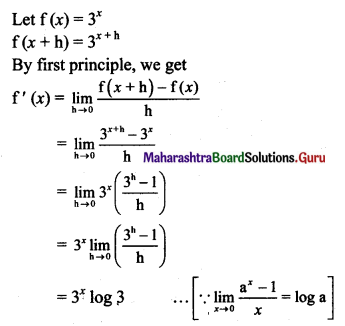
Solution:
It is an imperative sentence, hence it is not a statement.

(vi) The Himalayas is the highest mountain range.
Solution:
It is a statement that is true, hence its truth value is T.

(vii) (x – 2)(x – 3) = x2 – 5x + 6 for all x ∈ R.
Solution:
It is a mathematical identity that is true, hence its truth value is T.

(viii) What are the causes of rural unemployment?
Solution:
It is an interrogative sentence, hence it is not a statement.

(ix) 0! = 1.
Solution:
It is a statement that is true, hence its truth value is T.

(x) The quadratic equation ax2 + bx + c = 0 (a ≠ 0) always has two real roots.
Solution:
It is a statement that is false, hence its truth value is F.

Question 3.
Assuming the first statement as p and second as q, write the following statements in symbolic form:
(i) The Sun has set and Moon has risen.
Solution:
Let p : The Sun has set.
q : Moon has risen.
Then the symbolic form of the given statement is p ∧ q.

(ii) Mona likes Mathematics and Physics.
Solution:
Let p : Mona likes Mathematics.
q : Mona likes Physics.
Then the symbolic form of the given statement is p ∧ q.

(iii) 3 is a prime number if 3 is a perfect square number.
Solution:
Let p : 3 be a prime number.
q : 3 is a perfect square number.
Then the symbolic form of the given statement is p ↔ q.

(iv) Kavita is brilliant and brave.
Solution:
Let p : Kavita is brilliant.
q : Kavita is brave.
Then the symbolic form of the given statement is p ∧ q.

Maharashtra Board 12th Commerce Maths Solutions Chapter 1 Mathematical Logic Miscellaneous Exercise 1

(v) If Kiran drives a car, then Sameer will walk.
Solution:
Let p : Kiran drives a car.
q : Sameet will walk.
Then the symbolic form of the given statement is p → q.

(vi) The necessary condition for the existence of a tangent to the curve of the function is continuity.
Solution:
The given statement can be written as:
‘If the function is continuous, then the tangent to the curve exists.’
Let p : The function is continuous.
q : Tangent to the curve exists.
Then the symbolic form of the given statement is p → q.

(vii) To be brave is necessary and sufficient condition to climb Mount Everest.
Solution:
Let p : To be brave.
q : Climb Mount Everest.
Then the symbolic form of the given statement is p ↔ q.

(viii) x3 + y3 = (x + y)3, iff xy = 0.
Solution:
Let p : x3 + y3 = (x + y)3.
q : xy = 0.
Then the symbolic form of the given statement is p ↔ q.

(ix) The drug is effective though it has side effects.
Solution:
Let p : The drug is effective.
q : It has side effects.
Then the symbolic form of the given statement is p ∧ q.

(x) If a real number is not rational, then it must be irrational.
Solution:
Let p : A real number is not rational.
q : It must be irrational.
Then the symbolic form of the given statement is p → q.

(xi) It is not true that Ram is tall and handsome.
Solution:
Let p : Ram is tall.
q : Ram is handsome.
Then the symbolic form of the given statement is ~(p ∧ q).

(xii) Even though it is not cloudy, it is still raining.
Solution:
The given statement is equivalent to:
It is not cloudy and it is still raining,
Let p : It is not cloudy.
q : It is still raining.
Then the symbolic form of the given statement is p ∧ q.

(xiii) It is not true that intelligent persons are neither polite nor helpful.
Solution:
Let p : Intelligent persons are neither polite nor helpful.
Then the symbolic form of the given statement is ~p.

(xiv) If the question paper is not easy, then we shall not pass.
Solution:
Let p : The question paper is not easy.
q : We shall not pass.
Then the symbolic form of the given statement is p → q.

Question 4.
If p : Proof is lengthy.
q : It is interesting.
Express the following statements in symbolic form:
(i) Proof is lengthy and it is not interesting.
(ii) If the proof is lengthy, then it is interesting.
(iii) It is not true that the proof is lengthy but it is interesting.
(iv) It is interesting iff the proof is lengthy.
Solution:
The symbolic form of the given statements are:
(i) p ∧ ~q
(ii) p → q
(iii) ~(p ∧ q)
(iv) q ↔ p

Maharashtra Board 12th Commerce Maths Solutions Chapter 1 Mathematical Logic Miscellaneous Exercise 1

Question 5.
Let p : Sachin win the match.
q : Sachin is a member of the Rajya Sabha.
r : Sachin is happy.
Write the verbal statement for each of the following:
(i) (p ∧ q) ∨ r
Solution:
Sachin wins the match and he is a member of the Rajya Sabha or Sachin is happy.

(ii) p → r
Solution:
If Sachin wins the match, then he is happy.

(iii) ~p ∨ q
Solution:
Sachin does not win the match or he is a member of the Rajya Sabha.

(iv) p → (q ∨ r)
Solution:
If Sachin wins the match, then he is a member of the Rajya Sabha or he is happy.

(v) p → q
Solution:
If Sachin wins the match, then he is a member of the Rajya Sabha.

(vi) (p ∧ q) ∧ ~r
Solution:
Sachin wins the match and he is a member of the Rajya Sabha but he is not happy.

(vii) ~(p ∨ q) ∧ r
Solution:
It is false that Sachin wins the match or he is a member of the Rajya Sabha but he is happy.

Question 6.
Determine the truth values of the following statements:
(i) 4 + 5 = 7 or 9 – 2 = 5.
Solution:
Let p : 4 + 5 = 7.
q : 9 – 2 = 5.
Then the symbolic form of the given statement is p ∨ q.
The truth values of both p and q are F.
∴ the truth value of p ∨ q is F. …….[F ∨ F ≡ F]

(ii) If 9 > 1, then x2 – 2x + 1 = 0 for x = 1.
Solution:
Let p : 9 > 1.
q : x2 – 2x + 1 = 0 for x = 1.
Then the symbolic form of the given statement is p → q.
The truth values of both p and q are T.
∴ the truth value of p → q is T. …..[T → T ≡ T]

(iii) x + y = 0 is the equation of a straight line if and only if y2 = 4x is the equation of the parabola.
Solution:
Let p : x + y = 0 is the equation of a straight line.
q : y2 = 4x is the equation of the parabola.
Then the symbolic form of the given statement is p ↔ q.
The truth values of both p and q are T.
∴ the truth value of p ↔ q is T. …..[T ↔ T ≡ T]

Maharashtra Board 12th Commerce Maths Solutions Chapter 1 Mathematical Logic Miscellaneous Exercise 1

(iv) It is not true that 2 + 3 = 6 or 12 + 3 = 5.
Solution:
Let p : 2 + 3 = 6.
q : 12 + 3 = 5.
Then the symbolic form of the given statement is ~(p ∨ q).
The truth values of both p and q are F.
∴ the truth value of ~(p ∨ q) is T. …..[~(F ∨ F) ≡ ~F ≡ T]

Question 7.
Assuming the following statements
p : Stock prices are high.
q : Stocks are rising.
to be true, find the truth values of the following:

(i) Stock prices are not high or stocks are rising.
Solution:
p and q are true, i.e. T.
∴ ~p and ~q are false, i.e. F.
The given statement in symbolic form is ~p ∨ q.
Since, ~T ∨ T ≡ F ∨ T ≡ T, the given statement is true.
Hence, its truth value is ‘T’.

(ii) Stock prices are high and stocks are rising if and only if stock prices are high.
Solution:
The given statement in symbolic form is (p ∧ q) ↔ p.
Since (T ∧ T) ↔ T ≡ T ↔ T ≡ T, the given statement is true.
Hence, its truth value is ‘T’.

(iii) If stock prices are high, then stocks are not rising.
Solution:
The given statement in symbolic form is p → ~q.
Since, T → ~T ≡ T → F ≡ F, the given statement is false.
Hence, its truth value is ‘F’.

(iv) It is false that stocks are rising and stock prices are high.
Solution:
The given statement in symbolic form is ~(q ∧ p).
Since, ~(T ∧ T) ≡ ~T ≡ F, the given statement is false.
Hence, its truth value is ‘F’.

(v) Stock prices are high or stocks are not rising iff stocks are rising.
Solution:
The given statement in symbolic form is (p ∨ ~q) ↔ q.
Since (T ∨ ~T) ↔ T ≡ (T ∨ F) ↔ T
≡ T ↔ T
≡ T, the given statement is true.
Hence, its truth value is ‘T’.

Question 8.
Rewrite the following statements without using conditional:
[Hint: P → q ≡ ~p ∨ q]
(i) If price increases, then demand falls.
(ii) If demand falls, then the price does not increase.
Solution:
Since, p → q ≡ ~p ∨ q, the given statements can be written as:
(i) Price does not increase or demand falls.
(ii) Demand does not fall or price does not increase.

Maharashtra Board 12th Commerce Maths Solutions Chapter 1 Mathematical Logic Miscellaneous Exercise 1

Question 9.
If p, q, r are statements with truth values T, T, F respectively, determine the truth values of the following:
(i) (p ∧ q) → ~p
Solution:
Truth values of p, q, r are T, T, F respectively.
(p ∧ q) → ~p ≡ (T ∧ T) → ~T
≡ T → F
≡ F
Hence, the truth value of the given statement is false, i.e. F.

(ii) p ↔ (q → ~p)
Solution:
p ↔ (q → ~p) ≡ T ↔ (T → ~T)
≡ T ↔ (T → F)
≡ T ↔ F
≡ F
Hence, the truth value of the given statement is false, i.e. F.

(iii) (p ∧ ~q) ∨ (~p ∧ q)
Solution:
(p ∧ ~q) ∨ (~p ∧ q) ≡ (T ∧ ~T) ∨ (~T ∧ T)
≡ (T ∧ F) ∨ (F ∧ T)
≡ F ∨ F
≡ F
Hence, the truth value of the given statement is false, i.e. F.

(iv) ~(p ∧ q) → ~(q ∧ p)
Solution:
~(p ∧ q) → ~(q ∧ p) ≡ ~(T ∧ T) → ~(T ∧ T)
≡ ~T → ~T
≡ F → F
≡ T
Hence, the truth value of the given statement is true, i.e. T.

(v) ~[(p → q) ↔ (p ∧ ~q)]
Solution:
~[(p → q) ↔ (p ∧ ~q)]
≡ ~[(T → T) ↔ (T ∧ ~T)]
≡ ~[T ↔ (T ∧ F)]
≡ ~[T ↔ F]
≡ ~F
≡ T.
Hence, the truth value of the given statement is true, i.e. T.

Question 10.
Write the negations of the following:
(i) If ΔABC is not equilateral, then it is not equiangular.
Solution:
Let p : ΔABC is not equilateral.
q : It is not equiangular.
Then the symbolic form of the given statement is p → q.
Since, ~(p → q) ≡ p ∧ ~q, the negation of the given statement is:
‘ΔABC is not equilateral and it is equiangular.’

(ii) Ramesh is intelligent and he is hard working.
Solution:
Let p : Ramesh is intelligent.
q : He is hard working.
Then the symbolic form of the given statement is p ∧ q.
Since, ~(p ∧ q) ≡ ~p ∨ ~q, the negation of the given statement is:
‘Ramesh is not intelligent or he is not hard-working.’

Maharashtra Board 12th Commerce Maths Solutions Chapter 1 Mathematical Logic Miscellaneous Exercise 1

(iii) A angle is a right angle if and only if it is of measure 90°.
Solution:
Let p : An angle is a right angle.
q : It is of measure 90°.
Then the symbolic form of the given statement is p ↔ q.
Since, ~(p ↔ q) ≡ (p ∧ ~q) ∨ (q ∧ ~p), the negation of the given statement is:
‘An angle is a right angle and it is not of measure 90° or an angle is of measure 90° and it is not a right angle.’

(iv) Kanchanjunga is in India and Everest is in Nepal.
Solution:
Let p : Kanchenjunga is in India.
q : Everest is in Nepal.
Then the symbolic form of the given statement is p ∧ q.
Since, ~(p ∧ q) ≡ ~p ∨ ~q, the negation of the given statement is:
‘Kanchenjunga is not in India or Everest is not in Nepal.’

(v) If x ∈ A ∩ B, then x ∈ A and x ∈ B.
Solution:
Let p : x ∈ A ∩ B, q : x ∈ A, r : x ∈ B.
Then the symbolic form of the given statement is P → (q ∧ r)
Since, ~(p → q) ≡ p ∧ ~q and ~(p ∧ q)= ~p ∨ ~q,
the negation of the given statement is:
‘x ∈ A ∩ B and x ∉ A or x ∉ B.

Question 11.
Construct the truth table for each of the following statement patterns:
(i) (p ∧ ~q) ↔ (q → p)
Solution:
(p ∧ ~q) ↔ (q → p)
Maharashtra Board 12th Commerce Maths Solutions Chapter 1 Mathematical Logic Miscellaneous Exercise 1 IV Q11 (i)

(ii) (~p ∨ q) ∧ (~p ∧ ~q)
Solution:
(~p ∨ q) ∧ (~p ∧ ~q)
Maharashtra Board 12th Commerce Maths Solutions Chapter 1 Mathematical Logic Miscellaneous Exercise 1 IV Q11 (ii)

(iii) (p ∧ r) → (p ∨ ~q)
Solution:
(p ∧ r) → (p ∨ ~q)
Maharashtra Board 12th Commerce Maths Solutions Chapter 1 Mathematical Logic Miscellaneous Exercise 1 IV Q11 (iii)

(iv) (p ∨ r) → ~(q ∧ r)
Solution:
(p ∨ r) → ~(q ∧ r)
Maharashtra Board 12th Commerce Maths Solutions Chapter 1 Mathematical Logic Miscellaneous Exercise 1 IV Q11 (iv)

(v) (p ∨ ~q) → (r ∧ p)
Solution:
(p ∨ ~q) → (r ∧ p)
Maharashtra Board 12th Commerce Maths Solutions Chapter 1 Mathematical Logic Miscellaneous Exercise 1 IV Q11 (v)

Maharashtra Board 12th Commerce Maths Solutions Chapter 1 Mathematical Logic Miscellaneous Exercise 1

Question 12.
What is a tautology? What is a contradiction? Show that the negation of a tautology is a contradiction and the negation of a contradiction is a tautology.
Solution:
Tautology: A statement pattern that has all the entries in the last column of its truth table as T is called a tautology.
For example:
Maharashtra Board 12th Commerce Maths Solutions Chapter 1 Mathematical Logic Miscellaneous Exercise 1 IV Q12
In the above truth table for the statement p ∨ ~p,
we observe that all the entries in the last column are T.
Hence, the statement p ∨ ~p is a tautology.

Contradiction: A statement pattern that has all the entries in the last column of its truth table as F is called a contradiction.
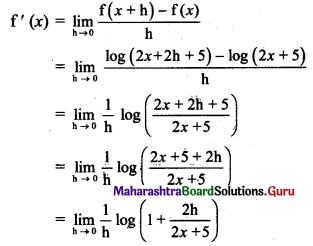
For example:
Maharashtra Board 12th Commerce Maths Solutions Chapter 1 Mathematical Logic Miscellaneous Exercise 1 IV Q12.1
In the above truth table for the statement p ∧ ~p,
we observe that all the entries in the last column are F.
Hence, the statement p ∧ ~p is a contradiction.
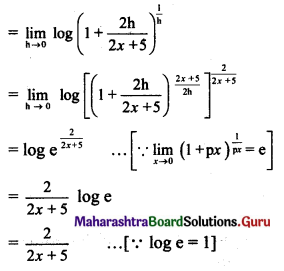
To show that the negation of a tautology is a contradiction and vice versa:
A tautology is true on every row of its truth table.
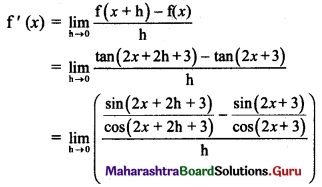
Since, ~T = F and ~F = T, when we negate a tautology, the resulting statement is false on every row of its table.
i.e. the negation of tautology is a contradiction.
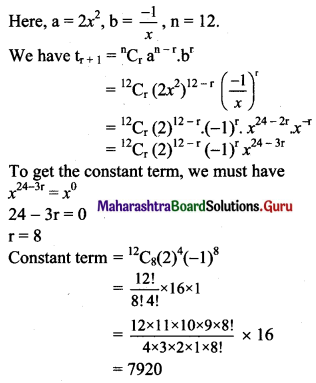
Similarly, the negation of a contradiction is a tautology.

Question 13.
Determine whether the following statement patterns is a tautology or a contradiction or a contingency:
(i) [(p ∧ q) ∨ (~p)] ∨ [p ∧ (~q)]
Solution:
[(p ∧ q) ∨ (~p)] ∨ [p ∧ (~q)]
Maharashtra Board 12th Commerce Maths Solutions Chapter 1 Mathematical Logic Miscellaneous Exercise 1 IV Q13 (i)
All the entries in the last column of the above truth table are T.
∴ [(p ∧ q) ∨ (~p)] ∨ [p ∧ (~q)] is a tautology.

(ii) [(~p ∧ q) ∧ (q ∧ r)] ∨ (~q)
Solution:
[(~p ∧ q) ∧ (q ∧ r)] ∨ (~q)
Maharashtra Board 12th Commerce Maths Solutions Chapter 1 Mathematical Logic Miscellaneous Exercise 1 IV Q13 (ii)
The entries in the last column of the above truth table are neither all T nor all F.
∴ [(~p ∧ q) ∧ (q ∧ r)] ∨ (~q) is a contingency.

(iii) [~(p ∨ q) → p] ↔ [(~p) ∧ (~q)]
Solution:
[~(p ∨ q) → p] ↔ [(~p) ∧ (~q)]
Maharashtra Board 12th Commerce Maths Solutions Chapter 1 Mathematical Logic Miscellaneous Exercise 1 IV Q13 (iii)
All the entries in the last column of the above truth table are F.
∴ [~(p ∨ q) → p] ↔ [(~p) ∧ (~q)] is a contradiction.
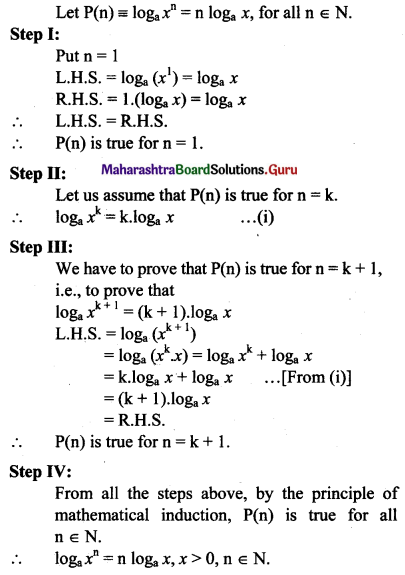
(iv) [~(p ∧ q) → p] ↔ [(~p) ∧ (~q)]
Solution:
[~(p ∧ q) → p] ↔ [(~p) ∧ (~q)]
Maharashtra Board 12th Commerce Maths Solutions Chapter 1 Mathematical Logic Miscellaneous Exercise 1 IV Q13 (iv)
The entries in the last column of the above truth table are neither all T nor all F.
∴ [~(p ∧ q) → p] ↔ [(~p) ∧ (~q)] is a contingency.

(v) [p → (~q ∨ r)] ↔ ~[p → (q → r)]
Solution:
[p → (~q ∨ r)] ↔ ~[p → (q → r)]
Maharashtra Board 12th Commerce Maths Solutions Chapter 1 Mathematical Logic Miscellaneous Exercise 1 IV Q13 (v)
All the entries in the last column of the above truth table are F.
∴ [p → (~q ∨ r)] ↔ ~[p → (q → r)] is a contradiction.
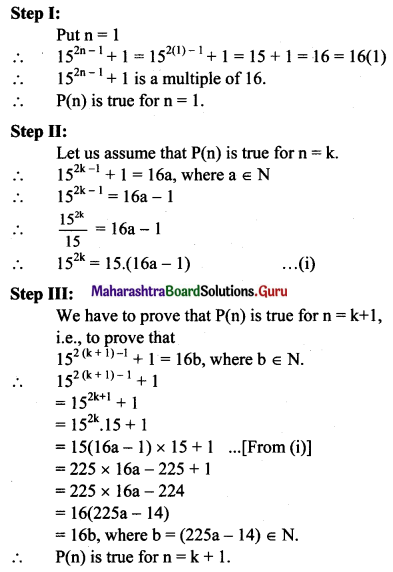
Maharashtra Board 12th Commerce Maths Solutions Chapter 1 Mathematical Logic Miscellaneous Exercise 1

Question 14.
Using the truth table, prove the following logical equivalences:
(i) p ∧ (q ∨ r) ≡ (p ∧ q) ∨ (p ∧ r)
Solution:
p ∧ (q ∨ r) ≡ (p ∧ q) ∨ (p ∧ r)
Maharashtra Board 12th Commerce Maths Solutions Chapter 1 Mathematical Logic Miscellaneous Exercise 1 IV Q14 (i)
The entries in columns 5 and 8 are identical.
∴ p ∧ (q ∨ r) ≡ (p ∧ q) ∨ (p ∧ r)

(ii) [~(p ∨ q) ∨ (p ∨ q)] ∧ r ≡ r
Solution:
[~(p ∨ q) ∨ (p ∨ q)] ∧ r ≡ r
Maharashtra Board 12th Commerce Maths Solutions Chapter 1 Mathematical Logic Miscellaneous Exercise 1 IV Q14 (ii)
The entries in columns 3 and 7 are identical.
∴ [~(p ∨ q) ∨ (p ∨ q)] ∧ r ≡ r

(iii) p ∧ (~p ∨ q) ≡ p ∧ q
Solution:
p ∧ (~p ∨ q) ≡ p ∧ q
Maharashtra Board 12th Commerce Maths Solutions Chapter 1 Mathematical Logic Miscellaneous Exercise 1 IV Q14 (iii)
The entries in columns 5 and 6 are identical.
∴ p ∧ (~p ∨ q) ≡ p ∧ q

(iv) p ↔ q ≡ ~(p ∧ ~q) ∧ ~(q ∧ ~p)
Solution:
p ↔ q ≡ ~(p ∧ ~q) ∧ ~(q ∧ ~p)
Maharashtra Board 12th Commerce Maths Solutions Chapter 1 Mathematical Logic Miscellaneous Exercise 1 IV Q14 (iv)
The entries in columns 3 and 10 are identical.
∴ p ↔ q ≡ ~(p ∧ ~q) ∧ ~(q ∧ ~p)

(v) ~p ∧ q ≡ (p ∨ q) ∧ ~p
Solution:
~p ∧ q ≡ (p ∨ q) ∧ ~p
Maharashtra Board 12th Commerce Maths Solutions Chapter 1 Mathematical Logic Miscellaneous Exercise 1 IV Q14 (v)
The entries in columns 4 and 6 are identical.
∴ ~p ∧ q ≡ (p ∨ q) ∧ ~p

Question 15.
Write the converse, inverse, contrapositive of the following statements:
(i) If 2 + 5 = 10, then 4 + 10 = 20.
Solution:
Let p : 2 + 5 = 10.
q : 4 + 10 = 20.
Then the symbolic form of the given statement is p → q.
Converse: q → p is the converse of p → q
i.e. If 4 + 10 = 20, then 2 + 5 = 10.
Inverse: ~p → ~q is the inverse of p → q
i.e. If 2 + 5 ≠ 10, then 4 + 10 ≠ 20.
Cotrapositive: ~q → ~p is the contrapositive of p → q,
i.e. If 4 +10 ≠ 20, then 2 + 5 ≠ 10.

(ii) If a man is a bachelor, then he is happy.
Solution:
Let p : A man is a bachelor.
q : He is happy.
Then the symbolic form of the given statement is p → q.
Converse: q → p is the converse of p → q
i.e. If a man is happy, then he is a bachelor.
Inverse: ~p → ~q is the inverse of p → q
i.e. If a man is not a bachelor, then he is not happy.
Contrapositive: ~q → ~p is the contrapositive of p → q
i.e., If a man is not happy, then he is not a bachelor.

Maharashtra Board 12th Commerce Maths Solutions Chapter 1 Mathematical Logic Miscellaneous Exercise 1

(iii) If I do not work hard, then I do not prosper.
Solution:
Let p : I do not work hard.
q : I do not prosper.
Then the symbolic form of the given statement is p → q.
Converse: q → p is the converse of p → q
i.e. If I do not prosper, then I do not work hard.
Inverse: ~p → ~q is the inverse of p → q
i.e. If I work hard, then I prosper.
Contrapositive: ~q → ~p is the contrapositive of p → q
i.e. If I prosper, then I work hard.

Question 16.
State the dual of each of the following statements by applying the principle of duality:
(i) (p ∧ ~q) ∨ (~p ∧ q) ≡ (p ∨ q) ∧ ~(p ∧ q)
(ii) p ∨ (q ∨ r) ≡ ~[(p ∧ q) ∨ (r ∨ s)]
(iii) 2 is an even number or 9 is a perfect square.
Solution:
The duals are given by:
(i) (p ∨ ~q) ∧ (~p ∨ q) ≡ (p ∧ q) ∨ ~(p ∨ q)
(ii) p ∧ (q ∧ r) ≡ ~[(p ∨ q) ∧ (r ∧ s)]
(iii) 2 is an even number and 9 is a perfect square.

Question 17.
Rewrite the following statements without using the connective ‘If … then’:
(i) If a quadrilateral is a rhombus, then it is not a square.
(ii) If 10 – 3 = 7, then 10 × 3 ≠ 30.
(iii) If it rains, then the principal declares a holiday.
Solution:
Since, p → q ≡ ~p ∨ q the given statements can be written as:
(i) A quadrilateral is not a rhombus or it is not a square.
(ii) 10 – 3 ≠ 7 or 10 × 3 ≠ 30.
(iii) It does not rain or the principal declares a holiday.

Question 18.
Write the dual of each of the following:
(i) (~p ∧ q) ∨ (p ∧ ~q) ∨ (~p ∧ ~q)
(ii) (p ∧ q) ∧ r ≡ p ∧ (q ∧ r)
(iii) p ∨ (q ∧ r) ≡ (p ∨ q) ∧ (p ∨ r)
(iv) ~(p ∨ q) ≡ ~p ∧ ~q.
Solution:
The duals are given by:
(i) (~p ∨ q) ∧ (p ∨ ~q) ∧ (~p ∨ ~q)
(ii) (p ∨ q) ∨ r ≡ p ∨ (q ∨ r)
(iii) p ∧ (q ∨ r) ≡ (p ∧ q) ∨ (p ∧ r)
(iv) ~(p ∧ q) ≡ ~p ∧ ~q

Maharashtra Board 12th Commerce Maths Solutions Chapter 1 Mathematical Logic Miscellaneous Exercise 1

Question 19.
Consider the following statements:
(i) If D is a dog, then D is very good.
(ii) If D is very good, then D is a dog.
(iii) If D is not very good, then D is not a dog.
(iv) If D is not a dog, then D is not very good.
Identify the pairs of statements having the same meaning. Justify.
Solution:
Let p : D is a dog. and q : D is very good.
Then the given statements in the symbolic form are:
(i) p → q
(ii) q → p
(iii) ~q → ~p
(iv) ~p → ~q
Maharashtra Board 12th Commerce Maths Solutions Chapter 1 Mathematical Logic Miscellaneous Exercise 1 IV Q13
The entries in columns (i) and (iii) are identical. Hence, these statements are equivalent.
∴ the statements (i) and (iii) have the same meaning.
Similarly, the entries in columns (ii) and (iv) are identical. Hence, these statements are equivalent.
∴ the statements (ii) and (iv) have the same meaning.

Question 20.
Express the truth of each of the following statements by Venn diagrams:
(i) All men are mortal.
Solution:
Let U : a set of all human being
A : set of all men
B : set of all mortals.
Then the Venn diagram represents the truth of the given statement is as below:
Maharashtra Board 12th Commerce Maths Solutions Chapter 1 Mathematical Logic Miscellaneous Exercise 1 IV Q20 (i)

(ii) Some persons are not politicians.
Solution:
Let U : set of all human being
A : set of all persons
B : set of all politicians.
Then the Venn diagram represents the truth of the given statement is as follows:
Maharashtra Board 12th Commerce Maths Solutions Chapter 1 Mathematical Logic Miscellaneous Exercise 1 IV Q20 (ii)

(iii) Some members of the present Indian cricket are not committed.
Solution:
Let U : set of all human being
X : set of all members of present Indian cricket
Y : set of all committed members of the present Indian cricket.
Then the Venn diagram represents the truth of the given statement is as below:
Maharashtra Board 12th Commerce Maths Solutions Chapter 1 Mathematical Logic Miscellaneous Exercise 1 IV Q20 (iii)

Maharashtra Board 12th Commerce Maths Solutions Chapter 1 Mathematical Logic Miscellaneous Exercise 1

(iv) No child is an adult.
Solution:
Let U : set of all human beings
C : set of all children
A : set of all adults.
Then the Venn diagram represents the truth of the given statement is as below:
Maharashtra Board 12th Commerce Maths Solutions Chapter 1 Mathematical Logic Miscellaneous Exercise 1 IV Q20 (iv)

Question 21.
If A = {2, 3, 4, 5, 6, 7, 8}, determine the truth value of each of the following statements:
(i) ∃ x ∈ A, such that 3x + 2 > 9.
Solution:
Clearly x = 3, 4, 5, 6, 7, 8 ∈ A satisfy 3x + 2 > 9.
So, the given statement is true, hence its truth value is T.

(ii) ∀x ∈ A, x2 < 18.
Solution:
x = 5, 6, 7, 8 ∈ A do not satisfy x2 < 18.
So the given statement is false, hence its truth value is F.

(iii) ∃x ∈ A, such that x + 3 < 11.
Solution:
Clearly x = 2, 3, 4, 5, 6, 7 ∈ A which satisfy x + 3 < 11.
So, the given statement is True, hence its truth value is T.

(iv) ∀x ∈ A, x2 + 2 ≥ 5.
Solution:
x2 + 2 ≥ 5 for all x ∈ A.
So, the given statement is true, hence its truth value is T.

Question 22.
Write the negations of the following statements:
(i) 7 is a prime number and the Taj Mahal is in Agra.
Solution:
Let p : 7 be a prime number.
q : Taj Mahal is in Agra.
Then the symbolic form of the given statement is p ∧ q.
Since, (p ∧ q) ≡ ~p ∨ ~q,
the negation of the given statement is:
‘7 is not a prime number or Taj Mahal is not in Agra.’

(ii) 10 > 5 and 3 < 8.
Solution:
Let p : 10 > 5.
q : 3 < 8.
Then the symbolic form of the given statement is P ∧ q.
Since, ~(p ∧ q) = ~p ∨ ~q, the negation of the given statement is:
’10 ≤ 5 or 3 ≥ 8′
OR
’10 ≯ 5 or 3 ≮ 8′

Maharashtra Board 12th Commerce Maths Solutions Chapter 1 Mathematical Logic Miscellaneous Exercise 1

(iii) I will have tea or coffee.
Solution:
The negation of the given statement is:
‘I will not have tea and coffee.’

(iv) ∀n ∈ N, n + 3 > 9.
Solution:
The negation of the given statement is:
‘∃n ∈ N, such that n + 3 ≯ 9.’
OR
‘∃n ∈ N, such that n + 3 ≤ 9.’

(v) ∃x ∈ A, such that x + 5 < 11.
Solution:
The negation of the given statement is:
‘∀x ∈ A, x + 5 ≮ 1.’
OR
‘∀x ∈ A, x + 5 ≥ 11.’

Maharashtra Board 11th Maths Solutions Chapter 3 Permutations and Combination Ex 3.5

Balbharti Maharashtra State Board 11th Maths Book Solutions Pdf Chapter 3 Permutations and Combination Ex 3.5 Questions and Answers.

Maharashtra State Board 11th Maths Solutions Chapter 3 Permutations and Combination Ex 3.5

Question 1.
In how many different ways can 8 friends sit around a table?
Solution:
We know that ‘n’ persons can sit around a table in (n – 1)! ways.
∴ 8 friends can sit around a table in 7!
= 7 × 6 × 5 × 4 × 3 × 2 × 1
= 5040 ways.

Question 2.
A party has 20 participants. Find the number of distinct ways for the host to sit with them around a circular table. How many of these ways have two specified persons on either side of the host?
Solution:
A party has 20 participants.
All of them and the host (i.e., 21 persons) can be seated at a circular table in (21 – 1)! = 20! ways.
When two particular participants are seated on either side of the host.
The host takes the chair in 1 way.
These 2 persons can sit on either side of the host in 2! ways.
Once the host occupies his chair, it is not circular permutation more.
The remaining 18 people occupy their chairs in 18! ways.
∴ A total number of arrangements possible if two particular participants are seated on either side of the host = 2! × 18! = 2 × 18!

Maharashtra Board 11th Maths Solutions Chapter 3 Permutations and Combination Ex 3.5

Question 3.
Delegates from 24 countries participate in a round table discussion. Find the number of seating arrangements where two specified delegates are (a) always together. (b) never together.
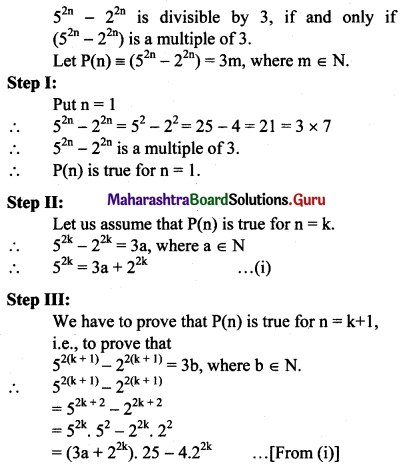
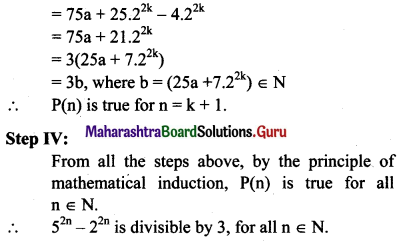
Solution:
(a) Delegates of 24 countries are to participate in a round table discussion such that two specified delegates are always together.
Let us consider these 2 delegates as one unit. They can be arranged among themselves in 2! ways.
Also, these two delegates are to be seated with 22 other delegates (i.e. total of 23) which can be done in (23 – 1)! = 22! ways.
∴ Required number of arrangements = 2! × 22!

(b) When 2 specified delegates are never together then, other 22 delegates can be participate in a round table discussion in (22 – 1)! = 21! ways.
∴ There are 22 places of which any 2 places can be filled by those 2 delegates so that they are never together.
∴ Two specified delegates can be arranged in 22P2 ways.
∴ Required number of arrangements = 22P2 × 21!
= \(\frac{22 !}{(22-2) !} \times 21 !\)
= \(\frac{22 !}{20 !}\) × 21!
= 22 × 21 × 21!
= 21 × 22 × 21!
= 21 × 22!

Question 4.
Find the number of ways for 15 people to sit around the table so that no two arrangements have the same neighbours.
Solution:
There are 15 people to sit around a table.
∴ They can be arranged in(15 – 1)! = 14! ways.
But, they should not have the same neighbour in any two arrangements.
Around the table, arrangements (i.e., clockwise and anticlockwise) coincide.
Maharashtra Board 11th Maths Solutions Chapter 3 Permutations and Combination Ex 3.5 Q4
∴ Required number of arrangements = \(\frac{14 !}{2}\)

Maharashtra Board 11th Maths Solutions Chapter 3 Permutations and Combination Ex 3.5

Question 5.
A committee of 10 members sits around a table. Find the number of arrangements that have the President and the Vice-president together.
Solution:
A committee of 10 members sits around a table.
But, President and Vice-president sit together.
Let us consider President and Vice-president as one unit.
They can be arranged among themselves in 2! ways.
Now, this unit with the other 8 members of the committee is to be arranged around a table, which can be done in (9 – 1)! = 8! ways.
∴ Required number of arrangements = 8! × 2! = 2 × 8!

Question 6.
Five men, two women, and a child sit around a table. Find the number of arrangements where the child is seated (a) between the two women. (b) between two men.
Solution:
5 men, 2 women, and a child sit around a table.
(a) When the child is seated between two women.
5 men, 2 women, and a child are to be seated around a round table such that the child is seated between two women.
∴ the two women can be seated on either side of the child in 2! ways.
Let us consider these 3 (two women and a child) as one unit.
Now, this one unit is to be arranged with the remaining 5 men,
i.e., a total of 6 units are to be arranged around a round table, which can be done in (6 – 1)! = 5! ways.
∴ Required number of arrangements = 5! × 2!
= 120 × 2
= 240

(b) Two men can be selected from 5 men in
5C2 = \(\frac{5 !}{2 !(5-2) !}=\frac{5 \times 4 \times 3 !}{2 \times 3 !}\) = 10 ways.
Also, these two men can sit on either side of the child in 2! ways.
Let us take two men and a child as one unit.
Now, this one unit is to be arranged with the remaining 3 men and 2 women,
i.e., a total of 6 units (3 + 2 + 1) are to be arranged around a round table, which can be done in (6 – 1)! = 5! ways.
∴ Required number of arrangements = 10 × 2! × 5!
= 10 × 2 × 120
= 2400

Maharashtra Board 11th Maths Solutions Chapter 3 Permutations and Combination Ex 3.5

Question 7.
Eight men and six women sit around a table. How many sitting arrangements will have no two women together?
Solution:
8 men can be seated around a table in (8 – 1)! = 7! ways.
No two women should sit together.
There are 8 gaps created by 8 men’s seats.
∴ Women can be seated in 8 gaps in 8P6 ways.
∴ Required number of arrangements = 7! × 8P6

Question 8.
Find the number of seating arrangements for 3 men and 3 women to sit around a table so that exactly two women are together.
Solution:
2 women (who wish to sit together) can be selected from 3 in
3C2 = \(\frac{3 !}{2 !(3-2) !}=\frac{3 \times 2 !}{2 ! \times 1 !}\) = 3 ways.
Also, these two women can sit together in 2! ways.
Let us take two women as one unit.
Now, this one unit is to be arranged with the remaining 3 men and 1 woman,
i.e., a total of 5 units are to be arranged around a round table, which can be done in (5 – 1)! = 4! ways.
∴ Required number of arrangements = 3 × 2! × 4!
= 3 × 2 × 24
= 144

Question 9.
Four objects in a set of ten objects are alike. Find the number of ways of arranging them in a circular order.
Solution:
Ten things can be arranged in a circular order of which 4 are alike in \(\frac{9 !}{4 !}\) ways.
∴ Required number of arrangements = \(\frac{9 !}{4 !}\)

Maharashtra Board 11th Maths Solutions Chapter 3 Permutations and Combination Ex 3.5

Question 10.
Fifteen persons sit around a table. Find the number of arrangements that have two specified persons not sitting side by side.
Solution:
Since 2 particular persons can’t be sitting side by side,
the other 13 persons can be arranged around the table in (13 – 1)! = 12! ways.
The two persons who are not sitting side by side may take 13 positions created by 3 persons in 13P2 ways.
∴ Required number of arrangements = 12! × 13P2
= 12! × 13 × 12
= 13 × 12! × 12
= 12 × 13!