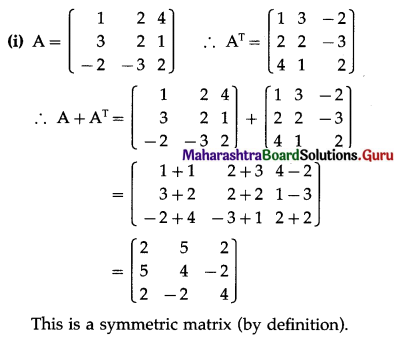
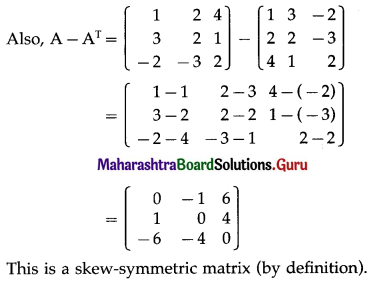
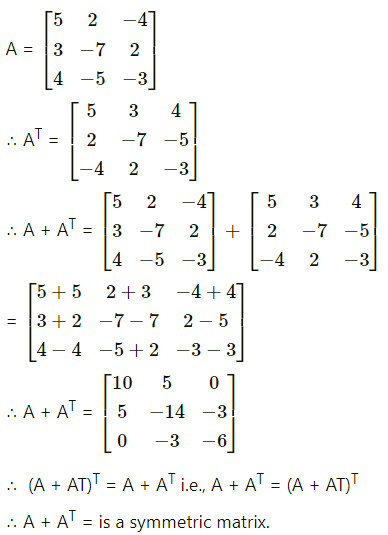
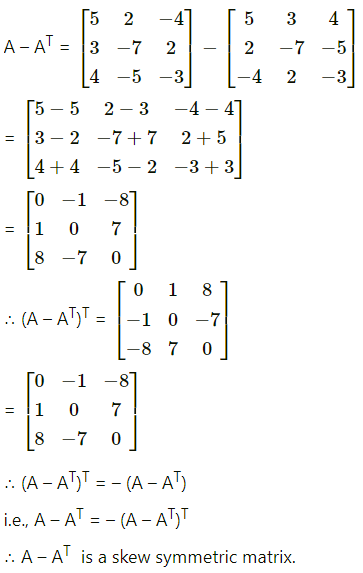
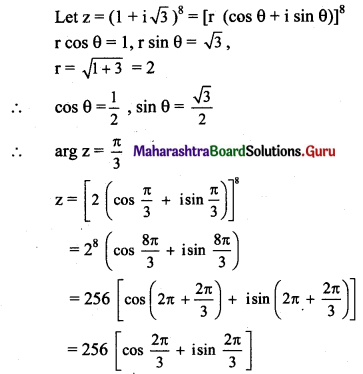
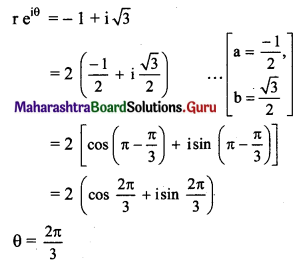
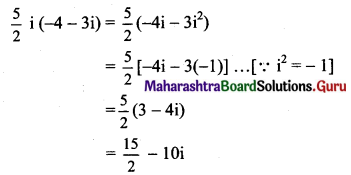
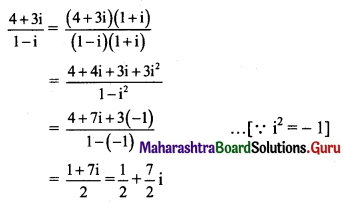
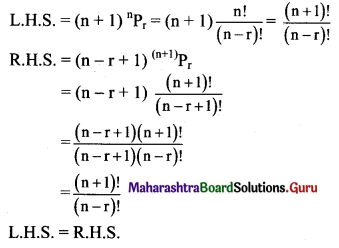
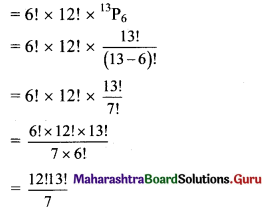
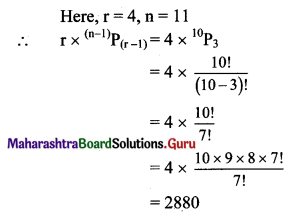
Maharashtra Board 11th Maths Solutions Chapter 7 Limits Ex 7.4

Balbharti Maharashtra State Board 11th Maths Book Solutions Pdf Chapter 7 Limits Ex 7.4 Questions and Answers.

Maharashtra State Board 11th Maths Solutions Chapter 7 Limits Ex 7.4

I. Evaluate the following limits:

Question 1.
\(\lim _{\theta \rightarrow 0}\left[\frac{\sin (m \theta)}{\tan (n \theta)}\right]\)
Solution:
Maharashtra Board 11th Maths Solutions Chapter 7 Limits Ex 7.4 I Q1

Question 2.
\(\lim _{\theta \rightarrow 0}\left[\frac{1-\cos 2 \theta}{\theta^{2}}\right]\)
Solution:
Maharashtra Board 11th Maths Solutions Chapter 7 Limits Ex 7.4 I Q2

Maharashtra Board 11th Maths Solutions Chapter 7 Limits Ex 7.4

Question 3.
\(\lim _{x \rightarrow 0}\left[\frac{x \cdot \tan x}{1-\cos x}\right]\)
Solution:
Maharashtra Board 11th Maths Solutions Chapter 7 Limits Ex 7.4 I Q3

Question 4.
\(\lim _{x \rightarrow 0}\left(\frac{\sec x-1}{x^{2}}\right)\)
Solution:
Maharashtra Board 11th Maths Solutions Chapter 7 Limits Ex 7.4 I Q4

II. Evaluate the following limits:

Question 1.
\(\lim _{x \rightarrow 0}\left[\frac{1-\cos (n x)}{1-\cos (m x)}\right]\)
Solution:
Maharashtra Board 11th Maths Solutions Chapter 7 Limits Ex 7.4 II Q1
Maharashtra Board 11th Maths Solutions Chapter 7 Limits Ex 7.4 II Q1.1

Question 2.
\(\lim _{x \rightarrow \frac{\pi}{6}}\left[\frac{2-{cosec} x}{\cot ^{2} x-3}\right]\)
Solution:
Maharashtra Board 11th Maths Solutions Chapter 7 Limits Ex 7.4 II Q2

Maharashtra Board 11th Maths Solutions Chapter 7 Limits Ex 7.4

Question 3.
\(\lim _{x \rightarrow \frac{\pi}{4}}\left[\frac{\cos x-\sin x}{\cos 2 x}\right]\)
Solution:
Maharashtra Board 11th Maths Solutions Chapter 7 Limits Ex 7.4 II Q3

III. Evaluate the following limits:

Question 1.
\(\lim _{x \rightarrow 0}\left[\frac{\cos (a x)-\cos (b x)}{\cos (c x)-1}\right]\)
Solution:
Maharashtra Board 11th Maths Solutions Chapter 7 Limits Ex 7.4 III Q1
Maharashtra Board 11th Maths Solutions Chapter 7 Limits Ex 7.4 III Q1.1
Maharashtra Board 11th Maths Solutions Chapter 7 Limits Ex 7.4 III Q1.2

Question 2.
\(\lim _{x \rightarrow \pi}\left[\frac{\sqrt{1-\cos x}-\sqrt{2}}{\sin ^{2} x}\right]\)
Solution:
Maharashtra Board 11th Maths Solutions Chapter 7 Limits Ex 7.4 III Q2
Maharashtra Board 11th Maths Solutions Chapter 7 Limits Ex 7.4 III Q2.1

Question 3.
\(\lim _{x \rightarrow \frac{\pi}{4}}\left[\frac{\tan ^{2} x-\cot ^{2} x}{\sec x-{cosec} x}\right]\)
Solution:
Maharashtra Board 11th Maths Solutions Chapter 7 Limits Ex 7.4 III Q3

Maharashtra Board 11th Maths Solutions Chapter 7 Limits Ex 7.4

Question 4.
\(\lim _{x \rightarrow \frac{\pi}{6}}\left[\frac{2 \sin ^{2} x+\sin x-1}{2 \sin ^{2} x-3 \sin x+1}\right]\)
Solution:
Maharashtra Board 11th Maths Solutions Chapter 7 Limits Ex 7.4 III Q4
Maharashtra Board 11th Maths Solutions Chapter 7 Limits Ex 7.4 III Q4.1

Maharashtra Board 11th Maths Solutions Chapter 3 Permutations and Combination Ex 3.2

Balbharti Maharashtra State Board 11th Maths Book Solutions Pdf Chapter 3 Permutations and Combination Ex 3.2 Questions and Answers.

Maharashtra State Board 11th Maths Solutions Chapter 3 Permutations and Combination Ex 3.2

Question 1.
Evaluate:
(i) 8!
Solution:
8!
= 8 × 7 × 6 × 5 × 4 × 3 × 2 × 1
= 40320

(ii) 10!
Solution:
10!
= 10 × 9 × 8 × 7 × 6 × 5 × 4 × 3 × 2 × 1
= 3628800

(iii) 10! – 6!
Solution:
10! – 6!
= 10 × 9 × 8 × 7 × 6! – 6!
= 6! (10 × 9 × 8 × 7 – 1)
= 6! (5040 – 1)
= 6 × 5 × 4 × 3 × 2 × 1 × 5039
= 3628080

Maharashtra Board 11th Maths Solutions Chapter 3 Permutations and Combination Ex 3.2

(iv) (10 – 6)!
Solution:
(10 – 6)!
= 4!
= 4 × 3 × 2 × 1
= 24

Question 2.
Compute:
(i) \(\frac{12 !}{6 !}\)
Solution:
\(\frac{12 !}{6 !}=\frac{12 \times 11 \times 10 \times 9 \times 8 \times 7 \times 6 !}{6 !}\)
= 12 × 11 × 10 × 9 × 8 × 7
= 665280

(ii) \(\left(\frac{12}{6}\right) !\)
Solution:
\(\left(\frac{12}{6}\right) !\)
= 2!
= 2 × 1
= 2

(iii) (3 × 2)!
Solution:
(3 × 2)!
= 6!
= 6 × 5 × 4 × 3 × 2 × 1
= 720

(iv) 3! × 2!
Solution:
3! × 2!
= 3 × 2 × 1 × 2 × 1
= 12

(v) \(\frac{9 !}{3 ! 6 !}\)
Solution:
\(\frac{9 !}{3 ! 6 !}=\frac{9 \times 8 \times 7 \times 6 !}{(3 \times 2 \times 1) \times 6 !}=84\)

(vi) \(\frac{6 !-4 !}{4 !}\)
Solution:
\(\frac{6 !-4 !}{4 !}=\frac{6 \times 5 \times 4 !-4 !}{4 !}=\frac{4 !(6 \times 5-1)}{4 !}=29\)

Maharashtra Board 11th Maths Solutions Chapter 3 Permutations and Combination Ex 3.2

(vii) \(\frac{8 !}{6 !-4 !}\)
Solution:
\(\frac{8 !}{6 !-4 !}=\frac{8 \times 7 \times 6 \times 5 \times 4 !}{6 \times 5 \times 4 !-4 !}\)
= \(\frac{8 \times 7 \times 6 \times 5 \times 4 !}{4 !(6 \times 5-1)}\)
= \(\frac{1680}{29}\)
= 57.93

(viii) \(\frac{8 !}{(6-4) !}\)
Solution:
\(\frac{8 !}{(6-4) !}=\frac{8 !}{2 !}\)
= \(\frac{8 \times 7 \times 6 \times 5 \times 4 \times 3 \times 2 !}{2 !}\)
= 20160

Question 3.
Write in terms of factorials
(i) 5 × 6 × 7 × 8 × 9 × 10
Solution:
5 × 6 × 7 × 8 × 9 × 10 = 10 × 9 × 8 × 7 × 6 × 5
Multiplying and dividing by 4!, we get
= \(\frac{10 \times 9 \times 8 \times 7 \times 6 \times 5 \times 4 !}{4 !}\)
= \(\frac{10 \times 9 \times 8 \times 7 \times 6 \times 5 \times 4 \times 3 \times 2 \times 1}{4 !}\)
= \(\frac{10 !}{4 !}\)

(ii) 3 × 6 × 9 × 12 × 15
Solution:
3 × 6 × 9 × 12 × 15
= 3 × (3 × 2) × (3 × 3) × (3 × 4) × (3 × 5)
= (35) (5 × 4 × 3 × 2 × 1)
= 35 (5!)

(iii) 6 × 7 × 8 × 9
Solution:
6 × 7 × 8 × 9 = 9 × 8 × 7 × 6
Multiplying and dividing by 5!, we get
= \(\frac{9 \times 8 \times 7 \times 6 \times 5 !}{5 !}\)
= \(\frac{9 \times 8 \times 7 \times 6 \times 5 \times 4 \times 3 \times 2 \times 1}{5 !}\)
= \(\frac{9 !}{5 !}\)

(iv) 5 × 10 × 15 × 20
Solution:
5 × 10 × 15 × 20
= (5 × 1) × (5 × 2) × (5 × 3) × (5 × 4)
= (54) (4 × 3 × 2 × 1)
= (54) (4!)

Maharashtra Board 11th Maths Solutions Chapter 3 Permutations and Combination Ex 3.2

Question 4.
Evaluate: \(\frac{n !}{r !(n-r) !}\) for
(i) n = 8, r = 6
(ii) n = 12, r = 12
(iii) n = 15, r = 10
(iv) n = 15, r = 8
Solution:
Maharashtra Board 11th Maths Solutions Chapter 3 Permutations and Combination Ex 3.2 Q4
Maharashtra Board 11th Maths Solutions Chapter 3 Permutations and Combination Ex 3.2 Q4.1

Question 5.
Find n, if
(i) \(\frac{n}{8 !}=\frac{3}{6 !}+\frac{1 !}{4 !}\)
Solution:
Maharashtra Board 11th Maths Solutions Chapter 3 Permutations and Combination Ex 3.2 Q5 (i)

(ii) \(\frac{n}{6 !}=\frac{4}{8 !}+\frac{3}{6 !}\)
Solution:
Maharashtra Board 11th Maths Solutions Chapter 3 Permutations and Combination Ex 3.2 Q5 (ii)

(iii) \(\frac{1 !}{n !}=\frac{1 !}{4 !}-\frac{4}{5 !}\)
Solution:
Maharashtra Board 11th Maths Solutions Chapter 3 Permutations and Combination Ex 3.2 Q5 (iii)

(iv) (n + 1)! = 42 × (n -1)!
Solution:
(n + 1)! = 42(n – 1)!
∴ (n + 1) n (n – 1)! = 42(n – 1)!
∴ n2 + n = 42
∴ n2 + n – 42 = 0
∴ (n + 7)(n – 6) = 0
∴ n = -7 or n = 6
But n ≠ -7 as n ∈ N
∴ n = 6

Maharashtra Board 11th Maths Solutions Chapter 3 Permutations and Combination Ex 3.2

(v) (n + 3)! = 110 × (n + 1)!
Solution:
(n + 3)! = (110) (n + 1)!
∴ (n + 3)(n + 2)(n + 1)! = 110(n + 1)!
∴ (n + 3) (n + 2) = (11) (10)
Comparing on both sides, we get
n + 3 = 11
∴ n = 8

Question 6.
Find n, if:
(i) \(\frac{(17-n) !}{(14-n) !}=5 !\)
Solution:
Maharashtra Board 11th Maths Solutions Chapter 3 Permutations and Combination Ex 3.2 Q6 (i)
∴ (17 – n) (16 – n) (15 – n) = 6 × 5 × 4
Comparing on both sides, we get
17 – n = 6
∴ n = 11

(ii) \(\frac{(15-n) !}{(13-n) !}=12\)
Solution:
\(\frac{(15-n) !}{(13-n) !}=12\)
∴ \(\frac{(15-n)(14-n)(13-n) !}{(13-n) !}=12\)
∴ (15 – n) (14 – n) = 4 × 3
Comparing on both sides, we get
∴ 15 – n = 4
∴ n = 11

(iii) \(\frac{n !}{3 !(n-3) !}: \frac{n !}{5 !(n-5) !}=5: 3\)
Solution:
Maharashtra Board 11th Maths Solutions Chapter 3 Permutations and Combination Ex 3.2 Q6 (iii)
∴ 12 = (n – 3)(n – 4)
(n – 3)(n – 4) = 4 × 3
Comparing on both sides, we get
n – 3 = 4
∴ n = 7

Maharashtra Board 11th Maths Solutions Chapter 3 Permutations and Combination Ex 3.2

(iv) \(\frac{n !}{3 !(n-3) !}: \frac{n !}{5 !(n-7) !}=1: 6\)
Solution:
Maharashtra Board 11th Maths Solutions Chapter 3 Permutations and Combination Ex 3.2 Q6 (iv)
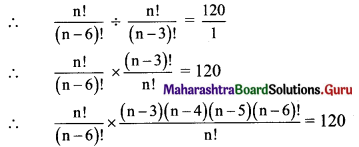
∴ 120 = (n – 3)(n – 4) (n – 5)(n – 6)
∴ (n – 3)(n – 4) (n – 5)(n – 6) = 5 × 4 × 3 × 2
Comparing on both sides, we get
n – 3 = 5
∴ n = 8

(v) \(\frac{(2 n) !}{7 !(2 n-7) !}: \frac{n !}{4 !(n-4) !}=24: 1\)
Solution:
Maharashtra Board 11th Maths Solutions Chapter 3 Permutations and Combination Ex 3.2 Q6 (v)
Maharashtra Board 11th Maths Solutions Chapter 3 Permutations and Combination Ex 3.2 Q6 (v).1
(2n – 1)(2n – 3)(2n – 5) = \(\frac{24 \times 7 \times 6 \times 5}{16}\)
∴ (2n – 1)(2n – 3)(2n – 5) = 9 × 7 × 5
Comparing on both sides. We get
∴ 2n – 1 = 9
∴ n = 5

Question 7.
Show that \(\frac{n !}{r !(n-r) !}+\frac{n !}{(r-1) !(n-r+1) !}=\frac{(n+1) !}{r !(n-r+1) !}\)
Solution:
Maharashtra Board 11th Maths Solutions Chapter 3 Permutations and Combination Ex 3.2 Q7

Question 8.
Show that \(\frac{9 !}{3 ! 6 !}+\frac{9 !}{4 ! 5 !}=\frac{10 !}{4 ! 6 !}\)
Solution:
Maharashtra Board 11th Maths Solutions Chapter 3 Permutations and Combination Ex 3.2 Q8

Question 9.
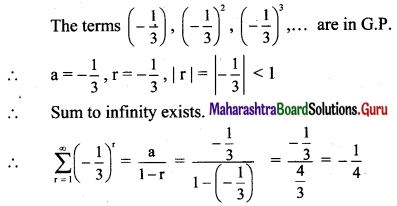
Show that \(\frac{(2 n) !}{n !}\) = 2n (2n – 1)(2n – 3)…5.3.1
Solution:
Maharashtra Board 11th Maths Solutions Chapter 3 Permutations and Combination Ex 3.2 Q9

Maharashtra Board 11th Maths Solutions Chapter 3 Permutations and Combination Ex 3.2

Question 10.
Simplify
(i) \(\frac{(2 n+2) !}{(2 n) !}\)
Solution:
Maharashtra Board 11th Maths Solutions Chapter 3 Permutations and Combination Ex 3.2 Q10 (i)

(ii) \(\frac{(n+3) !}{\left(n^{2}-4\right)(n+1) !}\)
Solution:
Maharashtra Board 11th Maths Solutions Chapter 3 Permutations and Combination Ex 3.2 Q10 (ii)

(iii) \(\frac{1}{n !}-\frac{1}{(n-1) !}-\frac{1}{(n-2) !}\)
Solution:
Maharashtra Board 11th Maths Solutions Chapter 3 Permutations and Combination Ex 3.2 Q10 (iii)
Maharashtra Board 11th Maths Solutions Chapter 3 Permutations and Combination Ex 3.2 Q10 (iii).1

(iv) n[n! + (n – 1)!] + n2(n – 1)! + (n + 1)!
Solution:
Maharashtra Board 11th Maths Solutions Chapter 3 Permutations and Combination Ex 3.2 Q10 (iv)

Maharashtra Board 11th Maths Solutions Chapter 3 Permutations and Combination Ex 3.2

(v) \(\frac{n+2}{n !}-\frac{3 n+1}{(n+1) !}\)
Solution:
Maharashtra Board 11th Maths Solutions Chapter 3 Permutations and Combination Ex 3.2 Q10 (v)

(vi) \(\frac{1}{(n-1) !}+\frac{1-n}{(n+1) !}\)
Solution:
Maharashtra Board 11th Maths Solutions Chapter 3 Permutations and Combination Ex 3.2 Q10 (vi)

(vii) \(\frac{1}{n !}-\frac{3}{(n+1) !}-\frac{n^{2}-4}{(n+2) !}\)
Solution:
Maharashtra Board 11th Maths Solutions Chapter 3 Permutations and Combination Ex 3.2 Q10 (vii)

Maharashtra Board 11th Maths Solutions Chapter 3 Permutations and Combination Ex 3.2

(viii) \(\frac{n^{2}-9}{(n+3) !}+\frac{6}{(n+2) !}-\frac{1}{(n+1) !}\)
Solution:
Maharashtra Board 11th Maths Solutions Chapter 3 Permutations and Combination Ex 3.2 Q10 (viii)

Maharashtra Board 11th Maths Solutions Chapter 7 Limits Ex 7.3

Balbharti Maharashtra State Board 11th Maths Book Solutions Pdf Chapter 7 Limits Ex 7.3 Questions and Answers.

Maharashtra State Board 11th Maths Solutions Chapter 7 Limits Ex 7.3

I. Evaluate the following limits:

Question 1.
\(\lim _{x \rightarrow 0}\left[\frac{\sqrt{6+x+x^{2}}-\sqrt{6}}{x}\right]\)
Solution:
Maharashtra Board 11th Maths Solutions Chapter 7 Limits Ex 7.3 I Q1
Maharashtra Board 11th Maths Solutions Chapter 7 Limits Ex 7.3 I Q1.1

Question 2.
\(\lim _{x \rightarrow 3}\left[\frac{\sqrt{2 x+3}-\sqrt{4 x-3}}{x^{2}-9}\right]\)
Solution:
Maharashtra Board 11th Maths Solutions Chapter 7 Limits Ex 7.3 I Q2

Maharashtra Board 11th Maths Solutions Chapter 7 Limits Ex 7.3

Question 3.
\(\lim _{y \rightarrow 0}\left[\frac{\sqrt{1-y^{2}}-\sqrt{1+y^{2}}}{y^{2}}\right]\)
Solution:
Maharashtra Board 11th Maths Solutions Chapter 7 Limits Ex 7.3 I Q3
Maharashtra Board 11th Maths Solutions Chapter 7 Limits Ex 7.3 I Q3.1

Question 4.
\(\lim _{x \rightarrow 2}\left[\frac{\sqrt{2+x}-\sqrt{6-x}}{\sqrt{x}-\sqrt{2}}\right]\)
Solution:
Maharashtra Board 11th Maths Solutions Chapter 7 Limits Ex 7.3 I Q4
Maharashtra Board 11th Maths Solutions Chapter 7 Limits Ex 7.3 I Q4.1

II. Evaluate the following limits:

Question 1.
\(\lim _{x \rightarrow a}\left[\frac{\sqrt{a+2 x}-\sqrt{3 x}}{\sqrt{3 a+x}-2 \sqrt{x}}\right]\)
Solution:
Maharashtra Board 11th Maths Solutions Chapter 7 Limits Ex 7.3 II Q1
Maharashtra Board 11th Maths Solutions Chapter 7 Limits Ex 7.3 II Q1.1

Question 2.
\(\lim _{x \rightarrow 2}\left[\frac{x^{2}-4}{\sqrt{x+2}-\sqrt{3 x-2}}\right]\)
Solution:
Maharashtra Board 11th Maths Solutions Chapter 7 Limits Ex 7.3 II Q2
Maharashtra Board 11th Maths Solutions Chapter 7 Limits Ex 7.3 II Q2.1

Question 3.
\(\lim _{x \rightarrow 2}\left[\frac{\sqrt{1+\sqrt{2+x}}-\sqrt{3}}{x-2}\right]\)
Solution:
Maharashtra Board 11th Maths Solutions Chapter 7 Limits Ex 7.3 II Q3
Maharashtra Board 11th Maths Solutions Chapter 7 Limits Ex 7.3 II Q3.1

Maharashtra Board 11th Maths Solutions Chapter 7 Limits Ex 7.3

Question 4.
\(\lim _{y \rightarrow 0}\left[\frac{\sqrt{a+y}-\sqrt{a}}{y \sqrt{a+y}}\right]\)
Solution:
Maharashtra Board 11th Maths Solutions Chapter 7 Limits Ex 7.3 II Q4

Question 5.
\(\lim _{x \rightarrow 0}\left(\frac{\sqrt{x^{2}+9}-\sqrt{2 x^{2}+9}}{\sqrt{3 x^{2}+4}-\sqrt{2 x^{2}+4}}\right)\)
Solution:
Maharashtra Board 11th Maths Solutions Chapter 7 Limits Ex 7.3 II Q5
Maharashtra Board 11th Maths Solutions Chapter 7 Limits Ex 7.3 II Q5.1

III. Evaluate the following limits:

Question 1.
\(\lim _{x \rightarrow 1}\left[\frac{x^{2}+x \sqrt{x}-2}{x-1}\right]\)
Solution:
Maharashtra Board 11th Maths Solutions Chapter 7 Limits Ex 7.3 III Q1

Question 2.
\(\lim _{x \rightarrow 0}\left[\frac{\sqrt{1+x^{2}}-\sqrt{1+x}}{\sqrt{1+x^{3}}-\sqrt{1+x}}\right]\)
Solution:
Maharashtra Board 11th Maths Solutions Chapter 7 Limits Ex 7.3 III Q2
Maharashtra Board 11th Maths Solutions Chapter 7 Limits Ex 7.3 III Q2.1

Maharashtra Board 11th Maths Solutions Chapter 7 Limits Ex 7.3

Question 3.
\(\lim _{x \rightarrow 4}\left[\frac{x^{2}+x-20}{\sqrt{3 x+4}-4}\right]\)
Solution:
Maharashtra Board 11th Maths Solutions Chapter 7 Limits Ex 7.3 III Q3

Question 4.
\(\lim _{z \rightarrow 4}\left[\frac{3-\sqrt{5+z}}{1-\sqrt{5-z}}\right]\)
Solution:
Maharashtra Board 11th Maths Solutions Chapter 7 Limits Ex 7.3 III Q4
Maharashtra Board 11th Maths Solutions Chapter 7 Limits Ex 7.3 III Q4.1

Maharashtra Board 11th Maths Solutions Chapter 7 Limits Ex 7.3

Question 5.
\(\lim _{x \rightarrow 0}\left(\frac{3}{x \sqrt{9-x}}-\frac{1}{x}\right)\)
Solution:
Maharashtra Board 11th Maths Solutions Chapter 7 Limits Ex 7.3 III Q5

Maharashtra Board 11th Maths Solutions Chapter 1 Complex Numbers Ex 1.4

Balbharti Maharashtra State Board 11th Maths Book Solutions Pdf Chapter 1 Complex Numbers Ex 1.4 Questions and Answers.

Maharashtra State Board 11th Maths Solutions Chapter 1 Complex Numbers Ex 1.4

Question 1.
Find the value of
(i) ω18
(ii) ω21
(iii) ω-30
(iv) ω-105
Solution:
Maharashtra Board 11th Maths Solutions Chapter 1 Complex Numbers Ex 1.4 Q1

Question 2.
If ω is the complex cube root of unity, show that
(i) (2 – ω)(2 – ω2) = 7
Solution:
ω is the complex cube root of unity.
ω3 = 1 and 1 + ω + ω2 = 0
Also, 1 + ω2 = -ω, 1 + ω = -ω2 and ω + ω2 = -1
L.H.S. = (2 – ω)(2 – ω2)
= 4 – 2ω2 – 2ω + ω3
= 4 – 2(ω2 + ω) + 1
= 4 – 2(-1) + 1
= 4 + 2 + 1
= 7
= R.H.S.

Maharashtra Board 11th Maths Solutions Chapter 1 Complex Numbers Ex 1.4

(ii) (1 + ω – ω2)6 = 64
Solution:
ω is the complex cube root of unity.
ω3 = 1 and 1 + ω + ω2 = 0
Also, 1 + ω2 = -ω, 1 + ω = -ω2 and ω + ω2 = -1
Maharashtra Board 11th Maths Solutions Chapter 1 Complex Numbers Ex 1.4 Q2 (ii)

(iii) (1 + ω)3 – (1 + ω2)3 = 0
Solution:
ω is the complex cube root of unity.
ω3 = 1 and 1 + ω + ω2 = 0
Also, 1 + ω2 = -ω, 1 + ω = -ω2 and ω + ω2 = -1
Maharashtra Board 11th Maths Solutions Chapter 1 Complex Numbers Ex 1.4 Q2 (iii)

(iv) (2 + ω + ω2)3 – (1 – 3ω + ω2)3 = 65
Solution:
ω is the complex cube root of unity.
ω3 = 1 and 1 + ω + ω2 = 0
Also, 1 + ω2 = -ω, 1 + ω = -ω2 and ω + ω2 = -1
Maharashtra Board 11th Maths Solutions Chapter 1 Complex Numbers Ex 1.4 Q2 (iv)

(v) (3 + 3ω + 5ω2)6 – (2 + 6ω + 2ω2)3 = 0
Solution:
ω is the complex cube root of unity.
ω3 = 1 and 1 + ω + ω2 = 0
Also, 1 + ω2 = -ω, 1 + ω = -ω2 and ω + ω2 = -1
Maharashtra Board 11th Maths Solutions Chapter 1 Complex Numbers Ex 1.4 Q2 (v)

Maharashtra Board 11th Maths Solutions Chapter 1 Complex Numbers Ex 1.4

(vi) \(\frac{a+b \omega+c \omega^{2}}{c+a \omega+b \omega^{2}}\) = ω2
Solution:
ω is the complex cube root of unity.
ω3 = 1 and 1 + ω + ω2 = 0
Also, 1 + ω2 = -ω, 1 + ω = -ω2 and ω + ω2 = -1
Maharashtra Board 11th Maths Solutions Chapter 1 Complex Numbers Ex 1.4 Q2 (vi)

(vii) (a + b) + (aω + bω2) + (aω2 + bω) = 0
Solution:
ω is the complex cube root of unity.
ω3 = 1 and 1 + ω + ω2 = 0
Also, 1 + ω2 = -ω, 1 + ω = -ω2 and ω + ω2 = -1
Maharashtra Board 11th Maths Solutions Chapter 1 Complex Numbers Ex 1.4 Q2 (vii)

(viii) (a – b)(a – bω)(a – bω2) = a3 – b3
Solution:
ω is the complex cube root of unity.
ω3 = 1 and 1 + ω + ω2 = 0
Also, 1 + ω2 = -ω, 1 + ω = -ω2 and ω + ω2 = -1
Maharashtra Board 11th Maths Solutions Chapter 1 Complex Numbers Ex 1.4 Q2 (viii)

(ix) (a + b)2 + (aω + bω2)2 + (aω2+ bω)2 = 6ab
Solution:
ω is the complex cube root of unity.
ω3 = 1 and 1 + ω + ω2 = 0
Also, 1 + ω2 = -ω, 1 + ω = -ω2 and ω + ω2 = -1
Maharashtra Board 11th Maths Solutions Chapter 1 Complex Numbers Ex 1.4 Q2 (ix)

Question 3.
If ω is the complex cube root of unity, find the value of
(i) ω + \(\frac{1}{\omega}\)
Solution:
ω is the complex cube root of unity.
ω3 = 1 and 1 + ω + ω2 = 0
Also, 1 + ω2 = -ω, 1 + ω = -ω2 and ω + ω2 = -1
\(\omega+\frac{1}{\omega}=\frac{\omega^{2}+1}{\omega}=\frac{-\omega}{\omega}=-1\)

(ii) ω2 + ω3 + ω4
Solution:
ω is the complex cube root of unity.
ω3 = 1 and 1 + ω + ω2 = 0
Also, 1 + ω2 = -ω, 1 + ω = -ω2 and ω + ω2 = -1
ω2 + ω3 + ω4
= ω2(1 + ω + ω2)
= ω2(0)
= 0

Maharashtra Board 11th Maths Solutions Chapter 1 Complex Numbers Ex 1.4

(iii) (1 + ω2)3
Solution:
ω is the complex cube root of unity.
ω3 = 1 and 1 + ω + ω2 = 0
Also, 1 + ω2 = -ω, 1 + ω = -ω2 and ω + ω2 = -1
(1 + ω2)3
= (-ω)3
= -ω3
= -1

(iv) (1 – ω – ω2)3 + (1 – ω + ω2)3
Solution:
ω is the complex cube root of unity.
ω3 = 1 and 1 + ω + ω2 = 0
Also, 1 + ω2 = -ω, 1 + ω = -ω2 and ω + ω2 = -1
(1 – ω – ω2)3 + (1 – ω + ω2)3
= [1 – (ω + ω2)]3 + [(1 + ω2) – ω]3
= [1 – (-1)]2 + (-ω – ω)3
= 23 + (-2ω)3
= 8 – 8ω3
= 8 – 8(1)
= 0

(v) (1 + ω)(1 + ω2)(1 + ω4)(1 + ω8)
Solution:
ω is the complex cube root of unity.
ω3 = 1 and 1 + ω + ω2 = 0
Also, 1 + ω2 = -ω, 1 + ω = -ω2 and ω + ω2 = -1
(1 + ω)(1 + ω2)(1 + ω4)(1 + ω8)
= (1 + ω)(1 + ω2)(1 + ω)(1 + ω2) …..[∵ ω3 = 1, ω4 = ω]
= (-ω2)(-ω)(-ω2)(-ω)
= ω6
= (ω3)2
= (1)2
= 1

Maharashtra Board 11th Maths Solutions Chapter 1 Complex Numbers Ex 1.4

Question 4.
If α and β are the complex cube roots of unity, show that
(i) α2 + β2 + αβ = 0
(ii) α4 + β4 + α-1β-1 = 0
Solution:
α and β are the complex cube roots of unity.
Maharashtra Board 11th Maths Solutions Chapter 1 Complex Numbers Ex 1.4 Q4 (i)
Maharashtra Board 11th Maths Solutions Chapter 1 Complex Numbers Ex 1.4 Q4 (ii)

Question 5.
If x = a + b, y = αa + βb and z = aβ + bα, where α and β are complex cube roots of unity, show that xyz = a3 + b3.
Solution:
x = a + b, y = αa + βb, z = aβ + bα
α and β are the complex cube roots of unity.
∴ α = \(\frac{-1+i \sqrt{3}}{2}\) and β = \(\frac{-1-i \sqrt{3}}{2}\)
Maharashtra Board 11th Maths Solutions Chapter 1 Complex Numbers Ex 1.4 Q5

Maharashtra Board 11th Maths Solutions Chapter 1 Complex Numbers Ex 1.4

Question 6.
Find the equation in cartesian coordinates of the locus of z if
(i) |z| = 10
Solution:
Let z = x + iy
|z| = 10
|x + iy| = 10
\(\sqrt{x^{2}+y^{2}}\) = 10
∴ x2 + y2 = 100

(ii) |z – 3| = 2
Solution:
Let z = x + iy
|z – 3| = 2
|x + iy – 3| = 2
|(x – 3) + iy| = 2
\(\sqrt{(x-3)^{2}+y^{2}}\) = 2
∴ (x – 3)2 + y2 = 4

(iii) |z – 5 + 6i| = 5
Solution:
Let z = x + iy
|z – 5 + 6i| = 5
|x + iy – 5 + 6i| = 5
|(x – 5) + i(y + 6)| = 5
\(\sqrt{(x-5)^{2}+(y+6)^{2}}\) = 5
∴ (x – 5)2 + (y + 6)2 = 25

(iv) |z + 8| = |z – 4|
Solution:
Let z = x + iy
|z + 8| = |z – 4|
|x + iy + 8| = |x + iy – 4|
|(x + 8) + iy | = |(x – 4) + iy|
\(\sqrt{(x+8)^{2}+y^{2}}=\sqrt{(x-4)^{2}+y^{2}}\)
(x + 8)2 + y2 = (x – 4)2 + y2
x2 + 16x + 64 + y2 = x2 – 8x + 16 + y2
16x + 64 = -8x + 16
24x + 48 = 0
∴ x + 2 = 0

Maharashtra Board 11th Maths Solutions Chapter 1 Complex Numbers Ex 1.4

(v) |z – 2 – 2i | = |z + 2 + 2i|
Solution:
Let z = x + iy
|z – 2 – 2i| = |z + 2 + 2i|
|x + iy – 2 – 2i | = |x + iy + 2 + 2i |
|(x – 2) + i(y – 2)| = |(x + 2) + i(y + 2)|
\(\sqrt{(x-2)^{2}+(y-2)^{2}}=\sqrt{(x+2)^{2}+(y+2)^{2}}\)
(x – 2)2 + (y – 2)2 = (x + 2)2 + (y + 2)2
x2– 4x + 4 + y2 – 4y + 4 = x2 + 4x + 4 + y2 + 4y + 4
-4x – 4y = 4x + 4y
8x + 8y = 0
x + y = 0
y = -x

(vi) \(\frac{|z+3 i|}{|z-6 i|}=1\)
Solution:
Let z = x + iy
Maharashtra Board 11th Maths Solutions Chapter 1 Complex Numbers Ex 1.4 Q6 (vi)
x2 + (y + 3)2 = x2 + (y – 6)2
y2 + 6y + 9 = y2 – 12y + 36
18y – 27 = 0
2y – 3 = 0

Question 7.
Use De Moivre’s theorem and simplify the following:
(i) \(\frac{(\cos 2 \theta+i \sin 2 \theta)^{7}}{(\cos 4 \theta+i \sin 4 \theta)^{3}}\)
Solution:
Maharashtra Board 11th Maths Solutions Chapter 1 Complex Numbers Ex 1.4 Q7 (i)
Maharashtra Board 11th Maths Solutions Chapter 1 Complex Numbers Ex 1.4 Q7 (i).1

(ii) \(\frac{\cos 5 \theta+i \sin 5 \theta}{(\cos 3 \theta-i \sin 3 \theta)^{2}}\)
Solution:
Maharashtra Board 11th Maths Solutions Chapter 1 Complex Numbers Ex 1.4 Q7 (ii)

(iii) \(\frac{\left(\cos \frac{7 \pi}{13}+i \sin \frac{7 \pi}{13}\right)^{4}}{\left(\cos \frac{4 \pi}{13}-i \sin \frac{4 \pi}{13}\right)^{6}}\)
Solution:
Maharashtra Board 11th Maths Solutions Chapter 1 Complex Numbers Ex 1.4 Q7 (iii)

Maharashtra Board 11th Maths Solutions Chapter 1 Complex Numbers Ex 1.4

Question 8.
Express the following in the form a + ib, a, b ∈ R, using De Moivre’s theorem.
(i) (1 – i)5
Solution:
Maharashtra Board 11th Maths Solutions Chapter 1 Complex Numbers Ex 1.4 Q8 (i)
Maharashtra Board 11th Maths Solutions Chapter 1 Complex Numbers Ex 1.4 Q8 (i).1

(ii) (1 + i)6
Solution:
Maharashtra Board 11th Maths Solutions Chapter 1 Complex Numbers Ex 1.4 Q8 (ii)

(iii) (1 – √3 i)4
Solution:
Maharashtra Board 11th Maths Solutions Chapter 1 Complex Numbers Ex 1.4 Q8 (iii)
Maharashtra Board 11th Maths Solutions Chapter 1 Complex Numbers Ex 1.4 Q8 (iii).1

Maharashtra Board 11th Maths Solutions Chapter 1 Complex Numbers Ex 1.4

(iv) (-2√3 – 2i)5
Solution:
Maharashtra Board 11th Maths Solutions Chapter 1 Complex Numbers Ex 1.4 Q8 (iv)
Maharashtra Board 11th Maths Solutions Chapter 1 Complex Numbers Ex 1.4 Q8 (iv).1

Maharashtra Board 11th Maths Solutions Chapter 7 Limits Ex 7.2

Balbharti Maharashtra State Board 11th Maths Book Solutions Pdf Chapter 7 Limits Ex 7.2 Questions and Answers.

Maharashtra State Board 11th Maths Solutions Chapter 7 Limits Ex 7.2

I. Evaluate the following limits:

Question 1.
\(\lim _{z \rightarrow 2}\left[\frac{z^{2}-5 z+6}{z^{2}-4}\right]\)
Solution:
Maharashtra Board 11th Maths Solutions Chapter 7 Limits Ex 7.2 I Q1

Question 2.
\(\lim _{x \rightarrow-3}\left[\frac{x+3}{x^{2}+4 x+3}\right]\)
Solution:
Maharashtra Board 11th Maths Solutions Chapter 7 Limits Ex 7.2 I Q2

Maharashtra Board 11th Maths Solutions Chapter 7 Limits Ex 7.2

Question 3.
\(\lim _{y \rightarrow 0}\left[\frac{5 y^{3}+8 y^{2}}{3 y^{4}-16 y^{2}}\right]\)
Solution:
Maharashtra Board 11th Maths Solutions Chapter 7 Limits Ex 7.2 I Q3

Question 4.
\(\lim _{x \rightarrow-2}\left[\frac{-2 x-4}{x^{3}+2 x^{2}}\right]\)
Solution:
Maharashtra Board 11th Maths Solutions Chapter 7 Limits Ex 7.2 I Q4
Maharashtra Board 11th Maths Solutions Chapter 7 Limits Ex 7.2 I Q4.1

Question 5.
\(\lim _{x \rightarrow 3}\left[\frac{x^{2}+2 x-15}{x^{2}-5 x+6}\right]\)
Solution:
Maharashtra Board 11th Maths Solutions Chapter 7 Limits Ex 7.2 I Q5

II. Evaluate the following limits:

Question 1.
\(\lim _{u \rightarrow 1}\left[\frac{u^{4}-1}{u^{3}-1}\right]\)
Solution:
Maharashtra Board 11th Maths Solutions Chapter 7 Limits Ex 7.2 II Q1

Question 2.
\(\lim _{x \rightarrow 3}\left[\frac{1}{x-3}-\frac{9 x}{x^{3}-27}\right]\)
Solution:
Maharashtra Board 11th Maths Solutions Chapter 7 Limits Ex 7.2 II Q2

Maharashtra Board 11th Maths Solutions Chapter 7 Limits Ex 7.2

Question 3.
\(\lim _{x \rightarrow 2}\left[\frac{x^{3}-4 x^{2}+4 x}{x^{2}-1}\right]\)
Solution:
Maharashtra Board 11th Maths Solutions Chapter 7 Limits Ex 7.2 II Q3

Question 4.
\(\lim _{\Delta x \rightarrow 0}\left[\frac{(x+\Delta x)^{2}-2(x+\Delta x)+1-\left(x^{2}-2 x+1\right)}{\Delta x}\right]\)
Solution:
Maharashtra Board 11th Maths Solutions Chapter 7 Limits Ex 7.2 II Q4

Question 5.
\(\lim _{x \rightarrow \sqrt{2}}\left[\frac{x^{2}+x \sqrt{2}-4}{x^{2}-3 x \sqrt{2}+4}\right]\)
Solution:
Maharashtra Board 11th Maths Solutions Chapter 7 Limits Ex 7.2 II Q5

Maharashtra Board 11th Maths Solutions Chapter 7 Limits Ex 7.2

Question 6.
\(\lim _{x \rightarrow 2}\left[\frac{x^{3}-7 x+6}{x^{3}-7 x^{2}+16 x-12}\right]\)
Solution:
\(\lim _{x \rightarrow 2}\left[\frac{x^{3}-7 x+6}{x^{3}-7 x^{2}+16 x-12}\right]\)
As x → 2, numerator and denominator both tend to zero
∴ x – 2 is a factor of both.
To find the other factor for both of them, by synthetic division
Consider, Numerator = x3 + 0x2 – 7x + 6
Maharashtra Board 11th Maths Solutions Chapter 7 Limits Ex 7.2 II Q6
Maharashtra Board 11th Maths Solutions Chapter 7 Limits Ex 7.2 II Q6.1
∴ The limit does not exist

III. Evaluate the following limits:

Question 1.
\(\lim _{y \rightarrow \frac{1}{2}}\left[\frac{1-8 y^{3}}{y-4 y^{3}}\right]\)
Solution:
Maharashtra Board 11th Maths Solutions Chapter 7 Limits Ex 7.2 III Q1

Question 2.
\(\lim _{x \rightarrow 1}\left[\frac{x-2}{x^{2}-x}-\frac{1}{x^{3}-3 x^{2}+2 x}\right]\)
Solution:
Maharashtra Board 11th Maths Solutions Chapter 7 Limits Ex 7.2 III Q2

Maharashtra Board 11th Maths Solutions Chapter 7 Limits Ex 7.2

Question 3.
\(\lim _{x \rightarrow 1}\left[\frac{x^{4}-3 x^{2}+2}{x^{3}-5 x^{2}+3 x+1}\right]\)
Solution:
\(\lim _{x \rightarrow 1}\left[\frac{x^{4}-3 x^{2}+2}{x^{3}-5 x^{2}+3 x+1}\right]\)
As x → 1, numerator and denominator both tend to zero
∴ x – 1 is a factor of both.
To find the factor of numerator and denominator by synthetic division
Consider, numerator = x4 + 0x3 – 3x2 + 0x + 2
Maharashtra Board 11th Maths Solutions Chapter 7 Limits Ex 7.2 III Q3
Maharashtra Board 11th Maths Solutions Chapter 7 Limits Ex 7.2 III Q3.1

Question 4.
\(\lim _{x \rightarrow 1}\left[\frac{x+2}{x^{2}-5 x+4}+\frac{x-4}{3\left(x^{2}-3 x+2\right)}\right]\)
Solution:
Maharashtra Board 11th Maths Solutions Chapter 7 Limits Ex 7.2 III Q4
Maharashtra Board 11th Maths Solutions Chapter 7 Limits Ex 7.2 III Q4.1

Maharashtra Board 11th Maths Solutions Chapter 7 Limits Ex 7.2

Question 5.
\(\lim _{x \rightarrow a}\left[\frac{1}{x^{2}-3 a x+2 a^{2}}+\frac{1}{2 x^{2}-3 a x+a^{2}}\right]\)
Solution:
Maharashtra Board 11th Maths Solutions Chapter 7 Limits Ex 7.2 III Q5
Maharashtra Board 11th Maths Solutions Chapter 7 Limits Ex 7.2 III Q5.1

Maharashtra Board 11th Maths Solutions Chapter 6 Functions Ex 6.2

Balbharti Maharashtra State Board 11th Maths Book Solutions Pdf Chapter 6 Functions Ex 6.2 Questions and Answers.

Maharashtra State Board 11th Maths Solutions Chapter 6 Functions Ex 6.2

Question 1.
If f(x) = 3x + 5, g(x) = 6x – 1, then find
(i) (f + g) (x)
(ii) (f – g) (2)
(iii) (fg) (3)
(iv) (f/g) (x) and its domain
Solution:
f(x) = 3x + 5, g (x) = 6x – 1
(i) (f + g) (x) = f (x) + g (x)
= 3x + 5 + 6x – 1
= 9x + 4

(ii) (f – g) (2) = f(2) – g(2)
= [3(2) + 5] – [6(2) – 1]
= 6 + 5 – 12 + 1
= 0

(iii) (fg) (3) = f (3) g(3)
= [3(3) + 5] [6(3) – 1]
= (14) (17)
= 238

(iv) \(\left(\frac{\mathrm{f}}{\mathrm{g}}\right)(x)=\frac{\mathrm{f}(x)}{\mathrm{g}(x)}=\frac{3 x+5}{6 x-1}, x \neq \frac{1}{6}\)
Domain = R – {\(\frac{1}{6}\)}

Maharashtra Board 11th Maths Solutions Chapter 6 Functions Ex 6.2

Question 2.
Let f: (2, 4, 5} → {2, 3, 6} and g: {2, 3, 6} → {2, 4} be given by f = {(2, 3), (4, 6), (5, 2)} and g = {(2, 4), (3, 4), (6, 2)}. Write down gof.
Solution:
f = {(2, 3), (4, 6), (5, 2)}
∴ f(2) = 3, f(4) = 6, f(5) = 2
g ={(2, 4), (3, 4), (6, 2)}
∴ g(2) = 4, g(3) = 4, g(6) = 2
gof: {2, 4, 5} → {2, 4}
(gof) (2) = g(f(2)) = g(3) = 4
(gof) (4) = g(f(4)) = g(6) = 2
(gof) (5) = g(f(5)) = g(2) = 4
∴ gof = {(2, 4), (4, 2), (5, 4)}

Question 3.
If f(x) = 2x2 + 3, g(x) = 5x – 2, then find
(i) fog
(ii) gof
(iii) fof
(iv) gog
Solution:
f(x) = 2x2 + 3, g(x) = 5x – 2
(i) (fog) (x) = f(g(x))
= f(5x – 2)
= 2(5x – 2)2 + 3
= 2(25x2 – 20x + 4) + 3
= 50x2 – 40x + 11

(ii) (gof) (x) = g(f(x))
= g(2x2 + 3)
= 5(2x + 3) – 2
= 10x2 + 13

(iii) (fof) (x) = f(f(x))
= f(2x2 + 3)
= 2(2x2 + 3)2 + 3
= 2(4x4 + 12x2 + 9) + 3
= 8x4 + 24x2 + 21

(iv) (gog) (x) = g(g(x))
= g(5x – 2)
= 5(5x – 2) – 2
= 25x – 12

Maharashtra Board 11th Maths Solutions Chapter 6 Functions Ex 6.2

Question 4.
Verify that f and g are inverse functions of each other, where
(i) f(x) = \(\frac{x-7}{4}\), g(x) = 4x + 7
(ii) f(x) = x3 + 4, g(x) = \(\sqrt[3]{x-4}\)
(iii) f(x) = \(\frac{x+3}{x-2}\), g(x) = \(\frac{2 x+3}{x-1}\)
Solution:
(i) f(x) = \(\frac{x-7}{4}\)
Replacing x by g(x), we get
f[g(x)] = \(\frac{g(x)-7}{4}=\frac{4 x+7-7}{4}\) = x
g(x) = 4x + 7
Replacing x by f(x), we get
g[f(x)] = 4f(x) + 7 = 4(\(\frac{x-7}{4}\)) + 7 = x
Here, f[g(x)] = x and g[f(x)] = x.
∴ f and g are inverse functions of each other.

(ii) f(x) = x3 + 4
Replacing x by g(x), we get
f[g(x)] = [g(x)]3 + 4
= \((\sqrt[3]{x-4})^{3}+4\)
= x – 4 + 4
= x
g(x) = \(\sqrt[3]{x-4}\)
Replacing x by f(x), we get
g[f(x)] = \(\sqrt[3]{f(x)-4}=\sqrt[3]{x^{3}+4-4}=\sqrt[3]{x^{3}}\) = x
Here, f[g(x)] = x and g[f(x)] = x
∴ f and g are inverse functions of each other.

(iii) f(x) = \(\frac{x+3}{x-2}\)
Replacing x by g(x), we get
Maharashtra Board 11th Maths Solutions Chapter 6 Functions Ex 6.2 Q4 (iii)
Here, f[g(x)] = x and g[f(x)] = x.
∴ f and g are inverse functions of each other.

Question 5.
Check if the following functions have an inverse function. If yes, find the inverse function.
(i) f(x) = 5x2
(ii) f(x) = 8
(iii) f(x) = \(\frac{6 x-7}{3}\)
(iv) f(x) = \(\sqrt{4 x+5}\)
(v) f(x) = 9x3 + 8
(vi) f(x) = Maharashtra Board 11th Maths Solutions Chapter 6 Functions Ex 6.2 Q5
Solution:
(i) f(x) = 5x2 = y (say)
Maharashtra Board 11th Maths Solutions Chapter 6 Functions Ex 6.2 Q5 (i)
For two values (x1 and x2) of x, values of the function are equal.
∴ f is not one-one.
∴ f does not have an inverse.

(ii) f(x) = 8 = y (say)
For every value of x, the value of the function f is the same.
∴ f is not one-one i.e. (many-one) function.
∴ f does not have the inverse.

(iii) f(x) = \(\frac{6 x-7}{3}\)
Let f(x1) = f(x2)
∴ \(\frac{6 x_{1}-7}{3}=\frac{6 x_{2}-7}{3}\)
∴ x1 = x2
∴ f is a one-one function.
f(x) = \(\frac{6 x-7}{3}\) = y (say)
∴ x = \(\frac{3y+7}{6}\)
∴ For every y, we can get x
∴ f is an onto function.
∴ x = \(\frac{3y+7}{6}\) = f-1 (y)
Replacing y by x, we get
f-1 (x) = \(\frac{3x+7}{6}\)

(iv) f(x) = \(\sqrt{4 x+5}, x \geq \frac{-5}{4}\)
Let f(x1) = f(x2)
∴ \(\sqrt{4 x_{1}+5}=\sqrt{4 x_{2}+5}\)
∴ x1 = x2
∴ f is a one-one function.
f(x) = \(\sqrt{4 x+5}\) = y, (say) y ≥ 0
Squaring on both sides, we get
y2 = 4x + 5
∴ x = \(\frac{y^{2}-5}{4}\)
∴ For every y we can get x.
∴ f is an onto function.
∴ x = \(\frac{y^{2}-5}{4}\) = f-1 (y)
Replacing y by x, we get
f-1 (x) = \(\frac{x^{2}-5}{4}\)

(v) f(x) 9x3 + 8
Let f(x1) = f(x2)
∴ \(9 x_{1}^{3}+8=9 x_{2}^{3}+8\)
∴ x1 = x2
∴ f is a one-one function.
∴ f(x) = 9x3 + 8 = y, (say)
∴ x = \(\sqrt[3]{\frac{y-8}{9}}\)
∴ For every y we can get x.
∴ f is an onto function.
∴ x = \(\sqrt[3]{\frac{y-8}{9}}\) = f-1 (y)
Replacing y by x, we get
f-1 (x) = \(\sqrt[3]{\frac{x-8}{9}}\)

(vi) f(x) = x + 7, x < 0
= 8 – x, x ≥ 0
Maharashtra Board 11th Maths Solutions Chapter 6 Functions Ex 6.2 Q5 (vi).1
We observe from the graph that for two values of x, say x1, x2 the values of the function are equal.
i.e. f(x1) = f(x2)
∴ f is not one-one (i.e. many-one) function.
∴ f does not have inverse.

Maharashtra Board 11th Maths Solutions Chapter 6 Functions Ex 6.2

Question 6.
If f(x) = Maharashtra Board 11th Maths Solutions Chapter 6 Functions Ex 6.2 Q6, then find
(i) f(3)
(ii) f(2)
(iii) f(0)
Solution:
f(x) = x2 + 3, x ≤ 2
= 5x + 7, x > 2
(i) f(3) = 5(3) + 7
= 15 + 7
= 22

(ii) f(2) = 22 + 3
= 4 + 3
= 7

(iii) f(0) = 02 + 3 = 3

Question 7.
If f(x) = Maharashtra Board 11th Maths Solutions Chapter 6 Functions Ex 6.2 Q7, then find
(i) f(-4)
(ii) f(-3)
(iii) f(1)
(iv) f(5)
Solution:
f(x) = 4x – 2, x ≤ -3
= 5, -3 < x < 3
= x2, x ≥ 3
(i) f(-4) = 4(-4) – 2
= -16 – 2
= -18

(ii) f(-3) = 4(-3) – 2
= -12 – 2
= -14

(iii) f(1) = 5

(iv) f(5) = 52 = 25

Maharashtra Board 11th Maths Solutions Chapter 6 Functions Ex 6.2

Question 8.
If f(x) = 2 |x| + 3x, then find
(i) f(2)
(ii) f(-5)
Solution:
f(x) = 2 |x| + 3x
(i) f(2) = 2|2| + 3(2)
= 2 (2) + 6 ….. [∵ |x| = x, x > 0]
= 10

(ii) f(-5) = 2 |-5| + 3(-5)
= 2(5) – 15 …..[∵ |x| = -x, x < 0]
= 10 – 15
= -5

Question 9.
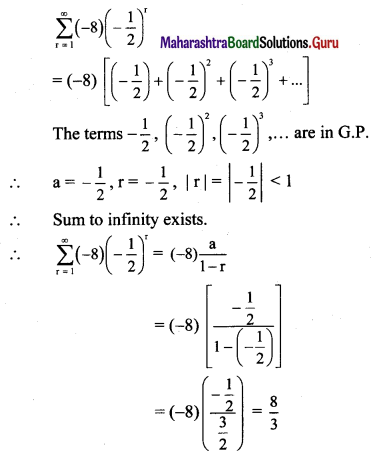
If f(x) = 4[x] – 3, where [x] is greatest integer function of x, then find
(i) f(7.2)
(ii) f(0.5)
(iii) \(f\left(-\frac{5}{2}\right)\)
(iv) f(2π), where π = 3.14
Solution:
f(x) = 4[x] – 3
(i) f(7.2) = 4 [7.2] – 3
= 4(7) – 3 ………[∵ 7 ≤ 7.2 < 8, [7.2] = 7]
= 25

(ii) f(0.5) = 4[0.5] – 3
= 4(0) – 3 ………[∵ 0 ≤ 0.5 < 1, [0.5] = 0]
= -3

(iii) \(f\left(-\frac{5}{2}\right)\) = f(-2.5)
= 4[-2.5] – 3
= 4(-3) – 3 …….[∵-3 ≤ -2.5 ≤ -2, [-2.5] = -3]
= -15

(iv) f(2π) = 4[2π] – 3
= 4[6.28] – 3 …..[∵ π = 3.14]
= 4(6) – 3 …….[∵ 6 ≤ 6.28 < 7, [6.28] = 6]
= 21

Question 10.
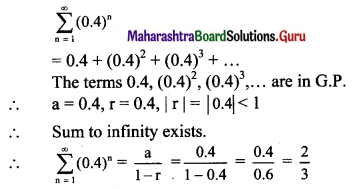
If f(x) = 2{x} + 5x, where {x} is fractional part function of x, then find
(i) f(-1)
(ii) f(\(\frac{1}{4}\))
(iii) f(-1.2)
(iv) f(-6)
Solution:
f(x) = 2{x} + 5x
(i) {-1} = -1 – [-1] = -1 + 1 = 0
∴ f(-1) = 2 {-1} + 5(-1)
= 2(0) – 5
= -5

(ii) {\(\frac{1}{4}\)} = \(\frac{1}{4}\) – [latex]\frac{1}{4}[/latex] = \(\frac{1}{4}\) – 0 = \(\frac{1}{4}\)
f(\(\frac{1}{4}\)) = 2{\(\frac{1}{4}\)} + 5(\(\frac{1}{4}\))
= 2(\(\frac{1}{4}\)) + \(\frac{5}{4}\)
= \(\frac{7}{4}\)
= 1.75

(iii) {-1.2} = -1.2 – [-1.2] = -1.2 + 2 = 0.8
f(-1.2) = 2{-1.2} + 5(-1.2)
= 2(0.8) + (-6)
= -4.4

(iv) {-6} = -6 – [-6] = -6 + 6 = 0
f(-6) = 2{-6} + 5(-6)
= 2(0) – 30
= -30

Maharashtra Board 11th Maths Solutions Chapter 6 Functions Ex 6.2

Question 11.
Solve the following for x, where |x| is modulus function, [x] is the greatest integer function, {x} is a fractional part function.
(i) |x + 4| ≥ 5
(ii) |x – 4| + |x – 2| = 3
(iii) x2 + 7|x| + 12 = 0
(iv) |x| ≤ 3
(v) 2|x| = 5
(vi) [x + [x + [x]]] = 9
(vii) {x} > 4
(viii) {x} = o
(ix) {x} = 0.5
(x) 2{x} = x + [x]
Solution:
(i) |x + 4| ≥ 5
The solution of |x| ≥ a is x ≤ -a or x ≥ a
∴ |x + 4| ≥ 5 gives
∴ x + 4 ≤ -5 or x + 4 ≥ 5
∴ x ≤ -5 – 4 or x ≥ 5 – 4
∴ x ≤ -9 or x ≥ 1
∴ The solution set = (-∞, – 9] ∪ [1, ∞)

(ii) |x – 4| + |x – 2| = 3 …..(i)
Case I: x < 2
Equation (i) reduces to
4 – x + 2 – x = 3 …….[x < 2 < 4, x – 4 < 0, x – 2 < 0]
∴ 6 – 3 = 2x
∴ x = \(\frac{3}{2}\)

Case II: 2 ≤ x < 4
Equation (i) reduces to
4 – x + x – 2 = 3
∴ 2 = 3 (absurd)
There is no solution in [2, 4)

Case III: x ≥ 4
Equation (i) reduces to
x – 4 + x – 2 = 3
∴ 2x = 6 + 3 = 9
∴ x = \(\frac{9}{2}\)
∴ x = \(\frac{3}{2}\), \(\frac{9}{2}\) are solutions.
The solution set = {\(\frac{3}{2}\), \(\frac{9}{2}\)}

(iii) x2 + 7|x| + 12 = 0
∴ (|x|)2 + 7|x| + 12 = 0
∴ (|x| + 3) (|x| + 4) = 0
∴ There is no x that satisfies the equation.
The solution set = { } or Φ

(iv) |x| ≤ 3 The solution set of |x| ≤ a is -a ≤ x ≤ a
∴ The required solution is -3 ≤ x ≤ 3
∴ The solution set is [-3, 3]

(v) 2|x| = 5
∴ |x| = \(\frac{5}{2}\)
∴ x = ±\(\frac{5}{2}\)

(vi) [x + [x + [x]]] = 9
∴ [x + [x] + [x] ] = 9 …….[[x + n] = [x] + n, if n is an integer]
∴ [x + 2[x]] = 9
∴ [x] + 2[x] = 9 …..[[2[x] is an integer]]
∴ [x] = 3
∴ x ∈ [3, 4)

(vii) {x} > 4
This is a meaningless statement as 0 ≤ {x} < 1
∴ The solution set = { } or Φ

(viii) {x} = 0
∴ x is an integer
∴ The solution set is Z.

Maharashtra Board 11th Maths Solutions Chapter 6 Functions Ex 6.2

(ix) {x} = 0.5
∴ x = ….., -2.5, -1.5, -0.5, 0.5, 1.5, …..
∴ The solution set = {x : x = n + 0.5, n ∈ Z}

(x) 2{x} = x + [x]
= [x] + {x} + [x] ……[x = [x] + {x}]
∴ {x} = 2[x]
R.H.S. is an integer
∴ L.H.S. is an integer
∴ {x} = 0
∴ [x] = 0
∴ x = 0

Maharashtra Board 11th Maths Solutions Chapter 7 Limits Ex 7.1

Balbharti Maharashtra State Board 11th Maths Book Solutions Pdf Chapter 7 Limits Ex 7.1 Questions and Answers.

Maharashtra State Board 11th Maths Solutions Chapter 7 Limits Ex 7.1

I. Evaluate the following limits:

Question 1.
\(\lim _{z \rightarrow-3}\left[\frac{\sqrt{Z+6}}{Z}\right]\)
Solution:
Maharashtra Board 11th Maths Solutions Chapter 7 Limits Ex 7.1 I Q1

Question 2.
\(\lim _{y \rightarrow-3}\left[\frac{y^{5}+243}{y^{3}+27}\right]\)
Solution:
Maharashtra Board 11th Maths Solutions Chapter 7 Limits Ex 7.1 I Q2

Maharashtra Board 11th Maths Solutions Chapter 7 Limits Ex 7.1

Question 3.
\(\lim _{z \rightarrow-5}\left[\frac{\left(\frac{1}{z}+\frac{1}{5}\right)}{z+5}\right]\)
Solution:
Maharashtra Board 11th Maths Solutions Chapter 7 Limits Ex 7.1 I Q3

II. Evaluate the following limits:

Question 1.
\(\lim _{x \rightarrow 3}\left[\frac{\sqrt{2 x+6}}{x}\right]\)
Solution:
Maharashtra Board 11th Maths Solutions Chapter 7 Limits Ex 7.1 II Q1

Question 2.
\(\lim _{x \rightarrow 2}\left[\frac{x^{-3}-2^{-3}}{x-2}\right]\)
Solution:
Maharashtra Board 11th Maths Solutions Chapter 7 Limits Ex 7.1 II Q2

Question 3.
\(\lim _{x \rightarrow 5}\left[\frac{x^{3}-125}{x^{5}-3125}\right]\)
Solution:
Maharashtra Board 11th Maths Solutions Chapter 7 Limits Ex 7.1 II Q3
Maharashtra Board 11th Maths Solutions Chapter 7 Limits Ex 7.1 II Q3.1

Maharashtra Board 11th Maths Solutions Chapter 7 Limits Ex 7.1

Question 4.
If \(\lim _{x \rightarrow 1}\left[\frac{x^{4}-1}{x-1}\right]=\lim _{x \rightarrow a}\left[\frac{x^{3}-a^{3}}{x-a}\right]\), find all possible values of a.
Solution:
Maharashtra Board 11th Maths Solutions Chapter 7 Limits Ex 7.1 II Q4

III. Evaluate the following limits:

Question 1.
\(\lim _{x \rightarrow 1}\left[\frac{x+x^{2}+x^{3}+\ldots \ldots \ldots+x^{n}-n}{x-1}\right]\)
Solution:
Maharashtra Board 11th Maths Solutions Chapter 7 Limits Ex 7.1 III Q1

Question 2.
\(\lim _{x \rightarrow 7}\left[\frac{(\sqrt[3]{x}-\sqrt[3]{7})(\sqrt[3]{x}+\sqrt[3]{7})}{x-7}\right]\)
Solution:
Maharashtra Board 11th Maths Solutions Chapter 7 Limits Ex 7.1 III Q2

Question 3.
If \(\lim _{x \rightarrow 5}\left[\frac{x^{k}-5^{k}}{x-5}\right]\) = 500, find all possible values of k.
Solution:
Maharashtra Board 11th Maths Solutions Chapter 7 Limits Ex 7.1 III Q3

Question 4.
\(\lim _{x \rightarrow 0}\left[\frac{(1-x)^{8}-1}{(1-x)^{2}-1}\right]\)
Solution:
Maharashtra Board 11th Maths Solutions Chapter 7 Limits Ex 7.1 III Q4
Maharashtra Board 11th Maths Solutions Chapter 7 Limits Ex 7.1 III Q4.1

Maharashtra Board 11th Maths Solutions Chapter 7 Limits Ex 7.1

Question 5.
\(\lim _{x \rightarrow 0}\left[\frac{\sqrt[3]{1+x}-\sqrt{1+x}}{x}\right]\)
Solution:
Maharashtra Board 11th Maths Solutions Chapter 7 Limits Ex 7.1 III Q5
Maharashtra Board 11th Maths Solutions Chapter 7 Limits Ex 7.1 III Q5.1

Question 6.
\(\lim _{y \rightarrow 1}\left[\frac{2 y-2}{\sqrt[3]{7+y}-2}\right]\)
Solution:
Maharashtra Board 11th Maths Solutions Chapter 7 Limits Ex 7.1 III Q6
Maharashtra Board 11th Maths Solutions Chapter 7 Limits Ex 7.1 III Q6.1

Question 7.
\(\lim _{z \rightarrow a}\left[\frac{(z+2)^{\frac{3}{2}}-(a+2)^{\frac{3}{2}}}{z-a}\right]\)
Solution:
Maharashtra Board 11th Maths Solutions Chapter 7 Limits Ex 7.1 III Q7

Question 8.
\(\lim _{x \rightarrow 7}\left[\frac{x^{3}-343}{\sqrt{x}-\sqrt{7}}\right]\)
Solution:
Maharashtra Board 11th Maths Solutions Chapter 7 Limits Ex 7.1 III Q8

Maharashtra Board 11th Maths Solutions Chapter 7 Limits Ex 7.1

Question 9.
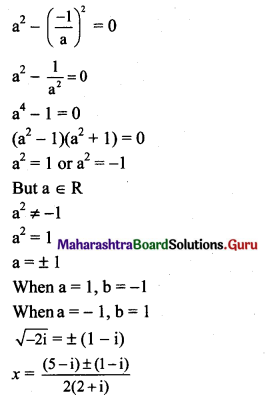
\(\lim _{x \rightarrow 1}\left(\frac{x+x^{3}+x^{5}+\ldots+x^{2 n-1}-n}{x-1}\right)\)
Solution:
Maharashtra Board 11th Maths Solutions Chapter 7 Limits Ex 7.1 III Q9
Maharashtra Board 11th Maths Solutions Chapter 7 Limits Ex 7.1 III Q9.1

IV. In the following examples, given ∈ > 0, find a δ > 0 such that whenever, |x – a| < δ, we must have |f(x) – l| < ∈.

Question 1.
\(\lim _{x \rightarrow 2}(2 x+3)=7\)
Solution:
We have to find some δ so that
\(\lim _{x \rightarrow 2}(2 x+3)=7\)
Here a = 2, l = 1 and f(x) = 2x + 3
Consider ∈ > 0 and |f(x) – l| < ∈
∴ |(2x + 3) – 7| < ∈
∴ |2x + 4| < ∈
∴ 2(x – 2)|< ∈
∴ |x – 2| < \(\frac{\epsilon}{2}\)
∴ δ ≤ \(\frac{\epsilon}{2}\) such that
|2x + 4| < δ ⇒ |f(x) – 7| < ∈

Question 2.
\(\lim _{x \rightarrow-3}(3 x+2)=-7\)
Solution:
We have to find some δ so that
\(\lim _{x \rightarrow-3}(3 x+2)=-7\)
Here a = -3, l = -7 and f(x) = 3x + 2
Consider ∈ > 0 and |f(x) – l| < ∈
∴ |3x + 2 – (-7)| < ∈
∴ |3x + 9| < ∈
∴ |3(x + 3)| < ∈
∴ |x + 3| < \(\frac{\epsilon}{3}\)
∴ δ < \(\frac{\epsilon}{3}\) such that
|x + 3| ≤ δ ⇒ |f(x) + 7| < ∈

Maharashtra Board 11th Maths Solutions Chapter 7 Limits Ex 7.1

Question 3.
\(\lim _{x \rightarrow 2}\left(x^{2}-1\right)=3\)
Solution:
We have to find some δ > 0 such that
\(\lim _{x \rightarrow 2}\left(x^{2}-1\right)=3\)
Here, a = 2, l = 3 and f(x) = x2 – 1
Consider ∈ > 0 and |f(x) – l| < ∈
∴ |(x2 – 1) – 3| < ∈
∴ |x2 – 4| < ∈
∴ |(x + 2)(x – 2)| < ∈ …..(i)
We have to get rid of the factor |x + 2|
As |x – 2| < δ
-δ < x – 2 < δ
∴ 2 – δ < x < 2 + δ
Since δ can be assumed as very small, let us choose δ < 1
∴ 1 < x < 3
∴ 3 < x + 2 < 5 …..(Adding 2 throughout)
∴ |x + 2| < 5
∴ |(x + 2)(x – 2)| < 5|x – 2| ……(ii)
From (i) and (ii), we get
5|x – 2|< ∈
∴ x – 2 < \(\frac{\epsilon}{5}\)
If δ = \(\frac{\epsilon}{5}\), |x – 2| < δ ⇒ |x2 – 4| < ∈
∴ We choose δ = min{\(\frac{\epsilon}{5}\), 1} then
|x – 2| < δ ⇒ |f(x) – 3| < ∈

Maharashtra Board 11th Maths Solutions Chapter 7 Limits Ex 7.1

Question 4.
\(\lim _{x \rightarrow 1}\left(x^{2}+x+1\right)=3\)
Solution:
We have to find some δ > 0 such that
\(\lim _{x \rightarrow 1}\left(x^{2}+x+1\right)=3\)
Here a = 1, l = 3 and f(x) = x2 + x + 1
Consider ∈ > 0 and |f(x) – l| < ∈
∴ |x2 + x + 1 – 3| < ∈
∴ |x2 + x – 2| < ∈
∴ |(x + 2)(x – 1)| < ∈ …..(i)
We have to get rid of the factor |x + 2|
As |x – 1| < δ
-δ < x – 1 < δ
∴ 1 – δ < x < 1 + δ
Since δ can be assumed as very small, let us choose δ < 1
∴ 0 < x < 2
∴ 2 < x + 2 < 4
∴ |x + 2| < 4
∴ |(x + 2)(x – 1)|< 4 |x – 1| …..(ii)
From (i) and (ii), we get
4|x – 1| < ∈
∴ |x – 1| < \(\frac{\epsilon}{4}\)
If δ = \(\frac{\epsilon}{4}\),
|x – 1| < δ ⇒ x2 + x – 2 < ∈
∴ We choose δ = min{\(\frac{\epsilon}{4}\), 1} then
|x – 1| < δ ⇒ |f(x) – 3| < ∈

Maharashtra Board 11th Maths Solutions Chapter 4 Methods of Induction and Binomial Theorem Ex 4.1

Balbharti Maharashtra State Board 11th Maths Book Solutions Pdf Chapter 4 Methods of Induction and Binomial Theorem Ex 4.1 Questions and Answers.

Maharashtra State Board 11th Maths Solutions Chapter 4 Methods of Induction and Binomial Theorem Ex 4.1

Prove by the method of induction, for all n ∈ N.

Question 1.
2 + 4 + 6 + …… + 2n = n(n + 1)
Solution:
Let P(n) = 2 + 4 + 6 + …… + 2n = n(n + 1), for all n ∈ N.
Step I:
Put n = 1
L.H.S. = 2
R.H.S. = 1(1 + 1) = 2
∴ L.H.S. = R.H.S.
∴ P(n) is true for n = 1.

Step II:
Let us assume that P(n) is true for n = k.
∴ 2 + 4 + 6 + ….. + 2k = k(k + 1) ……(i)

Step III:
We have to prove that P(n) is true for n = k + 1,
i.e., to prove that
2 + 4 + 6 + …… + 2(k + 1) = (k + 1) (k + 2)
L.H.S. = 2 + 4 + 6 + …+ 2(k + 1)
= 2 + 4 + 6+ ….. + 2k + 2(k + 1)
= k(k + 1) + 2(k + 1) …..[From (i)]
= (k + 1).(k + 2)
= R.H.S.
∴ P(n) is true for n = k + 1.

Step IV:
From all the steps above, by the principle of mathematical induction, P(n) is true for all n ∈ N.
∴ 2 + 4 + 6 + …… + 2n = n(n + 1) for all n ∈ N.

Maharashtra Board 11th Maths Solutions Chapter 4 Methods of Induction and Binomial Theorem Ex 4.1

Question 2.
3 + 7 + 11 + ……… to n terms = n(2n + 1)
Solution:
Let P(n) = 3 + 7 + 11 + ……… to n terms = n(2n +1), for all n ∈ N.
But 3, 7, 11, …. are in A.P.
∴ a = 3 and d = 4
Let tn be the nth term.
∴ tn = a + (n – 1)d = 3 + (n – 1)4 = 4n – 1
∴ P(n) = 3 + 7 + 11 + ……. + (4n – 1) = n(2n + 1)

Step I:
Put n = 1
L.H.S. = 3
R.H.S. = 1[2(1)+ 1] = 3
∴ L.H.S. = R.H.S.
∴ P(n) is true for n = 1.

Step II:
Let us assume that P(n) is true for n = k.
∴ 3 + 7 + 11 + ….. + (4k – 1) = k(2k + 1) …..(i)

Sept III:
We have to prove that P(n) is true for n = k + 1,
i.e., to prove that
3 + 7 + 11 + …+ [4(k + 1) – 1] = (k + 1)(2k + 3)
L.H.S. = 3 + 7 + 11 + …… + [4(k + 1) – 1]
= 3 + 7 + 11 + ….. + (4k – 1) + [4(k+ 1) – 1]
= k(2k + 1) + (4k + 4 – 1) …..[From (i)]
= 2k2 + k + 4k + 3
= 2k2 + 2k + 3k + 3
= 2k(k + 1) + 3(k + 1)
= (k + 1) (2k + 3)
= R.H.S.
∴ P(n) is true for n = k + 1.

Step IV:
From all the steps above, by the principle of mathematical induction, P(n) is true for all n ∈ N.
∴ 3 + 7 + 11 + ….. to n terms = n(2n + 1) for all n ∈ N.

Question 3.
12 + 22 + 32 +…..+ n2 = \(\frac{n(n+1)(2 n+1)}{6}\)
Solution:
Let P(n) = 12 + 22 + 32 +…..+ n2 = \(\frac{n(n+1)(2 n+1)}{6}\) for all n ∈ N.
Step I:
Put n = 1
L.H.S. = 12 = 1
RHS = \(\frac{1(1+1)[2(1)+1]}{6}=\frac{6}{6}\) = 1
∴ L.H.S. = R.H.S.
∴ P(n) is true for n = 1.

Step II:
Let us assume that P(n) is true for n = k.
∴ 12 + 22 + 32 +…+ k2 = \(\frac{k(k+1)(2 k+1)}{6}\) …..(i)

Step III:
We have to prove that P(n) is true for n = k + 1,
i.e., to prove that
Maharashtra Board 11th Maths Solutions Chapter 4 Methods of Induction and Binomial Theorem Ex 4.1 Q3
∴ P(n) is true for n = k + 1.

Step IV:
From all the steps above, by the principle of mathematical induction, P(n) is true for all n ∈ N.
∴ 12 + 22 + 32 + …+ n2 = \(\frac{n(n+1)(2 n+1)}{6}\) for all n ∈ N.

Maharashtra Board 11th Maths Solutions Chapter 4 Methods of Induction and Binomial Theorem Ex 4.1

Question 4.
12 + 32 + 52 + ….. + (2n – 1)2 = \(\frac{n}{3}\) (2n – 1)(2n + 1)
Solution:
Let P(n) = 12 + 32 + 52+…..+ (2n – 1)2 = \(\frac{n}{3}\) (2n – 1)(2n + 1), for all n ∈ N.
Step I:
Put n = 1
L.H.S. = 12 = 1
R.H.S. = \(\frac{1}{3}\) [2(1) – 1][2(1) + 1] = 1
∴ L.H.S. = R.H.S.
∴ P(n) is true for n = 1.

Step II:
Let us assume that P(n) is true for n = k.
∴ 12 + 32 + 52 +….+(2k – 1)2 = \(\frac{k}{3}\) (2k – 1)(2k + 1) …….(i)

Step III:
We have to prove that P(n) is true for n = k + 1,
i.e., to prove that
Maharashtra Board 11th Maths Solutions Chapter 4 Methods of Induction and Binomial Theorem Ex 4.1 Q4
∴ P(n) is true for n = k + 1.

Step IV:
From all the steps above, by the principle of mathematical induction, P(n) is true for all n ∈ N.
∴ 12 + 32 + 52 + …+ (2n – 1)2 = \(\frac{n}{3}\) (2n – 1)(2n + 1) for all n ∈ N.

Question 5.
13 + 33 + 53 + ….. to n terms = n2 (2n2 – 1)
Solution:
Let P(n) = 13 + 33 + 53 + …. to n terms = n2 (2n2 – 1), for all n ∈ N.
But 1, 3, 5, are in A.P.
∴ a = 1, d = 2
Let tn be the nth term.
tn = a + (n – 1) d = 1 + (n – 1) 2 = 2n – 1
∴ P(n) = 13 + 33 + 53 +…..+ (2n – 1)3 = n2 (2n2 – 1)

Step I:
Put n = 1
L.H.S. = 13 = 1
R.H.S. = 12 [2(1)2 – 1] = 1
∴ L.H.S. = R.H.S.
∴ P(n) is true for n = 1.

Step II:
Let us assume that P(n) is true for n = k.
∴ 13 + 33 + 53 +…+ (2k – 1)3 = k2 (2k2 – 1) …..(i)

Step III:
We have to prove that P(n) is true for n = k + 1,
i.e., to prove that
Maharashtra Board 11th Maths Solutions Chapter 4 Methods of Induction and Binomial Theorem Ex 4.1 Q5
∴ P(n) is true for n = k + 1.

Step IV:
From all the steps above, by the principle of mathematical induction, P(n) is true for all n ∈ N.
∴ 13 + 33 + 53 + … to n terms = n2 (2n2 – 1) for all n ∈ N.

Maharashtra Board 11th Maths Solutions Chapter 4 Methods of Induction and Binomial Theorem Ex 4.1

Question 6.
1.2 + 2.3 + 3.4 +… + n(n + 1) = \(\frac{n}{3}\) (n + 1)(n + 2)
Solution:
Let P(n) = 1.2 + 2.3 + 3.4 +….+n(n + 1) = \(\frac{n(n+1)(n+2)}{3}\), for all n ∈ N.

Step I:
Put n = 1
L.H.S. = 1.2 = 2
R.H.S. = \(\frac{1}{3}\) (1 + 1)(1 + 2) = 2
∴ L.H.S. = R.H.S.
∴ P(n) is true for n = 1.

Step II:
Let us assume that P(n) is true for n = k.
∴ 1.2 + 2.3 + 3.4 + ….. + k(k + 1) = \(\frac{k}{3}\) (k + 1)(k + 2) ……(i)

Step III:
We have to prove that P(n) is true for n = k + 1,
i.e., to prove that
Maharashtra Board 11th Maths Solutions Chapter 4 Methods of Induction and Binomial Theorem Ex 4.1 Q6
∴ P(n) is true for n = k + 1.

Step IV:
From all the steps above, by the principle of mathematical induction, P(n) is true for all n ∈ N.
∴ 1.2 + 2.3 + 3.4 + … + n(n + 1) = \(\frac{n}{3}\) (n + 1)(n + 2), for all n ∈ N.

Question 7.
1.3 + 3.5 + 5.7 +… to n terms = \(\frac{n}{3}\) (4n2 + 6n – 1)
Solution:
Let P(n) = 1.3 + 3.5 + 5.7 +… to n terms = \(\frac{n}{3}\) (4n2 + 6n -1), for all n ∈ N.
But first factor in each term, i.e., 1, 3, 5,… are in A.P. with a = 1 and d = 2.
∴ nth term = a + (n – 1)d = 1 + (n – 1) 2 = (2n – 1)
Also, second factor in each term,
i.e., 3, 5, 7, … are in A.P. with a = 3 and d = 2.
∴ nth term = a + (n – 1) d = 3 + (n – 1) 2 = (2n + 1)
∴ nth term, tn = (2n – 1) (2n + 1)
∴ P(n) ≡ 1.3 + 3.5 + 5.7 + …. + (2n – 1) (2n + 1) = \(\frac{n}{3}\) (4n2 + 6n – 1)

Step I:
Put n = 1
L.H.S. = 1.3 = 3
R.H.S. = \(\frac{1}{3}\) [4(1)2 + 6(1) – 1] = 3
∴ L.H.S. = R.H.S.
∴ P(n) is trae for n = 1.

Step II:
Let us assume that P(n) is true for n = k.
∴ 1.3 + 3.5 + 5.7 +….+ (2k – 1)(2k + 1) = \(\frac{k}{3}\) (4k2 + 6k – 1) ……(i)

Step III:
We have to prove that P(n) is true for n = k + 1,
i.e., to prove that
Maharashtra Board 11th Maths Solutions Chapter 4 Methods of Induction and Binomial Theorem Ex 4.1 Q7
∴ P(n) is true for n = k + 1.

Step IV:
From all the steps above, by the principle of mathematical induction, P(n) is true for all n ∈ N.
∴ 1.3 + 3.5 + 5.7 +… to n terms = \(\frac{n}{3}\) (4n2 + 6n – 1) for all n ∈ N.

Maharashtra Board 11th Maths Solutions Chapter 4 Methods of Induction and Binomial Theorem Ex 4.1

Question 8.
\(\frac{1}{1.3}+\frac{1}{3.5}+\frac{1}{5.7}+\ldots+\frac{1}{(2 n-1)(2 n+1)}=\frac{n}{2 n+1}\)
Solution:
Let P(n) ≡ \(\frac{1}{1.3}+\frac{1}{3.5}+\frac{1}{5.7}+\ldots+\frac{1}{(2 n-1)(2 n+1)}=\frac{n}{2 n+1}\), for all n ∈ N.

Step I:
Put n = 1
L.H.S. = \(\frac{1}{1.3}=\frac{1}{3}\)
R.H.S. = \(\frac{1}{2(1)+1}=\frac{1}{3}\)
∴ L.H.S. = R.H.S.
∴ P(n) is true for n = 1.

Step II:
Let us assume that P(n) is true for n = k.
∴ \(\frac{1}{1.3}+\frac{1}{3.5}+\frac{1}{5.7}+\ldots+\frac{1}{(2 k-1)(2 k+1)}=\frac{k}{2 k+1}\) …..(i)

Step III:
We have to prove that P(n) is true for n = k + 1,
i.e., to prove that
Maharashtra Board 11th Maths Solutions Chapter 4 Methods of Induction and Binomial Theorem Ex 4.1 Q8
∴ P(n) is true for n = k + 1.

Step IV:
From all the steps above, by the principle of mathematical induction, P(n) is true for all n ∈ N.
∴ \(\frac{1}{1.3}+\frac{1}{3.5}+\frac{1}{5.7}+\ldots+\frac{1}{(2 n-1)(2 n+1)}=\frac{n}{2 n+1}\), for all n ∈ N.

Question 9.
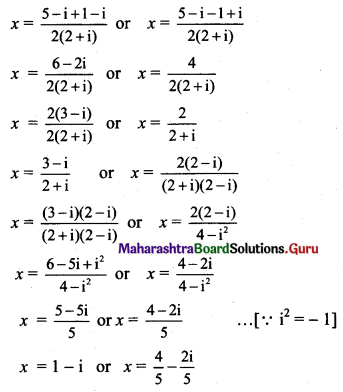
\(\frac{1}{3.5}+\frac{1}{5.7}+\frac{1}{7.9}+\ldots \text { to } n \text { terms }=\frac{n}{3(2 n+3)}\)
Solution:
Let P(n) ≡ \(\frac{1}{3.5}+\frac{1}{5.7}+\frac{1}{7.9}+\ldots \text { to } n \text { terms }=\frac{n}{3(2 n+3)}\), for all n ∈ N.
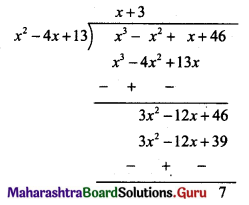
But first factor in each term of the denominator,
i.e., 3, 5, 7, ….. are in A.P. with a = 3 and d = 2.
∴ nth term = a + (n – 1)d = 3 + (n – 1) 2 = (2n + 1)
Also, second factor in each term of the denominator,
i.e., 5, 7, 9, … are in A.P. with a = 5 and d = 2.
∴ nth term = a + (n – 1) d = 5 + (n – 1) 2 = (2n + 3)
∴ nth term, tn = \(\frac{1}{(2 n+1)(2 n+3)}\)
P(n) ≡ \(\frac{1}{3.5}+\frac{1}{5.7}+\frac{1}{7.9}+\ldots+\frac{1}{(2 n+1)(2 n+3)}\) = \(\frac{n}{3(2 n+3)}\)

Step I:
Put n = 1
L.H.S. = \(\frac{1}{3.5}=\frac{1}{15}\)
R.H.S. = \(\frac{1}{3[2(1)+3]}=\frac{1}{3(2+3)}=\frac{1}{15}\)
∴ L.H.S. = R.H.S.
∴ P(n) is true for n = 1.

Step II:
Let us assume that P(n) is true for n = k.
∴ \(\frac{1}{3.5}+\frac{1}{5.7}+\frac{1}{7.9}+\ldots+\frac{1}{(2 k+1)(2 k+3)}\) = \(\frac{k}{3(2 k+3)}\) ….(i)

Step III:
We have to prove that P(n) is true for n = k + 1,
i.e., to prove that
Maharashtra Board 11th Maths Solutions Chapter 4 Methods of Induction and Binomial Theorem Ex 4.1 Q9
Maharashtra Board 11th Maths Solutions Chapter 4 Methods of Induction and Binomial Theorem Ex 4.1 Q9.1
∴ P(n) is true for n = k + 1.

Step IV:
From all the steps above, by the principle of mathematical induction, P(n) is true for all n ∈ N.
∴ \(\frac{1}{3.5}+\frac{1}{5.7}+\frac{1}{7.9}+\ldots \text { to } n \text { terms }=\frac{n}{3(2 n+3)}\), for all n ∈ N.

Maharashtra Board 11th Maths Solutions Chapter 4 Methods of Induction and Binomial Theorem Ex 4.1

Question 10.
(23n – 1) is divisible by 7.
Solution:
(23n – 1) is divisible by 7 if and only if (23n – 1) is a multiple of 7.
Let P(n) ≡ (23n – 1) = 7m, where m ∈ N.

Step I:
Put n = 1
∴ 23n – 1 = 23(1) – 1 = 23 – 1 = 8 – 1 = 7
∴ (23n – 1) is a multiple of 7.
∴ P(n) is true for n = 1.

Step II:
Let us assume that P(n) is true for n = k.
i.e., 23k – 1 is a multiple of 7.
∴ 23k – 1 = 7a, where a ∈ N
∴ 23k = 7a + 1 ……(i)

Step III:
We have to prove that P(n) is true for n = k + 1,
i.e., to prove that
23(k+1) – 1 = 7b, where b ∈ N.
∴ P(k + 1) = 23(k+1) – 1
= 23k+3 – 1
= 23k . (23) – 1
= (7a + 1)8 – 1 …..[From (i)]
= 56a + 8 – 1
= 56a + 7
= 7(8a + 1)
7b, where b = (8a + 1) ∈ N
∴ P(n) is true for n = k + 1.

Step IV:
From all the steps above, by the principle of mathematical induction, P(n) is true for all n ∈ N.
∴ (24n – 1) is divisible by 7, for all n ∈ N.

Question 11.
(24n – 1) is divisible by 15.
Solution:
(24n – 1) is divisible by 15 if and only if (24n – 1) is a multiple of 15.
Let P(n) ≡ (24n – 1) = 15m, where m ∈ N.

Step I:
Put n = 1
∴ 24(1) – 1 = 16 – 1 = 15
∴ (24n – 1) is a multiple of 15.
∴ P(n) is true for n = 1.

Step II:
Let us assume that P(n) is true for n = k.
∴ 24k – 1 = 15a, where a ∈ N
∴ 24k = 15a + 1 …..(i)

Step III:
We have to prove that P(n) is true for n = k + 1,
i.e., to prove that
∴ 24(k+1) – 1 = 15b, where b ∈ N
∴ P(k + 1) = 24(k+1) – 1 = 24k+4 – 1
= 24k . 24 – 1
= 16 . (24k) – 1
= 16(15a + 1) – 1 …..[From (i)]
= 240a + 16 – 1
= 240a + 15
= 15(16a + 1)
= 15b, where b = (16a + 1) ∈ N
∴ P(n) is true for n = k + 1.

Step IV:
From all the steps above, by the principle of mathematical induction, P(n) is true for all n ∈ N.
∴ (24n – 1) is divisible by 15, for all n ∈ N.

Maharashtra Board 11th Maths Solutions Chapter 4 Methods of Induction and Binomial Theorem Ex 4.1

Question 12.
3n – 2n – 1 is divisible by 4.
Solution:
(3n – 2n – 1) is divisible by 4 if and only if (3n – 2n – 1) is a multiple of 4.
Let P(n) ≡ (3n – 2n – 1) = 4m, where m ∈ N.

Step I:
Put n = 1
∴ (3n – 2n – 1) = 3(1) – 2(1) – 1 = 0 = 4(0)
∴ (3n – 2n – 1) is a multiple of 4.
∴ P(n) is tme for n = 1.

Step II:
Let us assume that P(n) is true for n = k.
∴ 3k – 2k – 1 = 4a, where a ∈ N
∴ 3k = 4a + 2k + 1 ….(i)

Step III:
We have to prove that P(n) is tme for n = k + 1,
i.e., to prove that
3(k+1) – 2(k + 1) – 1 = 4b, where b ∈ N
P(k + 1) = 3k+1 – 2(k + 1) – 1
= 3k . 3 – 2k – 2 – 1
= (4a + 2k + 1) . 3 – 2k – 3 …….[From (i)]
= 12a + 6k + 3 – 2k – 3
= 12a + 4k
= 4(3a + k)
= 4b, where b = (3a + k) ∈ N
∴ P(n) is tme for n = k + 1.

Step IV:
From all the steps above, by the principle of mathematical induction, P(n) is tme for all n ∈ N.
∴ 3n – 2n – 1 is divisible by 4, for all n ∈ N.

Question 13.
5 + 52 + 53 + ….. + 5n = \(\frac{5}{4}\) (5n – 1)
Solution:
Let P(n) ≡ 5 + 52 + 53 +…..+ 5n = \(\frac{5}{4}\) (5n – 1), for all n ∈ N.

Step I:
Put n = 1
L.H.S. = 5
R.H.S. = \(\frac{5}{4}\) (51 – 1) = 5
∴ L.H.S. = R.H.S.
∴ P(n) is true for n = 1.

Step II:
Let us assume that P(n) is true for n = k.
∴ 5 + 52 + 53 + ….. + 5k = \(\frac{5}{4}\) (5k – 1) …….(i)

Step III:
We have to prove that P(n) is true for n = k + 1,
i.e., to prove that
Maharashtra Board 11th Maths Solutions Chapter 4 Methods of Induction and Binomial Theorem Ex 4.1 Q13
∴ P(n) is true for n = k + 1.

Step IV:
From all the steps above, by the principle of mathematical induction, P(n) is true for all n ∈ N.
∴ 5 + 52 + 53 + … + 5n = \(\frac{5}{4}\) (5n – 1), for all n ∈ N.

Maharashtra Board 11th Maths Solutions Chapter 4 Methods of Induction and Binomial Theorem Ex 4.1

Question 14.
(cos θ + i sin θ)n = cos (nθ) + i sin (nθ)
Solution:
Let P(n) ≡ (cos θ + i sin θ)n = cos nθ + i sin nθ, for all n ∈ N.
Step I:
Put n = 1
L.H.S. = (cos θ + i sin θ)1 = cos θ + i sin θ
R.H.S. = cos[(1)θ] + i sin[(1)θ] = cos θ + i sin θ
∴ L.H.S. = R.H.S.
∴ P(n) is true for n = 1.

Step II:
Let us assume that P(n) is true for n = k.
∴ (cos θ + i sin θ)k = cos kθ + i sin kθ …….(i)

Step III:
We have to prove that P(n) is true for n = k + 1,
i.e., to prove that
(cos θ + i sin θ)k+1 = cos (k + 1)θ + i sin (k + 1)θ
L.H.S. = (cos θ + i sin θ)k+1
= (cos θ + i sin θ)k . (cos θ + i sin θ)
= (cos kθ + i sin kθ) . (cos θ + i sin θ) ……[From (i)]
= cos kθ cos θ + i sin θ cos kθ + i sin kθ cosθ – sin kθ sin θ ……[∵ i2 = -1]
= (cos kθ cos θ – sin k θ sin θ) + i(sin kθ cos θ + cos kθ sin θ)
= cos(kθ + θ) + i sin(kθ + θ)
= cos(k + 1) θ + i sin (k + 1) θ
= R.H.S.
∴ P(n) is true for n = k + 1.

Step IV:
From all the steps above, by the principle of mathematical induction, P(n) is true for all n ∈ N.
∴ (cos θ + i sin θ)n = cos (nθ) + i sin (nθ), for all n ∈ N.

Question 15.
Given that tn+1 = 5 tn+4, t1 = 4, prove by method of induction that tn = 5n – 1.
Solution:
Let the statement P(n) has L.H.S. a recurrence relation tn+1 = 5 tn+4, t1 = 4 and R.H.S. a general statement tn = 5n – 1.
Step I:
Put n = 1
L.H.S. = 4
R.H.S. = 51 – 1 = 4
∴ L.H.S. = R.H.S.
∴ P(n) is true for n = 1.
Put n = 2
L.H.S. = t2 = 5t1 + 4 = 24
R.H.S. = t2 = 52 – 1 = 24
∴ L.H.S. = R.H.S.
∴ P(n) is true for n = 2.

Step II:
Let us assume that P(n) is true for n = k.
∴ tk+1 = 5 tk+4 and tk = 5k – 1

Step III:
We have to prove that P(n) is true for n = k + 1,
i.e., to prove that tk+1 = 5k+1 – 1
Since tk+1 = 5 tk+4 and tk = 5k – 1 …..[From Step II]
tk+1 = 5 (5k – 1) + 4 = 5k+1 – 1
∴ P(n) is true for n = k + 1.

Step IV:
From all the steps above, by the principle of mathematical induction, P(n) is true for all n ∈ N.
∴ tn = 5n – 1, for all n ∈ N.

Maharashtra Board 11th Maths Solutions Chapter 4 Methods of Induction and Binomial Theorem Ex 4.1

Question 16.
Prove by method of induction
\(\left(\begin{array}{ll}
1 & 2 \\
0 & 1
\end{array}\right)^{n}=\left(\begin{array}{cc}
1 & 2 n \\
0 & 1
\end{array}\right) \forall n \in N\)
Solution:
Maharashtra Board 11th Maths Solutions Chapter 4 Methods of Induction and Binomial Theorem Ex 4.1 Q16
Maharashtra Board 11th Maths Solutions Chapter 4 Methods of Induction and Binomial Theorem Ex 4.1 Q16.1

Maharashtra Board 11th Maths Solutions Chapter 1 Complex Numbers Ex 1.3

Balbharti Maharashtra State Board 11th Maths Book Solutions Pdf Chapter 1 Complex Numbers Ex 1.3 Questions and Answers.

Maharashtra State Board 11th Maths Solutions Chapter 1 Complex Numbers Ex 1.3

Question 1.
Find the modulus and amplitude for each of the following complex numbers:
(i) 7 – 5i
Solution:
Let z = 7 – 5i
a = 7, b = -5
i.e. a > 0, b < 0
|z| = \(\sqrt{a^{2}+b^{2}}=\sqrt{7^{2}+(-5)^{2}}=\sqrt{49+25}=\sqrt{74}\)
Here, (7, -5) lies in 4th quadrant.
Maharashtra Board 11th Maths Solutions Chapter 1 Complex Numbers Ex 1.3 Q1 (i)

(ii) √3 + √2 i
Solution:
Let z = √3 + √2 i
a = √3, b = √2,
i.e. a > 0, b > 0
Maharashtra Board 11th Maths Solutions Chapter 1 Complex Numbers Ex 1.3 Q1 (ii)

Maharashtra Board 11th Maths Solutions Chapter 1 Complex Numbers Ex 1.3

(iii) -8 + 15i
Solution:
Let z = -8 + 15i
a = -8, b = 15 , i.e. a < 0, b > 0
Maharashtra Board 11th Maths Solutions Chapter 1 Complex Numbers Ex 1.3 Q1 (iii)

(iv) -3(1 – i)
Solution:
Let z = -3(1 – i) = -3 + 3i
a = -3, b = 3 , i.e. a < 0, b > 0
|z| = \(\sqrt{a^{2}+b^{2}}=\sqrt{(-3)^{2}+3^{2}}=\sqrt{9+9}\) = 3√2
Here, (-3, 3) lies in 2nd quadrant.
amp(z) = π – \(\tan ^{-1}\left|\frac{b}{a}\right|\)
Maharashtra Board 11th Maths Solutions Chapter 1 Complex Numbers Ex 1.3 Q1 (iv)

(v) -4 – 4i
Solution:
Let z = -4 – 4i
a = -4, b = -4 , i.e. a < 0, b < 0
Maharashtra Board 11th Maths Solutions Chapter 1 Complex Numbers Ex 1.3 Q1 (v)

(vi) √3 – i
Solution:
Let z = √3 – i
a = √3, b = -1, i.e. a > 0, b < 0
Maharashtra Board 11th Maths Solutions Chapter 1 Complex Numbers Ex 1.3 Q1 (vi)

(vii) 3
Solution:
Let z = 3 + 0i
a = 3, b = 0
z is a real number, it lies on the positive real axis.
|z|= \(\sqrt{a^{2}+b^{2}}=\sqrt{3^{2}+0^{2}}=\sqrt{9+0}\) = 3
and amp (z) = 0

Maharashtra Board 11th Maths Solutions Chapter 1 Complex Numbers Ex 1.3

(viii) 1 + i
Solution:
Let z = 1 + i
a = 1, b = 1, i.e. a > 0, b > 0
|z| = \(\sqrt{a^{2}+b^{2}}=\sqrt{1^{2}+1^{2}}=\sqrt{1+1}=\sqrt{2}\)
Here, (1, 1) lies in 1st quadrant.
amp (z) = \(\tan ^{-1}\left(\frac{b}{a}\right)=\tan ^{-1}(1)=\frac{\pi}{4}\)

(ix) 1 + i√3
Solution:
Let z = 1 + i√3
a = 1, b = √3, i.e. a > 0, b > 0
|z| = \(\sqrt{a^{2}+b^{2}}=\sqrt{1^{2}+(\sqrt{3})^{2}}=\sqrt{1+3}=2\)
Here, (1, √3) lies in 1st quadrant.
amp (z) = \(\tan ^{-1}\left(\frac{b}{a}\right)=\tan ^{-1}(\sqrt{3})=\frac{\pi}{3}\)

(x) (1 + 2i)2 (1 – i)
Solution:
Let z = (1 + 2i)2 (1 – i)
= (1 + 4i + 4i2) (1 – i)
= [1 + 4i + 4(-1)] (1 – i) ….[∵ i2 = -1]
= (-3 + 4i) (1 – i)
= -3 + 3i + 4i – 4i2
= -3 + 7i – 4(-1)
= -3 + 7i + 4
∴ z = 1 + 7i
∴ a = 1, b = 7, i. e. a > 0, b > 0
∴ |z| = \(\sqrt{\mathrm{a}^{2}+\mathrm{b}^{2}}=\sqrt{1^{2}+7^{2}}=\sqrt{1+49}=5 \sqrt{2}\)
Here, (1, 7) lies in 1st quadrant.
∴ amp(z) = \(\tan ^{-1}\left(\frac{b}{a}\right)=\tan ^{-1}(7)\)

Question 2.
Find real values of θ for which \(\left(\frac{4+3 i \sin \theta}{1-2 i \sin \theta}\right)\) is purely real.
Solution:
Maharashtra Board 11th Maths Solutions Chapter 1 Complex Numbers Ex 1.3 Q2

Maharashtra Board 11th Maths Solutions Chapter 1 Complex Numbers Ex 1.3

Question 3.
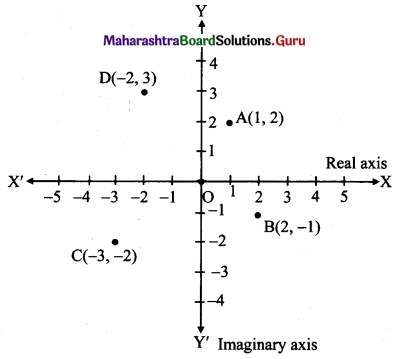
If z = 3 + 5i, then represent the z, \(\overline{\mathbf{z}}\), -z, \(\overline{\mathbf{-z}}\) in Argand’s diagram.
Solution:
z = 3 + 5i
\(\overline{\mathbf{z}}\) = 3 – 5i
-z = – 3 – 5i
\(\overline{\mathbf{-z}}\)= -3 + 5i
The above complex numbers will be represented by the points
A (3, 5), B (3, -5), C (-3, -5) , D (-3, 5) respectively as shown below:
Maharashtra Board 11th Maths Solutions Chapter 1 Complex Numbers Ex 1.3 Q3

Question 4.
Express the following complex numbers in polar form and exponential form.
(i) -1 + √3 i
Solution:
Let z = – 1 + √3
a = -1, b = √3
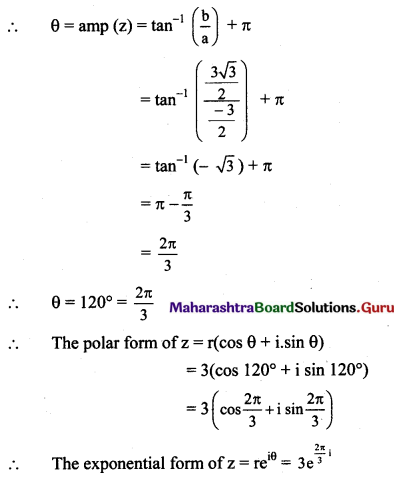
Maharashtra Board 11th Maths Solutions Chapter 1 Complex Numbers Ex 1.3 Q4 (i)

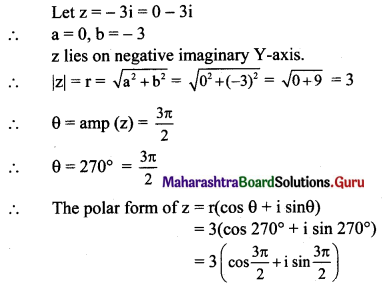
(ii) -i
Solution:
Let z = -i = 0 – i
a = 0, b = -1
z lies on negative imaginary Y-axis.
|z| = r = \(\sqrt{\mathrm{a}^{2}+\mathrm{b}^{2}}=\sqrt{0^{2}+(-1)^{2}}\) = 1 and
θ = amp z = 270° = \(\frac{3 \pi}{2}\)
The polar form of z = r (cos θ + i sin θ)
= 1 (cos 270° + i sin 270°)
= 1 (cos \(\frac{3 \pi}{2}\) + i sin \(\frac{3 \pi}{2}\))
The exponential form of z = \(r e^{i \theta}=e^{\frac{3 \pi}{2} i}\)

(iii) -1
Solution:
Let z = -1 = -1 + 0.i
a = -1, b = 0
z lies on negative real X-axis.
|z| = r = \(\sqrt{a^{2}+b^{2}}=\sqrt{(-1)^{2}+0^{2}}\) = 1 and
θ = amp z = 180° = π
The polar form of z = r (cos θ + i sin θ)
= 1 (cos 180° + i sin 180°)
= 1 (cos π + i sin π)
The exponential form of z = \(r e^{i \theta}=e^{\pi i}\)

Maharashtra Board 11th Maths Solutions Chapter 1 Complex Numbers Ex 1.3

(iv) \(\frac{1}{1+i}\)
Solution:
Maharashtra Board 11th Maths Solutions Chapter 1 Complex Numbers Ex 1.3 Q4 (iv)
Maharashtra Board 11th Maths Solutions Chapter 1 Complex Numbers Ex 1.3 Q4 (iv).1
Maharashtra Board 11th Maths Solutions Chapter 1 Complex Numbers Ex 1.3 Q4 (iv).2

(v) \(\frac{1+2 i}{1-3 i}\)
Solution:
Maharashtra Board 11th Maths Solutions Chapter 1 Complex Numbers Ex 1.3 Q4 (v)
Maharashtra Board 11th Maths Solutions Chapter 1 Complex Numbers Ex 1.3 Q4 (v).1

(vi) \(\frac{1+7 \mathbf{i}}{(2-\mathbf{i})^{2}}\)
Solution:
Maharashtra Board 11th Maths Solutions Chapter 1 Complex Numbers Ex 1.3 Q4 (vi)
Maharashtra Board 11th Maths Solutions Chapter 1 Complex Numbers Ex 1.3 Q4 (vi).1

Maharashtra Board 11th Maths Solutions Chapter 1 Complex Numbers Ex 1.3

Question 5.
Express the following numbers in the form x + iy:
(i) \(\sqrt{3}\left(\cos \frac{\pi}{6}+i \sin \frac{\pi}{6}\right)\)
Solution:
Maharashtra Board 11th Maths Solutions Chapter 1 Complex Numbers Ex 1.3 Q5 (i)

(ii) \(\sqrt{2} \cdot\left(\cos \frac{7 \pi}{4}+i \sin \frac{7 \pi}{4}\right)\)
Solution:
Maharashtra Board 11th Maths Solutions Chapter 1 Complex Numbers Ex 1.3 Q5 (ii)

(iii) \(7\left(\cos \left(-\frac{5 \pi}{6}\right)+i \sin \left(-\frac{5 \pi}{6}\right)\right)\)
Solution:
Maharashtra Board 11th Maths Solutions Chapter 1 Complex Numbers Ex 1.3 Q5 (iii)

(iv) \(e^{\frac{\pi}{3} i}\)
Solution:
Maharashtra Board 11th Maths Solutions Chapter 1 Complex Numbers Ex 1.3 Q5 (iv)

(v) \(e^{\frac{-4 \pi}{3} i}\)
Solution:
Maharashtra Board 11th Maths Solutions Chapter 1 Complex Numbers Ex 1.3 Q5 (v)
Maharashtra Board 11th Maths Solutions Chapter 1 Complex Numbers Ex 1.3 Q5 (v).1

Maharashtra Board 11th Maths Solutions Chapter 1 Complex Numbers Ex 1.3

(vi) \([latex]e^{\frac{5 \pi}{6} i}\)[/latex]
Solution:
Maharashtra Board 11th Maths Solutions Chapter 1 Complex Numbers Ex 1.3 Q5 (vi)

Question 6.
Find the modulus and argument of the complex number \(\frac{1+2 i}{1-3 i}\).
Solution:
Maharashtra Board 11th Maths Solutions Chapter 1 Complex Numbers Ex 1.3 Q6
Maharashtra Board 11th Maths Solutions Chapter 1 Complex Numbers Ex 1.3 Q6.1
Maharashtra Board 11th Maths Solutions Chapter 1 Complex Numbers Ex 1.3 Q6.2
Maharashtra Board 11th Maths Solutions Chapter 1 Complex Numbers Ex 1.3 Q6.3

Question 7.
Convert the complex number \(\mathrm{z}=\frac{i-1}{\cos \frac{\pi}{3}+i \sin \frac{\pi}{3}}\) in the polar form.
Solution:
Maharashtra Board 11th Maths Solutions Chapter 1 Complex Numbers Ex 1.3 Q7
Maharashtra Board 11th Maths Solutions Chapter 1 Complex Numbers Ex 1.3 Q8

Maharashtra Board 11th Maths Solutions Chapter 1 Complex Numbers Ex 1.3

Question 8.
For z = 2 + 3i, verify the following:
(i) \(\overline{(\bar{z})}=z\)
Solution:
z = 2 + 3i
∴ \(\bar{z}\) = 2 – 3i
∴ \(\overline{\bar{z}}\) = 2 + 3i = z

(ii) \(\overline{z \bar{z}}=|z|^{2}\)
Solution:
z\(\bar{z}\) = (2 + 3i) (2 – 3i)
= 4 – 9i2
= 4 – 9(-1) …..[∵ i2 = -1]
= 13
|z|2 = \(\left(\sqrt{2^{2}+3^{2}}\right)^{2}\)
= 22 + 32
= 4 + 9
= 13
∴ \(\overline{z \bar{z}}=|z|^{2}\)

(iii) (z + \(\bar{z}\)) is real
Solution:
(z + \(\bar{z}\)) = (2 + 3i) + (2 – 3i)
= 2 + 3i + 2 – 3i
= 4, which is a real number.
∴ z + \(\bar{z}\) is real.

(iv) z – \(\bar{z}\) = 6i
Solution:
z – \(\bar{z}\) = (2 + 3i) – (2 – 3i)
= 2 + 3i – 2 + 3i
= 6i

Maharashtra Board 11th Maths Solutions Chapter 1 Complex Numbers Ex 1.3

Question 9.
z1 = 1 + i, z2 = 2 – 3i, verify the following:
(i) \(\overline{Z_{1}+Z_{2}}=\overline{Z_{1}}+\overline{Z_{2}}\)
Solution:
Maharashtra Board 11th Maths Solutions Chapter 1 Complex Numbers Ex 1.3 Q9 (i)

(ii) \(\overline{Z_{1}-Z_{2}}=\overline{Z_{1}}-\overline{Z_{2}}\)
Solution:
Maharashtra Board 11th Maths Solutions Chapter 1 Complex Numbers Ex 1.3 Q9 (ii)

(iii) \(\overline{Z_{1} \cdot Z_{2}}=\overline{Z_{1}} \cdot \overline{Z_{2}}\)
Solution:
Maharashtra Board 11th Maths Solutions Chapter 1 Complex Numbers Ex 1.3 Q9 (iii)

Maharashtra Board 11th Maths Solutions Chapter 1 Complex Numbers Ex 1.3

(iv) \(\overline{\left(\frac{\mathbf{z}_{1}}{\mathbf{z}_{2}}\right)}=\frac{\overline{\mathbf{z}}_{1}}{\overline{\mathbf{z}}_{2}}\)
Solution:
Maharashtra Board 11th Maths Solutions Chapter 1 Complex Numbers Ex 1.3 Q9 (iv)
Maharashtra Board 11th Maths Solutions Chapter 1 Complex Numbers Ex 1.3 Q9 (iv).1

Maharashtra Board 11th Maths Solutions Chapter 3 Permutations and Combination Ex 3.1

Balbharti Maharashtra State Board 11th Maths Book Solutions Pdf Chapter 3 Permutations and Combination Ex 3.1 Questions and Answers.

Maharashtra State Board 11th Maths Solutions Chapter 3 Permutations and Combination Ex 3.1

Question 1.
A teacher wants to select the class monitor in a class of 30 boys and 20 girls. In how many ways can the monitor be selected if the monitor must be a girl?
Solution:
There are 30 boys and 20 girls.
A teacher can select any boy as a class monitor from 30 boys in 30 different ways and he can select any girl as a class monitor from 20 girls in 20 different ways.
∴ by the fundamental principle of addition, the total number of ways a teacher can select a class monitor = 30 + 20 = 50
Hence, there are 50 different ways to select a class monitor.

Question 2.
A Signal is generated from 2 flags by putting one flag above the other. If 4 flags of different colours are available, how many different signals can be generated?
Solution:
A signal is generated from 2 flags and there are 4 flags of different colours available.
∴ 1st flag can be any one of the available 4 flags.
∴ It can be selected in 4 ways.
Now, 2nd flag is to be selected for which 3 flags are available for a different signal.
∴ 2nd flag can be anyone from these 3 flags.
∴ It can be selected in 3 ways.
∴ By using the fundamental principle of multiplication, total no. of ways a signal can be generated = 4 × 3 = 12
∴ 12 different signals can be generated.

Maharashtra Board 11th Maths Solutions Chapter 3 Permutations and Combination Ex 3.1

Question 3.
How many two-letter words can be formed using letters from the word SPACE, when repetition of letters (i) is allowed (ii) is not allowed
Solution:
A two-letter word is to be formed out of the letters of the word SPACE.
(i) When repetition of the letters is allowed 1st letter can be selected in 5 ways.
2nd letter can be selected in 5 ways.
∴ By using the fundamental principle of multiplication, the total number of 2-letter words = 5 × 5 = 25

(ii) When repetition of the letters is not allowed 1st letter can be selected in 5 ways.
2nd letter can be selected in 4 ways.
∴ By using the fundamental principle of multiplication, the total number of 2-letter words = 5 × 4 = 20

Question 4.
How many three-digit numbers can be formed from the digits 0, 1, 3, 5, 6 if repetitions of digits (i) are allowed (ii) are not allowed?
Solution:
A three-digit number is to be formed from the digits 0, 1, 3, 5, 6.
(i) When repetition of digits is allowed,
100’s place digit should be a non-zero number.
Hence, it can be anyone from digits 1, 3, 5,6.
∴ 100’s place digit can be selected in 4 ways.
10’s and unit’s place digit can be zero and digits can be repeated.
∴ 10’s place digit can be selected in 5 ways and the unit’s place digit can be selected in 5 ways.
∴ By using the fundamental principle of multiplication, the total number of three-digit numbers = 4 × 5 × 5 = 100

(ii) When repetition of digits is not allowed,
100’s place digit should be a non-zero number.
Hence, it can be anyone from digits 1, 3, 5, 6.
∴ 100’s place digit can be selected in 4 ways.
10’s and unit’s place digit can be zero and digits can’t be repeated.
∴ 10’s place digit can be selected in 4 ways and the unit’s place digit can be selected in 3 ways.
∴ By using the fundamental principle of multiplication, the total number of two-digit numbers = 4 × 4 × 3 = 48

Question 5.
How many three-digit numbers can be formed using the digits 2, 3, 4, 5, 6 if digits can be repeated?
Solution:
A 3-digit number is to be formed from the digits 2, 3, 4, 5, 6 where digits can be repeated.
∴ Unit’s place digit can be selected in 5 ways.
10’s place digit can be selected in 5 ways.
100’s place digit can be selected in 5 ways.
∴ By using fundamental principle of multiplication, total number of 3-digit numbers = 5 × 5 × 5 = 125

Maharashtra Board 11th Maths Solutions Chapter 3 Permutations and Combination Ex 3.1

Question 6.
A letter lock contains 3 rings and each ring contains 5 letters. Determine the maximum number of false trails that can be made before the lock is opened.
Solution:
A letter lock has 3 rings, each ring containing 5 different letters.
∴ A letter from each ring can be selected in 5 ways.
∴ By using the fundamental principle of multiplication, a total number of trials that can be made = 5 × 5 × 5 = 125.
Out of these 124 wrong attempts are made and in the 125th attempt, the lock gets opened.
∴ A maximum number of false trials = 124.

Question 7.
In a test, 5 questions are of the form ‘state, true or false. No student has got all answers correct. Also, the answer of every student is different. Find the number of students who appeared for the test.
Solution:
Every question can be answered in 2 ways. (True or False)
∴ By using the fundamental principle of multiplication, the total number of set of answers possible = 2 × 2 × 2 × 2 × 2 = 32.
Since One of them is the case where all questions are answered correctly,
The number of wrong answers = 32 – 1 = 31.
Since no student has answered all the questions correctly, the number of students who appeared for the test are 31.

Question 8.
How many numbers between 100 and 1000 have 4 in the unit’s place?
Solution:
Numbers between 100 and 1000 are 3-digit numbers.
A 3-digit number is to be formed from the digits 0, 1, 2, 3, 4, 5, 6, 7, 8, 9, where the unit place digit is 4.
Unit’s place digit is 4.
∴ it can be selected in 1 way only.
10’s place digit can be selected in 10 ways.
For a 3-digit number, 100’s place digit should be a non-zero number.
∴ 100’s place digit can be selected in 9 ways.
∴ By using the fundamental principle of multiplication,
total numbers between 100 and 1000 which have 4 in the units place = 1 × 10 × 9 = 90.

Maharashtra Board 11th Maths Solutions Chapter 3 Permutations and Combination Ex 3.1

Question 9.
How many numbers between 100 and 1000 have the digit 7 exactly once?
Solution:
Numbers between 100 and 1000 are 3-digit numbers.
A 3-digit number is to be formed from the digits 0, 1, 2, 3, 4, 5, 6, 7, 8, 9, where exactly one of the digits is 7.
When 7 is in unit’s place:
Unit’s place digit is 7.
∴ it can be selected in 1 way only.
10’s place digit can be selected in 9 ways.
100’s place digit can be selected in 8 ways.
Total numbers which have 7 in unit’s place = 1 × 9 × 8 = 72.

When 7 is in 10’s place:
Unit’s place digit can be selected in 9 ways.
10’s place digit is 7.
∴ it can be selected in 1 way only.
100’s place digit can be selected in 8 ways.
∴ A total number of numbers which have 7 in 10’s place = 9 × 1 × 8 = 72.

When 7 is in 100’s place:
Unit’s place digit can be selected in 9 ways.
10’s place digit can be selected in 9 ways.
100’s place digit is 7.
∴ it can be selected in 1 way only.
∴ Total numbers which have 7 in 100’s place = 9 × 9 × 1 = 81.
∴ Total numbers between 100 and 1000 having digit 7 exactly once = 72 + 72 + 81 = 225

Question 10.
How many four-digit numbers will not exceed 7432 if they are formed using the digits 2, 3, 4, 7 without repetition?
Solution:
Between any set of digits, the greatest number is possible when digits are arranged in descending order.
∴ 7432 is the greatest number, formed from the digits 2, 3, 4, 7.
Since a 4-digit number is to be formed from the digits 2, 3, 4, 7, where repetition of the digit is not allowed,
1000’s place digit can be selected in 4 ways,
100’s place digit can be selected in 3 ways,
10’s place digit can be selected in 2 ways,
Unit’s place digit can be selected in 1 way.
∴ Total number of numbers not exceeding 7432 that can be formed with the digits 2, 3, 4, 7 = Total number of four-digit numbers possible from the digits 2, 3, 4, 7
= 4 × 3 × 2 × 1
= 24

Question 11.
If numbers are formed using digits 2, 3, 4, 5, 6 without repetition, how many of them will exceed 400?
Solution:
Case I: Number of three-digit numbers formed from 2, 3, 4, 5, 6, greater than 400.
100’s place can be filled by any one of the numbers 4, 5, 6.
100’s place digit can be selected in 3 ways.
Since repetition is not allowed, 10’s place can be filled by any one of the remaining four numbers.
∴ 10’s place digit can be selected in 4 ways.
Unit’s place digit can be selected in 3 ways.
∴ Total number of three-digit numbers formed = 3 × 4 × 3 = 36

Case II: Number of four-digit numbers formed from 2, 3, 4, 5, 6.
Since repetition of digits is not allowed,
1000’s place digit can be selected in 5 ways.
100’s place digit can be selected in 4 ways.
10’s place digit can be selected in 3 ways.
Unit’s place digit can be selected in 2 ways.
∴ Total number of four-digit numbers formed = 5 × 4 × 3 × 2 = 120

Maharashtra Board 11th Maths Solutions Chapter 3 Permutations and Combination Ex 3.1

Case III: Number of five-digit numbers formed from 2, 3, 4, 5, 6.
Similarly, since repetition of digits is not allowed,
Total number of five digit numbers formed = 5 × 4 × 3 × 2 × 1 = 120.
∴ Total number of numbers that exceed 400 = 36 + 120 + 120 = 276

Question 12.
How many numbers formed with the digits 0, 1, 2, 5, 7, 8 will fall between 13 and 1000 if digits can be repeated?
Solution:
Case I: 2-digit numbers more than 13, less than 20, formed from the digits 0, 1, 2, 5, 7, 8.
10’s place digit is 1.
∴ it can be selected in 1 way only.
Unit’s place can be filled by any one of the numbers 5, 7, 8.
∴ Unit’s place digit can be selected in 3 ways.
∴ Total number of such numbers = 1 × 3 = 3.

Case II: 2-digit numbers more than 20 formed from 0, 1, 2, 5, 7, 8.
10’s place can be filled by any one of the numbers 2, 5, 7, 8.
∴ 10’s place digit can be selected in 4 ways.
Since repetition is allowed, the unit’s place can be filled by one of the remaining 6 digits.
∴ Unit’s place digit can be selected in 6 ways.
∴ Total number of such numbers = 4 × 6 = 24.

Case III: 3-digit numbers formed from 0, 1, 2, 5, 7, 8.
Similarly, since repetition of digits is allowed, the total number of such numbers = 5 × 6 × 6 = 180.
All cases are mutually exclusive.
∴ Total number of required numbers = 3 + 24 + 180 = 207

Question 13.
A school has three gates and four staircases from the first floor to the second floor. How many ways does a student have to go from outside the school to his classroom on the second floor?
Solution:
A student can go inside the school from outside in 3 ways and from the first floor to the second floor in 4 ways.
∴ A number of ways to choose gates = 3.
The number of ways to choose a staircase = 4.
By using the fundamental principle of multiplication,
number of ways in which a student has to go from outside the school to his classroom = 4 × 3 = 12

Question 14.
How many five-digit numbers formed using the digit 0, 1, 2, 3, 4, 5 are divisible by 5 if digits are not repeated?
Solution:
Here, repetition of digits is not allowed.
For a number to be divisible by 5,
unit’s place digit should be 0 or 5.
Case I: when unit’s place is 0
Unit’s place digit can be selected in 1 way.
10’s place digit can be selected in 5 ways.
100’s place digit can be selected in 4 ways.
1000’s place digit can be selected in 3 ways.
10000’s place digit can be selected in 2 ways.
∴ Total number of numbers = 1 × 5 × 4 × 3 × 2 = 120.

Maharashtra Board 11th Maths Solutions Chapter 3 Permutations and Combination Ex 3.1

Case II: when the unit’s place is 5
Unit’s place digit can be selected in 1 way.
10000’s place should be a non-zero number.
∴ It can be selected in 4 ways.
1000’s place digit can be selected in 4 ways.
100’s place digit can be selected in 3 ways.
10’s place digit can be selected in 2 ways.
∴ Total number of numbers = 1 × 4 × 4 × 3 × 2 = 96
∴ Total number of required numbers = 120 + 96 = 216