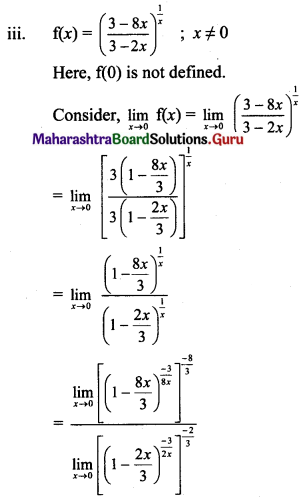
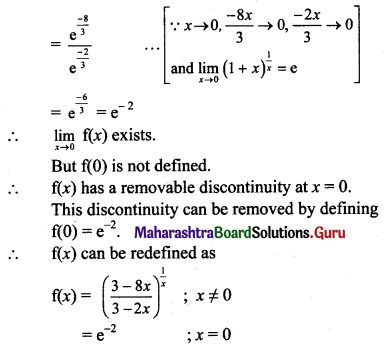
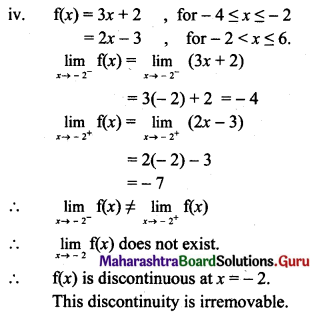
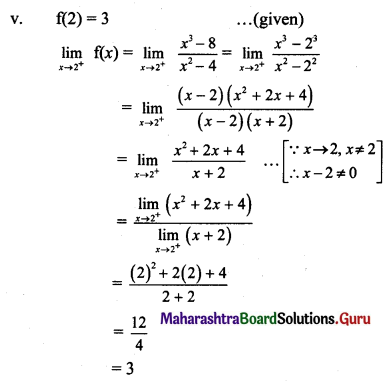
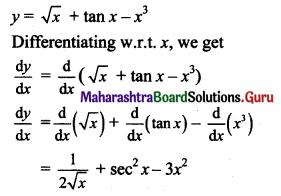
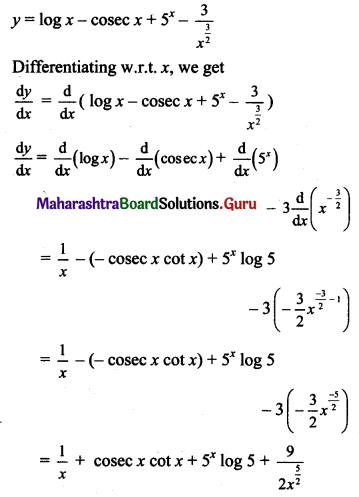
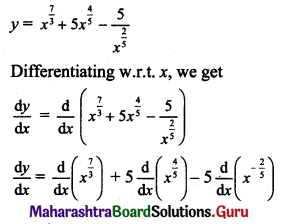
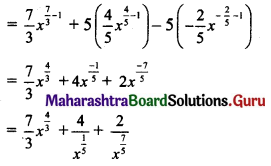
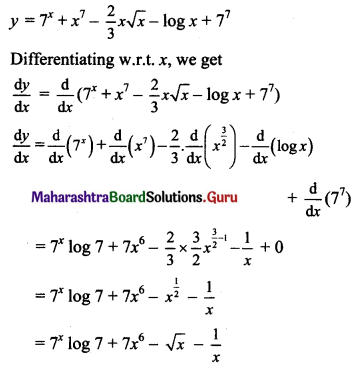
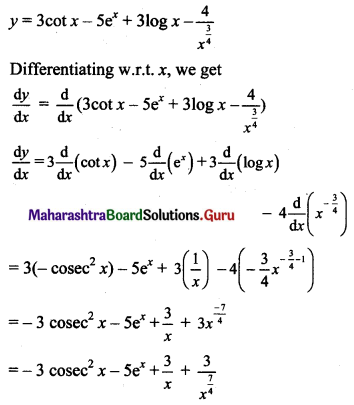
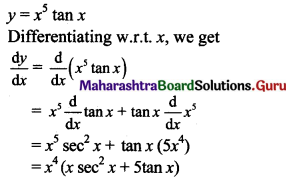
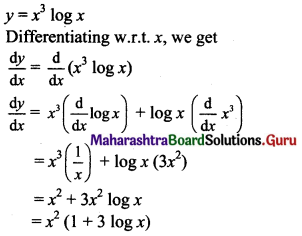
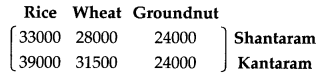
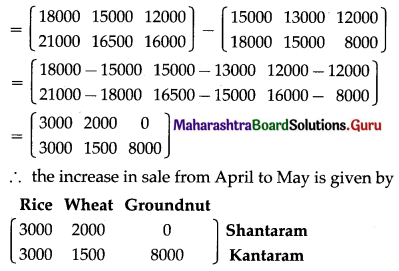
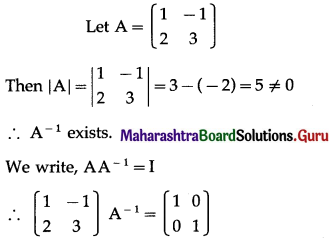
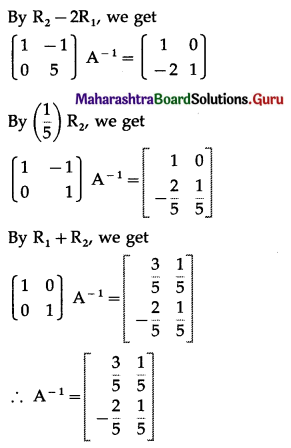
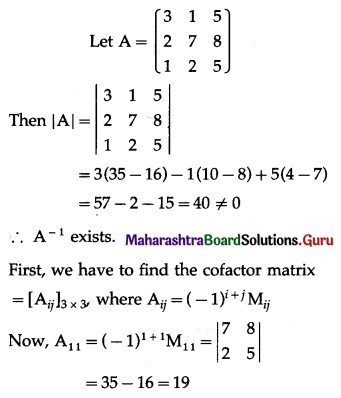
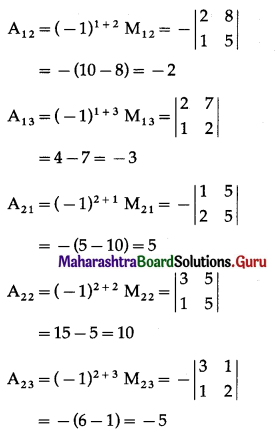
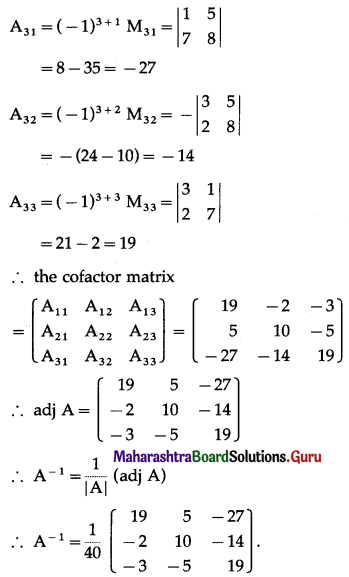
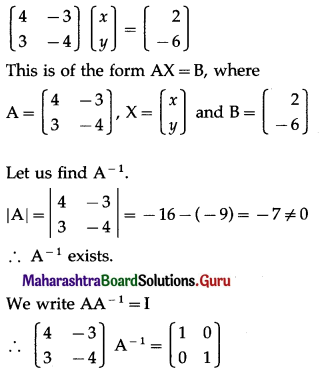
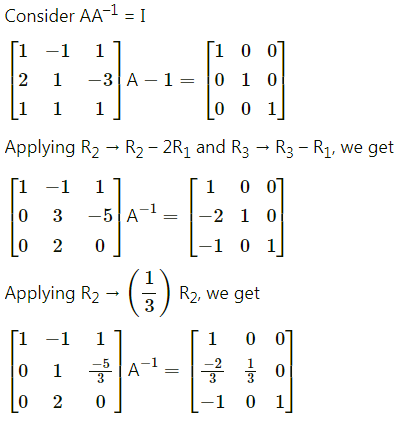
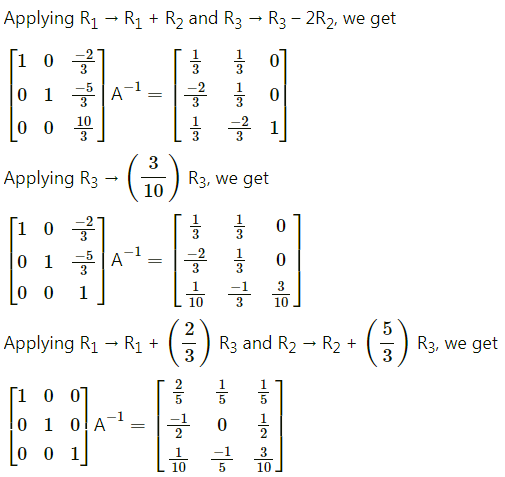
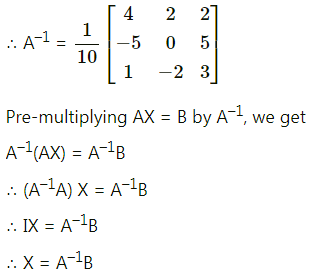
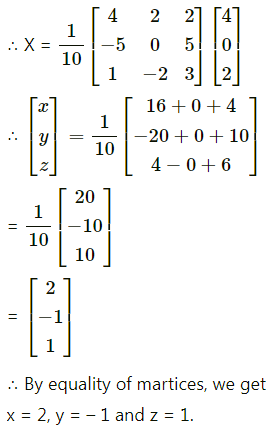
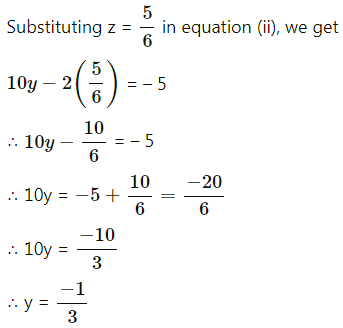
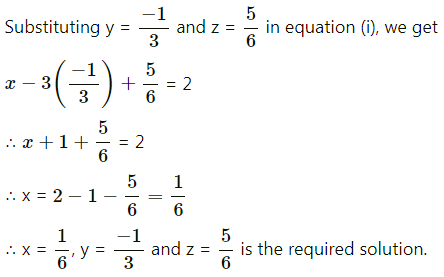
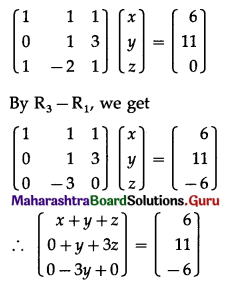
Maharashtra Board 12th Commerce Maths Solutions Chapter 1 Mathematical Logic Ex 1.6

Balbharati Maharashtra State Board 12th Commerce Maths Solution Book Pdf Chapter 1 Mathematical Logic Ex 1.6 Questions and Answers.

Maharashtra State Board 12th Commerce Maths Solutions Chapter 1 Mathematical Logic Ex 1.6

Question 1.
Prepare the truth tables for the following statement patterns:
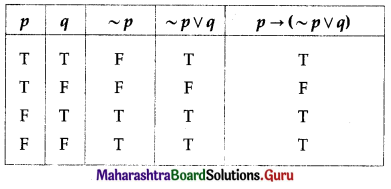
(i) p → (~p ∨ q)
Solution:
Here are two statements and three connectives.
∴ there are 2 × 2 = 4 rows and 2 + 3 = 5 columns in the truth table.
Maharashtra Board 12th Commerce Maths Solutions Chapter 1 Mathematical Logic Ex 1.6 Q1 (i)

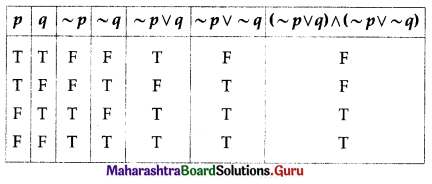
(ii) (~p ∨ q) ∧ (~p ∨ ~q)
Solution:
Maharashtra Board 12th Commerce Maths Solutions Chapter 1 Mathematical Logic Ex 1.6 Q1 (ii)

Maharashtra Board 12th Commerce Maths Solutions Chapter 1 Mathematical Logic Ex 1.6

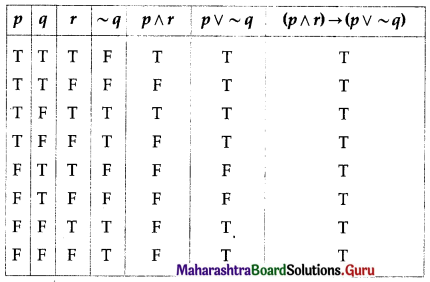
(iii) (p ∧ r) → (p ∨ ~q)
Solution:
Here are three statements and 4 connectives.
∴ there are 2 × 2 × 2 = 8 rows and 3 + 4 = 7 columns in the truth table.
Maharashtra Board 12th Commerce Maths Solutions Chapter 1 Mathematical Logic Ex 1.6 Q1 (iii)

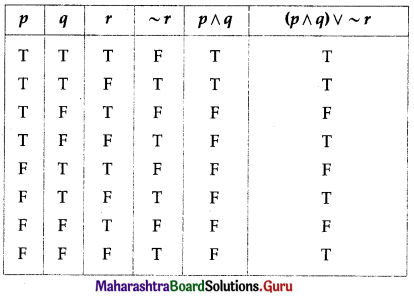
(iv) (p ∧ q) ∨ ~r
Solution:
Maharashtra Board 12th Commerce Maths Solutions Chapter 1 Mathematical Logic Ex 1.6 Q1 (iv)

Question 2.
Examine, whether each of the following statement patterns is a tautology or a contradiction or a contingency:
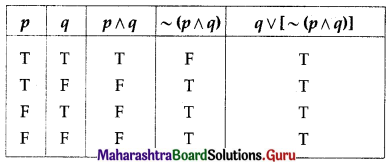
(i) q ∨ [~(p ∧ q)]
Solution:
Maharashtra Board 12th Commerce Maths Solutions Chapter 1 Mathematical Logic Ex 1.6 Q2 (i)
All the entries in the last column of the above truth table are T.
∴ q ∨ [~(p ∧ q)] is a tautology.

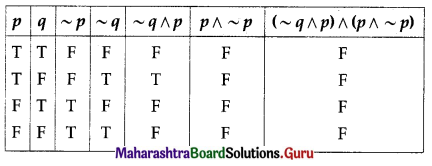
(ii) (~q ∧ p) ∧ (p ∧ ~p)
Solution:
Maharashtra Board 12th Commerce Maths Solutions Chapter 1 Mathematical Logic Ex 1.6 Q2 (ii)
All the entries in the last column of the above truth table are F.
∴ (~q ∧ p) ∧ (p ∧ ~p) is a contradiction.

Maharashtra Board 12th Commerce Maths Solutions Chapter 1 Mathematical Logic Ex 1.6

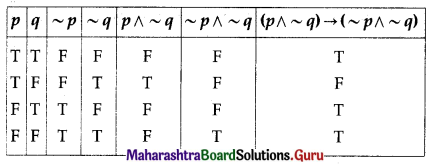
(iii) (p ∧ ~q) → (~p ∧ ~q)
Solution:
Maharashtra Board 12th Commerce Maths Solutions Chapter 1 Mathematical Logic Ex 1.6 Q2 (iii)
The entries in the last column are neither all T nor all F.
∴ (p ∧ ~q) → (~p ∧ ~q) is a contingency.

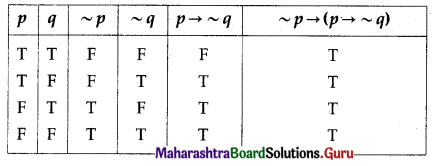
(iv) ~p → (p → ~q)
Solution:
Maharashtra Board 12th Commerce Maths Solutions Chapter 1 Mathematical Logic Ex 1.6 Q2 (iv)
All the entries in the last column of the truth table are T.
∴ p → (p → ~q) is a tautology.

Question 3.
Prove that each of the following statement pattern is a tautology:
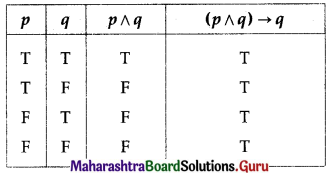
(i) (p ∧ q) → q
Solution:
Maharashtra Board 12th Commerce Maths Solutions Chapter 1 Mathematical Logic Ex 1.6 Q3 (i)
All the entries in the last column of the above truth table are T.
∴ (p ∧ q) → q is a tautology.

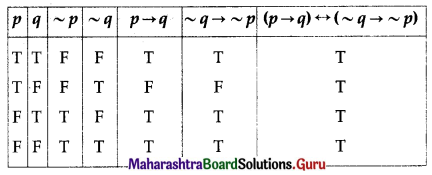
(ii) (p → q) ↔ (~q → ~p)
Solution:
Maharashtra Board 12th Commerce Maths Solutions Chapter 1 Mathematical Logic Ex 1.6 Q3 (ii)
All the entries in the last column of the above truth table are T.
∴ (p → q) ↔ (~q → ~p) is a tautology.

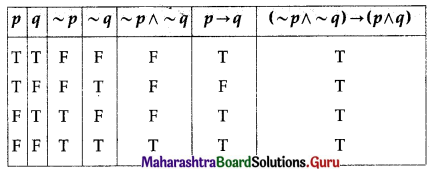
(iii) (~p ∧ ~q) → (p → q)
Solution:
Maharashtra Board 12th Commerce Maths Solutions Chapter 1 Mathematical Logic Ex 1.6 Q3 (iii)
All the entries in the last column of the above truth table are T.
∴ (~p ∧ ~q) → (p → q) is a tautology.

Maharashtra Board 12th Commerce Maths Solutions Chapter 1 Mathematical Logic Ex 1.6

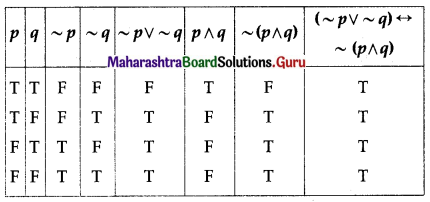
(iv) (~p ∨ ~q) ↔ ~(p ∧ q)
Solution:
Maharashtra Board 12th Commerce Maths Solutions Chapter 1 Mathematical Logic Ex 1.6 Q3 (iv)
All the entries in the last column of the above truth table are T.
∴ (~p ∨ ~q) ↔ ~(p ∧ q) is a tautology.

Question 4.
Prove that each of the following statement pattern is a contradiction:
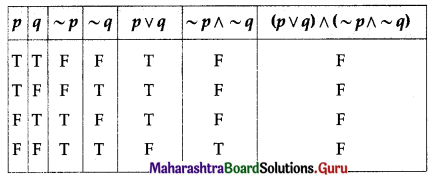
(i) (p ∨ q) ∧ (~p ∧ ~q)
Solution:
Maharashtra Board 12th Commerce Maths Solutions Chapter 1 Mathematical Logic Ex 1.6 Q4 (i)
All the entries in the last column of the above truth table are F.
∴ (p ∨ q) ∧ (~p ∧ ~q) is a contradiction.

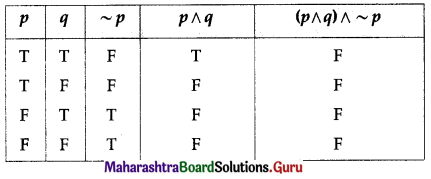
(ii) (p ∧ q) ∧ ~p
Solution:
Maharashtra Board 12th Commerce Maths Solutions Chapter 1 Mathematical Logic Ex 1.6 Q4 (ii)
All the entries in the last column of the above truth table are T.
∴ (p ∧ q) ∧ ~p is a contradiction.

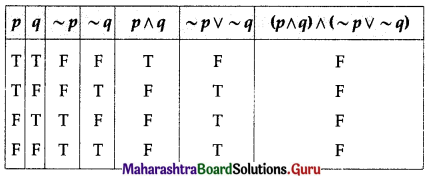
(iii) (p ∧ q) ∧ (~p ∨ ~q)
Solution:
Maharashtra Board 12th Commerce Maths Solutions Chapter 1 Mathematical Logic Ex 1.6 Q4 (iii)
All the entries in the last column of the above truth table are F.
∴ (p ∧ q) ∧ (~p ∨ ~q) is a contradiction.

Maharashtra Board 12th Commerce Maths Solutions Chapter 1 Mathematical Logic Ex 1.6

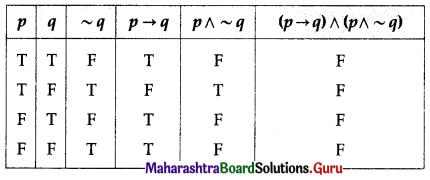
(iv) (p → q) ∧ (p ∧ ~q)
Solution:
Maharashtra Board 12th Commerce Maths Solutions Chapter 1 Mathematical Logic Ex 1.6 Q4 (iv)
All the entries in the last column of the above truth table are F.
∴ (p → q) ∧ (p ∧ ~q) is a contradiction.

Question 5.
Show that each of the following statement pattern is a contingency:
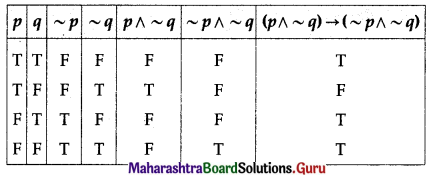
(i) (p ∧ ~q) → (~p ∧ ~q)
Solution:
Maharashtra Board 12th Commerce Maths Solutions Chapter 1 Mathematical Logic Ex 1.6 Q5 (i)
The entries in the last column of the above truth table are neither all T nor all F.
∴ (p ∧ ~q) → (~p ∧ ~q) is a contingency.

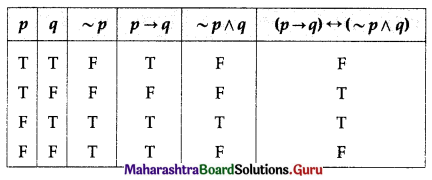
(ii) (p → q) ↔ (~p ∧ q)
Solution:
Maharashtra Board 12th Commerce Maths Solutions Chapter 1 Mathematical Logic Ex 1.6 Q5 (ii)
The entries in the last column of the above truth table are neither all T nor all F.
∴ (p → q) ↔ (~p ∧ q) is a contingency.

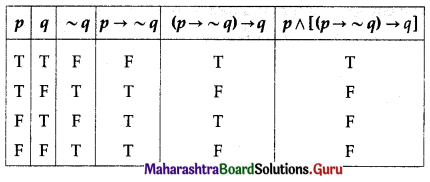
(iii) p ∧ [(p → ~q) → q]
Solution:
Maharashtra Board 12th Commerce Maths Solutions Chapter 1 Mathematical Logic Ex 1.6 Q5 (iii)
The entries in the last column of the above truth table are neither all T nor all F.
∴ p ∧ [(p → ~q) → q] is a contingency.

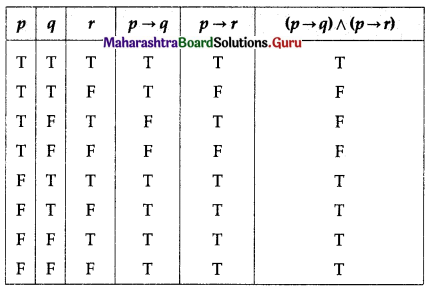
(iv) (p → q) ∧ (p → r)
Solution:
Maharashtra Board 12th Commerce Maths Solutions Chapter 1 Mathematical Logic Ex 1.6 Q5 (iv)
The entries in the last column of the above truth table are neither all T nor all F.
∴ (p → q) ∧ (p → r) is a contingency.

Maharashtra Board 12th Commerce Maths Solutions Chapter 1 Mathematical Logic Ex 1.6

Question 6.
Using the truth table, verify:
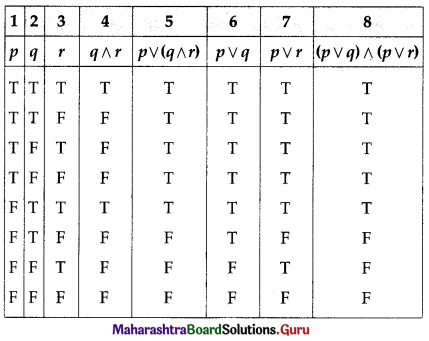
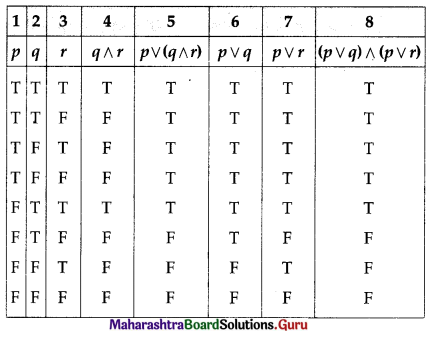
(i) p ∨ (q ∧ r) = (p ∨ q) ∧ (p ∨ r)
Solution:
Maharashtra Board 12th Commerce Maths Solutions Chapter 1 Mathematical Logic Ex 1.6 Q6 (i)
The entries in columns 5 and 8 are identical.
∴ p ∨ (q ∧ r) ≡ (p ∨ q) ∧ (p ∨ r).

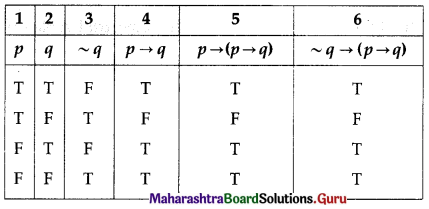
(ii) p → (p → q) ≡ ~q → (p → q)
Solution:
Maharashtra Board 12th Commerce Maths Solutions Chapter 1 Mathematical Logic Ex 1.6 Q6 (ii)
The entries in columns 5 and 6 are identical.
∴ p → (p → q) ≡ ~q → (p → q)

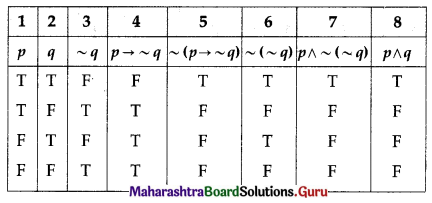
(iii) ~(p → ~q) ≡ p ∧ ~(~q) ≡ p ∧ q
Solution:
Maharashtra Board 12th Commerce Maths Solutions Chapter 1 Mathematical Logic Ex 1.6 Q6 (iii)
The entries in columns 5, 7 and 8 are identical.
∴ ~(p → ~q) ≡ p ∧ ~(~q) ≡ p ∧ q.

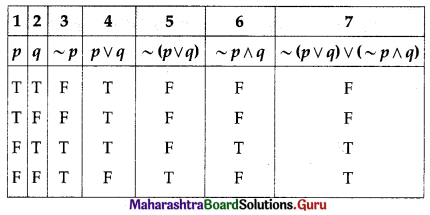
(iv) ~(p ∨ q) ∨ (~p ∧ q) ≡ ~p
Solution:
Maharashtra Board 12th Commerce Maths Solutions Chapter 1 Mathematical Logic Ex 1.6 Q6 (iv)
The entries in columns 3 and 7 are identical.
∴ ~(p ∨ q) ∨ (~p ∧ q) ≡ ~p.

Maharashtra Board 12th Commerce Maths Solutions Chapter 1 Mathematical Logic Ex 1.6

Question 7.
Prove that the following pairs of statement patterns are equivalent:
(i) p ∨ (q ∧ r) and (p ∨ q) ∧ (p ∨ r)
Solution:
Maharashtra Board 12th Commerce Maths Solutions Chapter 1 Mathematical Logic Ex 1.6 Q7 (i)
The entries in columns 5 and 8 are identical.
∴ p ∨ (q ∧ r) ≡ (p ∨ q) ∧ (p ∨ r)

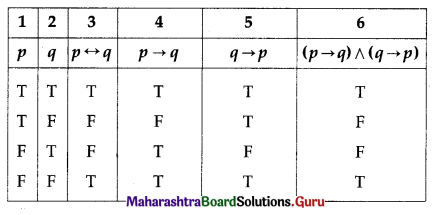
(ii) p ↔ q and (p → q) ∧ (q → p)
Solution:
Maharashtra Board 12th Commerce Maths Solutions Chapter 1 Mathematical Logic Ex 1.6 Q7 (ii)
The entries in columns 3 and 6 are identical.
∴ p ↔ q ≡ (p → q) ∧ (q → p)

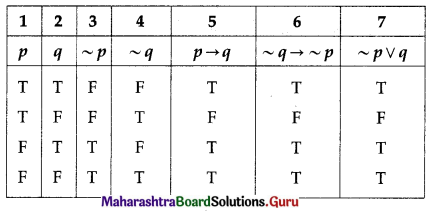
(iii) p → q and ~q → ~p and ~p ∨ q
Solution:
Maharashtra Board 12th Commerce Maths Solutions Chapter 1 Mathematical Logic Ex 1.6 Q7 (iii)
The entries in columns 5, 6 and 7 are identical.
∴ p → q ≡ ~q → ~p ≡ ~p ∨ q.

Maharashtra Board 12th Commerce Maths Solutions Chapter 1 Mathematical Logic Ex 1.6

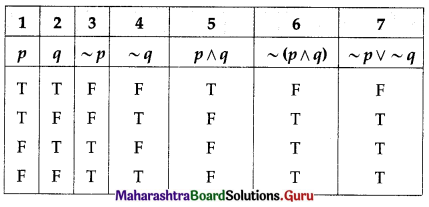
(iv) ~(p ∧ q) and ~p ∨ ~q
Solution:
Maharashtra Board 12th Commerce Maths Solutions Chapter 1 Mathematical Logic Ex 1.6 Q7 (iv)
The entries in columns 6 and 7 are identical.
∴ ~(p ∧ q) ≡ ~p ∨ ~q.

Maharashtra Board 12th Commerce Maths Solutions Chapter 2 Matrices Ex 2.3

Balbharati Maharashtra State Board 12th Commerce Maths Solution Book Pdf Chapter 2 Matrices Ex 2.3 Questions and Answers.

Maharashtra State Board 12th Commerce Maths Solutions Chapter 2 Matrices Ex 2.3

Question 1.
Evaluate:
(i) \(\left[\begin{array}{l}
3 \\
2 \\
1
\end{array}\right]\left[\begin{array}{lll}
2 & -4 & 3
\end{array}\right]\)
Solution:
\(\left[\begin{array}{l}
3 \\
2 \\
1
\end{array}\right]\left[\begin{array}{lll}
2 & -4 & 3
\end{array}\right]\) = \(\left[\begin{array}{rrr}
6 & -12 & 9 \\
4 & -8 & 6 \\
2 & -4 & 3
\end{array}\right]\)

(ii) \(\left[\begin{array}{lll}
2 & -1 & 3
\end{array}\right]\left[\begin{array}{l}
4 \\
3 \\
1
\end{array}\right]\)
Solution:
\(\left[\begin{array}{lll}
2 & -1 & 3
\end{array}\right]\left[\begin{array}{l}
4 \\
3 \\
1
\end{array}\right]\) = [8 – 3 + 3] = [8]

Maharashtra Board 12th Commerce Maths Solutions Chapter 2 Matrices Ex 2.3

Question 2.
If A = \(\left[\begin{array}{ccc}
-1 & 1 & 1 \\
2 & 3 & 0 \\
1 & -3 & 1
\end{array}\right]\), B = \(\left[\begin{array}{lll}
2 & 1 & 4 \\
3 & 0 & 2 \\
1 & 2 & 1
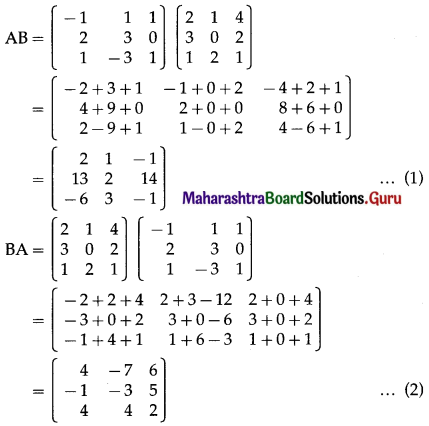
\end{array}\right]\). State whether AB = BA? Justify your answer.
Solution:
Maharashtra Board 12th Commerce Maths Solutions Chapter 2 Matrices Ex 2.3 Q2
From (1) and (2), AB ≠ BA.

Question 3.
Show that AB = BA, where A = \(\left[\begin{array}{lll}
-2 & 3 & -1 \\
-1 & 2 & -1 \\
-6 & 9 & -4
\end{array}\right]\), B = \(\left[\begin{array}{rrr}
1 & 3 & -1 \\
2 & 2 & -1 \\
3 & 0 & -1
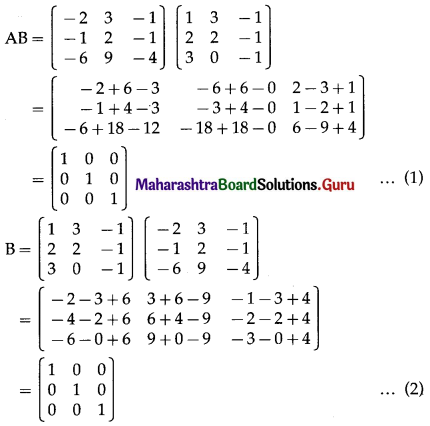
\end{array}\right]\)
Solution:
Maharashtra Board 12th Commerce Maths Solutions Chapter 2 Matrices Ex 2.3 Q3
From (1) and (2), AB = BA.

Question 4.
Verify A(BC) = (AB)C, if A = \(\left[\begin{array}{lll}
1 & 0 & 1 \\
2 & 3 & 0 \\
0 & 4 & 5
\end{array}\right]\), B = \(\left[\begin{array}{cc}
2 & -2 \\
-1 & 1 \\
0 & 3
\end{array}\right]\), and C = \(\left[\begin{array}{rrr}
3 & 2 & -1 \\
2 & 0 & -2
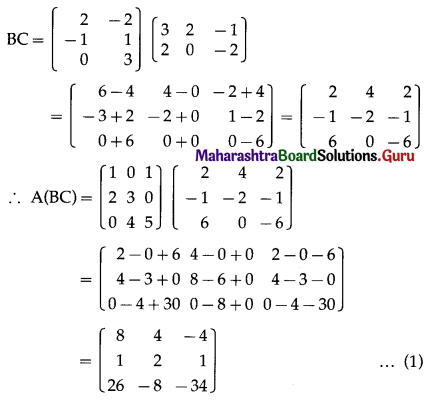
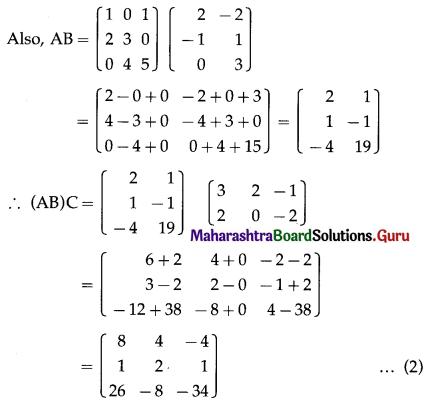
\end{array}\right]\)
Solution:
Maharashtra Board 12th Commerce Maths Solutions Chapter 2 Matrices Ex 2.3 Q4
Maharashtra Board 12th Commerce Maths Solutions Chapter 2 Matrices Ex 2.3 Q4.1
From (1) and (2), A(BC) = (AB)C.

Maharashtra Board 12th Commerce Maths Solutions Chapter 2 Matrices Ex 2.3

Question 5.
Verify that A(B + C) = AB + AC, if A = \(\left[\begin{array}{cc}
4 & -2 \\
2 & 3
\end{array}\right]\), B = \(\left[\begin{array}{cc}
-1 & 1 \\
3 & -2
\end{array}\right]\) and C = \(\left[\begin{array}{cc}
4 & 1 \\
2 & -1
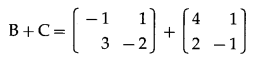
\end{array}\right]\)
Solution:
Maharashtra Board 12th Commerce Maths Solutions Chapter 2 Matrices Ex 2.3 Q5
Maharashtra Board 12th Commerce Maths Solutions Chapter 2 Matrices Ex 2.3 Q5.1
From (1) and (2), A(B + C) = AB + AC.

Question 6.
If A = \(\left[\begin{array}{ccc}
4 & 3 & 2 \\
-1 & 2 & 0
\end{array}\right]\), B = \(\left[\begin{array}{cc}
1 & 2 \\
-1 & 0 \\
1 & -2
\end{array}\right]\), show that matrix AB is non-singular.
Solution:
Maharashtra Board 12th Commerce Maths Solutions Chapter 2 Matrices Ex 2.3 Q6
Hence, AB is a non-singular matrix.

Question 7.
If A + I = \(\left[\begin{array}{ccc}
1 & 2 & 0 \\
5 & 4 & 2 \\
0 & 7 & -3
\end{array}\right]\), find the product (A + I)(A – I).
Solution:
Maharashtra Board 12th Commerce Maths Solutions Chapter 2 Matrices Ex 2.3 Q7

Maharashtra Board 12th Commerce Maths Solutions Chapter 2 Matrices Ex 2.3

Question 8.
If A = \(\left[\begin{array}{lll}
1 & 2 & 2 \\
2 & 1 & 2 \\
2 & 2 & 1
\end{array}\right]\), show that A2 – 4A is a scalar matrix.
Solution:
Maharashtra Board 12th Commerce Maths Solutions Chapter 2 Matrices Ex 2.3 Q8
which is a scalar matrix.

Question 9.
If A = \(\left[\begin{array}{cc}
1 & 0 \\
-1 & 7
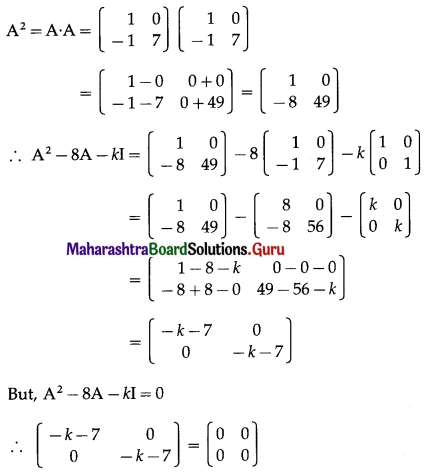
\end{array}\right]\), find k so that A2 – 8A – kI = O, where I is a 2 × 2 unit matrix and O is null matrix of order 2.
Solution:
Maharashtra Board 12th Commerce Maths Solutions Chapter 2 Matrices Ex 2.3 Q9
By equality of matrices,
-k – 7 = 0
∴ k = -7.

Question 10.
If A = \(\left[\begin{array}{cc}
3 & 1 \\
-1 & 2
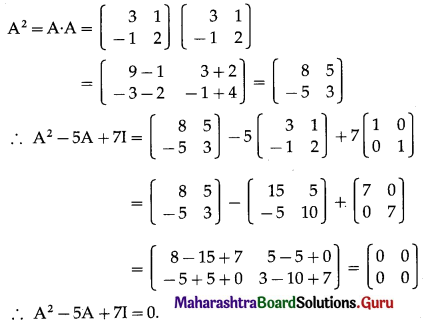
\end{array}\right]\), prove that A2 – 5A + 7I = 0, where I is a 2 × 2 unit matrix.
Solution:
Maharashtra Board 12th Commerce Maths Solutions Chapter 2 Matrices Ex 2.3 Q10

Question 11.
If A = \(\left[\begin{array}{cc}
1 & 2 \\
-1 & -2
\end{array}\right]\), B = \(\left[\begin{array}{cc}
2 & a \\
-1 & b
\end{array}\right]\) and if(A + B)2 = A2 + B2, find values of a and b.
Solution:
(A + B)2 = A2 + B2
∴ (A + B)(A + B) = A2 + B2
∴ A2 + AB + BA + B2 = A2 + B2
∴ AB + BA = 0
∴ AB = -BA
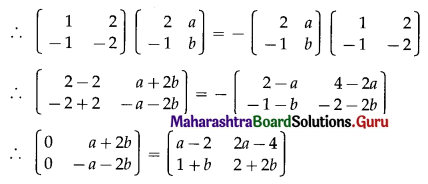
Maharashtra Board 12th Commerce Maths Solutions Chapter 2 Matrices Ex 2.3 Q11
By the equality of matrices, we get
0 = a – 2 ……..(1)
0 = 1 + b ……..(2)
a + 2b = 2a – 4 ……..(3)
-a – 2b = 2 + 2b ……..(4)
From equations (1) and (2), we get
a = 2 and b = -1
The values of a and b satisfy equations (3) and (4) also.
Hence, a = 2 and b = -1.

Maharashtra Board 12th Commerce Maths Solutions Chapter 2 Matrices Ex 2.3

Question 12.
Find k, if A = \(\left[\begin{array}{ll}
3 & -2 \\
4 & -2
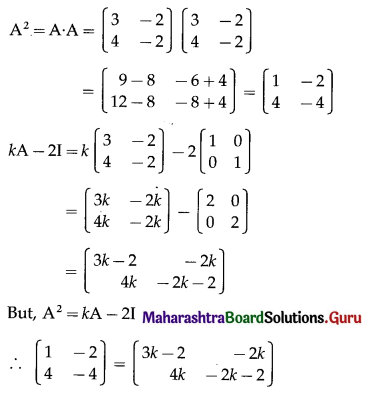
\end{array}\right]\) and A2 = kA – 2I.
Solution:
Maharashtra Board 12th Commerce Maths Solutions Chapter 2 Matrices Ex 2.3 Q12
By equality of matrices,
1 = 3k – 2 ……..(1)
-2 = -2k ……..(2)
4 = 4k ……..(3)
-4 = -2k – 2 ……..(4)
From (2), k = 1.
k = 1 also satisfies equation (1), (3) and (4).
Hence, k = 1.

Question 13.
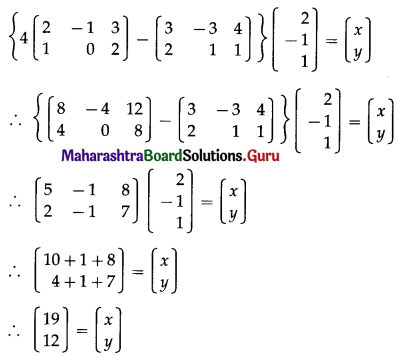
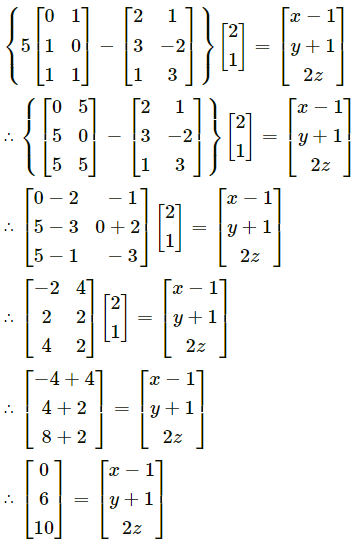
Find x and y, if \(\left\{4\left[\begin{array}{ccc}
2 & -1 & 3 \\
1 & 0 & 2
\end{array}\right]-\left[\begin{array}{ccc}
3 & -3 & 4 \\
2 & 1 & 1
\end{array}\right]\right\}\left[\begin{array}{c}
2 \\
-1 \\
1
\end{array}\right]=\left[\begin{array}{c}
x \\
y
\end{array}\right]\)
Solution:
Maharashtra Board 12th Commerce Maths Solutions Chapter 2 Matrices Ex 2.3 Q13
By equality of matrices,
x = 19 and y = 12.

Maharashtra Board 12th Commerce Maths Solutions Chapter 2 Matrices Ex 2.3

Question 14.
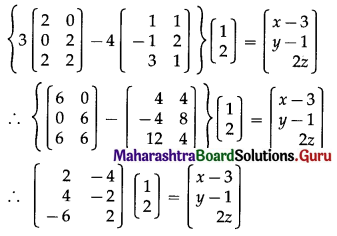
Find x, y, z, if \(\left\{3\left[\begin{array}{ll}
2 & 0 \\
0 & 2 \\
2 & 2
\end{array}\right]-4\left[\begin{array}{cc}
1 & 1 \\
-1 & 2 \\
3 & 1
\end{array}\right]\right\}\left[\begin{array}{l}
1 \\
2
\end{array}\right]=\left[\begin{array}{c}
x-3 \\
y-1 \\
2 z
\end{array}\right]\)
Solution:
Maharashtra Board 12th Commerce Maths Solutions Chapter 2 Matrices Ex 2.3 Q14
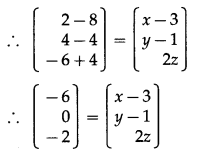
Maharashtra Board 12th Commerce Maths Solutions Chapter 2 Matrices Ex 2.3 Q14.1
By equality of matrices,
-6 = x – 3, 0 = y – 1 and -2 = 2z
∴ x = -3, y = 1 and z = -1.

Maharashtra Board 12th Commerce Maths Solutions Chapter 2 Matrices Ex 2.3

Question 15.
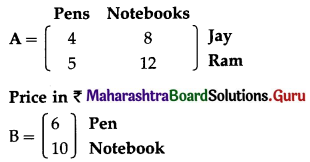
Jay and Ram are two friends. Jay wants to buy 4 pens and 8 notebooks. Ram wants to buy 5 pens and 12 notebooks. The price of one pen and one notebook was ₹ 6 and ₹ 10 respectively. Using matrix multiplication, find the amount each one of them requires for buying the pens and notebooks.
Solution:
The given data can be written in matrix form as:
Number of Pens and Notebooks
Maharashtra Board 12th Commerce Maths Solutions Chapter 2 Matrices Ex 2.3 Q15
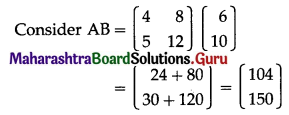
For finding the amount each one of them requires to buy the pens and notebook, we require the multiplication of the two matrices A and B.
Maharashtra Board 12th Commerce Maths Solutions Chapter 2 Matrices Ex 2.3 Q15.1
Hence, Jay requires ₹ 104 and Ram requires ₹ 150 to buy the pens and notebooks.

Maharashtra Board 11th Maths Solutions Chapter 9 Differentiation Miscellaneous Exercise 9

Balbharti Maharashtra State Board 11th Maths Book Solutions Pdf Chapter 9 Differentiation Miscellaneous Exercise 9 Questions and Answers.

Maharashtra State Board 11th Maths Solutions Chapter 9 Differentiation Miscellaneous Exercise 9

(I) Select the appropriate option from the given alternatives.

Question 1.
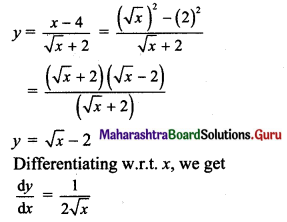
If y = \(\frac{x-4}{\sqrt{x+2}}\), then \(\frac{d y}{d x}\) is
(A) \(\frac{1}{x+4}\)
(B) \(\frac{\sqrt{x}}{\left(\sqrt{x+2)^{2}}\right.}\)
(C) \(\frac{1}{2 \sqrt{x}}\)
(D) \(\frac{x}{(\sqrt{x}+2)^{2}}\)
Answer:
(C) \(\frac{1}{2 \sqrt{x}}\)
Hint:
Maharashtra Board 11th Maths Solutions Chapter 9 Differentiation Miscellaneous Exercise 9 I Q1

Question 2.
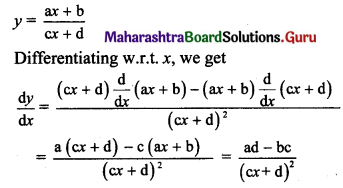
If y = \(\frac{a x+b}{c x+d}\),then \(\frac{d y}{d x}\) =
(A) \(\frac{a b-c d}{(c x+d)^{2}}\)
(B) \(\frac{a x-c}{(c x+d)^{2}}\)
(C) \(\frac{a c-b d}{(c x+d)^{2}}\)
(D) \(\frac{a d-b c}{(c x+d)^{2}}\)
Answer:
(D) \(\frac{a d-b c}{(c x+d)^{2}}\)
Hint:
Maharashtra Board 11th Maths Solutions Chapter 9 Differentiation Miscellaneous Exercise 9 I Q2

Maharashtra Board 11th Maths Solutions Chapter 9 Differentiation Miscellaneous Exercise 9

Question 3.
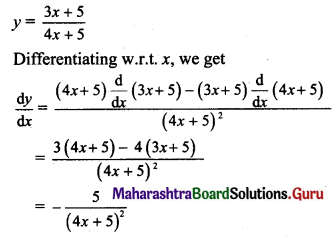
If y = \(\frac{3 x+5}{4 x+5}\), then \(\frac{d y}{d x}\) =
(A) \(-\frac{15}{(3 x+5)^{2}}\)
(B) \(-\frac{15}{(4 x+5)^{2}}\)
(C) \(-\frac{5}{(4 x+5)^{2}}\)
(D) \(-\frac{13}{(4 x+5)^{2}}\)
Answer:
(C) \(-\frac{5}{(4 x+5)^{2}}\)
Hint:
Maharashtra Board 11th Maths Solutions Chapter 9 Differentiation Miscellaneous Exercise 9 I Q3

Question 4.
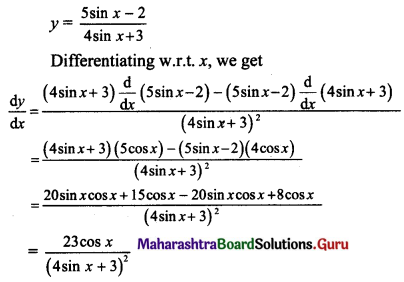
If y = \(\frac{5 \sin x-2}{4 \sin x+3}\), then \(\frac{d y}{d x}\) =
(A) \(\frac{7 \cos x}{(4 \sin x+3)^{2}}\)
(B) \(\frac{23 \cos x}{(4 \sin x+3)^{2}}\)
(C) \(-\frac{7 \cos x}{(4 \sin x+3)^{2}}\)
(D) \(-\frac{15 \cos x}{(4 \sin x+3)^{2}}\)
Answer:
(B) \(\frac{23 \cos x}{(4 \sin x+3)^{2}}\)
Hint:
Maharashtra Board 11th Maths Solutions Chapter 9 Differentiation Miscellaneous Exercise 9 I Q4

Question 5.
Suppose f(x) is the derivative of g(x) and g(x) is the derivative of h(x).
If h(x) = a sin x + b cos x + c, then f(x) + h(x) =
(A) 0
(B) c
(C) -c
(D) -2(a sin x + b cos x)
Answer:
(B) c
Hint:
h(x) = a sin x + b cos x + c
Differentiating w.r.t. x, we get
h'(x) = a cos x – b sin x = g(x) …..[given]
Differentiating w.r.t. x, we get
g'(x) = -a sin x – b cos x = f(x) …..[given]
∴ f(x) + h(x) = -a sin x – b cos x + a sin x + b cos x + c
∴ f(x) + h(x) = c

Maharashtra Board 11th Maths Solutions Chapter 9 Differentiation Miscellaneous Exercise 9

Question 6.
If f(x) = 2x + 6, for 0 ≤ x ≤ 2
= ax2 + bx, for 2 < x ≤ 4
is differentiable at x = 2, then the values of a and b are
(A) a = \(-\frac{3}{2}\), b = 3
(B) a = \(\frac{3}{2}\), b = 8
(C) a = \(\frac{1}{2}\), b = 8
(D) a = \(-\frac{3}{2}\), b = 8
Answer:
(D) a = \(-\frac{3}{2}\), b = 8
Hint:
f(x) = 2x + 6, 0 ≤ x ≤ 2
= ax2 + bx, 2 < x ≤ 4
Lf'(2) = 2, Rf'(2) = 4a + b
Since f is differentiable at x = 2,
Lf'(2) = Rf'(2)
∴ 2 = 4a + b …..(i)
f is continuous at x = 2.
∴ \(\lim _{x \rightarrow 2^{+}} f(x)=f(2)=\lim _{x \rightarrow 2^{-}} f(x)\)
∴ 4a + 2b = 2(2) + 6
∴ 4a + 2b = 10
∴ 2a + b = 5 …..(ii)
Solving (i) and (ii), we get
a = \(-\frac{3}{2}\), b = 8

Question 7.
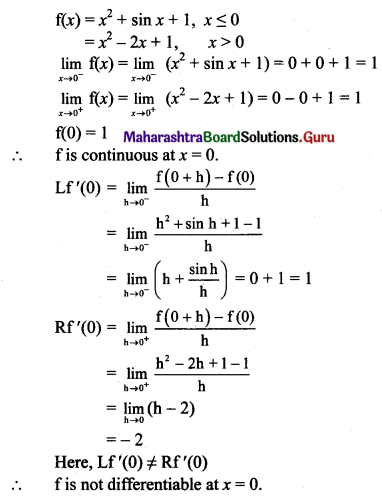
If f(x) = x2 + sin x + 1, for x ≤ 0
= x2 – 2x + 1, for x ≤ 0, then
(A) f is continuous at x = 0, but not differentiable at x = 0
(B) f is neither continuous nor differentiable at x = 0
(C) f is not continuous at x = 0, but differentiable at x = 0
(D) f is both continuous and differentiable at x = 0
Answer:
(A) f is continuous at x = 0, but not differentiable at x = 0
Hint:
Maharashtra Board 11th Maths Solutions Chapter 9 Differentiation Miscellaneous Exercise 9 I Q7

Question 8.
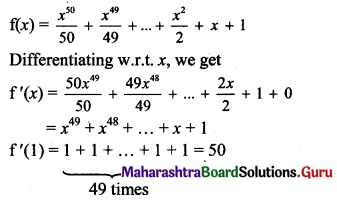
If f(x) = \(\frac{x^{50}}{50}+\frac{x^{49}}{49}+\frac{x^{48}}{48}+\ldots .+\frac{x^{2}}{2}+x+1\), then f'(1) =
(A) 48
(B) 49
(C) 50
(D) 51
Answer:
(C) 50
Hint:
Maharashtra Board 11th Maths Solutions Chapter 9 Differentiation Miscellaneous Exercise 9 I Q8

Maharashtra Board 11th Maths Solutions Chapter 9 Differentiation Miscellaneous Exercise 9

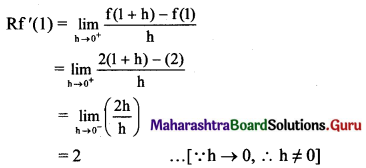
(II).

Question 1.
Determine whether the following function is differentiable at x = 3 where,
f(x) = x2 + 2, for x ≥ 3
= 6x – 7, for x < 3.
Solution:
f(x) = x2 + 2, x ≥ 3
= 6x – 7, x < 3
Differentiability at x = 3
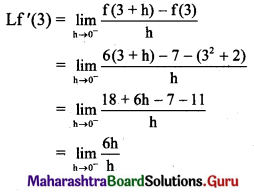
Maharashtra Board 11th Maths Solutions Chapter 9 Differentiation Miscellaneous Exercise 9 II Q1
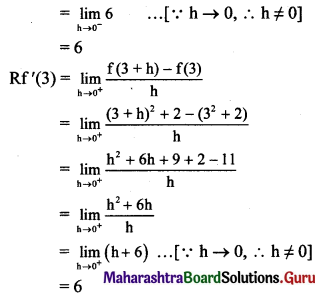
Maharashtra Board 11th Maths Solutions Chapter 9 Differentiation Miscellaneous Exercise 9 II Q1.1
Here, Lf'(3) = Rf'(3)
∴ f is differentiable at x = 3.

Question 2.
Find the values of p and q that make function f(x) differentiable everywhere on R.
f(x) = 3 – x, for x < 1
= px2 + qx, for x ≥ 1.
Solution:
f(x) is differentiable everywhere on R.
∴ f(x) is differentiable at x = 1.
∴ f(x) is continuous at x = 1.
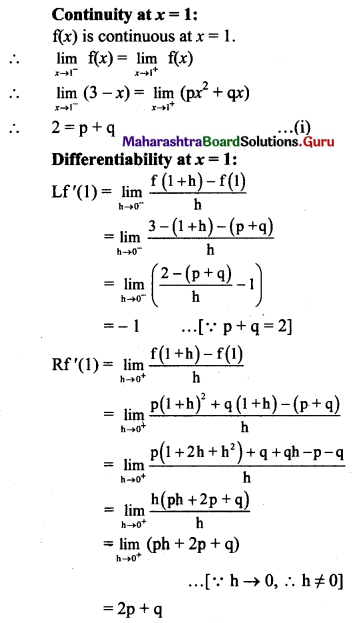
Maharashtra Board 11th Maths Solutions Chapter 9 Differentiation Miscellaneous Exercise 9 II Q2
f(x) is differentiable at x = 1.
∴ Lf'(1) = Rf'(1)
∴ -1 = 2p + q …..(ii)
Subtracting (i) from (ii), we get
p = -3
Substituting p = -3 in (i), we get
p + q = 2
∴ -3 + q = 2
∴ q = 5

Maharashtra Board 11th Maths Solutions Chapter 9 Differentiation Miscellaneous Exercise 9

Question 3.
Determine the values of p and q that make the function f(x) differentiable on R where
f(x) = px3, for x < 2
= x2 + q, for x ≥ 2
Solution:
f(x) is differentiable on R.
∴ f(x) is differentiable at x = 2.
∴ f(x) is continuous at x = 2.
Continuity at x = 2:
f(x) is continuous at x = 2.
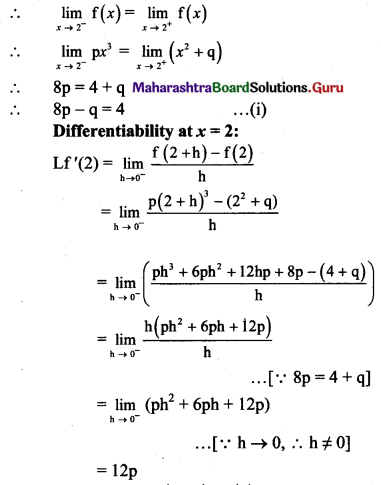
Maharashtra Board 11th Maths Solutions Chapter 9 Differentiation Miscellaneous Exercise 9 II Q3
Maharashtra Board 11th Maths Solutions Chapter 9 Differentiation Miscellaneous Exercise 9 II Q3.1
f(x) is differentiable at x = 2.
∴ Lf'(2) = Rf'(2)
∴ 12p = 4
∴ p = \(\frac{1}{3}\)
Substituting p = \(\frac{1}{3}\) in (i), we get
8(\(\frac{1}{3}\) – q = 4
∴ q = \(\frac{8}{3}\) – 4 = \(\frac{-4}{3}\)

Question 4.
Determine all real values of p and q that ensure the function
f(x) = px + q, for x ≤ 1
= tan(\(\frac{\pi x}{4}\)), for 1 < x < 2
is differentiable at x = 1.
Solution:
f(x) is differentiable at x = 1.
∴ f(x) is continuous at x = 1.
Continuity at x= 1:
f(x) is continuous at x = 1.
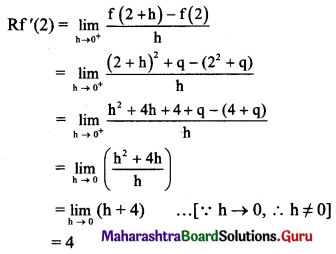
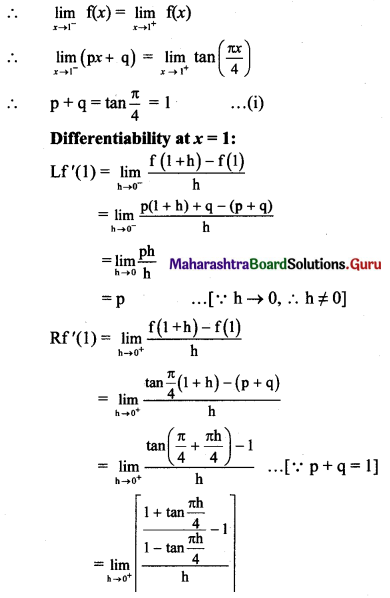
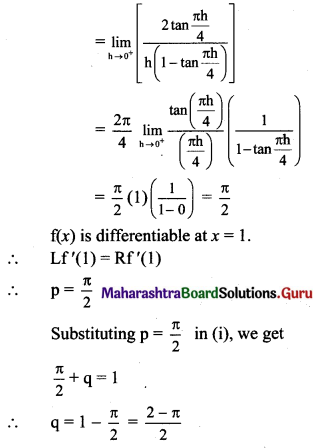
Maharashtra Board 11th Maths Solutions Chapter 9 Differentiation Miscellaneous Exercise 9 II Q4
Maharashtra Board 11th Maths Solutions Chapter 9 Differentiation Miscellaneous Exercise 9 II Q4.1

Question 5.
Discuss whether the function f(x) = |x + 1| + |x – 1| is differentiable ∀ x ∈ R.
Solution:
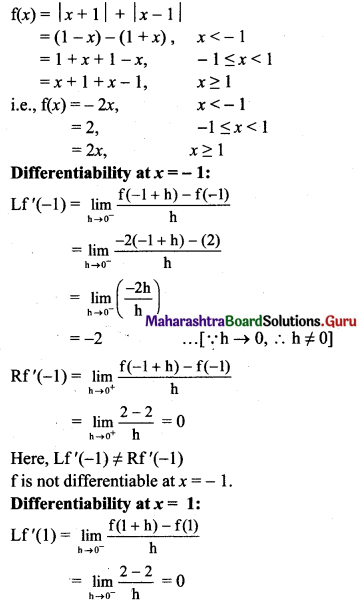
Maharashtra Board 11th Maths Solutions Chapter 9 Differentiation Miscellaneous Exercise 9 II Q5
Maharashtra Board 11th Maths Solutions Chapter 9 Differentiation Miscellaneous Exercise 9 II Q5.1
Here, Lf'(1) ≠ Rf'(1)
∴ f is not differentiable at x = 1.
∴ f is not differentiable at x = -1 and x = 1.
∴ f is not differentiable ∀ x ∈ R.

Maharashtra Board 11th Maths Solutions Chapter 9 Differentiation Miscellaneous Exercise 9

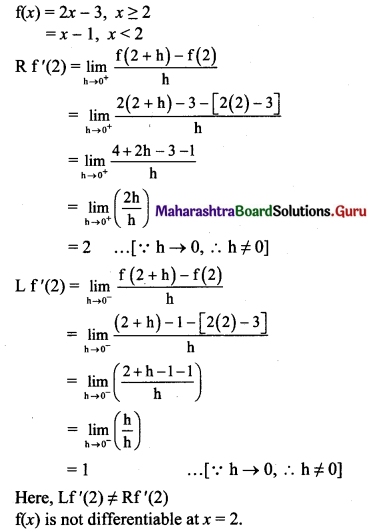
Question 6.
Test whether the function
f(x) = 2x – 3, for x ≥ 2
= x – 1, for x < 2
is differentiable at x = 2.
Solution:
Maharashtra Board 11th Maths Solutions Chapter 9 Differentiation Miscellaneous Exercise 9 II Q6

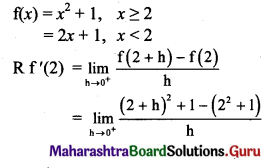
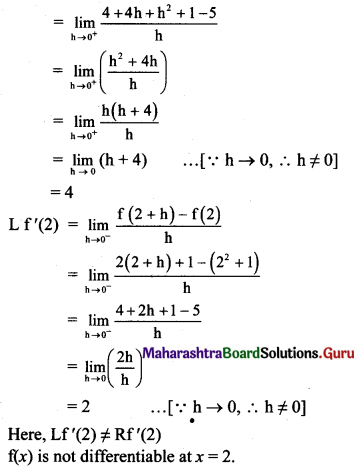
Question 7.
Test whether the function
f(x) = x2 + 1, for x ≥ 2
= 2x + 1, for x < 2
is differentiable at x = 2.
Solution:
Maharashtra Board 11th Maths Solutions Chapter 9 Differentiation Miscellaneous Exercise 9 II Q7
Maharashtra Board 11th Maths Solutions Chapter 9 Differentiation Miscellaneous Exercise 9 II Q7.1

Question 8.
Test whether the function
f(x) = 5x – 3x2, for x ≥ 1
= 3 – x, for x < 1
is differentiable at x = 1.
Solution:
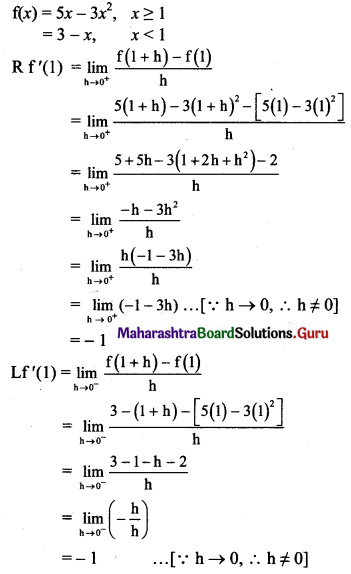
Maharashtra Board 11th Maths Solutions Chapter 9 Differentiation Miscellaneous Exercise 9 II Q8
Here, Lf'(1) = Rf'(1)
∴ f(x) is differentiable at x = 1.

Maharashtra Board 11th Maths Solutions Chapter 9 Differentiation Miscellaneous Exercise 9

Question 9.
If f(2) = 4, f'(2) = 1, then find \(\lim _{x \rightarrow 2}\left[\frac{x f(2)-2 f(x)}{x-2}\right]\)
Solution:
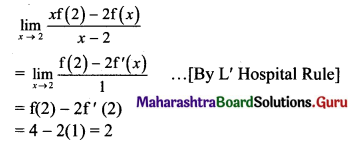
Maharashtra Board 11th Maths Solutions Chapter 9 Differentiation Miscellaneous Exercise 9 II Q9

Question 10.
If y = \(\frac{\mathbf{e}^{x}}{\sqrt{x}}\), find \(\frac{d y}{d x}\) when x = 1.
Solution:
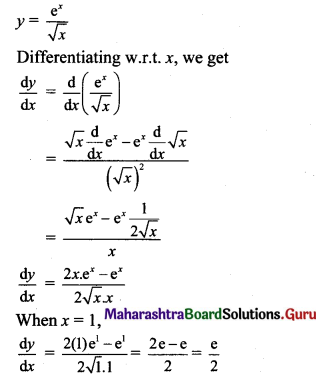
Maharashtra Board 11th Maths Solutions Chapter 9 Differentiation Miscellaneous Exercise 9 II Q10

Maharashtra Board 11th Maths Solutions Chapter 6 Functions Ex 6.1

Balbharti Maharashtra State Board 11th Maths Book Solutions Pdf Chapter 6 Functions Ex 6.1 Questions and Answers.

Maharashtra State Board 11th Maths Solutions Chapter 6 Functions Ex 6.1

Question 1.
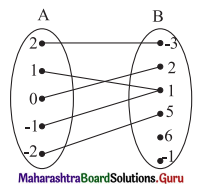
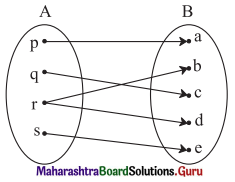
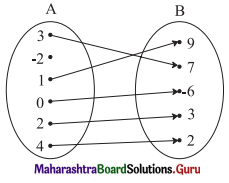
Check if the following relations are functions.
(a)
Maharashtra Board 11th Maths Solutions Chapter 6 Functions Ex 6.1 Q1 (a)
Solution:
Yes.
Reason: Every element of set A has been assigned a unique element in set B.

(b)
Maharashtra Board 11th Maths Solutions Chapter 6 Functions Ex 6.1 Q1 (b)
Solution:
No.
Reason: An element of set A has been assigned more than one element from set B.

(c)
Maharashtra Board 11th Maths Solutions Chapter 6 Functions Ex 6.1 Q1 (c)
Solution:
No.
Reason:
Not every element of set A has been assigned an image from set B.

Maharashtra Board 11th Maths Solutions Chapter 6 Functions Ex 6.1

Question 2.
Which sets of ordered pairs represent functions from A = {1, 2, 3, 4} to B = {-1, 0, 1, 2, 3}? Justify.
(i) {(1, 0), (3, 3), (2, -1), (4, 1), (2, 2)}
(ii) {(1, 2), (2, -1), (3, 1), (4, 3)}
(iii) {(1, 3), (4, 1), (2, 2)}
(iv) {(1, 1), (2, 1), (3, 1), (4, 1)}
Solution:
(i) {(1, 0), (3, 3), (2, -1), (4, 1), (2, 2)} does not represent a function.
Reason: (2, -1), (2, 2), show that element 2 ∈ A has been assigned two images -1 and 2 from set B.

(ii) {(1, 2), (2, -1), (3, 1), (4, 3)} represents a function.
Reason: Every element of set A has been assigned a unique image in set B.

(iii) {(1, 3), (4, 1), (2, 2)} does not represent a function.
Reason:
3 ∈ A does not have an image in set B.

(iv) {(1, 1), (2, 1), (3, 1), (4, 1)} represents a function
Reason: Every element of set A has been assigned a unique image in set B.

Question 3.
Check if the relation given by the equation represents y as function of x.
(i) 2x + 3y = 12
(ii) x + y2 = 9
(iii) x2 – y = 25
(iv) 2y + 10 = 0
(v) 3x – 6 = 21
Solution:
(i) 2x + 3y = 12
∴ y = \(\frac{12-2 x}{3}\)
∴ For every value of x, there is a unique value of y.
∴ y is a function of x.

(ii) x + y2 = 9
∴ y2 = 9 – x
∴ y = ±\(\sqrt{9-x}\)
∴ For one value of x, there are two values of y.
∴ y is not a function of x.

(iii) x2 – y = 25
∴ y = x2 – 25
∴ For every value of x, there is a unique value of y.
∴ y is a function of x.

(iv) 2y + 10 = 0
∴ y = -5
∴ For every value of x, there is a unique value of y.
∴ y is a function of x.

(v) 3x – 6 = 21
∴ x = 9
∴ x = 9 represents a point on the X-axis.
There is no y involved in the equation.
So the given equation does not represent a function.

Maharashtra Board 11th Maths Solutions Chapter 6 Functions Ex 6.1

Question 4.
If f(m) = m2 – 3m + 1, find
(i) f(0)
(ii) f(-3)
(iii) f(\(\frac{1}{2}\))
(iv) f(x + 1)
(v) f(-x)
(vi) \(\left(\frac{\mathbf{f}(2+h)-f(2)}{h}\right)\), h ≠ 0.
Solution:
f(m) = m2 – 3m + 1
(i) f(0) = 02 – 3(0) + 1 = 1

(ii) f (-3) = (-3)2 – 3(-3) + 1
= 9 + 9 + 1
= 19

(iii) f(\(\frac{1}{2}\)) = \(\left(\frac{1}{2}\right)^{2}-3\left(\frac{1}{2}\right)+1\)
= \(\frac{1}{4}-\frac{3}{2}+1\)
= \(\frac{1-6+4}{4}\)
= \(-\frac{1}{4}\)

(iv) f(x + 1) = (x + 1)2 – 3(x + 1) + 1
= x2 + 2x + 1 – 3x – 3 + 1
= x2 – x – 1

(v) f(-x) = (-x)2 – 3(-x) + 1 = x2 + 3x + 1

(vi) \(\left(\frac{\mathbf{f}(2+h)-f(2)}{h}\right)\)
= \(\frac{(2+h)^{2}-3(2+h)+1-\left(2^{2}-3(2)+1\right)}{h}\)
= \(\frac{\mathrm{h}^{2}+\mathrm{h}}{\mathrm{h}}\)
= h + 1

Question 5.
Find x, if g(x) = 0 where
(i) g(x) = \(\frac{5 x-6}{7}\)
(ii) g(x) = \(\frac{18-2 x^{2}}{7}\)
(iii) g(x) = 6x2 + x – 2
(iv) g(x) = x3 – 2x2 – 5x + 6
Solution:
(i) g(x) = \(\frac{5 x-6}{7}\)
g(x) = 0
∴ \(\frac{5 x-6}{7}\) = 0
∴ x = \(\frac{6}{5}\)

(ii) g(x) = \(\frac{18-2 x^{2}}{7}\)
g(x) = 0
\(\frac{18-2 x^{2}}{7}\) = 0
∴ 18 – 2x2 = 0
∴ x2 = 9
∴ x = ±3

(iii) g(x) = 6x2 + x – 2
g(x) = 0
∴ 6x2 + x – 2 = 0
∴ (2x – 1) (3x + 2) = 0
∴ 2x – 1 = 0 or 3x + 2 = 0
∴ x = \(\frac{1}{2}\) or x = \(\frac{-2}{3}\)

(iv) g(x) = x3 – 2x2 – 5x + 6
= ( x- 1) (x2 – x – 6)
= (x – 1) (x + 2) (x – 3)
g(x) = 0
∴ (x – 1) (x + 2) (x – 3) = 0
∴ x – 1 = 0 or x + 2 = 0 or x – 3 = 0
∴ x = 1, -2, 3

Maharashtra Board 11th Maths Solutions Chapter 6 Functions Ex 6.1

Question 6.
Find x, if f(x) = g(x) where
(i) f(x) = x4 + 2x2, g(x) = 11x2
(ii) f(x) = √x – 3, g(x) = 5 – x
Solution:
(i) f(x) = x4 + 2x2, g(x) = 11x2
f(x) = g(x)
∴ x4 + 2x2 = 11x2
∴ x4 – 9x2 = 0
∴ x2 (x2 – 9) = 0
∴ x2 = 0 or x2 – 9 = 0
∴ x = 0 or x2 = 9
∴ x = 0, ±3

(ii) f(x) = √x – 3, g(x) = 5 – x
f(x) = g(x)
∴ √x – 3 = 5 – x
∴ √x = 5 – x + 3
∴ √x = 8 – x
on squaring, we get
x = 64 + x2 – 16x
∴ x2 – 17x + 64 = 0
∴ x = \(\frac{17 \pm \sqrt{(-17)^{2}-4(64)}}{2}\)
∴ x = \(\frac{17 \pm \sqrt{289-256}}{2}\)
∴ x = \(\frac{17 \pm \sqrt{33}}{2}\)

Question 7.
If f(x) = \(\frac{a-x}{b-x}\), f(2) is undefined, and f(3) = 5, find a and b.
Solution:
f(x) = \(\frac{a-x}{b-x}\)
Given that,
f(2) is undefined
b – 2 = 0
∴ b = 2 …..(i)
f(3) = 5
∴ \(\frac{a-3}{b-3}\) = 5
∴ \(\frac{a-3}{2-3}\) = 5 ….. [From (i)]
∴ a – 3 = -5
∴ a = -2
∴ a = -2, b = 2

Question 8.
Find the domain and range of the following functions.
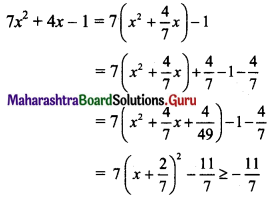
(i) f(x) = 7x2 + 4x – 1
Solution:
f(x) = 7x2 + 4x – 1
f is defined for all x.
∴ Domain of f = R (i.e., the set of real numbers)
Maharashtra Board 11th Maths Solutions Chapter 6 Functions Ex 6.1 Q8 (i)
∴ Range of f = [\(-\frac{11}{7}\), ∞)

(ii) g(x) = \(\frac{x+4}{x-2}\)
Solution:
g(x) = \(\frac{x+4}{x-2}\)
Function g is defined everywhere except at x = 2.
∴ Domain of g = R – {2}
Let y = g(x) = \(\frac{x+4}{x-2}\)
∴ (x – 2) y = x + 4
∴ x(y – 1) = 4 + 2y
∴ For every y, we can find x, except for y = 1.
∴ y = 1 ∉ range of function g
∴ Range of g = R – {1}

(iii) h(x) = \(\frac{\sqrt{x+5}}{5+x}\)
Solution:
h(x) = \(\frac{\sqrt{x+5}}{5+x}=\frac{1}{\sqrt{x+5}}\), x ≠ -5
For x = -5, function h is not defined.
∴ x + 5 > 0 for function h to be well defined.
∴ x > -5
∴ Domain of h = (-5, ∞)
Let y = \(\frac{1}{\sqrt{x+5}}\)
∴ y > 0
Range of h = (0, ∞) or R+

(iv) f(x) = \(\sqrt[3]{x+1}\)
Solution:
f(x) = \(\sqrt[3]{x+1}\)
f is defined for all real x and the values of f(x) ∈ R
∴ Domain of f = R, Range of f = R

Maharashtra Board 11th Maths Solutions Chapter 6 Functions Ex 6.1

(v) f(x) = \(\sqrt{(x-2)(5-x)}\)
Solution:
f(x) = \(\sqrt{(x-2)(5-x)}\)
For f to be defined,
(x – 2)(5 – x) ≥ 0
∴ (x – 2)(x – 5) ≤ 0
∴ 2 ≤ x ≤ 5 ……[∵ The solution of (x – a) (x – b) ≤ 0 is a ≤ x ≤ b, for a < b]
∴ Domain of f = [2, 5]
(x – 2) (5 – x) = -x2 + 7x – 10
= \(-\left(x-\frac{7}{2}\right)^{2}+\frac{49}{4}-10\)
= \(\frac{9}{4}-\left(x-\frac{7}{2}\right)^{2} \leq \frac{9}{4}\)
∴ \(\sqrt{(x-2)(5-x)} \leq \sqrt{\frac{9}{4}} \leq \frac{3}{2}\)
Range of f = [0, \(\frac{3}{2}\)]

(vi) f(x) = \(\sqrt{\frac{x-3}{7-x}}\)
Solution:
f(x) = \(\sqrt{\frac{x-3}{7-x}}\)
For f to be defined,
\(\sqrt{\frac{x-3}{7-x}}\) ≥ 0, 7 – x ≠ 0
∴ \(\sqrt{\frac{x-3}{7-x}}\) ≤ 0 and x ≠ 7
∴ 3 ≤ x < 7
Let a < b, \(\frac{x-a}{x-b}\) ≤ 0 ⇒ a ≤ x < b
∴ Domain of f = [3, 7)
f(x) ≥ 0 … [∵ The value of square root function is non-negative]
∴ Range of f = [0, ∞)

(vii) f(x) = \(\sqrt{16-x^{2}}\)
Solution:
f(x) = \(\sqrt{16-x^{2}}\)
For f to be defined,
16 – x2 ≥ 0
∴ x2 ≤ 16
∴ -4 ≤ x ≤ 4
∴ Domain of f = [-4, 4]
Clearly, f(x) ≥ 0 and the value of f(x) would be maximum when the quantity subtracted from 16 is minimum i.e. x = 0
∴ Maximum value of f(x) = √16 = 4
∴ Range of f = [0, 4]

Question 9.
Express the area A of a square as a function of its
(a) side s
(b) perimeter P
Solution:
(a) area (A) = s2
(b) perimeter (P) = 4s
∴ s = \(\frac{\mathrm{P}}{4}\)
Area (A) = s2 = \(\left(\frac{\mathrm{P}}{4}\right)^{2}\)
∴ A = \(\frac{\mathrm{P}^{2}}{16}\)

Maharashtra Board 11th Maths Solutions Chapter 6 Functions Ex 6.1

Question 10.
Express the area A of a circle as a function of its
(i) radius r
(ii) diameter d
(iii) circumference C
Solution:
(i) Area (A) = πr2

(ii) Diameter (d) = 2r
∴ r = \(\frac{\mathrm{d}}{2}\)
∴ Area (A) = πr2 = \(\frac{\pi \mathrm{d}^{2}}{4}\)

(iii) Circumference (C) = 2πr
∴ r = \(\frac{C}{2 \pi}\)
Area (A) = πr2 = \(\pi\left(\frac{\mathrm{C}}{2 \pi}\right)^{2}\)
∴ A = \(\frac{C^{2}}{4 \pi}\)

Question 11.
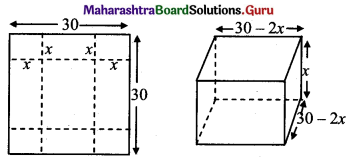
An open box is made from a square of cardboard of 30 cms side, by cutting squares of length x centimeters from each corner and folding the sides up. Express the volume of the box as a function of x. Also, find its domain.
Solution:
Maharashtra Board 11th Maths Solutions Chapter 6 Functions Ex 6.1 Q11
Length of the box = 30 – 2x
Breadth of the box = 30 – 2x
Height of the box = x
Volume = (30 – 2x)2 x, x < 15, x ≠ 15, x > 0
= 4x(15 – x)2, x ≠ 15, x > 0
Domain (0, 15)

Question 12.
Let f be a subset of Z × Z defined by f = {(ab, a + b): a, b ∈ Z}. Is f a function from Z to Z? Justify?
Solution:
f = {(ab, a + b): a, b ∈ Z}
Let a = 1, b = 1. Then, ab = 1, a + b = 2
∴ (1, 2) ∈ f
Let a = -1, b = -1. Then, ab = 1, a + b = -2
∴ (1, -2) ∈ f
Since (1, 2) ∈ f and (1, -2) ∈ f,
f is not a function as element 1 does not have a unique image.

Question 13.
Check the injectivity and surjectivity of the following functions.
(i) f : N → N given by f(x) = x2
Solution:
f: N → N given by f(x) = x2
Maharashtra Board 11th Maths Solutions Chapter 6 Functions Ex 6.1 Q13 (i)
∴ f is injective.
For every y = x2 ∈ N, there does not exist x ∈ N.
Example: 7 ∈ N (codomain) for which there is no x in domain N such that x2 = 7
∴ f is not surjective.

(ii) f : Z → Z given by f(x) = x2
Solution:
f: Z → Z given by f(x) = x2
Maharashtra Board 11th Maths Solutions Chapter 6 Functions Ex 6.1 Q13 (ii)
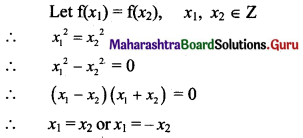
∴ f is not injective.
(Example: f(-2) = 4 = f(2). So, -2, 2 have the same image. So, f is not injective.)
Since x2 ≥ 0,
f(x) ≥ 0
Therefore all negative integers of codomain are not images under f.
∴ f is not surjective.

(iii) f : R → R given by f(x) = x2
Solution:
f : R → R given by f(x) = x2
Maharashtra Board 11th Maths Solutions Chapter 6 Functions Ex 6.1 Q13 (iii)
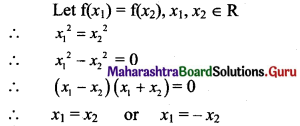
∴ f is not injective.
f(x) = x2 ≥ 0
Therefore all negative integers of codomain are not images under f.
∴ f is not surjective.

Maharashtra Board 11th Maths Solutions Chapter 6 Functions Ex 6.1

(iv) f : N → N given by f(x) = x3
Solution:
f: N → N given by f(x) = x3
Maharashtra Board 11th Maths Solutions Chapter 6 Functions Ex 6.1 Q13 (iv)
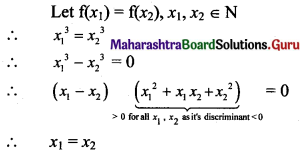
∴ f is injective.
Numbers from codomain which are not cubes of natural numbers are not images under f.
∴ f is not surjective.

(v) f : R → R given by f(x) = x3
Solution:
f: R → R given by f(x) = x3
Maharashtra Board 11th Maths Solutions Chapter 6 Functions Ex 6.1 Q13 (v)
∴ For every y ∈ R, there is some x ∈ R.
∴ f is surjective.

Question 14.
Show that if f : A → B and g : B → C are one-one, then gof is also one-one.
Solution:
f is a one-one function.
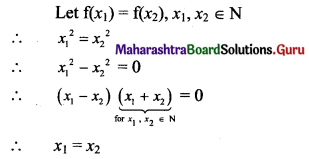
Let f(x1) = f(x2)
Then, x1 = x2 for all x1, x2 …..(i)
g is a one-one function.
Let g(y1) = g(y2)
Then, y1 = y2 for all y1, y2 …..(ii)
Let (gof) (x1) = (gof) (x2)
∴ g(f(x1)) = g(f(x2))
∴ g(y1) = g(y2),
where y1 = f(x1), y2 = f(x2) ∈ B
∴ y1 = y2 …..[From (ii)]
i.e., f(x1) = f(x2)
∴ x1 = x2 ….[From (i)]
∴ gof is one-one.

Question 15.
Show that if f : A → B and g : B → C are onto, then gof is also onto.
Solution:
Since g is surjective (onto),
there exists y ∈ B for every z ∈ C such that
g(y) = z …….(i)
Since f is surjective,
there exists x ∈ A for every y ∈ B such that
f(x) = y …….(ii)
(gof) x = g(f(x))
= g(y) ……[From (ii)]
= z …..[From(i)]
i.e., for every z ∈ C, there is x in A such that (gof) x = z
∴ gof is surjective (onto).

Question 16.
If f(x) = 3(4x+1), find f(-3).
Solution:
f(x) = 3(4x+1)
∴ f(-3) = 3(4-3+1)
= 3(4-2)
= \(\frac{3}{16}\)

Maharashtra Board 11th Maths Solutions Chapter 6 Functions Ex 6.1

Question 17.
Express the following exponential equations in logarithmic form:
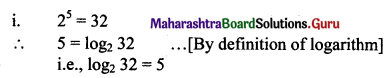
(i) 25 = 32
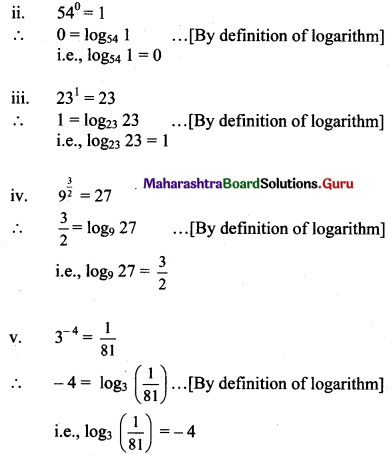
(ii) 540 = 1
(iii) 231 = 23
(iv) \(9^{\frac{3}{2}}\) = 27
(v) 3-4 = \(\frac{1}{81}\)
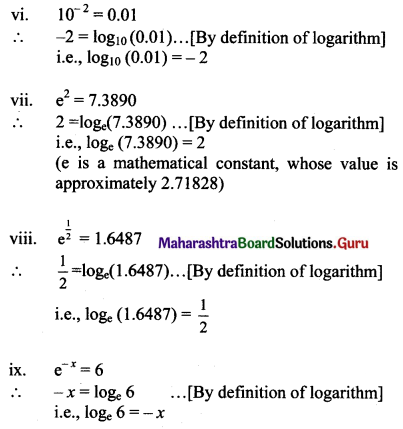
(vi) 10-2 = 0.01
(vii) e2 = 7.3890
(viii) \(e^{\frac{1}{2}}\) = 1.6487
(ix) e-x = 6
Solution:
Maharashtra Board 11th Maths Solutions Chapter 6 Functions Ex 6.1 Q17
Maharashtra Board 11th Maths Solutions Chapter 6 Functions Ex 6.1 Q17.1
Maharashtra Board 11th Maths Solutions Chapter 6 Functions Ex 6.1 Q17.2

Question 18.
Express the following logarithmic equations in exponential form:
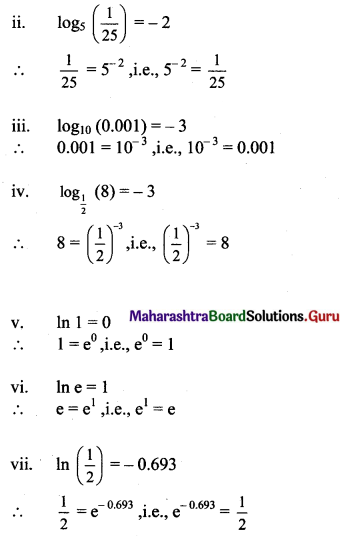
(i) log2 64 = 6
(ii) \(\log _{5} \frac{1}{25}\) = -2
(iii) log10 0.001 = -3
(iv) \(\log _{\frac{1}{2}}\)(8) = -3
(v) ln 1 = 0
(vi) ln e = 1
(vii) ln \(\frac{1}{2}\) = -0.693
Solution:
(i) log2 64 = 6
∴ 64 = 26, i.e., 26 = 64
Maharashtra Board 11th Maths Solutions Chapter 6 Functions Ex 6.1 Q18

Question 19.
Find the domain of
(i) f(x) = ln (x – 5)
(ii) f(x) = log10 (x2 – 5x + 6)
Solution:
(i) f(x) = ln (x – 5)
f is defined, when x – 5 > 0
∴ x > 5
∴ Domain of f = (5, ∞)

(ii) f(x) = log10 (x2 – 5x + 6)
x2 – 5x + 6 = (x – 2) (x – 3)
f is defined, when (x – 2) (x – 3) > 0
∴ x < 2 or x > 3
Solution of (x – a) (x – b) > 0 is x < a or x > b where a < b
∴ Domain of f = (-∞, 2) ∪ (3, ∞)

Maharashtra Board 11th Maths Solutions Chapter 6 Functions Ex 6.1

Question 20.
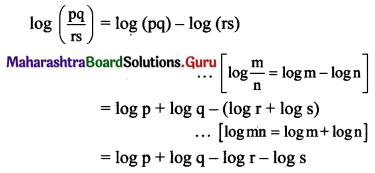
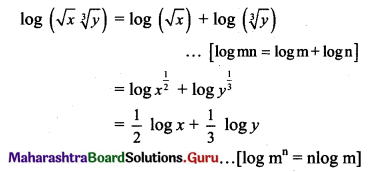
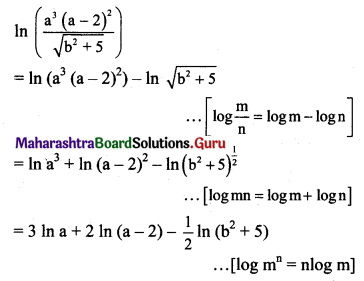
Write the following expressions as sum or difference of logarithms:
(a) \(\log \left(\frac{p q}{r s}\right)\)
Solution:
Maharashtra Board 11th Maths Solutions Chapter 6 Functions Ex 6.1 Q20 (i)

(b) \(\log (\sqrt{x} \sqrt[3]{y})\)
Solution:
Maharashtra Board 11th Maths Solutions Chapter 6 Functions Ex 6.1 Q20 (ii)

(c) \(\ln \left(\frac{a^{3}(a-2)^{2}}{\sqrt{b^{2}+5}}\right)\)
Solution:
Maharashtra Board 11th Maths Solutions Chapter 6 Functions Ex 6.1 Q20 (iii)

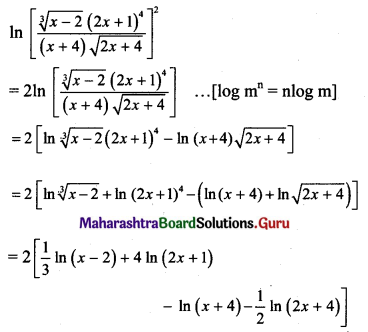
(d) \(\ln \left[\frac{\sqrt[3]{x-2}(2 x+1)^{4}}{(x+4) \sqrt{2 x+4}}\right]^{2}\)
Solution:
Maharashtra Board 11th Maths Solutions Chapter 6 Functions Ex 6.1 Q20 (iv)

Question 21.
Write the following expressions as a single logarithm.
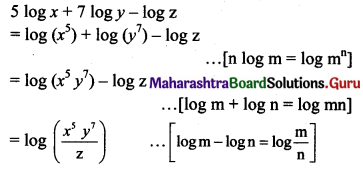
(i) 5 log x + 7 log y – log z
Solution:
Maharashtra Board 11th Maths Solutions Chapter 6 Functions Ex 6.1 Q21 (i)

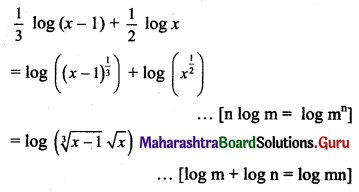
(ii) \(\frac{1}{3}\) log(x – 1) + \(\frac{1}{2}\) log(x)
Solution:
Maharashtra Board 11th Maths Solutions Chapter 6 Functions Ex 6.1 Q21 (ii)

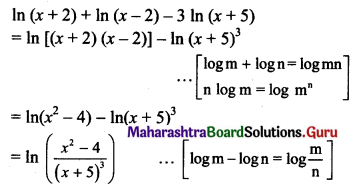
(iii) ln (x + 2) + ln (x – 2) – 3 ln (x + 5)
Solution:
Maharashtra Board 11th Maths Solutions Chapter 6 Functions Ex 6.1 Q21 (iii)

Question 22.
Given that log 2 = a and log 3 = b, write log √96 terms of a and b.
Solution:
log 2 = a and log 3 = b
log √96 = \(\frac{1}{2}\) log (96)
= \(\frac{1}{2}\) log (25 x 3)
= \(\frac{1}{2}\) (log 25 + log 3) …..[∵ log mn = log m + log n]
= \(\frac{1}{2}\) (5 log 2 + log 3) ……[∵ log mn = n log m]
= \(\frac{5 a+b}{2}\)

Maharashtra Board 11th Maths Solutions Chapter 6 Functions Ex 6.1

Question 23.
Prove that:
(a) \(b^{\log _{b} a}=a\)
Solution:
We have to prove that \(b^{\log _{b} a}=a\)
i.e., to prove that (logb a) (logb b) = logb a
(Taking log on both sides with base b)
L.H.S. = (logb a) (logb b)
= logb a …..[∵ logb b = 1]
= R.H.S.

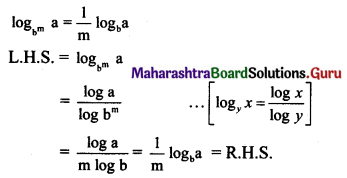
(b) \(\log _{b^{m}} a=\frac{1}{m} \log _{b} a\)
Solution:
Maharashtra Board 11th Maths Solutions Chapter 6 Functions Ex 6.1 Q23 (b)

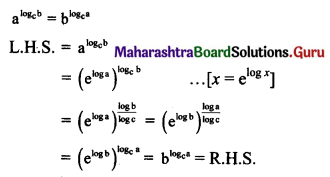
(c) \(a^{\log _{c} b}=b^{\log _{c} a}\)
Solution:
Maharashtra Board 11th Maths Solutions Chapter 6 Functions Ex 6.1 Q23 (c)

Question 24.
If f(x) = ax2 – bx + 6 and f(2) = 3 and f(4) = 30, find a and b.
Solulion:
f(x) = ax2 – bx + 6
f(2) = 3
∴ a(2)2 – b(2) + 6 = 3
∴ 4a – 2b + 6 = 3
∴ 4a – 2b + 3 = 0 …..(i)
f(4) = 30
∴ a(4)2 – b(4) + 6 = 30
∴ 16a – 4b + 6 = 30
∴ 16a – 4b – 24 = 0 …..(ii)
By (ii) – 2 × (i), we get
8a – 30 = 0
∴ a = \(\frac{30}{8}=\frac{15}{4}\)
Substiting a = \(\frac{15}{4}\) in (i), we get
4(\(\frac{15}{4}\)) – 2b + 3 = 0
∴ 2b = 18
∴ b = 9
∴ a = \(\frac{15}{4}\), b = 9

Question 25.
Solve for x:
(i) log 2 + log (x + 3) – log (3x – 5) = log 3
Solution:
log 2 + log (x + 3) – log (3x – 5) = log 3
∴ log 2(x + 3) – log(3x – 5) = log 3 …..[∵ log m + log n = log mn]
∴ log \(\frac{2(x+3)}{3 x-5}\) = log 3 …..[∵ log m – log n = log \(\frac{m}{n}\)]
∴ \(\frac{2(x+3)}{3 x-5}\) = 3
∴ 2x + 6 = 9x – 15
∴ 7x = 21
∴ x = 3

Check:
If x = 3 satisfies the given condition, then our answer is correct.
L.H.S. = log 2 + log (x + 3) – log (3x – 5)
= log 2 + log (3 + 3) – log (9 – 5)
= log 2 + log 6 – log 4
= log (2 × 6) – log 4
= log \(\frac{12}{4}\)
= log 3
= R.H.S.
Thus, our answer is correct.

Maharashtra Board 11th Maths Solutions Chapter 6 Functions Ex 6.1

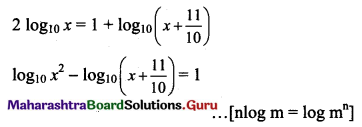
(ii) 2log10 x = 1 + \(\log _{10}\left(x+\frac{11}{10}\right)\)
Solution:
Maharashtra Board 11th Maths Solutions Chapter 6 Functions Ex 6.1 Q25 (ii)
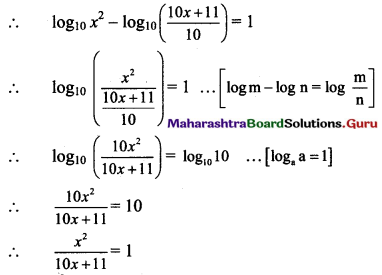
Maharashtra Board 11th Maths Solutions Chapter 6 Functions Ex 6.1 Q25 (ii).1
∴ x2 = 10x + 11
∴ x2 – 10x – 11 = 0
∴ (x – 11)(x + 1) = 0
∴ x = 11 or x = -1
But log of a negative numbers does not exist
∴ x ≠ -1
∴ x = 11

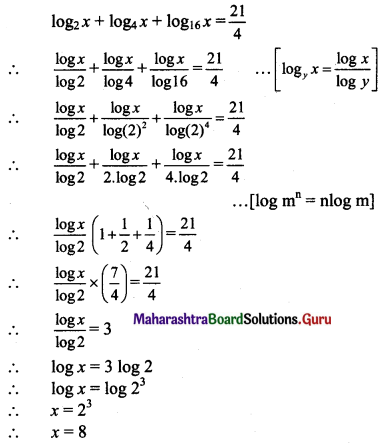
(iii) log2 x + log4 x + log16 x = \(\frac{21}{4}\)
Solution:
Maharashtra Board 11th Maths Solutions Chapter 6 Functions Ex 6.1 Q25 (iii)

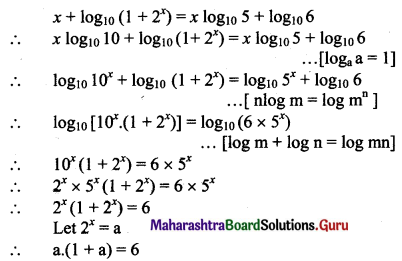
(iv) x + log10 (1 + 2x) = x log10 5 + log10 6
Solution:
Maharashtra Board 11th Maths Solutions Chapter 6 Functions Ex 6.1 Q25 (iv)
∴ a + a2 = 6
∴ a2 + a – 6 = 0
∴ (a + 3)(a – 2) = 0
∴ a + 3 = 0 or a – 2 = 0
∴ a = -3 or a = 2
Since 2x = -3 is not possible,
2x = 2 = 21
∴ x = 1

Maharashtra Board 11th Maths Solutions Chapter 6 Functions Ex 6.1

Question 26.
If log \(\left(\frac{x+y}{3}\right)\) = \(\frac{1}{2}\) log x + \(\frac{1}{2}\) log y, show that \(\frac{x}{y}+\frac{y}{x}\) = 7.
Solution:
Maharashtra Board 11th Maths Solutions Chapter 6 Functions Ex 6.1 Q26

Question 27.
If log\(\left(\frac{x-y}{4}\right)\) = log√x + log√y, show that (x + y)2 = 20xy.
Solution:
Maharashtra Board 11th Maths Solutions Chapter 6 Functions Ex 6.1 Q27

Question 28.
If x = logabc, y = logb ca, z = logc ab, then prove that \(\frac{1}{1+x}+\frac{1}{1+y}+\frac{1}{1+z}\) = 1.
Solution:
Maharashtra Board 11th Maths Solutions Chapter 6 Functions Ex 6.1 Q28

Maharashtra Board 11th Maths Solutions Chapter 5 Sets and Relations Ex 5.1

Balbharti Maharashtra State Board 11th Maths Book Solutions Pdf Chapter 5 Sets and Relations Ex 5.1 Questions and Answers.

Maharashtra State Board 11th Maths Solutions Chapter 5 Sets and Relations Ex 5.1

Question 1.
Describe the following sets in Roster form:
(i) A = {x/x is a letter of the word ‘MOVEMENT’}
(ii) B = {x/x is an integer, –\(\frac{3}{2}\) < x < \(\frac{9}{2}\)>
(iii) C = {x/x = 2n + 1, n ∈ N}
Solution:
(i) A = {M, O, V, E, N, T}
(ii) B = {-1, 0, 1, 2, 3, 4}
(iii) C = {3, 5, 7, 9, … }

Maharashtra Board 11th Maths Solutions Chapter 5 Sets and Relations Ex 5.1

Question 2.
Describe the following sets in Set-Builder form:
(i) {0}
(ii) {0, ±1, ±2, ±3}
(iii) \(\left\{\frac{1}{2}, \frac{2}{5}, \frac{3}{10}, \frac{4}{17}, \frac{5}{26}, \frac{6}{37}, \frac{7}{50}\right\}\)
(iv) {0, -1, 2, -3, 4, -5, 6,…}
Solution:
(i) Let A = {0}
0 is a whole number but it is not a natural number.
∴ A = {x / x ∈ W, x ∉ N}

(ii) Let B = {0, ±1, ±2, ±3}
B is the set of elements which belongs to Z from -3 to 3.
∴ B = {x /x ∈ Z, -3 ≤ x ≤ 3}

(iii) Let C = \(\left\{\frac{1}{2}, \frac{2}{5}, \frac{3}{10}, \frac{4}{17}, \frac{5}{26}, \frac{6}{37}, \frac{7}{50}\right\}\)
∴ C = {x / x = \(\frac{n}{n^{2}+1}\), n ∈ N, n ≤ 7}

(iv) Let D = {0, -1, 2, -3, 4, -5, 6, …}
∴ D = {x/x = (-1)n-1 × (n – 1), n ∈ N}

Question 3.
If A = {x / 6x2 + x – 15 = 0}, B = {x / 2x2 – 5x – 3 = 0}, C = {x / 2x2 – x – 3 = 0}, then find
(i) (A ∪ B ∪ C)
(ii) (A ∩ B ∩ C)
Solution:
A = [x/6x2 + x – 15 = 0)
6x2 + x – 15 = 0
6x2 + 10x – 9x – 15 = 0
2x(3x + 5) – 3(3x + 5) = 0
(3x + 5) (2x – 3) = 0
3x + 5 = 0 or 2x – 3 = 0
x = \(\frac{-5}{3}\) or x = \(\frac{3}{2}\)
A = {\(\frac{-5}{3}\), \(\frac{3}{2}\)}

B = {x/2x2 – 5x – 3 = 0}
2x2 – 5x – 3 = 0
2x2 – 6x + x – 3 = 0
2x(x – 3) + 1(x – 3) = 0
(x – 3)(2x + 1) = 0
x – 3 = 0 or 2x + 1 = 0
x = 3 or x = \(\frac{-1}{2}\)
B = (\(\frac{-1}{2}\), 3)

C = {x/2x2 – x – 3 = 0}
2x2 – x – 3 = 0
2x2 – 3x + 2x – 3 = 0
x(2x – 3) + 1(2x – 3) = 0
(2x – 3) (x + 1) = 0
2x – 3 = 0 or x + 1 = 0
x = \(\frac{3}{2}\) or x = -1
C = {-1, \(\frac{3}{2}\)}

(i) A ∪ B ∪ C = \(\left\{-\frac{5}{3}, \frac{3}{2}\right\} \cup\left\{\frac{-1}{2}, 3\right\} \cup\left\{-1, \frac{3}{2}\right\}\) = \(\left\{\frac{-5}{3},-1, \frac{-1}{2}, \frac{3}{2}, 3\right\}\)

(ii) A ∩ B ∩ C = { }

Maharashtra Board 11th Maths Solutions Chapter 5 Sets and Relations Ex 5.1

Question 4.
If A, B, C are the sets for the letters in the words ‘college’, ‘marriage’ and ‘luggage’ respectively, then verify that [A – (B ∪ C)] = [(A – B) ∩ (A – C)].
Solution:
A = {c, o, l, g, e}
B = {m, a, r, i, g, e}
C = {l, u, g, a, e}
B ∪ C = {m, a, r, i, g, e, l, u}
A – (B ∪ C) = {c, o}
A – B = {c, o, l}
A – C = {c, o}
∴ [(A – B) ∩ (A – C)] = {c, o} = A – (B ∪ C)
∴ [A -( B ∪ C)] = [(A – B) ∩ (A – C)]

Question 5.
If A = {1, 2, 3, 4}, B = {3, 4, 5, 6}, C = {4, 5, 6, 7, 8} and universal set X = {1, 2, 3, 4, 5, 6, 7, 8, 9, 10}, then verify the following:
(i) A ∪ (B ∩ C) = (A ∪ B) ∩ (A ∪ C)
(ii) A ∩ (B ∪ C) = (A ∩ B) ∪ (A ∩ C)
(iii) (A ∪ B)’ = A’ ∩ B’
(iv) (A ∩ B)’ = A’ ∪ B’
(v) A = (A ∩ B) ∪ (A ∩ B’)
(vi) B = (A ∩ B) ∪ (A’ ∩ B)
(vii) (A ∪ B) = (A – B) ∪ (A ∩ B) ∪ (B – A)
(viii) A ∩ (B ∆ C) = (A ∩ B) ∆ (A ∩ C)
(ix) n(A ∪ B) = n(A) + n(B) – n(A ∩ B)
(x) n(B) = n (A’ ∩ B) + n (A ∩ B)
Solution:
A = {1, 2, 3, 4}, B = {3, 4, 5, 6}, C = {4, 5, 6, 7, 8},
X = {1, 2, 3, 4, 5, 6, 7, 8, 9, 10}
(i) B ∩ C = {4, 5, 6}
∴ A ∪ (B ∩ C) = {1, 2, 3, 4, 5, 6} …..(i)
A ∪ B = {1, 2, 3, 4, 5, 6}
A ∪ C = {1, 2, 3, 4, 5, 6, 7, 8}
∴ (A ∪ B) ∩ (A ∪ C) = {1, 2, 3, 4, 5, 6} …….(ii)
From (i) and (ii), we get
A ∪ (B ∩ C) = (A ∪ B) ∩ (A ∪ C)

(ii) B ∪ C = {3, 4, 5, 6, 7, 8}
∴ A ∩ (B ∪ C) = {3, 4} ………(i)
A ∩ B = {3, 4}
A ∩ C = {4}
∴ (A ∩ B) ∪ (A∩ C) = {3, 4} ……..(ii)
From (i) and (ii), we get
A ∩ (B ∪ C) = (A ∩ B) ∪ (A ∩ C)

(iii) A ∪ B = {1, 2, 3, 4, 5, 6}
∴ (A ∪ B)’ = {7, 8, 9, 10} ………(i)
A’ = {5, 6, 7, 8, 9, 10},
B’ = {1, 2, 7, 8, 9,10}
∴ A’ ∩ B’ = {7, 8, 9, 10} …….(ii)
From (i) and (ii), we get
(A ∪ B)’ = A’ ∩ B’

(iv) A ∩ B = {3, 4}
(A ∩ B)’= {1, 2, 5, 6, 7, 8, 9, 10} …….(i)
A’ = {5, 6, 7, 8, 9, 10}
B’ = {1, 2, 7, 8, 9, 10}
∴ A’ ∪ B’ = {1, 2, 5, 6, 7, 8, 9, 10} …….(ii)
From (i) and (ii), we get
(A ∩ B)’ = A’ ∪ B’

(v) A = {1, 2, 3, 4} ……(i)
A ∩ B = {3, 4}
B’ = {1, 2, 7, 8, 9, 10}
A ∩ B’ = {1, 2}
∴ (A ∩ B) ∪ (A ∩ B’) = {1, 2, 3, 4} …..(ii)
From (i) and (ii), we get
A = (A ∩ B) ∪ (A ∩ B’)

(vi) B = {3, 4, 5, 6} …..(i)
A ∩ B = {3, 4}
A’ = {5, 6, 7, 8, 9, 10}
A’ ∩ B = {5, 6}
∴ (A ∩ B) ∪ (A’ ∩ B) = {3, 4, 5, 6} …..(ii)
From (i) and (ii), we get
B = (A ∩ B) ∪ (A’ ∩ B)

(vii) A ∪ B = {1, 2, 3, 4, 5, 6} …….(i)
A – B = {1, 2}
A ∩ B = {3, 4}
B – A = {5, 6}
∴ (A – B) ∪ (A ∩ B) ∪ (B – A) = {1, 2, 3, 4, 5, 6} ……(ii)
From (i) and (ii), we get
A ∪ B = (A – B) ∪ (A ∩ B) ∪ (B – A)

Maharashtra Board 11th Maths Solutions Chapter 5 Sets and Relations Ex 5.1

(viii) B – C = {3}
C – B = {7, 8}
B Δ C = (B – C) ∪ (C – B) = {3, 7, 8}
∴ A ∩ (B Δ C) = {3} ……(i)
A ∩ B = {3, 4}
A ∩ C = {4}
∴ (A ∩ B) Δ (A ∩ C) = [(A ∩ B) – (A ∩ C)] ∪ [(A ∩ C) – (A ∩ B)] = {3} …..(ii)
From (i) and (ii), we get
A ∩ (B Δ C) = (A ∩ B) Δ (A ∩ C)

(ix) A = {1, 2, 3, 4}, B = {3, 4, 5, 6}
A ∩ B = {3, 4}, A ∪ B = {1, 2, 3, 4, 5, 6}
∴ n(A) = 4, n(B) = 4,
n(A ∩ B) = 2, n(A ∪ B) = 6 ……(i)
∴ n(A) + n(B) – n(A ∩ B) = 4 + 4 – 2
∴ n(A) + n(B) – n(A ∩ B) = 6 …..(ii)
From (i) and (ii), we get
n(A ∪ B) = n(A) + n(B) – n(A ∩ B)

(x) B = {3, 4, 5, 6}
∴ n(B) = 4 …..(i)
A’ = {5, 6, 7, 8, 9, 10}
A’ ∩ B = {5, 6}
∴ n(A’ ∩ B) = 2
A ∩ B = {3, 4}
∴ n(A ∩ B) = 2
∴ n(A’ ∩ B) + n(A ∩ B) = 2 + 2 = 4 …..(ii)
From (i) and (ii), we get
n(B) = n(A’ ∩ B) + n (A ∩ B)

Question 6.
If A and B are subsets of the universal set X and n(X) = 50, n(A) = 35, n(B) = 20, n(A’ ∩ B’) = 5, find
(i) n(A ∪ B)
(ii) n(A ∩ B)
(iii) n(A’ ∩ B)
(iv) n(A ∩ B’)
Solution:
n(X) = 50, n(A) = 35, n(B) = 20, n(A’ ∩ B’) = 5
(i) n(A ∪ B) = n(X) – [n(A ∪ B)’]
= n(X) – n(A’ ∩ B’)
= 50 – 5
= 45

(ii) n(A ∩ B) = n(A) + n(B) – n(A ∪ B)
= 35 + 20 – 45
= 10

(iii) n(A’ ∩ B) = n(B) – n(A ∩ B)
= 20 – 10
= 10

(iv) n(A ∩ B’) = n(A) – n(A ∩ B)
= 35 – 10
= 25

Maharashtra Board 11th Maths Solutions Chapter 5 Sets and Relations Ex 5.1

Question 7.
In a class of 200 students who appeared in certain examinations, 35 students faded in CET, 40 in NEET and 40 in JEE, 20 faded in CET and NEET, 17 in NEET and JEE, 15 in CET and JEE and 5 faded in ad three examinations. Find how many students
(i) did not fail in any examination.
(ii) faded in NEET or JEE entrance.
Solution:
Let A = set of students who failed in CET
B = set of students who failed in NEET
C = set of students who failed in JEE
X = set of all students
∴ n(X) = 200, n(A) = 35, n(B) = 40, n(C) = 40, n(A ∩ B) = 20, n(B ∩ C) = 17, n(A ∩ C) = 15, n(A ∩ B ∩ C) = 5
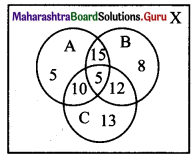
Maharashtra Board 11th Maths Solutions Chapter 5 Sets and Relations Ex 5.1 Q7

(i) n(A ∪ B ∪ C) = n(A) + n(B) + n(C) – n(A ∩ B) – n(B ∩ C) – n(A ∩ C) + n(A ∩ B ∩ C)
= 35 + 40 + 40 – 20 – 17 – 15 + 5
= 68
∴ No. of students who did not fail in any exam = n(X) – n(A ∪ B ∪ C)
= 200 – 68
= 132

(ii) No. of students who failed in NEET or JEE entrance = n(B ∪ C)
= n(B) + n(C) – n(B ∩ C)
= 40 + 40 – 17
= 63

Question 8.
From amongst 2000 Uterate individuals of a town, 70% read Marathi newspapers, 50% read English newspapers and 32.5% read both Marathi and English newspapers. Find the number of individuals who read
(i) at least one of the newspapers.
(ii) neither Marathi nor English newspaper.
(iii) only one of the newspapers.
Solution:
Let M = set of individuals who read Marathi newspapers
E = set of individuals who read English newspapers
X = set of all literate individuals
∴ n(X) = 2000,
n(M) = \(\frac{70}{100}\) × 2000 = 1400
n(E) = \(\frac{50}{100}\) × 2000 = 1000
n(M ∩ E) = \(\frac{32.5}{100}\) × 2000 = 650
(i) n(M ∪ E) = n(M) + n(E) – n(M ∩ E)
= 1400 + 1000 – 650
= 1750
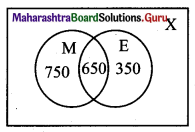
Maharashtra Board 11th Maths Solutions Chapter 5 Sets and Relations Ex 5.1 Q8
No. of individuals who read at least one of the newspapers = n(M ∪ E) = 1750.

(ii) No. of individuals who read neither Marathi nor English newspaper = n(M’ ∩ E’)
= n(M ∪ E)’
= n(X) – n(M ∪ E)
= 2000 – 1750
= 250

(iii) No. of individuals who read only one of the newspapers = n(M ∩ E’) + n(M’ ∩ E)
= n(M ∪ E) – n(M ∩ E)
= 1750 – 650
= 1100

Maharashtra Board 11th Maths Solutions Chapter 5 Sets and Relations Ex 5.1

Question 9.
In a hostel, 25 students take tea, 20 students take coffee, 15 students take milk, 10 students take both tea and coffee, 8 students take both milk and coffee. None of them take tea and milk both and everyone takes atleast one beverage, find the total number of students in the hostel.
Solution:
Let T = set of students who take tea
C = set of students who take coffee
M = set of students who take milk
∴ n(T) = 25, n(C) = 20, n(M) = 15, n(T ∩ C) = 10, n(M ∩ C) = 8, n(T ∩ M) = 0, n(T ∩ M ∩ C) = 0
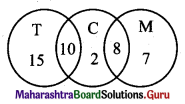
Maharashtra Board 11th Maths Solutions Chapter 5 Sets and Relations Ex 5.1 Q9
∴ Total number of students in the hostel = n(T ∪ C ∪ M)
= n(T) + n(C) + n(M) – n(T ∩ C) – n(M ∩ C) – n(T ∩ M) + n(T ∩ M ∩ C)
= 25 + 20 + 15 – 10 – 8 – 0 + 0
= 42

Question 10.
There are 260 persons with skin disorders. If 150 had been exposed to the chemical A, 74 to the chemical B, and 36 to both chemicals A and B, find the number of persons exposed to
(i) Chemical A but not Chemical B
(ii) Chemical B but not Chemical A
(iii) Chemical A or Chemical B
Solution:
Let A = set of persons exposed to chemical A
B = set of persons exposed to chemical B
X = set of all persons
∴ n(X) = 260, n(A) = 150, n(B) = 74, n(A ∩ B) = 36
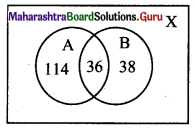
Maharashtra Board 11th Maths Solutions Chapter 5 Sets and Relations Ex 5.1 Q10

(i) No. of persons exposed to chemical A but not to chemical B = n(A ∩ B’)
= n(A) – n(A ∩ B)
= 150 – 36
= 114

(ii) No. of persons exposed to chemical B but not to chemical A = n(A’ ∩ B)
= n(B) – n(A ∩ B)
= 74 – 36
= 38

(iii) No. of persons exposed to chemical A or chemical B = n(A ∪ B)
= n(A) + n(B) – n(A ∩ B)
= 150 + 74 – 36
= 188

Maharashtra Board 11th Maths Solutions Chapter 5 Sets and Relations Ex 5.1

Question 11.
Write down the power set of A = {1, 2, 3}.
Solution:
A = {1, 2, 3}
The power set of A is given by
P(A) = {{Φ}, {2}, {3}, {1, 2}, {2, 3}, {1, 3}, {1, 2, 3}}

Question 12.
Write the following intervals in Set-Builder form:
(i) (-3, 0)
(ii) [6, 12]
(iii) (6, ∞)
(iv) (-∞, 5]
(v) (2, 5]
(vi) [-3, 4)
Solution:
(i) (-3, 0) = {x / x ∈ R, -3 < x < 0}

(ii) [6, 12] = {x / x ∈ R, 6 ≤ x ≤ 12}

(iii) (6, ∞) = {x / x ∈ R, x > 6}

(iv) (-∞, 5] = {x / x ∈ R, x ≤ 5}

(v) (2, 5] = {x / x ∈ R, 2 < x ≤ 5}

(vi) [-3, 4) = {x / x ∈ R, -3 ≤ x < 4}

Question 13.
A college awarded 38 medals in volleyball, 15 in football, and 20 in basketball. The medals were awarded to a total of 58 players and only 3 players got medals in all three sports. How many received medals in exactly two of the three sports?
Solution:
Let A = Set of students who received medals in volleyball
B = Set of students who received medals in football
C = Set of students who received medals in basketball
n(A) = 38, n(B) = 15, n(C) = 20, n(A ∪ B ∪ C) = 58, n(A ∩ B ∩ C) = 3
n(A ∪ B ∪ C) = n(A) + n(B) + n(C) – n(A ∩ B) – n(B ∩ C) – n(A ∩ C) + n(A ∩ B ∩ C)
58 = 38 + 15 + 20 – n(A ∩ B) – n(B ∩ C) – n(A ∩ C) + 3
∴ n(A ∩ B) + n(B ∩ C) + n(A ∩ C) = 18 ……(i)
Number of players who got exactly two medals = p + q + r
Here, s = n(A ∩ B ∩ C) = 3
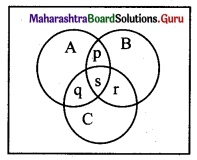
Maharashtra Board 11th Maths Solutions Chapter 5 Sets and Relations Ex 5.1 Q13
n(A ∩ B) + n(B ∩ C) + n(A ∩ C) = 18 …..[From (i)]
∴ p + s + s + r + q + s = 18
∴ p + q + r + 3s = 18
∴ p + q + r + 3(3) = 18
∴ p + q + r = 18 – 9 = 9
∴ Number of players who received exactly two medals = 9.

Maharashtra Board 11th Maths Solutions Chapter 5 Sets and Relations Ex 5.1

Question 14.
Solve the following inequalities and write the solution set using interval notation.
(i) -9 < 2x + 7 ≤ 19
(ii) x2 – x > 20
(iii) \(\frac{2 x}{x-4}\) ≤ 5
(iv) 6x2 + 1 ≤ 5x
Solution:
(i) -9 < 2x + 7 ≤ 19
∴ -16 < 2x ≤ 12
∴ -8< x ≤ 6
∴ x ∈ (-8, 6]

(ii) x2 – x > 20
∴ x2 – x – 20 > 0
∴ x2 – 5x + 4x – 20 > 0
∴ (x – 5) (x + 4) > 0
∴ either x – 5 > 0 and x + 4 > 0 or x – 5 < 0 and x + 4 < 0

Case I: x – 5 > 0 and x + 4 > 0
∴ x > 5 and x > -4
∴ x > 5 ….(i)

Case II:
x – 5 < 0 and x + 4 < 0
∴ x < 5 and x < -4
∴ x < -4 …..(ii)
From (i) and (ii), we get
x ∈ (-∞, – 4) ∪ (5, ∞)

(iii) \(\frac{2 x}{x-4}\) ≤ 5
∴ \(\frac{2 x}{x-4}\) – 5 ≤ 0
∴ \(\frac{2 x-5 x+20}{x-4}\) ≤ 0
∴ \(\frac{20-3 x}{x-4}\) ≤ 0
When \(\frac{a}{b}\) ≤ 0,
a ≥ 0 and b < 0 or a ≤ 0 and b > 0
∴ either 20 – 3x ≥ 0 and x – 4 < 0 or 20 – 3x ≤ 0 and x – 4 > 0
Case I:
20 – 3x ≥ 0 and x – 4 < 0
∴ x ≤ \(\frac{20}{3}\) and x < 4
∴ x < 4 ……(I)

Case II: 20 – 3x ≤ 0 and x – 4 > 0
∴ x ≥ \(\frac{20}{3}\) and x > 4
∴ x ≥ \(\frac{20}{3}\) ……(ii)
From (i) and (ii), we get
x ∈ (-∞, 4) ∪ [\(\frac{20}{3}\), ∞)

(iv) 6x2 + 1 ≤ 5x
6x2 – 5x + 1 ≤ 0
6x2 – 3x – 2x + 1 ≤ 0
(3x – 1) (2x – 1) ≤ 0
either 3x – 1 ≤ 0 and 2x – 1 ≥ 0 or 3x – 1 ≥ 0 and 2x – 1 ≤ 0
Case I:
3x – 1 ≤ 0 and 2x – 1 ≥ 0
∴ x ≤ \(\frac{1}{3}\) and x ≥ \(\frac{1}{2}\), which is not possible.

Case II:
3x – 1 ≥ 0 and 2x – 1 ≤ 0
∴ x ≥ \(\frac{1}{3}\) and x ≤ \(\frac{1}{2}\)
∴ x ∈ [\(\frac{1}{3}\), \(\frac{1}{2}\)]

Maharashtra Board 11th Maths Solutions Chapter 5 Sets and Relations Ex 5.1

Question 15.
If A = (-7, 3], B = [2, 6] and C = [4, 9], then find
(i) A ∪ B
(ii) B ∪ C
(iii) A ∪ C
(iv) A ∩ B
(v) B ∩ C
(vi) A ∩ C
(vii) A’ ∩ B
(viii) B’ ∩ C’
(ix) B – C
(x) A – B
Solution:
A = (-7, 3], B = [2, 6], C = [4, 9]
(i) A ∪ B = (-7, 6]

(ii) B ∪ C = [2, 9]

(iii) A ∪ C = (-7, 3] ∪ [4, 9]

(iv) A ∩ B = [2, 3]

(v) B ∩ C = [4, 6]

(vi) A ∩ C = { }

(vii) A’ = (-∞, – 7] ∪ (3, ∞)
∴ A’ ∩ B = (3, 6]

(viii) B’ = (-∞, 2) ∪ (6, ∞)
C’ = (-∞, 4) ∪ (9, ∞)
∴ B’ ∩ C’ = (-∞, 2) ∪ (9, ∞)

(ix) B – C = [2, 4)

(x) A – B = (-7, 2)

Maharashtra Board 11th Maths Solutions Chapter 2 Sequences and Series Ex 2.2

Balbharti Maharashtra State Board 11th Maths Book Solutions Pdf Chapter 2 Sequences and Series Ex 2.2 Questions and Answers.

Maharashtra State Board 11th Maths Solutions Chapter 2 Sequences and Series Ex 2.2

Question 1.
For the following G.P.s, find Sn.
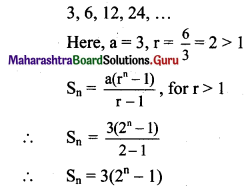
(i) 3, 6, 12, 24, ……..
Solution:
Maharashtra Board 11th Maths Solutions Chapter 2 Sequences and Series Ex 2.2 Q1 (i)

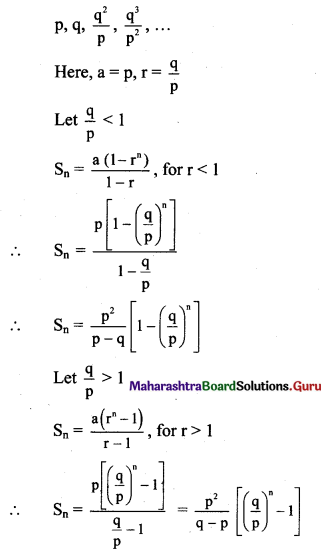
(ii) p, q, \(\frac{\mathbf{q}^{2}}{\mathbf{p}}, \frac{\mathbf{q}^{3}}{\mathbf{p}^{2}}, \ldots\)
Solution:
Maharashtra Board 11th Maths Solutions Chapter 2 Sequences and Series Ex 2.2 Q1 (ii)

Maharashtra Board 11th Maths Solutions Chapter 2 Sequences and Series Ex 2.2

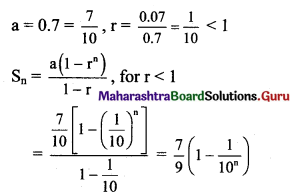
(iii) 0.7, 0.07, 0.007, …….
Solution:
Maharashtra Board 11th Maths Solutions Chapter 2 Sequences and Series Ex 2.2 Q1 (iii)

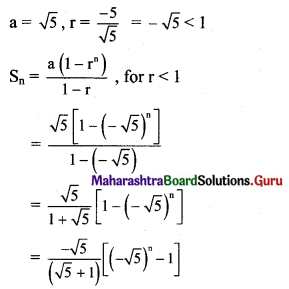
(iv) √5, -5, 5√5, -25, …….
Solution:
Maharashtra Board 11th Maths Solutions Chapter 2 Sequences and Series Ex 2.2 Q1 (iv)

Question 2.
For a G.P.
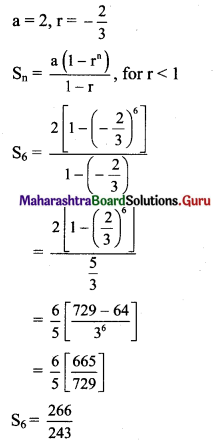
(i) a = 2, r = \(-\frac{2}{3}\), find S6.
Solution:
Maharashtra Board 11th Maths Solutions Chapter 2 Sequences and Series Ex 2.2 Q2 (i)

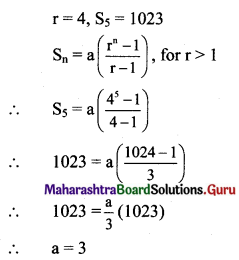
(ii) If S5 = 1023, r = 4, find a.
Solution:
Maharashtra Board 11th Maths Solutions Chapter 2 Sequences and Series Ex 2.2 Q2 (ii)

Question 3.
For a G.P.
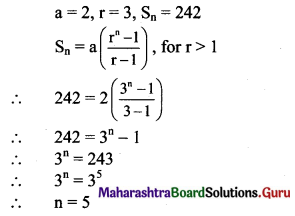
(i) If a = 2, r = 3, Sn = 242, find n.
Solution:
Maharashtra Board 11th Maths Solutions Chapter 2 Sequences and Series Ex 2.2 Q3 (i)

Maharashtra Board 11th Maths Solutions Chapter 2 Sequences and Series Ex 2.2

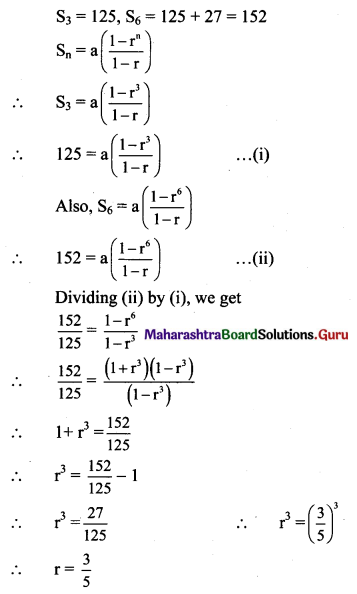
(ii) For a G.P. sum of the first 3 terms is 125 and the sum of the next 3 terms is 27, find the value of r.
Solution:
Maharashtra Board 11th Maths Solutions Chapter 2 Sequences and Series Ex 2.2 Q3 (ii)

Question 4.
For a G.P.
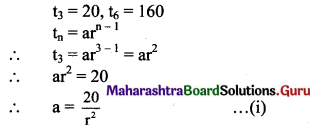
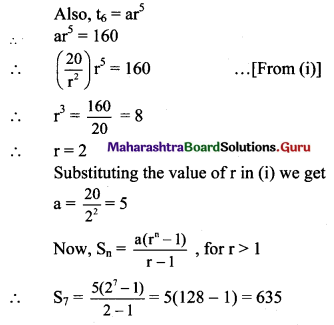
(i) If t3 = 20, t6 = 160, find S7.
Solution:
Maharashtra Board 11th Maths Solutions Chapter 2 Sequences and Series Ex 2.2 Q4 (i)
Maharashtra Board 11th Maths Solutions Chapter 2 Sequences and Series Ex 2.2 Q4 (i).1

(ii) If t4 = 16, t9 = 512, find S10.
Solution:
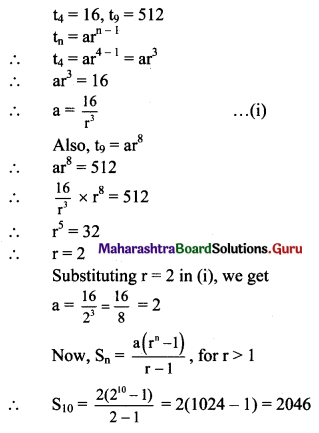
Maharashtra Board 11th Maths Solutions Chapter 2 Sequences and Series Ex 2.2 Q4 (ii)

Question 5.
Find the sum to n terms
(i) 3 + 33 + 333 + 3333 + …..
Solution:
Sn = 3 + 33 + 333 +….. upto n terms
= 3(1 + 11 + 111 +….. upto n terms)
= \(\frac{3}{9}\)(9 + 99 + 999 + ….. upto n terms)
= \(\frac{3}{9}\)[(10 – 1) + (100 – 1) + (1000 – 1) +… upto n terms]
= \(\frac{3}{9}\)[(10 + 100 + 1000 + … upto nterms) – (1 + 1 + 1 + ….. n times)]
But 10, 100, 1000, ….. n terms are in G.P. with
a = 10, r = \(\frac{100}{10}\) = 10
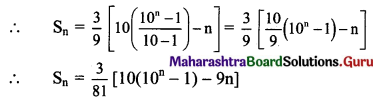
Maharashtra Board 11th Maths Solutions Chapter 2 Sequences and Series Ex 2.2 Q5 (i)

Maharashtra Board 11th Maths Solutions Chapter 2 Sequences and Series Ex 2.2

(ii) 8 + 88 + 888 + 8888 + …..
Solution:
Sn = 8 + 88 + 888 + … upto n terms
= 8(1 + 11 + 111 + … upto n terms)
= \(\frac{8}{9}\)(9 + 99 + 999 + … upto n terms)
= \(\frac{8}{9}\)[(10 – 1) + (100 – 1) + (1000 – 1) +… upto n terms]
= \(\frac{8}{9}\)[(10 + 100 + 1000 + … upto n terms) – (1 + 1 + 1 + … n times)]
But 10, 100, 1000, … n terms are in G.P. with
a = 10, r = \(\frac{100}{10}\) = 10
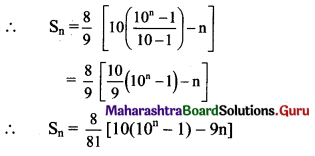
Maharashtra Board 11th Maths Solutions Chapter 2 Sequences and Series Ex 2.2 Q5 (ii)

Question 6.
Find the sum to n terms
(i) 0.4 + 0.44 + 0.444 + …..
Solution:
Sn = 0.4 + 0.44 + 0.444 + ….. upto n terms
= 4(0.1 + 0.11 +0.111 + …. upto n terms)
= \(\frac{4}{9}\)(0.9 + 0.99 + 0.999 + … upto n terms)
= \(\frac{4}{9}\)[(1 – 0.1) + (1 – 0.01) + (1 – 0.001) … upto n terms]
= \(\frac{4}{9}\)[(1 + 1 + 1 + …n times) – (0.1 + 0.01 + 0.001 +… upto n terms)]
But 0.1, 0.01, 0.001, … n terms are in G.P. with
a = 0.1, r = \(\frac{0.01}{0.1}\) = 0.1
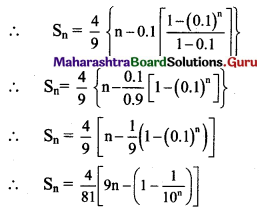
Maharashtra Board 11th Maths Solutions Chapter 2 Sequences and Series Ex 2.2 Q6 (i)

(ii) 0.7 + 0.77 + 0.777 + ……
Solution:
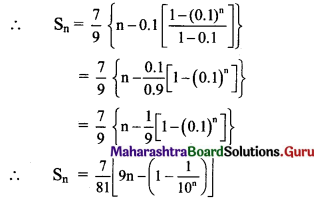
Sn = 0.7 + 0.77 + 0.777 + … upto n terms
= 7(0.1 + 0.11 + 0.111 + … upton terms)
= \(\frac{7}{9}\)(0.9 + 0.99 + 0.999 + … upto n terms)
= \(\frac{7}{9}\)[(1 – 0.1) + (1 – 0.01) + (1 – 0.001) +… upto n terms]
= \(\frac{7}{9}\)[(1 + 1 + 1 +… n times) – (0.1 + 0.01 + 0.001 +… upto n terms )]
But 0.1, 0.01, 0.001, … n terms are in G.P. with
a = 0.1, r = \(\frac{0.01}{0.1}\) = 0.1
Maharashtra Board 11th Maths Solutions Chapter 2 Sequences and Series Ex 2.2 Q6 (ii)

Question 7.
Find the sum to n terms of the sequence
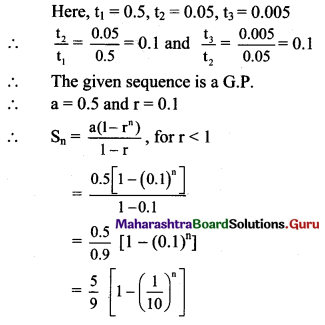
(i) 0.5, 0.05, 0.005, …..
Solution:
Maharashtra Board 11th Maths Solutions Chapter 2 Sequences and Series Ex 2.2 Q7 (i)

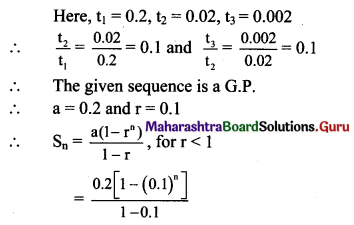
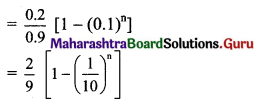
(ii) 0.2, 0.02, 0.002, ……
Solution:
Maharashtra Board 11th Maths Solutions Chapter 2 Sequences and Series Ex 2.2 Q7 (ii)
Maharashtra Board 11th Maths Solutions Chapter 2 Sequences and Series Ex 2.2 Q7 (ii).1

Maharashtra Board 11th Maths Solutions Chapter 2 Sequences and Series Ex 2.2

Question 8.
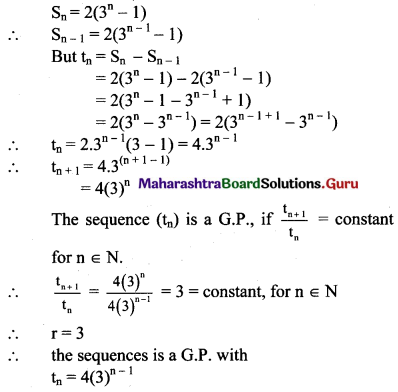
For a sequence, if Sn = 2(3n – 1), find the nth term, hence showing that the sequence is a G.P.
Solution:
Maharashtra Board 11th Maths Solutions Chapter 2 Sequences and Series Ex 2.2 Q8

Question 9.
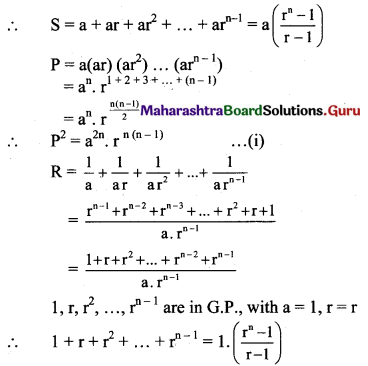
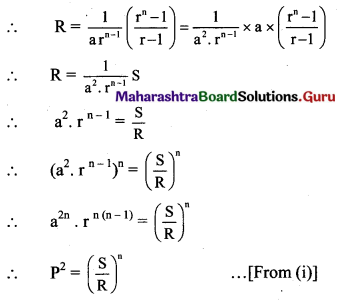
If S, P, R are the sum, product, and sum of the reciprocals of n terms of a G.P, respectively, then verify that \(\left[\frac{S}{R}\right]^{n}\) = P2.
Solution:
Let a be the 1st term and r be the common ratio of the G.P.
∴ the G.P. is a, ar, ar2, ar3, …, arn-1
Maharashtra Board 11th Maths Solutions Chapter 2 Sequences and Series Ex 2.2 Q9
Maharashtra Board 11th Maths Solutions Chapter 2 Sequences and Series Ex 2.2 Q9.1

Question 10.
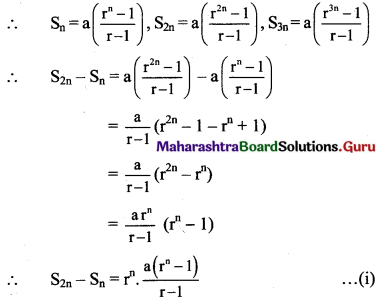
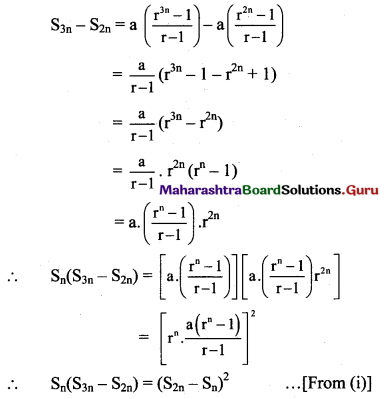
If Sn, S2n, S3n are the sum of n, 2n, 3n terms of a G.P. respectively, then verify that Sn(S3n – S2n) = (S2n – Sn)2.
Solution:
Let a and r be the 1st term and common ratio of the G.P. respectively.
Maharashtra Board 11th Maths Solutions Chapter 2 Sequences and Series Ex 2.2 Q10
Maharashtra Board 11th Maths Solutions Chapter 2 Sequences and Series Ex 2.2 Q10.1

Question 11.
Find
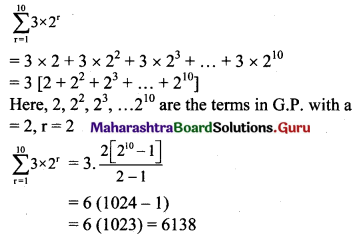
(i) \(\sum_{r=1}^{10}\left(3 \times 2^{r}\right)\)
Solution:
Maharashtra Board 11th Maths Solutions Chapter 2 Sequences and Series Ex 2.2 Q11 (i)

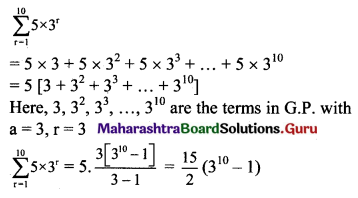
(ii) \(\sum_{r=1}^{10} 5 \times 3^{r}\)
Solution:
Maharashtra Board 11th Maths Solutions Chapter 2 Sequences and Series Ex 2.2 Q11 (ii)

Maharashtra Board 11th Maths Solutions Chapter 2 Sequences and Series Ex 2.2

Question 12.
The value of a house appreciates 5% per year. How much is the house worth after 6 years if its current worth is Rs. 15 Lac. [Given: (1.05)5 = 1.28, (1.05)6 = 1.34]
Solution:
The value of a house is Rs. 15 Lac.
Appreciation rate = 5% = \(\frac{5}{100}\) = 0.05
Value of house after 1st year = 15(1 + 0.05) = 15(1.05)
Value of house after 6 years = 15(1.05) (1.05)5
= 15(1.05)6
= 15(1.34)
= 20.1 lac.

Question 13.
If one invests Rs. 10,000 in a bank at a rate of interest 8% per annum, how long does it take to double the money by compound interest? [(1.08)5 = 1.47]
Solution:
Amount invested = Rs. 10000
Interest rate = \(\frac{8}{100}\) = 0.08
amount after 1st year = 10000(1 + 0.08) = 10000(1.08)
Value of the amount after n years
= 10000(1.08) × (1.08)n-1
= 10000(1.08)n
= 20000
∴ (1.08)n = 2
∴ (1.08)5 = 1.47 …..[Given]
∴ n = 10 years, (approximately)

Maharashtra Board 12th Commerce Maths Solutions Chapter 2 Matrices Ex 2.2

Balbharati Maharashtra State Board 12th Commerce Maths Solution Book Pdf Chapter 2 Matrices Ex 2.2 Questions and Answers.

Maharashtra State Board 12th Commerce Maths Solutions Chapter 2 Matrices Ex 2.2

Question 1.
If A = \(\left[\begin{array}{cc}
2 & -3 \\
5 & -4 \\
-6 & 1
\end{array}\right]\), B = \(\left[\begin{array}{cc}
-1 & 2 \\
2 & 2 \\
0 & 3
\end{array}\right]\) and C = \(\left[\begin{array}{cc}
4 & 3 \\
-1 & 4 \\
-2 & 1
\end{array}\right]\) show that
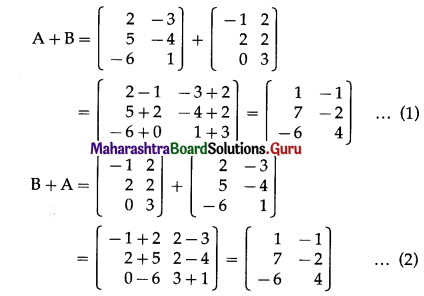
(i) A + B = B + A
(ii) (A + B) + C = A + (B + C)
Solution:
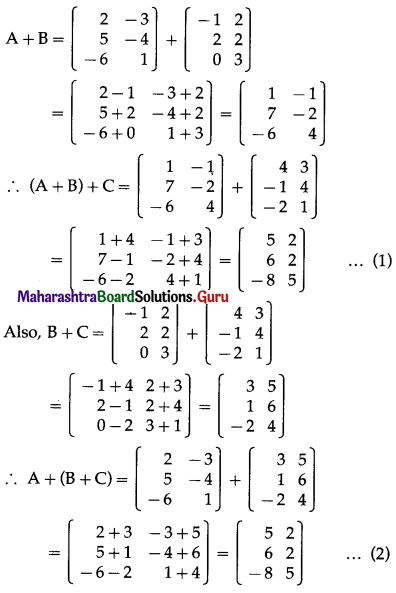
Maharashtra Board 12th Commerce Maths Solutions Chapter 2 Matrices Ex 2.2 Q1 (i)
Maharashtra Board 12th Commerce Maths Solutions Chapter 2 Matrices Ex 2.2 Q1 (ii)
From (1) and (2), we get
(A + B) + C = A + (B + C).

Question 2.
If A = \(\left[\begin{array}{cc}
1 & -2 \\
5 & 3
\end{array}\right]\), B = \(\left[\begin{array}{ll}
1 & -3 \\
4 & -7
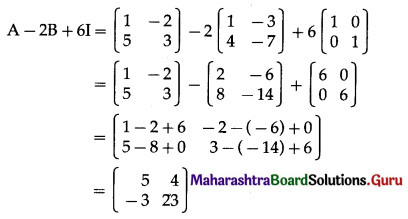
\end{array}\right]\), then find the matrix A – 2B + 6I, where I is the unit matrix of order 2.
Solution:
Maharashtra Board 12th Commerce Maths Solutions Chapter 2 Matrices Ex 2.2 Q2

Maharashtra Board 12th Commerce Maths Solutions Chapter 2 Matrices Ex 2.2

Question 3.
If A = \(\left[\begin{array}{ccc}
1 & 2 & -3 \\
-3 & 7 & -8 \\
0 & -6 & 1
\end{array}\right]\), B = \(\left[\begin{array}{ccc}
9 & -1 & 2 \\
-4 & 2 & 5 \\
4 & 0 & -3
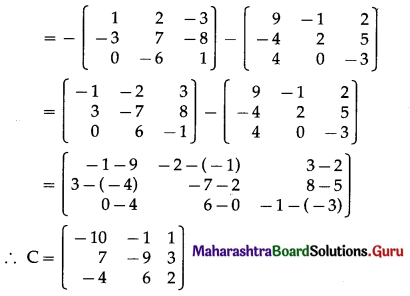
\end{array}\right]\), then find the matrix C such that A + B + C is a zero matrix.
Solution:
A + B + C = 0
∴ C = -A – B
Maharashtra Board 12th Commerce Maths Solutions Chapter 2 Matrices Ex 2.2 Q3

Question 4.
If A = \(\left[\begin{array}{cc}
1 & -2 \\
3 & -5 \\
-6 & 0
\end{array}\right]\), B = \(\left[\begin{array}{cc}
-1 & -2 \\
4 & 2 \\
1 & 5
\end{array}\right]\) and C = \(\left[\begin{array}{cc}
2 & 4 \\
-1 & -4 \\
-3 & 6
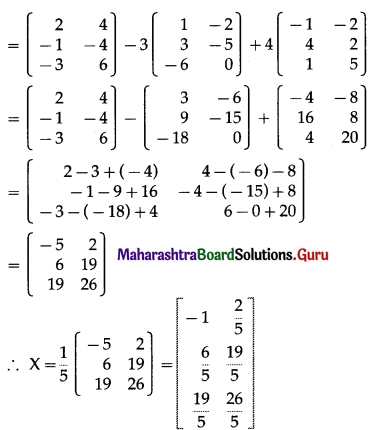
\end{array}\right]\), find the matrix X such that 3A – 4B + 5X = C.
Solution:
3A – 4B + 5X = C
∴ 5X = C – 3A + 4B
Maharashtra Board 12th Commerce Maths Solutions Chapter 2 Matrices Ex 2.2 Q4

Question 5.
If A = \(\left[\begin{array}{ccc}
5 & 1 & -4 \\
3 & 2 & 0
\end{array}\right]\), find (AT)T.
Solution:
A = \(\left[\begin{array}{ccc}
5 & 1 & -4 \\
3 & 2 & 0
\end{array}\right]\)
∴ AT = \(\left[\begin{array}{rr}
5 & 3 \\
1 & 2 \\
-4 & 0
\end{array}\right]\)
∴ (AT)T = \(\left[\begin{array}{ccc}
5 & 1 & -4 \\
3 & 2 & 0
\end{array}\right]\) = A

Maharashtra Board 12th Commerce Maths Solutions Chapter 2 Matrices Ex 2.2

Question 6.
If A = \(\left[\begin{array}{ccc}
7 & 3 & 1 \\
-2 & -4 & 1 \\
5 & 9 & 1
\end{array}\right]\), find (AT)T.
Solution:
A = \(\left[\begin{array}{ccc}
7 & 3 & 1 \\
-2 & -4 & 1 \\
5 & 9 & 1
\end{array}\right]\)
∴ AT = \(\left[\begin{array}{rrr}
7 & -2 & 5 \\
3 & -4 & 9 \\
1 & 1 & 1
\end{array}\right]\)
∴ (AT)T = \(\left[\begin{array}{ccc}
7 & 3 & 1 \\
-2 & -4 & 1 \\
5 & 9 & 1
\end{array}\right]\) = A

Question 7.
Find a, b, c if \(\left[\begin{array}{ccc}
1 & \frac{3}{5} & a \\
b & -5 & -7 \\
-4 & c & 0
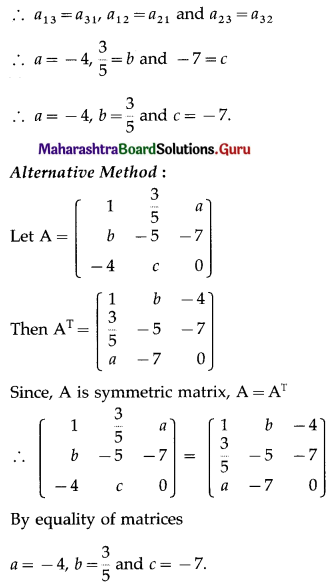
\end{array}\right]\) is a symetric matrix.
Solution:
Let A = \(\left[\begin{array}{ccc}
1 & \frac{3}{5} & a \\
b & -5 & -7 \\
-4 & c & 0
\end{array}\right]\)
Since, A is a symmetric matrix, aij = aji for all i and j
Maharashtra Board 12th Commerce Maths Solutions Chapter 2 Matrices Ex 2.2 Q7

Question 8.
Find x, y, z if \(\left[\begin{array}{ccc}
0 & -5 i & x \\
y & 0 & z \\
\frac{3}{2} & -\sqrt{2} & 0
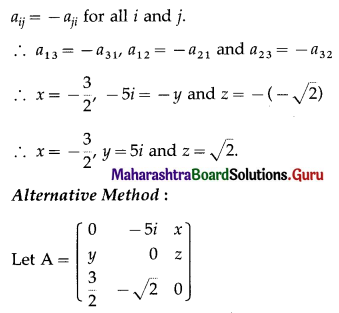
\end{array}\right]\) is a skew symmetric matrix.
Solution:
Let A = \(\left[\begin{array}{ccc}
0 & -5 i & x \\
y & 0 & z \\
\frac{3}{2} & -\sqrt{2} & 0
\end{array}\right]\)
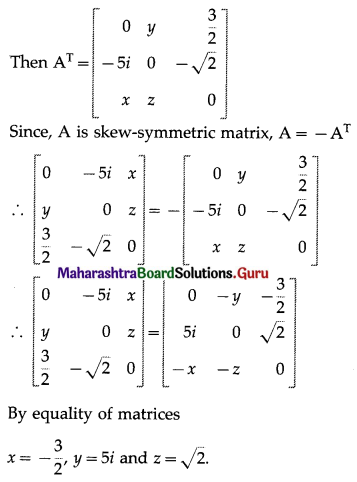
Since, A is skew-symmetric matrix,
Maharashtra Board 12th Commerce Maths Solutions Chapter 2 Matrices Ex 2.2 Q8
Maharashtra Board 12th Commerce Maths Solutions Chapter 2 Matrices Ex 2.2 Q8.1

Maharashtra Board 12th Commerce Maths Solutions Chapter 2 Matrices Ex 2.2

Question 9.
For each of the following matrices, find its transpose and state whether it is symmetric, skew-symmetric or neither:
(i) \(\left[\begin{array}{ccc}
1 & 2 & -5 \\
2 & -3 & 4 \\
-5 & 4 & 9
\end{array}\right]\)
Solution:
Let A = \(\left[\begin{array}{ccc}
1 & 2 & -5 \\
2 & -3 & 4 \\
-5 & 4 & 9
\end{array}\right]\)
Then AT = \(\left[\begin{array}{rrr}
1 & 2 & -5 \\
2 & -3 & 4 \\
-5 & 4 & 9
\end{array}\right]\)
Since, A = AT, A is a symmetric matrix.

(ii) \(\left[\begin{array}{ccc}
2 & 5 & 1 \\
-5 & 4 & 6 \\
-1 & -6 & 3
\end{array}\right]\)
Solution:
Let B = \(\left[\begin{array}{ccc}
2 & 5 & 1 \\
-5 & 4 & 6 \\
-1 & -6 & 3
\end{array}\right]\)
Then BT = \(\left(\begin{array}{rrr}
2 & -5 & -1 \\
5 & 4 & -6 \\
1 & 6 & 3
\end{array}\right)\)
∴ B ≠ BT
Also,
-BT = \(\left(\begin{array}{rrr}
2 & -5 & -1 \\
5 & 4 & -6 \\
1 & 6 & 3
\end{array}\right)=\left(\begin{array}{rrr}
-2 & 5 & 1 \\
-5 & -4 & 6 \\
-1 & -6 & -3
\end{array}\right)\)
∴ B ≠ -BT
Hence, B is neither symmetric nor skew-symmetric matrix.

(iii) \(\left[\begin{array}{ccc}
0 & 1+2 i & i-2 \\
-1-2 i & 0 & -7 \\
2-i & 7 & 0
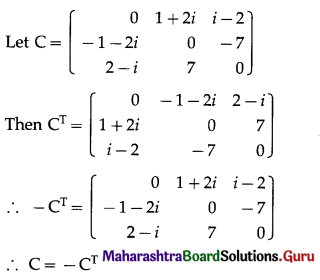
\end{array}\right]\)
Solution:
Maharashtra Board 12th Commerce Maths Solutions Chapter 2 Matrices Ex 2.2 Q9
Hence, C is a skew-symmetric matrix.

Question 10.
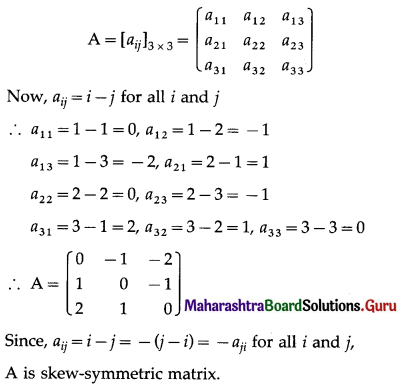
Construct the matrix A = [aij]3×3, where aij = i – j. State whether A is symmetric or skew-symmetric.
Solution:
Maharashtra Board 12th Commerce Maths Solutions Chapter 2 Matrices Ex 2.2 Q10

Maharashtra Board 12th Commerce Maths Solutions Chapter 2 Matrices Ex 2.2

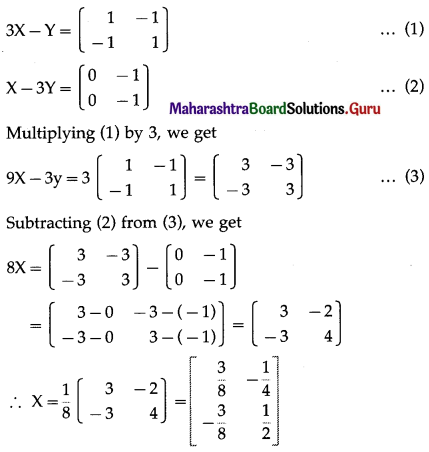
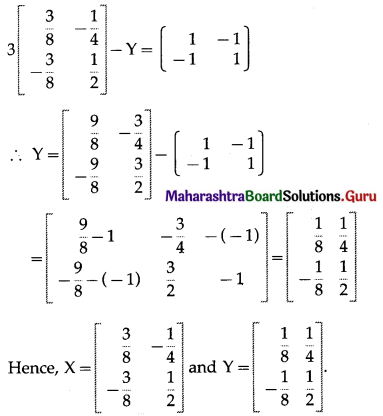
Question 11.
Solve the following equations for X and Y, if 3X – Y = \(\left[\begin{array}{cc}
1 & -1 \\
-1 & 1
\end{array}\right]\) and X – 3Y = \(\left[\begin{array}{ll}
0 & -1 \\
0 & -1
\end{array}\right]\)
Solution:
Maharashtra Board 12th Commerce Maths Solutions Chapter 2 Matrices Ex 2.2 Q11
Maharashtra Board 12th Commerce Maths Solutions Chapter 2 Matrices Ex 2.2 Q11.1

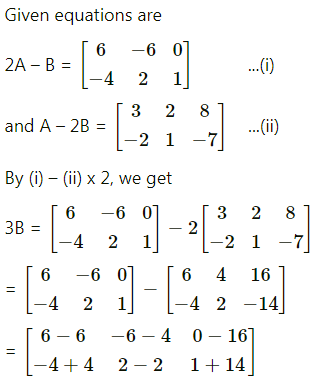
Question 12.
Find matrices A and B, if 2A – B = \(\left[\begin{array}{ccc}
6 & -6 & 0 \\
-4 & 2 & 1
\end{array}\right]\) and A – 2B = \(\left[\begin{array}{ccc}
3 & 2 & 8 \\
-2 & 1 & -7
\end{array}\right]\)
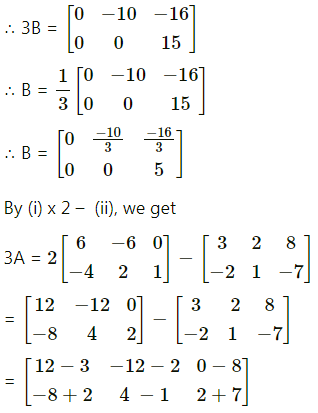
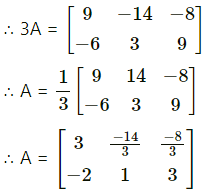
Solution:
Maharashtra Board 12th Commerce Maths Solutions Chapter 2 Matrices Ex 2.2 Q12
Maharashtra Board 12th Commerce Maths Solutions Chapter 2 Matrices Ex 2.2 Q12.1
Maharashtra Board 12th Commerce Maths Solutions Chapter 2 Matrices Ex 2.2 Q12.2

Question 13.
Find x and y, if \(\left[\begin{array}{ccc}
2 x+y & -1 & 1 \\
3 & 4 y & 4
\end{array}\right]+\left[\begin{array}{ccc}
-1 & 6 & 4 \\
3 & 0 & 3
\end{array}\right]=\left[\begin{array}{ccc}
3 & 5 & 5 \\
6 & 18 & 7
\end{array}\right]\)
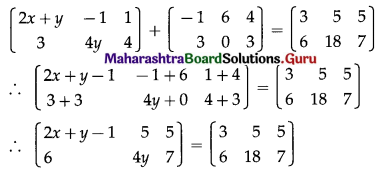
Solution:
Maharashtra Board 12th Commerce Maths Solutions Chapter 2 Matrices Ex 2.2 Q13
By equality of matrices, we get
2x + y – 1 = 3 ……..(1)
and 4y = 18 ……….(2)
From (2), y = \(\frac{9}{2}\)
Substituting y = \(\frac{9}{2}\) in (1), we get
2x + \(\frac{9}{2}\) – 1 = 3
∴ 2x = 3 – \(\frac{7}{2}\) = \(\frac{-1}{2}\)
∴ x = \(\frac{-1}{4}\)
Hence, x = \(\frac{-1}{4}\) and y = \(\frac{9}{2}\).

Maharashtra Board 12th Commerce Maths Solutions Chapter 2 Matrices Ex 2.2

Question 14.
If \(\left[\begin{array}{cc}
2 a+b & 3 a-b \\
c+2 d & 2 c-d
\end{array}\right]=\left[\begin{array}{cc}
2 & 3 \\
4 & -1
\end{array}\right]\), find a, b, c and d.
Solution:
\(\left[\begin{array}{cc}
2 a+b & 3 a-b \\
c+2 d & 2 c-d
\end{array}\right]=\left[\begin{array}{cc}
2 & 3 \\
4 & -1
\end{array}\right]\)
By equality of matrices,
2a + b = 2 ….. (1)
3a – b = 3 …… (2)
c + 2d = 4 …… (3)
2c – d = -1 …… (4)
Adding (1) and (2), we get
5a = 5
∴ a = 1
Substituting a = 1 in (1), we get
2(1) + b = 2
∴ b = 0
Multiplying equation (4) by 2, we get
4c – 2d = -2 …… (5)
Adding (3) and (5), we get
5c = 2
∴ c = \(\frac{2}{5}\)
Substituting c = \(\frac{2}{5}\) in (4), we get
2(\(\frac{2}{5}\)) – d = -1
∴ d = \(\frac{4}{5}\) + 1 = \(\frac{9}{5}\)
Hence, a = 1, b = 0, c = \(\frac{2}{5}\) and d = \(\frac{9}{5}\).

Maharashtra Board 12th Commerce Maths Solutions Chapter 2 Matrices Ex 2.2

Question 15.
There are two book shops owned by Suresh and Ganesh. Their sales (in Rupees) for books in three subjects – Physics, Chemistry and Mathematics for two months, July and August 2017 are given by two matrices A and B:
July sales (in Rupees), Physics, Chemistry, Mathematics
A = \(\left[\begin{array}{lll}
5600 & 6750 & 8500 \\
6650 & 7055 & 8905
\end{array}\right]\) First Row Suresh / Second Row Ganesh
August Sales (in Rupees), Physics, Chemistry, Mathematics
B = \(\left[\begin{array}{ccc}
6650 & 7055 & 8905 \\
7000 & 7500 & 10200
\end{array}\right]\) First Row Suresh / Second Row Ganesh
(i) Find the increase in sales in Z from July to August 2017.
(ii) If both book shops get 10% profit in the month of August 2017,
find the profit for each bookseller in each subject in that month.
Solution:
The sales for July and August 2017 for Suresh and Ganesh are given by the matrices A and B as:
Maharashtra Board 12th Commerce Maths Solutions Chapter 2 Matrices Ex 2.2 Q15
(i) The increase in sales (in ₹) from July to August 2017 is obtained by subtracting the matrix A from B.
Maharashtra Board 12th Commerce Maths Solutions Chapter 2 Matrices Ex 2.2 Q15.1
Maharashtra Board 12th Commerce Maths Solutions Chapter 2 Matrices Ex 2.2 Q15.2
Hence, the increase in sales (in ₹) from July to August 2017 for:
Suresh book shop: ₹ 1050 in Physics, ₹ 305 in Chemistry, and ₹ 405 in Mathematics.
Ganesh book shop: ₹ 350 in Physics, ₹ 445 in Chemistry, and ₹ 1295 in Mathematics.
(ii) Both the book shops get 10% profit in August 2017,
the profit for each bookseller in each subject in August 2017 is obtained by the scalar multiplication of matrix B by 10%,
i.e. \(\frac{10}{100}=\frac{1}{10}\)
Maharashtra Board 12th Commerce Maths Solutions Chapter 2 Matrices Ex 2.2 Q15.3
Hence, the profit for Suresh book shop are ₹ 665 in Physics, ₹ 705.50 in Chemistry and ₹ 890.50 in Mathematics and for Ganesh book shop are ₹ 700 in Physics, ₹ 750 in Chemistry and ₹ 1020 in Mathematics.

Maharashtra Board 11th Maths Solutions Chapter 8 Continuity Ex 8.1

Balbharti Maharashtra State Board 11th Maths Book Solutions Pdf Chapter 8 Continuity Ex 8.1 Questions and Answers.

Maharashtra State Board 11th Maths Solutions Chapter 8 Continuity Ex 8.1

Question 1.
Examine the continuity of
(i) f(x) = x3 + 2x2 – x – 2 at x = -2
Solution:
Given, f(x) = x3 + 2x2 – x – 2
f(x) is a polynomial function and hence it is continuous for all x ∈ R.
∴ f(x) is continuous at x = -2.

(ii) f(x) = sin x, for x ≤ \(\frac{\pi}{4}\)
= cos x, for x > \(\frac{\pi}{4}\), at x = \(\frac{\pi}{4}\)
Solution:
Maharashtra Board 11th Maths Solutions Chapter 8 Continuity Ex 8.1 Q1 (ii)

(iii) f(x) = \(\frac{x^{2}-9}{x-3}\), for x ≠ 3
= 8 for x = 3, at x = 3.
Solution:
f(3) = 8 ….(given)
Maharashtra Board 11th Maths Solutions Chapter 8 Continuity Ex 8.1 Q1 (iii)
∴ f(x) is discontinuous at x = 3.

Maharashtra Board 11th Maths Solutions Chapter 8 Continuity Ex 8.1

Question 2.
Examine whether the function is continuous at the points indicated against them.
(i) f(x) = x3 – 2x + 1, if x ≤ 2
= 3x – 2, if x > 2, at x = 2.
Solution:
Maharashtra Board 11th Maths Solutions Chapter 8 Continuity Ex 8.1 Q2 (i)

(ii) f(x) = \(\frac{x^{2}+18 x-19}{x-1}\), for x ≠ 1
= 20, for x = 1, at x = 1.
Solution:
Maharashtra Board 11th Maths Solutions Chapter 8 Continuity Ex 8.1 Q2 (ii)

(iii) f(x) = \(\frac{x}{\tan 3 x}+2\), for x < 0
= \(\frac{7}{3}\), for x ≥ 0, at x = 0.
Solution:
Maharashtra Board 11th Maths Solutions Chapter 8 Continuity Ex 8.1 Q2 (iii)

Question 3.
Find all the points of discontinuities of f(x) = [x] on the interval (-3, 2).
Solution:
f(x) = [x], x ∈ (-3, 2)
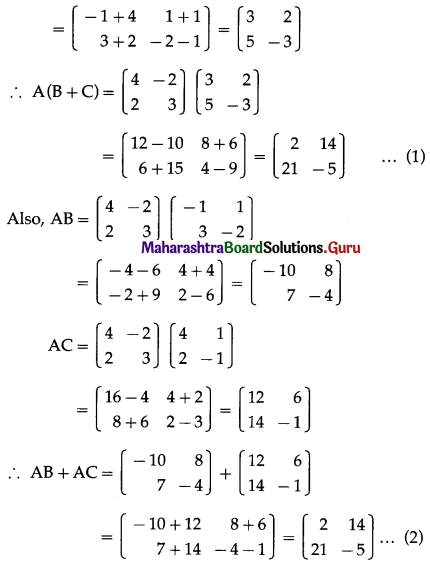
i.e., f(x) = -3, x ∈ (-3, -2)
= -2, x ∈ [-2, -1)
= -1, x ∈ [- 1, 0)
= 0, x ∈ [0, 1)
= 1, x ∈ [1, 2)
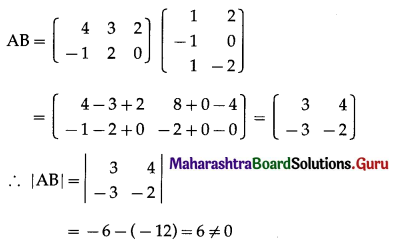
Maharashtra Board 11th Maths Solutions Chapter 8 Continuity Ex 8.1 Q3
Similarly, f(x) is discontinuous at the points x = -1, x = 0, x = 1.
Thus all the integer values of x in the interval (-3, 2),
i.e., the points x = -2, x = -1, x = 0 and x = 1 are the required points of discontinuities.

Question 4.
Discuss the continuity of the function f(x) = |2x + 3|, at x = \(\frac{-3}{2}\).
Solution:
Maharashtra Board 11th Maths Solutions Chapter 8 Continuity Ex 8.1 Q4
Maharashtra Board 11th Maths Solutions Chapter 8 Continuity Ex 8.1 Q4.1

Maharashtra Board 11th Maths Solutions Chapter 8 Continuity Ex 8.1

Question 5.
Test the continuity of the following functions at the points or intervals indicated against them.
Maharashtra Board 11th Maths Solutions Chapter 8 Continuity Ex 8.1 Q5
Maharashtra Board 11th Maths Solutions Chapter 8 Continuity Ex 8.1 Q5.1
Solution:
Maharashtra Board 11th Maths Solutions Chapter 8 Continuity Ex 8.1 Q5 (i)
Maharashtra Board 11th Maths Solutions Chapter 8 Continuity Ex 8.1 Q5 (ii)
Maharashtra Board 11th Maths Solutions Chapter 8 Continuity Ex 8.1 Q5 (ii).1
Maharashtra Board 11th Maths Solutions Chapter 8 Continuity Ex 8.1 Q5 (iii)
Maharashtra Board 11th Maths Solutions Chapter 8 Continuity Ex 8.1 Q5 (iv)
Maharashtra Board 11th Maths Solutions Chapter 8 Continuity Ex 8.1 Q5 (iv).1
Maharashtra Board 11th Maths Solutions Chapter 8 Continuity Ex 8.1 Q5 (iv).2
Maharashtra Board 11th Maths Solutions Chapter 8 Continuity Ex 8.1 Q5 (v)

Question 6.
Identify discontinuities for the following functions as either a jump or a removable discontinuity.
(i) f(x) = \(\frac{x^{2}-10 x+21}{x-7}\)
Solution:
Given, f(x) = \(\frac{x^{2}-10 x+21}{x-7}\)
It is a rational function and is discontinuous if
x – 7 = 0, i.e., x = 7
∴ f(x) is continuous for all x ∈ R, except at x = 7.
∴ f(7) is not defined.
Maharashtra Board 11th Maths Solutions Chapter 8 Continuity Ex 8.1 Q6 (i)
Thus, \(\lim _{x \rightarrow 7} \mathrm{f}(x)\) exist but f(7) is not defined.
∴ f(x) has a removable discontinuity.

(ii) f(x) = x2 + 3x – 2, for x ≤ 4
= 5x + 3, for x > 4.
Solution:
f(x) = x2 + 3x – 2, x ≤ 4
= 5x + 3, x > 4
f(x) is a polynomial function for both the intervals.
∴ f(x) is continuous for both the given intervals.
Let us test the continuity at x = 4.
Maharashtra Board 11th Maths Solutions Chapter 8 Continuity Ex 8.1 Q6 (ii)
∴ f(x) is discontinuous at x = 4.
∴ f(x) has a jump discontinuity at x = 4.

Maharashtra Board 11th Maths Solutions Chapter 8 Continuity Ex 8.1

(iii) f(x) = x2 – 3x – 2, for x < -3 = 3 + 8x, for x > -3.
Solution:
f(x) = x2 – 3x – 2, x < -3 = 3 + 8x, x > -3
f(x) is a polynomial function for both the intervals.
∴ f(x) is continuous for both the given intervals.
Let us test the continuity at x = -3.
Maharashtra Board 11th Maths Solutions Chapter 8 Continuity Ex 8.1 Q6 (iii)
∴ f(x) is discontinuous at x = -3.
∴ f(x) has a jump discontinuity at x = -3

(iv) f(x) = 4 + sin x, for x < π = 3 – cos x for x > π.
Solution:
f(x) = 4 + sin x, x < π = 3 – cos x, x > π
sin x and cos x are continuous for all x ∈ R.
4 and 3 are constant functions.
∴ 4 + sin x and 3 – cos x are continuous for all x ∈ R.
∴ f(x) is continuous for both the given intervals.
Let us test the continuity at x = π.
Maharashtra Board 11th Maths Solutions Chapter 8 Continuity Ex 8.1 Q6 (iv)
But f(π) is not defined.
∴ f(x) has a removable discontinuity at x = π.

Maharashtra Board 11th Maths Solutions Chapter 8 Continuity Ex 8.1

Question 7.
Show that the following functions have a continuous extension to the point where f(x) is not defined. Also, find the extension.
(i) f(x) = \(\frac{1-\cos 2 x}{\sin x}\), for x ≠ 0.
Solution:
f(x) = \(\frac{1-\cos 2 x}{\sin x}\), for x ≠ 0
Here, f(0) is not defined.
Consider,
Maharashtra Board 11th Maths Solutions Chapter 8 Continuity Ex 8.1 Q7 (i)
But f(0) is not defined.
∴ f(x) has a removable discontinuity at x = 0.
∴ The extension of the original function is
f(x) = \(\frac{1-\cos 2 x}{\sin x}\) for x ≠ 0
= 0 for x = 0
∴ f(x) is continuous at x = 0.

(ii) f(x) = \(\frac{3 \sin ^{2} x+2 \cos x(1-\cos 2 x)}{2\left(1-\cos ^{2} x\right)}\), for x ≠ 0.
Solution:
f(x) = \(\frac{3 \sin ^{2} x+2 \cos x(1-\cos 2 x)}{2\left(1-\cos ^{2} x\right)}\), for x ≠ 0
Here, f(0) is not defined.
Consider,
Maharashtra Board 11th Maths Solutions Chapter 8 Continuity Ex 8.1 Q7 (ii)
But f(0) is not defined.
∴ f(x) has a removable discontinuity at x = 0.
∴ The extension of the original function is
f(x) = \(\frac{3 \sin ^{2} x+2 \cos x(1-\cos 2 x)}{2\left(1-\cos ^{2} x\right)}\), x ≠ 0
= \(\frac{7}{2}\), x = 0
∴ f(x) is continuous at x = 0.

(iii) f(x) = \(\frac{x^{2}-1}{x^{3}+1}\), for x ≠ -1
Solution:
f(x) = \(\frac{x^{2}-1}{x^{3}+1}\), for x ≠ -1
Here, f(-1) is not defined.
Consider,
Maharashtra Board 11th Maths Solutions Chapter 8 Continuity Ex 8.1 Q7 (iii)
But f(-1) is not defined.
∴ f(x) has a removable discontinuity at x = -1.
∴ The extension of the original function is
f(x) = \(\frac{x^{2}-1}{x^{3}+1}\), x ≠ -1
= \(-\frac{2}{3}\), x = -1
∴ f(x) is continuous at x = \(-\frac{2}{3}\)

Question 8.
Discuss the continuity of the following functions at the points indicated against them.
Maharashtra Board 11th Maths Solutions Chapter 8 Continuity Ex 8.1 Q8
Solution:
Maharashtra Board 11th Maths Solutions Chapter 8 Continuity Ex 8.1 Q8 (i)
Maharashtra Board 11th Maths Solutions Chapter 8 Continuity Ex 8.1 Q8 (i).1
Maharashtra Board 11th Maths Solutions Chapter 8 Continuity Ex 8.1 Q8 (i).2
Maharashtra Board 11th Maths Solutions Chapter 8 Continuity Ex 8.1 Q8 (ii)
Maharashtra Board 11th Maths Solutions Chapter 8 Continuity Ex 8.1 Q8 (ii).1
Maharashtra Board 11th Maths Solutions Chapter 8 Continuity Ex 8.1 Q8 (iii)
Maharashtra Board 11th Maths Solutions Chapter 8 Continuity Ex 8.1 Q8 (iii).1

Question 9.
Which of the following functions has a removable discontinuity? If it has a removable discontinuity, redefine the function so that it becomes continuous.
Maharashtra Board 11th Maths Solutions Chapter 8 Continuity Ex 8.1 Q9
Maharashtra Board 11th Maths Solutions Chapter 8 Continuity Ex 8.1 Q9.1
Solution:
Maharashtra Board 11th Maths Solutions Chapter 8 Continuity Ex 8.1 Q9 (i)
Maharashtra Board 11th Maths Solutions Chapter 8 Continuity Ex 8.1 Q9 (i).1
Maharashtra Board 11th Maths Solutions Chapter 8 Continuity Ex 8.1 Q9 (i).2
Maharashtra Board 11th Maths Solutions Chapter 8 Continuity Ex 8.1 Q9 (ii)
Maharashtra Board 11th Maths Solutions Chapter 8 Continuity Ex 8.1 Q9 (ii).1
Maharashtra Board 11th Maths Solutions Chapter 8 Continuity Ex 8.1 Q9 (ii).2
Maharashtra Board 11th Maths Solutions Chapter 8 Continuity Ex 8.1 Q9 (iii)
Maharashtra Board 11th Maths Solutions Chapter 8 Continuity Ex 8.1 Q9 (iii).1
Maharashtra Board 11th Maths Solutions Chapter 8 Continuity Ex 8.1 Q9 (iv)
Maharashtra Board 11th Maths Solutions Chapter 8 Continuity Ex 8.1 Q9 (v)
Maharashtra Board 11th Maths Solutions Chapter 8 Continuity Ex 8.1 Q9 (v).1

Question 10.
(i) If f(x) = \(\frac{\sqrt{2+\sin x}-\sqrt{3}}{\cos ^{2} x}\), for x ≠ \(\frac{\pi}{2}\), is continuous at x = \(\frac{\pi}{2}\) then find f(\(\frac{\pi}{2}\)).
Solution:
f(x) is continuous at x = \(\frac{\pi}{2}\), …..(given)
Maharashtra Board 11th Maths Solutions Chapter 8 Continuity Ex 8.1 Q10 (i)
Maharashtra Board 11th Maths Solutions Chapter 8 Continuity Ex 8.1 Q10 (i).1

Maharashtra Board 11th Maths Solutions Chapter 8 Continuity Ex 8.1

(ii) If f(x) = \(\frac{\cos ^{2} x-\sin ^{2} x-1}{\sqrt{3 x^{2}+1}-1}\) for x ≠ 0, is continuous at x = 0 then find f(0).
Solution:
f(x) is continuous at x = 0, …..(given)
Maharashtra Board 11th Maths Solutions Chapter 8 Continuity Ex 8.1 Q10 (ii)
Maharashtra Board 11th Maths Solutions Chapter 8 Continuity Ex 8.1 Q10 (ii).1

(iii) If f(x) = \(\frac{4^{x-\pi}+4^{\pi-x}-2}{(x-\pi)^{2}}\) for x ≠ π, is continuous at x = π, then find f(π).
Solution:
f(x) is continuous at x = π, …..(given)
Maharashtra Board 11th Maths Solutions Chapter 8 Continuity Ex 8.1 Q10 (iii)

Question 11.
(i) If f(x) = \(\frac{24^{x}-8^{x}-3^{x}+1}{12^{x}-4^{x}-3^{x}+1}\), for x ≠ 0
= k, for x = 0
is continuous at x = 0, then find k.
Solution:
f(x) is continuous at x = 0 …..(given)
Maharashtra Board 11th Maths Solutions Chapter 8 Continuity Ex 8.1 Q11 (i)
Maharashtra Board 11th Maths Solutions Chapter 8 Continuity Ex 8.1 Q11 (i).1

(ii) If f(x) = \(\frac{5^{x}+5^{-x}-2}{x^{2}}\), for x ≠ 0
= k, for x = 0
is continuous at x = 0, then find k.
Solution:
f(x) is continuous at x = 0 …..(given)
Maharashtra Board 11th Maths Solutions Chapter 8 Continuity Ex 8.1 Q11 (ii)

(iii) If f(x) = \(\frac{\sin 2 x}{5 x}\) – a, for x > 0
= 4 for x = 0
= x2 + b – 3, for x < 0
is continuous at x = 0, find a and b.
Solution:
f(x) is continuous at x = 0 ……(given)
Maharashtra Board 11th Maths Solutions Chapter 8 Continuity Ex 8.1 Q11 (iii)

(iv) For what values of a and b is the function
f(x) = ax + 2b + 18, for x ≤ 0
= x2 + 3a – b, for 0 < x ≤ 2 = 8x – 2, for x > 2,
continuous for every x?
Solution:
f(x) is continuous for every x …..(given)
∴ f(x) is continuous at x = 0 and x = 2.
As f(x) is continuous at x = 0,
\(\lim _{x \rightarrow 0^{-}} \mathrm{f}(x)=\lim _{x \rightarrow 0^{+}} \mathrm{f}(x)\)
Maharashtra Board 11th Maths Solutions Chapter 8 Continuity Ex 8.1 Q11 (iv)
∴ (2)2 + 3a – b = 8(2) – 2
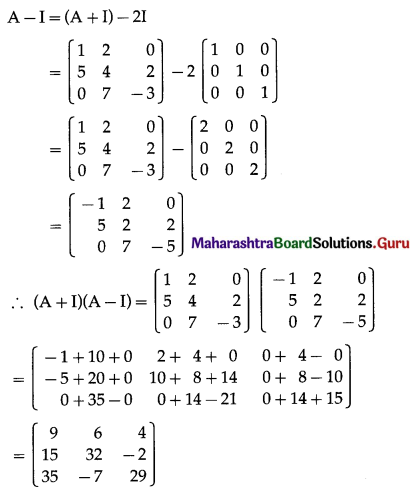
∴ 4 + 3a – b = 14
∴ 3a – b = 10 …….(ii)
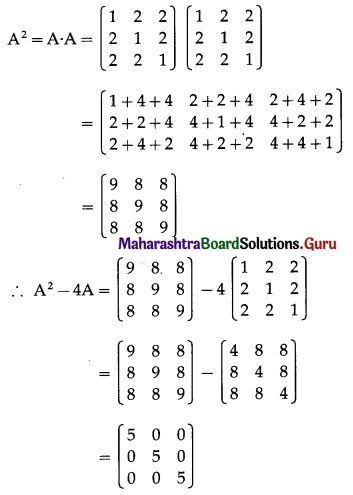
Subtracting (i) from (ii), we get
2a = 4
∴ a = 2
Substituting a = 2 in (i), we get
2 – b = 6
∴ b = -4
∴ a = 2 and b = -4

Maharashtra Board 11th Maths Solutions Chapter 8 Continuity Ex 8.1

(v) For what values of a and b is the function
f(x) = \(\frac{x^{2}-4}{x-2}\), for x < 2
= ax2 – bx + 3, for 2 ≤ x < 3
= 2x – a + b, for x ≥ 3
continuous for every x on R?
Solution:
f(x) is continuous for every x on R …..(given)
∴ f(x) is continuous at x = 2 and x = 3.
As f(x) is continuous at x = 2,
Maharashtra Board 11th Maths Solutions Chapter 8 Continuity Ex 8.1 Q11 (v)
∴ a(3)2 – b(3) + 3 = 2(3) – a + b
∴ 9a – 3b + 3 = 6 – a + b
∴ 10a – 4b = 3 …..(ii)
Multiplying (i) by 2, we get
8a – 4b = 2 ….(iii)
Subtracting (ii) from (iii), we get
-2a = -1
∴ a = \(\frac{1}{2}\)
Substituting a = \(\frac{1}{2}\) in (i), we get
4(\(\frac{1}{2}\)) – 2b = 1
∴ 2 – 2b = 1
∴ 1 = 2b
∴ b = \(\frac{1}{2}\)
∴ a = \(\frac{1}{2}\) and b = \(\frac{1}{2}\)

Question 12.
Discuss the continuity of f on its domain, where
f(x) = |x + 1|, for -3 ≤ x ≤ 2
= |x – 5|, for 2 < x ≤ 7
Solution:
Maharashtra Board 11th Maths Solutions Chapter 8 Continuity Ex 8.1 Q12

Question 13.
Discuss the continuity of f(x) at x = \(\frac{\pi}{4}\) where,
f(x) = \(\frac{(\sin x+\cos x)^{3}-2 \sqrt{2}}{\sin 2 x-1}\), for x ≠ \(\frac{\pi}{4}\)
= \(\frac{3}{\sqrt{2}}\), for x = \(\frac{\pi}{4}\)
Solution:
Maharashtra Board 11th Maths Solutions Chapter 8 Continuity Ex 8.1 Q13
Maharashtra Board 11th Maths Solutions Chapter 8 Continuity Ex 8.1 Q13.1

Question 14.
Determine the values of p and q such that the following function is continuous on the entire real number line.
f(x) = x + 1, for 1 < x < 3
= x2 + px + q, for |x – 2| ≥ 1.
Solution:
|x – 2| ≥ 1
∴ x – 2 ≥ 1 or x – 2 ≤ -1
∴ x ≥ 3 or x ≤ 1
∴ f(x) = x2 + px + q for x ≥ 3 as well as x ≤ 1
Thus, f(x) = x2 + px + q; x ≤ 1
= x + 1; 1 < x < 3 = x2 + px + q; x > 3
f(x) is continuous for all x ∈ R.
∴ f(x) is continuous at x = 1 and x = 3.
As f(x) is continuous at x = 1,
Maharashtra Board 11th Maths Solutions Chapter 8 Continuity Ex 8.1 Q14
Subtracting (i) from (ii), we get
2p = -6
∴ p = -3
Substituting p = -3 in (i), we get
-3 + q = 1
∴ q = 4
∴ p = -3 and q = 4

Maharashtra Board 11th Maths Solutions Chapter 8 Continuity Ex 8.1

Question 15.
Show that there is a root for the equation 2x3 – x – 16 = 0 between 2 and 3.
Solution:
Let f(x) = 2x3 – x – 16
f(x) is a polynomial function and hence it is continuous for all x ∈ R.
A root of f(x) exists, if f(x) = 0 for at least one value of x.
f(2) = 2(2)3 – 2 – 16 = -2 < 0
f(3) = 2(3)3 – 3 – 16 = 35 > 0
∴ f(2) < 0 and f(3) > 0
∴ By intermediate value theorem,
there has to be point ‘c’ between 2 and 3 such that f(c) = 0.
∴ There is a root of the given equation between 2 and 3.

Question 16.
Show that there is a root for the equation x3 – 3x = 0 between 1 and 2.
Solution:
Let f(x) = x3 – 3x
f(x) is a polynomial function and hence it is continuous for all x ∈ R.
A root of f(x) exists, if f(x) = 0 for at least one value of x.
f(1) = (1)3 – 3(1) = -2 < 0
f(2) = (2)3 – 3(2) = 2 > 0
∴ f(1) < 0 and f(2) > 0
∴ By intermediate value theorem,
there has to be point ‘c’ between 1 and 2 such that f(c) = 0.
There is a root of the given equation between 1 and 2.

Question 17.
Let f(x) = ax + b (where a and b are unknown)
= x2 + 5 for x ∈ R
Find the values of a and b, so that f(x) is continuous at x = 1.
Maharashtra Board 11th Maths Solutions Chapter 8 Continuity Ex 8.1 Q17
Solution:
f(x) = x2 + 5, x ∈ R
∴ f(1) = 1 + 5 = 6
If f(x) = ax + b is continuous at x = 1, then
f(1) = \(\lim _{x \rightarrow 1}(a x+b)\) = a + b
∴ 6 = a + b where, a, b ∈ R
∴ There are infinitely many values of a and b.

Maharashtra Board 11th Maths Solutions Chapter 8 Continuity Ex 8.1

Question 18.
Activity: Suppose f(x) = px + 3 for a ≤ x ≤ b
= 5x2 – q for b < x ≤ c
Find the condition on p, q, so that f(x) is continuous on [a, c], by filling in the boxes.
Maharashtra Board 11th Maths Solutions Chapter 8 Continuity Ex 8.1 Q18
Solution:
Maharashtra Board 11th Maths Solutions Chapter 8 Continuity Ex 8.1 Q18.1

Maharashtra Board 11th Maths Solutions Chapter 9 Differentiation Ex 9.2

Balbharti Maharashtra State Board 11th Maths Book Solutions Pdf Chapter 9 Differentiation Ex 9.2 Questions and Answers.

Maharashtra State Board 11th Maths Solutions Chapter 9 Differentiation Ex 9.2

(I) Differentiate the following w.r.t. x

Question 1.
y = \(x^{\frac{4}{3}}+e^{x}-\sin x\)
Solution:
Maharashtra Board 11th Maths Solutions Chapter 9 Differentiation Ex 9.2 I Q1

Question 2.
y = √x + tan x – x3
Solution:
Maharashtra Board 11th Maths Solutions Chapter 9 Differentiation Ex 9.2 I Q2

Question 3.
y = log x – cosec x + \(5^{x}-\frac{3}{x^{\frac{3}{2}}}\)
Solution:
Maharashtra Board 11th Maths Solutions Chapter 9 Differentiation Ex 9.2 I Q3

Maharashtra Board 11th Maths Solutions Chapter 9 Differentiation Ex 9.2

Question 4.
y = \(x^{\frac{7}{3}}+5 x^{\frac{4}{5}}-\frac{5}{x^{\frac{2}{5}}}\)
Solution:
Maharashtra Board 11th Maths Solutions Chapter 9 Differentiation Ex 9.2 I Q4
Maharashtra Board 11th Maths Solutions Chapter 9 Differentiation Ex 9.2 I Q4.1

Question 5.
y = 7x + x7 – \(\frac{2}{3}\) x√x – log x + 77
Solution:
Maharashtra Board 11th Maths Solutions Chapter 9 Differentiation Ex 9.2 I Q5

Question 6.
y = 3 cot x – 5ex + 3 log x – \(\frac{4}{x^{\frac{3}{4}}}\)
Solution:
Maharashtra Board 11th Maths Solutions Chapter 9 Differentiation Ex 9.2 I Q6

(II) Diffrentiate the following w.r.t. x

Question 1.
y = x5 tan x
Solution:
Maharashtra Board 11th Maths Solutions Chapter 9 Differentiation Ex 9.2 II Q1

Question 2.
y = x3 log x
Solution:
Maharashtra Board 11th Maths Solutions Chapter 9 Differentiation Ex 9.2 II Q2

Maharashtra Board 11th Maths Solutions Chapter 9 Differentiation Ex 9.2

Question 3.
y = (x2 + 2)2 sin x
Solution:
Maharashtra Board 11th Maths Solutions Chapter 9 Differentiation Ex 9.2 II Q3

Question 4.
y = ex log x
Solution:
Maharashtra Board 11th Maths Solutions Chapter 9 Differentiation Ex 9.2 II Q4

Question 5.
y = \(x^{\frac{3}{2}} e^{x} \log x\)
Solution:
Maharashtra Board 11th Maths Solutions Chapter 9 Differentiation Ex 9.2 II Q5

Question 6.
y = \(\log e^{x^{3}} \log x^{3}\)
Solution:
Maharashtra Board 11th Maths Solutions Chapter 9 Differentiation Ex 9.2 II Q6

(III) Diffrentiate the following w.r.t. x

Question 1.
y = x2√x + x4 log x
Solution:
Maharashtra Board 11th Maths Solutions Chapter 9 Differentiation Ex 9.2 III Q1
Maharashtra Board 11th Maths Solutions Chapter 9 Differentiation Ex 9.2 III Q1.1

Maharashtra Board 11th Maths Solutions Chapter 9 Differentiation Ex 9.2

Question 2.
y = ex sec x – \(x^{\frac{5}{3}}\) log x
Solution:
Maharashtra Board 11th Maths Solutions Chapter 9 Differentiation Ex 9.2 III Q2

Question 3.
y = x4 + x√x cos x – x2 ex
Solution:
Maharashtra Board 11th Maths Solutions Chapter 9 Differentiation Ex 9.2 III Q3

Question 4.
y = (x3 – 2) tan x – x cos x + 7x . x7
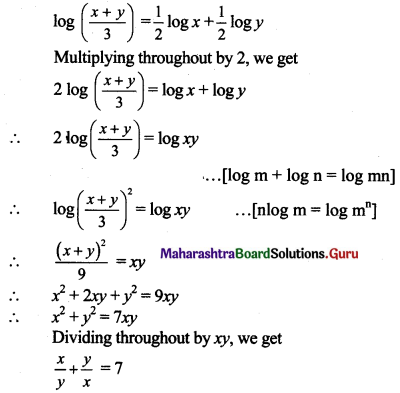
Solution:
Maharashtra Board 11th Maths Solutions Chapter 9 Differentiation Ex 9.2 III Q4

Question 5.
y = sin x log x + ex cos x – ex √x
Solution:
Maharashtra Board 11th Maths Solutions Chapter 9 Differentiation Ex 9.2 III Q5

Maharashtra Board 11th Maths Solutions Chapter 9 Differentiation Ex 9.2

Question 6.
y = ex tan x + cos x log x – √x 5x
Solution:
Maharashtra Board 11th Maths Solutions Chapter 9 Differentiation Ex 9.2 III Q6
Maharashtra Board 11th Maths Solutions Chapter 9 Differentiation Ex 9.2 III Q6.1

(IV) Diffrentiate the following w.r.t.x.

Question 1.
y = \(\frac{x^{2}+3}{x^{2}-5}\)
Solution:
Maharashtra Board 11th Maths Solutions Chapter 9 Differentiation Ex 9.2 IV Q1

Question 2.
y = \(\frac{\sqrt{x}+5}{\sqrt{x}-5}\)
Solution:
Maharashtra Board 11th Maths Solutions Chapter 9 Differentiation Ex 9.2 IV Q2
Maharashtra Board 11th Maths Solutions Chapter 9 Differentiation Ex 9.2 IV Q2.1

Question 3.
y = \(\frac{x e^{x}}{x+e^{x}}\)
Solution:
Maharashtra Board 11th Maths Solutions Chapter 9 Differentiation Ex 9.2 IV Q3

Maharashtra Board 11th Maths Solutions Chapter 9 Differentiation Ex 9.2

Question 4.
y = \(\frac{x \log x}{x+\log x}\)
Solution:
y = \(\frac{x \log x}{x+\log x}\)
Maharashtra Board 11th Maths Solutions Chapter 9 Differentiation Ex 9.2 IV Q4

Question 5.
y = \(\frac{x^{2} \sin x}{x+\cos x}\)
Solution:
Maharashtra Board 11th Maths Solutions Chapter 9 Differentiation Ex 9.2 IV Q5

Question 6.
y = \(\frac{5 e^{x}-4}{3 e^{x}-2}\)
Solution:
Maharashtra Board 11th Maths Solutions Chapter 9 Differentiation Ex 9.2 IV Q6

(V).

Question 1.
If f(x) is a quadratic polynomial such that f(0) = 3, f'(2) = 2 and f'(3) = 12, then find f(x).
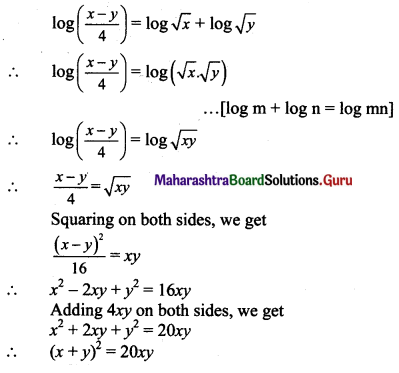
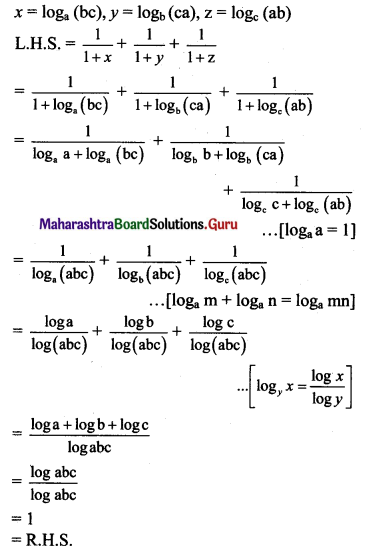
Solution:
Let f(x) = ax2 + bx + c …..(i)
∴ f(0) = a(0)2 + b(0) + c
∴ f(0) = c
But, f(0) = 3 …..(given)
∴ c = 3 …..(ii)
Differentiating (i) w.r.t. x, we get
f'(x) = 2ax + b
∴ f'(2) = 2a(2) + b
∴ f'(2) = 4a + b
But, f'(2) = 2 …..(given)
∴ 4a + b = 2 …..(iii)
Also, f'(3) = 2a(3) + b
∴ f'(3) = 6a + b
But, f'(3) = 12 …..(given)
∴ 6a + b = 12 …..(iv)
equation (iv) – equation (iii), we get
2a = 10
∴ a = 5
Substituting a = 5 in (iii), we get
4(5) + b = 2
∴ b = -18
∴ a = 5, b = -18, c = 3
∴ f(x) = 5x2 – 18x + 3

Check:
If f(0) = 3, f'(2) = 2 and f'(3) = 12, then our answer is correct.
f(x) = 5x2 – 18x + 3 and f'(x) = 10x – 18
f(0) = 5(0)2 – 18(0) + 3 = 3
f'(2) = 10(2) – 18 = 2
f'(3) = 10(3) – 18 = 12
Thus, our answer is correct.

Maharashtra Board 11th Maths Solutions Chapter 9 Differentiation Ex 9.2

Question 2.
If f(x) = a sin x – b cos x, f'(\(\frac{\pi}{4}\)) = √2 and f'(\(\frac{\pi}{6}\)) = 2, then find f(x).
Solution:
f(x) = a sin x – b cos x
Differentiating w.r.t. x, we get
f'(x) = a cos x – b (- sin x)
∴ f'(x) = a cos x + b sin x
Maharashtra Board 11th Maths Solutions Chapter 9 Differentiation Ex 9.2 V Q2
Maharashtra Board 11th Maths Solutions Chapter 9 Differentiation Ex 9.2 V Q2.1
Now, f(x) = a sin x – b cos x
∴ f(x) = (√3 + 1) sin x + (√3 – 1) cos x

VI. Fill in the blanks. (Activity Problems)

Question 1.
y = ex . tan x
Diff. w.r.t. x
Maharashtra Board 11th Maths Solutions Chapter 9 Differentiation Ex 9.2 VI Q1
Solution:
Maharashtra Board 11th Maths Solutions Chapter 9 Differentiation Ex 9.2 VI Q1.1

Question 2.
y = \(\frac{\sin x}{x^{2}+2}\)
diff. w.r.t. x
Maharashtra Board 11th Maths Solutions Chapter 9 Differentiation Ex 9.2 VI Q2
Solution:
Maharashtra Board 11th Maths Solutions Chapter 9 Differentiation Ex 9.2 VI Q2.1

Maharashtra Board 11th Maths Solutions Chapter 9 Differentiation Ex 9.2

Question 3.
y = (3x2 + 5) cos x
Diff. w.r.t. x
Maharashtra Board 11th Maths Solutions Chapter 9 Differentiation Ex 9.2 VI Q3
Solution:
Maharashtra Board 11th Maths Solutions Chapter 9 Differentiation Ex 9.2 VI Q3.1

Question 4.
Differentiate tan x and sec x w.r.t. x using the formulae for differentiation of \(\frac{u}{v}\) and \(\frac{1}{v}\) respectively.
Solution:
Maharashtra Board 11th Maths Solutions Chapter 9 Differentiation Ex 9.2 VI Q4
Maharashtra Board 11th Maths Solutions Chapter 9 Differentiation Ex 9.2 VI Q4.1

Maharashtra Board 12th Commerce Maths Solutions Chapter 2 Matrices Miscellaneous Exercise 2

Balbharati Maharashtra State Board 12th Commerce Maths Solution Book Pdf Chapter 2 Matrices Miscellaneous Exercise 2 Questions and Answers.

Maharashtra State Board 12th Commerce Maths Solutions Chapter 2 Matrices Miscellaneous Exercise 2

(I) Choose the correct alternative.

Question 1.
If AX = B, where A = \(\left[\begin{array}{cc}
-1 & 2 \\
2 & -1
\end{array}\right]\), B = \(\left[\begin{array}{l}
1 \\
1
\end{array}\right]\) then X = ___________
(a) \(\left[\begin{array}{l}
\frac{3}{5} \\
\frac{3}{7}
\end{array}\right]\)
(b) \(\left[\begin{array}{l}
\frac{7}{3} \\
\frac{5}{3}
\end{array}\right]\)
(c) \(\left[\begin{array}{l}
1 \\
1
\end{array}\right]\)
(d) \(\left[\begin{array}{l}
1 \\
2
\end{array}\right]\)
Answer:
(c) \(\left[\begin{array}{l}
1 \\
1
\end{array}\right]\)

Question 2.
The matrix \(\left[\begin{array}{lll}
8 & 0 & 0 \\
0 & 8 & 0 \\
0 & 0 & 8
\end{array}\right]\) is ___________
(a) identity matrix
(b) scalar matrix
(c) null matrix
(d) diagonal matrix
Answer:
(b) scalar matrix

Maharashtra Board 12th Commerce Maths Solutions Chapter 2 Matrices Miscellaneous Exercise 2

Question 3.
The matrix \(\left[\begin{array}{lll}
0 & 0 & 0 \\
0 & 0 & 0
\end{array}\right]\) is ___________
(a) identity matrix
(b) diagonal matrix
(c) scalar matix
(d) null matrix
Answer:
(d) null matrix

Question 4.
If A = \(\left[\begin{array}{lll}
a & 0 & 0 \\
0 & a & 0 \\
0 & 0 & a
\end{array}\right]\), then |adj A| = ___________
(a) a12
(b) a9
(c) a6
(d) a-3
Answer:
(c) a6
Hint:
adj A = \(\left[\begin{array}{ccc}
a^{2} & 0 & 0 \\
0 & a^{2} & 0 \\
0 & 0 & a^{2}
\end{array}\right]\)
∴ |adj A| = a2(a4 – 0) = a6

Question 5.
Adjoint of \(\left[\begin{array}{ll}
2 & -3 \\
4 & -6
\end{array}\right]\) is ___________
(a) \(\left[\begin{array}{ll}
-6 & 3 \\
-4 & 2
\end{array}\right]\)
(b) \(\left[\begin{array}{cc}
6 & 3 \\
-4 & 2
\end{array}\right]\)
(c) \(\left[\begin{array}{cc}
-6 & -3 \\
4 & 2
\end{array}\right]\)
(d) \(\left[\begin{array}{cc}
-6 & 3 \\
4 & -2
\end{array}\right]\)
Answer:
(a) \(\left[\begin{array}{ll}
-6 & 3 \\
-4 & 2
\end{array}\right]\)

Question 6.
If A = diag. [d1, d2, d3, …, dn], where d1 ≠ 0, for i = 1, 2, 3, …….., n, then A-1 = ___________
(a) diag [1/d1, 1/d2, 1/d3, …, 1/dn]
(b) D
(c) I
(d) O
Answer:
(a) diag [1/d1, 1/d2, 1/d3, …, 1/dn]

Maharashtra Board 12th Commerce Maths Solutions Chapter 2 Matrices Miscellaneous Exercise 2

Question 7.
If A2 + mA + nI = O and n ≠ 0, |A| ≠ 0, then A-1 = ___________
(a) \(\frac{-1}{m}\)(A + nI)
(b) \(\frac{-1}{n}\)(A + mI)
(c) \(\frac{-1}{m}\)(I + mA)
(d) (A + mnI)
Answer:
(b) \(\frac{-1}{n}\)(A + mI)
Hint:
A2 + mA + nI = 0
∴ (A2 + mA + nI) . A-1 = 0 . A-1
∴ A(AA-1) + m(AA-1) + nIA-1 = 0
∴ AI + mI + nA-1 = 0
∴ nA-1 = -A – mI
∴ A-1 = \(\frac{-1}{n}\)(A + mI)

Question 8.
If a 3 × 3 matrix B has its inverse equal to B, then B2 = ___________
(a) \(\left[\begin{array}{lll}
0 & 1 & 1 \\
0 & 1 & 0 \\
1 & 0 & 1
\end{array}\right]\)
(b) \(\left[\begin{array}{lll}
1 & 1 & 1 \\
1 & 1 & 1 \\
1 & 0 & 1
\end{array}\right]\)
(c) \(\left[\begin{array}{lll}
1 & 0 & 1 \\
0 & 1 & 0 \\
0 & 0 & 0
\end{array}\right]\)
(d) \(\left[\begin{array}{lll}
1 & 0 & 0 \\
0 & 1 & 0 \\
0 & 0 & 1
\end{array}\right]\)
Answer:
(d) \(\left[\begin{array}{lll}
1 & 0 & 0 \\
0 & 1 & 0 \\
0 & 0 & 1
\end{array}\right]\)
Hint:
B-1 = B
∴ B2 = B.B-1 = I

Question 9.
If A = \(\left[\begin{array}{cc}
\alpha & 4 \\
4 & \alpha
\end{array}\right]\) and |A3| = 729 then α = ___________
(a) ±3
(b) ±4
(c ) ±5
(d) ±6
Answer:
(c ) ±5
Hint:
|A|= \(\left|\begin{array}{ll}
\alpha & 4 \\
4 & \alpha
\end{array}\right|\) = α2 – 16
∴ |A3| = |A|3 = (α2 – 16)3 = 729
∴ α2 – 16 = 9
∴ α2 = 25
∴ α = ±5

Maharashtra Board 12th Commerce Maths Solutions Chapter 2 Matrices Miscellaneous Exercise 2

Question 10.
If A and B square matrices of order n × n such that A2 – B2 = (A – B)(A + B), then which of the following will be always true?
(a) AB = BA
(b) either A or B is a zero matrix
(c) either of A and B is an identity matrix
(d) A = B
Answer:
(a) AB = BA
Hint:
A2 – B2 = (A – B)(A + B)
∴ A2 – B2 = A2 + AB – BA – B2
∴ 0 = AB – BA
∴ AB = BA

Question 11.
If A = \(\left[\begin{array}{ll}
2 & 5 \\
1 & 3
\end{array}\right]\) then A-1 = ___________
(a) \(\left[\begin{array}{rr}
3 & -5 \\
1 & 2
\end{array}\right]\)
(b) \(\left[\begin{array}{rr}
3 & -5 \\
-1 & 2
\end{array}\right]\)
(c) \(\left[\begin{array}{rr}
3 & 5 \\
-1 & 2
\end{array}\right]\)
(d) \(\left[\begin{array}{ll}
3 & -5 \\
1 & -2
\end{array}\right]\)
Answer:
(b) \(\left[\begin{array}{rr}
3 & -5 \\
-1 & 2
\end{array}\right]\)

Question 12.
If A is a 2 × 2 matrix such that A(adj A) = \(\left[\begin{array}{ll}
5 & 0 \\
0 & 5
\end{array}\right]\), then |A| = ___________
(a) 0
(b) 5
(c) 10
(d) 25
Answer:
(b) 5
Hint:
A(adj A) = |A|.I

Question 13.
If A is a non-singular matrix, then det(A-1) = ___________
(a) 1
(b) 0
(c) det(A)
(d) 1/det(A)
Answer:
(d) 1/det(A)
Hint:
AA-1 = I
∴ |A|.|A-1| = 1
∴ |A-1| = \(\frac{1}{|\mathrm{~A}|}\)

Maharashtra Board 12th Commerce Maths Solutions Chapter 2 Matrices Miscellaneous Exercise 2

Question 14.
If A = \(\left[\begin{array}{cc}
1 & 2 \\
-3 & -1
\end{array}\right]\), B = \(\left[\begin{array}{rr}
-1 & 0 \\
1 & 5
\end{array}\right]\) then AB = ___________
(a) \(\left[\begin{array}{rr}
1 & -10 \\
1 & 20
\end{array}\right]\)
(b) \(\left[\begin{array}{rr}
1 & 10 \\
-1 & 20
\end{array}\right]\)
(c) \(\left[\begin{array}{ll}
1 & 10 \\
1 & 20
\end{array}\right]\)
(d) \(\left[\begin{array}{rr}
1 & 10 \\
-1 & -20
\end{array}\right]\)
Answer:
(c) \(\left[\begin{array}{ll}
1 & 10 \\
1 & 20
\end{array}\right]\)

Question 15.
If x + y + z = 3, x + 2y + 3z = 4, x + 4y + 9z = 6, then (y, z) = ___________
(a) (-1, 0)
(b) (1, 0)
(c) (1, -1)
(d) (-1, 1)
Answer:
(b) (1, 0)

(II) Fill in the blanks:

Question 1.
A = \(\left[\begin{array}{l}
3 \\
1
\end{array}\right]\) is ___________ matrix.
Answer:
column

Question 2.
Order of matrix \(\left[\begin{array}{lll}
2 & 1 & 1 \\
5 & 1 & 8
\end{array}\right]\) is ___________
Answer:
2 × 3

Question 3.
If A = \(\left[\begin{array}{ll}
4 & x \\
6 & 3
\end{array}\right]\) is a singular matrix, then x is ___________
Answer:
2

Maharashtra Board 12th Commerce Maths Solutions Chapter 2 Matrices Miscellaneous Exercise 2

Question 4.
Matrix B = \(\left[\begin{array}{ccc}
0 & 3 & 1 \\
-3 & 0 & -4 \\
p & 4 & 0
\end{array}\right]\) is a skew-symmetric, then value of p is ___________
Answer:
-1

Question 5.
If A = [aij]2×3 and B = [bij]m×1, and AB is defined, then m = ___________
Answer:
3

Question 6.
If A = \(\left[\begin{array}{cc}
3 & -5 \\
2 & 5
\end{array}\right]\), then cofactor of a12 is ___________
Answer:
-2

Question 7.
If A = [aij]m×m is non-singular matrix, then A-1 = \(\frac{1}{\ldots \ldots}\) adj (A).
Answer:
|A|

Question 8.
(AT)T = ___________
Answer:
A

Question 9.
If A = \(\left[\begin{array}{ll}
2 & 1 \\
1 & 1
\end{array}\right]\) and A-1 = \(\left[\begin{array}{cc}
1 & -1 \\
x & 2
\end{array}\right]\), then x = ___________
Answer:
-1

Maharashtra Board 12th Commerce Maths Solutions Chapter 2 Matrices Miscellaneous Exercise 2

Question 10.
If a1x+ b1y = c1 and a2x + b2y = c2, then matrix form is \(\left[\begin{array}{cc}
\cdots & \ldots \\
\cdots & \ldots
\end{array}\right]\left[\begin{array}{l}
x \\
y
\end{array}\right]=\left[\begin{array}{l}
\ldots \\
\cdots
\end{array}\right]\)
Answer:
\(\left[\begin{array}{ll}
a_{1} & b_{1} \\
a_{2} & b_{2}
\end{array}\right]\left[\begin{array}{l}
x \\
y
\end{array}\right]=\left[\begin{array}{l}
c_{1} \\
c_{2}
\end{array}\right]\)

(III) State whether each of the following is True or False:

Question 1.
Single element matrix is row as well as a column matrix.
Answer:
True

Question 2.
Every scalar matrix is unit matrix.
Answer:
False

Question 3.
A = \(\left[\begin{array}{ll}
4 & 5 \\
6 & 1
\end{array}\right]\) is non-singular matrix.
Answer:
True

Question 4.
If A is symmetric, then A = -AT.
Answer:
False

Maharashtra Board 12th Commerce Maths Solutions Chapter 2 Matrices Miscellaneous Exercise 2

Question 5.
If AB and BA both exist, then AB = BA.
Answer:
False

Question 6.
If A and B are square matrices of same order, then (A + B)2 = A2 + 2AB + B2.
Answer:
False

Question 7.
If A and B are conformable for the product AB, then (AB)T = ATBT.
Answer:
False

Question 8.
Singleton matrix is only row matrix.
Answer:
False

Question 9.
A = \(\left[\begin{array}{cc}
2 & 1 \\
10 & 5
\end{array}\right]\) is invertible matrix.
Answer:
False

Question 10.
A(adj A) = |A| I, where I is the unit matrix.
Answer:
True.

(IV) Solve the following:

Question 1.
Find k, if \(\left[\begin{array}{ll}
7 & 3 \\
5 & k
\end{array}\right]\) is a singular matrix.
Solution:
Let A = \(\left[\begin{array}{ll}
7 & 3 \\
5 & k
\end{array}\right]\)
Since, A is singular matrix, |A| = 0
∴ \(\left|\begin{array}{ll}
7 & 3 \\
5 & k
\end{array}\right|\) = 0
∴ 7k – 15 = 0
∴ k = \(\frac{15}{7}\)

Maharashtra Board 12th Commerce Maths Solutions Chapter 2 Matrices Miscellaneous Exercise 2

Question 2.
Find x, y, z if \(\left[\begin{array}{lll}
2 & x & 5 \\
3 & 1 & z \\
y & 5 & 8
\end{array}\right]\) is a symmetric matrix.
Solution:
Maharashtra Board 12th Commerce Maths Solutions Chapter 2 Matrices Miscellaneous Exercise 2 IV Q2
By equality of matrices,
x = 3, y = 5 and z = 5.

Question 3.
If A = \(\left[\begin{array}{ll}
1 & 5 \\
7 & 8 \\
9 & 5
\end{array}\right]\), B = \(\left[\begin{array}{cc}
2 & 4 \\
1 & 5 \\
-8 & 6
\end{array}\right]\), C = \(\left[\begin{array}{cc}
-2 & 3 \\
1 & -5 \\
7 & 8
\end{array}\right]\) then show that (A + B) + C = A + (B + C).
Solution:
Maharashtra Board 12th Commerce Maths Solutions Chapter 2 Matrices Miscellaneous Exercise 2 IV Q3
Maharashtra Board 12th Commerce Maths Solutions Chapter 2 Matrices Miscellaneous Exercise 2 IV Q3.1
From (1) and (2),
(A + B) + C = A + (B + C).

Question 4.
If A = \(\left[\begin{array}{ll}
2 & 5 \\
3 & 7
\end{array}\right]\), B = \(\left[\begin{array}{cc}
1 & 7 \\
-3 & 0
\end{array}\right]\), find the matrix A – 4B + 7I, where I is the unit matrix of order 2.
Solution:
Maharashtra Board 12th Commerce Maths Solutions Chapter 2 Matrices Miscellaneous Exercise 2 IV Q4

Maharashtra Board 12th Commerce Maths Solutions Chapter 2 Matrices Miscellaneous Exercise 2

Question 5.
If A = \(\left[\begin{array}{cc}
2 & -3 \\
3 & -2 \\
-1 & 4
\end{array}\right]\), B = \(\left[\begin{array}{ccc}
-3 & 4 & 1 \\
2 & -1 & -3
\end{array}\right]\) verify
(i) (A + 2BT)T = AT + 2B
(ii) (3A – 5BT)T = 3AT – 5B
Solution:
Maharashtra Board 12th Commerce Maths Solutions Chapter 2 Matrices Miscellaneous Exercise 2 IV Q5
Maharashtra Board 12th Commerce Maths Solutions Chapter 2 Matrices Miscellaneous Exercise 2 IV Q5.1
Maharashtra Board 12th Commerce Maths Solutions Chapter 2 Matrices Miscellaneous Exercise 2 IV Q5.2
Maharashtra Board 12th Commerce Maths Solutions Chapter 2 Matrices Miscellaneous Exercise 2 IV Q5.3
Maharashtra Board 12th Commerce Maths Solutions Chapter 2 Matrices Miscellaneous Exercise 2 IV Q5.4

Question 6.
If A = \(\left[\begin{array}{lll}
1 & 2 & 3 \\
2 & 4 & 6 \\
1 & 2 & 3
\end{array}\right]\), B = \(\left[\begin{array}{ccc}
1 & -1 & 1 \\
-3 & 2 & -1 \\
-2 & 1 & 0
\end{array}\right]\) thenshow that AB and BA are both singular matrices.
Solution:
Maharashtra Board 12th Commerce Maths Solutions Chapter 2 Matrices Miscellaneous Exercise 2 IV Q6
Maharashtra Board 12th Commerce Maths Solutions Chapter 2 Matrices Miscellaneous Exercise 2 IV Q6.1
∴ BA is also a singular matrix.
Hence, AB and BA are both singular matrices.

Question 7.
If A = \(\left[\begin{array}{ll}
3 & 1 \\
1 & 5
\end{array}\right]\), B = \(\left[\begin{array}{cc}
1 & 2 \\
5 & -2
\end{array}\right]\), verify |AB| = |A| |B|.
Solution:
Maharashtra Board 12th Commerce Maths Solutions Chapter 2 Matrices Miscellaneous Exercise 2 IV Q7

Question 8.
If A = \(\left[\begin{array}{cc}
2 & -1 \\
-1 & 2
\end{array}\right]\), then show that A2 – 4A + 3I = 0.
Solution:
Maharashtra Board 12th Commerce Maths Solutions Chapter 2 Matrices Miscellaneous Exercise 2 IV Q8

Question 9.
If A = \(\left[\begin{array}{cc}
-3 & 2 \\
2 & 4
\end{array}\right]\), B = \(\left[\begin{array}{ll}
1 & a \\
b & 0
\end{array}\right]\) and (A + B)(A – B) = A2 – B2, find a and b.
Solution:
(A + B)(A – B) = A2 – B2
∴ A2 – AB + BA – B2 = A2 – B2
∴ -AB + BA = 0
∴ AB = BA
Maharashtra Board 12th Commerce Maths Solutions Chapter 2 Matrices Miscellaneous Exercise 2 IV Q9
Maharashtra Board 12th Commerce Maths Solutions Chapter 2 Matrices Miscellaneous Exercise 2 IV Q9.1
By equality of matrices,
-3 + 2b = -3 + 2a ……..(1)
-3a = 2 + 4a ……..(2)
2 + 4b = -3b ……..(3)
2a = 2b ……..(4)
From (2), 7a = -2
∴ a = \(\frac{-2}{7}\)
From (3), 7b = -2
∴ b = \(\frac{-2}{7}\)
These values of a and b also satisfy equations (1) and (4).
Hence, a = \(\frac{-2}{7}\) and b = \(\frac{-2}{7}\)

Maharashtra Board 12th Commerce Maths Solutions Chapter 2 Matrices Miscellaneous Exercise 2

Question 10.
If A = \(\left[\begin{array}{cc}
1 & 2 \\
-1 & 3
\end{array}\right]\), then find A3.
Solution:
Maharashtra Board 12th Commerce Maths Solutions Chapter 2 Matrices Miscellaneous Exercise 2 IV Q10

Question 11.
Find x, y, z if \(\left\{5\left[\begin{array}{ll}
0 & 1 \\
1 & 0 \\
1 & 1
\end{array}\right]-\left[\begin{array}{cc}
2 & 1 \\
3 & -2 \\
1 & 3
\end{array}\right]\right\}\left[\begin{array}{l}
2 \\
1
\end{array}\right]=\left[\begin{array}{c}
x-1 \\
y+1 \\
2 z
\end{array}\right]\)
Solution:
Maharashtra Board 12th Commerce Maths Solutions Chapter 2 Matrices Miscellaneous Exercise 2 IV Q11
∴ By equality of matrices, we get
x – 1 = 0 ∴ x = 1
y + 1 = 6 ∴ y = 5
2z = 10 ∴ z = 5

Question 12.
If A = \(\left[\begin{array}{cc}
2 & -4 \\
3 & -2 \\
0 & 1
\end{array}\right]\), B = \(\left[\begin{array}{ccc}
1 & -1 & 2 \\
-2 & 1 & 0
\end{array}\right]\) then showthat(AB)T = BTAT.
Solution:
Maharashtra Board 12th Commerce Maths Solutions Chapter 2 Matrices Miscellaneous Exercise 2 IV Q12
Maharashtra Board 12th Commerce Maths Solutions Chapter 2 Matrices Miscellaneous Exercise 2 IV Q12.1

Question 13.
If A = \(\left[\begin{array}{lll}
1 & 0 & 0 \\
2 & 1 & 0 \\
3 & 3 & 1
\end{array}\right]\), then reduce it to unit matrix by row tranformation.
Solution:
Maharashtra Board 12th Commerce Maths Solutions Chapter 2 Matrices Miscellaneous Exercise 2 IV Q13
Maharashtra Board 12th Commerce Maths Solutions Chapter 2 Matrices Miscellaneous Exercise 2 IV Q13.1

Maharashtra Board 12th Commerce Maths Solutions Chapter 2 Matrices Miscellaneous Exercise 2

Question 14.
Two farmers Shantaram and Kantaram cultivate three crops rice, wheat, and groundnut. The sale (in ₹) of these crops by both the farmers for the month of April and May 2016 is given below:
Maharashtra Board 12th Commerce Maths Solutions Chapter 2 Matrices Miscellaneous Exercise 2 IV Q14
Find (i) the total sale in rupees for two months of each farmer for each crop.
(ii) the increase in sales from April to May for every crop of each farmer.
Solution:
The given information can be written in matrix form as:
Maharashtra Board 12th Commerce Maths Solutions Chapter 2 Matrices Miscellaneous Exercise 2 IV Q14.1
(i) The total sale in ₹ for two months of each farmer for each crop can be obtained by the addition A + B.
Now, A + B
Maharashtra Board 12th Commerce Maths Solutions Chapter 2 Matrices Miscellaneous Exercise 2 IV Q14.2
∴ total sale in ₹ for two months of each farmer for each crop is given by
Maharashtra Board 12th Commerce Maths Solutions Chapter 2 Matrices Miscellaneous Exercise 2 IV Q14.3
Hence, the total sale for Shantaram are ₹ 33000 for Rice, ₹ 28000 for Wheat, ₹ 24000 for Groundnut, and for Kantaram are ₹ 39000 for Rice, ₹ 31500 for Wheat, ₹ 24000 for Groundnut.
(ii) The increase in sales from April to May for every crop of each farmer can be obtained by the subtraction of A from B.
Now, B – A
Maharashtra Board 12th Commerce Maths Solutions Chapter 2 Matrices Miscellaneous Exercise 2 IV Q14.4
Hence, the increase in sales from April to May of Shantam is ₹ 3000 in Rice, ₹ 2000 in Wheat, nothing in Groundnut and of Kantaram are ₹ 3000 in Rice, ₹ 1500 in Wheat, ₹ 8000 in Groundnut.

Question 15.
Check whether following matrices are invertible or not:
(i) \(\left[\begin{array}{ll}
1 & 0 \\
0 & 1
\end{array}\right]\)
Solution:
Let A = \(\left[\begin{array}{ll}
1 & 0 \\
0 & 1
\end{array}\right]\)
Then |A| = \(\left|\begin{array}{ll}
1 & 0 \\
0 & 1
\end{array}\right|\)
= 1 – 0
= 1 ≠ 0
∴ A is a non-singular matrix.
Hence, A-1 exists.

(ii) \(\left[\begin{array}{ll}
1 & 1 \\
1 & 1
\end{array}\right]\)
Solution:
Let A = \(\left[\begin{array}{ll}
1 & 1 \\
1 & 1
\end{array}\right]\)
Then |A| = \(\left|\begin{array}{ll}
1 & 1 \\
1 & 1
\end{array}\right|\)
= 1 – 1
= 0
∴ A is a singular matrix.
Hence, A-1 does not exist.

Maharashtra Board 12th Commerce Maths Solutions Chapter 2 Matrices Miscellaneous Exercise 2

(iii) \(\left[\begin{array}{lll}
3 & 4 & 3 \\
1 & 1 & 0 \\
1 & 4 & 5
\end{array}\right]\)
Solution:
Let A = \(\left[\begin{array}{lll}
3 & 4 & 3 \\
1 & 1 & 0 \\
1 & 4 & 5
\end{array}\right]\)
Then |A| = \(\left|\begin{array}{lll}
3 & 4 & 3 \\
1 & 1 & 0 \\
1 & 4 & 5
\end{array}\right|\)
= 3(5 – 0) – 4(5 – 0) + 3(4 – 1)
= 15 – 20 + 9
= 4 ≠ 0
∴ A is a non-singular matrix.
Hence, A-1 exists.

(iv) \(\left[\begin{array}{lll}
1 & 2 & 3 \\
2 & 4 & 5 \\
2 & 4 & 6
\end{array}\right]\)
Solution:
Let A = \(\left[\begin{array}{lll}
1 & 2 & 3 \\
2 & 4 & 5 \\
2 & 4 & 6
\end{array}\right]\)
Then |A| = \(\left|\begin{array}{lll}
1 & 2 & 3 \\
2 & 4 & 5 \\
2 & 4 & 6
\end{array}\right|\)
= 1(24 – 20) – 2(12 – 10) + 3(8 – 8)
= 4 – 4 + 0
= 0
∴ A is a singular matrix.
Hence, A-1 does not exist.

Question 16.
Find inverse of the following matrices (if they exist) by elementary transformation:
(i) \(\left[\begin{array}{cc}
1 & -1 \\
2 & 3
\end{array}\right]\)
Solution:
Maharashtra Board 12th Commerce Maths Solutions Chapter 2 Matrices Miscellaneous Exercise 2 IV Q16 (i)
Maharashtra Board 12th Commerce Maths Solutions Chapter 2 Matrices Miscellaneous Exercise 2 IV Q16 (i).1

(ii) \(\left[\begin{array}{ll}
2 & 1 \\
7 & 4
\end{array}\right]\)
Solution:

(iii) \(\left[\begin{array}{ccc}
2 & -3 & 3 \\
2 & 2 & 3 \\
3 & -2 & 2
\end{array}\right]\)
Solution:
Maharashtra Board 12th Commerce Maths Solutions Chapter 2 Matrices Miscellaneous Exercise 2 IV Q16 (iii)
Maharashtra Board 12th Commerce Maths Solutions Chapter 2 Matrices Miscellaneous Exercise 2 IV Q16 (iii).1
Maharashtra Board 12th Commerce Maths Solutions Chapter 2 Matrices Miscellaneous Exercise 2 IV Q16 (iii).2
Maharashtra Board 12th Commerce Maths Solutions Chapter 2 Matrices Miscellaneous Exercise 2 IV Q16 (iii).3

Maharashtra Board 12th Commerce Maths Solutions Chapter 2 Matrices Miscellaneous Exercise 2

(iv) \(\left[\begin{array}{ccc}
2 & 0 & -1 \\
5 & 1 & 0 \\
0 & 1 & 3
\end{array}\right]\)
Solution:
Maharashtra Board 12th Commerce Maths Solutions Chapter 2 Matrices Miscellaneous Exercise 2 IV Q16 (iv)
Maharashtra Board 12th Commerce Maths Solutions Chapter 2 Matrices Miscellaneous Exercise 2 IV Q16 (iv).1
Maharashtra Board 12th Commerce Maths Solutions Chapter 2 Matrices Miscellaneous Exercise 2 IV Q16 (iv).2

Question 17.
Find the inverse of \(\left[\begin{array}{lll}
3 & 1 & 5 \\
2 & 7 & 8 \\
1 & 2 & 5
\end{array}\right]\) by adjoint method.
Solution:
Maharashtra Board 12th Commerce Maths Solutions Chapter 2 Matrices Miscellaneous Exercise 2 IV Q17
Maharashtra Board 12th Commerce Maths Solutions Chapter 2 Matrices Miscellaneous Exercise 2 IV Q17.1
Maharashtra Board 12th Commerce Maths Solutions Chapter 2 Matrices Miscellaneous Exercise 2 IV Q17.2

Question 18.
Solve the following equations by method of inversion:
(i) 4x – 3y – 2 = 0, 3x – 4y + 6 = 0
Solution:
The given equations are
4x – 3y = 2
3x – 4y = -6
These equations can be written in matrix form as:
Maharashtra Board 12th Commerce Maths Solutions Chapter 2 Matrices Miscellaneous Exercise 2 IV Q18 (i)
Maharashtra Board 12th Commerce Maths Solutions Chapter 2 Matrices Miscellaneous Exercise 2 IV Q18 (i).1
Maharashtra Board 12th Commerce Maths Solutions Chapter 2 Matrices Miscellaneous Exercise 2 IV Q18 (i).2
Maharashtra Board 12th Commerce Maths Solutions Chapter 2 Matrices Miscellaneous Exercise 2 IV Q18 (i).3
By equality of matrices,
x = \(\frac{26}{7}\), y = \(\frac{30}{7}\) is the required solution.

(ii) x + y – z = 2, x – 2y + z = 3 and 2x – y – 3z = -1
Solution:
The given equations can be written in matrix form as:
Maharashtra Board 12th Commerce Maths Solutions Chapter 2 Matrices Miscellaneous Exercise 2 IV Q18 (ii)
Maharashtra Board 12th Commerce Maths Solutions Chapter 2 Matrices Miscellaneous Exercise 2 IV Q18 (ii).1
Maharashtra Board 12th Commerce Maths Solutions Chapter 2 Matrices Miscellaneous Exercise 2 IV Q18 (ii).2
Maharashtra Board 12th Commerce Maths Solutions Chapter 2 Matrices Miscellaneous Exercise 2 IV Q18 (ii).3
By equality of matrices,
x = 3, y = 1, z = 2 is the required solution.

(iii) x – y + z = 4, 2x + y – 3z = 0 and x + y + z = 2
Solution:
Maharashtra Board 12th Commerce Maths Solutions Chapter 2 Matrices Miscellaneous Exercise 2 IV Q18 (iii)
Maharashtra Board 12th Commerce Maths Solutions Chapter 2 Matrices Miscellaneous Exercise 2 IV Q18 (iii).1
Maharashtra Board 12th Commerce Maths Solutions Chapter 2 Matrices Miscellaneous Exercise 2 IV Q18 (iii).2
Maharashtra Board 12th Commerce Maths Solutions Chapter 2 Matrices Miscellaneous Exercise 2 IV Q18 (iii).3
Maharashtra Board 12th Commerce Maths Solutions Chapter 2 Matrices Miscellaneous Exercise 2 IV Q18 (iii).4

Maharashtra Board 12th Commerce Maths Solutions Chapter 2 Matrices Miscellaneous Exercise 2

Question 19.
Solve the following equations by method of reduction:
(i) 2x + y = 5, 3x – 5y = -3
Solution:
The given equation can be written in matrix form as:
\(\left[\begin{array}{ll}
2 & 1 \\
3 & 5
\end{array}\right]\left[\begin{array}{l}
x \\
y
\end{array}\right]=\left[\begin{array}{r}
5 \\
-3
\end{array}\right]\)
By R2 – 5R1, we get
Maharashtra Board 12th Commerce Maths Solutions Chapter 2 Matrices Miscellaneous Exercise 2 IV Q19 (i)
By equality of matrices,
2x + y = 5 …….(1)
-7x = -28 ……(2)
From (2), x = 4
Substituting x = 4 in (1), we get
2(4) + y = 5
∴ y = -3
Hence, x = 4 and y = -3 is the required solution.

(ii) x + 2y + z = 3, 3x – y + 2z = 1 and 2x – 3y + 3z = 2
Solution:
The given equations can be written in matrix form as:
Maharashtra Board 12th Commerce Maths Solutions Chapter 2 Matrices Miscellaneous Exercise 2 IV Q19 (ii)
By equality of matrices,
x + 2y + z = 3 …….(1)
-7y – z = -8 …….(2)
2z = 4 …….(3)
From (3), z = 2
Substituting z = 2 in (2), we get
-7y – 2 = -8
∴ -7y = -6
∴ y = \(\frac{6}{7}\)
Substituting y = \(\frac{6}{7}\), z = 2 in (1), we get
x + 2(\(\frac{6}{7}\)) + 2 = 3
x = 3 – 2 – \(\frac{12}{7}\) = \(\frac{-5}{7}\)
Hence, x = \(\frac{-5}{7}\), y = \(\frac{6}{7}\) and z = 2 is the required solution.

(iii) x – 3y + z = 2, 3x + y + z = 1 and 5x + y + 3z = 3.
Solution:
Maharashtra Board 12th Commerce Maths Solutions Chapter 2 Matrices Miscellaneous Exercise 2 IV Q19 (iii)
Maharashtra Board 12th Commerce Maths Solutions Chapter 2 Matrices Miscellaneous Exercise 2 IV Q19 (iii).1
Maharashtra Board 12th Commerce Maths Solutions Chapter 2 Matrices Miscellaneous Exercise 2 IV Q19 (iii).2
Maharashtra Board 12th Commerce Maths Solutions Chapter 2 Matrices Miscellaneous Exercise 2 IV Q19 (iii).3

Maharashtra Board 12th Commerce Maths Solutions Chapter 2 Matrices Miscellaneous Exercise 2

Question 20.
The sum of three numbers is 6. If we multiply the third number by 3 and add it to the second number, we get 11. By adding first and third numbers we get a number that is double the second number. Use this information and find a system of linear equations. Find the three numbers using matrices.
Solution:
Let the three numbers be x, y, and z.
According to the given condition,
x + y + z = 6
3z + y = 11, i.e. y + 3z = 11
and x + z = 2y, i.e. x – 2y + z = 0
Hence, the system of linear equations is
x + y + z = 6
y + 3z = 11
x – 2y + z = 0
These equations can be written in matrix form as:
Maharashtra Board 12th Commerce Maths Solutions Chapter 2 Matrices Miscellaneous Exercise 2 IV Q20
By equality of matrices,
x + y + z = 6 …….(1)
y + 3z = 11 ………(2)
-3y = -6 ………(3)
From (3), y = 2
Substituting y = 2 in (2), we get
2 + 3z = 11
∴ 3z = 9
∴ z = 3
Substituting y = 2, z = 3 in (1), we get
x + 2 + 3 = 6
∴ x = 1
∴ x = 1, y = 2, z = 3
Hence, the required numbers are 1, 2 and 3.