Maharashtra Board Class 12 Secretarial Practice Solutions Chapter 5 Deposits

Balbharti Maharashtra State Board Class 12 Secretarial Practice Solutions Chapter 5 Deposits Textbook Exercise Questions and Answers.

Maharashtra State Board Class 12 Secretarial Practice Solutions Chapter 5 Deposits

1A. Select the correct answer from the options given below and rewrite the statements.

Question 1.
Deposit is a type of ____________
(a) Owned capital
(b) Short term loan
(c) Long term loan
Answer:
(b) Short term loan

Question 2.
Eligible Public Company and Government Company can collect deposits from ____________
(a) It’s employees
(b) Public
(c) RBI
Answer:
(b) Public

Maharashtra Board Class 12 Secretarial Practice Solutions Chapter 5 Deposits

Question 3.
A private company can accept deposits from its Member of Directors up to not more than ____________ % of its aggregate of paid-up share capital and free reserves.
(a) 100
(b) 35
(c) 25
Answer:
(a) 100

Question 4.
A ____________ Company can accept deposits from the public not exceeding 35% of its paid-up share capital and free reserves.
(a) Government
(b) Private
(c) Eligible Public
Answer:
(a) Government

Question 5.
Deposits can be accepted for a minimum of 6 months and maximum for ____________ months.
(a) 36
(b) 3
(c) 30
Answer:
(a) 36

Question 6.
Company issues ____________ to invite its members to subscribe for its deposit scheme.
(a) Advertisement
(b) Circular
(c) Newspaper
Answer:
(b) Circular

Question 7.
The company can issue a circular or advertisement for inviting deposits after ____________ days of filing it with the Registrar of Companies.
(a) 30
(b) 21
(c) 7
Answer:
(a) 30

Maharashtra Board Class 12 Secretarial Practice Solutions Chapter 5 Deposits

Question 8.
Company has to appoint ____________ to protect the interest of depositors.
(a) Debenture Trustees
(b) Deposit Trustees
(c) Credit Rating Agency
Answer:
(a) Deposit Trustees

Question 9.
Charge on assets is to be created when a company issues ____________
(a) Unsecured deposit
(b) Unsecured Debenture
(c) Secured deposit
Answer:
(c) Secured deposit

Question 10.
Deposit Receipt is issued within ____________ days of receipt of deposit.
(a) 7
(b) 30
(c) 21
Answer:
(c) 21

Question 11.
For premature repayment of deposit, company deducts ____________ % of interest.
(a) 1
(b) 18
(c) 20
Answer:
(a) 1

Question 12.
Return of deposit must be filed every year on or before ____________
(a) 30 June
(b) 31 March
(c) 30 April
Answer:
(a) 30 June

1B. Match the pairs.

Question 1.

Group ‘A’Group ‘B’
(a) Private Company(1) 10% of the aggregate of paid-up share capital + free reserves
(b) Deposit Trust Deed(2) Signed at least 7 days before issuing advertisement
(c) Secured Deposit(3) Maximum 30 months
(d) Tenure of deposit(4) Charge on tangible assets
(e) Return of Deposit(5) 100% aggregate of paid-up share capital + free reserves
(6) File on or before 31 March every year
(7) Signed 21 days after issuing advertisement
(8) Maximum 36 months
(9) Charge on intangible assets
(10) File on or before 30 June every year

Answer:

Group ‘A’Group ‘B’
(a) Private Company(5) 100% aggregate of paid-up share capital + free reserves
(b) Deposit Trust Deed(2) Signed at least 7 days before issuing advertisement
(c) Secured Deposit(4) Charge on tangible assets
(d) Tenure of deposit(8) Maximum 36 months
(e) Return of Deposit(10) File on or before 30 June every year

1C. Write a word or a term or a phrase that can substitute each of the following statements.

Question 1.
A company that can accept deposits from its members, directors, or their relatives not exceeding 100% of the aggregate of paid-up share capital and free reserves.
Answer:
Private Company

Question 2.
The company can accept deposits from the public up to 35% of its paid-up share capital and free reserves.
Answer:
Government Company

Maharashtra Board Class 12 Secretarial Practice Solutions Chapter 5 Deposits

Question 3.
Minimum tenure of a deposit.
Answer:
6 months

Question 4.
The maximum tenure of the deposit.
Answer:
36 months

Question 5.
Period within which a company has to create a charge on its tangible assets.
Answer:
30 days of Acceptance

Question 6.
Document issued by a company to invite its members to subscribe for its Deposits.
Answer:
Circular

Question 7.
Agreement between the company and Deposit Trustee.
Answer:
Deposit Trust Deed

Question 8.
The account can be used only for repaying deposits.
Answer:
Deposit Repayment Reserve Account

Question 9.
Time within which company has to issue deposit Receipt.
Answer:
21 days

Maharashtra Board Class 12 Secretarial Practice Solutions Chapter 5 Deposits

Question 10.
Book which contains details of deposits accepted or renewed.
Answer:
Register of Deposits

1D. State whether the following statements are true or false.

Question 1.
Return of deposit must be filed every year on or before 31 March.
Answer:
False

Question 2.
An eligible public company can collect deposits from its members.
Answer:
True

Question 3.
A government company can collect deposits from its members.
Answer:
False

Question 4.
A private company can collect deposits from the public.
Answer:
False

Question 5.
The deposit can be accepted for a maximum of 36 months.
Answer:
True

Maharashtra Board Class 12 Secretarial Practice Solutions Chapter 5 Deposits

Question 6.
An eligible public company can collect deposits from the public not exceeding 35% of its paid-up share capital and free reserves.
Answer:
False

Question 7.
For secured deposits, the company has to create a charge on its tangible assets.
Answer:
True

Question 8.
Deposit Receipt is issued within 21 days of receipt of deposits.
Answer:
True

Question 9.
Company appoints Credit Rating Agency to protect the interest of depositors.
Answer:
False

Question 10.
Deposit Trust Deed is an agreement between the company and Deposit Trustee.
Answer:
True

1E. Find the odd one.

Question 1.
Private Company, Eligible Public Company, Government Company.
Answer:
Private company

Maharashtra Board Class 12 Secretarial Practice Solutions Chapter 5 Deposits

Question 2.
Deposit Trustee, Deposit Trust Deed, Special Resolution.+
Answer:
Special Resolution

Question 3.
Appointment of Deposit Trustee, Appointment of Registrar of companies, Appointment of Credit Rating Agency.
Answer:
Appointment of Registrar of companies

1F. Complete the sentences.

Question 1.
Deposit is a type of ____________ term loan.
Answer:
Short term loan

Question 2.
Eligible Public company and Government Company can accept deposits from ____________
Answer:
Public

Question 3.
To collect deposits from the public, Eligible public company must have a net worth of not less than ₹ ____________
Answer:
₹ 100 Crores

Maharashtra Board Class 12 Secretarial Practice Solutions Chapter 5 Deposits

Question 4.
A Government company can accept deposits from public not exceeding ____________
Answer:
35% of the paid-up share capital and free reserves of the company

Question 5.
Deposits can be accepted or renewed for a period not less 6 months and not more than ____________
Answer:
36 months

Question 6.
Company cannot accept or renew deposits repayable on ____________
Answer:
Demand

Question 7.
Premature repayment of deposits can be done by a company but not before ____________
Answer:
3 months

Question 8.
To invite the public to subscribe for its deposits, a company issues ____________
Answer:
Advertisement

Maharashtra Board Class 12 Secretarial Practice Solutions Chapter 5 Deposits

Question 9.
Agency which gives ratings of the deposits of a company is called ____________
Answer:
Credit rating agency

Question 10.
Account which is used only for repaying deposits is called ____________
Answer:
Deposit Repayment Reserve Account

1G. Select the correct option from the bracket.

Question 1.

Group ‘A’Group B’
(a) Government Company(1) ………………….
(b) …………………….(2) Deposits from members
(c) 36 months(3) …………………….
(d) …………………….(4) Charge on tangible assets
(e) Return of deposit(5) ……………………

(File on or before 30 June, Private Company, Secured deposits, Deposits from public, Maximum tenure of deposits)
Answer:

Group ‘A’Group B’
(a) Government Company(1) Deposits from public
(b) Private Company(2) Deposits from members
(c) 36 months(3) Maximum tenure of deposits
(d) Secured deposits(4) Charge on tangible assets
(e) Return of deposit(5) File on or before 30 June

1H. Answer in one sentence.

Question 1.
Which companies can accept deposits from the public?
Answer:
Government Companies and Eligible Public companies can accept deposits from the public.

Question 2.
What is the maximum deposit the Government company can collect?
Answer:
Government companies can accept deposits from the public not exceeding 35% of the paid-up share capital and free reserves of the company.

Question 3.
What is the tenure of a deposit?
Answer:
A company can accept deposits for a minimum of 6 months and a maximum of 36 months.

Maharashtra Board Class 12 Secretarial Practice Solutions Chapter 5 Deposits

Question 4.
Who are Deposit Trustees?
Answer:
Eligible companies and public companies have to appoint one or more Deposit Trustees to protect the interest of the depositor, in case a company defaults in repaying the depositors.

Question 5.
What is Deposit Trust Deed?
Answer:
Company signs a contract with the Deposit Trustees called as Trust Deed which contains the terms and conditions of the contract.

Question 6.
When does a company create a charge on its tangible assets?
Answer:
A Company accepting secured deposits from the public has to create a charge on its tangible assets.

Question 7.
Within what period should a company issue a Deposit Receipt?
Answer:
The company has to issue a Deposit Receipt to the depositors within twenty-one (21) days from the date of receipt of money or realization of cheque.

Question 8.
When should a company file Return of Deposit?
Answer:
A company has to file a Return of Deposit on or before 30 June every year with the Registrar of Companies.

Maharashtra Board Class 12 Secretarial Practice Solutions Chapter 5 Deposits

Question 9.
What is Deposit Repayment Reserve Account?
Answer:
Every company accepting deposits has to open a Deposit Repayment Reserve Account in a scheduled Bank which can be used only for repaying deposits.

Question 10.
What is the Register of Deposit?
Answer:
A company has to maintain a separate Register for deposits accepted or renewed at its registered office which is called as Register of Deposits.

1I. Correct the underlined word/s and rewrite the following sentences.

Question 1.
Government companies can accept deposits from members.
Answer:
Government companies can accept deposits from the public.

Question 2.
Company issues advertisement to invite its members for subscribing to its deposits.
Answer:
Company issues are circular to invite its members for subscribing to its deposits.

Question 3.
Company appoints Credit Rating Agency to protect the interest of Depositors.
Answer:
Company appoints Deposit Trustees to protect the interest of Depositors.

Maharashtra Board Class 12 Secretarial Practice Solutions Chapter 5 Deposits

Question 4.
Deposit Receipt is issued within 7 days from the date of receipt of deposits.
Answer:
Deposit Receipt is issued within 21 days from the date of receipt of deposits.

Question 5.
Register of deposits is to be filed with the Registrar of companies on or before 30th June every year.
Answer:
Return of deposits is to be filed with the Registrar of companies on or before 30th June every year.

Question 6.
Charge on assets is created when a company issues unsecured deposits.
Answer:
Charge on assets is created when the company issues secured deposits.

Question 7.
The minimum tenure of the deposit is 36 months.
Answer:
The minimum tenure of the deposit is 6 months.

1J. Arrange in proper order.

Question 1.
Appoint Deposit Trustee, Hold General Meeting, Create charge on assets.
Answer:
Hold General Meeting, Appoint Deposit Trustee, Create charge on assets.

Question 2.
File Return of deposit, Issue Deposit Receipt, Issue advertisement.
Answer:
Issue advertisement, Issue Deposit Receipt, File Return of deposit.

Maharashtra Board Class 12 Secretarial Practice Solutions Chapter 5 Deposits

Question 3.
Obtain Credit Rating, Entries in Register of Deposits, Issue Deposit Receipt.
Answer:
Obtain Credit Rating, Issue Deposit Receipt, Entries in Register of Deposits.

2. Explain the following terms/concepts:

Question 1.
Eligible Public Company
Answer:
These companies can accept deposits from their members and also from the public.
Eligible public company means a company having:

  • A net worth, not less than ₹ 100 crores or
  • Turnover not less than ₹ 500 crores and which has obtained prior approval of its shareholders through special resolution for accepting public deposits.

Question 2.
Tenure of Deposit
Answer:

  • Tenure of the deposit is the term or period of deposit.
  • A company can accept deposits for a period of six months or more than thirty-six months.
  • In certain circumstances, a company may accept deposits repayable earlier than six months to meet its short-term needs.
    Premature repayment is made after 3 months.

Question 3.
Secured Deposit
Answer:

  • Secured deposits are those deposits against which a charge is created within 30 days of the issue.
  • A company can accept secured or unsecured deposits which should be clearly mentioned in the circular or advertisement inviting deposits.

Maharashtra Board Class 12 Secretarial Practice Solutions Chapter 5 Deposits

Question 4.
Deposit Trustee
Answer:

  • Deposit Trustee acts as a link between the company and deposit holder.
  • Eligible companies and public companies issuing secured deposits appoint one or more Deposit Trustees.
  • The Trustees protect the interest of the depositor in case a company defaults in repaying the depositors.

Question 5.
Charge on tangible assets
Answer:

  • A Company accepting a secured deposit from the public, within thirty days of acceptance, has to create a charge on its tangible assets for an amount not less than the amount of deposit accepted.
  • It means keeping tangible assets as security for the secured deposit hold.

Question 6.
Deposit Insurance
Answer:

  • Deposit Insurance is a protection cover for deposit holders.
  • It is to be taken at least 30 days before the issue of circular or advertisement.
  • If the amount of deposit plus interest on it is up to ₹ 20,000, insurance is to be taken.

Question 7.
Deposit Repayment Reserve Account
Answer:

  • DRRA is an account opened in a scheduled bank for repaying the deposit amount.
  • Every company has to open DRRA that accepts deposits.
  • Every year, on or before 30 April, the company has to deposit an amount not less than 15% of the number of deposits maturing during the current year and following financial year.

Question 8.
Credit Rating
Answer:

  • Credit rating is an estimate of the ability of the organization to fulfill its financial commitments.
  • Every company has to get a credit rating of its deposits through a Credit Rating Agency.
  • The Credit Rating Agency considers the net worth of the company, liquidity position, ability to repay deposits on time, etc., and accordingly gives a rating.
  • The rating shall be obtained every year during the tenure of the deposits.

Maharashtra Board Class 12 Secretarial Practice Solutions Chapter 5 Deposits

Question 9.
Deposit Receipt
Answer:

  • A deposit Receipt is issued by the company to depositors.
  • Deposit Receipt is issued within twenty-one (21) days from the date of receipt of money or realization of cheque.
  • The receipt has to be signed by the officer duly authorized by the Board of Directors.
  • The Receipt contains the name and address of the depositor, amount of deposit, rate of interest payable, and date on which it is repayable.

Question 10.
Return of Deposit
Answer:

  • A company has to file a Return of Deposit, on or before 30 June every year, with the Registrar of Companies.
  • The Return gives details of deposit with the company as of 31 March of that year.

3. Study the following case/situation and express your opinion.

1. Apple Company Ltd. plans to raise funds through Public Deposits. Its net worth is ₹ 10 Crores.

Question (a).
Can they accept deposits from the public?
Answer:
No, the company cannot accept deposits from the public as its net worth is less than ₹ 100 crores.

Question (b).
Can they accept deposits that mature after 4 years?
Answer:
No, the deposit can be accepted or renewed which mature after four years.

Question (c).
Within what period should the company issue deposit Receipts to its depositors?
Answer:
The company has to issue a Deposit Receipt to the depositors within twenty-one (21) days from the date of receipt of money or realization of the cheque.

Maharashtra Board Class 12 Secretarial Practice Solutions Chapter 5 Deposits

2. ABC Company Ltd. is an Eligible Public Company as per the Companies Act, 2013 with reference to accepting Public Deposits.

Question (a).
Can the company accept deposits in joint names?
Answer:
Yes, the company can accept deposits in joint names of depositors. But there should not be more than 3 names.

Question (b).
Can the company accept deposits from it’s members?
Answer:
Yes, the company can accept fresh deposits only if the amount of such deposits together with the previous deposits does not exceed 10% of the aggregate of paid-up share capital and free reserves.

Question (c).
Can the company issue secure deposits?
Answer:
Yes, the company can issue a secured deposit only if it is clear which should be clearly mentioned in the circular or advertisement inviting deposits.

3. Apple Company Ltd. is an Eligible Public Company. It plans to raise secured deposits from the public. Please advise its Board on the following.

Question (a).
Does the company need to get shareholders’ approval for accepting deposits?
Answer:
Yes, the company has to seek the shareholder’s approval for accepting deposits by passing a special resolution.

Question (b).
Does the company have to appoint a Deposit Trustee?
Answer:
Yes, the company has to appoint a Deposit Trustee as it is issuing secured deposits.

Question (c).
Within what period should the company create a charge on it’s assets?
Answer:
A Company can create a charge on its tangible assets within 30 days of acceptance.

4. SUN Pvt. Ltd. company wants to raise funds through deposits.

Question (a).
Can the company accept deposits from the public?
Answer:
No, it cannot accept deposits from the public because it is a private company.

Question (b).
Which document should the company issue to invite deposits?
Answer:
A Private Ltd. Company can issue circulars to invite deposits.

Question (c).
What is the maximum period for which they can accept deposits?
Answer:
The maximum period for accepting deposits is 36 months.

Maharashtra Board Class 12 Secretarial Practice Solutions Chapter 5 Deposits

4. Answer in brief.

Question 1.
State the number of deposits that different types of companies can collect by way of deposits.
Answer:
Deposits are a source of short-term funds for the company. Deposits can be accepted by the company by the public, directors, or its members. It is a loan taken by the company and there are various terms and conditions that a company needs to follow to accept them.

The amount of deposits that different types of companies can collect by way of deposits is as follows:
Amount of Deposit:
a) Private Company: A Private Company can accept deposits from its members or Directors or Relatives of Directors not more than 100 percent of its aggregate of paid-up share capital and free reserves.

However, a certain class of Private Companies as specified by the Companies Act can accept deposits of more than 100 percent of its aggregate of paid-up share capital and free reserves.

b) Public Company (other than Eligible Company): These Companies cannot accept fresh deposits from members if the amount of such deposits together with the previous deposits exceeds 25% of the aggregate of the paid-up share capital and free reserves of the company.

c) Eligible Public Company:
An ‘Eligible Company’, i.e. company eligible to accept deposits from the public under section 76(1) of Companies Act, 2013, can accept deposits up to 25% of paid-up capital, free reserves, and securities premium account from the ic.

In addition, it can accept deposits up to 10% of the gate of paid-up share capital, free reserves, and securities premium account from members Rule 3(4) of Companies (Acceptance of Deposits) Rules, 2014.

(d) Government Company:
A Government company is eligible to accept deposits under section 76 of the Companies Act, 2013.
It can accept deposits up to 35% of paid-up capital, free reserves, and securities premium account From the ic.

Question 2.
State the contents of Circular or Advertisement for Deposit.
Answer:
Circular or Advertisement:

  • If a company invites deposits from its members, it issues a circular.
  • If a company invites deposits from the public, it issues an advertisement.

Contents of circular or advertisement:

  • Statement about the financial position of the company.
  • The portion of secured and unsecured deposit of fresh issue.
  • Credit rating obtained from a Credit Rating Agency (only for eligible public companies).
  • Details of the scheme.
  • Name of Deposit Trustees.
  • Amount due towards deposits of any previous deposits accepted by the company.

Maharashtra Board Class 12 Secretarial Practice Solutions Chapter 5 Deposits

Question 3.
State the provisions regarding the appointment of Deposit Trustee.
Answer:
Appointment of Deposit Trustee:

  • Eligible companies and public companies appoint one or more Deposit Trustees while issuing secured deposits.
  • They protect the interest of the depositor, in case a company defaults in repaying the deposit amount and interest.
  • Company signs a contract with the Deposit Trustees called as Trust Deed.
  • It contains the terms and conditions of the contract.
  • The deed has to be signed at least 7 days before issuing the circular or advertisement.
  • The Deposit Trustee on his own or on the request of one-tenth of depositors can call a meeting of all depositors when a company defaults in repaying deposits.

Question 4.
State any four terms and conditions regarding the acceptance of the Deposit.
Answer:
(i) Period/Tenure of Deposit:

  • The tenure of deposit should be more than six months but less than thirty-six months.
  • Under certain circumstances only, the company can accept deposits for 3 months.
  • The company can make premature repayment of deposits after a minimum of 3 months.

(ii) No demand deposit:
The company cannot accept or renew deposits repayable on demand.

(iii) Secured or Unsecured Deposit:

  • A company can accept secured or unsecured deposit if it is mentioned in the circular or advertisement.
  • A company offering secured deposits has the right to create a charge on its tangible assets within 30 days of acceptance of deposits.

(iv) Application Form:

  • A prescribed application form is to be filled by the applicant.
  • This application form is given by the company.
  • It includes a declaration made by the applicant that the deposit he is making is not borrowed from any person.

(v) Joint names:
The company can accept deposits in joint names of depositors. But there should not be more than three names.

5. Justify the following statements.

Question 1.
All companies cannot accept deposits from the public.
Answer:

  • Accepting deposits from the public is an important source of raising funds for a company.
  • The company needs to follow certain terms and conditions while collecting deposits from the public.
  • Similarly, on the other side, provisions issued by the Central Government, Companies Rules 2014, and directives issued by the Reserve Bank of India do not allow companies to accept deposits.
  • Banking companies, Non-Banking Finance Companies, Housing Finance companies are not allowed to accept deposits.
    Thus, it is rightly said, that all companies cannot accept deposits from the public.

Maharashtra Board Class 12 Secretarial Practice Solutions Chapter 5 Deposits

Question 2.
There is a limit or restriction on the amount that a company can collect as Deposits.
Answer:

  • There are different types of companies that can accept deposits from the public as well as members.
  • A private company can accept deposits from the public of more than 100% of their aggregate of paid-up share capital and free reserves.
  • Eligible Public Company and Public Company cannot accept deposits from the public exceeding 25% of the aggregate paid-up share capital and free reserves of the company.
  • Government company can accept deposits up to 35% of the paid-up share capital and free reserves. Thus, we can conclude that there is a limit or restriction on the amount that a company can collect as Deposits and the statement stands justified.

Question 3.
The company has to fulfill certain provisions related to the issue of circular or advertisement.
Answer:

  • The company has to file a copy of the circular or advertisement with the Registrar of Companies before inviting the public.
  • Circular or advertisement should be issued to the public after 30 days of filing.
  • It should be signed by all directors of the company.
  • Circular is sent to the members by the speed post, registered post, or email.
  • Thus, it is rightly said that a company has to fulfill certain provisions related to the issue of circular or advertisement.

Question 4.
While issuing secured deposits, the company has to appoint a Deposit Trustee.
Answer:

  • When issuing secured deposits, eligible companies and public companies have to appoint one or more Deposit Trustees.
  • The Trustees protect the interest of the depositor in case a company defaults in repaying the depositors.
  • Company signs a contract with the Deposit Trustees called as Trust Deed.
  • It contains the terms and conditions of the contract.
  • The deed has to be signed at least 7 days before issuing the circular or advertisement.
  • The Deposit Trustee on its own or on the request of one-tenth of depositors can call a meeting of all depositors when a company defaults in repaying deposits.
  • Thus, the statement, while issuing secured deposits, the company has to appoint a Deposit Trustee is fully justified.

Question 5.
Companies have to create a charge on their tangible assets while issuing secured deposits.
Answer:

  • A Company accepting a secured deposit from the public, within thirty days of acceptance, has to create a charge on its tangible assets for an amount not less than the amount of deposit accepted.
  • The chargeable asset amount should not be less than the amount of deposit accepted.
  • The minimum amount of security should be equal to the amount not covered by Deposit Insurance.
  • The Security is created in favour of the Deposit trustees.
  • Creating a charge on the assets ensures safety to the deposits of deposit holders.
  • In case a company fails to repay the number of deposits, the deposit holders can sell the assets and recover the amount invested.
  • Thus, it is rightly justified that the companies have to create a charge on their tangible assets while issuing secured deposits.

Question 6.
The company issuing deposit must open Deposit Repayment Reserve Account.
Answer:

  • Every company accepting deposits has to open a Deposit Repayment Reserve Account in a Scheduled Bank.
  • These banks satisfy certain criteria laid by RBI and enjoy certain facilities of RBI.
  • Every year, on or before 30 April, the company has to deposit an amount not less than 15% of the number of deposits maturing during the current year and following financial year.
  • This account can be used only for repaying deposits.
  • Thus, it is rightly justified that, a company issuing deposit must open Deposit Repayment Reserve Account.

Maharashtra Board Class 12 Secretarial Practice Solutions Chapter 5 Deposits

6. Answer the following questions.

Question 1.
Explain the type of companies that can raise deposits along with the maximum amount they can raise as deposits.
Answer:
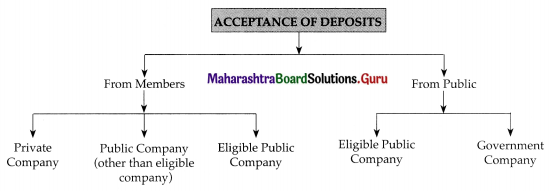
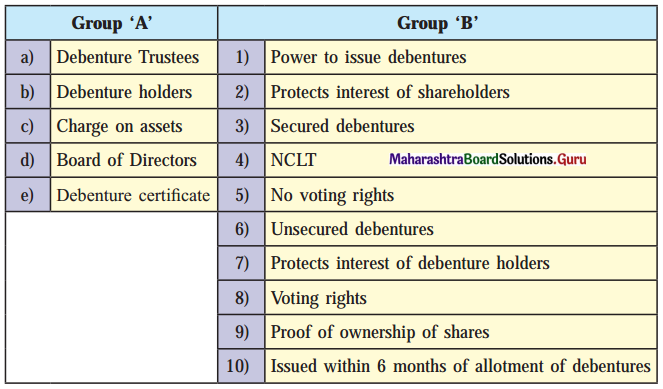
The company can accept deposits from both public and private companies. This acceptance of deposits by companies are further classified into:

Maharashtra Board Class 12 Secretarial Practice Solutions Chapter 5 Deposits 6 Q1

(i) Private Company:

  • A private company can accept deposits from
    • Member or Directors or Relatives of Directors.
    • The certain class specified by Companies Act.
  • They can accept deposits up to 100% of its aggregate of paid-up Share Capital.

(ii) Public Company (other than an eligible company):

  • Public companies (other than eligible companies) accept deposits from members.
  • They cannot accept fresh deposits if the previous deposits combined exceed 25% of the aggregate of the paid-up Share Capital and Free Reserves of the company.

(iii) Eligible Public Company:

  • Eligible Public Company can accept deposits from Members and Public
  • Eligible Public Company can accept fresh deposits only if the previous deposits combined do not exceed 10% of the aggregate of paid-up share capital and free reserves.
  • Eligible Public Company can accept fresh deposits only if the previous deposits combined do not exceed 25% of the aggregate of paid-up share capital and free reserves.

(iv) Government Company:

  • Government companies can accept deposits from the public.
  • These deposits can be accepted not exceeding 35% of the paid-up share capital and free reserves.

Question 2.
Explain the provisions related to circular or advertisement for inviting deposits.
Answer:
A circular is issued when the company invites deposits from its members. An advertisement is issued when the company invites deposits from the public.
(a) Contents of Circular or Advertisement:

  • Statement showing the financial position of the company
  • The portion of secured and unsecured deposit of fresh issue
  • Credit rating obtained from a Credit Rating Agency (only for eligible public companies)
  • Details of the scheme
  • Name of Deposit Trustees
  • Amount due towards deposits of any previous deposits accepted by the company.

(b) Filing of Circular or Advertisement with Registrar of Companies:
A company has to file a copy of a circular or advertisement signed by all directors with the Registrar of Companies.

Maharashtra Board Class 12 Secretarial Practice Solutions Chapter 5 Deposits

(c) Issue of Circular or Advertisement:

  • The company must file a copy of the circular or advertisement with the Registrar of the Company.
  • The filing of circular or advertisement must be done within 30 days.
  • Only after filing the circular or advertisement, the company can issue it to the public.
  • The advertisement must be published in an English newspaper and in the regional language newspaper where the company’s registered office is located.
  • The company can send the circular to the members through registered post, speed post, or email.

(d) Validity of Circular or Advertisement:
The validity of circular or advertisement is valid for 6 months from the end of the financial year in which it was issued or the date on which the Annual General Meeting was held, whichever is earlier.

Maharashtra Board Class 12 Secretarial Practice Important Questions Chapter 4 Issue of Debentures

Balbharti Maharashtra State Board Class 12 Secretarial Practice Important Questions Chapter 4 Issue of Debentures Important Questions and Answers.

Maharashtra State Board 12th Secretarial Practice Important Questions Chapter 4 Issue of Debentures

1A. Select the correct answer from the options given below and rewrite the statements.

Question 1.
A company raises debt capital through the issue of ___________
(a) equity shares
(b) preference shares
(c) debentures
Answer:
(c) debenture

Question 2.
Debenture holder is ___________ of the company.
(a) Owner
(b) debtor
(c) creditor
Answer:
(c) creditor

Maharashtra Board Class 12 Secretarial Practice Important Questions Chapter 4 Issue of Debentures

Question 3.
Debenture holders get income in the form of ___________
(a) Dividend
(b) Interest
(c) Bonus
Answer:
(b) Interest

Question 4.
Power to issue debentures rests with ___________
(a) Chairman
(b) Secretary
(c) Board of Directors
Answer:
(c) Board of Directors

Question 5.
The word ‘Debenture’ is derived from the Latin word ___________
(a) Debere
(b) Debenture
(c) Debire
Answer:
(a) Debere

Question 6.
Debenture cannot be redeemed ___________
(a) at par
(b) at premium
(c) at discount
Answer:
(c) at discount

Maharashtra Board Class 12 Secretarial Practice Important Questions Chapter 4 Issue of Debentures

Question 7.
The company has to obtain the consent of ___________ if the issue of debentures exceeds ₹ 1.
(a) SEBI
(b) Registrar
(c) National Stock Exchange
Answer:
(a) SEBI

Question 8.
Debenture certificate must be issued within ___________ months of allotment.
(a) 3
(b) 6
(c) 9
Answer:
(b) 6 months

Question 9.
The ___________ is an advertisement for the issue of debentures.
(a) memorandum of association
(b) articles of association
(c) prospectus
Answer:
(c) prospectus

Question 10.
Debenture holders is entitled to receive ___________ certificate from the company.
(a) Share
(b) Debenture
(c) Dividend
Answer:
(b) Debenture

Question 11.
Fully convertible debentures are converted into ___________ shares on maturity.
(a) equity
(b) deferred
(c) bonus
Answer:
(a) Equity

Maharashtra Board Class 12 Secretarial Practice Important Questions Chapter 4 Issue of Debentures

Question 12.
A return of allotment is filed with the Registrar within ___________ days of allotment.
(a) 30
(b) 60
(c) 90
Answer:
(a) 30

Question 13.
The ___________ can direct the company to repay the principal amount of debenture with interest.
(a) Company Law Board
(b) Registrar
(c) Shareholders
Answer:
(a) Company Law Board

Question 14.
In order to redeem old debentures the company issues ___________
(a) assets
(b) public deposits
(c) fresh debenture
Answer:
(c) fresh debenture

Maharashtra Board Class 12 Secretarial Practice Important Questions Chapter 4 Issue of Debentures

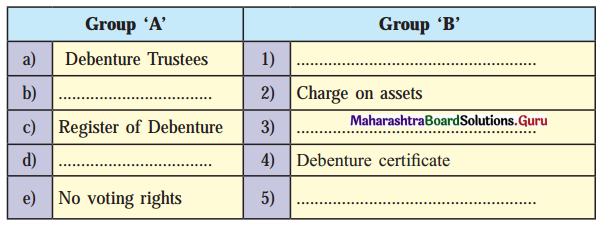
1B. Match the pairs.

Question 1.

Group ‘A’Group ‘B’
(1) Debenture Trustees(a) No voting rights
(2) Debenture(b) ICRA
(3) Convertible debenture(c) Security about Repayment
(4) Secured debenture(d) CARE
(5) Debenture holder(e) Equity Shares
(f) Borrowed capital
(g) Protect Debenture holders

Answer:

Group ‘A’Group ‘B’
(1) Debenture Trustees(g) Protect Debenture holders
(2) Debenture(f) Borrowed capital
(3) Convertible debenture(e) Equity Shares
(4) Secured debenture(c) Security about Repayment
(5) Debenture holder(a) No voting rights

Question 2.

Group ‘A’Group ‘B’
(1) Charge on Asset(a) Credit Rating
(2) Redeemable debenture(b) Secured debenture
(3) Board of Directors(c) 90 days
(4) CRISIL(d) Power to issue debenture
(5) Debenture Certificate(e) Unsecured Debenture
(f) Repaid on maturity
(g) 6 months

Answer:

Group ‘A’Group ‘B’
(1) Charge on Asset(b) Secured debenture
(2) Redeemable debenture(f) Repaid on maturity
(3) Board of Directors(d) Power to issue debenture
(4) CRISIL(a) Credit Rating
(5) Debenture Certificate(g) 6 months

Question 3.

Group ‘A’Group ‘B’
(1) Board of Directors(a) Within 6 months after allotment
(2) Debentures(b) No voting right
(3) Debenture holder(c) Application of debentures
(4) CARE(d) Interest
(5) Debenture Certificate(e) Voting right
(f) Within 120 days after allotment
(g) Credit rating agency
(h) Dividend
(i) SEBI
(j) Creditors

Answer:

Group ‘A’Group ‘B’
(1) Board of Directors(c) Application of debentures
(2) Debentures(d) Interest
(3) Debenture holder(b) No voting right
(4) CARE(g) Credit rating agency
(5) Debenture Certificate(a) Within 6 months after allotment

Question 4.

Group ‘A’Group ‘B’
(1) Trust Deed(a) Owner
(2) Debenture Certificate(b) Deed for debenture holders
(3) Secured Debenture(c) Charge on company’s assets
(4) Redemption by annual installment(d) Creditors of the company
(5) Debenture holders(e) Signature of two directors
(f) Two coupons
(g) Deed for depositors
(h) No charge on the company’s assets
(i) CARE
(j) Credit rating

Answer:

Group ‘A’Group ‘B’
(1) Trust Deed(b) Deed for debenture holders
(2) Debenture Certificate(e) Signature of two directors
(3) Secured Debenture(c) Charge on company’s assets
(4) Redemption by annual installment(f) Two coupons
(5) Debenture holders(d) Creditors of the company

1C. Write a word or a term or a phrase that can substitute each of the following statements.

Question 1.
The provision dealing with the issue of debenture.
Answer:
Section 71 of the companies Act 2013

Question 2.
Name of the capital controller in India.
Answer:
SEBI

Maharashtra Board Class 12 Secretarial Practice Important Questions Chapter 4 Issue of Debentures

Question 3.
Debenture converted in equity shares.
Answer:
Convertible Debenture

Question 4.
Redemption time of secured debenture.
Answer:
10 years

Question 5.
The authority which listing the debentures.
Answer:
Stock Exchange

Question 6.
Application received more than the issue.
Answer:
Over Subscription

Question 7.
Authority consulted by Debenture Trustee.
Answer:
NCLT

Question 8.
The agency provides a credit rating of the security.
Answer:
Credit Rating Agency

Maharashtra Board Class 12 Secretarial Practice Important Questions Chapter 4 Issue of Debentures

Question 9.
Register of Entries of the debenture.
Answer:
Register of debenture

Question 10.
Meeting conducted in an emergency.
Answer:
Extraordinary General Meeting.

1D. State whether the following statements are true or false.

Question 1.
Debenture holders are the creditors of the company.
Answer:
True

Question 2.
Board has no power to issue debenture.
Answer:
False

Question 3.
Debenture helps to raise borrowed capital.
Answer:
True

Question 4.
Debenture holders enjoy normal voting rights.
Answer:
False

Question 5.
The debenture is permanent capital.
Answer:
False

Maharashtra Board Class 12 Secretarial Practice Important Questions Chapter 4 Issue of Debentures

Question 6.
A debenture trustee is a link between the company and Debenture holders.
Answer:
True

Question 7.
Appointment of the underwriter is compulsory.
Answer:
False

Question 8.
Listing of debenture is compulsory.
Answer:
True

Question 9.
SEBI has contracted over the security market.
Answer:
True

Question 10.
The allotment procedure should be completed within 60 days.
Answer:
True

Question 11.
A debenture Trust deed is a legal Agreement.
Answer:
True

Maharashtra Board Class 12 Secretarial Practice Important Questions Chapter 4 Issue of Debentures

1E. Find the odd one.

Question 1.
SEBI, NCLT, SBI
Answer:
SBI

Question 2.
25%, 15%, 10%
Answer:
10%

Question 3.
CARE, CRISIL, SEBI
Answer:
SEBI

Question 4.
Credit Rating Agency Stock Exchange, SBI
Answer:
SBI

Question 5.
SEBI, NCLT, CRISIL
Answer:
CRISIL

Question 6.
Debenture Certificate Trust Deed, share certificate
Answer:
Share Certificate

1F. Complete the sentences.

Question 1.
Debenture holder has no ___________ rights.
Answer:
Voting

Maharashtra Board Class 12 Secretarial Practice Important Questions Chapter 4 Issue of Debentures

Question 2.
CRISIL is responsible to ___________ of securities.
Answer:
Credit Rating

Question 3.
Company enters into ___________ with underwriter.
Answer:
Underwriting Agreement

Question 4.
___________ is needed to increase borrowing power.
Answer:
Special Resolution

Question 5.
If borrowing power of board is to be increased ___________ must be held.
Answer:
Extra Ordinary General Meeting

1G. Select the correct option from the bracket.

Question 1.

Group ’A’Group ’B’
(1) Board of Directors(a) …………………….
(2) …………………….(b) Interest
(3) Debenture holders(c) ……………………..
(4) ……………………..(d) Credit Rating Agency
(5) Debenture certificate(e) ………………………..

(Debenture, Application of debenture, No Voting Rights, 6 months, CARE)
Answer:

Group ’A’Group ’B’
(1) Board of Directors(a) Application of debenture
(2) Debenture(b) Interest
(3) Debenture holders(c) No Voting Rights
(4) CARE(d) Credit Rating Agency
(5) Debenture certificate(e) 6 months

1H. Answer in one sentence.

Question 1.
Who creates a charge over assets?
Answer:
Debenture Trustee can create a charge over asset.

Question 2.
When is the permission of SEBI required?
Answer:
When borrowing capital exceeds 1 crore, consent of SEBI is required.

Maharashtra Board Class 12 Secretarial Practice Important Questions Chapter 4 Issue of Debentures

1I. Correct the underlined word and rewrite the following sentences.

Question 1.
Debenture holders get fluctuating interest.
Answer:
Debenture holders get Fixed interest.

Question 2.
Convertible debenture holders can be converted into preference shares.
Answer:
Convertible debenture holders can be converted into Equity Shares.

Question 3.
Shareholders have the power to issue debenture.
Answer:
The Board of directors has the power to issue debenture.

Question 4.
A debenture Trust deed is an illegal document.
Answer:
A debenture Trust deed is a legal document.

Maharashtra Board Class 12 Secretarial Practice Important Questions Chapter 4 Issue of Debentures

Question 5.
Debenture certificate issued by the company within 3 months.
Answer:
Debenture certificate issued by the company within 6 months.

Question 6.
Debenture holders are the owners of the company.
Answer:
Debenture holders are the creditor of the company.

Question 7.
Debentures generate owned capital for the company.
Answer:
Debentures generate borrowed capital for the company.

1J. Arrange in proper order.

Question 1.
(a) Offer letter
(b) Debenture Trust Deed
(c) Written Consent
Answer:
(a) Offer letter
(b) Written Consent
(c) Debenture Trust Deed

Question 2.
(a) Allotments of debenture
(b) Return with ROC
(c) Debenture Certificate
Answer:
(a) Allotments of debenture
(b) Debenture Certificate
(c) Return with ROC

Maharashtra Board Class 12 Secretarial Practice Important Questions Chapter 4 Issue of Debentures

Question 3.
(a) Issue of prospectus
(b) Return with ROC
(c) Underwriting Agreement
Answer:
(a) Issue of prospectus
(b) Underwriting Agreement
(c) Return with ROC

Question 4.
(a) Board meeting
(b) Open Separate Bank Account
(c) Extra-Ordinary General Meeting
Answer:
(a) Board meeting
(b) Extra-Ordinary General Meeting
(c) Open Separate Bank Account

Question 5.
(a) Receiving Application Money
(b) Allotment of debenture
(c) Open Bank Account
Answer:
(a) Receiving Application Money
(b) Open Bank Account
(c) Allotment of debenture

Question 6.
(a) Preparation and consent to the prospectus
(b) Filing with ROC
(c) Special Resolution Passed
Answer:
(a) Special Resolution Passed
(b) Preparation and consent to the prospectus
(c) Filing with ROC

Maharashtra Board Class 12 Secretarial Practice Important Questions Chapter 4 Issue of Debentures

Question 7.
(a) Debenture Certificate
(b) Entries in Register
(c) Underwriting contract
Answer:
(a) Underwriting contract
(b) Debenture Certificate
(c) Entries in Register

2. Explain the following terms/concepts.

Question 1.
Debenture
Answer:
The company raises capital by borrowing money from the public or its members. It is a proof of loan taken by the company. A person who purchases debenture is called a debenture holder. Interest is paid to the debenture holders.

Question 2.
Debenture Redemption Reserve
Answer:
Debenture Redemption Reserve is useful for the redemption of the debenture. It is created out of the profit of the company which has maintained a 25% minimum of the value of outstanding debenture in DRR.

Question 3.
Minimum Subscription
Answer:
Minimum subscription is a term that is used to represent the amount of the issue which has to be subscribed or else the shares can’t be issued if it is not being subscribed.

Question 4.
Underwriting
Answer:
An underwriting contract is a contract between an underwriter and the issuer of securities. It is helpful to issuer companies when securities are not being subscribed by the public. Here, underwriters guarantee the sale of issued stock at the agreed price.

Maharashtra Board Class 12 Secretarial Practice Important Questions Chapter 4 Issue of Debentures

Question 5.
Credit Rating
Answer:
It is an estimation of the ability of a person or organization to fulfill their financial requirement, commitments, based on previous dealings. Credit Rating Agencies are responsible for credit rating.

Question 6.
Secured debenture
Answer:
Secured debentures are bonds that are issued with collateral. Here, a charge is created against the assets of the company. If a company is in default, assets can be realized to recover the dues.

3. Study the following case/situation and express your opinion.

1. ABC Limited is going to redeem its 1000 debentures of ₹ 100 each. Please advise them on the following:

Question (a).
Which fund should be created by the company to redeem debentures?
Answer:
The company should create a Debenture Redemption Reserve to redeem debentures.

Question (b).
Can debenture trustees consult NCLT if the company is at default?
Answer:
If the company is at default regarding repayment of debentures, then Debenture trustees can consult the NCLT.

Question (c).
What will be the change in the register of debenture holders?
Answer:
If debentures are redeemed, their entries will be cancelled from requisite.

2. Zeal Co. Ltd. is going to issue 2000 debentures. Please advise them on the following:

Question (a).
Does the company have to list the debentures on the stock exchange?
Answer:
Yes, the company has to list the debentures on the stock exchange.

Question (b).
Should the company get a credit rating for issuing debentures?
Answer:
Yes, the company should get a credit rating for issuing debenture and from SEBI.

Maharashtra Board Class 12 Secretarial Practice Important Questions Chapter 4 Issue of Debentures

Question (c).
Can the company show a credit rating in the prospectus?
Answer:
Yes, the credit rating should be mentioned in the prospectus/offer letter/letter of offer.

4. Answer in brief.

Question 1.
Define Debenture and State its meaning.
Answer:
Definitions of Debenture:

  • According to Section 82 of Companies Act, “Debenture to any member of the company is a movable property, transferable in the manner provided by the Articles of Association:
  • According to the Oxford dictionary “Debenture is a certificate issued by a company act now leading that it has borrowed money on which interest is being paid”.

Meaning:

  • The word ‘Debenture’ is derived from the Latin word ‘Debere’- which means to owe something to someone.
  • It is a proof of loan taken by the company on certain terms and conditions.
  • It can be issued by public or private companies to raise borrowed capital.
  • A person who purchases it is called a debenture holder and he is a creditor of a company.
  • It can be issued at par, premium, and discount.
  • The Board of Directors has the power to issue debentures.
  • Debenture holders get a fixed rate of interest on their investments.

Question 2.
State the provisions as per Companies (Share Capital and Debenture) Rules, 2014 (i.e. Rule 18).
Answer:
If a company issued secured debenture, then it has to follow Rule 18 of Companies Rules, 2014. The provisions are as follows:
(i) Tenure of secured debenture:
All secured debentures should be redeemed within 10 years from the date of its issue. Infrastructure companies, Companies permitted by the Ministry of Corporate Affairs, Central Government, or RBI can issue debentures beyond the period of 10 years but not exceeding 30 years.

(ii) Create charge on assets:
Secured debentures create charges on assets. The value of the charge should be adequate to cover the entire value of debentures issued and the interest to be paid on it.

(iii) Debenture Trustee:
Before issuing a prospectus, the company has to appoint a Debenture Trustee. The company should execute the trust deed within 60 days from allotment of a debenture or before issuing the prospectus/offer letter. The Rules and Regulations of Trust Deed decide the role of debenture trustees.

Maharashtra Board Class 12 Secretarial Practice Important Questions Chapter 4 Issue of Debentures

(iv) Debenture Redemption Reserve:
The company has to create a Debenture Redemption Reserve to redeem debentures. The company should maintain at least 25% of the value of outstanding debentures in the DRR account. Money from this account is used for the redemption of the debenture. Every year on or before 31st March, the company has to invest or deposit a sum of not less than 15% in the DRR account for the maturing debentures in the next year.

Question 3.
What are/Explain the requirement of SEBI for the issue of debentures?
Answer:
Following are the requirements as per SEBI for the issue of debentures in the market:
(i) Condition of minimum subscription: Regulation 12 of SEBI Regulation Act 2008 is responsible to regulate the minimum subscription collected by the company. As per SEBI, the minimum subscription for public issues is 75% of the issue price. If the minimum subscription is not received, then it should be refunded within 12 days from the date of closure of the issue.

(ii) Over Subscription:
Oversubscription means a situation where a company has more buyers than the shares to fulfill the client’s order. The company can retain oversubscription on up to a maximum of 100% of the issue price or any lower unit as specified by the prospectus.

(iii) Underwriting:
A company may enter into an underwriting agreement with underwriters for its public issue of debentures. The appointment of underwriters must be mentioned in the prospectus/offer letter/letter of offer.

(iv) Credit Rating:
As per SEBI, the company making public issue, or right issue of convertible debenture must obtain a credit rating from one or more credit rating agencies. The rating must be mentioned in the offer letter/prospectus. In India, ICRA, CRISIS, CARE are famous or recognized credit rating agencies for the corporate sector.

Question 4.
Who are Debenture Trustees?
OR
Explain the role of Debenture Trustees.
OR
Write a note on Debenture Trustees.
Answer:

  • Debenture holders are the creditors of the company and they cannot participate in the routine affairs of the management of the company. So, in order to protect the interest of debentures, the company appointed debenture trustees.
  • Debenture trustees are the institutions that protect the interest of debenture holders.
  • Debenture Trustees create a charge on assets of the company on behalf of debenture holders. They are the custodian of assets on which charge has been created.
  • In order to appoint debenture trustees, the company has to execute the debenture trust deed within 3 months, and the offer letter should be issued within 60 days after the allotment.
  • The prospectus or offer letter must mention the names of debenture trustees.

Maharashtra Board Class 12 Secretarial Practice Important Questions Chapter 4 Issue of Debentures

5. Justify the following statements.

Question 1.
The company can list its debentures on Stock Exchange.
Answer:

  • A company can issue secured as well as unsecured debentures.
  • Debentures are issued to the general public.
  • The company can issue debentures to its members through public offers or offer through private placement.
  • The company gets its debentures rate from one or more credit rating agencies which attract the general public or members of the company.
  • Thus, it is rightly said that a company can list its debentures on Stock Exchange.

Question 2.
Debenture holders do not enjoy any voting rights.
Answer:

  • The company borrows a large amount of money by issuing debentures.
  • Debentures are considered to be the long-term loan that is repaid after a long period.
  • Debenture holders are the creditors of the company.
  • The company has to pay interest to the debenture holders even if the company makes a loss in the current year.
  • Thus, it is rightly said that debenture holders do not enjoy any voting rights.

Question 3.
Debenture Redemption Reserve Account is used for the redemption of debentures.
Answer:

  • Debenture Redemption Reserve is created from the profits earned by the company.
  • The company has to maintain at least 25% of the value for the outstanding debentures in the DRR account.
  • Similarly, every year on or before 31st March, the company has to invest or deposit a sum of not less than 15% in the DRR account for the maturing debentures in the next year.
  • Thus, it is rightly said that Debenture Redemption Reserve Account is used for the redemption of debentures.

Question 4.
Members, as well as debenture holders, can inspect the debenture trust deed.
Answer:

  • The company enters into the contract with the debenture trustees which is called as ‘Debenture Trust Deed”.
  • It is a legal instrument conveying the assets of a company of the trustees.
  • The deed includes the rights of debenture holders and the duties and powers of debenture trustees.
  • It contains terms and conditions agreed between the company and debenture trustee.
  • Thus, it is rightly said that members, as well as debenture holders, can inspect the debenture trust deed.

6. Attempt the following.

Question 1.
Explain the regulations governing the issue of different types of debentures.
Answer:
A company has to comply with the provisions while issuing different types of debentures. Depending upon the type of debenture, the company has to fulfill the following provisions/regulations:
(i) Companies Act, 2013: Sec. 71 of Companies Act, 2013 contains provisions for the issue of debentures.

(ii) Company Rules 2014 (Share Capital and Debentures), Rule 18: Rule 18 of Companies (Share Capital and Debentures) Rules, 2014 contains provisions for the issue of the secured debenture.

(iii) SEBI Regulations, 2008: SEBI Regulations, 2008 covers the provisions related to the issue and listing of debentures that are not convertible, either wholly or partly into equity shares. It is applicable to only those debentures which are issued through public offer, private placement. Disclosure requirements are to be followed the same as the public issue of equity shares.

Maharashtra Board Class 12 Secretarial Practice Important Questions Chapter 4 Issue of Debentures

(iv) SEBI Regulations, 2009: SEBI Regulations, 2009 (Issue of Capital and Disclosure Requirement) covers provisions for issue of debentures and listing of debentures that are convertible, rather partially, fully, or optionally into listed or unlisted equity shares. It also has to follow the same disclosure norms as applicable to equity shares.

(v) SEBI Regulations, 2015: SEBI Regulations, 2015 (Listing Obligations and Disclosure Requirements) covers provisions for the listed company issuing non-convertible debentures, perpetual debt instruments, etc. It includes various listing conditions which a company has to comply with.

(vi) RBI Guidelines: RBI Guidelines are formed for the banks which raise capital by issuing non-equity instruments.

Maharashtra Board Class 11 English Yuvakbharati Solutions Chapter 1.4 Pillars of Democracy

Balbharti Yuvakbharati English 11th Digest Chapter 1.4 Pillars of Democracy Notes, Textbook Exercise Important Questions and Answers.

Maharashtra State Board Class 11 English Yuvakbharati Solutions Chapter 1.4 Pillars of Democracy

11th English Digest Chapter 1.4 Pillars of Democracy Textbook Questions and Answers

1. Discuss with your partner and choose the correct alternative.

Question (i)
‘Government of the people, by the people and for the people, shall not perish from the earth’. This famous statement is made by –
(a) Mahatma Gandhi
(b) Nelson Mandela
(c) Abraham Lincoln
(d) Dalai Lama
Answer:
Abraham Lincoln

Maharashtra Board Class 11 English Yuvakbharati Solutions Chapter 1.4 Pillars of Democracy

Question (ii)
A system where the government is elected and ruled by people is called —
(a) Bureaucracy
(b) Aristocracy
(c) Democracy
(d) Autocracy
Answer:
Democracy

Question (iii)
A democratic country is governed by, its –
(a) Military
(b) Police
(c) Politicians
(d) Constitution
Answer:
Constitution

2.

Question (i)
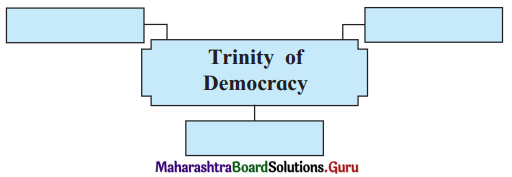
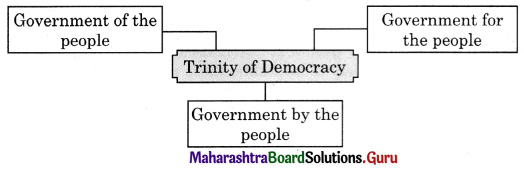
The trinity of democracy comprises of three principles. Complete the web to show the trinity of democracy.
Maharashtra Board Class 11 English Yuvakbharati Solutions Chapter 1.4 Pillars of Democracy 1
Answer:
Maharashtra Board Class 11 English Yuvakbharati Solutions Chapter 1.4 Pillars of Democracy 2

Maharashtra Board Class 11 English Yuvakbharati Solutions Chapter 1.4 Pillars of Democracy

Question (ii)
Match the following.


AB
1. Constitution(a) It is the freedom to go where you want, do what you want etc.
2. Liberty(b) It is the state of being equal, especially in status, rights or opportunities.
3. Equality(c) It is the sense of common brotherhood.
4. Fraternity(d) It is an aggregate of fundamental principles or established precedents that constitute the legal basis of a polity, organization or other type of entity and commonly determine how that entity is to be governed.

Answer:

AB
1. Constitution(d) It is an aggregate of fundamental principles or established precedents that constitute the legal basis of a polity, organization or other type of entity and commonly determine how that entity is to be governed.
2. Liberty(a) It is the freedom to go where you want, do what you want etc.
3. Equality(b) It is the state of being equal, especially in status, rights or opportunities.
4. Fraternity(c) It is the sense of common brotherhood.

Question (iii)
Explain the pillars of a democratic nation. Make list of obstacles that are a threat to the progress of a nation.
Answer:
The pillars of a democratic nation are:
1. Legislative: In a democratic nation, the people of the country elect their representatives that govern a state or a country.
2. Executives: Executives, as the name suggests, are in-charge of putting the laws made by the legislatives in effect.
3. Judiciary: The job of the judiciary is to keep a check on the laws made by the legislative and their execution or fulfillment by the executives without disturbing the fundamental rights of the citizens of the country.
4. Press: All types of media have a responsibility of reaching to the people all over the country, the works of the legislatives and the executive and their basic duty is to be unbiased.

Major obstacles that are threats to the progress of a nation are:

  1. Caste and religion-based politics.
  2. Disrespect for the constitution values.
  3. Absence of universal education which makes people unaware of their basic rights and duties.
  4. Huge gap between haves and have-nots- lack of qualitative resources to the poor.
  5. Constant threat of the attack of enemy countries.

Maharashtra Board Class 11 English Yuvakbharati Solutions Chapter 1.4 Pillars of Democracy

(A1)

Question (i)
State weather the following statements are true or false. Correct the false statement.

  1. There is nothing wrong in being grateful to great men.
  2. Hero-worship leads to dictatorship.
  3. Liberty cannot be divorced from equality.
  4. One man one vote and one vote one value.
  5. Fraternity means common sense.

Answer:

  1. True
  2. True
  3. True
  4. True
  5. False.

Fraternity means a sense of common brotherhood The correct statement is – Fraternity means a sense of common brotherhood.

Question (ii)
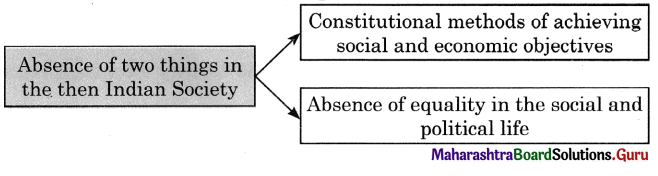
Complete the web with information from the speech of Dr. B.R. Ambedkar.
Maharashtra Board Class 11 English Yuvakbharati Solutions Chapter 1.4 Pillars of Democracy 3
Answer:
Maharashtra Board Class 11 English Yuvakbharati Solutions Chapter 1.4 Pillars of Democracy 4

(A2)

Question (i)
Dr. Babasaheb Ambedkar has cited the quotes by John Stuart Mill and Daniel O’Connell. Write down 4 to 5 lines for each of them.
Answer:
(i) John Stuart Mill was an English philosopher and economist who was considered to be the most powerful British thinker of the 19th Century. Mill’s philosophy concentrates on establishing standards for the relationship between authority and liberty. It also advocates freedom of speech, freedom to pursue taste as long as they do not harm others and the freedom to unite without being forced and harming anybody. Dr. Babasaheb Ambedkar agreed with Stuart Mill’s views on social liberty where people should have the right to have a say in the governments decision.

(ii) Daniel O’Connell who was often referred to as ‘The Liberator’ was an Irish political leader in the first half of the 19th Century. His philosophy has inspired leaders all over the world including Mahatma Gandhi and Martin Luther King. He advocated mass political participation and was very much against idealizing somebody at the cost of ones own honour, chastity or liberty. Dr. Babasaheb Ambedkar felt that this Principle of Refraining from hero-worship propagated by Daniel O’Connell is badly needed in India and he agreed with Daniel who felt such kind of loyalty was actually slavery.

Maharashtra Board Class 11 English Yuvakbharati Solutions Chapter 1.4 Pillars of Democracy

Question (ii)
Make a list of steps that you feel are essential to unite the people of different caste, religions and languages in India.
Answer:
India is a progressive nation but the directions of dividing India according to caste, religions and languages have still kept her handicapped. The possible remedies, I feel, to cure India from these diseases to make her stable and secure may be:
(i) Education for all irrespective of not only caste, creed, religion but also of gender.
(ii) Creation of job opportunities according to one’s abilities.
(iii) Provision for reservation to depend on the financial condition rather than caste or religion.
(iv) Creation of public welfare policies according to the need of the people of all communities and thus maintaining uniformity as well as equality in all matters.

(iii) Write your views/opinion in brief on the following topics.

Question (a)
We must always cast our vote.
Answer:
Voting is one of the fundamental duties of the citizen of a country. We have no right to criticize the works of the government if we abstain from voting which gives us a chance to choose suitable representative to govern the country. Our constitution has given the common man an important power and responsibility to select the right persons to take the country forward on the right path. We are supposed to discharge this duty judiciously.

Question (b)
Liberty, equality and fraternity lead to an ideal nation.
Answer:
The terms ‘Liberty, Equality, Fraternity’ were the mottos of French revolution. Liberty represents freedom and Indian constitution has specified various kinds of freedom for Indian citizens. Euqality stands for having equal law for all irrespective of caste, creed, gender or religion. Fraternity is associated with brotherhood among all communities of people sharing common interest and purpose. An ideal nation is recognized by the maintenance of an atmosphere of peace in all spheres of life. If the principles of liberty, equality and fraternity are followed responsibly by the people of the country as well as the leaders governing them, the prosperity of the nation is assured.

Question (c)
Steps to be taken to eradicate inequality.
Answer:
Inequality is a curse that can lead any nation to its doom. Inequality creates dissatisfaction and unrest among people who feel deprived. Some possible steps to eradicate inequality can be:
(a) Remove poverty by reducing unequal distribution of resources and equal access to the opportunities as far as possible.

(b) Advocate gender equality by preventing female foeticide and making provision for girls’ education and preventing early marriage.

(c) Investing in employment-oriented education for all, creating employment readiness among youth and institutions for skill development need to be encouraged.

(d) Ensuring that all groups and communities can express their voice without fear. But the groups and communities also need to be responsible to avoid loss of lives, damage of public properties while expressing their grievances.

(e) Strictly eliminate caste discrimination which is still pervasive and is causing a serious threat to the progress of the country. To make the above steps successful is the joint responsibility of the government and the people of the country.

Maharashtra Board Class 11 English Yuvakbharati Solutions Chapter 1.4 Pillars of Democracy

Question (d)
Role of youth in creating awareness.
Answer:
Youths are the backbones of the society and that gives them the responsibility to act as catalysts for creating social awareness. Empowerment of the youth is one of the ways to fulfill the policies of good governance.

The social welfare units in the schools and colleges, NCC, NSS, etc., should be made more active and need to be made a part and parcel of the curriculum so that a large number of young minds are materialized to eradicate social evils like illiteracy, insanitation, superstitions, corruption. They can organize various cultural programmes like street plays, musical programmes with social messages, posters as well as powerpoint presentations.

They can set examples by fighting against various kinds of pollution with steps like quitting smoking, propagating against loud music, cleanliness, saving water. “Charity begins at home” thus, they need to bring about the change in their own habits and behaviour to create social awareness.

(A3)

Question (i)
Complete the following table.
Answer:

WordTypeSynonymAntonym
observeVerbnotice, discern, detect, markignore, overlook
abandonedAdjectivedeserted, dumped, forsaken, droppedadopted, defended, supported
gratefulAdjectiveappreciative, thankfulungrateful, thankless, inappreciative
initiativeNounaction, drive, enterpriseapathy, idleness, laziness, in difference
perilNoun Verbdanger, risk, hazard, threat endanger, riskprotection, certainty, safety protect, save
separationNoundivision, break-up, split, partingConnection, association, union

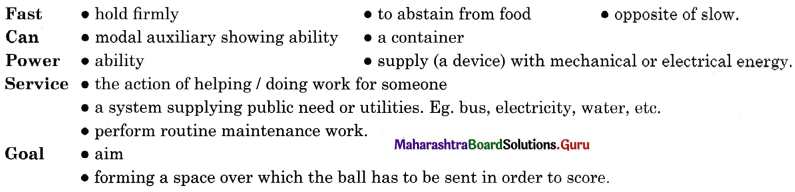
2. Homograph: Homograph is a word spelt and pronounced like another word but with a different meaning.

Maharashtra Board Class 11 English Yuvakbharati Solutions Chapter 1.4 Pillars of Democracy

(A4)

(i) Frame Wh-question to get the underlined parts of the following sentences as answers.

Question (a)
In politics we will be recognizing the principle of ‘one man one vote’ and ‘one vote one value’.
Answer:
Which principles will we be recognizing in politics?

Question (b)
The politically minded Indians preferred the expression ‘the Indian Nation’.
Answer:
Which expression did the politically-minded Indians prefer?

Question (c)
Fraternity means a sense of common brotherhood of all Indians.
Answer:
What does fraternity mean?

(A5)

Write speeches on the following topics.

Question 1.
Duties of an Ideal Citizen.
Answer:
Respected chief guest Dr. Ashok Pillai, our Principal Dr. Pradeep Sanghvi, teachers and my dear friends,

Good Evening ! I am Mayank Gala, a member of the NSS unit of our college. It is indeed a matter of pride for me to share my views on the topic ‘Duties of an Ideal Citizen.’ in front of an august gathering. ‘Duties of an ideal citizen’ according to me, has become a necessity for everyone to be aware of in the present situation of our country.

The first question that comes to my mind at this moment is “Who is an ideal citizen?” Is it a person who is honest, knows his responsibilities and values, respects others needs, is conscious of taking care of the environment and thus contributing to the society in general making it a better place to stay? , Yes, an ideal citizen ideally should have all these qualities.

I personally feel that an ideal citizen should not consider his duties as obligations and fulfill them on his own urge. If all of us make a sincere effort to carry on with our jobs, the society is bound to prosper. Since we all are members of the society, to make it exemplary is our duty. We need to remember this at every step we take in our lives and things will fall into their own places.

Here, I can give some examples which all of us can do easily. I know that there are big words like trustworthiness, honesty, courtesy, respecting the rights of others as well as laws, and these are the personal traits of an ideal citizen. But I want to give you a simple list of things which all of us can follow easily.

My list begins with a simple task of not littering the environment, followed by, conserving water, encouraging greenery in our housing societies, wearing helmets and also encouraging our pillons to wear one, maintaining dignity of all the communities and last but not the least, paying taxes on time.

Of course, the list will be longer than this. But “well begun is half done”. And the most important things, I remind all of us again that the “charity begins at home” So, let’s start!

I thank the organizers to give me an opportunity to talk to all of you. I am also grateful to each and every person in the audience for their patient hearing. I am convinced that we can fullfill our dreams of having an ideal society.

Thank you !

Maharashtra Board Class 11 English Yuvakbharati Solutions Chapter 1.4 Pillars of Democracy

Question 2.
Merits of Democracy
Answer:
Respected judges and my dear friends,
I am Sandeep Agarwal wishing all of you a very good afternoon.

Today, I am going to talk on ‘Merits of Democracy’ I am sure, we all remember the definition Abraham Lincoln gave of democracy that it is “Government of the people, for the people and by the people”. In short, I can say that democracy is rule of the people.

So, what can be the merits of the rule of the people? The first merit that immediately comes to my mind is that recognizes the strength of people’s will which is expressed through their elected representatives sitting in the Parliament.

A true democracy limits the power of these representatives and they have to strictly follow the constitution which again cannot be altered or amended except through right procedural process. This is, I feel, the merit of democracy, where every effort is made to prevent the accumulation of power in the hands of any particular individual.

This leads us to the fact that the foremost demand of democracy is free and fair election. Every voter not only has access to the voting machine but secrecy of his vote has to be strictly maintained. Liberty, equality, fraternity are the three pillars of a good democracy and in a proper democratic situation it must be followed religiously.

Unless these principles are sincerely maintained, how will people who are an integral part of democracy, get assurance of safety, security as well as courage to express their views/ problems freely? Here comes the win of democracy over dictatorship where people do not have freedom of speech.

The role of unbiased press and then freedom of expression are urgent necessities so that they can reach a large number of people’s opinion to the government to judge the pros and cons of their decisions. The Parliament proceedings should be open to the public so that they can see how their elected representatives are behaving. In a true democracy, the people have the power of rejecting their representatives and that is their best safeguard.

But, I am sure you will all agree with me that no electoral system can be fool-proof and perfect democracy can be found in the utopia of poets and dreamers. We have to be satisfied with the nearest maintenance of the sanctity of democracy. Democracy is an evolutionary process. So, it is not wrong on our part to expect the scope for modification and change in the light of experience.

In conclusion, I request all of you to keep your hopes and expectations alive not only to have a true democracy in our country but to maintain its merits also. I thank our Cultural Forum team for giving me the opportunity to speak in front of an august audience. Thank you for your patient hearing !

Maharashtra Board Class 11 English Yuvakbharati Solutions Chapter 1.4 Pillars of Democracy

Question 3.
Advantages of Education
Answer:
Respected judges and my dear friends,

Good afternoon! I am Deepak Shah and my topic for today’s elocution competition is ‘Advantages of Education’.

As I was thinking about the topic, two immediate questions that came to mind are, “How and when does education begin? Does it start when a child goes to school or learn alphabet? Looking around, I get a strong ’NO’ as answer. I believe, education begins with the Mother’s encouraging work, father’s words of praise and approval, sibling’s sympathy, help and sometimes fights even, with the gathering of flowers from the garden, with the chirping of the birds and last but not the least in the company of friends. Thus, the child learns to feel, observe, receive and remember as his mind opens out.

The ultimate aim of education, I know, everyone will agree, is to develop all the faculties of a person- physical, mental or moral. Education needs to help a person to be true to his own self as Shakespeare said, “To thy own self, be true.” Book-bound education limits a person. Rabindranath Tagore showed us the way at Shantiniketan how education would make a complete personality.

The true objective of education is to train the mind , to build confidence, to judge the good and bad of the things. I feel, the least advantage of education is to create the right temperament needed at the right time. I must include here the need for physical education since “A sound mind can only exist in a sound body” The harmony among mental, physical and moral learning can only supply the proper benefits of education.

To talk about the advantages of education, standing in front of so many educators, is not a small task. This has been possible because of my teachers who have been facilitators of giving me confidence to go ahead with my aspirations. This has been the advantage of my education, I believe and I salute my teachers for that.

I thank the judges, the Cultural forum team once again and all my dear friends and teachers sitting in the audience for their patient hearing which gave me the courage to present my views.

Question 4.
Equality : A Blessing
Answer:
Respected dignitaries on the dais, our honourable guests, my teachers and my dear friends,

Good afternoon to you all ! I am Deepali Doshi who is fortunate to be selected as one of the speakers to represent our college for the seminar organized by our college on the topic ‘Equality : A Blessing’.

‘Equality : A Blessing’ – one of the topics which is very close to my heart. From my childhood, I have enjoyed the situation of ‘no discrimination’ at home by my parents. I always thought of this as a natural things to happen.

I grew up and faced the big world. I started understanding the value and necessity of equal opportunity in the society. How a person uses that opportunity depends on his/her capabilities and the situations he/she faces in life. Ideally, equality means that all citizens are equal before the law, allowed to exercise the franchise, are entitled to fulfill equal rights and duties prescribed in the constitution. That leads to a levelling process which is definitely a blessing.

I must admit here, equality needs to be maintained at various levels like having social equality, political equality, economic equality and of course equality of opportunity and education. Social equality is an urgency for peaceful co-existence as it refers to the absence of discrimination of caste, creed, colour, clans, groups and classes.

Who can deny the benefits of this? Political equality gives access to all citizens similar political rights. We the people of India have the benefits of Universal Adult Franchise which gives us the right to elect our representatives to run the government the way we deserve it.

Economic equality is a dream-like situation where each citizen is provided equal opportunity to make economic progress. Practically, that seems difficult but a responsible government definitely makes an attempt to fulfill it to a large extent. Equal right to education is the birthright of every citizen. I know, everybody in this hall will say in unison with me, ‘Education is the great equalizer… opening doors of opportunity for all.’

I have tried to talk about various equalities and the ideal situations to provide them. But the toughest job is to make equality, a blessing in real life, though each one of us wishes for it. To make it a reality is the joint responsibility of the government and we, the people.

I enjoyed talking to such an alert and responsible audience. Thank you for all your patient hearing.

Maharashtra Board Class 11 English Yuvakbharati Solutions Chapter 1.4 Pillars of Democracy

Question 5.
Freedom of Speech
Answer:
Respected judges, my teachers and my dear friends,

Good Evening ! I am Pooja Banerji. I am going to talk on ‘Freedom of Speech’.
‘Freedom of speech’ is an oft-quoted expression these days. Everyday wants to enjoy this freedom but in the process, knowingly or may be unknowingly, disturbs the peace in the society.

If freedom of speech is so powerful that it is capable of disturbing the peace in an otherwise stable society, then let me find out the answers to the questions like, “What is freedom of speech and what is the ideal situation to use this freedom?” I am sure, we all are bothered by these questions often because many times, some utterances in the name of freedom of speech, spread like wild fire, making the situations go out of hand.

We know that the constitution of India provides this fundamental right to the general public as well as the media to express their ideas and opinions freely. Like India, this right is provided by some other countries also but with some limitations.

But can’t freedom of speech be used positively? Constructive criticism is always welcome and is also needed to keep a person or the government under check since all activities are closely monitored.

With freedom comes responsibility. This license should not be misused to excite others and invite unwanted problems. When we get to enjoy the rights we need to respect it so that it does not spoil the peace and harmony of the society. These days, a common practice of spreading half-truths has become rampant just to create sensation. This, in the name of freedom of speech, causes serious harm and self-discipline, according to me, is the only remedy.

All good things have their positives and negatives and one should know how the use of them should not become liabilities. I want to conclude with a request to everyone that basic humanity should not be forgotten in the pretext of using the fundamental rights of freedom of speech. I join Tracy Morgan to tell all of you, “We have freedom of speech but you got to watch what you say”.

Thank you all for allowing my freedom of speech and giving it a patient hearing.

Question 6.
Unity in Diversity
Answer:
Respected judges, my teachers and my dear friends,

Good Morning ! I am Gauri Arora and I am fortunate that I have been assigned the job of talking on a topic, ‘Unity in Diversity’.

For the inter-collegiate elocution competition organized by our college. Here I am standing on the podium of a hall which is self-explanatory of ‘Unity in Diversity’. We can see very clearly that people of different religious beliefs, may be caste and creeds, languages, cultures , dresses, and diverse lifestyles as well as eating habits are harmoniously sitting under one roof.

‘Unity in Diversity’ is an expression which is frequently referred to when one talks of India. We, the Indians, are children of one mother, Mother India and that unites us on the principle of brotherhood. I am sure, my friends sitting over there, have ever bothered about caste, religion, social status of the person sitting next to them. That is, in other words, we can call national integration, in the true sense of the term.

India has won its freedom from the British rule of 200 years and the freedom fighters never bothered about their diversities. They all had one mantra in life and that was to free Mother India from the shackles of British rule.

We carry on that tradition after so many years of our independence. India is the land of festivals irrespective of culture, language, rituals, faiths, we are lost in the celebration forgetting completely the existence of our own origin.

One may ask, “How is it possible in the midst of so many diversities?” My answer to such questions will be “Its possible because we respect our togetherness. How can we forget the benefits of safeguarding this unity? It protects our heritage and in the process attracts tourism. The foreigners feel amased with the existence of so many traditions, cuisines, clothings, languages and of course the diverse gifts of Mother Nature.

I feel, the biggest benefit of ‘Unity in Diversity’ is the protection of human rights of all. This gives the citizens confidence of having safety at workplace and automatically encourages healthy teamwork that ultimately leads to progress.

Every coin has two sides, so has the principle of unity. It is an utopian idea to think that there is no social tension because of these diversities. But they can be tactfully handled by the authorities for getting global recognition and most importantly safety and security of our nation.

We all know the age-old saying, ‘United we stand, Divided we fall’ Today, my dear young friends, I am quoting J.K. Rowling, the creator of Harry Potter, “ we are only as strong as we are united, as weak as we are divided” I am sure you all believe her and take it as a maxim to protect the principle of ‘Unity and Diversity’ which is so unique for our country. I want to express my gratitude to Cultural Forum for selecting me to talk on a topic so close to my heart.

Yuvakbharati English 11th Digest Chapter 1.4 Pillars of Democracy Additional Important Questions and Answers

Question 1.
Discuss hero-worship by citing some examples.
Answer:
Hero-worship is to have exclusive admiration for someone which may lead to bias. The admirer refuses to believe that the hero might have any imperfection. The hero is idolized. It happens with film stars, sportsmen, politicians and sometimes with religious gurus.

Maharashtra Board Class 11 English Yuvakbharati Solutions Chapter 1.4 Pillars of Democracy

Question 2.
‘Fraternity leads to social stability’ – Explain the statement.
Answer:
Fraternity is a common bond or feeling of unity among people. It automatically gives rise to the concept of togetherness of all cast, creed and religion. For a society to be stable, these are the basic necessities. In a vast country like India, it is definitely a tough job to maintain such feelings, but it has to be observed for the progress of the country. India, being a country of diverse communities, social stability is an essential ingredient for keeping the country safe and secure.

Question 3.
Find some words starting with ‘Anti’ like ‘Anti-social’
Answer:

  1. Anti-climax
  2. Anti-pathy
  3. Anti-thesis
  4. Anti-dote
  5. Anti-virus
  6. Anti-hero

Comprehension

Read the extract and complete the activities given below.

Global Understanding:

Question 1.
Supply information from the passage.
Answer:
1. When there was no way left for constitutional methods for achieving economic and social objectives, there was a great deal of justification for unconstitutional methods.
2. There is nothing wrong in being grateful to great men who have rendered lifelong services to the
country.

Maharashtra Board Class 11 English Yuvakbharati Solutions Chapter 1.4 Pillars of Democracy

Question 2.
Choose the correct statements which are the themes of the passage.
(i) This passage talks about the dangers of inequality.
(ii) This passage talks about the importance of equality and fraternity.
(iii) In this passage Dr. Ambedkar supported Bhakti in politics.
(iv) Dr. Ambedkar is pained to see the denial of ‘One Man One Value’.
Answer:
(ii) This passage talks about the importance of equality and fraternity.
(iv) Dr. Ambedkar is pained to see the denial of ‘One Man One Value’.

State whether the following statements are true or false. Correct the false statement.

Question (i)
The people of America did not think that they were a nation.
Answer:
True

Question (ii)
The laity accepted the word ‘nation’ wholeheartedly.
Answer:
False – So many objections were raised by the laity to the word ‘nation’.

Question (iii)
Politically-minded Indian were in favour of the expression ‘the people of India’.
Answer:
False – Politically-minded Indians resented the expression ‘the people of India’.

Question (iv)
According to Dr. Ambedkar, it is necessary to realize the importance of becoming a nation.
Answer:
True

Complex Factual

Question 1.
What are the two things necessary to maintain democracy?
Answer:
The first thing that is needed to maintaihn democracy is to follow constitutional methods of achieving our social and economic objectives. The second thing which is of utmost importance to safeguard our democracy is not to lay our liberties even at the feet of a great man blindly.

Question 2.
What are the contradictions Dr. Ambedkar was worried about ?
Answer:
Dr. Ambedkar was worried about the contradictions of equality and fraternity. He was concerned about equality in politics but the possible inequality in our social and economic life. For him, fraternity might be a good concept but it was difficult to achieve.

Maharashtra Board Class 11 English Yuvakbharati Solutions Chapter 1.4 Pillars of Democracy

Question 3.
What according to Dr. Ambedkar, was the problem of India becoming a ‘nation’? What was his suggestion to overcome the problem?
Answer:
According to Dr. Ambedkar, a nation divided into several thousands of castes, was one of the biggest problems of India becoming a nation. His suggestion was the realization of this fact as early as possible and think of ways and means to realize that goal.

Inference / Interpretation / Analysis

Question 1.
Mention the threats of hero-worship in Indian politics.
Answer:
Hero-worship plays a huge negative role in Indian politics. By excessive admiration for a person, the people of India tend to sacrifice their liberties at the feet of the person whom they admire. This can lead to misuse of power by exercising unconstitutional methods and encroaching upon people’s freedom.

Question 2.
Dr. Ambedkar was worried about inequality because –
(i) It will lead democracy to danger.
(ii) Long-standing inequality may be the cause of rebellion among the people.
OR
Explain.
‘Fraternity is a different thing to achieve’.
Answer:
India is a vast country with diverse cultures. Expecting brotherhood among all is not easy since there might be differences of opinions. But for the greater interest of the well-being of Mother India, this unity is desirable. Dr. Ambedkar also felt that was the right path to travel.

Maharashtra Board Class 11 English Yuvakbharati Solutions Chapter 1.4 Pillars of Democracy

Personal Response:

Question 1.
Give an example of hero worship that you have come across in Indian politics.
Answer:
Electing the popular actors and actresses with landslide majority is a common hero-worship observed in most parts of India. The actors enjoy certain level of admiration which helps them win key portfolios enabling them to subvert key institution.

Question 2.
Explain your views on hero-worship.
Answer:
I am not against hero-worship. In life, one can have an idol/hero whom one tries to follow to reach one’s goal but too much of anything is bad and I am against excessive hero-worship which leads to biased idolizing.

Question 3.
Do you think India as a democracy is a successful nation. Explain.
Answer:
India as a democratic nation is indeed successful though there are certain elements which come in the way obstructing the smooth functioning of the government. Such elements are regionalism, casteism and fanaticism.

Maharashtra Board Class 11 English Yuvakbharati Solutions Chapter 1.4 Pillars of Democracy

Language Study:

Question (i)
We must hold fast to constitutional methods. (Rewrite using a modal auxiliary showing ‘necessity )
Answer:
We need to hold fast to constitutional methods.

Question (ii)
There is nothing wrong in being grateful to great men. (Use infinitive)
Answer:
There is nothing wrong to be grateful to great men.

Question (i)
On the 26th January 1950, we are going to enter into a life of contradictions.
(Frame a Wh-question to get the underlined part of the sentence as answer.)
Answer:
What are we going to enter into on the 26th January, 1950?

Question (ii)
In politics, we will have equality. (Pick up the preposition and say its purpose)
Answer:
In-Inside something

Maharashtra Board Class 11 English Yuvakbharati Solutions Chapter 1.4 Pillars of Democracy

Question (iii)
We are cherishing a great delusion. (Begin the sentence with ‘A great delusion…’and rewrite)
Answer:
A great delusion is being cherished by us.

Question (iv)
We shall realize the necessity of becoming a nation. (Use ‘that’ and rewrite as a complex sentence) Answer:
We shall realize that it is necessary to become a nation.

Vocabulary:

Question 1.
Match the words in column ‘A’ with their synonyms in column ‘B’.

Words (A)Synonyms (B)
1. Anarchy(a) Contribute
2. Render(b) Purity
3. Chastity(c) Disorder
4. Hero worship(d) Excessive admiration

Answer:

Words (A)Synonyms (B)
Anarchy(c) Disorder
Render(a) Contribute
Chastity(b) Purity
Hero worship(d) Excessive admiration

Maharashtra Board Class 11 English Yuvakbharati Solutions Chapter 1.4 Pillars of Democracy

Question 2.
Make a list of meanings of all the homographs that are found in the text
Answer:
Maharashtra Board Class 11 English Yuvakbharati Solutions Chapter 1.4 Pillars of Democracy 5

(ii) Example of Homograph
match, might, letter, fly, fine, leaves, left, right, ring, spring, state, well.

Question 3.
Give synonyms of the following.

  1. Contradiction
  2. Solidarity
  3. Salvation
  4. Degradation

Answer:

  1. Situation in opposition
  2. harmony to one another
  3. liberation
  4. deterioration

Question 4.
Find out the word from the passage which means –
1. rites prescribed for public worship
2. unity or agreement of feeling
Answer:
1. liturgy
2. solidarity

Maharashtra Board Class 11 English Yuvakbharati Solutions Chapter 1.4 Pillars of Democracy

Grammar:

Frame Wh-question to get the underlined parts of the following sentences as answers.

Question 1.
Make sentences of your own with the following prepositions.
Answer:
(i) in, into, inside
I live in Mumbai / the flowers will bloom in spring.
The frog jumped into the well.
The jacket was inside the cupboard.

(ii) on, onto, above, over
The duster was on the teacher’s desk.
The child scattered all his toys onto the floor.
We were driving over the expressway.
My friend lives just above my apartment.

(iii) beside, besides
Ramu sits beside his best friend in the classroom.
Besides being learned, the gentleman is a good human being.

(iv) for, from, since
My grandparents will stay only for three hours.
My grandparents have been waiting since morning.
My grandparents have been waiting from 10 o’ clock.

(v) to, towards
I was going to school. (Definite destination)
I was going towards school. (May be somewhere near the school)

(vi) down, below, under, beneath, underneath,
The mountaineers came down safely.
The temperature never went below 40°C.
The scenes under the sea were very well filmed.
My mother kept my football kit safely beneath the cot. (Usually used in formal language)
You can search your slippers underneath the sofa. (Casually used)

(vii) between, among, amongst
She was sitting between two of us.
I distributed the chocolates among all my friends, (more commonly used)
My sister was the topper amongst the girls, (less common than ‘among’)

Maharashtra Board Class 11 English Yuvakbharati Solutions Chapter 1.4 Pillars of Democracy

Glossary:

  1. abandoned – left
  2. salvation – saving from sin (Christian belief)
  3. eventual – ultimate
  4. contradiction – situation / ideas in opposition
  5. solidarity – like-mindedness / harmony to one another
  6. eminent – distinguished / renowned
  7. divine – a cleric / clergyman
  8. on the spur of the movement (phr) – without thinking and planning
  9. resented – disliked/be displeased
  10. antipathy – hostility / opposition
  11. Grammar of Anarchy – a state of disorder due to the absence of non-recognition of controlling system
  12. rendered – contributed, made available
  13. chastity – purity, modesty
  14. hero-worship – excessive admiration for somebody
  15. degradation – cause something to become worse in quality
  16. peril – danger, risk
  17. triennial – the 300th anniversary
  18. liturgy – rites prescribed for public worship
  19. laity – members of a religious community
  20. delusion – a mistaken idea or opinion
  21. anti-national – the prefix ‘anti’ in anti-national expresses opposition to something.

Maharashtra Board Class 12 Secretarial Practice Solutions Chapter 4 Issue of Debentures

Balbharti Maharashtra State Board Class 12 Secretarial Practice Solutions Chapter 4 Issue of Debentures Textbook Exercise Questions and Answers.

Maharashtra State Board Class 12 Secretarial Practice Solutions Chapter 4 Issue of Debentures

1A. Select the correct answer from the options given below and rewrite the statements.

Question 1.
A company cannot issue ___________ with voting rights.
(a) Equity shares
(b) Debentures
(c) Securities
Answer:
(a) Equity shares

Question 2.
A company can issue ___________ convertible debentures.
(a) Only Partly
(b) Only fully
(c) Partly or fully
Answer:
(c) Partly or fully

Maharashtra Board Class 12 Secretarial Practice Solutions Chapter 4 Issue of Debentures

Question 3.
Money from ___________ Account is used for redemption of debentures.
(a) Capital
(b) Debenture Redemption Reserve
(c) Profit or Loss
Answer:
(b) Debenture Redemption Reserve

Question 4.
___________ protects the interest of debenture holders.
(a) Debenture Trustees
(b) Debenture holders
(c) Redemption Reserve
Answer:
(a) Debenture Trustee

Question 5.
Secured debentures must be redeemed within ___________ from the date of its issue.
(a) 10 days
(b) 10 years
(c) 15 years
Answer:
(b) 10 years

Question 6.
A company issuing ___________ debenture must create a charge on the assets of the company.
(a) Secured
(b) Unsecured
(c) Redeemable
Answer:
(a) secured

Question 7.
Debenture certificate must be issued within ___________ of allotment of debentures.
(a) 3 months
(b) 6 months
(c) 60 days
Answer:
(b) 6 months

Maharashtra Board Class 12 Secretarial Practice Solutions Chapter 4 Issue of Debentures

Question 8.
The details of allotment of Debentures must be entered in ___________
(a) Register of debenture
(b) Register of members
(c) Register of creditors
Answer:
(a) register of debenture

Question 9.
A company that issues a prospectus or invites more than 500 persons to buy its debenture has to appoint ___________
(a) Register of companies
(b) Debenture holders
(c) Debenture trustees
Answer:
(c) Debenture Trustees

Question 10.
The contract between the company and Debenture trustees of companies is called as ___________
(a) Debenture trust deed
(b) Letter of offer
(c) Prospectus
Answer:
(a) Debenture Trusts Deed

Question 11.
Procedure for allotment of Debenture should be completed within ___________ from the date of receipt of applications.
(a) 6 months
(b) 3 months
(c) 60 days
Answer:
(c) 60 days

1B. Match the pairs.

Question 1.
Maharashtra Board Class 12 Secretarial Practice Solutions Chapter 4 Issue of Debentures 1B
Answer:

Group ‘A’Group ‘B’
a) Debenture Trustees7) Protects interest of debenture holders
b) Debenture holders5) No voting rights
c) Charge on assets3) Secured debentures
d) Board of Directors1) Power to issue debentures
e) Debenture certificate10) Issued within 6 months of allotment of debentures

1C. Write a word or term or a phrase that can substitute each of the following statements.

Question 1.
Type of resolution needed to issue convertible debentures.
Answer:
Special Resolution

Question 2.
Account to be created for the redemption of debentures.
Answer:
Debenture Redemption Reserve Account

Maharashtra Board Class 12 Secretarial Practice Solutions Chapter 4 Issue of Debentures

Question 3.
Institution appointed by the company to protect the interest of debenture holders.
Answer:
Debenture Trustee

Question 4.
Period within which secured debenture should be redeemed.
Answer:
10 years

Question 5.
Type of debentures on which the company has to create a charge on its assets.
Answer:
Secured Debenture

Question 6.
The document contains terms and conditions agreed upon by the company and the Debenture trustees.
Answer:
Debenture Trust Deed

Question 7.
The time period within which the procedure for allotment of debenture is to be completed from the date of receipt of applications.
Answer:
60 days

Question 8.
Period within which debenture certificate must be issued by a company.
Answer:
6 months

Question 9.
An institution that redresses grievances of debenture holders.
Answer:
Debenture Trustee/NCLT

Maharashtra Board Class 12 Secretarial Practice Solutions Chapter 4 Issue of Debentures

Question 10.
The authority has the power to issue debentures.
Answer:
Board of Directors

1D. State whether the following statements are True or False.

Question 1.
Debenture holders have no voting rights.
Answer:
True

Question 2.
The company cannot issue non-convertible debentures.
Answer:
False

Question 3.
Special Resolution is needed to issue convertible debentures.
Answer:
True

Question 4.
Debentures holders are paid interest.
Answer:
True

Question 5.
Debenture Trustees cannot approach NCLT to redress grievances of debenture holders.
Answer:
False

Question 6.
All secured debentures should be redeemed within 20 years from the date of their issue.
Answer:
False

Maharashtra Board Class 12 Secretarial Practice Solutions Chapter 4 Issue of Debentures

Question 7.
The company has to create a charge on its assets when it issues secured debentures.
Answer:
True

Question 8.
Debenture Trustees are appointed to protect shareholders.
Answer:
False

Question 9.
Debentures certificate should issue within 6 months of allotment of debentures.
Answer:
True

Question 10.
After allotment of Debentures names of Debenture holders is entered in the Register of Members.
Answer:
True

1E. Find the odd one.

Question 1.
Debenture holders, Interest, Dividend
Answer:
Dividend

Question 2.
Debenture Trustee, Court, NCLT
Answer:
Court

Question 3.
Secured debenture, convertible debenture, Irredeemable debenture
Answer:
Irredeemable

Maharashtra Board Class 12 Secretarial Practice Solutions Chapter 4 Issue of Debentures

Question 4.
Debenture Trustee, Trust deed, Shareholder.
Answer:
Shareholder

1F. Complete the sentences.

Question 1.
A legal instrument conveying the assets of a company to the Debenture trustees is called ___________
Answer:
Debenture Trust Deed

Question 2.
To protect the interest of Debenture holders a company appoints ___________
Answer:
Debenture Trustee

Question 3.
On receipt of application and money, the procedure for allotment of debentures should be completed within ___________
Answer:
60 days

Question 4.
Authority to create charge on company’s assets is with the ___________
Answer:
Debenture Trustee

Maharashtra Board Class 12 Secretarial Practice Solutions Chapter 4 Issue of Debentures

Question 5.
Secured debentures should be redeemed within ___________
Answer:
10 years

Question 6.
To stop a company from incurring further liabilities, the Debenture trustee can approach ___________
Answer:
NCLT

Question 7.
A company which issues prospectus or invites more than 500 persons to subscribe for its debentures, has to appoint ___________
Answer:
Debenture Trustee

Question 8.
Return on investment on debenture is called ___________
Answer:
Interest

Question 9.
For public issue of debentures of ₹ 100 crores, minimum subscription should be ___________
Answer:
75%

Question 10.
For public issue or rights issue of convertible debentures, as per SEBI, a company must obtain ___________
Answer:
Consent of shareholder

Maharashtra Board Class 12 Secretarial Practice Solutions Chapter 4 Issue of Debentures

1G. Select the correct option from the bracket.

Question 1.
Maharashtra Board Class 12 Secretarial Practice Solutions Chapter 4 Issue of Debentures 1G
(Issued within 6 months of allotment, Names of debenture holders, Secured debentures, Trust Deed, Debenture holders)
Answer:

Group ‘A’Group ‘B’
(1) Debenture Trustees(a) Trust deed
(2) Secured debenture(b) Charge on assets
(3) Register of Debenture(c) Name of debenture holders
(4) Issued within 6 months of allotment(d) Debenture certificate
(5) No voting rights(e) Debenture holder

1H. Answer in one sentence.

Question 1.
Who are the debenture holders?
Answer:
Debenture holders are the applicants who purchase the debentures of the company. They are the creditors of the company.

Question 2.
What do debenture holders receive as a return on Investment?
Answer:
Debenture holders receive interest on investment.

Question 3.
Whom does the company appoint to protect the interest of debenture holders?
Answer:
Debenture Trustees are appointed to protect the interest of debenture holders.

Question 4.
Within what period should secured debenture be redeemed?
Answer:
Within 10 years, secured debenture should be redeemed.

Question 5.
Name of the document which acts as an agreement between company and trustee.
Answer:
The debenture Trust deed is a document that acts as an agreement between the company and the Trustee.

Maharashtra Board Class 12 Secretarial Practice Solutions Chapter 4 Issue of Debentures

Question 6.
Who has the authority to create charges on assets of a company?
Answer:
Debenture Trustees have the authority to create charges on the assets of a company.

Question 7.
Name of the meeting in which approval for increasing the borrowing powers of the Board is passed.
Answer:
An Extra-Ordinary General Meeting, a resolution regarding the increase in borrowing powers of Board is passed.

Question 8.
Within what period should the debenture certificate be issued?
Answer:
A period of 6 months is required to issue a debenture certificate.

Question 9.
What is the minimum subscription that a company must collect for an issue of debentures of ₹ 100 crores?
Answer:
The minimum subscription that a company must collect for an issue of debentures of Rs.100 crores is 75% of the base issue size.

Question 10.
When should the company appoint a credit rating agency?
Answer:
In order to credit rating of securities, the company can appoint a Credit Rating Agency.

1I. Correct the underlined word and rewrite the following sentences.

Question 1.
The details of debenture holders are entered in the Register of Members.
Answer:
The details of debenture holders are entered in the Register of the debenture.

Maharashtra Board Class 12 Secretarial Practice Solutions Chapter 4 Issue of Debentures

Question 2.
Secured debentures must be redeemed within 15 years from the date of its issue.
Answer:
Secured debentures must be redeemed within 10 years from the date of its issue.

Question 3.
A company issuing irredeemable debentures must create a charge on the assets of the company.
Answer:
A company issuing Secured Debentures must create a charge on assets of the company.

Question 4.
Return on investment on debentures is the dividend.
Answer:
Return on investment on debentures is Interest.

Question 5.
Debenture Trustees redress the grievances of shareholders.
Answer:
Debenture Trustees redress the grievances of Debenture holders.

Question 6.
Debenture certificates are issued within 3 months of allotment of debentures.
Answer:
Debenture certificates are issued within 6 months of allotment of debentures.

Question 7.
The procedure for allotment of debentures should be completed within 90 days from the date of receipt of applications.
Answer:
The procedure for allotment of debentures should be completed within 60 days from the date of receipt of applications.

Question 8.
To rate its debentures a company appoints underwrites.
Answer:
To rate its debentures a company appoints a Credit Rating Agency.

1J. Arrange in proper order.

Question 1.
(a) Obtain Credit Rating
(b) Entry in register of debenture
(c) Receive application with money
Answer:
(a) Obtain Credit Rating
(b) Receive application with money
(c) Entry in register of debenture

Maharashtra Board Class 12 Secretarial Practice Solutions Chapter 4 Issue of Debentures

Question 2.
(a) Issue debenture certificate
(b) Issue prospectus
(c) Open Bank Account
Answer:
(a) Issue prospectus
(b) Open Bank Account
(c) Issue debenture certificate

Question 3.
(a) Hold Board Meeting for allotment
(b) Issue debenture certificate
(c) Receive application with money
Answer:
(a) Hold Board Meeting for allotment
(b) Receive application with money
(c) Issue debenture certificate

2. Explain the following terms/concepts.

Question 1.
Debenture Certificate
Answer:
A debenture Certificate is an acknowledgment issued by a company with its common seal and signature against debenture issued. It includes all the information of debenture issued, its face value, rate of interest details of debenture holder, etc. A debenture certificate should be issued by the company within 6 months -from the debenture’s allotment.

Question 2.
Debenture Trustee
Answer:
Debenture Trustees are institutions that are responsible to protect the interest of debenture holders. If the company invites more than 500 persons to buy debentures, then it has to appoint one more debenture trustee. The company issuing secured debentures also must appoint a debenture trustee. The company enters into a contract with debenture trustee

Question 3.
Charge on Assets
Answer:
Charge on assets means the right of the lender to be paid from a borrower’s asset if the debt is not paid on time. Every year the company must report its total debts secured by a charge on assets. The value of the charge should be adequate to cover the entire debenture issued.

Maharashtra Board Class 12 Secretarial Practice Solutions Chapter 4 Issue of Debentures

Question 4.
Debenture Trust Deed
Answer:
Debenture Trust Deed is an agreement between the company and debenture trustees. It is a legal instrument stating a relationship between the company and the trustee. It covers all terms of conditions to be followed by the debenture trustee.

3. Study the following case/situation and express your opinion:

1. Rose limited company proposes to issue debenture to the public to raise funds. After discussion, the Board of directors has decided to issue secured, Redeemable non-convertible debentures with a tenure of ten years. Please advise the board on the following matters:

Question (a).
Should the company appoint a Debenture trustee?
Answer:
The company should appoint debenture trustees as they are responsible to protect the interests of debenture holders and they are the link between the company and Debenture holders.

Question (b).
Should the company create a charge on its assets?
Answer:
The company should create a charge on its assets because if the company failed to repay the amount to debenture holders, assets can be realized and the claim can be settled.

Question (c).
Can the tenure of debentures be less than ten years?
Answer:
The maximum tenure of redemption of secured debenture is 10 years. It can be less than 10 years. It shows the strong liquidity position of a company.

2. Violet Ltd. Company plans to raise ₹ 10 crores by issuing debentures. The Board of Directors has some queries. Please advise them on the following:

Question (a).
Can the company issue unsecured debentures?
Answer:
In India, as per the guidelines of SEBI, the issue of unsecured debenture is prohibited. So, the company can’t issue unsecured debenture.

Maharashtra Board Class 12 Secretarial Practice Solutions Chapter 4 Issue of Debentures

Question (b).
Can they issue irredeemable debentures?
Answer:
The company can issue irredeemable debenture if it is permitted by the Ministry or department of central government or by RBI. It can be issued for a maximum period of 30 years.

Question (c).
As the company is offering debenture to its members, can such debentures have normal voting rights?
Answer:
As the company is offering debentures to its members, such debentures have no normal voting rights. It can enjoy the voting rights on the matters associated with them.

3. DDS financial plans to raise ₹ 10 crores by issuing secured, Non-convertible debentures. However, as per the Articles of Association, the board of directors has authority only to raise up to 5 crores. They are also considering whether to go for a private placement or make a public offer. Please advise them on the following:

Question (A).
What can be the maximum tenure of the debentures to be issued?
Answer:
All the secured debentures should be redeemed for 10 years. Only those companies permitted by RBI/ Dept. Of corporate affairs can issue debentures of more than 10 years but less than 30 years.

Question (b).
Is the proposed issue within the borrowing powers of the board?
Answer:
The proposed issue is not within the borrowing powers of the Board of Directors. If they want to increase their borrowing powers, they have to get the approval of shareholders.

Maharashtra Board Class 12 Secretarial Practice Solutions Chapter 4 Issue of Debentures

Question (c).
Within what period should the company issue a Debenture certificate?
Answer:
A debenture certificate should be issued within 6 months from the date of allotment of debentures.

4. Answer in brief.

Question 1.
State any four provisions of the Companies act 2013 for the issue of debenture?
Answer:
The company can issue debentures to the public. But to issue debentures, companies need to follow provisions.
Following are the provisions of the Companies Act, 2013:
1. No Voting Rights:
A Company cannot issue debentures with voting rights. Debentures are the creditors of the company and hence, they do not have any voting rights. However, they can enjoy voting rights on the matters associated with them.

2. Payment of interest and redemption:
A debenture holder is responsible to get fixed interest on their investment from the company. The rate of interest is decided at the time of the issue of the debenture. A Company shall redeem the debentures after a specific period of time. It is a temporary capital of a company.

3. Debenture Certificate:
The company issues debenture certificates to the debenture holders. It should be issued by the company within six months from the date of allotment of debentures.

4. Create Debenture Redemption Reserve:
The company has to create a Debenture Redemption Reserve Account out of the profits of the company. Debenture Redemption Reserve is created for the payment of dividends and redemption of debentures only As per the Companies Amendment Act, 2019 no Listed companies, NBFC’s and Housing Finance Companies require Debenture Redemption Reserve.

Maharashtra Board Class 12 Secretarial Practice Solutions Chapter 4 Issue of Debentures

Question 2.
What is Debenture Trust Deed?
OR
Write a note on Debenture Trust Deed.
Answer:

  • A debenture is a loan document that helps the company to raise long-term loans from the Market.
  • A person who purchases debenture of a company is called a debenture holder.
  • A debenture holder is a creditor of the company and cannot participate in the management of the company.
  • The company appoints debenture trustees to protect the interest of debenture holders.
  • The company enters into the contract with debenture trustees, which is called as ‘Debenture Trust Deed’.
  • The company can enter into a contract with one or more debenture trustees.
  • The Terms and Conditions of debenture trustees are written into the debenture trust deed.
  • It is a legal instrument conveying the assets of the company to the trustees.
  • Debenture Trust Deed is a right of debenture holder and duty of debenture trustees.
  • A company has to execute a trust deed within 3 months of the closure of the issue.
  • Member and debenture holder can inspect the copy of the deed and also get the copy by paying a certain fee.

Question 3.
Who are debentures trustees?
Answer:

  1. Debentures Trustee is a person or institution which protects the interest of the debenture holders. The Trustees become the custodian of the assets on which charge has been created.
  2. A company that issues a prospectus or invites more than 500 persons to buy its debentures has to appoint one or more Debentures Trustees. Companies issuing secured debentures also must appoint Debentures Trustee.
  3. Debentures Trustee is appointed before prospectus or letter of offer/offer letter is issued or within 60 days after the allotment of the debenture. The Trustees must give written consent to act as Debenture Trustees.
  4. According to SEBI Rules, 1993 “debentures trustee” means a trustee of a trust deed for securing any issue of debentures of a body corporate (section 2 (bb)). (Applicable to public companies only).
  5. The trustee can appoint a nominee to the board of directors of the company. Before the trustee appoints the nominee, the following conditions must be satisfied:
    • Two consecutive defaults made by the company in payment of interest to the debenture holders; or
    • Default in the creation of security for debentures or default in the redemption of debentures.

Maharashtra Board Class 12 Secretarial Practice Solutions Chapter 4 Issue of Debentures

5. Justify the following statements.

Question 1.
A company has to create a charge on its asset for issuing secured debenture.
Answer:

  • A debenture is a debt instrument, which helps the company to raise long-term loans.
  • A secured debenture is a debenture against which a charge has been created.
  • In case, if the company has failed to make redemption of debenture or interest, in that case by the order of NCLT, the charged asset can be realized by the company and dues can be settled.
  • Thus, it is rightly said that a company has to create a charge on its asset for issuing secured debenture.

Question 2.
Debenture trustees are appointed by a company issuing debentures.
Answer:

  • Debenture trustees are appointed when the company issues a prospectus or invites more than 500 people.
  • They are appointed to protect the interest and redress the grievances of debenture holders.
  • Debenture trustees act as custodians of assets and create a charge on assets of the company on behalf of debenture holders.
  • In case, the company failed to redemption of a debenture or its interest, then debenture trustees by the order of NCLT can realize the assets and settle the dues.
  • Thus, it is rightly said that debenture trustees are appointed by the company for issuing debenture.

Question 3.
A company can issue only certain types of debentures.
Answer:

  • The debenture holders are the creditors of the company. They offered borrowed capital to the company but cannot participate in the management of the company.
  • Therefore, in order to protect the interest of debenture holders, SEBI, through its guidelines allowing companies to issue certain types of debentures in India.
  • Therefore, the companies operating in India can issue secured debentures, convertible debentures, redeemable debentures to the applicant.
  • It protects the interest of creditors in the company.
  • Thus, it is rightly said that a company can issue only certain types of debentures.

6. Answer the following questions.

Question 1.
Briefly explain the provisions of the Companies Act, 2013 for the issue of debentures.
OR
State the statutory provisions related to the issue of debentures.
Answer:
The company can issue debentures to the public. But to issue debentures companies need to follow provisions.
Following are the provisions of the Companies Act, 2013:
1. No Voting Rights:
A Company cannot issue debentures with voting rights. Debentures are the creditors of the company and hence, they do not have any voting rights. However, they can enjoy voting rights on the matters associated with them.

Maharashtra Board Class 12 Secretarial Practice Solutions Chapter 4 Issue of Debentures

2. Types of Debentures:
There are various types of debentures like secured and unsecured debentures, convertible and non-convertible debentures, redeemable and irredeemable debentures, registered and bearer debentures, etc. All the debentures are redeemable in nature. A special resolution is to be passed in the general meeting for issuing convertible debentures.

3. Payment of interest and redemption:
A debenture holder is responsible to get fixed interest on his investment from the company. The rate of interest is decided at the time of the issue of the debenture. A Company shall redeem the debentures after a specific period of time. It is a temporary capital of a company.

4. Debenture Certificate:
The company issues debenture certificates to the debenture holders. It should be issued by the company within six months from the date of allotment of debentures.

5. Create Debenture Redemption Reserve:
The company has to create a Debenture Redemption Reserve Account out of the profits of the company. Debenture Redemption Reserve is created for the payment of dividends and redemption of debentures only. As per the Companies Amendment Act, 2019 no Listed companies, NBFC’s and Housing Finance Companies require Debenture Redemption Reserve.

6. Appointment of Debenture Trustees:
The company issuing debentures for more than 500 people or issuing prospectus has to appoint one or more Debenture Trustees. They are responsible to protect the interest of the debenture holders. Trustees are appointed by entering into the contract with the company which is called Debenture Trust Deed.

7. Debenture Trustees can approach NCLT:
Debenture Trustees have to redress the problem of debenture holders. Debenture Trustees can approach National Company Law Tribunal (NCLT) if the company fails to repay the principal amount on maturity or paying interest. NCLT can direct a defaulting company to repay the principal amount of interest.

8. Impose Restrictions:
Debenture Trustees can also approach NCLT when the company is not able to pay the principal amount of debentures, even after selling the company assets. In such a case, NCLT can order a company to restrict incurring further liabilities so as to protect the interest of the debenture holders.

Maharashtra Board Class 12 Secretarial Practice Solutions Chapter 4 Issue of Debentures

9. Punishment for not complying with the provisions of the Companies Act:
If the company or any of its officers fails to comply with any of the provisions, then the company or the responsible officer who is in default will be liable to pay a fine or imprisonment or both as prescribed in the Act.

Question 2.
Explain briefly the procedure for the issue of debentures.
Answer:
A Company’s Secretary is mainly responsible to supervise the process of issue of the debenture. As the employee of the company, the secretary has to look into the matter that company complies with all the provisions.
Procedure for Issue of Debentures:

  • Board Meeting and Resolution
  • EOGM and Shareholder’s Approval
  • Filing with Registrar of Companies
  • Approval and Permission
  • Credit Rating
  • Underwriting Contract
  • Trust Deed
  • Issue of prospectus
  • Open Bank Account with Scheduled Bank
  • Receiving Applications and Allotment
  • Board Meeting
  • Issue Debenture Certificate
  • Entries in register of member

1. Board Meeting and Resolution:

  • Board Meetings should be conducted before issuing debentures. A resolution is passed before issuing debentures to the public. The resolution should specify the following points:
  • Amount and type of debentures to be issued with terms and conditions
  • Approve Prospectus/Offer Letter/Letter of Offer
  • Appointment of Debenture Trustees with their consent
  • Call Extra Ordinary General Meeting
  • Opening of Separate Bank Account to receive money from applicants

2. EOGM and Shareholder’s Approval:
If the issue of debenture exceeds the limit of paid-up capital and free reserve, then the company needs to conduct extraordinary general meetings. An extraordinary General Meeting is held for passing a special resolution and getting the shareholder’s approval related to the increase in the issue of debentures.

3. Filing with Registrar of Companies:
Secretary has to file the special resolution and copy of the prospectus with the Registrar of Companies. It has to be filed within 30 days of the board meeting.

4. Approval and Permission:
Permission of SEBI is compulsory, in case the issue of debenture exceeds ₹ 1 crore or more. Simultaneously, approval of the stock exchange is required to be taken before a prospectus is issued to the public. It is mandatory to list the debentures on the recognized stock exchange before issuing them to the public.

5. Credit Rating:
As per SEBI guidelines, the company has to get its debenture rated by two recognized credit rating agencies such as CRISIL, CARE, ICRA, etc.

Maharashtra Board Class 12 Secretarial Practice Solutions Chapter 4 Issue of Debentures

6. Underwriting contract:
The company may enter into an underwriting agreement with underwriters for its public issue of debentures. The appointment of underwriters must be mentioned in the prospectus.

7. Trust Deed:
The Trust Deed has to be executed between the company and trustees. Trustees give a guarantee of protection of debenture holder’s interest.

8. Issue of Prospectus/Letter of Offer/Offer Letter:
Company issues prospectus, if it is inviting the general public. An offer letter is issued if the company makes a private placement. Letter of Offer is issued for Right Issue (Offer to exist shareholders).

9. Appointment of Banker:
Issuing Company must appoint a ‘Scheduled Bank’ as a banker of the company. The company must open a separate account in the name of the company. This account is opened to receive the money from the applicants.

10. Receiving and Allotment of debenture:
A board meeting is held to decide and approve the allotment of debentures. Board also approves the creation of charges on the company assets. The company must make the arrangement to receive the application with application money. After Board Meeting, the company allows debentures to the applicants.

11. Issue of Debenture Certificate:
The allotment procedure has to be completed within 60 days from the receipt of application money. Debenture certificates are prepared by the secretary and issued to the debenture holders within 180 days from the date of allotment.

Maharashtra Board Class 12 Secretarial Practice Solutions Chapter 4 Issue of Debentures

12. Entries in Register of Debenture:
If the debentures are issued in DEMAT form, the company does not maintain the Register of Debenture holders. After allotment, all details of debenture holders are entered in the register of the debenture. In case of debenture holders exceed 50, the company should maintain the ‘Index of Debenture holders.

Maharashtra Board Class 12 Secretarial Practice Important Questions Chapter 3 Issue of Shares

Balbharti Maharashtra State Board Class 12 Secretarial Practice Important Questions Chapter 3 Issue of Shares Important Questions and Answers.

Maharashtra State Board 12th Secretarial Practice Important Questions Chapter 3 Issue of Shares

1A. Select the correct answer from the options given below and rewrite the statements.

Question 1.
____________ of company must have provision regarding issue of bonus shares.
(a) Memorandum of Association
(b) Articles of Association
(c) Prospectus
Answer:
(b) Articles of Association

Question 2.
If a share of ₹ 100 is issued at ₹ 100, it is said to be issued at ____________
(a) Par
(b) Premium
(c) Discount
Answer:
(a) Par

Maharashtra Board Class 12 Secretarial Practice Important Questions Chapter 3 Issue of Shares

Question 3.
If a share ₹ 100 is issued at ₹ 90, it is said to be issued at ____________
(a) Par
(b) Discount
(c) Premium
Answer:
(b) discount

Question 4.
____________ means placing the shares privately without inviting the public for subscription.
(a) Private placement
(b) Public placement
(c) Transfer
Answer:
(a) Private placement

Question 5.
A share certificate must be signed by at least ____________ directors.
(a) two
(b) three
(c) four
Answer:
(a) two

Question 6.
Letter of regret is accompanied by ____________
(a) refund order
(b) Call Letter
(c) Dividend warrant
Answer:
(a) refund order

Maharashtra Board Class 12 Secretarial Practice Important Questions Chapter 3 Issue of Shares

1B. Match the pairs.

Question 1.

Group ‘A’Group ‘B’
(1) Share certificate(a) Capitalization of profit
(2) Bonus shares(b) Transfer of shares due to operation of law
(3) Under subscription(c) Bearer document
(4) Transfer of shares(d) More applications than expected
(5) Private placement(e) Sale or gift of shares to another person
(f) Private company collecting capital privately
(g) Right Issue
(h) Registered document
(i) Public company collecting capital privately
(j) Fewer applications than expected

Answer:

Group ‘A’Group ‘B’
(1) Share certificate(h) Registered document
(2) Bonus shares(a) Capitalization of profit
(3) Under subscription(j) Fewer applications than expected
(4) Transfer of shares(e) Sale or gift of shares to another person
(5) Private placement(i) Public company collecting capital privately

Question 2.

Group ‘A’Group ‘B’
(1) Right issue(a) Shares allotted to the Board of Directors
(2) IPO(b) Negotiable instrument
(3) Share Warrant(c) Secondary market
(4) Bonus issue(d) Application letter
(5) Regret Letter(e) Partial issue
(f) Shares allotted to existing shareholders
(g) Non-negotiable instrument
(h) Shares issued at free of cost
(i) Refund order
(j) Primary market

Answer:

Group ‘A’Group ‘B’
(1) Right issue(f) Shares allotted to existing shareholders
(2) IPO(j) Primary market
(3) Share Warrant(b) Negotiable instrument
(4) Bonus issue(h) Shares issued at free of cost
(5) Regret Letter(i) Refund order

Question 3.

Group ‘A’Group ‘B’
(1) Employees Stock Option(a) Board of Directors
(2) Oversubscription(b) Conversion of shares to stock
(3) Allotment of shares(c) Control over stock exchanges
(4) Transmission of shares(d) Shares issued at more than face value
(5) Issue at par(e) More capital
(f) Transmission of ownership shares due to the operation of law
(g) Less capital
(h) Shares issued at face value
(i) Employees participation in business
(j) Refund of money

Answer:

Group ‘A’Group ‘B’
(1) Employees Stock Option(i) Employees participation in business
(2) Oversubscription(e) More capital
(3) Allotment of shares(a) Board of Directors
(4) Transmission of shares(f) Transmission of ownership shares due to the operation of law
(5) Issue at par(h) Shares issued at face value

1C. Write a word or a term or a phrase that can substitute each of the following statements.

Question 1.
A letter that informs the applicant that shares are allotted to him.
Answer:
Letter of Allotment

Question 2.
A letter that informs the applicant that shares are not allotted to him.
Answer:
Letter of Regret

Question 3.
Passing ownership of shares from Shareholders to another person voluntarily.
Answer:
Transfer of shares

Maharashtra Board Class 12 Secretarial Practice Important Questions Chapter 3 Issue of Shares

Question 4.
A document that is an invitation to the general public to subscribe for shares of the company.
Answer:
Prospectus

Question 5.
Money paid along with the application of shares.
Answer:
Application money

Question 6.
The authority has the right to make calls on shares.
Answer:
Board of Directors

Question 7.
Giving shares to share applicant or specific person with whom the company has entered into the contract.
Answer:
Allotment of shares

1D. Find the odd one.

Question 1.
IPO, FPO, ESES.
Answer:
ESES

Question 2.
ESOS, ESPS, Bonus Shares, Sweat Equity.
Answer:
Bonus Shares

1E. Correct the underlined word/s and rewrite the following sentences.

Question 1.
Rights shares are offered to existing employees of a company.
Answer:
Rights shares are offered to existing shareholders of a company.

Maharashtra Board Class 12 Secretarial Practice Important Questions Chapter 3 Issue of Shares

Question 2.
Letter of Regret should be sent to applicants whom shares are allocated.
Answer:
Letter of Allotment should be sent to applicants whom shares are allocated.

Question 3.
Transfer of Shares is done by operation of law.
Answer:
Transmission of shares is done by operation of law.

2. Explain the following terms/concepts.

Question 1.
Fixed Price Method
Answer:

  • In an initial public offering (IPO), if the shares are offered at a fixed price such issue is known as the Fixed Price issue.
  • In this method, the company mentions the quantity and the price at which shares are offered.

Question 2.
SARS
Answer:

  • It is a method for companies to offer their employees a bonus compensation if the company performs well financially.
  • The company allows a specified number of ‘Stock Appreciation Righf Units that are linked to the value of the Company’s shares on the date of allotment.

3. Answer in brief.

Question 1.
What is Transfer of Shares?
Answer:

  • Transfer of shares means the transfer of ownership of the shares from one person to another against consideration.
  • Transfer of shares is effected by removing the name of the existing shareholders (transferor) from the register of members and inserting the name of the new member (transferee).
  • Transfer of shares is a voluntary process of transferring shares by a member of a company.
  • A member may transfer the shares for consideration or give them away as a gift.
  • In the case of public companies, shares are freely transferable subject to the provisions of the Articles of Association.
  • In the case of private companies, there are restrictions on the free transfer of shares.
  • A member has to apply to the company for the transfer of shares by filling the ‘Instrument of Transfer’ and submit the share certificate along with the required transfer fees.
  • A member who is transferring the shares is called a Transferor and to whom the shares are to be transferred is called Transferor.

Maharashtra Board Class 12 Secretarial Practice Important Questions Chapter 3 Issue of Shares

4. Answer the following questions.

Question 1.
Explain briefly the different offering shares to Existing Employees.
Answer:
A company can raise funds by offering shares to its existing employees as follows:

  • Employees Stock Option Scheme (ESOS)
  • Employee Stock Purchase Scheme (ESPS)
  • Stock Appreciation Rights Scheme (EARS)
  • Sweat Equity Shares

(i) Employees Stock Option Scheme (ESOS):
An employee stock option plan is an employee benefits scheme under which the company encourages its employees to acquire ownership in the form of shares. Under this scheme, permanent employees, Directors or Officers of the Company or its holding company or subsidiary company- are offered the benefit or right to purchase the equity shares of the company at a future date at a predetermined price. Generally, these shares are issued at discount. The shares are offered at a price lesser than their market price.

Following are the provisions related to ESOS:

  • A company may offer the shares directly to the employees or through an Employee Welfare Trust.
  • The shares are offered at a price lesser than their market price.
  • There is a minimum vesting period of one year.
  • The company specifies the lock-in period. It is a minimum of one year between the grant of option and vesting.
  • Shares issued under this scheme enjoy dividends or voting rights only after buying by employees.
  • The company has to get the approval of shareholders through a special resolution to issue ESOS.
  • An employee can neither transfer his option to any other person nor pledge/mortgage the shares issued under ESOS.
  • The company has to set up a compensation committee to administer ESOS
  • The company has to fulfill the provision of SEBI (Share Based Employee Benefits) Regulations, 2014.

(ii) Employee Stock Purchase Scheme:
An employee stock purchase scheme is a company-run programme in which participating employees can purchase companies equity shares at a discounted price which they can buy at a future date. The company deducts a certain amount from the salary of the employee towards the payment for the shares.

Maharashtra Board Class 12 Secretarial Practice Important Questions Chapter 3 Issue of Shares

Provisions:

  • A different number of shares can be offered to different categories of employees.
  • Shares issued through ESPS – should be listed on a recognized stock exchange.
  • If ESPS is not a part of a public issue then it will have a one-year lock-in period from the date of allotment.
  • The company has to fulfill the provisions of SEBI.
  • The company has to get the approval of the shareholders by passing a special resolution to offer ESPS.

(iii) Stock Appreciation Rights Scheme:

  • It is a method for companies to offer their employees a bonus compensation if the company performs well financially.
  • The company allows a specified number of ‘Stock Appreciation Right’ Units that are linked to the value of the Company’s shares on the date of allotment. On the future date, the employee is paid the appreciation value in cash or through Equity Shares.
  • There is no lock-in period for SARS. To issue SARS company has to get the approval of shareholders by a special resolution.

(iv) Sweat Equity Shares:
These are shares issued by a company to its directors or employees at a discount or for consideration other than cash. It is one of the modes of making share-based payments to employees. It is issued in recognition of their valuable contribution in the prosperity of the company.

Sweat Equity Shares rank “Pari Passu” (equal footing) with other equity shares. These shares have a lock-in period of three years. The company has to get the approval of shareholders by passing a special resolution to issue Sweat Equity Shares.

Maharashtra Board Class 12 Secretarial Practice Solutions Chapter 3 Issue of Shares

Balbharti Maharashtra State Board Class 12 Secretarial Practice Solutions Chapter 3 Issue of Shares Textbook Exercise Questions and Answers.

Maharashtra State Board Class 12 Secretarial Practice Solutions Chapter 3 Issue of Shares

1A. Select the correct answer from the options given below and rewrite the statements.

Question 1.
___________ refers to capital made up of Equity and preference shares.
(a) Share capital
(b) Debt capital
(c) Reserve fund
Answer:
(a) Share capital

Question 2.
___________ capital refers to maximum capital a company can raise by issuing shares.
(a) Issued
(b) Authorised
(c) Paid up
Answer:
(b) Authorised

Maharashtra Board Class 12 Secretarial Practice Solutions Chapter 3 Issue of Shares

Question 3.
___________ means shares are offered to the public.
(a) Rights Issue
(b) Private Placement
(c) Public Issue
Answer:
(c) Public Issue

Question 4.
Under ___________ method, issue price of shares is based on bidding.
(a) Book Building
(b) Fixed Price
(c) Bonus Issue
Answer:
(a) Book Building

Question 5.
In ___________, shares of a company are offered to the public for the first time.
(a) Further Public Offer
(b) Initial Public Offer
(c) Public Offer
Answer:
(b) Initial Public Offer

Question 6.
___________ is offered to existing equity shareholders.
(a) IPO
(b) ESOS
(c) Rights Issue
Answer:
(c) Rights Issue

Maharashtra Board Class 12 Secretarial Practice Solutions Chapter 3 Issue of Shares

Question 7.
Bonus shares are issued free of cost to ___________
(a) existing Equity shareholders
(b) existing employees
(c) Directors
Answer:
(a) existing Equity shareholders

Question 8.
___________ are offered to permanent employees Directors and Officers of a company.
(a) Bonus Shares
(b) Rights Issue
(c) ESOS
Answer:
(c) ESOS

Question 9.
Under ___________, a company offers its securities to a select group of persons not exceeding 200.
(a) Private Placement
(b) IPO
(c) Public Offer
Answer:
(a) Private Placement

Question 10.
The ___________ have the power to allot shares.
(a) Director
(b) Board of Directors
(c) Company Secretary
Answer:
(b) Board of Directors

Maharashtra Board Class 12 Secretarial Practice Solutions Chapter 3 Issue of Shares

Question 11.
Letter of ___________ is sent to applicants who have been given shares by the company.
(a) Regret
(b) Renunciation
(c) Allotment
Answer:
(c) Allotment

Question 12.
___________ is a proof of title to Shares.
(a) Share Certificate
(b) Register of Member
(c) Letter of Allotment
Answer:
(a) Share Certificate

Question 13.
The gap between two calls should not be less than ___________
(a) 14 days
(b) One month
(c) 21 days
Answer:
(b) One month

Question 14.
Company can ___________ shares on non-payment of calls.
(a) forfeit
(b) surrender
(c) allot
Answer:
(a) forfeit

Question 15.
Voluntarily giving away one’s share to another person is called as ___________ of shares.
(a) Transfer
(b) Transmission
(c) Surrender
Answer:
(a) Transfer

Maharashtra Board Class 12 Secretarial Practice Solutions Chapter 3 Issue of Shares

Question 16.
___________ of shares takes place due to operation of law.
(a) Forfeiture
(b) Allotment
(c) Transmission
Answer:
(c) Transmission

1B. Match the Pairs.

Question (I).
Maharashtra Board Class 12 Secretarial Practice Solutions Chapter 3 Issue of Shares 1B Q1
Answer:

Group ‘A’Group ‘B’
(a) Death of member(5) Transmission of shares
(b) Voluntary return of shares to company by member(4) Surrender of shares
(c) Price of shares mentioned in prospectus(7) Offered to existing Equity Shareholders
(d) ESPS(3) Offered to existing employees
(e) Regret Letter(6) Non-allotment of shares

Question (II).
Maharashtra Board Class 12 Secretarial Practice Solutions Chapter 3 Issue of Shares 1B Q2
Answer:

Group ‘A’Group ‘B’
(a) Issued capital(4) Capital offered to public to subscribe
(b) FPO(8) Maximum capital a company can raise
(c) Bonus shares(7) Free shares issued to existing equity shareholder
(d) Issued within two months of allotment of shares(5) Share Certificate
(e) Forfeiture of shares(1) Non-payment of calls

1C. Write a word or a term or a phrase which can substitute each of the following statements.

Question 1.
Capital collected by way of issue of Equity and Preference shares.
Answer:
Share Capital

Question 2.
Part of issued capital subscribed by investors.
Answer:
Subscribed capital

Question 3.
Capital that will be collected only at the time of winding up of a company.
Answer:
Reserve capital

Question 4.
Highest bid price in Book Building method.
Answer:
Cap price

Maharashtra Board Class 12 Secretarial Practice Solutions Chapter 3 Issue of Shares

Question 5.
Offering of shares by a company to the public for the first time.
Answer:
IPO

Question 6.
Subsequent issue of shares after an IPO.
Answer:
FPO

Question 7.
Pre-emptive right given to existing Equity shareholders to subscribe to new issue of shares by company.
Answer:
Rights issue/shares

Question 8.
It is also called as ‘Capitalization of Profits’.
Answer:
Bonus shares

Question 9.
Appropriation of shares to an applicant.
Answer:
Allotment of shares

Question 10.
Committee set up to decide the formula for allotment of shares in case of over-subscription.
Answer:
Allotment committee

Question 11.
Minimum amount to be collected from subscribers within thirty days of issue of prospectus.
Answer:
Minimum subscription

Maharashtra Board Class 12 Secretarial Practice Solutions Chapter 3 Issue of Shares

Question 12.
Document which is a prima facie evidence of ownership of certain shares of a company.
Answer:
Share certificate

Question 13.
Penal action taken by company on non-payment of calls.
Answer:
Forfeiture of shares

Question 14.
Person to whom transferor is transferring the shares.
Answer:
Transferee

Question 15.
Transfer of shares due to operation of law.
Answer:
Transmission of shares

1D. State whether the following statements are true or false.

Question 1.
Only fully paid-up shares can be forfeited.
Answer:
False

Question 2.
The member transferring shares is called a transferor.
Answer:
True

Question 3.
A share certificate is issued for partly or fully paid up shares.
Answer:
True

Question 4.
Allotment of shares must be done within one month of receipt of application money.
Answer:
False

Maharashtra Board Class 12 Secretarial Practice Solutions Chapter 3 Issue of Shares

Question 5.
Sweat Equity shares are offered to Directors or employees of a company.
Answer:
True

Question 6.
Bonus Shares are issued at a discounted price to the Equity Shareholder.
Answer:
False

Question 7.
The floor price is the highest bid price under the Book Building method.
Answer:
False

Question 8.
Calls not paid by shareholders are called calls in arrears.
Answer:
True

Question 9.
Shares not offered to the public for subscription are called subscribed capital.
Answer:
False

Question 10.
Authorized capital is mentioned in the capital clause of the Memorandum of Association.
Answer:
True

1E. Find the odd one.

Question 1.
Authorized capital, Equity share capital, Issued capital, Paid-up Capital.
Answer:
Equity share capital

Question 2.
ESOS, ESPS, Rights Shares, Sweat Equity.
Answer:
Rights Shares

Maharashtra Board Class 12 Secretarial Practice Solutions Chapter 3 Issue of Shares

Question 3.
Floor Price, Cap Price, Cut-off price, Face Value.
Answer:
Face Value

Question 4.
Bonus Shares, Rights Shares, ESOS.
Answer:
ESOS

Question 5.
Allotment of Shares, Forfeiture of shares, Surrender of shares.
Answer:
Allotment of shares

1F. Complete the sentences.

Question 1.
Share Capital refers to capital made up of Equity shares and ___________
Answer:
Preference Share

Question 2.
Reserve capital is part of ___________
Answer:
Uncalled Capital

Question 3.
Transfer of shares due to death, insolvency, or insanity of the member is called ___________
Answer:
Transmission Shares

Maharashtra Board Class 12 Secretarial Practice Solutions Chapter 3 Issue of Shares

Question 4.
The two parties involved in transfer of shares are transferor and ___________
Answer:
transferee

Question 5.
Voluntarily giving up of shares by a member due to inability to pay calls is called as ___________
Answer:
surrender of shares

Question 6.
Company can forfeit only ___________ paid shares.
Answer:
partly

Question 7.
In case the original Share Certificate is torn or mutilated, company can issue ___________
Answer:
Duplicate Share Certificate

Question 8.
In case of transfer of shares, the company has to issue to the transferee a new share certificate within ___________
Answer:
one month

Question 9.
Letter sent to applicants for informing them shares are allotted is called as ___________
Answer:
Letter of Allotment

Maharashtra Board Class 12 Secretarial Practice Solutions Chapter 3 Issue of Shares

Question 10.
When applications received is more than the number of shares offered, it is called as ___________
Answer:
Over Subscription

Question 11.
In Book Building Method, the final price at which shares are offered to investors is called as ___________
Answer:
Cut-off price

Question 12.
Shares issued free of cost to existing Equity shareholders is called as ___________
Answer:
Bonus Shares

1G. Select the correct option from the bracket.

Question 1.
Maharashtra Board Class 12 Secretarial Practice Solutions Chapter 3 Issue of Shares 1G Q1
(The first-time offer of shares, Shares offered to the public, Shares offered to exist, Equity shareholders, Shares offered to exist, employees, Transmission of shares)
Answer:

Group ‘A’Group ‘B’
(a) Public offer of shares(1) Shares offered to Public
(b) First time offer of shares(2) Initial public offer
(c) Rights Issue(3) Shares offered to existing equity share holders
(d) Shares offered to existing employees(4) ESOS
(e) Operation of law(5) Transmission of Shares

1H. Answer in one sentence.

Question 1.
When does the transmission of shares take place?
Answer:
Transmission of Shares takes place on death, insolvency, or insanity of the members.

Question 2.
Name the two parties involved in the transfer of shares.
Answer:
The transferor and Transferee are the two parties involved in the transfer of shares.

Maharashtra Board Class 12 Secretarial Practice Solutions Chapter 3 Issue of Shares

Question 3.
What is the time limit to issue a share certificate on allotment of shares?
Answer:
Secretary should issue share certificate within two months of allotment of shares.

Question 4.
What is the time limit for Filing a Return of Allotment with the Registrar on the allotment of shares?
Answer:
Secretary has to file a ‘Return of Allotment’ with the Registrar of Companies within 30 days of allotment of shares.

Question 5.
When can a company forfeit shares?
Answer:
If a shareholder fails to pay calls on shares within a certain period company can forfeit shares.

Question 6.
What is a share certificate?
Answer:
Share Certificate is a registered document issued by a company that is evidence of ownership of a specified number of shares of the company.

Question 7.
What is the minimum application money to be collected by Company as per the Companies Act?
Answer:
As per the companies act, the company should collect a minimum of 25% of the nominal value of shares.

Question 8.
To whom should the prospectus be filed before issuing it to the public?
Answer:
The prospectus should be filed with the Registrar of Companies before issuing it to the public.

Maharashtra Board Class 12 Secretarial Practice Solutions Chapter 3 Issue of Shares

Question 9.
What is meant by private placement?
Answer:
When a company offers its securities to a select group of persons not exceeding 200, it is called Private Placement.

Question 10.
To whom is Sweat Equity shares offered by a company?
Answer:
Sweat equity shares are issued to directors or employees of the company.

Question 11.
To whom can a company issue Bonus Shares?
Answer:
The company can issue Bonus Shares to its existing equity shares.

Question 12.
What is the subsequent issue after IPO called as?
Answer:
The subsequent issue after IPO is called FPO.

Question 13.
Name the method under which the issue price of shares is fixed through a bidding process.
Answer:
Under the Book Building method, the issue price of shares is fixed through a bidding process.

Question 14.
What is Public Issue?
Answer:
Public issue or offer means offering the shares to the public. The company invites the public to subscribe to its shares by issuing a prospectus.

Maharashtra Board Class 12 Secretarial Practice Solutions Chapter 3 Issue of Shares

Question 15.
Name the capital which is mentioned in the capital clause of the Memorandum of Association.
Answer:
Authorized Capital is mentioned in the capital clause of the Memorandum of Association.

1I. Correct the underlined words/and rewrite the following sentences.

Question 1.
Issued capital is the maximum capital that a company can raise by issuing shares.
Answer:
Authorized capital is the maximum capital that a company can raise by issuing shares.

Question 2.
Under the Fixed-Price issue method, the price of shares is fixed through a bidding process.
Answer:
Under Book Building Method the price of shares is fixed through a bidding process.

Question 3.
FPO refers to offering shares to the public for the first time.
Answer:
IPO refers to the offering of shares to the public for the first time.

Question 4.
Only Fully paid up shares can be forfeited.
Answer:
Only Partly paid-up shares can be forfeited.

Question 5.
Bonus shares are offered to existing employees of a company.
Answer:
Bonus shares are offered to existing shareholders of a company.

Question 6.
The company enters into an underwriting agreement with the shareholders.
Answer:
The company enters into an underwriting agreement with the underwriters.

Maharashtra Board Class 12 Secretarial Practice Solutions Chapter 3 Issue of Shares

Question 7.
Letter of Allotment is sent to applicants when no shares are allotted to them.
Answer:
Letter of Regret is sent to applicants when no shares are allotted to them.

Question 7.
IPO refers to the offering of shares to the public for the second time.
Answer:
FPO refers to offering shares to the public for the second time.

Question 8.
A duplicate share certificate must be issued within one month from the date of application.
Answer:
A duplicate share certificate must be issued within three months from the date of application.

Question 9.
Call money can not exceed 5% of the nominal value of shares.
Answer:
Call money can not exceed 25% of the nominal value of shares.

1J. Arrange in proper order.

Question 1.
(a) Forfeiture of shares
(b) Calls on shares
(c) Allotment of shares
Answer:
(a) Allotment of shares
(b) Calls on shares
(c) forfeiture of shares

Question 2.
(a) Share certificate
(b) Allotment letter
(c) Application from
Answer:
(a) Application form
(b) Allotment letter
(c) share certificate

Maharashtra Board Class 12 Secretarial Practice Solutions Chapter 3 Issue of Shares

Question 3.
(a) Return of allotment
(b) Application form
(c) Minimum Subscription
Answer:
(a) Minimum subscription
(b) Application form
(c) Return of allocation

2. Explain the following terms/concepts.

Question 1.
Transmission of shares.
Answer:

  • Transmission of shares means the transfer of the title of shares by the operation of law.
  • When the shares of a member are automatically transferred to another person on the death, insolvency, or insanity of a member it is called Transmission of shares.
  • Transmission of shares is an involuntary action.
  • There is only one party i.e., a legal heir who indicates the process of transmission.
  • The legal heir or official receiver need not pay any consideration for the shares.
  • There is no need to submit an Instrument of Transfer of pay stamp duty.

Question 2.
Bonus shares
Answer:

  • Bonus Shares are shares distributed by a company to its current shareholders as fully paid shares free of charge.
  • The Bonus Shares are given to the existing equity shareholders according to their existing proportion of equity shareholdings.

Question 3.
Allotment of Shares
Answer:

  • Allotment means the distribution of shares among the applicants. It means giving shares to share applicants of to specific persons with whom the company has entered into the contract.
  • Allotment of shares is a procedure in which shares are distributed to those applicants who have submitted a written application along with the application money.

Maharashtra Board Class 12 Secretarial Practice Solutions Chapter 3 Issue of Shares

Question 4.
Employees Stock Option Scheme
Answer:
An employee stock option plan is an employee benefits scheme under which the company encourages its employees to acquire ownership in the form of shares. Under this scheme, permanent employees, Directors or Officers of the Company or its holding company or subsidiary company are offered the benefit or right to purchase the equity shares of the company at a future date at a predetermined price.

Question 5.
Surrender of Shares
Answer:

  • This means the voluntary return of shares by the member to the company for cancellation.
  • Surrender of shares is allowed only if there is no other option but to forfeit the shares.
  • Only partly paid-up shares can be surrendered.
  • Surrendered shares can be surrendered when a company provides for such surrender of shares.

Question 6.
Sweat equity shares
Answer:
These are shares issued by a company to its directors or employees at a discount or for consideration other than cash. It is one of the modes of making share-based payments to employees. It is issued in recognition of their valuable contribution to the prosperity of the company.

Question 7.
Share Certificate
Answer:
A Share certificate refers to documents that are issued by a company evidencing that a person named in such certificate is the owner of the shares of the company stated in the share certificate. Share certificate has to be issued under the common seal of the company. It should be issued within 2 months from the date of allotment against the allotment letter.

Question 8.
Authorized Capital
Answer:

  • The Authorized capital is the maximum amount of capital that a company can raise through the issue of shares to the shareholders.
  • The Authorized capital of a company is also called Registered Capital or Nominal Capital.
  • Authorized capital is the maximum capital that is authorized by the company’s memorandum of Association.

Maharashtra Board Class 12 Secretarial Practice Solutions Chapter 3 Issue of Shares

Question 9.
Forfeiture of shares
Answer:
If a shareholder, who is called upon to pay any call fails to pay the amount, even after sending many reminders the company may forfeit its shares. Thus forfeiture of shares means cancellation of shares.

Question 10.
Paid-up capital
Answer:

  • Paid-up capital is the amount of money a company has received from shareholders in exchange for shares.
  • It is the total amount of money paid up by the shareholders when the company has called up or demanded them to pay.
  • The paid-up capital can be equal to or less than the authorized capital.

Question 11.
Calls on Shares
Answer:

  • Whenever a company issue shares, the company may ask shareholders to pay the value of shares in installment which is known as calls on shares.
  • The company can demand part or full amount of the balance amount of unpaid shares.

Question 12.
Subscribed Capital.
Answer:

  • Subscribed share capital is that part of issued share capital for which a company has positively received a subscription from the investor.
  • It is a part of Issued Capital that has been subscribed by investors or purchased by the general public.

Question 13.
Minimum Subscription
Answer:
Minimum subscription means a minimum amount decided by the ROC which should be build-up by the company by issuing securities to the general public. If the company failed in minimum subscription then it has to return the entire amount back to the applicants.

Question 14.
Transfer of shares
Answer:

  • Transfer of shares means the transfer of ownership of the shares from one person to another against consideration.
  • Transfer of shares is effected by removing the name of the existing shareholders (transferor) from the register of members and inserting the name of the new member (transferee).
  • Transfer of shares is a voluntary process of transferring shares by a member of a company.

Maharashtra Board Class 12 Secretarial Practice Solutions Chapter 3 Issue of Shares

Question 15.
Initial Public Offer (IPO)
Answer:
The initial public offering is the sale of equity shares to the public first time in order to raise capital. This is the most popular and common method used by companies. The company invites the public to subscribe to its shares by issuing prospects.

Question 16.
Blank Transfer
Answer:

  • The Blank transfer means the sale or transfer of securities in which the name of the buyer or transferee is not recorded.
  • When a member signs the Instrument of transfer without filling in the name of the transferee and hands it over to the transferee with the share certificate it is called ‘Blank Transfer.’
  • The blank transfer enables easy to purchase and sale of shares as the blank transfer form can be sold any number of times.
  • The intermediate buyers need not pay stamp duty.

Question 17.
Further Public Offer (FPO)
Answer:
It is also called a follow-on public offer. When the company issue shares to the public after IPO, it is called a further public offer. Thus every issue of shares by a listed company after its IPO is called an FPO. FPO leads to an increase in the subscribed capital of the company.

Question 18.
Forged Transfer
Answer:

  • An instrument on which if the signature of the transferor is forged is called forged transfer.
  • It is a null transfer and does not counter any title.
  • As the signature of the transferor is forged, the company should not register such transfer of shares.

Question 19.
Rights issue
Answer:
A rights issue is an invitation to existing shareholders to purchase additional new shares in the company. A rights issue is a way by which a listed company can raise additional capital.

Maharashtra Board Class 12 Secretarial Practice Solutions Chapter 3 Issue of Shares

Question 20.
Private Placement
Answer:
When a company offers its securities to a selected group of persons not exceeding 200, it is called private placement. Here securities are not offered to the general public.

5. Study the following cases and express your opinion.

1. Eva Ltd. Company’s capital structure is made up of 1,00,000 equity shares having a face value of ₹ 10/- each. The company has offered to the public 40,000 equity shares and out of this, the public has subscribed for 30,000 equity shares. State the following in rupees-

Question (a).
Authorized capital
Answer:
The authorized capital is ₹ 10,00,000 (1,00,000 equity shares × ₹ 10/- each)

Question (b).
Subscribed capital
Ans. The subscribed capital is ₹ 3,00,000 (30,000 equity shares × ₹ 10/- each)

Question (c).
Issued capital
Answer:
The issued capital is ₹ 4,00,000 (40,000 equity shares × ₹ 10/- each)

2. TRI. Ltd company is a newly incorporated public company and wants to raise share capital by issuing equity shares in the market. The board of directors is considering various options for this. Advise the board on the following matters:

Question (a).
What should the company offer – IPO or FPO?
Answer:
The Company should offer IPO.

Maharashtra Board Class 12 Secretarial Practice Solutions Chapter 3 Issue of Shares

Question (b).
Can the company offer Bonus shares to raise its capital?
Answer:
The company cannot offer Bonus Shares. Bonus Shares are given out of only accumulated capital or reserves only.

Question (c).
Can the company enter into an underwriting Agreement?
Answer:
Yes. The company can enter into an Underwriting Agreement. The underwriters assure the company to take up the unsold shares so that company can be able to raise the minimum subscription.

3. Silver ltd. The company has recently come out with its public offer through FPO. Their issue was over-subscribed. The board of directors now wants to start the allotment process.

Question (a).
Should the company set up an allotment committee?
Answer:
Yes. The company should set up an allotment committee as the issue is over-subscribed so the Board has to set up an allotment committee.

Question (b).
How should the company information to whom the company is allotting shares?
Answer:
The company should inform the applicants through a letter of allotment for allotting shares.

Question (c).
Within what period should the company issue a share certificate?
Answer:
The company should issue share certificates within two months from the date of allotment.

4. Red Tubes Ltd. has made a demand on its shareholders to pay the balance unpaid amount of ₹ 20/- per share (having a face value of ₹ 100) held by them. The company has sent letters asking the shareholders to pay the money to its Bankers within the specified time.

Question (a).
Are the shareholders liable to pay ₹ 20/- for the shares held by them?
Answer:
Yes. The shareholders are liable to pay ₹ 20 for the shares held by them. When a company demands the shareholder to pay a part or full amount of the balance amount unpaid on shares it is called ‘calls on shares’.

Maharashtra Board Class 12 Secretarial Practice Solutions Chapter 3 Issue of Shares

Question (b).
Name the letter sent by the company to its shareholders asking them to pay ₹ 20/-
Answer:
The company will send a ‘Call Letter’ to its shareholders for asking them to pay ₹ 20.

Question (c).
What happens if the shareholders fail to pay the money within a specific time?
Answer:
If a shareholder fails to pay call money within the specified time, the company can forfeit the shares.

5. X owns 100 shares and Y owns 500 shares of RED tubes. The company has asked all its shareholders to pay the balance unpaid amount of rupees 20. X pays full money demanded by the company and Y failed to pay the money due to poor financial condition.

Question (a).
Can the company forfeit the shares of Y?
Answer:
Yes. The company can forfeit the shares of ‘Y’ as he failed to pay calls on shares within a certain period.

Question (b).
Can the company forfeit the shares of X?
Answer:
The company cannot forfeit the shares of ‘X’ as he paid the full amount of shares. Only partly paid-up shares can be forfeited.

Question (c).
Can X transfer his shares?
Answer:
Yes. X can transfer his shares by filling Instrument of transfer.

4. Distinguish between the following.

Question 1.
Initial Public Offer and Further Public Offer
Answer:

PointsInitial Public offerFurther Public offer
1. MeaningIPO refers to an offer of Securities by an unlisted public company to the public for the first time.FPO means an offer of securities by a listed public company to the public to raise subsequent capital.
2. Raising MoneyRaising Money for the first time from the public.Before FPO Company has already raised money through an IPO.
3. When IssuedIt is usually issued by an existing company that wants to raise capital from the public for the first time.It is usually issued by a listed public company when it wants to raise further capital from the public.
4. Order of IssueIPO precedes FPO. IPO is the first time sale of shares to the public.FPO is always done after IPO. FPO is the second or subsequent sale of shares to the public.
5. ListingThe company has to get itself listed for the first time before issuing IPO.A company making an FPO is already a listed company.
6. RiskIt is very risky for the investor as he cannot predict the company’s performance.It is less risky for the investor as he has an idea of the company’s past performance and can judge its future performance.

Question 2.
Fixed Price Issue Method and Book Building Method
Answer:

PointsFixed Price Issue MethodBook Building Method
1. MeaningUnder this method, the issue price of shares is mentioned in the prospectus and investors have to buy shares at that price only.Under this method, the issue price is determined by a bidding process.
2. Price of SharesThe exact price of shares is known in advance and it is mentioned in the prospectus.The price of shares is not known in advance only the minimum price and maximum price at which the company is willing to sell the shares is known in advance.
3. ProspectusThe company has to issue a prospectus and it contains the details of the price at which shares are offered and the total number of shares offered by the company.The company issues a Red Herring Prospectus. It contains only the price band and the total size of the issue.
4. Determination of DemandThe company comes to know the public demand for its shares only after the closure of the issue.The company comes to know the public demand for its shares every day. The bids are registered in the book .everyday till the closure of the issue.
5. Payment of Application MoneyApplication money or entire money has to be paid by the investor at the time of submitting the application for shares.Only application money has to be paid at the time of bidding. Money will be collected only after the issue price has been fixed.
6. When UsedIt can be used for any issue i.e., Public issues, Rights Issues, FSOS, etc.It is usually used in public issues i.e., IPO and FPO

Question 3.
Right shares and Bonus shares
Answer:

PointsRights SharesBonus Shares
1. MeaningIn the rights issues, shares are offered to the existing equity shareholders.Bonus shares are issued to the existing equity shareholders free of cost.
2. PaymentSubscribers have to pay for the Right Shares.Bonus Shares are issued free of cost to the shareholders.
3. Partly/Fully paid-up sharesShareholders have to pay for these shares as Application Money, Allotment, Call money, etc.Bonus Shares are fully paid up shares so no money has to be paid by shareholders to the company.
4. Minimum SubscriptionThe company has to obtain a minimum subscription for Rights shares.There is no minimum Subscription to be collected for Bonus shares.
5. Right to RenounceThe shareholders can renounce their shares.Shareholders cannot renounce their bonus share.
6. Purpose of IssueThe main purpose to issue rights shares is to raise fresh funds and along with it to give a chance to their existing members to increase their shareholding.The main purpose of issuing bonus shares, is to give rewards to its existing equity shareholders out of its accumulated huge profits or Reserves.

Question 4.
Transfer of shares and Transmission of shares
Answer:

PointsTransfer of sharesTransmission of shares
1. MeaningTransfer of shares means the transfer of ownership of shares from one person to another by entering into a contract.It means the transfer of ownership of a member’s shares to his legal representative due to the operation of law. It takes place on the death of insolvency or insanity of the members.
2. When DoneIt is done when the member wants to sell his shares or give his shares as a gift.It is done when the member dies or becomes insolvent or suffering from insanity.
3. Nature of ActionIt is a voluntary action taken by the member.It is an involuntary action. It is performed by operation of law.
4. Parties InvolvedIn the transfer of shares, there are two parties involved – the member who is called as transferor and the buyer who is called as transferee.There is only one party e.g., the nominee of the members in case of death of the member or the legal representative.
5. Instrument of transferTransfer requires an Instrument of transfer.No instrument of transfer is needed.
6. Initiated byThe transferor initiates the transfer process.Legal representative or official receiver initiates the process of transmission.
7. ConsiderationTransfer of shares is done often by the member to receiving some consideration e.g., money.In the transmission of shares, no consideration is involved.
8. LiabilityThe liability of the transferor ends after the shares are transferred.Original liability of the member continues in case of transmission of shares.
9. Stamp dutyStamp duty as per the market value of shares has to be paid.No stamp duty is to be paid.

5. Answer in brief.

Question 1.
What is Book Building Method?
Answer:

  • The method of offering shares by providing a price range is called the book building method.
  • In the book, building method shares will be sold by the bidding process.
  • The company issues a Red Herring Prospectus which contains a price range or price band and as the investor to bid on it.
  • In this method, the company doesn’t fix up a particular price for the share but gives a price range e.g., ₹ 80 to ₹ 100.
  • When bidding for the shares, investors have to decide at which price they would like to bid for the shares e.g. ₹ 80, ₹ 90, ₹ 100.
  • The lower price band (₹ 80) is known as the floor price and the highest price band (₹ 100) is known as the cap price. The final price at which shares are offered to investors is called the cut-off price.
  • Board on the demand and supply of the shares, decides the final price is to be fixed.
  • Investors can bid on any number of shares that they are willing to buy at a given price band. Such Bidding is kept open for 5 days.
  • The bids with application money are to be submitted to the Lead Merchant Bankers called ‘Book Runners’ who enter the bids in a book.
  • After bidding, the company fixes a cut-off price at which shares on offer can be sold.
  • The company issues a prospectus that contains the final price.
  • Book Building method is used for public issues i.e., IPO and FPO.

Maharashtra Board Class 12 Secretarial Practice Solutions Chapter 3 Issue of Shares

Question 2.
State the provisions for the Rights issue.
Answer:

  • When a company wants to issue further capital it can issue shares to its existing equity shareholders which are called Rights Issue.
  • According to the Companies Act, 2013 company has to fulfill certain provisions for making a Rights Issue.
  • the provisions are
    • Rights shares are sold to the existing shareholders at a price that is lesser than its market price.
    • A company has to send a ‘Letter of offer’ to the existing shareholders at the time of issuing Rights Shares.
    • The letter of offer shall mention
    • The number of shares offered.
    • The period of offer i.e., offer is valid for a period not less than fifteen days and not exceeding thirty days from the date of offer.
    • The letter of offer can be sent by registered post, speed post, courier, or through electronic mode.
    • If a shareholder does not respond to the Rights Issue offer within a given time, it is implied that he is not interested in the offer and the company can offer the unsold shares to new Investors.

Question 3.
State the provisions related to Bonus Shares.
Answer:

  • Bonus Shares are fully paid shares issued free of cost to the existing equity shareholders.
  • According to Companies Act 2013, every company has to follow certain provisions to issue Bonus Shares.

Following are the provisions related to Bonus Issue-

  • A company can issue Bonus Shares only out of
    • Free reserves or
    • Securities Premium Account
    • Capital Redemption Reserve Account
  • A company cannot issue Bonus Shares only out of Reserves credited by the Revaluation of Assets.
  • It also cannot issue Bonus Shares instead of paying dividend.
  • Once the announcement for Bonus Shares is made by the Board of Directors, it cannot be then withdrawn.
  • Bonus shares are fully paid up shares.
  • Shareholders cannot renounce i.e give away their Bonus Shares to another person.
  • There is no minimum subscription to be collected.

Question 4.
State the general principles/rules for allotment of shares.
Answer:
Every company issuing shares has to follow rules or general principles given by the Companies Act 2013 as follows:

  • Proper Authority: The Board of Directors or the allotment committee set up by the Board has the authority to allot shares.
  • Allotment must be against application only: A Company can allot shares only if it has received a written application for shares from the applicant. Allotment of shares cannot take place on the basis of an oral request.
  • Reasonable time: As per the Act, allotment shall be done within 60 days of receipt of application money. Allotment can be made from the fifth day from the date of issue of prospectus.
  • Absolute and Unconditional allotment: Shares should be allotted on the same terms as stated in the prospectus and application form. No change in terms of allotment or new conditions can be added at the time of allotment.
  • Communication: Company has to inform the applicant that shares have been allotted, to him by sending a letter of allotment or allotment advice. The letter gives details of a number of shares allotted amount of Allotment money to be paid etc.
  • Allotment should not be in Contravention (Violation) of any other laws: A company cannot allot shares by violating or contradicting any other existing laws e.g., shares cannot be allotted to a minor, of a country where a company operates its business.

Maharashtra Board Class 12 Secretarial Practice Solutions Chapter 3 Issue of Shares

Question 5.
State the contents of the Share Certificate.
Answer:
A Share certificate refers to a document which is issued by a company evidencing that a person named in such certificate is the owner of the shares of the company stated in the share certificate.
Share certificate has to be issued under the common seal of the company. It should be issued within 2 months from the date of allotment against the allotment letter.

Contents of Share Certificate:
Share Certificate should be in Form SH – 1 as prescribed under Companies (Share Capital and Debenture) Rules 2014.

  • Name of the company with Registered office address
  • Folio Number
  • Share Certificate Number
  • Name of Member
  • Nature of share number of shares and a distinctive number of shares.
  • Amount paid on shares
  • Common seal, if any, and signature of two directors and company secretary.

Question 6.
What are the effects of forfeiture of shares?
Answer:
If a shareholder, who is called upon to pay any call fails to pay the amount, even after sending many reminders the company may forfeit his shares. Thus forfeiture of shares means cancellation of shares.

Effects of Forfeiture

  • Cessation of Membership: On forfeiture, a member ceases to be a member of a company and loses all membership rights. The member’s name is removed from the Register of Members.
  • Liability of Member: A member is liable for unpaid calls even after forfeiture of shares. The liability ceases only when the company reissues the forfeited shares.
  • Liquidation of Company: If a company goes in for liquidation within one year of forfeiture of shares, the member whose shares have been forfeited is liable to pay the calls as a past member.

Maharashtra Board Class 12 Secretarial Practice Solutions Chapter 3 Issue of Shares

Question 7.
When can the Board of Directors refuse the transfer of shares?
Answer:

  • Board of Directors can refuse transfer of shares as they have authority to refuse registration of transfer of shares.
  • A notice of refusal of transfer is to be sent by the board to a member within 30 days from the date on which the instrument of transfer is received by the company.
  • The board may refuse to register the transfer under following conditions.
    • When the provisions for transfer of shares as given in the Articles of Association are not fulfilled by the member.
    • When the instrument of transfer is not as per the rules prescribed under the Companies Act.
    • When the instrument is not accompanied by the share certificate.
    • When the company has a lien on the shares to be transferred.

Question 8.
Explain Employee Stock Option Scheme.
Answer:
An employee stock option plan is an employee benefits scheme under which the company encourages its employees to acquire ownership in the form of shares. Under this scheme, permanent employees, Directors or Officers of the Company or its holding company or subsidiary company are offered the benefit or right to purchase the equity shares of the company at a future date at a predetermined price. Generally these shares are issued at discount. The shares are offered at a price lesser than their market price.

Following are the provisions related to ESOS:

  • A company may offer the shares directly to the employees or through an Employee Welfare Trust.
  • The shares are offered at a price lesser than their market price.
  • There is a minimum vesting period of one year.
  • Company specifies the lock-in period. It is a minimum of one year between grant of option and vesting.
  • Shares issued under this scheme enjoys dividend or voting rights only after buying by employees.
  • Company has to get the approval of shareholders through a special resolution to issue ESOS.
  • Employee neither transfer his option to any other person nor pledge/mortgage the shares issued under ESOS.
  • Company has to set up a compensation committee to administer ESOS.
  • The company has to fulfil the provision of SEBI (Share Based Employee Benefits) Regulations, 2014.

Maharashtra Board Class 12 Secretarial Practice Solutions Chapter 3 Issue of Shares

Question 9.
What are Calls on shares?
Answer:

  • Whenever a company issues shares, the company may ask its shareholder to pay value of shares in installment which is known as calls on shares.
  • Company can demand part or full amount of balance amount of unpaid shares.
  • Beside the application money and allotment money if a company demands the balance unpaid amount on shares it is called as calls on shares.
  • The unpaid amount on partly paid-up shares is a liability of the shareholders.
  • Calls on shares can be made by the Board of Directors in the interest of the company.
  • To make a call on shares, company has to send a call letter or notice to the shareholders. This notice is drafted by a secretary and issued in the name of the board of directors. The company gives them a minimum of 14 days notice to pay calls money to the Company’s Banker.
  • No call can be made for more than 25% of the nominal value of shares.

Question 10.
Explain private placement method for the issue of shares.
Answer:

  • When a company offers its securities to a select group of persons not exceeding 200, it is called a private placement.
  • In private placement, the company offers its securities only to identified person and not to the general public.
  • Statement in lieu of prospectus should be filed by the company with ROC before making a private placement.
  • The Board of directors selects or identify the persons to be included in the select group. They can be mutual funds, Institutional Investors etc.
  • Company has to issue private placement offer letter along with the application.
  • The shares offered can be fully or partly paid up and the consideration should be paid by cheque, Demand Draft, etc. but not by cash.
  • Right to renunciation is not given to applicants under private placement. The company has to get approval of shareholders through a special resolution.
  • A company can make private placement through a rights issue and preferential allotment.

6. Justify the following statements.

Question 1.
Company has to fulfill certain provisions while making Right Issue.
Answer:

  • When a company wants to issue further capital it can issue shares to its existing equity shareholders which is called Rights Issue.
  • According to the Companies Act 2013 company has to fulfil certain provisions for a making Rights Issue.
  • The provisions are
    • Rights shares are sold to the existing shareholders at a price that is lesser than its market price.
    • A company has to send ‘Letter of offer’ to the existing shareholders at the time of issuing Right Shares.
    • The letter of offer shall mention
      • The number of shares offered.
      • The Period of offer i.e., offer is valid for a period not less than fifteen days and not exceeding thirty days from the date of offer.
    • The letter of offer can be sent by registered post, speed post, courier or through electronic mode.
    • If a shareholder does not respond to the Rights Issue offer within a given time, it is implied that he is not interested in the offer and company can offer the unsold shares to new Investors.

Maharashtra Board Class 12 Secretarial Practice Solutions Chapter 3 Issue of Shares

Question 2.
To issue Bonus shares a company has to fulfil certain provisions.
Answer:

  • Bonus shares are fully paid shares issued free of cost to the existing equity shareholders.
  • According to Companies Act 2013, every company has to follow certain provisions to issue Bonus Shares.

Following are the provisions related to Bonus Issue-

  • A company can issue Bonus shares only out of
    • Free reserves or
    • Securities Premium Account
    • Capital Redemption Reserve Account
  • A company cannot issue Bonus Shares only out of Reserves credited by the Revaluation of Assets.
  • It also cannot issue Bonus Shares instead of paying dividends.
  • Once the announcement for Bonus Shares is made by the Board of Directors, it cannot be then withdrawn.
  • Bonus shares are fully paid up shares.
  • Shareholders cannot renounce i.e., give away their Bonus Shares to another person.
  • There is no minimum subscription to be collected.

Question 3.
ESOS is offered by a company to its permanent employees, Directors, and officers.
Answer:

  • A company can raise funds by offering shares to its existing permanent employees by ESOS Scheme.
  • Under this scheme permanent employees Directors or officers of the company are offered the benefit or right to purchase the equity shares of the company at a future date with a pre-determined price.
  • ESOS is followed by the company to encourage its employees and to give certain benefits to them.
  • Through ESOS, the company can retain its good and talented employees.
  • A company may offer the shares directly to the employees or through an Employee Welfare Trust.
  • It is helpful to the company to generate goodwill in the market also.

Question 4.
The company has to fulfill general principles/rules for allotment of shares.
Answer:
Every company issuing shares has to follow rules or general principles given by the Companies Act, 2013 as follows:

  • Proper Authority: The Board of Directors or the allotment committee set up by the Board has the authority to allot shares.
  • Allotment must be against application only: A Company can allot shares only if it has received a written application for shares from the applicant. Allotment of shares cannot take place on the basis of an oral request.
  • Reasonable time: As per the Act, allotment shall be done within 60 days of receipt of application money. Allotment can be made from the fifth day from the date of issue of prospectus.
  • Absolute and Unconditional allotment: Shares should be allotted on the same terms as stated in the prospectus and application form. No change in terms of allotment or new conditions can be added at the time of allotment.
  • Communication: Company has to inform the applicant that shares have been allotted to him by sending a letter of allotment or allotment advice. The letter gives details of a number of shares allotted, amount of Allotment Money to be paid etc.
  • Allotment should not be in Contravention (Violation) of any other laws: A company cannot allot shares by violating or contradicting any other existing laws e.g., shares cannot be allotted to a minor, of a country where a company operates its business.

Maharashtra Board Class 12 Secretarial Practice Solutions Chapter 3 Issue of Shares

Question 5.
A Company can issue a duplicate share certificate.
Answer:
A Company can issue a duplicate share certificate in the following circumstances:

  • If original share certificate has been defaced, mutilated or tom and is surrendered to the company.
  • If it has been proved by the holder that the original share certificate is lost or destroyed.
  • In case of loss of share certificate, the company puts up a notice in the newspaper to announce the loss of the share certificate.
  • If the company does not get any response from the public within the specified time, then the company issues a duplicate share certificate.
  • Duplicate share certificate should be issued within three months from the date of application.
  • Duplicate share certificate should be issued within 3 months from the date of application with bold ‘duplicate share certificate’ marked on it.

Question 6.
Board of directors has the authority to forfeit shares.
Answer:

  • Forfeiture of shares is a process where the company forfeits the shares of a member or shareholder who fails to pay a call on shares. The forfeiture of a share is a forceful activity performed by a company due to non-payment of calls by shareholders.
  • Only the Board of directors can forfeit the shares if the process of forfeiture is authorised by the Articles of Association.
  • Board of directors can forfeit shares only in the interest of the company.
  • A 14 days of notice should be sent to a concerned member.
  • Thus Board of directors can make forfeiture of shares.

Question 7.
A member of a public company can transfer shares.
Answer:

  • Transfer of shares means voluntary transfer of shares by a member of a company to another person against consideration.
  • In the case of public companies, shares are freely transferable subject to provisions of the Articles of Association.
  • A member has to apply to the company for the transfer of shares by filling the ‘Instrument of Transfer’.
  • Member who is transferring the shares is called as Transferor and to whom shares are transferred is called Transferee.
  • Transfer is said to be completed only when the transfer is registered in the Register of Members.

Maharashtra Board Class 12 Secretarial Practice Solutions Chapter 3 Issue of Shares

Question 8.
The Board of Directors can refuse the transfer of shares.
Answer:

  • Board of Directors can refuse transfer of shares as they have authority to refuse registration of transfer of shares.
  • A notice of refusal of transfer is to be sent by the board to a member within 30 days from the date on which the instrument of transfer is received by the company.
  • The board may refuse to register the transfer under the following conditions.
    • When the provisions for transfer of shares as given in the Articles of Association is not fulfilled by the member.
    • When the instrument of transfer is not as per the rules prescribed under the Companies Act.
    • When the instrument is not accompanied by the share certificate.
    • When the company has a lien on the shares to be transferred.

7. Answer the following questions.

Question 1.
Explain the classification of Share Capital.
OR
Explain types of Share Capital.
Answer:
Share capital is the capital that is built up by the company by issuing shares in the market. Share capital consist of capital that is made up of Equity shares and Preference shares.
Share capital can be classified as-
Maharashtra Board Class 12 Secretarial Practice Solutions Chapter 3 Issue of Shares 7 Q1

(i) Authorised or Nominal or Registered Capital

  • The Authorized capital is the maximum amount of capital that a company can raise through the issue of shares to the shareholders.
  • The Authorized capital of a company is also called as the Registered capital or Nominal Capital.
  • Authorized capital is the maximum capital that is authorized by the company’s Memorandum of Association.
  • The Authorized capital is mentioned in the Memorandum of Association of the company under the heading ‘capital clause’ and the company pays stamp duty on this amount at the time of incorporation.
  • Authorized capital is also called as ‘Nominal Capital’ as usually a company never issues the entire Authorized Capital.
  • A company can increase its Authorized Capital by altering its Memorandum of Association.
  • The maximum limit of authorized capital is registered with the registrar of the companies.
  • Example of Authorized Capital: XYZ Ltd. Company has an authorized capital of ₹ 10,00,000, then it can issue shares worth up to ₹ 10,00,000 to its shareholders and cannot issue anything beyond it.

(ii) Issued and Unissued capital:

  • Issued capital is that portion of authorized shares capital that had been raised by issuing shares to the general public.
  • These are the shares that the company offers to prospective investors for a subscription.
  • The issued capital of a company may be equal to or less than the Authorized Capital of incorporation.
  • The balance part of Authorized Capital which is not offered to the public for subscription is called ‘unissued capital’.
  • Unissued capital is that capital which a Company is authorized to issue but has not issued as shares.
  • Unissued capital is the balance part of Authorised capital which is not offered to the public.
  • Example of Issued and Unissued Capital: XYZ Ltd Company can have issued Capital of ₹ 4,00,000 divided into 40,000
  • Equity Shares at Face Value of ₹ 10/- each and the Unissued Capital 6,00,000 divided into 60,000 equity shares of ₹ 10/- each.

Maharashtra Board Class 12 Secretarial Practice Solutions Chapter 3 Issue of Shares

(iii) Subscribed and Unsubscribed Capital:

  • Subscribed share capital is that part of issued share capital for which a company has positively received a subscription from the investor.
  • It is a part of Issued Capital that has been subscribed by investors or purchased by the general public.
  • The subscribed capital may be equal to or less than the issued capital.
  • The part of the Issued Capital which is not subscribed by the investors is called as ‘Unsubscribed Capital’.
  • Example of Issued and Unissued capital: If XYZ Ltd company has issued capital ₹ 4,00,000 i.e., it has issued 40,000 equity shares of ₹ 10 each and company has received subscription for 30,000 shares i.e., for 30,000 equity shares of ₹ 10/- each then its subscribed capital is ₹ 3,00,000 and unsubscribed capital will be ₹ 1,00,000 divided into 10,000 Equity shares of ₹ 10/- each.

(iv) Called up and Uncalled capital and Reserve capital:

  • Called up share capital is that part of share capital that has been called by the company for payment from shareholders.
  • The company collects the full value of shares in installments and each installment is called a ‘call’.
  • Uncalled Capital is that part of subscribed capital that is not demanded from the shareholders.
  • A company can decide to keep aside a part of its uncalled capital to be called up only at the time of winding up of a company to meet its financial requirements. Which is called a Reserve Capital.

Example of call up, uncalled and Reserve Capital.
If XYZ Ltd company is to subscribed capital is ₹ 3,00,000 i.e., 30,000 equity shares of face value of ₹ 10/- each. Out of which company made first call of ₹ 5/- per share, so company called up capital will be ₹ 1,50,000 (30,000 Equity shares × ₹ 5/- each = ₹ 1,50,000)

If the company decides to keep ₹ 1/- per share as capital to be collected at the time of the winding-up, the Reserve Capital will be 30,000 (30,000 equity shares of ₹ 10 each.)
Uncalled Capital will be ₹ 1,20,000 (30,000 equity shares were 4 per share which will be called up in the future.)

(v) Paid-up capital and calls in Arrears:

  • Paid-up capital is the amount of money a company has received from shareholders in exchange for shares.
  • It is the total amount of money paid up by the shareholders when the company has called up or demanded them to pay.
  • The paid-up capital can be equal to or less than the authorized capital.
  • Unpaid capital means any uncalled or unpaid share capital. The amount not paid to shareholders is also called as calls in Arrears.
  • Every shareholder has to pay calls as and when the company demands, failure to pay the calls may lead to future forfeiture of shares (cancellation of shares).

Example of paid up capital and calls in Arrears.
‘XYZ’ Ltd Company has made a call of ₹ 5/- per share on 30,000 equity shares, so if all the shareholder have paid the calls, then paid-up capital will be ₹ 1,50,000 (30,000 equity shares of ₹ 5/- per share). But if 10,000 Equity Shareholders have not paid calls then the paid-up capital will be ₹ 1,00,000 (20,000 Equity Shares × ₹ 5/- per share) and calls in Arrears will be ₹ 50,000 (10,000 Equity Shares × ₹ 5/- per share).

Question 2.
What are the methods of issue of shares to the public through public offer?
Answer:
Issue of shares is the process in which companies offer new shares to shareholders. The company follows different methods prescribed by the Companies Act 2013 while issuing the shares. There are two methods of issue of shares to the public through public offer, they are – Public issue or Public offer of shares.

A public offering is the sale of equity shares to the public in order to raise capital. This is the most popular and common method used by companies. The company invites the public to subscribe to its shares by issuing prospects. A company can use two pricing methods to offer shares to the public.

(i) Fixed Price Issue method:

  • In an initial public offering (IPO), if the shares are offered at a fixed price such issue is known as Fixed Price issue.
  • In this method, company mentions the Quantity and the price at which shares are offered.
  • Investors can pay a certain portion of face value of shares or the entire issue price along with the application.
  • Company issues shares at par. E.g., shares having a face value of ₹ 100 and is issued as ₹ 100, at premium e.g., a share having a face value of 100 and is issued at ₹ 150, or at discount e.g., face value is ₹ 100 and the insured price is ₹ 80/-.
  • Fixed price method is used for all types of issues i.e. Public issue, Right issue, Esos etc.

Maharashtra Board Class 12 Secretarial Practice Solutions Chapter 3 Issue of Shares

(ii) Book Building Method:

  • The method of offering shares by providing a price range is called the book building method.
  • In the book building method shares will be sold by the bidding process.
  • The company issues a Red Herring Prospectus which contains a price range or price band and asks the investor to bid on it.
  • In this method the company doesn’t fix up a particular price for the share but gives a price range e.g., ₹ 80 to 100.
  • When bidding for the shares, investors have to decide at which price they would like to bid for the shares e.g., ₹ 80, ₹ 90, ₹ 100.
  • The lower price band (₹ 80) is known as the floor price and the highest price band (₹ 100) is known as cap price. The final price at which shares are offered to investors is called cut off price.
  • Based on the demand and supply of the shares, the final price is fixed.
  • Investors can bid on any number of shares that they are willing to buy at given price band. Such bidding is kept open for 5 days.
  • The bids with application money is to be submitted to the Lead Merchant Bankers called ‘Book Runners’ who enter the bids in a book.
  • After bidding, the company fixes cut off the price at which shares on offer can be sold.
  • Company issues a prospectus which contains the final price.
  • Book Building method is used for public issues i.e. IPO and FPO.

Further public offer:
It is also called a follow on public offer. When the company issue shares to the public after IPO, it is called a a further public offer. Thus every issue of shares by a listed company after its IPO is called as FPO. FPO leads to an increase in the subscribed capital of the company.

Question 3.
Explain briefly the different types of shares offered by a company to its existing equity shareholders.
Answer:
The company issues equity shares in the market. The equity shareholders are the real owner of the company.
A company can raise funds by offering shares to its existing equity shareholders as follows.
Maharashtra Board Class 12 Secretarial Practice Solutions Chapter 3 Issue of Shares 7 Q3

(i) Right Issue:
A right issue is an invitation to existing shareholders to purchase additional new shares in the company. A right issue is a way by which a listed company can raise additional capital. Instead of going for the public issue of shares, the company gives its existing shareholders, the right to subscribe to newly issued shares in proportion to their existing equity shareholding.

Whenever a company makes the further issue of shares the existing equity shareholders have preemptive rights means the first option to buy shares.

Company making rights issue has to fulfil the following provision:

  • Rights shares are sold to the existing shareholders at a price that is lesser than its market price.
  • A company has to send a ‘Letter of offer’ to the existing shareholders at the time of issuing Rights Shares.
  • The letter of offer shall mention
  • The number of shares offered.
  • The period of offer i.e., offer is valid for a period not less than fifteen days and not exceeding thirty days from the date of the offer.
  • The letter of offer can be sent by registered post, speed post, courier or through electronic mode.
  • If a shareholder does not respond to the Rights Issue offer within a given time, it is implied that he is not interested in the offer and company can offer the unsold shares to new Investors.

(ii) Bonus Issue/Bonus Shares:
Bonus Shares are shares distributed by a company to its current shareholders as fully paid shares free of charge. The Bonus shares are given to the existing equity shareholders according to their existing proportion of equity shareholdings.

Like for example, a company declaring one for two bonus share proportion means that an existing shareholder would get one bonus share of the company for every two shares held. Financially sound companies issue Bonus shares out of their accumulated distributable profits or reserves. Hence as the profits or reserves are capitalized, it is called “Capitalisation of Profits or Reserves.”

Maharashtra Board Class 12 Secretarial Practice Solutions Chapter 3 Issue of Shares

Following are the provisions related to Bonus Issue-

  • A company can issue Bonus shares only out of
  • Free reserves or
  • Securities Premium Account
  • Capital Redemption Reserve Account
  • A company cannot issue bonus shares only out of Reserves Credited by the Revaluation of Assets.
  • It also cannot issue Bonus Shares instead of paying dividends.
  • Once the announcement for Bonus shares is made by the Board of Directors, it cannot be then withdrawn.
  • Bonus shares are fully paid up shares.
  • Shareholders cannot renounce i.e, give away their Bonus Shares to another person.
  • There is no minimum subscription to be collected.

Question 4.
Explain the statutory provisions for the allotment of shares.
Answer:

  • The allotment of shares is the issuing of new shares to an applicant based on the application submitted or to the existing shareholders.
  • Every company has to fulfill the provisions of the Companies Act for making allotment of shares.
  • The provisions which are laid down by the Companies Act, 2013 are called statutory provisions.

(i) Registration of Prospectus:

  • A copy of the prospectus must be filed with the Registrar of Companies for registration on or before the date of its publication.
  • In the case of the newly formed company, a prospectus must be signed by every proposed director or director or his duly authorized advocate. The copy of the prospectus is drafted by the secretary of the company with the permission of the board of directors.

(ii) Application Money:

  • The applicant has to pay a minimum of 5% of nominal amount of the shares along with the application form.
  • For public limited companies SEBI has specified that application money should be minimum of 25% of the nominal amount of shares.
  • The application money is to be paid in the Bank specified by the company.

(iii) Minimum Subscription:

  • Minimum Subscription is the amount which is mentioned in the prospectus. It is the minimum amount of shares which should be bought by the subscribers.
  • According to SEBI minimum subscription should be 90% of the issue.
  • In case the minimum subscription is not collected within the specified time, the company has to return the entire amount of application money to the subscribers.

(iv) Closing of Subscription list:

  • According to SEBI a company has to keep open its subscription list for at least three working days and not more than ten working days.
  • Applicants can apply for shares only when the subscription list is open.

(v) Basic of allotment:

  • Allotment of shares will be decided on the basis of each category of subscribers.
  • Allotment of shares will be as per the minimum application size which is fixed by the company.

Maharashtra Board Class 12 Secretarial Practice Solutions Chapter 3 Issue of Shares

(vi) Over Subscription:

  • Oversubscription refers to a situation in which a company receives more application of shares than the number of shares offered.
  • SEBI does not allow any allotment which is in excess of the offer given by the company through a document or prospectus.
  • SEBI may permit to allot the shares not more than 10% of the net offer.

(vii) Permission to deal on Stock Exchanges:

  • Every company, before making a public offer shall apply to one or more recognized Stock Exchanges to take permission for listing its shares with them
  • The prospectus must mention the name of the stock exchange in which the company is listed.
  • The prospectus should also state the fact that an application for permission to list in that stock exchange has been made by the company.

(viii) Appointment of Managers to the issue and various other agencies.

  • The company has to appoint one or more Merchant Bankers to act as managers to the public issue.
  • The company has to appoint Registrar to the issue (institutions that keeps the records of the issue), collecting bankers and underwriters to the issue as well as brokers to the issue.
  • The company has to also appoint self-certified syndicate banks (banks certified by SEBI which offers ASBA facility to investors), which are certified by SEBI, advertising agents, etc.

Question 5.
Explain briefly the procedure for allotment of shares.
Answer:
Allotment of Shares:

  • Allotment means distribution of shares among the applicants. It means giving shares to share applicants or to specific persons with whom the company has entered into contract.
  • Allotment of shares is a procedure in which shares are distributed to those applicants who have submitted a written application along with the application money. If company allots shares alter fulfilling all statutory and general provisions of Companies Act, 2013 such allotment is called as “Regular Allotment”.

Procedure for Allotment of Shares
(i) Appointment of Allotment Committee

  • When the subscription list is closed the secretary informs the Board of Directors to make preparations for allotment of shares.
  • If the issue is par subscribed or under subscribed, the Board can do the allotment of shares.
  • In case of over subscription the board has to appoint and Allotment Committee to undertake the work of Allotment.
  • The Allotment Committees decides the basis of allotment and submits a report to the Board.

(ii) Hold Board Meeting to Decide Basis of Allotment

  • Board meeting is held to approve the allotment formula suggested by the Allotment Committee.
  • A representative of SEBI should be present when the allotment committee prepares the allotment formula.
  • After approval of the allotment formula, an allotment list is made.
  • If the shares are listed, then the company should take the permission of the concerned stock exchange.
  • The allotment list contains the names of allotters. Which should be signed by the chairman and secretary.

(iii) Pass Board Resolution for allotment:

  • A resolution is passed to allot shares in board meeting.
  • Secretary sends ‘Letter of Allotment’ to allotters those applicant whom shares are allotted.
  • Secretary has to send a ‘Letter of Regret’ to those applicants to whom no shares have been issued.
  • Along with the letter of Regret the application money is also refunded.
  • The company that issues shares in electronic form informs respective Depository (NSDL or CDSL) about allotment of shares.
  • It also provides details of applicants whom shares are allotted, number of shares allotted, etc.

Maharashtra Board Class 12 Secretarial Practice Solutions Chapter 3 Issue of Shares

(iv) Collection of Allotment Money:

  • The letter of allotment states the money to be paid by the applicant on the allotment of shares.
  • The money has to be paid in the Bank specified by the company within the stipulated time.
  • For all public issues and rights issues ASBA is compulsory since January 2016.

(v) Arrangement Relating to Letters of Renunciation:

  • An applicant who has been allotted shares can renounce the shares in favor of another person.
  • The applicant has to fill up a form for renunciation to the company with the original copy of the letter of allotment.
  • After the permission of the board, the secretary enters the detail of the new person in the application and allotment list.

(vi) Arrangement Relating to Splitting of Allotment letters:

  • An applicant who has been allotted shares can request for the splitting of allotment shares.
  • After getting the approval of the Board for the splitting. Secretary enters the details of the split in the list of split allotment for which secretary has to ensure spilled letter.

(vii) File Return of Allotment:

  • Secretary has to file a “Return of Allotment’ with the Registrar of Companies within 30 days of allotment of shares.
  • The return of allotment contains details of allotment of shares which includes the names and addresses of allotters, the value of shares allotted amount paid or payable on each share, etc.

(viii) Prepare Register of Members and Issue of Share Certificate

  • Secretary has to enter the names of all those applicants who have paid the allotment money in the Register of Members.
  • Secretary also has to prepare the share certificates and distributes them to all the members within two months from the date of allotment of shares.

Maharashtra Board Class 11 English Yuvakbharati Solutions Chapter 1.3 The Call of the Soil

Balbharti Yuvakbharati English 11th Digest Chapter 1.3 The Call of the Soil Notes, Textbook Exercise Important Questions and Answers.

Maharashtra State Board Class 11 English Yuvakbharati Solutions Chapter 1.3 The Call of the Soil

11th English Digest Chapter 1.3 The Call of the Soil Textbook Questions and Answers

Question 1.
Complete the following sentences.
Answer:

  1. Before eating apples brought from the market, I wash and peel them off to stay away from any sort of contamination as far as possible.
  2. In a farmer’s market, we find rice, pulses, vegetables, fruits, dairy items, eggs, etc.
  3. Food adulteration means an addition of another substance to a food which may result in the loss of actual quality of food and its natural composition.
  4. Organic food is grown by using fertilizers made with natural ingredients, renewable resources and conservation of soil and water.
  5. Organic fertilizer means a type of fertilizer derived from animal matter, human and animal excreta (manure) and vegetable matter, that is, compost and crop residues.

Maharashtra Board Class 11 English Yuvakbharati Solutions Chapter 1.3 The Call of the Soil

Question 2.
Complete the following web diagram.
Maharashtra Board Class 11 English Yuvakbharati Solutions Chapter 1.3 The Call of the Soil 1
Answer:
Maharashtra Board Class 11 English Yuvakbharati Solutions Chapter 1.3 The Call of the Soil 2

Question 3.
Find out from your grandparents or parents the names of vegetables and fruits they had eaten in their childhood and mention how the vegetables and fruits are different from the ones today.
Answer:

Name of the vegetable or fruitShapeColourTaste
MangoOblongYellow / Greenearlier
(a) naturally ripened
now
(i) artificially ripened
CauliflowerRoundWhite with green leaves(b) mostly available in winter and was very tasty(ii) we get it throughout the year, but the taste is definitely worse than those available in winter
AppleRoundRed / Green(c) used to grow in natural environment and was safely given to sick people(iii) One pays more to buy the organic varieties which are supposed to be pesticides-free and so good for health

Question 4.
Discuss the difference between conventional farming and organic farming.
Answer:

Conventional FarmingOrganic Farming
(a) Relies on chemical intervention(i) Depends on natural principles
(b) Farmers use synthetic and genetically modified organisms to kill pests and maximize output(ii) No artificial ingredient or preservative is used and they are minimally processed to maintain the integrity of food
(c) Harms health and environment(iii) Claimed to be healthier farm system

Maharashtra Board Class 11 English Yuvakbharati Solutions Chapter 1.3 The Call of the Soil

(A1)

(i) Read the extract and state whether the following statements are true or false. Correct the false statements.

Question (a)
Growing in abundance is more important than the quality of the crop.
Answer:
False. The quality of the crop is more important than growing in abundance a lesser variety of crop.

Question (b)
The author wanted to grow the desi variety of rice.
Answer:
True

Question (c)
The author did not succeed in finding Kasbai.
Answer:
False. The author was successful in finding Kasbai from an Adivasi woman at Boripada, a remote village.

Question (d)
The aroma of the ‘desi’ rice would spread around the village.
Answer:
True

Question (e)
Newer hybrid crops have a great appetite for chemicals.
Answer:
True

Question (f)
The author is an example of‘reverse migration’.
Answer:
True (‘Reverse Migration’ is a new trend of shifting from bigger cities to nearby smaller towns or suburbs)

Question (ii)
Complete the flow chart.
Maharashtra Board Class 11 English Yuvakbharati Solutions Chapter 1.3 The Call of the Soil 3
Answer:
Maharashtra Board Class 11 English Yuvakbharati Solutions Chapter 1.3 The Call of the Soil 4

Question (iii)
Read the text and All in the blanks.
Answer:
(a) The author wanted to grow organic moong.
(b) Moru Dada wanted to spray pesticides on the moong crop.
(c) Baban’s father and some elders mentioned the name of Kasbai.
(d) “Hybrids need more water, fertilizers and pesticides”, said Devu Handa.
(e) The author bought ten kilos of rice from an Adivasi woman who lived in the remote hills.

Maharashtra Board Class 11 English Yuvakbharati Solutions Chapter 1.3 The Call of the Soil

(A2)

Question (i)
List the reactions of the agricultural officer to the author’s inquiry about Kasbai rice seeds.
Answer:
(a) He had not heard of Kasbai.
(b) He felt that the villagers were fooling the author.
(c) He mentioned the names of the latest hybrids and also offered to give him some, free of cost.

Question (ii)
Note down Devu Handa’s fond memories of Kasbai.
Answer:
Devu Handa’s fond memories of Kasbai are as follows:

  • 0It needs no protection from rain
  • It has an alluring aroma
  • It has no hunger for chemicals like fertilizers and pesticides

(A3)

Question (i)
The writer says he grew “an awful lot of moong”. Explain the word ‘awful’ in this sentence.
Answer:
“An awful lot” is an Idiom meaning ‘a very large amount’. Everyone known to the writer did not expect a good yield of moong since he refused to spray any chemical on the plants. In spite of that, Nature did her job and the writer could get three hundred kilograms of moong which was not only ‘awful’, that means ‘large number’ but also a confidence-builder for a first-timer.

Question (ii)
The word scent is different from its synonyms aroma, fragrance or perfume. Explain how the word ‘scent’ in the subtitle ‘A Scent of Rice’, has a deeper meaning than ‘perfume’ or ‘fragrance’. Pick phrases having a similar meaning from the following:
Answer:
(i) The word ‘Scent’ in the subtitle ‘Scent of Rice’ has a deeper meaning than its usual meaning of‘fragrance’ or ‘perfume’ in the context of the text and for the author because he was trying to revive the tradition of Kasbai rice which everyone agreed had an alluring aroma. The modern farmers are forgetting conventions and have fallen a prey to hybrids. The natural ‘scent’, that is ‘flavour’ of Kasbai had drawn the writer towards real India, unspoilt by progress. The ‘scent’ was largely responsible for his quest.

(ii) Phrases
(a) In pursuit of : a quest in order to achieve something
(b) To smell a rat: to believe something wrong is happening
(c) To be keen : interested in some activity one often does and enjoys
(d) On the trail of: Trying to find someone or something by getting information about it
(e) To feel under the water : feel emotionally overwhelmed The phrases having a similar meaning of ‘A Scent of Rice’ are:
(i) In pursuit of
(ii) On the trail of

Maharashtra Board Class 11 English Yuvakbharati Solutions Chapter 1.3 The Call of the Soil

(A4)

Question 1.
She muttered in reply and we looked at Jeevan for a quick interpretation.

(A5)

Question (i)
Give reason why the text is against ‘Planting and growing more crop a year seems to be progress by normal standards.’
Answer:
Definitely planting and growing more crops a year need to be the target of the farmers but that should not be done at the cost of health hazards due to spraying of chemicals on the plants, using hybrid seeds and most importantly, forgetting our own tradition. Progress is always welcome but it should go hand in hand with safety of health and environment, importance of tradition and sentiment and last but not the least care for the rich biodiversity of our land.

Question (ii)
Describe in 150 words your experience similar to the writer’s when you pursued something and reached your goal.
Answer:
I believe “A man without an aim is like a ship without a radar”. I have been taught from my childhood to set a goal for myself. The choice of my ambition was left to me only and I was never forced to do anything.

I had multiple interests like playing football, drawing / painting and also writing about my various experiences. I started writing blogs on different social topics of my interest as well as of my own experiences in multiple walks of life. Gradually, after getting positive responses to my blogs, I got the confidence of writing short stories which were quite well accepted too by my friends and relatives. That gave me immense faith to choose writing as my profession.

One day, I saw an advertisement of ‘Crossword’ bookstore asking young writers to take part in a story-writing competition. About forty stories will be published as a book titled “ I want to be an author” without thinking twice, I took part in the competition and the rest is history. Today, I am one of those forty-one young story-tellers.

Question (iii)
The writer goes in search of an invaluable indigenous variety of seeds. List three reasons for the importance of keeping records of our indigenous agricultural practices.
Answer:
The reasons for the importance of keeping records of our indigenous agricultural practices are:
(i) (a) Reducing environmental stress by channelling water from mountain peaks to areas of demand and this practice has been going on for centuries.
(b) Using natural fertilizers made from cow dung, cow urine, evaporated cane juice of raw sugar and water to save sick plants. This practice has been mentioned in the vedas.
(ii) Traditional techniques like crop rotation, erosion prevention, systematic use of composts and manures lead to natural agricultural practices and promise better yields.
(iii) (a) Chemical fertilizers lead to degraded soil condition, deterioration in the health of quality of crops and livestock.
(b) Organic agriculture combined with tradition, innovation and science, benefits the health of the soil, people and the environment.

Maharashtra Board Class 11 English Yuvakbharati Solutions Chapter 1.3 The Call of the Soil

Question (iv)
Write a blog in about 100 to 150 words on organic farming.
Answer:
Organic Farming – A Blessing or Curse

Early 20th century saw the birth of organic farming which is an alternative to agricultural system in reaction to rapidly changing farming practices. It encourages the use of naturally occurring substances and strictly prohibits synthetic substances. Organic farming allows organically made fertilizers like compost manure, green manure and bone meal manure. Though they do not stop the use of some naturally occurring pesticides but synthetic fertilizers and pesticides are strongly prohibited. They are in favour of techniques like crop rotation, biological pest control, mixed cropping and nurturing insect killers.

Organic farming methods are internationally regulated since it has proved advantageous for health and food safety, food security, soil fertility and most importantly sustainability and biodiversity. That is why, the demand for organic farming has been steadily growing and is being encouraged all over the world. Organic farmers believe that agriculture was practised for thousands of years without the use of chemicals. If it was possible then, nothing should be impossible now.

Question (v)
Write a short paragraph in about 120 words, to be used as Counter-View for the following topic. ‘Buy a bigger cloth for your coat’.
View Section:
(a) We cannot survive by the dictum ‘Cut your cloth according to your coat’ in today’s world.
(b) In the modern world we should ‘Think Big’
(c) Think of increasing your income instead of reducing your needs.
(d) We cannot deny ourselves, what the new world offers us.
Answer:
Counter-view:
Today’s world is full of attractions. But we need to he careful about spending according to our means. We have to be prudent (wise) enough to save for the rainy days so that we don’t have to beg or borrow during emergency. It is, of course, essential to think big but at the same time over-ambition should not lead us to a point of no-return.

We should be well-aware of our capabilities and try to reach our goal judiciously instead of foolishly increasing our demands. We must make “slow but steady wins the race”, the motto of our life. Even if the new world has lots of offer, we must develop the quality of patience to wait for the right thing to come at the right time.

Maharashtra Board Class 11 English Yuvakbharati Solutions Chapter 1.3 The Call of the Soil

Question (vi)
‘Organic farming is the need of the time’. Write your views in favour and against the statement.
Answer:

ViewsCounter-views
1. Reduced exposure to pesticides and chemicals since natural fertilizers are used.(a) Some organic pesticides can actually have a worse environmental impact, contrary to the popular belief.
2. One pays more for organic food but it is worth for a healthier diet.(b) Organic products are costlier since production per unit is less than conventional farming.
3. Better effect on the environment by reducing global warming.(c) Organic farming may reduce global warming but because of more use of land, this practice is not sustainable with a growing world population.
4. Organic food has better taste and more nutrition since they are given more time to develop and are not pumped with artificial things.(d) Organic food generally gets spoilt faster since no preservatives are used to maintain their freshness and mishanding of products may deprive the market of their availability.

Question (vii)
Appeal your classmate to say ‘No to Junk Food’. Write an appeal to prefer organic food over junk food.
Answer:
Attention! Attention! Attention!

My Dear Friends

Do you know what you’re putting in your mouth? You surely know, you are what you eat.

I’m here to advise you not to use your stomach as a trash can! Please Say ‘No’ To Junk Food.
But, what is a junk food? They’re all your favourites – yes, they are ! French fries, chicken nuggets, nachos, taco burgers, chips, chocolates, pizzas, cakes – Ah! all are mouth-watering, aren’t they? But they are also slow-poisoning us everyday causing obesity, various liver diseases, diabetes, blood pressure at a very young age — the list is long but the choice is yours!

Remember: Healthy organic foods bless us but junk foods mess us. Junk food which is rich in calories, fat, sugar and salt are yummier, I do agree with you. But are you ready to take such a big risk of spoiling your health and youth? Eat fresh, local and seasonal food because ‘health is wealth’, my dear friends!

Friends, you must eat to live and not live to eat. Let’s all have a healthy mind in a healthy body. It is my call, your call – our call!

Maharashtra Board Class 11 English Yuvakbharati Solutions Chapter 1.3 The Call of the Soil

(A6)

Projects:

Question (i)
Plant the seed of a flower or fruit of your choice in a pot or in your garden. Note its growth every day and maintain a diary recording its progress.

Question (ii)
Find out more career opportunities in the field of agriculture, organic farming, sales, storage, distribution and marketing research.

Yuvakbharati English 11th Digest Chapter 1.3 The Call of the Soil Additional Important Questions and Answers

Question 1.
Find words related to agriculture,
Answer:
The words related to agriculture are:

  1. foliage of moong
  2. pods
  3. crop
  4. land
  5. farming
  6. plant
  7. sow
  8. season
  9. seeds
  10. tractor
  11. plough
  12. leaves
  13. bloom
  14. field
  15. ground
  16. pesticide
  17. yield
  18. chemicals
  19. farm
  20. harvest
  21. fertile
  22. hybrids
  23. fertilizers
  24. farmers
  25. rice

Question 2.
The writer disagreed with Moru Dada because –
Answer:
The writer disagreed with Moru Dada because he suggested the use of some pesticides on the plants. The author was absolutely clear in his mind not to use any chemical which will be harmful for the soil, the plants and ultimately for human health. But for Moru Dada and his friends who were used to the conventional farming, this decision of the author was unthinkable.

Maharashtra Board Class 11 English Yuvakbharati Solutions Chapter 1.3 The Call of the Soil

Question 3.
The writer wanted to grow the traditional variety of rice because –
Answer:
1. It did not need very high variety of fertilizers
2. This variety is quite strong and is able to resist pests.

Question 4.
The write almost gave up hope of finding the desi variety of rice because –
Answer:
1. In spite of his regular visits to the villages around in search of a good desi variety, he was not successful,
2. Most of the farmers, especially the younger generation, in and around the village of Peth had switched over to hybrids and looked down upon the ‘desi’ variety, as they called the local scented variety of rice.

Question 5.
Mention the varieties of rice from the passage, “Most of the farmers…disappeared”
Answer:

  1. Kasbai – local long-grained scented variety
  2. Basmati – more aromatic than Kasbai
  3. Hybrids – the latest craze of the farmers.

Question 6.
List ways in which the Government officer cooperated with the author.
Answer:
1. The agricultural officer felt that the villagers were fooling the author as they had no rice by the name ‘Kasbai’ and offered to give him some latest hybrid seeds free of cost for a trial.
2. The officer-in-charge of Adivasi Mahamandal at Kasa informed the author that he remembered buying Kasbai rice a few years ago.
3. The second gentleman definitely had more knowledge of rice which he shared with the author.

Question 7.
Find synonyms of the word ‘insipid’.
Answer:
The synonyms of ‘insipid’ are:

  • tasteless
  • flavourless
  • bland

Comprehension:

Read the extract and complete the activities given below.

Global Understanding:

Question 1.
Pick out the sentences that are true.
(i) The author thought that he would have some time to get familiar with farming.
(ii) Moru Dada was not at all sure about sowing moong in that season.
(iii) The moong seeds were brought from Gujarat.
(iv) The author did not own the land where he started farming.
Answer:
(i) True
(iii) True

Maharashtra Board Class 11 English Yuvakbharati Solutions Chapter 1.3 The Call of the Soil

Question 2.
State the advantages of the varieties as you find them in the extract.
Answer:

VarietyAdvantages
1. Hybrid varietiesShort duration crop so can have two crops a year
2. Traditional RiceGood quality rice with alluring aroma

Question 3.
Match the pairs to complete the sentences / phrases in A with the alternatives in B.

‘A’‘B’
1. Tales of Kasbai(a) was enlightening
2. Visit to agricultural officer(b) made us more determined to get it
3. Ex-sarpanch(c) devu Handa
4. Hybrid(d) insipid

Answer:

‘A’‘B’
1. Tales of Kasbai(b) made us more determined to get it
2. Visit to agricultural officer(a) was enlightening
3. x-sarpanch(c) devu Handa
4. Hybrid(d) insipid

Say whether the following statements are true or false. Correct the false statement.

Question 1.
The old woman weighed 10 kg of rice and gave it to the author.
Answer:
False. The old woman did not have a weighing scale.

Question 2.
The author and his friend did not know the local dialect very well.
Answer:
True

Question 3.
The people at Boripada village were well-aware of the modern way of farming.
Answer:
False. The people at Boripada never heard of hybrids, fertilizers or pesticides.

Question 4.
The old woman was unhappy to get the price of the rice.
Answer:
False. She was very happy and nodded her head with a smile of approval.

Complex Factual:

Question 1.
Supply Information from the passage,
1. I stood in the middle of lush green field of _______ and _______ .
2. Around me were rows of _______ and below a dense _____ .
Answer:
1. Moong (green gram), looked around me
2. Chikoo trees, foliage of moong

Maharashtra Board Class 11 English Yuvakbharati Solutions Chapter 1.3 The Call of the Soil

Question 2.
Mention any two changes that have occurred in farming of rice.
Answer:
1. Most of the farmers in and around the village of Peth had switched over to hybrids.
2. Kasbai which is a traditional long grained rice variety with distinct aroma being a long duration crop is not preferred by the farmers.

Question 3.
Mention any two difficulties that the author faced in tracing Kasbai.
Answer:
1. The Agricultural officer didn’t know Kasbai existed. So he couldn’t help the author in procuring it.
2. He couldn’t get the seeds as farmers resorted to hybrid varieties which gave quick yield.

Question 4.
The only people who still grew Kasbai rice were –
Answer:
The adivasis in a hamlet at the foothills of the mountains in the village Asarvari.

Question 5.
Each year they had to increase the quantity of urea and pesticides as –
Answer:
The hybrid varieties had insatiable appetite for chemicals and fertilizers.

Question 6.
How was the old lady’s world unspoilt by progress?
Answer:
The old lady, who, according to the write, represents real people of India, holding on to the biodiversity of Indian land. They have been able to do this as they have never heard of hybrids, fertilizers or pesticides.

Maharashtra Board Class 11 English Yuvakbharati Solutions Chapter 1.3 The Call of the Soil

Inference / Interpretation / Analysis

Question 1.
Explain.
“I was grateful to have taken Moru’s advice”
Answer:
The author was not sure about planting moong in that season as he wanted to get familiar with the process of farming. But Moru Dada insisted that the season was right for planting moong seeds. He was right and the author was thankful for listening to his advice since he had a good harvest of moong.

Complete the following sentence.

Question 1.
The author decided to not plant hybrids because –
Answer:
The hybrid had given him low yield the previous year.

Question 2.
The seeds of Kasbai wasn’t easily available because –
Answer:
It is a long duration crop and farmers could grow two crops in that duration.

Question 3.
A visit to agricultural officer was not useful.
Answer:
The agricultural officer had not heard of the traditional long duration varieties of rice. He was aware of only the hybrid varieties that gave quick yield. So visiting the agricultural office was not useful.

Maharashtra Board Class 11 English Yuvakbharati Solutions Chapter 1.3 The Call of the Soil

Question 4.
People didn’t grow Kasbai.
Answer:
The market didn’t recognize Kasbai anymore as a variety of rice, it had lost its popularity. If they grew it they wouldn’t be able to sell it. So people didn’t grow it.

Question 5.
Write a small paragraph on the new shift to hybrid plants.
Answer:
With advent of irrigation farmers have resorted to new hybrid varieties of rice. The long duration crops are now replaced by short duration hybrids as they can plant two crops in one year. The traditional varieties have lost its existence as it requires more duration for its harvest and also will attract cattle for its pleasant aroma unlike the hybrid crops.

Question 6.
Interpret the statement: “It was difficult to keep a straight face …”
Answer:
The author was very happy to know that the old lady had Kasbai rice with her. He was unsuccessful in his search for this particular aromatic rice for months and suddenly this revelation from the old lady was very exciting for him. But he had to control his feeling since the lady had not given him the seed till then.

Question 7.
Guess why the old lady nodded her head in approval.
Answer:
The old lady did not have any clue how much to ask for a basketful of seeds which she had given to the writer. She, even did not have a weighing scale to know how much she had given. But the author gave her hundred rupees which probably she did not hope for. She happily accepted the money which might be unexpected but was definitely welcomed by her.

Maharashtra Board Class 11 English Yuvakbharati Solutions Chapter 1.3 The Call of the Soil

Personal Response

Question 1.
Name any two reasons for destruction of foliage in India today.
Answer:
Reason 1: The trees are cut to clear the land for construction of buildings.
Reason 2: The growing industries also demand deforestation.

Question 2.
Frame any four questions that you would ask a farmer if you interview him.
Answer:

  1. What do you usually grow in your farm,
  2. What are the challenges you face while pursuing farming as your sole occupation,
  3. What do you do on a daily basis?
  4. What sprays do you use?

Question 3.
Mention any four rice varieties that you have heard of.
Answer:
There are many varieties of rice in India. The most common types rice and parboiled rice. are white rice, basmati rice, emperor’s.

Question 4.
According to you how can we develop sustainability in Agriculture.
Answer:
The sustainability can be attained by the following practices.

  1. Rotating crops
  2. Planting cover crops
  3. Applying integrated pest management
  4. Embracing diversity

Maharashtra Board Class 11 English Yuvakbharati Solutions Chapter 1.3 The Call of the Soil

Question 5.
Why do you think, the author was grateful to the old lady who was ‘unspoilt by progress’?
Answer:
I think, progress has its pros and cons. It is true that we cannot sit idle when the world is progressing by leaps and bounds. But we need to recognise the adverse (ill) effects of ‘progress’ and keep them away as much as possible. That is why, the author was delighted to see the old lady who had carefully kept the tradition alive by preserving the seeds of Kasbai rice.

Language Study

Question 1.
The author thought that he would have some time for farming.
(Rewrite using the Infinitive of the underlined gerund)
Answer:
The author thought that he would have some time to farm.

Question 2.
I was trying to figure out how we should go about it.
(Place the modal auxiliary with another showing obligation)
Answer:
I was trying to figure out how we must go about it.

Maharashtra Board Class 11 English Yuvakbharati Solutions Chapter 1.3 The Call of the Soil

Question 3.
The hybrid had given him low yield the previous year.
Answer:
The hybrid had not given him high yield the previous year.

Question 4.
Kasbai is a traditional long grained rice variety.
Answer:
Kasbai is a traditional long grained rice variety, Isn’t it?

Question 5.
The entire area would have this heady aroma. (Rewrite in past perfect tense)
Answer:
The entire area had this heady aroma.

Question 6.
His eyes turned dreamy as he drifted to the past. (Make it compound sentence)
Answer:
His eyes turned dreamy and he drifted to the past.

Maharashtra Board Class 11 English Yuvakbharati Solutions Chapter 1.3 The Call of the Soil

Question 7.
“If my field alone has Kasbai it will be a treat for the cattle.” He explained
(Rewrite in reported speech)
Answer:
He explained that if his field alone had Kasbai it would be a treat for the cattle.

Question 8.
The only people who still grew it were the adivasis. (Rewrite removing ‘who’)
Answer:
Only the adivasis still grew it.

Question 9.
Her world was unspoilt by ‘Progress’.
Answer:
Progress did not spoil her world.

Question 10.
She nodded her head in approval.
Answer:
She nodded her head as she had approved.

Vocabulary

Question 1.
Match the words in column ‘A’ with their synonyms in column ‘B’.

Words (A)Synonyms (B)
1. Foliage(a) Careful
2. Gingerly(b) Moist
3. lush(c) Leaves of a tree
4. dump(d) Thick

Answer:

Words (A)Synonyms (B)
1. Foliage(c) Leaves of a tree
2. Gingerly(a) Careful
3. lush(d) Thick
4. dump(b) Moist

Maharashtra Board Class 11 English Yuvakbharati Solutions Chapter 1.3 The Call of the Soil

Question 2.
Write antonyms of the words from the given extract:

  1. Appear
  2. Wise
  3. Short duration
  4. Modern

Answer:

  1. Disappear
  2. Crazy
  3. Long duration
  4. Traditional

Question 3.
From one word for:
1. mixed varieties
2. a different type of something
Answer:
1. hybrids
2. aroma
3. variety

Question 4.
From the odd words from each group of words.

  1. Reminisce, Remember, Think, Speak.
  2. Mourn, Wail, Delight, Lament.
  3. Appeasable, Insatiable, Satisfiable, Satiable.
  4. City, Hamlet, Town, Village.

Answer:

  1. Speak
  2. Delight
  3. Insatiable
  4. City

Maharashtra Board Class 11 English Yuvakbharati Solutions Chapter 1.3 The Call of the Soil

Question 5.
Match the words in column ‘A’ with their synonyms in column ‘B’.

Column‘A’Column ‘B’
(a) biodiversity1. chemical used to kill harmful insects
(b) hybrid2. plant food
(c) pesticide3. existence of wide variety of plants and animals on earth
(d) fertilizers4. mixed-breed

Answer:

Column‘A’Column ‘B’
(a) biodiversity3. existence of wide variety of plants and animals on earth
(b) hybrid4. mixed-breed
(c) pesticide1. chemical used to kill
(d) fertilizers2. plant food

Grammar:

Question 1.
Find out some simple, complex and compound sentences from the text.
Answer:
(i) Simple Sentences

  • At that point, I could not have asked for anything more.
  • Moru Dada rented his tractor to plough the land.
  • We started to look for a good variety of traditional rice.
  • The officer-in-charge here had more knowledge of rice.

(ii) Complex Sentences

  • Kasbai is a traditional long-grained rice variety which has a distinct aroma.
  • My bare feet were muddy as I walked around gingerly.
  • We were clear that we would not use any chemicals.
  • Even when there were flash floods in the sixties, Kasbai had stood its ground.

(iii) Compound Sentences.

  • They just grew their rice and ate what they got.
  • It was just before sunrise and the sky was turning a bright orange.
  • I made a quick trip to Surat and bought around 10 kilograms of moong.
  • Nature did her job and she needed no bribes.

Question 2.
List of subordinating conjunctions.
Answer:
All wh-words like, who, what, when, whom, where, why, how though / although unless since, as, that, because, while, whereas before, whichever, whoever, after etc., are subordinating conjunctions.

Maharashtra Board Class 11 English Yuvakbharati Solutions Chapter 1.3 The Call of the Soil

Glossary:

  1. lush – dense / thick
  2. damp – wettish / moist
  3. dense – thickest
  4. pods – shells
  5. exhilarated – very happy
  6. plough – cultivate
  7. thrilled – excited
  8. hibiscus – a type of flower
  9. yield – amount produced
  10. convincing – persuasive
  11. fertile – productive / rich
  12. morale – confidence
  13. booster – uplift / encouragement
  14. hybrids – mixed breeds
  15. aroma – scent / smell
  16. pleasantries – polite talks
  17. tremble – shiver / shake
  18. alluring – attractive / fascinating
  19. fall in line (phr) – agree
  20. rued – regretted bitterly
  21. hamlet – small village
  22. ditches – watercourses / canals /drains
  23. scrambling – climbing / moving with difficulty
  24. gravels – pebbles / stones
  25. wrinkled – covered with lines
  26. muttered – whispered/spoke in an undertone
  27. scowled – looked angrily
  28. nestling – naturally / pleasantly located house
  29. hustle and bustle (phr) – excited activities
  30. biodiversity – all the varieties of life on earth, their communities
  31. habitat fuzz – a soft covering

Maharashtra Board Class 11 English Yuvakbharati Solutions Chapter 1.2 On To The Summit

Balbharti Yuvakbharati English 11th Digest Chapter 1.2 On To The Summit: We Reach The Top Notes, Textbook Exercise Important Questions and Answers.

Maharashtra State Board Class 11 English Yuvakbharati Solutions Chapter 1.2 On To The Summit: We Reach The Top

11th English Digest Chapter 1.2 On To The Summit: We Reach The Top Textbook Questions and Answers

Question 1.
Complete the web of different activities related to climbing.
Maharashtra Board Class 11 English Yuvakbharati Solutions Chapter 1.2 On To The Summit We Reach The Top 1
Answer:
Maharashtra Board Class 11 English Yuvakbharati Solutions Chapter 1.2 On To The Summit We Reach The Top 2

Maharashtra Board Class 11 English Yuvakbharati Solutions Chapter 1.2 On To The Summit

Question 2.
There are certain prerequisites for Mountaineering. With reference to the following points develop a short dialogue between you and your friend about mountaineering.
Maharashtra Board Class 11 English Yuvakbharati Solutions Chapter 1.2 On To The Summit We Reach The Top 3
Answer:

  • Ashish: Hey Mayank ! when is your next plan for mountaineering?
  • Mayank: Yes, I am planning for some days in September – October. Are you interested in joining?
  • Ashish: Yes, I am. But I’m not very confident.
  • Mayank: Then we will go to Mount Kilimanjaro to start with. But before that you must begin with small practices like walking, stair climbing and may be uphill hiking a bit.
  • Ashish: What are the usual equipments that we need? You must be having most of them?
  • Mayank: Honestly speaking, we need a lot of equipments and yes, I have some. But let’s visit a mountaineering equipment shop one day to get an idea of the latest ones, convenient as well as inexpensive. I have the basic ones like tent, headlight, map, compass, cap, jackets, gloves, sunscreen, lip balm, etc.
  • Ashish: Oh ! You have quite a lot. Let’s visit the shop tomorrow.
  • Mayank: But you need to talk to a fitness expert to get the guidance because a fit climber spends less energy. He will suggest what type of fitness regime we should follow as well as can recommend a good trainer.
  • Ashish: Yes, I know. Mental and physical fitness are the main ingredients for the success of a mountaineer. Tomorrow, I’ll come to your place and we’ll plan everything. We have to start as soon as possible.
  • Mayank: You are most welcome. See you tomorrow.

Question 3.
Discuss various hazards and risks that a mountaineer/ trekker has to face in an expedition.
Answer:
The hazards and risks for a mountaineer/trekker may be:

  1. Bad visibility caused by bad weather (mist, rain, snow) or darkness is a major hazard.
  2. Snow and ice can make a simple path a very dangerous one, especially if there is a steep drop off near by.
  3. Rock fall is a common mishap during heavy snow and rain.
  4. Lightning can cause a major problem at some places.
  5. Flash floods due to storm might be risky.
  6. A mountaineer cannot ignore rain and wind. Rain makes the path towards upward climbing slippery and a strong wind can cause loss of balance of a mountaineer, making climbing impossible.
  7. Hypothermia, that is, lowering of the body’s natural temperature to 32° C due to wet clothing and heat loss because of strong wind, can be a big hindrance. If it is not treated immediately, severe hypothermia may occur leading to fatalities.
  8. Heat exhaustion and dehydration are very common problems because of difficult physical work.
  9. Timely care should be taken by pouring water on the victim to avoid heatstroke. The patient should be urgently given cold water mixed with a small amount of salt and sugar to refresh him.

Maharashtra Board Class 11 English Yuvakbharati Solutions Chapter 1.2 On To The Summit

(A1)

Question 1.
Summarize, in your own words, the highly risky and dangerous journey of Tenzing and Hillary from the base to the top of Mount Everest.
Answer:
Tenzing and Hillary were well-informed about the flat side of the summit, its steep rise, rocky and snowy sides too. It was decided that Tenzing would lead the mission followed by Hillary in the beginning and this position would be alternated. They would be tied together by a rope. They started early from camp nine. Tenzing carried the flags of Britain, the United Nations, Nepal and India to be put on the top of Mount Everest.

They steadily climbed for an hour and faced the difficulties of steep rocks on the west side. The last fifty feet to the top was made easier by their togetherness and they officially announced that without making any attempts to take the credit for conquering Mt. Everest first. Four flags were put by Tenzing wearing the red scarf gifted by his friend. Both of them stayed safely at the top for fifteen minutes.

(A2)

Question (i)
Complete the web highlighting the feelings/emotions of Tenzing after reaching the summit.
Maharashtra Board Class 11 English Yuvakbharati Solutions Chapter 1.2 On To The Summit We Reach The Top 4
Answer:
Maharashtra Board Class 11 English Yuvakbharati Solutions Chapter 1.2 On To The Summit We Reach The Top 5

Question (ii)
Explain the qualities of Tenzing Norgay. Pick lines that show his unique qualities.
Answer:

QualitiesLines
1. PatrioticI told Colonel Hunt that I was carrying the Indian flag with me and I would like it to be on the top with other flags.
2. UnselfishOur main thought was that both of us reached the top.
3. Non-controversialWe will not take part in any controversy.
4. ratitudeMy first thought on reaching the top was a sense of gratitude to God.

Maharashtra Board Class 11 English Yuvakbharati Solutions Chapter 1.2 On To The Summit

Question (iii)
Write down the significance of the following in the context of‘On to the Summit*.
(a) Red Scarf
(b) Husiar
(c) Kerosene Flavoured Tea
(d) Ice Axe
(e) Anchor
Answer:
(a) Red Scarf: The red scarf was given to Tenzing by his good friend Lambert who was the leader of the Swiss Expedition of 1952. This scarf reminded Tenzing of their successful mission, a year ago and rejuvenated him to feel fit, energetic, and excited for the completion of another mission.

(b) Husiar: This code-mixing makes Tenzing’s knowledge about mountaineering clearer to the readers. Both Tenzing and Hillary did not take it easy while climbing down. After successful completion, they were not over-confident and were fully aware of the technique and caution needed for the downward journey.

(c) Kerosene Flavored Tea: This tea was brought by C.W.F. Noyce for Tenzing and Hillary from camp eight and he had to do a lot of climbing up and down for that. Some amount of Kerosene got mixed with the tea as it was made in a hurry. Tenzing did not make Mr. Noyce feel guilty as both the mountaineers were grateful for getting hot tea at a time when they needed it the most. The gentleman had taken so much trouble to serve them tea and they were not bothered about its flavour.

(d) Ice Axe: Tenzing used his ice-axe to tie one end of the four flags of Britain, the United Nations and Nepal and the other end was held up by him. Hillary took his pictures holding all the flags up. But he needed his ice-axe for climbing down. So he had to remove his ice-axe and buried one end of the flags in the snow on the slope down below and other end in the ice on the top. Obviously, they fell down but Tenzing had no choice but to remove his ice-axe.

(e) Anchor: An anchor is a person who is strong and reliable. He makes people feel safe and confident. In mountaineering, the man who follows while climbing has a difficult job both in climbing up and climbing down. Tenzing and Hillary decided to alternate this job of anchoring so that the person leading feel safer. This proved that their expedition was a team-work where both shared the responsibility of being the anchor in order to have a successful mission.

(A3)

Question (i)
Add suitable suffixes (- tion, ly, – ment, – ous) and prefixes (un, il, im) to the words given below. Answer:

WordPrefixSuffix
absoluteabsolutely
fulfillunfulfillfulfillment
determinedetermination
dangerdangerous
tightuntighttightly
clearunclearclearly
sureunsuresurely
legalillegallegally
legitimateillegitimatelegitimately
possibleimpossiblepossibly

(ii) Fill appropriate letters in the blank space to get a past participle form of a word. Use the word as adjective in your own sentence.

Question (a)
s _ g n _ d
Answer:
signed – The advocate took all the signed documents to the court.

Maharashtra Board Class 11 English Yuvakbharati Solutions Chapter 1.2 On To The Summit

Question (b)
p _ _ z _ d
Answer:
prized – My grandmother’s diary is a prized possession for me.

Question (c)
f _ _t_ene_
Answer:
flattened – On the highway we were in great trouble due to the flattened tyre.

Question (d)
b _ i _ e _
Answer:
boiled – My sister loves to eat boiled egg.

(iii) Spot the error in the following sentences.

Question (i)
I was not afraid for die that day.
Answer:
I was not afraid to die that day.

Question (ii)
Tenzing and Hillary made on pact at the office of PM of Nepal.
Answer:
Tenzing and Hillary made a pact in the office of PM of Nepal.

Maharashtra Board Class 11 English Yuvakbharati Solutions Chapter 1.2 On To The Summit

Question (iii)
I has to bring my ice axe down with me.
Answer:
I had to bring my ice axe down with me.

Question (iv)
Tenzing have spent a night with Camp Eight.
Answer:
Tenzing had spent a night at Camp Eight.

Question (v)
Pact was signed from Tenzing and Hillary.
Answer:
A pact was signed between Tenzing and Hillary.

Question (vi)
I and Hillary were in no mood of talking.
Answer:
Hillarv and I were in no mood for any talking.

(A4)

Question 1.
In passive voice the doer is the objeet and the job accomplished is the subject. The verb of passive voice is formed by using the correct form of verb ‘to be’ or verb ‘to have’ + past participle of the main verb. Construct the passive voice of the following sentences accordingly.
Answer:

Active VoicePassive Voice
(i) We have done it.(i) It has been done by us.
(ii) We made a pact.(ii) A pact was made by us.
(iii) I offered silent prayer in my heart.(iii) Silent prayer in my heart was offered by me.
(iv) Colonel Hunt gave me three flags.(iv) Three flags were given to me by Colonel Hunt.
(v) I was carrying the Indian flag.(v) The Indian flag was being carried by me.
(vi) I took photographs of Tenzing holding aloft the flags.(vi) Photographs of Tenzing holding aloft the flags were taken by me.
(vii) I remembered him.(vii) He was remembered by me.
(viii) We spent the night at Camp Eight.(viii) The night was spent at Camp Eight by us.

Maharashtra Board Class 11 English Yuvakbharati Solutions Chapter 1.2 On To The Summit

(A5)

Question (i)
Write in short about any adventure sport that you like and the risk involved in it.
Answer:
I like Bunjee-jumping a lot and have taken part in it at Lonavala. Bungee-jumping, I am sure, many of you, know that it is an activity where the participant jumps from a tall structure but he is obviously connected to a large elastic cord. It is thrilling and one needs a lot of courage to take part in it since a number of risks are involved in it.

Most common injuries are fracture, strains, sprains, bruising, chronic stress features. But the most dangerous risk is acute head injuries. Lots of precautions are being taken by the organizers but one needs to think whether it is worth taking such risks just for the sake of adventure.

Question (ii)
Give your opinion: whether we should or should not participate in adventure sports because –
Answer:
Every coin has two sides, so do adventure sports. Adventure sports do have some benefits.
They are as follows:
1. Boost self-confidence.
2. Stay mentally sharp.
3. Help to cope with challenges in life.
4. Spark the desire to explore.

However, the negative aspects of adventure sports can be quite disturbing.
1. They can cause serious health issues.
2. They are obviously very dangerous.
3. Regular safety precautions may not be stringently followed to prevent life threatening injuries.
It depends on the individual to assess his/her own character traits as well as the pros and cons of the sport, to come to the final decision to take part in any adventure sports with proper training.

Question (iii)
Tenzing and Hillary created history by reaching the summit of Mt. Everest. There are many mountains in Maharashtra where one can fancy his or her chances of climbing them. Imagine that you have climbed a mountain and are immensely thrilled and excited. Write a letter to your friend about it.
Answer:
XYZ,
ABC Apartment,
Flat No. 4, 29th Road,
Shivaji Nagar, Pune
11th July, 2019

Dear Manav,

How are you? I am writing to you after a long time. These days I feel so lazy to write letters, thanks to modern technologies. But today, I am very excited. I went on my first trek last week and I wanted to share with you the details of my trekking experience.

You obviously know, Maharashtra lies amidst the Western Ghats and it welcomes the rains to the beautiful ranges of the Sahayadris. Last week my close friends and I decided to go to Lonavala and from there to Lohagad Fort for trekking, which is for the beginners. We were told that Lohagad Fort trek was not very difficult. We could reach up to the fort to witness some of the most spectacular views in the Lonavala trekking region.

It took us about three to four hours to reach the summit. I must admit that the initial fear was there. But after reaching the peak and seeing the magnificent view all around, we felt that it was worth going there.

Something I must tell you here before I forget. My elder brother Deepak has joined as an executive in a good company and he was my money-bag this time. I felt so, fortunate. Coming back to my expedition, the descent was easier as we were all in a jovial mood for completing the mission (to me, it was a mission only, my first trek) successfully. We have taken beautiful photographs of the surroundings which is breathtakingly beautiful. The waterfalls, lakes, streams, rock-climbing patches, hillocks all around are real wonders of Mother Earth.

When are you planning to come to Pune? I’m eagerly waiting for showing you the photographs. How are Uncle and Aunty. Give them my regards.

Yours lovingly,
XYZ

Maharashtra Board Class 11 English Yuvakbharati Solutions Chapter 1.2 On To The Summit

Question (iv)
You are the college representative and your Principal has assigned you the task of writing a letter to the Divisional Officer, Satpuda Mountain Ranges, Nagpur, seeking permission for the mountaineering expedition to be organized by your college.
Answer:
Harshad Kale
College Representative
XYZ College of Arts and Commerce,
Ghatkopar (East),
Mumbai – 400 077
11th July, 2019

Divisional Officer,
Satpuda Mountain Range,
Nagpur

Subject: Permission for the mountaineering expedition to be organized by our college.

Respected Sir/Madam,

I am Harshad Kale, the College Representative of XYZ College of Arts and Commerce. On behalf of my Principal Dr. Sunil Patil I would request you to grant me the permission for organizing the mountaineering expedition.

I would like to inform you that NCC Unit of our college has planned for the mountaineering expedition from 25th to 30th July. The students who are selected for taking part are all expert trekkers and they will be accompanied by experienced mountaineers as well as our Professors who go regularly for trekking. Our Principal has instructed to arrange for all precautionary measures and is personally taking care of all arrangements.

We shall be obliged if you kindly permit us to carry on the expedition. Awaiting your positive response.

Thanking you,
Yours Sincerely Harshad Kale

Enclosed:
(a) Copy of the expedition programme.
(b) Letter of permission from Principal Dr. Sunil Patil

Question (v)
Convert the above letter into an e-mail format.
Answer:
To: [email protected]
Cc: [email protected]
Bcc: (non-visible email ids)
Subject: Permission for organising mountaineering expedition

Respected Sir/Madam,

This is Harshad Kale, the representative of XYZ college of Arts and Commerce. On behalf of my teachers and Principal, I request you to grant me the permission for organising a mountaineering expedition planned by our college NCC unit from 25th to 30th July, 2019.

We shall be obliged if you permit us to organize the above mentioned expedition. I have attached the expedition programme for your kind perusal.

Awaiting your positive reply.
Thanks and regards,
Harshad Kale
XYZ College of Arts and Commerce,
Expedition programme [×]
Permission letter (Principal) [×]

Maharashtra Board Class 11 English Yuvakbharati Solutions Chapter 1.2 On To The Summit

Comparisons:

1. Look at the sentences given below. Find out which one is correct. If the sentence is wrong give reasons.

Question (i)
Sunita is the quieter of four sisters.
Answer:
The above sentence is wrong.
Reason: When more than two nouns are compared superlative adjective should be used, i.e., quitest

Question (ii)
Sunita is the quietest of the four sisters.
(iii) Anil’s computer is more new than mine.
Answer:
The above sentence is wrong.
Reason: ‘More new’ is the wrong form of comparative degree of the adjective ‘new’.

Question (iv)
Anil’s computer is newer than mine.
(v) I have the wonderfullest mother in the world
Answer:
The above sentence is wrong.
Reason: ‘wonderfullest’ is the wrong form of superlative degree of the adjective ‘wonderful’.

Question (vi)
I have the most wonderful mother in the world.
(vii) Aditi is more carefuller than Mary.
Answer:
The above sentence is wrong.
Reason: ‘More carefuller’ is the wrong form of comparative degree of ‘careful’.
(viii) Aditi is more careful than Mary.

Maharashtra Board Class 11 English Yuvakbharati Solutions Chapter 1.2 On To The Summit

Look at the following sentences and observe the changes in the three sentences. Note your responses.

Question (a)
Atul is not as bright as Milind in studies.
Answer:
Positive

Question (b)
The dining room is brighter than the kitchen.
Answer:
Comparitive

Question (c)
Anne is the brightest girl in class.
Answer:
Superlative

(A7)

Project:

Go to your college library or surf the internet for names of various mountaineers who have successfully climbed Mt. Everest. Write in your notebook about their struggles, the interesting anecdotes they have shared, their failures and the message that we get from their lives. Submit them to your teacher.

Yuvakbharati English 11th Digest Chapter 1.2 On To The Summit Additional Important Questions and Answers

Question 1.
Give reasons for the ‘rope’ being called a symbol.
Answer:
The rope that tied the two mountaineers, Hillary and Tenzing, together,was referred to as a ‘symbol’ by Tenzing because he always felt that climbing was a teamwork for them. Success, risks, hard work and failure be shared by both as two of them were tied together to fulfill an ambition which was full of hazards. They were aware of the risks involved in their mission and in all those situations, the rope would be between them as a symbol of their togetherness.

Maharashtra Board Class 11 English Yuvakbharati Solutions Chapter 1.2 On To The Summit

Question 2.
Discuss in pairs about any controversy in which you haive got embroiled. Also speak of your experience to the class.
Answer:
Controversies are parts and parcels of our lives and most of the times they are man-made. It happened with me also when I made an innocent comment about one of my classmates. There was a lot of hue and cry about these comments as it was reported by adding fuel to it. But I decided to talk to my classmate and the matter was resolved amicably.

Question 3.
List the ways in which Tenzing Norgay celebrates on reaching the top.
Answer:
1. Tenzing and Hillary embraced each other saying “We have done it.”
2. Tenzing showed his gratitude to God by praying silently for the fulfillment of his desire of climbing the Everest after having failed six times. His offerings were biscuits, candy and a little blue pencil which his daughter Nima had requested him to put on the top of the mountain.
3. Hillary took the photograph of Tenzing holding aloft the flags of Great Britain, Nepal, the United Nations and India.

Comprehension:

Read the extract and complete the activities given below.

Global Understanding:

Question 1.
Complete the web on climbing the summit by Tenzing and Hillary.
Maharashtra Board Class 11 English Yuvakbharati Solutions Chapter 1.2 On To The Summit We Reach The Top 6Answer:
Maharashtra Board Class 11 English Yuvakbharati Solutions Chapter 1.2 On To The Summit We Reach The Top 7

Question 2.
Rewrite the given sentences in their order of occurrence.
1. I ate some biscuits and offered some to Hillary.
2. I wore the red scarf given to me by my friend, all the way up the mountain from Darjeeling.
3. I offered a silent prayer to God in my heart.
4. At the summit I felt absolutely fit.
5. My daughter Nima gave me a blue pencil, one of her prized possessions, to put at the summit as her offering to God.
Answer:
3. I offered a silent prayer to God in my heart.
5. My daughter Nima gave me a blue pencil, one of her prized possessions, to put at the summit as her offering to God.
1. I ate some biscuits and offered some to Hillary.
2. I wore the red scarf given to me by my friend, ah the way up the mountain from Darjeeling.
4. At the summit I felt absolutely fit.

Maharashtra Board Class 11 English Yuvakbharati Solutions Chapter 1.2 On To The Summit

Complex Factual:

Question 1.
Why didn’t it matter for Tenzing to be the first one to reach the summit?
Answer:
Both Tenzing and Hillary were not thinking of being the first to reach the summit since climbing took all their attention. Their main thought was that one could not do that job alone and only a difference of one thousand feet could decide the position which could be found by the person coming behind.

Question 2.
Why didn’t Tenzing feel tired after reaching the summit?
Answer:
After reaching the summit Tenzing felt exhilarated. He forget about the tiredness. His first thought was a sense of gratitude to god who had blessed him with the fulfillment of his desire after having failed six time.

Inference / Interpretation / Analysis

Question 1.
Explain.
“The rope was a symbol”
Answer:
The rope was a symbol of togetherness of Hillary and Tenzing as it was used to tie them, one following the other. It was also the proof that climbing the summit of Mt. Everest needed a teamwork and the two members of their team respected and considered each other important.

Question 2.
Explain.
“He gave me a big smile, showing that he understood.”
Answer:
Hillary smiled because he understood the emotion of Tenzing. The blue pencil was given to Tenzing by his youngest daughter, Nima, and it was one of her prized possessions. She parted with it with the expectation that her father would conquer the summit and the offering of the blue pencil was her way of showing gratefulness to God. Her father would fulfill her wish.

Maharashtra Board Class 11 English Yuvakbharati Solutions Chapter 1.2 On To The Summit

Personal Response

Question 1.
Pick up one sentence to show one quality of Tenzing that you have appreciated the most in his story. Explain your answer.
Answer:
The sentence “What does it matter whether I reached the top first or Hillary?” shows the unselfish character of Tenzing. He had the opportunity to claim that he reached the summit first as he was walking first and Hillary was behind him. But he did not take the credit as he knew it was a team work. Accomplishing the job was more important than taking credit for it.

Question 2.
Mention some of the benefits of trekking trips organized by colleges for the students.
Answer:

  1. The students get more exposure and experience.
  2. They get close to nature.
  3. They learn to handle adverse situations.

Language Study

Question (i)
You have many more important worries. (Change the degree)
Answer:
This worry is not as important as many other worries you have.

Question (ii)
Most of the time the rope was loose. (Make negative)
Answer:
Most of the time the rope was not tight.

Maharashtra Board Class 11 English Yuvakbharati Solutions Chapter 1.2 On To The Summit

Question (iii)
My mind was absolutely clear. (Use past perfect tense and rewrite)
Answer:
My mind had been absolutely clear.

Question (iv)
My first thought on reaching the top was a sense of gratitude to God. (Use ‘When’ and rewrite)
Answer:
When I reached the top, my first thought was a sense of gratitude to God.

Vocabulary:

Question 1.
Add suffixes to convert the following verbs into nouns.

  1. confirm
  2. know
  3. near
  4. move

Answer:

  1. confirmation
  2. knowledge
  3. nearness
  4. movement

Maharashtra Board Class 11 English Yuvakbharati Solutions Chapter 1.2 On To The Summit

Question 2.
Give one word for:
1. satisfy one’s thirst
2. very happy and excited
Answer:
1. quench
2. exhilaration

Glossary:

  1. anchor – support / production
  2. steep – high / sharp
  3. expedition – mission
  4. incline – slope
  5. taut – tightly
  6. bulky – large
  7. descent – going down / coming down
  8. spared – saved
  9. flushed – glowed
  10. alternated – changing places
  11. sloping – slanting up or down
  12. summit – the highest point of a hill or mountain
  13. controversy – prolonged public disagreement or heated discussion
  14. pact – a formal agreement between individuals or parties
  15. ridge – a long narrow piece of raised land
  16. embrace – hug, hold (someone) closely in one’s arms
  17. accord – agreement, be harmonious or consistent with
  18. quench – satisfy one’s thirst
  19. exhilarated – very happy and excited
  20. gale – strong wind
  21. apparently – as far as one knows or one can see.

Maharashtra State Board Class 11 Biology Important Questions and Answers

Maharashtra State Board HSC 11th Biology Important Questions and Answers

Maharashtra Board 11th HSC Important Questions

Maharashtra State Board Class 11 Biology Solutions Digest

Maharashtra State Board 11th Std Biology Textbook Solutions Digest

Maharashtra State Board Class 11 Textbook Solutions