Maharashtra Board Class 11 English Yuvakbharati Solutions Chapter 1.3 The Call of the Soil

Balbharti Yuvakbharati English 11th Digest Chapter 1.3 The Call of the Soil Notes, Textbook Exercise Important Questions and Answers.

Maharashtra State Board Class 11 English Yuvakbharati Solutions Chapter 1.3 The Call of the Soil

11th English Digest Chapter 1.3 The Call of the Soil Textbook Questions and Answers

Question 1.
Complete the following sentences.
Answer:

  1. Before eating apples brought from the market, I wash and peel them off to stay away from any sort of contamination as far as possible.
  2. In a farmer’s market, we find rice, pulses, vegetables, fruits, dairy items, eggs, etc.
  3. Food adulteration means an addition of another substance to a food which may result in the loss of actual quality of food and its natural composition.
  4. Organic food is grown by using fertilizers made with natural ingredients, renewable resources and conservation of soil and water.
  5. Organic fertilizer means a type of fertilizer derived from animal matter, human and animal excreta (manure) and vegetable matter, that is, compost and crop residues.

Maharashtra Board Class 11 English Yuvakbharati Solutions Chapter 1.3 The Call of the Soil

Question 2.
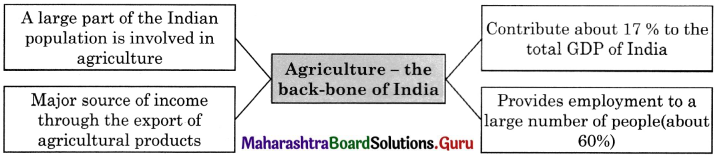
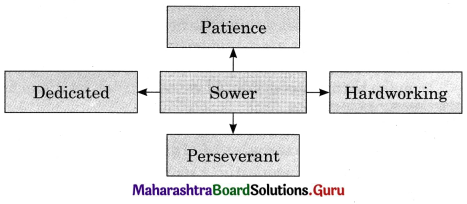
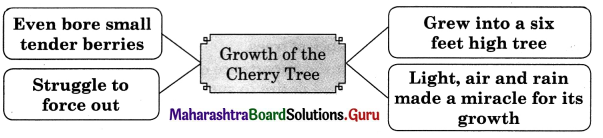
Complete the following web diagram.
Maharashtra Board Class 11 English Yuvakbharati Solutions Chapter 1.3 The Call of the Soil 1
Answer:
Maharashtra Board Class 11 English Yuvakbharati Solutions Chapter 1.3 The Call of the Soil 2

Question 3.
Find out from your grandparents or parents the names of vegetables and fruits they had eaten in their childhood and mention how the vegetables and fruits are different from the ones today.
Answer:

Name of the vegetable or fruitShapeColourTaste
MangoOblongYellow / Greenearlier
(a) naturally ripened
now
(i) artificially ripened
CauliflowerRoundWhite with green leaves(b) mostly available in winter and was very tasty(ii) we get it throughout the year, but the taste is definitely worse than those available in winter
AppleRoundRed / Green(c) used to grow in natural environment and was safely given to sick people(iii) One pays more to buy the organic varieties which are supposed to be pesticides-free and so good for health

Question 4.
Discuss the difference between conventional farming and organic farming.
Answer:

Conventional FarmingOrganic Farming
(a) Relies on chemical intervention(i) Depends on natural principles
(b) Farmers use synthetic and genetically modified organisms to kill pests and maximize output(ii) No artificial ingredient or preservative is used and they are minimally processed to maintain the integrity of food
(c) Harms health and environment(iii) Claimed to be healthier farm system

Maharashtra Board Class 11 English Yuvakbharati Solutions Chapter 1.3 The Call of the Soil

(A1)

(i) Read the extract and state whether the following statements are true or false. Correct the false statements.

Question (a)
Growing in abundance is more important than the quality of the crop.
Answer:
False. The quality of the crop is more important than growing in abundance a lesser variety of crop.

Question (b)
The author wanted to grow the desi variety of rice.
Answer:
True

Question (c)
The author did not succeed in finding Kasbai.
Answer:
False. The author was successful in finding Kasbai from an Adivasi woman at Boripada, a remote village.

Question (d)
The aroma of the ‘desi’ rice would spread around the village.
Answer:
True

Question (e)
Newer hybrid crops have a great appetite for chemicals.
Answer:
True

Question (f)
The author is an example of‘reverse migration’.
Answer:
True (‘Reverse Migration’ is a new trend of shifting from bigger cities to nearby smaller towns or suburbs)

Question (ii)
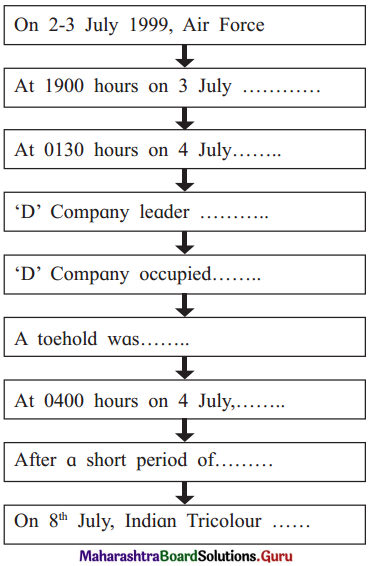
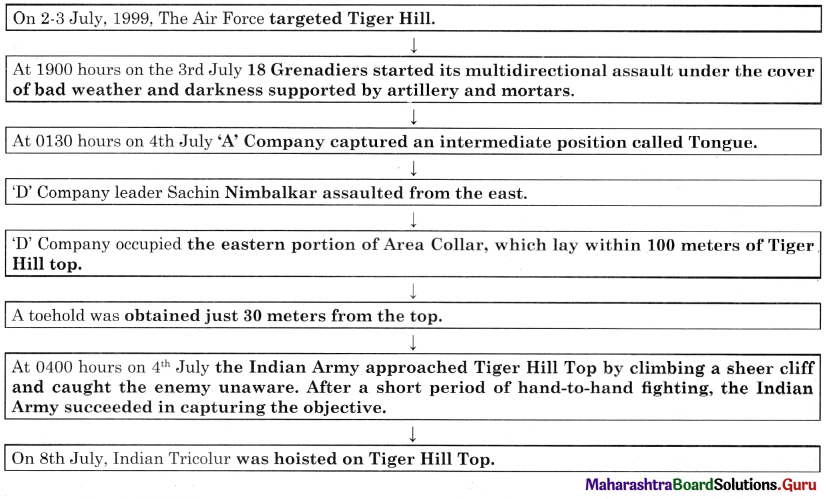
Complete the flow chart.
Maharashtra Board Class 11 English Yuvakbharati Solutions Chapter 1.3 The Call of the Soil 3
Answer:
Maharashtra Board Class 11 English Yuvakbharati Solutions Chapter 1.3 The Call of the Soil 4

Question (iii)
Read the text and All in the blanks.
Answer:
(a) The author wanted to grow organic moong.
(b) Moru Dada wanted to spray pesticides on the moong crop.
(c) Baban’s father and some elders mentioned the name of Kasbai.
(d) “Hybrids need more water, fertilizers and pesticides”, said Devu Handa.
(e) The author bought ten kilos of rice from an Adivasi woman who lived in the remote hills.

Maharashtra Board Class 11 English Yuvakbharati Solutions Chapter 1.3 The Call of the Soil

(A2)

Question (i)
List the reactions of the agricultural officer to the author’s inquiry about Kasbai rice seeds.
Answer:
(a) He had not heard of Kasbai.
(b) He felt that the villagers were fooling the author.
(c) He mentioned the names of the latest hybrids and also offered to give him some, free of cost.

Question (ii)
Note down Devu Handa’s fond memories of Kasbai.
Answer:
Devu Handa’s fond memories of Kasbai are as follows:

  • 0It needs no protection from rain
  • It has an alluring aroma
  • It has no hunger for chemicals like fertilizers and pesticides

(A3)

Question (i)
The writer says he grew “an awful lot of moong”. Explain the word ‘awful’ in this sentence.
Answer:
“An awful lot” is an Idiom meaning ‘a very large amount’. Everyone known to the writer did not expect a good yield of moong since he refused to spray any chemical on the plants. In spite of that, Nature did her job and the writer could get three hundred kilograms of moong which was not only ‘awful’, that means ‘large number’ but also a confidence-builder for a first-timer.

Question (ii)
The word scent is different from its synonyms aroma, fragrance or perfume. Explain how the word ‘scent’ in the subtitle ‘A Scent of Rice’, has a deeper meaning than ‘perfume’ or ‘fragrance’. Pick phrases having a similar meaning from the following:
Answer:
(i) The word ‘Scent’ in the subtitle ‘Scent of Rice’ has a deeper meaning than its usual meaning of‘fragrance’ or ‘perfume’ in the context of the text and for the author because he was trying to revive the tradition of Kasbai rice which everyone agreed had an alluring aroma. The modern farmers are forgetting conventions and have fallen a prey to hybrids. The natural ‘scent’, that is ‘flavour’ of Kasbai had drawn the writer towards real India, unspoilt by progress. The ‘scent’ was largely responsible for his quest.

(ii) Phrases
(a) In pursuit of : a quest in order to achieve something
(b) To smell a rat: to believe something wrong is happening
(c) To be keen : interested in some activity one often does and enjoys
(d) On the trail of: Trying to find someone or something by getting information about it
(e) To feel under the water : feel emotionally overwhelmed The phrases having a similar meaning of ‘A Scent of Rice’ are:
(i) In pursuit of
(ii) On the trail of

Maharashtra Board Class 11 English Yuvakbharati Solutions Chapter 1.3 The Call of the Soil

(A4)

Question 1.
She muttered in reply and we looked at Jeevan for a quick interpretation.

(A5)

Question (i)
Give reason why the text is against ‘Planting and growing more crop a year seems to be progress by normal standards.’
Answer:
Definitely planting and growing more crops a year need to be the target of the farmers but that should not be done at the cost of health hazards due to spraying of chemicals on the plants, using hybrid seeds and most importantly, forgetting our own tradition. Progress is always welcome but it should go hand in hand with safety of health and environment, importance of tradition and sentiment and last but not the least care for the rich biodiversity of our land.

Question (ii)
Describe in 150 words your experience similar to the writer’s when you pursued something and reached your goal.
Answer:
I believe “A man without an aim is like a ship without a radar”. I have been taught from my childhood to set a goal for myself. The choice of my ambition was left to me only and I was never forced to do anything.

I had multiple interests like playing football, drawing / painting and also writing about my various experiences. I started writing blogs on different social topics of my interest as well as of my own experiences in multiple walks of life. Gradually, after getting positive responses to my blogs, I got the confidence of writing short stories which were quite well accepted too by my friends and relatives. That gave me immense faith to choose writing as my profession.

One day, I saw an advertisement of ‘Crossword’ bookstore asking young writers to take part in a story-writing competition. About forty stories will be published as a book titled “ I want to be an author” without thinking twice, I took part in the competition and the rest is history. Today, I am one of those forty-one young story-tellers.

Question (iii)
The writer goes in search of an invaluable indigenous variety of seeds. List three reasons for the importance of keeping records of our indigenous agricultural practices.
Answer:
The reasons for the importance of keeping records of our indigenous agricultural practices are:
(i) (a) Reducing environmental stress by channelling water from mountain peaks to areas of demand and this practice has been going on for centuries.
(b) Using natural fertilizers made from cow dung, cow urine, evaporated cane juice of raw sugar and water to save sick plants. This practice has been mentioned in the vedas.
(ii) Traditional techniques like crop rotation, erosion prevention, systematic use of composts and manures lead to natural agricultural practices and promise better yields.
(iii) (a) Chemical fertilizers lead to degraded soil condition, deterioration in the health of quality of crops and livestock.
(b) Organic agriculture combined with tradition, innovation and science, benefits the health of the soil, people and the environment.

Maharashtra Board Class 11 English Yuvakbharati Solutions Chapter 1.3 The Call of the Soil

Question (iv)
Write a blog in about 100 to 150 words on organic farming.
Answer:
Organic Farming – A Blessing or Curse

Early 20th century saw the birth of organic farming which is an alternative to agricultural system in reaction to rapidly changing farming practices. It encourages the use of naturally occurring substances and strictly prohibits synthetic substances. Organic farming allows organically made fertilizers like compost manure, green manure and bone meal manure. Though they do not stop the use of some naturally occurring pesticides but synthetic fertilizers and pesticides are strongly prohibited. They are in favour of techniques like crop rotation, biological pest control, mixed cropping and nurturing insect killers.

Organic farming methods are internationally regulated since it has proved advantageous for health and food safety, food security, soil fertility and most importantly sustainability and biodiversity. That is why, the demand for organic farming has been steadily growing and is being encouraged all over the world. Organic farmers believe that agriculture was practised for thousands of years without the use of chemicals. If it was possible then, nothing should be impossible now.

Question (v)
Write a short paragraph in about 120 words, to be used as Counter-View for the following topic. ‘Buy a bigger cloth for your coat’.
View Section:
(a) We cannot survive by the dictum ‘Cut your cloth according to your coat’ in today’s world.
(b) In the modern world we should ‘Think Big’
(c) Think of increasing your income instead of reducing your needs.
(d) We cannot deny ourselves, what the new world offers us.
Answer:
Counter-view:
Today’s world is full of attractions. But we need to he careful about spending according to our means. We have to be prudent (wise) enough to save for the rainy days so that we don’t have to beg or borrow during emergency. It is, of course, essential to think big but at the same time over-ambition should not lead us to a point of no-return.

We should be well-aware of our capabilities and try to reach our goal judiciously instead of foolishly increasing our demands. We must make “slow but steady wins the race”, the motto of our life. Even if the new world has lots of offer, we must develop the quality of patience to wait for the right thing to come at the right time.

Maharashtra Board Class 11 English Yuvakbharati Solutions Chapter 1.3 The Call of the Soil

Question (vi)
‘Organic farming is the need of the time’. Write your views in favour and against the statement.
Answer:

ViewsCounter-views
1. Reduced exposure to pesticides and chemicals since natural fertilizers are used.(a) Some organic pesticides can actually have a worse environmental impact, contrary to the popular belief.
2. One pays more for organic food but it is worth for a healthier diet.(b) Organic products are costlier since production per unit is less than conventional farming.
3. Better effect on the environment by reducing global warming.(c) Organic farming may reduce global warming but because of more use of land, this practice is not sustainable with a growing world population.
4. Organic food has better taste and more nutrition since they are given more time to develop and are not pumped with artificial things.(d) Organic food generally gets spoilt faster since no preservatives are used to maintain their freshness and mishanding of products may deprive the market of their availability.

Question (vii)
Appeal your classmate to say ‘No to Junk Food’. Write an appeal to prefer organic food over junk food.
Answer:
Attention! Attention! Attention!

My Dear Friends

Do you know what you’re putting in your mouth? You surely know, you are what you eat.

I’m here to advise you not to use your stomach as a trash can! Please Say ‘No’ To Junk Food.
But, what is a junk food? They’re all your favourites – yes, they are ! French fries, chicken nuggets, nachos, taco burgers, chips, chocolates, pizzas, cakes – Ah! all are mouth-watering, aren’t they? But they are also slow-poisoning us everyday causing obesity, various liver diseases, diabetes, blood pressure at a very young age — the list is long but the choice is yours!

Remember: Healthy organic foods bless us but junk foods mess us. Junk food which is rich in calories, fat, sugar and salt are yummier, I do agree with you. But are you ready to take such a big risk of spoiling your health and youth? Eat fresh, local and seasonal food because ‘health is wealth’, my dear friends!

Friends, you must eat to live and not live to eat. Let’s all have a healthy mind in a healthy body. It is my call, your call – our call!

Maharashtra Board Class 11 English Yuvakbharati Solutions Chapter 1.3 The Call of the Soil

(A6)

Projects:

Question (i)
Plant the seed of a flower or fruit of your choice in a pot or in your garden. Note its growth every day and maintain a diary recording its progress.

Question (ii)
Find out more career opportunities in the field of agriculture, organic farming, sales, storage, distribution and marketing research.

Yuvakbharati English 11th Digest Chapter 1.3 The Call of the Soil Additional Important Questions and Answers

Question 1.
Find words related to agriculture,
Answer:
The words related to agriculture are:

  1. foliage of moong
  2. pods
  3. crop
  4. land
  5. farming
  6. plant
  7. sow
  8. season
  9. seeds
  10. tractor
  11. plough
  12. leaves
  13. bloom
  14. field
  15. ground
  16. pesticide
  17. yield
  18. chemicals
  19. farm
  20. harvest
  21. fertile
  22. hybrids
  23. fertilizers
  24. farmers
  25. rice

Question 2.
The writer disagreed with Moru Dada because –
Answer:
The writer disagreed with Moru Dada because he suggested the use of some pesticides on the plants. The author was absolutely clear in his mind not to use any chemical which will be harmful for the soil, the plants and ultimately for human health. But for Moru Dada and his friends who were used to the conventional farming, this decision of the author was unthinkable.

Maharashtra Board Class 11 English Yuvakbharati Solutions Chapter 1.3 The Call of the Soil

Question 3.
The writer wanted to grow the traditional variety of rice because –
Answer:
1. It did not need very high variety of fertilizers
2. This variety is quite strong and is able to resist pests.

Question 4.
The write almost gave up hope of finding the desi variety of rice because –
Answer:
1. In spite of his regular visits to the villages around in search of a good desi variety, he was not successful,
2. Most of the farmers, especially the younger generation, in and around the village of Peth had switched over to hybrids and looked down upon the ‘desi’ variety, as they called the local scented variety of rice.

Question 5.
Mention the varieties of rice from the passage, “Most of the farmers…disappeared”
Answer:

  1. Kasbai – local long-grained scented variety
  2. Basmati – more aromatic than Kasbai
  3. Hybrids – the latest craze of the farmers.

Question 6.
List ways in which the Government officer cooperated with the author.
Answer:
1. The agricultural officer felt that the villagers were fooling the author as they had no rice by the name ‘Kasbai’ and offered to give him some latest hybrid seeds free of cost for a trial.
2. The officer-in-charge of Adivasi Mahamandal at Kasa informed the author that he remembered buying Kasbai rice a few years ago.
3. The second gentleman definitely had more knowledge of rice which he shared with the author.

Question 7.
Find synonyms of the word ‘insipid’.
Answer:
The synonyms of ‘insipid’ are:

  • tasteless
  • flavourless
  • bland

Comprehension:

Read the extract and complete the activities given below.

Global Understanding:

Question 1.
Pick out the sentences that are true.
(i) The author thought that he would have some time to get familiar with farming.
(ii) Moru Dada was not at all sure about sowing moong in that season.
(iii) The moong seeds were brought from Gujarat.
(iv) The author did not own the land where he started farming.
Answer:
(i) True
(iii) True

Maharashtra Board Class 11 English Yuvakbharati Solutions Chapter 1.3 The Call of the Soil

Question 2.
State the advantages of the varieties as you find them in the extract.
Answer:

VarietyAdvantages
1. Hybrid varietiesShort duration crop so can have two crops a year
2. Traditional RiceGood quality rice with alluring aroma

Question 3.
Match the pairs to complete the sentences / phrases in A with the alternatives in B.

‘A’‘B’
1. Tales of Kasbai(a) was enlightening
2. Visit to agricultural officer(b) made us more determined to get it
3. Ex-sarpanch(c) devu Handa
4. Hybrid(d) insipid

Answer:

‘A’‘B’
1. Tales of Kasbai(b) made us more determined to get it
2. Visit to agricultural officer(a) was enlightening
3. x-sarpanch(c) devu Handa
4. Hybrid(d) insipid

Say whether the following statements are true or false. Correct the false statement.

Question 1.
The old woman weighed 10 kg of rice and gave it to the author.
Answer:
False. The old woman did not have a weighing scale.

Question 2.
The author and his friend did not know the local dialect very well.
Answer:
True

Question 3.
The people at Boripada village were well-aware of the modern way of farming.
Answer:
False. The people at Boripada never heard of hybrids, fertilizers or pesticides.

Question 4.
The old woman was unhappy to get the price of the rice.
Answer:
False. She was very happy and nodded her head with a smile of approval.

Complex Factual:

Question 1.
Supply Information from the passage,
1. I stood in the middle of lush green field of _______ and _______ .
2. Around me were rows of _______ and below a dense _____ .
Answer:
1. Moong (green gram), looked around me
2. Chikoo trees, foliage of moong

Maharashtra Board Class 11 English Yuvakbharati Solutions Chapter 1.3 The Call of the Soil

Question 2.
Mention any two changes that have occurred in farming of rice.
Answer:
1. Most of the farmers in and around the village of Peth had switched over to hybrids.
2. Kasbai which is a traditional long grained rice variety with distinct aroma being a long duration crop is not preferred by the farmers.

Question 3.
Mention any two difficulties that the author faced in tracing Kasbai.
Answer:
1. The Agricultural officer didn’t know Kasbai existed. So he couldn’t help the author in procuring it.
2. He couldn’t get the seeds as farmers resorted to hybrid varieties which gave quick yield.

Question 4.
The only people who still grew Kasbai rice were –
Answer:
The adivasis in a hamlet at the foothills of the mountains in the village Asarvari.

Question 5.
Each year they had to increase the quantity of urea and pesticides as –
Answer:
The hybrid varieties had insatiable appetite for chemicals and fertilizers.

Question 6.
How was the old lady’s world unspoilt by progress?
Answer:
The old lady, who, according to the write, represents real people of India, holding on to the biodiversity of Indian land. They have been able to do this as they have never heard of hybrids, fertilizers or pesticides.

Maharashtra Board Class 11 English Yuvakbharati Solutions Chapter 1.3 The Call of the Soil

Inference / Interpretation / Analysis

Question 1.
Explain.
“I was grateful to have taken Moru’s advice”
Answer:
The author was not sure about planting moong in that season as he wanted to get familiar with the process of farming. But Moru Dada insisted that the season was right for planting moong seeds. He was right and the author was thankful for listening to his advice since he had a good harvest of moong.

Complete the following sentence.

Question 1.
The author decided to not plant hybrids because –
Answer:
The hybrid had given him low yield the previous year.

Question 2.
The seeds of Kasbai wasn’t easily available because –
Answer:
It is a long duration crop and farmers could grow two crops in that duration.

Question 3.
A visit to agricultural officer was not useful.
Answer:
The agricultural officer had not heard of the traditional long duration varieties of rice. He was aware of only the hybrid varieties that gave quick yield. So visiting the agricultural office was not useful.

Maharashtra Board Class 11 English Yuvakbharati Solutions Chapter 1.3 The Call of the Soil

Question 4.
People didn’t grow Kasbai.
Answer:
The market didn’t recognize Kasbai anymore as a variety of rice, it had lost its popularity. If they grew it they wouldn’t be able to sell it. So people didn’t grow it.

Question 5.
Write a small paragraph on the new shift to hybrid plants.
Answer:
With advent of irrigation farmers have resorted to new hybrid varieties of rice. The long duration crops are now replaced by short duration hybrids as they can plant two crops in one year. The traditional varieties have lost its existence as it requires more duration for its harvest and also will attract cattle for its pleasant aroma unlike the hybrid crops.

Question 6.
Interpret the statement: “It was difficult to keep a straight face …”
Answer:
The author was very happy to know that the old lady had Kasbai rice with her. He was unsuccessful in his search for this particular aromatic rice for months and suddenly this revelation from the old lady was very exciting for him. But he had to control his feeling since the lady had not given him the seed till then.

Question 7.
Guess why the old lady nodded her head in approval.
Answer:
The old lady did not have any clue how much to ask for a basketful of seeds which she had given to the writer. She, even did not have a weighing scale to know how much she had given. But the author gave her hundred rupees which probably she did not hope for. She happily accepted the money which might be unexpected but was definitely welcomed by her.

Maharashtra Board Class 11 English Yuvakbharati Solutions Chapter 1.3 The Call of the Soil

Personal Response

Question 1.
Name any two reasons for destruction of foliage in India today.
Answer:
Reason 1: The trees are cut to clear the land for construction of buildings.
Reason 2: The growing industries also demand deforestation.

Question 2.
Frame any four questions that you would ask a farmer if you interview him.
Answer:

  1. What do you usually grow in your farm,
  2. What are the challenges you face while pursuing farming as your sole occupation,
  3. What do you do on a daily basis?
  4. What sprays do you use?

Question 3.
Mention any four rice varieties that you have heard of.
Answer:
There are many varieties of rice in India. The most common types rice and parboiled rice. are white rice, basmati rice, emperor’s.

Question 4.
According to you how can we develop sustainability in Agriculture.
Answer:
The sustainability can be attained by the following practices.

  1. Rotating crops
  2. Planting cover crops
  3. Applying integrated pest management
  4. Embracing diversity

Maharashtra Board Class 11 English Yuvakbharati Solutions Chapter 1.3 The Call of the Soil

Question 5.
Why do you think, the author was grateful to the old lady who was ‘unspoilt by progress’?
Answer:
I think, progress has its pros and cons. It is true that we cannot sit idle when the world is progressing by leaps and bounds. But we need to recognise the adverse (ill) effects of ‘progress’ and keep them away as much as possible. That is why, the author was delighted to see the old lady who had carefully kept the tradition alive by preserving the seeds of Kasbai rice.

Language Study

Question 1.
The author thought that he would have some time for farming.
(Rewrite using the Infinitive of the underlined gerund)
Answer:
The author thought that he would have some time to farm.

Question 2.
I was trying to figure out how we should go about it.
(Place the modal auxiliary with another showing obligation)
Answer:
I was trying to figure out how we must go about it.

Maharashtra Board Class 11 English Yuvakbharati Solutions Chapter 1.3 The Call of the Soil

Question 3.
The hybrid had given him low yield the previous year.
Answer:
The hybrid had not given him high yield the previous year.

Question 4.
Kasbai is a traditional long grained rice variety.
Answer:
Kasbai is a traditional long grained rice variety, Isn’t it?

Question 5.
The entire area would have this heady aroma. (Rewrite in past perfect tense)
Answer:
The entire area had this heady aroma.

Question 6.
His eyes turned dreamy as he drifted to the past. (Make it compound sentence)
Answer:
His eyes turned dreamy and he drifted to the past.

Maharashtra Board Class 11 English Yuvakbharati Solutions Chapter 1.3 The Call of the Soil

Question 7.
“If my field alone has Kasbai it will be a treat for the cattle.” He explained
(Rewrite in reported speech)
Answer:
He explained that if his field alone had Kasbai it would be a treat for the cattle.

Question 8.
The only people who still grew it were the adivasis. (Rewrite removing ‘who’)
Answer:
Only the adivasis still grew it.

Question 9.
Her world was unspoilt by ‘Progress’.
Answer:
Progress did not spoil her world.

Question 10.
She nodded her head in approval.
Answer:
She nodded her head as she had approved.

Vocabulary

Question 1.
Match the words in column ‘A’ with their synonyms in column ‘B’.

Words (A)Synonyms (B)
1. Foliage(a) Careful
2. Gingerly(b) Moist
3. lush(c) Leaves of a tree
4. dump(d) Thick

Answer:

Words (A)Synonyms (B)
1. Foliage(c) Leaves of a tree
2. Gingerly(a) Careful
3. lush(d) Thick
4. dump(b) Moist

Maharashtra Board Class 11 English Yuvakbharati Solutions Chapter 1.3 The Call of the Soil

Question 2.
Write antonyms of the words from the given extract:

  1. Appear
  2. Wise
  3. Short duration
  4. Modern

Answer:

  1. Disappear
  2. Crazy
  3. Long duration
  4. Traditional

Question 3.
From one word for:
1. mixed varieties
2. a different type of something
Answer:
1. hybrids
2. aroma
3. variety

Question 4.
From the odd words from each group of words.

  1. Reminisce, Remember, Think, Speak.
  2. Mourn, Wail, Delight, Lament.
  3. Appeasable, Insatiable, Satisfiable, Satiable.
  4. City, Hamlet, Town, Village.

Answer:

  1. Speak
  2. Delight
  3. Insatiable
  4. City

Maharashtra Board Class 11 English Yuvakbharati Solutions Chapter 1.3 The Call of the Soil

Question 5.
Match the words in column ‘A’ with their synonyms in column ‘B’.

Column‘A’Column ‘B’
(a) biodiversity1. chemical used to kill harmful insects
(b) hybrid2. plant food
(c) pesticide3. existence of wide variety of plants and animals on earth
(d) fertilizers4. mixed-breed

Answer:

Column‘A’Column ‘B’
(a) biodiversity3. existence of wide variety of plants and animals on earth
(b) hybrid4. mixed-breed
(c) pesticide1. chemical used to kill
(d) fertilizers2. plant food

Grammar:

Question 1.
Find out some simple, complex and compound sentences from the text.
Answer:
(i) Simple Sentences

  • At that point, I could not have asked for anything more.
  • Moru Dada rented his tractor to plough the land.
  • We started to look for a good variety of traditional rice.
  • The officer-in-charge here had more knowledge of rice.

(ii) Complex Sentences

  • Kasbai is a traditional long-grained rice variety which has a distinct aroma.
  • My bare feet were muddy as I walked around gingerly.
  • We were clear that we would not use any chemicals.
  • Even when there were flash floods in the sixties, Kasbai had stood its ground.

(iii) Compound Sentences.

  • They just grew their rice and ate what they got.
  • It was just before sunrise and the sky was turning a bright orange.
  • I made a quick trip to Surat and bought around 10 kilograms of moong.
  • Nature did her job and she needed no bribes.

Question 2.
List of subordinating conjunctions.
Answer:
All wh-words like, who, what, when, whom, where, why, how though / although unless since, as, that, because, while, whereas before, whichever, whoever, after etc., are subordinating conjunctions.

Maharashtra Board Class 11 English Yuvakbharati Solutions Chapter 1.3 The Call of the Soil

Glossary:

  1. lush – dense / thick
  2. damp – wettish / moist
  3. dense – thickest
  4. pods – shells
  5. exhilarated – very happy
  6. plough – cultivate
  7. thrilled – excited
  8. hibiscus – a type of flower
  9. yield – amount produced
  10. convincing – persuasive
  11. fertile – productive / rich
  12. morale – confidence
  13. booster – uplift / encouragement
  14. hybrids – mixed breeds
  15. aroma – scent / smell
  16. pleasantries – polite talks
  17. tremble – shiver / shake
  18. alluring – attractive / fascinating
  19. fall in line (phr) – agree
  20. rued – regretted bitterly
  21. hamlet – small village
  22. ditches – watercourses / canals /drains
  23. scrambling – climbing / moving with difficulty
  24. gravels – pebbles / stones
  25. wrinkled – covered with lines
  26. muttered – whispered/spoke in an undertone
  27. scowled – looked angrily
  28. nestling – naturally / pleasantly located house
  29. hustle and bustle (phr) – excited activities
  30. biodiversity – all the varieties of life on earth, their communities
  31. habitat fuzz – a soft covering

Maharashtra Board Class 11 English Yuvakbharati Solutions Chapter 1.2 On To The Summit

Balbharti Yuvakbharati English 11th Digest Chapter 1.2 On To The Summit: We Reach The Top Notes, Textbook Exercise Important Questions and Answers.

Maharashtra State Board Class 11 English Yuvakbharati Solutions Chapter 1.2 On To The Summit: We Reach The Top

11th English Digest Chapter 1.2 On To The Summit: We Reach The Top Textbook Questions and Answers

Question 1.
Complete the web of different activities related to climbing.
Maharashtra Board Class 11 English Yuvakbharati Solutions Chapter 1.2 On To The Summit We Reach The Top 1
Answer:
Maharashtra Board Class 11 English Yuvakbharati Solutions Chapter 1.2 On To The Summit We Reach The Top 2

Maharashtra Board Class 11 English Yuvakbharati Solutions Chapter 1.2 On To The Summit

Question 2.
There are certain prerequisites for Mountaineering. With reference to the following points develop a short dialogue between you and your friend about mountaineering.
Maharashtra Board Class 11 English Yuvakbharati Solutions Chapter 1.2 On To The Summit We Reach The Top 3
Answer:

  • Ashish: Hey Mayank ! when is your next plan for mountaineering?
  • Mayank: Yes, I am planning for some days in September – October. Are you interested in joining?
  • Ashish: Yes, I am. But I’m not very confident.
  • Mayank: Then we will go to Mount Kilimanjaro to start with. But before that you must begin with small practices like walking, stair climbing and may be uphill hiking a bit.
  • Ashish: What are the usual equipments that we need? You must be having most of them?
  • Mayank: Honestly speaking, we need a lot of equipments and yes, I have some. But let’s visit a mountaineering equipment shop one day to get an idea of the latest ones, convenient as well as inexpensive. I have the basic ones like tent, headlight, map, compass, cap, jackets, gloves, sunscreen, lip balm, etc.
  • Ashish: Oh ! You have quite a lot. Let’s visit the shop tomorrow.
  • Mayank: But you need to talk to a fitness expert to get the guidance because a fit climber spends less energy. He will suggest what type of fitness regime we should follow as well as can recommend a good trainer.
  • Ashish: Yes, I know. Mental and physical fitness are the main ingredients for the success of a mountaineer. Tomorrow, I’ll come to your place and we’ll plan everything. We have to start as soon as possible.
  • Mayank: You are most welcome. See you tomorrow.

Question 3.
Discuss various hazards and risks that a mountaineer/ trekker has to face in an expedition.
Answer:
The hazards and risks for a mountaineer/trekker may be:

  1. Bad visibility caused by bad weather (mist, rain, snow) or darkness is a major hazard.
  2. Snow and ice can make a simple path a very dangerous one, especially if there is a steep drop off near by.
  3. Rock fall is a common mishap during heavy snow and rain.
  4. Lightning can cause a major problem at some places.
  5. Flash floods due to storm might be risky.
  6. A mountaineer cannot ignore rain and wind. Rain makes the path towards upward climbing slippery and a strong wind can cause loss of balance of a mountaineer, making climbing impossible.
  7. Hypothermia, that is, lowering of the body’s natural temperature to 32° C due to wet clothing and heat loss because of strong wind, can be a big hindrance. If it is not treated immediately, severe hypothermia may occur leading to fatalities.
  8. Heat exhaustion and dehydration are very common problems because of difficult physical work.
  9. Timely care should be taken by pouring water on the victim to avoid heatstroke. The patient should be urgently given cold water mixed with a small amount of salt and sugar to refresh him.

Maharashtra Board Class 11 English Yuvakbharati Solutions Chapter 1.2 On To The Summit

(A1)

Question 1.
Summarize, in your own words, the highly risky and dangerous journey of Tenzing and Hillary from the base to the top of Mount Everest.
Answer:
Tenzing and Hillary were well-informed about the flat side of the summit, its steep rise, rocky and snowy sides too. It was decided that Tenzing would lead the mission followed by Hillary in the beginning and this position would be alternated. They would be tied together by a rope. They started early from camp nine. Tenzing carried the flags of Britain, the United Nations, Nepal and India to be put on the top of Mount Everest.

They steadily climbed for an hour and faced the difficulties of steep rocks on the west side. The last fifty feet to the top was made easier by their togetherness and they officially announced that without making any attempts to take the credit for conquering Mt. Everest first. Four flags were put by Tenzing wearing the red scarf gifted by his friend. Both of them stayed safely at the top for fifteen minutes.

(A2)

Question (i)
Complete the web highlighting the feelings/emotions of Tenzing after reaching the summit.
Maharashtra Board Class 11 English Yuvakbharati Solutions Chapter 1.2 On To The Summit We Reach The Top 4
Answer:
Maharashtra Board Class 11 English Yuvakbharati Solutions Chapter 1.2 On To The Summit We Reach The Top 5

Question (ii)
Explain the qualities of Tenzing Norgay. Pick lines that show his unique qualities.
Answer:

QualitiesLines
1. PatrioticI told Colonel Hunt that I was carrying the Indian flag with me and I would like it to be on the top with other flags.
2. UnselfishOur main thought was that both of us reached the top.
3. Non-controversialWe will not take part in any controversy.
4. ratitudeMy first thought on reaching the top was a sense of gratitude to God.

Maharashtra Board Class 11 English Yuvakbharati Solutions Chapter 1.2 On To The Summit

Question (iii)
Write down the significance of the following in the context of‘On to the Summit*.
(a) Red Scarf
(b) Husiar
(c) Kerosene Flavoured Tea
(d) Ice Axe
(e) Anchor
Answer:
(a) Red Scarf: The red scarf was given to Tenzing by his good friend Lambert who was the leader of the Swiss Expedition of 1952. This scarf reminded Tenzing of their successful mission, a year ago and rejuvenated him to feel fit, energetic, and excited for the completion of another mission.

(b) Husiar: This code-mixing makes Tenzing’s knowledge about mountaineering clearer to the readers. Both Tenzing and Hillary did not take it easy while climbing down. After successful completion, they were not over-confident and were fully aware of the technique and caution needed for the downward journey.

(c) Kerosene Flavored Tea: This tea was brought by C.W.F. Noyce for Tenzing and Hillary from camp eight and he had to do a lot of climbing up and down for that. Some amount of Kerosene got mixed with the tea as it was made in a hurry. Tenzing did not make Mr. Noyce feel guilty as both the mountaineers were grateful for getting hot tea at a time when they needed it the most. The gentleman had taken so much trouble to serve them tea and they were not bothered about its flavour.

(d) Ice Axe: Tenzing used his ice-axe to tie one end of the four flags of Britain, the United Nations and Nepal and the other end was held up by him. Hillary took his pictures holding all the flags up. But he needed his ice-axe for climbing down. So he had to remove his ice-axe and buried one end of the flags in the snow on the slope down below and other end in the ice on the top. Obviously, they fell down but Tenzing had no choice but to remove his ice-axe.

(e) Anchor: An anchor is a person who is strong and reliable. He makes people feel safe and confident. In mountaineering, the man who follows while climbing has a difficult job both in climbing up and climbing down. Tenzing and Hillary decided to alternate this job of anchoring so that the person leading feel safer. This proved that their expedition was a team-work where both shared the responsibility of being the anchor in order to have a successful mission.

(A3)

Question (i)
Add suitable suffixes (- tion, ly, – ment, – ous) and prefixes (un, il, im) to the words given below. Answer:

WordPrefixSuffix
absoluteabsolutely
fulfillunfulfillfulfillment
determinedetermination
dangerdangerous
tightuntighttightly
clearunclearclearly
sureunsuresurely
legalillegallegally
legitimateillegitimatelegitimately
possibleimpossiblepossibly

(ii) Fill appropriate letters in the blank space to get a past participle form of a word. Use the word as adjective in your own sentence.

Question (a)
s _ g n _ d
Answer:
signed – The advocate took all the signed documents to the court.

Maharashtra Board Class 11 English Yuvakbharati Solutions Chapter 1.2 On To The Summit

Question (b)
p _ _ z _ d
Answer:
prized – My grandmother’s diary is a prized possession for me.

Question (c)
f _ _t_ene_
Answer:
flattened – On the highway we were in great trouble due to the flattened tyre.

Question (d)
b _ i _ e _
Answer:
boiled – My sister loves to eat boiled egg.

(iii) Spot the error in the following sentences.

Question (i)
I was not afraid for die that day.
Answer:
I was not afraid to die that day.

Question (ii)
Tenzing and Hillary made on pact at the office of PM of Nepal.
Answer:
Tenzing and Hillary made a pact in the office of PM of Nepal.

Maharashtra Board Class 11 English Yuvakbharati Solutions Chapter 1.2 On To The Summit

Question (iii)
I has to bring my ice axe down with me.
Answer:
I had to bring my ice axe down with me.

Question (iv)
Tenzing have spent a night with Camp Eight.
Answer:
Tenzing had spent a night at Camp Eight.

Question (v)
Pact was signed from Tenzing and Hillary.
Answer:
A pact was signed between Tenzing and Hillary.

Question (vi)
I and Hillary were in no mood of talking.
Answer:
Hillarv and I were in no mood for any talking.

(A4)

Question 1.
In passive voice the doer is the objeet and the job accomplished is the subject. The verb of passive voice is formed by using the correct form of verb ‘to be’ or verb ‘to have’ + past participle of the main verb. Construct the passive voice of the following sentences accordingly.
Answer:

Active VoicePassive Voice
(i) We have done it.(i) It has been done by us.
(ii) We made a pact.(ii) A pact was made by us.
(iii) I offered silent prayer in my heart.(iii) Silent prayer in my heart was offered by me.
(iv) Colonel Hunt gave me three flags.(iv) Three flags were given to me by Colonel Hunt.
(v) I was carrying the Indian flag.(v) The Indian flag was being carried by me.
(vi) I took photographs of Tenzing holding aloft the flags.(vi) Photographs of Tenzing holding aloft the flags were taken by me.
(vii) I remembered him.(vii) He was remembered by me.
(viii) We spent the night at Camp Eight.(viii) The night was spent at Camp Eight by us.

Maharashtra Board Class 11 English Yuvakbharati Solutions Chapter 1.2 On To The Summit

(A5)

Question (i)
Write in short about any adventure sport that you like and the risk involved in it.
Answer:
I like Bunjee-jumping a lot and have taken part in it at Lonavala. Bungee-jumping, I am sure, many of you, know that it is an activity where the participant jumps from a tall structure but he is obviously connected to a large elastic cord. It is thrilling and one needs a lot of courage to take part in it since a number of risks are involved in it.

Most common injuries are fracture, strains, sprains, bruising, chronic stress features. But the most dangerous risk is acute head injuries. Lots of precautions are being taken by the organizers but one needs to think whether it is worth taking such risks just for the sake of adventure.

Question (ii)
Give your opinion: whether we should or should not participate in adventure sports because –
Answer:
Every coin has two sides, so do adventure sports. Adventure sports do have some benefits.
They are as follows:
1. Boost self-confidence.
2. Stay mentally sharp.
3. Help to cope with challenges in life.
4. Spark the desire to explore.

However, the negative aspects of adventure sports can be quite disturbing.
1. They can cause serious health issues.
2. They are obviously very dangerous.
3. Regular safety precautions may not be stringently followed to prevent life threatening injuries.
It depends on the individual to assess his/her own character traits as well as the pros and cons of the sport, to come to the final decision to take part in any adventure sports with proper training.

Question (iii)
Tenzing and Hillary created history by reaching the summit of Mt. Everest. There are many mountains in Maharashtra where one can fancy his or her chances of climbing them. Imagine that you have climbed a mountain and are immensely thrilled and excited. Write a letter to your friend about it.
Answer:
XYZ,
ABC Apartment,
Flat No. 4, 29th Road,
Shivaji Nagar, Pune
11th July, 2019

Dear Manav,

How are you? I am writing to you after a long time. These days I feel so lazy to write letters, thanks to modern technologies. But today, I am very excited. I went on my first trek last week and I wanted to share with you the details of my trekking experience.

You obviously know, Maharashtra lies amidst the Western Ghats and it welcomes the rains to the beautiful ranges of the Sahayadris. Last week my close friends and I decided to go to Lonavala and from there to Lohagad Fort for trekking, which is for the beginners. We were told that Lohagad Fort trek was not very difficult. We could reach up to the fort to witness some of the most spectacular views in the Lonavala trekking region.

It took us about three to four hours to reach the summit. I must admit that the initial fear was there. But after reaching the peak and seeing the magnificent view all around, we felt that it was worth going there.

Something I must tell you here before I forget. My elder brother Deepak has joined as an executive in a good company and he was my money-bag this time. I felt so, fortunate. Coming back to my expedition, the descent was easier as we were all in a jovial mood for completing the mission (to me, it was a mission only, my first trek) successfully. We have taken beautiful photographs of the surroundings which is breathtakingly beautiful. The waterfalls, lakes, streams, rock-climbing patches, hillocks all around are real wonders of Mother Earth.

When are you planning to come to Pune? I’m eagerly waiting for showing you the photographs. How are Uncle and Aunty. Give them my regards.

Yours lovingly,
XYZ

Maharashtra Board Class 11 English Yuvakbharati Solutions Chapter 1.2 On To The Summit

Question (iv)
You are the college representative and your Principal has assigned you the task of writing a letter to the Divisional Officer, Satpuda Mountain Ranges, Nagpur, seeking permission for the mountaineering expedition to be organized by your college.
Answer:
Harshad Kale
College Representative
XYZ College of Arts and Commerce,
Ghatkopar (East),
Mumbai – 400 077
11th July, 2019

Divisional Officer,
Satpuda Mountain Range,
Nagpur

Subject: Permission for the mountaineering expedition to be organized by our college.

Respected Sir/Madam,

I am Harshad Kale, the College Representative of XYZ College of Arts and Commerce. On behalf of my Principal Dr. Sunil Patil I would request you to grant me the permission for organizing the mountaineering expedition.

I would like to inform you that NCC Unit of our college has planned for the mountaineering expedition from 25th to 30th July. The students who are selected for taking part are all expert trekkers and they will be accompanied by experienced mountaineers as well as our Professors who go regularly for trekking. Our Principal has instructed to arrange for all precautionary measures and is personally taking care of all arrangements.

We shall be obliged if you kindly permit us to carry on the expedition. Awaiting your positive response.

Thanking you,
Yours Sincerely Harshad Kale

Enclosed:
(a) Copy of the expedition programme.
(b) Letter of permission from Principal Dr. Sunil Patil

Question (v)
Convert the above letter into an e-mail format.
Answer:
To: [email protected]
Cc: [email protected]
Bcc: (non-visible email ids)
Subject: Permission for organising mountaineering expedition

Respected Sir/Madam,

This is Harshad Kale, the representative of XYZ college of Arts and Commerce. On behalf of my teachers and Principal, I request you to grant me the permission for organising a mountaineering expedition planned by our college NCC unit from 25th to 30th July, 2019.

We shall be obliged if you permit us to organize the above mentioned expedition. I have attached the expedition programme for your kind perusal.

Awaiting your positive reply.
Thanks and regards,
Harshad Kale
XYZ College of Arts and Commerce,
Expedition programme [×]
Permission letter (Principal) [×]

Maharashtra Board Class 11 English Yuvakbharati Solutions Chapter 1.2 On To The Summit

Comparisons:

1. Look at the sentences given below. Find out which one is correct. If the sentence is wrong give reasons.

Question (i)
Sunita is the quieter of four sisters.
Answer:
The above sentence is wrong.
Reason: When more than two nouns are compared superlative adjective should be used, i.e., quitest

Question (ii)
Sunita is the quietest of the four sisters.
(iii) Anil’s computer is more new than mine.
Answer:
The above sentence is wrong.
Reason: ‘More new’ is the wrong form of comparative degree of the adjective ‘new’.

Question (iv)
Anil’s computer is newer than mine.
(v) I have the wonderfullest mother in the world
Answer:
The above sentence is wrong.
Reason: ‘wonderfullest’ is the wrong form of superlative degree of the adjective ‘wonderful’.

Question (vi)
I have the most wonderful mother in the world.
(vii) Aditi is more carefuller than Mary.
Answer:
The above sentence is wrong.
Reason: ‘More carefuller’ is the wrong form of comparative degree of ‘careful’.
(viii) Aditi is more careful than Mary.

Maharashtra Board Class 11 English Yuvakbharati Solutions Chapter 1.2 On To The Summit

Look at the following sentences and observe the changes in the three sentences. Note your responses.

Question (a)
Atul is not as bright as Milind in studies.
Answer:
Positive

Question (b)
The dining room is brighter than the kitchen.
Answer:
Comparitive

Question (c)
Anne is the brightest girl in class.
Answer:
Superlative

(A7)

Project:

Go to your college library or surf the internet for names of various mountaineers who have successfully climbed Mt. Everest. Write in your notebook about their struggles, the interesting anecdotes they have shared, their failures and the message that we get from their lives. Submit them to your teacher.

Yuvakbharati English 11th Digest Chapter 1.2 On To The Summit Additional Important Questions and Answers

Question 1.
Give reasons for the ‘rope’ being called a symbol.
Answer:
The rope that tied the two mountaineers, Hillary and Tenzing, together,was referred to as a ‘symbol’ by Tenzing because he always felt that climbing was a teamwork for them. Success, risks, hard work and failure be shared by both as two of them were tied together to fulfill an ambition which was full of hazards. They were aware of the risks involved in their mission and in all those situations, the rope would be between them as a symbol of their togetherness.

Maharashtra Board Class 11 English Yuvakbharati Solutions Chapter 1.2 On To The Summit

Question 2.
Discuss in pairs about any controversy in which you haive got embroiled. Also speak of your experience to the class.
Answer:
Controversies are parts and parcels of our lives and most of the times they are man-made. It happened with me also when I made an innocent comment about one of my classmates. There was a lot of hue and cry about these comments as it was reported by adding fuel to it. But I decided to talk to my classmate and the matter was resolved amicably.

Question 3.
List the ways in which Tenzing Norgay celebrates on reaching the top.
Answer:
1. Tenzing and Hillary embraced each other saying “We have done it.”
2. Tenzing showed his gratitude to God by praying silently for the fulfillment of his desire of climbing the Everest after having failed six times. His offerings were biscuits, candy and a little blue pencil which his daughter Nima had requested him to put on the top of the mountain.
3. Hillary took the photograph of Tenzing holding aloft the flags of Great Britain, Nepal, the United Nations and India.

Comprehension:

Read the extract and complete the activities given below.

Global Understanding:

Question 1.
Complete the web on climbing the summit by Tenzing and Hillary.
Maharashtra Board Class 11 English Yuvakbharati Solutions Chapter 1.2 On To The Summit We Reach The Top 6Answer:
Maharashtra Board Class 11 English Yuvakbharati Solutions Chapter 1.2 On To The Summit We Reach The Top 7

Question 2.
Rewrite the given sentences in their order of occurrence.
1. I ate some biscuits and offered some to Hillary.
2. I wore the red scarf given to me by my friend, all the way up the mountain from Darjeeling.
3. I offered a silent prayer to God in my heart.
4. At the summit I felt absolutely fit.
5. My daughter Nima gave me a blue pencil, one of her prized possessions, to put at the summit as her offering to God.
Answer:
3. I offered a silent prayer to God in my heart.
5. My daughter Nima gave me a blue pencil, one of her prized possessions, to put at the summit as her offering to God.
1. I ate some biscuits and offered some to Hillary.
2. I wore the red scarf given to me by my friend, ah the way up the mountain from Darjeeling.
4. At the summit I felt absolutely fit.

Maharashtra Board Class 11 English Yuvakbharati Solutions Chapter 1.2 On To The Summit

Complex Factual:

Question 1.
Why didn’t it matter for Tenzing to be the first one to reach the summit?
Answer:
Both Tenzing and Hillary were not thinking of being the first to reach the summit since climbing took all their attention. Their main thought was that one could not do that job alone and only a difference of one thousand feet could decide the position which could be found by the person coming behind.

Question 2.
Why didn’t Tenzing feel tired after reaching the summit?
Answer:
After reaching the summit Tenzing felt exhilarated. He forget about the tiredness. His first thought was a sense of gratitude to god who had blessed him with the fulfillment of his desire after having failed six time.

Inference / Interpretation / Analysis

Question 1.
Explain.
“The rope was a symbol”
Answer:
The rope was a symbol of togetherness of Hillary and Tenzing as it was used to tie them, one following the other. It was also the proof that climbing the summit of Mt. Everest needed a teamwork and the two members of their team respected and considered each other important.

Question 2.
Explain.
“He gave me a big smile, showing that he understood.”
Answer:
Hillary smiled because he understood the emotion of Tenzing. The blue pencil was given to Tenzing by his youngest daughter, Nima, and it was one of her prized possessions. She parted with it with the expectation that her father would conquer the summit and the offering of the blue pencil was her way of showing gratefulness to God. Her father would fulfill her wish.

Maharashtra Board Class 11 English Yuvakbharati Solutions Chapter 1.2 On To The Summit

Personal Response

Question 1.
Pick up one sentence to show one quality of Tenzing that you have appreciated the most in his story. Explain your answer.
Answer:
The sentence “What does it matter whether I reached the top first or Hillary?” shows the unselfish character of Tenzing. He had the opportunity to claim that he reached the summit first as he was walking first and Hillary was behind him. But he did not take the credit as he knew it was a team work. Accomplishing the job was more important than taking credit for it.

Question 2.
Mention some of the benefits of trekking trips organized by colleges for the students.
Answer:

  1. The students get more exposure and experience.
  2. They get close to nature.
  3. They learn to handle adverse situations.

Language Study

Question (i)
You have many more important worries. (Change the degree)
Answer:
This worry is not as important as many other worries you have.

Question (ii)
Most of the time the rope was loose. (Make negative)
Answer:
Most of the time the rope was not tight.

Maharashtra Board Class 11 English Yuvakbharati Solutions Chapter 1.2 On To The Summit

Question (iii)
My mind was absolutely clear. (Use past perfect tense and rewrite)
Answer:
My mind had been absolutely clear.

Question (iv)
My first thought on reaching the top was a sense of gratitude to God. (Use ‘When’ and rewrite)
Answer:
When I reached the top, my first thought was a sense of gratitude to God.

Vocabulary:

Question 1.
Add suffixes to convert the following verbs into nouns.

  1. confirm
  2. know
  3. near
  4. move

Answer:

  1. confirmation
  2. knowledge
  3. nearness
  4. movement

Maharashtra Board Class 11 English Yuvakbharati Solutions Chapter 1.2 On To The Summit

Question 2.
Give one word for:
1. satisfy one’s thirst
2. very happy and excited
Answer:
1. quench
2. exhilaration

Glossary:

  1. anchor – support / production
  2. steep – high / sharp
  3. expedition – mission
  4. incline – slope
  5. taut – tightly
  6. bulky – large
  7. descent – going down / coming down
  8. spared – saved
  9. flushed – glowed
  10. alternated – changing places
  11. sloping – slanting up or down
  12. summit – the highest point of a hill or mountain
  13. controversy – prolonged public disagreement or heated discussion
  14. pact – a formal agreement between individuals or parties
  15. ridge – a long narrow piece of raised land
  16. embrace – hug, hold (someone) closely in one’s arms
  17. accord – agreement, be harmonious or consistent with
  18. quench – satisfy one’s thirst
  19. exhilarated – very happy and excited
  20. gale – strong wind
  21. apparently – as far as one knows or one can see.

Maharashtra State Board Class 11 Biology Important Questions and Answers

Maharashtra State Board HSC 11th Biology Important Questions and Answers

Maharashtra Board 11th HSC Important Questions

Maharashtra State Board Class 11 Biology Solutions Digest

Maharashtra State Board 11th Std Biology Textbook Solutions Digest

Maharashtra State Board Class 11 Textbook Solutions

Maharashtra State Board Class 11 Chemistry Important Questions and Answers

Maharashtra State Board HSC 11th Chemistry Important Questions and Answers

Maharashtra Board 11th HSC Important Questions

Maharashtra Board Class 12 Secretarial Practice Important Questions Chapter 2 Sources of Corporate Finance

Balbharti Maharashtra State Board Class 12 Secretarial Practice Important Questions Chapter 2 Sources of Corporate Finance Important Questions and Answers.

Maharashtra State Board 12th Secretarial Practice Important Questions Chapter 2 Sources of Corporate Finance

1A. Select the correct answer from the options given below and rewrite the statements.

Question 1.
____________ is considered as Supreme controlling factor in business.
(a) Finance
(b) Material
(c) Machinery
Answer:
(a) Finance

Question 2.
A Company with share capital must issue ____________ shares.
(a) preference
(b) equity
(c) right
Answer:
(b) Equity

Maharashtra Board Class 12 Secretarial Practice Important Questions Chapter 2 Sources of Corporate Finance

Question 3.
A person who purchases shares of a company is known as ____________
(a) Bondholder
(b) Shareholder
(c) creditor
Answer:
(b) Shareholder

Question 4.
A ____________ is indivisible unit of share capital.
(a) Debenture
(b) Share
(c) Bond
Answer:
(b) Share

Question 5.
A shareholder is entitled to receive ____________ as return on investment.
(a) Dividend
(b) Interest
(c) Discount
Answer:
(a) Dividend

Question 6.
____________ shares bear ultimate risk associated with ownership
(a) equity
(b) preference
(c) deferred
Answer:
(a) Equity

Question 7.
The control of the company is vested in ____________ shareholders.
(a) preference
(b) equity
(c) deferred
Answer:
(b) Equity

Maharashtra Board Class 12 Secretarial Practice Important Questions Chapter 2 Sources of Corporate Finance

Question 8.
Bonus shares are issued as free gift to ____________ shareholder.
(a) equity
(b) deferred
(c) preference
Answer:
(a) Equity

Question 9.
Debentures are issued to raise ____________ capital.
(a) owned
(b) borrowed
(c) internal
Answer:
(b) Borrowed

Question 10.
Debentures are secured through ____________
(a) agreement
(b) trust deed
(c) contract
Answer:
(b) Trust Deed

Question 11.
Overdraft facility is allowed to ____________ account holder.
(a) savings
(b) current
(c) fixed
Answer:
(b) Current

Question 12.
Small retailers rely on ____________ credit from their suppliers.
(a) cash
(b) trade
(c) bank
Answer:
(b) Trade

Maharashtra Board Class 12 Secretarial Practice Important Questions Chapter 2 Sources of Corporate Finance

Question 13.
____________ is the Depository receipt traded in countries other than USA.
(a) GDR
(b) ADR
(c) Fixed Deposit
Answer:
(a) GDR

1B. Match the pairs.

Question 1.

Group ‘A’Group ‘B’
(1) Debenture holder(a) Owners of the company
(2) Retained profit(b) Capitalisation of profit
(3) Public deposit(c) Savings account holder
(4) Overdraft facility(d) Creditor of the company
(5) Equity shares(e) Maximum 3 years
(f) Maximum 5 years
(g) Current account holder
(h) Ploughing back of profit
(i) Permanent capital
(j) Temporary capital

Answer:

Group ‘A’Group ‘B’
(1) Debenture holder(d) Creditor of the company
(2) Retained profit(h) Ploughing back of profit
(3) Public deposit(e) Maximum 3 years
(4) Overdraft facility(g) Current account holder
(5) Equity shares(i) Permanent capital

1C. Write a word or a term or a phrase that can substitute each of the following statements.

Question 1.
The type of shareholders who can participate in the management of the company.
Answer:
Equity shareholders

Question 2.
Name the shareholder who attends a particular meeting when his interest is affected.
Answer:
Preference shareholder

Question 3.
Shareholders who are residual claimants against assets and income.
Answer:
Equity share

Question 4.
The type of shares which can be redeemed after a certain period of time.
Answer:
Redeemable preference shares

Question 5.
Debentures that can be redeemed after a particular date.
Answer:
Redeemable debentures

Maharashtra Board Class 12 Secretarial Practice Important Questions Chapter 2 Sources of Corporate Finance

Question 6.
Debentures can be converted into equity shares after a specific period.
Answer:
Convertible debentures

Question 7.
A definite promise in writing from the buyer for paying a certain amount on a specific date.
Answer:
Bill of exchange

1D. State whether the following statements are true or false.

Question 1.
Preference shareholders do not enjoy normal voting rights.
Answer:
True

Question 2.
Equity shareholders are real owners and controllers of the company.
Answer:
True

Question 3.
Retained earnings is a difficult and costly method of raising capital.
Answer:
False

Question 4.
Debenture holders get a fixed rate of dividend.
Answer:
False

Question 5.
Debentures are secured with some property of the company.
Answer:
True

Maharashtra Board Class 12 Secretarial Practice Important Questions Chapter 2 Sources of Corporate Finance

Question 6.
Public deposits are a good source of long-term financing.
Answer:
True

Question 7.
A private company can collect deposits from the general public.
Answer:
False

Question 8.
Providing loans to businesses is the primary function of banks.
Answer:
True

Question 9.
Financial institutions play an important role in financing industrial firms.
Answer:
True

1E. Find the odd one.

Question 1.
An equity share, Preference share, Bond
Answer:
Bond

Question 2.
Debenture, Bond, Preference share
Answer:
Preference share

Question 3.
Public deposits, Debentures, Retained earning
Answer:
Retained earnings

Maharashtra Board Class 12 Secretarial Practice Important Questions Chapter 2 Sources of Corporate Finance

Question 4.
ADR, GDR, Fixed Deposit
Answer:
Fixed Deposit

Question 5.
6, 24, 36
Answer:
24

Question 6.
Bonds, Debentures, Shares
Answer:
Shares

1F. Complete the sentences.

Question 1.
The value of share which is determined by demand and supply forces in the share market is ____________
Answer:
Market value

Question 2.
The shares which have a preferential right over equity shares in respect of dividend and return of capital are ____________
Answer:
Preference shares

Question 3.
____________ preference shares which are redeemed after a certain period of time.
Answer:
Redeemable Preference Shares

Maharashtra Board Class 12 Secretarial Practice Important Questions Chapter 2 Sources of Corporate Finance

Question 4.
____________ is the value of share which is written on the share certificate and mentioned in the Memorandum of Association.
Answer:
Face value

1G. Select the correct option from the bracket.

Question 1.

Group ‘A’Group ‘B’
(1) Debentures(a) …………………….
(2) ……………………(b) Public deposit
(3) Bondholder(c) ……………………..
(4) …………………..(d) Equity share capital
(5) Depository Receipt traded in the USA(e) ……………………..

(Maximum 36 months, Trust Deed, ADR, Creditor, Permanent Capital)
Answer:

Group ‘A’Group ‘B’
(1) Debentures(a) Trust Deed
(2) Maximum 36 months(b) Public deposit
(3) Bondholder(c) Creditor
(4) Permanent capital(d) Equity share capital
(5) Depository Receipt traded in the USA(e) ADR

1H. Answer in one sentence.

Question 1.
Who can accept the deposit?
Answer:
A public company having a net worth of not less than 100 crore rupees or a turnover of not less than 500 crore rupees; has obtained the prior consent of shareholders and resolution filed with Registrar before inviting deposits can accept deposits.

Question 2.
What are the minimum and maximum periods of deposits that can be accepted by the general public?
Answer:
Minimum 6 months and maximum 36 months is the period for accepting deposits from the general public.

Question 3.
Who is given overdraft facility?
Answer:
A current account holder of a bank is given an overdraft facility.

1I. Correct the underlined word/s and rewrite the following sentences.

Question 1.
Bondholders are owners of the company.
Answer:
Bondholders are creditors of the company.

Maharashtra Board Class 12 Secretarial Practice Important Questions Chapter 2 Sources of Corporate Finance

Question 2.
Private companies can collect deposits from the public.
Answer:
Private companies cannot collect deposits from the public.

1J. Arrange in proper order.

Question 1.
Equity Shares, Preference Share, Debenture.
Answer:
Debentures, Preference shares, Equity Shares

Question 2.
Forecasting, Board Meeting, Issue of Securities
Answer:
Forecasting, Board Meeting, Issue of Securities

Question 3.
Call loans, debentures, short term loans
Answer:
Call Loans, Short term loans, Debentures

2 Explain the following terms/concepts.

Question 1.
Public Deposits
Answer:

  • Public deposits are unsecured deposits invited by public limited company’s to finance working capital needs.
  • Prior consent from shareholders must be with the passing of the special resolution and a copy of the same to be filed with the Registrar.

Question 2.
Bonds
Answer:

  • A bond is a debt security and a formal contract to repay borrowed money with interest.
  • A bondholder is a lender to the institution hence, the creditor.

Question 3.
Discounting of the bill of exchange
Answer:

  • Discounting of a bill of exchange is a facility in which the holder of the bill can convert the bill to cash by discounting (giving as security) the bill with the bank before the date of maturity.
  • The bank charges its commission (discounting charges) and pays the balance to the holder.
  • It is an advance/short-term loan given to the holder of the bill.

Maharashtra Board Class 12 Secretarial Practice Important Questions Chapter 2 Sources of Corporate Finance

3. Study the following case/situation and express your opinion.

1. There are 2 companies namely company A and company B with the same financial positions and in the same line (producing the same type of products) willing to issue debentures to more than 500 people. Company A is issuing 12% redeemable debentures to be redeemed after 5 years and Company B is issuing 12% convertible debentures which will be converted after 5 years. As an investor.

Question (a).
Which company would one like to invest in?
Answer:
As an investor one would like to invest in Company B.

Question (b).
Is it worth investing or going for convertible or redeemable? Why?
Answer:
‘It is wise and worth investing in 12% Convertible debentures as for 5 years both companies are going to give same returns but after 5 years Company B gives conversion facility due to which creditor becomes a member and can enjoy all rights of membership.

Question (c).
Is there any party to be appointed to look into the safety of debenture holders?
Answer:
As the number of persons to whom the debentures are to be issued is more than 500, there has to be a party known as Debenture Trustee to be appointed who will look into the safety of Debenture holders.

2. A public limited company wants to invite depositor from the public at large as it neither wants to dilute its shareholdings nor at present want to use its reserves.

Question (a).
Does it require prior approval from shareholders?
Answer:
Yes, prior approval from shareholders is a must.

Maharashtra Board Class 12 Secretarial Practice Important Questions Chapter 2 Sources of Corporate Finance

Question (b).
What type of resolution does the company need to pass?
Answer:
The company needs to pass a special resolution for allowing to invite and accept deposits.

Question (c).
Is it necessary to file the resolution with the Registrar?
Answer:
Yes, a copy of the special resolution passed in the general meeting has to be filed before inviting the deposits.

3. A Company has an export order which is to be completed by June 15. It feels it may fall short of funds (₹ 5,00,000) as all its investments are likely to mature after July 15.

Question (a).
Does it cancel the export order?
Answer:
No, it need not cancel the order as it can approach a bank in which it has its current account for providing the funds.

Question (b).
What financial arrangements are to be made if it has to complete the order?
Answer:
It can enter into or avail overdraft facility for the required term period so that in case it falls short of funds, it can overdraw the required amount.

Question (c).
What is the amount of interest it has to pay?
Answer:
It will have to pay interest on excess amount overdrawn and for the term, it has used this extra amount.

4. A trader has drawn a bill of exchange for ₹ 50,000 on the sales made to a trader. The bill is drawn on the 1st of March 2020 for a period of 4 months. It is already a month from the date of the drawing.

Question (a).
Is there any source of finance available to him?
Answer:
Yes, a bill of exchange can act as a security and on the basis of the security, finance can be available to the trader.

Maharashtra Board Class 12 Secretarial Practice Important Questions Chapter 2 Sources of Corporate Finance

Question (b).
Can he in present situation avail any facilities?
Answer:
Yes even though a month has been completed, discounting facility with the bank is available.

Question (c).
How will the charges be calculated?
Answer:
Discounting charges will be calculated on the bill amount for 3 months at the prevailing rate decided by the bank.

4. Answer in brief.

Question 1.
What are the different sources of finance?
Answer:
(i) A business organisation requires finance

  • for various purposes
  • at different stages
  • for different term/period

(ii) The nature and size of the business determine the actual requirement of funds.

(iii) The company collects huge funds through different sources depending on the time period the funds are needed.

The various sources of finance available to the business may be as follows.
(a) External Sources: When capital is raised from outsiders/ outside the firm.

  • Used for collecting initial capital

The important external sources are:

  • Issue of shares
  • Issue of debentures/bonds
  • Public deposits
  • A loan from financial institutions
  • Bank Credit

(b) Internal Sources:

  • The capital is made available from within the organisation.
  • This is developed after a few years of profitable working of the firm.
  • The important internal source of finance is retained profit also known as ‘ploughing back of profit.’
  • The undistributed profit of the firm is re-invested in the business.

The external sources and internal sources can be further classified depending upon the financial requirements as:
(a) Long-term source: A business requires long-term finance for meeting fixed capital needs i.e. for a long duration.

Maharashtra Board Class 12 Secretarial Practice Important Questions Chapter 2 Sources of Corporate Finance

The main sources of long term finance may be:

  • Owned capital
  • Debt capital

(b) Short-term source: The short-term funds are required for meeting short-term requirements i.e. working capital requirement. The short term funds are arranged by means of

  • Public deposits
  • Bank credit
  • Trade credit
  • Loans from Directors
  • Advance from customers
  • Native money lenders
  • Government assistance

Question 2.
Describe different types of equity shares.
Answer:
The equity shares can be of two types:
(i) Equity share (with normal) with voting rights

  • The voting right of such equity holders is in proportion to his shareholdings.

(ii) Equity shares with differential voting right

  • Such equity shareholders shall have varying rights regarding dividend voting or otherwise in accordance with Rule 4 of Companies Act (Share Capital and Debenture) Rules 2014.
  • A company can thus, issue shares with limited voting rights or no voting rights.
  • They may be entitled to an extra rate of dividend.

Question 3.
What are retained earnings? What are the determinants of retained earnings?
Answer:

  • A part of the profit is retained by the company in the form of the reserve fund.
  • It is sum total of those profits, accumulated over the years and are reinvested in the business rather than distributed as dividends.
  • The process of accumulating corporate profits and their utilization in business is called ‘self-financing or ploughing back of profit.
  • It is the simple and cheapest method of raising finance by established companies.

Determinants of retained profits.
(i) Total earning of the company:

  • The company can save and retain some part of the profit, if there is ample profit ‘Larger the earnings, larger the savings.’
  • It is subject to the attitude of top management to determine the part of retained earnings.

(ii) Taxation policy:

  • The taxation policy of the government is an important determinant of corporate savings.
  • If the taxes rates charged/levied are high, a company cannot save much in the form of reserves.

Maharashtra Board Class 12 Secretarial Practice Important Questions Chapter 2 Sources of Corporate Finance

(iii) Dividend policy:

  • The policy of the Board of Directors as regards to the distribution of profit is another determinant.
  • A conservative dividend policy helps to have a good accumulation of profit.
  • The conservative policy affects the shareholders as they get dividends at a low rate.

(iv) Government Control:

  • A Government is a regulatory body of the economic system of the country.
  • Its policies, rules, and regulations compel the companies to work in that direction.
  • A Company has to formulate its dividend policy in accordance with the rules and regulations formed by the government.

(v) Expenditure policy of the company:

  • The expenditure of the company is classified as capital expenditure and revenue expenditure.
  • More and more expenditure of the company towards various projects and needs will be responsible to lesser saving and lesser retain earning.

Question 4.
List out the Financial Institutions in India.
Answer:

  • The Government has established special financial institutions for providing industrial finance.
  • These institutions provide medium and long-term finance.
  • They provide assistance to new companies as well as ongoing companies in the form of term loans, subscribing for shares and debentures, underwriting securities, and guaranteeing loans raised by cost.

(i) Development Banks:
They provide risk capital for economic development projects on a non-commercial basis. They play a crucial role in providing credit in the form of high-risk loans, equity positions, and risk guarantee instruments.
They include:

  • Industrial Development Bank of India (IDBI)
  • Industrial Finance Corporation of India Ltd. (IFCI)
  • Industrial Credit and Investment Corporation of India Ltd. (ICICI)
  • Small Industries Development Bank of India (SIDBI)
  • Industrial Reconstruction Bank of India (IRBI)

(ii) Financial Institutions:
They are institutions engaged in business dealing with financial and monetary transactions such as deposits, loans, investments, and currency exchange.
They include:

  • Risk Capital and Technology Finance Company Ltd. (RCTC)
  • Technology Development and Information Company of India Limited (TDICI)
  • Tourism Finance Corporation of India Limited (TFCI)

Maharashtra Board Class 12 Secretarial Practice Important Questions Chapter 2 Sources of Corporate Finance

(iii) Investment Institutions:
Institutional investors are organisations that pool together on behalf of others and invest those funds in a variety of different financial instruments and asset classes.

They may be investment funds like Mutual funds, ETFs, (Exchange Traded Funds) Insurance Funds, Pension plans as well as investment banks and hedge Funds (alternative investment designed to protect investment portfolios from market uncertainty) They include:

  • Life Insurance Corporation of India (LIC)
  • Unit Trust of India (UTI)
  • General Insurance Corporation of India (GIC)

(iv) State Level Institutions:

  • They are financial agencies at the state level for the development of medium and small-scale industries. They include:
  • State Financial Corporations (SFC)
  • State Industrial Development Corporation (SIDC)

Question 5.
Explain the need/Importance/Significance of Institutional Financing.
Answer:
Financial Institutions provide debt capital to business enterprises and their need and importance may be as follows:
(i) To develop a sound capital market:

  • Financial Institutions help in developing a sound financial capital market.
  • They help in promoting and financing business enterprises either by underwriting issues or by subscribing to shares.

(ii) To mobilize financial resources:

  • Financial, institutions mobilize the scattered savings, merge them and provide the same to industries.
  • Capital is reluctantly provided to new ventures.
  • Financial Corporations have become important for the economic development of economically backward countries that fail to mobilize financial resources for development.

(iii) Capital Formation:

  • The rate of capital formation is very low in developing countries due to low per capita income and a lack of sufficient savings.
  • The gap between saving and investment is filled by financial institutions.

(iv) Planned Economy:

  • Financial institutions play an important role in the planned economic development of the country.
  • The projects of national importance are taken up by them.
  • Scarce finance resources are utilized at the optimum level.
  • Certain basic industries like iron and steel, cement, etc. are developed by the government through these institutions.

(v) Financing Small Business:

  • Special Corporations like SIDBI have been established for financing small-scale industries.
  • The problems related to small business are of different nature which is tackled by such setup corporations.

Maharashtra Board Class 12 Secretarial Practice Important Questions Chapter 2 Sources of Corporate Finance

(vi) Foreign Exchange Need:

  • Foreign exchange requirement is also one of the needs of such institutions.
  • They provide long-term loans in foreign curries.

(vii) Government taxation policy:

  • Business enterprises depend more on debt capital as investment/amount paid against debt is tax-deductible expenditure.
  • Financial institutions provide such debts to business organisations.

(viii) Rate of Interest:

  • The corporations charge a uniform rate of interest, irrespective of the amount of loan in relation to the total cost.
  • This also has become the reason for heavy borrowing from such institutions.

5. Justify the following statements.

Question 1.
Public Companies can accept deposits from the public.
Answer:

  • Public companies having a net worth of not less than ₹ 100 crores or a turnover of fewer than ₹ 500 crores can accept deposits from the general public.
  • A meeting has to be convened to get the approval of shareholders.
  • After consent, a special resolution has to pass and the same has to be filed with the Registrar.
  • Advertisements in newspapers have to be given to let people know regarding the acceptance of deposits.
  • Deposits thus can be accepted for a minimum period of 6 months and a maximum period of 36 months or 3 years.
  • Thus, it is rightly said, that public companies can accept deposits from the public.

6. Attempt the following questions.

Question 1.
Explain any five features of equity shares?
Answer:
Features of equity shares:
(i) Permanent Capital:

  • Equity shares are irredeemable shares. It is permanent capital.
  • The amount received from equity shares is not refunded by the company during its lifetime.
  • Equity shares become redeemable/refundable only in the event of the winding-up of the company or the company decides to buy back shares.
  • Equity shareholders provide long-term and permanent capital to the company.

(ii) Fluctuating dividend:

  • Equity shares do not have a fixed rate of dividend.
  • The rate of dividend depends upon the amount of profit earned by the company.
  • If a company earns more profit, the dividend is paid at a higher rate.
  • If there is insufficient profit, the Board of Directors may postpone the payment of dividends.
  • The shareholders cannot compel them to declare and pay the dividend.
  • The dividend is thus, always uncertain and fluctuating.
  • The income of equity shares is uncertain and irregular.

Maharashtra Board Class 12 Secretarial Practice Important Questions Chapter 2 Sources of Corporate Finance

(iii) Controlling power:

  • The control of a company vests in the hands of equity shareholders.
  • They are often described as real masters of the company as they enjoy exclusive voting rights.
  • Equity shareholders may exercise their voting right by proxies, without attending the meeting in person.
  • The Act provides the right to cast vote in proportion to the number of shareholdings.
  • They participate in the management of the company.
  • They elect their representatives called the Board of Directors for management of the company.

(iv) Market value:

  • Market value fluctuates according to the demand and supply of shares.
  • The demand and supply of equity shares depend on profits earned and dividends declared.
  • When a company earns huge profits, the market value of shares increases.
  • When it incurs loss the market value of shares decreases.
  • There are frequent fluctuations in the market value of shares in comparison to other securities.
  • Equity shares are more appealing to speculators.

(v) Capital Appreciation:

  • Share capital appreciation takes place when the market value of a sharp increase in the share market.
  • The profitability and prosperity of the company enhance the reputation of the company in the share market and thus, facilitates appreciation of the market value of equity shares.

Question 2.
Explain any four types of preference shares?
Answer:
(i) Cumulative Preference Shares:

  • Cumulative preference shares are those shares on which dividend accumulates until it is fully paid.
  • That is, if the dividend is not paid in one or more years due to inadequate profit, then such unpaid dividend gets accumulated and is carried forward till next year.
  • The accumulated dividend is paid when the company performs well.
  • The arrears of dividends are paid before making payment to equity shareholders.
  • The preference shares are always cumulative unless otherwise stated in Articles of Association.

(ii) Participating Preference Shares:

  • The holders of these shares are entitled to participate in surplus profit besides preferential dividends.
  • They participate in the high-profit condition of the company.
  • Surplus profit here means excess profit that remains after making payment of dividends to equity shareholders.
  • Such surplus profit up to a certain limit is distributed to preference shareholders.

(iii) Non-Convertible Preference Shares:

  • These shares are not converted into equity shares.
  • They will remain as preference shares forever till paid back.

(iv) Irredeemable Preference Shares:

  • Shares which are not redeemable are payable only on winding up of the company and are called irredeemable preference shares.
  • As per section 55(1) of the Companies Act 2013, the company cannot issue irredeemable preference shares in India.

Maharashtra Board Class 12 Secretarial Practice Important Questions Chapter 2 Sources of Corporate Finance

Question 3.
Explain features of debentures.
Answer:
Features of Debenture:
(i) Written Promise:
A debenture is a written promise by a company that it owes a specified sum of money to the holder of the debenture.

(ii) Priority of Payment:
Debenture holders have a priority in repayment of their capital over other claimants of the company. The amounts of debentures are settled before shareholders.

(iii) Assurance of repayment:

  • Debenture constitutes a long-term debt.
  • They carry an assurance of repayment on the due date.

(iv) Terms of issue and redemption of Debenture:

  • Debenture can be issued at par, premium, and even at discount.
  • Its redemption takes place only at par and premium.

(v) Interest:

  • A fixed-rate of interest is agreed upon and is paid periodically.
  • The rate of interest that a company pays/offers, depends upon the market conditions and nature of the business.
  • Payment of interest is a liability of a company. It has to be paid whether the company makes a profit or not.

(vi) Status of Debenture holder:

  • The debenture holder is a creditor of the company.
  • Debenture being loan taken by the company interest is payable on it at fixed internal and fixed-rate till redeemed/paid.
  • They cannot participate in the management of the company.

(vii) No Voting Right:

  • According to sec. 71(2) of Companies Act 2013, no company shall issue debenture carrying voting rights.
  • Debenture holders do not have the right to vote in the general meetings of the company.

(viii) Security:

  • Debenture can be secured with some property of the company by fixed or floating charge.
  • Debenture holders can sell of charged property of the company and recover their money if the company is not in a position to make payment of interest or repayment of capital.

Maharashtra Board Class 12 Secretarial Practice Important Questions Chapter 2 Sources of Corporate Finance

Question 4.
Explain the features of bonds.
Answer:
(i) Nature of finance:

  • It is debt or loan finance.
  • It provides long-term finance 5 years, 10 years, 25 years, 50 years.

(ii) Status of investor:

  • The bondholders are creditors.
  • They are non-owners and hence, not entitled to participate in the general meetings.
  • The bondholder has no right to vote.

(iii) Return on bonds:

  • The bondholders get a fixed rate of interest.
  • It is payable on maturity or at a regular interval.
  • Interest is paid to the bondholder at a fixed rate.

(iv) Repayment:

  • A bond is a formal contract to repay borrowed money.
  • Bonds have a specific maturity date, on which the principal amount is repaid.

Maharashtra Board Class 12 Secretarial Practice Solutions Chapter 2 Sources of Corporate Finance

Balbharti Maharashtra State Board Class 12 Secretarial Practice Solutions Chapter 2 Sources of Corporate Finance Textbook Exercise Questions and Answers.

Maharashtra State Board Class 12 Secretarial Practice Solutions Chapter 2 Sources of Corporate Finance

1A. Select the correct answer from the options given below and rewrite the statements.

Question 1.
___________ is the smallest unit in the total share capital of the company.
(a) Debenture
(b) Bonds
(c) Share
Answer:
(c) Share

Question 2.
The benefit of Depository Receipt is ability to raise capital in ___________ market.
(a) national
(b) local
(c) international
Answer:
(c) international

Maharashtra Board Class 12 Secretarial Practice Solutions Chapter 2 Sources of Corporate Finance

Question 3.
___________ are residual claimants against the income or assets of the company.
(a) Bondholders
(b) Equity shareholders
(c) Debenture holders
Answer:
(b) Equity shareholders

Question 4.
___________ participate in the management of their company.
(a) Preference shareholders
(b) Depositors
(c) Equity shareholders.
Answer:
(c) Equity shareholders

Question 5.
___________ shares are issued free of cost to existing equity shareholders.
(a) Bonus
(b) Right
(c) Equity
Answer:
(a) Bonus

Question 6.
The holder of preference share has the right to receive ___________ rate of dividend.
(a) fixed
(b) fluctuating
(c) lower
Answer:
(a) Fixed

Question 7.
Accumulated dividend is paid to ___________ preference shares.
(a) redeemable
(b) cumulative
(c) convertible
Answer:
(b) Cumulative

Maharashtra Board Class 12 Secretarial Practice Solutions Chapter 2 Sources of Corporate Finance

Question 8.
The holder of ___________ preference shares has the right to convert their shares into equity shares.
(a) cumulative
(b) convertible
(c) redeemable
Answer:
(b) Convertible

Question 9.
Debenture holders are ___________ of the company.
(a) creditors
(b) owners
(c) suppliers
Answer:
(a) creditors

Question 10.
___________ is paid on borrowed capital.
(a) Interest
(b) Discount
(c) Dividend
Answer:
(a) Interest

Question 11.
Debenture holders get fixed rate of ___________ return on their investment.
(a) interest
(b) dividend
(c) discount
Answer:
(a) interest

Question 12.
Convertible debentures are converted into ___________ after a specific period.
(a) equity shares
(b) deposits
(c) bonds
Answer:
(a) equity shares

Maharashtra Board Class 12 Secretarial Practice Solutions Chapter 2 Sources of Corporate Finance

Question 13.
Retained earnings are ___________ source of financing.
(a) internal
(b) external
(c) additional
Answer:
(a) internal

Question 14.
The holder of bond is ___________ of the company.
(a) secretary
(b) owner
(c) creditor
Answer:
(c) creditor

Question 15.
Company can accept deposits from public, minimum for ___________ months.
(a) six
(b) nine
(c) twelve
Answer:
(a) six

Question 16.
Company can accept deposits from public maximum for ___________ months.
(a) 12
(b) 24
(c) 36
Answer:
(c) 36

Maharashtra Board Class 12 Secretarial Practice Solutions Chapter 2 Sources of Corporate Finance

Question 17.
A depository receipt traded in ___________ is called American Depository Receipt.
(a) London
(b) Japan
(c) USA
Answer:
(c) the USA

1B. Match the pairs.

Question 1.
Maharashtra Board Class 12 Secretarial Practice Solutions Chapter 2 Sources of Corporate Finance 1B
Answer:

Group ‘A’Group ‘B’
(a) Equity share capital(1) Venture capital
(b) Debenture Trustees(2) Trust Deed
(c) Preference shareholders(3) Cautious investor
(d) Debenture Certificate(4) Instrument of Debt
(e) Bonus shares(5) Capitalisation of profit

1C. Write a word or a term or a phrase that can substitute each of the following statements.

Question 1.
The real masters of the company.
Answer:
Equity shareholders

Question 2.
A document of ownership of shares.
Answer:
Share certificate

Question 3.
The holders of these shares are entitled to participate in surplus profits.
Answer:
Participating preference shares

Question 4.
A party through whom the company deals with debenture holders.
Answer:
Debenture trustees

Maharashtra Board Class 12 Secretarial Practice Solutions Chapter 2 Sources of Corporate Finance

Question 5.
Name the shareholder who participates in the management.
Answer:
Equity shareholders

Question 6.
The value of a share is written on the share certificate.
Answer:
Face value

Question 7.
The value of a share is determined by demand and supply forces in the share market.
Answer:
Market value

Question 8.
The policy of using undistributed profit for the business.
Answer:
Retained earnings/ploughing back of profit

Question 9.
It is an acknowledgment of a loan issued by the company to the depositor.
Answer:
Deposit receipt

Maharashtra Board Class 12 Secretarial Practice Solutions Chapter 2 Sources of Corporate Finance

Question 10.
A dollar-denominated instrument trader in the USA.
Answer:
American Depository Receipt

Question 11.
The Depository Receipt is traded in a country other than the USA.
Answer:
Global depository receipt

Question 12.
Money raised by the company from the public for a minimum of 6 months to a maximum of 39 months.
Answer:
Public Deposits

Question 13.
Credit extended by the suppliers with an intention to increase their sales.
Answer:
Trade Credit

Question 14.
The credit facility is provided to a company having a current account with the bank.
Answer:
Overdraft

1D. State Whether the following statements are True or False.

Question 1.
Equity share capital is known as venture capital.
Answer:
True

Maharashtra Board Class 12 Secretarial Practice Solutions Chapter 2 Sources of Corporate Finance

Question 2.
Equity shareholders enjoy a fixed rate of dividends.
Answer:
False

Question 3.
Debenture holders have the right to vote at a general meeting of the company.
Answer:
False

Question 4.
Equity shareholders are described as ‘shock absorbers’ when a company has a financial crisis.
Answer:
True

Question 5.
Bondholders are owners of the company.
Answer:
True

Question 6.
Cash credit is given against hypothecation of goods and security.
Answer:
True

Question 7.
Trade credit is a major source of long-term finance.
Answer:
False

Maharashtra Board Class 12 Secretarial Practice Solutions Chapter 2 Sources of Corporate Finance

Question 8.
Depository bank stores the shares on behalf of the GDR holder.
Answer:
True

Question 9.
Financial institutions underwrite the issue of securities.
Answer:
True

1E. Find the odd one.

Question 1.
Debenture, Public Deposit, Retained Earnings
Answer:
Retained earnings

Question 2.
Face value, Market value, Redemption value
Answer:
Redemption value

Question 3.
Share certificate, Debenture certificate, ADR
Answer:
ADR

Question 4.
Trade credit, Overdraft, Cash credit
Answer:
Trade credit

1F. Complete the sentences.

Question 1.
The finance needed by business organisation is termed as ___________
Answer:
Capital

Maharashtra Board Class 12 Secretarial Practice Solutions Chapter 2 Sources of Corporate Finance

Question 2.
The convertible preference shareholders have a right to convert their shares into ___________
Answer:
Equity shares

Question 3.
Equity shareholders elect their representative Called ___________
Answer:
Directors

Question 4.
Bonus shares are issued as gift to ___________
Answer:
Equity share holders

Question 5.
The bondholders are ___________of the company.
Answer:
Creditors

Question 6.
Depository receipt traded in a country other than USA is called ___________
Answer:
Global Depository Receipt

Maharashtra Board Class 12 Secretarial Practice Solutions Chapter 2 Sources of Corporate Finance

Question 7.
First Industrial policy was declared in the year ___________
Answer:
1948

Question 8.
When goods are delivered by the supplier to the customer on the basis of deferred payment is called as ___________
Answer:
Trade credit

1G. Select the correct option from the bracket.

Question 1.
Maharashtra Board Class 12 Secretarial Practice Solutions Chapter 2 Sources of Corporate Finance 1G

(Fluctuating rate of dividend, Preference shares, Interest at fixed rate, Retained earnings, short term loan)
Answer:

Group ‘A’Group ‘B’
(a) Equity shares(1) Fluctuating rate of dividend
(b) Preference shares(2) Dividend at a fixed rate
(c) Debentures(3) Interest at a fixed rate
(d) Retained earnings(4) Accumulated corporate profit
(e) Public Deposit(5) short term loan

1H. Answer in one sentence.

Question 1.
What is a share?
Answer:
A share is the smallest unit of the share capital of a company.

Question 2.
What are equity shares?
Answer:
Equity shares are shares that do not preference shares and do not carry priority in receiving dividends nor repayment of capital.

Question 3.
What are preference shares?
Answer:
Preference shares are shares that have preferential rights with regard to receiving dividends and repayment of capital.

Maharashtra Board Class 12 Secretarial Practice Solutions Chapter 2 Sources of Corporate Finance

Question 4.
What are retained earnings?
Answer:
A part of the net profit which is not distributed to shareholders as dividend but retained by the company as reserve fund is retained earnings.

Question 5.
What is a debenture?
Answer:
It is a document/instrument issued in the form of a debenture certificate under the common seal of the company acknowledging/evidencing the debt.

Question 6.
What is a bond?
Answer:
A bond is a debt security and a formal contract to repay borrowed money with interest.

Question 7.
In which country can ADR be issued?
Answer:
ADR (American Depository Receipt) is a depository Receipt that is issued in the USA.

Maharashtra Board Class 12 Secretarial Practice Solutions Chapter 2 Sources of Corporate Finance

Question 8.
In which country can GDR be issued?
Answer:
GDR (Global depository receipt) can be issued in countries other than the USA.

Question 9.
What are convertible debentures?
Answer:
Convertible debentures are debentures that are converted into equity shares after a specific period as specified at the time of issue.

Question 10.
What are cumulative preference shares?
Answer:
Cumulative preference shares are shares where dividend, if not paid in a year accumulates till it is paid.

1I. Correct the underlined words and rewrite the following sentences.

Question 1.
Owned capital is temporary capital.
Answer:
Owned capital is permanent capital.

Question 2.
Equity shares get dividends at a fixed rate.
Answer:
Equity shares get dividends at fluctuating rates.

Maharashtra Board Class 12 Secretarial Practice Solutions Chapter 2 Sources of Corporate Finance

Question 3.
Preference shares get dividends at fluctuating rates.
Answer:
Preference shares get dividends at a fixed rate.

Question 4.
Retained earnings are an external source of finance.
Answer:
Retained earnings are an internal source of finance.

Question 5.
The debenture holder is the owner of the company.
Answer:
The debenture holder is a creditor of the company.

Question 6.
Bond is a source of short-term finance.
Answer:
Bond is a source of long-term finance.

Question 7.
Depository receipt traded in the USA is called Global Depository Receipt.
Answer:
Depository receipt traded in the USA is called American Depository Receipt.

2. Explain the following terms/Concepts.

Question 1.
Borrowed capital
Answer:

  • It consists of capital that is raised through borrowings.
  • It can be raised by issuing debentures, deposits, loans from banks or financial institutions.

Question 2.
Owned capital
Answer:

  • Owned capital is the capital raised by the company with the help of owners (shareholders).
  • It can be raised by issuing equity and preference shares.

Question 3.
Ploughing back of profit
Answer:

  • Ploughing back of profit or retained earnings is a management policy under which all profits are not distributed amongst shareholders.
  • It is an internal source of financing or self-financing as when the need arises, such reserves are ploughed back, brought into the business to meet the financial needs.

Maharashtra Board Class 12 Secretarial Practice Solutions Chapter 2 Sources of Corporate Finance

Question 4.
Overdraft
Answer:

  • It is a credit agreement made with a bank that allows an account holder to withdraw more money than what a company has in its account up to a specific/prescribed limit.
  • This facility is available to current account holders.

Question 5.
Trade Credit
Answer:

  • Trade credit is credit extended by one trader to another when goods and services are bought/sold on credit.
  • It facilitates the purchase of supplies without making an immediate payment.
  • It is used by business organisations as a source of short-term financing and granted to those having reasonable standing and goodwill.

3. Study the following case/situation and express your opinion.

1. The Balance sheet of a Donald Company for the year 2018-19 reveals equity share capital of Rs. 25,00,000 and retained earnings of Rs. 50,00,000.

Question (a).
Is the company financially sound?
Answer:
The company is financially sound as it has double the amount as reserves or retained earnings or kept aside profits.

Question (b).
Can the retained earnings be converted into capital?
Answer:
Yes, the retained earnings can be converted into capital by means of capitalisation of reserves.

Question (c).
What type of source retained earning is?
Answer:
Retained earning is self-financing or an internal source of finance.

2. Mr. Satish is a speculator. He desires to take advantage of the growing market for the company’s products and earn handsomely.

Question (a).
According to you, which type of share Mr. Satish will choose to invest in.
Answer:
As Mr. Satish is a speculator, he will choose equity shares to invest in because if there are good earnings/profits, so will be the rate of dividend.

Maharashtra Board Class 12 Secretarial Practice Solutions Chapter 2 Sources of Corporate Finance

Question (b).
What does he receive as a return on investment?
Answer:
He receives a fluctuating rate of dividends.

Question (C).
State anyone, right he will enjoy as a shareholder.
Answer:
The right to attend the meeting and vote on resolutions can be the right Mr. Satish can exercise as a member.

3. Mr. Rohit, an individual investor, invests his own funds in the securities. He depends on investment income and does not want to take any risk. He is interested in the definite rate of income and safety of the principal.

Question (a).
Name the type of security that Mr. Rohit will opt for.
Answer:
As Mr. Rohit does not want to take risks, he will opt for preference shares which will assure him of steady income and safety of his investment.

Question (b).
What does he receive as a return on his investment?
Answer:
Mr. Rohit will receive dividends in return.

Question (c).
The return on investment which he receives is fixed or fluctuating.
Answer:
The return on his investment will be fixed and not fluctuating.

4. Distinguish between the following.

Question 1.
Equity Shares and Preference Shares
Answer:

PointsEquity SharesPreference Shares
1. MeaningShares that are not preference shares are called equity shares i.e. these shares do not have the preferential rights for payment of dividends and repayment of capital.Preferences shares are shares that carry preferential rights as to payment of:

  • Dividend and
  • Repayment of capital.
2. Rate of DividendEquity shares are given dividends at a fluctuating rate depending upon the profits of the company.Preference shareholders get dividends at a fixed rate.
3. Voting RightEquity shareholders enjoy normal voting rights. They participate in the management of their company.Preference shareholders do not enjoy normal voting right. They can vote only on matters affecting their interest.
4. Return of CapitalEquity capital can not be returned during the lifetime of the company, (except in case of buyback).A company can issue redeemable preference shares, which can be repaid during the lifetime of the company.
5. Nature of capitalEquity capital is known as ‘Risk Capital’.Preference capital is ‘Safe Capital’ with a stable return.
6. Nature of investorThe investors who are ready to take risks to invest in equity shares.Investors who are cautious about the safety of their investment invest in preference shares.
7. Face ValueThe face value of equity shares is generally ₹ 1/- or ₹ 10/- it is relatively low.The face value of preference shares is relatively higher i.e. ₹ 100/- and so on.
8. Right and bonus issueEquity shareholder is entitled to get bonus and right issue.Preference shareholders are not eligible for bonuses and right issues.
9. Capital appreciationThe market value of equity shares increases with the prosperity of the company. It leads to an increase in the value of shares.The market value of preference shares does not fluctuate, so there is no possibility/cheques of capital appreciation.
10. RiskEquity shares are subject to higher risk.Preference shares are subject to less risk.
11. TypesEquity shares are classified into:

  • Equity shares with normal voting rights.
  • Equity shares with differential voting rights.
Preference shares are classified as:

  • Cumulative Preference Shares
  • Non-Cumulative Preference Shares
  • Convertible Preference Shares
  • Non-Convertible Preference Shares
  • Redeemable Preference Shares
  • Irredeemable Preference Shares
  • Participating Preference Shares
  • Non-Participating Preference Shares

Question 2.
Shares and Debentures
Answer:

PointsSharesDebentures
1. MeaningShare is the smallest unit in the total share capital of the company. It is known as ownership securities.A debenture is an instrument evidencing debt under the seal of the Company. They are also known as creditor ship securities.
2. StatusA holder of shares is the owner of the company. Hence, share capital is owned capital.A holder of debenture is the creditor of the company. Hence, Debenture capital is loan capital or borrowed capital.
3. NatureIt is permanent capital. It is not repaid during the lifetime of the company.It is temporary capital. Generally, it is repaid after a specific period.
4. Voting/RightShareholders being owners enjoy normal voting rights in general meetings and can participate in the management of the company.Debenture holders being creditors, do not have any voting right and can not participate in the management of the company.
5. Return on InvestmentReturn on shares is called a dividend. Equity shareholders receive dividends at a fluctuating rate whereas preference shareholders receive dividends at a fixed rate.Return on debenture is called interest. It is fixed at the time of issue. Interest is paid even when a company has no profit.
6. SecurityShare capital is unsecured capital. No security is offered to the shareholder.Debenture capital being loan capital is secured by creating a charge on Company’s property.
7. Time of IssueShares are issued in the initial stages of the company formation.Debentures are issued at a later stage when the company has properties to offer as security.
8. SuitabilityShares are suitable for long-term finance.Debentures are suitable for medium-term finance.
9. TypesShares are classified into:

  • Equity shares
  • Preference
A debenture is classified as:

  • Registered Debentures
  • Bearer Debentures
  • Secured Debentures
  • Unsecured Debentures
  • Redeemable Debentures
  • Irredeemable Debentures
  • Convertible Debentures
  • Non-Convertible Debentures
10. Position on liquidationOn liquidation of a company, shareholders rank last in the list of claimants.Debenture holders being creditors, rank prior to shareholders for repayment on liquidation of the company.

Maharashtra Board Class 12 Secretarial Practice Solutions Chapter 2 Sources of Corporate Finance

Question 3.
Owned Capital and Borrowed Capital
Answer:

PointsOwned CapitalBorrowed Capital
1. MeaningIt is that capital that is contributed by shareholders.It is that capital that is borrowed from creditors. It is also known as debt capital.
2. SourcesThis capital is collected by the issue of equity shares and preference shares, ploughing back of profits (ownership securities).It is collected by way of the issue of debentures, fixed deposits, loans from banks/financial institutions, etc. (loan, borrowings).
3. Return on InvestmentThe shareholders get dividends as income on their investment. The rate of dividend is fluctuating, in the case of equity shares but is fixed in the case of preference shares.The debt capital holders get interested as income on their investment. Interest is paid at a fixed rate.
4. StatusThe shareholders are owners of the company.The debt holders are creditors of the company.
5. Voting rightThe equity shareholders enjoy normal voting right at the general meetings.The creditors do not enjoy voting rights at the general meeting.
6. Repayment of Capital RedemptionThe shareholders do not enjoy priority over creditors. They are eligible for repayment of Capital only after making payment to creditors at the time of windings up of the company.The creditors get priority over the shareholders in case of return of principal amount at the time of winding up of the company.
7. Charge on assetsThe shareholders do not have any charge on the assets of the company.The secured debenture holders have a change on the assets of the company.

5. Answer in brief:

Question 1.
What is a public deposit?
Answer:

  • Public deposit is an important source of financing short-term requirements of the company.
  • Companies generally receive public deposits for a period ranging from 6 months to 36 months.
  • Interest is paid by the companies on such deposits.
  • The company issues a’ Deposit Receipt’ to the depositor.
  • The receipt is an acknowledgment of debt/loan by the company.
  • Deposits are either secured or unsecured loans offered by a company.
  • It is considered a risky investment but investors can earn high returns on public deposits.

Advantages of deposits to the company

  • It is an easier method of mobilizing funds during periods of credit squeeze.
  • The rate of interest payable by the company on public deposits is lower than the interest from banks and financial institutions.
  • It helps the company to borrow funds from a larger segment and thus, reduces dependence on financial institutions.

Question 2.
What are Global Depository Receipt and American Depository Receipt?
Answer:

  • The shares that are issued by public limited companies are traded in various share markets.
  • In India, shares are traded in the Bombay Stock Exchange (BSE) National Stock Exchange (NSE), etc.
  • Similarly, Shares are traded in foreign stock exchanges like NYSE (New York Stock Exchange) or NASDAQ (National Association of Securities Dealers Automated Quotation).
  • Companies that cannot list directly on foreign stock exchange get listed indirectly using GDR & ADR.
  • GDR and ADR are Dollar/Euro denominated instruments traded on stock exchanges of foreign countries and are depository receipts containing a fixed number of shares.
  • The Depository Receipts which are traded in the USA are called ADRs and Depository Receipts which are traded in all foreign countries other than the USA are called GDR.
  • Indian Companies raise equity capital in the international market through GDR and ADR.
  • Companies issue shares to an intermediary called ‘depository’.
  • Bank of New York, Citigroup, etc act as Foreign Depository Bank.
  • The Depository Banks issue GDRs or ADRs to investors against Indian Company’s shares.
  • These ‘Depository Receipts’ are then, sold to foreign investors who wish to invest their savings in Indian Cost.
  • The Depository Receipts are listed on the stock exchanges like regular shares.
  • It is a depository bank that stores the shares on behalf of the receipt holder.
  • NRI and foreign investors buy Depository Receipt Using their regular equity trading account.
  • The company pays dividends in the home currency to the depository and the depository converts them into the currency of investor and pays dividends.
  • Indian Companies like HDFC, ICICI, Infosys Technologies, MTNL, WIPRO have ADR and GDR.
    • Tata Motors and VSNL have ADRs.
    • Bajaj Auto Limited ITC, L&T, Hindalco, Ranbaxy Laboratories, and SBI have GDRs.
    • ADR allows the sale of securities only in the American market whereas GDR allows the sale of securities globally.

Maharashtra Board Class 12 Secretarial Practice Solutions Chapter 2 Sources of Corporate Finance

Question 3.
What is Trade Credit?
Answer:

  • Every business requires trade credit and is common to all business types.
  • Credit sales or granting of credit is inevitable in the present competitive business world.
  • It is short-term financing to businesses.
  • The small retailers, to a large extent, rely on obtaining trade credit from their suppliers.
  • The cheapest method of financing; it is an easy kind of credit that can be obtained without signing any debt instrument.
  • This is not a cash loan. It results from a sale of goods services which have to be paid sometime after the sale takes place.
  • It is given by one trader to another trader to delay payment for goods and services involved in the transaction.
  • Suppliers sell goods and willingly allow 30 days or more credit period for the bill to be paid.
  • They offer discounts if bills are cleared within a short period such as 10 or 15 days.
  • Such credit is given/granted to those having reasonable standing and goodwill.

Advantages of Trade Credit:

  • Trade Credit is the cheapest and easiest method for raising short-term finance.
  • It can be obtained without making any formal and written agreement or signing the same.
  • It is readily available whenever goods and services are purchased on credit in bulk.
  • It is free of cost source of financing.
  • The terms of trade are lenient and not rigid.

Question 4.
What are the schemes for disbursement of credit by banks?
Answer:
Meaning: Banks play an important role in terms of providing finance to the companies.
They provide short-term finance for working capital, in the form of bank and trade credits.

The innovative schemes by banks for disbursement of credit are as follows:
(i) Overdraft:

  • A company having a current account with the bank is allowed an overdraft facility.
  • The borrower can withdraw funds/overdraw on his current account up to the credit limit sanctioned by the bank.
  • Any number of drawings up to the sanctioned limit is allowed for a stipulated term period.
  • Interest is determined/calculated on the basis of the actual amount overdrawn.
  • Repayments can be made during the time period.

(ii) Cash Credit:

  • The borrower can withdraw the amount from his cash credit up to a stipulated/granted limit based on security margin.
  • Cash credit is given against pledge or hypothecation of goods or by providing alternate securities.
  • Interest is charged on the outstanding amount borrowed and not on the credit limit sanctioned.

(iii) Cash Loans:

  • In this, the total amount of the loan is credited by the bank to the borrower’s account.
  • Interest is payable on the actual outstanding balance.

(iv) Discounting bills of exchange:

  • In the bill of exchange, the drawer of the bill (seller) receives money from the drawee (buyer) on the date or after the due date (the term mentioned in the bill).
  • But due to discounting facility the drawer can receive money before the due date by discounting the bill with the bank (by giving the bill as security to the bank).
  • The bank gives money to the drawer less than the face value of the bill (amount mentioned in the bill) after deducting a certain amount known as discounting charges.
  • The bills are usually traded bills i.e. outcome of trade transactions.
  • The bills are accepted by the banks and cash is advanced against them.

Maharashtra Board Class 12 Secretarial Practice Solutions Chapter 2 Sources of Corporate Finance

Question 5.
State the features of bonds.
Answer:
Definition:
According to Webster Dictionary, “a bond is an interest bearing certificate issued by a Government or business firm promising to pay the holder a specific sum at a specified date”.
A bond is thus-

  • A formal contract to repay borrowed money with interest.
  • Interest is payable at a fixed internal or on the maturity of the bond.
  • A bond is a loan.
  • The holder is a lender to the company.
  • He gets a fixed rate of interest.

Features:
(i) Nature of finance:

  • It is debt or loan finance.
  • It provides long-term finance of 5 years, 10 years, 25 years, 50 years.

(ii) Status of investor:

  • The bondholders are creditors.
  • They are non-owners and hence, not entitled to participate in the general meetings.
  • The bondholder has no right to vote.

(iii) Return on bonds:

  • The bondholders get a fixed rate of interest.
  • It is payable on maturity or at a regular interval.
  • Interest is paid to the bondholder at a fixed rate.

(iv) Repayment:

  • A bond is a formal contract to repay borrowed money.
  • Bonds have a specific maturity date, on which the principal amount is repaid.

6. Justify the following statements:

Question 1.
Equity shareholders are real owners and controllers of the company.
Answer:

  • They do not have special preferential rights as to dividends or returns of capital in the event of the winding-up of the company.
  • They are joint owners and thus, have ownership rights.
  • They have the right to participate in the management of the company and to vote on every resolution in the meetings thus, having exclusive voting rights.
  • They use the right to vote to appoint directors, amend Memorandum of Association, Articles of Association, can remove directors appoint bankers, etc.
  • Their shares bear ultimate risks associated with ownership.
  • Thus, it is rightly said, that the equity shareholders are real owners and controllers of the company.

Question 2.
Preference Shares do not carry normal voting rights.
Answer:

  • Preference shares enjoy priority or preference over equity shareholders as regards payment of dividends and repayment of capital.
  • They carry a fixed rate of dividend.
  • They do not take much risk as they are cautious investors.
  • They attend class meetings if they have any problem affecting their interests or dividend is not paid to them for two or more consecutive years.
  • As they do not take risks, they do not attend general meetings or take part in the management nor vote at the meetings.
  • Thus, it is rightly said, that the preference shares do not carry voting rights.

Maharashtra Board Class 12 Secretarial Practice Solutions Chapter 2 Sources of Corporate Finance

Question 3.
The debenture is secured by a charge on assets of the company.
Answer:

  • A debenture is a document that grants lenders a charge over a company’s assets giving them a means of collecting debt if a default occurs.
  • The charges may be floating or fixed.
  • A specific property is pledged as security.
  • In case the debenture is not redeemed or exercised, the lenders can recover the cost by selling the fixed assets.
  • Thus, it is rightly said, that the debenture is secured by a charge on assets of the company.

Question 4.
Retained earnings are the simple and cheapest method of raising finance.
Answer:

  • Retained earnings is an internal source of financing used by established companies.
  • Retained earnings is a kept aside profit by the company instead of distributing all the dividends to the shareholders.
  • The accumulated profits are re-invested by the companies by issuing bonus shares.
  • It does not create a charge on assets, nor dilute the shareholdings.
  • Thus, it is rightly said, that the retained earnings also known as ploughing back of profit/capitalization of reserves/self-financing are the simple and cheapest methods of raising finance.

Question 5.
Public deposit is a good source of short-term financing.
Answer:

  • Deposits can be accepted by the general public by public limited companies and not private limited companies.
  • Deposits are accepted from the general public for a short term i.e. minimum 6 months and a maximum of 36 months or a 3-year term.
  • The amount so raised is used for short-term financial requirements.
  • The time of deposit is predetermined in advance and paid after the expiry of such period as per terms and conditions agreed.
  • The depositors form the general public not necessarily equity shareholders.
  • The administrative cost of deposits of the company is lower than that involved in the issue of shares and debentures.
  • The rate of interest payable is lower than other loans. Thus, it is rightly said, that the public deposit is a good source for meeting short-term requirements.

Question 6.
The bondholder is a creditor of the company.
Answer:

  • A bond is a debt security which the company borrows for long-term finance and issues certificates under its seal as acknowledgment.
  • The owners get interested as a return on their investment which is decided and fixed at the time of issue.
  • The interest payable to bondholders is a fixed charge and a direct expenditure.
  • It has to be paid whether the company makes a profit or not.
  • As the bondholders are creditors they do not have the right to attend meetings or participate in management.
  • Thus, it is rightly said, that the bondholder is a creditor of the company.

Question 7.
Trade credit is not a cash loan.
Answer:

  • Trade credit is a business-to-business agreement wherein there is an arrangement to purchase goods and services on credit and pays at a later date and not immediately.
  • The credit period extends up to a month.
  • Discount is given if the same is paid earlier.
  • It is an interest-free loan given by one businessman to another.
  • It does not involve loan formalities but only a trade transaction. Hence, not a cash loan.
  • Thus, it is rightly said, that the trade credit is not a cash loan.

Maharashtra Board Class 12 Secretarial Practice Solutions Chapter 2 Sources of Corporate Finance

Question 8.
Different investors have different preferences.
Answer:

  • Investors make different decisions and have different risk preferences when getting gains and losses.
  • Educated ones may opt for capital markets as compared to others who may invest in gold or silver.
  • Cautious investors are ready to have steady income rather than fluctuations.
  • Risk-takers are ready to face the ups and downs of their invested money and on their returns.
  • Active investors try to beat the market while passive track the market index.
  • Thus, it is rightly said, that the different investors have different choices and preferences.

Question 9.
Equity Capital is risk capital.
Answer:

  • Equity shareholders have a claim over residual proceeds of the company.
  • In the event of winding up, they are the last to be paid off after setting the claims of creditors and external liabilities.
  • They have fluctuating returns and risk of fluctuating market value.
  • Equity capital is permanent capital and not refunded during the lifetime of the company.
  • Not having any assurance as regards dividend, repayment of capital Equity Capital becomes risk capital.
  • Thus, it is rightly said, that equity capital is risk capital.

7. Answer the following questions.

Question 1.
What are a share and state its features?
Answer:

  • The term share is defined by section 2(84) of the Companies Act 2013 ‘Share means a share in the share capital of a company and includes stock.’ The capital of a company is divided into a large number of shares.
  • It facilitates the public to subscribe to the company’s capital in smaller amounts.
  • The share is thus, an indivisible unit of share capital.
  • It is a unit by which the share capital is divided.
  • The total capital is divided into small parts and each such part is called a share.
  • The value of each part/unit is known as face value.
  • A person can purchase any number of shares as and when he or she desires.
  • A person who purchases shares of the company is known as a shareholder of the company.
  • Generally, companies issue equity shares and preference shares in the market.

Features of shares:
(i) Meaning:

  • Share is the smallest unit in the total share capital of a company.
  • The total share capital of a company is divided into small parts and each part is called a share.

(ii) Ownership:

  • A share shows the ownership of the shareholder.
  • The owner of the share is called a shareholder.

(iii) Distinctive number:

  • Unless dematerialized, each share has a distinct number, which is noted in the share certificate.
  • A share has a distinct number for identification.

Maharashtra Board Class 12 Secretarial Practice Solutions Chapter 2 Sources of Corporate Finance

(iv) Evidence of title:

  • The company issues a share certificate under its common seal.
  • It is a document of title of ownership of the share.
  • A share is not a visible thing.
  • It is shown by share certificate or in the form of ‘Demat share’

(v) Value of a share:

  • Each share has a value expressed in terms of money.
  • Face value: This value is written on the share certificate and mentioned in the Memorandum of Association.
  • Issue Value: It is the price at which a company sells its shares. At par – equal to face value; At premium – more than the face value; At discount – Less than the face value.

(vi) Rights:

  • A share confers/gives certain rights to the shareholders.
  • Rights such as the right to receive dividends, right to inspect statutory books, right to attend shareholders’ meetings, right to vote in meetings, etc. (group rights), and right to receive notice, circulars, dividends, bonus shares, rights issue, etc. (individual rights).

(vii) Income:

  • A shareholder is entitled to get a share in the net profit of the company.
  • It is called a dividend.

(viii) Transferability:

  • The shares of the public Ltd. company are freely transferable as per the rules laid down in the Articles of Association.
  • Shares of a private company cannot be transferred.

(ix) Property of shareholder:

  • A share is a movable property of a member.
  • It can be transferred (gifted, sold) or transmitted (passed on to the legal heir after/due to death, insolvency or insanity of a member).

(x) Kinds of shares:

  • A company issues two types of shares depending upon the right to control, income and risk.
  • Equity shares – which do not carry preferential right to receive dividend or repayment of capital when the company winds up its activities.
  • Preference shares – which carry preferential rights as regards dividend and repayment of capital in the event of winding up of the company.

Maharashtra Board Class 12 Secretarial Practice Solutions Chapter 2 Sources of Corporate Finance 7 Q1

Question 2.
What is an equity share? Explain its features.
Answer:

  • Equity shares are the fundamental and basic source of financing activities of the business.
  • Equity shares are also known as ordinary shares.
  • Indian Companies Act 1956 defines equity shares as those shares which do not preference shares.
  • The equity shares do not enjoy a preference in getting dividends.

Features of equity shares:
(i) Permanent Capital:

  • Equity shares are irredeemable shares. It is permanent capital.
  • The amount received from equity shares is not refunded by the company during its lifetime.
  • Equity shares become redeemable/refundable only in the event of the winding-up of the company or the company decides to buy back shares.
  • Equity shareholders provide long-term and permanent capital to the company.

(ii) Fluctuating dividend:

  • Equity shares do not have a fixed rate of dividend.
  • The rate of dividend depends upon the amount of profit earned by the company.
  • If a company earns more profit, the dividend is paid at a higher rate.
  • If there is insufficient profit, the Board of Directors may postpone the payment of dividends.
  • The shareholders cannot compel them to declare and pay the dividend.
  • The dividend is thus, always uncertain and fluctuating.
  • The income of equity shares is uncertain and irregular.

Maharashtra Board Class 12 Secretarial Practice Solutions Chapter 2 Sources of Corporate Finance

(iii) Rights:

  • Equity shareholders enjoy certain rights.
  • Right to share in profit when distributed as dividend.
  • Right to vote by which they elect Directors, amend Memorandum, Articles, etc.
  • Right to inspect books of account of their company.
  • Right to transfer shares.
  • Participation in management.
  • Enjoy Right Issue and Bonus Issue.

(iv) No preferential right:

  • Equity shareholders do not enjoy preferential rights in respect to the payment of dividends.
  • They are paid dividends only after the dividend is paid to preference shareholders.
  • At the time of winding up, they are the last claimants. They are paid last after all the other claims are settled.

(v) Controlling power:

  • The control of a company vests in the hands of equity shareholders.
  • They are often described as real masters of the company as they enjoy exclusive voting rights.
  • Equity shareholders may exercise their voting right by proxies, without attending the meeting in person.
  • The Act provides the right to cast vote in proportion to the number of shareholdings.
  • They participate in the management of the company.
  • They elect their representatives called the Board of Directors for management of the company.

(vi) Risk:

  • Equity shareholders bear maximum risk in the company.
  • They are described as ‘shock absorbers when the company is in a financial crisis.
  • The rate of dividend falls if the income of the company falls.
  • The market value of shares goes down resulting in capital loss.

(vii) Residual claimants:

  • A residual claim means the last claim on the earnings of the company.
  • Equity shareholders are owners and they are residual claimants to all earnings after expenses, taxes, dividends, interests are paid.
  • Even though equity shareholders are the last claimants, they have the advantage of receiving the entire earnings that are leftover.

(viii) No charge on assets:

  • The equity share does not create any charge over the assets of the company.
  • There is no security/guarantee of capital invested being returned.

(ix) Bonus issue:

  • Bonus shares are issued as gifts to equity shareholders.
  • They are issued ‘free of cost’.
  • These shares are issued out of accumulated profits.
  • These shares are issued to existing equity shareholders in a certain ratio or proportion of their existing shareholdings.
  • Capital investment of equity shareholders grows on its own.
  • This facility is available only to equity shareholders.

Maharashtra Board Class 12 Secretarial Practice Solutions Chapter 2 Sources of Corporate Finance

(x) Rights issue:

  • Equity shareholders get the benefit of rights issues.
  • When a company raises further capital by issue of shares, the existing shareholders are given priority to get newly offered shares, known as a rights issue.

(xi) Face value:

  • The face value of equity share is very less.
  • It can be ₹ 10 per share or even ₹ 1/- per share

(xii) Market value:

  • Market value fluctuates, according to the demand and supply of shares.
  • The demand and supply of equity shares depend on profits earned and dividends declared.
  • When a company earns huge profits, the market value of shares increases.
  • When it incurs a loss, the market value of shares decreases.
  • There are frequent fluctuations in the market value of shares in comparison to other securities.
  • Equity shares are more appealing to speculators.

(xiii) Capital Appreciation:

  • Share capital appreciation takes place when the market value of share increases in the share market.
  • The profitability and prosperity of a company enhance the reputation of the company in the share market and thus, facilitates appreciation of the market value of equity shares.

Question 3.
Define preference shares/What are preference shares? What are the different types of preference shares?
Answer:

  • These shares have certain privileges and preferential rights such as to payment of dividends, return of capital, etc.
  • Preference Share has which fixed rate of dividend is prescribed at the time of issue.
  • The preference shareholders are co-owners but not controllers.
  • They are cautious investors as they are interested in the safety of the investment.

Maharashtra Board Class 12 Secretarial Practice Solutions Chapter 2 Sources of Corporate Finance 7 Q3

(i) Cumulative Preference Shares:

  • Cumulative preference shares are those shares on which dividend accumulates until it is fully paid.
  • That is if the dividend is not paid in one or more years due to inadequate profit, then such unpaid dividend gets accumulated and is carried forward till next year.
  • The accumulated dividend is paid when the company performs well.
  • The arrears of dividends are paid before making payment to equity shareholders.
  • The preference shares are always cumulative unless otherwise stated in Articles of Association.

(ii) Non-Cumulative Preference Shares:

  • The dividend on these shares does not accumulate.
  • That is the dividend on shares can be paid only out of profits of that particular year.
  • The right to claim dividends will lapse if the company does not make a profit in that particular year.
  • If the dividend is not paid in a year, it is lost.

(iii) Participating Preference Shares:

  • The holders of these shares are entitled to participate in surplus profit besides preferential dividends. They participate in the high-profit condition of the company.
  • Surplus profit here means excess profit that remains after making payment of dividends to equity shareholders.
  • Such surplus profit up to a certain limit is distributed to preference shareholders.

(iv) Non-Participating Preference Shares:

  • The preference shares are deemed to be non-participating if there is no clear provision in Articles of Association regarding participation in surplus profit.
  • Such shareholders are entitled to receive a fixed rate of a dividend prescribed in the issue.

(v) Convertible Preference Shares:

  • These shares have a right to convert their preference shares into equity shares.
  • The conversion takes place within a certain agreed fixed period.

(vi) Non-Convertible Preference Shares:

  • These shares are not converted into equity shares.
  • They will remain as preference shares forever till paid back.

Maharashtra Board Class 12 Secretarial Practice Solutions Chapter 2 Sources of Corporate Finance

(vii) Redeemable Preference Shares:

  • Shares that can be redeemed after a certain fixed period are called redeemable preference shares.
  • A company limited by shares if authorized by Articles of Association issues redeemable preference shares.
  • Such shares must be fully paid.
  • The shares are redeemed out of divisible profit or out of the fresh issue of shares made for this purpose.

(viii) Irredeemable Preference Shares:

  • Shares which are not redeemable are payable only on winding up of the company and are called irredeemable preference shares.
  • As per section 55(1) of the Companies Act 2013, the company cannot issue irredeemable preference shares in India.
  • Thus, are the types of preference shares.

Question 4.
What are preference shares? State its features.
Answer:

  • The shares which carry preferential rights are termed preference shares.
  • These shares have certain privileges and preferential rights such as payment of dividend, return of capital, etc.
  • The preference shareholders are co-owners but not controllers.
  • They are cautious investors as they are interested in the safety of the investment.
  • They prefer a steady rate of returns on investment.

Features of preference shares:
(i) Preference for dividend:

  • They have the first charge on the distributable amount of annual profits.
  • The dividend is payable to preference shareholders before anything else is paid to equity shares, but after the settlement of dues of debentures, bonds and loans.

(ii) Prior repayment of capital:

  • Preference shareholders have a preference over equity shareholders in respect of return of capital when the company is liquidated.
  • It saves preference shareholders from capital losses.

(iii) Fixed return:

  • These shares carry dividends at a fixed rate.
  • The rate of dividend is predetermined at the time of issue.
  • It may be in the form of a fixed sum or may be calculated at a fixed rate.
  • The preference shareholders are entitled to dividends which can be paid only out of profit.
  • Though the rate of dividend is fixed, the director in the financial crisis of the company may decide that no dividend be paid if there are no profits, the preference shareholders would have no claims for the dividend.

(iv) Nature of capital:

  • Preference share capital is safe capital as the rate of dividend and market value do not fluctuate.
  • Preference shares do not provide permanent share capital.
  • They are redeemed after a certain period of time.
  • It is generally issued at a later stage when a company gets established business.
  • They are used to satisfy the need for additional capital of the company.

(v) Market value:

  • The market value of preference shares does not change as the rate of dividend payable to them is fixed.
  • The capital appreciation is considered to be low as compared with equity shares.

(vi) Voting right:

  • The preference shares do not have normal voting rights.
  • They have voting rights in matters that affect their interests – change of rights in terms of repayment of capital, or dividend payable to them are in arrears for two or more years.

(vii) Risk:

  • Cautious investors generally purchase preference shares.
  • Safety of capital and fixed return on investment are advantages attached with preference shares.
  • These shares are a boon for shareholders during the depression when the interest rate is continuously falling.

Maharashtra Board Class 12 Secretarial Practice Solutions Chapter 2 Sources of Corporate Finance

(viii) Face value:

  • The face value of preference shares is relatively higher than equity shares.
  • They are normally issued at a face value of ₹ 100/-

(ix) Right or Bonus issue:

  • Preference shareholders are not entitled to bonus or rights issues.
  • It can be issued to the equity shares only.

(x) Nature of investor:

  • Preference shares attract a moderate type of investors.
  • Investors who are conservative, cautious, interested in the safety of capital, expect a steady rate of returns on investment purchase preference shares.

Question 5.
What is Debenture/Define Debenture. Discuss the different types of Debentures.
Answer:

  • Debentures are one of the main sources of raising debt capital for meeting long-term and medium-term financial needs.
  • Debentures represent borrowed capital.
  • A person who purchased debenture is called a debenture holder.
  • The holders get a fixed rate of interest as a return on their investment.
  • The Board of Directors has the power to issue debentures.

Definitions:
Topham defines: “A debenture is a document given by a company as evidence of debt to the holder, usually arising out of the loan and most commonly secured by the charge.”

Maharashtra Board Class 12 Secretarial Practice Solutions Chapter 2 Sources of Corporate Finance 7 Q5

They are as follows:
(i) Secured Debentures:

  • The debentures can be secured.
  • The property of a company is charged as security for the loan.
  • The security may be for some particular asset (fixed charge) or it may be the asset in general (floating charge).
  • The debentures are secured through ‘Trust Deed’.

(ii) Unsecured Debentures:

  • These debentures do not have security.
  • The issue of unsecured debentures is prohibited by the Companies Act, 2013.

(iii) Registered Debentures:

  • They are the ones whose details are mentioned in the Register of debenture maintained by the company.
  • The details include the name, address, particulars of
  • The transfer of such debentures requires the execution of regular transfer deeds.
  • Interest is paid through Dividend warrants.

(iv) Bearer Debentures:

  • The details of the debentures are not recorded in the register of the debenture.
  • Their names do not appear in the Register of Debenture Holders.
  • Such debentures are transferred by mere delivery.
  • Payment of interest is made by means of coupons attached to the debentures certificate.

Maharashtra Board Class 12 Secretarial Practice Solutions Chapter 2 Sources of Corporate Finance

(v) Redeemable Debentures:

  • Debentures are mostly redeemable i.e. payable at the end of some fixed period, mentioned on the Debentures Certificate.
  • Repayment may be made at a fixed date, at the end of a specific period, or six installments during the lifetime of the company.
  • The provision of repayment is normally made in Trust Deed.

(vi) Irredeemable Debentures:

  • These debentures are not repayable during the lifetime of the company.
  • They are repayable only on liquidation of the company or when there is a breach of any condition or in contingencies.

(vii) Convertible Debentures:

  • These debentures give the right to the holder to convert the debentures into equity shares after a specific period.
    the period of conversion is mentioned in the debenture certificate.
  • The issue must be approved by a special resolution in the general meeting before they are issued to the public.
  • A Convertible debentures holder is hence entitled to equity shares at a rate lower than the market value after which he can participate in the profits and meetings of the company.

(viii) Non-Convertible Debentures:

  • These are not convertible into equity shares on maturity.
  • They are normally redeemed on the maturity date.
  • There is no appreciation in their value which acts as a disadvantage.

Question 6.
Define Debenture/What is a debenture? Explain the features of debenture?
Answer:

  • A debenture is one of the main sources of raising debt capital for meeting long-term and medium-term financial needs.
  • Debentures represent borrowed capital.
  • A person who purchases debenture is called a debenture holder.
  • The holders get a fixed rate of interest as a return on their investment.
  • The Board of Directors has the power to issue debentures.

Definitions:
Topham defines: “A debenture is a document given by a company as evidence of debt to the holder, usually arising out of the loan and most commonly secured by the charge.”
A debenture is evidence of indebtedness.

Features of Debenture:
(i) Written Promise:

  • A debenture is a written promise by a company that it owes a specified sum of money to the holder of the debenture.

(ii) Face Value:

  • The face value of debenture normally carries a high denomination.
  • It is ₹ 100 or multiples of ₹ 100.

(iii) Time of payment:

  • A debenture is issued with the due date stated in the Debenture Certificate.
  • It provides for repayment of the principal amount on the maturity date.

(iv) Priority of Payment:

  • Debenture holders have a priority in repayment of their capital over other claimants of the company.
  • The amounts of debentures are settled before shareholders.

(v) Assurance of repayment:

  • Debenture constitutes a long-term debt.
  • They carry an assurance of repayment on the due date.

Maharashtra Board Class 12 Secretarial Practice Solutions Chapter 2 Sources of Corporate Finance

(vi) Terms of issue and redemption of Debenture:

  • Debenture can be issued at par, premium, and even at discount.
  • Its redemption takes place only at par and premium.

(vii) Authority to issue:
Board of Directors has the authority/power to issue debenture as per Companies Act 2013 Section 179(3).

(viii) Interest:

  • A fixed-rate of interest is agreed upon and is paid periodically.
  • The rate of interest that a company pays/offers depends upon the market conditions and nature of the business.
  • Payment of interest is a liability of the company. It has to be paid whether the company makes a profit or not.

(ix) Parties to Debenture:

  • Company: This is an entity that borrows money.
  • Trustees: The company has to appoint Debenture Trust if it is offering debenture to more than 500 people.
  • Trust is a party through whom the company deals with debenture holders and enters into an agreement known as Trust Deed.
  • Trust Deed contains obligations of the company rights of debenture holders, power of trustees, etc.
  • Debenture holders: They are the parties who provide loans to the company and receive a ‘Debenture Certificate’ as evidence.

(x) Status of debenture holder:

  • The debenture holder is a creditor of the company.
  • Debenture being loan taken by the company interest is payable on it at a fixed interval and fixed-rate till redeemed/paid.
  • They cannot participate in the management of the company.

(xi) No Voting Right:

  • According to sec. 71 (2) of Companies Act 2013, no company shall issue debenture carrying voting rights.
  • Debenture holders do not have the right to vote in the general meetings of the company.

(xii) Security:

  • Debenture can be secured with some property of the company by fixed or floating charge.
  • Debenture holders can sell of charged property of the company and recover their money if the company is not in a position to make payment of interest or repayment of capital.

(xiii) Issuers:

  • Debenture can be issued by both, private as well as public limited companies.

Maharashtra Board Class 12 Secretarial Practice Solutions Chapter 2 Sources of Corporate Finance

(xiv) Listing:

  • A debenture must be listed with at least one recognized stock exchange.

(xv) Transferability:

  • Debentures can be easily transferred through instruments of transfer.

Maharashtra State Board Class 11 Chemistry Solutions Digest

Maharashtra State Board 11th Std Chemistry Textbook Solutions Digest

Maharashtra State Board Class 11 Textbook Solutions

Maharashtra State Board Class 11 Physics Important Questions and Answers

Maharashtra State Board HSC 11th Physics Important Questions and Answers

Maharashtra Board 11th HSC Important Questions

Maharashtra State Board Class 11 Physics Solutions Digest

Maharashtra State Board 11th Std Physics Textbook Solutions Digest

Maharashtra State Board Class 11 Textbook Solutions