Maharashtra Board Class 11 History Solutions Chapter 8 India During Mauryan Period

Balbharti Maharashtra State Board Class 11 History Solutions Chapter 8 India During Mauryan Period Textbook Exercise Questions and Answers.

Maharashtra State Board Class 11 History Solutions Chapter 8 India During Mauryan Period

1A. Choose the correct alternative and write the complete sentences.

Question 1.
The first well-known king of the Haryank dynasty is _____________
(a) Chandragupta Maurya
(b) Bimbisara
(c) Ajatashatru
(d) Mahapadma
Answer:
(b) Bimbisara

Question 2.
The Nanda dynasty was established by _____________
(a) Dhanananda
(b) Shishunaga
(c) Mahapadma Nanda
(d) Emperor Ashoka
Answer:
(c) Mahapadma Nanda

Maharashtra Board Class 11 History Solutions Chapter 8 India During Mauryan Period

Question 3.
The great drama in Sankrit literature, Swapnavasavadatta, was written by _____________
(a) Kautilya
(b) Bharat
(c) Kalidasa
(d) Bhasa
Answer:
(d) Bhasa

1B. Find the incorrect pair from set B and write the correct ones.

Question 1.

Set ‘A’Set ‘B’
(a) Built the foundation of the Magadha EmpireBimbisara
(b) Brought an end to Nanda ruleChandragupta Maurya
(c) Chinese traveller who visited India during the period of Chandragupta MauryaMegasthenes
(d) Changed his mind due to the destruction in Kalinga wasEmperor Ashoka

Answer:
(b) Greek ambassador who visited India during the period of Chandragupta Maurya – Megasthenes

2. Choose the correct reason and complete the sentence.

Question 1.
Emperor Ashoka erected many pillars.
Reason _____________
(a) Spread of art
(b) Spread of ‘Dhamma’
(c) Growth of trade
(d) For recognition of his work
Answer:
(a) Spread of art

3. Explain the following Statements with reasons.

Question 1.
Ashoka’s victory at Kalinga proved to be a turning point in history as well as the life of Ashoka.
Answer:

  • There was a great loss of human life in this (Kalinga)war. Ashoka became victorious.
  • The destruction caused due to the Kalinga war brought about a great change in the mind of Ashoka.
  • His mind got diverted towards the non-violent, peaceful Buddhist religion.
  • The desire of Digvijaya was replaced by Dharma Vijaya (Dhamma Vijaya).
  • His career proved to be important because of the religious ideals propagated by him and the creation of a mechanism to until it in people’s life.

Question 2.
The war between Chandragupta and the Greek King Seleucus was very important.
Answer:

  • Chandragupta Maurya defeated the Nandas and established the Mauryan dynasty.
  • In the text of Mahavamsa, Chandragupta is referred to as ‘the emperor of Jambudvipa i.e. emperor of Bharatvarsh’.
  • The Mauryas created a huge empire by conquering the big and small states in the northwest, north, and southern regions.
  • As a consequence, the boundaries of the Mauryan Empire extended to the Hindukush in the northwest.
  • The Mauryan Empire extended from Hindukush to the Bay of Bengal in the east and Gujarat in the west, as well as the Himalayas in the north to the Krishna river in the south.
  • Thus, the war between Chandragupta and the Greek King Seleucus was very important.

Maharashtra Board Class 11 History Solutions Chapter 8 India During Mauryan Period

Question 3.
The Mauryan administration acquired a definite form.
Answer:

  • Chandragupta Maurya was a valiant king and an efficient administrator.
  • He set up a defined mechanism of state administration which suited the economic conditions and the needs of the Maurya empire.
  • The Mauryan emperors created a unified empire.
  • At the same time, they devised a decentralized administrative system for the efficient functioning of the empire.

4. State your opinion.

Question 1.
Chandragupta Maurya is the first Chakravarti emperor in the history of India.
Answer:

  • The concept of ‘Chakravarti’ occurs in the literature on ancient Indian polity.
  • The sovereign ruler whose chariot could roll in all four directions without any obstruction was known as Chakravarti.
  • It was expected that his rule should be ethical and for the welfare of the state.
  • During his tenure, the wheel of ‘Ruta’ remains intact. His rule is on an extended territory.
  • Thus, Chandragupta Maurya was the first Chakravarti Emperor.

Question 2.
The rock edicts of Ashoka are an important source of history.
Answer:

  • The rock edicts and pillar inscriptions are found in many places in the regions of Afghanistan, Nepal, and India.
  • These rock edicts and pillar inscriptions give information about the boundaries of the Mauryan empire.
  • Ashoka’s effects to spreads Buddhist ideals and the written evidence of the spread of Buddhism and Indian culture in distant countries through the Buddhist monks sent by Ashoka occurs in these inscriptions.
  • Thus, the rock edicts of Ashoka are an important source of history.

Question 3.
Various trade guilds developed during the Mauryan period.
Answer:

  • During the Mauryan period, there was an increase in revenue due to a well-organized taxation system.
  • Several industries and professions flourished during this period.
  • As a result of this these professions were organised into trade guilds, for e.g., there were guilds of carpenters, weavers, farmers, etc.
  • Thus, Various trade guilds developed during the Mauryan period.

Maharashtra Board Class 11 History Solutions Chapter 8 India During Mauryan Period

5. Observe the map/picture on page 58 of your textbook and answer the questions based on it.

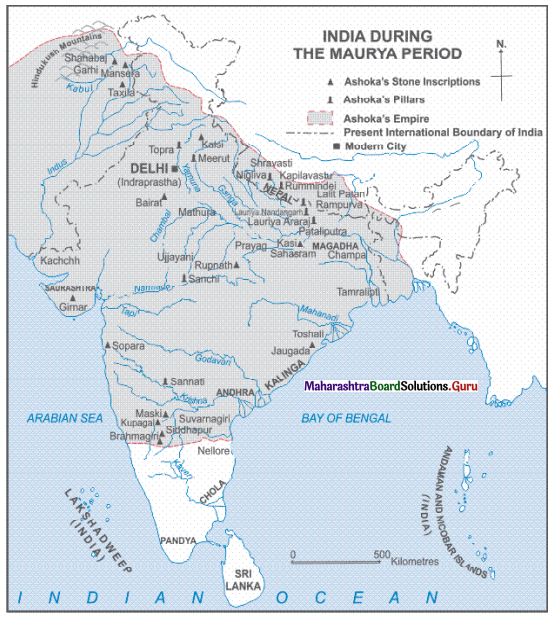
Maharashtra Board Class 11 History Solutions Chapter 8 India During Mauryan Period 3

Question 1.
Regions included in Ashoka’s Empire.
Answer:
Regions of Afghanistan, Nepal, and India are included in Ashoka’s Empire.

Question 2.
Locations of Ashoka’s rock and pillar edicts.
Answer:
Ashoka’s rock edicts are found in locations such as Mansehra, Taxila, Kalsi, Toshali, Maski, Kupaga, Brahmagiri, Siddhapur, Sopara, Girnar, Kasi, Rupnath, Bairat.
Ashoka’s pillar edicts are found in locations such as Topra, Meerut, Nigliva, Rummindei, Lauruja Nandangarh, Saurya, Araraj, Ramparva, Sanchi, Sannati.

Maharashtra Board Class 11 History Solutions Chapter 8 India During Mauryan Period

Activity

Collect information about the stupas during the period of Ashoka.
Answer:
In the Mauryan Period, mainly in the period of Ashoka numerous stupas were built and scattered all over the country. The stupas of solid domes were constructed of brick or stone of different sizes. The Ashoka stupas were constructed to celebrate the achievements of the Gautam Buddha. It is said that 84,000 stupas were built all over the country. One example of a stupa constructed by Ashoka is that of Sanchi Stupa.

Maharashtra Board Class 11 History Important Questions Chapter 7 India and Iran (Persia)

Balbharti Maharashtra State Board Class 11 History Important Questions Chapter 7 India and Iran (Persia) Important Questions and Answers.

Maharashtra State Board 11th History Important Questions Chapter 7 India and Iran (Persia)

1A. Choose the correct alternative and write the complete sentences.

Question 1.
The Ashoka edicts are written in ____________ script.
(a) Sinhala
(b) Aramaic
(c) Kharoshthi
(d) Modi
Answer:
(b) Aramaic

Question 2.
The capital of the empire of Elam was ____________
(a) Athens
(b) Pars
(c) Eretria
(d) Susa
Answer:
(d) Susa

Maharashtra Board Class 11 History Important Questions Chapter 7 India and Iran (Persia)

Question 3.
The Iranian empire was established by ____________ of the Achaemenid dynasty.
(a) Cyrus the Great
(b) Alexander the Great
(c) Daryush I
(d) Xerxes
Answer:
(a) Cyrus the Great of Scylax

Question 4.
____________ is the Latin name of Iran.
(a) Pars
(b) Ariana
(c) Susa
(d) Persepolis
Answer:
(b) Ariana

Question 5.
The logbook of the journey of Scylax is known as ____________
(a) Periplus of the Erythrean sea
(b) Periplus of the Mediterranean Sea
(c) Periplus of Scylax
(d) Periplus of the Dead sea
Answer:
(c) Periplus of Scylax

Question 6.
The Mahabharata mentions King ____________ as the king of ‘Naga people’.
(a) Porus
(b) Ambhi
(c) Chandragupta Maurya
(d) Takshaka
Answer:
(d) Takshaka

Question 7.
The gold coins issued by Daryush-I were known as ____________
(a) Darik
(b) Siglos
(c) Tarik
(d) Stater
Answer:
(a) Darik

Maharashtra Board Class 11 History Important Questions Chapter 7 India and Iran (Persia)

Question 8.
____________ became the king of Macedonia.
(a) Daryush-I
(b) Xerxes
(c) Cyrus the Great
(d) Alexander
Answer:
(d) Alexander

1B. Find the incorrect pair from set B and write the correct ones.

Question 1.

Set ‘A’Set ‘B’
(a) AnabasisTo spur into action
(b) TalentA natural skill or ability
(c) DarikGold coins
(d) SigloiSilver coins

Answer:
(b) Talent – Unit of weight

Question 2.

Set ‘A’Set ‘B’
(a) SisikottasShashi Gupta
(b) River VitastaJhelum
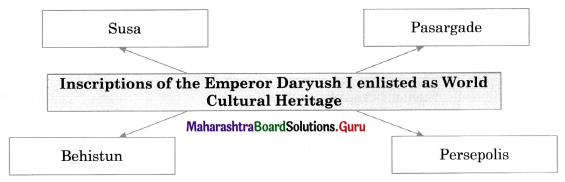
(c) BehistunWorld Cultural Heritage
(d) Daryush-IPasargadae

Answer:
(d) Emperor Cyrus II – Pasargade

Question 3.

Set ‘A’Set ‘B’
(a) AnatoliaAsia Minor
(b) EretriaEgypt
(c) Kabul basinGandhara
(d) ScythianSaka

Answer:
(b) Eretria – Greece

1C. Find the odd one out.

Question 1.
Daryush-I, Xerxes, Cyrus-II, Alexander.
Answer:
Alexander

Question 2.
Herodotus, Arrian, Scylax, Pliny
Answer:
Pliny

Maharashtra Board Class 11 History Important Questions Chapter 7 India and Iran (Persia)

Question 3.
Susa, Pasargade, Persepolis, Alexandros
Answer:
Alexandros

Question 4.
Alexandras, Ariane, Alexin, Alexander
Answer:
Ariane

Question 5.
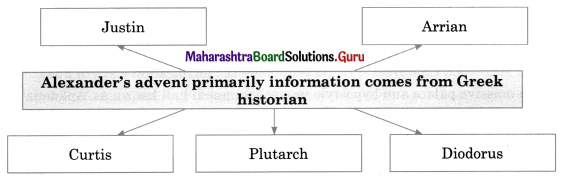
Herodotus, Arrian, Curtis, Justin
Answer:
Herodotus

Question 6.
Mathematics, Machinery, Music, Medicine
Answer:
Machinery

2A. Write the names of historical places, persons, and events.

Question 1.
The Greek name of Iran
Answer:
Ariane

Question 2.
Successor of Daryush-I
Answer:
Xerxes

Maharashtra Board Class 11 History Important Questions Chapter 7 India and Iran (Persia)

Question 3.
Author of Anabasis of Alexander
Answer:
Arrian

Question 4.
The first historian to collect information and put it in a chronological order
Answer:
Herodotus

Question 5.
Greek sailor from Ionia
Answer:
Scylax of Karyanda

Question 6.
Sanskrit term for the Greeks
Answer:
Yavana

Question 7.
Highway linking the regions from Bihar to Afghanistan
Answer:
Grand Trunk Road

Question 8.
Greek settlement
Answer:
Nysa

Question 9.
The route beginning from Susa and reaching the Mediterranean Sea.
Answer:
Royal Road

Maharashtra Board Class 11 History Important Questions Chapter 7 India and Iran (Persia)

Question 10.
The battle between Daryush I and Athens was fought on the grounds of Marathon near Athens
Answer:
Battle of Marathon

2B. Choose the correct reason and complete the sentence.

Question 1.
Alexander was influenced by Porus because ____________
(a) Porus was handsome
(b) Porus was stronger than Alexander
(c) of Porus great valour
(d) Porus surrendered easily
Answer:
(c) of Porus great valour

Question 2.
Taxila was the capital of ____________
(a) Greece
(b) Gandhara mahajanapada
(c) Egyptus
(d) Jhelum
Answer:
(b) Gandhara Mahajanapada

Question 3.
Emperor Cyrus II had begun to build a new capital at ____________
(a) Islamabad
(b) Dhaka
(c) Pasargade
(d) Mahajanapada
Answer:
(c) Pasargadae

Question 4.
Taxila is situated on the Grand Trunk Road, ____________ away from Islamabad, the capital of Pakistan.
(a) 20 kilometres
(b) 35 kilometres
(c) 40 kilometres
(d) 30 kilometres
Answer:
(d) 30 kilometers

Maharashtra Board Class 11 History Important Questions Chapter 7 India and Iran (Persia)

2C. Write the correct chronological order.

Question 1.
(a) There was a fierce battle between Alexander and Porus.
(b) Alexander appointed satrapies before starting on the return journey.
(c) Alexander died at Babylon in 325 B.C.E.
(d) Alexander conquered Kabul and Sindh.
Answer:
(a) Alexander conquered Kabul and Sindh.
(b) There was a fierce battle between Alexander and Porus
(c) Alexander appointed satrapies before starting on the return journey.
(d) Alexander died at Babylon in 325 B.C.E.

Question 2.
(a) Cambyses II
(b) Daryush I
(c) Cyrus II
(d) Xerxes
Answer:
(a) Daryush I
(b) Cambyses II
(c) Cyrus II
(d) Xerxes

3. Complete the concept maps.

Question 1.
Maharashtra Board Class 11 History Important Questions Chapter 7 India and Iran (Persia) 3 Q1
Answer:
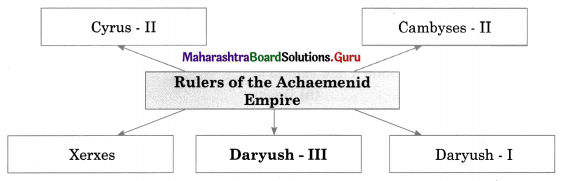
Maharashtra Board Class 11 History Important Questions Chapter 7 India and Iran (Persia) 3 Q1.1

Question 2.
Maharashtra Board Class 11 History Important Questions Chapter 7 India and Iran (Persia) 3 Q2
Answer:
Maharashtra Board Class 11 History Important Questions Chapter 7 India and Iran (Persia) 3 Q2.1

Question 3.
Maharashtra Board Class 11 History Important Questions Chapter 7 India and Iran (Persia) 3 Q3
Answer:
Maharashtra Board Class 11 History Important Questions Chapter 7 India and Iran (Persia) 3 Q3.1

Maharashtra Board Class 11 History Important Questions Chapter 7 India and Iran (Persia)

Question 4.
Maharashtra Board Class 11 History Important Questions Chapter 7 India and Iran (Persia) 3 Q4
Answer:
Maharashtra Board Class 11 History Important Questions Chapter 7 India and Iran (Persia) 3 Q4.1

4. Write short notes.

Question 1.
Coins of Daryush – I
Answer:

  • Daryush-I issued coins with his own portrait on it. The gold coins issued by him were known as ‘Darik’ and silver coins were known as ‘siglos’.
  • A portrait of Daryush-I holding a bow and arrow can be seen on these coins.
  • One ‘Darik’ was equivalent to 12 ‘sigloi’ in value.

Question 2.
Cyrus-II
Answer:

  • The Iranian empire was established by Cyrus – II (also known as Cyrus the Great) of the Achaemenid dynasty.
  • He was from the tribe of Tars’. The region where the tribe dwelt was known by the tribe’s name ‘Pars’.
  • The main city of the region was also known by the same name.
  • Emperor Cyrus – II had begun to build a new capital at ‘Pasargade’. However, it did not get completed in his lifetime.

Question 3.
Daryush-I
Answer:

  • Daryush – I succeeded Cambyses – II. He reinforced the fortification walls of Susa.
  • He also built a massive palace and hypostyle (many columned) halls known as ‘Apadana’.
  • Daryush also built the city of Persepolis in a style similar to Susa.
  • He also built a palace and apadana in Persepolis also.

5. Explain the following statements with reasons.

Question 1.
Herodotus has described the Indian soldiers in the Achaemenid army.
Answer:

  • According to Herodotus, Xerxes’ army had soldiers from Gandhara, Sindh, and Punjab when he invaded Greece in 480 B.C.E.
  • The soldiers from Gandhara were equipped with bows made of cane and spears with short shafts.
  • They also had horses and chariots drawn by horses. The Indian soldiers from Sindh and Punjab used cotton clothes and used bows and arrows made of cane. They were expert archers.

Maharashtra Board Class 11 History Important Questions Chapter 7 India and Iran (Persia)

6. State your opinion.

Question 1.
Alexander was impressed by the valour of Porus.
Answer:

  • Alexander conquered almost all kingdoms in Kabul, Sindh, and Punjab. However, not all Indian Kings surrendered to Alexander easily.
  • Many fought with great valour. One of them was King Porus. On the bank of Jhelum, Alexander and King Porus confronted each other and there was a fierce battle between them.
  • Porus was defeated but Alexander and his army were greatly influenced by his valour. The Greeks were influenced by the use of elephants in warfare.
  • To penetrate the file of elephants was a great challenge for them.
  • The Greek historians have unanimously praised the skill of Porus in warfare and also his courage.

7. Answers the following questions in detail.

Question 1.
Write in detail about Herodotus, the first historian.
Answer:

  • Herodotus was born in 484 B.C.E. in Halicarnassus, a Greek city-state.
  • He began to write with the intention of tracing the history and causes of the battles between Greek city-states and the
  • Achaemenid Empire during 500-449 B.C.E.
  • The book he wrote was named ‘Historia’ (The Histories).
  • Herodotus was the first historian who collected information-seeking answers to a particular question and then put it in chronological order.
  • He did not bring in notions like God, human destiny, etc.
  • Putting historical events in a chronological sequence became an essential theme of history writing.
  • This theme proved to be fundamental in the development. Therefore, Herodotus is said to be the father of historiography.

Maharashtra Board Class 11 History Important Questions Chapter 7 India and Iran (Persia)

Question 2.
Importance of Taxila as a center for learning.
Answer:

  • Taxila was the capital of Gandhara Mahajanapadas.
  • Some information about Taxila can be gathered from the writings of Greek historians.
  • There were several learned individuals (Acharyas) staying in Taxila.
  • Many students from various regions of the Indian subcontinent were attracted to Taxila because of the fame of the acharyas.
  • It had assumed the magnitude of a natural university.
  • An individual acharya had to decide the nature of his method of teaching, the subjects to be taught by him, or the nature of the syllabi.
  • There was no formal system of examinations.
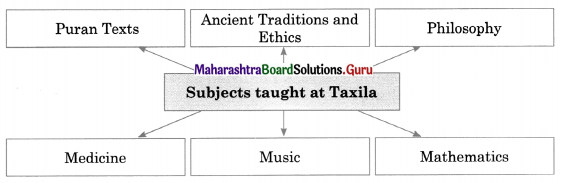
  • Among the subjects taught at Taxila included Rigveda, Yajurveda, Samaveda, ancillary branches of the Vedas. Ancient Traditions and Ethics, Philosophy, Mathematics, Music, Medicine, Puran Texts, History, Weaponry, Poetry, etc.
  • Acharya Chanakya is believed to have taken Chandragupta Maurya to Taxila for education.
  • Chandragupta established a regional capital at Taxila.
  • Among the subjects taught at Taxila included Rigveda, Yajurveda, Samaveda, ancillary branches of the Vedas. Ancient Traditions and Ethics, Philosophy, Mathematics, Music, Medicine, Puran Texts, History, Weaponry, Poetry, etc.
  • Acharya Chanakya is believed to have taken Chandragupta Maurya to Taxila for education.
  • Chanakya himself hailed from Taxila.
  • During the reign of Ashoka, Maurya Taxila became an important center for learning Buddhist tradition.
  • Then Taxila had become a center for learning.

8. Answer the following with the help of the given points.

Question 1.
Write a note on the contribution of the following in establishing the Iranian empire.
(a) Cyrus – II
(b) Cambyses – II
(c) Daryush – I
(d) Xerxes.
Answer:
(a) Cyrus – II (Cyrus the Great): Cyrus – II belonged to the tribe of ‘Pars’. He had begun to build a new capital at ‘Pasargade’. However, it did not get completed in his lifetime. Cyrus – II conquered Lydia, a Greek state to the north of the Mediterranean Sea around the mid of the 6th C.B. C. E. As a result, the Ionian Greek city-states.

(b) Cambyses – II: Cambyses – II was the son of Cyrus – II. He moved back to Susa and re¬established his capital there. Cambyses -II had conquered Egypt.

(c) Daryush – I: He succeeded Cambyses – II reinforced the fortification walls of Susa. He also v built a massive palace and a hypostyle (many columned) halls known as ‘Apadana’. Daryush – I also built the city of ‘Persepolis’ in a style similar to Susa. He also built a palace and apadana in Persepolis also. During the rule of Daryush -I all Ionian city-states got together and rebelled against the Achaemenid rule.

(d) Xerxes: Xerxes, the successor of Daryush -1 tried once again to invade Greece. However, he was also defeated. Thereafter the conflict between the Achaemenids and the Greeks continued over a prolonged time.

Maharashtra Board Class 11 History Important Questions Chapter 7 India and Iran (Persia)

Question 2.
The conflict between the Iranian Empire and Greece.
(a) Cyrus – II
(b) Arrian
Answer:
(a) Cyrus – II:

  • Cyrus II conquered Lydia, a Greek state to the north of the Mediterranean Sea, around the mid of 6th-century B.C.E.
  • As a result, the Ionian Greek city-states under the Lydian rule inevitably became part of the Achaemenid empire.
  • The Greeks in Ionia had migrated to Anatolia, that is, the Asian part of Turkey. It is also known as ‘Asia Minor’.
  • During the reign of Daryush I all Ionian city-states got together and rebelled against the Achaemenid rule.
  • The rebellion was subdued completely after a struggle of five years by the Achaemenid army.
  • The effects of this unsuccessful rebellion are important for understanding the interrelationship between Greece and Persia in the ensuing period.

(b) Arrian:

  • Arrian was a Greek historian of the 1st-century C.E.
  • He wrote a book called ‘Anabasis of Alexander. He has referred to the correspondence between Daryush III, the last Achaemenid emperor, and Alexander.
  • Daryush had written to Alexander about the release of his mother, wife, and children.
  • Alexander responded by reminding Daryush of the sorrow inflicted on the Greeks by the earlier invasions of the Achaemenid emperors.
  • Alexander wrote that he had arrived in Russia by crossing the ocean, with the intention of punishing the aggressive Persians.

Maharashtra Board Class 11 History Solutions Chapter 7 India and Iran (Persia)

Balbharti Maharashtra State Board Class 11 History Solutions Chapter 7 India and Iran (Persia) Textbook Exercise Questions and Answers.

Maharashtra State Board Class 11 History Solutions Chapter 7 India and Iran (Persia)

1A. Choose the correct alternative and write the complete sentences.

Question 1.
The Greek historian ___________ is said to be the father of modern historiography.
(a) Herodotus
(b) Alexander
(c) Scylax
(d) Daryush
Answer:
(a) Herodotus

Maharashtra Board Class 11 History Solutions Chapter 7 India and Iran (Persia)

Question 2.
Taxila was ruled by King ___________ at the time of Alexander’s advent.
(a) Chandragupta
(b) Ambhi
(c) Porus
(d) Shashigupta
Answer:
(b) Ambhi

1B. Find the incorrect pair from set B and write the correct ones.

Question 1.

Set ‘A’Set ‘B’
(a) PersopolisCity built by Daryush-I
(b) HalicarnassusHerodotus was born here
(c) TaxilaCentre of knowledge and education
(d) NysaPersian settlement

Answer:
(d) Nysa – Greek settlement

1C. Write the names.

Question 1.
Last emperor of Achaemenid Empire-
Answer:
Daryush – III

Question 2.
Name of coins issued by Daryush-I
Answer:
Darik and Siglos

Maharashtra Board Class 11 History Solutions Chapter 7 India and Iran (Persia)

2. Explain the statements with reasons.

Question 1.
Alexander invaded Persia.
Answer:

  • The Persians invaded Greece but were defeated. Thereafter the conflict between the Achaemenids and Greeks continued over a prolonged time.
  • An impact of this conflict was to manifest in the way of the invasion of Persia by Alexander III, the King of Macedonia.
  • Thus, Alexander invaded Persia.

Question 2.
Alexanders’ invasion of India did not have a far-reaching impact on the political scenario of India.
Answer:

  • Alexander invaded India and conquered some kingdoms from Afghanistan to Sindh-Punjab. He could not however establish his rule for a long time.
  • After his confrontation with Porus, Alexander proceeded in the direction of Chenab and Ravi.
  • He conquered the kingdoms on the way and reached the bank of Beas. Alexander’s soldiers had lost spirit and they refused to march forward.
  • Before setting on the return journey. Alexander handed over the regions in Punjab to Porus and those in Sindh to Ambhi.
  • He appointed Greek satraps and in 325 B.C.E.
  • Alexander died in Babylon. After his death, Chandragupta Maurya established his vast empire from Bihar to Afghanistan.

3. State your opinion.

Question 1.
Herodotus is said to be the father of modern history writing.
Answer:

  • Herodotus was the first historian who collected information-seeking answers to a particular question and then put it in chronological order. While doing this he did not bring in notions like a god, human destiny, etc.
  • Putting historical events in a chronological sequence became an essential theme of history writing.
  • This theme proved to be fundamental in the development of history writing as an independent discipline.
  • Therefore, Herodotus is said to be the father of historiography.

Question 2.
Ancient Taxila was the center of knowledge and education.
Answer:

  • Buddhist literature and writings of the Greek historians give information about Taxila.
  • There were several learned individuals (Acharyas) staying in Taxila.
  • Many students from various regions of the Indian subcontinent were attracted to Taxila because of the fame of the acharyas.
  • Thus, Taxila had become a great center of education.
  • Thereby it had assumed the magnitude of a natural university.

Maharashtra Board Class 11 History Solutions Chapter 7 India and Iran (Persia)

4. Answers the following questions in detail.

Question 1.
Describe the political and cultural effects of the Achaemenid rule on India.
Answer:

  • The Persian supremacy prevailed in the Indian subcontinent for at least two centuries.
  • The Persian rulers set up an administrative system.
  • Every conquered region was annexed to their territory as a satrapy and a satrap (governor) was appointed as its chief administrator.
  • A newly opened waterway for the transport between Persia and the Indian subcontinent facilitated trade between Achaemenid provinces in the northwestern region of the Indian subcontinent and the regions of Sindh-Punjab.
  • The ivory and teak exported from India had great demand in the Persian markets. The architects, sculptors, and other artisans lost the royal patronage so they had to move out in search of work. They migrated to India.
  • They received royal patronage in the court of emperor Ashoka. Their style is reflected in the stone pillars erected by Emperor Ashoka.
  • Thus, the sculptural art in ancient India has its roots in the Persian; and accordingly, in the Greek sculptural style.

Question 2.
Describe Alexander’s invasion of India.
Answer:

  • Alexander invaded the Indian subcontinent and conquered some kingdoms from Afghanistan to Sindh-Punjab.
  • He, however, could not establish his rule there for a long time.
  • Alexander became the king of Macedonia in 334 B.C.E. He defeated emperor Daryush III in 331 B.C.E.
  • After conquering the region of Kabul, he reached the foothills of the Hindukush mountains.
  • Then he camped at a place called Nicaea situated on Uttarapatha. Ambhi welcomed Alexander and sought friendship with him.
  • Alexander conquered almost all kingdoms in Kabul, Sindh, and Punjab.
  • On the bank of Jhelum, Alexander and King Porus confronted each other and there was a fierce battle between them.
  • Porus was defeated but Alexander and his army were greatly influenced by his valour.
  • Alexander’s soldiers had lost spirit due to the frequent battles and refused to march forward. Alexander was forced to return.
  • Before returning, Alexander handed over the regions in Punjab.

Maharashtra Board Class 11 History Solutions Chapter 7 India and Iran (Persia)

Activity

Collect additional information about the palace at Persepolis and Apadana at Susa with the help of the internet.
Answer:

  • Persepolis was the ceremonial capital of the Achaemenid Empire.
  • Earliest evidence shows that the earliest remains of Persepolis date back to 515 BC.
  • Apadana at Susa.
  • Apadana is a large hypostyle hall. The palace complex in Susa, Iran, the capital of the Achaemenid Empire.
  • The construction was parallel to that of Persepolis. This palace was built during the reign of Darius I, the Great.

Maharashtra Board Class 11 History Important Questions Chapter 6 Second Urbanisation in India

Balbharti Maharashtra State Board Class 11 History Important Questions Chapter 6 Second Urbanisation in India Important Questions and Answers.

Maharashtra State Board 11th History Important Questions Chapter 6 Second Urbanisation in India

1A. Choose the correct alternative and write complete sentences.

Question 1.
___________ is identified with Nadura in Buldhana district.
(a) Potana
(b) Vidarbha
(c) Bhoja
(d) Dandaka
Answer:
(a) Potana

Question 2.
___________ was the son of Rishabhnath, the first Jain Tirthankara.
(a) Mahavir
(b) Bahubali
(c) Gautama Buddha
(d) Andhakraja
Answer:
(b) Bahubali

Maharashtra Board Class 11 History Important Questions Chapter 6 Second Urbanisation in India

Question 3.
The Jataka story known as ___________ Jataka gives us the list of kings who ruled the State of Videha.
(a) Assaka
(b) Chulla Kalinga
(c) Nimi
(d) Mahaparinibbansutta
Answer:
(c) Nimi

Question 4.
The city of ___________ was the capital of Anga.
(a) Varanasi
(b) Shravasti
(c) Rajagriha
(d) Champa
Answer:
(d) Champa

Question 5.
___________ was the 24th Tirthankara.
(a) Vardhaman Mahavir
(b) Parshavanath
(c) Rishabha
(d) Bahubali
Answer:
(a) Vardhaman Mahavir

Question 6.
___________ was known as Tathagatha or Shakyamuni.
(a) Vardhaman Mahavir
(b) Gautam Buddha
(c) Andhakraja
(d) Emperor Ashoka
Answer:
(b) Gautama Buddha

Maharashtra Board Class 11 History Important Questions Chapter 6 Second Urbanisation in India

Question 7.
___________ was the capital of Asmaka.
(a) Potali
(b) Varanasi
(c) Vaishali
(d) Mathura
Answer:
(a) Potali

Question 8.
The city of Champa was the capital of ___________
(a) Kasi
(b) Anga
(c) Kosala
(d) Magadha
Answer:
(b) Anga

1B. Find the incorrect pair from set B and write the correct ones.

Question 1.

Set ‘A’Set ‘B’
(a) Jataka story giving a list of kings who ruled VidehaNimi Jataka
(b) Jataka story giving the name of the king who ruled KasiAssaka Jataka
(c) Jataka story describing the battle between king Assaka and the Kalinga kingChulla Kalinga Jataka
(d) Buddhist text that mentions that the king of Kasi had defeated KosalaMahaparinibbansutta

Answer:
Buddhist text that mentions that the king of Kasi had defeated Kosala – Mahavagga

Question 2.

Set ‘A’Set ‘B’
(a) AngaChampa
(b) MagadhaViratnagar
(c) Vrujji/VajjiVaishali
(d) Malla/MalavaKushinara/Kushinagara

Answer:
Magadha – Girivraja/Rajgriha

Question 3.

Set ‘A’Set ‘B’
(a) KuruIndraprastha/Indrapattan
(b) Uttar PanchalaAhichchhatra
(c) Dakshina PanchalaTaxila
(d) MatsyaViratnagar

Answer:
Dakshina Panchala – Kampilya

Maharashtra Board Class 11 History Important Questions Chapter 6 Second Urbanisation in India

1C. Find the odd one out.

Question 1.
Buddha, Tathagatha, Shakyamuni, Vardhamana Mahavira
Answer:
Vardhamana Mahavira

Question 2.
Nimi Jataka, Assaka Jataka, Chulla Kalinga Jataka, Mahavagga
Answer:
Mahavagga

Question 3.
Swarajya, Bhaujya, Vairajya, Rajasuya
Answer:
Rajasuya

Question 4.
Aspasioi, Assakenoi, Astakenoi, Andhakraja.
Answer:
Andhakraja

Question 5.
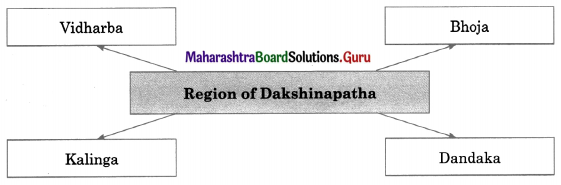
Vidarbha, Paudanya, Bhoja, Dandaka.
Answer:
Paudanya

Question 6.
Purohita, Senani, Rajya, Amatya.
Answer:
Rajya

Question 7.
Svaarajya, Bhaujya, Vairajya, Gramani.
Answer:
Gramani

Maharashtra Board Class 11 History Important Questions Chapter 6 Second Urbanisation in India

Question 8.
Ashvamedha, Maharajya, Saamrajya, Parmeshthya.
Answer:
Ashvamedha

2A. Write the names of historical places, persons, and events.

Question 1.
Term mentioned in Panini’s Ashtadhyayi meaning Avanti and Ashmak.
Answer:
Avantyashmak

Question 2.
Region on the bank of the Godavari
Answer:
Andhakratta

Question 3.
Capital of Kosala
Answer:
Shravasti

Question 4.
Statue of Bahubali in the Hassan district of Karnataka
Answer:
Shravanabelagola

Question 5.
Disciple of Gautama Buddha
Answer:
King Prasenjit

Question 6.
The play was written by Bhasa
Answer:
Swapnavasavadatta

Question 7.
Contemporary of Gautama Buddha
Answer:
Bimbisara

Maharashtra Board Class 11 History Important Questions Chapter 6 Second Urbanisation in India

Question 8.
Capital of Gandhara
Answer:
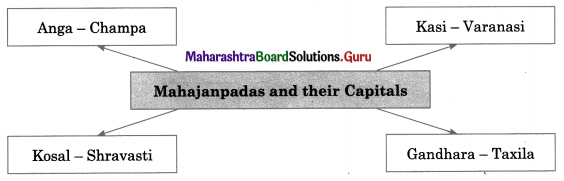
Taxila

Question 9.
Chief of a guild of artisans
Answer:
Jyeshthaka

Question 10.
Founder of Buddhism
Answer:
Gautam Buddha

2B. Choose the correct reason and complete the sentence.

Question 1.
The core principle of Vardhamana Mahavir’s philosophy is ___________
(a) Vedanta
(b) Mimamsa
(c) Charavaka
(d) Pluralism (Anekantavada)
Answer:
(d) Pluralism (Anekantavada)

Question 2.
Kamboja mahajanapada is mentioned in the ancient literature along with ___________
(a) Kosala
(b) Magadha
(c) Anga
(d) Gandhara
Answer:
(d) Gandhara

Question 3.
It seems that the king of Assaka was known as ‘Andhakraja’ during ___________
(a) Gautama Buddha’s times
(b) Vardhaman Mahavir’s times
(c) Second Urbanisation
(d) Mahajanpada
Answer:
(a) Gautama Buddha’s times

Maharashtra Board Class 11 History Important Questions Chapter 6 Second Urbanisation in India

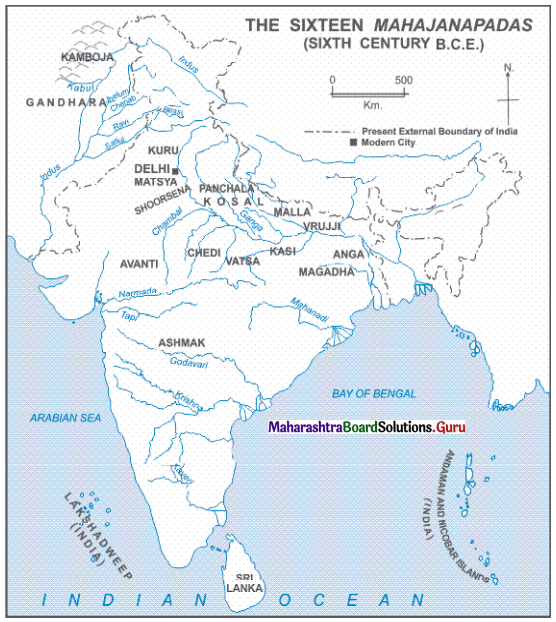
3. Observe the map on page 39 of your textbook and answer the following questions based on it.

Maharashtra Board Class 11 History Important Questions Chapter 6 Second Urbanisation in India 3

Question 1.
Name the sixteen Mahajanapadas shown on the map.
Answer:
The sixteen Mahajanapadas shown on the map are Kamboja, Ghnadhara, Kuru, Surasena, Pachala, Kosala, Malla, Vrujji, Anga, Magadha, Kasi, Vatsa, Chedi, Avanti, Shoorasena, and Ashmaka.

Question 2.
Name the islands in the Bay of Bengal.
Answer:
The islands in the Bay of Bengal are Andaman and Nicobar Islands.

Question 3.
Name the ocean found at the tip of India.
Answer:
The Ocean found at the tip of India is the Indian Ocean.

Question 4.
Name the sea at the west of India.
Answer:
The Sea at the west of India is the Arabian Sea.

Question 5.
Name the modern city shown on a map.
Answer:
The modern city shown on the map is Delhi.

Maharashtra Board Class 11 History Important Questions Chapter 6 Second Urbanisation in India

4. Complete the concept maps.

Question 1.
Maharashtra Board Class 11 History Important Questions Chapter 6 Second Urbanisation in India 4 Q1
Answer:
Maharashtra Board Class 11 History Important Questions Chapter 6 Second Urbanisation in India 4 Q1.1

Question 2.
Maharashtra Board Class 11 History Important Questions Chapter 6 Second Urbanisation in India 4 Q2
Answer:
Maharashtra Board Class 11 History Important Questions Chapter 6 Second Urbanisation in India 4 Q2.1

Question 3.
Maharashtra Board Class 11 History Important Questions Chapter 6 Second Urbanisation in India 4 Q3
Answer:
Maharashtra Board Class 11 History Important Questions Chapter 6 Second Urbanisation in India 4 Q3.1

Maharashtra Board Class 11 History Important Questions Chapter 6 Second Urbanisation in India

5. Explain the following concepts.

Question 1.
Guilds (Shrenis)
Answer:

  • Along with agriculture and animal husbandry, trade and systematic management, and organisation of the trade are also essential factors for the prosperity of a state.
  • The guilds of the merchants and the artisans played a great role in the growth of the mahajanapadas into wealthy states.
  • These guilds had their own way of organisation and functioning.
  • Guilds had their own, strict rules. Hence, they had a stringent structure.
  • This stringent structure is perceived as one of the main reasons for the rise of the caste system.

6. State your opinion.

Question 1.
The Charavaka/Lokayat school denies the existence of ‘God’.
Answer:

  • One of the ancient Indian schools of thought was the Charavaka or the Lokayat school of thought.
  • This school denies the existence of God.
  • It opposes the authority of Vedas (Vedapramanya) and the notions of the existence of God and life after death.
  • It also discarded all rituals arising out of this kind of belief system.
  • It is the only materialistic school of philosophy that was developed in ancient India.

Question 2.
The names occurring in the Buddhist texts are accepted as more reliable.
Answer:

  • The names of sixteen Mahajanpadas are found in the Jaina and Buddhist literature and also in the Pur ana texts.
  • Buddhist texts were written in a period, which was closer to the period of the Mahajanpadas.
  • Hence, the names occurring in the Buddhist texts are accepted as more reliable.

Question 3.
The name Assaka in Pali is equivalent to Sanskrit Ashmaka.
Answer:

  • It seems that the king of Assaka was known as ‘Andhakraja’ during Gautama Buddha’s times.
  • The region on the bank of the Godavari was known as ‘Andhakratta’.
  • Sage Bavari, a contemporary of Gautama Buddha, had his ashram in this region, but originally he was from the state of Kosala.
  • According to ‘Suttanipata’, a Buddhist text, he came from Shrvasti, the capital of Kosala to Assaka.
  • It was situated on the Godavari and in the region of ‘Dakshinapatha’.
  • This evidence confirms that the name Assaka in Pali is equivalent to Sanskrit Ashmaka.

Maharashtra Board Class 11 History Important Questions Chapter 6 Second Urbanisation in India

7. Answers the following questions in detail.

Question 1.
Explain the Eight Fold Path (Ashtangika Marga) of Gautama Buddha.
Answer:
Gautama Buddha explained the Eight Fold Path by including:

  • Samyak Drishti (To understand and accept that nothing happens against the rules of nature)
  • Samyak Sankalp (Right determination)
  • Samyak Vacha (Right speech)
  • Samyak Karmanta (Right behaviour)
  • Samyak Ajiva (Livelihood by right means)
  • Samyak Vyayam (Conscious avoidance of offensive things)
  • Samyak Smriti (watchfulness and memory of right things)
  • Samyak Samadhi (Establishing the mind firmly in equanimity; a state beyond pleasure and sorrow)

Question 2.
Discuss in detail the functioning of guilds or shrenis.
Answer:

  • The guilds of the merchants and the artisans played a great role in the growth of Mahajanapadas into wealthy states.
  • The guilds had their own way of organisation and functioning.
  • Guilds had their own strict rules. Hence, they had a stringent structure.
  • This stringent structure is perceived as one of the main reasons for the rise of the caste system.
  • The paid outsiders who worked in the guilds were known as ‘Karmakara’ and unpaid workers as ‘Dasa’.
  • During the Mauryan period, the king’s control of the transactions of guilds was very important.
  • Structurally the shrenis had a great potential of channeling the central power.
  • The functioning of the guilds was controlled by the state. Detailed records were kept of the production by the guilds.
  • Each guild had its own rules based on its traditions. The state did not interfere in the functioning of the guilds.
  • The chief of a guild of artisans was known as ‘Jyesthaka’ or ‘Jyetthaka’.
  • The chief of a guild of merchants was known as ‘Shreshthi’ or ‘Setthi’.

Maharashtra Board Class 11 History Important Questions Chapter 6 Second Urbanisation in India

8. Answers the following questions with the help of given points.

Question 1.
The Contemporary cities of Mahajanapadas, with the help of:
(a) Kasi
(b) Kosala
(c) Anga
(d) Magadha
(e) Vrujji/Vajji
(f) Malla
(g) Chedi
Answer:
(a) Kasi: This Mahajanapada was a powerful one at the beginning of the Mahajanapada period. Varanasi was its capital. The kings of Kasi were ambitious. According to the jataka stories they aspired for the highest position among all contemporary kings (Sabbarajunam aggaraja).

(b) Kosala: Ancient Kosala encompassed the regions of Uttar Pradesh in India and Lumbini in Nepal. Sharavasti was its capital city. King Prasenjit (Pasenadi) was a disciple of the Gautama Buddha. Kosala was destroyed and annexed permanently to Magadha by King Ajatashatru.

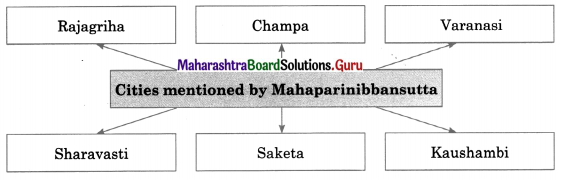
(c) Anga: The city of Champa was the capital of Anga. It was the center of the marine trade. It was permanently annexed to Magadha by King Bimbisara.

(d) Magadha: Magadha had its first capital in the city of Girivraja, also known as Rajagriha. Girivraja was surrounded by five hills making it formidable for the enemies. King Bimbisara was a contemporary of Gautama Buddha. The policy of territorial annexation of other kingdoms was started during the reign of Kind Bimbisara.

(e) Vrujji/Vajji: This was a confederation of eight clans, known as ‘Maha Aththkula’. It included clans like Videha, Lichchhavi, Vajji, Shakya, Dnyatruk, etc. The ‘Ekapanna Jataka’ mentions that Vaishali, the capital of this Mahajanapada was fortified with three surrounding walls. It had three entrance gates and bastions.

Maharashtra Board Class 11 History Important Questions Chapter 6 Second Urbanisation in India

(f) Malla: The city of Kushinara or Kushinagara (Kasia) in the Gorakhpur district was the capital of this Mahajanapada. Gautama Buddha attained Mahaparinirvana in this city. A copper plate inscription (5th century C.E.) was found at the ‘Parinirvana Stupa’ in this city. It read, “Parinirvana chaitye tamrapattaiti”. By the 3rd century B.C.E. the Malla Mahajanapada was merged into the Maurya Empire.

(g) Chedi: This Mahajanapada had occupied Bundelkhand and the region around it. The city of Shuktimati or Sotthivati was its capital. It is supposed to have been situated near ‘Banda’ in Uttar Pradesh.

Maharashtra Board Class 12 English Yuvakbharati Solutions Chapter 1.5 The New Dress

Balbharti Yuvakbharati English 12th Digest Chapter 1.5 The New Dress Notes, Textbook Exercise Important Questions and Answers.

Maharashtra State Board Class 12 English Yuvakbharati Solutions Chapter 1.5 The New Dress

12th English Digest Chapter 1.5 The New Dress Textbook Questions and Answers

Question 1.
Write in Column ‘B’ the description of the clothes you would choose to wear for the occasions given in Column ‘A’:
Answer:

AB
A birthday partyCasual jeans and T-shirt
A prize distribution ceremony at schoolFormal shirt and trousers
A picnicColourful casuals, or Shorts and T-shirt
An entertainment showGood jeans and good T-shirt

Maharashtra Board Solutions

Question 2.
Discuss the criterion of the choice of your clothes with the help of given points:
Answer:
(a) Occasion: whether it is a birthday, wedding, picnic, college festival, etc.
(b) Society (people you may meet at the venue): friends, relatives, classmates, visitors, students from other colleges, etc.
(c) Availability: bought at a store, tailored, borrowed, etc.
(d) Fashion: designer clothes, casual, Indian formal, Western formal, etc.
(e) Your wish/whim: colour of my choice, style, etc.
(f) A suggestion or advice by someone (mother, sister, friend, etc.): Only advice by friends
(g) Any other than the above mentioned reasons: I would choose a dress that would suit me and set off my looks in the best possible way, even if it may be out of fashion. I would not go by whether it is expensive or branded.

Question 3.
Divide the class into groups. Discuss the role of costumes in enhancing your personality:
Answer:
(Points: clothes very important – first impressions important – colours, cut that suit a person – if the clothes are suitable, confidence level increases – however, it is not the cost of clothes but suitability to the wearer and occasion that are important – your clothes also depend on the culture and place.)

Question 4.
State whether you agree or disagree with the following statements and discuss the reasons:
Answer:
(a) A simple dress makes one’s personality look dull.
(Disagree – if the cut is good, the cloth is good – it suits the wearer – a simple dress can be excellent.)

(b) We should not judge ourselves from the comments we receive from others.
(Agree – we should have self-esteem – trust our judgement – do not have to seek approval from others – people may be envious, etc.)

(c) A fashionable and costly dress makes you look rich, intelligent and beautiful.
(Disagree – the dress must suit the wearer – should be worn with confidence – wearer should have good posture – accessories should be well-matched, etc.)

(d) We should choose a dress according to the fashion rather than our choice.
(Disagree – if we choose according to fashion, may not be comfortable – the fashion may not suit us-we may feel self-conscious – hence choose a dress according to our choice.)

Maharashtra Board Solutions

(A1)

Question (i)
There are a few other characters mentioned in this extract. Discuss the way their reactions help us to understand the inferiority complex of Mabel.
Answer:
Mabel told Robert Haydon that she felt like some dowdy, decrepit, horribly dingy old fly. She said it to reassure herself and appear detached and witty, and to show that she did not feel in the least out of anything.

Robert Haydon probably replied something to praise her, which Mabel felt was just politeness, and that he was being insincere. Though she was constantly looking for approval from others, she always felt suspicious when someone actually praised her, or said something in her favour. This shows that she has no self-esteem and a very big inferiority complex.

(A2)

Question (i)
Pick out the sentence/s from the extract which describe the ambience of the party at Mrs. Dalloway’s place.
Answer:
1. If she had been dressed like Rose Shaw, in lovely, clinging green with a ruffle of swansdown.
2. For she would not join Charles Burt and Rose Shaw, chattering like magpies and perhaps laughing at her by the fireplace.

Question (ii)
Mabel is thinking too much about her dress. Pick out two sentences supporting the above statement.
Answer:
1. It seemed to her that the yellow dress was a penance which she had deserved.
2. Then Mrs Holman was off, thinking her the most dried-up, unsympathetic twig she had ever met, absurdly dressed, too, and would tell every one about Mabel’s fantastic appearance.

Question (iii)
Critically analyze Mabel’s weak economic conditions in the past as one of the reasons that led her to choose the old-fashioned dress.
Answer:
Mabel did not belong to a rich family. She was one of a family of ten. They always had to be careful about their expenses, always counting the pennies. Her mother had to carry big cans the linoleum on the stairs was worn off, and there was always some minor domestic tragedy taking place.

Even when they went to seaside resorts, they stayed at lodges which never faced the sea directly, but at an odd angle, so that they had to squint to see the sea. Maybe indirectly she was still fighting with her weak economic conditions of the past, and this had made her choose the old-fashioned dress or it could have been some memories of the past that made her do it.

Question (iv)
The cause of Miss Mabel’s disappointment is not only her poor background in the past but her too much bookishness also Substantiate.
Answer:
To a certain extent this is true. She keeps thinking about the depressing lines she has read written by Shakespeare; she also keeps thinking of the story of the fly and the saucer, and how she is a fly and the others are dragonflies, butterflies and beautiful insects. Probably her over-active imagination, which led to her continuous disappointment with various things, was also due to extensive reading.

Maharashtra Board Solutions

Question (v)
Do you appreciate Mabel’s tendency of deciding her own value from the comments given by others? Explain your views.
Answer:
No, I don’t. We all have our own likes and dislikes; we should wear what we like and behave in the manner we think is appropriate. We should not depend on the approval and comments of others to decide our value and worth. This is done only by those who have no confidence in themselves and no self-esteem.

(A3)

Question (i)
Write the synonyms for the word ‘dress’ by filling appropriate letters in the blanks. One is done for you.
Answer:
(a) a t t i r e
(b) g a r b
(c) c o s t u m e
(d) g a r m e n t
(e) o u t f i t
(f) a p p a r e l

Question (ii)
Conchology means the scientific study or collection of mollusc shells. Find out the meanings of:
1. Etymology
2. Archaeology
Answer:
1. Etymology – the study of the origin and history of words.
2. Archaeology – the scientific study of material remains (such as tools, pottery, jewelry, stone walls, and monuments) of past human life and activities.

(A4)

(i) Use the correct tense form of the verbs given in the brackets and rewrite the sentences.

Question (a)
She ………………….. (take/takes/took/had taken) that old fashion book of her mother a few months back.
Answer:
She had taken that book of her mother a few months back.

Question (b)
She ……………… (pecking/pecks/pecked) at her left shoulder for quite some time.
Answer:
She pecked at her left shoulder for quite some time.

Question (c)
One human should (done /doing/be doing) this for another always.
Answer:
One human should be doing this for another always.

Maharashtra Board Solutions

Question (d)
All this (will be/is/have been) destroyed in a few years.
Answer:
All this will be destroyed in a few years.

Question (e)
She (feels/felt/will be feeling) like a dressmaker’s dummy standing there.
Answer:
She felt like a dressmaker’s dummy standing there.

(ii) Do as directed:

Question (a)
Lata will sing tonight. (Make it less certain.)
Answer:
Lata may sing tonight.

Question (b)
You should wear your uniform. (Show ability.)
Answer:
You can wear your uniform.

Question (c)
Sandeep may study to clear the examination. (Make it obligatory/compulsory.)
Answer:
Sandeep must study to clear the examination.

Question (d)
I can do it. (Make a sentence seeking permission.)
Answer:
May I do it?

(iii)

Question (a)
Frame three rules for the students of your college. (Non-textual grammar)
Answer:
1. Students must wear identity cards in the college premises.
2. Students must not loiter near the college gate.
3. Every student must have at least 75% attendance in every subject.

Maharashtra Board Solutions

Question (b)
Frame three sentences giving advice to your younger brother.
Answer:
1. You should make a timetable for revision at least a month before the exams.
2. You should not eat junk food.
3. You should visit your dentist at least once every six months.

Question (iv)
Fill-in the blanks with appropriate modal auxiliaries according to the situation given in the following sentences:
Answer:
(a) Take an umbrella. It might rain later.
(b) People must not walk on the grass.
(c) May I ask you a question?
(d) The signal has turned red. You must wait.
(e) I am going to the library. I could find my friend there.

(A5)

Question (i)
Virginia Woolf has created many characters other than Miss Mabel with great skill. Write a character sketch of any one of them.
Answer:
One of the guests at Mrs. Dalloway’s party was Charles Burt. Mabel was impressed by him and longing for some praise from him. However, he was a malicious person, with no heart, no fundamental kindness and only a superficial appearance of friendliness. He liked to poke fun at people and see their reactions. He probably also liked to gossip about people and discuss them behind their backs, but his opinion made a great difference to Mabel.

Question (ii)
‘Clothes mean nothing until someone lives in them.’ Expand the idea in your own words.
Answer:
Clothes mean nothing until someone lives in them These are the words of Marc Jacobs, a fashion designer. It means that clothes gain importance and character only when someone is wearing them. The first impression that people have of a person is not only through the clothes that one is wearing but the way one is wearing those clothes.

The style a person adopts tells people a lot about his/her personality and character. The best and most expensive clothes can be unimpressive if the wearer does not carry himself/herself well. On the contrary, the simplest of clothes can look good and impressive if the wearer has good posture, self-confidence and self-esteem.

Hence, when we are buying clothes, we must not only be sure that they will suit us but that we will be comfortable in them and able to carry them well. So, we must choose clothes that make us feel good about ourselves, confident and happy.

Maharashtra Board Solutions

(A6)

Question 1.
Go to a library and read the following books:
(a) ‘A Haunted House’ by Virginia Woolf
(b) ‘Mrs. Dalloway’ by Virginia Woolf

(A7)

Question 1.
Find out information about career opportunities in the following fields:

  1. Fashion designing
  2. Dress designing
  3. Textile industry
  4. Garment industry
  5. Image consultancy
  6. Psychology and Psychiatry

Yuvakbharati English 12th Digest Chapter 1.5 The New Dress Additional Important Questions and Answers

Read the extract and complete the activities given below:

A1. Global Understanding:

Question 1.
Complete the following:
Answer:
1. What depressed Mabel was her appalling inadequacy, her cowardice and her mean, water-sprinkled blood.
2. The feeling that grew stronger as she went upstairs was that something was not quite right.
3. The eyelids of the guests flickered and then shut rather tight.

Question 2.
Complete the following:
Answer:

  1. According to Mabel, fashion means cut, style, and cost, at least thirty guineas.
  2. When Mabel was sitting over the teacups, she had thought that she could not be fashionable.
  3. The book Mabel had chosen was an old Paris fashion book of her mother’s, of the time of the Empire.
  4. Rose Shaw’s lips had a little satirical pucker.

Maharashtra Board Solutions

Question 3.
Mabel knew that these were her main faults:
Answer:
envy and spite

Question 4.
Mable tried to imagine them like flies:
Answer:
Rose Shaw and all the other people

Question 5.
He stopped to listen to Mabel:
Answer:
Robert Haydon

Question 6.
She, Mabel, was a fly but the others were:
Answer:
dragonflies, butterflies, beautiful insects

Question 7.
Complete the following:
Answer:
1. Miss Milan’s workroom was terribly hot, stuffy and sordid, smelling of clothes and cabbage cooking.
2. When Mabel looked at herself in the glass, she saw a grey-white, mysteriously smiling, charming girl, the core of herself.

Maharashtra Board Solutions

Question 8.
Match the following and write the complete answers:

AB
1. Miss Milan wanted to know(a) pick a hemp seed from between her lips.
2. Miss Milan let the canary(b) to be so dependent on people’s opinions.
3. Mabel felt it was very weak(c) she suffered tortures and was awoken to reality.
4. When Mabel was in Miss Dalloway’s drawing-room.(d) about the length of the skirt.

Answer:

  1. Miss Milan wanted to know about the length of the skirt.
  2. Miss Milan let the canary pick a hemp
  3. Mabel felt it was very weak to be so dependent on people’s opinions.
  4. When Mabel was in Miss Dalloway’s drawing-room she suffered tortures and was awoken to reality.

Question 9.
Pick out the sentences that are false and write them correctly:
Answer:
1. Mabel was not at all confident when she went into the room.
2. Rose Shaw was actually looking very fierce and tragic.
3. Charles Burt wanted to talk to Mabel.
4. Charles Burt told Mabel that she was looking charming.
False sentences:
2. Rose Shaw was actually looking very fierce and tragic.
3. Charles Burt wanted to talk to Mabel.
4. Charles Burt told Mabel that she was looking charming.
Corrected sentences:
2. Mabel imagined that Rose Shaw would look very fierce and tragic.
3. Mabel wanted to talk to Charles Burt.
4. Mabel wished that Charles Burt had told her that she was looking charming.

Question 10.
Match the sentences from Box A and Box B and rewrite the completed sentences:
Answer:
A:
1. Mrs. Holman did not notice Mabel’s dress
2. Mabel was angry because
3. Mrs. Holman leaned forward and told Mabel
4. Mabel compared the clamour and greed of human beings for sympathy
B:
(a) Mrs. Holman treated her like a house agent or messenger boy.
(b) how her eldest boy had strained his heart running.
(c) to a row of cormorants, barking and flapping their wings.
(d) because she was worried about her family.
Answer:

  1. Mrs. Holman did not notice Mabel’s dress because she was worried about her family.
  2. Mabel was angry because Mrs. Holman treated her like a house agent or messenger boy.
  3. Mrs. Holman leaned forward and told Mabel how her eldest boy had strained his heart running.
  4. Mabel compared the clamour and greed of human beings for sympathy to a row of cormorants, barking and flapping their wings.

Maharashtra Board Solutions

Answer in very brief:

Question 1.
What did Mabel do to look busy?
Answer:
punched the cushions

Question 2.
Who were chatting near the fireplace?
Answer:
Charles Burt and Rose Shaw

Question 3.
What was Rose Shaw wearing?
Answer:
a lovely, clinging green dress with a ruffle of swansdown

Question 4.
What type of job did Hubert have?
Answer:
a safe, permanent underling’s job in the Law Courts

Question 5.
Who was Mabel’s hero?
Answer:
Sir Henry Lawrence

Question 6.
Where did Mabel dream of living?
Answer:
in India

Question 7.
Choose the correct alternative and fill in the blanks:

  1. The children ……………. as they paddled. (shouted/cried)
  2. The Goddess was …………….. but ……………. (ugly/kind/beautiful/cruel)
  3. Mabel was years old. (fifty/forty)
  4. All Mabel’s brothers and sisters were …………….. people, (strong/weak)
  5. Mabel went to the seaside at ……………. .(Christmas/Easter)
  6. Now that Mabel was older, the stories about the fly and the saucer would come more ……………… (seldom/often)

Answer:

  1. The children shouted as they paddled.
  2. The Goddess was beautiful but cruel.
  3. Mabel was forty years old.
  4. All Mabel’s brothers and sisters were weak people.
  5. Mabel went to the seaside at Easter.
  6. Now that Mabel was older, the stories about the fly and the saucer would come more seldom.

Question 8.
Who said to whom:
OR
Complete the following table:
Answer:

The WordsWho saidTo whom
“I have enjoyed myself.”MabelMr. Dalloway
“Lies, lies, lies!”MabelTo herself
“But it’s too early to go.”Mrs. DallowayMabel
“Right in the Saucer!”MabelTo herself

Complex Factual:

Question 1.
Pick out the sentences from the extract which describe the ambience of the party at Mrs. Dalloway’s place.
Answer:
Mrs. Barnet, while handing her the mirror and touching the brushes and thus drawing her attention, perhaps rather markedly, to all the appliances for tidying and improving hair, complexion, clothes, which existed on the dressing table.

Maharashtra Board Solutions

Question 2.
Who was Mrs. Barnet? Describe her behaviour.
Answer:
Mrs. Barnet was probably the maid or housekeeper. She held the mirror, touched the brushes, and drew Mabel’s attention, rather markedly, to the appliances kept on the dressing table for improving one’s looks. She indirectly indicated to Mabel that something about Mabel’s looks was not quite right.

Question 3.
Mabel is thinking too much about her dress. Pick out a sentence supporting the above statement.
Answer:
She could not face the whole horror – the pale yellow, idiotically old-fashioned silk dress with its long skirt and its high sleeves and its waist and all the things that looked so charming in the fashion book, but not on her, not among all these ordinary people.

Question 4.
Pick out the sentences from the extract which describe the ambience of the party at Mrs. Dalloway’s place.
Answer:
Rose herself being dressed in the height of the fashion, precisely like everybody else, always.

Question 5.
Describe the dress Mabel was wearing, What had been Mabel’s thoughts about it earlier?
Answer:
The dress was a pale yellow, old-fashioned silk dress, with a long skirt and high sleeves and waist. It had looked so charming in the fashion book, but not on her. Mabel had thought earlier that the dress would I make her look modest, old-fashioned and charming.

Question 6.
Pick out the sentences from the extract which describe the ambience of the party at Mrs. Dalloway’s place.
Answer:
She was a fly, but the others were dragonflies, butterflies, beautiful insects, dancing, fluttering, skimming.

Question 7.
What did Mabel say to Robert Haydon, and why did she say it? Describe their interactions.
Answer:
Mabel said that she felt like some dowdy, decrepit, horribly dingy old fly. She said it to reassure herself and appear detached and witty, and to show that she did not feel in the least out of anything. Robert Haydon heard this and replied with some polite and insincere words.

Question 8.
Mabel is thinking too much about her dress. Pick out some sentences supporting the above statement.
Answer:
She looked at herself with the dress on, finished, an extraordinary bliss shot through her heart. Suffused with light, she sprang into existence.

Maharashtra Board Solutions

Question 9.
Describe Miss Milan.
Answer:
Miss Milan was poor and hard-working. Her face was red and her eyes bulged. Her pleasures in life were few and cheap; one of them was allowing her pet canary to pick a hemp-seed from between her lips. She was patient and had to endure a lot of difficulties.

Question 10.
Mabel is thinking too much about her dress. Pick out a sentence supporting the above statement.
Answer:
She issued out into the room, as if spears were thrown at her yellow dress from all sides.

Question 11.
Pick out the sentence/s from the extract which describe the ambience of the party at Mrs. Dalloway’s place.
Answer:
……….. and not be whipped all around in a second by coming into a room full of people.

Question 12.
Describe Mabel’s behaviour as she entered the room.
Answer:
Mabel went out into the room, as if spears were thrown at her yellow dress from all sides. But instead of looking fierce or tragic, she looked foolish and self-conscious. She smiled in a silly way, like a schoolgirl, and slouched across the room, moving quietly, as if she were a beaten dog. She then stood by herself and looked at a picture-from shame, from humiliation.

Question 13.
What had been Mabel’s dreams before marriage? Did they come true?
Answer:
Mabel had dreamt of living in India, married to some hero like Sir Henry Lawrence, or some empire builder. However, she had failed utterly, and had married Hubert, who had an ordinary job in the Law Courts. They lived in a small house without proper maids.

Question 14.
Discuss Mabel’s opinion of herself as a wife and mother.
Answer:
Mabel felt that she had always been a fretful, weak, unsatisfactory mother, and an unsteady and uncertain wife. She felt that she was hanging about lazily in a kind of twilight existence with nothing very clear or very bold, or standing out.

Maharashtra Board Solutions

Question 15.
Describe the actions of the fly in Mabel’s imagination. Would the fly behave in the same way (as it did in her imagination), now that she was forty?
Answer:The fly in her imagination suddenly struggled out sometimes. But now that she was forty, she felt that the fly, and she, Mabel, would gradually cease to struggle any more.

Question 16.
Pick out the sentences from the extract which describe the ambience of the party at Mrs. Dalloway’s place.
Answer:

  1. “But it’s too early to go,” said Mrs. Dalloway, who was always so charming.
  2. “I have enjoyed myself,” she said to Mr. Dalloway, whom she met on the stairs.
  3. She thanked Mrs. Barnet for helping her.

Question 2.
Describe Mabel’s plans and expectations for the next day.
Answer:
Mabel planned that she would go to the London Library the next day. She would find some wonderful, helpful, astonishing book, by a clergyman or by an American no one had ever heard of or she would walk down the Strand and drop into a hall where a miner was telling about the life in the pit, and suddenly she would become a new person. She would be transformed. She would wear a uniform; somebody would call her Sister : she would never give a thought to clothes again. And after that she would be perfectly clear about Charles Burt and Miss Milan forever.

Inference/Interpretation/Analysis:

Question 1.
There is another character mentioned in this extract. Discuss the way his/ her reactions help us to understand the inferiority complex of Mabel.
Answer:
Mrs. Barnet touched the brushes and drew Mabel’s attention, rather markedly, to the appliances kept on the dressing table for improving one’s looks. She indirectly indicated to Mabel that something about Mabel’s looks was not quite right. Mabel immediately lost whatever confidence she had. This shows us that Mabel’s inferiority complex was so deep and strong that even a housekeeper’s hint rattled her and made her lose confidence.

Maharashtra Board Solutions

Question 2.
Complete the following:
‘RIGHT’ signifies ………………. .
Answer:
‘RIGHT’ signifies the suitability of the dress for the occasion.

Question 3.
Complete the following:
She was afraid of looking in the mirror/glass because
Answer:
She was afraid of looking in the mirror/glass because she felt that she looked horrible in the pale yellow, old-fashioned silk dress, with a long skirt and high sleeves and waist.

Question 4.
There is another character mentioned in this extract. Discuss the way his/her reactions help us to understand the inferiority complex of Mabel.
Answer:
Rose Shaw looked at Mabel up and down, twisting her lips in a sarcastic manner, Mabel had expected her to do this. Mabel also felt that Rose and all the others present were dressed, as always, in the height of fashion. This shows us how sensitive Mabel was to the behaviour of others and how she thought j that they were always right in fashion, while she was not. This indicates Mabel’s lack of self-esteem and self-worth.

Question 5.
What was Mabel’s imagination about flies?
Answer:
Mabel felt that we are all like flies trying to crawl over the edge of the saucer, some crawling slowly with their wings stuck together. In order to make the other people at the party look insignificant and unimportant, she tried hard to visualize them as poor, struggling flies, trying to pull themselves out of something or into something.

However, her inferiority complex was so strong that she ultimately saw only herself as a fly trying to drag itself out of the saucer. She saw the others as dragonflies, butterflies, beautiful insects, dancing, fluttering and skimming lightly.

Maharashtra Board Solutions

Question 6.
Complete the following:
Answer:
Mabel’s eyes were filled with tears because she felt sorry for poor Miss Milan, who had such few pleasures in life. Those too were cheap ones, like allowing her pet canary to pick a hemp-seed from between her lips. Miss Milan was helping Mabel to become fashionable, and hence Mabel felt very fond of her and full of pity for her condition.

Question 7.
Discuss different pessimistic thoughts in Mabel’s mind.
Answer:
Mabel felt that all the thrill she had felt in her dress had vanished when she entered Mrs. Dalloway’s drawing room, and her eyes were opened to the reality of the dress. She felt depressed and weak that at her age, and with two children, she cared so much about the opinions of other people and did not have any principles or convictions of her own. She was upset that she could not take things lightly, as others did. She found plenty of faults in herself.

Question 8.
There is another character mentioned in this extract. Discuss the way his/ her reactions help us to understand the inferiority complex of Mabel.
Answer:
Mabel told Charles Burt that ‘it’ was old- fashioned, hoping that he would think it was the picture she was talking about, and not her dress. She longed for Charles’ approval, and hoped he would say that she looked charming. But Charles Burt laughed at her, and this upset her tremendously.

She wished she had the confidence to be sure that Miss Milan was right about her dress and Charles was wrong, but unfortunately that was not so, and Charles’ laughter and his malice made her feel even more humiliated and inferior than before. This shows us that Mabel depended heavily on the approval of others and had no self-esteem.

Question 9.
There is another character mentioned in this extract. Discuss the way his/her reactions help us to understand the inferiority complex of Mabel.
Answer:
When Mrs. Holman asked her questions about Elmthorpe and other things, Mabel was furious to be treated like a house agent or a messenger boy, to be made use of. It shows that she is insecure about herself, and feels that people are always humiliating her. Even a person like Mrs. Holman, who is having a difficult time with her family, can make Mabel feel insecure and inferior.

Question 10.
There are a few other characters mentioned in this extract. Discuss the way their reactions help us to understand the inferiority complex of Mabel.
Answer:
Mabel thought that Charles Burt and Rose Shaw were chatting together by the fireplace and laughing at her. She could not hear them, but this was her imagination and inferiority complex which made her think so. Mabel even felt that poor Mrs. Holman was laughing at her dress, and that she would tell everyone about it. Mrs. Holman had so many of her own problems that she probably never even thought of it, but Mabel’s lack of confidence made her feel so.

Question 11.
Describe Mabel’s ‘delicious/divine’ and ‘flat’ moments. Was there a reason for them?
Answer:
The delicious moments of Mabel’s life were reading contentedly in bed, or being down by the sea in the sun and sand at Easter, listening to the melody of the waves and the happy shouts of the children paddling in the water. Also, sometimes she had these moments with Hubert, when he was carving the mutton for Sunday lunch, opening a letter, or coming into the room. On the other hand, sometimes, when everything was arranged – music, weather, holidays – and there was every reason for happiness, it turned suddenly flat.

Maharashtra Board Solutions

Question 12.
Complete the following:
The last sentence suggests that
Answer:
The last sentence suggests that however hard Mabel tries to be stylish or fashionable, she is ultimately a middle-class, ordinary woman. She did not have enough money to buy a new cloak. She could not have competed with the rich, stylish people at the party. However, she did not want to accept this fact gracefully, but always felt inferior.

Question 13.
“I have enjoyed myself,” said Mabel. Was this the truth? Give reasons for your answer.
Answer:
This was not the truth. Though Mabel tells Mr. and Mrs. Dalloway that she has enjoyed herself, she says “Lies, lies, lies!” to herself while going down the stairs. She also mentions that she, like the fly, is right back in the saucer, implying that she would again have to struggle unhappily to climb out of it.

Personal Response:

Question 1.
List the criteria you use to choose a dress/outfit.
Answer:
When I buy a dress, the first thing I look at is the price. If it is beyond my budget, I don’t even think of buying it, however much I like it. I then look at the colour and cut. I do not go in for branded stuff as I feel they are unnecessarily expensive. I am careful while buying clothes as I have limited pocket money. I try to buy things which I can mix and match.

Question 2.
Describe the kind of clothes you wear to college. Do you feel that your clothes do not match to those worn by your friends?
Answer:
I normally wear jeans and T-shirts to college. Everyone else wears the same. All my friends belong to middle-class families, and none of us go in for very fashionable or expensive clothes. I only try to choose colours that I know will look good on me. So, I am quite comfortable with my clothes and know that I look what I am – a young college student!

Question 3.
Do you look for approval from others when you do something/wear something?
Answer:
Yes, to a certain extent I do. After all, we are not solitary human beings, we live in society. When I wear a dress that I think is good, I like others to approve of it too. But I do not get upset if they don’t, because I know that everybody’s tastes are different. In the same way, if I do something outstanding and no one notices it, I do get a bit upset but then I console myself that I am happy, and that is what matters.

Question 4.
Name some simple things that make you feel really happy. Explain why it is so.
Answer:
I feel really happy at the beginning of spring. Just outside my bedroom window there are a few trees which lose their leaves in winter, but get fresh, tender green leaves in March. I watch the increase of leaves daily, and feel very happy. It sort of makes me feel that there is hope and life everywhere, even after a dreary winter.

Question 5.
Does your attention often wander when people are talking to you? Give examples.
Answer:
No, in general it does not. I try to pay full attention when someone is talking to me. But if the person is very slow, or is talking on a very boring topic or boasting, then my attention does wander. For example, the other day my neighbour Aditya was telling me in great detail about some great thing that he did. Aditya is a big liar, and exaggerates everything, so my attention wandered and he got upset with me!

Question 6.
Do you feel nervous/confident when you are at a party? Give examples.
Answer:
If I am attending a party where I do not know the people very well, then I feel nervous. For example, I was invited to a party at my school teacher’s house, in the next building. I did not know anyone there except my teacher, and I felt quite nervous. But when I attend a friend’s party, or a family gathering then I do not feel nervous at all. In fact, I look forward to such parties.

Maharashtra Board Solutions

Question 7.
Describe your relationship with your siblings/cousins.
Answer:
I have an elder sister, who is two years older than me. I get along very well with her, because she is kind and very loving. She helps me a lot in my studies, and in choosing my clothes. She has many friends, and I know all of them and get along well with them. We enjoy watching movies at home and listening to music.

Question 8.
Describe one fulfilled/unfulfilled dream of yours.
Answer:
I am an avid reader. I have read many books written by English authors, in which they have described places in England and Scotland, and the beautiful green scenery. It had been my dream to see all this at least once, but it had seemed impossible, as it would have been very expensive. Then one fine day, a cousin got married in Scotland, and she wanted all of us to be present. My parents decided to go and take me along. We toured UK for fifteen days after the wedding, and my dream was fulfilled.

Language Study:

Question 1.
Mabel had her first serious suspicion that something was wrong as she took her cloak off.
(Frame a wh-question to get the underlined part as the answer.)
Answer:
When did Mabel have her first serious suspicion that something was wrong?

Question 2.
What a fright she looks! What a hideous new dress! (Rewrite as assertive sentences.)
Answer:
She looks a real fright. The new dress is very hideous.

Question 3.
Rewrite as an assertive sentence:
“How dull!”
Answer:
It was very dull.

Question 4.
She dared not look in the glass. She could not face the whole horror.
(Rewrite as affirmative sentences.)
Answer:
She was afraid to look in the glass. She was unable to face the whole horror.

Maharashtra Board Solutions

Question 5.
If she could say that over often enough, she would become numb, chill, frozen, dumb.
(Pick out the clauses and state their type.)
Answer:
she would become numb, chill, frozen, dumb – main clause
If she could say that over often enough – adverb clause of condition

Question 6.
“Lies! Lies! Lies!” (Rewrite as an assertive sentence.)
Answer:
It was all lies.

Question 7.
Now she could see flies crawling slowly out of a saucer of milk. (Rewrite using ‘able’.)
Answer:
Now she was able to see flies crawling slowly out of a saucer of milk.

Question 8.
It smelt of clothes and cabbage cooking; and yet, when Miss Milan put the glass in her hand, an extraordinary bliss shot through her heart. (Rewrite using ‘though’.)
Answer:
Though it smelt of clothes and cabbage cooking, when Miss Milan put the glass in her hand, an extraordinary bliss shot through her heart.

Question 9.
She felt much, much fonder of Miss Milan than of any one in the whole world.
(Rewrite using ‘asfond … as’.)
Answer:
She did not feel as fond of anyone in the whole world as she felt of Miss Milan.

Question 10.
Suffused with light, she sprang into existence. (Rewrite as a compound sentence.)
Answer:
She was suffused with light and sprang into existence.

Rewrite in indirect speech:

Question 1.
If he had only said, “Mabel, you’re looking charming tonight!” it would have changed her life.
Answer:
If he had only told Mabel that she was looking charming that night, it would have changed her life.

Maharashtra Board Solutions

Question 2.
“Mabel’s got a new dress!” he said.
Answer:
He said that Mabel had got a new dress.

Question 3.
“Why,” she asked herself, “can’t I feel one thing always, feel quite sure that Miss Milan is right, and Charles wrong and stick to it?”
Answer:
She asked herself why she couldn’t feel one thing always, feel quite sure that Miss Milan was right, and Charles wrong and stick to it?

Question 4.
Then Mrs. Holman, seeing her standing there, bore down upon her. (Rewrite as a complex sentence.)
Answer:
Then Mrs. Holman, who saw her standing there, bore down upon her.

Question 5.
Mrs. Holman looked at it suspiciously.
(Frame a wh-question to get the underlined word as the answer.)
Answer:
How did Mrs. Holman look at it?

Question 6.
Though Mrs. Holman was leaning forward and telling her how her eldest boy had strained his heart running, she could see her, too, quite detached in the looking glass. (Rewrite using ‘yet’.)
Answer:
Mrs. Holman was leaning forward and telling her how her eldest boy had strained his heart running; yet, she could see her, too, quite detached in the looking glass.

Question 7.
She knew that she was condemned.
(Identify the clauses.)
Answer:
She knew – main clause
that she was condemned – subordinate noun clause

Maharashtra Board Solutions

Question 8.
She would not join Charles Burt and Rose Shaw, chattering like magpies and perhaps laughing at her by the fireplace.
(Rewrite using ‘who’.)
Answer:
She would not join Charles Burt and Rose Shaw, who were chattering like magpies and perhaps laughing at her by the fireplace.

Question 9.
She had married Hubert, with his safe, permanent underling’s job in the Law Courts, and they managed tolerably in a smallish house, without proper maids.
(Pick out the verbs and state their tense.)
Answer:
had married – past perfect tense; managed – simple past tense.

Question 10.
By degrees she would cease to struggle any more. (Rewrite using an adverb of the same meaning in place of the underlined expression.)
Answer:
Gradually, she would cease to struggle any more.

Question 11.
It didn’t matter so long as one never said them. (Rewrite using ‘unless’)
Answer:
It didn’t matter unless one said them.

Question 12.
With Hubert sometimes she had divine moments.
(Rewrite beginning ‘Divine moments…’.)
Answer:
Divine moments were had with Hubert sometimes.

Question 13.
‘I have enjoyed myself,” she said to Mr. Dalloway, whom she met on the stairs. (Rewrite using indirect speech.)
Answer:
She told Mr. Dalloway, whom she met on the stairs, that she had enjoyed herself.

Question 14.
She thanked Mrs. Barnet for helping her.
(Rewrite using ‘because’.)
Answer:
She thanked Mrs. Barnet because she had helped her.

Question 15.
She would never give a thought to clothes again. (Add a question tag.)
Answer:
She would never give a thought to clothes again, would she?

Maharashtra Board Solutions

Vocabulary:

Question 1.
Pick out two words from the extract formed by using prefixes.
Answer:
inadequacy, dissatisfaction

Question 2.
Write the noun forms of:

  1. improve
  2. suspect
  3. attend
  4. depress

Answer:

  1. improve – improvement
  2. suspect – suspicion
  3. attend – attendance
  4. depress – depression

Question 3.
Write the adjective forms of the following words :

  1. fashion
  2. style
  3. horror
  4. thought

Answer:

  1. fashion – fashionable
  2. style – stylish
  3. horror – horrible
  4. thought – thoughtless/thoughtful

Question 4.
Write the meanings of:
1. satirical
2. chastised
Answer:
1. satirical – sarcastic
2. chastised – punished

Question 5.
Pick out four infinitives from the extract.
Answer:
to make, to hear, to reassure, to crawl.

Maharashtra Board Solutions

Question 6.
Pick out four words ending in ‘ing’ from the extract.
Answer:
trying, crossing, crawling, listening

Question 7.
Write the antonyms of the following words using prefixes:

  1. endurable
  2. polite
  3. sincere
  4. real

Answer:

  1. endurable × unendurable
  2. polite × impolite
  3. sincere × insincere
  4. real × unreal

Question 8.
Pick out four abstract nouns from the extract.
Answer:
bliss, existence, patience, endurance.

Question 9.
Pick out four adjectives from the extract:
Answer:
stuffy, sordid, charming, miserable.

Question 10.
Write the verb forms of:

  1. opinion
  2. endurance
  3. bulging
  4. hot

Answer:

  1. opinion – opine
  2. endurance – endure
  3. bulging – bulge
  4. hot-heat

Question 11.
Guess the meanings:
1. suffused
2. wrinkles
Answer:
1. suffused – filled with.
2. wrinkles – folds or creases in the skin.

Maharashtra Board Solutions

Question 12.
Match the words in Column A with their meanings in Column B:

AB
1. simpered(a) moving quietly and stealthily
2. slouched(b) pushed
3. slinking(c) smiled in an affectedly coy or silly manner
4. shoved(d) moved in a lazy, drooping way
5. ruffled(e) superficial appearance
6. veneer(f) loss of calmness.

Answer:

  1. simpered – smiled in an affectedly coy or silly manner
  2. slouched – moved in a lazy, drooping way
  3. slinking – moving quietly and stealthily
  4. shoved – pushed
  5. ruffled – loss of calmness.
  6. veneer – superficial appearance

Question 13.
Guess the meanings:
1. scarlet fever
2. self-loathing
Answer:
1. scarlet fever – a bacterial illness; symptoms are a bright red rash that covers most of the body, a sore throat and a high fever.
2. self-loathing – self-hatred.

Question 14.
Write the verb forms of the following :

  1. humiliation
  2. agony
  3. suspicious
  4. grudgingly

Answer:

  1. humiliation – humiliate
  2. agony – agonise
  3. suspicious – suspect
  4. grudgingly – grudge

Maharashtra Board Solutions

Question 15.
Match the adjectives in Column A with the nouns in Column B, based on the extract:

AB
1. domestic(a) twig
2. unsympathetic(b) house
3. feeble(c) tragedy
4. smallish(d) creature

Answer:

  1. domestic – tragedy
  2. unsympathetic – twig
  3. feeble – creature
  4. smallish – house

Question 16.
Pick out two compound words from the extract:
Answer:
backwater, seaside

Question 17.
Find the meaning:
1. crest of a wave
2. by degrees
Answer:
1. crest of a wave – the top of a wave
2. by degrees – gradually

Question 18.
Write two adjectives from the extract for each of the following, and write down which are the present participles from these:

  1. moments
  2. sky
  3. life
  4. wife

Answer:

  1. moments → divine, delicious
  2. sky → blue, smooth
  3. life → creeping, crawling
  4. wife → fretful, weak

Present participles: creeping, crawling.

Maharashtra Board Solutions

Non-Textual Grammar:

Do as directed:

Question 1.
Speechless, she smiled happily and gathered her daughter into her arms.
(Rewrite using the infinitive form of ‘speak’.)
Answer:
Unable to speak, she smiled happily and gathered her daughter into her arms.

Question 2.
He wiped the water off and gently wrapped it in pink paper. (Rewrite as a simple sentence.)
Answer:
Wiping the water off, he gently wrapped it in pink paper.

Question 3.
Dhruv had never received such a gift.
(Rewrite as an affirmative sentence.)
Answer:
It was the first time that Dhruv had received such a gift.

Maharashtra Board Solutions

Spot the error in the following sentences and rewrite them correctly:

Question 1.
Not only did his speech improve and his expression also became clearer.
Answer:
Not only did his speech improve but his expression also became clearer.

Question 2.
Must you pass me the salt, please?
Answer:
Can you pass me the salt, please?

Maharashtra Board Class 12 Economics Important Questions Chapter 1 Introduction to Micro and Macro Economics

Balbharti Maharashtra State Board Class 12 Economics Important Questions Chapter 1 Introduction to Micro and Macro Economics Important Questions and Answers.

Maharashtra State Board 12th Economics Important Questions Chapter 1 Introduction to Micro and Macro Economics

1. A. Choose the correct option:

Question 1.
The term ‘Micro’ is derived from the Greek word.
(a) Makros
(b) Maikros
(c) Mikros
(d) Mikrosoft
Options:
(1) a
(2) b
(3) c
(4) d
Answer:
(3) c

Question 2.
The term ‘micro’ and ‘macro’ economics were first coined and used by Norwegian Economist.
(a) Adam Smith
(b) Ragnar Frisch
(c) Dr. Marshall
(d) Prof. Ricardo
Options :
(1) a
(2) b
(3) d
(4) c
Answer:
(2) b

Maharashtra Board Class 12 Economics Important Questions Chapter 1 Introduction to Micro and Macro Economics Important Questions

Question 3.
Statements related to features of Micro economics.
(a) The study of individual unit
(b) It deals with income theory
(c) It splits the whole economy
(d) It suggests suitable economic policies to promote economic growth
Options :
(1) a, b, c and d
(2) a and b
(3) a, c and d
(4) b and d
Answer:
(3) a, c and d

Question 4.
Scope of Micro economics.
(a) Theory of factor pricing
(b) Theory of general price level
(c) Theory of product pricing
(d) Theory of economic welfare
Options :
(1) a, b, c and d
(2) a and b
(3) a, c and d
(4) b and d
Answer:
(3) a, c and d

Question 5.
Theory of Economic Welfare.
(a) Efficiency in production
(b) Efficiency in consumption
(c) Overall economic efficiency
(d) Efficiency in social activities
Options :
(1) c and d
(2) a, b and d
(3) a, b and c
(4) b, c and d
Answer:
(3) a, b and c

Question 6.
Main features of macro economics.
(a) Income theory
(b) Lumping method
(c) Price theory
(d) Study of aggregates
Options :
(1) a, b and c
(2) b, c and d
(3) a, b and d
(4) Only b
Answer:
(3) a, b and d

Question 7.
Importance of Micro Economics.
(a) Free market economy
(b) Functioning of an economy
(c) Basis of welfare economy
(d) Foreign Trade
Options :
(1) a, b, c and d
(2) a, b and c
(3) a, b and d
(4) a, c and d
Answer:
(4) a, c and d

Maharashtra Board Class 12 Economics Important Questions Chapter 1 Introduction to Micro and Macro Economics Important Questions

Question 8.
Micro Economic is based on certain assumption.
(a) Perfect competition
(b) Pure capitalism
(c) Full employment
(d) Fluctuations in the national income
Options :
(1) b, c and d
(2) c and d
(3) a, b and c
(4) a, c and d
Answer:
(3) a, b and c

Question 9.
Importance of Macro-economics.
(a) National Income
(b) Economic development
(c) Price determination
(d) General level of employment
Options :
(1) b, c and d
(2) a, b and d
(3) a, b, c and d
(4) None of these
Answer:
(2) a, b and d

Question 10.
Scope of Macro economics.
(a) Theory of Income and employment
(b) Theory of General Price level and inflation
(c) Theory of Economic growth and development
(d) Theory of Factor Pricing
Options :
(1) a and b
(2) a, b and c
(3) a, c and d
(4) a, b, c and d
Answer:
(2) a, b and c

Question 11.
Factors of Production which make contribution in production process.
(a) Land
(b) Profit
(c) Labour
(d) Transport
Options :
(1) a, b and c
(2) a and c
(3) b, c and d
(4) All of above
Answer:
(2) a and c

B. Complete the correlation:

1. Macro economic theory : Income and employment:: Micro economics : ………………
2. General equilibrium : Macro economics :: ……………… : Micro economic
3. Macro Economics : Large :: Micro Economics : ………………
4. Classical Economist: ……………… :: Neo-classical Economist: Prof. Alfred Marshall J
5. Prof. Alfred Marshall : Principles of Economics :: ……………… : General theory of Employment, Interest and Money
6. Study of Individual unit: ……………… :: Study of aggregates : Macro economics
7. Theory of Economic welfare : Scope of Micro economics :: ……………… : Scope of Macro economics
8. Land: Rent:: ……………… : Wages
9. Capital: ……………… :: Entrepreneur : Profit
10. ……………… : Demand and Supply Analysis :: Theory of Income and employment : Consumption and Investment function
11. Macro economics : Entire economy :: Micro economics: ………………
12. Study of the whole economy : Lumping ’ method :: Study of small individual unit : ………………
Answers:

  1. Price theory
  2. Partial equilibrium
  3. Small
  4. Adam Smith
  5. Maynard Keynes
  6. Micro economics
  7. Theory of Economic growth and development
  8. Labour
  9. Interest
  10. Theory of Product Pricing
  11. Small part of economy
  12. Slicing method

(C) Give economic terms.

(1) Micro economics derived from the Greek word.
(2) Macro economics derived from the Greek word.
(3) Study of large economic unit.
(4) Study of small or millionth part of economic unit.
(5) Price determination of individual commodity by forces of demand and supply.
(6) Price determination of factor of production for contributing to the production process.
(7) Maximum satisfaction of people due to efficiency in the allocation of resources.
(8) Determination of the prices of goods and services as well as factors of production.
(9) Equal distribution of produce goods and services to the society for consumption.
(10) Production of most desired goods and services.
(11) Equilibrium position of an individual economic unit.
(12) Assumption of Micro economics i.e. other things remaining constant.
(13) Micro economics does not deal with macro problems.
(14) Economic decisions are taken at individual levels without intervention of government.
(15) Explanation of effects of tariffs, exchange rate, etc.
(16) Micro economics explain various complex economic situation with the help of economic models.
(17) Equilibrium position of whole economy.
Answer:
(1) Mikros
(2) Makros
(3) Macro economics
(4) Micro economics
(5) Theory of Product Pricing
(6) Theory of Factor Pricing
(7) Theory of Economic Welfare
(8) Price Theory
(9) Efficiency in Consumption
(10) Overall Economic Efficiency
(11) Partial equilibrium
(12) Ceteris Paribus
(13) Limited scope
(14) Free Market economy
(15) Foreign Trade
(16) Economic Model building
(17) General Equilibrium Analysis

Maharashtra Board Class 12 Economics Important Questions Chapter 1 Introduction to Micro and Macro Economics Important Questions

(D) Find the odd word out:

(1) Prof. Pigou, Prof. Samuelson, Adam Smith, J. R. Hicks.
(2) Individual consumer, Individual producer, Particular commodity, Total savings.
(3) Product pricing, Investment function, Factor pricing, Economic welfare.
(4) Efficiency in social activities, Efficiency in production, Efficiency in consumption, Overall economic efficiency.
(5) Price theory, Slicing method, Limited scope, Lumping method.
(6) Aggregate demand, Aggregate supply, Personal income, National income.
(7) National income, National output, National employment, National anthem.
(8) Keynes, Malthus, Fisher, Marshall.
(9) Theory of Economic welfare, Theory of income and employment, Theory of General price level, Theory of Economic growth.
(10) National Income, National Product, Per Capita Income, Gross Salary.
(11) Big, Large, Vast, Tiny.
(12) Microscopic, Massive, Small, Minimum.
(13) Rent, Wages, Capital, Profit.
(14) Land, Labour, Interest, Entrepreneur.
(15) Railways, Reliance, K.E.M. Hospital,
Answer:
(1) Adam Smith
(2) Total savings
(3) Investment
(4) Efficiency in
function social activities
(5) Lumping
(6) Personal income method
(7) National
(8) Marshall anthem
(9) Theory of Economic Income
Welfare
(10) Per Capita
(11) Tiny
(12) Massive
(13) Capital
(14) Interest
(15) Reliance

(E) Complete the following statements.

(1) The term Macro Economics is derived from the Greek word ‘Makros’ which means …………….
(2) The terms ‘Micro economics’ and ‘Macro economics’ were coined by Norwegian Economist …………….
(3) According to Maurice Dobb, Micro economics is in fact a ……………..
(4) The price of all commodity is determined by the forces of …………….
(5) Four main factors contributing to the production process, are …………….
(6) Micro economics deals with the study of behaviour of …………….
(7) Micro economics is based on ‘Ceteris Paribus’ assumptions which means …………….
(8) Micro economics is useful to government in framing …………….
(9) According to Keynes, macro economics is a …………….
(10) Macro economics is known as theory of Income …………….
(11) Macro economics examines the forest …………….
Answer:
(i) study of large unit
(2) Ragnar Frisch
(3) microscopic study of the economy
(4) demand and supply
(5) land, labour, capital and entrepreneur
(6) small individual unit
(7) other things remaining constant
(8) economic policies
(9) policy oriented science
(10) and employment
(11) not a single tree

[F] Choose the wrong pair :

Group ‘A’Group ‘B’
(1)MacroIndividual unit
(2) Factor pricingRent, wages, interest and profit
(3) Ceteris paribusOther things being constant
(4) MicroPrice theory

Answer:
Wrong pair : Macro – Individual unit

II.

Group ‘A’Group ‘B’
(1) Slicing methodMicro economics
(2) Economic welfareOverall economic efficiency
(3)Macro economicsIncome theory
(4) Maynard KeynesMicroscopic study of economy

Answer:
Wrong pair : Maynard Keynes Microscopic study of economy

III.

Group ‘A’Group ‘B’
(1) Lumping methodMacro economics
(2) Product PricingForces of demand and supply
(3) Micro economicsGeneral equilibrium
(4) National incomeStudy of aggregate

Answer:
Wrong pair : Micro economics – General equilibrium

IV.

Group ‘A’Group ‘B’
(1) Maynard KeynesMacro economic approach
(2) MicroMikros
(3) Adam SmithClassical economist
(4) CensusLimited scope

Answer:
Wrong pair : Census – Limited scope

V.

Group ‘A’Group ‘B’
(1) Macro(a) Makros
(2) Prof. Alfred Marshall(b) Neo-classical economist
(3) Lumping method (c) Splits the whole economy
(4) Partial equilibrium (d) Micro economics

Answer:
Wrong pair : Lumping method – Splits the whole economy

Maharashtra Board Class 12 Economics Important Questions Chapter 1 Introduction to Micro and Macro Economics Important Questions

(G) Assertion and Reasoning

Question 1.
Assertion (A) – Micro of a small part of the national economy.
Reasoning (R) – Micro economics divides the economy into small units.
(1) (A) is true but (R) is false.
(ii) (A) is false but (R) is true.
(iii) Both (A) and (R) are true and (R) is the correct explanation of (A).
(iv) Both (A) and (R) are true and (R) is not the correct explanation of (A).
Answer:
(iii) Both (A) and (R) are true and (R) is the correct explanation of (A).

Question 2.
Assertion (A) – Micro economics is known as Price theory.
Reasoning (R) – Macro economics is known as Income theory.
(i) (A) is true but (R) is false.
(ii) (A) is false but (R) is true.
(iii) Both (A) and (R) are true and (R) is the correct explanation of (A).
(iv) Both (A) and (R) are true and (R) is not the correct explanation of (A).
Answer:
(iv) Both (A) and (R) are true and (R) is not the correct explanation of (A).

Question 3.
Assertion (A) – Macro economics studies overall conditions in the economy.
Reasoning (R) – Micro economics deals with National income and employment.
(i) (A) is true but (R) is false.
(ii) (A) is false but (R) is true.
(iii) Both (A) and (R) are true and (R) is the correct explanation of (A).
(iv) Both (A) and (R) are true and (R) is not the correct explanation of (A).
Answer:
(i) (A) is true but (R) is false.

Question 4.
Assertion (A) – General equilibrium deals with the behaviour of individual price of commodity.
Reasoning (R) – Lumping method is the study of aggregates.
(i) (A) is true but (R) is false.
(ii) (A) is false but (R) is true.
(iii) Both (A) and (R) are true and (R) is the correct explanation of (A).
(iv) Both (A) and (R) are true and (R) is not the correct explanation of (A).
Answer:
(ii) (A) is false but (R) is true.

Question 5.
Assertion (A) – Macro economic analyses shows how the general price level is determined.
Reasoning (R) – The study of general price level is important on account of the problems created by inflation and deflation.
(i) (A) is true but (R) is false.
(ii) (A) is false but (R) is true.
(iii) Both (A) and (R) are true and (R) is the correct explanation of (A).
(iv) Both (A) and (R) are true and (R) is not the correct explanation of (A).
Answer:
(iii) Both (A) and (R) are true and (R) is the correct explanation of (A).

Maharashtra Board Class 12 Economics Important Questions Chapter 1 Introduction to Micro and Macro Economics Important Questions

Question 6.
Assertion (A) – In Micro economics decision regarding production of goods can be taken by individual.
Reasoning (R) – Study of macro economics help to understand the problems of developing countries and suggest important steps to achieve economic development.
(i) (A) is true but (R) is false.
(ii) (A) is false but (R) is true.
(iii) Both (A) and (R) are true and (R) is the correct explanation of (A).
(iv) Both (A) and (R) are true and (R) is not the correct explanation of (A).
Answer:
(iv) Both (A) and (R) are true and (R) is not the correct explanation of (A).

Question 7.
Assertion (A) – Micro economics is based on assumption of ‘Ceteris paribus’.
Reasoning (R) – Macro economics consists of the story of economic growth and development.
(i) (A) is true but (R) is false.
(ii) (A) is false but (R) is true.
(iii) Both (A) and (R) are true and (R) is the correct explanation of (A).
(iv) Both (A) and (R) are true and (R) is not the correct explanation of (A).
Answer:
(iv) Both (A) and (R) are true and (R) is not the correct explanation of (A).

Question 8.
Assertion (A) – Micro economics help to analyse the general level of employment of out put in an economy.
Reasoning (R) – Macro economics helps us to analyse the performance of an economy.
(i) (A) is true but (R) is false.
(ii) (A) is false but (R) is true.
(iii) Both (A) and (R) are true and (R) is the correct explanation of (A).
(iv) Both (A) and (R) are true and (R) is not the correct explanation of (A).
Answer:
(ii) (A) is false but (R) is true.

(H) Choose the correct pair :

Group ‘A’Group ‘B’
(1)Macro(a) Slicing method
(2) Micro(b) Classical economist
(3) Adam Smith(c) Neo-classical economist
(4) Prof. Marshall(d) Inflation
(e)Lumping method

Answer:
(1)-(e), (2)-(a), (3)-(b), (4) – (c).

II.

Group ‘A’Group ‘B’
(1) Factor of Production(a) Other things being equal
(2) Ceteris Paribus(b) Land
(3) Price theory(c) Micro economics
(4) Lumping method(d) Profit
(e)Whole economy

Answer:
(1)-(b), (2) – (a), (3) -(c), (4) -(e).

III.

Group ‘A’Group ‘B’
(1) National Income(a) Rent, wages, interest, etc.
(2) Factor Pricing(b) Mikros
(3) Micro(c) Study of aggregate
(4) Slicing method(d) Makros
(e)Splits the whole economy

Answer:
(1)-(c), (2)-(a), (3)-(b), (4)-(e).

IV.

Group ‘A’Group ‘B’
(1) Micro economics(a) Theory of investment
(2) Macro economics(b) Key tool of micro economics
(3) Marginalism(c) Price theory
(4) Aggregate study(d) Forest
Income and employment theory

Answer:
(1) – (c), (2) – (e). (3) – (b). (4) – (d).

V.

Group ‘A’Group ‘B’
(1) Maurice Dobb(a) Principles of Economics
(2) Ragnar Frisch(b) Policy oriented science
(3) Alfred Marshall(c) Microscopic study
(4) Adam Smith(d) Oslo University
(e) Classical economist

Answer:
(1)-(c), (2)-(d), (3)-(a), (4)-(e).

Maharashtra Board Class 12 Economics Important Questions Chapter 1 Introduction to Micro and Macro Economics Important Questions

2.[A] Identify and explain the concept from given illustrations.

Question 1.
Through public distribution system rationing shops distribute goods to poor people.
Answer:
Concept: Efficiency in consumption.
Explanation : Efficiency in consumption means distribution of produced goods and services to the people for consumption for having maximum satisfaction.
Public distribution system is developed specially to help economically weaker section of society to satisfy their consumption.
Rationing shops provide subsidized food and non food items to below poverty line people.

Question 2.
Mukesh divided his departmental J store into two separate divisions i.e. S food grains and garments to find actual profitability separately.
Answer:
Concept: Slicing method.
Explanation : Micro economics splits or divides the whole economy into small individual units and then studies each unit separately in detail.
Mukesh has divided its business into two separate divisions to understand thedetail cost of operations and profitability separately for food business as well as garment business.
Government collect whole information about population through census.
Concept : Lumping method / Macro economics.
Explanation : Macro economics use lumping method to study the whole economy rather than its part.

Question 6.
Government collect whole information about population through census.
Answer:
Concept : Lumping method / Macro economics.
Explanation : Macro economics use lumping method to study the whole economy rather than its part.
Govern ment collects data through census which gives them details about population such as sex ratio, literacy rate, unemployment rate, age composition, etc.

Question 7.
Reliance industries has created more employment opportunities through its biggest oil refinery in Jamnagar and improved the standard of living of its employee.
Answer:
Concept: Economic development. Explanation : Macro economics help to understand the problems of developing countries and suggest important steps to achieve economic development.
Economic development is a growth of the standard of living of people from low income to high income.
Through developing oil refinery Reliance has created numbers of job opportunities and hence improved the standard of living. Amul has fixed price of ₹ 44 per litre of milk after considering the cost such as machinery cost, labour cost, transportation cost, etc.
Concept: Price determination.
Explanation : Micro economics is known as price theory because it deals with determination of the prices of goods and services as well as factors of production. After considering cost of operations such as machinery cost, raw material cost, labour cost, transportation cost, etc. Amul has fixed price of its product (milk).

B. Distinhbish between

Question 1.
Micro Economics and Macro Economics.
Answer:

Micro EconomicsMacro Economics
(a) Micro economics deals with the economic behaviour of small units like particular firm, particular household, individual prices, wages, etc.(a) Macro economics deals with the economic behaviour of large units or entire economy such as National Income, aggregate demand, aggregate supply, etc.
(b) It studies each unit in depth by using slicing method.(b) It studies the economy as a whole using lumping method.
(c) It is based on partial equilibrium analysis based on assumptions.(c) It is based on a general equilibrium analysis.
(d) Micro economic analysis is also called as ‘Price theory.’(d) Macro economic analysis is also called as ‘Income theory.’
(e) Most of the theories are given by Dr. Alfred Marshall.(e) Theories are profounded by Lord J. M. Keynes.

Maharashtra Board Class 12 Economics Important Questions Chapter 1 Introduction to Micro and Macro Economics Important Questions

Question 2.
Micro Variables and Macro Variables.
Answer:

Micro VariablesMacro Variables
(a) Micro variables refer to individual demand, market demand, individual supply, price of a commodity, etc.(a) Macro variables refer to inflation rate, aggregate demand, aggregate supply, employment.
(b) Micro variables are mostly independent. It does not affect the whole economy, as they are based on assumptions.(b) Macro Variables are inter related and inter dependent. It affects the working of the economy as a whole.
(c) E.g., Price and Quantity demanded are universally related. This will hold true only if the income of the consumer, taste, fashion, etc., remain constant.(c) Change in aggregate demand, aggregate supply will affect income, employment, etc. in the economy.

Question 3.
Partial Equilibrium and General Equilibrium.
Answer:

Partial EquilibriumGeneral Equilibrium
(a) Micro economics uses Partial Equilibrium analysis based on the assumption, other things remaining constant.(a) Macro economics uses general equilibrium. It is not based on assumption.
(b) Partial Equilibrium studies the equilibrium of a consumer, a firm, an industry or a market.(b) It deals with the Equilibrium position of the economy as a whole.
(c) It deals with one or two variables at a time. So it is a simple method. It is independent.(c) It deals with all the variables of the Economic System simultaneously. So it is sophisticated. There is inter dependence.
(d) Partial Equilibrium is regarded as a worm’s eye-view.(d) General Equilibrium is a bird’s eye-view.

Question 4.
Micro Theory of Distribution and Macro Theory of Distribution.
Answer:

Micro Theory of DistributionMacro Theory of Distribution.
(a) Micro Theory of distribution refers to distribution of Factor Income to individual factor owners for their contribution to the production of a commodity or service.(a) Macro theory of distribution refers to distribution of National Income to factors like wages to the labourers, rent to landlords and interest to capitalist.
(b) It is determined by the market forces of demand and supply.(b) It is determined by the Aggregate demand and Aggregate supply and Employment level in the country.

Question 5.
Slicing Method and Lumping Method.
Answer:

Slicing MethodLumping Method
(a) In slicing method the entire economy is cut into individual slices and each unit is studied in depth.(a) In lumping method, we study the economy as a whole without slicing it.
(b) Micro Economics uses the slicing method.(b) Macro Economics uses the Lumping Method.
(c) In slicing method, in depth study of the behaviour of an individual unit like a household, a firm, a product, a factor is done.(c) In lumping method, it deals with the behaviour of large aggregates like National Income, aggregate demand, aggregate supply, employment and their functional relationship is studied.
(d) It relates to the in-depth study of a tree and not the study of forest as a whole.(d) It relates to the study of the forest as a whole and not a particular tree.
(e) Here we achieve a worm’s eye view.(e) It gives a bird’s eye view of the whole economy.

3. State with reasons whether you agree or disagree with the following statements:

Question 1.
Micro economics is the study of aggregate.
Answer:
No, I do not agree with this statement.
OR Micro economics studies individual economic units.
Yes, I agree with this statement.

  • Micro economics is the microscopic study of individual economic units in great detail.
  • It deals with individual firms, individual demand and supply, prices of individual, firms, etc.
  • But macro-economics deals with economic behaviour of the whole economy with respect to national income, aggregate demand and supply, general price level, etc.
  • Hence, micro economics is the study of individual economic units whereas macro economics is the study of aggregates.

Question 2.
Macro economics is a partial equilibrium analysis.
Answer:
No, I do not agree with this statement.
OR
Macro Economics deals with the whole s economy.
Yes, I agree with this statement.

  • Macro economics deals with entire economy.
  • Macro economics follow general equilibrium analysis. On the other hand, micro economics follow partial equilibrium analysis.
  • Macro economics studies the behaviour of number of aggregate economic variables.
  • Macro economics follows general equilibrium. It assumes “everything depends on every thing else.”
  • General equilibrium deals with the behaviour of demand, supply and prices in the whole economy.
  • Therefore, macro economics is not a partial equilibrium analysis but it is a general equilibrium analysis.

Question 8.
Micro economics is useful to the Government.
Answer:
Yes, I agree with this statement.
Useful to Government : It is useful in formulating and evaluating economic policies including pricing and distribution policies that promote economic welfare. It is useful in determining tax policy, public, expenditure policy, etc.

Question 9.
The scope of macro economics is wide.
Answer:
Yes, I agree with this statement.
(A) Theory of Income and Employment : It ?
explains which factors determine the level of National Income and employment and what causes fluctuations in the level of income, output and employment.
To understand how the level of employment is determined, we have to study the consumption function. It includes theory of business cycles.

(B) Theory of General Price Level and Inflation: Macro economics analyses shows how the general price level is determined and the causes for fluctuations in it. This study is important for understanding the problems created by inflation and deflation.

(C) Theory of Economic Growth and Development : Macro economics studies the causes of under development and poverty in poor countries and suggests strategies for accelerating growth and development in the country.

(D) Macro theory of Distribution : Macro theory of distribution deals with the relative share of rent, wages, interest and profit in the total national income of various classes.

Question 10.
Theories of micro economics are based on certain assumptions.
Answer:
Yes, I agree with this statement.
Based on certain ssumption : Micro economics is based on ‘ceteris paribus’ assumption i.e., other things remaining constant like full employment, laissez faire policy, perfect competition, pure capitalism, etc.

Question 11.
Macro economics is also known as income and employment theory.
Answer:
Yes, I agree with this statement.
Theory of Income and Employment : It ?
explains which factors determine the level of National Income and employment and what causes fluctuations in the level of income, output and employment.
To understand how the level of employment is determined, we have to study the consumption function. It includes theory of business cycles.

Maharashtra Board Class 12 Economics Important Questions Chapter 1 Introduction to Micro and Macro Economics Important Questions

4. Study the following table / figures / passages and answer :

Question 1.
Read the passage and answer the following questions.
The census of 1991 was the fifth census of independent India and conducted as usual from 9th to 28th February, 2001 to present census data as on sunrise of 1st March 2001, the reference date. The two phases were continued in the same way like previous two censuses.

In the first phase a house list was canvassed to collect the information on housing data and also amenities available to the households. The scope of house list was enlarged and for the first time a question regarding type of fuel used for cooking was canvassed. In 1981 the question on availability of toilet facility was canvassed for urban areas only. However, in 1991, it was canvassed for rural area also.
During 2nd phase following two schedules were canvassed, (a) Household schedule and (b) Individual slip

1. Between which dates the census for 2001 was conducted.
Answer:
The census for 2001 was conducted between 9th to 28th February 2001.

2. What information was collected in the first phase of census?
Answer:
In the first phase of census a house list was canvassed for collecting information about housing data and amenities available.

3. Which question was canvassed in 1991?
Answer:
In 1991 question on availability of toilet were canvassed – (a) household schedule and facility was canvassed for rural area. I 03) Individual slip.

4. Which two schedule were canvassed in IInd phase?
Answer:
During IInd phase below two schedules were canvassed –
(a) household schedule and
(b) Individual slip.

Question 2.
Go through the following chart and answer the questions.
Answer:
Maharashtra Board Class 12 Economics Important Questions Chapter 1 Introduction to Micro and Macro Economics Important Questions 1

1. Which are the two main sectors in Indian education system?
Answer:
The two main sectors in Indian education system are (a) Public sector (b) Private sector.

2. What does public sector education system includes?
Answer:
Public sector education system includes public schools, central government funded institutions, state government funded institutions and higher education institutions.

3. Where are multimedia schools positioned in Indian education system?
Answer:
Multimedia school comes under non-formal setup of private sector in Indian education system.

4. What are the setups in private sector educational system?
Answer:
There are two setups in private sector educational system i.e. formal setup and non-formal setup.

Question 3.
Study the below table and answer the given questions.
Maharashtra Board Class 12 Economics Important Questions Chapter 1 Introduction to Micro and Macro Economics Important Questions 2

(1) Which state has the highest literacy [ rate?
Answer:
Kerala has the highest literacy rate of 90.92%.

(2) What is the male literacy rate for1 Maharashtra?
Answer:
For Maharashtra the male literacy rate is 86.27%.

(3) What is difference of female literacy rate between Delhi and Rajasthan?
Answer:
There is a difference of 30-66% as a whole in female literacy rate between Delhi and Rajasthan.

(4) Which states has highest male literacy and lowest female literacy rate?
Answer:
Kerala has the highest male literacy rate of 94.20% and Uttar Pradesh has the lowest female literacy rate of 42.98%.

Maharashtra Board Class 12 Economics Important Questions Chapter 1 Introduction to Micro and Macro Economics Important Questions

5. Answer in detail:

Question 1.
Explain the scope of Micro economics.
OR
Explain the subject matter of micro economics.
Answer:
Maharashtra Board Class 12 Economics Important Questions Chapter 1 Introduction to Micro and Macro Economics Important Questions 3

(a) Theory of Product Pricing : The price of each commodity is determined by the forces of demand and supply. Micro economics is a study of demand analysis i.e. individual consumer behaviour and supply analysis i.e. individual producer behaviour.
(b) Theory of Factor Pricing : There are four main factors contributing to the production process which are land, labour, capital and entrepreneur. Micro economics helps in determining the factor rewards like land gets rent, labour gets wages, capital gets interest and entrepreneur gets profit.
(c) Theory of Economic Welfare : This theory deals with efficiency in allocation of resources which aim at maximum satisfaction of people. Three economic efficiencies are as follows :

  • Efficiency in production : It mean producing maximum amount of goods and services from given amount of goods and j services from given amount of resources.
  • Efficiency in consumption : It means distribution of produce goods and services to the society for consumption in such a way to have maximum total satisfaction of people.
  • Overall economics efficiency : It means to produce those goods and services which are most desired by the people

Maharashtra Board Class 11 History Solutions Chapter 6 Second Urbanisation in India

Balbharti Maharashtra State Board Class 11 History Solutions Chapter 6 Second Urbanisation in India Textbook Exercise Questions and Answers.

Maharashtra State Board Class 11 History Solutions Chapter 6 Second Urbanisation in India

1A. Choose the correct alternative and write the complete sentences.

Question 1.
Ashmaka is the name in ____________ language.
(a) Pali
(b) Sanskrit
(c) Ardhamagadhi
(d) Prakrit
Answer:
(b) Sanskrit

Question 2.
The capital of Kashi Mahajanapadas was ____________
(a) Gorakhpur
(b) Chandranagar
(c) Raj agriha
(d) Varanasi
Answer:
(d) Varanasi

Maharashtra Board Class 11 History Solutions Chapter 6 Second Urbanisation in India

Question 3.
Gautam Buddha was born in ____________
(a) Kushinagara
(b) Sarnath
(c) Lumbini
(d) Pataliputra
Answer:
(c) Lumbini

Question 4.
The river ____________ was the natural boundary between Uttara Panchala and Dakshina Panchala.
(a) Yamuna
(b) Bhagirathi
(c) Ganga
(d) Niranjana
Answer:
(b) Bhagirathi

1B. Find the incorrect pair from set B and write the correct ones.

Question 1.

Set ‘A’Set ‘B’
(a) KosalaShravasti
(b) AngaChampa
(c) MatsyaMathura
(d) GandharaTaxila

Answer:
(c) Matsya – Virat Nagar

2. Choose the correct reason and complete the sentence.

Question 1.
Gautam Buddha travelled continuously for 45 years ____________
(a) in search of a Guru
(b) to practice austerities
(c) to preach dhamma
(d) to attain enlightenment
Answer:
(c) to preach dhamma

Maharashtra Board Class 11 History Solutions Chapter 6 Second Urbanisation in India

3. Complete the concept maps.

Question 1.
Maharashtra Board Class 11 History Solutions Chapter 6 Second Urbanisation in India 3 Q1
Answer:
Maharashtra Board Class 11 History Solutions Chapter 6 Second Urbanisation in India 3 Q1.1

4. Explain the following statements with reasons.

Question 1.
The rise of Mahajanpadas came into being.
Answer:

  • By 600 B.C.E. sixteen Mahajanapadas were established in India, from the northwest region to Magadha.
  • Conquering other janapadas and annexing their territory permanently to one’s own, became a regular practice in the times of Mahajanapadas.
  • Ultimately, this conflict resulted in the creation of a large empire like Magadha.
  • Ancient India once again witnessed the rise of cities.

Question 2.
The process of second urbanisation began in ancient India.
Answer:

  • The Janapadas with definite geographic borders and administrative systems were established roughly around 1000 B.C.E.
  • It resulted in the creation of sixteen Mahajanapadas from Afghanistan stretching to the banks of the Godavari in the south.
  • The capital cities of the mahajanapadas and some other cities, which flourished because of prospering trade once again brought the age of urbanisation in India.
  • It is known as the ‘Second Urbanisation’.
  • By the 6th century B.C.E. these and a few other cities had become very prosperous.
  • Thus, the process of second urbanisation began in ancient India.

Maharashtra Board Class 11 History Solutions Chapter 6 Second Urbanisation in India

Question 3.
Vardhamana Mahavira and Gautama Buddha attracted a large number of followers.
Answer:

  • Among the various stream of thought that arose in the 6th B.C.E, a large number of people were attracted to the teaching of Vardhamana Mahavira and Gautama Buddha.
  • Their teachings showed the way to overcome the disparity in the society resulted from the Varna and caste system.
  • At the age of 42, Vardhamana Mahavira attained absolute knowledge (Keval Dnyana).
  • Thereafter, people started addressing him as ‘Kevali’, ‘Jina’ and ‘Mahavira’.
  • While Buddha attained enlightenment at the age of 35. After that, he was known as ‘Buddha’, ‘Tathagata’ and also as ‘Shakyamuni’.

5. Explain the following concepts.

Question 1.
Nastik Darshan
Answer:

  • Nastik Darshan refers to the Jain and the Buddhist schools of thought.
  • In other words, both, the Jain and the Buddhist schools of thought are considered as the ‘nastik’
  • Both refuse to accept the authority of the Vedas and the Vedic rituals.
  • Both the schools had followers in large numbers from all strata of the society.

Question 2.
The eightfold path was preached by Gautama Buddha.
Answer:
Gautama Buddha explained the eightfold path by including:

  • Samyak Drishti (To understand and accept that nothing happens against the rules of nature)
  • Samyak Sankalp (Right determination)
  • Samyak Vacha (Right speech)
  • Samyak Karmanta (Right behaviour)
  • Samyak Aajiva (Livelihood by right means)
  • Samyak Vyayam (Conscious avoidance of offensive things)
  • Samyak Smriti (Watchfulness and memory of right things)
  • Samyak Samadhi (Establishing the mind firmly in equanimity; a state beyond pleasure and sorrow)

6. Describe the administrative system of the Mahajanapadas with the help of the following points.

Question 1.
(a) Terms showing types of states
(b) King’s installation
(c) Authority of the king
(d) Decision-making
Answer:
(a) Terms showing types of states: Rajya, Swarajya, Bhavjya, Vairajya, Maharajya, Samrajya, and Prameshthya were the different types of states that existed during the 6th B.C.E.

(b) King’s installation: A ‘Raja’ was expected to be a ‘Kshtriya’ and according to the existing norms, a Brahmin was expected to refrain from accepting the position of a Raja. The position of Raja was generally hereditary. However, at times, a king was elected by the people.

(c) Authority of the king: The coronation of a king gave him absolute authority over his subjects. He was the one to decide the amount of taxes to be collected from them. He was the ultimate lord of all the land in his kingdom and so he could donate any portion of that land according to his wish. Nevertheless, his power was not totally unrestricted.

(d) Decision-making: The king made his decisions by seeking advice from his officials such as Purohita, Senani, Amatya, Gramani, etc. Besides, there was an assembly of people of all classes. When it assembled everybody present could participate in the decision-making process. There were times when people’s assemblies made a king steps down from the throne.

Maharashtra Board Class 11 History Solutions Chapter 6 Second Urbanisation in India

Activity 1.

Collect and compile the information about Jain Tirthankaras.
Answer:
A “Tirthankara” is a saviour and spiritual teacher of the Jain dharma. Tirthankara in Sanskrit means ‘Ford-maker’ and is also known as “Jina” or “Victor”.
A Tirthankara is a rare individual who has conquered samsara, the cycle of death and rebirth
There were 24 Tirthankaras in Jainism. They are as follows:

  1. Lord Rishabhdev
  2. Lord Ajitnath
  3. Lord Sambhavnath
  4. Lord Abhinandananath
  5. Lord Sumatinath
  6. Lord Padmaprabh
  7. Lord Suparshvanath
  8. Lord Chandraprabh
  9. Lord Suvidhinath Swami or Puspadanta
  10. Lord Sheetalnath
  11. Lord Shreyansnath
  12. Lord Vasupujya
  13. Lord Vimalnath
  14. Lord Anantnath
  15. Lord Dharmnath
  16. Lord Shantinath
  17. Lord Kunthunath
  18. Lord Aranath
  19. Lord Mallinath
  20. Lord Munisuvrat
  21. Lord Naminath
  22. Lord Neminath
  23. Lord Parshvanath
  24. Lord Mahavir

Maharashtra Board Class 11 History Solutions Chapter 6 Second Urbanisation in India

Activity 2.

Collect information about Jataka stories. Select any of the Jataka stories and present, them as a stage play.
Answer:
Students have to do it on their own.

Maharashtra Board Class 11 History Important Questions Chapter 5 Janapadas and Republics

Balbharti Maharashtra State Board Class 11 History Important Questions Chapter 5 Janapadas and Republics Important Questions and Answers.

Maharashtra State Board 11th History Important Questions Chapter 5 Janapadas and Republics

1A. Choose the correct alternative and write the complete sentences.

Question 1.
__________ means the ruling class.
(a) Rashtra
(b) Rajya
(c) Gana
(d) Khanda
Answer:
(c) Gana

Question 2.
__________ was the highest decision making authority concerning all matters of the Ganasangha.
(a) Mantriparishad
(b) Sabha
(c) Samiti
(d) Ganaparisha
Answer:
(d) Ganaparishad

Maharashtra Board Class 11 History Important Questions Chapter 5 Janapadas and Republics

Question 3.
Regional Zones were called __________
(a) Sabha
(b) Sangharajya
(c) Khanda
(d) Mahajanpada
Answer:
(c) Khanda

1B. Find the incorrect pairs from set ‘B’ and write the correct ones.

Question 1.

Set ‘A’Set ‘B’
(a) MagadhAtharvaveda
(b) KikataRigveda and Atharvaveda
(c) PundraMahabharata
(d) YaduSamaveda

Answer:
Yadu – Rigveda

Question 2.

Set ‘A’Set ‘B’
(a) ShalvaMahabharata
(b) BalhikAtharvaveda
(c) PulindaEmperor Ashoka’s edits
(d) GhandharaYajurveda

Answer:
Ghandhara – Rigveda and Atharvaveda

Question 3.

Set ‘A’Set ‘B’
(a) ‘Praatichya’of the west
(b) ‘Udichya’of the north
(c) ‘Dakshina’of the south
(d) ‘Madhyadesha’of the east

Answer:
‘Madhyadesha’ – The central region

1C. Find the odd one out.

Question 1.
Praachya:
(a) Anga
(b) Magadha
(c) Kikat
(d) Shalva
Answer:
(d) Shalva

Question 2.
Madhyadesha:
(a) Aja
(b) Bharata
(c) Vaikarna
(d) Matsya
Answer:
(c) Vaikarna

Maharashtra Board Class 11 History Important Questions Chapter 5 Janapadas and Republics

Question 3.
Praatichya:
(a) Anu
(b) Pundra
(c) Bhalan
(d) Parashu
Answer:
(b) Pundra

Question 4.
Terms of ancient states:
(a) Rajya
(b) Savaarajya
(c) Bhaujya
(d) Mahajanapad
Answer:
(d) Mahajanapad

2A. Write the names of historical places, persons, and events.

Question 1.
The region occupied by Janas
Answer:
Janapada

Question 2.
Settlement
Answer:
Grama

Question 3.
Extended family
Answer:
Kula

Question 4.
Two assemblies
Answer:
Sabha and Samiti

Maharashtra Board Class 11 History Important Questions Chapter 5 Janapadas and Republics

Question 5.
Chief of Janapada
Answer:
Raja

Question 6.
Ruling class
Answer:
Gana

Question 7.
Regional Zones
Answer:
Khanda

Question 8.
Elective representative of the respective regional zone.
Answer:
Ganamukhya

Question 9.
Trade and commerce
Answer:
Varta

Question 10.
Highest decision-making authority
Answer:
Ganaparishada

2B. Choose the correct reason and complete the sentence.

Question 1.
The Ganasangha of Kamboj and Saurashtra are mentioned in Varta-Shastropajivi. Because __________
(a) they were skilled in trade and commerce.
(b) they were created by more than one kula coming together.
(c) some of them were divided into regional zones.
(d) they were oligarchies
Answer:
(a) they were skilled in trade and commerce.

Maharashtra Board Class 11 History Important Questions Chapter 5 Janapadas and Republics

Question 2.
Sense of territoriality and the ensuing awareness of autonomy were the main factors responsible for the __________
(a) geographic boundaries among the Janas.
(b) administrative structures among the Janas.
(c) migration and spread from the Saptasindhu region to the delta region of the Ganga.
(d) formation of ancient janapadas in India.
Answer:
(d) formation of ancient janapadas in India.

Question 3.
The Later Vedic literature, Jaina, and Buddhist literature indicate that __________
(a) some of the janapadas were of oligarchic type.
(b) most of the janapadas were monarchic states.
(c) the state was not ruled by a monarch but the members of the janapada run the state collectively.
(d) more than one ganrajyas coming together to create a sangharajya.
Answer:
(b) most of the janapadas were monarchic states.

3. Complete the concept maps.

Question 1.
Maharashtra Board Class 11 History Important Questions Chapter 5 Janapadas and Republics 3 Q1
Answer:
Maharashtra Board Class 11 History Important Questions Chapter 5 Janapadas and Republics 3 Q1.1

Question 2.
Maharashtra Board Class 11 History Important Questions Chapter 5 Janapadas and Republics 3 Q2
Answer:
Maharashtra Board Class 11 History Important Questions Chapter 5 Janapadas and Republics 3 Q2.1

Question 3.
Maharashtra Board Class 11 History Important Questions Chapter 5 Janapadas and Republics 3 Q3
Answer:
Maharashtra Board Class 11 History Important Questions Chapter 5 Janapadas and Republics 3 Q3.1

Maharashtra Board Class 11 History Important Questions Chapter 5 Janapadas and Republics

4. Explain the statement with reasons.

Question 1.
The geographic boundaries of a Jana were not defined.
Answer:

  • Vedic people used the term Jana to designate a group of people, united under a common bond of singular kinship structure.
  • Their settlement was known as ‘Grama’. A cluster of gramas consisting of the same Jana was known by the name of that particular Jana.
  • In the beginning, however, the concept of Jana included only an extended family (kul), its settlement (grama), and the cattle pen (goshtha-gotra-gaulivada).
  • The concept of Jana was not yet inclusive of the concept of territoriality.
  • Hence, the geographic boundaries of a Jana were not defined.

Question 2.
Independent Janapada came into existence.
Answer:

  • Vedic Janas gradually began to settle in the new region.
  • The concept of Jana increasingly acquired a sense of territoriality.
  • The sense of territoriality instilled the sense of geographic boundaries among the Janas.
  • It resulted in the emergence of informal local administrative structures among the Janas.
  • Thus, independent Janapada came into existence.

5. State your opinion.

Question 1.
Some of the Ganasanghas were divided into regional zones called ‘Khanda’.
Answer:

  • The regional zones were known as Khandas.
  • They functioned through a group of elected individuals who were found capable.
  • Each of the elected members represented his respective Khanda.
  • These elected members were installed with collective authority for the smooth running of the Ganasangha.
  • This was a democratic system.
  • Such Ganasanghas existed in Punjab and Sindh at the time of Alexander’s invasion.

Question 2.
The period of Janapadas saw the rise of the warrior class.
Answer:

  • The warrior class people were well-trained in warfare.
  • This class of warriors played a major role in the shift of the primary organisation of the janapadas to a more complex state organisation.
  • Janapadin is a term mentioned in Panini’s Ashtadhyayi, used to indicate the warrior class.
  • Thus, the period of Janapadas saw the rise of the warrior class.

Maharashtra Board Class 11 History Important Questions Chapter 5 Janapadas and Republics

Question 3.
Uttara Kuru and Uttara Madra were of‘Vairajya’ type.
Answer:

  • This means that the state was not ruled by a monarch but the members of the Janapada run the state collectively.
  • The ancient literature mentions types of states such as ‘Ganasangha’ or ‘Sangharajya’ (oligarchy/republic).
  • Thus, Uttar Kuru and Uttar Madra were of the ‘Vairajya’ type.

6. Answer the following questions in detail.

Question 1.
Write in detail about the expansion and development of the Janapadas.
Answer:
The expansion and development of the Janapadas seem to have occurred in three different ways:

  • Expansion and development of a society formed into a Jana by uniting of a number of generations of a singular kula (family). For example, the Janapadas namely, Matsya, Chedi, Gandhara, Kashi, Kosala, etc.
  • Janapadas rising out of the union of more than one kula. For example, the Panchala janapada. Who were the five Janas united under the name of Panchalas, is not exactly known? According to the renowned historian, Hemchandra Raychaudhuri the following were the Janas who merged together as Panchalas: Krivi, Turvasha, Keshi, Shrinajaya, and Somaka.
  • The more powerful Janapadas conquered the less powerful ones.

7. Answer the following questions with help of given points.

Question 1.
Write about:
(a) Janapada
(b) Territoriality and Autonomous Functioning
Answer:
(a) Janapada:

  • The term ‘Janapada’ occurs in the Brahmana texts for the first time.
  • Thereafter, it is frequently used in the Vedic literature and the epics – Mahabharata and Ramayana, as also in the Jain and the Buddhist literature.
  • Considering the ancient Indian geographic perception with reference to the Janapadas, the said literature seems to divide the Indian subcontinent into five sections:
    • ‘Praachya’ – of the east
    • ‘Praatichya’ – of the west
    • ‘Udichya’ – of the north
    • ‘Dakshina’ – of the south
    • ‘Madhyadesha’ – The central region

Maharashtra Board Class 11 History Important Questions Chapter 5 Janapadas and Republics

(b) Territoriality and Autonomous Functioning:

  • It may be noted, that the sense of territoriality and the ensuing awareness of autonomy were the main factors responsible for the formation of ancient Janapadas in India.
  • However, their administrative system was not much different from that of the Janas in Rigveda.
  • The chief of the Janapada was known as ‘Raj an’.
  • Two assemblies are known as ‘Sabha’ and ‘Samiti’ were at the apex of all administrative decision-making processes, since the very beginning of the Vedic period.

Question 2.
Write about some of the ancient Janapadas and the literary texts that mention their names.
Answer:
Some of the ancient Janapadas and the literary texts that mention their names are as follows:

  • Praachya: Anga, Magadh (Atharvaveda): Kikata (Rigveda and Atharvaveda) Pundra (Mahabharata)
  • Praatichya: Anu, Alin, Bhalan, Druhyu, Parashu, Pakhta, Puru, Turvasha, Yadu (Rigveda), Gandhara (Rigveda and Athrvaveda), Shalva (Mahabharata)
  • Udichya: Krivi, Vaikarna (Rigveda) Balhik (Atharvaveda)
  • Dakshina: Andhra (Mahabharata) Pulinda (Emperor Ashoka’s edicts)
  • Madhyadesha: Aja, Chedi, Bharata, Matsya, Shigru, Trutsu, Ushinara, Yakshu (Rigveda), Kuru, Shrinjaya (Rigveda and Atharvaveda).

Maharashtra Board Class 12 Economics Important Questions Chapter 8 Public Finance in India

Balbharti Maharashtra State Board Class 12 Economics Important Questions Chapter 8 Public Finance in India Important Questions and Answers.

Maharashtra State Board 12th Economics Important Questions Chapter 8 Public Finance in India

1. A. Choose the correct option:

Question 1.
Optional functions of Government.
(a) Protection from external attack.
(b) Provision of education and health services.
(c) Provision of social security measures.
(d) Collection of tax.
Options :
(1) b and c
(2) a, b and c
(3) b,c and d
(4) All of the above
Answer:
(1) b and c

Maharashtra Board Class 12 Economics Important Questions Chapter 8 Public Finance in India

Question 2.
Public finance is……………..
(a) one of the old branches of economics, which highlights the role of government
(b) a study of the principles of income and expenditure of the government
(c) also a part of the study of political science
(d) less elastic in supply
Options :
(1) a and b
(2) a, b and c
(3) a and d
(4) b, c and d
Answer:
(2) a, b and c

Question 3.
Non tax revenue includes
(a) Prices of public goods and services
(b) Gifts, Grants and Donations
(c) Goods and Service Tax (GST)
(d) Fines and penalties
Options :
(1) a, b and d
(2) a, b and c
(3) b and d
(4) a and c
Answer:
(1) a, b and d

Question 4.
The examples of revenue expenditure …………..
(a) administration cost of the government
(b) huge investments in different developmental projects
(c) salaries, allowances and pensions of government employees
(d) medical and public health services
Options :
(1) a, b and c
(2) a and b
(3) c and d
(4) a, c and d
Answer:
(4) a, c and d

Question 5.
Reasons for growth in public expenditure.
(a) increase in the activities of the government
(b) rapid increase in population
(c) spread of democracy
(d) industrial development
Options :
(1) a, b and c
(2) b, c and d
(3) a, c and d
(4) a, b, c and d
Answer:
(4) a, b, c and d

(B) Complete the Correlation .

(1) Direct Tax : Wealth Tax :: …………….. : Excise Duty
(2) High degree of credit: Public finance:: Limited Credit: ……………..
(3) Expenditure on education : Developmental expenditure :: War expenditure :……………..
(4) Internal debt : Government borrows from its citizens :: …………….. : Government borrows from World Bank
(5) Surplus budget : Government Receipts Government Expenditure:: ……………..: Government Receipts Government Expenditure
(6) Optional function : Provision of social security :: ……………..: Protection from external attacks
(7) Progressive Tax : Tax rate increases with . increase in income :: ………………. : Tax rate decreases with rise in income :
(8) Old age pension : Revenue expenditure :: Investment in machines : ……………….
Answers:

  1. indirect tax
  2. Private finance
  3. Non-developmental expenditure
  4. External debt
  5. Deficit budget
  6. Obligatory function
  7. Regressive Tax
  8. Capital expenditure

(C) Give economic terms.

(1) The expenditure which is incurred by the public authority for promoting social and economic welfare.
Answer:
Public Expenditure

(2) A financial statement showing the expected receipts and proposed expenditure of the government in a financial year.
Answer:
Budget

(3) A compulsory contribution to the government by a person without receiving any direct or proportionate benefit in return.
Answer:
Tax

(4) Borrowings of the government from financial institutions within the country.
Answer:
Internal Debt

(5) The financial policy implemented by the government which deals with public expenditure, public revenue and public debt.
Answer:
Fiscal Policy

(6) The type of budget where estimated revenue and expenditure of the government are equal.
Answer:
Balanced Budget

(7) The aggregate collection of income with the government through various sources.
Answer:
Public revenue

(8) It is paid by the tax payer on his income and property.
Answer:
Direct Tax

(9) It is a category of tax which is levied at the same and constant rate on all income.
Answer:
Proportionate tax

(10) Revenue received by the government administration, other than taxes.
Answer:
Non Tax Revenue

(D) Find the odd word out.

(1) Fees, Fines and penalties, Excise duty, Special levy.
Answer:
Excise duty

(2) Revenue expenditure, Capital expenditure, Labour expenditure, Developmental expenditure
Answer:
Labour expenditure

(3) Public expenditure, Public park, Public revenue, Public debt.
Answer:
Public park

(4) Service tax, Entry tax, Entertainment tax, Wealth tax
Answer:
Wealth tax

(5) R.B.I, Foreign Banks, IMF, World Bank
Answer:
R.B.I.

(6) Deficit budget, Zero budget, Balanced budget, Surplus budget
Answer:
Zero budget

(7) Inflation, Depression, Rising prices, Reduce purchasing power
Answer:
Depression

(8) Earthquakes, Floods, Cyclones, Social unrest
Answer:
Social unrest

(9) Public health, Social welfare, Spread of education, Donations
Answer:
Donations

(10) Defence, Infrastructure, Registration fees, Health care
Answer:
Registration fees

(E) Complete the sentences .

Question 1.
Obligatory function of the government includes …………..
(a) provision of education and health services ?
(b) maintaining internal law and order
(c) provision of social security
(d) construction of public park and garden
Answer:
(b) maintaining internal law and order

Question 2.
There is a continuous growth in public expenditure
(a) only because of growing population
(b) only because of increase in defence expenditure
(c) only due to inflation
(d) due to all the above mentioned factors
Answer:
(d) due to all the above mentioned factors

Question 3.
Capital expenditure of the government is ……………
(a) pensions of government employees
(b) administration cost of the government
(c) investment in different developmental projects
(d) war expenditure
Answer:
(c) investment in different developmental projects

Question 4.
The expenditure which results in generation of employment is
(a) development expenditure
(b) non-development expenditure
(c) revenue expenditure
(d) capital expenditure
Answer:
(a) development expenditure

Question 5.
Tax is paid by a tax payer because .
(a) he gets good benefits of it
(b) it is owner’s pride and neighbour’s envy
(c) it is a compulsory contribution to the government
(d) he gets good publicity
Answer:
(c) it is a compulsory contribution to the government

Question 6.
Direct tax is paid by the tax-payer .
(a) on sale and purchase of a commodity
(b) on his income and property
(c) which is levied on goods and services
(d) and shifted to other person
Answer:
(b) on his income and property

Question 7.
In case of regressive tax, the larger the income of a tax-payer.
(a) smaller is the proportion of tax levied
(b) tax is levied at the constant rate
(c) greater is the proportion of tax levied
(d) zero tax is levied
Answer:
(a) smaller is the proportion of tax levied

Question 8.
Special assessment, fines and penalties are examples of
(a) direct tax
(b) indirect tax
(c) non-tax revenue
(d) tax revenue
Answer:
(c) non-tax revenue

Question 9.
External debt of the government means
(a) loans from IMF, World bank, etc.
(b) borrowings from the citizens of a country
(c) borrowings from financial institutions in a country
(d) borrowings from Reserve Bank of India
Answer:
(a) loans from IMF, World bank, etc.

Question 10.
The capital budget consists of
(a) capital receipts and revenue receipts
(b) tax revenue and non-tax revenue
(c) revenue receipts and revenue expenditure
(d) capital receipts and capital payments
Answer:
(d) capital receipts and capital payments

(F) Choose the wrong pair :

I.

Group ‘A’Group ‘B’
1. Direct Tax (a) Wealth tax
2. Hugh Dalton(b) Definition of public finance
3. GST(c) Non-tax revenue
4. External Debt(d) Foreign Government

Answer:
(3) – c

II.

Group ‘A’Group ‘B’
1. Revenue expenditure(a) Administration cost of Government
2. Capital expenditure(b) Repayment of Government loan
3. Development expenditure(c) Expenditure on education
4. Non- developmental expenditure(d) Expenditure on social welfare

Answer:
(4) – d

III.

Group ‘A’Group ‘B’
1. Balanced budget(a) Advocated by Adam Smith
2. Public revenue(b) expenditure of the government
3. A deficit budget(c) useful in depression period
4. Surplus budget(d) Receipts  > Expenditure

Answer:
(2) – b

Maharashtra Board Class 12 Economics Important Questions Chapter 8 Public Finance in India

(F) Choose the right group of pairs :

I.

Group ‘A’Group ‘B’
1. Budget(a) Simplifying tax system
2. Financial administration(b) Use of foreign currency
3. External debt(c) Annual financial statement
4. GST(d) Implementation of revenue

Options :
(a) (1) – d, (2) – c, (3) – b, (4) – a
(b) (1) – c, (2) – d, (3) – a, (4) – b
(c) (1) – d, (2) – c, (3) – a, (4) – b
(d) (1) – d, (2) – b, (3) – c, (4)-a
Answer:
(c) (1) – d, (2) – c, (3) – a, (4) – b

II.

Group ‘A’Group ‘B’
1. Fines and Penalties(a) Use of domestic currency
2. Tax(b) Violation of the law
3. internal debt(c) French word
4. Bougette(d) Major source of government revenue

Options : (a) (1) – c, (2) – b, (3) – d, (4) – a
(b) (1) – b, (2) – d, (3) – a, (4) – c
(c) (1) – b, (2) – c, (3) – d, (4) – a
(d) (1) – d, (2) – c, (3) – a, (4) – b
Answer:
(b) (1) – b, (2) – d, (3) – a, (4) – c

III.

Group ‘A’Group ‘B’
(1) Budget(a) Simplifying tax system
(2) Financial administration(b) Use of foreign currency
(3) External debt(c) Annual financial statement
(4) GST(d) Implementation of revenue

Options :
(a) (1) – c, (2) – d, (3) – b, (4) – a
(b) (1) – c, (2) – b, (3) – a, (4) – d
(c) (1) – b, (2) – c, (3) – d, (4) – a
(d) (1) – d, (2) – c, (3) – b, (4)-a
Answer:
(a) (1) – c, (2) – d, (3) – b, (4) – a

2.[A] Identify and explain the concept from given illustrations.

Question 1.
internal law and order to avoid social unrest.
Answer:
Concept: Obligatory Function.
Explanation : Obligatory functions are those functions which must be performed by government for socio-economic welfare and to avoid social unrest and to establish social justice in a country.

Question 2.
Sanjay paid charges to traffic police for jumping signal.
Answer:
Concept: Fine and penalty
Explanation : The government imposes fines and penalties on those who violate the laws of a country.
Traffic police charges fine and collects money for violating traffic rule.
The objective of taking fine is to discourage the citizens from violating the laws framed by government.

Question 3.
Government of India takes loan from World Bank for Mumbai Metro Train.
Answer:
Concept: External Debt
Explanation : When the government borrows from foreign government or international organisations like IMF, World Bank, etc., it is known as external debt.
Government needs to raise loan for investing in developmental project of a country.
Mumbai Metro Train is a project which require huge investment.
So, Government of India takes loan from World Bank.

Question 4.
Prachi can spend only ₹ 80,000/- though her income is one lakh per month.
Answer:
Concept: Disposable Income
Explanation : Disposable income refers to income which remains with a person after deducting income tax from total personal income.
So, Disposable Income = Total Personal Income – Direct Taxes (income tax)
It indicates actual spending capacity of a person.
Every person is legally bound to pay income tax because it is compulsory to the government.

Question 5.
Government of India borrowed from nationalized bank for construction of bridge.
Answer:
Concept: Internal debt
Explanation : When the government borrows from its citizens or nationalized banks, it is called internal debt.
It means borrowing within a country, for development of infrastructure facilities in a country.
Provision of infrastructure like roads, bridge energy supply, etc., require huge investment.
So, government borrows money in form of internal debt from RBI, nationalized banks or citizens of a country.

Question 6.
Jyoti purchased furniture from mall and paid tax on it.
Answer:
Concept: GST (Goods and Service Tax)
Explanation : GST is a comprehensive tax base with nationwide coverage of goods and services.
It came into effect in India from 1st July, 2017.
It is a tax on goods and services. GST simplified the tax system in a country.

(B) Distinguish between

Question 1.
Deficit Budget and Balanced Budget.
Answer:
Deficit Budget:

  1. When the government revenue is less than government expenditure, it is called a Deficit Budget.
  2. Deficit Budget would lead to increase in aggregate demand.
  3. Deficit Budget leads to flow of money from the government to the economy.
  4. It is suitable for government when the economy suffers from depression.
  5. The policy of deficit budget would lead to increase in employment, investment, etc.

Balanced Budget:

  1. When the government revenue is equal to government expenditure, it is called a Balanced Budget.
  2. Balanced Budget would not affect the aggregate demand in the economy.
  3. The flow revenue of the government is equal to meet the expenditure of the government.
  4. It is not possible to introduce a balanced budget under present circumstances.
  5. The balanced budget policy is called “Sound Finance” where the government performs only minimum functions.

Question 2.
Government Revenue (income) and Government Expenditure.
Answer:
Government Revenue (income):

  1. Government income refers to the revenue of the government from different sources including tax revenue, non-tax revenue, administrative revenue etc.
  2. E.g. Tax revenue including Direct and Indirect Tax.
  3. Non-tax revenue include profit from government enterprise administrative revenue like fees, fines, penalties.
  4. Generally government income results in transfer of purchasing power from people to government.
  5. Surplus income with government indicates sound financial background.

Government Expenditure:

  1. Government expenditure refers to the expenditure by government to perform various functions and duties.
  2. E.g. Revenue expenditure on health, education, defence and administration.
  3. Capital expenditure on roads, railways, dams, machinery and public enterprise.
  4. Government expenditure leads to transfer of purchasing power from government to people.
  5. Massive expenditure indicates more welfare to people.

Maharashtra Board Class 12 Economics Important Questions Chapter 8 Public Finance in India

Question 3.
Revenue Budget and Capital Budget.
Answer:
Revenue Budget:

  1. Revenue Budget consists of
    (1) Revenue Receipts
    (2) Revenue Expenditure
  2. It explains how revenue is generated by government and how it is allocated among various expenditure heads.
  3. Revenue receipts consists of
    (1) Tax Revenue
    (2) Non-Tax Revenue
  4. Revenue expenditure includes developmental and non – developmental expenditure of Central Government.
  5. Revenue Receipts do not create any liability of the government.
  6. Revenue expenditure does not lead to the creation of assets.

Capital Budget:

  1. Capital Budget consists of
    (1) Capital Receipts
    (2) Capital Expenditure
  2. It deals with the capital aspect.
  3. Capital receipts consists of
    (1) Borrowing
    (2) Recovery of loans
    (3) Disinvestment, small savings
  4. Capital expenditure includes expenditure on land and building machinery, investment in shares, loans granted by Central Government to State.
  5. Capital receipt create a liability of the government.
  6. Capital expenditure leads to the creation of assets.

Question 4.
Surplus Budget and Balanced Budget.
Answer:
Surplus Budget:

  1. A Surplus Budget is that type of budget in which the estimated revenue is greater than the estimated expenditure.
  2. Government raises tax revenue which is more than what is required for meeting the expenditure.
  3. Surplus budget would lead to reduction in aggregate demand.
  4. It is suitable for families and not favoured for government.
  5. The policy of Surplus Budget would lead to unemployment and recession in the economy. ‘

Balanced Budget:

  1. Balanced Budget is a type of budget in which the estimated revenue of the government is equal to estimated expenditure of the government.
  2. Government raises revenue to such an extent which is just sufficient to meet the expenditure.
  3. Balanced budget would not affect the aggregate demand in the economy.
  4. It is not possible to introduce a balanced budget under present circumstances.
  5. The balanced budget policy is called ‘Sound Finance’ where the government performs only minimum function.

Question 5.
Deficit Budget and Surplus Budget.
Answer:
Deficit Budget:

  1. A deficit budget is one in which estimated expenditure exceeds estimated revenue.
  2. It leads to flow of money from government to the economy and increases aggregate demand.
  3. It is suitable for governments especially when the economy suffers from depression.
  4. The policy of deficit budget would lead to employment and revival of economic activities.
  5. Deficit budget is not desirable during inflation.

Surplus Budget:

  1. A surplus budget is a budget in which estimated revenue are greater than estimated expenditures.
  2. It leads to flow of money from economy to government and lead to decrease in aggregate demand.
  3. It is suitable for individuals and families but not favoured for government.
  4. The policy of surplus budget would lead to unemployment and recession due to low investment.
  5. Surplus budget is advocated during inflation to reduce demand and prices by imposing high taxes.

Question 6.
Revenue Expenditure (Budget) and Capital Expenditure (Budget).
Answer:
Revenue Expenditure (Budget):

  1. Revenue expenditure of the government refers to expenses incurred on day-to-day functioning of the government.
  2. It is recurring in nature as it is incurred regularly.
  3. E.g. administration cost, salary, allowances, pensions of the government employees, etc.
  4. It does not create any asset to government.

Capital Expenditure (Budget):

  1. Capital expense of the government refers to expenses incurred for the development of a country.
  2. It is not recurring in nature as it does not incur regularly.
  3. E.g. investment in different developmental projects, loans granted to state government, repayment of loan, etc.
  4. It makes addition to the assets of the economy.

Question 7.
Obligatory functions of Government and Optional functions of Government.
Answer:
Obligatory functions of Government

  1. Obligatory functions are those functions which must be performed by government, by making adequate provision of resources.
  2. Obligatory functions are given first priority, as they are compulsory functions.
  3. Obligatory functions are mainly performed by public authority for the protection of their citizen.

Optional functions of Government:

  1. Optional functions of government are those functions which may be undertaken by government if funds permit.
  2. Optional functions are given second priority, as they are called discretionary functions.
  3. Optional functions are performed by central, state and local government for promoting economic activities and social welfare.

Maharashtra Board Class 12 Economics Important Questions Chapter 8 Public Finance in India

Question 8.
Tax revenue and Non-tax revenue.
Answer:
Tax revenue:

  1. Tax revenue refers to revenue received by the government through various taxes.
  2. Tax revenue comes from direct tax, i,e. income tax, wealth tax and indirect tax, i.e,, G.S.T.
  3. Tax is a major source of revenue to the government.
  4. Tax revenue particularly direct tax is collected to reduce economic inequality.

Non-tax revenue:

  1. Non-tax revenue refers to revenue received by the government from various sources, other than taxes.
  2. Non-tax revenue comes from fines and penalties, fees, gifts, grants, donations, borrowings, special levy, etc.
  3. Non- tax revenue is not a major source of revenue to the government.
  4. Non-tax revenue, particularly special levy, fines and penalties, etc. are collected to discourage the citizens from violating the law.

3. Answer the following questions:

Question 1.
Explain non-tax sources of revenue of the government.
Answer:
Non-tax revenue refers to the revenue received by the government from various , sources other than taxes.
The sources of non-tax revenue are as follows:

1. Fees : It refers to charges paid, in return for certain specific services rendered by the government. E.g. fees paid for registration of house, car, education fees, etc.

2. Prices of Public Goods and Services : Various types of goods and services are produced, supplied and sold by modern government to the citizens. It; is added to public revenue when people s purchase them and pay their prices.

3. Special Assessment : It is special kind of tax, which is levied by local government on the residents of a particular area. In exchange of it, government provides some special facilities to them.

4. Fines and Penalties : It is imposed by government on those who violate the laws of the country.

E.g. a traffic police charges fine and collects money if someone violates traffic rule. The objective behind collection of fines and penalties is not to earn money but to discourage the people from violating the laws framed by the government It is small source of income.

5. Gifts, Grants and Donations : The government receives gifts from its citizens and others. It is included in public revenue. The government may also get grants from foreign government and institutions for general and specific purposes.
Foreign aid is also an important form of public revenue for developing country like India. However, this source of revenue is uncertain in nature.

6. Special Levies : It refers to the charges levied by government on those commodities, whose consumption is harmful to human health.
Special levies are paid for using commodities like wine, opium and other intoxicants. Special levy is imposed, not to earn income, but to discourage the people from using harmful products.

7. Borrowings: Government borrows to raise fund because government expenditure generally exceeds government revenue, in a welfare state.
When government borrows from foreign government or international organisations, it is known as external debt. It is more popular source of public revenue for investment in development of projects. Thus, public revenue in form of non-tax sources play very important role in socio economic development of a country.

Question 2.
Explain the classification of public expenditure.
OR
Explain the budget expenditure of the government.
Answer:
Public expenditure is an important aspect which is incurred by the public authority (central, state and local government). Public expenditure is required for the protection of the citizens of a country, for satisfying social needs or collective needs and for promoting social and economic welfare of the people in a country.

Classification of public expenditure is as under:
(1) Revenue expenditure : It is the expenditure of the government to carry out day-to-day functions. It is recurring in nature. It does not create any assets to government It consists of administrative expenditure, interest payment, pensions and salaries to government employees, etc.

(2) Capital expenditure : It refers to the expenditure of the government for the development of a country.
It consists of huge investment in different developmental projects, repayment of government loans, investment on land, building, machines, etc.
It is non-recurring in nature

(3) Developmental expenditure : The expenditure which results in generation of employment and price stability, it is known as developmental expenditure.

It consists of expenditure on education, social welfare, industrial development, etc. It leads to an increase in production. It is s productive in nature.

(4) Non-developmental expenditure : It is that government expenditure which does not yield any direct productive impact on the economy. It is mainly in form of expenses on administration costs, war expenses, etc. It is unproductive in nature. It is observed that, since last 30 years, there is a tremendous growth in the total public expenditure of a country because modern government performs many functions for the social and economic development of a country.

Question 3.
Explain the structure of Tax-revenue of the government.
Answer:
Maharashtra Board Class 12 Economics Important Questions Chapter 8 Public Finance in India 1
Tax is a major source of revenue to the Government
According to Prof. Taussig, “The essence of a tax as distinguished from other charges by government is the absence of a direct ‘quid pro quo’ (benefit) between the tax payer and the public authority. ”
Prof. Seligman states that, “a tax is a compulsory contribution from a person to the government, without reference to special benefits confessed. ”
Thus, every citizen of a country is legally bound to pay tax.
Tax is imposed on income, property or commodities and services.

Types of Taxes :

(1) Direct Tax : It is paid by the tax payer on his income and property. A tax-payer cannot transfer the burden of direct tax to others.
Impact and incidence of direct tax falls on the same person. E.g. Income tax, wealth tax, etc.
Direct taxes are further classified into three categories.
(i) Proportionate tax (ii) Progressive tax (iii) Regressive tax

(2) Indirect Tax : It is levied on goods and services. It is paid at the time of production or sale and purchase of a commodity or a service.
The burden of indirect tax can be shifted by the tax-payer (producers) to other persons. Hence, impact and incidence of tax are on others. E.g. GST.
Thus, major share of public revenue is the contribution by tax revenue in India.

Question 4.
Explain GST (Goods and Service Tax) in detail.
Answer:
The GST (Goods and Service Tax) came into effect in India on 1st July, 2017.
It was proposed by the Kelkar Task Force on Implementation of the Fiscal Responsibility and Budget Management (FRBM) Act in July, 2004.
GST is an indirect tax used in India on the supply of goods and services.
GST is comprehensive because it has replaced almost all indirect taxes like excise duty, entertainment tax, entry tax, etc.

GST is classified as follows :

  • Central Goods and Service Tax (CGST) : It is a tax levied on interstate supplies of both goods and services by the central government which will be governed l by CGST Act.
  • State Goods and Service Tax (SGST): It is received by the state in which the goods and services are consumed and not by the state where they are manufactured.
  • Integrated Goods and Service Tax (IGST) : It is a tax levied on all interstate supplies of goods and services which will be governed by the IGST Act.

Benefits of GST :

  • Comprehensive tax base with nation wide coverage of goods and services.
  • Boost to foreign investments and export.
  • Encouragement to manufacturing ‘Make in India’ campaign.
  • Improvement in investment atmosphere in a country.
  • Tax system in a country simplified.
  • Generating more employment and poverty eradication.

Question 5.
Explain the term public debt with its types.
Answer:
Public debt policy of the government plays an important role in public finance.
Public debt refers to borrowings of the government Raising debt loan is the most common activity of a government because in a welfare state, government expenditure generally exceeds government revenue.

Public debt is classified into two types : –
(1) Internal debt : It refers to borrowings of  the government to raise fund within the economy. In case of internal debt, domestic currency is used. It is less complex to manage internal debt. E.g. borrowings from RBI, nationalized banks and business organisations within a country.

(2) External debt : It refers to borrowings of the government to raise fund outside the economy. In case of external debt, foreign currency is used. It is more complex to manage external debt. E.g. borrowings from foreign government and international organisation like IMF, World Bank, etc. Government requires fund for investing in production as well as for making provision of infrastructure facilities.

Thus, public debt is more popular source of revenue for the government in the modern times.

Maharashtra Board Class 12 Economics Important Questions Chapter 8 Public Finance in India

Question 6.
Explain the developmental and non-developmental expenditures of the government.
Answer:
Developmental expenditure : The expenditure which results in generation of employment and price stability, it is known as developmental expenditure.

It consists of expenditure on education, social welfare, industrial development, etc. It leads to an increase in production. It is s productive in nature.

Non-developmental expenditure : It is that government expenditure which does not yield any direct productive impact on the economy. It is mainly in form of expenses on administration costs, war expenses, etc. It is unproductive in nature. It is observed that, since last 30 years, there is a tremendous growth in the total public expenditure of a country because modern government performs many functions for the social and economic development of a country.

Question 7.
Explain the importance of budget.
Answer:
Importance of Budget:
Budget is important in number of ways.

  • Tax rates presented in the budget indicates disposable income of the tax payer. It also determines the development of business and individuals.
  • Government expenditure is also a part of budget. This public expenditure on defence, administration, infrastructure, education, health care, etc. affects the lives of the citizens and overall economy.
  • Government uses budget as a medium for implementing economy policies in the country.
  • Budgetary actions of the government affect production size and distribution of income, utilization of human and material resources of the country.
    Thus, implementing suitable budgetary policy is very important for overall development of the economy.

4. State with reasons whether you agree or disagree with the following statements:

Question 1.
Tax is a major source of government revenue.
Ans. Yes, I agree with this statement.
One of the important and major source of public revenue is the tax revenue. A tax is a compulsory payment made by the citizens of the country to the government without any direct quid pro-quo. It implies that a tax has to be paid by all people and it does not involve any corresponding obligation on the part of the government i.e., government need not repay anything. Taxes are of two types (1) Direct Tax (2) Indirect Tax.

Question 2.
In Surplus budget, government revenue is greater than government expense.
Ans. Yes, I agree with this statement.
Surplus budget implies that government’s expected revenue is greater than government’s proposed expenditure.
When there is too much inflation, the government can adopt the policy of surplus budget.
In order to curb inflation, government increases revenue by levying taxes on people.
This reduces the disposable income of people and also consumption.
Since governments spending will be less than its income, aggregate demand will decrease and which will help to reduce the price and control inflation.

Question 3.
For the period of depression, deficit budget is prepared.
Answer:
Yes, I agree with this statement.
Deficit budget is one where the estimated government expenditure is more than the l expected revenue.
Normally developing countries have deficit budget.
During depression, it is used as a stabilizing tool to control economic fluctuation.
Recession occurs mainly due to lack of effective demand.
So increase in government expenditure tends to increase the income of people.
As a result, the aggregate demand increases, which will help in reducing unemployment and expanding the economic activities in the economy.
Therefore, for the period of depression deficit budget is prepared. s

Question 4.
The surplus budget creates inflationary pressure in the economy.
Answer:
No, I do not agree with this statement.
The deficit budget creates inflationary pressure in the economy.
Deficit Budget is one where the estimated government expenditure is more than expected revenue.
In order to meet the deficit, the government generally resorts to (a) borrowings from Central Bank (b) borrowings from
Commercial Banks (c) issue of new currency of the government.
This leads to increased supply of money.
As the government spend this money, there is excess supply of money without corresponding increase in the production of goods and services in short period.
As a result the prices of goods and services begin to rise.
Thus, the deficit budget creates inflationary pressure in the economy.

Question 5.
Revenue receipts and revenue expenses are known as revenue budget.
Answer:
Yes, I agree with this statement.
Revenue Budget explains how revenue is generated by the government and how it is allocated among various expenditure heads. Revenue receipts of government refers to income, which is received by government from all sources i.e., tax and non-tax revenue. These receipts do not create a liability. Revenue expenditure is the expenditure incurred for the normal running of government departments and various services.
They neither create any asset nor cause reduction in any liability of the government. E.g. expenditure on defence, police, medical public health, education, transport, etc.

Question 6.
Public finance and Private finance are same.
No, I do not agree with this statement.
There is a difference between public finance and private finance.
Public Finance : Public finance refers to income an expenditure of public authorities. The objective of public finance is to offer maximum social advantage. More credit is available in the market to increase public finance. The supply of public finance is more elastic. In case of public finance, government first determines the volume and different ways of it’s expenditure.

Private Finance : Private finance refers to income and expenditure of individual and private sector organisations. The objective of private finance is to fulfil private interest. Credit availability is limited to increase private finance. The supply of private finance is less elastic. In case of private finance, an individual considers income first and then determines the volume of expenditure.

Question 7.
There is a continuous growth in public expense in India.
Answer:
Yes, I agree with this statement.
In a developing country like India, public expense is continuously increasing.
The modern government has to perform many obligatory as well as optional functions for the social and economy development of a country.

These functions include spread of education, public health, public works, infrastructure facilities, public recreation, social welfare schemes, protection of a country, industrial development, etc.
Old functions are being performed more efficiently and new functions are added i continuously.
In addition to this, many natural and man made calamities occur frequently. So, government has to spend a huge amount for ; disaster management.
So, there is a continuous growth in the public expense in India.

Question 8.
During the period of inflation, surplus budget is advisable.
Answer:
Yes, I agree with this statement.
During inflationary period, price of commodities rises rapidly.
This rise in price can be controlled by lowering the level of effective demand in the economy.
This can be done by increasing taxes which will automatically reduce the purchasing power of the people, which will result in fall of aggregate demand.
The fall in aggregate demand will lead producers and sellers to reduce the price of l their products to increase their sale.
Thus, inflationary pressure is controlled by adopting surplus budget.

Maharashtra Board Class 12 Economics Important Questions Chapter 8 Public Finance in India

5. Study the following table figures passages and answer the following :

1.

Trends in Public Expense
Sr. No.YearTotal Expense (Rs. in crores)
11991-9272,317
22001-023,62,450
32005-065,06,123
42009-1010,24,487
52015-1611,95,025
62016-1713,74,203
72017-1814,35,233
82018-1917,29,682

Question 1.
What was the total public expense in the year 2009-10?
Answer:
In the year 2009-10, the total public expense was ? 10,24,487 crores.

Question 2.
Calculate the difference between public expense of 1991-92 to 2001-02.
Ans. The difference between public expense of 1991-92 and 2001-02 is ? 2,90,133 crore (3,62,450 – 72,317).

Question 3.
Observe the trends in public expense from 2015 to 2019.
Ans. The year 2018-19 shows greater trend in public expense.

Question 4.
What is the tendency of trends in public expense, shown in the given table?
Ans. The given table shows that, there is a tremendous growth in the total public expense of the country over the period of time.

(2) Read the given passage and answer the questions :

“The conventional notion of social security is that the government would make periodic payments to look after people in their old age, ill-health, disability and poverty. This idea should itself change from writing a cheque for the beneficiary to institutional arrangements to care for beneficiaries, including by enabling them to look after themselves, to a large extent.
The write-a-cheque model of social security is a legacy from the rich world at the optimal phase of its demographic transition, when the working population was numerals enough and earning enough to generate the taxes to pay for the care of those not working. This model is ill-suited for less, well-off India with growing life expectancy, increasing urbanization and resultant migration. Social security under urbanization will be different from social security in a static society.

Question 1.
State the conventional notion of social security.
Answer:
The conventional notion of social security is that the government would make periodic payments to look after people in their old age, ill-health, disability and poverty.

Question 2.
What kind of conceptual change is suggested in the given paragraph?
Answer:
The given paragraph suggests that, the idea should change from writing a cheque for the beneficiary to institutional arrangement to care for beneficiaries.
It will enable them to look after themselves to a large extent.

Question 3.
WTiat is a legacy of social security from the rich world?
Answer:
The write-a-cheque model of social security i is a legacy from the rich world.

Question 4.
Which features of India make the traditional model of social security illsuited for the economy?
Answer:
Growing life expectancy, increasing urbanization and resultant migration are the features of India that make the traditional model of social security ill suited for the economy.

6. Answer in detail:

Question 1.
Explain the various types of Government budget (Union budget).
Answer:
There are three types of government budget:
(1) Balanced Budget, (2) Surplus Budget and (3) Deficit Budget.
(1) Balanced Budget : Balanced budget is a situation in which estimated revenue of the government during the year is equal to its anticipated expenditure.

For individuals and families, it is always advisable to have a balanced budget, s Classical economist advocated Balanced
Budget, which was based on the policy of “live-with-in means”. According to them i government’s revenue should not fall short of expenditure.

They favoured balanced budget because they believed that government should not interfere in economic activities and should just concentrate on the maintenance of internal and external security and provision of basic economic and social overheads.

Till 1930 generally accepted norm was that of ‘Sound Finance’ which implied that public authority should balance its budget. But the great depression of 1930’s proved that Balanced Budget was not a guarantee of stability and full employment. It was then realised that the government can play an effective role in recovery of the economy. This is because if governments expenditure exceeds its revenue, it will generate additional demand which will accelerate the pace of economic growth. It was Keynes who gave a new approach to the budgetary policy, he replaced the norm of Balanced Budget with the norm of functional finance.

(2) Surplus Budget: A surplus budget implies when the expected government revenue is greater than proposed government expenditure.
Surplus budget shows the financial soundness of the government. When there is too much inflation, the government can adopt the policy of surplus budget as it reduces aggregate demand by spending less than its income.
In periods of inflation, although there is greater employment, there is also a tendency for prices to rise rapidly. This can be checked. The inflationary gap can be corrected by lowering the level of effective demand in the economy. It can be corrected by increasing taxes. This will reduce the purchasing power of the people but increase the revenue of the government. Thus aggregate demand will fall. The inflationary gap can be corrected by lowering the level of public expenditure.

When Government reduces its expenditure the revenue with government is in excess of its expenditure.
In modern times, governments responsibilities have increased. Surplus budget will mean that the government instead of spending for the welfare of the people is busy earning and accumulating wealth. Hence, surplus budget practically is non-existing.

3. Deficit Budget: Deficit budget is one where the estimated government expenditure is more than expected revenue. Today almost all the countries of the world follow deficit budget instead of surplus or balanced budget.
Deficit Budget solves the problem of recession and depression which occurs mainly due to lack of effective demand. Increase in total expenditure of the government, increases employment and income of the people. As a result, the aggregate demand for consumer goods increases. Increase in total expenditure tends to expand aggregate economic activity in the economy.

Question 2.
Explain components or scope of public finance in India.
OR
Explain the main components of budget.
Answer:
Public finance is one of the most important branches of economy. It highlights the role and functions of the government Government has to perform various functions like protection from external attack, generation of employment, protection of property, maintaining law and order, provision of collective needs, etc.

To perform these functions efficiently, any government needs finance which can be received from various sources.
Public finance deals with the study of principles of income and expense of the government.
The structure of public finance can be explained as follows:
Maharashtra Board Class 12 Economics Important Questions Chapter 8 Public Finance in India 2
The Components or Scope of Public Finance

(A) Public Expenditure : It refers to that expenditure which is incurred by the public authority (Central, State and Local Government) for promoting economic and social welfare of a country.
Public expenditure is classified as follows:

(a) Public Expenditure : It refers to expenditure on day-to-day functioning of the government. E.g. administration cost, salary allowances and pensions of government employees, etc.
It is incurred regularly but it does not create any assets to government.

(b) Capital Expenditure : It refers to the expenditure for the development of a country. E.g. investment by government in projects, provision of infrastructure, repayment of loan, etc. It does not incur regularly but it makes addition to the assets of the economy.

(c) Developmental Expenditure : It refers to that expenditure of the government, which gives productive impact to the economy.
It results into generation of employment, increase in production, etc.

(d) Non-developmental Expenditure : It refers to that government expenditure which does not yield any direct productive impact on the economy. E.g. war expenditure.
It is unproductive in nature.

Maharashtra Board Class 12 Economics Important Questions Chapter 8 Public Finance in India

(B) Public Revenue : It refers to aggregate collection of income with the government through various sources. They are classified as:
(a) Tax Revenue
(b) Non-tax Revenue

(a) Tax Revenue : There are two types of taxes collected by the government. They are as follows:

Direct tax : Direct tax is that tax which is paid by a person on whom it is legally s imposed. E.g. income tax, wealth tax, etc.
Direct tax can be proportionate – (constant rate of tax on all incomes), progressive (rate of tax increases with an increase in income) or regressive (rate of tax declines ) with rise in income. In India, we have progressive tax rate system.

Indirect tax : Indirect tax is that tax which ( is imposed on one person but can be paid by the other, e.g. GST.

A taxpayer cannot shift the burden of direct tax to others, however, in case of indirect tax, tax burden can be shifted to others.

(b) Non-tax Revenue : Non-tax revenue refers to the revenue received by the government from various sources other than taxes.

Public expenditure is an important aspect which is incurred by the public authority (central, state and local government). Public expenditure is required for the protection of the citizens of a country, for satisfying social needs or collective needs and for promoting social and economic welfare of the people in a country.

Classification of public expenditure is as under:
(1) Revenue expenditure : It is the expenditure of the government to carry out day-to-day functions. It is recurring in nature. It does not create any assets to government It consists of administrative expenditure, interest payment, pensions and salaries to government employees, etc.

(2) Capital expenditure : It refers to the expenditure of the government for the) development of a country.
It consists of huge investment in different developmental projects, repayment of government loans, investment on land, building, machines, etc.
It is non-recurring in nature

(3) Developmental expenditure : The expenditure which results in generation of employment and price stability, it is known as developmental expenditure.

It consists of expenditure on education, social welfare, industrial development, etc. It leads to an increase in production. It is s productive in nature.

(4) Non-developmental expenditure : It is that government expenditure which does not yield any direct productive impact on the economy. It is mainly in form of expenses on administration costs, war expenses, etc. It is unproductive in nature. It is observed that, since last 30 years, there is a tremendous growth in the total public expenditure of a country because modern government performs many functions for the social and economic development of a country.

(C) Public Debt:
Maharashtra Board Class 12 Economics Important Questions Chapter 8 Public Finance in India 1
Tax is a major source of revenue to the Government
According to Prof. Taussig, “The essence of a tax as distinguished from other charges by government is the absence of a direct ‘quid pro quo’ (benefit) between the tax payer and the public authority. ”
Prof. Seligman states that, “a tax is a compulsory contribution from a person to the government, without reference to special benefits confessed. ”
Thus, every citizen of a country is legally bound to pay tax.
Tax is imposed on income, property or commodities and services.

Types of Taxes :

(1) Direct Tax : It is paid by the tax payer on his income and property. A tax-payer cannot transfer the burden of direct tax to others.
Impact and incidence of direct tax falls on the same person. E.g. Income tax, wealth tax, etc.
Direct taxes are further classified into three categories.
(i) Proportionate tax (ii) Progressive tax (iii) Regressive tax

(2) Indirect Tax : It is levied on goods and services. It is paid at the time of production or sale and purchase of a commodity or a service.
The burden of indirect tax can be shifted by the tax-payer (producers) to other persons. Hence, impact and incidence of tax are on others. E.g. GST.
Thus, major share of public revenue is the contribution by tax revenue in India.

(D) Fiscal Policy : It is the means throughs which government adjusts its spending’s c and tax rates. It helps to monitor and influence nation’s economy. It deals with public expenditure, public revenue and l public debt.
Thus, it is the financial policy implemented by the government.

(E) Financial Administration: It implies I an efficient implementation of revenue, external and debt policy of the government. It includes preparation and implementation of the government budget along with overall economic growth of a country.

Maharashtra Board Class 12 Economics Important Questions Chapter 8 Public Finance in India

Budgetary actions of the government affect production, size and distribution of income and utilization of material and human resources of a country. Thus, the scope of public finance is important in a modern economy.

Maharashtra Board Class 12 History Solutions Chapter 6 Indian Struggle against Colonialism

Balbharti Maharashtra State Board Class 12 History Solutions Chapter 6 Indian Struggle against Colonialism Textbook Exercise Questions and Answers.

Maharashtra State Board Class 12 History Solutions Chapter 6 Indian Struggle against Colonialism

1A. Choose the correct alternative and rewrite the statement.

Question 1.
The region of __________ had become a stronghold of Hansaji Naik.
(a) Satara
(b) Nanded
(c) Pune
(d) Nagpur
Answer:
(b) Nanded

Question 2.
The British plant owners in Bihar were pressing the local farmers to grow only __________
(a) indigo
(b) tea
(c) coffee
(d) sugarcane
Answer:
(a) indigo

Maharashtra Board Class 12 History Solutions Chapter 6 Indian Struggle against Colonialism

Question 3.
The first session of the Indian National Congress was presided by __________
(a) Dwarkanath Tagore
(b) Vyomeshchandra Banerjee
(c) Dadabhai Nauroji
(d) Surendranath Banerjee
Answer:
(b) Vyomeshchandra Banerjee

1B. Find the incorrect pair from group ‘B’ and write the corrected one.

Question 1.

Group ‘A’Group ‘B’
1.Kunwar SinhLucknow
2. Nanasaheb PeshwaKanpur
3. Queen LakshmibaiJhansi
4. ChimasahebKolhapur

Answer:
Kunwar Singh – Patna

2. Write the names of historical places/persons/events.

Question 1.
The region of the regime of the parallel government established in 1942 –
Answer:
Satara District

Question 2.
The islands were conquered by Azad Hind Sena from the British in 1943 –
Answer:
Andaman and Nicobar Islands

3. Write short notes.

Question 1.
The Extremists.
Answer:

  • The Indian National Congress split into two groups-The Moderates and The Extremists at the Surat session of the Congress in 1907.
  • The ‘Extremists’ wing of thinkers insisted that independence should be a natural priority. An independent nation could provide the right set-up for social reformation.
  • Lokmanya Tilak who was the leader of the Extremists said that the home taken over by others should be recovered first, then only we can reform it.
  • He also felt that the British Government will not yield to applications, requests, and speeches.
  • The Extremists did not agree with the Moderators’ policy of avoiding the resolutions of ‘Swadeshi’ and ‘Boycott’ and wanted to stop these attempts of the Moderators.
  • The three leaders of the Extremists group were Lala Lajpat Rai, Bal Gangadhar Tilak, and Bipin Chandra Pal. (Lal-Bal-Pal).

Maharashtra Board Class 12 History Solutions Chapter 6 Indian Struggle against Colonialism

Question 2.
Azad Hind Sena.
Answer:

  • The Azad Hind Sena was built by Rasbihari Bose by recruiting Indian soldiers and later on was reorganized under the leadership of Subhash Chandra Bose.
  • These were the Indian soldiers of the British army who were taken captive by the Japanese army.

Question 3.
Prati Sarkar.
Answer:

  • Prati Sarkar or Parallel Government was established by Krantisinha Nana Patil, a revolutionist in the Satara district of Maharashtra.
  • He, with the help of his associates, put an end to the British regime in the Satara district and established ‘People’s Government’.
  • This government took over the administrative task of collecting revenue, maintaining law and order, solving court cases, and punishing criminals.

4. Answer the following questions in detail.

Question 1.
Lieutenant Outram was successful in crushing the revolt by the Bhils by the end of 1822.
Answer:

  • A revolt of the Bhils in which thousands of Bhils participated was crushed by Lt. Outram.
  • However, he also stayed among the Bhils and won their confidence. He tried to bring them into the mainstream of urban life.
  • He adopted measures like the declaration of amnesty, land grants, agricultural loans and reprieve from the past crimes, and recruitment in the army to weaken the opposition from the Bhils.

Question 2.
Ravindranath gave up his title (Sir.)
Answer:

  • On 13th April 1919, the day of Baisakhi thousands of people had gathered for a meeting at Jallianwala Bagh in Amritsar for celebrating the festival.
  • Many of them were not aware of the ban put by the government on public gatherings.
  • Genera Dyer opened fire on these people without any prior warning.
  • About four hundred innocent people were killed and thousands were injured in this incident. It is known as the ‘Jallianwala Bagh Massacre’.
  • It created a wave of rage all through India.
  • Rabindranath Tagore criticized this act and gave up his title (Sir).

5. State your opinion.

Question 1.
The rise of colonialism was the result of the spreading of European trade.
Answer:

  • The Europeans reached all over the world for several reasons such as the urge for adventures, to earn a name to discover unknown lands, to search for gold mines, etc.
  • Later, trade and commerce increased to such a great extent for which there was economic, social, and political supremacy among them.
  • The Europeans found potential markets in continents like Asia, America, and Africa where they established their colonies. And the first to do so were the Portuguese.

Maharashtra Board Class 12 History Solutions Chapter 6 Indian Struggle against Colonialism

Question 2.
According to Swatantryaveer Savarkar, the Independence War of 1857 was the First War of Independence.
Answer:

  • The revolt of 1857 was a unified and national uprising against the British authority.
  • The Indian war of Independence as described in his book ‘1857-The First War of Independence was considered to be the first war where the entire nation irrespective of caste, creed, race, and religion had come together and staged an armed protest against the British to gain independence from their colonial rule.

Class 12 History Chapter 6 Indian Struggle against Colonialism Intext Questions and Answers

Try this. (Textbook Page No. 43)

Collect more information about ‘Kayamdhara’, ‘Ryotwari’, ‘Mahalwari’ land revenue systems and discuss it in the class. Also, discuss the present land system of ‘Anewari’.
Answer:
(A) Kayamdhara or Jamindari:

  • This system was introduced by Lord Cornwallis in 1793.
  • It was introduced in the provinces of Bengal, Bihar, Orissa, and Varanasi.
  • Zamindars were recognized as the owners of the lands.
  • Zamindars were given the right to collect rent from the peasants.

(B) Ryotwari:

  • The Ryotwari system was a land revenue system in British India introduced by Thomas Munro in 1820 based on a system administered by Captain Alexander Read in the Baramahal district.
  • This was practiced in Madras and Bombay areas as well as Assam and Coorg provinces.
  • In this system, the peasants or cultivators were regarded as the owners of the land.
  • Ryot means peasant cultivator.

(C) Mahalwari system:

  • The government of Lord William Bentinck Governor-General of India (1828-1835) introduced the Mahalwari system of land revenue in 1833.
  • This system was introduced in N W Frontier, Agra, Gangetic Valley, Central Provinces, Punjab, etc.
  • Had elements of both the Zamindari and the Ryotwari systems.
  • This system divided the lands into Mahals. Sometimes the Mahals constituted one or more villages.
  • The tax was assessed on the Mahal.
  • Each individual farmer gave his share.
  • Revenue was collected by the village headman or village leaders (Lambardar).

Maharashtra Board Class 12 History Solutions Chapter 6 Indian Struggle against Colonialism

(D) Anewari System:

  • Paisewari (originally known as Anewari) is a system of survey used by the government to decide whether a village is drought-hit or not
  • Prior to the harvest, the Tehsildar along with farmers and representatives of the agricultural department takes stock of the crop and compares it with the yield of the last ten years
  • If the value is less than 50 paise, the village is declared drought-hit, and drought mitigating measures are put in place.

Try to do this: (Textbook Page No. 46)

Vishnubhat Godse from Vasai was in Jhansi in 1857. Get the book, ‘Maza Pravas’ authored by him as the eyewitness of the happenings and read it.
Answer:

  • ‘Maza Pravas’ translates into English as “My Travels: The story of 1857 Mutiny” is a Marathi travelogue written by Vishnubhat Godse, who traveled on foot from Varsai, a village near Pen (present-day Maharashtra) to the Central and Northern parts of India during 1857-1858 and witnessed several incidents of what he calls “The Mutiny of 1857” also known as the Indian Rebellion of 1857.
  • During his travel, he witnessed the events at Mhow, worked for the Rani of Jhansi for a few months, visited Ayodhya, eventually returning penniless to his village.
  • Apart from his encounters with the mutiny he also visited most of the Hindu holy places.

Try to do this: (Textbook Page No. 55)

Collect information and pictures about revolutionaries and freedom fighters from your area and make a presentation.
Answer:
Students should do this activity by themselves

Projects (Textbook Page No. 56)

(a) The Rising Ballad of Mangal Panday
(b) The Legend of Bhagat Singh
(c) Khele Hum Jee Janse
These are some Hindi films. Watch them and verify the historical truth of the incidences shown in it.
Answer:
Students do by themselves