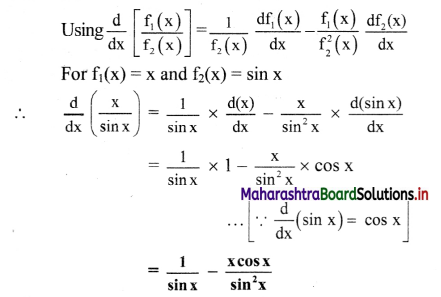
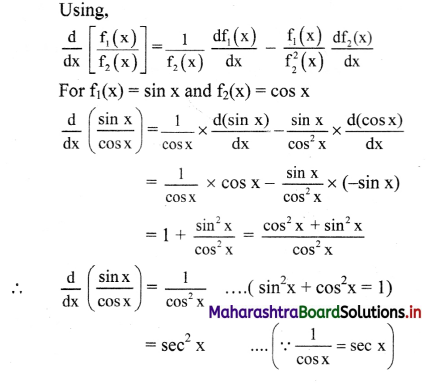
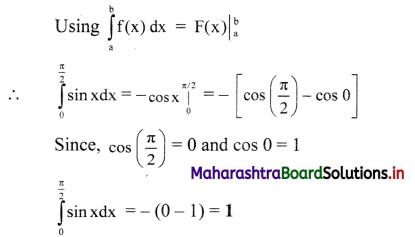
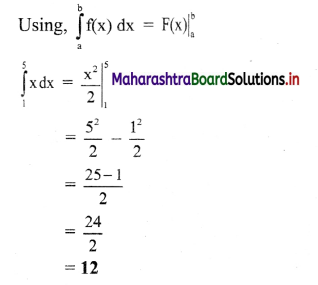
Maharashtra Board 12th Maths Solutions Chapter 5 Application of Definite Integration Ex 5.1

Balbharti 12th Maharashtra State Board Maths Solutions Book Pdf Chapter 5 Application of Definite Integration Ex 5.1 Questions and Answers.

Maharashtra State Board 12th Maths Solutions Chapter 5 Application of Definite Integration Ex 5.1

1. Find the area of the region bounded by the following curves, X-axis, and the given lines:

(i) y = 2x, x = 0, x = 5.
Solution:
Required area = \(\int_{0}^{5} y d x\), where y = 2x
= \(\int_{0}^{5} 2x d x\)
= \(\left[\frac{2 x^{2}}{2}\right]_{0}^{5}\)
= 25 – 0
= 25 sq units.

(ii) x = 2y, y = 0, y = 4.
Solution:
Required area = \(\int_{0}^{4} x d y\), where x = 2y
= \(\int_{0}^{4} 2 y d y\)
= \(\left[\frac{2 y^{2}}{2}\right]_{0}^{4}\)
= 16 – 0
= 16 sq units.

Maharashtra Board 12th Maths Solutions Chapter 5 Application of Definite Integration Ex 5.1

(iii) x = 0, x = 5, y = 0, y = 4.
Solution:
Required area = \(\int_{0}^{5} y d x\), where y = 4
= \(\int_{0}^{5} 4 d x\)
= \([4 x]_{0}^{5}\)
= 20 – 0
= 20 sq units.

(iv) y = sin x, x = 0, x = \(\frac{\pi}{2}\)
Solution:
Required area = \(\int_{0}^{\pi / 2} y d x\), where y = sin x
= \(\int_{0}^{\pi / 2} \sin x d x\)
= \([-\cos x]_{0}^{\pi / 2}\)
= -cos \(\frac{\pi}{2}\) + cos 0
= 0 + 1
= 1 sq unit.

(v) xy = 2, x = 1, x = 4.
Solution:
For xy = 2, y = \(\frac{2}{x}\)
Required area = \(\int_{1}^{4} y d x\), where y = \(\frac{2}{x}\)
= \(\int_{1}^{4} \frac{2}{x} d x\)
= \([2 \log |x|]_{1}^{4}\)
= 2 log 4 – 2 log 1
= 2 log 4 – 0
= 2 log 4 sq units.

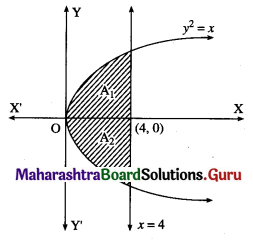
(vi) y2 = x, x = 0, x = 4.
Solution:
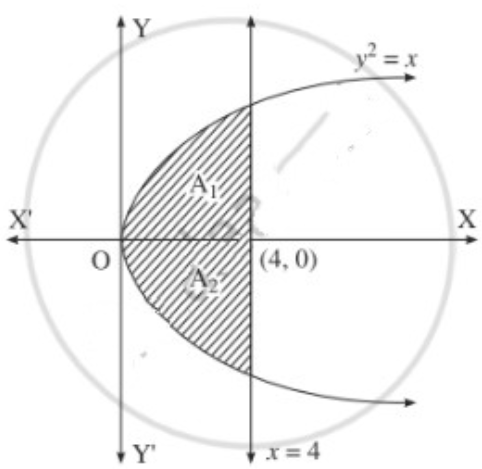
Maharashtra Board 12th Maths Solutions Chapter 5 Application of Definite Integration Ex 5.1 Q1 (vi)
The required area consists of two bounded regions A1 and A2 which are equal in areas.
For y2 = x, y = √x
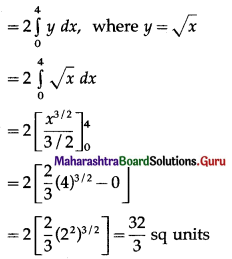
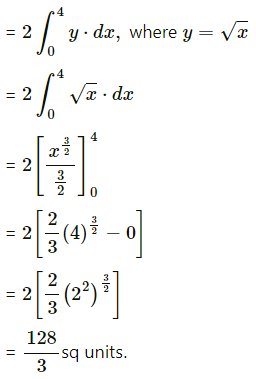
Required area = A1 + A2 = 2A1
Maharashtra Board 12th Maths Solutions Chapter 5 Application of Definite Integration Ex 5.1 Q1 (vi).1

Maharashtra Board 12th Maths Solutions Chapter 5 Application of Definite Integration Ex 5.1

(vii) y2 = 16x, x = 0, x = 4.
Solution:
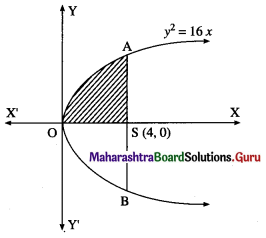
Maharashtra Board 12th Maths Solutions Chapter 5 Application of Definite Integration Ex 5.1 Q1 (vii)
The required area consists of two bounded regions A1 and A2 which are equal in areas.
For y2 = x, y = √x
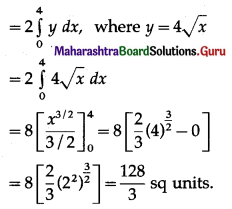
Required area = A1 + A2 = 2A1
Maharashtra Board 12th Maths Solutions Chapter 5 Application of Definite Integration Ex 5.1 Q1 (vii).1

2. Find the area of the region bounded by the parabola:

(i) y2 = 16x and its latus rectum.
Solution:
Comparing y2 = 16x with y2 = 4ax, we get
4a = 16
∴ a = 4
∴ focus is S(a, 0) = (4, 0)
Maharashtra Board 12th Maths Solutions Chapter 5 Application of Definite Integration Ex 5.1 Q2 (i)
For y2 = 16x, y = 4√x
Required area = area of the region OBSAO
= 2 [area of the region OSAO]
Maharashtra Board 12th Maths Solutions Chapter 5 Application of Definite Integration Ex 5.1 Q2 (i).1

(ii) y = 4 – x2 and the X-axis.
Solution:
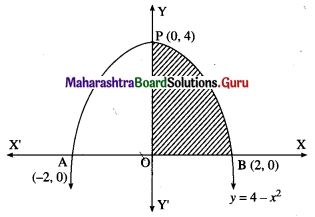
The equation of the parabola is y = 4 – x2
∴ x2 = 4 – y
i.e. (x – 0)2 = -(y – 4)
It has vertex at P(0, 4)
For points of intersection of the parabola with X-axis,
we put y = 0 in its equation.
∴ 0 = 4 – x2
∴ x2 = 4
∴ x = ± 2
∴ the parabola intersect the X-axis at A(-2, 0) and B(2, 0)
Maharashtra Board 12th Maths Solutions Chapter 5 Application of Definite Integration Ex 5.1 Q2 (ii)
Required area = area of the region APBOA
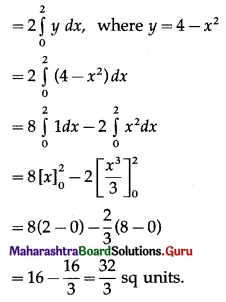
= 2[area of the region OPBO]
Maharashtra Board 12th Maths Solutions Chapter 5 Application of Definite Integration Ex 5.1 Q2 (ii).1

Maharashtra Board 12th Maths Solutions Chapter 5 Application of Definite Integration Ex 5.1

3. Find the area of the region included between:

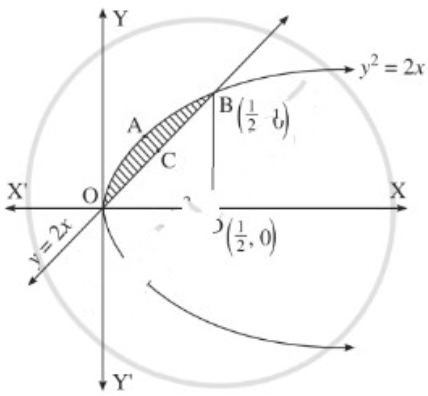
(i) y2 = 2x and y = 2x.
Solution:
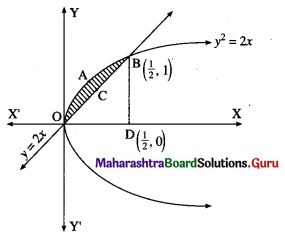
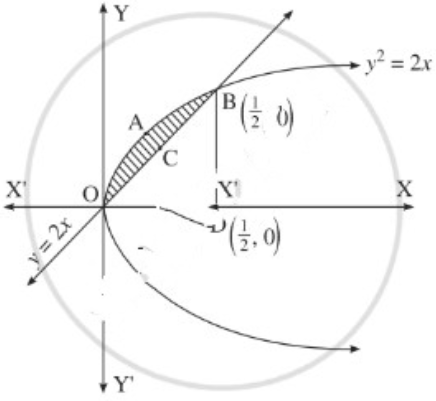
The vertex of the parabola y2 = 2x is at the origin O = (0, 0).
Maharashtra Board 12th Maths Solutions Chapter 5 Application of Definite Integration Ex 5.1 Q3 (i)
To find the points of intersection of the line and the parabola, equaling the values of 2x from both the equations we get,
y2 = y
∴ y2 – y = 0
∴ y = 0 or y = 1
When y = 0, x = \(\frac{0}{2}\) = 0
When y = 1, x = \(\frac{1}{2}\)
∴ the points of intersection are 0(0, 0) and B(\(\frac{1}{2}\), 1)
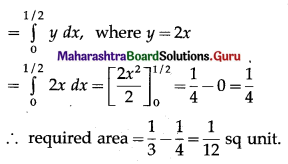
Required area = area of the region OABCO = area of the region OABDO – area of the region OCBDO
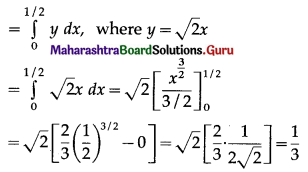
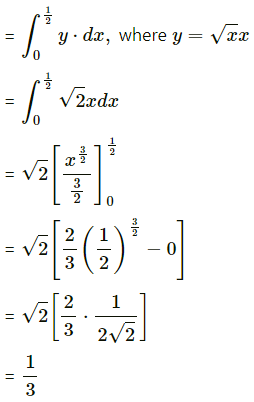
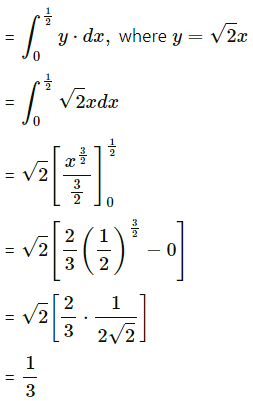
Now, area of the region OABDO = area under the parabola y2 = 2x between x = 0 and x = \(\frac{1}{2}\)
Maharashtra Board 12th Maths Solutions Chapter 5 Application of Definite Integration Ex 5.1 Q3 (i).1
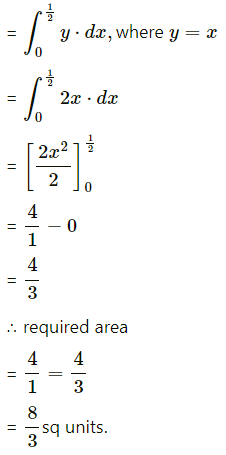
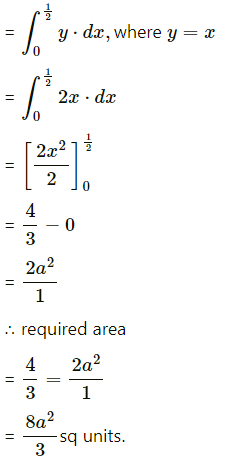
Area of the region OCBDO = area under the line y = 2x between x = 0 and x = \(\frac{1}{2}\)
Maharashtra Board 12th Maths Solutions Chapter 5 Application of Definite Integration Ex 5.1 Q3 (i).2

(ii) y2 = 4x and y = x.
Solution:
The vertex of the parabola y2 = 4x is at the origin O = (0, 0).
Maharashtra Board 12th Maths Solutions Chapter 5 Application of Definite Integration Ex 5.1 Q3 (ii).jpg
To find the points of intersection of the line and the parabola, equaling the values of 4x from both the equations we get,
∴ y2 = y
∴ y2 – y = 0
∴ y(y – 1) = 0
∴ y = 0 or y = 1
When y = 0, x = \(\frac{0}{2}\) = 0
When y = 1, x = \(\frac{1}{2}\)
∴ the points of intersection are O(0, 0) and B(\(\frac{1}{2}\), 1)
Required area = area of the region OABCO = area of the region OABDO – area of the region OCBDO
Now, area of the region OABDO = area under the parabola y2 = 4x between x = 0 and x = \(\frac{1}{2}\)
Maharashtra Board 12th Maths Solutions Chapter 5 Application of Definite Integration Ex 5.1 Q3 (ii).1
Area of the region OCBDO = area under the line y = 2x between x = 0 and x = \(\frac{1}{2}\)
Maharashtra Board 12th Maths Solutions Chapter 5 Application of Definite Integration Ex 5.1 Q3 (ii).2

Maharashtra Board 12th Maths Solutions Chapter 5 Application of Definite Integration Ex 5.1

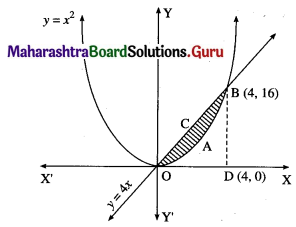
(iii) y = x2 and the line y = 4x.
Solution:
The vertex of the parabola y = x2 is at the origin 0(0, 0)
To find the points of the intersection of a line and the parabola.
Maharashtra Board 12th Maths Solutions Chapter 5 Application of Definite Integration Ex 5.1 Q3 (iii)
Equating the values of y from the two equations, we get
x2 = 4x
∴ x2 – 4x = 0
∴ x(x – 4) = 0
∴ x = 0, x = 4
When x = 0, y = 4(0) = 0
When x = 4, y = 4(4) = 16
∴ the points of intersection are 0(0, 0) and B(4, 16)
Required area = area of the region OABCO = (area of the region ODBCO) – (area of the region ODBAO)
Now, area of the region ODBCO = area under the line y = 4x between x = 0 and x = 4
= \(\int_{0}^{4} y d x\), where y = 4x
= \(\int_{0}^{4} 4 x d x\)
= 4\(\int_{0}^{4} x d x\)
= 4\([latex]\int_{0}^{4} x d x\)[/latex]
= 2(16 – 0)
= 32
Area of the region ODBAO = area under the parabola y = x2 between x = 0 and x = 4
= \(\int_{0}^{4} y d x\), where y = x2
= \(\int_{0}^{4} x^{2} d x\)
= \(\left[\frac{x^{3}}{3}\right]_{0}^{4}\)
= \(\frac{1}{3}\) (64 – 0)
= \(\frac{64}{3}\)
∴ required area = 32 – \(\frac{64}{3}\) = \(\frac{32}{3}\) sq units.

(iv) y2 = 4ax and y = x.
Solution:
The vertex of the parabola y2 = 4ax is at the origin O = (0, 0).
Maharashtra Board 12th Maths Solutions Chapter 5 Application of Definite Integration Ex 5.1 Q3 (iv).jpg
To find the points of intersection of the line and the parabola, equaling the values of 4ax from both the equations we get,
∴ y2 = y
∴ y2 – y = 0
∴ y(y – 1) = 0
∴ y = 0 or y = 1
When y = 0, x = \(\frac{0}{2}\) = 0
When y = 1, x = \(\frac{1}{2}\)
∴ the points of intersection are O(0, 0) and B(\(\frac{1}{2}\), 1)
Required area = area of the region OABCO = area of the region OABDO – area of the region OCBDO
Now, area of the region OABDO
= area under the parabola y2 = 4ax between x = 0 and x = \(\frac{1}{2}\)
Maharashtra Board 12th Maths Solutions Chapter 5 Application of Definite Integration Ex 5.1 Q3 (iv).1
Area of the region OCBDO
= area under the line y
= 4ax between x = 0 and x = \(\frac{1}{4 a x}\)
Maharashtra Board 12th Maths Solutions Chapter 5 Application of Definite Integration Ex 5.1 Q3 (iv).2

Maharashtra Board 12th Maths Solutions Chapter 5 Application of Definite Integration Ex 5.1

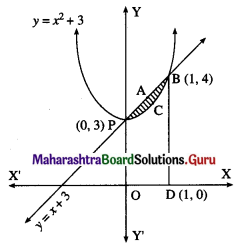
(v) y = x2 + 3 and y = x + 3.
Solution:
The given parabola is y = x2 + 3, i.e. (x – 0)2 = y – 3
∴ its vertex is P(0, 3).
Maharashtra Board 12th Maths Solutions Chapter 5 Application of Definite Integration Ex 5.1 Q3 (v)
To find the points of intersection of the line and the parabola.
Equating the values of y from both the equations, we get
x2 + 3 = x + 3
∴ x2 – x = 0
∴ x(x – 1) = 0
∴ x = 0 or x = 1
When x = 0, y = 0 + 3 = 3
When x = 1, y = 1 + 3 = 4
∴ the points of intersection are P(0, 3) and B(1, 4)
Required area = area of the region PABCP = area of the region OPABDO – area of the region OPCBDO
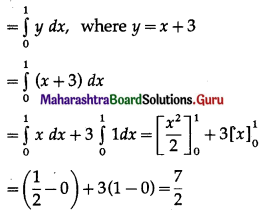
Now, area of the region OPABDO
= area under the line y = x + 3 between x = 0 and x = 1
Maharashtra Board 12th Maths Solutions Chapter 5 Application of Definite Integration Ex 5.1 Q3 (v).1
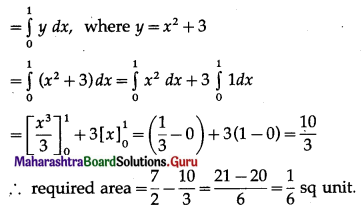
Area of the region OPCBDO = area under the parabola y = x2 + 3 between x = 0 and x = 1
Maharashtra Board 12th Maths Solutions Chapter 5 Application of Definite Integration Ex 5.1 Q3 (v).2

Maharashtra Board 12th Maths Solutions Chapter 6 Differential Equations Ex 6.5

Balbharti 12th Maharashtra State Board Maths Solutions Book Pdf Chapter 6 Differential Equations Ex 6.5 Questions and Answers.

Maharashtra State Board 12th Maths Solutions Chapter 6 Differential Equations Ex 6.5

Question 1.
Solve the following differential equations:
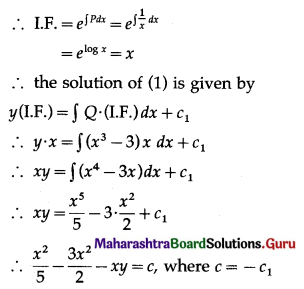
(i) \(\frac{d y}{d x}+\frac{y}{x}=x^{3}-3\)
Solution:
\(\frac{d y}{d x}+\frac{y}{x}=x^{3}-3\) …….(1)
This is the linear differential equation of the form
\(\frac{d y}{d x}\) + P . y = Q, where P = \(\frac{1}{x}\) and Q = x3 – 3
Maharashtra Board 12th Maths Solutions Chapter 6 Differential Equations Ex 6.5 Q1 (i)
This is the general solution.

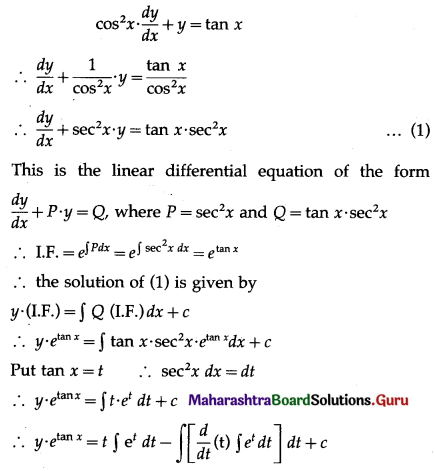
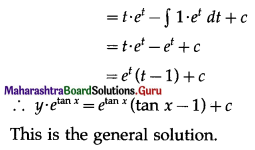
(ii) cos2x . \(\frac{d y}{d x}\) + y = tan x
Solution:
Maharashtra Board 12th Maths Solutions Chapter 6 Differential Equations Ex 6.5 Q1 (ii)
Maharashtra Board 12th Maths Solutions Chapter 6 Differential Equations Ex 6.5 Q1 (ii).1

Maharashtra Board 12th Maths Solutions Chapter 6 Differential Equations Ex 6.5

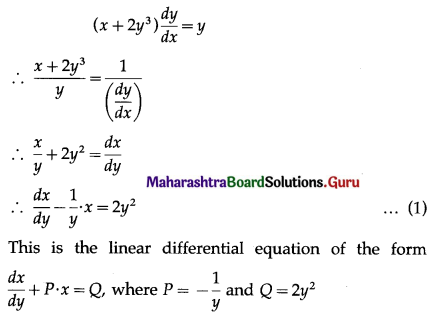
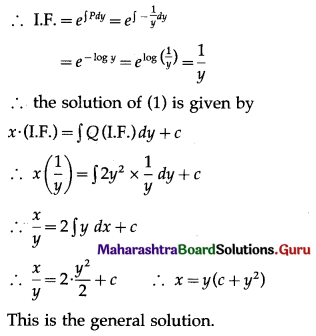
(iii) (x + 2y3) \(\frac{d y}{d x}\) = y
Solution:
Maharashtra Board 12th Maths Solutions Chapter 6 Differential Equations Ex 6.5 Q1 (iii)
Maharashtra Board 12th Maths Solutions Chapter 6 Differential Equations Ex 6.5 Q1 (iii).1

(iv) \(\frac{d y}{d x}\) + y . sec x = tan x
Solution:
\(\frac{d y}{d x}\) + y sec x = tan x
∴ \(\frac{d y}{d x}\) + (sec x) . y = tan x ……..(1)
This is the linear differential equation of the form
\(\frac{d y}{d x}\) + P . y = Q, where P = sec x and Q = tan x
∴ I.F. = \(e^{\int P d x}\)
= \(e^{\int \sec x d x}\)
= \(e^{\log (\sec x+\tan x)}\)
= sec x + tan x
∴ the solution of (1) is given by
y (I.F.) = ∫Q . (I.F.) dx + c
∴ y(sec x + tan x) = ∫tan x (sec x + tan x) dx + c
∴ (sec x + tan x) . y = ∫(sec x tan x + tan2x) dx + c
∴ (sec x + tan x) . y = ∫(sec x tan x + sec2x – 1) dx + c
∴ (sec x + tan x) . y = sec x + tan x – x + c
∴ y(sec x + tan x) = sec x + tan x – x + c
This is the general solution.

Maharashtra Board 12th Maths Solutions Chapter 6 Differential Equations Ex 6.5

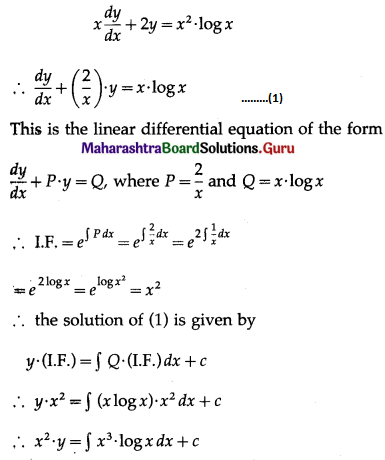
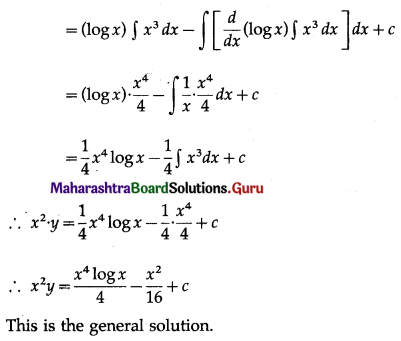
(v) x \(\frac{d y}{d x}\) + 2y = x2 . log x
Solution:
Maharashtra Board 12th Maths Solutions Chapter 6 Differential Equations Ex 6.5 Q1 (v)
Maharashtra Board 12th Maths Solutions Chapter 6 Differential Equations Ex 6.5 Q1 (v).1

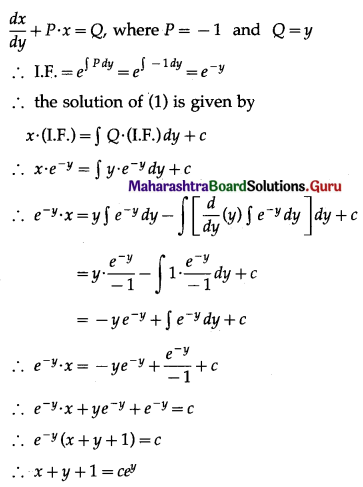
(vi) (x + y) \(\frac{d y}{d x}\) = 1
Solution:
(x + y) \(\frac{d y}{d x}\) = 1
∴ \(\frac{d x}{d y}\) = x + y
∴ \(\frac{d x}{d y}\) – x = y
∴ \(\frac{d x}{d y}\) + (-1) x = y ……….(1)
This is the linear differential equation of the form
Maharashtra Board 12th Maths Solutions Chapter 6 Differential Equations Ex 6.5 Q1 (vi)
This is the general solution.

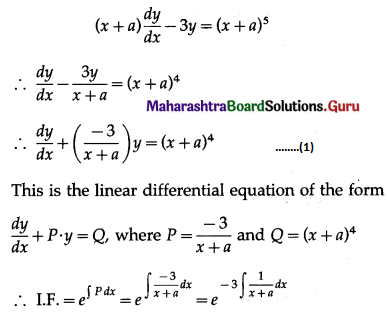
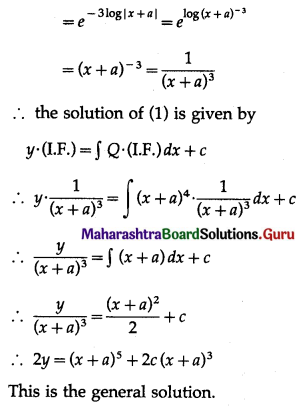
(vii) (x + a) \(\frac{d y}{d x}\) – 3y = (x + a)5
Solution:
Maharashtra Board 12th Maths Solutions Chapter 6 Differential Equations Ex 6.5 Q1 (vii)
Maharashtra Board 12th Maths Solutions Chapter 6 Differential Equations Ex 6.5 Q1 (vii).1

Maharashtra Board 12th Maths Solutions Chapter 6 Differential Equations Ex 6.5

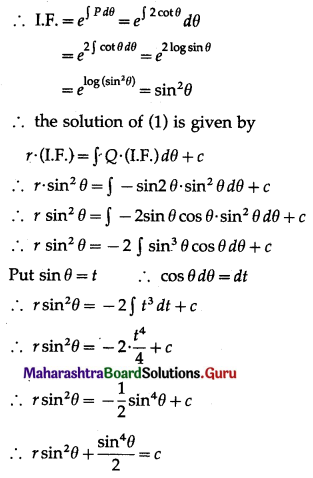
(viii) dr + (2r cot θ + sin 2θ) dθ = 0
Solution:
dr + (2r cot θ + sin 2θ) dθ = 0
∴ \(\frac{d r}{d \theta}\) + (2r cot θ + sin 2θ) = 0
∴ \(\frac{d r}{d \theta}\) + (2 cot θ)r = -sin 2θ ………(1)
This is the linear differential equation of the form dr
\(\frac{d r}{d \theta}\) + P . r = Q, where P = 2 cot θ and Q = -sin 2θ
Maharashtra Board 12th Maths Solutions Chapter 6 Differential Equations Ex 6.5 Q1 (viii)
This is the general solution.

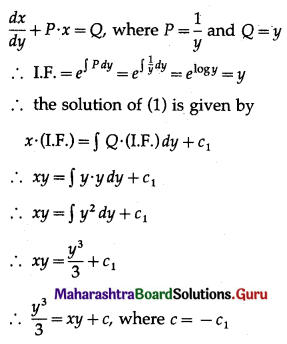
(ix) y dx + (x – y2) dy = 0
Solution:
y dx + (x – y2) dy = 0
∴ y dx = -(x – y2) dy
∴ \(\frac{d x}{d y}=-\frac{\left(x-y^{2}\right)}{y}=-\frac{x}{y}+y\)
∴ \(\frac{d x}{d y}+\left(\frac{1}{y}\right) \cdot x=y\) ………(1)
This is the linear differential equation of the form
Maharashtra Board 12th Maths Solutions Chapter 6 Differential Equations Ex 6.5 Q1 (ix)
This is the general solution.

(x) \(\left(1-x^{2}\right) \frac{d y}{d x}+2 x y=x\left(1-x^{2}\right)^{\frac{1}{2}}\)
Solution:
Maharashtra Board 12th Maths Solutions Chapter 6 Differential Equations Ex 6.5 Q1 (x)
Maharashtra Board 12th Maths Solutions Chapter 6 Differential Equations Ex 6.5 Q1 (x).1

Maharashtra Board 12th Maths Solutions Chapter 6 Differential Equations Ex 6.5

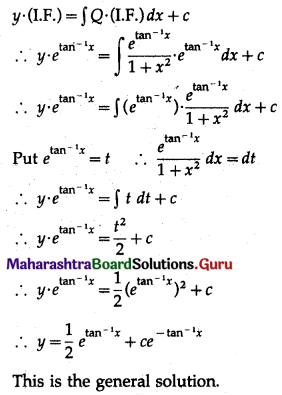
(xi) \(\left(1+x^{2}\right) \frac{d y}{d x}+y=e^{\tan ^{-1} x}\)
Solution:
Maharashtra Board 12th Maths Solutions Chapter 6 Differential Equations Ex 6.5 Q1 (xi)
Maharashtra Board 12th Maths Solutions Chapter 6 Differential Equations Ex 6.5 Q1 (xi).1

Question 2.
Find the equation of the curve which passes through the origin and has the slope x + 3y – 1 at any point (x, y) on it.
Solution:
Let A(x, y) be the point on the curve y = f(x).
Then slope of the tangent to the curve at the point A is \(\frac{d y}{d x}\).
According to the given condition,
\(\frac{d y}{d x}\) = x + 3y – 1
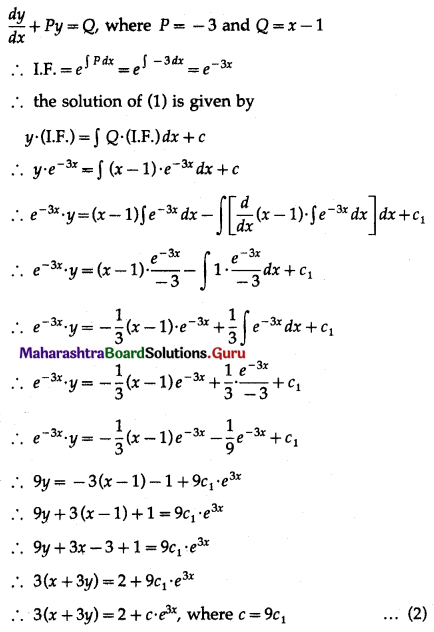
∴ \(\frac{d y}{d x}\) – 3y = x – 1 ………(1)
This is the linear differential equation of the form
Maharashtra Board 12th Maths Solutions Chapter 6 Differential Equations Ex 6.5 Q2
This is the general equation of the curve.
But the required curve is passing through the origin (0, 0).
∴ by putting x = 0 and y = 0 in (2), we get
0 = 2 + c
∴ c = -2
∴ from (2), the equation of the required curve is 3(x + 3y) = 2 – 2e3x i.e. 3(x + 3y) = 2 (1 – e3x).

Maharashtra Board 12th Maths Solutions Chapter 6 Differential Equations Ex 6.5

Question 3.
Find the equation of the curve passing through the point \(\left(\frac{3}{\sqrt{2}}, \sqrt{2}\right)\) having slope of the tangent to the curve at any point (x, y) is \(-\frac{4 x}{9 y}\).
Solution:
Let A(x, y) be the point on the curve y = f(x).
Then the slope of the tangent to the curve at point A is \(\frac{d y}{d x}\).
According to the given condition
\(\frac{d y}{d x}=-\frac{4 x}{9 y}\)
∴ y dy = \(-\frac{4}{9}\) x dx
Integrating both sides, we get
∫y dy= \(-\frac{4}{9}\) ∫x dx
∴ \(\frac{y^{2}}{2}=-\frac{4}{9} \cdot \frac{x^{2}}{2}+c_{1}\)
∴ 9y2 = -4x2 + 18c1
∴ 4x2 + 9y2 = c where c = 18c1
This is the general equation of the curve.
But the required curve is passing through the point \(\left(\frac{3}{\sqrt{2}}, \sqrt{2}\right)\).
∴ by putting x = \(\frac{3}{\sqrt{2}}\) and y = √2 in (1), we get
\(4\left(\frac{3}{\sqrt{2}}\right)^{2}+9(\sqrt{2})^{2}=c\)
∴ 18 + 18 = c
∴ c = 36
∴ from (1), the equation of the required curve is 4x2 + 9y2 = 36.

Question 4.
The curve passes through the point (0, 2). The sum of the coordinates of any point on the curve exceeds the slope of the tangent to the curve at any point by 5. Find the equation of the curve.
Solution:
Let A(x, y) be any point on the curve.
Then slope of the tangent to the curve at the point A is \(\frac{d y}{d x}\).
According to the given condition
x + y = \(\frac{d y}{d x}\) + 5
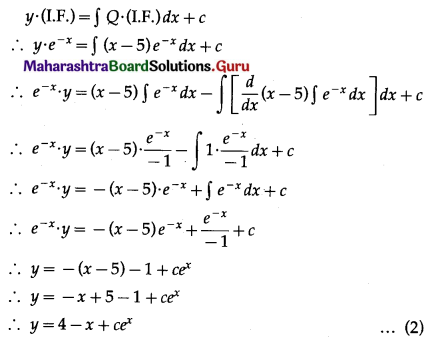
∴ \(\frac{d y}{d x}\) – y = x – 5 ………(1)
This is the linear differential equation of the form
\(\frac{d y}{d x}\) + P . y = Q, where P = -1 and Q = x – 5
∴ I.F. = \(e^{\int P d x}=e^{\int-1 d x}=e^{-x}\)
∴ the solution of (1) is given by
Maharashtra Board 12th Maths Solutions Chapter 6 Differential Equations Ex 6.5 Q4
This is the general equation of the curve.
But the required curve is passing through the point (0, 2).
∴ by putting x = 0, y = 2 in (2), we get
2 = 4 – 0 + c
∴ c = -2
∴ from (2), the equation of the required curve is y = 4 – x – 2ex.

Maharashtra Board 12th Maths Solutions Chapter 6 Differential Equations Ex 6.5

Question 5.
If the slope of the tangent to the curve at each of its point is equal to the sum of abscissa and the product of the abscissa and ordinate of the point. Also, the curve passes through the point (0, 1). Find the equation of the curve.
Solution:
Let A(x, y) be the point on the curve y = f(x).
Then slope of the tangent to the curve at the point A is \(\frac{d y}{d x}\).
According to the given condition
\(\frac{d y}{d x}\) = x + xy
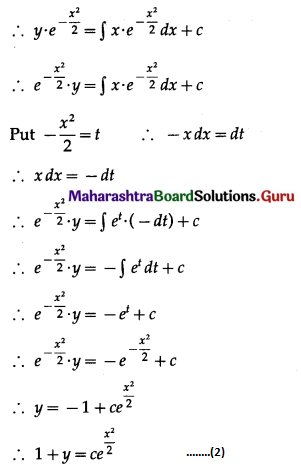
∴ \(\frac{d y}{d x}\) – xy = x ……….. (1)
This is the linear differential equation of the form
\(\frac{d y}{d x}\) + Py = Q, where P = -x and Q = x
∴ I.F. = \(e^{\int P d x}=e^{\int-x d x}=e^{-\frac{x^{2}}{2}}\)
∴ the solution of (1) is given by
y . (I.F.) = ∫Q . (I.F.) dx + c
Maharashtra Board 12th Maths Solutions Chapter 6 Differential Equations Ex 6.5 Q5
This is the general equation of the curve.
But the required curve is passing through the point (0, 1).
∴ by putting x = 0 and y = 1 in (2), we get
1 + 1 = c
∴ c = 2
∴ from (2), the equation of the required curve is 1 + y = \(2 e^{\frac{x^{2}}{2}}\).

Maharashtra Board 12th Maths Solutions Chapter 5 Application of Definite Integration Miscellaneous Exercise 5

Balbharti 12th Maharashtra State Board Maths Solutions Book Pdf Chapter 5 Application of Definite Integration Miscellaneous Exercise 5 Questions and Answers.

Maharashtra State Board 12th Maths Solutions Chapter 5 Application of Definite Integration Miscellaneous Exercise 5

I. Choose the correct option from the given alternatives:

Question 1.
The area bounded by the region 1 ≤ x ≤ 5 and 2 ≤ y ≤ 5 is given by
(a) 12 sq units
(b) 8 sq units
(c) 25 sq units
(d) 32 sq units
Answer:
(a) 12 sq units

Question 2.
The area of the region enclosed by the curve y = \(\frac{1}{x}\), and the lines x = e, x = e2 is given by
(a) 1 sq unit
(b) \(\frac{1}{2}\) sq units
(c) \(\frac{3}{2}\) sq units
(d) \(\frac{5}{2}\) sq units
Answer:
(a) 1 sq unit

Maharashtra Board 12th Maths Solutions Chapter 5 Application of Definite Integration Miscellaneous Exercise 5

Question 3.
The area bounded by the curve y = x3, the X-axis and the lines x = -2 and x = 1 is
(a) -9 sq units
(b) \(-\frac{15}{4}\) sq units
(c) \(\frac{15}{4}\) sq units
(d) \(\frac{17}{4}\) sq units
Answer:
(c) \(\frac{15}{4}\) sq units

Question 4.
The area enclosed between the parabola y2 = 4x and line y = 2x is
(a) \(\frac{2}{3}\) sq units
(b) \(\frac{1}{3}\) sq units
(c) \(\frac{1}{4}\) sq units
(d) \(\frac{3}{4}\) sq units
Answer:
(b) \(\frac{1}{3}\) sq units

Question 5.
The area of the region bounded between the line x = 4 and the parabola y2 = 16x is
(a) \(\frac{128}{3}\) sq units
(b) \(\frac{108}{3}\) sq units
(c) \(\frac{118}{3}\) sq units
(d) \(\frac{218}{3}\) sq units
Answer:
(a) \(\frac{128}{3}\) sq units

Question 6.
The area of the region bounded by y = cos x, Y-axis and the lines x = 0, x = 2π is
(a) 1 sq unit
(b) 2 sq units
(c) 3 sq units
(d) 4 sq units
Answer:
(d) 4 sq units

Maharashtra Board 12th Maths Solutions Chapter 5 Application of Definite Integration Miscellaneous Exercise 5

Question 7.
The area bounded by the parabola y2 = 8x, the X-axis and the latus rectum is
(a) \(\frac{31}{3}\) sq units
(b) \(\frac{32}{3}\) sq units
(c) \(\frac{32 \sqrt{2}}{3}\) sq units
(d) \(\frac{16}{3}\) sq units
Answer:
(b) \(\frac{32}{3}\) sq units

Question 8.
The area under the curve y = 2√x, enclosed between the lines x = 0 and x = 1 is
(a) 4 sq units
(b) \(\frac{3}{4}\) sq units
(c) \(\frac{2}{3}\) sq units
(d) \(\frac{4}{3}\) sq units
Answer:
(d) \(\frac{4}{3}\) sq units

Question 9.
The area of the circle x2 + y2 = 25 in first quadrant is
(a) \(\frac{25 \pi}{3}\) sq units
(b) 5π sq units
(c) 5 sq units
(d) 3 sq units
Answer:
(a) \(\frac{25 \pi}{3}\) sq units

Question 10.
The area of the region bounded by the ellipse \(\frac{x^{2}}{a^{2}}+\frac{y^{2}}{b^{2}}=1\) is
(a) ab sq units
(b) πab sq units
(c) \(\frac{\pi}{a b}\) sq units ab
(d) πa2 sq units
Answer:
(b) πab sq units

Maharashtra Board 12th Maths Solutions Chapter 5 Application of Definite Integration Miscellaneous Exercise 5

Question 11.
The area bounded by the parabola y2 = x and the line 2y = x is
(a) \(\frac{4}{3}\) sq units
(b) 1 sq unit
(c) \(\frac{2}{3}\) sq unit
(d) \(\frac{1}{3}\) sq unit
Answer:
(a) \(\frac{4}{3}\) sq units

Question 12.
The area enclosed between the curve y = cos 3x, 0 ≤ x ≤ \(\frac{\pi}{6}\) and the X-axis is
(a) \(\frac{1}{2}\) sq unit
(b) 1 sq unit
(c) \(\frac{2}{3}\) sq unit
(d) \(\frac{1}{3}\) sq unit
Answer:
(d) \(\frac{1}{3}\) sq unit

Question 13.
The area bounded by y = √x and line x = 2y + 3, X-axis in first quadrant is
(a) 2√3 sq units
(b) 9 sq units
(c) \(\frac{34}{3}\) sq units
(d) 18 sq units
Answer:
(b) 9 sq units

Question 14.
The area bounded by the ellipse \(\frac{x^{2}}{a^{2}}+\frac{y^{2}}{b^{2}}=1\) and the line \(\frac{x}{a}+\frac{y}{b}=1\) is
(a) (πab – 2ab) sq units
(b) \(\frac{\pi a b}{4}-\frac{a b}{2}\) sq units
(c) (πab – ab) sq units
(d) πab sq units
Answer:
(b) \(\frac{\pi a b}{4}-\frac{a b}{2}\) sq units

Question 15.
The area bounded by the parabola y = x2 and the line y = x is
(a) \(\frac{1}{2}\) sq unit
(b) \(\frac{1}{3}\) sq unit
(c) \(\frac{1}{6}\) sq unit
(d) \(\frac{1}{12}\) sq unit
Answer:
(c) \(\frac{1}{6}\) sq unit

Maharashtra Board 12th Maths Solutions Chapter 5 Application of Definite Integration Miscellaneous Exercise 5

Question 16.
The area enclosed between the two parabolas y2 = 4x and y = x is
(a) \(\frac{8}{3}\) sq units
(b) \(\frac{32}{3}\) sq units
(c) \(\frac{16}{3}\) sq units
(d) \(\frac{4}{3}\) sq units
Answer:
(c) \(\frac{16}{3}\) sq units

Question 17.
The area bounded by the curve y = tan x, X-axis and the line x = \(\frac{\pi}{4}\) is
(a) \(\frac{1}{3}\) log 2 sq units
(b) log 2 sq units
(c) 2 log 2 sq units
(d) 3 log 2 sq units
Answer:
(a) \(\frac{1}{3}\) log 2 sq units

Question 18.
The area of the region bounded by x2 = 16y, y = 1, y = 4 and x = 0 in the first quadrant, is
(a) \(\frac{7}{3}\) sq units
(b) \(\frac{8}{3}\) sq units
(c) \(\frac{64}{3}\) sq units
(d) \(\frac{56}{3}\) sq units
Answer:
(d) \(\frac{56}{3}\) sq units

Question 19.
The area of the region included between the parabolas y2 = 4ax and x2 = 4ay, (a > 0) is given by
(a) \(\frac{16 a^{2}}{3}\) sq units
(b) \(\frac{8 a^{2}}{3}\) sq units
(c) \(\frac{4 a^{2}}{3}\) sq units
(d) \(\frac{32 a^{2}}{3}\) sq units
Answer:
(a) \(\frac{16 a^{2}}{3}\) sq units

Maharashtra Board 12th Maths Solutions Chapter 5 Application of Definite Integration Miscellaneous Exercise 5

Question 20.
The area of the region included between the line x + y = 1 and the circle x2 + y2 = 1 is
(a) \(\frac{\pi}{2}-1\) sq units
(b) π – 2 sq units
(c) \(\frac{\pi}{4}-\frac{1}{2}\) sq units
(d) π – \(\frac{1}{2}\) sq units
Answer:
(c) \(\frac{\pi}{4}-\frac{1}{2}\) sq units

(II) Solve the following:

Question 1.
Find the area of the region bounded by the following curve, the X-axis and the given lines:
(i) 0 ≤ x ≤ 5, 0 ≤ y ≤ 2
(ii) y = sin x, x = 0, x = π
(iii) y = sin x, x = 0, x = \(\frac{\pi}{3}\)
Solution:
(i) Required area = \(\int_{0}^{5} y d x\), where y = 2
= \(\int_{0}^{5} 2 d x\)
= \([2 x]_{0}^{5}\)
= 2 × 5 – 0
= 10 sq units.

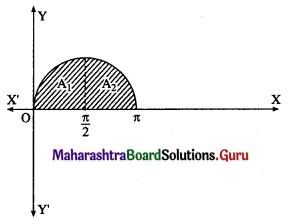
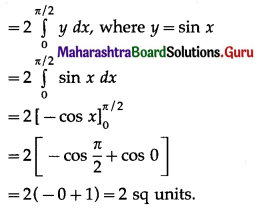
(ii) The curve y = sin x intersects the X-axis at x = 0 and x = π between x = 0 and x = π.
Maharashtra Board 12th Maths Solutions Chapter 5 Application of Definite Integration Miscellaneous Exercise 5 II Q1(ii)
Two bounded regions A1 and A2 are obtained. Both the regions have equal areas.
∴ required area = A1 + A2 = 2A1
Maharashtra Board 12th Maths Solutions Chapter 5 Application of Definite Integration Miscellaneous Exercise 5 II Q1(ii).1

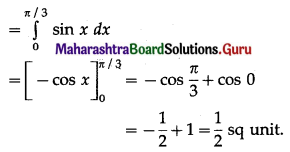
(iii) Required area = \(\int_{0}^{\pi / 3} y d x\), where y = sin x
Maharashtra Board 12th Maths Solutions Chapter 5 Application of Definite Integration Miscellaneous Exercise 5 II Q1(iii)

Maharashtra Board 12th Maths Solutions Chapter 5 Application of Definite Integration Miscellaneous Exercise 5

Question 2.
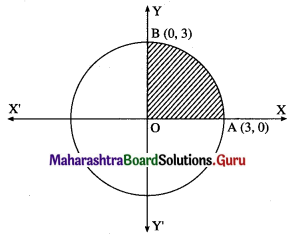
Find the area of the circle x2 + y2 = 9, using integration.
Solution:
By the symmetry of the circle, its area is equal to 4 times the area of the region OABO.
Clearly, for this region, the limits of integration are 0 and 3.
Maharashtra Board 12th Maths Solutions Chapter 5 Application of Definite Integration Miscellaneous Exercise 5 II Q2
From the equation of the circle, y2 = 9 – x2.
In the first quadrant, y > 0
∴ y = \(\sqrt{9-x^{2}}\)
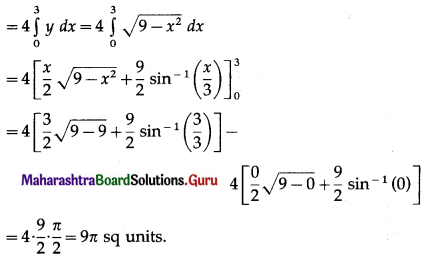
∴ area of the circle = 4 (area of the region OABO)
Maharashtra Board 12th Maths Solutions Chapter 5 Application of Definite Integration Miscellaneous Exercise 5 II Q2.1

Question 3.
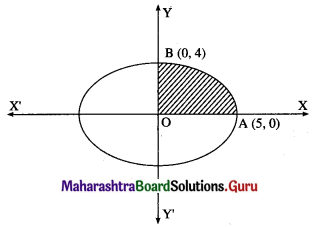
Find the area of the ellipse \(\frac{x^{2}}{25}+\frac{y^{2}}{16}=1\) using integration.
Solution:
Maharashtra Board 12th Maths Solutions Chapter 5 Application of Definite Integration Miscellaneous Exercise 5 II Q3
By the symmetry of the ellipse, its area is equal to 4 times the area of the region OABO.
Clearly, for this region, the limits of integration are 0 and 5.
From the equation of the ellipse
\(\frac{y^{2}}{16}=1-\frac{x^{2}}{25}=\frac{25-x^{2}}{25}\)
∴ y2 = \(\frac{16}{25}\) (25 – x2)
In the first quadrant y > 0
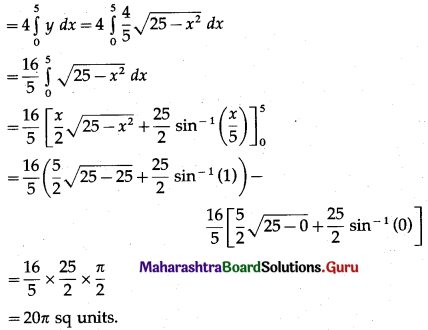
∴ y = \(\frac{4}{5} \sqrt{25-x^{2}}\)
∴ area of the ellipse = 4(area of the region OABO)
Maharashtra Board 12th Maths Solutions Chapter 5 Application of Definite Integration Miscellaneous Exercise 5 II Q3.1

Question 4.
Find the area of the region lying between the parabolas:
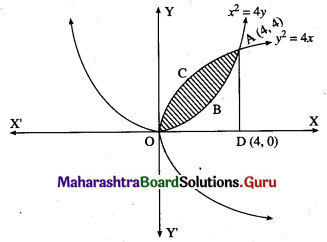
(i) y2 = 4x and x2 = 4y
(ii) 4y2 = 9x and 3x2 = 16y
(iii) y2 = x and x2 = y.
Solution:
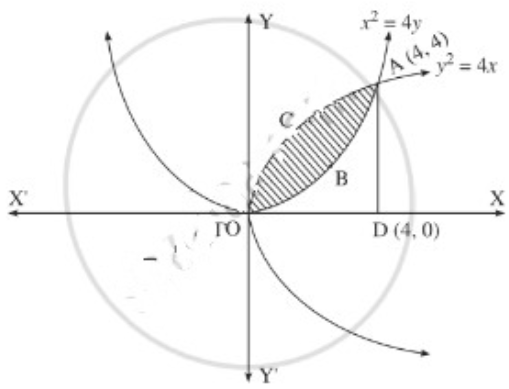
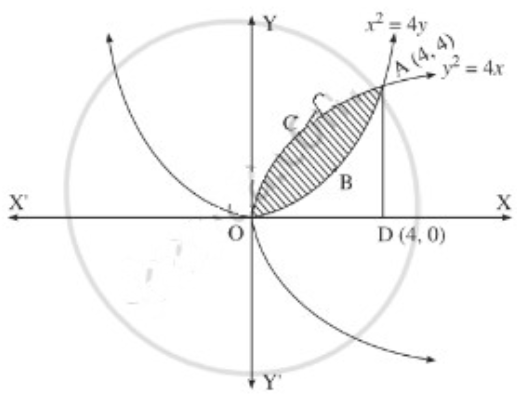
(i)
Maharashtra Board 12th Maths Solutions Chapter 5 Application of Definite Integration Miscellaneous Exercise 5 II Q4(i)
For finding the points of intersection of the two parabolas, we equate the values of y2 from their equations.
From the equation x2 = 4y, y = \(\frac{x^{2}}{4}\)
y = \(\frac{x^{4}}{16}\)
\(\frac{x^{4}}{16}\) = 4x
∴ x4 – 64x = 0
∴ x(x3 – 64) = 0
∴ x = 0 or x3 = 64 i.e. x = 0 or x = 4
When x = 0, y = 0
When x = 4, y = \(\frac{4^{2}}{4}\) = 4
∴ the points of intersection are 0(0, 0) and A(4, 4).
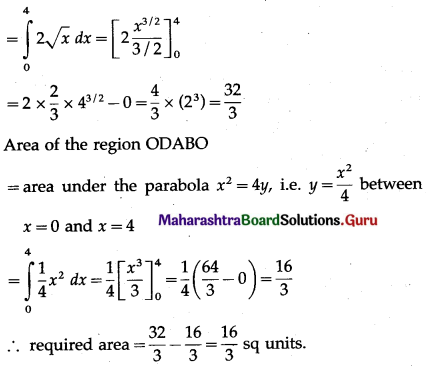
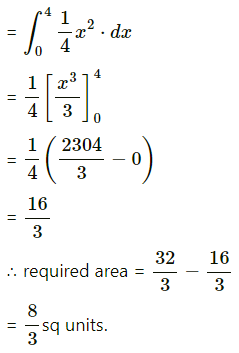
Required area = area of the region OBACO = [area of the region ODACO] – [area of the region ODABO]
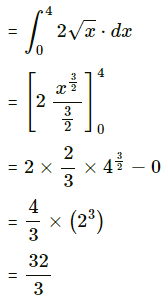
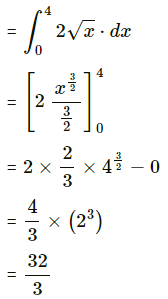
Now, area of the region ODACO = area under the parabola y2 = 4x, i.e. y = 2√x between x = 0 and x = 4
Maharashtra Board 12th Maths Solutions Chapter 5 Application of Definite Integration Miscellaneous Exercise 5 II Q4(i).1

(ii)
Maharashtra Board 12th Maths Solutions Chapter 5 Application of Definite Integration Miscellaneous Exercise 5 II Q4(ii)
For finding the points of intersection of the two parabolas, we equate the values of 4y2 from their equations.
From the equation 3x2 = 16y, y = \(\frac{3 x^{2}}{16}\)
∴ y = \(\frac{3 x^{4}}{256}\)
∴ \(\frac{3 x^{4}}{256}\) = 9x
∴ 3x4 – 2304x = 0
∴ x(x3 – 2304) = 0
∴ x = 0 or x3 = 2304 i.e. x = 0 or x = 4
When x = 0, y = 0
When x = 4, y = \(\frac{4^{2}}{4}\)
∴ the points of intersection are O(0, 0) and A(4, 4).
Required area = area of the region OBACO = [area of the region ODACO] – [area of the region ODABO]
Now, area of the region ODACO = area under the parabola y2 = 4x,
i.e. y = 2√x between x = 0 and x = 4
Maharashtra Board 12th Maths Solutions Chapter 5 Application of Definite Integration Miscellaneous Exercise 5 II Q4(ii).1
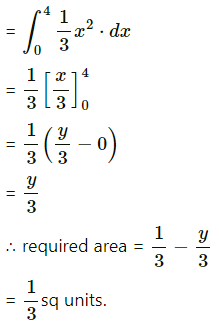
Area of the region ODABO = area under the rabola x2 = 4y,
i.e. y = \(\frac{x^{2}}{4}\) between x = 0 and x = 4
Maharashtra Board 12th Maths Solutions Chapter 5 Application of Definite Integration Miscellaneous Exercise 5 II Q4(ii).2

Maharashtra Board 12th Maths Solutions Chapter 5 Application of Definite Integration Miscellaneous Exercise 5

(iii)
Maharashtra Board 12th Maths Solutions Chapter 5 Application of Definite Integration Miscellaneous Exercise 5 II Q4(iii)
For finding the points of intersection of the two parabolas, we equate the values of y2 from their equations.
From the equation x2 = y, y = \(\frac{x^{2}}{y}\)
∴ y = \(\frac{x^{2}}{y}\)
∴ \(\frac{x^{2}}{y}\) = x
∴ x2 – y = 0
∴ x(x3 – y) = 0
∴ x = 0 or x3 = y
i.e. x = 0 or x = 4
When x = 0, y = 0
When x = 4, y = \(\frac{4^{2}}{4}\) = 4
∴ the points of intersection are O(0, 0) and A(4, 4).
Required area = area of the region OBACO = [area of the region ODACO] – [area of the region ODABO]
Now, area of the region ODACO = area under the parabola y2 = 4x,
i.e. y = 2√x between x = 0 and x = 4
Maharashtra Board 12th Maths Solutions Chapter 5 Application of Definite Integration Miscellaneous Exercise 5 II Q4(iii).1
Area ofthe region ODABO = area under the rabola x2 = 4y,
i.e. y = \(\frac{x^{2}}{3}\) between x = 0 and x = 4
Maharashtra Board 12th Maths Solutions Chapter 5 Application of Definite Integration Miscellaneous Exercise 5 II Q4(iii).2

Question 5.
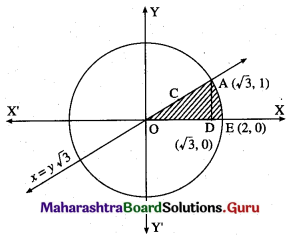
Find the area of the region in the first quadrant bounded by the circle x2 + y2 = 4 and the X-axis and the line x = y√3.
Solution:
Maharashtra Board 12th Maths Solutions Chapter 5 Application of Definite Integration Miscellaneous Exercise 5 II Q5
For finding the points of intersection of the circle and the line, we solve
x2 + y2 = 4 ………(1)
and x = y√3 ……..(2)
From (2), x2 = 3y2
From (1), x2 = 4 – y2
3y2 = 4 – y2
4y2 = 4
y2 = 1
y = 1 in the first quadrant.
When y = 1, r = 1 × √3 = √3
∴ the circle and the line intersect at A(√3, 1) in the first quadrant
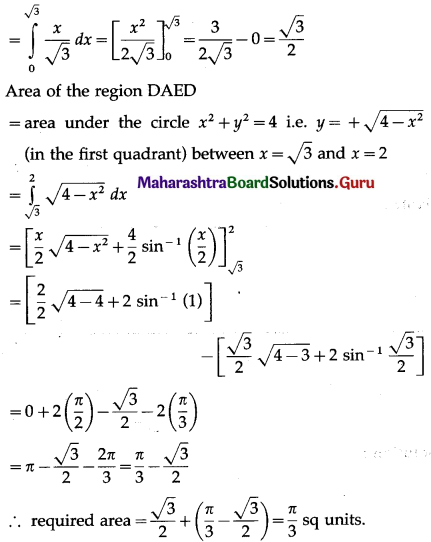
Required area = area of the region OCAEDO = area of the region OCADO + area of the region DAED
Now, area of the region OCADO = area under the line x = y√3, i.e. y = \(\frac{x}{\sqrt{3}}\) between x = 0
and x = √3
Maharashtra Board 12th Maths Solutions Chapter 5 Application of Definite Integration Miscellaneous Exercise 5 II Q5.1

Question 6.
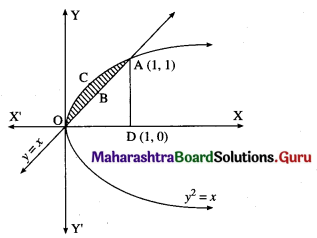
Find the area of the region bounded by the parabola y2 = x and the line y = x in the first quadrant.
Solution:
To obtain the points of intersection of the line and the parabola, we equate the values of x from both equations.
Maharashtra Board 12th Maths Solutions Chapter 5 Application of Definite Integration Miscellaneous Exercise 5 II Q6
∴ y2 = y
∴ y2 – y = 0
∴ y(y – 1) = 0
∴ y = 0 or y = 1
When y = 0, x = 0
When y = 1, x = 1
∴ the points of intersection are O(0, 0) and A(1, 1).
Required area = area of the region OCABO = area of the region OCADO – area of the region OBADO
Now, area of the region OCADO = area under the parabola y2 = x i.e. y = +√x (in the first quadrant) between x = 0 and x = 1
Maharashtra Board 12th Maths Solutions Chapter 5 Application of Definite Integration Miscellaneous Exercise 5 II Q6.1
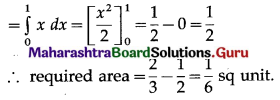
Area of the region OBADO = area under the line y = x between x = 0 and x = 1
Maharashtra Board 12th Maths Solutions Chapter 5 Application of Definite Integration Miscellaneous Exercise 5 II Q6.2

Maharashtra Board 12th Maths Solutions Chapter 5 Application of Definite Integration Miscellaneous Exercise 5

Question 7.
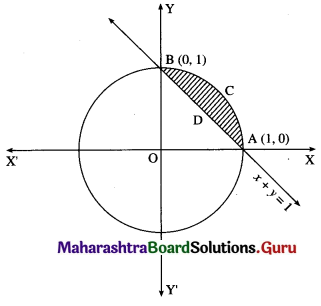
Find the area enclosed between the circle x2 + y2 = 1 and the line x + y = 1, lying in the first quadrant.
Solution:
Maharashtra Board 12th Maths Solutions Chapter 5 Application of Definite Integration Miscellaneous Exercise 5 II Q7
Required area = area of the region ACBPA = (area of the region OACBO) – (area of the region OADBO)
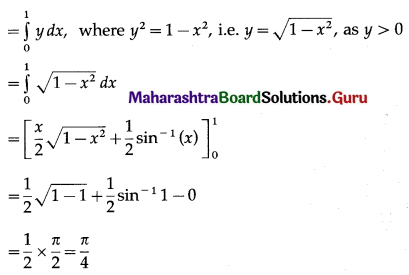
Now, area of the region OACBO = area under the circle x2 + y2 = 1 between x = 0 and x = 1
Maharashtra Board 12th Maths Solutions Chapter 5 Application of Definite Integration Miscellaneous Exercise 5 II Q7.1
Area of the region OADBO = area under the line x + y = 1 between x = 0 and x = 1
Maharashtra Board 12th Maths Solutions Chapter 5 Application of Definite Integration Miscellaneous Exercise 5 II Q7.2
∴ required area = \(\left(\frac{\pi}{4}-\frac{1}{2}\right)\) sq units.

Question 8.
Find the area of the region bounded by the curve (y – 1)2 = 4(x + 1) and the line y = (x – 1).
Solution:
The equation of the curve is (y – 1)2 = 4(x + 1)
This is a parabola with vertex at A (-1, 1).
To find the points of intersection of the line y = x – 1 and the parabola.
Put y = x – 1 in the equation of the parabola, we get
(x – 1 – 1)2 = 4(x + 1)
∴ x2 – 4x + 4 = 4x + 4
∴ x2 – 8x = 0
∴ x(x – 8) = 0
∴ x = 0, x = 8
When x = 0, y = 0 – 1 = -1
When x = 8, y = 8 – 1 = 7
∴ the points of intersection are B (0, -1) and C (8, 7).
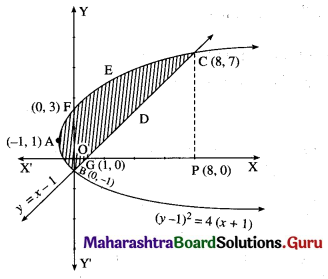
Maharashtra Board 12th Maths Solutions Chapter 5 Application of Definite Integration Miscellaneous Exercise 5 II Q8
To find the points where the parabola (y – 1)2 = 4(x + 1) cuts the Y-axis.
Put x = 0 in the equation of the parabola, we get
(y – 1)2 = 4(0 + 1) = 4
∴ y – 1 = ±2
∴ y – 1 = 2 or y – 1 = -2
∴ y = 3 or y = -1
∴ the parabola cuts the Y-axis at the points B(0, -1) and F(0, 3).
To find the point where the line y = x – 1 cuts the X-axis.
Put y = 0 in the equation of the line, we get
x – 1 = 0
∴ x = 1
∴ the line cuts the X-axis at the point G (1, 0).
Required area = area of the region BFAB + area of the region OGDCEFO + area of the region OBGO
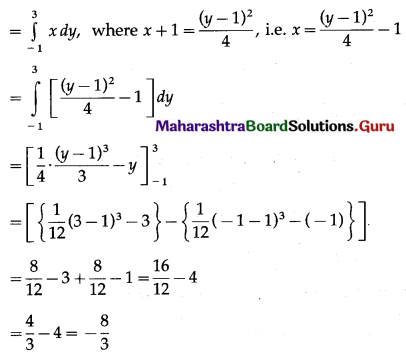
Now, area of the region BFAB = area under the parabola (y – 1)2 = 4(x + 1), Y-axis from y = -1 to y = 3
Maharashtra Board 12th Maths Solutions Chapter 5 Application of Definite Integration Miscellaneous Exercise 5 II Q8.1
Since, the area cannot be negative,
Area of the region BFAB = \(\left|-\frac{8}{3}\right|=\frac{8}{3}\) sq units.
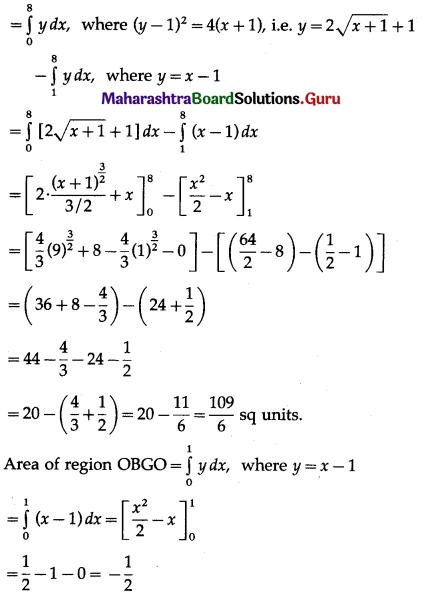
Area of the region OGDCEFO = area of the region OPCEFO – area of the region GPCDG
Maharashtra Board 12th Maths Solutions Chapter 5 Application of Definite Integration Miscellaneous Exercise 5 II Q8.2
Since, area cannot be negative,
area of the region = \(\left|-\frac{1}{2}\right|=\frac{1}{2}\) sq units.
∴ required area = \(\frac{8}{3}+\frac{109}{6}+\frac{1}{2}\)
= \(\frac{16+109+3}{6}\)
= \(\frac{128}{6}\)
= \(\frac{64}{3}\) sq units.

Maharashtra Board 12th Maths Solutions Chapter 5 Application of Definite Integration Miscellaneous Exercise 5

Question 9.
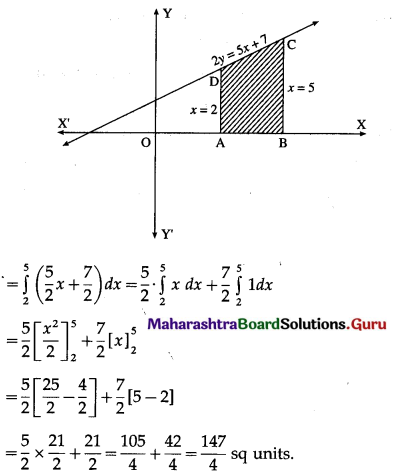
Find the area of the region bounded by the straight line 2y = 5x + 7, X-axis and x = 2, x = 5.
Solution:
The equation of the line is
2y = 5x + 7, i.e., y = \(\frac{5}{2} x+\frac{7}{2}\)
Required area = area of the region ABCDA = area under the line y = \(\frac{5}{2} x+\frac{7}{2}\) between x = 2 and x = 5
Maharashtra Board 12th Maths Solutions Chapter 5 Application of Definite Integration Miscellaneous Exercise 5 II Q9

Maharashtra Board 12th Maths Solutions Chapter 5 Application of Definite Integration Miscellaneous Exercise 5

Question 10.
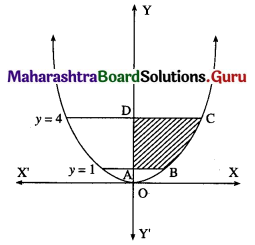
Find the area of the region bounded by the curve y = 4x2, Y-axis and the lines y = 1, y = 4.
Solution:
Maharashtra Board 12th Maths Solutions Chapter 5 Application of Definite Integration Miscellaneous Exercise 5 II Q10
By symmetry of the parabola, the required area is 2 times the area of the region ABCD.
From the equation of the parabola, x2 = \(\frac{y}{4}\)
In the first quadrant, x > 0
∴ x = \(\frac{1}{2} \sqrt{y}\)
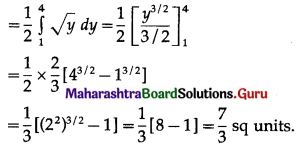
∴ required area = \(\int_{1}^{4} x d y\)
Maharashtra Board 12th Maths Solutions Chapter 5 Application of Definite Integration Miscellaneous Exercise 5 II Q10.1

Maharashtra Board Class 11 Physics Solutions Chapter 7 Thermal Properties of Matter

Balbharti Maharashtra State Board 11th Physics Textbook Solutions Chapter 7 Thermal Properties of Matter Textbook Exercise Questions and Answers.

Maharashtra State Board 11th Physics Solutions Chapter 7 Thermal Properties of Matter

1. Choose the correct option.

Question 1.
The range of temperature in a clinical thermometer, which measures the temperature of the human body, is
(A) 70 ºC to 100 ºC
(B) 34 ºC to 42 ºC
(C) 0 ºF to 100 ºF
(D) 34 ºF to 80 ºF
Answer:
(B) 34 ºC to 42 ºC

Question 2.
A glass bottle completely filled with water is kept in the freezer. Why does it crack?
(A) Bottle gets contracted
(B) Bottle is expanded
(C) Water expands on freezing
(D) Water contracts on freezing
Answer:
(C) Water expands on freezing

Maharashtra Board Class 11 Physics Solutions Chapter 7 Thermal Properties of Matter

Question 3.
If two temperatures differ by 25 °C on Celsius scale, the difference in temperature on Fahrenheit scale is
(A) 65°
(B) 45°
(C) 38°
(D) 25°
Answer:
(B) 45°

Question 4.
If α, β and γ are coefficients of linear, area l and volume expansion of a solid then
(A) α: β:γ 1:3:2
(B) α:β:γ 1:2:3
(C) α:β:γ 2:3:1
(D) α:β:γ 3:1:2
Answer:
(B) α:β:γ 1:2:3

Question 5.
Consider the following statements-
(I) The coefficient of linear expansion has dimension K-1
(II) The coefficient of volume expansion has dimension K-1
(A) I and II are both correct
(B) I is correct but II is wrong
(C) II is correct but I is wrong
(D) I and II are both wrong
Answer:
(A) I and II are both correct

Question 6.
Water falls from a height of 200 m. What is the difference in temperature between the water at the top and bottom of a water fall given that specific heat of water is 4200 J kg-1 °C-1?
(A) 0.96 °C
(B) 1.02 °C
(C) 0.46 °C
(D) 1.16 °C
Answer:
(C) 0.46 °C

2. Answer the following questions.

Question 1.
Clearly state the difference between heat and temperature?
Answer:

HeatTemperature
i.Heat is energy in transit. When two bodies at different temperatures are brought in contact, they exchange heat.
OR
Heat is the form of energy transferred between two (or more) systems or a system and its surroundings by virtue of their temperature difference.
Temperature is a physical quantity that defines the thermodynamic state of a system.
OR
Heat transfer takes place between the body and the surrounding medium until the body and the surrounding medium are at the same temperature.
ii.Heat exchange can be measured with the help of a calorimeter.Temperature is measured with the help of a thermometer.
iii.Heat (being a form of energy) is a derived quantity.Temperature is a fundamental quantity.

Question 2.
How a thermometer is calibrated?
Answer:

  1. For the calibration of a thermometer, a standard temperature interval is selected between two easily reproducible fixed temperatures.
  2. The fact that substances change state from solid to liquid to gas at fixed temperatures is used to define reference temperature called fixed point.
  3. The two fixed temperatures selected for this purpose are the melting point of ice or freezing point of water and the boiling point of water.
  4. This standard temperature interval is divided into sub-intervals by utilizing some physical property that changes with temperature.
  5. Each sub-interval is called as a degree of temperature. Thus, an empirical scale for temperature is set up.

Maharashtra Board Class 11 Physics Solutions Chapter 7 Thermal Properties of Matter

Question 3.
What are different scales of temperature? What is the relation between them?
Answer:

  1. Celsius scale:
    • The ice point (melting point of pure ice) is marked as O °C (lower point) and steam point (boiling point of water) is marked as 100 °C (higher point).
    • Both are taken at one atmospheric pressure.
    • The interval between these points is divided into two equal parts. Each of these parts is called as one degree celsius and it is ‘written as 1 °C.
  2. Fahrenheit scale:
    • The ice point (melting point of pure ice) is marked as 32 °F and steam point (boiling point of water) is marked as 212 °F.
    • The interval between these two reference points is divided into 180 equal parts. Each part is called as degree fahrenheit and is written as 1 °F.
  3. Kelvin scale:
    • The temperature scale that has its zero at -273.15 °C and temperature intervals are same as that on the Celsius scale is called as kelvin scale or absolute scale.
    • The absolute temperature, T and celsius temperature, TC are related as, T = TC + 273.15
      eg.: when TC = 27 °C,
      T = 27+273.15 K = 300.15 K

Relation between different scales of temperature:
\(\frac{\mathrm{T}_{\mathrm{F}}-32}{180}=\frac{\mathrm{T}_{\mathrm{C}}-0}{100}=\frac{\mathrm{T}_{\mathrm{K}}-273.15}{100}\)
where,
TF = temperature in fahrenheit scale,
TC = temperature in celsius scale,
TK = temperature in kelvin scale,
[Note: At zero of the kelvin scale, every substance in nature has the least possible activity.]

Question 4.
What is absolute zero?
Answer:
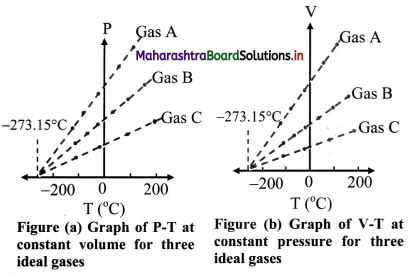
Maharashtra Board Class 11 Physics Solutions Chapter 7 Thermal Properties of Matter 1

  1. When the graph of pressure (P) against temperature T (°C) at constant volume for three ideal gases A, B and C is plotted, in each case, P -T graph is straight line indicating direct proportion between them. The slopes of these graphs are different.
  2. The individual straight lines intersect the pressure axis at different values of pressure at O °C. but each line intersects the temperature axis at the same point, i.e., at absolute temperature (-273.15 °C).
  3. Similarly graph at constant pressure for three different ideal gases A, B and C extrapolate to the same temperature intercept -273.15 °C i.e., absolute zero temperature.
  4. It is seen that all the lines for different gases Cut the temperature axis at the same point at -273.15 °C.
  5. This point is termed as the absolute zero of temperature.
  6. It is not possible to attain a temperature lower than this value. Even to achieve absolute zero temperature is not possible in practice.
    [Note: The point of zero pressure or zero volume does not depend on am specific gas.]

Question 5.
Derive the relation between three coefficients of thermal expansion.
Answer:
Consider a square plate of side l0 at 0 °C and h at T °C.

  1. lT = l0 (1 + αT)
    If area of plate at 0 °C is A0, A0 = \(l_{0}^{2}\)
    If area of plate at T °C is AT,
    AT = \(l_{\mathrm{T}}^{2}=l_{0}^{2}\) (1 + αT)2
    or AT = A0 (1 + αT)2 …………… (1)
    Also,
    AT = A0(1 + βT)2 …………… (2)
    ……………. [∵ β = \(\frac{\mathrm{A}_{\mathrm{T}}-\mathrm{A}_{0}}{\mathrm{~A}_{0}\left(\mathrm{~T}-\mathrm{T}_{0}\right)}\)]
  2. Using Equations (1) and (2),
    A0 (1 + αT)2 = A0(1 + βT)
    ∴ 1 + 2αT + α2T2 = 1 + βT
  3. Since the values of a are very small, the term α2T2 is very small and may be neglected,
    ∴ β = 2a
  4. The result is general because any solid can be regarded as a collection of small squares.

Relation between coefficient of linear expansion (α) and coefficient of cubical expansion (γ).

  1. Consider a cube of side l0 at 0 °C and lT at T °C.
    ∴ lT = l0(1 + αT)
    If volume of the cube at 0 °C is V0, V0 = \(l_{0}^{3}\)
    If volume of the cube at T °C is
    VT, VT = \(l_{\mathrm{T}}^{3}=l_{0}^{3}\) (1 + αT)3
    VT = V0 (1 + αT)3 ………. (1)
    Also,
    VT = V0(1 + γT) …………. (2)
    …………. [∵ γ = \(\frac{\mathrm{V}_{\mathrm{T}}-\mathrm{V}_{0}}{\mathrm{~V}_{0}\left(\mathrm{~T}-\mathrm{T}_{0}\right)}\)]
  2. Using Equations (1) and (2),
    V0(1 + αT)3 = V0(1 + γT)
    ∴ 1 + 3αT + 3α2T2 + α3T3 = 1 + γT
  3. Since the values of a are very small, the terms with higher powers of a may be neglected,
    ∴ γ = 3α
  4. The result is general because any solid can be regarded as a collection of small cubes.

Relation between α, β and γ is given by,
α = \(\frac{\beta}{2}=\frac{\gamma}{3}\)
where, α = coefficient of linear expansion.
β = coefficient of superficial expansion,
γ = coefficient of cubical expansion.

Maharashtra Board Class 11 Physics Solutions Chapter 7 Thermal Properties of Matter

Question 6.
State applications of thermal expansion.
Answer:
Applications of thermal expansion:

  • The steel wheel is heated to expand. This expanded wheel can easily fit over axle. The wheel is then cooled quickly. Upon cooling, wheel contracts and fits tightly upon the axle.
  • An electric light bulb gets hot quickly when in use. The wire leads to the filament are sealed into the glass. 1f the glass of the bulbs has significantly different thermal expansivity from the wire leads, the glass and the wire would separate, breaking down the vacuum. To prevent this, wires are made of platinum or some suitable alloy with the same expansivity as ordinary glass.

Question 7.
Why do we generally consider two specific heats for a gas?
Answer:

  • A slight change in temperature causes considerable change in pressure as well as volume of the gas.
  • Therefore, two principal specific heats are defined for a gas viz., specific heat capacity at constant volume (SV) and specific heat capacity at constant pressure (Sp).

Question 8.
Are freezing point and melting point same with respect to change of state ? Comment.
Answer:
Though freezing point and melting point mark same temperature (0°C or 32° F), state of change is different for the two points. At freezing point liquid gets converted into solid, whereas at melting point solid gets converted into its liquid state.

Maharashtra Board Class 11 Physics Solutions Chapter 7 Thermal Properties of Matter

Question 9.
Define
(i) Sublimation
(ii) Triple point.
Answer:

  1. The change from solid state to vapour stale without passing through the liquid state is called sublimation and the substance is said to sublime.
    Examples: Dry ice (solid CO2) and iodine.
  2. The triple point of water is that point where water in a solid, liquid and gas state co-exists in equilibrium and this occurs only at a unique temperature and a pressure.

Question 10.
Explain the term ‘steady state’.
Answer:

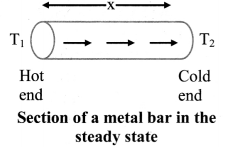
  1. When one end of a metal rod is heated, the heat flows by conduction from hot end to the cold end.
    Maharashtra Board Class 11 Physics Solutions Chapter 7 Thermal Properties of Matter 5
  2. As a result, the temperature of every section of the rod starts increasing.
  3. Under this condition, the rod is said to be in a variable temperature state.
  4. After some time, the temperature at each section of the rod becomes steady i.e., does not change.
  5. Temperature of each cross-section of the rod now becomes constant though not the same. This is called steady state condition.

Question 11.
Define coefficient of thermal conductivity. Derive its expression.
Answer:
Coefficient of thermal conductivity of a material is defined as the quantity of heat that flows in one second between the opposite faces of a cube of side 1 m, the faces being kept at a temperature difference of 1°C (or 1 K).

Expression for coefficient of thermal conductivity:

  1. Under steady state condition, the quantity of heat ‘Q’ that flows from the hot face at temperature T1 to the cold face at temperature T2 of a cube with side x and area of cross-section A is
    • directly proportional to the cross-sectional area A of the face. i.e.. Q ∝ A
    • directly proportional to the temperature difference between the two faces i.e., Q ∝ (T1 – T2)
    • directly proportional to time t (in seconds) for which heat flows i.e.. Q ∝ t
    • inversely proportional to the perpendicular distance x between hot and cold faces i.e., Q ∝ 1/x
  2. Combining the above four factors, we have the quantity of heat
    Q ∝ \(\frac{\mathrm{A}\left(\mathrm{T}_{1}-\mathrm{T}_{2}\right) \mathrm{t}}{\mathrm{x}}\)
    ∴ Q = \(\)
    where k is a constant of proportionality and is called coefficient of thermal conductivity. Its value depends upon the nature of the material.

Maharashtra Board Class 11 Physics Solutions Chapter 7 Thermal Properties of Matter

Question 12.
Give any four applications of thermal conductivity in every day life.
Answer:
Answer: Applications of thermal conductivity:

    • Thick walls are used in the construction of cold storage rooms.
    • Brick being a bad conductor of heat is used to reduce the flow of heat from the surroundings to the rooms.
    • Better heat insulation is obtained by using hollow bricks.
    • Air being a poorer conductor than a brick, it further avoids the conduction of heat from outside.
  1. Street vendors keep ice blocks packed in saw dust to prevent them from melting rapidly.
  2. The handle of a cooking utensil is made of a bad conductor of heat, such as ebonite, to protect our hand from the hot utensil.
  3. Two bedsheets used together to cover the body help retain body heat better than a single bedsheet of double the thickness. Trapped air being a bad conductor of heat, the layer of air between the two sheets reduces thermal conduction better than a sheet of double the thickness. Similarly, a blanket coupled with a bedsheet is a cheaper alternative to using two blankets.

Question 13.
Explain the term thermal resistance. State its SI unit and dimensions.
Answer:

  1. Consider expression for conduction rate,
    Pcond = kA \(\frac{\left(\mathrm{T}_{1}-\mathrm{T}_{2}\right)}{\mathrm{x}}\)
    ⇒ \(\frac{\mathrm{T}_{1}-\mathrm{T}_{2}}{\mathrm{P}_{\text {cond }}}=\frac{\mathrm{x}}{\mathrm{kA}}\) ……………. (1)
  2. Ratio \(\frac{\mathrm{T}_{1}-\mathrm{T}_{2}}{\mathrm{P}_{\text {cond }}}\) is called as thermal resistance (RT) of material.

The SI unit of thermal resistance is °C s/kcal or °C s/J and its dimensional formula is [L-2M-1T3K1].

Question 14.
How heat transfer occurs through radiation in absence of a medium?
Answer:

  1. All objects possess thermal energy due to their temperature T(T > 0 K).
  2. The rapidly moving molecules of a hot body emit EM waves travelling with the velocity of light. These are called thermal radiations.
  3. These carry energy with them and transfer it to the low-speed molecules of a cold body on which they fall.
  4. This results in an increase in the molecular motion of the cold body and its temperature rises.
  5. Thus transfer of heat by radiation is a two fold process-the conversion of thermal energy into waves and reconversion of waves into thermal energy by the body on which they fall.

Question 15.
State Newton’s law of cooling and explain how it can be experimentally verified.
Answer:
The rate of loss of heat dT/dt of the both’ is directly proportional to the difference of temperature (T – T0) of the body and the surroundings provided the difference in temperatures is small.

Mathematically, Newton’s law of cooling can be expressed as:
\(\frac{\mathrm{dT}}{\mathrm{dt}}\) ∝ (T – T0)
∴ \(\frac{\mathrm{dT}}{\mathrm{dt}}\) ∝ C(T – T0)
where, C is constant of proportionality. Experimental verification of Newton’s law of cooling:

  1. Fill a calorimeter upto \(\frac{2}{3}\) of its capacity with a boiling water. Cover it with lid with a hole for passing the thermometer.
  2. Insert the thermometer through the hole and adjust it so that the bulb of the thermometer is fully immersed in hot water.
  3. Keep calorimeter vessel in constant temperature enclosure or just in open air since room temperature will not change much during the experiment.
  4. Note down the temperature (T) on the thermometer at every one minute interval until the temperature of water decreases by about 25 °C.
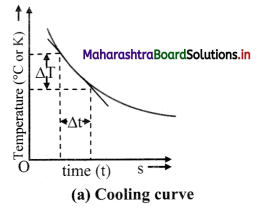
  5. Plot a graph of temperature (T) on Y-axis against time (t) on X-axis. This graph is called cooling curve as shown in figure (a).
    Maharashtra Board Class 11 Physics Solutions Chapter 7 Thermal Properties of Matter 7
  6. Draw tangents to the curve at suitable points on the curve. The slope of each tangent is \(\lim _{\Delta t \rightarrow 0} \frac{\Delta \mathrm{T}}{\Delta \mathrm{t}}\) and gives the rate of fall of temperature at that temperature (T).
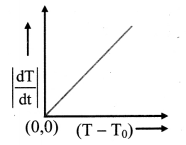
  7. Now the graph of \(\left|\frac{\mathrm{dT}}{\mathrm{dt}}\right|\) on Y-axis against (T – T0) on X-axis is plotted with (0, 0) origin. The graph is straight line and passes through origin as shown in figure (b), which verities Newton’s law of cooling.
    Maharashtra Board Class 11 Physics Solutions Chapter 7 Thermal Properties of Matter 8
    (b) Graphical verification of Newton’s law of cooling

Question 16.
What is thermal stress? Give an example of disadvantages of thermal stress in practical use?
Answer:

  1. Consider a metallic rod of length l0 fixed between two rigid supports at T °C.
    If the temperature of rod is increased by ∆T, length of rod would become,
    l = l0(1 + α∆T)
    Where, α is the coefficient of linear expansion of material of the rod.
    But the supports prevent expansion of rod. As a result, rod exerts stress on the supports. Such stress is termed as thermal stress.
  2. Disadvantage: Thermal stress can lead to fracture or deformation in substance under certain conditions.
  3. Railway tracks are made up of metals which expand upon heating. If no gap is kept between tracks, in hot weather, expansion of metal tracks may exert thermal stress on track. This may lead to bending of tracks which would be dangerous. Hence, railway track is not a continuous piece but is made up of segments separated by gaps.

Maharashtra Board Class 11 Physics Solutions Chapter 7 Thermal Properties of Matter

Question 17.
Which materials can be used as thermal insulators and why?
Answer:

  1. Substances such as glass, wood, rubber, plastic, etc. can be used as thermal insulators.
  2. These substances do not have free electrons to conduct heat freely throughout the body. Hence, they arc poor conductors of heat.

3. Solve the following problems.

Question 1.
A glass flask has volume 1 × 10⁻⁴ m3. It is filled with a liquid at 30 ºC. If the temperature of the system is raised to 100 ºC, how much of the liquid will overflow. (Coefficient of volume expansion of glass is 1.2 × 10⁻⁵ (ºC)-1 while that of the liquid is 75 × 10-5 ºC-1)
Solution:
Given: V1 = 1 × 10⁻⁴ m3 = 10-4 m3, T1 = 30°C,
T2 = 100 °C
To find: Volume of liquid that overflows
Formula: γ = \(\frac{V_{2}-V_{1}}{V_{1}\left(T_{2}-T_{1}\right)}\)
Calculation: From formula,
Increase is volume = V2 – V1
= γV1(T2 – T1)
increase in volume of beaker
= γglass × V1 (T2 – T1)
= 1.2 × 10-5 × 10-4 × (100 – 30)
= 1.2 × 70 × 10-9
= 4 × 10⁻⁹ m3
∴ Increase in volume of beaker
= 84 × 10-9 m3
Increase in volume of liquid
= γliquid × V1 (T2 – T1)
= 75 × 10-5 × 10 × (100 – 30)
= 75 × 70 × 10
= 5250 × 10-9 m3
∴ Increase in volume of liquid = 5250 × 10-9 m3
∴ Volume of liquid which overflows
= (5250 – 84) × 10-9 m3
= 5166 × 10-9 m3
= 0.5166 × 10⁻⁷ m3
Volume of liquid that overflows is 0.5166 × 10⁻⁷ m3.
[Note: The answer given above is presented considering standard conventions of writing number with its correct order of magnitude.]

Question 2.
Which will require more energy, heating a 2.0 kg block of lead by 30 K or heating a 4.0 kg block of copper by 5 K? (slead = 128 J kg-1 K-1, scopper = 387 J kg-1 K-1)
Solution:
Given: mlead = 2 kg, ∆Tlead = 30 K,
slead = 128 J/kg K,
mCu =4 kg, ∆TCu = 5 K,
sCu = 387 J/kg K
To find: Substance requiring more heat energy.
Formula: Q = ms ∆T
Calculation: From formula,
For lead, Qlead = 2 × 128 × 30 = 7680J
For Copper, QCu = 4 × 387 × 5 = 7740 J
QCu > Qlead, copper will require more heat energy.
Copper will require more heat energy.

Maharashtra Board Class 11 Physics Solutions Chapter 7 Thermal Properties of Matter

Question 3.
Specific latent heat of vaporization of water is 2.26 × 10⁶ J/kg. Calculate the energy needed to change 5.0 g of water into steam at 100 ºC.
Solution:
Given: Lvap = 2.26 × 10⁶ J/kg
m = 5g = 5 × 10⁻³ kg
In this case, no temperature change takes place only change of state occurs.
To find: Heat required to convert water into steam.
Formula: Heat required = mLvap
Calculation: From formula,
Heat required = 5 × 10-3 × 2.26 × 106
= 11300J
= 1.13 × 10⁴ J
Heat required to convert water into steam is 1.13 × 10⁴ J
[Note: The answer given above is presented considering standard conventions of writing number with its correct order of magnitude.]

Question 4.
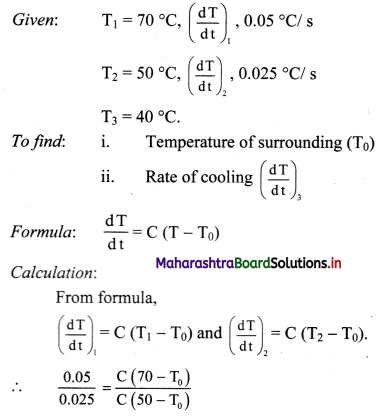
A metal sphere cools at the rate of 0.05 ºC/s when its temperature is 70ºC and at the rate of 0.025 ºC/s when its temperature is 50 ºC. Determine the temperature of the surroundings and find the rate of cooling when the temperature of the metal sphere is 40 ºC.
Solution:
Maharashtra Board Class 11 Physics Solutions Chapter 7 Thermal Properties of Matter 10
∴ 2(50 – T0) = 70 – T0
∴ T0 = 30 πC
Substituting value of T0.
0.05 = C (70 – 30)
∴ C = \(\frac{0.05}{40}\) = 0.00125/s.
For T3 = 40 °C
\(\left(\frac{\mathrm{d} \mathrm{T}}{\mathrm{dt}}\right)_{3}\) = C(T3 – T0)
= 0.00125 (40 – 30)
= 0.00125 × 10
= 0.0125°C/s.
i) Temperature of surrounding is 30 °C.
ii) Rate of cooling at 40 °C is 0.0125 °C/s.

Question 5.
The volume of a gas varied linearly with absolute temperature if its pressure is held constant. Suppose the gas does not liquefy even at very low temperatures, at what temperature the volume of the gas will be ideally zero?
Answer:
At temperature of -273.15 °C, the volume of the gas will be ideally zero.

Question 6.
In olden days, while laying the rails for trains, small gaps used to be left between the rail sections to allow for thermal expansion. Suppose the rails are laid at room temperature 27 ºC. If maximum temperature in the region is 45 ºC and the length of each rail section is 10 m, what should be the gap left given that α = 1.2 × 10⁻⁵ K-1 for the material of the rail section?
Solution:
Given. T1 = 27 °C, T2 = 45 °C,
L1 = 10m.
α = 1.2 × 10⁻⁵ K-1
To find: Gap that should be left (L2 – L1)
Formula: L2 – L1 = L1 α(T2 – T1)
Calculation: From formula,
L2 – L1 = 10 × 1.2 × 10-5 × (45 – 27)
= 2.16 × 10⁻³ m
= 2.16 mm
The gap that should be left between rail sections is 2.16 mm.

Question 7.
A blacksmith fixes iron ring on the rim of the wooden wheel of a bullock cart. The diameter of the wooden rim and the iron ring are 1.5 m and 1.47 m respectively at room temperature of 27 ºC. To what temperature the iron ring should be heated so that it can fit the rim of the wheel (αiron = 1.2 × 10⁻⁵ K-1).
Solution:
Given: dw = 1.5 m, d = 1.47 m, T1 = 27 °C.
αi = 1.2 × 10⁻⁵/ K
To find: Temperature (T2)
Formula. α = \(\frac{\mathrm{d}_{\mathrm{w}}-\mathrm{d}_{\mathrm{i}}}{\mathrm{d}_{\mathrm{i}}\left(\mathrm{T}_{2}-\mathrm{T}_{1}\right)}\)
Calculation: From formula,
T2 = \(\frac{\mathrm{d}_{\mathrm{w}}-\mathrm{d}_{\mathrm{i}}}{\mathrm{d}_{\mathrm{i}} \alpha}\) + T1
= \(\frac{1.5-1.47}{1.47 \times 1.2 \times 10^{-5}}\) + 27
= 1700.7 + 27
= 1727.7 °C
Iron ring should be heated to temperature of 1727.7 °C.

Maharashtra Board Class 11 Physics Solutions Chapter 7 Thermal Properties of Matter

Question 8.
In a random temperature scale X, water boils at 200 °X and freezes at 20 °X. Find the boiling point of a liquid in this scale if it boils at 62 °C.
Solution:
Here thermometric property P is temperature at some random scale X.
Using equation,
T = \(\frac{100\left(P_{T}-P_{1}\right)}{\left(P_{2}-P_{1}\right)}\)
For P1 = 20 °X,
P2 = 200 °X,
T = 62°C
∴ 62 = \(\frac{100\left(\mathrm{P}_{\mathrm{T}}-20\right)}{(200-20)}\)
∴ PT = \(\frac{62 \times(200-20)}{100}\) + 20 = 111.6 + 20
= 131.6 °X
The boiling point of a liquid in this scale is 131.6 °X.

Question 9.
A gas at 900°C is cooled until both its pressure and volume are halved. Calculate its final temperature.
Solution:
Given: T1 = 900 °C = 900 + 273.15 = 1173.15 K
V2 = \(\frac{\mathrm{V}_{1}}{2}\), P2 = \(\frac{\mathrm{P}_{1}}{2}\)
To find: Final temperature (T2)
Formula: \(\frac{\mathrm{P}_{1} \mathrm{~V}_{1}}{\mathrm{~T}_{\mathrm{I}}}=\frac{\mathrm{P}_{2} \mathrm{~V}_{2}}{\mathrm{~T}_{2}}\)
Calculation: From formula.
\(\frac{\mathrm{P}_{1} \mathrm{~V}_{1}}{1173.15}=\frac{\mathrm{P}_{1} \mathrm{~V}_{\mathrm{l}}}{4 \mathrm{~T}_{2}}\)
∴ T2 = \(\frac{1173.15}{4}\) = 293.29 K
Final temperature of gas is 293.29 K.

Question 10.
An aluminium rod and iron rod show 1.5 m difference in their lengths when heated at all temperature. What are their lengths at 0 °C if coefficient of linear expansion for aluminium is 24.5 × 10⁻⁶ /°C and for iron is 11.9 × 10⁻⁶ /°C
Solution:
Given: (LT)i – (LT)al = 1.5 m, T0 = 0 °C
αal = 24.5 × 10⁻⁶/°C
αi = 11.9 × 10⁻⁶ /°C
To find: Lengths of aluminium and iron rod (L0)al and (L0)i
Formula: LT = L0[(1 + α(T – T0)]
Calculation: For T0 = 0 °C
From formula,
LT = L0(1 + αT)
For aluminium,
(L0)al = (L0)al(1 + αalT) ……………. (1)
For iron,
(LT)i = (L0)i (1 + αiT) ………….. (2)
Subtracting equation (2) by (1),
(LT)i – (LT)al = [(L0)i + (L0)i αiT] – [(L0)al + (L0)alαalT]
= (L0)i – (L0)al + [(L0)i αi – (L0)al αal]T
∴ 1.5 = 1.5 + [(L0)i αi – (L0)al αal)]T
⇒ [(L0)iαi – (L0)alαal] T = 0
∴ (L0)alαal = (L0)iαi
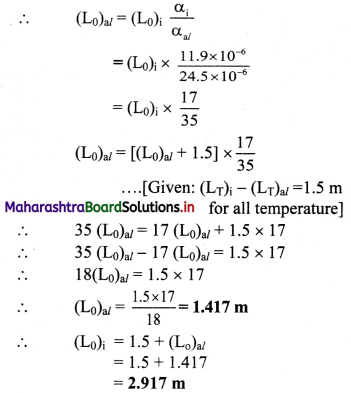
Maharashtra Board Class 11 Physics Solutions Chapter 7 Thermal Properties of Matter 2
Length of aluminium rod at 0 °C is 1.417 m and that of iron rod is 2.917 m.

Question 11.
What is the specific heat of a metal if 50 cal of heat is needed to raise 6 kg of the metal from 20°C to 62 °C ?
Solution:
Given: Q = 50 cal, m =6 kg,
∆T = 62 – 20 = 42 °C
To find: Specific heat (s)
Formula: Q = ms ∆T
Calculation: From formula,
s = \(\frac{\mathrm{Q}}{\mathrm{m} \Delta \mathrm{T}}=\frac{50}{6 \times 42}\) = 0.198 cal/kg °C
Specific heat of metal is copper 0.198 cal/kg °C.

Maharashtra Board Class 11 Physics Solutions Chapter 7 Thermal Properties of Matter

Question 12.
The rate of flow of heat through a copper rod with temperature difference 30 °C is 1500 cal/s. Find the thermal resistance of copper rod.
Solution:
Given: ∆T = 30 °C, Pcond = 1500 cal/s
To find: Thermal resistance (RT)
Formula: RT = \(\frac{\Delta \mathrm{T}}{\mathrm{P}_{\text {cond }}}\)
Calculation: From formula,
RT = \(\frac{30}{1500}\)
= 0.02 °C s/cal.
Thermal resistance of copper rod is 0.02 °C s/cal.

Question 13.
An electric kettle takes 20 minutes to heat a certain quantity of water from 0°C to its boiling point. It requires 90 minutes to turn all the water at 100°C into steam. Find the latent heat of vaporisation. (Specific heat of water = 1cal/g°C)
Solution:
Let heat supplied by kettle in 20 minutes be Q1 and that in 90 min. be Q2.
Using heat temperature of water is raised from O °C to 100 °C.
If mass of water in the kettle is ‘m’ then.
Q1 = mswater∆T m × 1 × (100 – 0)
= 100 m ………….. (i)
…………. (∵ Swater = 1 cal/g °C)
Similarly using heat Q2 water is converted from liquid to gas,
∴ Q2 = mLvap ……………. (ii)
Given that heat Q1, Q2 are supplied to water in 20 min. (t1) and 90 min (t2) respectively.
Kettle being same its conduction rate (Pcond) is same.
Using Pcond = \(\frac{\mathrm{Q}_{1}}{\mathrm{t}_{1}}=\frac{\mathrm{Q}_{2}}{\mathrm{t}_{2}}\) …………… (iii)
From (i), (ii) and (iii),
\(\frac{100 \mathrm{~m}}{20}=\frac{\mathrm{mL}_{\text {vap }}}{90}\),
∴ Lvap = 5 × 90 = 450 cal/g
Latent heat of vaporisation for water is 450 cal/g.

Question 14.
Find the temperature difference between two sides of a steel plate 4 cm thick, when heat is transmitted through the plate at the rate of 400 k cal per minute per square metre at steady state. Thermal conductivity of steel is 0.026 kcal/m s K.
Solution:
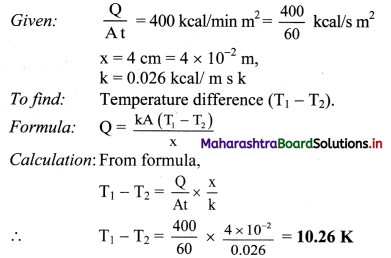
Maharashtra Board Class 11 Physics Solutions Chapter 7 Thermal Properties of Matter 6
Temperature difference between two sides is 10.26 K.
[Note: Above answer is expressed in K (‘kelvin considering that thermal conductivity is expressed in units of kcal / ms K, and not as kcal / m s °C. As 1 °C equivalent to 1 K. conceptually temperature difference of 10.26 K will correspond to 10.26 t]

Maharashtra Board Class 11 Physics Solutions Chapter 7 Thermal Properties of Matter

Question 15.
A metal sphere cools from 80 °C to 60 °C in 6 min. How much time with it take to cool from 60 °C to 40 °C if the room temperature is 30°C?
Solution:
Given: T1 = 80 °C, T2 = 60 °C, T3 = 40 °C, T0 = 30 °C, (dt)1 = 6 min.
To find: Time taken in cooling (dt)2
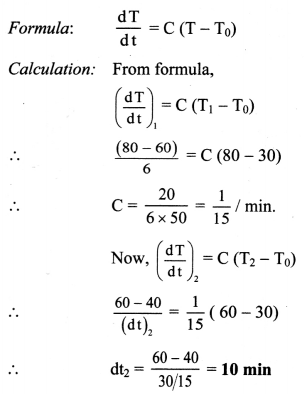
Maharashtra Board Class 11 Physics Solutions Chapter 7 Thermal Properties of Matter 9
Time taken in cooling is 10 min.

11th Physics Digest Chapter 7 Thermal Properties of Matter Intext Questions and Answers

Can you tell? (Textbook Page No. 125)

Question 1.
i) Why the metal wires for electrical transmission lines sag?
ii) Why a railway track is not a continuous piece but is made up of segments separated by gaps?
iii) How a steel wheel is mounted on an axle to fit exactly?
Answer:

  1. In hot weather, metal wires get heated due to increased temperature of surrounding. As a result, they expand increasing the slack between transmission line structure, causing them to sag.
  2. Railway tracks are made up of metals which expand upon heating. If no gap is kept between tracks, in hot weather, expansion of metal tracks may exert thermal stress on track. This may lead to bending of tracks which would be dangerous. Hence, railway track is not a continuous piece but is made up of segments separated by gaps.
  3. The steel wheel is heated to expand. This expanded wheel can easily fit over axle. The wheel is then cooled quickly. Upon cooling, wheel contracts and fits tightly upon the axle.

Intext question. (Textbook Page No 124)

Question 1.
Can you now tell why the balloon bursts sometimes when you try to fill air in it?
Answer:

  1. When balloon is blown, air that is blown inside makes the balloon expand.
  2. A given size of balloon can expand upto certain limit.
  3. Once that limit is reached and air is still blown inside the balloon, balloon cannot expand further.
  4. As a result, air causes additional pressure on inner surface of balloon.
  5. Since, pressure inside balloon is now greater than pressure outside balloon, balloon bursts equalizing the two pressures.

Maharashtra Board Class 11 Physics Solutions Chapter 7 Thermal Properties of Matter

Can you tell? (Textbook Page No. 125)

Question 1.
Why lakes freeze first at the surface?
Answer:

  1. In cold climate, temperature of water in ponds and lakes starts falling.
  2. On getting colder, water contracts. As a result, density of water increases and it goes down. To replace it, warmer water from below rises up. This process continues till temperature of water at the bottom of pond becomes 4 °C.
  3. Water, due to its anomalous behaviour possesses maximum density at 4 °C.
  4. If the temperature lowers further, ice is formed at the surface of pond with water below it.
  5. Ice being poor conductor of heat blocks the further heat exchange between atmosphere and water in the pond and maintains water below surface in liquid state.

Activity (Textbook Page No. 129)

Question 1.
To understand the process of change of state:
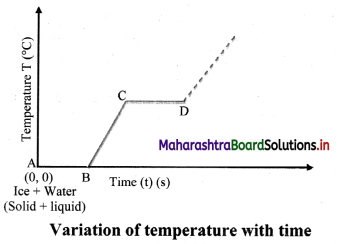
Take some cubes of ice in a beaker. Note the temperature of ice (0 °C). Start heating it slowly on a constant heat source. Note the temperature after every minute. Continuously stir the mixture of water and ice. Observe the change in temperature. Continue heating even after the whole of ice gets converted into water. Observe the change in temperature as before till vapours start coming out. Plot the graph of temperature (along Y-axis) versus time (along X-axis). Obtain a graph of temperature versus time.
Answer:
[Students are expected to attempt the activity on their own.]

Can you tell? (Textbook Page No. 130)

Question 1.
What is observed after point D in graph? Can steam be hotter than 100 °C?
Answer:
Beyond point D, thermometer again shows rise in temperature. This means, steam can be hotter than 100 °C and is termed as superheated steam.
Maharashtra Board Class 11 Physics Solutions Chapter 7 Thermal Properties of Matter 3

Question 2.
Why steam at 100 °C causes more harm to our skin than water at 100 °C?
Answer:

  1. Though steam and boiling water have same temperature, the heat contained in steam is more than that in boiling water.
  2. Steam is formed when boiling water absorbs specific latent heat of vaporisation i.e.. 22.6 × 10⁵ J/kg.
  3. As a result, when steam comes in contact with the skin of a person, it gives off additional 22.6 × 10⁵ joule per kilogram causing severe (more serious) burns.
    Hence, burns caused from steam are more serious than those caused from boiling water at same temperature.

Activity (Textbook Page No. 130)

Activity to understand the dependence of boiling point on pressure:
Take a round bottom flask, more than half filled with water. Keep it over a burner and fix a thermometer and steam outlet through the cork of the flask as shown in figure. As water in the flask gets heated, note that first the air, which was dissolved in the water comes out as small bubbles. Later bubbles of steam form at the bottom but as they rise to the cooler water near the top, they condense and disappear. Finally, as the temperature of the entire mass of the water reaches 100 oc, bubbles of steam reach the surface and boiling is said to occur. The steam in the flask may not be visible hut as it comes out of the flask, It condenses as tiny droplets of water giving a foggy appearance.
Maharashtra Board Class 11 Physics Solutions Chapter 7 Thermal Properties of Matter 4
If now the steam outlet is closed for a few seconds to increase the pressure in the flask, you will notice that boiling stops. More heat would be required to raise the temperature (depending on the increase in pressure) before boiling starts again. Thus, boiling point increases with increase in pressure. Let us now remove the burner. Allow water to cool to about 80°C. Remove the thermometers and steam outlet. Close the flask with a air tight cork. Keep the flask turned upside down on a stand. Pour icecold water on the flask. Water vapours in the flask condense reducing the pressure on the water surface inside the flask. Water begins to boil again, now at a lower temperature. Thus boiling point decreases with decrease in pressure and increases with increase in pressure.
Answer:
[Students are expected to attempt the activity an their own.]

Maharashtra Board Class 11 Physics Solutions Chapter 7 Thermal Properties of Matter

Can you tell? (Textbook Page No. 131)

Question 1.
i) Why is cooking difficult at high altitude?
ii) Why is cooking faster in pressure cooker?
Answer:

    • At high altitude density of air is low which causes reduction in atmospheric pressure.
    • As pressure is less, boiling point of water lowers.
    • Water, at high altitude, starts boiling below 100 OC.
    • As food is cooked mostly through the water boiling, cooking of food becomes difficult.
    • Pressure cooker operates by expelling air within the cooker and trapping steam produced from the liquid. (mostly water) boiling inside.
    • Due to high internal pressure, boiling point of liquid increases and liquid boils at temperature higher than its boiling point.
    • The increased boiling point allows more absorption of heat by liquid and steam formed is superheated.
    • As a result, food gets cooked quickly.

Internet my friend (Textbook Page No. 139)

i) https ://hyperphysics. phy-astr.gsu.edul/base/hframe.html
ii) https://youtu.be/7ZKHc5J6R5Q
iii) https://physics. info/expansion
Answer:
[Students are expected to visit the above mentioned webs it es and collect more information about the thermal properties of matter.]

Maharashtra Board Class 11 Physics Solutions Chapter 6 Mechanical Properties of Solids

Balbharti Maharashtra State Board 11th Physics Textbook Solutions Chapter 6 Mechanical Properties of Solids Textbook Exercise Questions and Answers.

Maharashtra State Board 11th Physics Solutions Chapter 6 Mechanical Properties of Solids

1. Choose the correct answer:

Question 1.
Change in dimensions is known as …………..
(A) deformation
(B) formation
(C) contraction
(D) strain.
Answer:
(A) deformation

Question 2.
The point on stress-strain curve at which strain begins to increase even without increase in stress is called…………
(A) elastic point
(B) yield point
(C) breaking point
(D) neck point
Answer:
(B) yield point

Maharashtra Board Class 11 Physics Solutions Chapter 6 Mechanical Properties of Solids

Question 3.
Strain energy of a stretched wire is 18 × 10-3 J and strain energy per unit volume of the same wire and same cross section is 6 × 10⁻³ J/m3. Its volume will be………….
(A) 3cm3
(B) 3 m3
(C) 6 m3
(D) 6 cm3
Answer:
(B) 3 m3

Question 4.
……………. is the property of a material which enables it to resist plastic deformation.
(A) elasticity
(B) plasticity
(C) hardness
(D) ductility
Answer:
(C) hardness

Question 5.
The ability of a material to resist fracturing when a force is applied to it, is called……………
(A) toughness
(B) hardness
(C) elasticity
(D) plasticity.
Answer:
(A) toughness

2. Answer in one sentence:

Question 1.
Define elasticity.
Answer:
If a body regains its original shape and size after removal of the deforming force, it is called an elastic body and the property is called elasticity.

Question 2.
What do you mean by deformation?
Answer:
The change in shape or size or both of u body due to an external force is called deformation.

Question 3.
State the SI unit and dimensions of stress.
Answer:

  1. SI unit: N m-2 or pascal (Pa)
  2. Dimensions: [L-1M1T-2]

Question 4.
Define strain.
Answer:
Strain:

  1. Strain is defined as the ratio of change in dimensions of the body to its original dimensions.
    Strain = \(\frac{\text { change in dimensions }}{\text { original dimensions }}\)
  2. Types of strain:
    • Longitudinal strain,
    • Volume strain,
    • Shearing strain.

Question 5.
What is Young’s modulus of a rigid body?
Answer:
Young’s modulus (Y): It is the modulus of elasticity related to change in length of an object like a metal wire, rod, beam, etc., due to the applied deforming force.

Question 6.
Why bridges are unsafe after a very long use?
Answer:
A bridge during its use undergoes recurring stress depending upon the movement of vehicles on it. When bridge is used for long time, it loses its elastic strength and ultimately may collapse. Hence, the bridges are declared unsafe after long use.

Question 7.
How should be a force applied on a body to produce shearing stress?
Answer:
A tangential force which is parallel to the top and the bottom surface of the body should be applied to produce shearing stress.

Question 8.
State the conditions under which Hooke’s law holds good.
Answer:
Hooke’s Taw holds good only when a wire/body is loaded within its elastic limit.

Question 9.
Define Poisson’s ratio.
Answer:
Within elastic limit, the ratio of lateral strain to the linear strain is called the Poisson‘s ratio.

Maharashtra Board Class 11 Physics Solutions Chapter 6 Mechanical Properties of Solids

Question 10.
What is an elastomer?
Answer:
A material that can be elastically stretched to a larger value of strain is called an elastomer.

Question 11.
What do you mean by elastic hysteresis?
Answer:

  1. In case of some materials like vulcanized rubber, when the stress applied on a body decreases to zero, the strain does not return to zero immediately. The strain lags behind the stress. This lagging of strain behind the stress is called elastic hysteresis.
  2. Below figure shows the stress-strain curve for increasing and decreasing load. It encloses a loop. Area of loop gives the energy dissipated during deformation of a material.
    Maharashtra Board Class 11 Physics Solutions Chapter 6 Mechanical Properties of Solids 9

Question 12.
State the names of the hardest material and the softest material.
Answer:
Hardest material: Diamond
Softest material: Aluminium
[Note: Material with highest strength is steel whereas material with lowest strength is plasticine clay.]

Question 13.
Define friction.
Answer:
The property which resists the relative motion between two surfaces in contact is called friction.

Question 14.
Why force of static friction is known as ‘self-adjusting force?
Answer:
The force of static friction varies in accordance with applied force. Hence, it is called as self adjusting force.

Question 15.
Name two factors on which the coefficient of friction depends.
Answer:
Coefficient of friction depends upon:

  1. the materials of the surfaces in contact.
  2. the nature of the surfaces.

3. Answer in short:

Question 1.
Distinguish between elasticity and plasticity.
Answer:

No.ElasticityPlasticity
i.Body regains its original shape or size after removal of deforming force.Body does not regain its original shape or size after removal of deforming force.
ii.Restoring forces are strong enough to bring the displaced molecules to their original positions.Restoring forces are not strong enough to bring the molecules back to their original positions.
Examples of elastic materials: metals, rubber, quartz, etcExamples of plastic materials: clay, putty, plasticine, thick mud, etc

Question 2.
State any four methods to reduce friction.
Answer:
Friction can be reduced by using polished surfaces, using lubricants, using grease and using ball bearings.

Question 3.
What is rolling friction? How does it arise?
Answer:

  1. Friction between two bodies in contact when one body is rolling over the other, is called rolling friction.
  2. Rolling friction arises as the point of contact of the body with the surface keep changing continuously.

Maharashtra Board Class 11 Physics Solutions Chapter 6 Mechanical Properties of Solids

Question 4.
Explain how lubricants help in reducing friction?
Answer:

  1. The friction between lubricant to surface is much less than the friction between two same surfaces. Hence using lubricants reduces the friction between the two surfaces.
  2. When lubricant is applied to machine parts, it fills the depression present on the surface in contact. Thus, less friction is occurred between machine parts.
  3. Application of lubricants also reduces wear and tear of machine parts which in turn reduces friction.
  4. Advantage: Reduction in function reduces dissipation of energy in machines due to which efficiency of machines increases.

Question 5.
State the laws of static friction.
Answer:
Laws of static friction:

  1. First law: The limiting force of static friction (FL) is directly proportional to the normal reaction (N) between the two surfaces in contact.
    FL ∝ N
    ∴ FL = µs N
    where, µs = constant called coefficient of static friction.
  2. Second law: The limiting force of friction is
    independent of the apparent area between the surfaces in contact, so long as the normal reaction remains the same.
  3. Third law: The limiting force of friction depends upon materials in contact and the nature of their surfaces.

Question 6.
State the laws of kinetic friction.
Answer:
Laws of kinetic friction:

  1. First law: The force of kinetic friction (Fk) is directly proportional to the normal reaction (N) between two surfaces in contact.
    Fk ∝ N
    ∴ Fk = µkN
    where, µk = constant called coefficient of kinetic friction.
  2. Second law: Force of kinetic friction is independent of shape and apparent area of the surfaces in contact.
  3. Third law: Force of kinetic friction depends upon the nature and material of the surfaces in contact.
  4. Fourth law: The magnitude of the force of kinetic friction is independent of the relative velocity between the object and the surface provided that the relative velocity is neither too large nor too small.

Question 7.
State advantages of friction.
Answer:
Advantages of friction:

  1. We can walk due to friction between ground and feet.
  2. We can hold object in hand due to static friction.
  3. Brakes of vehicles work due to friction; hence we can reduce speed or stop vehicles.
  4. Climbing on a tree is possible due to friction.

Question 8.
State disadvantages of friction.
Answer:
Disadvantages of friction:

  1. Friction opposes motion.
  2. Friction produces heat in different parts of machines. It also produces noise.
  3. Automobile engines consume more fuel due to friction.

Question 9.
What do you mean by a brittle substance? Give any two examples.
Answer:

  1. Substances which breaks within the elastic limit are called brittle substances.
  2. Examples: Glass, ceramics.

4. Long answer type questions:

Question 1.
Distinguish between Young’s modulus, bulk modulus and modulus of rigidity.
Answer:

NoYoung’s modulusBulk modulusModulus of rigidity
i.It is the ratio of longitudinal stress to longitudinal strain.It is the ratio of volume stress to volume strain.It is the ratio of shearing stress to shearing strain.
ii.It is given by, Y = \(\frac{\mathrm{MgL}}{\pi \mathrm{r}^{2} l}\)It is given by, K = \(\frac{V d P}{d V}\)It is given by, \(\eta=\frac{F}{A \theta}\)
iii.It exists in solids.It exists in solid, liquid and gases.It exists in solids.
iv.It relates to change in

length of a body.

It relates to change in volume of a body.It relates to change in shape of a body.

Question 2.
Define stress and strain. What are their different types?
Answer:
i) Stress:

  1. The internal restoring force per unit area of a both is called stress.
    Stress = \(\frac{\text { deforming force }}{\text { area }}=\frac{|\vec{F}|}{\mathrm{A}}\)
    where \(\vec{F}\) is internal restoring force or external applied deforming force.
  2. Types of stress:
    • Longitudinal stress,
    • Volume stress,
    • Shearing stress.

ii. Strain:

  1. Strain is defined as the ratio of change in dimensions of the body to its original dimensions.
    Strain = \(\frac{\text { change in dimensions }}{\text { original dimensions }}\)
  2. Types of strain:
    • Longitudinal strain,
    • Volume strain,
    • Shearing strain.

Maharashtra Board Class 11 Physics Solutions Chapter 6 Mechanical Properties of Solids

Question 3.
What is Young’s modulus? Describe an experiment to find out Young’s modulus of material in the form of a long straight wire.
Answer:
Definition: Young ‘s modulus is the ratio of longitudinal stress to longitudinal strain.
It is denoted by Y.
Unit: N/m2 or Pa in SI system.
Dimensions: [L-1M1T-2]

Experimental description to find Young’s modulus:

i. Consider a metal wire suspended from a rigid support. A load is attached to the free end of the wire. Due to this, deforming force gets applied to the free end of wire in downward direction and it produces a change in length.
Let,
L = original length of wire,
Mg = weight suspended to wire,
l = extension or elongation,
(L + l) = new length of wire.
r = radius of the cross section of wire

ii. In its equilibrium position,
Maharashtra Board Class 11 Physics Solutions Chapter 6 Mechanical Properties of Solids 1

Question 4.
Derive an expression for strain energy per unit volume of the material of a wire.
Answer:
Expression for strain energy per unit volume;

i. Consider a wire of original length L and cross sectional area A stretched by a force F acting along its length. The wire gets stretched and elongation l is produced in it

ii. If the wire is perfectly elastic then,
Longitudinal stress = \(\frac{F}{A}\)
Longitudinal strain = \(\frac{l}{L}\)
Maharashtra Board Class 11 Physics Solutions Chapter 6 Mechanical Properties of Solids 10

iii. The magnitude of stretching force increases from zero to F during elongation of wire.
Let ‘f’ be the restoring force and ‘x’ be its corresponding extension at certain instant during the process of extension.
∴ f = \(\frac{\text { YAx }}{\mathrm{L}}\) ……………. (2)

iv. Let ‘dW’ be the work done for the further small extension ‘dx’.
Work = force × displacement
∴ dW = fdx
∴ dW= \(\frac{\text { YAx }}{L}\) dx …………..(3) [From (2)]

v. The total amount of work done in stretching the wire from x = 0 to x = l can be found out by integrating equation (3).
Maharashtra Board Class 11 Physics Solutions Chapter 6 Mechanical Properties of Solids 11
∴ Work done in stretching a wire,
W = \(\frac{1}{2}\) × load × extension

vi. Work done by stretching force is equal to strain energy gained by the wire.
∴ Strain energy = \(\frac{1}{2}\) × load × extension

vii. Work done per unit volume
Maharashtra Board Class 11 Physics Solutions Chapter 6 Mechanical Properties of Solids 12
∴ Strain energy per unit volume = \(\frac{1}{2}\) × stress × strain

viii. Other forms:
Maharashtra Board Class 11 Physics Solutions Chapter 6 Mechanical Properties of Solids 13

Question 5.
What is friction? Define coefficient of static friction and coefficient of kinetic friction. Give the necessary formula for each.
Answer:

  1. The property which resists the relative motion between two surfaces in contact is called friction.
  2. The coefficient of static friction is defined as the ratio of limiting force of friction to the normal reaction.
    Formula: \(\mu_{\mathrm{S}}=\frac{\mathrm{F}_{\mathrm{L}}}{\mathrm{N}}\)
  3. The coefficient of kinetic friction is defined as the ratio of force of kinetic friction to the normal reaction between the two surfaces in contact.
    Formula: \(\mu_{\mathrm{k}}=\frac{\mathrm{F}_{\mathrm{K}}}{\mathrm{N}}\)

Maharashtra Board Class 11 Physics Solutions Chapter 6 Mechanical Properties of Solids

Question 6.
State Hooke’s law. Draw a labelled graph of tensile stress against tensile strain for a metal wire up to the breaking point. In this graph show the region in which Hooke’s law is obeyed.
Answer:
i) Statement: Within elastic limit, stress is directly proportional to strain.
Explanation;

  1. According to Hooke’s law,
    Stress ∝ Strain
    Maharashtra Board Class 11 Physics Solutions Chapter 6 Mechanical Properties of Solids 7
    This constant of proportionality is called modulus of elasticity.
  2. Modulus of elasticity of a material is the slope of stress-strain curve in elastic deformation region and depends on the nature of the material.
  3. The graph of strain (on X-axis) and stress (on Y-axis) within elastic limit is shown in the figure.Maharashtra Board Class 11 Physics Solutions Chapter 6 Mechanical Properties of Solids 8

ii)
Maharashtra Board Class 11 Physics Solutions Chapter 6 Mechanical Properties of Solids 6

iii) Hooke’s law is completely obeyed in the region OA.

5. Answer the following

Question 1.
Calculate the coefficient of static friction for an object of mass 50 kg placed on horizontal table pulled by attaching a spring balance. The force is increased gradually it is observed that the object just moves when spring balance shows 50N.
[Answer: µs = 0.102]
Solution:
Given: m = 50 kg, FL = 50 N, g = 9.8 m/s2
To find: Coefficient of static friction (µs)
Formula: µs = \(\frac{\mathrm{F}_{\mathrm{L}}}{\mathrm{N}}=\frac{\mathrm{F}_{\mathrm{L}}}{\mathrm{mg}}\)
µs = \(\frac{50}{50 \times 9.8}\) = 0.102
Answer:
The coefficient of static friction is 0.102.

Question 2.
A block of mass 37 kg rests on a rough horizontal plane having coefficient of static friction 0.3. Find out the least force required to just move the block horizontally.
[Answer: F= 108.8N]
Solution:
Given: m = 37 kg, µs = 0.3, g = 9.8 m /s2
To find: Limiting force (FL)
Formula: FL = µSN = µS mg
Calculation: From formula,
FL = 0.3 × 37 × 9.8 = 108.8 N
Answer:
The force required to move the block is 108.8 N.

Question 3.
A body of mass 37 kg rests on a rough horizontal surface. The minimum horizontal force required to just start the motion is 68.5 N. In order to keep the body moving with constant velocity, a force of 43 N is needed. What is the value of
a) coefficient of static friction? and
b) coefficient of kinetic friction?
Asw:
a) µs = 0.188
b) µk = 0.118]
Solution:
Given:
FL = 68.5 N, Fk = 43 N,
m = 37 kg, g = 9.8 m/s2

To find:

i. Coefficient of static friction (µs)
ii. Coefficient of kinetic friction (µk)

Formulae:

i. µs = \(\frac{F_{L}}{N}\) = \(\frac{F_{L}}{m g}\)
ii. µk = \(\frac{F_{k}}{N}\) = \(\frac{\mathrm{F}_{\mathrm{k}}}{\mathrm{mg}}\)

Calculation:
From formula (i),
∴ µs = \(\frac{F_{S}}{N}=\frac{68.5}{37 \times 9.8}\) = 0.1889
From formula (ii),
∴ µk = \(\frac{F_{k}}{N}=\frac{43}{37 \times 9.8}\) = 0.1186
Answer:

  1. The coefficient of static friction is 0.1889.
  2. The coefficient of kinetic friction is 0.1186.

[Note: Answers calculated above are in accordance with textual methods of calculation.]

Question 4.
A wire gets stretched by 4mm due to a certain load. If the same load is applied to a wire of same material with half the length and double the diameter of the first wire. What will be the change in its length?
Solution:
Given. l1 = 4mm = 4 × 10⁻³ m
L2 = \(\frac{\mathrm{L}_{1}}{2}\), D2 = 2D, r2 = 2r1
To find: Change in length (l2)
Formula: Y = \(\frac{\mathrm{FL}}{\mathrm{Al}}=\frac{\mathrm{FL}}{\pi \mathrm{r}^{2} l}\)
Calculation: From formula,
Maharashtra Board Class 11 Physics Solutions Chapter 6 Mechanical Properties of Solids 3
= 0.5 × 10⁻³ m
= 0.5 mm
The new change in length of the wire is 0.5 mm.

Maharashtra Board Class 11 Physics Solutions Chapter 6 Mechanical Properties of Solids

Question 5.
Calculate the work done in stretching a steel wire of length 2m and cross sectional area 0.0225mm2 when a load of 100 N is slowly applied to its free end. [Young’s modulus of steel= 2 × 10¹¹ N/m2]
Solution:
Given. L = 2m, F = 100 N,
A = 0.0225 mm2 = 2.25 × 10⁻⁸ m2,
Y = 2 × 10-11 N/m2,
To find: Work (W)
Formula: W = \(\frac{1}{2}\) × F × l
Claculation:
Maharashtra Board Class 11 Physics Solutions Chapter 6 Mechanical Properties of Solids 14
= antilog [log 10 – log 4.5]
= antilog [1.0000 – 0.6532 ]
= antilog [0.3468]
∴ W = 2.222 J
Answer:
The work done in stretching the steel wire is 2.222 J.

Question 6.
A solid metal sphere of volume 0.31m3 is dropped in an ocean where water pressure is 2 × 10⁷ N/m2. Calculate change in volume of the sphere if bulk modulus of the metal is 6.1 × 10¹⁰ N/m2
Solution:
Given: V= 0.31 m3, dP = 2 × 10⁷ N/m2,
K = 6.1 × 10¹⁰ N/m2
To find: Change in volume (dV)
Formula: K = V × \(\frac{\mathrm{dP}}{\mathrm{dV}}\)
Calculation: From formula,
dV = \(\frac{\mathrm{V} \times \mathrm{dP}}{\mathrm{K}}\)
∴ dV = \(\frac{0.31 \times 2 \times 10^{7}}{6.1 \times 10^{10}}\) ≈ 10-4 m3
The change in volume of the sphere is 10-4 m3.

Question 7.
A wire of mild steel has initial length 1.5 m and diameter 0.60 mm is extended by 6.3 mm when a certain force is applied to it. If Young’s modulus of mild steel is 2.1 × 10¹¹ N/m2, calculate the force applied.
Solution:
Given:
L = 1.5m, d = 0.60 mm,
r = \(\frac{d}{2}\) = 0.30 mm = 3 × 10⁻⁴ m,
Y = 2.1 × 10¹¹ N/m2,
l = 6.3 mm = 6.3 × 10⁻³ m
To find: Force (F)
Calculation:
From formula,
Maharashtra Board Class 11 Physics Solutions Chapter 6 Mechanical Properties of Solids 2
= 2.1 × 3.142 × 6 × 6.3
= antilog [log 2.1 + log 3.142 + log 6 + log 6.3]
= antilog [0.3222 + 0.4972 + 0.7782 + 0.7993]
= antilog [2.3969]
= 2.494 × 10²
≈ 250 N
The force applied on wire is 250 N.

Question 8.
A composite wire is prepared by joining a tungsten wire and steel wire end to end. Both the wires are of the same length and the same area of cross section. If this composite wire is suspended to a rigid support and a force is applied to its free end, it gets extended by 3.25mm. Calculate the increase in length of tungsten wire and steel wire separately.
[Given: Ysteel = 2 × 10¹¹ Pa, YTungsten = 4.11 × 10¹¹ Pa]
Solution:
Given: ls + lT = 3.25 mm,
YT = 4.11 × 10¹¹ Pa
Ys = 2 × 10¹¹ Pa
To find: Extension in tungsten wire (lT)
Extension in steel wire (ls)
Maharashtra Board Class 11 Physics Solutions Chapter 6 Mechanical Properties of Solids 4
But ls + lT = 3.25
ls + 0.487 ls = 3.25
ls(1 + 0.487) = 3.25
ls = 2.186 mm
∴ lT = 3.25 – 2.186
= 1.064 mm
The extension in tungsten wire is 1.064 mm and the extension in steel wire is 2.186 mm.

[Note: Values of Young’s modulus of tungsten and steel considered above are standard values. Using them, calculation is carried out ¡n accordance with textual method.]

Question 9.
A steel wire having cross sectional area 1.2 mm2 is stretched by a force of 120 N. If a lateral strain of 1.455 mm is produced in the wire, calculate the Poisson’s ratio.
Solution:
Given: A = 1.2 mm2 = 1.2 × 10⁻⁶ m2,
F = 120 N, Ysteel = 2 × 10¹¹ N/m2,
Lateral strain = 1.455 × 10⁻⁴
To find: Poisson’s ratio (σ)
Maharashtra Board Class 11 Physics Solutions Chapter 6 Mechanical Properties of Solids 5
The Poisson’s ratio of steel is 0.291.
[Note: Lateral strain being ratio of two same physical quantities, is unitless. hence, value given in question ¡s modified to 1.455 × 10⁻⁴ to reach the answer given in textbook.]

Question 10.
A telephone wire 125m long and 1mm in radius is stretched to a length 125.25m when a force of 800N is applied. What is the value of Young’s modulus for material of wire?
Solution:
Given: L = 125m,
r = 1 mm= 1 × 10⁻³ m
l = 125.25 – 125 = 0.25 m,
F = 800N
To find: Young’s modulus (Y)
Formula: Y \(\frac{\mathrm{FL}}{\mathrm{Al}}=\frac{\mathrm{FL}}{\pi \mathrm{r}^{2} l}\)
Calculation: From formula,
Y = \(\frac{800 \times 125}{3.142 \times 10^{-6} \times 0.25}\)
= {antilog [log 800 + log 125 – log 3.142 – log 0.25 ]} × 106
= {antilog [2.9031 + 2.0969 – 0.4972 – \(\overline{1}\) .3979]} × 106
= {antilog[5.1049]} × 106
= 1.274 × 105
= 1.274 × 10¹¹ N/m2
The Young’s modulus of telephone wire is 1.274 × 10¹¹ N/m2.

Question 11.
A rubber band originally 30cm long is stretched to a length of 32cm by certain load. What is the strain produced?
Solution:
Given: L = 30 cm = 30 × 10 -2 m,
∆l = 32 cm – 30 cm = 2cm = 2 × 10 -2 m
To find. Strain
Formula: Strain = \(\frac{\Delta l}{\mathrm{~L}}\)
Calculation: From formula,
Strain = \(\frac{2 \times 10^{-2}}{30 \times 10^{-2}}\) = 6.667 × 10 -2
The strain produced in the wire is 6.667 × 10 -2.

Maharashtra Board Class 11 Physics Solutions Chapter 6 Mechanical Properties of Solids

Question 12.
What is the stress in a wire which is 50m long and 0.01cm2 in cross section, if the wire bears a load of 100kg?
Solution:
Given: M = 100 kg, L 50 m, A = 0.01 × 10⁻⁴ m
To find: Stress
Formula: Stress = \(\frac{\mathrm{F}}{\mathrm{A}}=\frac{\mathrm{Mg}}{\mathrm{A}}\)
Calculation: From formula,
Stress = \(\frac{100 \times 9.8}{0.01 \times 10^{-4}}\) = 9.8 × 10⁸ N/m2
The stress in the wire is 9.8 × 10⁸ N/m2.

Question 13.
What is the strain in a cable of original length 50m whose length increases by 2.5cm when a load is lifted?
Solution:
Given: L = 50m, ∆l = 2.5cm = 2.5 × 10 -2 m
To find: Strain
Formula: Strain = \(\frac{\Delta l}{\mathrm{~L}}\)
Calculation: From formula,
Strain = \(\frac{2.5 \times 10^{-2}}{50}\) = 5 × 10⁻⁴
The Strain produced in wire is 5 × 10⁻⁴ .

11th Physics Digest Chapter 6 Mechanical Properties of Solids Intext Questions and Answers

Can you recall? (Textbook Page No. 100)

Question 1.

  1. Can you name a few objects which change their shape and size on application of a force and regain their original shape and size when the force is removed?
  2. Can you name objects which do not regain their original shape and size when the external force is removed?

Answer:

  1. Objects such as rubber, metals, quartz, etc. change their shape and size on application of a force (within specific limit) and regain their original shape and size when the force is removed.
  2. Objects such as putty, clay, thick mud. etc. do not regain their original shape and size when the external force is removed.

Maharashtra Board Class 11 Physics Solutions Chapter 6 Mechanical Properties of Solids

Can you tell? (Textbook Page No. 107)

Question 1.
Why does a rubber band become loose after repeated use?
Answer:

  1. After repeated use of rubber band, its stress-strain curve does not remain linear.
  2. In such case, since rubber crosses its elastic limit, there is a permanent set formed on the rubber due to which it becomes loose.

Can you tell? (Textbook Page No.111)

Question 1.
i. It is difficult to run fast on sand.
ii. It is easy to roll than pull a barrel along a road.
iii. An inflated tyre rolls easily than a flat tyre.
iv. Friction is a necessary evil.
Answer:
i.

  1. The intermolecular space between crystals of sand is very large as compared to that in a rigid surface.
  2. Thus, there are number of depressions at the points of contact of feet and sand surface.
  3. Projections and depressions between sand and feet are not completely interlocked.
  4. Thus, action and reaction force become unbalanced. The horizontal component of force helps to move forward and vertical component of the force resist to move.
    Hence, it becomes difficult to run fast on sand.

ii.

  1. When a barrel is pulled along a road, the friction between the tyres and road is kinetic friction, but when its rolls along the road it undergoes rolling friction.
  2. The force of kinetic friction is greater than force of rolling friction.
    Hence, it is easy to roll than pull a barrel along a road.

iii.

  1. When the tyre is inflated, the pressure inside the tyre is reducing the normal force between tyre and the ground, and thus reducing the friction between the tyre and the road.
  2. When the tyre gets deflated, it gets deformed during rolling, the supplied energy is used up in changing the shape and not overcoming the friction, and thus due to deformation, friction increases.
    Hence, an inflated tyre rolls easily than a flat tyre.

iv.

  1. Friction helps us to walk, hold objects in hand, lift objects and without friction we cannot walk, we cannot grip or hold objects with our hands,
  2. Friction is responsible for wear and tear of various part of machines, it produces heat in different parts of machine and also produces noise but it also helps in ball bearing or connecting screws.
    Hence, friction is said to be a necessary evil because it is useful as well as harmful.

Internet my friend (Textbook Page No. 111)

Question 1.
i. https ://opentextbc. ca/physicstestbook2/ chapter/friction/
ii. https://www.livescience.com/
iii. https://www.khanacademy.org/science/physics
iv. https://courses.lumenleaming.com/physics/ chapter/5-3-elasticity-stress-and-strain/
v. https://www.toppr.com/guides/physics/
Answer:
[Students are expected to visit the above mentioned websites and collect more information about mechanical properties of solid.]

Maharashtra Board Class 11 Physics Solutions Chapter 5 Gravitation

Balbharti Maharashtra State Board 11th Physics Textbook Solutions Chapter 5 Gravitation Textbook Exercise Questions and Answers.

Maharashtra State Board 11th Physics Solutions Chapter 5 Gravitation

1. Choose the correct option.

Question 1.
The value of acceleration due to gravity is maximum at
(A) the equator of the Earth
(B) the centre of the Earth.
(C) the pole of the Earth.
(D) slightly above the surface of the Earth.
Answer:
(C) the pole of the Earth.

Question 2.
The weight of a particle at the centre of the Earth is _________
(A) infinite.
(B) zero.
(C) same as that at other places.
(D) greater than at the poles.
Answer:
(B) zero.

Maharashtra Board Class 11 Physics Solutions Chapter 5 Gravitation

Question 3.
The gravitational potential due to the Earth is minimum at
(A) the centre of the Earth.
(B) the surface of the Earth.
(C) a points inside the Earth but not at its centre.
(D) infinite distance.
Answer:
(A) the centre of the Earth.

Question 4.
The binding energy of a satellite revolving around planet in a circular orbit is 3 × 10⁹ J. Its kinetic energy is _________
(A) 6 × 10⁹ J
(B) -3 × 10⁹ J
(C) -6 × 10+9 J
(D) 3 × 10+9J
Answer:
(D) 3 × 10+9J

2. Answer the following questions.

Question 1.
State Kepler’s law equal of area.
Answer:
The line that joins a planet and the Sun sweeps equal areas in equal intervals of time.

Question 2.
State Kepler’s law of period.
Answer:
The square of the time period of revolution of a planet around the Sun is proportional to the cube of the semimajor axis of the ellipse traced by the planet.

Question 3.
What are the dimensions of the universal gravitational constant?
Answer:
The dimensions of universal gravitational constant are: [L3M-1T-2].

Question 4.
Define binding energy of a satellite.
Answer:
The minimum energy required by a satellite to escape from Earth ‘s gravitational influence is the binding energy of the satellite.

Question 5.
What do you mean by geostationary satellite?
Answer:
Some satellites that revolve around the Earth in equatorial plane have same sense of rotation as that of the Earth. The also have the same period of rotation as that of the Earth i.e.. 24 hours. Due to this, these satellites appear stationary from the Earth’s surface and are known as geostationary satellites.

Question 6.
State Newton’s law of gravitation.
Answer:
Statement:
Every particle of matter attracts every other particle of matter with a force which is directly proportional to the product of their masses and inversely proportional to the square of the distance between them.

Maharashtra Board Class 11 Physics Solutions Chapter 5 Gravitation

Question 7.
Define escape velocity of a satellite.
Answer:
The minimum velocity with which a both’ should he thrown vertically upwards from the surface of the Earth so that it escapes the Earth ‘s gravitational field, is called the escape velocity (ve) of the body.

Question 8.
What is the variation in acceleration due to gravity with altitude?
Answer:
Variation in acceleration due to gravity due to altitude is given by, gh = g\(\left(\frac{R}{R+h}\right)^{2}\)
where,
gh = acceleration due to gravity of an object placed at h altitude
g = acceleration due to gravity on surface of the Earth
R = radius of the Earth
h = attitude height of the object from the surface of the Earth.
Hence, acceleration due to gravity decreases with increase in altitude.

Question 9.
On which factors does the escape speed of a body from the surface of Earth depend?
Answer:
The escape speed depends only on the mass and radius of the planet.
[Note: Escape velocity does not depend upon the mass of the body]

Question 10.
As we go from one planet to another planet, how will the mass and weight of a body change?
Answer:

  1. As we go from one planet to another, mass of a body remains unaffected.
  2. However, due to change in mass and radius of planet, acceleration due to gravity acting on the body changes as, g ∝ \(\frac{\mathrm{M}}{\mathrm{R}^{2}}\).
    Hence, weight of the body also changes as, W ∝ \(\frac{\mathrm{M}}{\mathrm{R}^{2}}\)

Question 11.
What is periodic time of a geostationary satellite?
Answer:
The periodic time of a geostationary satellite is same as that of the Earth i.e., one day or 24 hours.

Question 12.
State Newton’s law of gravitation and express it in vector form.
Answer:

  1. Statement:
    Every particle of matter attracts every other particle of matter with a force which is directly proportional to the product of their masses and inversely proportional to the square of the distance between them.
  2. In vector form, it can be expressed as,
    \(\overrightarrow{\mathrm{F}}_{21}=\mathrm{G} \frac{\mathrm{m}_{1} \mathrm{~m}_{2}}{\mathrm{r}^{2}}\left(-\hat{\mathrm{r}}_{21}\right)\)
    where, \(\hat{\mathbf{r}}_{21}\) is the unit vector from m1 to m2.
    The force \(\overrightarrow{\mathrm{F}}_{21}\) is directed from m2 to m1.

Question 13.
What do you mean by gravitational constant? State its SI units.
Answer:

  1. From Newton’s law of gravitation,
    F = G \(\frac{\mathrm{m}_{1} \mathrm{~m}_{2}}{\mathrm{r}^{2}}\)
    where, G = constant called universal gravitational constant Its value is 667 X 10-11 N m2/kg2.
  2. G = \(\frac{\mathrm{Fr}^{2}}{\mathrm{~m}_{1} \mathrm{~m}_{2}}\)
    If m1 = m2 = 1 kg, r = 1 m thenF = G.
    Hence, the universal gravitational constant is the force of gravitation between two particles of unit mass separated by unit distance.
  3. Unit: N m2/kg2 in SI system.

Maharashtra Board Class 11 Physics Solutions Chapter 5 Gravitation

Question 14.
Why is a minimum two stage rocket necessary for launching of a satellite?
Answer:

  1. For the projection of an artificial satellite, it is necessary for the satellite to have a certain velocity.
  2. In a single stage rocket, when the fuel in first stage of rocket is ignited on the surface of the Earth, it raises the satellite vertically.
  3. The velocity of projection of satellite normal to the surface of the Earth is the vertical velocity.
  4. If this vertical velocity is less than the escape velocity (ve), the satellite returns to the Earth’s surface. While, if the vertical velocity is greater than or equal to the escape velocity, the satellite will escape from Earth’s gravitational influence and go to infinity.
  5. Hence, minimum two stage rocket, one to raise the satellite to desired height and another to provide required hori7ontal velocity, is necessary for launching of a satellite.

Question 15.
State the conditions for various possible orbits of a satellite depending upon the horizontal speed of projection
Answer:
The path of the satellite depends upon the value of horizontal speed of projection vh relative to critical velocity vc and escape velocity ve.
Case (I) vh < vc:
The orbit of satellite is an ellipse with point of projection as apogee and Earth at one of the foci. During this elliptical path, if the satellite passes through the Earth’s atmosphere. it experiences a nonconservative force of air resistance. As a result it loses energy and spirals down to the Earth.
Case (II) vh = vc:
The satellite moves in a stable circular orbit around the Earth.
Case (III) vc < vh < ve:
The satellite moves in an elliptical orbit round the Earth with the point of projection as perigee.
Case (IV) vh = ve
The satellite travels along parabolic path and never returns to the point of projection. Its speed will be zero at infinity.
Case (V) vh > ve:
The satellite escapes from gravitational influence of Earth traversing a hyperbolic path.

3. Answer the following questions in detail.

Question 1.
Derive an expression for critical velocity of a satellite.
Answer:
Expression for critical velocity:

  1. Consider a satellite of mass m revolving round the Earth at height h above its surface. Let M be the mass of the Earth and R be its radius.
  2. If the satellite is moving in a circular orbit of radius (R + h) = r, its speed must be equal to the magnitude of critical velocity vc.
  3. The centripetal force necessary for circular motion of satellite is provided by gravitational force exerted by the satellite on the Earth.
    ∴ Centripetal force = Gravitational force
    Maharashtra Board Class 11 Physics Solutions Chapter 5 Gravitation 13
    This is the expression for critical speed at the orbit of radius (R + h).
  4. The critical speed of a satellite is independent of the mass of the satellite. It depends upon the mass of the Earth and the height at which the satellite is revolving or gravitational acceleration at that altitude.

Maharashtra Board Class 11 Physics Solutions Chapter 5 Gravitation

Question 2.
State any four applications of a communication satellite.
Answer:
Applications of communication satellite:

  1. For the transmission of television and radiowave signals over large areas of Earth’s surface.
  2. For broadcasting telecommunication.
  3. For military purposes.
  4. For navigation surveillance.

Question 3.
Show that acceleration due to gravity at height h above the Earth’s surface is gh = g(\(\frac{R}{R+h}\))2
Answer:
Variation of g due to altitude:

  1. Let,
    R = radius of the Earth,
    M = mass of the Earth.
    g = acceleration due to gravity at the surface of the Earth.
  2. Consider a body of mass m on the surface of the Earth. The acceleration due to gravity on the Earth’s surface is given by,
    Maharashtra Board Class 11 Physics Solutions Chapter 5 Gravitation 3
  3. The body is taken at height h above the surface of the Earth as shown in figure. The acceleration due to gravity now changes to,
    gh = \(\frac{\mathrm{GM}}{(\mathrm{R}+\mathrm{h})^{2}}\) …………. (2)
  4. Dividing equation (2) by equation (1), we get,
    Maharashtra Board Class 11 Physics Solutions Chapter 5 Gravitation 4
    We can rewrite,
    Maharashtra Board Class 11 Physics Solutions Chapter 5 Gravitation 5
    This expression can be used to calculate the value of g at height h above the surface of the Earth as long as h<< R.

Question 4.
Draw a labelled diagram to show different trajectories of a satellite depending upon the tangential projection speed.
Answer:
Maharashtra Board Class 11 Physics Solutions Chapter 5 Gravitation 14
vh = horizontal speed of projection
v c = critical velocity
ve = escape velocity

Question 5.
Derive an expression for binding energy of a body at rest on the Earth’s surface.
Answer:

  1. Let,
    M = mass of the Earth
    m = mass of the satellite
    R = radius of the Earth.
  2. Since the satellite is at rest on the Earth, v = 0
    ∴ Kinetic energy of satellite.
    K.E = \(\frac{1}{2}\) mv2 = 0
  3. Gravitational potential at the Earth’s surface
    = – \(\frac{\mathrm{GM}}{\mathrm{R}}\)
    ∴ Potential energy of satellite = Gravitational potential × mass of satellite
    = –\(\frac{\mathrm{GMm}}{\mathrm{R}}\)
  4. Total energy of sitellite = T.E = P.E + K.E
    ∴ T.E. = –\(\frac{\mathrm{GMm}}{\mathrm{R}}\) + 0 = –\(\frac{\mathrm{GMm}}{\mathrm{R}}\)
  5. Negative sign in the energy indicates that the satellite is bound to the Earth, due to gravitational force of attraction.
  6. For the satellite to be free form Earth’s gravitational influence, its total energy should become positive. That energy is the binding energy of the satellite at rest on the surface of the Earth.
    ∴ B.E. = \(\frac{\mathrm{GMm}}{\mathrm{R}}\)

Maharashtra Board Class 11 Physics Solutions Chapter 5 Gravitation

Question 6.
Why do astronauts in an orbiting satellite have a feeling of weightlessness?
Answer:

  1. For an astronaut, in a satellite, the net force towards the centre of the Earth will always be, F = mg – N.
    where, N is the normal reaction.
  2. In the case of a revolving satellite, the satellite is performing a circular motion. The acceleration for this motion is centripetal, which is provided by the gravitational acceleration g at the location of the satellite.
  3. In this case, the downward acceleration, ad = g, or the satellite (along with the astronaut) is in the state of free fall.
  4. Thus, the net force acting on astronaut will be, F = mg – mad i.e., the apparent weight will be zero, giving the feeling of total weightlessness.

Question 7.
Draw a graph showing the variation of gravitational acceleration due to the depth and altitude from the Earth’s surface.
Answer:
Maharashtra Board Class 11 Physics Solutions Chapter 5 Gravitation 9

Question 8.
At which place on the Earth’s surface is the gravitational acceleration maximum? Why?
Answer:

  1. Gravitational acceleration on the surface of the Earth depends on latitude of the place as well as rotation and shape of the Earth.
  2. At poles, latitude θ = 90°.
    ∴ g’ = g
    i.e., there is no reduction in acceleration due to gravity at poles.
  3. Also, shape of the Earth is actually an ellipsoid, bulged at equator. The polar radius of the Earth is 6356 km which minimum. As g ∝ \(\frac{1}{\mathrm{R}^{2}}\), acceleration due to gravity is maximum at poles i.e., 9.8322 m/s2.

Question 9.
At which place on the Earth surface the gravitational acceleration minimum? Why?
Answer:

  1. Gravitational acceleration on the surface of the Earth depends on latitude of the place as well as rotation and shape of the Earth.
  2. At equator, latitude θ = 0°.
    ∴ g’ = g – Rω2
    i.e., the acceleration due to gravity ¡s reduced by amount Rω2(≈ 0.034 m/s2) at equator.
  3. Also, shape of the Earth is actually an ellipsoid, bulged at equator. The equatorial radius of the Earth is 6378 km, which is maximum. As g ∝ \(\frac{1}{\mathrm{R}^{2}}\) acceleration due to gravity is minimum on equator i.e., 9.7804 m/s2.

Maharashtra Board Class 11 Physics Solutions Chapter 5 Gravitation

Question 10.
Define the binding energy of a satellite. Obtain an expression for binding energy of a satellite revolving around the Earth at certain attitude.
Answer:
The minimum energy required by a satellite to escape from Earth ‘s gravitational influence is the binding energy of the satellite.
Expression for binding energy of satellite revolving in circular orbit round the Earth:

  1. Consider a satellite of mass m revolving at height h above the surface of the Earth in a circular orbit. It possesses potential energy as well as kinetic energy.
  2. Let M be the mass of the Earth, R be the Radius of the Earth, vc be critical velocity of satellite, r = (R + h) be thc radius of the orbit.
  3. Kinetic energy of satellite = \(\frac{1}{2} \mathrm{mv}_{\mathrm{c}}^{2}=\frac{1}{2} \frac{\mathrm{GMm}}{\mathrm{r}}\)
  4. The gravitational potential at a distance r from the centre of the Earth is –\(\frac{\mathrm{GM}}{\mathrm{r}}\)
    ∴ Potential energy of satellite = Gravitational potential × mass of satellite
    = –\(\frac{\mathrm{GMm}}{\mathrm{r}}\)
  5. The total energy of satellite is given as T.E. = KF. + P.E.
    = \(\frac{1}{2} \frac{\mathrm{GMm}}{\mathrm{r}}-\frac{\mathrm{GMm}}{\mathrm{r}}=-\frac{1}{2} \frac{\mathrm{GMm}}{\mathrm{r}}\)
  6. Total energy of a circularly orbiting satellite is negative. Negative sign indicates that the satellite is bound to the Earth, due to gravitational force of attraction. For the satellite to be free from the Earth’s gravitational influence its total energy should become zero or positive.
  7. Hence the minimum energy to be supplied to unbind the satellite is +\(\frac{1}{2} \frac{\mathrm{GMm}}{\mathrm{r}}\). This is the binding energy of a satellite.

Question 11.
Obtain the formula for acceleration due to gravity at the depth ‘d’ below the Earth’s surface.
Answer:

  1. The Earth can be considered to be a sphere made of large number of concentric uniform spherical shells.
  2. When an object is on the surface of the Earth it experiences the gravitational force as if the entire mass of the Earth is concentrated at its centre.
  3. The acceleration due to gravity on the surface of the Earth is, g = \(\frac{\mathrm{GM}}{\mathrm{R}^{2}}\)
  4. Assuming that the density of the Earth is uniform, mass of the Earth is given by
    M = volume x density = \(\frac{4}{3}\) πR3ρ
    ∴ g = \(\frac{\mathrm{G} \times \frac{4}{3} \pi \mathrm{R}^{3} \rho}{\mathrm{R}^{2}}\) = \(\frac{4}{3}\) πRρG ………….. (1)
  5. Consider a body at a point P at the depth d below the surface of the Earth as shown in figure.
    Maharashtra Board Class 11 Physics Solutions Chapter 5 Gravitation 6
    Here the force on a body at P due to outer spherical shell shown by shaded region, cancel out due to symmetry.
    The net force on P is only due to the inner sphere of radius OP = R – d.
  6. Acceleration due to gravity because of this sphere is,
    Maharashtra Board Class 11 Physics Solutions Chapter 5 Gravitation 7
    This equation gives acceleration due to gravity at depth d below the Earth’s surface.

Question 12.
State Kepler’s three laws of planetary motion.
Answer:

  • All planets move in elliptical orbits around the Sun with the Sun at one of the foci of the ellipse.
  • The line that joins a planet and the Sun sweeps equal areas in equal intervals of time.
  • The square of the time period of revolution of a planet around the Sun is proportional to the cube of the semimajor axis of the ellipse traced by the planet.

Maharashtra Board Class 11 Physics Solutions Chapter 5 Gravitation

Question 13.
State the formula for acceleration due to gravity at depth ‘d’ and altitude ‘h’ Hence show that their ratio is equal to \(\left(\frac{R-d}{R-2 h}\right)\) by assuming that the altitude is very small as compared to the radius of the Earth.
Answer:

  1. For an object at depth d, acceleration due to gravity of the Earth is given by,
    gd = g(1 – \(\frac{\mathrm{d}}{\mathrm{R}}\)) ………………. (1)
  2. Also, the acceleration due to gravity at smaller altitude h is given by,
    gh = g(1 – \(\frac{2 \mathrm{~h}}{\mathrm{R}}\)) ……………. (2)
  3. Hence, dividing equation (1) by equation (2),
    we get,
    Maharashtra Board Class 11 Physics Solutions Chapter 5 Gravitation 8

Question 14.
What is critical velocity? Obtain an expression for critical velocity of an orbiting satellite. On what factors does it depend?
Answer:
The exact horizontal velocity of projection that must be given to a satellite at a certain height so that it can revolve in a circular orbIt round the Earth is called the critical velocity or orbital velocity (vc).
Expression for critical velocity:

  1. Consider a satellite of mass m revolving round the Earth at height h above its surface. Let M be the mass of the Earth and R be its radius.
  2. If the satellite is moving in a circular orbit of radius (R + h) = r, its speed must be equal to the magnitude of critical velocity vc.
  3. The centripetal force necessary for circular motion of satellite is provided by gravitational force exerted by the satellite on the Earth.
    ∴ Centripetal force = Gravitational force
    Maharashtra Board Class 11 Physics Solutions Chapter 5 Gravitation 13
    This is the expression for critical speed at the orbit of radius (R + h).
  4. The critical speed of a satellite is independent of the mass of the satellite. It depends upon the mass of the Earth and the height at which the satellite is revolving or gravitational acceleration at that altitude.

Question 15.
Define escape speed. Derive an expression for the escape speed of an object from the surface of the earth.
Answer:

  1. The minimum velocity with which a both’ should he thrown vertically upwards from the surface of the Earth so that it escapes the Earth ‘s gravitational field, is called the escape velocity (ve) of the body.
  2. As the gravitational force due to Earth becomes zero at infinite distance, the object has to reach infinite distance in order to escape.
  3. Let us consider the kinetic and potential energies of an object thrown vertically upwards with escape velocity ve.
  4. On the surface of the Earth,
    K.E.= \(\frac{1}{2} \mathrm{mv}_{\mathrm{e}}^{2}\)
    P.E. = –\(\frac{\mathrm{GMm}}{\mathrm{R}}\)
    Total energy = P.E. + K.E.
    ∴ T.E. = \(\frac{1}{2} \mathrm{mv}_{\mathrm{e}}^{2}-\frac{\mathrm{GMm}}{\mathrm{R}}\) ………………. (1)
  5. The kinetic energy of the object will go on decreasing with time as it is pulled back by Earth’s gravitational force. It will become zero when it reaches infinity. Thus, at infinite distance from the Earth,
    K.E. = 0
    Also,
    P.E. = –\(\frac{\mathrm{GMm}}{\infty}\) = 0
    ∴ Total energy = P.E. + K.E. = 0
  6. As energy is conserved
    \(\frac{1}{2} \mathrm{mv}_{\mathrm{e}}^{2}-\frac{\mathrm{GMm}}{\mathrm{R}}=0\) ……[From(1)]
    or, ve = \(\sqrt{\frac{2 \mathrm{GM}}{\mathrm{R}}}\)

Maharashtra Board Class 11 Physics Solutions Chapter 5 Gravitation

Question 16.
Describe how an artificial satellite using two stage rocket is launched in an orbit around the Earth.
Answer:

  1. Launching of a satellite in an orbit around the Earth cannot take place by use of single stage rocket. It requires minimum two stage rocket.
  2. With the help of first stage of rocket, satellite can be taken to a desired height above the surface of the Earth.
  3. Then the launcher is rotated in horizontal direction i.e.. through 900 using remote control and the first stage of the rocket is detached.
  4. With the help of second stage of rocket, a specific horizontal velocity (vh) is given to satellite so that it can revolve in a circular path around the Earth.
  5. The satellite follows different paths depending upon the horizontal velocity provided to it.

4. Solve the following problems.

Question 1.
At what distance below the surface of the Earth, the acceleration due to gravity decreases by 10% of its value at the surface, given radius of Earth is 6400 km.
Solution:
Given: gd = 90% of g i.e., \(\frac{\mathrm{g}_{\mathrm{d}}}{\mathrm{g}}\) = 0.9,
R = 6400km = 6.4 × 10⁶ m
To find: Distance below the Earth’s surface (d)
Maharashtra Board Class 11 Physics Solutions Chapter 5 Gravitation 10
At distance 640 km below the surface of the Earth, value of acceleration due to gravity decreases by 10%.

Question 2.
If the Earth were made of wood, the mass of wooden Earth would have been 10% as much as it is now (without change in its diameter). Calculate escape speed from the surface of this Earth.
Solution:
Maharashtra Board Class 11 Physics Solutions Chapter 5 Gravitation 12
As, we know that the escape speed from surface of the Earth is 11.2 km/s, Substituting value of ve = 11.2 km/s
Vew = 11.2 × \(\frac{1}{\sqrt{10}}=\frac{11.2}{3.162}\)
= 11.2 × \(\frac{1}{3.162}\)
…………… [Taking square root value]
= antilog {log(1 1.2) –  Log(3.162)}
= antilog {1.0492 – 0.5000}
= antilog {0.5492} = 3.542
∴ Vew = 3.54km/s
The escape velocity from the surface of wooden Earth is 3.54 km/s.

Maharashtra Board Class 11 Physics Solutions Chapter 5 Gravitation

Question 3.
Calculate the kinetic energy, potential energy, total energy and binding energy of an artificial satellite of mass 2000 kg orbiting at a height of 3600 km above the surface of the Earth.
Given:- G = 6.67 × 10⁻¹¹ Nm2/kg2
R = 6400 km
M = 6 × 1024 kg
Solution:
Given:- m = 2000 kg, h = 3600 km = 3.6 × 10⁶ m,
G = 6.67 × 10⁻¹¹ Nm2/kg2
R = 6400 km
M = 6 × 1024 kg

To find: i) Kninetic energy (K.E.)
ii) Potential Energy (P.E.)
iii) Total Energy (T.E.)
iv) Binding Energy (B.E.)
Maharashtra Board Class 11 Physics Solutions Chapter 5 Gravitation 17
From formula (ii),
P.E. = -2 × 40.02 × 109
= -80.04 × 10⁹ J
From formula (iii),
T.E. = (40.02 × 10⁹) + (-80.02 × 10⁹)
= -40.02 × 10⁹ J
From formula (iv),
B.E.= -(-40.02 × 10⁹)
= 40.02 × 10⁹ J
Kinetic energy of the satellite is 40.02 × 10⁹ J, potential energy is -80.04 × 10⁹ J, total energy is -40.02 × 10⁹ J and binding energy is 40.02 × 10⁹ J.
[Note: Total energy of orbiting satellite is negative.]

Question 4.
Two satellites A and B are revolving around a planet. Their periods of revolution are 1 hour and 8 hours respectively. The radius of orbit of satellite B is 4 × 10⁴ km. find radius of orbit of satellite A .
Solution:
Given: TA = 1 hour, TB = 8 hour,
rB = 4 × 10⁴ km
To find: Radius of orbit of satellite A (rA)
Maharashtra Board Class 11 Physics Solutions Chapter 5 Gravitation 16
Radius of orbit of satellite A will be 1 × 10⁴ km.

Question 5.
Find the gravitational force between the Sun and the Earth.
Given Mass of the Sun = 1.99 × 1030 kg
Mass of the Earth = 5.98 × 1024 kg
The average distance between the Earth and the Sun = 1.5 × 10¹¹ m.
Solution:
Given: MS = 1.99 × 1030 kg
ME = 5.98 × 1024 kg, R = 1.5 × 10¹¹ m.
To find: Gravitational force between the Sun and the Earth (F)
Formula: F = \(\frac{\mathrm{Gm}_{1} \mathrm{~m}_{2}}{\mathrm{r}^{2}}\)
Calculation:As, we know, G = 6.67 × 10⁻¹¹ N m2/kg2
From formula,
Maharashtra Board Class 11 Physics Solutions Chapter 5 Gravitation 1
= antilog {(log(6.67) + log( 1.99) + log(5.98) – log(2.25)} × 1021
= antilog {(0.8241) + (0.2989) + (0.7767) – (0.3522)} × 1021
= antilog {1.5475} × 1021
= 35.28 × 1021
= 3.5 × 10²² N
The gravitational force between the Sun and the Earth is 3.5 × 10²² N.

Maharashtra Board Class 11 Physics Solutions Chapter 5 Gravitation

Question 6.
Calculate the acceleration due to gravity at a height of 300 km from the surface of the Earth. (M = 5.98 × 1024 kg, R = 6400 km).
Solution:
Given: h = 300 km = 0.3 × 10⁶ m,
M = 5.98 × 1024 kg,
R = 6400km = 6.4 × 10⁶ m
G = 6.67 × 10⁻¹¹ Nm2/kg2
To find: Acceleration due to gravity at height (gh)
Formula: gh = \(\frac{G M}{(R+h)^{2}}\)

Calculation: From formula,
gh = \(\frac{6.67 \times 10^{-11} \times 5.98 \times 10^{24}}{\left[\left(6.4 \times 10^{6}\right)+\left(0.3 \times 10^{6}\right)\right]^{2}}\)
= \(\frac{6.67 \times 5.98 \times 10^{13}}{(6.7)^{2} \times 10^{12}}\)
6.67 X 10” x 5.98 X iO
= antilog {log(6.67) + log(5.98) – 2log(6.7)} × 10
= antilog{0.8241 + 0.7767 – 2(0.8261)} × 10
= antilog {1.6008 – 1.6522} × 10
= antilog {\(\overline{1}\) .9486} × 10
= 0.8884 × 10 = 8.884 m/s2
Acceleration due to gravity at 300 km will be 8.884 m/s2.

Question 7.
Calculate the speed of a satellite in an orbit at a height of 1000 km from the Earth’s surface. ME = 5.98 × 1024 kg, R = 6.4 × 10⁶ m.
Solution:
Given: h = 1000 km = 1 × 10⁶ m,
ME = 5.98 × 1024 kg, R = 6.4 × 10⁶ m,
G = 6.67 × 10⁻¹¹ N m2/kg2
To find: Speed of satellite (vc)
Maharashtra Board Class 11 Physics Solutions Chapter 5 Gravitation 15
Speed of the satellite at height 1000 km is 7.34 × 10³ m/s.

Question 8.
Calculate the value of acceleration due to gravity on the surface of Mars if the radius of Mars = 3.4 × 10³ km and its mass is 6.4 × 10²³ kg.
Solution:
Given:
M = 6.4 × 10²³ kg
R = 3.4 × 103 = 3.4 × 10⁶ m,
To find: Acceleration due to gravity on the surface of the Mars (gM)
Formula: g = \(\frac{\mathrm{GM}}{\mathrm{R}^{2}}\)
Calculation: As, G = 6.67 × 10⁻¹¹ N m2/kg2
From formula,
gM = \(\frac{6.67 \times 10^{-11} \times 6.4 \times 10^{23}}{\left(3.4 \times 10^{6}\right)^{2}}=\frac{6.67 \times 6.4}{3.4 \times 3.4}\)
= antilog {log(6.67) + log(6.4) – log(3.4) – log(3.4)}
= antilog {(0.8241) + (0.8062) – (0.5315) – (0.53 15)}
= antilog {0.5673}
= 3.693 m/s2
Acceleration due to gravity on the surface of Mars is 3.693 m/s2.

Question 9.
A planet has mass 6.4 × 1024 kg and radius 3.4 × 10⁶ m. Calculate energy required to remove on object of mass 800 kg from the surface of the planet to infinity.
Solution:
Given: M = 6.4 × 1024 kg, R = 3.4 × 10⁶ m, m = 800 kg
To find:   Energy required to remove the object from surface of planet to infinity = B.E.
Formula:    B.E. = \(\frac{\mathrm{GMm}}{\mathrm{R}}\)
Calculation: We know that,
G = 6.67 × 10⁻¹¹ N m2/kg2
From formula,
Maharashtra Board Class 11 Physics Solutions Chapter 5 Gravitation 18
= antilog{log(6.67) + log(51.2) – log(3.4)} × 109
= antilog{0.8241 + 1.7093 – 0.5315} × 109
= antilog {2.0019} × 109
= 1.004 × 102 × 109
= 1.004 × 10¹¹ J
Energy required to remove the object from the surface of the planet is 1.004 × 10¹¹ J.
[Note: Answer calculated above ¡s in accordance with retual methods of calculation.]

Maharashtra Board Class 11 Physics Solutions Chapter 5 Gravitation

Question 10.
Calculate the value of the universal gravitational constant from the given data. Mass of the Earth = 6 × 1024 kg, Radius of the Earth = 6400 km and the acceleration due to gravity on the surface = 9.8 m/s2
Solution:
Given: M = 6 × 1024 kg,
R = 6400km = 6.4 × 10⁶ m,
g = 9.8 m/s2
To find: Gravitational constant (G)
Formula. g = \(\frac{\mathrm{GM}}{\mathrm{R}^{2}}\)
Calculation: From formula,
G = \(\frac{\mathrm{gR}^{2}}{\mathrm{M}}\)
G = \(\frac{9.8 \times\left(6.4 \times 10^{6}\right)^{2}}{6 \times 10^{24}}=\frac{401.4 \times 10^{12}}{6 \times 10^{24}}\)
∴ G = 6.69 × 10⁻¹¹ N m2/kg2
The value of gravitational constant is 6.69 × 10⁻¹¹ N m2/kg2.

Question 11.
A body weighs 5.6 kg wt on the surface of the Earth. How much will be its weight on a planet whose mass is 1/7 times the mass of the Earth and radius twice that of the Earth’s radius.
Solution:
Given: WE = 5.6 kg-wt.,
\(\frac{\mathrm{M}_{\mathrm{p}}}{\mathrm{M}_{\mathrm{E}}}=\frac{1}{7}, \frac{\mathrm{R}_{\mathrm{p}}}{\mathrm{R}_{\mathrm{E}}}\) = 2
To find: Weight of the body on the surface of planet (Wp)
Formula: W = mg = \(\frac{\mathrm{GMm}}{\mathrm{R}^{2}}\)
Calculation: From formula,
Maharashtra Board Class 11 Physics Solutions Chapter 5 Gravitation 2
Weight of the body on the surface of a planet will be 0.2 kg-wt.
[Note: The answer given above is calculated in accordance with textual method considering the given data].

Question 12.
What is the gravitational potential due to the Earth at a point which is at a height of 2RE above the surface of the Earth, Mass of the Earth is 6 × 1024 kg, radius of the Earth = 6400 km and G = 6.67 × 10⁻¹¹ Nm2 kg-2.
Solution:
Given: M = 6 × 1024 kg,
RE = 6400km = 6.4 × 10⁶ m,
G = 6.67 × 10⁻¹¹ Nm2/kg2,
h = 2RE
To find: Gravitational potential (V)
Formula: V = – \(\frac{\mathrm{GM}}{\mathrm{r}}\)
Calculation: From formula,
Maharashtra Board Class 11 Physics Solutions Chapter 5 Gravitation 11
= -2.08 × 10⁷ J kg-1
Negative sign indicates the attractive nature of gravitational potential.
Gravitational potential due to Earth will be 2.08 × 10⁷ J kg-1 towards the centre of the Earth.
[Note: According lo definition of gravitational potential its SI unit is J/kg.]

11th Physics Digest Chapter 5 Gravitation Intext Questions and Answers

Can you recall? (Textbook Page No. 78)

Question 1.
i) What are Kepler’s laws?
ii)What is the shape of the orbits of planets?
Answer:

  1. The Kepler’s laws are:
    • Kepler’s first law: The orbit of a planet is an ellipse with the Sun at one of the foci.
    • Kepler’s second law: The line joining the planet and the Sun sweeps equal areas in equal intervals of time.
    • Kepler’s third law: The square of orbital period of revolution of a planet around the Sun is directly proportional to the cube of the mean distance of the planet from the Sun.
  2. The orbits of the planet are elliptical in shape.

Maharashtra Board Class 11 Physics Solutions Chapter 5 Gravitation

Question 2.
When released from certain height why do objects tend to fall vertically downwards?
Answer:
When released from certain height, objects tend to fall vertically downwards because of the gravitational force exerted by the Earth.

Maharashtra Board Class 11 Physics Solutions Chapter 4 Laws of Motion

Balbharti Maharashtra State Board 11th Physics Textbook Solutions Chapter 4 Laws of Motion Textbook Exercise Questions and Answers.

Maharashtra State Board 11th Physics Solutions Chapter 4 Laws of Motion

1. Choose the correct answer.

Question 1.
Consider the following pair of forces of equal magnitude and opposite directions:
(P) Gravitational forces are exerted on each other by two-point masses separated by a distance.
(Q) Couple of forces are used to rotate a water tap.
(R) Gravitational force and normal force are experienced by an object kept on a table.
For which of these pair/pairs the two forces do NOT cancel each other’s translational
effect?
(A) Only P
(B) Only P and Q
(C) Only R
(D) Only Q and R
Answer:
(A) Only P

Question 2.
Consider the following forces: (w) Force due to tension along a string, (x) Normal force given by a surface, (y) Force due to air resistance, and (z) Buoyant force or upthrust given by a fluid.
Which of these are electromagnetic forces?
(A) Only w, y, and z
(B) Only w, x, and y
(C) Only x, y and z
(D) All four.
Answer:
(D) All four.

Maharashtra Board Class 11 Physics Solutions Chapter 4 Laws of Motion

Question 3.
At a given instant three-point masses m, 2m, and 3m are equidistant from each other. Consider only the gravitational forces between them. Select correct statement/s for this instance only:
(A) Mass m experiences maximum force.
(B) Mass 2m experiences a maximum force.
(C) Mass 3m experiences a maximum force.
(D) All masses experience a force of the same magnitude.
Answer:
(C) Mass 3m experiences a maximum force.

Question 4.
The rough surface of a horizontal table offers a definite maximum opposing force to initiate the motion of a block along with the table, which is proportional to the resultant normal force given by the table. Forces F1 and F2 act at the same angle θ with the horizontal and both are just initiating the sliding motion of the block along with the table. Force F1 is a pulling force while the force F2 is a pushing force. F2 > F1, because
(A) Component of F2 adds up to weight to increase the normal reaction.
(B) Component of F1 adds up to weight to increase the normal reaction.
(C) Component of F2 adds up to the opposing force.
(D) Component of F1 adds up to the opposing force.
Answer:
(A) Component of F2 adds up to weight to increase the normal reaction.

Question 5.
A mass 2m moving with some speed is directly approaching another mass m moving with double speed. After some time, they collide with coefficient of restitution 0.5. Ratio of their respective speeds after collision is
(A) 2/3
(B) 3/2
(C) 2
(D) ½
Answer:
(B) 3/2

Question 6.
A uniform rod of mass 2m is held horizontal by two sturdy, practically inextensible vertical strings tied at its ends. A boy of mass 3m hangs himself at one third length of the rod. Ratio of the tension in the string close to the boy to that in the other string is
(A) 2
(B) 1.5
(C) 4/3
(D) 5/3
Answer:
(B) 1.5

Question 7.
Select WRONG statement about centre of mass:
(A) Centre of mass of a ‘C’ shaped uniform rod can never be a point on that rod.
(B) If the line of action of a force passes through the centre of mass, the moment of that force is zero.
(C) Centre of mass of our Earth is not at its geometrical centre.
(D) While balancing an object on a pivot, the line of action of the gravitational force of the earth passes through the centre of mass of the object.
Answer:
(D) While balancing an object on a pivot, the line of action of the gravitational force of the earth passes through the centre of mass of the object.

Question 8.
For which of the following objects will the centre of mass NOT be at their geometrical centre?
(I) An egg
(II) a cylindrical box full of rice
(III) a cubical box containing assorted sweets
(A) Only (I)
(B) Only (I) and (II)
(C) Only (III)
(D) All, (I), (II) and (III).
Answer:
(D) All, (I), (II) and (III).

2. Answer the following questions.

Question 1.
In the following table, every entry on the left column can match with any number of entries on the right side. Pick up all those and write respectively against A, B, C and D.
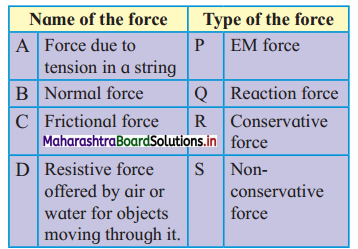
Maharashtra Board Class 11 Physics Solutions Chapter 4 Laws of Motion 1
Answer:

  1. Force due to tension in string: Electromagnetic (EM) force, reaction force, non-conservative force.
  2. Normal force: Electromagnetic (EM) force, non-conservative force. Reaction force
  3. Frictional force: Electromagnetic (EM) force, reaction force, non-conservative force.
  4. Resistive force offered by air or water for objects moving through it: Electromagnetic (EM) force, non-conservative force.

Maharashtra Board Class 11 Physics Solutions Chapter 4 Laws of Motion

Question 2.
In real life objects, never travel with uniform velocity, even on a horizontal surface, unless something is done? Why
is it so? What is to be done?
Answer:

  1. According to Newton’s first law, for a body to achieve uniform velocity, the net force acting on it should be zero.
  2. In real life, a body in motion is constantly being acted upon by resistive or opposing force like friction, in the direction opposite to that of the motion.
  3. To overcome these opposing forces, an additional external force is required. Thus, the net force is not maintained at zero, making it hard to achieve uniform velocity.

Question 3.
For the study of any kind of motion, we never use Newton’s first law of motion directly. Why should it be studied?
Answer:

  1. Newton’s first law shows an equivalence between the ‘state of rest’ and ‘state of uniform motion along a straight line.’
  2. Newton’s first law of motion defines force as a physical quantity that brings about a change in ‘state of rest’ or ‘state of .uniform motion along a straight line’ of a body.
  3. Newton’s first law of motion defines inertia as a fundamental property of every physical object by which the object resists any change in its state of rest or of uniform motion along a straight line. Due to all these reasons, Newton’s first law should be studied.

Question 4.
Are there any situations in which we cannot apply Newton’s laws of motion? Is there any alternative for it?
Answer:

  1. Limitation: Newton’s laws of motion cannot be applied for objects moving in non-inertial (accelerated) frame of reference.
    Alternative solution: For non-inertial (accelerated) frame of reference, pseudo force needs to be considered along with all the other forces.
  2. Limitation: Newton’s laws of motion are applicable to point objects and rigid bodies. Alternative solution: Body needs to be approximated as a particle as the laws can be applied to individual particles in a rigid body and then summed up over the body.
  3. Limitation: Newton’s laws of motion cannot be applied for objects moving with speeds comparable to that of light.
    Alternative solution: Einstein’s special theory of relativity has to be used.
  4. Limitation: Newton’s laws of motion cannot be applied for studying the behaviour and interactions of objects having atomic or molecular sizes.
    Alternative solution: Quantum mechanics has to be used.

Question 5.
You are inside a closed capsule from where you are not able to see anything about the outside world. Suddenly you feel that you are pushed towards your right. Can you explain the possible cause (s)? Is it a feeling or a reality? Give at least one more situation like this.
Answer:

  1. In a capsule, if we suddenly feel a push towards the right it is because the capsule is in motion and taking a turn towards the left.
  2. The push towards the right is a feeling. In reality, when the capsule is beginning its turning motion towards the left, we continue in a straight line.
  3. This happens because we try to maintain our direction of motion while the capsule takes a turn towards the left.
  4. An external force is required to change our direction of motion. In accordance with one of the inferences from Newton’s first law of motion, in the absence of any external force, we continue to move in a straight line at constant speed and feel the sudden push in the direction opposite to the motion of the capsule.
  5. Example: While travelling by bus, when the bus takes a sudden turn we feel the push in the opposite direction.

Question 6.
Among the four fundamental forces, only one force governs your daily life almost entirely. Justify the statement by stating that force.
Answer:

  1. Electromagnetic force is the attractive and repulsive force between electrically charged particles.
  2. Since electromagnetic force is much stronger than the gravitational force, it dominates all the phenomena on atomic and molecular scales.
  3. Majority of the forces experienced in our daily life like friction, normal reaction, tension in strings, elastic forces, viscosity etc. are electromagnetic in nature.
  4. The structure of atoms and molecules, the dynamics of chemical reactions etc. are governed by electromagnetic forces.

Thus, out of the four fundamental forces, electromagnetic force governs our daily life almost entirely.

Question 7.
Find the odd man out:
(i) Force responsible for a string to become taut on stretching
(ii) Weight of an object
(iii) The force due to which we can hold an object in hand.
Answer:
Weight of an object.
Reason: Weight of an object (force due to gravity) is a non-contact force while force responsible for a string to become taut (tension force) and force due to which we can hold an object in hand (normal force) are contact forces.

Maharashtra Board Class 11 Physics Solutions Chapter 4 Laws of Motion

Question 8.
You are sitting next to your friend on ground. Is there any gravitational force of attraction between you two? If so, why are you not coming together naturally? Is any force other than the gravitational force of the earth coming in picture?
Answer:

  1. Yes, there exists a gravitational force between me and my friend sitting beside each other.
  2. The gravitational force between any two objects is given by, \(\overrightarrow{\mathrm{F}}=\mathrm{G} \frac{\mathrm{m}_{1} \mathrm{~m}_{2}}{\mathrm{r}^{2}}\) Where,
    G = universal gravitational constant, m1 and m2 = mass of the two objects, r = distance between centres of the two objects
  3. Thus, me and my friend attract each other. But due to our small masses, we exert a force on each other, which is too small as compared to the gravitational force of the earth. Hence, me and my friend don’t move towards each other.
  4. Apart from gravitational force of the earth, there is the normal force and frictional force acting on both me and my friend.

In Chapter 5, you will study about force of gravitation in detail.

Question 9.
Distinguish between:
(A) Real and pseudo forces,
(B) Conservative and non-conservative forces,
(C) Contact and non-contact forces,
(D) Inertial and non-inertial frames of reference.
Answer:
(A) Real and pseudo forces,

NoReal forcePseudo Force
i.A force which is produced due to interaction between the objects is called real force.A pseudo force is one which arises due to the acceleration of the observer’s frame of reference.
ii.Real forces obey Newton’s laws of motion.Pseudo forces do not obey Newton’s laws of motion.
iii.Real forces are one of the four fundamental forces.Pseudo forces are not among any of the four fundamental forces.
Example: The earth revolves around the sun in circular path due to gravitational force of attraction between the sun and the earth.Example: Bus is moving with an acceleration (a) on a straight road in forward direction, a person of mass ‘m’ experiences a backward pseudo force of magnitude ‘ma’.

(B) Conservative and non-conservative forces,

NoConservativeNon-conservative forces
i.If work done by or against a force is independent’ of the actual path, the force is said to be a conservative force.If work done by or against a force is dependent of the actual path, the force is said to be a non- conservative force.
ii.During work done by a conservative force, the mechanical energy is conserved.During work done by a non­ conservative force, the mechanical energy may not be conserved.
iii.Work done is completely recoverable.Work done is not recoverable.
Example:
gravitational force, magnetic force etc.
Example:
Frictional force, air drag etc.

(C) Contact and non-contact forces,

NoContact forcesNon-contact forces
i.The forces experienced by a body due to physical contact are called contact forces.The forces experienced by a body without any physical contact are called non-contact forces.
ii.Example: gravitational force, electrostatic force, magnetostatic force etc.Example: Frictional force, force exerted due to collision, normal reaction etc.

(D) Inertial and non-inertial frames of reference.

No.Inertial frame of referenceNon-inertial frame of reference
iThe body moves with a constant velocity (can be zero).The body moves with variable velocity.
ii.Newton’s laws areNewton’s laws are
iii.The body does not accelerate.The body undergoes acceleration.
iv.In this frame, force acting on a body is a real force.The acceleration of the frame gives rise to a pseudo force.
Example: A rocket in inter-galactic space (gravity free space between galaxies) with all its engine shut.Example: If a car just starts its motion from rest, then during the time of acceleration the car will be in a non- inertial frame of reference.

Question 10.
State the formula for calculating work done by a force. Are there any conditions or limitations in using it directly? If so, state those clearly. Is there any mathematical way out for it? Explain.
Answer:

  1. Suppose a constant force \(\overrightarrow{\mathrm{F}}\) acting on a body produces a displacement \(\overrightarrow{\mathrm{S}}\) in the body along the positive X-direction. Then the work done by the force is given as,
    W = F.s cos θ
    Where θ is the angle between the applied force and displacement.
  2. If displacement is in the direction of the force applied, θ = 0°
    W = \(\overrightarrow{\mathrm{F}}\).\(\overrightarrow{\mathrm{s}}\)

Conditions/limitations for application of work formula:

  1. The formula for work done is applicable only if both force \(\overrightarrow{\mathrm{F}}\) and displacement \(\overrightarrow{\mathrm{s}}\) are constant and finite i.e., it cannot be applied when the force is variable.
  2. The formula is not applicable in several real- life situations like lifting an object through several thousand kilometres since the gravitational force is not constant. It is not applicable to viscous forces like fluid resistance as they depend upon speed and thus are often not constant with time.
  3. The method of integration has to be applied to find the work done by a variable force.

Integral method to find work done by a variable force:
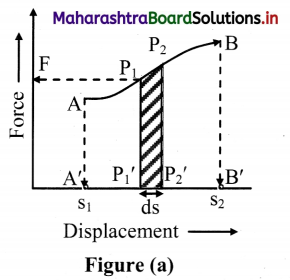
Maharashtra Board Class 11 Physics Solutions Chapter 4 Laws of Motion 2

  1. Let the force vary non-linearly in magnitude between the points A and B as shown in figure (a).
  2. In order to calculate the total work done during the displacement from s1 to s2, we need to use integration. For integration, we need to divide the displacement into large numbers of infinitesimal (infinitely small) displacements.
  3. Let at P1, the magnitude of force be F = P1P1‘. Due to this force, the body displaces through infinitesimally small displacement ds, in the direction of force.
    It moves from P1 to P2.
    ∴ \(\mathrm{d} \overrightarrow{\mathrm{s}}=\overrightarrow{\mathrm{P}_{1} \mathrm{P}_{2}}\)
  4. But direction of force and displacement are same, we have
    \(\mathrm{d} \overrightarrow{\mathrm{s}}=\mathrm{P}_{1}{ }^{\prime} \mathrm{P}_{2}^{\prime}\)
  5. \(\mathrm{d} \overrightarrow{\mathrm{s}}\) is so small that the force F is practically constant for the displacement. As the force is constant, the area of the strip \(\overrightarrow{\mathrm{F}} \cdot \mathrm{d} \overrightarrow{\mathrm{s}}\) is the work done dW for this displacement.
  6. Hence, small work done between P1 to P2 is dW and is given by
    dW = \(\overrightarrow{\mathrm{F}} \cdot \mathrm{d} \overrightarrow{\mathrm{s}}\) = \(\mathrm{P}_{1} \mathrm{P}_{1}^{\prime} \times \mathrm{P}_{1}^{\prime} \mathrm{P}_{2}^{\prime}\)
    = Area of the strip P1P2P2‘P1‘.
  7. The total work done can be found out by dividing the portion AB into small strips like P1P2P2‘P1‘ and taking sum of all the areas of the strips.
    ∴ W = \int_{s_{1}}^{s 2} \vec{F} \cdot d \vec{s}=\text { Area } A B B^{\prime} A^{\prime}\(\)
  8. Method of integration is applicable if the exact way of variation in \(\overrightarrow{\mathrm{F}}\) and \(\overrightarrow{\mathrm{s}}\) is known and that function is integrable.
  9. The work done by the non-linear variable force is represented by the area under the portion of force-displacement graph.
  10. Similarly, in case of a linear variable force, the area under the curve from s1 to s2 (trapezium APQB) gives total work done W [figure (b)].
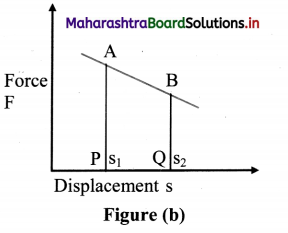
    Maharashtra Board Class 11 Physics Solutions Chapter 4 Laws of Motion 3

Question 11.
Justify the statement, “Work and energy are the two sides of a coin”.
Answer:

  1. Work and energy both are scalar quantities.
  2. Work and energy both have the same dimensions i.e., [M1L2T-2].
  3. Work and energy both have the same units i.e., SI unit: joule and CGS unit: erg.
  4. Energy refers to the total amount of work a body can do.
  5. A body capable of doing more work possesses more energy and vice versa.
  6. Work done on a body by a conservative force is equal to the change in its kinetic energy.

Thus, work and energy are the two sides of the same

Maharashtra Board Class 11 Physics Solutions Chapter 4 Laws of Motion

Question 12.
From the terrace of a building of height H, you dropped a ball of mass m. It reached the ground with speed v. Is the relation mgH = \(\frac{1}{2} m \mathrm{v}^{2}\) applicable exactly? If not, how can you account for the difference? Will the ball bounce to the same height from where it was dropped?
Answer:

  1. Let the ball dropped from the terrace of a building of height h have mass m. During free fall, the ball is acted upon by gravity (accelerating conservative force).
  2. While coming down, the work that is done is equal to the decrease in the potential energy.
  3. This work done however is not entirely converted into kinetic energy but some part of it is used in overcoming the air resistance (retarding non-conservative force). This part of energy appears in some other forms such as heat, sound, etc.
  4. Thus, in this case of an accelerating conservative force along with a retarding non-conservative force, the work-energy theorem is given as, Decrease in the gravitational
    P.E. = Increase in the kinetic energy + work done against non-conservative forces.
  5. Thus, the relation mgh = \(\frac{1}{2} \mathrm{mv}^{2}[latex] is not applicable when non-conservative forces are considered. The part of the energy converted to heat, sound etc also needs to be added to the equation,
  6. The ball will not bounce to the same height from where it was dropped due to the loss in kinetic energy during the collision making it an inelastic collision.

Question 13.
State the law of conservation of linear momentum. It is a consequence of which law? Given an example from our daily life for conservation of momentum. Does it hold good during burst of a cracker?
Answer:

  1. Statement: The total momentum of an isolated system is conserved during any interaction.
  2. The law of conservation of linear momentum is a consequence of Newton’s second law of motion, (in combination with Newton’s third law)
  3. Example: When a nail is driven into a wall by striking it with a hammer, the hammer is seen to rebound after striking the nail. This is because the hammer imparts a certain amount of momentum to the nail and the nail imparts an equal and opposite amount of momentum to the hammer.
    Linear momentum conservation during the burst of a cracker:

    • The law of conservation of linear momentum holds good during bursting of a cracker.
    • When a cracker is at rest before explosion, the linear momentum of the cracker is zero.
    • When cracker explodes into number of pieces, scattered in different directions, the vector sum of linear momentum of these pieces is also zero. This is as per the law of conservation of linear momentum.

Question 14.
Define coefficient of restitution and obtain its value for an elastic collision and a perfectly inelastic collision.
Answer:

i. For two colliding bodies, the negative of ratio of relative velocity of separation to relative velocity of approach is called the coefficient of restitution.

ii. Consider an head-on collision of two bodies of masses m1 and m2 with respective initial velocities u1 and u2. As the collision is head on, the colliding masses are along the same line before and after the collision. Relative velocity of approach is given as,
ua = u2 – u1
Let v1 and v2 be their respective velocities after the collision. The relative velocity of recede (or separation) is then vs = v2 – v1

Maharashtra Board Class 11 Physics Solutions Chapter 4 Laws of Motion 4
iii. For a head on elastic collision, According to the principle of conservation of linear momentum,
Total initial momentum = Total final momentum
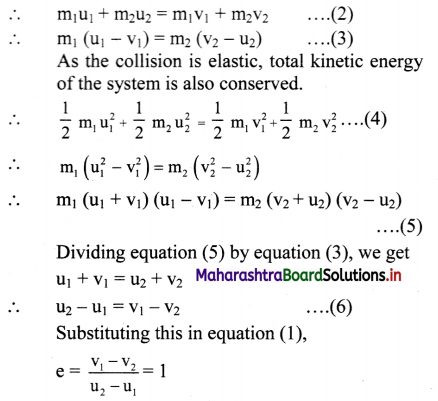
Maharashtra Board Class 11 Physics Solutions Chapter 4 Laws of Motion 5
iv. For a perfectly inelastic collision, the colliding bodies move jointly after the collision, i.e., v1 = v2
∴ v1 – v2 = 0
Substituting this in equation (1), e = 0.

Maharashtra Board Class 11 Physics Solutions Chapter 4 Laws of Motion

Question 15.
Discuss the following as special cases of elastic collisions and obtain their exact or approximate final velocities in terms
of their initial velocities.
(i) Colliding bodies are identical.
(ii) A very heavy object collides on a lighter object, initially at rest.
(iii) A very light object collides on a comparatively much massive object, initially at rest.
Answer:
The final velocities after a head-on elastic collision is given as,
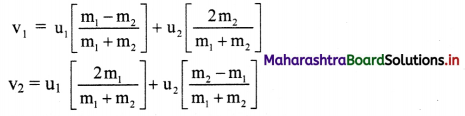
Maharashtra Board Class 11 Physics Solutions Chapter 4 Laws of Motion 6
i. Colliding bodies are identical
If m1 = m2, then v1 = u2 and v2 = u1
Thus, objects will exchange their velocities after head on elastic collision.

ii. A very heavy object collides with a lighter object, initially at rest.
Let m1 be the mass of the heavier body and m2 be the mass of the lighter body i.e., m1 >> m2; lighter particle is at rest i.e., u2 = 0 then,
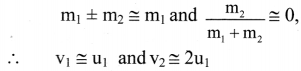
Maharashtra Board Class 11 Physics Solutions Chapter 4 Laws of Motion 7
i.e., the heavier colliding body is left unaffected and the lighter body which is struck, travels with double the speed of the massive striking body.

iii. A very light object collides on a comparatively much massive object, initially at rest.
If m1 is mass of a light body and m2 is mass of heavy body i.e., m1 << m2 and u2 = 0. Thus, m1 can be neglected.
Hence v1 ≅ -u1, and v2 ≅ 0.
i.e., the tiny (lighter) object rebounds with same speed while the massive object is unaffected.

Question 16.
A bullet of mass m1 travelling with a velocity u strikes a stationary wooden block of mass m2 and gets embedded into it. Determine the expression for loss in the kinetic energy of the system. Is this violating the principle of conservation of energy? If not, how can you account for this loss?
Answer:

  1. A bullet of mass m1 travelling with a velocity u, striking a stationary wooden block of mass m2 and getting embedded into it is a case of perfectly inelastic collision.
  2. In a perfectly inelastic collision, although there is a loss in kinetic energy, the principle of conservation of energy is not violated as the total energy of the system is conserved.

Loss in the kinetic energy during a perfectly inelastic head on collision:

  1. Let two bodies A and B of masses m1 and m2 move with initial velocity [latex]\overrightarrow{\mathrm{u}_{1}}\), and \(\overrightarrow{\mathrm{u}_{2}}\) respectively such that particle A collides head- on with particle B i.e., u1 > u2.
  2. If the collision is perfectly inelastic, the particles stick together and move with a common velocity \(\overrightarrow{\mathbf{V}}\) after the collision along the same straight line.
    loss in kinetic energy = total initial kinetic energy – total final kinetic energy,
  3. By the law of conservation of momentum, m1u1 + m2u2 = (m1 + m2) v
    ∴ v = \(\frac{\mathrm{m}_{1} \mathrm{u}_{1}+\mathrm{m}_{2} \mathrm{u}_{2}}{\mathrm{~m}_{1}+\mathrm{m}_{2}}\)
  4. Loss of Kinetic energy,
    Maharashtra Board Class 11 Physics Solutions Chapter 4 Laws of Motion 8
  5. Both the masses and the term (u1 – u2)2 are positive. Hence, there is always a loss in a perfectly inelastic collision. For a perfectly inelastic collision, as e = 0, the loss is maximum.

Question 17.
One of the effects of a force is to change the momentum. Define the quantity related to this and explain it for a variable
force. Usually when do we define it instead of using the force?
Answer:

  1. Impulse is the quantity related to change in momentum.
  2. Impulse is defined as the change of momentum of an object when the object is acted upon by a force for a given time interval.

Need to define impulse:

  1. In cases when time for which an appreciable force acting on an object is extremely small, it becomes difficult to measure the force and time independently.
  2. In such cases, however, the effect of the force i.e, the change in momentum due to the force is noticeable and can be measured.
  3. For such cases, it is convenient to define impulse itself as a physical quantity.
  4. Example: Hitting a ball with a bat, giving a kick to a foot-ball, hammering a nail, bouncing a ball from a hard surface, etc.

Impulse for a variable force:

  1. Consider the collision between a bat and ball. The variation of the force as a function of time is shown below. The force axis is starting from zero.
  2. From the graph, it can be seen that the force is zero before the impact. It rises to a maximum during the impact and decreases to zero after the impact.
  3. The shaded area or the area under the curve of the force -time graph gives the product of force against the corresponding time (∆t) which is the impulse of the force.
    Area of ABCDE = F. ∆t = impulse of force
  4. For a constant force, the area under the curve is a rectangle.
  5. In case of a softer tennis ball, the collision time becomes larger and the maximum force becomes less keeping the area under curve of the (F – t) graph same.
    Area of ABCDE = Area of PQRST
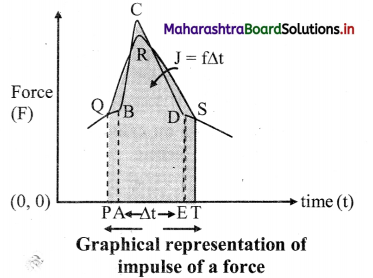
Maharashtra Board Class 11 Physics Solutions Chapter 4 Laws of Motion 9
In chapter 3, you have studied the concept of using area under the curve.

Maharashtra Board Class 11 Physics Solutions Chapter 4 Laws of Motion

Question 18.
While rotating an object or while opening a door or a water tap we apply a force or forces. Under which conditions is this process easy for us? Why? Define the vector quantity concerned. How does it differ for a single force and for two opposite forces with different lines of action?
Answer:

  1. Opening a door can be done with ease if the force applied is:
    • proportional to the mass of the object
    • far away from the axis of rotation and the direction of force is perpendicular to the line joining the axis of rotation with the point of application of force.
  2. This is because, the rotational ability of a force depends not only upon the magnitude and direction of force but also on the point where the force acts with respect to the axis of rotation.
  3. Rotating an object like a water tap can be done with ease if the two forces are equal in magnitude but opposite in direction are applied along different lines of action.
  4. The ability of a force to produce rotational motion is measured by its turning effect called ‘moment of force’ or ‘torque’.
  5. However, a moment of couple or rotational effect of a couple is also called torque.
  6. For differences in the two vector quantities.
No.Moment of a forceMoment of a couple
i.Moment of a force is given as, \(\vec{\tau}=\vec{r} \times \vec{F}\)Moment of a couple is given as, \(\vec{\tau}=\vec{r}_{12} \times \vec{F}_{1}=\vec{r}_{21} \times \vec{F}_{2}\)
ii.It depends upon the axis of rotation and the point of application of the force.It depends only upon the two forces, i.e., it is independent of the axis of rotation or the points of application of forces.
iii.It can produce translational acceleration also, if the axis of rotation is not fixed or if friction is not enough.Does not produce any translational acceleration, but produces only rotational or angular acceleration.
iv.Its rotational effect can be balanced by a proper single force or by a proper couple.Its rotational effect can be balanced only by another couple of equal and opposite torque.

Question 19.
Why is the moment of a couple independent of the axis of rotation even if the axis is fixed?
Answer:

  1. Consider a rectangular sheet free to rotate only about a fixed axis of rotation, perpendicular to the plane.
  2. A couple of forces \(\overrightarrow{\mathrm{F}}\) and –\(\overrightarrow{\mathrm{F}}\) is acting on the sheet at two different locations.
  3. Consider the torque of the couple as two torques due to individual forces causing rotation about the axis of rotation.
  4. Case 1: The axis of rotation is between the lines of action of the two forces constituting the couple. Let x and y be the perpendicular distances of the axis of rotation from the forces \(\overrightarrow{\mathrm{F}}\) and –\(\overrightarrow{\mathrm{F}}\) respectively.
    In this case, the pair of forces cause anticlockwise rotation. As a result, the direction of individual torques due to the two forces is the same.
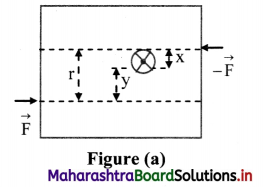
    Maharashtra Board Class 11 Physics Solutions Chapter 4 Laws of Motion 10
  5. Case 2: Lines of action of both the forces are on the same side of the axis of rotation. Let q and p be the perpendicular distances of the axis of rotation from the forces \(\overrightarrow{\mathrm{F}}\) and –\(\overrightarrow{\mathrm{F}}\)

Question 20.
Explain balancing or mechanical equilibrium. Linear velocity of a rotating fan as a whole is generally zero. Is it in
mechanical equilibrium? Justify your answer.
Answer:

  1. The state in which the momentum of a system is constant in the absence of an external unbalanced force is called mechanical equilibrium.
  2. A particle is said to be in mechanical equilibrium, if no net force is acting upon it.
  3. In case of a system of bodies to be in mechanical equilibrium, the net force acting on any part of the system should be zero i.e., the velocity or linear momentum of all parts of the system must be constant or zero. There should be no acceleration in any part of the system.
  4. Mathematically, for a system in mechanical equilibrium, \(\sum \vec{F}\) = 0.
  5. In case of rotating fan, if linear velocity is zero, then the linear momentum is zero. That means there is no net force acting on the fan. Hence, the fan is in mechanical equilibrium.

Question 21.
Why do we need to know the centre of mass of an object? For which objects, its position may differ from that of the centre of gravity?
Use g = 10 m s-2, unless, otherwise stated.
Answer:

  1. Centre of mass of an object allows us to apply Newton’s laws of motion to finite objects (objects of measurable size) by considering these objects as point objects.
  2. For objects in non-uniform gravitational field or whose size is comparable to that of the Earth (size at least few thousand km), the position of centre of mass will differ than that of centre of gravity.

3. Solve the following problems.

Question 1.
A truck of mass 5 ton is travelling on a horizontal road with 36 km hr-1 stops on travelling 1 km after its engine fails suddenly. What fraction of its weight is the frictional force exerted by the road? If we assume that the story repeats for a car of mass 1 ton i.e., can moving with same speed stops in similar distance same how much will the fraction be?
[Ans: \(\frac{1}{200}\) in the both]
Solution:
Given: mtruck = 5 ton = 5000 kg,
mcar = 1 ton = 1000 kg,
u = 36km/hr = 10 m/s,
v = 0 m/s, s = 1 km = 1000 m
To find: Ratio of force of friction to the weight of vehicle
Formulae:
i. v2 = u2 + 2as
ii. F = ma
Calculation: From formula (i),
2 × atruck × s = v2 – u2
∴ 2 × atruck × 1000 = 02 – 102
∴ 200atruck = -100
∴ atruck = -0.05 m/s2
Negative sign indicates that velocity is decreasing
From formula (ii),
Ftruck = mtruck × atruck = 5000 × 0.05
= 250 N
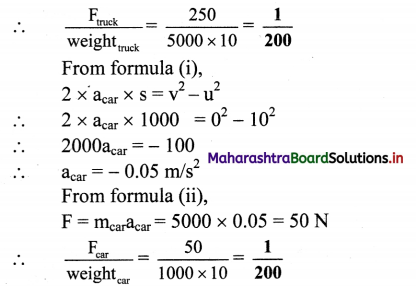
Maharashtra Board Class 11 Physics Solutions Chapter 4 Laws of Motion 11
Answer:
The frictional force acting on both the truck and the car is \(\frac{1}{200}\) of their weight.

Maharashtra Board Class 11 Physics Solutions Chapter 4 Laws of Motion

Question 2.
A lighter object A and a heavier object B are initially at rest. Both are imparted the same linear momentum. Which will start with greater kinetic energy: A or B or both will start with the same energy?
[Ans: A]
Solution:

  1. Let m1 and m2 be the masses of light object A and heavy object B and v1 and v2 be their respective velocities.
  2. Since both are imparted with the same linear momentum,
    m1 v1 = m2 v2
  3. Kinetic energy of the lighter object A
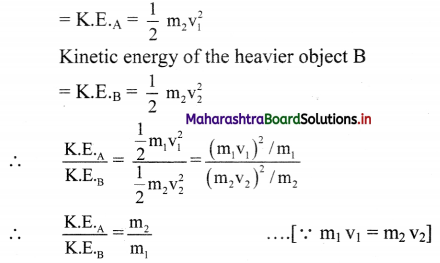
    Maharashtra Board Class 11 Physics Solutions Chapter 4 Laws of Motion 12
  4. As m1 < m2, therefore K.E.A > K.E.B, i.e, the lighter body A has more kinetic energy.

Question 3.
As i was standing on a weighing machine inside a lift it recorded 50 kg wt. Suddenly for few seconds it recorded 45 kg wt. What must have happened during that time? Explain with complete numerical analysis. [Ans: Lift must be coming down with acceleration \(\frac{\mathrm{g}}{10}\) = 1 ms-2]
Solution:
The weight recorded by weighing machine is always apparent weight and a measure of reaction force acting on the person. As the apparent weight (45 kg-wt) in this case is less than actual weight (50 kg-wt) the lift must be accelerated downwards during that time.

Numerical Analysis

  1. Weight on the weighing machine inside the lift is recorded as 50 kg-wt
    ∴ mg = 50 kg-wt
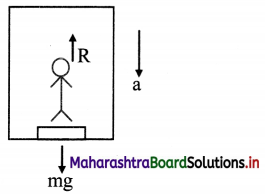
    Maharashtra Board Class 11 Physics Solutions Chapter 4 Laws of Motion 13
  2. This weight acts on the weighing machine which offers a reaction R given by the reading of the weighing machine
    ∴ R = 45kg-wt = \(\frac{9}{10}\)mg
  3. The forces acting on person inside lift are as follows:
    • Weight mg downward (exerted by the earth)
    • Normal reaction (R) upward (exerted by the floor)
  4. As, R < mg, the net force is in downward direction and given as,
    mg – R=ma
    But R = \(\frac{9}{10}\)mg.
    ∴ mg – \(\frac{9}{10}\)mg = ma
    ∴ \(\frac{mg}{10}\) = ma
    ∴ a = g/10
    ∴ a = 1 m/s2 (∵ g = 1 m/s2)
  5. Therefore, the elevator must be accelerated downwards with an acceleration of 1 m/s2 at that time.

Question 4.
Figure below shows a block of mass 35 kg resting on a table. The table is so rough that it offers a self adjusting resistive force 10% of the weight of the block for its sliding motion along the table. A 20 kg wt load is attached to the block and is passed over a pulley to hang freely on the left side. On the right side there is a 2 kg wt pan attached to the block and hung freely. Weights of 1 kg wt each, can be added to the pan. Minimum how many and maximum how many such weights can be added into the pan so that the block does not slide along the table? [Ans: Min 15, maximum 21].
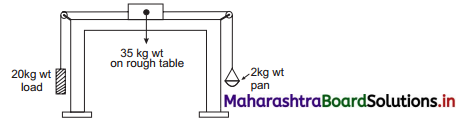
Maharashtra Board Class 11 Physics Solutions Chapter 4 Laws of Motion 14
Solution:
Frictional (resistive) force f = 10% (weight)
= \(\frac{10}{100}\) × 35 × 10 = 35N 100
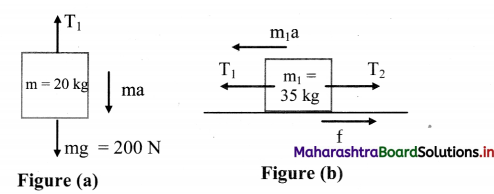
Maharashtra Board Class 11 Physics Solutions Chapter 4 Laws of Motion 15

i. Consider FBD for 20 kg-wt load. Initially, the block kept on the table is moving towards left, because of the movement of block of mass 20 kg in downward direction.
Thus, for block of mass 20 kg,
ma = mg – T1 …. (1)
Consider the forces acting on the block of mass 35 kg in horizontal direction only as shown in figure (b). Thus, the force equation for this block is, m1a = T1 – T2 – f ….(2)
To prevent the block from sliding across the table,
m1a = ma = 0
∴ T1 = mg = 200 N ….[From (1)]
T1 = T2 + f ….[From (2)]
∴ T2 + f = 200
∴ T2 = 200 – 35 = 165 N
Thus, the total force acting on the block from right hand side should be 165 N.
∴ Total mass = 16.5 kg
∴ Minimum weight to be added = 16.5 – 2 = 14.5 kg
≈ 15 weights of 1 kg each

ii. Now, considering motion of the block towards right, the force equations for the masses in the pan and the block of mass 35 kg can be determined from FBD shown
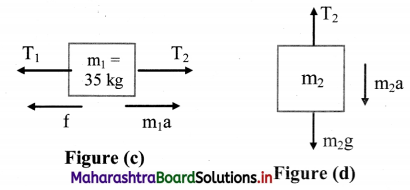
Maharashtra Board Class 11 Physics Solutions Chapter 4 Laws of Motion 16
From figure (c)
m1a = T2 – T1 – f ….(iii)
From figure (d),
m2a = m2g – T2 … .(iv)
To prevent the block of mass 35 kg from sliding across the table, m1a = m2a = 0
From equations (iii) and (iv),
T2 = T1 + f
T2 = m2g
∴ m2g = 200 + 35 = 235 N
∴ The maximum mass required to stop the sliding = 23.5 – 2 = 21.5kg ≈ 21 weights of 1 kg
Answer:
The minimum 15 weights and maximum 21 weights of 1 kg each are required to stop the block from sliding.

Question 5.
Power is rate of doing work or the rate at which energy is supplied to the system. A constant force F is applied to a body
of mass m. Power delivered by the force at time t from the start is proportional to
(a) t
(b) t2
(c) \(\sqrt{t}\)
(d) t0
Derive the expression for power in terms of F, m and t.
[Ans: p = \(\frac{F^{2} t}{m}\), ∴ p ∝ t]
Solution:
Derivation for expression of power:

i. A constant force F is applied to a body of mass (m) initially at rest (u = 0).

ii. We have,
v = u + at
∴ v = 0 + at
∴ v = at …. (1)

iii. Now, power is the rate of doing work,
∴ P = \(\frac{\mathrm{d} \mathrm{W}}{\mathrm{d} \mathrm{t}}\)
∴ P = F. \(\frac{\mathrm{d} \mathrm{s}}{\mathrm{dt}}\) [∵ dW = F. ds]

iv. But \(\frac{\mathrm{d} \mathrm{s}}{\mathrm{dt}}\) = v, the instantaneous velocity of the particle.
∴ P = F.V … (2)

v. According to Newton’s second law,
F = ma … (3)

vi. Substituting equations (1) and (3) in equation (2)
P = (ma) (at)
∴ P = ma2t
∴ P = \(\frac{m^{2} a^{2}}{m}\) × t
∴ P = \(\frac{\mathrm{F}^{2}}{\mathrm{~m}} \mathrm{t}\)

vii. As F and m are constant, therefore, P ∝ t.

Maharashtra Board Class 11 Physics Solutions Chapter 4 Laws of Motion

Question 6.
40000 litre of oil of density 0.9 g cc is pumped from an oil tanker ship into a storage tank at 10 m higher level than the ship in half an hour. What should be the power of the pump? [Ans: 2 kW]
Solution:
h = 10 m, ρ = 0.9 g/cc = 900 kg/m3, g = 10 m/s2,
V = 40000 litre = 40000 × 103 × 10-6 m3
= 40 m3
T = 30 min = 1800 s
To find: Power(P)
Formula: P = \(\frac{\mathrm{W}}{\mathrm{t}}=\frac{\mathrm{h} \rho \mathrm{gV}}{\mathrm{t}}\)
Calculation: From formula,
P = \(\frac{10 \times 900 \times 10 \times 40}{1800}\)
∴ P = 2000 W
∴ P = 2 kW
Answer:
The power of the pump is 2 kW.

Question 7.
Ten identical masses (m each) are connected one below the other with 10 strings. Holding the topmost string, the system is accelerated upwards with acceleration g/2. What is the tension in the 6th string from the top (Topmost string being the first string)? [Ans: 6 mg]
Solution
Consider the 6th string from the top. The number of masses below the 6th string is 5. Thus, FBD for the 6th mass is given in figure (b).
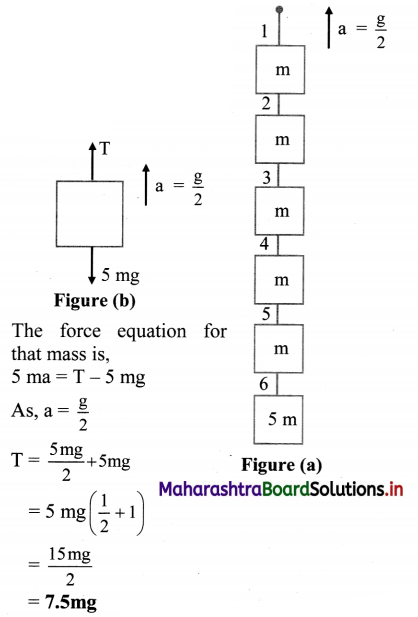
Maharashtra Board Class 11 Physics Solutions Chapter 4 Laws of Motion 18
Answer:
Tension in the 6th string is 7.5 mg.
[Note: The answer given above is modified considering the correct textual concepts.]

Question 8.
Two galaxies of masses 9 billion solar mass and 4 billion solar mass are 5 million light-years apart. If, the Sun has to cross the line joining them, without being attracted by either of them, through what point it should pass? [Ans: 3 million light-years from the 9 billion solar mass]
Solution:
The Sun can cross the line joining the two galaxies without being attracted by either of them if it passes from a neutral point. A neutral point is a point on the line joining two objects where the effect of gravitational forces acting due to both the objects is nullified.
Given that;
m1 = 9 × 10⁹ Ms
m2 = 4 × 10⁹ Ms
r = 5 × 10⁶ light years
Let the neutral point be at distance x from mi. If sun is present at that point,
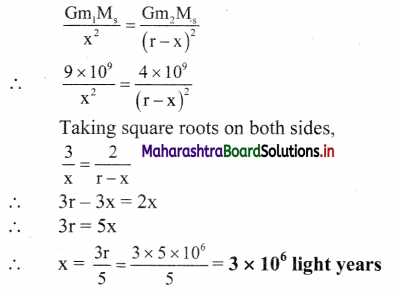
Maharashtra Board Class 11 Physics Solutions Chapter 4 Laws of Motion 19
Answer: The Sun has to cross the line from a point at a distance 3 million light years from the galaxy of mass 9 billion solar mass.

Question 9.
While decreasing linearly from 5 N to 3 N, a force displaces an object from 3 m to 5 m. Calculate the work done by this force during this displacement. [Ans: 8 N]
Solution:
For a variable force, work done is given by area under the curve of force v/s displacement graph. From given data, graph can be plotted as follows:
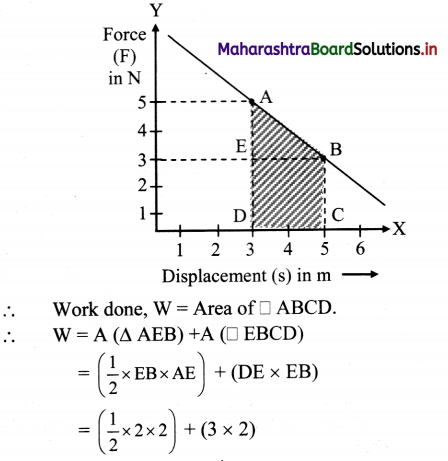
Maharashtra Board Class 11 Physics Solutions Chapter 4 Laws of Motion 20
= 8 J
Ans: Work done is 8 J.
[Note: According to the definition of work done, S.J. unit of wõrk done is joule (J)]

Alternate solution:
Work done, w = Area of trapezium ADCB
∴ W = \(\frac{1}{2}\)(AD + CB) × DC
∴ W = 1 (5N + 3N) × (5m – 3m)
= \(\frac{1}{2}\) × 8 × 2 = 8J

Maharashtra Board Class 11 Physics Solutions Chapter 4 Laws of Motion

Question 10.
Variation of a force in a certain region is given by F = 6x2 – 4x – 8. It displaces an object from x = 1 m to x = 2 m in this region. Calculate the amount of work
done. [Ans: Zero]
Solution:
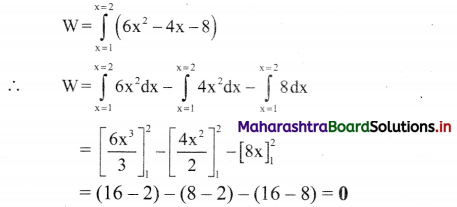
Maharashtra Board Class 11 Physics Solutions Chapter 4 Laws of Motion 21
Answer:
The work done is zero.

Question 11.
A ball of mass 100 g dropped on the ground from 5 m bounces repeatedly. During every bounce 64% of the potential energy is converted into kinetic energy. Calculate the following:
(a) Coefficient of restitution.
(b) Speed with which the ball comes up from the ground after third bounce.
(c) Impulse given by the ball to the ground during this bounce.
(d) Average force exerted by the ground if this impact lasts for 250 ms.
(e) Average pressure exerted by the ball on the ground during this impact if the contact area of the ball is 0.5 cm2.
[Ans: 0.8, 5.12 m/s, 1.152N s, 4.608 N, 9.216 × 10⁴ N/m2]
Solution:
Given that, for every bounce, 64% of the initial energy is converted to final energy.
i. Coefficient of restitution in case of inelastic collision is given by,
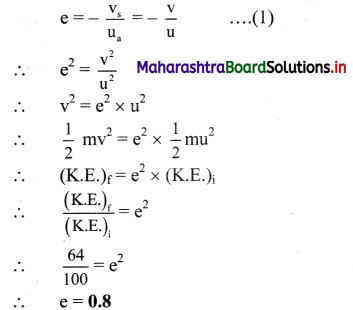
Maharashtra Board Class 11 Physics Solutions Chapter 4 Laws of Motion 105

ii. From equation (1),
∴ v = – eu
∴ After first bounce,
v1 = – eu
after second bounce,
v2 = -ev1 = -e(-eu)= e2u
and after third bounce,
v3 = – ev2 = – e(e2u) = – e3u
But u = \(\sqrt{2 \mathrm{gh}}\)
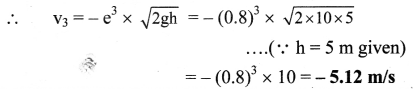
Maharashtra Board Class 11 Physics Solutions Chapter 4 Laws of Motion 106

iii. Impulse given by the ball during third bounce, is,
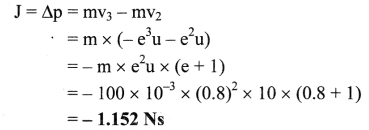
Maharashtra Board Class 11 Physics Solutions Chapter 4 Laws of Motion 110

iv. Average force exerted in 250 ms,
Maharashtra Board Class 11 Physics Solutions Chapter 4 Laws of Motion 120

v. Average pressure for area
0.5 cm2 = 0.5 × 10⁻⁴m2
P = \(\frac{\mathrm{F}}{\mathrm{A}}=\frac{4.608}{0.5 \times 10^{-4}}\) = 9.216 × 10⁴ N/m2

Question 12.
A spring ball of mass 0.5 kg is dropped from some height. On falling freely for 10 s, it explodes into two fragments of
mass ratio 1:2. The lighter fragment continues to travel downwards with speed of 60 m/s. Calculate the kinetic energy supplied during explosion. [Ans: 200 J]
Solution:
m1 + m2 = 0.5 kg, m1 : m2 = 1 : 2,
m1 = \(\frac{1}{6}\) kg,
∴ m2 = \(\frac{1}{3}\) kg
Initially, when the ball is falling freely for 10s,
v = u + at = 0 + 10(10)
∴ v = 100 m/s = u1 = u2
(m1 + m2)v = m1v1 + m2v2
∴ 0.5 × 100 = \(\frac{1}{6}\)(60) + \(\frac{1}{3}\)v2
∴ 50 = 10 + \(\frac{1}{3}\)v2
∴ 40 = \(\frac{1}{3}\)v2
∴ v2 = 120m/s
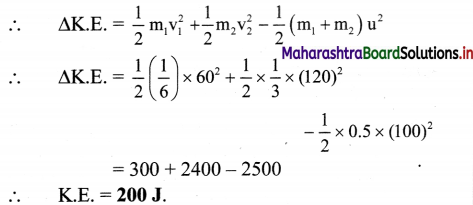
Maharashtra Board Class 11 Physics Solutions Chapter 4 Laws of Motion 22
∴ K.E. = 200J.
Ans: Kinetic energy supplied is 200 J.

Question 13.
A marble of mass 2m travelling at 6 cm/s is directly followed by another marble of mass m with double speed. After collision, the heavier one travels with the average initial speed of the two. Calculate the coefficient of restitution. [Ans: 0.5]
Solution:
Given: m1 = 2m, m2 = m, u1 = 6 cm/s,
u2 = 2u1 = 12 cm/s,
v1 = \(\frac{\mathrm{u}_{1}+\mathrm{u}_{2}}{2}\) = 9cm/s
To find: Coefficient of restitution(e)
Formulae:

i. m1u1 +m2u2 = m1v1 + m2v2
ii. e = \(\frac{v_{2}-v_{1}}{u_{1}-u_{2}}\)
Calculation: From formula (i),
[(2m) × 6] + (m × 12) = (2m × 9) + mv2
∴ v2 = 6cm/s

From formula (ii),
e = \(\frac{6-9}{6-12}\) = \(\frac{-3}{-6}\) = 0.5

Answer: The coefficient of restitution is 0.5

Maharashtra Board Class 11 Physics Solutions Chapter 4 Laws of Motion

Question 14.
A 2 m long wooden plank of mass 20 kg is pivoted (supported from below) at 0.5 m from either end. A person of mass 40 kg starts walking from one of these pivots to the farther end. How far can the person walk before the plank topples? [Ans: 1.25 m]
Solution:
Let the person starts walking from pivot P2 as shown in the figure.
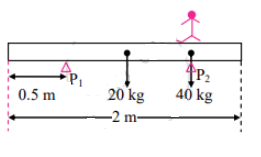
Maharashtra Board Class 11 Physics Solutions Chapter 4 Laws of Motion 100
Assume the person can walk up to distance x from P1 before the plank topples. The plank will topple when the moment exerted by the person about P1 is not balanced by a moment of force due to plank about P2.
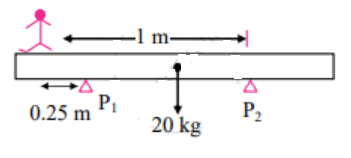
Maharashtra Board Class 11 Physics Solutions Chapter 4 Laws of Motion 101
∴ For equilibrium,
40 × x = 20 × 0.5
∴ x = \(\frac{1}{4}\) = 0.25 m
Hence, the total distance walked by the person is 1.25 m.

Question 15.
A 2 m long ladder of mass 10 kg is kept against a wall such that its base is 1.2 m away from the wall. The wall is smooth but the ground is rough. The roughness of the ground is such that it offers a maximum horizontal resistive force (for sliding motion) half that of normal reaction at the point of contact. A monkey of mass 20 kg starts climbing the ladder. How far can it climb along the ladder? How much is the horizontal reaction at the wall? [Ans: 1.5 m, 15 N]
Solution:
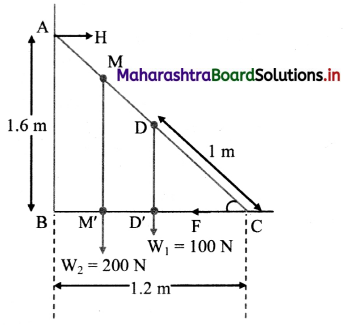
Maharashtra Board Class 11 Physics Solutions Chapter 4 Laws of Motion 23
From the figure,
Given that, AC = length of ladder = 2 m
BC= 1.2m
From Pythagoras theorem,
AB = \(\sqrt{\mathrm{AC}^{2}-\mathrm{BC}^{2}}\) = 1.6 m … (i)
Also, ∆ABC ~ ∆DD’C
∴ \(\frac{\mathrm{AB}}{\mathrm{DD}^{\prime}}\) = \(\frac{\mathrm{BC}}{\mathrm{D}^{\prime} \mathrm{C}}\) = \(\frac{\mathrm{AC}}{\mathrm{DC}}\)
∴ \(\frac{1.2}{\mathrm{D}^{\prime} \mathrm{C}}=\frac{2}{1}\)
∴ D’C = 0.6 m … (ii)

The ladder exerts horizontal force \(\overrightarrow{\mathrm{H}}\) on the wall at A and \(\overrightarrow{\mathrm{F}}\) is the force exerted on the ground at C.
As |\(\overrightarrow{\mathrm{F}}\)| = \(|\overrightarrow{\mathrm{H}}|=|\overrightarrow{\mathrm{F}}|=\frac{\mathrm{N}}{2}\) … (iii)

Let monkey climb upto distance x along BC (Horizontal) i.e., CM’ = x .. . .(iv)
Then, the net normal reaction at point C will be, N = 100 + 200 = 300N
From equation (iii),
H = \(\frac{\mathrm{N}}{2}=\frac{300}{2}\) = 150N
By condition of equilibrium, taking moments about C,
(-H × AB) + (W1 × CD’) + (W2 × CM’) + (F × 0)’0
∴ (-150 × 1.6) + (100 × 0.6) + (200 × x) = 0
∴ 60 + 200x = 240
∴ 200x = 180
∴ x = 0.9

From figure, it can be shown that,
∆ABC ~ ∆MM’C
∴ \(\frac{\mathrm{BC}}{\mathrm{CM}^{\prime}}\) = \(\frac{\mathrm{AC}}{\mathrm{CM}^{\prime}}\) ∴ \(\frac{\mathrm{1.2}}{\mathrm{0.9}^{\prime}}\) = \(\frac{\mathrm{2}}{\mathrm{CM}^{\prime}}\)
∴ CM = 1.5 m

Answer:

  1. The monkey can climb upto 1.5 m along the ladder.
  2. The horizontal reaction at wall is 150 N.

Question 16.
Four uniform solid cubes of edges 10 cm, 20 cm, 30 cm and 40 cm are kept on the ground, touching each other in order. Locate centre of mass of their system. [Ans: 65 cm, 17.7 cm]
Solution:
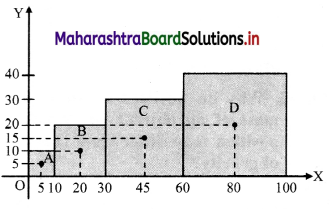
Maharashtra Board Class 11 Physics Solutions Chapter 4 Laws of Motion 24
The given cubes are arranged as shown in figure. Let one of the comers of smallest cube lie at the origin.
As the cubes are uniform, let their centre of masses lie at their respective centres.
rA \(\equiv\) (5, 5), rB \(\equiv\) (20, 10), rC \(\equiv\) = (45, 15) and rD \(\equiv\) – (80, 20)
Also, masses of the cubes are,
mA = \(l_{\mathrm{A}}^{3} \times \rho=10^{3} \rho\)
mB = (20)3ρ
mC = (30)3ρ
mD = (40)3ρ
As the cubes are uniform, p is same for all of them.
∴ For X – co-ordinate of centre of mass of the system,
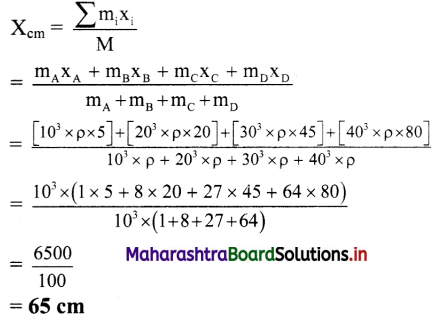
Maharashtra Board Class 11 Physics Solutions Chapter 4 Laws of Motion 25
Similarly,
Y – co-ordinate of centre of mass of system is,
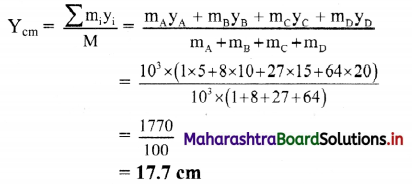
Maharashtra Board Class 11 Physics Solutions Chapter 4 Laws of Motion 26
Answer: Centre of mass of the system is located at point (65 cm, 17.7 cm)

Maharashtra Board Class 11 Physics Solutions Chapter 4 Laws of Motion

Question 17.
A uniform solid sphere of radius R has a hole of radius R/2 drilled inside it. One end of the hole is at the centre of the
sphere while the other is at the boundary. Locate centre of mass of the remaining sphere. [Ans: -R/14 ]
Solution:
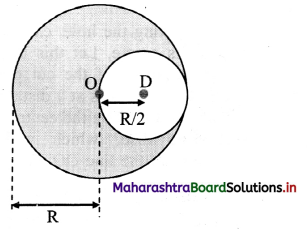
Maharashtra Board Class 11 Physics Solutions Chapter 4 Laws of Motion 27
Let the centre of the sphere be origin O. Then, r1 be the position vector of centre of mass of uniform solid sphere and r2 be the position vector of centre of mass of the cut-out part of the sphere.
Now, mass of the sphere is given as,
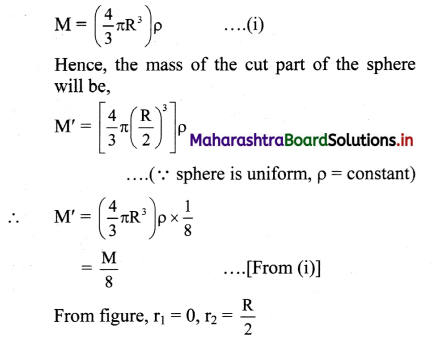
Maharashtra Board Class 11 Physics Solutions Chapter 4 Laws of Motion 28
∴ Position vector of centre of mass of remaining part,
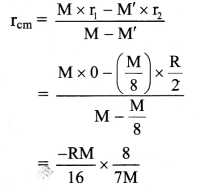
Maharashtra Board Class 11 Physics Solutions Chapter 4 Laws of Motion 29
rCM = \(\frac{-\mathbf{R}}{14}\)
(Negative sign indicates the distance is on left side of the origin.)
Ans: Position of centre of mass of remaining sphere \(\frac{-\mathbf{R}}{14}\)

Question 18.
In the following table, every item on the left side can match with any number of items on the right hand side. Select all those.
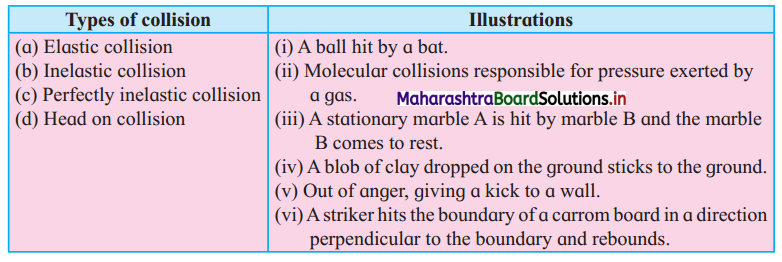
Maharashtra Board Class 11 Physics Solutions Chapter 4 Laws of Motion 30
Answer:
i. Elastic collision: (b)
ii. Inelastic collision: (a), (c), (f), (e)
iii. Perfectly inelastic collision: (d)
iv. Head-on collision: (c), (f)

11th Physics Digest Chapter 4 Laws of Motion Intext Questions and Answers

Can you recall? (Textbook Page No. 47)

Question 1.
What are different types of motions?
Answer:
The various types of motion are linear, uniform linear, non-uniform linear, oscillatory, circular, periodic, and random motion.

Question 2.
What do you mean by kinematical equations and what are they?
Answer:
A set of three equations that analyses rectilinear motion of the uniformly accelerated body and help to predict the position of body are called kinematical equations.

  1. Equation for velocity-time relation: v = u + at
  2. Equation for position-time relation: s = ut + \(\frac{1}{2}\)at2
  3. Position-velocity relation: v2 = u2 + 2as

Can you tell? (Textbook Page No. 48)

Question 1.
Was Aristotle correct? If correct, explain his statement with an illustration.
Answer:
Aristotle was not correct in stating that an external force is required to keep a body in uniform motion.

Question 2.
If wrong, give the correct modified version of his statement.
Answer:
For an uninterrupted motion of a body, an additional external force is required for overcoming opposing/resistive forces.

Maharashtra Board Class 11 Physics Solutions Chapter 4 Laws of Motion

Can you tell? (Textbook Page No. 48)

Question 1.
What is then special about Newton’s first law if it is derivable from Newton’s second law?
Answer:

  1. Newton’s first law shows an equivalence between the ‘state of rest’ and ‘state of uniform motion along a straight line.’
  2. Newton’s first law of motion defines force as a physical quantity that brings about a change in ‘state of rest’ or ‘state of .uniform motion along a straight line’ of a body.
  3. Newton’s first law of motion defines inertia as a fundamental property of every physical object by which the object resists any change in its state of rest or of uniform motion along a straight line.
  4. Due to all these reasons, Newton’s first law should be studied.

Maharashtra Board Class 11 Physics Solutions Chapter 3 Motion in a Plane

Balbharti Maharashtra State Board 11th Physics Textbook Solutions Chapter 3 Motion in a Plane Textbook Exercise Questions and Answers.

Maharashtra State Board 11th Physics Solutions Chapter 3 Motion in a Plane

1. Choose the correct option.

Question 1.
An object thrown from a moving bus is on example of __________
(A) Uniform circular motion
(B) Rectilinear motion
(C) Projectile motion
(D) Motion in one dimension
Answer:
(C) Projectile motion

Question 2.
For a particle having a uniform circular motion, which of the following is constant ____________.
(A) Speed
(B) Acceleration
(C) Velocity
(D) Displacement
Answer:
(A) Speed

Maharashtra Board Class 11 Physics Solutions Chapter 3 Motion in a Plane

Question 3.
The bob of a conical pendulum undergoes ___________
(A) Rectilinear motion in horizontal plane
(B) Uniform motion in a horizontal circle
(C) Uniform motion in a vertical circle
(D) Rectilinear motion in vertical circle
Answer:
(B) Uniform motion in a horizontal circle

Question 4.
For uniform acceleration in rectilinear motion which of the following is not correct?
(A) Velocity-time graph is linear
(B) Acceleration is the slope of velocity time graph
(C) The area under the velocity-time graph equals displacement
(D) Velocity-time graph is nonlinear
Answer:
(D) Velocity-time graph is nonlinear

Question 5.
If three particles A, B and C are having velocities \(\overrightarrow{\mathrm{v}}_{A}\), \(\overrightarrow{\mathrm{v}}_{B}\) and \(\overrightarrow{\mathrm{v}}_{C}\) which of the following formula gives the relative velocity of A with respect to B
(A) \(\overrightarrow{\mathrm{v}}_{A}\) + \(\overrightarrow{\mathrm{v}}_{B}\)
(B) \(\overrightarrow{\mathrm{v}}_{A}\) – \(\overrightarrow{\mathrm{v}}_{C}\) + \(\overrightarrow{\mathrm{v}}_{B}\)
(C) \(\overrightarrow{\mathrm{v}}_{A}\) – \(\overrightarrow{\mathrm{v}}_{B}\)
(D) \(\overrightarrow{\mathrm{v}}_{C}\) – \(\overrightarrow{\mathrm{v}}_{A}\)
Answer:
(C) \(\overrightarrow{\mathrm{v}}_{A}\) – \(\overrightarrow{\mathrm{v}}_{B}\)

2. Answer the following questions.

Question 1.
Separate the following in groups of scalar and vectors: velocity, speed, displacement, work done, force, power, energy, acceleration, electric charge, angular velocity.
Answer:
Scalars
Speed, work done, power, energy, electric charge.

Vectors
Velocity, displacement, force, acceleration, angular velocity (pseudo vector).

Maharashtra Board Class 11 Physics Solutions Chapter 3 Motion in a Plane

Question 2.
Define average velocity and instantaneous velocity. When are they same?
Answer:
Average velocity:

  1. Average velocity (\(\overrightarrow{\mathrm{v}}_{\mathrm{av}}\)) of an object is the displacement (\(\Delta \overrightarrow{\mathrm{x}}\)) of the object during the time interval (∆t) over which average velocity is being calculated, divided by that time interval.
  2. Average velocity = (\(\frac{\text { Displacement }}{\text { Time interval }}\))
    \(\overrightarrow{\mathrm{V}_{\mathrm{av}}}=\frac{\overrightarrow{\mathrm{x}}_{2}-\overrightarrow{\mathrm{x}}_{1}}{\mathrm{t}_{2}-\mathrm{t}_{1}}=\frac{\Delta \overrightarrow{\mathrm{x}}}{\Delta \mathrm{t}}\)
  3. Average velocity is a vector quantity.
  4. Its SI unit is m/s and dimensions are [M0L1T-1]
  5. For example, if the positions of an object are x +4 m and x = +6 m at times t = O and t = 1 minute respectively, the magnitude of its average velocity during that time is Vav = (6 – 4)1(1 – 0) = 2 m per minute and its direction will be along the positive X-axis.
    ∴ \(\overrightarrow{\mathrm{v}}_{\mathrm{av}}\) = 2 i m/min
    Where, i = unit vector along X-axis.

Instantaneous velocity:

  1. The instantaneous velocity (\(\overrightarrow{\mathrm{V}}\)) is the limiting value of ¡he average velocity of the object over a small time interval (∆t) around t when the value of lime interval goes to zero.
  2. It is the velocity of an object at a given instant of time.
  3. \(\overrightarrow{\mathrm{v}}=\lim _{\Delta t \rightarrow 0} \frac{\Delta \overrightarrow{\mathrm{x}}}{\Delta \mathrm{t}}=\frac{\mathrm{d} \overrightarrow{\mathrm{x}}}{\mathrm{dt}}\)
    where \(\frac{\mathrm{d} \overrightarrow{\mathrm{x}}}{\mathrm{dt}}\) derivative of \(\overrightarrow{\mathrm{x}}\) with respect to t.

In case of uniform rectilinear motion, i.e., when an object is moving with constant velocity along a straight line, the average and instantaneous velocity remain same.

Question 3.
Define free fall.
Answer:
The motion of any object under the influence of gravity alone is called as free fall.

Question 4.
If the motion of an object is described by x = f(t) write formulae for instantaneous velocity and acceleration.
Answer:

  1. Instantaneous velocity of an object is given as,
    \(\overrightarrow{\mathrm{v}}=\lim _{\Delta t \rightarrow 0} \frac{\Delta \overrightarrow{\mathrm{x}}}{\Delta \mathrm{t}}=\frac{\mathrm{d} \overrightarrow{\mathrm{x}}}{\mathrm{dt}}\)
  2. Motion of the object is given as, x = f(t)
  3. The derivative f ‘(f) represents the rate of change of the position f (t) at time t, which is the instantaneous velocity of the object.
    ∴ \(\vec{v}=\frac{\mathrm{d} \overrightarrow{\mathrm{x}}}{\mathrm{dt}}\) = f'(t)
  4. Acceleration is defined as the rate of change of velocity with respect to time.
  5. The second derivative of the position function f “(t) represents the rate of change of velocity i.e., acceleration.
    ∴ \(\overrightarrow{\mathrm{a}}=\frac{\Delta \overrightarrow{\mathrm{v}}}{\Delta \mathrm{t}}=\frac{\mathrm{d}^{2} \mathrm{x}}{\mathrm{dt}^{2}}\) = f”(t)

Question 5.
Derive equations of motion for a particle moving in a plane and show that the motion can be resolved in two independent motions in mutually perpendicular directions.
Answer:

  1. Consider an object moving in an x-y plane. Let the initial velocity of the object be \(\overrightarrow{\mathrm{u}}\) at t = 0 and its velocity at time t be \(\overrightarrow{\mathrm{v}}\).
  2. As the acceleration is constant, the average acceleration and the instantaneous acceleration will be equal.
    Maharashtra Board Class 11 Physics Solutions Chapter 3 Motion in a Plane 6
    This is the first equation of motion in vector form.
  3. Let the displacement of the object from time t
    = 0 to t be \(\overrightarrow{\mathrm{s}}\)
    For constant acceleration, \(\overrightarrow{\mathrm{v}}_{\mathrm{av}}=\frac{\overrightarrow{\mathrm{v}}+\overrightarrow{\mathrm{u}}}{2}\)
    Maharashtra Board Class 11 Physics Solutions Chapter 3 Motion in a Plane 7
    This is the second equation of motion in vector form.
  4. Equations (1) and (2) can be resolved into their x and y components so as to get corresponding scalar equations as follows.
    vx = ux + axt ………….. (3)
    vy = uy + ay t …………… (4)
    sx = uxt + \(\frac{1}{2}\) axt2 ………….. (5)
    sy = uyt + \(\frac{1}{2}\) ayt2 ………..(6)
  5. It can be seen that equations (3) and (5) involve only the x components of displacement, velocity and acceleration while equations (4) and (6) involve only the y components of these quantities.
  6. Thus, the motion along the x direction of the object is completely controlled by the x components of velocity and acceleration while that along the y direction is completely controlled by the y components of these quantities.
  7. This shows that the two sets of equations are independent of each other and can be solved independently.

Maharashtra Board Class 11 Physics Solutions Chapter 3 Motion in a Plane

Question 6.
Derive equations of motion graphically for a particle having uniform acceleration, moving along a straight line.
Answer:
Maharashtra Board Class 11 Physics Solutions Chapter 3 Motion in a Plane 2

  1. Consider an object starting from position x = 0 at time t = 0. Let the velocity at time (t = 0) and t be u and v respectively.
  2. The slope of line PQ gives the acceleration. Thus
    ∴ a = \(\frac{\mathrm{v}-\mathrm{u}}{\mathrm{t}-0}=\frac{\mathrm{v}-\mathbf{u}}{\mathrm{t}}\)
    ∴ v = u + at …………… (1)
    This is the first equation of motion.
  3. The area under the curve in velocity-time graph gives the displacement of the object.
    ∴ s = area of the quadrilateral OPQS = area of rectangle OPRS + area of triangle PQR.
    = ut + \(\frac{1}{2}\) (v – u) t
    But, from equation (1)
    at = v – u
    ∴ s = ut + \(\frac{1}{2}\) at2
    This is the second equation of motion,
  4. The velocity is increasing linearly with time as acceleration is constant. The displacement is given as,
    Maharashtra Board Class 11 Physics Solutions Chapter 3 Motion in a Plane 3
    ∴ s = (v2 – u2) / (2a)
    ∴ v2 – u2 = 2as
    This is the third equation of motion.

Question 7.
Derive the formula for the range and maximum height achieved by a projectile thrown from the origin with initial velocity \(\vec{u}\) at an angel θ to the horizontal.
Answer:
Expression for range:

  1. Consider a body projected with velocity \(\vec{u}\), at an angle θ of projection from point O in the co-ordinate system of the XY- plane, as shown in figure.
  2. The initial velocity \(\vec{u}\) can be resolved into two rectangular components:
    Maharashtra Board Class 11 Physics Solutions Chapter 3 Motion in a Plane 9
    ux = u cos θ (Horizontal component)
    uy = u sin θ (Vertical component)
  3. The horizontal component remains constant throughout the motion due to the absence of any force acting in that direction, while the vertical component changes according to
    vy = uy + ayt
    with ay = -g and uy = u sinθ
  4. Thus, the components of velocity of the projectile at time t are given by,
    vx = ux = u cos θ
    vy = ux – gt = usin θ – gt
  5. Similarly, the components of displacements of the projectile in the horizontal and vertical directions at time t are given by,
    s = (u cosθ) t
    sy = (usinθ)t – \(\frac{1}{2}\) gt2
  6. At the highest point, the time of ascent of the projectile is given as,
    tA = \(\frac{u \sin \theta}{g}\) …………..(2)
  7. The total time in air i.e., time of flight is given as, T = 2tA = \(\frac{2u \sin \theta}{g}\) …… (3)
  8. The total horizontal distance travelled by the particle in this time T is given as,
    R = ux ∙ T
    R = u cos θ ∙ (2tA)
    R = u cos θ ∙ \(\frac{2 \mathrm{u} \sin \theta}{\mathrm{g}}\) ……………[From (3)]
    R = \(\frac{u^{2}(2 \sin \theta \cdot \cos \theta)}{g}\)
    R = \(\frac{\mathrm{u}^{2} \sin 2 \theta}{\mathrm{g}}\) ………..[∵ sin 2θ = 2sin∙cosθ]
    This is required expression for horizontal range of the projectile.

Expression for maximum height of a projectile:
The maximum height H reached by the projectile is the distance travelled along the vertical (y) direction in time tA.

Substituting sy = H and t = ta in equation (1),
we have,
H = (u sin θ)tA – \(\frac{1}{2}\) gtA2
Maharashtra Board Class 11 Physics Solutions Chapter 3 Motion in a Plane 10
This equation represents maximum height of projectile.

Question 8.
Show that the path of a projectile is a parabola.
Answer:

  1. Consider a body projected with velocity initial velocity \(\vec{u}\) , at an angle θ of projection from point O in the co-ordinate system of the XY-plane. as shown in figure.
    Maharashtra Board Class 11 Physics Solutions Chapter 3 Motion in a Plane 8
  2. The initial velocity \(\vec{u}\) can be resolved into two rectangular components:
    ux = u cos θ (Horizontal component)
    uy = u sin θ (Vertical component)
  3. The horizontal component remains constant throughout the motion due to the absence of any force acting in that direction, while the vertical component changes according to,
    vy = uy + ay t
    with ay, = -g and uy = u sinθ
  4. Thus, the components of velocity of the projectile at time t are given by,
    vx = ux = u cosθ
    vy = uy – gt = u sinθ – gt
  5. Similarly, the components of displacements of the projectile in the horizontal and vertical directions at time t are given by,
    sx = (u cosθ)t …………..(1)
    sy = (u sinθ)t – \(\frac{1}{2}\) gt2 ………………. (2)
  6. As the projectile starts from x = O, we can use
    sx = x and sy = y.
    Substituting sx = x in equation (1),
    x = (u cosθ) t
    ∴ t = \(\frac{\mathrm{X}}{(\mathrm{u} \cos \theta)}\) …………….. (3)
    Substituting, sy in equation (2),
    y = (u sinθ)t – \(\frac{1}{2}\) gt2 …………… (4)
    Substituting equation (3) in equation (4), we have,
    y = u sin θ (\(\frac{\mathrm{X}}{(\mathrm{u} \cos \theta)}\)) – \(\frac{1}{2}\) (\(\frac{\mathrm{X}}{(\mathrm{u} \cos \theta)}\))2 g
    ∴ y = x (tan θ) – (\(\frac{g}{2 u^{2} \cos ^{2} \theta}\))x2 ………………. (5)
    Equation (5) represents the path of the projectile.
  7. If we put tan θ = A and g/2u2cos2θ = B then equation (5) can be written as y = Ax – Bx2 where A and B are constants. This is equation of parabola. Hence, path of projectile is a parabola.

Maharashtra Board Class 11 Physics Solutions Chapter 3 Motion in a Plane

Question 9.
What is a conical pendulum? Show that its time period is given by 2π \(\sqrt{\frac{l \cos \theta}{g}}\), where l is the length of the string, θ is the angle that the string makes with the vertical and g is the acceleration due to gravity.
Answer:
A simple pendulum, Ch i given such a motion that the bob describes a horizontal circle and the string making a constant angle with the vertical describes a cone, is called a conical pendulum.
Maharashtra Board Class 11 Physics Solutions Chapter 3 Motion in a Plane 17

  1. Consider a bob of mass m tied to one end of a string of length ‘P and other end is fixed to rigid support.
  2. Let the bob be displaced from its mean position and whirled around a horizontal circle of radius ‘r’ with constant angular velocity ω, then the bob performs U.C.M.
  3. During the motion, string is inclined to the vertical at an angle θ as shown in the figure above.
  4. In the displaced position, there are two forces acting on the bob.
    • The weight mg acting vertically downwards.
    • The tension T acting upward along the string.
  5. The tension (T) acting in the string can be resolved into two components:
    • T cosθ acting vertically upwards.
    • T sinθ acting horizontally towards centre of the circle.
  6. Since, there is no net force, vertical component T cosθ balances the weight and horizontal component T sinθ provides the necessary centripetal force.
    ∴ T cos θ = mg ……………. (1)
    T sin θ = \(\frac{\mathrm{mv}^{2}}{\mathrm{r}}\) = mrω2 ……….. (2)
  7. Dividing equation (2) by (1),
    tan θ = \(\frac{\mathrm{v}^{2}}{\mathrm{rg}}\) ……….. (3)
    Therefore, the angle made by the string with the vertical is θ = tan-1 (\(\frac{\mathrm{v}^{2}}{\mathrm{rg}}\))
  8. Since we know v = \(\frac{2 \pi \mathrm{r}}{\mathrm{T}}\)
    Maharashtra Board Class 11 Physics Solutions Chapter 3 Motion in a Plane 18
    where l is length of the pendulum and h is the vertical distance of the horizontal circle from the fixed point O.

Maharashtra Board Class 11 Physics Solutions Chapter 3 Motion in a Plane

Question 10.
Define angular velocity. Show that the centripetal force on a particle undergoing uniform circular motion is -mω2\(\vec{r}\).
Answer:
Angular velocity of a particle is the rate of change of angular displacement.

Expression for centripetal force on a particle undergoing uniform circular motion:
i) Suppose a particle is performing U.C.M in anticlockwise direction.
The co-ordinate axes are chosen as shown in the figure.
Let,
A = initial position of the particle which lies on positive X-axis
P = instantaneous position after time t
θ = angle made by radius vector
ω = constant angular speed
\(\overrightarrow{\mathrm{r}}\) = instantaneous position vector at time t

ii) From the figure,
\(\overrightarrow{\mathrm{r}}=\hat{\mathrm{i}} \mathrm{x}+\hat{\mathrm{j}} \mathrm{y}\)
where, \(\hat{\mathrm{i}}\) and \(\hat{\mathrm{j}}\) are unit vectors along X-axis and Y-axis respectively.
Maharashtra Board Class 11 Physics Solutions Chapter 3 Motion in a Plane 15
Maharashtra Board Class 11 Physics Solutions Chapter 3 Motion in a Plane 16
Negative sign shows that direction of acceleration is opposite to the direction of position vector. Equation (3) is the centripetal acceleration.
vii) Magnitude of centripetal acceleration is given by a = ω2r

viii) The force providing this acceleration should also be along the same direction, hence centripetal.
∴ \(\overrightarrow{\mathrm{F}}\) = m\(\overrightarrow{\mathrm{a}}\) = -mω2\(\overrightarrow{\mathrm{r}}\)
This is the expression for the centripetal force on a particle undergoing uniform circular motion.

ix) Magnitude of F = mω2r = \(\frac{\mathrm{mv}^{2}}{\mathrm{r}}\) = mωv

[Note: The definition of angular velocity is not mentioned in this chapter but is in Ch.2 Mathematical Methods.]

3. Solve the following problems.

Question 1.
An aeroplane has a run of 500 m to take off from the runway. It starts from rest and moves with constant acceleration to cover the runway in 30 sec. What is the velocity of the aeroplane at the take off ?
Answer:
Given: Length of runway (s) = 500 m, t = 30 s
To find: Velocity (y)
Formulae. i) s = ut + \(\frac{1}{2}\) at2
ii) v = u + at
Calculation: As the plane was initially at rest, u = 0
From formula (1),
500 = 0 + \(\frac{1}{2}\) × a × (30)2
∴ 500 = 450 a
∴ a = \(\frac{10}{9}\) m/s2
From formula (ii),
v = 0 + \(\frac{10}{9}\) × 30
∴ v = \(\frac{100}{3}\) m/s = (\(\frac{100}{3} \times \frac{18}{5}\)) km/hr
∴ v = 120 km/hr
The velocity of the aeroplane at the take off is 120 km/hr.

Maharashtra Board Class 11 Physics Solutions Chapter 3 Motion in a Plane

Question 2.
A car moving along a straight road with a speed of 120 km/hr, is brought to rest by applying brakes. The car covers a distance of 100 m before it stops. Calculate
(i) the average retardation of the car
(ii) time taken by the car to come to rest.
Answer:
Given: u = 120 kmh-1 = 120 × \(\frac{5}{18}\) = \(\frac{100}{3}\) ms-1
s = 100 m, v = 0
To find: i) Average retardation of the car (a)
ii) Time taken by car (t)

Formulae: i) v2 – u2 = 2as
ii) v = u + at
Calculation: From formula (i),
Maharashtra Board Class 11 Physics Solutions Chapter 3 Motion in a Plane 5

i) Average retardation of the car is \(\frac{50}{9}\) ms2 (in magnitude).
ii) Time taken by the car to come to rest is 6 s.

Question 3.
A car travels at a speed of 50 km/hr for 30 minutes, at 30 km/hr for next 15 minutes and then 70 km/hr for next 45 minutes. What is the average speed of the car?
Answer:
Given: v1 = 50 km/hr. t1 = 30 minutes = 0.5 hr,
v2 = 30 km/hr, t2 = 15 minutes = 0.25 hr,
v3 = 70 km/hr, t3 = 45 minutes 0.75 hr
To find: Average speed of car (vav)
Formula vav = \(\frac{\text { total path length }}{\text { total time interval }}\)
Calculation:
Path length,
x1 = v1 × t1 = 50 × 0.5 = 25km
x2 = v2 × t2 = 30 × 0.25 = 7.5 km
x3 = v3 × t3 = 70 × 0.75 = 52.5 km
From formula,
vav = \(\frac{x_{1}+x_{2}+x_{3}}{t_{1}+t_{2}+t_{3}}\)
∴ vav = \(\frac{25+7.5+52.5}{0.5+0.25+0.75}=\frac{85}{1.5}\)
∴ vav = 56.66 km/hr

Question 4.
A velocity-time graph is shown in the adjoining figure.
Maharashtra Board Class 11 Physics Solutions Chapter 3 Motion in a Plane 1
Determine:

  1. initial speed of the car
  2. maximum speed attained by the car
  3. part of the graph showing zero acceleration
  4. part of the graph showing constant retardation
  5. distance travelled by the car in first 6 sec.

Answer:

  1. Initial speed is at origin i.e. 0 m/s.
  2. Maximum speed attained by car, vmax = speed from A to B = 20 m/s.
  3. The part of the graph which shows zero acceleration is between t = 3 s and t = 6 s i.e., AB. This is because, during AB there is no change in velocity.
  4. The graph shows constant retardation from t = 6 s to t = 8 s i.e., BC.
  5. Distance travelled by car in first 6 s
    = Area of OABDO
    = A(△OAE) + A(rect. ABDE)
    = \(\frac{1}{2}\) × 3 × 20 + 3 × 20
    = 30 + 60
    ∴ Distance travelled by car in first 6 s = 90 m

Question 5.
A man throws a ball to maximum horizontal distance of 80 meters. Calculate the maximum height reached.
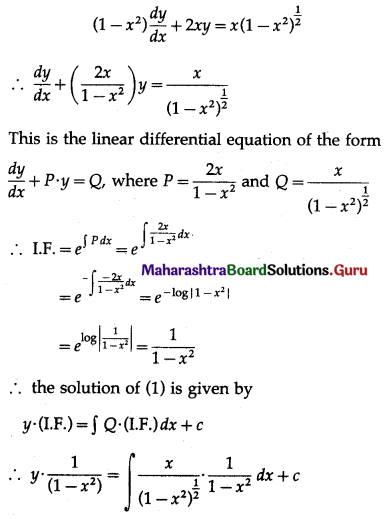
Answer:
Given: R = 80m
To find: Maximum height reached (Hmax)
Formula: Rmax = 4Hmax
Calculation: From formula,
∴ Hmax = \(\frac{\mathrm{R}_{\max }}{4}=\frac{80}{4}\) = 20 m
The maximum height reached by the ball is 20m.

Maharashtra Board Class 11 Physics Solutions Chapter 3 Motion in a Plane

Question 6.
A particle is projected with speed v0 at angle θ to the horizontal on an inclined surface making an angle Φ (Φ < θ) to the horizontal. Find the range of the projectile along the inclined surface.
Answer:
Maharashtra Board Class 11 Physics Solutions Chapter 3 Motion in a Plane 12
i) The equation of trajectory of projectile is given by,
y(tan θ)x – (\(\frac{\mathrm{g}}{2 \mathrm{u}^{2} \cos ^{2} \theta}\))x2 …………..(1)

ii) In this case to find R substitute,
y = R sinΦ ………….. (2)
x = R cosΦ ………….. (3)

iii) From equations (1), (2) and (3),
we have,
Maharashtra Board Class 11 Physics Solutions Chapter 3 Motion in a Plane 13

Question 7.
A metro train runs from station A to B to C. It takes 4 minutes in travelling from station A to station B. The train halts at station B for 20 s. Then it starts from station B and reaches station C in the next 3 minutes. At the start, the train accelerates for 10 sec to reach the constant speed of 72 km/hr. The train moving at the constant speed is brought to rest in 10 sec. at next station.
(i) Plot the velocity-time graph for the train travelling from station A to B to C.
(ii) Calculate the distance between stations A, B, and C.
Answer:
Maharashtra Board Class 11 Physics Solutions Chapter 3 Motion in a Plane 4
The metro train travels from station A to station B in 4 minutes = 240 s.
The trains halts at station B for 20 s.
The train travels from station B’ to station C in 3 minutes= 180 s.
∴ Total time taken by the metro train in travelling from station A to B to C
= 240 + 20 + 180 = 440 s.
At start, the train accelerates for 10 seconds to reach a constant speed of 72 km/hr = 20 m/s.
The train moving is brought to rest in 10 s at next station.
The velocity-time graph for the train travelling from station A to B to C is as follows:
Distance travelled by the train from station A to station B
= Area of PQRS
= A ( △PQQ’) A (☐QRR’) + A(SRR’)
= (\(\frac{1}{2}\) × 10 × 20 + (220 × 20) + (\(\frac{1}{2}\) 10 × 20)
= 100 + 4400 + 100
= 4600m = 4.6km

Distance travelled by the train from station B’ to station C
= Area of EFGD
= A(△EFF’) + A(☐F’FGG’) + A(△DGG’)
= (\(\frac{1}{2}\) × 10 × 20) × (160 × 20) + (\(\frac{1}{2}\) × 10 × 20)
= 100 + 3200 + 100
= 3400m = 3.4km

Question 8.
A train is moving eastward at 10 m/sec. A waiter is walking eastward at 1.2m/sec; and a fly is flying toward the north across the waiter’s tray at 2 m/s. What is the velocity of the fly relative to Earth.
Answer:
Given
Maharashtra Board Class 11 Physics Solutions Chapter 3 Motion in a Plane 11

Question 9.
A car moves in a circle at the constant speed of 50 m/s and completes one revolution in 40 s. Determine the magnitude of the acceleration of the car.
Answer:
Given: v = 50 m/s, t = 40 s, s = 2πr
To find: acceleration (a)
Formulae: i) v = \(\frac{\mathrm{s}}{\mathrm{t}}\)
ii) a = \(\frac{\mathrm{v}^{2}}{\mathrm{r}}\)
Calculation: From formula (i),
50 = \(\frac{2 \pi \mathrm{r}}{40}\)
∴ r = \(\frac{50 \times 40}{2 \pi}\)
∴ r = \(\frac{1000}{\pi}\) cm
From formula (ii),
a = \(\frac{v^{2}}{r}=\frac{50^{2}}{1000 / \pi}\)
∴ a = \(\frac{5 \pi}{2}\) = 7.85 m/s2
The magnitude of acceleration of the car is 7.85 m/s.

Alternate method:
Given: v = 50 m/s, t = 40 s,
To find: acceleration (a)
Formula: a = rω2 = vω
Calculation: From formula,
a = vω
= v(\(\frac{2 \pi}{\mathrm{t}}\))
= 50(\(\frac{2 \times 3.142}{40}\))
= \(\frac{5}{2}\) × 3.142
∴ a = 7.85m/s2

Maharashtra Board Class 11 Physics Solutions Chapter 3 Motion in a Plane

Question 10.
A particle moves in a circle with constant speed of 15 m/s. The radius of the circle is 2 m. Determine the centripetal acceleration of the particle.
Answer:
Given: v = 15 m/s, r = 2m
To find: Centripetal acceleration (a)
Formula: a = \(\frac{\mathrm{v}^{2}}{\mathrm{r}}\)
Calculation: From formula,
a = \(\frac{(15)^{2}}{2}=\frac{225}{2}\)
∴ a = 112.5m/s2
The centripetal acceleration of the particle is 112.5 m/s2.

Question 11.
A projectile is thrown at an angle of 30° to the horizontal. What should be the range of initial velocity (u) so that its range will be between 40m and 50 m? Assume g = 10 m s-2.
Answer:
Given: 40 ≤ R ≤ 50, θ = 300, g = 10 m/s2
To find: Range of initial velocity (u)
Formula: R = \(\frac{\mathrm{u}^{2} \sin (2 \theta)}{\mathrm{g}}\)
Calculation: From formula,
The range of initial velocity,
Maharashtra Board Class 11 Physics Solutions Chapter 3 Motion in a Plane 14
∴ 21.49m/s ≤ u ≤ 24.03m/s
The range of initial velocity should be between 21.49 m/s ≤ u ≤ 24.03 m/s.

11th Physics Digest Chapter 3 Motion in a Plane Intext Questions and Answers

Can you recall? (Textbook Page No. 30)

Question 1.
What ¡s meant by motion?
Answer:
The change ¡n the position of an object with respect to its surroundings is called motion.

Question 2.
What Is rectilinear motion?
Answer:
Motion in which an object travels along a straight line is called rectilinear motion.

Question 3.
What is the difference between displacement and distance travelled?
Answer:

  • Displacement is the shortest distance between the initial and final points of movement.
  • Distance is the actual path followed by a body between the points in which it moves.

Question 4.
What is the difference between uniform and non-uniform motion?
Answer:

  • A body is said to have uniform motion if it covers equal distances in equal intervals of time.
  • A body is said to have non-uniform motion if it covers unequal distances in equal intervals of time.

Internet my friend (Textbook Page No. 44)

i. hyperphysics.phy-astr.gsu.eduJhbase/mot.html#motcon
ii. www .college-physics.comlbook/mechanics
[Students are expected to visit the above mentioned webs ires and collect more information.]

Maharashtra Board Class 11 Physics Solutions Chapter 2 Mathematical Methods

Balbharti Maharashtra State Board 11th Physics Textbook Solutions Chapter 2 Mathematical Methods Textbook Exercise Questions and Answers.

Maharashtra State Board 11th Physics Solutions Chapter 2 Mathematical Methods

1. Choose the correct option.

Question 1.
The resultant of two forces 10 N and 15 N acting along + x and – x-axes respectively, is
(A) 25 N along + x-axis
(B) 25 N along – x-axis
(C) 5 N along + x-axis
(D) 5 N along – x-axis
Answer:
(D) 5 N along – x-axis

Question 2.
For two vectors to be equal, they should have the
(A) same magnitude
(B) same direction
(C) same magnitude and direction
(D) same magnitude but opposite direction
Answer:
(C) same magnitude and direction

Maharashtra Board Class 11 Physics Solutions Chapter 2 Mathematical Methods

Question 3.
The magnitude of scalar product of two unit vectors perpendicular to each other is
(A) zero
(B) 1
(C) -1
(D) 2
Answer:
(A) zero

Question 4.
The magnitude of vector product of two unit vectors making an angle of 60° with each other is
(A) 1
(B) 2
(C) \(\frac{3}{2}\)
(D) \(\frac{\sqrt{3}}{2}\)
Answer:
(D) \(\frac{\sqrt{3}}{2}\)

Question 5.
If \(\overrightarrow{\mathrm{A}}\), \(\overrightarrow{\mathrm{B}}\), and \(\overrightarrow{\mathrm{C}}\) are three vectors, then which of the following is not correct?
(A) \(\overrightarrow{\mathrm{A}}\) . (\(\overrightarrow{\mathrm{B}}\) + \(\overrightarrow{\mathrm{C}}\)) = \(\overrightarrow{\mathrm{A}}\) . \(\overrightarrow{\mathrm{B}}\) + \(\overrightarrow{\mathrm{A}}\) . \(\overrightarrow{\mathrm{C}}\)
(B) \(\overrightarrow{\mathrm{A}}\) . \(\overrightarrow{\mathrm{B}}\) = \(\overrightarrow{\mathrm{B}}\) . \(\overrightarrow{\mathrm{A}}\)
(C) \(\overrightarrow{\mathrm{A}}\) × \(\overrightarrow{\mathrm{B}}\) = \(\overrightarrow{\mathrm{B}}\) × \(\overrightarrow{\mathrm{A}}\)
(D) \(\overrightarrow{\mathrm{A}}\) × (\(\overrightarrow{\mathrm{B}}\) × \(\overrightarrow{\mathrm{C}}\)) = \(\overrightarrow{\mathrm{A}}\) × \(\overrightarrow{\mathrm{B}}\) + \(\overrightarrow{\mathrm{B}}\) × \(\overrightarrow{\mathrm{C}}\)
Answer:
(C) \(\overrightarrow{\mathrm{A}}\) × \(\overrightarrow{\mathrm{B}}\) = \(\overrightarrow{\mathrm{B}}\) × \(\overrightarrow{\mathrm{A}}\)

2. Answer the following questions.

Question 1.
Show that \(\overrightarrow{\mathrm{A}}\) = \(\frac{\hat{i}-\hat{j}}{\sqrt{2}}\) is a unit vector.
Solution:
Maharashtra Board Class 11 Physics Solutions Chapter 2 Mathematical Methods 1

Question 2.
If \(\overrightarrow{\mathbf{v}_{1}}\) = 3\(\hat{i}\) + 4\(\hat{j}\) + \(\hat{k}\) and \(\overrightarrow{\mathbf{v}_{2}}\) = \(\hat{i}\) – \(\hat{j}\) – \(\hat{k}\), determine the magnitude of \(\overrightarrow{\mathbf{v}_{1}}\) + \(\overrightarrow{\mathbf{v}_{2}}\).
Solution:
\(\overrightarrow{\mathbf{v}_{1}}\) + \(\overrightarrow{\mathbf{v}_{2}}\) = (3\(\hat{i}\) + 4\(\hat{j}\) + \(\hat{k}\)) + (\(\hat{i}\) – \(\hat{j}\) – \(\hat{k}\))
= 3\(\hat{i}\) + 3\(\hat{i}\) + 4\(\hat{j}\) – \(\hat{j}\) + \(\hat{k}\) – \(\hat{k}\)
= 4\(\hat{i}\) + 3\(\hat{j}\)
∴ Magnitude of (\(\overrightarrow{\mathbf{v}_{1}}\) + \(\overrightarrow{\mathbf{v}_{2}}\)),
|\(\overrightarrow{\mathbf{v}_{1}}\) + \(\overrightarrow{\mathbf{v}_{2}}\)| = \(\sqrt{4^{2}+3^{2}}\) = \(\sqrt{25}\) = 5 units.
Answer:
Magnitude of \(\overrightarrow{\mathbf{v}_{1}}\) + \(\overrightarrow{\mathbf{v}_{2}}\) = 5 units.

Question 3.
For \(\overline{\mathrm{v}_{1}}\) = 2\(\hat{i}\) – 3\(\hat{j}\) and \(\overline{\mathrm{v}_{2}}\) = -6\(\hat{i}\) + 5\(\hat{j}\), determine the magnitude and direction of \(\overline{\mathrm{v}_{1}}\) + \(\overline{\mathrm{v}_{2}}\).
Answer:
\(\overline{\mathrm{v}_{1}}\) + \(\overline{\mathrm{v}_{2}}\) = (2\(\hat{i}\) – 3\(\hat{j}\)) + (-6\(\hat{i}\) + 5\(\hat{j}\))
= (2\(\hat{i}\) – 6\(\hat{i}\)) + (-3\(\hat{j}\) + 5\(\hat{j}\))
= -4\(\hat{i}\) + 2\(\hat{j}\)
∴ |\(\overline{\mathrm{v}_{1}}\) + \(\overline{\mathrm{v}_{2}}\)| = \(\sqrt{(-4)^{2}+2^{2}}\) = \(\sqrt{20}\) = \(\sqrt{4 \times 5}\) = 2\(\sqrt{5}\)
Comparing \(\overline{\mathrm{v}_{1}}\) + \(\overline{\mathrm{v}_{2}}\), with \(\overrightarrow{\mathrm{R}}\) = Rx\(\hat{i}\) + Ry\(\hat{j}\)
⇒ Rx = -4 and Ry = 2
Taking θ to be angle made by \(\overrightarrow{\mathrm{R}}\) with X-axis,
Maharashtra Board Class 11 Physics Solutions Chapter 2 Mathematical Methods 2
Answer:
Magnitude and direction of \(\overline{\mathrm{v}_{1}}\) + \(\overline{\mathrm{v}_{2}}\), is
respectively 2\(\sqrt{5}\) and and tan-1\(\left(-\frac{1}{2}\right)\) with X – axis.

Question 4.
Find a vector which is parallel to \(\overrightarrow{\mathrm{v}}\) = \(\hat{i}\) – 2\(\hat{j}\) and has a magnitude 10.
Answer:
Maharashtra Board Class 11 Physics Solutions Chapter 2 Mathematical Methods 3
Substituting for wx in (i) using equation (ii),
Maharashtra Board Class 11 Physics Solutions Chapter 2 Mathematical Methods 4
Using equation (ii),
Maharashtra Board Class 11 Physics Solutions Chapter 2 Mathematical Methods 5
Answer:
Required vector is \(\frac{10}{\sqrt{5}} \hat{\mathbf{i}}\) – \(\frac{20}{\sqrt{5}} \hat{\mathbf{j}}\)

Alternate method:

When two vectors are parallel, one vector is scalar multiple of another,
i.e., if \(\overrightarrow{\mathrm{v}}\) and \(\overrightarrow{\mathrm{w}}\) are parallel then, \(\overrightarrow{\mathrm{w}}\) = n\(\overrightarrow{\mathrm{v}}\) where, n is scalar.
Maharashtra Board Class 11 Physics Solutions Chapter 2 Mathematical Methods 6

Maharashtra Board Class 11 Physics Solutions Chapter 2 Mathematical Methods

Question 5.
Show that vectors \(\vec{a}\) = 2\(\hat{\mathbf{i}}\) + 5\(\hat{\mathbf{j}}\) – 6\(\hat{\mathbf{k}}\) and \(\vec{b}\) = \(\hat{\mathbf{i}}\) + \(\frac{5}{2}\)\(\hat{\mathbf{j}}\) – 3\(\hat{\mathbf{k}}\) are parallel.
Answer:
Let angle between two vectors be θ.
Maharashtra Board Class 11 Physics Solutions Chapter 2 Mathematical Methods 7
⇒ Two vectors are parallel.

Alternate method:

\(\vec{a}\) = 2(\(\hat{\mathbf{i}}\) + \(\frac{5}{2}\)\(\hat{\mathbf{j}}\) + \(\hat{\mathbf{k}}\)) = 2\(\vec{b}\)
Since \(\vec{a}\) is a scalar multiple of \(\vec{b}\), the vectors are parallel.

3. Solve the following problems.

Question 1.
Determine \(\vec{a}\) × \(\vec{b}\), given \(\vec{a}\) = 2\(\hat{\mathbf{i}}\) + 3\(\hat{\mathbf{j}}\) and \(\vec{b}\) = 3\(\hat{\mathbf{i}}\) + 5\(\hat{\mathbf{j}}\).
Answer:
Using determinant for vectors in two dimensions,
Maharashtra Board Class 11 Physics Solutions Chapter 2 Mathematical Methods 8
Answer:
\(\vec{a}\) × \(\vec{b}\) gives \(\hat{\mathbf{k}}\)

Question 2.
Show that vectors \(\overrightarrow{\mathbf{a}}\) = 2\(\hat{\mathbf{i}}\) + 3\(\hat{\mathbf{j}}\) + 6\(\hat{\mathbf{k}}\), \(\overrightarrow{\mathbf{b}}\) = 3\(\hat{\mathbf{i}}\) – 6\(\hat{\mathbf{j}}\) + 2\(\hat{\mathbf{k}}\) and \(\overrightarrow{\mathbf{c}}\) = 6\(\hat{\mathbf{i}}\) + 2\(\hat{\mathbf{j}}\) – 3\(\hat{\mathbf{k}}\) are mutually perpendicular.
Solution:
As dot product of two perpendicular vectors is zero. Taking dot product of \(\vec{a}\) and \(\vec{b}\)
Maharashtra Board Class 11 Physics Solutions Chapter 2 Mathematical Methods 9
Maharashtra Board Class 11 Physics Solutions Chapter 2 Mathematical Methods 10
Combining two results, we can say that given three vectors \(\vec{a}\), \(\vec{b}\), and \(\vec{c}\) are mutually perpendicular to each other.

Maharashtra Board Class 11 Physics Solutions Chapter 2 Mathematical Methods

Question 3.
Determine the vector product of \(\overrightarrow{\mathrm{v}_{1}}\) = 2\(\hat{i}\) + 3\(\hat{j}\) – \(\hat{k}\) and \(\overrightarrow{\mathrm{v}_{2}}\) = \(\hat{i}\) + 2\(\hat{j}\) – 3\(\hat{k}\) are perpendicular to each other, determine the value of a.
Solution:
Maharashtra Board Class 11 Physics Solutions Chapter 2 Mathematical Methods 11
Answer:
Required vector product is -7\(\hat{i}\) + 5\(\hat{j}\) + \(\hat{k}\)

Question 4.
Given \(\bar{v}_{1}\) = 5\(\hat{i}\) + 2\(\hat{j}\) and \(\bar{v}_{2}\) = a\(\hat{i}\) – 6\(\hat{j}\) are perpendicular to each other, determine the value of a.
Solution:
As \(\bar{v}_{1}\) and \(\bar{v}_{2}\) are perpendicular to each other, θ = 90°
Maharashtra Board Class 11 Physics Solutions Chapter 2 Mathematical Methods 12
Answer:
Value of a is \(\frac{12}{5}\).

Question 5.
Obtain derivatives of the following functions:
(i) x sin x
(ii) x4 + cos x
(iii) x/sin x
Answer:
(i) x sin x
Solution:
\(\frac{d}{d x}\)[f1(x) × f2(x)] = f1(x)\(\frac{\mathrm{df}_{2}(\mathrm{x})}{\mathrm{dx}}\) + \(\frac{\mathrm{df}_{1}(\mathrm{x})}{\mathrm{dx}}\)f2(x)
For f1(x) = x and f2(x) = sin x
\(\frac{d}{d x}\)(x sin x) = x\(\frac{\mathrm{d}(\sin \mathrm{x})}{\mathrm{dx}}\) + \(\frac{d(x)}{d x}\) sin x
= x cos x + 1 × sin x
= sin x + x cos x

(ii) x4 + cos x
Solution:
Maharashtra Board Class 11 Physics Solutions Chapter 2 Mathematical Methods 13

(iii) \(\frac{\mathbf{x}}{\sin x}\)
Solution:
Maharashtra Board Class 11 Physics Solutions Chapter 2 Mathematical Methods 14

[Note: As derivative of (sin x) is cos x, negative sign that occurs in rule for differentiation for quotient of two functions gets retained in final answer]

Question 6.
Using the rule for differentiation for quotient of two functions, prove that \(\frac{d}{d x}\left(\frac{\sin x}{\cos x}\right)\) = sec2x
Solution:
Maharashtra Board Class 11 Physics Solutions Chapter 2 Mathematical Methods 15

Question 7.
Evaluate the following integral:
(i) \(\int_{0}^{\pi / 2} \sin x d x\)
(ii) \(\int_{1}^{5} x d x\)
Answer:
(i) \(\int_{0}^{\pi / 2} \sin x d x\)
Solution:
Maharashtra Board Class 11 Physics Solutions Chapter 2 Mathematical Methods 16

(ii) \(\int_{1}^{5} x d x\)
Solution:
Maharashtra Board Class 11 Physics Solutions Chapter 2 Mathematical Methods 17

11th Physics Digest Chapter 2 Mathematical Methods Intext Questions and Answers

Can you recall? (Textbook Page No. 16)

Question 1.
Define scalars and vectors.
Answer:

  1. Physical quantities which can be completely described b their magnitude (a number and unit) are called scalars.
  2. Physical quantities which need magnitude, as well as direction for their complete description, are called vectors.

Question 2.
Which of the following are scalars or vectors?
Displacements, distance travelled, velocity, speed, force, work done, energy
Answer:

  1. Scalars: Distance travelled, speed, work done, energy.
  2. Vectors: Displacement, velocity, force.

Question 3.
What is the difference between a scalar and a vector?
Answer:

No.ScalarsVectors
i.It has magnitude onlyIt has magnitude as well as direction.
ii.Scalars can be added or subtracted according to the rules of the algebra.Vectors are added or subtracted by the geometrical (graphical) method or vector algebra.
iii.It has no specific representation.It is represented by the symbol (→) arrow.
iv.The division of a scalar by another scalar is valid.The division of a vector by another vector is not valid.
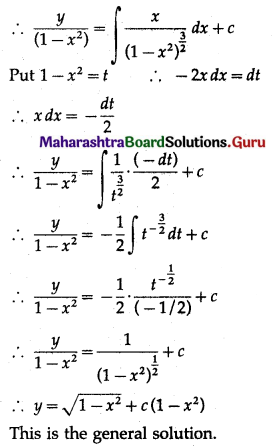
Example:
Length, mass, time, volume, etc.
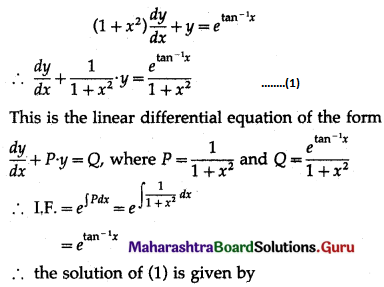
Example:
Displacement, velocity, acceleration, force, etc.

Internet my friend (Textbook page no. 28)

    1. hyperphysics.phy-astr.gsu.edu/hbase/vect. html#veccon
    2. hyperphysics.phy-astr.gsu.edu/hbase/ hframe.html

Answer:
[Students can use links given above as a reference and collect information about mathematical methods]

Maharashtra Board Class 11 Physics Solutions Chapter 1 Units and Measurements

Balbharti Maharashtra State Board 11th Physics Textbook Solutions Chapter 1 Units and Measurements Textbook Exercise Questions and Answers.

Maharashtra State Board 11th Physics Solutions Chapter 1 Units and Measurements

1. Choose the correct option.

Question 1.
[L1M1T-2] is the dimensional formula for
(A) Velocity
(B) Acceleration
(C) Force
(D) Work
Answer:
(C) Force

Question 2.
The error in the measurement of the sides of a rectangle is 1%. The error in the measurement of its area is
(A) 1%
(B) \(\frac{1}{2}\)%
(C) 2%
(D) None of the above.
Answer:
(C) 2%

Maharashtra Board Class 11 Physics Solutions Chapter 1 Units and Measurements

Question 3.
Light year is a unit of
(A) Time
(B) Mass
(C) Distance
(D) Luminosity
Answer:
(C) Distance

Question 4.
Dimensions of kinetic energy are the same as that of
(A) Force
(B) Acceleration
(C) Work
(D) Pressure
Answer:
(C) Work

Question 5.
Which of the following is not a fundamental unit?
(A) cm
(B) kg
(C) centigrade
(D) volt
Answer:
(D) volt

2. Answer the following questions.

Question 1.
Star A is farther than star B. Which star will have a large parallax angle?
Answer:
Maharashtra Board Class 11 Physics Solutions Chapter 1 Units and Measurements 1
i). ‘b’ is constant for the two stars
∴ θ ∝ \(\frac{1}{D}\)

ii) As star A is farther i.e., DA > DB
⇒ θA < θB
Hence, star B will have larger parallax angle than star A.

Question 2.
What are the dimensions of the quantity l \(\sqrt{l / g}\), l being the length and g the acceleration due to gravity?
Answer:
Maharashtra Board Class 11 Physics Solutions Chapter 1 Units and Measurements 2
[Note: When power of symbol expressing fundamental quantity appearing in the dimensional formula is not given, ills taken as 1.]

Maharashtra Board Class 11 Physics Solutions Chapter 1 Units and Measurements

Question 3.
Define absolute error, mean absolute error, relative error and percentage error.
Answer:
Absolute error:
a. For a given set of measurements of a quantity, the magnitude of the difference between mean value (Most probable value) and each individual value is called absolute error (∆a) in the measurement of that quantity.
b. absolute error = |mean value – measured value|
∆a1 = |amean – a1|
Similarly, ∆a2 = |amean – a2|
. . . ..
. . . .
. . . .
∆an = |amean – an|

Mean absolute error:
For a given set of measurements of a same quantity the arithmetic mean of all the absolute errors is called mean absolute error in the measurement of that physical quantity.
∆amean = \(\frac{\Delta \mathrm{a}_{1}+\Delta \mathrm{a}_{2}+\ldots \ldots .+\Delta \mathrm{a}_{n}}{\mathrm{n}}=\frac{1}{\mathrm{n}} \sum_{\mathrm{i}=1}^{n} \Delta \mathrm{a}_{\mathrm{i}}\)

Relative error:
The ratio of the mean absolute error in the measurement of a physical quantity to its arithmetic mean value is called relative error.
Relative error = \(\frac{\Delta \mathrm{a}_{\mathrm{mean}}}{\mathrm{a}_{\mathrm{mean}}}\)

Percentage error:
The relative error represented by percentage (i.e., multiplied by 100) is called the percentage error.
Percentage error = \(\frac{\Delta \mathrm{a}_{\mathrm{mean}}}{\mathrm{a}_{\mathrm{mean}}}\) × 100%
[Note: Considering conceptual conventions question is modified to define percentage error and not mean percentage error.]

Question 4.
Describe what is meant by significant figures and order of magnitude.
Answer:
Significant figures:

  1. Significant figures in the measured value of a physical quantity is the sum of reliable digits and the first uncertain digit.
    OR
    The number of digits in a measurement about which we are certain, plus one additional digit, the first one about which we are not certain is known as significant figures or significant digits.
  2. Larger the number of significant figures obtained in a measurement, greater is the accuracy of the measurement. The reverse is also true.
  3. If one uses the instrument of smaller least count, the number of significant digits increases.

Rules for determining significant figures:

  1. All the non-zero digits are significant, for example if the volume of an object is 178.43 cm3, there are five significant digits which are 1,7,8,4 and 3.
  2. All the zeros between two nonzero digits are significant, eg., m = 165.02 g has 5 significant digits.
  3. If the number is less than 1, the zero/zeroes on the right of the decimal point and to the left of the first nonzero digit are not significant e.g. in 0.001405, significant. Thus the above number has four significant digits.
  4. The zeroes on the right hand side of the last nonzero number are significant (but for this, the number must be written with a decimal point), e.g. 1.500 or 0.01500 both have 4 significant figures each.
    On the contrary, if a measurement yields length L given as L = 125 m = 12500 cm = 125000 mm, it has only three significant digits.

Order of magnitude:
The magnitude of any physical quantity can be expressed as A × 10n where ‘A’ is a number such that 0.5 ≤ A < 5 then, ‘n’ is an integer called the order of magnitude.
Examples:

  1. Speed of light in air = 3 × 10⁸ m/s
    ∴ order of magnitude = 8
  2. Mass of an electron = 9.1 × 10⁻³¹ kg
    = 0.91 × 1030 kg
    ∴ order of magnitude = -30

Maharashtra Board Class 11 Physics Solutions Chapter 1 Units and Measurements

Question 5.
If the measured values of two quantities are A ± ∆A and B ± ∆B, ∆A and ∆B being the mean absolute errors. What is the maximum possible error in A ± B? Show that if Z = \(\frac{A}{B}\)
\(\frac{\Delta Z}{Z}=\frac{\Delta A}{A}+\frac{\Delta B}{B}\)
Answer:
Maximum possible error in (A ± B) is (∆A + ∆B).
Errors in divisions:
i) A
Suppose, Z = \(\frac{A}{B}\) and measured values of A and B are (A ± ∆A) and (B ± ∆B) then,
Maharashtra Board Class 11 Physics Solutions Chapter 1 Units and Measurements 5
Maharashtra Board Class 11 Physics Solutions Chapter 1 Units and Measurements 6
∴ Maximum relative error of \(\frac{\Delta Z}{Z}=\pm\left(\frac{\Delta \mathrm{A}}{\mathrm{A}}+\frac{\Delta \mathrm{B}}{\mathrm{B}}\right)\)

ii) Thus, when two quantities are divided, the maximum relative error in the result is the sum of relative errors in each quantity.

Question 6.
Derive the formula for kinetic energy of a particle having mass m and velocity v using dimensional analysis
Answer:
Kinetic energy of a body depends upon mass (m) and velocity (v) of the body.
Let K.E. ∝ mx vy
∴ K.E. = kmx vy …….. (1)
where,
k = dimensionless constant of proportionality. Taking dimensions on both sides of equation (1),
[L2M1T-2] – [L0M1T0]x [L1M0T-1]y
= [L0MxT0] [LyM0T-y]
= [L0+yMx+0T0-y]
[L2M1T2] = [LyMxT-y] …………. (2)
Equating dimensions of L, M, T on both sides of equation (2),
x = 1 and y = 2 ,
Substituting x, y in equation (1), we have
K.E. = kmv2

3. Solve numerical examples.

Question 1.
The masses of two bodies are measured to be 15.7 ± 0.2 kg and 27.3 ± 0.3 kg. What is the total mass of the two and the error in it?
Answer:
Given: A ± ∆A = 15.7 ± 0.2kg and
B ± ∆B = 27.3 ± 0.3 kg.
To find: Total mass (Z), and total error (∆Z)
Formulae: i. Z = A + B

ii) ±∆Z = ±∆A ± ∆B
Calculation: From formula (i),
Z = 15.7 + 27.3 = 43 kg
From formula (ii),
± ∆Z (± 0.2) + (± 0.3)
=±(0.2 + 0.3)
= ± 0.5 kg
Total mass is 43 kg and total error is ± 0.5 kg.

Question 2.
The distance travelled by an object in time (100 ± 1) s is (5.2 ± 0.1) m. What is the speed and it’s relative error?
Answer:
Given: Distance (D ± ∆D) = (5.2 ± 0.1) m,
time(t ± ∆t) = (100 ± 1)s.
To find: Speed (v), maximum relative error \(\left(\frac{\Delta \mathrm{v}}{\mathrm{v}}\right)\)

Formulae: i. v = \(\frac{\mathrm{D}}{\mathrm{t}}\)
ii. \(\frac{\Delta \mathrm{v}}{\mathrm{v}}=\pm\left(\frac{\Delta \mathrm{D}}{\mathrm{D}}+\frac{\Delta \mathrm{t}}{\mathrm{t}}\right)\)

Calculation: From formula (i),
v = \(\frac{5.2}{100}\) = 0.052 m/s
From formula (ii),
\(\frac{\Delta \mathrm{v}}{\mathrm{v}}=\pm\left(\frac{0.1}{5.2}+\frac{1}{100}\right)\)
= \(\pm\left(\frac{1}{52}+\frac{1}{100}\right)=\pm \frac{19}{650}\)
= ± 0.029 rn/s
The speed is 0.052 m/s and its maximum relative error is ± 0.029 m/s.
[Note: Framing of numerical is modified to make it specific and meaningful.]

Maharashtra Board Class 11 Physics Solutions Chapter 1 Units and Measurements

Question 3.
An electron with charge e enters a uniform. magnetic field \(\vec{B}\) with a velocity \(\vec{v}\). The velocity is perpendicular to the magnetic field. The force on the charge e is given by
|\(\vec{F}\)| = Bev Obtain the dimensions of \(\vec{B}\).
Answer:
Given: |\(\vec{F}\)| = B e v
Considering only magnitude, given equation is simplified to,
F = B e v
Maharashtra Board Class 11 Physics Solutions Chapter 1 Units and Measurements 3
∴ B = [L0M1T-2I-1]
[Note: The answer given above is calculated in accordance with textual method considering the given data.]

Question 4.
A large ball 2 m in radius is made up of a rope of square cross section with edge length 4 mm. Neglecting the air gaps in the ball, what is the total length of the rope to the nearest order of magnitude?
Answer:
Volume of ball = Volume enclosed by rope.
\(\frac{4}{3}\) π (radius)3 = Area of cross-section of rope × length of rope.
∴ length of rope l = \(\frac{\frac{4}{3} \pi r^{3}}{A}\)
Given:
r = 2 m and
Area = A = 4 × 4 = 16 mm2
= 16 × 10-6 m2
∴ l = \(\frac{4 \times 3.142 \times 2^{3}}{3 \times 16 \times 10^{-6}}\)
= \(\frac{3.142 \times 2}{3}\) × 10-6 m
≈ 2 × 10⁶ m.
Total length of rope to the nearest order of magnitude = 106 m = 103 km

Question 5.
Nuclear radius R has a dependence on the mass number (A) as R = 1.3 × 10⁻¹⁶ A\(\frac{1}{3}\) m. For a nucleus of mass number A=125, obtain the order of magnitude of R expressed in metre.
Answer:
R= 1.3 × 10⁻¹⁶ × A\(\frac{1}{3}\) m
For A = 125
R= 1.3 × 10-16 × (125)\(\frac{1}{3}\)
= 1.3 × 10-16 × 5
= 6.5 × 10-16
= 0.65 × 10⁻¹⁵ m
∴ Order of magnitude = -15
[Note: Taking the standard value of nuclear radius R = 1.3 × 10-155 m, the order of magnitude comes to be 10-14 m.]

Question 6.
In a workshop a worker measures the length of a steel plate with a Vernier callipers having a least count 0.01 cm. Four such measurements of the length yielded the following values: 3.11 cm, 3.13 cm, 3.14 cm, 3.14 cm. Find the mean length, the mean absolute error and the percentage error in the measured value of the length.
Answer:
Given: a1 = 3.11 cm, a2 = 3.13 cm,
a3 = 3.14 cm. a4 = 3.14cm
Least count L.C. = 0.01 cm.
To find.
i. Mean length (amean)
ii. Mean absolute error (∆amean)
iii. Percentage error.

Formulae: i. amean = \(\frac{a_{1}+a_{2}+a_{3}+a_{4}}{4}\)
ii. ∆an = |amean – an|
iii. ∆amean = \(\frac{\Delta \mathrm{a}_{1}+\Delta \mathrm{a}_{2}+\Delta \mathrm{a}_{3}+\Delta \mathrm{a}_{4}}{4}\)
iv. Percentage error = \(\frac{\Delta \mathrm{a}_{\mathrm{mean}}}{\mathrm{a}_{\text {mean }}}\) × 100

Calculation: From formula (i),
amean = \(\frac{3.11+3.13+3.14+3.14}{4}\)
= 3.13 cm
From formula (ii),
∆a1 = |3.13 – 3.11| = 0.02 cm
∆a2 = |3.13 – 3.13| = 0
∆a3 = |3.13 – 3.14| = 0.01 cm
∆a4 = |3.13 – 3.14| = 0.01 cm
From formula (iii),
∆amean = \(\frac{0.02+0+0.01+0.01}{4}\) = 0.01 cm
From formula (iii).
% error = \(\frac{0.01}{3.13}\) × 100
= \(\frac{1}{3.13}\)
= 0.3196
……..(using reciprocal table)
= 0.32%

i. Mean length is 3.13 cm.
ii. Mean absolute error is 0.01 cm.
iii. Percentage error is 0.32 %.
[Note: As per given data of numerical, percentage error calculation upon rounding off yields percentage error as 0.32%]

Maharashtra Board Class 11 Physics Solutions Chapter 1 Units and Measurements

Question 7.
Find the percentage error in kinetic energy of a body having mass 60.0 ± 0.3 g moving with a velocity 25.0 ± 0.1 cm/s.
Answer:
Given: m = 60.0 g, v = 25.0 cm/s.
∆m = 0.3 g, ∆v = 0.1 cm/s
To find: Percentage error in E
Formula: Percentage error in E
\(\left(\frac{\Delta \mathrm{m}}{\mathrm{m}}+2 \frac{\Delta \mathrm{v}}{\mathrm{v}}\right)\) × 100%

Calculation: From formula,
Percentage error in E
= \(\left(\frac{0.3}{60.0}+2 \times \frac{0.1}{25.0}\right)\) × 100%
= 1.3%
The percentage error in energy is 1.3%.

Question 8.
In Ohm’s experiments, the values of the unknown resistances were found to be 6.12 Ω , 6.09 Ω, 6.22 Ω, 6.15 Ω. Calculate the mean absolute error, relative error and percentage error in these measurements.
Answer:
Given: a1 = 6.12 Ω, a2 = 6.09 Ω, a3 = 6.22 Ω, a4 = 6.15 Ω,

To find:

i) Absolute error (∆amean)
ii) Relative error
iii) Percentage error

Formulae:

i) amean = \(\frac{a_{1}+a_{2}+a_{3}+a_{4}}{4}\)
ii) ∆an = |amean – an|
iii) ∆amean = \(\frac{\Delta \mathrm{a}_{1}+\Delta \mathrm{a}_{2}+\Delta \mathrm{a}_{3}+\Delta \mathrm{a}_{4}}{4}\)
iv) Percentage error = \(\frac{\Delta \mathrm{a}_{\mathrm{mean}}}{\mathrm{a}_{\text {mean }}}\) × 100

From formula (ii),
∆a1 = |6.145 – 6.12|= 0.025
∆a2 = |6.145 – 6.09| = 0.055
∆a3 = |6.145 – 6.22| = 0.075
∆a4 = |6.l45 – 6.15| = 0.005
From formula (iii),
∆amean = \(\frac{0.025+0.055+0.075+0.005}{4}=\frac{0.160}{4}\)
= 0.04 Ω
From formula (iv),
Relative error = \(\frac{0.04}{6.145}\) = 0.0065 Ω
From formula (v).
Percentage error = 0.0065 \frac{0.04}{6.145} 100 = 0.65%

i. The mean absolute error is 0.04 Ω.
ii. The relative error is 0.0065 Ω.
iii. The percentage error is 0.65%.
[Note: Framing of numerical is modified to reach the answer given to the numerical.]

Question 9.
An object is falling freely under the gravitational force. Its velocity after travelling a distance h is v. If v depends upon gravitational acceleration g and distance, prove with dimensional analysis that v = k\(\sqrt{g h}\) where k is a constant.
Answer:
Given = v = k\(\sqrt{g h}\)
Maharashtra Board Class 11 Physics Solutions Chapter 1 Units and Measurements 4
k being constant is assumed to be dimensionless.
Dimensions of L.H.S. = [v] = [L1T-1]
Dimension of R.H.S. = [latex]\sqrt{g h}[/latex]
= [L1T-2]\(\frac{1}{2}\) × [L1]\(\frac{1}{2}\)
= [L2T-2]\(\frac{1}{2}\)
= [L1T-1]
As, [L.H.S.] = [R.H.S.],
=> v = k\(\sqrt{g h}\)is dimensionally correct equation.

Question 10.
v = at + \(\frac{b}{t+c}\) + v0 is a dimensionally valid equation. Obtain the dimensional formula for a, b and c where v is velocity, t is time and v0 is initial velocity.
Answer:
Solution: Given: y = at + \(\frac{b}{t+c}\) + + v0

As only dimensionally identical quantities can be added together or subtracted from each other, each term on R.H.S. has dimensions of L.H.S. i.e., dimensions of velocity.

∴ [LH.S.] = [v] = [L1T-1]
This means, [at] = [v] = [L1T-1]
Given, t = time has dimension [T-1]
∴ [a] = \(\frac{\left[\mathrm{L}^{1} \mathrm{~T}^{-1}\right]}{[\mathrm{t}]}=\frac{\left[\mathrm{L}^{1} \mathrm{~T}^{-1}\right]}{\left[\mathrm{T}^{1}\right]}\) = [L1T-2] = L1M0T-2]
Similarly, [c] = [t] = [T1] = [L0M0T1]
∴ \(\frac{[\mathrm{b}]}{\left[\mathrm{T}^{1}\right]}\) = [v] = [L1T-1]
∴ [b] = [L1T-1] × [T1] = [L1] = [L1M0T0]

Maharashtra Board Class 11 Physics Solutions Chapter 1 Units and Measurements

Question 11.
The length, breadth and thickness of a rectangular sheet of metal are 4.234 m, 1.005 m, and 2.01 cm respectively. Give the area and volume of the sheet to correct significant figures.
Answer:
Given: l = 4.234 m, b = 1.005 m,
t = 2.01 cm = 2.01 × 10⁻² m = 0.0201 m

To find:
i) Area of sheet to correct significant figures (A)
ii) Volume of sheet to correct significant figures (V)
Formulae: i. A = 2(lb + bt + tl)
iii) V = l × b × t

Calculation: From formula (i),
A = 2(4.234 × 1.005 + 1.005 × 0.0201 +0.0201 × 4.234)
= 2 |[antilog(log 4.234 + logl .005) + antiiog(log 1.005 + log0.0201) + antilog(log 0.0201 + log 4.234)]}
= 2{[antilog(0.6267 + 0.0021) + antilog(0.0021 + \(\overline{2}\) .3010) + antilog (\(\overline{2}\) .3010 + 0.6267)]}
= 2 {[antilog(0.6288) + antilog (\(\overline{2}[/latex .3031) +antilog([latex]\overline{2}\) .9277)]}
= 2 [4.254 + 0.02009 + 0.08467]
= 2 [4.35876]
= 8.71752m2

In correct significant figure,
A = 8.72 m2 From formula (ii),
V =4.234 × 1.005 × 0.0201
= antilog [log (4.234) + log (1.005) + log (0.0201)]
= antilog [0.6269 – 0.0021 – \(\overline{2}\).3032]
= antilog [0.6288 – \(\overline{2}\).3032]
= antilog [ 2 .9320]
= 8.551 × 10-2
= 0.08551 m3
In correct significant figure (rounding off),
V = 0.086 m3

i.) Area of sheet to correct significant figures is 8.72 m2.
ii) Volume of sheet to correct significant figures is 0.086 m3.
[Note: The given solution is arrived to by considering a rectangular sheet.]

Question 12.
If the length of a cylinder is l = (4.00 ± 0.001) cm, radius r = (0.0250 ± 0.001) cm and mass m = (6.25 ± 0.01) gm. Calculate the percentage error in the determination of density.
Answer:
Given: l = (4.00 ± 0.001) cm,
In order to have same precision, we use, (4.000 ± 0.001),
r = (0.0250 ± 0.00 1) cm,
In order to have same precision, we use, (0.025 ± 0.001)
m = (6.25 ± 0.01) g
To find: percentage error in density

Formulae:
i) Relative error in volume, \(\frac{\Delta \mathrm{V}}{\mathrm{V}}=\frac{2 \Delta \mathrm{r}}{\mathrm{r}}+\frac{\Delta l}{l}\)
….(∵ Volume of cylinder, V = πr2l)

ii) Releative error \(\frac{\Delta \rho}{\rho}=\frac{\Delta m}{m}+\frac{\Delta V}{V}\)
Maharashtra Board Class 11 Physics Solutions Chapter 1 Units and Measurements 10

iii) Percentage error= Relative error × 100%

Calculation.
From formulae (i) and (ii),
∴ \(\frac{\Delta \rho}{\rho}=\frac{\Delta \mathrm{m}}{\mathrm{m}}+\frac{2 \Delta \mathrm{r}}{\mathrm{r}}+\frac{\Delta l}{l}\)
= \(\frac{0.01}{6.25}+\frac{2(0.001)}{0.025}+\frac{0.001}{4.000}\)
= 0.00 16 + 0.08 + 0.00025
= 0.08 185
From formula (iii).
% error in density = \(\frac{\Delta \rho}{\rho}\) × 100
= 0.08185 × 100
= 8.185%
Percentage error in density is 8.185%.

Maharashtra Board Class 11 Physics Solutions Chapter 1 Units and Measurements

Question 13.
When the planet Jupiter is at a distance of 824.7 million kilometers from the Earth, its angular diameter is measured to be 35.72″ of arc. Calculate the diameter of the Jupiter.
Answer:
Given: Angular diameter (a) = 35.72″
= 35.72″ × 4.847 × 10⁻⁶ rad
1.73 × 10⁻⁴ rad

Distance from Earth (D)
= 824.7 million km
= 824.7 × 10⁶ km
= 824.7 × 10⁹ m.

To find: Diameter of Jupiter (d)
Formula: d = α D
Calculation: From formula,
d = 1.73 × 10-4 × 824.7 × 109
= 1.428 × 10⁸ m
= 1.428 × 10⁵ km
Diameter of Jupiter is 1.428 × 10⁵ km.

Question 14.
If the formula for a physical quantity is X = \(\frac{a^{4} b^{3}}{c^{1 / 3} d^{1 / 2}}\) and if the percentage error in the measurements of a, b, c and d are 2%, 3%, 3% and 4% respectively. Calculate percentage error in X.
Answer:
Given X = \(\frac{a^{4} b^{3}}{c^{1 / 3} d^{1 / 2}}\)
Percentage error in a, b, c, d is respectively 2%, 3%, 3% and 4%.
Now, Percentage error in X
Maharashtra Board Class 11 Physics Solutions Chapter 1 Units and Measurements 7

Question 15.
Write down the number of significant figures in the following: 0.003 m2, 0.1250 gm cm-2, 6.4 × 10⁶ m, 1.6 × 10⁻¹⁹ C, 9.1 × 10⁻³¹ kg.
Answer:
Maharashtra Board Class 11 Physics Solutions Chapter 1 Units and Measurements 8

Question 16.
The diameter of a sphere is 2.14 cm. Calculate the volume of the sphere to the correct number of significant figures.
Answer:
Volume of sphere = \(\frac{4}{3}\) πr3
= \(\frac{4}{3}\) × 3.142 × (\(\frac{2.14}{2}\))3 ………….. (∵ r = \(\frac{d}{2}\))
= \(\frac{4}{3}\) × 3.142 × (1.07)3
= 1.333 × 3.142 × (1.07)3
= {antilog [log (1.333) + log(3.142)+3 log(1.07)]}
= {antilog [0.1249 + 0.4972 + 3 (0.0294)])
= {antilog [0.6221 + 0.0882]}
= {antilog [0.7103]}
= 5.133cm3
In multiplication or division, the final result should retain as many significant figures as there are in the original number with the least significant figures.
Volume in correct significant figures
∴ 5.13 cm3

11th Physics Digest Chapter 1 Units and Measurements Intext Questions and Answers

Can you recall (Textbook Page No. 1)

Question 1.
i) What is a unit?
ii) Which units have you used in the laboratory for measuring
a. length
b. mass
c. time
d. temperature?
iii. Which system of units have you used?
Answer:

  1. The standard measure of any quantity is called the unit of that quantity.
  2. Maharashtra Board Class 11 Physics Solutions Chapter 1 Units and Measurements 11
  3. MKS or SI system is used mostly. At times. even CGS system is used.
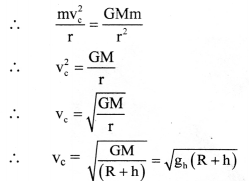
Can you tell? (Textbook Page No. 8)
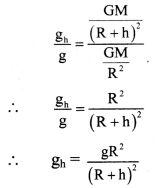
Question 1.
If ten students are asked to measure the length of a piece of cloth upto a mm, using a metre scale, do you think their answers will be identical? Give reasons.
Answer:
Answers of the students are likely to be different. Length of cloth needs to be measured up to a millimetre (mm) length. Hence, to obtain accurate and precise reading one must use measuring instrument having least count smaller than 1 mm.

But least count of metre scale is 1 mm. As a result, even smallest uncertainty in reading would vary reading significantly. Also, skill of students doing measurement may also introduce uncertainty in observation.
Hence, their answers are likely to be different.

Activity (Textbook Page No. 10)

Perform an experiment using a Vernier callipers of least count 0.01cm to measure the external diameter of a hollow cylinder. Take 3 readings at different positions on the cylinder and find (i) the mean diameter (ii) the absolute mean error and (iii) the percentage error in the measurement of diameter.
Answer:
Given: L.C. = 0.01 cm
To measure external diameter of hollow cylinder readings are taken as follows:
Maharashtra Board Class 11 Physics Solutions Chapter 1 Units and Measurements 12
[Note: The above table is made assuming zero error in Vernier calipers. If caliper has positive or negative zero error, the zero error correction needs to be introduced into observed reading.]
Maharashtra Board Class 11 Physics Solutions Chapter 1 Units and Measurements 13

Internet my friend (Textbook Page No. 12)

i. ideoiectures.net/mit801f99_lewin_lec0l/
ii. hyperphysicsphy-astr.gsu.ed u/libase/hfra me. html

[Students can use links given above as a reference and collect information about units and measurements]