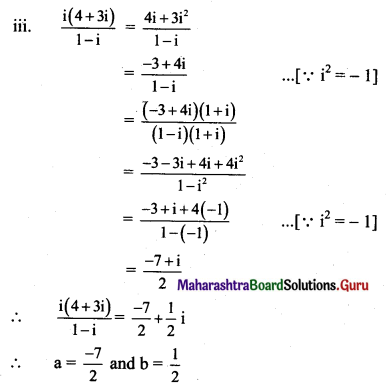
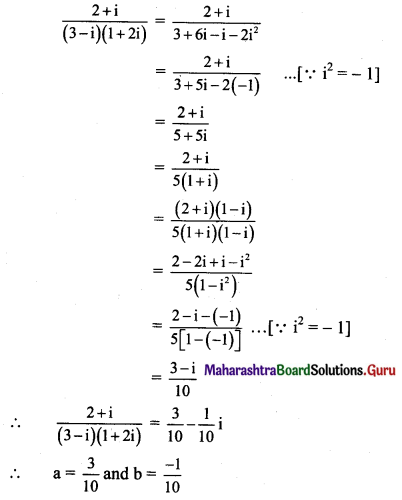
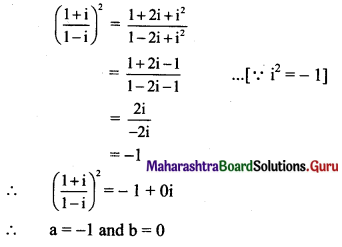
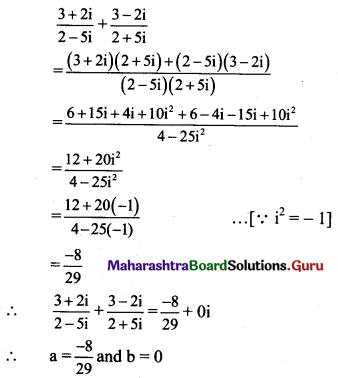
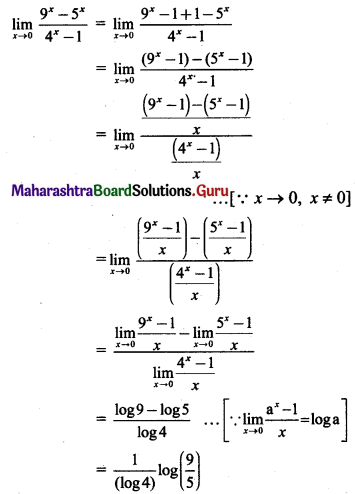
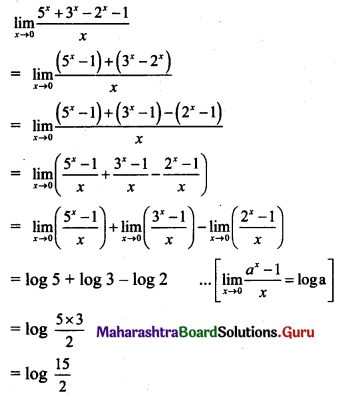
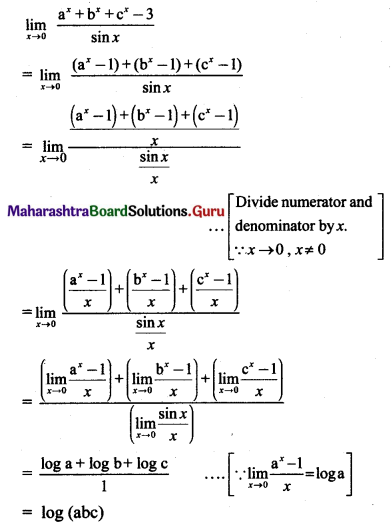
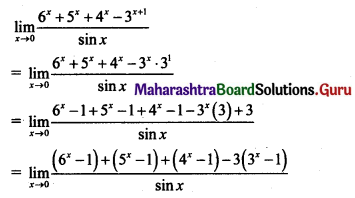
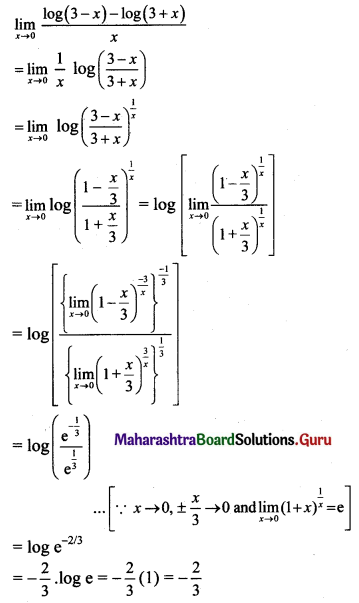
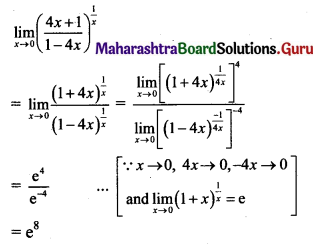
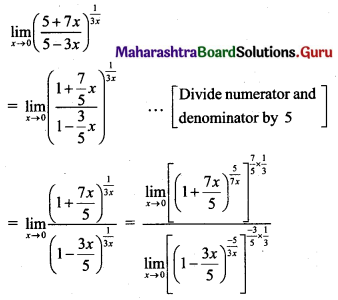
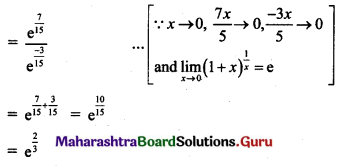
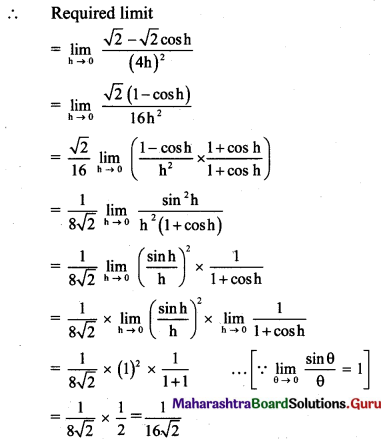
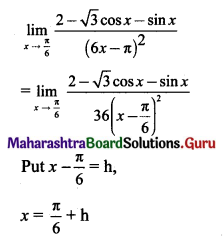
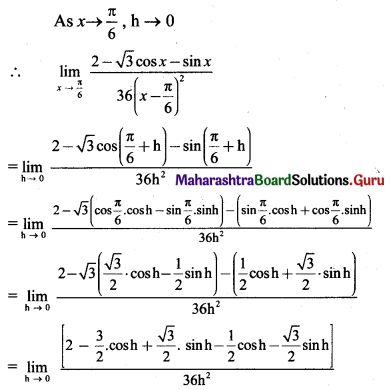
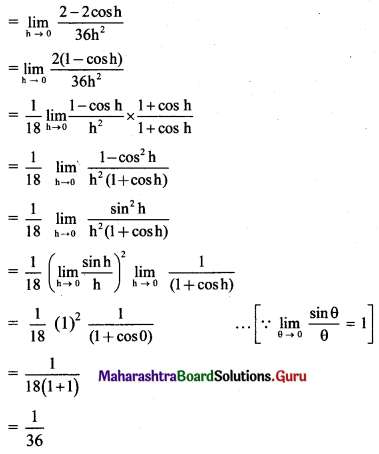
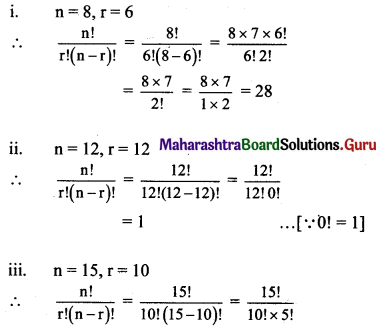
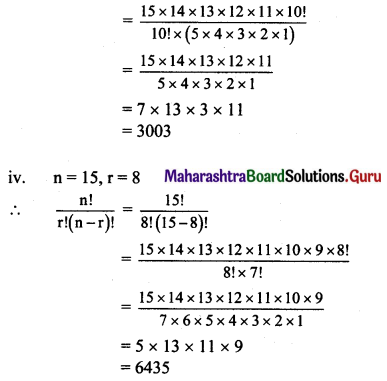
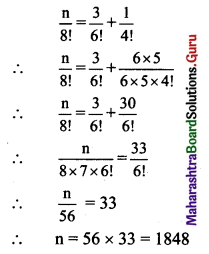
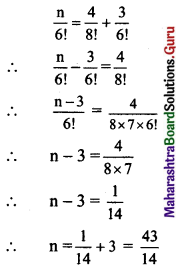
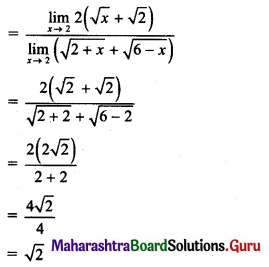
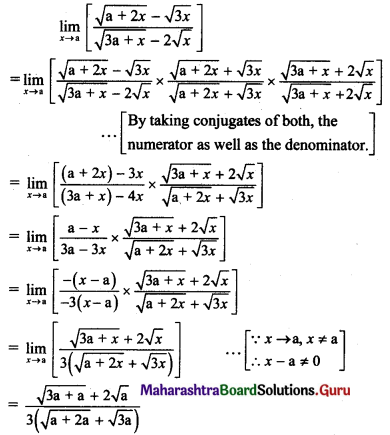
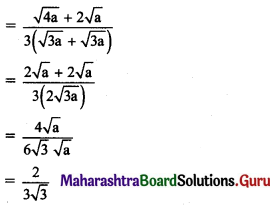
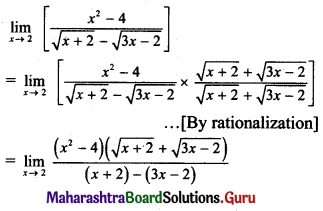
Maharashtra Board 11th Maths Solutions Chapter 6 Functions Miscellaneous Exercise 6

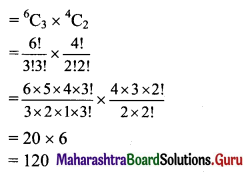
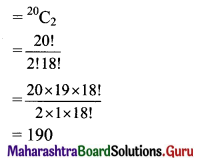
Balbharti Maharashtra State Board 11th Maths Book Solutions Pdf Chapter 6 Functions Miscellaneous Exercise 6 Questions and Answers.

Maharashtra State Board 11th Maths Solutions Chapter 6 Functions Miscellaneous Exercise 6

(I) Select the correct answer from the given alternatives.

Question 1.
If log (5x – 9) – log (x + 3) = log 2, then x = ________
(A) 3
(B) 5
(C) 2
(D) 7
Answer:
(B) 5
Hint:
log (5x – 9) – log (x + 3) = log 2
∴ \(\frac{5 x-9}{x+3}\) = 2
∴ 3x = 9 + 6
∴ x = 5

Question 2.
If log10 (log10 (log10 x)) = 0, then x = ________
(A) 1000
(B) 1010
(C) 10
(D) 0
Answer:
(B) 1010
Hint:
log10 log10 log10 x = 0
∴ log10 (log10 (x)) = 100 = 1
∴ log10 x = 101 = 10
∴ x = 1010

Maharashtra Board 11th Maths Solutions Chapter 6 Functions Miscellaneous Exercise 6

Question 3.
Find x, if 2 log2 x = 4
(A) 4, -4
(B) 4
(C) -4
(D) not defined
Answer:
(B) 4
Hint:
2 log2 x = 4, x > 0
∴ log2 (x2) = 4
∴ x2 = 16
∴ x = ±4
∴ x = 4

Question 4.
The equation \(\log _{x^{2}} 16+\log _{2 x} 64=3\) has,
(A) one irrational solution
(B) no prime solution
(C) two real solutions
(D) one integral solution
Answer:
(A), (B), (C), (D)
Hint:
\(\log _{x^{2}} 16+\log _{2 x} 64=3\)
∴ \(\frac{\log 16}{\log x^{2}}+\frac{\log 64}{\log 2 x}=3\)
∴ 4 log 2 [log x + log 2] + (6 log 2) (2 log x) = 3 (2 log x) (log 2 + log x)
Let log 2 = a, log x = t. Then
∴ 4at + 4a2 + 12at = 6at + 6t2
∴ 6t2 – 10at – 4a2 = 0
∴ 3t2 – 5at – 2a2 = 0
∴ (3t + a) (t – 2a) = 0
∴ t = \(-\frac{1}{3}\)a, 2a
∴ log x = \(\log (2)^{-\frac{1}{3}}\), log (22)
∴ x = \(2^{-\frac{1}{3}}\), 4
∴ x = \(\frac{1}{\sqrt[3]{2}}\), 4

Question 5.
If f(x) = \(\frac{1}{1-x}\), then f(f(f(x))) is
(A) x – 1
(B) 1 – x
(C) x
(D) -x
Answer:
(C) x
Hint:
Maharashtra Board 11th Maths Solutions Chapter 6 Functions Miscellaneous Exercise 6 I Q5

Question 6.
If f: R → R is defined by f(x) = x3, then f-1 (8) is equal to:
(A) {2}
(B) {-2.2}
(C) {-2}
(D) (-2.2)
Answer:
(A) {2}
Hint:
Maharashtra Board 11th Maths Solutions Chapter 6 Functions Miscellaneous Exercise 6 I Q6

Question 7.
Let the function f be defined by f(x) = \(\frac{2 x+1}{1-3 x}\) then f-1 (x) is:
(A) \(\frac{x-1}{3 x+2}\)
(B) \(\frac{x+1}{3 x-2}\)
(C) \(\frac{2 x+1}{1-3 x}\)
(D) \(\frac{3 x+2}{x-1}\)
Answer:
(A) \(\frac{x-1}{3 x+2}\)
Hint:
f(x) = \(\frac{2 x+1}{1-3 x}\) = y, say. then
2x + 1 = y(1 – 3x)
∴ y – 1 = x(2 + 3y)
∴ x = \(\frac{y-1}{2+3 y}\) = f-1 (y)
∴ f-1 (x) = \(\frac{x-1}{2+3 x}\)

Maharashtra Board 11th Maths Solutions Chapter 6 Functions Miscellaneous Exercise 6

Question 8.
If f(x) = 2x2 + bx + c and f(0) = 3 and f(2) = 1, then f(1) is equal to
(A) -2
(B) 0
(C) 1
(D) 2
Answer:
(B) 0
Hint:
f(x) = 2x2 + bx + c
f(0) = 3
∴ 2(0) + b(0) + c = 3
∴ c = 3 ……..(i)
∴ f(2) = 1
∴ 2(4) + 2b + c = 1
∴ 2b + c = -7
∴ 2b + 3 = -7 …..[From (i)]
∴ b = -5
∴ f(x) = 2x2 – 5x + 3
∴ f(1) = 2(1)2 – 5(1) + 3 = 0

Question 9.
The domain of \(\frac{1}{[x]-x}\), where [x] is greatest integer function is
(A) R
(B) Z
(C) R – Z
(D) Q – {0}
Answer:
(C) R – Z
Hint:
f(x) = \(\frac{1}{[x]-x}=\frac{1}{-\{x\}}\)
For f to be defined, {x} ≠ 0
∴ x cannot be integer.
∴ Domain = R – Z

Question 10.
The domain and range of f(x) = 2 – |x – 5| are
(A) R+, (-∞, 1]
(B) R, (-∞, 2]
(C) R, (-∞, 2)
(D) R+, (-∞, 2]
Answer:
(B) R, (-∞, 2]
Hint:
Maharashtra Board 11th Maths Solutions Chapter 6 Functions Miscellaneous Exercise 6 I Q10
f(x) = 2 – |x – 5|
= 2 – (5 – x), x < 5
= 2 – (x – 5), x ≥ 5
∴ f(x) = x – 3, x < 5
= 7 – x, x ≥ 5
Domain = R,
Range (from graph) = (-∞, 2]

(II) Answer the following:

Question 1.
Which of the following relations are functions? If it is a function determine its domain and range.
(i) {(2, 1), (4, 2), (6, 3), (8, 4), (10, 5) (12, 6), (14, 7)}
(ii) {(0, 0), (1, 1), (1, -1), (4, 2), (4, -2) (9, 3), (9, -3), (16, 4), (16, -4)}
(iii) {(2, 1), (3, 1), (5, 2)}
Solution:
(i) {(2, 1), (4, 2), (6, 3), (8, 4), (10, 5) (12, 6), (14, 7)}
Maharashtra Board 11th Maths Solutions Chapter 6 Functions Miscellaneous Exercise 6 II Q1 (i)
Every element of set A has been assigned a unique element in set B
∴ Given relation is a function
Domain = {2, 4, 6, 8, 10, 12, 14}, Range = {1, 2, 3, 4, 5, 6, 7}

(ii) {(0, 0), (1, 1), (1, -1), (4, 2), (4, -2) (9, 3), (9, -3) (16, 4), (16, -4)}
∵ (1, 1), (1, -1) ∈ the relation
∴ Given relation is not a function.
As element 1 of the domain has not been assigned a unique element of co-domain.

(iii) {(2, 1), (3, 1), (5, 2)}
Maharashtra Board 11th Maths Solutions Chapter 6 Functions Miscellaneous Exercise 6 II Q1 (iii)
Every element of set A has been assigned a unique element in set B.
∴ Given relation is a function.
Domain = {2, 3, 5}, Range = {1, 2}

Maharashtra Board 11th Maths Solutions Chapter 6 Functions Miscellaneous Exercise 6

Question 2.
Find whether the following functions are one-one.
(i) f: R → R defined by f(x) = x2 + 5
(ii) f: R – {3} → R defined by f(x) = \(\frac{5 x+7}{x-3}\) for x ∈ R – {3}
Solution:
(i) f: R → R, defined by f(x) = x2 + 5
Note that f(-x) = f(x) = x2 + 5
∴ f is not one-one (i.e., many-one) function.

(ii) f: R – {3} → R, defined by f(x) = \(\frac{5 x+7}{x-3}\)
Let f(x1) = f(x2)
∴ \(\frac{5 x_{1}+7}{x_{1}-3}=\frac{5 x_{2}+7}{x_{2}-3}\)
∴ 5x1 x2 – 15x1 + 7x2 – 21 = 5x1 x2 – 15x2 + 7x1 – 21
∴ 22(x1 – x2) = 0
∴ x1 = x2
∴ f is a one-one function.

Question 3.
Find whether the following functions are onto or not.
(i) f: Z → Z defined by f(x) = 6x – 7 for all x ∈ Z
(ii) f: R → R defined by f(x) = x2 + 3 for all x ∈ R
Solution:
(i) f(x) = 6x – 7 = y (say)
(x, y ∈ Z)
∴ x = \(\frac{7+y}{6}\)
Since every integer y does not give integer x, f is not onto.

(ii) f(x) = x2 + 3 = y (say)
(x, y ∈ R)
Clearly y ≥ 3 …..[x2 ≥ 0]
∴ All the real numbers less than 3 from codomain R, have not been pre-assigned any element from the domain R.
∴ f is not onto.

Question 4.
Let f: R → R be a function defined by f(x) = 5x3 – 8 for all x ∈ R. Show that f is one-one and onto. Hence find f-1.
Solution:
Maharashtra Board 11th Maths Solutions Chapter 6 Functions Miscellaneous Exercise 6 II Q4

Question 5.
A function f: R → R defined by f(x) = \(\frac{3 x}{5}\) + 2, x ∈ R. Show that f is one-one and onto. Hence find f-1.
Solution:
Maharashtra Board 11th Maths Solutions Chapter 6 Functions Miscellaneous Exercise 6 II Q5

Question 6.
A function f is defined as f(x) = 4x + 5, for -4 ≤ x < 0. Find the values of f(-1), f(-2), f(0), if they exist.
Solution:
f(x) = 4x + 5, -4 ≤ x < 0
f(-1) = 4(-1) + 5 = -4 + 5 = 1
f(-2) = 4(-2) + 5 = -8 + 5 = -3
x = 0 ∉ domain of f
∴ f(0) does not exist.

Question 7.
A function f is defined as f(x) = 5 – x for 0 ≤ x ≤ 4. Find the values of x such that
(i) f(x) = 3
(ii) f(x) = 5
Solution:
(i) f(x) = 3
∴ 5 – x = 3
∴ x = 5 – 3 = 2

(ii) f(x) = 5
∴ 5 – x = 5
∴ x = 0

Maharashtra Board 11th Maths Solutions Chapter 6 Functions Miscellaneous Exercise 6

Question 8.
If f(x) = 3x4 – 5x2 + 7, find f(x – 1).
Solution:
f(x) = 3x4 – 5x2 + 7
∴ f(x – 1) = 3(x – 1)4 – 5(x – 1)2 + 7
= 3(x44C1 x3 + 4C2 x24C3 x + 4C4) – 5(x2 – 2x + 1) + 7
= 3(x4 – 4x3 + 6x2 – 4x + 1) – 5(x2 – 2x + 1) + 7
= 3x4 – 12x3 + 18x2 – 12x + 3 – 5x2 + 10x – 5 + 7
= 3x4 – 12x3 + 13x2 – 2x + 5

Question 9.
If f(x) = 3x + a and f(1) = 7, find a and f(4).
Solution:
f(x) = 3x + a, f(1) = 7
∴ 3(1) + a = 7
∴ a = 7 – 3 = 4
∴ f(x) = 3x + 4
∴ f(4) = 3(4) + 4 = 12 + 4 = 16

Question 10.
If f(x) = ax2 + bx + 2 and f(1) = 3, f(4) = 42, find a and b.
Solution:
f(x) = ax2 + bx + 2
f(1) = 3
∴ a(1)2 + b(1) + 2 = 3
∴ a + b = 1 ….(i)
f(4) = 42
∴ a(4)2 + b(4) + 2 = 42
∴ 16a + 4b = 40
Dividing by 4, we get
4a + b = 10 …..(ii)
Solving (i) and (ii), we get
a = 3, b = -2

Question 11.
Find composite of f and g:
(i) f = {(1, 3), (2, 4), (3, 5), (4, 6)}
g = {(3, 6), (4, 8), (5, 10), (6, 12)}
(ii) f = {(1, 1), (2, 4), (3, 4), (4, 3)}
g = {(1, 1), (3, 27), (4, 64)}
Solution:
(i) f = {(1, 3), (2, 4), (3, 5), (4, 6)}
g = {(3, 6), (4, 8), (5, 10), (6, 12)}
∴ f(1) = 3, g(3) = 6
f(2) = 4, g(4) = 8
f(3) = 5, g(5)=10
f(4) = 6, g(6) = 12
(gof) (x) = g (f(x))
(gof)(1) = g(f(1)) = g(3) = 6
(gof)(2) – g(f(2)) = g(4) = 8
(gof)(3) = g(f(3)) = g(5) = 10
(gof)(4) = g(f(4)) = g(6) = 12
∴ gof = {(1, 6), (2, 8), (3, 10), (4, 12)}

(ii) f = {(1, 1), (2, 4), (3, 4), (4, 3)}
g = {(1, 1), (3, 27), (4, 64)}
f(1) = 1, g(1) = 1
f(2) = 4, g(3) = 27
f(3) = 4, g(4) = 64
f(4) = 3
(gof) (x) = g(f(x))
(gof) (1) = g(f(1)) = g(1) = 1
(gof) (2) = g(f(2)) = g(4) = 64
(gof) (3) = g(f(3)) = g(4) = 64
(gof) (4) = g(f(4)) = g(3) = 27
∴ gof = {(1, 1), (2, 64), (3, 64), (4, 27)}

Maharashtra Board 11th Maths Solutions Chapter 6 Functions Miscellaneous Exercise 6

Question 12.
Find fog and gof:
(i) f(x) = x2 + 5, g(x) = x – 8
(ii) f(x) = 3x – 2, g(x) = x2
(iii) f(x) = 256x4, g(x) = √x
Solution:
(i) f(x) = x2 + 5, g(x) = x – 8
(fog) (x) = f(g(x))
= f(x – 8)
= (x – 8)2 + 5
= x2 – 16x + 64 + 5
= x2 – 16x + 69
(gof) (x) = g(f(x))
= g(x2 + 5)
= x2 + 5 – 8
= x – 3

(ii) f(x) = 3x – 2, g(x) = x2
(fog) (x) = f(g(x)) = f(x2) = 3x2 – 2
(gof) (x) = g(f(x))
= g(3x – 2)
= (3x – 2)2
= 9x2 – 12x + 4

(iii) f(x) = 256x4, g(x) = √x
(fog) (x) = f(g(x)) = f (√x) = 256 (√x)4 = 256x2
(gof) (x) = g(f(x)) = g(256x4) = \(\sqrt{256 x^{4}}\) = 16x2

Question 13.
If f(x) = \(\frac{2 x-1}{5 x-2}, x \neq \frac{2}{5}\), show that (fof) (x) = x.
Solution:
Maharashtra Board 11th Maths Solutions Chapter 6 Functions Miscellaneous Exercise 6 II Q13

Question 14.
If f(x) = \(\frac{x+3}{4 x-5}\), g(x) = \(\frac{3+5 x}{4 x-1}\), then show that (fog) (x) = x.
Solution:
f(x) = \(\frac{x+3}{4 x-5}\), g(x) = \(\frac{3+5 x}{4 x-1}\)
(fog)(x) = f(g(x))
= f(\(\frac{3+5 x}{4 x-1}\))
Maharashtra Board 11th Maths Solutions Chapter 6 Functions Miscellaneous Exercise 6 II Q14

Question 15.
Let f: R – {2} → R be defined by f(x) = \(\frac{x^{2}-4}{x-2}\) and g: R → R be defined by g(x) = x + 2. Examine whether f = g or not.
Solution:
f(x) = \(\frac{x^{2}-4}{x-2}\), x ≠ 2
∴ f(x) = x + 2, x ≠ 2 and g(x) = x + 2,
The domain of f = R – {2}
The domain of g = R
Here, f and g have different domains.
∴ f ≠ g

Question 16.
Let f: R → R be given by f(x) = x + 5 for all x ∈ R. Draw its graph.
Solution:
f(x) = x + 5
Maharashtra Board 11th Maths Solutions Chapter 6 Functions Miscellaneous Exercise 6 II Q16

Question 17.
Let f: R → R be given by f(x) = x3 + 1 for all x ∈ R. Draw its graph.
Solution:
Let y = f(x) = x3 + 1
Maharashtra Board 11th Maths Solutions Chapter 6 Functions Miscellaneous Exercise 6 II Q17
Maharashtra Board 11th Maths Solutions Chapter 6 Functions Miscellaneous Exercise 6 II Q17.1

Question 18.
For any base show that log(1 + 2 + 3) = log 1 + log 2 + log 3
Solution:
L.H.S. = log(1 + 2 + 3) = log 6
R.H.S. = log 1 + log 2 + log 3
= 0 + log (2 × 3)
= log 6
∴ L.H.S. = R.H.S.

Maharashtra Board 11th Maths Solutions Chapter 6 Functions Miscellaneous Exercise 6

Question 19.
Find x, if x = \(3^{3 \log _{3} 2}\).
Solution:
x = \(3^{3 \log _{3} 2}\)
= \(3^{\log 3\left(2^{3}\right)}\)
= 23 ….[\(a^{\log _{a} b}\) = b]
= 8

Question 20.
Show that, log|\(\sqrt{x^{2}+1}\) + x| + log|\(\sqrt{x^{2}+1}\) – x| = 0.
Solution:
L.H.S. = log|\(\sqrt{x^{2}+1}\) + x| + log|\(\sqrt{x^{2}+1}\) – x|
= \(\log \left|\left(\sqrt{x^{2}+1}+x\right)\left(\sqrt{x^{2}+1}-x\right)\right|\)
= log|x2 + 1 – x2|
= log 1
= 0
= R.H.S.

Question 21.
Show that \(\log \frac{\mathrm{a}^{2}}{\mathrm{bc}}+\log \frac{\mathrm{b}^{2}}{\mathrm{ca}}+\log \frac{\mathrm{c}^{2}}{\mathrm{ab}}=0\).
Solution:
Maharashtra Board 11th Maths Solutions Chapter 6 Functions Miscellaneous Exercise 6 II Q21

Question 22.
Simplify log (log x4) – log(log x).
Solution:
log (log x4) – log (log x)
= log (4 log x) – log (log x) …..[log mn = n log m]
= log 4 + log (log x) – log (log x) …..[log (mn) = log m + log n]
= log 4

Question 23.
Simplify \(\log _{10} \frac{28}{45}-\log _{10} \frac{35}{324}+\log _{10} \frac{325}{432}-\log _{10} \frac{13}{15}\)
Solution:
Maharashtra Board 11th Maths Solutions Chapter 6 Functions Miscellaneous Exercise 6 II Q23

Question 24.
If log (\(\frac{a+b}{2}\)) = \(\frac{1}{2}\) (log a + log b), then show that a = b.
Solution:
log (\(\frac{a+b}{2}\)) = \(\frac{1}{2}\) (log a + log b)
∴ 2 log (\(\frac{a+b}{2}\)) = log a + log b
∴ log \(\left(\frac{a+b}{2}\right)^{2}\) = log ab
∴ \(\frac{(a+b)^{2}}{4}\) = ab
∴ a2 + 2ab + b2 = 4ab
∴ a2 + 2ab – 4ab + b2 = 0
∴ a2 – 2ab + b2 = 0
∴ (a – b)2 = 0
∴ a – b = 0
∴ a = b

Question 25.
If b2 = ac. Prove that, log a + log c = 2 log b.
Solution:
b2 = ac
Taking log on both sides, we get
log b2 = log ac
∴ 2 log b = log a + log c
∴ log a + log c = 2 log b

Maharashtra Board 11th Maths Solutions Chapter 6 Functions Miscellaneous Exercise 6

Question 26.
Solve for x, logx (8x – 3) – logx 4 = 2.
Solution:
logx (8x – 3) – logx 4 = 2
∴ \(\log _{x}\left(\frac{8 x-3}{4}\right)\) = 2
∴ x2 = \(\frac{8 x-3}{4}\)
∴ 4x2 = 8x – 3
∴ 4x2 – 8x + 3 = 0
∴ 4x2 – 2x – 6x + 3 = 0
∴ 2x(2x – 1) – 3(2x – 1) = 0
∴ (2x – 1)(2x – 3) = 0
∴ 2x – 1 = 0 or 2x – 3 = 0
∴ x = \(\frac{1}{2}\) or x = \(\frac{3}{2}\)

Question 27.
If a2 + b2 = 7ab, show that \(\log \left(\frac{a+b}{3}\right)=\frac{1}{2} \log a+\frac{1}{2} \log b\)
Solution:
a2 + b2 = 7ab
a2 + 2ab + b2 = 7ab + 2ab
(a + b)2 = 9ab
\(\frac{(a+b)^{2}}{9}\) = ab
\(\left(\frac{a+b}{3}\right)^{2}\) = ab
Taking log on both sides, we get
log \(\left(\frac{a+b}{3}\right)^{2}\) = log (ab)
2 log \(\left(\frac{a+b}{3}\right)\) = log a + log b
Dividing throughout by 2, we get
\(\log \left(\frac{a+b}{3}\right)=\frac{1}{2} \log a+\frac{1}{2} \log b\)

Question 28.
If \(\log \left(\frac{x-y}{5}\right)=\frac{1}{2} \log x+\frac{1}{2} \log y\), show that x2 + y2 = 27xy.
Solution:
Maharashtra Board 11th Maths Solutions Chapter 6 Functions Miscellaneous Exercise 6 II Q28

Question 29.
If log3 [log2 (log3 x)] = 1, show that x = 6561.
Solution:
log3 [log2 (log3 x)] = 1
∴ log2 (log3 x) = 31
∴ log3 x = 23
∴ log3 x = 8
∴ x = 38
∴ x = 6561

Question 30.
If f(x) = log(1 – x), 0 ≤ x < 1, show that f(\(\frac{1}{1+x}\)) = f(1 – x) – f(-x).
Solution:
Maharashtra Board 11th Maths Solutions Chapter 6 Functions Miscellaneous Exercise 6 II Q30

Question 31.
Without using log tables, prove that \(\frac{2}{5}\) < log10 3 < \(\frac{1}{2}\).
Solution:
We have to prove that, \(\frac{2}{5}\) < log10 3 < \(\frac{1}{2}\)
i.e., to prove that \(\frac{2}{5}\) < log10 3 and log10 3 < \(\frac{1}{2}\)
i.e., to prove that 2 < 5 log10 3 and 2 log10 3 < 1
i.e., to prove that 2 log10 10 < 5 log10 3 and 2 log10 3 < log10 10 ……[∵ loga a = 1]
i.e., to prove that log10 102 < log10 35 and log10 32 < log10 10
i.e., to prove that 102 < 35 and 32 < 10
i.e., to prove that 100 < 243 and 9 < 10 which is true
∴ \(\frac{2}{5}\) < log10 3 < \(\frac{1}{2}\)

Question 32.
Show that \(7 \log \left(\frac{15}{16}\right)+6 \log \left(\frac{8}{3}\right)+5 \log \left(\frac{2}{5}\right)+\log \left(\frac{32}{25}\right)\) = log 3
Solution:
Maharashtra Board 11th Maths Solutions Chapter 6 Functions Miscellaneous Exercise 6 II Q32

Question 33.
Solve : \(\sqrt{\log _{2} x^{4}}+4 \log _{4} \sqrt{\frac{2}{x}}=2\)
Solution:
Maharashtra Board 11th Maths Solutions Chapter 6 Functions Miscellaneous Exercise 6 II Q33
Maharashtra Board 11th Maths Solutions Chapter 6 Functions Miscellaneous Exercise 6 II Q33.1

Question 34.
Find the value of \(\frac{3+\log _{10} 343}{2+\frac{1}{2} \log _{10}\left(\frac{49}{4}\right)+\frac{1}{2} \log _{10}\left(\frac{1}{25}\right)}\)
Solution:
Maharashtra Board 11th Maths Solutions Chapter 6 Functions Miscellaneous Exercise 6 II Q34

Question 35.
If \(\frac{\log a}{x+y-2 z}=\frac{\log b}{y+z-2 x}=\frac{\log c}{z+x-2 y}\), show that abc = 1.
Solution:
Let \(\frac{\log a}{x+y-2 z}=\frac{\log b}{y+z-2 x}=\frac{\log c}{z+x-2 y}\) = k
∴ log a = k(x + y – 2z), log b = k(y + z – 2x), log c = k(z + x – 2y)
log a + log b + log c = k(x + y – 2z) + k(y + z – 2x) + k(z + x – 2y)
= k(x + y – 2z + y + z – 2x + z + x – 2y)
= k(0)
= 0
∴ log (abc) = log 1 …….[∵ log 1 = 0]
∴ abc = 1

Maharashtra Board 11th Maths Solutions Chapter 6 Functions Miscellaneous Exercise 6

Question 36.
Show that, logy x3 . logz y4 . logx z5 = 60.
Solution:
Maharashtra Board 11th Maths Solutions Chapter 6 Functions Miscellaneous Exercise 6 II Q36

Question 37.
If \(\frac{\log _{2} \mathrm{a}}{4}=\frac{\log _{2} \mathrm{~b}}{6}=\frac{\log _{2} \mathrm{c}}{3 \mathrm{k}}\) and a3b2c = 1, find the value of k.
Solution:
Maharashtra Board 11th Maths Solutions Chapter 6 Functions Miscellaneous Exercise 6 II Q37

Question 38.
If a2 = b3 = c4 = d5, show that loga bcd = \(\frac{47}{30}\).
Solution:
Maharashtra Board 11th Maths Solutions Chapter 6 Functions Miscellaneous Exercise 6 II Q38

Question 39.
Solve the following for x, where |x| is modulus function, [x] is the greatest integer function, {x} is a fractional part function.
(i) 1 < |x – 1| < 4
(ii) |x2 – x – 6| = x + 2
(iii) |x2 – 9| + |x2 – 4| = 5
(iv) -2 < [x] ≤ 7
(v) 2[2x – 5] – 1 = 7
(vi) [x]2 – 5 [x] + 6 = 0
(vii) [x – 2] + [x + 2] + {x} = 0
(viii) \(\left[\frac{x}{2}\right]+\left[\frac{x}{3}\right]=\frac{5 x}{6}\)
Solution:
(i) 1 < |x – 1| < 4
∴ -4 < x – 1 < -1 or 1 < x – 1 < 4
∴ -3 < x < 0 or 2 < x < 5
∴ Solution set = (-3, 0) ∪ (2, 5)

(ii) |x2 – x – 6| = x + 2 …..(i)
R.H.S. must be non-negative
∴ x ≥ -2 …..(ii)
|(x – 3) (x + 2)| = x + 2
∴ (x + 2) |x – 3| = x + 2 as x + 2 ≥ 0
∴ |x – 3| = 1 if x ≠ -2
∴ x – 3 = ±1
∴ x = 4 or 2
∴ x = -2 also satisfies the equation
∴ Solution set = {-2, 2, 4}

(iii) |x2 – 9| + |x2 – 4| = 5
∴ |(x – 3) (x + 3)| + |(x – 2) ( x + 2)| = 5 ………(i)
Case I: x < -3
Also, x < -2, x < 2, x < 3
∴ (x – 3) (x + 3) > 0 and (x – 2) (x + 2) > 0
Equation (i) reduces to
x2 – 9 + x2 – 4 = 5
∴ 2x2 = 18
∴ x = -3 or 3 (both rejected as x < -3)

Case II: -3 ≤ x < -2
As x < -2, x < 3
∴ (x – 3) (x + 3) < 0, (x – 2) (x + 2) > 0
Equation (i) reduces to
-(x2 – 9) + x2 – 4 = 5
∴ 5 = 5 (true)
-3 ≤ x < -2 is a solution ….(ii)

Case III: -2 ≤ x < 2 As x > -3, x < 3
∴ (x – 3) (x + 3) < 0,
(x – 2) (x + 2) < 0
Equation (i) reduces to
9 – x2 + 4 – x2 = 5
∴ 2x2 = 13 – 5
∴ x2 = 4
∴ x = -2 is a solution …..(iii)

Case IV: 2 ≤ x < 3 As x > -3, x > -2
∴ (x – 3) (x + 3) < 0, (x – 2) (x + 2) > 0
Equation (i) reduces to
9 – x2 + x2 – 4 = 5
∴ 5 = 5 (true)
∴ 2 ≤ x < 3 is a solution ……(iv)

Case V: 3 ≤ x As x > -3, x > -2, x > 2
∴ (x + 3) (x – 3) > 0,
(x – 2) (x + 2) > 0
Equation (i) reduces to
x2 – 9 + x2 – 4 = 5
∴ 2x2 = 18
∴ x2 = 9
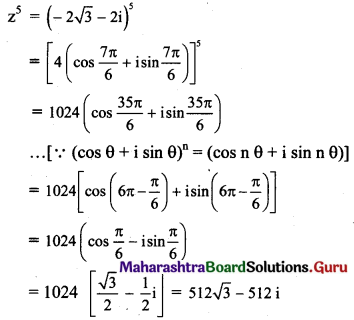
∴ x = 3 …..(v)
(x = -3 rejected as x ≥ 3)
From (ii), (iii), (iv), (v), we get
∴ Solution set = [-3, -2] ∪ [2, 3]

(iv) -2 < [x] ≤ 7
∴ -2 < x < 8
∴ Solution set = (-2, 8)

Maharashtra Board 11th Maths Solutions Chapter 6 Functions Miscellaneous Exercise 6

(v) 2[2x – 5] – 1 = 7
∴ [2x – 5] = \(\frac{7+1}{2}\) = 4
∴ [2x] – 5 = 4
∴ [2x] = 9
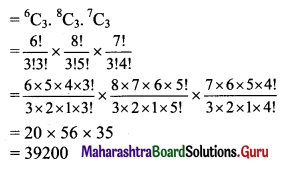
∴ 9 ≤ 2x < 10
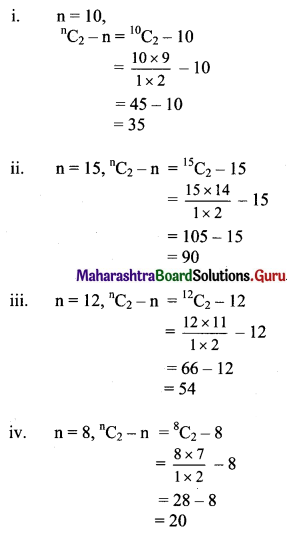
∴ \(\frac{9}{2}\) ≤ x < 5
∴ Solution set = [\(\frac{9}{2}\), 5)

(vi) [x]2 – 5[x] + 6 = 0
∴ ([x] – 3)([x] – 2) = 0
∴ [x] = 3 or 2
If [x] = 2, then 2 ≤ x < 3
If [x] = 3, then 3 ≤ x < 4
∴ Solution set = [2, 4)

(vii) [x – 2] + [x + 2] + {x} = 0
∴ [x] – 2 + [x] + 2 + {x} = 0
∴ [x] + x = 0 …..[{x} + [x] = x]
∴ x = 0

(viii) \(\left[\frac{x}{2}\right]+\left[\frac{x}{3}\right]=\frac{5 x}{6}\)
L.H.S. = an integer
R.H.S. = an integer
∴ x = 6k, where k is an integer

Question 40.
Find the domain of the following functions.
(i) f(x) = \(\frac{x^{2}+4 x+4}{x^{2}+x-6}\)
(ii) f(x) = \(\sqrt{x-3}+\frac{1}{\log (5-x)}\)
(iii) f(x) = \(\sqrt{1-\sqrt{1-\sqrt{1-x^{2}}}}\)
(iv) f(x) = x!
(v) f(x) = \({ }^{5-x} P_{x-1}\)
(vi) f(x) = \(\sqrt{x-x^{2}}+\sqrt{5-x}\)
(vii) f(x) = \(\sqrt{\log \left(x^{2}-6 x+6\right)}\)
Solution:
(i) f(x) = \(\frac{x^{2}+4 x+4}{x^{2}+x-6}=\frac{x^{2}+4 x+4}{(x+3)(x-2)}\)
For f to be defined, x ≠ -3, 2
∴ Domain of f = (-∞, -3) ∪ (-3, 2) ∪ (2, ∞)

(ii) f(x) = \(\sqrt{x-3}+\frac{1}{\log (5-x)}\)
For f to be defined,
x – 3 ≥ 0, 5 – x > 0 and 5 – x ≠ 1
x ≥ 3, x < 5 and x ≠ 4
∴ Domain of f = [3, 4) ∪ (4, 5)

(iii) f(x) = \(\sqrt{1-\sqrt{1-\sqrt{1-x^{2}}}}\)
Maharashtra Board 11th Maths Solutions Chapter 6 Functions Miscellaneous Exercise 6 II Q40 (iii)
Equation (i) gives solution set = [-1, 1]
∴ Domain of f = [-1, 1]

(iv) f(x) = x!
∴ Domain of f = set of whole numbers (W)

(v) f(x) = \({ }^{5-x} P_{x-1}\)
5 – x > 0, x – 1 ≥ 0, x – 1 ≤ 5 – x
∴ x < 5, x ≥ 1 and 2x ≤ 6
∴ x ≤ 3
∴ Domain of f = {1, 2, 3}

(vi) f(x) = \(\sqrt{x-x^{2}}+\sqrt{5-x}\)
x – x2 ≥ 0
∴ x2 – x ≤ 0
∴ x(x – 1) ≤ 0
∴ 0 ≤ x ≤ 1 …..(i)
5 – x ≥ 0
∴ x ≤ 5 …..(ii)
Intersection of intervals given in (i) and (ii) gives
Solution set = [0, 1]
∴ Domain of f = [0, 1]

(vii) f(x) = \(\sqrt{\log \left(x^{2}-6 x+6\right)}\)
For f to be defined,
log (x2 – 6x + 6) ≥ 0
∴ x2 – 6x + 6 ≥ 1
∴ x2 – 6x + 5 ≥ 0
∴ (x – 5)(x – 1) ≥ 0
∴ x ≤ 1 or x ≥ 5 …..(i)
[∵ The solution of (x – a) (x – b) ≥ 0 is x ≤ a or x ≥ b, for a < b]
and x2 – 6x + 6 > 0
∴ (x – 3)2 > -6 + 9
∴ (x – 3)2 > 3
∴ x < 3 – √3 0r x > 3 + √3 ……..(ii)
From (i) and (ii), we get
x ≤ 1 or x ≥ 5
Solution set = (-∞, 1] ∪ [5, ∞)
∴ Domain of f = (-∞, 1] ∪ [5, ∞)

Maharashtra Board 11th Maths Solutions Chapter 6 Functions Miscellaneous Exercise 6

Question 41.
(i) f(x) = |x – 5|
(ii) f(x) = \(\frac{x}{9+x^{2}}\)
(iii) f(x) = \(\frac{1}{1+\sqrt{x}}\)
(iv) f(x) = [x] – x
(v) f(x) = 1 + 2x + 4x
Solution:
(i) f(x) = |x – 5|
Maharashtra Board 11th Maths Solutions Chapter 6 Functions Miscellaneous Exercise 6 II Q41 (i)
∴ Range of f = [0, ∞)

(ii) f(x) = \(\frac{x}{9+x^{2}}\) = y (say)
∴ x2y – x + 9y = 0
For real x, Discriminant > 0
∴ 1 – 4(y)(9y) ≥ 0
∴ y2 ≤ \(\frac{1}{36}\)
∴ \(\frac{-1}{6}\) ≤ y ≤ \(\frac{1}{6}\)
∴ Range of f = [\(\frac{-1}{6}\), \(\frac{1}{6}\)]

(iii) f(x) = \(\frac{1}{1+\sqrt{x}}\) = y, (say)
∴ √x y + y = 1
∴ √x = \(\frac{1-y}{y}\) ≥ 0
∴ \(\frac{y-1}{y}\) ≤ 0
∴ o < y ≤ 1
∴ Range of f = (0, 1]

(iv) f(x) = [x] – x = -{x}
∴ Range of f = (-1, 0] …..[0 ≤ {x} < 1]

(v) f(x) = 1 + 2x + 4x
Since, 2x > 0, 4x > 0
∴ f(x) > 1
∴ Range of f = (1, ∞)

Question 42.
Find (fog) (x) and (gof) (x)
(i) f(x) = ex, g(x) = log x
(ii) f(x) = \(\frac{x}{x+1}\), g(x) = \(\frac{x}{1-x}\)
Solution:
(i) f(x) = ex, g(x) = log x
(fog) (x) = f(g(x))
= f(log x)
= elog x
= x
(gof) (x) = g(f(x))
= g(ex)
= log (ex)
= x log e
= x …..[∵ log e = 1]

(ii) f(x) = \(\frac{x}{x+1}\), g(x) = \(\frac{x}{1-x}\)
Maharashtra Board 11th Maths Solutions Chapter 6 Functions Miscellaneous Exercise 6 II Q42 (ii)

Question 43.
Find f(x), if
(i) g(x) = x2 + x – 2 and (gof) (x) = 4x2 – 10x + 4
(ii) g(x) = 1 + √x and f [g(x)] = 3 + 2√x + x.
Solution:
(i) g(x) = x2 + x – 2
(gof) (x) = 4x2 – 10x + 4
= (2x – 3)2 + (2x – 3) – 2
= g(2x – 3)
= g(f(x))
∴ f(x) = 2x – 3
(gof) (x) = 4x2 – 10x + 4
= (-2x + 2)2 + (-2x + 2) – 2
= g(-2x + 2)
= g(f(x))
∴ f(x) = -2x + 2

(ii) g(x) = 1 + √x
f(g(x)) = 3 + 2√x + x
= x + 2√x + 1 + 2
= (√x + 1)2 + 2
f(√x + 1) = (√x + 1)2 + 2
∴ f(x) = x2 + 2

Maharashtra Board 11th Maths Solutions Chapter 6 Functions Miscellaneous Exercise 6

Question 44.
Find (fof) (x) if
(i) f(x) = \(\frac{x}{\sqrt{1+x^{2}}}\)
(ii) f(x) = \(\frac{2 x+1}{3 x-2}\)
Solution:
Maharashtra Board 11th Maths Solutions Chapter 6 Functions Miscellaneous Exercise 6 II Q44

Maharashtra Board 11th Maths Solutions Chapter 3 Permutations and Combination Ex 3.4

Balbharti Maharashtra State Board 11th Maths Book Solutions Pdf Chapter 3 Permutations and Combination Ex 3.4 Questions and Answers.

Maharashtra State Board 11th Maths Solutions Chapter 3 Permutations and Combination Ex 3.4

Question 1.
Find the number of permutations of letters in each of the following words.
(i) DIVYA
(ii) SHANTARAM
(iii) REPRESENT
(iv) COMBINE
(v) BAL BHARATI
Solution:
(i) There are 5 distinct letters in the word DIVYA.
∴ Number of permutations of the letters of the word DIVYA = 5! = 120

(ii) There are 9 letters in the word SHANTARAM in which ‘A’ is repeated 3 times.
∴ Number of permutations of the letters of the word SHANTARAM = \(\frac{9 !}{3 !}\)
= 9 × 8 × 7 × 6 × 5 × 4
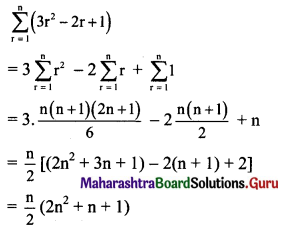
= 60480

(iii) There are 9 letters in the word REPRESENT in which ‘E’ is repeated 3 times and ‘R’ is repeated 2 times.
∴ Number of permutations of the letters of the word REPRESENT = \(\frac{9 !}{3 ! 2 !}\)
= \(\frac{9 \times 8 \times 7 \times 6 \times 5 \times 4}{2}\)
= 30240

(iv) There are 7 distinct letters in the word COMBINE.
∴ Number of permutations of the letters of the word COMBINE = 7! = 5040

(v) There are 10 letters in the word BALBHARATI in which ‘B’ is repeated 2 times and ‘A’ is repeated 3 times.
∴ Number of permutations of the letters of the word BALBHARATI = \(\frac{10 !}{2 ! 3 !}\)
= \(\frac{10 \times 9 \times 8 \times 7 \times 6 \times 5 \times 4 \times 3 \times 2 \times 1}{2 \times 3 \times 2}\)
= 302400

Maharashtra Board 11th Maths Solutions Chapter 3 Permutations and Combination Ex 3.4

Question 2.
You have 2 identical books on English, 3 identical books on Hindi, and 4 identical books on Mathematics. Find the number of distinct ways of arranging them on a shelf.
Solution:
There are total 9 books to be arranged on a shelf.
Out of these 9 books, 2 books on English, 3 books on Hindi and 4 books on mathematics are identical.
∴ Total number of arrangements possible = \(\frac{9 !}{2 ! 3 ! 4 !}\)
= \(\frac{9 \times 8 \times 7 \times 6 \times 5 \times 4 !}{2 \times 3 \times 2 \times 4 !}\)
= 9 × 4 × 7 × 5
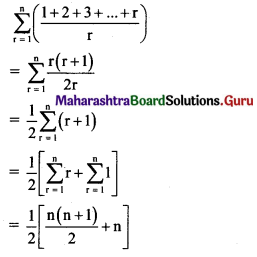
= 1260

Question 3.
A coin is tossed 8 times. In how many ways can we obtain (a) 4 heads and 4 tails? (b) at least 6 heads?
Solution:
A coin is tossed 8 times. All heads are identical and all tails are identical.
(a) 4 heads and 4 tails are to be obtained.
∴ Number of ways it can be obtained = \(\frac{8 !}{4 ! 4 !}\)
= \(\frac{8 \times 7 \times 6 \times 5}{4 \times 3 \times 2}\)
= 70

(b) At least 6 heads are to be obtained.
∴ Outcome can be (6 heads and 2 tails) or (7 heads and 1 tail) or (8 heads)
∴ Number of ways it can be obtained = \(\frac{8 !}{6 ! 2 !}+\frac{8 !}{7 ! 1 !}+\frac{8 !}{8 !}\)
= \(\frac{8 \times 7}{2}\) + 8 + 1
= 28 + 8 + 1
= 37

Question 4.
A bag has 5 red, 4 blue, and 4 green marbles. If all are drawn one by one and their colours are recorded, how many different arrangements can be found?
Solution:
There is a total of 13 marbles in a bag.
Out of these 5 are Red, 4 Blue, and 4 are Green marbles.
All balls of the same colour are taken to be identical.
∴ Required number of arrangements = \(\frac{13 !}{5 ! 4 ! 4 !}\)

Maharashtra Board 11th Maths Solutions Chapter 3 Permutations and Combination Ex 3.4

Question 5.
Find the number of ways of arranging letters of the word MATHEMATICAL. How many of these arrangements have all vowels together?
Solution:
There are 12 letters in the word MATHEMATICAL in which ‘M’ is repeated 2 times, ‘A’ repeated 3 times and ‘T’ repeated 2 times.
∴ Required number of arrangements = \(\frac{12 !}{2 ! 3 ! 2 !}\)
When all the vowels,
i.e., ‘A’, ‘A’, ‘A’, ‘E’, ‘I’ are to be kept together.
Let us consider them as one unit.
Number of arrangements of these vowels among themselves = \(\frac{5 !}{3 !}\) ways.
This unit is to be arranged with 7 other letters in which ‘M’ and ‘T’ repeated 2 times each.
∴ Number of such arrangements = \(\frac{8 !}{2 ! 2 !}\)
∴ Required number of arrangements = \(\frac{8 ! \times 5 !}{2 ! 2 ! 3 !}\)

Question 6.
Find the number of different arrangements of letters in the word MAHARASHTRA. How many of these arrangements have (a) letters R and H never together? (b) all vowels together?
Solution:
There are 11 letters in the word MAHARASHTRA in which ‘A’ is repeated 4 times, ‘H’ repeated 2 times, and ‘R’ repeated 2 times.
∴ Total number of words can be formed = \(\frac{11 !}{4 ! 2 ! 2 !}\)

(a) When letters R and H are never together.
Other than 2R, 2H there are 4A, 1S, 1T, 1M.
These letters can be arranged in \(\frac{7 !}{4 !}\) ways = 210.
These seven letters create 8 gaps in which 2R, 2H are to be arranged.
Number of ways to do = \(\frac{{ }^{8} \mathrm{P}_{4}}{2 ! 2 !}\) = 420
Required number of arrangements = 210 × 420 = 88200.

(b) When all vowels are together.
There are 4 vowels in the word MAHARASHTRA, i.e., A, A, A, A.
Let us consider these 4 vowels as one unit, which can be arranged among themselves in \(\frac{4 !}{4 !}\) = 1 way.
This unit is to be arranged with 7 other letters in which ‘H’ is repeated 2 times, ‘R’ is repeated 2 times.
∴ Total number of arrangements = \(\frac{8 !}{2 ! 2 !}\)

Question 7.
How many different words are formed if the letter R is used thrice and letters S and T are used twice each?
Solution:
To find the number of different words when ‘R’ is taken thrice, ‘S’ is taken twice and ‘T’ is taken twice.
∴ Total number of letters available = 7, of which ‘S’ and ‘T’ repeat 2 times each, ‘R’ repeats 3 times.
∴ Required number of words = \(\frac{7 !}{2 ! 2 ! 3 !}\)
= \(\frac{7 \times 6 \times 5 \times 4 \times 3 !}{2 \times 1 \times 2 \times 1 \times 3 !}\)
= 7 × 6 × 5
= 210

Maharashtra Board 11th Maths Solutions Chapter 3 Permutations and Combination Ex 3.4

Question 8.
Find the number of arrangements of letters in the word MUMBAI so that the letter B is always next to A.
Solution:
There are 6 letters in the word MUMBAI.
These letters are to be arranged in such a way that ‘B’ is always next to ‘A’.
Let us consider AB as one unit.
This unit with the other 4 letters in which ‘M’ repeats twice is to be arranged.
∴ Required number of arrangements = \(\frac{5 !}{2 !}\)
= \(\frac{5 \times 4 \times 3 \times 2 !}{2 !}\)
= 60

Question 9.
Find the number of arrangements of letters in the word CONSTITUTION that begin and end with N.
Solution:
There are 12 letters in the word CONSTITUTION, in which ‘O’, ‘N’, ‘I’ repeat two times each, ‘T’ repeats 3 times.
When the arrangement starts and ends with ‘N’,
other 10 letters can be arranged between two N,
in which ‘O’ and ‘I’ repeat twice each and ‘T’ repeats 3 times.
∴ Required number of arrangements = \(\frac{10 !}{2 ! 2 ! 3 !}\)

Question 10.
Find the number of different ways of arranging letters in the word ARRANGE. How many of these arrangements do not have the two R’s and two A’s together?
Solution:
There are 7 letters in the word ARRANGE in which ‘A’ and ‘R’ repeat 2 times each.
∴ Number of ways to arrange the letters of word ARRANGE = \(\frac{7 !}{2 ! 2 !}\) = 1260
Consider the words in which 2A are together and 2R are together.
Let us consider 2A as one unit and 2R as one unit.
These two units with remaining 3 letters can be arranged in = \(\frac{5 !}{2 ! 2 !}\) = 30 ways.
Number of arrangements in which neither 2A together nor 2R are together = 1260 – 30 = 1230

Question 11.
How many distinct 5 digit numbers can be formed using the digits 3, 2, 3, 2, 4, 5.
Solution:
5 digit numbers are to be formed from 2, 3, 2, 3, 4, 5.
Case I: Numbers formed from 2, 2, 3, 4, 5 OR 2, 3, 3, 4, 5
Number of such numbers = \(\frac{5 !}{2 !}+\frac{5 !}{2 !}\) = 5! = 120
Case II: Numbers are formed from 2, 2, 3, 3 and any one of 4 or 5
Number of such numbers = \(\frac{5 !}{2 ! 2 !}+\frac{5 !}{2 ! 2 !}\) = 60
Required number of numbers = 120 + 60 = 180

Maharashtra Board 11th Maths Solutions Chapter 3 Permutations and Combination Ex 3.4

Question 12.
Find the number of distinct numbers formed using the digits 3, 4, 5, 6, 7, 8, 9, so that odd positions are occupied by odd digits.
Solution:
A number is to be formed with digits 3, 4, 5, 6, 7, 8, 9 such that odd digits always occupy the odd places.
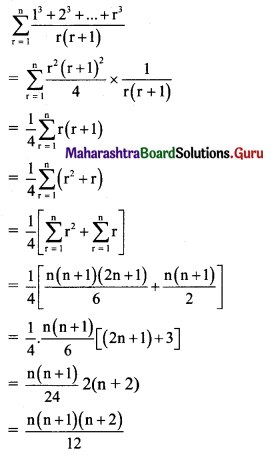
There are 4 odd digits, i.e. 3, 5, 7, 9.
∴ They can be arranged at 4 odd places among themselves in 4! = 24 ways.
There are 3 even digits, i.e. 4, 6, 8.
∴ They can be arranged at 3 even places among themselves in 3! = 6 ways.
∴ Required number of numbers formed = 24 × 6 = 144

Question 13.
How many different 6-digit numbers can be formed using digits in the number 659942? How many of them are divisible by 4?
Solution:
A 6-digit number is to be formed using digits of 659942, in which 9 repeats twice.
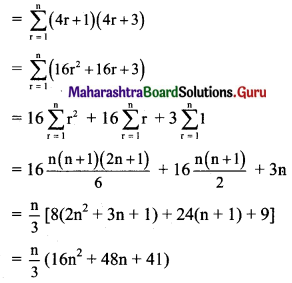
∴ Required number of numbers formed = \(\frac{6 !}{2 !}\)
= \(\frac{6 \times 5 \times 4 \times 3 \times 2 !}{2 !}\)
= 360
A 6-digit number is to be formed using the same digits that are divisible by 4.
For a number to be divisible by 4, the last two digits should be divisible by 4,
i.e. 24, 52, 56, 64, 92 or 96.
Case I: When the last two digits are 24, 52, 56 or 64.
As the digit 9 repeats twice in the remaining four numbers, the number of arrangements = \(\frac{4 !}{2 !}\) = 12
∴ 6-digit numbers that are divisible by 4 so formed are 12 + 12 + 12 + 12 = 48.
Case II: When the last two digits are 92 or 96.
As each of the remaining four numbers are distinct, the number of arrangements = 4! = 24
∴ 6-digit numbers that are divisible by 4 so formed are 24 + 24 = 48.
∴ Required number of numbers framed = 48 + 48 = 96

Question 14.
Find the number of distinct words formed from letters in the word INDIAN. How many of them have the two N’s together?
Solution:
There are 6 letters in the word INDIAN in which I and N are repeated twice.
Number of different words that can be formed using the letters of the word INDIAN = \(\frac{6 !}{2 ! 2 !}\)
= \(\frac{6 \times 5 \times 4 \times 3 \times 2 !}{2 \times 2 !}\)
= 180
When two N’s are together.
Let us consider the two N’s as one unit.
They can be arranged with 4 other letters in \(\frac{5 !}{2 !}\)
= \(\frac{5 \times 4 \times 3 \times 2 !}{2 !}\)
= 60 ways.
∴ 2 N can be arranged in \(\frac{2 !}{2 !}\) = 1 way.
∴ Required number of words = 60 × 1 = 60

Maharashtra Board 11th Maths Solutions Chapter 3 Permutations and Combination Ex 3.4

Question 15.
Find the number of different ways of arranging letters in the word PLATOON if (a) the two O’s are never together. (b) consonants and vowels occupy alternate positions.
Solution:
There are 7 letters in the words PLATOON in which ‘O’ repeat 2 times.
(a) When the two O’s are never together.
Let us arrange the other 5 letters first, which can be done in 5! = 120 ways.
The letters P, L, A, T, N create 6 gaps, in which O’s are arranged.
Two O’s can take their places in 6P2 ways.
But ‘O’ repeats 2 times.
∴ Two O’s can be arranged in \(\frac{{ }^{6} \mathrm{P}_{2}}{2 !}\)
= \(\frac{\frac{6 !}{(6-2) !}}{2 !}\)
= \(\frac{6 \times 5 \times 4 !}{4 ! \times 2 \times 1}\)
= 3 × 5
= 15 ways
∴ Required number of arrangements = 120 × 15 = 1800

(b) When consonants and vowels occupy alternate positions.
There are 4 consonants and 3 vowels in the word PLATOON.
∴ At odd places, consonants occur and at even places, vowels occur.
4 consonants can be arranged among themselves in 4! ways.
3 vowels in which O occurs twice and A occurs once.
∴ They can be arranged in \(\frac{3 !}{2 !}\) ways.
Now, vowels and consonants should occupy alternate positions.
∴ Required number of arrangements = 4! × \(\frac{3 !}{2 !}\)
= 4 × 3 × 2 × \(\frac{3 \times 2 !}{2 !}\)
= 72

Maharashtra Board 11th Maths Solutions Chapter 7 Limits Miscellaneous Exercise 7

Balbharti Maharashtra State Board 11th Maths Book Solutions Pdf Chapter 7 Limits Miscellaneous Exercise 7 Questions and Answers.

Maharashtra State Board 11th Maths Solutions Chapter 7 Limits Miscellaneous Exercise 7

I. Select the correct answer from the given alternatives.

Question 1.
\(\lim _{x \rightarrow 2}\left(\frac{x^{4}-16}{x^{2}-5 x+6}\right)=\)
(A) 23
(B) 32
(C) -32
(D) -16
Answer:
(C) -32
Hint:
Maharashtra Board 11th Maths Solutions Chapter 7 Limits Miscellaneous Exercise 7 I Q1

Question 2.
\(\lim _{x \rightarrow-2}\left(\frac{x^{7}+128}{x^{3}+8}\right)=\)
(A) \(\frac{56}{3}\)
(B) \(\frac{112}{3}\)
(C) \(\frac{121}{3}\)
(D) \(\frac{28}{3}\)
Answer:
(B) \(\frac{112}{3}\)
Hint:
Maharashtra Board 11th Maths Solutions Chapter 7 Limits Miscellaneous Exercise 7 I Q2

Question 3.
\(\lim _{x \rightarrow 3}\left(\frac{1}{x^{2}-11 x+24}+\frac{1}{x^{2}-x-6}\right)=\)
(A) \(-\frac{2}{25}\)
(B) \(\frac{2}{25}\)
(C) \(\frac{7}{25}\)
(D) \(-\frac{7}{25}\)
Answer:
(A) \(-\frac{2}{25}\)
Hint:
Maharashtra Board 11th Maths Solutions Chapter 7 Limits Miscellaneous Exercise 7 I Q3

Maharashtra Board 11th Maths Solutions Chapter 7 Limits Miscellaneous Exercise 7

Question 4.
\(\lim _{x \rightarrow 5}\left(\frac{\sqrt{x+4}-3}{\sqrt{3 x-11-2}}\right)=\)
(A) \(\frac{-2}{9}\)
(B) \(\frac{2}{7}\)
(C) \(\frac{5}{9}\)
(D) \(\frac{2}{9}\)
Answer:
(D) \(\frac{2}{9}\)
Hint:
Maharashtra Board 11th Maths Solutions Chapter 7 Limits Miscellaneous Exercise 7 I Q4

Question 5.
\(\lim _{x \rightarrow \frac{\pi}{3}}\left(\frac{\tan ^{2} x-3}{\sec ^{3} x-8}\right)=\)
(A) 1
(B) \(\frac{1}{2}\)
(C) \(\frac{1}{3}\)
(D) \(\frac{1}{4}\)
Answer:
(C) \(\frac{1}{3}\)
Hint:
Maharashtra Board 11th Maths Solutions Chapter 7 Limits Miscellaneous Exercise 7 I Q5

Question 6.
\(\lim _{x \rightarrow 0}\left(\frac{5 \sin x-x \cos x}{2 \tan x-3 x^{2}}\right)=\)
(A) 0
(B) 1
(C) 2
(D) 3
Answer:
(C) 2
Hint:
Maharashtra Board 11th Maths Solutions Chapter 7 Limits Miscellaneous Exercise 7 I Q6

Question 7.
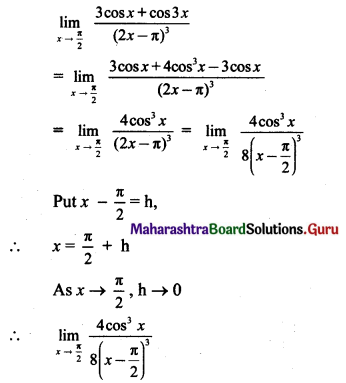
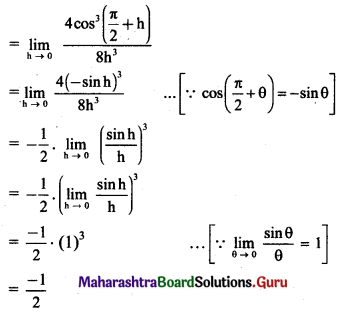
\(\lim _{x \rightarrow \frac{\pi}{2}}\left[\frac{3 \cos x+\cos 3 x}{(2 x-\pi)^{3}}\right]=\)
(A) \(\frac{3}{2}\)
(B) \(\frac{1}{2}\)
(C) \(-\frac{1}{2}\)
(D) \(\frac{1}{4}\)
Answer:
(C) \(-\frac{1}{2}\)
Hint:
Maharashtra Board 11th Maths Solutions Chapter 7 Limits Miscellaneous Exercise 7 I Q7

Question 8.
\(\lim _{x \rightarrow 0}\left(\frac{15^{x}-3^{x}-5^{x}+1}{\sin ^{2} x}\right)=\)
(A) log 15
(B) log 3 + log 5
(C) log 3 . log 5
(D) 3 log 5
Answer:
(C) log 3 . log 5
Hint:
Maharashtra Board 11th Maths Solutions Chapter 7 Limits Miscellaneous Exercise 7 I Q8

Maharashtra Board 11th Maths Solutions Chapter 7 Limits Miscellaneous Exercise 7

Question 9.
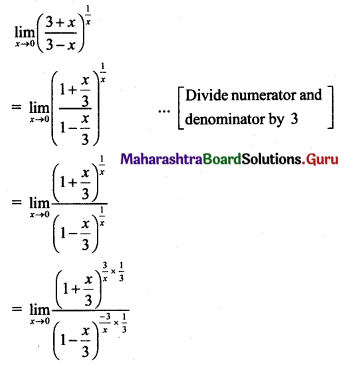
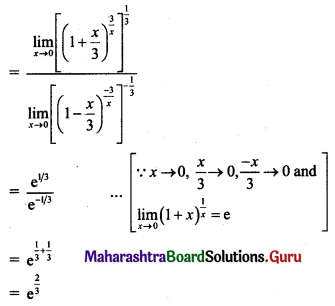
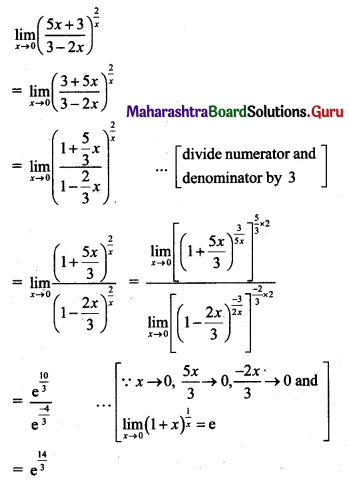
\(\lim _{x \rightarrow 0}\left(\frac{3+5 x}{3-4 x}\right)^{\frac{1}{x}}=\)
(A) e3
(B) e6
(C) e9
(D) e-3
Answer:
(A) e3
Hint:
Maharashtra Board 11th Maths Solutions Chapter 7 Limits Miscellaneous Exercise 7 I Q9

Question 10.
\(\lim _{x \rightarrow 0}\left[\frac{\log (5+x)-\log (5-x)}{\sin x}\right]=\)
(A) \(\frac{3}{2}\)
(B) \(-\frac{5}{2}\)
(C) \(-\frac{1}{2}\)
(D) \(\frac{2}{5}\)
Answer:
(D) \(\frac{2}{5}\)
Hint:
Maharashtra Board 11th Maths Solutions Chapter 7 Limits Miscellaneous Exercise 7 I Q10

Question 11.
\(\lim _{x \rightarrow \frac{\pi}{2}}\left(\frac{3^{\cos x}-1}{\frac{\pi}{2}-x}\right)=\)
(A) 1
(B) log 3
(C) \(3^{\frac{\pi}{2}}\)
(D) 3 log 3
Answer:
(B) log 3
Hint:
Maharashtra Board 11th Maths Solutions Chapter 7 Limits Miscellaneous Exercise 7 I Q11
Maharashtra Board 11th Maths Solutions Chapter 7 Limits Miscellaneous Exercise 7 I Q11.1

Question 12.
\(\lim _{x \rightarrow 0}\left[\frac{x \cdot \log (1+3 x)}{\left(e^{3 x}-1\right)^{2}}\right]=\)
(A) \(\frac{1}{\mathrm{e}^{9}}\)
(B) \(\frac{1}{\mathrm{e}^{3}}\)
(C) \(\frac{1}{9}\)
(D) \(\frac{1}{3}\)
Answer:
(D) \(\frac{1}{3}\)
Hint:
Maharashtra Board 11th Maths Solutions Chapter 7 Limits Miscellaneous Exercise 7 I Q12

Question 13.
\(\lim _{x \rightarrow 0}\left[\frac{\left(3^{\sin x}-1\right)^{3}}{\left(3^{x}-1\right) \cdot \tan x \cdot \log (1+x)}\right]=\)
(A) 3 log 3
(B) 2 log 3
(C) (log 3)2
(D) (log 3)3
Answer:
(C) (log 3)2
Hint:
Maharashtra Board 11th Maths Solutions Chapter 7 Limits Miscellaneous Exercise 7 I Q13

Question 14.
\(\lim _{x \rightarrow 3}\left[\frac{5^{x-3}-4^{x-3}}{\sin (x-3)}\right]=\)
(A) log 5 – 4
(B) log \(\frac{5}{4}\)
(C) \(\frac{\log 5}{\log 4}\)
(D) \(\frac{\log 5}{4}\)
Answer:
(B) log \(\frac{5}{4}\)
Hint:
Maharashtra Board 11th Maths Solutions Chapter 7 Limits Miscellaneous Exercise 7 I Q14

Question 15.
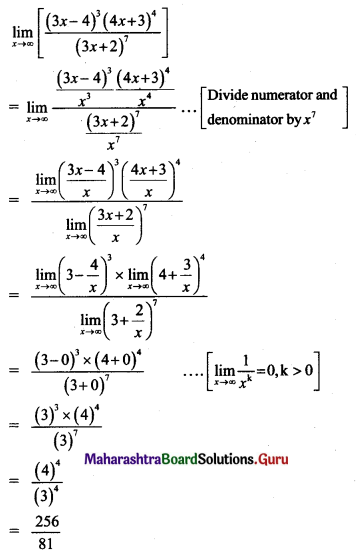
\(\lim _{x \rightarrow \infty}\left[\frac{(2 x+3)^{7}(x-5)^{3}}{(2 x-5)^{10}}\right]=\)
(A) \(\frac{3}{8}\)
(B) \(\frac{1}{8}\)
(C) \(\frac{1}{6}\)
(D) \(\frac{1}{4}\)
Answer:
(B) \(\frac{1}{8}\)
Hint:
Maharashtra Board 11th Maths Solutions Chapter 7 Limits Miscellaneous Exercise 7 I Q15

(II) Evaluate the following.

Question 1.
\(\lim _{x \rightarrow 0}\left[\frac{(1-x)^{5}-1}{(1-x)^{3}-1}\right]\)
Solution:
Maharashtra Board 11th Maths Solutions Chapter 7 Limits Miscellaneous Exercise 7 II Q1

Question 2.
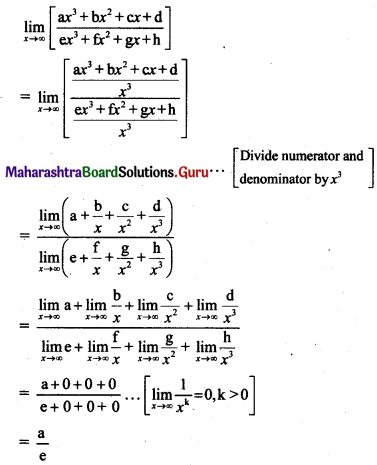
\(\lim _{x \rightarrow 0}[x]\) ([*] is a greatest integer function.)
Solution:
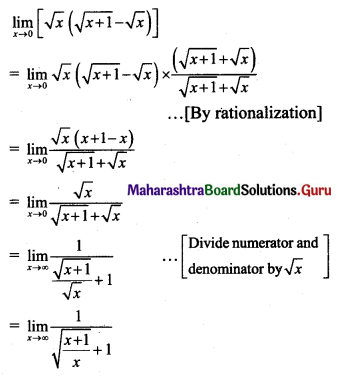
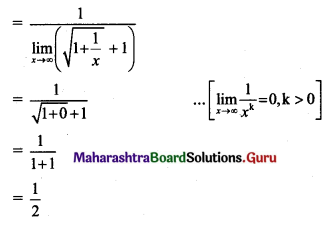
Maharashtra Board 11th Maths Solutions Chapter 7 Limits Miscellaneous Exercise 7 II Q2
Maharashtra Board 11th Maths Solutions Chapter 7 Limits Miscellaneous Exercise 7 II Q2.1

Maharashtra Board 11th Maths Solutions Chapter 7 Limits Miscellaneous Exercise 7

Question 3.
If f(r) = πr2 then find \(\lim _{h \rightarrow 0}\left[\frac{f(r+h)-f(r)}{h}\right]\)
Solution:
Maharashtra Board 11th Maths Solutions Chapter 7 Limits Miscellaneous Exercise 7 II Q3

Question 4.
\(\lim _{x \rightarrow 0}\left[\frac{x}{|x|+x^{2}}\right]\)
Solution:
Maharashtra Board 11th Maths Solutions Chapter 7 Limits Miscellaneous Exercise 7 II Q4
Maharashtra Board 11th Maths Solutions Chapter 7 Limits Miscellaneous Exercise 7 II Q4.1

Question 5.
Find the limit of the function, if it exists, at x = 1
\(f(x)=\left\{\begin{array}{lll}
7-4 x & \text { for } & x<1 \\
x^{2}+2 & \text { for } & x \geq 1
\end{array}\right.\)
Solution:
Maharashtra Board 11th Maths Solutions Chapter 7 Limits Miscellaneous Exercise 7 II Q5

Question 6.
Given that 7x ≤ f(x) ≤ 3x2 – 6 for all x. Determine the value of \(\lim _{x \rightarrow 3} f(x)\)
Solution:
Maharashtra Board 11th Maths Solutions Chapter 7 Limits Miscellaneous Exercise 7 II Q6

Question 7.
\(\lim _{x \rightarrow 0}\left[\frac{\sec x^{2}-1}{x^{4}}\right]\)
Solution:
Maharashtra Board 11th Maths Solutions Chapter 7 Limits Miscellaneous Exercise 7 II Q7
Maharashtra Board 11th Maths Solutions Chapter 7 Limits Miscellaneous Exercise 7 II Q7.1

Question 8.
\(\lim _{x \rightarrow 0}\left[\frac{e^{x}+e^{-x}-2}{x \cdot \tan x}\right]\)
Solution:
Maharashtra Board 11th Maths Solutions Chapter 7 Limits Miscellaneous Exercise 7 II Q8

Question 9.
\(\lim _{x \rightarrow 0}\left[\frac{x\left(6^{x}-3^{x}\right)}{\cos (6 x)-\cos (4 x)}\right]\)
Solution:
Maharashtra Board 11th Maths Solutions Chapter 7 Limits Miscellaneous Exercise 7 II Q9
Maharashtra Board 11th Maths Solutions Chapter 7 Limits Miscellaneous Exercise 7 II Q9.1

Question 10.
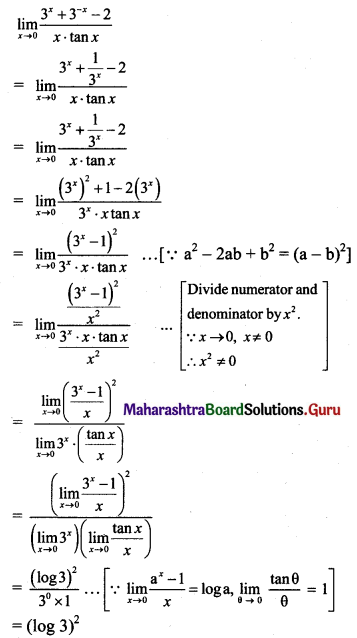
\(\lim _{x \rightarrow 0}\left[\frac{a^{3 x}-a^{2 x}-a^{x}+1}{x \cdot \tan x}\right]\)
Solution:
Maharashtra Board 11th Maths Solutions Chapter 7 Limits Miscellaneous Exercise 7 II Q10

Question 11.
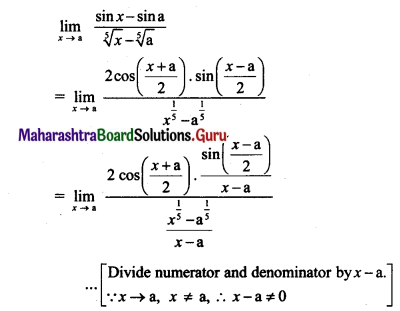
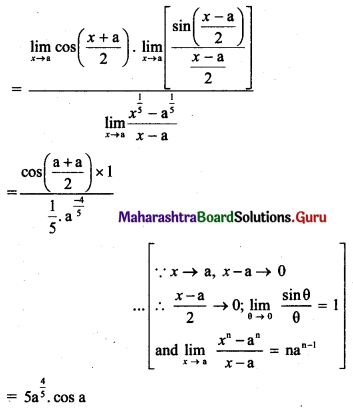
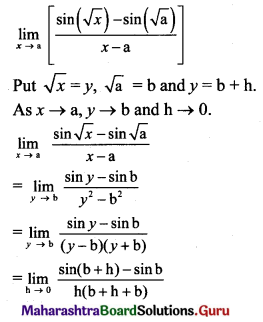
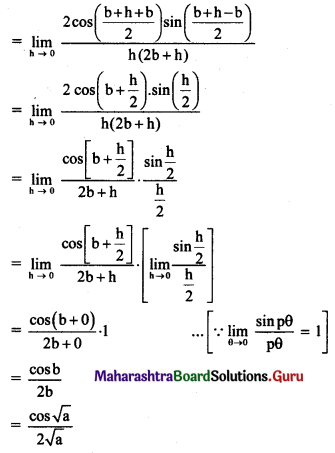
\(\lim _{x \rightarrow a}\left[\frac{\sin x-\sin a}{x-a}\right]\)
Solution:
Maharashtra Board 11th Maths Solutions Chapter 7 Limits Miscellaneous Exercise 7 II Q11

Maharashtra Board 11th Maths Solutions Chapter 7 Limits Miscellaneous Exercise 7

Question 12.
\(\lim _{x \rightarrow 2}\left[\frac{\log x-\log 2}{x-2}\right]\)
Solution:
Maharashtra Board 11th Maths Solutions Chapter 7 Limits Miscellaneous Exercise 7 II Q12

Question 13.
\(\lim _{x \rightarrow 1}\left[\frac{a b^{x}-a^{x} b}{x^{2}-1}\right]\)
Solution:
Maharashtra Board 11th Maths Solutions Chapter 7 Limits Miscellaneous Exercise 7 II Q13

Question 14.
\(\lim _{x \rightarrow 0}\left[\frac{\left(5^{x}-1\right)^{2}}{\left(2^{x}-1\right) \log (1+x)}\right]\)
Solution:
Maharashtra Board 11th Maths Solutions Chapter 7 Limits Miscellaneous Exercise 7 II Q14
Maharashtra Board 11th Maths Solutions Chapter 7 Limits Miscellaneous Exercise 7 II Q14.1

Question 15.
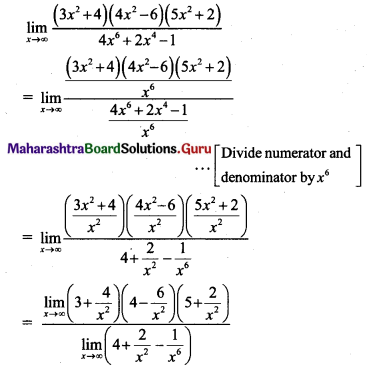
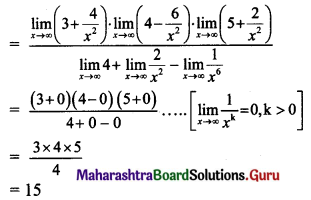
\(\lim _{x \rightarrow \infty}\left[\frac{(2 x+1)^{2}(7 x-3)^{3}}{(5 x+2)^{5}}\right]\)
Solution:
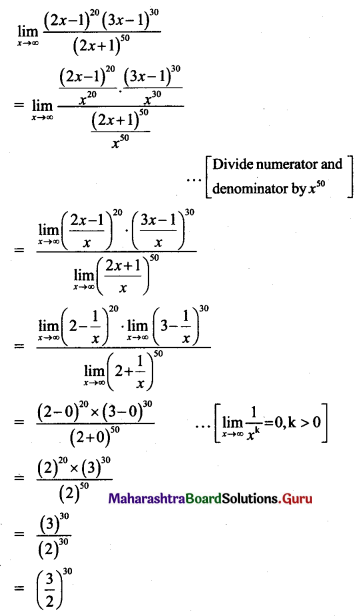
Maharashtra Board 11th Maths Solutions Chapter 7 Limits Miscellaneous Exercise 7 II Q15

Question 16.
\(\lim _{x \rightarrow a}\left[\frac{x \cos a-a \cos x}{x-a}\right]\)
Solution:
Maharashtra Board 11th Maths Solutions Chapter 7 Limits Miscellaneous Exercise 7 II Q16
Maharashtra Board 11th Maths Solutions Chapter 7 Limits Miscellaneous Exercise 7 II Q16.1

Question 17.
\(\lim _{x \rightarrow \frac{\pi}{4}}\left[\frac{(\sin x-\cos x)^{2}}{\sqrt{2}-\sin x-\cos x}\right]\)
Solution:
Maharashtra Board 11th Maths Solutions Chapter 7 Limits Miscellaneous Exercise 7 II Q17
Maharashtra Board 11th Maths Solutions Chapter 7 Limits Miscellaneous Exercise 7 II Q17.1

Question 18.
\(\lim _{x \rightarrow 1}\left[\frac{2^{2 x-2}-2^{x}+1}{\sin ^{2}(x-1)}\right]\)
Solution:
Maharashtra Board 11th Maths Solutions Chapter 7 Limits Miscellaneous Exercise 7 II Q18

Question 19.
\(\lim _{x \rightarrow 1}\left[\frac{4^{x-1}-2^{x}+1}{(x-1)^{2}}\right]\)
Solution:
Maharashtra Board 11th Maths Solutions Chapter 7 Limits Miscellaneous Exercise 7 II Q19
Maharashtra Board 11th Maths Solutions Chapter 7 Limits Miscellaneous Exercise 7 II Q19.1

Maharashtra Board 11th Maths Solutions Chapter 7 Limits Miscellaneous Exercise 7

Question 20.
\(\lim _{x \rightarrow 1}\left[\frac{\sqrt{x}-1}{\log x}\right]\)
Solution:
Maharashtra Board 11th Maths Solutions Chapter 7 Limits Miscellaneous Exercise 7 II Q20

Question 21.
\(\lim _{x \rightarrow 0}\left(\frac{\sqrt{1-\cos x}}{x}\right)\)
Solution:
Maharashtra Board 11th Maths Solutions Chapter 7 Limits Miscellaneous Exercise 7 II Q21
Maharashtra Board 11th Maths Solutions Chapter 7 Limits Miscellaneous Exercise 7 II Q21.1
Maharashtra Board 11th Maths Solutions Chapter 7 Limits Miscellaneous Exercise 7 II Q21.2

Question 22.
\(\lim _{x \rightarrow 1}\left(\frac{x+3 x^{2}+5 x^{3}+\cdots \cdots \cdots \cdots \cdots+(2 n-1) x^{n}-n^{2}}{x-1}\right)\)
Solution:
Maharashtra Board 11th Maths Solutions Chapter 7 Limits Miscellaneous Exercise 7 II Q22
Maharashtra Board 11th Maths Solutions Chapter 7 Limits Miscellaneous Exercise 7 II Q22.1
Maharashtra Board 11th Maths Solutions Chapter 7 Limits Miscellaneous Exercise 7 II Q22.2

Question 23.
\(\lim _{x \rightarrow 0} \frac{1}{x^{12}}\left[1-\cos \left(\frac{x^{2}}{2}\right)-\cos \left(\frac{x^{4}}{4}\right)+\cos \left(\frac{x^{2}}{2}\right) \cdot \cos \left(\frac{x^{4}}{4}\right)\right]\)
Solution:
Maharashtra Board 11th Maths Solutions Chapter 7 Limits Miscellaneous Exercise 7 II Q23
Maharashtra Board 11th Maths Solutions Chapter 7 Limits Miscellaneous Exercise 7 II Q23.1

Maharashtra Board 11th Maths Solutions Chapter 7 Limits Miscellaneous Exercise 7

Question 24.
\(\lim _{x \rightarrow \infty}\left(\frac{8 x^{2}+5 x+3}{2 x^{2}-7 x-5}\right)^{\frac{4 x+3}{8 x-1}}\)
Solution:
Maharashtra Board 11th Maths Solutions Chapter 7 Limits Miscellaneous Exercise 7 II Q24
Maharashtra Board 11th Maths Solutions Chapter 7 Limits Miscellaneous Exercise 7 II Q24.1

Maharashtra Board 11th Maths Solutions Chapter 2 Sequences and Series Miscellaneous Exercise 2

Balbharti Maharashtra State Board 11th Maths Book Solutions Pdf Chapter 2 Sequences and Series Miscellaneous Exercise 2 Questions and Answers.

Maharashtra State Board 11th Maths Solutions Chapter 2 Sequences and Series Miscellaneous Exercise 2

(I) Select the correct answer from the given alternative:

Question 1.
The common ratio for the G.P. 0.12, 0.24, 0.48, is
(A) 0.12
(B) 0.2
(C) 0.02
(D) 2
Answer:
(D) 2

Maharashtra Board 11th Maths Solutions Chapter 2 Sequences and Series Miscellaneous Exercise 2

Question 2.
The tenth term of the geometric sequence is \(\frac{1}{4}, \frac{-1}{2}, 1,-2, \ldots\) is
(A) 1024
(B) \(\frac{1}{1024}\)
(C) -128
(D) \(\frac{-1}{128}\)
Answer:
(C) -128
Hint:
Maharashtra Board 11th Maths Solutions Chapter 2 Sequences and Series Miscellaneous Exercise 2 I Q2

Question 3.
If for a G.P. \(\frac{t_{6}}{t_{3}}=\frac{1458}{54}\) then r = ?
(A) 3
(B) 2
(C) 1
(D) -1
Answer:
(A) 3
Hint:
Maharashtra Board 11th Maths Solutions Chapter 2 Sequences and Series Miscellaneous Exercise 2 I Q3

Question 4.
Which term of the geometric progression 1, 2, 4, 8, ….. is 2048.
(A) 10th
(B) 11th
(C) 12th
(D) 13th
Answer:
(C) 12th
Hint:
Here, a = 1, r = 2
nth term of geometric progression = arn-1
∴ arn-1 = 2048
2n-1 = 211
n – 1 = 11
∴ n = 12

Question 5.
If the common ratio of the G.P. is 5, the 5th term is 1875, the first term is
(A) 3
(B) 5
(C) 15
(D) -5
Answer:
(A) 3

Question 6.
The sum of 3 terms of a G.P. is \(\frac{21}{4}\) and their product is 1, then the common ratio is
(A) 1
(B) 2
(C) 4
(D) 8
Answer:
(C) 4
Hint:
Let three terms be \(\frac{a}{r}\), a, ar
According to the given conditions,
\(\frac{a}{r}\) + a + ar = \(\frac{21}{4}\) …..(i)
and \(\frac{a}{r}\) × a × ar = 1,
i.e., a3 = 1
∴ a = 1
∴ from equation (i), we get
\(\frac{1}{r}\) + 1 + r = \(\frac{21}{4}\)
By solving this, we get r = 4.

Maharashtra Board 11th Maths Solutions Chapter 2 Sequences and Series Miscellaneous Exercise 2

Question 7.
Sum to infinity of a G.P. 5, \(-\frac{5}{2}, \frac{5}{4},-\frac{5}{8}, \frac{5}{16}, \ldots\) is
(A) 5
(B) \(-\frac{1}{2}\)
(C) \(\frac{10}{3}\)
(D) \(\frac{3}{10}\)
Answer:
(C) \(\frac{10}{3}\)
Hint:
Here, a = 5, r = \(\frac{-1}{2}\), |r| < 1
∴ Sum to the infinity = \(\frac{a}{1-r}=\frac{5}{1+\frac{1}{2}}=\frac{10}{3}\)

Question 8.
The tenth term of H.P. \(\frac{2}{9}, \frac{1}{7}, \frac{2}{19}, \frac{1}{12}, \ldots\) is
(A) \(\frac{1}{27}\)
(B) \(\frac{9}{2}\)
(C) \(\frac{5}{2}\)
(D) 27
Answer:
(A) \(\frac{1}{27}\)
Hint:
Maharashtra Board 11th Maths Solutions Chapter 2 Sequences and Series Miscellaneous Exercise 2 I Q8

Question 9.
Which of the following is not true, where A, G, H are the AM, GM, HM of a and b respectively, (a, b > 0)
(A) A = \(\frac{a+b}{2}\)
(B) G = \(\sqrt{a b}\)
(C) H = \(\frac{2 a b}{a+b}\)
(D) A = GH
Answer:
(D) A = GH

Maharashtra Board 11th Maths Solutions Chapter 2 Sequences and Series Miscellaneous Exercise 2

Question 10.
The G.M. of two numbers exceeds their H.M. by \(\frac{6}{5}\), the A.M. exceeds G.M. by \(\frac{3}{2}\) the two numbers are
(A) 6, \(\frac{15}{2}\)
(B) 15, 25
(C) 3, 12
(D) \(\frac{6}{5}\), \(\frac{3}{2}\)
Answer:
(C) 3, 12
Hint:
Maharashtra Board 11th Maths Solutions Chapter 2 Sequences and Series Miscellaneous Exercise 2 I Q10
Maharashtra Board 11th Maths Solutions Chapter 2 Sequences and Series Miscellaneous Exercise 2 I Q10.1

(II) Answer the following:

Question 1.
In a G.P., the fourth term is 48 and the eighth term is 768. Find the tenth term.
Solution:
Maharashtra Board 11th Maths Solutions Chapter 2 Sequences and Series Miscellaneous Exercise 2 II Q1

Question 2.
Find the sum of the first 5 terms of the G.P. whose first term is 1 and the common ratio is \(\frac{2}{3}\).
Solution:
Maharashtra Board 11th Maths Solutions Chapter 2 Sequences and Series Miscellaneous Exercise 2 II Q2

Question 3.
For a G.P. a = \(\frac{4}{3}\) and t7 = \(\frac{243}{1024}\), find the value of r.
Solution:
Maharashtra Board 11th Maths Solutions Chapter 2 Sequences and Series Miscellaneous Exercise 2 II Q3

Question 4.
For a sequence, if \(t_{n}=\frac{5^{n-2}}{7^{n-3}}\), verify whether the sequence is a G.P. If it is a G.P., find its first term and the common ratio.
Solution:
The sequence (tn) is a G.P.
if \(\frac{\mathrm{t}_{\mathrm{n}+1}}{\mathrm{t}_{\mathrm{n}}}\) = constant for all n ∈ N.
Maharashtra Board 11th Maths Solutions Chapter 2 Sequences and Series Miscellaneous Exercise 2 II Q4

Maharashtra Board 11th Maths Solutions Chapter 2 Sequences and Series Miscellaneous Exercise 2

Question 5.
Find three numbers in G.P. such that their sum is 35 and their product is 1000.
Solution:
Let the three numbers in G.P. be \(\frac{a}{r}\), a, ar.
According to the given conditions,
\(\frac{a}{r}\) + a + ar = 35
a(\(\frac{1}{r}\) + 1 + r) = 35 …..(i)
Also, (\(\frac{a}{r}\))(a)(ar) = 1000
a3 = 1000
∴ a = 10
Substituting the value of a in (i), we get
Maharashtra Board 11th Maths Solutions Chapter 2 Sequences and Series Miscellaneous Exercise 2 II Q5
Hence, the three numbers in G.P. are 20, 10, 5, or 5, 10, 20.

Question 6.
Find five numbers in G.P. such that their product is 243 and the sum of the second and fourth numbers is 10.
Solution:
Let the five numbers in G.P. be \(\frac{a}{r^{2}}, \frac{a}{r}, a, a r, a r^{2}\).
According to the given condition,
Maharashtra Board 11th Maths Solutions Chapter 2 Sequences and Series Miscellaneous Exercise 2 II Q6
Maharashtra Board 11th Maths Solutions Chapter 2 Sequences and Series Miscellaneous Exercise 2 II Q6.1

Question 7.
For a sequence, Sn = 4(7n – 1), verify that the sequence is a G.P.
Solution:
Maharashtra Board 11th Maths Solutions Chapter 2 Sequences and Series Miscellaneous Exercise 2 II Q7
∴ The given sequence is a G.P.

Question 8.
Find 2 + 22 + 222 + 2222 + … upto n terms.
Solution:
Sn = 2 + 22 + 222 +… upto n terms
= 2(1 + 11 + 111 + ….. upto n terms)
= \(\frac{2}{9}\) (9 + 99 + 999 + … upto n terms)
= \(\frac{2}{9}\) [(10 – 1) + (100 – 1) + (1000 – 1) + …… upto n terms]
= \(\frac{2}{9}\) [(10 + 100 + 1000 + … upto n terms) – (1 + 1 + 1 + ….. n times)]
Since 10, 100, 1000, ….. n terms are in G.P. with
a = 10, r = \(\frac{100}{10}\) = 10,
Maharashtra Board 11th Maths Solutions Chapter 2 Sequences and Series Miscellaneous Exercise 2 II Q8

Maharashtra Board 11th Maths Solutions Chapter 2 Sequences and Series Miscellaneous Exercise 2

Question 9.
Find the nth term of the sequence 0.6, 0.66, 0.666, 0.6666,…
Solution:
0.6, 0.66, 0.666, 0.6666, …
∴ t1 = 0.6
t2 = 0.66 = 0.6 + 0.06
t3 = 0.666 = 0.6 + 0.06 + 0.006
Hence, in general
tn = 0.6 + 0.06 + 0.006 + …..upto n terms.
The terms are in G.P. with
a = 0.6, r = \(\frac{0.06}{0.6}\) = 0.1
∴ tn = the sum of first n terms of the G.P.
Maharashtra Board 11th Maths Solutions Chapter 2 Sequences and Series Miscellaneous Exercise 2 II Q9

Question 10.
Find \(\sum_{r=1}^{n}\left(5 r^{2}+4 r-3\right)\)
Solution:
Maharashtra Board 11th Maths Solutions Chapter 2 Sequences and Series Miscellaneous Exercise 2 II Q10

Question 11.
Find \(\sum_{r=1}^{n} r(r-3)(r-2)\)
Solution:
Maharashtra Board 11th Maths Solutions Chapter 2 Sequences and Series Miscellaneous Exercise 2 II Q11

Question 12.
Find \(\sum_{r=1}^{n} \frac{1^{2}+2^{2}+3^{2}+\ldots+r^{2}}{2 r+1}\)
Solution:
We know that
Maharashtra Board 11th Maths Solutions Chapter 2 Sequences and Series Miscellaneous Exercise 2 II Q12

Question 13.
Find \(\sum_{r=1}^{n} \frac{1^{3}+2^{3}+3^{3}+\ldots r^{3}}{(r+1)^{2}}\)
Solution:
Maharashtra Board 11th Maths Solutions Chapter 2 Sequences and Series Miscellaneous Exercise 2 II Q13

Maharashtra Board 11th Maths Solutions Chapter 2 Sequences and Series Miscellaneous Exercise 2

Question 14.
Find 2 × 6 + 4 × 9 + 6 × 12 + ….. upto n terms.
Solution:
2, 4, 6, ….. are in A.P.
∴ rth term = 2 + (r – 1) 2 = 2r
6, 9, 12, ….. are in A.P.
∴ rth term = 6 + (r – 1)(3) = (3r + 3)
∴ 2 × 6 + 4 × 9 + 6 × 12 + ….. to n terms
Maharashtra Board 11th Maths Solutions Chapter 2 Sequences and Series Miscellaneous Exercise 2 II Q14
= n(n + 1) [2n + 1 + 3]
= 2n(n + 1)(n + 2)

Question 15.
Find 2 × 5 × 8 + 4 × 7 × 10 + 6 × 9 × 12 + …… upto n terms.
Solution:
2, 4, 6,… are in A.P.
∴ rth term = 2 + (r – 1) 2 = 2r
5, 7, 9, … are in A.P.
∴ rth term = 5 + (r – 1) (2) = (2r + 3)
8, 10, 12, … are in A.P.
∴ rth term = 8 + (r – 1) (2) = (2r + 6)
2 × 5 × 8 + 4 × 7 × 10 + 6 × 9 × 12 + ….. to n terms
Maharashtra Board 11th Maths Solutions Chapter 2 Sequences and Series Miscellaneous Exercise 2 II Q15
= 2n (n + 1) [n(n + 1) + 3(2n + 1) + 9]
= 2n (n + 1)(n2 + 7n + 12)
= 2n (n + 1) (n + 3) (n + 4)

Question 16.
Find \(\frac{1^{2}}{1}+\frac{1^{2}+2^{2}}{2}+\frac{1^{2}+2^{2}+3^{2}}{3}+\ldots\) upto n terms.
Solution:
Maharashtra Board 11th Maths Solutions Chapter 2 Sequences and Series Miscellaneous Exercise 2 II Q16
Maharashtra Board 11th Maths Solutions Chapter 2 Sequences and Series Miscellaneous Exercise 2 II Q16.1

Question 17.
Find 122 + 132 + 142 + 152 + ….. 202
Solution:
Maharashtra Board 11th Maths Solutions Chapter 2 Sequences and Series Miscellaneous Exercise 2 II Q17

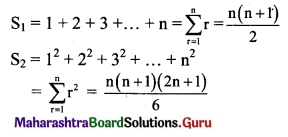
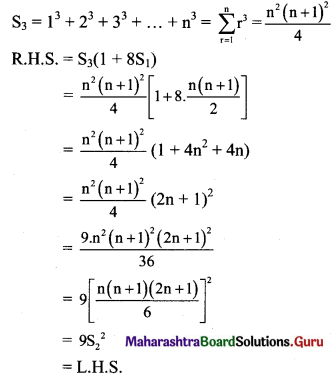
Question 18.
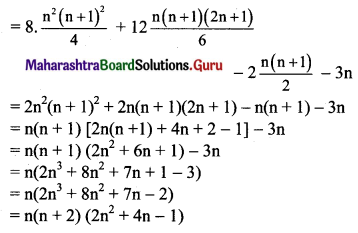
If \(\frac{1+2+3+4+5+\ldots \text { upto } \mathrm{n} \text { terms }}{1 \times 2+2 \times 3+3 \times 4+4 \times 5+\ldots \text { upto } \mathrm{n} \text { terms }}=\frac{3}{22}\), Find the value of n.
Solution:
Maharashtra Board 11th Maths Solutions Chapter 2 Sequences and Series Miscellaneous Exercise 2 II Q18

Maharashtra Board 11th Maths Solutions Chapter 2 Sequences and Series Miscellaneous Exercise 2

Question 19.
Find (502 – 492) + (482 – 472) + (462 – 452) +… + (22 – 12).
Solution:
Maharashtra Board 11th Maths Solutions Chapter 2 Sequences and Series Miscellaneous Exercise 2 II Q19

Question 20.
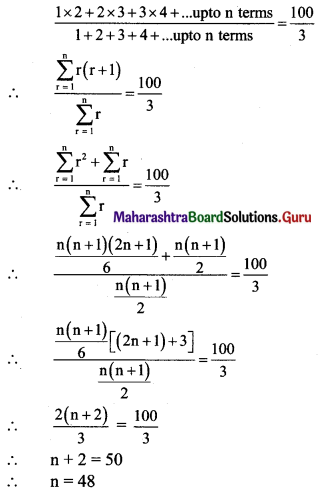
If \(\frac{1 \times 3+2 \times 5+3 \times 7+\ldots \text { upto } \mathrm{n} \text { terms }}{1^{3}+2^{3}+3^{3}+\ldots \text { upto } \mathrm{n} \text { terms }}=\frac{5}{9}\), find the value of n.
Solution:
Maharashtra Board 11th Maths Solutions Chapter 2 Sequences and Series Miscellaneous Exercise 2 II Q20
Maharashtra Board 11th Maths Solutions Chapter 2 Sequences and Series Miscellaneous Exercise 2 II Q20.1

Question 21.
For a G.P. if t2 = 7, t4 = 1575, find a.
Solution:
Maharashtra Board 11th Maths Solutions Chapter 2 Sequences and Series Miscellaneous Exercise 2 II Q21

Question 22.
If for a G.P. t3 = \(\frac{1}{3}\), t6 = \(\frac{1}{81}\) find r.
Solution:
Maharashtra Board 11th Maths Solutions Chapter 2 Sequences and Series Miscellaneous Exercise 2 II Q22

Question 23.
Find \(\sum_{r=1}^{n}\left(\frac{2}{3}\right)^{r}\).
Solution:
Maharashtra Board 11th Maths Solutions Chapter 2 Sequences and Series Miscellaneous Exercise 2 II Q23

Question 24.
Find k so that k – 1, k, k + 2 are consecutive terms of a G.P.
Solution:
Since k – 1, k, k + 2 are consecutive terms of a G.P.,
\(\frac{k}{k-1}=\frac{k+2}{k}\)
k2 = k2 + k – 2
k – 2 = 0
∴ k = 2

Question 25.
If for a G.P. first term is (27)2 and the seventh term is (8)2, find S8.
Solution:
Maharashtra Board 11th Maths Solutions Chapter 2 Sequences and Series Miscellaneous Exercise 2 II Q25

Question 26.
If pth, qth and rth terms of a G.P. are x, y, z respectively. Find the value of \(x^{q-r} \cdot y^{r-p} \cdot z^{p-q}\).
Solution:
Let a be the first term and R be the common ratio of the G.P.
Maharashtra Board 11th Maths Solutions Chapter 2 Sequences and Series Miscellaneous Exercise 2 II Q26

Question 27.
Which 2 terms are inserted between 5 and 40 so that the resulting sequence is G.P.
Solution:
Let the required numbers be G1 and G2.
Maharashtra Board 11th Maths Solutions Chapter 2 Sequences and Series Miscellaneous Exercise 2 II Q27
∴ For the resulting sequence to be in G.P. we need to insert numbers 10 and 20.

Maharashtra Board 11th Maths Solutions Chapter 2 Sequences and Series Miscellaneous Exercise 2

Question 28.
If p, q, r are in G.P. and \(\mathrm{p}^{1 / \mathrm{x}}=\mathrm{q}^{1 / \mathrm{y}}=\mathrm{r}^{1 / \mathrm{z}}\), verify whether x, y, z are in A.P. or G.P. or neither.
Solution:
Maharashtra Board 11th Maths Solutions Chapter 2 Sequences and Series Miscellaneous Exercise 2 II Q28

Question 29.
If a, b, c are in G.P. and ax2 + 2bx + c = 0 and px2 + 2qx + r = 0 have common roots, then verify that pb2 – 2qba + ra2 = 0.
Solution:
a, b, c are in G.P.
∴ b2 = ac
ax2 + 2bx + c = 0 becomes
Maharashtra Board 11th Maths Solutions Chapter 2 Sequences and Series Miscellaneous Exercise 2 II Q29

Question 30.
If p, q, r, s are in G.P., show that (p2 + q2 + r2)(q2 + r2 + s2) = (pq + qr + rs)2.
Solution:
p, q, r, s are in G.P.
Maharashtra Board 11th Maths Solutions Chapter 2 Sequences and Series Miscellaneous Exercise 2 II Q30

Question 31.
If p, q, r, s are in G.P., show that (pn + qn), (qn + rn), (rn + sn) are also in G.P.
Solution:
p, q, r, s are in G.P.
Let the common ratio be R
∴ let p = \(\frac{a}{R^{3}}\), q = \(\frac{a}{R}\), r = aR and s = aR3
To show that (pn + qn), (qn + rn), (rn + sn) are in G.P,
i.e., we have to show
Maharashtra Board 11th Maths Solutions Chapter 2 Sequences and Series Miscellaneous Exercise 2 II Q31

Maharashtra Board 11th Maths Solutions Chapter 2 Sequences and Series Miscellaneous Exercise 2

Question 32.
Find the coefficient x6 in the expression of e2x using series expansion.
Solution:
Maharashtra Board 11th Maths Solutions Chapter 2 Sequences and Series Miscellaneous Exercise 2 II Q32

Question 33.
Find the sum of infinite terms of \(1+\frac{4}{5}+\frac{7}{25}+\frac{10}{125}+\frac{13}{625}+\ldots\)
Solution:
Maharashtra Board 11th Maths Solutions Chapter 2 Sequences and Series Miscellaneous Exercise 2 II Q33
Maharashtra Board 11th Maths Solutions Chapter 2 Sequences and Series Miscellaneous Exercise 2 II Q33.1

Maharashtra Board 11th Maths Solutions Chapter 6 Circle Ex 6.3

Balbharti Maharashtra State Board Class 11 Maths Solutions Pdf Chapter 6 Circle Ex 6.3 Questions and Answers.

Maharashtra State Board 11th Maths Solutions Chapter 6 Circle Ex 6.3

Question 1.
Write the parametric equations of the circles:
(i) x2 + y2 = 9
(ii) x2 + y2 + 2x – 4y – 4 = 0
(iii) (x – 3)2 + (y + 4)2 = 25
Solution:
(i) Given equation of the circle is
x2 + y2 = 9
⇒ x2 + y2 = 32
Comparing this equation with x2 + y2 = r2, we get r = 3
The parametric equations of the circle in terms of θ are
x = r cos θ and y = r sin θ
⇒ x = 3 cos θ and y = 3 sin θ

(ii) Given equation of the circle is
x2 + y2 + 2x – 4y – 4 = 0
⇒ x2 + 2x + y2 – 4y – 4 = 0
⇒ x2 + 2x + 1 – 1 + y2 – 4y + 4 – 4 – 4 = 0
⇒ (x2 + 2x + 1 ) + (y2 – 4y + 4) – 9 = 0
⇒ (x + 1)2 + (y – 2)2 = 9
⇒ (x + 1)2 + (y – 2)2 = 32
Comparing this equation with (x – h)2 + (y – k)2 = r2, we get
h = -1, k = 2 and r = 3
The parametric equations of the circle in terms of θ are
x = h + r cos θ and y = k + r sin θ
⇒ x = -1 + 3 cos θ and y = 2 + 3 sin θ

(iii) Given equation of the circle is
(x – 3)2 + (y + 4)2 = 25
⇒ (x – 3)2 + (y + 4)2 = 52
Comparing this equation with (x – h)2 + (y – k)2 = r2, we get
h = 3, k = -4 and r = 5
The parametric equations of the circle in terms of θ are
x = h + r cos θ and y = k + r sin θ
⇒ x = 3 + 5 cos θ and y = -4 + 5 sin θ

Maharashtra Board 11th Maths Solutions Chapter 6 Circle Ex 6.3

Question 2.
Find the parametric representation of the circle 3x2 + 3y2 – 4x + 6y – 4 = 0.
Solution:
Given equation of the circle is 3x2 + 3y2 – 4x + 6y – 4 = 0
Dividing throughout by 3, we get
Maharashtra Board 11th Maths Solutions Chapter 6 Circle Ex 6.3 Q2
Comparing this equation with (x – h)2 + (y – k)2 = r2, we get
h = \(\frac{2}{3}\), k = -1 and r = \(\frac{5}{3}\)
The parametric representation of the circle in terms of θ are
x = h + r cos θ and y = k + r sin θ
⇒ x = \(\frac{2}{3}\) + \(\frac{5}{3}\) cos θ and y = -1 + \(\frac{5}{3}\) sin θ

Question 3.
Find the equation of a tangent to the circle x2 + y2 – 3x + 2y = 0 at the origin.
Solution:
Given equation of the circle is x2 + y2 – 3x + 2y = 0
Comparing this equation with x2 + y2 + 2gx + 2fy + c = 0, we get
2g = -3, 2f = 2, c = 0
⇒ g = \(-\frac{3}{2}\), f = 1, c = 0
The equation of a tangent to the circle
x2 + y2 + 2gx + 2fy + c = 0 at (x1, y1) is xx1 +yy1 + g(x + x1) + f(y + y1) + c = 0
The equation of the tangent at (0, 0) is
x(0) + y(0) + (\(-\frac{3}{2}\)) (x + 0) + 1(y + 0) + 0 = 0
⇒ \(-\frac{3}{2}\)x + y = 0
⇒ 3x – 2y = 0

Maharashtra Board 11th Maths Solutions Chapter 6 Circle Ex 6.3

Question 4.
Show that the line 7x – 3y – 1 = 0 touches the circle x2 + y2 + 5x – 7y + 4 = 0 at point (1, 2).
Solution:
Given equation of the circle is x2 + y2 + 5x – 7y + 4 = 0
Comparing this equation with x2 + y2 + 2gx + 2fy + c = 0, we get
2g = 5, 2f = -7, c = 4
⇒ g = \(\frac{5}{2}\), f = \(\frac{-7}{2}\), c = 4
The equation of a tangent to the circle x2 + y2 + 2gx + 2fy + c = 0 at (x1, y1) is
xx1 + yy1 + g(x + x1) + f(y + y1) + c = 0
The equation of the tangent at (1, 2) is
Maharashtra Board 11th Maths Solutions Chapter 6 Circle Ex 6.3 Q4
7x – 3y – 1 = 0, which is same as the given line.
The line 7x – 3y – 1 = 0 touches the given circle at (1, 2).

Question 5.
Find the equation of tangent to the circle x2 + y2 – 4x + 3y + 2 = 0 at the point (4, -2).
Solution:
Given equation of the circle is x2 + y2 – 4x + 3y + 2 = 0
Comparing this equation with x2 + y2 + 2gx + 2fy + c = 0, we get
2g = -4, 2f = 3, c = 2
g = -2, f = \(\frac{3}{2}\), c = 2
The equation of a tangent to the circle x2 + y2 + 2gx + 2fy + c = 0 at (x1, y1) is
xx1 + yy1 + g(x + x1) + f(y + y1) + c = 0
The equation of the tangent at (4, -2) is
x(4) + y(-2) – 2(x + 4) + \(\frac{3}{2}\)(y – 2) + 2 = 0
⇒ 4x – 2y – 2x – 8 + \(\frac{3}{2}\) y – 3 + 2 = 0
⇒ 2x – \(\frac{1}{2}\)y – 9 = 0
⇒ 4x – y – 18 = 0

Maharashtra Board 11th Maths Solutions Chapter 8 Measures of Dispersion Ex 8.2

Balbharti Maharashtra State Board Class 11 Maths Solutions Pdf Chapter 8 Measures of Dispersion Ex 8.2 Questions and Answers.

Maharashtra State Board 11th Maths Solutions Chapter 8 Measures of Dispersion Ex 8.2

Question 1.
Find variance and S.D. for the following set of numbers.
7, 11, 2, 4, 9, 6, 3, 7, 11, 2, 5, 8, 3, 6, 8, 8, 2, 6
Solution:
Given data:
7, 11, 2, 4, 9, 6, 3, 7, 11, 2, 5, 8, 3, 6, 8, 8, 2, 6
The tabulated form of the above data is
Maharashtra Board 11th Maths Solutions Chapter 8 Measures of Dispersion Ex 8.2 Q1
Calculation of variance and S.D.
Maharashtra Board 11th Maths Solutions Chapter 8 Measures of Dispersion Ex 8.2 Q1.1
Maharashtra Board 11th Maths Solutions Chapter 8 Measures of Dispersion Ex 8.2 Q1.2

Maharashtra Board 11th Maths Solutions Chapter 8 Measures of Dispersion Ex 8.2

Question 2.
Find variance and S.D. for the following set of numbers.
65, 77, 81, 98, 100, 80, 129
Solution:
Maharashtra Board 11th Maths Solutions Chapter 8 Measures of Dispersion Ex 8.2 Q2

Question 3.
Compute variance and standard deviation for the following data:
Maharashtra Board 11th Maths Solutions Chapter 8 Measures of Dispersion Ex 8.2 Q3
Solution:
Maharashtra Board 11th Maths Solutions Chapter 8 Measures of Dispersion Ex 8.2 Q3.1
Maharashtra Board 11th Maths Solutions Chapter 8 Measures of Dispersion Ex 8.2 Q3.2

Question 4.
Compute the variance and S.D.
Maharashtra Board 11th Maths Solutions Chapter 8 Measures of Dispersion Ex 8.2 Q4
Solution:
Let u = \(\frac{x-\mathrm{A}}{\mathrm{h}}=\frac{x-34}{1}\)
Calculation of variance of u:
Maharashtra Board 11th Maths Solutions Chapter 8 Measures of Dispersion Ex 8.2 Q4.1

Maharashtra Board 11th Maths Solutions Chapter 8 Measures of Dispersion Ex 8.2

Question 5.
Following data gives ages of 100 students in a college. Calculate variance and S.D.
Maharashtra Board 11th Maths Solutions Chapter 8 Measures of Dispersion Ex 8.2 Q5
Solution:
Let u = \(\frac{x-\mathrm{A}}{\mathrm{h}}=\frac{x-19}{1}\)
Maharashtra Board 11th Maths Solutions Chapter 8 Measures of Dispersion Ex 8.2 Q5.1
Maharashtra Board 11th Maths Solutions Chapter 8 Measures of Dispersion Ex 8.2 Q5.2

Question 6.
Find mean, variance and S.D. of the following data.
Maharashtra Board 11th Maths Solutions Chapter 8 Measures of Dispersion Ex 8.2 Q6
Solution:
Maharashtra Board 11th Maths Solutions Chapter 8 Measures of Dispersion Ex 8.2 Q6.1
Maharashtra Board 11th Maths Solutions Chapter 8 Measures of Dispersion Ex 8.2 Q6.2
Alternate Method:
Let u = \(\frac{x-\mathrm{A}}{\mathrm{h}}=\frac{x-55}{10}\)
Calculation of variance of u:
Maharashtra Board 11th Maths Solutions Chapter 8 Measures of Dispersion Ex 8.2 Q6.3
Maharashtra Board 11th Maths Solutions Chapter 8 Measures of Dispersion Ex 8.2 Q6.4

Maharashtra Board 11th Maths Solutions Chapter 8 Measures of Dispersion Ex 8.2

Question 7.
Find the variance and S.D. of the following frequency distribution which gives the distribution of 200 plants according to their height.
Maharashtra Board 11th Maths Solutions Chapter 8 Measures of Dispersion Ex 8.2 Q7
Solution:
Since data is not continuous, we have to make it continuous.
Let u = \(\frac{x-\mathrm{A}}{\mathrm{h}}=\frac{x-31}{5}\)
Calculation of variance of u:
Maharashtra Board 11th Maths Solutions Chapter 8 Measures of Dispersion Ex 8.2 Q7.1
Maharashtra Board 11th Maths Solutions Chapter 8 Measures of Dispersion Ex 8.2 Q7.2

Maharashtra Board 11th Maths Solutions Chapter 8 Measures of Dispersion Ex 8.2

Question 8.
The mean of 5 observations is 4.8 and the variance is 6.56. If three of the five observations are 1, 3, and 8, find the other two observations.
Solution:
\(\bar{x}\) = 4.8, Var (X) = 6.56, n = 5, x1 = 1, x2 = 3, x3 = 8 ……(given)
Let the remaining two observations be x4 and x5.
Maharashtra Board 11th Maths Solutions Chapter 8 Measures of Dispersion Ex 8.2 Q8
Maharashtra Board 11th Maths Solutions Chapter 8 Measures of Dispersion Ex 8.2 Q8.1
From (i), we get
x5 = 5 or x5 = 7
∴ The two numbers are 5 and 7.

Maharashtra Board 11th Maths Solutions Chapter 9 Probability Ex 9.1

Balbharti Maharashtra State Board Class 11 Maths Solutions Pdf Chapter 9 Probability Ex 9.1 Questions and Answers.

Maharashtra State Board 11th Maths Solutions Chapter 9 Probability Ex 9.1

Question 1.
There are four pens: Red, Green, Blue, and Purple in a desk drawer of which two pens are selected at random one after the other with replacement. State the sample space and the following events.
(a) A : Select at least one red pen.
(b) B : Two pens of the same colour are not selected.
Solution:
The drawer contains 4 pens out of which one is red (R), one is green (G), one is blue (B) and the other one is purple (P).
From this drawer, two pens are selected one after the other with replacement.
∴ The sample space S is given by
S = {RR, RG, RB, RP, GR, GG, GB, GP, BR, BG, BB, BP, PR, PG, PB, PP}
(a) A : Select at least one red pen.
At least one means one or more than one.
∴ A = {RR, RG, RB, RP, GR, BR, PR}

(b) B : Two pens of the same colour are not selected.
B = {RG, RB, RP, GR, GB, GP, BR, BG, BP, PR, PG, PB}

Maharashtra Board 11th Maths Solutions Chapter 9 Probability Ex 9.1

Question 2.
A coin and a die are tossed simultaneously. Enumerate the sample space and the following events.
(a) A : Getting a tail and an odd number.
(b) B : Getting a prime number.
(c) C : Getting head and a perfect square.
Solution:
When a coin and a die are tossed simultaneously, the sample space S is given by
S = {(H, 1), (H, 2), (H, 3), (H, 4), (H, 5), (H, 6), (T, 1), (T, 2), (T, 3), (T, 4), (T, 5), (T, 6)}
(a) A : Getting a tail and an odd number.
∴ A = {(T, 1), (T, 3), (T, 5)}

(b) B : Getting a prime number.
∴ B = {(H, 2), (H, 3), (H, 5), (T, 2), (T, 3), (T, 5)}

(c) C : Getting a head and a perfect square.
∴ C = {(H, 1), (H, 4)}

Question 3.
Find n(S) for each of the following random experiments.
(a) From an urn containing 5 gold and 3 silver coins, 3 coins are drawn at random.
(b) 5 letters are to be placed into 5 envelopes such that no envelope is empty.
(c) 6 books of different subjects are arranged on a shelf.
(d) 3 tickets are drawn from a box containing 20 lottery tickets.
Solution:
(a) There are 5 gold and 3 silver coins, i.e., 8 coins.
3 coins can be drawn from these 8 coins in \({ }^{8} \mathrm{C}_{3}\) ways.
∴ n(s) = \({ }^{8} \mathrm{C}_{3}=\frac{8 !}{5 ! 3 !}=\frac{8 \times 7 \times 6 \times 5 !}{5 ! \times 3 \times 2 \times 1}=56\)

(b) 5 letters have to be placed in 5 envelopes in such a way that no envelope is empty.
∴ The first letter can be placed into 5 envelopes in 5 different ways, the second letter in 4 ways.
Similarly, the third, fourth and fifth letters can be placed in 3 ways, 2 ways and 1 way, respectively.
∴ Total number of ways = 5!
= 5 × 4 × 3 × 2 × 1
= 120
∴ n(S) = 120

(c) 6 books can be arranged on a shelf in \({ }^{6} \mathrm{P}_{6}\) = 6! ways.
∴ n(S) = 6! = 6 × 5 × 4 × 3 × 2 × 1 = 720

(d) 3 tickets are drawn at random from 20 tickets.
∴ 3 tickets can be selected in \({ }^{20} \mathrm{C}_{3}\) ways.
∴ n(S) = \({ }^{20} \mathrm{C}_{3}=\frac{20 !}{17 ! 3 !}=\frac{20 \times 19 \times 18 \times 17 !}{17 ! \times 3 \times 2 \times 1}\) = 1140

Maharashtra Board 11th Maths Solutions Chapter 9 Probability Ex 9.1

Question 4.
Two fair dice are thrown. State the sample space and write the favourable outcomes for the following events.
(a) A : Sum of numbers on two dice is divisible by 3 or 4.
(b) B : The sum of numbers on two dice is 7.
(c) C : Odd number on the first die.
(d) D : Even number on the first die.
(e) Check whether events A and B are mutually exclusive and exhaustive.
(f) Check whether events C and D are mutually exclusive and exhaustive.
Solution:
When two dice are thrown, the sample space is
S = {(1, 1), (1, 2), (1, 3), (1, 4), (1, 5), (1, 6),
(2, 1), (2, 2), (2, 3), (2, 4), (2, 5), (2, 6),
(3, 1), (3, 2), (3, 3), (3, 4), (3, 5), (3, 6),
(4, 1), (4, 2), (4, 3), (4, 4), (4, 5), (4, 6),
(5, 1), (5, 2), (5, 3), (5, 4), (5, 5), (5, 6),
(6, 1), (6, 2), (6, 3), (6,4), (6, 5), (6, 6)}
∴ n(S) = 36
(a) A: Sum of the numbers on two dice is divisible by 3 or 4.
∴ A = {(1, 2), (1, 3), (1, 5), (2, 1), (2, 2), (2, 4), (2, 6), (3, 1), (3, 3), (3, 5), (3, 6), (4, 2), (4, 4), (4, 5), (5, 1), (5, 3), (5, 4), (6, 2), (6, 3), (6, 6)}

(b) B: Sum of the numbers on two dice is 7.
∴ B = {(1, 6), (2, 5), (3, 4), (4, 3), (5, 2), (6, 1)}

(c) C: Odd number on the first die.
∴ C = {(1, 1), (1, 2), (1, 3), (1, 4), (1, 5), (1, 6), (3, 1), (3, 2), (3, 3), (3, 4), (3, 5), (3, 6), (5, 1), (5, 2), (5, 3), (5, 4), (5, 5), (5, 6)}

(d) D: Even number on the first die.
∴ D = {(2, 1), (2, 2), (2, 3), (2, 4), (2, 5), (2, 6), (4, 1), (4, 2), (4, 3), (4, 4), (4, 5), (4, 6), (6, 1), (6, 2), (6, 3), (6, 4), (6, 5), (6, 6)}

(e) A and B are mutually exclusive events as A ∩ B = Φ.
A ∪ B = {(1, 2), (1, 3), (1, 5), (1, 6), (2, 1), (2, 2), (2, 4), (2, 5), (2, 6), (3, 1), (3, 3), (3, 4), (3, 5), (3, 6), (4, 2), (4, 3), (4, 4), (4, 5), (5, 1), (5, 2), (5, 3), (5, 4), (6, 1), (6, 2), (6, 3), (6, 6)} ≠ S
∴ A and B are not exhaustive events as A ∪ B ≠ S.

(f) C and D are mutually exclusive events as C ∩ D = Φ.
C ∪ D = {(1, 1), (1, 2), (1, 3), (1, 4), (1, 5), (1, 6), (2, 1), (2, 2), (2, 3), (2, 4), (2, 5), (2, 6), (3, 1), (3, 2), (3, 3), (3, 4), (3, 5), (3, 6), (4, 1), (4, 2), (4, 3), (4, 4), (4, 5), (4, 6), (5, 1), (5, 2), (5, 3), (5, 4), (5, 5), (5, 6), (6, 1), (6, 2), (6, 3), (6, 4), (6, 5), (6, 6)} = S
∴ C and D are exhaustive events.

Question 5.
A bag contains four cards marked as 5, 6, 7, and 8. Find the sample space if two cards are drawn at random
(a) with replacement.
(b) without replacement.
Solution:
The bag contains 4 cards marked 5, 6, 7, and 8. Two cards are to be drawn from this bag.
(a) If the two cards are drawn with replacement, then the sample space is
S = {(5, 5), (5, 6), (5, 7), (5, 8), (6, 5), (6, 6), (6, 7), (6, 8), (7, 5), (7, 6), (7, 7), (7, 8), (8, 5), (8, 6), (8, 7), (8, 8)}

(b) If the two cards are drawn without replacement, then the sample space is
S = {(5, 6), (5, 7), (5, 8), (6, 5), (6, 7), (6, 8), (7, 5), (7, 6), (7, 8), (8, 5), (8, 6), (8, 7)}

Maharashtra Board 11th Maths Solutions Chapter 9 Probability Ex 9.1

Question 6.
A fair die is thrown two times. Find the probability that
(a) the sum of the numbers on them is 5.
(b) the sum of the numbers on them is at least 8.
(c) the first throw gives a multiple of 2 and the second throw gives a multiple of 3.
(d) product of numbers on them is 12.
Solution:
When two dice are thrown, the sample space is
S = {(1, 1), (1, 2), (1, 3), (1, 4), (1, 5), (1, 6), (2, 1), (2, 2), (2, 3), (2, 4), (2, 5), (2, 6), (3, 1), (3, 2), (3, 3), (3, 4), (3, 5), (3, 6), (4, 1), (4, 2), (4, 3), (4, 4), (4, 5), (4, 6), (5, 1), (5, 2), (5, 3), (5, 4), (5, 5), (5, 6), (6, 1), (6, 2), (6, 3), (6,4), (6, 5), (6, 6)}
∴ n(S) = 36
(a) Let event A: Sum of the numbers on uppermost face is 5.
∴ A = {(1, 4), (2, 3), (3, 2), (4, 1)}
∴ n(A) = 4
∴ P(A) = \(\frac{n(A)}{n(S)}=\frac{4}{36}=\frac{1}{9}\)

(b) Let event B: Sum of the numbers on uppermost face is at least 8 (i.e., 8 or more than 8)
∴ B = {(2, 6), (3, 5), (3, 6), (4, 4), (4, 5), (4, 6), (5, 3), (5, 4), (5, 5), (5, 6), (6, 2), (6, 3), (6, 4), (6, 5), (6, 6)}
∴ n(B) = 15
∴ P(B) = \(\frac{n(B)}{n(S)}=\frac{15}{36}=\frac{5}{12}\)

(c) Let event C: First throw gives a multiple of 2 and second throw gives a multiple of 3.
∴ C = {(2, 3), (2, 6), (4, 3), (4, 6), (6, 3), (6, 6)}
∴ n(C) = 6
∴ P(C) = \(\frac{n(C)}{n(S)}=\frac{6}{36}=\frac{1}{6}\)

(d) Let event D: The product of the numbers on uppermost face is 12.
∴ D = {(2, 6), (3, 4), (4, 3), (6, 2)}
∴ n(D) = 4
∴ P(D) = \(\frac{n(D)}{n(S)}=\frac{4}{36}=\frac{1}{9}\)

Question 7.
Two cards are drawn from a pack of 52 cards. Find the probability that
(a) one is a face card and the other is an ace card.
(b) one is a club and the other is a diamond.
(c) both are from the same suit.
(d) both are red cards.
(e) one is a heart card and the other is a non-heart card.
Solution:
Two cards can be drawn from a pack of 52 cards in \({ }^{52} \mathrm{C}_{2}\) ways.
∴ n(S) = \({ }^{52} \mathrm{C}_{2}\)

(a) Let event A: Out of the two cards drawn, one is a face card and the other is an ace card.
There are 12 face cards and 4 ace cards in a pack of 52 cards.
∴ One face card can be drawn from 12 face cards in \({ }^{12} \mathrm{C}_{1}\) ways and one ace card can be drawn from 4 ace cards in \({ }^{4} \mathrm{C}_{1}\) ways.
∴ n(A) = \({ }^{12} \mathrm{C}_{1} \times{ }^{4} \mathrm{C}_{1}\)
∴ P(A) = \(\frac{\mathrm{n}(\mathrm{A})}{\mathrm{n}(\mathrm{S})}=\frac{{ }^{12} \mathrm{C}_{1} \times{ }^{4} \mathrm{C}_{1}}{{ }^{52} \mathrm{C}_{2}}=\frac{12 \times 4}{\frac{52 \times 51}{2 \times 1}}=\frac{8}{221}\)

Maharashtra Board 11th Maths Solutions Chapter 9 Probability Ex 9.1

(b) Let event B: Out of the two cards drawn, one is club and the other is a diamond card.
There are 13 club cards and 13 diamond cards.
∴ One club card can be drawn from 13 club cards in \({ }^{13} \mathrm{C}_{1}\) ways and one diamond card can be drawn from 13 diamond cards in \({ }^{13} \mathrm{C}_{1}\) ways.
∴ n(B) = \({ }^{13} \mathrm{C}_{1} \times{ }^{13} \mathrm{C}_{1}\)
∴ P(B) = \(\frac{n(B)}{n(S)}=\frac{{ }^{13} C_{1} \times{ }^{13} C_{1}}{{ }^{52} C_{2}}=\frac{13 \times 13}{\frac{52 \times 51}{2 \times 1}}=\frac{13}{102}\)

(c) Let event C: Both the cards drawn are of the same suit.
A pack of 52 cards consists of 4 suits each containing 13 cards.
∴ 2 cards can be drawn from the same suit in \({ }^{13} \mathrm{C}_{2}\) ways.
∴ n(C) = \({ }^{13} \mathrm{C}_{2} \times 4\)
∴ P(C) = \(\frac{\mathrm{n}(\mathrm{C})}{\mathrm{n}(\mathrm{S})}=\frac{4 \times{ }^{13} \mathrm{C}_{2}}{{ }^{52} \mathrm{C}_{2}}=\frac{4 \times 13 \times 12}{52 \times 51}=\frac{4}{17}\)

(d) Let event D: Both the cards drawn are red.
There are 26 red cards in the pack of 52 cards.
∴ 2 cards can be drawn from them in \({ }^{26} \mathrm{C}_{2}\) ways.
∴ n(D) = \({ }^{26} \mathrm{C}_{2}\)
∴ P(D) = \(\frac{n(D)}{n(S)}=\frac{{ }^{26} C_{2}}{{ }^{52} C_{2}}=\frac{26 \times 25}{52 \times 51}=\frac{25}{102}\)

(e) Let event E: Out of the two cards drawn, one is heart and other is non-heart.
There are 13 heart cards in a pack of 52 cards, i.e., 39 cards are non-heart.
∴ One heart card can be drawn from 13 hdart cards in \({ }^{13} \mathrm{C}_{1}\) ways and one non-heart card can be drawn from 39 cards in \({ }^{39} \mathrm{C}_{1}\) ways.
∴ n(E) = \({ }^{13} \mathrm{C}_{1} \times{ }^{39} \mathrm{C}_{1}\)
∴ P(E) = \(\frac{\mathrm{n}(\mathrm{E})}{\mathrm{n}(\mathrm{S})}=\frac{{ }^{13} \mathrm{C}_{1} \times{ }^{39} \mathrm{C}_{1}}{{ }^{52} \mathrm{C}_{2}}=\frac{13 \times 39}{\frac{52 \times 51}{2 \times 1}}=\frac{13}{34}\)

Question 8.
Three cards are drawn from a pack of 52 cards. Find the chance that
(a) two are queen cards and one is an ace card.
(b) at least one is a diamond card.
(c) all are from the same suit.
(d) they are a king, a queen, and a jack.
Solution:
3 cards can be drawn from a pack of 52 cards in \({ }^{52} \mathrm{C}_{3}\) ways.
∴ n(S) = \({ }^{52} \mathrm{C}_{3}\)

(a) Let event A: Out of the three cards drawn, 2 are queens and 1 is an ace card.
There are 4 queens and 4 aces in a pack of 52 cards.
∴ 2 queens can be drawn from 4 queens in \({ }^{4} \mathrm{C}_{2}\) ways and 1 ace can be drawn out of 4 aces in \({ }^{4} \mathrm{C}_{1}\) ways.
Maharashtra Board 11th Maths Solutions Chapter 9 Probability Ex 9.1 Q8

(b) Let event B: Out of the three cards drawn, at least one is a diamond.
∴ B’ is the event that all 3 cards drawn are non-diamond cards.
In a pack of 52 cards, there are 39 non-diamond cards.
∴ 3 non-diamond cards can be drawn in \({ }^{39} \mathrm{C}_{3}\) ways.
Maharashtra Board 11th Maths Solutions Chapter 9 Probability Ex 9.1 Q8.1

(c) Let event C: All the cards drawn are from the same suit.
A pack of 52 cards consists of 4 suits each containing 13 cards.
∴ 3 cards can be drawn from the same suit in \({ }^{13} \mathrm{C}_{3}\) ways.
Maharashtra Board 11th Maths Solutions Chapter 9 Probability Ex 9.1 Q8.2

(d) Let event D: The cards drawn are a king, a queen, and a jack.
There are 4 kings, 4 queens and 4 jacks in a pack of 52 cards.
∴ 1 king can be drawn from 4 kings in \({ }^{4} \mathrm{C}_{1}\) ways,
1 queen can be drawn from 4 queens in \({ }^{4} \mathrm{C}_{1}\) ways and
1 jack can be drawn from 4 jacks in \({ }^{4} \mathrm{C}_{1}\) ways.
Maharashtra Board 11th Maths Solutions Chapter 9 Probability Ex 9.1 Q8.3

Maharashtra Board 11th Maths Solutions Chapter 9 Probability Ex 9.1

Question 9.
From a bag containing 10 red, 4 blue, and 6 black balls, a ball is drawn at random. Find the probability of drawing
(a) a red bail.
(b) a blue or black ball.
(c) not a black ball.
Solution:
The bag contains 10 red, 4 blue, and 6 black balls,
i.e., 10 + 4 + 6 = 20 balls.
One ball can be drawn from 20 balls in \({ }^{20} \mathrm{C}_{1}\) ways.
∴ n(S) = \({ }^{20} \mathrm{C}_{1}\) = 20

(a) Let event A: Ball drawn is red.
There are total 10 red balls.
∴ 1 red ball can be drawn from 10 red balls in \({ }^{10} \mathrm{C}_{1}\) ways.
∴ n(A) = \({ }^{10} \mathrm{C}_{1}\) = 10
∴ P(A) = \(\frac{n(A)}{n(S)}=\frac{10}{20}=\frac{1}{2}\)

(b) Let event B: The ball drawn is blue or black.
There are 4 blue and 6 black balls.
∴ 1 blue ball can be drawn from 4 blue balls in \({ }^{4} \mathrm{C}_{1}\) ways
or 1 black ball can be drawn from 6 black balls in \({ }^{6} \mathrm{C}_{1}\) ways.
∴ n(B) = \({ }^{4} \mathrm{C}_{1}\) + \({ }^{6} \mathrm{C}_{1}\) = 4 + 6 = 10
∴ P(B) = \(\frac{n(B)}{n(S)}=\frac{10}{20}=\frac{1}{2}\)

(c) Let event C: Ball drawn is not black,
i.e., ball drawn is red or blue.
There are total 14 red and blue balls.
∴ 1 ball can be drawn from 14 balls in \({ }^{14} \mathrm{C}_{1}\) ways.
∴ n(C) = \({ }^{14} \mathrm{C}_{1}\) = 14
∴ P(C) = \(\frac{n(C)}{n(S)}=\frac{14}{20}=\frac{7}{10}\)

Question 10.
A box contains 75 tickets numbered 1 to 75. A ticket is drawn at random from the box. Find the probability that,
(a) number on the ticket is divisible by 6.
(b) the number on the ticket is a perfect square.
(c) the number on the ticket is prime.
(d) the number on the ticket is divisible by 3 and 5.
Solution:
The box contains 75 tickets numbered 1 to 75.
∴ 1 ticket can be drawn from the box in \({ }^{75} \mathrm{C}_{1}\) = 75 ways.
∴ n(S) = 75

(a) Let event A: Number on the ticket is divisible by 6.
∴ A = {6, 12, 18, 24, 30, 36, 42, 48, 54, 60, 66, 72}
∴ n(A) = 12
∴ P(A) = \(\frac{n(A)}{n(S)}=\frac{12}{75}=\frac{4}{25}\)

(b) Let event B: Number on the ticket is a perfect square.
∴ B = (1, 4, 9, 16, 25, 36, 49, 64}
∴ n(B) = 8
∴ P(B) = \(\frac{n(B)}{n(S)}=\frac{8}{75}\)

(c) Let event C: Number on the ticket is a prime number.
∴C = {2, 3, 5, 7, 11, 13, 17, 19, 23, 29, 31, 37, 41, 43, 47, 53, 59, 61, 67, 71, 73}

(d) Let event D: Number on the ticket is divisible by 3 and 5,
i.e., divisible by L.C.M. of 3 and 5,
i.e., 15.
∴D = {15, 30, 45, 60, 75}
∴ n(D) = 5
∴ P(D) = \(\frac{n(D)}{n(S)}=\frac{5}{75}=\frac{1}{15}\)

Maharashtra Board 11th Maths Solutions Chapter 9 Probability Ex 9.1

Question 11.
What is the chance that a leap year, selected at random, will contain 53 Sundays?
Solution:
A leap year consists of 366 days.
It has 52 complete weeks and two more days.
These two days can be {(Sun, Mon), (Mon, Tue), (Tue, Wed), (Wed, Thur), (Thur, Fri), (Fri, Sat), (Sat, Sun)}.
∴ n(S) = 7
Let event E : There are 53 Sundays.
∴ E = {(Sun, Mon), (Sat, Sun)}
∴ n(E) = 2
∴ P(E) = \(\frac{n(E)}{n(S)}=\frac{2}{7}\)

Question 12.
Find the probability of getting both red balls, when from a bag containing 5 red and 4 black balls, two balls are drawn,
(i) with replacement
(ii) without replacement
Solution:
The bag contains 5 red and 4 black balls,
i.e., 5 + 4 = 9 balls.
(i) 2 balls can be drawn from 9 balls with replacement in \({ }^{9} \mathrm{C}_{1} \times{ }^{9} \mathrm{C}_{1}\) ways.
∴ n(S) = \({ }^{9} \mathrm{C}_{1} \times{ }^{9} \mathrm{C}_{1}\) = 9 × 9 = 81
Let event A: Balls drawn are red.
2 red balls can be drawn from 5 red balls with replacement in \({ }^{5} \mathrm{C}_{1} \times{ }^{5} \mathrm{C}_{1}\) ways.
∴ n(A) = \({ }^{5} \mathrm{C}_{1} \times{ }^{5} \mathrm{C}_{1}\) = 5 × 5 = 25
∴ P(A) = \(\frac{n(A)}{n(S)}=\frac{25}{81}\)

(ii) 2 balls can be drawn from 9 balls without replacement in \({ }^{9} C_{1} \times{ }^{8} C_{1}\) ways.
∴ n(S) = \({ }^{9} C_{1} \times{ }^{8} C_{1}\) = 9 × 8 = 72
2 red balls can be drawn from 5 red balls without replacement in \({ }^{5} \mathrm{C}_{1} \times{ }^{4} \mathrm{C}_{1}\) ways.
∴ n(B) = \({ }^{5} \mathrm{C}_{1} \times{ }^{4} \mathrm{C}_{1}\) = 5 × 4 = 20
∴ P(B) = \(\frac{n(B)}{n(S)}=\frac{20}{72}=\frac{5}{18}\)

Question 13.
A room has three sockets for lamps. From a collection of 10 bulbs of which 6 are defective. At night a person selects 3 bulbs, at random and puts them in sockets. What is the probability that
(i) room is still dark.
(ii) the room is lit.
Solution:
Total number of bulbs = 10
Number of defective bulbs = 6
∴ Number of non-defective bulbs = 4
3 bulbs can be selected out of 10 bulbs in \({ }^{10} \mathrm{C}_{3}\) ways.
∴ n(S) = \({ }^{10} \mathrm{C}_{3}\)

(i) Let event A: The room is dark.
For event A to happen the bulbs should be selected from the 6 defective bulbs. This can be done in \({ }^{6} \mathrm{C}_{3}\) ways.
∴ n(A) = \({ }^{6} \mathrm{C}_{3}\)
∴ P(A) = \(\frac{n(A)}{n(S)}=\frac{{ }^{6} C_{3}}{{ }^{10} C_{3}}=\frac{6 \times 5 \times 4}{10 \times 9 \times 8}=\frac{1}{6}\)

(ii) Let event A’: The room is lit.
∴ P(Room is lit) = 1 – P(Room is not lit)
∴ P(A’) = 1 – P(A) = 1 – \(\frac{1}{6}\) = \(\frac{5}{6}\)

Maharashtra Board 11th Maths Solutions Chapter 9 Probability Ex 9.1

Question 14.
Letters of the word MOTHER are arranged at random. Find the probability that in the arrangement
(a) vowels are always together.
(b) vowels are never together.
(c) O is at the beginning and end with T.
(d) starting with a vowel and ending with a consonant.
Solution:
There are 6 letters in the word MOTHER.
These letters can be arranged among themselves in \({ }^{6} \mathrm{P}_{6}\) = 6! ways.
∴ n(S) = 6!
(a) Let event A: Vowels are always together.
The word MOTHER consists of 2 vowels (O, E) and 4 consonants (M, T, H, R).
2 vowels can be arranged among themselves in \({ }^{2} \mathbf{P}_{2}\) = 2! ways.
Let us consider 2 vowels as one group.
This one group with 4 consonants can be arranged in \({ }^{5} \mathrm{P}_{5}\) = 5! ways.
∴ n(A) = 2! × 5!
∴ P(A) = \(\frac{n(A)}{n(S)}=\frac{2 ! \times 5 !}{6 !}=\frac{1}{3}\)

(b) Let event B: Vowels are never together.
4 consonants create 5 gaps, in which vowels are arranged.
Consider the following arrangement of consonants
_C_C_C_C_
2 vowels can be arranged in 5 gaps in \({ }^{5} \mathbf{P}_{2}\) ways.
Also 4 consonants can be arranged among themselves in \({ }^{4} \mathbf{P}_{4}\) = 4! ways.
∴ n(B) = 4! × \({ }^{5} \mathbf{P}_{2}\)
∴ P(B) = \(\frac{n(B)}{n(S)}=\frac{4 ! \times{ }^{5} P_{2}}{6 !}=\frac{4 ! \times 5 \times 4}{6 \times 5 \times 4 !}=\frac{2}{3}\)

(iii) Let event C: Word begin with O and end with T.
Thus first and last letters can be arranged in one way each and the remaining 4 letters can be arranged in \({ }^{4} \mathrm{P}_{4}\) = 4! ways
∴ n(C) = 4! × 1 × 1 = 4!
∴ P(C) = \(\frac{n(C)}{n(S)}=\frac{4 !}{6 !}=\frac{1}{30}\)

(d) Let event D: Word starts with a vowel and ends with a consonant.
There are 2 vowels and 4 consonants in the word MOTHER.
∴ The first place can be arranged in 2 different ways and the last place can be arranged in 4 different ways.
Now, the remaining 4 letters (3 consonants and 1 vowel) can be arranged in \({ }^{4} \mathrm{P}_{4}\) = 4! ways.
∴ n(D) = 2 × 4 × 4!
∴ P(D) = \(\frac{n(D)}{n(S)}=\frac{2 \times 4 \times 4 !}{6 !}=\frac{4}{15}\)

Question 15.
4 letters are to be posted in 4 post boxes. If any number of letters can be posted in any of the 4 post boxes, what is the probability that each box contains only one letter?
Solution:
There are 4 letters and 4 post boxes.
Since any number of letters can be posted in all 4 post boxes,
so each letter can be posted in different ways.
∴ n(S) = 4 × 4 × 4 × 4
Let event A: Each box contains only one letter.
∴ 1st letter can be posted in 4 different ways.
Since each box contains only one letter, 2nd letter can be posted in 3 different ways.
Similarly, 3rd and 4th letters can be posted in 2 different ways and 1 way respectively.
∴ n(A) = 4 × 3 × 2 × 1
∴ P(A) = \(\frac{n(A)}{n(S)}=\frac{4 \times 3 \times 2 \times 1}{4 \times 4 \times 4 \times 4}=\frac{3}{32}\)

Maharashtra Board 11th Maths Solutions Chapter 9 Probability Ex 9.1

Question 16.
15 professors have been invited for a round table conference by the Vice-chancellor of a university. What is the probability that two particular professors occupy the seats on either side of the Vice-chancellor during the conference?
Solution:
Since a Vice-chancellor invited 15 professors for a round table conference, there were all 16 persons in the conference.
These 16 persons can be arranged among themselves around a round table in (16 – 1)! = 15! ways.
∴ n(S) = 15!
Let event A: Two particular professors be seated on either side of the Vice-chancellor.
Those two particular persons sit on either side of a Vice chancellor in \({ }^{2} \mathrm{P}_{2}\) = 2! ways.
Thus the remaining 13 persons can be arranged in \({ }^{13} \mathrm{P}_{13}\) = 13! ways.
∴ n(A) = 13! 2!
∴ P(A) = \(\frac{\mathrm{n}(\mathrm{A})}{\mathrm{n}(\mathrm{S})}=\frac{13 ! \times 2 !}{15 !}=\frac{13 ! \times 2 \times 1}{15 \times 14 \times 13 !}=\frac{1}{105}\)

Question 17.
A bag contains 7 black and 4 red balls. If 3 balls are drawn at random, find the probability that
(i) all are black.
(ii) one is black and two are red.
Solution:
The bag contains 7 black and 4 red balls,
i.e., 7 + 4 = 11 balls.
∴ 3 balls can be drawn out of 11 balls in \({ }^{11} \mathrm{C}_{3}\) ways.
∴ n(S) = \({ }^{11} \mathrm{C}_{3}\)
(i) Let event A: All 3 balls drawn are black.
There are 7 black balls.
∴ 3 black balls can be drawn from 7 black balls in \({ }^{7} \mathrm{C}_{3}\) ways.
∴ n(A) = \({ }^{7} \mathrm{C}_{3}\)
∴ P(A) = \(\frac{\mathrm{n}(\mathrm{A})}{\mathrm{n}(\mathrm{S})}=\frac{{ }^{7} \mathrm{C}_{3}}{{ }^{11} \mathrm{C}_{3}}=\frac{7 \times 6 \times 5}{11 \times 10 \times 9}=\frac{7}{33}\)

Maharashtra Board 11th Maths Solutions Chapter 9 Probability Ex 9.1

(ii) Let event B: Out of 3 balls drawn, one is black and two are red.
There are 7 black and 4 red balls.
∴ One black ball can be drawn from 7 black balls in \({ }^{7} \mathrm{C}_{1}\) ways and 2 red balls can be drawn from 4 red balls in \({ }^{4} \mathrm{C}_{2}\) ways.
∴ n(A) = \({ }^{7} \mathrm{C}_{1} \times{ }^{4} \mathrm{C}_{2}\)
∴ P(A) = \(\frac{n(A)}{n(S)}=\frac{{ }^{7} C_{1} \times{ }^{4} C_{2}}{{ }^{11} C_{3}}=\frac{7 \times \frac{4 \times 3}{2}}{\frac{11 \times 10 \times 9}{3 \times 2 \times 1}}=\frac{14}{55}\)

Maharashtra Board 11th Maths Solutions Chapter 8 Measures of Dispersion Ex 8.1

Balbharti Maharashtra State Board Class 11 Maths Solutions Pdf Chapter 8 Measures of Dispersion Ex 8.1 Questions and Answers.

Maharashtra State Board 11th Maths Solutions Chapter 8 Measures of Dispersion Ex 8.1

Question 1.
Find a range of the following data:
19, 27, 15, 21, 33, 45, 7, 12, 20, 26
Solution:
Here, largest value (L) = 45, smallest value (S) = 7
∴ Range = L – S = 45 – 7 = 38

Question 2.
Find range of the following data:
575, 609, 335, 280, 729, 544, 852, 427, 967, 250
Solution:
Here, largest value (L) = 967, smallest value (S) = 250
∴ Range = L – S = 967 – 250 = 717

Maharashtra Board 11th Maths Solutions Chapter 8 Measures of Dispersion Ex 8.1

Question 3.
The following data gives a number of typing mistakes done by Radha during a week. Find the range of the data.
Maharashtra Board 11th Maths Solutions Chapter 8 Measures of Dispersion Ex 8.1 Q3
Solution:
Here, largest value (L) = 21, smallest value (S) = 10
∴ Range = L – S = 21 – 10 = 11

Question 4.
The following results were obtained by rolling a die 25 times. Find the range of the data.
Maharashtra Board 11th Maths Solutions Chapter 8 Measures of Dispersion Ex 8.1 Q4
Solution:
Here, largest value (L) = 6, smallest value (S) = 1
∴ Range = L – S = 6 – 1 = 5

Maharashtra Board 11th Maths Solutions Chapter 8 Measures of Dispersion Ex 8.1

Question 5.
Find range for the following data:
Maharashtra Board 11th Maths Solutions Chapter 8 Measures of Dispersion Ex 8.1 Q5
Solution:
Here, upper limit of the highest class (L) = 72
lower limit of the lowest class (S) = 62
∴ Range = L – S = 72 – 62 = 10

Maharashtra Board 11th Maths Solutions Chapter 7 Conic Sections Ex 7.2

Balbharti Maharashtra State Board Class 11 Maths Solutions Pdf Chapter 7 Conic Sections Ex 7.2 Questions and Answers.

Maharashtra State Board 11th Maths Solutions Chapter 7 Conic Sections Ex 7.2

Question 1.
Find the
(i) lengths of the principal axes
(ii) co-ordinates of the foci
(iii) equations of directrices
(iv) length of the latus rectum
(v) distance between foci
(vi) distance between directrices of the ellipse:
(a) \(\frac{x^{2}}{25}+\frac{y^{2}}{9}=1\)
(b) 3x2 + 4y2 = 12
(c) 2x2 + 6y2 = 6
(d) 3x2 + 4y2 = 1
Solution:
(a) Given equation of the ellipse is \(\frac{x^{2}}{25}+\frac{y^{2}}{9}=1\)
Comparing this equation with \(\frac{x^{2}}{\mathrm{a}^{2}}+\frac{y^{2}}{\mathrm{~b}^{2}}=1\), we get
a2 = 25 and b2 = 9
a = 5 and b = 3
Since a > b,
X-axis is the major axis and Y-axis is the minor axis.

(i) Length of major axis = 2a = 2(5) = 10
Length of minor axis = 2b = 2(3) = 6
Lengths of the principal axes are 10 and 6.

(ii) We know that e = \(\frac{\sqrt{a^{2}-b^{2}}}{a}\)
= \(\frac{\sqrt{25-9}}{5}\)
= \(\frac{\sqrt{16}}{5}\)
= \(\frac{4}{5}\)
Co-ordinates of the foci are S(ae, 0) and S'(-ae, 0),
i.e., S(5(\(\frac{4}{5}\)), 0) and S'(-5(\(\frac{4}{5}\)), 0)
i.e., S(4, 0) and S'(-4, 0)

(iii) Equations of the directrices are x = ±\(\frac{\mathrm{a}}{\mathrm{e}}\)
= \(\pm \frac{5}{\frac{4}{5}}\)
= \(\pm \frac{25}{4}\)

(iv) Length of latus rectum = \(\frac{2 b^{2}}{a}=\frac{2(3)^{2}}{5}=\frac{18}{5}\)

(v) Distance between foci = 2ae
= 2(5)(\(\frac{4}{5}\))
= 8

(vi) Distance between directrices = \(\frac{2 \mathrm{a}}{\mathrm{e}}\)
= \(\frac{2(5)}{\frac{4}{5}}\)
= \(\frac{25}{2}\)

Maharashtra Board 11th Maths Solutions Chapter 7 Conic Sections Ex 7.2

(b) Given equation of the ellipse is 3x2 + 4y2 = 12
\(\frac{x^{2}}{4}+\frac{y^{2}}{3}=1\)
Comparing this equation with \(\frac{x^{2}}{\mathrm{a}^{2}}+\frac{y^{2}}{\mathrm{~b}^{2}}=1\), we get
a2 = 4 and b2 = 3
a = 2 and b = √3
Since a > b,
X-axis is the major axis and Y-axis is the minor axis.

(i) Length of major axis = 2a = 2(2) = 4
Length of minor axis = 2b = 2√3
Lengths of the principal axes are 4 and 2√3.

(ii) We know that e = \(\frac{\sqrt{a^{2}-b^{2}}}{a}\)
= \(\frac{\sqrt{4-3}}{2}\)
= \(\frac{1}{2}\)
Co-ordinates of the foci are S(ae, 0) and S'(-ae, 0),
i.e., S(2(\(\frac{1}{2}\)), 0) and S'(-2(\(\frac{1}{2}\)), 0)
i.e., S(1, 0) and S'(-1, 0)

(iii) Equations of the directrices are x = ±\(\frac{\mathrm{a}}{\mathrm{e}}\)
= \(\pm \frac{2}{\frac{1}{2}}\)
= ±4

(iv) Length of latus rectum = \(\frac{2 b^{2}}{a}=\frac{2(\sqrt{3})^{2}}{2}=3\)

(v) Distance between foci = 2ae = 2(2)(\(\frac{1}{2}\)) = 2

(vi) Distance between directrices = \(\frac{2 \mathrm{a}}{\mathrm{e}}\)
= \(\frac{2(2)}{\frac{1}{2}}\)
= 8

(c) Given equation of the ellipse is 2x2 + 6y2 = 6
\(\frac{x^{2}}{3}+\frac{y^{2}}{1}=1\)
Comparing this equation with \(\frac{x^{2}}{\mathrm{a}^{2}}+\frac{y^{2}}{\mathrm{~b}^{2}}=1\), we get
a2 = 3 and b2 = 1
a = √3 and b = 1
Since a > b,
X-axis is the major axis and Y-axis is the minor axis.

(i) Length of major axis = 2a = 2√3
Length of minor axis = 2b = 2(1) = 2
Lengths of the principal axes are 2√3 and 2.

(ii) We know that e = \(\frac{\sqrt{a^{2}-b^{2}}}{a}\)
= \(\frac{\sqrt{3-1}}{\sqrt{3}}\)
= \(\frac{\sqrt{2}}{\sqrt{3}}\)
Co-ordinates of the foci are S(ae, 0) and S'(-ae, 0),
i.e., S(√3(\(\frac{\sqrt{2}}{\sqrt{3}}\)), o) and S'(-√3(\(\frac{\sqrt{2}}{\sqrt{3}}\)), 0)
i.e., S(√2, 0) and S'(-√2, 0)

(iii) Equations of the directrices are x = ±\(\frac{a}{e}\),
= \(\pm \frac{\sqrt{3}}{\frac{\sqrt{2}}{\sqrt{3}}}\)
= \(\pm \frac{3}{\sqrt{2}}\)

(iv) Length of latus rectum = \(\frac{2 b^{2}}{a}=\frac{2(1)^{2}}{\sqrt{3}}=\frac{2}{\sqrt{3}}\)

(v) Distance between foci = 2ae
= \(2(\sqrt{3})\left(\frac{\sqrt{2}}{\sqrt{3}}\right)\)
= 2√2

(vi) Distance between directrices = \(\frac{2 \mathrm{a}}{\mathrm{e}}\)
= \(\frac{2 \sqrt{3}}{\frac{\sqrt{2}}{\sqrt{3}}}\)
= \(\frac{2 \times 3}{\sqrt{2}}\)
= 3√2

(d) Given equation of the ellipse is 3x2 + 4y = 1.
\(\frac{x^{2}}{\frac{1}{3}}+\frac{y^{2}}{\frac{1}{4}}=1\)
Comparing this equation with \(\frac{x^{2}}{\mathrm{a}^{2}}+\frac{y^{2}}{\mathrm{~b}^{2}}=1\), we get
a2 = \(\frac{1}{3}\) and b2 = \(\frac{1}{4}\)
a = \(\frac{1}{\sqrt{3}}\) and b = \(\frac{1}{2}\)
Since a > b,
X-axis is the major axis and Y-axis is the minor axis.

(i) Length of major axis = 2a = 2(\(\frac{1}{\sqrt{3}}\)) = \(\frac{2}{\sqrt{3}}\)
Length of minor axis = 2b = 2(\(\frac{1}{2}\)) = 1
Lengths of the principal axes are \(\frac{2}{\sqrt{3}}\) and 1.

(ii) We know that e = \(\frac{\sqrt{a^{2}-b^{2}}}{a}\)
e = \(\frac{\sqrt{\frac{1}{3}-\frac{1}{4}}}{\frac{1}{\sqrt{3}}}=\frac{\sqrt{\frac{1}{12}}}{\frac{1}{\sqrt{3}}}=\sqrt{\frac{3}{12}}=\sqrt{\frac{1}{4}}=\frac{1}{2}\)
Co-ordinates of the foci are S(ae, 0) and S'(-ae, 0),
i.e., S\(\left(\frac{1}{\sqrt{3}}\left(\frac{1}{2}\right), 0\right)\) and S’\(\left(-\frac{1}{\sqrt{3}}\left(\frac{1}{2}\right), 0\right)\)
i.e., S(\(\frac{1}{2 \sqrt{3}}\), 0) and S'(-\(\frac{1}{2 \sqrt{3}}\), 0)

(iii) Equations of the directrices are x = ±\(\frac{a}{e}\),
= \(\pm \frac{\frac{1}{\sqrt{3}}}{\frac{1}{2}}\)
= \(\pm \frac{2}{\sqrt{3}}\)

(iv) Length of latus rectum = \(\frac{2 b^{2}}{a}\)
= \(\frac{2\left(\frac{1}{2}\right)^{2}}{\frac{1}{\sqrt{3}}}\)
= \(\frac{\sqrt{3}}{2}\)

(v) Distance between foci = 2ae
= \(2\left(\frac{1}{\sqrt{3}}\right)\left(\frac{1}{2}\right)\)
= \(\frac{1}{\sqrt{3}}\)

(vi) Distance between directrices = \(\frac{2 a}{e}\)
= \(\frac{2\left(\frac{1}{\sqrt{3}}\right)}{\frac{1}{2}}\)
= \(\frac{4}{\sqrt{3}}\)

Maharashtra Board 11th Maths Solutions Chapter 7 Conic Sections Ex 7.2

Question 2.
Find the equation of the ellipse in standard form if
(i) eccentricity = \(\frac{3}{8}\) and distance between its foci = 6.
(ii) the length of the major axis is 10 and the distance between foci is 8.
(iii) distance between directrices is 18 and eccentricity is \(\frac{1}{3}\).
(iv) minor axis is 16 and eccentricity is \(\frac{1}{3}\).
(v) the distance between foci is 6 and the distance between directrices is \(\frac{50}{3}\).
(vi) the latus rectum has length 6 and foci are (±2, 0).
(vii) passing through the points (-3, 1) and (2, -2).
(viii) the distance between its directrices is 10 and which passes through (-√5, 2).
(ix) eccentricity is \(\frac{2}{3}\) and passes through (2, \(\frac{-5}{3}\)).
Solution:
(i) Let the required equation of ellipse be \(\frac{x^{2}}{a^{2}}+\frac{y^{2}}{b^{2}}=1\), where a > b.
Given, eccentricity (e) = \(\frac{3}{8}\)
Distance between foci = 2ae
Given, distance between foci = 6
2ae = 6
Maharashtra Board 11th Maths Solutions Chapter 7 Conic Sections Ex 7.2 Q2 (i)
The required equation of ellipse is \(\frac{x^{2}}{64}+\frac{y^{2}}{55}=1\).

(ii) Let the required equation of ellipse be \(\frac{x^{2}}{a^{2}}+\frac{y^{2}}{b^{2}}=1\), where a > b.
Length of major axis = 2a
Given, length of major axis = 10
2a = 10
a = 5
a2 = 25
Distance between foci = 2ae
Given, distance between foci = 8
2ae = 8
2(5)e = 8
Maharashtra Board 11th Maths Solutions Chapter 7 Conic Sections Ex 7.2 Q2 (ii)
The required equation of ellipse is \(\frac{x^{2}}{25}+\frac{y^{2}}{9}=1\).

(iii) Let the required equation of ellipse be \(\frac{x^{2}}{a^{2}}+\frac{y^{2}}{b^{2}}=1\), where a > b.
Given, eccentricity (e) = \(\frac{1}{3}\)
Distance between directrices = \(\frac{2a}{e}\)
Given, distance between directrices = 18
Maharashtra Board 11th Maths Solutions Chapter 7 Conic Sections Ex 7.2 Q2 (iii)
The required equation of ellipse is \(\frac{x^{2}}{9}+\frac{y^{2}}{8}=1\)

(iv) Let the required equation of ellipse be \(\frac{x^{2}}{a^{2}}+\frac{y^{2}}{b^{2}}=1\), where a > b.
Length of minor axis = 2b
Given, length of minor axis = 16
2b = 16
b = 8
b2 = 64
Given, eccentricity (e) = \(\frac{1}{3}\)
Now, b2 = a2 (1 – e2)
Maharashtra Board 11th Maths Solutions Chapter 7 Conic Sections Ex 7.2 Q2 (iv)
The required equation of ellipse is \(\frac{x^{2}}{72}+\frac{y^{2}}{64}=1\).

(v) Let the required equation of ellipse be \(\frac{x^{2}}{a^{2}}+\frac{y^{2}}{b^{2}}=1\), where a > b.
Distance between foci = 2ae
Given, distance between foci = 6
2ae = 6
ae = 3
a = \(\frac{3}{e}\) …….(i)
Distance between directrices = \(\frac{2a}{e}\)
Given, distance between directrices = \(\frac{50}{3}\)
Maharashtra Board 11th Maths Solutions Chapter 7 Conic Sections Ex 7.2 Q2 (v)
The required equation of ellipse is \(\frac{x^{2}}{25}+\frac{y^{2}}{16}=1\).

Maharashtra Board 11th Maths Solutions Chapter 7 Conic Sections Ex 7.2

(vi) Given, the length of the latus rectum is 6, and co-ordinates of foci are (±2, 0).
The foci of the ellipse are on the X-axis.
Let the required equation of ellipse be \(\frac{x^{2}}{a^{2}}+\frac{y^{2}}{b^{2}}=1\), where a > b.
Length of latus rectum = \(\frac{2 b^{2}}{a}\)
\(\frac{2 b^{2}}{a}\) = 6
b2 = 3a …..(i)
Co-ordinates of foci are (±ae, 0)
ae = 2
a2e2 = 4 …..(ii)
Now, b2 = a2 (1 – e2)
b2 = a2 – a2 e2
3a = a2 – 4 …..[From (i) and (ii)]
a2 – 3a – 4 = 0
a2 – 4a + a – 4 = 0
a(a – 4) + 1(a – 4) = 0
(a – 4) (a + 1) = 0
a – 4 = 0 or a + 1 = 0
a = 4 or a = -1
Since a = -1 is not possible,
a = 4
a2 = 16
Substituting a = 4 in (i), we get
b2 = 3(4) = 12
The required equation of ellipse is \(\frac{x^{2}}{16}+\frac{y^{2}}{12}=1\).

(vii) Let the required equation of ellipse be \(\frac{x^{2}}{a^{2}}+\frac{y^{2}}{b^{2}}=1\), where a > b.
The ellipse passes through the points (-3, 1) and (2, -2).
Substituting x = -3 and y = 1 in equation of ellipse, we get
Maharashtra Board 11th Maths Solutions Chapter 7 Conic Sections Ex 7.2 Q2 (vii)
Equations (i) and (ii) become
9A + B = 1 …..(iii)
4A + 4B = 1 …..(iv)
Multiplying (iii) by 4, we get
36A + 4B = 4 …..(v)
Subtracting (iv) from (v), we get
32A = 3
A = \(\frac{3}{32}\)
Substituting A = \(\frac{3}{32}\) in (iv), we get
4(\(\frac{3}{32}\)) + 4B = 1
\(\frac{3}{8}\) + 4B = 1
4B = 1 – \(\frac{3}{8}\)
4B = \(\frac{5}{8}\)
B = \(\frac{5}{32}\)
Maharashtra Board 11th Maths Solutions Chapter 7 Conic Sections Ex 7.2 Q2 (vii).1

(viii) Let the required equation of ellipse be \(\frac{x^{2}}{a^{2}}+\frac{y^{2}}{b^{2}}=1\), where a > b.
Distance between directrices = \(\frac{2 a}{e}\)
Given, distance between directrices = 10
\(\frac{2 a}{e}\) = 10
a = 5e …..(i)
The ellipse passes through (-√5, 2).
Substituting x = -√5 and y = 2 in equation of ellipse, we get
Maharashtra Board 11th Maths Solutions Chapter 7 Conic Sections Ex 7.2 Q2 (viii)
b2 = 15(\(\frac{2}{5}\))
b2 = 6
The required equation of ellipse is \(\frac{x^{2}}{15}+\frac{y^{2}}{6}=1\).

(ix) Let the required equation of ellipse be \(\frac{x^{2}}{a^{2}}+\frac{y^{2}}{b^{2}}=1\), where a > b.
Given, eccentricity (e) = \(\frac{2}{3}\)
The ellipse passes through (2, \(\frac{-5}{3}\)).
Substituting x = 2 and y = \(\frac{-5}{3}\) in equation of ellipse, we get
Maharashtra Board 11th Maths Solutions Chapter 7 Conic Sections Ex 7.2 Q2 (ix)
The required equation of ellipse is \(\frac{x^{2}}{9}+\frac{y^{2}}{5}=1\).

Maharashtra Board 11th Maths Solutions Chapter 7 Conic Sections Ex 7.2

Question 3.
Find the eccentricity of an ellipse, if the length of its latus rectum is one-third of its minor axis.
Solution:
Let the equation of ellipse be \(\frac{x^{2}}{\mathrm{a}^{2}}+\frac{y^{2}}{\mathrm{~b}^{2}}=1\), where a > b.
Length of latus rectum = \(\frac{2 b^{2}}{a}\)
Length of minor axis = 2b
According to the given condition,
Length of latus rectum = \(\frac{1}{3}\) (Minor axis)
Maharashtra Board 11th Maths Solutions Chapter 7 Conic Sections Ex 7.2 Q3

Question 4.
Find the eccentricity of an ellipse, if the distance between its directrices is three times the distance between its foci.
Solution:
Let the required equation of ellipse be \(\frac{x^{2}}{\mathrm{a}^{2}}+\frac{y^{2}}{\mathrm{~b}^{2}}=1\), where a > b.
Distance between directrices = \(\frac{2 \mathrm{a}}{\mathrm{e}}\)
Distance between foci = 2ae
According to the given condition,
distance between directrices = 3(distance between foci)
\(\frac{2 \mathrm{a}}{\mathrm{e}}\) = 3(2ae)
\(\frac{1}{\mathrm{e}}\) = 3e
\(\frac{1}{3}\) = e2
e = \(\frac{1}{\sqrt{3}}\) ……[∵ 0 < e < 1]
Eccentricity of the ellipse is \(\frac{1}{\sqrt{3}}\)

Maharashtra Board 11th Maths Solutions Chapter 7 Conic Sections Ex 7.2

Question 5.
Show that the product of the lengths of the perpendicular segments drawn from the foci to any tangent line to the ellipse \(\frac{x^{2}}{25}+\frac{y^{2}}{16}=1\) is equal to 16.
Solution:
Given equation of the ellipse is \(\frac{x^{2}}{25}+\frac{y^{2}}{16}=1\).
Comparing this equation with \(\frac{x^{2}}{\mathrm{a}^{2}}+\frac{y^{2}}{\mathrm{~b}^{2}}=1\), we get
a2 = 25, b2 = 16
a = 5, b = 4
Maharashtra Board 11th Maths Solutions Chapter 7 Conic Sections Ex 7.2 Q5
Maharashtra Board 11th Maths Solutions Chapter 7 Conic Sections Ex 7.2 Q5.1

Question 6.
A tangent having slope \(\left(-\frac{1}{2}\right)\) the ellipse 3x2 + 4y2 = 12 intersects the X and Y axes in the points A and B respectively. If O is the origin, find the area of the triangle AOB.
Solution:
Given equation of the ellipse is 3x2 + 4y2 = 12.
\(\frac{x^{2}}{4}+\frac{y^{2}}{3}=1\)
Comparing this equation with \(\frac{x^{2}}{a^{2}}+\frac{y^{2}}{b^{2}}=1\), we get
a2 = 4, b2 = 3
Equations of tangents to the ellipse \(\frac{x^{2}}{a^{2}}+\frac{y^{2}}{b^{2}}=1\) having slope m are
y = mx ± \(\sqrt{a^{2} m^{2}+b^{2}}\)
Here, m = \(-\frac{1}{2}\)
Equations of the tangents are
y = \(\frac{-1}{2} x \pm \sqrt{4\left(-\frac{1}{2}\right)^{2}+3}=\frac{-1}{2} x \pm 2\)
2y = -x ± 4
x + 2y ± 4 = 0
Consider the tangent x + 2y – 4 = 0
Let this tangent intersect the X-axis at A(x1, 0) and Y-axis at B(0, y1).
x1 + 0 – 4 = 0 and 0 + 2y1 – 4 = 0
x1 = 4 and y1 = 2
A = (4, 0) and B = (0, 2)
l(OA) = 4 and l(OB) = 2
Maharashtra Board 11th Maths Solutions Chapter 7 Conic Sections Ex 7.2 Q6
Area of ∆AOB = \(\frac{1}{2}\) × l(OA) × l(OB)
= \(\frac{1}{2}\) × 4 × 2
= 4 sq.units

Question 7.
Show that the line x – y = 5 is a tangent to the ellipse 9x2 + 16y2 = 144. Find the point of contact.
Solution:
Given equation of the ellipse is 9x2 + 16y2 = 144
\(\frac{x^{2}}{16}+\frac{y^{2}}{9}=1\)
Comparing this equation with \(\frac{x^{2}}{a^{2}}+\frac{y^{2}}{b^{2}}=1\), we get
a2 = 16 and b2 = 9
Given equation of line is x – y = 5, i.e., y = x – 5
c2 = a2 m2 + b2
Comparing this equation with y = mx + c, we get
m = 1 and c = -5
For the line y = mx + c to be a tangent to the ellipse \(\frac{x^{2}}{a^{2}}+\frac{y^{2}}{b^{2}}=\)1, we must have
c2 = a2 m2 + b2
c2 = (-5)2 = 25
a2 m2 + b2 = 16(1)2 + 9 = 16 + 9 = 25 = c2
The given line is a tangent to the given ellipse and point of contact
= \(\left(\frac{-\mathrm{a}^{2} \mathrm{~m}}{\mathrm{c}}, \frac{\mathrm{b}^{2}}{\mathrm{c}}\right)\)
= \(\left(\frac{(-16)(1)}{-5}, \frac{9}{-5}\right)\)
= \(\left(\frac{16}{5}, \frac{-9}{5}\right)\)

Maharashtra Board 11th Maths Solutions Chapter 7 Conic Sections Ex 7.2

Question 8.
Show that the line 8y + x = 17 touches the ellipse x2 + 4y2 = 17. Find the point of contact.
Solution:
Given equation of the ellipse is x2 + 4y2 = 17.
\(\frac{x^{2}}{17}+\frac{y^{2}}{\frac{17}{4}}=1\)
Comparing this equation with \(\frac{x^{2}}{\mathrm{a}^{2}}+\frac{y^{2}}{\mathrm{~b}^{2}}=1\), we get
a2 = 17 and b2 = \(\frac{17}{4}\)
Given equation of line is 8y + x = 17,
y = \(\frac{-1}{8} x+\frac{17}{8}\)
Comparing this equation with y = mx + c, we get
m = \(\frac{-1}{8}\) and c = \(\frac{17}{8}\)
For the line y = mx + c to be a tangent to the ellipse \(\frac{x^{2}}{a^{2}}+\frac{y^{2}}{b^{2}}=\)1, we must have
Maharashtra Board 11th Maths Solutions Chapter 7 Conic Sections Ex 7.2 Q8

Question 9.
Determine whether the line x + 3y√2 = 9 is a tangent to the ellipse \(\frac{x^{2}}{9}+\frac{y^{2}}{4}=1\). If so, find the co-ordinates of the point of contact.
Solution:
Given equation of the ellipse is \(\frac{x^{2}}{9}+\frac{y^{2}}{4}=1\)
Comparing this equation with \(\frac{x^{2}}{\mathrm{a}^{2}}+\frac{y^{2}}{\mathrm{~b}^{2}}=1\), we get
a2 = 9 and b2 = 4
Given equation of line is x + 3y√2 = 9,
i.e., y = \(\frac{-1}{3 \sqrt{2}} x+\frac{3}{\sqrt{2}}\)
Comparing this equation with y = mx + c, we get
m = \(\frac{-1}{3 \sqrt{2}}\) and c = \(\frac{3}{\sqrt{2}}\)
For the line y = mx + c to be a tangent to the ellipse \(\frac{x^{2}}{\mathrm{a}^{2}}+\frac{y^{2}}{\mathrm{~b}^{2}}=\)1, we must have
Maharashtra Board 11th Maths Solutions Chapter 7 Conic Sections Ex 7.2 Q9

Question 10.
Find k, if the line 3x + 4y + k = 0 touches 9x2 + 16y2 = 144.
Solution:
Given equation of the ellipse is 9x2 + 16y2 = 144.
\(\frac{x^{2}}{16}+\frac{y^{2}}{9}=1\)
Comparing this equation with \(\frac{x^{2}}{\mathrm{a}^{2}}+\frac{y^{2}}{\mathrm{~b}^{2}}=1\), we get
a2 = 16 and b2 = 9
Given equation of line is 3x + 4y + k = 0,
i.e., y = \(-\frac{3}{4} x-\frac{k}{4}\)
Comparing this equation with y = mx + c, we get
m = \(\frac{-3}{4}\) and c = \(\frac{-\mathrm{k}}{4}\)
For the line y = mx + c to be a tangent to the ellipse \(\frac{x^{2}}{a^{2}}+\frac{y^{2}}{b^{2}}=\)1, we must have
c2 = a2 m2 + b2
\(\left(\frac{-k}{4}\right)^{2}=16\left(\frac{-3}{4}\right)^{2}+9\)
\(\frac{\mathrm{k}^{2}}{16}\) = 9 + 9
\(\frac{\mathrm{k}^{2}}{16}\) = 18
k2 = 288
k = ±12√2

Maharashtra Board 11th Maths Solutions Chapter 7 Conic Sections Ex 7.2

Question 11.
Find the equations of the tangents to the ellipse:
(i) \(\frac{x^{2}}{5}+\frac{y^{2}}{4}=1\) passing through the point (2, -2).
(ii) 4x2 + 7y2 = 28 from the point (3, -2).
(iii) 2x2 + y2 = 6 from the point (2, 1).
(iv) x2 + 4y2 = 9 which are parallel to the line 2x + 3y – 5 = 0.
(v) \(\frac{x^{2}}{25}+\frac{y^{2}}{4}=1\) which are parallel to the line x + y + 1 = 0.
(vi) 5x2 + 9y2 = 45 which are ⊥ to the line 3x + 2y + 1 = 0.
(vii) x2 + 4y2 = 20 which are ⊥ to the line 4x + 3y = 7.
Solution:
(i) Given equation of the ellipse is \(\frac{x^{2}}{5}+\frac{y^{2}}{4}=1\).
Comparing this equation with \(\frac{x^{2}}{\mathrm{a}^{2}}+\frac{y^{2}}{\mathrm{~b}^{2}}=1\), we get
a2 = 5 and b2 = 4
Equations of tangents to the ellipse \(\frac{x^{2}}{\mathrm{a}^{2}}+\frac{y^{2}}{\mathrm{~b}^{2}}=1\) having slope m are
y = mx ± \(\sqrt{a^{2} m^{2}+b^{2}}\)
Since (2, -2) lies on both the tangents,
-2 = 2m ±\(\sqrt{5 m^{2}+4}\)
-2 – 2m = ±\(\sqrt{5 m^{2}+4}\)
Squaring both the sides, we get
4m2 + 8m + 4 = 5m2 + 4
m2 – 8m = 0
m(m – 8) = 0
m = 0 or m = 8
These are the slopes of the required tangents.
By slope point form y – y1 = m(x – x1),
the equations of the tangents are
y + 2 = 0(x – 2) and y + 2 = 8(x – 2)
y + 2 = 0 and y + 2 = 8x – 16
y + 2 = 0 and 8x – y – 18 = 0

(ii) Given equation of the ellipse is 4x2 + 7y2 = 28.
\(\frac{x^{2}}{7}+\frac{y^{2}}{4}=1\)
Comparing this equation with \(\frac{x^{2}}{\mathrm{a}^{2}}+\frac{y^{2}}{\mathrm{~b}^{2}}=1\), we get
a2 = 7 and b2 = 4
Equations of tangents to the ellipse \(\frac{x^{2}}{\mathrm{a}^{2}}+\frac{y^{2}}{\mathrm{~b}^{2}}=1\) having slope m are
y = mx ± \(\sqrt{a^{2} m^{2}+b^{2}}\)
Since (3, -2) lies on both the tangents,
-2 = 3m ± \(\sqrt{7 \mathrm{~m}^{2}+4}\)
-2 – 3m = ±\(\sqrt{7 \mathrm{~m}^{2}+4}\)
Squaring both the sides, we get
9m2 + 12m + 4 = 7m2 + 4
2m2 + 12m = 0
2m(m + 6) = 0
m = 0 or m = -6
These are the slopes of the required tangents.
By slope point form y – y1 = m(x – x1),
the equations of the tangents are
y + 2 = 0(x – 3) and y + 2 = -6(x – 3)
y + 2 = 0 and y + 2 = -6x + 18
y + 2 = 0 and 6x + y – 16 = 0

Maharashtra Board 11th Maths Solutions Chapter 7 Conic Sections Ex 7.2

(iii) Given equation of the ellipse is 2x2 + y2 = 6.
\(\frac{x^{2}}{3}+\frac{y^{2}}{6}=1\)
Comparing this equation with \(\frac{x^{2}}{a^{2}}+\frac{y^{2}}{b^{2}}=1\), we get
a2 = 3 and b2 = 6
Equations of tangents to the ellipse \(\frac{x^{2}}{a^{2}}+\frac{y^{2}}{b^{2}}=1\) having slope m are
y = mx ± \(\sqrt{a^{2} m^{2}+b^{2}}\)
Since (2, 1) lies on both the tangents,
1 = 2m ± \(\sqrt{3 m^{2}+6}\)
1 – 2m = ±\(\sqrt{3 m^{2}+6}\)
Squaring both the sides, we get
1 – 4m + 4m2 = 3m2 + 6
m2 – 4m – 5 = 0
(m – 5)(m + 1) = 0
m = 5 or m = -1
These are the slopes of the required tangents.
By slope point form y – y1 = m(x – x1),
the equations of the tangents are
y – 1 = 5(x – 2) and y – 1 = -1(x – 2)
y – 1 = 5x – 10 and y – 1 = -x + 2
5x – y – 9 = 0 and x + y – 3 = 0

(iv) Given equation of the ellipse is x2 + 4y2 = 9.
\(\frac{x^{2}}{9}+\frac{y^{2}}{\frac{9}{4}}=1\)
Comparing this equation with \(\frac{x^{2}}{a^{2}}+\frac{y^{2}}{b^{2}}=1\), we get
a2 = 9 and b2 = \(\frac{9}{4}\)
Slope of the line 2x + 3y – 5 = 0 is \(\frac{-2}{3}\).
Since the given line is parallel to the required tangents, slope of the required tangents is
m = \(\frac{-2}{3}\)
Equations of tangents to the ellipse \(\frac{x^{2}}{a^{2}}+\frac{y^{2}}{b^{2}}=1\) having slope m are
Maharashtra Board 11th Maths Solutions Chapter 7 Conic Sections Ex 7.2 Q11 (iv)

(v) Given equation of the ellipse is \(\frac{x^{2}}{25}+\frac{y^{2}}{4}=1\).
Comparing this equation with \(\frac{x^{2}}{a^{2}}+\frac{y^{2}}{b^{2}}=1\), we get
a2 = 25 and b2 = 4
Slope of the given line x + y + 1 = 0 is -1.
Since the given line is parallel to the required tangents,
the slope of the required tangents is m = -1.
Equations of tangents to the ellipse
Maharashtra Board 11th Maths Solutions Chapter 7 Conic Sections Ex 7.2 Q11 (v)

(vi) Given equation of the ellipse is 5x2 + 9y2 = 45.
\(\frac{x^{2}}{9}+\frac{y^{2}}{5}=1\)
Comparing this equation with \(\frac{x^{2}}{a^{2}}+\frac{y^{2}}{b^{2}}=1\), we get
a2 = 9 and b2 = 5
Slope of the given line 3x + 2y + 1 = 0 is \(\frac{-3}{2}\)
Since the given line is perpendicular to the required tangents, slope of the required tangents is
m = \(\frac{2}{3}\)
Equations of tangents to the ellipse
Maharashtra Board 11th Maths Solutions Chapter 7 Conic Sections Ex 7.2 Q11 (vi)

(vii) Given equation of the ellipse is x2 + 4y2 = 20.
\(\frac{x^{2}}{20}+\frac{y^{2}}{5}=1\)
Comparing this equation with \(\frac{x^{2}}{\mathrm{a}^{2}}+\frac{y^{2}}{\mathrm{~b}^{2}}=1\), we get
a2 = 20 and b2 = 5
Slope of the given line 4x + 3y = 7 is \(\frac{-4}{3}\).
Since the given line is perpendicular to the required tangents,
slope of the required tangents is m = \(\frac{3}{4}\).
Equations of tangents to the ellipse \(\frac{x^{2}}{\mathrm{a}^{2}}+\frac{y^{2}}{\mathrm{~b}^{2}}=1\) having slope m are
y = mx ± \(\sqrt{a^{2} m^{2}+b^{2}}\)
y = \(\frac{3}{4} x \pm \sqrt{20\left(\frac{3}{4}\right)^{2}+5}\)
Maharashtra Board 11th Maths Solutions Chapter 7 Conic Sections Ex 7.2 Q11 (vii)

Maharashtra Board 11th Maths Solutions Chapter 7 Conic Sections Ex 7.2

Question 12.
Find the equation of the locus of a point, the tangents from which to the ellipse 3x2 + 5y2 = 15 are at right angles.
Solution:
Given equation of the ellipse is 3x2 + 5y2 = 15.
\(\frac{x^{2}}{5}+\frac{y^{2}}{3}=1\)
Comparing this equation with \(\frac{x^{2}}{\mathrm{a}^{2}}+\frac{y^{2}}{\mathrm{~b}^{2}}=1\), we get
a2 = 5 and b2 = 3
Equations of tangents to the ellipse \(\frac{x^{2}}{\mathrm{a}^{2}}+\frac{y^{2}}{\mathrm{~b}^{2}}=1\) having slope m are
y = mx ± \(\sqrt{a^{2} m^{2}+b^{2}}\)
y = mx ± \(\sqrt{5 m^{2}+3}\)
y – mx =±\(\sqrt{5 m^{2}+3}\)
Squaring both the sides, we get
y2 – 2mxy + m2x2 = 5m2 + 3
(x2 – 5) m2 – 2xym + (y2 – 3) = 0
The roots m1 and m2 of this quadratic equation are the slopes of the tangents.
m1m2 = \(\frac{y^{2}-3}{x^{2}-5}\)
Since the tangents are at right angles,
m1m2 = -1
\(\frac{y^{2}-3}{x^{2}-5}=-1\)
y2 – 3 = -x2 + 5
x2 + y2 = 8, which is the required equation of the locus.

Alternate method:
The locus of the point of intersection of perpendicular tangents is the director circle of an ellipse.
The equation of the director circle of an ellipse \(\frac{x^{2}}{a^{2}}+\frac{y^{2}}{b^{2}}=1\) is x2 + y2 = a2 + b2
Here, a2 = 5 and b2 = 3
x2 + y2 = 5 + 3
x2 + y2 = 8, which is the required equation of the locus.

Question 13.
Tangents are drawn through a point P to the ellipse 4x2 + 5y2 = 20 having inclinations θ1 and θ2 such that tan θ1 + tan θ2 = 2. Find the equation of the locus of P.
Solution:
Given equation of the ellipse is 4x2 + 5y2 = 20.
\(\frac{x^{2}}{5}+\frac{y^{2}}{4}=1\)
Comparing this equation with \(\frac{x^{2}}{a^{2}}+\frac{y^{2}}{b^{2}}=1\), we get
a2 = 5 and b2 = 4
Since inclinations of tangents are θ1 and θ2,
m1 = tan θ1 and m2 = tan θ2
Equation of tangents to the ellipse \(\frac{x^{2}}{a^{2}}+\frac{y^{2}}{b^{2}}=1\) having slope m are
y = mx ± \(\sqrt{a^{2} m^{2}+b^{2}}\)
y = mx ± \(\sqrt{5 \mathrm{~m}^{2}+4}\)
y – mx = ± \(\sqrt{5 \mathrm{~m}^{2}+4}\)
Squaring both the sides, we get
y2 – 2mxy + m2x2 = 5m2 + 4
(x2 – 5)m2 – 2xym + (y2 – 4) = 0
The roots m1 and m2 of this quadratic equation are the slopes of the tangents.
m1 + m2 = \(\frac{-(-2 x y)}{x^{2}-5}=\frac{2 x y}{x^{2}-5}\)
Given, tan θ1 + tan θ2 = 2
m1 + m2 = 2
\(\frac{2 x y}{x^{2}-5}\) = 2
xy = x2 – 5
x2 – xy – 5 = 0, which is the required equation of the locus of P.

Maharashtra Board 11th Maths Solutions Chapter 7 Conic Sections Ex 7.2

Question 14.
Show that the locus of the point of intersection of tangents at two points on an ellipse, whose eccentric angles differ by a constant, is an ellipse.
Solution:
Let P(θ1) and Q(θ2) be any two points on the given ellipse such that θ1 – θ2 = k, where k is a constant.
The equation of the tangent at point P(θ1) is
\(\frac{x \cos \theta_{1}}{\mathrm{a}}+\frac{y \sin \theta_{1}}{\mathrm{~b}}=1\) ……(i)
The equation of the tangent at point Q(θ2) is
\(\frac{x \cos \theta_{2}}{\mathrm{a}}+\frac{y \sin \theta_{2}}{\mathrm{~b}}=1\) ……(ii)
Multiplying equation (i) by cos θ2 and equation (ii) by cos θ1 and subtracting, we get
\(\frac{y}{b}\) (sin θ1 cos θ2 – sin θ2 cos θ1) = cos θ2 – cos θ1
Maharashtra Board 11th Maths Solutions Chapter 7 Conic Sections Ex 7.2 Q14
Maharashtra Board 11th Maths Solutions Chapter 7 Conic Sections Ex 7.2 Q14.1

Question 15.
P and Q are two points on the ellipse \(\frac{x^{2}}{a^{2}}+\frac{y^{2}}{b^{2}}=1\) with eccentric angles θ1 and θ2. Find the equation of the locus of the point of intersection of the tangents at P and Q if θ1 + θ2 = \(\frac{\pi}{2}\).
Solution:
Given equation of the ellipse is \(\frac{x^{2}}{a^{2}}+\frac{y^{2}}{b^{2}}=1\).
θ1 and θ2 are the eccentric angles of a tangent.
Equation of tangent at point P is
\(\frac{x}{a} \cos \theta_{1}+\frac{y}{b} \sin \theta_{1}=1\) ……(i)
Equation of tangent at point Q is
\(\frac{x}{a} \cos \theta_{2}+\frac{y}{b} \sin \theta_{2}=1\) ………(ii)
θ1 + θ2 = \(\frac{\pi}{2}\) …..[Given]
Maharashtra Board 11th Maths Solutions Chapter 7 Conic Sections Ex 7.2 Q15
i.e., points P and Q coincide, which is not possible, as P and Q are two different points.
cos θ1 – sin θ1 ≠ 0
Dividing equation (iii) by (cos θ1 – sin θ1), we get
\(\frac{x_{1}}{a}=\frac{y_{1}}{b}\)
bx1 – ay1 = 0
bx – ay = 0, which is the required equation of locus of point M.

Question 16.
The eccentric angles of two points P and Q of the ellipse 4x2 + y2 = 4 differ by \(\frac{2 \pi}{3}\). Show that the locus of the point of intersection of the tangents at P and Q is the ellipse 4x2 + y2 = 16.
Solution:
Given equation of the ellipse is 4x2 + y2 = 4.
\(\frac{x^{2}}{1}+\frac{y^{2}}{4}=1\)
Let P(θ1) and Q(θ2) be any two points on the given ellipse such that
θ1 – θ2 = \(\frac{2 \pi}{3}\)
The equation of the tangent at point P(θ1) is
\(\frac{x \cos \theta_{1}}{1}+\frac{y \sin \theta_{1}}{2}=1\) ……(i)
The equation of the tangent at point Q(θ2) is
\(\frac{x \cos \theta_{2}}{1}+\frac{y \sin \theta_{2}}{2}=1\)
Multiplying equation (i) by cos θ2 and equation (ii) by cos θ1 and subtracting, we get
Maharashtra Board 11th Maths Solutions Chapter 7 Conic Sections Ex 7.2 Q16
Maharashtra Board 11th Maths Solutions Chapter 7 Conic Sections Ex 7.2 Q16.1

Maharashtra Board 11th Maths Solutions Chapter 7 Conic Sections Ex 7.2

Question 17.
Find the equations of the tangents to the ellipse \(\frac{x^{2}}{16}+\frac{y^{2}}{9}=1\), making equal intercepts on co-ordinate axes.
Solution:
Given equation of the ellipse is \(\frac{x^{2}}{16}+\frac{y^{2}}{9}=1\)
Comparing this equation with \(\frac{x^{2}}{a^{2}}+\frac{y^{2}}{b^{2}}=1\), we get
a2 = 16 and b2 = 9
Since the tangents make equal intercepts on the co-ordinate axes,
m = -1.
Equations of tangents to the ellipse \(\frac{x^{2}}{a^{2}}+\frac{y^{2}}{b^{2}}=1\) having slope m are
y = mx ± \(\sqrt{a^{2} m^{2}+b^{2}}\)
y = -x ± \(\sqrt{16(-1)^{2}+9}\)
y = -x ± \(\sqrt{25}\)
x + y = ±5

Question 18.
A tangent having slope \(\left(-\frac{1}{2}\right)\) to the ellipse 3x2 + 4y2 = 12 intersects the X and Y axes in the points A and B respectively. If O is the origin, find the area of the triangle AOB.
Solution:
The equation of the ellipse is 3x2 + 4y2 = 12
\(\frac{x^{2}}{4}+\frac{y^{2}}{3}=1\)
Comparing with \(\frac{x^{2}}{a^{2}}+\frac{y^{2}}{b^{2}}=1\), we get
a2 = 4, b2 = 3
The equation of tangent with slope m is
Maharashtra Board 11th Maths Solutions Chapter 7 Conic Sections Ex 7.2 Q18
It meets X axis at A
∴ for A, put y = 0 in equation (1), we get,
x = ±4
∴ A = (±4, 0)
Similarly, B = (0, ±2)
∴ OA = 4, OB = 2
∴ Area of ΔOAB = \(\frac{1}{2}\) × OA × OB
= \(\frac{1}{2}\) × 4 × 2
= 4 sq. units

Maharashtra Board 11th Maths Solutions Chapter 6 Circle Miscellaneous Exercise 6

Balbharti Maharashtra State Board Class 11 Maths Solutions Pdf Chapter 6 Circle Miscellaneous Exercise 6 Questions and Answers.

Maharashtra State Board 11th Maths Solutions Chapter 6 Circle Miscellaneous Exercise 6

(I) Choose the correct alternative.

Question 1.
Equation of a circle which passes through (3, 6) and touches the axes is
(A) x2 + y2 + 6x + 6y + 3 = 0
(B) x2 + y2 – 6x – 6y – 9 = 0
(C) x2 + y2 – 6x – 6y + 9 = 0
(D) x2 + y2 – 6x + 6y – 3 = 0
Answer:
(C) x2 + y2 – 6x – 6y + 9 = 0

Question 2.
If the lines 2x – 3y = 5 and 3x – 4y = 7 are the diameters of a circle of area 154 sq. units, then find the equation of the circle.
(A) x2 + y2 – 2x + 2y = 40
(B) x2 + y2 – 2x – 2y = 47
(C) x2 + y2 – 2x + 2y = 47
(D) x2 + y2 – 2x – 2y = 40
Answer:
(C) x2 + y2 – 2x + 2y = 47
Hint:
Centre of circle = Point of intersection of diameters.
Solving 2x – 3y = 5 and 3x – 4y = 7, we get
x = 1, y = -1
Centre of the circle C(h, k) = C(1, -1)
∴ Area = 154
πr2 = 154
\(\frac{22}{7} \times r^{2}\) = 154
r2 = 154 × \(\frac{22}{7}\) = 49
∴ r = 7
equation of the circle is
(x – 1)2 + (y + 1)2 = 72
x2 + y2 – 2x + 2y = 47

Maharashtra Board 11th Maths Solutions Chapter 6 Circle Miscellaneous Exercise 6

Question 3.
Find the equation of the circle which passes through the points (2, 3) and (4, 5), and the center lies on the straight line y – 4x + 3 = 0.
(A) x2 + y2 – 4x – 10y + 25 = 0
(B) x2 + y2 – 4x – 10y – 25 = 0
(C) x2 + y2 – 4x + 10y – 25 = 0
(D) x2 + y2 + 4x – 10y + 25 = 0
Answer:
(A) x2 + y2 – 4x – 10y + 25 = 0

Question 4.
The equation(s) of the tangent(s) to the circle x2 + y2 = 4 which are parallel to x + 2y + 3 = 0 are
(A) x – 2y = 2
(B) x + 2y = ±2√3
(C) x + 2y = ±2√5
(D) x – 2y = ±2√5
Answer:
(C) x + 2y = ±2√5

Question 5.
If the lines 3x – 4y + 4 = 0 and 6x – 8y – 7 = 0 are tangents to a circle, then find the radius of the circle.
(A) \(\frac{3}{4}\)
(B) \(\frac{4}{3}\)
(C) \(\frac{1}{4}\)
(D) \(\frac{7}{4}\)
Answer:
(A) \(\frac{3}{4}\)
Hint:
Tangents are parallel to each other.
The perpendicular distance between tangents = diameter
Maharashtra Board 11th Maths Solutions Chapter 6 Circle Miscellaneous Exercise 6 I Q5

Question 6.
The area of the circle having centre at (1, 2) and passing through (4, 6) is
(A) 5π
(B) 10π
(C) 25π
(D) 100π
Answer:
(C) 25π
Hint:
Maharashtra Board 11th Maths Solutions Chapter 6 Circle Miscellaneous Exercise 6 I Q6

Maharashtra Board 11th Maths Solutions Chapter 6 Circle Miscellaneous Exercise 6

Question 7.
If a circle passes through the points (0, 0), (a, 0), and (0, b), then find the co-ordinates of its centre.
(A) \(\left(\frac{-a}{2}, \frac{-b}{2}\right)\)
(B) \(\left(\frac{a}{2}, \frac{-b}{2}\right)\)
(C) \(\left(\frac{-a}{2}, \frac{b}{2}\right)\)
(D) \(\left(\frac{a}{2}, \frac{b}{2}\right)\)
Answer:
(D) \(\left(\frac{a}{2}, \frac{b}{2}\right)\)

Question 8.
The equation of a circle with origin as centre and passing through the vertices of an equilateral triangle whose median is of length 3a is
(A) x2 + y2 = 9a2
(B) x2 + y2 = 16a2
(C) x2 + y2 = 4a2
(D) x2 + y2 = a2
Answer:
(C) x2 + y2 = 4a2
Hint:
Since the triangle is equilateral.
The centroid of the triangle is same as the circumcentre
and radius of the circumcircle = \(\frac{2}{3}\) (median) = \(\frac{2}{3}\)(3a) = 2a
Hence, the equation of the circumcircle whose centre is at (0, 0) and radius 2a is x2 + y2 = 4a2

Question 9.
A pair of tangents are drawn to a unit circle with centre at the origin and these tangents intersect at A enclosing an angle of 60. The area enclosed by these tangents and the arc of the circle is
(A) \(\frac{2}{\sqrt{3}}-\frac{\pi}{6}\)
(B) \(\sqrt{3}-\frac{\pi}{3}\)
(C) \(\frac{\pi}{3}-\frac{\sqrt{3}}{6}\)
(D) \(\sqrt{3}\left(1-\frac{\pi}{6}\right)\)
Answer:
(B) \(\sqrt{3}-\frac{\pi}{3}\)
Hint:
Maharashtra Board 11th Maths Solutions Chapter 6 Circle Miscellaneous Exercise 6 I Q9

Question 10.
The parametric equations of the circle x2 + y2 + mx + my = 0 are
(A) x = \(\frac{-m}{2}+\frac{m}{\sqrt{2}} \cos \theta\), y = \(\frac{-m}{2}+\frac{m}{\sqrt{2}} \sin \theta\)
(B) x = \(\frac{-m}{2}+\frac{m}{\sqrt{2}} \cos \theta\), y = \(\frac{+m}{2}+\frac{m}{\sqrt{2}} \sin \theta\)
(C) x = 0, y = 0
(D) x = m cos θ, y = m sin θ
Answer:
(A) x = \(\frac{-m}{2}+\frac{m}{\sqrt{2}} \cos \theta\), y = \(\frac{-m}{2}+\frac{m}{\sqrt{2}} \sin \theta\)

Maharashtra Board 11th Maths Solutions Chapter 6 Circle Miscellaneous Exercise 6

(II) Answer the following:

Question 1.
Find the centre and radius of the circle x2 + y2 – x + 2y – 3 = 0.
Solution:
Given equation of the circle is x2 + y2 – x + 2y – 3 = 0
Comparing this equation with x2 + y2 + 2gx + 2fy + c = 0, we get
2g = -1, 2f = 2 and c = -3
g = \(\frac{-1}{2}\), f = 1 and c = -3
Centre of the circle = (-g, -f) = (\(\frac{1}{2}\), -1)
and radius of the circle
Maharashtra Board 11th Maths Solutions Chapter 6 Circle Miscellaneous Exercise 6 II Q1

Question 2.
Find the centre and radius of the circle x = 3 – 4 sin θ, y = 2 – 4 cos θ.
Solution:
Given, x = 3 – 4 sin θ, y = 2 – 4 cos θ
⇒ x – 3 = -4 sin θ, y – 2 = -4 cos θ
On squaring and adding, we get
⇒ (x – 3)2 + (y – 2)2 = (-4 sin θ)2 + (-4 cos θ)2
⇒ (x – 3)2 + (y – 2)2 = 16 sin2 θ + 16 cos2 θ
⇒ (x – 3)2 + (y – 2)2 = 16(sin2 θ + cos2 θ)
⇒ (x – 3)2 + (y – 2)2 = 16(1)
⇒ (x – 3)2 + (y – 2)2 = 16
⇒ (x – 3)2 + (y – 2)2 = 42
Comparing this equation with (x – h)2 + (y – k)2 = r2, we get
h = 3, k = 2, r = 4
∴ Centre of the circle is (3, 2) and radius is 4.

Maharashtra Board 11th Maths Solutions Chapter 6 Circle Miscellaneous Exercise 6

Question 3.
Find the equation of circle passing through the point of intersection of the lines x + 3y = 0 and 2x – 7y = 0 and whose centre is the point of intersection of lines x + y + 1 = 0 and x – 2y + 4 = 0.
Solution:
Required circle passes through the point of intersection of the lines x + 3y = 0 and 2x – 7y = 0.
x + 3y = 0
⇒ x = -3y ……..(i)
2x – 7y = 0 ……(ii)
Substituting x = -3y in (ii), we get
⇒ 2(-3y) – 7y = 0
⇒ -6y – 7y = 0
⇒ -13y = 0
⇒ y = 0
Substituting y = 0 in (i), we get
x = -3(0) = 0
Point of intersection is O(0, 0).
This point O(0, 0) lies on the circle.
Let C(h, k) be the centre of the required circle.
Since, point of intersection of lines x + y = -1 and x – 2y = -4 is the centre of circle.
∴ x = h, y = k
∴ Equations of lines become
h + k = -1 ……(iii)
h – 2k = -4 …..(iv)
By (iii) – (iv), we get
3k = 3
⇒ k = 1
Substituting k = 1 in (iii), we get
h + 1 = -1
⇒ h = -2
∴ Centre of the circle is C(-2, 1) and it passes through point O(0, 0).
Radius(r) = OC
= \(\sqrt{(0+2)^{2}+(0-1)^{2}}\)
= \(\sqrt{4+1}\)
= √5
The equation of a circle with centre at (h, k) and radius r is given by
(x – h)2 + (y – k)2 = r2
Here, h = -2, k = 1
the required equation of the circle is
(x + 2)2 + (y – 1)2 = (√5)2
⇒ x2 + 4x + 4 + y2 – 2y + 1 = 5
⇒ x2 + y2 + 4x – 2y = 0

Question 4.
Find the equation of the circle which passes through the origin and cuts off chords of lengths 4 and 6 on the positive side of the X-axis and Y-axis respectively.
Solution:
Maharashtra Board 11th Maths Solutions Chapter 6 Circle Miscellaneous Exercise 6 II Q4
Let the circle cut the chord of length 4 on X-axis at point A and the chord of length 6 on the Y-axis at point B.
∴ the co-ordinates of point A are (4, 0) and co-ordinates of point B are (0, 6).
Since ∠BOA is a right angle.
AB represents the diameter of the circle.
The equation of a circle having (x1, y1) and (x2, y2) as endpoints of diameter is given by
(x – x1) (x – x2) + (y – y1) (y – y2) = 0
Here, x1 = 4, y1 = 0, x2 = 0, y2 = 6
∴ the required equation of the circle is
⇒ (x – 4) (x – 0) + (y – 0) (y – 6) = 0
⇒ x2 – 4x + y2 – 6y = 0
⇒ x2 + y2 – 4x – 6y = 0

Maharashtra Board 11th Maths Solutions Chapter 6 Circle Miscellaneous Exercise 6

Question 5.
Show that the points (9, 1), (7, 9), (-2, 12) and (6, 10) are concyclic.
Solution:
Let the equation of circle passing through the points (9, 1), (7, 9), (-2, 12) be
x2 + y2 + 2gx + 2fy + c = 0 …….(i)
For point (9, 1),
Substituting x = 9 andy = 1 in (i), we get
81 + 1 + 18g + 2f + c = 0
⇒ 18g + 2f + c = -82 …..(ii)
For point (7, 9),
Substituting x = 7 andy = 9 in (i), we get
49 + 81 + 14g + 18f + c = 0
⇒ 14g + 18f + c = -130 ……(iii)
For point (-2, 12),
Substituting x = -2 and y = 12 in (i), we get
4 + 144 – 4g + 24f + c = 0
⇒ -4g + 24f + c = -148 …..(iv)
By (ii) – (iii), we get
4g – 16f = 48
⇒ g – 4f = 12 …..(v)
By (iii) – (iv), we get
18g – 6f = 18
⇒ 3g – f = 3 ……(vi)
By 3 × (v) – (vi), we get
-11f = 33
⇒ f = -3
Substituting f = -3 in (vi), we get
3g – (-3) = 3
⇒ 3g + 3 = 3
⇒ g = 0
Substituting g = 0 and f = -3 in (ii), we get
18(0) + 2(-3) + c = – 82
⇒ -6 + c = -82
⇒ c = -76
Equation of the circle becomes
x2 + y2 + 2(0)x + 2(-3)y + (-76) = 0
⇒ x2 + y2 – 6y – 76 = 0 ……(vii)
Now for the point (6, 10),
Substituting x = 6 and y = 10 in L.H.S. of (vii), we get
L.H.S = 62 + 102 – 6(10) – 76
= 36 + 100 – 60 – 76
= 0
= R.H.S.
∴ Point (6,10) satisfies equation (vii).
∴ the given points are concyciic.

Question 6.
The line 2x – y + 6 = 0 meets the circle x2 + y2 + 10x + 9 = 0 at A and B. Find the equation of circle with AB as diameter. Solution:
2x – y + 6 = 0
⇒ y = 2x + 6
Substituting y = 2x + 6 in x2 + y2 + 10x + 9 = 0, we get
⇒ x2 + (2x + 6)2 + 10x + 9 = 0
⇒ x2 + 4x2 + 24x + 36 + 10x + 9 = 0
⇒ 5x2 + 34x + 45 = 0
⇒ 5x2 + 25x + 9x + 45 = 0
⇒ (5x + 9) (x + 5) = 0
⇒ 5x = -9 or x = -5
⇒ x = \(\frac{-9}{5}\) or x = -5
When x = \(\frac{-9}{5}\),
y = 2 × \(\frac{-9}{5}\) + 6
= \(\frac{-18}{5}\) + 6
= \(\frac{-18+30}{5}\)
= \(\frac{12}{5}\)
∴ Point of intersection is A\(\left(\frac{-9}{5}, \frac{12}{5}\right)\)
When x = -5,
y = -10 + 6 = -4
∴ Point of intersection in B (-5, -4).
By diameter form, equation of circle with AB as diameter is
(x + \(\frac{9}{5}\)) (x + 5) + (y – \(\frac{12}{5}\)) (y + 4) = 0
⇒ (5x + 9) (x + 5) + (5y – 12) (y + 4) = 0
⇒ 5x2 + 25x + 9x + 45 + 5y2 + 20y – 12y – 48 = 0
⇒ 5x2 + 5y2 + 34x + 8y – 3 = 0

Maharashtra Board 11th Maths Solutions Chapter 6 Circle Miscellaneous Exercise 6

Question 7.
Show that x = -1 is a tangent to circle x2 + y2 – 4x – 2y – 4 = 0 at (-1, 1).
Solution:
Given equation of circle is x2 + y2 – 4x – 2y – 4 = 0.
Comparing this equation with x2 + y2 + 2gx + 2fy + c = 0, we get
2g = -4, 2f = -2, c = -4
⇒ g = -2, f = -1, c = -4
The equation of a tangent to the circle
x2 + y2 + 2gx + 2fy + c = 0 at (x1, y1) is xx1 + yy1 + g(x + x1) + f(y + y1) + c = 0
the equation of the tangent at (-1, 1) is
⇒ x(-1) + y(1) – 2(x – 1) – 1(y + 1) – 4 = 0
⇒ -3x – 3 = 0
⇒ -x – 1 = 0
⇒ x = -1
∴ x = -1 is the tangent to the given circle at (-1, 1).

Question 8.
Find the equation of tangent to the circle x2 + y2 = 64 at the point P(\(\frac{2 \pi}{3}\)).
Solution:
Given equation of circle is x2 + y2 = 64
Comparing this equation with x2 + y2 = r2, we get r = 8
The equation of a tangent to the circle x2 + y2 = r2 at P(θ) is x cos θ + y sin θ = r
∴ the equation of the tangent at P(\(\frac{2 \pi}{3}\)) is
⇒ x cos \(\frac{2 \pi}{3}\) + y sin \(\frac{2 \pi}{3}\) = 9
⇒ \(x\left(\frac{-1}{2}\right)+y\left(\frac{\sqrt{3}}{2}\right)=8\)
⇒ -x + √3y = 16
⇒ x – √3y + 16 = 0

Question 9.
Find the equation of locus of the point of intersection of perpendicular tangents drawn to the circle x = 5 cos θ and y = 5 sin θ.
Solution:
The locus of the point of intersection of perpendicular tangents is the director circle of the given circle.
x = 5 cos θ and y = 5 sin θ
⇒ x2 + y2 = 25 cos2 θ + 25 sin2 θ
⇒ x2 + y2 = 25 (cos2 θ + sin2 θ)
⇒ x2 + y2 = 25(1) = 25
The equation of the director circle of the circle x2 + y2 = a2 is x2 + y2 = 2a2.
Here, a = 5
∴ the required equation is
x2 + y2 = 2(5)2 = 2(25)
∴ x2 + y2 = 50

Maharashtra Board 11th Maths Solutions Chapter 6 Circle Miscellaneous Exercise 6

Question 10.
Find the equation of the circle concentric with x2 + y2 – 4x + 6y = 1 and having radius 4 units.
Solution:
Given equation of circle is
x2 + y2 – 4x + 6y = 1 i.e., x2 + y2 – 4x + 6y – 1 = 0
Comparing this equation with x2 + y2 + 2gx + 2fy + c = 0, we get
2g = -4, 2f = 6
⇒ g = -2, f = 3
Centre of the circle = (-g, -f) = (2, -3)
Given circle is concentric with the required circle.
∴ They have same centre.
∴ Centre of the required circle = (2, -3)
The equation of a circle with centre at (h, k) and radius r is (x – h)2 + (y – k)2 = r2
Here, h = 2, k = -3 and r = 4
∴ the required equation of the circle is
(x – 2)2 + [y – (-3)]2 = 42
⇒ (x – 2)2 + (y + 3)2 = 16
⇒ x2 – 4x + 4 + y2 + 6y + 9 – 16 = 0
⇒ x2 + y2 – 4x + 6y – 3 = 0

Question 11.
Find the lengths of the intercepts made on the co-ordinate axes, by the circles.
(i) x2 + y2 – 8x + y – 20 = 0
(ii) x2 + y2 – 5x + 13y – 14 = 0
Solution:
To find x-intercept made by the circle x2 + y2 + 2gx + 2fy + c = 0,
substitute y = 0 and get a quadratic equation in x, whose roots are, say, x1 and x2.
Maharashtra Board 11th Maths Solutions Chapter 6 Circle Miscellaneous Exercise 6 II Q11
These values represent the abscissae of ends A and B of the x-intercept.
Length of x-intercept = |AB| = |x2 – x1|
Similarly, substituting x = 0, we get a quadratic equation in y whose roots, say, y1 and y2 are ordinates of the ends C and D of the y-intercept.
Length of y-intercept = |CD| = |y2 – y1|
(i) Given equation of the circle is
x2 + y2 – 8x + y – 20 = 0 ……(i)
Substituting y = 0 in (i), we get
x2 – 8x – 20 = 0 ……(ii)
Let AB represent the x-intercept, where
A = (x1, 0), B = (x2, 0)
Then from (ii),
x1 + x2 = 8 and x1x2 = -20
(x1 – x2)2 = (x1 + x2)2 – 4x1x2
= (8)2 – 4(-20)
= 64 + 80
= 144
∴ |x1 – x2| = \(\sqrt{\left(x_{1}-x_{2}\right)^{2}}\) = √144 = 12
∴ Length of x – intercept =12 units
Substituting x = 0 in (i), we get
y2 + y – 20 = 0 …..(iii)
Let CD represent the y – intercept,
where C = (0, y1) and D = (0, y2)
Then from (iii),
y1 + y2 = -1 and y1y2 = -20
(y1 – y2)2 = (y1 + y2)2 – 4y1y2
= (-1)2 – 4(-20)
= 1 + 80
= 81
∴ |y1 – y2| = \(\sqrt{\left(y_{1}-y_{2}\right)^{2}}\) = √81 = 9
∴ Length of y – intercept = 9 units.

Alternate Method:
Given equation of the circle is x2 + y2 – 8x + y – 20 = 0 ……(i)
x-intercept:
Substituting y = 0 in (i), we get
x2 – 8x – 20 = 0
⇒ (x – 10)(x + 2) = 0
⇒ x = 10 or x = -2
length of x-intercept = |10 – (-2)| = 12 units
y-intercept:
Substituting x = 0 in (i), we get
y2 + y – 20 = 0
⇒ (y + 5)(y – 4) = 0
⇒ y = -5 or y = 4
length of y-intercept = |-5 – 4| = 9 units

Maharashtra Board 11th Maths Solutions Chapter 6 Circle Miscellaneous Exercise 6

(ii) Given equation of the circle is
x2 + y2 – 5x + 13y – 14 = 0
Substituting y = 0 in (i), we get
x2 – 5x – 14 = 0 ……(ii)
Let AB represent the x-intercept, where
A = (x1, 0), B = (x2, 0)
Then from (ii),
x1 + x2 = 5 and x1x2 = -14
(x1 – x2)2 = (x1 + x2)2 – 4x1x2
= (5)2 – 4(-14)
= 25 + 56
= 81
∴ |x1 – x2| = \(\sqrt{\left(x_{1}-x_{2}\right)^{2}}\) = √81 = 9
∴ Length of x-intercept = 9 units
Substituting x = 0 in (i), we get
y2 + 13y – 14 = 0 ……(iii)
Let CD represent they-intercept,
where C = (0, y1), D = (0, y2).
Then from (iii),
y1 + y2 = -13 and y1y2 = -14
(y1 – y2)2 = (y1 + y2)2 – 4y1y2
= (-13)2 – 4(-14)
= 169 + 56
= 225
∴ |y1 – y2| = \(\sqrt{\left(y_{1}-y_{2}\right)^{2}}\) = √225 = 15
∴ Length ofy-intercept = 15 units

Question 12.
Show that the circles touch each other externally. Find their point of contact and the equation of their common tangent.
(i) x2 + y2 – 4x + 10y + 20 = 0
x2 + y2 + 8x – 6y – 24 = 0
(ii) x2 + y2 – 4x – 10y + 19 = 0
x2 + y2 + 2x + 8y – 23 = 0
Solution:
(i) Given equation of the first circle is x2 + y2 – 4x + 10y + 20 = 0
Here, g = -2, f = 5, c = 20
Centre of the first circle is C1 = (2, -5)
Radius of the first circle is
r1 = \(\sqrt{(-2)^{2}+5^{2}-20}\)
= \(\sqrt{4+25-20}\)
= √9
= 3
Given equation of the second circle is x2 + y2 + 8x – 6y – 24 = 0
Here, g = 4, f = -3, c = -24
Centre of the second circle is C2 = (-4, 3)
Radius of the second circle is
r2 = \(\sqrt{4^{2}+(-3)^{2}+24}\)
= \(\sqrt{16+9+24}\)
= √49
= 7
By distance formula,
C1C2 = \(\sqrt{(-4-2)^{2}+[3-(-5)]^{2}}\)
= \(\sqrt{36+64}\)
= √1oo
= 10
r1 + r2 = 3 + 7 = 10
Since, C1C2 = r1 + r2
∴ the given circles touch each other externally.
Maharashtra Board 11th Maths Solutions Chapter 6 Circle Miscellaneous Exercise 6 II Q12
Let P(x, y) be the point of contact.
∴ P divides C1C2 internally in the ratio r1 : r2 i.e. 3 : 7.
∴ By internal division,
Maharashtra Board 11th Maths Solutions Chapter 6 Circle Miscellaneous Exercise 6 II Q12.1
Equation of common tangent is
(x2 + y2 – 4x + 10y + 20) – (x2 + y2 + 8x – 6y – 24) = 0
⇒ -4x + 10y + 20 – 8x + 6y + 24 = 0
⇒ -12x + 16y + 44 = 0
⇒ 3x – 4y – 11 = 0

(ii) Given equation of the first circle is x2 + y2 – 4x – 10y + 19 = 0
Here, g = -2, f = -5, c = 19
Centre of the first circle is C1 = (2, 5)
Radius of the first circle is
r1 = \(\sqrt{(-2)^{2}+(-5)^{2}-19}\)
= \(\sqrt{4+25-19}\)
= √10
Given equation of the second circle is x2 + y2 + 2x + 8y – 23 = 0
Here, g = 1, f = 4, c = -23
Centre of the second circle is C2 = (-1, -4)
Radius of the second circle is
r2 = \(\sqrt{(-1)^{2}+4^{2}+23}\)
= \(\sqrt{1+16+23}\)
= √40
= 2√10
By distance formula,
C1C2 = \(\sqrt{(-1-2)^{2}+(-4-5)^{2}}\)
= \(\sqrt{9+81}\)
= √90
= 3√10
r1 + r2 = √10 + 2√10 = 3√10
Since, C1C2 = r1 + r2
the given circles touch each other externally.
r1 : r2 = √10 : 2√10 = 1 : 2
Let P(x, y) be the point of contact.
Maharashtra Board 11th Maths Solutions Chapter 6 Circle Miscellaneous Exercise 6 II Q12.2
∴ P divides C1 C2 internally in the ratio r1 : r2 i.e. 1 : 2
∴ By internal division,
Maharashtra Board 11th Maths Solutions Chapter 6 Circle Miscellaneous Exercise 6 II Q12.3
Point of contact = (1, 2)
Equation of common tangent is
(x2 + y2 – 4x – 10y + 19) – (x2 + y2 + 2x + 8y – 23) = 0
⇒ -4x – 10y + 19 – 2x – 8y + 23 = 0
⇒ -6x – 18y + 42 = 0
⇒ x + 3y – 7 = 0

Maharashtra Board 11th Maths Solutions Chapter 6 Circle Miscellaneous Exercise 6

Question 13.
Show that the circles touch each other internally. Find their point of contact and the equation of their common tangent.
(i) x2 + y2 – 4x – 4y – 28 = 0,
x2 + y2 – 4x – 12 = 0
(ii) x2 + y2 + 4x – 12y + 4 = 0,
x2 + y2 – 2x – 4y + 4 = 0
Solution:
(i) Given equation of the first circle is x2 + y2 – 4x – 4y – 28 = 0
Here, g = -2, f = -2, c = -28
Centre of the first circle is C1 = (2, 2)
Radius of the first circle is
r1 = \(\sqrt{(-2)^{2}+(-2)^{2}+28}\)
= \(\sqrt{4+4+28}\)
= √36
= 6
Given equation of the second circle is x2 + y2 – 4x – 12 = 0
Here, g = -2, f = 0, c = -12
Centre of the second circle is C2 = (2, 0)
Radius of the second circle is
r2 = \(\sqrt{(-2)^{2}+0^{2}+12}\)
= \(\sqrt{4+12}\)
= √16
= 4
By distance formula,
C1C2 = \(\sqrt{(2-2)^{2}+(0-2)^{2}}\)
= √4
= 2
|r1 – r2| = 6 – 4 = 2
Since, C1C2 = |r1 – r2|
∴ the given circles touch each other internally.
Equation of common tangent is
(x2 + y2 – 4x – 4y – 28) – (x2 + y2 – 4x – 12) = 0
⇒ -4x – 4y – 28 + 4x + 12 = 0
⇒ -4y – 16 = 0
⇒ y + 4 = 0
⇒ y = -4
Substituting y = -4 in x2 + y2 – 4x – 12 = 0, we get
⇒ x2 + (-4)2 – 4x – 12 = 0
⇒ x2 + 16 – 4x – 12 = 0
⇒ x2 – 4x + 4 = 0 .
⇒ (x – 2)2 = 0
⇒ x = 2
∴ Point of contact is (2, -4) and equation of common tangent is y + 4 = 0.

(ii) Given equation of the first circle is x2 + y2 + 4x – 12y + 4 = 0
Here, g = 2, f = -6, c = 4
Centre of the first circle is C1 = (-2, 6)
Radius of the first circle is
r1 = \(\sqrt{2^{2}+(-6)^{2}-4}\)
= \(\sqrt{4+36-4}\)
= √36
= 6
Given equation of the second circle is x2 + y2 – 2x – 4y + 4 = 0
Here, g = -1, f = -2, c = 4
Centre of the second circle is C2 = (1, 2)
Radius of the second circle is
r2 = \(\sqrt{(-1)^{2}+(-2)^{2}-4}\)
= \(\sqrt{1+4-4}\)
= √1
= 1
By distance formula,
C1C2 = \(\sqrt{[1-(-2)]^{2}+(2-6)^{2}}\)
= \(\sqrt{9+16}\)
= √25
= 5
|r1 – r2| = 6 – 1 = 5
Since, C1C2 = |r1 – r2|
the given circles touch each other internally.
Equation of common tangent is
(x2 + y2 + 4x – 12y + 4) – (x2 + y2 – 2x – 4y + 4) = 0
⇒ 4x – 12y + 4 + 2x + 4y – 4 = 0
⇒ 6x – 8y = 0
⇒ 3x – 4y = 0
⇒ y = \(\frac{3 x}{4}\)
Substituting y = \(\frac{3 x}{4}\) in x2 + y2 – 2x – 4y + 4 = 0, we get
Maharashtra Board 11th Maths Solutions Chapter 6 Circle Miscellaneous Exercise 6 II Q13
∴ Point of contact is \(\left(\frac{8}{5}, \frac{6}{5}\right)\) and equation of common tangent is 3x – 4y = 0.

Question 14.
Find the length of the tangent segment drawn from the point (5, 3) to the circle x2 + y2 + 10x – 6y – 17 = 0.
Solution:
Given equation of circle is x2 + y2 + 10x – 6y – 17 = 0
Comparing this equation with x2 + y2 + 2gx + 2fy + c = 0, we get
2g = 10, 2f = -6, c = -17
⇒ g = 5, f = -3, c = -17
Centre of circle = (-g, -f) = (-5, 3)
Maharashtra Board 11th Maths Solutions Chapter 6 Circle Miscellaneous Exercise 6 II Q14
In right angled ∆ABC,
BC2 = AB2 + AC2 …..[Pythagoras theorem]
⇒ (10)2 = AB2+ (√51)2
⇒ AB2 = 100 – 51 = √49
⇒ AB = 7
∴ Length of the tangent segment from (5, 3) is 7 units.

Alternate method:
Given equation of circle is x2 + y2 + 10x – 6y – 17 = 0
Here, g = 5, f = -3, c = -17
Length of the tangent segment to the circle x2 + y2 + 2gx + 2fy + c = 0 from the point (x1, y1) is \(\sqrt{x_{1}^{2}+y_{1}^{2}+2 g x_{1}+2 f y_{1}+c}\)
Length of the tangent segment from (5, 3)
= \(\sqrt{(5)^{2}+(3)^{2}+10(5)-6(3)-17}\)
= \(\sqrt{25+9+50-18-17}\)
= √49
= 7 units

Maharashtra Board 11th Maths Solutions Chapter 6 Circle Miscellaneous Exercise 6

Question 15.
Find the value of k, if the length of the tangent segment from the point (8, -3) to the circle x2 + y2 – 2x + ky – 23 = 0 is √10.
Solution:
Given equation of the circle is x2 + y2 – 2x + ky – 23 = 0
Here, g = -1, f = \(\frac{\mathrm{k}}{2}\), c = -23
Length of the tangent segment to the circle x2 + y2 + 2gx + 2fy + c = 0 from the point (x1, y1) is \(\sqrt{x_{1}^{2}+y_{1}^{2}+2 g x_{1}+2 f y_{1}+c}\)
Length of the tangent segment from (8, -3) = √10
⇒ \(\sqrt{8^{2}+(-3)^{2}-2(8)+k(-3)-23}=\sqrt{10}\)
⇒ 64 + 9 – 16 – 3k – 23 = 10 …..[Squaring both the sides]
⇒ 34 – 3k = 10
⇒ 3k = 24
⇒ k = 8

Question 16.
Find the equation of tangent to circle x2 + y2 – 6x – 4y = 0, at the point (6, 4) on it.
Solution:
Given equation of the circle is x2 + y2 – 6x – 4y = 0
Comparing this equation with x2 + y2 + 2gx + 2fy + c = 0, we get
2g = -6, 2f = -4, c = 0
⇒ g = -3, f = -2, c = 0
The equation of a tangent to the circle x2 + y2 + 2gx + 2fy + c = 0 at (x1, y1) is
xx1 + yy1 + g(x + x1) + f(y + y1) + c = 0
the equation of the tangent at (6, 4) is
x(6) + y(4) – 3(x + 6) – 2(y + 4) + 0 = 0
⇒ 6x + 4y – 3x – 18 – 2y – 8 = 0
⇒ 3x + 2y – 26 = 0

Alternate method:
Given equation of the circle is x2 + y2 – 6x – 4y = 0
x(x – 6) + y(y – 4) = 0, which is in diameter form where (0, 0) and (6, 4) are endpoints of diameter.
Maharashtra Board 11th Maths Solutions Chapter 6 Circle Miscellaneous Exercise 6 II Q16
Slope of OP = \(\frac{4-0}{6-0}=\frac{2}{3}\)
Since, OP is perpendicular to the required tangent.
Slope of the required tangent = \(\frac{-3}{2}\)
the equation of the tangent at (6, 4) is
y – 4 = \(\frac{-3}{2}\) (x – 6)
⇒ 2(y – 4) = 3(x – 6)
⇒ 2y – 8 = -3x + 18
⇒ 3x + 2y – 26 = 0

Question 17.
Fihd the equation of tangent to circle x2 + y2 = 5, at the point (1, -2) on it.
Solution:
Given equation of the circle is x2 + y2 = 5
Comparing this equation with x2 + y2 = r2, we get
r2 = 5
The equation of a tangent to the circle x2 + y2 = r2 at (x1, y1) is xx1 + yy1 = r2
the equation of the tangent at (1, -2) is
x(1) + y(-2) = 5
⇒ x – 2y = 5

Question 18.
Find the equation of tangent to circle x = 5 cos θ, y = 5 sin θ, at the point θ = \(\frac{\pi}{3}\) on it.
Solution:
The equation of a tangent to the circle x2 + y2 = r2 at P(θ) is x cos θ + y sin θ = r
Here, r = 5, θ = \(\frac{\pi}{3}\)
the equation of the tangent at P(\(\frac{\pi}{3}\)) is
x cos \(\frac{\pi}{3}\) + y sin \(\frac{\pi}{3}\) = 5
⇒ \(x\left(\frac{1}{2}\right)+y\left(\frac{\sqrt{3}}{2}\right)=5\)
⇒ x + √3y = 10

Maharashtra Board 11th Maths Solutions Chapter 6 Circle Miscellaneous Exercise 6

Question 19.
Show that 2x + y + 6 = 0 is a tangent to x2 + y2 + 2x – 2y – 3 = 0. Find its point of contact.
Solution:
Given equation of circle is
x2 + y2 + 2x – 2y – 3 = 0 ….(i)
Given equation of line is 2x + y + 6 = 0
y = -6 – 2x ……(ii)
Substituting y = -6 – 2x in (i), we get
x + (-6 – 2x)2 + 2x – 2(-6 – 2x) – 3 = 0
⇒ x2 + 36 + 24x + 4x2 + 2x + 12 + 4x – 3 = 0
⇒ 5x2 + 30x + 45 = 0
⇒ x2 + 6x + 9 = 0
⇒ (x + 3)2 = 0
⇒ x = -3
Since, the roots are equal.
∴ 2x + y + 6 = 0 is a tangent to x2 + y2 + 2x – 2y – 3 = 0
Substituting x = -3 in (ii), we get
y = -6 – 2(-3) = -6 + 6 = 0
Point of contact = (-3, 0)

Question 20.
If the tangent at (3, -4) to the circle x2 + y2 = 25 touches the circle x2 + y2 + 8x – 4y + c = 0, find c.
Solution:
The equation of a tangent to the circle
x2 + y2 = r2 at (x1, y1) is xx1 + yy1 = r2
Equation of the tangent at (3, -4) is
x(3) + y(-4) = 25
⇒ 3x – 4y – 25 = 0 ……(i)
Given equation of circle is x2 + y2 + 8x – 4y + c = 0
Comparing this equation with x2 + y2 + 2gx + 2fy + c = 0, we get
2g = 8, 2f = -4
⇒ g = 4, f = -2
∴ C = (-4, 2) and r = \(\sqrt{4^{2}+(-2)^{2}-c}=\sqrt{20-c}\)
Since line (i) is a tangent to this circle also, the perpendicular distance from C(-4, 2) to line (i) is equal to radius r.
Maharashtra Board 11th Maths Solutions Chapter 6 Circle Miscellaneous Exercise 6 II Q20

Question 21.
Find the equations of the tangents to the circle x2 + y2 = 16 with slope -2.
Solution:
Given equation of the circle is x2 + y2 = 16
Comparing this equation with x2 + y2 = a2, we get
a2 = 16
Equations of the tangents to the circle x2 + y2 = a2 with slope m are
\(y=m x \pm \sqrt{a^{2}\left(1+m^{2}\right)}\)
Here, m = -2, a2 = 16
the required equations of the tangents are
y = \(-2 x \pm \sqrt{16\left[1+(-2)^{2}\right]}\)
⇒ y = \(-2 x \pm \sqrt{16(5)}\)
⇒ y = -2x ± 4√5
⇒ 2x + y ± 4√5 = 0

Maharashtra Board 11th Maths Solutions Chapter 6 Circle Miscellaneous Exercise 6

Question 22.
Find the equations of the tangents to the circle x2 + y2 = 4 which are parallel to 3x + 2y + 1 = 0.
Solution:
Given equation of the circle is x2 + y2 = 4
Comparing this equation with x2 + y2 = a2, we get
a2 = 4
Given equation of the line is 3x + 2y + 1 = 0
Slope of this line = \(\frac{-3}{2}\)
Since, the required tangents are parallel to the given line.
Slope of required tangents (m) = \(\frac{-3}{2}\)
Equations of the tangents to the circle x2 + y2 = a2 with slope m are
y = mx ± \(\sqrt{\mathrm{a}^{2}\left(1+\mathrm{m}^{2}\right)}\)
the required equations of the tangents are
Maharashtra Board 11th Maths Solutions Chapter 6 Circle Miscellaneous Exercise 6 II Q22

Question 23.
Find the equations of the tangents to the circle x2 + y2 = 36 which are perpendicular to the line 5x + y = 2.
Solution:
Given equation of the circle is x2 + y2 = 36
Comparing this equaiton with x2 + y2 = a2, we get
a2 = 36
Given equation of line is 5x + y = 2
Slope of this line = -5
Since, the required tangents are perpendicular to the given line.
Slope of required tangents (m) = \(\frac{1}{5}\)
Equations of the tangents to the circle x2 + y2 = a2 with slope m are
y = mx ± \(\sqrt{\mathrm{a}^{2}\left(1+\mathrm{m}^{2}\right)}\)
the required equations of the tangents are
Maharashtra Board 11th Maths Solutions Chapter 6 Circle Miscellaneous Exercise 6 II Q23

Question 24.
Find the equations of the tangents to the circle x2 + y2 – 2x + 8y – 23 = 0 having slope 3.
Solution:
Let the equation of the tangent with slope 3 be y = 3x + c.
3x – y + c = 0 ……(i)
Given equation of circle is x2 + y2 – 2x + 8y – 23 = 0
Comparing this equation with x2 + y2 + 2gx + 2fy + c = 0, we get
2g = -2, 2f = 8, c = -23
g = -1, f = 4, c = -23
The centre of the circle is C(1, -4)
and its radius = \(\sqrt{1+16+23}\)
= √40
= 2√10
Since line (i) is a tangent to this circle the perpendicular distance from C(1, -4) to line (i) is equal to radius r.
\(\left|\frac{3(1)+4+c}{\sqrt{9+1}}\right|\) = 2√10
⇒ \(\left|\frac{7+c}{\sqrt{10}}\right|\) = 2√10
⇒ (7 + c) = ± 20
⇒ 7 + c = 20 or 7 + c = -20
⇒ c = 13 or c = – 27
∴ Equations of the tangents are 3x – y + 13 = 0 and 3x – y – 21 = 0

Maharashtra Board 11th Maths Solutions Chapter 6 Circle Miscellaneous Exercise 6

Question 25.
Find the equation of the locus of a point, the tangents from which to the circle x2 + y2 = 9 are at right angles.
Solution:
Given equation of the circle is x2 + y2 = 9
Comparing this equation with x2 + y2 = a2, we get
a2 = 9
The locus of the point of intersection of perpendicular tangents is the director circle of the given circle.
The equation of the director circle of the circle x2 + y2 = a2 is x2 + y2 = 2a2.
the required equation is
x2 + y2 = 2(9)
x2 + y2 = 18

Alternate method:
Given equation of the circle is x2 + y2 = 9
Comparing this equation with x2 + y2 = a2, we get a2 = 9
Let P(x1, y1) be a point on the required locus.
Equations of the tangents to the circle x2 + y2 = a2 with slope m are
y = mx ± \(\sqrt{\mathrm{a}^{2}\left(1+\mathrm{m}^{2}\right)}\)
∴ Equations of the tangents are
y = mx ± \(\sqrt{9\left(\mathrm{~m}^{2}+1\right)}\)
⇒ y = mx ± 3\(\sqrt{1+m^{2}}\)
Since, these tangents pass through (x1, y1).
y1 = mx1 ± 3\(\sqrt{1+m^{2}}\)
⇒ y1 – mx1 = ± 3\(\sqrt{1+m^{2}}\)
⇒ (y1 – mx1)2 = 9(1 + m2) ……[Squaring both the sides]
⇒ \(y_{1}^{2}-2 m x_{1} y_{1}+m^{2} x_{1}^{2}=9+9 m^{2}\)
⇒ \(\left(x_{1}^{2}-9\right) \mathrm{m}^{2}-2 \mathrm{~m} x_{1} y_{1}+\left(y_{1}^{2}-9\right)=0\)
This is a quadratic equation which has two roots m1 and m2.
m1m2 = \(\frac{y_{1}^{2}-9}{x_{1}^{2}-9}\)
Since, the tangents are at right angles.
m1m2 = -1
⇒ \(\frac{y_{1}^{2}-9}{x_{1}^{2}-9}=-1\)
⇒ \(y_{1}^{2}-9=9-x_{1}^{2}\)
⇒ \(x_{1}^{2}+y_{1}^{2}=18\)
Equation of the locus of point P is x2 + y2 = 18.

Maharashtra Board 11th Maths Solutions Chapter 6 Circle Miscellaneous Exercise 6

Question 26.
Tangents to the circle x2 + y2 = a2 with inclinations, θ1 and θ2 intersect in P. Find the locus of P such that
(i) tan θ1 + tan θ2 = 0
(ii) cot θ1 + cot θ2 = 5
(iii) cot θ1 . cot θ2 = c
Solution:
Let P(x1, y1) be a point on the required locus.
Equations of the tangents to the circle x2 + y2 = a2 with slope m are
y = mx ± \(\sqrt{\mathrm{a}^{2}\left(1+\mathrm{m}^{2}\right)}\)
Since, these tangents pass through (x1, y1).
Maharashtra Board 11th Maths Solutions Chapter 6 Circle Miscellaneous Exercise 6 II Q26
Maharashtra Board 11th Maths Solutions Chapter 6 Circle Miscellaneous Exercise 6 II Q26.1
Maharashtra Board 11th Maths Solutions Chapter 6 Circle Miscellaneous Exercise 6 II Q26.2