Maharashtra Board 11th Maths Solutions Chapter 4 Methods of Induction and Binomial Theorem Ex 4.2

Balbharti Maharashtra State Board Class 11 Maths Solutions Pdf Chapter 4 Methods of Induction and Binomial Theorem Ex 4.2 Questions and Answers.

Maharashtra State Board 11th Maths Solutions Chapter 4 Methods of Induction and Binomial Theorem Ex 4.2

Question 1.
Expand:
(i) (√3 + √2)4
Solution:
Here, a = √3, b = √2 and n = 4.
Using binomial theorem,
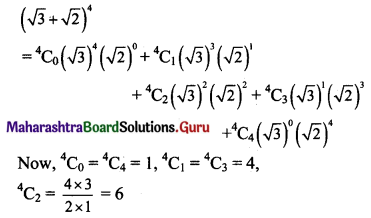
Maharashtra Board 11th Maths Solutions Chapter 4 Methods of Induction and Binomial Theorem Ex 4.2 Q1 (i)
∴ (√3 + √2)4 = 1(9) (1) + 4(3√3) (√2) + 6(3)(2) + 4(√3) (2√2) + 1(1)(4)
= 9 + 12√6 + 36 + 8√6 + 4
= 49 + 20√6

(ii) (√5 – √2)5
Solution:
Here, a = √5, b = √2 and n = 5.
Using binomial theorem,
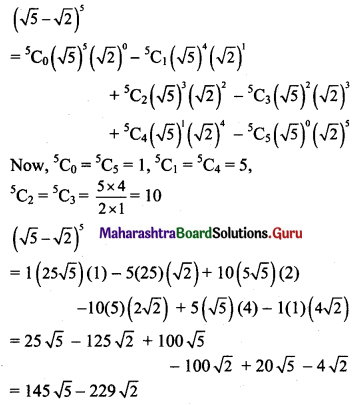
Maharashtra Board 11th Maths Solutions Chapter 4 Methods of Induction and Binomial Theorem Ex 4.2 Q1 (ii)

Maharashtra Board 11th Maths Solutions Chapter 4 Methods of Induction and Binomial Theorem Ex 4.2

Question 2.
Expand:
(i) (2x2 + 3)4
Solution:
Here, a = 2x2, b = 3 and n = 4.
Using binomial theorem,
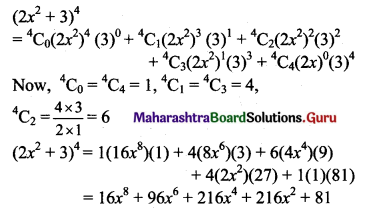
Maharashtra Board 11th Maths Solutions Chapter 4 Methods of Induction and Binomial Theorem Ex 4.2 Q2 (i)

(ii) \(\left(2 x-\frac{1}{x}\right)^{6}\)
Solution:
Here, a = 2x, b = \(\frac{1}{x}\) and n = 6.
Using binomial theorem,
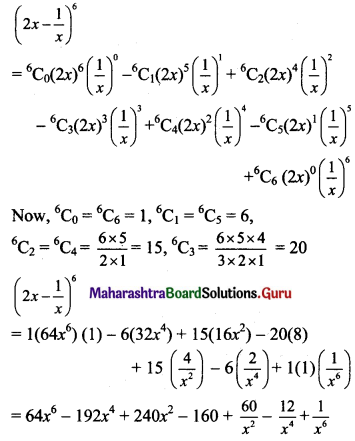
Maharashtra Board 11th Maths Solutions Chapter 4 Methods of Induction and Binomial Theorem Ex 4.2 Q2 (ii)

Question 3.
Find the value of
(i) (√3 + 1)4 – (√3 – 1)4
Solution:
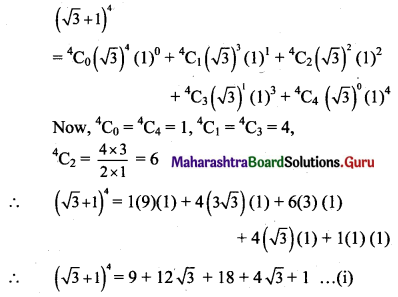
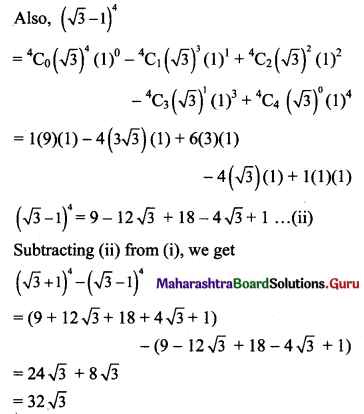
Maharashtra Board 11th Maths Solutions Chapter 4 Methods of Induction and Binomial Theorem Ex 4.2 Q3 (i)
Maharashtra Board 11th Maths Solutions Chapter 4 Methods of Induction and Binomial Theorem Ex 4.2 Q3 (i).1

(ii) (2 + √5)5 + (2 – √5)5
Solution:
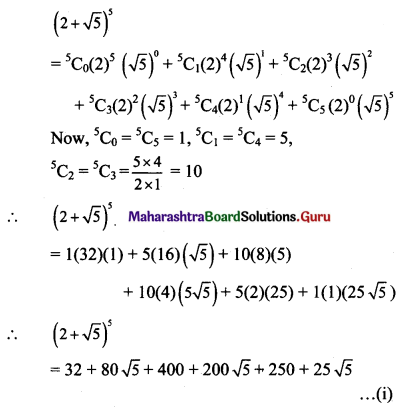
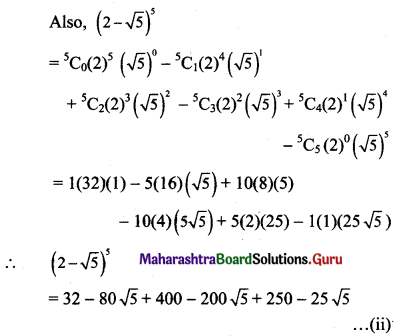
Maharashtra Board 11th Maths Solutions Chapter 4 Methods of Induction and Binomial Theorem Ex 4.2 Q3 (ii)
Maharashtra Board 11th Maths Solutions Chapter 4 Methods of Induction and Binomial Theorem Ex 4.2 Q3 (ii).1
Adding (i) and (ii), we get
∴ (2 + √5 )5 + (2 – √5)5 = (32 + 80√5 + 400 + 200√5 + 250 + 25√5) + (32 – 80√5 + 400 – 200√5+ 250 – 25√5 )
= 64 + 800 + 500
= 1364

Maharashtra Board 11th Maths Solutions Chapter 4 Methods of Induction and Binomial Theorem Ex 4.2

Question 4.
Prove that:
(i) (√3 + √2)6 + (√3 – √2)6 = 970
Solution:
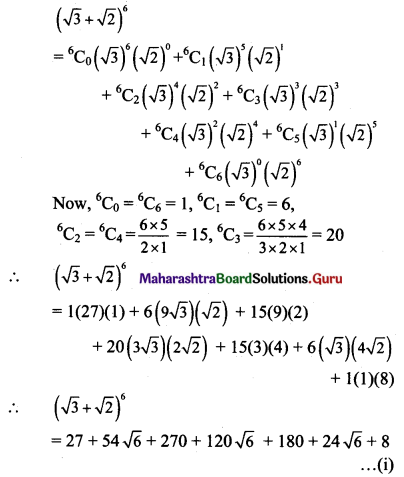
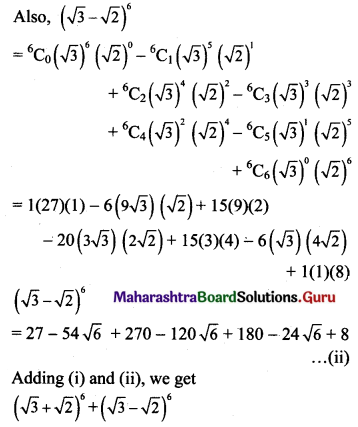
Maharashtra Board 11th Maths Solutions Chapter 4 Methods of Induction and Binomial Theorem Ex 4.2 Q4 (i)
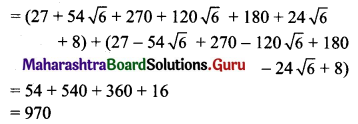
Maharashtra Board 11th Maths Solutions Chapter 4 Methods of Induction and Binomial Theorem Ex 4.2 Q4 (i).1
Maharashtra Board 11th Maths Solutions Chapter 4 Methods of Induction and Binomial Theorem Ex 4.2 Q4 (i).2

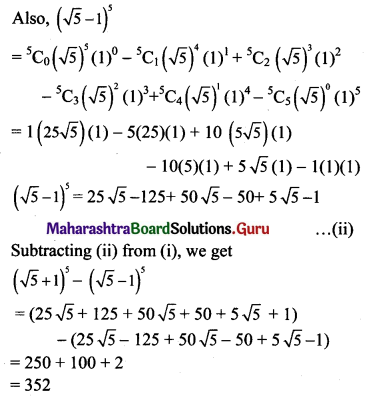
(ii) (√5 + 1)5 – (√5 – 1)5 = 352
Solution:
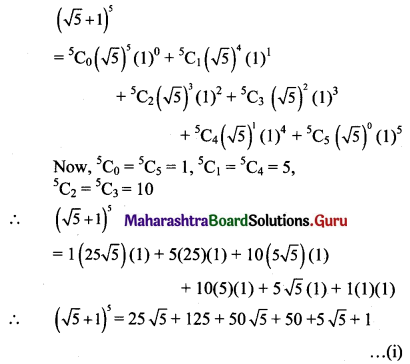
Maharashtra Board 11th Maths Solutions Chapter 4 Methods of Induction and Binomial Theorem Ex 4.2 Q4 (ii)
Maharashtra Board 11th Maths Solutions Chapter 4 Methods of Induction and Binomial Theorem Ex 4.2 Q4 (ii).1

Question 5.
Using binomial theorem, find the value of
(i) (102)4
Solution:
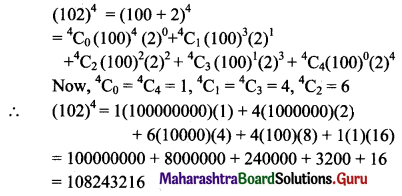
Maharashtra Board 11th Maths Solutions Chapter 4 Methods of Induction and Binomial Theorem Ex 4.2 Q5 (i)

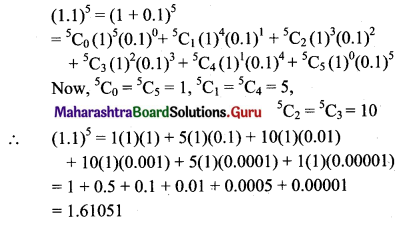
(ii) (1.1)5
Solution:
Maharashtra Board 11th Maths Solutions Chapter 4 Methods of Induction and Binomial Theorem Ex 4.2 Q5 (ii)

Maharashtra Board 11th Maths Solutions Chapter 4 Methods of Induction and Binomial Theorem Ex 4.2

Question 6.
Using binomial theorem, find the value of
(i) (9.9)3
Solution:
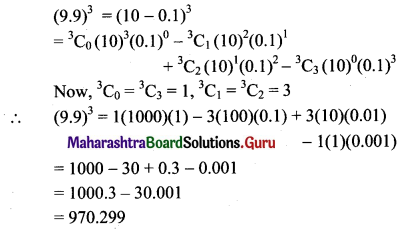
Maharashtra Board 11th Maths Solutions Chapter 4 Methods of Induction and Binomial Theorem Ex 4.2 Q6 (i)

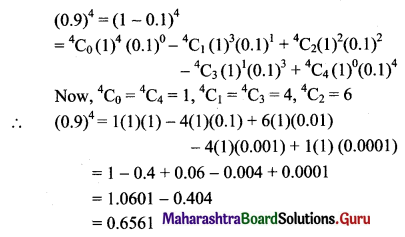
(ii) (0.9)4
Solution:
Maharashtra Board 11th Maths Solutions Chapter 4 Methods of Induction and Binomial Theorem Ex 4.2 Q6 (ii)

Question 7.
Without expanding, find the value of
(i) (x + 1)4 – 4(x + 1)3 (x – 1) + 6(x + 1)2 (x – 1)2 – 4(x + 1) (x – 1)3 + (x – 1)4
Solution:
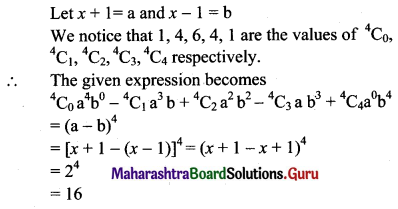
Maharashtra Board 11th Maths Solutions Chapter 4 Methods of Induction and Binomial Theorem Ex 4.2 Q7 (i)

(ii) (2x – 1)4 + 4(2x – 1)3 (3 – 2x) + 6(2x – 1)2 (3 – 2x)2 + 4(2x – 1)1 (3 – 2x)3 + (3 – 2x)4
Solution:
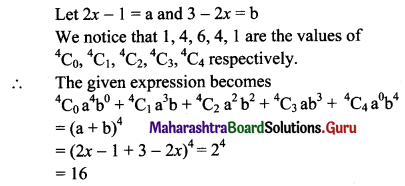
Maharashtra Board 11th Maths Solutions Chapter 4 Methods of Induction and Binomial Theorem Ex 4.2 Q7 (ii)

Maharashtra Board 11th Maths Solutions Chapter 4 Methods of Induction and Binomial Theorem Ex 4.2

Question 8.
Find the value of (1.02)6, correct upto four places of decimals.
Solution:
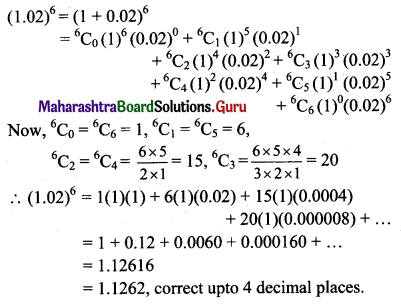
Maharashtra Board 11th Maths Solutions Chapter 4 Methods of Induction and Binomial Theorem Ex 4.2 Q8

Question 9.
Find the value of (1.01)5, correct upto three places of decimals.
Solution:
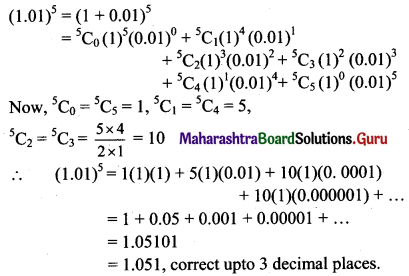
Maharashtra Board 11th Maths Solutions Chapter 4 Methods of Induction and Binomial Theorem Ex 4.2 Q9

Maharashtra Board 11th Maths Solutions Chapter 4 Methods of Induction and Binomial Theorem Ex 4.2

Question 10.
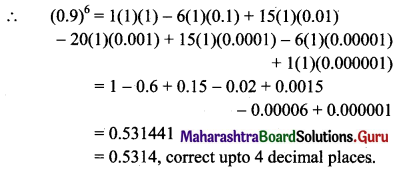
Find the value of (0.9)6, correct upto four places of decimals.
Solution:
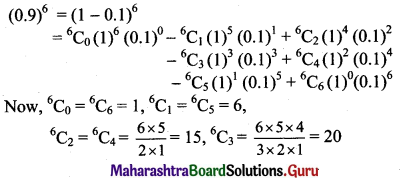
Maharashtra Board 11th Maths Solutions Chapter 4 Methods of Induction and Binomial Theorem Ex 4.2 Q10
Maharashtra Board 11th Maths Solutions Chapter 4 Methods of Induction and Binomial Theorem Ex 4.2 Q10.1

Maharashtra Board 12th Commerce Maths Solutions Chapter 3 Differentiation Ex 3.6

Balbharati Maharashtra State Board 12th Commerce Maths Solution Book Pdf Chapter 3 Differentiation Ex 3.6 Questions and Answers.

Maharashtra State Board 12th Commerce Maths Solutions Chapter 3 Differentiation Ex 3.6

1. Find \(\frac{d^{2} y}{d x^{2}}\) if,

Question 1.
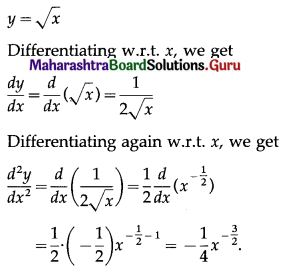
y = √x
Solution:
Maharashtra Board 12th Commerce Maths Solutions Chapter 3 Differentiation Ex 3.6 I Q1

Question 2.
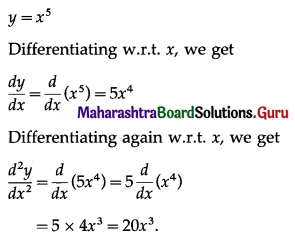
y = x5
Solution:
Maharashtra Board 12th Commerce Maths Solutions Chapter 3 Differentiation Ex 3.6 I Q2

Maharashtra Board 12th Commerce Maths Solutions Chapter 3 Differentiation Ex 3.6

Question 3.
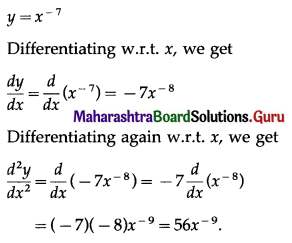
y = x-7
Solution:
Maharashtra Board 12th Commerce Maths Solutions Chapter 3 Differentiation Ex 3.6 I Q3

2. Find \(\frac{d^{2} y}{d x^{2}}\) if,

Question 1.
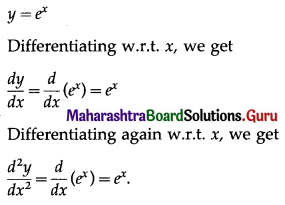
y = ex
Solution:
Maharashtra Board 12th Commerce Maths Solutions Chapter 3 Differentiation Ex 3.6 II Q1

Question 2.
y = e(2x+1)
Solution:
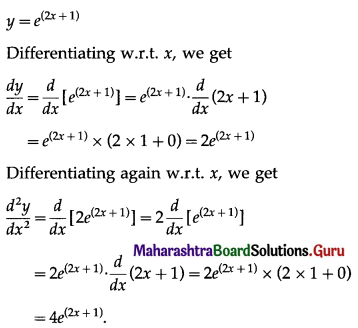
Maharashtra Board 12th Commerce Maths Solutions Chapter 3 Differentiation Ex 3.6 II Q2

Maharashtra Board 12th Commerce Maths Solutions Chapter 3 Differentiation Ex 3.6

Question 3.
y = elog x
Solution:
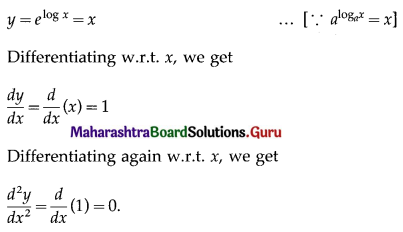
Maharashtra Board 12th Commerce Maths Solutions Chapter 3 Differentiation Ex 3.6 II Q3

Maharashtra Board 12th Commerce Maths Solutions Chapter 3 Differentiation Ex 3.5

Balbharati Maharashtra State Board 12th Commerce Maths Solution Book Pdf Chapter 3 Differentiation Ex 3.5 Questions and Answers.

Maharashtra State Board 12th Commerce Maths Solutions Chapter 3 Differentiation Ex 3.5

1. Find \(\frac{d y}{d x}\) if:

Question 1.
x = at2, y = 2at
Solution:
x = at2, y = 2at
Differentiating x and y w.r.t. t, we get
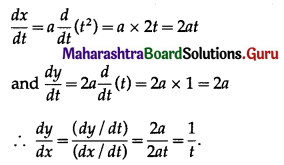
Maharashtra Board 12th Commerce Maths Solutions Chapter 3 Differentiation Ex 3.5 I Q1

Question 2.
x = 2at2, y = at4
Solution:
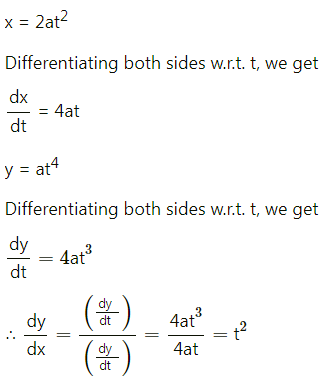
Maharashtra Board 12th Commerce Maths Solutions Chapter 3 Differentiation Ex 3.5 I Q2

Maharashtra Board 12th Commerce Maths Solutions Chapter 3 Differentiation Ex 3.5

Question 3.
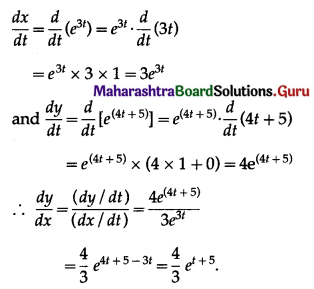
x = e3t, y = e(4t+5)
Solution:
x = e3t, y = e(4t+5)
Differentiating x and y w.r.t. t, we get
Maharashtra Board 12th Commerce Maths Solutions Chapter 3 Differentiation Ex 3.5 I Q3

2. Find \(\frac{d y}{d x}\) if:

Question 1.
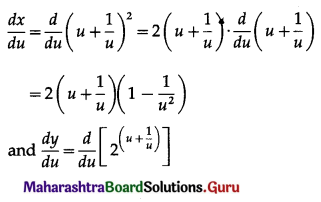
x = \(\left(u+\frac{1}{u}\right)^{2}\), y = \((2)^{\left(u+\frac{1}{u}\right)}\)
Solution:
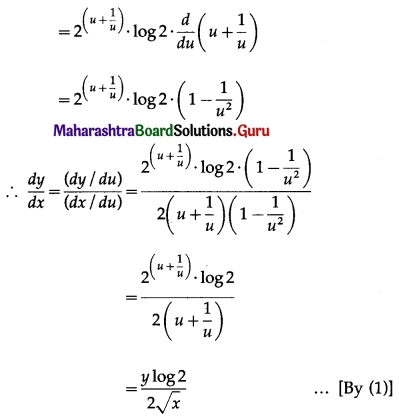
x = \(\left(u+\frac{1}{u}\right)^{2}\), y = \((2)^{\left(u+\frac{1}{u}\right)}\) ……(1)
Differentiating x and y w.r.t. u, we get,
Maharashtra Board 12th Commerce Maths Solutions Chapter 3 Differentiation Ex 3.5 II Q1
Maharashtra Board 12th Commerce Maths Solutions Chapter 3 Differentiation Ex 3.5 II Q1.1

Question 2.
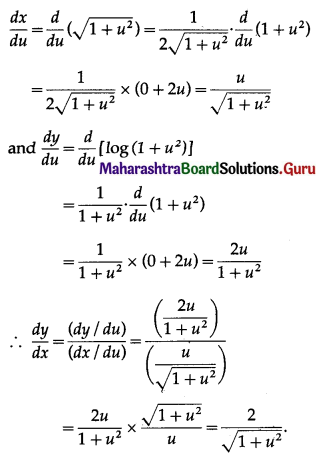
x = \(\sqrt{1+u^{2}}\), y = log(1 + u2)
Solution:
x = \(\sqrt{1+u^{2}}\), y = log(1 + u2) ……(1)
Differentiating x and y w.r.t. u, we get,
Maharashtra Board 12th Commerce Maths Solutions Chapter 3 Differentiation Ex 3.5 II Q2

Maharashtra Board 12th Commerce Maths Solutions Chapter 3 Differentiation Ex 3.5

Question 3.
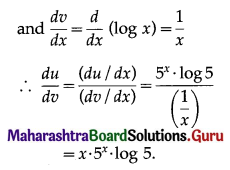
Differentiate 5x with respect to log x.
Solution:
Let u = 5x and v = log x
Then we want to find \(\frac{d u}{d v}\)
Differentiating u and v w.r.t. x, we get
\(\frac{d u}{d x}=\frac{d}{d x}\left(5^{x}\right)=5^{x} \cdot \log 5\)
Maharashtra Board 12th Commerce Maths Solutions Chapter 3 Differentiation Ex 3.5 II Q3

3. Solve the following:

Question 1.
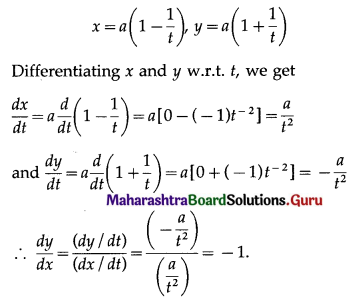
If x = \(a\left(1-\frac{1}{t}\right)\), y = \(a\left(1+\frac{1}{t}\right)\), then show that \(\frac{d y}{d x}\) = -1
Solution:
Maharashtra Board 12th Commerce Maths Solutions Chapter 3 Differentiation Ex 3.5 III Q1

Question 2.
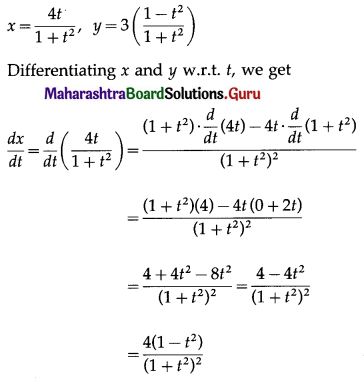
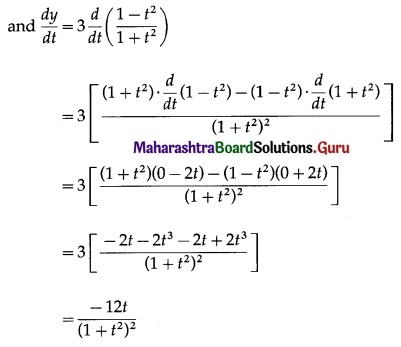
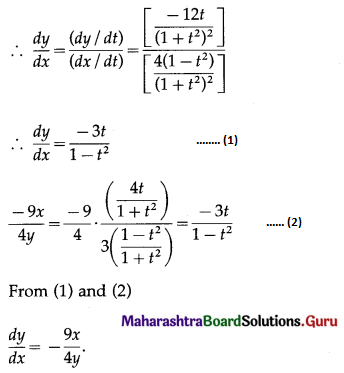
If x = \(\frac{4 t}{1+t^{2}}\), y = \(3\left(\frac{1-t^{2}}{1+t^{2}}\right)\), then show that \(\frac{d y}{d x}=-\frac{9 x}{4 y}\)
Solution:
Maharashtra Board 12th Commerce Maths Solutions Chapter 3 Differentiation Ex 3.5 III Q2
Maharashtra Board 12th Commerce Maths Solutions Chapter 3 Differentiation Ex 3.5 III Q2.1
Maharashtra Board 12th Commerce Maths Solutions Chapter 3 Differentiation Ex 3.5 III Q2.2

Maharashtra Board 12th Commerce Maths Solutions Chapter 3 Differentiation Ex 3.5

Question 3.
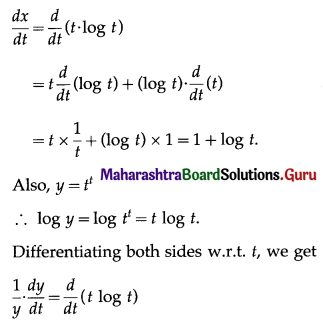
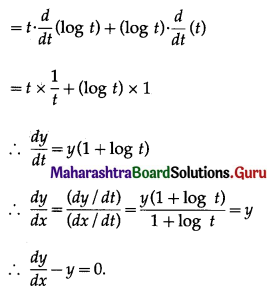
If x = t . log t, y = tt, then show that \(\frac{d y}{d x}\) – y = 0.
Solution:
x = t log t
Differentiating w.r.t. t, we get
Maharashtra Board 12th Commerce Maths Solutions Chapter 3 Differentiation Ex 3.5 III Q3
Maharashtra Board 12th Commerce Maths Solutions Chapter 3 Differentiation Ex 3.5 III Q3.1

Maharashtra Board 11th Maths Solutions Chapter 2 Sequences and Series Ex 2.5

Balbharti Maharashtra State Board 11th Maths Book Solutions Pdf Chapter 2 Sequences and Series Ex 2.5 Questions and Answers.

Maharashtra State Board 11th Maths Solutions Chapter 2 Sequences and Series Ex 2.5

Question 1.
Find Sn of the following arithmetico-geometric sequences.
(i) 2, 4x, 6x2, 8x3, 10x4, ……
Solution:
2, 4x, 6x2, 8x3, 10x4, ……
Here, 2, 4, 6, 8, 10,… are in A.P.
∴ a = 2, d = 2
∴ nth term = a + (n – 1)d
= 2 + (n – 1)(2)
= 2n
Maharashtra Board 11th Maths Solutions Chapter 2 Sequences and Series Ex 2.5 Q1 (i)

(ii) 1, 4x, 7x2, 10x3, 13x4, ……
Solution:
1, 4x, 7x2, 10x3, 13x4, ……
Here, 1, 4, 7, 10, 13,… are in A.P.
a = 1, d = 3
∴ nth term = a + (n – 1)d
= 1 + (n – 1)(3)
= 3n – 2
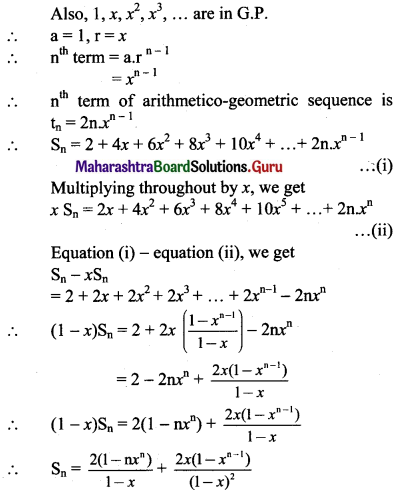
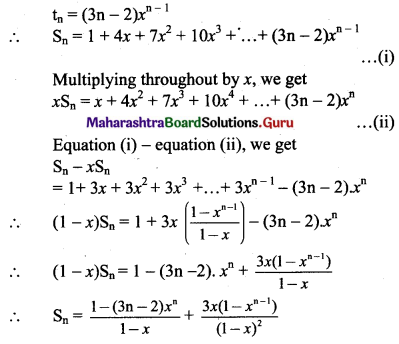
Also, 1, x, x2, x3,… are in G.P.
∴ a = 1, r = x,
nth term = arn-1 = xn-1
nth term of arithmetico-geometric sequence is
Maharashtra Board 11th Maths Solutions Chapter 2 Sequences and Series Ex 2.5 Q1 (ii)

Maharashtra Board 11th Maths Solutions Chapter 2 Sequences and Series Ex 2.5

(iii) 1, 2 × 3, 3 × 9, 4 × 27, 5 × 81, ……
Solution:
1, 2 × 3, 3 × 9, 4 × 27, 5 × 81, …..
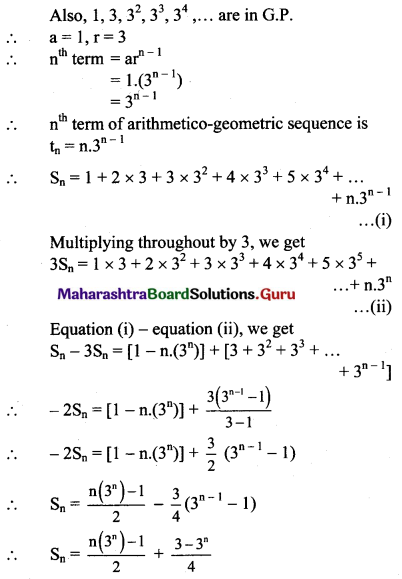
Here, 1, 2, 3, 4, 5, … are in A.P.
∴ a = 1, d = 1
∴ nth term = a + (n – 1)d
= 1 + (n – 1)1
= n
Maharashtra Board 11th Maths Solutions Chapter 2 Sequences and Series Ex 2.5 Q1 (iii)

(iv) 3, 12, 36, 96, 240, ……
Solution:
3, 12, 36, 96, 240, ……
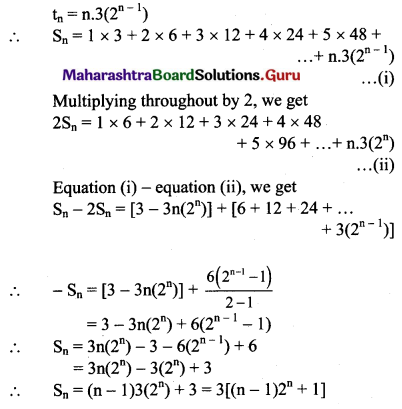
i.e., 1 × 3, 2 × 6, 3 × 12, 4 × 24, 5 × 48, …….
Here, 1, 2, 3, 4, 5, ….. are in A.P.
∴ nth term = n
Also, 3, 6, 12, 24, 48, ….. are in G.P.
∴ a = 3, r = 2
∴ nth term = arn-1 = 3 . (2n-1)
∴ nth term of arithmetico-geometric sequence is
Maharashtra Board 11th Maths Solutions Chapter 2 Sequences and Series Ex 2.5 Q1 (iv)

Question 2.
Find the sum to infinity of the following arithmetico-geometric sequence.
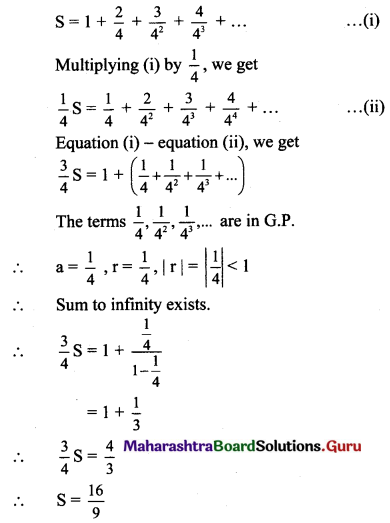
(i) \(1, \frac{2}{4}, \frac{3}{16}, \frac{4}{64}, \ldots\)
Solution:
Maharashtra Board 11th Maths Solutions Chapter 2 Sequences and Series Ex 2.5 Q2 (i)

Maharashtra Board 11th Maths Solutions Chapter 2 Sequences and Series Ex 2.5

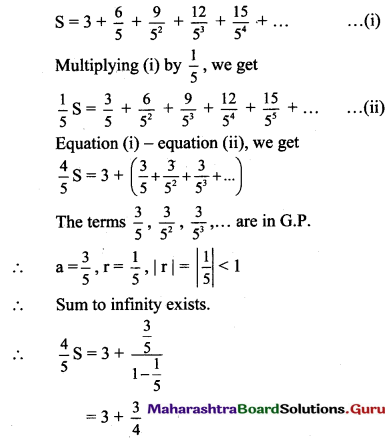
(ii) \(3, \frac{6}{5}, \frac{9}{25}, \frac{12}{125}, \frac{15}{625}, \ldots\)
Solution:
Maharashtra Board 11th Maths Solutions Chapter 2 Sequences and Series Ex 2.5 Q2 (ii)
∴ \(\frac{4}{5} S=\frac{15}{4}\)
∴ S = \(\frac{75}{16}\)

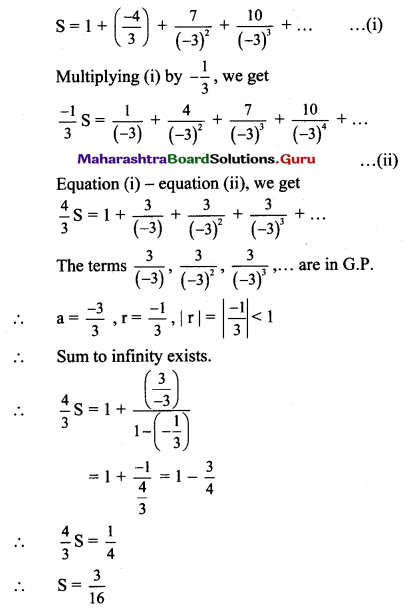
(iii) \(1, \frac{-4}{3}, \frac{7}{9}, \frac{-10}{27} \ldots\)
Solution:
Maharashtra Board 11th Maths Solutions Chapter 2 Sequences and Series Ex 2.5 Q2 (iii)

Maharashtra Board 12th Commerce Maths Solutions Chapter 3 Differentiation Ex 3.4

Balbharati Maharashtra State Board 12th Commerce Maths Solution Book Pdf Chapter 3 Differentiation Ex 3.4 Questions and Answers.

Maharashtra State Board 12th Commerce Maths Solutions Chapter 3 Differentiation Ex 3.4

1. Find \(\frac{d y}{d x}\) if:

Question 1.
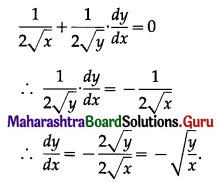
√x + √y = √a
Solution:
√x + √y = √a
Differentiating both sides w.r.t. x, we get
Maharashtra Board 12th Commerce Maths Solutions Chapter 3 Differentiation Ex 3.4 I Q1

Question 2.
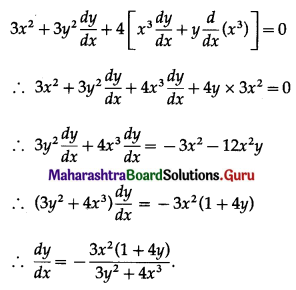
x3 + y3 + 4x3y = 0
Solution:
x3 + y3 + 4x3y = 0
Differentiating both sides w.r.t. x, we get
Maharashtra Board 12th Commerce Maths Solutions Chapter 3 Differentiation Ex 3.4 I Q2

Maharashtra Board 12th Commerce Maths Solutions Chapter 3 Differentiation Ex 3.4

Question 3.
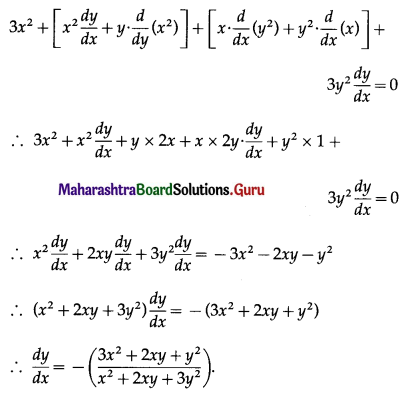
x3 + x2y + xy2 + y3 = 81
Solution:
x3 + x2y + xy2 + y3 = 81
Differentiating both sides w.r.t. x, we get
Maharashtra Board 12th Commerce Maths Solutions Chapter 3 Differentiation Ex 3.4 I Q3

2. Find \(\frac{d y}{d x}\) if:

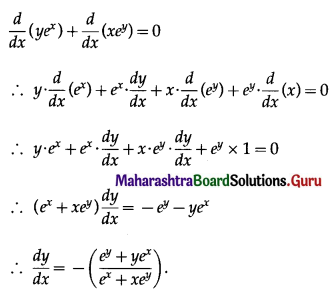
Question 1.
y.ex + x.ey = 1
Solution:
y.ex + x.ey = 1
Differentiating both sides w.r.t. x, we get
Maharashtra Board 12th Commerce Maths Solutions Chapter 3 Differentiation Ex 3.4 II Q1

Question 2.
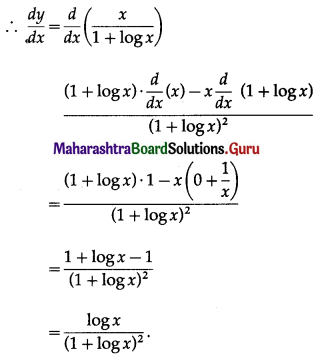
xy = e(x-y)
Solution:
xy = e(x-y)
∴ log xy = log e(x-y)
∴ y log x = (x – y) log e
∴ y log x = x – y …..[∵ log e = 1]
∴ y + y log x = x
∴ y(1 + log x) = x
∴ y = \(\frac{x}{1+\log x}\)
Maharashtra Board 12th Commerce Maths Solutions Chapter 3 Differentiation Ex 3.4 II Q2

Maharashtra Board 12th Commerce Maths Solutions Chapter 3 Differentiation Ex 3.4

Question 3.
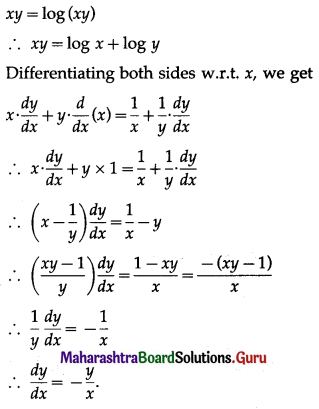
xy = log(xy)
Solution:
xy = log (xy)
∴ xy = log x + log y
Differentiating both sides w.r.t. x, we get
Maharashtra Board 12th Commerce Maths Solutions Chapter 3 Differentiation Ex 3.4 II Q3

3. Solve the following:

Question 1.
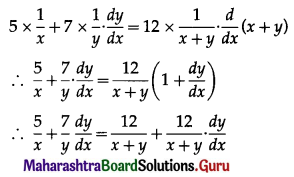
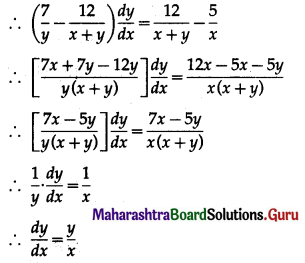
If x5 . y7 = (x + y)12, then show that \(\frac{d y}{d x}=\frac{y}{x}\)
Solution:
x5 . y7 = (x + y)12
∴ log(x5 . y7) = log(x + y)12
∴ log x5 + log y7 = log(x + y)12
∴ 5 log x + 7 log y = 12 log (x + y)
Differentiating both sides w.r.t. x, we get
Maharashtra Board 12th Commerce Maths Solutions Chapter 3 Differentiation Ex 3.4 III Q1
Maharashtra Board 12th Commerce Maths Solutions Chapter 3 Differentiation Ex 3.4 III Q1.1

Question 2.
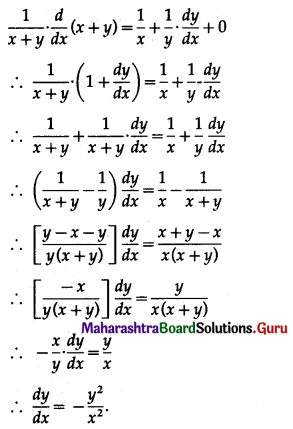
If log(x + y) = log(xy) + a, then show that \(\frac{d y}{d x}=\frac{-y^{2}}{x^{2}}\)
Solution:
log (x + y) = log (xy) + a
∴ log(x + y) = log x + log y + a
Differentiating both sides w.r.t. x, we get
Maharashtra Board 12th Commerce Maths Solutions Chapter 3 Differentiation Ex 3.4 III Q2

Maharashtra Board 12th Commerce Maths Solutions Chapter 3 Differentiation Ex 3.4

Question 3.
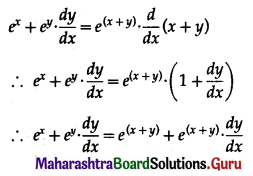
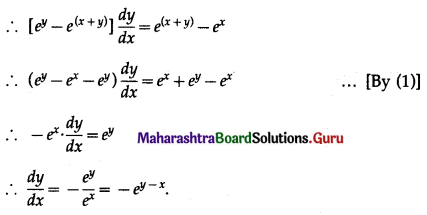
If ex + ey = e(x+y), then show that \(\frac{d y}{d x}=-e^{y-x}\).
Solution:
ex + ey = e(x+y) ……….(1)
Differentiating both sides w.r.t. x, we get
Maharashtra Board 12th Commerce Maths Solutions Chapter 3 Differentiation Ex 3.4 III Q3
Maharashtra Board 12th Commerce Maths Solutions Chapter 3 Differentiation Ex 3.4 III Q3.1

Maharashtra Board 12th Commerce Maths Solutions Chapter 3 Differentiation Ex 3.3

Balbharati Maharashtra State Board 12th Commerce Maths Solution Book Pdf Chapter 3 Differentiation Ex 3.3 Questions and Answers.

Maharashtra State Board 12th Commerce Maths Solutions Chapter 3 Differentiation Ex 3.3

1. Find \(\frac{d y}{d x}\) if:

Question 1.
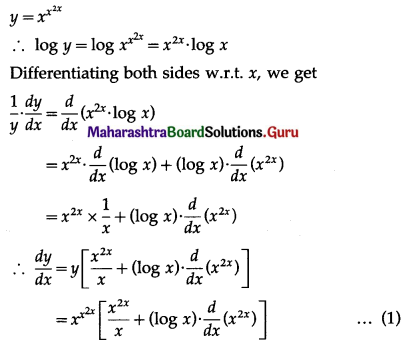
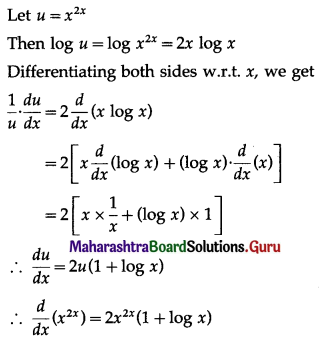
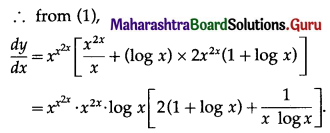
y = \(x^{x^{2 x}}\)
Solution:
Maharashtra Board 12th Commerce Maths Solutions Chapter 3 Differentiation Ex 3.3 I Q1
Maharashtra Board 12th Commerce Maths Solutions Chapter 3 Differentiation Ex 3.3 I Q1.1
Maharashtra Board 12th Commerce Maths Solutions Chapter 3 Differentiation Ex 3.3 I Q1.2

Question 2.
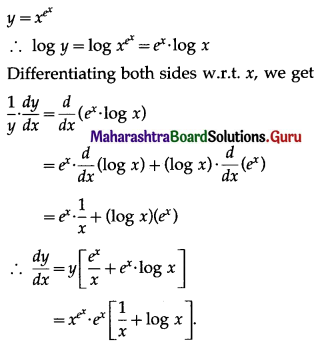
y = \(x^{e^{x}}\)
Solution:
Maharashtra Board 12th Commerce Maths Solutions Chapter 3 Differentiation Ex 3.3 I Q2

Maharashtra Board 12th Commerce Maths Solutions Chapter 3 Differentiation Ex 3.3

Question 3.
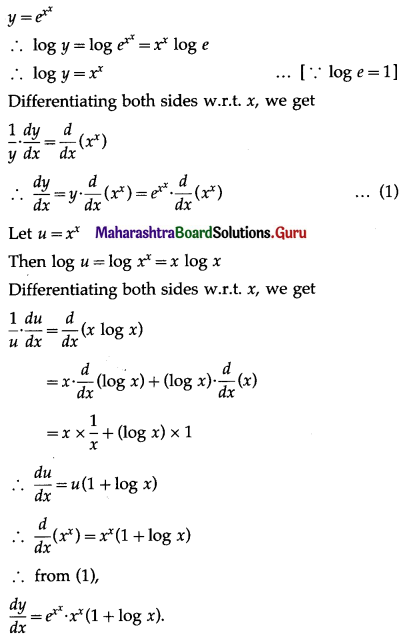
y = \(e^{x^{x}}\)
Solution:
Maharashtra Board 12th Commerce Maths Solutions Chapter 3 Differentiation Ex 3.3 I Q3

2. Find \(\frac{d y}{d x}\) if:

Question 1.
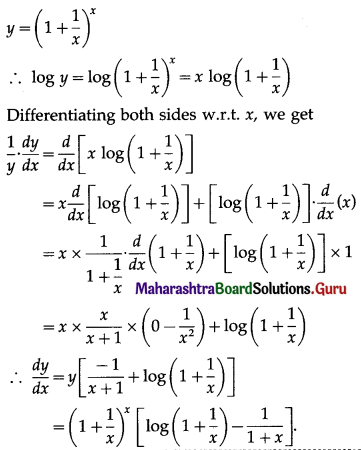
y = \(\left(1+\frac{1}{x}\right)^{x}\)
Solution:
Maharashtra Board 12th Commerce Maths Solutions Chapter 3 Differentiation Ex 3.3 II Q1

Question 2.
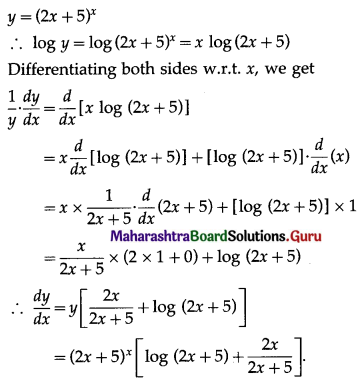
y = (2x + 5)x
Solution:
Maharashtra Board 12th Commerce Maths Solutions Chapter 3 Differentiation Ex 3.3 II Q2

Maharashtra Board 12th Commerce Maths Solutions Chapter 3 Differentiation Ex 3.3

Question 3.
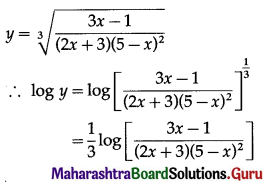
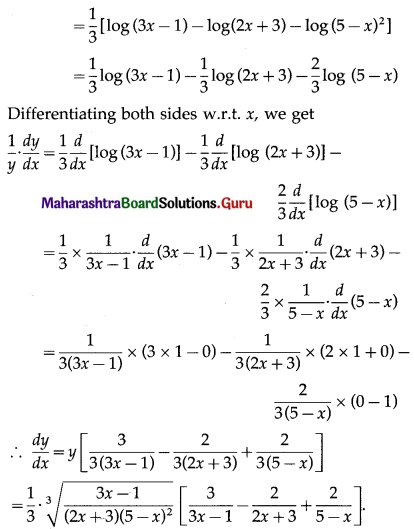
y = \(\sqrt[3]{\frac{(3 x-1)}{(2 x+3)(5-x)^{2}}}\)
Solution:
Maharashtra Board 12th Commerce Maths Solutions Chapter 3 Differentiation Ex 3.3 II Q3
Maharashtra Board 12th Commerce Maths Solutions Chapter 3 Differentiation Ex 3.3 II Q3.1

3. Find \(\frac{d y}{d x}\) if:

Question 1.
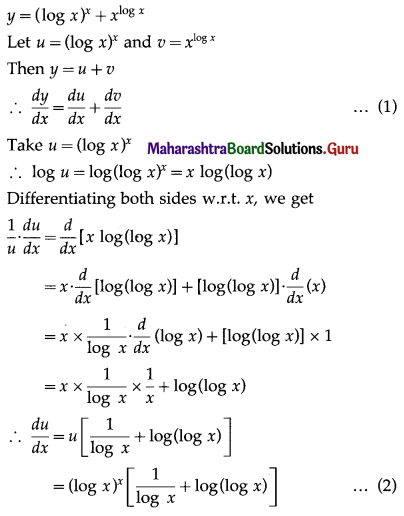
y = (log x)x + xlog x
Solution:
Maharashtra Board 12th Commerce Maths Solutions Chapter 3 Differentiation Ex 3.3 III Q1
Maharashtra Board 12th Commerce Maths Solutions Chapter 3 Differentiation Ex 3.3 III Q1.1

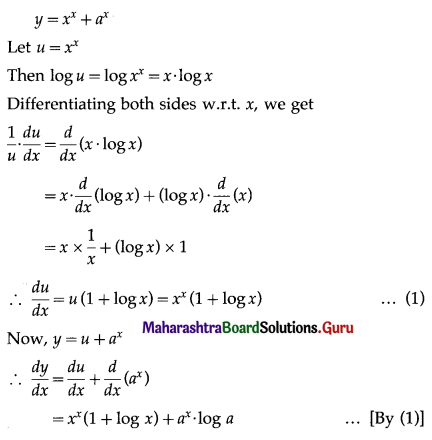
Question 2.
y = xx + ax
Solution:
Maharashtra Board 12th Commerce Maths Solutions Chapter 3 Differentiation Ex 3.3 III Q2

Maharashtra Board 12th Commerce Maths Solutions Chapter 3 Differentiation Ex 3.3

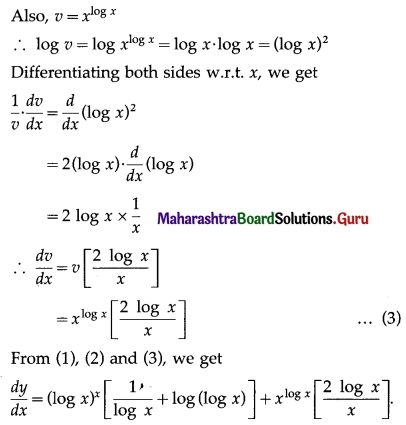
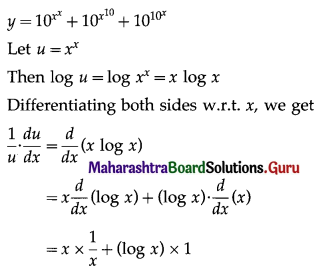
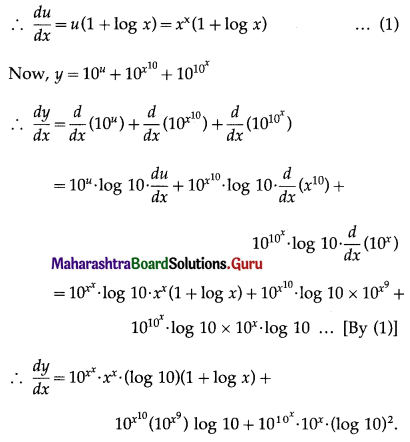
Question 3.
y = \(10^{x^{x}}+10^{x^{10}}+10^{10^{x}}\)
Solution:
Maharashtra Board 12th Commerce Maths Solutions Chapter 3 Differentiation Ex 3.3 III Q3
Maharashtra Board 12th Commerce Maths Solutions Chapter 3 Differentiation Ex 3.3 III Q3.1

Maharashtra Board 12th Commerce Maths Solutions Chapter 3 Differentiation Ex 3.2

Balbharati Maharashtra State Board 12th Commerce Maths Solution Book Pdf Chapter 3 Differentiation Ex 3.2 Questions and Answers.

Maharashtra State Board 12th Commerce Maths Solutions Chapter 3 Differentiation Ex 3.2

1. Find the rate of change of demand (x) of a commodity with respect to price (y) if:

Question 1.
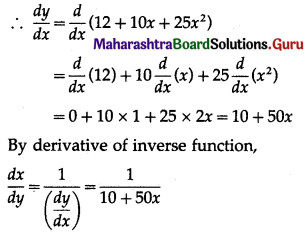
y = 12 + 10x + 25x2
Solution:
Given y = 12 + 10x + 25x2
Maharashtra Board 12th Commerce Maths Solutions Chapter 3 Differentiation Ex 3.2 I Q1
Hence, the rate of change of demand (x) with respect to price (y) \(=\frac{d x}{d y}=\frac{1}{10+50 x}\)

Question 2.
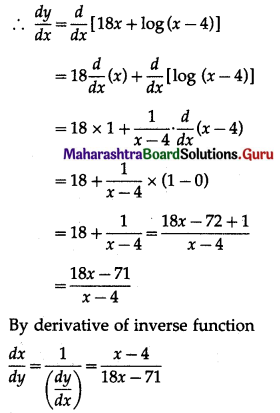
y = 18x + log(x – 4)
Solution:
Given y = 18x + log (x – 4)
Maharashtra Board 12th Commerce Maths Solutions Chapter 3 Differentiation Ex 3.2 I Q2
Hence, the rate of change of demand (x) with respect to price (y) \(=\frac{d x}{d y}=\frac{x-4}{18 x-71}\)

Maharashtra Board 12th Commerce Maths Solutions Chapter 3 Differentiation Ex 3.2

Question 3.
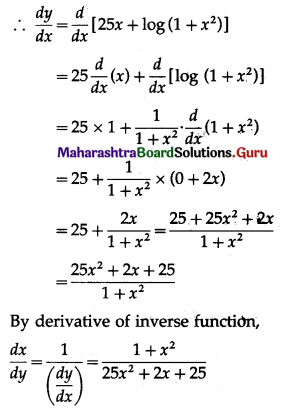
y = 25x + log(1 + x2)
Solution:
Given y = 25x + log(1 + x2)
Maharashtra Board 12th Commerce Maths Solutions Chapter 3 Differentiation Ex 3.2 I Q3
Hence, the rate of change of demand (x) with respect to price (y) \(\frac{d x}{d y}=\frac{1+x^{2}}{25 x^{2}+2 x+25}\)

2. Find the marginal demand of a commodity where demand is x and price is y.

Question 1.
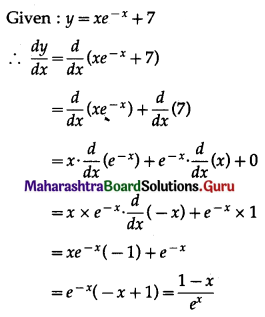
y = xe-x + 7
Solution:
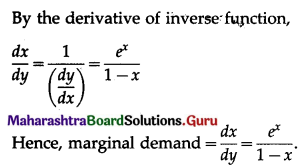
Maharashtra Board 12th Commerce Maths Solutions Chapter 3 Differentiation Ex 3.2 II Q1
Maharashtra Board 12th Commerce Maths Solutions Chapter 3 Differentiation Ex 3.2 II Q1.1

Question 2.
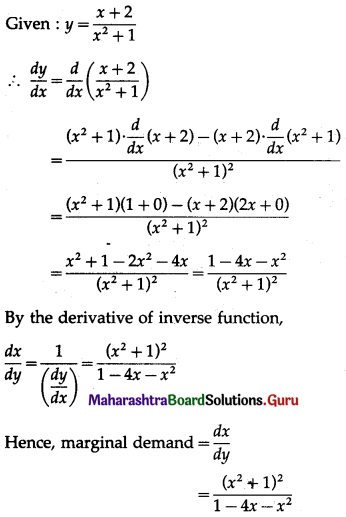
y = \(\frac{x+2}{x^{2}+1}\)
Solution:
Maharashtra Board 12th Commerce Maths Solutions Chapter 3 Differentiation Ex 3.2 II Q2

Maharashtra Board 12th Commerce Maths Solutions Chapter 3 Differentiation Ex 3.2

Question 3.
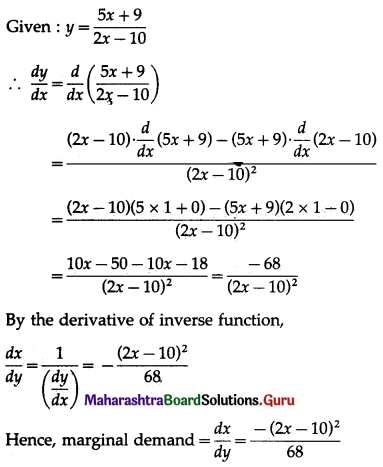
y = \(\frac{5 x+9}{2 x-10}\)
Solution:
Maharashtra Board 12th Commerce Maths Solutions Chapter 3 Differentiation Ex 3.2 II Q3

Maharashtra Board 12th Commerce Maths Solutions Chapter 1 Mathematical Logic Ex 1.9

Balbharati Maharashtra State Board 12th Commerce Maths Solution Book Pdf Chapter 1 Mathematical Logic Ex 1.9 Questions and Answers.

Maharashtra State Board 12th Commerce Maths Solutions Chapter 1 Mathematical Logic Ex 1.9

Question 1.
Without using truth table, show that
(i) p ↔ q ≡ (p ∧ q) ∨ (~p ∧ ~q)
Solution:
LHS = p ↔ q
≡ (p → q) ∧ (q → p)
≡ (~p ∨ q) ∧ (~(q ∨ p) …..(Conditional Law)
≡ [~p ∧ (~(q ∨ p)] ∨ [q ∧ (~q ∨ p] …..(Distributive Law)
≡ [(~p ∧ ~q) ∨ (~p ∧ p)] ∨ [(q ∧ ~q) ∨ (q ∧ p)] ……(Distributive Law)
≡ [(~p ∧ ~q) ∨ c] ∨ [c ∨ (q ∧ p)] …..(Complement Law)
≡ (~p ∧ ~q) ∨ (q ∧ p) ……(Identity Law)
≡ (~p ∧ ~q) ∨ (p ∧ q) ……(Commutative Law)
≡ (p ∧ q) ∨ (~p∧ q) ……(Commutative Law)
≡ RHS.

(ii) p ∧ [~p ∨ q) ∨ (~q)] ≡ p
Solution:
LHS = p ∧ [(~p ∨ q) ∨ (~q)]
≡ p ∧ [~p ∨ (q ∨ ~q)] ……(Associative Law)
≡ p ∧ [~p ∨ t] …….(Complement Law)
≡ p ∧ t ……(Identity Law)
≡ p ……(Identity Law)
= RHS.

Maharashtra Board 12th Commerce Maths Solutions Chapter 1 Mathematical Logic Ex 1.9

(iii) ~[(p ∧ q) → ~(q)] ≡ p ∧ q
Solution:
LHS = ~[(p ∧ q) → ~(~q)]
≡ (p ∧ q) ∧ ~(~q) ……(Negation of implication)
≡ (p ∧ q) ∧ q …..(Negation of negation)
≡ p ∧ (q ∧ q) …..(Associative Law)
≡ P ∧ q ……(Idempotent Law)
= RHS

(iv) ~r → ~(p ∧ q) ≡ [~(q → r)] → (~p)
Solution:
LHS = ~r → ~(p ∧ q)
≡ ~q → (~p ∨ ~q) ……(De Morgan’s Law)
≡ ~(~r) ∨ (~p ∨~q) …..(Conditional Law)
≡ r ∨ (~p ∨ ~q) …..(Involution Law)
≡ r ∨ ~q ∨ ~p …..(Commutative Law)
≡ (~q ∨ r) ∨ (~p) ……(Commutative Law)
≡ ~(q → r) ∨ (~p) ……(Conditional Law)
≡ ~(q → r) → (~p) ……(Conditional Law)
= RHS.

(v) (p ∨ q) → r ≡ (p → r) ∧ (q → r)
Solution:
LHS = (p ∨ q) → r
≡ ~(p → q) ∨ r ……..(Conditional Law)
≡ (~p ∧ ~q) ∨ r ……….(De Morgan’s Law)
≡ (~p ∨ r) ∧ (~q ∨ r) ………..(Distributive Law)
≡ (p → r) ∧ (q → r) …….(Conditional Law)
= RHS.

Maharashtra Board 12th Commerce Maths Solutions Chapter 1 Mathematical Logic Ex 1.9

Question 2.
Using the algebra of statement, prove that:
(i) [p ∧ (q ∨ r)] ∨ [~r ∧ ~q ∧ p] ≡ p
Solution:
LHS = [p ∧ (q ∨ r)] ∨ [ ~r ∧ ~q ∧ p]
≡ [p ∧ (q ∨ r)] ∨ [(~r ∧ ~q) ∧ p] ……(Associative Law)
≡ [p ∧ (q ∨ r)] ∨ [(~q ∧ ~r) ∧ p] ……(Commutative Law)
≡ [p ∧ (q ∨ r)] ∨ [ ~ (q ∨ r) ∧ p] ……(De Morgan’s Law)
≡ [p ∧ (q ∨ r)] ∨ [p ∧ ~(q ∨ r)] ……(Commutative Law)
≡ p ∧ [(q ∨ r) ∨ ~ (q ∨ r) ] …..(Distributive Law)
≡ p ∧ t …….(Complement Law)
≡ p ……(Identity Law)
= RHS.

(ii) (p ∧ q) ∨ (p ∧ ~q) ∨ (~p ∧ ~q) ≡ p ∨ ~q
Solution:
LHS = (p ∧ q) ∨ (p ∧ ~q) ∨ (~p ∧ ~ q)
≡ (p ∧ q) ∨ [(p ∧ ~q) ∨ (~p ∧ ~q)] ……(Associative Law)
≡ (p ∧ q) ∨ [(~q ∧ p) ∨ (~q ∧ ~p)] …..(CommutativeLaw)
≡ (p ∧ q) ∨ [ ~q ∧ (p ∨ ~ p)] …..(Distributive Law)
≡ (p ∧ q) ∨ (~q ∧ t) ……(Complement Law)
≡ (p ∧ q) ∨ (~q) …….(Identity Law)
≡ (p ∨ ~q) ∧ (q ∨ ~q) ……(Distributive Law)
≡ (p ∨ ~q) ∧ t …….(Complement Law)
≡ p ∨ ~q …..(Identity Law)
= RHS.

Maharashtra Board 12th Commerce Maths Solutions Chapter 1 Mathematical Logic Ex 1.9

(iii) (p ∨ q) ∧ (~p ∨ ~q) ≡ (p ∧ ~q) ∨ (~p ∧ q)
Solution:
LHS = (p ∨ q) ∧ (~p ∨ ~q)
≡ [p ∧ (~p ∨ ~q)] ∨ [q ∧ (~p ∨ ~q)] ……(Distributive Law)
≡ [(p ∧ ~p) ∨ (p ∧ ~q)] ∨ [q ∧ ~p) ∨ (q ∧ ~q)] ……(Distributive Law)
≡ [c ∨ (p ∧ ~q)] ∨ [(q ∧ ~p) ∨ c] ……(Complement Law)
≡ (p ∧ ~q) ∨ (q ∧ ~p) ……..(Identity Law)
≡ (p ∧ ~q) ∨ (~p ∧ q) ………(Commutative Law)
= RHS.

Maharashtra Board 12th Commerce Maths Solutions Chapter 1 Mathematical Logic Ex 1.8

Balbharati Maharashtra State Board 12th Commerce Maths Solution Book Pdf Chapter 1 Mathematical Logic Ex 1.8 Questions and Answers.

Maharashtra State Board 12th Commerce Maths Solutions Chapter 1 Mathematical Logic Ex 1.8

Question 1.
Write the negation of each of the following statements:
(i) All the stars are shining if it is night.
Solution:
The given statement can be written as:
If it is night, then all the stars are shining.
Let p : It is night.
q : All the stars are shining.
Then the symbolic form of the given statement is p → q
Since, ~(p → q) ≡ p ∧ ~q,
the negation of the given statement is ‘It is night and all the stars are not shining.’

(ii) ∀ n ∈ N, n + 1 > 0.
Solution:
The negation of the given statement is
‘∃ n ∈ N, such that n + 1 ≤ 0.’

(iii) ∃ n ∈ N, such that (n2 + 2) is odd number.
Solution:
The negation of the given statement is
‘∀ n ∈ N, n2 + 2 is not an odd number.’

(iv) Some continuous functions are differentiable.
Solution:
The negation of a given statement is ‘All continuous functions are not differentiable.’

Maharashtra Board 12th Commerce Maths Solutions Chapter 1 Mathematical Logic Ex 1.8

Question 2.
Using the rules of negation, write the negations of the following:
(i) (p → r) ∧ q
Solution:
The negation of (p → r) ∧ q is
~[(p → r) ∧ q] ≡ ~(p → r) ∨ (~q) …..[Negation of conjunction]
≡ (p ∧ ~r) ∨ (~q) ……[Negation of implication]

(ii) ~(p ∨ q) → r
Solution:
The negation of ~(p ∨ q) → r is
~[~(p ∨ q) → r] ≡ ~(p ∨ q) ∧ (~r) …..[Negation of implication]
≡ (~p ∧ ~q) ∧ (~r) ……[Negation of disjunction]

(iii) (~p ∧ q) ∧ (~q ∨ ~r)
Solution:
The negation of (~p ∧ q) ∧ (~q ∨ ~r) is
~[(~p ∧ q) ∧ (~q ∨ ~ r)] ≡ ~(~p ∧ q) ∨ ~(~q ∨ ~r) ……[Negation of conjunction]
≡ [~(~p) ∨ ~q] ∨ [~(~q) ∧ ~(~r)] … [Negation of conjunction and disjunction]
≡ (p ∨ ~q) ∨ (q ∧ r) …..[Negation of negation]

Question 3.
Write the converse, inverse, and contrapositive of the following statements:
(i) If it snows, then they do not drive the car.
Solution:
Let p : It snows.
q : They do not drive the car.
Then the symbolic form of the given statement is p → q.
Converse: q → p is the converse of p → q.
i.e. If they do not drive the car, then it snows.
Inverse: ~p → ~q is the inverse of p → q.
i.e. If it does not snow, then they drive the car.
Contrapositive: ~q → ~p is the contrapositive of p → q.
i.e. If they drive the car, then it does not snow.

(ii) If he studies, then he will go to college.
Solution:
Let p : He studies.
q : He will go to college.
Then two symbolic form of the given statement is p → q.
Converse: q → p is the converse of p → q.
i.e. If he will go to college, then he studies.
Inverse: ~p → ~q is the inverse of p → q.
i.e. If he does not study, then he will not go to college.
Contrapositive: ~q → ~p is the contrapositive of p → q.
i.e. If he will not go to college, then he does not study.

Maharashtra Board 12th Commerce Maths Solutions Chapter 1 Mathematical Logic Ex 1.8

Question 4.
With proper justification, state the negation of each of the following:
(i) (p → q) ∨ (p → r)
Solution:
The negation of (p → q) ∨ (p → r) is
~[(p → q) ∨ (p → r)] ≡ ~(p → q) ∧ ~(p → r) …..[Negation of disjunction]
≡ (p ∧ ~q) ∧ (p ∧ ~r) …[Negation of implication]

(ii) (p ↔ q) ∨ (~q → ~r)
Solution:
The negation of (p ↔ q) ∨ (~q → ~r) is
~[(p ↔ q) ∨ (~q → ~r)] ≡ ~(p ↔ q) ∧ ~(~q → ~r) …..[Negation of disjunction]
≡ [(p ∧ ~q) ∨ (q ∧ ~p)] ∧ [~q ∧ ~(~r)] ……[Negation of biconditional and implication]
≡ [(p ∧ ~q) ∨ (q ∧ ~p)] ∧ (~q ∧ r) ……[Negation of negation]

(iii) (p → q) ∧ r
Solution:
The negation of (p → q) ∧ r is
~[(p → q) ∧ r] ≡ ~(p → q) ∨ (~r) …..[Negation of conjunction]
≡ (p ∧ ~q) ∨ (~r) …..[Negation of implication]

Maharashtra Board 12th Commerce Maths Solutions Chapter 1 Mathematical Logic Ex 1.7

Balbharati Maharashtra State Board 12th Commerce Maths Solution Book Pdf Chapter 1 Mathematical Logic Ex 1.7 Questions and Answers.

Maharashtra State Board 12th Commerce Maths Solutions Chapter 1 Mathematical Logic Ex 1.7

Question 1.
Write the dual of each of the following:
(i) (p ∨ q) ∨ r
Solution:
(p ∧ q) ∧ r

(ii) ~(p ∨ q) ∧ [p ∨ ~(q ∧ ~r)]
Solution:
~(p ∧ q) ∨ [p ∧ ~(q ∨ ~r)]

(iii) p ∨ (q ∨ r) ≡ (p ∨ q) ∨ r
Solution:
p ∧ (q ∧ r) ≡ (p ∧ q) ∧ r

(iv) ~(p ∧ q) ≡ ~p ∨ ~q
Solution:
~(p ∨ q) ≡ ~p ∧ ~q

Maharashtra Board 12th Commerce Maths Solutions Chapter 1 Mathematical Logic Ex 1.7

Question 2.
Write the dual statement of each of the following compound statements:
(i) 13 is prime number and India is a democratic country.
Solution:
13 is prime number or India is a democratic country.

(ii) Karina is very good or everybody likes her.
Solution:
Karina is very good and everybody likes her.

(iii) Radha and Sushmita can not read Urdu.
Solution:
Radha or Sushmita can not read Urdu.

(iv) A number is real number and the square of the number is non-negative.
Solution:
A number is real number or the square of the number is non-negative.