Maharashtra Board 11th Commerce Maths Solutions Chapter 1 Partition Values Ex 1.1

Balbharati Maharashtra State Board 11th Commerce Maths Solution Book Pdf Chapter 1 Partition Values Ex 1.1 Questions and Answers.

Maharashtra State Board 11th Commerce Maths Solutions Chapter 1 Partition Values Ex 1.1

Question 1.
Compute all the quartiles for the following series of observations:
16, 14.9, 11.5, 11.8, 11.1, 14.5, 14, 12, 10.9, 10.7, 10.6, 10.5, 13.5, 13, 12.6
Solution:
The given data can be arranged in ascending order as follows:
10.5, 10.6, 10.7, 10.9, 11.1, 11.5, 11.8, 12, 12.6, 13, 13.5, 14, 14.5, 14.9, 16
Here, n = 15
Q1 = value of \(\left(\frac{n+1}{4}\right)^{\text {th }}\) observation
= value of \(\left(\frac{15+1}{4}\right)^{\text {th }}\) observation
= value of 4th observation
∴ Q1 = 10.9
Q2 = value of 2\(\left(\frac{n+1}{4}\right)^{\text {th }}\) observation
= value of 2\(\left(\frac{15+1}{4}\right)^{\text {th }}\) observation
= value of (2 × 4)th observation
= value of 8th observation
∴ Q2 = 12
Q3 = value of 3\(\left(\frac{n+1}{4}\right)^{\text {th }}\) observation
= value of 3\(\left(\frac{15+1}{4}\right)^{\text {th }}\) observation
= value of (3 × 4)th observation
= value of 12th observation
∴ Q3 = 14

Question 2.
The heights (in cm.) of 10 students are given below:
148, 171, 158, 151, 154, 159, 152, 163, 171, 145
Calculate Q1 and Q3 for the above data.
Solution:
The given data can be arranged in ascending order as follows:
145, 148, 151, 152, 154, 158, 159, 163, 171, 171
Here, n = 10
Q1 = value of \(\left(\frac{n+1}{4}\right)^{\text {th }}\) observation
= value of \(\left(\frac{10+1}{4}\right)^{\text {th }}\) observation
= value of (2.75)th observation
= value of 2nd observation + 0.75 (value of 3rd observation – value of 2nd observation)
= 148 + 0.75 (151 – 148)
= 148 + 0.75(3)
= 148 + 2.25
∴ Q1 = 150.25
Q3 = value of 3\(\left(\frac{n+1}{4}\right)^{\text {th }}\) observation
= value of 3\(\left(\frac{10+1}{4}\right)^{\text {th }}\) observation
= value of (3 × 2.75)th observation
= value of (8.25)th observation
= value of 8th observation + 0.25 (value of 9th observation – value of 8th observation)
= 163 + 0.25(171 – 163)
= 163 + 0.25(8)
= 163 + 2
∴ Q3 = 165

Maharashtra Board 11th Commerce Maths Solutions Chapter 1 Partition Values Ex 1.1

Question 3.
The monthly consumption of electricity (in units) of families in a certain locality is given below:
205, 201, 190, 188, 195, 172, 210, 225, 215, 232, 260, 230
Calculate electricity consumption (in units) below which 25% of the families lie.
Solution:
To find the consumption of electricity below which 25% of the families lie, we have to find Q1.
Monthly consumption of electricity (in units) can be arranged in ascending order as follows:
172, 188, 190, 195, 201, 205, 210, 215, 225, 230, 232, 260.
Here, n = 12
Q1 = value of \(\left(\frac{n+1}{4}\right)^{\text {th }}\) observation
= value of \(\left(\frac{12+1}{4}\right)^{\text {th }}\) observation
= value of (3.25)th observation
= value of 3rd observation + 0.25 (value of 4th observation – value of 3rd observation)
= 190 + 0.25(195 – 190)
= 190 + 0.25(5)
= 190 + 1.25
= 191.25
∴ the consumption of electricity below which 25% of the families lie is 191.25.

Question 4.
For the following data of daily expenditure of families (in ₹), compute the expenditure below which 75% of families include their expenditure.
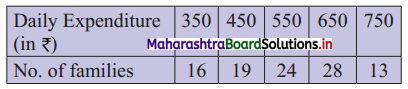
Maharashtra Board 11th Commerce Maths Solutions Chapter 1 Partition Values Ex 1.1 Q4
Solution:
To find the expenditure below which 75% of families have their expenditure, we have to find Q3.
We construct the less than cumulative frequency table as given below:
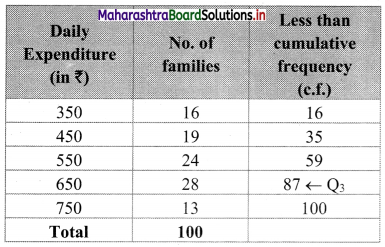
Maharashtra Board 11th Commerce Maths Solutions Chapter 1 Partition Values Ex 1.1 Q4.1
Here, n = 100
Q3 = value of 3\(\left(\frac{n+1}{4}\right)^{\text {th }}\) observation
= value of 3\(\left(\frac{100+1}{4}\right)^{\text {th }}\) observation
= value of (3 × 25.25)th observation
= value of (75.75)th observation
Cumulative frequency which is just greater than (or equal to) 75.75 is 87.
∴ Q3 = 650
∴ the expenditure below which 75% of families include their expenditure is ₹ 650.

Maharashtra Board 11th Commerce Maths Solutions Chapter 1 Partition Values Ex 1.1

Question 5.
Calculate all the quartiles for the following frequency distribution:
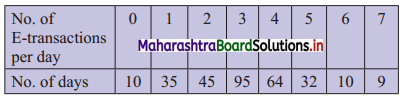
Maharashtra Board 11th Commerce Maths Solutions Chapter 1 Partition Values Ex 1.1 Q5
Solution:
We construct the less than cumulative frequency table as given below:
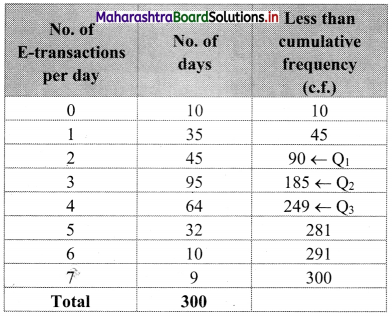
Maharashtra Board 11th Commerce Maths Solutions Chapter 1 Partition Values Ex 1.1 Q5.1
Here, n = 300
Q1 = value of \(\left(\frac{n+1}{4}\right)^{\text {th }}\) observation
= value of \(\left(\frac{300+1}{4}\right)^{\text {th }}\) observation
= value of (75.25)th observation
Cumulative frequency which is just greater than (or equal to) 75.25 is 90.
∴ Q1 = 2
Q2 = value of 2\(\left(\frac{n+1}{4}\right)^{\text {th }}\) observation
= value of 2\(\left(\frac{300+1}{4}\right)^{\text {th }}\) observation
= value of (2 × 75.25)th observation
= value of (150.50)th observation
∴ Cumulative frequency which is just greater than (or equal to) 150.50 is 185.
∴ Q2 = 3
Q3 = value of 3\(\left(\frac{n+1}{4}\right)^{\text {th }}\) observation
= value of 3\(\left(\frac{300+1}{4}\right)^{\text {th }}\) observation
= value of (3 × 75.25)th observation
= value of (225.75)th observation
Cumulative frequency which is just greater than (or equal to) 225.75 is 249.
∴ Q3 = 4

Question 6.
The following is the frequency distribution of heights of 200 male adults in a factory:
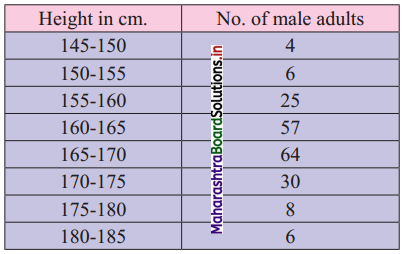
Maharashtra Board 11th Commerce Maths Solutions Chapter 1 Partition Values Ex 1.1 Q6
Find the central height.
Solution:
To find the central height, we have to find Q2.
We construct the less than cumulative frequency table as given below:
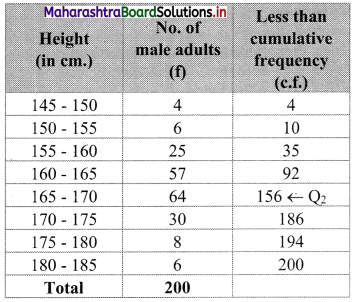
Maharashtra Board 11th Commerce Maths Solutions Chapter 1 Partition Values Ex 1.1 Q6.1
Here, N = 200
Q2 class = class containing \(\left(\frac{2 \mathrm{~N}}{4}\right)^{\mathrm{th}}\) observation
∴ \(\frac{2 \mathrm{~N}}{4}=\frac{2 \times 200}{4}\) = 100
Cumulative frequency which is just greater than (or equal to) 100 is 156.
∴ Q2 lies in the class 165 – 170.
∴ L = 165, h = 5, f = 64, c.f. = 92
Q2 = \(\mathrm{L}+\frac{\mathrm{h}}{\mathrm{f}}\left(\frac{2 \mathrm{~N}}{4}-\text { c.f. }\right)\)
= 165 + \(\frac{5}{64}\) (100 – 92)
= 165 + \(\frac{5}{64}\) × 8
= 165 + \(\frac{5}{8}\)
= 165 + 0.625
= 165.625
∴ Central height is 165.625 cm.

Maharashtra Board 11th Commerce Maths Solutions Chapter 1 Partition Values Ex 1.1

Question 7.
The following is the data of pocket expenditure per week of 50 students in a class. It is known that the median of the distribution is ₹ 120. Find the missing frequencies.
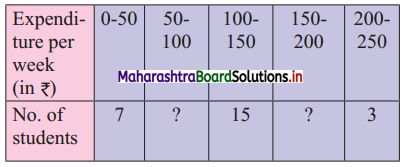
Maharashtra Board 11th Commerce Maths Solutions Chapter 1 Partition Values Ex 1.1 Q7
Solution:
Let a and b be the missing frequencies of class 50 – 100 and class 150 – 200 respectively.
We construct the less than cumulative frequency table as given below:
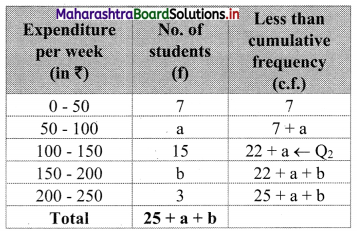
Maharashtra Board 11th Commerce Maths Solutions Chapter 1 Partition Values Ex 1.1 Q7.1
Here, N = 25 + a + b
Since, N = 50
∴ 25 + a + b = 50
∴ a + b = 25 …..(i)
Given, Median = Q2 = 120
∴ Q2 lies in the class 100 – 150.
∴ L = 100, h = 50, f = 15, \(\frac{2 \mathrm{~N}}{4}=\frac{2 \times 50}{4}\) = 25
∴ Q2 = \(\mathrm{L}+\frac{\mathrm{h}}{\mathrm{f}}\left(\frac{2 \mathrm{~N}}{4}-\text { c.f. }\right)\)
∴ 120 = 100 + \(\frac{50}{15}\) [25 – (7 + a)]
∴ 120 – 100 = \(\frac{10}{3}\) (25 – 7 – a)
∴ 20 = \(\frac{10}{3}\) (18 – a)
∴ \(\frac{60}{10}\) = 18 – a
∴ 6 = 18 – a
∴ a = 18 – 6 = 12
Substituting the value of a in equation (i), we get
12 + b = 25
∴ b = 25 – 12 = 13
∴ 12 and 13 are the missing frequencies of the class 50 – 100 and class 150 – 200 respectively.

Question 8.
The following is the distribution of 160 workers according to the wages in a certain factory:
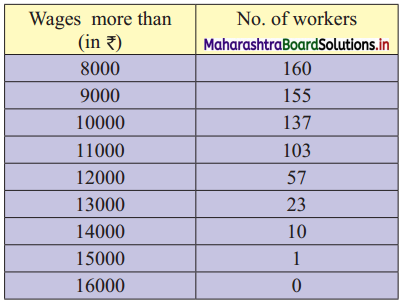
Maharashtra Board 11th Commerce Maths Solutions Chapter 1 Partition Values Ex 1.1 Q8
Determine the values of all quartiles and interpret the results.
Solution:
The given table is a more than cumulative frequency.
We transform the given table into less than cumulative frequency.
We construct the less than cumulative frequency table as given below:
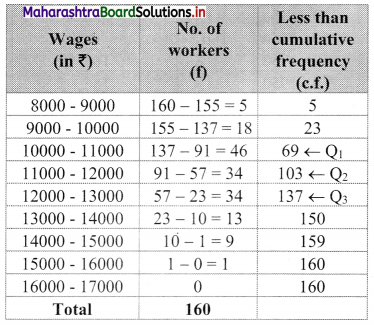
Maharashtra Board 11th Commerce Maths Solutions Chapter 1 Partition Values Ex 1.1 Q8.1
Here, N = 160
∴ Q1 class = class containing \(\left(\frac{\mathrm{N}}{4}\right)^{\text {th }}\) observation
∴ \(\frac{\mathrm{N}}{4}=\frac{160}{4}\) = 40
Cumulative frequency which is just greater than (or equal to) 40 is 69.
∴ Q1 lies in the class 10000 – 11000
∴ L = 10000, h = 1000, f = 46, c.f. = 23
Q1 = \(L+\frac{h}{f}\left(\frac{N}{4}-\text { c.f. }\right)\)
= 10000 + \(\frac{1000}{46}\) (40 – 23)
= 10000 + \(\frac{1000}{46}\) (17)
= 10000 + \(\frac{17000}{46}\)
= 10000 + 369.57
= 10369.57
Q2 class = class containing \(\left(\frac{2 \mathrm{~N}}{4}\right)^{\mathrm{th}}\) observation
∴ \(\frac{2 \mathrm{~N}}{4}=\frac{2 \times 160}{4}\) = 80
Cumulative frequency which is just greater than (or equal to) 80 is 103.
∴ Q2 lies in the class 11000 – 12000.
∴ L = 11000, h = 1000, f = 34, c.f. = 69
∴ Q2 = \(L+\frac{h}{f}\left(\frac{2 N}{4}-\text { c.f. }\right)\)
= 11000 + \(\frac{1000}{34}\)(80 – 69)
= 11000 + \(\frac{1000}{34}\)(11)
= 11000 + \(\frac{11000}{34}\)
= 11000 + 323.529
= 11323.529
Q3 class = class containing \(\left(\frac{3 \mathrm{~N}}{4}\right)^{\text {th }}\) observation
∴ \(\frac{3 \mathrm{~N}}{4}=\frac{3 \times 160}{4}\) = 120
Cumulative frequency which is just greater than (or equal to) 120 is 137.
∴ Q3 lies in the class 12000 – 13000.
∴ L = 12000, h = 1000, f = 34, c.f. = 103
∴ Q3 = \(\frac{h}{f}\left(\frac{3 N}{4}-c . f .\right)\)
= 12000 + \(\frac{1000}{34}\) (120 – 103)
= 12000 + \(\frac{1000}{34}\) (17)
= 12000 + \(\frac{1000}{2}\)
= 12000 + 500
= 12500
Interpretation:
Q1 < Q2 < Q3

Maharashtra Board 11th Commerce Maths Solutions Chapter 1 Partition Values Ex 1.1

Question 9.
Following is grouped data for the duration of fixed deposits of 100 senior citizens from a certain bank:
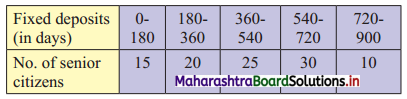
Maharashtra Board 11th Commerce Maths Solutions Chapter 1 Partition Values Ex 1.1 Q9
Calculate the limits of fixed deposits of central 50% senior citizens.
Solution:
We construct the less than cumulative frequency table as given below:
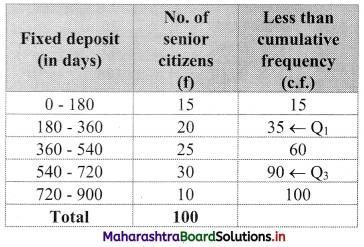
Maharashtra Board 11th Commerce Maths Solutions Chapter 1 Partition Values Ex 1.1 Q9.1
To find the limits of fixed deposits of central 50% senior citizens, we have to find Q1 and Q3.
Here, N = 100
Q1 class = class containing \(\left(\frac{\mathrm{N}}{4}\right)^{\text {th }}\) observation
∴ \(\frac{N}{4}=\frac{100}{4}\) = 25
Cumulative frequency which is just greater than (or equal to) 25 is 35.
∴ Q1 lies in the class 180 – 360.
∴ L = 180, h = 180, f = 20, c.f. = 15
∴ Q1 = \(L+\frac{h}{f}\left(\frac{N}{4}-c . f .\right)\)
= 180 + \(\frac{180}{20}\) (25 – 15)
= 180 + 9(10)
= 180 + 90
∴ Q1 = 270
Q3 class = class containing \(\left(\frac{3 \mathrm{N}}{4}\right)^{\text {th }}\) observation
∴ \(\frac{3 \mathrm{N}}{4}=\frac{3 \times 100}{4}\) = 75
Cumulative frequency which is just greater than (or equal to) 75 is 90.
∴ Q3 lies in the class 540 – 720.
∴ L = 540, h = 180, f = 30, c.f. = 60
∴ Q3 = \(L+\frac{h}{f}\left(\frac{3 N}{4}-c . f .\right)\)
= 540 + \(\frac{180}{30}\) (75 – 60)
= 540 + 6(15)
= 540 + 90
∴ Q3 = 630
∴ Limits of duration of fixed deposits of central 50% senior citizens is from 270 to 630.

Question 10.
Find the missing frequency given that the median of the distribution is 1504.
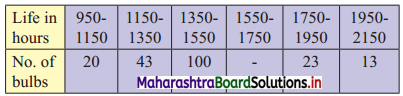
Maharashtra Board 11th Commerce Maths Solutions Chapter 1 Partition Values Ex 1.1 Q10
Solution:
Let x be the missing frequency of the class 1550 – 1750.
We construct the less than frequency table as given below:
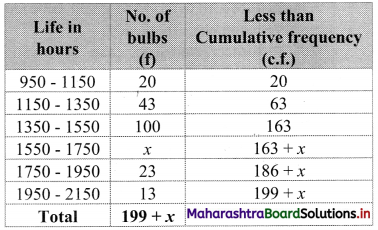
Maharashtra Board 11th Commerce Maths Solutions Chapter 1 Partition Values Ex 1.1 Q10.1
Here, N = 199 + x
Given, Median (Q2) = 1504
∴ Q2 lies in the class 1350 – 1550.
∴ L = 1350, h = 200, f = 100, c.f. = 63,
\(\frac{2 \mathrm{~N}}{4}=\frac{199+x}{2}\)
∴ Q2 = \(L+\frac{h}{f}\left(\frac{2 N}{4}-c . f .\right)\)
∴ 1504 = 1350 + \(\frac{200}{100}\left(\frac{199+x}{2}-63\right)\)
∴ 1504 – 1350 = 2\(\left(\frac{199+x-126}{2}\right)\)
∴ 154 = 199 + x – 126
∴ 154 = x + 73
∴ x = 81
Maharashtra Board 11th Commerce Maths Solutions Chapter 9 Differentiation Miscellaneous Exercise 9

Balbharati Maharashtra State Board 11th Commerce Maths Solution Book Pdf Chapter 9 Differentiation Miscellaneous Exercise 9 Questions and Answers.

Maharashtra State Board 11th Commerce Maths Solutions Chapter 9 Differentiation Miscellaneous Exercise 9

I. Differentiate the following functions w.r.t.x.

Question 1.
x5
Solution:
Let y = x5
Differentiating w.r.t. x, we get
\(\frac{\mathrm{d} y}{\mathrm{~d} x}=\frac{\mathrm{d}}{\mathrm{d} x} x^{5}=5 x^{4}\)

Question 2.
x-2
Solution:
Let y = x-2
Differentiating w.r.t. x, we get
\(\frac{\mathrm{d} y}{\mathrm{~d} x}=\frac{\mathrm{d}}{\mathrm{d} x}\left(x^{-2}\right)=-2 x^{-3}=\frac{-2}{x^{3}}\)

Question 3.
√x
Solution:
Let y = √x
Differentiating w.r.t. x, we get
\(\frac{\mathrm{d} y}{\mathrm{~d} x}=\frac{\mathrm{d}}{\mathrm{d} x} \sqrt{x}=\frac{1}{2 \sqrt{x}}\)

Maharashtra Board 11th Commerce Maths Solutions Chapter 9 Differentiation Miscellaneous Exercise 9

Question 4.
x√x
Solution:
Let y = x√x
∴ y = \(x^{\frac{3}{2}}\)
Differentiating w.r.t. x, we get
\(\frac{\mathrm{d} y}{\mathrm{~d} x}=\frac{\mathrm{d}}{\mathrm{d} x} x^{\frac{3}{2}}=\frac{3}{2} x^{\frac{1}{2}}\)

Question 5.
\(\frac{1}{\sqrt{x}}\)
Solution:
Let y = \(\frac{1}{\sqrt{x}}\)
∴ y = \(x^{\frac{-1}{2}}\)
Differentiating w.r.t. x, we get
\(\frac{\mathrm{d} y}{\mathrm{~d} x}=\frac{-1}{2} x^{\frac{-3}{2}}=\frac{-1}{2 x^{\frac{3}{2}}}\)

Question 6.
7x
Solution:
Let y = 7x
Differentiating w.r.t. x, we get
\(\frac{\mathrm{d} y}{\mathrm{~d} x}=\frac{\mathrm{d}}{\mathrm{d} x} 7^{x}=7^{x} \log 7\)

II. Find \(\frac{d y}{d x}\) if

Question 1.
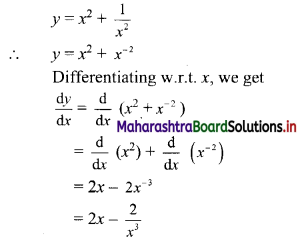
y = x2 + \(\frac{1}{x^{2}}\)
Solution:
Maharashtra Board 11th Commerce Maths Solutions Chapter 9 Differentiation Miscellaneous Exercise 9 II Q1

Question 2.
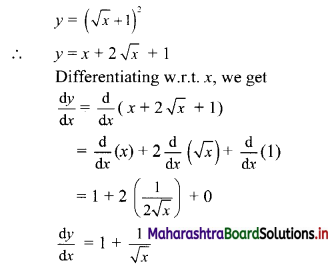
y = (√x + 1)2
Solution:
Maharashtra Board 11th Commerce Maths Solutions Chapter 9 Differentiation Miscellaneous Exercise 9 II Q2

Maharashtra Board 11th Commerce Maths Solutions Chapter 9 Differentiation Miscellaneous Exercise 9

Question 3.
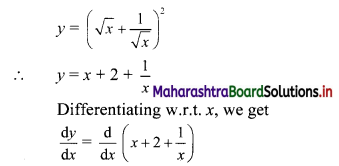
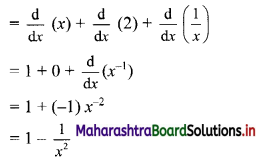
y = \(\left(\sqrt{x}+\frac{1}{\sqrt{x}}\right)^{2}\)
Solution:
Maharashtra Board 11th Commerce Maths Solutions Chapter 9 Differentiation Miscellaneous Exercise 9 II Q3
Maharashtra Board 11th Commerce Maths Solutions Chapter 9 Differentiation Miscellaneous Exercise 9 II Q3.1

Question 4.
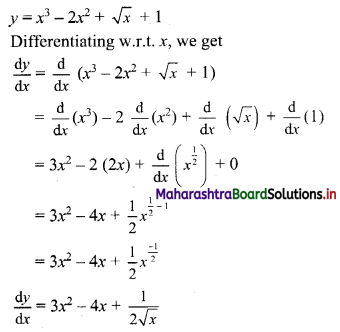
y = x3 – 2x2 + √x + 1
Solution:
Maharashtra Board 11th Commerce Maths Solutions Chapter 9 Differentiation Miscellaneous Exercise 9 II Q4

Question 5.
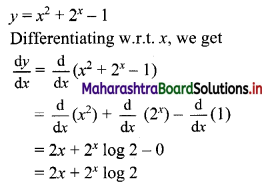
y = x2 + 2x – 1
Solution:
Maharashtra Board 11th Commerce Maths Solutions Chapter 9 Differentiation Miscellaneous Exercise 9 II Q5

Question 6.
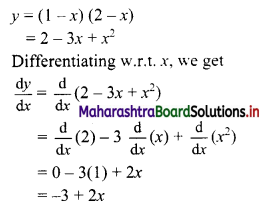
y = (1 – x)(2 – x)
Solution:
Maharashtra Board 11th Commerce Maths Solutions Chapter 9 Differentiation Miscellaneous Exercise 9 II Q6

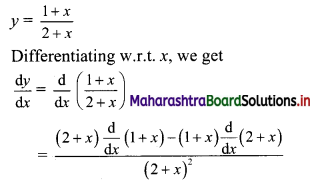
Question 7.
y = \(\frac{1+x}{2+x}\)
Solution:
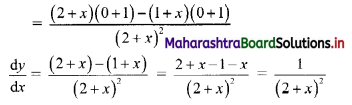
Maharashtra Board 11th Commerce Maths Solutions Chapter 9 Differentiation Miscellaneous Exercise 9 II Q7
Maharashtra Board 11th Commerce Maths Solutions Chapter 9 Differentiation Miscellaneous Exercise 9 II Q7.1

Maharashtra Board 11th Commerce Maths Solutions Chapter 9 Differentiation Miscellaneous Exercise 9

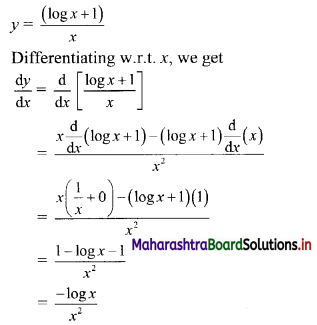
Question 8.
y = \(\frac{(\log x+1)}{x}\)
Solution:
Maharashtra Board 11th Commerce Maths Solutions Chapter 9 Differentiation Miscellaneous Exercise 9 II Q8

Question 9.
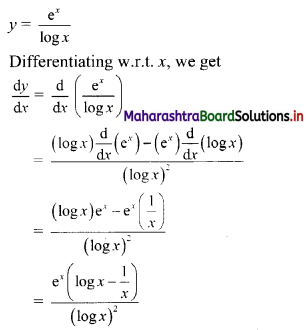
y = \(\frac{e^{x}}{\log x}\)
Solution:
Maharashtra Board 11th Commerce Maths Solutions Chapter 9 Differentiation Miscellaneous Exercise 9 II Q9

Question 10.
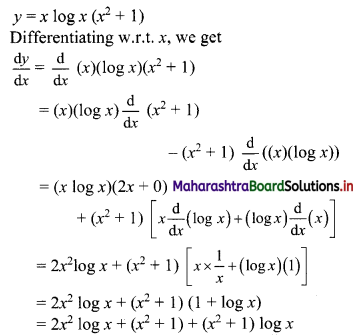
y = x log x (x2 + 1)
Solution:
Maharashtra Board 11th Commerce Maths Solutions Chapter 9 Differentiation Miscellaneous Exercise 9 II Q10

III. Solve the following:

Question 1.
The relation between price (P) and demand (D) of a cup of Tea is given by D = \(\frac{12}{P}\). Find
the rate at which the demand changes when the price is ₹ 2/-. Interpret the result.
Solution:
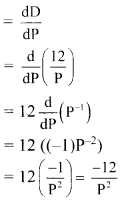
Demand, D = \(\frac{12}{P}\)
Rate of change of demand
Maharashtra Board 11th Commerce Maths Solutions Chapter 9 Differentiation Miscellaneous Exercise 9 III Q1
When price P = 2,
Rate of change of demand,
\(\left(\frac{\mathrm{dD}}{\mathrm{dP}}\right)_{\mathrm{P}=2}=\frac{-12}{(2)^{2}}=-3\)
∴ When the price is 2, the rate of change of demand is -3.
∴ Here, the rate of change of demand is negative demand would fall when the price becomes ₹ 2.

Question 2.
The demand (D) of biscuits at price P is given by D = \(\frac{64}{P^{3}}\), find the marginal demand
when the price is ₹ 4/-.
Solution:
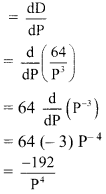
Given demand D = \(\frac{64}{P^{3}}\)
Now, marginal demand
Maharashtra Board 11th Commerce Maths Solutions Chapter 9 Differentiation Miscellaneous Exercise 9 III Q2
When P = 4
Marginal demand
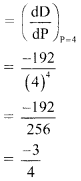
Maharashtra Board 11th Commerce Maths Solutions Chapter 9 Differentiation Miscellaneous Exercise 9 III Q2.1

Maharashtra Board 11th Commerce Maths Solutions Chapter 9 Differentiation Miscellaneous Exercise 9

Question 3.
The supply S of electric bulbs at price P is given by S = 2p3 + 5. Find the marginal supply when the price is ₹ 5/-. Interpret the result.
Solution:
Given, supply S = 2p3 + 5
Now, marginal supply
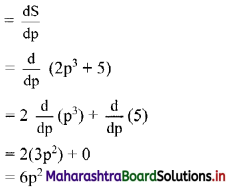
Maharashtra Board 11th Commerce Maths Solutions Chapter 9 Differentiation Miscellaneous Exercise 9 III Q3
∴ When p = 5
Marginal supply = \(\left(\frac{\mathrm{dS}}{\mathrm{dp}}\right)_{\mathrm{p}=5}\)
= 6(5)2
= 150
Here, the rate of change of supply with respect to the price is positive which indicates that the supply increases.

Question 4.
The total cost of producing x items is given by C = x2 + 4x + 4. Find the average cost and the marginal cost. What is the marginal cost when x = 7?
Solution:
Total cost C = x2 + 4x + 4
Now. Average cost = \(\frac{C}{x}=\frac{x^{2}+4 x+4}{x}\)
= x + 4 + \(\frac{4}{x}\)
and Marginal cost = \(\frac{\mathrm{dC}}{\mathrm{d} x}=\frac{\mathrm{d}}{\mathrm{d} x}\)(x2 + 4x + 4)
= \(\frac{\mathrm{d}}{\mathrm{d} x}\) (x2) + 4\(\frac{\mathrm{d}}{\mathrm{d} x}\) (x) + \(\frac{\mathrm{d}}{\mathrm{d} x}\) (4)
= 2x + 4(1) + 0
= 2x + 4
∴ When x = 7,
Marginal cost = \(\left(\frac{\mathrm{d} \mathrm{C}}{\mathrm{d} x}\right)_{x=7}\)
= 2(7) + 4
= 14 + 4
= 18

Question 5.
The demand D for a price P is given as D = \(\frac{27}{P}\), find the rate of change of demand when the price is ₹ 3/-.
Solution:
Demand, D = \(\frac{27}{P}\)
Rate of change of demand = \(\frac{dD}{dP}\)
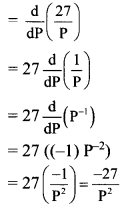
Maharashtra Board 11th Commerce Maths Solutions Chapter 9 Differentiation Miscellaneous Exercise 9 III Q5
When price P = 3,
Rate of change of demand,
\(\left(\frac{\mathrm{dD}}{\mathrm{dP}}\right)_{\mathrm{P}=3}=\frac{-27}{(3)^{2}}=-3\)
∴ When price is 3, Rate of change of demand is -3.

Maharashtra Board 11th Commerce Maths Solutions Chapter 9 Differentiation Miscellaneous Exercise 9

Question 6.
If for a commodity; the price demand relation is given as D = \(\left(\frac{P+5}{P-1}\right)\). Find the marginal demand when price is ₹ 2/-
Solution:
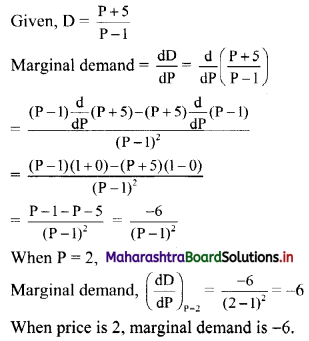
Maharashtra Board 11th Commerce Maths Solutions Chapter 9 Differentiation Miscellaneous Exercise 9 III Q6

Question 7.
The price function P of a commodity is given as P = 20 + D – D2 where D is demand. Find the rate at which price (P) is changing when demand D = 3.
Solution:
Given, P = 20 + D – D2
Rate of change of price = \(\frac{dP}{dD}\)
= \(\frac{d}{dD}\)(20 + D – D2)
= 0 + 1 – 2D
= 1 – 2D
Rate of change of price at D = 3 is
\(\left(\frac{\mathrm{dP}}{\mathrm{dD}}\right)_{\mathrm{D}=3}\) = 1 – 2(3) = -5
∴ Price is changing at a rate of -5, when demand is 3.

Question 8.
If the total cost function is given by C = 5x3 + 2x2 + 1; find the average cost and the marginal cost when x = 4.
Solution:
Total cost function C = 5x3 + 2x2 + 1
Average cost = \(\frac{C}{x}\)
= \(\frac{5 x^{3}+2 x^{2}+1}{x}\)
= 5x2 + 2x + \(\frac{1}{x}\)
When x = 4,
Average cost = 5(4)2 + 2(4) + \(\frac{1}{4}\)
= 80 + 8 + \(\frac{1}{4}\)
= \(\frac{320+32+1}{4}\)
= \(\frac{353}{4}\)
Marginal cost = \(\frac{\mathrm{dC}}{\mathrm{d} x}\)
= \(\frac{d}{dx}\) (5x3 + 2x2 + 1)
= 5\(\frac{d}{dx}\) (x3) + 2 \(\frac{d}{dx}\) (x2) + \(\frac{d}{dx}\) (1)
= 5(3x2) + 2(2x) + 0
= 15x2 + 4x
When x = 4, marginal cost = \(\left(\frac{\mathrm{dC}}{\mathrm{d} x}\right)_{x=4}\)
= 15(4)2 + 4(4)
= 240 + 16
= 256
∴ The average cost and marginal cost at x = 4 are \(\frac{353}{4}\) and 256 respectively.

Maharashtra Board 11th Commerce Maths Solutions Chapter 9 Differentiation Miscellaneous Exercise 9

Question 9.
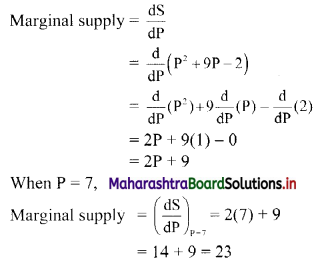
The supply S for a commodity at price P is given by S = P2 + 9P – 2. Find the marginal supply when the price is 7/-.
Solution:
Given, S = P2 + 9P – 2
Maharashtra Board 11th Commerce Maths Solutions Chapter 9 Differentiation Miscellaneous Exercise 9 III Q9
∴ The marginal supply is 23, at P = 7.

Question 10.
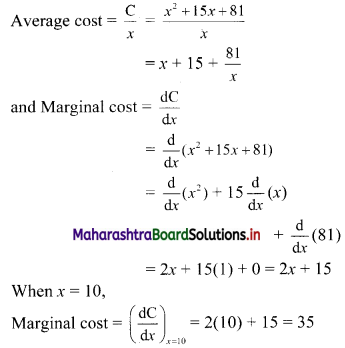
The cost of producing x articles is given by C = x2 + 15x + 81. Find the average cost and marginal cost functions. Find the marginal cost when x = 10. Find x for which the marginal cost equals the average cost.
Solution:
Given, cost C = x2 + 15x + 81
Maharashtra Board 11th Commerce Maths Solutions Chapter 9 Differentiation Miscellaneous Exercise 9 III Q10
If marginal cost = average cost, then
2x + 15 = x + 15 + \(\frac{81}{x}\)
∴ x = \(\frac{81}{x}\)
∴ x2 = 81
∴ x = 9 …..[∵ x > 0]

Maharashtra Board 12th Commerce Maths Solutions Chapter 5 Integration Ex 5.4

Balbharati Maharashtra State Board Std 12 Commerce Statistics Part 1 Digest Pdf Chapter 5 Integration Ex 5.4 Questions and Answers.
Maharashtra State Board 12th Commerce Maths Solutions Chapter 5 Integration Ex 5.4

Evaluate the following.

Question 1.
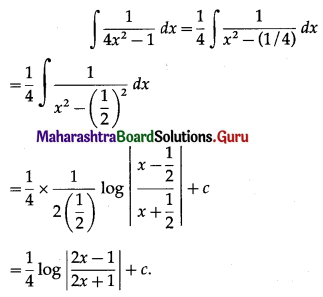
\(\int \frac{1}{4 x^{2}-1} d x\)
Solution:
Maharashtra Board 12th Commerce Maths Solutions Chapter 5 Integration Ex 5.4 Q1

Question 2.
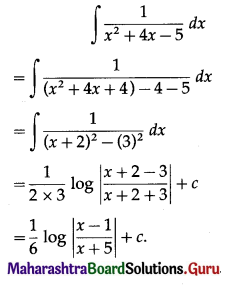
\(\int \frac{1}{x^{2}+4 x-5} d x\)
Solution:
Maharashtra Board 12th Commerce Maths Solutions Chapter 5 Integration Ex 5.4 Q2

Maharashtra Board 12th Commerce Maths Solutions Chapter 5 Integration Ex 5.4

Question 3.
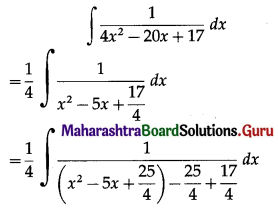
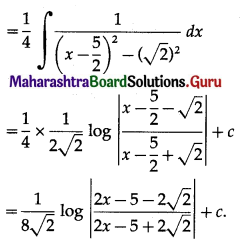
\(\int \frac{1}{4 x^{2}-20 x+17} d x\)
Solution:
Maharashtra Board 12th Commerce Maths Solutions Chapter 5 Integration Ex 5.4 Q3
Maharashtra Board 12th Commerce Maths Solutions Chapter 5 Integration Ex 5.4 Q3.1

Question 4.
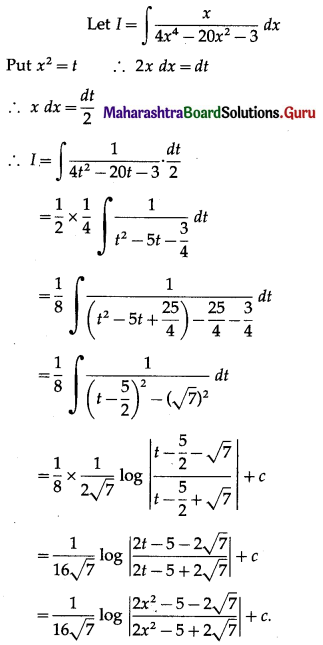
\(\int \frac{x}{4 x^{4}-20 x^{2}-3} d x\)
Solution:
Maharashtra Board 12th Commerce Maths Solutions Chapter 5 Integration Ex 5.4 Q4

Question 5.
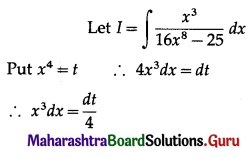
\(\int \frac{x^{3}}{16 x^{8}-25} d x\)
Solution:
Maharashtra Board 12th Commerce Maths Solutions Chapter 5 Integration Ex 5.4 Q5
Maharashtra Board 12th Commerce Maths Solutions Chapter 5 Integration Ex 5.4 Q5.1

Maharashtra Board 12th Commerce Maths Solutions Chapter 5 Integration Ex 5.4

Question 6.
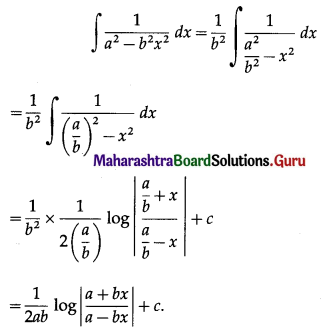
\(\int \frac{1}{a^{2}-b^{2} x^{2}} d x\)
Solution:
Maharashtra Board 12th Commerce Maths Solutions Chapter 5 Integration Ex 5.4 Q6

Question 7.
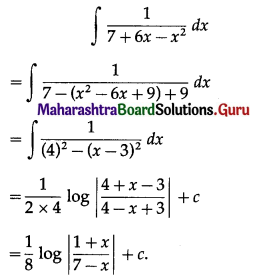
\(\int \frac{1}{7+6 x-x^{2}} d x\)
Solution:
Maharashtra Board 12th Commerce Maths Solutions Chapter 5 Integration Ex 5.4 Q7

Question 8.
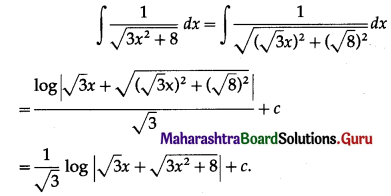
\(\int \frac{1}{\sqrt{3 x^{2}+8}} d x\)
Solution:
Maharashtra Board 12th Commerce Maths Solutions Chapter 5 Integration Ex 5.4 Q8

Question 9.
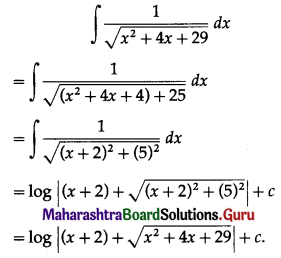
\(\int \frac{1}{\sqrt{x^{2}+4 x+29}} d x\)
Solution:
Maharashtra Board 12th Commerce Maths Solutions Chapter 5 Integration Ex 5.4 Q9

Maharashtra Board 12th Commerce Maths Solutions Chapter 5 Integration Ex 5.4

Question 10.
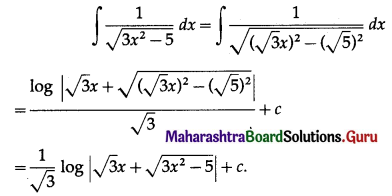
\(\int \frac{1}{\sqrt{3 x^{2}-5}} d x\)
Solution:
Maharashtra Board 12th Commerce Maths Solutions Chapter 5 Integration Ex 5.4 Q10

Question 11.
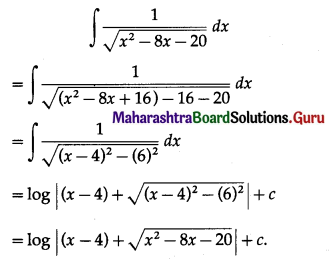
\(\int \frac{1}{\sqrt{x^{2}-8 x-20}} d x\)
Solution:
Maharashtra Board 12th Commerce Maths Solutions Chapter 5 Integration Ex 5.4 Q11

Maharashtra Board 12th Commerce Maths Solutions Chapter 5 Integration Ex 5.3

Balbharati Maharashtra State Board Std 12 Commerce Statistics Part 1 Digest Pdf Chapter 5 Integration Ex 5.3 Questions and Answers.

Maharashtra State Board 12th Commerce Maths Solutions Chapter 5 Integration Ex 5.3

Evaluate the following:

Question 1.
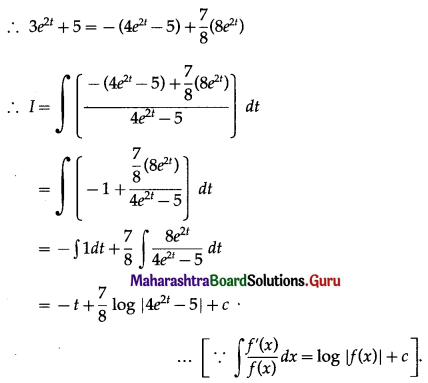
\(\int \frac{3 e^{2 t}+5}{4 e^{2 t}-5} d t\)
Solution:
Let I = \(\int \frac{3 e^{2 t}+5}{4 e^{2 t}-5} d t\)
Put, Numerator = A(Denominator) + B[\(\frac{d}{d x}\)(Denominator)]
∴ 3e2t + 5 = A(4e2t – 5) + B[\(\frac{d}{d t}\)(4e2t – 5)]
∴ 3e2t + 5 = A(4e2t – 5) + B[4e2t × 2 – 0]
∴ 3e2t + 5 = (4A + 8B) e2t – 5A
Equating the coefficient of e2t and constant on both sides, we get
4A + 8B = 3
and -5A = 5
∴ A = -1
∴ from (1), 4(-1) + 8B = 3
∴ 8B = 7
∴ B = \(\frac{7}{8}\)
Maharashtra Board 12th Commerce Maths Solutions Chapter 5 Integration Ex 5.3 Q1

Maharashtra Board 12th Commerce Maths Solutions Chapter 5 Integration Ex 5.3

Question 2.
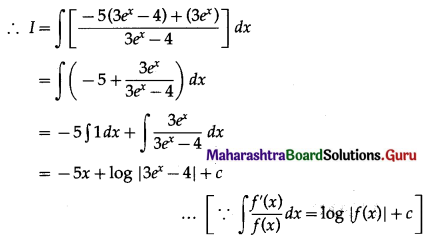
\(\int \frac{20-12 e^{x}}{3 e^{x}-4} d x\)
Solution:
Let I = \(\int \frac{20-12 e^{x}}{3 e^{x}-4} d x\)
Put, Numerator = A (Denominator) + B[\(\frac{d}{d x}\)(Denominator)]
∴ 20 – 12ex = A(3ex – 4) + B[\(\frac{d}{d x}\)(3ex – 4)]
∴ 20 – 12ex = A(3ex – 4) + B(3ex – 0)
∴ 20 – 12ex = (3A + 3B)ex – 4A
Equating the coefficient of ex and constant on both sides, we get
3A + 3B = -12 ……(1)
and -4A = 20
∴ A = -5
from (1), 3(-5) + 3B = -12
∴ 3B = 3
∴ B = 1
∴ 20 – 12ex = -5(3ex – 4) + (3ex)
Maharashtra Board 12th Commerce Maths Solutions Chapter 5 Integration Ex 5.3 Q2

Question 3.
\(\int \frac{3 e^{x}+4}{2 e^{x}-8} d x\)
Solution:
Let I = \(\int \frac{3 e^{x}+4}{2 e^{x}-8} d x\)
Put, Numerator = A (Denominator) + B[\(\frac{d}{d x}\)(Denominator)]
∴ 3ex + 4 = A(2ex – 8) + B[\(\frac{d}{d x}\)(2ex – 8)]
∴ 3ex + 4 = A(2ex – 8) + B(2ex – 0)
∴ 3ex + 4 = (2A + 2B)ex – 8A
Equating the coefficient of ex and constant on both sides, we get
2A + 2B = 3 ……..(1)
and -8A = 4
∴ A = \(-\frac{1}{2}\)
∴ from (1), 2(\(-\frac{1}{2}\)) + 2B = 3
∴ 2B = 4
∴ B = 2
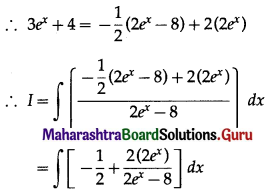
Maharashtra Board 12th Commerce Maths Solutions Chapter 5 Integration Ex 5.3 Q3
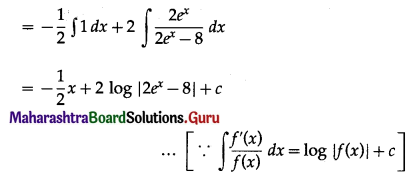
Maharashtra Board 12th Commerce Maths Solutions Chapter 5 Integration Ex 5.3 Q3.1

Maharashtra Board 12th Commerce Maths Solutions Chapter 5 Integration Ex 5.3

Question 4.
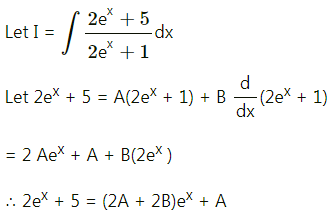
\(\int \frac{2 e^{x}+5}{2 e^{x}+1} d x\)
Solution:
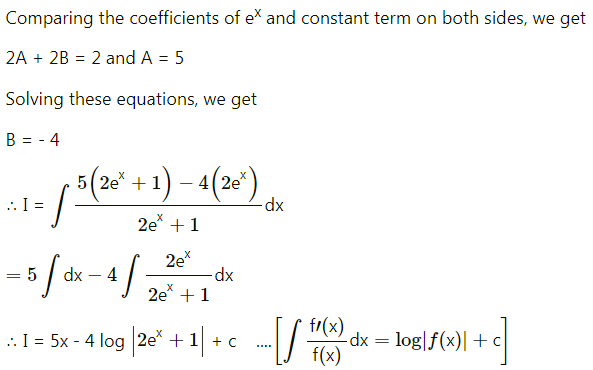
Maharashtra Board 12th Commerce Maths Solutions Chapter 5 Integration Ex 5.3 Q4
Maharashtra Board 12th Commerce Maths Solutions Chapter 5 Integration Ex 5.3 Q4.1

Maharashtra Board 12th Commerce Maths Solutions Chapter 5 Integration Ex 5.2

Balbharati Maharashtra State Board Std 12 Commerce Statistics Part 1 Digest Pdf Chapter 5 Integration Ex 5.2 Questions and Answers.

Maharashtra State Board 12th Commerce Maths Solutions Chapter 5 Integration Ex 5.2

Evaluate the following.

Question 1.
\(\int x \sqrt{1+x^{2}} d x\)
Solution:
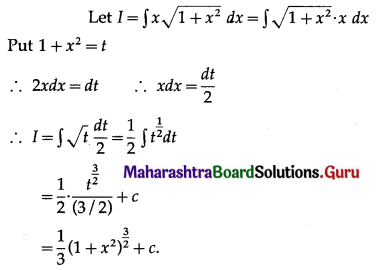
Maharashtra Board 12th Commerce Maths Solutions Chapter 5 Integration Ex 5.2 Q1

Question 2.
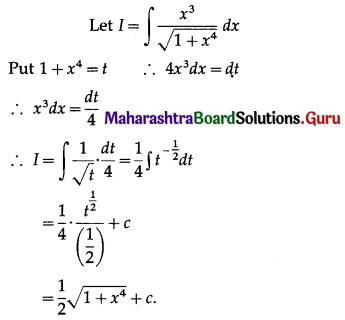
\(\int \frac{x^{3}}{\sqrt{1+x^{4}}} d x\)
Solution:
Maharashtra Board 12th Commerce Maths Solutions Chapter 5 Integration Ex 5.2 Q2

Maharashtra Board 12th Commerce Maths Solutions Chapter 5 Integration Ex 5.2

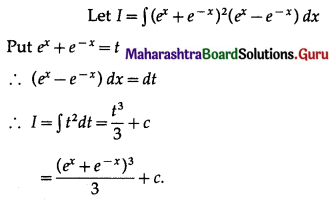
Question 3.
\(\int\left(e^{x}+e^{-x}\right)^{2}\left(e^{x}-e^{-x}\right) d x\)
Solution:
Maharashtra Board 12th Commerce Maths Solutions Chapter 5 Integration Ex 5.2 Q3

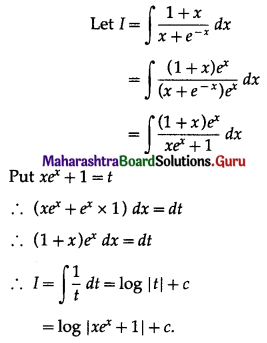
Question 4.
\(\int \frac{1+x}{x+e^{-x}} d x\)
Solution:
Maharashtra Board 12th Commerce Maths Solutions Chapter 5 Integration Ex 5.2 Q4

Question 5.
∫(x + 1)(x + 2)7(x + 3) dx
Solution:
Let I = ∫(x + 1)(x + 2)7(x + 3) dx
= ∫(x + 2)7 (x + 1)(x + 3) dx
= ∫(x + 2)7 [(x + 2) – 1][(x + 2) + 1] dx
= ∫(x + 2)7 [(x + 2)2 – 1] dx
= ∫[(x + 2)9 – (x + 2 )7] dx
= ∫(x + 2 )9 dx – ∫(x + 2)7 dx
= \(\frac{(x+2)^{10}}{10}\) – \(\frac{(x+2)^{8}}{8}\) + c

Maharashtra Board 12th Commerce Maths Solutions Chapter 5 Integration Ex 5.2

Question 6.
\(\int \frac{1}{x \log x} d x\)
Solution:
Put log x = t
∴ \(\frac{1}{x}\) dx = dt
∴ \(\int \frac{d x}{x \cdot \log x}=\int \frac{1}{\log x} \cdot \frac{1}{x} d x\)
= ∫\(\frac{1}{t}\) dt
= log |t| + c
= log|log x| + c.

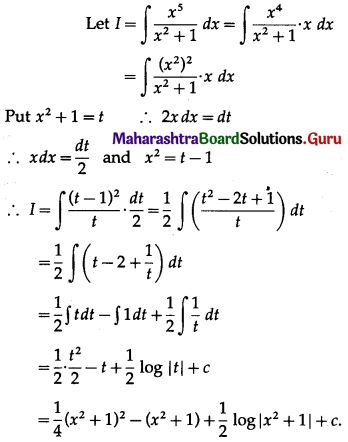
Question 7.
\(\int \frac{x^{5}}{x^{2}+1} d x\)
Solution:
Maharashtra Board 12th Commerce Maths Solutions Chapter 5 Integration Ex 5.2 Q7

Question 8.
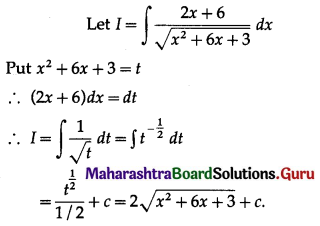
\(\int \frac{2 x+6}{\sqrt{x^{2}+6 x+3}} d x\)
Solution:
Maharashtra Board 12th Commerce Maths Solutions Chapter 5 Integration Ex 5.2 Q8

Question 9.
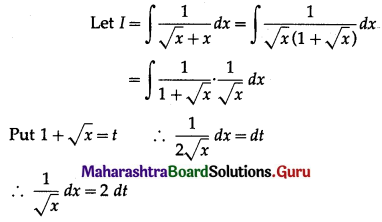
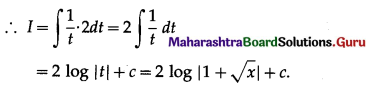
\(\int \frac{1}{\sqrt{x}+x} d x\)
Solution:
Maharashtra Board 12th Commerce Maths Solutions Chapter 5 Integration Ex 5.2 Q9
Maharashtra Board 12th Commerce Maths Solutions Chapter 5 Integration Ex 5.2 Q9.1

Maharashtra Board 12th Commerce Maths Solutions Chapter 5 Integration Ex 5.2

Question 10.
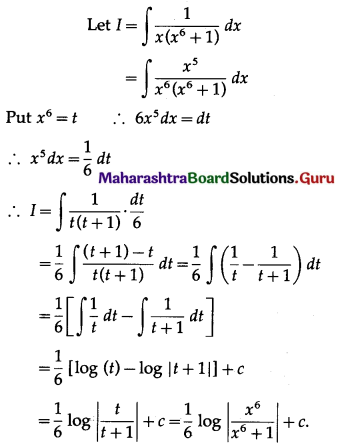
\(\int \frac{1}{x\left(x^{6}+1\right)} d x\)
Solution:
Maharashtra Board 12th Commerce Maths Solutions Chapter 5 Integration Ex 5.2 Q10

Maharashtra Board 12th Commerce Maths Solutions Chapter 5 Integration Ex 5.1

Balbharati Maharashtra State Board Std 12 Commerce Statistics Part 1 Digest Pdf Chapter 5 Integration Ex 5.1 Questions and Answers.

Maharashtra State Board 12th Commerce Maths Solutions Chapter 5 Integration Ex 5.1

Question 1.
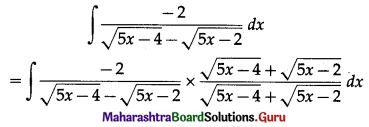
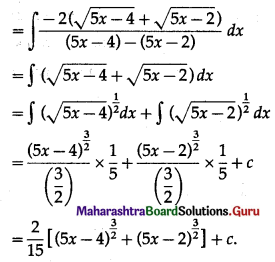
Evaluate \(\int \frac{-2}{\sqrt{5 x-4}-\sqrt{5 x-2}} d x\)
Solution:
Maharashtra Board 12th Commerce Maths Solutions Chapter 5 Integration Ex 5.1 Q1
Maharashtra Board 12th Commerce Maths Solutions Chapter 5 Integration Ex 5.1 Q1.1

Question 2.
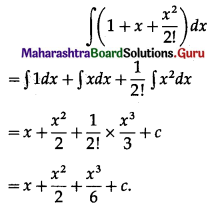
Evaluate \(\int\left(1+x+\frac{x^{2}}{2 !}\right) d x\)
Solution:
Maharashtra Board 12th Commerce Maths Solutions Chapter 5 Integration Ex 5.1 Q2

Maharashtra Board 12th Commerce Maths Solutions Chapter 5 Integration Ex 5.1

Question 3.
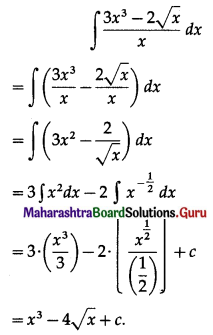
Evaluate \(\int \frac{3 x^{3}-2 \sqrt{x}}{x} d x\)
Solution:
Maharashtra Board 12th Commerce Maths Solutions Chapter 5 Integration Ex 5.1 Q3

Question 4.
Evaluate ∫(3x2 – 5)2 dx
Solution:
∫(3x2 – 5)2 dx
= ∫(9x4 – 30x2 + 25) dx
= 9∫x4 dx – 30∫x2 dx + 25∫1 dx
= 9(\(\frac{x^{5}}{5}\)) – 30(\(\frac{x^{3}}{3}\)) + 25x + c
= \(\frac{9x^{5}}{5}\) – 10x3 + 25x + c.

Question 5.
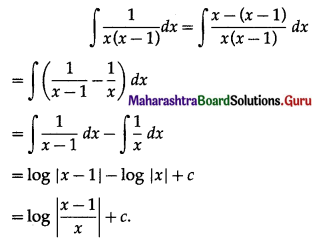
Evaluate \(\int \frac{1}{x(x-1)} d x\)
Solution:
Maharashtra Board 12th Commerce Maths Solutions Chapter 5 Integration Ex 5.1 Q5

Maharashtra Board 12th Commerce Maths Solutions Chapter 5 Integration Ex 5.1

Question 6.
If f'(x) = x2 + 5 and f(0) = -1, then find the value of f(x).
Solution:
By the definition of integral
f(x) = ∫f'(x) dx
= ∫(x2 + 5) dx
= ∫x2 dx + 5∫1 dx
= \(\frac{x^{3}}{3}\) + 5x + c
Now, f(0) = -1 gives
f(0) = 0 + 0 + c = -1
∴ c = -1
∴ from (1), f(x) = \(\frac{x^{3}}{3}\) + 5x – 1.

Question 7.
If f(x) = 4x3 – 3x2 + 2x + k, f(0) = -1 and f(1) = 4, find f(x).
Solution:
By the definition of integral
f(x) = ∫f'(x) dx
= ∫(4x3 – 3x2 + 2x + k) dx
= 4∫x3 dx – 3∫x2 dx + 2∫x dx + k∫1 dx
= 4(\(\frac{x^{4}}{4}\)) – 3(\(\frac{x^{3}}{3}\)) + 2(\(\frac{x^{2}}{2}\)) + kx + c
∴ f(x) = x4 – x3 + x2 + kx + c
Now, f(0) = 1 gives
f(0) = 0 – 0 + 0 + 0 + c = 1
∴ c = 1
∴ from (1), f(x) = x4 – x3 + x2 + kx + 1
Further f(1) = 4 gives
f(1) = 1 – 1 + 1 + k + 1 = 4
∴ k = 2
∴ from (2), f(x) = x4 – x3 + x2 + 2x + 1.

Maharashtra Board 12th Commerce Maths Solutions Chapter 5 Integration Ex 5.1

Question 8.
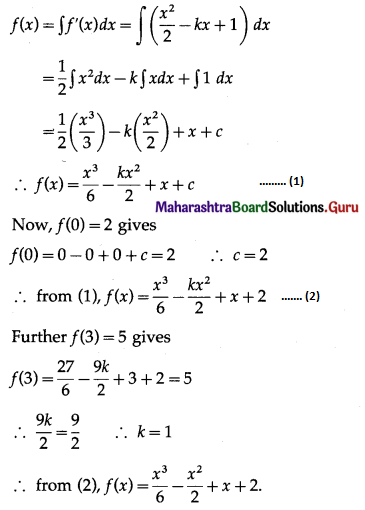
If f(x) = \(\frac{x^{2}}{2}\) – kx + 1, f(0) = 2 and f(3) = 5, find f(x).
Solution:
By the definition of integral
Maharashtra Board 12th Commerce Maths Solutions Chapter 5 Integration Ex 5.1 Q8

Maharashtra Board 12th Commerce Maths Solutions Chapter 4 Applications of Derivatives Miscellaneous Exercise 4

Balbharati Maharashtra State Board 12th Commerce Maths Solution Book Pdf Chapter 4 Applications of Derivatives Miscellaneous Exercise 4 Questions and Answers.

Maharashtra State Board 12th Commerce Maths Solutions Chapter 4 Applications of Derivatives Miscellaneous Exercise 4

(I) Choose the correct alternative:

Question 1.
The equation of tangent to the curve y = x2 + 4x + 1 at (-1, -2) is
(a) 2x – y = 0
(b) 2x + y – 5 = 0
(c) 2x – y – 1 = 0
(d) x + y – 1 = 0
Answer:
(a) 2x – y = 0

Question 2.
The equation of tangent to the curve x2 + y2 = 5, where the tangent is parallel to the line 2x – y + 1 = 0 are
(a) 2x – y + 5 = 0; 2x – y – 5 = 0
(b) 2x + y + 5 = 0; 2x + y – 5 = 0
(c) x – 2y + 5 = 0; x – 2y – 5 = 0
(d) x + 2y + 5; x + 2y – 5 = 0
Answer:
(a) 2x – y + 5 = 0; 2x – y – 5 = 0

Maharashtra Board 12th Commerce Maths Solutions Chapter 4 Applications of Derivatives Miscellaneous Exercise 4

Question 3.
If the elasticity of demand η = 1, then demand is
(a) constant
(b) inelastic
(c) unitary elastic
(d) elastic
Answer:
(c) unitary elastic

Question 4.
If 0 < η < 1, then the demand is
(a) constant
(b) inelastic
(c) unitary elastic
(d) elastic
Answer:
(b) inelastic

Question 5.
The function f(x) = x3 – 3x2 + 3x – 100, x ∈ R is
(a) increasing for all x ∈ R, x ≠ 1
(b) decreasing
(c) neither increasing nor decreasing
(d) decreasing for all x ∈ R, x ≠ 1
Answer:
(a) increasing for all x ∈ R, x ≠ 1

Question 6.
If f(x) = 3x3 – 9x2 – 27x + 15, then
(a) f has maximum value 66
(b) f has minimum value 30
(c) f has maxima at x = -1
(d) f has minima at x = -1
Answer:
(c) f has maxima at x = -1

Maharashtra Board 12th Commerce Maths Solutions Chapter 4 Applications of Derivatives Miscellaneous Exercise 4

(II) Fill in the blanks:

Question 1.
The slope of tangent at any point (a, b) is called as ___________
Answer:
gradient

Question 2.
If f(x) = x3 – 3x2 + 3x – 100, x ∈ R, then f”(x) is ___________
Answer:
6x – 6 = 6(x – 1)

Question 3.
If f(x) = \(\frac{7}{x}\) – 3, x ∈ R, x ≠ 0, then f”(x) is ___________
Answer:
14x-3

Question 4.
A rod of 108 m in length is bent to form a rectangle. If area j at the rectangle is maximum, then its dimensions are ___________
Answer:
27 and 27

Question 5.
If f(x) = x . log x, then its maximum value is ___________
Answer:
\(-\frac{1}{e}\)

(III) State whether each of the following is True or False:

Question 1.
The equation of tangent to the curve y = 4xex at (-1, \(\frac{-4}{e}\)) is y.e + 4 = 0.
Answer:
True

Question 2.
x + 10y + 21 = 0 is the equation of normal to the curve y = 3x2 + 4x – 5 at (1, 2).
Answer:
False

Maharashtra Board 12th Commerce Maths Solutions Chapter 4 Applications of Derivatives Miscellaneous Exercise 4

Question 3.
An absolute maximum must occur at a critical point or at an endpoint.
Answer:
True

Question 4.
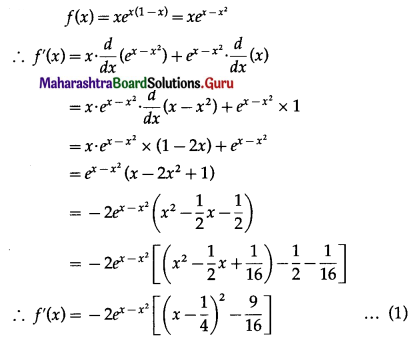
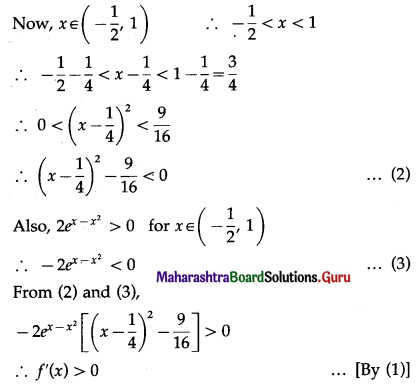
The function f(x) = x.ex(1-x) is increasing on (\(\frac{-1}{2}\), 1).
Answer:
True.
Hint:
Maharashtra Board 12th Commerce Maths Solutions Chapter 4 Applications of Derivatives Miscellaneous Exercise 4 III Q4
Maharashtra Board 12th Commerce Maths Solutions Chapter 4 Applications of Derivatives Miscellaneous Exercise 4 III Q4.1
Hence, function f(x) is increasing on (\(\frac{-1}{2}\), 1).

(IV) Solve the following:

Question 1.
Find the equations of tangent and normal to the following curves:
(i) xy = c2 at (ct, \(\frac{c}{t}\)), where t is a parameter.
Solution:
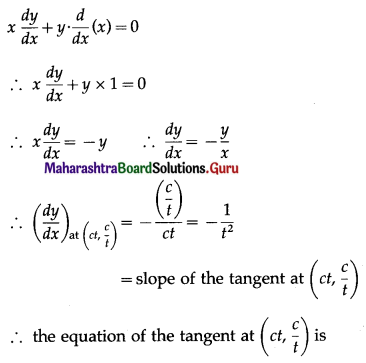
xy = c2
Differentiating both sides w.r.t. x, we get
Maharashtra Board 12th Commerce Maths Solutions Chapter 4 Applications of Derivatives Miscellaneous Exercise 4 IV Q1(i)
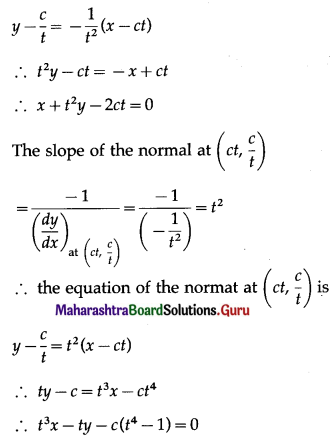
Maharashtra Board 12th Commerce Maths Solutions Chapter 4 Applications of Derivatives Miscellaneous Exercise 4 IV Q1(i).1
Hence, equations of tangent and normal are x + t2y – 2ct = 0 and t3x – ty – c(t4 + 1) = 0 respectively.

(ii) y = x2 + 4x at the point whose ordinate is -3.
Solution:
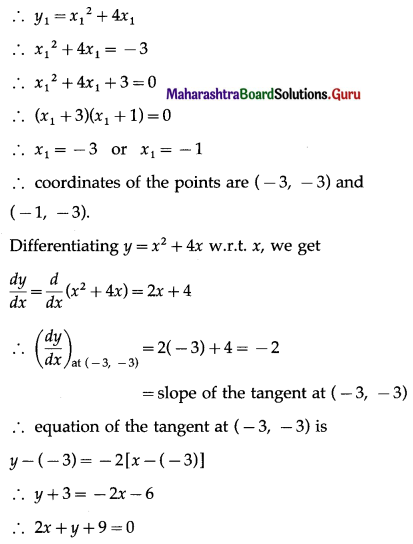
Let P(x1, y1) be the point on the curve
y = x2 + 4x, where y1 = -3
Maharashtra Board 12th Commerce Maths Solutions Chapter 4 Applications of Derivatives Miscellaneous Exercise 4 IV Q1(ii)
Maharashtra Board 12th Commerce Maths Solutions Chapter 4 Applications of Derivatives Miscellaneous Exercise 4 IV Q1(ii).1
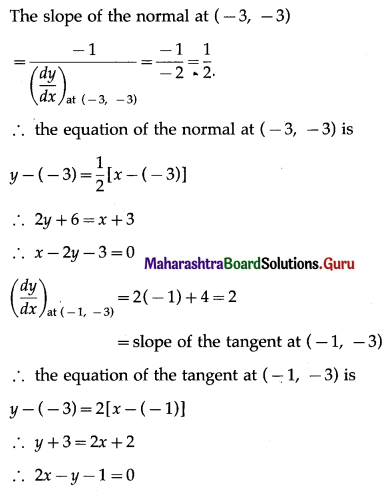
Maharashtra Board 12th Commerce Maths Solutions Chapter 4 Applications of Derivatives Miscellaneous Exercise 4 IV Q1(ii).2
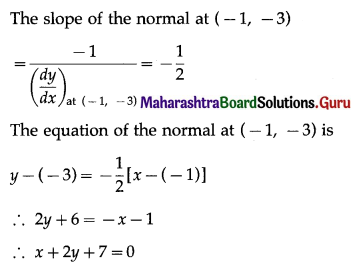
Hence, the equations of tangent and normal at
(i) (-3, -3) are 2x + y + 9 = 0 and x – 2y – 3 = 0
(ii) (-1, -3) are 2x – y – 1 = 0 and x + 2y + 7 = 0

Maharashtra Board 12th Commerce Maths Solutions Chapter 4 Applications of Derivatives Miscellaneous Exercise 4

(iii) x = \(\frac{1}{t}\), y = t – \(\frac{1}{t}\), at t = 2.
Solution:
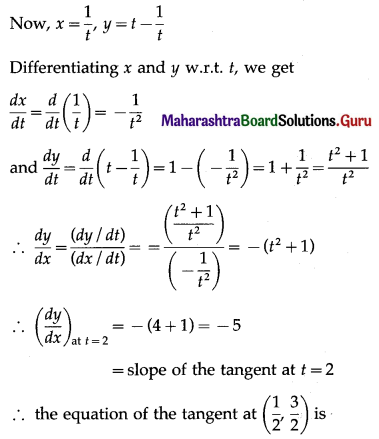
When t = 2, x = \(\frac{1}{2}\) and y = 2 – \(\frac{1}{2}\) = \(\frac{3}{2}\)
Hence, the point P at which we want to find the equations of tangent and normal is (\(\frac{1}{2}\), \(\frac{3}{2}\))
Maharashtra Board 12th Commerce Maths Solutions Chapter 4 Applications of Derivatives Miscellaneous Exercise 4 IV Q1(iii)
Maharashtra Board 12th Commerce Maths Solutions Chapter 4 Applications of Derivatives Miscellaneous Exercise 4 IV Q1(iii).1
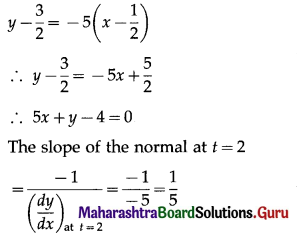
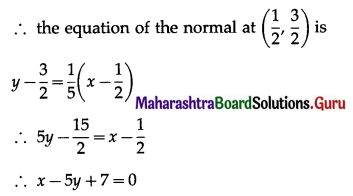
Maharashtra Board 12th Commerce Maths Solutions Chapter 4 Applications of Derivatives Miscellaneous Exercise 4 IV Q1(iii).2
Hence, the equations of tangent and normal are 5x + y – 4 = 0 and x – 5y + 7 = 0 respectively.

(iv) y = x3 – x2 – 1 at the point whose abscissa is -2.
Solution:
y = x3 – x2 – 1
∴ \(\frac{d y}{d x}=\frac{d}{d x}\)(x3 – x2 – 1)
= 3x2 – 2x – 0
= 3x2 – 2x
∴ \(\left(\frac{d y}{d x}\right)_{\text {at } x=-2}\) = 3(-2)2 – 2(-2) = 16
= slope of the tangent at x = -2
When x = -2, y = (-2)3 – (-2)2 – 1 = -13
∴ the point P is (-2, -13)
∴ the equation of the tangent at (-2, -13) is
y – (-13) = 16[x – (-2)]
∴ y + 13 = 16x + 32
∴ 16x – y + 19 = 0
The slope of the normal at x = -2
= \(\frac{-1}{\left(\frac{d y}{d x}\right)_{\text {at } x=-2}}=\frac{-1}{16}\)
∴ the equation of the normal at (-2, -13) is
y – (-13) = \(-\frac{1}{16}\)[x – (-2)]
∴ 16y + 208 = -x – 2
∴ x + 16y + 210 = 0
Hence, equations of tangent and normal are 16x – y + 19 = 0 and x + 16y + 210 = 0 respectively.

Maharashtra Board 12th Commerce Maths Solutions Chapter 4 Applications of Derivatives Miscellaneous Exercise 4

Question 2.
Find the equation of the normal to the curve y = \(\sqrt{x-3}\) which is perpendicular to the line 6x + 3y – 4 = 0.
Solution:
Let P(x1, y1) be the foot of the required normal to the curve y = \(\sqrt{x-3}\)
Differentiating y = \(\sqrt{x-3}\) w.r.t. x, we get
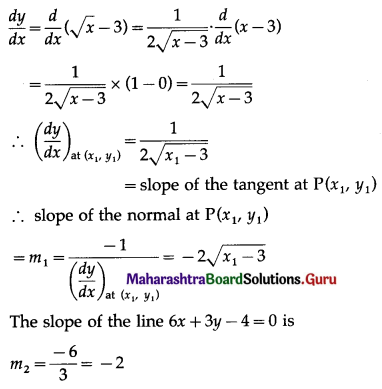
Maharashtra Board 12th Commerce Maths Solutions Chapter 4 Applications of Derivatives Miscellaneous Exercise 4 IV Q2
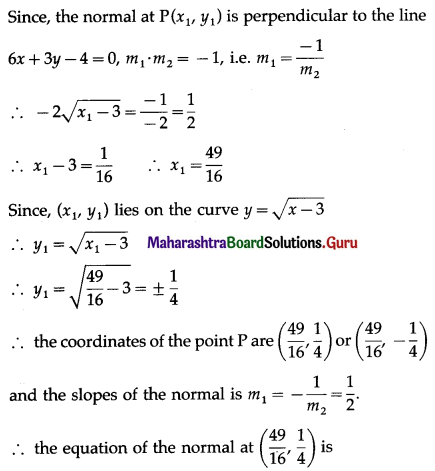
Maharashtra Board 12th Commerce Maths Solutions Chapter 4 Applications of Derivatives Miscellaneous Exercise 4 IV Q2.1
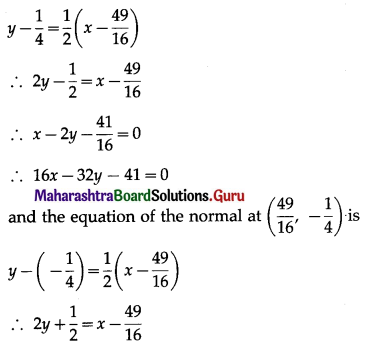
Maharashtra Board 12th Commerce Maths Solutions Chapter 4 Applications of Derivatives Miscellaneous Exercise 4 IV Q2.2
∴ x – 2y – \(\frac{57}{16}\) = 0
i.e. 16x – 32y – 57 = 0
Hence, the equation of the normals are 16x – 32y – 41 = 0 and 16x – 32y – 57 = 0.

Question 3.
Show that the function f(x) = \(\frac{x-2}{x+1}\), x ≠ -1 is increasing.
Solution:
f(x) = \(\frac{x-2}{x+1}\)
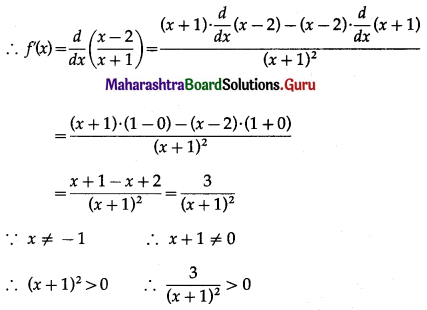
Maharashtra Board 12th Commerce Maths Solutions Chapter 4 Applications of Derivatives Miscellaneous Exercise 4 IV Q3
∴ f'(x) > 0, for all x ∈ R, x ≠ -1
Hence, the function f is increasing for all x ∈ R, where x ≠ -1.

Question 4.
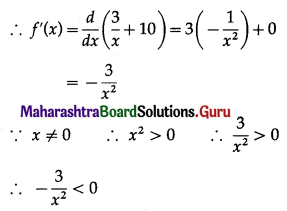
Show that the function f(x) = \(\frac{3}{x}\) + 10, x ≠ 0 is decreasing.
Solution:
f(x) = \(\frac{3}{x}\) + 10
Maharashtra Board 12th Commerce Maths Solutions Chapter 4 Applications of Derivatives Miscellaneous Exercise 4 IV Q4
∴ f'(x) < 0 for all x ∈ R, x ≠ 0
Hence, the function f is decreasing for all x ∈ R, where x ≠ 0.

Question 5.
If x + y = 3, show that the maximum value of x2y is 4.
Solution:
x + y = 3
∴ y = 3 – x
∴ x2y = x2(3 – x) = 3x2 – x3
Let f(x) = 3x2 – x3
Then f'(x) = \(\frac{d}{d x}\)(3x2 – x3)
= 3 × 2x – 3x2
= 6x – 3x2
and f”(x) = \(\frac{d}{d x}\)(6x – 3x2)
= 6 × 1 – 3 × 2x
= 6 – 6x
Now, f'(x) = 0 gives 6x – 3x2 = 0
∴ 3x(2 – x) = 0
∴ x = 0 or x = 2
f”(0) = 6 – 0 = 6 > 0
∴ f has minimum value at x = 0
Also, f”(2) = 6 – 12 = -6 < 0
∴ f has maximum value at x = 2
When x = 2, y = 3 – 2 = 1
∴ maximum value of x2y = (2)2(1) = 4.

Maharashtra Board 12th Commerce Maths Solutions Chapter 4 Applications of Derivatives Miscellaneous Exercise 4

Question 6.
Examine the function f for maxima and minima, where f(x) = x3 – 9x2 + 24x.
Solution:
f(x) = x3 – 9x2 + 24x
∴ f'(x) = \(\frac{d}{d x}\)(x3 – 9x2 + 24x)
= 3x2 – 9 × 2x + 24 × 1
= 3x2 – 18x + 24
and f”(x) = \(\frac{d}{d x}\)(3x2 – 18x + 24)
= 3 × 2x – 18 × 1 + 0
= 6x – 18
f'(x) = 0 gives 3x2 – 18x + 24 = 0
∴ x2 – 6x + 8 = 0
∴ (x – 2)(x – 4) = 0
∴ the roots of f'(x) = 0 are x1 = 2 and x2 = 4.
(a) f”(2) = 6(2) – 18 = -6 < 0
∴ by the second derivative test,
f has maximum at x = 2 and maximum value of f at x = 2
f(2) = (2) – 9(2)2 + 24(2)
= 8 – 36 + 48
= 20
(b) f”(4) = 6(4) – 18 = 6 > 0
∴ by the second derivative test, f has minimum at x = 4
and minimum value of f at x = 4
f(4) = (4)3 – 9(4)2 + 24(4)
= 64 – 144 + 96
= 16.

Maharashtra Board 12th Commerce Maths Solutions Chapter 4 Applications of Derivatives Ex 4.4

Balbharati Maharashtra State Board 12th Commerce Maths Solution Book Pdf Chapter 4 Applications of Derivatives Ex 4.4 Questions and Answers.

Maharashtra State Board 12th Commerce Maths Solutions Chapter 4 Applications of Derivatives Ex 4.4

Question 1.
The demand function of a commodity at price P is given as D = 40 – \(\frac{5 P}{8}\). Check whether it is increasing or decreasing function.
Solution:
D = 40 – \(\frac{5 P}{8}\)
∴ \(\frac{d D}{d P}=\frac{d}{d P}\left(40-\frac{5 P}{8}\right)\)
= 0 – \(\frac{5}{8}\) × 1
= \(\frac{-5}{8}\)
Hence, the given function is decreasing function.

Question 2.
The price P for demand D is given as P = 183 + 120D – 3D2, find D for which price is increasing.
Solution:
P = 183 + 120D – 3D2
∴ \(\frac{d P}{d D}=\frac{d}{d D}\)(183 + 120D – 3D2)
= 0 + 120 × 1 – 3 × 2D
= 120 – 6D
If price P is increasing, then \(\frac{d P}{d D}\) > 0
∴ 120 – 6D > 0
∴ 120 > 6D
∴ D < 20
Hence, the price is increasing when D < 20.

Maharashtra Board 12th Commerce Maths Solutions Chapter 4 Applications of Derivatives Ex 4.4

Question 3.
The total cost function for production of x articles is given as C = 100 + 600x – 3x2. Find the values of x for which the total cost is decreasing.
Solution:
The cost function is given as
C = 100 + 600x – 3x2
∴ \(\frac{d C}{d D}=\frac{d}{d D}\)(100 + 600x – 3x2)
= 0 + 600 × 1 – 3 × 2x
= 600 – 6x
If the total cost is decreasing, then \(\frac{d C}{d x}\) < 0
∴ 600 – 6x < 0
∴ 600 < 6x
∴ x > 100
Hence, the total cost is decreasing for x > 100.

Question 4.
The manufacturing company produces x items at the total cost of ₹(180 + 4x). The demand function for this product is P = (240 – x). Find x for which
(i) revenue is increasing
(ii) profit is increasing.
Solution:
(i) Let R be the total revenue.
Then R = P.x = (240 – x)x
∴ R = 240x – x2
∴ \(\frac{d R}{d D}=\frac{d}{d D}\)(240x – x2)
= 240 × 1 – 2x
= 240 – 2x
R is increasing, if \(\frac{d R}{d x}\) > 0
i.e. if 240 – 2x > 0
i.e. if 240 > 2x
i.e. if x < 120
Hence, the revenue is increasing, if x < 120.

(ii) Profit π = R – C
∴ π = (240x – x2) – (180 + 4x)
= 240x – x2 – 180 – 4x
= 236x – x2 – 180
∴ \(\frac{d \pi}{d x}=\frac{d}{d x}\)(236x – x2 – 180)
= 236 × 1 – 2x – 0
= 236 – 2x
Profit is increasing, if \(\frac{d \pi}{d x}\) > 0
i.e. if 236 – 2x > 0
i.e. if 236 > 2x
i.e. if x < 118
Hence, the profit is increasing, if x < 118.

Maharashtra Board 12th Commerce Maths Solutions Chapter 4 Applications of Derivatives Ex 4.4

Question 5.
For manufacturing x units, labour cost is 150 – 54x and processing cost is x2. Price of each unit is p = 10800 – 4x2. Find the values of x for which
(i) total cost is decreasing
(ii) revenue is increasing.
Solution:
(i) Total cost C = labour cost + processing cost
∴ C = 150 – 54x + x2
∴ \(\frac{d C}{d x}=\frac{d}{d x}\)(150 – 54x + x2)
= 0 – 54 × 1 + 2x
= -54 + 2x
The total cost is decreasing, if \(\frac{d C}{d x}\) < 0
i.e. if -54 + 2x < 0
i.e. if 2x < 54
i.e. if x < 27
Hence, the total cost is decreasing, if x < 27.

(ii) The total revenue R is given as
R = p.x
R = (10800 – 4x2) x
R = 10800x – 4x3
∴ \(\frac{d R}{d x}=\frac{d}{d x}\)(10800x – 4x3)
= 10800 × 1 – 4 × 3x2
= 10800 – 12x2
The revenue is increasing, if \(\frac{d R}{d x}\) > 0
i.e. if 10800 – 12x2 > 0
i.e. if 10800 > 12x2
i.e. if x2 < 900
i.e. if x < 30 ……[∵ x > 0]
Hence, the revenue is increasing, if x < 30.

Question 6.
The total cost of manufacturing x articles is C = 47x + 300x2 – x4. Find x, for which average cost is
(i) increasing
(ii) decreasing.
Solution:
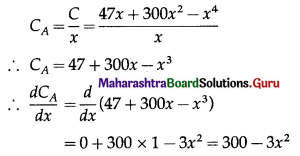
The total cost is given as C = 47x + 300x2 – x4
∴ the average cost is given by
Maharashtra Board 12th Commerce Maths Solutions Chapter 4 Applications of Derivatives Ex 4.4 Q6
(i) CA is increasing, if \(\frac{d C_{A}}{d x}\) > 0
i.e. if 300 – 3x2 > 0
i.e. if 300 > 3x2
i.e. if x2 < 100
i.e. if x < 10 …..[∵ x > 0]
Hence, the average cost is increasing, if x < 10.

(ii) CA is decreasing, if \(\frac{d C_{A}}{d x}\) < 0
i.e. if 300 – 3x2 < 0
i.e. if 300 < 3x2
i.e. if x2 > 100
i.e. if x > 10 ……[∵ x > 0]
Hence, the average cost is decreasing, if x > 10.

Maharashtra Board 12th Commerce Maths Solutions Chapter 4 Applications of Derivatives Ex 4.4

Question 7.
(i) Find the marginal revenue, if the average revenue is 45 and the elasticity of demand is 5.
Solution:
Given RA = 45 and η = 5
Now, Rm = \(R_{A}\left(1-\frac{1}{\eta}\right)\)
= 45(1 – \(\frac{1}{5}\))
= 45(\(\frac{4}{5}\))
= 36
Hence, the marginal revenue = 36.

(ii) Find the price, if the marginal revenue is 28 and elasticity of demand is 3.
Solution:
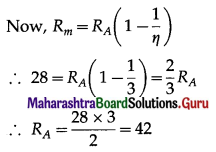
Given Rm = 28 and η = 3
Maharashtra Board 12th Commerce Maths Solutions Chapter 4 Applications of Derivatives Ex 4.4 Q7(ii)
Hence, the price = 42.

(iii) Find the elasticity of demand, if the marginal revenue is 50 and price is ₹ 75.
Solution:
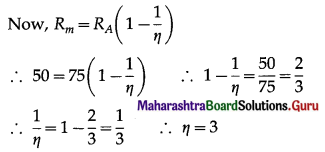
Given Rm = 50 and RA = 75
Maharashtra Board 12th Commerce Maths Solutions Chapter 4 Applications of Derivatives Ex 4.4 Q7(iii)
Hence, the elasticity of demand = 3.

Question 8.
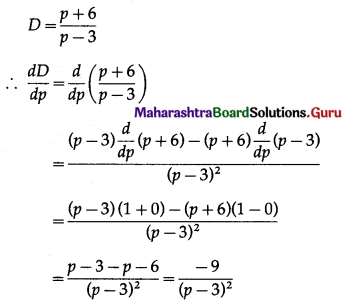
If the demand function is D = \(\frac{p+6}{p-3}\), find the elasticity of demand at p = 4.
Solution:
The demand function is
Maharashtra Board 12th Commerce Maths Solutions Chapter 4 Applications of Derivatives Ex 4.4 Q8
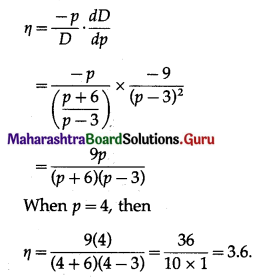
Elasticity of demand is given by
Maharashtra Board 12th Commerce Maths Solutions Chapter 4 Applications of Derivatives Ex 4.4 Q8.1
Hence, the elasticity of demand at p = 4 is 3.6

Maharashtra Board 12th Commerce Maths Solutions Chapter 4 Applications of Derivatives Ex 4.4

Question 9.
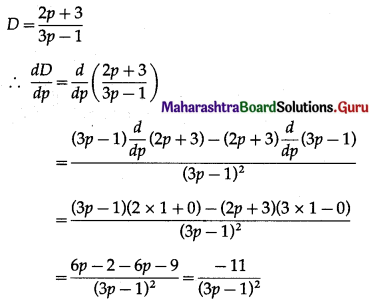
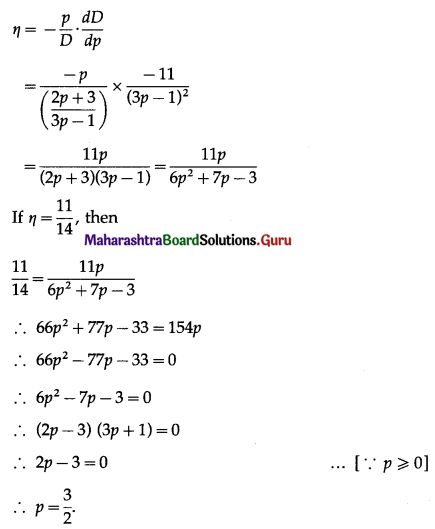
Find the price for the demand function D = \(\frac{2 p+3}{3 p-1}\), when elasticity of demand is \(\frac{11}{14}\).
Solution:
The demand function is
Maharashtra Board 12th Commerce Maths Solutions Chapter 4 Applications of Derivatives Ex 4.4 Q9
Elasticity of demand is given by
Maharashtra Board 12th Commerce Maths Solutions Chapter 4 Applications of Derivatives Ex 4.4 Q9.1

Question 10.
If the demand function is D = 50 – 3p – p2 elasticity of demand at (i) p = 5 (ii) p = 2. Comment on the result.
Solution:
The demand function is D = 50 – 3p – p2
∴ \(\frac{d D}{d p}=\frac{d}{d p}\)(50 – 3p – p2)
= 0 – 3 × 1 – 2p
= -3 – 2p
Elasticity of demand is given by
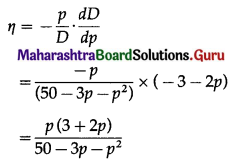
Maharashtra Board 12th Commerce Maths Solutions Chapter 4 Applications of Derivatives Ex 4.4 Q10
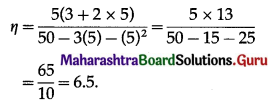
(i) When p = 5, then
Maharashtra Board 12th Commerce Maths Solutions Chapter 4 Applications of Derivatives Ex 4.4 Q10.1
Since, η >1, the demand is elastic.
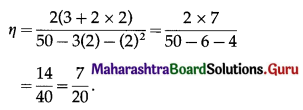
(ii) When p = 2, then
Maharashtra Board 12th Commerce Maths Solutions Chapter 4 Applications of Derivatives Ex 4.4 Q10.2
Since, 0 < η < 1, the demand is inelastic.

Maharashtra Board 12th Commerce Maths Solutions Chapter 4 Applications of Derivatives Ex 4.4

Question 11.
For the demand function D = 100 – \(\frac{p^{2}}{2}\), find the elasticity of demand at (i) p = 10 (ii) p = 6 and comment on the results.
Solution:
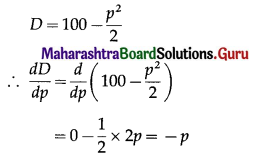
The demand function is
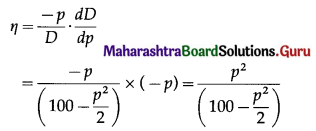
Maharashtra Board 12th Commerce Maths Solutions Chapter 4 Applications of Derivatives Ex 4.4 Q11
The elasticity of demand is given by
Maharashtra Board 12th Commerce Maths Solutions Chapter 4 Applications of Derivatives Ex 4.4 Q11.1
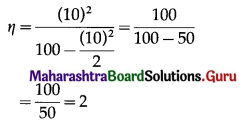
(i) When p = 10, then
Maharashtra Board 12th Commerce Maths Solutions Chapter 4 Applications of Derivatives Ex 4.4 Q11.2
Since, η > 1, the demand is elastic.
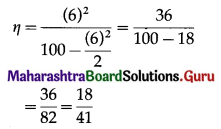
(ii) When p = 6, then
Maharashtra Board 12th Commerce Maths Solutions Chapter 4 Applications of Derivatives Ex 4.4 Q11.3
Since, 0 < η < 1, the demand is inelastic.

Question 12.
A manufacturing company produces, x items at a total cost of ₹(40 + 2x). Their price is given as p = 120 – x. Find the value of x for which
(i) revenue is increasing
(ii) profit is increasing
(iii) Also find an elasticity of demand for price 80.
Solution:
(i) The total revenue R is given by
R = p.x = (120 – x)x
∴ R = 120x – x2
∴ \(\frac{d R}{d x}=\frac{d}{d x}\)(120x – x2)
= 120 × 1 – 2x
= 120 – 2x
If the revenue is increasing, then \(\frac{d R}{d x}\) > 0
∴ 120 – 2x > 0
∴ 120 > 2x
∴ x < 60
Hence, the revenue is increasing when x < 60.

(ii) Profit π = R – C
= (120x – x2) – (40 + 2x)
= 120x – x2 – 40 – 2x
= 118x – x2 – 40
∴ \(\frac{d \pi}{d x}=\frac{d}{d x}\)(118x – x2 – 40)
= 118 × 1 – 2x – 0
= 118 – 2x
If the profit is increasing, then \(\frac{d \pi}{d x}\) > 0
∴ 118 – 2x > 0
∴ 118 > 2x
∴ x < 59
Hence, the profit is increasing when x < 59.

Maharashtra Board 12th Commerce Maths Solutions Chapter 4 Applications of Derivatives Ex 4.4

(iii) p = 120 – x
∴ x = 120 – p
∴ \(\frac{d x}{d p}=\frac{d}{d p}\)(120 – p)
= 0 – 1
= -1
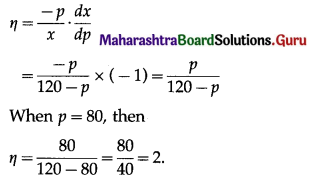
Elasticity of demand is given by
Maharashtra Board 12th Commerce Maths Solutions Chapter 4 Applications of Derivatives Ex 4.4 Q12(iii)

Question 13.
Find MPC, MPS, APC and APS, if the expenditure Ec of a person with income I is given as
Ec = (0.0003)I2 + (0.075)I, when I = 1000.
Solution:
Ec = (0.0003)I2 + (0.075)I
MPC = \(\frac{d E_{c}}{d I}=\frac{d}{d I}\)[(0.0003)I2 + (0.075)I]
= (0.0003)(2I) + (0.075)(1)
= (0.0006)I + 0.075
When I = 1000, then
MPC = (0.0006)(1000) + 0.075
= 0.6 + 0.075
= 0.675.
∴ MPC + MPS = 1
∴ 0.675 + MPS = 1
∴ MPS = 1 – 0.675 = 0.325
Now, APC = \(\frac{E_{c}}{I}=\frac{(0.0003) I^{2}+(0.075) I}{I}\)
= (0.0003)I + (0.075)
When I = 1000, then
APC = (0.0003)(1000) + 0.075
= 0.3 + 0.075
= 0.375
∵ APC + APS = 1
∴ 0.375 + APS = 1
∴ APS = 1 – 0.375 = 0.625
Hence, MPC = 0.675, MPS = 0.325, APC = 0.375, APS = 0.625.

Maharashtra Board 12th Commerce Maths Solutions Chapter 4 Applications of Derivatives Ex 4.3

Balbharati Maharashtra State Board 12th Commerce Maths Solution Book Pdf Chapter 4 Applications of Derivatives Ex 4.3 Questions and Answers.

Maharashtra State Board 12th Commerce Maths Solutions Chapter 4 Applications of Derivatives Ex 4.3

Question 1.
Determine the maximum and minimum values of the following functions:
(i) f(x) = 2x3 – 21x2 + 36x – 20
Solution:
f(x) = 2x3 – 21x2 + 36x – 20
∴ f'(x) = \(\frac{d}{d x}\)(2x3 – 21x2 + 36x – 20)
= 2 × 3x2 – 21 × 2x + 36 × 1 – 0
= 6x2 – 42x + 36
and f”(x) = \(\frac{d}{d x}\)(6x2 – 42x + 36)
= 6 × 2x – 42 × 1 + 0
= 12x – 42
f'(x) = 0 gives 6x2 – 42x + 36 = 0.
∴ x2 – 7x + 6 = 0
∴ (x – 1)(x – 6) = 0
∴ the roots of f'(x) = 0 are x1 = 1 and x2 = 6.
For x = 1, f”(1) = 12(1) – 42 = -30 < 0
∴ by the second derivative test,
f has maximum at x = 1 and maximum value of f at x = 1
f(1) = 2(1)3 – 21(1)2 + 36(1) – 20
= 2 – 21 + 36 – 20
= -3
For x = 6, f”(6) = 12(6) – 42 = 30 > 0
∴ by the second derivative test,
f has minimum at x = 6 and minimum value of f at x = 6
f(6) = 2(6)3 – 21(6)2 + 36(6) – 20
= 432 – 756 + 216 – 20
= -128
Hence, the function f has maximum value -3 at x = 1 and minimum value -128 at x = 6.

Maharashtra Board 12th Commerce Maths Solutions Chapter 4 Applications of Derivatives Ex 4.3

(ii) f(x) = x . log x
Solution:
f(x) = x . log x
f'(x) = \(\frac{d}{d x}\)(x.log x)
= x.\(\frac{d}{d x}\)(log x) + log x.\(\frac{d}{d x}\)(x)
= x × \(\frac{1}{x}\) + (logx) × 1
= 1 + log x
and f”(x) = \(\frac{d}{d x}\)(1 + logx)
= 0 + \(\frac{1}{x}\)
= \(\frac{1}{x}\)
Now, f'(x) = 0, if 1 + log x = 0
i.e. if log x = -1 = -log e
i.e. if log x = log(e-1) = log \(\frac{1}{e}\)
i.e. if x = \(\frac{1}{e}\)
When x = \(\frac{1}{e}\), f”(x) = \(\frac{1}{(1 / e)}\) = e > 0
∴ by the second derivative test,
f is minimum at x = \(\frac{1}{e}\)
Minimum value of f at x = \(\frac{1}{e}\)
= \(\frac{1}{e}\) log(\(\frac{1}{e}\))
= \(\frac{1}{e}\) log(e-1)
= \(\frac{1}{e}\) (-1) log e
= \(\frac{-1}{e}\) ……..[∵ log e = 1]
Hence, the function f has minimum at x = \(\frac{1}{e}\) and minimum value is \(\frac{-1}{e}\).

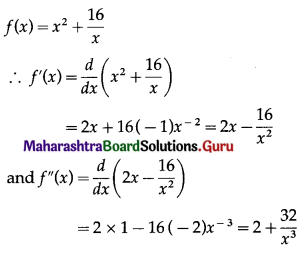
(iii) f(x) = x2 + \(\frac{16}{x}\)
Solution:
Maharashtra Board 12th Commerce Maths Solutions Chapter 4 Applications of Derivatives Ex 4.3 Q1(iii)
f'(x) = 0 gives 2x – \(\frac{16}{x^{2}}\) = 0
∴ 2x3 – 16 = 0
∴ x3 = 8
∴ x = 2
For x = 2, f”(2) = 2 + \(\frac{32}{(2)^{3}}\) = 6 > 0
∴ by the second derivative test, f has minimum at x = 2 and minimum value of f at x = 2
f(2) = (2)2 + \(\frac{16}{2}\)
= 4 + 8
= 12
Hence, the function f has a minimum at x = 2 and a minimum value is 12.

Maharashtra Board 12th Commerce Maths Solutions Chapter 4 Applications of Derivatives Ex 4.3

Question 2.
Divide the number 20 into two parts such that their product is maximum.
Solution:
Let the first part of 20 be x.
Then the second part is 20 – x.
∴ their product = x(20 – x) = 20x – x2 = f(x) …..(Say)
∴ f'(x) = \(\frac{d}{d x}\)(20x – x2)
= 20 × 1 – 2x
= 20 – 2x
and f”(x) = \(\frac{d}{d x}\)(20 – 2x)
= 0 – 2 × 1
= -2
The root of the equation f'(x) = 0
i.e. 20 – 2x = 0 is x = 10
and f”(10) = -2 < 0
∴ by the second derivative test, f is maximum at x = 10.
Hence, the required parts of 20 are 10 and 10.

Question 3.
A metal wire of 36 cm long is bent to form a rectangle. Find its dimensions where its area is maximum.
Solution:
Let x cm and y cm be the length and breadth of the rectangle.
Then its perimeter is 2(x + y) = 36
∴ x + y = 18
∴ y = 18 – x
Area of the rectangle = xy = x(18 – x)
Let f(x) = x(18 – x) = 18x – x2
Then f'(x) = \(\frac{d}{d x}\)(18x – x2)
= 18 × 1 – 2x
= 18 – 2x
and f”(x) = \(\frac{d}{d x}\)(18 – 2x)
= 0 – 2 × 1
= -2
Now, f(x) = 0, if 18 – 2x = 0
i.e. if x = 9
and f”(9) = -2 < 0
∴ by the second derivative test, f has maximum value at x = 9
When x = 9, y = 18 – 9 = 9
Hence, the rectangle is a square of side 9 cm.

Maharashtra Board 12th Commerce Maths Solutions Chapter 4 Applications of Derivatives Ex 4.3

Question 4.
The total cost of producing x units is ₹(x2 + 60x + 50) and the price is ₹(180 – x) per unit. For what units is the profit maximum?
Solution:
Let the number of units sold be x.
Then profit = S.P. – C.P.
∴ P(x) = (180 – x)x – (x2 + 60x + 50)
∴ P(x) = 180x – x2 – x2 – 60x – 50
∴ P(x) = 120x – 2x2 – 50
P'(x) = \(\frac{d}{d x}\)(120x – 2x2 – 50)
= 120 × 1 – 2 × 2x – 0
= 120 – 4x
and P”(x) = \(\frac{d}{d x}\)(120 – 4x)
= 0 – 4 × 1
= -4
P'(x) = 0 if 120 – 4x = 0
i.e. if x = 30 and P”(30) = -4 < 0
∴ by the second derivative test, P(x) is maximum when x = 30.
Hence, the number of units sold for maximum profit is 30.

Maharashtra Board 12th Commerce Maths Solutions Chapter 4 Applications of Derivatives Ex 4.2

Balbharati Maharashtra State Board 12th Commerce Maths Solution Book Pdf Chapter 4 Applications of Derivatives Ex 4.2 Questions and Answers.

Maharashtra State Board 12th Commerce Maths Solutions Chapter 4 Applications of Derivatives Ex 4.2

Question 1.
Test whether the following functions are increasing and decreasing:
(i) f(x) = x3 – 6x2 + 12x – 16, x ∈ R
Solution:
f(x) = x3 – 6x2 + 12x – 16
∴ f'(x) = \(\frac{d}{d x}\)(x3 – 6x2 + 12x – 16)
= 3x2 – 6 × 2x + 12 × 1 – 0
= 3x2 – 12x + 12
= 3(x2 – 4x + 4)
= 3(x – 2)2 > 0 for all x ∈ R, x ≠ 2
∴ f'(x) > 0 for all x ∈ R – {2}
∴ f is increasing for all x ∈ R – {2}.

(ii) f(x) = x – \(\frac{1}{x}\), x ∈ R, x ≠ 0
Solution:
f(x) = x – \(\frac{1}{x}\)
∴ f'(x) = \(\frac{d}{d x}\left(x-\frac{1}{x}\right)\)
= 1 – \(\left(-\frac{1}{x^{2}}\right)\)
= 1 + \(\frac{1}{x^{2}}\) > 0 for all x ∈ R, x ≠ 0
∴ f'(x) > 0 for all x ∈ R, where x ≠ 0
∴ f is increasing for all x > R, where x ≠ 0.

Maharashtra Board 12th Commerce Maths Solutions Chapter 4 Applications of Derivatives Ex 4.2

(iii) f(x) = \(\frac{7}{x}\) – 3, x ∈ R, x ≠ 0
Solution:
f(x) = \(\frac{7}{x}\) – 3
∴ f'(x) = \(\frac{d}{d x}\left(\frac{7}{x}-3\right)=7\left(-\frac{1}{x^{2}}\right)-0\)
= \(-\frac{7}{x^{2}}\) < 0 for all x ∈ R, x ≠ 0
∴ f'(x) < 0 for all x ∈ R, where x ≠ 0.
∴ f is decreasing for all x ∈ R, where x ≠ 0.

Question 2.
Find the values of x, such that f(x) is increasing function:
(i) f(x) = 2x3 – 15x2 + 36x + 1
Solution:
f(x) = 2x3 – 15x2 + 36x + 1
∴ f'(x) = \(\frac{d}{d x}\)(2x3 – 15x2 + 36x + 1)
= 2 × 3x2 – 15 × 2x + 36 × 1 + 0
= 6x2 – 30x + 36
= 6(x2 – 5x + 6)
f is increasing, if f'(x) > 0
i.e. if 6(x2 – 5x + 6) > 0
i.e. if x2 – 5x + 6 > 0
i.e. if x2 – 5x > -6
i.e. if x – 5x + \(\frac{25}{4}\) > -6 + \(\frac{25}{4}\)
i.e. if \(\left(x-\frac{5}{2}\right)^{2}>\frac{1}{4}\)
i.e. if x – \(\frac{5}{2}\) > \(\frac{1}{2}\) or x – \(\frac{5}{2}\) < –\(\frac{1}{2}\)
i.e. if x > 3 or x < 2
i.e. if x ∈ (-∞, 2) ∪ (3, ∞)
∴ f is increasing, if x ∈ (-∞, 2) ∪ (3, ∞).

(ii) f(x) = x2 + 2x – 5
Solution:
f(x) = x2 + 2x – 5
∴ f'(x) = \(\frac{d}{d x}\)(x2 + 2x – 5)
= 2x + 2 × 1 – 0
= 2x + 2
f is increasing, if f'(x) > 0
i.e. if 2x + 2 > 0
i.e. if 2x > -2
i.e. if x > -1, i.e. x ∈ (-1, ∞)
∴ f is increasing, if x > -1, i.e. x ∈ (-1, ∞)

Maharashtra Board 12th Commerce Maths Solutions Chapter 4 Applications of Derivatives Ex 4.2

(iii) f(x) = 2x3 – 15x2 – 144x – 7
Solution:
f(x) = 2x3 – 15x2 – 144x – 7
∴ f'(x) = \(\frac{d}{d x}\) (2x3 – 15x2 – 144x – 7)
= 2 × 3x2 – 15 × 2x – 144 × 1 – 0
= 6x2 – 30x – 144
= 6(x2 – 5x – 24)
f is increasing if, f'(x) > 0
i.e. if 6(x2 – 5x – 24) > 0
i.e. if x2 – 5x – 24 > 0
i.e. if x2 – 5x > 24
i.e. if x2 – 5x + \(\frac{25}{4}\) > 24 + \(\frac{25}{4}\)
i.e. if \(\left(x-\frac{5}{2}\right)^{2}>\frac{121}{4}\)
i.e. if \(x-\frac{5}{2}>\frac{11}{2} \text { or } x-\frac{5}{2}<-\frac{11}{2}\)
i.e. if x > 8 or x < -3
i.e. if x ∈ (-∞, -3) ∪ (8, ∞)
∴ f is increasing, if x ∈ (-∞, -3) ∪ (8, ∞).

Question 3.
Find the values of x such that f(x) is decreasing function:
(i) f(x) = 2x3 – 15x2 – 144x – 7
Solution:
f(x) = 2x3 – 15x2 – 144x – 7
∴ f'(x) = \(\frac{d}{d x}\)(2x3 – 15x2 – 144x – 7)
= 2 × 3x2 – 15 × 2x – 144 × 1 – 0
= 6x2 – 30x – 144
= 6(x2 – 5x – 24)
f is decreasing, if f'(x) < 0
i.e. if 6(x2 – 5x – 24) < 0
i.e. if x2 – 5x – 24 < 0
i.e. if x2 – 5x < 24
i.e. if x2 – 5x + \(\frac{25}{4}\) < \(\frac{121}{4}\)
i.e. if \(\left(x-\frac{5}{2}\right)^{2}<\frac{121}{4}\)
i.e. if \(-\frac{11}{2}<x-\frac{5}{2}<\frac{11}{2}\)
i.e. if \(-\frac{11}{2}+\frac{5}{2}<x-\frac{5}{2}+\frac{5}{2}<\frac{11}{2}+\frac{5}{2}\)
i.e. if -3 < x < 8
∴ f is decreasing, if -3 < x < 8.

(ii) f(x) = x4 – 2x3 + 1
Solution:
f(x) = x4 – 2x3 + 1
∴ f'(x) = \(\frac{d}{d x}\)(x4 – 2x3 + 1)
= 4x3 – 2 × 3x2 + 0
= 4x3 – 6x2
f is decreasing, if f'(x) < 0
i.e. if 4x3 – 6x2 < 0
i.e. if x2(4x – 6) < 0
i.e. if 4x – 6 < 0 …….[∵ x2 > 0]
i.e. if x < \(\frac{3}{2}\)
i.e. -∞ < x < \(\frac{3}{2}\)
∴ f is decreasing, if -∞ < x < \(\frac{3}{2}\).

Maharashtra Board 12th Commerce Maths Solutions Chapter 4 Applications of Derivatives Ex 4.2

(iii) f(x) = 2x3 – 15x2 – 84x – 7
Solution:
f(x) = 2x3 – 15x2 – 84x – 7
∴ f'(x) = \(\frac{d}{d x}\)(2x3 – 15x2 – 84x – 7)
= 2 × 3x2 – 15 × 2x – 84 × 1 – 0
= 6x2 – 30x – 84
= 6(x2 – 5x – 14)
f is decreasing, if f'(x) < 0
i.e. if 6(x2 – 5x – 14) < 0
i.e. if x2 – 5x – 14 < 0
i.e. if x2 – 5x < 14
i.e. if x – 5x + \(\frac{25}{4}\) < 14 + \(\frac{25}{4}\)
i.e. if \(\left(x-\frac{5}{2}\right)^{2}<\frac{81}{4}\)
i.e. if \(-\frac{9}{2}<x-\frac{5}{2}<\frac{9}{2}\)
i.e. if \(-\frac{9}{2}+\frac{5}{2}<x-\frac{5}{2}+\frac{5}{2}<\frac{9}{2}+\frac{5}{2}\)
i.e. if -2 < x < 7
∴ f is decreasing, if -2 < x < 7.