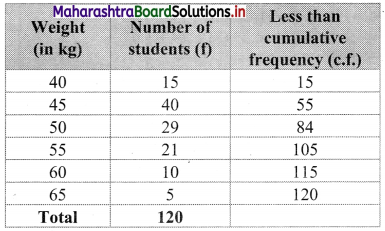
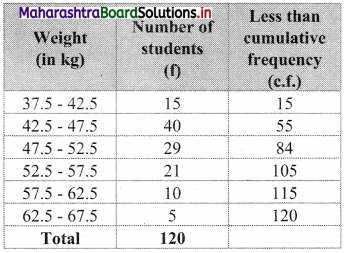
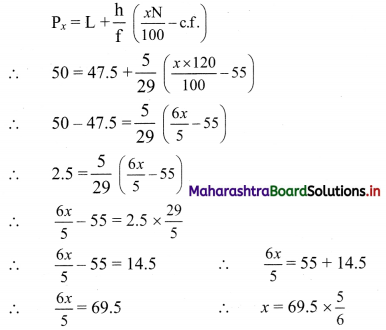
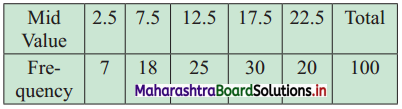
Maharashtra Board 11th Commerce Maths Solutions Chapter 2 Functions Ex 2.1

Balbharati Maharashtra State Board 11th Commerce Maths Solution Book Pdf Chapter 2 Functions Ex 2.1 Questions and Answers.

Maharashtra State Board 11th Commerce Maths Solutions Chapter 2 Functions Ex 2.1

Question 1.
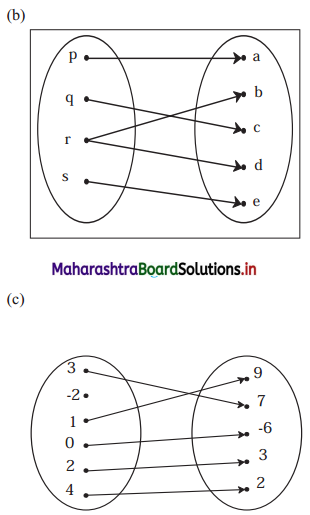
Check if the following relations are functions.
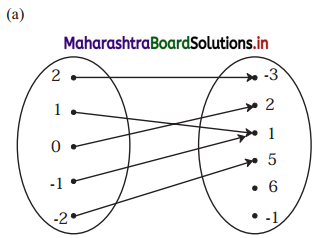
Maharashtra Board 11th Commerce Maths Solutions Chapter 2 Functions Ex 2.1 Q1
Maharashtra Board 11th Commerce Maths Solutions Chapter 2 Functions Ex 2.1 Q1.1
Solution:
(a) Yes
Reason: Every element of set A has been assigned a unique element in set B.

(b) No
Reason: An element of set A has been assigned more than one element from set B.

(c) No
Reason: Not every element of set A has been assigned an image from set B.

Maharashtra Board 11th Commerce Maths Solutions Chapter 2 Functions Ex 2.1

Question 2.
Which sets of ordered pairs represent functions from A = {1, 2, 3, 4} to B = {-1, 0, 1, 2, 3}? Justify.
(i) {(1, 0), (3, 3), (2, -1), (4, 1), (2, 2)}
(ii) {(1, 2), (2, -1), (3, 1), (4, 3)}
(iii) {(1, 3), (4, 1), (2, 2)}
(iv) {(1, 1), (2, 1), (3, 1), (4, 1)}
Solution:
(i) {(1, 0), (3, 3), (2, -1), (4, 1), (2, 2)} does not represent a function.
Reason: (2, -1) and (2, 2) show that element 2 ∈ A has been assigned two images -1 and 2 from set B.

(ii) {(1, 2), (2, -1), (3, 1), (4, 3)} represents a function.
Reason: Every element of set A has a unique image in set B.

(iii) {(1, 3), (4, 1), (2, 2)} does not represent a function.
Reason: 3 ∈ A does not have an image in set B.

(iv) {(1, 1), (2, 1), (3, 1), (4, 1)} represents a function
Reason: Every element of set A has been assigned a unique image in set B.

Question 3.
If f(m) = m2 – 3m + 1, find
(i) f(0)
(ii) f(-3)
(iii) f(\(\frac{1}{2}\))
(iv) f(x + 1)
(v) f(-x)
Solution:
f(m) = m2 – 3m + 1
(i) f(0) = 02 – 3(0) + 1 = 1

(ii) f(-3) = (-3)2 – 3(-3) + 1
= 9 + 9 + 1
= 19

(iii) \(f\left(\frac{1}{2}\right)=\left(\frac{1}{2}\right)^{2}-3\left(\frac{1}{2}\right)+1\)
= \(\frac{1}{4}-\frac{3}{2}+1\)
= \(\frac{1-6+4}{4}\)
= \(-\frac{1}{4}\)

(iv) f(x + 1) = (x + 1)2 – 3(x + 1) + 1
= x2 + 2x + 1 – 3x – 3 + 1
= x2 – x – 1

(v) f(-x) = (-x)2 – 3(-x) + 1 = x2 + 3x + 1

Maharashtra Board 11th Commerce Maths Solutions Chapter 2 Functions Ex 2.1

Question 4.
Find x, if g(x) = 0 where
(i) g(x) = \(\frac{5 x-6}{7}\)
(ii) g(x) = \(\frac{18-2 x^{2}}{7}\)
(iii) g(x) = 6x2 + x – 2
Solution:
(i) g(x) = \(\frac{5 x-6}{7}\)
g(x) = 0
∴ \(\frac{5 x-6}{7}\) = 0
∴ 5x – 6 = 0
∴ x = \(\frac{6}{5}\)

(ii) g(x) = \(\frac{18-2 x^{2}}{7}\)
g(x) = 0
∴ \(\frac{18-2 x^{2}}{7}\) = 0
∴ 18 – 2x2 = 0
∴ x2 = 9
∴ x = ±3

(iii) g(x) = 6x2 + x – 2
g(x) = 0
∴ 6x2 + x – 2 = 0
∴ 6x2 + 4x – 3x – 2 = 0
∴ 2x(3x + 2) – 1(3x + 2) = 0
∴ (2x – 1)(3x + 2) = 0
∴ 2x – 1 = 0 or 3x + 2 = 0
∴ x = \(\frac{1}{2}\) or x = \(\frac{-2}{3}\)

Question 5.
Find x, if f(x) = g(x) where f(x) = x4 + 2x2, g(x) = 11x2.
Solution:
f(x) = x4 + 2x2, g(x) = 11x2
f(x) = g(x)
∴ x4 + 2x2 = 11x2
∴ x4 – 9x2 = 0
∴ x2(x2 – 9) = 0
∴ x2 = 0 or x2 – 9 = 0
∴ x = 0 or x2 = 9
∴ x = 0 or x = ±3

Maharashtra Board 11th Commerce Maths Solutions Chapter 2 Functions Ex 2.1

Question 6.
If f(x) = \(\begin{cases}x^{2}+3, & x \leq 2 \\ 5 x+7, & x>2\end{cases}\), then find
(i) f(3)
(ii) f(2)
(iii) f(0)
Solution:
f(x) = x2 + 3, x ≤ 2
= 5x + 7, x > 2
(i) f(3) = 5(3) + 7 = 15 + 7 = 22
(ii) f(2) = 22 + 3 = 4 + 3 = 7
(iii) f(0) = 02 + 3 = 3

Question 7.
If f(x) = \(\left\{\begin{array}{cl}
4 x-2, & x \leq-3 \\
5, & -3<x<3 \\
x^{2}, & x \geq 3
\end{array}\right.\), then fmd
(i) f(-4)
(ii) f(-3)
(iii) f(1)
(iv) f(5)
Solution:
f(x) = 4x – 2, x ≤ -3
= 5, -3 < x < 3
= x2, x ≥ 3
(i) f(-4) = 4(-4) – 2 = -16 – 2 = -18
(ii) f(-3) = 4(-3) – 2 = -12 – 2 = -14
(iii) f(1) = 5
(iv) f(5) = 52 = 25

Maharashtra Board 11th Commerce Maths Solutions Chapter 2 Functions Ex 2.1

Question 8.
If f(x) = 3x + 5, g(x) = 6x – 1, then find
(i) (f + g)(x)
(ii) (f – g)(2)
(iii) (fg)(3)
(iv) \(\left(\frac{\mathbf{f}}{\mathbf{g}}\right)(x)\) and its domain
Solution:
f(x) = 3x + 5, g(x) = 6x – 1
(i) (f + g)(x) = f(x) + g(x)
= 3x + 5 + 6x – 1
= 9x + 4

(ii) (f – g) (2) = f(2) – g(2)
= [3(2) + 5] – [6(2) – 1]
= 6 + 5 – 12 + 1
= 0

(iii) (fg)(3) = f(3) g(3)
= [3(3) + 5] [6(3) – 1]
= (14) (17)
= 238

(iv) \(\left(\frac{\mathrm{f}}{\mathrm{g}}\right) x=\frac{\mathrm{f}(x)}{\mathrm{g}(x)}=\frac{3 x+5}{6 x-1}, x \neq \frac{1}{6}\)
Domain = R – {\(\frac{1}{6}\)}

Question 9.
If f(x) = 2x2 + 3, g(x) = 5x – 2, then find
(i) fog
(ii) gof
(iii) fof
(iv) gog
Solution:
f(x) = 2x2 + 3, g(x) = 5x – 2
(i) (fog)(x) = f(g(x))
= f(5x – 2)
= 2(5x – 2)2 + 3
= 2(25x2 – 20x + 4) + 3
= 50x2 – 40x + 8 + 3
= 50x2 – 40x + 11

(ii) (gof)(x) = g(f(x))
= g(2x2 + 3)
= 5(2x2 + 3) – 2
= 10x2 + 15 – 2
= 10x2 + 13

Maharashtra Board 11th Commerce Maths Solutions Chapter 2 Functions Ex 2.1

(iii) (fof)(x) = f(f(x))
= f(2x2 + 3)
= 2(2x2 + 3)2 + 3
= 2(4x4 + 12x2 + 9) + 3
= 8x4 + 24x2 + 18 + 3
= 8x4 + 24x2 + 21

(iv) (gog)(x) = g(g(x))
= g(5x – 2)
= 5(5x – 2) – 2
= 25x – 10 – 2
= 25x – 12
Maharashtra Board 11th Commerce Maths Solutions Chapter 1 Sets and Relations Miscellaneous Exercise 1

Balbharati Maharashtra State Board 11th Commerce Maths Solution Book Pdf Chapter 1 Sets and Relations Miscellaneous Exercise 1 Questions and Answers.

Maharashtra State Board 11th Commerce Maths Solutions Chapter 1 Sets and Relations Miscellaneous Exercise 1

Question 1.
Write the following sets in set builder form:
(i) {10, 20, 30, 40, 50}
(ii) {a, e, i, o, u}
(iii) {Sunday, Monday, Tuesday, Wednesday, Thursday, Friday, Saturday}
Solution:
(i) Let A = {10, 20, 30, 40, 50}
∴ A = {x / x = 10n, n ∈ N and n ≤ 5}

(ii) Let B = {a, e, i, o, u}
∴ B = {x / x is a vowel of English alphabets}

(iii) Let C = {Sunday, Monday, Tuesday, Wednesday, Thursday, Friday, Saturday}
∴ C = {x / x represents days of a week}

Maharashtra Board 11th Commerce Maths Solutions Chapter 1 Sets and Relations Miscellaneous Exercise 1

Question 2.
If U = {x / x ∈ N, 1 ≤ x ≤ 12}, A = {1, 4, 7, 10}, B = {2, 4, 6, 7, 11}, C = {3, 5, 8, 9, 12}.
Write the sets
(i) A ∪ B
(ii) B ∩ C
(iii) A – B
(iv) B – C
(v) A ∪ B ∪ C
(vi) A ∩ (B ∪ C)
Solution:
U = {x / x ∈ N, 1 ≤ x ≤ 12} = {1, 2, 3, …., 12}
A = {1, 4, 7, 10}, B = {2, 4, 6, 7, 11}, C = {3, 5, 8, 9, 12}
(i) A ∪ B = {1, 2, 4, 6, 7, 10, 11}

(ii) B ∩ C = { }

(iii) A – B = {1, 10}

(iv) B – C = {2, 4, 6, 7, 11}

(v) A ∪ B ∪ C = {1, 2, 3, 4, 5, 6, 7, 8, 9, 10, 11, 12}

(vi) B ∪ C = {2, 3, 4, 5, 6, 7, 8, 9, 11, 12}
∴ A ∩ (B ∪ C) = {4, 7}

Question 3.
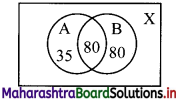
In a survey of 425 students in a school, it was found that 115 drink apple juice, 160 drink orange juice, and 80 drink both apple as well as orange juice. How many drinks neither apple juice nor orange juice?
Solution:
Let A = set of students who drink apple juice
B = set of students who drink orange juice
X = set of all students
∴ n(X) = 425, n(A) = 115, n(B) = 160, n(A ∩ B) = 80
Maharashtra Board 11th Commerce Maths Solutions Chapter 1 Sets and Relations Miscellaneous Exercise 1 Q3
No. of students who neither drink apple juice nor orange juice
n(A’ ∩ B’) = n(A ∪ B)’
= n(X) – n(A ∪ B)
= 425 – [n(A) + n(B) – n(A ∩ B)]
= 425 – (115 + 160 – 80)
= 230

Maharashtra Board 11th Commerce Maths Solutions Chapter 1 Sets and Relations Miscellaneous Exercise 1

Question 4.
In a school, there are 20 teachers who teach Mathematics or Physics. of these, 12 teach Mathematics and 4 teach both Physics and Mathematics. How many teachers teach Physics?
Solution:
Let A = set of teachers who teach Mathematics
B = set of teachers who teach Physics
n(A ∪ B) = 20, n(A) = 12, n(A ∩ B) = 4
Maharashtra Board 11th Commerce Maths Solutions Chapter 1 Sets and Relations Miscellaneous Exercise 1 Q4
Since, n(A ∪ B) = n(A) + n(B) – n(A ∩ B)
∴ 20 = 12 + n(B) – 4
∴ n(B) = 12
∴ Number of teachers who teach physics = 12

Question 5.
(i) If A = {1, 2, 3} and B = {2, 4}, state the elements of A × A, A × B, B × A, B × B, (A × B) ∩ (B × A).
(ii) If A = {-1, 1}, find A × A × A.
Solution:
(i) A = {1, 2, 3} and B = {2, 4}
A × A = {(1, 1), (1, 2), (1, 3), (2, 1), (2, 2), (2, 3), (3, 1), (3, 2), (3, 3)}
A × B = {(1, 2), (1, 4), (2, 2), (2, 4), (3, 2), (3, 4)}
B × A = {(2, 1), (2, 2), (2, 3), (4, 1), (4, 2), (4, 3)}
B × B = {(2, 2), (2, 4), (4, 2), (4, 4)}
(A × B) ∩ (B × A) = {(2, 2)}

(ii) A = {-1, 1}
∴ A × A × A = {(-1, -1, -1), (-1, -1, 1), (-1, 1, -1), (-1, 1, 1), (1, -1, -1), (1, -1, 1), (1, 1, -1),(1, 1, 1)}

Question 6.
If A = {1, 2, 3}, B = {4, 5, 6}, which of the following are relations from A to B.
(i) R1 = {(1, 4), (1, 5), (1, 6)}
(ii) R2 = {(1, 5), (2, 4), (3, 6)}
(iii) R3 = {(1, 4), (1, 5), (3, 6), (2, 6), (3, 4)}
(iv) R4 = {(4, 2), (2, 6), (5, 1), (2, 4)}
Solution:
A = {1, 2, 3}, B = {4, 5, 6}
∴ A × B = {(1, 4), (1, 5), (1, 6), (2, 4), (2, 5), (2, 6), (3, 4), (3, 5), (3, 6)}
(i) R1 = {(1, 4), (1, 5), (1, 6)}
Since, R1 ⊆ A × B
∴ R1 is a relation from A to B.

(ii) R2 = {(1, 5), (2, 4), (3, 6)}
Since, R2 ⊆ A × B
∴ R2 is a relation from A to B.

(iii) R3 = {(1, 4), (1, 5), (3, 6), (2, 6), (3, 4)}
Since, R3 ⊆ A × B
∴ R3 is a relation from A to B.

(iv) R4 = {(4,2), (2, 6), (5,1), (2, 4)}
Since, (4, 2) ∈ R4, but (4, 2) ∉ A × B
∴ R4 ⊄ A × B
∴ R4 is not a relation from A to B.

Maharashtra Board 11th Commerce Maths Solutions Chapter 1 Sets and Relations Miscellaneous Exercise 1

Question 7.
Determine the domain and range of the following relation.
R = {(a, b) / a ∈ N, a < 5, b = 4}
Solution:
R = {(a, b) / a ∈ N, a < 5, b = 4}
∴ Domain (R) = {a / a ∈ N, a < 5} = {1, 2, 3, 4}
Range (R) = {b / b = 4} = {4}

Maharashtra Board 11th Commerce Maths Solutions Chapter 1 Sets and Relations Ex 1.2

Balbharati Maharashtra State Board 11th Commerce Maths Solution Book Pdf Chapter 1 Sets and Relations Ex 1.2 Questions and Answers.

Maharashtra State Board 11th Commerce Maths Solutions Chapter 1 Sets and Relations Ex 1.2

Question 1.
If (x – 1, y + 4) = (1, 2), find the values of x and y.
Solution:
(x – 1, y + 4) = (1, 2)
By the definition of equality of ordered pairs, we have
x – 1 = 1 and y + 4 = 2
∴ x = 2 and y = -2

Question 2.
If \(\left(x+\frac{1}{3}, \frac{y}{3}-1\right)=\left(\frac{1}{3}, \frac{3}{2}\right)\), find x and y.
Solution:
\(\left(x+\frac{1}{3}, \frac{y}{3}-1\right)=\left(\frac{1}{3}, \frac{3}{2}\right)\)
By the definition of equality of ordered pairs, we have
\(x+\frac{1}{3}=\frac{1}{3}\) and \(\frac{y}{3}-1=\frac{3}{2}\)
\(x=\frac{1}{3}-\frac{1}{3}\) and \(\frac{y}{3}=\frac{3}{2}+1=\frac{5}{2}\)
x = 0 and y = \(\frac{15}{2}\)

Question 3.
If A = {a, b, c}, B = {x, y}, find A × B, B × A, A × A, B × B.
Solution:
A = {a, b, c}, B = {x, y}
A × B = {(a, x), (a, y), (b, x), (b, y), (c, x), (c, y)}
B × A = {(x, a), (x, b), (x, c), (y, a), (y, b), (y, c)}
A × A = {(a, a), (a, b), (a, c), (b, a), (b, b), (b, c), (c, a), (c, b), (c, c)}
B × B = {(x, x), (x, y), (y, x), (y, y)}

Question 4.
If P = {1, 2, 3} and Q = {6, 4}, find the sets P × Q and Q × P.
Solution:
P = {1, 2, 3}, Q = {6, 4}
P × Q = {(1, 6), (1, 4), (2, 6), (2, 4), (3, 6), (3, 4)}
Q × P = {(6, 1), (6, 2), (6, 3), (4, 1), (4, 2), (4, 3)}

Question 5.
Let A = {1, 2, 3, 4}, B = {4, 5, 6}, C = {5, 6}. Find
(i) A × (B ∩ C)
(ii) (A × B) ∩ (A × C)
(iii) A × (B ∪ C)
(iv) (A × B) ∪ (A × C)
Solution:
A= {1, 2, 3, 4}, B = {4, 5, 6}, C = {5, 6}
(i) B ∩ C = {5, 6}
∴ A × (B ∩ C) = {(1, 5), (1, 6), (2, 5), (2, 6), (3, 5), (3, 6), (4, 5), (4, 6)}

(ii) A × B = {(1, 4), (1, 5), (1, 6), (2, 4), (2, 5), (2, 6), (3, 4), (3, 5), (3, 6), (4, 4), (4, 5), (4, 6)}
A × C = {(1, 5), (1, 6), (2, 5), (2, 6), (3, 5), (3, 6), (4, 5), (4, 6)}
∴ (A × B) ∩ (A × C) = {(1, 5), (1, 6), (2, 5), (2, 6), (3, 5), (3, 6), (4, 5), (4, 6)}

(iii) B ∪ C = {4, 5, 6}
∴ A × (B ∪ C) = {(1, 4), (1, 5), (1, 6), (2, 4), (2, 5), (2, 6), (3, 4), (3, 5), (3, 6), (4, 4), (4, 5), (4, 6)}

(iv) A × B = {(1, 4), (1, 5), (1, 6), (2, 4), (2, 5), (2, 6), (3, 4), (3, 5), (3, 6), (4, 4), (4, 5), (4, 6)}
A × C = {(1, 5), (1, 6), (2, 5), (2, 6), (3, 5), (3, 6), (4, 5), (4, 6)}
∴ (A × B) ∪ (A × C) = {(1, 4), (1, 5), (1, 6), (2, 4), (2, 5), (2, 6), (3, 4), (3, 5), (3, 6), (4, 4), (4, 5), (4, 6)}

Question 6.
Express {(x, y) / x2 + y2 = 100, where x, y ∈ W} as a set of ordered pairs.
Solution:
{(x, y) / x2 + y2 = 100, where x, y ∈ W}
We have, x2 + y2 = 100
When x = 0 and y = 10,
x2 + y2 = 02 + 102 = 100
When x = 6 andy = 8,
x2 + y2 = 62 + 82 = 100
When x = 8 and y = 6,
x2 + y2 = 82 + 62 = 100
When x = 10 and y = 0,
x2 + y2 = 102 + 02 = 100
∴ Set of ordered pairs = {(0, 10), (6, 8), (8, 6), (10, 0)}

Question 7.
Write the domain and range of the following relations.
(i) {(a, b) / a ∈ N, a < 6 and b = 4}
(ii) {(a, b) / a, b ∈ N, a + b = 12}
(iii) {(2, 4), (2, 5), (2, 6), (2, 7)}
Solution:
(i) Let R1 = {(a, b)/ a ∈ N, a < 6 and b = 4}
Set of values of ‘a’ are domain and set of values of ‘b’ are range.
a ∈ N and a < 6
∴ a = 1, 2, 3, 4, 5 and b = 4
Domain (R1) = {1, 2, 3, 4, 5}
Range (R1) = {4}

(ii) Let R2 = {(a, b)/a, b ∈ N and a + b = 12}
Now, a, b ∈ N and a + b = 12
When a = 1, b = 11
When a = 2, b = 10
When a = 3, b = 9
When a = 4, b = 8
When a = 5, b = 7
When a = 6, b = 6
When a = 7, b = 5
When a = 8, b = 4
When a = 9, b = 3
When a = 10, b = 2
When a = 11, b = 1
∴ Domain (R2) = {1, 2, 3, 4, 5, 6, 7, 8, 9, 10, 11}
Range (R2) = {11, 10, 9, 8, 7, 6, 5, 4, 3, 2, 1}

(iii) Let R3 = {(2, 4), (2, 5), (2, 6), (2, 7)}
Domain (R3) = {2}
Range (R3) = {4, 5, 6, 7}

Question 8.
Let A = {6, 8} and B = {1, 3, 5}.
Let R = {(a, b) / a ∈ A, b ∈ B, a – b is an even number}.
Show that R is an empty relation from A to B.
Solution:
A= {6, 8}, B = {1, 3, 5}
R = {(a, b)/ a ∈ A, b ∈ B, a – b is an even number}
a ∈ A
∴ a = 6, 8
b ∈ B
∴ b = 1, 3, 5
When a = 6 and b = 1, a – b = 5 which is odd
When a = 6 and b = 3, a – b = 3 which is odd
When a = 6 and b = 5, a – b = 1 which is odd
When a = 8 and b = 1, a – b = 7 which is odd
When a = 8 and b = 3, a – b = 5 which is odd
When a = 8 and b = 5, a – b = 3 which is odd
Thus, no set of values of a and b gives a – b even.
∴ R is an empty relation from A to B.

Question 9.
Write the relation in the Roster form and hence find its domain and range.
(i) R1 = {(a, a2) / a is a prime number less than 15}
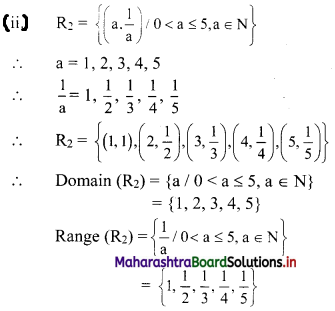
(ii) R2 = {(a, \(\frac{1}{a}\)) / 0 < a ≤ 5, a ∈ N}
Solution:
(i) R1 = {(a, a2) / a is a prime number less than 15}
∴ a = 2, 3, 5, 7, 11, 13
∴ a2 = 4, 9, 25, 49, 121, 169
∴ R1 = {(2, 4), (3, 9), (5, 25), (7, 49), (11, 121), (13, 169)}
∴ Domain (R1) = {a/a is a prime number less than 15} = {2, 3, 5, 7, 11, 13}
Range (R1) = {a2/a is a prime number less than 15} = {4, 9, 25, 49, 121, 169}

Maharashtra Board 11th Commerce Maths Solutions Chapter 1 Sets and Relations Ex 1.2 Q9

Question 10.
R = {(a, b) / b = a + 1, a ∈ Z, 0 < a < 5}. Find the range of R.
Solution:
R = {(a, b) / b = a + 1, a ∈ Z, 0 < a < 5}
∴ a = 1, 2, 3, 4
∴ b = 2, 3, 4, 5
∴ Range (R) = {2, 3, 4, 5}

Question 11.
Find the following relations as sets of ordered pairs.
(i) {(x, y) / y = 3x, x ∈ {1, 2, 3}, y ∈ {3, 6, 9, 12}}
(ii) {(x,y) / y > x + 1, x ∈ {1, 2} and y ∈ {2, 4, 6}}
(iii) {(x, y) / x + y = 3, x, y ∈ {0, 1, 2, 3}}
Solution:
(i) {(x, y) / y = 3x, x ∈ {1, 2, 3}, y ∈ {3, 6, 9, 12}}
Here y = 3x
When x = 1, y = 3(1) = 3
When x = 2, y = 3(2) = 6
When x = 3, y = 3(3) = 9
∴ Ordered pairs are {(1, 3), (2, 6), (3, 9)}

(ii) {(x, y) / y > x + 1, x ∈ {1, 2} and y ∈ {2, 4, 6}}
Here, y > x + 1
When x = 1 and y = 2, 2 ≯ 1 + 1
When x = 1 and y = 4, 4 > 1 + 1
When x = 1 and y = 6, 6 > 1 + 1
When x = 2 and y = 2, 2 ≯ 2 + 1
When x = 2 and y = 4, 4 > 2 + 1
When x = 2 and y = 6, 6 > 2 + 1
∴ Ordered pairs are {(1, 4), (1, 6), (2, 4), (2, 6)}

(iii) {(x, y) / x + y = 3, x, y ∈ {0, 1, 2, 3}}
Here, x + y = 3
When x = 0, y = 3
When x = 1, y = 2
When x = 2, y = 1
When x = 3, y = 0
∴ Ordered pairs are {(0, 3), (1, 2), (2, 1), (3, 0)}

Maharashtra Board 11th Commerce Maths Solutions Chapter 1 Sets and Relations Ex 1.1

Balbharati Maharashtra State Board 11th Commerce Maths Solution Book Pdf Chapter 1 Sets and Relations Ex 1.1 Questions and Answers.

Maharashtra State Board 11th Commerce Maths Solutions Chapter 1 Sets and Relations Ex 1.1

Question 1.
Describe the following sets in Roster form:
(i) {x / x is a letter of the word ‘MARRIAGE’}
(ii) {x / x is an integer, –\(\frac{1}{2}\) < x < \(\frac{9}{2}\)}
(iii) {x / x = 2n, n ∈ N}
Solution:
(i) Let A = {x / x is a letter of the word ‘MARRIAGE’}
∴ A = {M, A, R, I, G, E}

(ii) Let B = {x / x is an integer, –\(\frac{1}{2}\) < x < \(\frac{9}{2}\)}
∴ B = {0, 1, 2, 3, 4}

(iii) Let C = {x / x = 2n, n ∈ N}
∴ C = {2, 4, 6, 8, ….}

Question 2.
Describe the following sets in Set-Builder form:
(i) {0}
(ii) {0, ±1, ±2, ±3}
(iii) \(\left\{\frac{1}{2}, \frac{2}{5}, \frac{3}{10}, \frac{4}{17}, \frac{5}{26}, \frac{6}{37}, \frac{7}{50}\right\}\)
Solution:
(i) Let A = {0}
0 is a whole number but it is not a natural number.
∴ A = {x / x ∈ W, x ∉ N}

(ii) Let B = {0, ±1, ±2, ±3}
B is the set of elements which belongs to Z from -3 to 3.
∴ B = {x / x ∈ Z, -3 ≤ x ≤ 3}

(iii) Let C = \(\left\{\frac{1}{2}, \frac{2}{5}, \frac{3}{10}, \frac{4}{17}, \frac{5}{26}, \frac{6}{37}, \frac{7}{50}\right\}\)
∴ C = {x / x = \(\frac{n}{n^{2}+1}\), n ∈ N, n ≤ 7}

Maharashtra Board 11th Commerce Maths Solutions Chapter 1 Sets and Relations Ex 1.1

Question 3.
If A = {x / 6x2 + x – 15 = 0}, B = {x / 2x2 – 5x – 3 = 0}, C = {x / 2x2 – x – 3 = 0}, then find (i) (A ∪ B ∪ C) (ii) (A ∩ B ∩ C)
Solution:
A = {x / 6x2 + x – 15 = o}
∴ 6x2 + x – 15 = 0
∴ 6x2 + 10x – 9x – 15 = 0
∴ 2x(3x + 5) – 3(3x + 5) = 0
∴ (3x + 5) (2x – 3) = 0
∴ 3x + 5 = 0 or 2x – 3 = 0
∴ x = \(\frac{-5}{3}\) or x = \(\frac{3}{2}\)
∴ A = \(\left\{\frac{-5}{3}, \frac{3}{2}\right\}\)

B = {x / 2x2 – 5x – 3 = 0}
∴ 2x2 – 5x – 3 = 0
∴ 2x2 – 6x + x – 3 = 0
∴ 2x(x – 3) + 1(x – 3) = 0
∴ (x – 3)(2x + 1) = 0
∴ x – 3 = 0 or 2x + 1 = 0
∴ x = 3 or x = \(\frac{-1}{2}\)
∴ B = {\(\frac{-1}{2}\), 3}

C = {x / 2x2 – x – 3 = 0}
∴ 2x2 – x – 3 = 0
∴ 2x2 – 3x + 2x – 3 = 0
∴ x(2x – 3) + 1(2x – 3) = 0
∴ (2x – 3) (x + 1) = 0
∴ 2x – 3 = 0 or x + 1 = 0
∴ x = \(\frac{3}{2}\) or x = -1
∴ C = {-1, \(\frac{3}{2}\)}

(i) A ∪ B ∪ C = \(\left\{-\frac{5}{3}, \frac{3}{2}\right\} \cup\left\{\frac{-1}{2}, 3\right\} \cup\left\{-1, \frac{3}{2}\right\}\) = \(\left\{\frac{-5}{3},-1, \frac{-1}{2}, \frac{3}{2}, 3\right\}\)

(ii) A ∩ B ∩ C = { }

Question 4.
If A, B, C are the sets for the letters in the words ‘college’, ‘marriage’ and ‘luggage’ respectively, then verify that [A – (B ∪ C)] = [(A – B) ∩ (A – C)].
Solution:
A = {c, o, l, g, e}
B = {m, a, r, i, g, e}
C = {l, u, g, a, e}
B ∪ C = {m, a, r, i, g, e, l, u}
A – (B ∪ C) = {c, o}
A – B = {c, o, l}
A – C = {c, o}
∴ [(A – B) ∩ (A – C)] = {c, o} = A – (B ∪ C)
∴ [A – (B ∪ C)] = [(A – B) ∩ (A – C)]

Maharashtra Board 11th Commerce Maths Solutions Chapter 1 Sets and Relations Ex 1.1

Question 5.
If A = {1, 2, 3, 4}, B = {3, 4, 5, 6}, C = {4, 5, 6, 7, 8} and universal set X = {1, 2, 3, 4, 5, 6, 7, 8, 9, 10}, then verify the following:
(i) A ∪ (B ∩ C) = (A ∪ B) ∩ (A ∪ C)
(ii) A ∩ (B ∪ C) = (A ∩ B) ∪ (A ∩ C)
(iii) (A ∪ B)’ = A’ ∩ B’
(iv) (A ∩ B)’ = A’ ∪ B’
(v) A = (A ∩ B) ∪ (A ∩ B’)
(vi) B = (A ∩ B) ∪ (A’ ∩ B)
(vii) n(A ∪ B) = n(A) + n(B) – n(A ∩ B)
Solution:
A = {1, 2, 3, 4}, B = {3, 4, 5, 6}, C = {4, 5, 6, 7, 8}, X = {1, 2, 3, 4, 5, 6, 7, 8, 9, 10}
(i) B ∩ C = {4, 5, 6}
∴ A ∪ (B ∩ C) = {1, 2, 3, 4, 5, 6} ……(i)
A ∪ B = {1, 2, 3, 4, 5, 6}
A ∪ C = {1, 2, 3, 4, 5, 6, 7, 8}
∴ (A ∪ B) ∩ (A ∪ C) = {1, 2, 3, 4, 5, 6} ……(ii)
From (i) and (ii), we get
A ∪ (B ∩ C) = (A ∪ B) ∩ (A ∪ C)

(ii) B ∪ C = {3, 4, 5, 6, 7, 8}
∴ A ∩ (B ∪ C) = {3, 4} …..(i)
A ∩ B = {3, 4}
A ∩ C = {4}
∴ (A ∩ B) ∪ (A ∩ C) = {3, 4} …..(ii)
From (i) and (ii), we get
A ∩ (B ∪ C) = (A ∩ B) ∪ (A ∩ C)

(iii) A ∪ B = {1, 2, 3, 4, 5, 6}
∴ (A ∪ B)’ = {7, 8, 9, 10} …….(i)
A’ = {5, 6, 7, 8, 9, 10}, B’ = {1, 2, 7, 8, 9, 10}
∴ A’ ∩ B’ = {7, 8, 9, 10} ……(ii)
From (i) and (ii), we get
(A ∪ B)’ = A’ ∩ B’

(iv) A ∩ B = {3, 4}
∴ (A ∩ B)’ = {1, 2, 5, 6, 7, 8, 9, 10} ……(i)
A’ = {5, 6, 7, 8, 9, 10}
B’ = {1, 2, 7, 8, 9, 10}
∴ A’ ∪ B’ = {1, 2, 5, 6, 7, 8, 9, 10} ……(ii)
From (i) and (ii), we get
(A ∩ B)’ = A’ ∪ B’

(v) A = {1, 2, 3, 4} …..(i)
A ∩ B = {3, 4}
B’ = {1, 2, 7, 8, 9, 10}
A ∩ B’ = {1, 2}
∴ (A ∩ B) ∪ (A ∩ B’) = {1, 2, 3, 4} ……(ii)
From (i) and (ii), we get
A = (A ∩ B) ∪ (A ∩ B’)

(vi) B = {3, 4, 5, 6} …..(i)
A ∩ B = {3, 4}
A’ = {5, 6, 7, 8, 9, 10}
A’ ∩ B = {5, 6}
∴ (A ∩ B) ∪ (A’ ∩ B) = {3, 4, 5, 6} …..(ii)
From (i) and (ii), we get
B = (A ∩ B) ∪ (A’ ∩ B)

(vii) A = {1, 2, 3, 4}, B = {3, 4, 5, 6},
A ∩ B = {3, 4}, A ∪ B = {1, 2, 3, 4, 5, 6}
∴ n(A) = 4, n(B) = 4,
n(A ∩ B) = 2,
n(A ∪ B) = 6 …..(i)
∴ n(A) + n(B) – n(A ∩ B) = 4 + 4 – 2
∴ n(A) + n(B) – n(A ∩ B) = 6 …..(ii)
From (i) and (ii), we get
n(A ∪ B) = n(A) + n(B) – n(A ∩ B)

Question 6.
If A and B are subsets of the universal set X and n(X) = 50, n(A) = 35, n(B) = 20, n(A’ ∩ B’) = 5, find
(i) n(A ∪ B)
(ii) n(A ∩ B)
(iii) n(A’ ∩ B)
(iv) n(A ∩ B’)
Solution:
n(X) = 50, n(A) = 35, n(B) = 20, n(A’ ∩ B’) = 5
(i) n(A ∪ B) = n(X) – [n(A ∪ B)’]
= n(X) – n(A’ ∩ B’)
= 50 – 5
= 45

(ii) n(A ∩ B) = n(A) + n(B) – n(A ∪ B)
= 35 + 20 – 45
= 10

(iii) n(A’ ∩ B) = n(B) – n(A ∩ B)
= 20 – 10
= 10

(iv) n(A ∩ B’) = n(A) – n(A ∩ B)
= 35 – 10
= 25

Maharashtra Board 11th Commerce Maths Solutions Chapter 1 Sets and Relations Ex 1.1

Question 7.
Out of 200 students, 35 students failed in MHT-CET, 40 in AIEEE and 40 in IIT entrance, 20 failed in MHT-CET and AIEEE, 17 in AIEEE and IIT entrance, 15 in MHT-CET and IIT entrance, and 5 failed in all three examinations. Find how many students
(i) did not fail in any examination.
(ii) failed in AIEEE or IIT entrance.
Solution:
Let A = set of students who failed in MHT-CET
B = set of students who failed in AIEEE
C = set of students who failed in IIT entrance
X = set of all students
∴ n(X) = 200, n(A) = 35, n(B) = 40, n(C) = 40,
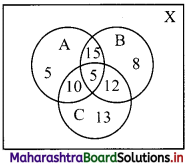
n(A ∩ B) = 20, n(B ∩ C) = 17, n(A ∩ C) = 15, n(A ∩ B ∩ C) = 5
Maharashtra Board 11th Commerce Maths Solutions Chapter 1 Sets and Relations Ex 1.1 Ex 1.1 Q7
(i) n(A ∪ B ∪ C) = n(A) + n(B) + n(C) – n(A ∩ B) – n(B ∩ C) – n(A ∩ C) + n(A ∩ B ∩ C)
= 35 + 40 + 40 – 20 – 17 – 15 + 5
= 68
∴ No. of students who did not fail in any exam = n(X) – n(A ∪ B ∪ C)
= 200 – 68
= 132

(ii) No. of students who failed in AIEEE or IIT entrance = n(B ∪ C)
= n(B) + n(C) – n(B ∩ C)
= 40 + 40 – 17
= 63

Question 8.
From amongst 2000 literate individuals of a town, 70% read Marathi newspapers, 50% read English newspapers and 32.5% read both Marathi and English newspapers. Find the number of individuals who read
(i) at least one of the newspapers.
(ii) neither Marathi nor English newspaper.
(iii) only one of the newspapers.
Solution:
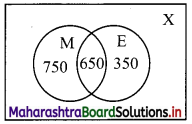
Let M = set of individuals who read Marathi newspapers
E = set of individuals who read English newspapers
X = set of all literate individuals
∴ n(X) = 2000,
n(M) = \(\frac{70}{100}\) × 2000 = 1400
n(E) = \(\frac{50}{100}\) × 2000 = 1000
n(M ∩ E) = \(\frac{32.5}{2}\) × 2000 = 650
n(M ∪ E) = n(M) + n(E) – n(M ∩ E)
= 1400 + 1000 – 650
= 1750
Maharashtra Board 11th Commerce Maths Solutions Chapter 1 Sets and Relations Ex 1.1 Ex 1.1 Q8
(i) No. of individuals who read at least one of the newspapers = n(M ∪ E) = 1750.
(ii) No. of individuals who read neither Marathi nor English newspaper = n(M’ ∩ E’)
= n(M ∪ E)’
= n(X) – n(M ∪ E)
= 2000 – 1750
= 250
(iii) No. of individuals who read only one of the newspapers = n(M ∩ E’) + n(M’ ∩ E)
= n(M ∪ E) – n(M ∩ E)
= 1750 – 650
= 1100

Maharashtra Board 11th Commerce Maths Solutions Chapter 1 Sets and Relations Ex 1.1

Question 9.
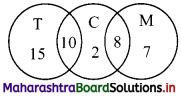
In a hostel, 25 students take tea, 20 students take coffee, 15 students take milk, 10 students take both tea and coffee, 8 students take both milk and coffee. None of them take tea and milk both and everyone takes atleast one beverage, find the number of students in the hostel.
Solution:
Let T = set of students who take tea
C = set of students who take coffee
M = set of students who take milk
∴ n(T) = 25, n(C) = 20, n(M) = 15,
n(T ∩ C) = 10, n(M ∩ C) = 8, n(T ∩ M) = 0, n(T ∩ M ∩ C) = 0
Maharashtra Board 11th Commerce Maths Solutions Chapter 1 Sets and Relations Ex 1.1 Ex 1.1 Q9
∴ Number of students in the hostel = n(T ∪ C ∪ M)
= n(T) + n(C) + n(M) – n(T ∩ C) – n(M ∩ C) – n(T ∩ M) + n(T ∩ M ∩ C)
= 25 + 20 + 15 – 10 – 8 – 0 + 0
= 42

Question 10.
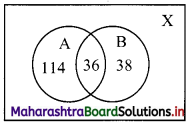
There are 260 persons with skin disorders. If 150 had been exposed to the chemical A, 74 to the chemical B, and 36 to both chemicals A and B, find the number of persons exposed to
(i) Chemical A but not Chemical B
(ii) Chemical B but not Chemical A
(iii) Chemical A or Chemical B.
Solution:
Let A = set of persons exposed to chemical A
B = set of persons exposed to chemical B
X = set of all persons
∴ n(X) = 260, n(A) = 150, n(B) = 74, n(A ∩ B) = 36
Maharashtra Board 11th Commerce Maths Solutions Chapter 1 Sets and Relations Ex 1.1 Ex 1.1 Q10
(i) No. of persons exposed to chemical A but not to chemical B = n(A ∩ B’)
= n(A) – n(A ∩ B)
= 150 – 36
= 114

(ii) No. of persons exposed to chemical B but not to chemical A = n(A’ ∩ B)
= n(B) – n(A ∩ B)
= 74 – 36
= 38

(iii) No. of persons exposed to chemical A or chemical B = n(A ∪ B)
= n(A) + n(B) – n(A ∩ B)
= 150 + 74 – 36
= 188

Question 11.
If A = {1, 2, 3}, write the set of all possible subsets of A.
Solution:
A = {1, 2, 3}
∴ { }, {1}, {2}, {3}, {1, 2}, {2, 3}, {1, 3} and {1, 2, 3} are all the possible subsets of A.

Maharashtra Board 11th Commerce Maths Solutions Chapter 1 Sets and Relations Ex 1.1

Question 12.
Write the following intervals in set-builder form:
(i) (-3, 0)
(ii) [6, 12]
(iii) (6, 12)
(iv) (-23, 5)
Solution:
(i) (-3, 0) = {x / x ∈ R, -3 < x < 0}
(ii) [6, 12] = {x / x ∈ R, 6 ≤ x ≤ 12}
(iii) (6, 12) = {x / x ∈ R, 6 < x < 12}
(iv) (-23, 5) = {x / x ∈ R, -23 < x < 5}

Maharashtra Board 12th Commerce Maths Solutions Chapter 5 Index Numbers Ex 5.2

Balbharati Maharashtra State Board 12th Commerce Maths Solution Book Pdf Chapter 5 Index Numbers Ex 5.2 Questions and Answers.

Maharashtra State Board 12th Commerce Maths Solutions Chapter 5 Index Numbers Ex 5.2

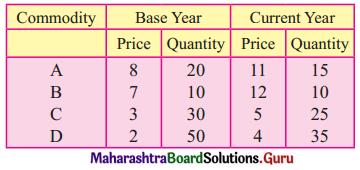
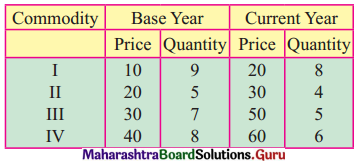
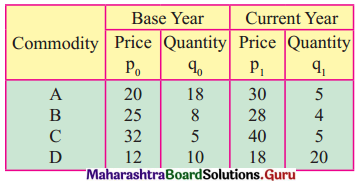
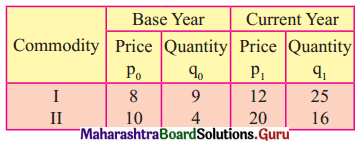
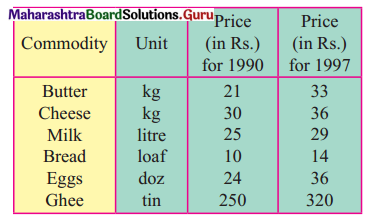
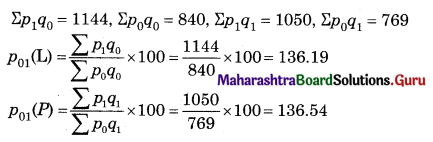
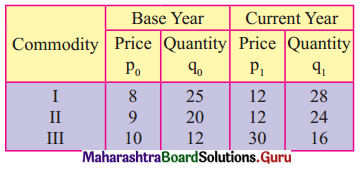
Calculate Laspeyres, Paasche’s, Dorbish-Bowely’s, and Marshall-Edegworth’s Price Index Numbers in Problems 1 and 2.

Question 1.
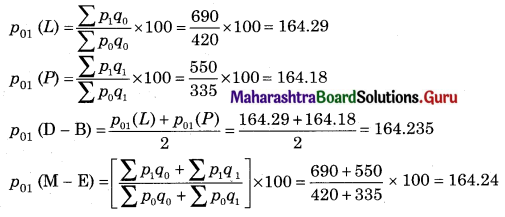
Maharashtra Board 12th Commerce Maths Solutions Chapter 5 Index Numbers Ex 5.2 Q1
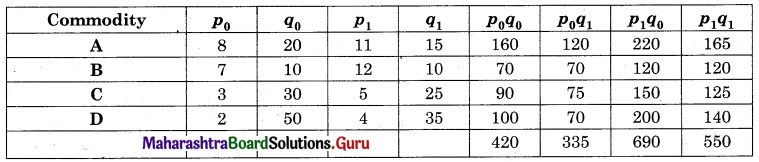
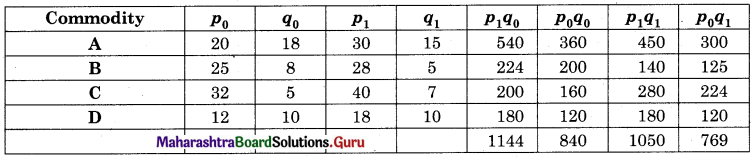
Solution:
Maharashtra Board 12th Commerce Maths Solutions Chapter 5 Index Numbers Ex 5.2 Q1.1
Maharashtra Board 12th Commerce Maths Solutions Chapter 5 Index Numbers Ex 5.2 Q1.2

Maharashtra Board 12th Commerce Maths Solutions Chapter 5 Index Numbers Ex 5.2

Question 2.
Maharashtra Board 12th Commerce Maths Solutions Chapter 5 Index Numbers Ex 5.2 Q2
Solution:
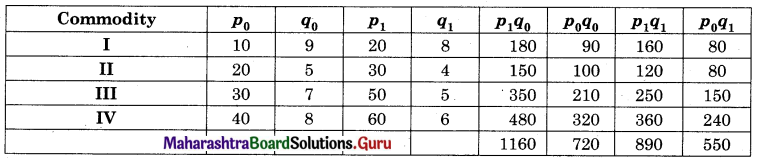
Maharashtra Board 12th Commerce Maths Solutions Chapter 5 Index Numbers Ex 5.2 Q2.1
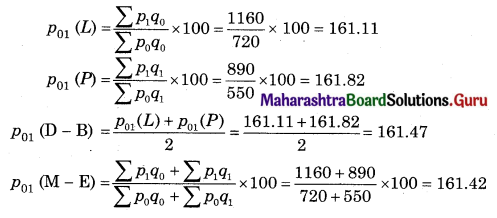
Maharashtra Board 12th Commerce Maths Solutions Chapter 5 Index Numbers Ex 5.2 Q2.2

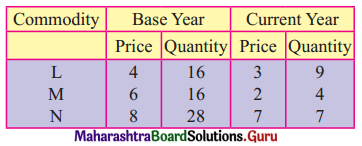
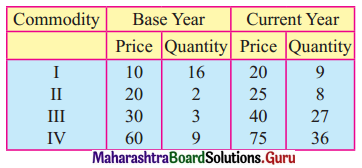
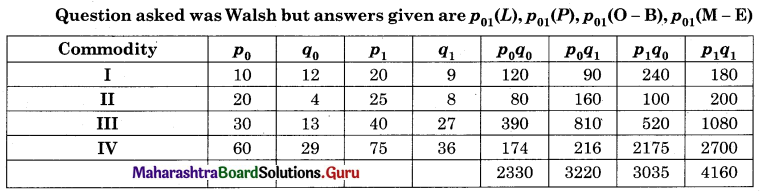
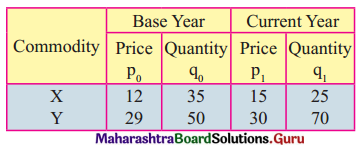
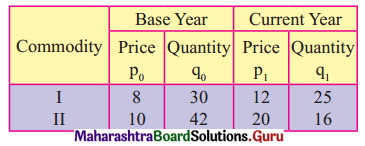
Calculate Walsh’s Price Index Number in Problems 3 and 4.

Question 3.
Maharashtra Board 12th Commerce Maths Solutions Chapter 5 Index Numbers Ex 5.2 Q3
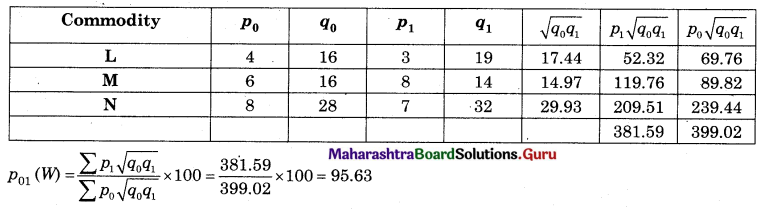
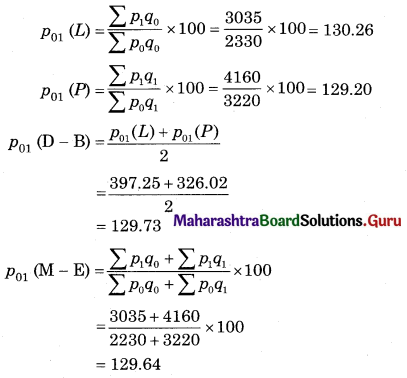
Solution:
Maharashtra Board 12th Commerce Maths Solutions Chapter 5 Index Numbers Ex 5.2 Q3.1

Question 4.
Maharashtra Board 12th Commerce Maths Solutions Chapter 5 Index Numbers Ex 5.2 Q4
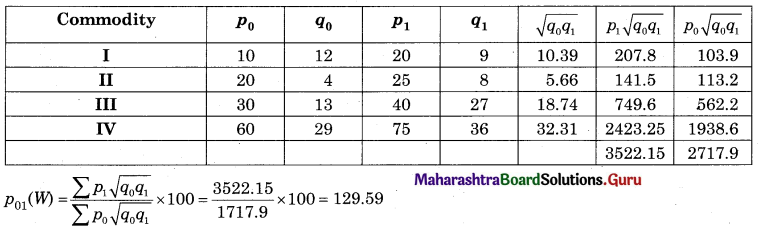
Solution:
Maharashtra Board 12th Commerce Maths Solutions Chapter 5 Index Numbers Ex 5.2 Q4.1
Maharashtra Board 12th Commerce Maths Solutions Chapter 5 Index Numbers Ex 5.2 Q4.2
Maharashtra Board 12th Commerce Maths Solutions Chapter 5 Index Numbers Ex 5.2 Q4.3

Maharashtra Board 12th Commerce Maths Solutions Chapter 5 Index Numbers Ex 5.2

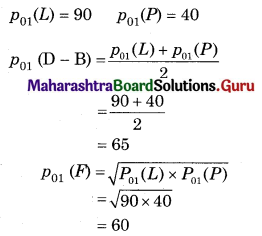
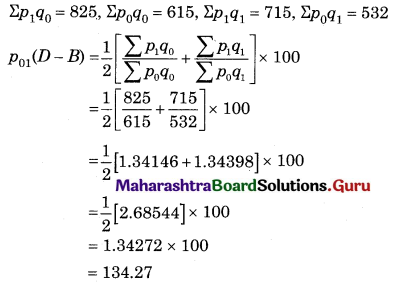
Question 5.
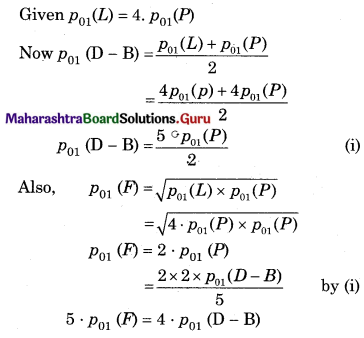
If p01(L) = 90, and p01(P) = 40, find p01(D – B) and p01(F)
Solution:
Maharashtra Board 12th Commerce Maths Solutions Chapter 5 Index Numbers Ex 5.2 Q5

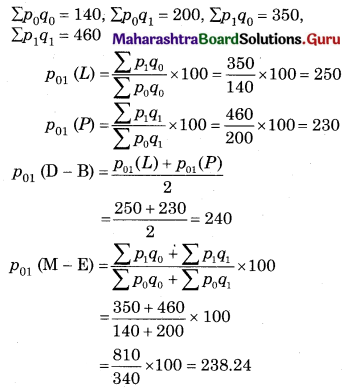
Question 6.
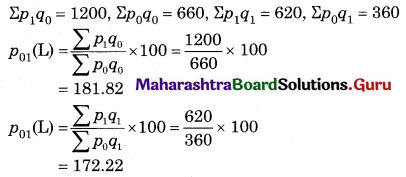
If Σp0q0 = 140, Σp0q1 = 200, Σp1q0 = 350, Σp1q1 = 460, find Laspeyre’s Paasche’s Dorbish-Bowley’s and Marshall- Edgeworth’s Price Index Numbers.
Solution:
Maharashtra Board 12th Commerce Maths Solutions Chapter 5 Index Numbers Ex 5.2 Q6

Question 7.
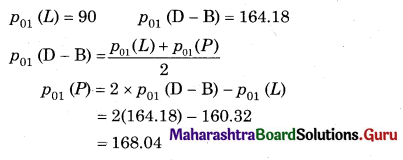
Given that Laspeyre’s and Dorbish-Bowley’s Price Index Numbers are 160.32 and 164.18 respectively. Find Paasche’s Price Index Number.
Solution:
Maharashtra Board 12th Commerce Maths Solutions Chapter 5 Index Numbers Ex 5.2 Q7

Question 8.
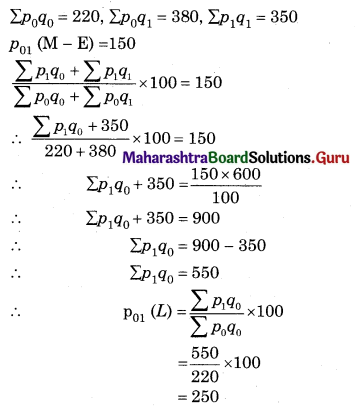
Given that Σp0q0 = 220, Σp0q1 = 380, Σp1q1 = 350 is Marshall-Edgeworth’s Price Index Number is 150, find Laspeyre’s Price Index Number.
Solution:
Maharashtra Board 12th Commerce Maths Solutions Chapter 5 Index Numbers Ex 5.2 Q8

Question 9.
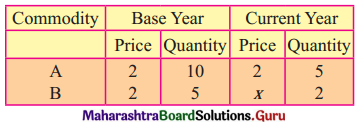
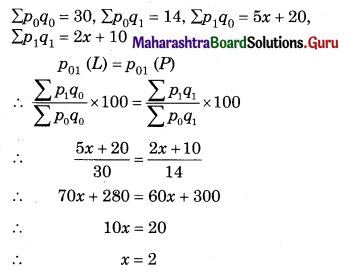
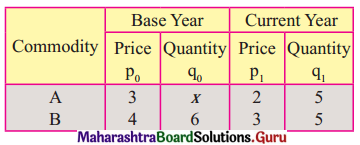
Find x in the following table if Laspeyres and Paasche’s Price Index Numbers are equal.
Maharashtra Board 12th Commerce Maths Solutions Chapter 5 Index Numbers Ex 5.2 Q9
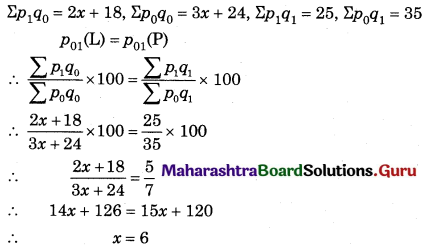
Solution:
Maharashtra Board 12th Commerce Maths Solutions Chapter 5 Index Numbers Ex 5.2 Q9.1
Maharashtra Board 12th Commerce Maths Solutions Chapter 5 Index Numbers Ex 5.2 Q9.2

Maharashtra Board 12th Commerce Maths Solutions Chapter 5 Index Numbers Ex 5.2

Question 10.
If Laspeyre’s Price Index Number is four times Paasche’s Price Index Number, then find the relation between Dorbish-Bowley’s and Fisher’s Price Index Numbers.
Solution:
Maharashtra Board 12th Commerce Maths Solutions Chapter 5 Index Numbers Ex 5.2 Q10

Question 11.
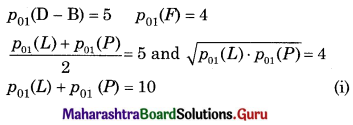
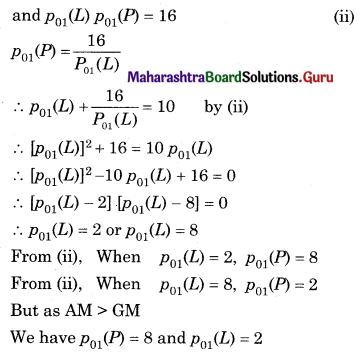
If Dorbish-Bowley’s and Fisher’s Price Index Numbers are 5 and 4, respectively, then find Laspeyres and Paasche’s Price Index Numbers.
Solution:
Maharashtra Board 12th Commerce Maths Solutions Chapter 5 Index Numbers Ex 5.2 Q11
Maharashtra Board 12th Commerce Maths Solutions Chapter 5 Index Numbers Ex 5.2 Q11.1

Maharashtra Board 12th Commerce Maths Solutions Chapter 5 Index Numbers Ex 5.1

Balbharati Maharashtra State Board 12th Commerce Maths Solution Book Pdf Chapter 5 Index Numbers Ex 5.1 Questions and Answers.

Maharashtra State Board 12th Commerce Maths Solutions Chapter 5 Index Numbers Ex 5.1

Find the Price Index Number using the Simple Aggregate Method in each of the following examples.

Question 1.
Use 1995 as the base year in the following problem.
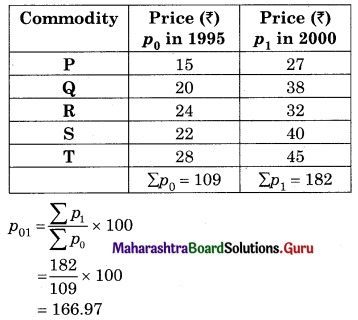
Maharashtra Board 12th Commerce Maths Solutions Chapter 5 Index Numbers Ex 5.1 Q1
Solution:
Maharashtra Board 12th Commerce Maths Solutions Chapter 5 Index Numbers Ex 5.1 Q1.1

Question 2.
Use 1995 as the base year in the following problem.
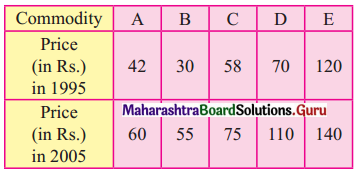
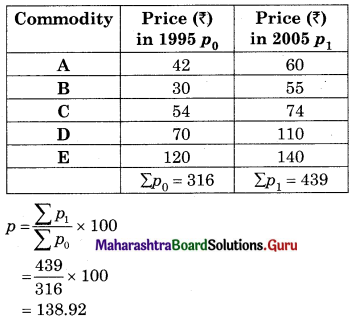
Maharashtra Board 12th Commerce Maths Solutions Chapter 5 Index Numbers Ex 5.1 Q2
Solution:
Maharashtra Board 12th Commerce Maths Solutions Chapter 5 Index Numbers Ex 5.1 Q2.1

Maharashtra Board 12th Commerce Maths Solutions Chapter 5 Index Numbers Ex 5.1

Question 3.
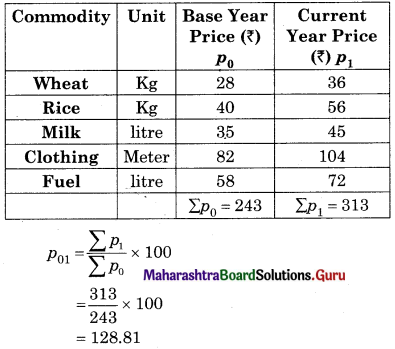
Maharashtra Board 12th Commerce Maths Solutions Chapter 5 Index Numbers Ex 5.1 Q3
Solution:
Maharashtra Board 12th Commerce Maths Solutions Chapter 5 Index Numbers Ex 5.1 Q3.1

Question 4.
Use 2000 as the base year in the following problem.
Maharashtra Board 12th Commerce Maths Solutions Chapter 5 Index Numbers Ex 5.1 Q4
Solution:
Maharashtra Board 12th Commerce Maths Solutions Chapter 5 Index Numbers Ex 5.1 Q4.1

Question 5.
Use 1990 as the base year in the following problem.
Maharashtra Board 12th Commerce Maths Solutions Chapter 5 Index Numbers Ex 5.1 Q5
Solution:
Maharashtra Board 12th Commerce Maths Solutions Chapter 5 Index Numbers Ex 5.1 Q5.1
Maharashtra Board 12th Commerce Maths Solutions Chapter 5 Index Numbers Ex 5.1 Q5.2

Maharashtra Board 12th Commerce Maths Solutions Chapter 5 Index Numbers Ex 5.1

Question 6.
Assume 2000 to be a base year in the following problem.
Maharashtra Board 12th Commerce Maths Solutions Chapter 5 Index Numbers Ex 5.1 Q6
Solution:
Maharashtra Board 12th Commerce Maths Solutions Chapter 5 Index Numbers Ex 5.1 Q6.1

Question 7.
Use 2005 as a year in the following problem.
Maharashtra Board 12th Commerce Maths Solutions Chapter 5 Index Numbers Ex 5.1 Q7
Solution:
Maharashtra Board 12th Commerce Maths Solutions Chapter 5 Index Numbers Ex 5.1 Q7.1

Find the Quantity Index Number using the Simple Aggregate Method in each of the following examples.

Question 8.
Maharashtra Board 12th Commerce Maths Solutions Chapter 5 Index Numbers Ex 5.1 Q8
Solution:
Maharashtra Board 12th Commerce Maths Solutions Chapter 5 Index Numbers Ex 5.1 Q8.1

Maharashtra Board 12th Commerce Maths Solutions Chapter 5 Index Numbers Ex 5.1

Question 9.
Maharashtra Board 12th Commerce Maths Solutions Chapter 5 Index Numbers Ex 5.1 Q9
Solution:
Maharashtra Board 12th Commerce Maths Solutions Chapter 5 Index Numbers Ex 5.1 Q9.1

Find the value Index Number using the Simple Aggregate Method in each of the following examples.

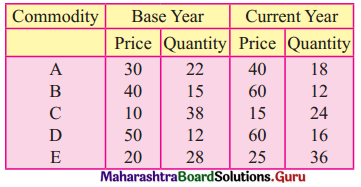
Question 10.
Maharashtra Board 12th Commerce Maths Solutions Chapter 5 Index Numbers Ex 5.1 Q10
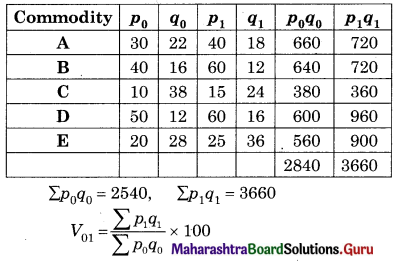
Solution:
Maharashtra Board 12th Commerce Maths Solutions Chapter 5 Index Numbers Ex 5.1 Q10.1
= \(\frac{3660}{2840}\) × 100
= 128.87

Question 11.
Maharashtra Board 12th Commerce Maths Solutions Chapter 5 Index Numbers Ex 5.1 Q11
Solution:
Maharashtra Board 12th Commerce Maths Solutions Chapter 5 Index Numbers Ex 5.1 Q11.1

Question 12.
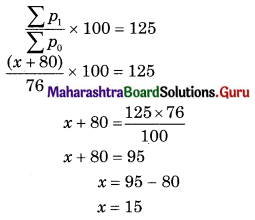
Find x if the Price Index Number by Simple Aggregate Method is 125
Maharashtra Board 12th Commerce Maths Solutions Chapter 5 Index Numbers Ex 5.1 Q12
Solution:
Maharashtra Board 12th Commerce Maths Solutions Chapter 5 Index Numbers Ex 5.1 Q12.1
Maharashtra Board 12th Commerce Maths Solutions Chapter 5 Index Numbers Ex 5.1 Q12.2

Maharashtra Board 12th Commerce Maths Solutions Chapter 5 Index Numbers Ex 5.1

Question 13.
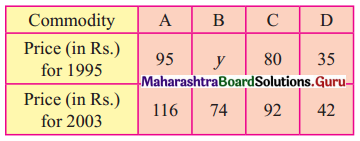
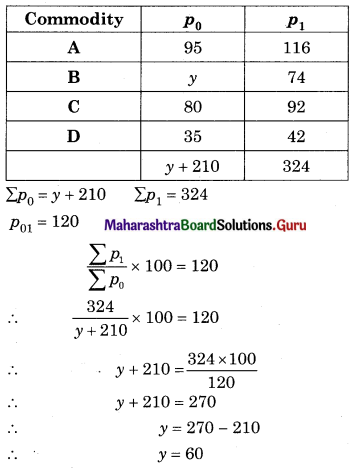
Find y is the Price Index Number by Simple Aggregate Method is 120, taking 1995 as the base year.
Maharashtra Board 12th Commerce Maths Solutions Chapter 5 Index Numbers Ex 5.1 Q13
Solution:
Maharashtra Board 12th Commerce Maths Solutions Chapter 5 Index Numbers Ex 5.1 Q13.1

Maharashtra Board 12th Commerce Maths Solutions Chapter 3 Linear Regression Ex 3.3

Balbharati Maharashtra State Board 12th Commerce Maths Digest Pdf Chapter 3 Linear Regression Ex 3.3 Questions and Answers.

Maharashtra State Board 12th Commerce Maths Solutions Chapter 3 Linear Regression Ex 3.3

Question 1.
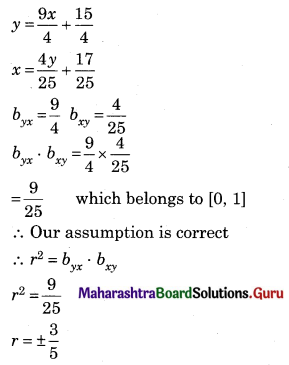
From the two regression equations find r, \(\bar{x}\) and \(\bar{y}\).
4y = 9x + 15 and 25x = 4y + 17
Solution:
Given 4y = 9x + 15 and 25x = 4y + 17
Maharashtra Board 12th Commerce Maths Solutions Chapter 3 Linear Regression Ex 3.3 Q1
Since byx and bxy are positive.
∴ r = \(\frac{3}{5}\) = 0.6
(\(\bar{x}\), \(\bar{y}\)) is the point of intersection of the regression lines
9x – 4y = -15 …….(i)
25x – 4y = 17 ……….(ii)
-16x = -32
x = 2
∴ \(\bar{x}\) = 2
Substituting x = 2 in equation (i)
9(2) – 4y = -15
18 + 15 = 4y
33 = 4y
y = 33/4 = 8.25
∴ \(\bar{y}\) = 8.25

Maharashtra Board 12th Commerce Maths Solutions Chapter 3 Linear Regression Ex 3.3

Question 2.
In a partially destroyed laboratory record of an analysis of regression data, the following data are legible:
Variance of X = 9
Regression equations:
8x – 10y + 66 = 0 And 40x – 18y = 214.
Find on the basis of the above information
(i) The mean values of X and Y.
(ii) Correlation coefficient between X and Y.
(iii) Standard deviation of Y.
Solution:
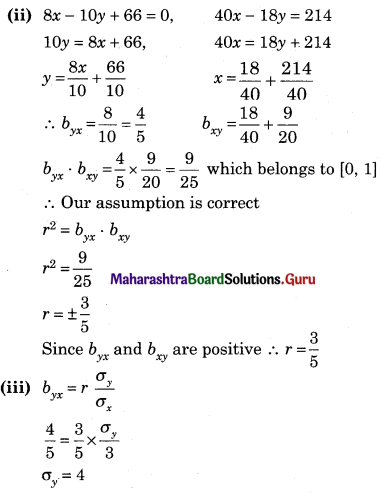
Given, \(\sigma_{x}{ }^{2}=9, \sigma_{x}=3\)
(i) (\(\bar{x}\), \(\bar{y}\)) is the point of intersection of the regression lines
40x – 50y = -330 …….(i)
40x – 50y = +214 ………(ii)
-32y = -544
y = 17
∴ \(\bar{y}\) = 17
8x – 10(17) + 66 = 0
8x = 104
x = 13
∴ \(\bar{x}\) = 13
Maharashtra Board 12th Commerce Maths Solutions Chapter 3 Linear Regression Ex 3.3 Q2

Question 3.
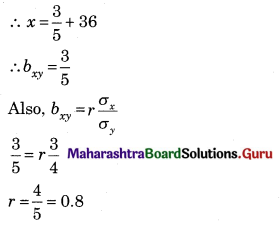
For 50 students of a class, the regression equation of marks in statistics (X) on the marks in Accountancy (Y) is 3y – 5x + 180 = 0. The mean marks in accountancy is 44 and the variance of marks in statistics \(\left(\frac{9}{16}\right)^{t h}\) of the variance of marks in accountancy. Find the mean in statistics and the correlation coefficient between marks in two subjects.
Solution:
Given, n = 50, \(\bar{y}\) = 44
\(\sigma_{x}^{2}=\frac{9}{16} \sigma_{y}^{2}\)
∴ \(\frac{\sigma_{x}}{\sigma_{x}}=\frac{3}{4}\)
Since (\(\bar{x}\), \(\bar{y}\)) is the point intersection of the regression line.
∴ (\(\bar{x}\), \(\bar{y}\)) satisfies the regression equation.
3\(\bar{y}\) – 5\(\bar{x}\) + 180 = 0
3(44) – 5\(\bar{x}\) + 180 = 0
∴ 5\(\bar{x}\) = 132 + 180
\(\bar{x}\) = \(\frac{312}{5}\) = 62.4
∴ Mean marks in statistics is 62.4
Regression equation of X on Y is 3y – 5x + 180 = 0
∴ 5x = 3y + 180
Maharashtra Board 12th Commerce Maths Solutions Chapter 3 Linear Regression Ex 3.3 Q3

Question 4.
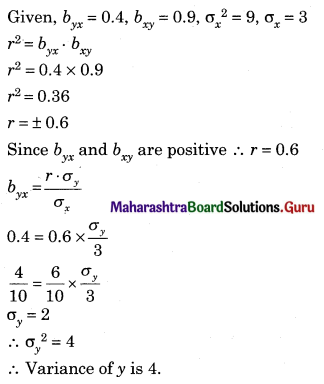
For bivariate data, the regression coefficient of Y on X is 0.4 and the regression coefficient of X on Y is 0.9. Find the value of the variance of Y if the variance of X is 9.
Solution:
Maharashtra Board 12th Commerce Maths Solutions Chapter 3 Linear Regression Ex 3.3 Q4

Question 5.
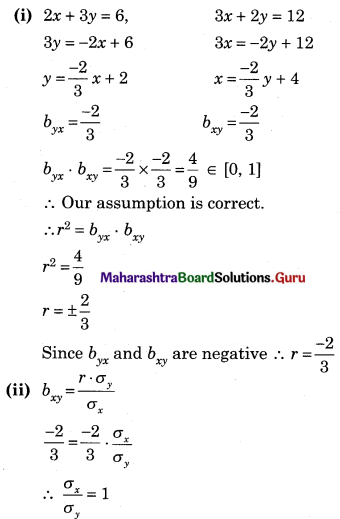
The equation of two regression lines are 2x + 3y – 6 = 0 and 3x + 2y – 12 = 0
Find (i) Correlation coefficient (ii) \(\frac{\sigma_{x}}{\sigma_{y}}\)
Solution:
Maharashtra Board 12th Commerce Maths Solutions Chapter 3 Linear Regression Ex 3.3 Q5

Question 6.
For a bivariate data \(\bar{x}\) = 53, \(\bar{y}\) = 28, byx =-1.5 and bxy = -0.2. Estimate Y when X = 50.
Solution:
Regression equation of Y on X is
(Y – \(\bar{y}\)) = byx (X – \(\bar{x}\))
(Y – 28) = -1.5(50 – 53)
Y – 28 = -1.5(-3)
Y – 28 = 4.5
Y = 32.5

Maharashtra Board 12th Commerce Maths Solutions Chapter 3 Linear Regression Ex 3.3

Question 7.
The equation of two regression lines are x – 4y = 5 and 16y – x = 64. Find means of X and Y. Also, find the correlation coefficient between X and Y.
Solution:
Since (\(\bar{x}\), \(\bar{y}\)) is the point of intersection of the regression lines.
x – 4y = 5 …..(i)
-x + 16y = 64 …….(ii)
12y = 69
y = 5.75
Substituting y = 5.75 in equation (i)
x – 4(5.75) = 5
x – 23 = 5
x = 28
∴ \(\bar{x}\) = 28, \(\bar{y}\) = 5.75
x – 4y = 5
x = 4y + 5
∴ bxy = 4
16y – x = 64
16y = x + 64
y = \(\frac{1}{16}\)x + 4
byx = \(\frac{1}{16}\)
byx . bxy = \(\frac{1}{16}\) × 4 = \(\frac{1}{4}\) ∈ [0, 1]
∴ Our assumption is correct
∴ r2 = byx . bxy
r2 = \(\frac{1}{4}\)
r = ±\(\frac{1}{2}\)
Since byx and bxy are positive,
∴ r = \(\frac{1}{2}\) = 0.5

Question 8.
In partially destroyed record, the following data are available variance of X = 25. Regression equation of Y on X is 5y – x = 22 and Regression equation of X on Y is 64x – 45y = 22 Find
(i) Mean values of X and Y.
(ii) Standard deviation of Y.
(iii) Coefficient of correlation between X and Y.
Solution:
Given \(\sigma_{x}^{2}\) = 25, ∴ σx = 5
(i) Since (\(\bar{x}\), \(\bar{y}\)) is the point of intersection of regression lines
-x + 5y = 22 …….(i)
64x – 45y = 22 ………..(ii)
equation (i) becomes
-9x + 45y = 198
64y – 45y = 22
55x = 220
x = 4
Substituting x = 4 in equation (i)
-4 + 5y = 22
5y = 26
∴ y = 5.2
∴ \(\bar{x}\) = 4, \(\bar{y}\) = 5.2
Regression equation of X on Y is
64x – 45y – 22
64x = 45y + 22
x = \(\frac{45}{64} y+\frac{22}{64}\)
bxy = \(\frac{45}{64}\)
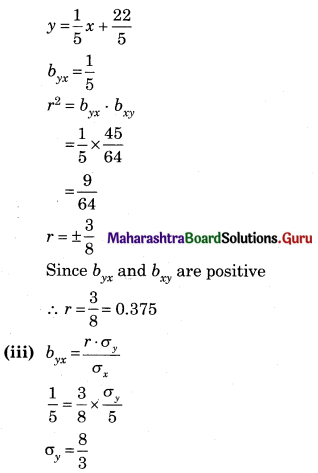
(ii) Regression equation of Y on X is
5y – x = 22
5y = x + 22
Maharashtra Board 12th Commerce Maths Solutions Chapter 3 Linear Regression Ex 3.3 Q8

Question 9.
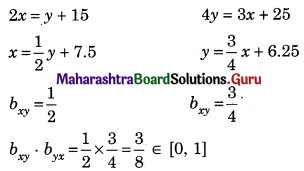
If the two regression lines for a bivariate data are 2x = y + 15 (x on y) and 4y – 3x + 25 (y on x) find
(i) \(\bar{x}\)
(ii) \(\bar{y}\)
(iii) byx
(iv) bxy
(v) r [Given √0.375 = 0.61]
Solution:
Since (\(\bar{x}\), \(\bar{y}\)) is the point of intersection of the regression line
2x = y + 15
4y = 3x + 25
2x – y = 15 …….(i)
3x – 4y = -25 ……..(ii)
Multiplying equation (i) by 4
8x – 4y = 60
3x – 4y = -25
on Subtracting,
5x = 85
∴ x = 17
Substituting x in equation (i)
2(17) – y = 15
34 – 15 = y
∴ y = 15
Maharashtra Board 12th Commerce Maths Solutions Chapter 3 Linear Regression Ex 3.3 Q9
Since byx and bxy are positive, ∴ r = 0.61

Maharashtra Board 12th Commerce Maths Solutions Chapter 3 Linear Regression Ex 3.3

Question 10.
The two regression equation are 5x – 6y + 90 = 0 and 15x – 8y – 130 = 0. Find \(\bar{x}\), \(\bar{y}\), r.
Solution:
Since (\(\bar{x}\), \(\bar{y}\)) is the point of intersection of the regression lines
5x – 6y + 90 = 0 ……(i)
15x – 8y – 130 = 0
15x – 18y + 270 = 0
15x – 8y – 130 = 0
on subtracting,
-10y + 400 = 0
y = 40
Substituting y = 40 in equation (i)
5x – 6(40) + 90 = 0
5x = 150
x = 30
∴ \(\bar{x}\) = 30, \(\bar{y}\) = 40
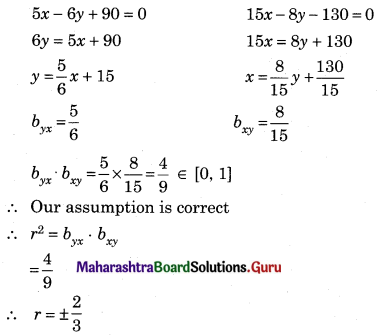
Maharashtra Board 12th Commerce Maths Solutions Chapter 3 Linear Regression Ex 3.3 Q10
Since byx and bxy are positive
∴ r = \(\frac{2}{3}\)

Question 11.
Two lines of regression are 10x + 3y – 62 = 0 and 6x + 5y – 50 = 0 Identify the regression equation equation of x on y. Hence find \(\bar{x}\), \(\bar{y}\), and r.
Solution:
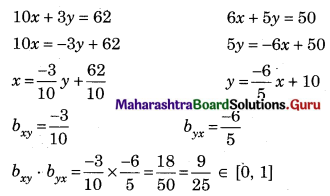
Maharashtra Board 12th Commerce Maths Solutions Chapter 3 Linear Regression Ex 3.3 Q11
∴ Our assumption is correct.
∴ Regression equation of X on Y is 10x + 3y – 62 = 0
r2 = byx . bxy
r2 = \(\frac{9}{25}\)
r = ±\(\frac{3}{5}\)
Since, byx and bxy are negative, r = –\(\frac{3}{5}\) = -0.6
Also (\(\bar{x}\), \(\bar{y}\)) is the point of intersection of the regression lines
50x + 15y = 310
18x + 15y = 150
on subtracting
32x = 160
x = 5
Substituting x = 5 in 10x + 3y = 62
10(5) + 3y = 62
3y = 12
∴ y = 4
∴ \(\bar{x}\) = 5, \(\bar{y}\) = 4

Question 12.
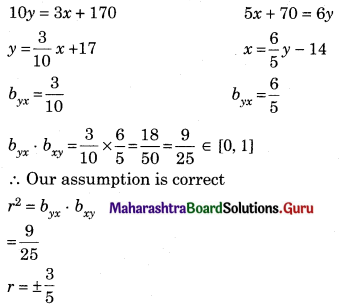
For certain X and Y series, which are correlated the two lines of regression are 10y = 3x + 170 and 5x + 70 = 6y. Find the correlation coefficient between them. Find the mean values of X and Y.
Solution:
Maharashtra Board 12th Commerce Maths Solutions Chapter 3 Linear Regression Ex 3.3 Q12
Since byx and bxy are positive,
r = \(\frac{3}{5}\) = 0.6
Since, (\(\bar{x}\), \(\bar{y}\)) is the point of intersection of the regression lines
3x – 10y = -170 …….(i)
5x – 6y = -70 ………(ii)
9x – 30y = -510
25x – 30y = -350
on subtracting
-16x = -160
x = 10
Substituting x = 10 in equation (i)
3(10) – 10y = -170
30 + 170 = 10y
200 = 10y
y = 20
∴ \(\bar{x}\) = 10, \(\bar{y}\) = 20

Maharashtra Board 12th Commerce Maths Solutions Chapter 3 Linear Regression Ex 3.3

Question 13.
Regression equation of two series are 2x – y – 15 = 0 and 4y + 25 = 0 and 3x- 4y + 25 = 0. Find \(\bar{x}\), \(\bar{y}\) and regression coefficients, Also find coefficients of correlation. [Given √0.375 = 0.61]
Solution:
Since (\(\bar{x}\), \(\bar{y}\)) is the point of intersection of the regression line
2x = y + 15
4y = 3x + 25
2x – y = 15 ……(i)
3x – 4y = -15 ……..(ii)
Multiply equation (i) by 4
8x – 4y = 60
3x – 4y = -25
on subtracting,
5x = 85
x = 17
Substituting x in equation (i)
2(17) – y = 15
34 – 15 = y
y = 15
∴ \(\bar{x}\) = 17, \(\bar{y}\) = 19
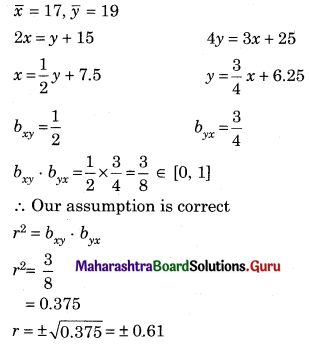
Maharashtra Board 12th Commerce Maths Solutions Chapter 3 Linear Regression Ex 3.3 Q13
∴ Our assumption is correct
r2 = bxy . byx
r2 = \(\frac{3}{8}\) = 0.375
r = ±√o.375 = ±0.61
Since, byx and bxy are positive, ∴ r = 0.61

Question 14.
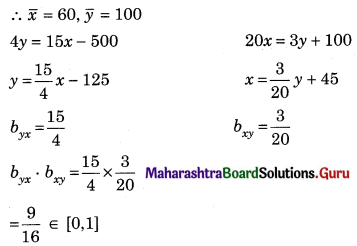
The two regression lines between height (X) in includes and weight (Y) in kgs of girls are 4y – 15x + 500 = 0 and 20x – 3y – 900 = 0. Find the mean height and weight of the group. Also, estimate the weight of a girl whose height is 70 inches.
Solution:
Since (\(\bar{x}\), \(\bar{y}\)) is the point intersection of the regression lines
15x – 4y = 500 ……(i)
20x – 3y = 900 …….(ii)
60x – 16y – 2000
60x – 9y = 2700
on subtracting,
-7y = -700
y = 100
Substituting y = 100 in equation (i)
15x – 4(100) = 500
15x = 900
x = 60
Maharashtra Board 12th Commerce Maths Solutions Chapter 3 Linear Regression Ex 3.3 Q14
∴ Our assumption is correct
∴ Regression equation of Y on X is
Y = \(\frac{15}{4}\)x – 125
When x = 70
Y = \(\frac{15}{4}\) × 70 = -125
= 262.5 – 125
= 137.5 kg

Maharashtra Board 12th Commerce Maths Solutions Chapter 5 Index Numbers Miscellaneous Exercise 5

Balbharati Maharashtra State Board 12th Commerce Maths Solution Book Pdf Chapter 5 Index Numbers Miscellaneous Exercise 5 Questions and Answers.

Maharashtra State Board 12th Commerce Maths Solutions Chapter 5 Index Numbers Miscellaneous Exercise 5

(I) Choose the correct alternative.

Question 1.
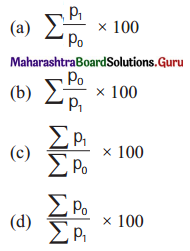
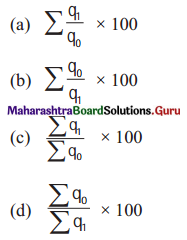
Price Index Number by Simple Aggregate method is given by
Maharashtra Board 12th Commerce Maths Solutions Chapter 5 Index Numbers Miscellaneous Exercise 5 I Q1
Answer:
(c) \(\frac{\sum p_{1}}{\sum p_{0}} \times 100\)

Question 2.
Quantity Index Number by Simple Aggregate Method is given by
Maharashtra Board 12th Commerce Maths Solutions Chapter 5 Index Numbers Miscellaneous Exercise 5 I Q2
Answer:
(c) \(\frac{\sum q_{1}}{\sum q_{0}} \times 100\)

Maharashtra Board 12th Commerce Maths Solutions Chapter 5 Index Numbers Miscellaneous Exercise 5

Question 3.
Value Index Number by Simple Aggregate Method is given by
Maharashtra Board 12th Commerce Maths Solutions Chapter 5 Index Numbers Miscellaneous Exercise 5 I Q3
Answer:
(b) \(\sum \frac{p_{0} q_{1}}{p_{0} q_{0}} \times 100\)

Question 4.
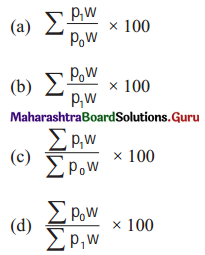
Price Index Number by Weighted Aggregate Method is given by
Maharashtra Board 12th Commerce Maths Solutions Chapter 5 Index Numbers Miscellaneous Exercise 5 I Q4
Answer:
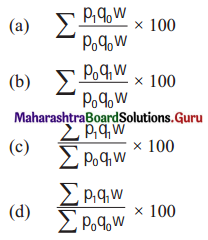
(c) \(\frac{\sum p_{1} w}{\sum p_{0} w} \times 100\)

Question 5.
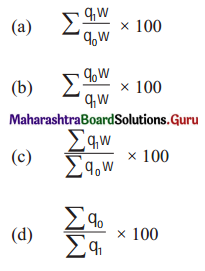
Quantity Index Number By Weighted Aggregate Method is given by
Maharashtra Board 12th Commerce Maths Solutions Chapter 5 Index Numbers Miscellaneous Exercise 5 I Q5
Answer:
(c) \(\frac{\sum q_{1} w}{\sum q_{0} w} \times 100\)

Question 6.
Value Index Number by Weighted aggregate Method is given by
Maharashtra Board 12th Commerce Maths Solutions Chapter 5 Index Numbers Miscellaneous Exercise 5 I Q6
Answer:
(d) \(\frac{\sum p_{1} q_{1} w}{\sum p_{0} q_{0} w} \times 100\)

Question 7.
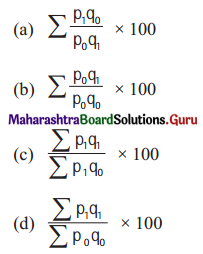
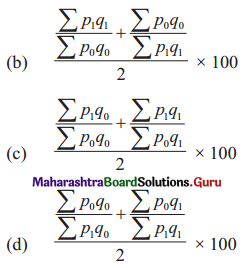
Laspeyre’s Price Index Number is given by
Maharashtra Board 12th Commerce Maths Solutions Chapter 5 Index Numbers Miscellaneous Exercise 5 I Q7
Answer:
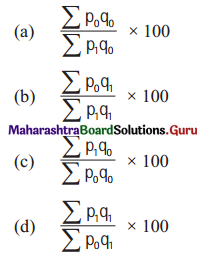
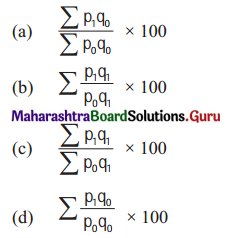
(c) \(\frac{\sum p_{1} q_{0}}{\sum p_{0} q_{0}} \times 100\)

Maharashtra Board 12th Commerce Maths Solutions Chapter 5 Index Numbers Miscellaneous Exercise 5

Question 8.
Paassche’s Price Index Number is given by
Maharashtra Board 12th Commerce Maths Solutions Chapter 5 Index Numbers Miscellaneous Exercise 5 I Q8
Answer:
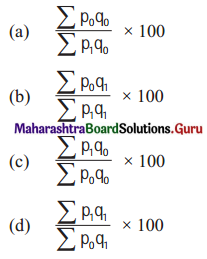
(d) \(\frac{\sum p_{1} q_{1}}{\sum p_{0} q_{1}} \times 100\)

Question 9.
Dorbish-Bowley’s Price Index Number is given by
Maharashtra Board 12th Commerce Maths Solutions Chapter 5 Index Numbers Miscellaneous Exercise 5 I Q9
Maharashtra Board 12th Commerce Maths Solutions Chapter 5 Index Numbers Miscellaneous Exercise 5 I Q9.1
Answer:
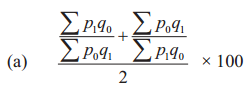
(c) \(\frac{\frac{\sum p_{1} q_{0}}{\sum p_{0} q_{0}}+\frac{\sum p_{1} q_{1}}{\sum p_{0} q_{1}}}{2} \times 100\)

Question 10.
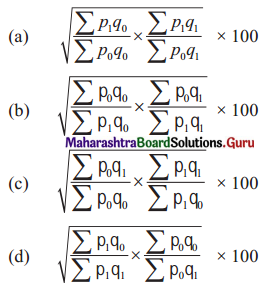
Fisher’s Price Number is given by
Maharashtra Board 12th Commerce Maths Solutions Chapter 5 Index Numbers Miscellaneous Exercise 5 I Q10
Answer:
(a) \(\sqrt{\frac{\sum p_{1} q_{0}}{\sum p_{0} q_{0}} \times \frac{\sum p_{1} q_{1}}{\sum p_{0} q_{1}}} \times 100\)

Question 11.
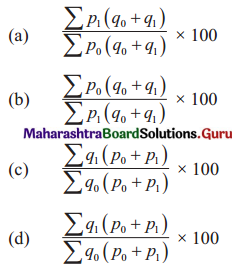
Marshall-Edge worth’s Price Index Number is given by
Maharashtra Board 12th Commerce Maths Solutions Chapter 5 Index Numbers Miscellaneous Exercise 5 I Q11
Answer:
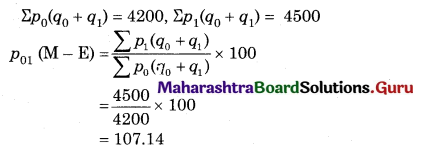
(a) \(\frac{\sum p_{1}\left(q_{0}+q_{1}\right)}{\sum p_{0}\left(q_{0}+q_{1}\right)} \times 100\)

Question 12.
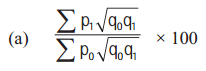
Walsh’s Price Index Number is given by
Maharashtra Board 12th Commerce Maths Solutions Chapter 5 Index Numbers Miscellaneous Exercise 5 I Q12
Maharashtra Board 12th Commerce Maths Solutions Chapter 5 Index Numbers Miscellaneous Exercise 5 I Q12.1
Answer:
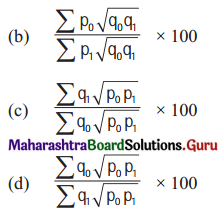
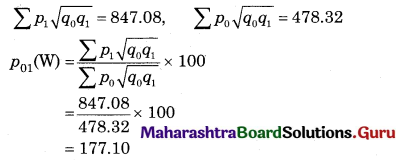
(a) \(\frac{\sum p_{1} \sqrt{q_{0} q_{1}}}{\sum p_{0} \sqrt{q_{0} q_{1}}} \times 100\)

Question 13.
The Cost of Living Index Number using Aggregate Expenditure Method is given by
Maharashtra Board 12th Commerce Maths Solutions Chapter 5 Index Numbers Miscellaneous Exercise 5 I Q13
Answer:
(a) \(\frac{\sum p_{1} q_{0}}{\sum p_{0} q_{0}} \times 100\)

Maharashtra Board 12th Commerce Maths Solutions Chapter 5 Index Numbers Miscellaneous Exercise 5

Question 14.
The Cost of Living Index Number using Weighted Relative Method is given by
Maharashtra Board 12th Commerce Maths Solutions Chapter 5 Index Numbers Miscellaneous Exercise 5 I Q14
Answer:
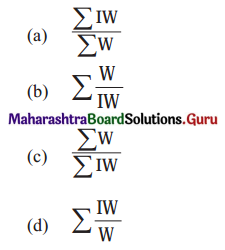
(a) \(\frac{\sum \mathrm{IW}}{\sum \mathrm{W}}\)

(II) Fill in the blanks.

Question 1.
Price Index Number by Simple Aggregate Method is given by ____________
Answer:
\(\frac{\sum p_{1}}{\sum p_{0}} \times 100\)

Question 2.
Quantity Index number by Simple Aggregate Method is given by ____________
Answer:
\(\frac{\sum q_{1}}{\sum q_{0}} \times 100\)

Question 3.
Value Index Number by Simple Aggregate Method is given by ____________
Answer:
\(\frac{\sum p_{1} q_{1}}{\sum p_{0} q_{0}} \times 100\)

Question 4.
Price Index Number by Weighted Aggregate Method is given by ____________
Answer:
\(\frac{\sum p_{1} w}{\sum p_{0} w} \times 100\)

Question 5.
Quantity Index Number by Weighted Aggregate Method is given by ____________
Answer:
\(\frac{\sum q_{1} w}{\sum q_{0} w} \times 100\)

Question 6.
Value Index Number by Weighted Aggregate Method is given by ____________
Answer:
\(\frac{\sum p_{1} q_{1} w}{\sum p_{0} q_{0} w} \times 100\)

Maharashtra Board 12th Commerce Maths Solutions Chapter 5 Index Numbers Miscellaneous Exercise 5

Question 7.
Laspeyre’s Price Index Number is given by ____________
Answer:
\(\frac{\sum p_{1} q_{0}}{\sum p_{0} q_{0}} \times 100\)

Question 8.
Paasche’s Price Index Number is given by ____________
Answer:
\(\frac{\sum p_{1} q_{1}}{\sum p_{0} q_{1}} \times 100\)

Question 9.
Dorbish-Bowley’s Price Index Number is given by ____________
Answer:
\(\frac{1}{2}\left[\frac{\sum p_{1} q_{0}}{\sum p_{0} q_{0}}+\frac{\sum p_{1} q_{1}}{\sum p_{0} q_{1}}\right] \times 100\)

Question 10.
Fisher’s Price Index Number is given by ____________
Answer:
\(\sqrt{\left[\frac{\sum p_{1} q_{0}}{\sum p_{0} q_{0}} \times \frac{\sum p_{1} q_{1}}{\sum p_{0} q_{1}}\right]} \times 100\)

Question 11.
Marshall-Edgeworth’s Price Index Number is given my ____________
Answer:
\(\frac{\sum p_{1}\left(q_{0}+q_{1}\right)}{\sum p_{0}\left(q_{0}+q_{1}\right)} \times 100\)

Question 12.
Walsh’s Price Index Number is given by ____________
Answer:
\(\frac{\sum p_{1} \sqrt{q_{0} q_{1}}}{\sum p_{0} \sqrt{q_{0} q_{1}}} \times 100\)

(III) State whether each of the following is True or False.

Question 1
\(\frac{\sum p_{1}}{\sum p_{0}} \times 100\) is the Price Index Number by Simple Aggregate Method.
Answer:
True

Question 2
\(\frac{\sum q_{0}}{\sum q_{1}} \times 100\) is the Quantity Index Number by Simple Aggregate Method.
Answer:
False

Question 3.
\(\sum \frac{p_{0} q_{0}}{p_{1} q_{1}} \times 100\) is value Index Number by Simple Aggregate Method.
Answer:
False

Question 4.
\(\sum \frac{p_{1} q_{0}}{p_{1} q_{1}} \times 100\) Paasche’s Price Index Number.
Answer:
False

Question 5.
\(\frac{\sum p_{1} q_{1}}{\sum p_{0} q_{1}} \times 100\) is Laspeyre’s Price Index Number.
Answer:
False

Question 6.
\(\frac{\sum p_{1} q_{0}}{\sum p_{0} q_{0}} \times \frac{\sum p_{1} q_{0}}{\sum p_{0} q_{0}} \times 100\) is Dorbish-Bowley’s Index Number.
Answer:
False

Maharashtra Board 12th Commerce Maths Solutions Chapter 5 Index Numbers Miscellaneous Exercise 5

Question 7.
\(\frac{1}{2}\left[\sqrt{\frac{\sum p_{1} q_{0}}{\sum p_{0} q_{0}}}+\frac{\sqrt{p_{1} q_{1}}}{\sqrt{p_{0} q_{1}}}\right] \times 100\) is Fisher’s Price Index Number.
Answer:
False

Question 8.
\(\frac{\sum p_{0}\left(q_{0}+q_{1}\right)}{\sum p_{1}\left(q_{0}+q_{1}\right)} \times 100\) is Marshall-Edgeworth’s Index Number.
Answer:
False

Question 9.
\(\frac{\sum p_{0} \sqrt{q_{0} q_{1}}}{\sum p_{1} \sqrt{q_{0} q_{1}}} \times 100\) is Walsh’s Price Index Number.
Answer:
False

Question 10.
\(\sqrt{\frac{\sum p_{1} q_{0}}{\sum p_{0} q_{0}}} \times \sqrt{\frac{\sum p_{1} q_{1}}{\sum p_{0} q_{1}}} \times 100\) is Fisher’s Price Index Number.
Answer:
True

(IV) Solve the following problems.

Question 1.
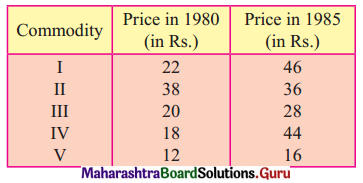
Find the price Index Number using simple Aggregate Method Consider 1980 as base year.
Maharashtra Board 12th Commerce Maths Solutions Chapter 5 Index Numbers Miscellaneous Exercise 5 IV Q1
Solution:
Maharashtra Board 12th Commerce Maths Solutions Chapter 5 Index Numbers Miscellaneous Exercise 5 IV Q1.1

Question 2.
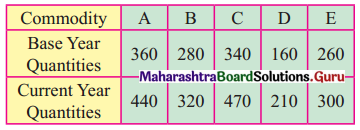
Find the Quantity Index Number using Simple Aggregate Method.
Maharashtra Board 12th Commerce Maths Solutions Chapter 5 Index Numbers Miscellaneous Exercise 5 IV Q2
Solution:
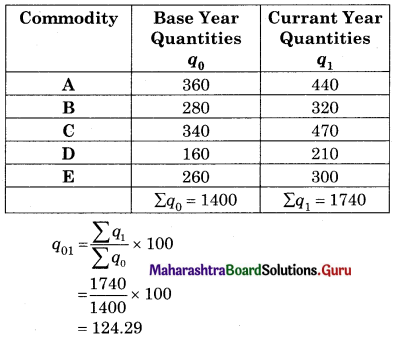
Maharashtra Board 12th Commerce Maths Solutions Chapter 5 Index Numbers Miscellaneous Exercise 5 IV Q2.1
Maharashtra Board 12th Commerce Maths Solutions Chapter 5 Index Numbers Miscellaneous Exercise 5 IV Q2.2

Maharashtra Board 12th Commerce Maths Solutions Chapter 5 Index Numbers Miscellaneous Exercise 5

Question 3.
Find the Value Index Number using Simple Aggregate Method.
Maharashtra Board 12th Commerce Maths Solutions Chapter 5 Index Numbers Miscellaneous Exercise 5 IV Q3
Solution:
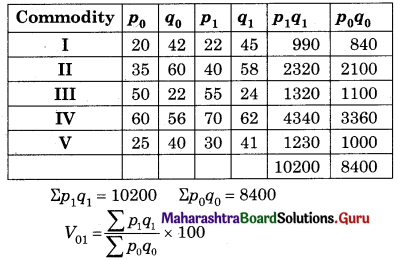
Maharashtra Board 12th Commerce Maths Solutions Chapter 5 Index Numbers Miscellaneous Exercise 5 IV Q3.1
= \(\frac{10200}{8400}\) × 100
= 121.43

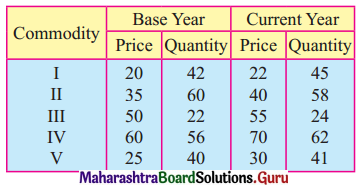
Question 4.
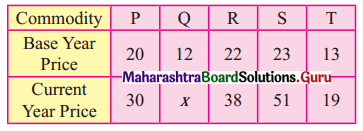
Find x if the Price Index Number using Simple Aggregate Method is 200.
Maharashtra Board 12th Commerce Maths Solutions Chapter 5 Index Numbers Miscellaneous Exercise 5 IV Q4
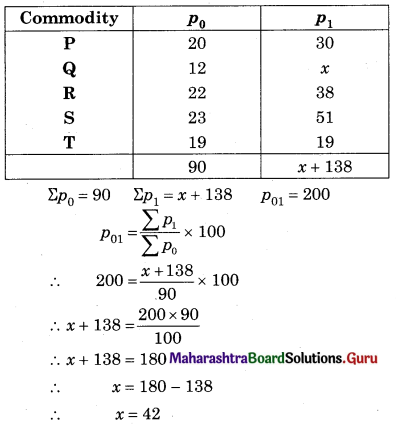
Solution:
Maharashtra Board 12th Commerce Maths Solutions Chapter 5 Index Numbers Miscellaneous Exercise 5 IV Q4.1

Question 5.
Calculate Laspeyre’s and Paasche’s Price Index Number for the following data.
Maharashtra Board 12th Commerce Maths Solutions Chapter 5 Index Numbers Miscellaneous Exercise 5 IV Q5
Solution:
Maharashtra Board 12th Commerce Maths Solutions Chapter 5 Index Numbers Miscellaneous Exercise 5 IV Q5.1
Maharashtra Board 12th Commerce Maths Solutions Chapter 5 Index Numbers Miscellaneous Exercise 5 IV Q5.2

Question 6.
Calculate Dorbish-Bowley’s Price Index Number for the following data.
Maharashtra Board 12th Commerce Maths Solutions Chapter 5 Index Numbers Miscellaneous Exercise 5 IV Q6
Solution:
Maharashtra Board 12th Commerce Maths Solutions Chapter 5 Index Numbers Miscellaneous Exercise 5 IV Q6.1
Maharashtra Board 12th Commerce Maths Solutions Chapter 5 Index Numbers Miscellaneous Exercise 5 IV Q6.2

Question 7.
Calculate Marshall-Edge worth’s Price Index Number for the following data.
Maharashtra Board 12th Commerce Maths Solutions Chapter 5 Index Numbers Miscellaneous Exercise 5 IV Q7
Solution:
Maharashtra Board 12th Commerce Maths Solutions Chapter 5 Index Numbers Miscellaneous Exercise 5 IV Q7.1
Maharashtra Board 12th Commerce Maths Solutions Chapter 5 Index Numbers Miscellaneous Exercise 5 IV Q7.2

Maharashtra Board 12th Commerce Maths Solutions Chapter 5 Index Numbers Miscellaneous Exercise 5

Question 8.
Calculate Walsh’s Price Index Number for the following data.
Maharashtra Board 12th Commerce Maths Solutions Chapter 5 Index Numbers Miscellaneous Exercise 5 IV Q8
Solution:
Maharashtra Board 12th Commerce Maths Solutions Chapter 5 Index Numbers Miscellaneous Exercise 5 IV Q8.1
Maharashtra Board 12th Commerce Maths Solutions Chapter 5 Index Numbers Miscellaneous Exercise 5 IV Q8.2

Question 9.
Calculate Laspeyre’s Price Index Number for the following data.
Maharashtra Board 12th Commerce Maths Solutions Chapter 5 Index Numbers Miscellaneous Exercise 5 IV Q9
Solution:
Maharashtra Board 12th Commerce Maths Solutions Chapter 5 Index Numbers Miscellaneous Exercise 5 IV Q9.1
Maharashtra Board 12th Commerce Maths Solutions Chapter 5 Index Numbers Miscellaneous Exercise 5 IV Q9.2

Question 10.
Find x if Laseyre’s Price Index Number is same as Paasche’s Price Index Number for the following data.
Maharashtra Board 12th Commerce Maths Solutions Chapter 5 Index Numbers Miscellaneous Exercise 5 IV Q10
Solution:
Maharashtra Board 12th Commerce Maths Solutions Chapter 5 Index Numbers Miscellaneous Exercise 5 IV Q10.1
Maharashtra Board 12th Commerce Maths Solutions Chapter 5 Index Numbers Miscellaneous Exercise 5 IV Q10.2

Question 11.
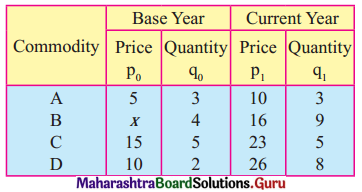
Find x if Walsh’s Price Index Number is 150 for the following data.
Maharashtra Board 12th Commerce Maths Solutions Chapter 5 Index Numbers Miscellaneous Exercise 5 IV Q11
Solution:
Maharashtra Board 12th Commerce Maths Solutions Chapter 5 Index Numbers Miscellaneous Exercise 5 IV Q11.1
Maharashtra Board 12th Commerce Maths Solutions Chapter 5 Index Numbers Miscellaneous Exercise 5 IV Q11.2
Maharashtra Board 12th Commerce Maths Solutions Chapter 5 Index Numbers Miscellaneous Exercise 5 IV Q11.3

Question 12.
Find x if Paasche’s Price Index Number is 140 for the following data.
Maharashtra Board 12th Commerce Maths Solutions Chapter 5 Index Numbers Miscellaneous Exercise 5 IV Q12
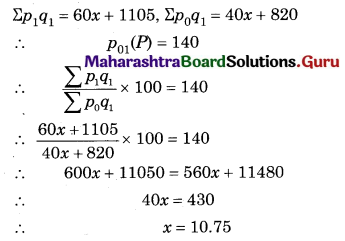
Solution:
Maharashtra Board 12th Commerce Maths Solutions Chapter 5 Index Numbers Miscellaneous Exercise 5 IV Q12.1
Maharashtra Board 12th Commerce Maths Solutions Chapter 5 Index Numbers Miscellaneous Exercise 5 IV Q12.2

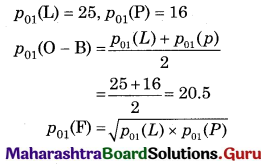
Question 13.
Given that Laspeyre’s and Paasche’s Index Number are 25 and 16 respectively. Find Dorbish-Bowley’s and Fisher’s Price Index Number.
Solution:
Maharashtra Board 12th Commerce Maths Solutions Chapter 5 Index Numbers Miscellaneous Exercise 5 IV Q13
= \(\sqrt{25 \times 16}\)
= 20

Maharashtra Board 12th Commerce Maths Solutions Chapter 5 Index Numbers Miscellaneous Exercise 5

Question 14.
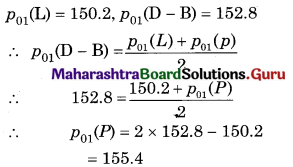
If Laspeyre’s and Dorbish Price Index Number are 150.2 and 152.8 respectively, find Paasche’s rice Index Number.
Solution:
Maharashtra Board 12th Commerce Maths Solutions Chapter 5 Index Numbers Miscellaneous Exercise 5 IV Q14

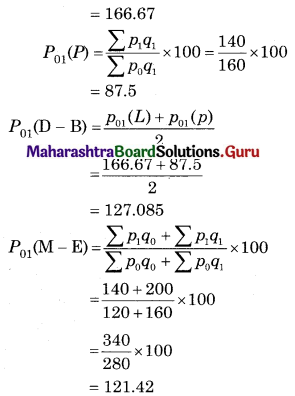
Question 15.
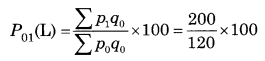
If Σp0q0 = 120, Σp0q1 = 160, Σp1q1 = 140, and Σp1q0 = 200 find Laspeyre’s, Paasche’s, Dorbish-Bowley’s, and Marshall-Edgeworth’s Price Index Numbers.
Solution:
Maharashtra Board 12th Commerce Maths Solutions Chapter 5 Index Numbers Miscellaneous Exercise 5 IV Q15
Maharashtra Board 12th Commerce Maths Solutions Chapter 5 Index Numbers Miscellaneous Exercise 5 IV Q15.1

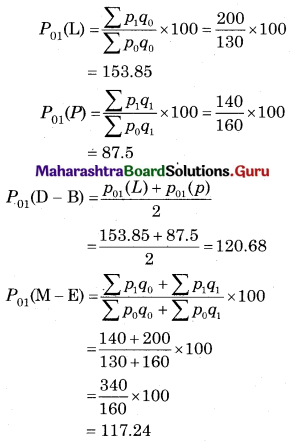
Question 16.
Given that Σp0q0 = 130, Σp1q1 = 140, Σp0q1 = 160, and Σp1q0 = 200, find Laspeyare’s, Passche’s, Dorbish-Bowely’s and Mashall-Edegeworth’s Price Inbox Numbers.
Solution:
Maharashtra Board 12th Commerce Maths Solutions Chapter 5 Index Numbers Miscellaneous Exercise 5 IV Q16

Question 17.
Given that Σp1q1 = 300, Σp0q1 = 140, Σp0q0 = 120, and Marshall-Edegeworth’s Price Inbox Number is 120, find Laspeyre’s Price Index Number.
Solution:
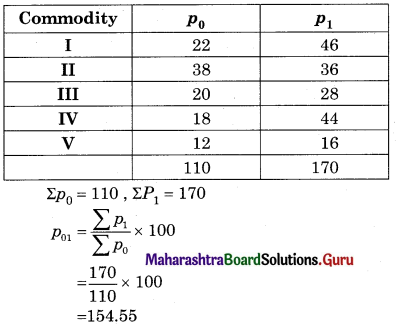
p01(P) = \(\frac{\sum p_{1} q_{1}}{\sum p_{0} q_{1}} \times 100\)
= \(\frac{300}{320}\) × 100
= 93.75

Question 18.
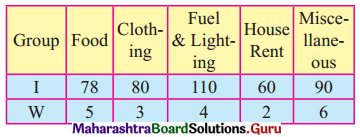
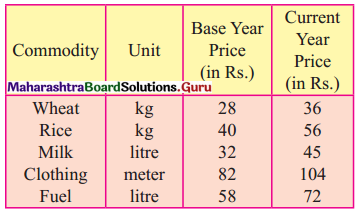
Calculate the cost of living number for the following data.
Maharashtra Board 12th Commerce Maths Solutions Chapter 5 Index Numbers Miscellaneous Exercise 5 IV Q18
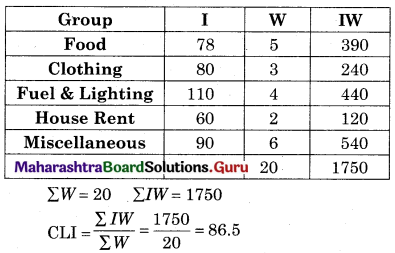
Solution:
Maharashtra Board 12th Commerce Maths Solutions Chapter 5 Index Numbers Miscellaneous Exercise 5 IV Q18.1

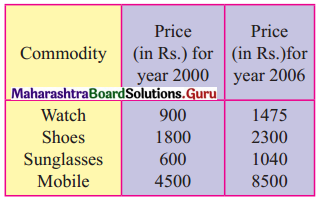
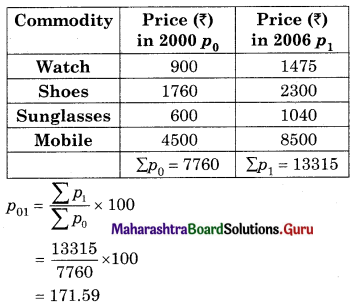
Question 19.
Find the cost living index number by the weighted aggregate method.
Maharashtra Board 12th Commerce Maths Solutions Chapter 5 Index Numbers Miscellaneous Exercise 5 IV Q19
Solution:
Maharashtra Board 12th Commerce Maths Solutions Chapter 5 Index Numbers Miscellaneous Exercise 5 IV Q19.1

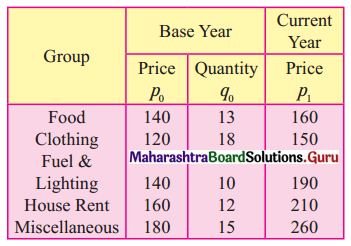
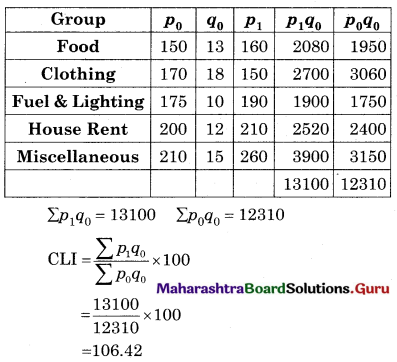
Question 20.
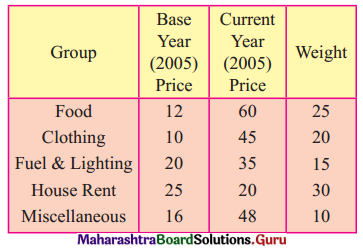
Find the cost of living index number by Family Budget Method for the following data. Also, find the expenditure of a person in the year 2008 if his expenditure in the year 2005 was ₹ 10,000.
Maharashtra Board 12th Commerce Maths Solutions Chapter 5 Index Numbers Miscellaneous Exercise 5 IV Q20
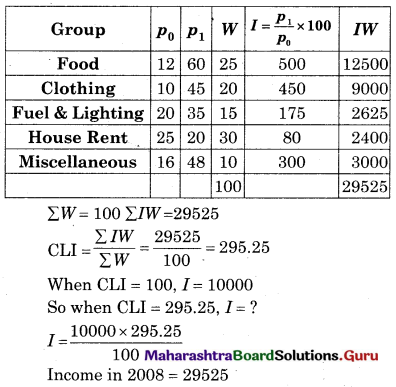
Solution:
Maharashtra Board 12th Commerce Maths Solutions Chapter 5 Index Numbers Miscellaneous Exercise 5 IV Q20.1

Maharashtra Board 12th Commerce Maths Solutions Chapter 5 Index Numbers Miscellaneous Exercise 5

Question 21.
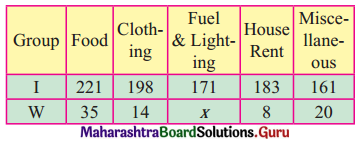
Find x if cost of living index number is 193 for the following data.
Maharashtra Board 12th Commerce Maths Solutions Chapter 5 Index Numbers Miscellaneous Exercise 5 IV Q21
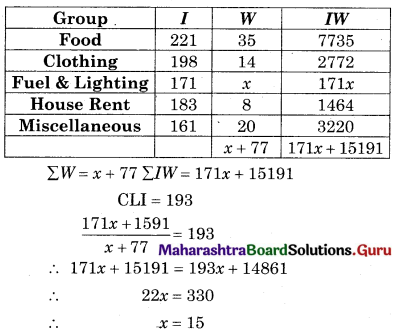
Solution:
Maharashtra Board 12th Commerce Maths Solutions Chapter 5 Index Numbers Miscellaneous Exercise 5 IV Q21.1

Question 22.
The cost of living number for year 2000 and 2003 are 150 and 210 respectively. A person earns ₹ 13,500 per month in the year 2000. What should be his monthly earning in the year 2003 in order to maintain the same standard of living?
Solution:
CLI (2000) = 150
CLI (2003) = 210
Income (2000) = 13500
Income (2003) = ?
Real Income = \(\frac{\text { Income }}{\mathrm{CLI}} \times 100\)
For 2000, Real Income = \(\frac{13500}{150} \times 100\) = ₹ 9000
For 2003, Real Income = \(\frac{\text { Income }}{\mathrm{CLI}} \times 100\)
∴ 9000 = \(\frac{\text { Income }}{210} \times 100\)
∴ Income = \(\frac{9000 \times 210}{100}\) = 18900
∴ Income in 2003 = ₹ 18900

Maharashtra Board 12th Commerce Maths Solutions Chapter 3 Linear Regression Ex 3.2

Balbharati Maharashtra State Board 12th Commerce Maths Digest Pdf Chapter 3 Linear Regression Ex 3.2 Questions and Answers.

Maharashtra State Board 12th Commerce Maths Solutions Chapter 3 Linear Regression Ex 3.2

Question 1.
For bivariate data.
\(\bar{x}\) = 53, \(\bar{x}\) = 28, byx = -1.2, bxy = -0.3
Find,
(i) Correlation coefficient between X and Y.
(ii) Estimate Y for X = 50
(iii) Estimate X for Y = 25
Solution:
(i) r2 = byx . bxy
r2 = (-1.2)(-0.3)
r2 = 0.36
r = ±0.6
Since, byx and bxy are negative, r = -0.6

(ii) Regression equation of Y on X is
(Y – \(\bar{y}\)) = byx (X – \(\bar{x}\))
Y – 28 = -1.2(50 – 53)
Y – 28 = -1.2(-3)
Y – 28 = 3.6
Y = 31.6

(iii) Regression equation of X on Y is
(X – \(\bar{x}\)) = bxy (Y – \(\bar{y}\))
(X – 53) = -0.3(25 – 28)
X – 53 = -0.3(-3)
X – 53 = 0.9
X = 53.9

Maharashtra Board 12th Commerce Maths Solutions Chapter 3 Linear Regression Ex 3.2

Question 2.
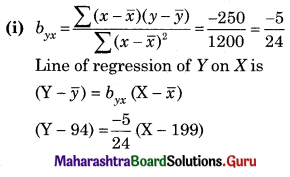
From the data of 20 pairs of observation on X and Y, following result are obtained \(\bar{x}\) = 199, \(\bar{y}\) = 94, \(\sum\left(x_{i}-\bar{x}\right)^{2}\) = 1200, \(\sum\left(y_{i}-\bar{y}\right)^{2}\) = 300
\(\sum\left(x_{i}-\bar{x}\right)\left(y_{i}-\bar{y}\right)\) = -250
Find
(i) The line of regression of Y on X.
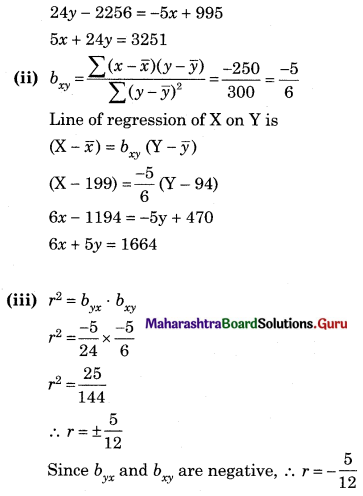
(ii) The line of regression of X on Y.
(iii) Correlation coefficient between X on Y.
Solution:
Maharashtra Board 12th Commerce Maths Solutions Chapter 3 Linear Regression Ex 3.2 Q2
Maharashtra Board 12th Commerce Maths Solutions Chapter 3 Linear Regression Ex 3.2 Q2.1

Question 3.
From the data of 7 pairs of observations on X and Y following results are obtained.
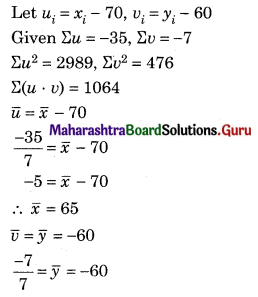
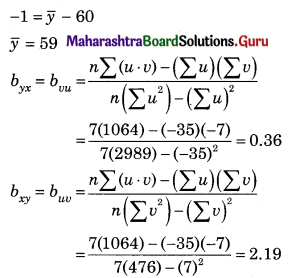
Σ(xi – 70 ) = -35, Σ(yi – 60) = -7, Σ(xi – 70)2 = 2989, Σ(yi – 60)2 = 476, Σ(xi – 70) (yi – 60) = 1064 [Given √0.7884 = 0.8879]
Obtain
(i) The line of regression of Y on X.
(ii) The line of regression of X on Y.
(iii) The correlation coefficient between X and Y.
Solution:
Maharashtra Board 12th Commerce Maths Solutions Chapter 3 Linear Regression Ex 3.2 Q3
Maharashtra Board 12th Commerce Maths Solutions Chapter 3 Linear Regression Ex 3.2 Q3.1
(i) Line of regression Y on X is
(Y – \(\bar{y}\)) = byx (X – \(\bar{x}\))
(Y – 59) = 0.36(x – 65)
(Y – 59) = 0.36x – 23.4
Y = 0.36x + 35.6

(ii) Line of regression X on Y is
(X – \(\bar{x}\)) = bxy (Y – \(\bar{y}\))
(X – 65) = 2.19(y – 59)
(X – 65) = 2.19y – 129.21
X = 2.19y – 64.21

(iii) r2 = byx . bxy
r2 = (0.36) (2.19)
r2 = 0.7884
r = ±√0.7884 = ±0.8879
Since byx and bxy are positive.
∴ r = 0.8879

Maharashtra Board 12th Commerce Maths Solutions Chapter 3 Linear Regression Ex 3.2

Question 4.
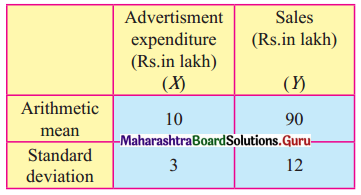
You are given the following information about advertising expenditure and sales.
Maharashtra Board 12th Commerce Maths Solutions Chapter 3 Linear Regression Ex 3.2 Q4
Correlation coefficient between X and Y is 0.8
(i) Obtain two regression equations.
(ii) What is the likely sales when the advertising budget is ₹ 15 lakh?
(iii) What should be the advertising budget if the company wants to attain sales target of ₹ 120 lakh?
Solution:
Given, \(\bar{x}\) = 10, \(\bar{y}\) = 90, σx = 3, σy = 12, r = 0.8
byx = \(\frac{r \sigma_{y}}{\sigma_{x}}=0.8 \times \frac{12}{3}\) = 3.2
bxy = \(\frac{r \sigma_{x}}{\sigma_{y}}=0.8 \times \frac{3}{12}\) = 0.2
(i) Regression equation of Y on X is
(Y – \(\bar{y}\)) = byx (X – \(\bar{x}\))
(Y – 90) = 3.2(x – 10)
Y – 90 = 3.2x – 32
Y = 3.2x + 58
Regression equation of X on Y is
(X – \(\bar{x}\)) = bxy (Y – \(\bar{y}\))
(X – 10) = 0.2(y – 90)
X – 10 = 0.2y + 18
X = 0.2y – 8

(ii) When x = 15,
Y = 3.2(15) + 58
= 48 + 58
= 106 lakh

(iii) When y = 120
X = 0.2(120) – 8
= 24 – 8
= 16 lakh

Question 5.
Bring out inconsistency if any, in the following:
(i) byx + bxy = 1.30 and r = 0.75
(ii) byx = bxy = 1.50 and r = -0.9
(iii) byx = 1.9 and bxy = -0.25
(iv) byx = 2.6 and bxy = \(\frac{1}{2.6}\)
Solution:
(i) Given, byx + bxy = 1.30 and r = 0.75
\(\frac{b_{y x}+b_{x y}}{2}=\frac{1.30}{2}\) = 0.65
But for regression coefficients byx and bxy
\(\left|\frac{b_{y x}+b_{x y}}{2}\right| \geq r\)
Here, 0.65 < r = 0.75
∴ The data is inconsistent
(ii) The signs of byx, bxy and r must be same (all three positive or all three negative)
∴ The data is inconsistent.

(iii) The signs of byx and bxy should be same (either both positive or both negative)
∴ The data is consistent.

(iv) byx . bxy = 2.6 × \(\frac{1}{2.6}\) = 1
∴ 0 ≤ r2 ≤ 1
∴ The data is consistent.

Maharashtra Board 12th Commerce Maths Solutions Chapter 3 Linear Regression Ex 3.2

Question 6.
Two sample from bivariate populations have 15 observation each. The sample means of X and Y are 25 and 18 respectively. The corresponding sum of square of deviations from respective means are 136 and 150. The sum of product of deviations from respective means is 123. Obtain the equation of line of regression of X on Y.
Solution:
Given, n = 15, \(\bar{x}\) = 25, \(\bar{y}\) = 18, Σ(x – \(\bar{x}\)) = 136, Σ(y – \(\bar{y}\)) = 150, Σ(x – \(\bar{x}\)) (y – \(\bar{y}\)) = 123
Regression equation of X on Y is (X – \(\bar{x}\)) = bxy (Y – \(\bar{y}\))
(X – 25) = 0.82(y – 18)
(X – 25) = 082y – 14.76
X = 0.82y + 10.24

Question 7.
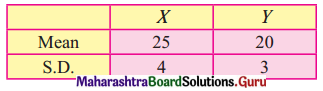
For a certain bivariate data
Maharashtra Board 12th Commerce Maths Solutions Chapter 3 Linear Regression Ex 3.2 Q7
And r = 0.5 estimate y when x = 10 and estimate x when y = 16
Solution:
Given, \(\bar{x}\) = 25, \(\bar{y}\) = 20, σx = 4, σy = 3, r = 0.5
byx = \(\frac{r \sigma_{y}}{\sigma_{y}}=0.5 \times \frac{3}{4}\) = 0.375
Regression equation of Y on X is
(Y – \(\bar{y}\)) = byx (X – \(\bar{x}\))
(Y – 20) = 0.375(x – 25)
Y – 20 = 0.375x – 9.375
Y = 0.375x + 10.625
When, x = 10
Y = 0.375(10) + 10.625
= 3.75 + 10.625
= 14.375
bxy = \(\frac{r \sigma_{x}}{\sigma_{y}}=0.5 \times \frac{4}{3}\) = 0.67
Regression equation of X on Y is
(X – \(\bar{x}\)) = byx (Y – \(\bar{y}\))
(X – 25) = 0.67(y – 20)
(X – 25) = 0.67y – 13.4
X = 0.67y + 11.6
When, Y = 16
x = 0.67(16) + 11.6
= 10.72 + 11.6
= 22.32

Question 8.
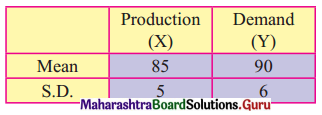
Given the following information about the production and demand of a commodity obtain the two regression lines:
Maharashtra Board 12th Commerce Maths Solutions Chapter 3 Linear Regression Ex 3.2 Q8
Coefficient of correlation between X and Y is 0.6. Also estimate the problem when demand is 100.
Solution:
Given \(\bar{x}\) = 85, \(\bar{y}\) = 90, σx = 5, σy = 6 and r = 0.6
bxy = \(\frac{r \sigma_{x}}{\sigma_{y}}=0.6 \times \frac{5}{6}\) = 0.5
byx = \(\frac{r \sigma_{y}}{\sigma_{x}}=0.6 \times \frac{6}{5}\) = 0.72
Regression equation of X on Y is
(X – \(\bar{x}\)) = bxy (Y – \(\bar{y}\))
(X – 85) = 0.5(y – 90)
(X – 85 ) = 0.5y – 45
X = 0.5y + 40
When y = 100,
x = 0.5 (100) + 40
= 50 + 40
= 90
Regression equation of Y on X is
(Y – \(\bar{y}\)) = byx (X – \(\bar{x}\))
(Y – 90) = 0.72(x – 85)
(Y – 90) = 0.72x – 61.2
Y = 0.72x + 28.8

Maharashtra Board 12th Commerce Maths Solutions Chapter 3 Linear Regression Ex 3.2

Question 9.
Given the following data, obtain linear regression estimate of X for Y = 10
Solution:
\(\bar{x}\) = 7.6, \(\bar{y}\) = 14.8, σx = 3.2, σy = 16 and r = 0.7
bxy = \(\frac{r \sigma_{x}}{\sigma_{y}}=0.7 \times \frac{3.2}{16}\) = 0.14
Regression equation of X on Y is
(X – \(\bar{y}\)) = bxy (Y – \(\bar{y}\))
(X – 7.6) = 0.14(y – 14.8)
X – 7.6 = 0.14y – 2.072
X = 0.14y + 5.528
When y = 10
x = 0.14(10) + 5.528
= 1.4 + 5.528
= 6.928

Question 10.
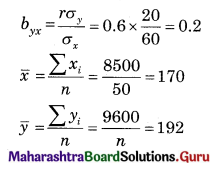
An inquiry of 50 families to study the relationship between expenditure on accommodation (₹ x) and expenditure on food and entertainment (₹ y) gave the following result:
Σx = 8500, Σy = 9600, σx = 60, σy = 20, r = 0.6
Estimate the expenditure on food and entertainment when expenditure on accommodation is ₹ 200
Solution:
n = 50 (given)
Maharashtra Board 12th Commerce Maths Solutions Chapter 3 Linear Regression Ex 3.2 Q10
Regression equation of Y on X is
Y – \(\bar{y}\) = byx (X – \(\bar{x}\))
(Y – 192) = 0.2(200 – 170)
Y – 192 = 0.2(30)
Y = 192 + 6
Y = 198

Question 11.
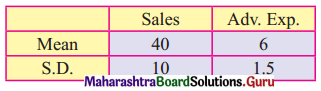
The following data about the sales and advertisement expenditure of a firms is given below (in ₹ crores)
Maharashtra Board 12th Commerce Maths Solutions Chapter 3 Linear Regression Ex 3.2 Q11
Also correlation coefficient between X and Y is 0.9
(i) Estimate the likely sales for a proposed advertisement expenditure of ₹ 10 crores.
(ii) What should be the advertisement expenditure if the firm proposes a sales target ₹ 60 crores
Let the sales be X and advertisement expenditure be Y
Solution:
Given, \(\bar{x}\) = 40, \(\bar{y}\) = 6, σx = 10, σy = 1.5, r = 0.9
byx = \(\frac{r \sigma_{y}}{\sigma_{x}}=0.9 \times \frac{1.5}{10}\) = 0.135
bxy = \(\frac{r \sigma_{x}}{\sigma_{y}}=0.9 \times \frac{10}{1.5}\) = 6
(i) Regression equation of X on Y is
(X – \(\bar{x}\)) = bxy (Y – \(\bar{y}\))
(X – 40) = 6(y – 6)
X – 40 = 6y – 36
X = 6y + 4
When y = 10
x = 6 (10) + 4
= 60 + 4
= 64 crores

(ii) Regression equation Y on X is
(Y – \(\bar{y}\)) = byx (X – \(\bar{x}\))
(Y – 6) = 0.135 (x – 40)
Y – 6 = 0.135x – 5.4
Y = 0.135x + 0.6
When x = 60
Y = 0.135 (60) + 0.6
= 8.1 + 0.6
= 8.7 crores

Maharashtra Board 12th Commerce Maths Solutions Chapter 3 Linear Regression Ex 3.2

Question 12.
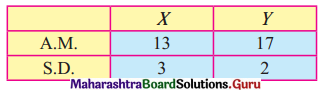
For certain bivariate data the following information are available
Maharashtra Board 12th Commerce Maths Solutions Chapter 3 Linear Regression Ex 3.2 Q12
Correlation coefficient between x and y is 0.6, estimate x when y = 15 and estimate y when x = 10.
Solution:
Given, \(\bar{x}\) = 13, \(\bar{y}\) = 17, σx = 3, σy = 2, r = 0.6
byx = \(\frac{r \sigma_{y}}{\sigma_{x}}=0.6 \times \frac{2}{3}\) = 0.4
bxy = \(\frac{r \sigma_{x}}{\sigma_{y}}=0.6 \times \frac{3}{2}\) = 0.9
Regression equation of Y on X
(Y – \(\bar{y}\)) = byx (X – \(\bar{x}\))
Y – 17 = 0.4(x – 13)
Y = 0.4x + 11.8
When x = 10
Y = 0.4(10) + 11.8
= 4 + 11.8
= 15.8
Regression equation of X on Y
(X – \(\bar{x}\)) = bxy (Y – \(\bar{y}\))
(X – 13) = 0.9(y – 17)
X – 13 = 0.9y – 15.3
X = 0.9y – 2.3
When y = 15
X = 0.9(15) – 2.3
= 13.5 – 2.3
= 11.2

Maharashtra Board 11th Commerce Maths Solutions Chapter 1 Partition Values Ex 1.2

Balbharati Maharashtra State Board 11th Commerce Maths Solution Book Pdf Chapter 1 Partition Values Ex 1.2 Questions and Answers.

Maharashtra State Board 11th Commerce Maths Solutions Chapter 1 Partition Values Ex 1.2

Question 1.
Calculate D6 and P85 for the following data:
79, 82, 36, 38, 51, 72, 68, 70, 64, 63
Solution:
The given data can be arranged in ascending order as follows:
36, 38, 51, 63, 64, 68, 70, 72, 79, 82
Here, n = 10
D6 = value of 6\(\left(\frac{n+1}{10}\right)^{\text {th }}\) observation
= value of 6\(\left(\frac{10+1}{10}\right)^{\text {th }}\) observation
= value of (6 × 1.1)th observation
= value of (6.6)th observation
= value of 6th observation + 0.6(value of 7th observation – value of 6th observation)
= 68 + 0.6(70 – 68)
= 68 + 0.6(2)
= 68 + 1.2
∴ D6 = 69.2
P85 = value of \(\left(\frac{n+1}{100}\right)^{\text {th }}\) observation
= value of \(\left(\frac{10+1}{100}\right)^{\text {th }}\) observation
= value of (85 × 0. 11)th observation
= value of (9.35)th observation
= value of 9th observation + 0.35(value of 10th observation – value of 9th observation)
= 19 + 0.35(82 – 79)
= 79 + 0.35(3)
= 79 + 1.05
∴ P85 = 80.05

Maharashtra Board 11th Commerce Maths Solutions Chapter 1 Partition Values Ex 1.2

Question 2.
The daily wages (in ₹) of 15 labourers are as follows:
230, 400, 350, 200, 250, 380, 210, 225, 375, 180, 375, 450, 300, 350, 250
Calculate D8 and P90.
Solution:
The given data can be arranged in ascending order as follows:
180, 200, 210, 225, 230, 250, 250, 300, 350, 350, 375, 375, 380, 400, 450
Here, n = 15
D8 = value of 8\(\left(\frac{n+1}{10}\right)^{\text {th }}\) observation
= value of 8\(\left(\frac{15+1}{10}\right)^{\text {th }}\) observation
= value of (8 × 1.6)th observation
= value of (12.8)th observation
= value of 12th observation – 0.8(value of 13th observation – value of 12th observation)
= 375 + 0.8(380 – 375)
= 375 + 0.8(5)
= 375 + 4
∴ D8 = 379
P90 = value of 90\(\left(\frac{n+1}{10}\right)^{\text {th }}\) observation
= value of 90\(\left(\frac{15+1}{100}\right)^{\text {th }}\) observation
= value of (90 × 0.16)th observation
= value of (14.4)th observation
= value of 14th observation + 0.4 (value of 15th observation – value of 14th observation)
= 400 + 0.4(450 – 400)
= 400 + 0.4(50)
= 400 + 20
∴ P90 = 420

Question 3.
Calculate 2nd decile and 65th percentile for the following:
Maharashtra Board 11th Commerce Maths Solutions Chapter 1 Partition Values Ex 1.2 Q3
Solution:
We construct the less than cumulative frequency table as given below:
Maharashtra Board 11th Commerce Maths Solutions Chapter 1 Partition Values Ex 1.2 Q3.1
Here, n = 200
D2 = value of 2\(\left(\frac{n+1}{10}\right)^{\text {th }}\) observation
= value of 2\(\left(\frac{200+1}{10}\right)^{\text {th }}\) observation
= value of (2 × 20.1)th observation
= value of (40.2)th observation
Cumulative frequency which is just greater than (or equal to) 40.2 is 58.
∴ D2 = 120
P65 = value of 65\(\left(\frac{n+1}{100}\right)^{\text {th }}\) observation
= value of 65\(\left(\frac{200+1}{100}\right)^{\text {th }}\) observation
= value of (65 × 2.01)th observation
= value of (130.65)th observation
The cumulative frequency which is just greater than (or equal to) 130.65 is 150.
∴ P65 = 280

Maharashtra Board 11th Commerce Maths Solutions Chapter 1 Partition Values Ex 1.2

Question 4.
From the following data calculate the rent of the 15th, 65th, and 92nd house.
Maharashtra Board 11th Commerce Maths Solutions Chapter 1 Partition Values Ex 1.2 Q4
Solution:
Arranging the given data in ascending order.
Maharashtra Board 11th Commerce Maths Solutions Chapter 1 Partition Values Ex 1.2 Q4.1
Here, n = 100
P15 = value of 15
= value of 15\(\left(\frac{n+1}{100}\right)^{\text {th }}\) observation
= value of 15\(\left(\frac{100+1}{100}\right)^{\text {th }}\) observation
= value of (15 × 1.01 )th observation
= value of (15.15)th observation
Cumulative frequency which is just greater than (or equal to) 15.15 is 25.
∴ P15 = 11000
P65 = value of 65\(\left(\frac{n+1}{100}\right)^{\text {th }}\)observation
= value of 65\(\left(\frac{100+1}{100}\right)^{\text {th }}\) observation
= value of (65 × 1.01)th observation
= value of (65.65)th observation
Cumulative frequency which is just greater than (or equal to) 65.65 is 70.
∴ P65 = 14000
P92 = value of 92\(\left(\frac{n+1}{100}\right)^{\text {th }}\) observation
= value of 92\(\left(\frac{100+1}{100}\right)^{\text {th }}\) observation
= value of (92 × 1.01)th observation
= value of (92.92)th observation
Cumulative frequency which is just greater than (or equal to) 92.92 is 98.
∴ P92 = 17000

Question 5.
The following frequency distribution shows the weight of students in a class.
Maharashtra Board 11th Commerce Maths Solutions Chapter 1 Partition Values Ex 1.2 Q5
(a) Find the percentage of students whose weight is more than 50 kg.
(b) If the weight column provided is of mid values then find the percentage of students whose weight is more than 50 kg.
Solution:
(a) Let the percentage of students weighing less than 50 kg be x.
∴ Px = 50
Maharashtra Board 11th Commerce Maths Solutions Chapter 1 Partition Values Ex 1.2 Q5.1
From the table, out of 20 students, 84 students have their weight less than 50 kg.
∴ Number of students weighing more than 50 kg = 120 – 84 = 36
∴ Percentage of students having there weight more than 50 kg = \(\frac{36}{120}\) × 100 = 30%

(b) The difference between any two consecutive mid values of weight is 5 kg.
The class intervals must of width 5, with 40, 45,….. as their mid values.
∴ The class intervals will be 37.5 – 42.5, 42.5 – 47.5, etc.
We construct the less than cumulative frequency table as given below:
Maharashtra Board 11th Commerce Maths Solutions Chapter 1 Partition Values Ex 1.2 Q5.2
Here, N = 120
Let Px = 50
The value 50 lies in the class 47.5 – 52.5
∴ L = 47.5, h = 5, f = 29, c.f. = 55
Maharashtra Board 11th Commerce Maths Solutions Chapter 1 Partition Values Ex 1.2 Q5.3
∴ x = 58 (approximately)
∴ 58% of students are having weight below 50 kg.
∴ Percentage of students having weight above 50 kg is 100 – 58 = 42
∴ 42% of students are having weight above 50 kg.

Maharashtra Board 11th Commerce Maths Solutions Chapter 1 Partition Values Ex 1.2

Question 6.
Calculate D4 and P48 from the following data:
Maharashtra Board 11th Commerce Maths Solutions Chapter 1 Partition Values Ex 1.2 Q6
Solution:
The difference between any two consecutive mid values is 5, the width of class interval = 5
∴ Class interval with mid-value 2.5 is 0 – 5
Class interval with mid value 7.5 is 5 – 10, etc.
We construct the less than cumulative frequency table as given below:
Maharashtra Board 11th Commerce Maths Solutions Chapter 1 Partition Values Ex 1.2 Q6.1
Here, N = 100
D4 class = class containing \(\left(\frac{4 \mathrm{N}}{10}\right)^{\text {th }}\) observation
∴ \(\frac{4 \mathrm{N}}{10}=\frac{4 \times 100}{10}\) = 40
Cumulative frequency which is just greater than (or equal to) 40 is 50.
∴ D4 lies in the class 10 – 15.
∴ L = 10,h = 5, f = 25, c.f. = 25
∴ D4 = \(\mathrm{L}+\frac{\mathrm{h}}{\mathrm{f}}\left(\frac{4 \mathrm{~N}}{10}-\text { c.f. }\right)\)
= 10 + \(\frac{5}{25}\) (40 – 25)
= 10 + \(\frac{1}{5}\) (15)
= 10 + 3
∴ D4 = 13
P48 class = class containing \(\left(\frac{48 \mathrm{~N}}{100}\right)^{\text {th }}\) observation
∴ \(\frac{48 \mathrm{~N}}{100}=\frac{48 \times 100}{100}\) = 48
Cumulative frequency which is just greater than (or equal to) 48 is 50.
∴ P48 lies in the class 10 – 15.
∴ L = 10, h = 5, f = 25, c.f. = 25
∴ P48 = \(\mathrm{L}+\frac{\mathrm{h}}{\mathrm{f}}\left(\frac{48 \mathrm{~N}}{100}-\text { c.f. }\right)\)
= 10 + \(\frac{5}{25}\) (48 – 25)
= 10 + \(\frac{1}{5}\) (23)
= 10 + 4.6
∴ P48 = 14.6

Question 7.
Calculate D9 and P20 of the following distribution.
Maharashtra Board 11th Commerce Maths Solutions Chapter 1 Partition Values Ex 1.2 Q7
Solution:
We construct the less than cumulative frequency table as given below:
Maharashtra Board 11th Commerce Maths Solutions Chapter 1 Partition Values Ex 1.2 Q7.1
Here, N = 240
D9 class = class containing \(\left(\frac{9 \mathrm{~N}}{10}\right)^{\mathrm{th}}\) observation
∴ \(\frac{9 \mathrm{~N}}{10}=\frac{9 \times 240}{10}\) = 216
Cumulative frequency which is just greater than (or equal to) 216 is 225.
∴ D9 lies in the class 80 – 100.
∴ L = 80, h = 20, f = 90, c.f. = 135
∴ D9 = \(L+\frac{h}{f}\left(\frac{9 N}{10}-c . f .\right)\)
= 80 + \(\frac{20}{90}\)(216 – 135)
= 80 + \(\frac{2}{9}\)(81)
= 80 + 18
∴ D9 = 98
P20 class = class containing \(\left(\frac{20 \mathrm{~N}}{100}\right)^{\text {th }}\) observation
∴ \(\frac{20 \mathrm{~N}}{100}=\frac{20 \times 240}{100}\) = 48
Cumulative frequency which is just greater than (or equal to) 48 is 50.
∴ P20 lies in the class 40 – 60.
∴ L = 40, h = 20, f = 35, c.f. = 15
Maharashtra Board 11th Commerce Maths Solutions Chapter 1 Partition Values Ex 1.2 Q7.2
∴ P20 = 58.86

Maharashtra Board 11th Commerce Maths Solutions Chapter 1 Partition Values Ex 1.2

Question 8.
Weekly wages for a group of 100 persons are given below:
Maharashtra Board 11th Commerce Maths Solutions Chapter 1 Partition Values Ex 1.2 Q8
D3 for this group is ₹ 1100. Calculate the missing frequencies.
Solution:
Let a and b be the missing frequencies of class 500 – 1000 and class 2000 – 2500 respectively.
We construct the less than cumulative frequency table as given below:
Maharashtra Board 11th Commerce Maths Solutions Chapter 1 Partition Values Ex 1.2 Q8.1
Here, N = 62 + a + b
Since, N = 100
∴ 62 + a + b = 100
∴ a + b = 38 …..(i)
Given, D3 = 1100
∴ D3 lies in the class 1000 – 1500.
∴ L = 1000, h = 500, f = 25, c.f. = 7 + a
∴ \(\frac{3 \mathrm{~N}}{10}=\frac{3 \times 100}{10}=30\)
∴ D3 = \(\mathrm{L}+\frac{\mathrm{h}}{\mathrm{f}}\left(\frac{3 \mathrm{~N}}{10}-\mathrm{c} . \mathrm{f} .\right)\)
∴ 1100 = 1000 + \(\frac{500}{25}\) [30 – (7 + a)]
∴ 1100 – 1000 = 20(30 – 7 – a)
∴ 100 = 20(23 – a)
∴ 100 = 460 – 20a
∴ 20a = 460 – 100
∴ 20a = 360
∴ a = 18
Substituting the value of a in equation (i), we get
18 + b = 38
∴ b = 38 – 18 = 20
∴ 18 and 20 are the missing frequencies of the class 500 – 1000 and class 2000 – 2500 respectively.

Question 9.
The weekly profit (in rupees) of 100 shops are distributed as follows:
Maharashtra Board 11th Commerce Maths Solutions Chapter 1 Partition Values Ex 1.2 Q9
Find the limits of the profit of middle 60% of the shops.
Solution:
To find the limits of the profit of the middle 60% of the shops, we have to find P20 and P80.
We construct the less than cumulative frequency table as given below:
Maharashtra Board 11th Commerce Maths Solutions Chapter 1 Partition Values Ex 1.2 Q9.1
Here, N = 100
P20 class = class containing \(\left(\frac{20 \mathrm{N}}{100}\right)^{\text {th }}\) observation
∴ \(\frac{20 \mathrm{N}}{100}=\frac{20 \times 100}{100}=20\)
Cumulative frequency which is just greater than (or equal to) 20 is 26.
∴ P20 lies in the class 1000 – 2000.
∴ L = 1000, h = 1000, f = 16, c.f. = 10
∴ P20 = \(L+\frac{h}{f}\left(\frac{20 \mathrm{~N}}{100}-\text { c.f. }\right)\)
= 1000 + \(\frac{1000}{16}\) (20 – 10)
= 1000 + \(\frac{125}{2}\) (10)
= 1000 + 625
∴ P20 = 1625
P80 class = class containing \(\left(\frac{80 \mathrm{~N}}{100}\right)^{\text {th }}\) observation
∴ \(\frac{80 \mathrm{~N}}{100}=\frac{80 \times 100}{100}=80\)
Cumulative frequency which is just greater than (or equal to) 80 is 92.
∴ P80 lies in the class 4000 – 5000.
∴ L = 4000, h = 1000, f = 20, c.f. = 72
∴ P80 = \(L+\frac{h}{f}\left(\frac{80 \mathrm{~N}}{100}-\text { c.f. }\right)\)
= 4000 + \(\frac{1000}{20}\)(80 – 72)
= 4000 + 50(8)
= 4000 + 400
∴ P80 = 4400
∴ the profit of middle 60% of the shops lie between the limits ₹ 1,625 to ₹ 4,400.

Maharashtra Board 11th Commerce Maths Solutions Chapter 1 Partition Values Ex 1.2

Question 10.
In a particular factory, workers produce various types of output units. The following distribution was obtained:
Maharashtra Board 11th Commerce Maths Solutions Chapter 1 Partition Values Ex 1.2 Q10
Find the percentage of workers who have produced less than 82 output units.
Solution:
Since the given data is not continuous, we have to convert it into a continuous form by subtracting 0.5 from the lower limit and adding 0.5 to the upper limit of every class interval.
∴ the class intervals will be 69.5 – 74.5, 74.5 – 79.5, etc.
We construct the less than cumulative frequency table as given below:
Maharashtra Board 11th Commerce Maths Solutions Chapter 1 Partition Values Ex 1.2 Q10.1
Here, N = 445
Let Px = 82
The value 82 lies in the class 79.5 – 84.5
∴ L = 79.5, h = 5, f = 50, c.f. = 85
Maharashtra Board 11th Commerce Maths Solutions Chapter 1 Partition Values Ex 1.2 Q10.2
∴ 24.72% of workers produced less than 82 output units.