Maharashtra Board 11th Commerce Maths Solutions Chapter 4 Sequences and Series Ex 4.1

Balbharati Maharashtra State Board 11th Commerce Maths Solution Book Pdf Chapter 4 Sequences and Series Ex 4.1 Questions and Answers.

Maharashtra State Board 11th Commerce Maths Solutions Chapter 4 Sequences and Series Ex 4.1

Question 1.
Verify whether the following sequences are G.P. If so, write tn.
(i) 2, 6, 18, 54, ……
(ii) 1, -5, 25, -125, …….
(iii) \(\sqrt{5}, \frac{1}{\sqrt{5}}, \frac{1}{5 \sqrt{5}}, \frac{1}{25 \sqrt{5}}, \ldots\)
(iv) 3, 4, 5, 6, ……
(v) 7, 14, 21, 28, …..
Solution:
(i) 2, 6, 18, 54, …….
t1 = 2, t2 = 6, t3 = 18, t4 = 54, …..
Here, \(\frac{t_{2}}{t_{1}}=\frac{t_{3}}{t_{2}}=\frac{t_{4}}{t_{3}}=3\)
Since, the ratio of any two consecutive terms is a constant, the given sequence is a geometric progression.
Here, a = 2, r = 3
tn= arn-1
∴ tn = 2(3n-1)

Maharashtra Board 11th Commerce Maths Solutions Chapter 4 Sequences and Series Ex 4.1

(ii) 1, -5, 25, -125, ……
t1 = 1, t2 = -5, t3 = 25, t4 = -125, …..
Here, \(\frac{t_{2}}{t_{1}}=\frac{t_{3}}{t_{2}}=\frac{t_{4}}{t_{3}}=-5\)
Since, the ratio of any two consecutive terms is a constant, the given sequence is a geometric progression.
Here, a = 1, r = -5
tn = arn-1
∴ tn = (-5)n-1

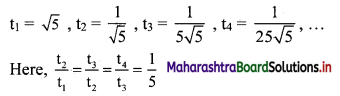
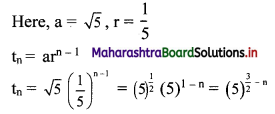
(iii) \(\sqrt{5}, \frac{1}{\sqrt{5}}, \frac{1}{5 \sqrt{5}}, \frac{1}{25 \sqrt{5}}, \ldots\)
Maharashtra Board 11th Commerce Maths Solutions Chapter 4 Sequences and Series Ex 4.1 Q1
Since, the ratio of any two consecutive terms is a constant, the given sequence is a geometric progression.
Maharashtra Board 11th Commerce Maths Solutions Chapter 4 Sequences and Series Ex 4.1 Q1.1

(iv) 3, 4, 5, 6,……
t1 = 3, t2 = 4, t3 = 5, t4 = 6, …..
Here, \(\frac{\mathrm{t}_{2}}{\mathrm{t}_{1}}=\frac{4}{3}, \frac{\mathrm{t}_{3}}{\mathrm{t}_{2}}=\frac{5}{4}, \frac{\mathrm{t}_{4}}{\mathrm{t}_{3}}=\frac{6}{5}\)
Since, \(\frac{t_{2}}{t_{1}} \neq \frac{t_{3}}{t_{2}} \neq \frac{t_{4}}{t_{3}}\)
∴ the given sequence is not a geometric progression.

(v) 7, 14, 21, 28, …..
t1 = 7, t2 = 14, t3 = 21, t4 = 28, …..
Here, \(\frac{t_{2}}{t_{1}}=2, \frac{t_{3}}{t_{2}}=\frac{3}{2}, \frac{t_{4}}{t_{3}}=\frac{4}{3}\)
Since, \(\frac{\mathrm{t}_{2}}{\mathrm{t}_{1}} \neq \frac{\mathrm{t}_{3}}{\mathrm{t}_{2}} \neq \frac{\mathrm{t}_{4}}{\mathrm{t}_{3}}\)
∴ the given sequence is not a geometric progression.

Maharashtra Board 11th Commerce Maths Solutions Chapter 4 Sequences and Series Ex 4.1

Question 2.
For the G.P.,
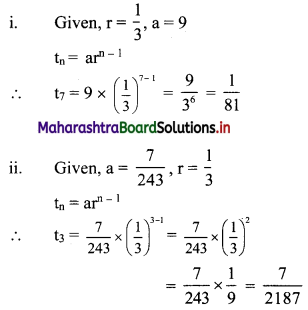
(i) if r = \(\frac{1}{3}\), a = 9, find t7.
(ii) if a = \(\frac{7}{243}\), r = \(\frac{1}{3}\), find t3.
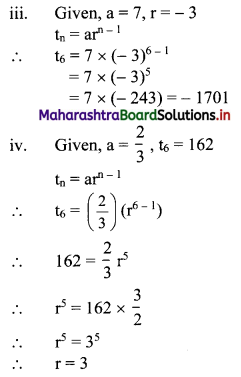
(iii) if a = 7, r = -3, find t6.
(iv) if a = \(\frac{2}{3}\), t6 = 162, find r.
Solution:
Maharashtra Board 11th Commerce Maths Solutions Chapter 4 Sequences and Series Ex 4.1 Q2
Maharashtra Board 11th Commerce Maths Solutions Chapter 4 Sequences and Series Ex 4.1 Q2.1

Question 3.
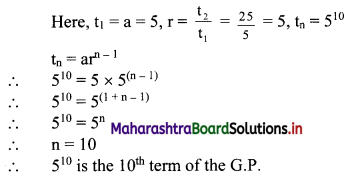
Which term of the G. P. 5, 25, 125, 625, ….. is 510?
Solution:
Maharashtra Board 11th Commerce Maths Solutions Chapter 4 Sequences and Series Ex 4.1 Q3

Question 4.
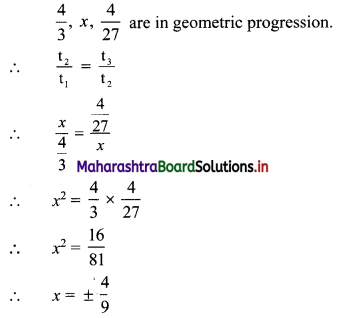
For what values of x, \(\frac{4}{3}\), x, \(\frac{4}{27}\) are in G. P.?
Solution:
Maharashtra Board 11th Commerce Maths Solutions Chapter 4 Sequences and Series Ex 4.1 Q4

Question 5.
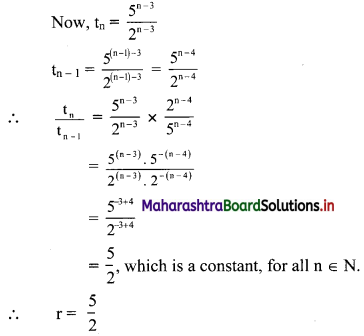
If for a sequence, \(t_{n}=\frac{5^{n-3}}{2^{n-3}}\), show that the sequence is a G. P. Find its first term and the common ratio.
Solution:
The sequence (tn) is a G.P., if \(\frac{t_{n}}{t_{n-1}}\) = constant, for all n ∈ N
Maharashtra Board 11th Commerce Maths Solutions Chapter 4 Sequences and Series Ex 4.1 Q5
∴ the sequence is a G. P. with common ratio \(\frac{5}{2}\)
First term, t1 = \(\frac{5^{\mathrm{l}-3}}{2^{1-3}}=\frac{2^{2}}{5^{2}}=\frac{4}{25}\)

Maharashtra Board 11th Commerce Maths Solutions Chapter 4 Sequences and Series Ex 4.1

Question 6.
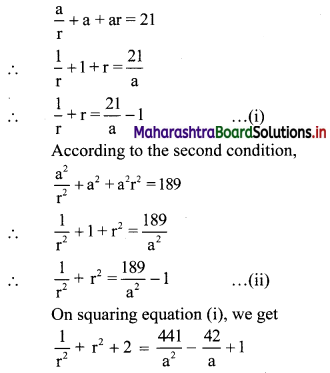
Find three numbers in G. P. such that their sum is 21 and sum of their squares is 189.
Solution:
Let the three numbers in G. P. be \(\frac{a}{\mathrm{r}}\), a, ar.
According to the first condition,
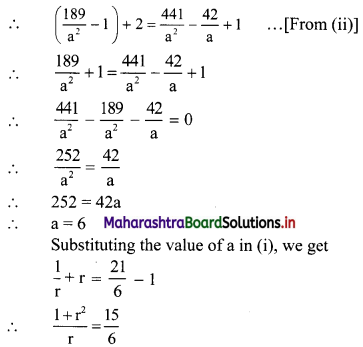
Maharashtra Board 11th Commerce Maths Solutions Chapter 4 Sequences and Series Ex 4.1 Q6
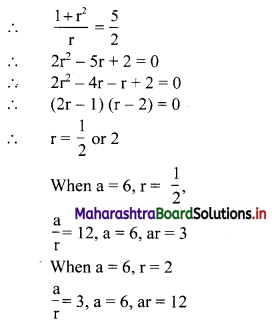
Maharashtra Board 11th Commerce Maths Solutions Chapter 4 Sequences and Series Ex 4.1 Q6.1
Maharashtra Board 11th Commerce Maths Solutions Chapter 4 Sequences and Series Ex 4.1 Q6.2
∴ the three numbers are 12, 6, 3 or 3, 6, 12.
Check:
First condition:
12, 6, 3 are in G.P. with r = \(\frac{1}{2}\)
12 + 6 + 3 = 21
Second condition:
122 + 62 + 32 = 144 + 36 + 9 = 189
Thus, both the conditions are satisfied.

Question 7.
Find four numbers in G. P. such that sum of the middle two numbers is \(\frac{10}{3}\) and their product is 1.
Solution:
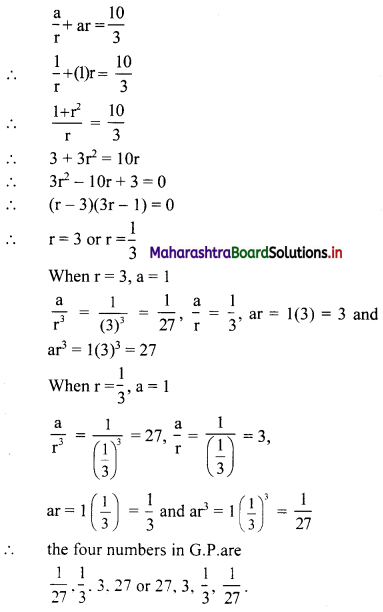
Let the four numbers in G.P. be \(\frac{a}{r^{3}}, \frac{a}{r}, a r, a r^{3}\).
According to the second condition,
\(\frac{\mathrm{a}}{\mathrm{r}^{3}}\left(\frac{\mathrm{a}}{\mathrm{r}}\right)(\mathrm{ar})\left(\mathrm{ar}^{3}\right)=1\)
∴ a4 = 1
∴ a = 1
According to the first condition,
Maharashtra Board 11th Commerce Maths Solutions Chapter 4 Sequences and Series Ex 4.1 Q7

Question 8.
Find five numbers in G. P. such that their product is 1024 and the fifth term is square of the third term.
Solution:
Let the five numbers in G. P. be
\(\frac{a}{r^{2}}, \frac{a}{r}, a, a r, a r^{2}\)
According to the given conditions,
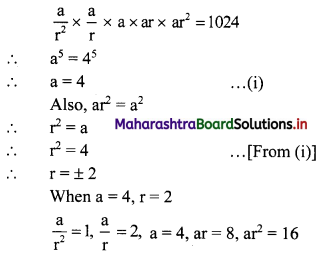
Maharashtra Board 11th Commerce Maths Solutions Chapter 4 Sequences and Series Ex 4.1 Q8
When a = 4, r = -2
\(\frac{a}{r^{2}}\) = 1, \(\frac{a}{r}\) = -2, a = 4, ar = -8, ar2 = 16
∴ the five numbers in G.P. are 1, 2, 4, 8, 16 or 1, -2, 4, -8, 16.

Maharashtra Board 11th Commerce Maths Solutions Chapter 4 Sequences and Series Ex 4.1

Question 9.
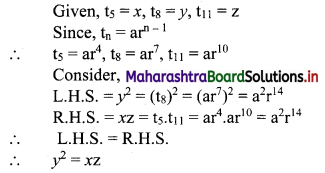
The fifth term of a G. P. is x, eighth term of the G. P. is y and eleventh term of the G. P. is z. Verify whether y2 = xz.
Solution:
Maharashtra Board 11th Commerce Maths Solutions Chapter 4 Sequences and Series Ex 4.1 Q9

Question 10.
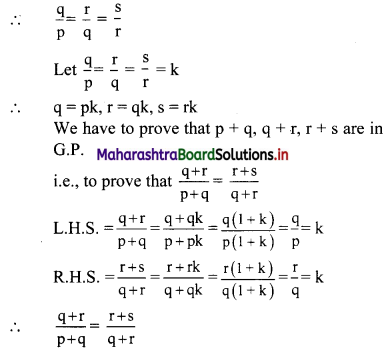
If p, q, r, s are in G. P., show that p + q, q + r, r + s are also in G.P.
Solution:
p, q, r, s are in G.P.
Maharashtra Board 11th Commerce Maths Solutions Chapter 4 Sequences and Series Ex 4.1 Q10
∴ p + q, q + r, r + s are in G.P.

Maharashtra Board 11th Commerce Maths Solutions Chapter 3 Complex Numbers Miscellaneous Exercise 3

Balbharati Maharashtra State Board 11th Commerce Maths Solution Book Pdf Chapter 3 Complex Numbers Miscellaneous Exercise 3 Questions and Answers.

Maharashtra State Board 11th Commerce Maths Solutions Chapter 3 Complex Numbers Miscellaneous Exercise 3

Question 1.
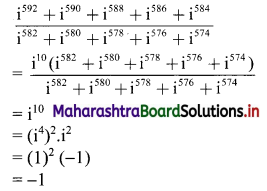
Find the value of \(\frac{i^{592}+i^{590}+i^{588}+i^{586}+i^{584}}{i^{582}+i^{580}+i^{578}+i^{576}+i^{574}}\)
Solution:
Maharashtra Board 11th Commerce Maths Solutions Chapter 3 Complex Numbers Miscellaneous Exercise 3 Q1

Question 2.
Find the value of √-3 × √-6.
Solution:
√-3 × √-6 = √3 × √-1 + √6 × √-1
= √3i × √6i
= √18i2
= -3√2 ……[∵ i2 = -1]

Maharashtra Board 11th Commerce Maths Solutions Chapter 3 Complex Numbers Miscellaneous Exercise 3

Question 3.
Simplify the following and express in the form a + ib.
(i) 3 + √-64
(ii) (2i3)2
(iii) (2 + 3i) (1 – 4i)
(iv) \(\frac{5}{2}\) i(-4 – 3i)
(v) (1 + 3i)2 (3 + i)
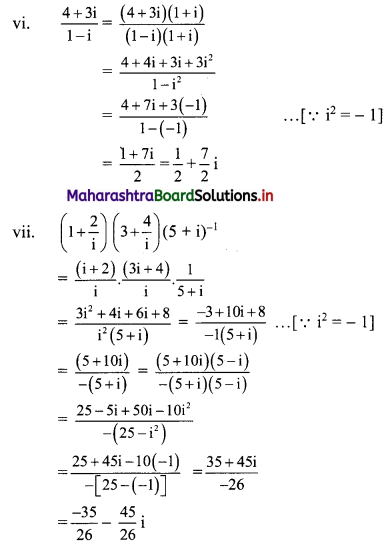
(vi) \(\frac{4+3 i}{1-i}\)
(vii) \(\left(1+\frac{2}{i}\right)\left(3+\frac{4}{i}\right)(5+i)^{-1}\)
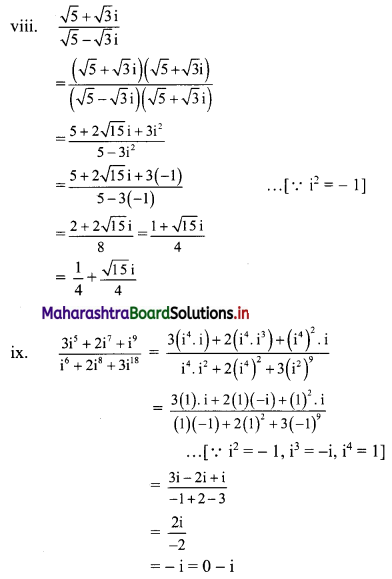
(viii) \(\frac{\sqrt{5}+\sqrt{3} i}{\sqrt{5}-\sqrt{3} i}\)
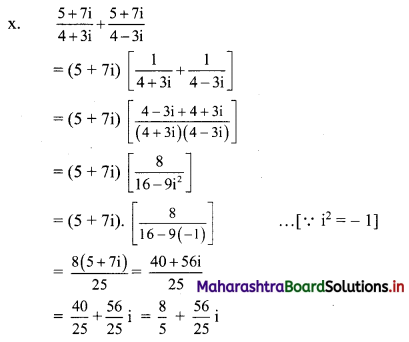
(ix) \(\frac{3 i^{5}+2 i^{7}+i^{9}}{i^{6}+2 i^{8}+3 i^{18}}\)
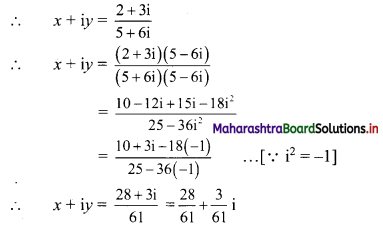
(x) \(\frac{5+7 i}{4+3 i}+\frac{5+7 i}{4-3 i}\)
Solution:
(i) 3 + √-64
= 3 + √64 . √-1
= 3 + 8i

(ii) (2i3)2
= 4i6
= 4(i2)3
= 4(-1)3 …..[∵ i2 = -1]
= -4
= -4 + 0i

(iii) (2 + 3i)(1 – 4i) = 2 – 8i + 3i – 12i2
= 2 – 5i – 12(-1) ……[∵ i2 = -1]
= 14 – 5i

(iv) \(\frac{5}{2}\) i(-4 – 3i)
= \(\frac{5}{2}\) (-4i – 3i2)
= \(\frac{5}{2}\) [-4i – 3(-1)] ……[∵ i2 = -1]
= \(\frac{5}{2}\) (3 – 4i)
= \(\frac{15}{2}\) – 10i

Maharashtra Board 11th Commerce Maths Solutions Chapter 3 Complex Numbers Miscellaneous Exercise 3

(v) (1 + 3i)2 (3 + i)
= (1 + 6i + 9i2) (3 + i)
= (1 + 6i – 9)(3 + i) ……[∵ i2 = -1]
= (-8 + 6i)(3 + i)
= -24 – 8i + 18i + 6i2
= -24 + 10i + 6(-1)
= -24 + 10i – 6
= -30 + 10i

Maharashtra Board 11th Commerce Maths Solutions Chapter 3 Complex Numbers Miscellaneous Exercise 3 Q3
Maharashtra Board 11th Commerce Maths Solutions Chapter 3 Complex Numbers Miscellaneous Exercise 3 Q3.1
Maharashtra Board 11th Commerce Maths Solutions Chapter 3 Complex Numbers Miscellaneous Exercise 3 Q3.2

Question 4.
Solve the following equations for x, y ∈ R:
(i) (4 – 5i) x + (2 + 3i) y = 10 – 7i
(ii) (1 – 3i) x + (2 + 5i) y = 1 + i
(iii) \(\frac{x+i y}{2+3 i}\) = 7 – i
(iv) (x + iy) (5 + 6i) = 2 + 3i
(v) 2x + i9 y (2 + i) = x i7 + 10 i16
Solution:
(i) (4 – 5i) x + (2 + 3i)y = 10 – 7i
∴ (4x + 2y) + (3y – 5x) i = 10 – 7i
Equating real and imaginary parts, we get
4x + 2y = 10
i.e., 2x + y = 5 …….(i)
and 3y – 5x = -7 ……..(ii)
Equation (i) × 3 – equation (ii) gives
11x = 22
∴ x = 2
Putting x = 2 in (i), we get
2(2) + y = 5
∴ y = 1
∴ x = 2 and y = 1

(ii) (1 – 3i) x + (2 + 5i) y = 7 + i
∴ (x + 2y) + (-3x + 5y)i = 7 + i
Equating real and imaginary parts, we get
x + 2y = 7 ……..(i)
and -3x + 5y = 1 ……..(ii)
Equation (i) × 3 + equation (ii) gives
11y = 22
∴ y = 2
Putting y = 2 in (i), we get
x + 2(2) = 7
∴ x = 3
∴ x = 3 and y = 2

Maharashtra Board 11th Commerce Maths Solutions Chapter 3 Complex Numbers Miscellaneous Exercise 3

(iii) \(\frac{x+i y}{2+3 i}\) = 7 – i
∴ x + iy = (7 – i)(2 + 3i)
∴ x + iy = 14 + 21i – 2i – 3i2
∴ x + iy = 14 + 19i – 3(-1) …..[∵ i2 = -1]
∴ x + iy = 17 + 19i
Equating real and imaginary parts, we get
x = 17 and y = 19

(iv) (x + iy)(5 + 6i) = 2 + 3i
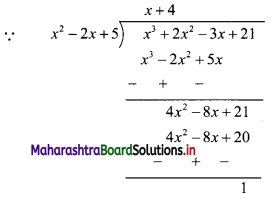
Maharashtra Board 11th Commerce Maths Solutions Chapter 3 Complex Numbers Miscellaneous Exercise 3 Q4
Equating real and imaginary parts, we get
x = \(\frac{28}{61}\) and y = \(\frac{3}{61}\)

(v) 2x + i9 y (2 + i) = x i7 + 10 i16
∴ 2x + (i4)2 . i . y (2 + i) = x (i2)3 . i + 10 . (i4)4
∴ 2x + (1)2 . iy (2 + i) = x (-1)3 . i + 10 (1)4 ……[∵ i2 = -1, i4 = 1]
∴ 2x + 2yi + yi2 = -xi + 10
∴ 2x + 2yi – y + xi = 10
∴ (2x – y) + (x + 2y)i = 10 + 0.i
Equating real and imaginary parts, we get
2x – y = 10 ……(i)
and x + 2y = 0 ……..(ii)
Equation (i) × 2 + equation (ii) gives
5x = 20
∴ x = 4
Putting x = 4 in (i), we get
2(4) – y = 10
∴ y = 8 – 10
∴ y = -2
∴ x = 4 and y = -2

Question 5.
Find the value of:
(i) x3 + 2x2 – 3x + 21, if x = 1 + 2i
(ii) x3 – 5x2 + 4x + 8, if x = \(\frac{10}{3-i}\)
(iii) x3 – 3x2 + 19x – 20, if x = 1 – 4i
Solution:
(i) x = 1 + 2i
∴ x – 1 = 2i
∴ (x – 1)2 = 4i2
∴ x2 – 2x + 1 = -4 ……[∵ i2 = -1]
∴ x2 – 2x + 5 = 0 ……(i)
Maharashtra Board 11th Commerce Maths Solutions Chapter 3 Complex Numbers Miscellaneous Exercise 3 Q5
∴ x3 + 2x2 – 3x + 21
= (x2 – 2x + 5)(x + 4) + 1
= 0.(x + 4) + 1 ……[From (i)]
= 0 + 1
= 1
∴ x3 + 2x2 – 3x + 21 = 1

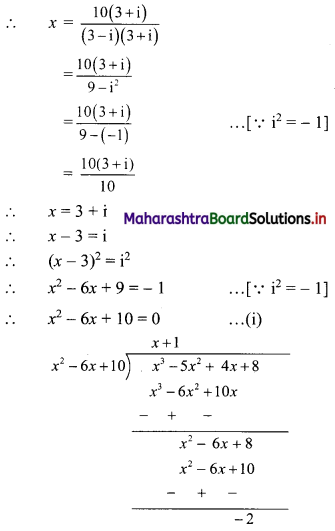
(ii) x = \(\frac{10}{3-i}\)
Maharashtra Board 11th Commerce Maths Solutions Chapter 3 Complex Numbers Miscellaneous Exercise 3 Q5.1
x3 – 5x2 + 4x + 8
= (x2 – 6x + 10)(x + 1) – 2
= 0 . (x + 1) – 2 ……[From (i)]
= 0 – 2
∴ x3 – 5x2 + 4x + 8 = -2

Maharashtra Board 11th Commerce Maths Solutions Chapter 3 Complex Numbers Miscellaneous Exercise 3

(iii) x = 1 – 4i
∴ x – 1 = -4i
∴ (x – 1)2 = 16i2
∴ x2 – 2x + 1 = -16 ……[∵ i2 = -1]
∴ x2 – 2x + 17 = 0 ……(i)
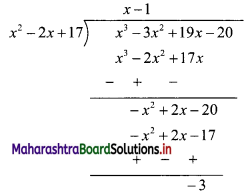
Maharashtra Board 11th Commerce Maths Solutions Chapter 3 Complex Numbers Miscellaneous Exercise 3 Q5.2
∴ x3 – 3x2 + 19x – 20
= (x2 – 2x + 17) (x – 1) – 3
= 0 . (x – 1) – 3 ….[From (i)]
= 0 – 3
= -3
∴ x3 – 3x2 + 19x – 20 = -3

Question 6.
Find the square roots of:
(i) -16 + 30i
(ii) 15 – 8i
(iii) 2 + 2√3i
(iv) 18i
(v) 3 – 4i
(vi) 6 + 8i
Solution:
(i) Let \(\sqrt{-16+30 \mathrm{i}}\) = a + bi, where a, b ∈ R
Squaring on both sides, we get
-16 + 30i = a2 + b2i2 + 2abi
∴ -16 + 30i = (a2 – b2) + 2abi …..[∵ i2 = -1]
Equating real and imaginary parts, we get
a2 – b2 = -16 and 2ab = 30
∴ a2 – b2 = -16 and b = \(\frac{15}{a}\)
∴ a2 – \(\left(\frac{15}{a}\right)^{2}\) = -16
∴ a2 – \(\frac{225}{a^{2}}\) = -16
∴ a4 – 225 = – 16a2
∴ a4 + 16a2 – 225 = 0
∴ (a2 + 25)(a2 – 9) = 0
∴ a2 = -25 or a2 = 9
But a ∈ R, a2 ≠ -25
∴ a2 = 9
∴ a = ±3
When a = 3, b = \(\frac{15}{3}\) = 5
When a = -3, b = \(\frac{15}{-3}\) = -5
∴ \(\sqrt{-16+30 \mathrm{i}}\) = ±(3 + 5i)

(ii) Let \(\sqrt{15-8 i}\) = a + bi, where a, b ∈ R
Squaring on both sides, we get
15 – 8i = a2 + b2i2 + 2abi
∴ 15 – 8i = (a2 – b2) + 2abi ……[∵ i2 = -1]
Equating real and imaginary parts, we get
a2 – b2 = 15 and 2ab = -8
∴ a2 – b2 = 15 and b = \(\frac{-4}{a}\)
∴ a2 – (\(\left(\frac{-4}{a}\right)^{2}\)) = 15
∴ a2 – \(\frac{16}{a^{2}}\) = 15
∴ a4 – 16 = 15a2
∴ a4 – 15a2 – 16 = 0
∴ (a2 – 16)(a2 + 1) = 0
∴ a2 = 16 or a2 = -1
But a ∈ R, a2 ≠ -1
∴ a2 = 16
∴ a = ±4
When a = 4, b = \(\frac{-4}{4}\) = -1
When a = -4, b = \(\frac{-4}{-4}\) = 1
\(\sqrt{15-8 i}\) = ±(4 – i)

Maharashtra Board 11th Commerce Maths Solutions Chapter 3 Complex Numbers Miscellaneous Exercise 3

(iii) Let \(\sqrt{2+2 \sqrt{3} i}\) = a + bi, where a, b ∈ R.
Squaring on both sides, we get
2 – 2√3i = a2 + b2i2 + 2abi
∴ 2 – 2√3i = a2 – b2 + 2abi …..[∵ i2 = -1]
Equating real and imaginary parts, we get
a2 – b2 = 2 and 2ab = 2√3
∴ a2 – b2 = 2 and b = \(\frac{\sqrt{3}}{\mathrm{a}}\)
∴ a2 – \(\left(\frac{\sqrt{3}}{a}\right)^{2}\) = 2
∴ a2 – \(\frac{3}{a^{2}}\) = 2
∴ a4 – 3 = 2a2
∴ a4 – 2a2 – 3 = 0
∴ (a2 – 3)(a2 + 1) = 0
∴ a2 = 3 or a2 = -1
But a ∈ R, a2 ≠ -1
∴ a2 = 3
∴ a = ±√3
When a = √3 , b = \(\frac{\sqrt{3}}{\sqrt{3}}\) = 1
When a = -√3 , b = \(\frac{\sqrt{3}}{-\sqrt{3}}\) = -1
∴ \(\sqrt{2+2 \sqrt{3} i}\) = ±(√3 + i)

(iv) Let \(\sqrt{18 \mathrm{i}}\) = a + bi, where a, b ∈ R
Squaring on both sides, we get
18i = a2 + b2i2 + 2abi
∴ 0 + 18i = a2 – b2 + 2abi …..[∵ i2 = -1]
Equating real and imaginary parts, we get
a2 – b2 = 0 and 2ab = 18
∴ a2 – b2 = 0 and b = \(\frac{9}{\mathrm{a}}\)
∴ a2 – \(\left(\frac{9}{a}\right)^{2}\) = 0
∴ a2 – \(\frac{81}{a^{2}}\) = 0
∴ a4 – 81 = 0
∴ (a2 – 9) (a2 + 9) = 0
∴ a2 = 9 or a2 = -9
But a ∈ R, a2 ≠ -9
∴ a2 = 9
∴ a = ±3
When a = 3, b = \(\frac{9}{3}\) = 3
When a = 3, b = \(\frac{9}{-3}\) = -3
∴ \(\sqrt{18 \mathrm{i}}\) = ±3(1 + i)

(v) Let \(\sqrt{3-4 i}\) = a + bi, where a, b ∈ R
Squaring on both sides, we get
3 – 4i = a2 + b2i2 + 2abi
∴ 3 – 4i = a2 – b2 + 2abi ……[∵ i2 = -1]
Equating real and imaginary parts, we get
a2 – b2 = 3 and 2ab = -4
∴ a2 – b2 = 3 and b = \(\frac{-2}{a}\)
∴ a2 – \(\left(-\frac{2}{a}\right)^{2}\) = 3
∴ a2 – \(\frac{4}{a^{2}}\) = 3
∴ a4 – 4 = 3a2
∴ a4 – 3a2 – 4 = 0
∴ (a2 – 4)(a2 + 1) = 0
∴ a2 = 4 or a2 = -1
But, a ∈ R, a2 ≠ -1
∴ a2 = 4
∴ a = ±2
When a = 2, b = \(\frac{-2}{2}\) = -1
When a = -2, b = \(\frac{-2}{-2}\) = 1
∴ \(\sqrt{3-4 i}\) = ±(2 – i)

Maharashtra Board 11th Commerce Maths Solutions Chapter 3 Complex Numbers Miscellaneous Exercise 3

(vi) Let \(\sqrt{6+8 i}\) = a + bi, where a, b ∈ R
Squaring on both sides, we get
6 + 8i = a2 + b2i2 + 2abi
∴ 6 + 8i = a2 – b2 + 2abi ……[∵ i2 = -1]
Equating real and imaginary parts, we get
a2 – b2 = 6 and 2ab = 8
∴ a2 – b2 = 6 and b = \(\frac{4}{\mathrm{a}}\)
∴ a2 – \(\left(\frac{4}{a}\right)^{2}\) = 6
∴ a2 – \(\frac{16}{a^{2}}\) = 6
∴ a4 – 16 = 6a2
∴ a4 – 6a2 – 16 = 0
∴ (a2 – 8)(a2 + 2) = 0
∴ a2 = 8 or a2 = -2
But a ∈ R, a2 ≠ -2
∴ a2 = 8
∴ a = ±2√2
When a = 2√2, b = \(\frac{4}{2 \sqrt{2}}\) = √2
When a = -2√2, b = \(\frac{4}{-2 \sqrt{2}}\) = -√2
∴ \(\sqrt{6+8 i}\) = ±(2√2 + √2i) = ±√2(2 + i)

Maharashtra Board 12th Commerce Maths Solutions Chapter 2 Insurance and Annuity Ex 2.1

Balbharati Maharashtra State Board 12th Commerce Maths Digest Pdf Chapter 2 Insurance and Annuity Ex 2.1 Questions and Answers.

Maharashtra State Board 12th Commerce Maths Solutions Chapter 2 Insurance and Annuity Ex 2.1

Question 1.
Find the premium on a property worth ₹ 25,00,000 at 3% if
(i) the property is fully insured
(ii) the property is insured for 80% of its value.
Solution:
Case-1
Property value = ₹ 25,00,000
Rate of Premium = 3%
Policy Value = ₹ 25,00,000
∴ Amount of Premium = 3% × 25,00,000 = ₹ 75,000
Case-2
Property Value = ₹ 25,00,000
Policy value = 80% × 25,00,000 = ₹ 20,00,000
Rate of Premium = 3%
∴ Amount of Premium = 3% × 20,00,000 = ₹ 60,000

Maharashtra Board 12th Commerce Maths Solutions Chapter 2 Insurance and Annuity Ex 2.1

Question 2.
A shop is valued at ₹ 3,60,000 for 75% of its value. If the rate of premium is 0.9%, find the premium paid by the owner of the shop. Also, find the agents commission if the agent gets commission at 15% of the premium.
Solution:
Property Value = ₹ 3,60,000
Policy Value = 75% × 3,60,000 = ₹ 2,70,000
Rate of Premium = 0.9%
∴ Amount of Premium = 0.9% × 2,70,000 = ₹ 2,430
Rate of Commission = 15%
∴ Amount of Commission = 15% × 2,430 = ₹ 364.5

Question 3.
A person insures his office valued at ₹ 5,00,000 for 80% of its value. Find the rate of premium if he pays ₹ 13,000 as premium. Also, find agent’s commission at 11%.
Solution:
Property Value = ₹ 5,00,000
Policy Value = 80% × 5,00,000 = ₹ 4,00,000
Amount of Premium = ₹ 13000
Let the rate of Premium be x%
Amount of premium = Rate × Policy Value
∴ 13000 = x% × 4,00,000
∴ \(\frac{13,000}{4,00,000}=\frac{x}{100}\)
∴ \(\frac{13,000 \times 100}{4,00,000}\) = x
∴ x = 3.25%
Rate of commission = 11%
∴ Amount of Commission = 11% × 13,000 = ₹ 1,430

Maharashtra Board 12th Commerce Maths Solutions Chapter 2 Insurance and Annuity Ex 2.1

Question 4.
A building is insured for 75% of its value. The annual premium at 0.70 percent amounts to ₹ 2625. If the building is damaged to the extent of 60% due to fire, how much can be claimed under the policy?
Solution:
Let the Property Value of building be ₹ x
Policy Value = 75% × x = 0.75x
Rate of Premium = 0.70%
Amount of Policy = Rate × Policy Value
2625 = 0.70% × 0.75x
\(\frac{2625}{0.75}\) = 0.70% × x
3520 = \(\frac{0.70}{100}\) × x
\(\frac{3500 \times 100}{0.70}\) = x
x = ₹ 5,00,000
∴ Damage = 60% × Property Value
= \(\frac{60}{100}\) × 5,00,000
= ₹ 3,00,000
∴ Policy Value = 0.75 × 3,00,000 = ₹ 2,25,000
∴ Claim = \(\frac{\text { Policy value }}{\text { Property value }}\) × Loss
= \(\frac{2,25,000}{5,00,000}\) × 3,00,000
= ₹ 1,35,000

Question 5.
A stock worth ₹ 7,00,000 was insured for ₹ 4,50,000. Fire burnt stock worth ₹ 3,00,000 completely and damaged there remaining stock to the extent of 75% of its value. What amount can be claimed undertaken policy?
Solution:
Property Value = ₹ 7,00,000
Policy Value = ₹ 4,50,000
Complete Loss = 3,00,000
Partial loss = 75% × [7,00,000 – 3,00,000]
= \(\frac{75}{100}\) × 4,00,000
= ₹ 3,00,000
∴ Total loss = ₹ 3,00,000 + ₹ 3,00,000 = ₹ 6,00,000
∴ Claim = \(\frac{\text { Policy value }}{\text { Property value }}\) × Loss
= \(\frac{4,50,000}{7,00,000}\) × 6,00,000
= ₹ 3,85,714.29

Question 6.
A cargo of rice was insured at 0.625 % to cover 80% of its value. The premium paid was ₹ 5,250. If the price of rice is ₹ 21 per kg. find the quantity of rice (in kg) in the cargo.
Solution:
Let Property Value be ₹ x
Policy Value = 80% × x = ₹ 0.8x
Rate of Policy = 0.625%
Amount of Premium = Rate × Policy value
∴ 5250 = 0.625% × 0.8x
∴ 5250 = 0.005x
∴ x = \(\frac{5250}{0.005}\)
∴ x = ₹ 10,50,000
Rate of Rice = ₹ 21/kg
∴ Quantity of Rice (in kg) = \(\frac{\text { Total value }}{\text { Rate of Rice }}\)
= \(\frac{10,50,000}{21}\)
= 50,000 kgs

Maharashtra Board 12th Commerce Maths Solutions Chapter 2 Insurance and Annuity Ex 2.1

Question 7.
60,000 articles costing ₹ 200 per dozen were insured against fire for ₹ 2,40,000. If 20% of the articles were burnt and 7,200 of the remaining articles were damaged to the extent of 80% of their value, find the amount that can be claimed under the policy.
Solution:
No of articles = 60,000
Cost of articles = ₹ 200/dozen
∴ Property of Value = \(\frac{60,000}{12}\) × 200 = ₹ 1o,oo,ooo
∴ Policy Value = ₹ 2,40,000
Complete Loss = 20% × 10,00,000 = ₹ 2,00,000
Partial loss = \(\frac{7200}{12}\) × 200 × 80% = ₹ 96,000
∴ Total loss = 2,00,000 + 96,000 = ₹ 2,96,000
Claim = \(\frac{\text { Policy value }}{\text { Property value }}\) × Loss
= \(\frac{2,40,000}{10,00,000}\) × 2,96,000
= ₹ 71,040

Question 8.
The rate of premium is 2% and other expenses are 0.075%. A cargo worth ₹ 3,50,100 is to be insured so that all its value and the cost of insurance will be recovered in the event of total loss.
Solution:
Let the Policy Value of Cargo be ₹ 100 which includes insurance and other expenses
∴ Property Value = 100 – [2 + 0.075] = ₹ 97.925
If Policy Value is ₹ 100, then Property Value is ₹ 97.925
If Property Value is ₹ 3,50,100
Then policy Value = \(\frac{100 \times 3,50,100}{97.925}\) = ₹ 3,57,518.51

Question 9.
A property worth ₹ 4,00,000 is insured with three companies. A, B, and C. The amounts insured with these companies are ₹ 1,60,000, ₹ 1,00,000 and ₹ 1,40,000 respectively. Find the amount recoverable from each company in the event of a loss to the extent of ₹ 9,000.
Solution:
Property Value = ₹ 4,00,000
Loss = ₹ 9,000
Total Value of Policies = 1,60,000 + 1,00,000 + 1,40,000 = ₹ 4,00,000
Claim = \(\frac{\text { Policy value }}{\text { Property value }}\) × Loss
Claim of company A = \(\frac{1,60,000}{40,000}\) × 9,000 = ₹ 3,600
Claim of company B = \(\frac{1,00,000}{4,00,000}\) × 9,000 = ₹ 2,250
Claim of company C = \(\frac{1,40,000}{4,00,000}\) × 9,000 = ₹ 3,150

Question 10.
A car valued at ₹ 8,00,000 is insured for ₹ 5,00,000. The rate of premium is 5% less 20%. How much will the owner bear including the premium if value of the ear is reduced to 60% of its original value.
Solution:
Property Value = ₹ 8,00,000
Policy Value = ₹ 5,00,000
Rate of Premium = 5% less 20%
= 5% – 20% × 5%
= (5 – 1)%
= 4%
Amount of Premium = 4% × 5,00,000 = ₹ 20,000
Loss = [100 – 60]% × Property Value
= 40% × 8,00,000
= ₹ 3,20,000
Claim = \(\frac{\text { Policy value }}{\text { Property value }}\) × Loss
= \(\frac{5,00,000}{8,00,000}\) × 3,20,000
= ₹ 2,00,000
Loss bear by owner = Loss – claim + Premium
= 3,20,000 – 2,00,000 + 20,000
= ₹ 1,40,000

Maharashtra Board 12th Commerce Maths Solutions Chapter 2 Insurance and Annuity Ex 2.1

Question 11.
A shop and a godown worth ₹ 1,00,000 and ₹ 2,00,000 respectively were insured through an agent who was paid 12% of the total premium. If the shop was insured for 80% and the godown for 60% of their respective values, find the agent’s commission, given that the rate of premium was 0.80% less 20%.
Solution:
Rate of Premium = 0.80% Less 20%
= 0.80% – 20% × 0.80%
= (0.80 – 0.16)%
= 0.64%
For Shop
Property Value = ₹ 1,00,000
Policy Value = 80% × 1,00,000 = ₹ 80,000
Premium = 0.64% × 80,000 = ₹ 512
For Godown
Property Value = ₹ 2,00,000
Policy Value = 60% × 2,00,000 = ₹ 1,20,000
Premium = 0.64% × 1,20,000 = ₹ 768
∴ Total Premium = 512 + 768 = ₹ 1,280
Rate of Commission = 12%
∴ Agent Commission = 12% × 1,280 = ₹ 153.6

Question 12.
The rate of premium on a policy of ₹ 1,00,000 is ₹ 56 per thousand per annum. A rebate of ₹ 0.75 per thousand is permitted if the premium is paid annually. Find the net amount of premium payable if the policy holder pays the premium annually.
Solution:
Policy Value = ₹ 1,00,000
Rate of Premium = ₹ 56 per thousand p.a
Rate of Rebate = ₹ 0.75 per thousand p.a
Premium is paid annually
∴ Net rate of = 56 – 0.75 = ₹ 55.25 per thousand p.a.
∴ Net Amount ot Premium = \(\frac{1,00,000}{1000}\) × 55.25 = ₹ 5,525

Question 13.
A warehouse valued at ₹ 40,000 contains goods worth ₹ 2,40,000. The warehouse is insured against fire for ₹ 16,000 and the goods to the extent of 90% of their value. Goods worth ₹ 80,000 are completely destroyed, while the remaining goods are destroyed to 80% of their value due to a fire. The damage to the warehouse is to the extent of ₹ 8,000. Find the total amount that can be claimed.
Solution:
For Warehouse
Property Value = ₹ 40,000
Policy Value = ₹ 16,000
Loss = ₹ 8,000
Claim = \(\frac{\text { Policy value }}{\text { Property value }}\) × Loss
= \(\frac{16,000}{40,000}\) × 8,000
= ₹ 3,200
For Goods
Property Value = ₹ 2,40,000
Policy Value = 90% × 2,40,000 = ₹ 2,16,000
Complete Loss = 80,000
Partial Loss = 80% × (2,16,000 – 80,000)
= 80% × 1,36,000
= ₹ 1,08,800
Claim = \(\frac{\text { Policy value }}{\text { Property value }}\) × Loss
= \(\frac{2,16,000}{24,000}\) × 1,08,800
= ₹ 97,920
∴ Total Claim = 3,200 + 97,920 = ₹ 1,01,120

Maharashtra Board 12th Commerce Maths Solutions Chapter 2 Insurance and Annuity Ex 2.1

Question 14.
A person takes a life policy for ₹ 2,00,000 for a period of 20 years. He pays premium for 10 years during which bonus was declared at an average rate of ₹ 20 per year per thousand. Find the paid up value of the policy if he discontinuous paying premium after 10 years.
Solution:
Policy Value = ₹ 2,00,000
Rate of Bonus = ₹ 20 Per thousand p.a.
Total Bonus = \(\frac{2,00,000 \times 20}{1,000}\) = ₹ 4,000
∴ Bonus for 10 years = 4,000 × 10 = ₹ 40,000
Period of Policy = 20 years
∴ Amount of Premium = \(\frac{2,00,000}{20}\) = ₹ 10,000 p.a.
∴ Total Premium for 10 years = 10,000 × 10 = ₹ 1,00,000
∴ Paid up Value of Policy = Total premium + Total Bonus
= 1,00,000 + 40,000
= ₹ 1,40,000

Maharashtra Board 12th Commerce Maths Solutions Chapter 1 Commission, Brokerage and Discount Miscellaneous Exercise 1

Balbharati Maharashtra State Board 12th Commerce Maths Digest Pdf Chapter 1 Commission, Brokerage and Discount Miscellaneous Exercise 1 Questions and Answers.

Maharashtra State Board 12th Commerce Maths Solutions Chapter 1 Commission, Brokerage and Discount Miscellaneous Exercise 1

(I) Choose the correct alternative.

Question 1.
An agent who gives a guarantee to his principal that the party will pay the sale price of goods is called
(a) Auctioneer
(b) Del Credere Agent
(c) Factor
(d) Broker
Answer:
(b) Del Credere Agent

Question 2.
An agent who is given the possession of goods to be sold is known as
(a) Factor
(b) Broker
(c) Auctioneer
(d) Del Credere Agent
Answer:
(a) Factor

Question 3.
The date on which the period of the bill expires is called
(a) Legal Due Date
(b) Grace Date
(c) Nominal Due Date
(d) Date of Drawing
Answer:
(c) Nominal Due Date

Maharashtra Board 12th Commerce Maths Solutions Chapter 1 Commission, Brokerage and Discount Miscellaneous Exercise 1

Question 4.
The payment date after adding 3 days of grace period is known as
(a) The legal due date
(b) The nominal due date
(c) Days of grace
(d) Date of drawing
Answer:
(a) The legal due date

Question 5.
The sum due is also called as
(a) Face value
(b) Present value
(c) Cash value
(d) True discount
Answer:
(a) Face value

Question 6.
P is the abbreviation of
(a) Face value
(b) Present worth
(c) Cash value
(d) True discount
Answer:
(b) Present worth

Question 7.
Banker’s gain is the simple interest on
(a) Banker’s discount
(b) Face Value
(c) Cash value
(d) True discount
Answer:
(d) True discount

Question 8.
The marked price is also called as
(a) Cost price
(b) Selling price
(c) List price
(d) Invoice price
Answer:
(c) List price

Maharashtra Board 12th Commerce Maths Solutions Chapter 1 Commission, Brokerage and Discount Miscellaneous Exercise 1

Question 9.
When only one discount is given then
(a) List price = Invoice price
(b) Invoice price = Net selling price
(c) Invoice price = Cost price
(d) Cost price = Net selling price
Answer:
(b) Invoice price = Net selling price

Question 10.
The difference between the face value and present worth is called
(a) Banker’s discount
(b) True discount
(c) Banker’s gain
(d) Cash value
Answer:
(b) True discount

(II) Fill in the blanks.

Question 1.
A person who draws the bill is called ____________
Answer:
Drawee

Question 2.
An ____________ is an agent who sells the goods by auction.
Answer:
Auctioneer

Question 3.
Trade discount is allowed on the ____________ price.
Answer:
Catalogue/List

Question 4.
The banker’s discount is also called ____________.
Answer:
Commercial Discount

Maharashtra Board 12th Commerce Maths Solutions Chapter 1 Commission, Brokerage and Discount Miscellaneous Exercise 1

Question 5.
The banker’s discount is always ____________ than the true discount.
Answer:
higher

Question 6.
The diffrence between the banker’s discount and the true discount is called ____________.
Answer:
bankers gain

Question 7.
The date by which the buyer is legally allowed to pay the amount is known as ____________.
Answer:
legal due date

Question 8.
A ____________ is an agent who brings together the buyer and the seller.
Answer:
broker

Question 9.
If buyer is allowed both trade and cash discounts, ____________ discount is fist calculated on ____________ price.
Answer:
Trade, Catalogue/List

Question 10.
____________ = List price (catalogue Price) – Trade Discount.
Answer:
Invoice Price

(III) State whether each of the following is True or False.

Question 1.
A broker is an agent who gives a guarantee to the seller that the buyer will pay the sale price of goods.
Answer:
False

Question 2.
A cash discount is allowed on the list price.
Answer:
False

Maharashtra Board 12th Commerce Maths Solutions Chapter 1 Commission, Brokerage and Discount Miscellaneous Exercise 1

Question 3.
Trade discount is allowed on catalogue price.
Answer:
True

Question 4.
The buyer is legally allowed 6 days grace period.
Answer:
False

Question 5.
The date on which the period of the bill expires is called the nominal due date.
Answer:
True

Question 6.
The difference between the banker’s discount and true discount is called sum due.
Answer:
False

Question 7.
The banker’s discount is always lower than the true discount.
Answer:
False

Question 8.
The banker’s discount is also called a commercial discount.
Answer:
True

Question 9.
In general cash, the discount is more than trade discount.
Answer:
False

Question 10.
A person can get both, trade discount and a cash discount.
Answer:
True

(IV) Solve the following problems.

Question 1.
A salesman gets a commission of 6.5% on the total sales made by him and a bonus of 1% on sales over ₹ 50,000. Find his total income on a turnover of ₹ 75,000.
Solution:
Rate of commission = 6.5% on the total sales
∴ Commission on a turnover of ₹ 75,000
= \(\frac{6.5}{100}\) × 75,000
= ₹ 4,875
Rate of bonus = 1% on sales over ₹ 50,000
∴ Amount of bonus = \(\frac{1}{100}\) × (75,000 – 50,000) = ₹ 250
∴ Total income of the sales man = ₹ 4,875 + ₹ 250 = ₹ 5,125

Maharashtra Board 12th Commerce Maths Solutions Chapter 1 Commission, Brokerage and Discount Miscellaneous Exercise 1

Question 2.
A shop is sold at 30% profit, the amount of brokerage at the rate of \(\frac{3}{4}\)% amounts to ₹ 73,125. Find the cost of the shop.
Solution:
Rate of brokerage = \(\frac{3}{4}\)%
Amount of brokerage = ₹ 73,125
Let the selling price of the shop be ₹ 100 then the brokerage = ₹ \(\frac{3}{4}\)
Thus, if the amount of brokerage is ₹ \(\frac{3}{4}\) then the selling price of the shop is ₹ 100
If the amount of brokerage is ₹ 73,125, then the selling price of the shop is = 73125 × \(\frac{4}{3}\) × 100 = ₹ 97,50,000
The shop is sold at 30% profit
∴ If the cost of the shop is ₹ 100, then it is sold at ₹ 130
Thus, if the shop is sold at ₹ 130, then its cost price is ₹ 100
If the shop is sold at ₹ 97,50,000 then its cost price is = \(\frac{97,50,000 \times 100}{130}\) = ₹ 75,00,000
Then, the cost of the shop is ₹ 75,00,000

Question 3.
A merchant gives 5% commission and 1.5% delcredere to his agents. If the agent sells goods worth ₹ 30,600 how much does he get? How much does the merchant receive?
Solution:
Rate of commission = 5%
Total sales = ₹ 30,600
Amount of commission = \(\frac{5}{100}\) × 30,600
Rate of delcredere = 1.5%
= \(\frac{1.5}{100}\) × 30,600
= ₹ 459
Thus, the agents gets 1,530 + 459 = ₹ 1,989
And the merchant receives = 30,600 – 1,989 = ₹ 28,611

Question 4.
After deducting commission at 7\(\frac{1}{2}\)% on first ₹ 50,000 and 5% on the balance of sales made by him, an agent remits ₹ 93,750 to his principal. Find the value of goods sold by him.
Solution:
Rate of commission = 7\(\frac{1}{2}\)% on first ₹ 50,000
= \(\frac{7.5}{100}\) × 50,000
= ₹ 3,750
Let the total sales be ₹ x
Rate of commission on the balance sales = 5%
Commission on the balance sales = \(\frac{5}{100}\) × (x – 50000) = \(\frac{x}{20}\) – 2,500
Total commission = 3750 + \(\frac{x}{20}\) – 2,500 = \(\frac{x}{20}\) + 1,250
Now, the amount to be remitted to the principal = Value of goods sold – Commission of the agent
= x – (\(\frac{x}{20}\) + 1250)
= \(\frac{19x}{20}\) – 1250
The agents remits ₹ 93,750 to his principal
∴ \(\frac{19x}{20}\) – 1,250 = 93,750
∴ \(\frac{19x}{20}\) = 95,000
∴ x = ₹ 1,00,000
Thus, the value of the goods sold by the agent is ₹ 1,00,000

Maharashtra Board 12th Commerce Maths Solutions Chapter 1 Commission, Brokerage and Discount Miscellaneous Exercise 1

Question 5.
The present worth of ₹ 11,660 due 9 months hence is ₹ 11,000. Find the rate of interest.
Solution:
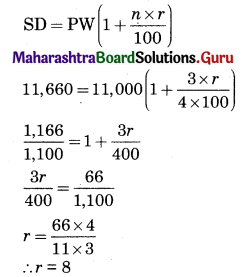
Given, PW = ₹ 11,000, SD = ₹ 11,660
n = \(\frac{9}{12}\) year = \(\frac{3}{4}\) year
We have,
Maharashtra Board 12th Commerce Maths Solutions Chapter 1 Commission, Brokerage and Discount Miscellaneous Exercise 1 IV Q5
∴ The rate of interest is 8% p.a.

Question 6.
An article is marked at ₹ 800, a trader allows a discount of 2.5% and gains 20% on the cost. Find the cost price of the article?
Solution:
Marked price of the article = ₹ 800
Rate of discount = 2.5%
Amount of discount = \(\frac{2.5}{100}\) × 800 = ₹ 20
∴ Selling price of the article = 800 – 20 = ₹ 780
Now, given, gain = 20%
Let cost price of the article be ₹ 100, then
The selling price of the article is ₹ 120
Thus if cost price of the articles is ₹ x
Then the selling price is ₹ 780
∴ x = \(\frac{780 \times 100}{120}\)
∴ x = 650
∴ Cost price of the article is ₹ 650

Question 7.
A salesman is paid a fixed monthly salary plus commission on the sales. If on sale of ₹ 96,000 and ₹ 1,08,000 in two successive months he receives in all ₹ 17,600 and ₹ 18,800 respectively. Find his monthly salary and rate of commission paid to him.
Solution:
Let the monthly salary of the salesman be ₹ x
And the rate of commission be y%
Income = monthly salary + commission on the sales
17600 = x + \(\frac{y}{100}\) × 96,000
∴ 17600 = x + 960y ………(1)
and 18800 = x + \(\frac{y}{100}\) × 108000
∴ 18,800 = x + 1080y ………(2)
Subtracting equation (1) from equation (2), we get
1,200 = 120y
∴ y = 10
Substituting y = 10 in (1), we get
17,600 = x + 960(10)
∴ x = 17,600 – 9,600 = 8,000
∴ Salary of the salesman = ₹ 8,000
Rate of commission = 10%

Question 8.
A merchant buys some mixers at a 15% discount on catalogue price. The catalogue price is ₹ 5,500 per price of the mixer. The freight charges amount to 2\(\frac{1}{2}\)% on the catalogue price. The merchant sells each mixer at a 5% discount on the catalogue price. His net profit is ₹ 41,250, Find the number of mixers.
Solution:
Catalogue price of a mixer = ₹ 5,500
Trade discount = 15% on catalogue price
= \(\frac{15}{100}\) × 5,500
= ₹ 825
Freight charges = 2\(\frac{1}{2}\)% of the catalogue price
= \(\frac{5}{2} \times \frac{1}{100} \times 5,500\)
= ₹ 137.5
∴ Cost price of a mixer for the merchant = 5,500 – 825 + 137.5 = 4,812,5
Catalogue price = ₹ 5,500
Rate of discount = 5%
∴ Selling price of one mixer = 5500 – \(\frac{5}{100}\) × 5,500 = ₹ 5,225
∴ Profit on one mixer = 5,225 – 4,812.5 = ₹ 412.5
Now, total profit = ₹ 41,250
∴ Number of mixers = \(\frac{41,250}{412.5}\) = 100
Thus the number of mixers is 100.

Maharashtra Board 12th Commerce Maths Solutions Chapter 1 Commission, Brokerage and Discount Miscellaneous Exercise 1

Question 9.
A bill is drawn for ₹ 7,000 on 3rd May for 3 months and is discounted on 25th May at 5.5% Find the present worth.
Solution:
Face value of the bill = ₹ 7,000
Date of drawing = 3rd May
Period = 3 months
Normal due date = 3rd August
Legal due date = 6th August
Rate of interest = 5.5%
Date of discounting = 25th May
Unexpired period (number of days from date of discounting to legal due date)

Maharashtra Board 12th Commerce Maths Solutions Chapter 1 Commission, Brokerage and Discount Miscellaneous Exercise 1 IV Q9
∴ Bankers discount = 7,000 × \(\frac{73}{365} \times \frac{5.5}{100}\) = ₹ 77
Also PW = SD – BD
= 7,000 – 77
= ₹ 6,923
∴ Present worth is ₹ 6,923

Question 10.
A bill was drawn on 14th April 2005 for ₹ 3,500 and was discounted on 6th July 2005 at 5% per annum. The banker paid ₹ 3,465 for the bill. Find the period of the bill.
Solution:
Face value of the bill = ₹ 3,500
Date of drawing = 14/04/2005
Date of discount = 06/07/2005
Rate of interest = 5%
Cash value = ₹ 3,465
Bankers discount = Face value – Cash value
= 3,500 – 3,465
= ₹ 35
Let the unexpired days be n days
∴ BD = \(\frac{\mathrm{FV} \times n \times r}{365 \times 100}\)
∴ 35 = \(\frac{3,500 \times n \times 5}{365 \times 100}\)
∴ n = 73 days
Thus, legal due date is 73 days from the date of discounting

Maharashtra Board 12th Commerce Maths Solutions Chapter 1 Commission, Brokerage and Discount Miscellaneous Exercise 1 IV Q10
∴ Legal due date = 17/09/2005
∴ Nominal due date = 14/09/2005
∴ The period of the bill is 5 months

Question 11.
The difference between true discount and banker’s discount on 6 months hence at 4% p.a. is ₹ 80. Find the true discount, banker’s discount, and amount of the bill.
Solution:
BG = BD – TD
∴ BG = ₹ 80
Also BG = \(\frac{\mathrm{TD} \times n \times r}{100}\)
∴ 80 = \(\frac{\mathrm{TD} \times 6 \times 4}{12 \times 100}\)
∴ TD = \(\frac{80 \times 100}{2}\)
∴ TD = ₹ 4,000
Now BD = TD + BG
= 4,000 + 80
= ₹ 4,080
Also, BD = \(\frac{\mathrm{FV} \times n \times r}{100}\)
∴ 4,080 = \(\frac{\mathrm{FV} \times 6 \times 4}{12 \times 100}\)
∴ FV = \(\frac{4,080 \times 100}{2}\)
∴ FV = ₹ 2,04,000
Amount of the bill = ₹ 2,04,000

Maharashtra Board 12th Commerce Maths Solutions Chapter 1 Commission, Brokerage and Discount Miscellaneous Exercise 1

Question 12.
A manufacturer makes a clear profit of 30% on the cost after allowing a 35% discount. If the cost of production rises by 20%, by what percentage should he reduce the rate of discount so as to make the same rate of profit keeping his list prices unaltered.
Solution:
Rate of discount = 35%
Let the list price be ₹ 100.
Then discount at 35% = ₹ 35
∴ Net selling price = 100 – 35 = ₹ 65 ……..(1)
The manufacturer makes a clear profit of 30% on the cost after allowing a 35% Discount.
Let the cost be ₹ 100.
Then selling price at 30% profit is 100 + 30 = ₹ 130.
Thus, if the net selling price is ₹ 130, then the cost price is ₹ 100.
But, the net selling price is ₹ 130, then the cost price is ₹ 65 ……[from (1)]
∴ The cost price is \(\frac{65}{130} \times 100\) = ₹ 50
Hence, we have,

Maharashtra Board 12th Commerce Maths Solutions Chapter 1 Commission, Brokerage and Discount Miscellaneous Exercise 1 IV Q12
Now, the cost of production has increased by 20%.
Let the old cost price be ₹ 100.
∴ The new cost price is ₹ 120.
But, the old cost price is ₹ 50.
∴ The new cost price is = \(\frac{50}{100} \times 120\) = ₹ 60.
The old net price is ₹ 65.
Now 20% of ₹ 65 = \(\frac{20}{100} \times 65\) = ₹ 13
∴ New net price = 65 + 13 = ₹ 78
Hence, we have

Maharashtra Board 12th Commerce Maths Solutions Chapter 1 Commission, Brokerage and Discount Miscellaneous Exercise 1 IV Q12.1
Now, 100 – 78 = ₹ 22
Thus, the rate of discount should be reduced by 22%, The original rate of discount is 35%.
Hence, the reduction in discount should be (35 – 22)% = 13%
so as to make the same rate of profit, keeping the list price unaltered.

Question 13.
A trader offers a 25% discount on the catalogue price of the radio and yet makes a 20% profit. If he gains ₹ 160 per radio, what must be the catalogue price of the radio?
Solution:
Rate of discount = 25% on the catalogue price of a radio.
Let the catalogue price of the radio be ₹ 100.
Then, the discount on a radio = ₹ 25.
Net selling price = 100 – 25 = ₹ 75.
He makes a profit of 20%.
Let the cost price be ₹ 100.
Then, at 20% profit, net selling price = ₹ 120.
Thus, if net SP is ₹ 120, then cost price is ₹ 100.
But, the net SP is ₹ 75.
∴ The cost price is \(\frac{75}{120}\) × 100 = \(\frac{750}{12}\) = ₹ 62.50
∴ Profit on a radio set = 75 – 62.5 = ₹ 12.50
Thus, if the profit on a radio set is ₹ 12.50 then its catalogue price is ₹ 100.
But the profit on a radio set is ₹ 160.
∴ The catalogue price of radio = \(\frac{160}{12.50}\) × 100
= 12.80 × 100
= ₹ 1,280
∴ Thus, the catalogue price of the radio is ₹ 1280

Question 14.
A bill of ₹ 4,800 was drawn on 9th March 2006 at 6 months and was discounted on 19th April 2006 for 6\(\frac{1}{4}\)% p.a. How much does the banker charge and how much does the holder receive?
Solution:
Face value of the bill = ₹ 4.800
Date of drawing = 09/03/2006
Period of the bill = 6 months
Normal due date = 09/09/2006
Legal due date = 12/09/2006
Rate of discount = 6\(\frac{1}{4}\)% = 6.25%
Now, for the unexpired
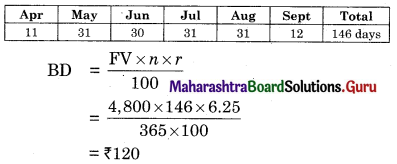
Maharashtra Board 12th Commerce Maths Solutions Chapter 1 Commission, Brokerage and Discount Miscellaneous Exercise 1 IV Q14
Thus the banker charges ₹ 120
Amount received by the holder = 4,800 – 120 = ₹ 4,680

Question 15.
A bill of ₹ 65,700 drawn on July 10 for 6 months was discounted for ₹ 65,160 at 5% p.a. On what day was the bill discounted?
Solution:
BD = FV – Cash value
= 65,700 – 65,160
= ₹ 540
Let the unexpired days be x days
BD = \(\frac{\mathrm{FV} \times n \times r}{100}\)
∴ 540 = \(\frac{65,700 \times x \times 5}{365 \times 100}\)
∴ x = 60 days
The unexpired days = 60 days
Date-of drawing = 10th July
Period of the bill = 6 months
Nominal due date = 10th January (next year)
Legal due date = 13th January (next year)
Then the date of discount is 60 days before, the legal due date

Maharashtra Board 12th Commerce Maths Solutions Chapter 1 Commission, Brokerage and Discount Miscellaneous Exercise 1 IV Q15
∴ The date of discounting is 14th November

Question 16.
An agent sold a car and charged a 3% commission on the sale value. If the owner of the car received ₹ 48,500, find the sale value of the car. If the agent charged 2% from the buyer, find his total remuneration.
Solution:
Let the sale value of the car be ₹ x
Rate of commission of the agent = 3%
Since the owner received ₹ 48,500 after agent has charged his commission
x – \(\frac{3 x}{100}\) = 48500
∴ \(\frac{97 x}{100}\) = 48500
∴ x = \(\frac{48,500 \times 100}{97}\)
∴ x = ₹ 50,000
∴ Sale value of the car = ₹ 50,000
Against commission received from the owner = \(\frac{3}{100}\) × 50,000 = ₹ 1500
Against commission received from the buyer = \(\frac{2}{100}\) × 50,000 = ₹ 1000
∴ Agents total remuneration = 1,500 + 1,000 = ₹ 2,500

Maharashtra Board 12th Commerce Maths Solutions Chapter 1 Commission, Brokerage and Discount Miscellaneous Exercise 1

Question 17.
An agent is paid a commission of 4% on cash sales and 6% on credit sales made by him. If on the sale of ₹ 51,000 the agent claims a total commission of ₹ 2,700, find the sales made by him for cash and on credit.
Solution:
Total sales = ₹ 51,000
Let eash sales be ₹ x
∴ Credit sales = ₹ (51,000 – x)
Agent’s commission on cash sales = 4%
= \(\frac{4}{100}\) × x
= \(\frac{4x}{100}\)
Commission on credit sales = 6%
= \(\frac{6}{100}\)(51,000 – x)
Given total commission = ₹ 2,700
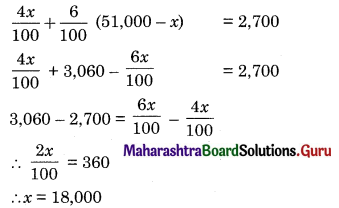
Maharashtra Board 12th Commerce Maths Solutions Chapter 1 Commission, Brokerage and Discount Miscellaneous Exercise 1 IV Q17
∴ Cash sales = ₹ 18,000
∴ Credit sales = 51,000 – 18,000 = ₹ 33,000

Maharashtra Board 12th Commerce Maths Solutions Chapter 2 Insurance and Annuity Ex 2.2

Balbharati Maharashtra State Board 12th Commerce Maths Digest Pdf Chapter 2 Insurance and Annuity Ex 2.2 Questions and Answers.

Maharashtra State Board 12th Commerce Maths Solutions Chapter 2 Insurance and Annuity Ex 2.2

Question 1.
Find the accumulated (future) value of annuity of ₹ 800 for 3 year at interest rate 8% compounded annually. [Given: (1.08)3 = 1.2597]
Solution:
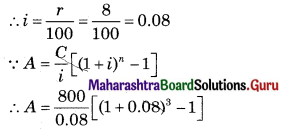
∵ C = ₹ 800
∵ n = 3 years
∵ r = 8% p.a.
Maharashtra Board 12th Commerce Maths Solutions Chapter 2 Insurance and Annuity Ex 2.2 Q1
∴ A = 10,000[(1.08)3 – 1]
∴ A = 10,000[1.2597 – 1]
∴ A = 10,000 × 0.2597
∴ A = ₹ 2,597

Maharashtra Board 12th Commerce Maths Solutions Chapter 2 Insurance and Annuity Ex 2.2

Question 2.
A person invested ₹ 5,000 every year in finance company that offered him interest compounded at 10% p.a., what is the amount accumulated after 4 years? [Given: (1.1)4 = 1.4641]
Solution:
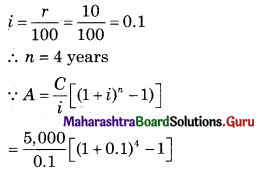
∵ C = ₹ 5,000
∵ r = 10% p.a.
Maharashtra Board 12th Commerce Maths Solutions Chapter 2 Insurance and Annuity Ex 2.2 Q2
= 50,000[(1.1)4 – 1]
= 50,000[1.4641 – 1]
= 50,000 × 0.4641
= ₹ 23,205

Question 3.
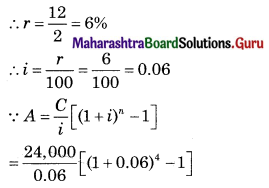
Find the amount accumulated after 2 years if a sum of ₹ 24,000 is invested every six months at 12% p.a. compounded half yearly. [Given: (1.06)4 = 1.2625]
Solution:
∵ C = ₹ 24,000
∵ n = 2 years
But invested half yearly
∴ n = 2 × 2 = 4
∵ r = 12% p.a. compounded half yearly
Maharashtra Board 12th Commerce Maths Solutions Chapter 2 Insurance and Annuity Ex 2.2 Q3
= 4,00,000[(1.06)4 – 1]
= 4,00,000[1.2625 – 1]
= 4,00,000 × 0.2625
= ₹ 1,05,000

Question 4.
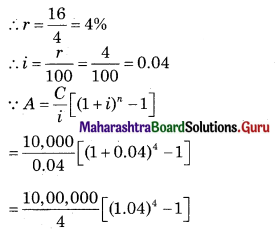
Find the accumulated value after 1 year of an annuity immediate in which ₹ 10,000 are invested every quarter at 16% p.a. compounded quarterly. [Given: (1.04)4 = 1.1699]
Solution:
∵ C = ₹ 10,000
∵ n = 1 year
But invested every quarterly
∴ n = 1 × 4 = 4
∴ r = 16% p.a. compounded quarterly
Maharashtra Board 12th Commerce Maths Solutions Chapter 2 Insurance and Annuity Ex 2.2 Q4
= 2,50,000 [1.1699 – 1]
= 2,50,000 × 0.1699
= ₹ 42,475

Maharashtra Board 12th Commerce Maths Solutions Chapter 2 Insurance and Annuity Ex 2.2

Question 5.
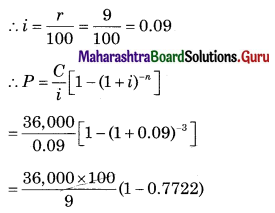
Find the present value of an annuity immediate of ₹ 36,000 p.a. for 3 years at 9% p.a. compounded annually. [Given: (1.09)-3 = 0.7722]
Solution:
∵ C = ₹ 36,000
∵ n = 3 years
∵ r = 9% p.a.
Maharashtra Board 12th Commerce Maths Solutions Chapter 2 Insurance and Annuity Ex 2.2 Q5
= 4,00,000 × 0.2278
= ₹ 91,120

Question 6.
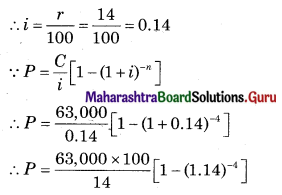
Find the present value of ordinary annuity of ₹ 63,000 p.a. for 4 years at 14% p.a. compounded annually. [Given: (1.14)-4 = 0.5921]
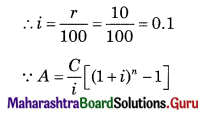
Solution:
∵ C = ₹ 63,000
∵ n = 4 years
∵ r = 14% p.a.
Maharashtra Board 12th Commerce Maths Solutions Chapter 2 Insurance and Annuity Ex 2.2 Q6
= 4,50,000[1 – 0.5921]
= 4,50,000 × 0.4079
= ₹ 1,83,555

Question 7.
A lady plans to save for her daughter’s marriage. She wishes to accumulate a sum of ₹ 4,64,100 at the end of 4 years. What amount should she invest every year if she get an interest of 10%p.a. compounded annually? [Given: (1.1)4 = 1.4641]
Solution:
∵ A = ₹ 4,64,100
∵ n = 4 years
∵ r = 10% p.a.
Maharashtra Board 12th Commerce Maths Solutions Chapter 2 Insurance and Annuity Ex 2.2 Q7
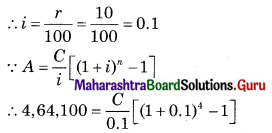
∴ 46,410 = C[1.4641 – 1]
∴ 46,410 = C × 0.4641
∴ \(\frac{46,410}{0.4641}\) = C
∴ C = ₹ 1,00,000

Question 8.
A person wants to create a fund of ₹ 6,96,150 after 4 years at the time of his retirement. He decides to invest a fixed amount at the end of every year in a bank that offers him interest of 10% p.a. compounded annually. What amount should he invest every year? [Given: (1.1)4 = 1.4641]
Solution:
∵ A = ₹ 6,96,150
∵ n = 4 years
∵ r = 10% p.a
Maharashtra Board 12th Commerce Maths Solutions Chapter 2 Insurance and Annuity Ex 2.2 Q8
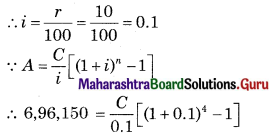
∴ 69,615 = C[1.4641 – 1]
∴ 69,615 = C × 0.4641
∴ \(\frac{69,615}{0.4641}\) = C
∴ C = ₹ 1,50,000
Maharashtra Board 12th Commerce Maths Solutions Chapter 2 Insurance and Annuity Ex 2.2

Question 9.
Find the rate of interest compounded annually if an annuity immediate at ₹ 20,000 per year amounts to ₹ 2,60,000 in 3 years.

Solution:
∵ C = ₹ 20,000
∵ A = ₹ 2,60,000
∵ n = 3 years
Maharashtra Board 12th Commerce Maths Solutions Chapter 2 Insurance and Annuity Ex 2.2 Q9
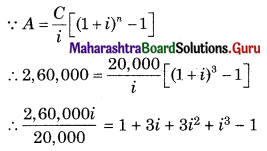
∴ 13i = 3i + 3 i2 + i3
∴ 13i = i(3 + 3i + i2)
∴ 13 = 3 + i + i2
∴ i2 + 3i + 3 – 13 = 0
∴ i2 + 3i – 10 = 0
∴ (i + 5) (i – 2) = 0
∴ i + 5 = 0 or i – 2 = 0
∴ i = -5 or i = 2
∵ Rate of interest cannot be negative
∴ i = 2 is accepted
∴ \(\frac{r}{100}\) = 2
∴ r = 200% p.a.

Question 10.
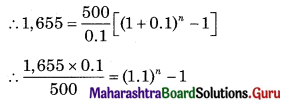
Find the number of years for which an annuity of ₹ 500 is paid at the end of every years, if the accumulated amount works out to be ₹ 1,655 when interest is compounded annually at 10% p.a.
Solution:
∵ C = 7500
∵ A = 71,655
∵ r = 10% p.a.
Maharashtra Board 12th Commerce Maths Solutions Chapter 2 Insurance and Annuity Ex 2.2 Q10
Maharashtra Board 12th Commerce Maths Solutions Chapter 2 Insurance and Annuity Ex 2.2 Q10.1
∴ 0.331 + 1 = (1.1)n
∴ 1.331 = (1.1)n
∴ (1.1)3 = (1.1)n
∴ n = 3 years

Question 11.
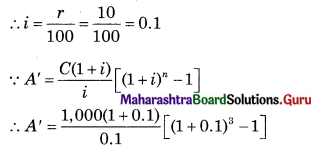
Find the accumulated value of annuity due of ₹ 1,000 p.a. for 3 years at 10% p.a. compounded annually. [Given: (1.1)3 = 1.331]
Solution:
∵ C = ₹ 1,000
∵ n = 3 years
∵ r = 10% p.a.
Maharashtra Board 12th Commerce Maths Solutions Chapter 2 Insurance and Annuity Ex 2.2 Q11
∴ A’ = 10,000 × 1.1[(1.1)3 – 1]
∴ A’ = 11,000 [1.331 – 1]
∴ A’ = 11,000 × 0.331
∴ A’ = ₹ 3,641

Question 12.
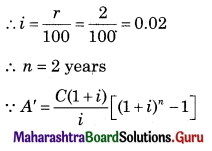
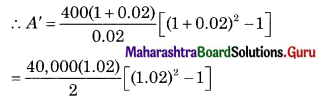
A person plans to put ₹ 400 at the beginning of each year for 2 years in a deposit that gives interest at 2% p.a. compounded annually. Find the amount that will be accumulated at the end of 2 years. [Given: (1.02)2 = 1.0404]
Solution:
∵ C = ₹ 400
∵ r = 2% p.a.
Maharashtra Board 12th Commerce Maths Solutions Chapter 2 Insurance and Annuity Ex 2.2 Q12
Maharashtra Board 12th Commerce Maths Solutions Chapter 2 Insurance and Annuity Ex 2.2 Q12.1
= 20,000 (1.02) (1.0404 – 1)
= 20,400 [0.0404]
= ₹ 824.16

Maharashtra Board 12th Commerce Maths Solutions Chapter 2 Insurance and Annuity Ex 2.2

Question 13.
Find the present value of an annuity due of ₹ 600 to be paid quarterly at 32% p.a. compounded quarterly. [Given (1.08)-4 = 0.7350]
Solution:
∵ C = ₹ 600
∵ n = 1 year
∴ But invested every quarterly
∴ n = 1 × 4 = 4
∵ r = 32% p.a. compounded quarterly
Maharashtra Board 12th Commerce Maths Solutions Chapter 2 Insurance and Annuity Ex 2.2 Q13
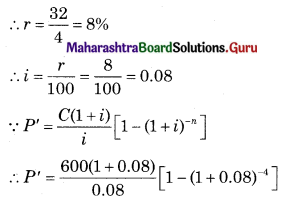
= 7,500(1.08) [1 – 0.7350]
= 8,100 [0.2650]
= ₹ 2,146.5

Question 14.
An annuity immediate is to be paid for some years at 12% p.a. The present value of the annuity is ₹ 10,000 and the accumulated value is ₹ 20,000. Find the amount of each annuity payment.
Solution:
∵ r = 12% p.a.
∴ i = \(\frac{r}{100}=\frac{12}{100}\) = 0.12
∵ P = ₹ 10,000
∵ A = ₹ 20,000
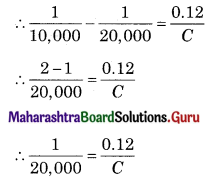
∵ \(\frac{1}{P}-\frac{1}{A}=\frac{i}{C}\)
Maharashtra Board 12th Commerce Maths Solutions Chapter 2 Insurance and Annuity Ex 2.2 Q14
∴ C = 0.12 × 20,000
∴ C = ₹ 2,400

Question 15.
For an annuity immediate paid for 3 years with interest compounded at 10% p.a. the present value is ₹ 24,000. What will be the accumulated value after 3 years? [Given (1.1)3 = 1.331]
Solution:
∵ n = 3 years
∵ P = ₹ 24,000
∵ r = 10% p.a.
∴ i = \(\frac{r}{100}=\frac{10}{100}\) = 0.1
∵ A = P(1 + i)n
∴ A = 24,000 [1 + 0.1]3
∴ A = 24,000 × (1.1)3
∴ A = 24,000 × 1.331
∴ A = ₹ 31,944

Maharashtra Board 12th Commerce Maths Solutions Chapter 2 Insurance and Annuity Ex 2.2

Question 16.
A person sets up a sinking fund in order to have ₹ 1,00,000 after 10 years. What amount should be deposited bi-annually in the account that pays him 5% p.a. compounded semi-annually? [Given: (1.025)20 = 1.675]
Solution:
∴ A = ₹ 1,00,000
∴ n = 10 years
But, invested half yearly
∴ n = 10 × 2 = 20
∵ r = 5% p.a. compounded half yearly
∴ r = \(\frac{r}{2}=\frac{5}{2}\) = 2.5%
∴ i = \(\frac{r}{100}=\frac{2.5}{100}\) = 0.025
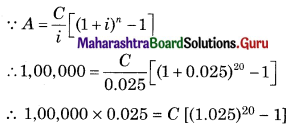
Maharashtra Board 12th Commerce Maths Solutions Chapter 2 Insurance and Annuity Ex 2.2 Q16
∴ 2,500 = C[1.675 – 1]
∴ 2,500 = C × 0.675
∴ \(\frac{2,500}{0.675}\) = C
∴ C = ₹ 3,703.70

Maharashtra Board 12th Commerce Maths Solutions Chapter 7 Assignment Problem and Sequencing Miscellaneous Exercise 7

Balbharati Maharashtra State Board 12th Commerce Maths Solution Book Pdf Chapter 7 Assignment Problem and Sequencing Miscellaneous Exercise 7 Questions and Answers.

Maharashtra State Board 12th Commerce Maths Solutions Chapter 7 Assignment Problem and Sequencing Miscellaneous Exercise 7

(I) Choose the correct alternative.

Question 1.
In sequencing, an optimal path is one that minimizes ___________
(a) Elapsed time
(b) Idle time
(c) Both (a) and (b)
(d) Ready time
Answer:
(c) Both (a) and (b)

Question 2.
If job A to D have processing times as 5, 6, 8, 4 on first machine and 4, 7, 9, 10 on second machine then the optimal sequence is:
(a) CDAB
(b) DBCA
(c) BCDA
(d) ABCD
Answer:
(b) DBCA

Maharashtra Board 12th Commerce Maths Solutions Chapter 7 Assignment Problem and Sequencing Miscellaneous Exercise 7

Question 3.
The objective of sequence problem is
(a) to find the order in which jobs are to be made
(b) to find the time required for the completing all the job on hand
(c) to find the sequence in which jobs on hand are to be processed to minimize the total time required for processing the jobs
(d) to maximize the cost
Answer:
(c) to find the sequence in which jobs on hand are to be processed to minimize the total time required for processing the jobs

Question 4.
If there are n jobs and m machines, then there will be ___________ sequences of doing the jobs.
(a) mn
(b) m(n!)
(c) nm
(d) (n!)m
Answer:
(d) (n!)m

Question 5.
The Assignment Problem is solved by
(a) Simple method
(b) Hungarian method
(c) Vector method
(d) Graphical method
Answer:
(b) Hungarian method

Question 6.
In solving 2 machine and n jobs sequencing problem, the following assumption is wrong
(a) No passing is allowed
(b) Processing times are known
(c) Handling times is negligible
(d) The time of passing depends on the order of machining
Answer:
(d) The time of passing depends on the order of machining

Maharashtra Board 12th Commerce Maths Solutions Chapter 7 Assignment Problem and Sequencing Miscellaneous Exercise 7

Question 7.
To use the Hungarian method, a profit maximization assignments problem requires
(a) Converting all profit to opportunity losses
(b) A dummy person or job
(c) Matrix expansion
(d) Finding the maximum number of lines to cover all the zeros in the reduced matrix
Answer:
(a) Converting all profits to opportunity losses

Question 8.
Using the Hungarian method the optimal assignment obtained for the following assignment problem to minimize the total cost is:
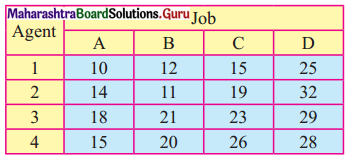
Maharashtra Board 12th Commerce Maths Solutions Chapter 7 Assignment Problem and Sequencing Miscellaneous Exercise 7 I Q8
(a) 1 – C, 2 – B, 3 – D, 4 – A
(b) 1 – B, 2 – C, 3 – A, 4 – D
(c) 1 – A, 2 – B, 3 – C, 4 – D
(d) 1 – D, 2 – A, 3 – B, 4 – C
Answer:
(a) 1 – C, 2 – B, 3 – D, 4 – A

Question 9.
The assignment problem is said to be unbalanced if
(a) Number of rows is greater than the number of columns
(b) Number of rows is lesser than number of columns
(c) Number of rows is equal to the number of columns
(d) Both (a) and (b)
Answer:
(d) Both (a) and (b)

Question 10.
The assignment problem is said to be balanced if
(a) Number of rows is greater than the number of columns
(b) Number of rows is lesser than number of columns
(c) Number of rows is equal to the number of columns
(d) If the entry of rows is zero
Answer:
(c) Number of rows is equal to number of columns

Question 11.
The assignment problem is said to be balanced if it is a
(a) Square matrix
(b) Rectangular matrix
(c) Unit matrix
(d) Triangular matrix
Answer:
(a) Square matrix

Question 12.
In an assignment problem if the number of rows is greater than the number of columns then
(a) Dummy column is added
(b) Dummy row is added
(c) Row with cost 1 is added
(d) Column with cost 1 is added
Answer:
(a) Dummy column is added

Question 13.
In a 3 machine and 5 jobs problem, the least of processing times on machines A, B, and C are 5, 1 and 3 hours and the highest processing times are 9, 5 and 7 respectively, then it can be converted to a 2 machine problem if the order of the machines is:
(a) B – A – C
(b) A – B – C
(c) C – B – A
(d) Any order
Answer:
(b) A – B – C

Maharashtra Board 12th Commerce Maths Solutions Chapter 7 Assignment Problem and Sequencing Miscellaneous Exercise 7

Question 14.
The objective of an assignment problem is to assign
(a) Number of jobs to equal number of persons at maximum cost
(b) Number of jobs to equal number of persons at minimum cost
(c) Only the maximize cost
(d) Only to minimize cost
Answer:
(b) Number of jobs to equal number of persons at minimum cost

(II) Fill in the blanks.

Question 1.
An assignment problem is said to be unbalanced when ___________
Answer:
the number of rows is not equal to the number of columns

Question 2.
When the number of rows is equal to the Number of columns then the problem is said to be ___________ assignment problem.
Answer:
balanced

Question 3.
For solving assignment problem the matrix should be a ___________
Answer:
square matrix

Question 4.
If the given matrix is not a ___________ matrix, the assignment problem is called an unbalanced problem.
Answer:
square

Question 5.
A dummy row(s) or column(s) with the cost elements as ___________ the matrix of an unbalanced assignment problem as a square matrix.
Answer:
zero

Question 6.
The time interval between starting the first job and completing the last, job including the idle time (if any) in a particular order by the given set of machines is called ___________
Answer:
Total elapsed time

Maharashtra Board 12th Commerce Maths Solutions Chapter 7 Assignment Problem and Sequencing Miscellaneous Exercise 7

Question 7.
The time for which a machine j does not have a job to process to the start of job i is called ___________
Answer:
Idle time

Question 8.
The maximization assignment problem is transformed to minimization problem by subtracting each entry in the table from the ___________ value in the table.
Answer:
maximum

Question 9.
When the assignment problem has more than one solution, then it is ___________ optimal solution.
Answer:
multiple

Question 10.
The time required for printing four books A, B, C, and D is 5, 8, 10, and 7 hours. While its data entry requires 7, 4, 3, and 6 hrs respectively. The sequence that minimizes total elapsed time is ___________
Answer:
A – D – B – C

(III) State whether each of the following is True or False.

Question 1.
One machine – one job is not an assumption in solving sequencing problems.
Answer:
False

Question 2.
If there are two least processing times for machine A and machine B, priority is given for the processing time which has the lowest time of the adjacent machine.
Answer:
True

Question 3.
To convert the assignment problem into a maximization problem, the smallest element in the matrix is deducted from all other elements.
Answer:
False

Question 4.
The Hungarian method operates on the principle of matrix reduction, whereby the cost table is reduced to a set of opportunity costs.
Answer:
True

Maharashtra Board 12th Commerce Maths Solutions Chapter 7 Assignment Problem and Sequencing Miscellaneous Exercise 7

Question 5.
In a sequencing problem, the processing times are dependent on the order of processing the jobs on machines.
Answer:
False

Question 6.
The optimal assignment is made in the Hungarian method to cells in the reduced matrix that contain a Zero.
Answer:
True

Question 7.
Using the Hungarian method, the optimal solution to an assignment problem is fund when the minimum number of lines required to cover the zero cells in the reduced matrix equals the number of people.
Answer:
True

Question 8.
In an assignment problem, if a number of columns are greater than the number of rows, then a dummy column is added.
Answer:
False

Question 9.
The purpose of a dummy row or column in an assignment problem is to obtain a balance between a total number of activities and a total number of resources.
Answer:
True

Question 10.
One of the assumptions made while sequencing n jobs on 2 machines is: two jobs must be loaded at a time on any machine.
Answer:
False

(IV) Solve the following problems.

Part – I

Question 1.
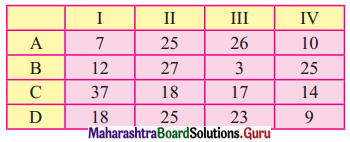
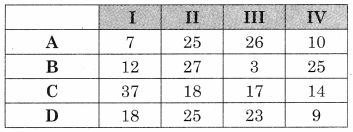
A plant manager has four subordinates, and four tasks to be performed. The subordinates differ in efficiency and the tasks differ in their intrinsic difficulty. This estimate of the times each man would take to perform each task is given in the effectiveness matrix below.
Maharashtra Board 12th Commerce Maths Solutions Chapter 7 Assignment Problem and Sequencing Miscellaneous Exercise 7 IV Part I Q1
How should the tasks be allocated, one to a man, as to minimize the total man-hours?
Solution:
The hr matrix is given by
Maharashtra Board 12th Commerce Maths Solutions Chapter 7 Assignment Problem and Sequencing Miscellaneous Exercise 7 IV Part I Q1.1
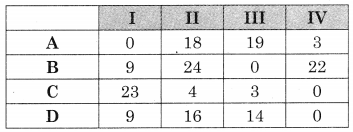
Subtracting row minimum from all values in that row we get
Maharashtra Board 12th Commerce Maths Solutions Chapter 7 Assignment Problem and Sequencing Miscellaneous Exercise 7 IV Part I Q1.2
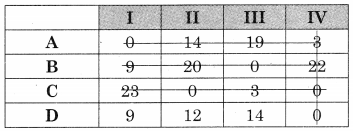
Subtracting column minimum from all values in that column we get
Maharashtra Board 12th Commerce Maths Solutions Chapter 7 Assignment Problem and Sequencing Miscellaneous Exercise 7 IV Part I Q1.3
The minimum no. of lines covering ail the zeros (4) is equal to the order of the matrix (4)
∴ The assignment is possible.
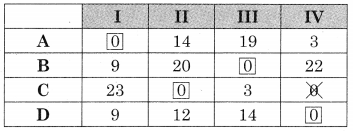
Maharashtra Board 12th Commerce Maths Solutions Chapter 7 Assignment Problem and Sequencing Miscellaneous Exercise 7 IV Part I Q1.4
The assignment is
A → I, B → III, C → II, D → IV
For the minimum hrs. take the corresponding value from the hr matrix.
Minimum hrs = 7 + 3 + 18 + 9 = 37 hrs

Maharashtra Board 12th Commerce Maths Solutions Chapter 7 Assignment Problem and Sequencing Miscellaneous Exercise 7

Question 2.
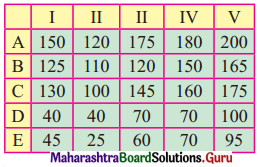
A dairy plant has five milk tankers, I, II, III, IV & V. These milk tankers are to be used on five delivery routes A, B, C, D & E. The distances (in kms) between the dairy plant and the delivery routes are given in the following distance matrix.
Maharashtra Board 12th Commerce Maths Solutions Chapter 7 Assignment Problem and Sequencing Miscellaneous Exercise 7 IV Part I Q2
How should the milk tankers be assigned to the chilling centre so as to minimize the distance travelled?
Solution:
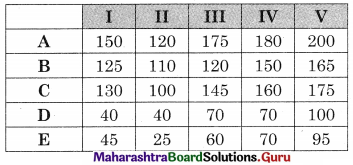
The distance matrix is given by
Maharashtra Board 12th Commerce Maths Solutions Chapter 7 Assignment Problem and Sequencing Miscellaneous Exercise 7 IV Part I Q2.1
Subtracting row minimum from all values in that row we get
Maharashtra Board 12th Commerce Maths Solutions Chapter 7 Assignment Problem and Sequencing Miscellaneous Exercise 7 IV Part I Q2.2
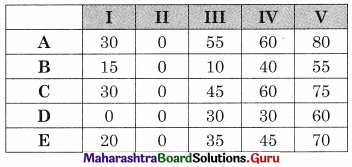
Subtracting column minimum from each value in that column we get
Maharashtra Board 12th Commerce Maths Solutions Chapter 7 Assignment Problem and Sequencing Miscellaneous Exercise 7 IV Part I Q2.3
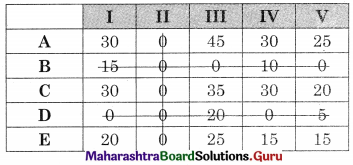
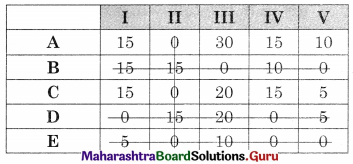
The number of lines covering all the zeros (3) is less than the order of the matrix (5) so the assignment is not possible. The modification is required.
The minimum uncovered value (15) is subtracted from uncovered values and added to the values at the intersection. The numbers on the lines remain the same. We get
Maharashtra Board 12th Commerce Maths Solutions Chapter 7 Assignment Problem and Sequencing Miscellaneous Exercise 7 IV Part I Q2.4
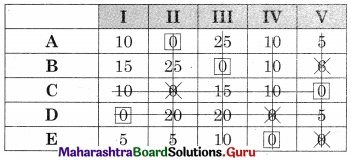
The minimum lines covering all the zeros (4) are less than the order of the matrix (5) so the assignment is not possible. The modification is required the minimum uncovered value (5) is subtracted from uncovered values and added to the values at the intersection. The numbers on the lines remain the same we get
Maharashtra Board 12th Commerce Maths Solutions Chapter 7 Assignment Problem and Sequencing Miscellaneous Exercise 7 IV Part I Q2.5
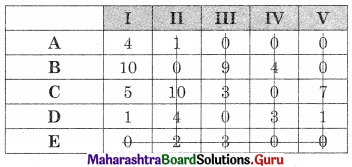
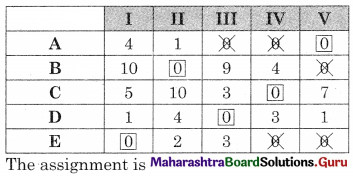
The minimum number of lines covering all the zeros (5) is equal to the order of the matrix (5) So assignment is possible.
The assignment is
A → II, B → III, C → V, D → I, E → IV
Total minimum distance is = 120 + 120 + 175 + 40 + 70 = 525 kms.

Question 3.
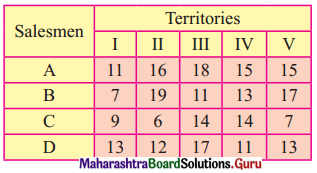
Solve the following assignment problem to maximize sales:
Maharashtra Board 12th Commerce Maths Solutions Chapter 7 Assignment Problem and Sequencing Miscellaneous Exercise 7 IV Part I Q3
Solution:
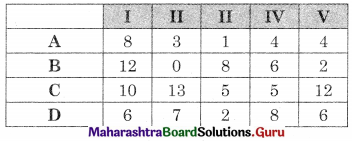
As it is a maximization problem so we need to convert it into a minimization problem.
Subtracting all the values from the maximum value (19) we get
Maharashtra Board 12th Commerce Maths Solutions Chapter 7 Assignment Problem and Sequencing Miscellaneous Exercise 7 IV Part I Q3.1
Also, it is an unbalanced problem so we need to add a dummy row (E) with all values zero, we get
Maharashtra Board 12th Commerce Maths Solutions Chapter 7 Assignment Problem and Sequencing Miscellaneous Exercise 7 IV Part I Q3.2
Subtracting row minimum from all values in that row we get
Maharashtra Board 12th Commerce Maths Solutions Chapter 7 Assignment Problem and Sequencing Miscellaneous Exercise 7 IV Part I Q3.3
Subtracting column minimum from all values in that column we get the same matrix
Maharashtra Board 12th Commerce Maths Solutions Chapter 7 Assignment Problem and Sequencing Miscellaneous Exercise 7 IV Part I Q3.4
The minimum number of lines covering all the zero (4) is less than the order of the matrix (5) So assignment is not possible. The modification is required. The minimum uncovered value (2) is subtracted from the uncovered values and added to the values at the intersection. The values on the lines remain the same. We get
Maharashtra Board 12th Commerce Maths Solutions Chapter 7 Assignment Problem and Sequencing Miscellaneous Exercise 7 IV Part I Q3.5
The minimum number of lines covering all the zeros (4) is less than the order of the matrix (5) so the assignment is not possible. The modification is required. The minimum uncovered value (1) is subtracted from the uncovered value and added to the values at the intersection. The values on the lines remain the same. We get
Maharashtra Board 12th Commerce Maths Solutions Chapter 7 Assignment Problem and Sequencing Miscellaneous Exercise 7 IV Part I Q3.6
The minimum number of lines covering all the zeros (5) is equal to the order of the matrix (5) so the assignment is possible.
Maharashtra Board 12th Commerce Maths Solutions Chapter 7 Assignment Problem and Sequencing Miscellaneous Exercise 7 IV Part I Q3.7
The assignment is
A → V, B → II, C → IV, D → III, E → I
No salesman goes to I as E is a dummy row.
For the maximum value take the corresponding values from the original matrix.
We get Maximum value = 15 + 19 + 14 + 17 + 0 = 65 units

Maharashtra Board 12th Commerce Maths Solutions Chapter 7 Assignment Problem and Sequencing Miscellaneous Exercise 7

Question 4.
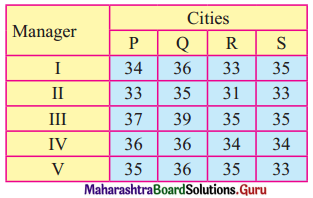
The estimated sales (tons) per month in four different cities by five different managers are given below:
Maharashtra Board 12th Commerce Maths Solutions Chapter 7 Assignment Problem and Sequencing Miscellaneous Exercise 7 IV Part I Q4
Find out the assignment of managers to cities in order to maximize sales.
Solution:
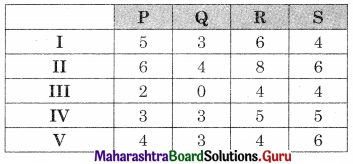
This is a maximizing problem. To convert it into minimizing problem subtract all the values of the matrix from the maximum (largest) value (39) we get
Maharashtra Board 12th Commerce Maths Solutions Chapter 7 Assignment Problem and Sequencing Miscellaneous Exercise 7 IV Part I Q4.1
Also as it is an unbalanced problem so we have to add a dummy column (T) with all the values as zero. We get
Maharashtra Board 12th Commerce Maths Solutions Chapter 7 Assignment Problem and Sequencing Miscellaneous Exercise 7 IV Part I Q4.2
Subtracting row minimum from all values in that row we get the same matrix
Subtracting column minimum from all values in that column we get
Maharashtra Board 12th Commerce Maths Solutions Chapter 7 Assignment Problem and Sequencing Miscellaneous Exercise 7 IV Part I Q4.3
The minimum number of lines covering all the zeros (4) is less than the order of the matrix (5) so assignments are not possible. The modification is required. The minimum uncovered value (1) is subtracted from the uncovered values and added to the values at the intersection. The values on the lines remain the same. We get
Maharashtra Board 12th Commerce Maths Solutions Chapter 7 Assignment Problem and Sequencing Miscellaneous Exercise 7 IV Part I Q4.4
The minimum number of lines covering all the zeros (5) is equal to the order of the matrix (5) so the assignment is possible.
Maharashtra Board 12th Commerce Maths Solutions Chapter 7 Assignment Problem and Sequencing Miscellaneous Exercise 7 IV Part I Q4.5
So I → S, II → T, III → Q, IV → P, V → R.
As T is dummy manager II is not given any city.
To find the maximum sales we take the corresponding value from the original matrix
Total maximum sales = 35 + 39 + 36 + 35 = 145 tons

Question 5.
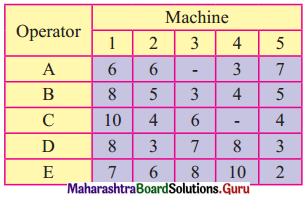
Consider the problem of assigning five operators to five machines. The assignment costs are given in the following table.
Maharashtra Board 12th Commerce Maths Solutions Chapter 7 Assignment Problem and Sequencing Miscellaneous Exercise 7 IV Part I Q5
Operator A cannot be assigned to machine 3 and operator C cannot be assigned to machine 4. Find the optimal assignment schedule.
Solution:
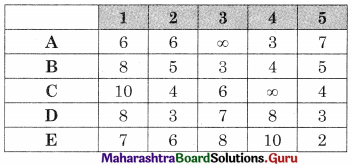
This is a restricted assignment problem, so we assign a very high cost (oo) to the prohibited cells we get
Maharashtra Board 12th Commerce Maths Solutions Chapter 7 Assignment Problem and Sequencing Miscellaneous Exercise 7 IV Part I Q5.1
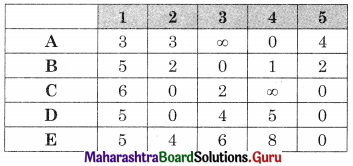
Subtracting row minimum from all values in that row we get.
Maharashtra Board 12th Commerce Maths Solutions Chapter 7 Assignment Problem and Sequencing Miscellaneous Exercise 7 IV Part I Q5.2
Subtracting column minimum from all values in that column we get
Maharashtra Board 12th Commerce Maths Solutions Chapter 7 Assignment Problem and Sequencing Miscellaneous Exercise 7 IV Part I Q5.3
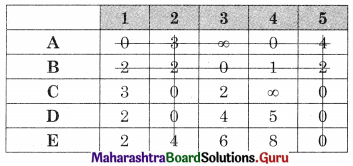
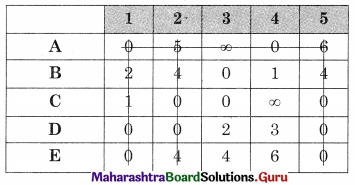
As the minimum number of lines covering all the zeros (4) is equal to the order of the matrix (5) so the assignment is not possible. The modification is required. The minimum uncovered value (2) is subtracted from all the uncovered values and added to the values at the intersection. The values on the lines remain the same. We get
Maharashtra Board 12th Commerce Maths Solutions Chapter 7 Assignment Problem and Sequencing Miscellaneous Exercise 7 IV Part I Q5.4
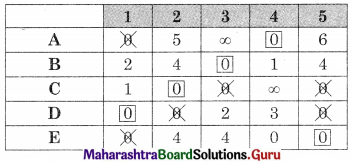
As the minimum number of lines covering all the zeros (5) is equal to the order of the matrix, assignment is the possible
Maharashtra Board 12th Commerce Maths Solutions Chapter 7 Assignment Problem and Sequencing Miscellaneous Exercise 7 IV Part I Q5.5
So A → 4, B → 3, C → 2, D → 1, E → 5
For the minimum cost take the corresponding values from the cost matrix we get
Total minimum cost = 3 + 3 + 4 + 3 + 7 = 20 units

Maharashtra Board 12th Commerce Maths Solutions Chapter 7 Assignment Problem and Sequencing Miscellaneous Exercise 7

Question 6.
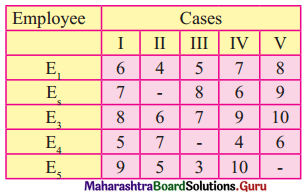
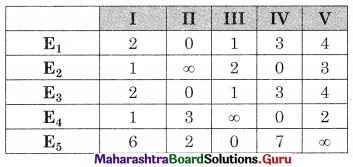
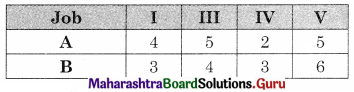
A chartered accountant’s firm has accepted five new cases. The estimated number of days required by each of their five employees for each case are given below, where-means that the particular employee can not be assigned the particular case. Determine the optimal assignment of cases of the employees so that the total number of days required to complete these five cases will be minimum. Also, find the minimum number of days.
Maharashtra Board 12th Commerce Maths Solutions Chapter 7 Assignment Problem and Sequencing Miscellaneous Exercise 7 IV Part I Q6
Solution:
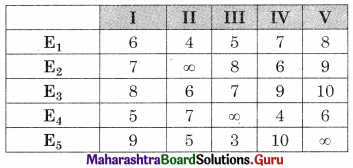
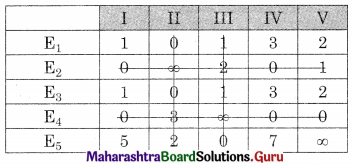
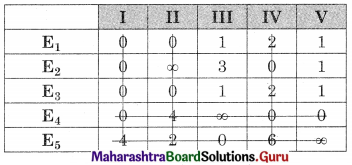
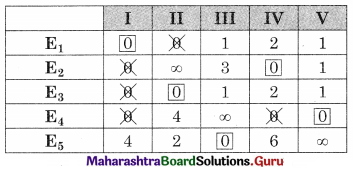
This is a restricted assignment problem so we assign a very high cost (∞) to all the prohibited cells. The day matrix becomes
Maharashtra Board 12th Commerce Maths Solutions Chapter 7 Assignment Problem and Sequencing Miscellaneous Exercise 7 IV Part I Q6.1
Subtracting row minimum from all values in that row we get
Maharashtra Board 12th Commerce Maths Solutions Chapter 7 Assignment Problem and Sequencing Miscellaneous Exercise 7 IV Part I Q6.2
Subtracting column minimum from all values in that column we get
Maharashtra Board 12th Commerce Maths Solutions Chapter 7 Assignment Problem and Sequencing Miscellaneous Exercise 7 IV Part I Q6.3
The minimum number of lines covering all the zeros (4) is less than the order of the matrix (5) so the assignment is not possible, The modification is required. The minimum uncovered value (1) is subtracted from all the uncovered values and added to the values at the intersection. The values on the lines remain the same, we get
Maharashtra Board 12th Commerce Maths Solutions Chapter 7 Assignment Problem and Sequencing Miscellaneous Exercise 7 IV Part I Q6.4
The minimum number of lines covering all the zeros (5) is equal to the order of the matrix (5) so the assignment is possible.
Maharashtra Board 12th Commerce Maths Solutions Chapter 7 Assignment Problem and Sequencing Miscellaneous Exercise 7 IV Part I Q6.5
So E1 → I, E2 → IV, E3 → II, E4 → V, E5 → III
To find the minimum number of days we take the corresponding values from the day matrix.
Total minimum number of days = 6 + 6 + 6 + 6 + 3 = 27 days

Part – II

Question 1.
A readymade garments manufacture has to process 7 items through two stages of production, namely cutting and sewing. The time taken in hours for each of these items in different stages are given below:
Maharashtra Board 12th Commerce Maths Solutions Chapter 7 Assignment Problem and Sequencing Miscellaneous Exercise 7 IV Part II Q1
Find the sequence in which these items are to be processed through these stages so as to minimize the total processing time. Also, find the idle time of each machine.
Solution:
Let A = cutting and B = sewing. So we have
Maharashtra Board 12th Commerce Maths Solutions Chapter 7 Assignment Problem and Sequencing Miscellaneous Exercise 7 IV Part II Q1.1
Observe min {A, B} = 2 for item 1 for B.
Maharashtra Board 12th Commerce Maths Solutions Chapter 7 Assignment Problem and Sequencing Miscellaneous Exercise 7 IV Part II Q1.2
The problem reduces to
Maharashtra Board 12th Commerce Maths Solutions Chapter 7 Assignment Problem and Sequencing Miscellaneous Exercise 7 IV Part II Q1.3
Now min {A, B} = 3 for item 3 for A
Maharashtra Board 12th Commerce Maths Solutions Chapter 7 Assignment Problem and Sequencing Miscellaneous Exercise 7 IV Part II Q1.4
The problem reduces to
Maharashtra Board 12th Commerce Maths Solutions Chapter 7 Assignment Problem and Sequencing Miscellaneous Exercise 7 IV Part II Q1.5
New min {A , B} = 4 for item 4 for A.
Maharashtra Board 12th Commerce Maths Solutions Chapter 7 Assignment Problem and Sequencing Miscellaneous Exercise 7 IV Part II Q1.6
The problem reduces to
Maharashtra Board 12th Commerce Maths Solutions Chapter 7 Assignment Problem and Sequencing Miscellaneous Exercise 7 IV Part II Q1.7
Now min(A, B} = 5 for item 6 for B
Maharashtra Board 12th Commerce Maths Solutions Chapter 7 Assignment Problem and Sequencing Miscellaneous Exercise 7 IV Part II Q1.8
The problem reduces to
Maharashtra Board 12th Commerce Maths Solutions Chapter 7 Assignment Problem and Sequencing Miscellaneous Exercise 7 IV Part II Q1.9
Now min {A, B} = 6 for item 5 for A and item 2 for B
Maharashtra Board 12th Commerce Maths Solutions Chapter 7 Assignment Problem and Sequencing Miscellaneous Exercise 7 IV Part II Q1.10
Now only 7 is left
∴ The optimal sequence is
Maharashtra Board 12th Commerce Maths Solutions Chapter 7 Assignment Problem and Sequencing Miscellaneous Exercise 7 IV Part II Q1.11
Worktable
Maharashtra Board 12th Commerce Maths Solutions Chapter 7 Assignment Problem and Sequencing Miscellaneous Exercise 7 IV Part II Q1.12
Total elapsed time = 46 hrs
Idle time for A (cutting) = 46 – 44 = 2 hrs
Idle time for B (Sewing) = 4 hrs

Maharashtra Board 12th Commerce Maths Solutions Chapter 7 Assignment Problem and Sequencing Miscellaneous Exercise 7

Question 2.
Five jobs must pass through a lathe and a surface grinder, in that order. The processing times in hours are shown below. Determine the optimal sequence of the jobs. Also, find the idle time of each machine.
Maharashtra Board 12th Commerce Maths Solutions Chapter 7 Assignment Problem and Sequencing Miscellaneous Exercise 7 IV Part II Q2
Solution:
Let A = lathe and B = surface grinder. We have
Maharashtra Board 12th Commerce Maths Solutions Chapter 7 Assignment Problem and Sequencing Miscellaneous Exercise 7 IV Part II Q2.1
Observe min {A, B} = 1 for job II for A
Maharashtra Board 12th Commerce Maths Solutions Chapter 7 Assignment Problem and Sequencing Miscellaneous Exercise 7 IV Part II Q2.2
The problem reduces to
Maharashtra Board 12th Commerce Maths Solutions Chapter 7 Assignment Problem and Sequencing Miscellaneous Exercise 7 IV Part II Q2.3
Now min {A, B} = 2 for job IV for A
Maharashtra Board 12th Commerce Maths Solutions Chapter 7 Assignment Problem and Sequencing Miscellaneous Exercise 7 IV Part II Q2.4
The problem reduces to
Maharashtra Board 12th Commerce Maths Solutions Chapter 7 Assignment Problem and Sequencing Miscellaneous Exercise 7 IV Part II Q2.5
Now min {A, B} = 3 for job I for B
Maharashtra Board 12th Commerce Maths Solutions Chapter 7 Assignment Problem and Sequencing Miscellaneous Exercise 7 IV Part II Q2.6
The problem reduces to
Maharashtra Board 12th Commerce Maths Solutions Chapter 7 Assignment Problem and Sequencing Miscellaneous Exercise 7 IV Part II Q2.7
Now min {A, B} = 5 for jobs III and V for A
∴ We have two options
Maharashtra Board 12th Commerce Maths Solutions Chapter 7 Assignment Problem and Sequencing Miscellaneous Exercise 7 IV Part II Q2.8
or
Maharashtra Board 12th Commerce Maths Solutions Chapter 7 Assignment Problem and Sequencing Miscellaneous Exercise 7 IV Part II Q2.9
We take the first one.
Worktable
Maharashtra Board 12th Commerce Maths Solutions Chapter 7 Assignment Problem and Sequencing Miscellaneous Exercise 7 IV Part II Q2.10
Total elapsed time = 21 hrs
Idle time for A (lathe) = 21 – 17 = 4 hrs
Idle time for B (surface grinder) = 3 hrs

Question 3.
Find the sequence that minimizes the total elapsed time to complete the following jobs. Each job is processed in order AB.
Maharashtra Board 12th Commerce Maths Solutions Chapter 7 Assignment Problem and Sequencing Miscellaneous Exercise 7 IV Part II Q3
Determine the sequence for the jobs so as to minimize the processing time. Find the total elapsed time and the idle time for both machines.
Solution:
Observe min {A, B} = 3 for job VII on B.
Maharashtra Board 12th Commerce Maths Solutions Chapter 7 Assignment Problem and Sequencing Miscellaneous Exercise 7 IV Part II Q3.1
The problem reduces to
Maharashtra Board 12th Commerce Maths Solutions Chapter 7 Assignment Problem and Sequencing Miscellaneous Exercise 7 IV Part II Q3.2
Now min {A, B} = 4 for job IV on B.
Maharashtra Board 12th Commerce Maths Solutions Chapter 7 Assignment Problem and Sequencing Miscellaneous Exercise 7 IV Part II Q3.3
The problem reduces to
Maharashtra Board 12th Commerce Maths Solutions Chapter 7 Assignment Problem and Sequencing Miscellaneous Exercise 7 IV Part II Q3.4
Now min {A, B} = 5 for job III & V on A. we have two options
Maharashtra Board 12th Commerce Maths Solutions Chapter 7 Assignment Problem and Sequencing Miscellaneous Exercise 7 IV Part II Q3.5
or
Maharashtra Board 12th Commerce Maths Solutions Chapter 7 Assignment Problem and Sequencing Miscellaneous Exercise 7 IV Part II Q3.6
We take the first one
The problem reduces to
Maharashtra Board 12th Commerce Maths Solutions Chapter 7 Assignment Problem and Sequencing Miscellaneous Exercise 7 IV Part II Q3.7
Now min {A, B} = 5 for job II on A
Maharashtra Board 12th Commerce Maths Solutions Chapter 7 Assignment Problem and Sequencing Miscellaneous Exercise 7 IV Part II Q3.8
The problem reduces to
Maharashtra Board 12th Commerce Maths Solutions Chapter 7 Assignment Problem and Sequencing Miscellaneous Exercise 7 IV Part II Q3.9
Now min {A, B} = 7 for a job I on B and for job VI on A
∴ The optional sequence is
Maharashtra Board 12th Commerce Maths Solutions Chapter 7 Assignment Problem and Sequencing Miscellaneous Exercise 7 IV Part II Q3.10
Worktable
Maharashtra Board 12th Commerce Maths Solutions Chapter 7 Assignment Problem and Sequencing Miscellaneous Exercise 7 IV Part II Q3.11
Total elapsed time = 55 units
Idle time for A = 55 – 52 = 3 units
Idle time for B = 9 units.

Maharashtra Board 12th Commerce Maths Solutions Chapter 7 Assignment Problem and Sequencing Miscellaneous Exercise 7

Question 4.
A toy manufacturing company has five types of toys. Each toy has to go through three machines A, B, C in the order ABC. The time required in hours for each process is given in the following table.
Maharashtra Board 12th Commerce Maths Solutions Chapter 7 Assignment Problem and Sequencing Miscellaneous Exercise 7 IV Part II Q4
Solve the problem for minimizing the total elapsed time.
Solution:
Min A = 12, Max B = 12
As min A ≥ max B.
The problem can be converted into two machine problems.
Let G and H be two fictitious machines such that G = A + B and H = B + C, We get
Maharashtra Board 12th Commerce Maths Solutions Chapter 7 Assignment Problem and Sequencing Miscellaneous Exercise 7 IV Part II Q4.1
Now min {G, H} = 16 for type 3 on G
Maharashtra Board 12th Commerce Maths Solutions Chapter 7 Assignment Problem and Sequencing Miscellaneous Exercise 7 IV Part II Q4.2
The problem reduces to
Maharashtra Board 12th Commerce Maths Solutions Chapter 7 Assignment Problem and Sequencing Miscellaneous Exercise 7 IV Part II Q4.3
Min (G, H} = 18 for type 1, 4 & 5 on H
We have more than one option, we take
Maharashtra Board 12th Commerce Maths Solutions Chapter 7 Assignment Problem and Sequencing Miscellaneous Exercise 7 IV Part II Q4.4
Now only type 2 is left.
∴ The optional sequence is
Maharashtra Board 12th Commerce Maths Solutions Chapter 7 Assignment Problem and Sequencing Miscellaneous Exercise 7 IV Part II Q4.5
Worktable
Maharashtra Board 12th Commerce Maths Solutions Chapter 7 Assignment Problem and Sequencing Miscellaneous Exercise 7 IV Part II Q4.6
Total elapsed time = 102 hours
Idle time for A = 102 – 84 = 18 hours
Idle time for B = 54 + (102 – 94) = 62 hours
Idle time for C = 38 hours

Question 5.
A foreman wants to process 4 different jobs on three machines: a shaping machine, a drilling machine, and a tapping, the sequence of operations being shaping-drilling-tapping. Decide the optimal sequence for the four jobs to minimize the total elapsed time. Also, find the total elapsed time and the idle time for every machine.
Maharashtra Board 12th Commerce Maths Solutions Chapter 7 Assignment Problem and Sequencing Miscellaneous Exercise 7 IV Part II Q5
Solution:
The time matrix is
Maharashtra Board 12th Commerce Maths Solutions Chapter 7 Assignment Problem and Sequencing Miscellaneous Exercise 7 IV Part II Q5.1
Min A = 8, Max B = 8, as min A ≥ max B.
The problem can be converted into a two-machine problem.
Let G and H be two fictitious machines such that
G = A + B and H = B + C we get
Maharashtra Board 12th Commerce Maths Solutions Chapter 7 Assignment Problem and Sequencing Miscellaneous Exercise 7 IV Part II Q5.2
Observe min (G, H} = 12 for job 2 on H
Maharashtra Board 12th Commerce Maths Solutions Chapter 7 Assignment Problem and Sequencing Miscellaneous Exercise 7 IV Part II Q5.3
The problem reduces to
Maharashtra Board 12th Commerce Maths Solutions Chapter 7 Assignment Problem and Sequencing Miscellaneous Exercise 7 IV Part II Q5.4
Now min {G, H} = 14 for job 3 on G and job 4 on H
Maharashtra Board 12th Commerce Maths Solutions Chapter 7 Assignment Problem and Sequencing Miscellaneous Exercise 7 IV Part II Q5.5
Now only job 1 is left.
∴ The optimal sequence is
Maharashtra Board 12th Commerce Maths Solutions Chapter 7 Assignment Problem and Sequencing Miscellaneous Exercise 7 IV Part II Q5.6
Worktable
Maharashtra Board 12th Commerce Maths Solutions Chapter 7 Assignment Problem and Sequencing Miscellaneous Exercise 7 IV Part II Q5.7
Total elapsed time = 74 min
Idle time for A (shapping) = 74 – 62 = 12 min
Idle time for B (Drilling) = 47 + (74 – 70) = 51 min
Idle time for C (trapping) = 31 min

Maharashtra Board 12th Commerce Maths Solutions Chapter 8 Differential Equation and Applications Miscellaneous Exercise 8

Balbharati Maharashtra State Board Std 12 Commerce Statistics Part 1 Digest Pdf Chapter 8 Differential Equation and Applications Miscellaneous Exercise 8 Questions and Answers.

Maharashtra State Board 12th Commerce Maths Solutions Chapter 8 Differential Equation and Applications Miscellaneous Exercise 8

(I) Choose the correct option from the given alternatives:

Question 1.
The order and degree of \(\left(\frac{d y}{d x}\right)^{3}-\frac{d^{3} y}{d x^{3}}+y e^{x}=0\) are respectively.
(a) 3, 1
(b) 1, 3
(c) 3, 3
(d) 1, 1
Answer:
(a) 3, 1

Question 2.
The order and degree of \(\left[1+\left(\frac{d y}{d x}\right)^{3}\right]^{\frac{2}{3}}=8 \frac{d^{3} y}{d x^{3}}\) are respectively
(a) 3, 1
(c) 3, 3
(b) 1, 3
(d) 1, 1
Answer:
(c) 3, 3

Maharashtra Board 12th Commerce Maths Solutions Chapter 8 Differential Equation and Applications Miscellaneous Exercise 8

Question 3.
The differential equation of y = k1 + \(\frac{k_{2}}{x}\) is
(a) \(\frac{d^{2} y}{d x^{2}}+2 \frac{d y}{d x}=0\)
(b) \(x \frac{d^{2} y}{d x^{2}}+2 \frac{d y}{d x}=0\)
(c) \(\frac{d^{2} y}{d x^{2}}-2 \frac{d y}{d x}=0\)
(d) \(x \frac{d^{2} y}{d x^{2}}-2 \frac{d y}{d x}=0\)
Answer:
(b) \(x \frac{d^{2} y}{d x^{2}}+2 \frac{d y}{d x}=0\)

Question 4.
The differential equation of y = k1 ex + k2 e-x is
(a) \(\frac{d^{2} y}{d x^{2}}-y=0\)
(b) \(\frac{d^{2} y}{d x^{2}}+\frac{d y}{d x}=0\)
(c) \(\frac{d^{2} y}{d x^{2}}+y \frac{d y}{d x}=0\)
(d) \(\frac{d^{2} y}{d x^{2}}+y=0\)
Answer:
(a) \(\frac{d^{2} y}{d x^{2}}-y=0\)

Question 5.
The solution of \(\frac{d y}{d x}\) = 1 is
(a) x + y = c
(b) xy = c
(c) x2 + y2 = c
(d) y – x = c
Answer:
(d) y – x = c

Question 6.
The solution of \(\frac{d y}{d x}+\frac{x^{2}}{y^{2}}=0\) is
(a) x3 + y3 = 7
(b) x2 + y2 = c
(c) x3 + y3 = c
(d) x + y = c
Answer:
(c) x3 + y3 = c

Maharashtra Board 12th Commerce Maths Solutions Chapter 8 Differential Equation and Applications Miscellaneous Exercise 8

Question 7.
The solution of x \(\frac{d y}{d x}\) = y log y is
(a) y = aex
(b) y = be2x
(c) y = be-2x
(d) y = eax
Answer:
(d) y = eax

Question 8.
Bacterial increases at a rate proportional to the number present. If the original number M doubles in 3 hours, then the number of bacteria will be 4M in
(a) 4 hours
(b) 6 hours
(c) 8 hours
(d) 10 hours
Answer:
(b) 6 hours

Question 9.
The integrating factor of \(\frac{d y}{d x}\) – y = ex is
(a) x
(b) -x
(c) ex
(d) e-x
Answer:
(c) ex

Maharashtra Board 12th Commerce Maths Solutions Chapter 8 Differential Equation and Applications Miscellaneous Exercise 8

Question 10.
The integrating factor of \(\frac{d y}{d x}\) – y = ex is e-x, then its solution is
(a) ye-x = x + c
(b) yex = x + c
(c) yex = 2x + c
(d) ye-x = 2x + c
Answer:
(a) ye-x = x + c

(II) Fill in the blanks:

Question 1.
The order of highest derivative occurring in the differential equation is called ________ of the differential equation.
Answer:
order

Question 2.
The power of the highest ordered derivative when all the derivatives are made free from negative and/or fractional indices if any is called ________ of the differential equation.
Answer:
degree

Question 3.
A solution of differential equation that can be obtained from the general solution by giving particular values to the arbitrary constants is called _________ solution.
Answer:
particular

Question 4.
Order and degree of a differential equation are always _________ integers.
Answer:
positive

Maharashtra Board 12th Commerce Maths Solutions Chapter 8 Differential Equation and Applications Miscellaneous Exercise 8

Question 5.
The integrating factor of the differential equation \(\frac{d y}{d x}\) – y = x is _________
Answer:
e-x

Question 6.
The differential equation by eliminating arbitrary constants from bx + ay = ab is _________
Answer:
\(\frac{d^{2} y}{d x^{2}}=0\)

(III) State whether each of the following is True or False:

Question 1.
The integrating factor of the differential equation \(\frac{d y}{d x}\) – y = x is e-x.
Answer:
True

Question 2.
The order and degree of a differential equation are always positive integers.
Answer:
True

Question 3.
The degree of a differential equation is the power of the highest ordered derivative when all the derivatives are made free from negative and/or fractional indices if any.
Answer:
True

Question 4.
The order of highest derivative occurring in the differential equation is called the degree of the differential equation.
Answer:
False

Maharashtra Board 12th Commerce Maths Solutions Chapter 8 Differential Equation and Applications Miscellaneous Exercise 8

Question 5.
The power of the highest ordered derivative when all the derivatives are made free from negative and/or fractional indices if any is called the order of the differential equation.
Answer:
False

Question 6.
The degree of the differential equation \(e^{\frac{d y}{d x}}=\frac{d y}{d x}+c\) is not defined.
Answer:
True

(IV) Solve the following:

Question 1.
Find the order and degree of the following differential equations:
(i) \(\left[\frac{d^{3} y}{d x^{3}}+x\right]^{3 / 2}=\frac{d^{2} y}{d x^{2}}\)
Solution:
The given differential equation is \(\left[\frac{d^{3} y}{d x^{3}}+x\right]^{3 / 2}=\frac{d^{2} y}{d x^{2}}\)
∴ \(\left[\frac{d^{3} y}{d x^{3}}+x\right]^{3}=\left(\frac{d^{2} y}{d x^{2}}\right)^{2}\)
This D.E. has highest order derivative \(\frac{d^{3} y}{d x^{3}}\) with power 3
∴ order = 3 and degree = 3

(ii) \(x+\frac{d y}{d x}=1+\left(\frac{d y}{d x}\right)^{2}\)
Solution:
The given differential equation is \(x+\frac{d y}{d x}=1+\left(\frac{d y}{d x}\right)^{2}\)
This D.E. has highest order derivative \(\frac{d y}{d x}\) with power 2.
∴ order = 1, degree = 2.

Question 2.
Verify that y = log x + c is a solution of the differential equation \(x \frac{d^{2} y}{d x^{2}}+\frac{d y}{d x}=0\).
Solution:
y = log x + c
Differentiating both sides w.r.t. x, we get
\(\frac{d y}{d x}=\frac{1}{x}+0=\frac{1}{x}\)
∴ x\(\frac{d y}{d x}\) = 1
Differentiating again w.r.t. x, we get
\(x \frac{d^{2} y}{d x^{2}}+\frac{d y}{d x} \times 1=0\)
∴ \(x \frac{d^{2} y}{d x^{2}}+\frac{d y}{d x}=0\)
This shows that y = log x + c is a solution of the D.E.
\(x \frac{d^{2} y}{d x^{2}}+\frac{d y}{d x}=0\)

Maharashtra Board 12th Commerce Maths Solutions Chapter 8 Differential Equation and Applications Miscellaneous Exercise 8

Question 3.
Solve the following differential equations:
(i) \(\frac{d y}{d x}\) = 1 + x + y + xy
Solution:
\(\frac{d y}{d x}\) = 1 + x + y + xy
∴ \(\frac{d y}{d x}\) = (1 + x) + y(1 + x) = (1 + x)(1 + y)
∴ \(\frac{1}{1+y}\) dy = (1 + x) dx
Integrating, we get
∫\(\frac{1}{1+y}\) dy = ∫(1 + x) dx
∴ log|1 + y| = x + \(\frac{x^{2}}{2}\) + c
This is the general solution.

(ii) \(e^{d y / d x}=x\)
Solution:
Maharashtra Board 12th Commerce Maths Solutions Chapter 8 Differential Equation and Applications Miscellaneous Exercise 8 IV Q3(ii)
∴ from (1), the general solution is
y = x log x – x + c, i.e. y = x(log x – 1) + c.

(iii) dr = ar dθ – θ dr
Solution:
dr = ar dθ – θ dr
∴ dr + θ dr = ar dθ
∴ (1 + θ) dr = ar dθ
∴ \(\frac{d r}{r}=\frac{a d \theta}{1+\theta}\)
On integrating, we get
\(\int \frac{d r}{r}=a \int \frac{d \theta}{1+\theta}\)
∴ log |r| = a log |1 + θ| + c
This is the general solution.

(iv) Find the differential equation of the family of curves y = ex (ax + bx2), where a and b are arbitrary constants.
Solution:
y = ex (ax + bx2)
ax + bx2 = ye-x …….(1)
Differentiating (1) w.r.t. x twice and writing \(\frac{d y}{d x}\) as y1 and \(\frac{d^{2} y}{d x^{2}}\) as y2, we get
Maharashtra Board 12th Commerce Maths Solutions Chapter 8 Differential Equation and Applications Miscellaneous Exercise 8 IV Q3(iv)
Maharashtra Board 12th Commerce Maths Solutions Chapter 8 Differential Equation and Applications Miscellaneous Exercise 8 IV Q3(iv).1
This is the required differential equation.

Question 4.
Solve \(\frac{d y}{d x}=\frac{x+y+1}{x+y-1}\) when x = \(\frac{2}{3}\) and y = \(\frac{1}{3}\).
Solution:
Maharashtra Board 12th Commerce Maths Solutions Chapter 8 Differential Equation and Applications Miscellaneous Exercise 8 IV Q4
Maharashtra Board 12th Commerce Maths Solutions Chapter 8 Differential Equation and Applications Miscellaneous Exercise 8 IV Q4.1

Maharashtra Board 12th Commerce Maths Solutions Chapter 8 Differential Equation and Applications Miscellaneous Exercise 8

Question 5.
Solve y dx – x dy = -log x dx.
Solution:
y dx – x dy = -log x dx
∴ y dx – x dy + log x dx = 0
∴ x dy = (y + log x) dx
∴ \(\frac{d y}{d x}=\frac{y+\log x}{x}=\frac{y}{x}+\frac{\log x}{x}\)
∴ \(\frac{d y}{d x}-\frac{1}{x} \cdot y=\frac{\log x}{x}\) …….(1)
This is the linear differential equation of the form
Maharashtra Board 12th Commerce Maths Solutions Chapter 8 Differential Equation and Applications Miscellaneous Exercise 8 IV Q5
Maharashtra Board 12th Commerce Maths Solutions Chapter 8 Differential Equation and Applications Miscellaneous Exercise 8 IV Q5.1
This is the general solution.

Question 6.
Solve y log y \(\frac{d x}{d y}\) + x – log y = 0.
Solution:
Maharashtra Board 12th Commerce Maths Solutions Chapter 8 Differential Equation and Applications Miscellaneous Exercise 8 IV Q6
Maharashtra Board 12th Commerce Maths Solutions Chapter 8 Differential Equation and Applications Miscellaneous Exercise 8 IV Q6.1

Question 7.
Solve (x + y) dy = a2 dx
Solution:
Maharashtra Board 12th Commerce Maths Solutions Chapter 8 Differential Equation and Applications Miscellaneous Exercise 8 IV Q7
Maharashtra Board 12th Commerce Maths Solutions Chapter 8 Differential Equation and Applications Miscellaneous Exercise 8 IV Q7.1
Maharashtra Board 12th Commerce Maths Solutions Chapter 8 Differential Equation and Applications Miscellaneous Exercise 8 IV Q7.2

Question 8.
Solve \(\frac{d y}{d x}+\frac{2}{x} y=x^{2}\)
Solution:
\(\frac{d y}{d x}+\frac{2}{x} y=x^{2}\) ……..(1)
This is a linear differential equation of the form
Maharashtra Board 12th Commerce Maths Solutions Chapter 8 Differential Equation and Applications Miscellaneous Exercise 8 IV Q8
This is the general solution.

Maharashtra Board 12th Commerce Maths Solutions Chapter 8 Differential Equation and Applications Miscellaneous Exercise 8

Question 9.
The rate of growth of the population is proportional to the number present. If the population doubled in the last 25 years and the present population is 1 lakh, when will the city have a population of 400000?
Solution:
Let P be the population at time t years.
Then the rate of growth of the population is \(\frac{d P}{d t}\) which is proportional to P.
∴ \(\frac{d P}{d t}\) ∝ P
∴ \(\frac{d P}{d t}\) = kP, where k is a constant
∴ \(\frac{d P}{P}\)= k dt
On integrating, we get
\(\int \frac{d P}{P}=k \int d t\)
∴ log P = kt + c
The population doubled in 25 years and present population is 1,00,000.
∴ initial population was 50,000
i.e. when t = 0, P = 50000
∴ log 50000 = k × 0 + c
∴ c = log 50000
∴ log P = kt + log 50000
When t = 25, P = 100000
∴ log 100000 = k × 25 + log 50000
∴ 25k = log 100000 – log 50000 = log(\(\frac{100000}{50000}\))
∴ k = \(\frac{1}{25}\) log 2
∴ log P = \(\frac{t}{25}\) log 2 + log 50000
If P = 400000, then
log 400000 = \(\frac{t}{25}\) log 2 + log 50000
∴ log 400000 – log 50000 = \(\frac{t}{25}\) log 2
∴ log(\(\frac{400000}{50000}\)) = \(\log (2)^{t / 25}\)
∴ log 8 = \(\log (2)^{t / 25}\)
∴ 8 = \((2)^{t / 25}\)
∴ \((2)^{t / 25}\) = (2)3
∴ \(\frac{t}{25}\) = 3
∴ t = 75
∴ the population will be 400000 in (75 – 25) = 50 years.

Question 10.
The resale value of a machine decreases over a 10 years period at a rate that depends on the age of the machine. When the machine is x years old, the rate at which its value is changing is ₹ 2200(x – 10) per year. Express the value of the machine as a function of its age and initial value. If the machine was originally worth ₹ 1,20,000 how much will it be worth when it is 10 years old?
Solution:
Let V be the value of the machine after x years.
Then rate of change of the value is \(\frac{d V}{d x}\) which is 2200(x – 10)
∴ \(\frac{d V}{d x}\) = 2200(x – 10)
∴ dV = 2200(x – 10) dx
On integrating, we get
∫dV = 2200∫(x – 10) dx
∴ V = 2200[\(\frac{x^{2}}{2}\) – 10x] + c
Initially, i.e. at x = 0, V = 120000
∴ 120000 = 2200 × 0 + c = c
∴ c = 120000
∴ V = 2200[\(\frac{x^{2}}{2}\) – 10x] + 120000 …….(1)
This gives value of the machine in terms of initial value and age x.
We have to find V when x = 10.
When x = 10, from (1)
V = 2200[\(\frac{100}{2}\) – 100] + 120000
= 2200 [-50] + 120000
= -110000 + 120000
= 10000
Hence, the value of the machine after 10 years will be ₹ 10000.

Maharashtra Board 12th Commerce Maths Solutions Chapter 8 Differential Equation and Applications Miscellaneous Exercise 8

Question 11.
Solve y2 dx + (xy + x2) dy = 0
Solution:
Maharashtra Board 12th Commerce Maths Solutions Chapter 8 Differential Equation and Applications Miscellaneous Exercise 8 IV Q11
Maharashtra Board 12th Commerce Maths Solutions Chapter 8 Differential Equation and Applications Miscellaneous Exercise 8 IV Q11.1
Maharashtra Board 12th Commerce Maths Solutions Chapter 8 Differential Equation and Applications Miscellaneous Exercise 8 IV Q11.2

Question 12.
Solve x2y dx – (x3 + y3) dy = 0
Solution:
Maharashtra Board 12th Commerce Maths Solutions Chapter 8 Differential Equation and Applications Miscellaneous Exercise 8 IV Q12
Maharashtra Board 12th Commerce Maths Solutions Chapter 8 Differential Equation and Applications Miscellaneous Exercise 8 IV Q12.1
Maharashtra Board 12th Commerce Maths Solutions Chapter 8 Differential Equation and Applications Miscellaneous Exercise 8 IV Q12.2

Question 13.
Solve yx \(\frac{d y}{d x}\) = x2 + 2y2
Solution:
Maharashtra Board 12th Commerce Maths Solutions Chapter 8 Differential Equation and Applications Miscellaneous Exercise 8 IV Q13
Maharashtra Board 12th Commerce Maths Solutions Chapter 8 Differential Equation and Applications Miscellaneous Exercise 8 IV Q13.1

Question 14.
Solve (x + 2y3) \(\frac{d y}{d x}\) = y
Solution:
(x + 2y3) \(\frac{d y}{d x}\) = y
∴ x + 2y3 = y \(\frac{d x}{d y}\)
Maharashtra Board 12th Commerce Maths Solutions Chapter 8 Differential Equation and Applications Miscellaneous Exercise 8 IV Q14
This is the general solution.

Maharashtra Board 12th Commerce Maths Solutions Chapter 8 Differential Equation and Applications Miscellaneous Exercise 8

Question 15.
Solve y dx – x dy + log x dx = 0
Solution:
y dx – x dy + log x dx = 0
∴ (y + log x) dx = x dy
Maharashtra Board 12th Commerce Maths Solutions Chapter 8 Differential Equation and Applications Miscellaneous Exercise 8 IV Q15
Maharashtra Board 12th Commerce Maths Solutions Chapter 8 Differential Equation and Applications Miscellaneous Exercise 8 IV Q15.1
This is the general solution.

Question 16.
Solve \(\frac{d y}{d x}\) = log x dx
Solution:
\(\frac{d y}{d x}\) = log x dx
∴ dy = log x dx
On integrating, we get
∫dy = ∫log x . 1 dx
∴ y = (log x) ∫1 dx – \(\int\left[\left\{\frac{d}{d x}(\log x)\right\} \cdot \int 1 d x\right] d x\)
∴ y = (log x) . x – \(\int \frac{1}{x} \cdot x d x\)
∴ y = x log x – ∫1 dx
∴ y = x log x – x + c
This is the general solution.

Question 17.
y log y \(\frac{d x}{d y}\) = log y – x
Solution:
Maharashtra Board 12th Commerce Maths Solutions Chapter 8 Differential Equation and Applications Miscellaneous Exercise 8 IV Q17
Maharashtra Board 12th Commerce Maths Solutions Chapter 8 Differential Equation and Applications Miscellaneous Exercise 8 IV Q17.1

Maharashtra Board 12th Commerce Maths Solutions Chapter 3 Linear Regression Ex 3.1

Balbharati Maharashtra State Board 12th Commerce Maths Digest Pdf Chapter 3 Linear Regression Ex 3.1 Questions and Answers.

Maharashtra State Board 12th Commerce Maths Solutions Chapter 3 Linear Regression Ex 3.1

Question 1.
The HRD manager of the company wants to find a measure which he can use to fix the monthly income of persons applying for the job in the production department. As an experimental project. He collected data of 7 persons from that department referring to years of service and their monthly incomes.
Maharashtra Board 12th Commerce Maths Solutions Chapter 3 Linear Regression Ex 3.1 Q1
(i) Find the regression equation of income on years of service.
(ii) What initial start would you recommend for a person applying for the job after having served in a similar capacity in another company for 13 years?
Solution:
Maharashtra Board 12th Commerce Maths Solutions Chapter 3 Linear Regression Ex 3.1 Q1.1
Maharashtra Board 12th Commerce Maths Solutions Chapter 3 Linear Regression Ex 3.1 Q1.2
(i) Regression equation of Y on X is (Y – \(\bar{y}\)) = byx (x – \(\bar{x}\))
(Y – 8) = 0.75(x – \(\bar{x}\))
Y = 0.75x + 2
(ii) When x = 13
Y = 0.75(13) + 2 = 11.75
Recommended income for the person is ₹ 11750.

Maharashtra Board 12th Commerce Maths Solutions Chapter 3 Linear Regression Ex 3.1

Question 2.
Calculate the regression equations of X on Y and Y on X from the following date:
Maharashtra Board 12th Commerce Maths Solutions Chapter 3 Linear Regression Ex 3.1 Q2
Solution:
Maharashtra Board 12th Commerce Maths Solutions Chapter 3 Linear Regression Ex 3.1 Q2.1
Maharashtra Board 12th Commerce Maths Solutions Chapter 3 Linear Regression Ex 3.1 Q2.2
Regression equation of X on Y is (X – \(\bar{x}\)) = bxy (Y – \(\bar{y}\))
(X – 14) = 1(Y – 8)
X – 14 = Y – 8
X = Y + 6
Regression equation Y on X is (Y – \(\bar{y}\)) = byx (X – \(\bar{x}\))
(Y – 8) = 0.87(X – 14)
Y – 8 = 0.87X – 12.18
Y = 0.87X – 4.18

Question 3.
For a certain bivariate data on 5 pairs of observations given
Σx = 20, Σy = 20, Σx2 = 90, Σy2 = 90, Σxy = 76
Calculate (i) cov(x, y), (ii) byx and bxy, (iii) r
Solution:
Maharashtra Board 12th Commerce Maths Solutions Chapter 3 Linear Regression Ex 3.1 Q3
Maharashtra Board 12th Commerce Maths Solutions Chapter 3 Linear Regression Ex 3.1 Q3.1
Sine byx and bxy are negative, r = -0.4

Maharashtra Board 12th Commerce Maths Solutions Chapter 3 Linear Regression Ex 3.1

Question 4.
From the following data estimate y when x = 125
Maharashtra Board 12th Commerce Maths Solutions Chapter 3 Linear Regression Ex 3.1 Q4
Solution:
Let u = x – 122, v = y – 14
Maharashtra Board 12th Commerce Maths Solutions Chapter 3 Linear Regression Ex 3.1 Q4.1
Regression equation of Y on X is
(Y – \(\bar{y}\)) = byx (X – \(\bar{x}\))
(Y – 13.5) = -0.21(x – 121.5)
Y – 13.5 = -0.21x + 25.52
Y = -0.21x + 39.02
When x = 125
Y = -0.21(125) + 39.02
= -26.25 + 39.02
= 12.77

Question 5.
The following table gives the aptitude test scores and productivity indices of 10 works selected at workers selected randomly.
Maharashtra Board 12th Commerce Maths Solutions Chapter 3 Linear Regression Ex 3.1 Q5
Obtain the two regression equation and estimate
(i) The productivity index of a worker whose test score is 95.
(ii) The test score when productivity index is 75.
Solution:
Maharashtra Board 12th Commerce Maths Solutions Chapter 3 Linear Regression Ex 3.1 Q5.1
Maharashtra Board 12th Commerce Maths Solutions Chapter 3 Linear Regression Ex 3.1 Q5.2
Regression equation of Y on X,
(Y – \(\bar{y}\)) = byx (X – \(\bar{y}\))
(Y – 65) = 1.16 (x – 65)
Y – 65 = 1.16x – 75.4
Y = 1.16x – 10.4
(i) When x = 95
Y = 1.16(95) – 10.4
= 110.2 – 10.4
= 99.8
Regression equation of X on Y,
(X – \(\bar{x}\)) = bxy (Y – \(\bar{y}\))
(X – 65) = 0.59(y – 65)
(X – 65) = 0.59y – 38.35
X = 0.59y + 26.65
(ii) When y = 75
x = 0.59(75) + 26.65
= 44.25 + 26.65
= 70.9

Maharashtra Board 12th Commerce Maths Solutions Chapter 3 Linear Regression Ex 3.1

Question 6.
Compute the appropriate regression equation for the following data.
Maharashtra Board 12th Commerce Maths Solutions Chapter 3 Linear Regression Ex 3.1 Q6
Solution:
Since x is the independent variable, and y is the dependent variable,
we need to find regression equation of y on x
Maharashtra Board 12th Commerce Maths Solutions Chapter 3 Linear Regression Ex 3.1 Q6.1
Maharashtra Board 12th Commerce Maths Solutions Chapter 3 Linear Regression Ex 3.1 Q6.2
Regression equation of y on x is (y – \(\bar{y}\)) = byx (x – \(\bar{x}\))
(y – 10) = -13.4(x – 6)
y – 10 = -1.34x + 8.04
y = -1.34x + 18.04

Question 7.
The following are the marks obtained by the students in Economic (X) and Mathematics (Y)
Maharashtra Board 12th Commerce Maths Solutions Chapter 3 Linear Regression Ex 3.1 Q7
Find the regression equation of Y and X.
Solution:
Let u = x – 61, v = y – 80
Maharashtra Board 12th Commerce Maths Solutions Chapter 3 Linear Regression Ex 3.1 Q7.1
Regression equation of Y on X is
(Y – \(\bar{y}\)) = byx (X – \(\bar{x}\))
(Y – 80.4) = 0.3(x – 61)
Y – 80.4 = 0.3x – 18.3
Y = 0.3x + 62.1

Maharashtra Board 12th Commerce Maths Solutions Chapter 3 Linear Regression Ex 3.1

Question 8.
For the following bivariate data obtain the equation of two regressions lines:
Maharashtra Board 12th Commerce Maths Solutions Chapter 3 Linear Regression Ex 3.1 Q8
Solution:
Maharashtra Board 12th Commerce Maths Solutions Chapter 3 Linear Regression Ex 3.1 Q8.1
Maharashtra Board 12th Commerce Maths Solutions Chapter 3 Linear Regression Ex 3.1 Q8.2
Regression equation of Y on X
(Y – \(\bar{y}\)) = byx (X – \(\bar{x}\))
(Y – 9) = 2(x – 3)
Y – 9 = 2x – 6
Y = 2x + 3
Regression equation of X on Y
(X – \(\bar{x}\)) = bxy (Y – \(\bar{y}\))
(X – 3) = 0.5(y – 9)
(X – 3) = 0.5y – 4.5
X = 0.5y – 1.5

Question 9.
Find the following data obtain the equation of two regression lines:
Maharashtra Board 12th Commerce Maths Solutions Chapter 3 Linear Regression Ex 3.1 Q9
Solution:
Maharashtra Board 12th Commerce Maths Solutions Chapter 3 Linear Regression Ex 3.1 Q9.1
Maharashtra Board 12th Commerce Maths Solutions Chapter 3 Linear Regression Ex 3.1 Q9.2
Regression of Y on X,
(Y – \(\bar{y}\)) = byx (X – \(\bar{x}\))
(Y – 8) = 0.65(x – 6)
Y – 8 = -0.65x + 3.9
Y = -0.65x + 11.9
Regression of X on Y
(X – \(\bar{x}\)) = bxy (Y – \(\bar{y}\))
(X – 6) = -1.3(y – 8)
(X – 6) = -1.3y + 10.4
X = -1.3y + 16.4

Maharashtra Board 12th Commerce Maths Solutions Chapter 3 Linear Regression Ex 3.1

Question 10.
For the following data, find the regression line of Y on X
Maharashtra Board 12th Commerce Maths Solutions Chapter 3 Linear Regression Ex 3.1 Q10
Hence find the most likely value of y when x = 4
Solution:
Maharashtra Board 12th Commerce Maths Solutions Chapter 3 Linear Regression Ex 3.1 Q10.1
(Y – 3) = 2(x – 2)
Y – 3 = 2x – 4
Y = 2x – 1
When x = 4
Y = 2(4) – 1
= 8 – 1
= 7

Question 11.
Find the following data, find the regression equation of Y on X, and estimate Y when X = 10.
Maharashtra Board 12th Commerce Maths Solutions Chapter 3 Linear Regression Ex 3.1 Q11
Solution:
Maharashtra Board 12th Commerce Maths Solutions Chapter 3 Linear Regression Ex 3.1 Q11.1
Regression equation of Y on X is
(Y – \(\bar{y}\)) = byx (X – \(\bar{x}\))
(Y – 5) = (0.63)(x – 3.5)
Y – 5 = 0.63x – 2.2
Y = 0.63x + 2.8
When x = 10
Y = 0.63(10) + 2.8
= 6.3 + 2.8
= 9.1

Maharashtra Board 12th Commerce Maths Solutions Chapter 3 Linear Regression Ex 3.1

Question 12.
The following sample gave the number of hours of study (X) per day for an examination and marks (Y) obtained by 12 students.
Maharashtra Board 12th Commerce Maths Solutions Chapter 3 Linear Regression Ex 3.1 Q12
Obtain the line of regression of marks on hours of study.
Solution:
Let u = x – 5, v = y – 70
Maharashtra Board 12th Commerce Maths Solutions Chapter 3 Linear Regression Ex 3.1 Q12.1
∴ Equation of marks on hours of study is
(Y – \(\bar{y}\)) = byx (X – \(\bar{x}\))
(Y – 70.83) = 6.6(x – 4.92)
Y – 70.83 = 6.6x – 32.47
∴ Y = 6.6x + 38.36

Maharashtra Board 12th Commerce Maths Solutions Chapter 4 Time Series Miscellaneous Exercise 4

Balbharati Maharashtra State Board 12th Commerce Maths Digest Pdf Chapter 4 Time Series Miscellaneous Exercise 4 Questions and Answers.

Maharashtra State Board 12th Commerce Maths Solutions Chapter 4 Time Series Miscellaneous Exercise 4

(I) Choose the correct alternative.

Question 1.
Which of the following can’t be a component of a time series?
(a) Seasonality
(b) Cyclical
(c) Trend
(d) Mean
Answer:
(d) Mean

Question 2.
The first step in time series analysis is to
(a) Perform regression calculations
(b) Calculate a moving average
(c) Plot the data on a graph
(d) Identify seasonal variation
Answer:
(c) Plot the data on a graph

Maharashtra Board 12th Commerce Maths Solutions Chapter 4 Time Series Miscellaneous Exercise 4

Question 3.
Time-series analysis is based on the assumption that
(a) Random error terms are normally distributed.
(b) The variable to be forecast and other independent variable are correlated.
(c) Past patterns in the variable to be forecast will continue unchanged into the future.
(d) The data do not exhibit a trend.
Answer:
(c) Past patterns in the variable to be forecast will continue unchanged into the future.

Question 4.
Moving averages are useful in identifying
(a) Seasonal component
(b) Irregular component
(c) Trend component
(d) Cyclical component
Answer:
(c) Trend component

Question 5.
We can use regression line for past data to forecast future data. We then use the line which
(a) Minimizes the sum of squared deviations of past data from the line.
(b) Minimizes the sum of deviations of past data from the line.
(c) Maximizes the sum of squared deviations of past data from the line.
(d) Maximizes the sum of deviation of past data from the line.
Answer:
(a) Minimizes the sum of squared deviations of past data from the line

Question 6.
Which of the following is a major problem for forecasting, especially when using the method of least squares?
(a) The past cannot be known
(b) The future is not entirely certain
(c) The future exactly follows the patterns of the past
(d) The future may not follow the patterns of the past
Answer:
(d) The future may not follow the patterns of the past

Maharashtra Board 12th Commerce Maths Solutions Chapter 4 Time Series Miscellaneous Exercise 4

Question 7.
An overall upward or downward pattern in an annual time series would be contained in which component of the time series
(a) Trend
(b) Cyclical
(c) Irregular
(d) Seasonal
Answer:
(a) Trend

Question 8.
The following trend line equation was developed for annual sales from 1984 to 1990 with 1984 as base or zero year. Y1 = 500 + 60X (in 1000 Rs.) The estimated sales for 1984 (in 1000 Rs) is:
(a) ₹ 500
(b) ₹ 560
(c) ₹ 1,040
(d) ₹ 1100
Answer:
(a) ₹ 500

Question 9.
What is a disadvantage of the graphical method of determining a trend line?
(a) Provides quick approximations
(b) Is subject to human error
(c) Provides accurate forecasts
(d) Is too difficult to calculate
Answer:
(b) Is subject to human error

Question 10.
Which component of time series refers to erratic time series movements that follow no recognizable or regular pattern.
(a) Trend
(b) Seasonal
(c) Cyclical
(d) Irregular
Answer:
(a) Trend

(II) Fill in the blanks.

Question 1.
_________ components of time series is indicated by a smooth line.
Answer:
Trend

Question 2.
_________ component of time series is indicated by periodic variation year after year.
Answer:
Seasonal

Question 3.
_________ component of time series is indicated by a long wave spanning two or more years.
Answer:
Cyclical

Maharashtra Board 12th Commerce Maths Solutions Chapter 4 Time Series Miscellaneous Exercise 4

Question 4.
_________ component of time series is indicated by up and down movements without any pattern.
Answer:
Irregular

Question 5.
Addictive models of time series _________ independence of its components.
Answer:
assume

Question 6.
Multiplicative models of time series _________ independence of its components.
Answer:
does not assume

Question 7.
The simplest method of measuring the trend of time series is _________
Answer:
graphical method

Question 8.
The method of measuring the trend of time series using only averages is _________
Answer:
moving average method

Question 9.
The complicated but ancient method of measuring the trend of time series is _________
Answer:
least-squares method

Question 10.
The graph of time series clearly shows _________ of it is monotone.
Answer:
trend

(III) State whether each of the following is True or False.

Question 1.
The secular trend component of the time series represents irregular variations.
Answer:
False

Maharashtra Board 12th Commerce Maths Solutions Chapter 4 Time Series Miscellaneous Exercise 4

Question 2.
Seasonal variation can be observed over several years.
Answer:
True

Question 3.
Cyclical variation can occur several times in a year.
Answer:
False

Question 4.
Irregular variation is not a random component of time series.
Answer:
False

Question 5.
The additive model of time series does not require the assumptions of independence of its components.
Answer:
False

Question 6.
The multiplicative model of time series does not require the assumption of independence of its components.
Answer:
True

Question 7.
The graphical method of finding trends is very complicated and involves several calculations.
Answer:
False

Question 8.
Moving the average method of finding trends is very complicated and involves several calculations.
Answer:
False

Question 9.
The least-squares method of finding trends is very simple and does not involve any calculations.
Answer:
False

Maharashtra Board 12th Commerce Maths Solutions Chapter 4 Time Series Miscellaneous Exercise 4

Question 10.
All three methods of measuring trends will always give the same results.
Answer:
False

(IV) Solve the following problems.

Question 1.
The following table shows the productivity of pig-iron and ferro-alloys (‘000 metric tonnes)
Maharashtra Board 12th Commerce Maths Solutions Chapter 4 Time Series Miscellaneous Exercise 4 IV Q1
Fit a trend line to the above data by graphical method.
Solution:
Maharashtra Board 12th Commerce Maths Solutions Chapter 4 Time Series Miscellaneous Exercise 4 IV Q1.1

Question 2.
Fit a trend line to the data in Problem IV (1) by the method of least squares.
Solution:
Maharashtra Board 12th Commerce Maths Solutions Chapter 4 Time Series Miscellaneous Exercise 4 IV Q2
u = \(\frac{t-1978}{1}\), Σy = 57, Σu = 0, Σu2 = 60, Σuy = 38, n = 9
Let the equation of the trend line be
Y = a + bu where u = t – 1978 ……(i)
Σy = na + bΣu ………(ii)
Σuy = aΣu + bΣu2 ………(iii)
Substituting the values of Σu, n, Σuy, Σu2 in (ii) & (iii) we get
57 = 9a + 0 ∴ a = 6.3333
38 = 0 + b . 60 ∴ b = 0.6333.
∴ The equation of the trend line is
y = 6.3333 + 0.63333u where u = t – 1978

Question 3.
Obtain the trends values for the data on problem IV (1) using 5 yearly moving averages.
Solution:
Maharashtra Board 12th Commerce Maths Solutions Chapter 4 Time Series Miscellaneous Exercise 4 IV Q3

Maharashtra Board 12th Commerce Maths Solutions Chapter 4 Time Series Miscellaneous Exercise 4

Question 4.
The following table shows the amount of sugar production (in lac tonnes) for the years 1971 to 1982.
Maharashtra Board 12th Commerce Maths Solutions Chapter 4 Time Series Miscellaneous Exercise 4 IV Q4
Fit a trend line to the above data by graphical method.
Solution:
Maharashtra Board 12th Commerce Maths Solutions Chapter 4 Time Series Miscellaneous Exercise 4 IV Q4.1

Question 5.
Fit a trend line to data in problem 4 by the method of least squares.
Solution:
Maharashtra Board 12th Commerce Maths Solutions Chapter 4 Time Series Miscellaneous Exercise 4 IV Q5
u = \(\frac{t-1976.5}{\frac{1}{2}}\), Σy = 38, Σu = 0, Σu2 = 572, Σuy = 160, n = 12
Let the equation of the trend line be
y = a + bu ……..(i)
where u = \(\frac{t-1976.5}{\frac{1}{2}}\)
u = 2t – 3953
Σy = na + bΣu ………(ii)
Σuy = aΣu + bΣu2 ……..(iii)
by (ii) 38 = 12o + 0 ∴ a = 3.1867
by (iii) 160 = 0 + b . 572 ∴ b = 0.2797
∴ by (i), Equation of the trend line is
Y = 3.1667 + 0.2797u where u = 2t – 3953.

Question 6.
Obtain trend values for data in Problem 4 using 4-yearly centered moving averages.
Solution:
Maharashtra Board 12th Commerce Maths Solutions Chapter 4 Time Series Miscellaneous Exercise 4 IV Q6

Question 7.
The percentage of girls’ enrollment in total enrollment for years 1960-2005 is shown in the following table.
Maharashtra Board 12th Commerce Maths Solutions Chapter 4 Time Series Miscellaneous Exercise 4 IV Q7
Fit a trend line to the above data by graphical method.
Solution:
Maharashtra Board 12th Commerce Maths Solutions Chapter 4 Time Series Miscellaneous Exercise 4 IV Q7.1

Question 8.
Fit a trend line to the data in Problem 7 by the method of least squares.
Solution:
Maharashtra Board 12th Commerce Maths Solutions Chapter 4 Time Series Miscellaneous Exercise 4 IV Q8
u = \(\frac{t-1980.5}{5}\), Σy = 51, Σu = 0, Σu2 = 330, Σuy = 157, n = 10
Let the equation of the trend line be
Y = a + bu where u = \(\frac{t-1980.5}{5}\) …….(i)
Σy = na + bΣu ……..(ii)
Σuy = aΣu + bΣu2 ……..(iii)
Substituting the values of Σy, Σu, n, Σuy, Σu2 We get
51 = 10a + 0 ∴ a = 5.1
and 157 = 0 + 6.330 ∴ b = 0.4758
by (i) equation of the trend line is
Y = 5.1 + 0.4758u where u = \(\frac{t-1980.5}{5}\)

Maharashtra Board 12th Commerce Maths Solutions Chapter 4 Time Series Miscellaneous Exercise 4

Question 9.
Obtain trend values for the data in Problem 7 using 4-yearly moving averages.
Solution:
Maharashtra Board 12th Commerce Maths Solutions Chapter 4 Time Series Miscellaneous Exercise 4 IV Q9

Question 10.
The following data shows the number of boxes of cereal sold in the years 1977 to 1984.
Maharashtra Board 12th Commerce Maths Solutions Chapter 4 Time Series Miscellaneous Exercise 4 IV Q10
Fit a trend line to the above data by graphical method.
Solution:
Maharashtra Board 12th Commerce Maths Solutions Chapter 4 Time Series Miscellaneous Exercise 4 IV Q10.1

Question 11.
Fit a trend line to data in Problem 10 by the method of least squares.
Solution:
Maharashtra Board 12th Commerce Maths Solutions Chapter 4 Time Series Miscellaneous Exercise 4 IV Q11
u = \(\frac{t-1980.5}{\frac{1}{2}}\), Σy = 39, Σu = 0, Σu2 = 168, Σuy = 79, n = 8
Let the equation of the trend line by
Y = a + bu
Where u = 2t – 3961 …….(i)
Σy = na + bΣu …….(ii)
Σuy = aΣu + bΣu2 ……..(iii)
Substituting the values of Σy, n, Σu, Σuy, Σu2, in (ii) & (iii)
39 = 8a + 0 ∴ a = 4.875
79 = 0 + b (168) ∴ b = 0.4702
by (i) the equation of the trend line is
Y = 4.875 + 0.4702u Where u = 2t – 3961.

Maharashtra Board 12th Commerce Maths Solutions Chapter 4 Time Series Miscellaneous Exercise 4

Question 12.
Obtain trend values for data in Problem 10 using 3-yearly moving averages.
Solution:
Maharashtra Board 12th Commerce Maths Solutions Chapter 4 Time Series Miscellaneous Exercise 4 IV Q12

Question 13.
The following table shows the number of trade fatalities (in a state) resulting from drunken driving for the years 1975 to 1983.
Maharashtra Board 12th Commerce Maths Solutions Chapter 4 Time Series Miscellaneous Exercise 4 IV Q13
Fit a trend line to the above data by graphical method.
Solution:
Maharashtra Board 12th Commerce Maths Solutions Chapter 4 Time Series Miscellaneous Exercise 4 IV Q13.1

Question 14.
Fit a trend line to data in Problem 13 by the method of least squares.
Solution:
Maharashtra Board 12th Commerce Maths Solutions Chapter 4 Time Series Miscellaneous Exercise 4 IV Q14
u = \(\frac{t-1979}{1}\), Σy = 47, Σu = 0, Σu2 = 60, Σuy = 40, n = 9
Let the equation of the trends line be
Y = a + bu where u = t – 1979 …….(i)
Σy = na + bΣu ………(ii)
Σuy = aΣu + bΣu2 ……..(iii)
Substituting values of Σy, n, Σu, Σuy, Σu2 in (ii) & (iii)
We get 47 = 9a + 0 ∴ a = 5.2222
and 40 = 0 + b(60) ∴ b = 0.6667
∴ by (i) the equation of the trend line is
Y = 5.2222 + 0.6667u Where u = t – 1979.

Maharashtra Board 12th Commerce Maths Solutions Chapter 4 Time Series Miscellaneous Exercise 4

Question 15.
Obtain trend values for data in Problem 13 using 4-yearly moving averages.
Solution:
Maharashtra Board 12th Commerce Maths Solutions Chapter 4 Time Series Miscellaneous Exercise 4 IV Q15

Question 16.
The following table shows the all India infant mortality rates (per ‘000) for the years 1980 to 2000.
Maharashtra Board 12th Commerce Maths Solutions Chapter 4 Time Series Miscellaneous Exercise 4 IV Q16
Fit a trend line to the above data by graphical method.
Solution:
Maharashtra Board 12th Commerce Maths Solutions Chapter 4 Time Series Miscellaneous Exercise 4 IV Q16.1

Question 17.
Fit a trend line to data in Problem 16 by the method of least squares.
Solution:
Maharashtra Board 12th Commerce Maths Solutions Chapter 4 Time Series Miscellaneous Exercise 4 IV Q17
u = \(\frac{t-1995}{5}\), Σy = 30, Σu = 0, Σu2 = 70, Σuy = -70, n = 7
Let the equation of the trend line be
Y = a + bu Where u = \(\frac{t-1995}{5}\) …..(i)
Σy = na + bΣu ……(ii)
Σuy = aΣu + bΣu2 …….(iii)
Substituting values of Σy, n, Σu, Σuy & Σu2 in (ii) & (iii) we get
30 = 7a + 0 ∴ a = 4.2857
-70 = 0 + 6(70) ∴ b = -1
∴ by (i) the equation of the trend line is
y = 4.2857 – 1(u) Where u = \(\frac{t-1995}{5}\)

Maharashtra Board 12th Commerce Maths Solutions Chapter 4 Time Series Miscellaneous Exercise 4

Question 18.
Obtain trend values for data in Problem 16 using 3-yearly moving averages.
Solution:
Maharashtra Board 12th Commerce Maths Solutions Chapter 4 Time Series Miscellaneous Exercise 4 IV Q18

Question 19.
the following table shows the wheat yield (‘000 tonnes) in India for the years 1959 to 1968.
Maharashtra Board 12th Commerce Maths Solutions Chapter 4 Time Series Miscellaneous Exercise 4 IV Q19
Fit a trend line to the above data by the method of least squares.
Solution:
Maharashtra Board 12th Commerce Maths Solutions Chapter 4 Time Series Miscellaneous Exercise 4 IV Q19.1
u = \(\frac{t-1963.5}{\frac{1}{2}}\), Σy = 24, Σu = 0, Σu2 = 330, Σuy = 94, n = 10
Let the equation of the trend line be
y = a + bu where u = \(\frac{t-1963.5}{\frac{1}{2}}\) ……(i)
i.e. u = 2t – 3927
Σy = na + bΣu …….(ii)
Σuy = aΣu + Σu2 …..(iii)
Substituting values of Σy, n, Σu, Σuy & Σu2 in (ii) & (iii) we get
24 = 10a + 0 ∴ a = 2.4
94 = 0 + 6.330 ∴ b = 0.2848
∴ Equation of the trend line is
y = 2.4 + (0.2848)u where u = 2t – 3927

Maharashtra Board 12th Commerce Maths Solutions Chapter 4 Time Series Miscellaneous Exercise 4

Question 20.
Obtain trend values for data in problem 19 using 3-yearly moving averages.
Solution:
Maharashtra Board 12th Commerce Maths Solutions Chapter 4 Time Series Miscellaneous Exercise 4 IV Q20

Maharashtra Board 12th Commerce Maths Solutions Chapter 8 Differential Equation and Applications Ex 8.6

Balbharati Maharashtra State Board Std 12 Commerce Statistics Part 1 Digest Pdf Chapter 8 Differential Equation and Applications Ex 8.6 Questions and Answers.

Maharashtra State Board 12th Commerce Maths Solutions Chapter 8 Differential Equation and Applications Ex 8.6

Question 1.
In a certain culture of bacteria, the rate of increase is proportional to the number present. If it is found that the number doubles in 4 hours, find the number of times the bacteria are increased in 12 hours.
Solution:
Let x be the number of bacteria in the culture at time t.
Then the rate of increase is \(\frac{d x}{d t}\) which is proportional to x.
∴ \(\frac{d x}{d t}\) ∝ x
∴ \(\frac{d x}{d t}\) = kx, where k is a constant
∴ \(\frac{d x}{x}\) = k dt
On integrating, we get
∫\(\frac{d x}{x}\) = k∫dt
∴ log x = kt + c
Initially, i.e. when t = 0, let x = x0
∴ log x0 = k × 0 + c
∴ c = log x0
∴ log x = kt + log x0
∴ log x – log x0 = kt
∴ log(\(\frac{x}{x_{0}}\)) = kt ……(1)
Since the number doubles in 4 hours, i.e. when t = 4, x = 2x0
Maharashtra Board 12th Commerce Maths Solutions Chapter 8 Differential Equation and Applications Ex 8.6 Q1
∴ the number of bacteria will be 8 times the original number in 12 hours.

Maharashtra Board 12th Commerce Maths Solutions Chapter 8 Differential Equation and Applications Ex 8.6

Question 2.
If the population of a town increases at a rate proportional to the population at that time. If the population increases from 40 thousand to 60 thousand in 40 years, what will be the population in another 20 years? (Given: \(\sqrt{\frac{3}{2}}\) = 1.2247)
Solution:
Let P be the population of the city at time t.
Then \(\frac{d P}{d t}\), the rate of increase of population, is proportional to P.
∴ \(\frac{d P}{d t}\) ∝ P
∴ \(\frac{d P}{d t}\) = kP, k is a constant
∴ \(\frac{d P}{P}\) = k dt
Integrating, we get
∫\(\frac{d P}{P}\) = k∫dt
∴ log P = kt + c
Initially, i.e. when t = 0, P = 40000
∴ log 40000 = 0 + c
∴ c = log 40000
∴ log P = kt + log 40000
∴ log P – log 40000 = kt
∴ log(\(\frac{P}{40000}\)) = kt ………(1)
When t = 40, P = 60000
Maharashtra Board 12th Commerce Maths Solutions Chapter 8 Differential Equation and Applications Ex 8.6 Q2
∴ population after 60 years will be 73482.

Question 3.
The rate of growth of bacteria is proportional to the number present. If initially, there were 1000 bacteria and the number doubles in 1 hour, find the number of bacteria after \(\frac{5}{2}\) hours. [Given: √2 = 1.414]
Solution:
Let x be the number of bacteria at time t.
Then the rate of increase is \(\frac{d x}{d t}\) which is proportional to x.
∴ \(\frac{d x}{d t}\) ∝ x
∴ \(\frac{d x}{d t}\) = kx, where k is a constant
∴ \(\frac{d x}{x}\) = k dt
On integrating, we get
∫\(\frac{d x}{x}\) = k∫dt
∴ log x = kt + c
Initially, i.e. when t = 0, x = 1000
∴ log 1000 = k × 0 + c
∴ c = log 1000
∴ log x = kt + log 1000
∴ log x – log 1000 = kt
∴ log(\(\frac{x}{1000}\)) = kt …….(1)
Now, when t = 1, x = 2 × 1000 = 2000
Maharashtra Board 12th Commerce Maths Solutions Chapter 8 Differential Equation and Applications Ex 8.6 Q3
∴ number of bacteria after \(\frac{5}{2}\) hours = 5656.

Maharashtra Board 12th Commerce Maths Solutions Chapter 8 Differential Equation and Applications Ex 8.6

Question 4.
Find the population of a city at any time t, given that the rate of increase of population is proportional to the population at that instant and that in a period of 40 years, the population increased from 30,000 to 40,000.
Solution:
Let P be the population of the city at time t.
Then \(\frac{d P}{d t}\), the rate of increase of population, is proportional to P.
∴ \(\frac{d P}{d t}\) ∝ P
∴ \(\frac{d P}{d t}\) = kP, where k is a constant.
∴ \(\frac{d P}{P}\) = k dt
On integrating, we get
∫\(\frac{1}{P}\)dP = k∫dt
∴ log P = kt + c
Initially, i.e. when t = 0, P = 30000
∴ log 30000 = k x 0 + c
∴ c = log 30000
∴ log P = kt + log 30000
∴ log P – log 30000 = kt
Maharashtra Board 12th Commerce Maths Solutions Chapter 8 Differential Equation and Applications Ex 8.6 Q4
∴ the population of the city at time t = 30000\(\left(\frac{4}{3}\right)^{\frac{t}{40}}\).

Question 5.
The rate of depreciation \(\frac{d V}{d t}\) of a machine is inversely proportional to the square of t + 1, where V is the value of the machine t years after it was purchased. The initial value of the machine was ₹ 8,00,000 and its value decreased ₹ 1,00,000 in the first year. Find the value after 6 years.
Solution:
Let V be the value of the machine at the end of t years.
Then \(\frac{d V}{d t}\), the rate of depreciation, is inversly proportional to (t + 1)2.
Maharashtra Board 12th Commerce Maths Solutions Chapter 8 Differential Equation and Applications Ex 8.6 Q5
Initially, i.e. when t = 0, V = 800000
∴ 800000 = \(\frac{k}{1}\) + c = k + c ………(1)
Now, when t = 1, V = 800000 – 100000 = 700000
∴ 700000 = \(\frac{k}{1+1}\) + c = \(\frac{k}{2}\) + c ……(2)
Subtracting (2) from (1), we get
100000 = \(\frac{1k}{2}\)
∴ k = 200000
∴ from (1), 800000 = 200000 + c
∴ c = 600000 200000
∴ V = \(\frac{200000}{t+1}\) + 600000
When t = 6,
V = \(\frac{200000}{7}\) + 600000
= 28571.43 + 600000
= 628571.43 ~ 628571
Hence, the value of the machine after 6 years will be ₹ 6,28,571.