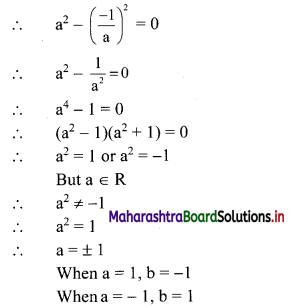
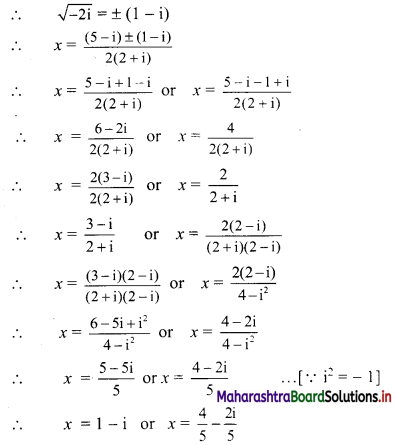
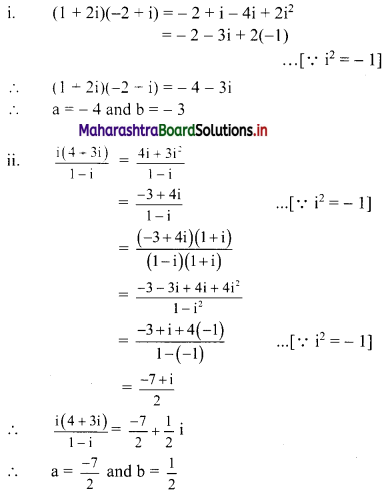
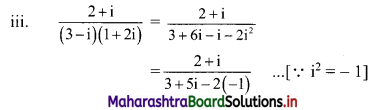
Maharashtra Board 12th Commerce Maths Solutions Chapter 8 Differential Equation and Applications Ex 8.5

Balbharati Maharashtra State Board Std 12 Commerce Statistics Part 1 Digest Pdf Chapter 8 Differential Equation and Applications Ex 8.5 Questions and Answers.

Maharashtra State Board 12th Commerce Maths Solutions Chapter 8 Differential Equation and Applications Ex 8.5

Solve the following differential equations.

Question 1.
\(\frac{d y}{d x}+y=e^{-x}\)
Solution:
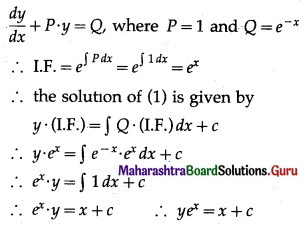
\(\frac{d y}{d x}+y=e^{-x}\) …….(1)
This is the linear differential equation of the form
Maharashtra Board 12th Commerce Maths Solutions Chapter 8 Differential Equation and Applications Ex 8.5 Q1
This is the general solution.

Question 2.
\(\frac{d y}{d x}\) + y = 3
Solution:
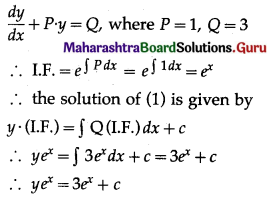
\(\frac{d y}{d x}\) + y = 3
This is the linear differential equation of the form
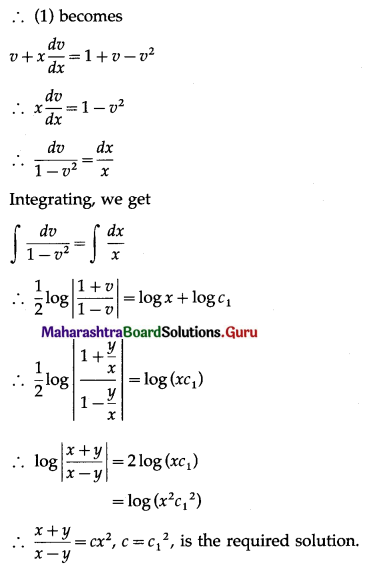
Maharashtra Board 12th Commerce Maths Solutions Chapter 8 Differential Equation and Applications Ex 8.5 Q2
This is the general solution.

Maharashtra Board 12th Commerce Maths Solutions Chapter 8 Differential Equation and Applications Ex 8.5

Question 3.
x\(\frac{d y}{d x}\) + 2y = x2 . log x.
Solution:
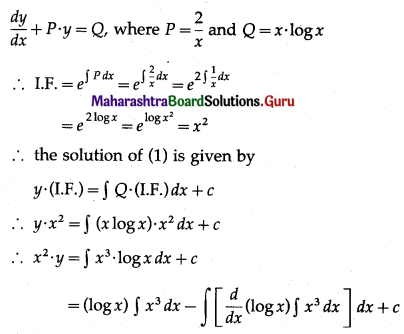
x\(\frac{d y}{d x}\) + 2y = x2 . log x
∴ \(\frac{d y}{d x}+\left(\frac{2}{x}\right) \cdot y=x \cdot \log x\) …….(1)
This is the linear differential equation of the form
Maharashtra Board 12th Commerce Maths Solutions Chapter 8 Differential Equation and Applications Ex 8.5 Q3
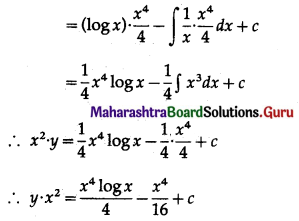
Maharashtra Board 12th Commerce Maths Solutions Chapter 8 Differential Equation and Applications Ex 8.5 Q3.1
This is the general solution.

Question 4.
(x + y)\(\frac{d y}{d x}\) = 1
Solution:
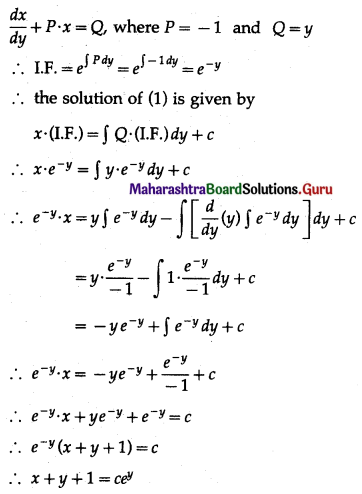
(x + y) \(\frac{d y}{d x}\) = 1
∴ \(\frac{d x}{d y}\) = x + y
∴ \(\frac{d x}{d y}\) – x = y
∴ \(\frac{d x}{d y}\) + (-1) x = y ……(1)
This is the linear differential equation of the form
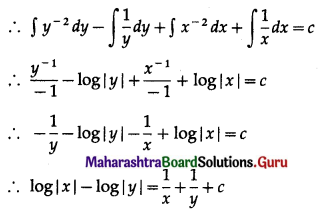
Maharashtra Board 12th Commerce Maths Solutions Chapter 8 Differential Equation and Applications Ex 8.5 Q4
This is the general solution.

Question 5.
y dx + (x – y2) dy = 0
Solution:
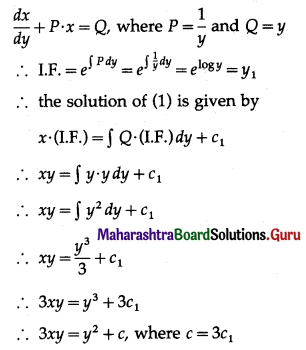
y dx + (x – y2) dy = 0
∴ y dx = -(x – y2) dy
∴ \(\frac{d x}{d y}=-\frac{\left(x-y^{2}\right)}{y}=-\frac{x}{y}+y\)
∴ \(\frac{d x}{d y}+\left(\frac{1}{y}\right) \cdot x=y\) ……(1)
This is the linear differential equation of the form
Maharashtra Board 12th Commerce Maths Solutions Chapter 8 Differential Equation and Applications Ex 8.5 Q5
This is the general solution.

Maharashtra Board 12th Commerce Maths Solutions Chapter 8 Differential Equation and Applications Ex 8.5

Question 6.
\(\frac{d y}{d x}\) + 2xy = x
Solution:
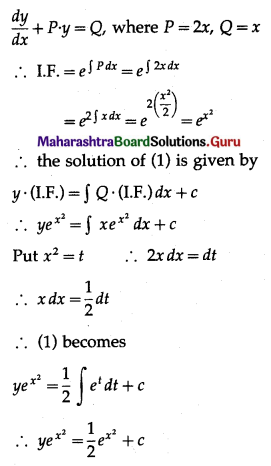
\(\frac{d y}{d x}\) + 2xy = x ………(1)
This is the linear differential equation of the form
Maharashtra Board 12th Commerce Maths Solutions Chapter 8 Differential Equation and Applications Ex 8.5 Q6
This is the general solution.

Question 7.
(x + a) \(\frac{d y}{d x}\) = -y + a
Solution:
(x + a) \(\frac{d y}{d x}\) + y = a
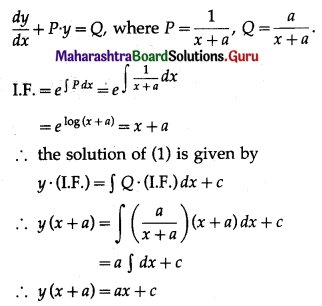
∴ \(\frac{d y}{d x}+\left(\frac{1}{x+a}\right) y=\frac{a}{x+a}\) ……..(1)
This is the linear differential equation of the form
Maharashtra Board 12th Commerce Maths Solutions Chapter 8 Differential Equation and Applications Ex 8.5 Q7
This is the general solution.

Maharashtra Board 12th Commerce Maths Solutions Chapter 8 Differential Equation and Applications Ex 8.5

Question 8.
dy + (2y) dx = 8 dx
Solution:
dy + (2y) dx = 8 dx
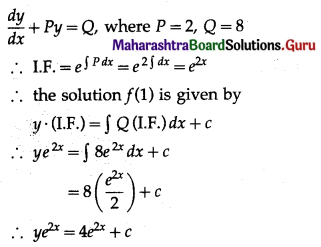
∴ \(\frac{d y}{d x}\) + 2y = 8 …….(1)
This is the linear differential equation of the form
Maharashtra Board 12th Commerce Maths Solutions Chapter 8 Differential Equation and Applications Ex 8.5 Q8
This is the general solution.

Maharashtra Board 12th Commerce Maths Solutions Chapter 8 Probability Distributions Miscellaneous Exercise 8

Balbharati Maharashtra State Board 12th Commerce Maths Solution Book Pdf Chapter 8 Probability Distributions Miscellaneous Exercise 8 Questions and Answers.

Maharashtra State Board 12th Commerce Maths Solutions Chapter 8 Probability Distributions Miscellaneous Exercise 8

(I) Choose the correct alternative.

Question 1.
F(x) is c.d.f. of discreter r.v. X whose p.m.f. is given by P(x) = \(k\left(\begin{array}{l}
4 \\
x
\end{array}\right)\), for x = 0, 1, 2, 3, 4 & P(x) = 0 otherwise then F(5) = __________
(a) \(\frac{1}{16}\)
(b) \(\frac{1}{8}\)
(c) \(\frac{1}{4}\)
(d) 1
Answer:
(d) 1

Question 2.
F(x) is c.d.f. of discrete r.v. X whose distribution is
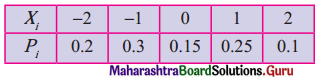
Maharashtra Board 12th Commerce Maths Solutions Chapter 8 Probability Distributions Miscellaneous Exercise 8 I Q2
then F(-3) = __________
(a) 0
(b) 1
(c) 0.2
(d) 0.15
Answer:
(a) 0

Maharashtra Board 12th Commerce Maths Solutions Chapter 8 Probability Distributions Miscellaneous Exercise 8

Question 3.
X : number obtained on uppermost face when a fair die is thrown then E(X) = __________
(a) 3.0
(b) 3.5
(c) 4.0
(d) 4.5
Answer:
(b) 3.5

Question 4.
If p.m.f. of r.v. X is given below.
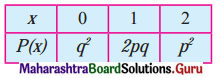
Maharashtra Board 12th Commerce Maths Solutions Chapter 8 Probability Distributions Miscellaneous Exercise 8 I Q4
then Var(X) = __________
(a) p2
(b) q2
(c) pq
(d) 2pq
Answer:
(d) 2pq

Question 5.
The expected value of the sum of two numbers obtained when two fair dice are rolled is __________
(a) 5
(b) 6
(c) 7
(d) 8
Answer:
(c) 7

Question 6.
Given p.d.f. of a continuous r.v. X as
f(x) = \(\frac{x^{2}}{3}\) for -1 < x < 2
= 0 otherwise then F(1) =
(a) \(\frac{1}{9}\)
(b) \(\frac{2}{9}\)
(c) \(\frac{3}{9}\)
(d) \(\frac{4}{9}\)
Answer:
(b) \(\frac{2}{9}\)

Question 7.
X is r.v. with p.d.f.
f(x) = \(\frac{k}{\sqrt{x}}\), 0 < x < 4
= 0 otherwise then E(X) = __________
(a) \(\frac{1}{3}\)
(b) \(\frac{4}{3}\)
(c) \(\frac{2}{3}\)
(d) 1
Answer:
(b) \(\frac{4}{3}\)

Question 8.
If X follows B(20, \(\frac{1}{10}\)) then E(X) = __________
(a) 2
(b) 5
(c) 4
(d) 3
Answer:
(a) 2

Question 9.
If E(X) = m and Var(X) = m then X follows __________
(a) Binomial distribution
(b) Possion distribution
(c) Normal distribution
(d) none of the above
Answer:
(b) Possion distribution

Maharashtra Board 12th Commerce Maths Solutions Chapter 8 Probability Distributions Miscellaneous Exercise 8

Question 10.
If E(X) > Var(X) then X follows __________
(a) Binomial distribution
(b) Possion distribution
(c) Normal distribution
(d) none of the above
Answer:
(a) Binomial distribution

(II) Fill in the blanks.

Question 1.
The values of discrete r.v. are generally obtained by __________
Answer:
counting

Question 2.
The values of continuous r.v. are generally obtained by __________
Answer:
measurement

Question 3.
If X is dicrete random variable takes the values x1, x2, x3, …… xn then \(\sum_{i=1}^{n} p\left(x_{i}\right)\) = __________
Answer:
1

Question 4.
If f(x) is distribution function of discrete r.v. X with p.m.f. p(x) = \(\frac{x-1}{3}\) for x = 1, 2, 3, and p(x) = 0 otherwise then F(4) = __________
Answer:
1

Question 5.
If f(x) is distribution function of discrete r.v. X with p.m.f. p(x) = \(k\left(\begin{array}{l}
4 \\
x
\end{array}\right)\) for x = 0, 1, 2, 3, 4, and p(x) = 0 otherwise then F(-1) = __________
Answer:
0

Maharashtra Board 12th Commerce Maths Solutions Chapter 8 Probability Distributions Miscellaneous Exercise 8

Question 6.
E(X) is considered to be __________ of the probability distribution of X.
Answer:
centre of gravity

Question 7.
If X is continuous r.v. and f(xi) = P(X ≤ xi) = \(\int_{-\infty}^{x_{i}} f(x) d x\) then f(x) is called __________
Answer:
Cumulative Distribution Function

Question 8.
In Binomial distribution probability of success ________ from trial to trial.
Answer:
remains constant/independent

Question 9.
In Binomial distribution, if n is very large and probability success of p is very small such that np = m (constant) then ________ distribution is applied.
Answer:
Possion

(III) State whether each of the following is True or False.

Question 1.
If P(X = x) = \(k\left(\begin{array}{l}
4 \\
x
\end{array}\right)\) for x = 0, 1, 2, 3, 4, then F(5) = \(\frac{1}{4}\) when f(x) is c.d.f.
Answer:
False

Question 2.
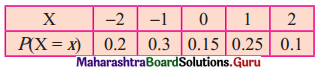
Maharashtra Board 12th Commerce Maths Solutions Chapter 8 Probability Distributions Miscellaneous Exercise 8 III Q2
If F(x) is c.d.f. of discrete r.v. X then F(-3) = 0.
Answer:
True

Question 3.
X is the number obtained on the uppermost face when a die is thrown the E(X) = 3.5.
Answer:
True

Maharashtra Board 12th Commerce Maths Solutions Chapter 8 Probability Distributions Miscellaneous Exercise 8

Question 4.
If p.m.f. of discrete r.v.X is
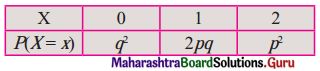
Maharashtra Board 12th Commerce Maths Solutions Chapter 8 Probability Distributions Miscellaneous Exercise 8 III Q4
then E(X) = 2p.
Answer:
True

Question 5.
The p.m.f. of a r.v. X is p(x) = \(\frac{2 x}{n(n+1)}\), x = 1, 2,……n
= 0 otherwise,
Then E(X) = \(\frac{2 n+1}{3}\)
Answer:
True

Question 6.
If f(x) = kx (1 – x) for 0 < x < 1
= 0 otherwise then k = 12
Answer:
False

Question 7.
If X ~ B(n, p) and n = 6 and P(X = 4) = P(X = 2) then p = \(\frac{1}{2}\).
Answer:
True

Question 8.
If r.v. X assumes values 1, 2, 3,………, n with equal probabilities then E(X) = \(\frac{(n+1)}{2}\)
Answer:
True

Question 9.
If r.v. X assumes the values 1, 2, 3,………, 9 with equal probabilities, E(X) = 5.
Answer:
True

(IV) Solve the following problems.

Part – I

Question 1.
Identify the random variable as discrete or continuous in each of the following. Identify its range if it is discrete.
(i) An economist is interested in knowing the number of unemployed graduates in the town with a population of 1 lakh.
Solution:
X = No. of unemployed graduates in a town.
∵ The population of the town is 1 lakh
∴ X takes finite values
∴ X is a Discrete Random Variable
∴ Range of = {0, 1, 2, 4, …. 1,00,000}

(ii) Amount of syrup prescribed by a physician.
Solution:
X : Amount of syrup prescribed.
∴ X Takes infinite values
∴ X is a Continuous Random Variable.

(iii) A person on a high protein diet is interested in the weight gained in a week.
Solution:
X : Gain in weight in a week.
X takes infinite values
∴ X is a Continuous Random Variable.

Maharashtra Board 12th Commerce Maths Solutions Chapter 8 Probability Distributions Miscellaneous Exercise 8

(iv) Twelve of 20 white rats available for an experiment are male. A scientist randomly selects 5 rats and counts the number of female rats among them.
Solution:
X : No. of female rats selected
X takes finite values.
∴ X is a Discrete Random Variable.
Range of X = {0, 1, 2, 3, 4, 5}

(v) A highway safety group is interested in the speed (km/hrs) of a car at a checkpoint.
Solution:
X : Speed of car in km/hr
X takes infinite values
∴ X is a Continuous Random Variable.

Question 2.
The probability distribution of a discrete r.v. X is as follows.
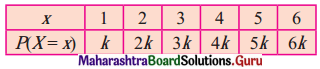
Maharashtra Board 12th Commerce Maths Solutions Chapter 8 Probability Distributions Miscellaneous Exercise 8 IV Part 1 Q2
(i) Determine the value of k.
(ii) Find P(X ≤ 4), P(2 < X < 4), P(X ≥ 3).
Solution:
(i) Assuming that the given distribution is a p.m.f. of X
∴ Each P(X = x) ≥ 0 for x = 1, 2, 3, 4, 5, 6
k ≥ 0
ΣP(X = x) = 1 and
k + 2k + 3k + 4k + 5k + 6k = 1
∴ 21k = 1 ∴ k = \(\frac{1}{21}\)

(ii) P(X ≤ 4) = 1 – P(X > 4)
= 1 – [P(X = 5) + P(X = 6)]
= 1 – [latex]\frac{5}{21}+\frac{6}{21}[/latex]
= 1 – \(\frac{11}{21}\)
= \(\frac{10}{21}\)
P(2 < X < 6) = p(3) + p(4) + p(5)
= 3k + 4k + 5k
= \(\frac{3}{21}+\frac{4}{21}+\frac{5}{21}\)
= \(\frac{12}{21}\)
= \(\frac{4}{7}\)

(iii) P(X ≥ 3) = p(3) + p(4) + p(5) + p(6)
= 3k + 4k + 5k + 6k
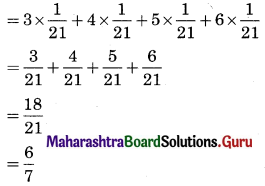
Maharashtra Board 12th Commerce Maths Solutions Chapter 8 Probability Distributions Miscellaneous Exercise 8 IV Part 1 Q2.1

Question 3.
Following is the probability distribution of an r.v. X.
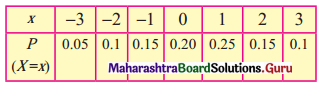
Maharashtra Board 12th Commerce Maths Solutions Chapter 8 Probability Distributions Miscellaneous Exercise 8 IV Part 1 Q3
Find the probability that
(i) X is positive.
(ii) X is non-negative.
(iii) X is odd.
(iv) X is even.
Solution:
(i) P(X is positive)
P(X = 0) = p(1) + p(2) + p(3)
= 0.25 + 0.15 + 0.10
= 0.50

(ii) P(X is non-negative)
P(X ≥ 0) = p(0) + p(1) + p(2) + p(3)
= 0.20 + 0.25 + 0.15 + 0.10
= 0.70

(iii) P(X is odd)
P(X = -3, -1, 1, 3)
= p(- 3) +p(-1) + p(1) + p(3)
= 0.05 + 0.15 + 0.25 + 0.10
= 0.55

(iv) P(X is even)
= 1 – P(X is odd)
= 1 – 0.55
= 0.45

Maharashtra Board 12th Commerce Maths Solutions Chapter 8 Probability Distributions Miscellaneous Exercise 8

Question 4.
The p.m.f of a r.v. X is given by
\(P(X=x)= \begin{cases}\left(\begin{array}{l}
5 \\
x
\end{array}\right) \frac{1}{2^{5}}, & x=0,1,2,3,4,5 . \\
0 & \text { otherwise }\end{cases}\)
Show that P(X ≤ 2) = P(X ≥ 3).
Solution:
For x = 0, 1, 2, 3, 4, 5
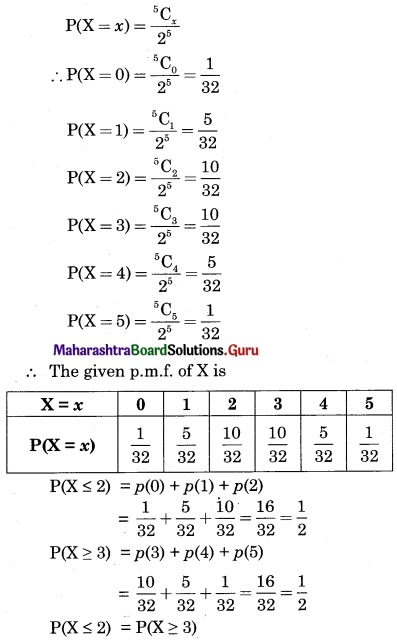
Maharashtra Board 12th Commerce Maths Solutions Chapter 8 Probability Distributions Miscellaneous Exercise 8 IV Part 1 Q4

Question 5.
In the following probability distribution of an r.v. X
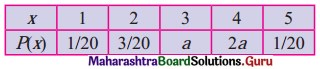
Maharashtra Board 12th Commerce Maths Solutions Chapter 8 Probability Distributions Miscellaneous Exercise 8 IV Part 1 Q5
Find a and obtain the c.d.f. of X.
Solution:
Given distribution is p.m.f. of r.v. X
ΣP(X = x) = 1
∴ p(1) + p(2) + p(3) + p(4) + p(5) = 1
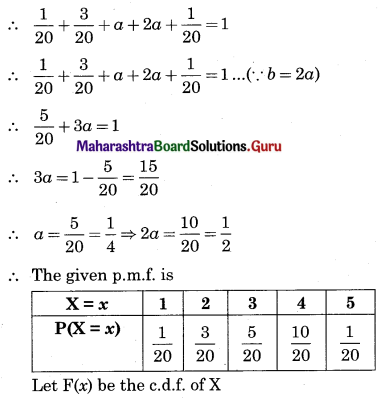
Maharashtra Board 12th Commerce Maths Solutions Chapter 8 Probability Distributions Miscellaneous Exercise 8 IV Part 1 Q5.1
Maharashtra Board 12th Commerce Maths Solutions Chapter 8 Probability Distributions Miscellaneous Exercise 8 IV Part 1 Q5.2

Question 6.
A fair coin is tossed 4 times. Let X denote the number of heads obtained. Identify the probability distribution of X and state the formula for p.m.f. of X.
Solution:
A fair coin is tossed 4 times
∴ Sample space contains 16 outcomes
Let X = Number of heads obtained
∴ X takes the values x = 0, 1, 2, 3, 4.
∴ The number of heads obtained in a toss is an even
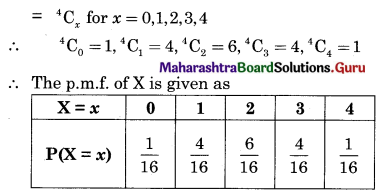
Maharashtra Board 12th Commerce Maths Solutions Chapter 8 Probability Distributions Miscellaneous Exercise 8 IV Part 1 Q6

Question 7.
Find the probability of the number of successes in two tosses of a die, where success is defined as (i) number greater than 4 (ii) six appearing in at least one toss.
Solution:
S : A die is tossed two times
S = {(1, 1), (1, 2), (1, 3), (1, 4), (1, 5), (1, 6), (2, 1), (2, 2), (2, 3), (2, 4), (2, 5), (2, 6), (3, 1), (3, 2), (3, 3), (3, 4), (3, 5), (3, 6), (4, 1), (4, 2), (4, 3), (4, 4), (4, 5), (4, 6), (5, 1), (5, 2), (5, 3), (5, 4), (5, 5), (5, 6), (6, 1), (6, 2), (6, 3), (6, 4), (6, 5), (6, 6)}
n(S) = 36
(i) X : No. is greater than 4
Range of X = {0, 1, 2}
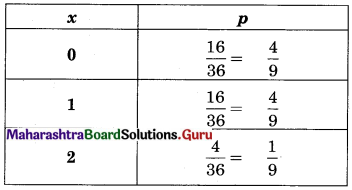
Maharashtra Board 12th Commerce Maths Solutions Chapter 8 Probability Distributions Miscellaneous Exercise 8 IV Part 1 Q7

(ii) X : Six appears on aleast one die.
Range of X = {0, 1, 2}
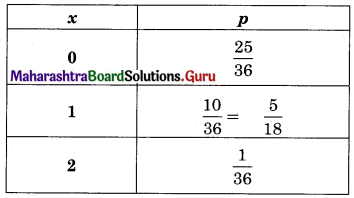
Maharashtra Board 12th Commerce Maths Solutions Chapter 8 Probability Distributions Miscellaneous Exercise 8 IV Part 1 Q7.1

Question 8.
A random variable X has the following probability distribution.
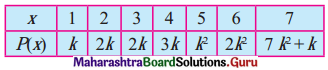
Maharashtra Board 12th Commerce Maths Solutions Chapter 8 Probability Distributions Miscellaneous Exercise 8 IV Part 1 Q8
Determine (i) k, (ii) P(X < 3), (iii) P(X > 6), (iv) P(0 < X < 3).
Solution:
(i) It is a p.m.f. of r.v. X
Σp(x) = 1
p(1) + p(2) + p(3) + p(4) + p(5) + p(6) + p(7) = 1
k + 2k + 2k + 3k + k2 + 2k2 + 7k2 + k = 1
9k + 10k2 = 1
10k2 + 9k – 1 = 0
10k2 +10k – k – 1 = 0
∴ 10k(k + 1) – 1(k + 1) = 0
∴ (10k – 1) (k + 1) = 0
∴ 10k – 1 = 0r k + 1 = 0
∴ k = \(\frac{1}{10}\) or k = -1
k = -1 is not accepted, p(x) ≥ 0, ∀ x ∈ R
∴ k = \(\frac{1}{10}\)

Maharashtra Board 12th Commerce Maths Solutions Chapter 8 Probability Distributions Miscellaneous Exercise 8

(ii) P(X < 3) = p(1) + p(2)
= k + 2k
= 3k
= 3 × \(\frac{1}{10}\)
= \(\frac{3}{10}\)

(iii) P(X > 6) = p(7)
= 7k2 + k
= \(7\left(\frac{1}{10}\right)^{2}+\frac{1}{10}\)
= \(\frac{7}{100}+\frac{1}{10}\)
= \(\frac{17}{100}\)

(iv) P(0 < X < 3) = p(1) + p(2)
= k + 2k
= 3k
= 3 × \(\frac{1}{10}\)
= \(\frac{3}{10}\)

Question 9.
The following is the c.d.f. of a r.v. X.

Maharashtra Board 12th Commerce Maths Solutions Chapter 8 Probability Distributions Miscellaneous Exercise 8 IV Part 1 Q9
Find the probability distribution of X and P(-1 ≤ X ≤ 2).
Solution:
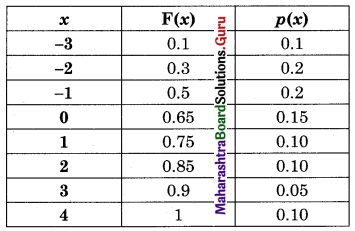
Maharashtra Board 12th Commerce Maths Solutions Chapter 8 Probability Distributions Miscellaneous Exercise 8 IV Part 1 Q9.1
P(-1 ≤ X ≤ 2) = p(-1) + p(0) + p(1) + p(2)
= 0.2 + 0.15 + 0.10 + 0.10
= 0.55

Question 10.
Find the expected value and variance of the r.v. X if its probability distribution is as follows.
(i)
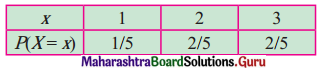
Maharashtra Board 12th Commerce Maths Solutions Chapter 8 Probability Distributions Miscellaneous Exercise 8 IV Part 1 Q10(i)
Solution:
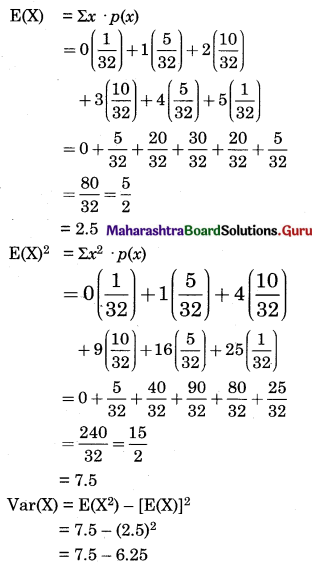
Maharashtra Board 12th Commerce Maths Solutions Chapter 8 Probability Distributions Miscellaneous Exercise 8 IV Part 1 Q10(i).1

(ii)
Maharashtra Board 12th Commerce Maths Solutions Chapter 8 Probability Distributions Miscellaneous Exercise 8 IV Part 1 Q10(ii)
Solution:
E(X) = Σx . p(x)
Maharashtra Board 12th Commerce Maths Solutions Chapter 8 Probability Distributions Miscellaneous Exercise 8 IV Part 1 Q10(ii).1

(iii)
Maharashtra Board 12th Commerce Maths Solutions Chapter 8 Probability Distributions Miscellaneous Exercise 8 IV Part 1 Q10(iii)
Solution:
Maharashtra Board 12th Commerce Maths Solutions Chapter 8 Probability Distributions Miscellaneous Exercise 8 IV Part 1 Q10(iii).1
Maharashtra Board 12th Commerce Maths Solutions Chapter 8 Probability Distributions Miscellaneous Exercise 8 IV Part 1 Q10(iii).2

(iv)
Maharashtra Board 12th Commerce Maths Solutions Chapter 8 Probability Distributions Miscellaneous Exercise 8 IV Part 1 Q10(iv)
Solution:
Maharashtra Board 12th Commerce Maths Solutions Chapter 8 Probability Distributions Miscellaneous Exercise 8 IV Part 1 Q10(iv).1
= 1.25
S.D. of X = σx = √Var(X)
= √1.25
= 1.118

Question 11.
A player tosses two coins. He wins ₹ 10 if 2 heads appear, ₹ 5 if 1 head appears, and ₹ 2 if no head appears. Find the expected value and variance of the winning amount.
Solution:
S : Two fair coin are tossed
S = {HH, HT, TT, TH}
n(S) = 4
∴ Range of X = {0, 1, 2}
∴ Let Y = amount received corresponds to values of X
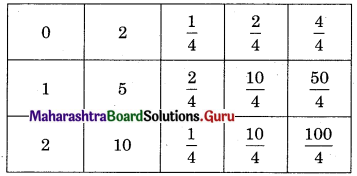
Maharashtra Board 12th Commerce Maths Solutions Chapter 8 Probability Distributions Miscellaneous Exercise 8 IV Part 1 Q11
Expected winning amount
E(Y) = Σpy = \(\frac{22}{4}\) = ₹ 5.5
V(Y) = Σpy2 – (Σpy)2
= \(\frac{154}{4}\) – (5.5)2
= 38.5 – 30.25
= ₹ 8.25

Maharashtra Board 12th Commerce Maths Solutions Chapter 8 Probability Distributions Miscellaneous Exercise 8

Question 12.
Let the p.m.f. of the r.v. X be
\(p(x)= \begin{cases}\frac{3-x}{10} & \text { for } x=-1,0,1,2 \\ 0 & \text { otherwise }\end{cases}\)
Calculate E(X) and Var(X).
Solution:
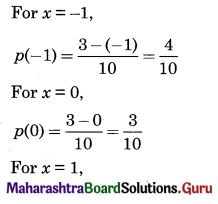
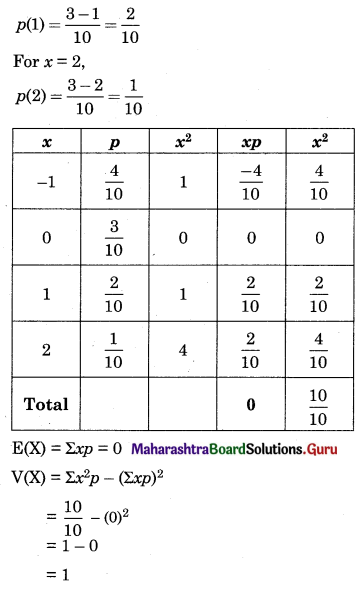
Maharashtra Board 12th Commerce Maths Solutions Chapter 8 Probability Distributions Miscellaneous Exercise 8 IV Part 1 Q12
Maharashtra Board 12th Commerce Maths Solutions Chapter 8 Probability Distributions Miscellaneous Exercise 8 IV Part 1 Q12.1

Question 13.
Suppose error involved in making a certain measurement is a continuous r.v. X with p.d.f.
\(f(x)= \begin{cases}k\left(4-x^{2}\right) & \text { for }-2 \leq x \leq 2 \\ 0 & \text { otherwise }\end{cases}\)
Compute (i) P(X > 0), (ii) P(-1 < X < 1), (iii) P(X < -0.5 or X > 0.5)
Solution:
We know that
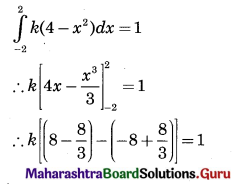
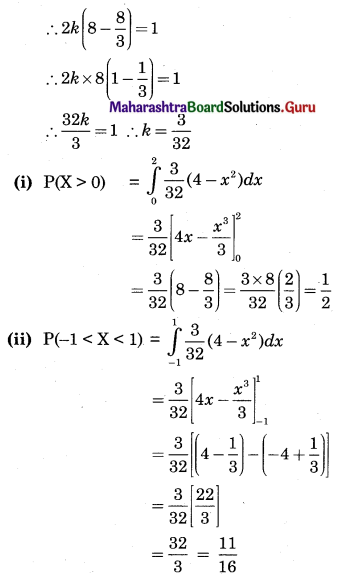
Maharashtra Board 12th Commerce Maths Solutions Chapter 8 Probability Distributions Miscellaneous Exercise 8 IV Part 1 Q13
Maharashtra Board 12th Commerce Maths Solutions Chapter 8 Probability Distributions Miscellaneous Exercise 8 IV Part 1 Q13.1
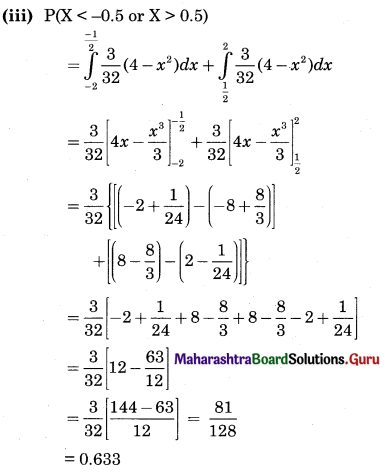
Maharashtra Board 12th Commerce Maths Solutions Chapter 8 Probability Distributions Miscellaneous Exercise 8 IV Part 1 Q13.2

Question 14.
The p.d.f. of the r.v. X is given by
\(f(x)= \begin{cases}\frac{1}{2 a} & \text { for } 0<x<2 a \\ 0 & \text { otherwise }\end{cases}\)
Show that P(X < \(\frac{a}{2}\)) = P(X > \(\frac{3a}{2}\))
Solution:
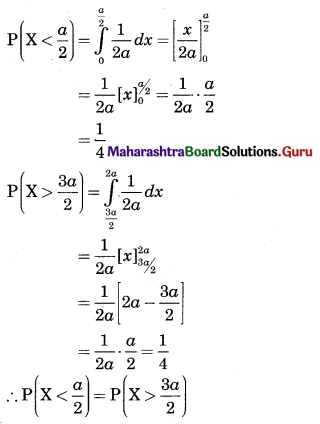
Maharashtra Board 12th Commerce Maths Solutions Chapter 8 Probability Distributions Miscellaneous Exercise 8 IV Part 1 Q14

Question 15.
Determine k if
\(f(x)= \begin{cases}k e^{-\theta x} & \text { for } 0 \leq x<\infty, \theta>0 \\ 0 & \text { otherwise }\end{cases}\)
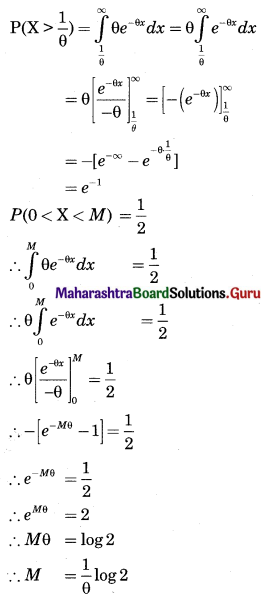
is the p.d.f. of the r.v. X. Also find P(X > \(\frac{1}{\theta}\)). Find M if P(0 < X < M) = \(\frac{1}{2}\)
Solution:
We know that
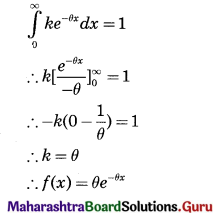
Maharashtra Board 12th Commerce Maths Solutions Chapter 8 Probability Distributions Miscellaneous Exercise 8 IV Part 1 Q15
Maharashtra Board 12th Commerce Maths Solutions Chapter 8 Probability Distributions Miscellaneous Exercise 8 IV Part 1 Q15.1

Question 16.
The p.d.f. of the r.v. X is given by
\(f_{x}(x)=\left\{\begin{array}{l}
\frac{k}{\sqrt{x}}, 0<x<4 \\
0, \text { otherwise }
\end{array}\right.\)
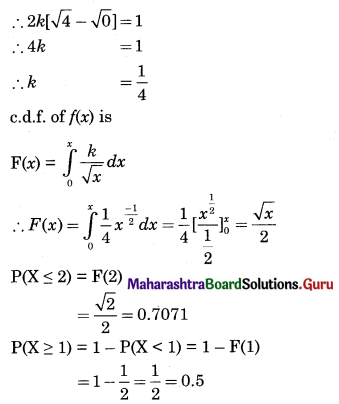
Determine k, c.d.f. of X and hence find P(X ≤ 2) and P(X ≥ 1).
Solution:
We know that
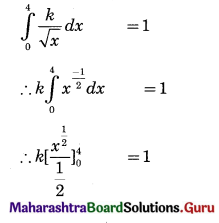
Maharashtra Board 12th Commerce Maths Solutions Chapter 8 Probability Distributions Miscellaneous Exercise 8 IV Part 1 Q16
Maharashtra Board 12th Commerce Maths Solutions Chapter 8 Probability Distributions Miscellaneous Exercise 8 IV Part 1 Q16.1

Question 17.
Let X denote the reaction temperature (in °C) of a certain chemical process. Let X be a continuous r.v. with p.d.f.
\(f(x)= \begin{cases}\frac{1}{10}, & -5 \leq x \leq 5 \\ 0, & \text { otherwise }\end{cases}\)
Compute P(X < 0).
Solution:
Given p.d.f. is f(x) = \(\frac{1}{10}\), for -5 ≤ x ≤ 5
Let its c.d.f. F(x) be given by
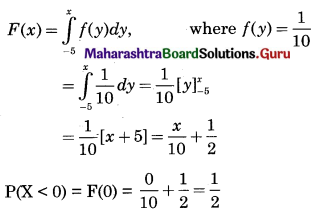
Maharashtra Board 12th Commerce Maths Solutions Chapter 8 Probability Distributions Miscellaneous Exercise 8 IV Part 1 Q17

Part – II

Question 1.
Let X ~ B(10, 0.2). Find (i) P(X = 1) (ii) P(X ≥ 1) (iii) P(X ≤ 8)
Solution:
X ~ B(10, 0.2)
n = 10, p = 0.2
∴ q = 1 – p = 1 – 0.2 = 0.8
(i) P(X = 1) = 10C1 (0.2)1 (0.8)9 = 0.2684

(ii) P(X ≥ 1) = 1 – P(X < 1)
= 1 – P(X = 0)
= 1 – 10C0 (0.2)0 (0.8)10
= 1 – 0.1074
= 0.8926

(iii) P(X ≤ 8) = 1 – P(x > 1)
= 1 – [p(9) + p(10)]
= 1 – [10C9 (0.2)9 (0.8)1 + 10C10 (0.2)10]
= 1 – 0.00000041984
= 0.9999

Maharashtra Board 12th Commerce Maths Solutions Chapter 8 Probability Distributions Miscellaneous Exercise 8

Question 2.
Let X ~ B(n, p) (i) If n = 10 and E(X) = 5, find p and Var(X), (ii) If E(X) = 5 and Var(X) = 2.5, find n and p.
Solution:
X ~ B(n, p)
(i) n = 10, E(X) = 5
∴ np = 5
∴ 10p = 5
∴ p = \(\frac{1}{2}\)
∴ q = 1 – p = 1 – \(\frac{1}{2}\) = \(\frac{1}{2}\)
V(X) = npq
= 10 × \(\frac{1}{2}\) × \(\frac{1}{2}\)
= 2.5

(ii) E(X) = 5, V(X) = 2.5
∴ np = 5, ∴ npq = 2.5
∴ 5q = 2.5
∴ q = \(\frac{2.5}{5}\) = 0.5, p = 1 – 0.5 = 0.5
But np = 5
∴ n(0.5) = 5
∴ n = 10

Question 3.
If a fair coin is tossed 4 times, find the probability that it shows (i) 3 heads, (ii) head in the first 2 tosses, and tail in the last 2 tosses.
Solution:
n : No. of times a coin is tossed
∴ n = 4
X : No. of heads
P : Probability of getting heads
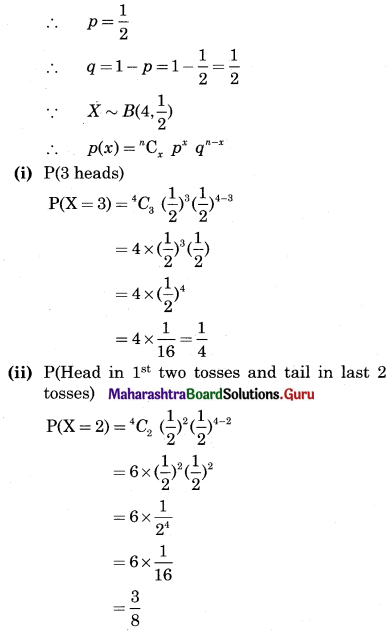
Maharashtra Board 12th Commerce Maths Solutions Chapter 8 Probability Distributions Miscellaneous Exercise 8 IV Part 2 Q3

Question 4.
The probability that a bomb will hit the target is 0.8. Find the probability that, out of 5 bombs, exactly 2 will miss the target.
Solution:
X : No. of bombs miss the target
p : Probability that bomb miss the target
∴ q = 0.8
∴ p = 1 – q = 1 – 0.8 = 0.2
n = No. of bombs = 5
∴ X ~ B(5, 0.2)
∴ p(x) = nCx px qn-x
P(X = 2) = 5C2 (0.2)2 (0.8)5-2
= 10 × 0.04 × (0.8)3
= 10 × 0.04 × 0.512
= 0.4 × 0.512
= 0.2048

Maharashtra Board 12th Commerce Maths Solutions Chapter 8 Probability Distributions Miscellaneous Exercise 8

Question 5.
The probability that a lamp in the classroom will burn is 0.3. 3 lamps are fitted in the classroom. The classroom is unusable if the number of lamps burning in it is less than 2. Find the probability that the classroom can not be used on a random occasion.
Solution:
X : No. of lamps not burning
p : Probability that the lamp is not burning
∴ q = 0.3
∴ p = 1 – q = 1 – 0.3 = 0.7
n = No. of lamps fitted = 3
∴ X ~ B(3, 0.7)
∴ p(x) = nCx px qn-x
P(classroom cannot be used)
P(X < 2) = p(0) + p(1)
= 3C0 (0.7)0 (0.3)3-0 + 3C1 (0.7)1 (0.3)3-1
= 1 × 1 × (0.3)3 + 3 × 0.7 × (0.3)2
= (0.3)2 [0.3 + 3 × 0.7]
= 0.09 [0.3 + 2.1]
= 0.09 [2.4]
= 0.216

Question 6.
A large chain retailer purchases an electric device from the manufacturer. The manufacturer indicates that the defective rate of the device is 10%. The inspector of the retailer randomly selects 4 items from a shipment. Find the probability that the inspector finds at most one defective item in the 4 selected items.
Solution:
X : No. of defective items
n : No. of items selected = 4
p : Probability of getting defective items
∴ p = 0.1
∴ q = 1 – p = 1 – 0.1 = 0.9
P(At most one defective item)
P(X ≤ 1) = p(0) + p(1)
= 4C0 (0.1)0 (0.9)4-0 + 4C1 (0.1)1 (0.9)4-1
= 1 × 1 × (0.9)4 + 4 × 0.1 × (0.9)3
= (0.9)3 [0.9 + 4 × 0.1]
= (0.9)3 × [0.9 + 0.4]
= 0.729 × 1.3
= 0.9477

Question 7.
The probability that a component will survive a check test is 0.6. Find the probability that exactly 2 of the next 4 components tested survive.
Solution:
p = 0.6, q = 1 – 0.6 = 0.4, n = 4
x = 2
∴ p(x) = nCx px qn-x
P(X = 2) = 4C2 (0.6)2 (0.4)2 = 0.3456

Maharashtra Board 12th Commerce Maths Solutions Chapter 8 Probability Distributions Miscellaneous Exercise 8

Question 8.
An examination consists of 5 multiple choice questions, in each of which the candidate has to decide which one of 4 suggested answers is correct. A completely unprepared student guesses each answer randomly. Find the probability that this student gets 4 or more correct answers.
Solution:
n : No. of multiple-choice questions
∴ n = 5
X : No. of correct answers
p : Probability of getting correct answer
∵ There are 4 options out of which one is correct
∴ p = \(\frac{1}{4}\)
∴ q = 1 – p = 1 – \(\frac{1}{4}\) = \(\frac{3}{4}\)
∵ X ~ B(5, \(\frac{1}{4}\))
∴ p(x) = nCx px qn-x
P(Four or more correct answers)
P(X ≥ 4) = p(4) + p(5)
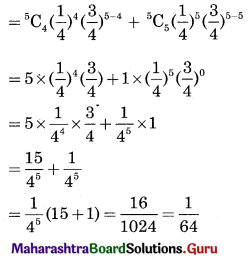
Maharashtra Board 12th Commerce Maths Solutions Chapter 8 Probability Distributions Miscellaneous Exercise 8 IV Part 2 Q8

Question 9.
The probability that a machine will produce all bolts in a production run with in the specification is 0.9. A sample of 3 machines is taken at random. Calculate the probability that all machines will produce all bolts in a production run within the specification.
Solution:
n : No. of samples selected
∴ n = 3
X : No. of bolts produce by machines
p : Probability of getting bolts
∴ p = 0.9
∴ q = 1 – p = 1 – 0.9 = 0.1
∴ X ~ B(3, 0.9)
∴ p(x) = nCx px qn-x
P(Machine will produce all bolts)
P(X = 3) = 3C3 (0.9)3 (0.1)3-3
= 1 × (0.9)3 × (0.1)0
= 1 × (0.9)3 × 1
= (0.9)3
= 0.729

Question 10.
A computer installation has 3 terminals. The probability that anyone terminal requires attention during a week is 0.1, independent of other terminals. Find the probabilities that (i) 0 (ii) 1 terminal requires attention during a week.
Solution:
n : No. of terminals
∴ n = 3
X : No. of terminals need attention
p : Probability of getting terminals need attention
∴ p = 0.1
∴ q = 1 – p = 1 – 0.1 = 0.9
∵ X ~ B(3, 0.1)
∴ p(x) = nCx px qn-x
(i) P(No attention)
∴ P(X = 0) = 3C0 × (0.1)0 (0.9)3-1
= 1 × 1 × (0.9)3
= 0.729

(ii) P(One terminal need attention)
∴ P(X = 1) = 3C1 (0.1)1 (0.9)3-1
= 3 × 0.1 × (0.9)2
= 0.3 × 0.81
= 0.243

Maharashtra Board 12th Commerce Maths Solutions Chapter 8 Probability Distributions Miscellaneous Exercise 8

Question 11.
In a large school, 80% of the students like mathematics. A visitor asks each of 4 students, selected at random, whether they like mathematics, (i) Calculate the probabilities of obtaining an answer yes from all of the selected students, (ii) Find the probability that the visitor obtains the answer yes from at least 3 students.
Solution:
X : No. of students like mathematics
p: Probability that students like mathematics
∴ p = 0.8
∴ q = 1 – p = 1 – 0.8 = 0.2
n : No. of students selected
∴ n = 4
∵ X ~ B(4, 0.8)
∴ p(x) = nCx px qn-x
(i) P(All students like mathematics)
∴ P(X = 4) = 4C4 (0.8)4 (0.2)4-4
= 1 × (0.8)4 × (0.2)0
= 1 × (0.8)4 × 1
= 0.4096

(ii) P(Atleast 3 students like mathematics)
∴ P(X ≥ 3) = p(3) + p(4)
= 4C3 (0.8)3 (0.2)4-3 + 0.4096
= 4 × (0.8)3 (0.2)1 + 0.4096
= 0.8 × (0.8)3 + 0.4096
= (0.8)4 × 0.4096
= 0.4096 + 0.4096
= 0.8192

Question 12.
It is observed that it rains on 10 days out of 30 days. Find the probability that
(i) it rains on exactly 3 days of a week.
(ii) it rains at most 2 days a week.
Solution:
X : No. of days it rains in a week
p : Probability that it rains
∴ p = \(\frac{10}{30}=\frac{1}{3}\)
∴ q = 1 – p = 1 – \(\frac{1}{3}\) = \(\frac{2}{3}\)
n : No. of days in a week
∴ n = 7
∴ X ~ B(7, \(\frac{1}{3}\))
(i) P(Rains on Exactly 3 days of a week)
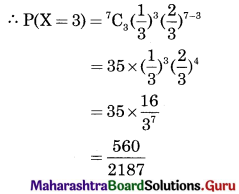
Maharashtra Board 12th Commerce Maths Solutions Chapter 8 Probability Distributions Miscellaneous Exercise 8 IV Part 2 Q12

(ii) P(Rains on at most 2 days of a week)
∴ P(X ≤ 2) = p(0) + p(1) + p(2)
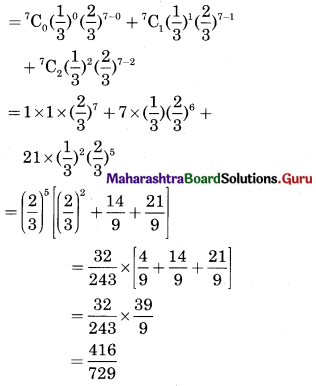
Maharashtra Board 12th Commerce Maths Solutions Chapter 8 Probability Distributions Miscellaneous Exercise 8 IV Part 2 Q12.1

Question 13.
If X follows Poisson distribution such that P(X = 1) = 0.4 and P(X = 2) = 0.2, find variance of X.
Solution:
X : Follows Possion Distribution
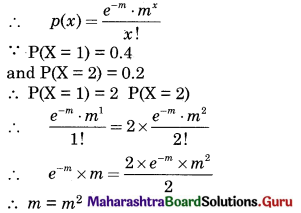
Maharashtra Board 12th Commerce Maths Solutions Chapter 8 Probability Distributions Miscellaneous Exercise 8 IV Part 2 Q13
∴ m = 1
∴ Mean = m = Variance of X = 1

Maharashtra Board 12th Commerce Maths Solutions Chapter 8 Probability Distributions Miscellaneous Exercise 8

Question 14.
If X has Poisson distribution with parameter m, such that
\(\frac{P(X=x+1)}{P(X=x)}=\frac{m}{x+1}\)
find probabilities P(X = 1) and P(X = 2), when X follows Poisson distribution with m = 2 and P(X = 0) = 0.1353.
Solution:
Given that the random variable X follows the Poisson distribution with parameter m = 2
i.e. X ~ P(2)
Its p.m.f. is satisfying the given equation.
\(\frac{P(X=x+1)}{P(X=x)}=\frac{m}{x+1}\)
When x = 0,
\(\frac{\mathrm{P}(\mathrm{X}=1)}{\mathrm{P}(\mathrm{X}=0)}=\frac{2}{0+1}\)
P(X = 1) = 2P(X = 0)
= 2(0.1353)
= 0.2706
When x = 1,
\(\frac{\mathrm{P}(\mathrm{X}=2)}{\mathrm{P}(\mathrm{X}=1)}=\frac{2}{1+1}\)
P(X = 2) = P(X = 1) = 0.2706

Maharashtra Board 12th Commerce Maths Solutions Chapter 8 Differential Equation and Applications Ex 8.4

Balbharati Maharashtra State Board Std 12 Commerce Statistics Part 1 Digest Pdf Chapter 8 Differential Equation and Applications Ex 8.4 Questions and Answers.

Maharashtra State Board 12th Commerce Maths Solutions Chapter 8 Differential Equation and Applications Ex 8.4

Solve the following differential equations:

Question 1.
x dx + 2y dy = 0
Solution:
x dx + 2y dy = 0
Integrating, we get
∫x dx + 2 ∫y dy = c1
∴ \(\frac{x^{2}}{2}+2\left(\frac{y^{2}}{2}\right)=c_{1}\)
∴ x2 + 2y2 = c, where c = 2c1
This is the general solution.

Maharashtra Board 12th Commerce Maths Solutions Chapter 8 Differential Equation and Applications Ex 8.4

Question 2.
y2 dx + (xy + x2) dy = 0
Solution:
y2 dx + (xy + x2) dy = 0
∴ (xy + x2) dy = -y2 dx
∴ \(\frac{d y}{d x}=\frac{-y^{2}}{x y+x^{2}}\) ………(1)
Put y = vx
∴ \(\frac{d y}{d x}=v+x \frac{d v}{d x}\)
Substituting these values in (1), we get
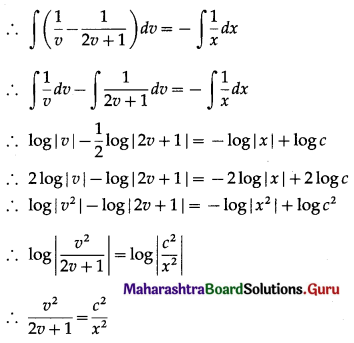
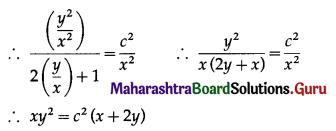
Maharashtra Board 12th Commerce Maths Solutions Chapter 8 Differential Equation and Applications Ex 8.4 Q2
Maharashtra Board 12th Commerce Maths Solutions Chapter 8 Differential Equation and Applications Ex 8.4 Q2.1
Maharashtra Board 12th Commerce Maths Solutions Chapter 8 Differential Equation and Applications Ex 8.4 Q2.2
This is the general solution.

Question 3.
x2y dx – (x3 + y3) dy = 0
Solution:
x2y dx – (x3 + y3) dy = 0
∴ (x3 + y3) dy = x2y dx
∴ \(\frac{d y}{d x}=\frac{x^{2} y}{x^{3}+y^{3}}\) ……(1)
Put y = vx
∴ \(\frac{d y}{d x}=v+x \frac{d v}{d x}\)
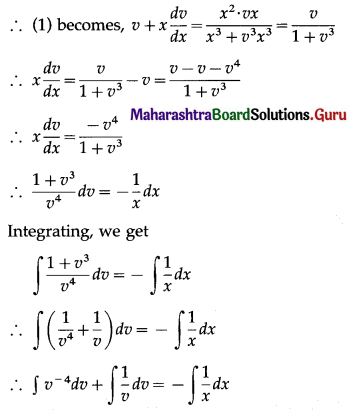
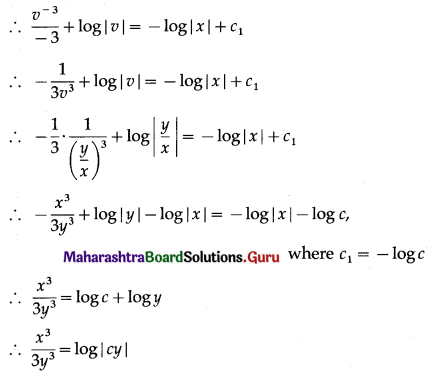
Maharashtra Board 12th Commerce Maths Solutions Chapter 8 Differential Equation and Applications Ex 8.4 Q3
Maharashtra Board 12th Commerce Maths Solutions Chapter 8 Differential Equation and Applications Ex 8.4 Q3.1
This is the general solution.

Maharashtra Board 12th Commerce Maths Solutions Chapter 8 Differential Equation and Applications Ex 8.4

Question 4.
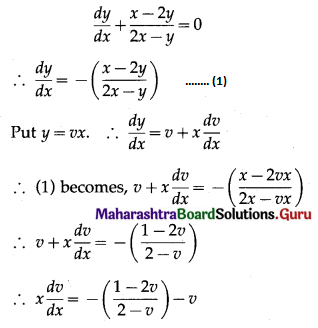
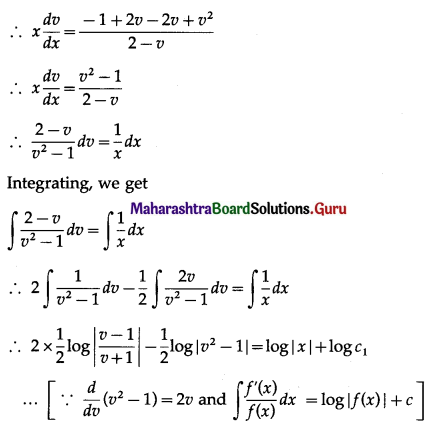
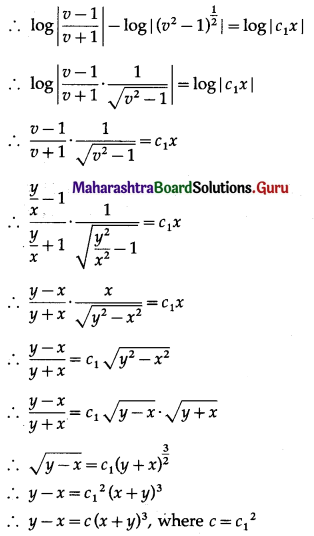
\(\frac{d y}{d x}+\frac{x-2 y}{2 x-y}=0\)
Solution:
Maharashtra Board 12th Commerce Maths Solutions Chapter 8 Differential Equation and Applications Ex 8.4 Q4
Maharashtra Board 12th Commerce Maths Solutions Chapter 8 Differential Equation and Applications Ex 8.4 Q4.1
Maharashtra Board 12th Commerce Maths Solutions Chapter 8 Differential Equation and Applications Ex 8.4 Q4.2
This is the general solution.

Question 5.
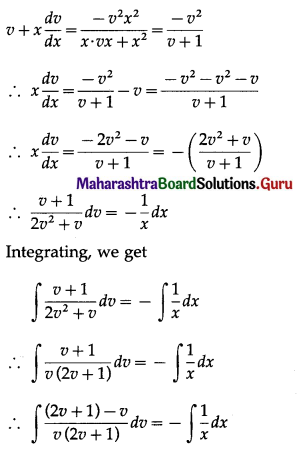
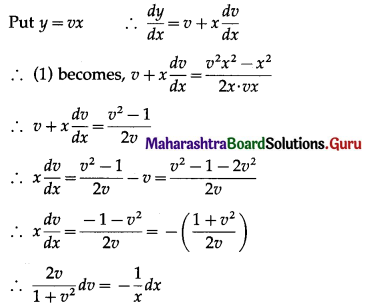
(x2 – y2) dx + 2xy dy = 0
Solution:
(x2 – y2) dx + 2xy dy = 0
∴ 2xy dy = -(x2 – y2) dx = (y2 – x2) dx
∴ \(\frac{d y}{d x}=\frac{y^{2}-x^{2}}{2 x y}\) ………(1)
Maharashtra Board 12th Commerce Maths Solutions Chapter 8 Differential Equation and Applications Ex 8.4 Q5
Maharashtra Board 12th Commerce Maths Solutions Chapter 8 Differential Equation and Applications Ex 8.4 Q5.1

Question 6.
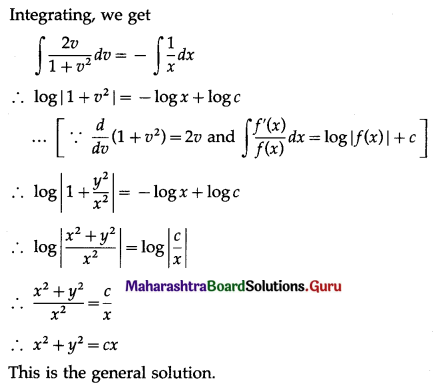
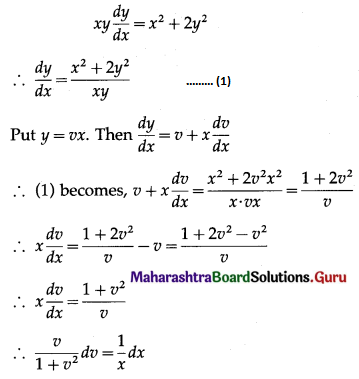
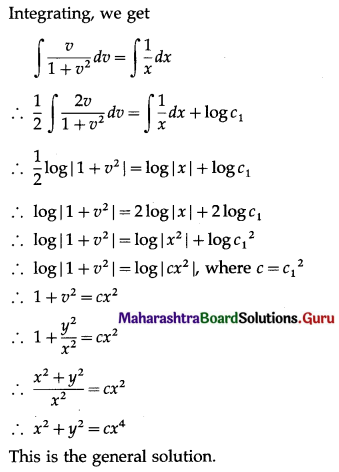
xy\(\frac{d y}{d x}\) = x2 + 2y2
Solution:
Maharashtra Board 12th Commerce Maths Solutions Chapter 8 Differential Equation and Applications Ex 8.4 Q6
Maharashtra Board 12th Commerce Maths Solutions Chapter 8 Differential Equation and Applications Ex 8.4 Q6.1

Maharashtra Board 12th Commerce Maths Solutions Chapter 8 Differential Equation and Applications Ex 8.4

Question 7.
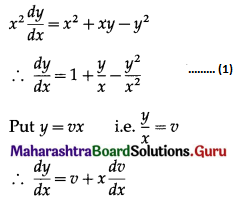
x2\(\frac{d y}{d x}\) = x2 + xy – y2
Solution:
Maharashtra Board 12th Commerce Maths Solutions Chapter 8 Differential Equation and Applications Ex 8.4 Q7
Maharashtra Board 12th Commerce Maths Solutions Chapter 8 Differential Equation and Applications Ex 8.4 Q7.1

Maharashtra Board 12th Commerce Maths Solutions Chapter 4 Time Series Ex 4.1

Balbharati Maharashtra State Board 12th Commerce Maths Digest Pdf Chapter 4 Time Series Ex 4.1 Questions and Answers.

Maharashtra State Board 12th Commerce Maths Solutions Chapter 4 Time Series Ex 4.1

Question 1.
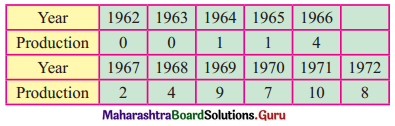
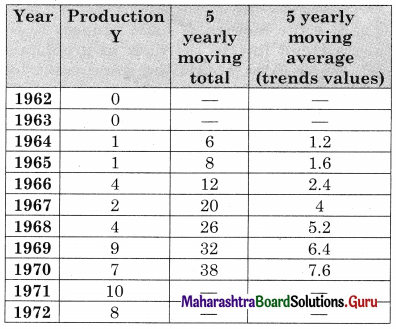
The following data gives the production of bleaching powder (in ‘000 tonnes) for the years 1962 to 1972.
Maharashtra Board 12th Commerce Maths Solutions Chapter 4 Time Series Ex 4.1 Q1
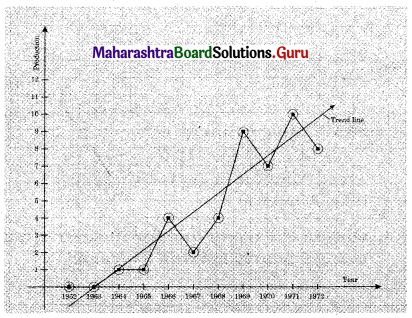
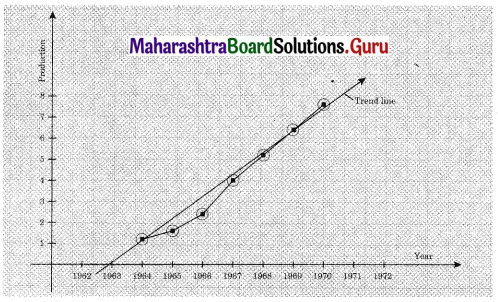
Fit a trend line by graphical method to the above data.
Solution:
Maharashtra Board 12th Commerce Maths Solutions Chapter 4 Time Series Ex 4.1 Q1.1

Question 2.
Use the method of least squares to fit a trend line to the data in problem 1 above. Also, obtain the trend value for the year 1975.
Solution:
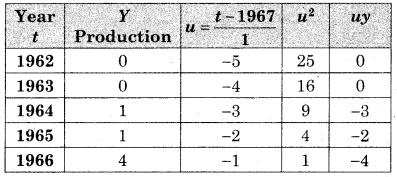
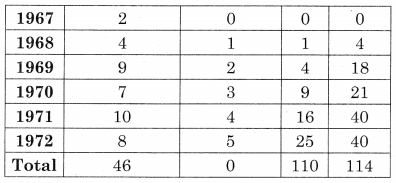
Maharashtra Board 12th Commerce Maths Solutions Chapter 4 Time Series Ex 4.1 Q2
Maharashtra Board 12th Commerce Maths Solutions Chapter 4 Time Series Ex 4.1 Q2.1
n = 11, let the trend line the
y = a + bu ……..(I)
Σy = na + bΣu ……..(i)
Σuy = aΣu + bΣu2 ………(ii)
Substituting the values of Σy, Σu, Σuy, & Σu2, we get
46 = 11a + 0
∴ a = 4.18 And
114 = 0 + b(110)
∴ b = 1.04
By (I) the equation of the trends line is
y = 4.18 + 1.04u
Where u = t – 1967 ……..(iii)
For the year 1975 we have u = 8
Substituting in (iii) we get
Y= 4.18 + 1.04(8) = 12.5
Trend value for the year 1975 is 12.5 (in ‘000 tonnes).

Maharashtra Board 12th Commerce Maths Solutions Chapter 4 Time Series Ex 4.1

Question 3.
Obtain the trend line for the above data using 5 yearly moving averages.
Solution:
Maharashtra Board 12th Commerce Maths Solutions Chapter 4 Time Series Ex 4.1 Q3
Maharashtra Board 12th Commerce Maths Solutions Chapter 4 Time Series Ex 4.1 Q3.1

Question 4.
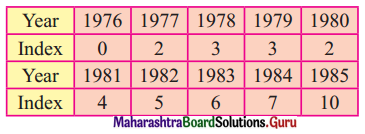
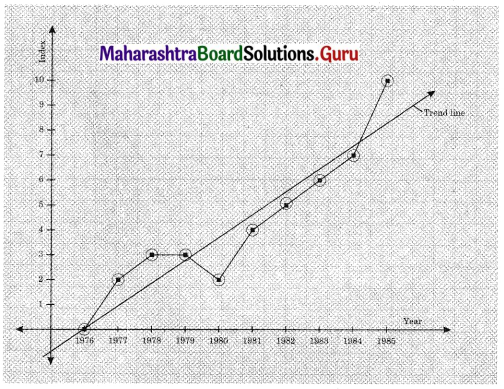
The following table shows the index of industrial production for the period from 1976 to 1985, using the year 1976 as the base year.
Maharashtra Board 12th Commerce Maths Solutions Chapter 4 Time Series Ex 4.1 Q4
Fit a trend line to the above data by graphical method.
Solution:
Maharashtra Board 12th Commerce Maths Solutions Chapter 4 Time Series Ex 4.1 Q4.1

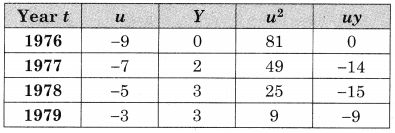
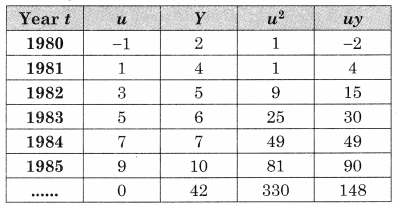
Question 5.
Fit a trend line to the data in problem 4 above by the method of least squares. Also, obtain the trend value for the index of industrial production for the year 1987.
Solution:
Maharashtra Board 12th Commerce Maths Solutions Chapter 4 Time Series Ex 4.1 Q5
Maharashtra Board 12th Commerce Maths Solutions Chapter 4 Time Series Ex 4.1 Q5.1
u = \(\frac{t-1980.5}{\frac{1}{2}}\), n = 10, Σu = 0, Σy = 42, Σu2 = 330, Σuy = 148
Let the trend line be y = a + bu ……(i)
where u = \(\frac{t-1980.5}{\frac{1}{2}}\)
i.e. u = 2t – 3961
Σy = na + bΣu ……(ii)
Σuy = aΣu + bΣu2 ……….(iii)
Substituting the values of Σy, n, Σu, Σuy & Σu2 We get
42 = 10a + 0
∴ a = 4.2 and
148 = 0 + 5.330
∴ b = 0.4485
∴ by (i) the equation of the trends line is
Y = 4.2 + 0.4485u ………(iv)
where u = 2t – 3961
For the year 1987,
u = 13 by (iv) we have
Y = 4.2 + 0.4485(13) = 10.0305
∴ The trend value for the year 1987 is 10.0305

Maharashtra Board 12th Commerce Maths Solutions Chapter 4 Time Series Ex 4.1

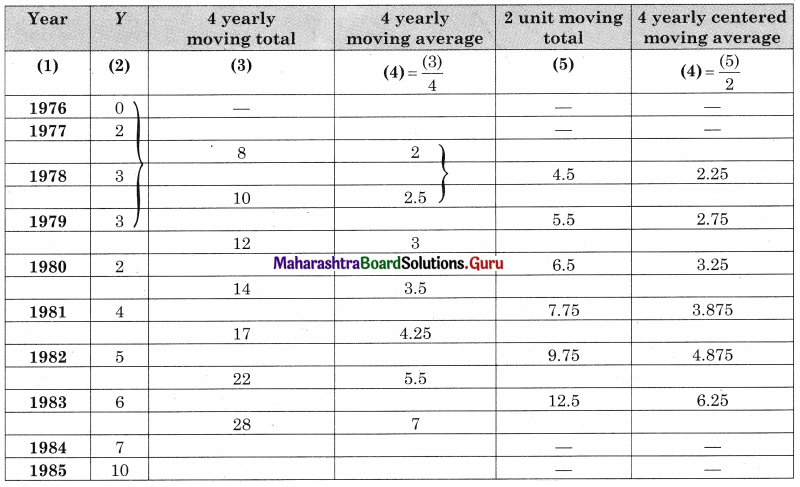
Question 6.
Obtain the trend values for the data in problem 4 using 4-yearly centered moving averages.
Solution:
Maharashtra Board 12th Commerce Maths Solutions Chapter 4 Time Series Ex 4.1 Q6

Question 7.
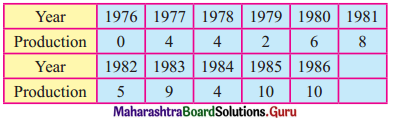
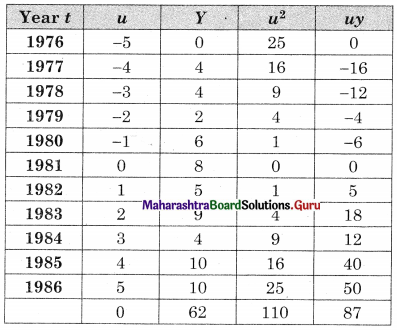
The following table gives the production of steel (in millions of tonnes) for the years 1976 to 1986.
Maharashtra Board 12th Commerce Maths Solutions Chapter 4 Time Series Ex 4.1 Q7
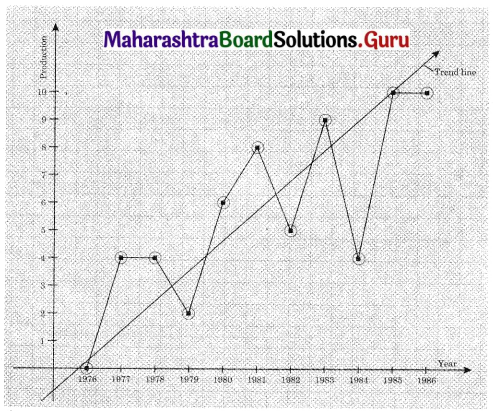
Fit a trend line to the above data by the graphical method.
Solution:
Maharashtra Board 12th Commerce Maths Solutions Chapter 4 Time Series Ex 4.1 Q7.1

Question 8.
Fit a trend line to the data in Problem 7 by the method of least squares. Also, obtain the trend value for the year 1990.
Solution:
Maharashtra Board 12th Commerce Maths Solutions Chapter 4 Time Series Ex 4.1 Q8
u = \(\frac{t-1981}{1}\), n = 10, Σu = 0, ΣY = 62, Σu2 = 110, Σuy = 87
Let the equation of the trend line be
Y = a + bu
where u = t – 1981 ……(i)
ΣY = na + bΣu ………(ii)
Σuy = aΣu + bΣu2 ………(iii)
Substituting the values of Σy, n, Σu, Σuy, Σu2 in (ii) & (iii)
62 = 11a + 0
∴ a = 5.6364 And
87 = 0 + 5(110)
∴ b = 0.7909
∴ by (i) equation of the trend line is y = 5.6364 + 0.7909u
Where u = t – 1981
For the year 1990,
u = 9
∴ y = 5.6364 + 0.7909(9)
∴ y = 12.7545 (in million tonnes)

Maharashtra Board 12th Commerce Maths Solutions Chapter 4 Time Series Ex 4.1

Question 9.
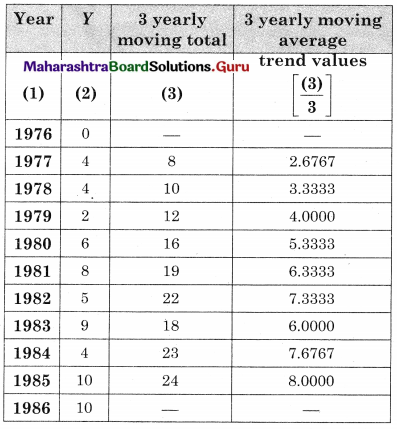
Obtain the trend values for the above data using 3-yearly moving averages.
Solution:
Maharashtra Board 12th Commerce Maths Solutions Chapter 4 Time Series Ex 4.1 Q9

Question 10.
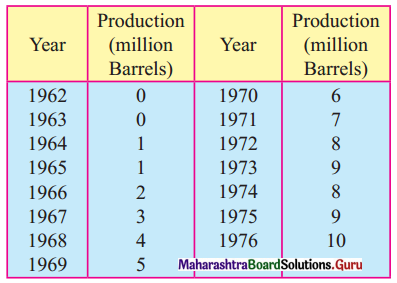
The following table shows the production of gasoline in the U.S.A. for the years 1962 to 1976.
Maharashtra Board 12th Commerce Maths Solutions Chapter 4 Time Series Ex 4.1 Q10
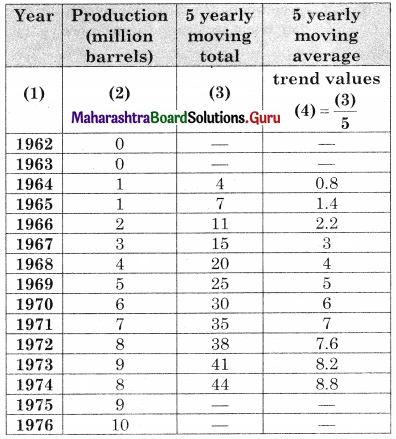
(i) Obtain trend values for the above data using 5-yearly moving averages.
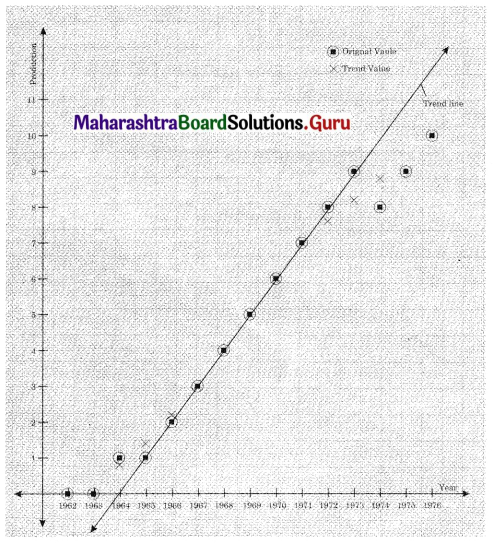
(ii) Plot the original time series and trend values obtained above on the same graph.
Solution:
(i)
Maharashtra Board 12th Commerce Maths Solutions Chapter 4 Time Series Ex 4.1 Q10.1
(ii)
Maharashtra Board 12th Commerce Maths Solutions Chapter 4 Time Series Ex 4.1 Q10.2

Maharashtra Board 12th Commerce Maths Solutions Chapter 8 Differential Equation and Applications Ex 8.3

Balbharati Maharashtra State Board Std 12 Commerce Statistics Part 1 Digest Pdf Chapter 8 Differential Equation and Applications Ex 8.3 Questions and Answers.

Maharashtra State Board 12th Commerce Maths Solutions Chapter 8 Differential Equation and Applications Ex 8.3

Question 1.
Solve the following differential equations:
(i) \(\frac{d y}{d x}\) = x2y + y
Solution:
\(\frac{d y}{d x}\) = x2y + y
∴ \(\frac{d y}{d x}\) = y(x2 + 1)
∴ \(\frac{1}{y}\) dy = (x2 + 1) dx
Integrating, we get
∫\(\frac{1}{y}\) dy = ∫(x2 + 1) dx
∴ log |y|= \(\frac{x^{3}}{3}\) + x + c
This is the general solution.

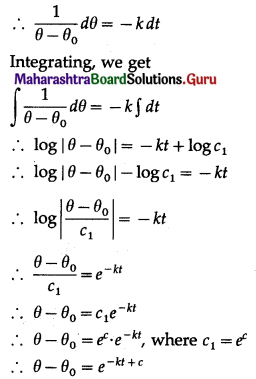
(ii) \(\frac{d \theta}{d t}=-k\left(\theta-\theta_{0}\right)\)
Solution:
\(\frac{d \theta}{d t}=-k\left(\theta-\theta_{0}\right)\)
Maharashtra Board 12th Commerce Maths Solutions Chapter 8 Differential Equation and Applications Ex 8.3 Q1(ii)
This is the general solution.

Maharashtra Board 12th Commerce Maths Solutions Chapter 8 Differential Equation and Applications Ex 8.3

(iii) (x2 – yx2) dy + (y2 + xy2) dx = 0
Solution:
(x2 – yx2) dy + (y2 + xy2) dx = 0
∴ x2(1 – y) dy + y2(1 + x) dx = 0
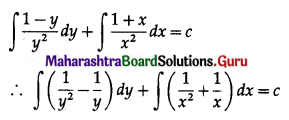
∴ \(\frac{1-y}{y^{2}} d y+\frac{1+x}{x^{2}} d x=0\)
Integrating, we get
Maharashtra Board 12th Commerce Maths Solutions Chapter 8 Differential Equation and Applications Ex 8.3 Q1(iii)
Maharashtra Board 12th Commerce Maths Solutions Chapter 8 Differential Equation and Applications Ex 8.3 Q1(iii).1
This is the general solution.

(iv) \(y^{3}-\frac{d y}{d x}=x \frac{d y}{d x}\)
Solution:
\(y^{3}-\frac{d y}{d x}=x \frac{d y}{d x}\)
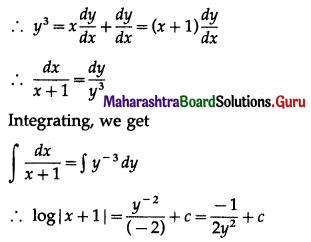
Maharashtra Board 12th Commerce Maths Solutions Chapter 8 Differential Equation and Applications Ex 8.3 Q1(iv)
∴ 2y2 log |x + 1| = 2cy2 – 1 is the required solution.

Maharashtra Board 12th Commerce Maths Solutions Chapter 8 Differential Equation and Applications Ex 8.3

Question 2.
For each of the following differential equations find the particular solution:
(i) (x – y2x) dx – (y + x2y) dy = 0, when x = 2, y = 0.
Solution:
(x – y2x) dx – (y + x2y) dy = 0
∴ x(1 – y2) dx – y(1 + x2) dy = 0
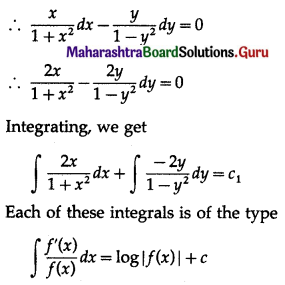
Maharashtra Board 12th Commerce Maths Solutions Chapter 8 Differential Equation and Applications Ex 8.3 Q2(i)
∴ the general solution is
log |1 + x2| + log |1 – y2| = log c, where c1 = log c
∴ log |(1 + x2)(1 – y2) | = log c
∴ (1 + x2)(1 – y2) = c
When x = 2, y = 0, we have
(1 + 4)(1 – 0) = c
∴ c = 5
∴ the particular solution is (1 + x2)(1 – y2) = 5.

(ii) (x + 1) \(\frac{d y}{d x}\) -1 = 2e-y, when y = 0, x = 1.
Solution:
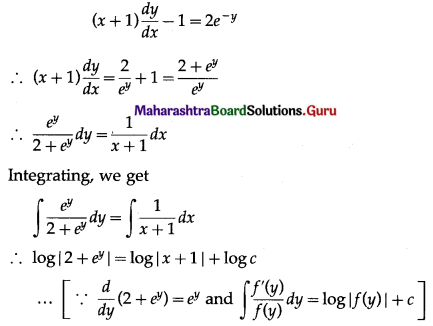
Maharashtra Board 12th Commerce Maths Solutions Chapter 8 Differential Equation and Applications Ex 8.3 Q2(ii)
∴ log |2 + ey| = log |c(x + 1)|
∴ 2 + ey = c(x + 1)
This is the general solution.
Now, y = 0, when x = 1
∴ 2 + e0 = c(1 + 1)
∴ 3 = 2c
∴ c = \(\frac{3}{2}\)
∴ the particular solution is
2 + ey = \(\frac{3}{2}\)(x + 1)
∴ 4 + 2ey = 3x + 3
∴ 3x – 2ey – 1 = 0

Maharashtra Board 12th Commerce Maths Solutions Chapter 8 Differential Equation and Applications Ex 8.3

(iii) y(1 + log x) \(\frac{d x}{d y}\) – x log x = 0, when x = e, y = e2.
Solution:
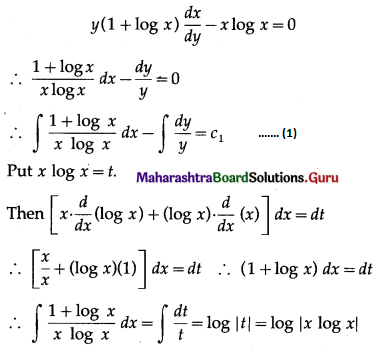
Maharashtra Board 12th Commerce Maths Solutions Chapter 8 Differential Equation and Applications Ex 8.3 Q2(iii)
∴ from (1), the general solution is
log |x log x| – log |y| = log c, where c1 = log c
∴ log |\(\frac{x \log x}{y}\)| = log c
∴ \(\frac{x \log x}{y}\) = c
∴ x log x = cy
This is the general solution.
Now, y = e2, when x = e
e log e = ce2
1 = ce ……[∵ log e = 1]
c = \(\frac{1}{e}\)
∴ the particular solution is x log x = (\(\frac{1}{e}\)) y
∴ y = ex log x

(iv) \(\frac{d y}{d x}\) = 4x + y + 1, when y = 1, x = 0.
Solution:
\(\frac{d y}{d x}\) = 4x + y + 1
Put 4x + y + 1 = v
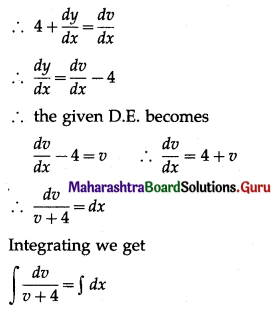
Maharashtra Board 12th Commerce Maths Solutions Chapter 8 Differential Equation and Applications Ex 8.3 Q2(iv)
∴ log |v + 4| = x + c
∴ log |4x + y + 1 + 4| = x + c
i.e. log |4x + y + 5| = x + c
This is the general solution.
Now, y = 1 when x = 0
∴ log|0 + 1 + 5| = 0 + c,
i.e. c = log 6
∴ the particular solution is
log |4x + y + 5| = x + log 6
∴ \(\log \left|\frac{4 x+y+5}{6}\right|\) = x

Maharashtra Board 12th Commerce Maths Solutions Chapter 5 Index Numbers Ex 5.3

Balbharati Maharashtra State Board 12th Commerce Maths Solution Book Pdf Chapter 5 Index Numbers Ex 5.3 Questions and Answers.

Maharashtra State Board 12th Commerce Maths Solutions Chapter 5 Index Numbers Ex 5.3

Calculate the cost of living index in problems 1 to 3.

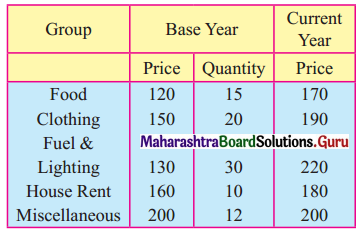
Question 1.
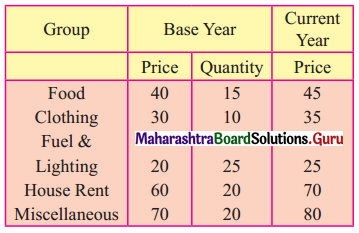
Maharashtra Board 12th Commerce Maths Solutions Chapter 5 Index Numbers Ex 5.3 Q1
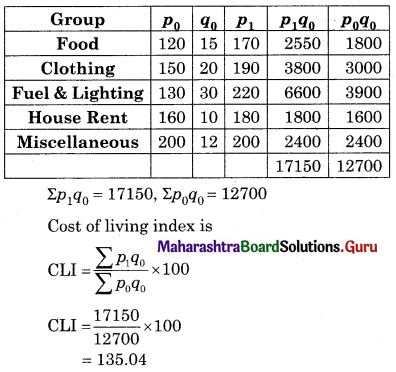
Solution:
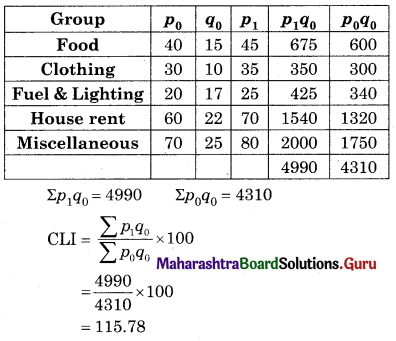
Maharashtra Board 12th Commerce Maths Solutions Chapter 5 Index Numbers Ex 5.3 Q1.1

Question 2.
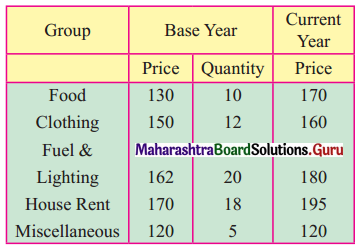
Maharashtra Board 12th Commerce Maths Solutions Chapter 5 Index Numbers Ex 5.3 Q2
Solution:
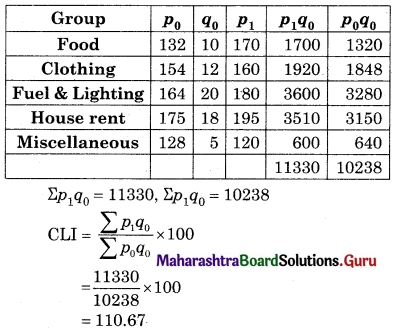
Maharashtra Board 12th Commerce Maths Solutions Chapter 5 Index Numbers Ex 5.3 Q2.1

Maharashtra Board 12th Commerce Maths Solutions Chapter 5 Index Numbers Ex 5.3

Question 3.
Maharashtra Board 12th Commerce Maths Solutions Chapter 5 Index Numbers Ex 5.3 Q3
Solution:
Maharashtra Board 12th Commerce Maths Solutions Chapter 5 Index Numbers Ex 5.3 Q3.1

Base year weights (W) and current year price relatives (I) are given in problems 4 to 8. Calculate the cost of living index in each case.

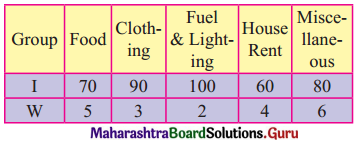
Question 4.
Maharashtra Board 12th Commerce Maths Solutions Chapter 5 Index Numbers Ex 5.3 Q4
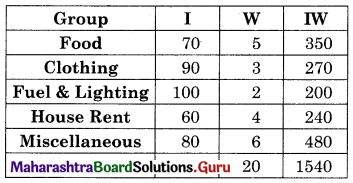
Solution:
Maharashtra Board 12th Commerce Maths Solutions Chapter 5 Index Numbers Ex 5.3 Q4.1
ΣW = 20, ΣIW = 1540
CLI = \(\frac{\sum \mathrm{IW}}{\sum \mathrm{W}}\)
= \(\frac{1540}{20}\)
= 77

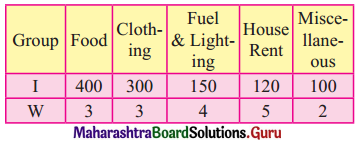
Question 5.
Maharashtra Board 12th Commerce Maths Solutions Chapter 5 Index Numbers Ex 5.3 Q5
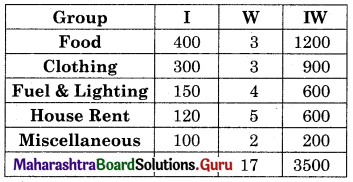
Solution:
Maharashtra Board 12th Commerce Maths Solutions Chapter 5 Index Numbers Ex 5.3 Q5.1
ΣW = 17, ΣIW = 3500
CLI = \(\frac{\sum \mathrm{IW}}{\sum \mathrm{W}}\)
= \(\frac{3500}{17}\)
= 205.88

Maharashtra Board 12th Commerce Maths Solutions Chapter 5 Index Numbers Ex 5.3

Question 6.
Maharashtra Board 12th Commerce Maths Solutions Chapter 5 Index Numbers Ex 5.3 Q6
Solution:
Maharashtra Board 12th Commerce Maths Solutions Chapter 5 Index Numbers Ex 5.3 Q6.1
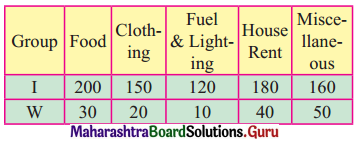
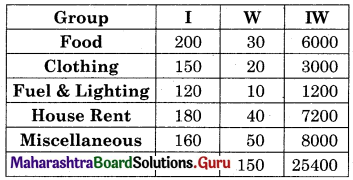
ΣW = 150, ΣIW = 25400
CLI = \(\frac{\sum \mathrm{IW}}{\sum \mathrm{W}}\)
= \(\frac{25400}{150}\)
= 169.33

Question 7.
Maharashtra Board 12th Commerce Maths Solutions Chapter 5 Index Numbers Ex 5.3 Q7
Solution:
Maharashtra Board 12th Commerce Maths Solutions Chapter 5 Index Numbers Ex 5.3 Q7.1
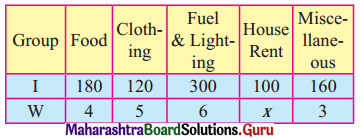
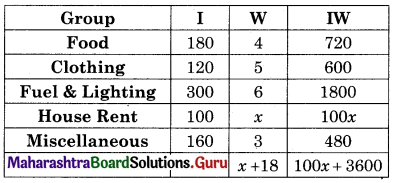
ΣW = x + 18, ΣIW = 100x + 3600
CLI = 150
∴ \(\frac{\sum \mathrm{IW}}{\sum \mathrm{W}}\) = 150
∴ \(\frac{100 x+3600}{x+18}\) = 150
∴ 100x + 3600 = 150x + 2700
∴ 50x = 900
∴ x = 18

Question 8.
Find y if the cost of living index is 200
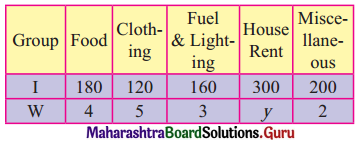
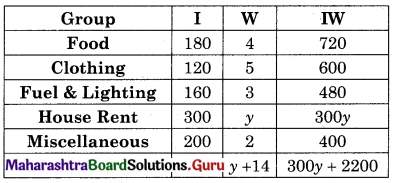
Maharashtra Board 12th Commerce Maths Solutions Chapter 5 Index Numbers Ex 5.3 Q8
Solution:
Maharashtra Board 12th Commerce Maths Solutions Chapter 5 Index Numbers Ex 5.3 Q8.1
ΣW = y + 18, ΣIW = 300y + 2200
CLI = 200
∴ \(\frac{\sum \mathrm{IW}}{\sum \mathrm{W}}\) = 200
∴ \(\frac{300 y+2200}{y+14}\) = 200
∴ 300y + 2200 = 200y + 2800
∴ 100y = 600
∴ y = 6

Maharashtra Board 12th Commerce Maths Solutions Chapter 5 Index Numbers Ex 5.3

Question 9.
The cost of living Index numbers for years 1995 and 1999 are 140 and 200 respectively. A person earns ₹ 11,200 per month in the year 1995. What should be his monthly earning in the year 1999 in order to maintain his standard of living as in the year 1995?
Solution:
CLI (1995) = 140
CLI (1999) = 200
Income (1995) = 11200
Income (1999) = ?
For year 1995
∴ Real Income = \(\frac{\text { Income }}{\text { CLI }} \times 100\)
= \(\frac{11200}{140}\) × 100
= ₹ 8000
For year 1999
∴ Real Income = \(\frac{\text { Income }}{\text { CLI }} \times 100\)
∴ 8000 = \(\frac{\text { Income } \times 100}{200}\)
∴ Income = 16000
∴ Income in 1999 = ₹ 16000

Maharashtra Board 11th Commerce Maths Solutions Chapter 3 Complex Numbers Ex 3.3

Balbharati Maharashtra State Board 11th Commerce Maths Solution Book Pdf Chapter 3 Complex Numbers Ex 3.3 Questions and Answers.

Maharashtra State Board 11th Commerce Maths Solutions Chapter 3 Complex Numbers Ex 3.3

Question 1.
If ω is a complex cube root of unity, show that
(i) (2 – ω)(2 – ω2) = 7
(ii) (2 + ω + ω2)3 – (1 – 3ω + ω2)3 = 65
(iii) \(\frac{\left(\mathbf{a}+\mathbf{b} \omega+\mathbf{c} \omega^{2}\right)}{\mathbf{c}+\mathbf{a} \omega+\mathbf{b} \omega^{2}}\) = ω2
Solution:
ω is the complex cube root of unity.
∴ ω3 = 1 and 1 + ω + ω2 = 0
Also, 1 + ω2 = -ω, 1 + ω = -ω2 and ω + ω2 = -1
(i) L.H.S. = (2 – ω)(2 – ω2)
= 4 – 2ω2 – 2ω + ω3
= 4 – 2(ω2 + ω) + 1
= 4 – 2(-1) + 1
= 4 + 2 + 1
= 7
= R.H.S.

(ii) L.H.S. = (2 + ω + ω2)3 – (1 – 3ω + ω2)3
= [2 + (ω + ω2)]3 – [-3ω + (1 + ω2)]3
= (2 – 1)3 – (-3ω – ω)3
= 13 – (-4ω)3
= 1 + 64ω3
= 1 + 64(1)
= 65
= R.H.S.

(iii) L.H.S. =\(\frac{\left(\mathbf{a}+\mathbf{b} \omega+\mathbf{c} \omega^{2}\right)}{\mathbf{c}+\mathbf{a} \omega+\mathbf{b} \omega^{2}}\)
= \(\frac{a \omega^{3}+b \omega^{4}+c \omega^{2}}{c+a \omega+b \omega^{2}}\) ……[∵ ω3 = 1, ω4 = ω]
= \(\frac{\omega^{2}\left(c+a \omega+b \omega^{2}\right)}{c+a \omega+b \omega^{2}}\)
= ω2
= R.H.S.

Maharashtra Board 11th Commerce Maths Solutions Chapter 3 Complex Numbers Ex 3.3

Question 2.
If ω is a complex cube root of unity, find the value of
(i) ω + \(\frac{1}{\omega}\)
(ii) ω2 + ω3 + ω4
(iii) (1 + ω2)3
(iv) (1 – ω – ω2)3 + (1 – ω + ω2)3
(v) (1 + ω)(1 + ω2)(1 + ω4)(1 + ω8)
Solution:
ω is the complex cube root of unity.
∴ ω3 = 1 and 1 + ω + ω2 = 0
Also, 1 + ω2 = -ω, 1 + ω = -ω2 and ω + ω2 = -1
(i) ω + \(\frac{1}{\omega}\)
= \(\frac{\omega^{2}+1}{\omega}\)
= \(\frac{-\omega}{\omega}\)
= -1

(ii) ω2 + ω3 + ω4
= ω2 (1 + ω + ω2)
= ω2 (0)
= 0

(iii) (1 + ω2)3
= (-ω)3
= -ω3
= -1

(iv) (1 – ω – ω2)3 + (1 – ω + ω2)3
= [1 – (ω + ω2)]3 + [(1 + ω2) – ω]3
= [1 – (-1)]3 + (-ω – ω)3
= 23 + (-2ω)3
= 8 – 8ω3
= 8 – 8(1)
= 0

(v) (1 + ω)(1 + ω2)(1 + ω4)(1 + ω8)
= (1 + ω)(1 + ω2)(1 + ω)(1 + ω2) …..[∵ ω3 = 1, ω4 = ω]
= (-ω2)(-ω)(-ω2)(-ω)
= ω6
= (ω3)2
= (1)2
= 1

Question 3.
If α and β are the complex cube roots of unity, show that α2 + β2 + αβ = 0.
Solution:
α and β are the complex cube roots of unity.
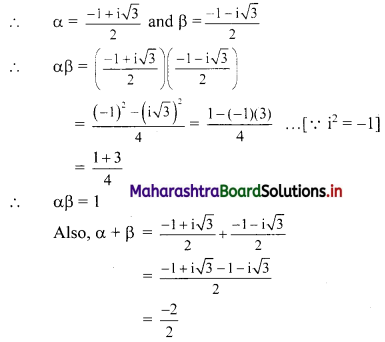
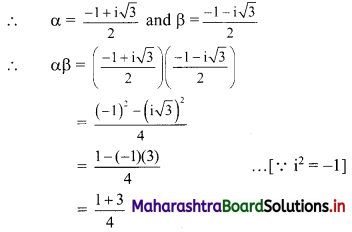
Maharashtra Board 11th Commerce Maths Solutions Chapter 3 Complex Numbers Ex 3.3 Q3
∴ α – β = -1
L.H.S. = α2 + β2 + αβ
= α2 + 2αβ + β2 + αβ – 2αβ ……[Adding and subtracting 2αβ]
= (α2 + 2αβ + β2) – αβ
= (α + β)2 – αβ
= (-1)2 – 1
= 1 – 1
= 0
= R.H.S.

Maharashtra Board 11th Commerce Maths Solutions Chapter 3 Complex Numbers Ex 3.3

Question 4.
If x = a + b, y = αa + βb and z = aβ + bα, where α and β are the complex cube roots of unity, show that xyz = a3 + b3.
Solution:
x = a + b, y = αa + βb, z = aβ + bα
α and β are the complex cube roots of unity.
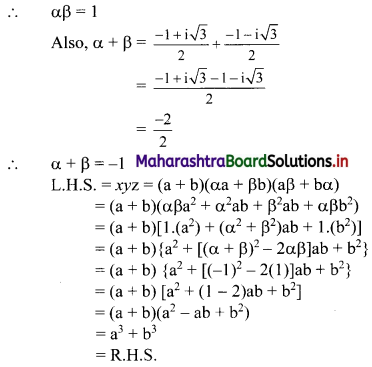
Maharashtra Board 11th Commerce Maths Solutions Chapter 3 Complex Numbers Ex 3.3 Q4
Maharashtra Board 11th Commerce Maths Solutions Chapter 3 Complex Numbers Ex 3.3 Q4.1

Question 5.
If ω is a complex cube root of unity, then prove the following:
(i) (ω2 + ω – 1)3 = -8
(ii) (a + b) + (aω + bω2) + (aω2 + bω) = 0
Solution:
ω is the complex cube root of unity.
∴ ω3 = 1 and 1 + ω + ω2 = 0
Also, 1 + ω2 = -ω, 1 + ω = -ω2 and ω + ω2 = -1
(i) L.H.S. = (ω2 + ω – 1)3
= (-1 – 1)3
= (-2)3
= -8
= R.H.S.

Maharashtra Board 11th Commerce Maths Solutions Chapter 3 Complex Numbers Ex 3.3

(ii) L.H.S. = (a + b) + (aω + bω2) + (aω2 + bω)
= (a + aω + aω2) + (b + bω + bω2)
= a(1 + ω + ω2) + b(1 + ω + ω2)
= a(0) + b(0)
= 0
= R.H.S.

Maharashtra Board 11th Commerce Maths Solutions Chapter 3 Complex Numbers Ex 3.2

Balbharati Maharashtra State Board 11th Commerce Maths Solution Book Pdf Chapter 3 Complex Numbers Ex 3.2 Questions and Answers.

Maharashtra State Board 11th Commerce Maths Solutions Chapter 3 Complex Numbers Ex 3.2

Question 1.
Find the square root of the following complex numbers:
(i) -8 – 6i
Solution:
Let \(\sqrt{-8-6 i}\) = a + bi, where a, b ∈ R
Squaring on both sides, we get
-8 – 6i = (a + bi)2
-8 – 6i = a2 + b2i2 + 2abi
-8 – 6i = (a2 – b2) + 2abi …..[∵ i2 = -1]
Equating real and imaginary parts, we get
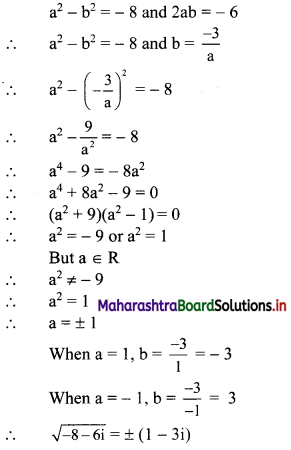
Maharashtra Board 11th Commerce Maths Solutions Chapter 3 Complex Numbers Ex 3.2 Q1 (i)

(ii) 7 + 24i
Solution:
Let \(\sqrt{7+24 i}\) = a + bi, where a, b ∈ R
Squaring on both sides, we get
7 + 24i = (a + bi)2
7 + 24i = a2 + b2i2 + 2abi
7 + 24i = (a2 – b2) + 2abi …..[∵ i2 = -1]
Equating real and imaginary parts, we get
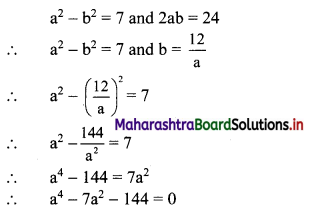
Maharashtra Board 11th Commerce Maths Solutions Chapter 3 Complex Numbers Ex 3.2 Q1 (ii)
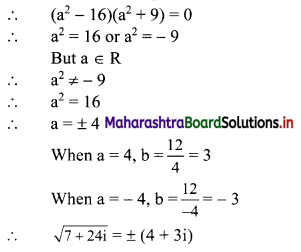
Maharashtra Board 11th Commerce Maths Solutions Chapter 3 Complex Numbers Ex 3.2 Q1 (ii).1

(iii) 1 + 4√3i
Solution:
Let \(\sqrt{1+4 \sqrt{3} i}\) = a + bi, where a, b ∈ R
Squaring on both sides, we get
1 + 4√3i = (a + bi)2
1 + 4√3i = a2 + b2i2 + 2abi
1 +4√3i = (a2 – b2) + 2abi ……[∵ i2 = -1]
Equating real and imaginary parts, we get
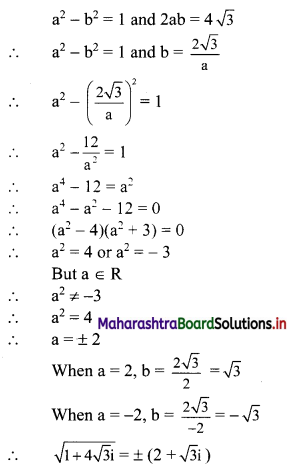
Maharashtra Board 11th Commerce Maths Solutions Chapter 3 Complex Numbers Ex 3.2 Q1 (iii)

(iv) 3 + 2√10i
Solution:
Let \(\sqrt{3+2 \sqrt{10}} i\) = a + bi, where a, b ∈ R
Squaring on both sides, we get
3 + 2√10i = (a + bi)2
3 + 2√10i = a2 + b2i2 + 2abi
3 + 2√10i = (a2 – b2) + 2abi …..[∵ i2 = -1]
Equating real and imaginary parts, we get
a2 – b2 = 3 and 2ab = 2√10
a2 – b2 = 3 and b = \(\frac{\sqrt{10}}{a}\)
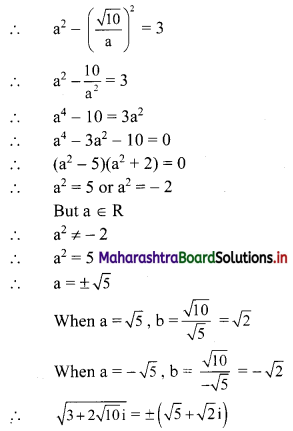
Maharashtra Board 11th Commerce Maths Solutions Chapter 3 Complex Numbers Ex 3.2 Q1 (iv)

Maharashtra Board 11th Commerce Maths Solutions Chapter 3 Complex Numbers Ex 3.2

(v) 2(1 – √3i)
Solution:
Let \(\sqrt{2(1-\sqrt{3} i)}\) = a + bi, where a, b ∈ R
Squaring on both sides, we get
2(1 – √3i) = (a + bi)2
2(1 – √3i) = a2 + b2i2 + 2abi
2 – 2√3i = (a2 – b2) + 2abi …..[∵ i2 = -1]
Equating real and imaginary parts, we get
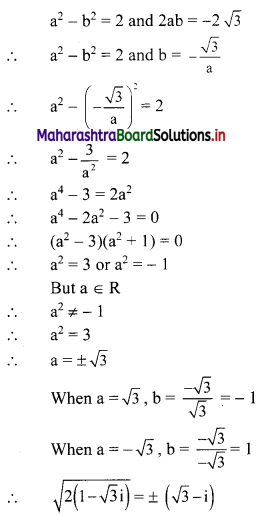
Maharashtra Board 11th Commerce Maths Solutions Chapter 3 Complex Numbers Ex 3.2 Q1 (v)

Question 2.
Solve the following quadratic equations.
(i) 8x2 + 2x + 1 = 0
Solution:
Given equation is 8x2 + 2x + 1 = 0
Comparing with ax2 + bx + c = 0, we get
a = 8, b = 2, c = 1
Discriminant = b2 – 4ac
= (2)2 – 4 × 8 × 1
= 4 – 32
= -28 < 0
So, the given equation has complex roots.
These roots are given by
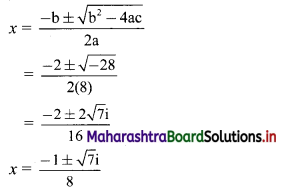
Maharashtra Board 11th Commerce Maths Solutions Chapter 3 Complex Numbers Ex 3.2 Q2 (i)
∴ the roots of the given equation are \(\frac{-1+\sqrt{7} \mathrm{i}}{8}\) and \(\frac{-1-\sqrt{7} \mathrm{i}}{8}\)

(ii) 2x2 – √3x + 1 = 0
Solution:
Given equation is 2x2 – √3x + 1 = 0
Comparing with ax2 + bx + c = 0, we get
a = 2, b = -√3, c = 1
Discriminant = b2 – 4ac
= (-√3)2 – 4 × 2 × 1
= 3 – 8
= -5 < 0
So, the given equation has complex roots.
These roots are given by
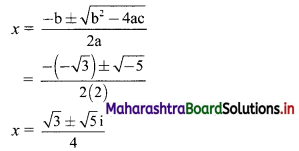
Maharashtra Board 11th Commerce Maths Solutions Chapter 3 Complex Numbers Ex 3.2 Q2 (ii)
∴ the roots of the given equation are \(\frac{\sqrt{3}+\sqrt{5} i}{4}\) and \(\frac{\sqrt{3}-\sqrt{5} i}{4}\)

(iii) 3x2 – 7x + 5 = 0
Solution:
Given equation is 3x2 – 7x + 5 = 0
Comparing with ax2 + bx + c = 0, we get
a = 3, b = -7, c = 5
Discriminant = b2 – 4ac
= (-7)2 – 4 × 3 × 5
= 49 – 60
= -11 < 0
So, the given equation has complex roots.
These roots are given by
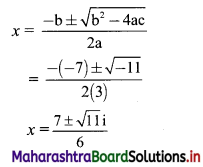
Maharashtra Board 11th Commerce Maths Solutions Chapter 3 Complex Numbers Ex 3.2 Q2 (iii)
∴ the roots of the given equation are \(\frac{7+\sqrt{11} i}{6}\) and \(\frac{7-\sqrt{11} i}{6}\)

(iv) x2 – 4x + 13 = 0
Solution:
Given equation is x2 – 4x + 13 = 0
Comparing with ax2 + bx + c = 0, we get
a = 1, b = -4, c = 13
Discriminant = b2 – 4ac
= (-4)2 – 4 × 1 × 13
= 16 – 52
= -36 < 0
So, the given equation has complex roots.
These roots are given by
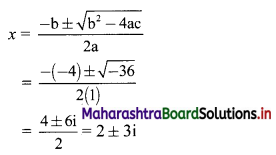
Maharashtra Board 11th Commerce Maths Solutions Chapter 3 Complex Numbers Ex 3.2 Q2 (iv)
∴ the roots of the given equation are 2 + 3i and 2 – 3i.

Maharashtra Board 11th Commerce Maths Solutions Chapter 3 Complex Numbers Ex 3.2

Question 3.
Solve the following quadratic equations.
(i) x2 + 3ix + 10 = 0
Solution:
Given equation is x2 + 3ix + 10 = 0
Comparing with ax2 + bx + c = 0, we get
a = 1, b = 3i, c = 10
Discriminant = b2 – 4ac
= (3i)2 – 4 × 1 × 10
= 9i2 – 40
= -9 – 40 …..[∵ i2 = -1]
= -49
So, the given equation has complex roots.
These roots are given by
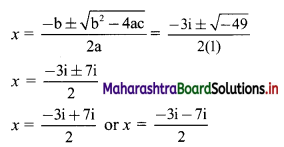
Maharashtra Board 11th Commerce Maths Solutions Chapter 3 Complex Numbers Ex 3.2 Q3 (i)
∴ x = 2i or x = -5i
∴ the roots of the given equation are 2i and -5i.
Check:
If x = 2i and x = -5i satisfy the given equation, then our answer is correct.
L.H.S. = x2 + 3ix + 10
= (2i)2 + 3i(2i) + 10i
= 4i2 + 6i2 + 10
= 10i2 + 10
= -10 + 10 ……[∵ i2 = -1]
= 0
= R.H.S.
L.H.S. = x2 + 3ix + 10
= (-5i)2 + 3i(-5i) + 10
= 25i2 – 15i2 + 10
= 10i2 + 10
= -10 + 10 …..[∵ i2 = -1]
= 0
= R.H.S.
Thus, our answer is correct.

(ii) 2x2 + 3ix + 2 = 0
Solution:
Given equation is 2x2 + 3ix + 2 = 0
Comparing with ax2 + bx + c = 0, we get
a = 2, b = 3i, c = 2
Discriminant = b2 – 4ac
= (3i)2 – 4 × 2 × 2
= 9i2 – 16
= -9 – 16
= -25 < 0
So, the given equation has complex roots.
These roots are given by
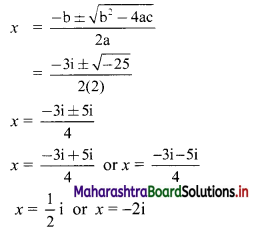
Maharashtra Board 11th Commerce Maths Solutions Chapter 3 Complex Numbers Ex 3.2 Q3 (ii)
∴ the roots of the given equation are \(\frac{1}{2}\)i and -2i.

(iii) x2 + 4ix – 4 = 0
Solution:
Given equation is x2 + 4ix – 4 = 0
Comparing with ax2 + bx + c = 0, we get
a = 1, b = 4i, c = -4
Discriminant = b2 – 4ac
= (4i)2 – 4 × 1 × -4
= 16i2 + 16
= -16 + 16 …..[∵ i2 = -1]
= 0
So, the given equation has equal roots.
These roots are given by
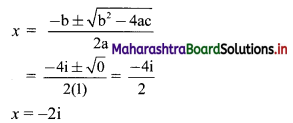
Maharashtra Board 11th Commerce Maths Solutions Chapter 3 Complex Numbers Ex 3.2 Q3 (iii)
∴ the roots of the given equation are -2i and -2i.

(iv) ix2 – 4x – 4i = 0
Solution:
ix2 – 4x – 4i = 0
Multiplying throughout by i, we get
i2x2 – 4ix – 4i2 = 0
∴ -x2 – 4ix + 4 = 0 ……[∵ i2 = -1]
∴ x2 + 4ix – 4 = 0
Comparing with ax2 + bx + c = 0, we get
a = 1, b = 4i, c = -4
Discriminant = b2 – 4ac
= (4i)2 – 4 × 1 × -4
= 16i2 + 16
= -16 + 16 …..[∵ i2 = -1]
= 0
So, the given equation has equal roots.
These roots are given by
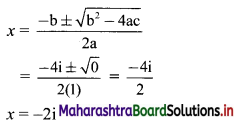
Maharashtra Board 11th Commerce Maths Solutions Chapter 3 Complex Numbers Ex 3.2 Q3 (iv)
∴ the roots of the given equation are -2i and -2i.

Maharashtra Board 11th Commerce Maths Solutions Chapter 3 Complex Numbers Ex 3.2

Question 4.
Solve the following quadratic equations.
(i) x2 – (2 + i) x – (1 – 7i) = 0
Solution:
Given equation is x2 – (2 + i)x – (1 – 7i) = 0
Comparing with ax2 + bx + c = 0, we get
a = 1, b = -(2 + i), c = -(1 – 7i)
Discriminant = b2 – 4ac
= [-(2 + i)]2 – 4 × 1 × -(1 – 7i)
= 4 + 4i + i2 + 4 – 28i
= 4 + 4i – 1 + 4 – 28i …….[∵ i2 = -1]
= 7 – 24i
So, the given equation has complex roots.
These roots are given by
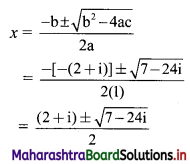
Maharashtra Board 11th Commerce Maths Solutions Chapter 3 Complex Numbers Ex 3.2 Q4 (i)
Maharashtra Board 11th Commerce Maths Solutions Chapter 3 Complex Numbers Ex 3.2 Q4 (i).1
Maharashtra Board 11th Commerce Maths Solutions Chapter 3 Complex Numbers Ex 3.2 Q4 (i).2

(ii) x2 – (3√2 + 2i) x + 6√2i = 0
Solution:
Given equation is x2 – (3√2 + 2i) x + 6√2i = 0
Comparing with ax2 + bx + c = 0, we get
a = 1, b = -(3√2 + 2i), c = 6√2i
Discriminant = b2 – 4ac
= [-(3√2 + 2i)]2 – 4 × 1 × 6√2i
= 18 + 12√2i + 4i2 – 24√2i
= 18 – 12√2i – 4 …..[∵ i2 = -1]
= 14 – 12√2i
So, the given equation has complex roots.
These roots are given by
Maharashtra Board 11th Commerce Maths Solutions Chapter 3 Complex Numbers Ex 3.2 Q4 (ii)
Maharashtra Board 11th Commerce Maths Solutions Chapter 3 Complex Numbers Ex 3.2 Q4 (ii).1
Maharashtra Board 11th Commerce Maths Solutions Chapter 3 Complex Numbers Ex 3.2 Q4 (ii).2

(iii) x2 – (5 – i) x + (18 + i) = 0
Solution:
Given equation is x2 – (5 – i)x + (18 + i) = 0
Comparing with ax2 + bx + c = 0, we get
a = 1, b = -(5 – i), c = 18 + i
Discriminant = b2 – 4ac
= [-(5 – i)]2 – 4 × 1 × (18 + i)
= 25 – 10i + i2 – 72 – 4i
= 25 – 10i – 1 – 72 – 4i …..[∵ i2 = -1]
= -48 – 14i
So, the given equation has complex roots.
These roots are given by
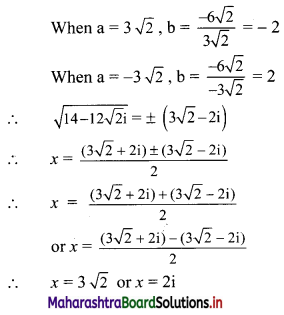
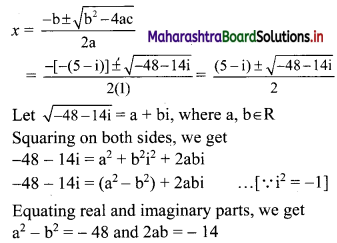
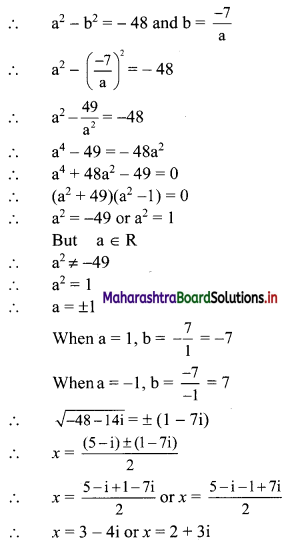
Maharashtra Board 11th Commerce Maths Solutions Chapter 3 Complex Numbers Ex 3.2 Q4 (iii)
Maharashtra Board 11th Commerce Maths Solutions Chapter 3 Complex Numbers Ex 3.2 Q4 (iii).1

Maharashtra Board 11th Commerce Maths Solutions Chapter 3 Complex Numbers Ex 3.2

(iv) (2 + i) x2 – (5 – i) x + 2(1 – i) = 0
Solution:
Given equation is
(2 + i) x2 – (5 – i) x + 2(1 – i) = 0
Comparing with ax2 + bx + c = 0, we get
a = 2 + i, b = -(5 – i), c = 2(1 – i)
Discriminant = b2 – 4ac
= [-(5 – i)]2 – 4 × (2 + i) × 2(1 – i)
= 25 – 10i + i2 – 8(2 + i)(1 – i)
= 25 – 10i + i2 – 8(2 – 2i + i – i2)
= 25 – 10i – 1 – 8(2 – i + 1) …..[∵ i2 = -1]
= 25 – 10i – 1 – 16 + 8i – 8
= -2i
So, the given equation has complex roots.
These roots are given by
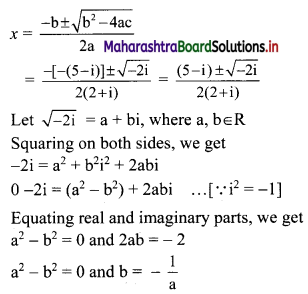
Maharashtra Board 11th Commerce Maths Solutions Chapter 3 Complex Numbers Ex 3.2 Q4 (iv)
Maharashtra Board 11th Commerce Maths Solutions Chapter 3 Complex Numbers Ex 3.2 Q4 (iv).1
Maharashtra Board 11th Commerce Maths Solutions Chapter 3 Complex Numbers Ex 3.2 Q4 (iv).2

Maharashtra Board 11th Commerce Maths Solutions Chapter 3 Complex Numbers Ex 3.1

Balbharati Maharashtra State Board 11th Commerce Maths Solution Book Pdf Chapter 3 Complex Numbers Ex 3.1 Questions and Answers.

Maharashtra State Board 11th Commerce Maths Solutions Chapter 3 Complex Numbers Ex 3.1

Question 1.
Write the conjugates of the following complex numbers:
(i) 3 + i
(ii) 3 – i
(iii) -√5 – √7i
(iv) -√-5
(v) 5i
(vi) √5 – i
(vii) √2 + √3i
Solution:
(i) Conjugate of (3 + i) is (3 – i)
(ii) Conjugate of (3 – i) is (3 + i)
(iii) Conjugate of (-√5 – √7i) is (-√5 + √7i)
(iv) -√-5 = -√5 × √-1 = -√5i
Conjugate of -√-5 is √5i
(v) Conjugate of 5i is -5i
(vi) Conjugate of √5 – i is √5 + i
(vii) Conjugate of √2 + √3i is √2 – √3i

Maharashtra Board 11th Commerce Maths Solutions Chapter 3 Complex Numbers Ex 3.1

Question 2.
Express the following in the form of a + ib, a, b ∈ R, i = √-1. State the values of a and b:
(i) (1 + 2i)(-2 + i)
(ii) \(\frac{\mathrm{i}(4+3 \mathrm{i})}{(1-\mathrm{i})}\)
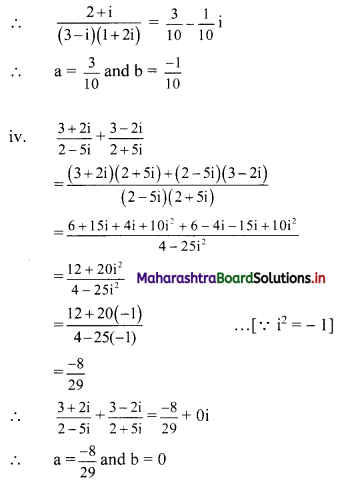
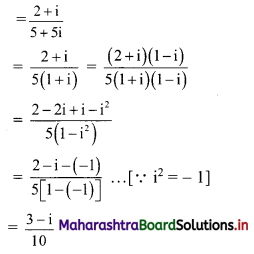
(iii) \(\frac{(2+i)}{(3-i)(1+2 i)}\)
(iv) \(\frac{3+2 i}{2-5 i}+\frac{3-2 i}{2+5 i}\)
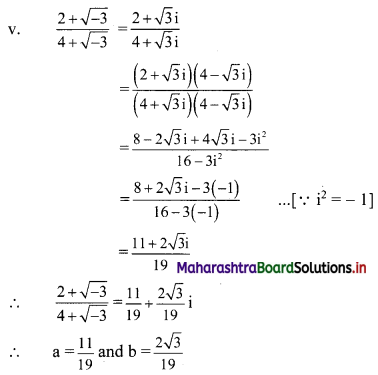
(v) \(\frac{2+\sqrt{-3}}{4+\sqrt{-3}}\)
(vi) (2 + 3i)(2 – 3i)
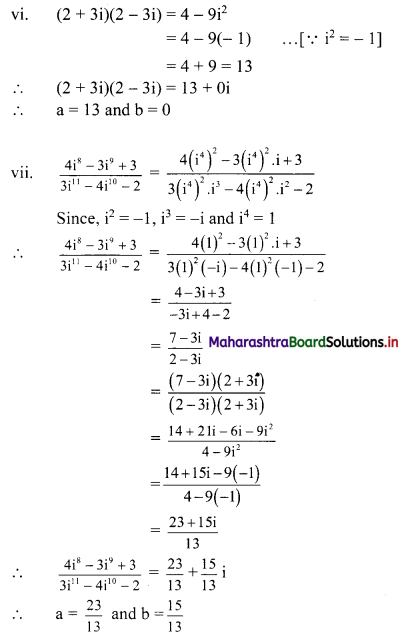
(vii) \(\frac{4 i^{8}-3 i^{9}+3}{3 i^{11}-4 i^{10}-2}\)
Solution:
Maharashtra Board 11th Commerce Maths Solutions Chapter 3 Complex Numbers Ex 3.1 Q2
Maharashtra Board 11th Commerce Maths Solutions Chapter 3 Complex Numbers Ex 3.1 Q2.1
Maharashtra Board 11th Commerce Maths Solutions Chapter 3 Complex Numbers Ex 3.1 Q2.2
Maharashtra Board 11th Commerce Maths Solutions Chapter 3 Complex Numbers Ex 3.1 Q2.3
Maharashtra Board 11th Commerce Maths Solutions Chapter 3 Complex Numbers Ex 3.1 Q2.4
Maharashtra Board 11th Commerce Maths Solutions Chapter 3 Complex Numbers Ex 3.1 Q2.5

Question 3.
Show that (-1 + √3i)3 is a real number.
Solution:
(-1 + √3i)3
= (-1)3 + 3(-1)2 (√3i) + 3(-1)(√3i)2 +(√3i)3 [∵ (a + b)3 = a3 + 3a2b + 3ab2 + b3]
= -1 + 3√3i – 3(3i2) + 3√3 i3
= -1 + 3√3i – 3(-3) – 3√3i [∵ i2 = -1, i3 = -1]
= -1 + 9
= 8, which is a real number.

Question 4.
Evaluate the following:
(i) i35
(ii) i888
(iii) i93
(iv) i116
(v) i403
(vi) \(\frac{1}{i^{58}}\)
(vii) i30 + i40 + i50 + i60
Solution:
We know that, i2 = -1, i3 = -i, i4 = 1
(i) i35 = (i4)8 (i2) i = (1)8 (-1) i = -i
(ii) i888 = (i4)222 = (1)222 = 1
(iii) i93 = (i4)23 . i = (1)23 . i = i
(iv) i116 = (i4)29 = (1)29 = 1
(v) i403 = (i4)100 (i2) i = (1)100 (-1) i = -i
(vi) \(\frac{1}{i^{88}}=\frac{1}{\left(i^{4}\right)^{14} \cdot i^{2}}=\frac{1}{(1)^{14}(-1)}=-1\)
(vii) i30 + i40 + i50 + i60
= (i4)7 i2 + (i4)10 + (i4)12 i2 + (i4)15
= (1)7 (-1) + (1)10 + (1)12 (-1) + (1)15
= -1 + 1 – 1 + 1
= 0

Maharashtra Board 11th Commerce Maths Solutions Chapter 3 Complex Numbers Ex 3.1

Question 5.
Show that 1 + i10 + i20 + i30 is a real number.
Solution:
1 + i10 + i20 + i30
= 1 + (i4)2 . i2 + (i4)5 + (i4)7 . i2
= 1 + (1)2 (-1) + (1)5 + (1)7 (-1) [∵ i4 = 1, i2 = -1]
= 1 – 1 + 1 – 1
= 0, which is a real number.

Question 6.
Find the value of
(i) i49 + i68 + i89 + i110
(ii) i + i2 + i3 + i4
Solution:
(i) i49 + i68 + i89 + i110
= (i4)12 . i + (i4)17 + (i4)22 . i + (i4)27 . i2
= (1)12 . i + (1)17 + (1)22 . i + (1)27(-1) ……[∵ i4 = 1, i2 = -1]
= i + 1 + i – 1
= 2i

(ii) i + i2 + i3 + i4
= i + i2 + i2 . i + i4
= i – 1 – i + 1 [∵ i2 = -1, i4 = 1]
= 0

Question 7.
Find the value of 1 + i2 + i4 + i6 + i8 + …… + i20.
Solution:
1 + i2 + i4 + i6 + i8 + ….. + i20
= 1 + (i2 + i4) + (i6 + i8) + (i10 + i12) + (i14 + i16) + (i18 + i20)
= 1 + [i2 + (i2)2] + [(i2)3 + (i2)4] + [(i2)5 + (i2)6] + [(i2)7 + (i2)8] + [(i2)9 + (i2)10]
= 1 + [-1 + (- 1)2] + [(-1)3 + (-1)4] + [(-1)5 + (-1)6] + [(-1)7 + (-1)8] + [(-1)9 + (-1)10] [∵ i2 = -1]
= 1 + (-1 + 1) + (-1 + 1) + (-1 + 1) + (-1 + 1) + (-1 + 1)
= 1 + 0 + 0 + 0 + 0 + 0
= 1

Question 8.
Find the values of x and y which satisfy the following equations (x, y ∈ R):
(i) (x + 2y) + (2x – 3y)i + 4i = 5
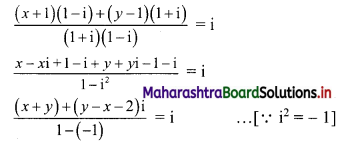
(ii) \(\frac{x+1}{1+\mathrm{i}}+\frac{y-1}{1-\mathrm{i}}=\mathrm{i}\)
Solution:
(i) (x + 2y) + (2x – 3y)i + 4i = 5
∴ (x + 2y) + (2x – 3y)i = 5 – 4i
Equating real and imaginary parts, we get
x + 2y = 5 ……..(i)
and 2x – 3y = -4 ………(ii)
Equation (i) × 2 – equation (ii) gives
7y = 14
∴ y = 2
Putting y- 2 in (i), we get
x + 2(2) = 5
∴ x + 4 = 5
∴ x = 1
∴ x = 1 and y = 2
Check:
If x = 1 and y = 2 satisfy the given condition, then our answer is correct.
L.H.S. = (x + 2y) + (2x – 3y)i + 4i
= (1 + 4) + (2 – 6)i + 4i
= 5 – 4i + 4i
= 5
= R.H.S.
Thus, our answer is correct.

(ii) \(\frac{x+1}{1+\mathrm{i}}+\frac{y-1}{1-\mathrm{i}}=\mathrm{i}\)
Maharashtra Board 11th Commerce Maths Solutions Chapter 3 Complex Numbers Ex 3.1 Q8
(x + y) + (y – x – 2)i = 2i
(x + y) + (y – x – 2)i = 0 + 2i
Equating real and imaginary parts, we get
x + y = 0 and y – x – 2 = 2
∴ x + y = 0 ……(i)
and -x + y = 4 ……..(ii)
Adding (i) and (ii), we get
2y = 4
∴ y = 2
Putting y = 2 in (i), we get
x + 2 = 0
∴ x = -2
∴ x = -2 and y = 2

Maharashtra Board 11th Commerce Maths Solutions Chapter 3 Complex Numbers Ex 3.1

Question 9.
Find the value of:
(i) x3 – x2 + x + 46, if x = 2 + 3i
(ii) 2x3 – 11x2 + 44x + 27, if x = \(\frac{25}{3-4 i}\)
Solution:
(i) x = 2 + 3i
∴ x – 2 = 3i
∴ (x – 2)2 = 9i2
∴ x2 – 4x + 4 = 9(-1) …..[∵ i2 = -1]
∴ x2 – 4x + 13 = 0 ……(i)
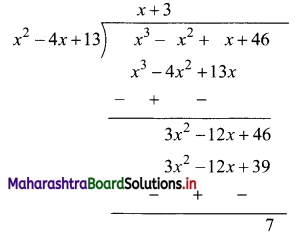
Maharashtra Board 11th Commerce Maths Solutions Chapter 3 Complex Numbers Ex 3.1 Q9
∴ x3 – x2 + x + 46 = (x2 – 4x + 13)(x + 3) + 7
= 0(x + 3) + 7 ……[From (i)]
= 7

(ii) x = \(\frac{25}{3-4 i}\)
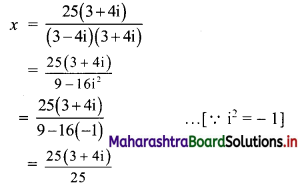
Maharashtra Board 11th Commerce Maths Solutions Chapter 3 Complex Numbers Ex 3.1 Q9.1
∴ x = 3 + 4i
∴ x – 3 = 4i
∴ (x – 3)2 = 16i2
∴ x2 – 6x + 9 = 16(-1) …….[∵ i2 = -1]
∴ x2 – 6x + 25 = 0 …….(i)
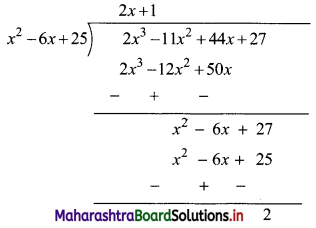
Maharashtra Board 11th Commerce Maths Solutions Chapter 3 Complex Numbers Ex 3.1 Q9.2
∴ 2x3 – 11x2 + 44x + 27
= (x2 – 6x + 25) (2x + 1) + 2
= 0 . (2x + 1) + 2 ……[From (i)]
= 0 + 2
= 2

Maharashtra Board 11th Commerce Maths Solutions Chapter 2 Functions Miscellaneous Exercise 2

Balbharati Maharashtra State Board 11th Commerce Maths Solution Book Pdf Chapter 2 Functions Miscellaneous Exercise 2 Questions and Answers.

Maharashtra State Board 11th Commerce Maths Solutions Chapter 2 Functions Miscellaneous Exercise 2

Question 1.
Which of the following relations are functions? If it is a function determine its domain and range.
(i) {(2, 1), (4, 2), (6, 3), (8, 4), (10, 5) (12, 6), (14, 7)}
(ii) {(0, 0), (1, 1), (1, -1), (4, 2), (4, -2), (9, 3), (9, -3), (16, 4), (16, -4)}
(iii) {(1, 1), (3, 1), (5, 2)}
Solution:
(i) {(2, 1), (4, 2), (6, 3), (8, 4), (10, 5) (12, 6), (14, 7)}
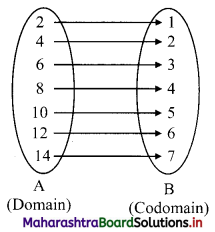
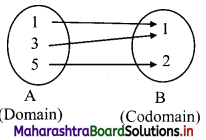
Maharashtra Board 11th Commerce Maths Solutions Chapter 2 Functions Miscellaneous Exercise 2 Q1
Every element of set A has been assigned a unique element in set B.
∴ Given relation is a function.
Domain = {2, 4, 6, 8, 10, 12, 14},
Range = {1, 2, 3, 4, 5, 6, 7}

(ii) {(0, 0), (1, 1), (1, -1), (4, 2), (4, -2), (9, 3), (9, -3), (16, 4), (16, -4)}
∴ (1, 1), (1, -1) ∈ the relation
∴ Given relation is not a function.
As element 1 of the domain has not been assigned a unique element of co-domain.

(iii) {(1, 1), (3, 1), (5, 2)}
Maharashtra Board 11th Commerce Maths Solutions Chapter 2 Functions Miscellaneous Exercise 2 Q1.1
Every element of set A has been assigned a unique element in set B.
∴ Given relation is a function.
Domain = {1, 3, 5}, Range = {1, 2}

Maharashtra Board 11th Commerce Maths Solutions Chapter 2 Functions Miscellaneous Exercise 2

Question 2.
A function f: R → R defined by f(x) = \(\frac{3 x}{5}\) + 2, x ∈ R. Show that f is one-one and onto. Hence, find f-1.
Solution:
f: R → R defined by f(x) = \(\frac{3 x}{5}\) + 2
First we have to prove that f is one-one function for that we have to prove if
f(x1) = f(x2) then x1 = x2
Here f(x) = \(\frac{3 x}{5}\) + 2
Let f(x1) = f(x2)
∴ \(\frac{3 x_{1}}{5}+2=\frac{3 x_{2}}{5}+2\)
∴ \(\frac{3 x_{1}}{5}=\frac{3 x_{2}}{5}\)
∴ x1 = x2
∴ f is a one-one function.
Now, we have to prove that f is an onto function.
Let y ∈ R be such that
y = f(x)
∴ y = \(\frac{3 x}{5}\) + 2
∴ y – 2 = \(\frac{3 x}{5}\)
∴ x = \(\frac{5(y-2)}{3}\) ∈ R
∴ for any y ∈ co-domain R, there exist an element x = \(\frac{5(y-2)}{3}\) ∈ domain R such that f(x) = y
∴ f is an onto function.
∴ f is one-one onto function.
∴ f-1 exists.
∴ \(\mathrm{f}^{-1}(y)=\frac{5(y-2)}{3}\)
∴ \(f^{-1}(x)=\frac{5(x-2)}{3}\)

Question 3.
A function f is defined as follows:
f(x) = 4x + 5, for -4 ≤ x < 0. Find the values of f(-1), f(-2), f(0), if they exist.
Solution:
f(x) = 4x + 5, -4 ≤ x < 0
f(-1) = 4(-1) + 5 = -4 + 5 = 1
f(-2) = 4(-2) + 5 = -8 + 5 = -3
x = 0 ∉ domain of f
∴ f(0) does not exist.

Maharashtra Board 11th Commerce Maths Solutions Chapter 2 Functions Miscellaneous Exercise 2

Question 4.
A function f is defined as follows:
f(x) = 5 – x for 0 ≤ x ≤ 4. Find the value of x such that f(x) = 3.
Solution:
f(x) = 5 – x
f(x) = 3
∴ 5 – x = 3
∴ x = 5 – 3 = 2

Question 5.
If f(x) = 3x2 – 5x + 7, find f(x – 1).
Solution:
f(x) = 3x2 – 5x + 7
∴ f(x – 1) = 3(x – 1)2 – 5(x – 1) + 7
= 3(x2 – 2x + 1) – 5(x – 1) + 7
= 3x2 – 6x + 3 – 5x + 5 + 7
= 3x2 – 11x + 15

Question 6.
If f(x) = 3x + a and f(1) = 7, find a and f(4).
Solution:
f(x) = 3x + a,
f(1) = 7
∴ 3(1) + a = 7
∴ a = 7 – 3 = 4
∴ f(x) = 3x + 4
∴ f(4) = 3(4) + 4
= 12 + 4
= 16

Question 7.
If f(x) = ax2 + bx + 2 and f(1) = 3, f(4) = 42, find a and b.
Solution:
f(x) = ax2 + bx + 2
f(1) = 3
∴ a(1)2 + b(1) + 2 = 3
∴ a + b = 1 …….(i)
f(4) = 42
∴ a(4)2 + b(4) + 2 = 42
∴ 16a + 4b = 40
Dividing by 4, we get
4a + b = 10 ……….(ii)
Solving (i) and (ii), we get
a = 3, b = -2

Maharashtra Board 11th Commerce Maths Solutions Chapter 2 Functions Miscellaneous Exercise 2

Question 8.
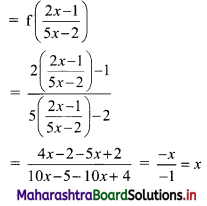
If f(x) = \(\frac{2 x-1}{5 x-2}, x \neq \frac{2}{5}\), verify whether (fof)(x) = x
Solution:
(fof)(x) = f(f(x))
Maharashtra Board 11th Commerce Maths Solutions Chapter 2 Functions Miscellaneous Exercise 2 Q8

Question 9.
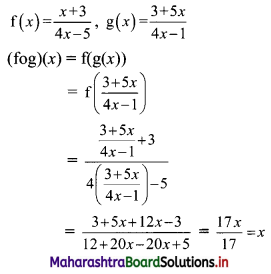
If f(x) = \(\frac{x+3}{4 x-5}\), g(x) = \(\frac{3+5 x}{4 x-1}\), then verify that (fog)(x) = x.
Solution:
Maharashtra Board 11th Commerce Maths Solutions Chapter 2 Functions Miscellaneous Exercise 2 Q9