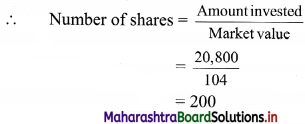
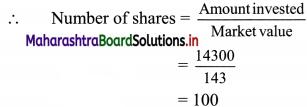
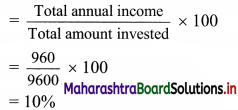
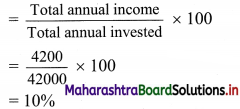
Maharashtra Board 11th Commerce Maths Solutions Chapter 7 Probability Ex 7.3

Balbharati Maharashtra State Board 11th Commerce Maths Solution Book Pdf Chapter 7 Probability Ex 7.3 Questions and Answers.

Maharashtra State Board 11th Commerce Maths Solutions Chapter 7 Probability Ex 7.3

Question 1.
Two dice are thrown together. What is the probability that sum of the numbers on two dice is 5 or the number on the second die is greater than or equal to the number on the first die?
Solution:
When two dice are thrown, the sample space is
S = {(1, 1), (1, 2), (1, 3), (1, 4), (1, 5), (1, 6), (2, 1), (2, 2), (2, 3), (2, 4), (2, 5), (2, 6), (3, 1), (3, 2), (3, 3), (3, 4), (3, 5), (3, 6), (4, 1), (4, 2), (4, 3), (4, 4), (4, 5), (4, 6), (5, 1), (5, 2), (5, 3), (5, 4), (5, 5), (5, 6), (6, 1), (6, 2), (6, 3), (6, 4), (6, 5), (6, 6)}
∴ n(S) = 36
Let A be the event that sum of numbers on two dice is 5.
∴ A = {(1, 4), (2, 3), (3, 2), (4, 1)}
∴ n(A) = 4
∴ P(A) = \(\frac{n(A)}{n(S)}=\frac{4}{36}\)
Let B be the event that number on second die is greater than or equal to number on first die.
B = {(1, 1), (1, 2), (1, 3), (1, 4), (1, 5), (1, 6), (2, 2), (2, 3), (2, 4), (2, 5), (2, 6), (3, 3), (3, 4), (3, 5), (3, 6), (4, 4), (4, 5), (4, 6), (5, 5), (5, 6), (6, 6)}
∴ n(B) = 21
∴ P(B) = \(\frac{n(B)}{n(S)}=\frac{21}{36}\)
Now, A ∩ B = {(1, 4), (2, 3)}
∴ n(A ∩ B) = 2
∴ P(A ∩ B) = \(\frac{\mathrm{n}(\mathrm{A} \cap \mathrm{B})}{\mathrm{n}(\mathrm{S})}=\frac{2}{36}\)
∴ Required probability = P(A ∪ B)
P(A ∪ B) = P(A) + P(B) – P(A ∩ B)
= \(\frac{4}{36}+\frac{21}{36}-\frac{2}{36}\)
= \(\frac{23}{36}\)

Maharashtra Board 11th Commerce Maths Solutions Chapter 7 Probability Ex 7.3

Question 2.
A card is drawn from a pack of 52 cards. What is the probability that,
(i) card is either red or black?
(ii) card is either red or face card?
Solution:
One card can be drawn from the pack of 52 cards in 52C1 = 52 ways
∴ n(S) = 52
Also, the pack of 52 cards consists of 26 red and 26 black cards.
(i) Let A be the event that a red card is drawn Red card can be drawn in 26C1 = 26 ways
∴ n(A) = 26
∴ P(A) = \(\frac{26}{52}\)
Let B be the event that a black card is drawn
∴ Black card can be drawn in 26C1 = 26 ways.
∴ n(B) = 26
∴ P(B) = \(\frac{\mathrm{n}(\mathrm{B})}{\mathrm{n}(\mathrm{S})}=\frac{26}{52}\)
Since A and B are mutually exclusive and exhaustive events
∴ P(A ∩ B) = 0
∴ required probability = P(A ∪ B)
∴ P(A ∪ B) = P(A) + P(B)
= \(\frac{26}{52}+\frac{26}{52}\)
= \(\frac{52}{52}\)
= 1

(ii) Let A be the event that a red card is drawn
∴ red card can be drawn in 26C1 = 26 ways
∴ n(A) = 26
∴ P(A) = \(\frac{\mathrm{n}(\mathrm{A})}{\mathrm{n}(\mathrm{S})}=\frac{26}{52}\)
Let B be the event that a face card is drawn There are 12 face cards in the pack of 52 cards
∴ 1 face card can be drawn in 12C1 = 12 ways
∴ n(B) = 12
∴ P(B) = \(\frac{\mathrm{n}(\mathrm{B})}{\mathrm{n}(\mathrm{S})}=\frac{12}{52}\)
There are 6 red face cards.
∴ n(A ∩ B) = 6
∴ P(A ∩ B) = \(\frac{\mathrm{n}(\mathrm{A} \cap \mathrm{B})}{\mathrm{n}(\mathrm{S})}=\frac{6}{52}\)
∴ Required probability = P(A ∪ B)
P(A ∪ B) = P(A) + P(B) – P(A ∩ B)
= \(\frac{26}{52}+\frac{12}{52}-\frac{6}{52}\)
= \(\frac{32}{52}\)
= \(\frac{8}{13}\)

Question 3.
Two cards are drawn from a pack of 52 cards. What is the probability that,
(i) both the cards are of the same colour?
(ii) both the cards are either black or queens?
Solution:
Two cards can be drawn from 52 cards in 52C2 ways.
∴ n(S) = 52C2
Also, the pack of 52 cards consists of 26 red and 26 black cards.
(i) Let A be the event that both cards are red.
∴ 2 red cards can be drawn in 26C2 ways.
∴ n(A) = 26C2
∴ P(A) = \(\frac{\mathrm{n}(\mathrm{A})}{\mathrm{n}(\mathrm{S})}=\frac{{ }^{26} \mathrm{C}_{2}}{{ }^{52} \mathrm{C}_{2}}=\frac{26 \times 25}{52 \times 51}=\frac{25}{102}\)
Let B be the event that both cards are black.
∴ 2 black cards can be drawn in 26C2 ways
∴ n(B) = 26C2
∴ P(B) = \(\frac{\mathrm{n}(\mathrm{B})}{\mathrm{n}(\mathrm{S})}=\frac{{ }^{26} \mathrm{C}_{2}}{{ }^{52} \mathrm{C}_{2}}=\frac{26 \times 25}{52 \times 51}=\frac{25}{102}\)
Since A and B are mutually exclusive and exhaustive events
∴ P(A ∩ B) = 0
∴ Required probability = P(A ∪ B)
∴ P(A ∪ B) = P(A) + P(B)
= \(\frac{25}{102}+\frac{25}{102}\)
= \(\frac{25}{51}\)

Maharashtra Board 11th Commerce Maths Solutions Chapter 7 Probability Ex 7.3

(ii) Let A be the event that both cards are black.
∴ 2 black cards can be drawn in 26C2 ways.
∴ n(A) = 26C2
∴ P(A) = \(\frac{\mathrm{n}(\mathrm{A})}{\mathrm{n}(\mathrm{S})}=\frac{{ }^{26} \mathrm{C}_{2}}{{ }^{52} \mathrm{C}_{2}}=\frac{26 \times 25}{52 \times 51}=\frac{25}{102}\)
Let B be the event that both cards are queens.
There are 4 queens in a pack of 52 cards
∴ 2 queen cards can be drawn in 4C2 ways.
∴ n(B) = 4C2
∴ P(B) = \(\frac{\mathrm{n}(\mathrm{B})}{\mathrm{n}(\mathrm{S})}=\frac{{ }^{4} \mathrm{C}_{2}}{{ }^{52} \mathrm{C}_{2}}=\frac{4 \times 3}{52 \times 51}=\frac{1}{221}\)
There are two black queen cards.
∴ n(A ∩ B) = 2C2 = 1
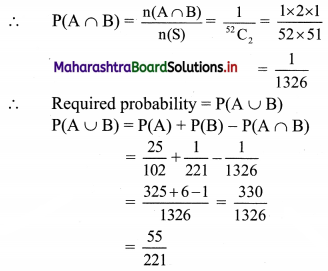
Maharashtra Board 11th Commerce Maths Solutions Chapter 7 Probability Ex 7.3 Q3

Question 4.
A bag contains 50 tickets, numbered from 1 to 50. One ticket is drawn at random. What is the probability that
(i) number on the ticket is a perfect square or divisible by 4?
(ii) number on the ticket is a prime number or greater than 30?
Solution:
Out of the 50 tickets, a ticket can be drawn in 50C1 = 50 ways.
∴ n(S) = 50
(i) Let A be the event that the number on the ticket is a perfect square.
∴ A = {1, 4, 9, 16, 25, 36, 49}
∴ n(A) = 7
∴ P(A) = \(\frac{\mathrm{n}(\mathrm{A})}{\mathrm{n}(\mathrm{S})}=\frac{7}{50}\)
Let B be the event that the number on the ticket is divisible by 4.
∴ B = {4, 8, 12, 16, 20, 24, 28, 32, 36, 40, 44, 48}
∴ n(B) = 12
∴ P(B) = \(\frac{\mathrm{n}(\mathrm{B})}{\mathrm{n}(\mathrm{S})}=\frac{12}{50}\)
Now, A ∩ B = {4, 16, 36}
∴ n(A ∩ B) = 3
∴ P(A ∩ B) = \(\frac{\mathrm{n}(\mathrm{A} \cap \mathrm{B})}{\mathrm{n}(\mathrm{S})}=\frac{3}{50}\)
Required probability = P (A u B)
P (A ∪ B) = P(A) + P(B) – P(A ∩ B)
= \(\frac{7}{50}+\frac{12}{50}-\frac{3}{50}\)
= \(\frac{8}{25}\)

(ii) Let A be the event that the number on the ticket is a prime number.
∴ A = {2, 3, 5, 7, 11, 13, 17, 19, 23, 29, 31, 37, 41, 43, 47}
∴ n(A) = 15
∴ P(A) = \(\frac{\mathrm{n}(\mathrm{A})}{\mathrm{n}(\mathrm{S})}=\frac{15}{50}\)
Let B be the event that the number is greater than 30.
∴ B = {31, 32, 33, 34, 35, 36, 37, 38, 39, 40, 41, 42, 43, 44, 45, 46, 47, 48, 49, 50}
∴ n(B) = 20
∴ P(B) = \(\frac{\mathrm{n}(\mathrm{B})}{\mathrm{n}(\mathrm{S})}=\frac{20}{50}\)
Now, A ∩ B = {31, 37, 41, 43, 47}
∴ n(A ∩ B) = 5
∴ P(A ∩ B) = \(\frac{\mathrm{n}(\mathrm{A} \cap \mathrm{B})}{\mathrm{n}(\mathrm{S})}=\frac{5}{50}\)
∴ Required probability = P(A ∪ B)
P(A ∪ B) = P(A) + P(B) – P(A ∩ B)
= \(\frac{15}{50}+\frac{20}{50}-\frac{5}{50}\)
= \(\frac{15+20-5}{50}\)
= \(\frac{3}{5}\)

Maharashtra Board 11th Commerce Maths Solutions Chapter 7 Probability Ex 7.3

Question 5.
A hundred students appeared for two examinations. 60 passed the first, 50 passed the second, and 30 passed in both. Find the probability that students selected at random
(i) passed at least one examination.
(ii) passed in exactly one examination.
(iii) failed in both examinations.
Solution:
Out of hundred students 1 student can be selected in 100C1 = 100 ways.
∴ n(S) = 100
Let A be the event that the student passed in the first examination.
Let B be the event that student passed in second examination.
∴ n(A) = 60, n(B) = 50 and n(A ∩ B) = 30
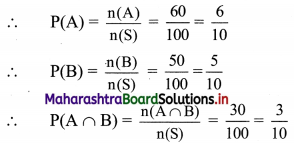
Maharashtra Board 11th Commerce Maths Solutions Chapter 7 Probability Ex 7.3 Q5
(i) P(student passed in at least one examination) = P(A ∪ B)
= P(A) + P(B) – P (A ∩ B)
= \(\frac{6}{10}+\frac{5}{10}-\frac{3}{10}\)
= \(\frac{4}{5}\)

(ii) P(student passed in exactly one examination) = P(A) + P(B) – 2.P(A ∩ B)
= \(\frac{6}{10}+\frac{5}{10}-2\left(\frac{3}{10}\right)\)
= \(\frac{1}{2}\)

(iii) P(student failed in both examinations) = P(A’ ∩ B’)
= P(A ∪ B)’ …..[De Morgan’s law]
= 1 – P(A ∪ B)
= 1 – \(\frac{4}{5}\)
= \(\frac{1}{5}\)

Question 6.
If P(A) = \(\frac{1}{4}\), P(B) = \(\frac{2}{5}\) and P(A ∪ B) = \(\frac{1}{2}\). Find the values of the following probabilities.
(i) P(A ∩ B)
(ii) P(A ∩ B’)
(iii) P(A’ ∩ B)
(iv) P(A’ ∪ B’)
(v) P(A’ ∩ B’)
Solution:
Here, P(A) = \(\frac{1}{4}\), P(B) = \(\frac{2}{5}\) and P(A ∪ B) = \(\frac{1}{2}\)
(i) P(A ∪ B) = P(A) + P(B) – P(A ∩ B)
∴ P(A ∩ B) = P(A) + P(B) – P(A ∪ B)
= \(\frac{1}{4}+\frac{2}{5}-\frac{1}{2}\)
= \(\frac{3}{20}\)

(ii) P(A’ ∩ B’) = P(A) – P(A ∩ B)
= \(\frac{1}{4}-\frac{3}{20}\)
= \(\frac{1}{10}\)

(iii) P(A’ ∩ B) = P(B) – P(A ∩ B)
= \(\frac{2}{5}-\frac{3}{20}\)
= \(\frac{1}{4}\)

(iv) P(A’ ∪ B’) = P(A ∩ B)’ …..[De Morgan’s law]
= 1 – P(A ∩ B)
= 1 – \(\frac{3}{20}\)
= \(\frac{17}{20}\)

(v) P(A’ ∩ B’) = P(A ∪ B)’ …..[De Morgan’s law]
= 1 – P(A ∪ B)
= 1 – \(\frac{1}{2}\)
= \(\frac{1}{2}\)

Question 7.
A computer software company is bidding for computer programs A and B. The probability that the company will get software A is \(\frac{3}{5}\), the probability that the company will get software B is \(\frac{1}{3}\) and the probability that company will get both A and B is \(\frac{1}{8}\). What is the probability that the company will get at least one software?
Solution:
Let A be the event that the company will get software A.
∴ P(A) = \(\frac{3}{5}\)
Let B be the event that company will get software B.
∴ P(B) = \(\frac{1}{3}\)
Also, P(A ∩ B) = \(\frac{1}{8}\)
∴ P(the company will get at least one software) = P(A ∪ B)
= P(A) + P(B) – P(A ∩ B)
= \(\frac{3}{5}+\frac{1}{3}-\frac{1}{8}\)
= \(\frac{72+40-15}{120}\)
= \(\frac{97}{120}\)

Maharashtra Board 11th Commerce Maths Solutions Chapter 7 Probability Ex 7.3

Question 8.
A card is drawn from a well-shuffled pack of 52 cards. Find the probability of it being a heart or a queen.
Solution:
One card can be drawn from the pack of 52 cards in 52C1 = 52 ways
∴ n(S) = 52
Also, the pack of 52 cards consists of 13 heart cards and 4 queen cards
Let A be the event that a card drawn is the heart.
A heart card can be drawn from 13 heart cards in 13C1 ways
∴ n(A) = 13C1
∴ P(A) = \(\frac{\mathrm{n}(\mathrm{A})}{\mathrm{n}(\mathrm{S})}=\frac{{ }^{13} \mathrm{C}_{1}}{52}=\frac{13}{52}\)
Let B be the event that a card drawn is queen.
A queen card can be drawn from 4 queen cards in 4C1 ways
∴ n(B) = 4C1
∴ P(B) = \(\frac{\mathrm{n}(\mathrm{B})}{\mathrm{n}(\mathrm{S})}=\frac{{ }^{4} \mathrm{C}_{1}}{52}=\frac{4}{52}\)
There is one queen card out of 4 which is also a heart card
∴ n(A ∩ B) = 1C1
∴ P(A ∩ B) = \(\frac{\mathrm{n}(\mathrm{A} \cap \mathrm{B})}{\mathrm{n}(\mathrm{S})}=\frac{{ }^{1} \mathrm{C}_{1}}{52}=\frac{1}{52}\)
∴ P(card is a heart or a queen) = P(A ∪ B)
= P(A) + P(B) – P(A ∩ B)
= \(\frac{13}{52}+\frac{4}{52}-\frac{1}{52}\)
= \(\frac{13+4-1}{52}\)
= \(\frac{16}{52}\)
∴ P(A ∪ B) = \(\frac{4}{13}\)

Question 9.
In a group of students, there are 3 boys and 4 girls. Four students are to be selected at random from the group. Find the probability that either 3 boys and 1 girl or 3 girls and 1 boy are selected.
Solution:
The group consists of 3 boys and 4 girls i.e., 7 students.
4 students can be selected from this group in 7C4
= \(\frac{7 \times 6 \times 5 \times 4}{4 \times 3 \times 2 \times 1}\)
= 35 ways.
∴ n(S) = 35
Let A be the event that 3 boys and 1 girl are selected.
3 boys can be selected in 3C3 ways while a girl can be selected in 4C1 ways.
∴ n(A) = 3C3 × 4C1 = 4
∴ P(A) = \(\frac{n(A)}{n(S)}=\frac{4}{35}\)
Let B be the event that 3 girls and 1 boy are selected.
3 girls can be selected in 4C3 ways and a boy can be selected in 3C1 ways.
∴ n(B) = 4C3 × 3C1 = 12
∴ P(B) = \(\frac{n(B)}{n(S)}=\frac{12}{35}\)
Since A and B are mutually exclusive and exhaustive events
∴ P(A ∩ B) = 0
∴ Required probability = P(A ∪ B)
= P(A) + P(B)
= \(\frac{4}{35}+\frac{12}{35}\)
= \(\frac{16}{35}\)
Maharashtra Board 11th Commerce Maths Solutions Chapter 7 Probability Ex 7.2

Balbharati Maharashtra State Board 11th Commerce Maths Solution Book Pdf Chapter 7 Probability Ex 7.2 Questions and Answers.

Maharashtra State Board 11th Commerce Maths Solutions Chapter 7 Probability Ex 7.2

Question 1.
A fair die is thrown two times. Find the chance that
(i) product of the numbers on the upper face is 12.
(ii) sum of the numbers on the upper face is 10.
(iii) sum of the numbers on the upper face is at least 10.
(iv) sum of the numbers on the upper face is 4.
(v) the first throw gives an odd number and the second throw gives a multiple of 3.
(vi) both the times die to show the same number (doublet).
Solution:
If a fair die is thrown twice, the sample space is
S = {(1, 1), (1, 2), (1, 3), (1, 4), (1, 5), (1, 6), (2, 1), (2, 2), (2, 3), (2, 4), (2, 5), (2, 6), (3, 1), (3, 2), (3, 3), (3, 4), (3, 5), (3, 6), (4, 1), (4, 2), (4, 3), (4, 4), (4, 5), (4, 6), (5, 1), (5, 2), (5, 3), (5, 4), (5, 5), (5, 6), (6, 1), (6, 2), (6, 3), (6, 4), (6, 5), (6, 6)}
∴ n(S) = 36
(i) Let A be the event that the product of the numbers on uppermost face is 12.
∴ A = {(2, 6), (3, 4), (4, 3), (6, 2)}
∴ n(A) = 4
∴ P(A) = \(\frac{\mathrm{n}(\mathrm{A})}{\mathrm{n}(\mathrm{S})}=\frac{4}{36}=\frac{1}{9}\)

(ii) Let B be the event that sum of the numbers on uppermost face is 10.
∴ B = {(4, 6), (5, 5), (6, 4)}
∴ n(B) = 3
∴ P(B) = \(\frac{n(B)}{n(S)}=\frac{3}{36}=\frac{1}{12}\)

(iii) Let C be the event that sum of the numbers on uppermost face is at least 10 (i.e., 10 or more than 10 which are 10 or 11 or 12)
∴ C = {(4, 6), (5, 5), (5, 6), (6, 4), (6, 5), ( 6, 6)}
∴ n(C) = 6
∴ P(C) = \(\frac{\mathrm{n}(\mathrm{C})}{\mathrm{n}(\mathrm{S})}=\frac{6}{36}=\frac{1}{6}\)

(iv) Let D be the event that sum of the numbers on uppermost face is 4.
∴ D = {(1, 3), (2, 2), (3, 1)}
∴ n(D) = 3
∴ P(D) = \(\frac{\mathrm{n}(\mathrm{D})}{\mathrm{n}(\mathrm{S})}=\frac{3}{36}=\frac{1}{12}\)

(v) Let E be the event that 1st throw gives an odd number and 2nd throw gives multiple of 3.
∴ E = {(1, 3), (1, 6), (3, 3), (3, 6), (5, 3), (5, 6)}
∴ n(E) = 6
∴ P(E) = \(\frac{\mathrm{n}(\mathrm{E})}{\mathrm{n}(\mathrm{S})}=\frac{6}{36}=\frac{1}{6}\)

(vi) Let F be the event that both times die shows same number.
∴ F = {(1, 1), (2, 2), (3, 3), (4, 4), (5, 5), (6, 6)}
∴ n(F) = 6
∴ P(F) = \(\frac{\mathrm{n}(\mathrm{F})}{\mathrm{n}(\mathrm{S})}=\frac{6}{36}=\frac{1}{6}\)

Maharashtra Board 11th Commerce Maths Solutions Chapter 7 Probability Ex 7.2

Question 2.
Two cards are drawn from a pack of 52 cards. Find the probability that
(i) both are black.
(ii) both are diamonds.
(iii) both are ace cards.
(iv) both are face cards.
(v) one is a spade and the other is a non-spade.
(vi) both are from the same suit.
(vii) both are from the same denomination.
Solution:
Two cards can be drawn from a pack of 52 cards in 52C2 ways.
∴ n(S) = 52C2
(i) Let A be the event that both the cards drawn are black.
The pack of 52 cards contains 26 black cards.
∴ 2 cards can be drawn from them in 26C2 ways
∴ n(A) = 26C2
∴ P(A) = \(\frac{\mathrm{n}(\mathrm{A})}{\mathrm{n}(\mathrm{S})}=\frac{{ }^{26} \mathrm{C}_{2}}{{ }^{52} \mathrm{C}_{2}}\)

(ii) Let B be the event that both the cards drawn are diamond.
There are 13 diamond cards in a pack of 52 cards.
∴ 2 diamond cards can be drawn from 13 diamond cards in 13C2 ways
∴ n(B) = 13C2
∴ P(B) = \(\frac{\mathrm{n}(\mathrm{B})}{\mathrm{n}(\mathrm{S})}=\frac{{ }^{13} \mathrm{C}_{2}}{{ }^{52} \mathrm{C}_{2}}\)

(iii) Let C be the event that both the cards drawn are aces.
In a pack of 52 cards, there are 4 ace cards.
∴ 2 ace cards can be drawn from 4 ace cards in 4C2 ways
∴ n(C) = 4C2
∴ P(C) = \(\frac{\mathrm{n}(\mathrm{C})}{\mathrm{n}(\mathrm{S})}=\frac{{ }^{4} \mathrm{C}_{2}}{{ }^{52} \mathrm{C}_{2}}\)

(iv) Let D be the event that both the cards drawn are face cards.
There are 12 face cards in a pack of 52 cards.
∴ 2 face cards can be drawn from 12 face cards in 12C2 ways.
∴ n(D) = 12C2
∴ P(D) = \(\frac{\mathrm{n}(\mathrm{D})}{\mathrm{n}(\mathrm{S})}=\frac{{ }^{12} \mathrm{C}_{2}}{{ }^{52} \mathrm{C}_{2}}\)

(v) Let E be the event that out of the two cards drawn one is a spade and other is non-spade.
There are 13 spade cards and 39 cards are non-spade cards in a pack of 52 cards.
∴ One spade card can be drawn from 13 spade cards in 13C1 ways and one non-spade card can be drawn from 39 non-spade cards in 39C1 ways.
∴ n(E) = 13C1 . 39C1
∴ P(E) = \(\frac{\mathrm{n}(\mathrm{E})}{\mathrm{n}(\mathrm{S})}=\frac{{ }^{13} \mathrm{C}_{1} \cdot{ }^{39} \mathrm{C}_{1}}{{ }^{52} \mathrm{C}_{2}}\)

(vi) Let F be the event that both the cards drawn are of the same suit.
A pack of 52 cards consists of 4 suits each containing 13 cards.
2 cards can be drawn from a suit in 13C2 ways.
A suit can be selected in 4 ways.
∴ n(F) = 13C2 × 4
∴ P(F) = \(\frac{\mathrm{n}(\mathrm{F})}{\mathrm{n}(\mathrm{S})}=\frac{4 \times{ }^{13} \mathrm{C}_{2}}{{ }^{52} \mathrm{C}_{2}}\)

(vii) Let G be the event that both the cards drawn are of same denominations.
A pack of cards has 13 denominations and 4 different cards for each denomination
∴ n(G) = 13 × 4C2
∴ P(G) = \(\frac{\mathrm{n}(\mathrm{G})}{\mathrm{n}(\mathrm{S})}=\frac{13 \times{ }^{4} \mathrm{C}_{2}}{{ }^{52} \mathrm{C}_{2}}\)

Maharashtra Board 11th Commerce Maths Solutions Chapter 7 Probability Ex 7.2

Question 3.
Four cards are drawn from a pack of 52 cards. Find the probability that
(i) 3 are Kings and 1 is Jack.
(ii) all the cards are from different suits.
(iii) at least one heart.
(iv) all cards are club and one of them is a jack.
Solution:
4 cards can be drawn out of 52 cards in 52C4 ways.
∴ n(S) = 52C4
(i) Let A be the event that out of the four cards drawn, 3 are kings and 1 is a jack.
There are 4 kings and 4 jacks in a pack of 52 cards.
∴ 3 kings can be drawn from 4 kings in 4C3 ways.
Similarly, 1 jack can be drawn out of 4 jacks in 4C1 ways.
∴ Total number of ways in which 3 kings and 1 jack can be drawn is 4C3 × 4C1
∴ n(A) = 4C3 × 4C1
∴ P(A) = \(\frac{\mathrm{n}(\mathrm{A})}{\mathrm{n}(\mathrm{S})}=\frac{{ }^{4} \mathrm{C}_{3} \times{ }^{4} \mathrm{C}_{1}}{{ }^{52} \mathrm{C}_{4}}\)

(ii) Let B be the event that all the cards drawn are of different suits.
A pack of 52 cards consists of 4 suits each containing 13 cards.
∴ A card can be drawn from each suit in 13C1 ways.
∴ 4 cards can be drawn from 4 different suits in 13C1 × 13C1 × 13C1 × 13C1 ways.
∴ n(B) = 13C1 × 13C1 × 13C1 × 13C1
∴ P(B) = \(\frac{\mathrm{n}(\mathrm{B})}{\mathrm{n}(\mathrm{S})}=\frac{{ }^{13} \mathrm{C}_{1} \times{ }^{13} \mathrm{C}_{1} \times{ }^{13} \mathrm{C}_{1} \times{ }^{13} \mathrm{C}_{1}}{{ }^{52} \mathrm{C}_{4}}\)

(iii) Let C be the event that out of the four cards drawn at least one is a heart.
∴ C’ is the event that all 4 cards drawn are non-heart cards.
In a pack of 52 cards, there are 39 non-heart cards.
∴ 4 non-heart cards can be drawn in 39C4 ways.
∴ n(C’) = 39C4
∴ P(C’) = \(\frac{\mathrm{n}\left(\mathrm{C}^{\eta}\right)}{\mathrm{n}(\mathrm{S})}=\frac{{ }^{39} \mathrm{C}_{4}}{{ }^{52} \mathrm{C}_{4}}\)
∴ P(C) = 1 – P(C’) = 1 – \(\frac{{ }^{39} \mathrm{C}_{4}}{{ }^{52} \mathrm{C}_{4}}\)

(iv) Let D be the event that all the 4 cards drawn are clubs and one of them is a jack.
In a pack of 52 cards, there are 13 club cards having 1 jack card.
∴ 1 jack can be drawn in 1C1 way and the other 3 cards can be drawn from remaining 12 club cards in 12C3 ways.
∴ n(D) = 12C3 × 1C1
∴ P(D) = \(\frac{\mathrm{n}(\mathrm{D})}{\mathrm{n}(\mathrm{S})}=\frac{{ }^{12} \mathrm{C}_{3} \times{ }^{1} \mathrm{C}_{1}}{{ }^{52} \mathrm{C}_{4}}\)

Question 4.
A bag contains 15 balls of three different colours: Green, Black, and Yellow. A ball is drawn at random from the bag. The probability of a green ball is 1/3. The probability of yellow is 1/5.
(i) What is the probability of blackball?
(ii) How many balls are green, black, and yellow?
Solution:
(i) The bag contains 15 balls of three different colours i.e., green (G), black (B) and yellow (Y)
∴ P(G) = \(\frac{1}{3}\) and P(Y) = \(\frac{1}{5}\)
If a ball is drawn from the bag, then it can be any one of the green, black and yellow.
∴ P(G) + P(B) + P(Y) = 1
∴ \(\frac{1}{3}\) + P(B) + \(\frac{1}{5}\) = 1
∴ P(B) + \(\frac{8}{15}\) = 1
∴ P(B) = 1 – \(\frac{8}{15}\) = \(\frac{7}{15}\)
∴ Probability of black ball is \(\frac{7}{15}\)

(ii) Total number of balls = 15 and
P(G) = \(\frac{1}{3}\), P(B) = \(\frac{7}{15}\), P(Y) = \(\frac{1}{5}\)
∴ number of green balls = \(\frac{1}{3}\) × 15 = 5
number of black balls = \(\frac{7}{15}\) × 15 = 7
and number of yellow balls = \(\frac{1}{5}\) × 15 = 3.

Maharashtra Board 11th Commerce Maths Solutions Chapter 7 Probability Ex 7.2

Question 5.
A box contains 75 tickets numbered 1 to 75. A ticket is drawn at random from the box. What is the probability that the
(i) number on the ticket is divisible by 6?
(ii) number on the ticket is a perfect square?
(iii) number on the ticket is prime?
(iv) number on the ticket is divisible by 3 and 5?
Solution:
The box contains 75 tickets numbered 1 to 75.
∴ 1 ticket can be drawn from the box in 75C1 = 75 ways.
∴ n(S) = 75
(i) Let A be the event that number on ticket is divisible by 6.
∴ A = {6, 12, 18, 24, 30, 36, 42, 48, 54, 60, 66, 72}
∴ n(A) = 12
∴ P(A) = \(\frac{\mathrm{n}(\mathrm{A})}{\mathrm{n}(\mathrm{S})}=\frac{12}{75}=\frac{4}{25}\)

(ii) Let B be the event that number on ticket is a perfect square.
∴ B = {1, 4, 9, 16, 25, 36, 49, 64}
∴ n(B) = 8
∴ P(B) = \(\frac{\mathrm{n}(\mathrm{B})}{\mathrm{n}(\mathrm{S})}=\frac{8}{75}\)

(iii) Let C be the event that the number on the ticket is a prime number.
∴ C = {2, 3, 5, 7, 11, 13, 17, 19, 23, 29, 31, 37, 41, 43, 47, 53, 59, 61, 67, 71, 73}
∴ n(C) = 21
∴ P(C) = \(\frac{\mathrm{n}(\mathrm{C})}{\mathrm{n}(\mathrm{s})}=\frac{21}{75}=\frac{7}{25}\)

(iv) Let D be the event that number on ticket is divisible by 3 and 5 i.e., divisible by L.C.M. of 3 and 5 i.e., 15
∴ D = {15, 30, 45, 60, 75}
∴ n(D) = 5
∴ P(D) = \(\frac{\mathrm{n}(\mathrm{D})}{\mathrm{n}(\mathrm{S})}=\frac{5}{75}=\frac{1}{15}\)

Question 6.
From a group of 8 boys and 5 girls, a committee of five is to be formed. Find the probability that the committee contains
(i) 3 boys and 2 girls
(ii) at least 3 boys.
Solution:
The group consists of 8 boys and 5 girls i.e., 8 + 5 = 13 persons.
A committee of 5 is to be formed from this group.
∴ 5 persons from 13 persons can be selected in 13C5 ways
∴ n(S) = 13C5
(i) Let A be the event that the committee contains 3 boys and 2 girls.
3 boys from 8 boys can be selected in 8C3 ways and 2 girls from 5 girls can be selected in 5C2 ways
∴ n(A) = 8C3 . 5C2
∴ P(A) = \(\frac{\mathrm{n}(\mathrm{A})}{\mathrm{n}(\mathrm{S})}=\frac{{ }^{8} \mathrm{C}_{3} \cdot{ }^{5} \mathrm{C}_{2}}{{ }^{13} \mathrm{C}_{5}}\)

(ii) Let B be the event that the committee contains at least 3 boys (i.e., 3 boys and 2 girls or 4 boys and 1 girl or 5 boys and no girl)
∴ n(B) = 8C3 . 5C2 + 8C4 . 5C1 + 8C5 . 5C0
∴ P(B) = \(\frac{\mathrm{n}(\mathrm{B})}{\mathrm{n}(\mathrm{S})}=\frac{{ }^{8} \mathrm{C}_{3} \cdot{ }^{5} \mathrm{C}_{2}+{ }^{8} \mathrm{C}_{4} \cdot{ }^{5} \mathrm{C}_{1}+{ }^{8} \mathrm{C}_{5} \cdot{ }^{5} \mathrm{C}_{0}}{{ }^{13} \mathrm{C}_{5}}\)

Maharashtra Board 11th Commerce Maths Solutions Chapter 7 Probability Ex 7.2

Question 7.
A room has three sockets for lamps. From a collection of 10 light bulbs of which 6 are defective, a person selects 3 bulbs at random and puts them in a socket. What is the probability that the room is lit?
Solution:
Total number of bulbs = 10
Number of defective bulbs = 6
∴ Number of non-defective bulbs = 4
3 bulbs can be selected out of 10 light bulbs in 10C3 ways.
∴ n(S) = 10C3
Let A be the event that room is lit.
∴ A’ is the event that the room is not lit.
For A’ the bulbs should be selected from the 6 defective bulbs.
This can be done in 6C3 ways.
∴ n(A’) = 6C3
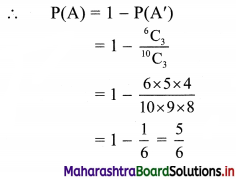
∴ P(A’) = \(\frac{\mathrm{n}\left(\mathrm{A}^{\prime}\right)}{\mathrm{n}(\mathrm{S})}=\frac{{ }^{6} \mathrm{C}_{3}}{{ }^{10} \mathrm{C}_{3}}\)
∴ P(Room is lit) = 1 – P(Room is not lit)
Maharashtra Board 11th Commerce Maths Solutions Chapter 7 Probability Ex 7.2 Q7

Question 8.
The letters of the word LOGARITHM are arranged at random. Find the probability that
(i) Vowels are always together.
(ii) Vowels are never together.
(iii) Exactly 4 letters between G and H
(iv) begins with O and ends with T
(v) Start with a vowel and ends with a consonant.
Solution:
There are 9 letters in the word LOGARITHM.
These letters can be arranged among themselves in 9P9 = 9! ways.
∴ n(S) = 9!
(i) Let A be the event that vowels are always together.
The word LOGARITHM consists of 3 vowels (O, A, I) and 6 consonants (L, G, R, T, H, M).
3 vowels can be arranged among themselves in = 3P3 = 3! ways.
Considering 3 vowels as one group, 6 consonants and this group (i.e., altogether 7) can be arranged in 7P7 = 7! ways.
∴ n(A) = 3! × 7!
∴ P(A) = \(\frac{\mathrm{n}(\mathrm{A})}{\mathrm{n}(\mathrm{S})}=\frac{3 ! \times 7 !}{9 !}\)

(ii) Let B be the event that vowels are never together.
Consider the following arrangement
_C_C_C_C_C_C_
6 consonants create 7 gaps.
∴ 3 vowels can be arranged in 7 gaps in 7P3 ways.
Also 6 consonants can be arranged among themselves in 6P6 = 6! ways.
∴ n(B) = 6! × 7P3
∴ P(B) = \(\frac{\mathrm{n}(\mathrm{B})}{\mathrm{n}(\mathrm{S})}=\frac{6 ! \times{ }^{7} \mathrm{P}_{3}}{9 !}\)

(iii) Let C be the event that exactly 4 letters are arranged between G and H.
Consider the following arrangement
1 2 3 4 5 6 7 8 9
∴ Out of 9 places, G and H can occupy any one of following 4 positions in 4 ways.
1st and 6th, 2nd and 7th, 3rd and 8th, 4th and 9th
Now, G and H can be arranged among themselves in 2P2 = 2! =2 ways.
Also, the remaining 7 letters can be arranged in remaining 7 places in 7P7 = 7! ways.
∴ n(C) = 4 × 2 × 7! = 8 × 7! = 8!
∴ P(C) = \(\frac{\mathrm{n}(\mathrm{C})}{\mathrm{n}(\mathrm{S})}=\frac{8 !}{9 !}=\frac{8 !}{9 \times 8 !}=\frac{1}{9}\)

(iv) Let D be the event that word begins with O and ends with T.
Thus first and last letter can be arranged in one way each and the remaining 7 letters can be arranged in remaining 7 places in 7P7 = 7! ways
∴ n(D) = 7! × 1 × 1 = 7!
∴ P(D) = \(\frac{\mathrm{n}(\mathrm{D})}{\mathrm{n}(\mathrm{S})}=\frac{7 !}{9 !}\)

(v) Let E be the event that word starts with vowel and ends with consonant.
There are 3 vowels and 6 consonants in the word LOGARITHM.
∴ The first place can be filled in 3 different ways and the last place can be filled in 6 ways.
Now, remaining 7 letters can be arranged in 7 places in 7P7 = 7! ways
∴ n(E) = 3 × 6 × 7!
∴ P(E) = \(\frac{n(E)}{n(S)}=\frac{3 \times 6 \times 7 !}{9 !}\)

Maharashtra Board 11th Commerce Maths Solutions Chapter 7 Probability Ex 7.2

Question 9.
The letters of the word SAVITA are arranged at random. Find the probability that vowels are always together.
Solution:
The word SAVITA contains 6 letters. Out of 6 letters, 3 are vowels (A, A, I) and 3 are consonants (S, V, T).
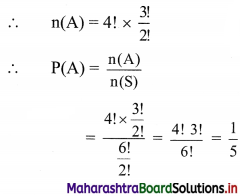
6 letters in which A repeats twice can be arranged among themselves in \(\frac{6 !}{2 !}\) ways.
∴ n(S) = \(\frac{6 !}{2 !}\)
Let A be the event that vowels are always together.
3 vowels (A, A, I) can be arranged among themselves in \(\frac{3 !}{2 !}\) ways.
Considering 3 vowels as one group, 3 consonants and this group (i.e. altogether 4) can be arranged in 4P4 = 4! ways.
Maharashtra Board 11th Commerce Maths Solutions Chapter 7 Probability Ex 7.2 Q9

Maharashtra Board 11th Commerce Maths Solutions Chapter 7 Probability Ex 7.1

Balbharati Maharashtra State Board 11th Commerce Maths Solution Book Pdf Chapter 7 Probability Ex 7.1 Questions and Answers.

Maharashtra State Board 11th Commerce Maths Solutions Chapter 7 Probability Ex 7.1

Question 1.
State the sample space and n(S) for the following random experiments.
(i) A coin is tossed twice. If a second throw results in a tail, a die is thrown.
(ii) A coin is tossed twice. If a second throw results in a head, a die is thrown, otherwise, a coin is tossed.
Solution:
(i) When a coin is tossed twice, the outcomes are HH, HT, TH, TT.
A coin is tossed twice and if the second throw results in a tail, a die is thrown.
Out of the above 4 possibilities, on second throw tail occurs in two cases only i.e., HT, TT.
∴ S = {HH, TH, HT1, HT2, HT3, HT4, HT5, HT6, TT1, TT2, TT3, TT4, TT5, TT6}
∴ n(S) = 14

(ii) When a coin is tossed twice, the outcomes are HH, HT, TH, TT.
Let A be the event that the second throw results in the head when a coin is tossed twice followed by a die is thrown.
∴ A = {HH1, HH2, HH3, HH4, HH5, HH6, TH1, TH2, TH3, TH4, TH5, TH6}
The remaining outcomes i.e., HT, TT are followed by the tossing of a coin.
Let us consider this as event B.
∴ B = {HTT, HTH, TTT, TTH}
The sample space S of the experiment is A ∪ B.
∴ S = {HH1, HH2, HH3, HH4, HH5, HH6, TH1, TH2, TH3, TH4, TH5, TH6, HTT, HTH, TTT, TTH}
∴ n(S) = 16

Maharashtra Board 11th Commerce Maths Solutions Chapter 7 Probability Ex 7.1

Question 2.
In a bag, there are three balls; one black, one red, and one green. Two balls are drawn one after another with replacement. State sample space and n(S).
Solution:
The bag contains 3 balls out of which one is black (B), one is red (R) and the other one is green (G).
Two balls are drawn one after the other, with replacement, from the bag.
∴ the sample space S is given by
S = {BB, BR, BG, RB, RR, RG, GB, GR, GG}
∴ n(S) = 9

Question 3.
A coin and die are tossed. State sample space of following events.
(i) A: Getting a head and an even number.
(ii) B: Getting a prime number.
(iii) C: Getting a tail and perfect square.
Solution:
When a coin and a die are tossed the sample space S is given by
S = {H1, H2, H3, H4, H5, H6, T1, T2, T3, T4, T5, T6}
(i) A: getting a head and an even number
∴ A = {H2, H4, H6}

(ii) B: getting a prime number
∴ B = {H2, H3, H5, T2, T3, T5}

(iii) C: getting a tail and a perfect square.
∴ C = {T1, T4}

Question 4.
Find the total number of distinct possible outcomes n(S) for each of the following random experiments.
(i) From a box containing 25 lottery tickets and 3 tickets are drawn at random.
(ii) From a group of 4 boys and 3 girls, any two students are selected at random.
(iii) 5 balls are randomly placed into five cells, such that each cell will be occupied.
(iv) 6 students are arranged in a row for photographs.
Solution:
(i) Let S be the event that 3 tickets are drawn at random from 25 tickets
∴ 3 tickets can be selected in 25C3 ways
∴ n(S) = 25C3
= \(\frac{25 \times 24 \times 23}{3 \times 2 \times 1}\)
= 2300

(ii) There are 4 boys and 3 girls i.e., 7 students.
2 students can be selected from these 7 students in 7C2 ways.
∴ n(S) = 7C2
= \(\frac{7 \times 6}{2 \times 1}\)
= 21

(iii) 5 balls have to be placed in 5 cells in such a way that each cell is occupied.
∴ The first ball can be placed into one of the 5 cells in 5 ways, the second ball placed into one of the remaining 4 cells in 4 ways.
Similarly, the third, fourth, and fifth balls can be placed in 3 ways, 2 ways, and 1 way, respectively.
∴ a total number of ways of filling 5 cells such that each cell is occupied = 5!
= 5 × 4 × 3 × 2 × 1
= 120
∴ n(S) = 120

(iv) Six students can be arranged in a row for a photograph in 6P6 = 6! ways.
∴ n(S) = 6!
= 6 × 5 × 4 × 3 × 2 × 1
= 720

Maharashtra Board 11th Commerce Maths Solutions Chapter 7 Probability Ex 7.1

Question 5.
Two dice are thrown. Write favourable outcomes for the following events.
(i) P: The sum of the numbers on two dice is divisible by 3 or 4.
(ii) Q: sum of the numbers on two dice is 7.
(iii) R: sum of the numbers on two dice is a prime number.
Also, check whether
(a) events P and Q are mutually exclusive and exhaustive.
(b) events Q and R are mutually exclusive and exhaustive.
Solution:
When two dice are thrown, all possible outcomes are
S = {(1, 1), (1, 2), (1, 3), (1, 4), (1, 5), (1, 6), (2, 1), (2, 2), (2, 3), (2, 4), (2, 5), (2, 6), (3, 1), (3, 2), (3, 3), (3, 4), (3, 5), (3, 6), (4, 1), (4, 2), (4, 3), (4, 4), (4, 5), (4, 6), (5, 1), (5, 2), (5, 3), (5, 4), (5, 5), (5, 6), (6, 1), (6, 2), (6, 3), (6, 4), (6, 5), (6, 6)}
(i) P: sum of the numbers on two dice is divisible by 3 or 4.
∴ P = {(1, 2), (1, 3), (1, 5), (2, 1), (2, 2), (2, 4), (2, 6), (3, 1), (3, 3), (3, 5), (3, 6), (4, 2), (4, 4), (4, 5), (5, 1), (5, 3), (5, 4), (6, 2), (6, 3), (6, 6)}

(ii) Q: sum of the numbers on two dice is 7.
∴ Q = {(1, 6), (2, 5), (3, 4), (4, 3), (5, 2), (6, 1)}

(iii) R: sum of the numbers on two dice is a prime number.
∴ R = {(1, 1), (1, 2), (1, 4), (1, 6), (2, 1), (2, 3), (2, 5), (3, 2), (3, 4), (4, 1), (4, 3), (5, 2), (5, 6), (6, 1), (6, 5)}
(a) P and Q are mutually exclusive events as P ∩ Q = φ and
P ∪ Q = {(1, 2), (1, 3), (1, 5), (1, 6), (2, 1), (2, 2), (2, 4), (2, 5), (2, 6), (3, 1), (3, 3), (3, 4), (3, 5), (3, 6), (4, 2), (4, 3), (4, 4), (4, 5), (5, 1), (5, 2), (5, 3), (5, 4), (6, 1), (6, 2), (6, 3), (6, 6)} ≠ S
∴ P and Q are not exhaustive events as P ∪ Q ≠ S.

(b) Q ∩ R = {(1, 6), (2, 5), (3, 4), (4, 3), (5, 2), (6, 1)}
∴ Q ∩ R ≠ φ
Also, Q ∪ R = {(1, 1), (1, 2), (1, 4), (1, 6), (2, 1), (2, 3), (2, 5), (3, 2), (3, 4), (4, 1), (4, 3), (5, 2), (5, 6), (6, 1), (6, 5)} ≠ S
∴ Q and R are neither mutually exclusive nor exhaustive events.

Question 6.
A card is drawn at random from an ordinary pack of 52 playing cards. State the number of elements in the sample space, if
consideration of suits
(i) is not taken into account.
(ii) is taken into account.
Solution:
(i) If consideration of suits is not taken into account, then one card can be drawn from the pack of 52 playing cards in 52C1 = 52 ways.
∴ n(S) = 52

(ii) If consideration of suits is taken into account, then one card can be drawn from each suit in 13C1 × 4C1
= 13 × 4
= 52 ways.
∴ n(S) = 52

Question 7.
Box-I contains 3 red (R11, R12, R13) and 2 blue (B11, B12) marbles while Box-II contains 2 red (R21, R22) and 4 blue (B21, B22, B23, B24) marbles. A fair coin is tossed. If the coin turns up heads, a marble is chosen from Box-I; if it turns up tails, a marble is chosen from Box-II. Describe the sample space.
Solution:
Box I contains 3 red and 2 blue marbles i.e., (R11, R12, R13, B11, B12)
Box II contains 2 red and 4 blue marbles i.e., (R21, R22, B21, B22, B23, B24)
It is given that a fair coin is tossed and if a head comes then marble is chosen from box I otherwise it is chosen from box II
∴ the sample space is
S = {(H, R11), (H, R12), (H, R13), (H, B11), (H, B12), (T, R21), (T, R22), (T, B21), (T, B22), (T, B23), (T, B24)}

Maharashtra Board 11th Commerce Maths Solutions Chapter 7 Probability Ex 7.1

Question 8.
Consider an experiment of drawing two cards at random from a bag containing 4 cards marked 5, 6, 7, and 8. Find the sample space, if cards are drawn
(i) with replacement
(ii) without replacement.
Solution:
The bag contains 4 cards marked 5, 6, 7, and 8.
Two cards are to be drawn from this bag.
(i) If the two cards are drawn with replacement, then the sample space is
S = {(5, 5), (5, 6), (5, 7), (5, 8), (6, 5), (6, 6), (6, 7), (6,8), (7, 5), (7, 6), (7, 7), (7, 8), (8, 5), (8, 6), (8, 7), (8, 8)}

(ii) If the two cards are drawn without replacement, then the sample space is
S = {(5, 6), (5, 7), (5, 8), (6, 5), (6, 7), (6, 8), (7, 5), (7, 6), (7, 8), (8, 5), (8, 6), (8, 7)}

Maharashtra Board 11th Commerce Maths Solutions Chapter 3 Skewness Ex 3.1

Balbharati Maharashtra State Board 11th Commerce Maths Solution Book Pdf Chapter 3 Skewness Ex 3.1 Questions and Answers.

Maharashtra State Board 11th Commerce Maths Solutions Chapter 3 Skewness Ex 3.1

Question 1.
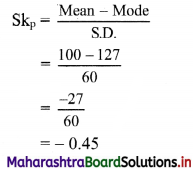
For a distribution, mean = 100, mode = 127 and S.D. = 60. Find the Pearson coefficient of skewness Skp.
Solution:
Given, Mean = 100, Mode = 127, S.D. = 60
Maharashtra Board 11th Commerce Maths Solutions Chapter 3 Skewness Ex 3.1 Q1

Question 2.
The mean and variance of a distribution are 60 and 100 respectively. Find the mode and the median of the distribution if Skp = -0.3.
Solution:
Given, Mean = 60, Variance = 100, Skp = -0.3
∴ S.D. = √Variance = √100 = 10
Skp = \(\frac{\text { Mean }-\text { Mode }}{\text { S.D. }}\)
∴ -0.3 = \(\frac{60-\text { Mode }}{10}\)
∴ -3 = 60 – Mode
∴ Mode = 60 + 3 = 63
Mean – Mode = 3 (Mean – Median)
∴ 60 – 63 = 3(60 – Median)
∴ -3 = 180 – 3Median
∴ 3Median = 180 + 3 = 183
∴ Median = \(\frac{183}{3}\)
∴ Median = 61

Maharashtra Board 11th Commerce Maths Solutions Chapter 3 Skewness Ex 3.1

Question 3.
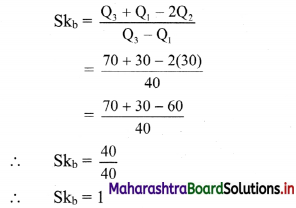
For a data set, sum of upper and lower quartiles is 100, difference between upper and lower quartiles is 40 and the median is 30. Find the coefficient of skewness.
Solution:
Given, Q3 + Q1 = 100 ……(i)
Q3 – Q1 = 40 …..(ii)
Median = Q2 = 30
Adding (i) and (ii), we get
2Q3 = 140
∴ Q3 = 70
Substituting the value of Q3 in (i), we get
70 + Q1 = 100
∴ Q1 = 100 – 70 = 30
Maharashtra Board 11th Commerce Maths Solutions Chapter 3 Skewness Ex 3.1 Q3

Question 4.
For a data set with an upper quartile equal to 55 and median equal to 42, if the distribution is symmetric, find the value of the lower quartile.
Solution:
Upper quartile = Q3 = 55
Median = Q2 = 42
Since, the distribution is symmetric.
∴ Skb = 0
Skb = \(\frac{Q_{3}+Q_{1}-2 Q_{2}}{Q_{3}-Q_{1}}\)
∴ 0 = \(\frac{Q_{3}+Q_{1}-2 Q_{2}}{Q_{3}-Q_{1}}\)
∴ 0 = Q3 + Q1 – 2Q2
∴ Q1 = 2Q2 – Q3
∴ Q1 = 2(42) – 55
∴ Q1 = 84 – 55
∴ Q1 = 29

Question 5.
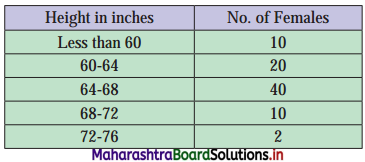
Obtain coefficient of skewness by formula and comment on the nature of the distribution.
Maharashtra Board 11th Commerce Maths Solutions Chapter 3 Skewness Ex 3.1 Q5
Solution:
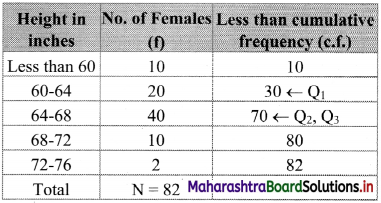
We construct the less than cumulative frequency table as given below.
Maharashtra Board 11th Commerce Maths Solutions Chapter 3 Skewness Ex 3.1 Q5.1
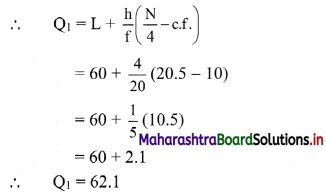
Q1 class = class containing \(\left(\frac{\mathrm{N}}{4}\right)^{\mathrm{th}}\) observation
∴ \(\frac{\mathrm{N}}{4}=\frac{82}{4}\) = 20.5
Cumulative frequency which is just greater than (or equal) to 20.5 is 30.
∴ Q1 lies in the class 60 – 64.
∴ L = 60, h = 4, f = 20, c.f. = 10
Maharashtra Board 11th Commerce Maths Solutions Chapter 3 Skewness Ex 3.1 Q5.2
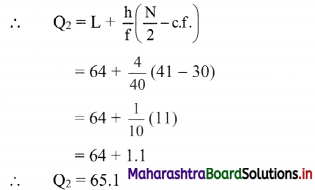
Q2 class = class containing \(\left(\frac{\mathrm{N}}{2}\right)^{\mathrm{th}}\) observation
∴ \(\frac{\mathrm{N}}{2}=\frac{82}{2}\) = 41
Cumulative frequency which is just greater than (or equal) to 41 is 70.
∴ Q2 lies in the class 64 – 68.
∴ L = 64, h = 4, f = 40, c.f. = 30
Maharashtra Board 11th Commerce Maths Solutions Chapter 3 Skewness Ex 3.1 Q5.3
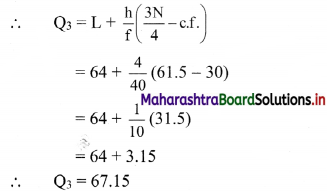
Q3 class = class containing \(\left(\frac{3 \mathrm{~N}}{4}\right)^{\text {th }}\) observation
∴ \(\frac{3 \mathrm{~N}}{4}=\frac{3 \times 82}{4}\) = 61.5
Cumulative frequency which is just greater than (or equal) to 61.5 is 70.
∴ Q3 lies in the class 64 – 68.
∴ L = 64, h = 4, f = 40, c.f. = 30
Maharashtra Board 11th Commerce Maths Solutions Chapter 3 Skewness Ex 3.1 Q5.4
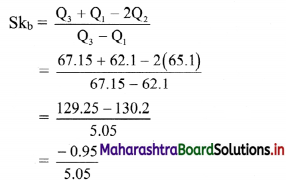
Maharashtra Board 11th Commerce Maths Solutions Chapter 3 Skewness Ex 3.1 Q5.5
∴ Skb = -0.1881
Since, Skb < 0, the distribution is negatively skewed.

Maharashtra Board 11th Commerce Maths Solutions Chapter 3 Skewness Ex 3.1

Question 6.
Find Skp for the following set of observations.
17, 17, 21, 14, 15, 20, 19, 16, 13, 17, 18
Solution:
Σxi = 17 + 17 + 21 + 14 + 15 + 20 + 19 + 16 + 13 + 17 + 18 = 187
Mean = \(\frac{\sum x_{i}}{n}=\frac{187}{11}\) = 17
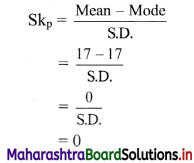
Mode = Observation that occurs most frequently in the data = 17
Maharashtra Board 11th Commerce Maths Solutions Chapter 3 Skewness Ex 3.1 Q6

Question 7.
Calculate Skb for the following set of observations of the yield of wheat in kg from 13 plots:
4.6, 3.5, 4.8, 5.1, 4.7, 5.5, 4.7, 3.6, 3.5, 4.2, 3.5, 3.6, 5.2
Solution:
The given data can be arranged in ascending order as follows:
3.5, 3.5, 3.5, 3.6, 3.6, 4.2, 4.6, 4.7, 4.7, 4.8, 5.1, 5.2, 5.5
Here, n = 13
Q1 = value of \(\left(\frac{n+1}{4}\right)^{\text {th }}\) observation
= value of \(\left(\frac{13+1}{4}\right)^{\text {th }}\) observation
= value of (3.50)th observation
= value of 3rd observation + 0.50(value of 4th observation – value of 3rd observation)
= 3.5 + 0.50(3.6 – 3.5)
= 3.5 + 0.50(0.1)
= 3.5 + 0.05
∴ Q1 = 3.55
Q2 = value of 2\(\left(\frac{n+1}{4}\right)^{\text {th }}\) observation
= value of 2\(\left(\frac{13+1}{4}\right)^{\text {th }}\) observation
= value of (2 × 3.50)th observation
= value of 7th observation
∴ Q2 = 4.6
Q3 = value of 3\(\left(\frac{n+1}{4}\right)^{\text {th }}\) observation
= value of 3\(\left(\frac{13+1}{4}\right)^{\text {th }}\) observation
= value of (3 × 3.50)th observation
= value of (10.50)th observation
= value of 10th observation + 0.50 (value of 11th obseration – value of 10th observation)
= 4.8 + 0.50(5.1 – 4.8)
= 4.8 + 0.50(0.3)
∴ Q3 = 4.95
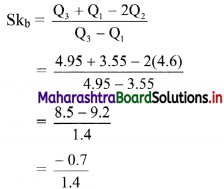
Maharashtra Board 11th Commerce Maths Solutions Chapter 3 Skewness Ex 3.1 Q7
∴ Skb = -0.5

Maharashtra Board 11th Commerce Maths Solutions Chapter 3 Skewness Ex 3.1

Question 8.
For a frequency distribution Q3 – Q2 = 90 and Q2 – Q1 = 120. Find Skb.
Solution:
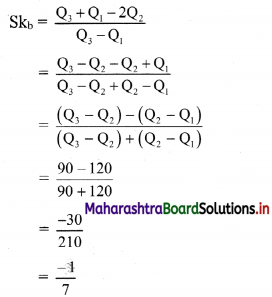
Given, Q2 – Q1 = 90, Q2 – Q1 = 120
Maharashtra Board 11th Commerce Maths Solutions Chapter 3 Skewness Ex 3.1 Q8
∴ Skb = -0.1429

Maharashtra Board 11th Commerce Maths Solutions Chapter 2 Measures of Dispersion Miscellaneous Exercise 2

Balbharati Maharashtra State Board 11th Commerce Maths Solution Book Pdf Chapter 2 Measures of Dispersion Miscellaneous Exercise 2 Questions and Answers.

Maharashtra State Board 11th Commerce Maths Solutions Chapter 2 Measures of Dispersion Miscellaneous Exercise 2

Question 1.
Find the range for the following data.
116, 124, 164, 150, 149, 114, 195, 128, 138, 203, 144
Solution:
Here, largest value (L) = 203, smallest value (S) = 114
∴ Range = L – S
= 203 – 114
= 89

Question 2.
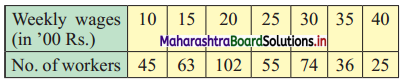
Given below the frequency distribution of weekly w ages of 400 workers. Find the range.
Maharashtra Board 11th Commerce Maths Solutions Chapter 2 Measures of Dispersion Miscellaneous Exercise 2 Q2
Solution:
Here, largest value (L) = 40, smallest value (S) = 10
∴ Range = L – S
= 40 – 10
= 30

Maharashtra Board 11th Commerce Maths Solutions Chapter 2 Measures of Dispersion Miscellaneous Exercise 2

Question 3.
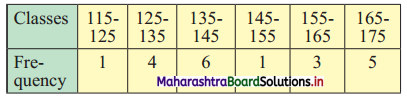
Find the range of the following data.
Maharashtra Board 11th Commerce Maths Solutions Chapter 2 Measures of Dispersion Miscellaneous Exercise 2 Q3
Solution:
Here, upper limit of the highest class (L) = 175, lower limit of the lowest class (S) = 115
∴ Range = L – S
= 175 – 115
= 60

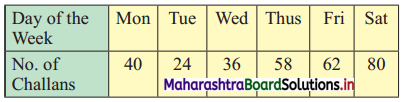
Question 4.
The city traffic police issued challans for not observing the traffic rules:
Maharashtra Board 11th Commerce Maths Solutions Chapter 2 Measures of Dispersion Miscellaneous Exercise 2 Q4
Find Q.D.
Solution:
The given data can be arranged in ascending order as follows:
24, 36, 40, 58, 62, 80
Here, n = 6
Q1 = value of \(\left(\frac{n+1}{4}\right)^{\text {th }}\) observation
= value of \(\left(\frac{6+1}{4}\right)^{\text {th }}\) observation
= value of (1.75)th observation
= value of 1st observation + 0.75(value of 2nd observation – value of 1st observation)
= 24 + 0.75(36 – 24)
= 24 + 0.75(12)
= 24 + 9
∴ Q1 = 33
Q3 = value of 3\(\left(\frac{n+1}{4}\right)^{\text {th }}\) observation
= value of 3\(\left(\frac{6+1}{4}\right)^{\text {th }}\) observation
= value of (3 × 1.75)th observation
= value of (5.25)th observation
= value of 5th observation + 0.25(value of 6th observation – value of 5th observation)
= 62 + 0.25(80 – 62)
= 62 + 0.25(18)
= 62 + 4.5
= 66.5
∴ Q.D. = \(\frac{Q_{3}-Q_{1}}{2}=\frac{66.5-33}{2}=\frac{33.5}{2}\) = 16.75

Maharashtra Board 11th Commerce Maths Solutions Chapter 2 Measures of Dispersion Miscellaneous Exercise 2

Question 5.
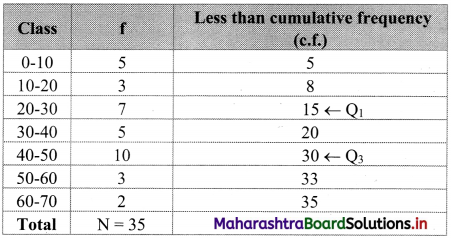
Calculate Q.D. from the following data.
Maharashtra Board 11th Commerce Maths Solutions Chapter 2 Measures of Dispersion Miscellaneous Exercise 2 Q5
Solution:
We construct the less than cumulative frequency table as follows:
Maharashtra Board 11th Commerce Maths Solutions Chapter 2 Measures of Dispersion Miscellaneous Exercise 2 Q5.1
Here, N = 35
Q1 class = class containing \(\left(\frac{N}{4}\right)^{\text {th }}\) observation
∴ \(\frac{\mathrm{N}}{4}=\frac{35}{4}\) = 8.75
Cumulative frequency which is just greater than (or equal to) 8.75 is 15.
∴ Q1 lies in the class 20-30.
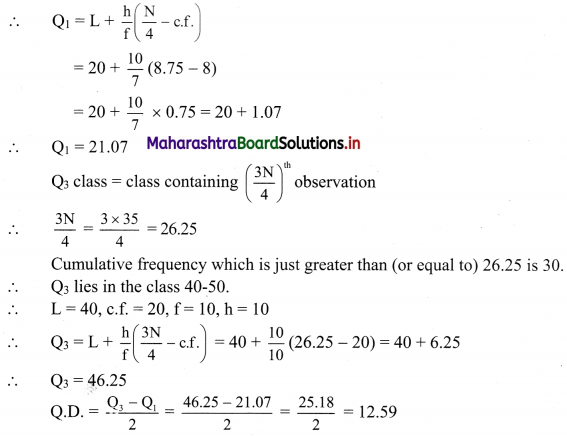
∴ L = 20, c.f. = 8, f = 7, h = 10
Maharashtra Board 11th Commerce Maths Solutions Chapter 2 Measures of Dispersion Miscellaneous Exercise 2 Q5.2

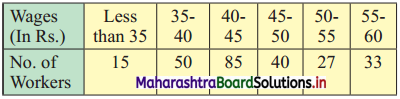
Question 6.
Calculate the appropriate measure of dispersion for the following data.
Maharashtra Board 11th Commerce Maths Solutions Chapter 2 Measures of Dispersion Miscellaneous Exercise 2 Q6
Solution:
Since open-ended classes are given, the appropriate measure of dispersion that we can compute is the quartile deviation.
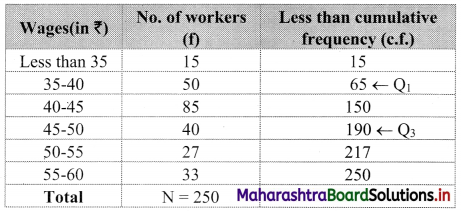
We construct the less than cumulative frequency table as follows:
Maharashtra Board 11th Commerce Maths Solutions Chapter 2 Measures of Dispersion Miscellaneous Exercise 2 Q6.1
Here N = 250
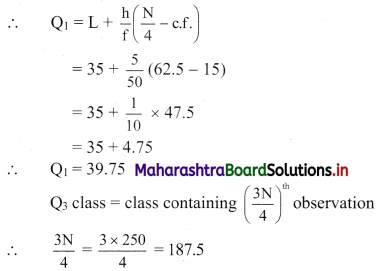
Q1 class class containing \(\left(\frac{N}{4}\right)^{t h}\) observation
∴ \(\frac{\mathrm{N}}{4}=\frac{250}{4}\) = 62.5
Cumulative frequency which is just greater than (or equal to) 62.5 is 65.
∴ Q1 lies in the class 35-40.
∴ L = 35, c.f. = 15, f = 50, h = 5
Maharashtra Board 11th Commerce Maths Solutions Chapter 2 Measures of Dispersion Miscellaneous Exercise 2 Q6.2
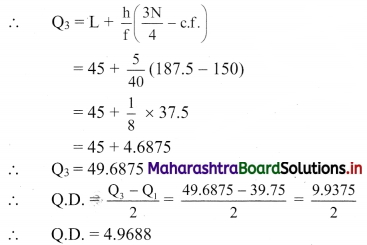
The cumulative frequency which is just greater than (or equal to) 187.5 is 190.
∴ Q3 lies in the class 45-50.
∴ L = 45, c.f. = 150, f = 40, h = 5
Maharashtra Board 11th Commerce Maths Solutions Chapter 2 Measures of Dispersion Miscellaneous Exercise 2 Q6.3

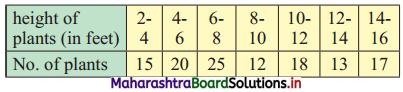
Question 7.
Calculate Q.D. of the following data.
Maharashtra Board 11th Commerce Maths Solutions Chapter 2 Measures of Dispersion Miscellaneous Exercise 2 Q7
Solution:
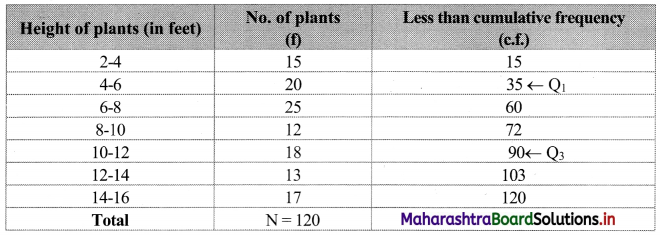
We construct the less than cumulative frequency table as follows:
Maharashtra Board 11th Commerce Maths Solutions Chapter 2 Measures of Dispersion Miscellaneous Exercise 2 Q7.1
Here, N = 120
Q1 class = class containing \(\left(\frac{\mathrm{N}}{4}\right)^{\mathrm{th}}\) observation
∴ \(\frac{\mathrm{N}}{4}=\frac{120}{4}\) = 30
Cumulative frequency which is just greater than (or equal to) 30 is 35.
∴ Q1 lies in the class 4-6.
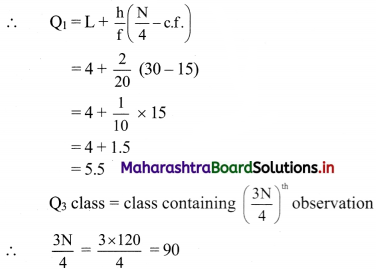
∴ L = 4, c.f. = 15, f = 20, h = 2
Maharashtra Board 11th Commerce Maths Solutions Chapter 2 Measures of Dispersion Miscellaneous Exercise 2 Q7.2
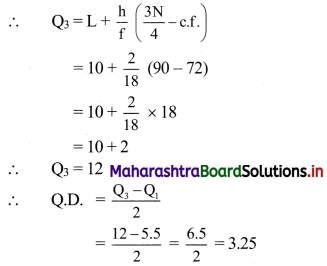
Cumulative frequency which is just greater than (or equal to) 90 is 90.
∴ Q3 lies in the class 10-12.
∴ L = 10, c.f. = 72, f = 18, h = 2
Maharashtra Board 11th Commerce Maths Solutions Chapter 2 Measures of Dispersion Miscellaneous Exercise 2 Q7.3

Question 8.
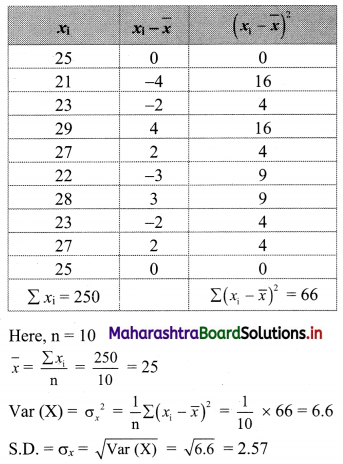
Find variance and S.D. for the following set of numbers.
25, 21, 23, 29, 27, 22, 28, 23, 27, 25 (Given √6.6 = 2.57)
Solution:
We prepare the following table for the calculation of variance and S.D.:
Maharashtra Board 11th Commerce Maths Solutions Chapter 2 Measures of Dispersion Miscellaneous Exercise 2 Q8

Maharashtra Board 11th Commerce Maths Solutions Chapter 2 Measures of Dispersion Miscellaneous Exercise 2

Question 9.
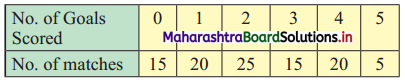
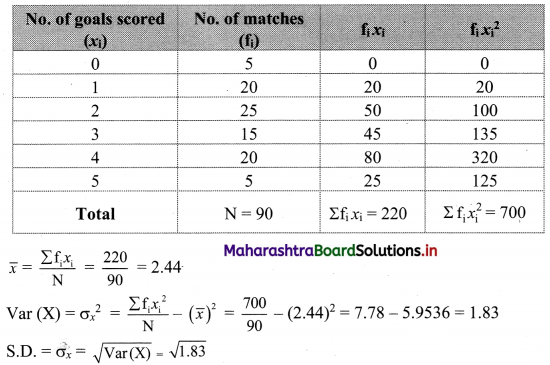
Following data gives no. of goals scored by a team in 90 matches.
Maharashtra Board 11th Commerce Maths Solutions Chapter 2 Measures of Dispersion Miscellaneous Exercise 2 Q9
Compute the variance and standard deviation for the above data.
Solution:
We prepare the following table for the calculation of variance and S.D:
Maharashtra Board 11th Commerce Maths Solutions Chapter 2 Measures of Dispersion Miscellaneous Exercise 2 Q9.1

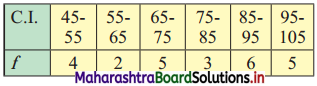
Question 10.
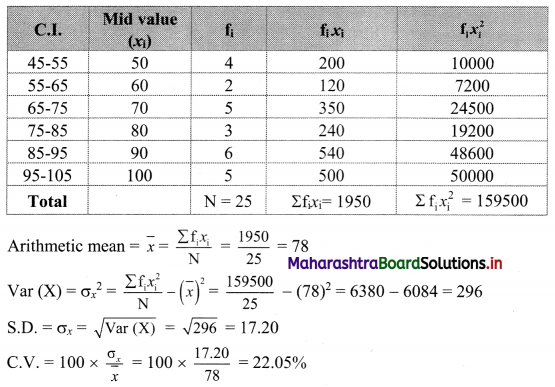
Compute the arithmetic mean and S.D. and C.V. (Given √296 = 17.20)
Maharashtra Board 11th Commerce Maths Solutions Chapter 2 Measures of Dispersion Miscellaneous Exercise 2 Q10
Solution:
We prepare the following table for calculation of arithmetic mean and S.D.:
Maharashtra Board 11th Commerce Maths Solutions Chapter 2 Measures of Dispersion Miscellaneous Exercise 2 Q10.1

Question 11.
The mean and S.D. of 200 items are found to be 60 and 20 respectively. At the time of calculation, two items were wrongly taken as 3 and 67 instead of 13 and 17. Find the correct mean and variance.
Solution:
Here, n = 200, \(\bar{x}\) = Mean = 60, S.D. = 20
Wrongly taken items are 3 and 67.
Correct items are 13 and 17.
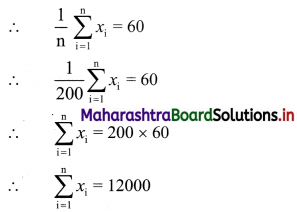
Now, \(\bar{x}\) = 60
Maharashtra Board 11th Commerce Maths Solutions Chapter 2 Measures of Dispersion Miscellaneous Exercise 2 Q11
Correct value of \(\sum_{i=1}^{n} x_{i}=\sum_{i=1}^{n} x_{i}\) (sum of wrongly taken items) + (sum of correct items)
= 12000 – (3 + 67) + (13 + 17)
= 12000 – 70 + 30
= 11960
Correct value of mean = \(\frac{1}{n}\) × correct value of \(\sum_{i=1}^{n} x_{i}\)
= \(\frac{1}{200}\) × 11960
= 59.8
Now, S.D. = 20
Variance = (S.D.)2 = 202
∴ Variance = 400
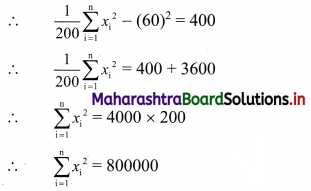
∴ \(\frac{1}{\mathrm{n}} \sum_{\mathrm{i}=1}^{\mathrm{n}} x_{\mathrm{i}}^{2}-(\bar{x})^{2}=400\)
Maharashtra Board 11th Commerce Maths Solutions Chapter 2 Measures of Dispersion Miscellaneous Exercise 2 Q11.1
Correct value of \(\sum_{i=1}^{n} x_{i}^{2}\)
= \(\sum_{i=1}^{n} x_{i}^{2}\) – (Sum of squares of wrongly taken items) + (Sum of squares of correct items)
= 800000 – (32 + 672) + (132 + 172)
= 800000 – (9 + 4489) + (169 + 289)
= 800000 – 4498 + 458
= 795960
∴ Correct value of Variance = (\(\frac{1}{n}\) × \(\sum_{i=1}^{n} x_{i}^{2}\)) – (correct value of \(\bar{x}\))2
= \(\frac{1}{200}\) × 795960 – (59.8)2
= 3979.8 – 3576.04
= 403.76
∴ The correct mean is 59.8 and correct variance is 403.76.

Maharashtra Board 11th Commerce Maths Solutions Chapter 2 Measures of Dispersion Miscellaneous Exercise 2

Question 12.
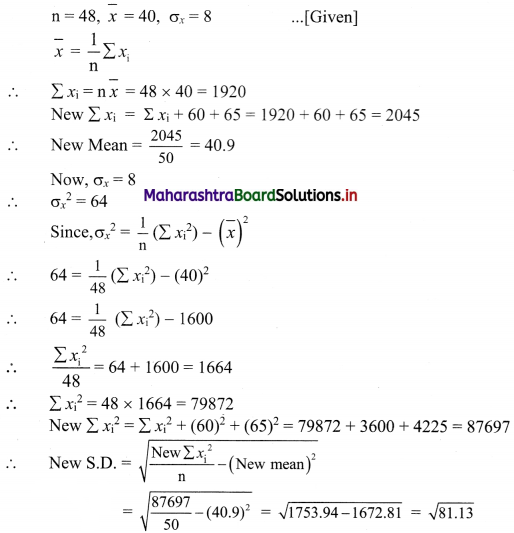
The mean and S.D. of a group of 48 observations are 40 and 8 respectively. If two more observations 60 and 65 are added to the set, find the mean and S.D. of 50 items.
Solution:
Maharashtra Board 11th Commerce Maths Solutions Chapter 2 Measures of Dispersion Miscellaneous Exercise 2 Q12

Question 13.
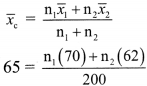
The mean height of 200 students is 65 inches. The mean heights of boys and girls are 70 inches and 62 inches respectively and the standard deviations are 8 and 10 respectively. Find the number of boys and combined S.D.
Solution:
Let n1 and n2 be the number of boys and girls respectively.
Let n = 200, \(\bar{x}_{\mathrm{c}}\) = 65, \(\bar{x}_{1}\) = 70, \(\bar{x}_{1}\) = 62, σ1 = 8, σ2 = 10
Here, n1 + n2 = n
∴ n1 + n2 = 200 …….(i)
Combined mean is given by
Maharashtra Board 11th Commerce Maths Solutions Chapter 2 Measures of Dispersion Miscellaneous Exercise 2 Q13
∴ 70n1 + 62n2 = 13000
∴ 35n1 + 31n2 = 6500 ……..(ii)
Solving (i) and (ii), we get
n1 = 75, n2 = 125
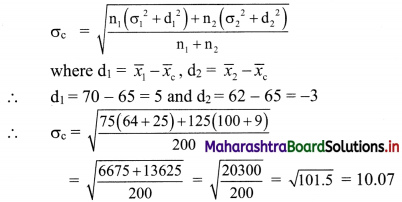
Combined standard deviation is given by,
Maharashtra Board 11th Commerce Maths Solutions Chapter 2 Measures of Dispersion Miscellaneous Exercise 2 Q13.1

Question 14.
From the following data available for 5 pairs of observations of two variables x and y, obtain the combined S.D. for all 10 observations,
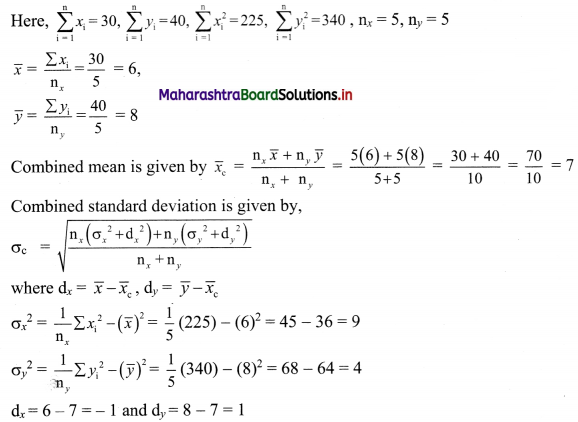
where \(\sum_{i=1}^{n} x_{i}=30, \sum_{i=1}^{n} y_{i}=40, \sum_{i=1}^{n} x_{i}^{2}=225, \sum_{i=1}^{n} y_{i}^{2}=340\)
Solution:
Maharashtra Board 11th Commerce Maths Solutions Chapter 2 Measures of Dispersion Miscellaneous Exercise 2 Q14
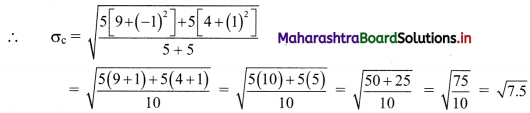
Maharashtra Board 11th Commerce Maths Solutions Chapter 2 Measures of Dispersion Miscellaneous Exercise 2 Q14.1

Question 15.
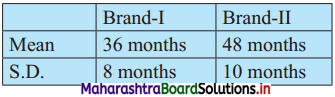
The mean and standard deviations of two brands of watches are given below:
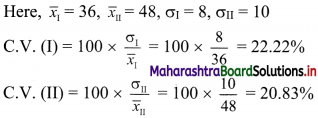
Maharashtra Board 11th Commerce Maths Solutions Chapter 2 Measures of Dispersion Miscellaneous Exercise 2 Q15
Calculate the coefficient of variation of the two brands and interpret the results.
Solution:
Maharashtra Board 11th Commerce Maths Solutions Chapter 2 Measures of Dispersion Miscellaneous Exercise 2 Q15.1
Since C.V. (I) > C.V. (II)
∴ the brand I is more variable.

Maharashtra Board 11th Commerce Maths Solutions Chapter 2 Measures of Dispersion Miscellaneous Exercise 2

Question 16.
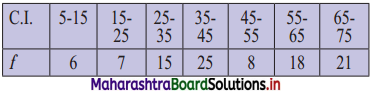
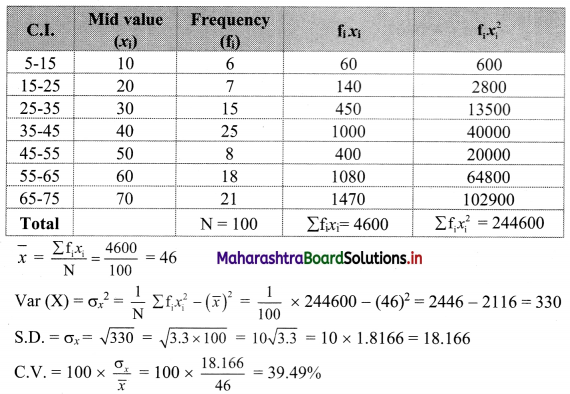
Calculate the coefficient of variation for the data given below. [Given √3.3 = 1.8166]
Maharashtra Board 11th Commerce Maths Solutions Chapter 2 Measures of Dispersion Miscellaneous Exercise 2 Q16
Solution:
Maharashtra Board 11th Commerce Maths Solutions Chapter 2 Measures of Dispersion Miscellaneous Exercise 2 Q16.1

Maharashtra Board 11th Commerce Maths Solutions Chapter 2 Measures of Dispersion Ex 2.3

Balbharati Maharashtra State Board 11th Commerce Maths Solution Book Pdf Chapter 2 Measures of Dispersion Ex 2.3 Questions and Answers.

Maharashtra State Board 11th Commerce Maths Solutions Chapter 2 Measures of Dispersion Ex 2.3

Question 1.
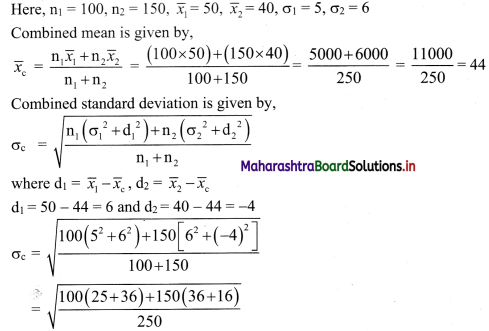
The mean and standard deviation of two distributions of 100 and 150 items are 50, 5, and 40, 6 respectively. Find the mean and standard deviation of all the 250 items taken together.
Solution:
Maharashtra Board 11th Commerce Maths Solutions Chapter 2 Measures of Dispersion Ex 2.3 Q1
Maharashtra Board 11th Commerce Maths Solutions Chapter 2 Measures of Dispersion Ex 2.3 Q1.1
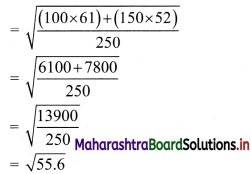
∴ The mean and standard deviation of all 250 items taken together are 44 and √55.6 respectively.

Maharashtra Board 11th Commerce Maths Solutions Chapter 2 Measures of Dispersion Ex 2.3

Question 2.
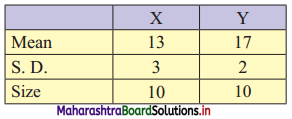
For certain bivariate data, the following information is available.
Maharashtra Board 11th Commerce Maths Solutions Chapter 2 Measures of Dispersion Ex 2.3 Q2
Obtain the combined standard deviation.
Solution:
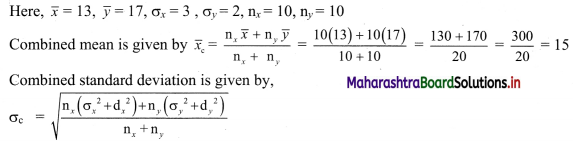
Maharashtra Board 11th Commerce Maths Solutions Chapter 2 Measures of Dispersion Ex 2.3 Q2.1
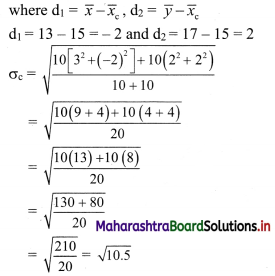
Maharashtra Board 11th Commerce Maths Solutions Chapter 2 Measures of Dispersion Ex 2.3 Q2.2

Question 3.
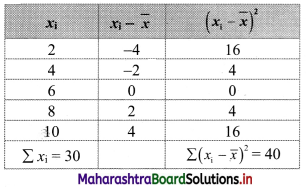
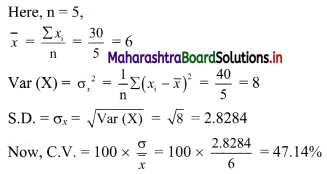
Calculate the coefficient of variation of marks secured by a student in the exam, where the marks are: 2, 4, 6, 8, 10. (Given: √8 = 2.8284)
Solution:
Maharashtra Board 11th Commerce Maths Solutions Chapter 2 Measures of Dispersion Ex 2.3 Q3
Maharashtra Board 11th Commerce Maths Solutions Chapter 2 Measures of Dispersion Ex 2.3 Q3.1

Question 4.
Find the coefficient of variation of a sample that has a mean equal to 25 and a standard deviation of 5.
Solution:
Given, \(\bar{x}\) = 25, σ = 5
C.V. = 100 × \(\frac{\sigma}{\bar{x}}\)
= 100 × \(\frac{5}{25}\)
= 20%

Maharashtra Board 11th Commerce Maths Solutions Chapter 2 Measures of Dispersion Ex 2.3

Question 5.
A group of 65 students of class XI has their average height as 150.4 cm with a coefficient of variation of 2.5%. What is the standard deviation of their height?
Solution:
Given, n = 65, \(\bar{x}\) = 150.4, C.V. = 2.5%
C.V. = 100 × \(\frac{\sigma}{\bar{x}}\)
∴ 2.5 = 100 × \(\frac{\sigma}{150.4}\)
∴ \(\frac{2.5 \times 150.4}{100}\) = σ
∴ σ = 3.76
∴ the standard deviation of students’ height is 3.76.

Question 6.
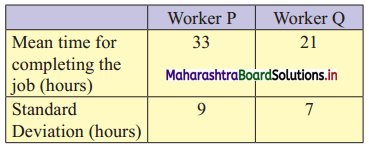
Two workers on the same job show1 the following results:
Maharashtra Board 11th Commerce Maths Solutions Chapter 2 Measures of Dispersion Ex 2.3 Q6
(i) Regarding the time required to complete the job, which worker is more consistent?
(ii) Which worker seems to be faster in completing the job?
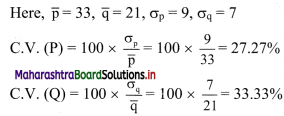
Solution:
Maharashtra Board 11th Commerce Maths Solutions Chapter 2 Measures of Dispersion Ex 2.3 Q6.1
(i) Since, C.V. (P) < C.V.(Q)
∴ Worker P is more consistent regarding the time required to complete the job.

(ii) Since, \(\bar{p}\) > \(\bar{q}\)
i.e., the expected time for completing the job is less for worker Q.
∴ Worker Q seems to be faster in completing the job.

Maharashtra Board 11th Commerce Maths Solutions Chapter 2 Measures of Dispersion Ex 2.3

Question 7.
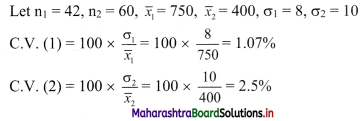
A company has two departments with 42 and 60 employees respectively. Their average weekly wages are ₹ 750 and ₹ 400. The standard deviations are 8 and 10 respectively.
(i) Which department has a larger bill?
(ii) Which department has larger variability in wages?
Solution:
Maharashtra Board 11th Commerce Maths Solutions Chapter 2 Measures of Dispersion Ex 2.3 Q7
(i) Since, \(\bar{x}_{1}>\bar{x}_{2}\)
i.e., average weekly wages are more for the first department.
∴ the first department has a larger bill.
(ii) Since, C.V. (1) < C.V. (2)
∴ the second department is less consistent.
∴ the second department has larger variability in wages.

Question 8.
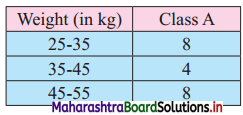
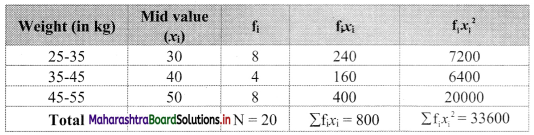
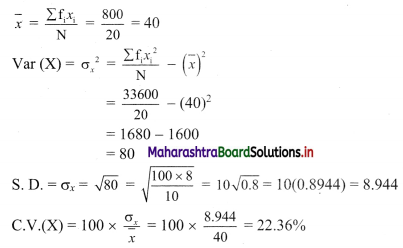
The following table gives the weights of the students of class A. Calculate the coefficient of variation (Given √8 = 0.8944)
Maharashtra Board 11th Commerce Maths Solutions Chapter 2 Measures of Dispersion Ex 2.3 Q8
Solution:
Maharashtra Board 11th Commerce Maths Solutions Chapter 2 Measures of Dispersion Ex 2.3 Q8.1
Maharashtra Board 11th Commerce Maths Solutions Chapter 2 Measures of Dispersion Ex 2.3 Q8.2

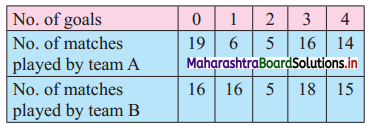
Question 9.
Compute coefficient of variation for team A and team B. (Given: √2.5162 = 1.5863, √2.244 = 1.4980)
Maharashtra Board 11th Commerce Maths Solutions Chapter 2 Measures of Dispersion Ex 2.3 Q9
Which team is more consistent?
Solution:
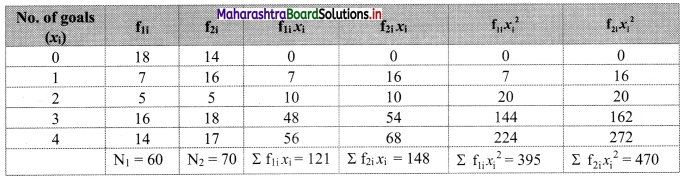
Let f1 denote no. of goals of team A and f2 denote no. of goals of team B.
Maharashtra Board 11th Commerce Maths Solutions Chapter 2 Measures of Dispersion Ex 2.3 Q9.1
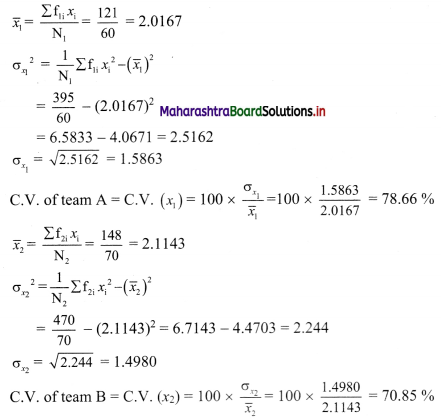
Maharashtra Board 11th Commerce Maths Solutions Chapter 2 Measures of Dispersion Ex 2.3 Q9.2
Since C.V. of team A > C.V. of team B.
∴ team B is more consistent.

Maharashtra Board 11th Commerce Maths Solutions Chapter 2 Measures of Dispersion Ex 2.3

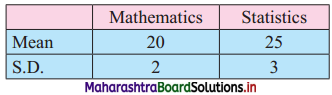
Question 10.
Given below is the information about marks obtained in Mathematics and Statistics by 100 students in a class. Which subject shows the highest variability in marks?
Maharashtra Board 11th Commerce Maths Solutions Chapter 2 Measures of Dispersion Ex 2.3 Q10
Solution:
Maharashtra Board 11th Commerce Maths Solutions Chapter 2 Measures of Dispersion Ex 2.3 Q10.1
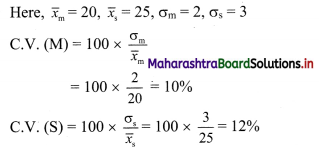
Since C.V. (S) > C.V. (M)
∴ The subject statistics show higher variability in marks.

Maharashtra Board 11th Commerce Maths Solutions Chapter 2 Measures of Dispersion Ex 2.1

Balbharati Maharashtra State Board 11th Commerce Maths Solution Book Pdf Chapter 2 Measures of Dispersion Ex 2.1 Questions and Answers.

Maharashtra State Board 11th Commerce Maths Solutions Chapter 2 Measures of Dispersion Ex 2.1

Question 1.
Find range of the following data:
575, 609, 335, 280, 729, 544, 852, 427, 967, 250
Solution:
Here, largest value (L) = 967, smallest value (S) = 250
∴ Range = L – S
= 967 – 250
= 717

Question 2.
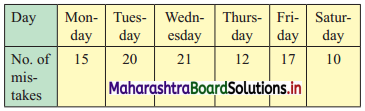
The following data gives the number of typing mistakes done by Radha during a week. Find the range of the data.
Maharashtra Board 11th Commerce Maths Solutions Chapter 2 Measures of Dispersion Ex 2.1 Q2
Solution:
Here, largest value (L) = 21, smallest value (S) = 10
∴ Range = L – S
= 21 – 10
= 11

Maharashtra Board 11th Commerce Maths Solutions Chapter 2 Measures of Dispersion Ex 2.1

Question 3.
Find range for the following data:
Maharashtra Board 11th Commerce Maths Solutions Chapter 2 Measures of Dispersion Ex 2.1 Q3
Solution:
Here, upper limit of the highest class (L) = 72, lower limit of the lowest class (S) = 62
∴ Range = L – S
= 72 – 62
= 10

Question 4.
Find the Q. D. for the following data.
3, 16, 8, 15, 19, 11, 5, 17, 9, 5, 3.
Solution:
The given data can be arranged in ascending order as follows:
3, 3, 5, 5, 8, 9, 11, 15, 16, 17, 19
Here, n = 11
Q1 = value of \(\left(\frac{n+1}{4}\right)^{\text {th }}\) observation
= value of \(\left(\frac{11+1}{4}\right)^{\text {th }}\) observation
= value of 3rd observation
∴ Q1 = 5
Q3 = value of 3\(\left(\frac{n+1}{4}\right)^{\text {th }}\) observation
= value of 3\(\left(\frac{11+1}{4}\right)^{\text {th }}\) observation
= value of (3 × 3)th observation
= value of 9th observation
= 16
∴ Q.D.= \(\frac{\mathrm{Q}_{3}-\mathrm{Q}_{1}}{2}\)
= \(\frac{16-5}{2}\)
= \(\frac{11}{2}\)
= 5.5

Question 5.
Given below are the prices of shares of a company for the last 10 days. Find Q.D.:
172, 164, 188, 214, 190, 237, 200, 195, 208, 230.
Solution:
The given data can be arranged in ascending order as follows:
164, 172, 188, 190, 195, 200, 208, 214, 230, 237
Here, n = 10
Q1 = value of \(\left(\frac{n+1}{4}\right)^{\text {th }}\) observation
= value of \(\left(\frac{10+1}{4}\right)^{\text {th }}\) observation
= value of (2.75)th observation
= value of 2nd observation + 0.75(value of 3rd observation – value of 2nd observation)
= 172 + 0.75(188 – 172)
= 172 + 0.75(16)
= 172 + 12
= 184
∴ Q3 = value of 3\(\left(\frac{n+1}{4}\right)^{\text {th }}\) observation
= value of 3\(\left(\frac{10+1}{4}\right)^{\text {th }}\) observation
= value of (3 × 2.75)th observation
= value of (8.25)th observation
= value of 8th observation + 0.25(value of 9th observation – value of 8th observation)
= 214 + 0.25(230 – 214)
= 214 + 0.25(16)
= 214 + 4
= 218
∴ Q.D. = \(\frac{\mathrm{Q}_{3}-\mathrm{Q}_{1}}{2}\)
= \(\frac{218-184}{2}\)
= \(\frac{34}{2}\)
= 17

Maharashtra Board 11th Commerce Maths Solutions Chapter 2 Measures of Dispersion Ex 2.1

Question 6.
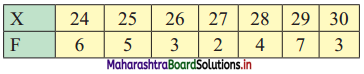
Calculate Q.D. for the following data.
Maharashtra Board 11th Commerce Maths Solutions Chapter 2 Measures of Dispersion Ex 2.1 Q6
Solution:
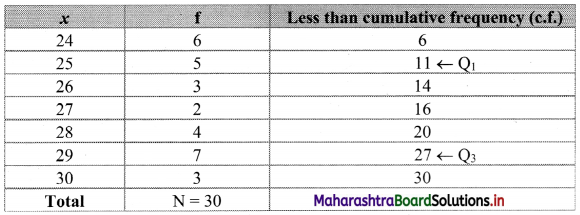
Since the given data is arranged in ascending order, we construct less than cumulative frequency table as follows:
Maharashtra Board 11th Commerce Maths Solutions Chapter 2 Measures of Dispersion Ex 2.1 Q6.1
Here, n = 30
Q1 = value of \(\left(\frac{\mathrm{n}+1}{4}\right)^{\mathrm{th}}\) observation
= value of \(\left(\frac{30+1}{4}\right)^{\text {th }}\) observation
= value of (7.75)th observation
Cumulative frequency which is just greater than (or equal to) 7.75 is 11.
∴ Q1 = 25
Q3 = value of \(\left[3\left(\frac{\mathrm{n}+1}{4}\right)\right]^{\mathrm{th}}\) observation
= value of \(\left[3\left(\frac{30+1}{4}\right)\right]^{\text {th }}\) observation
= value of (3 × 7.75)th observation
= value of (23.25)th observation
Cumulative frequency which is just greater than (or equal to) 23.25 is 27.
∴ Q3 = 29
∴ Q.D. = \(\frac{Q_{3}-Q_{1}}{2}\)
= \(\frac{29-25}{2}\)
∴ Q.D. = 2

Question 7.
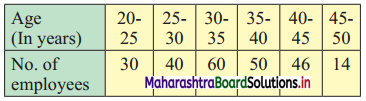
Following data gives the age distribution of 240 employees of a firm. Calculate Q.D. of the distribution.
Maharashtra Board 11th Commerce Maths Solutions Chapter 2 Measures of Dispersion Ex 2.1 Q7
Solution:
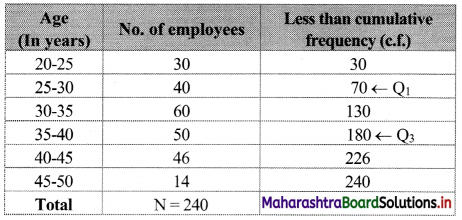
We construct the less than cumulative frequency table as follows:
Maharashtra Board 11th Commerce Maths Solutions Chapter 2 Measures of Dispersion Ex 2.1 Q7.1
Here, N = 240
Q1 class = class containing \(\left(\frac{\mathrm{N}}{4}\right)^{\mathrm{th}}\) observation
∴ \(\frac{N}{4}=\frac{240}{4}\) = 60
Cumulative frequency which is just greater than (or equal to) 60 is 70.
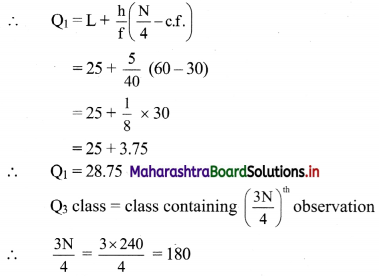
∴ Q1 lies in the class 25 – 30.
∴ L = 25, c.f. = 30, f = 40, h = 5
Maharashtra Board 11th Commerce Maths Solutions Chapter 2 Measures of Dispersion Ex 2.1 Q7.2
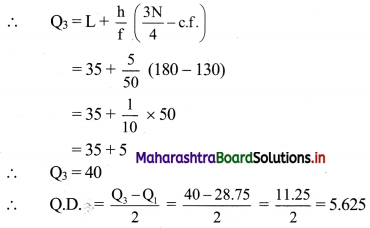
Cumulative frequency which is just greater than (or equal to) 180 is 180.
∴ Q3 lies in the class 35-40.
∴ L = 35, c.f. = 130, f = 50, h = 5
Maharashtra Board 11th Commerce Maths Solutions Chapter 2 Measures of Dispersion Ex 2.1 Q7.3

Question 8.
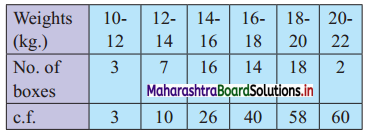
Following data gives the weight of boxes. Calculate Q.D. for the data.
Maharashtra Board 11th Commerce Maths Solutions Chapter 2 Measures of Dispersion Ex 2.1 Q8
Solution:
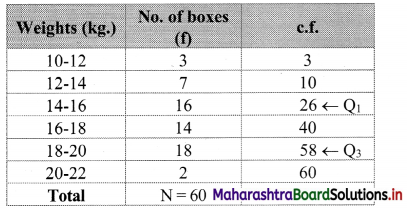
Maharashtra Board 11th Commerce Maths Solutions Chapter 2 Measures of Dispersion Ex 2.1 Q8.1
Here, N = 60
Q1 class = class containing \(\left(\frac{\mathrm{N}}{4}\right)^{\text {th }}\) observation
∴ \(\frac{\mathrm{N}}{4}=\frac{60}{4}\) = 15
Cumulative frequency which is just greater than (or equal to) 15 is 26.
∴ Q1 lies in the class 14 – 16.
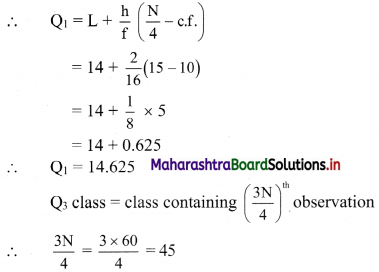
∴ L = 14, c.f. = 10, f = 16, h = 2
Maharashtra Board 11th Commerce Maths Solutions Chapter 2 Measures of Dispersion Ex 2.1 Q8.2
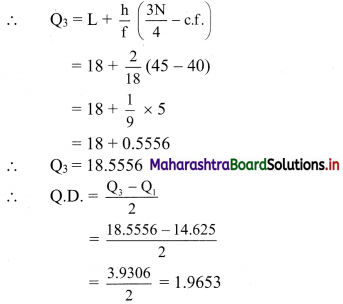
Cumulative frequency which is just greater than (or equal to) 45 is 58.
∴ Q3 lies in the class 18 – 20.
∴ L = 18, c.f. = 40, f = 18, h = 2
Maharashtra Board 11th Commerce Maths Solutions Chapter 2 Measures of Dispersion Ex 2.1 Q8.3

Maharashtra Board 11th Commerce Maths Solutions Chapter 9 Commercial Mathematics Ex 9.7

Balbharati Maharashtra State Board 11th Commerce Maths Solution Book Pdf Chapter 9 Commercial Mathematics Ex 9.7 Questions and Answers.

Maharashtra State Board 11th Commerce Maths Solutions Chapter 9 Commercial Mathematics Ex 9.7

Question 1.
Shantanu has a choice to invest in ₹ 10 shares of two firms at ₹ 13 or at ₹ 16. If the first firm pays a 5% dividend and the second firm pays a 6% dividend per annum, find:
(i) Which firm is paying better?
(ii) If Shantanu invests equally in both the firms and the difference between the return from them is ₹ 30. Find how much, in all, does he invest.
Solution:
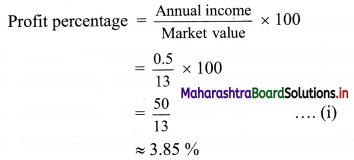
(i) For firm 1:
Face value of the share (F.V.) = ₹ 10
Market value of the share (M.V.) = ₹ 13
Dividend = 5%
∴ Annual income from the share = \(\frac{5}{100}\) × 10 = ₹ 0.5
Maharashtra Board 11th Commerce Maths Solutions Chapter 9 Commercial Mathematics Ex 9.7 Q1
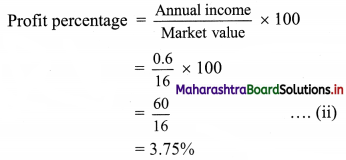
For firm 2:
Face value of the share (F.V.) = ₹ 10
Market value of the share (M.V.) = ₹ 16
Dividend = 5%
∴ Annual income from the share = \(\frac{6}{100}\) × 10 = ₹ 0.6
Maharashtra Board 11th Commerce Maths Solutions Chapter 9 Commercial Mathematics Ex 9.7 Q1.1
Since, the profit percentage from firm 1 > profit percentage from firm 2, the first firm is paying better.

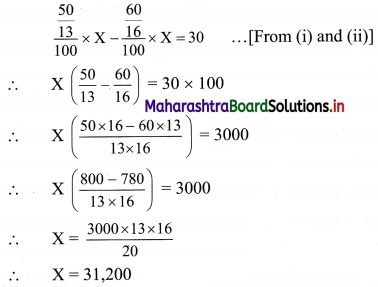
(ii) Let ‘X’ be the amount Shantanu invests in each of the firms.
Given that difference between the return from them is ₹ 30, we have
Maharashtra Board 11th Commerce Maths Solutions Chapter 9 Commercial Mathematics Ex 9.7 Q1.2
In all, Shantanu invests = 2X
= 2 × 31,200
= ₹ 62,400/-

Maharashtra Board 11th Commerce Maths Solutions Chapter 9 Commercial Mathematics Ex 9.7

Question 2.
A dividend of 9% was declared on ₹ 100 shares selling at a certain price in the stock market. If the rate of return is 7.5% calculate
(i) The market price of each share, and
(ii) The amount to be invested to obtain an annual dividend of ₹ 630.
Solution:
(i) Given that,
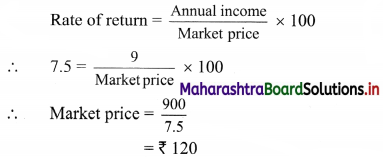
Face value of the share (F.V) = ₹ 100
Dividend = 9%
Rate of return = 7.5%
Annual income from the share = \(\frac{9}{100}\) × 100 = ₹ 9
Maharashtra Board 11th Commerce Maths Solutions Chapter 9 Commercial Mathematics Ex 9.7 Q2
∴ The market price of the share is ₹ 120.

(ii) Let ‘X’ be the amount to be invested to obtain an annual dividend of ₹ 630.
∴ 7.5% of X is ₹ 630
∴ \(\frac{7.5}{100}\) × X = 630
∴ X = \(\frac{630 \times 100}{7.5}\)
∴ X = 8400
∴ ₹ 8400 need to be invested to obtain an annual dividend of ₹ 630.

Question 3.
Nilesh has the option of investing his money in 8% ₹ 10 shares at a premium of ₹ 3.50 or 7% ₹ 100 shares at a premium of 20%. Which of the two investments will be more profitable for him?
Solution:
For share 1:
Face value of the share (F.V.) = ₹ 10
Premium = ₹ 3.5
∴ Market value of the share (M.V.) = 10 + 3.5 = ₹ 13.5
Dividend = 8 %
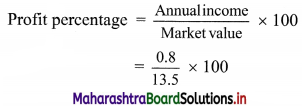
∴ Annual income from the share = \(\frac{8}{100}\) × 10 = ₹ 0.8
Maharashtra Board 11th Commerce Maths Solutions Chapter 9 Commercial Mathematics Ex 9.7 Q3
= \(\frac{800}{135}\)
= 5.93%

For share 2:
Face value of the share (F.V.) = ₹ 100
Premium = 20%
∴ Market value of the share (M.V.) = 100 + (\(\frac{20}{100}\) × 100) = ₹ 120
Dividend = 7%
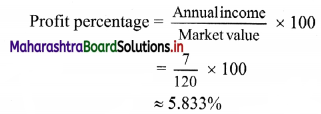
Annual income from the share = \(\frac{7}{100}\) × 100 = ₹ 7
Maharashtra Board 11th Commerce Maths Solutions Chapter 9 Commercial Mathematics Ex 9.7 Q3.1
Since, profit percentage from share 1 > profit percentage from share 2, investing in the first kind of shares will be more profitable for Nilesh.

Maharashtra Board 11th Commerce Maths Solutions Chapter 9 Commercial Mathematics Ex 9.7

Question 4.
Sudhakar invests ₹ 1344 in buying shares of face value ₹ 24 selling at a 12% premium. The dividend on the shares is 15% per annum. Calculate
(i) The number of shares Sudhakar buys, and
(ii) The dividend he receives annually.
Solution:
Given that,
Face value of the share (F.V.) = ₹ 24
Premium = 12%
∴ Market value of the share (M.V.) = 24 + (\(\frac{12}{100}\) × 24) = ₹ 26.88
(i) Sudhakar invests ₹ 1344 in the shares
∴ Number of shares purchased by Sudhakar = \(\frac{1344}{26.88}\) = 50
∴ Sudhakar buys 50 shares.
(ii) Dividend on the share = 15%
Annual income on one share = \(\frac{15}{100}\) × 24 = ₹ 3.6
∴ The total dividend he receives annually = 50 × 3.6 = ₹ 180
∴ Sudhakar receives ₹ 180 as his annual dividend.

Question 5.
Sameer invests ₹ 5625 in a company paying 7% per annum when the share of ₹ 10 stands for ₹ 12.50. Find Sameer’s income from this investment. If he sells 60% of these shares of ₹ 10 each, find his gain or loss in this transaction.
Solution:
Given:
Face value of the share (F.V.) = ₹ 10
Market value of the share (M.V.) = ₹ 12.5
Amount invested in shares = ₹ 5625
∴ Number of shares purchased by Sameer = \(\frac{5625}{12.5}\) = 450
Dividend = 7%
Annual income from one share = \(\frac{7}{100}\) × 10 = ₹ 0.7
∴ Sameer’s income from this investment = number of shares × annual income from one share
= 450 × 0.7
= ₹ 315
Sameer sells 60 % of these shares = \(\frac{60}{100}\) × 450 = 270 shares
Sameer purchased these shares at ₹ 12.5 per share.
∴ Purchase price for these shares = 270 × 12.5 = ₹ 3375
If he sells these shares at ₹ 10 per share, he would receive 270 × 10 = ₹ 2700
∴ In this transaction, Sameer would incur a loss of 3375 – 2700 = ₹ 675

Maharashtra Board 11th Commerce Maths Solutions Chapter 9 Commercial Mathematics Ex 9.7

Question 6.
Geeta buys ₹ 100 shares of a company that pays a 15% dividend. She buys the shares at a price from the market that gives her a 10% return on her investment. At what price did she buy each share?
Solution:
Given that,
Face value of the share (F.V.) = ₹ 100
Dividend = 15%
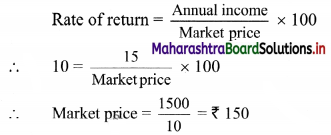
∴ Annual income from the share = \(\frac{15}{100}\) × 100 = ₹ 15
Rate of return on investment = 10%
Maharashtra Board 11th Commerce Maths Solutions Chapter 9 Commercial Mathematics Ex 9.7 Q6
∴ Geeta bought each share from the market at ₹ 150.

Question 7.
Tejas invests in 9% ₹ 100 shares at ₹ 145 but Shail invests in 7% ₹ 100 shares at ₹ 116. Whose investment is better?
Solution:
Investment of Tejas:
Given that, the Face value of the share (F.V.) = ₹ 100
The market value of the share (M.V.) = ₹ 145
Dividend = 9%
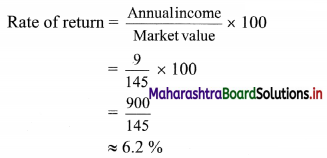
Annual income from the share = \(\frac{9}{100}\) × 100 = ₹ 9
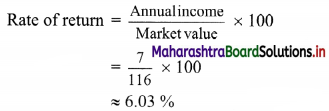
Maharashtra Board 11th Commerce Maths Solutions Chapter 9 Commercial Mathematics Ex 9.7 Q7

Investment of Shail:
Face value of the share (F.V.) = ₹ 100
Market value of the share (M.V.) = ₹ 116
Dividend = 7%
Annual income from the share = \(\frac{7}{100}\) × 100 = ₹ 7
Maharashtra Board 11th Commerce Maths Solutions Chapter 9 Commercial Mathematics Ex 9.7 Q7.1
Since the rate of return for Tejas’s investment is greater than that for Shail’s, Tejas’s investment is better.

Question 8.
A 6% share yields 8%. Find the market value of a ₹ 100 share.
Solution:
Given that,
Face value of the share = ₹ 100
Dividend = 6%
Yield = 8%
Annual income on the share = \(\frac{6}{100}\) × 100 = ₹ 6
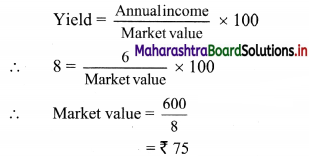
Maharashtra Board 11th Commerce Maths Solutions Chapter 9 Commercial Mathematics Ex 9.7 Q8
∴ The market value of the share = ₹ 75

Question 9.
Ashwini bought ₹ 40 shares at a premium of 40%. Find the income, if Ashwini invests ₹ 14,000 in these shares and receives a dividend at the rate of 8% on the nominal value of the shares.
Solution:
Given,
Face value of the shares (F.V.) = ₹ 40
Premium = 40%
Market value of the shares (M.V.) = 40 + (40 × \(\frac{40}{100}\))
= 40 + 16
= ₹ 56
Ashwini invests ₹ 14000 in these shares
∴ Number of shares bought by Ashwini = \(\frac{Amount Invested}{Market value of one share}\)
= \(\frac{14000}{56}\)
= 250
Dividend = 8%
∴ Annual income on one share = \(\frac{8}{100}\) × 40 = ₹ 3.2
∴ Income of Ashwini on 250 shares = 250 × 3.2 = ₹ 800
∴ Ashwini earns ₹ 800 on her investment.

Maharashtra Board 11th Commerce Maths Solutions Chapter 9 Commercial Mathematics Ex 9.7

Question 10.
Mr. Rutvik invests ₹ 30,000 in buying shares of a company that pays a 12% dividend annually on ₹ 100 shares selling at a premium of ₹ 50. Find
(i) The number of shares bought Mr. Rutvik and
(ii) His annual income from the shares.
Solution:
Given that,
Face value of a share (F.V.) = ₹ 100
Premium = ₹ 50
∴ Market value of a share (M.V.) = 100 + 50 = ₹ 150
Dividend =12%
Mr. Rutvik invests ₹ 30,000 in the shares.
(i) Number of shares bought by Mr. Rutvik = \(\frac{Amount invested}{Market value}\)
= \(\frac{30000}{150}\)
= 200

(ii) Dividend on the share = 12%
∴ Annual income from one share = \(\frac{12}{100}\) × 100 = ₹ 12
∴ His annual income from shares = number of shares × income from one share
= 200 × 12
= ₹ 2400

Question 11.
Rasika bought ₹ 40 shares at a discount of 40%. Find the income, if she invests ₹ 12,000 in these shares and receives a dividend at the rate of 11% on the nominal value of the shares.
Solution:
Given,
Face value of the shares (F.V.) = ₹ 40
Discount = 40%
∴ Market value of the shares (M.V.) = 40 – (40 × \(\frac{40}{100}\))
= 40 – 16
= ₹ 24
Rasika invests ₹ 12,000 in these shares.
∴ Number of shares bought by Rasika = \(\frac{Amount invested}{Market value of one share}\)
= \(\frac{12000}{24}\)
= 500
Dividend = 11%
∴ Annual income on one share = \(\frac{11}{100}\) × 40 = ₹ 4.4
∴ Rasika’s income on 200 such shares = 500 × 4.4 = ₹ 2200
∴ Rasika earns ₹ 2200 from her investment.

Question 12.
Nisha invests ₹ 15,840 in buying shares of nominal value ₹ 24 selling at a premium of 10%. The company pays a 15% dividend annually. Find
(i) The dividend she receives annually, and
(ii) The rate of return from her investment.
Solution:
Given that,
Face value of the share (F.V.) = ₹ 24
Premium = 10%
∴ Market value of the share (M.V.) = 24 + (24 × \(\frac{10}{100}\))
= 24 + 2.4
= ₹ 26.4
Dividend = 15%
∴ Annual income on the share = \(\frac{15}{100}\) × 24 = ₹ 3.6
Nisha invests ₹ 15,840 in these shares.
∴ Number of shares bought by Nisha
Maharashtra Board 11th Commerce Maths Solutions Chapter 9 Commercial Mathematics Ex 9.7 Q12
(i) Annual dividend received by Nisha = Number of shares × annual income from one share
= 600 × 3.6
= ₹ 2160

(ii) Rate of return from the investment
Maharashtra Board 11th Commerce Maths Solutions Chapter 9 Commercial Mathematics Ex 9.7 Q12.1

Question 13.
Ashutosh buys 80, ₹ 100 shares at a discount of 20% and receives a return of 12% on his money. Calculate
(i) The amount invested by Ashutosh.
(ii) The rate of dividend paid by the company.
Solution:
Given
Face value of the shares (F.V.) = ₹ 100
Discount = 20%
∴ Market value of the shares (M.V.) = 100 – (100 × \(\frac{20}{100}\)) = ₹ 80
(i) Amount invested by Ashutosh = number of shares × market value of the shares
= 80 × 80
= ₹ 6400

(ii) Ashutosh receives a return of 12% on his money.
∴ Ashutosh’s income from shares = \(\frac{12}{100}\) × 6400 = ₹ 768
∴ Ashutosh’s annual income from one share = \(\frac{768}{80}\) = ₹ 9.6
Annual income from one share = \(\frac{\text { Dividend }}{100} \times \text { Face value }\)
∴ 9 6 = \(\frac{\text { Dividend }}{100} \times 100\)
∴ Rate of dividend = 9.6%

Maharashtra Board 11th Commerce Maths Solutions Chapter 9 Commercial Mathematics Ex 9.7

Question 14.
Vaishnavi bought 1000, ₹ 100 shares from the stock market carrying 8% dividend quoted at ₹ 130. A few days later the market value of the shares went up by 10%. Vaishnavi sold all her shares. What was her total income from this transaction?
Solution:
Given that,
Face value of the shares (F.V.) = ₹ 100
The market value of the shares (M.V.) = ₹ 130
Dividend = 8%
Income from the each share = \(\frac{8}{100}\) × 100 = ₹ 8
Number of shares bought by Vaishnavi = 1000
∴ Vaishnavi’s income from dividend = 1000 × 8 = ₹ 8000
The price of the shares went up by 10%
New market value of the shares = 130 + (130 × \(\frac{10}{100}\)) = ₹ 143
Vaishnavi sold the shares at ₹ 143 which she bought at ₹ 130 each.
∴ Vaishnavi’s profit on one share =143 – 130 = ₹ 13
∴ Vaishnavi’s profit after selling all her shares =1000 × 13 = ₹ 13,000
Vaishnavi’s total income from this transaction = Income from dividend + income from sale of shares
= 8,000 + 13,000
= ₹ 21,000
∴ Vaishnavi’s total income from this transaction was ₹ 21,000.

Question 15.
Mr. Dinesh invests ₹ 20,800 in 6% ₹ 100 shares at ₹ 104, and ₹ 14,300 in 10.5% ₹ 100 shares at ₹ 143. What will be his annual income from the shares?
Solution:
For 1st kind of shares,
Face value of shares (F.V.) = ₹ 100
Dividend = 6%
∴ Annual income from one share = \(\frac{6}{100}\) × 100 = ₹ 6
Market value of the share (M.V.) = ₹ 104
Total amount invested = ₹ 20,800
Maharashtra Board 11th Commerce Maths Solutions Chapter 9 Commercial Mathematics Ex 9.7 Q15
∴ Total income from 1st kind of shares = 200 × 6 = ₹ 1200
For 2nd kind of shares,
Face value of shares (F.V.) = ₹ 100
Dividend = 10.5%
∴ Annual income from one share = \(\frac{10.5}{100}\) × 100 = ₹ 10.5
Market value of the share (M.V.) = ₹ 143
Total amount invested = ₹ 14300
Maharashtra Board 11th Commerce Maths Solutions Chapter 9 Commercial Mathematics Ex 9.7 Q15.1
∴ Total income from 2nd kind of shares = 100 × 10.5 = ₹ 1050
∴ Total annual income of Dinesh from both these shares = 1200 + 1050 = ₹ 2250

Question 16.
A company declares a semi-annual dividend of 5%. Daniel has 400 shares of the company. If Daniel’s annual income from the shares is ₹ 1,000, find the face value of each share.
Solution:
Given that,
Semi-annual dividend = 5%
∴ Annual dividend = 10%
Number of shares with Daniel = 400
Daniel’s annual income from the shares = ₹ 1000
∴ Annual income from one share = \(\frac{1000}{400}\) = ₹ 2.5
But annual income from one share = \(\frac{\text { Annualdividend }}{100} \times \text { Face value }\)
∴ 2.5 = \(\frac{10}{100}\) × Face value of the share
∴ Face value of the share = ₹ 25

Maharashtra Board 11th Commerce Maths Solutions Chapter 9 Commercial Mathematics Ex 9.7

Question 17.
Bhargav buys 400, ₹ 20 shares at a premium of ₹ 4 each and receives a dividend of 12%. Find
(i) The amount invested by Bhargav.
(ii) His total income from the shares.
(iii) Percentage return on his money.
Solution:
Given that,
Face value of the shares (F.V.) = ₹ 20
Premium = ₹ 4
∴ Market value of the shares (M.V.) = ₹ 24
Dividend = 12%
∴ Annual income from the share = \(\frac{12}{100}\) × 20 = ₹ 2.4
Bhargav buys 400 shares
(i) The amount invested by Bhargav = number of shares × market value
= 400 × 24
= ₹ 9600

(ii) Bhargav’s income from the shares = number of shares × annual income from one share
= 400 × 2.4
= ₹ 960

(iii) Percentage return on Bhargav’s money
Maharashtra Board 11th Commerce Maths Solutions Chapter 9 Commercial Mathematics Ex 9.7 Q17
∴ Bhargav gets 10% as the rate of return on his money.

Question 18.
Anil buys 350 ₹ 100 shares of a company at a premium of 20% from the market. The company pays 12% dividend annually. Find
(i) the investment made by Anil,
(ii) his annual income from the shares, and
(iii) the rate of return from the shares.
Solution:
Given that,
Face value of shares (F.V.) = ₹ 100
Premium = 20%
∴ Market value of shares (M.V.) = 100 + (\(\frac{20}{100}\) × 100) = ₹ 120
Dividend = 12%
∴ Annual income from one share = \(\frac{12}{100}\) × 100 = ₹ 12
Anil buys 350 shares.
(i) Amount invested by Anil = number of shares × market value
= 350 × 120
= ₹ 42,000

Maharashtra Board 11th Commerce Maths Solutions Chapter 9 Commercial Mathematics Ex 9.7

(ii) Anil’s annual income from the shares = number of shares × annual income from one share
= 350 × 12
= ₹ 4200

(iii) Rate of return from shares
Maharashtra Board 11th Commerce Maths Solutions Chapter 9 Commercial Mathematics Ex 9.7 Q18
∴ The rate of return from Anil’s shares is 10%.

Maharashtra Board 11th Commerce Maths Solutions Chapter 9 Commercial Mathematics Ex 9.6

Balbharati Maharashtra State Board 11th Commerce Maths Solution Book Pdf Chapter 9 Commercial Mathematics Ex 9.6 Questions and Answers.

Maharashtra State Board 11th Commerce Maths Solutions Chapter 9 Commercial Mathematics Ex 9.6

Question 1.
M/s Janaseva sweet mart sold sweets of ₹ 3,86,000. What CGST and SGST he will pay if the rate of GST is 5%?
Solution:
Given that M/s Janaseva sweet mart sold sweets of ₹ 3,86,000
∴ Bill amount = ₹ 3,86,000
GST payable at the rate 5%
∴ CGST and SGST applicable is 2.5% each
∴ CGST on the bill = \(\frac{2.5}{100}\) × 3,86,000 = ₹ 9650
and SGST on the bill = \(\frac{2.5}{100}\) × 3,86,000 = ₹ 9650

Question 2.
Janhavi Gas Agency purchased some gas cylinders for ₹ 5,00,000 and sold them to the customers for ₹ 5,90,000. Find the amount of GST payable and the amount of ITC. 5% GST is applicable.
Solution:
Given that, Janhavi Gas Agency purchased some gas cylinders for ₹ 5,00,000 and GST applicable is 5%.
∴ Input tax (ITC) = 5% of 5,00,000
= \(\frac{5}{100}\) × 5,00,000
= ₹ 25,000
Janhavi Gas Agency sold the gas cylinders for ₹ 5,90,000
∴ Output tax for Janhavi Gas Agency = 5% of 5,90,000
= \(\frac{5}{100}\) × 5,90,000
= ₹ 29,500
GST payable = Output tax – Input tax (ITC)
= 29,500 – 25,000
= ₹ 4500
∴ GST payable for Janhavi Gas Agency is ₹ 4,500 and ITC is ₹ 25,000.

Maharashtra Board 11th Commerce Maths Solutions Chapter 9 Commercial Mathematics Ex 9.6

Question 3.
A company dealing in mobile phones purchased mobile phones worth ₹ 5,00,000 and sold the same to customers at ₹ 6,00,000. Find the amount of ITC and amount of GST if the rate of GST is 12%.
Solution:
Given that the rate of GST applicable is 12%.
The company purchased mobile phones worth ₹ 5,00,000.
∴ Input tax (ITC) = 12% of 5,00,000
= \(\frac{12}{100}\) × 5,00,000
= ₹ 60,000
The company dealing in mobile phones sold the same to customers at ₹ 6,00,000.
∴ Output tax of the company = 12% of 6,00,000
= \(\frac{12}{100}\) × 6,00,000
= ₹ 72,000
GST payable for the company = Output tax – Input tax (ITC)
= 72,000 – 60,000
= ₹ 12,000
∴ The ITC for the company is ₹ 60,000 and GST payable is ₹ 12,000.

Question 4.
Prepare business to customers (B2C) tax invoice using given information. Write the name of supplier, address, state, Date, Invoice Number, GSTIN etc. as per your choice
Supplier: ___________
Address: ___________
State: ___________
Date: ___________
Invoice No: ___________
GSTIN: ___________
Particular: Rate of Sarees – ₹ 2750
Rate of GST 5% HSN 5407 – 2 pcs
Rate of Kurta – ₹ 750
Rate of GST 12% HSN 5408
Solution:
Supplier: M/s Swaglife Fashions
Address: 143, Shivaji Rasta, Mumbai 400001
Mobile No. 9263692111
Email: [email protected]
State: Maharashtra
Date: 31/08/19
Invoice No: GST/110
GSTIN: 27ABCDE1234HIZS
Maharashtra Board 11th Commerce Maths Solutions Chapter 9 Commercial Mathematics Ex 9.6 Q4
∴ Rate of 1 saree = ₹ 2750
∴ Rate of 2 sarees = 2 x 2750 = ₹ 5500
∴ GST on sarees = 12% of 5500
= \(\frac{12}{100}\) × 5500
= ₹ 660
∴ CGST = SGST = ₹ 330
∴ Rate of 1 Kurta = ₹ 750
∴ GST on Kurta = 12% of 750
= \(\frac{12}{100}\) × 750
= ₹ 90
∴ CGST = SGST = ₹ 45

Maharashtra Board 11th Commerce Maths Solutions Chapter 9 Commercial Mathematics Ex 9.6

Question 5.
Heena Enterprise sold cosmetics worth ₹ 25,000 to Leena traders, a retailer. Leena Traders sold it further to Meena Beauty Products for ₹ 30,000. Meena Beauty Product sold it further to the customers for ₹ 40,000. The rate of GST is 18%. Find
(i) GST Payable by each party
(ii) CGST and SGST
Solution:
The trading chain,
Maharashtra Board 11th Commerce Maths Solutions Chapter 9 Commercial Mathematics Ex 9.6 Q5
∴ Output tax for Heena Enterprises = 18% of 25,000
= \(\frac{18}{100}\) × 25,000
= ₹ 4,500
∴ GST payable by Heena Enterprises
Now output tax for Leena traders = 18% of 30,000
= \(\frac{18}{100}\) × 30,000
= ₹ 5,400
∴ GST payable by Leena traders = Output tax – Input tax
= 5,400 – 4,500
= ₹ 900
∴ Output tax for Meena beauty products = 18% of 40,000
= \(\frac{18}{100}\) × 40,000
= ₹ 7,200
∴ GST payable by Meena beauty products = Output tax – Input tax
= 7,200 – 5,400
= ₹ 1,800

(ii) Now, CGST = SGST = \(\frac{\text { GST }}{2}\) = 9%
∴ Statement of GST payable at each stage can be tabulated as:
Maharashtra Board 11th Commerce Maths Solutions Chapter 9 Commercial Mathematics Ex 9.6 Q5.1

Question 6.
‘Chitra furnishings’ purchased tapestry (curtain cloth) for ₹ 28,00,000 and sold for ₹ 44,80,000. Rate of GST is 5%. Find
(i) Input Tax
(ii) Output Tax
(iii) ITC
(iv) CGST and SGST
Solution:
Given, that ‘Chitra furnishings’ purchased tapestry (curtain cloth) for ₹ 28,00,000 and rate of GST is 5%
(i) Input tax = 5% of 28,00,000
= \(\frac{5}{100}\) × 28,00,000
= ₹ 1,40,000
The tapestry was sold at ₹ 44,80,000

(ii) Output tax = 5% of 44,80,000
= \(\frac{5}{100}\) × 44,80,000
= ₹ 2,24,000

(iii) Now ITC = Input tax = ₹ 1,40,000
GST payable = Output tax – ITC
= 2,24,000 – 1,40,000
= ₹ 84,000

(iv) CGST = SGST = \(\frac{\text { GST Payable }}{2}\)
= \(\frac{84,000}{2}\)
= ₹ 42,000
∴ CGST = SGST = ₹ 42,000

Maharashtra Board 11th Commerce Maths Solutions Chapter 9 Commercial Mathematics Ex 9.6

Question 7.
Two friends ‘Aditi’ and ‘Vaishali’ went to a restaurant. They ordered 2 Masala Dosa costing ₹ 90 each 2 coffee costing ₹ 60 each and 1 sandwich costing ₹ 80. GST is charged at 5%. Find the Total amount of the bill including GST.
Solution:
Aditi and Vaishali ordered for 2 Masala Dosas, 2 Coffees and 1 Sandwich
∴ Total price of their order = 2 × 90 + 2 × 60 + 80 = ₹ 380
GST is charged at 5%
∴ GST on the total order = 5% × 380
= \(\frac{5}{100}\) × 380
= ₹ 19
∴ Total bill amount including GST = 380 + 19 = ₹ 399

Maharashtra Board 11th Commerce Maths Solutions Chapter 9 Commercial Mathematics Ex 9.5

Balbharati Maharashtra State Board 11th Commerce Maths Solution Book Pdf Chapter 9 Commercial Mathematics Ex 9.5 Questions and Answers.

Maharashtra State Board 11th Commerce Maths Solutions Chapter 9 Commercial Mathematics Ex 9.5

Question 1.
Three partners shared the profit in a business in the ratio 5 : 6 : 7. They had partnered for 12 months, 10 months, and 8 months respectively. What was the ratio of their investments?
Solution:
Let the ratio of investments of the three partners be p : q : r.
They partnered for 12 months, 10 months, and 8 months respectively.
∴ The profit shared by the partners will be in proportion to the product of capital invested and their respective time periods.
∴ 12 × p : 10 × q : 8 × r = 5 : 6 : 7
Maharashtra Board 11th Commerce Maths Solutions Chapter 9 Commercial Mathematics Ex 9.5 Q1
From (i) & (ii), we have
p : q : r = 50 : 72 : 105
∴ The ratio of their investments was 50 : 72 : 105.

Question 2.
Kamala, Vimala and Pramila enter into a partnership. They invest ₹ 40,000, ₹ 80,000 and ₹ 1,20,000 respectively. At the end of the first year, Vimala withdraws ₹ 40,000, while at the end of the second year, Pramila withdraws ₹ 80,000. In what ratio will the profit be shared at the end of 3 years?
Solution:
Given that, Kamala, Vimala, and Pramila invest ₹ 40,000, ₹ 80,000, and ₹ 1,20,000 respectively.
The ratio of profits is to be calculated at the end of 3 years.
Vimala withdraws ₹ 40,000 at the end of the first year.
∴ Vimala invested ₹ 80,000 for one year and 40,000 for 2 years.
Pramila withdraws ₹ 80,000 at the end of the second year.
∴ Pramila invested ₹ 1,20,000 for two years and 40,000 for one year.
Kamala invested ₹ 40,000 for all the 3 years.
∴ The ratio of profits to be shared at the end of 3 years will be
= 40,000 × 3 : 80,000 × 1 + 40,000 × 2 : 1,20,000 × 2 + 40,000 × 1
= 1,20,000 : 1,60,000 : 2,80,000
= 12 : 16 : 28
= 3 : 4 : 7

Alternate Method:
Given that, Kamala, Vimala and Pramila invest ₹ 40,000, ₹ 80,000 & ₹ 1,20,000 respectively.
Given, information can be tabulated as:
Maharashtra Board 11th Commerce Maths Solutions Chapter 9 Commercial Mathematics Ex 9.5 Q2
∴ The profits to be shared at the end of 3 years will be
= 1,20,000 : 1,60,000 : 2,80,000
= 12 : 16 : 28
= 3 : 4 : 7

Maharashtra Board 11th Commerce Maths Solutions Chapter 9 Commercial Mathematics Ex 9.5

Question 3.
Sanjeev started a business investing ₹ 25,000 in 1999. In 2000, he invested an additional amount of ₹ 10,000 and Rajeev joined him with an amount of ₹ 35,000. In 2001, Sanjeev invested another additional amount of ₹ 10,000 and Pawan joined them with an amount of ₹ 35,000. What will be Rajeev’s share in the profit of ₹ 1,50,000 earned at the end of 3rd year from the start of the business in 1999?
Solution:
The given information can be tabulated as:
Maharashtra Board 11th Commerce Maths Solutions Chapter 9 Commercial Mathematics Ex 9.5 Q3
∴ The ratio of profits to be shared at the end of 3 years will be 1,05,000 : 70,000 : 35,000
i.e. in the proportion 3 : 2 : 1
Given, profit earned ₹ 1,50,000/-
∴ Rajeev’s share in the profit = \(\frac{2}{6}\) × 1,50,000 = ₹ 50,000/-

Question 4.
Teena, Leena, and Meena invest in a partnership in the ratio: 7/2, 4/3, 6/5. After 4 months, Teena increases her share by 50%. If the total profit at the end of one year is ₹ 21,600, then what is Leena’s share in the profit?
Solution:
Investment of Teena, Leena and Meena are in the ratio \(\frac{7}{2}: \frac{4}{3}: \frac{6}{5}\)
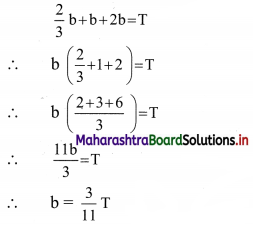
After 4 months, Teena’s share increases by 50%.
i.e. \(\frac{7}{2}+\left(\frac{7}{2} \times \frac{50}{100}\right)=\frac{7}{2}+\frac{7}{4}\)
i.e. \(\frac{21}{4}\)
The profit will be shared in the proportion of product of capitals and respective time periods in months.
i.e. \(\frac{7}{2} \times 4+\frac{21}{4} \times 8: \frac{4}{3} \times 12: \frac{6}{5} \times 12\)
i.e. 56 : 16 : \(\frac{72}{5}\)
i.e. 7 : 2 : \(\frac{9}{5}\)
i.e. in the proportion 35 : 10 : 9 …..[Multiplying throughout by 5]
Given that profit at the end of one year = ₹ 21,600/-
∴ Leena’s share in the profit = \(\frac{10}{54}\) × 21,600
= 5 × 800
= 4000
∴ Leena’s share in the profit is ₹ 4000/-.

Question 5.
Dilip and Pradeep invested amounts in the ratio 2 : 1, whereas the ratio between amounts invested by Dilip and Sudip was 3 : 2. If ₹ 1,49,500 was their profit, how much amount did Sudip receive?
Solution:
Let the amounts invested by Dilip, Pradeep and Sudip be ₹ ‘d’, ₹ ‘p’ and ₹ ‘s’ respectively.
Given that, d : p = 2 : 1
∴ d : p = 6 : 3 …..(i)
and d : s = 3 : 2
∴ d : s = 6 : 4 …..(ii)
From (i) and (ii),
d : p : s = 6 : 3 : 4
∴ The ratio of profits to be shared among Dilip, Pradeep and Sudip will be 6 : 3 : 4.
Given, profit earned = ₹ 1,49,500/-
∴ Sudip’s share in the profit = \(\frac{4}{13}\) × 1,49,500
= 4 × 11,500
= ₹ 46,000/-

Maharashtra Board 11th Commerce Maths Solutions Chapter 9 Commercial Mathematics Ex 9.5

Question 6.
The ratio of investments of two partners Jatin and Lalit is 11 : 12 and the ratio of their profits is 2 : 3. If Jatin invested the money for 8 months, find for how much time Lalit invested his money.
Solution:
Let ‘x’ be the time in months for which Lalit invested his money
Jatin and Lalit invested their money in the ratio 11 : 12.
Jatin invested his money for 8 months and the ratio of their profits is 2 : 3.
∴ 11 × 8 : 12 × x = 2 : 3
∴ \(\frac{88}{12 x}=\frac{2}{3}\)
∴ x = \(\frac{88 \times 3}{2 \times 12}\)
∴ x = 11
∴ Lalit invested his money for 11 months.

Question 7.
Three friends had dinner at a restaurant. When the bill was received, Alpana paid \(\frac{2}{3}\) as much as Beena paid and Beena paid \(\frac{1}{2}\) as much as Catherin paid. What fraction of the bill did Beena pay?
Solution:
Let ‘T’ be the total bill amount at the restaurant and ‘a’, ‘b’, and ‘c’ be the share of Alpana, Beena, and Catherin respectively.
Given, that Alpana paid \(\frac{2}{3}\) as much as Beena paid
∴ a = \(\frac{2}{3}\) b …..(i)
Also, Beena paid \(\frac{1}{2}\) as much as Catherin paid.
∴ b = \(\frac{1}{2}\) c
∴ c = 2b …….(ii)
∴ Three friends paid the total bill amount.
∴ a + b + c = T …..(iii)
Using (i) and (ii) in (iii), we get
Maharashtra Board 11th Commerce Maths Solutions Chapter 9 Commercial Mathematics Ex 9.5 Q7
Thus, Beena paid \(\left(\frac{3}{11}\right)^{\text {th }}\) fraction of the total bill amount.

Question 8.
Roy starts a business with ₹ 10,000, Shikha joins him after 2 months with 20% more investment than Roy, after 2 months Tariq joins him with 40% less than Shikha. If the profit earned by them at the end of the year is equal to twice the difference between the investment of Roy and ten times the investment of Tariq. Find the profit of Roy?
Solution:
Given that, Roy starts the business with ₹ 10,000.
Shikha joins him after 2 months with 20% more investment than Roy.
∴ Shikha’s investment = 10,000 + (10,000 × \(\frac{20}{100}\)) = ₹ 12,000
Tariq joins after two more months with an investment 40% less than Shikha.
∴ Tariq’s investment = 12,000 – (12,000 × \(\frac{40}{100}\)) = ₹ 7,200
Now, the profit will be shared in the proportion of product of capitals and respective periods in months.
i.e. 10,000 × 12 : 12,000 × 10 : 7,200 × 8
i.e. in the proportion, 25 : 25 : 12 …..(i) [Dividing throughout by 4,800]
Given that, profit at the end of the year = twice of the difference between investment of Roy and ten times the investment of Tariq.
∴ Profit = 2 [(10 × 7,200) – 10,000]
= 2[72,000 – 10,000]
= 2 × 62,000
= ₹ 1,24,000
∴ Roy’s share of profit = \(\frac{25}{62}\) × 1,24,000 …..[From (i)]
= ₹ 50,000/-

Maharashtra Board 11th Commerce Maths Solutions Chapter 9 Commercial Mathematics Ex 9.5

Question 9.
If 4(P’s Capital) = 6(Q’s Capital) = 10 (R’s Capital), then out of the total profit of ₹ 5,580, what is R’s share?
Solution:
Let ‘p’, ‘q’ and ‘r’ be P, Q and R’s Capital for the business respectively.
∴ 4p = 6q = 10r
L.C.M of 4, 6, 10 = 60
∴ We take 4p = 6q = 10r = 60x
∴ p = 15x, q = 10x, r = 6x
∴ p : q : r = 15 : 10 : 6
Given that total profit = ₹ 5580
R’s share in the profit = \(\frac{6}{31}\) × 5580 = ₹ 1080/-

Question 10.
A and B start a business, with A investing the total capital of ₹ 50,000, on the condition that B pays interest at the rate of 10% per annum on his half of the capital. A is a working partner and receives ₹ 1,500 per month from the total profit and any profit remaining is equally shared by both of them. At the end of the year, it was found that the income of A is twice that of B. Find the total profit for the year?
Solution:
Let ‘x’ and ‘y’ be the profits earned by A and B respectively and let ‘z’ be the total profit for the year.
A is the working partner and receives ₹ 1500 per month from the total profit.
i.e. 12 × 1500 = ₹ 18,000 at the end of the year.
The remaining profit is shared between A and B equally.
∴ y = \(\frac{z-18000}{2}\) …..(i)
Thus, profit earned by A at the end of that year is given by
x = 18000 + \(\left(\frac{z-18000}{2}\right)\)
∴ x = \(\frac{z+18000}{2}\) ……(ii)
A invests the entire capital on the condition that B pays A interest at the rate of 10% per annum on his half of the capital.
∴ At the end of the first year,
A will receive \(\frac{10}{100}\) × 25,000 i.e. ₹ 2500/- over and above his share of profit.
∴ A’s income = Profit of A + 2500 = x + 2500
Given that,
income of A = twice the income of B
∴ x + 2500 = 2y …..(iii)
Using (i) and (ii) in (iii), we get
\(\frac{z+18000}{2}\) + 2500 = 2\(\left(\frac{z-18000}{2}\right)\)
z + 18000 + 5000 = 2(z – 18000)
z + 23000 = 2z – 36000
∴ z = 59,000
∴ The total profit for the year = ₹ 59,000/-