Maharashtra Board Class 8 Civics Solutions Chapter 1 Introduction to the Parliamentary System

Balbharti Maharashtra State Board Class 8 Civics Solutions Chapter 1 Introduction to the Parliamentary System Notes, Textbook Exercise Important Questions and Answers.

Maharashtra State Board Class 8 Civics Solutions Chapter 1 Introduction to the Parliamentary System

Class 8 Civics Chapter 1 Introduction to the Parliamentary System Textbook Questions and Answers

1. Choose the correct option and rewrite the statements:

Question 1.
Parliamentary System of government developed in ……………. .
(a) England
(b) France
(c) United States of America
(d) Nepal
Answer:
(a) England

Maharashtra Board Class 8 Civics Solutions Chapter 1 Introduction to the Parliamentary System

Question 2.
In the Presidential System, ……….. is the executive head.
(a) Prime Minister
(b) Lok Sabha Speaker
(c) President
(d) Governor
Answer:
(c) President

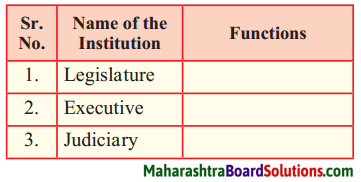
2. Complete the information in the following table.

Question 1.
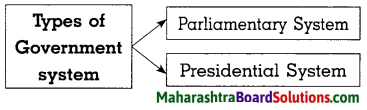
Maharashtra Board Class 8 Civics Solutions Chapter 1 Introduction to the Parliamentary System 1
Answer:

Sr. No.Name of the institutionFunctions
1.LegislatureTo make laws
2.ExecutiveTo implement laws, frame policies
3.JudiciaryTo provide justice

3. Explain the following statements with reasons:

Question 1.
India adopted the Parliamentary System of government.
Answer:

  1. The Parliamentary System of government developed primarily in England.
  2. The British ruled over India for about 150 years. During this period, they ruled in accordance with this system.
  3. So, Indians were familiar with this system of government.
  4. The Constituent Assembly also adopted this system after a thorough discussion.
  5. Hence, the framers of the Constitution made a few changes to suit the Indian situation, and adopted the Parliamentary System.

Maharashtra Board Class 8 Civics Solutions Chapter 1 Introduction to the Parliamentary System

Question 2.
Discussions and deliberations are important in a Parliamentary System of government.
Answer:

  1. In a Parliamentary System of government, decisions are taken after discussions and deliberations.
  2. Members of the opposition party also participate in the discussions.
  3. They may support the government or point out shortcomings in the government policies.
  4. Laws are framed after detailed discussions on questions of public welfare. This does not happen in autocratic rule.
  5. Hence, to protect the welfare and freedom of common people, discussions and deliberations are important.

4. Answer the following in 25 to 30 words:

Question 1.
What is a Responsible Government?
Answer:

  1. The government system in which the Prime Minister and the Council of Ministers is responsible to the Legislature for all their actions and policies, is called a Responsible Government.
  2. In this system, the Council of Ministers has to take the Legislature into confidence during governance.
  3. Every decision taken by any ministry/ department is considered as the decision of the government.
  4. The decisions or policies of every ministry is the collective responsibility of the Council of Ministers.
  5. Thus, the principle of collective responsibility adopted by the Council of Ministers makes it a responsible government.

Question 2.
Enumerate the characteristics of the Presidential System of government.
Answer:
The following are the characteristics of the Presidential System of government:

  1. The President is directly elected by the people.
  2. The President has lot of powers including power to implement laws.
  3. The President is not dependent on the support of the Legislature.
  4. The Legislature and the Executive are not dependent on each other, but still they have mutual control over each other.

5. Why is the role of opposition parties important? Write your opinion.

Question 1.
Why is the role of opposition parties important? Write your opinion.
Answer:
The role of opposition parties is important in Parliamentary as well as Presidential System of government.

  1. The opposition parties participate in the discussions and point out the shortcomings in the policies of the government.
  2. The opposition parties control the Executive through their arguments based on deep study of the topics discussed in the Parliament.
  3. The Executive cannot behave in an irresponsible manner due to the pressure of the opposition parties.
  4. The alertness of the opposition parties help in avoiding wrong practices like corruption, ignoring public welfare, passing faulty laws, etc.

Maharashtra Board Class 8 Civics Solutions Chapter 1 Introduction to the Parliamentary System

Have you thought of this?

  1. What is a parliamentary system of government?
  2. In India we have Prime Minister but why is there no Prime Minister in the United States of America?
  3. What is the difference between a Parliamentary and a Presidential system of government?

Project:

Watch the live telecast proceedings of the Lok Sabha and Rajya Sabha on the national channel Doordarshan and write your observations.

Class 8 Civics Chapter 1 Introduction to the Parliamentary Additional Important Questions and Answers

Choose the correct option and rewrite the statements:

Question 1.
The interrelationship between the Legislature, Executive and Judiciary is decided by the …….
(a) Government
(b) Presidential System
(c) Constitution
(d) Parliament
Answer:
(c) Constitution

Question 2.
The English Constitution is an …….. Constitution where governance is based on conventions.
(a) changeable
(b) unchangeable
(c) unwritten
(d) written.
Answer:
(c) unwritten

Maharashtra Board Class 8 Civics Solutions Chapter 1 Introduction to the Parliamentary System

Question 3.
Sometimes, when no party gets a clear majority, ……… government is formed.
(a) Presidential
(b) coalition
(c) Military
(d) communist
Answer:
(b) coalition

State whether the following statements are True or False. Correct the False statement and rewrite:

Question 1.
Parliamentary System of government is considered as a contribution of United States of America.
Answer:
False.
Correct: Parliamentary System of government is a contribution of England.

Question 2.
In the Parliamentary System, the Legislature of the Central Government is known as the ‘Parliament’.
Answer:
True.

Question 3.
Members of the opposition party also take part in the discussion of the questions related to public welfare.
Answer:
True.

Maharashtra Board Class 8 Civics Solutions Chapter 1 Introduction to the Parliamentary System

Question 4.
In the Parliamentary System, the President is directly elected by the people.
Answer:
False.
Correct: In the Presidential System, the President is directly elected by the people.

Find and write:

Complete the concept map:

Question 1.
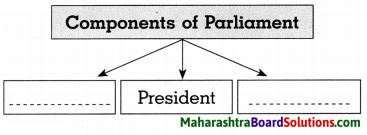
Maharashtra Board Class 8 Civics Solutions Chapter 1 Introduction to the Parliamentary System 2
Answer:
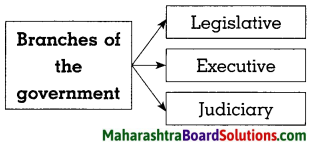
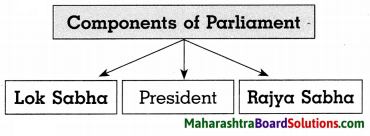
Maharashtra Board Class 8 Civics Solutions Chapter 1 Introduction to the Parliamentary System 3

Question 2.
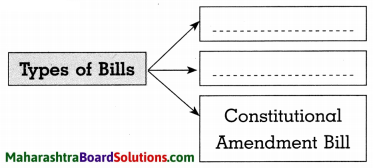
Maharashtra Board Class 8 Civics Solutions Chapter 1 Introduction to the Parliamentary System 4
Answer:
Maharashtra Board Class 8 Civics Solutions Chapter 1 Introduction to the Parliamentary System 5

Question 3.
Maharashtra Board Class 8 Civics Solutions Chapter 1 Introduction to the Parliamentary System 6
Answer:
Maharashtra Board Class 8 Civics Solutions Chapter 1 Introduction to the Parliamentary System 7

Write short notes:

Question 1.
Characteristics of Parliamentary System of India:
Answer:
The following are the characteristics of Parliamentary System adopted by India:

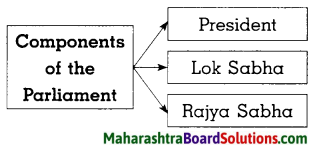
  1. The Parliament of India is composed of the President, Lok Sabha and Rajya Sabha.
  2. Fixed number of members of the Parliament are directly elected by the people.
  3. All political parties contest elections, which are held at regular intervals.
  4. The party having majority in Lok Sabha or a coalition government comes into power.
  5. The leader of the majority party becomes the Prime Minister and he selects candidates to form the Council of Ministers.
  6. The Executive has to perform the responsibility of its individual minister¬ship as well as the responsibility of the Legislature, for all their actions and policies.

Maharashtra Board Class 8 Civics Solutions Chapter 1 Introduction to the Parliamentary System

Question 2.
Responsibilities of the Executive in India:
Answer:
The Executive in India has to fulfill following responsibilities:

  1. Implementing the laws passed by the Parliament.
  2. Framing policies for governing the nation.
  3. Functioning as the members of the Legislature.
  4. Striving to develop the nation through decisions related to the welfare of the people.

Explain the following statements with reasons:

Question 1.
No-confidence motion is an effective tool of keeping a check over the Executive.
Answer:

  1. In the Parliamentary System, the Executive is dependent upon the confidence of the Legislature in them.
  2. If the Legislature feels that the Executive does not work in accordance to its wishes, it can pass a no-confidence motion against the Executive.
  3. If the Legislature passes the no-confidence motion with a majority, then the Executive has to resign.
  4. The Constitution has provided this tool to prevent the Executive from misusing its powers.
    Hence, no-confidence motion is an effective tool of keeping a check over the Executive.

Question 2.
The Parliament is of great importance in the Parliamentary System of government.
Answer:

  1. In the Parliamentary System of government the members of the Legislature are directly elected by the people.
  2. Since the elected members represent the people of the nation in the Parliament, they express and carry the hopes and wishes of the people.
  3. The Parliament decides the policies for the welfare of the people.
  4. If the Parliament feels that the Executive does not work in accordance to its wishes, it can remove the Executive from power by passing a no-confidence motion against it.

Since, the Parliament reflects the wishes and opinions of the people of the nation, it is of great importance.

Maharashtra Board Class 8 Civics Solutions Chapter 1 Introduction to the Parliamentary System

Have you thought of this?

Question 1.
What is a Parliamentary System of government?
Answer:

  1. The Parliamentary System of government is the one where representatives are directly elected by the people.
  2. They are the members of the Legislature, which is also known as the Parliament.
  3. In this system, elections are held after fixed period.
  4. The party which gets the majority forms the government.
  5. In this system, the Executive is dependent on the confidence of the Legislature.

Question 2.
In India we have Prime Minister but why is there no Prime Minister in the United States of America?
Answer:

  1. In the Parliamentary System of government, the Prime Minister is the head of the Executive, i.e. the Council of Ministers.
  2. In the Presidential System of government, the President is the head of the Executive. ‘
  3. Since India has adopted the Parliamentary system, we have the post of the Prime Minister.
  4. Since United States of America has adopted Presidential System, they have the post of the President.
  5. The post of the Prime Minister does not exist in Presidential System of government.

Question 3.
What is the difference between a Parliamentary and a Presidential System of government?
Answer:
Difference between the Parliamentary and Presidential System of government is as follows:

Parliamentary SystemPresidential System
1. President is the Constitutional Head.President is the Executive Head.
2. Prime Minister and Council of Ministers have more powers.President has more powers.
3. Council of Ministers is formed by the elected members of Parliament.President is directly elected by the people.
4. Parliament can remove the Prime Minister by passing a no-confidence motion.President can be removed only by impeachment.
5. Members of the Executive are also the members of the Legislature.Legislature and Executive are not dependent on each other.

Maharashtra Board Class 8 Civics Solutions Chapter 1 Introduction to the Parliamentary System

Question 4.
Why is the role of opposition parties important? Write your opinion.
Answer:
The role of opposition parties is important in Parliamentary as well as Presidential System of government.

  1. The opposition parties participate in the discussions and point out the shortcomings in the policies of the government.
  2. The opposition parties control the Executive through their arguments based on deep study of the topics discussed in the Parliament.
  3. The Executive cannot behave in an irresponsible manner due to the pressure of the opposition parties.
  4. The alertness of the opposition parties help in avoiding wrong practices like corruption, ignoring public welfare, passing faulty laws, etc.

Maharashtra State Board Hindi Yuvakbharati 11th Digest Guide Textbook Answers Solutions

Maharashtra State Board Hindi Yuvakbharati 11th Digest Pdf 2021-2022, Hindi Digest Std 11 Pdf Download, Yuvakbharati Hindi 11th Textbook Pdf, 11th Ka Hindi Book Pdf Maharashtra Board, 11th Commerce Hindi Book Guide Question and Answer PDF Free Download.

Maharashtra State Board Yuvakbharati 11th Std Hindi Digest Textbook Solutions Answers

11th Hindi Digest Pdf | Hindi Yuvakbharati 11th Digest Pdf Download

Yuvakbharati Hindi 11th Textbook Pdf विशेष अध्ययन हेत

Class 11 Hindi Digest Pdf व्यावहारिक हिंदी

11th Std Hindi Textbook Guide Pdf Download परिशिष

Maharashtra State Board Class 11 Textbook Solutions

Maharashtra Board Class 9 History Solutions Chapter 5 Education

Balbharti Maharashtra State Board Class 9 History Solutions Chapter 5 Education Notes, Textbook Exercise Important Questions and Answers.

Maharashtra State Board Class 9 History Solutions Chapter 5 Education

Class 9 History Chapter 5 Education Textbook Questions and Answers

1. Choose the right option and rewrite the sentence:

Question 1.
The Scientist who developed the Param – 8000 supercomputer _________.
(a) Dr Vijay Bhatkar
(b) Dr R. H. Dave
(c) P. Parthasarathy
(d) None of the above
Answer:
(a) Dr. Vijay Bhatkar

Maharashtra Board Class 9 History Solutions Chapter 5 Education

Question 2.
The magazine Jeevan Shikshan is published by _______.
(a) Balbharati
(b) University Education Commission
(c) MSCERT
(d) NCERT
Answer:
(c) MSCERT

Question 3.
The educational institution called IIT is famous for educational in the area of _______.
(a) Agriculture
(b) Medicine
(c) Skilled managers
(d) Engineering
Answer:
(d) Engineering

2. Do as directed.

Question 1.
Complete the table below with details about individuals in the education field and their work.

IndividualWork
First education minister of IndiaMaulana Abul Kalam Azad.
—————–Chairman of the University Education Commission
Prof Sayyad Rauf…………..
……………………..Kosbad Project

Answer:

IndividualWork
First education minister of IndiaMaulana Abul Kalam Azad.
Dr. Sarvapalli RadhakrishnaChairman of the University Education Commission
Prof Sayyad RaufPreparation of common state-wide curriculum for Std. I to VII for Maharashtra.
Anutai WaghKosbad Project

Maharashtra Board Class 9 History Solutions Chapter 5 Education

Question 2.
Obtain information about the National Council of Educational Research and Training, from the internet, and present it in the form of a timeline.
Answer:

1st September 1961The National Council of Educational Research and Training (NCERT) was established in Delhi.
27th January 1967The Maharashtra State Bureau of Textbook Production and Curriculum Research (Balbharati) was established in Pune.
1986The National Policy on Education was adopted.
1988The ‘Primary Education Curriculum was prepared.
1995The Competency-based primary education curriculum.
1975India met with success in its attempt to use a satellite for the purpose of education.
1970The United Nations declared the year 1970 as the International Education Year. A seminar was organised in New Delhi and led to the establishment of an open university.
1974The government appointed a committee under the chairmanship of P. Parthasarathy

3. Explain the following statements giving reasons for your answer:

Question 1.
The District Primary Education Programme was undertaken.
Answer:
(i) In 1994, the District Primary Education Programme (DPEP) was started with the objective of universalisation of primary education. It was implemented in seven States including Maharashtra.

(ii) The plan envisaged 100% attendance in primary schools, arresting student drop-out, education for girls and for the physically handicapped.

(iii) It included programmes such as research on and evaluation of primary education, alternative education, creating societal awareness, etc.

Question 2.
The NCERT was established.
Answer:
(i) National Council of Educational Research and Training (NCERT) was established in Delhi on the 1st of September 1961.

(ii) Its main objective is to help the Central Government in matters of school education in the context of a comprehensive policy and in implementing educational schemes. The NCERT was given the responsibility of educational research and development, training, extension, educational programmes, restructuring of school curriculum and textbooks.

(iii) It has played a central role in designing school curricula and textbooks with the cooperation of the Central Board of Secondary Education (CBSE).

(iv) It provides guidance and cooperation in the area of primary and secondary education to the state governments.

(v) It has been involved in designing workbooks and handbooks for teachers, in teacher training, in developing teaching-learning techniques and conducting talent search examinations at the national level.

Question 3.
The farmers were benefited by the Indian Agricultural Research Institute.
Answer:
(i) The Indian Agricultural Research Institute was given the status of a University in 1958 and work began in departments such as the development of the agriculture sector, research, well-equipped laboratories, soil science, agricultural sciences, economic botany and other departments.

(ii) Research also began on wheat, pulses, oilseeds, vegetables and many other problems.

(iii) Its most significant achievement is the fundamental research it has conducted on the methods of taking multiple crops in a year, which has been of great benefit to farmers.

4. Write notes:

Question 1.
Indira Gandhi National Open University
Answer:
(i) Indira Gandhi National Open University (IGNOU) was established with the objective that the stream of education should make
its way into every average household of the country.

(ii) The United Nations had declared 1970 as the International Education Year. In the same year, a seminar was organised in New Delhi on the subject of Open University by the Government of India Departments of Education and Social Welfare, Information and Broadcasting, University Grants Commission along with UNESCO. The idea of establishing an open university evolved in this seminar.

(iii) In 1974, the government appointed a committee under the chairmanship of P. Parthasarathy and the Open University took shape on 20 September, 1985 in accordance with its recommendations and suggestions. It was named after Prime Minister Indira Gandhi. Those who are unable to get a college education in the formal way are given concessions in eligibility criteria, age and other conditions for admission to this university.

(iv) In 1990, the IGNOU started an audio-visual distance education programme through Akashvani and Doordarshan. It conducted more than one thousand curricula of various branches.
It provides facilities for education through 58 training centres in the country and 41 centres in foreign countries.

Maharashtra Board Class 9 History Solutions Chapter 5 Education

Question 2.
Kothari Commission
Answer:
(i)In 1964 a Commission was appointed under the Chairmanship of Dr D. S. Kothari. Dr J. P. Naik made valuable contributions to the work of this Commission.

(ii)The Commission also recommended the 10+2+3 pattern for secondary, higher secondary and university education. This system was implemented from 1972.

(iii)The Commission also suggested a uniform national system of education, the inclusion of the mother tongue, Hindi and English in education, as well as continuing education, adult education, education by correspondence and open universities to make education trickle down to the lowest rungs of society.

(iv)It also recommended increased provision in the government’s budget for expenditure on education of neglected sections like the scheduled castes and tribes. Maharashtra government adopted the 10+2+3 pattern in 1972 and conducted the first Std X Board exam in 1975.

Question 3.
Bhabha Atomic Research Centre
Answer:
(i) Bhabha Atomic Research Centre (BARC) has conducted valuable research in the fields of nuclear physics, solid state physics, spectroscopy, chemical and life sciences.

(ii) It also started a school to train scientists for setting up nuclear reactors.

Question 4.
Balbharati
Answer:
(i) The Maharashtra State Bureau of Textbook Production and Curriculum Research (Balbharati) was established in Pune on 27 January 1967.

(ii) Balbharati prepares textbooks for school children. Textbooks are made in eight languages, namely, Marathi, Hindi, English, Urdu, Kannad, Sindhi, Gujarati and Telugu. ‘Kishor’, a monthly magazine for children, is also published by Balbharati.

5. Answer the following questions in detail:

Question 1.
Which programmes were included in the Operation Blackboard scheme?
Answer:
(i) The government made funds available to help improve the standard of the schools and to fulfil minimum educational needs such as at least two proper classrooms, toilets, one of the two teachers to be female, a blackboard, maps, laboratory apparatus, a small library, a playground, sports equipment, etc. This scheme helped the primary education system to gain some momentum.

(ii) In 1994, this scheme was expanded and provision was made for one additional classroom and for appointing one more teacher in schools with an enrolment of more than 100 students, with priority given to girls’ schools, schools with a majority of scheduled caste and tribe students and schools in rural areas.

(iii) It was also made binding upon the State government to appoint female teachers to fifty per cent of the posts in schools.

Question 2.
What role do agriculture schools/colleges play in the development of agriculture?
Answer:
(i) The Indian Agricultural Research Institute was given the status of a University in 1958 and work began in departments such as the development of the agriculture sector, research, well-equipped laboratories, soil science, agricultural sciences, economic botany and other departments. Research also began on wheat, pulses, oilseeds, vegetables and many other problems.

(ii) Its most significant achievement is the fundamental research it has conducted on the methods of taking multiple crops in a year, which has been of great benefit to farmers.

Question 3.
Describe with examples of the progress that India has made in the field of medicine.
Answer:
(i) The Indian Council for Medical Research (ICMR) was established for conducting research in the medical field. It was given the responsibility of cooperating with universities, medical colleges, government and non-government research institutes and giving them guidance and financial support for research activities.

(ii) Twenty-six centres were started in different parts of the country for research on various diseases. Their research has made it possible to control tuberculosis and leprosy.

(iii) The All India Institute of Medical Sciences (AIIMS) was established to give further impetus to advanced education and research in medicine.

(iv) It was given the responsibility of undergraduate and postgraduate courses in medicine. Colleges for undergraduate and postgraduate education in most branches of medicine, good research facilities and well- equipped hospitals are the significant features of this institute.

(v) The institute also provides medical treatment to the common people at nominal rates. It has established special colleges for training in nursing, and super-speciality centres for treatment of disorders of the heart, brain and eyes.

(vi) For further development of the medical field, the Medical Council of India was restructured in 1958 and was entrusted with the task of determining criteria for quality of medical education, its supervision and inspection.

(vii) These institutes have the responsibility of conducting research on various diseases, developing tests and standardisation of medicines.

Maharashtra Board Class 9 History Solutions Chapter 5 Education

Question 4.
Write a note on the curricular and co-curricular activities conducted in your school.
Answer:
(i) Languages – Our school motivates us to participate in theatres or plays organised on works of Shakespeare and Munshi Premchand. We also take part in elocution and poetry recitation competitions to enhance public speaking. Our school makes every child read the newspaper headlines from Marathi and English dailies in the auditorium turn wise.

(ii) Maths and Science – Scientific experiments mentioned in our textbook are practically performed by each of us under the supervision of our teachers. On Sundays, our Math teachers take special classes on Vedic Maths. Our school has also organised trips to Nehru Planetarium and ‘Jantar Mantar’ to give us an understanding of the astronomical aspects of science. Every year our school conducts Homi Bhabha scholarship exam. A display of the best 25 science projects is done in the school hall.

(iii) Social Studies – Field studies are taken up to explain to us the topography of Indian landscapes. The school library holds a large number of book and documentaries over world history trips to museums and historical places.

Class 9 History Chapter 5 Education Additional Important Questions and Answers

Choose the correct option from the given options and rewrite the statements:

Question 1.
In 1995, the _____ scheme was started to provide proper nourishment for the students.
(a) free ration
(b) foodgrain subsidy
(c) mid-day meal
(d) medical-check up
Answer:
(c) mid-day meal

Question 2.
_______was the first education minister of Independent India.
(a) Vallabhbhai Patel
(b) Maulana Abdul Kalam Azad
(c) Sachchidanand Sinha
(d) J.B.Kriplani
Answer:
(b) Maulana Abdul Kalam Azad

Question 3.
_____ recommended increased provision in government’s budget for expenditure on education of neglected sections like the SC/ST.
(a) University Education Commission
(b) Mudaliar Commission
(c) National Council of Educational Research and Training
(d) Kothari Commission
Answer:
(d) Kothari Commission

Question 4.
_______, a scientist with ISRO played an important role in providing satellite education.
(a) K. Kasturirangan
(b) Eknath Chitnis
(c) A. S. Kirankumar
(d) G. Madhavan Nair
Answer:
(b) Eknath Chitnis

Question 5.
In 1990 _____ started an audio-visual distance education programme through Akashwani and Doordarshan.
(a) ISRO
(b) NCERT
(c) IGNOU
(d) CSIR
Answer:
(c) IGNOU

Question 6.
The National Institute for Research in Mathematical and Physical Sciences’ in ______ was established in 1962.
(a) Chandigarh
(b) Kerala
(c) Karnataka
(d) Tamil Nadu
Answer:
(d) Tamil Nadu

Maharashtra Board Class 9 History Solutions Chapter 5 Education

Question 7.
India’s first IIT was setup at _______ at West Bengal in 1951.
(a) Kharagpur
(b) Midnapore
(c) Hooghly
(d) Howrah
Answer:
(a) Kharagpur

Identify and write the wrong pair in the following sets:

Question 1.
(1) TCS – obtained an American contract for software production.
(2) FTII – Systematic training in all aspects of film-making.
(3) C-DAC – developed Param – 8000
(4) IIM – imparting training in industrial design.
Answer:
Wrong Pair : IIM – imparting training in industrial design.

Question 2.
(1) The Advanced Centre for Treatment Research and Education in Cancer – Branch of Tata Memorial Centre
(2) AIIMS – advanced education and research in medicine.
(3) DPEP – Charts showing learning competencies upto Std.V
(4) National Policy on Education 1986 – Common core curriculum was framed for all states.
Answer:
Wrong Pair : DPEP – Charts showing learning competencies upto Std.

Question 3.
(1) National Institute of Design – Ahmedabad
(2) Maharashtra State Board of Secondary and Higher Secondary Education – Pune
(3) The National Institute for Research in the Mathematical and Physical Science – Delhi
(4) Indian Institute of Technology – West Bengal
Answer:
Wrong Pair: The National Institute for Research in the Mathematical and Physical Science – Delhi

Question 4.
(1) J.P. Naik – Kothari Commission
(2) P. Parthasarthy – Committee on Open University
(3) Sayyad Rauf – Drafted common state wide curriculum
(4) Dr. Sarvapalli Radhakrishnan – Director of NCERT.
Answer:
Wrong Pair : Dr. Sarvapalli Radhakrishnan Director of NCERT.

Question 5.
(1) Dave Committee – minimum levels of learning.
(2) The Art Department – designing workbooks and hand books.
(3) Kosbad project – Education of Adivasis
(4) Council of Scientific and Industrial Research – Promote scientific research.
Answer:
Wrong Pair : The Art Department – designing workbooks and hand books.

Question 6.
(1) MSCERT – Jeevan Shikshan
(2) Balbharati – Kishor
(3) The Maharashtra State Board of Secondary and Higher Secondary Education – Countrywide classroom.
(4) SITE – Satellite Education.
Answer:
Wrong Pair : The Maharashtra State Board of Secondary and Higher Secondary Education – Countrywide classroom

Question 7.
(1) Tarabai Modak – Kuranshalas
(2) Anutai Wagh – Kosbad Projects
(3) Eknath Chitnis – Education Minister
(4) R. H. Dave – Competency based Primary Education Curriculum.
Answer:
Wrong Pair: Eknath Chitnis – Education Minister

Complete the concept maps:

Question 1.
Objectives of Education:
Answer:
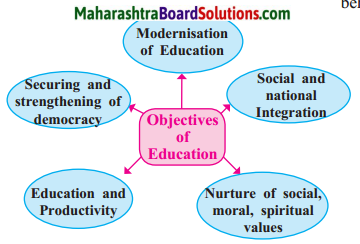
Maharashtra Board Class 9 History Solutions Chapter 5 Education 1

Maharashtra Board Class 9 History Solutions Chapter 5 Education

Question 2.
Central Council for Research in Indian Medicine and Homeopathy:
Answer:
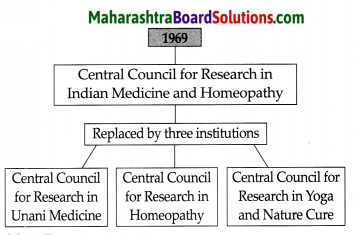
Maharashtra Board Class 9 History Solutions Chapter 5 Education 2

Question 3.
Departments of the Indian Agricultural Research Institute:
Answer:
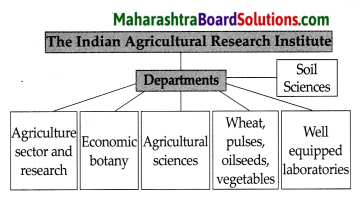
Maharashtra Board Class 9 History Solutions Chapter 5 Education 3

Question 4.
Role of Dave Committee:
Answer:
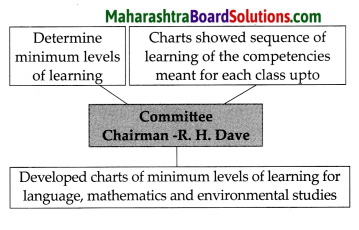
Maharashtra Board Class 9 History Solutions Chapter 5 Education 4

Question 5.
Features of the IIT
Answer:
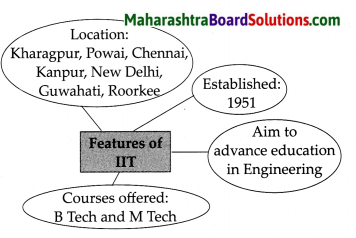
Maharashtra Board Class 9 History Solutions Chapter 5 Education 5

Question 6.
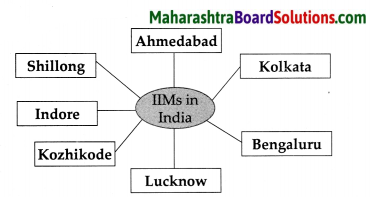
IIMs in India
Answer:
Maharashtra Board Class 9 History Solutions Chapter 5 Education 6

Question 7.
Concept map of basic responsibilities of NCERT
Answer:
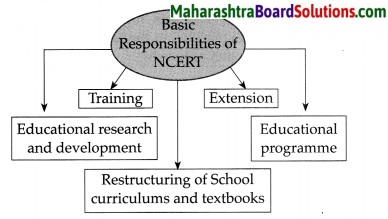
Maharashtra Board Class 9 History Solutions Chapter 5 Education 11

Maharashtra Board Class 9 History Solutions Chapter 5 Education

Write short notes:

Question 1.
AIIMS
Answer:
(i) The All India Institute of Medical Sciences (AIIMS) was established to give further impetus to advanced education and research in medicine.

(ii) It was given the responsibility of undergraduate and post-graduate courses in medicine.

(iii) Colleges for undergraduate and postgraduate education in most branches of medicine, good research facilities and well-equipped hospitals are the significant features of this institute.

(iv) The institute also provides medical treatment to the common people at nominal rates.

(v) It has established special colleges for training in nursing, and super-speciality centres for treatment of disorders of the heart, brain and eyes.

(vi) For further development of the medical field, the Medical Council of India was restructured in 1958 and was entrusted with the task of determining criteria for quality of medical education, its supervision and inspection.

Question 2.
Achievements of CSIR
Answer:
(i) In the post-independence period in 1950, the Council of Scientific and Industrial Research (CSIR) was established with the objective to promote scientific research in the country and to take the benefits of the research to all the people.

(ii) The achievements of the CSIR include making the ink used for marking voters’ fingers during elections, medicines for malaria, elephantiasis and tuberculosis, water purification technology, reduction in the time required for bamboo production.

(iii) It also used DNA fingerprinting for the first time in India, conducted a genetic study of the Adivasis of the Andamans and proved that those tribes are 60,000 years old and developed the earthquake early warning system.

(iv) It has also played an important role in the use of neem as a pesticide, use of turmeric for healing wounds and in the case of the patents for varieties of rice.

(v) The CSIR has prepared a digital encyclopedia of Indian traditional knowledge and made it available in eight international languages.

Question 3.
NCERT
Answer:
(i) National Council of Educational Research and Training (NCERT) was established in Delhi on the 1st of September 1961.

(ii) Its main objective is to help the Central Government in matters of school education in the context of a comprehensive policy and in implementing educational schemes. The NCERT was given the responsibility of educational research and development, training, extension, educational programmes, restructuring of school curriculum and textbooks.

(iii) It has played a central role in designing school curricula and textbooks with the cooperation of the Central Board of Secondary Education (CBSE). ’

(iv) It provides guidance and cooperation in the area of primary and secondary education to the state governments.

(v) It has been involved in designing workbooks and handbooks for teachers, in teacher training, in developing teaching-learning techniques and conducting talent search examinations at the national level.

Maharashtra Board Class 9 History Solutions Chapter 5 Education

Read the passage and answer the questions and answer the questions based on it.

Passage I

National Council of Educational Research and Training. This body was established in Delhi on the 1st of September 1961. Its main objective is to help the Central Government in matters of school education in the context of a comprehensive policy and in implementing educational schemes. The NCERT was given the responsibility of educational research and development, training, extension, educational programmes, restructuring of school curriculum and textbooks. It has played a central role in designing school curricula and textbooks with the cooperation of the Central Board of Secondary Education (CBSE). It provides guidance and cooperation in the area of primary and secondary education to the state governments. It has been involved in designing workbooks and handbooks for teachers, in teacher training, in developing teaching-learning techniques and conducting talent search examinations at the national level.
SCERTs were established in all States on the lines of the NCERT. The Maharashtra State Council of Educational ‘Research and Training was established in Pune, This institute performs various functions such as , improving the standard of primary education, in service training of teachers, training in the areas of syllabii and evaluation, vocational guidance for students after Std X and Std XII exams and other , educational functions This institute is known as the , academic authority. It brings out a periodical called Jeevan Sikshan. ‘

Question 1.
What was the main objective behind establishment of NCERT?
Answer:
The main objective behind establishment of NCERT is to help the central government in matters of school education in the context of a comprehensive policy and in implementing educational schemes.

Question 2.
SCERT was established only in Maharashtra State on the lines of the NCERT. Identify True or False.
Answer:
False.

Question 3.
State 4 research institutes in India.
Answer:
Following are the 4 research institutes in India:

  • Council of Scientific & Industrial Research.
  • Bhabha Atomic Research Centre.
  • Indian Council of Medical Research.
  • Indian Agricultural Research Institute.

Passage II

National Policy on Education 1986: According to this policy, certain changes of a fundamental nature were brought about in primary, secondary and higher , secondary education in keeping with the changing needs of society. Under this policy, a common core curriculum was framed for all States. The expectation , is that, by this means, all students in India will get equal educational opportunity. There is scope in the national curriculum for individual States to bring in flexibility in accordance with their cultural, geographical and historical needs.
The ‘Primary Education Curriculum 1988’ was prepared on the basis of the plan of action designed at the national level for the effective implementation of the National Policy on Education 1986. The competency based primary Education curriculum 1995: Even as the Primary Education Curriculum , 1988 was being implemented, a Committee was formed at the national level with Dr. R. H. Dave as its Chairman, to determine minimum levels of learning, The Dave as Committee developed charts of minimum , levels of learning in language, mathematics and environmental studies up to Std V. The charts showed the sequence of learning of the competencies meant for each class.
Use of a satellite: In 1975, India met with success in its attempt to use a satellite for the purpose of education, Eknath Chitnis, a scientist with ISRO, played an , important role in it.
SITE (Satellite Instructional Television Experiment) , was undertaken for educational purposes under the leadership of the Space Applications Centre at Ahmedabad. The concept of satellite education came , out of this experiment. America had helped India in , this programme. The programme helped to make provisionsforagoodstandardofeducationinruralareas.

Maharashtra Board Class 9 History Solutions Chapter 5 Education

Question 1.
What was done to implement the National Policy on Education 1986?
Answer:
For the effective implementation of National Policy on Education 1986, the Primary Education Curriculum 1988 was prepared on the basis of the action plan formulated at the National level.

Question 2.
How did the Dave committee determine the minimum levels of learning?
Answer:
To determine the minimum levels of learning the Dave committee developed charts in language, mathematics and environmental studies upto Std. V. Sequential learning competencies were depicted on these charts to set standards through levels of learning.

Question 3.
Who is your favourite educationist? State his/ her educational ideas which impacted the society.
Answer:
(i) My favourite educationist are Rabindranath Tagore, Dr. Annie Besant and Dr. Sarvapalli Radha Krishnan.

(ii) They all enlightened the society with their educational ideas and deeds. Dr. Annie Besant in particular was iconic.

(iii) Her ideas of education were imbibed with political freedom, women’s liberation and universal brotherhood. Her teachings of ‘Home Rule’ and ‘theosophy’ impacted our society during British Rule. She taught these ideas through political lectures to motivate the youth.

Answer the following questions in detail:

Question 1.
What does the District Primary Education Programme envisage?
Answer:
(i) In 1994, the District Primary Education Programme (DPEP) was started with the objective of universalisation of primary education. It was implemented in seven States including Maharashtra.

(ii) The plan envisaged 100% attendance in primary schools, arresting student drop-out, education for girls and for the physically handicapped.

(iii) It included programmes such as research on and evaluation of primary education, alternative education, creating societal awareness, etc.

Question 2.
State the contribution of Tarabai Modak in educating adivasis.
Answer:
(i) Tarabai Modak began work in the field of education in Bordi and Kosbad.
(ii) She started Anganwadis for Adivasi children.
(iii) She worked hard to bring in the Teaming by doing’ method, to start kuranshalas (meadow schools) and to spread vocational technical education.

Question 3.
What purpose did the Kosbad Project serve?
Answer:
(i) Anutai Wagh established an institution at Kosbad for the progress of Adivasis in Thane district.
(ii) It is known as the Kosbad Project.
(iii) She started creches, nurseries, primary schools, adult education classes, balsevika training schools, etc. for the education of Adivasis.

Question 4.
What was proposed by the Mudaliar Commission?
Answer:
(i) In 1952-53, the Mudaliar Commission was appointed.
(ii) At that time, the pattern of education consisted of 11 + 4 years for the first degree or of 11 + 1 + 3 years.
(iii) The Commission studied secondary education, the nature of the curriculum, medium of instruction, teaching methodology and made certain recommendations.
(iv) This Commission proposed the concept of Higher Secondary Education. However, it was found difficult to implement it all over the country.

Maharashtra Board Class 9 History Solutions Chapter 5 Education

Question 5.
State the recommendation of Kothari Commission.
Answer:
(i) The Kothari Commission recommended the 10+2+3 pattern for secondary, higher secondary and university education. This system was implemented from 1972.

(ii) The Commission also suggested a uniform national system of education, the inclusion of the mother tongue, Hindi and English in education, as well as continuing education, adult education, education by correspondence and open universities to make education trickle down to the lowest rungs of society.

(iii) It also recommended increased provision in the government’s budget for expenditure on education of neglected sections like the scheduled castes and tribes.

Question 6.
What do you know about the Education Board of your state?
Answer:
(i) The Maharashtra State Board of Secondary and Higher Secondary Education was established on the 1st of January 1966 at Pune.
(ii) This Board conducts the school leaving examinations of Std. X and Std. XII.
(iii) It also publishes a periodical called ‘Shikshan Sankraman’.

Question 7.
State the functions of MSCERT.
Answer:
(i) The Maharashtra State Council of Educational Research and Training was established in Pune.
(ii) This institute performs various functions such as improving the standard of primary education,
in-service training of teachers, training in the areas of syllabi and evaluation, vocational guidance for students after Std X and Std XII exams and other educational functions.

Question 8.
How did the concept of satellite education evolve in India?
Answer:
(i) SITE (Satellite Instructional Television Experiment) was undertaken for educational purposes under the leadership of the Space Applications Centre at Ahmedabad.
(ii) The concept of satellite education came out of this experiment. America had helped India in this programme.
(iii) The programme helped to make provisions for a good standard of education in rural areas.

Question 9.
Discuss the responsibilities of Indian Council for Medical Research.
Answer:
(i) Indian Council for Medical Research (ICMR) was established for conducting research in the medical field.
(ii) It was given the responsibility of cooperating with universities, medical colleges, government and non-government research institutes and giving them guidance and financial support for research activities.

Question 10.
Which institute works for advanced research in cancer?
Answer:
The Advanced Centre for Treatment, Research and Education in Cancer is a branch of the Tata Memorial Centre. It functions as the national centre for treatment, research and education in relation to cancer.

Observe the pictures/personality and write relevant information:

Question 1.
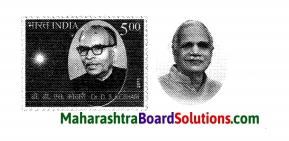
Maharashtra Board Class 9 History Solutions Chapter 5 Education 8
Answer:
(i) Kothari Commission recommended the 10+2+3 pattern for secondary, higher secondary and university education.
(ii) The objectives of Education were :

  • Modernisation of Education.
  • Social and national integration.
  • Nurture of social, moral, spiritual values.
  • Education and Productivity.
  • Securing and strengthening of democracy.

(iii) The following are the other recommendations made by the Kothari commission:

  • A uniform national system of education
  • inclusion of mother tongue (along with Hindi and English)
  • Continuing education
  • Adult education
  • Education by correspondence
  • Open Universities.

Maharashtra Board Class 9 History Solutions Chapter 5 Education

Question 2.
Maharashtra Board Class 9 History Solutions Chapter 5 Education 9
Answer:
(1) The open university was established with the objective that the stream of education should make its way into every average household of the country.

(2) In 1974, the government appointed a committee under the chairmanship of P. Parthasarthy and open university took shape on 20th September 1985 in accordance with its recommendations and suggestions.
It was named after Prime Minister – Indira Gandhi.

(3) In 1990, IGNOU started an audio-visual distance education programme through Akashwani and Doordarshan.

(4) It provides facilities for education through 58 centres in the country and 41 centres in foreign countries.

Question 3.

Maharashtra Board Class 9 History Solutions Chapter 5 Education 10
Answer:
(1) CSIR was established with the objective to promote scientific research in the country and to take the benefits of the research to all the people.

(2) CSIR conducted research in fields like:

  • Physics, chemistry, pharmaceuticals, food processing and mining

(3) The achievements of CSIR include:

  • Making the ink used for marking voter’s fingers during elections
  • Medicines for malaria, elephantiasis and tuberculosis
  • water purifying technology
  • DNA fingerprinting for the first time in India.

(4) CSIR has prepared a digital encylopoedia of Indian traditional knowledge and made it available in eight international languages.

Maharashtra Board Class 7 Geography Solutions Chapter 3 Tides

Balbharti Maharashtra State Board Class 7 Geography Solutions Chapter 3 Tides Notes, Textbook Exercise Important Questions and Answers.

Maharashtra State Board Class 7 Geography Solutions Chapter 3 Tides

Class 7 Geography Chapter 3 Tides Textbook Questions and Answers

1. Prepare a chain by matching the following:

Question 1.

Group ‘A’Group ‘B’Group ‘C’
(1) Waves(a) 8th phase of the moon (Quarter)(i) Objects get thrown towards the outer side.
(2) Centrifugal force(b) Newmoon day(ii) Highest high tide occurs on this day.
(3) Gravitational force(c) Rotation of the earth(iii) These are also generated due to earthquakes and volcanoes.
(4) Spring Tide(d) The moon, the sun and the earth(iv) The forces of the sun and the moon operate in different directions.
(5) Neap tide(e) Wind(v) Operates in the direction towards the centre of the earth.

Answer:

1 – e – iii
2 – c – i
3 – d – v
4 – b – ii
5 – a – iv

Maharashtra Board Class 7 Geography Solutions Chapter 3 Tides

2. Give geographical reasons:

Question 1.
Tides are influenced more by the moon than the sun.
Answer:

  • The gravitational pull of the moon and the sun as well as that of the earth is one of the factor responsible for occurrence of tides.
  • But compared to the sun, the moon is closer to the earth.
  • Due to this the gravitational force of the moon becomes more effective than that of the sun.
  • Therefore, tides are influenced more by the moon than the sun.

Question 2.
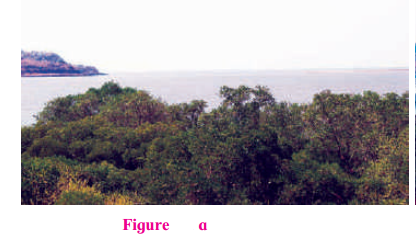
At some places along the coast, the low lying areas turn into lagoons or marshy lands.
Answer:
(i) Generally the areas along the sea coast are low lying and get flooded easily by the sea water during high tide.

(ii) This leads to accumulation of sea water over a long period of time leading to formation of swamps & marshes.

(iii) The tides help in maintaining the mangroves and the coastal biodiversity here.

(iv) Certain areas near the sea coast being low lying & waters being shallow also lead to sediment deposition by sea waves leading to formation of lagoons.

(v) In this way, at some places along the coast, the low lying areas turn into lagoons or marshy lands.

Question 3.
Place located on the opposite meridian experiencing high or low tide will also experience high or low tide respectively.
Answer:
(i) The gravitational force of moon, the sun & the earth and the centrifugal force generated due to the rotation of the earth are two major factors responsible for the occurrence of tides.

(ii) When a place (meridian) faces the moon the gravitational force of the moon exceeds the centrifugal force of the earth leading to high tide here as the water is pulled towards the moon.

(iii) At the same time the place on the earth located at the opposite meridian to the place experiencing high tide, the centrifugal force of the earth exceeds the gravitational force of the moon. Thus, the water is pulled in the direction away from the moon leading to high tide.

(iv) The water required for the high tide moves in from places that are at right angles to those having high tides causing a low tide at those places.

(v) Thus, place located on the opposite meridian to the place experiencing high or low tide will also experience high or low tide respectively.

3. Answer in brief:

Question 1.
If there is high tide at 7 am, find the timings of the next high and low tides on the same day at a given place.
Answer:

  • There is high tide & low tide twice a day i.e. in 24 hours.
  • One cycle of high tide & low tide is completed after every 12 hours & 25 minutes.
  • If there is a high tide at 7 am, the next low tide will be at 1.12 pm (after 6 hrs & 12 min.) & the next high tide will be at 7.25 pm (after 12 hrs & 25 min.)

Maharashtra Board Class 7 Geography Solutions Chapter 3 Tides

Question 2.
If at Mumbai (73° E meridian), there is high tide at 1.00 pm on Thursday, then on which other meridian will there be a high tide too? State with reasons.
Answer:
The other meridian which will experience high tide will be 107°W (180°-73°) because it is exactly 180° opposite from 73°E.

Question 3.
Explain the reasons for the generation of waves.
Answer:

  • The main reason of wave generation is the force of the wind i.e. water appears to be moving.
  • But at times waves get generated due to earthquake or volcanic eruptions occurring below the floor of the sea.
  • Large or small waves are formed continuously at the surface of the sea.
  • Generation of waves is a natural and regular phenomenon.

4. In what way will the following depend on the tides:

Question 1.
Swimming:
Answer:
A lack of an understanding of the timings of high and low tides may cause accidents to swimmers entering the sea.

Question 2.
Steering a ship:
Answer:
Ships can move up to the ports during high tide.

Question 3.
Fishing:
Answer:
With the high tide, fish moves into the creeks and this helps the fishing activity.

Question 4.
Salt Pans:
Answer:
During high tide, seawater can be stored in salt pans from which salt can be obtained.

Question 5.
Going to coastal areas for trips:
Answer:
Plan for going to trips after full moon or new moon day. Also one must have details about the timings of the tides for better enjoyment.

5. Observe figure of neap tide and answer the following questions:
Maharashtra Board Class 7 Geography Solutions Chapter 3 Tides 1
Question 1.
Which phase of the moon does it show?
Answer:
The diagram shows the phase of the quarter moon.

Maharashtra Board Class 7 Geography Solutions Chapter 3 Tides

Question 2.
What are the relative positions of the moon, the sun and the earth?
Answer:
The moon, the earth and the sun make an angle of 90° (right angle)

Question 3.
What effect will it have on the tides?
Answer:
It will lead to neap tide. Due to such conditions during high tide the water level will rise less than usual while during low tide water level will fall less than usual.

6. Differentiate between:

Question 1.
High tide and low tide:
Answer:

High tideLow Tide
(i) The rise in the level of sea water is caused by the combined effect of centrifugal and gravitational force of the moon and the sun.(i) The fall in the level of sea water is caused by the combined effect of centrifugal and gravitational force of the moon and the sun.
(ii) At the time of high tide, sea water is very close to the coast.(ii) At the time of low tide, sea water is far away from the coast.

Question 2.
Spring tide and neap tide.
Answer:

Spring tideNeap Tide
(i) It occurs on the new moon day and the full moon day.(i) It occurs on the the first and the third quarter days.
(ii) The gravitational pull of the moon and the sun as well as that of the earth are in a straight line and act in the same direction.(i) The gravitational pull of the moon and the sun are at right angle.
(iii) Spring tides are a little higher than the average high tides and a little lower than the average low tides.(iii) Neap tides are a little lower than the average high tides and little higher than the average low tides.

7. Describe the positive and negative effects of tides:
Answer:
The positive effects of tides are as follows:

  • The tides clear the waste and hence the coasts become clean.
  • Ports do not get filled with sediments .
  • Ships can move up to the ports during high tide.
  • During high tide, sea water can be stored in salt pans from which salt can be obtained.
  • The tidal force can be used to generate electricity.
  • With the high tide, fish move into the creeks and this helps fishing activity.
  • The tides help in maintaining the mangroves and the coastal biodiversity.

The negative effects of tides are as follows:

  • A lack of an understanding of the timings of high and low tides may cause accidents to swimmers entering the sea.

Activities:

  1. Visit the nearest sea coast. From a higher location, observe the waves approaching the coast. See if the approaching waves change their direction. With the help of your teacher find the answer to why this change occurs.
  2. Collect information from the internet about how electricity is generated from waves. Find places where such electricity is being generated.

Class 7 Geography Chapter 3 Tides InText Questions and Answers

Differentiate between:

Question 1.
Centrifugal force and Gravitational
Answer:

Centrifugal forceGravitational force
(i) Due to rotation, the earth gets a type of power of force. This force works away from the centre. It is called centrifugal force.
(ii) Centrifugal force works away from the centre.
(iii) Due to centrifugal force an object on the earth would be thrown into the space.
(i) Gravitational force is working towards the centre of the earth. This force is many times greater than the centrifugal force.
(ii) Gravitational force works towards the centre.
(iii) Due to gravitational force an object on the surface of the earth remains at the place where it exists.

Write short notes:

Question 1.
Spring tide
Answer:
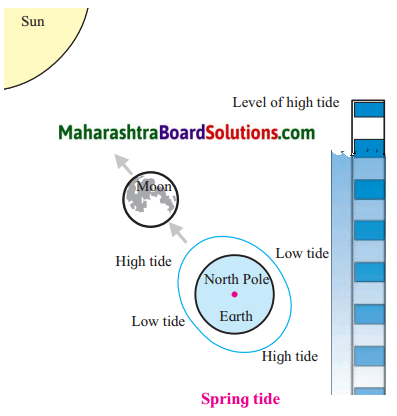
(i) On new moon & full moon days, the gravitational pull of the sun and the moon act in the same direction due to which the total pull increases.

(ii) Hence, the tide on these days is much higher than the average high tide.

(iii) This is known as spring tide.

Maharashtra Board Class 7 Geography Solutions Chapter 3 Tides

Question 2.
Neap tide
Answer:
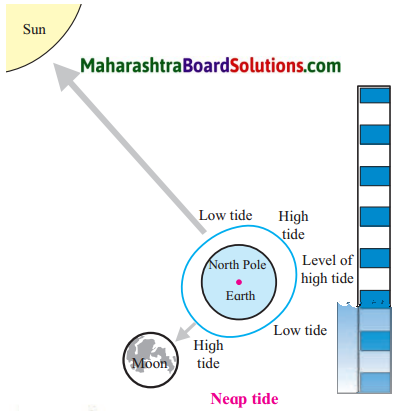
(i) While revolving around the earth, the moon makes a right angle with respect to the earth and the sun, twice a month.

(ii) This position occurs on the first and third quarter of each month. On both these days the forces of both the sun & the moon operate at right angles on the earth.

(iii) At the places where the sun causes high tide, the gravitational pull of the moon which is at right angles also acts on the water.

(iv) Due to such conditions the water level rise is less than usual at the time of high tide. Similarly, fall in water level is less than usual at the time of low tide.

(v) Such tides are called neap tides.

Question 3.
Waves
Answer:

  • The sea water gets pushed by the wind and ripples are generated on the water surface. These are called waves.
  • The sea water moves up & down or slightly forward & backward due to the waves.
  • The waves bring the energy contained in them to the coast.
  • Large & small waves are formed continuously at the surface of the sea.
  • Generation of waves is a natural & regularly occurring phenomenon.

Question 4.
Struture of the waves
Answer:
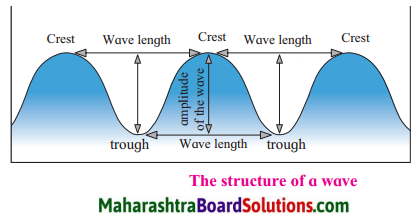
(i) The sea water gets pushed up & down because of the wind. The raised up portion of the wave is called crest & the depressed one is called trough.

(ii) The vertical distance between a crest and the following trough is called the amplitude of the wave whereas the distance between two successive crests or troughs is called wave length.

(iii) The wave length, its amplitude & its velocity depend on the velocity of the wind.

Formative Assessment:
Observe the activity on pages 9, 10 of the textbook & discuss the result of the activities and answer the question given below:
Maharashtra Board Class 7 Geography Solutions Chapter 3 Tides 2
Maharashtra Board Class 7 Geography Solutions Chapter 3 Tides 3

Maharashtra Board Class 7 Geography Solutions Chapter 3 Tides

Question 1.
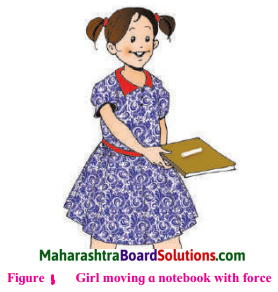
In which direction will the piece of chalk fall? (fig. 1)
Answer:
The chalk will fall to the right.

Question 2.
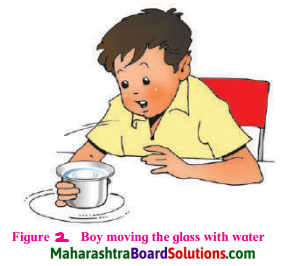
Where did the water in the glass show a bulge? (fig. 2)
Answer:
At the sides of the glass.

Question 3.
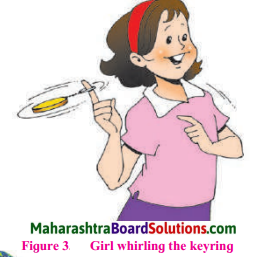
What effect did the movement have on the things attached to the keyring? (fig. 3)
Answer:
The things attached to the keyring will move round.

Question 4.
What happened to the water in the container and the mixer? (fig. 1)
Answer:
The water will swirl round forming a bulge at the sides and a depression in the centre.

Question 5.
Which forces could be operating in activities listed above?
Answer:
In the first activity (fig. 1) gravitational force acted and in the fig. 2, fig. 3 centrifugal force.

Question 6.
In the following activities, which force is greater, centrifugal or gravitational?
Answer:
The centrifugal force was greater than the gravitational force.

Can you tell?
Answer the following of questions with the help of figure
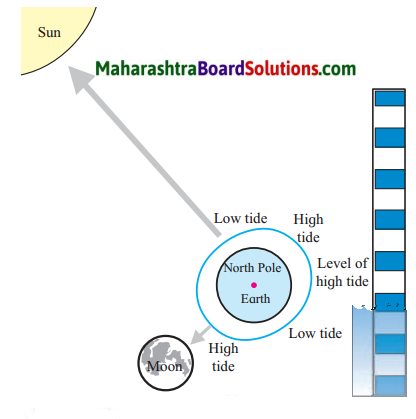
Maharashtra Board Class 7 Geography Solutions Chapter 3 Tides 5
Question 1.
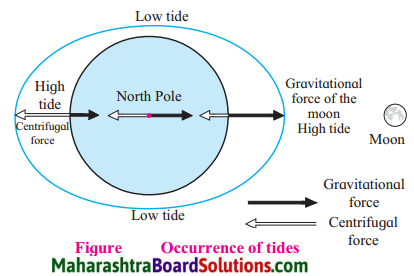
How do the tides occur?
Answer:
Tides occur due to the relative positions of the moon, the sun, and the earth.

Question 2.
Which force is applied when the moon is closer to the earth?
Answer:
Gravitational force becomes more effective than that of the sun when the moon is closer to the earth.

Question 3.
If it is high tide those having high tide at 0° and 180° meridian then at which meridians will low tide occur?
Answer:
The meridians that are at right angle to those having high tide will experience low tide at the same time ie. at 90°E & 90°W.

Class 7 Geography Chapter 3 Tides Additional Important Questions and Answers

Fill in the blanks choosing the correct options from the brackets:

Maharashtra Board Class 7 Geography Solutions Chapter 3 Tides

Question 1.
Due to rotation, the force that works away from the centre of the earth is the ______force. (gravitational, rotational, centrifugal)
Answer:
centrifugal

Question 2.
Neap tide occurs on the days of the ______ and _______ quarter of each month. (first, second, third)
Answer:
first, third

Question 3.
The tidal range in open seas is ______ cms. (20, 30, 40)
Answer:
30

Question 4.
The highest tidal range in the world is observed at _______.(Bay of Fundy, Bay of Biscay, Bay of Bengal)
Answer:
Bay of Fundy

Question 5.
The main reason for wave generation is ______ (wind, gravitational force, centrifugal force)
Answer:
wind

Question 6.
The raised up portion of a wave is called a _______ .(trough, wave length, crest)
Answer:
crest

Question 7.
The depressed portion of a wave is called a ______. (trough, wave length, crest)
Answer:
trough

Question 8.
The vertical distance between a crest and a trough is called the _____.(wave length, amplitude, tide)
Answer:
amplitude

Question 9.
The distance between a crest or trough is called _____ (amplitude, wave length, tide)
Answer:
wave length

Question 10.
Tall sea waves caused by earthquakes below the floor of the sea are called _____.(cyclones, tsunamis, eruption)
Answer:
tsunamis

Match the following:

Question 1.

‘A’ ‘B’
(1)  Bay of Fundy
(2)  Gulf of Khambhat
(3)  Open Seas
(4)  Peninsular India
(a)  1100 cm
(b)  100 -150 cm
(c)  1600 cm
(d)  30 cm

Answer:
1 – c
2- a
3 – d
4 – b

Fill in the blanks:
Question 1.
High and low tides are _______ phenomena.
Answer:
Natural

Question 2.
_________ are movements of sea water occurring daily and regularly.
Answer:
Tides

Maharashtra Board Class 7 Geography Solutions Chapter 3 Tides

Question 3.
Any object on the surface of the earth remains at the place due to the ______ force.
Answer:
Gravitational

Question 4.
The meridians that are at right angles to those having high, tide will experience tide _______.
Answer:
Low

Question 5.
On the days of the first and the third quarter, the high tide is at its _____.
Answer:
Minimum

Question 6.
On new moon and full moon days, the gravitational pull of the sun and the moon acting the ______ direction.
Answer:
Same

Question 7.
At every ______ a cycle of high tide and low tide gets completed.
Answer:
12 hrs & 25 min

Name the following:

Question 1.
Movement of sea water.
Answer:
Tides.

Question 2.
Two forces directly related with tides.
Answer:
Gravitational and Centrifugal forces.

Question 3.
Two types of tide.
Answer:
Spring tide and Neap tide.

Question 4.
The difference in the water level of the high tide and low tide.
Answer:
Tidal range.

Question 5.
The region with highest tidal range in India.
Answer:
The Gulf of Khambhat.

Question 6.
Tall waves caused by earthquakes in the shallow waters near the coast, which are very destructive.
Answer:
Tsunami.

Question 7.
Place where tsunami waves were generated in 2004.
Answer:
Sumatra islands of Indonesia.

Maharashtra Board Class 7 Geography Solutions Chapter 3 Tides

Question 8.
Type of tide occuring on full moon day.
Answer:
Spring tide.

Question 9.
Type of tide occuring when sun and the moon are at right angles to each other.
Answer:
Neap tide.

Question 10.
Distance between two successive crests or troughs.
Answer:
Wavelength.

Define the following:

Question 1.
Tide:
Answer:
The alternate rising and falling of the sea water after a specific period is called tide.

Question 2.
Centrifugal force:
Answer:
Due to the earth’s rotation, the earth gets a type of power or force. This force works away from the centre. It is called the centrifugal force.

Question 3.
Tidal range:
Answer:
The difference in the water level of the high tide and low tide is called tidal range.

Question 4.
Waves:
Answer:
The sea water gets pushed by the wind and so ripples are generated on the water surface. These are called waves.

Question 5.
Amplitude of the wave:
Answer:
The vertical distance between a crest and the following trough is called the amplitude of the wave.

Question 6.
Wave length:
Answer:
The wave length is the distance between two successive crests or troughs.

Write whether the following statements are true or false:

Question 1.
The gravitational force is many times greater than the centrifugal force.
Answer:
True

Question 2.
Spring tides are lower than average high tides.
Answer:
False

Maharashtra Board Class 7 Geography Solutions Chapter 3 Tides

Question 3.
Centrifugal force is generated due to the revolution of the earth.
Answer:
False

Question 4.
When there is high tide at 0° meridian, the 180° meridian also experiences high tide.
Answer:
True

Question 5.
Tides occur due to the relative positions of the moon, the sun and the earth.
Answer:
True

Question 6.
The tides clean the waste and hence the coastal areas become clean.
Answer:
True

Question 7.
The tides worsen the maintaining of mangroves and the coastal biodiversity.
Answer:
False

Question 8.
Generation of waves is a natural and regularly occurring phenomenon.
Answer:
True

Give geographical reasons:

Question 1
Any object on the surface of the earth remains at the place where it exists.
Answer:

  • Due to the earths rotation, it gets a type of power or force
  • The force acting in the centre is centrifugal force.
  • Due to this force any object on the earth would be thrown into the space.
  • But the gravitational force is working towards the centre of the earth at the same time.
  • This force is greater than the centrifugal force.
  • Hence, any object on the surface of earth remains at the place where it exists.

Question 2.
On new moon and full moon days the tides are higher than average.
Answer:

  • On new moon and full moon days, the gravitational pull of the sun and the moon act in the same direction.
  • Due to this, the total pull increases.
  • Hence, the tide on these days is much higher than the average high tide.

Maharashtra Board Class 7 Geography Solutions Chapter 3 Tides

Question 3.
Neap tides are a little lower than average high tides.
Answer:

  • While revolving around the earth, the moon makes a right angle with respect to the earth and the sun.
  • This position occurs on the first and the third quarter of each month.
  • On both these days, the forces of both the sun and the moon operate at right angles on the earth.
  • The attraction of the sun and the moon are not complementary but at right angles to each other.
  • Due to this, the water level rise is less than usual at the time of high tide

Answer in brief:

Question 1.
Which factors are responsible for the occurrence of tides?
Answer:
The following factors are responsible for the occurrence of tides.

  • The gravitational pull of the moon and the sun as well as that of the earth.
  • Revolution of the earth around the sun and the indirect revolution of the moon around the sun.
  • Centrifugal force generated due to the rotation of the earth.

Draw a neat labelled diagram of:

Question 1.
The structure of a wave:
Answer:
Maharashtra Board Class 7 Geography Solutions Chapter 3 Tides 6

Question 2.
Springtide:
Answer:
Maharashtra Board Class 7 Geography Solutions Chapter 3 Tides 7

Maharashtra Board Class 7 Geography Solutions Chapter 3 Tides

Question 3.
Neap tide:
Answer:
Maharashtra Board Class 7 Geography Solutions Chapter 3 Tides 8

Question 4.
Occurrence of tides:
Answer:
Maharashtra Board Class 7 Geography Solutions Chapter 3 Tides 5

Observe the following pictures and answer the following questions given below and discuss:
Maharashtra Board Class 7 Geography Solutions Chapter 3 Tides 9
Maharashtra Board Class 7 Geography Solutions Chapter 3 Tides 10
Question 1.
Do the above photographs show the same place or different places?
Answer:
Both the photographs show the same place.

Question 2.
Observe and note the spread of water seen in both the photographs.
Answer:
The level of water is higher in the first picture and lower in the second.

Question 3.
What is this natural event called?
Answer:
This natural event is called tide.

Maharashtra Board Class 7 Geography Solutions Chapter 3 Tides

Try this:

Take a wide open large dish.
Keep the dish on a table or a flat surface.
Fill water in the dish up to the rim,(we have to generate waves in the dish).

Question 1.
Is it possible to generate waves without touching or shoving the dish? Try doing so.
Answer:
By blowing air with your mouth on the water surface of the dish.

Question 2.
In what different ways can you generate waves in the dish?
Answer:

  • By dropping an object in the dish.
  • By blowing air on the water surface.
  • By strong fan breeze.

Maharashtra Board Class 8 Civics Solutions Chapter 2 The Indian Parliament

Balbharti Maharashtra State Board Class 8 Civics Solutions Chapter 2 The Indian Parliament Notes, Textbook Exercise Important Questions and Answers.

Maharashtra State Board Class 8 Civics Solutions Chapter 2 The Indian Parliament

Class 8 Civics Chapter 2 The Indian Parliament System Textbook Questions and Answers

1. Complete the following sentences by choosing the correct option.

Question 1.
Candidates to the Lok Sabha are elected through ……….. .
(a) Territorial constituencies
(b) Religious constituencies
(c) Local bodies
(d) Proportional Representation System
Answer:
(a) Territorial constituencies

Maharashtra Board Class 8 Civics Solutions Chapter 2 The Indian Parliament

Question 2.
The ………….. of India is the ex-officio chairman of the Rajya Sabha.
(a) President
(b) Vice-President
(c) Prime Minister
(d) Chief Justice
Answer:
(b) Vice-President

2. Find and write. 

Question 1.
Members of Lok Sabha and Rajya Sabha are known as ……………….. .
Answer:
Members of Parliament (MPs)

Question 2.
The responsibility of making laws is with the ……………… .
Answer:
Parliament

3. Explain the following statements with reasons:

Question 1.
Rajya Sabha is a permanent House.
Answer:

  1. The tenure of the members of Rajya Sabha does not get over at the same time.
  2. 1/3rd of the total membership of Rajya Sabha retire after every two years and equal number of new members get elected.
  3. Because the limited members of Rajys Sabha retire step by step, it can function continuously.
    Since Rajya Sabha is never dissolved completely it is called a permanent House.

Maharashtra Board Class 8 Civics Solutions Chapter 2 The Indian Parliament

Question 2.
Lok Sabha is known as the first House.
Answer:

  1. Lok Sabha is the lower and the first House of the Parliament of India.
  2. Lok Sabha is the House of Representatives directly elected by the people. Hence, Lok Sabha is known as the first House.

4. Answer the following in 25 to 30 words:

Question 1.
How are members of the Lok Sabha elected?
Answer:

  1. As per the Constitution, there can be a maximum of 552 members in Lok Sabha.
  2. General elections to Lok Sabha are held after every five years and members are directly elected by the people.
  3. To ensure equal representation to all sections of the community, some seats are reserved for members belonging to Scheduled Castes and Scheduled Tribes.
  4. In case there are no representation from the Anglo-Indian community, the President can appoint two members from this community to the Lok Sabha.
  5. Thus, Lok Sabha is the representative body of the citizens of India.

Maharashtra Board Class 8 Civics Solutions Chapter 2 The Indian Parliament

Question 2.
Explain the functions of the Speaker of Lok Sabha.
Answer:
The functions of the Speaker of Lok Sabha are :

  1. To conduct the business of the House in an unbiased manner.
  2. To take care of the rights and privileges of the members of Lok Sabha.
  3. To interpret the rules of daily functioning of the House and work accordingly.
  4. To maintain the decorum and dignity of the House.

5. Explain the step involved in the lawmaking process.

Question 1.
Parliament :
Answer:

  1. The Legislature at the national level is called the Parliament.
  2. It consists of the President and two houses, i.e., the Lok Sabha and the Rajya Sabha.
  3. Though the President is an inseparable part of the Parliament, he/she cannot participate in the discussions in either of the Houses of the Parliament.
  4. The Constitution of India has created the Parliament.

Question 2.
Amendment to the Constitution :
Answer:

  1. According to the changing times, certain necessary changes have to be made in some laws. The process of making such changes is called Amendment.
  2. Only the Parliament has the right to make such amendments to the Constitution.
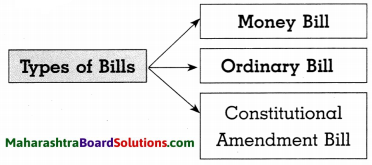
  3. The Constitution amendment bill is considered to be an important bill.
  4. The Parliament discusses why the amendment is required and decides whether to accept it or not.

Maharashtra Board Class 8 Civics Solutions Chapter 2 The Indian Parliament

Question 3.
Members of Parliament :
Answer:

  1. The members of Lok Sabha and Rajya Sabha are known as Members of Parliament (MPs).
  2. The members of Lok Sabha are directly elected by the people.
  3. The members of Rajya Sabha are elected from the constituent States and Union Territories.
  4. MPs try to resolve the queries and complaints of their constituencies by raising questions in the Parliament.
  5. MPs also participate in the process of formulation of laws.
  6. The Government allocates funds to MPs to carry out development activities in their constituencies.

Question 4.
Bill of Law:
Answer:

  1. At the initial stage of lawmaking process, a rough draft of the law is prepared.
  2. This rough draft or outline is known as ‘draft proposal of the law’ or ‘bill of law’.
  3. The Bill clearly mentions the objectives and the details of the proposed law.
  4. Every bill has to undergo three readings in both the Houses, and then it is put to vote.

Can you find out?

For the purpose of elections, the State is divided into territorial constituencies. The constituent States in India get seats on the basis of their population. For e.g.

  • Maharashtra – 48 seats
  • Gujarat – 26 seats
  • Madhya Pradesh – 29 seats
  • Goa – 02 seats
  • Uttar Pradesh – 80 seats

Maharashtra Board Class 8 Civics Solutions Chapter 2 The Indian Parliament

Understand It:
(The gist of the conversation held between Mazy, Radhika, Ran veer and others.)

  1. Any Indian citizen who has completed 18 years of age is only eligible to vote.
  2. An Indian citizens who has completed 25 years of age can contest for Lok Sabha election.
  3. A citizen of India can contest for election from any constituency of any State.
  4. Citizens of other countries cannot contest for elections of Lok Sabha and Rajya Sabha.
  5. Just as there are set criteria for qualifying for election, there are set criteria for disqualification as well.

Rights regarding passing of Bills:

  1. Though Lok Sabha and Rajya Sabha have same set of rights, Lok Sabha has certain rights which are not available for Rajya Sabha.
  2. Bills related to finance (Money Bills) and such other bills are first introduced and passed in Lok Sabha.
  3. Rajya Sabha has limited powers with respect to money bills.
  4. Rajya Sabha can pass a resolution on the subject in the State List.

Can you tell?

Certain laws which become out-of-date (obsolete) are abolished. Can you give examples of such obsolete laws? For example, Privy purses.

Know this too:

  1. Every year, on 1 February the Union Finance Minister presents the national budget to the Lok Sabha. Previously, it was presented on 28 February.
  2. The State Legislatures also follow the same procedure of law making as in the Parliament.
  3. The bill passed can become a law only after it is signed by the President at the Union level and by the Governor at the State level.

Maharashtra Board Class 8 Civics Solutions Chapter 2 The Indian Parliament

Project:

The President nominates 12 members to the Rajya Sabha. Collect information on what are the criteria for their selection.

Class 8 Civics Chapter 2 The Indian Parliament Additional Important Questions and Answers

Complete the following sentences by choosing the correct option:

Question 1.
…………….. is the upper House of the Parliament.
(a) Legislative Assembly
(b) Lok Sabha
(c) Rajya Sabha
(d) Legislative Council
Answer:
(c) Rajya Sabha

Question 2.
The …………… of India has created the Parliament of India.
(a) Legislature
(b) Executive
(c) Constitution
(d) British Law
Answer:
(c) Constitution

Maharashtra Board Class 8 Civics Solutions Chapter 2 The Indian Parliament

Question 3.
1/3rd members of total membership of Rajya Sabha, who have completed their tenure of six years, retire after every ……………….. years.
(a) two
(b) four
(c) five
(d) six
Answer:
(a) two

Question 4.
If ……………….. feels that the Parliament should make a law of the subject in the state list, it can pass a resolution to that effect.
(a) Lok Sabha
(b) Rajya Sabha
(c) Executive
(d) President
Answer:
(b) Rajya Sabha

Question 5.
Every year in the month of February, the ………….. presents the national budget to the Lok Sabha.
(a) Prime Minister
(b) President
(c) Finance Minister
(d) Speaker
Answer:
(c) Finance Minister

Question 6.
The President appoints ……………….. distinguished personalities to the Rajya Sabha.
(a) two
(b) eight
(c) fifteen
(d) twelve
Answer:
(d) twelve

Maharashtra Board Class 8 Civics Solutions Chapter 2 The Indian Parliament

Find and write:

Question 1.
……………. represent the Lok Sabha.
Answer:
The Speaker

Question 2.
The bill passed by the State legislature becomes a law after it is signed by the ………….. .
Answer:
Governor

Question 3.
The House that gives representation to 29 States and 7 Union Territories is ………………. .
Answer:
Rajya Sabha

Complete the following Concept maps:

Question 1.
Maharashtra Board Class 8 Civics Solutions Chapter 2 The Indian Parliament 1
Answer:
Maharashtra Board Class 8 Civics Solutions Chapter 2 The Indian Parliament 2

Question 2.
Maharashtra Board Class 8 Civics Solutions Chapter 2 The Indian Parliament 3
Answer:
Maharashtra Board Class 8 Civics Solutions Chapter 2 The Indian Parliament 4

Question 3.
Maharashtra Board Class 8 Civics Solutions Chapter 2 The Indian Parliament 5
Answer:
Maharashtra Board Class 8 Civics Solutions Chapter 2 The Indian Parliament 6

Write short notes on:

Question 1.
The Chairman of Rajya Sabha :
Answer:

  1. The Vice-President of India is the ex-officio Chairman of Rajya Sabha.
  2. He exercises a control over the functioning of Rajya Sabha.
  3. Maintaining discipline in the House is the function of the Chairman of Rajya Sabha.
  4. He also has the responsibility of facilitating discussions in the House by giving members a chance to speak, etc.

Maharashtra Board Class 8 Civics Solutions Chapter 2 The Indian Parliament

Question 2.
Speaker of Lok Sabha :
Answer:

  1. The speaker is elected in the very first meeting after the election of Lok Sabha.
  2. The members of Lok Sabha elect one member among them as the Speaker.
  3. Lok Sabha functions under the guidance and control of the Speaker.
  4. It is the responsibility of the speaker to conduct the business of the House in an unbiased manner.
  5. The Speaker has to maintain decorum and dignity of the House.
  6. Moreover, he has to interpret the rules and work accordingly.

Question 3.
Control over Council of Ministers :
Answer:

  1. Council of Ministers are drawn from the Parliament and hence Parliament exercises control over them.
  2. The members of Parliament exercise this control through multiple ways.
  3. It is the responsibility of the Parliament to see that the Council of Ministers does not disregard the Parliament.
  4. In case the Lok Sabha passes a no-confidence motion against the Council of Ministers, it has to resign.

Answer the following in 25 to 30 words :

Question 1.
Write about Lok Sabha elections.
Answer:

  1. Since Lok Sabha is a House of people’s representatives, elections are held after every five years.
  2. Elections to Lok Sabha which are held every five years are known as General elections.
  3. When Lok Sabha is dissolved before the completion of five years and elections are held, such elections are called mid- term elections.
  4. When a member resigns or dies suddenly, election held for such a seat is called by-election.

Question 2.
Explain the composition of Rajya Sabha.
Answer:
The composition of Rajya Sabha is as follows :

  1. The total membership of Rajya Sabha is 250 members.
  2. Amongst them, 238 members are elected from the constituent states and Union Territories.
  3. Remaining twelve members, who are distinguished personalities from the fields of literature, arts, science, sports and social work, are appointed by the President.
  4. The members of Rajya Sabha are elected through the system of proportional representation.

Maharashtra Board Class 8 Civics Solutions Chapter 2 The Indian Parliament

Question 3.
Explain the functions of the Parliament.
Answer:
In order to achieve welfare of the people and the objectives of the 8 Constitution, the Parliament has to perform 8 following functions :

  1. To formulate new laws and to repeal the outdated laws.
  2. To make necessary changes in the existing laws.
  3. To amend the Constitution wherever necessary.
  4. To keep control over Council of Ministers.

Question 4.
Mention the ways of amending the Constitution.
Answer:
The Constitution can be amended in following ways :

  1. Few provisions in the Indian Constitution can be amended by simple majority.
  2. Some provisions require special (2/3rd) majority of the Parliament.
  3. Few other provisions can be amended by special majority plus consent from more than half of the constituent states.

Explain the following statements with reasons:

Question 1.
Though Lok Sabha is the Lower House, it is more powerful than Rajya Sabha.
Answer:

  1. Since members of Lok Sabha are directly elected by the people, it represents the people of the nation in the true sense.
  2. Money bills related to financial matters are presented in Lok Sabha. Rajya Sabha has very limited powers with respect to Money Bills.
  3. Since the total membership of Lok Sabha is more than Rajya Sabha, it always gets an upper hand when decisions are taken in the joint meeting of both the Houses.
  4. Only Lok Sabha can pass a no-confidence motion against the Council of Ministers.

Hence, though Lok Sabha is the lower House, it is more powerful than Rajya Sabha.

Maharashtra Board Class 8 Civics Solutions Chapter 2 The Indian Parliament

Answer the following questions in details:

Question 1.
Explain the steps involved in the law-making process.
Answer:
The Bill undergoes following process in order to be converted into a Law (Act).
1. First reading :

  • The minister of the concerned department/ministry or member of the Parliament presents the bill in the House.
  • The objectives and the structure of the Bill are mentioned.

2. Second reading :

  • The positive and negative points of the bill are discussed.
  • The defects and faults in the bill are stressed.
  • After removing the defects and the faults, the bill is put to vote.

3. Committee Stage :

  • Sometimes, if required, the Bill is sent to the committee of the House.
  • The Bill is discussed in the Committee in details.
  • The Committee report consisting of instructions and recommendations is sent to the House.
  • The Bill is discussed clause by clause and then voting is taken.

4. Third reading :

  • The Bill is once again discussed in the House.
  • Voting is taken for approving the Bill.

5. Approval of the other House :

  • The Bill has to undergo the same procedure even in the other House.
  • The Bill is approved by majority.

6. Assent by the President :

  • After getting an approval from both the Houses, the Bill is further sent for assent by the President.
  • After the final assent and signature of the President, the Bill is converted into Law.

Maharashtra Board Class 8 Civics Solutions Chapter 2 The Indian Parliament

Question 2.
Distinguish between Lok Sabha and Rajya Sabha on the basis of following points:
1. Number of members
2. Age limit
3. Election
4. Tenure
Answer:

PointsLok SabhaRajya Sabha
1. Number of membersMaximum 552 membersTotal 250 members.
2. Age limit25 years30 years
3. ElectionDirectly elected by the people238 members elected from the constituent states and Union Territories. 12 members appointed by the President.
4. Tenure5 yearsPermanent House. Tenure of every member is 6 years.

Question 3.
Why, according to you, the Constitution must have granted the President, the right to appoint twelve members to the Rajya Sabha?
Answer:
1. The President appoints twelve members to the Rajya Sabha. These members are usually experienced and distinguished personalities from the fields of literature, arts, science, sports and social service.

2. Such personalities are very active and totally devoted to their respective fields. Hence, they have no time for contesting the elections.

3. They keep themselves away from election procedures like campaigning, conducting meetings, etc. So their election to the Parliament is not possible.

4. But, to derive benefit from their profound knowledge and experience for making of laws, their presence in the Parliament is essential.
Therefore, I feel that the Constitution has granted the President, the right to appoint twelve members to the Rajya Sabha.

Maharashtra Board Class 8 Geography Solutions Chapter 10 Field Visit

Balbharti Maharashtra State Board Class 8 Geography Solutions Chapter 10 Field Visit Notes, Textbook Exercise Important Questions and Answers.

Maharashtra State Board Class 8 Geography Solutions Chapter 10 Field Visit

Class 8 Geography Chapter 10 Field Visit Textbook Questions and Answers

Question a.
Prepare a questionnaire for a visit to a NGO working for cleanliness of marine beaches.
Answer:
A questionnaire for a visit to a NGO working for cleanliness of marine beaches is as follows :

  1. What is the year of establishment of this NGO?
  2. What are the aims and objectives of this NGO?
  3. Which activities/programmes are carried out for the cleanliness of marine beaches?
  4. How are the people from surrounding areas involved in those various activities and programmes?
  5. What are the future plans of this NGO?

Field trip:

  • Nature: Field trip is an important study method in geography.
  • Importance: Field trip helps in understanding various geographical concepts, elements and processes through direct experiences. It helps in understanding the correlation between humans and environment.
  • Planning: Planning of field trip includes deciding the aim, place, duration, etc. about the field trip.
  • Preparations : Preparations of field trip includes deciding the place of field visit, maintaining essential materials like notebook, pen, pencil, camera, etc., deciding the schedule for field visit, preparing questionnaire, etc.
  • Precautions : One should ensure that there is no harm to the environment in any way during field trip /visit.

Report writing:

  • Nature : A field report should be written on the basis of information obtained after field visit is complete.
  • Basis : The field report can be written on the basis of information gathered from field visit, photographs, maps, informative charts, questionnaire, etc.
  • Points : The field report can be written with the help of the following points :
    (a) Introduction
    (b) Presentation of information obtained
    (c) Conclusion, etc.

Field trips help in enhancing the understanding and sensitivity about the historical, economic, social, and cultural facts about the selected field. Report on field visit should be presented in the classroom.

Maharashtra Board Class 8 Geography Solutions Chapter 10 Field Visit

Maharashtra Board Class 10 Geography Solutions Chapter 9 Tourism, Transport and Communication

Balbharti Maharashtra State Board Class 10 Geography Solutions Chapter 9 Tourism, Transport and Communication Notes, Textbook Exercise Important Questions and Answers.

Maharashtra State Board Class 10 Geography Solutions Chapter 9 Tourism, Transport and Communication

Class 10 Geography Chapter 9 Tourism, Transport and Communication Textbook Questions and Answers

1. State whether right or wrong with reasons.

Question a.
The future of tourism is bright in India due to its natural diversity.
Answer:
Right.

Question b.
Tourism is an invisible trade.
Answer:
Right.

Maharashtra Board Class 10 Geography Solutions Chapter 9 Tourism, Transport and Communication

Question c.
The indicator of development in a country is the development of transport in that country.
Answer:
Right

Question d.
Brazil’s time is ahead of India’s time.
Answer:
Wrong

Question 5.
The development of tourism in India has begun recently.
Answer:
Right.

2. Answer in short:

Question a.
Which factors attract more tourists in Brazil?
Answer:
The factors which attract more tourists in Brazil are:

  • Clean, white sand beaches
  • Attractive seacoasts
  • Beautiful islands
  • Beautiful orchards
  • Deep dense forests of Amazon
  • Various birds and animals
  • Cities like the new capital city of Brasilia, Rio-de- Janeiro and Sao Paulo.
  • Eco-tourism

Question b.
What are the difficulties in the development of the railway system in Brazil’s internal areas?
Answer:

  • The densely forested lands of Amazon River Basin and the swampy lands have limited the development of railways in Brazil.
  • Large pockets of Brazil are unpopulated. Roadways are the most common mode of transportation in the Eastern part of Brazil and waterways have developed on a commercial basis in the Amazon River.
  • The trains are used for long distance transportation of passengers only in a few cities and by tourists. These are the difficulties in the development of the railway system in Brazil’s internal areas.

Maharashtra Board Class 10 Geography Solutions Chapter 9 Tourism, Transport and Communication

Question 3.
A plane leaves Brasilia at 11 a.m. on 31st December. The plane crosses 0° Meridian and reaches Vladivostok via New Delhi. Tell the local time, date and day at New Delhi and Vladivostok when the plane leaves Brasilia.
Maharashtra Board Class 10 Geography Solutions Chapter 9 Tourism, Transport and Communication 1
Answer:
Maharashtra Board Class 10 Geography Solutions Chapter 9 Tourism, Transport and Communication 2
Time difference between Brasilia and GMT = 3 hours
Time at GMT = 11 a.m.+3 hours
= 2.00p.m.

Maharashtra Board Class 10 Geography Solutions Chapter 9 Tourism, Transport and Communication 3
Time difference between GMT and New Delhi = 5 hours 30 min.
Time at New Delhi = 2 a.m. + 5 hours 30 min.
= 7 hours 30 min.
= 31st December,
Sunday, 7.30 p.m.

Maharashtra Board Class 10 Geography Solutions Chapter 9 Tourism, Transport and Communication 4
Time difference between
New Delhi and Vladivostok = 4 hours 30 min.
Time at Vladivostok = 7.30 p.m. + 4 hours 30 min.
= 12.00 am

Maharashtra Board Class 10 Geography Solutions Chapter 9 Tourism, Transport and Communication 5
The local time, date and day at Delhi are 7 : 30p.m. , 31st December, Sunday
local time, date and day at Vladivostok are 12 am. , 1st January, Monday.

4. Match the following:

Column A’Column ’B’
(1)  Trans-Amazonian
(2) Road Transport
(3)  Rio de Janeiro
(4) Manmad
(a)       Tourist  Place Highway
(b)      Railway Station in India
(c)       Golden Quadrilateral
(d)      Major Highway
(e)       40° W Meridian

Answer:
1 – d
2 – c
3 – a
4 – b

5. Give geographical reasons:

Question a.
Eco-tourism is being developed more in Brazil.
Answer:

  • Eco-tourism means responsible travel to natural areas without causing damage to the environment.
  • Brazil has the largest number of vegetation species in the world including Amazon, the largest rainforest of the world and a great diversity of wild life.
  • It has clean white sand beaches, attractive seacoasts, beautiful islands and orchards. Looking at the sensitivity of the natural resources in Brazil, ecotourism is being developed here.

Maharashtra Board Class 10 Geography Solutions Chapter 9 Tourism, Transport and Communication

Question b.
The internal waterways are not developed in Brazil.
Answer:

  • Most of the rivers in Brazil flow with high speed.
  • The amount of discharge of many rivers is very huge.
  • In Brazil, rigid topography is found at many places near river basins. Many of the areas near rivers are inaccessible.
  • Therefore, internal waterways are not developed in Brazil.

Question c.
A dense network of railways has developed in the North Indian Plains.
Answer:

  • The North Indian Plains are flat plain lands with a dense population.
  • Due to agricultural development, many agro- based industries have developed here.
  • Thus there is a high demand for transportation especially railways for movement of freight and passenger transport.

Question d.
Development of transport is important for the country’s progress.
Answer:

  • Transport modes help is the movement of humans, animals and goods from one location to another.
  • Transport enables social, economic and cultural development of the country.
  • Road transport facilitates door-to-door service.
  • Rail transport is suitable for long distance and bulky goods.
  • Water transport plays an important role in international trade and suitable for bulky goods.
  • Air transport provides the fastest means of transportation.

Question e.
We rely on the sea routes for international trade.
Answer:

  • Waterways is the cheapest modes of transportation for bulky and perishable goods over long distances.
  • International trade includes import and export of goods.
  • India is surrounded by Bay of Bengal, Arabian Sea and India Ocean, therefore we have a long coastline.
  • So we rely on the sea routes for international trade.

Maharashtra Board Class 10 Geography Solutions Chapter 9 Tourism, Transport and Communication

6. Differentiate between:

Question a.
Water transport in the Amazon and the Ganga river.
Answer:

Water transport in the Amazon RiverWater Transport in the Ganga River
(i) River Amazon is navigable throughout its course due to its gentle slope.
(ii) Boats ply from Equitos in Peru to its mouth i.e., approximately 3700 km.
(iii) River Amazon is used for navigation between Brazil and neighbouring countries.
(i) River Ganga is navigable only in its middle and lower course which is gentler as compared to its upper course.
(ii) Boats ply from Allahabad to Haldia. i.e. approximately 1620 km.
(iii) River Ganga is used for inland transportation.

Question b.
Communication in Brazil and India
Answer:

Communication in BrazilCommunication in India
(i) Telecommunication services in Brazil are well developed and efficient.
(ii) Brazil is developing technology to send domestically-made satellites into space with its own rockets.
(i) With the explosion of electronic media, telecommunication industry has become one of the fast growing sectors.
(ii) With development of our own satellites, India has come a long way in this field.

Question c.
IST and BRT
Answer:

ISTBRT
(i) 1ST is the Indian Standard Time.(i) BRT is the Brasilia Time/Brazil Time. (Standard Time)
(ii) India has only one standard time zone.(ii) Brazil has four time zones.
(iii) The official 1ST is based on 82.5° E longitude(iii) The official BRT is GMT – 03 which passes
which passes through Allahabad, Uttar Pradesh.through Brasilia.
(iv) 1ST is 5hrs 30mins ahead of Greenwich Meridian(iv) BRT is 2,3,4, or 5 hrs behind Greenwich Meridian
(v) Time as India is in the eastern hemisphere.(v) Time as Brazil is in the western hemisphere.

7. Write short notes on:

Question a.
Modem means of communication:
Answer:
(i) Modern means of communication includes landlines as well as mobile services, television broadcasting and computer/internet access.
(ii) In this era of information and communication technology, digitally enhanced communication devices like mobile phones, smart phones, internet and satellites are being used.

Question b.
Air transport in India:
Answer:
(i) Air transport is more developed in India as compared to Brazil.
(ii) The use of international and internal airways is increasing.
(iii) Important airports from where domestic and foreign travel take place are Mumbai, Delhi, Kolkata, Chennai, Bengaluru, etc.

Question c.
Correlation between physiography and internal waterways:
Answer:
(i) Internal (Inland) waterways comprises of rivers, canals, backwaters, creeks, etc. which are the cheap means of transportation.
(ii) Deep waters, gentle slopes, absence of rapids and waterfalls and the long course of rivers are favourable factors for development of internal waterways.
(iii) The longest waterways in the world is developed in the Amazon river in Brazil which is navigable for around 3700 kms.
(iv) Perennial river like Ganga in India is navigable in its lower course but the peninsular rivers are not used due to shallow waters, shorter course, seasonal nature, etc.

Question d.
Importance of Standard Time:
Answer:
(i) Standard Time is the official time and is commonly accepted all over the country or region.
(ii) The importance of Standard Time is the most, if the country has a vast longitudinal extent, since there will be a great difference between the time of its places located in the eastern and the western parts.
(iii) It helps in making proper schedules of travel, business meeting, co-ordinating the functioning of various organisations, etc.
(iv) Thus Standard Time helps in avoiding confusion regarding day, date and time.

Class 10 Geography Chapter 9 Tourism, Transport and Communication Intext Questions and Answers

Answer the following questions on the basis of the map given.

Observe the map carefully and answer the following questions:
Maharashtra Board Class 10 Geography Solutions Chapter 9 Tourism, Transport and Communication 9
Maharashtra Board Class 10 Geography Solutions Chapter 9 Tourism, Transport and Communication 10
Question 1.
Name the terminal points of the North-South Corridor of Golden quadrilateral Highway.
Answer:
North – Srinagar, South – Kanyakumari.

Question 2.
Name the terminal points of East-West corridor Golden Quadrilateral highway.
Answer:
East – Silchar ; West – Porbandar.

Maharashtra Board Class 10 Geography Solutions Chapter 9 Tourism, Transport and Communication

Question 3.
Name the three major ports on the western coast.
Answer:
Porbandar, Mumbai and Cochin are the three major ports on the western coast.

Question 4.
Name the three major ports on the eastern coast.
Answer:

  1. Chennai
  2. Vishakhapatnam and
  3. Haldia

Question 5.
(Kolkata) are the three major ports on the eastern coast. Which parts of India have a spare network of road transport route? Give reason.
Answer:
The northernmost part of India in the state of Jammu and Kashmir does not have any national highway or other roadways, because it is a mountainous region.

Observe the given map carefully and answer the following questions:

Maharashtra Board Class 10 Geography Solutions Chapter 9 Tourism, Transport and Communication 11

Question 1.
What does the map indicate ?
Answer:
The map indicates the important railway routes and airports of India.

Question 2.
Which part of India has many airports compared to the others?
Answer:
The Southern part of India (i.e.) Peninsular India has many airports compared to the other parts of India.

Question 3.
Which part of India has a dense network of rail routes?
Answer:
North Indian plains region has a dense network of rail routes.

Question 4.
Name the northernmost important railway station.
Answer:
Baramulla is the northernmost important railway station.

Question 5.
Name the easternmost important railway station.
Answer:
Tinsukia is the easternmost important railway station.

Question 6.
Name the two westernmost important railway stations.
Answer:
Okha and Naliya are the two westernmost important railway stations.

Maharashtra Board Class 10 Geography Solutions Chapter 9 Tourism, Transport and Communication

Try this

Look at the graph and answer the following questions:
Maharashtra Board Class 10 Geography Solutions Chapter 9 Tourism, Transport and Communication 6

Question 1.
Which country attracted more international tourists in the year 1995?
Answer:
India attracted more international tourists in the year 1995.

Question 2.
In which country did more international tourists arrive in the year 2000?
Answer:
More international tourists arrived in Brazil in the year 2000.

Question 3.
In which year can an increase be seen in the number of international tourists in India?
Answer:
An increase in the number of international tourists in India can be seen from the year 2010.

Question 4.
What was the number of international tourists in the year 2015 in both the countries? What was the difference between them?
Answer:
The number of international tourists in India in 2015 was approximately 130 lakhs. The number of international tourists in Brazil in 2015 was 60 lakhs. The difference between India and Brazil in the numbers of international tourists in 2015 was 70 lakh people. (130 lakhs – 60 lakhs).

Question 5.
What could be the reason of increase in tourists in India after the year 2010?
Answer:
There is an increase in tourists coming to India after 2010 because :

  • Different types of tourism like eco-tourism, health tourism, business tourism, etc. have been promoted by the Indian Government.
  • The quality of travel and stay in India has also improved.

Question 6.
Name the kind of graph shown above.
Answer:
Polyline graph.

Can you tell ?

Look at the graph and answer the following questions:
Maharashtra Board Class 10 Geography Solutions Chapter 9 Tourism, Transport and Communication 7

Question 1.
What type of graph is shown here?
Answer:
The type of graph shown here is a Joint Bar Graph.

Question 2.
What does the graph show?
Answer:
The graph shows:

  • The percentage of population engaged in tourism in Brazil and India in 2016.
  • The contribution of tourism in GDP by both the countries in 2016.

Maharashtra Board Class 10 Geography Solutions Chapter 9 Tourism, Transport and Communication

Question 3.
Which country’s tourism has a larger share in the contribution towards GDP?
Answer:
Brazil’s tourism has a larger share in the contribution towards GDP.

Question 4.
Which country has a larger population engaged in tourism sector but contributes lesser in GDP?
Answer:
India has a larger population engaged in tourism sector but contributes lesser in GDP terms.

Question 5.
How much percentage of India’s population is engaged in tourism?
Answer:
Nearly 9.5 percentage of Indian population is engaged in tourism.

Question 6.
How much is the contribution of tourism in India’s GDP in 2016? .
Answer:
The contribution of tourism in India’s GDP in 2016 is nearly 8.5 per cent.

Make friends with maps

Study the transport map of Brazil and answer the following.
Maharashtra Board Class 10 Geography Solutions Chapter 9 Tourism, Transport and Communication 8

Question 1.
Which means of transport are seen on the map?
Answer:
All the means of transport like roadways, railways, airways, and waterways are seen on the map.

Question 2.
Which means of transport has a denser network?
Answer:
The roadways have a denser network.

Question 3.
Which highway can be seen prominently? Which places does it join?
Answer:
The Trans Amazonian Highway can be seen prominently. It connects Cruzeiro do sul, Porto Velho, Manaus and Brasilia.

Question 4.
What could be the reason for the development of railways in the South-East?
Answer:
(i) South-east Brazil is the richest and the most populated region of the country.
(ii) Agriculture, mining, and tourism are well developed in this part of Brazil.

Question 5.
In which part of Brazil do you see a lesser development of transport network? What could be the reason?
Answer:
(i) Amazon in the north and Pantanal in the west have lesser development of transport network.
(ii) Amazon in the north due to dense forest cover whereas Pantanal is a swampy land.

Think about it.

Question 1.
Considering the development of transport in a place, which factors do you think are responsible for the development of transport in Brazil? Also, think which means of transport could be used in Brazil given its topography and drainage?
Answer:
Considering the development of transport in a place, the factors that are responsible for the development of transport in Brazil are:

  • The physiography, accessibility, population, climatic conditions, availability of power/fuel, funds, etc.
  • Roads and ports need to be upgraded.
  • Railways are few and competitive. They can be increased in the central part.
  • With its topography and drainage Brazil should develop more waterways.

Activity

Look at the transport maps of India and the make friends with maps.
Maharashtra Board Class 10 Geography Solutions Chapter 9 Tourism, Transport and Communication 9
Maharashtra Board Class 10 Geography Solutions Chapter 9 Tourism, Transport and Communication 10

Maharashtra Board Class 10 Geography Solutions Chapter 9 Tourism, Transport and Communication 11

Question 1.
Which means of transport are visible on the map?
Answer:
The means of transport used are roadways and waterways.
The means of transport used are railways and airways.

Question 2.
In which part of India is the density of railways more?
Answer:
The density of railways is more in the Northern Plains region.

Maharashtra Board Class 10 Geography Solutions Chapter 9 Tourism, Transport and Communication

Question 3.
Name five important ports and airports of India.
Answer:
Ports: Mumbai ,Vishakhapatanam, Haldia, Chennai and Kandla.
Airports: Delhi, Mumbai, Bengaluru, Chennai, and Kolkata.

Question 4.
Which parts of India have a sparse network of transport? What could be the reason?
Answer:
(i) The north and the north-east parts of India have a sparse network of transport.
(ii) Due to mountainous and snow covered areas in the north and the dense inaccesible forest areas of the north-east, the transportation network is sparse here.
(iii) Also these regions have low population and lack of economic opportunities.

Give it a try.

Question 1.
Arun called his mother from Digboi at 7 am. At what local time will his mother pick up his call at Jaisalmer?
Answer:
Arun’s mother will pick his call at 5.00 am. local time at Jaisalmer.

Question 2.
Calculate the difference in time between the two points in minutes.

Maharashtra Board Class 10 Geography Solutions Chapter 9 Tourism, Transport and Communication 12
Westernmost point: Nascente do Rio Moa (07° 32’33″S, 70° 59’W) Easternmost point: Ponta do Seixas, Paraiba (07° 09′ 28″S, 34° 47’W),
Answer:
The difference in time between the Easternmost and the Westernmost part of Brazil is 168 minutes.

Activity

Read the map and answer the following questions:
Maharashtra Board Class 10 Geography Solutions Chapter 9 Tourism, Transport and Communication 11

Question 1.
How many divisions can you see in the map?
Answer:
We can see 4 divisions in the map.

Question 2.
What do these divisions signify?
Answer:
These divisions signify the time zones in Brazil.

Question 3.
What does the term ’behind the GMT’ mean?
Answer:
The Greenwich Meridian Time is a time set with reference to 0° longitude that passes through Greenwich. The countries lying to the west of 0° longitude are ’behind the GMT’.

Question 4.
Which part of Brazil is ahead of other?
Answer:
The easternmost part of Brazil is ahead of the other parts.

Maharashtra Board Class 10 Geography Solutions Chapter 9 Tourism, Transport and Communication

Question 5.
By how many minutes is this part ahead of others?
Answer:
60 to 180 minutes.

Question 6.
What does the red line in the map show?
Answer:
The red line in the map is the official BRT which is in the GMT-03 time zone. It is 3 hours behind GMT.

Make friends with maps

Study the map given in figure and answer the following questions:
Maharashtra Board Class 10 Geography Solutions Chapter 9 Tourism, Transport and Communication 13

Question 1.
Calculate the difference between the two longitudinal extremes of mainland India. Is it more than Brazil?
Answer:
The difference between the two longitudinal extremes of east and west mainland India is about 29°.

Question 2.
Which longitude in India is called the Indian Standard Time (IST)?
Answer:
The 82° 30′ E longitude is called Indian Standard Time (IST)

Question 3.
What is the difference between IST and the GMT?
Answer:
The IST time is 5 hours and 30 minutes ahead of the GMT.

Question 4.
How many local times are there in India?
Answer:
There are 29 local times.

Question 5.
How much is the time difference between the western most and the eastern most points of India?
Answer:
Two hours, 120 minutes.

Think about it.

Question 1.
It is 12 noon at Delhi. What would be the local time in Brasilia?
Answer:
If it is 12 noon at Delhi, the local time in Brasilia would be 3.30 a.m. This is because Brasilia is 3 hours behind GMT and Delhi is 5 hours 30 minutes ahead of GMT. Therefore
Maharashtra Board Class 10 Geography Solutions Chapter 9 Tourism, Transport and Communication 14
Time difference between Brasilia and Delhi is of 8 hours 30 mins (3 hours + 5 hours 30 mins) Time at Delhi = 12 noon
Time at Brasilia = 12 noon – 8 hours 30 mins
= 3.30 a.m.

Use your brain power

Question 1.
Saurabh and Ashwini work for a MNC. Two of their regional head offices are located in Brazil in Rio De Janeiro and Manaus, respectively. Both of them have to contact either of the head offices constantly.
As they have to adjust timings according to their head offices, find out their corresponding timings in India, if they work according to office timings in Brazil, i.e 10 a.m. to 5 p.m.
Answer:
(i) Let us assume Saurabh is coordinating with Rio De Janeiro’s head office and Ashwini is coordinating with the head office of Manaus.
(ii) Brazil has four time zones. It is behind the GMT by 2, 3, 4 or 5 hours.
(iii) Rio De Janeiro is in the 2nd time zone which is 3 hours behind GMT (GMT-03) and Manaus is the 3rd time zone which is 4 hours behind GMT (GMT-04).
(iv) Now, the time difference between GMT and 1ST is of 5 hours 30 mins.
They have to make following adjustments :

Saurabh
Rio De JaneiroGMTIST
10 a.m.1 p.m.6.30 p.m.
5 p.m.8 p.m.1.30 a.m.
Ashwini
ManausGMTIST
10 a.m.2 p.m.7.30 p.m.
5 p.m.9 p.m.2.30 a.m.

Rio De Janeiro is in the 2nd time zone which is 3 hours behind GMT (GMT-03) and Manaus is the 3rd time zone which is 4 hours behind GMT (G
Corresponding timings in India Saurabh: 6.30 p.m. to 1.30 a.m. Ashwini: 7.30 p.m. to 2.30 a.m.

Give it a try

Question 1.
On what basis will you decide how many standard times should be there in a country?
Answer:
The longitudinal extent of a country will help one decide how many standard times should be there in a country.

Class 10 Geography Chapter 9 Tourism, Transport and Communication Additional Important Questions and Answers

Maharashtra Board Class 10 Geography Solutions Chapter 9 Tourism, Transport and Communication

Choose the correct option and rewrite the statements:

Question 1.
The new capital city of Brazil is ______.
(a) Rio de Janeiro
(b) Sao Paulo
(c) Manaus
(d) Brasilia
Answer:
(d) Brasilia

Question 2.
A city that attracts a lot of tourists is _______.
(a) Rio de Janeiro
(b) Brasilia
(c) Manaus
(d) Ponta de Seixas
Answer:
(a) Rio de Janeiro

Question 3.
The proportion of the Indian population engaged in tourism is proportionately _____ Brazil.
(a) lower than
(b) higher than
(c) equal to
(d) extremely lesser than
Answer:
(b) higher than

Question 4.
The football stadium at ______ is quite well known
(a) Rio de Janeiro
(b) Manaus
(c) Sao Paulo
(d) Boa Vista
Answer:
(b) Manaus

Question 5.
The most common method of transportation in Brazil is ____.
(a) railways
(b) waterways
(c) roadways
(d) airways
Answer:
(c) roadways

Question 6.
The density of road network in Brazil is concentrated in the ____ part of the country.
(a) southern
(b) northern
(c) western
(d) eastern
Answer:
(d) eastern

Question 7.
The forested lands of the Amazon River basin and the ______ lands have limited the development of roadways in this part of Brazil.
(a) drought-prone
(b) fertile
(c) swampy
(d) semi-arid
Answer:
(c) swampy

Question 8.
Waterways have been developed on a commercial basis in the _____ river.
(a) Amazon
(b) Uruguay
(c) Purus
(d) Aragua
Answer:
(a) Amazon

Question 9.
Boats ply from _____ in Peru to the mouth of the river Amazon.
(a) Lima
(b) Cusco
(c) Equitos
(d) Nazca
Answer:
(c) Equitos

Question 10.
Apart from R. Amazon, another important river for waterways is the ____ Parana river.
(a) south-flowing
(b) north-flowing
(c) east-flowing
(d) west-flowing
Answer:
(a) south-flowing

Question 11.
The contribution of ______ is less in the transportation system of Brazil.
(a) railways
(b) roadways
(c) waterways
(d) airways
Answer:
(d) airways

Question 12.
Railway network is dense in the ______ of India.
(a) hilly states
(b) north-eastern states
(c) central parts of India
(d) north indian plains
Answer:
(b) north-eastern states

Question 13.
Approximately, 95% of foreign trade moves through ______ routes, in India.
(a) road
(b) rail
(c) air
(d) ocean
Answer:
(d) ocean

Question 14.
The westernmost extreme point on mainland Brazil is ______.
(a) Rio Grande
(b) Rio de Janeiro
(c) Nascente do Rio Moa
(d) Ponta do Seixas
Answer:
(c) Nascente do Rio Moa

Maharashtra Board Class 10 Geography Solutions Chapter 9 Tourism, Transport and Communication

Question 15.
The easternmost extreme point on mainland Brazil is ______
(a) Rio Grande
(b) Sao Paulo
(c) Ponta do Seixas
(d) Nascente do Rio Moa
Answer:
(c) Ponta do Seixas

Question 16.
Brazil has ______ time zones.
(a) 3
(b) 4
(c) 5
(d) 6
Answer:
(b) 4

Question 17.
(BRT) Brazil time is _____ hours behind GMT.
(a) three
(b) four
(c) five
(d) six
Answer:
(a) three

Question 18.
Today, more than 45% of the Brazilian population has access to the ______.
(a) mobile services
(b) television broadcasting
(c) radio broadcasting
(d) internet
Answer:
(d) internet

Question 19.
The telecommunication infrastructure is fairly modern, particularly in ____ Brazil.
(a) north
(b) north-west
(c) north-east
(d) central-south
Answer:
(d) central-south

Question 20.
______ services in Brazil are well-developed and efficient.
(a) Air
(b) Railway
(c) Helicopter
(d) Telecommunication
Answer:
(d) Telecommunication

Question 21.
With regard to telecommunication infrastructure, the north and ______ are drastically less developed.
(a) south
(b) south-west
(c) north-west
(d) central-south
Answer:
(c) north-west

Question 22.
Over recent years, _______ have led to the rapid expansion of telecommunication services in Brazil.
(a) landline phones
(b) radio broadcasting
(c) television broadcasting
(d) mobile telephones
Answer:
(d) mobile telephones

Question 23.
India has ______ standard time zone/s.
(a) one
(b) two
(c) three
(d) four
Answer:
(a) one

Question 24.
The difference between the two extreme most points in India is about _____.
(a) 120 minutes
(b) 210 minutes
(c) 168 minutes
(d) 186 minutes
Answer:
(a) 120 minutes

Question 25.
The difference between the two extreme most points of Brazil is _______.
(a) 186 minutes
(b) 168 minutes
(c) 120 minutes
(d) 200 minutes
Answer:
(b) 168 minutes

Question 26.
The 82°30’E longitude is the Indian Standard Time longitude which passes though ________.
(a) Allahabad
(b) Ahmedabad
(c) Hyderabad
(d) Muzzaffarabad
Answer:
(a) Allahabad

Question 27.
India is one of the largest users of _______ and internet.
(a) landlines phones
(b) television
(c) radio
(d) smartphones
Answer:
(d) smartphones

Question 28.
About 85% of passenger and 70% of freight traffic are carried by every year in India.
(a) roadways
(b) railways
(c) waterways
(d) airways
Answer:
(a) roadways

Maharashtra Board Class 10 Geography Solutions Chapter 9 Tourism, Transport and Communication

Question 29.
______is the official time of Brazil.
(a) GMT-01
(b) GMT-04
(c) GMT-03
(d) GMT-02
Answer:
(c) GMT-03

Question 30.
The prominent highway of Brazil is ________.
(a) Trans Belem Highway
(b) Trans Rio Grande Highway
(c) Trans Amazonian Highway
(d) Trans Brasilia Highway
Answer:
(c) Trans Amazonian Highway

Match the following:

Question 1.

Column ’A’Column ‘B’
(1) The new capital city(a) Rio de Janeiro
(2) The city attracting a lot of tourist(b) Manaus
(3) Football stadium(c) Peru
(4) Beach(d) Brasilia
(5) Equitos(e) Sao Paulo
(f) Boa Vista

Answer:
1 – d
2 – e
3 – b
4 – a
5 – c

Answer the following questions in one sentence:

Question 1.
State the factors that attract foreign tourists towards India.
Answer:
Foreign tourists visit India to see and understand its rich heritage and culture, for adventure, to avail the health services and for business purposes.

Question 2.
What is the kind of service provided by roadways in India?
Answer:
About 85% of passenger traffic and 70% of freight traffic are carried by roadways every year in India.

Question 3.
How important are the inland waterways in India’s transportation?
Answer:
Inland waterways comprising rivers, canals, backwaters, creeks, etc., which contribute about only 1% to India’s transportation.

Question 4.
In what way are the ocean routes useful for India?
Answer:
Approximately 95% of India’s foreign trade moves through ocean routes.

Question 5.
What kind of advanced space technology is Brazil developing?
Answer:
Brazil is developing technology to send domestically-made satellites into space with its own rockets.

Question 6.
Write a short note about the telecommunication infrastructure in different parts of Brazil.
Answer:
The telecommunication infrastructure is fairly modern, particularly in central-south Brazil, but the north and north-west are drastically less developed.

Question 7.
Why have roadways not developed in the north and north-western part?
Answer:
The forested lands of the Amazon River basin and the swampy lands have limited the development of roadways in the north and north-western region.

Question 8.
Which time zone is considered to be the official Brazilian time?
Answer:
GMT-03 Time Zone is considered to be the official Brazilian time.

Distinguish between:

Question 1.
The use of railways in Brazil and India.
Answer:

The use of railway in BrazilThe use of railway in India
(i) Railways have not developed very well in Brazil.(i) Compared to Brazil, India has a denser network of railways.
(ii) The use of trains for long distance transportation is restricted to a few urban tourist routes though it is cheaper.(ii) Freight and passenger transport have been facilitated due to the development of the railways, which are considered very important for the growth of Indian economy.
(iii) Dense network of railways have developed in south and south-east Brazil as compared to other parts of Brazil.(iii) Dense network of railways have developed in the North-Indian Plains as compared to other parts of India.

Maharashtra Board Class 10 Geography Solutions Chapter 9 Tourism, Transport and Communication

Question 2.
The longitudinal extent of India and Brazil
Answer:

The longitudinal extent of BrazilThe longitudinal extent of India
(i) Extreme westernmost point: Nascente do Rio Moa. (70°59’W)(i) Extreme westernmost point : Ghuar Mota. (70°E)
(ii) Extreme easternmost point: Ponta do Seixas.(34047′ w)(ii) Extreme easternmost point: Kibithu. (97°E)
(iii) Time difference is 168 minutes approximately 2 hrs 48 minutes.(iii) Time difference is 120 minutes on mainland i.e., approximately 2 hrs.
(iv) There is a vast time difference between the extreme most points of Brazil due to vast longitudinal extent.(iv) There is comparatively less time difference between the extreme points of India.

Question 3.
The density of roadways in Brazil and India.
Answer:

The density of roadways in BrazilThe density of roadways in India
(i) Roadways account for more than half of the transportation system in the country.(i)    As compared to Brazil, India has a denser network of transport. About 85% of passenger and 70% of freight traffic are carried by road every year.
(ii) Density of road network is high in the eastern(ii) Density of road network is high in the North
part of the country.Indian Plains in the northern part of India.

Question 1.
Mark the following on an outline map of Brazil. Name the following:

  1. The new capital city of Brazil.
  2. Two cities that attract a lot of tourist.
  3. A south-flowing river important for waterways.
  4. The easternmost extreme point of mainland Brazil.
  5. The westernmost extreme point part of mainland Brazil.

Answer:
Maharashtra Board Class 10 Geography Solutions Chapter 9 Tourism, Transport and Communication 15
Maharashtra Board Class 10 Geography Solutions Chapter 9 Tourism, Transport and Communication 16

Question 2.
Show the following on a given outline map of Brazil.
Given index:

(A) Ports:

  • Vitoria
  • Manaus

(B) Airports:

  • Brasilia
  • Campo Grande

(C) Railway Junctions:

  • Sao Paulo
  • Rio de Janeiro

Maharashtra Board Class 10 Geography Solutions Chapter 9 Tourism, Transport and Communication

Answer:

Maharashtra Board Class 10 Geography Solutions Chapter 9 Tourism, Transport and Communication 17
Maharashtra Board Class 10 Geography Solutions Chapter 9 Tourism, Transport and Communication 18

Question 3.
Show the following on a given outline map of India. Give index:
Given index:
(A) Ports:

  • Chennai
  • Porbandar
  • Kochin
  • Kandla
  • Kolkata

(B) Airports :

  • Bengaluru
  • Delhi
  • Pune
  • Thiruvananthapuram

(C) Railway Junctions :

  • Mumbai
  • Itarsi
  • Kota
  • Nagpur

Answer:
Maharashtra Board Class 10 Geography Solutions Chapter 9 Tourism, Transport and Communication 19
Maharashtra Board Class 10 Geography Solutions Chapter 9 Tourism, Transport and Communication 20

Give geographical reasons:

Question 1.
India’s contribution of tourism to its GDP appears lesser than Brazil and population engaged seems higher.
Answer:
(i) The number of international tourists visiting India in 2015 was more than that of Brazil.
(ii) Even though this is true, the share of tourism sector in the GDP is less than that of Brazil.
(iii) Apart from this, the proportion of Indian population engaged in tourism is higher than that of Brazil.
(iv) This is primarily dependent on the size of the population of those countries and the size of the GDP.
(v) According to the data available, the population of India is more than Brazil and so is its GDP.
(vi) As the GDP of India is higher than Brazil’s GDP to GDP appears lesser than Brazil’s and population engaged seems higher.

Maharashtra Board Class 10 Geography Solutions Chapter 9 Tourism, Transport and Communication

Question 2.
Railways are important for the growth of the Indian economy.
Answer:
(i) Railways are very important for a vast country like India where the distance between places is long.
(ii) Freight and passenger transport have been facilitated due to the development of the railways.
(iii) The more the facilities available for passenger transport and freight transport, the more growth in the economy.
Thus, the railways are very important for the Indian economy’s growth.

Question 3.
Brazil’s time is not ahead of India’s time.
Answer:
(i) The GMT i.e, Greenwich Mean Time, divides the globe into eastern and western hemisphere.
(ii) India lies to the east of GMT and Brazil lies to the West of GMT.
(iii) Places lying to the east of GMT, are ahead of time and places lying to the west of GMT (like Brazil) are behind time.

Question 4.
The future of tourism is bright in India.
Answer:
(i) India is rich in natural beauty that includes mountains, forests, plateaus, plains, islands, coastal areas, beaches, etc.
(ii) India also has a rich heritage and a huge variety of cultural and historical attractions.
(iii) In recent years new forms of tourism have been developed in India like Eco tourism, Agro tourism, Medical tourism, Film tourism, etc.
(iv) Also infrastructural facilities, branding and marketing initiatives have helped to promote Indian tourism.
So the future of tourism is bright in India.

Question 5.
Tourism is an invisible trade.
Answer:
(i) Tourism belongs to the service sector as various services are provided to the tourists.
(ii) For e.g., hotels, lodges, transport, food, entertainment, etc.
(iii) Tourism increase the GDP of economy without exchange of goods.
Thus, tourism is an invisible trade.

Question 6.
he indicator of development in a country is the development of transport in that country.
Answer:
(i) Transportation facilitates trade and creates employment opportunities.
(ii) With the development of transport there is socio-economic and cultural development of the country.
Hence it is an indicator of development in a country.

Maharashtra Board Class 9 Political Science Solutions Chapter 5 India and Other Countries

Balbharti Maharashtra State Board Class 9 Political Science Solutions Chapter 5 India and Other Countries Notes, Textbook Exercise Important Questions and Answers.

Maharashtra State Board Class 9 Political Science Solutions Chapter 5 India and Other Countries

Class 9 Political Science Chapter 5 India and Other Countries Textbook Questions and Answers

1. Choose the right option and rewrite the sentence:

Question 1.
The country that has a free international border with India _______.
(a) Pakistan
(b) Bangladesh
(c) Nepal
(d) Myanmar
Answer:
(c) Nepal

Maharashtra Board Class Maharashtra Board Class 9 Political Science Solutions Chapter 5 India and Other Countries

Question 2.
The countries that have tense relations with India _______.
(a) Pakistan and China
(b) Nepal and Bhutan
(c) Myanmar and Maldives
(d) Afghanistan and America
Answer:
(a) Pakistan and China

Question 3.
Factors that have an influence on the relations between India and Pakistan _____.
(a) Difference in the world view of both the countries
(b) Kashmir issue
(c) Nuclear Rivalry
(d) All of the above
Answer:
(d) All of the above

2. Explain with reasons whether the following statements are true or false:

Question 1.
India has an important position among the South Asian countries.
Answer:
True.

  • India’s position in Asia is geographically and politically important.
  • Afghanistan, Pakistan, Sri Lanka, Bangladesh, Myanmar, Nepal, Bhutan, China and Maldives are India’s neighbours.
  • The values of equality and mutual respect have a great importance in India’s foreign policy. India has established relations with neighbouring countries on the basis of these values.
  • India is the biggest country in the Indian subcontinent. Similarly, India is economically and technologically more advanced. It is thus natural that India has a great influence among the South Asian countries.

Maharashtra Board Class Maharashtra Board Class 9 Political Science Solutions Chapter 5 India and Other Countries

Question 2.
Sino-Indian relations are friendly.
Answer:
False.

  • The conflict between India and China is connected to two issues : (a) Border issue and (b) The status of Tibet.
  • The border dispute between India and China is related to the Aksai Chin area and the Macmahon line.
  • China claims that the area, South of Aksai Chin and Macmahon line (Arunachal Pradesh) is Chinese Territory. China is not willing to agree that Macmahon Line is an international border.
  • India made several efforts to sort this border dispute by means of dialogue, but it has not met with much success. In 1962, China Attacked India.
  • When China was stepping up its military control in Tibet, Dalai Lama took asylum in India. This issue has been responsible for the conflict between the two countries.

Question 3.
India sent a peacekeeping force to help the Sri Lankan government.
Answer:
True.

  • India has friendly relations with the southern neighbour Sri Lanka.
  • Political instability in Sri Lanka after 1985 was a result of the differences between the Tamil and the Sri Lankan Government. At that time,
    India had sent a peace keeping force to help the Sri Lankan government.
  • Friendly relations with Sri Lanka are important from the point of view of security in the Indian Ocean.

3. Complete the following chart.

Question 1.

Treaties/ExchangesCountries
…………..India and Pakistan
Macmahon Line……………..
…………………India and Bangladesh
Import of natural gas…………..
…………..India and Africa

Answer:

Treaties/ExchangesCountries
Shimla Agreement, Tashkent AgreementIndia and Pakistan
Macmahon LineIndia and China
Treaties about sharing river waters and bordersIndia and Bangladesh
Import of natural gasMyanmar
Civil Nuclear AgreementIndia and Africa

4. Write short notes :

Question 1.
Shimla Agreement
Answer:
(i) India tried to solve Indo-Pak conflict bi-laterally. The Shimla Agreement of 1972 was based on these principles.

(ii) Pakistan considers Kashmir as the biggest hurdle in establishing relations with India.

(iii) The first Indo-Pak war took place in 1965, over Kashmir. The Tashkent Agreement was signed in 1966, but nothing much came out of it.

(iv) Even though the 1971 war was about the creation of Bangladesh, it also had the dimension of the Kashmir problem to it.

(v) The Shimla Agreement in 1972 provided a new format to the interaction between India and Pakistan.

Question 2.
Indo-Nepalese Friendship Treaty
Answer:
(i) The foundation of friendship between India and Nepal was laid with Indo-Nepalese Friendship Treaty in 1950.

(ii) According to this treaty, Nepalese citizens can not only enter India, but they are also permitted to take up government jobs and carry on trade in India.

(iii) The year 1990 marked the beginning of Nepal’s transition to democracy.

(iv) Nepal is dependent upon India for economic progress, basic facilities, food related needs, trade and energy needs.

(v) India sent a lot of help to Nepal at the time of the 2015 earthquake.

Maharashtra Board Class Maharashtra Board Class 9 Political Science Solutions Chapter 5 India and Other Countries

Question 3.
MacMahonLine
Answer:
(i) The conflict between India and China is connected to two issues :

  • Border issue
  • The status of Tibet

(ii) The border dispute between India and China is related to Aksai Chin area and the Macmahon line.
(iii) China claims that the area South of Aksai Chin and Macmahon line (Arunachal Pradesh) is Chinese Territory.
(iv) China is not willing to agree that Macmahon Line is an international border.
(v) India made several efforts to sort this border dispute by means of dialogue, but it has not met with much success.
(vi) In 1962, China attacked India.

Question 4.
Indo-Afghanistan Relation
Answer:
(i) There is a lot of political instability in Afghanistan.

(ii) The dominance of the terrorist organisation, Taliban is responsible for this.

(iii) India has extended help to bring peace, security and stability, curb violence and establish a democratic government.

(iv) Similarly, India is also helping Afghanistan in re-establishing communication facilities that have got destroyed due to war, build roads, cooperate in the fields of science and technology, build schools, health facilities and irrigation projects.

5. Answer the following questions in brief:

Question 1.
Explain the background of cooperative relations between India and America.
Answer:
India and America are two powerful nations who have democratic political systems. Right from the beginning, America was India’s most important trading partner.

(i) Many Indians have gone to America for education or work. Due to the presence of these non-resident Indians, the cultural, social and economic relations between America and India have been increasing.

(ii) After the end of Cold War, the military relations between India and America have increased on a large scale.

(iii) After India accepted free market economy, the speed of economic progress slowly increased. It resulted in further strengthening the trade relations between India and America.

(iv) When India conducted nuclear tests in 1998, there was tension in the relations between the two countries.

(v) Many rounds of discussions took place after that to improve the relations. Through these rounds of talks, America came to believe that India will use its nuclear weapons with responsibility. This completely transformed the Indo-American relations.

(vi) The Civil Nuclear Agreement signed in 2005 that was approved by the U.S. Congress in 2008 was an important landmark in Indo-American relations.

Question 2.
Give some information about the efforts taken by India for the establishment of democracy in neighbouring countries with examples.
Answer:
India upheld sovereignty and democratic values in Nepal, Afghanistan, Sri Lanka and Pakistan.

(i) Nepal was a Hindu Kingdom which adopted democratic government in 2006. India backed up its decision of adopting popular rule by helping Nepal with constitutional guidelines.

(ii) India also extended friendly relations to Ashraf Ghani through SAARC and other international platforms after the collapse of Taliban there.

(iii) India sent a peacekeeping force to Sri Lanka to bring about a cease fire between Sinhalese and Tamils and enforce peace and democracy.

(iv) The regime of Pervez Musharraf had adopted aggressive foreign policies and oppressed public opinion in Pakistan which led to violence and chaos. India had also criticised military rule in Pakistan.

Maharashtra Board Class Maharashtra Board Class 9 Political Science Solutions Chapter 5 India and Other Countries

Question 3.
What is the role of South Asian Association for Regional Cooperation?
Answer:
SAARC is a regional organisation established by the South Asian countries in 1985.

(i) The aim of this organisation is to encourage economic co-operation between South Asian nations and thereby achieve the development of the South Asian region.

(ii) The organisation of SAARC is a platform for South Asian countries to come together and discuss common questions and interests.

(iii) Some common interests of South Asian countries are alleviation of poverty, development of agriculture and technological revolution.

(iv) Some treaties were signed on the SAARC platform to make it easy for South Asian countries to trade with each other.

(v) As a part of this, it has been decided that South Asia should be made into a free trade area. For an equitable development of South Asian nations, a treaty about forming South Asian Free Trade Area was signed and South Asian University was established.

6. Give your own opinion about :

Question 1.
What remedies would you suggest in order to reduce the tensions in the relations between India and Pakistan?
Answer:
(i) To reduce tensions in the relations between India and Pakistan, I suggest that

(ii) Cultural exchange between the two nations must be enhanced by allowing and inviting artists of these nations to perform in each other’s countries. Films and sports would also work wonders to improve relations between them.

(iii) Since India is the largest democracy in the world, it should assist and uphold establishment of democratic systems in Pakistan, where government is either overpowered or practically governed by military.

(iv) Pakistan should be convinced through world opinion at international summits, conferences and organisations such as the UN.

(v) India should ascertain that the media does not mislead people in both the nations, by telecasting exaggerated content which might negatively influence the relations.

(vi) India should appeal the Pakistani Government for preservation of Hindu and Sikh pilgrimage places and cultural sites. India must also promote tourism in both the countries, so that civilians across borders have cordial relations.

(vii) Incidents of cross-border terrorism, violence and infiltration must be taken to international forums. Government of India should frame suitable policies for retrieval of Indian subjects, Prisoners of War and fishermen held in captivity of Pakistani Government.

Question 2.
Do you agree with the statement: ‘Hurdles are created in the way of internal development due to tense relations of India with neighbouring countries/ Explain with reasons.
Answer:
(i) Yes, I agree that hurdles are created in the way of internal development due to tense relations of India with neighbouring countries. Due to tense relations with the neighbours, India is unable to focus on the internal law and order situation and social welfare.

(ii) Non-cordial relations with the neighbours will force India to embark on military and nuclear mobilisation to retaliate the pressure of foreign aggression. This might culminate into a war.

(iii) War with neighbours will disturb the peace in the Indian subcontinent and compel India to divert its resources and efforts towards defence and manufacturing weapons.

(iv) Money and resources which should be invested for constructive purposes like health, education and infrastructure would be diverted towards destruction.

(v) A war with her neighbours can put tremendous pressure on India’s economy giving rise to problems like scarcity and inflation.

Question 3.
Do you think that strong healthy relations of India with America are conducive to India’s economic development?
Answer:
(i) Yes, I believe that strong healthy relations of India with America are conducive to India’s economic development.

(ii) America is an undisputable super power of the world and India is on its way to become a super power. Co-operation between these two countries can thwart terrorism in the world, which is a big challenge in the path of economic development.

(iii) Both countries follow democratic systems of government and free market economies. Co-operation from America is a must to enhance India’s economic prospects.

(iv) The non-resident Indians in America have helped to improve on Indian Foreign Reserves. With Indians taking up more employment in America, India can boost its foreign exchange.

(v) Call centres of American MNCs and other ways of outsourcing have provided employment opportunities to the Indian youth. American companies such as Coca Cola, Colgate and MacDonald established their franchises in India, whereas Indian IITians have dominated the Silicon Valley. An Indian – Sundar Pichai, today is the CEO of ‘Google’ – an American company.

(vi) As American companies find Indian economy very promising, FDI has also increased. The ’Make in India’ drive is now seeking empowerment of Indian economy and employment of Indians through such FDI’s.

Maharashtra Board Class Maharashtra Board Class 9 Political Science Solutions Chapter 5 India and Other Countries

Class 9 Political Science Chapter 5 India and Other Countries Additional Important Questions and Answers

Choose the correct option from the given options and rewrite the statements:

Question 1.
in l972,______ provided a new format to the interaction between India and Pakistan.
(a) Tashkent Agreement
(b) Shimla Agreement
(c) Civil Nuclear Agreement
(d) Nuclear Non-Proliferation Treaty
Answer:
(b) Shimla Agreement

Question 2.
Aung Sang Su Kyi is credited with having established democracy in ______.
(a) Bhutan
(b) Myanmar
(c) Cambodia
(d) the Maldives
Answer:
(b) Myanmar

Question 3.
The border dispute between India and China is related to ______ area and the Macmahon line.
(a) Sir Creek Area
(b) Siachien
(c) Aksai Chin
(d) Baltistan
Answer:
(c) Aksai Chin

Question 4.
Due to a series of tripartite talks between ____, China and India, Sino-Indian relations are improving slowly.
(a) Pakistan
(b) America
(c) Russia
(d) Japan
Answer:
(b) America

Question 5.
When China was stepping up its military control in Tibet,_____ took asylum in India.
(a) Dalai Lama
(b) Avalokiteshwara
(c) Bodhisattvas
(d) Vajarayana followers
Answer:
(a) Dalai Lama

Question 6.
The ______ signed in 2005 that was approved by the U.S. Congress in 2008 was an important landmark in Indo-American relations.
(a) Comprehensive Test Ban Treaty
(b) Nuclear Non-Proliferation Treaty
(c) Civil Nuclear Agreement
(d) Treaty of Friendship and Co-operation
Answer:
(c) Civil Nuclear Agreement

Question 7.
The policy of increasing trade with South-East Asian nations is known as the ______ policy.
(a) Act East
(b) Pact East
(c) Look East
(d) Seek East
Answer:
(c) Look East

Maharashtra Board Class Maharashtra Board Class 9 Political Science Solutions Chapter 5 India and Other Countries

Question 8.
The Summit Conference of India and Africa was held in 2015 with representatives from all _____ African nations attending it.
(a) 54
(b) 56
(c) 58
(d) 53
Answer:
(a) 54

Question 9.
India has co-operated in the project to produced ______ on a large scale, using the water source in Bhutan.
(a) Irrigation facilities
(b) Hydel power
(c) Tube wells
(d) Water reservoirs
Answer:
(b) Hydel power

Question 10.
_______has agreed to extend cooperation and technological help to India in the development and security of coastal areas.
(a) Malaysia
(b) Indonesia
(c) Brunei
(d) Japan
Answer:
(d) Japan

Question 11.
European Nations, especially ______ invest on a large scale in the field of technology in India.
(a) Greece and Italy
(b) Germany and France
(c) Belgium and Netherlands
(d) Spain and Portugal
Answer:
(b) Germany and France

Question 12.
The dominance of the terrorist organisation _______ is responsible for political instability in Afghanistan.
(a) Lashkar-e-Taiba
(b) Jamaat-ud-Dawa
(c) Taliban
(d) Al-Qaeda
Answer:
(c) Taliban

State whether the following statements are true or false with reasons:

Question 1.
Write about India’s relation with Maldives.
Answer:
(i) India’s relations with Maldives have been friendly right from the beginning. This small nation to the South of India is dependent on India for a lot of reasons.

(ii) Trade relations have been established between the two since 1981.

(iii) India has helped Maldives in the development of basic facilities or infrastructure, health and communication.

(iv) From 2006 onwards, co-operation in the military field also started between the two countries.

(v) They have entered into treaties with respect to cooperation in space research, conservation of historical objects and tourism. Similarly, they have decided to co-operate in the area of fighting against terrorism.

Maharashtra Board Class Maharashtra Board Class 9 Political Science Solutions Chapter 5 India and Other Countries

Write short notes:

Question 1.
SAARC
Answer:
(i) SAARC is a regional organisation established by the South Asian countries in 1985.

(ii) The aim of this organisation is to encourage economic co-operation between South Asian nations and there by, achieve the development of the South Asian region.

(iii) The organisation of SAARC is a platform for South Asian countries to come together and discuss common questions and interests.

(iv) Some common interests of South Asian countries are alleviation of poverty, development of agriculture and technological revolution.

(v) Some treaties were signed on the SAARC platform to make it easy for South Asian countries to trade with each other.

Do as directed:

Complete the following charts:

Question 1.

S.NoColumn ’A’Column ’B’
(1)Joint Naval Exercises……….
(2)Oil imports………..
(3)Security in the Indian Ocean……….
(4)Hydel Power Plant………….

Answer:

S.NoColumn ’A’Column ’B’
(1)Joint Naval ExercisesJapan
(2)Oil importsUnited Arab Emirates
(3)Security in the Indian OceanSri Lanka
(4)Hydel Power PlantBhutan

Question 2.

S.No.Help extended by IndiaBeneficiary Nations
(1)Sent Peacekeeping Force to restore peaceSri Lanka
(2)Supplies during 2015 earthquakeNepal
(3)Communication facilities, roads, science and technology, schools, health and irrigation projectsAfghanistan
(4)Helped in the freedom struggleBangladesh
(5)Cooperation in the project to produce Hydel PowerBhutan

Answer:

S.No.Help extended by IndiaBeneficiary Nations
(1)Sent Peacekeeping Force to restore peaceSri Lanka
(2)Supplies during 2015 earthquakeNepal
(3)Communication facilities, roads, science and technology, schools, health and irrigation projectsAfghanistan
(4)Helped in the freedom struggleBangladesh
(5)Cooperation in the project to produce Hydel PowerBhutan

Prepare the following flow charts:

Question 1.
Maharashtra Board Class 9 Political Science Solutions Chapter 5 India and Other Countries 4
Answer:
Maharashtra Board Class 9 Political Science Solutions Chapter 5 India and Other Countries 1

Question 2.
Maharashtra Board Class 9 Political Science Solutions Chapter 5 India and Other Countries 5
Answer:
Maharashtra Board Class 9 Political Science Solutions Chapter 5 India and Other Countries 2

Question 3.
Maharashtra Board Class 9 Political Science Solutions Chapter 5 India and Other Countries 6
Answer:
Maharashtra Board Class 9 Political Science Solutions Chapter 5 India and Other Countries 3

Answer the following questions in brief.

Question 1.
Illustrate the differences in world views between India and Pakistan.
Answer:
(i) India and Pakistan have totally different world views.

(ii) In line with the Indian world view, India opposed the military alliances of the Cold War and tried to solve the Indo-Pak conflict bilaterally.

(iii) On the other hand, Pakistan tried to maintain relations with the Islamic world and China entered into a military agreement with America.

Question 2.
Describe the Kashmir issue between India and Pakistan.
Answer:
(i) Pakistan considers Kashmir as the biggest hurdle in establishing relations with India.

(ii) The first Indo-Pak war took place in 1965 over Kashmir.

(iii) The Tashkent Agreement was signed in 1966, but nothing much came out of it.

(iv) Even though the 1971 war was about the creation of Bangladesh, it also had the dimension of the Kashmir problem to it.

(v) The Shimla Agreement in 1972 provided a new format to the interaction between India and Pakistan.

(vi) In 1999, there was a conflict between India and Pakistan over the infiltration by Pakistan in the Kargil region.

(vii) Even today, the Kashmir question is the basic cause of conflict between the two countries.

Question 3.
Sino-Pak Friendship has affected the security of India. Explain.
Answer:
(i) The threat to India’s security is increasing due to friendship between China and Pakistan, supply of weapons from China to Pakistan and also transfer of missile and nuclear weapons technology.

(ii) The increasing friendship between China and Pakistan and increasing influence of China over India’s other neighbours is a cause of concern for India.

Maharashtra Board Class Maharashtra Board Class 9 Political Science Solutions Chapter 5 India and Other Countries

Question 4.
How is India trying to resolve its differences with China?
Answer:
(i) India has always made efforts to improve relations with China.

(ii) A joint executive group has been set up to solve the Sino-Indian border dispute.

(iii) When the rate of economic growth of both India and China increased, the trade relations between both the countries began to get strengthened.

(iv) Because of improvement in economic and trade relations between India and China and a series of tripartite talks between Russia, China and India, Sino-Indian relations are improving slowly.

(v) Even though the border dispute is not completely resolved, it has taken a back seat and relations in other areas have become more important.

Question 5.
How was Bangladesh created?
Answer:
(i) Today’s Bangladesh is the erstwhile East Pakistan. When Pakistan was created, it had two parts: West and East Pakistan.

(ii) There was linguistic difference between them. There were other political conflicts as well.

(iii) The movement to liberate Bangladesh emerged out of this.

(iv) This movement tried to free Bangladesh from the dominance of West Pakistan.

(v) India helped Bangladesh in its freedom struggle. Bangladesh was formed in 1971.

Maharashtra Board Class Maharashtra Board Class 9 Political Science Solutions Chapter 5 India and Other Countries

Question 6.
How could India and African nations benefits from each other?
Answer:
(i) Having close relations with Africa will be beneficial from the point of view of both.

(ii) Many countries in Africa are developing rapidly.

(iii) MaharashtraBoardSoLutions.com diness to help in the all-round development of African youth. India has also agreed to give economic help and even grants to bring about development in different areas like technology, agriculture, tourism, etc.

(iv) India’s energy needs can be fulfilled by the energy rich countries like Egypt, Nigeria, Angola and Sudan.

(v) India is making efforts to increase trade with Africa.

Maharashtra Board Class 8 Geography Solutions Chapter 3 Humidity and Clouds

Balbharti Maharashtra State Board Class 8 Geography Solutions Chapter 3 Humidity and Clouds Notes, Textbook Exercise Important Questions and Answers.

Maharashtra State Board Class 8 Geography Solutions Chapter 3 Humidity and Clouds

Class 8 Geography Chapter 3 Humidity and Clouds Textbook Questions and Answers

1. Match the column and complete the chain: 

‘A’ Column‘B’ Column‘C’ Column
1. Cirrusi. Vertical extent in the skya. Roaring clouds
2. Cumulonimbusii. Higher altitudeb. Floating clouds
3. Nimbostratusiii. Medium altitudec. Continuous rainfall
4. Alto-cumulusiv Low altituded. Snowflake clouds

Answer:

‘A’ Column‘B’ Column‘C’ Column
1. Cirrusii. Higher altituded. Snowflake clouds
2. Cumulonimbusi. Vertical extent in the skya. Roaring clouds
3. Nimbostratusiv Low altitudec. Continuous rainfall
4. Alto-cumulusiii. Medium altitudeb. Floating clouds

2. Choose the correct word from the brackets and complete the sentences:
(Options: Cumulonimbus, relative humidity, absolute humidity, condensation, vapor-holding capacity)

Question a.
The ………….. of the air is dependent on the temperature of the air.
Answer:
vapour-holding capacity

Maharashtra Board Class 8 Geography Solutions Chapter 3 Humidity and Clouds

Question b.
The amount of vapour in 1 cu.m, of air shows the ………….
Answer:
absolute humidity

Question c.
As …………. is less in the desert areas, the air is dry there.
Answer:
relative humidity

Question d.
……………. type of clouds are indicators of the storm.
Answer:
Cumulonimbus

Maharashtra Board Class 8 Geography Solutions Chapter 3 Humidity and Clouds

Question e.
In a free environment, the ………….. of the vapour present in the atmosphere takes place around the dust particles.
Answer:
condensation

3. Differentiate between: 

Question a.
Humidity and clouds:
Answer:
Maharashtra Board Class 8 Geography Solutions Chapter 3 Humidity and Clouds 1

Question b.
Relative humidity and Absolute humidity
Answer:
Maharashtra Board Class 8 Geography Solutions Chapter 3 Humidity and Clouds 2

Question c.
Cumulus clouds and Cumulonimbus clouds
Answer:
Maharashtra Board Class 8 Geography Solutions Chapter 3 Humidity and Clouds 3

4. Answer the following questions:

Question a.
Why is the air in a region dry?
Answer:
Due to the low amount of the moisture in the air, the air in a region is I dry.

Maharashtra Board Class 8 Geography Solutions Chapter 3 Humidity and Clouds

Question b.
How is humidity measured?
Answer:
1. The amount of water vapour in 1 cu.m, of air is called the absolute humidity.

2. Absolute humidity is measured with the help the following formula:
Absolute humidity
= \(\frac{\text { Mass of water vapour }}{\text { Volume of air }}\)

3. The amount of water vapour present in air expressed as a percentage of the amount needed for saturation at the same temperature is called relative humidity.

4. Relative humidity is measured with the help of the following formula: Relative humidity (%)

Maharashtra Board Class 8 Geography Solutions Chapter 3 Humidity and Clouds 5

Question c.
What are the prerequisites for condensation?
Answer:
High relative humidity and dew point temperature of the air are the j prerequisites for condensation.

Question d.
What is a cloud? Write its types.
Answer:
A. Meaning:
A visible mass of fine particles of ice and water accumulated around the dust particles in the air at high altitude is called a cloud.

B. Types:
The following are the types of clouds:

  1. High clouds: Clouds at an altitude of 7000 m to 14000 m are considered as high clouds. Cirrus, Cirro-Stratus and CirroCumulus are high clouds.
  2. Medium clouds: Clouds at an altitude of 2000 m to 7000 m are considered as medium clouds. Alto-Stratus and Alto Cumulus are medium clouds.
  3. Low clouds: Clouds at an altitude of less than 2000m are considered as low clouds. Strato-Cumulus, Stratus, Nimbostratus, Cumulus and Cumulonimbus are low clouds

Maharashtra Board Class 8 Geography Solutions Chapter 3 Humidity and Clouds

Question e.
Which type of clouds give rain?
Answer:
Nimbostratus and cumulonimbus type of clouds give rain.

Question f.
On what does the percentage of relative humidity depend?
Answer:
The percentage of relative humidity depends on the absolute humidity and vapour-holding capacity of the air at a given temperature.

5. Give geographical reasons:

Question a.
Clouds float in the sky.
Answer:

  1. The condensed water or fine particles of snow accumulate around dust particles at high altitudes leading to formation of clouds.
  2. The condensed water or fine particles in the clouds are almost weightless. Therefore, clouds float in the sky.

Question b.
The proportion of relative humidity changes according to altitude.
Answer:
1. The temperature is found to be comparatively high in the areas at sea level. Due to high temperature, moisture-holding capacity of air near sea level is found to be high. Therefore, the humidity of the air at sea level is comparatively high.

2. The temperature is found to be comparatively low in the areas at high altitude. Due to low temperature, moisture-holding capacity of air at high altitudes is found to below. Therefore, the humidity of the air at high altitude is comparatively low. In this way, the proportion of relative humidity changes according to the altitude.

Maharashtra Board Class 8 Geography Solutions Chapter 3 Humidity and Clouds

Question c.
Air becomes saturated.
Answer:

  1. At certain temperature, the moisture-holding capacity of air gets fulfilled and it becomes equal to the proportion of the moisture present in it.
  2. At this state, no more moisture can be absorbed by the air. Thus, air becomes saturated.

Question d.
Cumulus clouds change into cumulonimbus clouds.
Answer:

  1. Cumulus clouds are found between 500 m to 6000 m altitude. They are mostly formed due to the vertical flow of the air.
  2. Sometimes, the vertical expanse of the cumulus clouds increases and it leads to formation of huge mountain-like cumulonimbus clouds. Thus, cumulus clouds change into cumulonimbus clouds.

6. Solve the following:

Question a.

When the temperature of the air is 30° C, its vapour-holding capacity is 30.37 gms/cu.m., If absolute humidity is 18 gms/cu.m., then what will be the relative humidity?
Answer:
Relative humidity (%)
Maharashtra Board Class 8 Geography Solutions Chapter 3 Humidity and Clouds 6

Question b.
What would be the absolute humidity of air if 1 cu.m, air contains 4.08 gms of vapour at 0° C temperature.
Answer:
Absolute humidity
Maharashtra Board Class 8 Geography Solutions Chapter 3 Humidity and Clouds 7

7. Collect the weather related information from newspapers for the month of July. Relate the difference in the maximum and minimum temperatures with humidity.

Activity:

Question a.
Make a table showing the types of clouds. Use various photographs.
Answer:

Maharashtra Board Class 8 Geography Solutions Chapter 3 Humidity and Clouds 9
Maharashtra Board Class 8 Geography Solutions Chapter 3 Humidity and Clouds 8

Class 8 Geography Chapter 3 Humidity and Clouds Additional Important Questions and Answers

Examine the following statements and correct the incorrect ones:

Question a.
Cumulonimbus clouds are the indicators of the pleasant atmosphere.
Answer:
Incorrect.
Correct statement: Cumulonimbus clouds are the indicators of the thunderstorm.

Maharashtra Board Class 8 Geography Solutions Chapter 3 Humidity and Clouds

Question b.
The relative humidity is found to be high in desert region.
Answer:
Incorrect.
Correct statement: The relative
humidity is found to be less in desert region.

Question c.
The high temperature of the air leads to rapid evaporation.
Answer:
Correct.

Question d.
When the humidity in the air is 0 gm/cu.m. at any temperature, the air is said to be humid.
Answer:
Incorrect.
Correct statement: When the humidity in the air is o gm/cu.m. at any temperature, the air Is said to be dry.

Question e.
Cirrostratus appears like a bed sheet with wrinkles.
Answer:
Correct.

Answer the following questions in one sentence each:

Question a.
What is evaporation?
Answer:
The process of converting water into steam or water vapour is called evaporation.

Question b.
What is meant by the moisture-holding capacity of air?
Answer:
The capacity of air to hold moisture at a given temperature, is called the moisture-holding capacity of air.

Maharashtra Board Class 8 Geography Solutions Chapter 3 Humidity and Clouds

Question c.
What is meant by the saturation of the air?
Answer:
The condition of air at a certain temperature, in which the moisture-holding capacity of air becomes equal to the I proportion of moisture present in it, is called saturation of the air.

Answer the following questions in brief:

Question a.
Write in brief about the features of high clouds.
Answer:
Clouds at an altitude of 7000 m to 14000 m are considered as high clouds. High clouds are mainly made up of ice particles. Cirrus, Cirro-Stratus and Cirro-Cumulus are high clouds. The following are the features of high clouds :

  1. Cirrus: Cirrus are wispy.
  2. Cirro-Stratus: Cirro-Stratus look like bed sheet with wrinkles. A halo is generally seen around these clouds.
  3. Cirro-Cumulus clouds: Cirro- Cumulus look like groups of small waves.

Question b.
Write in brief about the features of medium clouds.
Answer:
Clouds at an altitude of 2000 m to 7000 m are considered as medium clouds. Alto-Stratus and Alto-Cumulus are medium clouds. The following are the features of medium clouds :

  1. Alto-Stratus : Alto-Stratus are comparatively thin. The sun is visible through these clouds as if seen through a milky glass.
  2. Alto-Cumulus : Alto-Cumulus are in the form of layers. They have wave-like structure. They are white in colour and have a grey shade.

Question c.
Write in brief about the features of Strato-Cumulus, Stratus and Nimbostratus.
Answer:
The features of Strato-Cumulus, Stratus and Nimbostratus are as follows :

  1. Strato-Cumulus: Strato-Cumulus have layers. These clouds are mostly seen in round clusters. They are white to earthy in colour.
  2. Stratus: Stratus are found in layers. They have uniform base. They are ash coloured.
  3. Nimbostratus: Nimbostratus have thick layers. They are greyish in colour. They cause continuous rainfall. They are also responsible for snowfall.

Maharashtra Board Class 8 Geography Solutions Chapter 3 Humidity and Clouds

Question d.
Write in brief about the features of Cumulus and Cumulonimbus.
Answer:
The features of Cumulus and Cumulonimbus are as follows :
1. Cumulus : Cumulus are found between 500 m to 6000 m altitude. They are mostly formed due to the vertical flow of the air. They have huge size and dome-like shape. They are grey in colour. They indicate pleasant atmosphere. With an increase in the vertical expanse, these clouds turn into cumulonimbus clouds and bring rain.

2. Cumulonimbus : Cumulonimbus appear like huge mountain. They are dense and dark in colour. They have anvil-like shape at the top. They are the indicators of thunder, lightning and storm. They bring rain with storm. Sometimes they also bring hailstones. The raindrops of these clouds are found to be larger in size.

Give geographical reasons for the following:

Question a.
The absolute humidity of air in coastal region is higher than humidity of air in inland areas.
Answer:
1. The rate of evaporation is found to be high in the coastal region. As its effect, the amount of moisture in air in coastal region is found to be high. This results in high absolute humidity of air in coastal region.

2. On the other hand, the rate of evaporation is found to be low in the inland areas. As its effect, the amount of moisture in air in inland regions is found to be low. This results in low absolute humidity of air in inland areas. Thus, the absolute humidity of air in coastal region is higher than humidity of air in inland areas.

Question b.
The absolute humidity of air in equatorial region is higher than humidity of air in polar region.
Answer:
1. Equatorial region receives perpendicular sunrays throughout the year leading to high temperature. High temperature increases the rate of evaporation and this further leads to high absolute humidity of air in equatorial region.

2. Polar regions receive extremely slanted sunrays throughout the year leading to very low temperature. Very low temperature decreases the rate of evaporation and this further leads to very low absolute humidity of air in polar region. Thus, the absolute humidity of air in equatorial region is higher than humidity of air in polar region.

Maharashtra Board Class 8 Geography Solutions Chapter 3 Humidity and Clouds

Question c.
Damp air is found in the coastal regions.
Answer:

  1. The rate of evaporation is found to be high in the coastal region. As its effect, the amount of moisture in air in coastal region is found to be high.
  2. The absolute humidity of the air near coastal region is found to be high. Therefore, damp air is found in the coastal regions.

Question d.
Dry air is found in the inland regions.
Answer:

  1. The rate of evaporation is found to be low in inland region. As its effect, the amount of moisture in air in inland region is found to be low.
  2. The absolute humidity of the air in inland region is found to be low. Therefore, dry air is found in inland regions.

Differentiate between the following :

Question a.
Densification and Sublimation :
Answer:
Maharashtra Board Class 8 Geography Solutions Chapter 3 Humidity and Clouds 4

Study the following map/figure /graph and answer the following questions:

1. Study the figure 3.7 given on page 20 of the textbook and answer the following questions :

Question a.
What is the maximum diameter of the raindrop?
Answer:
The maximum diameter of the raindrop is 5 mm.

Question b.
Around what does the condensation of the water vapour in the air occur?
Answer:
The condensation of the water vapour in the air occurs around the minute particles of dust or salt in the air.

2. Study the Figure 3.9 given on page 22 of the textbook and answer the following questions :

Question a.
Which type of charge is found at the upper end of the cumulonimbus clouds?
Answer:
Positive charge is found at the upper end of the cumulonimbus clouds.

Maharashtra Board Class 8 Geography Solutions Chapter 3 Humidity and Clouds

Question b.
Which type of charge is found at the low end of the cumulonimbus clouds?
Answer:
Negative charge is found at the low end of the cumulonimbus clouds.

Question c.
Which type of charge is found on the land below the cumulonimbus clouds?
Answer:
Positive charge is found on the land below the cumulonimbus clouds.

Use your brainpower!

Find where the symbols given below are used while showing the weather of a place. Write their meanings in the boxes given below:
(Note: The answer is given directly.)

Question a
Maharashtra Board Class 8 Geography Solutions Chapter 3 Humidity and Clouds 10
Answer:
Maharashtra Board Class 8 Geography Solutions Chapter 3 Humidity and Clouds 12

Thought-Provoking Questions:

Think about it.

Question a.
During winters, when you exhale on the glass of your mirror, what happens. If you do this in summer why doesn’t it happen?
Answer:
1. During winters, the moisture-holding capacity of air is low due to low temperature. Therefore during winters, when we exhale on the glass of mirror, the condensation of water vapour present in the exhaled air takes place. As its effect very thin water drops are found on the glass of mirror.

2. During summer, the moisture-holding capacity of air is high due to high temperature. Therefore during summer, when we exhale on the glass of mirror, the water vapour present in the exhaled air gets absorbed in air. Therefore, no water drops are found on the glass of mirror.

Maharashtra Board Class 8 Geography Solutions Chapter 3 Humidity and Clouds

Give it a try.

The vapour-holding capacity of 1 cu.m, of air in various temperature is given in the following table.

Calculate the difference in the capacities by observing the following table :
(Note: The answer is given directly.)

Question a.
Maharashtra Board Class 8 Geography Solutions Chapter 3 Humidity and Clouds 11
Answer:

Temperature of the air (°C)Vapour-holding (gm/cu.m3 (gm/cu.m3)capacityDifference in the capacities (gm/cu.m3)
-53.26
04.851.59
56.801.95
109.402.60
1512.833.43
2017.304.47
3030.3713.07
4051.1220.75

Use your brain power!

Question a.
In which season is humidity generally more?
Answer:
Humidity is generally more in monsoon.

Question b.
How does the humidity affect the human body?
Answer:
The rate of respiration and sweating increases due to humidity.

Question c.
Observe how humidity affects the food materials at our home and write about the same.
Answer:
Due to humidity, fungus flourish on food materials at our home and it gets spoiled.

Maharashtra Board Class 8 Geography Solutions Chapter 3 Humidity and Clouds

Question d.
Is there any relationship between formation of fungus and humidity?
Answer:
There is a direct relationship between formation of fungus and humidity. Humidity supports the growth of fungus.

Question e.
How is the early or late drying up of clothes related to humidity?
Answer:
As the moisture-holding capacity is found to be high in low humidity air, it leads to early drying up of clothes. As the moisture-holding capacity is found to be low in high humidity air, it leads to late drying up of clothes.

Think about it.

Question a.
What will happen if the temperature of saturated air at 20° C drops to 10° C abruptly?
Answer:

  1. If the temperature of saturated air at 20° C drops to 10° C abruptly, the relative humidity of the air will increase abruptly.
  2. Rise in the relative humidity will lead to condensation or sublimation of water vapour in the air. This in turn, will lead to precipitation or snowfall.

Maharashtra Board Class 8 Geography Solutions Chapter 3 Humidity and Clouds

Open-Ended Question:

Question a.
Explain the effect of humidity on human life.
Answer:

  1. High humidity increases the rate of sweating and respiration. This adversely affects the daily functioning.
  2. Low humidity with pleasant atmosphere, have favourable effects on the daily routine.
  3. High humidity leads to late drying up of clothes and early spoiling of food materials.
  4. Low humidity leads to early drying up of clothes and late spoiling of food materials.

Maharashtra Board Class 8 Geography Solutions Chapter 8 Industries

Balbharti Maharashtra State Board Class 8 Geography Solutions Chapter 8 Industries Notes, Textbook Exercise Important Questions and Answers.

Maharashtra State Board Class 8 Geography Solutions Chapter 8 Industries

Class 8 Geography Chapter 8 Industries Textbook Questions and Answers

1. Mark ✓ in the box next to the right alternative:
(Note: The answers are given directly.)

Question A.
Which factors among those mentioned below does not directly impact industrial development?
(i) Water [ ]
(ii) Electricity [ ]
(iii) Labour [ ]
(iv) Air [ ]
Answer:
(iv) Air [✓]

Maharashtra Board Class 8 Geography Solutions Chapter 8 Industries

Question B.
Which of the following is a small industry?
(i) Machine parts industry [ ]
(ii) Book binding industry [ ]
(iii) Silk industry [ ]
(iv) Sugar industry [ ]
Answer:
(ii) Book binding industry [✓]

Question C.
Which of the following cities is not an IT centre?
(i) Old Delhi [ ]
(ii) New Delhi [ ]
(iii) Noida [ ]
(iv) Bangaluru [ ]
Answer:
(i) Old Delhi [✓]

Question D.
An amount of 2% of the profits have to be utilized for which purpose by industries?
(i) Income tax [ ]
(ii) Corporate social responsibility [ ]
(iii) Goods and service tax [ ]
(iv) Sales tax [ ]
Answer:
(ii) Corporate social responsibility [✓]

2. State whether the following statements are true or false. Correct the incorrect Statements.

Question a.
Small and medium industries of a country are harmful to heavy industries.
Answer:
Incorrect.
Correct sentence: Small and medium industries of a country are supportive to heavy industries.

Question b.
The level of industrialization is an indicator of the economic development of a country.
Answer:
Correct.

Maharashtra Board Class 8 Geography Solutions Chapter 8 Industries

Question c.
The aim of the industrial development corporations is to decentralize industrialization.
Answer:
Correct.

Question d.
Corporate social responsibility is compulsory for every industries.
Answer:
Incorrect.
Correct sentence: Corporate social responsibility is not compulsory for every industries.

3. Answer the following questions in three to four lines.

Question a.
What are the facilities provided by the government to industrial estates?
Answer:
The following are the facilities provided by the government to industrial estates:

  1. Government gives concessional rates to the estates for electricity, water and taxes.
  2. Estates are also provided piece of land at concessional rates by the government.

Question b.
Write in your words how industrial development impacts national development.
Answer:

  1. Industrial development generates employment opportunities.
  2. Due to increased employment level, people get jobs and per capita income increases. This further increases the standard of living of people.
  3. Industrial development increases the value of the Gross National Product.
  4. Industrial development increases the production of various goods. By exporting the surplus goods, country can earn foreign exchange. In this way, industrial development positively impacts national development.

Maharashtra Board Class 8 Geography Solutions Chapter 8 Industries

Question c.
Give your opinion in short on the usefulness of corporate social responsibility.
Answer:
1. Corporate social responsibility is responsibility shown by the industrialists by working for the betterment of the society and for conserving environment.

2. Industries making annual profit of more than 5 crores are expected to spend 2% of their profits on some of the following acts:

  • Providing educational or health facilities
  • Establishing centres for mentally or physically challenged, widows, other needy people
  • Developing a particular village or region
  • Establishing environmental development centres, etc.

3. Corporate social responsibility increases the welfare of people and so proves beneficial to the society.

Question d.
Mention three features of small industries.
Answer:
Three features of small industries ! are as follows:

  1. Small industries require comparatively less amount of inputs like capital, machinery and manpower.
  2. Small industries require comparatively less premise for its day-to-day operations.
  3. Generally, the goods produced in small industries have local/regional markets.

4. Write detailed answers to the following questions.

Question a.
Explain the factors affecting industrial development.
Answer:
The factors affecting industrial development are as follows:
1. Scientific and technological advancement, quantity and quality of labour, speedy transportation facilities, ready markets, availability of raw materials, government policies, political stability, etc. are factors that influence the industrial development of a nation.

2. For example, dense forest areas, mountainous areas, desert regions have extreme physiographical features. Transport facilities are found to be limited in such regions. Therefore, industrial development is found to be limited in such regions.

3. For example, agriculture is developed on a large scale in the fertile plains and the regions of moderate rainfall. Agriculture provides raw materials to many industries. Therefore, industrial development is found to be high in such regions.

Maharashtra Board Class 8 Geography Solutions Chapter 8 Industries

Question b.
State the advantages of the Maharashtra Industrial Development Corporation.
Answer:
The advantages of the Maharashtra Industrial Development Corporation are as follows:

  1. The state government of Maharashtra established Maharashtra Industrial Development Corporation (MIDC) on 1st August, 1962.
  2. Through MIDC, government has set  up industries in all districts of Maharashtra. MIDC supports the industrial growth and decentralization of industries.
  3. Government gives concessional rates to the estates/industries for electricity, water and taxes. Estates/industries are also provided piece of land at concessional rates by the government.
  4. MIDC has been playing an important role in generating employment opportunities in all the 36 districts of Maharashtra.
  5. MIDC has been playing an important indirect role in increasing the per capita income and standards of living of people in Maharashtra.

Question c.
Explain the importance of I.T. industry.
Answer:
1. Information technology industry includes various components like searching for technical information, obtaining information, analyzing information, compiling information, graphic presentation of information and providing information.

2. Information technology industry provides various types of information through internet on computers, mobiles and other devices. This industry provides information at comparatively less cost, time and efforts.

3. The obtained information can be used for personal, economic, social, cultural, etc. development. India has made rapid progress in this industry.

Question d.
Considering India’s population, the development of industries is a good solution to the problem of unemployment. Explain.
Answer:
1. According to Census, 2011, the population of India was nearly 121 crores.

2. In India, majority of people are engaged in agriculture. In India, agriculture is seasonal in nature. Therefore, the unemployment rate is found to be high in India. Therefore, it is essential to develop industries in India.

3. By developing small industries, unemployed people will get employment opportunities. Small industries will help in providing jobs to less skilled, less educated people.

4. By developing medium and large industries in rural areas, the process of urbanisation can be boosted in villages. It will also restrict migration of people from villages to towns and cities. The employment level in a nation can be raised by developing industries. Thus, considering India’s population, the development of industries is a good solution to the problem of unemployment.
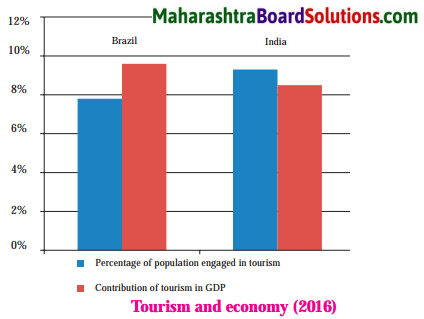
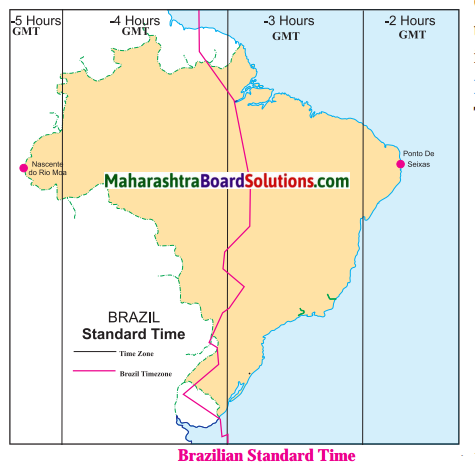
5. Prepare a flow chart for the following statements:

Question a.
The journey of clothes we use from the farm to ourselves.
Answer:
Maharashtra Board Class 8 Geography Solutions Chapter 8 Industries 1

Question b.
Essential factors for the location of any one industry.
Answer:
Maharashtra Board Class 8 Geography Solutions Chapter 8 Industries 2

6. Highlight the differences.

Question a.
Medium industries and heavy industries.
Answer:
Maharashtra Board Class 8 Geography Solutions Chapter 8 Industries 3

Maharashtra Board Class 8 Geography Solutions Chapter 8 Industries

Question b.
Agro-based industries and Information technology industries.
Answer:
Maharashtra Board Class 8 Geography Solutions Chapter 8 Industries 4

Maharashtra Board Class 8 Geography Solutions Chapter 8 Industries

Projects:

Collect information about any one project undertaken in your village/city under the Corporate Social Responsibility and present it in the class.

Class 8 Geography Chapter 8 Industries Additional Important Questions and Answers

Mark ✓ in the box next to the right alternative:

Question A.
Which of the following is a medium industry?
(i) Sugar industry [ ]
(ii) Textile industry [ ]
(iii) Cement industry [ ]
(iv) Food processing industry [ ]
Answer:
(iv) Food processing industry [✓]

Examine the following statements and correct the incorrect ones:

Question a.
Localization of sugar industry is found near Jamshedpur.
Answer:
Incorrect.
Correct sentence: Localization of iron and steel industry is found near Jamshedpur.

Question b.
India is predominantly manufacturing country.
Answer:
Incorrect.
Correct sentence: India is predominant¬ly agrarian country. ,

Maharashtra Board Class 8 Geography Solutions Chapter 8 Industries

Question c.
Poverty decreases the speed of industrial growth.
Answer:
Correct.

Answer the following questions in one sentence each:

Question a.
What is manufacturing?
Answer:
The process of converting raw materials into finished goods is called manufacturing. ‘

Question b.
What is called factory?
Answer:
A place where raw materials are converted into finished goods is called a factory.

Answer the following questions in brief:

Question a.
Mention three features of large industries.
Answer:
Three features of large industries ; are as follows:

  1. Large industries require huge amount of inputs like capital, machinery and manpower.
  2. Large industries require huge premise for its day-to-day operations.
  3. The goods produced in large industries have wide markets.

Answer the following questions in detail:

Question a.
Give information about agro-based industries in India.
Answer:
1. India is predominantly agrarian country. Agriculture is the main occupation of majority of people in India.

2. In India, food crops, cash crops, fruits, flowers, vegetables, etc. are cultivated on a large scale. The agricultural produce provides raw material to many industries in India. For example, sugar cane is raw material for sugar industry. Thus many industries in India are agro-based industries. RIES 83

3. The industries processing agricultural products like fruit processing industries, food processing industries, dairy industries, etc. have also flourished in India.

5. Agro based industries play an important role in rural economy by generating employment opportunities in rural areas.

Highlight differences/Distinguish between the following:

Question a.
Small industries and Medium industries.
Answer:
Maharashtra Board Class 8 Geography Solutions Chapter 8 Industries 5 Maharashtra Board Class 8 Geography Solutions Chapter 8 Industries 6

Study the following map/figure/graph and answer the following questions:

Can you tell? 

Maharashtra Board Class 8 Geography Solutions Chapter 8 Industries 7

Study the Figure and answer the following questions :

Question a.
Name the industry at Jamshedpur.
Answer:
The name of the industry at Jamshedpur is Iron and steel industry.

Question b.
Which raw material is required for this industry?
Answer:
Raw material required for this industry is iron, manganese, limestone, coal, etc.

Maharashtra Board Class 8 Geography Solutions Chapter 8 Industries

Question c.
From which areas is this raw material obtained?
Answer:
This raw material is obtained from the areas of Jamshedpur, Kulaisila, Gurumahisani, Jgharia, etc.

Question d.
Why is coal used in this industry?
Answer:
Coal is used in this industry as fuel to heat iron to a certain temperature.

Question e.
State with reasons if it would be feasible to set up an iron and steel industry in your district.
Answer:
It would not be feasible to set up an iron and steel industry in our district as there are no reserves of iron ore, manganese, limestone, etc. found in our district.
(Note : Students, here it is assumed that you stay in Thane district. Write answer to j the above question as per the district in which you live.)

Give it a try.

Maharashtra Board Class 8 Geography Solutions Chapter 8 Industries 8

Observe the picture and answer the following questions:

Question a.
In what context is this logo?
Answer:
This logo is about ‘Make in India’ programme.

Question b.
What will be the benefit of this programme?
Answer:
This programme will boost the production of various industries located all over India.

Maharashtra Board Class 8 Geography Solutions Chapter 8 Industries

Question c.
What is correlation between this programme and employment?
Answer:
This programme will generate employment opportunities on a large scale.

Question d.
Which are the Navratna industries in India?
Answer:
The Navratna industries in India are as follows :

  1. Gas Authority of India
  2. Bharat Heavy Electricals Limited
  3. Coal India Limited
  4. Indian Oil Corporation Limite
  5. National Thermal Power Corporation
  6. Oil and Natural Gas Corporation, etc.

Question e.
Why do you think they have been accorded this status of Navratna?
Answer:
Navratna industries have been accorded the status of Navratna to function effectively to fulfill various needs of public.

Show the following details on the outline map of India with index:

Give it a try. (Textbook page 58)

Question a.
Important information technology centres are called IT hubs. Find out with the help of the internet in which cities such hubs have developed and mark them on an outline map of India.
Answer:
Important information technology centres known as IT hubs:

  1. Bangaluru
  2. Hyderabad
  3. Chennai
  4. Mumba
  5. New Delhi
  6. Pune
  7. Kolkata
  8. Ahmadabad.

Maharashtra Board Class 8 Geography Solutions Chapter 8 Industries 13

Thought-Provoking Questions:

Let’s recall.

1. In Figure, the sequence of two industrial processes has been given. Arrange the pictures in proper sequence and write the sequential number in the boxes given below and answer the following questions:

Maharashtra Board Class 8 Geography Solutions Chapter 8 Industries 9

Questions:

Question a.
Name the two industries.
Answer:
The two industries are:

  1. Sugar industry
  2. Textile industry.

Maharashtra Board Class 8 Geography Solutions Chapter 8 Industries

Question b.
Name the raw material and the finished product of both these industries.
Answer:
The raw material and finished product in sugar industry are sugarcane and sugar respectively. Similarly the raw material and finished product in textile industry are cotton and cloth.

Question c.
How is the raw material converted into the finished product?
Answer:
The raw material is converted into the finished product by processing the raw material at various level.

Question d.
Why is it necessary to convert the raw material into finished goods?
Answer:
The raw material in its original form, cannot satisfy human wants directly. Therefore it is necessary to convert the raw material into finished goods.

2. Study the following figure showing the factors affecting the location of an industry. Taking into account the factors shown in the figure, note in different colours the favourable factors required for (1) Iron and steel (2) Textiles and (3) Sugar industry and answer the following questions:

Maharashtra Board Class 8 Geography Solutions Chapter 8 Industries 10

Questions:

Question a.
For each industry, prepare a list of necessary factors.
Answer:
A list of necessary factors for each industry:

  1. Iron and steel industry: Iron ore, manganese, coal, water, etc.
  2. Textile industry: Cotton, transportation services, water, electricity, etc.
  3. Sugar industry: Sugar cane, water, electricity, etc.

Maharashtra Board Class 8 Geography Solutions Chapter 8 Industries

Question b.
For each industry give an explanation for the location suggested by you.
Answer:
1. Iron and steel industry: The raw material of iron and steel industry is bulky in nature. The transportation of this raw material is not feasible. Therefore, the location of iron and steel industry is suggested near mineral field.

2. Textile industry: The raw material of textile industry is cotton. Cotton is light in weight. Therefore, it can be transported easily. Therefore, the location of textile industry is suggested near highway and at a place where labours are available.

3. Sugar industry: The raw material of sugar industry is sugar cane. This raw material is comparatively less durable. Therefore, its transport at a distant location is difficult. Therefore, the location of sugar industry is suggested near the cultivation area.

Question c.
In a similar manner for which other industries can you decide a suitable location?
Answer:
In a similar manner, a suitable location can be decided for the industries like fruit processing industry, cement industry, etc.

Give it a try. 

Study the factors given below and state which industries could develop in these regions:

Question a.
Excellent transport facilities, skilled labours, uninterrupted supply of electricity,
Answer:
Textile industries, vehicle manufacturing industries, fertilizer manufacturing industries, etc. could develop in the regions of excellent transport facilities, skilled labours, uninterrupted supply of electricity.

Question b.
Limestone deposits, cheap labour, uninterrupted supply of water and electricity, increasing urbanisation,
Answer:
Mining industries could develop in the regions of limestone deposits, cheap labour, uninterrupted supply of water and electricity, increasing urbanisation.

Maharashtra Board Class 8 Geography Solutions Chapter 8 Industries

Question c.
Fruit orchards, labour, excellent transportation facilities, unlimited water supply, uninterrupted electricity and ready market.
Answer:
Fruit processing industries could develop in the regions of fruit orchards, labour, excellent transportation facilities, unlimited water supply, uninterrupted electricity and ready market.

Use your brainpower! 

Maharashtra Board Class 8 Geography Solutions Chapter 8 Industries 15

Question a.
Identify the industries shown in the pictures given on page 54 of the textbook and state their suitable locations.
Answer:
A. The industries shown in the pictures given on page 54 of the textbook are as follows:

  1. Information technology industry
  2. Fish canning industry
  3. Milk industry.

B. The suitable locations for these industries are as follows:

  1. Information technology industry: A place connected with transportation facilities
  2. Fish canning industry: A place near coastal region
  3. Milk industry: A place near the cattle rearing is practised.

Think about it. 

Maharashtra Board Class 8 Geography Solutions Chapter 8 Industries 14

Examine pictures (A), (B) and (C) given on page 54 of the textbook and answer the following questions:

Question a.
Name the industry shown in picture (A).
Answer:
The name of the industry shown in picture (A) is Papad making industry.

Maharashtra Board Class 8 Geography Solutions Chapter 8 Industries

Question b.
What is the difference between the industries shown in pictures (A) and (B)?
Answer:
(A) Industry requires comparatively less amount of capital, manpower, machinery and space. On the other hand, (B) industry requires comparatively more amount of capital, manpower, machinery and space.

Question c.
What is distinctive about the industry in picture (C)?
Answer:
The industry in picture (C) requires capital, manpower, machinery and space on a very large scale.

Question d.
Identify the industry shown in each picture.
Answer:
The industries shown are as follows:

  1. Industry shown in picture (A) is Small industry
  2. Industry shown in picture (B) is Medium industry
  3. Industry shown in picture (C) is Large industry

Question d.
Name some more similar industries.
Answer:

  1. Small industries: Cane products and handicraft industry, earthen pot making industry, etc.
  2. Medium industry: Fruit processing industry, jaggery making industry, etc.
  3. Large industry: Sugar manufacturing industry, fertilizer manufacturing industry, Automobile manufacturing industry, etc.

Give it a try. 

Question a.
Complete the following list with reference to industries:
(Note: The answer is given directly.)
Maharashtra Board Class 8 Geography Solutions Chapter 8 Industries 11
Answer:

IndustryTypeRaw material
1. Manufacture of iron rodsLarge industryIron, water, electricity, etc.
2. Manufacture of candleSmall industryWax, water, mould, etc.
3. Furniture manufactureMedium industryWood, saw, polish, etc.
4. Paper manufactureMedium industryPulp, water, colour, etc.
5. Manufacture of medicinesLarge industryMedicinal chemicals, water, etc.
6. Sugar manufactureLarge industrySugar cane, water, electricity, etc.
7. Jaggery manufactureMedium industrySugar cane, water, etc.
8. Agarbatti manufacturingSmall industryBamboo sticks, incense powder, etc.
9. Manufacture of cotton clothLarge industryCotton, water, colour, etc.
10. Manufacture of railway enginesLarge industryIron, steel, glass, etc.
11. Papad makingSmall industryPulse tour, salt, water, etc.

Can you tell? 

Maharashtra Board Class 8 Geography Solutions Chapter 8 Industries 12

Question a.
Study the factors given in Figure 8.7 given on page 56 of the textbook and classify them as per their advantages and disadvantages in relation to industry:
Answer:
1. Advantages in relation to industry: Employment, Development of agriculture, Population, Stable prices of commodities, Skilled manpower, Improvement in the standard of living, Supply of labour, the Market, More land under irrigation, Development of transport facilities, Communication, Cultural development, Literacy, Boost to urbanization, Ample water, Uninterrupted power supply.

2. Disadvantages in relation to industry: Depletion of forest land, Pollution, Increasing land prices, Slums, Number of migrants, poverty.

Think about it.

Question a.
Talk about the interrelationship between human resource and industry.
Answer:

  1. The optimum level and high quality of human resource increases the industrial growth.
  2. Shortage and low quality of human resource decreases the industrial growth.

Use your brainpower!

Question a.
Which type of industries can stem the flow of people towards urban areas?
Answer:
Large industries can stem the flow of people towards urban areas.

Maharashtra Board Class 8 Geography Solutions Chapter 8 Industries

Question b.
Where is it necessary to establish these industries?
Answer:
It is necessary to establish these industries in rural areas.

Think about it. 

Question
If you become an industrialist, which of the following would you do?:

  1. Only make profits
  2. Start a second industry from the earlier one as a supplementary industry
  3. Will spend some amount for the society after the deduction of tax
  4. Provide help for the creation of new industrialist.

Answer:
If become industrialist, will do the following:

  1. Start a second industry from the earlier one as a supplementary industry
  2. Will spend some amount for the society after the deduction of tax
  3. Provide help for the creation of new industrialist.

Open-Ended Question:

Use your brainpower! 

Question 1.
Which industries could be profitably set up in your surrounding area/locality?
Answer:
As fruits like mangoes, jackfruits, cashew nuts are largely grown, the fruit processing industries could be profitably set up in our surrounding area/locality.
(Note: Students here it is assumed that you live in Sindhudurg district of Maharashtra.
Write answer to the above question as per the district in which you live.)