Maharashtra Board Class 7 Civics Solutions Chapter 3 Features of the Constitution

Balbharti Maharashtra State Board Class 7 Civics Solutions Chapter 3 Features of the Constitution Notes, Textbook Exercise Important Questions and Answers.

Maharashtra Board Class 7 Civics Solutions Chapter 3 Features of the Constitution

Class 7 Civics Chapter 3 Features of the Constitution Textbook Questions and Answers

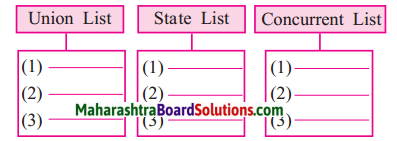
1. Prepare a table to show the separation of powers in a Federal Government.
Maharashtra Board Class 7 Civics Solutions Chapter 3 Features of the Constitution 1
Answer:

Union ListState ListConcurrent List
Defence, foreign relations, war and peace, currency, international trade, etc.Agriculture, law and order, local government, health, prison administration etc.Employment, environment economic and social planning, personal law, education, etc.

2. Find one word for:

Question 1.
The Government at the centre which carries out the administration of the entire country.
Answer:
Union Government

Maharashtra Board Class 7 Civics Solutions Chapter 3 Features of the Constitution

Question 2.
The machinery with whom rests the responsibility of conducting elections in a free and fair atmosphere.
Answer:
Election Commission.

Question 3.
The third list of subjects for making laws
Answer:
The Concurrent List

3. Answer the following questions.

Question 1.
Why does the Government function at two levels in a Federation?
Answer:
(i) One of the important features of our Constitution is the Federal System.

(ii) In countries with large territories and huge populations, the Government is run by a Federal System.

(iii) Ruling a large territory from a single capital city is not only difficult but may also lead to the neglect of some far-flung areas.

(iv) People residing there cannot participate in the affairs of the Government. Therefore, the governments function at two levels in a § Federation.

Question 2.
What do you understand by Residuaiy Powers?
Answer:
(i) Our Constitution has given three lists on various subjects.

(ii) The first list is called Union List. It contains 97 subjects on which the Union Government makes laws.

(iii) The State List is for the State Governments to legislate upon. It contains 66 subjects.

(iv) Apart from these two lists, there is a Concurrent List which contains 47 subjects.

(v) Both governments can make laws on subjects included in this list. If a subject comes up that is not included in any of the lists, the Union Government is entitled to make laws on it. These powers are termed as ‘Residuary Powers’.

Maharashtra Board Class 7 Civics Solutions Chapter 3 Features of the Constitution

Question 3.
Why has the Constitution created an independent Judiciary in India?
Answer:
(i) The Judiciary of India is independent machinery according to the provisions of the Constitution.

(ii) It is separate from the Executive and Legislative bodies of the Indian Government.

(iii) The Supreme Court is the guardian of the Constitution which ensures that the Fundamental Rights of the citizens are not violated.

(iv) To carry out its duties without fear or favour or external pressure, the Judiciary in India is independent.

4. Hold a group discussion on the merits and demerits of an independent judicial system.
Answer:
Merits of an independent judicial system:

  • The judicial system enables the courts to give impartial judgements.
  • Judiciary does not act under any political pressure.
  • As the judges are appointed by the President and not by the Government.

Demerits of an independent judicial system:

  • As the judiciary is independent, it is out of the scope of the government’s control.
  • The judiciary is not answerable to anyone if the process of dispensing justice is slow.

5. Find out about the Electronic Voting Machine (EVM) and discuss the advantages of conducting elections with EVM.
Answer:

  • Difficult to tamper/cheat
  • Cost-effective and economical
  • Time-saving
  • Calculation is faster
  • Easy to use / carry / transport
  • Data can be saved for later use.

Activity:

Establish an Election Commission in your class, decide upon the positions you would like to fill through elections. Then conduct elections under the guidance of this Commission.

Class 7 Civics Chapter 3 Features of the Constitution InText Questions and Answers

Do this:

Question 1.
Make a list of North-Eastern Indian States and name their capital cities.
Answer:

StateCapital
Arunachal PradeshItanagar
AssamDispur
MeghalayaShillong
ManipurImphal
MizoramAizwal
NagalandKohima
TripuraAgartala

Maharashtra Board Class 7 Civics Solutions Chapter 3 Features of the Constitution

Find out:

Question 1.
Find out about the Electronic Voting Machine (EVM) and discuss the advantages of conducting elections with EVM.
Answer:

  • Difficult to tamper/cheat
  • Cost effective and economical
  • Time saving
  • Calculation is faster
  • Easy to use / carry / transport
  • Data can be saved for later use.

Question 2.
How many amendments have been made in the Indian Constitution till date?
Answer:
As of September 2016, there have been 101 (latest of List Bill) amendments to the Constitution of India, since it was first enacted in 1950.

Class 7 Civics Chapter 3 Features of the Constitution Additional Important Questions and Answers

Complete the sentence by choosing the appropriate words from the options given below:

Question 1.
One of the important features of our Constitution is the _______ System. (Federal, Unitary, Republic)
Answer:
Federal

Question 2.
The Government functions at ________ levels in a Federation. (two, three, four)
Answer:
two

Question 3.
The Government that oversees the administration of the region that we live in is called _______.(Union Government, State Government, None of the above)
Answer:
State Government

Question 4.
The system of running the administration of a country cooperatively by the governments at two levels, making laws about different subjects is called __________. (Socialism, Communism, Federalism)
Answer:
Federalism

Question 5.
The ______ is for the Union Government to make laws. (State List, Union List, Concurrent List)
Answer:
Federalism

Maharashtra Board Class 7 Civics Solutions Chapter 3 Features of the Constitution

Question 6.
The _______ is for the State Government to legislate upon. (Union List, State List, Concurrent List)
Answer:
State List

Question 7.
The ______ List contains 47 subjects and both the Government can make laws on these subjects. (Concurrent List, Union List, State List)
Answer:
Concurrent List

Question 8.
If a subject comes up and it is not included in any of the Lists, the _______ is entitled to make laws. (State Government, Union Government, President)
Answer:
Union Government

Question 9.
In India, there are ____ State Governments and _______ Union Territories.(29, 7 ; 28, 8)
Answer:
29, 7

Question 10.
The ______ System of Government the Legislature has the highest decision making power. (Parliamentary, Autocratic, Communist)
Answer:
Parliamentary

Question 11.
The ______ who runs the administration emerge from the Lok Sabha and is / are answerable to the Lok Sabha for all its / their decisions.
(Opposition Ministers, Council of Ministers,President)
Answer:
Council of Ministers

Question 12.
Judges are appointed by the ______ (President, Government, Vice-President)
Answer:
President

Question 13.
The Indian Constitution has granted _________ to all Indians. (Single citizenship, Dual citizenship, None of these)
Answer:
Single citizenship

Question 14.
The ________ ensures free, fair and just atmosphere for the election. (President, Election Commission, Ruling Party)
Answer:
Election Commission.

Maharashtra Board Class 7 Civics Solutions Chapter 3 Features of the Constitution

Match the following:

Question 1.

Column ‘A’Column ‘B’
(1) War and peace
(2) Law and order
(3) Economic and Social planning
(a)  State Government
(b) Both Union and State Government
(c) Union Government

Answer:
1 – c
2 – a
3 – b

State whether the following statements are true or false with reasons:

Question 1.
Defence is a subject on which the State Government makes laws.
Answer:
False:

  • The Constitution has divided the subjects for making laws between the Union and the State Government.
  • Defence is a subject on which Union Government makes laws.

Question 2.
The Union List contains 97 subjects and defence is one of the subjects included in it.
Answer:
True.

Question 3.
Chandigarh is controlled by the State Government.
Answer:
False: Chandigarh is one of the seven Union Territories of India. The Union Government controls the Union Territories.

Question 4.
In India, the Executive has the highest decision-making power.
Answer:
False: The Indian Constitution has provided for a Parliamentary System of Government. In such a system the Parliament, i.e. the Legislature has the highest decision-making power.

Maharashtra Board Class 7 Civics Solutions Chapter 3 Features of the Constitution

Name the following:

Question 1.
The system which is an important feature of our Constitution.
Answer:
Federalism

Question 2.
The Government that oversees the administration of the place we live.
Answer:
State Government

Question 3.
Number of subjects in the Union List on which the Union Government makes laws.
Answer:
97 Subjects

Question 4.
The list with 66 subjects which the State government legislates upon.
Answer:
The State List

Question 5.
The powers of the Union Government to make laws on a subject which comes up and is not mentioned in any list.
Answer:
Residuary Powers

Question 6.
Any two subjects with the Union Government.
Answer:
Defence, Currency

Question 7.
Subjects with the State Government
Answer:
Health, Prison

Maharashtra Board Class 7 Civics Solutions Chapter 3 Features of the Constitution

Question 8.
Subjects with both the governments.
Answer:
Employment, Education

Question 9.
2 Union Territories in India.
Answer:
Daman and Diu, New Delhi

Question 10.
Answerable to the Lok Sabha
Answer:
The Council of Ministers.

Question 11.
An example to show that the Indian Judiciary is independent.
Answer:
Appointment of Judges by the President

Question 12.
The type of citizenship granted to the citizens by the Indian Constitution.
Answer:
Single citizenship

Answer in one or two sentences:

Question 1.
Write any one of the important features of our Constitution.
Answer:
Federal system is one of the important features of our Constitution.

Question 2.
In which countries are governments run by the Federal System?
Answer:
In countries with large territories and huge population, the Government is run by a Federal System.

Maharashtra Board Class 7 Civics Solutions Chapter 3 Features of the Constitution

Question 3.
What is the problem faced while ruling a large territory from a single capital?
Answer:
Ruling a large territory from a single capital city is not only difficult but may also lead to neglect of some far-flung areas.

Question 4.
Explain the term Union Government.
Answer:
The Government at the centre carries out tasks like defence of the entire country, foreign policy, establishing peace, etc. It is called ‘Union Government or ‘Federal Government’.

Question 5.
What do you mean by State Government?
Answer:
The Government that oversees the administration of the region that we live in is called State Government.

Question 6.
What is called ‘Federalism’?
Answer:
The system of running the administration of a country cooperatively by the Governments at two levels, making laws about different subjects is called ‘Federalism’.

Question 7.
Which are the three lists into which the Constitution has divided subjects for making Laws?
Answer:
The three lists into which the Constitution has divided subjects for making laws are State List, Union List and Concurrent List.

Question 8.
Which powers are termed as Residuary Powers?
Answer:
(a) If a subject comes up that is not included in any of the three Lists, the Union List, the State List or the Concurrent List, the Union Government is entitled to make laws on it
(b) These powers are termed as residuary powers.

Question 9.
Which are the seven Union territories in India?
Answer:
The seven Union Territories in India are New Delhi, Daman and Diu, Puducherry, Chandigarh, Dadra and Nagar Haveli, Andaman and Nicobar Islands and Lakshadweep.

Question 10.
In the Parliamentary system of Government, who has the highest decision-making power?
Answer:
In the Parliamentary system of Government, the Parliament has the highest decision-making power.

Question 11.
What does the Indian Parliament include?
Answer:
The Indian Parliament includes the President, the Lbk Sabha or the House of the People and the Rajya Sabha or the Council of States.

Question 12.
Whom is the Council of Ministers answerable to, for all its decisions?
Answer:
The Council of Ministers is answerable to the Lok Sabha for all its decisions.

Maharashtra Board Class 7 Civics Solutions Chapter 3 Features of the Constitution

Question 13.
What have great significance in Parliamentary Democracy?
Answer:
In Parliamentary Democracy, the discussion and debates that take place in the Parliament have great significance.

Question 14.
Which disputes are referred to the Judiciary?
Answer:
The disputes that cannot be resolved mutually are referred to the Judiciary.

Question 15.
Which are the two provisions in the Constitution which ensures that the Judiciary remains more independent?
Answer:
The two provisions in the Constitution which ensures independence of Judiciary are that the judges are appointed by the President and not by the Government, and it is not easy to remove the Judges from their office.

Question 16.
Why is it necessary to amend the Constitution?
Answer:
There comes up a need to make changes or amendments in the provisions of the Constitution due to the changing circumstances.

Question 17.
What can frequent amendments in the Constitution lead to?
Answer:
Frequent amendments in the Constitution may lead to instability.

Question 18.
Write a short note on Parliamentary System of Government.
Answer:
(i) The Indian Constitution has provided for a Parliamentary System of Government.

(ii) In such a system, the Parliament, i.e. the Legislature has the highest decision-making power.

(iii) The Indian Parliament includes the President, the Lok Sabha or the House of the People and the Rajya Sabha or the Council of States.

(iv) The Council of Ministers that run the administration emerge from the Lok Sabha and is answerable to the Lok Sabha for all its decisions. In Parliamentary Democracy, the discussion and debates that take place in the Parliament have great significance.

Maharashtra Board Class 7 Geography Solutions Chapter 9 Agriculture

Balbharti Maharashtra State Board Class 7 Geography Solutions Chapter 9 Agriculture Notes, Textbook Exercise Important Questions and Answers.

Maharashtra State Board Class 7 Geography Solutions Chapter 9 Agriculture

Class 7 Geography Chapter 9 Agriculture Textbook Questions and Answers

1. Select the proper option for the following statements:

Question 1.
In which of the following type of farming
are the crops rotated?
(a) Intensive.
(c) Commercial.
(b) Plantation.
(d) All of these.
Answer:
(a) Intensive.

Maharashtra Board Class 7 Geography Solutions Chapter 9 Agriculture

Question 2.
Agriculture requires the following:
(a) Only ploughing
(b) Use of animals, implements, machines and manpower.
(c) Use of only manpower.
(d) Just cultivate the crop.
Answer:
(b) Use of animals, implements, machines and manpower.

Question 3.
In India, agriculture has developed because…
(a) There are two seasons of agriculture in India.
(b) Majority of the people depend on agriculture.
(c) Traditional agriculture is practised in India.
(d) In India factors like climate, soils, water, etc. are conducive.
Answer:
(d) In India factors like climate, soils, water, etc. are conducive.

Question 4.
It is necessary that modern methods and technology be used in agriculture in India because…
(a) There are factories producing improved seeds.
(b) There are industries producing fertilizers
(c) Population is growing and there are agro-based industries.
(d) Modern means and machines are available.
Answer:
(c) Population is growing and there are agro-based industries.

2. Give short answers for the following questions:

Question 1.
Describe the importance of irrigation for agriculture.
Answer:
(i) Irrigation means the process of supplying of water through artificial means such as pipes, canals, sprinklers, etc.
(ii) Irrigation helps the farmers to be less dependent on rain water for the purpose of agriculture.
(iii) Since monsoons are uncertain & highly variable, farming cannot entirely depend upon rains
(iv) Hence irrigation is needed to grow assured crops & also to grow crops in the months after the monsoon season.

Maharashtra Board Class 7 Geography Solutions Chapter 9 Agriculture

Question 2.
Distinguish between intensive farming & shifting cultivation.
Answer:

intensive farmingShifting Cultivation
(i) Intensive farming is carried out in one and the same farm for years together.
(ii) This type of farming is mostly seen in the developing regions.
(iii) In this type of farming the cultivator and his family are totally dependent on farming. Farm production is sufficient only for the requirement of the family.
(i) In shifting Cultivation, every year a new area is chosen for cultivation.
(ii) This type of cultivation is practised in the tropics in densely forested areas or hilly tracts.
(iii) The production obtained from shifting cultivation is not sufficient to fulfill the food requirement. So people undertake hunting, fishing and gathering of bulbs and roots from forest.

Question 3.
Mention the major types of farming and give information about intensive farming and extensive grain farming?
Answer:
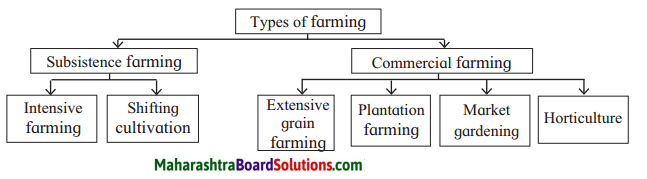
Broadly the following types of farming are identified
Maharashtra Board Class 7 Geography Solutions Chapter 9 Agriculture 1
Intensive farming:

  • Intensive farming is a type of traditional farming. It is carried out in one and the same farm for years together.
  • Getting maximum production from a minimum area is the characteristic of Intensive farming.
  • Due to large population or limited availability of land, per head holding is small.
  • This type of farming is mostly seen in developing region.
  • The cultivator and his family are totally dependent on farming. The farm production is sufficient only for the requirements of the cultivators family.
  • As farm production is low hence the economic condition of the cultivator is also poor.

Extensive farming:

  • Extensive grain farming is a type of commercial farming.
  • Farm size is greater than 200 hectares.
  • Due to large farm size and sparse population in the region, this type of farming is carried out with the help of machines like tractors and crushers.
  • Helicopters or planes are used for spraying pesticides.
  • Mono crop cultivation is the main characteristic.
  • Crops like wheat, corn, barley, oats, soyabean are cultivated.
  • Heavy capital investment is necessary. Since huge expenditures are needed for purchase of machinery, fertilisers, pesticides, godowns, transport cost, etc.
  • Droughts, attack by pests, locusts, market fluctuation, etc. are the problems in extensive grain farming.
  • This type of farming is carried out in the temperate grassland regions.

Maharashtra Board Class 7 Geography Solutions Chapter 9 Agriculture

Question 4.
Describe the characteristics of plantation farming.
Answer:
(i) Plantation farming is a type of commercial farming.
(ii) Farm size is 40 hectares or above.
(iii) As plantation agriculture is practised in hilly tracts of tropical regions, use of machines are not possible hence local manpower is used.
(iv) This is a single crop cultivation practice.
(v) Only commercial crops like tea, rubber, coffee, coconut, cocoa, spices, etc. are planted.
(vi) This type of farming requires large scale capital investment.
(vii) Major issues faced are climate, manpower, deterioration of environment, economic and managerial problems.
(viii) Plantation farming is practised in India and other South Asian countries, Africa, South and Central America.

Question 5.
Which are the crops cultivated in your area? What are the geographical reasons for that?
Answer:
(i) I live in the konkan region of the state of Maharashtra
(ii) The main crops cultivated in our area are mangoes, rice, coconut, cashew, etc.
(iii) Konkan region has hot & humid climate, heavy rainfall which favours the growth of these crops.
(iv) This region has fertile laterite soil which is suitable for cultivation of fruits.

Question 6.
Why is the agriculture in India seasonal in nature? What are the difficulties for perennial agriculture?
Answer:
(i) Most of the agriculture in India is dependent on monsoon rainfall. 80% of the rainfall in India is received from south west monsoon winds from June to September.
(ii) Since monsoon in India is seasonal; agriculture in India is also seasonal in nature.
Difficulties for perennial agriculture
(i) Rainfall in India is highly irregular & uncertain. Also there is lack of irrigation facilities.
(ii) There is lack of capital investment, godowns, transportation, etc.
(iii) There is lack of awareness with respect to scientific methods of crop cultivation.

Activity:

Visit a farm where modern technology is used for agriculture. Collect information about it.

Use of ICT

Question 1.
Collect the pictures of improved seeds and means of irrigation from the internet.
Question 2.
Collect information regarding agricultural in Israel from the internet. and present it.

Class 7 Geography Chapter 9 Agriculture InText Questions and Answers

Can you tell?
Observe the picture and briefly describe the type of agriculture shown.

Question 1.
Maharashtra Board Class 7 Geography Solutions Chapter 9 Agriculture 4

Answer:
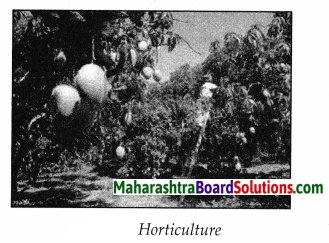
(a) For the growth of fruits a large number of similar trees are grown in a vast area. Such land areas are called farms or orchards, for e.g. mango, coconut.
(b) In this type of farming modern as well as traditional methods are used.
(c) Use of irrigation, chemical fertilizers, green houses, etc. is being made for getting more profit.

Question 2.
Maharashtra Board Class 7 Geography Solutions Chapter 9 Agriculture 5
Answer:
(a) One single crop is grown in a large area.
(b) The use of man power is less, whereas most of the farmwork is done with the help of machines like tractors, harvesters, threshers, etc.
(c) Heavy capital investment is necessary for this type of farming.

Question 3.
Maharashtra Board Class 7 Geography Solutions Chapter 9 Agriculture 6
Answer:
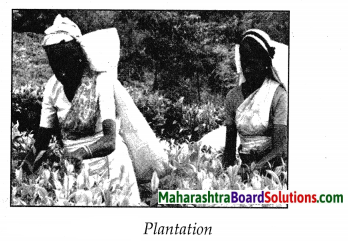
(a) One single tree crop is grown on a large scale.
(b) Only commercial crops like tea, rubber, coffee, cocoa, coconut, spices, etc. are planted.
(c) It requires lot of capital investment due to the long duration of crops, use of scientific methods, exportable production, processing,

Maharashtra Board Class 7 Geography Solutions Chapter 9 Agriculture

Question 4.
Maharashtra Board Class 7 Geography Solutions Chapter 9 Agriculture 7
Answer:
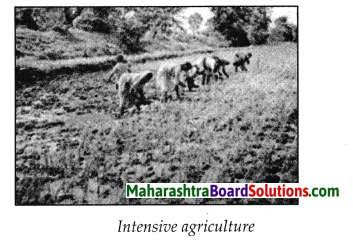
(a) Crops are grown on small farm lands with the help of bovine (animal) and human resources.
(b) The profits earned are very low despite intensive care taken.
(c) The crops that are grown are used for home consumption and the excess, if any, is sold in the local market.

Observe the picture and answer:

Maharashtra Board Class 7 Geography Solutions Chapter 9 Agriculture 2
Question 1.
What all do you see in the picture?
Answer:
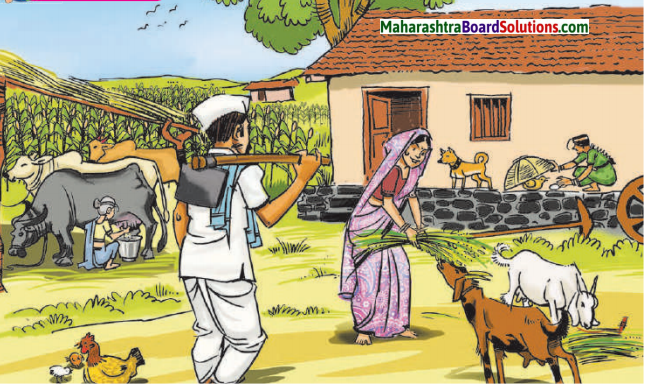
A farmer’s house, a farmer keeps cows, hens, sheep, goats and cattle, a standing crop, a plough share, farmers wife grazing the cattle.

Question 2.
Why has the family kept goats and hens?
Answer:
Farmer gets milk from goats and eggs from the hens.

Question 3.
Which implements are seen in the picture?
Answer:
The spade and plough are seen in the picture

Question 4.
How are these implements used?
Answer:
Spade is a hand tool used to dig or loosen ground or break lumps in the soil. A plough is used for ploughing the fields. Ploughing turns organic matter into soil to increase decomposition and add nutrients from organic matter to the soil.

Maharashtra Board Class 7 Geography Solutions Chapter 9 Agriculture

Question 5.
In which major occupation type will the activities shown here be included?
Answer:
The activities shown in the picture mostly fall under the occupation of agriculture.

Question 6.
What could be the main occupation of these people?
Answer:
The main occupation of these people could be cultivation of crops.

Question 7.
Who could be the owner of the house?
Answer:
The farmer himself could be the owner of the house.

Question 8.
Which products shown in the above picture do you use?
Answer:
Milk and dairy products, eggs are used in our day to day lives.

Give it a try:

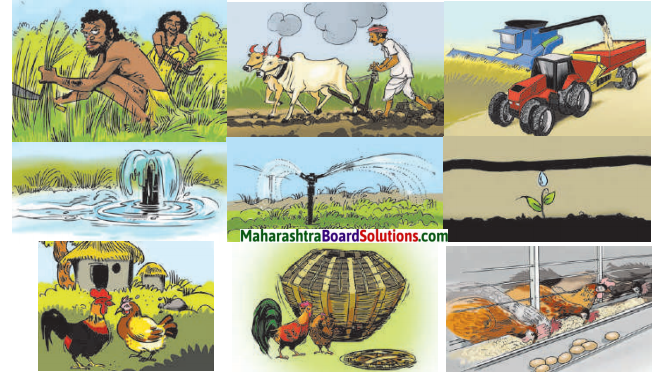
Observe the pictures and answer the following questions.
Maharashtra Board Class 7 Geography Solutions Chapter 9 Agriculture 3
Question 1.
What differences do you observe these pictures?
Answer:
In the pictures we can observe the changes in agricultural practices. It shows the transition from traditional to modern agriculture.
(a) Initially man cultivated crops using only manual labour. Later he started using various animals like bullocks to cultivate crops.
Today we use modern machines for various agricultural practices.

(b) Irrigation too has changed – from water allowed to flow freely in the field though pipes, man now uses modern methods like sprinkler & drip irrigation.

(c) Poultry farming is supplementary to cultivation of crops & is included in agriculture. Initially hens were reared in small numbers in open areas. But today hens are reared on a large scale. With use of modem techniques it leads to large scale production of eggs.

Question 2.
What changes have taken place in traditional agricultural practices?
Answer:
Traditionally agriculture was carried out using manual labour & bovine power. Today modem methods of agriculture include using machines tractors, harvests, fertilizers, insecticides, pesticides, etc. for better yield of crop.

Irrigation is used for ample water supply throughout the year to maximize crop production. Modern, scientific techniques & use of hybrid seed, leads to more productivity of land, (more crop production in limited land area)

Maharashtra Board Class 7 Geography Solutions Chapter 9 Agriculture

Answer the following questions:

Question 1.
Which improper practices arising out of man’s greed are observed in agriculture.
Answer:
In order to produce the fruits and vegetables early and sell them quickly, man uses artificial chemical, which harms the soil & hampers the quality of production.

Question 2.
What means of irrigation are available in your area?
Answer:
(a) Drip and Sprinkler irrigation is used in many orchards across the konkan region of Maharashtra.
(b) Wells & tube wells are other methods used on large scale.

Question 3.
Have you observed the wastage of water in agriculture? If yes, describe it.
Answer:
There was a field in my native place. The farmer would water the field leaving the water pipe on the field. Lot of water would be wasted. But now the same farmer waters the field using sprinkler irrigation method. As a result there is no wastage of water, any more.

Question 4.
Which steps can easily be taken to avoid improper practices in agriculture?
Answer:
(a) System of Agricultural Produce Market committee should be established at taluka level and farmers should be encouraged to bring their produce and sell to the traders here

(b) As farm produce is perishable, there has to be a proper arrangement for its sale to avoid,wastage.

(c) Institutes like farmer’s organizations, consumer societies, etc. help and try to protect farmers from exploitation by agents, mediators and others.

(d) Farmers should not use artificial chemicals and pesticides.

Use your brainpower:

Question 1.
Why does extensive commercial farming need more capital?
Answer:
(a) Farm size is greater than 200 hectares.
(b) Due to large farm size and sparse population in the region, this type of farming is carried out with the help of machines like tractors and crushers.
(c) Pesticides are sprayed with the help of helicopters or planes.
(d) Since huge expenditures are needed for the purchase of machinery, fertilizers, pesticides, godowns, transport cost, etc. So extensive commercial farming needs more capital.

Question 2.
Why does plantation farming need skilled and experienced labour?
Answer:
(a) Farm size in plantation farming is 40 hectares or above.
(b) Plantation farming is practised in hilly tracts, so use of machines is not possible.
Hence, plantation farming needs skilled and experienced labour.

Question 3.
In what different ways is ground water obtained for agriculture?
Answer:
(a) Ground water is the water that is found underground.
(b) When it rains, about 20% of the rain water seeps into the ground, forming a water table.
(c) A well as deep as the water table is dug, in order for it to pump water to the fields for agriculture.
(d) Now days use of tube wells have become popular too

Maharashtra Board Class 7 Geography Solutions Chapter 9 Agriculture

Class 7 Geography Chapter 9 Agriculture Additional Important Questions and Answers

Fill in the blanks choosing the correct options from the bracket:

Question 1.
Commercial dairy fanning is mainly undertaken for _________. (milk and fish, meat and milk, meat and poultry)
Answer:
meat and milk

Question 2.
Sheep rearing is carried out to obtain ________. (cotton, silk, wool)
Answer:
wool

Question 3.
In order to achieve the best growth of fish, ________ methods are employed. (pisciculture, scientific, electronic)
Answer:
scientific

Question 4.
Silk thread is obtained from the ______ of the silk moth. (cocoon, mulberry, skin)
Answer:
cocoon

Question 5.
Leaves of the ______ trees are the main food for the silk worms. (mulberry, pepal, coconut)
Answer:
mulberry

Question 6.
______ farming is a highly specialized type of farming of the modem era. (Intensive, Subsistence, Modern)
Answer:
Greenhouse

Question 7.
Intensive farming and shifting cultivation are the two types in ______ farming. (extensive, traditional, intensive)
Answer:
traditional

Question 8.
Shifting cultivation is a ________ type of cultivation, (primitive, extensive, intensive)
Answer:
primitive

Question 9.
Cultivation of flowers and fruits is a subtype of _______ gardening. (market, organic, plantation)
Answer:
market

Fill in the blanks:

Question 1.
_______ is a new field of tourism.
Answer:
Agrotourism

Question 2.
Most of the farmers are ________ weak and cannot market their product on their own.
Answer:
economically

Question 3.
As farm produce is ______ there has to be a proper arrangement for its sale.
Answer:
perishable

Maharashtra Board Class 7 Geography Solutions Chapter 9 Agriculture

Question 4.
Some of the farm produce is directly used by industries as ______.
Answer:
raw material

Question 5.
_____ is a major exporter of fresh farm produce.
Answer:
Israel

Question 6.
International markets are now becoming easily available for farm produce due to _____.
Answer:
globalization

Question 7.
France and Italy are famous for ________.
Answer:
horticulture

Question 8.
____ is obtained from organic waste.
Answer:
Vermicompost

Select the proper option for the following statements:

Question 1.
Heavy capital investment is necessary for
(a) Subsistence farming
(b) Extensive grain farming
(c) Shifting cultivation
(d) Dairy farming
Answer:
(b) Extensive grain farming

Question 2.
Getting maximum production from a minimum area is the characteristic of
(a) Plantation farming
(b) Intensive farming
(c) Horticulture
(d) Extensive grain farming
Answer:
(b) Intensive farming

Complete the following sentence:

Question 1.
For our basic needs of food and clothing ______.
Answer:
we make use of plants and animals

Question 2.
In agricultural occupation, resources like _______.
Answer:
manpower, animals, implements, etc. are used

Maharashtra Board Class 7 Geography Solutions Chapter 9 Agriculture

Question 3.
In the past primitive man had to wander in the forest to ______.
Answer:
sustain himself on the collected forest produce

Question 4.
Bees in order to collect honey, _______.
Answer:
hover around the plants that bear flowers

Question 5.
Silk thread is obtained from the _________.
Answer:
cocoon of the silk moth

Question 6.
Greenhouse farming facilitates _______.
Answer:
getting maximum product from the land

Question 7.
Greenhouse farming is ________.
Answer:
highly specialized type of farming of the modern era

Question 8.
Different types of agriculture has evolved due to _______.
Answer:
geographical and cultural diversity and technological differences in different regions

Question 9.
Intensive farming is carried out in ________.
Answer:
one and the same farm for years together

Question 10.
In shifting cultivation, ________.
Answer:
every year a new area is chosen for cultivation

Question 11.
The problems in extensive grain farming are ______.
Answer:
droughts, attacks by pests, locusts, etc. and also market fluctuation

Question 12.
Market gardening has developed mainly as a _______.
Answer:
result of urbanization and the ready markets available in urban centres

Question 13.
Cultivation of flowers and fruits is a ________.
Answer:
subtype of market gardening

Maharashtra Board Class 7 Geography Solutions Chapter 9 Agriculture

Question 14.
As farm produce is perishable, _________.
Answer:
there has to be a proper arrangement for its sale

Question 15.
Most of the farmers are ______.
Answer:
economically weak and cannot market their production on their own.

Question 16.
By advertising on the internet, ______.
Answer:
the agricultural products get sold in local as well as international markets

Answer in one sentence:

Question 1.
What do we depend on for our basic needs of food and clothing?
Answer:
For our basic needs of food and clothing, we make use of plants and animals.

Question 2.
What is considered to be the main and the most important occupation in agriculture?
Answer:
In agriculture, cultivation of crops is considered to be the main and the most important occupation.

Question 3.
Why had the primitive man to wander in the forest in the past?
Answer:
Primitive man had to wander in the forest to sustain himself on the collected forest produce.

Question 4.
What is the core of animal husbandry?
Answer:
Rearing different animals and obtaining various products from them for subsistence is the core of animal husbandry.

Question 5.
On what do sheep and goats survive?
Answer:
Sheep and goats survive on short grass, shrubs and acacia, grown in remote hilly areas away from urban settlements.

Question 6.
What do we obtain from Beekeeping occupation?
Answer:
We obtain honey and wax from Beekeeping.

Question 7.
What is Pisciculture?
Answer:
Pisciculture is also called fish farming in which fish seeds are released in the pond to achieve the best growth of fish.

Maharashtra Board Class 7 Geography Solutions Chapter 9 Agriculture

Question 8.
Name the fish reared in fish farms.
Answer:
Warn, Roha, Rawas, Kolambi are reared in fish farms.

Question 9.
What is used to weave soft silk cloth?
Answer:
Fine and strong silk thread obtained from the cocoon of the silk moth are used to weave soft silk cloth.

Question 10.
Which is the highly specialized type of farming of the modem era?
Answer:
Greenhouse farming is a highly specialized type of farming of the modem era.

Question 11.
Which are the two types in traditional farming?
Answer:
Intensive farming and shifting cultivation are the two types in traditional farming.

Question 12.
What is the characteristic of intensive farming?
Answer:
Getting maximum production from a minimum area of land is the characteristic of intensive farming.

Question 13.
Where is shifting cultivation practised?
Answer:
Shifting cultivation is practised in the tropics in densely forested areas or hilly tracts.

Question 14.
Name the two major types of farming covered under commercial farming.
Answer:
Extensive grain farming and plantation agriculture are the two major types of farming covered under commercial farming.

Question 15.
What are the problems in extensive grain farming?
Answer:
The problems in extensive grain farming are droughts, attack by pests, locusts, etc. and market fluctuations.

Question 16.
What are the major issues faced by the plantation farming?
Answer:
Climate, manpower, deterioration of environment, economic and managerial problems are the major issues faced by the plantation farming.

Question 17.
Where is plantation farming practised?
Answer:
Plantation farming is practised in India and other South Asian countries, Africa, South and Central America, etc.

Question 18.
What is a subtype of market gardening?
Answer:
Cultivation of flowers and fruits is a subtype of market gardening.

Question 19.
What are the major products of horticulture?
Answer:
Major products of horticulture are flowers like lily, gerbera, tulip, dahlia, chrysanthemum, marigold, etc.

Maharashtra Board Class 7 Geography Solutions Chapter 9 Agriculture

Question 20.
Name some native and exotic fruits cultivated in fruit farming.
Answer:
Different native and exotic fruits like mangoes, custard apples, grapes, bananas, pomegranates, dragon fruits, cherries, oranges, strawberries, raspberries, etc.

Question 21.
What is organic farming?
Answer:
When farming is done using all vestal matter mixed in the soil, it is called organic farming.

Question 22.
Why do city dwellers visit the rural areas?
Answer:
City dwellers are curious about the farmers life and environment so they visit the rural areas to see the rural life, local customs and culture.

Question 23.
Why are some fruits and vegetables harmful to health?
Answer:
Some fruits and vegetables may have been produced using artificial chemicals, and pesticides for quicker production. Such fruits and vegetables are harmful to health.

Give geographical reasons:

Question 1.
The system of Agricultural Produce Market Committees is established at the Taluka level.
Answer:

  • Most of the farmers are economically weak.
  • These farmers cannot market their production on their own.
  • At these places, farmers bring their produce and sell to the traders.
  • Hence, the system of Agricultural produce market committee is established at taluka level.

Question 2.
Poultry occupation is generally located in big cities.
Answer:

  • Running a poultry on commercial basis requires a lot of care.
  • For this scientific methods are employed.
  • Areas in big cities provide a ready market for this occupation.
  • Hence poultry occupation is generally located in big cities.

Maharashtra Board Class 7 Geography Solutions Chapter 9 Agriculture

Question 3.
Bee keeping is an important occupation with respect to agriculture.
Answer:

  • Beekeeping occupation is undertaken to obtain honey and wax.
  • In order to collect honey, bees hover around the plants that bear flowers.
  • This promotes the process of pollination .
  • Pollination helps the trees to bear large number of fruits and increase the yield of crops. Hence, Bee keeping is an important occupation with respect to agriculture.

Question 4.
Specific type of fish species are reared separately.
Answer:

  • During fishing, different types of fish and other aquatic organisms get caught in the fishing nets.
  • Separating them becomes a major task.
  • All organisms do not fetch the same price. Due to the above factors specific type of fish species are reared separately.

Question 5.
The expenditure of planting mulberry trees every year is saved.
Answer:

  • Leaves of mulberry trees are the main food for the silk worms.
  • Once planted, the mulberry trees survive for a minimum period of 15 years.
  • Hence, the expenditure of planting mulberry trees every year is saved.

Question 6.
Last few years, has seen the development of nurseries.
Answer:

  • In the last few years, the area under floriculture cultivation of medicinal and aromatic plants and horticulture has increased.
  • These plantations require a high standard of seedlings, cuttings, bulbs and seeds.
  • Nurseries give good returns.
  • This has led to the development of nurseries.

Question 7.
Heavy capital investment is necessary for extensive grain fanning.
Answer:

  • Extensive grain farming Is carried out with the help of machines like tractors and crushers.
  • Pesticides are sprayed with the help of helicopters or planes.
  • Huge expenditures are needed for the purchase of machinery, fertilizers, pesticides, godowns, transport cost, etc.
  • So heavy capital investment is necessary for extensive grain farming.

Question 8.
Market gardening is also known as truck farming.
Answer:

(i) Market gardening has developed as a result of urbanization and the ready markets available in urban centres.

(ii) Farmers cultivate vegetables and other items in the vicinity of urban centres to cater to the demands of city dwellers.

(iii) Market gardening is dependent on good transport network.

(iv) The quality and price of the product is determined by rapid transport. Hence, market gardening is also known as ‘truck farming’.

Maharashtra Board Class 7 Geography Solutions Chapter 9 Agriculture

Question 9.
Agrotourism is financially beneficial for the farmer and his village.
Answer:

  • Agrotourism is a new field in tourism.
  • In the tropics, various types of agricultural products are cultivated.
  • City dwellers are curious about the farmer’s life and environment.
  • Many of the city dwellers visit the rural areas to see this. So, Agrotourism is financially beneficial for the farmer and his village.

Question 10.
In intensive farming the economic condition of the cultivator is poor.
Answer:

  • Intensive farming is practised in areas of high population.
  • Due to large population per head holding is small.
  • Because of small land holding & traditional methods of cultivation farm production is sufficient only for the requirement of the family.
  • As the farm production is low, the economic conditions of the cultivator is poor.

Question 11.
How do farmers grow their crops?
Answer:

  • After deciding what to grow, farmers often till the land by loosening the soil.
  • The soil is then mixed with fertilizers.
  • Then they sow seeds or plant seedlings.
  • When the crops are growing farmer must water the seed and kill crop pests.

Write short notes on:

Question 1.
Greenhouse farming:
Answer:
(i) Greenhouse farming is a highly specialized type of farming of the modem era.

(ii) For erecting a greenhouse galvanized iron pipes and plastic sheets are used. It can have total control on natural factors like climate, heat, atmospheric moisture as well as soil moisture.

(iii) Its main aim is to control pest attack by controlling water, light & temperature.

(iv) Green house farming facilitates getting maximum product from land. It assists in getting maximum economic benefit

(e) Greenhouses are used on large scale for growing flowers like lily & gerbera to igive maximum returns.

Question 2.
Market gardening:
Answer:
(i) Market gardening is a type of cultivation developed mainly as a result of urbanization & ready markets available in urban centres.

(ii) Farmers cultivate vegetables & other items in the vicinity1 of urban centres to cater to the demands of city dwellers.

(iii) The landholding is small. Use of irrigation, organic & chemical fertilizers, low investment, use of manpower, demand of markets, use of science & technology are the characteristics of market gardening.

(iv) It is dependent on good transport network. The quality & price of the product is determined by rapid transport. Hence this type of farming is also called truck farming.

Maharashtra Board Class 7 Geography Solutions Chapter 9 Agriculture

Question 3.
Organic farming:
Answer:

(i) The nutrient requirements of the crops is fulfilled by soil & therefore replenishment of used up nutrients is necessary.

(ii) Nutrients are also used abundantly to increase the yield. Organic fertilizers are prepared for this purpose

(iii) The litter should be decomposed in the ground. Grass like resbania or jute are also buried in the soil for making manures Cowdung & compost manures are used. Vermicompost is obtained from organic waste.

(iv) When farming is done using all the vestal matter mixed in the soil it is called organic farming

(v) The crop obtained from organic farming is high in quality.

Question 4.
Agrotourism:
Answer:

  • Agrotourism is a new field in tourism.
  • Vicinity – the area near or surrounding a particular place.
  • In the tropics various types of agricultural products are cultivated. Hence there is greater scope for agrotourism.
  • In agrarian countries the rural life, local customs & culture are utilized for agrotourism.
  • City dwellers are curious about the farmers’ life & environment and many of them visit rural areas just to see this.
  • Agrotourism is financially beneficial for the farmer & his village.

Question 5.
Importance of marketing system in India:
Answer:
The following points explain the importance of marketing systems in countries like India:

  • Agriculture in India is scattered over vast areas.
  • All farmers are not organized.
  • Most of the farmers are economically weak & cannot market their production on their own.
  • As farm produce is perishable, there has to be a proper arrangement for its sale.

Question 6.
Beekeeping.
Answer:

  • Beekeeping is an important occupation with respect to agriculture
  • It is undertaken to obtain honey & wax. In order to collect honey, bees hover around the plants that bear flowers.
  • This promotes the process of pollination.
  • As a result, the trees bear large number of fruits & the crop yields increase.

Question 7.
Pisciculture or Fish farming:
Answer:

  • Farm ponds are dug out for the purpose of pisciculture. Water is stored in such ponds.
  • Fish seeds are released in the ponds. For this seeds of fresh water species are used.
  • In order to achieve the best growth of fish, scientific methods are employed.

Maharashtra Board Class 7 Geography Solutions Chapter 9 Agriculture

Question 8.
Give comparative account of any two methods of irrigation
Answer:
Well irrigation, canal irrigation, drip & sprinkler irrigation, tank irrigation etc. are various methods of irrigation. Wells & canals have been used for irrigation since ancient times.

Well irrigation:-

  • In this type of irrigation, a well is dug in the ground from which ground water is taken out for irrigation,
  • The area required for digging wells is less,
  • It is a cheap, dependable & popular method of irrigation in India.

Canal irrigation:-

  • In this type of irrigation, dams are constructed on rivers & water of the river is stored in the reservoir,
  • The stored water is then supplied to fields with the help of canals,
  • Canal irrigation requires vast area for construction of dam as well as constructing network of canals,
  • Canal irrigation is dependable but costly method of irrigation.

Question 9.
Sericulture:
Answer:

  • Rearing of silkworm in order to obtain silk is sericulture.
  • Leaves of the mulberry trees are the main food for these silk worms.
  • Once planted the mulberry trees survive for a minimum period of 15 years.
  • Silk thread is obtained from the cocoon of the silk. These threads are very fine & strong. They are used to weave silk cloth.

Maharashtra Board Class 8 Civics Solutions Chapter 5 The State Government

Balbharti Maharashtra State Board Class 8 Civics Solutions Chapter 5 The State Government Notes, Textbook Exercise Important Questions and Answers.

Maharashtra State Board Class 8 Civics Solutions Chapter 5 The State Government

Class 8 Civics Chapter 5 The State Government Textbook Questions and Answers

1. Choose the correct option and complete the statements:

Question 1.
The winter session of Maharashtra Legislature takes place at ……………… .
(a) Mumbai
(b) Nagpur
(c) Pune
(d) Aurangabad
Answer:
(b) Nagpur

Question 2.
The ……………. appoints the Governor.
(a) Chief Minister
(b) Prime Minister
(c) President
(d) Chief Justice
Answer:
(c) President

Maharashtra Board Class 8 Civics Solutions Chapter 5 The State Government

Question 3.
The right to summon the state legislature lies with the …………… .
(a) Chief Minister
(b) Governor
(c) President
(d) Speaker
Answer:
(b) Governor

2. Complete the table:

Question 1.
Maharashtra Board Class 8 Civics Solutions Chapter 5 The State Government 1
Answer:

Maharashtra Board Class 8 Civics Solutions Chapter 5 The State Government 2

3. Write short notes on:

Question 1.
The Governor:
Answer:

  1. The Governor is the titular/ nominal head of the state.
  2. The government of the state is run in the name of the Governor.
  3. He is appointed by the President and holds the office during the pleasure of the President.
  4. He appoints the Chief Minister and the Council of Ministers.
  5. As the head of the state, he enjoys certain important Legislative and Executive powers.
  6. He has a right to summon the session of the state legislature.
  7. In case the need arises, he can issue ordinance to make the law.

Maharashtra Board Class 8 Civics Solutions Chapter 5 The State Government

Question 2.
Functions of the Chief Minister:
Answer:
The functions of the Chief Minister, as an Executive head of the state, are as follows:

  1. To form an able Council of Ministers giving maximum representation to various regions and social groups.
  2. To distribute portfolios considering the political experience, administrative skills, public awareness, leadership, etc. of the ministers.
  3. To develop proper cooperation and coordination between Departments, resolve their conflicts and make them work effectively.
  4. To lead the state, frame proper policies and implement them effectively, intervene in issues of the state and solve them for the comfort of the people.

4. Answer the following in brief:

Question 1.
Enumerate the functions of the Speaker of the Vidhan Sabha (Legislative Assembly).
Answer:
The Speaker is elected by the members of Vidhan Sabha. His functions are as follows:

  1. To prepare the order of daily proceedings in the House.
  2. To carry out the proceedings of the House in a disciplined manner.
  3. To suspend the members for misbehaviour or misconduct.
  4. To control and guide the proceedings of the House during sessions.

Maharashtra Board Class 8 Civics Solutions Chapter 5 The State Government

Question 2.
Why did the Constitution adopt a federal system for India?
Answer:

  1. India is a country having large geographic expanse.
  2. It has a multicultural population.
  3. There is a great diversity in language, religion, ways of life and regional characteristics.
  4. It would not have been possible to govern such a huge country from a centralised place. Hence, the Constitution adopted a federal system of India.

Question 3.
What are the considerations of the Chief Minister while allocation of portfolios?
OR
Formation of Council of Ministers is a challenging task for the Chief Minister.
Answer:
After the formation of the Council of Ministers, the Chief Minister has to distribute portfolios among the ministers. He has to consider following aspects:

  1. Some portfolios are of prime importance while others are of secondary importance. He has to select appropriate people for each portfolio.
  2. He has to consider the experience i and the efficiency of the ministers he has selected.
  3. The political experience and administrative skills of the concerned ministers is also taken into consideration by him.
  4. Other factors like the awareness of public issues, effective leadership, etc. are also considered by him.
  5. If the government is in a coalition, he has to distribute portfolios appropriately among the constituent parties in the alliance.

Do you know?

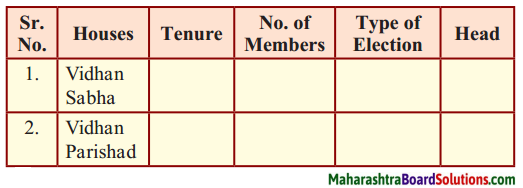
Maharashtra Board Class 8 Civics Solutions Chapter 5 The State Government 3

  1. At present, India has 29 Constituent States and 7 Union Territories.
  2. All Constituent States have Legislative Assemblies.
  3. Out of the 7 Union Territories, only Delhi and Puducherry have Legislative Assemblies (Vidhan Sabha).
  4. Jammu and Kashmir, Bihar, Uttar Pradesh, Maharashtra, Karnataka, Telangana and Andhra Pradesh have Bicameral Legislatures (both the Houses).

Maharashtra Board Class 8 Civics Solutions Chapter 5 The State Government

Project:

Visit official website of the Maharashtra Government and collect information of various ministers and the working of their respective departments.

Class 8 Civics Chapter 5 The State Government Additional Important Questions and Answers

Choose the correct option and complete the statements:

Question 1.
The Indian Union has totally …………….. constituent states.
(a) 22
(b) 25
(c) 29
(d) 32
Answer:
(c) 29

Question 2.
In India, only ……………… states have Bicameral legislatures.
(a) three
(b) five
(c) six
(d) seven
Answer:
(d) seven

Maharashtra Board Class 8 Civics Solutions Chapter 5 The State Government

Question 3.
Maharashtra’s legislature conducts minimum ………………. sessions in a year.
(a) two
(b) three
(c) four
(d) five
Answer:
(b) three

Question 4.
Distinguished personalities from various fields are nominated by the ……………. to the Vidhan Parishad.
(a) Chief Minister
(b) Speaker
(c) Governor
(d) Chairman
Answer:
(c) Governor

Question 5.
When the legislature is not in session and need arises to make law, the Governor can issue ……………….. .
(a) a Bill
(b) a Proposal
(c) an Ordinance
(d) an Order
Answer:
(c) an Ordinance

State whether the following statements are True or False. Correct the False statements and rewrite:

Question 1.
States in India have been formed on the basis of population.
Answer:
False. States in India have been formed on the basis of language.

Question 2.
In exceptional circumstances, elections to Vidhan Sabha can be held before the completion of 5 years.
Answer:
True.

Maharashtra Board Class 8 Civics Solutions Chapter 5 The State Government

Question 3.
Absence of cooperation and coordination between Departments can affect the working of the government.
Answer:
True.

Question 4.
The people look at the Governor as a ‘Problem Solver’.
Answer:
False. The people look at the Chief Minister as a ‘Problem Solver’.

Question 5.
Every constituent state has a Vidhan Parishad.
Answer:
False. Every constituent state has a Vidhan Sabha.

Find and write:

Question 1.
The State having a government machinery different than other states
Answer:
Jammu and Kashmir

Question 2.
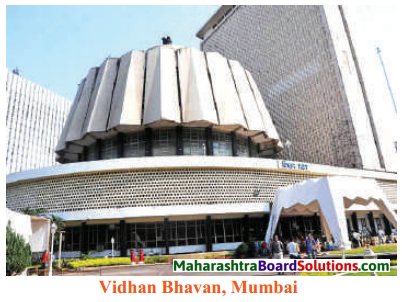
The Vidhan Bhavan of Maharashtrais located in:
Answer:
Mumbai

Question 3.
The member of Vidhan Sabha are called:
Answer:
MLA

Maharashtra Board Class 8 Civics Solutions Chapter 5 The State Government

Question 4.
Major challenges faced by Maharashtra:
Answer:
Terrorism and Naxalite movements

Question 5.
The place where the winter session of Maharashtra’s legislature is conducted:
Answer:
Nagpur.

Complete the following concept maps:

Question 1.
Maharashtra Board Class 8 Civics Solutions Chapter 5 The State Government 4
Answer:
Maharashtra Board Class 8 Civics Solutions Chapter 5 The State Government 5

Question 2.
Maharashtra Board Class 8 Civics Solutions Chapter 5 The State Government 6
Answer:
Maharashtra Board Class 8 Civics Solutions Chapter 5 The State Government 7

Explain the following concepts:

Question 1.
Session:
Answer:

  1. A session is a meeting where members of both the Houses meet.
  2. Maharashtra’s legislature conducts minimum three sessions in a year.
  3. The budget session and monsoon session of Maharashtra is held in Mumbai while the winter session is held at Nagpur.
  4. The Governor has the right to summon and conclude the session.
  5. During the session, new laws are passed, existing laws are amended and out-dated laws are repealed.
  6. The sessions are conducted under the leadership and guidance of the Speaker and the Chairman.

Maharashtra Board Class 8 Civics Solutions Chapter 5 The State Government

Question 2.
Council of Ministers:
Answer:

  1. The Council of Ministers consists of the Chief Minister and other ministers.
  2. The leader of the majority party in Legislative Assembly is appointed as the Chief Minister by the Governor.
  3. The Governor also appoints the other ministers chosen by the Chief Minister to form Council of Ministers.
  4. Framing appropriate laws, working for the welfare of the people, governing the state efficiently are some of the functions of the Council of Ministers.
  5. The Chief Minister along with his Council of Ministers is collectively responsible to the Legislative Assembly.

Write short notes on:

Question 1.
Powers of the Governor:
Answer:
The Governor enjoys certain important Legislative and Executive powers as the head of the state.

  1. The Bills passed by Vidhan Sabha and Vidhan Parishad are converted into laws only after receiving his assent.
  2. He has the right to summon the session of the state legislature and to conclude it.
  3. He can issue an ordinance to make law, on important subject if required, when the Legislature is not in session.
  4. He appoints the Chief Minister and the other Council of Ministers.

Explain the following statements with reasons:

Question 1.
The Governor is the titular/nominal head of the state.
Answer:

  1. The Constitution has granted Executive powers to the Governor as the head of the state.
  2. The government of the state is run in the name of the Governor.
  3. But in reality, the administration is carried out by the Chief Minister. Hence, the Governor is the titular/ nominal head of the state.

Maharashtra Board Class 8 Civics Solutions Chapter 5 The State Government

Question 2.
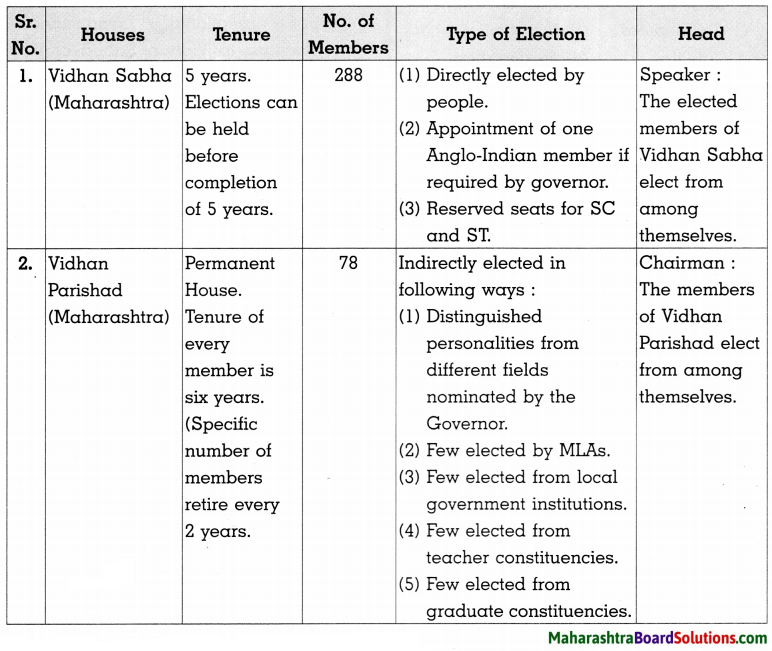
Vidhan Parishad (Legislative Council) is a permanent House.
Answer:

  1. All members of the Vidhan Parishad (MLCs) do not retire at the same time.
  2. A specific number (1/3rd) of the members retire every 2 years.
  3. These vacant seats are filled again by conducting fresh elections for those seats.
  4. The tenure of each member is 6 years.
  5. Since the Vidhan Parishad is never fully dissolved, it is a permanent House.

Question 3.
India has 29 constituent states, but 31 Vidhan Sabha.
Answer:

  1. According to the Constitution, every constituent state must have a Vidhan Sabha (Legislative Assembly).
  2. India has 29 constituent states and each state has its Vidhan Sabha.
  3. Out of the 7 Union Territories in India, Delhi and Puducherry have Vidhan Sabha. Hence, India has 29 constituent states, but 31 Vidhan Sabha.

Question 4.
The Chief Minister’s post is most important in the state.
Answer:

  1. The Chief Minister can select his Council of Ministers according to his choice.
  2. He can ask any of his ministers to resign.
  3. Framing policies of public welfare and developing the state in a progressive manner entirely depends upon the Chief Minister.
  4. The Chief Minister leads the state and people look at him as a problem solver.
  5. His intervention in solving the problems of the state comforts the people.

Hence, all these executive powers makes the Chief Minister’s post most important in the State.

Answer the following in brief:

Question 1.
Mention the eligibility conditions for contesting Vidhan Sabha elections.
Answer:
Following are the eligibility conditions for candidates contesting for Vidhan Sabha elections:

  1. He/She should be a citizen of India.
  2. He/She should have completed 25 years of age.
  3. He/She should be a resident of Maharashtra.

Maharashtra Board Class 8 Civics Solutions Chapter 5 The State Government

Question 2.
Do you consider Maharashtra to be progressive state?
Answer:

  1. Industrial development has taken place in Maharashtra on a large scale. It has many industries based on modern technology.
  2. Maharashtra’s literacy rate is higher than many other states.
  3. It has a rich tradition of saints and social reformers who have nurtured progressive thinking among people.
  4. Maharashtra is leading in many fields like education, health, agriculture, sports, tourism, etc.
  5. Maharashtra has been a land of Movements. Many important movements like the Labour movement, Farmer’s movement have been initiated here.
  6. Similarly, many progressive laws have been passed in Maharashtra.
  7. Maharashtra is facing many challenges like terrorism, poverty, crime, Naxalite movements, etc. Even then, I feel that Maharashtra is a progressive state.

Maharashtra Board Class 7 History Solutions Chapter 2 India before the Times of Shivaji Maharaj

Balbharti Maharashtra State Board Class 7 History Solutions Chapter 2 India before the Times of Shivaji Maharaj Notes, Textbook Exercise Important Questions and Answers.

Maharashtra State Board Class 7 History Solutions Chapter 2 India before the Times of Shivaji Maharaj

Class 7 History Chapter 2 India before the Times of Shivaji Maharaj Textbook Questions and Answers

1. Name the following:

Question 1.
The Queen of Gondvana –
Answer:
Rani Durgavati

Question 2.
The son of Udaysingh –
Answer:
Maharana Pratap

Maharashtra Board Class 7 History Solutions Chapter 2 India before the Times of Shivaji Maharaj

Question 3.
The founder of Mughal dynasty –
Answer:
Babur

Question 4.
The first Sultan of the Bahamani kingdom–
Answer:
Hasan Gangu

Question 5.
The fighting force established by Guru Gobindsingh –
Answer:
Khalsa Dal

2. Find the odd one out:

Question 1.
Sultan Mahmud, Qutubuddin Aibak, Muhammad Ghuri, Babur
Answer:
Sultan Mahmud

Question 2.
Adilshahi, Nizamshahi, Sultanate,Baridshahi
Answer:
Sultanate

Question 3.
Akbar, Humayun, Shershah, Aurangzeb
Answer:
Shershah

Maharashtra Board Class 7 History Solutions Chapter 2 India before the Times of Shivaji Maharaj

3. Answer briefly:

Question 1.
How did the kingdoms of Vijaynagar and Bahamani emerge?
Answer:
(i) During the reign of Sultan Muhammad Tughlaq of Delhi, there were many revolts in the South against the central power of Delhi.
(ii) From these revolts arose the formidable Vijaynagar and Bahamani kingdoms.

Question 2.
What reforms did Mahmud Gawan make?
Answer:
(i) Mahmud Gawan strengthened the Bahamani kingdom.
(ii) He started paying the soldiers their salary in cash instead of through land grants.
(iii) He brought discipline in the army.
(iv) He introduced many reforms in the land revenue system. He opened a Madarsa at Bidar for Arabic and Persian studies.

Question 3.
Why did it become impossible for the Mughals to strengthen their base in Assam?
Answer:
(i) While Aurangzeb ruled, the Ahoms had a prolonged struggle with the Mughals.
(ii) The Mughals attacked the Ahoms’ region.
(iii) The Ahoms united under the leadership of Gadadharsinha. Commander Lachit Borphukan gave an intense battle against the Mughals.
(iv) The Ahoms used the guerilla technique in the conflict against the Mughals.
(v) It became impossible for Mughals to create a strong base in Assam.

4. Write about them briefly in your own words.

Question 1.
Krishnadevaraya
Answer:
(a) Krishnadevaraya, ascended the throne of Vijaynagar in 1509 CE. He conquered Vijaywada, Rajmahendri and annexed the regions to his kingdom.
(b) He successfully took on the armies of the Sultans who had united under the leadership of the Bahamani Sultan Mahmud Shah.
(c) During his reign the Vijaynagar kingdom extended far and wide.
(d) He built the Hazar Ram temple and Vitthal temple in Vijaynagar.
(e) A scholar he wrote ‘Amuktamalyada’, a Telugu compendium on polity.
(f) Decline of the Vijaynagar kingdom began with his death in the year 1530 CE.

Question 2.
Chandbibi was murdered.
Answer:
(a) Chandbibi, the capable daughter of Husain Nizamshah of Ahmadnagar, bravely defended the fort displaying courage and valour.
(b) At this time, there was an internal strife among the factions of the Sardars in Nizamshahi’s kingdom resulting in the murder of Chandbibi.

Question 3.
Rani Durgavati
Answer:
(a) Rani Durgavati, bom in the dynasty Chandel Rajput became the queen of Gondvana after her marriage.
(b) She was an excellent administrator. Her struggle against the Mughals is important in Medieval history.
(c) After her husband’s death, Durgavati laid down her life but refused to surrender while fighting against Akbar.

5. Give reasons:

Question 1.
The Bahamani Kingdom disintegrated into five fragments.
Answer:
(a) After the death of Mahmud Gawan, factionsim increased among the Bahamani Sardars.
(b) The conflict with the Vijaynagar kingdom had an adverse effect on the Bahamani kingdom.
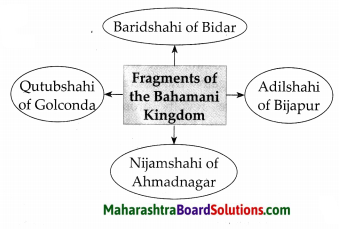
(c) The provincial Governors began to act more independently. This led to the disintegration of the Bahamani kingdom into five small power-Imadshahi of Varhad, Baridshahi of Bidar, Adilshahi of Bijapur, Nizamshahi of Ahmadnagar and Qutubshahi of Golconda.

Maharashtra Board Class 7 History Solutions Chapter 2 India before the Times of Shivaji Maharaj

Question 2.
Rana Sanga’s army was defeated.
Answer:
(a) After the battle of Panipat, Rana Sanga of Mewad brought all Rajput kings together.
(b) There was a battle between Babur and Rana Sanga at Khanua.
(c) Babur’s artillery and reserved force played a key role in this battle and Rana Sanga’s army was defeated.

Question 3.
Rana Pratap has become immortal in history.
Answer:
(a) After the death of Udaysingh, Maharana Pratap ascended the throne of Mewad.
(b) He continued the struggle for Mewad’s existence.
(c) Till the very end he struggled with Akbar to maintain his independence.
(d) He has become immortal in history due to his qualities of valour, courage, self-respect and sacrifice.

Question 4.
Aurangzeb imprisoned Guru Tegh Bahadur.
Answer:
(a) Guru Tegh Bahadur, protested strongly against Aurangzeb’s policy of religious intolerance.
(b) Aurangzeb imprisoned him and beheaded him in 1675.

Question 5.
The Rajputs fought against the Mughals.
Answer:
(a) Akbar had secured the cooperation of the Rajputs with his policy of amicable relations.
(b) Aurangzeb could not obtain the cooperation of Rajputs. After the death of Rana Jaswantsingh of Marwad, Aurangzeb annexed his kingdom to the Mughal empire.
(c) Durgadas Rathod crowned Jaswantsingh’s minor son of Ajitsingh of Marwad.
(d) Durgadas Rathod fought hard against the Mughals and continued his struggle against the Mughals for the existence of Marwad.

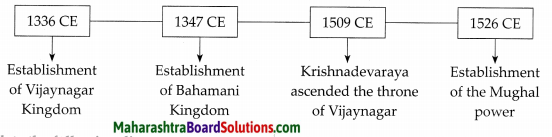
6. Complete the timeline.
Maharashtra Board Class 7 History Solutions Chapter 2 India before the Times of Shivaji Maharaj 1
Answer:
Maharashtra Board Class 7 History Solutions Chapter 2 India before the Times of Shivaji Maharaj 2

7. Using the internet, find out more about any one of the personalities you have studied here, and fill in the box below.
Maharashtra Board Class 7 History Solutions Chapter 2 India before the Times of Shivaji Maharaj 3

Activity

Obtain more information about the personalities mentioned in this chapter.Use reference books, the internet, newspapers, etc. Prepare a collage of the pictures information in your activity book and display it in the history cell.

Class 7 History Chapter 2 India before the Times of Shivaji Maharaj Additional Important Questions and Answers

Complete the sentences by choosing the appropriate words from the options given below:

Question 1.
‘Pal’ in the ______ was a famous dynasty in Bengal. (seventh century, eight century, ninth century)
Answer:
eight century

Question 2.
Prithviraj Chauhan belonged to _______ dynasty. (Rajput dynasty, Chauhan dynasty, Chola dynasty)
Answer:
Chauhan dynasty

Maharashtra Board Class 7 History Solutions Chapter 2 India before the Times of Shivaji Maharaj

Question 3.
The _____ period is considered to be the golden period of Marathi language. (Yadava, Rashtrakuta, Chola)
Answer:
Yadava

Question 4.
In the eleventh Century CE, the _____ began to invade India and reached the north-western frontier of India. (Afghans, Mughals, Turks)
Answer:
Turks

Question 5.
______ was the last Sultan and he was defeated by Babur, bringing the Sultanate to an end. (Muhammad Ghuri, Bulban, Ibrahim Lodi)
Answer:
Ibrahim Lodi

Question 6.
Hampi in today’s ______ was the capital of the kingdom of Vijaynagar. (Kerala, Karnataka, Tamil Nadu)
Answer:
Karnataka

Question 7.
Krishnadevaraya wrote ‘Amuktamalyada’, a Telugu Compendium on _______. (polity, economics, sociology)
Answer:
polity

Question 8.
______ was the first Sultan of the Bahamani kingdom. (Muhammad-bin-Tughlaq, Mahmud Gawan, Hasan Gangu)
Answer:
Hasan Gangu

Question 9.
In ______ the Sultanate of Delhi came to an end. (1526 CE, 1556 CE, 1605 CE)
Answer:
1526 CE

Question 10.
_______ was the Governor of Punjab under the Sultanate. (Babur, Ibrahim Lodi, Daulatkhan Lodi)
Answer:
Daulatkhan Lodi

Question 11.
_______ was the most powerful king of the Mughal dynasty. (Shahajahan, Akbar, Jahangir)
Answer:
Akbar

Question 12.
The struggle of Gondvana queen Durgavati against Mughals is important in ______ history. (modern, medieval, ancient)
Answer:
medieval

Question 13.
______ became the emperor in 1658 CE. (Shahajahan, Aurangzeb, Akbar)
Answer:
Aurangzeb

Question 14.
In the thirteenth century CE, the people of the Shaan community settled down in the valley of river ______. (Ganga, Brahmaputra, Yamuna)
Answer:
Brahmaputra

Question 15.
The ninth Guru of the Sikhs was ______.(Guru Gobind Singh, Guru Tegh Bahadur, Guru Nanak)
Answer:
Guru Tegh Bahadur

Question 16.
______ organised the Sikh youths into a fighting force called Khalsa Dal. (Guru Gobind Singh, Guru Tegh Bahadur, Guru Nanak)
Answer:
Guru Gobind Singh

Maharashtra Board Class 7 History Solutions Chapter 2 India before the Times of Shivaji Maharaj

Question 17.
Akbar had secured the co-operation of the ______ with his policy of amicable relations. (Rajputs, Marathas, Ahoms)
Answer:
Rajputs

Question 18.
In Maharashtra, the ______ Marathas offered stiff resistance to and defended their independence. (Babur, Humayun, Aurangzeb)
Answer:
Aurangzeb

Match the following:

Question 1.

Column ‘A’Column ‘B’
(1) Imadshahi(a) Bidar
(2) Baridshahi(b) Ahmadnagar
(3) Adilshahi(c) Golconda
(4) Nizamshahi(d) Varhad
(5) Qutubshahi(e) Bijapur

Answer:
1 – d
2 – a
3 – e
4 – b
5 – c

Name the following:

Question 1.
Two important dynasties among the Rajput dynasties in North India.
Answer:
(a) The Gahadwal dynasty
(b) Parmar dynasty

Question 2.
Eminent rulers belonging to the Chola dynasty in Tamil Nadu.
Answer:
(a) Rajaraj I
(b) Rajendra I

Question 3.
The king belonging to the Hoysala dynasty.
Answer:
King Vishnuvardhan

Question 4.
The King who conquered the whole of Karnataka.
Answer:
King Vishnuvardhan

Question 5.
The Varkari movement emerged in
Answer:
The Yadava period

Question 6.
During his reign Rashtrakuta dynasty in Maharashtra the Rashtrakut power spread from Kanauj up to Rameshwar.
Answer:
Govind III

Question 7.
The last prosperous power before the period of Shivaji Maharaj.
Answer:
TheYadavas

Question 8.
The capital of Bhillam V of the Yadava dynasty which was near Aurangabad.
Answer:
Deogiri

Question 9.
The golden period of the Marathi Language.
Answer:
The Yadava period

Maharashtra Board Class 7 History Solutions Chapter 2 India before the Times of Shivaji Maharaj

Question 10.
The Arab General attacked the Sindh province in the eighth century.
Answer:
Muhammad-bin-Qasim

Question 11.
The power which began to invade India in eleventh century CE.
Answer:
The Turks

Question 12.
He invaded India many times and plundered the rich temples at Mathura, Vrindavan Kanauj and Somnath and carried away enormous wealth with him.
Answer:
Sultan Mahmud of Ghazni

Question 13.
In 1775 CE and 1178 CE, the Sultan of Ghur from Afghanistan who invaded India.
Answer:
Muhammad Ghuri

Question 14.
During his reign there were many revolts in the South against the central power of Delhi.
Answer:
Sultan Muhammad-bin-Tughluque

Question 15.
The brothers from South India who were Sardars in the service of Delhi Sultanate.
Answer:
(a) Harihar
(b) Bukka

Question 16.
The Hazar Ram temple and Vitthal temple were built in Vijaynagar during his reign.
Answer:
Krishnadevaraya

Question 17.
He defeated the army of the Sultan of Delhi.
Answer:
Hasan Gangu

Question 18.
The Chief Wazir of the Bahamani kingdom who started paying the soldiers their salaries in cash instead of giving land grants.
Answer:
Mahmud Gawan

Question 19.
The king of Farghana in Central Asia.
Answer:
Babur

Question 20.
After the battle of Panipat, he brought all Rajput kings together.
Answer:
Rana Sanga of Mewad

Question 21.
After ascending the throne of Mewad, he continued the struggle for Mewad’s existence.
Answer:
Maharana Pratap

Question 22.
The capable daughter of Husain Nizamshah of Ahmadn^gar who defended the fort of Ahmadnagar.
Answer:
Chandbibi

Question 23.
The Ahoms united under his leadership.
Answer:
Gadadharsinha

Maharashtra Board Class 7 History Solutions Chapter 2 India before the Times of Shivaji Maharaj

Question 24.
The commander who gave intense battle against the Mughals.
Answer:
Commander Lachit Borphukan

Question 25.
The ninth Guru of Sikhs who protested strongly against Aurangzeb’s policy of religious intolerance.
Answer:
Guru Tegh Bahadur

Question 26.
There was an attempt on the life of Guru Gobind Singh in 1708 CE at this place.
Answer:
Nanded

Question 27.
After his death Aurangzeb annexed his kingdom to the Mughal empire.
Answer:
Rana Jaswantsingh of Marwad.

Question 28.
In Maharashtra, Swaraj was established under his leadership.
Answer:
Shivaji Maharaj

Find out the odd man out:

Question 1.
Gadadharsinha, Rana Jaswantsingh, Durgadas Rathod, Ajit Singh.
Answer:
Gadadharsinha

Question 2.
Babur, Humayun, Krishnadevaraya, Jahangir
Answer:
Krishnadevaraya

Answer in one sentence:

Question 1.
Name the regions upto which the Gurjar- Pratihar power spread.
Answer:
The Gurjar-Pratihar power spread up to Andhra, Kalinga, Vidarbha, West Kathewad, Kanauj and Gujarat.

Question 2.
Which places did the Cholas conquer using their naval strength?
Answer:
The Cholas conquered the Maidive Islands and Sri Lanka using their naval strength.

Question 3.
In which period did the Mahanubhav Panth and the Varkari movement emerge?
Answer:
The Mahanubhav Panth and the Varkari movement emerged in the Yadava period.

Maharashtra Board Class 7 History Solutions Chapter 2 India before the Times of Shivaji Maharaj

Question 4.
Why did the Arab rulers turn towards India?
Answer:
The Arab rulers turned towards India to expand their empire.

Question 5.
Write the extent of the kingdom of Vij aynagar during Krishnadevaraya’s reign?
Answer:
During Krishnadevaraya’s reign, the kingdom of Vijaynagar extended from Cuttack in the east up to Goa in the West and from the Raichur Doab in the North up to the Indian Ocean in the South.

Question 6.
Who opposed Akbar when he tried to bring India under his central authority?
Answer:
When Akbar tried to bring India under his central authority he had to face the opposition of Maharana Pratap, Chandbibi and Rani Durgavati.

Question 7.
Which qualities of Maharana Pratap made him immortal in history?
Answer:
Maharana Pratap became immortal in history due to his qualities of valour, courage, self-respect and sacrifice.

Question 8.
Which regions together formed the Gondvana?
Answer:
Gondvana can be broadly said to comprise the eastern part of Vidarbha, part of Madhya Pradesh to its North, the Western part of today’s Chhattisgarh, Northern part of Andhra Pradesh and Western part of Odisha.

Question 9.
How did the Marathas defend their independence?
Answer:
Marathas offered stiff resistance to Aurangzeb and defended their independence.

Give reasons:

Question 1.
Babur invaded India.
Answer:
(a) The reigning Sultan of Delhi at that time was Ibrahim Lodi.
(b) Daulatkhan Lodi, was the governor of Punjab under the Sultanate.
(c) The relationship between Ibrahim Lodi and Daulatkhan Lodi was strained.
(d) Daulatkhan Lodi invited Babur to march to India. Taking this opportunity, Babur invaded India.

Write briefly in your own words:

Question 1.
The First Battle of Panipat
Answer:
(a) Ibrahim Lodi was the Sultan of Delhi and Daulat Khan Lodi was the Governor of Punjab.
(b) The relationship between Ibrahim Lodi and Daulatkhan Lodi became strained.
(c) Daulatkhan Lodi invited Babur to march on India.
(d) Taking advantage of this opportunity, Babur invaded India.
(e) To repel Babur’s invasion Ibrahim Lodi started with his army.
(f) There was a battle between Ibrahim Lodi and Babur on 21st April 1526 at Panipat.
(g) Babur defeated Ibrahim Lodi’s army. This is known as the First Battle of Panipat.

Maharashtra Board Class 7 History Solutions Chapter 2 India before the Times of Shivaji Maharaj

Answer briefly:

Question 1.
Write in brief about the conflict of the Mughals with the Marathas.
Answer:
(i) In Maharashtra, Sivaraj was established under the leadership of Shivaji Maharaj.
(ii) In his efforts to establish Swaraj, Shivaji Maharaj had to fight the Mughals too along with the other enemies.
(iii) Aurangzeb came down to the Deccan after the death of Chhatrapati Shivaji Maharaj with the intention of conquering the whole of South India.
(iv) But the Marathas offered stiff resistance to Aurangzeb and defended their independence.

Complete the following diagrams:

Question 1.
Maharashtra Board Class 7 History Solutions Chapter 2 India before the Times of Shivaji Maharaj 7
Answer:
Maharashtra Board Class 7 History Solutions Chapter 2 India before the Times of Shivaji Maharaj 4

Question 2.
Maharashtra Board Class 7 History Solutions Chapter 2 India before the Times of Shivaji Maharaj 8
Answer:
Maharashtra Board Class 7 History Solutions Chapter 2 India before the Times of Shivaji Maharaj 5

Maharashtra Board Class 7 History Solutions Chapter 2 India before the Times of Shivaji Maharaj

Complete the following table:

Question 1.

S.NoPolitical PowerFounders / RulersCapital

Answer:

S.NoPolitical PowerFounders / RulersCapital
(1)YadavaBhillam VDeogiri
(2)VijaynagarHarihar & BukkaHampi
(3)BahamaniHasan GanguGulbarga
(4)MughalBaburDelhi


Maharashtra Board Class 9 Political Science Solutions Chapter 2 India’s Foreign Policy

Balbharti Maharashtra State Board Class 9 Political Science Solutions Chapter 2 India’s Foreign Policy Notes, Textbook Exercise Important Questions and Answers.

Maharashtra State Board Class 9 Political Science Solutions Chapter 2 India’s Foreign Policy

Class 9 Political Science Chapter 2 India’s Foreign Policy Textbook Questions and Answers

1. Choose the right option and rewrite the sentence:

Question 1.
This was the main objective behind establishing the Indian Atomic Energy Commission ________.
(a) Enhance military capacity
(b) Conduct nuclear tests
(c) To stop the proliferation of nuclear weapons
(d) Production of atomic energy
Answer:
(a) Enhance military capacity

Maharashtra Board Class Maharashtra Board Class 9 Political Science Solutions Chapter 2 India’s Foreign Policy

Question 2.
The following is now the objective of all the nations of the world _____.
(a) atomic development
(b) economic development
(c) nuclear test
(d) security system
Answer:
(b) economic development

Question 3.
The is an important aspect of India’s foreign policy _______.
(a) free economic policy
(b) interdependence
(c) non-alignment
(d) nuclear development
Answer:
(c) non-alignment

Question 4.
India coriducted nuclear tests in 1974 at ______.
(a) Sriharikota
(b) Thumba
(c) Pokharan
(d) Jaitapur
Answer:
(c) Pokharan

2. Explain with reasons whether the following statements are true or false:

Question 1.
Pandit Nehru contributed towards improving Sino-Indian relations.
Answer:
True.
Self-opinion based

  • Pandit Nehru formulated Panchsheel which was a treatise of the five principles of peaceful coexistence to govern relations between India and China. The first formal codification in the form of a treaty was an agreement between China and India in 1954.
  • Mutual non-interference in internal affairs, mutual non-aggression, equality of mutual benefit, mutual respect, and peaceful co-existence were the principles for seeking peace with China.
  • Nehru backed China’s permanent membership in the United Nations Security Council.
  • Though Nehru had a policy of improving Sino- Indian relations, China attacked India in 1962.

Maharashtra Board Class Maharashtra Board Class 9 Political Science Solutions Chapter 2 India’s Foreign Policy

Question 2.
Atal Bihari Vajpayee took lead in improving relations with Pakistan.
Answer:
True.
Evaluative, self-opinion based

  • In an effort to develop friendly relations, India and Pakistan have started a bus service called ‘Sada-e-Sarhad’ (Call of the border) between Delhi and Lahore when Atal Bihari Vajpayee was the Prime Minister. He also revived the train called Samjhauta Express (Friendship Express).
  • Atal Bihari Vajpayee rendered help to the earthquake victims of Pakistan during the rule of Pervez Musharraf.
  • In 1999, there was another war between India and Pakistan in the Kargil region over the Kashmir issue. India defeated Pakistan in this war as well.
  • Atal Bihari Vajpayee tried to establish a dialogue with Pakistan but was not successful.

3. Explain the following concepts:

Question 1.
India’s Foreign Policy.
Answer:
(i) India got independence in 1947 and from then onwards India started shaping its Foreign Policy independently.
(ii) Article 51 among the Directive Principles of State Policy lay down the broad framework for Foreign Policy.
(iii) According to it, India should give priority to safeguard international peace and security, and resolve our international problems and disputes by peaceful means.
(iv) The objectives of our Foreign Policy should be to maintain friendly relations with other nations and respect international law.

Question 2.
National Interest
Answer:
(i) National interest implies the means through which the independence and sovereignty of our country can be safeguarded.

(ii) National interest also includes efforts to achieve our economic development and to take steps towards increasing our national power.

(iii) When decisions are taken after giving careful thought to what is beneficial and good for our country, we say that we are nurturing our national interest.

Question 3.
World Peace
Answer:
(i) World peace is an ideal state of freedom, peace, and happiness among and within all nations and people.
(ii) This idea of world non-violence provides a basis for peoples and nations to willingly co-operate.
(iii) Either voluntarily or by virtue of a system of governance, that prevents warfare.
(iv) India has been consistently supporting efforts for disarmament because it is India’s policy that there should be peace and security.

4. What is your opinion about the fact that world peace is threatened due to nuclear preparedness?
Answer:
Nuclear preparedness leads to an Arm’s Race. It increases the possibilities of wars.
(i) If a nuclear bomb exploded in a major city, the blast center would be hotter than the surface of the sun.
(ii) Survivors would have no electricity, no transportation, no phones, and hospitals would be overwhelmed if they were still standing
(iii) India is now a country that has nuclear weapons. We have accepted the role of a responsible nuclear power. India has been consistently supporting efforts for disarmament because it is India’s position that there should be peace and security in the world.

Maharashtra Board Class Maharashtra Board Class 9 Political Science Solutions Chapter 2 India’s Foreign Policy

5. Answer the following questions in brief:

Question 1.
On what principles is India’s foreign policy based?
Answer:
(i) India got independence in 1947 and from then onwards we started shaping our foreign policy independently.

(ii) The Directive Principles of State Policy have laid down guidelines about how to shape Foreign Policy. Article 51 among the Directive Principles of State Policy lay down the broad framework for foreign policy.

(iii) According to it, India should give priority to safeguard international peace and security, and resolve our international problems and disputes by peaceful means.

(iv) The objectives of our foreign policy should be to maintain friendly relations with other nations and respect international law. India’s Foreign Policy till now has been developed in this framework.

Question 2.
Who has contributed to improving Sino- Indian relations?
Answer:
(i) Prime Minister Atal Bihari Vajpayee contributed a great deal to improving Sino-Indian relations.
(ii) The President, the Prime Minister, the Foreign Minister, the Defence Minister, the Finance Minister, and the Home Minister have a role in deciding foreign policy.
(iii) The persons holding these positions try to maintain the continuity in Foreign Policy and to improve upon it.

Question .3
Write the objectives of India’s Foreign Policy.
Answer:
Objectives of India’s Foreign Policy are as follows:

  • While maintaining friendly relations with neighboring countries, ensure that the defense and security of India are not affected.
  • Not to compromise about the geographical boundaries of the nation.
  • Protect the unity and integrity of the country.
  • Protect the interests of India’s citizens living in other countries. This responsibility is fulfilled by the Indian embassies there.
  • To establish economic and commercial relations with other countries for achieving the economic development of India.

6. Prepare the following concept map:

Question 1.
Maharashtra Board Class 9 Political Science Solutions Chapter 2 India’s Foreign Policy 2
Answer:
Maharashtra Board Class 9 Political Science Solutions Chapter 2 India’s Foreign Policy 1

Maharashtra Board Class Maharashtra Board Class 9 Political Science Solutions Chapter 2 India’s Foreign Policy

Class 9 Political Science Chapter 2 India’s Foreign Policy Additional Important Questions and Answers

Choose the correct option from the given options and rewrite the sentence:

Question 1.
Prime Minister ______ shaped India’s Foreign Policy during the early period.
(a) Pandit Jawaharlal Nehru
(b) Dr. Manmohan Singh
(c) Atal Bihari Vajpayee
(d) Rajiv Gandhi
Answer:
(a) Pandit Jawaharlal Nehru

Question 2.
Foreign policy is framed to establish economic and _____ relations with other countries for achieving economic development of India,
(a) Social
(b) Commercial
(c) Economic
(d) All of above
Answer:
(b) Commercial

Question 3.
The period from independence to ____ can be considered as the first stage.
(a) 1984
(b) 1990
(c) 1992
(d) 2011
Answer:
(b) 1990

Question 4.
Peace and ______ became the fundamental principles of Non-Aligned Policy.
(a) justice
(b) freedom
(c) relations
(d) power
Answer:
(b) freedom

Question 5.
The first Chairman of the Indian Atomic Energy Commission was ______.
(a) Dr. Vikram Sarabhai
(b) Dr. A.P.J.Abdul Kalam
(c) Dr. Homi Bhabha.
(d) Dr. Manmohan Singh.
Answer:
(c) Dr. Homi Bhabha.

Question 6.
After ________, India reduced the government controls over the economy and adopted the free-market policy.
(a) 1992
(b) 1991
(c) 1984
(d) 1957
Answer:
(b) 1991

Question 7.
In the decade after 1990, our relations with the South Asian countries like ______, Thailand, Vietnam, etc. became stronger.
(a) China
(b) Japan
(c) Indonesia
(d) Singapore
Answer:
(d) Singapore

Maharashtra Board Class Maharashtra Board Class 9 Political Science Solutions Chapter 2 India’s Foreign Policy

State whether the following statements are true or false with reasons:

Question 1.
Foreign Policy is always dynamic.
Answer:
True.

  • Foreign Policy is drawn up to foster the national interest of defence and economic development.
  • National interest is considered to be the goal and foreign policy is considered to be the means to achieve it.
  • Goals of nations change with changes in conditions and time.
  • Accordingly, national interest also changes.
  • These changes are reflected in foreign policy. Therefore, foreign policy is always dynamic.

Question 2.
India has not signed NNPT or CTBT.
Answer:
True.

  • Nuclear weapons are extremely destructive.
  • Hence, it is necessary to, make consistent efforts so that they are never used. Two treaties have been made to stop the spread of nuclear weapons.
  1. Nuclear Non-Proliferation Treaty (NNPT)
  2. Comprehensive Test Ban Treaty (CTBT).
  • The conditions of both these treaties are of benefit to big nuclear powers and they put unfair restrictions on developing countries, hence India has not signed either of these treaties.

Explain the concept:

Question 1.
Objectives of India’s Foreign Policy.
Answer:
(i) While maintaining friendly relations with neighboring countries, ensure that the defense and security of India are not affected.
(ii) Protecting the unity and integrity of the country.
(iii) Protecting the interests of India’s citizens living in other countries. This responsibility is fulfilled by the Indian embassies there.
(iv) To establish economic and commercial relations with other countries for achieving economic development.

Question 2.
Role of Economy in Foreign Policy.
Answer:
(i) Foreign policy is shaped by the need to establish economic relations with other countries, import-export, participation in world trade, all aimed at strengthening the economy of the country.
(ii) In today’s world, the issues of economic security are as important as national security.
(iii) A country is recognized to be powerful in proportion to the economic security it enjoys.
(iv) Countries having a strong economy are less dependent on others, and they can have an independent foreign policy as well.

Question 3.
National leadership
Answer:
(i) The President, the Prime Minister, the Foreign Minister, the Defence Minister, the Finance Minister and the Home Minister have a role in deciding foreign policy.
(ii) The persons holding these positions try to maintain continuity in foreign policy and to improve upon it.
(iii) For example, Pandit Jawaharlal Nehru contributed the policy of non-alignment to India’s foreign policy.
(iv) Prime Minister Atal Bihari Vajpayee contributed a great deal to improving Sino-Indian relations.

Maharashtra Board Class Maharashtra Board Class 9 Political Science Solutions Chapter 2 India’s Foreign Policy

Question 4.
Write about Article 51 of the Indian Constitution.
Answer:
(i) India got independence in 1947, and from then onwards we started shaping our foreign policy independently.
(ii) The Directive Principles of State Policy have laid down guidelines about how to shape foreign policy.
(iii) Article 51 among the Directive Principles of State Policy lay down the broad framework for foreign policy. According to it, India should give priority to safeguard international peace and security, and resolve our international problems and disputes by peaceful means.
(iv) The objectives of our foreign policy should be to maintain friendly relations with other nations and respect international law.

Do as directed:

Complete the list:

Question 1.
Complete the list by writing the contribution made by the following leaders. For example, Lai Bahadur Shastri: Tashkent Agreement
(i) Indira Gandhi: ____
(ii) Rajiv Gandhi : ____
(iii) Atal Bihari Vajpayee : _______
Answer:
(i) Indira Gandhi: Pokhran Nuclear Test.
(ii) Rajiv Gandhi: Science and Technology
(iii) Atal Bihari Vajpayee: Sino-Indian Relations

Question 2.
Name the Prime Minister who followed these policies?
(i) _____ : Look East
(ii) ______ : Efforts to increase Foreign Direct Investment
Answer:
(i) Pandit Jawaharlal Nehru: Look East
(ii) P. V. Narasimha Rao: Efforts to increase Foreign Direct Investment

Answer the following questions in brief:

Question 1.
Name the three things that influenced India’s foreign policy in the early phase.
Answer:
(i) Three things that influenced India’s foreign policy in this period.
(ii) We made an effort to understand all international events and developments independently, without any pressure from any power. Peace has always been a central feature of India’s foreign policy.
(iii) The threats from China and Pakistan were also taken into account.
(iv) One more feature of India’s foreign policy at this time was the insistence on self-reliance.

Question 2.
Flow did India promote the concept at regional development in the beginning?
Answer:
(i) In the beginning, India decided to improve relations with countries in Asia.

(ii) Efforts were taken to cooperate with Asian countries in order to achieve development and to keep our independence intact.

(iii) This concept of regional development later expanded to include Africa, as well.

(iv) But some Asian-African countries participated in the military pacts led either by America or the Soviet Union.

(v) This stopped the process of regional development. After this, countries of Asia and Africa, which did not participate in these military pacts supported the concept of non-alignment.

(vi) Peace and freedom became the fundamental principles of non-aligned policy.

Maharashtra Board Class Maharashtra Board Class 9 Political Science Solutions Chapter 2 India’s Foreign Policy

Question 3.
Describe India’s relations with foreign nations post-1970.
Answer:
(i) In the decade of the 1970s, there came about some stability in India’s Foreign Policy.

(ii) India had risen as a powerful regional power in South Asia.

(iii) By conducting nuclear tests in 1974, India had also proved its nuclear capability.

(iv) From 1980, however, some changes began to take place. In order to increase cooperation among South Asian countries, South Asian Association for Regional Cooperation (SAARC) was established.

(v) India initiated a dialogue to improve relations with China. India also started interaction with America for cooperation in the field of security.

Question 4.
Name the three factors that influenced India’s foreign policy in the early phase.
Answer:
Three factors that influenced India’s foreign policy in the early period are:

  1. We made an effort to understand all international events and developments independently, without any pressure from any power. Peace has always been a central feature of India’s foreign policy.
  2. The threats from China and Pakistan were also taken into account.
  3. One more feature of India’s foreign policy at this time was the insistence on self-reliance.

Question 5.
Write about Pandit Nehru’s contribution to India’s foreign policy in the early phase.
Answer:
Prime Minister Pandit Nehru shaped India’s foreign policy in the early period. He opposed colonialism through India’s foreign policy. He took an internationalist position and gave priority to global peace and security.

Question 6.
Describe the conflicts India had to face in its early phase of foreign policy.
Answer:
In the early period, India had to face conflict with neighbouring countries. Wars happened between India and Pakistan over the Kashmir question in 1947-48 and 1965. In the third war, which happened in 1971, Pakistan broke apart and independent Bangladesh was created.

Question 7.
Describe the important changes that took place in India’s foreign policy from the 1980s.
Answer:
From 1980, some important changes began to take place. In order to increase cooperation among South Asian countries, the South Asian Association for Regional Cooperation (SAARC) was established. India initiated a dialogue to improve relations with China. India also started interaction with America for cooperation in the field of security.

Question 8.
What is India’s role in regional development?
Answer:
(i) In the beginning, India decided to improve relations with countries in Asia.

(ii) Efforts were taken to cooperate with Asian countries in order to achieve development and to keep our independence intact.

(iii) This concept of regional development later expanded to include Africa as well.

(iv) But some Asian-African countries participated in the military pacts led either by America or the Soviet Union. This stopped the process of regional development.

(v) After this, countries of Asia and Africa, which did not participate in these military pacts supported the concept of Non-alignment.

Question 9.
Write about the Political system as a factor influencing India’s small Foreign Policy.
Answer:
(i) In a democratic political system, the nation’s Parliament plays a major role in evolving Foreign Policy.

(ii) When different aspects come up for discussion in Parliament, the opposition parties try to regulate the Foreign Policy by raising questions about the same.

(iii) Federal political systems have to take into account the inclinations of the constituent states while shaping Foreign Policy because the affairs in neighbouring nations affect constituent states.

(iv) For example, events in Sri Lanka may affect Tamil Nadu, and those in Bangladesh may affect West Bengal and the North-East Indian States.

Maharashtra Board Class Maharashtra Board Class 9 Political Science Solutions Chapter 2 India’s Foreign Policy

Question 10.
Write about the administrative factors of India’s Foreign Policy.
Answer:
(i) Ministry of External Affairs, Foreign Secretary, embassies in different countries, Diplomatic officers, etc. are the administrative factors involved in creating Foreign Policy.

(ii) Even though the final decisions about Foreign Policy are taken by the Prime Minister and the Minister for External Affairs, the administrative machinery helps to arrive at that decision.

(iii) The administrative officers collect information needed to shape the foreign policy, analyze it and give appropriate advice based on it.

(iv) The National Security Advisor also completes this task.

Question 11.
Write a note on the first stage of India’s Foreign Policy 1947-1990.
Answer:
(i) India adopted the policy of non-alignment in the context of the cold war. As a result, priority was given to maintaining friendly relations with all nations and to taking the help required for development from different countries. Due to the policy of non-alignment, India could get aid from both the superpowers.

(ii) There was a lot of stress on improving/ strengthening India’s defence. The technology required for this was imported. Soviet Union, France, and Germany helped India in this matter.

(iii) In this period, India had to face some challenges. These included the conflict with Pakistan, the creation of Bangladesh, and the conflict with China.

(iv) India proved its nuclear capability by conducting nuclear tests in 1974.

Question 12.
Write a note on Geographical Location.
Answer:
(i) In the globe or map of the world. We see the geographical location of any nation of the world.

(ii) Some countries are far away from other countries, while there are several neighbouring countries around some countries. Some nations have a long coastline, while some have plenty of mineral wealth.

(iii) In sum, the size, population, topography, coastline, availability of natural resources, all these factors need to be considered while deciding the foreign policy of any country.

Question 13.
Describe the factors included in National interest in any country.
Answer:
The following factors are included in the national interest of any country.

  • Defence, i.e. the protection of our country’s independence, sovereignty, and integrity is the highest national interest.
  • Economic development is also an important national interest.
  • An economically weak nation will not be able to maintain its independence.
  • Hence, economic development is understood to be an important national interest, next only to defense.

Maharashtra Board Class Maharashtra Board Class 9 Political Science Solutions Chapter 2 India’s Foreign Policy

Question 14.
Consider the developments of India’s Foreign Policy from 1991 till date.
Answer:
(i) India’s Foreign Policy became more comprehensive and dynamic in the second stage.

(ii) In the post-cold war period, the priority no longer remained on political and military relations.

(iii) Several other dimensions like the economy, trade, education, and technology got included in foreign policy.

(iv) After 1991, India reduced the government controls over the economy and adopted the free-market policy.

(v) In the decade after 1990, our relations with South Asian countries like Singapore, Thailand, Vietnam, etc. became stronger.

(vi) Our trade exchange with Israel, Japan, China, and European Union increased.

(vii) India began to participate in organizations at the international and regional levels more than before.

(viii) For example, G-20 and BRICS (Brazil, Russia, India, China, South Africa).

(ix) Our relations with America strengthened.

(x) India’s nuclear policy is an important part of India’s foreign policy. India undertook the nuclear energy program immediately after independence. India built nuclear weapons and conducted nuclear tests in 1998. India is now a country that has nuclear weapons.

Question 15.
State the importance of foreign policy.
Answer:
(i) Interdependence being a key feature in the international system each country has to decide the nations with which it should be friendly, in which bloc it should participate or what position it should take in international relations.

(ii) Such decisions should be made thoughtfully.

(iii) The theoretical framework in which such decisions are taken is called Foreign Policy.

(iv) Every sovereign and independent country decides its own Foreign Policy.

(v) Hence in the discipline of international politics, which studies international relations between nations, Foreign Policy has an important place.

Maharashtra Board Class 8 Science Solutions Chapter 3 Force and Pressure

Balbharti Maharashtra State Board Class 8 Science Solutions Chapter 3 Force and Pressure Notes, Textbook Exercise Important Questions and Answers.

Maharashtra State Board Class 8 Science Solutions Chapter 3 Force and Pressure

Class 8 Science Chapter 3 Force and Pressure Textbook Questions and Answers

1. Write proper word In the blank space:

Question a.
The SI unit of force is the ………..
(dyne, newton, joule)
Answer:
The SI unit of force is the newton.

Question b.
The air pressure on our body is equal to the …………. pressure.
(atmospheric, sea bottom, space)
Answer:
The air pressure on our body is equal to the atmospheric pressure.

Question c.
For a given object, the buoyant force in liquids of different ………… is ………….. .
(the same, density, different, area)
Answer:
For a given object, the buoyant force in liquids of different density is the same.

Question d.
The SI unit of pressure is ………………
(N/m3, N/m2, kg/m2, Pa/m2)
Answer:
The SI unit of pressure is N/m2.

2. Make a match.

Question a.

Group ‘A’Group ‘B’
1. Fluida. Higher pressure
2. Blunt knifeb. Atmospheric pressure
3. Sharp needlec. Specific gravity
4. Relative densityd. Lower pressure
5. Hectopascale. Same pressure in all directions

Answer:

Group ‘A’Group ‘B’
1. Fluide. Same pressure in all directions
2. Blunt knifed. Lower pressure
3. Sharp needlea. Higher pressure
4. Relative densityc. Specific gravity
5. Hectopascalb. Atmospheric pressure

Maharashtra Board Class 8 Science Solutions Chapter 3 Force and Pressure

3. Answer the following questions in brief. 

Question a.
A plastic cube is released in water. Will it sink or come to the surface of water?
Answer:
It will come to the surface of water.
[Note: This is because its density is less than that of water. When it floats, the unbalanced force acting on it is zero.]

Question b.
Why do the load carrying heavy vehicles have large number of wheels?
Answer:
The pressure produced by a given force depends on the area of the surface on which the force acts. The greater the surface area, the less is the pressure produced. Load carrying heavy vehicles have large number of wheels so that the load (weight, force) is distributed over large surface area of the wheels in contact with the road. Hence, the pressure decreases and the tyres do not burst.

Try this :
Pressure of a liquid:

Activity 1:
Take a plastic bottle. Take a 10 cm long piece of a glass tube on which a rubber balloon can be fitted. Warm up one end of the glass tube and gently push it into the bottle at about balloon inflates. What is observed? The pressure of water acts on the side of the bottle as well.
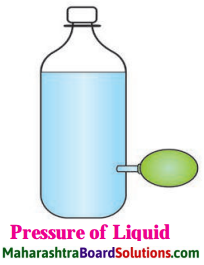
Maharashtra Board Class 8 Science Solutions Chapter 3 Force and Pressure 1

[Note: Here, the area of cross section of the tube remains the same. As the level of the water in the bottle rises, the mass of the water increases resulting in increase in the weight. As the applied force increases, the pressure increases. Therefore, the balloon increases in size.]

Maharashtra Board Class 8 Science Solutions Chapter 3 Force and Pressure

Activity 2:
Take a plastic bottle. Pierce it with a thick needle (or with a hot nail) at the points 1, 2, 3 as shown in the Fig. Fill water in the bottle up to full height. A shown in the figure, water jets will be seen emerging and projecting out. The water jet emerging from the hole at the top will fall closest to the bottle. The jet from the lowest hole falls farthest from the bottle.

Also, jets coming out from the two holes at the same level fall at the same distance from the bottle. What is understood from this? At any one level, the liquid pressure is the same. Also, the pressure increases as the depth of the liquid increases.
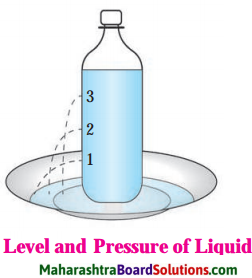
Maharashtra Board Class 8 Science Solutions Chapter 3 Force and Pressure 2

Question c.
How much pressure do we carry on our heads? Why don’t we feel it?
Answer:
The air pressure at the sea level is about 101 × 103 Pa. This is the pressure that we carry on our heads. The cavities in our body are filled with air, and arteries and veins are filled with blood. Their pressure balances the pressure due to the atmosphere. Hence, we don’t feel the atmospheric pressure.

4. Why does it happen?

Question a.
Why does it happen? A ship dips to a larger depth in freshwater as compared to marine water.
Answer:
The buoyant force acting on a body is proportional to the density of the fluid in which the body is immersed. The density of freshwater is less than that of marine water. Hence, the buoyant force on a body in freshwater is less than that in marine water. Therefore, a ship dips to a larger depth in freshwater as compared to marine water.

Question b.
Why does it happen? Fruits can easily he cut with a sharp knife.
Answer:

  1. It is easy to cut vegetables. fruits with a sharp knife. A blunt knife does not work here.
  2. The force exerted perpendicularly on a unit area is called ‘pressure’

    Maharashtra Board Class 8 Science Solutions Chapter 3 Force and Pressure 3.3
  3. Presently we are considering only the force acting on an area in a direction perpendicular to it.

Question c.
Why does it happen? The wall of a dam is broad at its base.
Answer:
1. The pressure at a point in a liquid is proportional to the height of the liquid column above it. Hence, the pressure of water in a dam is much greater at the bottom of the dam than at the top.
2. To withstand this high pressure, the wall of a dam is made stronger and thicker (broad) at the base than at the top.

Question d.
Why does it happen? If a stationary bus suddenly speeds up, passengers are thrown in the backward direction.
Answer:
1. When passengers sit or stand in a stationary bus, they are in a state of rest. When the bus suddenly speeds up, the lower (parts of their body in contact with the bus acquire the speed of the bus.
2. The upper parts of their body, however, continue to be in the state of rest due to inertia. Hence, they are thrown in the backward direction.

Maharashtra Board Class 8 Science Solutions Chapter 3 Force and Pressure

5. Complete the following tables. 

Question a.
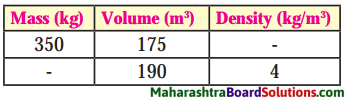
Maharashtra Board Class 8 Science Solutions Chapter 3 Force and Pressure 4
Answer:
Using the formula,
density = mass/volume:

Mass (Kg)Volume (m3)Density (Kg/m3)
3501752
7601904

Question b.
Maharashtra Board Class 8 Science Solutions Chapter 3 Force and Pressure 5
Answer:
Using the formula, relative density = density of a metal/density of water:

Density of Metal (Kg/m3)Density of water (Kg/m3)Relative Density
5 × 1031035
8.5 × 1031034

Question c.
Maharashtra Board Class 8 Science Solutions Chapter 3 Force and Pressure 6
Answer:
Using the formula, pressure = weight/area:

Weight (N)Area (m2)Pressure (N.m-2)
8000.0420000
15005003

Maharashtra Board Class 8 Science Solutions Chapter 3 Force and Pressure

6. The density of a metal is 10.8 × 10³ kg/m3. Find the relative density of the metal.

Question a.
The density of a metal is 10.8 × 10³ kg/m3. Find the relative density of the metal.
Solution:
Data: Density of the metal = 10.8 × 10³ kg/m3
density of water = 103 kg/m3
relative density of the metal = ?
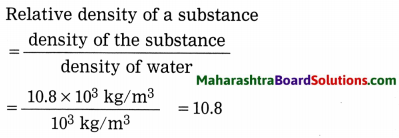
Maharashtra Board Class 8 Science Solutions Chapter 3 Force and Pressure 7
The relative density of the metal = 10.8.

7. The volume of an object is 20 cm3 and the mass is 50 g. The density of water is 1 gm-3. Will the object float on water or sink in water?

Question a.
The volume of an object is 20 cm3 and the mass is 50 g. The density of water is 1 gm-3. Will the object float on water or sink in water?
Solution :

Maharashtra Board Class 8 Science Solutions Chapter 3 Force and Pressure 8
It is greater than the density of water.
Hence, the object will sink in water.

8. The volume of a plastic-covered sealed box is 350 cm3 and the box has a mass 500 g. Will the box float on water or sink in water? What will be the mass of water displaced by the box?

Question a.
The volume of a plastic-covered sealed box is 350 cm3 and the box has a mass 500 g. Will the box float on water or sink in water? What will be the mass of water displaced by the box?
Solution:
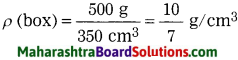
Maharashtra Board Class 8 Science Solutions Chapter 3 Force and Pressure 9
It is greater than that of water.
Hence, the box will sink in water.
The volume of water displaced by the box (V) = the volume of the box = 350 cm3
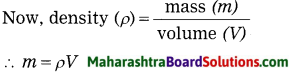
Maharashtra Board Class 8 Science Solutions Chapter 3 Force and Pressure 10
∴ The mass of water displaced by the box = 1 g.cm-3 × 350 cm3 = 350 g.

Project:

Question a.
Video record all the experiments (Try it) in this chapter with the help of mobile phone and send to others.

Class 8 Science Chapter 3 Force and Pressure Additional Important Questions and Answers

1. Rewrite the sentences after filling the blanks

Question 1.
The tendency of an object to remain in its existing state is called its …………. .
Answer:
The tendency of an object to remain in its existing state is called its inertia.

Question 2.
Pressure = ……………
Answer:
Maharashtra Board Class 8 Science Solutions Chapter 3 Force and Pressure 3.3

Question 3.
1 bar = ……………….. N/m2.
Answer:
1 bar = 105 N/m2.

Question 4.
1 atmosphere = ………….. Pa.
Answer:
1 atmosphere = 101 × 103 Pa.

Maharashtra Board Class 8 Science Solutions Chapter 3 Force and Pressure

Question 5.
The SI unit of density is …………. .
Answer:
The SI unit of density is kg/m3

Write proper word In the blank space:

Question 1.
According to Archimedes’ principle, the magnitude of the force of buoyancy acting on a body is …………. .
(Vρg, Vρ/g, Vρm, mρg)
Answer:
According to Archimedes’ principle, the magnitude of the force of buoyancy acting on a body is Vρg.

Question 2.
The pascal is the unit of ……………. .
(velocity, pressure, mass, force)
Answer:
The pascal is the unit of pressure.

Question 3.
Keeping the surface area constant, if the applied force is doubled, the pressure …………….. .
(becomes double, remains the same, becomes four times, becomes half)
Answer:
Keeping the surface area constant, if the applied force is doubled, the pressure becomes double.

State whether the following statements are True or False:

Question 1.
The density of water is 1000 g/cm3.
Answer:
False. [The density of water is 1000 kg/m3 (or 1 g/cm3)]

Question 2.
Force and weight have the same units.
Answer:
True.

Question 3.
Atmospheric pressure at sea level is about 106 dynes/cm2.
Answer:
True.

Maharashtra Board Class 8 Science Solutions Chapter 3 Force and Pressure

Question 4.
The buoyant force due to a liquid is proportional to the acceleration due to gravity.
Answer:
True.

Question 5.
Atmospheric pressure increases with altitude.
Answer:
False. (Atmospheric pressure decreases with altitude.)

Question 6.
Pressure due to a given force is directly proportional to the area on which the force acts.
Answer:
False. (Pressure due to a given force is inversely proportional to the area on which the force acts.)

Question 7.
When a body is completely immersed in a liquid, the buoyant force acting on it due to the liquid is proportional to the volume of the liquid displaced by the body.
Answer:
True.

Question 8.
The density of a material is useful to determine its purity.
Answer:
True.

Question 9.
One tends to slip over a banana peel on the street and one can slip due to mud are events that occur due to reduced friction.
Answer:
True.

Question 10.
Frictional force is electromagnetic in origin.
Answer:
True.

Identify the odd term:

Question 1.
Density, Pressure exerted by a gas, Mass, Force.
Answer:
Force. (Force is a vector quantity; other quantities are scalar quantities.)

Maharashtra Board Class 8 Science Solutions Chapter 3 Force and Pressure

Question 2.
Lactometer, Hydrometer, Voltmeter, Submarine.
Answer:
Voltmeter. (Its working is not based on Archimedes’ principle. The working of a lactometer, hydrometer and submarine is based on Archimedes’ principle.)

Rewrite the following table in such a way that Column 2 and Column 3 will match with Column 1:

Question 1.

Column 1Column 2Column 3
1. PressureMass/volumeSpecific gravity
2. DensityForce/areaDecreases with increase in height above the sea level
3. Atmos­pheric pressureNo unitUseful to determine the purity of a substance
4. Relative densityThe pascalDecreases with increase in area

Answer:

Column 1Column 2Column 3
1. PressureForce/areaDecreases with increase in area
2. DensityMass/volumeUseful to determine the purity of a substance
3. Atmos­pheric pressureThe pascal Decreases with increase in height above the sea level
4. Relative densityNo unit Specific gravity

Answer the following questions in one sentence:

Question 1.
Which of the following has more inertia? A ₹ 10 coin and a ₹ 1 coin.
Answer:
A ₹ 10 coin has more inertia than a ₹ 1 coin.

Maharashtra Board Class 8 Science Solutions Chapter 3 Force and Pressure

Question 2.
Name the physical quantity expressed in pascal.
Answer:
Pressure is expressed in pascal.

Question 3.
State the SI unit of pressure.
Answer:
The SI unit of pressure is N/m2, also called the pascal.

Question 4.
Name the property of a liquid due to which it exerts an upward force on an object immersed in it.
Answer:
Buoyancy is the property of a liquid due to which it exerts an upward force on an object immersed in it.

Question 5.
Name the principle used in designing ships and submarines.
Answer:
Archimedes’ principle is used in designing ships and submarines.

Question 6.
What is specific gravity?
Answer:
The specific gravity of a substance is another name used for relative density, i. e., the ratio of the density of the substance to the density of water.

Question 7.
State any one factor on which the pressure exerted by a liquid at a point inside the liquid depends.
Answer:
The pressure exerted by a liquid at a point inside the liquid depends on the density of the liquid.

Question 8.
State any one factor on which the buoyant force due to a liquid depends.
Answer:
The buoyant force due to a liquid depends on the density of the liquid.

Maharashtra Board Class 8 Science Solutions Chapter 3 Force and Pressure

Question 9.
Name the device used to determine the purity of a sample of milk.
Answer:
The lactometer is used to determine the purity of a sample of milk.

Question 10.
Name the device used to determine the density of a liquid.
Answer:
The hydrometer is used to determine the density of a liquid.

Question 11.
Name two instruments whose working is based on Archimedes’ principle.
Answer:
Working of the lactometer and hydrometer is based on Archimedes’ principle.

Answer the following questions:

Question 1.
Give three examples to show that a force acts on two bodies through an interaction between them.
Answer:

  1. Consider a car at rest on a level (plane) road. If it is pushed from behind, it moves in the forward direction.
  2. Iron nails get attracted to the poles of a magnet and stick to the magnet.
  3. The moon revolves around the earth.

Question 2.
What is a contact force? Give one example.
Answer:
A force that acts through a direct contact of two objects or via one more object, is called a contact force.
Example: If a ball at rest on the ground is kicked, it starts moving.

Maharashtra Board Class 8 Science Solutions Chapter 3 Force and Pressure

Question 3.
What is a non contact force? Give one example.
Answer:
A force that acts between two objects even if the two objects are not in contact, is called a non contact force.
Example: The earth revolves around the Sun.

Use your brainpower!
Make a list of some more examples in which contact and non contact forces are applied. Write the types of force.
Answer:
1. Some examples in which contact forces are applied:

  • to cut an apple with a knife (muscular force, frictional force)
  • to lift a ball lying on the ground (muscular force, frictional force)

2. Some examples in which non contact forces are applied:

  • the motion of the earth around the Sun (gravitational force)
  • the motion of an electron around the nucleus of an atom (mainly the electric force).

Question 4.
In the following examples, state whether the force is a contact force or non contact force:

  1. a reluctant dog is being pulled by his master
  2. a boy playing football is kicking the ball away
  3. when iron nails are brought near a magnet, they are attracted to the poles of the magnet and stick to the magnet
  4. a coconut is falling from the coconut tree
  5. when a comb is rubbed against hair, small pieces of paper kept on a table get attracted to the comb
  6. when brakes are applied to a moving bicycle, it stops after some time

Answer:

  1. contact force
  2. contact force
  3. non contact force
  4. non contact force
  5. non contact force
  6. contact force.

Maharashtra Board Class 8 Science Solutions Chapter 3 Force and Pressure

Question 5.
Give one example in which frictional force is useful.
Answer:
While walking, we push the ground behind with our feet. In the absence of friction between the ground and the lower surface of our feet, we will slip and will not be able to walk.
[Note: Frictional force is electromagnetic in origin.]

Try this: 
Take two plastic bottles with rectangular shape. Close their openings by fitting the lids tightly. Keep two small bar magnets on them and fix them neatly using a sticking tape.

Fill a big plastic tray with water and leave the two bottles floating with magnets at the top. Take one bottle near the other. If the north pole of the magnet is near the south pole of the other magnet, the bottles will head towards each other, because unlike poles attract each other.

Observe what will happen when the directions of the bottles are changed. We can observe change in the motion of the bottles without any direct contact. This means that there exists a non contact force between the two magnets.
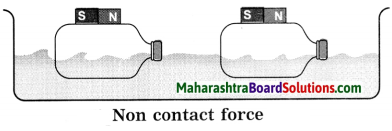
Maharashtra Board Class 8 Science Solutions Chapter 3 Force and Pressure 11
Observation: When the directions of the bottles are changed, if the north pole of one magnet is near the north pole of the other magnet (or the south pole of one magnet is near the south pole of the other magnet), the bottles will move away from each other because like poles repel each other.

Use your brain power!

Question.
You have learnt about static electricity in the previous standard. Electrostatic force is a non contact force. To verify this, which experiment will you perform?
Answer:
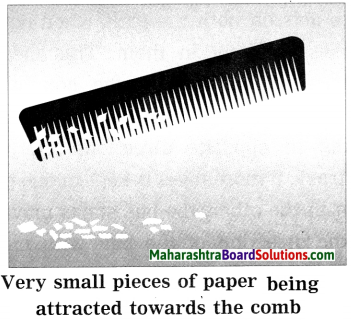
Maharashtra Board Class 8 Science Solutions Chapter 3 Force and Pressure 12
Do not switch on the fan in the room. Keep very small pieces of paper on the table. Rub a plastic comb against hair and bring it near the bits of paper. You will find that the bits of paper are attracted by the comb. The comb, on rubbing acquires electrostatic charge. It induces opposite charges on the bits of paper. Hence, the bits of paper are attracted by the comb.

Try this: 
Balanced forces and unbalanced force:
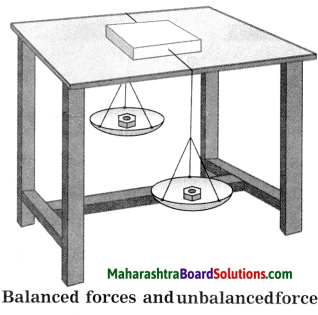
Maharashtra Board Class 8 Science Solutions Chapter 3 Force and Pressure 13
Take a cardboard box, tie thick string to its two sides and keep it on a smooth table as shown in Fig. Take the strings on both sides of the table. Tie weighing pans to the two ends. Keep equal masses in both the pans. The box does not move on the table.

If more mass is kept in one of the pans than in the other, the box starts moving in the direction of that pan. Equal gravitational force acts on both the pans when equal masses are kept in them. This means balanced forces act on the box, with effective force equal to zero as these are acting in opposite directions.

On the contrary, if more mass is kept in one pan than in the other, the box starts moving in the direction of the pan with more mass. When unequal forces are applied to the box on the two sides, an unbalanced force acts on the box resulting in imparting motion to the box.

Children playing tug of war pull the rope in their respective directions. If the pull of the force is equal on the two sides, the rope does not move. If the force is more on one side, the rope moves in that direction. This means that initially, the two forces are balanced; the rope moves in the direction of higher force when the forces become unbalanced.

Let us see one more example. When a big grain storage container is required to slide on the ground, it becomes easier if two persons push it rather than one person. When the force is applied by both in the same direction, the movement is easy. You may have experienced this. What do we understand from this example?

  1. If several forces are applied on an object in the same direction, a force equal to their addition acts on that object.
  2. If two forces are applied on one object in directions opposite to each other, a force equal to their difference acts on the object.
  3. A force is expressed in magnitude and direction.

Force is a vector quantity. If more than one force are acting on a body, then the effect on the body is due to the net force. When a force is applied on a stationary object it moves, its speed and direction change. Similarly, a force is required to stop an object in motion.

An object can change its shape due to force. While kneading a dough made from flour, the dough changes its shape when a force is applied. A potter applies a force in a specific direction while shaping the pot. Rubber, when stretched, expands. There are many such examples. ,

Maharashtra Board Class 8 Science Solutions Chapter 3 Force and Pressure

Question 6.
What are balanced forces?
Answer:
If a body is acted upon by two forces, equal in magnitude, opposite in direction and having the same line of action, the forces are called balanced forces. Here, the net force acting on the body is zero.

Question 7.
What is an unbalanced force?
Answer:
If two or more forces act on a body such that their resultant is not zero, the resultant is an unbalanced force.
[Note: Unbalanced force acting on a body = mass of the body × acceleration of the body.]

Question 8.
Explain: Force has magnitude as well as direction. OR Force is a vector quantity.
Answer:
The effect of force applied to a body depends upon how much force we supply, i.e., the magnitude of the force, and the direction in which the force is applied. Consider a ball at rest on the ground. When ; we push it, it starts rolling. The greater the applied force, the greater is the speed acquired by the ball.

Consider a body moving in a straight line, If we apply a force in the direction of motion of the body, the speed of the body increases. On the contrary, if we apply a force in the direction opposite to that of motion of the body, the speed of the body decreases. These ( examples show that force has magnitude as well as direction, i.e., force is a vector quantity.

Question 9.
Explain the term balanced forces.
Answer:
Consider a rigid body acted upon by two forces, equal in magnitude, opposite in . direction and having the same line of action. These forces are called balanced forces as their net effect on the body is zero.
Example: A glass slab kept on a table is acted upon by two balanced forces: (i) the weight of the slab acting downward and (ii) the upward force on the slab due to the table. Their net effect on the slab being zero, the slab remains at rest.

Maharashtra Board Class 8 Science Solutions Chapter 3 Force and Pressure

Question 10.
Explain the term unbalanced force.
Answer:
A single force acting on a body is an unbalanced force. It produces acceleration in the body. If two or more forces act on a body such that their resultant is not zero, the resultant is an unbalanced force responsible for accelerating the body.
Example: When a ball lying on the ground is hit with a bat, the ball is set in motion by the applied force.

Question 11.
What will happen if the force is removed completely when an object acquires a certain speed?
Answer:
If the force is removed completely when an object acquires a certain speed, the object will move with the velocity it has at the instant the force is removed.

For example, a body moving with constant speed along a circular path in a horizontal plane will fly tangentially in the sense of motion if the centripetal force (the force directed towards the centre of the circle) is removed completely.

Always remember:

  1. The tendency of an object to remain in its existing state is called its inertia.
  2. This is why an object in stationary state remains in the same state and an object in motion remain in the state of motion in the absence of an external force.

Types of inertia:

1. Inertia of the state of rest: An object in the state of rest cannot change its state of rest due to its inherent property. This property is called the inertia of the state of rest.

2. Inertia of motion: The inherent property of an object due to which its state of motion cannot change, is called its inertia of motion. For example, a revolving’ electric fan continues to revolve even after it is switched off, passengers sitting in the running bus get aerk in the forward direction if the bus suddenly stops.

3. Directional inertia: The inherent property of an object due to which the object cannot change the direction of its motion, is called directional inertia. For example, if a vehicle in motion along a straight line suddenly turns, the passengers sitting in it are thrown opposite to the direction of turning.

Try this:
Activity 1:
Take a postcard and keep it on a glass. Keep a 5 Rupee coin on it. Now skilfully push the card. The coin straight away falls in the glass. Have you ever done this?
Answer:
Yes. (Explanation: The postcard moves forward due to the applied force and then falls due to the earth’s gravitational force. In the absence of adequate frictional force between the coin and the postcard, the coin does not move forward with the postcard, but straightaway falls in the glass due to the earth’s gravitational force.)
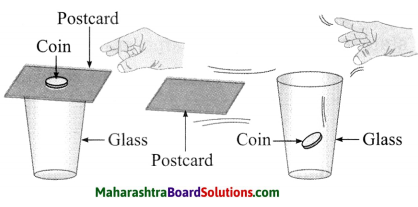
Maharashtra Board Class 8 Science Solutions Chapter 3 Force and Pressure 14

Activity 2: Hang a half a kg mass from a stand, with a string 1. Tie another string 2 to the mass and keep it hanging. Now pull the string 2 with a jerk. The string 2 breaks but the mass does not fall. Heavy mass does not move. Now pull the string 2 slowly. The string 1 breaks and the mass fall down. This is because of the tension developed in the string 2 due to the mass.
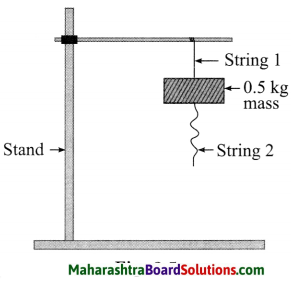
Maharashtra Board Class 8 Science Solutions Chapter 3 Force and Pressure 15
(Explanation: (1) As no force acts on the mass, it remains at rest due to inertia. (2) The transmission of force results in the tension in the string 1. As the string 1 cannot withstand it, it breaks and the mass falls down.)

Maharashtra Board Class 8 Science Solutions Chapter 3 Force and Pressure

Question 12.
What are the three types of inertia?
Answer:
Types of inertia:

  • inertia of rest
  • inertia of motion
  • inertia of direction.

Question 13.
What is inertia of rest ? Give two examples of inertia of rest.
Answer:
The inherent property of a body by virtue of which it cannot change its state of rest is called the inertia of rest.
Examples:

  1. When we dust a carpet, the carpet moves but the dust particles in it remain at rest due to inertia and hence get separated from the carpet. Hence, the carpet becomes clean.
  2. When a bus starts suddenly, the passengers experience a backwarderk due to inertia.

Question 14.
What is inertia of motion? Give two examples of inertia of motion.
Answer:
The inherent property of a body by virtue of which it cannot change its state of motion is called the inertia of motion.
Examples:

  1. When a fan is switched off, its blades continue to rotate for some time. Due to internal friction and friction with air, the blades of the fan stop rotating after some time.
  2. Passengers in a bus experience a forwarderk when the bus stops suddenly due to application of brakes.

Question 15.
What is inertia of direction? Give two examples of inertia of direction.
Answer:
The inherent property of a body by virtue of which it cannot change its direction of motion is called the inertia of direction.
Examples:

  1. While sharpening a knife, sparks fly off tangentially in the sense of motion from the grinding stone.
  2. When a vehicle moves, the mud particles sticking to its wheels fly off tangentially in the sense of motion. Hence, mudguards are fitted to vehicles.

Maharashtra Board Class 8 Science Solutions Chapter 3 Force and Pressure

Question 16.
Why do we fall sideways when we are sitting in a bus and it takes a sharp turn?
Answer:
When we sit in a bus and the bus is in motion, we are in a state of motion in the same direction. When the bus takes a sharp turn, our body tends to maintain the state of motion in the straight line due to inertia. The portion of our body in firm contact with the seat acquires the motion along the curved path, but the upper portion of our body, tends to move in the initial direction of motion. Hence, we fall sideways.

Question 17.
What happens when you shake a wet piece of cloth? Explain your observation.
Answer:

  1. When we shake a wet piece of cloth, water droplets come out.
  2. Initially, the wet piece of cloth is at rest. When the cloth is shaken, it is accelerated, but the water droplets in it, due to inertia, tend to maintain the state of rest. Hence, the droplets come out.

Question 18.
If brakes are suddenly applied to a moving car, the passengers in the car are pushed in the forward direction. Explain why.
Answer:
1. The passengers in a moving car have the same velocity as that of the car. When brakes are suddenly applied to the car, it stops suddenly and the lower parts of the passengers’ bodies in contact with the seats, come to rest.

2. The upper parts of their bodies, however, continue to be in a state of motion due to inertia. Hence, the passengers are pushed in the forward direction.

Question 19.
A person alighting from a moving train is likely to fall in the direction of motion of the train. Explain why.
Answer:

  1. A person in a moving train has the same velocity as that of the train. After alighting from the moving train his feet come to rest on the platform.
  2. However, due to inertia, the upper part of his body continues to be in a state of motion in the direction of motion of the train. Hence, he is likely to fall in the direction of motion of the train.

Try this: 

Activity 3: Take some sharp pointed nails and push them into a wooden plank by hammering on their heads. Now take? a nail and hold it with its head on the plank and hammer it down from the pointed end. When pressing the drawing pins into a drawing board, they get into the board easily. By applying a force using the thumb one can push the pins into the boards. On the contrary, while pressing ordinary pins into the board with a thumb, the thumb may get hurt.

What does this simple experiment tell?
The nail easily penetrates into wood from its pointed end. From this you will notice that when a force is applied on the head of the nail, it is easy to hammer it into the plank.
Explanation: The less the area of the surface on which the force is applied, the greater is the effect of the force.

Maharashtra Board Class 8 Science Solutions Chapter 3 Force and Pressure

Question 20.
Define pressure.
Answer:
The force exerted perpendicularly on a unit area is called pressure.

Use your brain power!

Question 1.
It is easy to cut vegetables, fruits with a sharp knife. A blunt knife does not work here. Why does this happen?
Answer:
The effect of a given force varies l inversely as the area of the surface on ( which the force is applied. The less the surface area, the greater is the effect of the force. The cutting edge of a sharp ’ knife has less cross sectional area relative to that of a blunt knife. Hence, it is easy to cut vegetables, fruits with a sharp knife, rather than with a blunt knife. For a given force, pressure is inversely proportional to the area of the surface on which the force acts.

Question 21.
State the formula for pressure, Hence, determine the unit of pressure.
Answer:
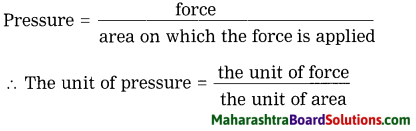
Maharashtra Board Class 8 Science Solutions Chapter 3 Force and Pressure 16
The SI unit of force is the newton (N) and that of area is m2. Therefore, the SI unit of pressure is N/m2. It is called the pascal (Pa). 1 Pa = 1 N/m2.
[Note: The unit pascal is named in honour of Blaise Pascal (1623-62), French mathematician, physicist and philosopher.]

Question 22.
State the CGS unit of pressure. State the relation betweeen the SI and CGS units of pressure.
Answer:
The CGS unit of pressure is the dyne/cm2.
IN = 105 dynes, 1m2 = (102 cm)2 = 104 cm2 1 Pa = 1 N/m2 = 105 dynes/104 cm2 = 10 dynes/cm2.

Question 23.
State the factors on which pressure depends.
Answer:
Pressure depends on the applied force and the area of the surface on which the force is applied.

Maharashtra Board Class 8 Science Solutions Chapter 3 Force and Pressure

Question 24.
Explain with a suitable example that pressure varies inversely as the area of the surface on which the force is applied, if the force remains constant.
Answer:
The tip of a pointed nail has an extremely small area, while that of a blunt nail has a comparatively large area. A given force creates a large pressure on the pointed nail and it can be easily hammered into the wood, while a very less pressure is created on the blunt nail and it cannot be easily hammered into the wood.

This shows that pressure varies inversely as the area of the surface on which the force is applied, if the force remains constant. If the same force is applied to surfaces having different areas, the pressure is more on the surface having a smaller area.

[Note: The bottom surface of a camel’s feet is broad. Hence, the camel’s weight acts on a large surface area. This reduces the pressure on the sand. Hence, the camel’s feet do not penetrate deep into the sand. Therefore, it becomes easier for the camel to walk on sand.]

Question 25.
With neat diagrams, describe an experiment to show that pressure increases if the surface area is decreased, keeping the applied force the same.
Answer:
Take a brick measuring 20 cm x 10 cm x 5 cm. Take some clay in a glass trough. Add water to it and knead it into a soft dough. Place the brick on the dough with one of its faces measuring 20 cm x 10 cm in contact with the dough. Observe how deep the brick penetrates into the dough.
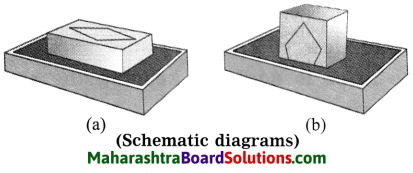
Maharashtra Board Class 8 Science Solutions Chapter 3 Force and Pressure 17

Clean the brick and place it on the dough with one of its faces measuring 10 cm x 5 cm in contact with the dough. Observe how deep the brick penetrates into the dough. You will find that the brick penetrates deeper in this case than that in the first case.

  • In the first case, the weight of the brick acts on a surface area of 200 cm2.
  • In the second case, the weight of the brick acts on a surface area of 50 cm2.
  • This shows that pressure increases if the surface area is decreased, keeping the applied force the same.

Maharashtra Board Class 8 Science Solutions Chapter 3 Force and Pressure

Question 26.
State the unit for pressure used in atmospheric science. How is it related to the unit pascal?
Answer:
In atmospheric science, the unit used for pressure is the bar. 1 bar = 10 Pa (pascal).

Try this:

Question 1.
Do the activity as depicted in Figure What is seen?
Answer:
In Fig.(a), the plank is horizontal. In Fig.(b), four books are placed side by side on the plank. The plank bends slightly due to the pressure produced by the weight of the books.
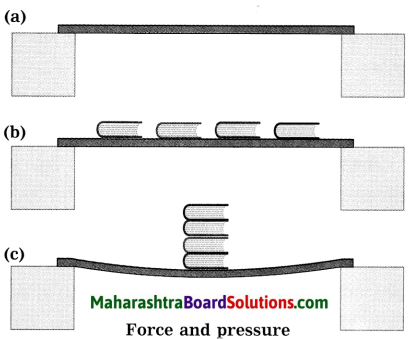
Maharashtra Board Class 8 Science Solutions Chapter 3 Force and Pressure 18
In Fig.(c), the four books are placed one above the other in the middle of the plank. Here the area of the surface of the plank on which the force acts is reduced by a factor of four relative to the earlier case. Hence, the plank bends considerably.
[Note: This shows that for a given force, pressure varies inversely as the area of the surface on which the force acts.]

Use your brainpower! 

Question 1.
You must have seen a vegetable vendor carrying a basket on her head. She keeps a twisted piece of cloth on the head, below the basket. How does it help?
Answer:
Keeping a twisted piece of cloth on the head increases the area of the surface on which the weight of the basket containing vegetables acts. Hence, the pressure produced by the force (weight) is reduced and it becomes easier to carry the basket.

Question 2.
We cannot stand at one place for a long time. How then can we sleep on a place for 8 and odd hours?
Answer:
When we stand, our weight acts on relatively small surface area, resulting in increased tension on the muscles of our legs. Hence, we cannot stand at one place for a long time. When we sleep, our weight acts on relatively large surface area, resulting in comparatively reduced tension. Therefore, we can sleep on a place for 8 and odd hours.

Question 3.
For skiing on ice, why are long flat skis used?
Answer:
The pressure produced by a given force depends on the area of the surface on which the force acts. The greater the surface area, the less is the pressure produced. The skis used to slide over snow are long and flat so that the area is increased and hence the pressure is decreased. This makes it easier to slide over snow.

Maharashtra Board Class 8 Science Solutions Chapter 3 Force and Pressure

Question 27.
Why do the blades of a pair of scissors have sharp edges?
Answer:
The pressure produced by a given force depends on the area of the surface on which the force acts. The less the surface! area, the greater is the pressure produced, The blades of a pair of scissors have sharp edges so that the area is decreased and hence the pressure is increased. This makes cutting • an object such as cloth easier.
[Note: Answers to questions such as why is the blade of an axe sharp? or why is the blade of a saw sharp? can be written on the basis of the answer given above.]

Question 28.
Why does a needle have s sharp point?
Answer:
The pressure produced by a given force depends on the areas of the surface on which the force acts. The less the surface area, the greater is the pressure produced. A needle has a sharp point so that the area is decreased and hence the pressure is increased. This makes the action of piercing easier.

Question 29.
Why do school bags have broad shoulder straps?
Answer:
The pressure produced by a given force depends on the area of the surface on which the force acts. The greater the surface area, the less is the pressure produced. School bags have broad shoulder straps so that the weight of the bag is distributed over a large surface area thereby decreasing the pressure on the shoulders of the student carrying the bag.

Question 30.
How will the pressure change if the area is doubled keeping the force the same?
Answer:
If the area is doubled, keeping the force the same, the pressure will become half the initial pressure.

Question 31.
How will the pressure change if the force is doubled, keeping the area the same?
Answer:
If the force is doubled, keeping the area the same, the pressure will become double the initial pressure.

Question 32.
State the characteristics of the pressure due to a liquid (or a fluid in general).
OR
Write a short note on the pressure due to a liquid (a fluid in general).
Answer:
Characteristics of the pressure due to a liquid (or a fluid):

  1. The pressure at a point in a liquid (or a fluid) is due to the weight of the liquid (fluid) column above that point.
  2. It acts on all sides of the container.
  3. At a given depth it is the same in all directions.
  4. It is independent of the size and shape of the container.
  5. It is proportional to the height of the liquid (fluid) column above the given point.
  6. It is proportional to the density of the liquid (fluid).
  7. It is proportional to the acceleration due to gravity at the given place.

[Note: The pressure exerted by a liquid (or gas or fluid) at a depth h below the free surface of the liquid = hpg, where p is the density of the liquid (or gas or fluid) and g is the acceleration due to gravity.]

Maharashtra Board Class 8 Science Solutions Chapter 3 Force and Pressure

Question 33.
Give two examples to show that air exerts equal pressure in all directions.
Answer:

  1. When air is filled in a balloon, it acquires its characteristic shape such as round or oval.
  2. When a bicycle tube is filled with air, it acquires its characteristic (tube-like) shape throughout. This shows that air exerts equal pressure in all directions.

Question 34.
Whatisafluid?Givetwoeamples.
Answer:
A fluid is a substance which can flow.
Examples:

  1. Water (liquid)
  2. Air (gas)

[Note: Liquids and gases together are called fluids. Gases have very low viscosity compared to liquids. A liquid with low viscosity flows easily. A liquid with high viscosity does not flow easily.]

Question 35.
Take two rubber balloons. Fill one with water and blow air into the other. Now prick both balloons with a pin. What do you observe?
Answer:
Water and air both come out of the balloons. Air escapes quickly compared to water and produces a loud sound.

Question 36.
State the characteristics of pressure exerted by a fluid.
OR
Write a short note on pressure exerted by a fluid.
Answer:
Characteristics of pressure exerted by a fluid:

  1. A fluid due to its weight, exerts pressure on the base as well as the walls of the container that holds it.
  2. A fluid exerts pressure on a body immersed in it.
  3. The pressure exerted on any confined mass of fluid is transmitted undiminished in all directions.

[Note: The pressure exerted by a fluid is a scalar quantity.]

Maharashtra Board Class 8 Science Solutions Chapter 3 Force and Pressure

Question 37.
Take an empty can. Pour small quantity of water in it. Boil this water for a few minutes until the steam has driven out most of the air. Now close the can with the stopper tightly. Allow it to cool by pouring cold water over it. What do you observe?
Answer:
The can gets gradually crushed.
[Note: The steam inside the can condenses to form water as the can cools. Therefore, the pressure inside the can becomes much less than the external pressure of the air. Hence, the can gets crushed.]

Question 38.
Put a folded newspaper on a plastic bag. Blow air into the bag. What do you observe?
Answer:
The plastic bag inflates as air is blown into it. This raises the folded news¬paper put on the bag.

Question 39.
What is meant by atmospheric pressure?
Answer:
The earth is surrounded by air from all sides. This layer of air is called the atmosphere. Its density is high up to about 16 km from the earth’s surface. Beyond that, up to about 400 km, its density is very low. Air, due to its weight, exerts pressure on the surface of the earth.

The pressure exerted by air or the atmosphere surrounding the earth is known as the atmospheric pressure. It is the ratio of the weight of the air to the area of the surface of the earth. It decreases with altitude as the density of air decreases with altitude and also the weight of the air column above a given place.
[Note: At sea level the atmospheric pressure is about 105 Pa. We do not feel it because the pressure of blood and other fluids in our body balances it.]

Maharashtra Board Class 8 Science Solutions Chapter 3 Force and Pressure

Question 40.
State the relation between 1 atmosphere and the pascal.
Answer:
1 atmosphere = (about) 101 × 103 Pa (pascal)
[Note: The air pressure at the sea level is (about) 1 atmosphere.
1 atmosphere = 101325 Pa.
1 bar = 103 mbar (millibar)
1 mbar w 103 Pa (hectopascal)
Atmospheric pressure is expressed in mbar or hectopascal (hPa).]
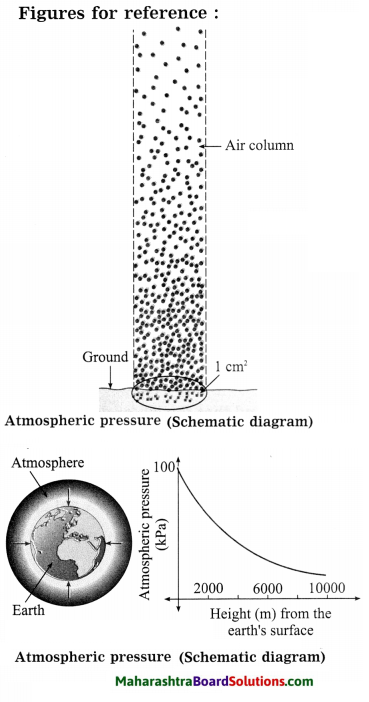
Maharashtra Board Class 8 Science Solutions Chapter 3 Force and Pressure 19

Use your brain power!

Question 1.
At the sea level the atmospheric pressure 101 × 103 Pa is acting on a table top of size 1 m2. Under such a heavy pressure, why doesn’t the table top crumble down?
Answer:
The air below the table top exerts pressure 101 × 103 Pa on it in the upward direction. Hence, the table top doesn’t crumble down.

Question 41.
Think – Why?
Question i.
Some people feel their ears popping at the top of a mountain.
Answer:
Atmospheric pressure decreases with altitude. At the top of a mountain, it becomes less than the internal pressure in the ear. Hence, some people feel their ears popping at the top of a mountain.

Question ii.
Some people feel breathless as they climb higher and higher on a mountain.
Answer:
Atmospheric pressure decreases with altitude. Hence, some people feel breathless as they climb higher and higher on a mountain.

Question iii.
We can enjoy a cold-drink or fruit juice with the help of a straw but can we imagine drinking a cold-drink or fruit juice on the moon using a straw?
Answer:
When we suck air in the straw, the pressure of the air in the straw becomes less than that of the outside air on the cold drink or fruit juice in the bottle (or the glass). Hence, the cold drink or fruit juice rises in the straw and enters our mouth. We can then drink it. There is no atmosphere on the moon. Hence, it is not possible to enjoy a cold drink or fruituice on the moon by using a straw.

Question iv.
People are often advised not to carry fountain pens while travelling by air.
Answer:
The ink in a fountain pen (filled at sea level at atmosphere pressure) may come out through its mouth while travelling by air if the outside pressure becomes less than the pressure in the ink holder of the pen. This can spoil the clothes/purse/bag. Hence, people are often advised not to carry fountain pens while travelling by air.

Maharashtra Board Class 8 Science Solutions Chapter 3 Force and Pressure

Question 42.
Why do some people have earache when they travel by an aeroplane?
Answer:
When an aeroplane descends at a high speed, there is an increase in air pressure. This increases the pressure on the ear drum. Hence, some people have earache when they travel by an aeroplane.

Question 43.
Explain why a person may bleed from the nose when at a great height above the sea level.
Answer:
The pressure exerted by the blood in blood capillaries is slightly more than the atmospheric pressure and acts in a direction opposite to that of the atmospheric pressure. Atmospheric pressure decreases with height and at a great height above the sea level, it is very low.

As a result, there arises a difference in the internal and external pressures on the walls of the cells and blood capillaries. If the difference is large, it may cause the cell wall and the blood capillaries to burst. Thus, the capillaries in the nose (and ear) may burst causing bleeding.

Question 44.
When a rubber sucker is pressed onto a flat glass surface, it sticks tightly on the surface. Why? You need a large force to separate it from the surface. Why?
Answer:
When a rubber sucker is pressed onto a flat glass surface, practically all the air between the surfaces of the sucker and the glass is pushed out. The air pressure there becomes much less than the atmospheric pressure. Hence, the sucker sticks to the glass due to the external atmospheric pressure. The atmospheric pressure is about 105 Pa. It is very large. Hence, to work against it to separate the sucker from the glass, a large force is needed.

Question 45.
Describe a simple experiment to demonstrate atmospheric pressure.
Answer:
Fill a glass completely with water (to its brim) and cover it with a flat and stiff card paper (or a piece of glass). Holding your palm on the card, turn the glass upside down and take the palm away from the card.
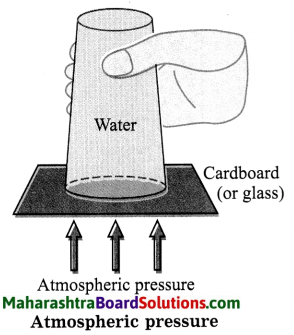
Maharashtra Board Class 8 Science Solutions Chapter 3 Force and Pressure 20
You will find that the water does not spill. The atmospheric pressure on the card (acting upward) is greater than the pressure of the water in the glass (acting downward). Hence, the water in the glass does not spill.

Question 46.
Explain the working of an ink dropper.
[Application]
Answer:
An ink dropper consists of a tube of glass or plastic, with one end tapering to a narrow opening and the other end fitted with a small rubber bulb. When the narrow open end is dipped into the ink and the rubber bulb is pressed, some air in the tube escapes through the open end. This reduces the air pressure inside the dropper.
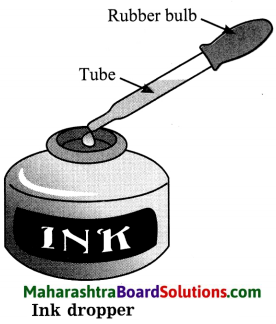
Maharashtra Board Class 8 Science Solutions Chapter 3 Force and Pressure 21
On releasing the bulb, the atmospheric pressure on the ink pushes the ink into the dropper. The dropper is then taken out and its open end is held over the open barrel of the pen. The bulb is then pressed so that the ink in the dropper enters the pen.
[Note: The medicine dropper works in the same manner.]

Maharashtra Board Class 8 Science Solutions Chapter 3 Force and Pressure

Question 47.
Why is the opening of a dropper very narrow?
Answer:
The pressure produced by a given force is inversely proportional to the area of the surface on which the force acts. The opening of a dropper is very narrow. Hence, its area of cross-section is very small. As a result, even if the dropper has a small amount of ink it, its pressure can equal the atmospheric pressure. As the opening is narrow, it is easier to transfer the ink to the pen. The possibility of ink spilling is very low.

Question 48.
What is the characteristic of the cap of eye drop bottles?
Answer:
The cap of an eye drop bottle is fitted with a dropper.

Question 49.
Explain the working of a syringe
used by children when they play with coloured water. [Application]
Answer:
As shown in the figure, a syringe used by children when they play with coloured water consists of a cylinder made of plastic or metal fitted with a piston. One end of the cylinder is in the form of a narrow
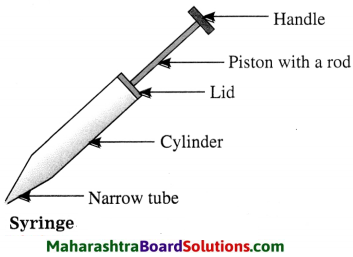
Maharashtra Board Class 8 Science Solutions Chapter 3 Force and Pressure 22
tube. The snugly fitting piston can slide in , and out smoothly. The rod connected to the i piston passes through a hole in the centre of the lid and has a handle at the other end. When the tip of the narrow tube is dipped in coloured water (or any other liquid) and the piston is pushed towards the tip, up to the bottom, most of the air in the cylinder escapes through the tube, reducing the pressure.

When the piston is moved up, the coloured water rises in the part of the cylinder below the piston due to the atmospheric pressure. Finally, the inner pressure equals the atmospheric pressure and no more coloured water enters in or comes out.

To spray the coloured water, the tube is taken out and the piston is moved towards the opening of the tube. As the inner pressure is now greater than the atmospheric pressure, the coloured water gushes out of the narrow opening of the tube.

Maharashtra Board Class 8 Science Solutions Chapter 3 Force and Pressure

Question 50.
How does the doctor’s syringe work?
Answer:
As shown in the figure, a syringe used by children when they play with coloured water consists of a cylinder made of plastic or metal fitted with a piston. One end of the cylinder is in the form of a narrow
Maharashtra Board Class 8 Science Solutions Chapter 3 Force and Pressure 22
tube. The snugly fitting piston can slide in , and out smoothly. The rod connected to the i piston passes through a hole in the centre of the lid and has a handle at the other end.

When the tip of the narrow tube is dipped in coloured water (or any other liquid) and the piston is pushed towards the tip, up to the bottom, most of the air in the cylinder escapes through the tube, reducing the pressure. When the piston is moved up, the coloured water rises in the part of the cylinder below the piston due to the atmospheric pressure.

Finally, the inner pressure equals the atmospheric pressure and no more coloured water enters in or comes out. To spray the coloured water, the tube is taken out and the piston is moved towards the opening of the tube. As the inner pressure is now greater than the atmospheric pressure, the coloured water gushes out of the narrow opening of the tube.

The tip of a syringe is fitted with a very fine and hollow needle. The required quantity of medicine can be taken in the syringe with the help of the piston. The medicine can then be injected into the body of a patient using the needle and the piston.

Question 51.
Explain the origin of pressure due to a gas enclosed in a container.
Answer:
Molecules of a gas are in a state of continuous random motion. These molecules possess energy due to motion. When the molecules collide with a wall of the container, they rebound. A large number of molecules collide with the wall every second. Hence, a significant force is exerted on the wall. Pressure is the force per unit surface area. Thus, a pressure is exerted by the gas on a wall of the container.

Try this: 

Buoyant force:
Take a plastic bottle and fix the lid tightly. Now place it in wafer and see. It will float on water. Try and push it into the water. Even when pushed, it continues to float. This experiment can also be done with a plastic hollow ball. Now fill the bottle with water to the fullest capacity and close the lid, and release in water. The bottle will float inside the water. Why does this happen?
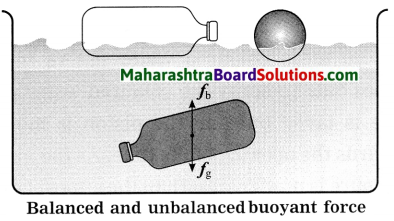
Maharashtra Board Class 8 Science Solutions Chapter 3 Force and Pressure 23
The empty plastic bottle floats on the surface of water. On the contrary, the bottle full of water floats inside water but does not go to the bottom. The weight of the empty bottle is negligible as compared with the weight of the water inside.

Such a bottle with water neither floats on the surface, nor does it go to the bottom. This means the force due to gravity acting downwards (fg), must have been balanced by an opposing force in the upward direction (fb) on the bottle filled with water. This force must have originated from the water surrounding the bottle. The upward force acting on the object in water or other fluid or gas is called buoyant force (fg).

Maharashtra Board Class 8 Science Solutions Chapter 3 Force and Pressure

Question 52.
Define buoyant force.
Answer:
The upward force acting on the object in water or other fluid or gas is called the buoyant force.

Question 53.
State the factors on which the buoyant force depends.
Answer:
The buoyant force depends upon the volume of the object immersed in the fluid (V), the density of the fluid (ρ1) and the acceleration due to gravity (g) at that place.
[Note: Magnitude of the buoyant force = Vρ1 g.]

Use your brain power!

Question.
While pulling a bucket from a well, the bucket full of water immersed fully in water appears to weigh less than when it has been pulled out of water. Why?
Answer:
1. When a bucket full of water is immersed in water, the net force acting on the bucket = weight of the bucket full of water-the buoyant force exerted by the water on the bucket. The buoyant force due to a fluid is proportional to the density of the fluid.

2. The density of water is much greater than that of air. Therefore, the buoyant force acting on a bucket full of water while it is in water is much greater than that when it is out of water, i.e., in air. Hence, it appears to weigh less, while it is in water than when it has been pulled out of water.

Try this:

Question 1.
Take a piece of thin aluminum sheet and dip it in water in a bucket. What do you observe?
Answer:
It sinks in the water.

Question 2.
Now shape the same piece of aluminium into a small boat and place it on the surface of water. It floats, isn’t it?
Answer:
Yes, the boat floats on the surface of water.

Maharashtra Board Class 8 Science Solutions Chapter 3 Force and Pressure

Question 54.
A lemon sinks in a glass filled with water but it floats when we stir in two spoons of salt in the water. Explain why.
Answer:
When salt is dissolved in water, the density of the water increases. The buoyant force is proportional to the density of the liquid. Hence, when the lemon is immersed in the water containing salt, the magnitude
of the buoyant force acting on the lemon becomes greater than the magnitude of the weight of the lemon. Therefore, it floats in water.

Do you know?

How is it decided that an object left in a liquid will get sink in the liquid, will float on the surface, or will float inside the liquid?
1. The object floats if the buoyant force is larger than its weight.
2. The object sinks if the buoyant force is smaller than its weight.
3. The object floats inside the liquid if the buoyant force is equal to its weight. Which forces are unbalanced in the above cases?
Answer:
Unbalanced force:
1. Magnitude of the unbalanced force acting on the object = magnitude of the buoyant force on the object-magnitude of the weight of the object. The direction of the unbalanced force is the direction of the buoyant force.

2. Magnitude of the unbalanced force on the object = magnitude of the weight of the object – magnitude of the buoyant force on the object. The direction of the unbalanced force is the direction of the weight of the object.

3. Here, the unbalanced force is zero.

Try this:

Take a long rubberband and cut it at one point. At one of its ends tie a clean washed stone or a 50 g weight as shown in Figure
Now hold the other end of the rubberband and make a mark there. Keep the stone hanging in air and measure the length of the rubberband from the stone to the mark made earlier.

Now take water in a pot and hold the rubberband at such a height that the stone sinks in it. Again measure the length of the rubberband up to the mark. What is observed? This length is shorter than the earlier length. While dipping the stone in water, length of the stretched rubber gets slowly reduced and is minimum when it sinks completely. What could be the reason for a shorter length of the rubberband in water?
Maharashtra Board Class 8 Science Solutions Chapter 3 Force and Pressure 24
When the stone is sunk in water, a buoyant force acts on it in the upward direction. The weight of the stone acts downwards. Therefore, the force which acts on it in the downward direction is effectively reduced.
(This decreases the downard force on the rubberband. Hence, its length decreases.)

Question 55.
State Archimedes’ principle.
Answer:
Archimedes’ principle: When an object is partially or fully immersed in a fluid, a force of buoyancy acts on it in the upward direction. This force is equal to the weight of the fluid displaced by the object.
[Note: The two forces mentioned here are equal in magnitude and opposite in direction.]

Maharashtra Board Class 8 Science Solutions Chapter 3 Force and Pressure

Question 56.
Using Archimedes’ principle, determine the magnitude of the buoyant force.
Answer:
Let m = mass of the body (object) immersed in the fluid, V = volume of the body, ρ = density of the body, ρ1 = density of the fluid, g = magnitude of the acceleration due to gravity. Suppose that the body is completely immersed in the fluid. Then the volume of the fluid displaced by the body = V. According to Archimedes’ principle, magnitude of the buoyant force = magnitude of the weight of the fluid displaced by the body = mass of the displaced fluid × g = volume of the displaced fluid × density of the fluid × g
(as density = mass/volume)

Maharashtra Board Class 8 Science Solutions Chapter 3 Force and Pressure 25
If the body is partially immersed in the fluid, the volume of the fluid displaced by the immersed part of the body = xV ; here 0 < x < 1.
In this case, the magnitude of the buoyant force
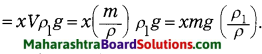
Maharashtra Board Class 8 Science Solutions Chapter 3 Force and Pressure 26

Question 57.
Using the formula for the magnitude of the buoyant force, state under what conditions the body will
1. sink in the fluid
2. float in the fluid
3. remain in equilibrium anywhere within the fluid.
Answer:
Magnitude of the buoyant force on the body = mg \(\left(\frac{\rho_{1}}{\rho}\right)\)
= magnitude of the weight of the body × \(\left(\frac{\rho_{1}}{\rho}\right)\)
1. If the density of the fluid (ρ1) is less than the density of the body (ρ), the magnitude of the buoyant force on the body will be less than the magnitude of the weight of the body. Therefore, the body will sink in the fluid.|

2. If the density of the fluid is greater than that of the body, the magnitude of the buoyant force on the body will be greater than that of the weight of the body. Therefore, the body will float in the fluid.

3. If the density of the fluid is equal to that of the body, the magnitude of the buoyant force on the body will be equal to that of the weight of the body. Therefore, the body will remain in equilibrium anywhere within the fluid.

Use your brain power!

Question.
Explain the observations in the earlier experiments according to the Archimedes’ principle.
Answer:
The increase in the length of the rubberband (y) is proportional to the downward force (f) acting on it.
1. When the stone tied to the rubberband is hanging in air, the magnitude of the buoyant force exerted by air on the stone is negligible compared to that of the weight of the stone. Hence, ignoring it, we have f = fg = mg, where m is the mass of the stone and g is the acceleration due to gravity.

2. When the stone is immersed partially in water, f = fg – fb, where fb is the magnitude of the buoyant force exerted by water on the stone.
Now, fg = Vρg and fb = xVρwg, where V = volume of the stone, ρ = density of the stone, xV= volume of the water displaced by the part of the stone immersed in water = volume of the part of the stone immersed in water (x < 1) and ρ = density of water.
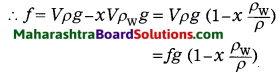
Maharashtra Board Class 8 Science Solutions Chapter 3 Force and Pressure 27
This shows that as the stone is gradually lowered in water, x goes on increasing and hence/goes on decreasing. Therefore, elongation (y) of the rubberband goes on decreasing, i.e., the length of the rubberband goes on decreasing.

3. When the stone is completely immersed in water, x becomes maximum, equal to 1. Here, f = fg \(\left(1-\frac{\rho_{\mathrm{W}}}{\rho}\right)\). This is the minimum value of. Here, the elongation of the rubberband is minimum, i.e., the length of the rubberband is minimum.

Maharashtra Board Class 8 Science Solutions Chapter 3 Force and Pressure

Question 58.
State the applications of Archimedes’ principle.
Answer:
Archimedes’ principle is used in the construction of ships and submarines. The working of the lactometer and hydrometer is based on Archimedes’ principle.
[Note: The hydrometer is used to determine the density or relative density of a liquid.]

Question 59.
If a spring balance is used to weigh a body, will the weight of the body be the same in vacuum and air? Explain why.
Answer:
When a body is suspended in air, the buoyant force acts on the body. Hence, the magnitude of the net downward force on 1 the body = the magnitude of the weight of the body – the magnitude of the buoyant force on the body. Hence, when a spring balance is used to weigh a body, the weight of the body in air is less than that in vacuum.

Question 60.
What is density of a substance? I Obtain its SI unit.
Answer:
The density of a substance is the ratio of its mass to volume.
The SI unit of density = \(\frac{\text { the SI unit of mass }}{\text { the SI unit of volume }}\) = kg/m3
[Note: Density is useful in determining the purity of a substance. The CGS unit of density is g/cm3.
1 kg/m3 = 103g/(100 cm)3 = 10-3g/cm3
∴ 1g/cm3 = 1000 kg/m3]

Question 61.
What is relative density of a substance?
Answer:
The relative density of a substance is the ratio of its density to the density of water.
[Note: Relative density is also called specific gravity. It is a ratio of two equal (same) physical quantities. Hence, it has no unit.]

Question 62.
A piece of wood floats both in water and kerosine. In which liquid does it sink more during floating? Why?
Answer:
The piece of wood sinks more in kerosine than in water during floating. The density of kerosine is less than that of water. The buoyant force on a body is proportional to the density of the liquid in which the body is immersed. When a body floats, the magnitude of the buoyant force acting on the body is equal to that of the weight of the body.

Hence, the volume of the liquid displaced by a floating body is inversely proportional to the density of the liquid. As a result, when a piece of wood floats in kerosine, it displaces greater volume of kerosine compared to the volume of water displaced when the piece of wood floats in water. Hence, it sinks more in kerosine than in water.
[Note: When a body floats in a liquid fb = fg
∴ Vρ1g = Vbρbg
∴ The volume of the liquid displaced by the body is V = Vb \(\frac{\rho_{\mathrm{W}}}{\rho_{1}}\), where Vb is the volume of the body, ρb is the density of the material of the body and ρ1 is the density of the liquid. Thus, V ∝ 1 /ρ1]

Maharashtra Board Class 8 Science Solutions Chapter 3 Force and Pressure

Question 63.
State whether the body will float or sink in a liquid if the density of the body is 1. greater than that of the liquid 2. less than that of the liquid 3. equal to that of the liquid.
Answer:

  1. The body will sink in the liquid if the density of the body is greater than that of the liquid.
  2. The body will float in the liquid if the density of the body is less than that of the liquid.
  3. The body will float inside the liquid if the density of the body is equal to that of the liquid.

Question 64.
If the relative density of a body is greater than 1, will it float in water?
Answer:
If the relative density of a body is greater than 1, it will not float in water.
[Note: The relative density of a pin is much greater than 1. But when kept gently on the surface of water, it floats. This is due to the surface tension of water.]

Question 65.
A glass of water has an ice cube floating in water. The water level must touches the rim of the glass. Will the water overflow when the ice melts? Give the reason.
Answer:
The water will not overflow when the ice melts. The water level will remain the same. Ice floats on water because its density is less than that of water. When ice melts, the volume of the water formed is less than the volume of the ice which has melted.

When ice in water melts, this difference equals the volume of the water formed when the part of ice above the surface of water melts. Therefore, the water level remains the same. Hence, there is no overflow of water when the ice melts.

Question 66.
A plastic ball is released underwater. State whether it will sink or come up to the surface of water. Give the reason.
Answer:
A plastic ball released under water will come up to the surface of water. The density of water is greater than that of plastic. Hence, when a plastic ball is under water, the magnitude of the buoyant force exerted by water on the ball is greater than the magnitude of the weight of the ball.

Therefore, the ball will start moving upward. As it comes up with part of the ball above the water surface, the volume of the water displaced by the ball becomes less and hence at a certain stage, the buoyant force and the weight balance each other. Then the ball continues to remain in that state, as the net force on the ball becomes zero.
[Note: Initially, the ball moves slightly up and down near the water surface. The force due to friction with water, opposing the motion of the ball, finally makes the ball steady.]

Write short notes:

Question 1.
Buoyant force.
Answer:
1. When a body is immersed partially or completely in a liquid, the liquid exerts forces on all sides of the body. This force is perpendicular to the surface of the body and equals the product of pressure and area at that point.

2. The resultant of all these forces acts upward. It is called the upthrust or buoyant force.

3. The buoyant force is proportional to (i) the volume of the liquid displaced by the body (ii) the density of the liquid (iii) the acceleration due to gravity. Its magnitude equals the magnitude of the weight of the liquid displaced by the body.

Maharashtra Board Class 8 Science Solutions Chapter 3 Force and Pressure

Question 2.
Applications of Archimedes’ principle.
Answer:
1. The working of a lactometer, a device used to determine the purity of a sample of milk, and a hydrometer, a device used to determine the density of a liquid, is based on Archimedes’ principle. The extent to which a lactometer floats (or sinks) depends on the density (and hence purity) of the milk. The same thing is true for a hydrometer. The greater the density of a liquid, the less is the extent to which a body sinks in it.

2. Archimedes’ principle is used in design of ships and submarines. A submarine is provided with large tanks at the front and the back. Its weight can be increased by filling the tanks with sea water or air from compressed air reservoirs. The weight can be decreased by pumping out water from the tanks by forcing compressed air in them. By controlling the weight, it can be made to sink or rise to the surface as desired.

3. The density of a body that floats or sinks in water or kerosine can be determined by. Archimedes’ principle.
4. The density of kerosine can be determined by Archimedes’ principle, using a body of material that is not affected by water and kerosine.

Give scientific reasons:

Question 1.
The tiles are placed over a slushy patch of ground to help cross It.
Answer:

  1. Tiles have greater area than the area of our feet.
  2. The weight of the person crossing the slushy patch is exerted over a large area of the tiles.
  3. Therefore, there is a decrease in the pressure and hence the tiles do not sink much in the slushy patch of ground. This helps to cross the slushy patch of ground.

[Note: If there were no tiles, the feet will come in direct contact with the slushy ground. The area of the feet being less, the weight of the person will act over a smaller area. Therefore. there will be more pressure and hence the feet will sink into the slushy ground.]

Question 2.
Drawing pins have flattened heads.
Answer:

  1. The head of a drawing pin is flattened and the other end is pointed.
  2. When enough force is applied to the head of the pin, the pressure due to the force on the pointed end increases tremendously and the pin can be easily inserted in the drawing board.
  3. When we press the flattened end, the force applied spreads over a larger area. This reduces the pressure of the reaction force acting on the thumb. Hence, the thumb is not injured.
  4. If the head of the pin is sharp, then the pressure due to the force would be more and hence the pressure of the reaction force would also be more and the sharp end would prick the thumb causing injury.

Question 3.
An iron nail sinks in water but a ship made from iron floats on water.
Answer:
1. An iron nail sinks in water because its density is more than that of water.
2. A ship made from iron, due to the particular shape given to it, displaces a large amount of water so that the buoyant force acting on the ship due to water balances the weight of the ship. Hence, the ship floats on water.

Maharashtra Board Class 8 Science Solutions Chapter 3 Force and Pressure

Question 4.
A piece of iron sinks in water but floats on mercury.
Answer:
The density of iron is more than that of water but less than that of mercury. Hence, a piece of iron sinks in water but floats on mercury.

Question 5.
A sheet of metal that sinks in water can float if shaped like a pan.
Answer:

  1. A sheet of metal sinks in water because its density is more than that of water.
  2. If the sheet is shaped like a pan, it can displace a large amount of water such that the buoyant force on the pan due to water balances the weight of the pan. Hence, it can float on water.

Solve the following examples:

Problem 1.
(i) Calculate the pressure exerted by the wooden block when it is kept in the vertical position.
Given: The length of the wooden block is 80 cm, the breadth is 50 cm, the thickness is 20 cm and the weight is 500 N
(ii) Also calculate the pressure when the wooden block is kept in the horizontal position with its surface 80 cm × 50 cm touching the floor.
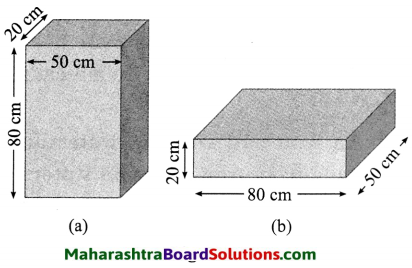
Maharashtra Board Class 8 Science Solutions Chapter 3 Force and Pressure 28
Solution:
Data: F = W = 500 N, l = 80 cm = 0.8 m, b = 50 cm = 0.5 m. h = 20 cm = 0.2 m
(i) A = bh = 0.5 m × 0.2 m = 0.1 m2

Maharashtra Board Class 8 Science Solutions Chapter 3 Force and Pressure 29
The pressure exerted in the vertical position of the block = 5000 N/m2 or 5000 Pa.

(ii) A = lb = 0.8 m × 0.5 m = 0.4 m2

Maharashtra Board Class 8 Science Solutions Chapter 3 Force and Pressure 30
The pressure exerted in the horizontal position of the block = 1250 N/m2 or 1250 Pa.

Problem 2.
Measure the length, breadth, height and mass of a rectangular tiffin box. Find the weight of the box and calculate the pressure in two different positions as in Ex. (1) above.
Solution:
Let l = 0.25 m, 6 = 0.1 m, h = 0.05 m, F = W= 0.5 N
(i) A = bh = 0.1 m × 0.05 m = 0.005 m2

Maharashtra Board Class 8 Science Solutions Chapter 3 Force and Pressure 31

(ii) A = lb = 0.25 m × 0.1 m = 0.025 m2

Maharashtra Board Class 8 Science Solutions Chapter 3 Force and Pressure 32

Maharashtra Board Class 8 Science Solutions Chapter 3 Force and Pressure

Problem 3.
A force of 1000 N is applied over an area 50 cm × 20 cm. Find the corresponding pressure.
Solution:
Data: F = 1000 N,
A = 50 cm × 20 cm = 0.5 m × 0.2 m = 0.1 m2, pressure = ?

Maharashtra Board Class 8 Science Solutions Chapter 3 Force and Pressure 33
The pressure = 10 N/m2.

Problem 4.
A metal block has thmensions 10 cm × 5 cm × 2 cm and the density of the metal is 8 × 10³ kg/m3. It is kept on a table with the face 10 cm × 5 cm in contact with the table. Find the force and pressure exerted by the block on the table. (g = 9.8 m/s2)
Solution :
Data : 1 = 10 cm, b = 5 cm,
h = 2 cm, p= 8 × 10 kg/m3, g = 9.8 m/s2,
A = lb = 10cm × 5cm = 50cm2 = 50 × 104m2
= 5 × 10⁻⁵m2, force =?, pressure = ?
Volume of the block = lbh =
10 cm × 5 cm × 2 cm= 100 cm3
= 100 × 10-6 m3 = 1 × 10⁻⁴m3
Mass of the block = volume × density
(∵ density = mass/volume)
∴Mass of the block,
m = 1 × 10⁻⁴ m3× 8 × 103 kg/m3 = 0.8 kg
Weight of the block = mg = 0.8 kg × 9.8 m/s2 = 7.84 N
∴ The force exerted by the block on the table = 7.84 N.
force 7.84 N
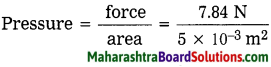
Maharashtra Board Class 8 Science Solutions Chapter 3 Force and Pressure 43
= 1.568 × 10³ N/m2 or 1.568 × 10³ Pa
The pressure exerted by the block on the table = 1.568 × 10 N/m2 or 1.568 × 10³ Pa.

Problem 5.
A body of volume loo cm3 is immersed completely in water. Find the weight of the water displaced by the body. 1g = 9.8 m/s2. p (water) = kg/m3]
Solution :
Data: V = 100 cm3 = 100 × 10-6 m3
= 1 × 10 m3, p(water) = 10 kg/m3
g = 9.8 m/s2, weight of the displaced water ?
Density = \(\frac{\text { mass }}{\text { volume }}\)
∴ Mass = volume × density
Volume of the water displaced by the body = l × 10-4 m3
∴Mass of the water displaced,
m = l × 10-4 m3 × 10 kg/m3 = 0.1 kg
∴Weight of the water displaced
= mg = 0.1 kg × 9.8 m/s2 = 0.98 N.
The weight of the water displaced by the body = 0.98 N.

Maharashtra Board Class 8 Science Solutions Chapter 3 Force and Pressure

Problem 6.
A body of mass 200 g and volume 50 cm3 is put in a bucket containing water. Will it float or sink ?
[ρ(water) = 1 g/cm3]
Solution:
Data: m = 200 g, V= 50 cm3,
ρ (water) = 1 g/cm3
Density(ρ) = \(\frac{\text { mass }}{\text { volume }}\)
∴ ρ (body) = \(\frac{200}{50 \mathrm{~cm}^{3}}\)
It is greater than the density of water.
Hence, the body will sink in water.

Problem 7.
A body of mass 200 g and volume 400 cm3 is put in a bucket containing water. Will it float or sink?
[ρ (water)=1 g/cm3]
Solution:
Proceed as above.
ρ (body) = \(\frac{200 \mathrm{~g}}{400 \mathrm{~cm}^{3}}\) = 0.5 g/cm3
It is less than the density of water.
∴ The body will float in water.

Problem 8.
The mass of a tile is 500 g. If the density of the tile is 2.5 g/cm3, what will be the weight of the tile when it is completely immersed in water?
(g = 9.8 m/s2, ρ(water) = 1000 kg/m3)
Solut10n:
Data: m = 500, g = 0.5 kg, ρ
(tile) = 2.5 g/cm3 = 2500 kg/m3, g = 9.8 m/s2,
ρ (water) = 1000 kg/m3, weight of the tile when completely immersed in water (also called the apparent weight) = ?
ρ = \(\frac{m}{V}\)
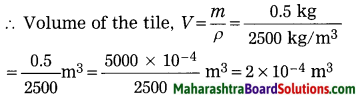
Maharashtra Board Class 8 Science Solutions Chapter 3 Force and Pressure 44
∴ Volume of water displaced by the tile
= 2 × 10⁻⁴ m3
∴ Mass of water displaced by the tile
m’ = ρ (water) V = 1000 kg/m3 × 2 × 10-4 m3
= 0.2kg
∴ Magnitude of the weight of this water
= mg = 0.2 kg × 9.8 m/s2 = 1.96 N
∴ Buoyant force exerted on the tile = 1.96 N
Magnitude of the weight of the tile =
mg = 0.5 kg × 9.8 m/s2 = 4.9 N
∴ Weight of the tile when completely immersed in water (apparent weight) = weight of the tile in air-buoyant force on the tile
= 4.9 N – 1.96 N = 2.94 N(downward)

Maharashtra Board Class 8 Science Solutions Chapter 3 Force and Pressure

Examples For Practice:

[g = 9.8 m/s2, ρ (water) = 103 kg/m3 = 1 g/cm3]

Question 1.
Calculate the relative density of a metal having density 7.5 g/cm3.
Answer:
7.5

Question 2.
Find the density of steel if its relative density is 8 and the density of water is 10 kg/m3.
Answer:
8 × 10³ g/cm3

Question 3.
A body has mass 200 g and volume 100 cm3. Find its density and relative density.
Answer:
2 g/cm3, 2

Question 4.
If the relative density of a material is 2.5, find its density.
Answer:
2.5 × kg/m3 or 2.5 g/cm3

Question 5.
A force of 100 N is applied on an area 40 cm × 25cm. Find the corresponding pressure.
Answer:
103 N/m2

Maharashtra Board Class 8 Science Solutions Chapter 3 Force and Pressure

Question 6.
If the pressure exerted on an area 10 cm × 10 cm is 1000 dynes/cm2, find the applied force.
Answer:
105 dynes

Question 7.
A metal block of mass 10 kg is kept on a table. If the contact surface area Is 100 cm2, find the pressure on the table.
Answer:
9.8 × 10³ N/m2 or 9.8 × 10³ Pa

Question 8.
A body of volu.me 50 cm3 is immersed completely in water. Find the weight of the water displaced by the body.
Answer:
0.49 N

Question 9.
A block of mass 100 g and volume 20 cm3 is put in a bucket filled with water. Will it float or sink?
Answer:
The body will sink in water.

Question 10.
Will a block of mass 100g and volume 400 cm3 float or sink in water?
Answer:
The block will float in water.

Question 11.
The volume of a cube is 125 cm3 and its mass is 250 g. It is put in a tub containing water. Will it float or sink?
Answer:
It will sink in water.

Maharashtra Board Class 9 Political Science Solutions Chapter 1 Post World War Political Developments

Balbharti Maharashtra State Board Class 9 Political Science Solutions Chapter 1 Post World War Political Developments Notes, Textbook Exercise Important Questions and Answers.

Maharashtra State Board Class 9 Political Science Solutions Chapter 1 Post World War Political Developments

Class 9 Political Science Chapter 1 Post World War Political Developments Textbook Questions and Answers

1A. Choose the right option and rewrite the sentence:

Question 1.
A system of independent and sovereign states ___.
(a) Political system
(b) International system
(c) Social system
(d) None of these
Answer:
(b) International system

Maharashtra Board Class Maharashtra Board Class 9 Political Science Solutions Chapter 1 Post World War Political Developments

Question 2.
The main responsibility of the United Nations ____.
(a) to avoid war
(b) independence of colonies
(c) improving the economics of different nations
(d) disarmament
Answer:
(a) to avoid war

Question 3.
The Cold War ended with the event, _____.
(a) Establishment of the United Nations
(b) Disintegration of the Soviet Union
(c) Creation of Military Organisations
(d) Cuban Missile Crisis
Answer:
(b) Disintegration of the Soviet Union

2. Explain with reasons whether the following statements are true or false:

Question 1.
The League of Nations was established after the First World War.
Answer:
True.

  • At the end of the First World War, all the nations felt that such a war should not happen again and some measures need to be taken to achieve that end.
  • An international organisation called the League of Nations was established out of this thinking.
  • It became an important platform to solve international disputes and carry out negotiations.
  • The main responsibility of the League of Nations was understood to be to avoid war.

Question 2.
The world became unipolar due to the Cold War.
Answer:
False.

  • During the Cold War, most countries of the world joined either of the two super power blocs (USA or USSR).
  • Such a division of the nations of the world in two groups is bipolarisation.

Question 3.
The policies of Mikhail Gorbachev gave an impetus to democratisation.
Answer:
True.

  • The Soviet Union adopted the policy of opening up the economy. The state loosened up its control of the economy.
  • The then President of the Soviet Union Mikhail Gorbachev implemented the policies of Perestroika (Restructuring) and Glasnost (Openness).
  • Due to these policies, the control over the media reduced.
  • Important changes took place in political and economic spheres, i.e. these spheres, were restructured. This gave impetus to democracy.

Maharashtra Board Class Maharashtra Board Class 9 Political Science Solutions Chapter 1 Post World War Political Developments

3. Explain the following concepts:

Question 1.
Cold War
Answer:
(i) America and the Soviet Union, who were allies in the Second World War became competitors, as soon as the war was over.

(ii) The cooperation between them gave way to rivalry. This rivalry occupied a period of 40-45 years of international politics

(iii) There was no open war between these two countries; but there was such tension in their relations, that it seemed that a war would erupt any time.

(iv) The concept of Cold War is used to describe the condition where there is no actual war, but there are such tensions in the circumstances, that they may be responsible to cause war.

(v) In this period, America was already a super power, but the Soviet Union also tried to become a super power by making nuclear weapons and by increasing its military might.

(vi) The struggle for power, arms race, differences in ideologies, attitude of checkmating each other by strategies and counter-strategies gave rise to the Cold War.

Question 2.
Non-Aligned Movement
Answer:
(i) In the period of the Cold War, while the world was becoming bipolar, there were some countries which did not want to join the super power rivalry. Such nations decided to stay out of the cold war rivalry. Their policy is known as non-alignment.

(ii) The Asian and African countries, which became independent after the Second World War supported the idea of non-alignment.

(iii) This movement started from 1961 under the leadership of India’s Prime Minister Pandit Jawaharlal Nehru, President of Yugoslavia Marshall Tito, President of Egypt Gamal Abdal Nasser, President of Indonesia Dr. Sukarno and Prime Minister of Ghana Dr. Kwame Nkrumah.

(iv) The non-aligned Movement has opposed colonialism, imperialism and racism. It has encouraged the resolution of international disputes by peaceful means.

(v) India led this movement under the guidance of Pandit Jawaharlal Nehru. India continued to actively support the movement afterwards as well.

(vi) Even after the end of the Cold War, the importance of the movement has not reduced. The non-aligned movement is based on eternal principles of humanism, global peace and equality.

(vii) It has inspired the less developed countries to come together. It has encouraged the resolution of international disputes by peaceful means.

(viii) While taking a firm stand on disarmament, fostering human rights, the non-aligned movement put forth the problems of poor, undeveloped countries firmly. This movement made a demand of a New International Economic Order (NIEO).

Question 3.
Interdependence
Answer:
(i) All the countries of the world are dependent on each other for one reason or the other. However big, prosperous or developed a nation may be, it can never be self-sufficient to fulfill all its needs.

(ii) Even big nations have to depend upon other big and small nations. Thus, interdependence is an important feature of the international system, i.e. today’s global system.

Question 4.
Bipolarisation
Answer:
During the Cold War, most countries of the world joined either of the two super power blocks. Such a division of the nations of the world in two groups is bipolarisation.

Question 5.
Globalization
Answer:
(i) After the end of the Cold War, trade and economic relations between countries became more open. As it has been mentioned before, capital, labour, markets and information began circulating globally.

(ii) The give and take of ideas among people all over the world grew.

(iii) Due to the revolution in information technology, different events and developments began to be known everywhere.

(iv) The boundaries between nations did not remain as sacrosanct as they were before. All these processes are together called globalisation.

(v) Just as globalisation has brought us benefits, it has also caused losses. For example, as the economies of different countries got linked with each other, trade increased, economic unification grew, plenty of products became available in the markets; but (at the same time) the gap between the poor and rich nations did not reduce.

Maharashtra Board Class Maharashtra Board Class 9 Political Science Solutions Chapter 1 Post World War Political Developments

4. Give your opinion on the following topics:

Question 1.
What measures should the League of Nations have taken to avoid the Second World War?
Answer:
(i) League of Nations should have organised a military wing with the help of member nations to keep a check over the aggressors like Germany and Japan.

(ii) League should have reconsidered implementation of harsh term of treaties imposed on the losers to avoid the revengeful policies of dictators like Adolf Hitler.

Question 2.
Non-Alignment was necessary during the Cold War.
Answer:
(i) Yes. This was important to keep newly independent countries of Asia and Africa away from the super power rivalry.

(ii) Since these countries did not officially show allegiance to any super power, they freed themselves from the dominance of USA and USSR and could independently frame their foreign policies.

(iii) This further promoted peace and co-operation.

Question 3.
Human welfare was neglected due to the Cold War.
Answer:
(i) Yes, due to military alliances the world was gripped in the fear of a possible Third World War, which would have annihilated the entire human race.

(ii) Moreover the Arms Race diverted the resources and harnessed science for destruction rather than human welfare.

Question 4.
Which countries can emerge as super powers, in competition with America in present times?
Answer:
India and China could be future super powers.

5. Write brief answers:

Question 1.
Compare the First World War and the Second World War with the help of the following points.

PointsFirst World WarSecond World War
(1) Period
(2) Involved nations
(3) Impacts (Political and Economic)
(4) International Organisations established after the War

Answer:

PointsFirst World WarSecond World War
(1) Period1914-19181939 -1945
(2) Involved nationsAllied Powers – Britain, France, Russia, Italy, America Central Powers – Germany, Austria, Hungary, Ottoman Empire, BulgariaAllied Powers – Britain, France, Australia, Canada, New Zealand, India, Soviet Union, China, America Axis powers – Germany, Japan, Italy
(3) Impacts (Political and Economic)(i) Earlier empires in Europe collapsed and new nations came into being.(i) Beginning of Cold War
(ii) Independence movements in European colonies changed hegemony of European Nations.(ii) Destruction of public property on larger scale due to use of nuclear weapons
(iii) League of nations was established.
(iv) Autocratic regime came up in Germany, Spain, Italy and other countries.
(v) Destruction of public property.
(4) International Organisations established after the WarLeague of NationsUnited Nations Organisation

Maharashtra Board Class Maharashtra Board Class 9 Political Science Solutions Chapter 1 Post World War Political Developments

Question 2.
What were the factors responsible for the end of Cold War?
Answer:
The factors responsible for the end of Cold War are:

(i) The Soviet Union adopted the policy of opening up the economy. The State loosened up its control of the economy.

(ii) The then President of the Soviet Union Mikhail Gorbachev implemented the policies of Perestroika (Restructuring) and Glasnost (Openness). Due to these policies, the control over the media reduced.

(iii) As the East European countries under the influence of the Soviet Union adopted the capitalist and democratic paths, the Soviet Union disintegrated and several new nations were created out of it.

Question 3.
What major changes occurred in global politics after the end of the Cold War?
Answer:
(i) Major changes took place in world politics after the end of the Cold War. For example, America remained the only super power in world politics.

(ii) A conducive atmosphere prevailed for the growth in trade and economic relations between and among nations.

(iii) As all nations of the world decided to give priority to trade relations, the idea of giving ‘aid’ to other nations fell behind.

(iv) The United Nations now had to take more concrete steps to maintain global peace and security.

(v) Environmental protection, fostering of human rights, gender equality and management of natural calamities now acquired a global dimension.

Class 9 Political Science Chapter 1 Post World War Political Developments Additional Important Questions and Answers

Choose the correct option from the given options and rewrite the sentence:

Question 1.
President of Soviet Union who implemented ‘Perestroika’ and ‘Glasnost’ ______.
(a) Nikita Khrushchev
(b) Mikhail Gorbachev
(c) General Molotov
(d) Vladimir Lenin
Answer:
(b) Mikhail Gorbachev

Question 2.
Military organisation formed under dominance of USA ______.
(a) North Atlantic Treaty Organisation
(b) Warsaw Pact
(c) New International Economic Order
(d) Non-Aligned Movement
Answer:
(a) North Atlantic Treaty Organisation

Question 3.
Division of world into two power blocs is called ______.
(a) Globalisation
(b) Nuclear Escalation
(c) Bipolarisation
(d) Internationalism
Answer:
(c) Bipolarisation

Question 4.
Among the following ________ is not an Axis Power.
(a) Germany
(b) Italy
(c) Belgium
(d) Japan
Answer:
(c) Belgium

Question 5.
______ is an important event of the Cold War.
(a) Fashoda Incident
(b) Cuban Missile Crisis
(c) Wall Street Crash
(d) Red Menace
Answer:
(b) Cuban Missile Crisis

Maharashtra Board Class Maharashtra Board Class 9 Political Science Solutions Chapter 1 Post World War Political Developments

Question 6.
Non-aligned movement is opposed to ____.
(a) Racism
(b) Capitalism
(c) McCarthyism
(d) Nepotism
Answer:
(a) Racism

Question 7.
Non-aligned movement demanded establishment of _______.
(a) Association of South East Asian Nations
(b) League of Nations
(c) New International Economic Order (NIEO)
(d) European Union (EU)
Answer:
(c) New International Economic Order (NIEO)

Question 8.
The policy of Perestroika means restructuring and Glasnost means ______.
(a) strictness
(b) oneness
(c) massiveness
(d) openness
Answer:
(d) openness

State whether the following statements are True or False, with reasons:

Question 1.
A system of Independent States is called International System.
Answer:
True.

  • Our social life and well being is dependent on others and mutual co-operation has a very important place in it.
  • The same is true about society, and it applies to different nations as well. There are many independent nations in the world, like India.
  • Some exchange and interaction goes on among these nations on a regular basis. These independent states also enter into treaties with each other.
  • A system of all these independent, sovereign states that emerges is called an International System.

Question 2.
Interdependence is not an important feature of the International System.
Answer:
False.

  • All the countries of the world are dependent on each other for one reason or the other. However big, prosperous or developed a nation may be, it can never be self-sufficient to fulfill all its needs.
  • Even big nations have to depend upon each other and on smaller nations. Thus, interdependence is an important feature of the international system, i.e. today’s global system.

Question 3.
The Second World War proved to be far more destructive than the First World War.
Answer:
True.

  • The Second World War was fought between 1939 and 1945. It proved to be far more destructive than the First World War.
  • Not only was it more widespread compared to the First World War, but far more advanced technology was employed in this war.
  • Countries which took part in the Second World War once again faced a situation of economic crisis.

Maharashtra Board Class Maharashtra Board Class 9 Political Science Solutions Chapter 1 Post World War Political Developments

Question 4.
Efforts towards arms control and disarmament happened during the Cold War.
Answer:
True.

  • The Super Powers started producing arms on a large scale to outsmart each other.
  • There started a rivalry to make more and more destructive weapons and to acquire the technology required for the same.
  • But soon, both the Super Powers realised that the arms race may endanger international peace.
  • Hence, efforts towards arms control and disarmament also happened during this period.

Question 5.
Non-alignment was an important movement during the Cold War.
Answer:
True.

  • In the period of the Cold War, while the world was becoming bipolar, there were some countries which did not want to join the super power rivalry.
  • Such nations decided to stay out of the cold war rivalry. Their policy is known as Non-alignment.
  • Non-alignment was an important movement during the Cold War.
  • The Asian and African countries, which became independent after the Second World War supported the idea of non-alignment.

Explain the concept:

Question 1
Military Organisation
Answer:
(i) During the Cold War, power struggle between USSR and USA created need for nations who will support their ideologies.

(ii) Thus, organisations were created for helping nations militarily and thus dragging them into either of the super power blocs for their hegemony.

(iii) The respective super powers took up the responsibility of the security of the countries joining the military organisations led by them.

(iv) NATO (North Atlantic Treaty Organisation) was a military organisation under the dominance of America, while the Warsaw Pact was a military organisation, under the command of the Soviet Union.

Do as directed/instructed:

Complete the charts.

Question 1.
Maharashtra Board Class 9 Political Science Solutions Chapter 1 Post World War Political Developments 5
Answer:
Maharashtra Board Class 9 Political Science Solutions Chapter 1 Post World War Political Developments 1

Maharashtra Board Class Maharashtra Board Class 9 Political Science Solutions Chapter 1 Post World War Political Developments

Question 2.
Maharashtra Board Class 9 Political Science Solutions Chapter 1 Post World War Political Developments 6
Answer:
Maharashtra Board Class 9 Political Science Solutions Chapter 1 Post World War Political Developments 2

Question 3.
Maharashtra Board Class 9 Political Science Solutions Chapter 1 Post World War Political Developments 7
Answer:
Maharashtra Board Class 9 Political Science Solutions Chapter 1 Post World War Political Developments 3

Answer in brief:

Question 1.
What were the effects of World War I?
Answer:
(i) The First World War was fought between 1914 and 1918. The war caused a tremendous loss of life and property. The countries which joined the war suffered tremendous economic losses.

(ii) Even the countries which did not join the war were impacted by the war. The economies of the victorious as well as the losing countries collapsed.

(iii) Earlier empires in Europe collapsed and new nations came into being.

(iv) Independence movements in European colonies changed hegemony of European Nations.

(v) League of Nations was established.

(vi) Autocratic regime came up in Germany Spain, Italy and other countries.

Question 2.
Describe America’s role in the Second World War.
Answer:
(i) America played a major role in the Second World War. It had manufactured nuclear weapons.

(ii) In order to end the war, it dropped two nuclear weapons on two cities of Japan – Hiroshima and Nagasaki on 6th and 9th August 1945 respectively.

Maharashtra Board Class Maharashtra Board Class 9 Political Science Solutions Chapter 1 Post World War Political Developments

Question 3.
What gave rise to the Cold War?
Answer:
(i) America was already a super power, but the Soviet Union also tried to become one, by making nuclear weapons and by increasing its military might.

(ii) The struggle for power, arms race, differences in ideologies, attitude of checkmating each other by strategies and counter-strategies gave rise to the Cold War.

Question 4.
Describe extreme differences among USA and USSR.
Answer:
(i) The U.S.A was a democratic State, advocating capitalism, while the Soviet Union advocated socialism and a one party authoritarian system.
(ii) Both the super powers wanted to expand their own dominance in the world.
(iii) America wanted to spread capitalism, while the Soviet Union wanted to spread socialism.

Question 5.
What is meant by Non-Aligned Movement and who were its founding fathers?
Answer:
(i) The Asian and African countries, which became independent after the Second World War supported the idea of non-alignment.

(ii) This movement started from 1961 under the leadership of India’s Prime Minister Pandit Jawaharlal Nehru, President of Yugoslavia Marshall Tito, President of Egypt Gamal Abdal Nasser, President of Indonesia Dr. Sukarno and Prime Minister of Ghana Dr. Kwame Nkrumah.

Question 6.
Evaluate the Non-Aligned Movement.
Answer:
(i) The Non-Aligned Movement has opposed colonialism, imperialism and racism.
(ii) It has encouraged the resolution of international disputes by peaceful means.
(iii) The Non-Aligned movement is based on eternal principles of humanism, global peace and equality.
(iv) It has inspired the less developed countries to come together.
(v) While taking a firm stand on disarmament, fostering human rights, the Non-Aligned movement put forth the problems of poor, undeveloped countries firmly.
(vi) This movement made a demand of a New International Economic Order (NIEO).

Maharashtra Board Class 7 History Solutions Chapter 5 The Foundation of the Swaraj

Balbharti Maharashtra State Board Class 7 History Solutions Chapter 5 The Foundation of the Swaraj Notes, Textbook Exercise Important Questions and Answers.

Maharashtra State Board Class 7 History Solutions Chapter 5 The Foundation of the Swaraj

Class 7 History Chapter 5 The Foundation of the Swaraj Textbook Questions and Answers

1. Find the odd man out:

Question 1.
Pune, Supe, Chakan, Bengaluru
Answer:
Bengaluru

Maharashtra Board Class 7 History Solutions Chapter 5 The Foundation of the Swaraj

Question 2.
Jadhavs of Phaltan, Mores of Javali, Ghorpades of Mudhol, Sawants of Sawantwadi
Answer:
Jadhavs of Phaltan

Question 3.
Torana, Murumbdev, Sinhgad,Sindhudurg
Answer:
Sindhudurg.

2. Write about in your words:

Question 1.
The efforts Veermata Jijabai took for Shivaji Maharaj’s education.
Answer:
The following were the efforts Veermata Jijabai took for Shivaji Maharaj’s education.
(i) She instilled in Shivaji the values like modesty, vigilance, truthfulness, oratory, courage and fearlessness.
(ii) She inspired the will to win the dream of Swaraj.

Question 2.
Shivaji Maharaj started his work of founding Swaraj in the Maval region.
Answer:
(i) The Maval terrain was full of hills and valleys and was not easily accessible.
(ii) He made use of these geographical features of Maval very skilfully for the purpose of the foundation of the Swaraj.

3. List the companions and associates of Shivaji Maharaj.
Answer:

  1. Yesaji Kank
  2. Baji Pasalkar
  3. Bapuji Mudgal
  4. Kavji Kondhalkar
  5. Jiva Mahala
  6. Tanaji Malusare
  7. Kanhoji Jedhe
  8. Bajiprabhu Deshpande
  9. Dadaji Narasprabhu Deshpande.
  10. Narhekar Deshpande brothers

Maharashtra Board Class 7 History Solutions Chapter 5 The Foundation of the Swaraj

4. Find out and write:

Question 1.
Why Shahaji Maharaj is termed Swaraj visionary.
Answer: .
(i) Shahajiraje was valiant, courageous, intelligent a great political expert.
(ii) He was an excellent archer.
(iii) He was also an expert in using the sword, patta and spear.
(iv) He loved his subjects.
(v) He had won many regions in Maharashtra, Karnataka and Tamil Nadu. South India was in awe of him.
(vi) While Shivaji and Jijabai were at Bengaluru he had arranged for providing excellent education to Shivaji so as to enable him to become a king.
(vii) He himself aspired to established Swaraj by ousting the powers of foreign people. That is why he is known as Swaraj visionary.

Question 2.
Shivaji Maharaj paid attention to building a Navy.
Answer:
(i) After the conquest of Javali, Kalyan, Bhiwandi, Shivaji Maharaj came in contact with the Siddi, Portuguese and British power on the western Coast.
(ii) He realized that in order to fight these powers, it was necessary to have a strong naval force. Hence Shivaji Maharaj paid attention to raise a Navy.

Question 3.
Shivaji Maharaj entered into a treaty with the Adilshah.
Answer:
(i) On one hand, Aurangzeb had Sent Shaistakhan to invade the Pune Province and on other hand the conflict with Adilshah continued.
(ii) Therefore, Shivaji Maharaj realized that it would hot be prudent to fight both the enemies at the same time.
Therefore Shivaji Maharaj entered into a treaty with the Adilshah.

Maharashtra Board Class 7 History Solutions Chapter 5 The Foundation of the Swaraj

Question 4.
How did Shivaji Maharaj escape from Panhalgad?
Answer:
(i) When Shivaji Maharaj took shelter in Panhala fort, Siddi soldiers laid siege to the fort for about five months.
(ii) Shivaji Maharaj found himself trapped inside the fort.
(iii) Netoji Palkar tried to raise the siege by attacking Siddi’s army from outside.
(iv) He couldn’t succeed as his forces were meagre (inadequate)
(v) Siddi showed no sign of relenting so he decided to have open talks with him.
(vi) Shiva Kashid, a brave youth who resembled Shivaji Maharaj in looks came forward.
(vii) He dressed up like Shivaji Maharaj and sat in a palanquin.
(viii) The palanquin left by the Raj-dindi gate and was captured by Siddi’s army and Kashid sacrificed himself for Swaraj.
(ix) In the meanwhile, Shivaji Maharaj left the fort using another route.

Activities:

  1. Describe a fort you have seen. Suggest measures for conserving a historical site.
  2. Find out what a 7/12 extract means and relate it to the words in the chapter.
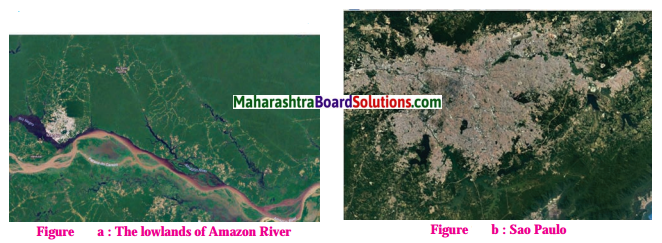
Class 7 History Chapter 5 The Foundation of the Swaraj Additional Important Questions and Answers

Complete the sentence by choosing the appropriate words from the options given below:

Question 1.
Shivaji Maharaj started the work of establishing Swaraj in the ______ region. (Maval, Javali, Chakan)
Answer:
Maval

Question 2.
Jijabai was the daughter of the great Sardar ______ (Shahajiraje, Netaji Palkar, Lakhujiraje)
Answer:
Lakhujiraje

Question 3.
______ was the first capital of Swaraj. (Pratapgad, Rajgad, Panhala)
Answer:
Rajgad

Question 4.
Shivaji Maharaj renamed Khelna as ______.(Vishalgad, Pratapgad, Rajgad)
Answer:
Vishalgad

Question 5.
The Adilshah gave Siddi the title of _____ (Salabatkhan, Adilshahi, Nizamshahi)
Answer:
Salabatkhan

Question 6.
Badi Sahiba sent ______ to curb Shivaji Maharaj. (Nizamshah, Afzalkhan, Shaistakhan)
Answer:
Afzalkhan

Question 7.
________ was a pre-eminent Sardar in the Deccan.(Lakhujiraje, Bajiprabhu Deshpande, Shahajiraje)
Answer:
Shahajiraje

Question 8.
The Nizamshahi came to an’end in _______. (1636 CE, 1648 CE, 1630 CE)
Answer:
1636 CE

Question 9.
Shahajiraje sent ______ and _______ from Bangalore to Pune with some loyal and competent associates. (Yesaji Rank and Jiva Mahala, Dalvi and Surve, Shivaji and Jijabai)
Answer:
Shivaji and Jijabai

Maharashtra Board Class 7 History Solutions Chapter 5 The Foundation of the Swaraj

Question 10.
Shivaji Maharaj took shelter in the _______ Fort. (Rajgad, Panhala, Vishalgad)
Answer:
Panhala

Match the following:

Question 1.

Column ‘A’Column ‘B’
(1) Nizamshahi came to an end(a) 1660 CE
(2) Shivaji’s birth date(b) 10th November 1659
(3) A meeting between Shivaji and Afzalkhan(c) 1636 CE
(4) Siddi Jauhar attacked on Shivaji Maharaj(d) 19th February 1630.

Answer:
1 – c
2 – d
3 – b
4 – a

Question 2.

Column ‘A’Column ‘B’
(1) Shivneri(a) Javali Valley
(2) Pratapgad(b) Siege by Siddi Jauhar
(3) Raigad(c) Birth place of Shivaji Maharaj
(4) Panhalgad(d) The first capital of the Swaraj

Answer:
1 – c
2 – a
3 – d
4 – b

Arrange in chronological order:

Question 1.
(i) A treaty with Adilshah
(ii) Defeat of Afzalkhan
(iii) Shivaji Maharaj captured Javali
(iv) Shivaji Maharaj escaped from Panhala Fort
Answer:
(i) Shivaji Maharaj captured Javali
(ii) Defeat of Afzalkhan
(iii) Shivaji Maharaj escaped from Panhala Fort
(iv) A treaty with Adilshah

Maharashtra Board Class 7 History Solutions Chapter 5 The Foundation of the Swaraj

Question 2.
(i) Meeting with Afzalkhan
(ii) End of Nizamshahi
(iii) Siege to Panhala
(iv) Attack on Javali
Answer:
(i) End of Nizamshahi (1636 CE)
(ii) Attack on Javali (1656 CE)
(iii) Meeting with Afzalkhan (1659 CE)
(iv) Siege to Panhala (1660 CE)

Question 3.
(i) Siddi Jauhar marched against Shivaji Maharaj
(ii) Birth of Shivaji Maharaj
(iii) Shivaji Maharaj built Pratapgad
(iv) Shahajiraje became a Sardar of Adilshah
Answer:
(i) Birth of Shivaji Maharaj
(ii) Shahajiraje became a Sardar of Adilshah
(iii) Shivaji Maharaj built Pratapgad
(iv) Siddi Jauhar marched against Shivaji Maharaj

Answer the following in one sentence:

Question 1.
What were the extraordinary qualities of Shahajiraje.
Answer:
Shahajiraje was a valiant, courageous, intelligent and a great political leader.
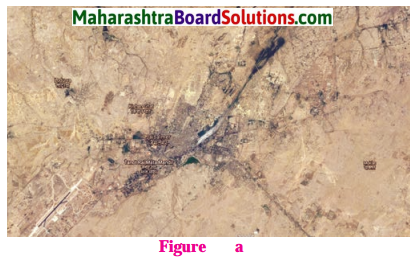
Question 2.
Which Jagirs were granted to Shahajiraje from Nizamshah?
Answer:
Shahajiraje was granted the jagirs of Pune, Supe, Indapur and Chakan parganas located between the Bheema and Neera rivers.

Question 3.
Who was Afzalkhan?
Answer:
Afzalkhan was a powerful and experienced Adilshahi General.

Question 4.
Which forts did Shivaji Maharaj capture while laying the foundation of Swaraj?
Answer:
Shivaji Maharaj captured the forts of Torana, Murumbdev, Kondhana and Purandar while laying the foundation of Swaraj.

Maharashtra Board Class 7 History Solutions Chapter 5 The Foundation of the Swaraj

Question 5.
Whom did Shahajiraje entrust the jagir of Pune?
Answer:
Shahajiraje entrusted the jagir of Pune to Shivajiraje and Veermata Jijabai.

Question 6.
Who was looking after the administration of the Adilshahi?
Answer:
Badi Sahiba was looking after the administration of the Adilshahi.

Question 7.
Whom did Badi Sahiba send to curb Shivaji Maharaj?
Answer:
Badi Sahiba sent Afzalkhan, a powerful and experienced Adilshahi General to curb Shivaji Maharaj.

Question 8.
What is inscribed on the Royal Seal?
Answer:
Shivaji Maharaja’s objective of establishing Swaraj was clearly expressed in his Royal Seal.

Question 9.
Who was Chandrarao More?
Answer:
Chandrarao More of Javali in Satara district was a powerful Sardar in the Adilshahi, who was against the founding of the Swaraj.

Question 10.
When was Shivaji Maharaj bom?
Answer:
Shivaji Maharaj was bom on 19th February, 1630 and as per Hindu Calendar on Phagun Vadya Tritiya, Shaka year 1551.

Find the odd man out:

Question 1.
Yesaji Kank, Baji Pasalkar, Tanaji Malusare the Mores of Javali
Answer:
The Mores of Javali.

Maharashtra Board Class 7 History Solutions Chapter 5 The Foundation of the Swaraj

Question 2.
Portuguese, Siddi, British, Mughals
Answer:
Mughals

Give reasons for the following:

Question 1.
Shivaji Maharaj decided to acquire the forts that were within his own jagir.
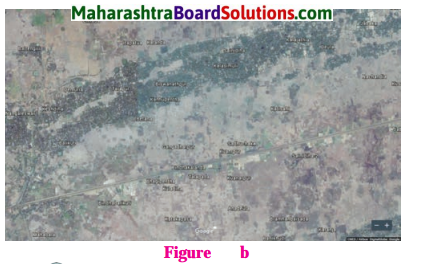
Answer:

  • The forts situated within the jagir of Shivaji Maharaj were not under his control but were under the control of Adilshah.
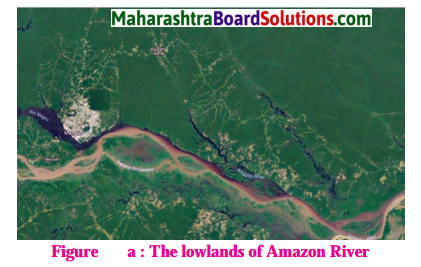
  • In those days, forts were of special significance.
  • With a firm hold over a fort, it was possible to control the surrounding area. Hence, Shivaji Maharaj decided to acquire the forts that were within his own jagir.

Question 2.
Conquest of Javali increased Shivaji Maharaj strength in all respects.
Answer:

  • Shivaji Maharaj attacked Javali and captured the region in 1656 CE.
  • Shivaji Maharaj established his post in Javali.
  • He also captured Raigad. He attained a huge wealth from Javali.
  • After this victory, his activities in Konkan increased.
  • He built the Pratapgad fort in the Javali valley.
  • In this way, the conquest of Javali increased his strength in all respects.

Question 3.
Bajiprabhu dies a hero’s death.
Answer:

  • Shivaji Maharaj left the fort using another difficult route.
  • He was accompanied by Bajiprabhu Deshpande and some chosen soldiers.
  • Bajiprabhu army pursued Shivaji Maharaj.
  • Shivaji Maharaj entrusted the responsibility of stopping Siddi’s army at the foot of Vishalgad to Bajiprabhu Deshpande.
  • Bajiprabhu Deshpande checked Siddi’s army at the Ghod pass near Gajapur.
  • He fought with the greatest valour.
  • Bajiprabhu died a hero’s death in the battle.

Maharashtra Board Class 7 History Solutions Chapter 5 The Foundation of the Swaraj

Find out and write:

Question 1.
Adilshah sent Siddi Jauhar, the Sardar of the Kamul region against Shivaji Maharaj in 1600 CE.
Answer:

  • Shivaji Maharaj captured the Adilshahi forts of Panhala, Vasantgad and Khelna.
  • Shivaji Maharaj had posed a big challenge before the Adilshahi.
  • Therefore, Adilshah sent Siddi Jauhar, the Sardar of the Kamul region against Shivaji Maharaj in 1660 CE.

Write in short about:

Question 1.
Defeat of Afzalkhan
Answer:

  • Badi Sahiba sent the powerful and experienced Afzalkhan to curb Shivaji Maharaj.
  • A meeting between Afzalkhan and Shivaji was arranged at the foot of Pratapgad near Wai.
  • At the meeting, Afzalkhan attempted treachery.
  • In return, Shivaji Maharaj killed Afzalkhan and routed the Adilshahi army.

Question 2.
Royal Seal (Rajmudra)
Answer:

  • The objective of Shivaji Maharaj of establishing of Swaraj is expressed in his Royal Seal.
  • The meaning expressed is that this seal will grow in splendour like the new moon. The seal of Shivaji, the son of Shivaji receiving homage from the whole world denotes the welfare of the people.

Question 3.
Veermata Jijabai
Answer:

  • Jijabai was daughter of the great Sardar Lakhujiraje Jadhav of Sindkhedraja in Buldhana district.
  • At a young age, she had received military education along with learning various arts.
  • She helped and encouraged Shahaji Maharaj to realise his dream of establishing Swaraj
  • She was a competent and visionary political expert.

Let’s Learn:

Observe the official seal of our country.

Question 1.
What features do you observe?
Answer:

  • Official seal is called the National Emblem of India.
  • Elephant is in East, Horse in west (left), Bull south (right) and lion in North.
  • There are four lions standings back to back, but in the emblem three are seen.
  • There is a wheel under the lions.
  • Underneath there are the words “Satyameva Jayate’ in Devnagri script.

Maharashtra Board Class 7 History Solutions Chapter 5 The Foundation of the Swaraj

Question 2.
In which places is the official seal used?
Answer:
Coins, currency notes, postcards, envelops, passport and Government documents.

Maharashtra Board Class 9 History Solutions Chapter 10 Changing Life 2

Balbharti Maharashtra State Board Class 9 History Solutions Chapter 10 Changing Life 2 Notes, Textbook Exercise Important Questions and Answers.

Maharashtra State Board Class 9 History Solutions Chapter 10 Changing Life 2

Class 9 History Chapter 10 Changing Life 2 Textbook Questions and Answers

1. Choose the proper option and rewrite the completed sentences:

Question 1.
India won the cricket world cup under the captainship of ______.
(a) Sunil Gavaskar
(b) Kapil Dev
(c) Sayyad Kirmani
(d) Sandip Patil
Answer:
(b) Kapil Dev

Maharashtra Board Class 9 History Solutions Chapter 10 Changing Life 2

Question 2.
The _____ language is gaining importance in India due to the process of globalisation.
(a) Punjabi
(b) French
(c) English
(d) Hindi
Answer:
(c) English

2. Complete the information in the following table:

Question 1.

(1)Important languages in India…………
(2)Players who have won medals at the Olympic games……………
(3)Childrens’ movies that you have seen……………
(4)Names of channels telecasting various news bulletins……………..

Answer:

(1)Important languages in IndiaMarathi, Hindi, Gujarati
(2)Players who have won medals at the Olympic gamesKarnam Malleswari, Abhinav Bindra, P.V. Sindhu
(3)Childrens’ movies that you have seenThe Lion King, Minions, Finding Nemo etc.
(4)Names of channels telecasting various news bulletinsDD News, CNN, ABP News

3. Give reasons for the following statements:

Question 1.
Cricket began to be played all over India, to a greater or smaller extent.
Answer:
Cricket began to be played all over India, to a greater or smaller extent because:-

  • In 1983, the Indian team won the World Cup for cricket, under the captainship of Kapil Dev. It was a historic victory.
  • Cricket instantly won great popularity across the country.
  • In the same year, Sunil Gavaskar broke the earlier record of maximum centuries in test cricket.
  • In 1985, India won the ‘Benson and Hedges’ World Championship of cricket. As a result, cricket came to be played in all States to a lesser or greater extent, but at the cost of indigenous Indian games.

Question 2.
The economy of movies is changing.
Answer:
(i) Movies in foreign languages are now translated. Even during the screening of English movies, a short Hindi translation now appears on the screen as sub-titles.

(ii) Hindi movies now compete with ‘global’ movies as they have reached every nook and comer of the world. We see a reflection of politics, social events, industry and technology in the movies.

(iii) Movies which were 3-4 hours long are now of only one or one and a half hours. Moreover, the concept of one screen and one cinema hall has given way to multiplexes.

(iv) The days of a movie running for 100 weeks in one cinema hall are over. Now one movie runs in thousands of cinema halls in India and abroad simultaneously.

(v) This development has changed the economy of movies. Production of movies has attained the status of industry.

(vi) The industry now employs crores of people. The movie industry in regional languages is also thriving.
Therefore the economy of movies is changing.

4. Answer the following questions in 25-30 words:

Question 1.
Why is it necessary to keep alive the dialects of Indian languages?
Answer:
(i) Hindi, Assamese, Bengali, Gujarati, Kannad, Kashmiri, Malayalam, Marathi, Odiya, Punjabi, Sanskrit, Tamil, Telugu, Urdu, Konkani,
Manipuri, Nepali and Sindhi are the official languages in India.
(ii) These Indian languages also have dialects, but their number is now on the decline.
(iii) Timely steps should be taken to nurture them, otherwise we will lose an important part of our heritage.
(iv) Nevertheless, Hindi, which has reached everywhere through the medium of Hindi movies, has served to unite the country by language.

Question 2.
Elaborate upon the changing scope of newspapers.
Answer:
(i) During early post-independence period, the newspapers were expected to not only give the news of daily events, but also give impetus to industry and commerce by printing advertisements.

(ii) Earlier, newspapers were black and white. With the changing times, colour printing became common.

(iii) Earlier, newspapers were thought to be the mouthpieces of the taluka or district. Now they have to face tough competition from the State level newspaper chains. But on the whole, newspapers are now becoming more active.

(iv) Their scope has enlarged to include raising funds for drought affected and flood affected people, helping meritorious students from lower income groups to go for higher education and organizing or sponsoring cultural programmes. This is how newspapers have now become an inseparable part of our lives.

Maharashtra Board Class 9 History Solutions Chapter 10 Changing Life 2

Question 3.
What changes have taken place in the medium of television?
Answer:
(i) Television came to India during the post-independence period. Earlier it was black and white. Now it is coloured. Earlier it was limited to some selected programmes and fixed time-slots.

(ii) Gradually its scope was enlarged to include educational programmes, news bulletins, detailed reporting of the tours of the President and the Prime Minister.

(iii) During the telelcast of Ramayana and Mahabharat, a majority of the people used to sit glued to the television set. These serials proved the popularity of this medium. Then in 1991, CNN channel showed to the entire world a live visual reporting of the Iraq war.

(iv) In 1998, STAR (Satellite Television Asia Region) a private media house entered India, and the uninteresting, monotonous and propagandist news telecasts of the early period underwent a sea change.

(v) The language, the technique of presentation, studios equipped with the latest technology and the use of OB (outdoor broadcasting) vans have expanded the scope of Indian T.V. channels still further, and brought in transparency and variety. Now, every nook and corner of the country is connected.

Class 9 History Chapter 10 Changing Life 2 Additional Important Questions and Answers

Choose the correct option from the given options and rewrite the statements:

Question 1.
_____ won the national championship of billiards for teenagers at the age of 15.
(a) Milkha Singh
(b) Rafael Nadal
(c) Geet Sethi
(d) Prakash Padukone
Answer:
(c) Geet Sethi

Question 2.
In________ STAR (Satellite Television Asia Region) a private media house entered India.
(a) 1995
(b) 1996
(c) 1997
(d) 1998
Answer:
(d) 1998

Question 3.
In 1991, _______ showed to the entire world a live visual reporting of the Iraq War.
(a) CNN
(b) CNBC
(c) HBO
(d) NDTV
Answer:
(a) CNN

Question 4.
The Kohima Radio station had to make its broadcast in __________ languages which included English, Hindi and Naga dialects.
(a) 28
(b) 26
(c) 24
(d) 25
Answer:
(d) 25

Identify and write the wrong pair in the following sets:

Question 1.
(1) Karnam Malleshwari – Weight lifting
(ii) Sunil Gavaskar – Ace Indian Cricketer
(iii) CNN – Iraq War
(iv) Star Television – Sponsoring cultural programmes
Answer:
Wrong Pair: Star Television – Sponsoring cultural programmes

Question 2.
(i) Kapil Dev -1983 World Cup
(ii) Geet Sethi – Benson and Hedges
(iii) Karnam Malleshwari – First woman to win a medal at Olympics
(iv) Sunil Gavaskar – Maximum centuries in test cricket
Answer:
Wrong Pair: Geet Sethi – Benson and Hedges

Question 3.
(i) India won Cricket World Cup – 1983
(ii) Karnam Malleshwari won a medal at Olympics – 2000 ’
(iii) Live telecast of Iraq War -1991
(iv) Star T.V. entered India -1992
Answer:
Wrong Pair: Star T.V. entered India -1992

Maharashtra Board Class 9 History Solutions Chapter 10 Changing Life 2

Do as directed:

Question 1.
Complete the following concept:
Maharashtra Board Class 9 History Solutions Chapter 10 Changing Life 2 2
Answer:
Maharashtra Board Class 9 History Solutions Chapter 10 Changing Life 2 1

Explain the statements with reason.

Question 1.
Hindi Movies have reached every nook and corner of the world.
Answer:
(i) In the field of entertainment, the place of Hindi movies is incomparable.
(ii) Now movies reflect contemporary themes. Film shooting locales have moved abroad.
(iii) So, viewers can now see many different places in foreign countries. Movies in foreign languages are now translated.
(iv) During the screening of English movies, a short Hindi translation now appears on the screen as sub-titles.
(v) Hindi movies now compete with ‘global’ movies as they have reached every nook and corner of the world.

Read the following passage and answer the questions:

Sports: During the pre-independence period, only a few selected games were known to people in general. Some sports persons changed this situation. This enhanced the status of both – the sports, and the sportspersons. For example, Geet Sethi achieved , global excellence in snooker, a variation of billiards. He won the national championship of billiards for teenagers at the age of 15. Later, he went on to win national and international championships. At the , global level, he won the amateur billiards competition thrice, and the professional one five times. His success made the game popular, and newspapers began to report news about billiards. Thus he made a new field available to rising sportspersons in India, It was in 1983, that the Indian team won the World , Cup for cricket, under the captainship of Kapil Dev. It was a historic victory. Cricket instantly won great , popularity across the country. In the same year, ‘Sunil Gavaskar broke the earlier record of maximum centuries in test cricket. In 1985, India won the ‘Benson and Hedges’ World Championship of cricket. As a , result, cricket came to be played in all States to a lesser or greater extent, but at the cost of indigenous Indian games. A few movies were also produced around the , theme of cricket. Live telecasts of the full five days or , one day of the matches also became available.
India had been participating in Asiad and Olympic of year 2000, Karnam Malleshwari won a medal for, weight-lifting. She was the first Indian woman to win , a medal at the Olympics. India’s representation began to rise in various Olympic games such as hockey, badminton, tennis, swimming, weightlifting and archery.

Maharashtra Board Class 9 History Solutions Chapter 10 Changing Life 2

Question 1.
Which two cricket tournaments mentioned in the passage records a victory for India?
Answer:
World Cup 1983 and Benson and Hedges -1985 are the two tournaments mentioned in the passage that recorded victory for India.

Question 2.
Who was the first Indian woman to win a medal at the Olympics? Which sport did she represent?
Answer:
Karnam Malleshwari was the first Indian Women to win a medal for India at Olympic. She represented India in Women’s Weight Lifting.

Question 3.
Why do you think cricket has overshadowed other indigenous Indian Games?
Answer:
Cricket was introduced in India by the British. In the post independence period this game was mostly played by the elite. In times to come, cricket gained glamour and popularity across the nation gradually giving a setback to other indigenous games in India. Since cricketers received more professional coaching, funding and infrastructural facilities as compared to players of other games, it became inevitable that other games in India were overshadowed.

Answer the following questions in detail:

Question 1.
Do you think English has threatened our indigenous languages? How?
Answer:
(i) Hindi, which has reached everywhere through the medium of Hindi movies, has served to unite the country by language.
(ii) However, English language has been gaining ground in India due to the process of globalisation which began after 1990.
(iii) English opens the doors to multiple job opportunities. Moreover, Indians are at the forefront in learning English.
(iv) However, it is necessary to ensure that this process does not endanger the very existence of regional languages.

Question 2.
Explain the contribution of Geet Sethi and Kamam Malleswari to the field of sports.
Answer:
(i) Geet Sethi:

  • Geet Sethi achieved global excellence in snooker, a variation of billiards.
  • He won the national championship of billiards for teenagers at the age of 15.
  • Later, he went on to win national and international championships.
  • At the global level, he won the amateur billiards competition thrice, and the professional one five times.
  • His success made the game popular, and newspapers began to report news about billiards.

(ii) Karnam Malleswari: At the Olympics of the year 2000, Karnam Malleswari won a medal for weightlifting. She was the first Indian woman to win a medal at the Olympics.

Maharashtra Board Class 10 Geography Solutions Chapter 7 Human Settlements

Balbharti Maharashtra State Board Class 10 Geography Solutions Chapter 7 Human Settlements Notes, Textbook Exercise Important Questions and Answers.

Maharashtra State Board Class 10 Geography Solutions Chapter 7 Human Settlements

Class 10 Geography Chapter 7 Human Settlements Textbook Questions and Answers

1. Tick (✓) the correct options:

Question a.
The concentration of settlements is related to following major factors
(a) Proximity to the Sea
(b) Plain region
(c) Availability of water
(d) Climate
Answer:
(c) Availability of water

Question b.
In North-eastern part of Brazil, which types of settlements are found
(a) Nucleated
(b) Linear
(c) Dispersed
(d) Star-shaped
Answer:
(c) Dispersed

Maharashtra Board Class 10 Geography Solutions Chapter 7 Human Settlements

Question c.
Where do you find dispersed settlements in India?
(i) Near the rivers
(ii) Near the transport routes
(iii) Hilly areas
(iv) Industrial regions
Answer:
(iii) Hilly areas

Question d.
Concentrated settlements are found in Narmada Valley
(i) Forested land
(ii) Cultivable land
(iii) Undulating topography
(iv) Industries
Answer:
(ii) Cultivable land

Question e.
Which state has the least urbanisation in Brazil?
(i) Para
(ii) Amapa
(iii) Espirito Santo
(iv) Parana
Answer:
(i) Para

Maharashtra Board Class 10 Geography Solutions Chapter 7 Human Settlements

2. Give geographical reasons:

Question a.
Availability of water is a major factor affecting settlements.
Answer:
(i) Water is a major factor affecting settlements because water is required for survival of living beings, for purposes like drinking, cooking, agriculture, industries, etc.
(ii) Due to availability of water, agriculture and industries flourish, generating employment opportunities and leading to development of settlements.
(iii) Shortage of water will hamper the growth of agriculture and industries which lead to less development of settlements.

Question b.
In Brazil, majority of population is found in the eastern coastal areas.
Answer:
(i) Although the coastal climate is hot and humid, and flat land is limited due to rugged topography, the eastern coast of Brazil has a good water supply and a large range of natural resources.
(ii) The region has rich fertile soil which is most suitable for coffee cultivation..
(iii) The region is rich in minerals like iron ore and has a steady power supply.
(iv) An excellent transportation facility is also available here.
(v) Due to these factors, agriculture, industries and trade flourish and settlements increase.
So, majority of Brazil’s population is found in the eastern coastal areas.

Question c.
Urbanisation is increasing rapidly in India.
Answer:
(i) In India, there has been growing industrialisation, leading to availability of jobs in urban areas.
(ii) Urban areas have better facilities and amenities like water supply, electricity, health, education, etc.
(iii) There is increasing migration of people from rural areas to urban areas.
(iv) The urban population is increasing due to the expansion of urban centres and emergence of new towns.
So, urbanisation is increasing rapidly in India.

Question d.
Settlements are sparse in north-eastern Brazil.
Answer:
(i) The north east of Brazil is a Highland.
(ii) As this region lies in a rain shadow region it suffers from droughts.
(iii) Due to scanty rainfall and unavailability of resources, agriculture and industries are not well developed.
(iv) Transport facilities are also very poor here. Therefore, settlements are sparse in north – eastern Brazil.

Maharashtra Board Class 10 Geography Solutions Chapter 7 Human Settlements

Question e.
Except Delhi and Chandigarh, urbanisation is low in other parts of India.
Answer:
(i) Delhi and Chandigarh are union territories lying in the flat Northern Plains of India.
(ii) Delhi is the capital of India and has an ancient history of urbanisation while Chandigarh is one of the most well-planned cities.
(iii) Both Delhi and Chandigarh have good water supply due to river Yamuna and the Bhakra Canal.
(iv) As compared to the other cities in North India, both the cities have well-developed infrastructure, good transport links and other amenities.
(v) Fast developing industries and commercial centres in these places, offer high employment opportunities leading to urbanisation.
Hence, except Delhi and Chandigarh, urbanisation is low in other parts of India.

3. Answer in short:

Question a.
Write a comparative note on urbanisation in Brazil and India.
Answer:
(i) Rate of urbanisation in higher in Brazil than in India.
(ii) Growth of urbanisation in India has been slow.
E.g. From 18% in 1961 to 31.2% in 2011.
(iii) Growth of urbanisation in Brazil has been rapid.
E.g. From 47.1% in 1960 to 84.6% in 2010.
(iv) Urbanisation has been more in the southern part than in the Northern part of India.
(v) Urbanisation in Brazil has been more in the coastal states of south and southeast than the states in the interior of the west and north.
(vi) India’s rate of urbanisation has increased continously in a fluctuating rate.
(vii) Brazil’s is rate of urbanisation has increased but in a diminishing rate.

Question b.
Differentiate between the human settlements in the Ganga river basin and the Amazon river basin.
Answer:

S.NoHuman settlements in the Ganga river basinHuman settlements in the Amazon river basin
(i)Nucleated settlements are found in Ganga river basin.(i) Dispersed settlements are found in Amazon river basin.
(ii)Flat land, availibality of water, fertile soil,favourable climate is suitable for human settlement.(ii) Unfavourable        climate,      heavy      rainfall, inaccessibility makes the Amazon river basin unsuitable for human settlement.
(iii)The above conditions along with a good transport network has helped to flourish agriculture and other industries.(iii) Due to dense evergreen forests and poor transport facility there are restrictions on the use of natural resources, which have affected economic development.

Question c.
Why do human settlements grow in specific locations only?
Answer:
Human settlements depend on various factors like climate, availability of water, slope of the land, level of development.
In India, nucleated human settlements are found in the Ganga River Basin because of flat fertile plains, abundance of water, favourable climate and growth of agriculture and industries. Dispersed settlements are found in Himalayan slopes, eastern and southern Rajasthan because of uneven topography, unfavourable climate and lack of development.

In Brazil, nucleated settlements are found in Sao Paulo and southern coast of Brazil, due to nearness to the ocean, fertile soil, availability of natural minerals like iron ore, steady power supply and good transportation system. Dispersed settlements are found in Northern Brazil due to the inaccessible forests in Amazon river basin, unhealthy climate, limitations on use of natural resources drought region and poor transport connectivity.

Class 10 Geography Chapter 7 Human Settlements Intext Questions and Answers

Geographical Explanation

Study the two types of settlement patterns in India given in figure (a) and (b) Answer the following questions :

Maharashtra Board Class 10 Geography Solutions Chapter 7 Human Settlements 1

Maharashtra Board Class 10 Geography Solutions Chapter 7 Human Settlements 2

Question 1.
Identify the type of settlements?
Answer:
Fig a. Settlement Type is: Nucleated and in Fig. b. Settlement Type is: Linear and Dispersed settlement.

Question 2.
Which one is a nucleated settlement? Why?
Answer:
Fig. a. Shows the image of a Nucleated settlement, because it is a cultivated land and has a centrally located water body.

Question 3.
Which one is a dispersed settlement? What could be the reason behind it?
Answer:
In Fig. b. dispersed settlement is observed due to unsuitable topography.

Question 4.
Can you guess in which regions are these settlements located in India?
Answer:
Settlement in Fig. a. is located in the north Indian plain, it might be the river Ganga Basin and settlement in the Fig. b. is located in hilly terrain covered with forest and also a road passing through leads to a dispersed settlement.

Think About It

Question 1.
Tell whether settlements shown in images (a) and (b) are urban or rural.
Maharashtra Board Class 10 Geography Solutions Chapter 7 Human Settlements 11
Maharashtra Board Class 10 Geography Solutions Chapter 7 Human Settlements 12
Answer:
The image shown in (a) is urban and The image shown in (b) is rural

Maharashtra Board Class 10 Geography Solutions Chapter 7 Human Settlements

Lets Recall

Question 1.
Some amenities and facilities are given here. Tick (✓) in the relevant column and complete the table on the basis of their presence in urban and rural areas or both.
Answer:

S.NoAmentityAvailable in VillagesAvailable in Cities
(1)Petrol Pump
(2)Theatre
(3)Weekly Market
(4)Primary Health Centre
(5)Police Outpost
(6)Art Gallery
(7)Gram Panchayat
(8)Agricultural Produce Market Committee (APMC)
(9)Primary School
(10)Senior School
(11)College
(12)Shop
(13)Multi-speciality Hospital
(14)Metro station
(15)Bus station
(16)University

Try This.

Question 1.
In the figure (a) and (b), you can see images of two settlements in Brazil. One is from the Amazon river basin in Brazil while the other belongs to the coastal area. Observe the settlement patterns carefully and name the types of settlement patterns. Write a comment on their density and types.
Maharashtra Board Class 10 Geography Solutions Chapter 7 Human Settlements 9
Maharashtra Board Class 10 Geography Solutions Chapter 7 Human Settlements 10
Answer:
(1) Fig. (a)
Type settlement pattern: Dispersed settlements as they are lying in the dense forested areas of the Amazon Basin.
Density of Population: Sparse.
(2) Fig. (b)
Type settlement pattern: Nucleated settlements as they are lying in the dense forested areas of the Amazon Basin.
Density of Population: Dense.

Can You Tell

Read the graph below and answer the following questions:
Maharashtra Board Class 10 Geography Solutions Chapter 7 Human Settlements 3
Question 1.
What was the percentage of urbanisation in 1961?
Answer:
The percentage of urbanisation in 1961 was 18%.

Question 2.
In which decade was urbanisation the highest?
Answer:
Highest urbanisation took place in the decade 1971 -1981.

Question 3.
In which decade was the growth of urbanisation lowest?
Answer:
The growth of urbanisation was lowest in the decade 1961-1971.

Question 4.
What was the growth in the percentage of urbanisation between 1961 and 1971?
Answer:
The growth in the percentage of urbanisation between 1961 and 1971 was of 0.20%

Maharashtra Board Class 10 Geography Solutions Chapter 7 Human Settlements

Question 5.
What was the growth in the percentage of urbanisation between 1991 and 2011?
Answer:
The growth in the percentage of urbanisation between 1991 and 2011 was of 5.5%.

Question 6.
What inference can you draw regarding India’s urbanisation after reading the graph?
Answer:
After reading the graph, we can say that urbanisation in India is slowly but continuously rising.

Try This

Look at the table. It shows the growth and share of urban population in total population of Brazil. Draw a line graph from this table. Examine the graph carefully and answer the following questions:
Brazil Percentage of urban population (1960 to 2010)
Maharashtra Board Class 10 Geography Solutions Chapter 7 Human Settlements 4
Answer:
Maharashtra Board Class 10 Geography Solutions Chapter 7 Human Settlements 5

Question 1.
What is the interval of the data?
Answer:
The interval of the data is 10 years.

Question 2.
In which period did urbanisation occur rapidly?
Answer:
Urbanisation occured rapidly in the period 1960 – 1970.

Maharashtra Board Class 10 Geography Solutions Chapter 7 Human Settlements

Question 3.
Write five sentences analysing the graph.
Answer:
(i) The graph shows the percentage of urbanisation in Brazil from 1960 to 2010.
(ii) The interval of the data is 10 years.
(iii) Clearly there has been a rapid urbanisation in Brazil.
(iv) The highest urbanisation is seen between 1960 to 1970, when urbanisation grew from 47.1% to 56.8%, a growth of 9.7%.
(v) Urbanisation occurred slowly during the decade from 2000 to 2010, at a growth of 3.1%.

Give It a Try

Question 1.
Prepare a choropleth map showing urban population using the data given in the table below.

S.No.Urban population percentage categoryStates /UTs falling in the category
(1)0-20Himachal Pradesh, Bihar, Assam and Odisha
(2)21-40Meghalaya, Uttar Pradesh, Arunachal Pradesh, Chhattisgarh, Jharkhand, Rajasthan, Sikkim, Tripura, Jammu and Kashmir, Nagaland, Manipur, Uttarakhand, West Bengal, Andhra Pradesh, Haryana, A and N Islands, Punjab, Karnataka and M. P.
(3)41-60Gujarat, Maharashtra, Dadra and Nagar Haveli, Kerala, Tamil Nadu, Mizoram
(4)61-80Goa, Puducherry, Daman and Diu, Lakshadweep
(5)81 -100Chandigarh, NCT of Delhi

Answer:
Maharashtra Board Class 10 Geography Solutions Chapter 7 Human Settlements 6
Maharashtra Board Class 10 Geography Solutions Chapter 7 Human Settlements 7

Colours Of Both

Question 1.
Compare the line graph shown in figure and the one drawn by you for Brazil. Write five lines on the changes that have occurred in urbanisation in both the countries, with time.
Maharashtra Board Class 10 Geography Solutions Chapter 7 Human Settlements 3
Answer:
(i) After comparing the graphs of India and Brazil, it is clear that urbanisation in Brazil has been much more rapid as compared to India.

(ii) Urbanisation in Brazil grew from 47.1% in 1960¬70 to 84.6% in 2000-2010. Whereas urbanisation in India grew from 18% in 1961-70 to 31.2% in 2001-2011.

(iii) But Brazil’s rate of urbanisation is showing signs of decline, whereas India’s rate of urbanisation is showing a slow and consistent growth.

(iv) For e.g. the rate of urbanisation in Brazil has decreased from 9.7% in 1960-1970 to 3.1% in 2000¬2010. Whereas the rate of urbanisation in India has increased from 0.2% in 1961-1971 to 3.4% in 2001-2011.

(v) Both Brazil and India are developing countries, but Brazil shows very high urbanisation as compared to India.

Question 2.
Make a short note on the comparison between the settlement patterns in India and Brazil on the basis of the following points:
(i) Location
(ii) Pattern
(iii) Types
(iv) Density
Answer:
India settlement pattern
Maharashtra Board Class 10 Geography Solutions Chapter 7 Human Settlements 11

  • Location : Nucleated settlements are found throughout the plateau region of Narmada Valley, paddy lands in Bihar, U.P, Vindhyan Plateau and several other cultivated parts of India.
  • Pattern : Nucleated settlements
  • Types: Urban
  •  Density : High population density

Maharashtra Board Class 10 Geography Solutions Chapter 7 Human Settlements 12

  • Location : Dispersed settlements are found in tribal parts covering central part of India, eastern and southern Rajasthan, Himalayan slopes and land with dissected and uneven topography.
  • Pattern : Dispersed settlements
  • Types: Rural
  • Density : Low population density.

Brazilian settlement pattern
Maharashtra Board Class 10 Geography Solutions Chapter 7 Human Settlements 9

  • Location: The Southern and South Eastern parts of Brazil – Areas where there is good water supply, a large range of natural resources, rich soil, large supply of natural minerals, steady energy supply, a good transport system, etc.
  • Pattern : Nucleated settlement
  • Types: Urban
  • Density : High population density.

Maharashtra Board Class 10 Geography Solutions Chapter 7 Human Settlements 10

  • Location : Brazilian Highlands, Central part, Amazon Basin region : regions with dense forests, unfavourable climate, poor transport limits, limitations on the use and exploitation of natural resources, etc.
  • Pattern : Dispersed settlements
  • Type : Rural
  • Density: Low population density

Maharashtra Board Class 10 Geography Solutions Chapter 7 Human Settlements

Give It a Try

Question 1.
“Observe the two satellite images given below. Describe the settlements with respect to physiography, Considering the physiography, where could these settllements be located? Find out their settlement pattern and limitations with respect to their future growth.
Answer:
(i) Location : Both satellite images show human settlements in a mountainous region. One settlement is along mountain slope, while the other is on top of a mountain.
(ii) Pattern : Dispersed settlements.
(iii) Future growth : Further growth for human settlements seems difficult. This is mainly because of the hilly terrain and forested land along the mountain slope.

Study the choropleth map of Brazil showing the Statewise urban population of Brazil and answer the following questions :
Maharashtra Board Class 10 Geography Solutions Chapter 7 Human Settlements 8
Question 1.
Which state (region) in Brazil is the most urbanised?
Answer:
The states of Sao Paulo, Rio de Janeiro, Goias, Espirito Santo in the southeastern part of Brazil and the port Manaus in the north are the most urbanised.

Maharashtra Board Class 10 Geography Solutions Chapter 7 Human Settlements

Question 2.
Which state (region) in the least urbanised?
Answer:
The states of Para, Maranhao and Piaui in northern part of Brazil are the least urbanised states.

Use Your Brain Power

Question 1.
Which factors have affected urbanisation in Brazil?
Answer:
(i) In Brazil, rapid urbanisation has taken place in South and South East Coastal regions.
(ii) Being in proximity to the Atlantic Ocean have benefitted these regions immensely in the form of mild climatic conditions.
(iii) Availability of water, fertile soil, natural minerals such as iron ore, good transport system and steady electric supply have positively impacted urbanisation in these parts.
(iv) To the north of the Brazilian Highlands is the rain shadow region of ‘Drought Quadrilateral’ with sparse settlements.

Colours Of Both

Question 1.
Write a paragraph on the settlement pattern, urban and rural settlement and urbanisation in India and Brazil.
Answer:

India settlement pattern
Maharashtra Board Class 10 Geography Solutions Chapter 7 Human Settlements 11

  • Location : Nucleated settlements are found throughout the plateau region of Narmada Valley, paddy lands in Bihar, U.P, Vindhyan Plateau and several other cultivated parts of India.
  • Pattern : Nucleated settlements
  • Types: Urban
  •  Density : High population density

Maharashtra Board Class 10 Geography Solutions Chapter 7 Human Settlements 12

  • Location : Dispersed settlements are found in tribal parts covering central part of India, eastern and southern Rajasthan, Himalayan slopes and land with dissected and uneven topography.
  • Pattern : Dispersed settlements
  • Types: Rural
  • Density : Low population density.

Brazilian settlement pattern
Maharashtra Board Class 10 Geography Solutions Chapter 7 Human Settlements 9

  • Location: The Southern and South Eastern parts of Brazil – Areas where there is good water supply, a large range of natural resources, rich soil, large supply of natural minerals, steady energy supply, a good transport system, etc.
  • Pattern : Nucleated settlement
  • Types: Urban
  • Density : High population density.

Maharashtra Board Class 10 Geography Solutions Chapter 7 Human Settlements 10

  • Location : Brazilian Highlands, Central part, Amazon Basin region : regions with dense forests, unfavourable climate, poor transport limits, limitations on the use and exploitation of natural resources, etc.
  • Pattern : Dispersed settlements
  • Type : Rural
  • Density: Low population density

Maharashtra Board Class 10 Geography Solutions Chapter 7 Human Settlements

Class 10 Geography Chapter 7 Human Settlements Additional Important Questions and Answers

Choose the correct option and rewrite the statements.

Question 1.
_______ settlements are found in tribal parts covering central part of India.
(a) Nucleated
(b) Linear
(c) Dispersed
(d) Circular
Answer:
(c) Dispersed

Question 2.
The earlier settlements in Brazil were formed by settlers from _______ mainly in coastal areas.
(a) Africa
(b) Asia
(c) Europe
(d) Australia
Answer:
(c) Europe

Question 3.
Sao paulo has _________ settlements.
(a) isolated
(b) nucleated
(c) scattered
(d) dispersed
Answer:
(b) nucleated

Question 4.
Rural areas of Brazil such as the north east highlands suffer from _____ which make it difficult for practising agriculture.
(a) high rainfall
(b) extreme cold
(c) extreme droughts
(d) extreme heat
Answer:
(c) extreme droughts

Question 5.
Settlements become _____ as we go to the central part of Brazil.
(a) sparse
(b) dense
(c) nucleated
(d) triangular
Answer:
(a) sparse

Question 6.
The growth of urbanisation in India has been ________.
(a) quick
(b) moderate
(c) slow
(d) rapid
Answer:
(c) slow

Question 7.
In India, urbanisation has been more in the _______ part.
(a) Western
(b) Eastern
(c) Northern
(d) Southern
Answer:
(d) Southern

Maharashtra Board Class 10 Geography Solutions Chapter 7 Human Settlements

Question 8.
Goa is the most urbanised state in India with _______ urban population.
(a) 92%
(b) 52%
(c) 62%
(d) 82%
Answer:
(c) 62%

Question 9.
_____ is more than 80% urban.
(a) Goa
(b) Gujarat
(c) Delhi
(d) Puducherry
Answer:
(c) Delhi

Question 10.
Today, about ______ of Brazil’s population lives in urban area.
(a) 96%
(b) 66%
(c) 86%
(d) 76%
Answer:
(c) 86%

Question 11.
Looking at the growth in a few parts of the country, the government is promoting “Go _______ ” policy which reduces pressure on other densely populated areas.
(a) East
(b) North
(c) South
(d) West
Answer:
(d) West

Question 12.
Urbanisation has occurred more in the _______ states, in Brazil.
(a) inland
(b) coastal
(c) central
(d) north-western
(b) coastal

Question 13.
_________ is a port on the confluence of the Negro and the Amazon rivers, where urbanisation has occurred.
(a) Alagoas
(b) Parana
(c) Manaus
(d) Ceara
(c) Manaus

Find out the correct group :

Question 1.
States of Brazil in having 91% to 100% urban population.
(a) Sao Paulo, Goias, Espirito Santo and Tocantins.
(b) Espirito Santo, Rio De Janeiro, Para and Goias.
(c) Espirito Santo, Goias, Sao Paulo, Rio De Janeiro.
(d) Sao Paulo, Amapa, Santa Catarina, and Rondonia.
Answer:
(c) Espirito Santo, Goias, Sao Paulo and Rio De Janeiro.

Question 2.
States of India having less than 20% of Urbanization.
(a) Meghalaya, Uttar Pradesh, Arunachal Pradesh and Rajasthan. .
(b) Lakshadweep, Daman and Diu, Puducherry and Nagaland.
(c) Tamil Nadu, Mizoram, Gujarat and Maharashtra.
(d) Odisha, Assam, Bihar and Himachal Pradesh.
Answer:
(d) Odisha, Assam, Bihar, Himachal Pradesh.

Maharashtra Board Class 10 Geography Solutions Chapter 7 Human Settlements

Question 3.
Nucleated settlements in India.
(a) Vindhyan plateau, Plateau region of Narmada valley, Paddy lands in Bihar and Uttar Pradesh.
(b) Rajasthan, Sikkim, Arunachal Pradesh, and Punjab.
(c) Himalayan slopes, East Rajasthan, Tribal part of Madhya Pradesh and Nagaland.
(d) Vindhyan plateau, Paddy lands in Uttar Pradesh, Land with dissected topography and Bihar.
Answer:
(a) Vindhyan plateau, Plateau region of Narmada valley, Paddy lands in Bihar and Uttar Pradesh.

Question 4.
Dispersed settlements in India.
(a) West coast, West Rajasthan, Paddy lands of Punjab and Mizoram.
(b) Land with dissected topography, South Rajasthan, Vindhya plateau and Uttar Pradesh.
(c) Tribal part of Madhya Pradesh, Himalayan slopes, West and South Rajasthan and Land with the uneven topography.
(d) Himalayan slopes, Narmada Valley, West Rajasthan and South India.
Answer:
(c) Tribal part of Madhya Pradesh, Himalayan slopes, West and South Rajasthan and Land with the uneven topography.

Question 5.
States of India having urbanization between 41% to 60%.
(a) Chandigarh, Daman and Diu, Gujarat and Uttar Pradesh.
(b) Maharashtra, Kerala, Gujarat and Mizoram.
(c) Jharkhand, Karnataka, Maharashtra and Goa.
(d) Andhra Pradesh, West Bengal and Uttarakhand, Assam.
Answer:
(b) Maharashtra, Kerala, Gujarat, Mizoram.

Question 1.
Match the columns:

Column ‘A’Column ‘B’
(1)Most urbanised state in India(a)Sao Paulo
(2)Most urbanised state in Brazil(b)Goa
(3)Least urbanised state in India(c)Mato Grosso
(4)Least urbanised(d)Himachal Pradesh
state in Brazil(e)Delhi
(f)Para

Answer:
1 – b
2 – a
3 – d
4 – f

Are the sentences right or wrong?

Question 1.
India does not have a great tradition of urbanisation.
Answer:
Wrong.

Maharashtra Board Class 10 Geography Solutions Chapter 7 Human Settlements

Question 2.
The earlier settlements in Brazil were formed by the settlers from America.
Answer:
Wrong.

Question 3.
North-East Highlands of Brazil suffer from extreme drought.
Answer:
Right.

Question 4.
The growth of urbanisation in India has been very fast, reaching 86% in 2011.
Answer:
Wrong.

Question 5.
In underdeveloped countries, the rate of urbanisation is low.
Answer:
Right.

Give geographical reasons:

Question 1.
Sao Paulo area has nucleated settlements.
Answer:
(i) Sao Paulo is situated in South East coast of Brazil.
(ii) The region has a good water supply.
(iii) It an extensive area under rich fertile soil which is ideal for growing coffee.
(iv) It has a large supply of natural minerals, such as iron ore.
(v) It also has a steady energy supply.
(vi) This region has a good transport system too.
So, Sao Paulo area has nucleated settlements.

Question 2.
The Brazilian government is promoting ‘Go West’ policy.
Answer:
(i) Brazil is one of the few developing countries which is highly urbanised.
(ii) But urbanisation in Brazil is confined to South and South East.
(iii) For e.g. States like Sao Paulo, Goias, Minas Gerais, Rio De Janeiro have very high urban population.
(iv) Western Brazil continues to remain least urbanised, which is creating regional imbalance.
(v) In order to reduce regional imbalance, the Brazil Government is promoting ‘Go-West Policy’.