Maharashtra Board Class 9 History Solutions Chapter 4 Economic Development

Balbharti Maharashtra State Board Class 9 History Solutions Chapter 4 Economic Development Notes, Textbook Exercise Important Questions and Answers.

Maharashtra State Board Class 9 History Solutions Chapter 4 Economic Development

Class 9 History Chapter 4 Economic Development Textbook Questions and Answers

1.A Choose right option and write the sentence:

Question 1.
On 19th July, 1969 ______ major banks in India were nationalised.
(a) 12
(b) 14
(c) 16
(d) 18
Answer:
(b) 14

Question 2.
_________ declared a 20 – point programme.
(a) Pandit Nehru
(b) Lai Bahadur Shastri
(c) Indira Gandhi
(d) P.V. Narasimha Rao
Answer:
(c) Indira Gandhi

Maharashtra Board Class 9 History Solutions Chapter 4 Economic Development

B. Identify the wrong pair and rewrite the corrected one:

Question 1.
(1) Kawasajee Dawar – Iron and Steel factory.
(2) Dr. Datta Samant – Leadership of mill workers.
(3) N. M. Lokhande – Holiday for mill workers.
(4) Narayan Surve – Depiction of lives of workers through poems.
Answer:
Wrong Pair : Kawasajee Dawar – Iron and Steel factory.

2.A Complete the following chart:

Question 1.

Five Year PlanDurationPurposes
First……………….Agriculture and Social Development
Second1956 -1961Industrialisation
Third………………Elimination of inequality, increasing opportunities for employment, increase in national income.
………….1969 -1974Scientific research, health and family planning.
Fifth…………….…………………..

Answer:

Five Year PlanDurationPurposes
First1951 -1956Agriculture and Social Development
Second1956 -1961Industrialisation
Third1961 -1966Elimination of inequality, increasing opportunities for employment, increase in national income.
Fourth1969 -1974Scientific research, health and family planning.
Fifth1974 -1979Making India economically self-sufficient by alleviating poverty.

B. Explain the concepts:

Question 1.
Mixed Economy
Answer:
(i) In a capitalist system, the means of production are privately owned. In a socialist economy, the means of production are owned by the State in the name of the society.
(ii) A mixed economy works both in the private and the public sector.
(iii) In order to achieve economic development of modem India, we gave preference to a model of ‘mixed economy’. We can see three parts in this kind of economy:

(a) Public Sector: The industries in this sector are completely under the control and management of the government. For example, production of defence equipment.

(b) Private Sector: The industries in this sector are owned by private industrialists. Of course, the government supervises and controls them too. For example, consumer goods.

(c) Joint Sector: In this sector, some industries are owned by private industrialists, while some are run under government management.

(iv) For mixed economy to run smoothly there is a need for co-ordination between the private sector and the public sector.
(v) This system aims at maximisation of production and popular participation on a large scale.
(vi) An effort has been made in this system to bring together the good aspects of both the capitalist and the socialist systems.
(vii) A mixed economy cannot ignore the profit motive, entrepreneurship, discipline, time bound planning, etc.

Question 2.
20 – Point Programme
Answer:
20-Point Programme: Prime Minister Indira Gandhi announced the 20-Point Programme on 1st July 1975 and resolved to make efforts towards rapidly becoming a developed nation. The main provisions of the 20 point programme are as follows:

  • Land ceiling for cities and agricultural land, equal division of wealth, minimum wages for workers, increase in water conservation schemes.
  • Workers’ participation in industry, national training scheme, freeing bonded labour.
  • Prevention of tax evasion, economic crimes and smuggling.
  • Regulation of prices of basic necessities, improvement in the public distribution system.
  • Improvement in the textile industry by developing handloom sector, waiving loans for weaker sections, housing, communication facilities, making educational equipment available to schools.

Maharashtra Board Class 9 History Solutions Chapter 4 Economic Development

3.A Give reasons.

Question 1.
Independent India opted for mixed economy.
Answer:
(i) Our Prime Minister Pandit Nehru adopted the middle path rather than taking recourse to any extremes. Some countries had adopted Capitalism, while some had adopted Socialism. Each type of economy had its own advantages.

(ii) In a capitalist system, the means of production are privately owned. In a socialist economy, the means of production are owned by the State in the name of the society.

(iii) A mixed economy works both in the private and the public sector. In order to achieve economic development of modem India, we gave preference to a model of ‘mixed economy’.

Question 2.
Banks were nationalised in 1969.
Answer:
(i) During the tenure of Prime Ministers Pandit Nehru and Lai Bahadur Shastri, banking was a monopoly of the private sector.

(ii) These banks represented different industrial groups. The Directors of these banks were working towards developing industrial sector and increasing its profit.

(iii) In order to stop this, the government nationalised the ‘Imperial Bank’ in 1955 and it got converted into State Bank of India.

(iv) This Bank opened several branches all over the country in a short while and played a major role in development.

(v) India had adopted a mixed economy after independence. Nationalisation of banks was essential to cover the deficits if they occurred while implementing different schemes.

(vi) Also the profit of these banks would come into the government treasury once they were nationalised. Prime Minister Indira Gandhi nationalised 14 banks on 19th July, 1969.

Question 3.
Mill workers went on strike.
Answer:
(i) During the Diwali of 1981, the workers expected to get a bonus of 20%.
(ii) The Rashtriya Mill Mazdoor Sangh, which was negotiating with the employers, agreed upon 8 to 17% bonus without taking the workers into confidence.
(iii) The cut in the bonus proved to be the cause of unrest. Some workers went to Dr. Datta Samant.
(iv) They asked him to accept their leadership. Workers of 65 mills came together and Dr. Datta Samant led the strike. On 18th January 1982, two and a half lakh workers went on strike.

B. Answer the following questions in 25 to 30 words.

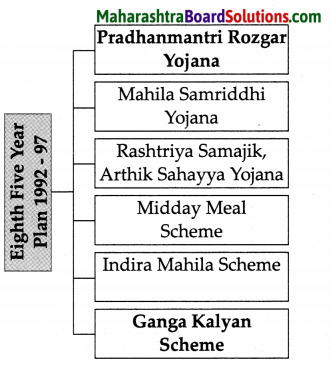
Question 1.
Which programmes were started in the Eighth Five Year Plan?
Answer:
Following programmes were started in the Eighth Five Year Plan:

  • Pradhanmantri Rozgar Yojana
  • Mahila Samriddhi Yojana
  • Rashtriya Samajik, Arthik Sahayya Yojana
  • Midday Meal Scheme
  • Indira Mahila Scheme
  • Ganga Kalyan Scheme

Question 2.
Which heavy industries were set up under the Second Five Year Plan?
OR
Which projects were started in the Second Five Year Plan?
Answer:
(i) Iron and steel industries at Durgapur, Bhilai and Rourkela; Chemical fertilisers plant at Sindri; rail engine factory at Chittaranjan; factory of railway bogies at Perambur, Ship building factory at Vishakhapattanam and other heavy industries were set up in the Public Sector.

(ii) Huge dams like Bhakra-Nangal, Damodar, etc. were built to make water available for agriculture.

Class 9 History Chapter 4 Economic Development Additional Important Questions and Answers

Choose the correct option from the given options and and rewrite the statements:

Question 1.
India removed the import restriction on several commodities for _____ countries.
(a) BRICS
(b) SAARC
(c) Third – World
(d) Middle – East countries
Answer:
SAARC

Maharashtra Board Class 9 History Solutions Chapter 4 Economic Development

Question 2.
The efforts of _____ resulted in the weekly Sunday holiday for mill workers from 1st January 1882.
(a) Mahatma Jyotirao Phule
(b) Sane Guruji
(c) Babu Jagjeevan Ram
(d) Narayan Meghaji Lokhande
Answer:
Narayan Meghaji Lokhande

Question 3.
During the tenure of Prime Minister Indira Gandhi ,________ a group in the Congress Party, made a demand for nationalisation of commercial banks.
(a) Congress Socialist Party
(b) Congress Forum for Socialist Action
(c) Congress wing of Socialist Propaganda
(d) Agency of Socialist Congress
Answer:
Congress Forum for Socialist Action

Question 4.
In 1995, India became a member of _______.
(a) World Trade Organisation
(b) International Monetary Fund
(c) GATT
(d) SAARC
Answer:
World Trade Organisation

Question 5.
In order to overcome drought and food shortages ______ undertook the experiment of Green Revolution.
(a) Chaudhary Charansingh
(b) Gulzarilal Nanda
(c) H D Deve Gowda
(d) Lal Bahadur Shastri
Answer:
Lal Bahadur Shastri

Question 6.
During the tenure of Prime Minister P.V. Narasimha Rao, _______ was our Finance Minister.
(a) John Mathai
(b) Yashwant Sinha
(c) P. Chidambaram
(d) Dr. Manmohan Singh
Answer:
Dr. Manmohan Singh

Question 7.
The first textile mill was started in Mumbai on 11th July, 1851 by _______.
(a) Pirojsha Burjorji Godrej
(b) Jamsedji Nusserwanji Tata
(c) Kawasjee Dawar
(d) Azim Hashim Premji
Answer:
Kawasjee Dawar

Question 8.
The new government of Janata Party ended the fifth Five Year plan by March 1978 and started the _______ from April 1978.
(a) Development Plan
(b) Enrolling Plan
(c) Rolling Plan
(d) Redemption Plan
Answer:
Rolling Plan

Question 9.
Manmohan Singh signed the agreement with the WTO and launched the policy of privatisation, ______ and globalisation.
(a) Liberalisation
(b) Industrialisation
(c) Maximisation
(d) Profitisation
Answer:
Liberalisation

Question 10.
On 18th January 1982, two and a half lakh workers went on a strike under the leadership of _________.
(a) Dhondo Keshav Karve
(b) Baba Amte
(c) Dr. Datta Samant
(d) Anna Hazare
Answer:
Dr. Datta Samant

Question 11.
The _______ plan is a reflection of the liberalisation and free market policy adopted in 1991.
(a) Seventh
(b) Eighth
(c) Fifth
(d) Sixth
Answer:
Eighth

Question 12.
The government nationalised the ‘Imperial Bank’ in 1955 and it got converted into ______
(a) Syndicate Bank
(b) Bank of India
(c) State Bank of India
(d) Reserve Bank of India
Answer:
State Bank of India

Question 13.
The term ‘Girangaon’ means ________.
(a) Town of hills
(b) Town of mills
(c) Group of industries
(d) Cottage industries
Answer:
Town of mills

Maharashtra Board Class 9 History Solutions Chapter 4 Economic Development

Identify and write the wrong pair in the following sets:

Question 1.
(1) Public Sector – Controlled and managed by government
(2) Mixed Economy – Coordination in private and public sector
(3) 20 point programme – Nationalisation of 13 textile mills.
(4) Increased oil prices – Invasion of Kuwait by Iraq.
Answer:
Wrong Pair : 20 point programme Nationalisation of 13 textile mills.

Question 2.
(1) Congress Forum for Socialist Action – demanded nationalisation of banks.
(2) Rashtriya Mill Mazdoor Sangh – negotiations with the employer.
(3) Imperial Bank – converted in State Bank of India.
(4) National Stock Exchange – existed before WTO.
Answer:
Wrong Pair : National Stock Exchange – existed before WTO.

Question 3.
(1) SAPTA – Preferential trade
(2) SAARC – removal of import restrictions by India
(3) SEBI – established in 1998
(4) WTO – regulate global trade
Answer:
Wrong Pair : SEBI – established in 1998

Question 4.
(1) Barrister A.R.Antulay – leader of Rashtriya Mill Mazdoor Sangh
(2) Dr. Manmohan Singh – Finance Minister
(3) Indira Gandhi – nationalised 14 banks
(4) V.P. Singh – waived off loans of the farmers
Answer:
Wrong Pair : Barrister A.R.Antulay – leader of Rashtriya Mill Mazdoor Sangh

Question 5.
(1) Babasaheb Bhonsale – Chief Minster of Maharashtra
(2) Namdev Dhasal – Marathi Poet
(3) Shahir Sable – Programmes of public education
(4) Chandrashekhar – Associate of Mahatma Jyotirao Phule.
Answer:
Wrong Pair : Chandrashekhar – Associate of Mahatma Jyotirao Phule.

Complete the concept maps and flow charts of various programmes and schemes introduced:

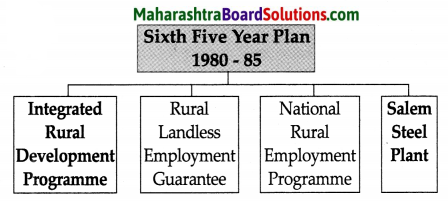
Question 1.
Answer:

SECOND FIVE YEAR PLAN (1956-1961)
Iron and Steel industriesDurgapur, Bhilai, Rourkela
Chemical Fertilisers PlantSindri
Rail Engine FactoryChittaranjan
Factory of railway bogiesPerambur
Ship building FactoryVishakhapattanam

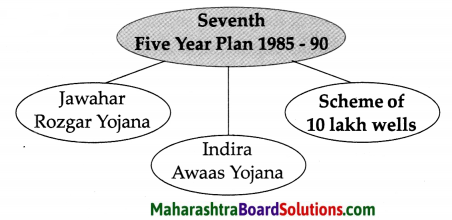
Question 2.
Answer:
Maharashtra Board Class 9 History Solutions Chapter 4 Economic Development 1

Question 3.
Answer:
Maharashtra Board Class 9 History Solutions Chapter 4 Economic Development 2

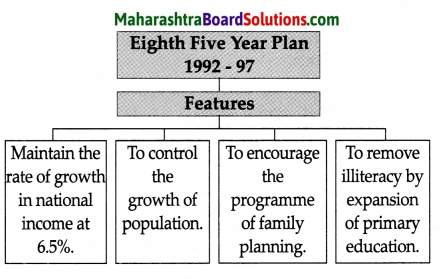
Question 4.
Answer:
Maharashtra Board Class 9 History Solutions Chapter 4 Economic Development 3

Question 5.
Answer:
Maharashtra Board Class 9 History Solutions Chapter 4 Economic Development 4

Question 6.
Answer:
Maharashtra Board Class 9 History Solutions Chapter 4 Economic Development 5

Maharashtra Board Class 9 History Solutions Chapter 4 Economic Development

Question 7.
Answer:
Maharashtra Board Class 9 History Solutions Chapter 4 Economic Development 6

Give Reasons:

Question 1.
India established the Planning Commission to deal with economic repercussions of British colonialism,
Answer:
(i) The colonial power had exploited India economically. The country faced severe problems like poverty, unemployment, population growth, low standards of living, low productivity of agriculture and industries and backwardness in the fields of knowledge, science and technology. Planning was essential to solve these problems.

(ii) India established the Planning Commission in 1950 with Prime Minister Pandit Jawaharlal Nehru as its Chairman.

(iii) It formulated India’s five year plans that included rural and agricultural development, : balanced industrialisation, provision for a minimum standard of living and economic development consistent with democratic ideals.

(iv) It focused on people’s participation and individual development in the formulation and implementation of the five year plans.

Read the passage and answer the questions.

Passage I

Issues of workers: The first textile mill was started in Mumbai on 11th July, 1851 by Kawasjee Dawar. Eventually, mills started in Dadar, Parel, Bhaykhala, Shivdi, Prabhadevi and Worli. This part came to be i known as Girangaon or ‘town of mills’. In the 1980s, the increasing unrest among workers was due to the economic conditions in other sectors. In some industries the wages of the workers were increasing. They were also getting more amounts as bonus. They were getting more facilities than the textile mill workers.
In the Diwali of 1981, the workers expected to get a bonus of 20%. The Rashtriya Mill Mazdoor Sangh, which was negotiating with the employers, agreed upon 8 to 17% bonus without taking the workers into confidence. The cut in the bonus proved to be the cause of unrest. Some workers went to Dr. Datta Samant. They asked him to accept their leadership, Workers of 65 mills came together and Dr. Datta Samant led the strike. On 18th January 1982, two and a half lakh workers went on strike. Girangaon mills stopped running making it seem like Mumbai’s heart topped throbbing.
The Chief Minister of Maharashtra, Barrister A. R. , Antulay set up a committee to solve this issue. Later Babasaheb Bhosale became the Chief Minister of Maharashtra State. He insisted that as per law, he would talk only with the Rashtriya Mill Mazdoor Sangha. Dr. Datta Samant demanded that the law be revoked. In the beginning, the striking workers received help from their native villages. It was also , not very difficult for them to help each other. They set up departmental committees and distributed food grains, assistance in the form of funds, etc. The left parties had supported the strike. As the strike , dragged on, efforts were made to split the striking workers’ ranks. Even as the strike completed 6 months, the central government completely ignored it. The workers started a Jail Bharo Agitation’. In , September 1982, one and a half lakh workers took a march on the Legislative Assembly of Maharashtra State. It didn’t help at all. The strike completed a year. This was the first strike to have gone on for a year. In this period, about one and a half lakh workers became unemployed. As polyester had come into greater demand than cotton cloth, the sale of mill , cloth had already got affected. The mills moved from Mumbai to Surat in Gujarat. The Central government nationalised 13 textile mills. Appointment of i arbitrators did not help to resolve the issue.

Question 1.
Name the worker’s union mentioned in the passage. Why were the workers agitated with it?
Answer:
(i) The worker’s organisation mentioned in the passage is Rashtriya Mill Mazdoor Sangh.
(ii) The workers were agitated because they received less bonus and facilities in their textile mills, whereas economic conditions in the other sectors of the economy were far better.
(iii) The Rashtriya Mill Mazdoor Sangh that negotiated with the employers, settled at 8 to 17% of bonus as against the expectation of 20% by the workers.
(iv) The cut in the bonus led to the workers agitation.

Maharashtra Board Class 9 History Solutions Chapter 4 Economic Development

Question 2.
State the contribution of Dr. Datta Samant in raising workers issues in Maharashtra?
Answer:
(i) Dr. Datta Samant was the leader of two and a half lakh workers who went on strike.
(ii) He demanded that the law be revoked which had empowered Rashtriya Mill Mazdoor Sangh alone to talk on behalf of the workers.

Question 3.
What is mixed economy?
Answer:
(i) In a capitalist system, the means of production are privately owned. In a socialist economy, the means of production are owned by the State in the name of the society.
(ii) A mixed economy works both in the private and the public sector.
(iii) In order to achieve economic development of modem India, we gave preference to a model of ‘mixed economy’.

Passage II

General Agreement on Tariffs and Trade (GATT) existed at the international level before the World Trade Organisation came into being. It regulated commerce. In India there were opposed, extreme views about the World Trade Organisation. Yet India decided to take its membership. The provisions of the World Trade Organisation are regarding grants, import-export, foreign investment, agriculture, technology and services. The sectors of electricity, water transportation, education and health rapidly commercialised since India became a member of the World Trade Organisation. As per the various reports of the World Trade Organisation, India has made a considerable improvement in different areas like reduction in the below poverty line (BPL) population, decline in infant mortality, availability of facilities regarding drinking water and waste water management. India signed the South Asian Preferential Trade Agreement (SAPTA) along the lines of the World Trade Organisation. India removed the import restrictions on several commodities for SAARC countries. India also gave discounts on import duties. India opened up the insurance sector to private and foreign investment.

Question 1.
Study the passage and give the full forms of GATT and SAPTA.
Answer:
GATT – General Agreement on Tariff and Trade.
SAPTA – South Asian Preferential Trade Agreement.

Question 2.
Explain, in your own words, the economic policy of “Make in India”.
Answer:
’Make in India’ is an economic policy as well as an organised progamme of the Government of India to encourage and promote various companies and enterprises to start manufacturing and producing goods in India. The aim of this initiative is to generate employment, enhance the skill of Indians and also to attract foreign investment.

Question 3.
What do the provisions of the WTO cater to?
Answer:
The provisions of the WTO cater to grants, import -export, foreign investment, agriculture, technology and services.

Answer the following questions in detail:

Question 1.
What is the fundamental principle of the Five Year Plans? Which economic goals are set forth by the Government?
Answer:
Fundamental principle of planning: A general principle of planning is the proportionate distribution of the resources of a country and the appropriate use of the human resources to fulfill the needs of the people.
Goals of Plans:
The general goals of the economic planning of India are as follows:

  • Increase in the national income.
  • Bringing about rapid industrialisation by focusing on the basic industries.
  • Bringing about an increase in agricultural production so that the country becomes self-sufficient in foodgrain production.
  • Use the human resources in the country optimally by availing increasing employment opportunities.
  • Remove inequality in earnings and wealth.
  • Maintain stable prices of commodities.
  • Controlling the growth of population through family planning.
  • Improve the standard of living by eradicating poverty.
  • Develop social services.
  • Make the economy self-sufficient.

Maharashtra Board Class 9 History Solutions Chapter 4 Economic Development

Question 2.
Describe the prolonged agitation of the mill workers under Dr. Datta Samant.
Answer:
(i) In the beginning, the striking workers received help from their native villages. It was also not very difficult for them to help each other.

(ii) They set up departmental committees and distributed food grains, assistance in the form of funds, etc

(iii) The left parties had supported the strike. As the strike dragged on, efforts were made to split the striking workers’ ranks.

(iv) Even as the strike completed 6 months, the central government completely ignored it. The workers started a ‘Jail Bharo Agitation’.

(v) In September 1982, one and a half lakh workers took a march on the Legislative Assembly of Maharashtra State.

(vi) It didn’t help at all. The strike completed a year. This was the first strike to have gone on for a year.

(vii) In this period, about one and a half lakh workers became unemployed.

(viii) As polyester had come into greater demand than cotton cloth, the sale of mill cloth got affected. The mills moved from Mumbai to Surat in Gujarat.

(ix) The Central government nationalised 13 textile mills. Appointment of arbitrators did not help to resolve the issue.

Question 3.
Which enterprises came under government due to the lack of capital investment?
Answer:
(i) The industries like defence, scientific research, education, roads, railways, waterways, sea port and airport development require huge capital investment but the returns in these areas are delayed.
(ii) Not many private industrialists are keen to invest in these areas. In such a situation, the government has to take the initiative.

Question 4.
State the Industrial policy of 1973.
Answer:
(i) The industrial policy of 1973 increased the speed of development.
(ii) Priority was given in this policy to control the influence of heavy industries, industrial families and foreign industries and remove the imbalance in regional development.
(iii) The government focused on the development of small scale industries and cottage industries.

Question 5.
What were the aims of the ‘Third Five Year Plan’?
Answer:
(i) This plan was aimed at bringing about a balance in industries and agriculture.
(ii) The other goals of the plan included increase in national income, heavy industries, development in transport and mineral industry, alleviation of poverty and to expand the opportunities for employment.

Question 6.
What was the background for . the nationalisation of banks?
Answer:
(i) India had adopted a mixed economy after independence.
(ii) Nationalisation of banks was essential to cover the deficits if they occurred while implementing different schemes.
(iii) Also the profits of these banks would come into the government treasury once they are nationalised.

Question 7.
State the cultural contributions of the working class.
Answer:
(i) The working class has contributed culturally as well through folk theatre, folk art and literature. Anna Bhau Sathe, Shahir Amar Sheikh, Shahir Sable were popular for their programmes aimed at public education.
(ii) Poets like Narayan Surve, Namdev Dhasal, etc., portrayed the real life of the workers through their poems.

Maharashtra Board Class 9 History Solutions Chapter 4 Economic Development

Question 8.
Who took responsibility to bring the Indian economy in sync with the global mainstream?
Answer:
(i) The year 1991 is very important in the history of modem India. After the 10th General elections, P. V. Narasimha Rao became the Prime Minister of India.

(ii) With Dr. Manmohan Singh as Finance Minister, he adopted the new economic policy of linking India’s economy with the global economy.

(iii) For this, fundamental changes were brought about in the Indian economy. Indian economy was brought in tune with the global mainstream.

Question 9.
Which corrective measures were taken by Manmohan Singh to relieve the crisis of the Indian economy?
Answer:
(i) Dr. Singh undertook many corrective measures. The situation began to change.
(ii) He removed the restrictions on foreign investments.
(iii) He restricted the licence system to 18 industries. In view of the increasing losses in the public sector industries, he opened up the public sector for investment by private industries.
(iv) In order to bring the share market under control, he established the Securities and Exchange Board of India (SEBI) in 1992.
(v) National Stock Exchange was computerised. He gave priority to remove the spectre of recession.

Question 10.
State the impact of corrective measures taken by Dr. Manmohan Singh on the economy of our country.
Answer:
(i) Foreign Investment in India grew during the first tenure of Dr. Manmohan Singh as Finance Minister.
(ii) India could recover the gold mortgaged with the Bank of England.
(iii) The government got the support of the capitalist class as well as the middle class.
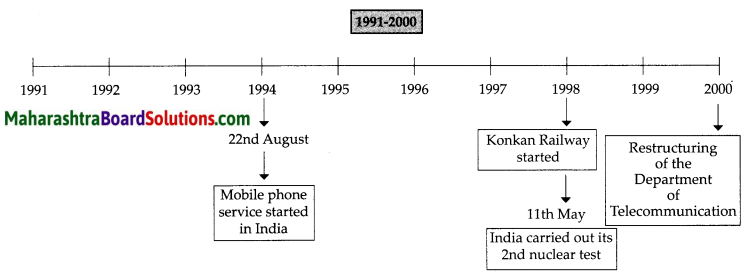
(iv) As the government opened up the telecom sector, mobile phone services started all over the country.
(v) Dr. Manmohan Singh signed the agreement with the World Trade Organisation and launched the policy of “privatisation, liberalisation and globalisation.”

Question 11.
What were the objectives of the WTO?
Answer:
(i) In 1995, India became a member of the World Trade Organisation (WTO).
(ii) The organisation had the following objectives: to free trade between countries, to put an end to all those discriminatory laws, restrictions, rules and policies that are hurdles in the way of international free trade and to regulate global trade with the help of a formal multi – party mechanism.

Question 12.
Do you agree that membership with the WTO has ushered in changes in the economic sector of our country? State the reason for your answer.
Answer:
(i) Yes, of course. The provisions of the World Trade Organisation have included grants, import-export, foreign investment, agriculture, technology and services.

(ii) The sectors of electricity, water transportation, education and health have been rapidly commercialised since India became a member of the World Trade Organisation.

Question 13.
State the improvements which have occurred in our economy as per the reports of WTO.
Answer:
As per the various reports of the World Trade Organisation, India has made considerable improvement in different areas like reduction in the below poverty line (BPL) population, decline in infant mortality, availability of facilities regarding drinking water and waste water management.

Maharashtra Board Class 9 History Solutions Chapter 4 Economic Development

Question 14.
Which economic challenges were faced by the Government of Prime Minister Chandra Shekhar?
Answer:
(i) During the tenure of Chandra Shekhar the rate of inflation was 17%.
(ii) Economic growth rate had decreased by 1.1%. India had foreign exchange reserves only enough to last for imports for a week.
(iii) It had become difficult to pay back its loan and the interest on it.
(iv) In May 1991, the government had tried to control the situation by selling some of its gold reserves and by mortgaging some.

Question 15.
Which economic liabilities were incurred by V. P. Singh government?
Answer:
(i) The V. P. Singh government had incurred a liability of over 10 thousand crore rupees on the economy by waiving off the loans of all the farmers.
(ii) The proportion of internal loans of central and state government together to the Gross Domestic Product was 55%.
(iii) In 1980-81 foreign loan was 2350 crore dollars. It increased to 8380 crore dollars in 1990-91.
(iv) At this time, India had foreign exchange reserves of only 100 crore dollars.
(v) This also had the background of the increased oil prices due to the invasion of Kuwait by Iraq.
(vi) It became difficult for India to raise a loan. Even the non-resident Indians started withdrawing their deposits in foreign currency from India.

Identify the picture and give relevant information.

Question 1.

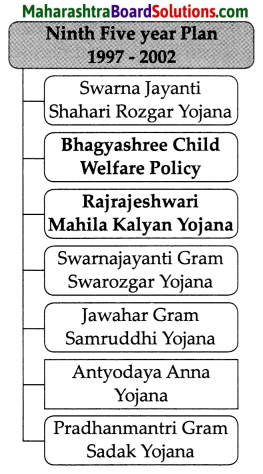
Maharashtra Board Class 9 History Solutions Chapter 4 Economic Development 7
Answer:
(i) Nationalisation of banks was essential to cover the deficits if they occurred while implementing different schemes and profit of these banks came under the government treasury.

(ii) Also the profit of these banks would come into the government treasury once they were nationalised. Prime Minister Indira Gandhi nationalised 14 banks on 19th July, 1969.

Question 2.
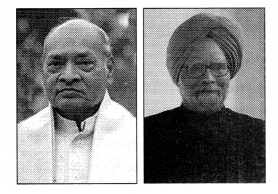
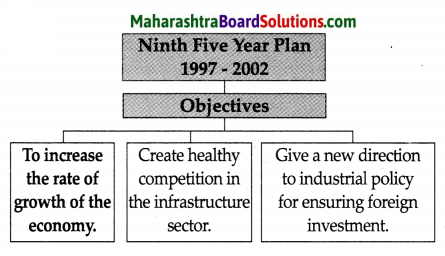
Maharashtra Board Class 9 History Solutions Chapter 4 Economic Development 8
Answer:
(i) P. V. Narasimha Rao and Manmohan Singh.
(ii) They removed the restrictions on foreign investments.
(iii) Restricted the license system to 18 industries.
(iv) Opened up the public sector for investment by private industries.
(v) Established the SEBI (Securities and Exchange Board of India) in 1992 to regulate and bring share market under control.
(vi) Foreign investment in India grew.
(vii) India could recover the gold mortgaged with the Bank of England.
Maharashtra Board Class 9 Political Science Solutions Chapter 4 The United Nations

Balbharti Maharashtra State Board Class 9 Political Science Solutions Chapter 4 The United Nations Notes, Textbook Exercise Important Questions and Answers.

Maharashtra State Board Class 9 Political Science Solutions Chapter 4 The United Nations

Class 9 Political Science Chapter 4 The United Nations Textbook Questions and Answers

1. Choose the right option and rewrite the sentence:

Question 1.
This country is not a permanent member of United Nations Security Council _____.
(a) America
(b) Russia
(c) Germany
(d) China
Answer:
(c) Germany

Maharashtra Board Class Maharashtra Board Class 9 Political Science Solutions Chapter 4 The United Nations

Question 2.
The United Nations has _______ number of members.
(a) 190
(b) 193
(c) 198
(d) 199
Answer:
(b) 193

Question 3.
This international organisation conducts workshops in India on remedial measures to tackle the problem of malnutrition among children
(a) UNICEF
(b) UNESCO
(c) Trusteeship Council
(d) Red Cross
Answer:
(a) UNICEF

2. Explain with reasons whether the following statements are true or false:

Question 1.
The United Nations General Assembly is a platform to discuss global problems.
Answer:
True.

  • Every year the General Assembly meets in its session. During the session, the General Assembly discusses important issues like environment, disarmament, etc.
  • The significance of the General Assembly lies in it being a platform for representatives of member nations to come together and discuss and make policy decisions on issues of global importance.

Maharashtra Board Class Maharashtra Board Class 9 Political Science Solutions Chapter 4 The United Nations

Question 2.
The status of all the member nations of the United Nations is not equal.
Answer:
False.

  • As mentioned in the principles of UN, all member nations have the same status.
  • There is no discrimination among nations based on geographical size, economic or military power.

Question 3.
A resolution can be passed even if China exercises its veto power.
Answer:
False

  • China is one of the five permanent members of the UN and the permanent members have veto power.
  • If even one of the five permanent members uses it’s veto i.e. gives a negative vote, the decision cannot be taken.

Question 4.
India has played a major role in the work of the United Nations.
Answer:
True.

  • India has always sent her troops to participate in the United Nations peacekeeping forces.
  • India has participated in bringing issues like decolonisation, disarmament, racial segregation on the United Nations platform.

3. Explain the following concepts:

Question 1.
Veto
Answer:
(i) Security Council has 5 permanent members and 10 non-permanent members.
(ii) For any decision to be taken, the assent of all five permanent members and four non¬permanent members is necessary.
(iii) America, Russia, England, France and China are permanent members of the Security Council. They have the veto power.
(iv) If even one of the five permanent member uses its veto i.e. gives a negative vote, the decision cannot be taken

Question 2.
UNICEF
Answer:
(i) UNICEF is an affiliated organisation of the United Nations.
(ii) It works towards making nutritious food and health care available to children.
(iii) Several workshops were organised in India to find out measures to overcome malnutrition among babies and children.

4. Answer the following questions in brief:

Question 1.
Write the reasons for the establishment of the United Nations.
Answer:
The United Nations is the world’s largest international organisation. The reasons for the establishment of the United Nations are:

(i) Two World Wars were fought at the beginning of the twentieth century.

(ii) Life and property were destroyed on a large scale in these wars.

(iii) As a result, the League of Nations was established after the First World War and the United Nations was established after the Second World War out of a realisation that there has to be a mechanism to establish world peace.

(iv) The League of Nations did not succeed at all.

(v) But after the use of the nuclear weapons in the . Second World War, the idea took root that such destructive wars should be stopped and that it is the collective responsibility of all nations to do so.

(vi) The United Nations was established after the Second World War to instill this understanding among all nations.

(vii) Hence, the United Nations, an international organisation was established to ensure peace and security at the international level.

Maharashtra Board Class Maharashtra Board Class 9 Political Science Solutions Chapter 4 The United Nations

Question 2.
Write the objectives of the United Nations.
Answer:
The United Nations has its own definite objectives. They are as follows:

  • To establish friendly relations among nations.
  • To enhance international security by solving international disputes.
  • To safeguard and foster human rights and freedom.
  • Along with these, the United Nations also aim at enhancing economic cooperation at the international level.

Question 3.
What is the role of the Peacekeeping Forces of the United Nations?
Answer:
(i) The peacekeeping activity of the United Nations involves creating appropriate circumstances favourable for bringing about permanent peace in strife-tom areas.
(ii) The peacekeeping forces help these areas to progress towards peace.
(iii) In conflict ridden areas, security is provided and at the same time, help is extended for establishing peace.
(iv) The United Nations takes up peacekeeping as one of the tasks for safeguarding and fostering peace in the world.

5. Do as directed:

Question 1.
Complete the following chart giving information about the organs of the United Nations.

S.NoOrganNumber of membersFunctions
1.United Nations General Assembly……….…………….
2.United Nations Security Council…………..…………….
3.International Court of Justice…………..……………….
4.Economic and Social Council…………..………………..

Answer:

S.No.OrganNumber of membersFunctions
(1)United
Nations
General Assembly
193(1) To elect the non-permanent members of the Security Council.
(2)  To choose the United Nations Secretary General and the judges of the International Court of Justice (ICJ) in consultation with the Security Council.
(3) To pass the annual budget of the United Nations.
(2)United Nations Security Council15

(5 Permanent and 10 NonPermanent)

(1) To maintain international peace and security.
(2) To prepare policies for arms control.
(3) To play a joint role along with the General Assembly in the appointments of the judges of the International Court of Justice and of the United Nations Secretary General.
(3)International Court of Justice15 judges(1) To settle the disputes between two or more member nations of the United Nations.
(2) To interpret international law authentically.
(3) To advise the various organs or subsidiary bodies of the United Nations about legal issues.
(4)Economic and Social Council54 members(1) Initiate discussions at the global level on issues like poverty, unemployment, economic and social inequality and suggest policies to tackle these problems.
(2) Discuss issues like women’s questions, empowerment of women, human rights, fundamental freedoms, global trade, health related issues, etc., and make decisions.
(3) Make efforts to establish cultural and educational cooperation at the international level.
(4) Coordinate the functioning of the different organisations working in association with the United Nations.

Question 2.
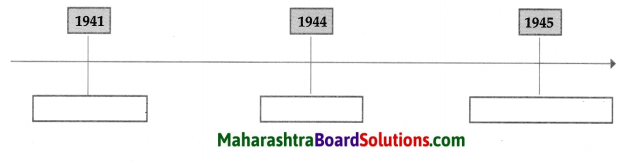
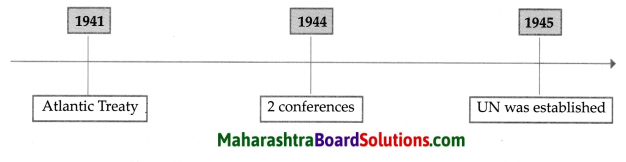
Show the chronology of the establishment of the United Nations.
Maharashtra Board Class 9 Political Science Solutions Chapter 4 The United Nations 4
Answer:
Maharashtra Board Class 9 Political Science Solutions Chapter 4 The United Nations 3

Maharashtra Board Class Maharashtra Board Class 9 Political Science Solutions Chapter 4 The United Nations

Question 3.
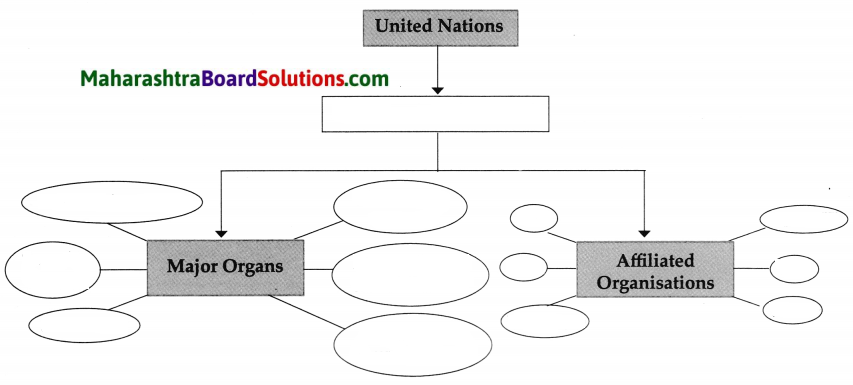
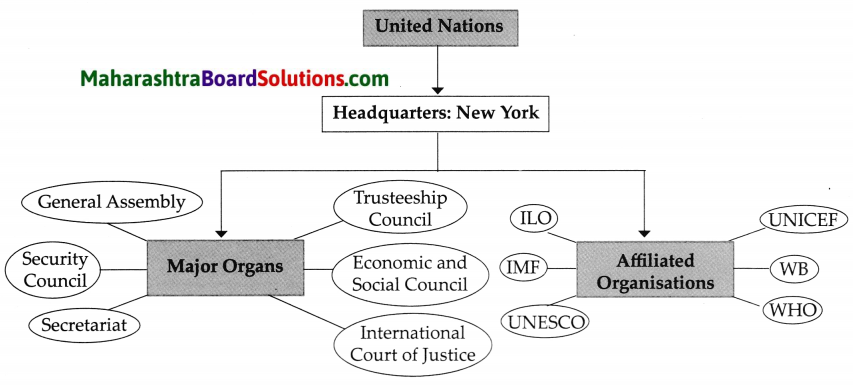
Complete the following tree diagram about the United Nations.
Maharashtra Board Class 9 Political Science Solutions Chapter 4 The United Nations 10
Answer:
Maharashtra Board Class 9 Political Science Solutions Chapter 4 The United Nations 9

Class 9 Political Science Chapter 4 The United Nations Intext Questions and Answers

Answer the following in brief:

Question 1.
Did India participate in the conferences during the Second World War?
Answer:
India was among the original members of the United Nations that signed the Declaration by United Nations at Washington, D.C. on 1st January, 1942 and also participated in the United Nations Conference on International Organization at San Francisco from 25th April to 26th June 1945.

Question 2.
Which day is celebrated as United Nations day?
Answer:
United Nations was established on 24th October 1945. The day is now celebrated each year . around the world as United Nations Day.

Question 3.
Can the United Nations intervene militarily if there is a serious threat to international peace?
Answer:
The United Nations can’t intervene militarily if there is a serious threat to international peace. The UN, after approval by the Security Council, sends peacekeepers to regions where armed conflict has recently ceased or stalled to enforce the terms of peace agreements and to discourage combatants from resuming hostilities.

Question 4.
What steps have the United Nations taken to foster human rights and freedom?
Answer:
One of the UN’s primary purposes is to promote and encourage respect for human rights and to ensure fundamental freedoms for all without distinction on the basis of race, sex, language, or religion. In 1948, the General Assembly adopted a Universal Declaration of Human Rights. In 1979, the General Assembly adopted the Convention on the Elimination of All Forms of Discrimination against Women, followed by the Convention on the Rights of the Child, in 1989. United Nations Commission on Human Rights was formed in 1993 to oversee human rights issues for the UN.

Maharashtra Board Class Maharashtra Board Class 9 Political Science Solutions Chapter 4 The United Nations

Question 5.
Only one Indian has so far been the President of the UN General Assembly. Who is that person? When and at which session?
Answer:
Mrs. Vijayalakshmi Pandit is the only Indian so far who has been the President of the UN General Assembly, at the eighth session in 1953.

Activity:

Question 1.
Write the names of United Nations Secretary Generals until now.
Answer:
(i) Mr. Trygve Lie
(ii) Mr. Dag Hammarskjold
(iii) Mr. U. Thant
(iv) Mr. Kurt Waldheim
(v) Mr. Javier Perez de Cuellar
(vi) Mr. Boutros Boutros Ghali
(vii) Mr. Kofi Annan
(viii) Mr. Ban Ki Moon
(ix) Mr. Antonio Guterres

Question 2.
Is it necessary that the Secretary-General should be a citizen of the great powers/the big five?
Answer:
It is not necessary that the Secretary General should be a citizen of one of the great powers/ the big five. Here is the list of Secretary Generals with their countries: Mr. Trygve Lie (Norway) Mr. Dag Hammarskjold (Sweden)

  • Mr. U. Thant (Mayanmar)
  • Mr. Kurt Waldheim (Austria)
  • Mr. Javier Perez de Cuellar (Peru)
  • Mr. Boutros Boutros Ghali (Egypt)
  • Mr. Kofi Annan (Ghana)
  • Mr. Ban Ki Moon (South Korea)
  • Mr. Antonio Guterres (Portugal)

Question 3.
Are citizens of a particular country given priority for being Secretary-General?
Answer:
The citizens of no particular country are given priority for being Secretary General.

Question 4.
Who is the current Secretary General and which country does he belong to?
Answer:
The current Secretary General is Antonio Guterres and he belongs to Portugal.

Class 9 Political Science Chapter 4 The United Nations Additional Important Questions and Answers

Choose the correct option from the given options and rewrite the statements:

Question 1.
The United Nations Organisation was founded on _______.
(a) August 9,1944
(b) October 24,1944
(c) October 24,1945
(d) December 10,1945
Answer:
(c) October 24,1945

Maharashtra Board Class Maharashtra Board Class 9 Political Science Solutions Chapter 4 The United Nations

Question 2.
The United Nations has ____ main organs.
(a) four
(b) five
(c) six
(d) seven
Answer:
(c) six

Question 3.
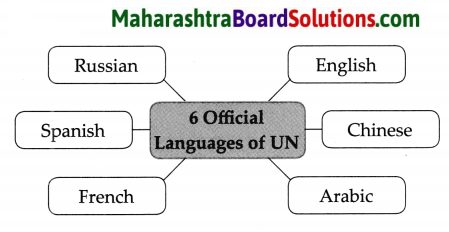
The United Nations has ______ official languages.
(a) four
(b) five
(c)six
(d) three
Answer:
(c)six

Question 4.
This language is not an official language of the United Nations
(a) French
(b) Spanish
(c) Arabic
(d) Italian
Answer:
(d) Italian

Question 5.
There are ______ permanent members in the Security Council.
(a) four
(b) five
(c)six
(d) seven
Answer:
(b) five

Question 6.
There are ________ non-permanent members in the Security Council.
(a) ten
(b) five
(c) fifteen
(d) seven
Answer:
(a) ten

Question 7.
The term of a non-permanent member of the Security Council is of ______.
(a) four years
(b) five years
(c) two years
(d) one year
Answer:
(c) two years

Question 8.
Which organ of the United Nations has suspended its operations since 1994?
(a) Trusteeship Council
(b) Economic and Social Council
(c) Secretariat
(d) International Court of Justice
Answer:
(a) Trusteeship Council

Question 9.
How many Judges are there in the International Court of Justice?
(a) 9
(b) 10
(c) 12
(d) 15
Answer:
(d) 15

Question 10.
What is the term of the United Nations Secretary General?
(a) 3 years
(b) 4 years
(c) 6 years
(d) 5 years
Answer:
(d) 5 years

Maharashtra Board Class Maharashtra Board Class 9 Political Science Solutions Chapter 4 The United Nations

Question 11.
UN Secretary General heads which principal organ of the United Nations Organisation?.
(a) General Assembly
(b) Security Council
(c) Economic and Social Council
(d) The Secretariat
Answer:
(d) The Secretariat

Question 12.
What is the term of a judge of the International Court of Justice?
(a) 9 years
(b) 4 years
(c) 6 years
(d) 5 years
Answer:
(a) 9 years

Question 13.
How many members does the Economic and Social Council have?
(a) 33
(b) 40
(c) 15
(d) 54
Answer:
(d) 54

Give the full forms of the following acronyms:

Question 1.
ILO:
Answer:
International Labour Organisation

Question 2.
FAO:
Answer:
Food and Agriculture Organisation

Question 3.
WHO:
Answer:
World Health Organisation

Question 4.
WB:
Answer:
World Bank

Question 5.
IMF:
Answer:
International Monetary Fund

Question 6.
UNICEF:
Answer:
United Nations Children’s Fund

Question 7.
UNESCO:
Answer:
United Nations Educational, Scientific and Cultural Organisation

State whether the following statements are true or false with reasons:

Question 1.
UNICEF is the main organ of UN.
Answer:
False.
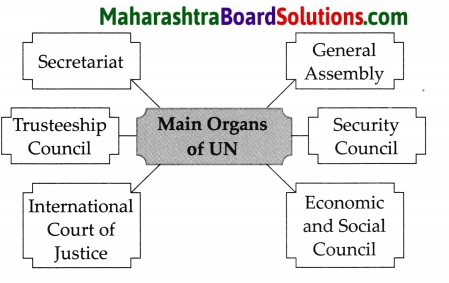
(i) The United Nations has six main organs:

  1. General Assembly
  2. Security Council
  3. Economic and Social Council
  4. International Court of Justice
  5. Trusteeship Council and
  6. Secretariat.

(ii) UNICEF is an affiliated organisation of the United Nations. It works towards making nutritious food and health care available to children.

Maharashtra Board Class Maharashtra Board Class 9 Political Science Solutions Chapter 4 The United Nations

Explain the following concepts:

Question 1.
Millennium Development Goals
Answer:
The United Nations member nations came together in 2000 and decided upon the development goals for the new millennium. Some of the important goals are as follows:

  • To eliminate poverty and hunger.
  • To make the facilities of primary education available.
  • To bring about women’s empowerment, reduce infant mortality rate.
  • To take special care of the health of pregnant women.
  • To fight diseases like AIDS, malaria, etc.
  • To protect the environment and increase the cooperation between developed and developing countries.

Question 2.
International Criminal Court
Answer:
(i) The International Criminal Court is an inter-governmental organisation and an international tribunal.
(ii) Its headquarters are at The Hague in the Netherlands.
(iii) The International Criminal Court has the jurisdiction to prosecute individuals for international crimes of genocide, crimes against humanity and war crimes that are of concern to the international community.

Question 3.
International Court of Justice.
Answer:
(i) International Court of Justice means the judicial branch of the United Nations. The International Court of Justice is located at The Hague in the Netherlands.
(ii) There are 15 judges in the International Court of Justice.
(iii) They are chosen by the General Assembly and the Security Council. Every judge has tenure of nine years.
(iv) Functions:

  • To settle the disputes between two or more member nations of the United Nations.
  • To interpret international law authentically.
  • To advise the various organs or subsidiary bodies of the United Nations about legal issues.

Question 4.
The UN Security Council.
Answer:
Security Council is one of the 6 main organs of the UN:

(i) There are 15 members in the Security Council. Of them, five are permanent members, while ten are non-permanent members.

(ii) The non-permanent members are chosen every two years by the General Assembly. America, Russia, England, France and China are permanent members of the Security Council. They have the veto power.

(iii) For any decision to be taken, the assent of all five permanent members and four non permanent members is necessary. If even one of the five permanent member uses his veto i.e. gives a negative vote, the decision cannot be taken.

(iv) Functions of the Security Council:

(a) The main responsibility of the Security Council is to maintain international peace and security.
The Security Council may suggest one among the following alternatives in situations of international conflict:

  • End/resolve conflict and make efforts to establish peace
  • Impose economic sanctions or take a decision of military action against the aggressor nation.

(b) To prepare policies for arms control.
(c) To play a joint role along with the General Assembly in the appointments of the judges of the International Court of Justice and of the United Nations Secretary General.

Complete the following table:

Question 1.

(1)WHO(a)………….
(2)UNESCO(b)…………..
(3)UNICEF(c)…………
(4)ILO(d)…………….

Answer:

(1)WHO(a)World Health Organization
(2)UNESCO(b)United Nations Educational Scientific and Cultural Organization
(3)UNICEF(c)United Nations Children’s, Fund
(4)ILO(d)International Labour Organization

Maharashtra Board Class Maharashtra Board Class 9 Political Science Solutions Chapter 4 The United Nations

Question 2.

(1)New York(a)……….
(2)Hague, Netherlands(b)…………
(3)San Francisco(c)………..

Answer:

(1)New York(a)Headquarters of UN
(2)Hague, Netherlands(b)International Court of Justice
(3)San Francisco(c)Drafting of UN Charter

Complete the flow chart:

Question 1.
Maharashtra Board Class 9 Political Science Solutions Chapter 4 The United Nations 1
Answer:
Maharashtra Board Class 9 Political Science Solutions Chapter 4 The United Nations 2

Complete the chart:

Question 1.
Maharashtra Board Class 9 Political Science Solutions Chapter 4 The United Nations 6
Answer:
Maharashtra Board Class 9 Political Science Solutions Chapter 4 The United Nations 5

Question 2.
Maharashtra Board Class 9 Political Science Solutions Chapter 4 The United Nations 8
Answer:
Maharashtra Board Class 9 Political Science Solutions Chapter 4 The United Nations 7

Answer the following in brief:

Question 1.
State the role of UN General Assembly as platform to discuss global problems.
Answer:
The United Nations General Assembly is a platform to discuss global problems because:

  • Every year the General Assembly meets in its session from September to December.
  • During the session, the General Assembly discusses important issues like environment, disarmament, etc
  • The decisions in the General Assembly are taken by the majority. These decisions are in the form of resolutions.
  • The significance of the General Assembly lies in being a platform for representatives of member nations to come together and discuss and make policy decisions on issues of global importance.

Question 2.
United Nations plays an important role in preservation of peace. Explain the statement.
Answer:
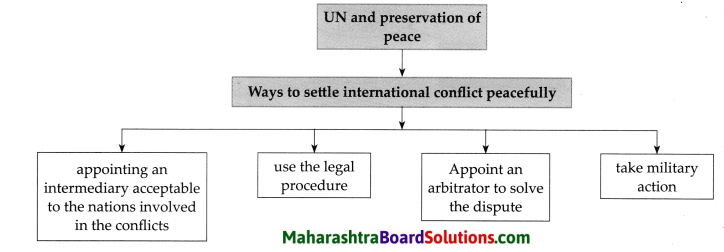
(i) The objective of the United Nations is to settle international conflict peacefully.

(ii) The United Nations Charter lays down the ways and means to be employed to achieve this goal.

(iii) It includes appointing an intermediary acceptable to the nations involved in the conflict, use the legal procedure, appoint an arbitrator to solve the dispute and if needed, to take recourse to military means and ensure that conflict will not occur again.

(iv) In modem times, human security has been threatened by terrorism, racist and religious conflict. As a result, the function of securing peace of the United Nations has acquired a lot of importance.

(v) The United Nations makes efforts to ensure that violence does not erupt in strife-tom areas and normalcy is restored as soon as possible, by (for example), starting schools, creating awareness among the people about human rights, making social, economic, political facilities available, conducting elections, etc.

Question 3.
How had India helped to solve international conflicts peacefully?
Answer:
(i) India had participated in the different Conferences that were held before the establishment of the United Nations.

(ii) India has participated in bringing issues like decolonisation, disarmament and racial segregation on the United Nations platform.

(iii) In 1946, India was the first country to raise . the question of racism in the United Nations.India has always led the discussions about the problems of undeveloped and developing countries.

(iv) India has always sent her troops to participate in the United Nations peacekeeping forces. Not just that, India has sent an all-woman peacekeeping force as well.

(v) It is evident from the foregoing analysis that India makes serious efforts to solve international conflicts by peaceful means.

Question 4.
What is the role of UNESCO?
Answer:
UNESCO, is an affiliated organisation of the United Nations works towards peace and security in the world by promoting cooperation between member countries in the fields of education, science and culture.

Maharashtra Board Class Maharashtra Board Class 9 Political Science Solutions Chapter 4 The United Nations

Question 5.
What are the principles of the United Nations?
Answer:
The United Nations is an organisation created by the coming together of sovereign nations. Naturally, it is based on certain principles or rules. They are as follows:

  • All member nations will have the same status. There is no discrimination among nations based on geographical size, economic or military power.
  • All member nations of the United Nations should respect the freedom and geographical unity of other member nations.
  • All member nations should solve their international disputes and mutual issues peacefully.

Question 6.
What are the functions of the General Assembly?
Answer:
The United Nations General Assembly is a platform to discuss global problems. Functions of General Assembly are:

  • To elect the non-permanent members of the Security Council.
  • To choose the United Nations Secretary General and the judges of the International Court of Justice (ICJ) in consultation with the Security Council.
  • To pass the annual budget of the United Nations.

Question 7.
What are the specialised agencies of UN?
Answer:
(i) Apart from these six major organs, there are many affiliated organisations of the United Nations that help it in its functions. They are called specialised agencies.

(ii) Working in specific areas, they help different nations in those areas.

(iii) The following are some of these important agencies:

  • International Labour Organisation (ILO)
  • Food and Agriculture Organisation (FAO)
  • World Health Organisation (WHO)
  • World Bank (WB)
  • International Monetary Fund (IMF)
  • United Nations Children’s Fund (UNICEF)
  • United Nations Educational, Scientific and Cultural Organisation (UNESCO)

Question 8.
Why was the Trusteeship Council setup and why has it suspended its operations?
Answer:
(i) After the Second World War, the territories that were undeveloped were placed under the responsibility of the developed nations.

(ii) The latter were supposed to help bring about the development of the trust territories and once they attain independence from their colonies, help establish democracy.

(iii) The work of the Trusteeship Council is over as there are no trust territories left.

(iv) The work of the Trusteeship Council ended when Palau got independence on 1st November 1994.

Question 9.
Write about the phases in establishment of the United Nations.
Answer:
The United Nations is an international organisation of sovereign nations. It was established in the following manner:

(i) The Atlantic Treaty was signed between Prime Minister of England, Sir Winston Churchill and American, President Franklin D Roosevelt during the Second World War on 14th August 1941.

(ii) According to this treaty, a decision was taken to set up a permanent mechanism to establish international security after the Second World War was over.

(iii) Detailed discussions followed on this decision in two conferences among allied powers in 1944 and 1945.

(iv) A draft of the treaty to establish an international organisation was prepared.

(v) At San Francisco in America, representatives of fifty countries drafted the Charter of the United Nations after discussions.

(vi) As soon as the war was over, the Charter was signed on 24th October, 1945 and the United Nations was established.

Question 10.
Explain the characteristics of the Economic and Social Council.
Answer:
Economic and Social Council:

(i) The main objective of this organisation is to coordinate the economic and social policies of the United Nations.
(ii) The Council has 54 members. They are selected by the General Assembly.
(iii) Each member has a tenure of three years and each year, one-third of the members are newly chosen. Decisions are taken by majority vote.
(iv) Functions:

  •  Initiate discussions at the global level on issues like poverty, unemployment, economic and social inequality and suggest policies to tackle these problems.
  • Discuss issues like women’s questions, empowerment of women, human rights, fundamental freedoms, global trade, health related issues, etc. and make decisions.
  • Make efforts to establish cultural and educational cooperation at the international level.
  • Coordinate the functioning of the different organisations working in association with the United Nations.

Activity:

Question 1.
Name the UN Secretary-General who later on became the President of his country.
Answer:
Mr. Kurt Waldheim of Austria.

Maharashtra Board Class Maharashtra Board Class 9 Political Science Solutions Chapter 4 The United Nations

Question 2.
Name the UN Secretary-General who died in an air-crash.
Answer:
Dag Hammarskjold of Sweden, died on September 18, 1961, during a Congo Mission.

Maharashtra Board Class 7 Geography Solutions Chapter 2 The Sun, the Moon and the Earth

Balbharti Maharashtra State Board Class 7 Geography Solutions Chapter 2 The Sun, the Moon and the Earth Notes, Textbook Exercise Important Questions and Answers.

Maharashtra State Board Class 7 Geography Solutions Chapter 2 The Sun, the Moon and the Earth

Class 7 Geography Chapter 2 The Sun, the Moon and the Earth Textbook Questions and Answers

1. Correct the wrong statements. Write down the corrected ones.

Question 1.
The moon revolves around the sun.
Answer:
Wrong – The moon revolves around the earth.

Question 2.
On a full moon day, the moon, the sun and the earth are positioned in this sequence.
Answer:
Wrong – On a full moon day, the sun, the earth and the moon are positioned in this sequence.

Question 3.
The revolutionary orbits of the earth and the moon are in the same plane.
Answer:
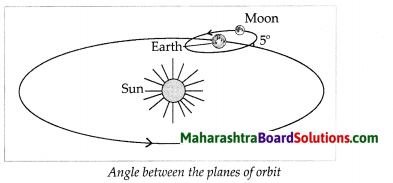
Wrong – The revolutionary orbits of the earth and the moon are not in the same plane. The moon’s revolutionary orbit makes an angle of about 5° with that the earth.

Maharashtra Board Class 7 Geography Solutions Chapter 2 The Sun, the Moon and the Earth

Question 4.
In one revolution of the moon, its orbit intersects the earth’s orbit only once.
Answer:
Wrong – In one revolution of the moon, its orbit intersects the earth’s orbit twice.

Question 5.
It is alright to observe a solar eclipse without protecting the eyes.
Answer:
Wrong – It is necessary to view the sun disc through dark glasses or through special goggles made for that purpose, otherwise the intense light of the sun can be harmful to the naked eye.

Question 6.
An annular solar eclipse occurs when the moon is in the perigee position.
Answer:
Wrong – An annular solar eclipse occurs when the moon is in the apogee position.

2. Select the correct option.

Question 1.
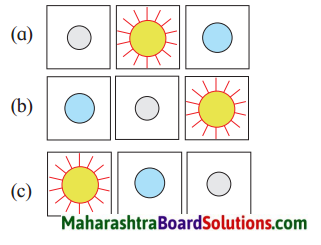
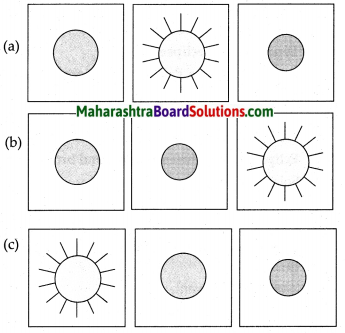
Solar eclipse
Maharashtra Board Class 7 Geography Solutions Chapter 2 The Sun, the Moon and the Earth 1
Answer:
(b)

Question 2.
The shape of sun disc at the time of annular solar eclipse.
Maharashtra Board Class 7 Geography Solutions Chapter 2 The Sun, the Moon and the Earth 2
Answer:
(a)

Maharashtra Board Class 7 Geography Solutions Chapter 2 The Sun, the Moon and the Earth

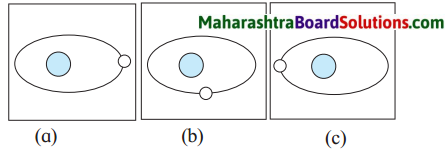
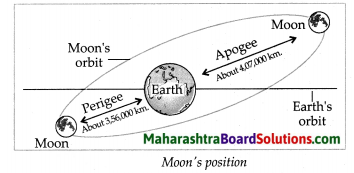
Question 3.
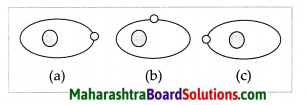
Apogee position of the moon.
Maharashtra Board Class 7 Geography Solutions Chapter 2 The Sun, the Moon and the Earth 3
Answer:
(c)

3. Complete the following table.

DetailsLunar EclipseSolar Eclipse
Phase of the moon……………………….
SequenceMoon-Earth- Sun………….
Type of Eclipse………….…………..
Maximum duration of total eclipse107 minutes…………….

Answer:

DetailsLunar EclipseSolar Eclipse
Phase of the moonFull Moon DayNew Moon Day
SequenceMoon-Earth-SunMoon-Earth-Sun
Type of EclipseTotal and PartialTotal, Partial, Annular
Maximum duration of total eclipse107 minutes440 Seconds

4. Draw and label the diagrams.

Question 1.
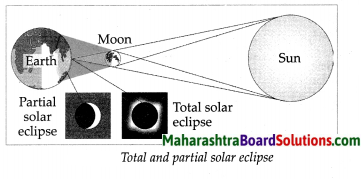
Total and partial solar eclipse:
Answer:
Maharashtra Board Class 7 Geography Solutions Chapter 2 The Sun, the Moon and the Earth 4

Question 2.
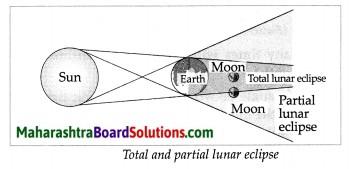
Total and partial lunar eclipse:
Answer:
Maharashtra Board Class 7 Geography Solutions Chapter 2 The Sun, the Moon and the Earth 5

5. Answer the following:

Question 1.
Why do the sun, the moon and the earth not lie in one and the same line on every full moon and new moon day?
Answer:
(i) The orbital path of the earth and that of moon are not in the same plane.
(i) The moon’s revolutionary orbit makes an angle of about 5° with that of the earth.
(iii) On each new moon day, the lines joining the earth and the sun and the moon make an angle of 0° whereas on each full moon day, this angle is 180°.
(iv) So, the sun, the earth and the moon may not be in one straight line in the same plane on every new moon or full moon day.

Question 2.
When a total solar eclipse occurs why is the partial eclipse also seen from the earth?
Answer:
(i) On a new moon day if the sun, the moon & the earth fall in one line & are in the same plane, the shadow of the moon falls on the earth
(ii) This shadow is of two types – the central portion of the shadow is darker & the periphery is light.
(iii) In the area where the dark shadow falls, the sun becomes completely invisible. Such an area experiences a total solar eclipse.
(iv) However during the same period, at the places where the shadow is lighter, the sun disc appears partially covered. Such an area experience partial solar eclipse. Thus when a total solar eclipse occurs a partial eclipse is also seen from the earth.

Maharashtra Board Class 7 Geography Solutions Chapter 2 The Sun, the Moon and the Earth

Question 3.
Suggest measures that can be taken to eradicate the superstitions related to the eclipses.
Answer:
The following measures can be taken to eradicate superstition related to eclipses:

  • Use of media to create awareness.
  • Parental guidance to help think logically.
  • Teachers guidance to help students develop a scientific outlook.
  • Campaigns, public meetings and lectures especially in rural areas to eradicate superstitions.

Question 4.
What precautions should we take while observing a solar eclipse?
Answer:
The precautions to be taken while observing a solar eclipse are:

  • We should not observe a solar eclipse with naked eyes as the intense light of the sun can harm them.
  • We must use dark glasses or goggles that are specially designed for viewing the solar eclipse.

Question 5.
What types of Solar eclipses will occur in perigee conditions?
Answer:
Total and Partial solar eclipse will occur in perigee condition.
(1) Total solar eclipse :

  • On a new moon day, the sun, the moon the earth are in a straight line & the shadow of the moon falls on the earth
  • The area of dark shadow falls on the earth, the sun becomes completely invisible. This condition is known as total solar eclipse.

(2) Partial solar eclipse:

  • However during the same period at places where the shadow is lighter, the sun disc appears partially covered,
  • This condition is described as partial solar eclipse.

Activities:

  1. Collect paper cuttings about eclipses and paste them in a notebook.
  2. Write a note on an eclipse that you have seen.
  3. Using the internet, ‘Panchanga’ and calendar collect information about the eclipses that are likely to occur this year.

Class 7 Geography Chapter 2 The Sun, the Moon and the Earth InText Questions and Answers

Use your brain power:

Question 1.
On the day of solar eclipse, in which part of the earth will it not be seen?
Answer:
Solar eclipse will not be seen where there is night.

Question 2.
Can we see total and annular solar eclipses on the same occasion?
Answer:
No, total and annular solar eclipses cannot be seen on the same occasion.

Question 3.
Why is an annular lunar eclipse not seen?
Answer:
An annular lunar eclipse cannot be seen because:

  • The size of the earth is bigger than that of the moon.
  • As compared to the sun, the moon is close to the earth.
  • Therefore, it is not possible that a dark shadow of the earth is cast in space & does not reach the moon.

Question 4.
Which eclipses will you see from the moon?
Answer:
Solar eclipses can be seen from the moon.

Maharashtra Board Class 7 Geography Solutions Chapter 2 The Sun, the Moon and the Earth

Question 5.
Why are solar eclipses caused by the other planets not seen from the earth?
Answer:
(i) A Solar eclipse occurs when the moon comes in between the sun & the earth & all of them are in the same plane & fall in one line on a new moon day.
(ii) Similarly, when Venus & Mercury come in between the earth & the sun, they make a small speck against the surface of the sun as they are too far away.
(iii) The other planets have orbits outside the earth’s & cannot fall in line between the earth & the sun.
(iv) Hence, the solar eclipse caused by other planets are not seen from the earth.

Think about it:

Question 1.
Figure shows positions of the moon as seen from the space and as seen from the earth. How will you identify which are which?
Maharashtra Board Class 7 Geography Solutions Chapter 2 The Sun, the Moon and the Earth 6
Answer:
Half of the moon’s portion is illuminated by the sun, and the other half remains dark. However, only some part of this illuminated portion of the moon can be seen from the earth. The position of the moon from the Earth is as follows:

  • New moon
  • Waxing crescent
  • 1st Quarter
  • Waxing Gibbous
  • Full moon
  • Waning Gibbous
  • Last quarter
  • Waning crescent

Question 2.
Like sunlight and moonlight, is there anything called the earth light? If yes, where do you think it is found?
Answer:
Yes, Earthlight is the partial illumination of the dark portion of the moon’s surface by light reflected from the earth’s airglow.

Question 3.
When solar eclipses do not occur on a new moon day, does it mean that the moon does not have any shadow at all?
Answer:
The moon casts a shadow on every new moon day, but solar eclipse occurs only when the moon’s shadow falls on the earth.

Class 7 Geography Chapter 2 The Sun, the Moon and the Earth Additional Important Questions and Answers

Fill in the blanks choosing the correct options from the brackets:

Question 1.
The shape of the moon’s orbit is _________. (round, elliptical, square)
Answer:
elliptical

Question 2.
The moon has _____ and ______ motions. (axial, orbital, elliptical)
Answer:
axial, orbital

Question 3.
When the moon is closest to the earth it is said to be in ________. (apogee, perigee, orbit)
Answer:
perigee

Question 4.
When the moon is farthest to the earth it is said to be in ______. (apogee, perigee, arial)
(round, elliptical, square)
Answer:
apogee

Question 5.
Solar Eclipse occurs on the _______ day. (full moon, new moon, quarter moon)
Answer:
new moon

Question 6.
Lunar Eclipse occurs on the ______ day. (full moon, new moon, quarter)
Answer:
full moon

Question 7.
_______ solar eclipse is a rare phenomenon. (Total, Partial, Annular)
Answer:
Annular

Maharashtra Board Class 7 Geography Solutions Chapter 2 The Sun, the Moon and the Earth

Question 8.
When the shadow of the moon on the central portion of the earth is darker while the periphery is lighter it is known as a _______ solar eclipse.
(partial, total, lunar)
Answer:
total

Question 9.
When the shadow of the moon on the central portion of the earth is lighter and the sun disc appears to be partially covered, it is known _________ solar eclipse.
(total, partial, solar)
Answer:
partial

Question 10.
The moon is ________ when the earth, the moon and the sun make an angle of 90°. (full, semicircular, crescent)
Answer:
semicircular

Question 11.
Occultation occurs with reference to the _____. (sun, moon, earth)
Answer:
moon

Question 12.
Transit is associated with the _______ .(sun, moon, earth)
Answer:
sun

Question 13.
During the period of _______ eclipse, a large number of birds and animals get confused. (solar, lunar, annular)
Answer:
solar

Correct the wrong statements. Write down the correct ones:

Question 1.
When the moon is closest to the earth it is said to be in apogee and when it is the farthest, the position is called perigee.
Answer:
Wrong – When the moon is closest to the earth it is said to be in perigee and when it is the farthest, the position is called apogee.

Question 2.
The moon wanes from the new moon day to the full moon day and waxes from the full moon to the new moon day.
Answer:
Wrong – The moon waxes from the new moon day to the full moon day and wanes from the full moon to the new moon day.

Select the correct options:

Question 1.
Maharashtra Board Class 7 Geography Solutions Chapter 2 The Sun, the Moon and the Earth 9
Answer:
(c)

Question 2.
Maharashtra Board Class 7 Geography Solutions Chapter 2 The Sun, the Moon and the Earth 10
Answer:
(c)

Maharashtra Board Class 7 Geography Solutions Chapter 2 The Sun, the Moon and the Earth

Complete the following table:

Question 1.

DetailsNumerical facts
1. Perigee distance……….
2. Apogee distance……….
3. Angular distance between the moon’s and the earth’s orbit………..
4. Maximum duration of a total solar eclipse……….
5. Maximum duration of a total lunar eclipse…………
6. Number of solar eclipse (types)………….
7. Number of lunar eclipse (types)……………

Answer:

DetailsNumerical facts
1. Perigee distance3,56,000 km
2. Apogee distance4,07,000 km
3. Angular distance between the moon’s and the earth’s orbit
4. Maximum duration of a total solar eclipse7 minutes 20 seconds
5. Maximum duration of a total lunar eclipse107 minutes
6. Number of solar eclipse (types)3
7. Number of lunar eclipse (types)2

Name the following:
Question 1.
Motions of the moon.
Answer:
Axial and orbital motion.

Question 2.
Types of solar eclipse.
Answer:
Total solar eclipse, Partial solar eclipse, Annular solar eclipse.

Question 3.
Types of lunar eclipse.
Answer:
Total lunar eclipse and Partial lunar eclipse.

Question 4.
Eclipse that confuses animals and birds.
Answer:
Solar eclipse.

Question 5.
An example of occultation.
Answer:
Total solar eclipse.

Question 6.
The event of the occurrence of solar eclipse or lunar eclipse.
Answer:
Astronomical event.

Maharashtra Board Class 7 Geography Solutions Chapter 2 The Sun, the Moon and the Earth

Define the following:

Question 1.
Perigee:
Answer:
When the moon is the closest to the earth in its orbit, it is perigee.

Question 2.
Apogee:
Answer:
When the moon is at the farthest from the earth in its orbit, it is apogee.

Question 3.
Occultation:
Answer:
The moon revolves around the earth. While doing so, it obscures1 a star or a planet and that celestial2 body appears to hide behind the moon. This is called occultation.

Question 4.
Transit:
Answer:
If an inner planet like Mercury or Venus comes in between the line of the earth and the sun, a transit occurs. At that time a small dot appears to move across the sun’s disc.

Question 5.
Phases of the moon:
Answer:
The illuminated portion of the moon disc observed from the earth that keeps on changing every day within a lunar month are called the phases of the moon.

Question 6.
Solar Eclipse:
Answer:
If the moon comes between the earth and the sun in a straight line on new moon day, the shadow of the moon falls on the earth and the sun becomes totally or partially invisible in the shadow zone. This phenomenon is called the solar eclipse.

Question 7.
Lunar Eclipse:
Answer:
On a full moon day, the . moon’s path of revolution passes through the thick shadow of the earth and the moon becomes totally or partially invisible. This phenomenon is called lunar eclipse.

Question 8.
Annular Solar eclipse
Answer:
Sometimes when the moon is in apogee position, a deep shadow of the moon is cast in space & does not reach the earth. From a very small region of the earth, only an illuminated edge of the sun disc is seen in the form of a ring. This is called annular solar eclipse.

Answer in one sentence:

Question 1.
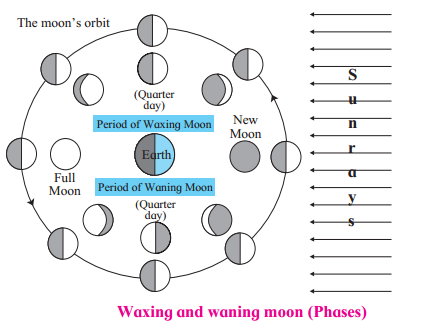
What is the period of waxing moon?
Answer:
The period of waxing moon is the fortnight from new moon to full moon in which the illuminated part of the moon from the earth keeps on increasing (waxing)

Question 2.
What is the period of waning moon?
Answer:
The period of waning moon is the fortnight from full moon to new moon in which the illuminated part of the moon seen from the earth keeps on decreasing (waning)

Question 3.
Why can we see the phases of the moon from the earth?
Answer:
We can see the phases of the moon from the earth due to the sunlight reflected from the moon.

Maharashtra Board Class 7 Geography Solutions Chapter 2 The Sun, the Moon and the Earth

Question 4.
When does the moon appear semi-circular in shape in the sky?
Answer:
On the first and the third quarter days, the moon, the earth & the sun make an angle of 90° due to which we see half the portion of the illuminated moon in a semi-circular shape in the sky.

Question 5.
What types of solar eclipses occur in perigee position?
Answer:
Total & Partial Solar eclipses occur in perigee position.

Question 6.
When does a lunar eclipse occur?
Answer:
A lunar eclipse occurs when the moon enters the shadow of the earth while revolving around it.

Give geographical reasons for the following statements:

Question 1.
We constantly see only one and the same side of the moon.
Answer:

  • The time, the moon takes to make one revolution around the earth and one rotation around itself is the same.
  • As the axial and the orbital motions of the moon are almost of the same duration, only one, the same side of the moon faces the earth.
  • Therefore, we constantly see only one and the same side of the moon.

Question 2.
The distance between the moon and the earth keeps on changing.
Answer:

  • The moon’s orbit of the revolution is elliptical to that of the earth.
  • Hence the distance of the moon from the earth is not the same everywhere along its orbit while revolving.
  • When it is the closest to the earth it is said to be in perigee and when it is at the farthest, the position is called apogee.

Question 3.
Eclipses do not occur on each new moon or full moon day.
Answer:

  • The orbital path of the earth and that of the moon are not in the same plane.
  • The moon’s revolutionary orbit makes an angle of about 5° with that of the earth.
  • So, the sun, the earth and the moon may not be in one straight line in the same plane on every new moon or full moon day.
  • Hence, eclipses do not occur on each new moon or full moon day.

Question 4.
The Annular solar eclipse is rarely seen.
Answer:
The Annular solar eclipse is rarely seen because

  • The moon is in apogee position.
  • The deep shadow of the moon is cast in space and does not reach the earth.
  • From a very small region of the earth, only an illuminated edge of the sun disc is seen in the form of a ring.

Question 5.
Birds and animals are confused during the solar eclipse.
Answer:
Birds and animals are confused during the solar eclipse because –

  • Untimely darkness sets in.
  • The event does not suit their biological clock.
  • Their response to the event is also unusual.

Question 6.
On the first and third quarter days, the moon appears semicircular in shape.
Answer:

  • On the first and third quarter days, the moon, the earth and the sun make an angle of 90°
  • At these positions, we see half the portion of an illuminated moon.
  • Hence, in the sky, the moon appears semi-circular in shape.

Answer the following:

Question 1.
What precautions should we take while observing a solar eclipse?
Answer:
The precautions to be taken while observing a solar eclipse are:

  • We should not observe a solar eclipse with naked eyes as the intense light of the sun can harm them.
  • We must use dark glasses or goggles that are specially designed for viewing the solar eclipse.

Maharashtra Board Class 7 Geography Solutions Chapter 2 The Sun, the Moon and the Earth

Question 2.
What types of Solar eclipses will occur in perigee condition?
Answer:
Total and Partial solar eclipse will occur in perigee condition.
(i) Total solar eclipse :

  • On a new moon day, the sun, the moon the earth are in a straight line & the shadow of the moon falls on the earth
  • The area of dark shadow falls on the earth, the sun becomes completely invisible. This condition is known as total solar eclipse.

(ii) Partial solar eclipse:

  • However during the same period at places where the shadow is lighter, the sun disc appears partially covered,
  • This condition is described as partial solar eclipse.

Question 3.
How are lunar eclipses formed?
Answer:
(i) A lunar eclipse occurs when the moon enters the shadow of the earth while revolving around it.
(ii) On a full moon day if the sun, the earth & the moon, are in a straight line, the orbital path of the moon passes through the dark shadow of the earth.
(iii) If the moon is totally hidden within the shadow, a total lunar eclipse is seen & if only a part of the moon is in the shadow, a partial lunar eclipse is seen.

Write short notes on:

Question 1.
Characteristics of solar eclipse.
Answer:

  • A solar eclipse occurs on a new moon day, but not on every new moon day.
  • If and only if, the sun, the moon and the earth are in the same plane and fall in one line, the solar eclipses occur.
  • The maximum duration of a total solar eclipse is 7 minutes and 20 seconds Question 40 seconds).

Question 2.
Characteristics of lunar eclipse.
Answer:

  • A lunar eclipse occurs on a full moon day, but not on every full moon day.
  • A lunar eclipse occurs if and only if the sun, the moon and the earth are in the same plane and fall in one line.
  • The maximum duration of a total lunar eclipse is 107 minutes.

Question 3.
Occupation.
Answer:

  • This is a typical event occurring in space.
  • The moon revolves around the earth, while doing so, it obscures a star or a planet and that celestial body appears to hide behind the moon. This is called occultation.

Question 4.
What is a Transit?
Answer:

  • If an inner planet like a Mercury or Venus comes in between the line of the earth and the sun, a transit occurs.
  • At that time, a small dot appears to move across the sun’s disc.
  • Transit is a type of solar eclipse.

Maharashtra Board Class 7 Geography Solutions Chapter 2 The Sun, the Moon and the Earth

Distinguish between the following:

Question 1.
Solar eclipse and Lunar eclipse :
Answer:

Solar eclipse  Lunar eclipse     
(i) A solar eclipse occurs on a new moon day.

(ii) If and only if the sun, the moon and the earth are in the same plane and fall in one line, the solar eclipse occurs.

(iii) The maximum duration of total solar eclipse
is 7 minutes and 20 seconds (440 seconds).

(i) A lunar eclipse occurs on a full moon day.

(ii) A lunar eclipse occurs if and only if the sun, the earth and the moon are in the same plane and fall in one line.

(iii) The maximum duration of a total lunar eclipse is 107 minutes.

Question 2.
Total Solar eclipse and Annular Solar eclipse.
Answer:

Total Solar eclipseAnnular Solar eclipse
(i) When the moon is between the sun and the earth all the three celestial objects are on the same plane and fall in one line.(i) moon is in apogee position. This means it is farthest from the earth.
(ii) The central portion of the shadow of the moon is darker and the periphery is light.(ii) A deep shadow of the moon is cast in space and does not reach the earth.
(iii) In the area of dark shadow on the earth, the sun becomes completely invisible. This condition is known as total solar eclipse(iii) From a very small region of the earth, only an illuminated edge of the sun as a disc is seen in the form of a ring. This is called an annular eclipse.

Draw and label the diagrams:

Question 1.
Moon’s Positions:
Answer:
Maharashtra Board Class 7 Geography Solutions Chapter 2 The Sun, the Moon and the Earth 7

Question 2.
Angle between the planes of orbit.
Answer:
Maharashtra Board Class 7 Geography Solutions Chapter 2 The Sun, the Moon and the Earth 8

Question 3.
Consider the relative positions of the sun, the moon, and the earth on the new moon day and both the quarters. What will be the angle between the lines joining the earth and the moon as well as the earth and the sun? How many times will this angle be formed in a month?
Answer:
The angle between the lines joining the earth and the moon as well as the earth and the sun is 90°. This angle will be formed twice a month.

Maharashtra Board Class 9 History Solutions Chapter 8 Industry and Trade

Balbharti Maharashtra State Board Class 9 History Solutions Chapter 8 Industry and Trade Notes, Textbook Exercise Important Questions and Answers.

Maharashtra State Board Class 9 History Solutions Chapter 8 Industry and Trade

Class 9 History Chapter 8 Industry and Trade Textbook Questions and Answers

1A. Choose the right option and rewrite the sentence:

Question 1.
In 1948, Industrial Finance Corporation of India was formed for ________.
(a) better development of the industrial sector
(b) making available long term loans to industrial projects
(c) generating employment
(d) determining the quality of finished goods
Answer:
(b) making available long term loans to industrial projects

Maharashtra Board Class 9 History Solutions Chapter 8 Industry and Trade

Question 2.
industry in India is called the _____.
‘Sunrise Sector’.
(a) Jute
(b) Automobile
(c) Cement
(d) Khadi and village industries
Answer:
(b) Automobile

Question 3.
The major responsibility of the textiles committee is ________.
(a) Production of cloth
(b) Determining the quality standards of cloth
(c) Export of cloth
(d) Generate employment for people
Answer:
(b) Determining the quality standards of cloth

Question 4.
__________ is the major Indian city in the production of bicycles.
(a) Mumbai
(b) Ludhiana
(c) Cochin
(d) Calcutta
Answer:
(b) Ludhiana

Maharashtra Board Class 9 History Solutions Chapter 8 Industry and Trade

B. Identify the wrong pair and rewrite the corrected one:

Question 1.
(1) Industrial Finance Corporation of India – makes long term loans available for industrial projects.
(2) Industrial Development Corporation – development of the industrial sector.
(3) Textiles Committee – the welfare of weavers.
(4) Khadi and Village Industries Commission – promotion of industrialization in rural areas
Answer:
Wrong Pair: Textiles Committee – the welfare of weavers.

Question 2.
(1) Bicycle – Ludhiana
(2) Seribiotic Research Laboratory – Nagpur
(3) Tractor Export – Africa
(4) Port for Trade – Mumbai.
Answer:
Wrong Pair: Seribiotic Research Laboratory -Nagpur.

2A. Create a concept picture based on the chapter:

Question 1.
Industries in India.
Answer:
Maharashtra Board Class 9 History Solutions Chapter 8 Industry and Trade 1

Question 2.
India’s imports and exports or foreign trade.
Answer:
Maharashtra Board Class 9 History Solutions Chapter 8 Industry and Trade 2

B. Explain the following concept:

Question 1.
Internal trade of India.
Answer:
(i) India’s internal trade takes place through railways, waterways, roads, airways, etc. Ports like Mumbai, Kolkata, Cochin and Chennai are important.
(ii) Commodities like coal, cotton, cotton textiles, rice, wheat, raw jute, iron, steel, oilseeds, salt, sugar, etc. are included in internal trade.
(iii) Due to the development of industries, the standard of life in the country improves.
(iv) Many opportunities for employment become available. On the whole, it helps in the progress of the country.

3A. Explain with reasons:

Question 1.
The tourism industry has developed to a great extent in India.
Answer:
(i) India has a rich cultural heritage. There are places of worship of different religions, pilgrimage centers, confluences of rivers, forts, caves, etc. all over our country.

(ii) Tourists from our country as well as from abroad travel in India throughout the year.

(iii) The facilities for tourists to stay, travel, etc. are provided through the Tourism Development Corporation. Sale of curios and the hotel industry thrives in tourist places. In some places, there are guides who give information to tourists about that area.

(iv) Sometimes when vehicles don’t reach the destination in some remote areas and difficult to reach tourist places, the local people help the tourists in return for a fee.

(v) Employment opportunities are generated out of these needs. Thus, the tourism industry has developed a lot in India.

Maharashtra Board Class 9 History Solutions Chapter 8 Industry and Trade

Question 2.
The quality of life and standard of living of Indian citizens is increasing.
Answer:
(i) After India became independent, the Industrial Finance Corporation of India was established in 1948 to make available long term loans to Industrial projects.

(ii) The Industrial Development Corporation was established in 1954 in order to bring about greater development of the industrial sector.

(iii) Due to the development of industries, many opportunities for employment become available.

(iv) On the whole, it helps in the progress of the country.

(v) Thus the standard of life in the country improves.

B. Write the answer in 25 to 30 words:

Question 1.
What efforts are made by our government to promote agricultural industries?
Answer:
The following efforts are made by our Government to promote agriculture and industries:

(i) To encourage farming, loans are given to farmers through rural banks and cooperative institutions.

(ii) Study visits, agricultural outdoor trips and farmers’ get-togethers are organised through the Panchayat Samitis to bring about improvements in agriculture.

(iii) Tools and implements, seeds and fertilisers are also supplied. The farmers are given training regarding soil testing, nursery of fruit plants, pisciculture, poultry, cattle and goat rearing, dairy farming, etc.

(iv) Guidance is given to farmers by a district level training institute. Financial help is given to build warehouses for storing the farm produce.

Question 2.
How is employment generated in the tourism sector?
Answer:
(i) The facilities for tourists to stay, travel, etc. are provided through the Tourism Development Corporation.
(ii) Sale of curios and the hotel industry thrives in tourist places.
(iii) In some places, there are guides who give information to tourists about that area.
(iv) Sometimes when vehicles don’t reach the destination in some remote areas and difficult to reach tourist places, the local people help the tourists in return for a fee.
Thus, employment opportunities are generated out of these needs.

Question 3.
Which industries in India are based on forests?
Answer:
(i) Government has reserved some forests for the industries based on forests.
(ii) The task of conservation of the forests is done by the Central government, the State government, and by the local people.
(iii) Forests are necessary for the raw material for industries like construction, paper, newsprint, silk, matchboxes, medicinal herbs, honey, lacquer, and raw material needed for paint.

Question 4.
Write a short note on the leather industry in India.
Answer:
(i) It is a big industry in India. It is primarily export-oriented.
(ii) The Council for Leather Export is the main trade promotion organization for Indian leather Industry.
(iii) The Indian leather industry contributes almost 13% of world’s leather production.
(iv) India is the second largest producer of footwear and leather garments in the world.

4. Complete the table:

Question 1.

Goods imported in India………………….
Goods exported from India……………………

Answer:

Goods imported in IndiaWhen planning started in 1951, the import of industrial goods and raw material required for production increased. India’s imports included machines, iron, mineral oil, fertilisers, medicines, etc.
Goods exported from IndiaIndia also gave impetus to exports after independence in order to gain valuable foreign exchange. India’s exports included tea, coffee, spices, cotton textiles, leather, footwear, pearls, precious stones, etc.

Class 9 History Chapter 8 Industry and Trade Additional Important Questions and Answers

Choose the correct option from the given options and rewrite the statements:

Question 1.
Market mechanisms like ______ enables the craftsmen from rural and urban areas to get a market for their wares.
(a) Dilli Haat
(b) Mumbai Market
(c) Handloom Emporium
(d) Handicraft Expo.
Answer:
(a) Dilli Haat

Maharashtra Board Class 9 History Solutions Chapter 8 Industry and Trade

Question 2.
The textile industry forms ______ % of the total industrial production.
(a) 17
(b) 14
(c) 16
(d) 15
Answer:
(b) 14

Question 3.
________ industry functions under the Ministry of Textiles.
(a) Automobile
(b) Cement
(c) Leather
(d) Silk
Answer:
(d) Silk

Question 4.
_______ is a scheme that helps weavers through self-finance groups and nongovernmental organisations.
(a) MNREGA
(b) Employment Generation Program
(c) Swarnajayanti Gram Swarojgar Yojana
(d) Mega Cluster
Answer:
(d) Mega Cluster

Question 5.
Industrial Finance Corporation of India was established in _______.
(a) 1948
(b) 1949
(c) 1951
(d) 1991
Answer:
(a) 1948

Question 6.
Industrial Development Corporation was established in ________.
(a) 1955
(b) 1956
(c) 1957
(d)1954
Answer:
(d)1954

Question 7.
Textile Committee Act was passed in ________.
(a)1961
(b) 1960
(c) 1963
(d) 1964
Answer:
(c) 1963

Question 8.
Industrial Licensing Policy was formulated in _______.
(а) 1970
(b) 1980
(c)1990
(d) 1991
Answer:
(а) 1970

Identify and write the wrong pair in the following sets:

Question 1.
(1) Industrial Licensing policy – 1970
(2) Textile Committee Act – 1963
(3) Industrial Finance Corporation of India – 1948
(4) Industrial Development Corporation – 1958
Answer:
Wrong Pair: Industrial Development Corporation -1958.

Question 2.
(1) Mega cluster – Welfare scheme for weavers.
(2) Dilli Haat – Enables the craftsmen to get a market
(3) Cement Industry – Sunrise sector
(4) Leather Industry – Export Oriented
Answer:
Wrong Pair: Cement Industry – Sunrise sector.

Question 3.
(1) Hand Sculpting – labour intensive
(2) Silk Industry – Ministry of textiles
(3) Khadi and Village Industry Commission – Fourth five year plan
(4) Tourism Development Corporation – facilities for tourist
Answer:
Wrong Pair: Khadi and Village Industry Commission -Fourth five year plan

Maharashtra Board Class 9 History Solutions Chapter 8 Industry and Trade

Do as Directed:

Question 1.
Arrange the following in chronological order:
(i) Textile Committee Act
(ii) Industrial Finance Corporation of India was established
(iii) Industrial Licensing Policy
(iv) Industrial Development Corporation was established
Answer:
(i) Industrial Finance Corporation of India was established in 1948
(ii) Industrial Development Corporation was established in 1954
(iii) Textile Committee Act 1963
(iv) Industrial Licensing Policy of 1970

Write short notes on:

Question 1.
Hand sculpting Industry.
Answer:
(i) This is a labour intensive craft.
(ii) Sculptors got employment due to the capacity of the craft to absorb more craftsmen, small investment, more profits, preference to exports and possibility of earning more foreign exchange.
(iii) Several cities have market mechanisms like ‘Dilli Haat’ which enables the craftsmen from rural and urban areas to get a market for their wares.

Question 2.
‘Mega cluster’ scheme and Jute Industry.
Answer:
(i) ‘Mega cluster’ is a scheme that helps weavers through self-finance groups and non-governmental organisations.
(ii) Help is given in the form of raw material, design banks, development of technology and welfare of the weavers.
(iii) India is the top ranking country in jute production. India is a major exporter of jute products.
(iv) We get cloth, sack cloth and ropes from jute.

Question 3.
Cement Industry.
Answer:
(i) The role of cement industry is important in the development of housing and infrastructure.
(ii) This industry is one of the most technologically advanced. India is currently an important producer of cement in the world.

Question 4.
Salt and Bicycle industry.
Answer:
(i) India is one of the top producers of salt in the world.
(ii) The annual production of salt in India is 200 lakh tons.
(iii) The production of iodised salt is 60 lakh tons.
(iv) India is a leading producer of bicycles in the world.
(v) Bicycles are made in the states of Punjab and Tamil Nadu.
(vi) The main centre of bicycle manufacturing in India is Ludhiana.
(vii) India exports bicycles to countries like Nigeria, Mexico, Kenya, Uganda and Brazil.

Maharashtra Board Class 9 History Solutions Chapter 8 Industry and Trade

Question 5.
Mineral wealth and fisheries.
Answer:
(i) The availability of the minerals, iron and coal plays a major role in the industrial development of the country.
(ii) We have adequate stores of iron, manganese, coal and mineral oil in our country.
(iii) Fisheries include sea water fish and fresh water fish found in rivers, canals, ponds and lakes.
(iv) Harbours have been built or old harbours have been redeveloped, fish seed incubation centres and fishing industry training centres have been provided for the growth of this industry.

Question 6.
Khadi and Village Industries Commission.
Answer:
(i) The Khadi and Village Industries Commission was established to give impetus to industrialisation in rural areas.
(ii) The main objectives behind the establishment of the corporation were to develop the traditional industries, handicrafts, cottage industries and to encourage industries that use the material and human resources available at the local level and make the villages self-reliant by creating employment there.

Explain the statements with reason:

Question 1.
Agriculture fulfills man’s basic needs.
Answer:
(i) The major occupation in India is agriculture and other tasks based on agriculture.
(ii) Many varieties of crops are grown. Jowar, wheat, rice, pulses and oilseeds are mainly produced.
(iii) Agriculture also includes the production of fruits and vegetables. Nowadays, industries processing these fruits and vegetables have come up.
(iv) Thus, Agriculture fulfills man’s basic needs.

Read the following passage and answer the questions.

Forest resources: The government has reserved some forests for the industries based on forests. The task of conservation of the forests is done by the Central government, the State government, and by the local, people. Forests are necessary for the raw material for industries like construction, paper, newsprint, silk, matchboxes, medicinal herbs, honey lacquer, and raw material needed for paint.
Fisheries: Fisheries include seawater fish and fresh i water fish found in rivers, canals, ponds, and lakes.
Tourism: India has a rich cultural heritage. There are places of worship of different religions, pilgrimage centers, confluences of rivers, forts, caves, etc. all over our country. Tourists from our country as well as from abroad travel in India throughout the year.
The facilities for tourists to stay, travel, etc. are, provided through the Tourism Development Corporation. The sale of curios and the hotel industry thrives in tourist places. In some places, there are guides who give information, to tourists about that area. Sometimes when vehicles, don’t reach the destination in some remote and difficult to reach tourist places, the local people help the tourists in return for a fee. Employment, opportunities are generated out of these needs.

Question 1.
Name a few industries which depend upon forest resources for their production.
Answer:
A few industries which depend upon forest resources are – construction, newsprint, paper and silk industry. Even lacquer is required to paint and coat furniture, honey and herbs for medicinal use.

Question 2.
Do you think Tourism is an industry? How has this industry prospered in India so far?
Answer:
Yes, tourism is an industry. India attracts a lot of foreign tourists every year as it is a home of many pilgrimage places, has a confluence of rivers, scenic landscapes and historical monuments. The Tourism Development Corporation provides all facilities of stay and travel in India. Not just the guides but also local people of the tourist spots help the tourists to reach difficult destinations with ease. The sale of curios and the hotel industry thrives in tourist places. Hence India’s tourism is prospering at a fast pace.

Question 3.
Do you agree that cross-border terrorism in Kashmir has affected tourism in this region? what can be done to protect tourism there?
Answer:
It is true that cross-border terrorism has affected tourism in the Kashmir region. I think the following are a few measures which can ensure protection of tourists:

(i) The army and other paramilitary forces should become more tourist – friendly and convince them to refrain from visiting terror-prone areas.

(ii) Bilateral talks at the governmental level can also play a vital role in preventing unpleasant experiences for the tourists.

(iii) During skirmishes or conflicts of any kind, the tourists should be restricted from visiting the valley. Those already stuck in the regions during sudden eruption of violence must be given a safe passage with priority.

Maharashtra Board Class 9 History Solutions Chapter 8 Industry and Trade

Answer the following questions in detail:

Question 1.
Explain Agriculture in India.
Answer:
(i) Agriculture, in India, is practised using traditional and modern methods. Tasks are performed using bullocks as well as machines.

(ii) Seventy percent of Indian society depends upon jobs related to agriculture and agricultural production.

(iii) Agriculture and animal husbandry are practised in villages. In this industry the participation of women is equal to that of men.

(iv) Variety of crops like jowar, wheat, rice, pulses and oilseeds, cotton and sugarcane are produced in India.

(v) To encourage farming, loans are given to farmers through rural banks and cooperative institutions.

(vi) Study visits, agricultural outdoor trips and farmers’ get-togethers are organised through the Panchayat Samitis to bring about improvements in agriculture.

(vii) Tools and implements, seeds and fertilisers are also supplied. The farmers are given training regarding soil testing, nursery of fruit plants, pisciculture, poultry, cattle and goat rearing, dairy farming, etc.

(viii) Guidance is given to farmers by a district level training institute. Financial help is given to build warehouses for storing the farm produce.

(ix) Modern techniques like drip irrigation, organic farming are used for farming.

Question 2.
Industries in India.
Answer:
(i) Textile industry: The textile industry forms 14% of the total industrial production.
It includes the powerloom and the handloom industries. The handloom industries are labour-intensive. According to the ‘Textile Committee Act 1963’, a Textile Committee has been established. This committee sets the quality standards for textiles manufactured for sale in the internal market as well as for export.

(ii) Silk industry: This industry functions under the Ministry of Textiles. The research about the species of the silkworm and mulberry trees is done in the Seribiotic Research Laboratory at Bengaluru. This industry is primarily in the States of Karnataka, Andhra Pradesh, West Bengal, Jammu and Kashmir. Now it is being spread in states with predominantly tribal populations.

(iii) Jute industry: India is the top ranking country in jute production. India is a major exporter of jute products. We get cloth, sack cloth and ropes from jute.

(iv) Hand sculpting: This is a labour intensive craft. Sculptors got employment due to the capacity of the craft to absorb more craftsmen, small investment, more profits, preference to exports and possibility of earning more foreign exchange. Several cities have market mechanisms like ‘Dilli Haat’ which enables the craftsmen from rural and urban areas to get a market for their wares.

(v) Automobile industry: India is one of the major producers of vehicles. Vehicles are exported to 40 countries from India. The automobile industry is called the ‘sunrise sector’ in India. India’s tractor industry is the biggest in the world. One third of the tractors manufactured world-wide are produced in India. Tractors manufactured in India are exported to Turkey, Malaysia and several countries in Africa.

(vi) Cement industry: The role of cement industry is important in the development of housing and infrastructure. This industry is one of the most technologically advanced. India is currently an important producer of cement in the world.

(vii) Leather industry: It is a big industry in India. It is primarily export oriented.

(viii) Salt industry: India is one of the top producers of salt in the world. The annual production of salt in India is 200 lakh tons. The production of iodised salt is 60 lakh tons.

(ix) Bicycle industry: India is a leading producer of bicycles in the world. Bicycles are made in the States of Punjab and Tamil Nadu. The main centre of bicycle manufacturing in India is Ludhiana. India exports bicycles to countries like Nigeria, Mexico, Kenya, Uganda and Brazil.

(x) Khadi and village industry: The Khadi and Village Industries Commission was established to give impetus to industrialization in rural areas. The main objectives behind the establishment of the corporation were to develop the traditional industries, handicrafts, cottage industries and to encourage industries that use the material and human resources available at the local level and make the villages self-reliant by creating employment there.

Question 3.
India’s imports and exports or foreign trade.
Answer:
(i) When planning started in 1951, import of industrial goods and raw material was required for increasing the production.
(ii) India’s imports included machines, iron, mineral oil, fertilisers, medicines, etc.
(iii) India also gave impetus to exports after independence in order to gain valuable foreign exchange.
(iv) India’s exports included tea, coffee, spices, cotton textiles, leather, footwear, pearls, precious stones, etc.

Question 4.
Explain the policy of the Central Government.
Answer:
(i) In the fourth five year plan, focus was placed on paper industry, pharmaceutical industry, motor-tractor industry, leather goods, textile industry, food processing industry, oil, colour, sugar industries, etc.

(ii) According to the Industrial Licensing Policy of 1970, all those factories requiring an investment of more than 5 crore rupees were to be included as heavy industries.

(iii) The big industrial houses and foreign companies were allowed to invest in heavy industries that were not reserved for the public sector.

(iv) As a result of this policy, by the end of 1972,3 lakh 18 thousand small industries were registered with the government registration office.

Maharashtra Board Class 9 History Solutions Chapter 8 Industry and Trade

Question 5.
Write a note on Silk Industry.
Answer:
(i) The silk industry functions under the Ministry of Textiles.
(ii) The research about the species of the silkworm and mulberry trees is done in the Seribiotic Research Laboratory at Bengaluru.
(iii) This industry is primarily in the States of Karnataka, Andhra Pradesh, West Bengal and Jammu and Kashmir.
(iv) Now it is being spread in States with predominantly tribal populations.

Maharashtra Board Class 8 Civics Solutions Chapter 6 Bureaucracy

Balbharti Maharashtra State Board Class 8 Civics Solutions Chapter 6 Bureaucracy Notes, Textbook Exercise Important Questions and Answers.

Maharashtra State Board Class 8 Civics Solutions Chapter 6 Bureaucracy

Class 8 Civics Chapter 6 Bureaucracy Textbook Questions and Answers

1. Identify if the following statements are correct or wrong and rewrite the wrong statements in their correct form:

Question 1.
In a Parliamentary democracy, representatives elected by the people and ministers bear the administrative responsibility.
Answer:
Correct.

Question 2.
Union Public Service Commission (UPSC) recruits candidates for civil services in Maharashtra.
Answer:
Wrong – Maharashtra Public Service Commission recruits candidates for civil services in Maharashtra.

Maharashtra Board Class 8 Civics Solutions Chapter 6 Bureaucracy

2. Explain the following statements with reasons:

Question 1.
Reservation policy is followed even in Civil Services.
Answer:

  1. A part of the society comprising of Scheduled Castes, Scheduled Tribes, Women, Other Backward Castes and specially-abled is termed as the weaker section of the society.
  2. It was essential to empower these weaker sections.
  3. They were left out of civil services due to social inequality.
  4. In order to establish social justice and provide opportunities to weaker sections of the society, reservation policy is followed even in civil services.

Question 2.
It is necessary for civil servants to be politically neutral.
Answer:

  1. In Parliamentary democracy, in India, a new government comes in power after every five years. But the bureaucracy is permanent, i.e. they remain same.
  2. Bureaucracy is expected to implement the policies and decisions of the earlier government with same efficiency and commitment.
  3. Civil servants are expected to keep away from taking a political stand and remain neutral while discharging their duties.
  4.  If civil servants work according to their political views it will lead to chaos. Hence, they should be politically neutral.

3. Answer the following questions in 25 to 30 words:

Question 1.
Explain the role of the ministers and civil servants in the efficient administration of the department.
Answer:

  1. The efficiency of a particular department depends upon the inter-relationship between the Minister and his Secretary and Deputy secretary.
  2. The decisions taken by the Ministers are based on the necessary information provided by the bureaucracy.
  3. The bureaucracy, i.e. civil servants have complete information about the financial provisions for a particular scheme or plan and also about the history of successes and failures of policies.
  4. Hence, if the Ministers develop mutual trust and transparency with the civil servants, it will help in the efficient administration of the department.

Maharashtra Board Class 8 Civics Solutions Chapter 6 Bureaucracy

Question 2.
Explain how the bureaucracy provides stability to the political system.
Answer:

  1. Bureaucracy does the work of implementing decisions taken by the ministers.
  2. Several important reforms introduced during the post-independent period have been effectively implemented by the bureaucracy.
  3. It consistently provides services like water supply, public cleanliness, transport, electricity, etc. to the people and brings stability in their day-to-day life.
  4. It acts as an instrument of social transformation and democratisation. In this way, it gives stability to the political system.

4. Complete the concept picture.

Question 1.
Maharashtra Board Class 8 Civics Solutions Chapter 6 Bureaucracy 1
Answer:
Maharashtra Board Class 8 Civics Solutions Chapter 6 Bureaucracy 2

5. Discuss characteristics of bureaucracy.

Question 1.
Bureaucracy:
Answer:

  1. It is the administrative system that works under the Union Executive.
  2. As this administrative system includes civil servants i.e. bureaucrats, it is called Bureaucracy.
  3. It has the responsibility of actual implementation of government’s policies.
  4. Though the ministers control the bureaucracy, they are dependent on the bureaucracy for information and efficient functioning.

Maharashtra Board Class 8 Civics Solutions Chapter 6 Bureaucracy

Question 2.
Armed Forces and Civil Services:
Answer:

  1. Defending the country from external aggression and internal threats and ensuring security of the country is carried out by the Armed Forces.
  2. Services provided to the citizens for making their daily lives comfortable and enabling them to develop themselves and the society are called Civil Services.
  3. The administrative system developed to provide services to citizens are called Civil Services.
  4. The armed forces help the civil services for internal security.

Meaning of the Headlines given In the box:

Maharashtra Board Class 8 Civics Solutions Chapter 6 Bureaucracy 7

  1. In the box, a few posts like District Collector, Municipal Commissioner, flnance Secretary, and Divisional Commissioner are mentioned.
  2. They are civil servants in the government’s administrative system, working for the welfare of the people.

Project:

Question 1.
Prepare a questionnaire and interview a civil servant in your locality

Class 8 Civics Chapter 6 Bureaucracy Additional Important Questions and Answers

Choose the correct options and complete the statements:

Question 1.
…………….. is permanent in nature.
(a) Election Commission
(b) Bureaucracy
(c) President
(d) Prime Ministers
Answer:
(b) Bureaucracy

Maharashtra Board Class 8 Civics Solutions Chapter 6 Bureaucracy

Question 2.
The bureaucracy is politically ……………….. .
(a) positive
(b) negative
(c) biased
(d) neutral
Answer:
(d) neutral

Question 3.
The Parliament holds the ……….. responsible for malpractices.
(a) bureaucracy
(b) Prime Minister
(c) minister
(d) President
Answer:
(c) minister

Question 4.
The ………….. has established autonomous institutions like the Public Service Commissions for selecting efficient civil servants.
(a) Constitution
(b) Council of Ministers
(c) Parliament
(d) President
Answer:
(a) Constitution

Question 5.
The ‘Indian Foreign Service’ is included under ……………
(a) All India Services
(b) Union or Central Services
(c) State Civil Services
(d) Armed Forces
Answer:
(b) Union or Central Services

Identify if the following statements are correct or wrong and rewrite the wrong statements in their correct form:

Question 1.
Bureaucracy is an important instrument of social transformation.
Answer:
Correct.

Maharashtra Board Class 8 Civics Solutions Chapter 6 Bureaucracy

Question 2.
Civil servants are not aware of the history of successes and failures of policies.
Answer:
Wrong – Civil servants are aware of the history of successes and failures of policies.

Question 3.
Civil servants are never publicly criticised.
Answer:
Correct.

Complete the following concept maps:

Question 1.
Maharashtra Board Class 8 Civics Solutions Chapter 6 Bureaucracy 3
Answer:
Maharashtra Board Class 8 Civics Solutions Chapter 6 Bureaucracy 4

Question 2.
Maharashtra Board Class 8 Civics Solutions Chapter 6 Bureaucracy 5
Answer:
Maharashtra Board Class 8 Civics Solutions Chapter 6 Bureaucracy 6

Explain the following statements with reasons:

Question 1.
Coordination between the Civil Servants and Ministers help in efficient functioning of the government.
Answer:

  1. In Parliamentary democracy, the Executive is responsible for the efficient governance of the country.
  2. The decisions relating to the concerned department are made by the minister-in-charge, but necessary information to make such decisions is given by the civil servants.
  3. The ministers are dependent on the civil servants for many reasons.

Hence, coordination and mutual trust between the civil servants and ministers help in efficient functioning of the government.

Maharashtra Board Class 8 Civics Solutions Chapter 6 Bureaucracy

Question 2.
The Bureaucracy is not held directly responsible for any success or failure of policy.
Answer:

  1. It is the Minister who is responsible for the efficient and smooth functioning of his department.
  2. Though providing necessary information and giving advice is the function of the bureaucracy, it is not accountable for any inefficiency.
  3. The Parliament holds the Minister responsible for inefficiency and malpractices.
  4. In such case, the Minister bears the responsibility and protects the bureaucracy.

Thus, the anonymity of bureaucracy is preserved, which means they are not held directly responsible for any success or failure of policy. ‘

Question 3.
Bureaucracy is considered as an important instrument of social transformation.
Answer:

  1. Many laws are enacted by the government for empowerment of women, protection of children and marginalised sections of the society.
  2. Social change is brought through the implementation of such policies.
  3. These laws are successfully implemented by the bureaucracy.

Hence, Bureaucracy is considered as an important instrument of social transformation.

Answer the following questions in 25 to 30 words:

Question 1.
Explain the characteristics of Bureaucracy.
Answer:

  1. Bureaucracy is the administrative system which actually implements the government’s policies.
  2. Though the government changes, bureaucracy remains constant. Thus, it is permanent in nature.
  3. It has to remain politically neutral and discharge its duties.
  4. Its anonymity is maintained, i.e. it is not held directly responsible for any success or failure of policies and it is never publicly criticized.

Thus, the structure of Bureaucracy in India is extensive and complex.

Maharashtra Board Class 8 Civics Solutions Chapter 6 Bureaucracy

Question 2.
Explain the significance of Indian bureaucracy.
Answer:

  1. The Indian bureaucracy implements the policies made by the government for the welfare of the people effectively.
  2. It provides several essential services to the people consistently and brings stability in their day to day life.
  3. It provides stability to the political system.
  4. It acts as an important instrument of social transformation and democratization of society.

Question 3.
Explain the role of bureaucracy in the democratisation of society.
Answer:

  1. Equality and social justice are important values of democracy.
  2. Bureaucracy has helped in bringing marginalised sections of society into the mainstream by implementing the reservation policy effectively.
  3. Their participation has been increased in the process of decision¬making.
  4. Democratisation of society not only requires progressive laws and policies but also effective participation of bureaucracy in implementing it.

Thus, bureaucracy plays an important role in the democratisation of society.

Maharashtra Board Class 8 Civics Solutions Chapter 6 Bureaucracy

Question 4.
Why have autonomous institutions like Public Service Commissions been established?
Answer:
The Constitution of India has established autonomous institutions like Public Service Commissions for following reasons:

  1. To select civil servants.
  2. To conduct competitive exams for selecting candidates on the criteria of merit and efficiency.
  3. To decide other aspect to like the nature of the exam, syllabus, eligibility, etc.
  4. To select efficient and deserving candidates through interviews and recommend them to the government for appointment.

Open-Ended Question:

Question 1.
Express your views on ‘ideal bureaucracy’.
Answer:
Bureaucracy includes civil servants and all the employees working in various government offices. In India, bureaucracy is criticised most of the times and is seldom praised.
According to me, an ideal bureaucracy should function as follows:

  1. The bureaucracy should advise and force the ministers to adopt policies of public welfare.
  2. It should give full cooperation to the ministers for implementing policies effectively.
  3. It should adopt the principle of equality and an unbiased approach while implementing the policies so that maximum people are benefitted.
  4. It should make the people aware of different beneficial policies.
  5. It should strictly keep away from ill- practices like corruption, unnecessary delay, cheating and frauds, etc.
  6. It should aim at establishing social justice by extending maximum benefits to weaker sections.
  7. It should function as an effective medium for development of the country, social transformation and democratisation of society.

Maharashtra Board Class 8 Civics Solutions Chapter 6 Bureaucracy

(B) Oral Examination:

Answer the following questions orally:

Question 1.
Who is the Chief Civil Servant of your district?

Question 2.
Name any two schemes/plans implemented by the government officers for your village/city.

Question 3.
How do armed forces help the civil servants?

Question 4.
Who is the Chief Civil Servant of a taluka/tehsil?

Formative Evaluation:

Oral Work:

1. Interview:
Prepare a questionnaire and interview a civil servant in your locality.

2. Group discussion:
Conduct a group discussion in your class on the topic ‘Role of bureaucracy in the development of city/village.’

Maharashtra Board Class 8 Civics Solutions Chapter 6 Bureaucracy

Project:

Question 1.
Collect information about the working of bureaucracy at taluka/tehsil level.

Maharashtra Board Class 8 History Solutions Chapter 10 Armed Revolutionary Movement

Balbharti Maharashtra State Board Class 8 History Solutions Chapter 10 Armed Revolutionary Movement Notes, Textbook Exercise Important Questions and Answers.

Maharashtra State Board Class 8 History Solutions Chapter 10 Armed Revolutionary Movement

Class 8 History Chapter 10 Armed Revolutionary Movement Textbook Questions and Answers

1. Rewrite the statements by choosing the appropriate options:
(Pandit Shyamji Krishna Varma, Mitramela, Ramsingh Kuka, Anant Laxman Kanhere, Birsa Munda)

Question 1.
Swatantryaveer Savarkar started a secret organization of revolutionaries named …………. .
Answer:
Mitramela

Question 2.
In Punjab, ………………. organised an uprising against the Government.
Answer:
Ramsinh Kuka

Maharashtra Board Class 8 History Solutions Chapter 10 Armed Revolutionary Movement

Question 3.
……………… founded the India House.
Answer:
Pandit Shyamji Krishna Varma

2. Complete the following table:

Question 1.
Maharashtra Board Class 8 History Solutions Chapter 10 Armed Revolutionary Movement 1
Answer:

RevolutionaryOrganisation
1. Swatantryaveer SavarkarAbhinav Bharat
2. Barindrakumar GhoshAnushilan Samiti
3. Chandrashekhar AzadHindustan Socialist Republican Army
4. Lala HardayalGadar

3. Explain the following statements with reasons:

Question 1.
Chafekar brothers killed Rand.
Answer:

  1. The Plague epidemic broke out in 1897 in Pune.
  2. Commissioner Rand was appointed to manage the Plague epidemic.
  3. In course of curtailing the epidemic, he resorted to tyranny and force.

As a revenge, the Chafekar brothers Damodar and Balkrishna shot him dead on 22 June, 1897.

Question 2.
Khudiram Bose was hanged to death.
Answer:

  1. Anushilan Samiti worked with the objective to overthrow the British rule with armed rebellion.
  2. Prafulla Chaki and Khudiram Bose were the members of Anushilan Samiti.
  3. They planned to kill a judge named Kingsford.
  4. They threw a bomb at a vehicle, assuming it to be of Kingsford but the vehicle was not the one carrying him.
  5. However, two English women were killed in this attack Khudiram Bose was caught by the police and was hanged.

Maharashtra Board Class 8 History Solutions Chapter 10 Armed Revolutionary Movement

Question 3.
Bhagat Singh and Batukeshwar Dutta threw bombs in the Central Legislative Assembly.
Answer:

  1. The Government had introduced two bills in the Central Legislature.
  2. The Bills curtailed civil rights of the people.
  3. To protest against these bills, Bhagat Singh and Batukeshwar Dutta threw bombs in the Central Legislative Assembly.

4. Answer the following in brief:

Question 1.
Write a detail description of the attack on Chittagong Armoury.
Answer:

  1. Surya Sen drew a plan to attack the armoury at Chittagong.
  2. He and his associates raided two government armouries on the 18th April, 1930.
  3. They seized arms and ammunition from the two armouries.
  4. He took revolutionaries like Anant Singh, Ganesh Ghosh, Kalpana Datta and Pritilata Waddedar with him.
  5. They cut off the telephone and telegraph connections and succeeded in paralysing the communication.

Question 2.
Give information about the work of India House.
Answer:

  1. India House, founded by Pandit Shyamji Krishna Verma in London, was the centre of revolutionary activities outside India.
  2. It provided assistance to the revolutionaries staying abroad.
  3. It gave scholarships to the Indian students studying in England.
  4. Swatantryaveer Savarkar received such scholarship.

Maharashtra Board Class 8 History Solutions Chapter 10 Armed Revolutionary Movement

Do you Know?

Maharashtra Board Class 8 History Solutions Chapter 10 Armed Revolutionary Movement 2

Literary and Social work of Swatantryaveer Savarkar:

  1. In his autobiography, ‘Majhi Janmathep’ he wrote about his experience of the terrible days in Andaman.
  2. After 10 years, he was taken to Ratnagiri and detained there.
  3. There Savarkar started many social movements such as removal of caste differences, removal of untouchability, common dining, purification of language, etc.
  4. In 1938, he presided over the Marathi Sahitya Sammelan at Mumbai.
  5. He wrote two books one The Indian War of Independence 1857′ and other biography of Joseph Mazzini, an Italian revolutionary.

Project:

Question 1.
Watch a movie or drama based on the life of revolutionaries and enact your favourite incident in the class.

Question 2.
Prepare a manual based on the saga of revolutionaries.

Class 8 History Chapter 10 Armed Revolutionary Movement Additional Important Questions and Answers

Rewrite the statements by choosing the appropriate options:

Question 1.
A youth named ………….. killed Jackson, the collector of Nashik.
Answer:
Anant Laxman Kanhere

Question 2.
Munda tribe in Bihar revolted under the leadership of ………….. .
Answer:
Birsa Munda.

Maharashtra Board Class 8 History Solutions Chapter 10 Armed Revolutionary Movement

Name the following:

Question 1.
Killed Rand
1. …………………………
2. …………………………
Answer:
1. Balkrishna Chafekar
2. Damodar Chafekar

Question 2.
Planned to kill Judge Kingsford and threw bomb on his vehicle
1. …………………………
2. …………………………
Answer:
1. Khudiram Bose
2. Prafulla Chaki

Question 3.
Leaders of Gadar organization
1. …………………………
2. …………………………
Answer:
1. Bhai Parmanand
2. Dr. Pandurang Sadashiv Khankhoje

Maharashtra Board Class 8 History Solutions Chapter 10 Armed Revolutionary Movement

Question 4.
Threw bomb in Central Legislative Assembly
1. …………………………
2. …………………………
Answer:
1. Bhagat Singh ?
2. Batukeshwar Dutta

Question 5.
Killed the District Judge
1. …………………………
2. …………………………
Answer:
1. Shanti Ghosh
2. Suniti Choudhary.

Rewrite the statements by choosing the appropriate options:

Question 1.
Vasudev Balwant Phadke took the training of arms from ………….. .
(a) Damodar Chafekar
(b) Vastad Lahuji Salve
(c) Swatantryaveer Savarkar
(d) Babarao Savarkar
Answer:
(b) Vastad Lahuji Salve

Maharashtra Board Class 8 History Solutions Chapter 10 Armed Revolutionary Movement

Question 2.
Anushilan Samiti’ received counsel and guidance from ……………. .
(a) Aurobindo Ghosh
(b) Barindrakumar Ghosh
(c) Khudiram Bose
(d) Rash Behari Bose
Answer:
(a) Aurobindo Ghosh

Question 3.
……………. raised the issue of India’s independence at the World Socialist Conference.
(a) Pritilata Waddedar
(b) Kalpana Dutta
(c) Madam Cama
(d) Shanti Ghosh
Answer:
(c) Madam Cama

Question 4.
……………. , a young girl shot dead the Governor during the convocation ceremony of Kolkata University.
(a) Shanti Ghosh
(b) Pritilata Waddedar
(c) Suniti Choudhary
(d) Bina Das
Answer:
(d) Bina Das

Question 5.
……………. died in an encounter with police at Alfred Park in Allahabad.
(a) Bhagat Singh
(b) Chandrashekhar Azad
(c) Madanlal Dhingra
(d) Khudiram Bose
Answer:
(b) Chandrashekhar Azad

Maharashtra Board Class 8 History Solutions Chapter 10 Armed Revolutionary Movement

Question 6.
In his autobiography, ……………. wrote about his experience of the terrible days in Andaman jail.
(a) Bhagat Singh
(b) Vasudev Balwant Phadke
(c) Swatantryaveer Savarkar
(d) Baba Savarkar
Answer:
(c) Swatantryaveer Savarkar

Question 7.
The Anushilan Samiti had a bomb manufacturing unit at ……………. .
(a) Kolkata
(b) Dhaka
(c) Maniktala
(d) Chittagong
Answer:
(c) Maniktala

Question 8.
The young men of Hindustan Socialist Republic were influenced by ……………. ideology.
(a) capitalistic
(b) imperialistic
(c) religious
(d) socialist
Answer:
(d) socialist

Question 9.
After the British traced the plan of revolt by Gadar Organisation ……………. escaped to Japan and continued his revolutionary work.
(a) Vishnu Shastri Pingle
(b) Khudiram Bose
(c) Rash Behari Bose
(d) Chandrashekhar Azad
Answer:
(c) Rash Behari Bose

Maharashtra Board Class 8 History Solutions Chapter 10 Armed Revolutionary Movement

Question 10.
……………. was the chief of revolutionary group in Bengal.
(a) Anant Singh
(b) Ganesh Ghosh
(c) Rash Behari Bose
(d) Surya Sen
Answer:
(d) Surya Sen

Identify the wrong pair, correct it and rewrite:

1. Threw bomb on Lord Hardinge – Khudiram Bose
2. Killed British officer Ash – Vanchhi Iyyer
3. Assassinated Curzon Wylie – Bhagat Singh
4. Killed Dyer in London – Sardar Udham Singh
Answer:
Wrong pair:
Assassinated Curzon Wylie – Bhagat Singh

Corrected pair:
Assassinated Curzon Wylie – Madanlal Dhingra.

Answer the following in one sentence each:

Question 1.
Who spread the network of revolutionary work outside Bengal?
Answer:
Rash Behari Bose and Sachindranath Sanyal spread the network of revolutionary organisation outside Bengal.

Question 2.
What was the objective in establishing India House?
Answer:
The revolutionary work in India received assistance from India House in London and Indian youth were given scholarships for higher education in England.
Question 3.
Who prepared anti-British plans with the help of German Foreign ministry?
Answer:
Veerendra Nath Chattopadhyay, Bhupen Dutta and Hardayal prepared anti-British plans with the help of German foreign ministry.

Question 4.
Who established Provincial Government of free India in Kabul?
Answer:
Mahendra Pratap, Barkatullah and Obaidullah Sindhi established Provincial Government of free India in Kabul.

Maharashtra Board Class 8 History Solutions Chapter 10 Armed Revolutionary Movement

Question 5.
What work was entrusted to a separate wing of ‘Hindustan Socialist Republican Army’?
Answer:
The work of gathering arms and execution of programmes was entrusted to a separate wing of Hindustan Socialist Republican Army.

Question 6.
How was the death of Lala Lajpat Rai avenged?
Answer:
Bhagat Singh and Rajguru fired bullets and killed officer Saunders to avenge death of Lala Lajpat Rai.

Do as Directed:

Complete the graphical presentation:

Question 1.
Maharashtra Board Class 8 History Solutions Chapter 10 Armed Revolutionary Movement 3
Answer:
Maharashtra Board Class 8 History Solutions Chapter 10 Armed Revolutionary Movement 4

Question 2.
Maharashtra Board Class 8 History Solutions Chapter 10 Armed Revolutionary Movement 5
Answer:
Maharashtra Board Class 8 History Solutions Chapter 10 Armed Revolutionary Movement 6

Question 3.
Maharashtra Board Class 8 History Solutions Chapter 10 Armed Revolutionary Movement 7
Answer:
Maharashtra Board Class 8 History Solutions Chapter 10 Armed Revolutionary Movement 8

Write short notes:

Question 1.
Vasudev Balwant Phadke:
Answer:

  1. Vasudev Baiwant Phadke gave an armed struggle against the British in Maharashtra.
  2. He was of the opinion that there should be armed struggle to fight against the British.
  3. Vastad Lahuji Salve gave him training of arms.
  4. He organized Ramoshis and led armed struggle in Maharashtra, but was unsuccessful.
  5. He was sent to Eden Jail by the British Government where he died in 1883.

Maharashtra Board Class 8 History Solutions Chapter 10 Armed Revolutionary Movement

Question 2.
Literary and Social work of Swatantryaveer Savarkar:
Answer:

  1. When Swatantryaveer Savarkar was detained in the Ratnagiri jail, he started many social movements such as removal of caste differences, removal of untouchability, common dining, purification of language, etc.
  2. in his autobiography, ‘Majhi Janmathep’ he wrote about his experiences of the terrible days in Andaman where he spent ten years.
  3. He wrote the book ‘The Indian War of Independence 1857’ in which he stated 1857 rebellion as the first war of independence.
  4. He wrote an inspiring biography of Joseph Mazzini.
  5. Savarkar was a great writer, social worker and revolutionary.

Question 3.
Kakori Conspiracy:
Answer:

  1. After Gandhiji suspended Civil Disobedience, many youngsters like Chandrashekhar Azad, Ram Prasad Bismil, Yogesh Chatterjee, Sachindra Nath f Sanyal got diverted to revolutionary ways.
  2. On 9th August, 1925 they looted the Government treasury that was on a train near Kakori railway station in Uttar Pradesh.
  3. However, due to the immediate action of the government the revolutionaries were arrested and put on trial.
  4. Ashfaqulla Khan, Ram Prasad Bismil, Roshan Singh, Rajendra Lahiri were hanged.
  5. Chandrashekhar Azad managed to escape.

Explain the following statements with reasons:

Question 1.
Swatantryaveer Savarkar was sentenced to fifty years of rigorous imprisonment.
Answer:

  1. On knowing the activities of Abhinav Bharat, the government arrested Babarao Savarkar and sentenced to life imprisonment.
  2. Anant Laxman Kanhere killed Jackson, collector of Nashik in retaliation.
  3. The government linked Abhinav Bharat and Savarkar with his murder.
  4. He was arrested and put on trial. So, the court sentenced him to fifty years of rigorous imprisonment.

Question 2.
Bhagat Singh, Sukhdev and Rajguru were hanged.
Answer:

  1. Bhagat Singh and Batukeshwar Dutta threw a bomb in Central Legislative Assembly.
  2. The British Government started arresting the revolutionaries. They immediately raided the centres of ‘Hindustan Socialist Republican Army’ and got clues related to the killing of Saunders.
  3. Bhagat Singh, Rajguru and Sukhdev were tried under the charge of sedition.
  4. They were hanged in the Lahore jail on 23 March 1931.

Maharashtra Board Class 8 History Solutions Chapter 10 Armed Revolutionary Movement

Question 3.
Madanlal Dhingra was hanged to death.
Answer:

  1. India House was an important centre which provided assistance to Indian revolutionaries staying abroad.
  2. Madanlal Dhingra was a youth associated with India House.
  3. He killed Curzon Wylie, a British Officer, therefore he was hanged to death.

Answer the following in brief:

Question 1.
State the aims and objectives of the ‘Hindustan Socialist Republican Association.
Answer:

  1. The main objective of the Hindustan Socialist Republican Association was to free India from British exploitation.
  2. It also aimed at overthrowing the unjust socio-economic order which exploited the farmers and workers.
  3. It aimed at creation of a society based on social justice and equality.

Question 2..
Explain the work of Madam Cama.
Answer:
1. Madam Cama was related with the revolutionary work of India House.
2. She raised the issue of India’s independence at the World Socialist Conference held at Stuttgart in Germany.
3. She unfurled the flag of India at this conference.

Answer the following in detail:

Question 1.
Explain the contribution of Swatantryaveer Savarkar in the armed revolutionary movement.
Answer:

  1. Swatantryaveer Savarkar founded ‘Mitramela’ in 1900 at Nashik and renamed it as ‘Abhinav Bharat’ in 1904.
  2. He went to England for higher studies, despatched revolutionary literature, guns to the members of Abhinav Bharat in India.
  3. The government linked murder of Jackson to Swatantryaveer Savarkar and arrested him.
  4. He was put under trial. The court ordered rigorous punishment for 50 years in Andaman jail.
  5. His contribution is great in the armed revolution of India.

Maharashtra Board Class 8 History Solutions Chapter 10 Armed Revolutionary Movement

Question 2.
Give a brief account of the ‘Anushilan Samiti’.
Answer:

  1. After the partition of Bengal, the outrage against the British became more severe.
  2. In Bengal, a revolutionary organisation called ‘Anushilan Samiti’ was active.
  3. This organisation received counsel and guidance from Aurobindo Ghosh.
  4. Barindrakumar Ghosh was chief of this organisation.
  5. In 1908, members of Anushilan Samiti, Prafulla Chaki and Khudiram Bose made an unsuccessful attempt to kill a judge Kingsford.
  6. During the investigation, police got information about the work of Anushilan Samiti.
  7. So, the government started arresting members of Anushilan Samiti.
  8. The government was unsuccessful in linking Aurobindo Ghosh to the manufacturing of bombs.
  9. Other members were sentenced to jail for longer period.

Question 3.
Write about the activities of Gadar Organisation.
Answer:

  1. The Indians settled in America and Canada established the Gadar Organisation.
  2. The word Gadar means revolt. The objective of the organisation was to revolt against the British and free India from British rule.
  3. Lala Hardayal, Bhai Parmanand, Dr. Pandurang Sadashiv Khankhoje were the important revolutionaries of the organisation.
  4. Gadar’ Journal, the mouthpiece of the organisation voiced the evil effects of the British rule on India and published the news regarding the heroic deeds of the Indian revolutionaries.
  5. It conveyed the message of patriotism and armed rebellion to the Indian people.
  6. During the British rule, the Gadar Organisation decided to take advantage of the discontent against the British rule.
  7. It incited the Indian soldiers to revolt against the government.
  8. Rash Behari Bose and Vishnu Ganesh Pingle were entrusted the responsibility to lead the revolt.
  9. However, the plan could not materialise due to treachery.
  10. Pingle was arrested and hanged.
  11. Rash Behari Bose managed to escape to Japan.

Question 4.
What difference have you noted between the Moderates, Extremists and Revolutionary.
Answer:
The struggle against the British was fought in three ways. The difference in the way is as follows:

1. The moderates advocated peaceful and constitutional means. They believed in appeals and petitions. They tried to disrupt the working of the government from within. After their demands were met, they would put forth new demands. Thus, they believed in constitutional methods.

2. The approach of extremists was severe. They were of the opinion that if lakhs of people take part in the freedom movement and challenge the British government only then success could be achieved.

3. Revolutionary wanted to fight the British in armed way. According to them, there should be armed struggle against the British. They adopted methods like killing the British officers, raiding the government treasury, disrupting transport and communication, etc.
All the three ways are different but had one objective of achieving Independence for India.

Maharashtra Board Class 10 Geography Solutions Chapter 8 Economy and Occupations

Balbharti Maharashtra State Board Class 10 Geography Solutions Chapter 8 Economy and Occupations Notes, Textbook Exercise Important Questions and Answers.

Maharashtra State Board Class 10 Geography Solutions Chapter 8 Economy and Occupations

Class 10 Geography Chapter 8 Economy and Occupations Textbook Questions and Answers

1. Fill in the blank with appropriate word.

Question a.
India’s per capita income is less than Brazil due to _______.
(a) low national income
(b) massive population
(c) big family size
(d) low foodgrain production
Answer:
(b) massive population

Maharashtra Board Class 10 Geography Solutions Chapter 8 Economy and Occupations

Question b.
The economy of Brazil is mainly dependent on ______ the activities.
(a) primary
(b) secondary
(c) tertiary
(d) quaternary
Answer:
(c) tertiary

Question c.
The economics of India and Brazil are of the _____ type
(a) undeveloped
(b) developed
(c) developing
(d) highly developed
Answer:
(c) developing

2. Answer the following questions:

Question a.
Why has mining not developed in the western part of Brazil?
Answer:
(i) Most of the western part of Brazil is covered by the thick dense equatorial rainforests of the Amazon Basin.
(ii) Inaccessibility, poor transport links, unfavourable climate, heavy rainfall are the main barriers for mining in this part.
(iii) Moreover, lack of knowledge of potential reserves of resources is the other factor which has led to limitations in mining in the western part of Brazil.
(iv) Therefore, mining is not developed in the western part of Brazil.

Question b.
What are the similarities and differences in the fishing activities in Brazil and India.
Answer:
Similarities:

  • In Brazil and India fishing activity is developed near the coastal areas.
  • In both the countries, marine fishing is well- developed.

Differences:

  • In India, fresh water fishing is practised, whereas in Brazil due to unfavourable conditions, fresh water fishing is not developed.
  • The meeting of the warm Brazil current and the cold Falkland current, off the coast of South-East Brazil makes it a good fishing ground. In India such currents do not come together but due to other favourable conditions fishing has been developed.
  • Major fishes of Brazil are swordfish, shrimp, lobsters and sardines.
  • Major fishes of India are mackerel, bombay duck, prawns, horse mackerels, clupeids, silver bellies and sardines.

Maharashtra Board Class 10 Geography Solutions Chapter 8 Economy and Occupations

3. Give reasons:

Question a.
Per capita land availability is more in Brazil as compared to India.
Answer:

  • India occupies 2.4% land area of the world and supports 17.5% of the world’s total population.
  • Brazil occupies 5.6% of land area of the world and supports only 2.75% of the world’s total population.
  • Average density of population in India is about 382 persons per sq. km. while average density of population in Brazil is around 23 persons per sq. km.
  • Thus Brazil’s population is lesser than India, but it occupies a larger land area than India.
  • So, the per capita land availability is more in Brazil as compared to India.

Question b.
There is mixed economy in Brazil and India.
Answer:

  • In a mixed economy there is a co-existence of public sector and private sector.
  • In Brazil, sectors like health, banking, telecommunications, railways and airways are owned and managed by both public and private sectors.
  • In India railways is largely a public sector whereas all the other sectors are owned and managed by both private and public sectors.
  • So it is said that there is a mixed economy in Brazil and India.

4. Study the following graph and analyse in short.
Maharashtra Board Class 10 Geography Solutions Chapter 8 Economy and Occupations 1
Answer:
(i) This is a compound bar graph showing the contribution of primary, secondary and tertiary sectors to the national income of India and Brazil.
(ii) It also shows the percentage of population engaged in these sectors.
(iii) The contribution of primary, secondary and tertiary sector to India’s national income is about 17%, 26% and 57% respectively.
(iv) Whereas the contribution of primary, secondary and tertiary sector to Brazil’s national income is about 5%, 28% and 67% respectively.
(v) The population engaged in primary, secondary and tertiary sector of India is about 49% 24% and 27% respectively.
(vi) The population engaged in primary, secondary and tertiary sector of Brazil is about 10%, 19% and 71% respectively.
(vii) Thus it is understood clearly from the graph that Brazil is not an agrarian economy like India.

Class 10 Geography Chapter 8 Economy and Occupations Intext Questions and Answers

Give It a Try

Read the following graph and answer the following questions:
Gross National Incomes (GNI) from 1960 to 2016 (in million US. $)
Maharashtra Board Class 10 Geography Solutions Chapter 8 Economy and Occupations 12

Question 1.
Which country’s national income was the highest in 2016 and how much was it?
Answer:
USA’s national income was highest in 2016. It was approx. U.S. $ 18000 million.

Question 2.
Comparing India and Brazil, which country had a higher national income in 1980?
Answer:
Brazil had a higher national income in 1980, as compared to India.

Question 3.
Comparing India and Brazil, which country had a higher national income in 2016?
Answer:
Comparing India and Brazil, India had a higher national income.in 2016.

Question 4.
Tell the difference between the GNP of Brazil and India in 2016.
Answer:
The difference between the GNP of Brazil and India in 2016 is approximately US $ 300 million. (India : $ 2000 million – Brazil: $ 1700 million)

Question 5.
Name the developing and developed economies based on the graph?
Answer:
India and Brazil are developing economies and the USA is a developed economy.

Question 6.
Calculate the difference between the national incomes of developed and developing countries , in 2016.
Answer:
The difference between the national incomes of developed and developing countries in 2016 was nearly U.S. $ 16500 million.
(US: $18500 million – India, Brazil: $ 2000 million)

Try this

Question 1.
A table regarding the ownership of various sectors in both the countries is given. Like Brazil, fill the details regarding India and complete the table.
Answer:

S.NoIndiaSectorBrazil
(1)Private and Public bothBankingPrivate and public both
(2)Largely PublicRailwaysPrivate and public both
(3)Largely Private Little PublicAirwaysPrivate and public both
(4)Private and Public bothElectricity productionLargely public
(5)Private and Public bothIron and Steel IndustryLargely public
(6)Private and Public bothHealthPrivate and public both
(7)Largely Private and PublicEducationLargely public, little private
(8)Largely Private and little PublicTelecomm­ unicationsPrivate and public both

Maharashtra Board Class 10 Geography Solutions Chapter 8 Economy and Occupations

Let’s Recall

Question 1.
Classify the following activities by ticking ( ✓ ) in the respective column
Answer:

S.NoActivitiesPrimarySecondaryTertiary
(1)Television Broadcasting
(2)Bee-keeping
(3)Coir and Rope making
(4)Jaggery – making
(5)Producing blades of the plough
(6)Construction
(7)Extracting Iron Ore
(8)Automobile Production
(9)Rice Production
(10)Teaching
(11)Driving buses
(12)Providing lodging and boarding facilities

Question 2.
Name the warm and cold ocean currents near the Brazilian coast.
Answer:
Warm ocean current: Brazil current Cold ocean current: Falkland current

Question 3.
Read the following table and answer the following questions.

Export, Import and Balance of Trade (Value in US $)
IndiaBrazil
YearExportsImportsExportsImports
2009-10178751.4288372.9152994.7127647.3
2010-11251136369770197356.4180458.8
2011-12304623.53489181.3256038.7226243.4
2012-13214099.8,361271.9242579.8223749.1

Question (1).
What is balance of trade?
Answer:
Balance of trade is the difference between the value of a nation’s exports and imports for a certain period.

Question (2).
Tell the types of balance of trades.
Answer:
There are three types of balance of trade they are as follows:

  • Unfavourable balance of trade: The value of imports is more than the value of exports.
  • Favourable balance of trade: The value of exports is more than the value of imports.
  •  Balanced trade: The value of exports and imports is almost the same.

Question (3).
In which country do export exceed the imports in all the years?
Answer:
In Brazil, export exceeds the import in all the years.

Question (4).
Brazil’s balance of trade belongs to which type?
Answer:
Brazil has a ‘favourable balance of trade’ or ‘surplus trade’.

Question (5).
India’s balance of trade belongs to which type?
Answer:
India has an ‘unfavourable balance of trade’ or ’trade deficit’.

Question 4.
With the help of the pie chart given in Fig. , mention what is the contribution of secondary activities in Brazil’s GDP is.
Maharashtra Board Class 10 Geography Solutions Chapter 8 Economy and Occupations 2
Answer:
The secondary activities contribute 27.5% in Brazil’s GDP.

Activity:

Question 1.
Look at the pie-charts carefully and answer the following questions:
Maharashtra Board Class 10 Geography Solutions Chapter 8 Economy and Occupations 2

Maharashtra Board Class 10 Geography Solutions Chapter 8 Economy and Occupations

Question (1).
Which country has a higher percentage of population engaged in primary activities?
Answer:
India has a higher percentage of population engaged in primary activities (48.8%).

Question (2).
In which country is the contribution of tertiary sector greater in the GDP?
Answer:
The contribution of tertiary sector is greater in Brazil’s GDP (67%).

Question (3).
In which country is the share of secondary activities more in the GDP?
Answer:
The contribution of secondary activities is more in Brazil’s GDP (27.5%).

Question (4).
Can we say that Brazil is an agrarian economy like India? Give reasons.
Answer:
(i) Brazil is not an agrarian economy like India.
(ii) This is because 71% of its population is engaged in the tertiary sector and it contributes 67% in GDP.

Question 2.
Use the following table and make a polyline graph with the help of computer

Country Name/Year1960198020002016
Brazil240201030608840
India902804501680
USA3250142303747056280

Answer:
Maharashtra Board Class 10 Geography Solutions Chapter 8 Economy and Occupations 3
Maharashtra Board Class 10 Geography Solutions Chapter 8 Economy and Occupations 4

Question 3.
Observe the map of Mining and answer the following questions:
Maharashtra Board Class 10 Geography Solutions Chapter 8 Economy and Occupations 29
Maharashtra Board Class 10 Geography Solutions Chapter 8 Economy and Occupations 30

Question (1)
Prepare a table of mining products and regions of production in Brazil.
Answer:

Mining productsRegions of production in Brazil
ManganeseNorth, east
BauxiteCoastal region
Iron-OreCentral, south-east
CoalSouth

Question (2)
In which part of Brazil has mining activity not developed? What could be the reasons?
Answer:
Mining activity has not developed in the western part of Brazil.

Question (3)
Considering the availability of resources, where has the development of industries occurred?
Answer:
Considering the availability of resources development has occurred mainly in the coastal regions of north-east and south-east of Brazil.

Maharashtra Board Class 10 Geography Solutions Chapter 8 Economy and Occupations

Question 4.
Observe the map of Fishing and answer the following questions:
Maharashtra Board Class 10 Geography Solutions Chapter 8 Economy and Occupations 29
Maharashtra Board Class 10 Geography Solutions Chapter 8 Economy and Occupations 30

Question (1)
Can you give two reasons for concentration of fishing near the south-eastern coast of Brazil?
Answer:
Fishing is done on a large scale near the south-eastern coast of Brazil as it is the region where the warm Brazil current and the cold Falkland current meet making the conditions favourable for it to develop as a good fishing ground.

Question (2)
Inland fishing is not developed in Brazil though there are large number of rivers in Brazil. Can you think of a reason?
Answer:
(i) The Amazon River Basin is very vast with a dense growth of equatorial forests, making it largely inaccessible.
(ii) The methods of inland fishing followed are quite traditional and primitive.
These are some of the reasons why inland fishing is not developed in Brazil, though there are large number of rivers.

Question 5.
Observe the logos given and answer the questions.
Maharashtra Board Class 10 Geography Solutions Chapter 8 Economy and Occupations 13

Question (1)
Identify the industries with which they are associated.
Answer:
(i) Oil and Natural Gas Corporation – Oil and natural gas exploration and production .
(ii) Rashtriya Ispat Nigam Ltd. (RINL) – Steel production.
(iii) Aarey – Dairy and dairy products.
(iv) Chittaranjan Locomotive Works (CLW) – Electric locomotive manufacturing.
(v) Maharashtra Agro Industries Development Corporation (Limited) MAIDC – Production of pesticides, fertilizers, animal feed, agro-engineering (introducing new kinds of farm implements, sale and repair of tractors, harvesters etc.) and processing food (like jams, jellies and sauces).
(vi) Khadi and Village industries Commission
(KVIC)-Establishment and development of khadi and village Industries in rural areas.
(vii) Central Silk Board (CSB) – Silk production.
(viii) Rashtriya Chemical and Fertilizers Ltd. (RCF) Chemical and fertilizer production

Maharashtra Board Class 10 Geography Solutions Chapter 8 Economy and Occupations

Question (2)
Which raw material is used for these industries. Classify them accordingly.
Answer:

ClassificationIndustriesRaw materials
Agro-based industriesMaharashtra Agro-industries Development Corporation Ltd.Seeds, raw materials required for the production of pesticides, fertilisers
Khadiand Village Industries CommissionCotton, silk and wool
Animal product – based industriesAareyMilk
Central Silk . Board (CSB)Silk
Minerals and metal-based industriesOil and Natural Gas Corporation Limited (ONGC)Crude oil and natural gas
Rashtriya Ispat Nigam Ltd. (RINL)Iron ore and coal
Chittaranjan Locomotive Works (CLW)Iron and steel and aluminium
Rashtriya Chemical and Fertilizers Ltd. (RCF)Chemicals and different minerals

Question (3)
From which part of India do they get these raw materials? Discuss and write.
Answer:
(i) Iron ore, coal, limestone etc.: Chhota Nagpur plateau area of Jharkhand, Odisha, Chhattisgarh, Bengal, Madhya Pradesh, Rajasthan, Karnataka, Goa, Maharashtra etc.
(ii) Natural Gas: Krishna-Godavari Basin.
Mumbai High, in Arabian Sea.
(iii) Mineral Oil: Mumbai High in Arabian sea, Digboi in Assam, Ankleshwar in Gujarat.
(iv) Milk: Bihar, Tamil Nadu, Haryana, Maharashtra, Punjab, Gujarat etc.
(v) Cotton: Gujarat, Maharashtra, Telangana, Karnataka, Andhra Pradesh.
(vi) Silk: Karnataka, Andhra Pradesh, Tamil Nadu, West Bengal, Jammu and Kashmir.

Think about It

Question 1.
Which type of occupations gives a boost to the development of a country’s economy?
Answer:
Secondary and tertiary occupations give a boost to the development of a country’s economy.

Make Friends With Maps

Look at the map given in Fig. The major primary occupations in Brazil are shown here. Discuss the following points and write your observations.
Maharashtra Board Class 10 Geography Solutions Chapter 8 Economy and Occupations 29
Maharashtra Board Class 10 Geography Solutions Chapter 8 Economy and Occupations 30

Question 1.
In which part of Brazil is coffee mainly produced?
Answer:
Coffee is mainly produced in the South and South-east part of Brazil.

Question 2.
Which food crops are mainly produced in Brazil?
Answer:
Rice, soyabean and corn are the food crops mainly produced in Brazil.

Question 3.
Can you relate the production of these crops with the climate there?
Answer:

  • Brazil has a wide range of climatic variation.
  • Rice requires hot and humid climate with heavy rainfall. So it is grown in the coastal region.
  • Corn grows well in the central parts of Brazil, because the climate there is hot and dry.

Question 4.
Where are the rubber plantations concentrated?
Answer:
The rubber plantations are concentrated in the north western part in the Amazon River Basin area.

Maharashtra Board Class 10 Geography Solutions Chapter 8 Economy and Occupations

Question 5.
Complete the table.
Answer:

Types of cropsCropsAreas of Prodution
Food cropsCorn / MaizeCentral
Ricecoastal region
Cash cropsCoffeeSouth east
SugarcaneCentral, East
CocoaEast
RubberNorth
SoyabeanSouth
Fruits and VegetablesBananascoastal region.
OrangesEast, Central

Note : Areas of the production Each one has a different area. Difficult to point out one area for all the varieties of cash crops, food crops and rice.

Use Your Brain Power

Question 1.
If Rajasthan does not have a coastal area, then how does it produce salt?
Answer:
(i) Rajasthan does not have a coastline, but it still produces salt because of the Sambhar Lake, which is India’s largest inland salt lake.
(ii) Salt is produced on a large scale here due to high proportion of salt in Sambhar Lake and high rate evaporation.

Colours Of Both

Question 1.
Indo-Brazil ties: Answer the following.

Question (1)
What does BRICS stand for?
Answer:
BRICS stands for Brazil, Russia, India, China and South Africa.

Question (2)
When was it established?
Answer:
BRIC was established in June 2006. South Africa was inducted in 2010. Then it became BRICS.

Question (3)
What are the objectives of this bloc?
Answer:
The main objectives of BRICS are:

  • To achieve regional development.
  • To act as a bridge between developed and developing countries by providing financial assistance and support in various infrastructure projects.

Question (4)
The countries of which continent are not a member of this bloc?
Answer:
The countries of North America and Australia are not a member of this bloc.

Question (5)
In which continents do the member countries lie?
Answer:
The member countries lie in the continents of Europe, South America, Africa and Asia.

Question 2.
Study the graphs and answer the following questions on
Maharashtra Board Class 10 Geography Solutions Chapter 8 Economy and Occupations 22

Maharashtra Board Class 10 Geography Solutions Chapter 8 Economy and Occupations

Question (1)
In which years did the value of exports to Brazil exceed the imports from Brazil?
Answer:
In the years 2008, 2010, 2011, 2013, 2014 and 2015 the value of exports to Brazil have exceeded the imports from Brazil.

Question (2)
In which year was trade with Brazil the most favourable of all?
Answer:
Trade with Brazil was most favourable in the year 2013.

Question (3)
Comment upon the Balance of Trade in the year 2013.
Answer:
(i) The value of Balance of Trade between India and Brazil was maximum in the year 2013.
(ii) Also, the Balance of Trade was in India’s favour.

Question (4)
From which year the value of exports to Brazil have exeeded the value of import from Brazil?
Answer:
From 2010 to 2015 (except 2012).

Question (5)
Write a note on the trade between Brazil and India.
Answer:
(i) Trade between India and Brazil has not been consistent.
(ii) Most of the time the trade has been favourable for India, with exports more than imports.
(iii) In 2015, India-Brazil trade has shown a downfall with both imports and exports at an all-time low.

Question (6)
In which year was the value of exports to Brazil the maximum?
Answer:
The value of exports to Brazil was the maximum in 2014.

Give It A Try

Question 1.
The following images are related to agricultural activities. Identify and write whether they are practised in Brazil or India.
Maharashtra Board Class 10 Geography Solutions Chapter 8 Economy and Occupations 9
Maharashtra Board Class 10 Geography Solutions Chapter 8 Economy and Occupations 21
Answer:
(i) In the first image, coffee plantation is seen. It is found mainly in Brazil. In India, coffee plantation are seen in the South Indian states of Karnataka, Kerala and Tamil Nadu.

(ii) The second image is of the Tea plantation. It is mainly found in India, in Assam, West Bengal, Tamil Nadu and Kerala.

(iii) In the third image, shifting agriculture is seen. It is also called ‘Slash and Burn’ agriculture. In this method, the land under forests is cleared by cutting and burning. On this patch of land, subsistence type of agriculture is practised for the next few years.

Once this patch of land loses fertility; another patch of land is brought under shifting cultivation. It is mainly practiced in Brazil and in some parts of India.

In the fourth image, paddy cultivation is seen and it is mainly practiced in India where there is heavy sufficient and irrigation rainfall.

Try This

Question 1.
Show the distribution of crops like wheat, jowar, rice, cotton, sugarcane, tea, jute, coffee and rubber, apple in the outline map of India using symbols. Name the map.
Answer:
Maharashtra Board Class 10 Geography Solutions Chapter 8 Economy and Occupations 11

Find Out

Question 1.
Obtain information regarding pisciculture in India with the help of internet and reference books and write a note.
Answer:

  • Breeding, rearing and transplantation of fish by artificial means is called pisciculture. It is also called fish farming.
  • Fishes are raised in tanks or enclosures for commercial reasons.
  • Pisciculture in India is increasing rapidly due to the increasing demand for fish and fish products.
  • Indian climate is suitable for practising pisciculture. Wide variety of fish species are raised in the fish farms, e.g. salmon, carp, catfish.
  • Due to availability of abundant labour and water sources like lakes, ponds, rivers, etc, pisciculture has become easier.
  • Employment opportunities are created due to pisciculture.
  • Banks offer loans for those interested in this business.

Maharashtra Board Class 10 Geography Solutions Chapter 8 Economy and Occupations

Class 10 Geography Chapter 8 Economy and Occupations Additional Important Questions and Answers

Choose the correct option and rewrite the statements:

Question 1.
India has a/an ________ national income as Compared to Brazil.
(a) higher
(b) lower
(c) equal
(d) very low
Answer:
(a) higher

Question 2.
In Brazil, ______ is the main occupation of the people living in the highlands and coastal areas.
(a) agriculture
(b) mining
(c) animal rearing
(d) sericulture
Answer:
(a) agriculture

Question 3.
The main cereal crops grown in Brazil are ______ and maize.
(a) wheat
(b) barley
(c) oat
(d) rice
Answer:
(d) rice

Question 4.
Production of maize is largely concentrated in the _____ part of Brazil.
(a) western
(b) northern
(c) southern
(d) central
Answer:
(d) central

Question 5.
Brazil is the largest exporter of coffee and ______ in the world.
(a) rubber
(b) cocoa
(c) soyabean
(d) maize
Answer:
(c) soyabean

Question 6.
The major states growing coffee are _______ and Sao Paulo.
(a) Rio de Janeiro
(b) Minas Gerais
(c) Para
(d) Parana
Answer:
(b) Minas Gerais

Question 7.
Coffee farms are called _____ in Brazil
(a) para
(b) fazendas
(c) Cerrado
(d) Savannah
Answer:
(b) fazendas

Question 8.
Cattle, sheep and goats are reared in the _____ of the South of Brazil.
(a) Amazon Basin
(b) Parana River basin
(c) Savannah grasslands
(d) Coastal areas
Answer:
(c) Savannah grasslands

Question 9.
The eastern part of Brazil is rich in various types of _____.
(a) crops
(b) animals
(c) minerals
(d) forests
Answer:
(c) minerals

Question 10.
Inaccessibility, lack of knowledge of ________ potential reserves, dense forests are factors which have led to limitation in in the interior parts of Brazil.
(a) agriculture
(b) mining
(c) agro- forestry
(d) fishing
Answer:
(b) mining

Question 11.
Due to the increasing demand in the country, mining has developed well in the ______ region of Brazil.
(a) coastal
(b) highland
(c) mountainous
(d) equatorial forest
Answer:
(b) highland

Maharashtra Board Class 10 Geography Solutions Chapter 8 Economy and Occupations

Question 12.
Brazil has a sea coast of around 7,400 km and excellent fishing grounds off the ____ coast.
(a) South Atlantic
(b) North Atlantic
(c) South Pacific
(d) North Pacific
Answer:
(a) South Atlantic

Question 13.
The meeting of the warm Brazil current and the cold Falkland current off the coast of South-east Brazil make it a good ______.
(a) fishing ground
(b) offshore oil rig
(c) ocean transport route
(d) fishermen’s settlement
Answer:
(a) fishing ground

Question 14.
Traditionally, in Brazil, fishing has been carried on by small groups of individual fishermen using _____ techniques and equipment.
(a) scientific
(b) modern
(c) primitive
(d) latest
Answer:
(c) primitive

Question 15.
The fish resources of the _____ river are not exploited much and fishing only takes place on a small scale.
(a) Parana
(b) Sao Francisco
(c) Paraguay
(d) Amazon
Answer:
(d) Amazon

Question 16.
Around 60% of land in India is under ________.
(a) cultivation
(b) industries
(c) forestry
(d) mining
Answer:
(a) cultivation

Question 17.
Indian agriculture is mainly _______ type.
(a) commercial
(b) mechanized
(c) subsistence
(d) extensive
Answer:
(c) subsistence

Question 18.
In the coastal areas of India, ______ forms an important part of the diet of many people.
(a) wheat
(b) fish
(c) lobsters
(d) millets
Answer:
(b) fish

Question 19.
Horse mackerels, clupeids and silver bellies are important varieties of ________
(a) crops
(b) fish
(c) millets
(d) cereals
Answer:
(b) fish

Question 20.
Among the freshwater varieties of fish, _______ is a major one.
(a) Sardines
(b) Mackerel
(c) Bombay Duck
(d) Silver Bellies Carp (Chopda)
Answer:
(d) Silver Bellies Carp (Chopda)

Question 21.
In India, the _____ plateau is a big store house of minerals.
(a) Malwa
(b) Bundelkhand
(c) Baghelkhand
(d) Chhota Nagpur
Answer:
(d) Chhota Nagpur

Question 22.
Coal is mined in ____ in Chhattisgarh and in eastern Maharashtra.
(a) Korba
(b) Cuddapah
(c) Digboi
(d) Kalol
Answer:
(a) Korba

Question 23.
Mineral oil wells are found in _____ in Assam.
(a) Korba
(b) Koyali
(c) Digboi
(d) Kalol
Answer:
(c) Digboi

Question 24.
Reserves of mineral oil and natural gas have been discovered at the mouth of the river _______.
(a) Krishna
(b) Kaveri
(c) Godavari
(d) Mahanadi
Answer:
(c) Godavari

Question 25.
Stones like marble are found in Rajasthan and Cuddapah in ______.
(a) Andhra Pradesh
(b) Arunachal Pradesh
(c) Himachal Pradesh
(d) Uttar Pradesh
Answer:
(a) Andhra Pradesh

Question 26.
Traditionally, the poorest part of Brazil is the ______.
(a) north-east
(b) south
(c) north-west
(d) central
Answer:
(a) north-east

Maharashtra Board Class 10 Geography Solutions Chapter 8 Economy and Occupations

Question 27.
The north-eastern part of the Indian Peninsula has a very high concentration of _____ industries.
(a) chemical
(b) metallurgical
(c) canning
(d) fruit processing
Answer:
(b) metallurgical

Question 28.
The coastal belt of _______ has a heavy concentration of coir, copra and fish canning industries.
(a) Kerala
(b) Goa
(c) Karnataka
(d) Maharashtra
Answer:
(a) Kerala

Question 29.
Many refineries are situated close to the petroleum producing areas whereas Mathura and _______ refineries are in the interior, away from the oil producing areas.
(a) Digboi
(b) Bongaigaon
(c) Barauni
(d) Koyali
Answer:
(c) Barauni

Question 30.
Among the minerals, Brazil mainly exports _____.
(a) coal
(b) gold
(c) iron ore
(d) manganese
Answer:
(c) iron ore

Question 31.
The main trading partner of Brazil among the Gulf countries is _______.
(a) Bahrain
(b) Saudi Arabia
(c) Kuwait
(d) Iran
Answer:
(b) Saudi Arabia

Question 32.
India’s major trading partners from the continent of Europe are the UK and _______.
(a) Italy
(b) France
(c) Germany
(d) Greece
Answer:
(c) Germany

Match the columns:

Question 1.

S.NoColumn ‘A’Column ‘B’
(1) Rice and maize(a) Commercial crops of Brazil
(2) Tea and mangoes(b) Cereal crops of Brazil
(3) Cotton and jute(c) India’s imports
(4)Coffee, cocoa, rubber,soyabean(d)      India’s exports
(e)      India’s cash crops

Answer:
1 – b
2 – d
3 – e

Question 2.

Column ‘A’Column ‘B’
(1) Kachchh(a) Kerala
(2) Coromandal coast(b) North east India
(3) Malabar coast(c) Near Maharashtra
(4) Mumbai High(d) South east India
(e) Western coast

Answer:
1 – e
2 – d
3 – a
4 – c

Question 3.

Column ‘A’Column ’B’Column ‘C’
(1) Coal(a) Digboi(i) Andhra Pradesh
(2) Mineral oil well(b) Coastal belt(ii) Chhattisgarh
(3) Stones(c) Korba(iii) Kaveri
(4) Mineral oil and Natural gas(d) River mouth(iv) Assam
(5) Coir and copra(e) Cuddapah(v) Godavari
(f) Estuary(vi) Kerala

Answer:
1 – c – ii
2 – a – iv
3 – e – i
4 – d – v
5 – b – vi

Maharashtra Board Class 10 Geography Solutions Chapter 8 Economy and Occupations

Question 4.

Column ‘A’Column ‘B’
(1) Coir, copra and fish canning(a) Mathura
(2) Salt(b) Gujarat
(3) Oil refineries(c) Kerala
(4) Stones(d) Barauni
(e) Andhra Pradesh

Answer:
1 – c
2 – b
3 – d
4 – e

Answer the following in one sentence:

Question 1.
Which currency is mainly used for international trade?
Answer:
US dollar is the currency which is mainly used for international trade.

Question 2.
Name the sectors of Brazil in which Indian companies have invested money.
Answer:
Information technology, pharmaceuticals, energy, agro-business, mining, engineering, automobiles, etc. are the sectors of Brazil in which Indian companies have invested money.

Question 3.
Name the sectors of India in which Brazilian companies have invested money.
Answer:
Automobiles, information technology, mining, energy, bio-fuel, footwear, etc. are the sectors of India in which Brazilian companies have invested capital.

Question 4.
Which type of occupations give a boost to the development of a country’s economy ?
Answer:
Tertiary occupation give a boost to the development of a country’s economy.

Name the following:

Question 1.
Factors making it possible for growing a variety of crops in Brazil.
Answer:
Favourable climate and topography.

Question 2.
The main cereal crops of Brazil.
Answer:
Rice and maize

Question 3.
The production of this cereal crop is largely concentrated in the central part of Brazil.
Answer:
Maize.

Question 4.
The major commercial crops of Brazil.
Answer:
Coffee, cocoa, rubber, soyabean and sugarcane.

Question 5.
The largest exporter of coffee and soyabean in the world.
Answer:
Brazil.

Question 6.
The major coffee-growing states of Brazil.
Answer:
Minas Gerais and Sao Paulo.

Question 7.
Fruits are grown in Brazil.
Answer:
Bananas, pineapples, oranges and other citrus fruits.

Question 8.
The region in Brazil where cattle, sheep and goats are reared.
Answer:
Savannah grasslands in the south.

Question 9.
Two factors that have led to limitations in mining in the interior parts of Brazil.
Answer:

  • Inaccessibility due to dense forests
  • Lack of knowledge of potential reserves of resources.

Maharashtra Board Class 10 Geography Solutions Chapter 8 Economy and Occupations

Question 10.
The warm current in the eastern coast of Brazil.
Answer:
Brazil current.

Question 11.
The cold current off the south-eastern coast of Brazil.
Answer:
Falkland current.

Question 12.
The main catches of the fishermen in Brazil.
Answer:
Swordfish, shrimp, lobsters, sardines, etc.

Question 13.
Major food crops produced in India.
Answer:
Rice, wheat, maize, sorghum and millets.

Question 14.
Crops grown in plantation in India.
Answer:
Tea, coffee and rubber.

Question 15.
Major cash crops grown in India.
Answer:
Sugarcane, cotton and jute.

Question 16.
Main type of Indian agriculture.
Answer:
Subsistence.

Question 17.
Maj or fish varieties found in the western coastal region of India.
Answer:
Sardines, mackerel, bombay duck and prawns.

Question 18.
The important varieties of fish on the eastern coast of India.
Answer:
Horse mackerels, clupeids and silver bellied carp.

Question 19.
The major freshwater fish variety in India.
Answer:
Silver bellied carp (chopda).

Question 20.
Places where coal is mined in India.
Answer:
Korba in Chhattisgarh and in Eastern Maharashtra

Question 21.
Places where mineral oil wells are found in India.
Answer:
(i) Digboi in Assam
(ii) Mumbai High in the Arabian Sea near Maharashtra
(iii) Kalol and Koyali in Gujarat.

Question 22.
The name of the river mouth, where reserves of mineral oil and natural gas have been discovered.
Answer:
River Godavari.

Question 23.
The state where stones like marble are found.
Answer:
Rajasthan.

Question 24.
The place/state where stones like Cuddapah are found.
Answer:
Cuddappah in Andhra Pradesh.

Question 25.
The states in which fish forms an important part of the diet of many people living in the coastal areas in India.
Answer:
Kerala, West Bengal, Odisha, Andhra Pradesh, Tamil Nadu, Goa and Maharashtra.

Maharashtra Board Class 10 Geography Solutions Chapter 8 Economy and Occupations

Question 26.
States of India where metallic minerals are found.
Answer: Jharkhand, Odisha, adjoining Chhattisgarh and Madhya Pradesh, parts of Rajasthan, Karnataka and Tamil Nadu.

Question 27.
The agro-based industries in India which are heavily concentrated in the raw material- producing areas.
Answer:
Cotton, jute and sugar.

Question 28.
The forest-based industries in India.
Answer:
Paper, plywood, matches, resins and lac.

Question 29.
Industries found in the coastal belt of Kerala in India.
Answer:
Coir, copra and fish canning.

Question 30.
Refineries in India situated close to the petroleum-producing areas.
Answer:
Koyali, Digboi, Noonmati and Bongaigaon.

Question 31.
Refineries in India located away from the coast and oil-producing areas.
Answer:
Mathura and Barauni.

Question 32.
Major salt-producing states in India.
Answer:
Gujarat, Rajasthan and Tamil Nadu.

Question 33.
Brazil’s export items.
Answer:
Iron ore, coffee, cocoa, cotton, sugar, tobacco, oranges and bananas.

Question 34.
Brazil’s import items.
Answer:
Machinery, chemical products, fertilizers, wheat, heavy vehicles, mineral oil and lubricants.

Question 35.
Major trading partners of Brazil.
Answer:
Germany, the USA, Canada, Italy and Argentina, Saudi Arabia.

Question 36.
India’s export items.
Answer:
Tea, coffee, mangoes, spices, leather & leather goods, iron ore, cotton and silk textiles etc.

Question 37.
India’s import items.
Answer:
Petroleum, machines, pearls and precious stones, gold and silver, paper, medicines, etc.

Question 38.
India’s major trading partners.
Answer:
The USA, The UK, Germany, Japan, China, Russia, etc.

Distinguish between:

Question 1.
The Indian companies’ investment in Brazil and Brazil’s investment in India.
Answer:

Indian investment in BrazilBrazilian investment in India
(i) Indian companies have invested a lot of capital in Brazil.
(ii) e.g. IT, pharmaceuticals, energy, agri-business, mining, engineering and auto sectors.
(i) Brazilian companies investment in India is smaller.(ii)  e.g. automobiles, IT, mining, energy, biofuels, footwear sectors in India.

Question 2.
Brazil-International Trade and India-International Trade
Answer:

Brazil-International TradeIndia-International Trade
(i) Major exports of Brazil are iron-ore, coffee, cocoa, cotton, sugar, tobacco, oranges and bananas.
(ii) Major imports of Brazil are machinery, chemical products, fertilizers, wheat, heavy vehicles, mineral oil and lubricants.
(iii) Major trading partners of Brazil are Germany, the USA, Canada, Italy, Argentina, India and Saudi Arabia.
(i) Major exports of India are tea, coffee, mangoes, spices, leather and leather goods, iron ore, cotton and silk textiles.
(ii) Major imports of India are petroleum, machines, pearls, precious stones, gold and silver, paper, medicines, etc.
(iii) Major trading partners of India are the USA, the UK, Germany, Japan, China, Russia, etc.

Question 3.
US Economy and India-Brazil Economies.
Answer:

US EconomyIndia-Brazil Economy
(i) The US economy is a developed economy.
(ii) National income and per capita income of US is far ahead of Brazil and India.
(iii) The US has the strength of many patents, modern technology and mechanical strength.
(i) India and Brazil are developing economies.
(ii) National income and per capita income of India and Brazil is low.
(iii)India and Brazil have just about started progressing in the fields of technology, education and industry.

Maharashtra Board Class 10 Geography Solutions Chapter 8 Economy and Occupations

Mark the following on the outline map:

Question 1.
On the given Political map of Brazil, show the following details (Draw index).

  1. Major coffee producing areas of Brazil.
  2. The cold and warm ocean current near the Brazilian coast.
  3. Important fishing areas in the Northern coast.
  4. Important fishing areas in the Eastern coast.

Answer:
Maharashtra Board Class 10 Geography Solutions Chapter 8 Economy and Occupations 23
Maharashtra Board Class 10 Geography Solutions Chapter 8 Economy and Occupations 24

Question 2.
Indicate the following on a map of India.

  1. The plateau region rich in minerals.
  2. Region where coal is mined.
  3. State where marble is found.
  4. Cudappah stones are found in this state.
  5. The state whose coastal belt has a concentration of coir, copra and fish canning industries.
  6. Major salt producing state.

Answer:
Maharashtra Board Class 10 Geography Solutions Chapter 8 Economy and Occupations 25
Maharashtra Board Class 10 Geography Solutions Chapter 8 Economy and Occupations 26

Question 3.
Locate the following regions on the map of India.

  1. Mineral oil wells.
  2. Oil refineries close to petroleum producing areas.
  3. Oil refineries in the interiors.
  4. The mouth of the river where reserves of mineral oil and natural gas have been discovered.

Answer:
Maharashtra Board Class 10 Geography Solutions Chapter 8 Economy and Occupations 27
Maharashtra Board Class 10 Geography Solutions Chapter 8 Economy and Occupations 28

Give Geographical Reasons:

Question 1.
Unlike Brazil, India’s agriculture contributes more towards the GDP.
Answer:

  • Around 60% of land in India is under cultivation.
  • Agriculture has been a long standing activity here with a large chunk of population engaged in it.
  • The enormous expanse of level plains, rich soils, high percentage of cultivable land, wide climatic variety, long growing season, etc. provide a strong base for agriculture in India.
  • So, unlike Brazil, India’s agriculture contributes more towards the GDP.

Maharashtra Board Class 10 Geography Solutions Chapter 8 Economy and Occupations

Question 2.
Fishing plays an important role in the economy of India.
Answer:

  • India has a coastline of about 7500 km.
  • India is one of the largest producer of fish, both marine and inland.
  • Marine fishing accounts for about 40% of the total annual fish production and the remaining 60% is by freshwater fishing.
  • Fisheries help in augmenting food supply, generating employment, raising nutritional level and earning foreign exchange.
  • Fish forms an important part of the diet of many people living in all the coastal states.
  • Thus, fishing plays a significant role in the economy of the country.

Question 3.
The distribution of industries in India is highly uneven.
Answer:
The distribution of industries is India in highly uneven due to the following reasons:

  • Uneven distribution of the necessary raw materials and power resources.
  • There is concentration of enterprises, financial resources and other necessary conditions in large towns.

Question 4.
The North Eastern part of the Indian Peninsula has a high concentration of heavy metallurgical industries.
Answer:
The north eastern part of the Indian Peninsula has a high concentration of heavy metallurgical industries because:

  • Chattisgarh, Odisha, Jharkhand, West Bengal are rich in minerals.
  • Large quantities of coal deposits, an important raw material in metallurgical industries is available.
  • There are availability of refractory materials, cheap power from the Damodar Valley Corporation and a number of thermal power projects.
  • There is availability of cheap labour in and around this region.

Question 5.
USA is a developed country.
Answer:
The United States is a developed country because:

  • This country has less but a well-educated population.
  • It has the strength of many patents, modern technology and mechanical strength.
  • USA has a very high national income and per capita income.

Question 6.
Brazil is a good fishing ground.
Answer:
Brazil is a good fishing ground because :

  • Brazil has a sea coast of around 7400 km and excellent fishing grounds off the South Atlantic coast.
  • The meeting of the warm Brazil current and the cold Falkland current off the coast of South-East Brazil makes it a good fishing ground.

Write short notes on:

Question 1.
Mining in India:
Answer:
(i) The Chhota Nagpur plateau in India is a big storehouse of different minerals. Mining is the main occupation of the people.
(ii) Coal is mined in Korba in Chattisgarh and in Eastern Maharashtra.
(iii) Mineral oil wells are found in Digboi in
Assam, Mumbai High in the Arabian Sea near Maharashtra, Kalol, Koyali in Gujarat.
(iv) Stones like marble are found in Rajasthan and Cuddapah in Andhra Pradesh.

Question 2.
Industries in Brazil:
Answer:
(i) Major industries of Brazil are iron and steel, automobile assembling, petroleum processing, chemical production and cement making.
(ii) Technologically based industries have been the most dynamic in recent years.
(iii) Food-processing industries, cotton textiles, silk and woollen industries have developed well.
(iv) Most large industries are concentrated in the south and south-east of Brazil.

Question 3.
Agro-based and forest-based industries in India.
Answer:
(i) Agro-based industries: The agro-based industries including cotton, jute and sugar are heavily concentrated in the raw material producing areas.
(ii) Forest-based industries: The forest based industries including paper, plywood, matches, resins and lac are increasingly finding mostly found in the forest areas of various states.

Maharashtra Board Class 8 History Solutions Chapter 6 Beginning of Freedom Movement

Balbharti Maharashtra State Board Class 8 History Solutions Chapter 6 Beginning of Freedom Movement Notes, Textbook Exercise Important Questions and Answers.

Maharashtra State Board Class 8 History Solutions Chapter 6 Beginning of Freedom Movement

Class 8 History Chapter 6 Beginning of Freedom Movement Textbook Questions and Answers

1. (A) Rewrite the statements by choosing the appropriate options:

Question 1.
The Servants of India Society was founded by
(a) Ganesh Vasudev Joshi
(b) Bhau Daji Lad
(c) M. G. Ranade
(d) Gopal Krishna Gokhale
Answer:
(d) Gopal Krishna Gokhale

Maharashtra Board Class 8 History Solutions Chapter 6 Beginning of Freedom Movement

Question 2.
The first session of Indian National Congress was held at
(a) Pune
(b) Mumbai
(c) Kolkata
(d) Lucknow
Answer:
(b) Mumbai

Question 3.
wrote Geeta Rahasya.
(a) Lokmanya Tilak
(b) Dadabhai Nowrojee
(c) Lala Lajpat Rai
(d) Bipinchandra Pal
Answer:
(a) Lokmanya Tilak

B. Write the Names :

Question 1.
Moderate leaders
(i) ……… (ii) ………
Answer:
(i) Gopal Krishna Gokhale
(ii) Ferozshah Mehta

Question 2.
Extremist leaders
(i) ……. (ii)………..
Answer:
(i) Lokmanya Tilak
(ii) Lala Lajpat Rai

2. Explain the following statements with reasons:

Question 1.
In the struggle for Independence, a sense of identity was awakened among the Indians.
Answer:

  1. Western education familiarised the educated Indians with modern values such as liberty, equality, democracy and nationalism.
  2. The Asiatic Society at Bengal edited and published hundreds of manuscripts in Sanskrit, Persian and other Indian languages.
  3. The realization that India had a rich ancient heritage aroused the feeling of national pride. This gave a sense of identity to Indians.

Question 2.
Two groups were formed in the Congress.
Answer:
1. Though at a slow pace, the contribution of Indian National Congress was consistent in the initial stage. But the extremists felt to intensify the freedom struggle.
2. Moderates and Extremists were unanimous about the objectives of Congress. But they had differences regarding the methods/ways to achieve it.
3. The moderates insisted on constitutional measures whereas extremists wanted to adopt severe methods.
4. The tension between these groups increased during the Surat session in 1907.
This led to the formation of two groups within the Congress.

Question 3.
Lord Curzon decided to partition Bengal.
Answer:
1. Bengal was a large province. So under the pretext of administrative convenience, the province of Bengal was partitioned by Lord Curzon.
2. Accordingly, the Muslim-majority East Bengal and the Hindu-Majority West Bengal were created in 1905.
3. The real motive was to create a divide between the Hindus and the Muslims and thereby weaken the nationalist movement. The British used the Policy of ‘Divide and Rule’.

Maharashtra Board Class 8 History Solutions Chapter 6 Beginning of Freedom Movement

3. Write short notes:

Question 1.
Objectives of the Indian National Congress :
Answer:
The Indian National Congress was established in 1885 with the following objectives:

  1. To bring together the people of India on a common platform.
  2. To create a feeling of unity among them, irrespective of religion, race, language, geographical territories.
  3. To provide opportunities to understand one another’s problems and views.
  4. To increase the feeling of unity among the people.
  5. To take measures for the upliftment of the country.

Question 2.
Anti Partition Movement :
Answer:

  1. With the motive to create a divide between the Hindus and the Muslims, Lord Curzon divided the province of Bengal in the Muslim-majority East Bengal and the Hindu-majority West Bengal in 1905.
  2. The day of partition, 16th October was observed as the ‘National Mourning Day’.
  3. All over India, protest meetings were organised to condemn the decision of the government.
  4. Singing of Vande Mataram and Raksha-bandhan programmes were arranged to mark the protest.
  5. Government-run schools and colleges were boycotted in large number by the students.
  6. Sensing the intensity and severity of dissatisfaction the British annulled the Partition of Bengal.

Question 3.
Four Point Programme of the Indian National Congress :
Answer:
In the session of 1906 of the Indian National Congress, the four-point programme was unanimously accepted.

  1. Swadeshi: To make use of capital, resources, manpower in our country so that it becomes self-sufficient.
  2. Boycott: It was decided to boycott foreign goods as a first step, and boycott of foreign rule be the next step. It would be an attack on the roots of British imperialism.
  3. Swaraj: The final objective is to attain freedom.
  4. National Education: To impart education which will create pride for the nation among people.

4. Explain the background behind the establishment of Indian National Congress with the help of following points:
1. Centralisation of administration
2. Economic exploitation
3. Western education
4. Study of Ancient Indian History
5. Role of newspapers
Answer:
The background behind the establishment of the Indian National Congress in 1885:

1. Centralisation of administration :

  1. The uniform policies, identical reforms and equality before law brought the nation under one roof.
  2. The network of roads and railways brought the people of India together.
  3. It developed the feeling of unity among Indians.

2. Economic exploitation :

  1. The economic exploitation of India through the imperialistic policies led to the drain of the Indian wealth to England.
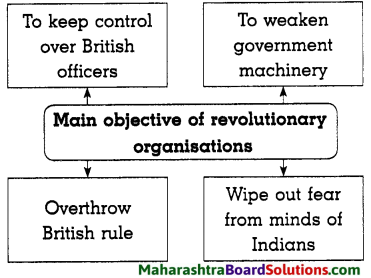
  2. Industries declined and the farmers became bankrupt.
  3. Imposition of taxes on middle class and the exploitation of worker class by the capitalist led to growth of discontent.

3. Western education :

  1. Western education familiarised the educated Indians with modern values and principles such as liberty, equality and democracy.
  2. They accepted principles like rationalism, humanity and nationalism.
  3. They realised that they can carry out work of the country by following them.

4. Study of Ancient Indian History :

  1. The manuscripts in Sanskrit, Persian and many other languages were examined and research was published.
  2. Many western Scholars started to study Indian culture.
  3. The realisation that India had a rich ancient heritage aroused the feeling of national pride among Indians.

5. Role of newspapers :

  1. Newspapers in English and vernacular languages carried articles criticising the policies of the government.
  2. It led to social and political awakening.

Maharashtra Board Class 8 History Solutions Chapter 6 Beginning of Freedom Movement

Do you Know?

Maharashtra Board Class 8 History Solutions Chapter 6 Beginning of Freedom Movement 1

Project:

Collect additional information about the leaders of the early phase of Indian National Congress with the help of the internet.

Class 8 History Chapter 6 Beginning of Freedom Movement Additional Important Questions and Answers

Rewrite the statements by choosing the appropriate options:

Question 1.
…………. newspaper was a mouthpiece of extremist ideology in Bengal.
(a) Dnyanoday
(b) Dnyanprakash
(c) Amrit Bazar Patrika
(d) Kesari
Answer:
(c) Amrit Bazar Patrika

Question 2.
………….. declared to give responsible political system to India.
(a) Montague
(b) Morley
(c) Dalhousie
(d) Chelmsford
Answer:
(a) Montague

Maharashtra Board Class 8 History Solutions Chapter 6 Beginning of Freedom Movement

Question 3.
A committee under the leadership of met …………… Governor-General Lord Minto.
(a) Sir Sayyad Ahmad Khan
(b) Abdul Latif
(c) Baddrudin Tayyabji
(d) Aga Khan
Answer:
(d) Aga Khan

Question 4.
The Home Rule Movement was launched in …………. against Colonialism.
(a) South Africa
(b) Ireland
(c) Scotland
(d) Switzerland
Answer:
(b) Ireland

Question 5.
…………… was established in 1906.
(a) The Indian National Congress
(b) Moderate Party
(c) Extremist Party
(d) The Muslim League
Answer:
(d) The Muslim League

Identify the wrong pair and correct it:

(1) The first President of Indian National Congress
– Wyomesh Chandra Banerjee
(2) Assassinated Rand
– The Chapekhar Brothers
(3) He pronounced the word Swaraj for the first time
– Lokmanya Tilak
(4) The British officer who took initiative in forming the Indian National Congress.
– Allen Octavian Hume
Answer:
Wrong Pair: He pronounced the word Swaraj for the first time.
– Lokmanya Tilak
Corrected pair: He pronounced the word Swaraj for the first time
– Dadabhai Nowrojee.

Maharashtra Board Class 8 History Solutions Chapter 6 Beginning of Freedom Movement

Write the Names:

Question 1.
They studied ancient Indian culture
(i) ……… (ii) …….
Answer:
(i) Dr. Bhau Daji Lad
(ii) Dr. R.G. Bhandarkar

Question 2.
Leaders of Home Rule Movement
(i)……… (ii) ……
Answer:
(i) Dr. Annie Besant
(ii) Lokmanya Tilak.

Answer the following questions in one sentence each:

Question 1.
Which institute was established to study ancient Indian culture?
Answer:
The Asiatic Society was established in Bengal to study ancient Indian culture.

Question 2.
Which were the mediums initially used by the extremist leaders to create political awakening?
Answer:
The extremist leaders initially used the mediums of newspapers, national education and national festivals.

Question 3.
What was the objective of the extremist leaders in founding the educational institutions?
Answer:
The extremist leaders established educational institutions for creating a generation which will have concern for their own language and tradition.

Question 4.
Who led the Anti Partition Movement?
Answer:
Surendranath Banerjee, Anand Mohan Bose, Rabindranath Tagore and such other leaders led the Anti-Partition Movement.

Maharashtra Board Class 8 History Solutions Chapter 6 Beginning of Freedom Movement

Question 5.
How did Tilak criticise the Montague-Chelmsford Act?
Answer:
Lokmanya Tilak criticised the Moptague-Chelmsford Act in the following words, “This is neither Swaraj nor its foundation.”

Question 6.
What did Lokmanya Tilak firmly state?
Answer: Lokmanya firmly stated that “Swaraj is my birthright and I shall have it.”

Complete the graphical presentation:

Question 1.
Maharashtra Board Class 8 History Solutions Chapter 6 Beginning of Freedom Movement 2
Answer:
Maharashtra Board Class 8 History Solutions Chapter 6 Beginning of Freedom Movement 3

Question 2.
Maharashtra Board Class 8 History Solutions Chapter 6 Beginning of Freedom Movement 4
Answer:
Maharashtra Board Class 8 History Solutions Chapter 6 Beginning of Freedom Movement 5
Answer:
Maharashtra Board Class 8 History Solutions Chapter 6 Beginning of Freedom Movement 6

Question 3.
Maharashtra Board Class 8 History Solutions Chapter 6 Beginning of Freedom Movement 6
Answer:
Maharashtra Board Class 8 History Solutions Chapter 6 Beginning of Freedom Movement 7

Explain the Concept :

Question 1.
Moderates :
Answer:

  1. The Moderates were the leaders who wanted to carry out nationalistic movement within the constitutional methods and peaceful meAnswer:
  2. The leaders were realistic and highly educated and had faith in the justice of the British.
  3. They had hope that if they place their demands in constitutional manner the British will give justice to their demands.
  4. They were aware that a strong foundation needs to be built through organised work.
  5. The philosophy and principles of western thinkers like liberalism, freedom, equality, fraternity influenced them.

Maharashtra Board Class 8 History Solutions Chapter 6 Beginning of Freedom Movement

Question 2.
Extremists :
Answer:

  1. The leaders of the Indian National Congress who advocated intensification of the struggle to attain freedom were known as Extremists.
  2. Moderates and Extremists were unanimous about the objectives of Congress. The Extremists had no faith in the constitutional methods of the Moderates.
  3. According to Extremists, freedom will be attained only if lakhs of people participated in the freedom movement and challenge the British government.

Write short notes :

Question 1.
First session of Indian National Congress :
Answer:

  1. The founding session of the Indian National Congress took place on 28th December, 1885 at Gokuldas Tejpal Sanskrit school in Mumbai.
  2. It was presided by Wyomesh Chandra Banerjee, a renowned lawyer from Kolkata.
  3. It was attended by seventy-two delegates from different provinces of India.
  4. Allen Oct avian Hume took the initiative in establishing of the Indian National Congress.
  5. Increase in the number of Indians in the administration, reduction in military expenditure were the demands placed before the British government.

Question 2.
Servants of India Society :
Answer:
1. Gopal Krishna Gokhale founded the Servants of India Society in 1905.
2. Its main objectives were :

  • to create love for the county.
  • teach them sacrifice of self-interest.
  • no differentiation on the basis of caste and religion.
  • to create social harmony.
  • to spread education.

Question 3.
The Lucknow Pact :
Answer:

  1. An attempt was made under the leadership of Lokmanya Tilak to resolve differences in the Indian National Congress at its Lucknow session in 1916.
  2. In the same year, there was an agreement between Indian National Congress and the Muslim League, known as the Lucknow Pact.
  3. According to this Pact, Indian National Congress agreed to separate electorate for Muslims.
  4. In return, the Muslim League agreed to support the Indian National Congress in its work for getting political rights to India.

Question 4.
Home Rule Movement :
Answer:

  1. Home rule means self-rule or self-government.
  2. It was modelled after the Home Rule Movement in Ireland.
  3. It was led by Dr. Annie Besant and Lokmanya Tilak.
  4. They made extensive tours in different parts of the country so that the demand of self-government could reach the common people.

Maharashtra Board Class 8 History Solutions Chapter 6 Beginning of Freedom Movement

Explain the following statements with reasons:

Question 1.
A feeling of nationalism developed among the IndiAnswer:
Answer:

  1. The British established a centralised administration in India and applied uniform policies all over the country.
  2. They also laid down the principle of equality before law.
  3. They introduced the modern means of transport and communication.
  4. It benefited Indians as well. This made possible for the people living in different parts of India to establish contact with one another. This factors developed a feeling of nationalism among the Indians.

Question 2.
Lokmanya was imprisoned in 1897.
Answer:

  1. In 1897, hundreds of people died in Pune due to the epidemic of Plague.
  2. An officer name Rand was appointed to bring the epidemic under control.
  3. He started a search campaign to find Plague patients and adopted oppressive measures.
  4. To avenge this cruel and oppressive treatment meted out to people, the Chapekar brothers assassinated him.
  5. An unsuccessful attempt was made by the government to connect Lokmanya Tilak with this conspiracy.
  6. When they failed in their attempt, they imprisoned him with revenge.

Question 3.
The National Congress split at its Surat session in 1907.
Answer:

  1. The differences between the moderates and the extremists reached a climax in 1907.
  2. The moderates wanted to keep aside the resolution of Swadeshi and Boycott which was thwarted by the extremists.
  3. Some moderate leaders blamed the extremist leaders for trying to capture the Indian National Congress.
  4. It became impossible to arrive at a compromise between both the groups. As a result the Indian National Congress split at its Surat session in 1907.

Maharashtra Board Class 8 History Solutions Chapter 6 Beginning of Freedom Movement

Question 4.
The charge of sedition was put on Lokmanya Tilak.
Answer:

  1. There was wide protest against the partition of Bengal throughout the country.
  2. With a view to restrain the anti¬partition movements government resorted to many suppressive measures.
  3. Strict action was taken against extremists leaders which caused severe reactions in Bengal.
  4. The revolutionaries adopted means of firing and bomb blasts which was advocated by Lokmanya Tilak through his newspaper Kesari.

Therefore, the charge of sedition was put on Lokmanya Tilak by the British government for which he was sent to Mandalay jail for 6 years.

Question 5.
The government passed the Morley- Minto Act.
Answer:
1. The economic policies of the British increased poverty in India.
2. It created dissatisfaction in the minds of the people against British rule.
3. The oppressive measures adopted by Lord Curzon to suppress the protest of partition of Bengal, exclusion of educated Indians in government services and the unjust treatment towards Indians in Africa all this added to the dissatisfaction among the IndiAnswer:
4. Morley-Minto reforms were passed by the British government as a temporary remedy to calm discontent among the IndiAnswer:

Maharashtra Board Class 8 History Solutions Chapter 6 Beginning of Freedom Movement

Question 6.
The Montague-Chelmsford Act disappointed the people of India.
Answer:
The Montague-Chelmsford Act disappointed the people of India, because

  1. The British Government had declared its intention to gradually grant the right to self-rule and responsible government in 1917.
  2. In 1919, the British Parliament passed an act to bring constitutional reforms in India.
  3. According to the Act, less important departments were transferred to Indian ministers and important departments like Finance, Home affairs and Revenue was kept with the Governor.
  4. Thus, it belied the hope that the Act would lay foundation of responsible government in India and disappointed the people.

Answer the following questions in 25-30 words:

Question 1.
What realisation led to the emergence of a political organisation on all India level?
Answer:

  1. English educated Indians were instrumental to bring about Renaissance.
  2. They launched reform movements in social, political, religious, economic and cultural field in different parts of the country.
  3. The political organisations in different parts of the country formed during various movements felt the need to create a political organisation on an all India level having common goal.
  4. It was necessary to bring together groups and people who had political awareness.
  5. It was necessary to draw attention of the people towards questions of the nation. This led to the emergence of a political organization on all India level.

Maharashtra Board Class 8 History Solutions Chapter 6 Beginning of Freedom Movement

Question 2.
State the impact of imperialistic policy of the British on India.
Answer:

  1. The economic exploitation of India through the imperialistic policies led to the drain of the Indian wealth to England.
  2. The compulsion to grow cash crops, burden of land taxes and recurring famines made conditions of farmers miserable. All these broke the backbone of the Indian agriculture.
  3. With the decline of traditional industries, there was increase in unemployment.
  4. The workers were exploited by the capitalists.
  5. The middle class suffered due to imposition of various new taxes.
    This was the impact of the British imperialist policy which led to discontent among the IndiAnswer:

Question 3.
State the impact of western education?
Answer:

  1. Due to spread of western education, new ideas like Justice, Liberty, Equality, Democracy, etc. were introduced to the IndiAnswer:
  2. The young Indians imbibed the values like rationalism, humanity, nationalism and scientific attitude.
  3. They developed a feeling that they could carry out the work of the country.
  4. English became the new medium of communication.

Question 4.
What message did Dadabhai Nowrojee give at the session of Congress in 1906?
Answer:
At the session of the Indian National Congress in 1906, Dadabhai Nowrojee pronounced the word ‘Swaraj’ for the first time. He gave the message

  1. to remain united.
  2. try sincerely and fulfill the aim of Swaraj so that those who are poor, hungry and having diseases could be saved,
  3. India to get respectable position among the developed countries.

Question 5.
Write about the process of formation of Muslim League.
Answer:

  1. The British got very disturbed by the overwhelming public response to the Indian National Congress in the anti-partition movement.
  2. They once again resorted to the policy of ‘Divide and rule’.
  3. Many British officers suggested that a separate political organisation was necessary to safeguard the interests of the Muslims.
  4. Due to motivation of British government, under the leadership of Aga Khan a committee of upper-class Muslims met Governor-General Lord Minto.
  5. Thus, encouraged by Lord Minto and other British officers, the Muslim League was formed in 1906.

Question 6.
What were the provisions of Morley- Minto Act?
Answer:
1. The Morley-Minto Act of 1909 provided for increase of the number of Indian members in the legislatures and the inclusion of some elected Indian members.
2. It created separate electorates for the Indian Muslims.

Maharashtra Board Class 8 History Solutions Chapter 6 Beginning of Freedom Movement

Question 7.
What is Responsive Cooperation?
Answer:
1. India had to face the brunt of First World War which led to growing dissatisfaction among people.
2. To curb their dissatisfaction and get cooperation, Montague, the Secretary of State for India, declared in 1917 that Britain would gradually grant the right to self-rule and a responsible government to India. ,
3. Lokmanya Tilak declared that if the British Government showed sympathy and a considerate attitude to the demands of the people then the people of India would cooperate with the government. This is called ‘Responsive Cooperation’.

Write answer in details :

Question 1.
Give a brief account of the work of Extremist leaders in India’s freedom struggle.
Answer:

  1. Extremist leaders Lokmanya Tilak, Bipin Chandra Pal, Lala Lajpat Rai advocated intensification of the struggle since the British did not respond to the petitions and appeals.
  2. ) Initially, they used the mediums of newspapers, national festivals and national education to bring about political awakening.
  3. They formed educational institutions to sow the seeds of nationalism in society and to create a generation which will show concern about their language and tradition.
  4. Lokmanya Tilak severely criticised the suppressive policies or the British through the newspapers like ‘Kesari’ and ‘Maratha’.
  5. Lokmanya Tilak started Ganesh Utsav and Shiv Jayanti to bring people together.
  6. The leaders did not adopt the means of armed revolution but insisted on extensive agitations.
  7. Swaraj, Swadeshi, National Education and Boycott was the four-point ‘ programme accepted.
  8. The Moderates laid the foundation of freedom struggle and the Extremists carried it forward.

Question 3.
Which measures were taken by the : British government to suppress the Anti-Partition Movement?
Answer:
The British government adopted following measures to suppress the anti-partition movement:

  1. The public meetings were banned.
  2. Strict punishment was given to those who broke the law.
  3. Even school children were beaten up.
  4. Many restrictions were imposed on the newspapers.
  5. The British confiscated many printing/presses on false ground of criticising the ; government.
  6. Writers and editors were imprisoned.
  7. Strict actions were taken against many extremist leaders.
  8. Lokmanya Tilak was sent to Mandalay jail at Myanmar for 6 years on the charge of sedition.
  9. Bipin Chandra Pal was sent to jail and Lala Lajpat Rai was deported out of Punjab.

Maharashtra Board Class 8 History Solutions Chapter 6 Beginning of Freedom Movement

Identify the picture and write about his contribution to the freedom struggle.
Maharashtra Board Class 8 History Solutions Chapter 6 Beginning of Freedom Movement 8
Answer:

  1. The Above picture is of Lokmanya Tilak.
  2. He started the newspapers Kesari and Maratha.
  3. He started festivals like Ganesh Utsav and Shiv Jayanti for people to come together and get inspiration from contribution of national personalities.
  4. The bomb attacks by the revolutionary was advocated through newspaper Kesari and Maratha.
  5. Due to this, he was charged with sedition and put in Mandalay jail for 6 years.
  6. When he was in Mandalay prison he wrote Geetarahasya which advocated philosophy of Karmayoga and stressed upon the people to always remain in action.
  7. An attempt was made under his leadership to resolve differences between two groups in the Indian National Congress in its session of 1916.
  8. He started the Home Rule Movement along with Dr. Annie Besant.
  9. He travelled in different parts of India so that the demand for self government reach the common man.
  10. He firmly declared, ‘Swaraj is my birth right and I shall have it.’
  11. He criticised the Montague Chelmsford Reform Act when it failed to fulfill the demand of responsible government.

Question 4.
Do you feel the four-fold programme implemented by Indian National Congress needs to be implemented even today? Why?
Answer:
In the pre-independence period, Indian National Congress implemented the four-fold programme of Swaraj, Swadeshi, Boycott and National education. The programme needs to be implemented today but with slight changes.

1. Swaraj: Today we have political freedom but we lack good Governance. Common man, farmer, women and the backward classes still suffer.

2. Swadeshi: In the world of Globalisation, goods from other countries have entered Indian markets. It is necessary for the Indian industries to implement programme of Swadeshi to sustain.

3. Boycott: It is not possible to boycott foreign goods but we should insist on indigenous goods wherever possible.

4. National education: Schools in India impart education catering to different needs and ideologies but they fall short to create national pride and imparting character training.

Maharashtra Board Class 9 History Solutions Chapter 3 India’s Internal Challenges

Balbharti Maharashtra State Board Class 9 History Solutions Chapter 3 India’s Internal Challenges Notes, Textbook Exercise Important Questions and Answers.

Maharashtra State Board Class 9 History Solutions Chapter 3 India’s Internal Challenges

Class 9 History Chapter 3 India’s Internal Challenges Textbook Questions and Answers

1. Write briefly.

Question 1.
Which demands were put forward through the ‘Anandpur Sahib Resolution’ by the Akali Dal?
OR
Which demands were raised by the Akali Dal through the ‘Anandpur Sahib Resolution’?
Answer:
In 1973, the Akali Dal passed the ‘Aanandpur Sahib Resolution’. The following demands were made in this resolution:
(i) Chandigarh should be made part of Punjab.
(ii) The Punjabi speaking parts in other states should be included in the state of Punjab,
(iii) Recruitment of people from Punjab in the Indian army should be increased.
(iv) More autonomy should be given to the state of Punjab.

Maharashtra Board Class 9 History Solutions Chapter 3 India’s Internal Challenges

Question 2.
What can we do to end communalism?
Answer:
(i) It is necessary that we all counter communalism with all our strength. For this, we should mix with people of different religions. We should accept the good practices and ideas of each other.

(ii) We should be able to look at and understand our economic and social problems rationally. We should not mix these matters with religion.

(iii) We should look for the economic, political or historical reasons that are responsible for disrupting religious harmony. This is the only way to put an end to communalism and strengthen national unity.

Question 3.
How does regionalism gain strength/become strong?
Answer:
(i) Regionalism thrives on regional imbalance in development. In the post-independence period, some states achieved more progress, while some states remained backward.

(ii) As a result, the states that develop economically can also achieve progress in other areas like education, health and culture.

(iii) The states which have not developed in this manner remain backward in education and civic amenities. The opportunities of development available to people in developed states are not possible for people in backward states.

(iv) They are troubled by problems of education, backwardness, unemployment, poverty, etc. They begin to think that they are being cheated; they are being kept away from the benefits of development. Because of this, the understanding between states is broken.

(v) The people of developed states begin to believe that they are superior due to their superior history and culture and hence they have developed that much. Then they begin to look down upon the people of underdeveloped regions.

(vi) They are not willing to share the benefits of ‘ development with the backward states.

(vii) On the other hand, the people from backward areas need to arouse their regional identity to organise themselves. For this, they try to unnecessarily glorify local traditions.

2. Explain the following concepts in your own words:

Question 1.
Communalism
Answer:
(i) Communalism is a serious threat to the unity of our country. It emerges out of narrow religious pride.

(ii) Fanaticism is the base of communalism. It makes one oblivious to national interest. Fanaticism makes the perspective of looking at events and people prejudiced.

(iii) Some people begin to think of economic and social questions in the framework of their own religion. They hold the idea that government is partial towards their religion.

(iv) If anybody speaks about their religion or insults their religious symbols knowingly or unknowingly, riots break out because of this kind of thinking. Hundreds of innocent people are killed. Public peace is destroyed.

Question 2.
Regionalism
Answer:
(i) Regionalism refers an over-adherence to the language, culture, socio-political structures and economic growth of one’s own region or territory which leads to disregard for people of other regions.

(ii) It is grounded in the uneven industrial and infrastructural development of various regions of the same nation. For example, states like Maharashtra, Gujarat, Punjab and Tamil Nadu are well developed economically and industrially, whereas states like Odisha, Bihar, Assam, have remained undeveloped economically and industrially.

(iii) The disparity in availability of education, employment and other civic amenities between developed and backward regions of the country leads to regionalism.

(iv) The people of economically backward states often feel neglected and deprived, whereas the people of developed states might become narrow-minded and refuse to share the benefits of their development.

Maharashtra Board Class 9 History Solutions Chapter 3 India’s Internal Challenges

3. Give reasons:

Question 1.
It became necessary to carry out Operation Blue Star.
Answer:
(i) In 1980, the movement for ‘Independent Khalistan’ took root in Punjab.

(ii) During that period, the leader of the Akali Dal was Sant Harcharan Singh Longowal. He used to direct his activists from the Golden Temple to stage protests.

(iii) On the other side of the Golden Temple, armed followers started gathering around the staunch Khalistan supporter Sant Jamail Singh Bhindranwale. During that period, terrorist activities had begun.

(iv) Bhindranwale was arrested in 1981, accused of the murder of newspaper editor, Lala Jagatnarayan. After this incident, the situation worsened.

(v) Due to these developments, President’s rule was imposed in Punjab in 1983.

(vi) Bhindranwale went to stay at a religious place called Akal Takht.

(vii) Bhindranwale’s followers captured the Golden Temple and built a barricade of sand bags over there. The area looked like a fort.

(viii) This greatly disturbed peace in Punjab. It was a major challenge to Indian democracy.

Question 2.
We should fight communalism with all our strength.
Answer:
(i) It is necessary that we all counter religious communalism with all our strength.
(ii) For this to become a reality, we should mix with people of different religions. We should accept the good practices and ideas of each other.
(iii) We should be able to look at and understand our economic and social problems rationally. We should not mix these issues with religion.
(iv) We should look for the economic, political or historical reasons that are responsible for disrupting religious harmony.
(v) This is the only way to put an end to communalism and to strengthen national unity.

Maharashtra Board Class 9 History Solutions Chapter 3 India’s Internal Challenges

4. Write the full forms:

Question 1.
NEFA
Answer:
North East Frontier Agency
Question 2.
MNF
Answer:
Mizo National Front

Question 3.
NNC
Answer:
Naga National Council

Class 9 History Chapter 3 India’s Internal Challenges Additional Important Questions and Answers

Choose the correct option from the given options and rewrite the statements:

Question 1.
Akali Dal was the major political party of _______, which came to power in 1977.
(a) Haryana
(b) Punjab
(c) Rajasthan
(d) Gujarat
Answer:
Punjab

Question 2.
Akali Dal demanded ‘Holy City’ status for _______.
(a) Jalandhar
(b) Bhatinda
(c) Chandigarh
(d) Amritsar
Answer:
Amritsar

Question 3.
During the movement for ‘Independent Khalistan’ ______ was the leader of Akali Dal.
(a) Sant Jamail Singh Bhindranwale
(b) Sant Harcharan Singh
(c) Major General Shahbeg Singh
(d) Major General Kuldeep Singh Brar
Answer:
Sant Harcharan Singh

Question 4.
On the morning of 3rd June 1984, mission _____ started.
(a) Operation Blue Star
(b) Operation Black Thunder
(c) Operation Vijay
(d) Operation Smiling Buddha
Answer:
Operation Blue Star

Question 5.
The north-east consists of ____ states.
(a) 6
(b) 7
(c) 8
(d) 5
Answer:
8

Question 6.
In 1954, NEFA comprised of the territories on the ______ border and tribal areas towards the north of Assam.
(a) Indo-Pak
(b) Sino-Indian
(c) Indo-Nepalese
(d) Indo-Bhutanese
Answer:
Sino-Indian

Maharashtra Board Class 9 History Solutions Chapter 3 India’s Internal Challenges

Question 7.
In 1965, the responsibility of administering the north-east regions of India was given to _______.
(a) Defence Ministry
(b) Ministry of External Affairs
(c) President of India
(d) Pandit Jawaharlal Nehru
Answer:
Ministry of External Affairs

Question 8.
When India became independent, the government gave administrative autonomy to the districts of ______ majority areas of Lushai Hills.
(a) Naga
(b) Ahom
(c) Mizo
(d) Assamese
Answer:
Mizo

Question 9.
In 1961, Laldenga established the _______.
(a) All Assam Students Union
(b) Asom Gana Sangram Parishad
(c) Mizo National Front
(d) Naga National Council
Answer:
Mizo National Front

Question 10.
The Naga Tribe in north-east India was known to be a _____ tribe.
(a) nomadic
(b) pastoral
(c) martial
(d) ethnic
Answer:
martial

Question 11.
Naga National Council was led by ________.
(a) Prafullakumar Mohanto
(b) Laldenga
(c) Vizar Angami
(d) Angami Zapu Fizo
Answer:
Angami Zapu Fizo

Question 12.
The intense agitation of 1983 in Assam was staged over the question of _____.
(a) Exploitation by the landlords
(b) Bengali migrants from Bangladesh
(c) Autonomy in Assam
(d) Naxalites
Answer:
Bengali migrants from Bangladesh

Question 13.
On 20th February 1987, _______ got the status of a constituent state.
(a) Manipur
(b) Nagaland
(c) Assam
(d) Arunachal Pradesh
Answer:
Arunachal Pradesh

Maharashtra Board Class 9 History Solutions Chapter 3 India’s Internal Challenges

Question 14.
The Naxalite movement started at Naxalbari in ______ district.
(a) Darjeeling
(b) Hojai
(c) Bishnupur
(d)Tuensang
Answer:
Darjeeling

Question 15.
The Naxalites established an organisation called _____.
(a) North-east Frontier Agency
(b) People’s Liberation Guerilla Army
(c) Mizo National Front
(d) Naga National Council
Answer:
People’s Liberation Guerilla Army

Identify and write the wrong pair in the following sets:

Question 1.
(1) Greater Mizoram – Mizo National Front
(2) Aanandpur Sahib Resolution – Akali Dal
(3) Action Committees – Communalism
(4) Operation Blue Star – Kuldeep Singh Brar
Answer:
Wrong Pair: Action Committees – Communalism

Question 2.
(1) Laldenga – Chief Minister of Mizoram
(2) Lala Jagatnarayan – Naxalite
(3) Prafullakumar Mahanta-Assam Ganaparishad
(4) Jamail Singh Bhindranwale – Independent Khalistan
Answer:
Wrong Pair: Lala Jagatnarayan – Naxalite

Question 3.
(1) 1973 – Anandpur Sahib Resolution
(2) 1954 – NEFA became Arunachal Pradesh
(3) 1972 – Mizo areas got the status of Union Territory
(4) 1961 – Mizo National Front was established
Answer:
Wrong Pair: 1954 – NEFA became Arunachal Pradesh

Maharashtra Board Class 9 History Solutions Chapter 3 India’s Internal Challenges

Write the full form of the following acronyms:

Question 1.
PLGA
Answer:
People’s Liberation Guerilla Army

Do as directed

Question 1.
Complete the table using the information of Naxalite areas of activity provided in the chapter:
Answer:

(1)East GodavariAndhra Pradesh
(2)Adilabad, Bastar Rajnandangaon and SukmaChhattisgarh
(3)Balaghat and MandalaMadhya Pradesh
(4)Gadchiroli, Bhandara, parts of ChandrapurMaharashtra
(5)KoraputOdisha
(6)Parts of Vishakhapatnam and KarimnagarTelangana

Write short notes on:

Question 1.
Military action was taken to suppress the skirmishes of Naga activists.
Answer:
(i) In 1946, some’ educated Naga youth established an organisation called Naga National Council (NNC).
(ii) Later they made a demand for an independent state of Nagaland. They were led by Angami Zapu Fizo.
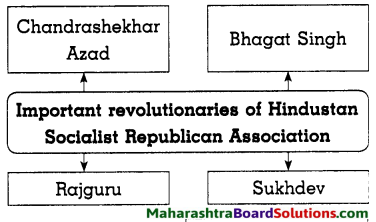
(iii) In 1954, the Naga National Council announced the establishment of an independent federation of Nagaland.
(iv) In 1955, skirmishes took place between local Nagas and the soldiers of the Assam Rifles. Military action was therefore taken to suppress the skirmishes (clashes).

Question 2.
The Naxalites established an organisation called PLGA.
Answer:
(i) The Naxalite Movement originated from Darjeeling, West Bengal, to raise a voice against the exploitation of farmers by the landlords and to confiscate the lands of the landlords and distribute it amongst the tenants.

(ii) Later, the Naxalites took to terrorism and started a parallel system by rejecting democracy, thereby threatening the internal security of India.

(iii) The movement was mainly located in West Bengal.

(iv) Later, the movement spread to East Godavari in Andhra Pradesh and parts of Vishakhapattanam, Karimnagar in Telangana, Adilabad, Bastar, Rajnandangaon and Sukma in Chhattisgarh, Gadchiroli, Bhandara and parts of Chandrapur in Maharashtra, Balaghat and Mandala in Madhya Pradesh and Koraput in Odisha.

(v) In order to maintain their influence, the Naxalites established an organisation called People’s Liberation Guerilla Army (PLGA). This conflict is still going on.

Maharashtra Board Class 9 History Solutions Chapter 3 India’s Internal Challenges

Question 3.
Fanaticism is the base of communalism.
Answer:
(i) Communalism is a serious threat to the unity of our country. Communalism emerges out of narrow religious pride.
(ii) But when this pride becomes excessive, then it turns into bigotry.
(iii) Each one then begins to consider their religion superior and others’ inferior. This leads to religious fanaticism which is the base of communalism.

Question 4.
Regionalism thrives on regional imbalance in development.
Answer:
(i) In the post-independence period, some states achieved more progress, while some states remained backward.
(ii) States that develop economically can also achieve progress in other areas like education, health and culture.
(iii) The states which have not developed in this manner remain backward in education and civic amenities.
(iv) They are harassed by problems of education, backwardness, unemployment and poverty, etc.
(v) They begin to think that they are being cheated; they are being kept away from the benefits of development.
(vi) Because of this, the understanding between states is broken. This in turn, has a negative impact on national unity.

Question 5.
Skirmishes took place between local Nagas and the soldiers of Assam Rifles.
Answer:
(i) In 1946, some educated Naga youth established an organisation called Naga National Council (NNC).
(ii) Later, they made a demand for an independent State of Nagaland. They were led by Angami Zapu Fizo.
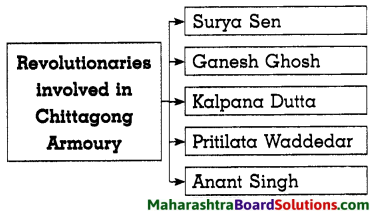
(iii) In 1954, the Naga National Council announced the establishment of an independent federation of Nagaland. In 1955, skirmishes happened between local Nagas and the soldiers of the Assam Rifles.
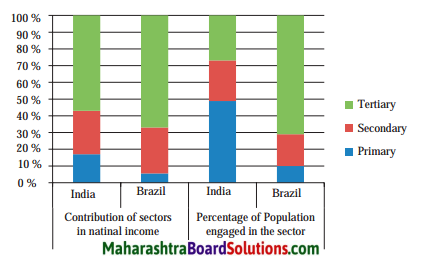
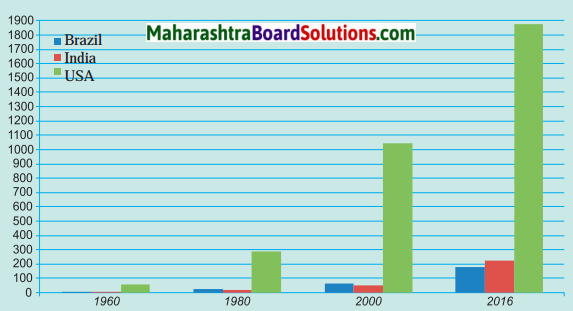
Question 6.
Naxalite movements are a threat to internal insecurity.
Answer:
(i) The movement had the objectives of establishing Action Committees to raise a voice against the exploitation of the farmers by the landlords and confiscate the land of the landlords and distribute it among the tenants.

(ii) Later, the movement strayed away from its objectives. It took recourse to terrorism to prevent any government schemes and welfare policies from reaching the common people.

(iii) The Naxalites started a parallel system by rejecting the democratic system. This made Naxalism a serious challenge to India’s internal security.

Maharashtra Board Class 9 History Solutions Chapter 3 India’s Internal Challenges

Answer the following:

Question 1.
Which event prompted the arrest of Jamailsingh Bhindranwale?
Answer:
Bhindranwale was arrested in 1981, accused of the murder of newspaper editor, Lala Jagatnarayan. After this incident, the situation in Punjab worsened.

Question 2.
Name the constituent states of the north-east of India.
Answer:
North-east India consists of the eight states of Assam, Arunachal Pradesh, Manipur, Meghalaya, Mizoram, Nagaland, Sikkim and Tripura.

Question 3.
What made the Mizo leaders demand autonomy for their province?
Answer:
(i) When India became independent, the government gave administrative autonomy to the districts of Mizo majority areas of the Lushai hills.
(ii) When the States Reorganisation Commission was appointed in 1954, the expectations of the people in this area grew. That is when the Mizo leaders started demanding an autonomous ‘Mizo’ province.

Question 4.
What do you mean by ‘Operation Black Thunder’?
Answer:
In 1986, an operation has to be conducted against terrorists in the Golden Temple. It was called ‘Operation Black Thunder’.

Question 5.
What was the objective of Naxalite Action Committees?
Answer:
The Naxalite movement had the objective of establishing Action Committees to raise a voice against the exploitation of the farmers by the landlords and to confiscate the lands of the landlords and distribute them among the tenants.

Read the following passages and answer the questions:

Passage: I

Mizoram : The tribes in north-east India have an ancient history. When India became independent, the government gave administrative autonomy to the districts of Mizo majority areas of the Lushai hills, When the States Reorganisation Commission was i ! appointed in 1954, the expectations of the people in this area grew.Mizo leaders started demanding an autonomous ‘Mizo’ province. In 1959 the territory of Mizoram experienced severe drought. During this famine, Mizo , leader Laldenga served the common people a lot. In 1961, Laldenga established an organisation called Mizo National Front (MNF). He asked for ‘Greater Mizoram’, an independent nation carved out of Tripura, Manipur and Mizo majority areas from the Lushai hills.
In March 1966, Mizo National Front announced the emergence of Independent Mizoram. Prime Minister , Indira Gandhi handled the situation firmly and suppressed the rebellion. When the situation calmed down in 1972, the Mizo majority area was given the status of a Union Territory. In 1985, Prime Minister , Rajiv Gandhi had an agreement with the Mizo National Front and Mizoram was given the status of a full-fledged State. Laldenga became the Chief Minister of the State.

Maharashtra Board Class 9 History Solutions Chapter 3 India’s Internal Challenges

Question 1.
Which areas in north-east eventually formed the state of Mizoram?
Answer:
Mizo majority areas of Lushai Hills formed the State of Mizoram.

Question 2.
Name the leading party of Mizoram.
Answer:
Mizo National Front.

Question 3.
Which operation was carried in 1986 against the terrorists in the Golden Temple?
Answer:
Operation ‘Black Thunder’

Passage: II

Nagaland: The Naga tribe in northeast India is known as a martial tribe. The Naga tribe had settled in Eastern Himalayas, the Naga hills, border areas of Assam and Myanmar. In 1946, some educated Naga youth established an organisation called Naga National Council (NNC). Later they made a demand for an independent State of Nagaland. They were led by Angami Zapu’Fizo. In 1954, the Naga National Council announced the establishment of an independent ,federation of Nagaland. In 1955, skirmishes happened between local Nagas and the soldiers of the Assam Rifles. Military action was taken to suppress the , skirmishes. Several rounds of discussions took place between the Central Government and the Naga National Council. Central Government decided , to give the Naga majority territory the status of a Union Territory. Nagaland was made a fullfledged State on 1st December 1963 by putting together the Naga majority territory and part of Tuensang.

Question 1.
Who was the leader of Naga National Council?
Answer:
Angami Zapu Fizo.

Question 2.
Which areas does Nagaland comprise of?
Answer:
Tribes residing in the eastern Himalayas, Naga Hills and on the border areas of Assam and Myanmar emerged as Nagaland. A part of Tuensang was also added to it later.

Question 3.
Which territory in the North-East eventually formed the state of Nagaland?
Answer:
Nagaland was made a fullfledged State on 1st December 1963 by putting together the Naga majority territory and part of Tuensang.

Maharashtra Board Class 9 History Solutions Chapter 3 India’s Internal Challenges

Answer the following questions in detail:

Question 1.
President’s rule was imposed in Punjab in 1983. Why?
Answer:
(i) In 1980, the movement for ‘Independent Khalistari took root in Punjab.

(ii) During that period, the leader of the Akali Dal was Sant Harcharan Singh Longowal. He used to direct his activists from the Golden Temple to stage protests.

(iii) On the other side of the Golden Temple, armed followers started gathering around the staunch Khalistan supporter Sant Jamail Singh Bhindranwale. During that period, terrorist activities had begun.

(iv) Bhindranwale was arrested in 1981, accused of the murder of newspaper editor, Lala Jagatnarayan.

(v) After this incident, the situation worsened. Due to these developments, President’s rule was imposed in Punjab in 1983.

Question 2.
Which states does north-east India comprise of and in what respects are they different from each other?
Answer:
(i) North-east India consists of the eight states of Assam, Arunachal Pradesh, Manipur, Meghalaya, Mizoram, Nagaland, Sikkim and Tripura.
(ii) International borders of India touch each of the states to varying extents.
(iii) These states are different with respect to ethnicity, language and cultural diversity.

Question 3.
State the role of Pandit Jawaharlal Nehru in the assimilation of the north-eastern states into the mainstream of the country.
Answer:
(i) The first Prime Minister of independent India took the lead in bringing the tribes living in these areas into the mainstream of the country.

(ii) In 1954, he formed the North-East Frontier Agency (NEFA) area, comprising of the territories on the Sino-Indian border and the tribal areas towards the north of Assam.

(iii) Nehru took the position of bringing about the development of hundreds of tribes in these parts while preserving their culture.

Question 4.
State the constitutional measures taken by the government to assimilate north-east India into the mainstream.
Answer:
(i) Special provisions have been made with respect to these areas in the VI Schedule of the Indian Constitution.
(ii) In 1965, the responsibility of administering this area was given to the Ministry of External Affairs.
(iii) The Northeastern Council Act of 1971 was supposed to advise the Central Government regarding aspects of common interest in economic and social spheres, inter-state transport, electricity, flood control, etc.

Maharashtra Board Class 9 History Solutions Chapter 3 India’s Internal Challenges

Question 5.
What is the role of Mizo leader, Laldenga in emergence of independent Mizoram?
Answer:
(i) In 1959 the territory of Mizoram experienced severe drought. During this famine, Mizo leader Laldenga served the common people a lot.

(ii) In 1961, Laldenga established an organisation called Mizo National Front (MNF).

(iii) He asked for’ Greater Mizoram’, an independent nation carved out of Tripura, Manipur and Mizo majority areas from the Lushai hills.

(iv) In March 1966, Mizo National Front announced the emergence of Independent Mizoram.

(v) In 1985, Prime Minister Rajiv Gandhi had an agreement with the Mizo National Front and Mizoram was given the status of a full-fledged state. Laldenga became the Chief Minister of the State.

Question 6.
Describe the establishment of democracy and peace in Assam.
Answer:
(i) In 1985, Prime Minister Rajiv Gandhi, Central Home Minister Shankarrao Chavan and Assamese leader Prafullakumar Mohanto signed an Accord.

(ii) It was dedded to that the Bangladeshi dtizens who had infiltrated in Assam would be sent back to their original places.

(iii) In 1986, elections were held for Assam Legislative Assembly and Prafullakumar Mohanto, of the Asom Ganaparishad became the new Chief Minister. Due to this democratic process, it became possible to establish peace in Assam.

Question 7.
What are the features of religious fanaticism?
Answer:
(i) People of different religions don’t trust each other. They become suspidous of each other.

(ii) Compatriots following different religions are looked at as enemies. Even commensality or coming together on festivals becomes rare.

(iii) The perspective of looking at events and people is prejudiced. Some people begin to think of economic and sodal questions from within the framework of their own religion.

(iv) Some people might think that since they belong to a particular religion, they have no influence in politics. They begin to believe that they are being treated unjustly. They hold the idea that the government is against their religion.

Maharashtra Board Class 9 History Solutions Chapter 3 India’s Internal Challenges

Question 8.
Regionalism can affect developed as well as undeveloped states. Justify the statement.
Answer:
(i) The people of developed states begin to believe that they are superior due to their superior history and culture.

(ii) They then begin to look down upon people of underdeveloped regions. They are not willing to share the benefits of development with backward states.

(iii) On the other hand, the people from backward areas arouse their regional identity to organise themselves. For this, they try to unnecessarily glorify local traditions and culture to prove their uniqueness.

Question 9.
What do you mean by ‘Operation Blue Star’?
Answer:
(i) Operation Blue Star was a military action of getting the terrorists out of the Golden temple. This operation was entrusted to Major General Kuldeep Singh Brar.

(ii) On the morning of 3rd June 1984, the mission ‘Operation Blue Star’ started. The Operation ended on 6th June.

Question 10.
Which events from the Golden Temple in 1980 disturbed the peace in Punjab?
Answer:
(i) In 1980, the movement for ‘Independent Khalistan’ took root in Punjab. During that period, the leader of the Akali Dal was Sant Harcharan Singh Longowal. He used to direct his activists from the Golden Temple to stage protests.

(ii) On the other side of the Golden Temple, armed followers started gathering around the staunch Khalistan supporter Sant Jarnail Singh Bhindranwale. During that period, terrorist activities had begun.

Maharashtra Board Class 9 History Solutions Chapter 7 Science and Technology

Balbharti Maharashtra State Board Class 9 History Solutions Chapter 7 Science and Technology Notes, Textbook Exercise Important Questions and Answers.

Maharashtra State Board Class 9 History Solutions Chapter 7 Science and Technology

Class 9 History Chapter 7 Science and Technology Textbook Questions and Answers

1.A Choose the right option and rewrite the sentence:

Question 1.
_______ was named as the first Chairman of Atomic Energy Commission.
(a) Dr Homi Bhabha
(b) Dr Homi Sethna
(c) Dr A.P.J. Abdul Kalam
(d) Dr Raja Ramanna
Answer:
(a) Dr Homi Bhabha

Question 2.
________ was the first completely indigenous communication satellite made by ISRO.
(a) Aryabhatta
(b) Insat 1 B
(c) Rohini-75
(d) APPLE
Answer:
(d) APPLE

Maharashtra Board Class 9 History Solutions Chapter 7 Science and Technology

B. Identify the wrong pair:

Question 1.
(1) Prithvi – Surface-to-Surface ballistic missile
(2) Agni – Surface-to-Sea ballistic missile
(3) Akash – Surface-to-Air missile
(4) Nag – anti-tank missile
Answer:
Wrong Pair: Agni – Surface-to-Sea ballistic missile

2A. Prepare a timeline of the progress of India in science and technology:

Question .1
Maharashtra Board Class 9 History Solutions Chapter 7 Science and Technology 1
Answer:
Maharashtra Board Class 9 History Solutions Chapter 7 Science and Technology 7
Maharashtra Board Class 9 History Solutions Chapter 7 Science and Technology 3
Maharashtra Board Class 9 History Solutions Chapter 7 Science and Technology 4
Maharashtra Board Class 9 History Solutions Chapter 7 Science and Technology 5

B. Explain the following concepts:

Question 1.
Space research
Answer:
(i) In 1961, Indian National Committee for Space Research (NCSR) launched India’s first research rocket from Thumba Equatorial Launch Centre in Thumba in the State of Kerala.
(ii) In 1969, our indigenously built rocket Rohini-75 was successfully launched.
(iii) The next stage was the successful launch of the first Indian satellite Aryabhatta in 1975 with help from the Soviet Union.
(iv) This success proved that Indian scientists can indigenously build and launch a satellite. Indian scientists were confident that they could acquire the technology for sending a message from the Earth Station and to assess the working of the satellite.

Maharashtra Board Class 9 History Solutions Chapter 7 Science and Technology

Question 2.
Telex service
Answer:
(i) The department of telecommunications under the Ministry of Communications started the telex service in 1963 to transmit typed messages from one part of the country to another rapidly.
(ii) In 1969, the telex service started in Devanagari script in Delhi.
(iii) Later, it spread all over the country.
(iv) This service began to be used in different fields. With the rise of internet after 1990, the significance of this service reduced.

3. Explain the following with reasons:

Question 1.
Pandit Nehru established the Atomic Energy Commission.
Answer:
(i) India’s first Prime Minister Pandit Jawaharlal Nehru wanted to nurture a scientific temper and bring about the nation’s progress.
(ii) From this perspective, he set up the Indian Atomic Energy Commission on 10th August, 1948.
(iii) Dr Homi Bhabha was appointed as the first Chairman of the Commission.
(iv) The objectives of the commission were to produce electricity from atomic energy, increase the yield of food grains and make them last longer, set up the technology for achieving this and develop nanotechnology.

Question 2.
India decided to conduct nuclear tests.
Answer:
(i) India successfully performed her first nuclear test at Pokharan in Rajasthan on 18th May, 1974 in consonance with the policy of using nuclear energy for peaceful purposes and for self sufficiency.

(ii) The reason why India took this decision was China’s nuclear capability and Pakistan’s desperate efforts to acquire nuclear weapons with China’s help.

(iii) Dr Homi Sethna, the chairman of the Indian Atomic Energy Commission and Dr Raja Ramanna, Director of the Bhabha Atomic Research Centre played a major role in conducting this nuclear test.

(iv) Prime Minister Indira Gandhi took the decision of carrying out a ‘nuclear explosion’. Pokharan was chosen on the basis of the required criteria for the location of the nuclear tests : far away from human settlement and no ground water reserves.

Question 3.
USA imposed economic sanctions on India.
Answer:
(i) On 11th May 1998, India carried out its second nuclear test to prove its nuclear preparedness.
(ii) Three tests were done on this day.
(iii) One of them was of the hydrogen bomb.
(iv) Prime Minister Atal Bihari Vajpayee assured that there would be no first use of nuclear weapons by India. But the USA imposed economic sanctions on India immediately.

4. Write the answers in 25 to 30 words:

Question 1.
Write about Pokharan nuclear test.
Answer:
(i) India successfully performed her first nuclear test at Pokharan in Rajasthan on 18th May, 1974 in consonance with the policy of using nuclear energy for peaceful purposes and for self-sufficiency.

(ii) The reason why India took this decision was China’s nuclear capability and Pakistan’s desperate efforts to acquire nuclear weapons with China’s help.

(iii) Dr Homi Sethna, the chairman of the Indian Atomic Energy Commission and Dr Raja Ramanna, Director of the Bhabha Atomic Research Centre played a major role in conducting this nuclear test.

(iv) Prime Minister Indira Gandhi took the decision of carrying out a ‘nuclear explosion’. Pokharan was chosen on the basis of the required criteria for the location of the nuclear tests: far away from human settlement and no groundwater reserve.

Question 2.
For which sector was Bhaskar-1 satellite expected to be useful?
Answer:
(i) India launched remote sensing experimental satellite Bhaskar-1 from the Soviet Union in 1979 in order to observe various things on the surface of the Earth by remote sensing technology.

(ii) This remote sensing technology would be useful for India’s development by regarding water bodies, mineral deposits and forecasting weather.

(iii) The photographs taken with the help of this technology about the bowels of the Earth, environment and forests were important.

(iv) Another area in which the information from this satellite was useful was Oceanography

Maharashtra Board Class 9 History Solutions Chapter 7 Science and Technology

5. Write in brief:

Question 1.
Which of the everyday services are influenced by satellite technology?
Answer:
(i) Bhaskar-1: India launched remote sensing experimental satellite Bhaskar-1 from the Soviet Union in 1979 in order to observe various things on the surface of the Earth by remote sensing technology. This remote sensing technology would be useful for India’s development by regarding water bodies, mineral deposits and forecasting weather. The photographs taken with the help of this technology about the bowels of the Earth, environment and forests were important. Another area in which the information from this satellite was useful was Oceanography. In 1981, ‘Bhaskar-2’ was launched from Soviet Union.

(ii) (if APPLE (Ariane Passenger Payload Experiment): The first completely indigenously built satellite by ISRO in India, APPLE was launched on 19th June, 1981 from the French Guiana. ‘APPLE’ was beneficial in the field of education. The objective of providing emergency telecommunication services was successful.

(iii) Indian National Satellite (INSAT): In August 1983, the satellite INSAT 1-B was launched in space. Because of this satellite, a major revolution came about in the areas of telecommunication, television, radio, weather forecasting and space research in India. Due to INSAT, 207 Akashwani or Radio stations could be connected to each other. This mechanism was also useful for search and rescue of people caught in some disaster like a shipwreck or an air plane crash, for forecasting weather, to look for and follow cyclones or storms, in the fields of telemedicine and educational institutions. The tele-medicine service enabled the population from remote areas to get advice and treatment from expert doctors. Public Primary Health Centers in villages have been connected with super speciality hospitals through INSAT.

(iv) Satellite Communication Centre: In order to establish satellite communication with the help of an artificial satellite, a domestic satellite communication Earth station was established in 1967, at Jodhpur Tekra near Ahmedabad. This made it easy to train scientists and technicians in setting up and running an Earth Station within the country. In 1970, a centre was established at Aarvi near Pune, equipped for international telecommunication service. The technology adopted by railways has a big role in the history of modern India.

Question 2.
Why is Dr. A.P.J. Abdul Kalam called as the ‘Missile Man’?
Answer:
(i) In 1958, Defence Research and Development Organisation (DRDO) was established under the Department of Defence of the government of India. The objective of this organisation was to make India self-sufficient with respect to means, equipment and weapons required for defence. After 1983, this organisation developed several missiles under the leadership of Dr. A.P.J. Abdul Kalam. Dr Kalam has made a great contribution in the production of missiles. Dr Kalam is known as the father of India’s missile programme. He is also referred to as the ‘Missile Man’ of India.

(ii) Integrated Guided Missile Development Programme (IGMDP) was conceived by and carried out under the leadership of Dr A.P.J. Abdul Kalam. Defence Research and Development organisation (DRDO) undertook the task of building the missiles.

Question 3.
How can one have computerized reservation done for railway travel?
Answer:
(i) There is a site called IRCTC for online railway bookings. On it’s site, sign up option is given through which Login Id and Password is created for IRCTC account. One must login with this ID and password for booking railway ticket. A captcha image needs to be filled to ensure the account is not being misused.

(ii) To the left of the page on the site, a column is given to enter the destination and boarding point, along with the date on which the journey is supposed to be made. After filling this, the list of trains along with their numbers, berth system, schedules is shown. The Quota, i.e. general, ladies, senior citizen needs to be filled here.

(iii) Here, if the ladies quota is selected, the berth is booked in the compartment reserved exclusively for ladies. If senior citizen quota is selected, exemption in travel fees is given.

(iv) After this, berth preferences i.e. sleeper, second seating is to be selected to book the tickets. Upon which, a new window opens for filling the details like name of the passenger, age, etc. A captcha image needs to be filled again to confirm booking.

(v) The gateway to online payment opens up which is done through Debit Card or Internet Banking, whichever is easier for the person booking it. A message of confirmation and email is received to the person booking it for his/her detail.

Question 4.
Write the key features of the Konkan Railway.
Answer:
(i) The Konkan Railway started in 1998.

(ii) There are several records of technology to the credit of Konkan Railway which stretches over the four states of Maharashtra, Goa, Karnataka and Kerala over a distance of 760 kilometres.

(iii) There are 12 tunnels on this track. The 6.5 km tunnel at Karbude is the longest tunnel. There are 179 big and 1819 small bridges on this track.

(iv) Out of these, the 2065.8 m long bridge on River Sharavati near Honnawar is the biggest, i.e. The 64 m tall bridge on River Panval near Ratnagiri is India’s tallest bridge.

(v) For avoiding accidents on tracks that are prone to landslides, there are sensors fitted to the railway engines.

Class 9 History Chapter 7 Science and Technology Additional Important Questions and Answers

Choose the correct option from the given options and rewrite the statements:

Question 1.
The Indian Atomic Energy Commission was set up on_______.
(a) 10th Aug, 1958
(b) 10th Aug, 1948
(c) 10th Aug, 1968
(d) 19th Aug, 1858
Answer:
(b) 10th Aug, 1948

Maharashtra Board Class 9 History Solutions Chapter 7 Science and Technology

Question 2.
In 1956, the Department of Atomic Energy set up _______, a nuclear reactor functioning on atomic energy.
(a) Syrus
(b) Zarlina
(c) Poornima
(d) Apsara
Answer:
(d) Apsara

Question 3.
India successfully performed her first nuclear test at ______.
(a) Pokhran
(b) Jaipur
(c) Delhi
(d) Haryana
Answer:
(a) Pokhran

Question 4.
Prime Minister _________ assured that there would be no first use of nuclear weapons by India.
(a) Pandit Jawaharlal Nehru
(b) Atal Bihari Vajpayee
(c) Indira Gandhi
(d) VP Singh
Answer:
(b) Atal Bihari Vajpayee

Question 5.
The first digit of the pincode indicates the ______.
(a) State
(b) Region
(c) Nation
(d) District
Answer:
(b) Region

Question 6.
Agni had a range of ________ km.
(a) 800
(b) 600
(c) 700
(d) 500
Answer:
(c) 700

Question 7.
In 1981, ‘Bhaskar-2’ was launched from _______ .
(a) Soviet Union
(b) Japan
(c) China
(d) America
Answer:
(a) Soviet Union

Question 8.
_____a surface to surface ballistic missile was given to the Army.
(a) Prithvi -1
(b) Prithvi – 2
(c) Prithvi – 3
(d) Agni
Answer:
(a) Prithvi -1

Maharashtra Board Class 9 History Solutions Chapter 7 Science and Technology

Question 9.
APPLE’ was beneficial in the field of _______.
(a) Military
(b) Education
(c) Health
(d) Technology
Answer:
(b) Education

Question 10.
In _________ the telecommunication department was restructured.
(a) 1991
(b) 2000
(c) 2002
(d) 1880
Answer:
(b) 2000

Question 11.
Konkan railway started in the year _______.
(a) 1888
(b) 1988
(c) 1998
(d) 1994
Answer:
(c) 1998

Question 12.
On,________ the mobile phone service started in India.
(a) 23rd Aug, 1994
(b) 22nd Aug, 1994
(c) 24th Aug, 1994
(d) 21st Aug, 1994
Answer:
(b) 22nd Aug, 1994

Question 13.
In 1970, a domestic satellite communication earth centre was established at Aarvi near _______, equipped for international telecommunication service.
(a) Mumbai
(b) Pune
(c) Nagpur
(d) Nashik
Answer:
(b) Pune

Identify and write the wrong pair from the following sets:

Question 1.
(1) Dr. Homi Sethna – Chairman of DRDO
(2) Dr. Raja Ramanna – Director of BARC
(3) Sam Pitroda – Spearheaded telecommunication
(4) Dr. A.P.J. Abdul Kalam – Conceived and Carried out IGMDP
Answer:
Wrong Pair : Dr. Homi Sethna – Chairman of DRDO

Question 2.
(1) First diesel engine – Diesel Locomotive Works at Varanasi
(2) India’s tallest bridge – at Karbude
(3) Completely Indian made nuclear reactor – Dhruva at Trombay
(4) India’s first research rocket – Thumba Equatorial Launch Centre at Kerala.
Answer:
Wrong Pair : India’s tallest bridge – at Karbude

Maharashtra Board Class 9 History Solutions Chapter 7 Science and Technology

Question 3.
(1) Indigenously built rocket – Rohini 75
(2) First Indian Satellite – Aryabhatta
(3) Headquarters of ISRO – Sriharikota
(4) Reactor research Centre – Kalpakkam
Answer:
Wrong Pair: Headquarters of ISRO – Sriharikota

Question 4.
(1) NPCIL – setup in 1987
(2) Bhaskar – 2 – launched in 1981
(3) ONGC – established in 1998
(4) Tarapur power station – Setup in 1969
Answer:
Wrong Pair : ONGC – established in 1998

Question 5.
(1) Post and Telegraph Department started the 6 digit pincode system – 15th August 1972
(2) Indian Atomic Energy Commission was setup – 10th August 1948
(3) Indian Space Research Organisation was established – 15th August 1959
(4) First Nuclear test at Pokhran – 18th May 1974
Answer:
Wrong Pair: Indian Space Research Organisation was established – 15th August 1959

Question 6.
(1) Domestic Satellite Communication Earth Centre – Jodhpur Tekra
(2) Space station to launch satellites – Sriharikota
(3) Mineral Oil Deposit – Digboi in Assam
(4) Factories manufacturing Heavy Water – Chittaranjan in Bardwan
Answer:
Wrong Pair : Factories manufacturing Heavy Water – Chittaranjan in Bardwan

Question 7.
(1) Satellite built by ISRO – APPLE
(2) Satellite to connect super speciality hospitals – INSAT
(3) Remote sensing experimental satellite – Bhaskar -1
(4) First Indian Satellite – Rohini – 75
Answer:
Wrong Pair : First Indian Satellite – Rohini – 75

Question 8.
(1) INSAT, 1-B was launched – August 1983
(2) APPLE was launched – June 1981
(3) Mobile services started – August 1994
(4) Second Nuclear test – June 1998
Answer:
Wrong Pair : Second Nuclear test – June 1998

Question 9.
(1) Telex services started in Devanagari Script -1969
(2) India successfully tested missile Agni -1989
(3) Computerised reservation started in Delhi -1986
(4) Satellite Communication Centre established at Aarvi, Pune -1970
Answer:
Wrong Pair : Computerised reservation started in Delhi -1986

Maharashtra Board Class 9 History Solutions Chapter 7 Science and Technology

Write short notes:

Question 1.
Pincode
Answer:
(i) From 15 August 1972, the Post and Telegraph Department started the six digit pincode system in the country.
(ii) The Postal Index Code was intended to bring efficiency in distributing the mail. In this system, the country was divided into nine regions.
(iii) The first digit of the Pincode indicates the region, the second digit indicates the Sub¬region, the third digit shows the main disbursement district, while the remaining three digits show the location of the local post office.
(iv) For Maharashtra, 40, 41, 42, 43, 44 are the first two digits. In 1986, the speed post service was started to send postage rapidly.

Question 2.
Akash and Nag missiles
Answer:
(i) In 1990, the missile Akash was developed to fire from land into air.
(ii) This missile has a capacity to carry 720 kilogram explosives at supersonic speed and a range of 30 kilometres.
(iii) The missile ‘Nag’ was made in order to destroy the tanks of the enemy.
(iv) It is of the ‘fire and forget’ type. India has militarily become secure due to the production of missiles.

Question 3.
Bharat Sanchar Nigam Limited (BSNL)
Answer:
(i) In 2000, the telecommunication department was restructured.
(ii) The responsibility to make policy decisions was retained with the Telecom Department.
(iii) Bharat Sanchar Nigam Limited was established to actually provide the services to consumers.
(iv) Along with the telephone service, cellular phone, internet, broadband services were also made available.

Question 4.
Dhruva Nuclear Reactor
Answer:
(i) In 1985, a completely Indian made nuclear reactor called Dhruva was started at Trombay near Mumbai.
(ii) The Dhruva nuclear reactor uses uranium as fuel.
(iii) At this center, 350 radioactive substances are produced. They are used in industry, agriculture and medicine.

Question 5.
Nuclear Power Corporation of India Ltd. (NPCIL)
Answer:
(i) This Company was set up in 1987 to generate electricity from atomic energy.

(ii) The objective of the company is to master and develop the technology to generate safe, cheap and environmentally profitable power and make the country self-sufficient.

Question 6.
DRDO was established.
Answer:
(i) In 1958, Defence Research and Development Organisation (DRDO) was established under the Department of Defence of the Government of India.

(ii) The objective of this organisation was to make India self-sufficient with respect to means, equipment and weapons required for defence.

(iii) After 1983, this organisation developed several missiles under the leadership of Dr A.P.J. Abdul Kalam. Dr Kalam has made a great contribution in the production of missiles.

(iv) Dr Kalam is known as the Father of India’s Missile Programme. He is also referred to as the ‘Missile Man’ of India.

Maharashtra Board Class 9 History Solutions Chapter 7 Science and Technology

Read the passage and answer the questions:

Passage I

Space research: In 1961, Indian National Committee for Space Research (NCSR) launched India’s first , research rocket from Thumba Equatorial Launch Center in Thumba in the State of Kerala. In 1969, our indigenously built rocket Rohini-75 was successfully launched. The next stage was the successful launch , of the first Indian satellite Aryabhatta in 1975 with ‘ help from the Soviet Union. This success proved that Indian scientists can indigenously build and launch satellite. Indian scientists were confident that they , could acquire the technology for sending a message from the Earth Station and to assess the working of the satellite.
Indian Space Research Organisation (ISRO) : After , the success of the basic programme in space research and rocket related project, Indian Space Research Organisation was established on 15th August 1969 in order to carry out further space research. ‘ The headquarters of ISRO are at Bengaluru. ISRO activated the space station at Sriharikota in Andhra Pradesh for launching our satellites in space.

Bhaskar-1: India launched remote sensing ,experimental satellite Bhaskar-1 from the Soviet Union in 1979 in order to observe various things on the surface of the earth by remote sensing technology, This remote sensing technology would be useful for India’s development by regarding water bodies, mineral deposits and forecasting weather. The photographs taken with the help of this technology about the bowels of the earth, environment and forests were important. Another area in which the information from this satellite was useful was oceanography. In 1981, ‘Bhaskar-2’ was launched from Soviet Union.

Question 1.
What does the passage deal with?
Answer:
The passage deals with India’s success in space research.

Question 2.
Complete the following
Answer:
Maharashtra Board Class 9 History Solutions Chapter 7 Science and Technology 8

Question 3.
State the benefits of remote sensing technology.
Answer:
Following are the benefits of Remote Sensing Technology:

  • Useful for India’s development by regarding water bodies mineral deposits and forecasting weather.
  • Important information can be gathered about bowels of earth, environment and forests through the photograph.
  • Useful information about Oceanography can be assessed.

Maharashtra Board Class 9 History Solutions Chapter 7 Science and Technology

Passage II

Oil and Natural Gas Commission (ONGC) : In 1956, the Oil and Natural Gas Commission was established to search for the deposits of mineral oil and natural gas and to increase their production. After Digboi in Assam, mineral oil deposits were found in Ankleshwar , area in Gujarat. Later, mineral oil and natural gas deposits were found in the gulf of Khambhat in Gujarat. In 1974, the Oil and Natural Gas Commission , started digging an oil well in ‘Bombay High’ area , with the help of Russian scientists by a drillship called ‘Sagar Samrat’. From 1975, mineral oil and natural gas began to be extracted from there. Later, more than 8500 oil wells and 33 natural gas wells dug eventually in this area began to contribute , 38% of the total mineral oil production in the country and met 14% of the country’s demand for crude oil.

Railways and Technology : The technology adopted by railways has a big role in the history of modem India. In order to bring efficiency, accuracy and coordination in the reservation system in rail travel, computerised reservation system was started for the first time in Delhi in 1984. In the same year, the Metro was started in Kolkata. In this way India has been making progress in the fields of science and technology. New inventions have been made. India is an important 21st century nation, which has always used technology for establishing peace in the world. India is making all these advancements in order to be the foremost among nations in the 21st century. In the next chapter, we shall learn about the progress India , has made in the fields of commerce and trade.

Question 1.
State the odd man out – and state the reason Digboi, Kohima, Ankleshwar, Bombay High
Answer:
Kohima – Because the other three locations of Digboi, Ankleshwar and Bombay High have notable reserves of natural gas and mineral oil
deposits.

Question 2.
Complete the following – Konkan Railway chart:
Answer:

Established1998
States CoveredMaharashtra, Goa, Karnataka Kerala.
Longest Tunnel6.5 km long tunnel at Karbude
Tallest Bridge64 mt. tall bridge on River Panvel near Ratnagiri

Question 3.
Do you think we can rely on our mineral oil deposits for time to come? Justify your answer.
Answer:
Mineral Oil Deposits are fast depleting due to it’s indiscriminate consumption by industries. Such natural resources of energy should be spared through fuel conservation schemes and greater use of inexhaustible sources of energy such as – Tidal, Solar or Wind energy.
Since mineral oil deposits are not renewable source of energy, it is advisable not to rely on it for time to come or we may face energy crisis.

Answer the following questions in detail:

Question 1.
Write a note on the Indian Atomic Energy Commission.
Answer:
(i) In India’s first Prime Minister Pandit Jawaharlal Nehru wanted to nurture a scientific temper and bring about the nation’s progress. From this perspective, he set up the Indian Atomic Energy Commission on 10th August 1948. Dr. Homi Bhabha was appointed as the first Chairman of the Commission. The objectives of the commission were to produce electricity from atomic energy, increase the yield of food grains and make them last longer, set up the technology for achieving this and develop nanotechnology. In 1956, the Department of Atomic Energy set up ‘Apsara’, a nuclear reactor functioning on atomic energy.

(ii) In 1969, an atomic power station was set up at Tarapur. A Reactor Research Centre was set up at Kalpakkam in Tamil Nadu to successfully use Thorium for generating atomic power. The role of reactors is important in developing atomic power.

(iii) Factories manufacturing the heavy water needed for the generation of atomic power were set up at Vadodara, Talcher, Tutikorin, Kota, etc. An institution called Heavy Water Projects was set up to carry out research on manufacturing heavy water within the country. It was later renamed ‘Heavy Water Board’.

Maharashtra Board Class 9 History Solutions Chapter 7 Science and Technology

Question 2.
Write about ISD.
Answer:
(i) In 1972, Overseas Communication Service was established in Mumbai for the Management of International Telecommunication Service.

(ii) In 1976, the International Subscriber Dialled Telephone Service started to connect Mumbai and London directly on the phone.

(iii) Alongside the telephone service, services like telex, teleprinter and radio images started. In 1986, Videsh Sanchar Nigam Limited (VSNL) took a big leap in this field. Before that, Mahanagar Telephone Nigam Limited (MTNL) was a public sector company for giving telephone service in big cities.

(iv) In the 1990s, Videsh Sanchar Nigam Limited held the distinction of being the main internet service provider in India. The contribution of Sam Pitroda in this field is significant.

Question 3.
Write about Oil and Natural Gas Commission.
Answer:
(i) In 1956, the Oil and Natural Gas Commission was established to search for the deposits of mineral oil and natural gas and to increase their production.

(ii) After Digboi in Assam, mineral oil deposits were found in Ankleshwar area in Gujarat. Later, mineral oil and natural gas deposits were found in the gulf of Khambhat in Gujarat.

(iii) In 1974, the Oil and Natural Gas Commission started digging an oil well in ‘Bombay High’ area with the help of Russian scientists by a drillship called ‘Sagar Samrat’.

(iv) From 1975, mineral oil and natural gas began to be extracted from there.

(v) Later, more than 8500 oil wells and 33 natural gas wells dug eventually in this area began to contribute 38% of the total mineral oil production in the country and met 14% of the country’s demand for crude oil.

Observe the picture and write relevant information:

Question 1.
Maharashtra Board Class 9 History Solutions Chapter 7 Science and Technology 9
Answer:
Bhaskar 1 was a remote sensing experimental satellite launched by India.
Remote Sensing Technology would be useful for India’s development by regarding water bodies, mineral deposite and forecasting weather.
The photographs taken with the help of this technology about the bowels of the earth environment and forest were important. Bhaskar -1 was launched in 1979 and Bhaskar 2 was launched in 1981 from Soviet Union.

Maharashtra Board Class 9 History Solutions Chapter 7 Science and Technology

Question 2.
Maharashtra Board Class 9 History Solutions Chapter 7 Science and Technology 10
Answer:
Indian Atomic Energy Commission:
India’s first Prime Minister Pandit Jawaharlal Nehru wanted to nurture a scientific temper and bring about the nation’s progress. From this persepective, he set up the Indian Atomic Energy Commission on 10th August 1948. Dr. Homi Bhabha was appointed as the first Chairman of the Commission. The objectives of the Commission were to produce electricity from atomic energy, increase the yield of food grains and make them last longer, set up the technology for achieving this and develop nanotechnology.

Question 3.
Maharashtra Board Class 9 History Solutions Chapter 7 Science and Technology 11
Answer:
In 1958, Defence Research and Development Organisation (DRDO) was established under the Department of Defence of the government of India. The objective of this organisation was to make India self-sufficient with respect to means, equipment and weapons required for defence. After 1983, this organisation developed several missiles under the leadership of Dr. A. P. J. Abdul Kalam. Dr. Kalam has made a great contribution in the production of missiles. Dr. Kalam is known as the ‘Father of India’s missile programme’. He is also referred to as the ‘Missile Man’ of India.