Maharashtra Board 12th Commerce Maths Solutions Chapter 2 Insurance and Annuity Miscellaneous Exercise 2

Balbharati Maharashtra State Board 12th Commerce Maths Digest Pdf Chapter 2 Insurance and Annuity Miscellaneous Exercise 2 Questions and Answers.

Maharashtra State Board 12th Commerce Maths Solutions Chapter 2 Insurance and Annuity Miscellaneous Exercise 2

(I) Choose the correct alternative.

Question 1.
“A contract that pledges payment of an agreed-upon amount to the person (or his/her nominee) on the happening of an event covered against” is technically known as
(a) Death coverage
(b) Saving for future
(c) Life insurance
(d) Provident fund
Answer:
(c) Life insurance

Question 2.
Insurance companies collect a fixed amount from their customers at a fixed interval of time. This amount is called
(a) EMI
(b) Installment
(c) Contribution
(d) Premium
Answer:
(d) Premium

Maharashtra Board 12th Commerce Maths Solutions Chapter 2 Insurance and Annuity Miscellaneous Exercise 2

Question 3.
Following are different types of insurance.
I. Life insurance
II. Health insurance
III. Liability insurance
(a) Only I
(b) Only II
(c) Only III
(d) All the three
Answer:
(d) All the three

Question 4.
By taking insurance, an individual
(a) Reduces the risk of an accident
(b) Reduces the cost of an accident
(c) Transfers the risk to someone else
(d) Converts the possibility of large loss to the certainty of a small one
Answer:
Converts the possibility of large loss to the certainty of a small one

Question 5.
You get payments of ₹ 8,000 at the beginning of each year for five years ta 6%, what is the value of this annuity?
(a) ₹ 34,720
(b) ₹ 39,320
(c) ₹ 35,720
(d) ₹ 40,000
Answer:
(c) ₹ 35,720

Question 6.
In an ordinary annuity, payments or receipts occur at
(a) Beginning of each period
(b) End of each period
(c) Mid of each period
(d) Quarterly basis
Answer:
(b) End of each period

Maharashtra Board 12th Commerce Maths Solutions Chapter 2 Insurance and Annuity Miscellaneous Exercise 2

Question 7.
The amount of money today which is equal to a series of payments in the future is called
(a) Normal value of the annuity
(b) Sinking value of the annuity
(c) Present value of the annuity
(d) Future value of the annuity
Answer:
(c) Present value of the annuity

Question 8.
Rental payment for an apartment is an example of
(a) Annuity due
(b) Perpetuity
(c) Ordinary annuity
(d) Installment
Answer:
(b) Perpetuity

Question 9.
_________ is a series of constant cash flows over a limited period of time.
(a) Perpetuity
(b) Annuity
(c) Present value
(d) Future value
Answer:
(b) Annuity

Question 10.
A retirement annuity is particularly attractive to someone who has
(a) A severe illness
(b) Risk of low longevity
(c) Large family
(d) Chance of high longevity
Answer:
(d) Chance of high longevity

(II) Fill in the blanks.

Question 1.
An installment of money paid for insurance is called _________
Answer:
premium

Question 2.
General insurance covers all risks except _________
Answer:
life

Question 3.
The value of insured property is called _________
Answer:
property value

Maharashtra Board 12th Commerce Maths Solutions Chapter 2 Insurance and Annuity Miscellaneous Exercise 2

Question 4.
The proportion of property value to insured is called _________
Answer:
policy value

Question 5.
The person who receive annuity is called _________
Answer:
Annuitant

Question 6.
The payment of each single annuity is called _________
Answer:
installment

Question 7.
The intervening time between payment of two successive installments is called as _________
Answer:
payment period

Question 8.
An annuity where payments continue forever is called _________
Answer:
perpetuity

Question 9.
If payments of an annuity fall due at the beginning of every period, the series is called _________
Answer:
annuity due

Maharashtra Board 12th Commerce Maths Solutions Chapter 2 Insurance and Annuity Miscellaneous Exercise 2

Question 10.
If payments of an annuity fall due at the end of every period, the series is called annuity _________
Answer:
immediate

(III) State whether each of the following is True or False.

Question 1.
General insurance covers life, fire, and theft.
Answer:
False

Question 2.
The amount of claim cannot exceed the amount of loss.
Answer:
True

Question 3.
Accident insurance has a period of five years.
Answer:
False

Question 4.
Premium is the amount paid to the insurance company every month.
Answer:
True

Question 5.
Payment of every annuity is called an installment.
Answer:
False

Maharashtra Board 12th Commerce Maths Solutions Chapter 2 Insurance and Annuity Miscellaneous Exercise 2

Question 6.
Annuity certainly begins on a fixed date and ends when an event happens.
Answer:
True

Question 7.
Annuity contingent begins and ends on certain fixed dates.
Answer:
False

Question 8.
The present value of an annuity is the sum of the present value of all installments.
Answer:
True

Question 9.
The future value of an annuity is the accumulated value of all installments.
Answer:
False

Question 10.
The sinking fund is set aside at the beginning of a business.
Answer:
True

(IV) Solve the following problems.

Question 1.
A house valued at ₹ 8,00,000 is insured at 75% of its value. If the rate of premium is 0.80%. Find the premium paid by the owner of the house. If the agent’s commission is 9% of the premium, find the agent’s commission.
Solution:
Property value = ₹ 8,00,000
Policy value = 75% × 8,00,000 = ₹ 6,00,000
∵ Rate of Premium = 0.80%
∴ Amount of Premium = 0.80% × 6,00,000 = ₹ 4,800
∵ Rate of commission = 9%
∴ Agent commission = 9% × 4800 = ₹ 432

Question 2.
A shopkeeper insures his shop and godown are valued at ₹ 5,00,000 and ₹ 10,00,000 respectively for 80% of their values. If the rate of premium is 8%, find the total annual premium.
Solution:
Property value of shop = ₹ 5,00,000
∴ Policy value = 80% × 5,00,000 = ₹ 4,00,000
∵ Rate of Premium = 8%
∴ Amount of premium = 8% × 4,00,000 = ₹ 32,000
∵ Property value of Godown = ₹ 10,00,000
∴ Policy value = 80% × 10,00,000 = ₹ 8,00,000
∵ Rate of Premium = 8%
∴ Amount of Premium = 8% × 8,00,000 = ₹ 64,000
∴ Total annual Premium = 64,000 + 32,000 = ₹ 96,000

Maharashtra Board 12th Commerce Maths Solutions Chapter 2 Insurance and Annuity Miscellaneous Exercise 2

Question 3.
A factory building is insured for \(\left(\frac{5}{6}\right)^{\text {th }}\) of its value at a rate of premium of 2.50%. If the agent is paid a commission of ₹ 2,812.50, which is 7.5% of the premium, find the value of the building.
Solution:
Let the Property value be ₹ x
∴ Policy value = ₹ \(\frac{5 x}{6}\)
∵ Rate of premium = 2.50%
∴ Amount of premium = \(\frac{5 x}{6}\) × 2.50% = ₹ \(\frac{x}{48}\)
∵ Rate of Agent commission = 7.5%
∴ Agent commission = 7.5% × \(\frac{x}{48}\)
∴ 2812.50 = \(\frac{x}{640}\)
∴ 2812.50 × 640 = x
∴ x = ₹ 18,00,000
∴ Value of the building is ₹ 18,00,000.

Question 4.
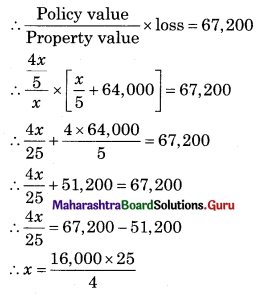
A merchant takes a fire insurance policy to cover 80% of the value of his stock. Stock worth ₹ 80,000 was completely destroyed in a fire. While the rest of the stock was reduced to 20% of its value. If the proportional compensation under the policy was ₹ 67,200, find the value of the stock.
Solution:
Let the Property value be ₹ x
∴ Policy value 80% × x = ₹ \(\frac{4 x}{5}\)
∵ Complete loss = ₹ 80,000
∴ Partial loss = 20% × (x – 8,00,000) = \(\frac{x-80,000}{5}\)
∴ Total loss = 80,000 + \(\frac{x-80,000}{5}\) = \(\frac{x}{5}\) + 64,000
∵ Claim = ₹ 67,200
Maharashtra Board 12th Commerce Maths Solutions Chapter 2 Insurance and Annuity Miscellaneous Exercise 2 IV Q4
∴ x = ₹ 1,00,000
∴ The value of the stock is ₹ 1,00,000.

Question 5.
A 35-year old person takes a policy for ₹ 1,00,000 for a period of 20 years. The rate of premium is ₹ 76 and the average rate of bonus is ₹ 7 per thousand p.a. If he dies after paying 10 annual premiums, what amount will his nominee receive?
Solution:
Policy value = ₹ 1,00,000
Period of Policy = 20 years
∵ Rate of premium = ₹ 76 per thousand
∴ Amount of premium = \(\frac{76}{1,000}\) × 1,00,000 = ₹ 7,600
∴ Total Premium = 7,600 × 10 = ₹ 76,000
∴ Rate of Bonus = ₹ 7 per thousand p.a
∴ Total Bonus = \(\frac{7}{1,000}\) × 1,00,000 = ₹ 7,000
∴ Amount received by Nominee = Policy value + Bonus earned
= 1,00,000 + 7,000
= ₹ 1,07,000

Maharashtra Board 12th Commerce Maths Solutions Chapter 2 Insurance and Annuity Miscellaneous Exercise 2

Question 6.
15,000 articles costing ₹ 200 per dozen were insured against fire for ₹ 1,00,000. If 20% of the articles were burnt completely and 2,400 other articles were damaged to the extent of 80% of their value, find the amount that can be claimed under the policy.
Solution:
Total Articles = 15,000
∴ Property value = \(\frac{15,000}{12}\) × 200 = 2,50,000
∵ Policy value = ₹ 1,00,000
∴ Complete loss = 20% × 2,50,000 = ₹ 50,000
∴ Partial loss = 80% × \(\frac{2,400}{12}\) × 200 = ₹ 3,20,000
∴ Total loss = 32,000 + 50,000 = ₹ 82,000
∴ Claim = \(\frac{\text { Policy value }}{\text { Property value }}\) × Loss
= \(\frac{1,00,000}{2,50,000}\) × 82,000
= ₹ 32,800

Question 7.
For what amount should a cargo worth ₹ 25,350 be insured so that in the event of a total loss, its value, as well as the cost of insurance, may be recovered when the rate of premium is 2.5%.
Solution:
Let the policy value be ₹ 100 which includes the cost of insurance and premium
∴ Property value = 100 – 2.50 = ₹ 97.50
If the value of the cargo is ₹ 97.50, then the policy value is ₹ 100.
If the value of the cargo is ₹ 25,350, then
Policy value = \(\frac{100 \times 25,350}{97.50}\) = ₹ 26,000

Question 8.
A cargo of grain is insured at \(\left(\frac{3}{4}\right)\)% to cover 70% of its value. ₹1,008 is the amount of premium paid. If the grain is worth ₹ 12 per kg, how many kg of the grain did the cargo contain?
Solution:
Let the Property value be ₹ x
∴ policy value = 70% × x = ₹ \(\frac{7 x}{10}\)
∵ Rate of premium = \(\frac{3}{4}\)%
∴ Amount of premium = Rate × Policy value
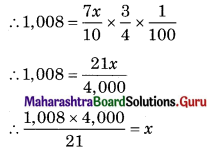
Maharashtra Board 12th Commerce Maths Solutions Chapter 2 Insurance and Annuity Miscellaneous Exercise 2 IV Q8
∴ x = ₹ 1,92,000
∵ Rate of Jowar = ₹ 12/kg
∴ Quantity of Jowar = \(\frac{1,92,000}{12}\) = 16,000 kgs

Question 9.
4,000 bedsheets worth ₹ 6,40,000 were insured for \(\left(\frac{3}{7}\right)^{t h}\) of their value. Some of
the bedsheets were damaged in the rainy season and were reduced to 40% of their value. If the amount recovered against damage was ₹ 32,000. Find the number of damaged bedsheets.
Solution:
∵ Property value = ₹ 6,40,000
∴ Policy value = 6,40,000 × \(\frac{3}{7}\) = ₹ \(\frac{19,20,000}{7}\)
∴ Cost of one Bedsheet = \(\frac{6,40,000}{4,000}\) = ₹ 160
Let ‘x’ bedsheets be damaged.
∴ Cost of x bedsheets = ₹ 160x
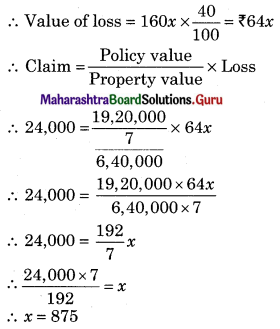
Maharashtra Board 12th Commerce Maths Solutions Chapter 2 Insurance and Annuity Miscellaneous Exercise 2 IV Q9
∴ 875 Bedsheets damaged.

Question 10.
A property valued at ₹ 7,00,000 is insured to the extent of ₹ 5,60,000 at \(\left(\frac{5}{8}\right)\)% less 20%. Calculate the saving made in the premium. Find the amount of loss that the owner must bear, including premium, if the property is damaged to the extent of 40% of its value.
Solution:
∵ Property value = ₹ 7,00,000
∵ Policy value = ₹ 5,60,000
∵ Rate of premium = \(\frac{5}{8}\)%
∴ Amount of premium = \(\frac{5}{8}\)% × 5,60,000 = ₹ 3,500
New rate of premium = \(\frac{5}{8}\)% less 20%
= \(\frac{5}{8}\) – [20% x \(\frac{5}{8}\)]
= \(\frac{5}{8}\) – \(\frac{1}{8}\)
= \(\frac{1}{2}\)%
∴ Amount of premium = \(\frac{1}{2}\)% × 5,60,000 = ₹ 2,800
∴ Saving made in premium = 3,500 – 2,800 = ₹ 700
∴ Loss = 7,00,000 × 40% = 2,80,000
∴ Claim = \(\frac{\text { Policy value }}{\text { Property value }}\) × Loss
= \(\frac{5,60,000}{7,00,000}\) × 2,80,000
= ₹ 2,24,000
∴ Loss bear by owner = loss – claim + premium
= 2,80,000 – 2,24,000 + 2,800
= ₹ 58,800

Maharashtra Board 12th Commerce Maths Solutions Chapter 2 Insurance and Annuity Miscellaneous Exercise 2

Question 11.
Stocks in a shop and godown worth ₹ 75,000 and ₹ 1,30,000 respectively were insured through an agent who receive 15% of the premium as commission. If the shop was insured for 80% and godown for 60% of the value, find the amount of agent’s commission when the premium was 0.80% less 20%. If the entire stock in the shop and 20% stock in the godown is destroyed by fire, find the amount that can be claimed under the policy.
Solution:
∵ Rate of premium = 0.80% less 20%
= 0.80 – 20% × 0.80
= 0.80 – 0.16
= 0.64%
For Shop
∵ Property value = ₹ 75,000
∴ Policy value = 80% × 75,000 = ₹ 60,000
∴ Premium = 0.64% × 60,000 = ₹ 384
∵ Loss = ₹ 75,000
∵ Claim = \(\frac{\text { Policy value }}{\text { Property value }}\) × Loss
= \(\frac{60,000}{75,000}\) × 75,000
= ₹ 60,000
For Godown
∵ Property value = ₹ 1,30,000
∴ Policy value = 60% × 1,30,000 = ₹ 78,000
∴ Premium = 0.64% × 78,000 = ₹ 499.2
Loss = 20% × 1,30,000 = ₹ 26,000
∴ Claim = \(\frac{\text { Policy value }}{\text { Property value }}\) × Loss
= \(\frac{78,000}{1,30,000}\) × 26,000
= ₹ 15,600
Total claim = 16,600 + 60,000 = ₹ 75,600
∵ Rate of commission = 15%
∴ Agent commission = 15% × [384 + 499.2]
= 15% × 883.2
= ₹ 132.48

Question 12.
A person holding a life policy of ₹ 1,20,000 for a term of 25 years wants to discontinue after paying a premium for 8 years at the rate of ₹ 58 per thousand p.a. Find the amount of paid-up value he will receive on the policy. Find the amount he will receive if the surrender value granted is 35% of the premium paid, excluding the first year’s premium.
Solution:
Policy value = ₹ 1,20,000
∵ Rate of premium = ₹ 58 per thousand p.a.
∴ Premium for 8 years = \(\frac{8 \times 58}{1000}\) × 1,20,000 = ₹ 55,680
∴ Amount of 1st premium = \(\frac{55,680}{8}\) = ₹ 6,960
∵ Paid-up value of policy = \(\frac{\text { No of Premium paid }}{\text { Terms of policy }}\) × Policy value
= \(\frac{8}{25}\) × 1,20,000
= ₹ 38,400
∵ Surrender value = 35% × [Total premium – 1st year premium]
= 35% × [55,680 – 6,960]
= 35% × 48,720
= ₹ 17,052

Question 13.
A godown valued at ₹ 80,000 contained stock worth ₹ 4,80,000. Both were insured against fire. Godown for ₹ 50,000 and stock for 80% of its value. A part of stock worth ₹ 60,000 was completely destroyed and the rest was reduced to 60% of its value. The amount of damage to the godown is ₹ 40,000. Find the amount that can be claimed under the policy.
Solution:
For Godown
∵ Property value = ₹ 80,000
∵ Policy value = ₹ 50,000
∵ Loss = ₹ 40,000
∵ Claim = \(\frac{\text { Policy value }}{\text { Property value }}\) × Loss
= \(\frac{50,000}{80,000}\) × 40,000
= ₹ 25,000
For stock
∵ Property value = ₹ 4,80,000
∵ Policy value = 80% × 4,80,000 = ₹ 3,84,000
∵ Complete loss = ₹ 60,000
∴ Partial loss = (100 – 60)% × [4,80,000 – 60,000]
= 40% × 4,20,000
= ₹ 1,68,000
∴ Total loss = 1,68,000 + 60000 = ₹ 2,28,000
∴ Claim = \(\frac{\text { Policy value }}{\text { Property value }}\) × Loss
= \(\frac{3,84,000}{4,80,000}\) × 2,28,000
= ₹ 1,82,400
∴ Total claim = 25,000 + 1,82,400 = ₹ 2,07,400

Question 14.
Find the amount of an ordinary annuity if a payment of ₹ 500 is made at the end of every quarter for 5 years at the rate of 12% per annum compounded quarterly. [Given: (1.03)20 = 1.8061]
Solution:
∵ C = ₹ 500
∵ r = 12% p.a. compounded quarterly,
∴ r = \(\frac{12}{4}\) = 3%
∵ n = 5 years
But, payment is made quarterly
∴ n = 5 × 4 = 20
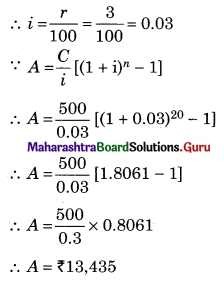
Maharashtra Board 12th Commerce Maths Solutions Chapter 2 Insurance and Annuity Miscellaneous Exercise 2 IV Q14

Question 15.
Find the amount a company should set aside at the end of every year if it wants to buy a machine expected to cost ₹ 1,00,000 at the end of 4 years and interest rate is 5% p.a. compounded annually.
Solution:
∵ A = ₹ 1,00,000
∵ r = 5% p.a.
∴ i = \(\frac{r}{100}=\frac{5}{100}\) = 0.05
∵ n = 4 years
∵ A = \(\frac{C}{i}\left[(1+\mathrm{i})^{n}-1\right]\)
∴ 1,00,000 = \(\frac{C}{0.05}\)[(1 + 0.05)4 – 1]
∴ 1,00,000 × 0.05 = C [(1.05)4 – 1]
∴ 5,000 = C(1.2155 – 1)
∴ 5,000 = C × 0.2155
∴ \(\frac{5,000}{0.2155}\) = C
∴ C = ₹ 23,201.86

Maharashtra Board 12th Commerce Maths Solutions Chapter 2 Insurance and Annuity Miscellaneous Exercise 2

Question 16.
Find the least number of years for which an annuity of ₹ 3,000 per annum must run in order that its amount exceeds ₹ 60,000 at 10%compounded annually. [Given: (1.1)11 = 2,8531, (1.1)12 = 3.1384]
Solution:
∵ A = ₹ 60,000
∵ C = ₹ 3,000
∵ r = 10% p.a.
∴ i = \(\frac{r}{100}=\frac{10}{100}\) = 0.1
∵ A = \(\frac{C}{i}\left[(1+i)^{n}-1\right]\)
∴ 60,000 = \(\frac{3,000}{0.1}\left[(1+0.1)^{n}-1\right]\)
∴ 60,000 = 30,000[(1.1)n – 1]
∴ \(\frac{60,000}{30,000}\) + 1 = (1.1)n
∴ 2 + 1 = (1.1)n
∴ 3 = (1.1)n
Taking log
∴ log 3 = log (1.1)n
∴ log 3 = n log(1.1)
∴ \(\frac{\log 3}{\log 1.1}\) = n
∴ n = \(\frac{0.4771}{0.0414}\) = 11.52 ~ 12 years

Question 17.
Find the rate of interest compounded annually if an ordinary annuity of ₹ 20,000 per year amounts to ₹ 41,000 in 2 years.
Solution:
∵ C = ₹ 20,000
∵ A = ₹ 41,000
∵ n = 2 years
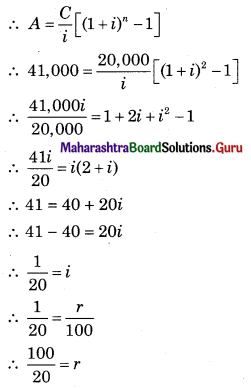
Maharashtra Board 12th Commerce Maths Solutions Chapter 2 Insurance and Annuity Miscellaneous Exercise 2 IV Q17
∴ r = 5% p.a.

Question 18.
A person purchases a television by paying ₹ 20,000 in cash and promising to pay ₹ 1,000 at the end of every month for the next 2 years. If money is worth 12% p.a., converted monthly. Find the cash price of the television. [Given: (1.01)-24 = 0.7880]
Solution:
Down payment = ₹ 20,000
∵ n = 2 years
But, EMI Payable monthly
∴ n = 2 × 12 = 24
∵ r = 12% p.a. compounded monthly
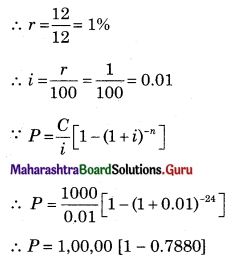
Maharashtra Board 12th Commerce Maths Solutions Chapter 2 Insurance and Annuity Miscellaneous Exercise 2 IV Q18
∴ P = 1,00,00 × 0.2120
∴ P = ₹ 21,200
Cash price = Present value + Down payment
= 21,200 + 20,000
= ₹ 41,200

Question 19.
Find the present value of an annuity immediate of ₹ 20,000 per annum for 3 years at 10% p.a. compounded annually. [Given: (1.1)-3 = 0.7513]
Solution:
∵ C = ₹ 20,000
∵ n = 3 years
∵ r = 10% p.a.
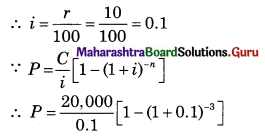
Maharashtra Board 12th Commerce Maths Solutions Chapter 2 Insurance and Annuity Miscellaneous Exercise 2 IV Q19
∴ P = 2,00,000 [1 – 0.7513]
∴ P = 2,00,000 [0.2487]
∴ P = ₹ 49,740

Question 20.
A man borrowed some money and paid it back in 3 equal installments of ₹ 2,160 each. What amount did he borrow if the rate of interest was 20% per annum compounded annually? Also, find the total interest charged. [Given: (1.2)-3 = 0.5788]
Solution:
∵ C = ₹ 2,160
∵ n = 3
∵ r = 20% p.a.
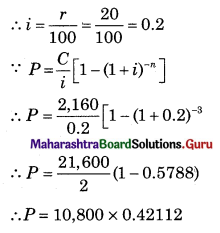
Maharashtra Board 12th Commerce Maths Solutions Chapter 2 Insurance and Annuity Miscellaneous Exercise 2 IV Q20
∴ P = ₹ 6,251.04
∴ Total amount paid = 2,160 × 3 = ₹ 6,480
∴ Interest = 6,480 – 6,251.04 = ₹ 228.96

Maharashtra Board 12th Commerce Maths Solutions Chapter 2 Insurance and Annuity Miscellaneous Exercise 2

Question 21.
A company decides to set aside a certain amount at the end of every year to create a sinking fund that should amount to ₹ 9,28,200 in 4 years at 10% p.a. Find the amount to be set aside every year. [Given: (1.1)4 = 1.4641]
Solution:
∵ A = ₹ 9,28,200
∵ n = 4 years
∵ r = 10% p.a.
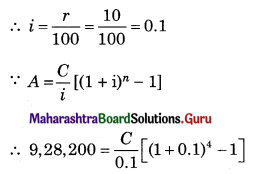
Maharashtra Board 12th Commerce Maths Solutions Chapter 2 Insurance and Annuity Miscellaneous Exercise 2 IV Q21
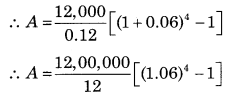
∴ 9,28,200 × 0.1 = C[1.4641 – 1]
∴ 92,820 = C × 0.4641
∴ \(\frac{92,820}{0.4641}\) = C
∴ C = ₹ 2,00,000

Question 22.
Find the future value after 2 years if an amount of ₹ 12,000 is invested at the end of every half-year at 12% p.a. compounded half-yearly. [Given: (1.06)4 = 1.2625]
Solution:
∵ n = 2 years
Payable half yearly, n = 2 × 2 = 4
∵ C = ₹ 12,000
∵ r = 12% p.a. Compounded half yearly
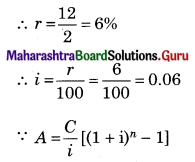
Maharashtra Board 12th Commerce Maths Solutions Chapter 2 Insurance and Annuity Miscellaneous Exercise 2 IV Q22
Maharashtra Board 12th Commerce Maths Solutions Chapter 2 Insurance and Annuity Miscellaneous Exercise 2 IV Q22.1
∴ A = 1,00,000 [1.2625 – 1]
∴ A = 1,00,000 × 0.2625
∴ A = ₹ 26,250

Question 23.
After how many years would an annuity due of ₹ 3,000 p.a. accumulated ₹ 19,324.80 at 20% p.a. compounded annually? [Given: (1.2)4 = 2.0736]
Solution:
∵ C = ₹ 3,000
∵ A = ₹ 9,324.80
∵ r = 20% p.a.
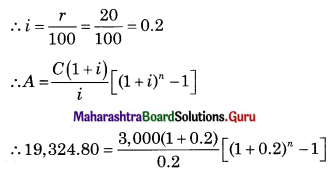
Maharashtra Board 12th Commerce Maths Solutions Chapter 2 Insurance and Annuity Miscellaneous Exercise 2 IV Q23
∴ 19,324.80 = 15,000 × 1.2[(1.2)n – 1]
∴ 19,324.80 = 18,000[(1.2)n – 1]
∴ \(\frac{19,324.80}{18,000}\) + 1 = (1.2)n
∴ 1.0736 + 1 = (1.2)n
∴ 2.0736 = (1.2)n
∴ (1.2)4 = (1.2)n
∴ n = 4 years

Maharashtra Board 12th Commerce Maths Solutions Chapter 2 Insurance and Annuity Miscellaneous Exercise 2

Question 24.
Some machinery is expected to cost 25% more over its present cost of ₹ 6,96,000 after 20 yeas. The scrap value of the machinery will realize ₹ 1,50,000. What amount should be set aside at the end of every year at 5% p.a. compound interest for 20 years to replace the machinery? [Given: (1.05)20 = 2655]
Solution:
Present cost = ₹ 6,96,000
Expected cost = 25% × 6,96,000 + 6,96,000
= 1,74,000 + 6,96,000
= ₹ 8,70,000
∴ Scrap value = ₹ 1,50,000
∴ Sinking fund = 8,70,000 – 1,50,000 = ₹ 7,20,000
∴ A = ₹ 7,20,000, n = 20 years, r = 5% p.a.
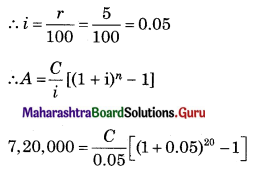
Maharashtra Board 12th Commerce Maths Solutions Chapter 2 Insurance and Annuity Miscellaneous Exercise 2 IV Q24
∴ 7,20,000 × 0.05 = C[(1.05)20 – 1]
∴ 36,000 = C[2.655 – 1]
∴ 36,000 = C × 1.655
∴ \(\frac{36,000}{1.655}\) = C
∴ C = ₹ 21,752.27
Maharashtra Board 12th Commerce Maths Solutions Chapter 3 Differentiation Miscellaneous Exercise 3

Balbharati Maharashtra State Board 12th Commerce Maths Solution Book Pdf Chapter 3 Differentiation Miscellaneous Exercise 3 Questions and Answers.

Maharashtra State Board 12th Commerce Maths Solutions Chapter 3 Differentiation Miscellaneous Exercise 3

(I) Choose the correct alternative:

Question 1.
If y = (5x3 – 4x2 – 8x)9, then \(\frac{d y}{d x}\) = ___________
(a) 9(5x3 – 4x2 – 8x)8 (15x2 – 8x – 8)
(b) 9(5x3 – 4x2 – 8x)9 (15x2 – 8x – 8)
(c) 9(5x3 – 4x2 – 8x)8 (5x2 – 8x – 8)
(d) 9(5x3 – 4x2 – 8x)9 (5x2 – 8x – 8)
Answer:
(a) 9(5x3 – 4x2 – 8x)8 (15x2 – 8x – 8)

Question 2.
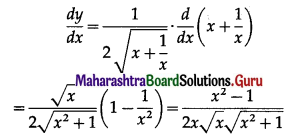
If y = \(\sqrt{x+\frac{1}{x}}\), then \(\frac{d y}{d x}\) = ?
(a) \(\frac{x^{2}-1}{2 x^{2} \sqrt{x^{2}+1}}\)
(b) \(\frac{1-x^{2}}{2 x^{2} \sqrt{x^{2}+1}}\)
(c) \(\frac{x^{2}-1}{2 x \sqrt{x} \sqrt{x^{2}+1}}\)
(d) \(\frac{1-x^{2}}{2 x \sqrt{x} \sqrt{x^{2}+1}}\)
Answer:
(c) \(\frac{x^{2}-1}{2 x \sqrt{x} \sqrt{x^{2}+1}}\)
Hint:
Maharashtra Board 12th Commerce Maths Solutions Chapter 3 Differentiation Miscellaneous Exercise 3 I Q2

Question 3.
If y = \(e^{\log x}\) then \(\frac{d y}{d x}\) = ?
(a) \(\frac{e^{\log x}}{x}\)
(b) \(\frac{1}{x}\)
(c) 0
(d) \(\frac{1}{2}\)
Answer:
(a) \(\frac{e^{\log x}}{x}\)

Maharashtra Board 12th Commerce Maths Solutions Chapter 3 Differentiation Miscellaneous Exercise 3

Question 4.
If y = 2x2 + 22 + a2, then \(\frac{d y}{d x}\) = ?
(a) x
(b) 4x
(c) 2x
(d) -2x
Answer:
(b) 4x

Question 5.
If y = 5x . x5, then \(\frac{d y}{d x}\) = ?
(a) 5x . x4(5 + log 5)
(b) 5x . x5(5 + log 5)
(c) 5x . x4(5 + x log 5)
(d) 5x . x5(5 + x log 5)
Answer:
(c) 5x . x4(5 + x log 5)

Question 6.
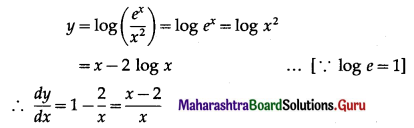
If y = \(\log \left(\frac{e^{x}}{x^{2}}\right)\) then \(\frac{d y}{d x}\) = ?
(a) \(\frac{2-x}{x}\)
(b) \(\frac{x-2}{x}\)
(c) \(\frac{e-x}{ex}\)
(d) \(\frac{x-e}{ex}\)
Answer:
(b) \(\frac{x-2}{x}\)
Hint:
Maharashtra Board 12th Commerce Maths Solutions Chapter 3 Differentiation Miscellaneous Exercise 3 I Q6

Question 7.
If ax2 + 2hxy + by2 = 0, then \(\frac{d y}{d x}\) = ?
(a) \(\frac{(a x+h y)}{(h x+b y)}\)
(b) \(\frac{-(a x+h y)}{(h x+b y)}\)
(c) \(\frac{(a x-h y)}{(h x+b y)}\)
(d) \(\frac{(2 a x+h y)}{(h x+3 b y)}\)
Answer:
(b) \(\frac{-(a x+h y)}{(h x+b y)}\)

Question 8.
If x4 . y5 = (x + y)(m+1) and \(\frac{d y}{d x}=\frac{y}{x}\) then m = ?
(a) 8
(b) 4
(c) 5
(d) 20
Answer:
(a) 8
Hint:
If xp . yq = (x + y)p+q, then \(\frac{d y}{d x}=\frac{y}{x}\)
∴ m + 1 = 4 + 5 = 9
∴ m = 8.

Maharashtra Board 12th Commerce Maths Solutions Chapter 3 Differentiation Miscellaneous Exercise 3

Question 9.
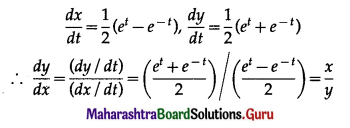
If x = \(\frac{e^{t}+e^{-t}}{2}\), y = \(\frac{e^{t}-e^{-t}}{2}\) then \(\frac{d y}{d x}\) = ?
(a) \(\frac{-y}{x}\)
(b) \(\frac{y}{x}\)
(c) \(\frac{-x}{y}\)
(d) \(\frac{x}{y}\)
Answer:
(d) \(\frac{x}{y}\)
Hint:
Maharashtra Board 12th Commerce Maths Solutions Chapter 3 Differentiation Miscellaneous Exercise 3 I Q9

Question 10.
If x = 2at2, y = 4at, then \(\frac{d y}{d x}\) = ?
(a) \(-\frac{1}{2 a t^{2}}\)
(b) \(\frac{1}{2 a t^{3}}\)
(c) \(\frac{1}{t}\)
(d) \(\frac{1}{4 a t^{3}}\)
Answer:
(c) \(\frac{1}{t}\)

(II) Fill in the blanks:

Question 1.
If 3x2y + 3xy2 = 0 then \(\frac{d y}{d x}\) = …………
Answer:
-1
Hint:
3x2y + 3xy2 = 0
∴ 3xy(x + y) = 0
∴ x + y = 0
∴ y = -x
∴ \(\frac{d y}{d x}\) = -1

Question 2.
If xm . yn = (x+y)(m+n) then \(\frac{d y}{d x}=\frac{\ldots \ldots}{x}\)
Answer:
y

Question 3.
If 0 = log(xy) + a then \(\frac{d y}{d x}=\frac{-y}{\ldots . .}\)
Answer:
x

Maharashtra Board 12th Commerce Maths Solutions Chapter 3 Differentiation Miscellaneous Exercise 3

Question 4.
If x = t log t and y = tt then \(\frac{d y}{d x}\) = …………
Answer:
y
Hint:
x = t log t = log tt = log y
∴ 1 = \(\frac{1}{y} \cdot \frac{d y}{d x}\)
∴ \(\frac{d y}{d x}\) = y

Question 5.
If y = x . log x then \(\frac{d^{2} y}{d x^{2}}\) = …………..
Answer:
\(\frac{1}{x}\)

Question 6.
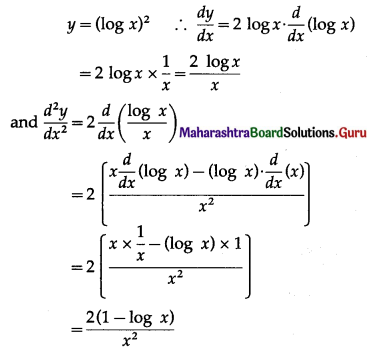
If y = [log(x)]2 then \(\frac{d^{2} y}{d x^{2}}\) = …………..
Answer:
\(\frac{2(1-\log x)}{x^{2}}\)
Hint:
Maharashtra Board 12th Commerce Maths Solutions Chapter 3 Differentiation Miscellaneous Exercise 3 II Q6

Question 7.
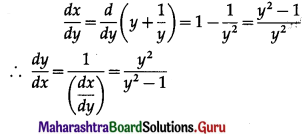
If x = y + \(\frac{1}{y}\) then \(\frac{d y}{d x}\) = …………
Answer:
\(\frac{y^{2}}{y^{2}-1}\)
Hint:
Maharashtra Board 12th Commerce Maths Solutions Chapter 3 Differentiation Miscellaneous Exercise 3 II Q7

Question 8.
If y = eax, then x.\(\frac{d y}{d x}\) = …………
Answer:
axy

Question 9.
If x = t . log t, y = tt then \(\frac{d y}{d x}\) = …………
Answer:
y

Maharashtra Board 12th Commerce Maths Solutions Chapter 3 Differentiation Miscellaneous Exercise 3

Question 10.
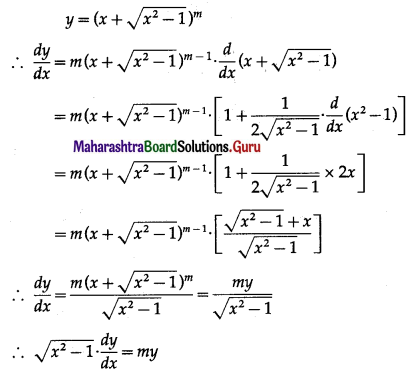
If y = \(\left(x+\sqrt{x^{2}-1}\right)^{m}\) then \(\sqrt{\left(x^{2}-1\right)} \frac{d y}{d x}\) = ………
Answer:
my
Hint:
Maharashtra Board 12th Commerce Maths Solutions Chapter 3 Differentiation Miscellaneous Exercise 3 II Q10

(III) State whether each of the following is True or False:

Question 1.
If f’ is the derivative of f, then the derivative of the inverse of f is the inverse of f’.
Answer:
False

Question 2.
The derivative of loga x, where a is constant is \(\frac{1}{x \cdot \log a}\).
Answer:
True

Question 3.
The derivative of f(x) = ax, where a is constant is x . ax-1
Answer:
False

Question 4.
The derivative of a polynomial is polynomial.
Answer:
True

Maharashtra Board 12th Commerce Maths Solutions Chapter 3 Differentiation Miscellaneous Exercise 3

Question 5.
\(\frac{d}{d x}\left(10^{x}\right)=x \cdot 10^{x-1}\)
Answer:
False

Question 6.
If y = log x, then \(\frac{d y}{d x}=\frac{1}{x}\).
Answer:
True

Question 7.
If y = e2, then \(\frac{d y}{d x}\) = 2e.
Answer:
False

Question 8.
The derivative of ax is ax. log a.
Answer:
True

Question 9.
The derivative of xm . yn = (x + y)(m+n) is \(\frac{x}{y}\)
Answer:
False

(IV) Solve the following:

Question 1.
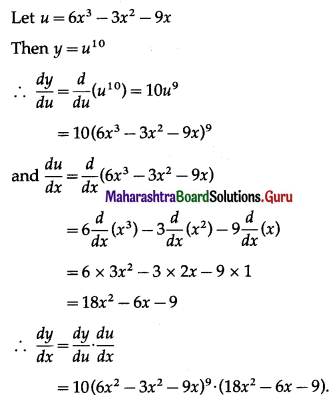
If y = (6x3 – 3x2 – 9x)10, find \(\frac{d y}{d x}\)
Solution:
Given y = (6x3 – 3x2 – 9x)10
Maharashtra Board 12th Commerce Maths Solutions Chapter 3 Differentiation Miscellaneous Exercise 3 IV Q1

Question 2.
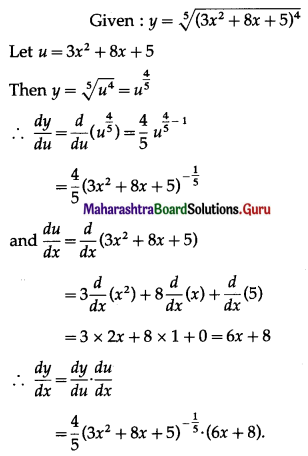
If y = \(\sqrt[5]{\left(3 x^{2}+8 x+5\right)^{4}}\), find \(\frac{d y}{d x}\).
Solution:
Maharashtra Board 12th Commerce Maths Solutions Chapter 3 Differentiation Miscellaneous Exercise 3 IV Q2

Maharashtra Board 12th Commerce Maths Solutions Chapter 3 Differentiation Miscellaneous Exercise 3

Question 3.
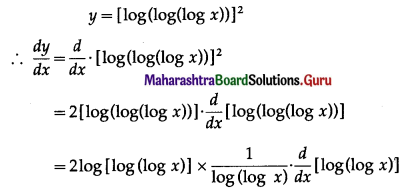
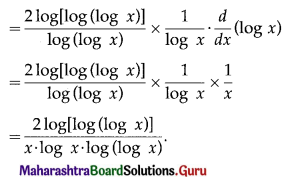
If y = [log(log(log x))]2, find \(\frac{d y}{d x}\).
Solution:
Maharashtra Board 12th Commerce Maths Solutions Chapter 3 Differentiation Miscellaneous Exercise 3 IV Q3
Maharashtra Board 12th Commerce Maths Solutions Chapter 3 Differentiation Miscellaneous Exercise 3 IV Q3.1

Question 4.
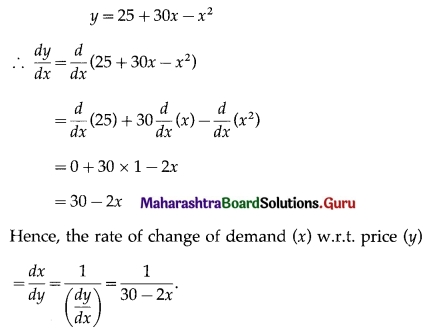
Find the rate of change of demand (x) of a commodity with respect to its price (y) if y = 25 + 30x – x2.
Solution:
Maharashtra Board 12th Commerce Maths Solutions Chapter 3 Differentiation Miscellaneous Exercise 3 IV Q4

Question 5.
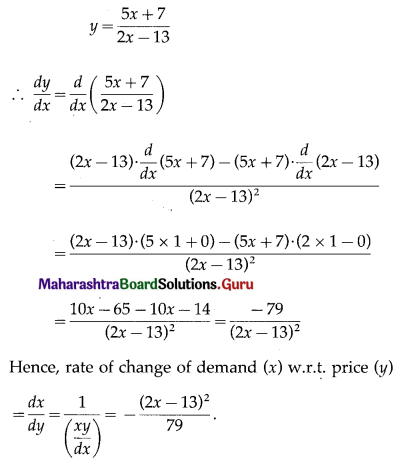
Find the rate of change of demand (x) of a commodity with respect to its price (y) if y = \(\frac{5 x+7}{2 x-13}\)
Solution:
Maharashtra Board 12th Commerce Maths Solutions Chapter 3 Differentiation Miscellaneous Exercise 3 IV Q5

Question 6.
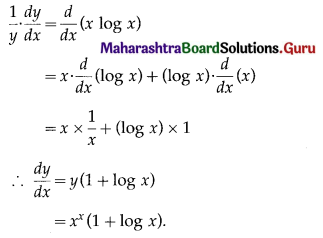
Find \(\frac{d y}{d x}\) if y = xx.
Solution:
y = xx
∴ log y = log xx = x log x
Differentiating both sides w.r.t. x, we get
Maharashtra Board 12th Commerce Maths Solutions Chapter 3 Differentiation Miscellaneous Exercise 3 IV Q6

Maharashtra Board 12th Commerce Maths Solutions Chapter 3 Differentiation Miscellaneous Exercise 3

Question 7.
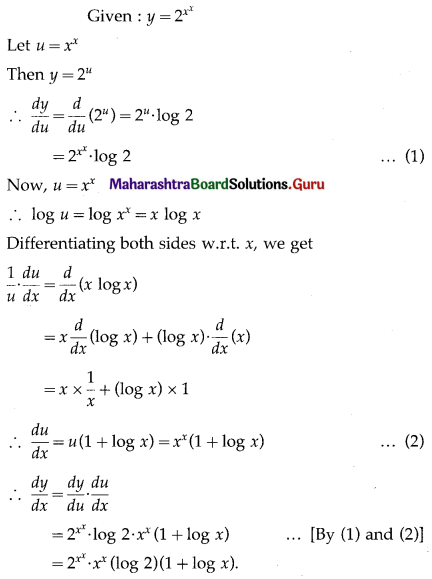
Find \(\frac{d y}{d x}\) if y = \(2^{x^{x}}\).
Solution:
Maharashtra Board 12th Commerce Maths Solutions Chapter 3 Differentiation Miscellaneous Exercise 3 IV Q7

Question 8.
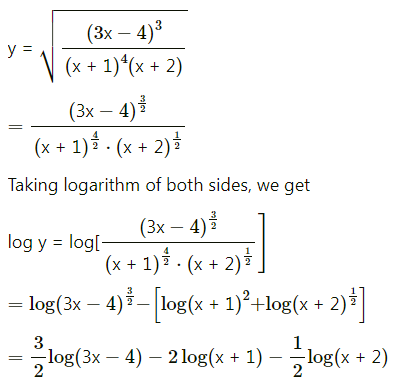
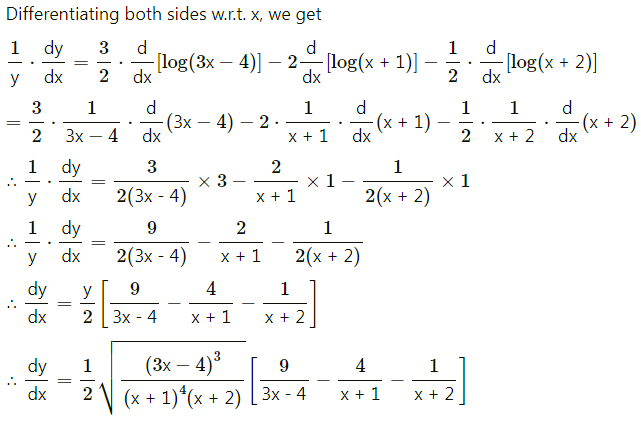
Find \(\frac{d y}{d x}\), if y = \(\sqrt{\frac{(3 x-4)^{3}}{(x+1)^{4}(x+2)}}\)
Solution:
Maharashtra Board 12th Commerce Maths Solutions Chapter 3 Differentiation Miscellaneous Exercise 3 IV Q8
Maharashtra Board 12th Commerce Maths Solutions Chapter 3 Differentiation Miscellaneous Exercise 3 IV Q8.1

Question 9.
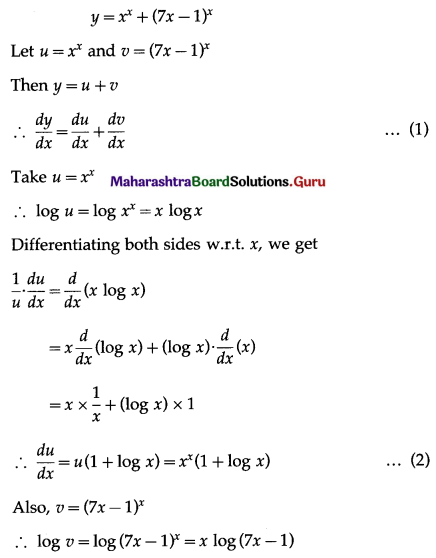
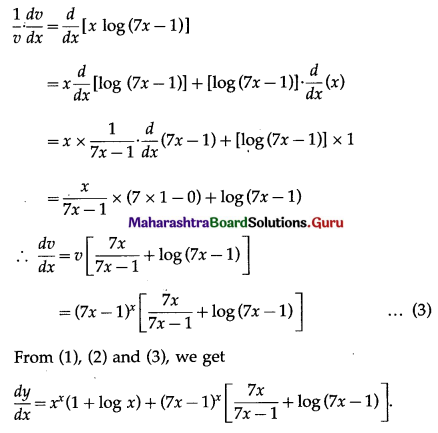
Find \(\frac{d y}{d x}\) if y = xx + (7x – 1)x
Solution:
Maharashtra Board 12th Commerce Maths Solutions Chapter 3 Differentiation Miscellaneous Exercise 3 IV Q9
Maharashtra Board 12th Commerce Maths Solutions Chapter 3 Differentiation Miscellaneous Exercise 3 IV Q9.1

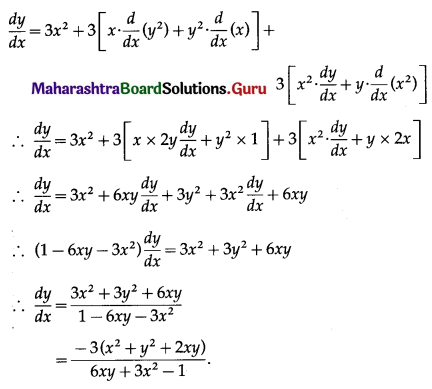
Question 10.
If y = x3 + 3xy2 + 3x2y, find \(\frac{d y}{d x}\).
Solution:
y = x3 + 3xy2 + 3x2y
Differentiating both sides w.r.t. x, we get
Maharashtra Board 12th Commerce Maths Solutions Chapter 3 Differentiation Miscellaneous Exercise 3 IV Q10

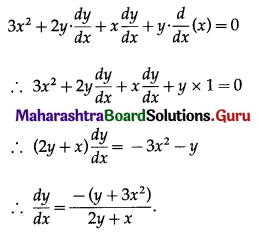
Question 11.
If x3 + y2 + xy = 7, find \(\frac{d y}{d x}\).
Solution:
x3 + y2 + xy = 7
Differentiating both sides w.r.t. x, we get
Maharashtra Board 12th Commerce Maths Solutions Chapter 3 Differentiation Miscellaneous Exercise 3 IV Q11

Maharashtra Board 12th Commerce Maths Solutions Chapter 3 Differentiation Miscellaneous Exercise 3

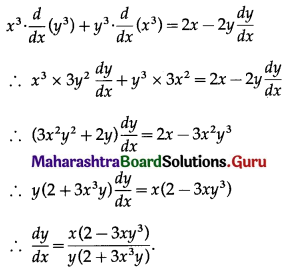
Question 12.
If x3y3 = x2 – y2, find \(\frac{d y}{d x}\).
Solution:
x3y3 = x2 – y2
Differentiating both sides w.r.t. x, we get
Maharashtra Board 12th Commerce Maths Solutions Chapter 3 Differentiation Miscellaneous Exercise 3 IV Q12

Question 13.
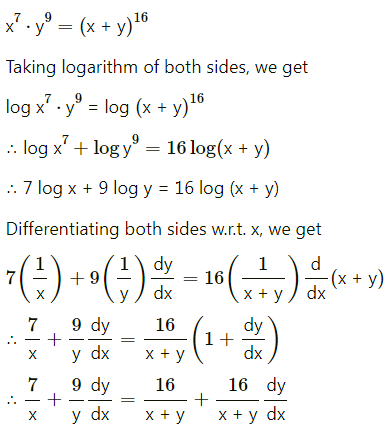
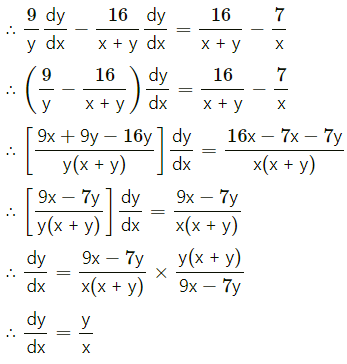
If x7 . y9 = (x + y)16, then show that \(\frac{d y}{d x}=\frac{y}{x}\).
Solution:
Maharashtra Board 12th Commerce Maths Solutions Chapter 3 Differentiation Miscellaneous Exercise 3 IV Q13
Maharashtra Board 12th Commerce Maths Solutions Chapter 3 Differentiation Miscellaneous Exercise 3 IV Q13.1

Question 14.
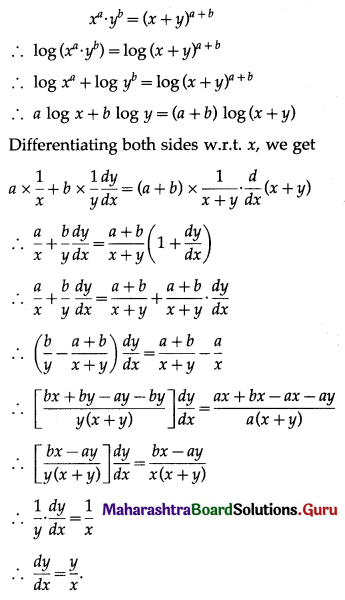
If xa . yb = (x + y)a+b, then show that \(\frac{d y}{d x}=\frac{y}{x}\).
Solution:
Maharashtra Board 12th Commerce Maths Solutions Chapter 3 Differentiation Miscellaneous Exercise 3 IV Q14

Question 15.
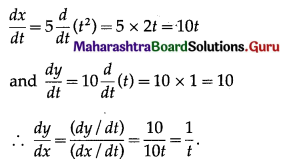
Find \(\frac{d y}{d x}\) if x = 5t2, y = 10t.
Solution:
x = 5t2, y = 10t
Differentiating x and y w.r.t. t, we get
Maharashtra Board 12th Commerce Maths Solutions Chapter 3 Differentiation Miscellaneous Exercise 3 IV Q15

Question 16.
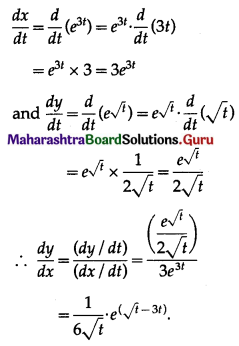
Find \(\frac{d y}{d x}\) if x = e3t, y = \(e^{\sqrt{t}}\).
Solution:
x = e3t, y = \(e^{\sqrt{t}}\)
Differentiating x and y w.r.t. t, we get
Maharashtra Board 12th Commerce Maths Solutions Chapter 3 Differentiation Miscellaneous Exercise 3 IV Q16

Question 17.
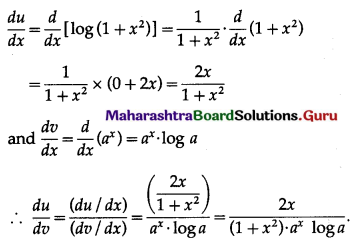
Differentiate log(1 + x2) with respect to ax.
Solution:
Let u = log(1 + x2) and v = ax
Then we want to find \(\frac{d u}{d v}\)
Differentiating u and v w.r.t. x, we get
Maharashtra Board 12th Commerce Maths Solutions Chapter 3 Differentiation Miscellaneous Exercise 3 IV Q17

Maharashtra Board 12th Commerce Maths Solutions Chapter 3 Differentiation Miscellaneous Exercise 3

Question 18.
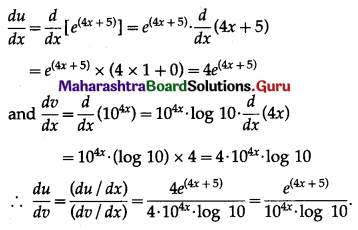
Differentiate e(4x+5) with resepct to 104x.
Solution:
Let u = e(4x+5) and v = 104x
Then we want to find \(\frac{d u}{d v}\)
Differentiating u and v w.r.t. x, we get
Maharashtra Board 12th Commerce Maths Solutions Chapter 3 Differentiation Miscellaneous Exercise 3 IV Q18

Question 19.
Find \(\frac{d^{2} y}{d x^{2}}\), if y = log x.
Solution:
y = log x
Differentiating w.r.t. x, we get
\(\frac{d y}{d x}=\frac{d}{d x}(\log x)=\frac{1}{x}\)
Differentiating again w.r.t. x, we get
\(\frac{d^{2} y}{d x^{2}}=\frac{d}{d x}\left(\frac{1}{x}\right)=-\frac{1}{x^{2}}\)

Question 20.
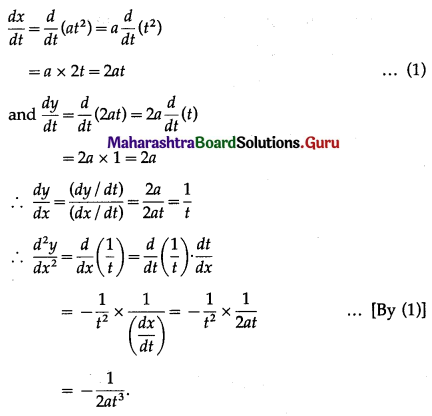
Find \(\frac{d^{2} y}{d x^{2}}\), if y = 2at, x = at2.
Solution:
x = at2, y = 2at
Differentiating x and y w.r.t. t, we get
Maharashtra Board 12th Commerce Maths Solutions Chapter 3 Differentiation Miscellaneous Exercise 3 IV Q20

Question 21.
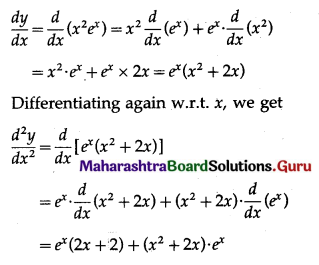
Find \(\frac{d^{2} y}{d x^{2}}\), if y = x2 . ex
Solution:
y = x2 . ex
Differentiating w.r.t. x, we get
Maharashtra Board 12th Commerce Maths Solutions Chapter 3 Differentiation Miscellaneous Exercise 3 IV Q21
= ex (2x + 2 + x2 + 2x)
= ex (x2 + 4x + 2).

Maharashtra Board 12th Commerce Maths Solutions Chapter 3 Differentiation Miscellaneous Exercise 3

Question 22.
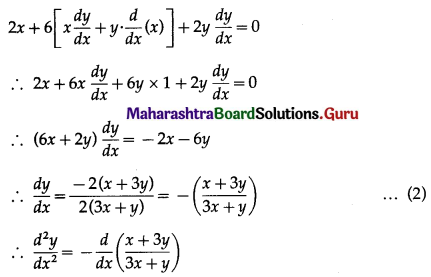
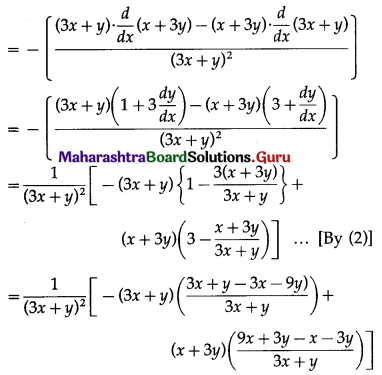
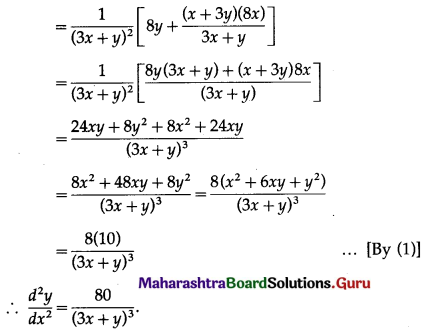
If x2 + 6xy + y2 = 10, then show that \(\frac{d^{2} y}{d x^{2}}=\frac{80}{(3 x+y)^{3}}\).
Solution:
x2 + 6xy + y2 = 10 ……..(1)
Differentiating both sides w.r.t. a, we get
Maharashtra Board 12th Commerce Maths Solutions Chapter 3 Differentiation Miscellaneous Exercise 3 IV Q22
Maharashtra Board 12th Commerce Maths Solutions Chapter 3 Differentiation Miscellaneous Exercise 3 IV Q22.1
Maharashtra Board 12th Commerce Maths Solutions Chapter 3 Differentiation Miscellaneous Exercise 3 IV Q22.2

Question 23.
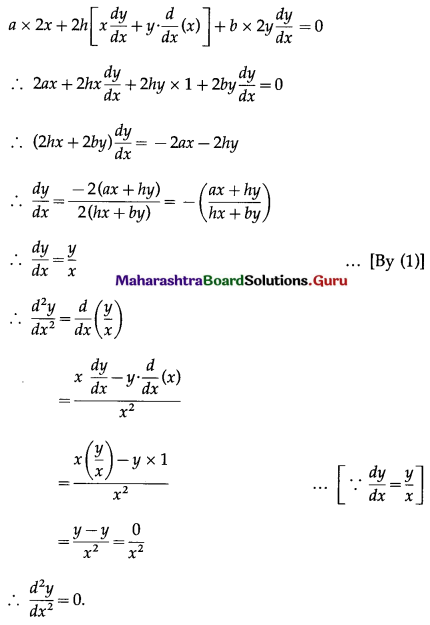
If ax2 + 2hxy + by2 = 0, then show that \(\frac{d^{2} y}{d x^{2}}\) = 0.
Solution:
ax2 + 2hxy + by2 = 0 ……..(1)
∴ ax2 + hxy + hxy + by2 = 0
∴ x(ax + hy) + y(hx + by) = 0
∴ x(ax + hy) = -y(hx + by)
∴ \(\frac{a x+h y}{h x+b y}=-\frac{y}{x}\) …….(2)
Differentiating (1) w.r.t. x, we get
Maharashtra Board 12th Commerce Maths Solutions Chapter 3 Differentiation Miscellaneous Exercise 3 IV Q23

Maharashtra Board Class 9 My English Coursebook Solutions Chapter 4.2 Reading Works of Art

Balbharti Maharashtra State Board Class 9 English Solutions My English Coursebook Chapter 4.2 Reading Works of Art Notes, Textbook Exercise Important Questions and Answers.

Maharashtra State Board Class 9 My English Coursebook Solutions Chapter 4.2 Reading Works of Art

My English Coursebook Std 9 Guide Chapter 4.2 Reading Works of Art Textbook Questions and Answers

English Workshop:

1. Spot the error in the spellings of the following words with reference to the passage and rewrite them correctly.

Question 1.
Spot the error in the spellings of the following words with reference to the passage and rewrite them correctly.

  1. renouned
  2.  feetures
  3. pentmgs
  4. circals
  5. inflar
  6. geometic
  7. figars
  8. achiving.

Answer:

  1. renowned
  2. features
  3. paintings
  4. circles
  5. inner
  6. geometric
  7. figures
  8. achieving.

Maharashtra Board Class 9 My English Coursebook Solutions Chapter 4.2 Reading Works of Art

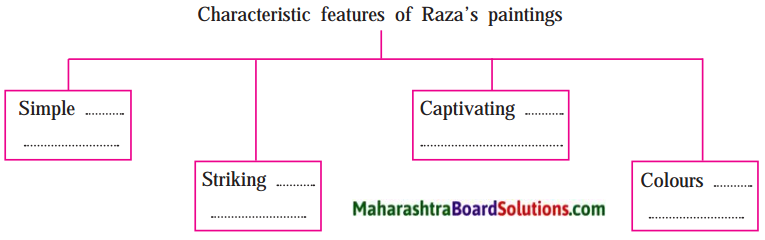
2. Complete the following diagram:

Question 1.
Complete the following diagram:
Maharashtra Board Class 9 My English Coursebook Solutions Chapter 4.2 Reading Works of Art 1
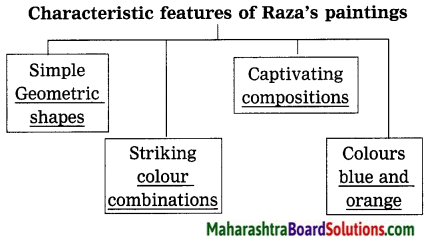
Answer:
Maharashtra Board Class 9 My English Coursebook Solutions Chapter 4.2 Reading Works of Art 2

3. Complete the following sentences with reference to the passage:

Question 1.
Complete the following sentences with reference to the passage:
(a) Raza’s paintings do not depict …………………. .
(b) Raza’s paintings are done in the style ……………… .
(c) Raza’s paintings are not inspired by ………………. .
(d) Raza’s paintings present images from his own …………….. .
(e) Raza’s paintings radiate ……………. .
(f) The …………….. became the core of Raza’s paintings.
(g) For an artist like Raza, his work, or paintings are an effective …………………. .
Answer:
(a) Raza’s paintings do not depict lifelike human figures or copies of scenes.
(b) Raza’s paintings are done in the abstract style.
(c) Raza’s paintings are not inspired by any external factor.
(d) Raza’s paintings present images from his own inner mind.
(e) Raza’s paintings radiate peace.
(f) The bindu or point became the core of Raza’s paintings.
(g) For an artist like Raza, his work, or paintings are an effective medium of communication.

4. Read the passage on ‘Gond Art’ carefully. Then complete the following sentences without going back to the passage:

Question 1.
Read the passage on ‘Gond Art’ carefully. Then complete the following sentences without going back to the passage:
Answer:

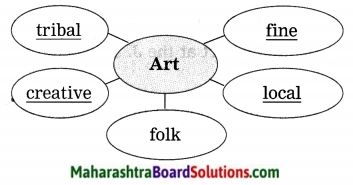
  1. Gond art is a tribal art.
  2. The Gondi language is similar to Telugu, a Dravidian language.
  3. Originally people used to draw pictures on the earthen walls of their houses.
  4. In folk arts, you yourself prepare the ‘canvas’ – the surface on which to draw and the colours with which you draw.

Maharashtra Board Class 9 My English Coursebook Solutions Chapter 4.2 Reading Works of Art

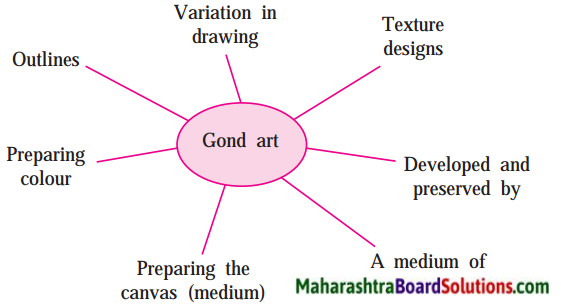
5. Write about the following important features of Gond art with the help of the passage.

Question 1.
Write about the following important features of Gond art with the help of the passage.
Maharashtra Board Class 9 My English Coursebook Solutions Chapter 4.2 Reading Works of Art 2.1
Answer:
1. Developed and Preserved by: The Gond tribal people residing largely in Madhya Pradesh, Maharashtra, Telangana, Andhra Pradesh and Odisha in India.
2. A medium of: It is a medium of expressing, recording and preserving what is seen. people used to draw pictures on earthen walls of their homes itself.
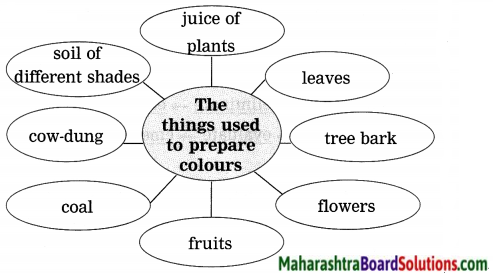
3. Preparing colours: In the days of the past several things in nature such as soil of different shades, the juice of plants, leaves, tree bark, flowers, fruits and even things like coal and cow-dung were used to prepare colours.
4. Outlines: In the Gond style of art, the designs may vary a little from artist to artist but the designs that fill it make the whole picture look lively and attractive.
5. Variation in drawing: The colours, textures and patterns used in drawing vary from painting to painting.
6. Texture designs: By using dots, straight lines, dotted lines, curvy shapes and circles simple texture designs are made.

6. Why does the author think that the roots of folk art lie in women’s chores?

Question 1.
Why does the author think that the roots of folk art lie in women’s chores?
Answer:
In the past, it was the duty of women to look after her home and hearth. It included decorating the house with different things like flowers, rangolis. They handled it very creatively while shouldering the other responsibilities of their home. They used their own creativity while doing it, so the author thinks that the roots of folk art lies in women’s chores.

7. From the passages, list the words related to – (a) geometry (b) colours (c) designs.

Question (a)
geometry
Answer:
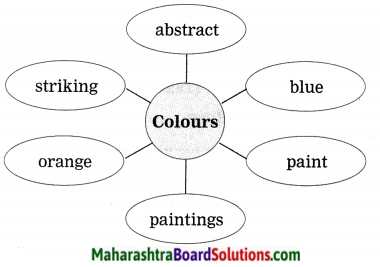
Maharashtra Board Class 9 My English Coursebook Solutions Chapter 4.2 Reading Works of Art 3

Question (b)
colours
Answer:
Maharashtra Board Class 9 My English Coursebook Solutions Chapter 4.2 Reading Works of Art 4

Question (c)
designs.
Answer:
human figures, scenes, abstract.

Maharashtra Board Class 9 My English Coursebook Solutions Chapter 4.2 Reading Works of Art

8. These two passages are examples of a short introduction to works of art – a short review. They cover the following points:

Question 1.
These two passages are examples of a short introduction to works of art – a short review. They cover the following points:
Answer:

  1. The name of the creator
  2. The theme or subject matter
  3. Type of art
  4. Individual style
  5. Presentation techniques
  6. Its effect on viewers
  7. Message or interpretation

Question 2.
What points will you include if you had to review a book or film or a play? List the points.
Answer:
If I had to review a book, a film or play, I would like to include the following points:

  1. The theme of the book/film/play.
  2. The plot and the story.
  3. The characters in the book/film/play.
  4. Flow of language and style of narration.
  5. Authenticity of the book/film/play (story).
  6. The message conveyed in the book/film/play.

Question 3.
Choose a book/film and review it in short using the points you have listed.
Answer:
Review of the book

The Three Mistakes of My Life

‘The Three Mistakes of My Life’ is a novel written by Chetan Bhagat who writes about Indians and for Indians. His characters are young and passionate. The novel follows the story of three friends and is based in the city of Ahmedabad in Gujarat.

Govind Jaat Patel is an ordinary guy with whom anybody can relate. Being a Gujarati his ambition is to become a businessman. His friend is Omi who is the son of a Hindu priest of the local temple. He is confused about his religious views which are mainly influenced by Bitoo Mama. Ishan is a big cricket freak and a patriot.

He was the best cricketer in his locality and school. He helps Govind’s business by organizing daily cricket coaching camps. He has a younger sister Vidya who is weak in Mathematics. Ishan asks Govind to take her Mathematics tuition. In between their tuition, they fall in love which is kept secret.

The whole story revolves around Govind and his friends and the three mistakes he made. It is pop- fiction of lightest, laziest sort, which tackles serious real-life issues and incidents giving it a veneer of earnest thoughtfulness that stands up to nothing. It is written simply and has the quality that makes one want to read the book in one sitting. The target audience of the book is the young generation. It is based on fun, emotion and pace to turn it into a potential best-seller.

Maharashtra Board Class 9 My English Coursebook Solutions Chapter 4.2 Reading Works of Art

9. You know that an adverb is a word that tells us something more about a verb, an adjective, another adverb etc. It can give us information about the place, time, manner etc. of the action denoted by the verb.

For example, ‘here’ tells us a place. ‘Now’ gives us information about time. ‘Fast’ gives us information about manner. In the same way, an adverb clause is a group of words that can also tell us something about place, time, manner etc. of the action denoted by the verb. Read the following examples, given and then complete the sentence using your own ideas:

Question (a)
Place: You may sit wherever you like.
You may sit ………………………………..
Answer:
(a) Place: You may sit wherever you like.
You may sit next to Ishan.

Question (b)
Time: I entered the school when the bell was ringing.
I entered the school ……………………..
Answer:
(b) Time: I entered the school when the bell was ringing.
I entered the school with my classmates.

Question (c)
Manner: I love my country like a true Indian should.
I love my country………………………….
Answer:
(c) manner: I love my country like a true Indian should.
I like my country more than you.

My English Coursebook 9th Class Solutions Chapter 4.2 Reading Works of Art Additional Important Questions and Answers

Simple Factual Activities:

Question 1.
Name the following:
Answer:

  1. The state where Raza was born – Madhya Pradesh
  2. The institute where he studied art – Chitrakala Mahavidyalaya, Nagpur
  3. The institute where he took his higher education in Mumbai – J. J. School of Art, Mumbai
  4. The country he settled – France

Maharashtra Board Class 9 My English Coursebook Solutions Chapter 4.2 Reading Works of Art

Question 2.
Complete the following web :
(Answers are directly given.)
Answer:
Maharashtra Board Class 9 My English Coursebook Solutions Chapter 4.2 Reading Works of Art 5

Question 3.
Complete the following sentences with reference to the passage: (Answers are directly given.)
Answer:
1. Raza passed away on 23rd July 2016.
2. Raza’s wife was French.

Question 4.
Complete the following web-chart:
(Answers are directly given.)
Answer:
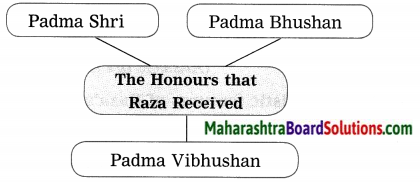
Maharashtra Board Class 9 My English Coursebook Solutions Chapter 4.2 Reading Works of Art 6

Complex Factual Activities:

Question 1.
How did Raza And his paintings?
Answer:
Raza found his paintings through the study of Indian art and its heritage, cultural context and philosophy.

Question 2.
What are the specialities of Raza’s paintings?
Answer:
The specialities of Raza’s paintings are:

  1. His paintings belong to the abstract style of paintings.
  2. They are not inspired by any external factor whereas based on inner mind of the painter.
  3. They communicate with the viewers.

Maharashtra Board Class 9 My English Coursebook Solutions Chapter 4.2 Reading Works of Art

Question 3.
What are Raza’s paintings based on? How did he describe his work?
Answer:
Raza’s paintings are based on spirituality, metaphysical path and the bindu or point. He described his work as his own inner experience and involvement with the mysteries of nature and form, which is expressed in colour, line, space and light.

Question 4.
What legacy did Raza leave behind?
Answer:
Raza left behind a rich legacy of sensitive paintings (achieved through extraordinary compositions of lines and colours) that depict extraordinary compositions.

Question 5.
Complete the following sentences:
(Answers are directly given.)
Answer:
1. In the Gond style of art, outlines may vary from artist to artist but the designs that fill it make the whole picture look lively and attractive.
2. The designs in Gond style art contain simple textures of dots, straight lines, dotted lines, curvy shapes and circles.

Activities based on vocabulary:

Question 1.
Find out antonyms from the passage for the following words: (Answers are directly given.)
Answer:

  1. outer × inner
  2. city × village
  3. ordinary × extraordinary
  4. international × national

Maharashtra Board Class 9 My English Coursebook Solutions Chapter 4.2 Reading Works of Art

Question 2.
Spot the error in the spelling of the following words and rewrite them correctly:
1. dicided
2. diffarent
Answer:
1. decided
2. different.

Question 3.
Write related words with “Artist”.
Answer:
design, outlines, picture, texture, pattern, style.

Activities based on contextual grammar:

Question 1.
Identify the tense:
1. You will find them in almost all paintings.
2. Raza found his paintings through his study of Indian art.
Answer:
1. Simple future tense
2. Simple past tense

Question 2.
Frame a Wh-type question to get underlined part as an answer:
Answer:
1. His paintings belong to the abstract style of paintings.
2. Sayed Haider Raza is popularly known as Raza.
Answer:
1. What do his paintings belong to?
2. What is Sayed Haider Raza popularly known as?

Maharashtra Board Class 9 My English Coursebook Solutions Chapter 4.2 Reading Works of Art

Question 3.
Change the voice:
1. He was honoured with all the three Padma awards – Padma Shri, Padma Bhushan and Padma Vibhushan.
2. Raza left behind a legacy of sensitive paintings.
Answer:
1. The Government of India honoured him with all the three Padma awards – Padma Shri, Padma Bhushan, and Padma Vibhushan.
2. A legacy of sensitive paintings was left behind by Raza.

Question 4.
Make the following sentences exclamatory:
1. His paintings are very expressive.
2. Raza had a great creativity.
Answer:
1. How expressive his paintings are!
2. What a great creativity Raza had!

Question 5.
What a deep thought this art conveys! (Make it assertive.)
Answer:
This art conveys a very deep thought.

Question 6.
Creating folk art is a very enriching experience. (Make it exclamatory.)
Answer:
What an enriching experience creating folk art is!

Question 7.
Complete the words using correct letters:

  1. s_ene
  2. st _ le
  3. pa_nt
  4. c_ eate

Answer:

  1. scene
  2. style
  3. paint
  4. create.

Question 8.
Copy the following sentences correctly:
Answer:
1. He studied art at the J. J. School of Art in Mumbai.
2. What a deep thought this art conveys – and so easily !

Maharashtra Board Class 9 My English Coursebook Solutions Chapter 4.2 Reading Works of Art

Question 9.
Put the following words in alphabetical order:
1. vicious, dreadful, thrilled, favourable
2. enchanted, enabled, explained, endangered.
Answer:
1. dreadful, favourable, thrilled, vicious,
2. enabled, enchanted, endangered, explained,

Question 10.
Punctuate the following sentences:
1. ariel my joyful spirit said prospero bring ferdinand here at once for my daughter must see him
2. most sure she is the goddess of the island he thought to himself
Answer:
1. “Ariel, my joyful spirit,” said Prospero. “Bring Ferdinand here at once, for my daughter must see him.”
2. “Most sure, she is the goddess of the island!” he thought to himself.

Question 11.
Write four small words (minimum letters each) using the letters given word: “treacherous”
Answer:

  1. teacher
  2. reach
  3. each
  4. ache.

Question 12.
Spot the error and rewrite the correct sentences:
1. Prospero touch Miranda with his magic stick and she fell fast asleep.
2. How happy Alonso was to saw his lost son !
Answer:
1. Prospero touched Miranda with his magic stick and she fell fast asleep.
2. How happy Alonso was to see his lost son !

Question 13.
Write related words as shown in the example: (Answers are directly given.)
Answer:
Maharashtra Board Class 9 My English Coursebook Solutions Chapter 4.2 Reading Works of Art 7

Question 14.
Complete the following word-chain of verbs. Write four words, each beginning with the last letter of the previous word:
explore → ……………… → ………………. → ……………… → ………………….
Answer:
explore → eliminate → embrace → evaluate → emerge.

Maharashtra Board Class 9 My English Coursebook Solutions Chapter 4.2 Reading Works of Art

Do as directed:

Question 1.
Make a meaningful sentence by using the following phrase in your own sentence.
‘to settle down’.
Answer:
It is pretty difficult to settle down in cities like Mumbai.

Question 2.
Add a prefix or suffix to make new words and use any one of the root words in your own sentence:
1. rich
2. effect.
Answer:
1. rich-enrich
2. effect-effective.
The painter has used rich attractive colour combinations in his painting.

Question 3.
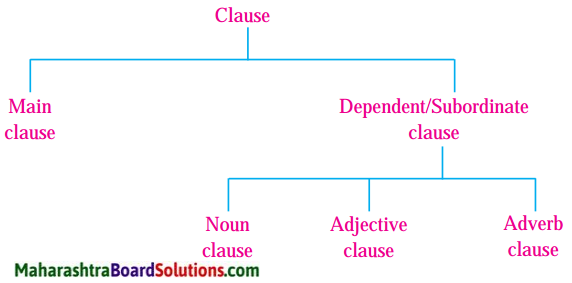
Add a subordinate clause to expand the sentence meaningfully:
You can see my paintings ………………………..
Answer:
You can see my paintings when vou come to mv house.

Personal Response:

Question 1.
Write 4-5 sentences about any other Indian painter you like.
Answer:
M. F. Husain is my favourite modern painter who was born in Pandharpur town of Maharashtra. He is one of the most famous artists of India both at the national as well as the international level. M. F. Husain was once called ‘the Picasso of India’ by the Forbes magazine. The Government of India awarded the prestigious Padma Shri and Padma Bhushan for his work.

Maharashtra Board Class 9 My English Coursebook Solutions Chapter 4.2 Reading Works of Art

Question 2.
What are the essential things required to become a good painter?
Answer:
The essential things that are required to become a good painter are :

  1. interest in painting
  2. a good concentration skill
  3. capacity to sit for a long time at one place
  4. good eyesight
  5. imagination
  6. the knowledge of mixing colours.

Maharashtra Board Class 9 My English Coursebook Solutions Chapter 1.2 The Fun they Had

Balbharti Maharashtra State Board Class 9 English Solutions My English Coursebook Chapter 1.2 The Fun they Had Notes, Textbook Exercise Important Questions and Answers.

Maharashtra State Board Class 9 My English Coursebook Solutions Chapter 1.2 The Fun they Had

My English Coursebook Std 9 Digest Chapter 1.2 The Fun they Had Textbook Questions and Answers

Warming up!

Chit-chat:

  • What do you like best about your school?
  • Do you think school is fun?
  • Which is the part that you don’t like?
  • How often should the teacher ‘? give you a test?

Maharashtra Board Class 9 My English Coursebook Solutions Chapter 1.2 The Fun they Had

Classify!

1. Listen carefully and write each word in the appropriate column/columns.

Maharashtra Board Class 9 My English Coursebook Solutions Chapter 1.2 The Fun they Had 1

Maharashtra Board Class 9 My English Coursebook Solutions Chapter 1.2 The Fun they Had 2

Question 1.
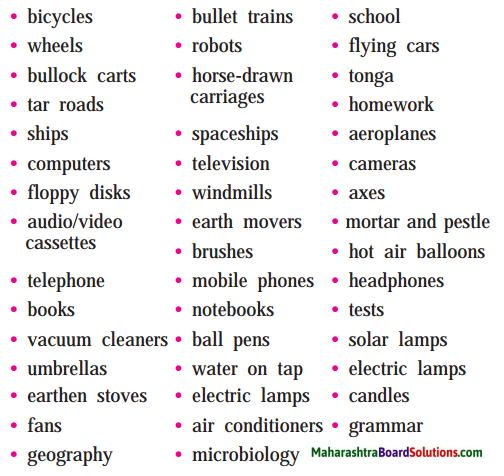
Listen carefully and write each word given on textbook page no. 5 in the appropriate column/columns:
Answer:

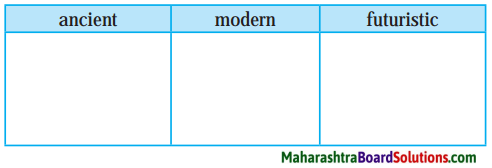
ancientmodemfuturistic
earthen stovesbicyclesflying cars
tongatelephonespaceships
horse-drawnaudio-video
carriagescassettes
computers

Maharashtra Board Class 9 My English Coursebook Solutions Chapter 1.2 The Fun they Had

2. Listen to the pronunciation of these words and practise saying them properly yourself. 

  • grandfather
  • geography
  • satisfactory
  • superior
  • pronouncing
  • betcha
  • nonchalantly

Question 1.
Listen to the pronunciation of these words and practise saying them properly yourself. V

  • grandfather
  • geography
  • satisfactory
  • superior
  • pronouncing
  • betcha
  • nonchalantly

English Workshop:

1. Use the proper punctuation mark

Question a.
Where did you find it
Answer:
“Where did you find it?”

Maharashtra Board Class 9 My English Coursebook Solutions Chapter 1.2 The Fun they Had

Question b.
What’s it about
Answer:
“What’s it about?”

Question c.
They had a teacher.
Answer:
“They had a teacher.”

Question d.
How could a man be a teacher
Answer:
“How could a man be a teacher?”

Question e.
sure, if they were the same age
Answer:
“Sure, if they were the same age.”

Maharashtra Board Class 9 My English Coursebook Solutions Chapter 1.2 The Fun they Had

2. The following sentences have an unusual meaning in the context of the story. Write what these sentences would mean today, and what they mean in the context of the story.

Question a.
She had been hoping they would take the teacher away altogether.
Answer:

  • Meaning today: She had been hoping they would officially dismiss the teacher from his job forever.
  • Meaning in the content of the story: She had been hoping they would remove the teacher from the screen permanently.

Question b.
They had taken Tommy’s teacher away for nearly a month.
Answer:
Meaning today: They had suspended Tommy’s teacher for nearly one month.

Maharashtra Board Class 9 My English Coursebook Solutions Chapter 1.2 The Fun they Had

Question c.
It wasn’t a regular teacher. It was a man.
Answer:

  • Meaning today: It wasn’t the teacher who regularly did the teaching work in school. It was some person who taught the students.
  • Meaning in the context of the story: It was the mechanical teacher who gave lessons to students on screen, regularly.

Question d.
How could a man be a teacher?
Answer:
Meaning today: This question is meaningless in these days because teaching work is always done by some person (male teacher or female teacher).
Meaning in the context of the story: They had the mechanical teacher and they didn’t expect a man in place of the mechanical teacher.

Maharashtra Board Class 9 My English Coursebook Solutions Chapter 1.2 The Fun they Had

Question e.
A teacher has to be adjusted to fit the mind of each boy and girl it teaches.
Answer:
Meaning today: The teacher has to deal with the students according to the need of the whole class and use a suitable method of teaching.
Meaning in the context of the story: The mechanical teacher has to be repaired and made suitable according to the need of individual students or the subject taught.

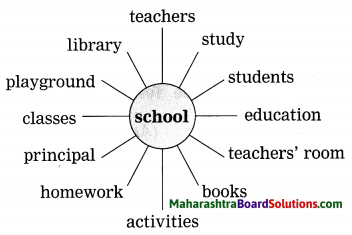
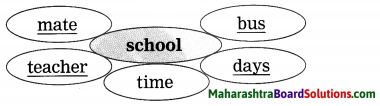
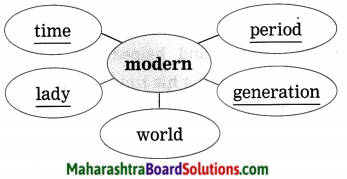
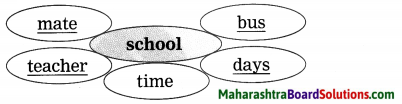
3. Write words related to the following words. (At least ten words each.)

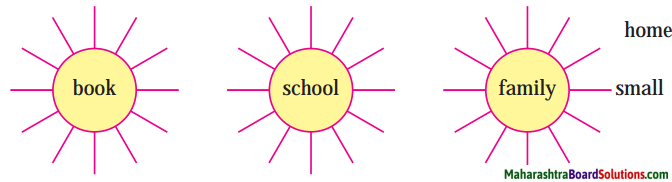
Maharashtra Board Class 9 My English Coursebook Solutions Chapter 1.2 The Fun they Had 3

Question 1.
Write words related to the following words. (At least ten words each.)
Answer:
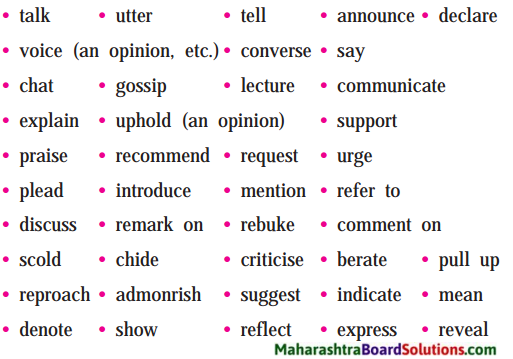
Maharashtra Board Class 9 My English Coursebook Solutions Chapter 1.2 The Fun they Had 4

Maharashtra Board Class 9 My English Coursebook Solutions Chapter 1.2 The Fun they Had 5

Maharashtra Board Class 9 My English Coursebook Solutions Chapter 1.2 The Fun they Had 6

Maharashtra Board Class 9 My English Coursebook Solutions Chapter 1.2 The Fun they Had

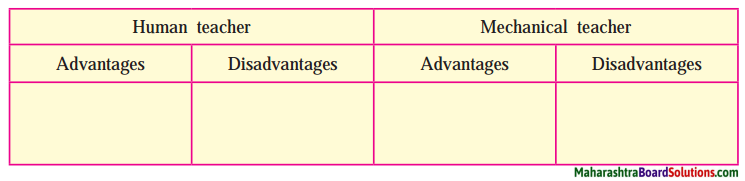
4. Discuss: How would you like to learn from a human teacher or a mechanical teacher? Present your arguments in the form of a chart.

Maharashtra Board Class 9 My English Coursebook Solutions Chapter 1.2 The Fun they Had 7

Question 1.
Discuss: How would you like to learn from a human teacher or a mechanical teacher? Present your arguments in the form of a chart.
Answer:
No, I wouldn’t like to have my own mechanical teacher because I won’t get the joy of learning together with my friends and the love and affection we get from our teachers.

5. Rewrite the following using complete words instead of contracted forms.
(a) … when you’re through.
(b) …. and it’s good for plenty more.
(c) I wouldn’t throw it away.
(d) She hadn’t seen as many tale books.
(e) “What’ s it about?”
(f) I’ve slowed it up.
(g) I don’t know.
(h) It wasn’t a regular teacher.

Question a.
… when you’re through.
Answer:
… when you are through.

Maharashtra Board Class 9 My English Coursebook Solutions Chapter 1.2 The Fun they Had

Question b.
…. and it’s good for plenty more.
Answer:
… and it is good for plenty more.

Question c.
I wouldn’t throw it away.
Answer:
I would not throw it away.

Question d.
She hadn’t seen as many tale books.
Answer:
She had not seen as many tale books.

Question e.
“What’s it about?”
Answer:
“What is it about?”

Maharashtra Board Class 9 My English Coursebook Solutions Chapter 1.2 The Fun they Had

Question f.
I’ve slowed it up.
Answer:
I have slowed it up.

Question g.
I don’t know.
Answer:
I do not know.

Question h.
It wasn’t a regular teacher.
Answer:
It was not a regular teacher.

Maharashtra Board Class 9 My English Coursebook Solutions Chapter 1.2 The Fun they Had

Language study:

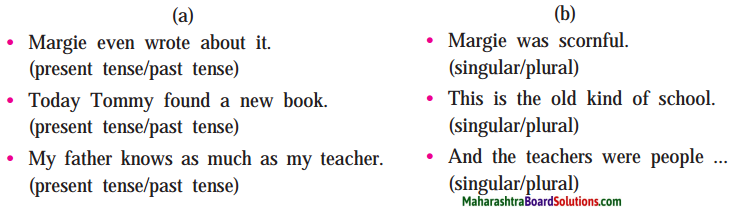
6. Underline the verbs and choose the correct option from the brackets.

Maharashtra Board Class 9 My English Coursebook Solutions Chapter 1.2 The Fun they Had 8
Thus, we see that verb forms show tense, number, etc. Here, the verb form changes according to the subject. A verb form which is decided by and changes according to the subject of the sentence is known as a finite verb.
Example: ‘You are very kind.’ If the subject ‘you’ is changed to ‘she’, the sentence will be ‘She is very kind.’
Now change the verb form according to the change in the subject.

  • I don’t know: Change ‘I’ to ‘She’.
  • My father knows: Change ‘My father’ to ‘We’
  • I am following in your footsteps: Change ‘I’ to ‘He’.

Question 1.
Underline the verbs and choose the correct options from the brackets:

  1. Margie even wrote about it. (present tense/past tense)
  2. Today Tommy found a new book. (present tense/past tense)
  3. Margie was scornful, (singular/plural)
  4. What’s there to write about school? (singular/plural)

Answer:

  1. Margie even wrote about it. – past tense.
  2. Today Tommy found a new book. – past tense
  3. Margie was scornful, (singular/plural)
  4. What’s there to write about school? (singular/plural)

Maharashtra Board Class 9 My English Coursebook Solutions Chapter 1.2 The Fun they Had

7. Activity: Live English: Online shopping

Question a.
Read the following conversation between two cousins.

  • Tejaswini: Hi, Santosh. What are you thinking about?
  • Santosh: Hi, Teju. Next week’s Didi’s birthday. We want to give her a surprise gift.
  • Tejaswini: Great idea! What is your surprise gift?
  • Tejaswini: Great idea’ What is your surprise gift?
  • Santosh: Well, we don’t have any big shops here, there’s little to choose from. Nothing new or surprising.
  • Tejaswini: So why don’t you try online shopping?
  • Santosh: Is it safe?
  • Tejaswini: Yes, it is. If we take proper care, it is one of the most convenient ways of shopping. Plus, you will get so much variety.
  • Santosh: True. But I don’t know how to do it.
  • Tejaswini: It’s ok. I will show you. Do you have an internet connection?
  • Santosh: Yes.
  • Tejaswini: That’s good, then. We can do it in five easy steps. Let’s start.

Maharashtra Board Class 9 My English Coursebook Solutions Chapter 1.2 The Fun they Had 9

Question b.
Write in a step-by-step manner, how Tejaswini and Santosh bought a gift for Didi online.
Answer:
They signed up and created their account in the website. Then they selected the gift of their choice from the given categories. They added the gift to the cart and paid the total amount via online banking. When the gift was delivered to them they checked and ensured that the gift was genuine.

Maharashtra Board Class 9 My English Coursebook Solutions Chapter 1.2 The Fun they Had

Question c.
Use this website (www.chalashikuva.com) to try your hand at a practicaL/mock trial of online shopping.
Look at the above webpage and tell :

  1. The name of the website
  2. What we can buy there
  3. The offer on poster colours

Answer:

  1. The name of the website: www.chalashikuya.com
  2. What we can buy there: we can buy books, educational toys, stationery, e-leaming.
  3. The offer on poster colours: a paint brush free

Maharashtra Board Class 9 My English Coursebook Solutions Chapter 1.2 The Fun they Had

Question d.
Read the following questions and answers. Form pairs and frame similar questions and answers for this website.How to use this website:
1. If I want to buy a story book on this website, where can I find it?
– In the categories on the left, in the options under Books you will find story books. Click that option.

2. I want a CD of the dictionary.
– Go to ‘e-learning’. Under that Click the ‘dictionary’ option.

3. Where can I look for books in the Hindi language?
– You can go to the Languages option on the left and tick the box before Hindi.

4. How can I find what discounts are available?
– Under the filters on left you will find discounts.

5. Are there any specific deals/offers on specific days?
– There is a CSY (Chalashikuya) deal. You can click on it and find out the deal of the day.

6. Can I purchase only one thing at a time?
– No, you can buy many things at a time. Select whatever you want and add to the cart and then browse again for another product.

7. When will my order be delivered?
– Maximum in 10 working days. You can also track your order by clicking the icon ‘track order.

8. There is one icon ‘Gift Coupons’. What does it mean?
– You can give a gift coupon to your friend by using this icon and he/she can purchase the product of his/her choice with the help of it.

9. Is this site only for purchasing?
– No, you can also sell your old books and other educational things here.

10. How can I find out whether the product is good or not?
– You can see the ratings and reviews of users below each product.
Answer:
Students do this activity on their own.

Maharashtra Board Class 9 My English Coursebook Solutions Chapter 1.2 The Fun they Had

Question e.
Suppose one of your parents or an older relative wants to know about online shopping and you are explaining how to do it. Write a conversation between you and your parent/relative about it:
Answer:
A conversation about online shopping between me and Dad.
(Dad enters while you are surfing on the internet)

  • Dad: Son, I need to buy sport shoes for my marathon next week. I wish to try online shopping, but I don’t know the process.
  • Me: Don’t you worry, Dad! I’m there to help you. Let’s sign you up first.
  • Dad: I suppose it’s quite complicated.
  • Me: Not at all, Dad. Now go on the search bar and type whichever shoes you need.
  • Dad: I don’t have any particular shoes in mind.
  • Me: Well, then we will click here on the ‘shoes’ option and select sport shoes.
  • Dad: These seem nice and are in my budget.
  • Me: Then add them to the cart. Now we have ordered the sports shoes. They will deliver the product within 10 days.
  • Dad: Very good! It’s very simple, isn’t it?
  • Me: Sure it is. Now, do you want to pay via net banking, credit card or cash on delivery?
  • Dad: I prefer cash on delivery.
  • Me: O.K. we are done here. We can even track our order to find where your shoes have reached.
  • Dad: That’s very impressive! Thank you, son.
  • Me: It’s my pleasure, dad.

Maharashtra Board Class 9 My English Coursebook Solutions Chapter 1.2 The Fun they Had

Question f.
Form pairs. Discuss the advantages and disadvantages of online shopping and fill the following table.
Answer:

AdvantagesDisadvantages
1. Time-saving(a) Delay in delivery.
2. Wide concessional(b) Required Internet connection.
3. Cheap/concessional(c) Quality and condition of product uncertain.
4. Various filters to find our pick(d) Delivery and shipping.
5. Quick payments(e) Delivery and shipping charges are expensive.

Write a paragraph on ‘Online Shopping’ using the points in the above table.

Question 1.
Write a paragraph on ‘Online Shopping’ using the points in the above table.

My English Coursebook 9th Class Solutions Chapter 1.2 The Fun they Had Additional Important Questions and Answers

Read the following passage and do the activities:

Simple Factual Activity:

Question 1.
Complete the following sentences:
(Answers are directly given.)

  1. The incident in the story has taken place on 17 May 2157.
  2. Their television screen must have had a million books on it.
  3. Margie’s great grandfather told that in old times all stories were printed on paper.
  4. According to Margie, ‘a real book’ means a printed book.

Note: Here we have given the complete passage. However henceforward, only the first and last lines of the related passage of prose lessons have been given. Refer to the Textbook for the complete passages.

Maharashtra Board Class 9 My English Coursebook Solutions Chapter 1.2 The Fun they Had

Question 2.
Read the sentences and fill in the blank with correct alternatives:
(Answers are directly given.)
Answer:
1. The County Inspector was a round little man with a red face.
(a) The teacher
(b) The County Inspector.

2. Margie hated most was the slot where she had to put homework and test papers.
(a) the teacher
(b) the slot.

3. Large and black and ugly is the description of the teacher.
(a) the teacher
(b) the Inspector

4. Margie had hoped the Inspector wouldn’t know how to put the teacher together.
(a) take the teacher apart.
(b) put the teacher together.

Question 3.
Say whether the following statements are True or False: (Answers are directly given.)
Answer:

  1. Tommy is Margie’s brother. – False
  2. Tommy found the old book in the attic.- True
  3. Margie was older than Tommy. – False
  4. The old book was about school. – True

Maharashtra Board Class 9 My English Coursebook Solutions Chapter 1.2 The Fun they Had

Question 4.
Complete the following sentences using proper words from the passage:
(Answers are directly given.)

  1. Father knew as much as his teachers.
  2. How can a man be a teacher?
  3. They had a teacher, but it wasn’t a regular teacher.
  4. Margie wouldn’t want a strange man in her house to teach her.

Question 5.
Write if the following statements are True or False:
Answer:

  1. Margie’s school was in her house. – True
  2. In those old days kids went to a special building for learning. – True
  3. Margie was not interested in reading the old book. – False
  4. Tommy went away home with the book. – True

Question 6.
Complete the following sentences using the information from the passage:
(Answers are directly given.)

  1. The arithmetic lesson was on the addition of proper fractions.
  2. And the teachers were people.
  3. The mechanical teacher was flashing on the screen.
  4. Margie inserted yesterday’s homework in the slot with a sigh.

Maharashtra Board Class 9 My English Coursebook Solutions Chapter 1.2 The Fun they Had

Complex Factual Activity:

Question 1.
Complete the following web:
(Answers are directly given.)
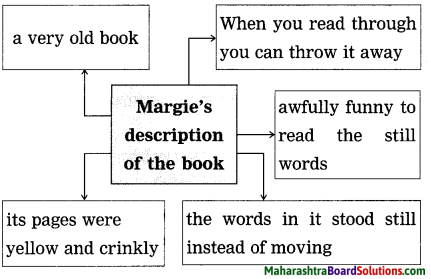
Answer:
Maharashtra Board Class 9 My English Coursebook Solutions Chapter 1.2 The Fun they Had 10

Question 2.
Complete the following:
Answer:
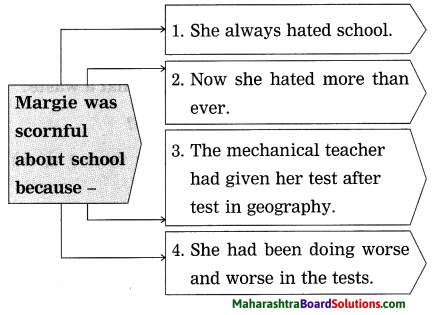
(Answers are directly given.)

  1. She always hated school.
  2. Now she hated more than ever.
  3. The mechanical teacher had given her test after test in geography.
  4. She had been doing worse and worse in the tests.

Question 3.
Arrange the following in order of occurrence:
1. She wrote them out in a punch code.
2. All the lessons were shown and questions were asked on the screen.
3. The County Inspector took the teacher apart and then put it together again.
4. The mechanical teacher calculated the marks.
Answer:
3. The County Inspector took the teacher apart and then put it together again.
2. All the lessons were shown and questions were asked on the screen.
1. She wrote them out in a punch code.
4. The mechanical teacher calculated the marks,

Maharashtra Board Class 9 My English Coursebook Solutions Chapter 1.2 The Fun they Had

Question 4.
What was the fault with the mechanical teacher? How was the fault repaired?
Answer:
There was a fault in the geography sector of the mechanical teacher. It was geared a little too quick. The County Inspector repaired it and slowed it up to an average ten-year level.

Question 5.
Complete the web about the ‘Old School’, using the information told by Tommy.
(Answers are directly given.)
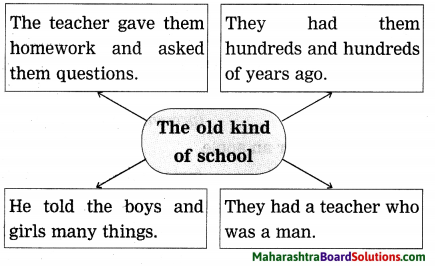
Answer:
Maharashtra Board Class 9 My English Coursebook Solutions Chapter 1.2 The Fun they Had 11

Question 6.
Complete the web:
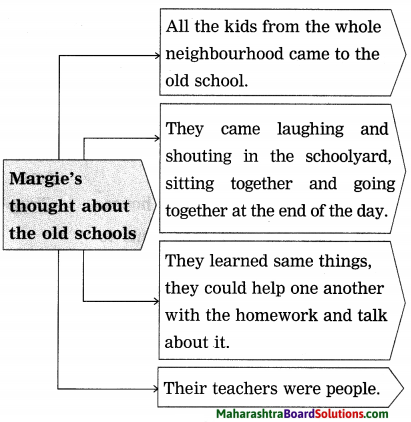
Answer:
Maharashtra Board Class 9 My English Coursebook Solutions Chapter 1.2 The Fun they Had 12

Maharashtra Board Class 9 My English Coursebook Solutions Chapter 1.2 The Fun they Had

Question 7.
What do you know from the passage about j the teachers, the school and the students of the old times?
Answer:
Unlike the mechanical teacher, the teacher in old times didn’t live in the house. They went to a special building called school to teach the children who also went there. The students learnt the same things if they were in the same age group or the same class.

Question 8.
Complete the web:
(Answers are directly given.)
Answer:
Maharashtra Board Class 9 My English Coursebook Solutions Chapter 1.2 The Fun they Had 13

Activities based on vocabulary:

Question 1.
Match the words in Column ‘A’ with their

‘A’‘B’
1. real(a) very amusing
2. crinkly(b) exactly the one/ones referred to
3. same(c) having a lot of thin folds
4. awfully funny(d) genuine and not false

Answer:

‘A’‘B’
1. real(d) genuine and not false
2. crinkly(c) having a lot of thin folds
3. same(b) exactly the one/ones referred to
4. awfully funny(a) very amusing

Maharashtra Board Class 9 My English Coursebook Solutions Chapter 1.2 The Fun they Had

Question 2.
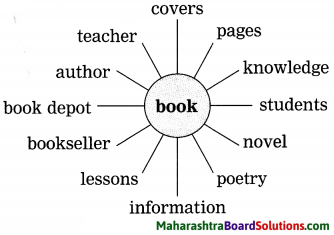
Write at least ten words related to book:
(Answers are directly given.)
Answer:
teacher-author book depot bookseller lessons

Question 3.
Write any four adjectives like ‘scornful’.
Answer:

  1. faithful
  2. helpful
  3. careful
  4. sorrowful.

Question 4.
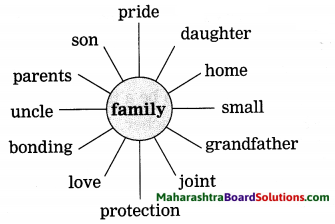
Write at least ten words related to family:
Answer:
pride

Maharashtra Board Class 9 My English Coursebook Solutions Chapter 1.2 The Fun they Had

Question 5.
Match the words in Column ‘A’ with their meaning in Column ‘B’:

‘A’‘B’
1. betcha(a) in superior manner
2. pronouncing(b) to debate
3. loftily(c) expressing the word strongly
4. dispute(d) surely, bet you

Answer:

‘A’‘B’
1. betcha(d) surely, bet you
2. pronouncing(c) expressing the word strongly
3. loftily(a) in superior manner
4. dispute (b) to debate

Maharashtra Board Class 9 My English Coursebook Solutions Chapter 1.2 The Fun they Had

Question 6.
Match the similar meaning words:

‘A’‘B’
1. kid(a) under
2. same(b) fast
3. beneath(c) similar
4. quickly(d) child

Answer:

‘A’‘B’
1. kid(d) child
2. same(c) similar
3. beneath(a) under
4. quickly(b) fast

Question 7.
What do the following words describe in the passage.

  1. same
  2. funny
  3. dusty
  4. special.

Answer:

  1. age
  2. schools
  3. book
  4. building.

Maharashtra Board Class 9 My English Coursebook Solutions Chapter 1.2 The Fun they Had

Question 8.
Write the words from the passage that show actions taken place in the old school:
Answer:
came, laughing, shouting, sitting, going, learned, help, talk

Activities based on contextual grammar:

Question 1.
My father knows. (Change ‘My father’ to ‘We’.)
Answer:
We know.

Question 2.
I am following in your footsteps.
Answer:
He is following in your footsteps.

Question 3.
He wouldn’t know.
Answer:
He would not know.

Question 4.
That wasn’t so bad.
Answer:
That was not so bad.

Maharashtra Board Class 9 My English Coursebook Solutions Chapter 1.2 The Fun they Had

Question 5
It’s not the little girl’s fault.
Answer:
It is not the little girl’s fault.

Question 6.
Underline the verb and choose the correct option from the brackets:
(Answers are underlined directly)
1. He patted Margie’s head.
(present tense/past tense)
2. He gave her an apple.
(present tense/past tense)
3. Those things happen sometimes.
(present tense/past tense)
4. Her progress is satisfactory.
(present tense/past tense)

Question 7.
The kids were laughing and shouting.
(Use simple past tense and rewrite the sentence.)
Answer:
The kids laughed and shouted.

Maharashtra Board Class 9 My English Coursebook Solutions Chapter 1.2 The Fun they Had

Question 8.
I sing a song. (Change the subject T to ‘she’ and rewrite the sentence.)
Answer:
She sings a song.

Question 9.
He went to school today. (Make the sentence negative using the word ‘not’).
Answer:
He did not go to school today.

Maharashtra Board Class 9 My English Coursebook Solutions Chapter 1.2 The Fun they Had

Question 10.
… are you going now? (who, what, where) (Choose the correct wh-word from the brackets to frame a question)
Answer:
Where are you going now?

Personal Response:

Question 1.
Do you sometimes hate your school? Why?
Answer:
No, never. I always love my school because I regard it as my Mother. My progress in life depends on the knowledge and education that I receive in school.

Question 2.
About what did Tommy say, “What a waste!” Why, do you think, did he say so?
Answer:
Tommy said it about the old printed book. I think he said so because he thought that it is a waste of paper. After reading the book its purpose is lost and it becomes useless. He did not think of its importance and thought of throwing it away.

Maharashtra Board Class 9 My English Coursebook Solutions Chapter 1.2 The Fun they Had

Question 3.
Do you like to take tests? Give the reason for your answer:
Answer:
Yes, I like to take tests, because the result of the tests shows our progress in learning. We know our drawbacks and we can try to improve our weak subjects.

Question 4.
Do you think the school described in the ‘book’ existed centuries ago?
Answer:
Yes, the school described in the ‘old book’ did exist centuries ago, but the educational institutions were of different kinds and their methods of teaching were different.

Maharashtra Board Class 9 My English Coursebook Solutions Chapter 1.2 The Fun they Had

Question 5.
Would you like to have your own mechanical teacher? why?
Answer:
Yes, I would like to have my own mechanical teacher if it is affordable to my family. Though my school teachers are there to guide me in my school, this mechanical teacher will help me to have individual teaching and guidance. I can prepare well in all my subjects with the help provided by the mechanical teacher.

Write the following using complete words instead of contracted forms:

Question 1
They weren’t even half finished.
Answer:
They were not even half finished.

Question 2.
And it’s probably time for Tommy, too.
Answer:
And it is probably time for Tommy, too.

Maharashtra Board Class 9 My English Coursebook Solutions Chapter 1.2 The Fun they Had

Question 3.
you don’t know much.
Answer:
you do not know much.

Question 4.
They didn’t do it that way.
Answer:
They did not do it that way.

Rewrite the sentences with a different words for the underlined word.

Question 1.
It is probably time for Tommy.
Answer:
It is probably time for lunch.

Maharashtra Board Class 9 My English Coursebook Solutions Chapter 1.2 The Fun they Had

Question 2.
They had a special building.
Answer:
They had a special invitation.

Activities Based on Language study

Do as directed:

Question 1.
Complete the following words by using correct letters: 2

  1. ab _ ut
  2. f _ nny
  3. ni _ ht
  4. qu _ ck

Answer:

  1. about
  2. funny
  3. night
  4. quick.

Maharashtra Board Class 9 My English Coursebook Solutions Chapter 1.2 The Fun they Had

Question 2.
Copy the following sentences correctly in your notebook:
Answer:
1. On the page headed 17 May, 2057, she wrote, ‘Today Tommy found a real book !’
2. “A man? How could a man be a teacher?”

Question 3.
Put the following words in alphabetical order:
1. progress, teacher, homework, answers.
2. superior, shaken, screamed, shouting.
Answer:
1. answers, homework, progress, teacher.
2. screamed, shaken, shouting, superior.

Maharashtra Board Class 9 My English Coursebook Solutions Chapter 1.2 The Fun they Had

Question 4.
Punctuate the following sentences:
(Note: Two sentencess will be asked.)

Question a.
i hate school
Answer:
“I hate school.”

Question b.
same with mine said margie
Answer:
“Same with mine,” said Margie.

Question c.
can I read the book some more with you after school
Answer:
“Can I read the book some more with you after school?”

Maharashtra Board Class 9 My English Coursebook Solutions Chapter 1.2 The Fun they Had

Question 5.
Write four small words (minimum 3 letters each) using the letters in the given word:
“schoolyard”
Answer:

  1. school
  2. cool
  3. holy
  4. yard.

Question 6.
Spot the error and rewrite the correct sentences:

  1. I doesn’t know what kind of school they had all that time ago.
  2. Margie’s grandfather said to her, when he was a little boy his grandfather told him that there is a time when all stories are printed on paper.

Answer:

  1. I don’t know what kind of school they had all that time ago.
  2. Margie’s grandfather said to her when he was a little boy his grandfather told him that there was a time when all stories were printed on paper.

Maharashtra Board Class 9 My English Coursebook Solutions Chapter 1.2 The Fun they Had

Question 7.
Write related words as shown in the example:
(Answer is directly given.)
Answer:
Maharashtra Board Class 9 My English Coursebook Solutions Chapter 1.2 The Fun they Had 14

Question 8.
Complete the following word-chain of nouns. Add four words each beginning with the last letter of the previous word:
screen → ……………… → ………….. → ……………. → ………………..
Answer:
screen → number → rabbit → trainer → routes.

Question 9.
Make your own meaningful sentence by using the phrase ‘to be able to’.
Answer:
My friend was in financial problem but I was not able to help him.

Question 10.
Add a prefix or suffix to make new words and use any one of the root words to make your own sentence:
1. miracle
2. hazard
Answer:
1. miraculous
2. hazardous
Sentence: We must know the hazards of junk food.

Maharashtra Board Class 9 My English Coursebook Solutions Chapter 1.2 The Fun they Had

Question 11.
Make the following sentence bigger by adding clause:
The police captured the thief
Answer:
The police captured the thief who was trying to break the shop.

Maharashtra Board Class 9 My English Coursebook Solutions Chapter 4.1 What is Success?

Balbharti Maharashtra State Board Class 9 English Solutions My English Coursebook Chapter 4.1 What is Success? Notes, Textbook Exercise Important Questions and Answers.

Maharashtra State Board Class 9 My English Coursebook Solutions Chapter 4.1 What is Success?

My English Coursebook Std 9 Guide Chapter 4.1 What is Success? Textbook Questions and Answers

Warming up:
Chit-chat

  1. Do you have a hobby?
  2. Do you play a musical instrument?
  3. What is the latest thing that you learnt to do?
  4. Have you ever taught someone else to do something?

Maharashtra Board Class 9 My English Coursebook Solutions Chapter 4.1 What is Success?

1. Prepare a speech to deliver in an interschool competition on ‘How to achieve success in life’ with the help of the following web chart:

Question 1.
Prepare a speech to deliver in an interschool competition on ‘How to achieve success in life’ with the help of the following web chart:
Maharashtra Board Class 9 My English Coursebook Solutions Chapter 4.1 What is Success 1
Answer:

How to achieve success in life?

Honourable chairperson, respected headmaster, teachers and my dear friends, Today I am going to limit my speech on “How to achieve success in life:” I request you to listen to me carefully. So my friends, success is very important in everyone’s life. Everyone has a dream of becoming a successful human being in life. There is a good saying that, “Success is a journey and not a destination.”

How true it is! If we look at the life of all successful people, we realize the truthfulness of the statement. The definition of success is different for every person. For a child success is to solve a puzzle, for a S.S.C. student, a success is to get good marks, for a businessman, a success is to get a contract and for grandparents, success is to see the whole family together.

Everyone wants to become rich and successful in life. To achieve ambition, there are many steps which are to be followed. First of all, we have to set our goal, means we have to decide what we are and what we want to be. So proper plan and execution of the plan are very important. The tragedy of life does not lie in not reaching the goal, the tragedy lies in having no goal to reach.

For a great success we need a lot of confidence, patience, knowledge, perseverance and hard work. We should not waste our time because time is money. Don’t compare yourself with any other person in the world. If you do so you are demeaning yourself. The main thing is that we should always think positively and never give up hope because many of our failures are the people who did not realize how close they were to success when they gave up.

Always remember that the word “Impossible” means, I’m possible and if destiny is accompanied with the three D’s: determination, dedication, and devotion then everything becomes possible. We should learn from our own mistakes. We should always follow in the footsteps of great, successful people. Let’s take an example of Dhirubhai Ambani.

He was born in a poor family, but struggled a lot to achieve his ambition and never gave up hope because he knew that there is always a room at the top. He kept the hope alive in his heart and tried his level best and as you know he was one of the richest industrialists in the world. After all, no gains, without pains.

There is a great saying that successful people do not do different things, they do things differently. So work hard, continuously. God’s blessings are always there with you. Thank you for listening to me carefully.

Jai Hind.

Maharashtra Board Class 9 My English Coursebook Solutions Chapter 4.1 What is Success?

2. What might success mean to the following people? Think about it and write:

Question 1.
A student ………………………….. .
Answer:
Showing consistent improvement in his academic pursuit, participating in sports and different competitions.

Question 2.
A businessman ………………………. .
Answer:
Gaining a huge profit, and achieving his target in business.

Question 3.
A doctor …………………………… .
Answer:
Diagnosing and treating patients and even saving a dying person.

Question 4.
A sportsperson ………………………. .
Answer:
Setting his/her own record by participating in different tournaments, winning medals and trophies.

Question 5.
A politician ………………………… .
Answer:
Winning an election and working for the welfare of society.

Question 6.
A person who has applied for a job ………………………… .
Answer:
Getting a job with a huge package of salary.

Question 7.
A teacher ………………………. .
Answer:
Helping his/her students to excel, reaching every child of his/her class.

Maharashtra Board Class 9 My English Coursebook Solutions Chapter 4.1 What is Success?

Question 8.
A Parent ……………………………. .
Answer:
Raising a child and to make him/her a good human being.

English Workshop:

1. Tick the correct alternative:

Question 1.
The poet says that success is:
(a) to laugh less and work more
(b) to laugh never at all
(c) to laugh often and much
(d) to laugh less and low
Answer:
(c) to laugh often and much

Question 2.
The poet wants us to:
(a) earn a lot of money
(b) earn profits
(c) earn property
(d) earn the appreciation of honest critics
Answer:
(d) earn the appreciation of honest critics

Question 3.
The poet wants us to appreciate:
(a) riches
(b) God
(c) beauty
(d) society
Answer:
(c) beauty

Maharashtra Board Class 9 My English Coursebook Solutions Chapter 4.1 What is Success?

Question 4.
The poet wants us to leave the world a bit
(a) bitter
(b) better
(c) broader
(d) bared
Answer:
(b) better

2. Compare this poem with ‘Walk a little slower …………’ and fill in the chart:

Question 1.
Compare this poem with ‘Walk a little slower …………’ and fill in the chart:
Maharashtra Board Class 9 My English Coursebook Solutions Chapter 4.1 What is Success 2
The poem ‘What is Success?’ is an example of free verse.
Answer:

Structure of the poemWalk a little slower…What is Success?
Does it have rhyming words?YesNo
Does it have a steady rhythm?YesNo
Are the lines of equal length?YesNo
Are there stanzas with equal number of lines?YesNo

3. Based on the poet’s idea of true success, think of four people in your surroundings- your family, neighbours, friends, teachers, classmates, etc. who have achieved true success. Write in short what makes them successful.

Question 1.
Based on the poet’s idea of true success, think of four people in your surroundings- your family, neighbours, friends, teachers, classmates, etc. who have achieved true success. Write in short what makes them successful.
Answer:

My family

My father is the backbone of my family. He works hard to fulfil our dreams. He has been working with determination continuously so that we can enjoy happy family life. We can understand his feelings and help him whenever he wants our help. We try to keep him happy and satisfied. He has made positive impact on our family members as well as on his circle of friends. So he is a role model for all of us.

Maharashtra Board Class 9 My English Coursebook Solutions Chapter 4.1 What is Success?

4. List all the ‘to infinitives’ verbs used in the poem.

Question 1.
List all the ‘to infinitives’ verbs used in the poem.
Answer:
to laugh, to win, to appreciate to find, to leave, to know, to have.

5. In your opinion what things will help to make the world a better place? Discuss with your friends and write down at least three of the things.

Question 1.
In your opinion what things will help to make the world a better place? Discuss with your friends and write down at least three of the things.
Answer:
To make the world a better place, I think the following things will help a lot:

  1. No fights, quarrels on the basis of caste, creed and religion.
  2. Everyone should get a chance to earn his/her bread and butter.
  3. Everyone should be mentally and physically fit and able.
  4. Education: Basic right of education to all.

6. Think of different types of people who have to face great difficulties. Write what you can do to help at least one of them.

Question 1.
Think of different types of people who have to face great difficulties. Write what you can do to help at least one of them.
Answer:
There are number of people in our society who have to face great difficulties. There are people like physically disabled, poor, old, sick, etc. The people who are poor, are under poverty line. So we can provide them various facilities related to education and fulfil their basic needs so that their standard of living would be improved.

Maharashtra Board Class 9 My English Coursebook Solutions Chapter 4.1 What is Success?

7. Prepare a set of questions to interview:

Question 1.
Prepare a set of questions to interview:
(a) A famous author
(b) A well-known social worker in your area.
Answer:
(a) A famous author:

  1. What are your feelings after the overwhelming response to your newly published book?
  2. Had you thought about such amazing response to your book?
  3. What inspires you to write such a lovely book?
  4. Are you working on any new book?
  5. Do you think about the readers’ choice before writing?
  6. Who is your favourite writer? Why?
  7. Have you thought about the Booker prize while writing this book?
  8. What is your ambition as a writer?
  9. What message would you like to give to your readers?

(b) A well-known social worker in your area:

  1. Are you really grateful to the voters of your area? Why?
  2. How will you help this area to develop?
  3. What are your future plans for the development of this area?
  4. Are there any social problems that the people in this area are facing?
  5. According to you, what is the role of education to develop society?
  6. What have you done to make available educational facilities in our area?
  7. What measures should be taken to fight against illiteracy, superstitions in our society?
  8. What motivated you to be a social worker?
  9. Is there any message that you would like to give to the citizens of this area?

My English Coursebook 9th Class Solutions Chapter 4.1 What is Success? Additional Important Questions and Answers

Simple Factual Activities:

Question 1.
There are lines in the poem.
(a) two
(b) fourteen
(c) seven
(d) four
Answer:
(b) fourteen.

Maharashtra Board Class 9 My English Coursebook Solutions Chapter 4.1 What is Success?

Question 2.
Complete the following sentences with the help of the given poem:
(Answers are directly given.)
Answer:

  1. A person who takes wise decisions and works for the benefit of everyone wins the respect of intelligent people.
  2. A person who is kind, sweet and helpful wins the affection of children.
  3. A person who puts a lot of efforts and works against all odds is appreciated by honest critics.
  4. A friend who is selfish and dishonest betrays a friend.

Complex Factual Activities:

Question 1.
What is success according to the poet Ralph Waldo Emerson?
Answer:
According to the poet Ralph Waldo Emerson, success lies in winning the respect, affection and appreciation of the people around us and to be able to respect, appreciate and care for people in return and how you make them happy.

Question 2.
Which lines tell you that a parent, a good gardener, a social reformer are all successful people?
Answer:
The lines that tell us that a parent, a good gardener, a social reformer are all successful people are: “To leave the world a bit better, whether by a healthy child, a gardener patch or a redeemed social condition To know even one life has breathed easier because you have lived; This is to have succeeded.”

Maharashtra Board Class 9 My English Coursebook Solutions Chapter 4.1 What is Success?

Poetic device Activities:

Question 1.
Give your own rhyming words for the following – (i) find (ii) patch.
Answer:
1. find – mind
2. patch – match.

Appreciation of Poem:

Point format

  1. Title: What is success?
  2. Poet/Poetess: The poet of the poem is Ralph Waldo Emerso.
  3. Theme/Central Idea: The theme of the poem is quite evident from the title of the poem itself. As the answer to the question posed in the title, the poet defines success as precisely as possible in the following lines.
  4. Rhyme Scheme: The poem is an example of ‘free verse’.
  5. Figure of Speech: Repitition, Euphemism.
  6. Special Features: This poem is an example of ‘free verse’. The lines of a ‘free verse’ do not have any steady rhythm. The lines are of irregular length and lack clear-cut stanza divisions. It has no rhyme scheme.
  7. Favourite Line: My favourite lines from the poem are:
    • (1) To find the best in others;
    • (2) To appreciate beauty To find the best in others
  8. Why I like the poem: I like this poem because it defines ‘success’ in a very special way.

Here, ‘success’ is not just an individual achievement. It is not taking advantage of others around us. It is, instead, giving back to society it is about making society a better place by our little contribution.

Maharashtra Board Class 9 My English Coursebook Solutions Chapter 3.5 Great Scientists

Balbharti Maharashtra State Board Class 9 English Solutions My English Coursebook Chapter 3.5 Great Scientists Notes, Textbook Exercise Important Questions and Answers.

Maharashtra State Board Class 9 My English Coursebook Solutions Chapter 3.5 Great Scientists

My English Coursebook Std 9 Guide Chapter 3.5 Great Scientists Textbook Questions and Answers

Warming up:
Chit-chat

  1. What would you like to learn about in your Science period?
  2. Have you ever tried to do an experiment on your own?
    If yes, tell me about it.
    If no, tell me why you’ve never tried.
  3. What would you like to learn about in your English classes?

Maharashtra Board Class 9 My English Coursebook Solutions Chapter 3.5 Great Scientists

Inventions

Question (a)
Think of as many examples of the following as you can and write them in the appropriate column:
Maharashtra Board Class 9 My English Coursebook Solutions Chapter 3.5 Great Scientists 1
Answer:

Type of machineExamples
Simple machines that are operated by handScrewdriver, pincers, auger chisel, drill machine, spanner, etc.
Machines that run on electricityelectric motor, fan, air conditioner, hair drier, geyser, mixer, oven, etc.
Electronic devicesMobile phones, tablets, laptops, computer, speakers, etc.

Question (b)
Write as many uses of the following as you can:
(a) A cloth bag
(b) a wicker basket
(c) a glass bottle or jar
(d) a steel bowl
(e) a thick string or rope
Answer:
(a) a cloth bag: to carry things, for keeping clothes, shopping, using instead of paper bags, etc.
(b) a wicker basket: for keeping fruits, grains, carrying and selling vegetables, fruits, fish, etc.
(c) a glass bottle or jar: for keeping jam, liquids, juice, pickles, water for drinking, for medicine, kerosene, storing liquids, etc.
(d) a steel bowl: to keep eatables while eating, for drinking medicine, while serving curry, dal, shrikhand, aamras, etc.
(e) a thick string or rope: to tie things, to play, to hold things together, used in adventure sports like trekking, mountaineering, etc., to tether cattle.

English Workshop:

1. Write what is implied in the following sentence:

Question (a)
But few know his inspirational life story, which is all about courage and fighting against the odds. (What does it tell you about Faraday’s life?)
Answer:
Faraday was born in a poverty-stricken family, suffered from a speech defect as a child, had to start working at the age of thirteen. Poor Faraday had to struggle hard against all odds because he had no social status, no money and no education. Even then he toiled hard and achieved a great success after all his difficulties.

Question (b)
Even then Davy did not have much hope for Faraday: (Choose the correct question tag.)

  1. didn’t he?
  2. have he?
  3. does he?
  4. did he?

Answer:
Even then Davy did not have much hope for Faraday, did he?

Maharashtra Board Class 9 My English Coursebook Solutions Chapter 3.5 Great Scientists

Question (c)
People started telling Davy that of all his discoveries, the best was Faraday himself. (What does it suggest about Davy’s work?)

2. Break the passage into convenient smaller sections. Give sub-headings or titles to each section:

Question 1.
Break the passage into convenient smaller sections. Give sub-headings or titles to each section:
Answer:
1. Passage: Michael Faraday is regarded as ………….. produce the first consistent light bulb.
Title: Faraday’s childhood and his work as a bookbinder.

2. Passage: That day in 1812 Faraday ………………. to see some Davy’s leading experiments.
Title: Faraday’s association with Davy.

3. Passage: Even then Davy did not have much ……………….. born out of mockery directed at Faraday.
Title: Faraday discovered the ‘induction motor’

4. Passage: Faraday became a celebrity scientist ………………. inspire him during difficult times.
Title: Davy’s jealousy and Faraday’s failure!

5. Passage: In 1829, Davy died and Faraday concept called polarization.
Title: 1. Faraday becomes head of Davy’s laboratory.
2. Finds concept of polarization.

6. Passage: He then took the age-old experiment ………………. ‘It does not matter who you are’.
Title:
1. Fortune favours Faraday!
2. Association with Maxwell and Maxwell’s equations creates revolution!

3. List the different gadgets and instruments mentioned in the passage. Find more information about at least 3 of them, using the internet:

Question 1.
List the different gadgets and instruments mentioned in the passage. Find more information about at least 3 of them, using the internet:
Answer:
Gadgets and instruments from the lesson:
fans, air conditioning, sewing machines, photographs, power tools, cars, telescopes, microscopes, electrical generators, dynamos, Electronics and communication system, etc.

Maharashtra Board Class 9 My English Coursebook Solutions Chapter 3.5 Great Scientists

4. Find out more about the following scientists with the help of the Internet.

Question 1.
Find out more about the following scientists with the help of the Internet.

  1. Michael Faraday
  2. Humphry Davy
  3. Thomas Edison
  4. James Maxwell:

(Students do this on their own using the Internet.)

Language Study:

5. Find the following matter in the passage and copy the missing words:

Question 1.
Find the following matter in the passage and copy the missing words:
(Answers are directly underlined.)
(a) When he was twelve, …………………………… school ………………….
(b) One day he came across a book on ………………………….. .
(c) Faraday decided that ………………… scientist
(d) Davy never believed ……………………. science …………………….
(e) People started telling Davy that ……………………. discoveries, ……………………….
(f) He handed him a piece of Bavarian glass, which ……………………. microscopes, ………………….
(g) He went on to prove that …………………… filings;
(h) It was Maxwell who …………………… equations ………………….
Answer:
(a) When he was twelve, his mother was forced to take him out of school.
(b) One day he came across a book on electricity which had been sent to his master for binding.
(c) Faraday decided that day that he wanted to be a great scientist.
(d) Davy never believed Faraday could do anything in the field of science.
(e) People started telling Davy that of all his discoveries, the best was Faraday himself, this made him even more jealous.
(f) He handed him a piece of Bavarian glass, which was used in the lenses in telescopes and microscopes, and asked him to reverse engineer it.
(g) He went on to prove that these patterns were not a property of the iron filings.
(h) It was Maxwell who translated Faraday’s idea into a set of equations that are now called Maxwell’s equations.

Maharashtra Board Class 9 My English Coursebook Solutions Chapter 3.5 Great Scientists

6. Now Complete the following sentences using your own words/phrases:

Question 1.
Now Complete the following sentences using your own words/phrases:
(Answers are directly given.)
(a) When he was twelve, ………………………. .
(b) One day he came across a book on ………………… .
(c) He decided that …………………. .
(d) He never believed ……………… .
(e) People started telling that ………………. .
(f) He handed him which ……………………. .
(g) He went on to prove that ………………… .
(h) It was ……………….. who ………………… .
Answer:
(a) When he was twelve, he took lessons in martial arts.
(b) One day he came across a book on ‘How to make friends’.

My English Coursebook 9th Class Solutions Chapter 3.5 Great Scientists Additional Important Questions and Answers

Simple Factual Activities:

Question 1.
State if the following statements are True or False : (Answers are directly given.)
Answer:

  1. Faraday’s work on electricity is still a subject of study. – True
  2. Faraday as a child, had a speech defect. – True
  3. Faraday disliked reading. – False
  4. The first consistent light bulb was produced by Davy. – False

Question 2.
What is the passage about?
Answer:
The passage is about the great scientists and their qualities.

Question 3.
Complete the following statements by giving reasons: (Answers are directly given.)
Answer:

  1. Faraday forgot to applaud with the rest of the crowd because he was fully engrossed in Davy’s lecture.
  2. Faraday didn’t just want to sell books because he wanted to be a great scientist.
  3. Davy decided to hire Faraday as his secretary because a chemical explosion had temporarily blinded Davy.
  4. Davy promoted Faraday to his lab assistant because Faraday worked day and night and learnt a lot about Davy’s experiments.

Maharashtra Board Class 9 My English Coursebook Solutions Chapter 3.5 Great Scientists

Question 4.
What was the subject of Davy’s lecture?
Answer:
Davy’s lecture was about the mysterious force of electric fluid.

Question 5.
Complete the sentences using the information given in the passage:
(Answers are directly given.)
1. The induction motor spurred a revolution.
2. Davy and William Wollaston were trying to re-create a famous electromagnetism experiment.

Complex Factual Activity:

Question 1.
What were the odds against Faraday in his childhood?
Answer:
Faraday faced many odds as a child. He was born in a very poor family and lived in a dirty London Suburb. He suffered from a speech defect, so much that other children laughed on his pronounces. At the age of twelve he was forced to leave his school and it was the end of his formal education. At the age of thirteen he had to take up working as a bookbinder for living.

Question 2.
What actions and thoughts of Faraday show that he was inspired by Davy?
Answer:
Faraday took notes of Davy’s lecture on ‘mysterious force of electric fluid’s comprehensively. He bound them into a book for giving a gift to Davy someday. From that day he thought of becoming a great scientist and to write his own books. Davy became his role model. He wanted Davy to become his mentor. Though, Davy did not agree, Faraday was not unhappy and disappointed and just kept trying to get his favour.

Question 3.
Was Davy fair in his treatment of Faraday? How did Faraday respond to that treatment?
Answer:
Davy definitely was not fair in his treatment of Faraday. But Faraday was not deterred and was relentless. He continued working hard day and night to learn as much as he could about Davy’s experiments. Though his work was cleaning the labs, Faraday considered himself lucky to get to see some of Davy’s experiments.

Maharashtra Board Class 9 My English Coursebook Solutions Chapter 3.5 Great Scientists

Question 4.
What happens when an electric current is applied to a wire?
Answer:
When an electric current is applied to a wire, it causes that wire to behave like a magnet and the forces are connected.

Question 5.
An induction motor is a commonly used electrical machine. What examples of its use are given here?
Answer:
The induction motor is used in fans, air conditioning, sewing machines, photographs, power tools, cars and even trains and aeroplane engines.

Give one example each to show that –

Question (a)
Faraday was a good pupil.
Answer:
Faraday respected Davy though he was jealous of Faraday. Davy gave him an impossible task to reverse engineer the Bavarian glass but Faraday accepted the assignment despite knowing that it would be very difficult. This shows that Faraday was a good pupil.

Question (b)
Davy was not a good mentor.
Answer:
Davy was jealous of his pupil’s achievement and never helped him in his difficulties. He gave Faraday an impossible task to keep him out of his way. He knew that with the equipment available in the lab, Faraday would never be able to accomplish the task. He wanted to enjoy his pupil’s failure. This shows that Davy was not a good mentor.

Question 1.
Why did Faraday keep a souvenir of his failure as a source of inspiration?
Answer:
Faraday kept a single glass brick on his shelf as a souvenir to remind himself of those difficult days. He wanted to remember his failure and the hard work he had done during those difficult days. He believed that it would inspire him in such difficult days.

Maharashtra Board Class 9 My English Coursebook Solutions Chapter 3.5 Great Scientists

Activities based on vocabulary:

What is the meaning of the following sentences:

Question (a)
Reading became his obsession.
Answer:
Faraday’s mind was completely filled with thoughts of reading and he did not think of anything else other than reading.

Question (b)
Electricity became his lifelong fascination.
Answer:
Electricity became Faraday’s very strong attraction lasting all through his life.

Question 1.
Write two compound words from the passage :
Example: bookbinder.
Answer:
1. poverty-stricken
2. lifelong

Question 2.
Match the words in Column ‘A’ with the meaning in Column ‘B’:
Answer:

‘A’‘B’
1. pursue(a) a person that you admire and try to follow him/her
2. role model(b) to continue to do or achieve something
3. mentor(c) to cheer with claps
4. applaud(d) an expert who advises and helps less experienced persons

Answer:

‘A’‘B’
1.  pursue(b) to continue to do or achieve something
2. role model(a) a person that you admire and try to follow him/her
3. mentor(d) an expert who advises and helps less experienced persons
4. applaud(c) to cheer with claps

Maharashtra Board Class 9 My English Coursebook Solutions Chapter 3.5 Great Scientists

Question 3.
Write four words from the passage that tell us the state of mind of a person :
Answer:

  1. spellbound
  2. engrossed
  3. dejected
  4. relentless.

Question 4.
Write words using each letter of the following words:

  1. about
  2. angry
  3. thing
  4. from.

Answer:

  1. ant, ball, odd, use, table.
  2. and, not, give, ray, yes.
  3. that, high, inn, note, goat.
  4. frog, road, ox, mango.

Question 5.
Choose the correct words from the passage and complete the table:
Answer:

Describing wordsThe nouns described
1. circularpatterns
2. invisiblemagnetic fields
3. formaleducation
4. age-oldexperiment
5. impossibletasks
6. emptyspace

Question 6.
Find and write the past tense verbs with ‘-ed’ from the passage :
Answer:
filled, disturbed, copied, accepted, favoured, translated, combined, helped, designed, started.

Maharashtra Board Class 9 My English Coursebook Solutions Chapter 3.5 Great Scientists

Activities based on contextual grammar:

Question 1.
Write any four words that begin with ‘re-’ as a prefix ;
Answer:

  1. rewrite
  2. replace
  3. replay
  4. redirect.

Question 2.
He dismissed Faraday’s aspirations.
(Begin with Faraday’s aspiration-and make the sentence of Passive voice.)
Answer:
Faraday’s aspirations were dismissed by him.

Question 3.
He forgot to applaud with the rest of the crowd.
(Make the sentence negative without changing the meaning.)
Answer:
He did not remember to applaud with the rest of the crowd.

Question 4.
Find and write from the passage the adjectives used for the following nouns :

  1. force
  2. notes
  3. explosion
  4. memory.

Answer:

  1. mysterious force
  2. comprehensive notes
  3. chemical explosion
  4. excellent memory.

Maharashtra Board Class 9 My English Coursebook Solutions Chapter 3.5 Great Scientists

Question 5.
He needed an assistant.
(Frame a Wh-question to get the underlined part of the sentence as an answer.)
Answer:
What did he need?

Question 6.
Use the following phrases in the sentences of your own

  1. figure out
  2. born out of
  3. try one’s hand at
  4. to spur a revolution

Answer:

  1. He couldn’t figure out the reason behind his friend’s behaviour with him.
  2. Every invention is bom out of inquisitiveness.
  3. Father asked me to try my hand at preparing the food item.
  4. Computers have spurred a revolution in this modern world.

Question 7.
It would be very difficult
(Make it a negative sentence.)
Answer:
It would not be very easy.

Question 8.
He accepted the assignment. (Change the voice.)
Answer:
The assignment was accepted by him.

Frame wh-question to get the underlined part as answers:

Question (a)
He used the same glass now.
Answer:
What did he use now?

Maharashtra Board Class 9 My English Coursebook Solutions Chapter 3.5 Great Scientists

Question (b)
They found the strange object under a bench in the garden.
Answer:
Where did they find the strange object?

Question 1.
He was unable to explain them.
(Make it a negative sentence without changing meaning,)
Answer:
He could not explain them.

Question 2.
He made hundreds of such drawings.
(Choose the correct sentence of passive voice.)
(a) Hundreds of such drawings are made by him.
(b) Hundreds of such drawings will be made by him.
(c) Hundreds of such drawings were made by him.
(d) Hundreds of such drawings have made by him.
Answer:
(c) Hundreds of such drawings were made by him.

Do as directed:

Question 1.
Complete the words by using correct letters:

  1. p _ ove
  2. fi_ld
  3. e _ pty
  4. mi_ht

Answer:

  1. prove
  2. field
  3. empty
  4. might

Question 2.
Copy the following sentences correctly in your notebook:
Answer:
1. He couldn’t even say his own name and would call himself ‘Faraday’.
2. faraday was spellbound by Davy’s lecture in 1812.

Maharashtra Board Class 9 My English Coursebook Solutions Chapter 3.5 Great Scientists

Question 3.
Put the following words in alphabetical order:
1. epitomise, generate, convert, accomplish
2. destiny, determine, disturb, dismiss
Answer:
1. accomplish, convert, epitomise, generate.
2. destiny, determine, dismiss, disturb.

Question 4.
Punctuate the following sentences:
1. he worked day and night and learnt as much as he could about davys experiments
2. Faraday had a never give up attitude and he respected davy
Answer:
1. He worked day and night and learnt as much as he could about Davy’s experiments.
2. Faraday had a never-give-up attitude and he respected Davy.

Question 5.
Write four small words (minimum letters each) using the letters in the given word: ‘comprehensive’:
Answer:

  1. come
  2. cohesive
  3. hen
  4. hive.

Spot the error and circle it. Then rewrite the corrected sentence:

Question 1.
Maharashtra Board Class 9 My English Coursebook Solutions Chapter 3.5 Great Scientists 2
Answer:
Our teacher was absent yesterday.

Maharashtra Board Class 9 My English Coursebook Solutions Chapter 3.5 Great Scientists

Question 2.
Maharashtra Board Class 9 My English Coursebook Solutions Chapter 3.5 Great Scientists 3
Answer:
She has forgotten her notebook in school.

Write related words as shown in the example: (Answers are directly given.)

Question 1.
Write related words as shown in the example: (Answers are directly given.)
Answer:
Maharashtra Board Class 9 My English Coursebook Solutions Chapter 3.5 Great Scientists 4

Complete the following word-chain with any four words. Add four words, each beginning with the last letter of the previous word:

Question (a)
Complete the following word-chain with any four words. Add four words, each beginning with the last letter of the previous word:
poverty → ………. → ………. → ………… → ………….
Answer:
poverty → yank → knowing → gorgeous → slap.

Question 2.
Make a meaningful sentence by using the following phrase in your own sentence, “for a while”.
Answer:
Please wait for a while, I will come with you.

Question 3.
Add a prefix or suffix to make new words and use one of the root words in your own sentence:
1. ignore
2. achieve
Answer:
1. ignorance
2. achievement.
Sentence: We should not ignore our duties towards our motherland.

Maharashtra Board Class 9 My English Coursebook Solutions Chapter 3.5 Great Scientists

Question 4.
Complete the following sentences using your own words: (Answers are directly given.)
OR
Add a clause to expand the sentence meaningfully:
(One senteces will be asked in the activity sheet)
Answer:

  1. He went on to prove that the pug marks found in the mud were not of a dog but of a tiger’s.
  2. It was Sardar Patel who led the famous Bardoli Satyagraha.
  3. This is where his decision went against him.
  4. He did not know much about the customs of the Adivasis.

Personal Response:

Question 1.
Why do you think Faraday’s friend gave him a free ticket to Davy’s programme?
Answer:
I think, the friend knew that Faraday was poor and could not afford to buy a ticket for such a big programme. He also must be knowing about Faraday’s fascination about the subject of electricity, and that would be a great opportunity for him to attend the lecture of the renowned scientist Humphry Davy’s work on the subject chemicals and electrical lighting.

Question 2.
Is it necessary to have social status, money to pursue your goal? Explain why.
Answer:
I think it is not necessary to have social status or money to pursue our goal. Only that, you must have a dream to achieve the goal and continue to work hard towards it. You must keep on trying day and night with perseverance and sincerity.

Maharashtra Board Class 9 My English Coursebook Solutions Chapter 3.5 Great Scientists

Question 3.
Write what is implied in the following sentence: Even then Davy did not have much hope for Faraday. (What do the words ‘even then’ suggest?)
Answer:
Faraday wanted to be a great scientist. But Davy dismissed all his aspirations in the field of science. He made Faraday his secretary then his lab assistant. Faraday worked day and night and learnt about Davy’s experiments. Even after doing such hard work and getting knowledge and experience Davy was not hopeful about Faraday’s scientific career, because of his social status and education.

Question 4.
Write what is implied in the following sentence: People started telling Davy that of all his discoveries, the best was Faraday himself. (What does it suggest about Davy’s work?)
Answer:
Humphry Davy was a renowned chemist who made many discoveries about chemicals and electrical lighting. Faraday wanted Davy to become his mentor but Davy never believed in Faraday’s ability and always tried to keep him away from the experiments he was doing. Davy became jealous of Faraday when he became a celebrity scientist overnight. But Faraday did not receive recognition for his success from Davy. So people started telling Davy that Faraday himself was his best discovery.

Question 5.
Do you agree with Faraday’s following quotation? Explain with his own examples:
‘In order to succeed, your desire for success should be greater than your fear of failure’.
Answer:
Yes. I fully agree with Faraday’s quotation. He wants to say that if you want to get success you should never fear of failures. If your desire for success is greater than your fear of failures, you can definitely achieve your success with determination and perseverance. Davy asked him to reverse engineer Bavarian glass. He toiled hard but failed to do it. He had lost his memory but the disease did not stop him. His failures did not become obstacles in the way of his success.

Question 6.
When you wish to achieve some goal, does it matter what you are?
Answer:
No. When you wish to achieve some goal it does not matter who you are. You may not have status in the society or wealth or even education but still you can achieve your goal with hard work, perseverance, conviction, keen observation and intelligence.

Maharashtra Board Class 9 My English Coursebook Solutions Chapter 3.5 Great Scientists

Activity:

Question (a)
Information about 3 gadgets/instruments
Answer:
1. Telescopes:
A telescope is an optical instrument that aids the observation of remote objects by collecting electromagnetic radiation (such as visible light). The first known practical telescope was invented in Netherlands at the beginning of the 17th century, by using glass lenses. It has use in both terrestrial applications and astronomy. There are many types of telescopes, for example, radio telescope, X-ray telescope, optical telescope, etc. They are generally made up of two lenses placed at a fixed distance to enlarge far away images.

2. Fan:
A fan is a machine used to create flow within a fluid, typically a gas such as air. The fan consists of a rotating arrangements of blades which act on the fluid. The rotating assembly of blades and hub is I known as rotor. A fan concentrates the airflow in the required direction. The punkah fan was used in India about 500 BC. It was a handheld fan made of bamboo strips and other plant fibre. This evolved over the years to the modern fans we see in our rooms daily now.

3. Sewing machine:
It is a machine used to stitch fabric and other material together with a thread. Sewing machines were invented during the Industrial Revolution to decrease the amount of manual sewing work. In a modern sewing machine the fabric easily glides in and out without the inconvenience of needles and thimbles but the earlier sewing machines were partially manual and helped the tailor do the stitching faster saving his time.

Maharashtra Board Class 9 My English Coursebook Solutions Chapter 3.5 Great Scientists

Inventions

Question 1.
Choose any one machine or device and prepare a short note about it. Use the points given in margin of the textbook page no. 88.
Answer:

A Note on Fan

A fan is a machine/device used to create flow within fluid, typically a gas such as air. The fan consists of a rotating arrangement of blades that act on air concentrating the flow of air in one direction. The rotating assembly of blades and motor is known as rotor. Fans are powered by electricity. The ‘punkha’ (fan) was used in India about 500 BC. It was handheld fan made of bamboo. These fans evolved after centuries to the fans, we see today in our homes.
Maharashtra Board Class 9 My English Coursebook Solutions Chapter 3.5 Great Scientists 5

Maharashtra Board Class 9 My English Coursebook Solutions Chapter 1.4 The Story of Tea

Balbharti Maharashtra State Board Class 9 English Solutions My English Coursebook Chapter 1.4 The Story of Tea Notes, Textbook Exercise Important Questions and Answers.

Maharashtra State Board Class 9 My English Coursebook Solutions Chapter 1.4 The Story of Tea

My English Coursebook Std 9 Digest Chapter 1.4 The Story of Tea Textbook Questions and Answers

Warming up!

Chit-chat:

  • Can you make tea?
  • How do you make tea?
  • What brand do you like?
  • At home, who makes tea/coffee for everybody?
  • Have you seen a tea-plantation?
  • What was it like?

Maharashtra Board Class 9 My English Coursebook Solutions Chapter 1.4 The Story of Tea

Write the names of as many beverages as you can within two minutes. What do the following beverages remind you of? Draw word webs to show your associations.

Question 1.
Write the names of as many beverages as you can within two minutes. What do the following beverages remind you of? Draw word webs to show your associations.
Maharashtra Board Class 9 My English Coursebook Solutions Chapter 1.4 The Story of Tea 1
Answer:
Maharashtra Board Class 9 My English Coursebook Solutions Chapter 1.4 The Story of Tea 2
Maharashtra Board Class 9 My English Coursebook Solutions Chapter 1.4 The Story of Tea 3

English Workshop:

1. List all the names of Geographical places mentioned in the passage.

Question 1.
List all the names of Geographical places mentioned in the passage.
Answer:
Assam, China, Cambod, Darjiling, Nilgiris.

Maharashtra Board Class 9 My English Coursebook Solutions Chapter 1.4 The Story of Tea

2. Make smaller words using the letters in the given words. (At least 5 words each)

Question 1.
Make smaller words using the letters in the given words. (At least 5 words each)

  • actually
  • refreshing
  • immediately
  • investigations
  • meditation
  • enjoyable
  • loneliness
  • friendship

Answer:

  1. actually – act, all, tall, call, ally.
  2. refreshing – fresh, refresh, ring, sing, fin.
  3. immediately – dial, ate, die, mat, date.
  4. investigation – invest, nation, station, nest, vest.
  5. meditation – tan, edition, meat, edit.
  6. enjoyable – enjoy, able, joy, enables, noble.
  7. loneliness – lone, one, line, nine, less.
  8. friendship – friend, ship, end, fried, find
  9. powdered – pod, were, red, owe, power
  10. hospitality – hospital, spit, pity, host, hit.

Maharashtra Board Class 9 My English Coursebook Solutions Chapter 1.4 The Story of Tea

3. From the passage, copy correctly any three sentences that begin with ‘How’.

Question 1.
From the passage, copy correctly any three sentences that begin with ‘How’.

4. Find the meanings of the following from a good dictionary :

Question 1.
Find the meanings of the following from a good dictionary :

  • infusion
  • restorative
  • inscriptions
  • radicals
  • connoisseurs

5. List the words related to
(a) agriculture
(b) chemistry from this passage.

Question 1.
List the words related to
(a) agriculture
(b) chemistry from this passage.

Maharashtra Board Class 9 My English Coursebook Solutions Chapter 1.4 The Story of Tea

6. Complete the following sentences with the help of the passage:

Question 1.

Complete the following sentences with the help of the passage:
(a) Camellia sinensis is an evergreen plant that grows in
(b) The teas we buy are usually classified according to
(c) In many countries around the world, tea drinking is an
(d) Our body produces chemicals called
Answer:
(a) Camellia sinensis is an evergreen plant that grows in tropical and sub-tropical climates.
(b) The teas we buy are usually classified according to the size of their leaves.
(c) In many countries around the world, tea drinking is an
(d) Our body produces chemicals called

7. Prepare a flow chart to show the growth and journey of tea from the plantation to our homes. Use information from the lesson.

Question 1.
Prepare a flow chart to show the growth and journey of tea from the plantation to our homes. Use information from the lesson.
Maharashtra Board Class 9 My English Coursebook Solutions Chapter 1.4 The Story of Tea 5
Answer:
Maharashtra Board Class 9 My English Coursebook Solutions Chapter 1.4 The Story of Tea 4

Language  Study:

8. From the passage, find all the words or pairs of words that begin with ‘tea’.
Examples: teapot, tea plants.
When two words come together to form a new word, the new word is called a compound word. What words do you see in the following compounds – evergreen, blood pressure, every day?
Note that some compound words are written as one word (teapot), some with a hyphen between them (tea-making) and some as two separate words (tea club).

Maharashtra Board Class 9 My English Coursebook Solutions Chapter 1.4 The Story of Tea

9. Sometimes the form of a verb in a sentence names the action but does not change according to tense, number or person. Such a form is known as a non-finite form or an ui1lnitii. An infinitive is used with or without ‘to’.
Examples: How did people first begin to drink tea? Can you name the beverage?
Underline the infinitive in the following sentences.
It was funny to read words that stood still.
Can I read the book?
They could help one another with the homework and talk about it.
To be or not to be – that is the question.

My English Coursebook 9th Class Solutions Chapter 1.4 The Story of Tea Additional Important Questions and Answers

Read the following passage and do the activities:

Simple Factual Activity:

Question 1.
Complete the sentences using the information given in the passage:
(Answers are directly given.)
Answer:

  1. The most popular beverage in the world is tea.
  2. Tea plants require at least 100-125 cm of rainfall a year.
  3. World’s famous tea estates are located on hill slopes.

Question 2.
Complete the following sentences using the information given in the passage :
(Answers are directly given.)
Answer:

  1. Most people agree that tea is a refreshing drink.
  2. Emperor Shennong was called the father of Chinese agriculture and medicine.
  3. Bodhidharma found that chewing tea leaves acted as a stimulant.
  4. Tea got its distinctive flavour by its theanine as well as caffeine.

Maharashtra Board Class 9 My English Coursebook Solutions Chapter 1.4 The Story of Tea

Question 3.
Write whether the following statements are True or False :
(Answers are directly given.)
Answer:

  1. The first Indian tea was sent to England for public sale in 1823. – False
  2. Tea became a fashionable and popular drink in Europe. – True
  3. Our body produces chemicals called free radicals. – True
  4. The word ‘chai’ is now sometimes used in English to refer to China tea. – False

Question 4.
Complete the following sentences with the help of the information given in the passage :
(Answers are directly given.)
Answer:

  1. In many countries around the world, tea drinking is an important social occasion.
  2. Tea ceremonies give people the time to relax and enjoy the taste and smell of tea.
  3. For many people tea is a popular drink to have with friends.
  4. Koreans still have tea ceremonies on the occasions of special birthdays and anniversaries.

Maharashtra Board Class 9 My English Coursebook Solutions Chapter 1.4 The Story of Tea

Question 5.
Choose the correct alternatives and complete the following sentences :
(Answers are directly given.)
Question a.
In Russia, tea is made and served in ………….. .
(a) cups
(b) pots
(c) samovars
Answer:
(c) samovars

Question b.
In Japan, tea is made using ……………… .
(a) a bamboo whisk
(b) sugar
(c) green tea
Answer:
(a) a bamboo whisk

Maharashtra Board Class 9 My English Coursebook Solutions Chapter 1.4 The Story of Tea

Question c.
In India, tea is served as a token of ……………….. .
(a) love
(b) hospitality
(c) affection
Answer:
(b) hospitality

Question d.
In China, tea is made in small ………………. teapots.
(a) clay
(b) metal
(c) glass
Answer:
(a) clay

Complex Factual Activities:

Question 1.
Which geographical conditions (features) are required for growing tea plants?
Answer:
Tea plants require tropical and sub-tropical climates. They need at least 100-125 cm of rainfall and acidic soils. They grow well on hill slopes at elevations of up to 1500 metres where they acquire a richer flavour at that height.

Maharashtra Board Class 9 My English Coursebook Solutions Chapter 1.4 The Story of Tea

Question 2.
Why are tea plants pruned?
Answer:
The tea plants are pruned and kept at height of about three feet to make it possible for them to ; pluck the tea leaves easily.

Question 3.
How is tea the beverage made?
Answer:
Tea is made by brewing, that is by infusing tea leaves in boiling water.

Maharashtra Board Class 9 My English Coursebook Solutions Chapter 1.4 The Story of Tea

Question 4.
Complete the web:
(Answer are directly given.)
Answer:
Maharashtra Board Class 9 My English Coursebook Solutions Chapter 1.4 The Story of Tea 6

Question 5.
Who was Emperor Shennong? Why did he carry out further investigations about tea?
Answer:
Emperor Shennong was the father of Chinese agriculture and medicine. On drinking the boiled water of tea leaves, he was amazed by the rich flavour and the refreshing quality of the infusion he was so excited that he decided to carry out further investigation.

Question 6.
Arrange the following sentences in proper order of their occurrence :
1. Japanese priests studying under Buddhist teachers in China carried tea seeds and leaves to Japan.
2. Turkish traders began to bargain for tea on the border of Mongolia.
3. Bodhidharma, a Buddhist monk introduced tea among his disciples in China.
4. The Chinese Emperor Hui Tsung failed to notice that Mongolia had actually taken over his empire.
Answer:
3. Bodhidharma, a Buddhist monk introduced tea among his disciples in China.
1. Japanese priests studying under Buddhist teachers in China carried tea seeds and leaves to Japan.
2. Turkish traders began to bargain for tea on border of Mongolia.
4. The Chinese Emperor Hui Tsung failed to notice that Mongolia had actually taken over his empire.

Maharashtra Board Class 9 My English Coursebook Solutions Chapter 1.4 The Story of Tea

Question 7.
Complete the web :
(Answers are directly given.)
Answer:
Maharashtra Board Class 9 My English Coursebook Solutions Chapter 1.4 The Story of Tea 7

Question 8.
Guess the origin of the Marathi word ‘Chaim’:
Answer:
Instead of earlier word ‘t’u’ Chinese started using ‘ch’a’ to describe tea. The word ‘Ch’a’ was close to the Hindi word ‘chai’ and was used all over India. Then slightly changed word ‘chaha’ was used in Marathi. It was the combination of the words ‘ch’a’ and ‘chai’ in Marathi version.

Maharashtra Board Class 9 My English Coursebook Solutions Chapter 1.4 The Story of Tea

Question 9.
Complete the following choosing information from the passage :
Answer:
Maharashtra Board Class 9 My English Coursebook Solutions Chapter 1.4 The Story of Tea 8

Question 10.
How do Indians like to have their tea?
Answer:
Most Indians like to have their tea hot with a good deal of milk and sugar in it. In the rainy season, tea is brewed with ginger to give it additional medicinal properties. Some others add spices like cardamom, cloves or mace to add to its taste and flavour. They have their morning and evening tea after spicy snacks. Some connoisseurs enjoy delicately flavoured jasmine tea, green tea, lemon tea and even iced tea.

Maharashtra Board Class 9 My English Coursebook Solutions Chapter 1.4 The Story of Tea

Activities based on vocabulary:

Question 1.
Match the words in Column ‘A’ with their meaning in Column ‘B’:

‘A’‘B’
1. aromatic(a) any liquid for drinking
2. brew(b) the hot regions of the world
3. beverage(c) fragrant
4. tropical(d) to make tea etc. by boiling

Answer:

‘A’‘B’
1. aromatic(c) fragrant
2. brew(d) to make tea etc. by boiling
3. beverage(a) any liquid for drinking
4. tropical(b) the hot regions of the world

Question 3.
List the qualities of the special type of tea.
Answer:
unique in taste, aroma, strength, flavour.

Maharashtra Board Class 9 My English Coursebook Solutions Chapter 1.4 The Story of Tea

Question 4.
Match the words in Column ‘A’ with their meaning in column ‘B’:

‘A’‘B’
1. investigation(a) a scientific examination for finding the truth.
2. stimulant(b) a drink made by leaving shrubs (leaves), etc. in boiling water.
3. infusion(c) making you strong and healthy again.
4. restorative(d) a substance (tea) that helps you to stay awake.

Answer:

‘A’‘B’
1. investigation(a) a scientific examination for finding the truth.
2. stimulant(d) a substance (tea) that helps you to stay awake.
3. infusion(b) a drink made by leaving shrubs (leaves), etc. in boiling water.
4. restorative(c) making you strong and healthy again.

Maharashtra Board Class 9 My English Coursebook Solutions Chapter 1.4 The Story of Tea

Question 5.
Match the verbs in ‘A’ with the related phrases/words in ‘B’ from the passage:

‘A’‘B’
1. reduce(a) viruses in our body
2. control(b) us live longer
3. fight(c) the risk of cancer
4. help(d) blood pressure

Answer:

‘A’‘B’
1. reduce(c) the risk of cancer
2. control(d) blood pressure
3. fight(a) viruses in our body
4. help(b) us live longer

Question 6.
Write the words related to ‘medicine’ from the passage :
Answer:
cancer, blood pressure, viruses, antioxidants, free radicals, system, body, health, damage.

Question 7.
List the things from the passage that are used for making tea.
Answer:
powdered green tea, bamboo whisk, milk, sugar, ginger, spices like cardamom, cloves, mace, jasmine, lemon.

Maharashtra Board Class 9 My English Coursebook Solutions Chapter 1.4 The Story of Tea

Activities based on contextual grammar:

Question 1.
Underline the adverbs from the following sentences :
(Answers are directly underlined.)
Answer:

  1. Can you name the most widely consumed beverage in the world, after water?
  2. The tree plants grow slowly.

Question 2.
Underline the infinitives in the following sentence:
(Answers are directly given.)
Answer:

  1. It was funny to read words that stood still.
  2. Do I have to read the book?
  3. Turkish traders began to bargain for tea.
  4. A servant was boiling some water for the king to drink.

Question 3.
Find the subject and the object from the following sentences :
1. The water immediately changed colour.
2. He carried out further investigations.
Answer:
1. Subject: The water: Object: colour
2. Subject: He; Object: investigations.

Maharashtra Board Class 9 My English Coursebook Solutions Chapter 1.4 The Story of Tea

Question 4.
Underline the infinitives in the following sentences :
(Answers are directly underlined.)
Answer:

  1. The word ch’a’ is used in English to refer to China tea.
  2. Tea may be able to reduce the risk of cancer.

Question 5.
Choose the proper article from the given brackets to complete the sentences.
(Answers are directly given.)
Answer:
1. He has to attend an important meeting. (a, an)
2. He was looking at the setting sun. (the, a, an)

Question 6.
Replace the underlined words with another words and rewrite the sentences :

Question a.
The ceremonies give people the time to relax.
Answer:
The ceremonies give people the time to enjoy.

Maharashtra Board Class 9 My English Coursebook Solutions Chapter 1.4 The Story of Tea

Question b.
For many people tea is a popular drink.
Answer:
For many people tea is a refreshing drink.

Question c.
Make any question using the wh-words given below:

  1. Where
  2. What
  3. Who
  4. When

Answer:

  1. Where is our friend, Amar?
  2. What shall we do now?
  3. Who was there with you just now?
  4. When will you meet me again?

Maharashtra Board Class 9 My English Coursebook Solutions Chapter 1.4 The Story of Tea

Question 7.
Read the sentences and fill in the blanks with correct prepositions given in the brackets :
(Answers are directly given.)
Answer:

  1. Tea is served in a small clay pot. (in, on, with)
  2. The tea is mixed with boiled water using cloves, (for, with, at)
  3. They still have tea ceremonies for important occasions, (for, to, in)
  4. Some people use mace to add to its taste. (for, to, with)

Question 8.
Arrange the following words in correct order to frame sentences :
1. is tea cup of a offered guests to.
2. brewed ginger is Tea with.
Answer:
1. A cup of tea is offered to guests.
2. Tea is brewed with ginger.

Maharashtra Board Class 9 My English Coursebook Solutions Chapter 1.4 The Story of Tea

Do as directed :

Question 1.
We have three different tea-growing regions in India. (Frame a Wh-question to get the underlined word as an answer.)
Answer:
How many different tea-growing regions are there in India?

Question 2.
Choose the correct form of the verb from the brackets :
(Answers are directly given.)
Answer:

  1. A new flush appears on the plant every seven to ten days, (appear/appears)
  2. Tea plants require at least 100-125 cm of rainfall a year, (require/requires)
  3. Each of these regions is famous for the special type of tea. (is/are)
  4. It is said that the tea plants grow slowly. (are/is)

Personal Response :

Question 1.
What are botanical names? How are they decided?
Answer:
Botanical names are actually scientific names. These names are according to binomial (two words) naming system. The first name tells us the genus of a plant and the second name is the species of the plant. Throughout the world there should be only one uniform name, that is why the scientific naming system is used.

Maharashtra Board Class 9 My English Coursebook Solutions Chapter 1.4 The Story of Tea

Question 2.
What is the difference between legends or stories and history?
Answer:
Legends or stories may not be true but history tells you the facts and true events of the past. History is the written or recorded or spoken events of the past. They are concerned with the real persons, places, arts, etc. that really existed in the past whereas legends are mostly imaginary and passed down from generations to generations in the form of story telling. So they are likely to change but the events in history are generally unchangeable.

Question 3.
What is the difference between ‘claim’ and ‘fact’?
Answer:
The word ‘claim’ is used to say that something is true although it has not been proved or approved by all people totally. Fact means reality. It is used to refer that a particular situation or incident existed and considered to be true and that it can be proved as real.

Question 4.
Do you have any ceremonies associated with food items?
Answer:
There are no any ceremonies directly associated with particular food items. While celebrating marriage ceremony, house warming ceremony, anniversaries, etc. variety of food items are served by the hosts and people enjoy different food items with different flavours and tastes. When people celebrate the festivals of Holi, Diwali, Makar Sankrant etc. people particularly prepare and enjoy food items like puran poli, sweets, laddoos, tilgul, kheer, etc.

Maharashtra Board Class 9 My English Coursebook Solutions Chapter 1.4 The Story of Tea

Question 5.
What is your favourite beverage? Tell your reasons :
Answer:
My favourite beverage is coffee. I love to have it because of its rich flavour and unique taste. I feel refreshed when I drink hot, slightly bitter coffee with brown colour.

Do as directed :

Question 1.
Complete the words by using correct letters :

  1. j u _ c e
  2. d _ i n k
  3. s _ o p e
  4. w o _ l d

Answer:

  1. j u i c e
  2. d r i n k
  3. s l o p e
  4. w o r l d

Maharashtra Board Class 9 My English Coursebook Solutions Chapter 1.4 The Story of Tea

Question 2
Copy the following sentences in your notebook:
1. Japan, China, Russia and Korea have special tea ceremonies and traditions.
2. Can you name the most widely consumed beverage in the world, after water?

Question 3.
Put the following words in alphabetical order :
1. evergreen, acidic, flavour, beverage.
2. emperor, elevation, enable, establish.
Answer:
1. acidic, beverage, evergreen, flavour.
2. elevation, emperor, enable, establish.

Question 4.
Punctuate the following sentences :
1. are there any wild animals in this forest Sahil asked the tour guide
2. what a fantastic landscape it is the visitor exclaimed.
Answer:
1. “Are there any wild animals in this forest?” Sahil asked the tour guide.
2. “What a fantastic landscape it is !” the visitor exclaimed.

Maharashtra Board Class 9 My English Coursebook Solutions Chapter 1.4 The Story of Tea

Question 5.
Spot the error and rewrite the correct sentences:
1. How and when did people first began to drink tea?
2. We has three very distinct and different tea growing regions in India.
Answer:
1. How and when did people first begin to drink tea?
2. We have three very distinct and different tea-growing regions in India.

Question 6.
Write related words as shown in the example :
(Answer is directly given.)
Answer:
Maharashtra Board Class 9 My English Coursebook Solutions Chapter 1.4 The Story of Tea 9

Question 7.
Complete the following word-chain of nouns. Add four words, each beginning with the last letter of the previous word :
proteins → ……………. → …………… → …………….. → …………….
Answer:
proteinssugarremanddreammop.

Maharashtra Board Class 9 My English Coursebook Solutions Chapter 1.4 The Story of Tea

Do as directed :

Question 1.
Make your own meaningful sentence by using the phrase ‘to look for’.
Answer:
Amav lost his pen in his school and now he is looking for it in his home.

Question 2.
Add a prefix or suffix to make new words and use any one of the root word in your own sentence :
1. confident
2. absent.
Answer:
1. confidence
2. absence.
Sentence: Ramesh was very confident when he began to give his speech.

Maharashtra Board Class 9 My English Coursebook Solutions Chapter 1.4 The Story of Tea

Question 3.
Add a clause to expand the sentence meaningfully:
We know
Answer:
We know that trees are very important for all of us.

Language Study:

Question 1.
Compound word :
Find all the words or pairs of words that begin with ‘tea’.
Answer:
teapot, tea plants, tea gardens, tea-estates, tea leaves, tea seeds, tea-tasting, tea whisking, tea minded, tea growing, tea club, tea ceremony, tea kettle, tea lovers.

Maharashtra Board Class 9 My English Coursebook Solutions Chapter 1.4 The Story of Tea

Question 2.
Underline the infinitive in the following sentences :
(The answers are underlined directly.)
Answer:

  1. It was funny to read words that stood still.
  2. To be or not to be – that is the question.
  3. Can I read the book?
  4. They could help one another with the homework and talk about it.

Maharashtra Board Class 9 My English Coursebook Solutions Chapter 3.4 Think Before You Speak!

Balbharti Maharashtra State Board Class 9 English Solutions My English Coursebook Chapter 3.4 Think Before You Speak! Notes, Textbook Exercise Important Questions and Answers.

Maharashtra State Board Class 9 My English Coursebook Solutions Chapter 3.4 Think Before You Speak!

My English Coursebook Std 9 Guide Chapter 3.4 Think Before You Speak! Textbook Questions and Answers

Warming up:
Chit-chat

  1. Do you write a diary?
  2. Do you write letters or notes to your friends and relatives?
  3. Do you ever fight with your friends?
  4. Do you have arguments with your family members?
  5. What are the arguments about?

Maharashtra Board Class 9 My English Coursebook Solutions Chapter 3.4 Think Before You Speak!

Read the following words which may be used in place of speak-
Maharashtra Board Class 9 My English Coursebook Solutions Chapter 3.4 Think Before You Speak! 1

Question (a)
Tick the words you know and underline the ones that you do not know. Find their meaning and pronunciation from a good dictionary.
1. Which of these words have a positive meaning?
2. Which of these words suggest an unpleasant context?

Question (b)
Try to translate these words into your mother tongue to show the different shades of meaning.

English Workshop:

1. The same word can be used as a noun in some sentences and as a verb in others.

Question 1.
The same word can be used as a noun in some sentences and as a verb in others.
For example,
1. Many are the empty remarks. ………………. (Noun)
2. A wise man once remarked, …………………. (Verb)

Make two sentences of your own with each of the words given below, using the same word as a noun in one and as a verb in another:

Maharashtra Board Class 9 My English Coursebook Solutions Chapter 3.4 Think Before You Speak!

Question (a)
Change:
Answer:
1. He experienced a big change in his life. (Noun)
2. She changed her mind and joined them. (Verb)

Question (b)
Show:
Answer:
1. The young boy hosted the television show. (Noun)
2. They showed us the way to the post office. (Verb)

Question (c)
throw:
1. The naughty boy throws stones at a dog. (verb)
2. The wicketkeeper could not catch the throw properly, (noun)

Question (d)
return:
1. He will return from Pune soon. (verb)
2. I shall meet him on his return from London.(noun)

Question (e)
benefit:
1. He invests money in the mutual fund so that he will be benefitted in future, (verb)
2. He is enjoying the benefits of his hard work and honesty, (noun)

2. Complete the following:

Question 1.
Complete the following:
(a) Our ears are like funnels because ………………….
(b) The two rows of teeth are like a fence because ………………
(c) The two lips are like a fence because ……………..
(d) Harsh words are like scattered bits of paper carried away by the wind because ………………..
Answer:
(a) Our ears are like funnels because there is no door with which you can close them.
(b) The two rows of teeth are like a fence because every word you speak must pass through this wall of teeth.
(c) The two lips are like a fence because before a word can be spoken, it has to pass, it has to pierce through these two w alls.
(d) Once you have spoken a word you cannot get it back.

Maharashtra Board Class 9 My English Coursebook Solutions Chapter 3.4 Think Before You Speak!

3. Write a brief summary of the story of the young man and his spiritual teacher, making the young man the narrator:

Question 1.
Write a brief summary of the story of the young man and his spiritual teacher, making the young man the narrator:
You may begin as given below. ‘I went quickly to my spiritual teacher for advice
because I had ……………… (Now continue)
Answer:
The young man and his spiritual teacher I went quickly to my spiritual teacher for advice because I had hurt my friend with my harsh and unkind words. I wanted to make amends. My teacher gave me a sheet of paper and a pen and asked me to write all the harsh words I had spoken.

When I did so he asked me to tear it into small bits and then throw them out of the window. When I did that he ‘i asked me to collect as many hits of paper as I could. That was impossible but I gave a try but could not collect a single torn bit. The teacher told me, that is what happens with the spoken word. He advised me to think before I speak in anger.

4. Translate the following sentences into your mother tongue.

Question 1.
Translate the following sentences into your mother tongue.
(a) The first question we must ask ourselves before we speak is – is it true?
(b) The second question to ask is – is it pleasant?
(c) The third question according to Socrates is – is it useful?
Answer:
The three questions were – is it true?, is it pleasant?, is it useful? Socrates told the youth that they should ask the three questions and if they get affirmative answers to them, they can open their mouths to speak.

(a) About the first question – is it true? – he advised that they should not utter a single word if they are not sure about the truth of what they are saying. If you utter words without thinking, you will be the cause of the spreading untruth.

(b) About the second question – is it pleasant? – he advised that they should not pass empty, vain remarks that might hurt others. Leave these unpleasant words remain unspoken.

(c) About the third question – is it useful? – Socrates advised the youth that our words should bring comfort to others and help them. If they are sure about it they should go ahead and speak.

Maharashtra Board Class 9 My English Coursebook Solutions Chapter 3.4 Think Before You Speak!

5. ‘A very wise man once remarked that of the unspoken word you are a master, of the spoken word, you are a slave.’

Question 1.
Read the following sentence.
‘A very wise man once remarked that of the unspoken word you are a master, of the spoken word, you are a slave.’

The sentence has two pairs of opposites – spoken and unspoken, and master and slave. The contrasting ideas make the sentence more effective. Putting together opposite or contrasting ideas in one sentence is a literary device. It is called antithesis.

Read the following examples of antithesis.

  1. Give every man thy ear, but few thy voice.
  2. Man proposes, God disposes.
  3. Speech is silver, but silence is gold.
  4. Patience is bitter, but it has a sweet fruit.

6. Find some examples of antithesis from your mother tongue and translate them into English.

Question 1.
Find some examples of antithesis from your mother tongue and translate them into English.
Answer:

  1. Give food, clothes, etc. to your child, but never give your earnings.
  2. Hard work is exhausting, but its benefits are pleasing.
  3. Listen to people, but j do what your conscience says.
  4. Money can buy everything, but not happiness.

7. We have seen that clauses are parts of a sentence, and they are classified as main and subordinate or dependent clauses. Dependent clauses can be further classified as follows according to the work they do in a sentence.

Maharashtra Board Class 9 My English Coursebook Solutions Chapter 3.4 Think Before You Speak! 2

How do we decide whether a clause is a noun clause, an adjective clause or an adverb clause? There is a simple rule – we can replace an adverb clause with an adverb, an adjective clause with an adjective and a noun clause with a noun.

Look at the following examples:

  • But I don’t know the answer. (Noun)
    But I don’t know what they want. (Noun clause)
  • He told us a funny story. (Adjective)
    He told us a story that was funny. (Adjective clause)
  • They went away. (Adverb)
    They went when you were talking to your friend. (Adverb clause)

Now complete the following on your own :

  1. But I don’t know ……………………………..
  2. He told us ………………………………………
  3. They went ………………………………………

Maharashtra Board Class 9 My English Coursebook Solutions Chapter 3.4 Think Before You Speak!

8. Think before you use! Name some ‘ready to eat’ and ‘ready to cook’ food items available in the market. Discuss the following in groups.

Question 1.
Think before you use! Name some ‘ready to eat’ and ‘ready to cook’ food items available in the market. Discuss the following in groups.
(a) Discuss whether it is necessary to use such items and why they are sold.
(b) Discuss the possible adverse effects of such food items.
(Students may use the following points)
Food items: burger, pasta, pizza, hot-dog, soups, noodles, etc.
Answer:
(a) Points: not necessary to use-people use them for a matter of convenience – different tastes other than home food – office-going, working people’s need – young children’s craze, ready and easy to eat – many customers – good sell – good income for the manufacturers.
(b) Points: adverse effects: kidney failure, obesity, blood pressure, overweight, heart attack.

5. Activity: Live English: Packs, packets, pouches, wrappers

1. Activity: Live English : Packs, packets, pouches, wrappers
Maharashtra Board Class 9 My English Coursebook Solutions Chapter 3.4 Think Before You Speak! 3

Question (a)
Given above is the picture of an imaginary food item’s packet. Let us see how to ‘read’ the matter on the packet as a vigilant consumer. Look at the wrapper and complete the sentences.
Answer:

  1. The name of the food item is noodles.
  2. It is made by Monnie Foods Corporation Ltd., Pune.
  3. It is a Veg food item. (Veg/Non-veg)
  4. Maharashtra Board Class 9 My English Coursebook Solutions Chapter 3.4 Think Before You Speak! 4
  5. The ingredients of noodles are wheat flour, vegetable oil, salt, carbonates.
  6. The date of packing is 27/6/2017 and the expiry date is not given.
  7. It should be consumed before 8 months from the date of manufacturing.

Maharashtra Board Class 9 My English Coursebook Solutions Chapter 3.4 Think Before You Speak!

Question 1.
Try and obtain more information about the various symbols printed on the packet:
Answer:
Maharashtra Board Class 9 My English Coursebook Solutions Chapter 3.4 Think Before You Speak! 5

2. Discuss the following with the help of given points:

Question 1.
Why the ‘recipe’ is given on the packet:
Answer:
Points: to prepare recipe fast in simple and enjoyable way/manner, proper additives, water, etc. to manage timing-preparing the food item in short time without confusion.

Question 2.
Why the packet tells us to visit the website of the company :
Answer:
Points: for complaining about the bad food product – to enquire about another food products of the company – to get more information about the food item in the packet.

Question 3.
What ideas are used to make the packet attractive :
Answer:
Points: well designed – illustrations for making recipe – separate tables for ingradients, Nutrition facts and recipe – beautiful attractive writing – clear instructions.

Question 4.
How you will verify whether something is good for you to eat:
Answer:
Points: after reading information on the packet especially about ingredients and nutrition facts taste after having the food item – from reliability and genuineness of the manufacturer – popularity.

Maharashtra Board Class 9 My English Coursebook Solutions Chapter 3.4 Think Before You Speak!

Question (b)
Collect the outer coverings of fast food items. Discuss the following points in groups and then write your observations in your notebook.
Answer:

  1. ngredients
  2. Manufactured by
  3. Net weight
  4. Veg or Non-veg
  5. Recipe
  6. Nutrition facts
  7. MRP
  8. Mfg. date
  9. Website
  10. Other instructions, if any

Question (c)
Work in groups and prepare an attractive wrapper or packet for any product of your choice. Prepare an advertisement for your product.

Question (d)
You want to convince the customer to buy your product. Prepare a conversation between you and the customer about it.
Answer:
Convincing a customer about a product

  • Myself: Welcome to our shop. How can I help you?
  • Customer: I want some quality fast food. My daughter is craving for it since morning!
  • Myself: No problem Sir. We have variety of food items in our shop. But I shall insist you to buy this ‘Mineral Noodles’.
  • Customer: I haven’t heard about this.
  • Myself: Don’t worry Sir. I won’t give you any ordinary product. It is new and has become a craze in the market.
  • Customer: What is special about it?
  • Myself: Yes, I tell you. It’s a purely vegetarian t food, rich with important ingredients, rarely found in other products.
  • Customer: What about the taste?
  • Myself : Quite yummy. Children are greedy for it.
  • Customer: Are there any chemical additives?
  • Myself: Not at all, every ingredient is natural, healthy and nutritious. No complaint this date! Its recipe is simple, easy and can be prepared in five minutes. This will be your best choice. You won’t repent, and see the price – less than any renowned products. You must buy it. Customer: I believe your words. Pack me three packets of ‘Mineral Noodles’.
  • Myself: Here they are!
  • Customer: Thank you.
  • Myself: Welcome, Sir.

Maharashtra Board Class 9 My English Coursebook Solutions Chapter 3.4 Think Before You Speak!

Question (e)
Your younger sister wants to eat something tasty. You are telling her the recipe of one such food item. Prepare a dialogue about
Answer:
An Instant Recipe
(My younger sister comes to my study room asking for something to eat, since Mom isn’t at home.)

  • Sister: Dada! I am really hungry. Can you help me make something tasty? Mother isn’t at home.
  • Myself: I am studying right now, sis! But I surely can tell you a recipe that will delight your taste buds as well as fill your stomach.
  • Sister: Thank you, Dada. So what I need to do. What will be the ingredients?
  • Myself: Nothing fancy! You need a salty, crispy biscuit packet and slices of cheese and tomato ketchup.
  • Sister: Here are them all. Anything else.
  • Myself: Nothing! Now take two biscuits and cut the slice of cheese according to the size of the biscuits.
  • Sister: Like this, right?
  • Myself: That’s good! Now place the cheese slice between two biscuits and dip in ketchup. Your tasty, crispy, tummy filling delight is ready.
  • Sister: It is so simple! And that’s really delicious, Dada. I’ll make more of these and will arrange in this plate for me and you to enjoy. Thank you!
  • Myself: It’s my pleasure!

My English Coursebook 9th Class Solutions Chapter 3.4 Think Before You Speak! Additional Important Questions and Answers

Simple Factual Activity:

Question 1.
Complete the following:
(Answers are directly given.)
Answer:
1. Harsh words are like scattered bits of paper carried away by the wind because it is very difficult
to take them back.
2. The young man said that he had spoken very harsh and unkind words to his friend and he was deeply hurt.

Question 2.
Who said to whom?

  1. “How can I make amends?”
  2. “Go out into the street and collect the bits of | paper.”
  3. “Write all the harsh things you said to him.”
  4. “Learn to think before you speak in anger.”

Answer:

  1. The young man said to his spiritual teacher.
  2. The teacher said to the young man.
  3. The teacher said to the young man.
  4. The teacher said to the young man.

Maharashtra Board Class 9 My English Coursebook Solutions Chapter 3.4 Think Before You Speak!

Complex Factual Activities:

Question 1.
What does the narrator tell you about the two fences that you have to pass before speaking a word?
Answer:
The narrator tells us that if you have to speak even a single word, that word must pass through two fences (walls). The first one is of our two rows of the teeth and the second is of our two lips. Before a word can be spoken, it has to pass/ pierce through these two fences or walls. Therefore we must think carefully before we utter a word or speak something.

Question 2.
What were a wise man’s thoughts about our spoken word?
Answer:
The wise man thought that you are the slave of your spoken word. Once you have spoken a word you cannot get it back whatever you do. Therefore you must be careful about the word that you choose for speaking. Once the word has left your lips, you will not be able to get it back; you cannot take it back; you cannot change it or control it.

Question 3.
How did the spiritual teacher teach a lesson to the young man about his harsh and unkind words to his friend?
Answer:
The teacher gave the young man a sheet of paper and a pen and asked him to write down all the harsh, unkind words he had spoken to his friend. When he had written, the teacher asked him to tear up the sheet of paper into many small bits and throw them out of the window. As he did this he asked him to collect all the tiny bits of paper.

The young man tried his best but could not collect a single torn bit of paper because they were scattered far and wide. The teacher told the young man that the spoken words are like the bits of paper; they cannot be taken back and advised him to think before he spoke.

Maharashtra Board Class 9 My English Coursebook Solutions Chapter 3.4 Think Before You Speak!

Activities based on vocabulary:

Question 1.
Write from the passage the words related to our body parts :
Answer:
mouth, ears, teeth, lips

Question 2.
Write four words that have ‘un-’ as prefix:
Example: unspoken
Answer:
unaware, uncertain, uncommon, unclean

Question 3.
Match the following words in column ‘A’ with their antonyms in column ‘B’:

‘A’‘B’
1. harsh(a) easy
2. earlier(b) narrow
3. difficult(c) soft
4. wide(d) later

Answer:

‘A’‘B’
1. harsh(c) soft
2. earlier(d) later
3. difficult(a) easy
4. wide(b) narrow

Question 4.
Write any four adverbs each with ‘-ly’ that express
(a) anger and
(b) loving nature in our talk:
Answer:
(a) anger: harshly, angrily, rudely, nastily
(b) loving nature: sweetly, nicely, affectionately, kindly

Maharashtra Board Class 9 My English Coursebook Solutions Chapter 3.4 Think Before You Speak!

Activities based on contextual grammar:

Do as directed:

Question 1.
Complete the words by using correct letters:

  1. u _ ter
  2. thi_k
  3. mou _ h
  4. s_ave

Answer:

  1. utter
  2. think
  3. mouth
  4. slave

Question 2.
Copy the following sentences correctly in your notebook:
Answer:
1. “I am afraid I’ve lost my friendship with him. How can I make amends?”
2. “Throw the bits out of this window,” the teacher told him.

Question 3.
Put the following words in alphabetical order:
1. statesman, fence, nature, anger
2. stammer, scatter, spoken, statesman.
Answer:
1. anger, fence, nature, statesman.
2. scatter, spoken, stammer, statesman.

Question 4.
Punctuate the following sentences:
1. this is what happens with the spoken words the teacher said
2. now tear up this sheet of paper into as many as small bits as you can the wise teacher said
Answer:
1. “This is what happens with the spoken words,” the teacher said.
2. “Now tear up this sheet of paper into as many as small bits as you can,” the wise teacher said.

Maharashtra Board Class 9 My English Coursebook Solutions Chapter 3.4 Think Before You Speak!

Question 5.
Write four small words (minimum 3 letters each) using the letters in the given word.
‘mythological’.
Answer:

  1. myth
  2. log
  3. logic
  4. toil.

Question 6.
Spot the error and rewrite the correct sentences:
1. The ears is like funnels, open all the time.
2. Therefore, learn to thought before you speak in anger.
Answer:
1. The ears are like funnels, open all the time.
2. Therefore, learn to think before you speak in anger.

Question 7.
Write related words as shown in the example:(Answers are directly given.)
Answer:
Maharashtra Board Class 9 My English Coursebook Solutions Chapter 3.4 Think Before You Speak! 6

Question 8.
Complete the following word-chain of adjectives. Add four words, each beginning with the last letter of the previous word:
difficult → …………… → …………….. → …………….. → …………………
Answer:
difficult → talkative → energetic constant → tanned.

Maharashtra Board Class 9 My English Coursebook Solutions Chapter 3.4 Think Before You Speak!

Question 9.
Make a meaningful sentence by using the following phrase in your own sentence.
“to be afraid of”.
Answer:
Nowadays children are not afraid of ghosts and stories of ghosts.

Question 10.
Use prefix to or suffix to make new words and use any of the roots words in your own sentence :
1. correct
2. complete
Answer:
1. incorrect
2. incomplete.
Sentence: There was a complete silence in the class.

Question 11.
Make the following sentence bigger by adding a clause:
My village is a beautiful place ………………….
Answer:
My village is a beautiful place which is situated very close to the Konkan coast.

Personal Response:

Question 1.
Was Disraeli trying to give a scientific reason? Was he only trying to give a message in lighthearted but effective way?
Answer:
Disraeli was not trying to give any scientific reason about man having two ears and one mouth. It was good for mankind. If man had two mouths and one ear he would have talked more and listened less and appearance of his face would have strangely changed. He wanted to give a lighthearted and playful message that man should talk less and listen more.

Question 2.
Write the biological reasons why man’s ears and mouth have developed the way they are now.
Answer:
Ears are sense organs that interpret sounds. Two ears will function better by capturing sounds from everywhere. Mouth is basically for feeding in all animals. It should be a single one. It then leads to food pipe to carry swallowed food inside the body. With a single mouth, feeding is easier. However, ears should be two to gather all sound signals.

Maharashtra Board Class 9 My English Coursebook Solutions Chapter 3.4 Think Before You Speak!

Question 3.
What do you do when someone speaks to you angrily. Do you also speak angrily?
Answer:
When someone speaks to me angrily, I try to keep my calm because I know that angry words lead to quarrels and fights. Fire of anger always takes a bad turn and becomes worst. I at first try to pacify the person talking harshly to me or then keep quiet without speaking a word with him.

Read the passage on the textbook page no. 83 about Socrates’ wisdom and his three questions and answer the following questions:

Question 1.
Who was Socrates?
Answer:
Socrates was one of the wisest men of the ancient world.

Question 2.
Who were influenced by his teachings?
Answer:
Many youths were influenced by his teachings.

Question 3.
What did he advise his disciples?
Answer:
He advised his disciples to keep their mouth shut and speak only when it is absolutely necessary.

Maharashtra Board Class 9 My English Coursebook Solutions Chapter 3.4 Think Before You Speak!

Question 4.
Have you ever passed on an empty remark or vain statement that might hurt someone else? What can you do to avoid doing it again ?
Answer:
I was very proud of my fair colour. Once I, jokingly, passed some nasty remark on one of my friends, about his dark colour. He was greatly hurt and stopped talking with me; he started avoiding me and our friendship was lost.

I realised that I shouldn’t have passed such a vain remark. I have now decided to avoid passing such remarks. I can avoid speaking without thinking. I can stop jeering at others. I can change my attitude and speak sweetly and kindly to everyone.

Maharashtra Board Class 6 Science Solutions Chapter 11 Work and Energy

Balbharti Maharashtra State Board Class 6 Science Solutions Chapter 11 Work and Energy Notes, Textbook Exercise Important Questions and Answers.

Maharashtra State Board Class 6 Science Solutions Chapter 11 Work and Energy

Class 6 Science Chapter 11 Work and Energy Textbook Questions and Answers

1. Fill in each blank with the appropriate term from the brackets.

Question a.
A bucketful of water is to be drawn from a well ………. will be done when a ………… is applied to do this, because there will be an ……………. of water.
(displacement, workforce)
Answer:
work, force, displacement

Question b.
If a ball is dropped on the sloping roof of a house, it acquires ……………. and falls on the ground. That is transformation of ………… energy into ……….. energy takes place.
(kinetic, potential, motion)
Answer:
motion, kinetic, potential

Maharashtra Board Class 6 Science Solutions Chapter 11 Work and Energy

Question c.
You might have seen some beautiful fireworks during Diwali. It is an example of transformation of ……….. energy into ………………. energy.
(light, atom, chemical, solar)
Answer:
chemical, light

Question d.
The solar cooker is an application of the ………… energy of the sun, while solar cells, solar lamps are applications of the ………….. energy of the sun.
(light, chemical, heat)
Answer:
heat, light

Question e.
One labourer carried four pans of road metal through a distance of 100 metres. If he carries two pans of road metal through a 200 metre distance …………. work will be done.
(equal, more, less)
Answer:
equal

Question f.
The capacity that an object has for doing work is called ………… .
(energy, displacement, force)
Answer:
energy

Maharashtra Board Class 6 Science Solutions Chapter 11 Work and Energy

2. Match the pairs.

Question a.

Column ‘A’Column ‘B’
1. Rolling objecta. Heat energy
2. Foodb. Atomic energy
3. Stretched bowc. Kinetic energy
4. Sunlightd. Potential energy
5. Uraniume. Chemical energy

Answer:

Column ‘A’Column ‘B’
1. Rolling objectc. Kinetic energy
2. Foode. Chemical energy
3. Stretched bowd. Potential energy
4. Sunlighta. Heat energy
5. Uraniumb. Atomic energy

Maharashtra Board Class 6 Science Solutions Chapter 11 Work and Energy

3. Can you tell?

Question a.
When can we say that displacement has taken place?
Answer:
When the position of an object changes, we say that the object is displaced.

Question b.
What are the various forms of energy?
Answer:
Various forms of energy are: mechanical energy, heat energy, light energy, sound energy, chemical energy and electrical energy.

Maharashtra Board Class 6 Science Solutions Chapter 11 Work and Energy

Question c.
Describe the natural chain of transformation of energy.
Answer:

  1. In the course of water cycle, water evaporates due to the heat of the sun.
  2. This water vapour forms clouds that give rain.
  3. Rainwater flows into rivers and is stored in reservoirs or dams.
  4. This stored water at a height has potential energy.
  5. As the water falls down, this is transformed into kinetic energy.
  6. When the water falls on the turbine, its kinetic energy is transferred to turbine.
  7. The turbine rotates producing electrical energy.

Question d.
What should be taken into account for measuring work?
Answer:
For measuring work both force and displacement must be taken into account.

Question e.
Why should we save energy?
Answer:
Due to increasing population and increasing use of energy resources, there is a danger that limited reserves of coal, petrol, etc. will get exhausted. Hence, we should save energy for future generation.

Maharashtra Board Class 6 Science Solutions Chapter 11 Work and Energy

Question f.
What is ‘green energy’?
Answer:
The energy resources which do not produce smoke and carbon gases such as carbon dioxide or carbon monoxide are called ‘green energy resources’. Energy from them is called green energy.

Question g.
What are the non-conventional energy resources?
Answer:
The resources that:

  1. have not been used traditionally.
  2. are inexhaustible and continuous.
  3. That can be used in various forms again and again are called non-conventional energy resources.
  4. e.g.: solar energy, wind energy, tidal energy, hydal power.

Question h.
Which forms of energy from the sun is used in solar energy devices?
Answer:

  1. Heat energy from the sun is used in solar cookers, solar water heaters, solar driers.
  2. Light energy from the sun is used in solar cells, solar panels.
  3. Solar electric plants have the capacity to produce electricity on large scale.

Maharashtra Board Class 6 Science Solutions Chapter 11 Work and Energy

Question i.
Why should we maximize the use of non- ntional energy sources?
Answer:

  1. Due to increase in population there is increasing use of conventional sources like petrol, coal, etc. Their reserves are limited and they may get exhausted.
  2. Hence, it will be better to use non- conventional sources of energy to save conventional resources for future.

4. Who is the odd-one-out?

Class 6 Science Chapter 11 Work And Energy Question 1.
Diesel, crude oil, natural gas, wind.
Answer:
wind

Work And Energy Class 6 Maharashtra Board Question 2.
A running car, hauling a log, a book kept on a table, picking up the school bag.
Answer:
A book kept on table.

Work And Energy Class 6 Question 3.
Sunlight, wind, wave, petrol.
Answer:
Petrol.

Maharashtra Board Class 6 Science Solutions Chapter 11 Work and Energy

11 Work And Energy Class 6 Question 4.
Leaving the fan on in a vacant room, leaving the TV on while working, using A.C during winter, putting off the light when going out.
Answer:
putting off the light when going out.

5. Find out the types of energy from the following puzzle.

Question a.
Find out the types of energy from the following puzzle.
Maharashtra Board Class 6 Science Solutions Chapter 11 Work and Energy 1
Answer:
Potential, Kinetic, Solar, Wind, Sound, Light, Heat
Maharashtra Board Class 6 Science Solutions Chapter 11 Work and Energy 2

Activity:

Work And Energy Exercise Class 6 Question 1.
How can you save energy at home and in school? Discuss this with your friends and list all such measures. Put them into practice.

Maharashtra Board Class 6 Science Solutions Chapter 11 Work and Energy

Work And Energy Class 6 Questions Answers Question 2.
Find out about energy saving devices available in the market.

Class 6 Science Chapter 11 Work and Energy Important Questions and Answers

Fill in the blanks with suitable words.

Work And Energy Class 6 Exercise Question 1.
Falling water possesses ………………… energy.
(potential, kinetic, chemical)
Answer:
kinetic

Work And Energy Class 6 Questions And Answers Question 2.
Heat is measured in unit called ……………….. .
(kilometres, kilogram, calorie)
Answer:
calorie

Class 6 Science Chapter 11 Question 3.
Plant stores the food in the form of ……………….. energy.
(mechanical, light, chemical)
Answer:
chemical

Maharashtra Board Class 6 Science Solutions Chapter 11 Work and Energy

11. Work And Energy Class 6 Question 4.
We should use ……………….. energy resources with care.
(conventional, non-conventional, both)
Answer:
conventional

Match the columns:

Question 1.

Column ‘A’Column ‘B’
1. Solar energya. Waves
2. Tidal energyb. Home cooking
3. Natural gasc. Car
4. Petrold. Solar water heater

Answer:

Column ‘A’Column ‘B’
1. Solar energyd. Solar water heater
2. Tidal energya. Waves
3. Natural gasb. Home cooking
4. Petrolc. Car

Can you tell?

6th Science Work And Energy Question 1.
Water in dams or reservoirs shows potential energy.
Answer:
Rainwater flows into river and is stored in reservoirs on dams. These are at height and therefore, their water has potential energy.

Maharashtra Board Class 6 Science Solutions Chapter 11 Work and Energy

Class 6 Science Chapter 11 Question Answer Question 2.
The sun is the most important source of all energy.
Answer:
All forms of energy are utilizing indirectly solar energy in all transformation of energy. Therefore, the sun is the most important source of all energy.

Question 3.
What is tidal energy?
Answer:
A wall is constructed at a narrow region of a creek. Due to waves generated by high and low tides, the turbine of the generator fitted in the wall starts rotating and electricity is generated.

Use your brain power!

Question 1.
Why do you get hungry after physical exercise?
Answer:

  1. When we do physical exercise we use the energy stored in the body.
  2. To replenish this energy, we have to eat. Hence we feel hungry.

Question 2.
From where does our body get energy.
Answer:
Our body gets energy from the food we eat.

Question 3.
Why do we get tired?
Answer:
When we do any work, we use the energy. If this energy level becomes very low, then we feel tired.

Maharashtra Board Class 6 Science Solutions Chapter 11 Work and Energy

Question 4.
What is the unit of work and energy?
Answer:
The unit of work and energy in SI (System International) is ‘Joule’.

Question 5.
If no displacement occurs on applying a force, what does it indicate?
Answer:
If no displacement occurs, then no work is said to be performed.

Can you tell?

Question 1.
In the game of marbles, from where does one marble get energy to set another marble in motion?
Answer:
When we apply physical force to the fast marble, it gains some force and when it strikes the second marble, energy in the form of force is transferred to the second marble and this force sets the second marble in motion.

Question 2.
While playing carrom from where does the striker gets the energy to make the pieces move?
Answer:
When we strike the striker, the force exerted by our muscles is transferred to the striker. When the striker strikes the coin, this energy is transferred to the coin which may help to pocket the coin.

Maharashtra Board Class 6 Science Solutions Chapter 11 Work and Energy

Question 3.
What will happen as result of the action in the picture?
Maharashtra Board Class 6 Science Solutions Chapter 11 Work and Energy 3
Question i.
The rubber band is released after streaching it.
Answer:
It comes back to its orriginal position.

Question ii.
A stone is held in the rubber of a catapult, the rubber is stretched and released.
Answer:
Stone gets thrown to a distance and rubber band cones back to its original position.

Let’s try this.

Question 1.
If we hold a convex lens over a sheet of paper in sunlight such that there is tiny spot of light on the paper for a while. What happens? Why?
Answer:

  1. If a convex lens is held over a paper in sunlight such that there is a tiny spot of light on the paper for a while the paper bums.
  2. This is due to the heat energy of the sun concentrated at a point due to the convex lens.

Maharashtra Board Class 6 Science Solutions Chapter 11 Work and Energy

Question 2.
How does a picture appear on the screen of a TV?
Answer:
When a TV is switched on, the electrical energy is converted into light and sound energy. Hence, a picture appears on TV.

Question 3.
In which form is energy stored in plant food?
Answer:
Energy stored in plant food is in the form of chemical energy.

Question 4.
How is energy obtained from cooking gas?
Answer:
Energy obtained from cooking gas is heat energy which is obtained by conversion of chemical energy.

Question 5.
Why is Energy not visible to us?
Answer:
Energy is the capacity to do work. Energy is converted from one form to another in the form of work being done. Hence it is not visible to us.

How are we different from each other?

Question 1.
Potential energy and Kinetic energy
Answer:

Potential energyKinetic energy
1. Energy stored in an object due to its position is called potential energy.1. Energy possessed by a body due to its motion is called kinetic energy.
2. No work is performed.2. Work is performed.

Maharashtra Board Class 6 Science Solutions Chapter 11 Work and Energy

Question 2.
Work and energy
Answer:

WorkEnergy
1. When an object is displaced by applying force on it, work is said to be done.1. Energy is the capacity to do work.
2. Work is done as a result of using energy.2. Energy is the cause for work to be done.

Question 3.
Conventional and Non-conventional energy sources
Answer:

Conventional source of energyNon-Conventional source of energy
1. Man has been using these energy resources for centuries.1. These resources have not been used traditionally.

Classify as directed:

Question 1.
Into kinetic and potential energy
Waterfalls, water in a reservoir, a stretched spring, a boy running in a race.
Answer:

  • Potential – water in a reservoir, a stretched spring.
  • Kinetic – waterfalls, a boy running in a race.

Maharashtra Board Class 6 Science Solutions Chapter 11 Work and Energy

Question 2.
Into conventional and non-conventional energy sources.
Tidal energy, diesel, cooking gas, coal, hydropower, solar energy.
Answer:

  • Conventional energy sources – diesel, cooking gas, coal.
  • Non-conventional energy sources – tidal energy, hydropower, solar energy.

Question 3.
Into different forms of energy

  1. rubber band is released
  2. cooking food
  3. switching on fan
  4. a battery
  5. radio
  6. TV

Answer:

  1. Mechanical energy
  2. Heat energy
  3. Mechanical energy, electrical energy
  4. Chemical energy
  5. Sound energy
  6. Light and sound energy

Maharashtra Board Class 6 Science Solutions Chapter 11 Work and Energy

Define:

Question 1.
Work
Answer:
When an object is displaced by applying a force on it, work is said to be done.

Question 2.
Energy
Answer:
Energy is the capacity to do work.

Question 3.
Chemical energy
Answer:
The energy obtained through chemical action is called chemical energy.

Maharashtra Board Class 6 Science Solutions Chapter 11 Work and Energy

Question 4.
Potential energy
Answer:
The energy which is stored in an object due to a specific state or position of that object is called potential energy.

Question 5.
Kinetic energy
Answer:
The energy obtained by the virtue of its motion is called kinetic energy.

Question 6.
Solar energy
Answer:
The enormous and continuous energy obtained from the sun is called solar energy. Solar energy is at the root of all energy available on earth.

Question 7.
Conventional energy resources: (non-renewable energy sources)
Answer:
The energy sources which man has been using for centuries and that cannot be replenished are called conventional energy sources.

Question 8.
Renewable energy sources: (non – conventional energy sources)
Answer:
The resources that have not been used traditionally and that are inexhaustible, continuous and can be used in various forms again and again are called renewable energy sources.

Explain – why?

Question 1.
Energy is not visible to us.
Answer:
There is energy in every substance in the universe. It is present in non-living as well as living things. But still we can only feel the energy when some work is done, e.g. When wind blows, we can feel the coolness in air. When we switch on the light in a dark room, we can see things due to light energy.

Maharashtra Board Class 6 Science Solutions Chapter 11 Work and Energy

Question 2.
Save energy, (use alternative energy sources)
Answer:

  1. Due to increasing population, there is increasing usage of energy resources.
  2. There is a danger that limited reserves of conventional resources like diesel, crude oil, may get exhausted.
  3. We should save energy so that future availability is ensured.
  4. It will be better to use alternative and supplementary energy sources.

Question 3.
Methods of saving energy.
Answer:

  1. Saving energy is as good as generating energy.
  2. There are several ways of saving energy such as putting off lamps when not needed.
  3. Making maximum use of sunlight.
  4. Saving energy and energy resources is absolutely necessary. Otherwise, we will have to face the serious calamity like global warming.

Question 4.
State the energy conversions in following cases.

  1. Solar water heater
  2. Solar cell
  3. Fission of uranium, thorium
  4. Switch on mixer
  5. Switch on lamp
  6. Switch on TV
  7. Switch on radio
  8. Ram plays tabla
  9. Ravi plays shehnai
  10. You switch on the torch
  11. Your mother lights the gas stove to cook
  12. Dinesh is bursting crackers during Diwali

Answer:

  1. Solar energy to heat energy
  2. Solar energy to electrical energy
  3. Atomic energy to heat energy and then to electrical energy
  4. Electrical energy to mechanical energy
  5. Electrical energy to light energy
  6. Electrical energy to light energy and sound energy
  7. Electrical energy to sound energy,
  8. Mechanical energy to sound energy
  9. Wind energy to sound energy
  10. Chemical energy to light energy
  11. Chemical energy to heat energy
  12. Chemical energy to heat, light and sound energy

Maharashtra Board Class 6 Science Solutions Chapter 11 Work and Energy

Observe the figure below and answer the question given.
Maharashtra Board Class 6 Science Solutions Chapter 11 Work and Energy 4

Question i.
In the above activity, which are the different forces acting on the box?
Answer:
In the above activity, muscular force, frictional force and gravitational force act on the box.

Question ii.
Is displacement possible without force?
Answer:
No, force has to be applied in order to displace the box.

Question iii.
If force is applied to both the boxes is same, which box will be displaced more?
Answer:
If force applied to both the boxes is same, then empty box will be displaced more than box with books.

Maharashtra Board Class 6 Science Solutions Chapter 11 Work and Energy

Question iv.
If me e books are added to box, and same force is applied, will the displacement be more or less?
Answer:
If the same force is applied for a heavier load then the displacement will be less.

Question v.a.
If a force is applied with both the hands on a wall, will there be a displacement?
Answer:
Whatever be the amount of force applied, the wall will not be displaced.

Question b.
If no displacement occurs on applying as force, what does it indicate?
Answer:
If no displacement occurs, then no work is said to be performed.

Maharashtra Board Class 9 My English Coursebook Solutions Chapter 1.3 ‘Hope’ is the Thing with Feathers

Balbharti Maharashtra State Board Class 9 English Solutions My English Coursebook Chapter 1.3 ‘Hope’ is the Thing with Feathers Notes, Textbook Exercise Important Questions and Answers.

Maharashtra State Board Class 9 My English Coursebook Solutions Chapter 1.3 ‘Hope’ is the Thing with Feathers

My English Coursebook Std 9 Digest Chapter 1.3 ‘Hope’ is the Thing with Feathers Textbook Questions and Answers

Warming up!

Chit-chat:

  • Do you ever feel nervous?
  • Do you ever feel really depressed?
  • What makes you nervous or depressed?
  • What do you hope for on these occasions?
  • Have you hoped for something that you knew was difficult?
  • What do you have to do to fulfil ‘your opes?

Maharashtra Board Class 9 My English Coursebook Solutions Chapter 1.3 ‘Hope’ is the Thing with Feathers

The Only Ray of Hope

1. Divide the class into groups of 4-6. Each group selects for itself, one of the difficult situations listed below. They imagine themselves to be in that situation and carry on with the rest of the activity.
(a) A group of passengers are marooned on an island in the middle of the ocean
(b) A group of pilgrims travelling on foot have lost their way in a thick jungle.
(c) A team of players from an office have got down at the wrong place on a highway at night. It is a lonely spot.
Answer:
Situation: (a)
(a) A group of passengers are marooned on an island in the middle of the ocean

Question 1.
Describe your surroundings in 4-5 sentences:
Answer:
We are trapped on a small island in the middle of the ocean. It is a desolate, uninhabited island. We are all alone on this island. There are thick forests around us and frightening pythons and other poisonous snakes are slithering around us. Nothing can be seen except the thick forests, marshy land and vast waters of the ocean.

Maharashtra Board Class 9 My English Coursebook Solutions Chapter 1.3 ‘Hope’ is the Thing with Feathers

Question 2.
Write the reactions of your companions using exclamations :
Answer:

  1. “What a horrifying experience!”
  2. “Look, oh God! Our ship has left the shore without us on this desolate island!”
  3. “What shall we do now?”
  4. “How can we escape from this dangerous situation!”
  5. “Nothing on earth would save us !”

Question 3.
Using your imagination, write what is the only ray of hope for you.
Answer:
Let us hope that the people on our ship find us missing and return back to this island or some other ship, helicopter or a plane notices our movements and save us from this horrible situation that would be our only ray of hope.

Question 4.
Two members of your group are going out to try to get help. They can take any five things with them. Write what they choose, and why they choose it.
Answer:
They will take a piece of white cloth to show their presence on the island to ships, helicopters, planes, etc. They will take mobile phones for contact, food packs, a water bottle, a matchbox and a stick for protection.

Maharashtra Board Class 9 My English Coursebook Solutions Chapter 1.3 ‘Hope’ is the Thing with Feathers

English Workshop:

1. Match the following 

Question 1.
Match the following

‘A’‘B’
1. Hope(a) difficulties and problems
2. Gale/storm(b) toughest times in life
3. keep warm(c) a very small bit
4. chillest land(d) a nest in the tree
5. a crumb(e)   provide comfort
(f)   Bird

Answer:

‘A’‘B’
1. Hope(f)   Bird
2. Gale/storm(b) toughest times in life
3. keep warm(e)   provide comfort
4. chillest land(a) difficulties and problems
5. a crumb(c) a very small bit

Maharashtra Board Class 9 My English Coursebook Solutions Chapter 1.3 ‘Hope’ is the Thing with Feathers

2. Use the proper form of the verb in each line:

‘Hope’ is the thing with feathers –

Question a.
That (perch) in the soul
Answer:
That perches in the soul

Question b.
And (sing) the tune without the words
Answer:
And sings the tune without the words

Question c.
And never (stop) at all
Answer:
And never stops at all

Maharashtra Board Class 9 My English Coursebook Solutions Chapter 1.3 ‘Hope’ is the Thing with Feathers

3. Read the examples and fill in the blanks in the same pattern.

Question 1.
Read the examples and fill in the blanks in the same pattern.
Answer:
(a) Examples of degrees: sweet – sweeter – sweetest

  1. fast – faster – fastest
  2. slow – slower – slowest
  3. high – higher – highest
  4. low – lower – lowest
  5. great – greater – greatest
  6. bright – brighter – brightest
  7. warm – warmer – warmest
  8. cold – colder – coldest

(b) Examples: strange – stranger – strangest

  1. brave – braver – bravest
  2. fine – finer – finest
  3. simple – simplersimplest
  4. large – largerlargest
  5. close – closerclosest
  6. wise – wiserwisest

(c) Examples: pretty – prettier – prettiest
(Note the changes in the last letter.)

  1. nasty – nastiernastiest
  2. hungry – hungrierhungriest
  3. angry – angrierangriest
  4. naughty – naughtiernaughtiest

Maharashtra Board Class 9 My English Coursebook Solutions Chapter 1.3 ‘Hope’ is the Thing with Feathers

4. Find the phrases/lines in the poem that mean the following :

Question 1.
(a) Hope is a light, delicate thing: …………………………
(b) Hope offers comfort to your soul: …………………….
(c) Hope is not a wordy thought, it is more like a feeling, an emotion: ………………….
(d) In the most difficult times, hope offers the greatest comfort: …………………………
(e) Hope is not easily defeated: …………………..
(f) Hope has given comfort to many people: ………………….
(g) Hope lives on in very hard times, even when it gets nothing from you: ……………….
Answer:
(a) Hope is a light, delicate: Hope is the thing with thing feathers.
(b) Hope offers comfort to that perches in the your soul soul and sings.
(c) Hope is not wordy: And sings the tune thought, it is more like a without words. feeling, an emotion
(d) In the most difficult: Second stanza – And times, hope offers the sweetest… so many greatest comfort warm
(e) Hope is not easily defeated: And never stops at all
(f) Hope has given comfort: That kept so many to many people warm
(g) Hope lives on in very hard: Yet – never – in times, even when it gets extremity, It asked a nothing from you. crumb – of me.

Maharashtra Board Class 9 My English Coursebook Solutions Chapter 1.3 ‘Hope’ is the Thing with Feathers

5. We can relate many of our feelings and experiences to events or things in nature. Which of our feelings or experiences can we relate to the following?

Question 1.
We can relate many of our feelings and experiences to events or things in nature. Which of our feelings or experiences can we relate to the following?
Answer:

  1. darkness: evil sign
  2. a storm: difficulties
  3. sunrise: beginning, progress, growth
  4. a light shower: pleasure
  5. sunshine: happiness
  6. earthquake: a sudden violent damage
  7. a rainbow: unexpected joy
  8. dawn: the beginning of something
  9. dark clouds: sad or difficult situation
  10. dusk (evening): almost the end of something
  11. a peacock: pleasant feeling
  12. flood: a lot of difficulties, damages

Maharashtra Board Class 9 My English Coursebook Solutions Chapter 1.3 ‘Hope’ is the Thing with Feathers

6. Write in a few lines, about an experience of your own where you scored in your exams much more than you hoped for. What did that experience teach you?

Question 1.
Write in a few lines, about an experience of your own where you scored in your exams much more than you hoped for. What did that experience teach you?
Answer:
I could get much more marks in exams than I hoped for and I was on the cloud nine. Really very happy! Everyone admired me for my effort. It was a great experience. It taught me that if you hope for something heartily and work accordingly, you can achieve anything according to your hope and expectation. Hoping is achieving!

Language study:

7. This poem is an example of personification. When we refer to inanimate objects, ideas, emotions as living things, it is an example of personification. Here, ‘hope’ is portrayed as a little bird. Describe it in your own words. Find other examples of personification.

Question 1.
Describe it in your own words.
Answer:
‘Hope’ in this poem is described as a bird sitting in our soul. Here ‘Hope’ is a non-living thing, but it is described as a living thing, bird. Hope is represented here as a living thing. So it is the example of personification.

Maharashtra Board Class 9 My English Coursebook Solutions Chapter 1.3 ‘Hope’ is the Thing with Feathers

Question 2.
Find other examples of personification.
Answer:
Some examples of personification

  1. The grass was dancing with the wind. Here dancing is the quality/action of a person. Grass is personified as a person.
  2. Trees were shivering with fear when they saw the woodcutter. Trees are given the human quality of ‘shivering with fear’
  3. The moon was laughing in the sky. Here the moon is given the human quality of laughing.

My English Coursebook 9th Class Solutions Chapter 1.3 ‘Hope’ is the Thing with Feathers Additional Important Questions and Answers

Simple Factual Activity:

Question 1.
Complete the following lines from the poem :
(Answers are directly given.)
Answer:

  1. The hope-bird is sitting in the soul.
  2. Singing of the bird never stops.
  3. Its song is the sweetest at the time of storm.
  4. The poetess has heard the bird’s song in most difficult circumstances.

Maharashtra Board Class 9 My English Coursebook Solutions Chapter 1.3 ‘Hope’ is the Thing with Feathers

Appreciation of Poem:

1. Title: ‘Hope is the thing with feathers -’
2. Poet: The poetess of the poem is Emily Dickinson.
3. Theme/Central Idea: The central idea of the poem is the role played by hope in our lives. According to the poetess, hope – the little bird that nests in our soul – keeps us going even in the most difficult of times and demands nothing in return.
4. Rhyme Scheme: The rhyme scheme of the first 2 stanzas is ‘abab’ whereas in the 3rd stanza it is ‘abbb’.
5. Figure of Speech: ‘Personification’.
6. Special Features: This poem is full of implied meanings. It tells you the importance of hope and helps you to survive in any difficult days or occasions.
7. Favourite Lines: My favourite lines from the poem are :

  • “And Sweetest – in the Gale – is heard
  • Yet – never – in Extremity, It asked a crumb – of me.

8. Why I like the poem: I like the poem for its positive message. According to the poet, hope is not easily defeated. It sustains us. Hope also encourages us to move forward. This message, I think, is very important for a young person.