Maharashtra Board Class 10 Science Solutions Part 2 Chapter 6 Animal Classification

Balbharti Maharashtra State Board Class 10 Science Solutions Part 2 Chapter 6 Animal Classification Notes, Textbook Exercise Important Questions and Answers.

Maharashtra State Board Class 10 Science Solutions Part 2 Chapter 6 Animal Classification

Question 1.
a. I am diploblastic and acoelomate. Which phylum do I belong to ?
Answer:
I am from phylum Cnidaria or Coelenterata.

b. My body is radially symmetrical. Water vascular system is present in my body. I am referred as fish though I am not. What is my name?
Answer:
Starfish. I am from Echinodermata phylum.

c. I live in your small intestine. Pseudocoelom is present in my thread like body. In which phylum will you include me?
Answer:
I am Ascaris. I am included in Aschelminthes.

d. Though I am multicellular, there are no tissues in my body. What is the name of my phylum?
Answer:
Sponge, Porifera.

Maharashtra Board Class 10 Science Solutions Part 2 Chapter 6 Animal Classification

Question 2.
Write the characters of each of the following animals with the help of classification chart:
a. Bath sponge.
Answer:
Classification:
Kingdom: Animalia
Sub-kingdom: Non-chordata
Phylum: Porifera
Characters:

  • Multicellular organisms without cell wall
  • Cellular grade organization.
  • Asymmetrical body
  • Acoelomate

Bath sponge is a marine animal. Blackish in colour and round in shape having porous body. It has spongin fibres and spicules which serve as skeleton. Bath sponges have good water-holding capacity. It is sedentary animal which is fixed to some substratum in the aquatic environment. Reproduction is by budding. It also has a good regeneration capacity.

b. Grasshopper.
Answer:
Classification:
Kingdom: Animalia
Sub-kingdom: Non-chordata
Phylum: Arthropoda
Class: Insecta
Characters:

  • Multicellular organisms without cell wall
  • Organ-system grade organization
  • Bilaterally symmetrical
  • Triploblastic and Eucoelomate.

Grasshopper is an insect included under class insecta of phylum arthropoda because it has jointed appendages. There are three pairs of legs and two pairs of wings. It is a terrestrial insect which is well adapted to the surrounding environment by showing camouflage. It has chitinous exoskeleton. The respiration by tracheae.

c. Rohu.
Answer:
Classification:
Kingdom: Animalia
Phylum: Chordata
Class: Pisces
Subclass: Teleostei (Bony fish)
Characters:

  • Multicellular organisms without cell wall
  • Organ-system grade organization
  • Bilaterally symmetrical
  • Triploblastic and Eucoelomate.

Rohu is a fresh water bony fish. It is a chordate having a vertebral column, hence included under subphylum vertebrata. The body is well adapted for aquatic mode of life. The shape of the body is streamlined. The exoskeleton is of scales. The gills Eire present which are used for respiration. The endoskeleton is of bones, hence called bony fish. There are paired fins and a impaired caudal fin which is used in steering and changing the direction during swimming.

d. Penguin.
Answer:
Classification:
Kingdom: Animalia
Phylum: Chordata
Class: Aves
Characters:

  • Multicellular organisms without cell wall
  • Organ-system grade organization
  • Bilaterally symmetrical
  • Triploblastic and Eucoelomate.

Penguin is a flightless bird inhabitant of cold snow-clad regions. It has exoskeleton of feathers. The body is well adapted to survive in cold regions.

It is a warm-blooded bird. The forelimbs are modified into wings. But due. to excessive body weight, the penguins are not seen flying. It can wade in the water with modified hind limbs.

e. Frog.
Answer:
Classification:
Kingdom: Animalia
Phylum: Chordata
Class: Amphibia
Characters:

  • Multicellular organisms without cell wall
  • Organ-system grade organization
  • Bilaterally symmetrical
  • Triploblastic and Eucoelomate.

The frog is a true amphibian that can live in water as well as on land. When on land it respires with the help of lungs while in water it uses its skin for breathing. It does not have exoskeleton. The skin is soft, slimy and moist. It is suitably coloured and hence the frog can camouflage in the surroundings. Body is divisible into head and trunk. Two pairs of limbs are seen. The forelimbs are short and used for support during locomotion. The hind limbs are long and strong, used for jumping when on land and for swimming when in water.

The eyes are large and protruding. Since the neck is absent, such eyes help in looking around. The tympanum is present.

f. Lizard.
Answer:
Classification:
Kingdom: Animalia
Phylum: Chordata
Class: Reptilia
Characters:

  • Multicellular organisms without cell wall
  • Organ-system grade organization
  • Bilaterally symmetrical
  • Triploblastic and Eucoelomate.

The lizard is a cold-blooded reptile. The limbs are weak and do not support the body weight, hence lizard is seen creeping. But the feet are provided with pads and suckers due to which lizards are well- adapted to climb on the vertical walls. The exoskeleton has fine scales. The body is divisible into head, neck and trunk. The capacity to regenerate is developed in lizards, hence it can produce the lost tail or limbs. The mode of reproduction is egg laying. It feeds on insects with the help of long and sticky tongue.

g. Elephant.
f. Lizard.
Answer:
Classification:
Kingdom: Animalia
Phylum: Chordata
Class: Mammalia
Characters:

  • Multicellular organisms without cell wall
  • Organ-system grade organization
  • Bilaterally symmetrical
  • Triploblastic and Eucoelomate.

Elephant is the terrestrial, herbivorous mammal adapted to survive in hot and humid tropical forests.
It is a mammal and hence shows viviparity and milk secretion. The body is divisible into head, neck, trunk, and tail. The proboscis is a characteristic feature of the elephant which is actually modified nose.

h. Jellyfish.
Answer:
Classification:
Kingdom: Animalia
Sub-kingdom: Non-chordata
Phylum: Cnidaria or Coelenterata
Characters:

  • Multicellular organisms without cell wall
  • Tissue grade organization
  • Radially symmetrical
  • Diploplastic and Acoelomate

Jellyfish or Aurelia is a coelenterate. Its body is medusa. It appears as a transparent balloon seen floating in the marine waters. Since it has appearance like a jelly, it is known commonly as jellyfish. There are tentacles provided with cnidoblasts or stinging cells. Tentacles are used for catching the prey. Cnidoblasts are used to secrete a toxin which paralyses the prey.

Maharashtra Board Class 10 Science Solutions Part 2 Chapter 6 Animal Classification

Question 3.
Write in brief about progressive changes in animal classification.
Answer:
There were different methods of classification of animals.

  1. The first classification method was given by the Greek philosopher Aristotle. He took into account the criteria like body size, habits and habitats of the animals. This method was called artificial method of classification.
  2. The same artificial method was used by other scientists such as Theophrastus, Pliny, John Ray, Linnaeus, etc.
  3. Further due to advances in science the references were changed and there were some new methods of classification proposed.
  4. The system of classification called ‘Natural system of classification’ was then proposed. This system of classification was based on criteria such as body organization, types of cells, chromosomes, bio-chemical properties, etc.
  5. Later, Dobzhansky and Meyer gave the system of classification based on evolution.
  6. In 1977, Carl Woese has also proposed the three domain system of animal classification.

Question 4.
What is the exact difference between grades of organization and symmetry? Explain with examples.
Answer:
I. Grades of organization:
(1) The grades of organization mean the way an organism has different body formation.
(2) Unicellular organisms like amoeba have a single cell in the body and hence the organization in its body is called protoplasmic grade of organization.
(3) Some organisms have only cells in their body which is called cellular grade of organization, e.g. Poriferans.
(4) Some have tissues e.g. Coelenterates. They are said to have tissue grade organization. Some have organs, they are said to have organization-organ grade, e.g. Platyhelminthes. All other higher animals have organ-system grade organization.

II. Symmetry:
(1) Symmetry on the other hand shows the base of the body formation.
(2) The symmetry can be understood by taking an imaginary cut through the animal body.
(3) Based on the symmetry there can be three types.
(4) In asymmetric animals, there is no symmetry in any plane, e.g. Amoeba.
(5) The bilateral symmetry is the one in which an imaginary axis can pass through only one median plane to divide the body into two equal halves. Most of the animals have bilateral symmetry and hence their organs are arranged in symmetric way on both the sides.
(6) The imaginary cut passing through the central axis but any plane of body aan -give more than one equal half. The organs of such animals are arranged in a radius of an imaginary circle, e.g. Cnidarians and some echinoderms.
Both grades of organization and symmetry are the bases for classifying animals into different phyla.

Question 5.
Answer in brief.
a. Give scientific classification of shark upto class.
Answer:
Kingdom: Animalia
Phylum: Chordata
Subphylum: Vertebrata
Class: Pisces
Subclass: Elasmobranchii (Cartilaginous)
Example: Scientific name: Scoliodon sorrakowah.
Common name: Shark

b. Write four distinguishing characters of phylum – Echinodermata.
Answer:
Distinguishing characters of Echinodermata:

  1. Marine organisms with skeleton made up of calcareous spines. Calcareous material on the body hence the name is Echiodermata. Some are sedentary while some are free swimming.
  2. Body is triploblastic, eucoelomate and radially symmetrical when adult. The larvae are bilateral symmetrical.
  3. Locomotion with the help of tube-feet which are also used for capturing the prey.
  4. Echinoderms have regeneration capability. Hence they can restore their lost parts.
  5. Most of them are unisexual.
  6. Examples; Starfish, sea-urchin, brittle star, sea cucumber, etc.

c. Distinguish between butterfly and bat with the help of four distinguish properties.
Answer:
Butterfly:

  1. Butterfly is classified as Non-chordate.
  2. It is included in class Insecta of phylum Arthropoda.
  3. Butterfly has three pairs of legs and two pairs of chitinous wings.
  4. Butterfly is a diurnal (active during day) insect.
  5. Butterfly lays eggs which hatch into larva. Larva develops into pupa and pupa metamorphoses into an adult.

Bat:

  1. Bat is classified as a Chordate.
  2. It is included in class Mammalia of subphylum Vertebrata.
  3. Bat has one pair of legs and a pair of patagium which are used for flying. Patagium has bones.
  4. Bat is a nocturnal (active at night) mammal.
  5. Bat is a viviparous animal that gives birth to live young ones. Young ones are fed by milk secreted by mammary glands.

d. To which phylum does Cockroach belong? Justify your answer with scientific reasons.
Answer:
(1) Cockroach belongs to the phylum Arthropoda and class Insecta.
(2) Scientific reasons for placement of Cockroach in the phylum Arthropoda:

  • The body is covered by chitinous exoskeleton.
  • Jointed appendages present, three pairs of walking legs and two pairs of membranous wings.
  • Body is eucoelomate, triploblastic, bilaterally segmented and segmented.
  • Respiration by spiracles and tracheal tubes.

Maharashtra Board Class 10 Science Solutions Part 2 Chapter 6 Animal Classification

Question 6.
Give scientific reasons.
a. Though tortoise lives on land as well as in water, it cannot be included in class-Amphibia.
Answer:

  • When tortoise lives on the land, it respires with the help of lungs.
  • When in water, it puts out its nares (nasal openings) out of the water and breathes air.
  • It cannot take up oxygen dissolved in water. In both the habitats it respires with the help of lungs. In case of true amphibians, this is not the case.
  • They can breathe in water with the help of skin and on land with the help of lungs.
  • Tortoise also has exo-skeleton which is lacking in Amphibia. Therefore, tortoise cannot be included in class Amphibia.

b. Our body irritates if it comes in contact with jellyfish.
Answer:

  • Jellyfish is a coelenterate that has cnidoblasts bearing tentacles.
  • These cnidoblasts inject toxins to paralyse the prey at the time of feeding.
  • When jellyfish comes in contact with our body, this toxin is released causing reaction to our skin.
  • Therefore, our body gets irritation when we come in contact with jellyfish.

c. All vertebrates are chordates but all chordates are not vertebrates.
Answer:

  • All chordates possess notochord in some period of their development.
  • All vertebrates also have notochord during embryonic life, which is later replaced by vertebral column.
  • Therefore all vertebrates are chordates.
  • But some chrodate’s like Urochordata and cephalochordata do not possess vertebral column and hence they are not vertebrates.

d. Balanoglossus is connecting link between non-chordates and chordates.
Answer:

  • Balanoglossus shows some characters of non-chordates.
  • It also has notochord as in case of chordates.
  • Since it shares the characters of non-chordates and chordates, from the view point of evolution, it is called connecting link between them.

e. Body temperature of reptiles is not constant. (Board’s Model Activity Sheet)
Answer:

  1. Reptiles are cold-blooded animals.
  2. The thermoregulatory system is not there in their bodies.
  3. Their body temperatures, fluctuate as per the environmental temperatures.
  4. Therefore, the body temperature is not maintained at constant level in reptiles.

Question 7.
Answer the following questions by choosing correct option.
a. Which special cells are present in the body of sponges (Porifera)?
1. Collar cells
2. Cnidoblasts
3. Germ cells
4. Ectodermal cells
Answer:
1. Collar cells
Explanation: Porifera animals are attached to the substratum. They do not show locomotion. For gathering and catching the food, they need to produce a current in the water. For this purpose, they have characteristic collar cells in their body. Germ cells and ectodermal cells are seen in all other phyla. Cnidoblasts are characteristic feature of coelenterates.

b. Which of the following animals’ body shows bilateral symmetry?
1. Starfish
2. Jellyfish
3. Earthworm
4. Sponge
Answer:
3. Earthworm
Explanation: When an imaginary plane passing through only one axis can divide the body into two equal halves, then it is called bilateral symmetry. Such symmetry is shown only by earthworm. Sponge body is asymmetrical while starfish and jellyfish are radially symmetrical.

c. Which of the following animals can regenerate it’s broken body part?
1. Cockroach
2. Frog
3. Sparrow
4. Starfish
Answer:
4. Starfish
Explanation: Cockroach, sparrow and frog cannot perform regeneration. Only echinoderms show power of regeneration. So only starfish can regenerate its broken part.

d. Bat is included in which class?
1. Amphibia
2. Reptilia
3. Aves
4. Mammalia
Answer:
4. Mammalia
Explanation: Bat gives birth to young ones and they also possess mammary glands. Amphibia, Reptilia and Aves do not show such features. Therefore, bat is included in Mammalia.

Maharashtra Board Class 10 Science Solutions Part 2 Chapter 6 Animal Classification

Question 8.

Body cavityGerm LayerPhylum
Absent_____________Porifera
AbsentTriploblastic_____________
Pseudocoelom_____________Aschelminthes
Present_____________Arthropoda

Answer:

Body cavityGerm LayerPhylum
AbsentDiploblasticPorifera
AbsentTriploblasticPlatyhelminthes
PseudocoelomTriploblasticAschelminthes
PresentTriploblasticArthropoda

Question 9.

TypeCharacterExamples
Cyclostomata…………………………
……………Gill respiration……………
Amphibia…………………………
…………………………Whale, Cat, Man
……………Poikilotherms……………

Answer:

TypeCharacterExamples
CyclostomataJawless mouth with suckersPetromyzon, Myxine
PiscesGill respirationPomfret, Sea horse, Shark
AmphibiaMoist skin without exoskeletonFrog, Toad, Salamander
MammaliaMammary glandsWhale, Cat, Man
ReptiliaPoikilothermsTortoise, Lizard, Snake

Maharashtra Board Class 10 Science Solutions Part 2 Chapter 6 Animal Classification

Question 10.
Sketch, labell and classify.
1. Hydra.
Answer:
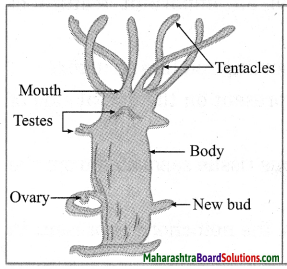
Maharashtra Board Class 10 Science Solutions Part 2 Chapter 6 Animal Classification 1
Classification:
Kingdom: Animalia
Division: Non-chordata
Phylum: Coelenterata
Example: Hydra

2. Jellyfish
Answer:
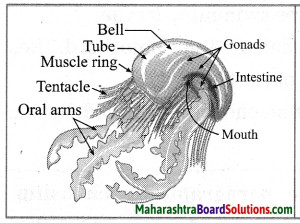
Maharashtra Board Class 10 Science Solutions Part 2 Chapter 6 Animal Classification 2
Classification:
Kingdom: Animalia
Division: Non-chordata
Phylum: Coelenterata
Example: Jellyfish

3. Planaria
Answer:
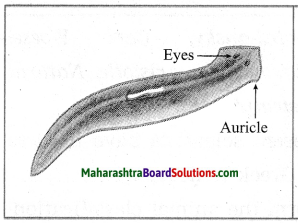
Maharashtra Board Class 10 Science Solutions Part 2 Chapter 6 Animal Classification 3
Classification:
Kingdom: Animalia
Division: Non-chordata
Phylum: Platyhelminthes
Example: Planaria

4. Roundworm
Answer:
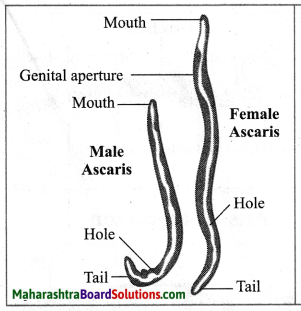
Maharashtra Board Class 10 Science Solutions Part 2 Chapter 6 Animal Classification 4
Classification:
Kingdom: Animalia
Division: Non-Chordata
Phylum: Aschelminthes
Example: Ascaris (Roundworm)

5. Butterfly
Answer:
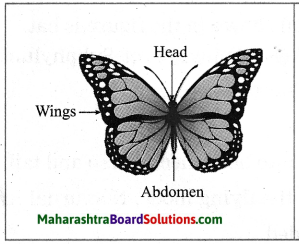
Maharashtra Board Class 10 Science Solutions Part 2 Chapter 6 Animal Classification 5
Classification:
Kingdom: Animalia
Division: Non-chordata
Phylum: Arthopoda
Class: Insecta
Example: Butterfly

6. Earthworm
Answer:
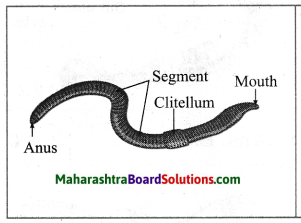
Maharashtra Board Class 10 Science Solutions Part 2 Chapter 6 Animal Classification 6
Classification:
Kingdom: Animalia
Division: Non-chordata
Phylum: Annelida
Example: Earthworm

7. Octopus
Answer:
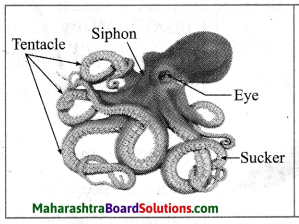
Maharashtra Board Class 10 Science Solutions Part 2 Chapter 6 Animal Classification 7
Classification:
Kingdom: Animalia
Division: Non-chordata
Phylum: Mollusca
Example: Octopus

8. star fish
Answer:
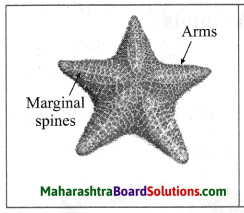
Maharashtra Board Class 10 Science Solutions Part 2 Chapter 6 Animal Classification 8
Classification:
Kingdom: Animalia
Division: Non-chordata
Phylum: Echinodermata
Example: Star fish

9. Shark
Answer:
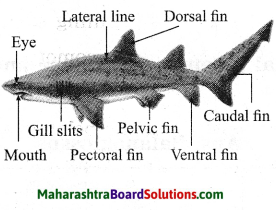
Maharashtra Board Class 10 Science Solutions Part 2 Chapter 6 Animal Classification 9
Classification:
Kingdom: Animalia
Phylum: Chordata
Sub Phylum: Vertebrata
Class: Pisces
Example: Scoliodon (Shark)

10. Frog
Answer:
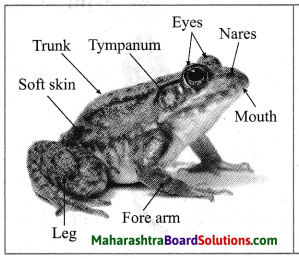
Maharashtra Board Class 10 Science Solutions Part 2 Chapter 6 Animal Classification 10
Classification:
Kingdom: Animalia
Phylum: Chordata
Sub Phylum: Vertebrata
Class: Amphibia
Example: Frog

11. Wall Lizard
Answer:
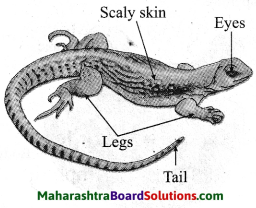
Maharashtra Board Class 10 Science Solutions Part 2 Chapter 6 Animal Classification 11
Classification:
Kingdom: Animalia
Phylum: Chordata
Sub Phylum: Vertebrata
Class: Reptilia
Example: Wall Lizard

12. Pigeon.
Answer:
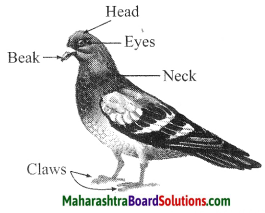
Maharashtra Board Class 10 Science Solutions Part 2 Chapter 6 Animal Classification 16
Classification:
Kingdom: Animalia
Phylum: Chordata
Sub-Phylum: Vertebrata
Class: Aves
Example: Pigeon

Question 11.
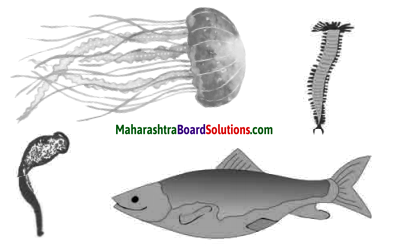
Maharashtra Board Class 10 Science Solutions Part 2 Chapter 6 Animal Classification 12
Answer:
(1) Jellyfish
(2) Nereis
(3) Flatworm/Planaria
(4) Bony fish.

Project: (Do it your self)

1. In each week, on a specific day of your convenience, observe the animals present around your school and residence. Perform this activity for six months. Keep date-wise record of your observations. After the observation period of six months, analyse your observations with respect to seasons. With the help of your teacher, classify the reported animals.

Maharashtra Board Class 10 Science Solutions Part 2 Chapter 6 Animal Classification

Can you recall? (Text Book Page No. 61)

Question 1.
Which criteria are used for classification of organisms?
Answer:
The living organisms are classified according to their basic characteristics, such as presence or absence of nucleus, unicellular body or multicellular body, presence or absence of cell wall and the mode of nutrition in them.

Question 2.
How are the plants classified?
Answer:
The plants are classified according to the following basis:

  1. Presence or absence of the organs.
  2. Presence or absence of separate

Use your brain power: (Text Book Page No. 74)

(A) Animals like gharial and crocodile live in water as well as on land. Are they amphibians or reptiles?
Answer:
Ghariyal and crocodile are reptiles. They can swim in water and crawl on land. But they can respire only with the help of lungs. Their breathing is through nostrils. Even when in water, they have to inhale and exhale by coming up to the surface of water for air. Amphibians can breathe through the skin when in water and by lungs when on land. They also have hard exoskeleton which amphibians do not have. Hence, ghariyal and crocodile are not amphibians, but they are reptiles.

(B) Animals like whale, walrus live in water (ocean). Are they included in Pisces or Mammalia?
Answer:
Whale and walrus are aquatic and marine mammals. They do not belong to class Pisces. They do not have gills to breathe in dissolved oxygen in water. Neither they have scales on the body nor can they lay eggs. Whales and walrus have mammary glands like all other mammals. They give birth to live young one. They breathe only with the help of lungs by putting their nostrils out of the water at surface. Hence they are included in Mammalia.

Choose the correct alternative and write its alphabet against the sub-question number:

Question 1.
System of classification based on evolution was brought into practice by ……….. and …………
(a) Darwin, Mendel
(b) Lamarck, De Vries
(c) Morgan, Mayor
(d) Dobzansky, Meyer
Answer:
(d) Dobzansky, Meyer

Question 2.
Artificial method of animal classification was proposed by ………….
(a) Aristotle
(b) Darwin
(c) Lamarck
(d) Whittaker
Answer:
(a) Aristotle

Question 3.
Animals attached to substratum are called ……….. animals.
(a) sessile
(b) sedentary
(c) lame
(d) motionless
Answer:
(b) sedentary

Question 4.
In coelenterates, ………… are useful for capturing the prey whereas ………. inject the toxin in the body of prey.
(a) tentacles, cnidoblast
(b) hands, legs
(c) flagella, sting
(d) cilia, sting cells
Answer:
(a) tentacles, cnidoblast

Question 5.
Body of annelidan animals is long, cylindrical and …………. segmented.
(a) annular
(b) metamerically
(c) jointed
(d) cuticular
Answer:
(b) metamerically

Question 6.
…………. is second largest phylum in animal kingdom.
(a) Mollusca
(b) Arthropoda
(c) Porifera
(d) Platyhelminthes
Answer:
(a) Mollusca

Maharashtra Board Class 10 Science Solutions Part 2 Chapter 6 Animal Classification

Question 7.
Endoskeleton of Cyclostomata animals is …………..
(a) bony
(b) bony and cartilaginous
(c) cartilaginous
(d) none of the above
Answer:
(c) cartilaginous

Question 8.
Body cavity between the body and internal organs is called ………….
(a) gastrocoel
(b) enteron
(c) coelom
(d) cave
Answer:
(c) coelom

Question 9.
Larvae of ……….. metamorphose into adults after settling down at bottom of the sea.
(a) Hemichdrdata
(b) Urochordata
(c) Cephalochordata
(d) Cyclostomata
Answer:
(b) Urochordata

Question 10.
The body organization of unicellular organisms is of …………. grade.
(a) cellular
(b) tissue
(c) protoplasmic
(d) organ
Answer:
(c) protoplasmic

Question 11.
………….. is a cold blooded animal. (March 2019)
(a) Bat
(b) Snake
(c) Rabbit
(d) Elephant
Answer:
(b) Snake

Question 12.
Calcareous spines are present on the body of ………… animal. (July 2019)
(a) fish
(b) snail
(c) sponge
(d) starfish
Answer:
(d) starfish

Question 13.
Due to which similar characteristic honey bee and cockroach are included in the same phylum?
(a) Wings
(b) Three pair of legs
(c) Jointed appendages
(d) Antenna
Answer:
(c) Jointed appendages

Write whether the following statements are true or false with proper explanation:

Question 1.
Greek philosopher Linnaeus was the first to perform the animal classification.
Answer:
False. (Greek philosopher Aristotle was the first to perform the animal classification.)

Question 2.
Heart if present in the non-chordates is on dorsal side of body.
Answer:
True.

Question 3.
Arthropoda animals bear numerous pores on their body.
Answer:
False. (Porifera animals bear numerous pores on their body.)

Question 4.
Porifera animals have special type of collar cells.
Answer:
True.

Question 5.
Aschelminthes have acoelomate and bilaterally symmetrical body.
Answer:
False. (Platyhelminthes have acoelomate and bilaterally symmetrical body. OR Aschelminthes have pseudocoelomate and bilaterally symmetrical body.

Maharashtra Board Class 10 Science Solutions Part 2 Chapter 6 Animal Classification

Question 6.
Planet Earth has highest number of animals from phylum Arthropoda.
Answer:
True.

Question 7.
Animals belonging to phylum Annelida perform locomotion with the help of tube-feet.
Answer:
False. (Animals belonging to phylum Echinodermata perform locomotion with the help of tube-feet.)

Question 8.
Herdmania has notochord in only tail region and hence it is called Urochordate.
Answer:
True.

Question 9.
Mammals breathe with the help of lungs.
Answer:
True.

Question 10.
Amphibians are warm blooded.
Answer:
False. (Amphibians are cold-blooded. OR Mammals are warm blooded.)

Match the columns:

Question 1.

PhylumCharacteristics
(1) Mollusca(a) Collar cells
(2) Hemichordata(b) Mantle
(c) Trunk
(d) Cnidoblasts

Answer:
(1) Mollusca – Mantle
(2) Hemichordata – Trunk.

Question 2.

PhylumCharacteristics
(1) Porifera(a) Tunic
(2) Coelenterata(b) Collar cells
(c) Tentacles bearing cnidoblasts
(d) Mantle

Answer:
(1) Porifera – Collar cells
(2) Coelenterata – Tentacles bearing cnidoblasts.

Question 3.

Subphylum/ClassCharacteristics
(1) Cyclostomata(a) Collar cells
(2) Urochordat(b) Sucker
(c) Tunic
(d) Chitinous exoskeleton

Answer:
(1) Cyclostomata – Sucker
(2) Urochordata – Tunic.

Maharashtra Board Class 10 Science Solutions Part 2 Chapter 6 Animal Classification

Find the odd one out:

Question 1.
Physalia, Hyalonema, Ruplectella, Spongilla
Answer:
Physalia. (Physalia belongs to Coelenterata, all the remaining are poriferans.)

Question 2.
Planaria, Liverfluke, Filarial worm, Tapeworm
Answer:
Filarial worm. (Filarial worm is Aschelminthes remaining are Platyhelminthes.)

Question 3.
Star fish, Sea-urchin, Nereis, Sea-cucumber
Answer:
Nereis. (Nereis belongs to Annelida all the remaining are Echinoderm animals.)

Question 4.
Cockroach, Butterfly, Spider, Honey bee
Answer:
Spider. (Spider is eight-legged Arachnid, remaining are insects.)

Question 5.
Amphioxus, Herdmania, Doliolum,Oikopleura
Answer:
Amphioxus. (Amphioxus is Cepholochordate all the remaining are Urochordates.)

Question 6.
Frog, Tortoise, Toad, Salamander
Answer:
Tortoise. (Tortoise is a reptile, the remaining are amphibians.)

Question 7.
Tube feet, Setae, Parapodia, Sucker
Answer:
Tube feet. (Tube feet are locomotory organs of Echinoderms, the remaining are locomotory organs of Annelids.)

Question 8.
Shark, Sting ray, Electric ray, Pomfret
Answer:
Pomfret. (Pomfret is a bony fish, all the remaining are cartilaginous fish.)

Find the correlation:

Question 1.
Annelida : Earthworm : : Platyhelminthes : …………
Answer:
Annelida : Earthworm : : Platyhelminthes : Planaria/Liverfluke

Question 2.
Horse : Mammal : : Seahorse : ………….
Answer:
Horse : Mammal : : Seahorse : Pisces

Question 3.
Parapodia : Annelida : : Tube feet : ………..
Answer:
Parapodia : Annelida : : Tube feet : Echinodermata

Maharashtra Board Class 10 Science Solutions Part 2 Chapter 6 Animal Classification

Question 4.
Frog : Amphibia : : Turtle : …………..
Answer:
Frog : Amphibia : : Turtle : Reptilia

Question 5.
Proboscis : Hemichordata : : Suctorial mouth : …………
Answer:
Proboscis : Hemichordata : : Suctorial mouth : Cyclostomata

Question 6.
Bird from very cold regions : Penguin : : Aquatic Mammal from very cold regions : ………..
Answer:
Bird from very cold regions : Penguin : : Aquatic Mammal from very cold regions : Whale.

Distinguish between:

Question 1.
Non-chordates and Chordates.
Answer:
Non-chordates

  1. Non-chordates are less evolved animals and are on the lower levels of evolution.
  2. Non-chordates do not have notochord.
  3. In non-chordates, there are no pharyngeal gill slits.
  4. Nerve cord, if present is double and solid.
  5. Nerve cord is located on the ventral side of the body.
  6. Heart if present is on the dorsal side of the body.

Chordates:

  1. Chordates are more evolved animals and are on the higher levels of evolution.
  2. Chordates have notochord at least in some stage of development.
  3. In chordates, there are pharyngeal gill slits.
  4. Nerve cord is single and hollow.
  5. Nerve cord is located on the dorsal side of the body.
  6. Heart if present is on the ventral side of the body.

Question 2.
Phylum Platyhelminthes and Phylum Aschelminthes. OR Write any two points of differences between flat worms and round worms.
Answer:
Phylum Platyhelminthes (Flat worms):

  1. Platyhelminth worms have slender and flat leaf or strip like body hence called flat worms.
  2. Platyhelminthes are triploblastic and acoelomate.
  3. Most of them are hermaphrodite or bisexual having both male and female reproductive systems in the same body.
  4. Examples: Planaria, Liver fluke, Tapeworm, etc.

Phylum Aschelminthes (Round worms):

  1. Aschelminthes have long thread-like or Cylindrical body, hence called round worms.
  2. Aschelminthes are triploblastic and pseudocoelomate.
  3. They are unisexual with male and female sexes separate. There is sexual dimorphism.
  4. Examples: Ascaris (Intestinal worm), Filarial worm, Loa loa (Eye worm), etc.

Maharashtra Board Class 10 Science Solutions Part 2 Chapter 6 Animal Classification

Question 3.
Urochordata and Cephalochordata.
Answer:
Urochordata:

  1. Urochordates have notochord in the tail region of the adult body.
  2. These animals look like small sacs.
  3. Usually urochordates are hermaphrodites.
  4. Body of urochordate is covered over by skin-like test or tunic.
  5. Examples: Herdmania, Doliolum, Oikopleura, etc.

Cephalochordata:

  1. Cephalochrodates have notochord in the entire length of the body.
  2. These animals look like small fish.
  3. Cephalochordates are unisexual.
  4. Body of cephalochordate is not covered in a test.
  5. Example: Amphioxus.

Question 4.
Cyclostomata and Pisces.
Answer:
Cyclostomata:

  1. Cyclostomata are the poorly evolved first class of vertebrate animals.
  2. Cyclostomata have circular jawless mouth with suckers.
  3. Paired appendages are absent in cyclostomates.
  4. Cyclostomes have soft skin which is without any scales.
  5. Endoskeleton is cartilaginous.
  6. Examples: Petromyzon, Myxine, etc.

Pisces:

  1. Pisces are the better evolved class of vertebrates which is well adapted for aquatic living.
  2. Pisces have mouth with upper and lower jaws. Teeth are present in the mouth.
  3. Paired and unpaired fins present in all kinds of fishes.
  4. Fishes have different types of scales on the body.
  5. Endoskeleton may be cartilaginous, or it may be bony.
  6. Examples: Shark (Scoliodoh), rays which are cartilaginous fishes and pomfret, makerel, sardines, rohu which are bony fishes.

Question 5.
Amphibia and Reptilia.
Answer:
Amphibia:

  1. Amphibians can inhabit both land and water. They can survive on both environments by breathing there.
  2. The exoskeleton is absent in amphibians. The skin is soft, slimy and moist.
  3. Body is divided into head and trunk. Neck is absent.
  4. The digits do not have claws.
  5. The respiration is by skin when in water and by lungs when on land. The larvae breathe by gills.
  6. There is external fertilization at the time of sexual reproduction.
  7. The developmental stages are eggs and tadpole. Metamorphosis is seen in amphibians.
  8. Examples : Frog, Toad, Salamander, etc.

Reptilia:

  1. Reptilians are terrestrial animals. Though turtle and sea snakes can stay in water, they cannot breathe in water.
  2. The exoskeleton in the form of scales. Some animals have plates or scutes (e.g. tortoise and crocodile).
  3. Body is divided into head, neck and trunk.
  4. The digits have claws.
  5. The respiration is only by lungs.
  6. There is internal fertilization at the time of sexual reproduction.
  7. The developmental stages are eggs and juvenile. Metamorphosis is not seen in reptiles.
  8. Examples : Tortoise, Lizard, Snake, etc.

Maharashtra Board Class 10 Science Solutions Part 2 Chapter 6 Animal Classification

Question 6.
Aves and Mammalia.
Answer:
Aves:

  1. Aves are totally adapted for the aerial mode of life.
  2. Body is spindle shaped. Body is divisible into head, neck and trunk. There are two pairs of limbs. The forelimbs are modified to form wings for flight.
  3. Digits have scales and claws.
  4. The exoskeleton is in the form of feathers.
  5. Jaws are modified into a beak.
  6. Birds are oviparous. The eggs hatch into nestlings.
  7. The incubation of eggs and feeding of nestlings is done by both parents.
  8. Examples: Crow, Sparrow, Peacock, Parrot, Pigeon, Duck, Penguin, etc.

Mammalia:

  1. Mammals are adapted for terrestrial life.
  2. Body is not spindle shaped. It is divisible into head, neck, trunk and tail. There are two pairs of limbs. They are adapted for walking or running on the ground.
  3. Digits have nails or hoofs. Few have claws.
  4. The exoskeleton is in the form of fur, hair, wool, etc.
  5. Jaws have teeth and they surround the mouth.
  6. Mammals are viviparous. They give birth to live young ones. (Exception: Platypus)
  7. Parental care is shown only by mother, who feeds, the babies with milk from mammary glands.
  8. Examples: Cat, Dog, Tiger, Lion, Elephant, Human, Kangaroo, Dolphin, Bat, etc.

Classification-based questions:

Question 1.
Identify me:
(1) I am metamerically segmented, blood sucking, ectoparasite. I have suckers. Who am I and to what phylum do I belong to? (OR) Who am I? (July 2019)
I have suckers. I am blood sucking.
Answer:
Leech, Phylum Annelida.

(2) I have chitinous exoskeleton, I have four pairs of walking appendages. I can sting you. Who am I? What phylum do I belong to?
Answer:
Scorpion. Phylum Arthropoda.

Question 2.
Characters of a phylum are given below. Read them carefully and answer the questions:
(a) Spines of calcium carbonate are present on the body, (b) These animals are exclusively marine, (c) They perform the locomotion with the help of tube feet, (d) Their skeleton is made up of calcareous plates or spicules.
(i) Animals of which phylum show the above character?
Answer:
Animals belonging to phylum Echinodermata show the above characters.

(ii) Give an example from that phylum.
Answer:
Starfish, brittlestar, sea urchin.

(iii) These animals can be classified with the help of which criteria of new system of animals classification.
Answer:
Animals are classified on the basis of criteria such as body organization, body symmetry, body cavity, etc.

Question 3.
Identify my class/phylum and give one example of it: (March 2019)
(a) I have mammary glands and exoskeleton in the form of hair.
(b) We form the highest number of animals on the planet. We have bilateral symmetry and our exoskeleton is in the form of chitin.
(c) I live in your small intestine, my body is long and thread like and pseudocoelomate.
Answer:
(a) Class: Mammalia, Example: Cat, Dog, Man.
(b) Phylum: Arthropoda, Example: Prawn, Crab.
(c) Phylum: Aschelminthes, Example: Ascaris or round worm, Filarial worm.

Maharashtra Board Class 10 Science Solutions Part 2 Chapter 6 Animal Classification

Question 4.
Tell me who am I? What is my class/ phylum?
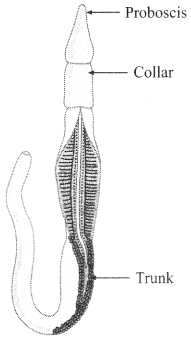
1. My body is divided into proboscis, collar and trunk. I am marine animal.
Answer:
Balanoglossus; Phylum: Hemichordata.

2. I stay inside two shells. My body is divided into head, foot and visceral mass.
Answer:
Bivalve or Oyster; Phylum: Mollusca.

3. I am male as well as female. I am endoparasite having a coelomate and bilaterally symmetrical and flattened body.
Answer:
Liver fluke or tape worm; Phylum: Platyhelminthes.

4. I am sedentary marine animal drinking water all the time through numerous pores on the body.
Answer:
Sponge; Phylum: Porifera.

5. I am venomous, eight legged creature having chitinous exoskeleton.
Answer:
Scorpion; Phylum: Arthropoda.

6. My body is covered by tunic. As a larva I swim but as an adult I settle down.
Answer:
Doliolum or Salpa; Phylum: Chordata subphylum : Urochordata.

Question 5.
Identify the class of given animals and write one characteristic of each animal:
(1) Kangaroq (2) Penguin (3) Crocodile (4) Frog (5) Sea-horse. (July 2019)
Answer:
(1) Kangaroo: Class Mammalia. It is a marsupial animal with pouch for development of offspring. Long hind limbs for jumping.
(2) Penguin: Class Aves. It is flightless bird. Body covered with thick feathery coat. Oviparous mode.
(3) Crocodile: Class Reptilia. It is a large animal seen near water bodies. Can swim in water but cannot respire in water. Body covered with exoskeleton of scaly plates. Limbs very weak in comparison with huge bodies.
(4) Frog: Class Amphibia. Shows aquatic as well as terrestrial mode. Can breathe with lungs and skin. No exoskeleton and skin is slimy.
(5) Sea-horse: Class Pisces. Bony fish. Highly modified body structure showing brood pouch for development of offspring gills for respiration, fins for swimming.

Answer the following questions:

Question 1.
State any four benefits of animal classification. (March 2019)
Answer:

  1. Studying the different animals becomes easy when they are placed under different groups.
  2. When few representative animals of the particular group are studied then the idea about other animals belonging to that group also becomes clear.
  3. The animal evolution becomes easier to follow after studying classification.
  4. The identification of animals can be done accurately.
  5. Relationship of the different animals with each other and with other groups can be understood clearly.
  6. Habitat of each animal and its role in nature is understood by classification.
  7. Various adaptations are understood by learning classification.

Question 2.
Into which phyla is Non-chordata divided? In which three subphyla are Chordates divided?
Answer:
I. The phyla of Non-chordata:

  • Protozoa
  • Porifera
  • Coelenterata or Cnidaria
  • Platyhelminthes
  • Aschelminthes
  • Annelida
  • Arthropoda
  • Mollusca
  • Echinodermata
  • Hemichordata

II. The subphyla of Chordata:

  • Urochordata
  • Cephalochordata
  • Vertebrata

Maharashtra Board Class 10 Science Solutions Part 2 Chapter 6 Animal Classification

Question 3.
Write the characteristics of chordates.
Answer:
Characteristics of Chordates:

  1. All chordates possess notochord and pharyngeal gill slits in at least during some developmental stage.
  2. Presence of single, tubular and dorsally located spinal cord and ventrally located heart.

Question 4.
Write the characteristics of vertebrates.
Answer:
Characteristics of vertebrates:

  • In vertebrates, notochord is replaced by vertebral column.
  • Development of head is complete.
  • Well-developed cranium which protects the brain.
  • Presence of endoskeleton which is either cartilaginous or bony.
  • Presence of jaws as in Gnathostomata or absence of jaws as in Agantha.

Write short notes on:

Question 1.
(1) Benefits of classification.
Answer:

  • Studying the different animals becomes easy when they are placed under different groups.
  • When few representative animals of the particular group are studied then the idea about other animals belonging to that group also becomes clear.
  • The animal evolution becomes easier to follow after studying classification.
  • The identification of animals can be done accurately.
  • Relationship of the different animals with each other and with other groups can be understood clearly.
  • Habitat of each animal and its role in nature is understood by classification.
  • Various adaptations are understood by learning classification.

Question 2.
Germinal layers.
Answer:

  • During the initial embryonic period of any multicellular animal there is formation of germinal layers or germ layer.
  • These germ layers give rise to new tissues in the developing animal.
  • The primitive animals were diploblastic i.e. they have only two germ layers called ectoderm and endoderm.
  • The higher animals are triploblastic, having three germ layers; ectoderm, mesoderm and endoderm.
  • Cnidarians are diploblastic while all other animals are triploblastic.

Question 3.
Coelom.
Answer:

  • Coelom means body cavity. It is situated between the body wall and the internal organs of the body.
  • The coelom is formed during early embryonic life in case of multicellular animals. It is formed from either mesoderm or gut.
  • Coelom when present in the body, those animals are called eucoelomate. Phylum Annelida onwards are eucoelomate animals. They are animals with true body cavity.
  • Those animals in which coelom are absent are called acoelomate animals. Porifera, Cnidaria and Platyhelminthes are acoelomate animals.
  • When coelom is not formed from mesoderm or gut, but formed from other tissues, it is called pseudocoelom. Only Aschelminthes animals have such coelom and hence they are called pseudocoelomate.

Maharashtra Board Class 10 Science Solutions Part 2 Chapter 6 Animal Classification

Question 4.
Notochord.
Answer:

  • Notochord is an important feature of Chordates.
  • Notochord is supporting rod like structure.
  • This structure is present on the dorsal side of the animals.
  • It keeps the nervous tissue separated from the rest of the tissues.
  • In Hemichordates, the notochord is present in the proboscis.
  • In Urochordates, the notochord is present in the tail region of the free swimming larvae.
  • In Cephalochordates, the notochord lies throughout the length of the body.
  • In vertebrates, notochord is replaced by the vertebral column.

Complete the paragraph by choosing the appropriate words given in the brackets:

Question 1.
(Linnaeus, Dobzhansky, Carl Woese, Theophrastus, Artificial method, Aristotle, Natural system, Traditional system)
Time to time, different scientists have tried to classify the animals. Greek philosopher ………… was the first to perform the animal classification. Aristotle classified the animals, according to the criteria like body size, habits and habitats. Classification proposed by Aristotle is known as ………… Besides Aristotle, artificial method of classification was followed by ……….., Pliny, John Ray and ……….. Later on,’………… of classification’ was followed. Natural system of classification was based on various other criteria. By the time, system of classification based on evolution was also brought into practice. It was used by …………. and Meyer. Recently, ……….. has also proposed the animal classification.
Answer:
Time to time, different scientists have tried to classify the animals. Greek philosopher Aristotle was the first to perform the animal classification. Aristotle classified the animals, according to the criteria like body size, habits and habitats. Classification proposed by Aristotle is known as ‘Artificial method’. Besides Aristotle, artificial method of classification was followed by Theophrastus, Pliny, John Ray and Linnaeus. Later on, ‘Natural system of classification’ was followed. Natural system of classification was based on various other criteria. By the time, system of classification based on evolution was also brought into practice. It was used by Dobzansky and Meyer. Recently, Carl Woese has also proposed the animal classification.

Question 2.
(neck, lungs, skin, exoskeleton, amphibian, metamorphose, aquatic, gills)
Class Amphibia consist of animals which are strictly ……….. only during their larval stages. At that time they breathe through their …………. Tadpoles are such stages which later ………… to form adult frog. Adult frog respires with the help of ………… when in water and with when on land. Thus, it is a true …………. For performing cutaneous respiration, i.e. respiration through skin, they lack ………. in any form. The skin is also kept moist by staying near the water bodies. Amphibians do not have a ………… but eyes are bulging and prominent, this solves the problems of vision.
Answer:
Class Amphibia consist of animals which are strictly aquatic only during their larval stages. At that time they breathe through their gills. Tadpoles are such stages which later metamorphose to form adult frog. Adult frog respires with the help of skin when in water and with lungs when on land. Thus, it is a true amphibian. For performing cutaneous respiration, i.e. respiration through skin, they lack exoskeleton in any form. The skin is also kept moist by staying near the water bodies. Amphibians do not have a neck but eyes are bulging and prominent, this solves the problems of vision.

Paragraph based questions:

1. Read the paragraph and answer the questions given below:
Locomotion is considered as an important j characteristics of the animals. However, animals belonging to Porifera are said to be sedentary. Every 1 other phylum has typical locomotory organs. E.g. Nereis crawls with the help of parapodia, whereas earthworm buries in soil by setae. Spiders have four pairs of walking legs, crab has five while all insects have three pairs of walking legs. The walking legs are also called appendages. Starfish moves with the help of tube feet. Snails and bivalves use muscular foot for locomotion. Birds flying with their spread out wings and fish swimming with their fins, both have spindle-shaped body tapering at both the ends. While flying or swimming such body offers least resistance during locomotion. Mammals have two pairs of limbs while animals like snakes are limbless. Other animals belonging to the class of snakes also have very weak limbs which make them creep on the ground.

Questions and Answers:

Question 1.
What are the locomotory organs in phylum Annelida?
Answer:
Annelidans have parapodia and setae as the locomotory organs.

Question 2.
Which phylum has a characteristic of jointed appendages?
Answer:
Phylum Arthropoda has a characteristic of jointed appendages.

Question 3.
Which the locomotory organ of animals belong to Phylum Mollusca?
Answer:
Animals belonging to Phylum Mollusca have strong muscular foot which is used for locomotion.

Question 4.
Which class of animals show weak legs?
Answer:
Class Reptilia belonging to subphylum vertebrata show weak legs.

Question 5.
In which class of animals the forelimbs are modified?
Answer:
Class Aves belonging to subphylum vertebrata have wings which are modified forelimbs.

Maharashtra Board Class 10 Science Solutions Part 2 Chapter 6 Animal Classification

Diagram based questions:

Question 1.
Sketch, label and classify the following organisms:
1. Liverfluke.
Answer:
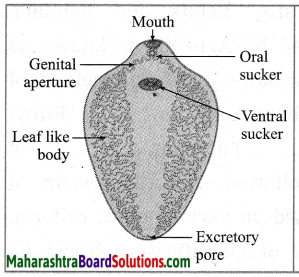
Maharashtra Board Class 10 Science Solutions Part 2 Chapter 6 Animal Classification 13
Classification:
Kingdom: Animalia
Division: Non-chordata
Phylum: Platyhelminthes
Example: Liverfluke

2. Leench.
Answer:
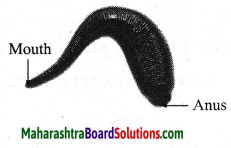
Maharashtra Board Class 10 Science Solutions Part 2 Chapter 6 Animal Classification 14
Classification:
Kingdom: Animalia
Division: Non-chordata
Phylum: Annelida
Example: Leech

3. Cockroach:
Answer:
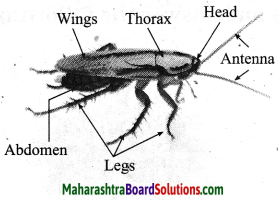
Maharashtra Board Class 10 Science Solutions Part 2 Chapter 6 Animal Classification 15
Classification:
Kingdom: Animalia
Division: Non-chordata
Phylum: Arthopoda
Class: Insecta
Example: Cockroach

Question 2.
Identify the animal given in the figure and label the figure:
1.
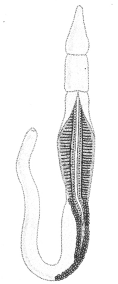
Maharashtra Board Class 10 Science Solutions Part 2 Chapter 6 Animal Classification 17
Answer:
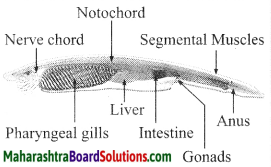
Balanoglossus
Maharashtra Board Class 10 Science Solutions Part 2 Chapter 6 Animal Classification 18

2.
Maharashtra Board Class 10 Science Solutions Part 2 Chapter 6 Animal Classification 19
Answer:
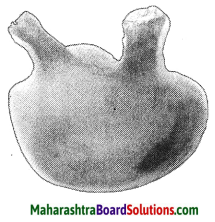
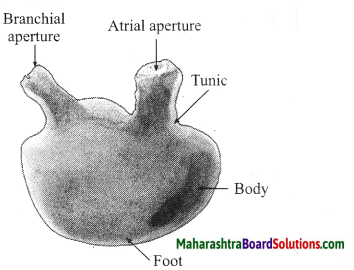
Herdmania.
Maharashtra Board Class 10 Science Solutions Part 2 Chapter 6 Animal Classification 20

3.
Maharashtra Board Class 10 Science Solutions Part 2 Chapter 6 Animal Classification 21
Answer:
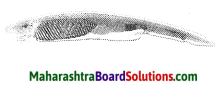
Amphioxus
Maharashtra Board Class 10 Science Solutions Part 2 Chapter 6 Animal Classification 22

4.
Maharashtra Board Class 10 Science Solutions Part 2 Chapter 6 Animal Classification 23
Answer:
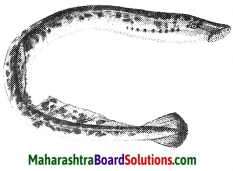
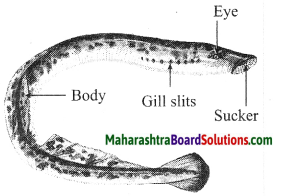
Petromyzon.
Maharashtra Board Class 10 Science Solutions Part 2 Chapter 6 Animal Classification 24

5.
Maharashtra Board Class 10 Science Solutions Part 2 Chapter 6 Animal Classification 25
Answer:
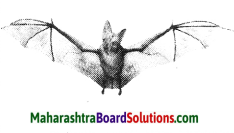
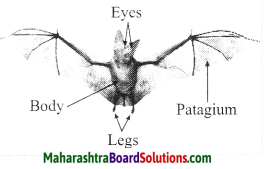
bat
Maharashtra Board Class 10 Science Solutions Part 2 Chapter 6 Animal Classification 26

Question 3.
Identify the class of the animal shown in the figure and write any two characteristics.
Answer:
(1) The animal shown in the figure is bat.
(2) It belongs to class Mammalia of Subphylum Vertebrata. Phylum Chordata.
(3) Characteristics:
(i) Body is divided into head, neck, torso and tail. Patagium present for the flying mode. Nocturnal in habit. It is warm blooded.
(ii) Gives birth to live young ones. Mammary glands present for nourishing young ones.

Maharashtra Board Class 10 Science Solutions Part 2 Chapter 6 Animal Classification

Question 4.
Observe the figure and answer the following questions.
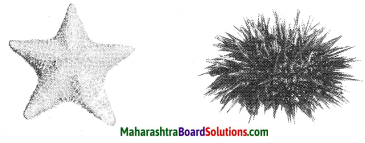
Maharashtra Board Class 10 Science Solutions Part 2 Chapter 6 Animal Classification 27
(a) To which phylum these organisms belong?
(b) Name the substance with which their body is covered.
(c) Name their organs of locomotion.
Answer:
(a) The starfish and the sea urchin shown in the figure belong to phylum Echinodermata.
(b) The body of echinoderm animal is covered with calcareous spines or ossicles/plates.
This is the substance covering the body is mostly calcium salts and compounds.
(c) Their locomotory organs are tube feet.

Question 5.
Observe the figures given below and answer the given questions: (Board’s Model Activity Sheet)
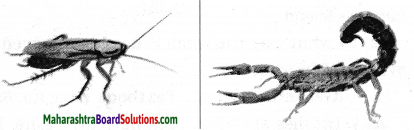
Maharashtra Board Class 10 Science Solutions Part 2 Chapter 6 Animal Classification 28
(a) In which phylum are these animals included?
(b) Which substance forms the outer layer of their exoskeleton?
(c) What are their locomotory organs?
Answer:
(a) These animals are included in phylum Arthropoda.
(b) The outer layer of their exoskeleton is covered by chitinous substance.
(c) Their locomotory organs are jointed paired appendages.

Question 6.
Identify the phylum of the given animal and write any two characteristics of this phylum. (Board’s Model Activity Sheet)
Answer:
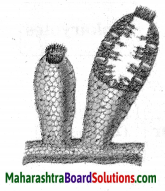
Maharashtra Board Class 10 Science Solutions Part 2 Chapter 6 Animal Classification 29
This animal is Sycon sponge and its phylum in Porifera.
Characteristics of phylum Porifera
(a) Asymmetrical body.
(b) Many pores on body. Large osculum and smaller ostia.

Question 7.
(a) Identify the animal given here.
(b) Write the phylum to which it belongs.
(c) Identify the pointed parts; p, q, r and s.
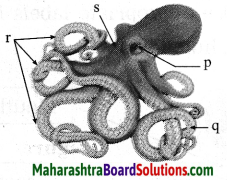
Maharashtra Board Class 10 Science Solutions Part 2 Chapter 6 Animal Classification 30
Answer:
(a) The given animal is Octopus.
(b) It belongs to the phylum Mollusca.
(c) p = eye, q = sucker, s = siphon and r = tentacle.

Complete the following charts:

Question 1.
Complete the chart by taking into consideration the criteria for classification: (Text Book Page No. 61)
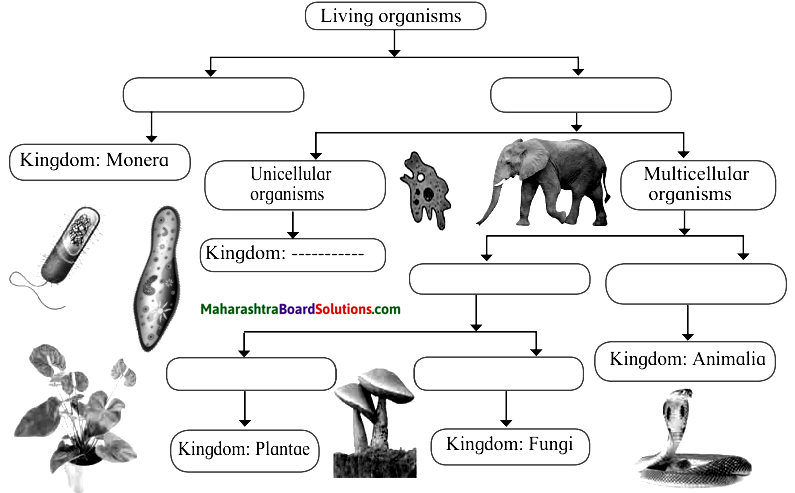
Maharashtra Board Class 10 Science Solutions Part 2 Chapter 6 Animal Classification 31
Answer:
Maharashtra Board Class 10 Science Solutions Part 2 Chapter 6 Animal Classification 32

Question 2.
Complete the following flow-chart.
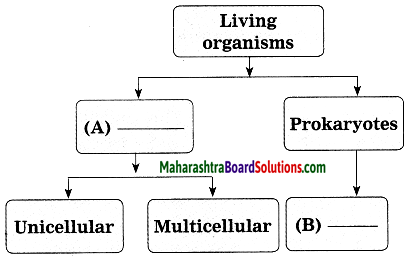
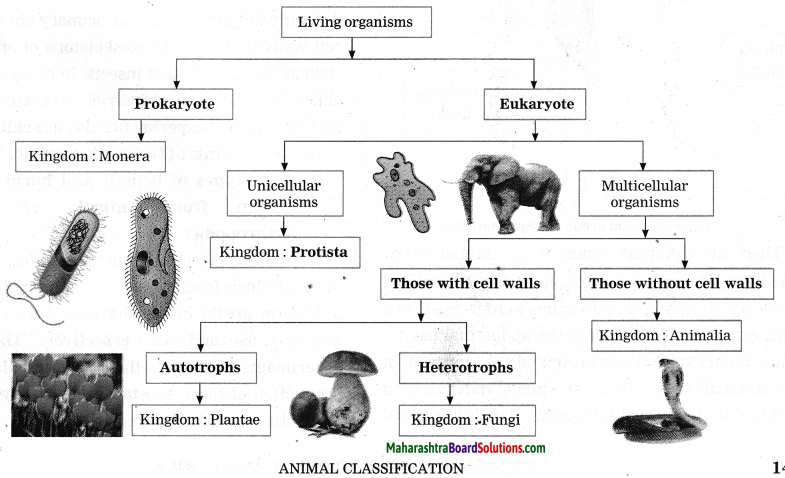
Maharashtra Board Class 10 Science Solutions Part 2 Chapter 6 Animal Classification 33
Answer:
(A) Eukaryotes
(B) Monera.

Maharashtra Board Class 10 Science Solutions Part 2 Chapter 6 Animal Classification

Activity based questions:

Question 1.
Observe: (Text Book Page No. 65)
(1) Body organization of human has been shown in the following figure. Use appropriate labels for different organs present in human body.
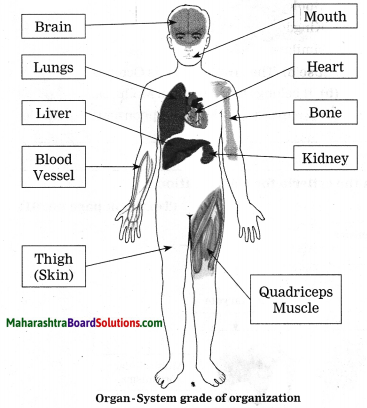
Maharashtra Board Class 10 Science Solutions Part 2 Chapter 6 Animal Classification 34
Answer:
There are different organs in the human body. The liver, pancreas, stomach, intestine, etc. related to the digestive system and a pair of kidney concerned with excretion is present in the abdominal cavity. The cranial cavity shows brain and sense organs. In the thoracic cavity there are lungs and heart. In addition to these organs, there are network of blood capillaries, nerve network, etc. which is spread from head to toes.

Question 2.
Why is earthworm called as friend of farmers? (Get Information: Text Book Page No. 69)
Answer:
Earthworms move through the soil in the farms and fields. They feed on the detritus in the soil. They also help in decomposition of the organic matter. When the soil is loosened due to their activities, the roots of the crops grow well. They enrich the soil by their excreta which act as fertilizers. All these facts make earthworm, a farmer’s friend.

Question 3.
In what way the leech is used in ayurvedic system of treatment? (Get Information: Text Book Page No. 69)
Answer:
Leeches are blood sucking ectoparasite. In Ayurveda leech is used to remove impure blood and blood clots. Such blood is sucked up by leeches and then the patient gets some relief. In the leech body there is. a substance called hirudine which prevent blood clotting as it sucks up the blood. This hirudine is also used for medicinal purpose.

Question 4.
What is chitin? (Find out: Text Book Page No. 70)
Answer:
Chitin is a type of polysaccharide. Its chemical formula is (C8H13O5N)n. It is a long-chain polymer of N-acetylglucosamine, which is actually a derivative of glucose. It is a primary component of cell walls in fungi, the exoskeletons of arthropods, such as crustaceans and insects. In many medicines chitin is used. The industrial processes and the biotechnological experiments also use chitin.

Question 5.
Let’s Think: (Text Book Page No. 70)
(i) What types of benefit and harm occur to human from animals of phylum-Arthropoda?
Answer:
Some insects are very useful for us. We get many products from them. e.g. Honey bee, Lac insect, Silk worm, are the insects that provide us with honey and wax, lac and silk respectively. The culture experiments are done on these insects for large scale production of these substances. Butterflies help in the pollination of crops and are thus helpful for the farmers and gardeners. Lady bug beetle is an insect which acts as a natural pest control as it attacks the other harmful insect pests.

In biological pest control methods it is widely used. Some insects, on the contrary are very harmful. Mosquito, bed bugs, lice are blood sucking parasites which can spread the diseases. Mosquito is a vector for dengue, filariasis and malaria. Some are biting insects that can cause wounds, some cause allergies of various kinds. The grains and crops are destroyed to great extent by the insects. In this way the insects belonging to the phylum Arthropods are harmful to health, wealth and peace of mind too.

(ii) Which are the animals from phylum Arthropoda those have shortest and longest life span?
Answer:
The shortest life span: May fly – About 24 hours. The longest life span : Lobster (Homarus americanus) – About 100 years.

(iii) Why has it been said that only insects directly compete with humans for food?
Answer:
The standing crop in the fields can be totally ruined by insects. The locust can damage the crops when they attack in thousands at a time. The grains are also infested by variety of insects like ants, weevils, beetles, etc. Therefore, we can say that only insects compete with humans for food.

Maharashtra Board Class 10 Science Solutions Part 2 Chapter 6 Animal Classification

Project: (Do it your self)

Project 1.
How does the infection of tapeworm in man, liver fluke in grazing animals like goat and sheep occur and what are their preventive measures? (Collect the Information, Internet is my friend: Textbook page no. 69)

Project 2.
How does the infection of round worms like Ascaris, filarial worm and plant nematodes occur and what are their preventive measures and treatment? (Collect the Information, Internet is my friend: Textbook page no. 69)

Project 3.
Books are my friend: Collect the information about pearl production from bivalves by reading appropriate books. (Textbook page no. 70)

Project 4.
Book are my friends: The Animal Kingdom: Libbie Hyman and some other similar books.
(Textbook page no. 75)

Project 5.
Use of Information Technology: (Textbook page no. 75)
Prepare the presentation of animal classification using video clips downloaded from internet.

Maharashtra Board Class 9 My English Coursebook Solutions Chapter 2.1 Comparisons

Balbharti Maharashtra State Board Class 9 English Solutions My English Coursebook Chapter 2.1 Comparisons Notes, Textbook Exercise Important Questions and Answers.

Maharashtra State Board Class 9 My English Coursebook Solutions Chapter 2.1 Comparisons

My English Coursebook Std 9 Digest Chapter 2.1 Comparisons Textbook Questions and Answers

Warming up!

Chit-chat:

  • What is your favourite colour?
  • What does it remind you of?
  • Are you afraid of the dark?
  • What does it make you think of?
  • If you were asked to design a big garden, what will you include in it?

Maharashtra Board Class 9 My English Coursebook Solutions Chapter 2.1 Comparisons

Expanding Word Webs:

Question 1.
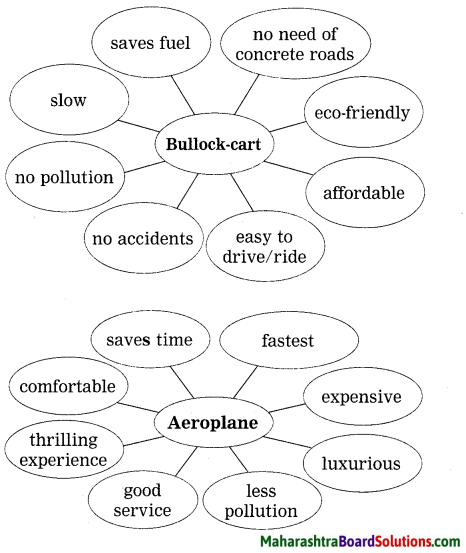
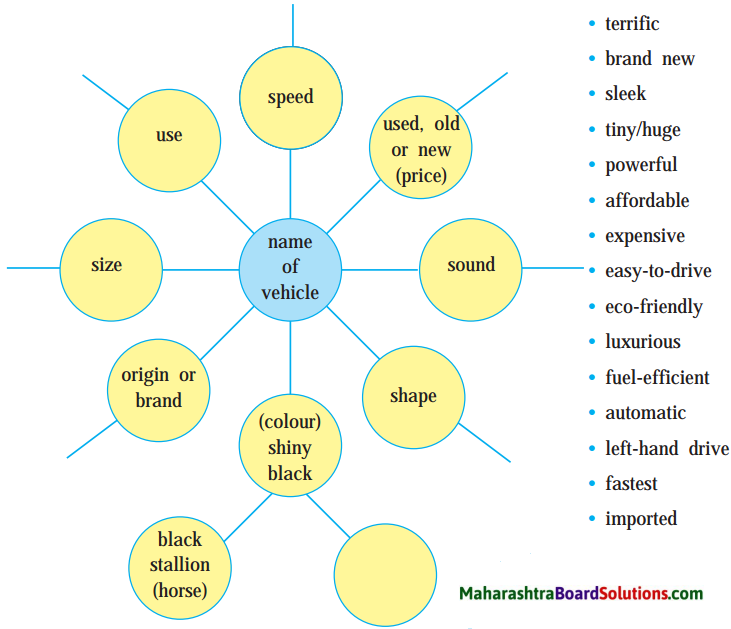
Form pairs. List the names of as many vehicles as you can. Choose any two of them, but they must be of different types. Then draw a word web for each of them to show their appearance, qualities and the things that these features remind you of. You may use words as well as phrases in the web.
Maharashtra Board Class 9 My English Coursebook Solutions Chapter 2.1 Comparisons 1
Answer:
Words that can be used in Word-web:

  1. terrific
  2. brand-new
  3. sleek
  4. tiny/huge
  5. powerful
  6. affordable
  7. expensive
  8. easy-to-drive
  9. eco-friendly
  10. luxurious – arrows.
  11. fuel-efficient
  12. automatic
  13. lefthand drive
  14. fastest
  15. imported

Name of the vehicles:

  1. bicycle
  2. bullock-cart
  3. car
  4. bus
  5. truck
  6. motorcycle
  7. scooter
  8. boat
  9. ship
  10. train
  11. helicopter
  12. aeroplane.

Choose any two of above vehicles and write related

Maharashtra Board Class 9 My English Coursebook Solutions Chapter 2.1 Comparisons 2

Maharashtra Board Class 9 My English Coursebook Solutions Chapter 2.1 Comparisons

Question 2.
Note the difference between drive and ride. Use the two words correctly in your own sentences :
Answer:

  1. Ride – to sit on and be carried by an animal or a two wheeler.
    Sentence – I don’t like to ride on a camel.
  2. Drive – to sit in a vehicle and force to go in some directions.
    Sentence – My father drives the car with full speed.

Question 3.
Describe your dream vehicle in a few lines :
Answer:
Flying car is my dream vehicle. It will fly in the air. It will fly fast and save our time. There will be no traffic jam problem. No need to construct roads for it. It will save fuel and will be eco-friendly.

Maharashtra Board Class 9 My English Coursebook Solutions Chapter 2.1 Comparisons

English Workshop:

1. List all the adjectives in the poem. Use the comparative forms of at least 8 of them to write new comparisons. Two of them have been given as examples.

Question 1.
List all the adjectives in the poem. Use the comparative forms of at least 8 of them to write new comparisons. Two of them have been given as examples.
Answer:

  1. as rapid as spaceship
  2. as tough as snail
  3. as dangerous as dinosaur
  4. as brave as tiger
  5. as nice as lamb
  6. as yellow as lemon
  7. as delicious as jam
  8. as hot as desert
  9. as deep as sea
  10. as fine as house
  11. as green as pea
  12. as dark as cave
  13. as crunchy as toast
  14. as heavy as road drill
  15. as fearful as ghost

Maharashtra Board Class 9 My English Coursebook Solutions Chapter 2.1 Comparisons

2. List all the nouns in the poem. Find a suitable adjective – other than the ones given here – for each of the nouns and write meaningful similes for at least 8 of them.
For example, as yellow as a lemon.

Question 1.
List all the nouns in the poem. Find a suitable adjective – other than the ones given here – for each of the nouns and write meaningful similes for at least 8 of them.
For example, as yellow as a lemon.
Answer:

  1. as useful as ore
  2. as lovely as a kitten
  3. as stable as a rock
  4. as warm as a mitten
  5. as narrow as tunnel
  6. as cute as an elf
  7. as tricky as a mountain path
  8. as safe as shelf

Maharashtra Board Class 9 My English Coursebook Solutions Chapter 2.1 Comparisons

3. Form groups of 6-8. Think of similes using different objects, for example,
Dry as land, Wet as a puddle.
Now try to put together the similes to make a poem with rhyming lines.

Question 1.
Form groups of 6-8. Think of similes using different objects, for example,
Dry as land, Wet as a puddle.
Now try to put together the similes to make a poem with rhyming lines.

4. Write the pairs of rhyming words.

Question 1.
Write the pairs of rhyming words.
Answer:

  1. kitten – mitten
  2. moon – noon
  3. elf – shelf
  4. shelf – yourself.
  5. snail – nail
  6. lamb – jam
  7. sea – pea
  8. toast – ghost.

Maharashtra Board Class 9 My English Coursebook Solutions Chapter 2.1 Comparisons

5. Start a collection of idioms with comparisons. Use the following categories:

Question 1.
Start a collection of idioms with comparisons. Use the following categories:
Answer:
(a) idioms with colours:

  1. as black as coal
  2. as white as snow
  3. as red as blood
  4. as blue as the sky
  5. as green as an emerald
  6. as pink as a rose
  7. as yellow as gold
  8. as orange as a pumpkin
  9. as brown as a coffee bean

(b) Idioms with animals:

  1. as cunning as a fox
  2. as brave as a lion
  3. as hairy as a gorilla
  4. as hungry as a horse

(c) Idioms with objects:

  1. as black as coal
  2. as soft as butter
  3. as light as cotton

6. Given below are some idiomatic comparisons with ‘like’. Can you guess their meaning? Look them up in a good dictionary. You won’t find them under ‘like’.
Which words will you look up to find these comparisons?

  • Like a bull in a china shop (Here, china means delicate articles of porcelain)
  • Like a cat on a hot tin roof.
  • Like a red rag to a bull.
  • Like a cat that stole the cream.
  • Like water off a duck’s back.
  • Memory like a sieve.

Using your imagination write more comparisons using ‘like’.

Maharashtra Board Class 9 My English Coursebook Solutions Chapter 2.1 Comparisons

My English Coursebook 9th Class Solutions Chapter 2.1 Comparisons Additional Important Questions and Answers

Read the following extract and do the activities:

Simple Factual Activities:

Question 1.
Read the extract and complete the following by choosing the correct alternative:
(Answers are directly given.)
Answer:

  1. While comparing a spaceship with a snail, the narrator used speed, as a common feature in both. (speed/weight)
  2. Square and round are shapes, commonly used to compare, (shapes/objects)

Maharashtra Board Class 9 My English Coursebook Solutions Chapter 2.1 Comparisons

Question 2.
Match the following:

‘A’‘B’
1. big(a) toast
2. fierce(b) desert
3. dry(c) cave
4. warm(d)  dinosaur
(e)  tiger

Answer:

‘A’‘B’
1. big(d)  dinosaur
2. fierce(e)  tiger
3. dry(b) desert
4. warm(a) toast

Question 3.
Answer in 1-2 words:
Answer:

  1. How is a mountain path? – crooked
  2. What is the world full of? – opposites
  3. What is hard and what is soft? – a rock, a mitten
  4. What is commonly compared in a giant and an elf? – height

Maharashtra Board Class 9 My English Coursebook Solutions Chapter 2.1 Comparisons

Question 4.
Match the following :

‘A’‘B’
1. dark(a) elf
2. hard(b) ox
3. strong(c) cool
4. short(d) rock
(e) tunnel

Answer:

‘A’‘B’
1. dark(e) tunnel
2. hard(d) rock
3. strong(b) ox
4. short(a) elf

Complex Factual Activity:

Question 1.
Complete the following:
(Answers are directly given.)
Answer:
1. According to the poet a spaceship is fast whereas a snail is slow.
2. The poet says a road drill is noisy and a ghost is quiet.

Maharashtra Board Class 9 My English Coursebook Solutions Chapter 2.1 Comparisons

Appreciation of Poem:

1. Title: The title of the poem is ‘Comparisons’.
2. Poet: The poem is by an anonymous (= unknown) poet.

3. Theme/Central Idea: The central idea of the poem is given in the last but one line of the poem. The poem celebrates the diversity in the universe. The poem also reminds us that all sorts of people and things are needed to make our world beautiful.

4. Rhyme Scheme: The rhyme Scheme of first six stanzas is ‘abcb’. The last stanza has six lines and its rhyme scheme is ‘abcbdb’.
5. Figure of Speech: Similes.

6. Special Features: The structural quality is a special feature of this poem. The quatrain stanzas and their ‘abcb’ rhyme scheme flows with the force of ballad. Here, in the conclusive two lines, the pace of the poem slows down and poet’s argument sinks deep down in our hearts.
7. Favourite line: The world is full of opposites, so think of some yourself.

8. Why I like the poem: I like this poem because it made me think for the first time the extreme diversity in the world around me. I think the poem helped me in looking at the world around me in a different light.

Vocabulary Focus:

Question 1.
Write adjectives/words used here, to show – shape, size, temperature:
Answer:

  • shape – round, square
  • size – big, small
  • temperature – dry, wet.

Maharashtra Board Class 9 My English Coursebook Solutions Chapter 2.1 Comparisons

Question 2.
List all the adjectives in the poem. Use the comparative forms to write new comparisons:
Answer:
1. (a) faster than the wind
(b) slower than a tortoise

2. (a) bigger than my brother
(b) smaller than my sister

3. (a) fiercer than a giant
(b) gentler than a butler

4. (a) cooler than ice
(b) warmer than a sweater

5. (a) sourer than tamarind
(b) sweeter than mango

6. (a) noisier than a machine
(b) quieter than a cave.

7. (a) stronger than a tiger
(b) weaker than a rabbit

8. (a) taller than a tree
(b) shorter than plant

9. (a) darker than night
(b) lighter than tubelight

10. (a) harder than a stone
(b) softer than butter

11. (a) crooked than hillroad
(b) straighter than a railway line

Maharashtra Board Class 9 My English Coursebook Solutions Chapter 1.5 The Necklace

Balbharti Maharashtra State Board Class 9 English Solutions My English Coursebook Chapter 1.5 The Necklace Notes, Textbook Exercise Important Questions and Answers.

Maharashtra State Board Class 9 My English Coursebook Solutions Chapter 1.5 The Necklace

My English Coursebook Std 9 Digest Chapter 1.5 The Necklace Textbook Questions and Answers

Warming up!

Chit-chat:

  • Do you like jewellery and ornaments?
  • Do you like to dress up for special occasions?
  • How do you do that?
  • What makes a person happy and confident’?
  • during special functions and parties?

Maharashtra Board Class 9 My English Coursebook Solutions Chapter 1.5 The Necklace

Talking about Myself:

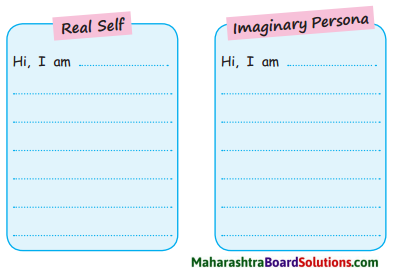
Write a few lines about yourself – your name, appearance. family, the place where you live, your school, your friends. neighbours. relatives, your likes, dislikes, hobbies, what you are good at, etc.

Now create an imaginary ‘persona’ for yourself. It should be quite different from your real self. Or, you may choose a fictional character – a character from a novel, story, etc. Write a few lines about this imaginary persona and introduce yourself in that role.

Maharashtra Board Class 9 My English Coursebook Solutions Chapter 1.5 The Necklace 1

Imaginary Persona

  • Hi, I am Vishalbahu.
  • I like to obstruct and punish criminals.
  • I simply love stunts and fights.
  • I enjoy flying secretly all over the world.
  • I don’t like people who trouble common people.
  • I hate crimes and injustice caused to innocent people.
  • I find exercises, combats very interesting.
  • I can do any impossible things in the world.
  • I am good at every difficult or hard work.
  • I am not so good at office work and housework.

Maharashtra Board Class 9 My English Coursebook Solutions Chapter 1.5 The Necklace

A Turn by Turn Story:

Form groups of 6-8. One person chooses any familiar object and announces its name in the group. All the others talk about it one by one, adding one (new) complete sentence at a time. The person who has chosen the object takes down all the sentences. After 2-3 rounds, read the sentences together and try to build a story around them.

Part I

English Workshop:

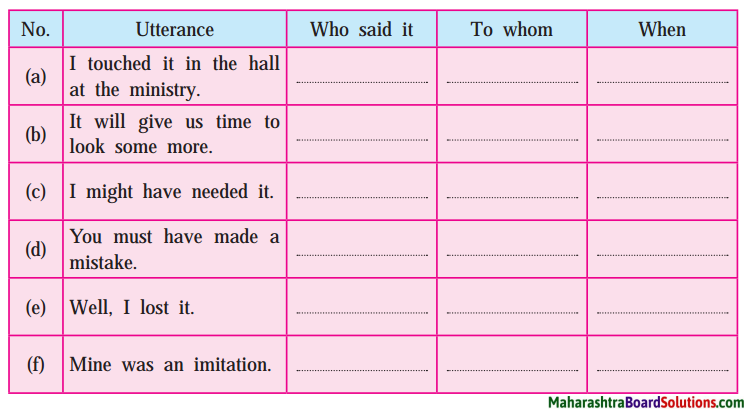
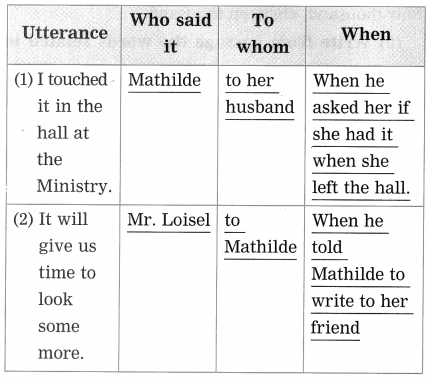
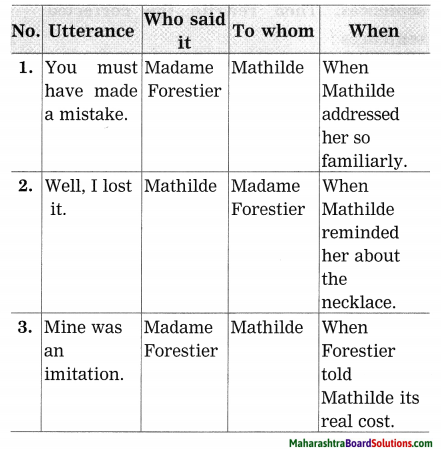
1. Read each of the following sentences aloud. Write who said it and to whom.

Question 1.
(a) Look. here’s something for you.”
(b) “Why. the dress you go to the theater in!”
(c) ‘I would rather not go to the party.”
(d) ‘Choose, my dear.”
(e) You have nothing else?”
(f) “Would you lend me this, just this?”
(g) “What ! … How ! … That’s impossible!
Answer:
(b) Mathilde’s husband said to Mathilde.
(c) Mathilde said to her husband.
(d) Madame Forestier said this to Mathilde.
(e) Mathilde said this to Madame Forestier.
(f) Mathilde said this to Madame Forestier.
(g) Mathilde’s husband said this to Mathilde.

Maharashtra Board Class 9 My English Coursebook Solutions Chapter 1.5 The Necklace

2. Read the conversations in the story aloud using proper intonation.

Question 1.
Read the conversations in the story aloud using proper intonation.

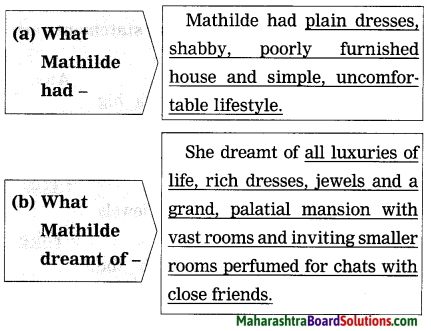
3. Write a few lines about what Mathilde had and what she dreamt about.

Question 1.
Write a few lines about what Mathilde had and what she dreamt about.

4. Write what you think about the following thoughts and actions of Mathilde.

Question a.
Mathilde was beautiful, and so she wanted to marry an aristocrat.
Answer:
She was not wrong to think so, because I think every woman, beautiful or not, wants to marry a person, who has a good position and wealth.

Question b.
Mathilde was sad because she did not get any luxuries.
Answer:
Her thinking was not correct. Not every one gets a luxurious life. She should have managed in whatever they were earning and lived a simple but happy life.

Maharashtra Board Class 9 My English Coursebook Solutions Chapter 1.5 The Necklace

Question c.
Mathilde felt that her house was shabby and poorly furnished.
Answer:
Her feelings are wrong because it depends on the people who live in the house to keep the house clean, tidy and beautiful with whatever furniture, things they have got.

Question d.
Mathilde wanted other people to envy her.
Answer:
Mathilde’s thought was wrong because happiness does not depend on making the people envy you. She wished that people would have admired her if she had rich dresses and jewels.

Question e.
Mathilde was not happy to see the invitation.
Answer:
Mathilde did not care about the importance of the invitation, her husband had received. She was thinking only about the dress she would wear there.

Question f.
Mathilde wanted a new dress for herself.
Answer:
Mathilde wanted a new dress for herself only to selfishly corner her husband for extorting money from him to buy a new dress. Her thought was silly and unreasonable.

Maharashtra Board Class 9 My English Coursebook Solutions Chapter 1.5 The Necklace

Question g.
Mathilde borrowed a diamond necklace from her friend and wore it to the party.
Answer:
Borrowing a diamond necklace was not a dire need of Mathilde. She could have used flowers instead; but she wanted another woman’s necklace to make a show of her beauty. She did not understand that borrowing is begging.

Question h.
Mathilde lost her necklace.
Answer:
Mathilde was so overwhelmed and captivated by her success that she was not aware of her responsibility of safe-keeping the borrowed necklace carefully. She lost it only because of her carelessness.

Maharashtra Board Class 9 My English Coursebook Solutions Chapter 1.5 The Necklace

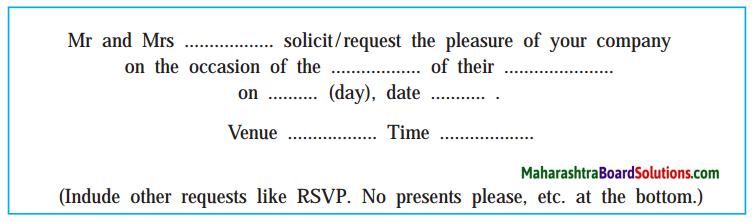
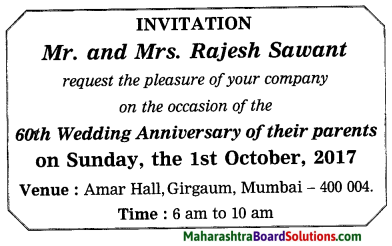
5. Prepare a formal invitation using the following format:

Maharashtra Board Class 9 My English Coursebook Solutions Chapter 1.5 The Necklace 2

Language Study:

6. Read the phrases: The necklace, an error, all these things, another woman, one evening, her husband. In all these phrases we see some words used before the nouns. They specify or make it clear what noun we are talking about. These words that are used at the beginning of a noun phrase are known as determiners.
Determiners include articles (a, an, the), possessive pronouns (my, our, your, her, etc.), words like this, that, much, many, all, and numbers.

Part II

Chit-chat:

  • Have you ever lost anything valuable?
  • Name a book/movie that made you think.
  • What was it about?
  • What was the best part about the book/movie?

Maharashtra Board Class 9 My English Coursebook Solutions Chapter 1.5 The Necklace

English Workshop:

1. Spot and circle the error m the following sentences. Then rewrite the sentences after correcting them.

Question 1.
Spot and circle the error m the following sentences. Then rewrite the sentences after correcting them.
(a) But they could not found it.
(b) You must right to your friend.
(c) At the end of one week, they have lose all hope.
(d) He would borrowed the rest.
(e) You should have return it sooner.
(f) And this life lasted for ten year.
(g) “No, I am Mathilde bisel.”
(h) Madame Forestier were stunned.
Answer:
(a) But they could not find it.
(b) You must write to your friend.
(c) At the end of one week, they have lost all hope.
(d) They stared at each other
(e) He would borrow the rest.
(f) You should have returned it sooner.
(g) And this life lasted ten years.
(h) “No, I am Mathilde Loisel.”
(i) Madame Forestier was stunned.

Maharashtra Board Class 9 My English Coursebook Solutions Chapter 1.5 The Necklace

2. Complete the following table.

Maharashtra Board Class 9 My English Coursebook Solutions Chapter 1.5 The Necklace 3
Question 1.
Complete the following table.
Maharashtra Board Class 9 My English Coursebook Solutions Chapter 1.5 The Necklace 4
Maharashtra Board Class 9 My English Coursebook Solutions Chapter 1.5 The Necklace 5

3. Write what you think about the following thoughts and actions of Mathilde

Question a.
Mathilde was shocked despaired over the loss of her necklace
Answer:
I think her reaction to the loss of her necklace was natural. But she herself was responsible for the tragedy. Her stubborn behaviour is to be blamed for the loss.

Question b.
Mathilde wrote a note to her friend as dictated by her husband.
Answer:
The couple couldn’t find the lost necklace even after a long search. They expected to find it some day. For that they needed some more time and Mathilde was compelled to write the false letter to I her friend. Her action of telling lies and betraying her friend was immoral and ridiculous.

Question c.
Mathilde and her husband decided to replace the necklace.
Answer:
I think that their decision of replacing the necklace was immature and insincere. Instead, they should have clearly and openly told Madame Forestier about the incident. It could have saved them from the horrible life they had to face and the dreadful debt they had to pay.

Maharashtra Board Class 9 My English Coursebook Solutions Chapter 1.5 The Necklace

Question d.
Mathilde returned the diamond necklace to her friend
Answer:
I think, it was her moral responsibility to return the borrowed diamond necklace immediately after the party day but she delayed. She did so to hide the fact that she had lost the diamond necklace. Her negligence made her to make one more wrong.

Question e.
Mathilde did not tell her friend about the loss and replacement.
Answer:
It was another big mistake she committed. It was her thoughtless action. Had she told her friend about the loss of the necklace, further ruinous incidents wouldn’t have occurred and the remedy for the problem would have been very simple and easy.

Question f.
Mathilde worked very very hard to pay the debt.
Answer:
Mathilde’s action shows that she was a completely transformed woman. She had changed her attitude towards her lifestyle. She forgot her dreams of living a luxurious life. She worked hard and saved money for repaying the debt. She felt duty-bound for coming out of the devastating situation, she was responsible for.

Maharashtra Board Class 9 My English Coursebook Solutions Chapter 1.5 The Necklace

Question g.
Mathilde and her husband paid off the debt in ten years.
Answer:
The income of Mathilde’s husband was meagre. So both of them worked very hard for ten long years to save money for repaying the debt. They curtailed their needs severely, her husband worked extra to ease the burden of debt. Somehow they faced the woes together bravely and sincerely.

4. Form pairs. Discuss how ‘Part II’ of the story could have been different. Write your storyline in the form of bullets showing the main events.

Question 1.
Form pairs. Discuss how ‘Part II’ of the story could have been different. Write your storyline in the form of bullets showing the main events.
Answer:
The cabman, who dropped them at their door found the necklace after two days while cleaning his cab → behind the space of the seats → fallen from the gaps of the seats → remembered the lady wearing the necklace → was an honest and God-fearing man → went to their house →handed over the necklace to them → it could have changed the whole story.

Maharashtra Board Class 9 My English Coursebook Solutions Chapter 1.5 The Necklace

5. Imagine what must have happened after Mathilde’s friend discovered that the diamonds were real. Do you think she would return it to Mathilde? Would that make Mathilde happy?

Question 1.
Imagine what must have happened after Mathilde’s friend discovered that the diamonds were real. Do you think she would return it to Mathilde? Would that make Mathilde happy?
Answer:
Mathilde’s friend was rich but a kind-hearted and generous woman. She knew that Mathilde had to face many miseries for ten years. I think she would return the necklace to Mathilde. Mathilde would be happy to find some relief after ruinous sufferings.

6. Discuss the following and write about it in your own words in 5-6 lines.

Question 1.
Discuss the following and write about it in your own words in 5-6 lines.
(a) What would you do, if something like this happens to you?
(b) What opinion do you form about Mathilde’s husband from lier story?
(c) Which events in the story (Part I and Part II) changed Mathilde’s life?
Answer:
(Use the following points to write your answers.)
(a) Points:

  • would go to friend and explain-
  • would ask for time to return the money for the necklace –
  • since friend rich, she may have accepted the idea.)

(b) Points:

  • Husband
  • good – kind – supportive
  • considerate – a very nice human being.

(c) Points :

  • Invitation to party – borrowing the necklace
  • losing the necklace – returning the necklace by borrowing money

Maharashtra Board Class 9 My English Coursebook Solutions Chapter 1.5 The Necklace

Language study:

7. Read the table of verb forms given below.

Question 1.
Read the table of verb forms given below.
Maharashtra Board Class 9 My English Coursebook Solutions Chapter 1.5 The Necklace 6

The base form is used as an infInitive: You may go. She will go.
in orders: Go home. and in the simple present tense: I go to school. We go
home. Do you go there every day? The children/They go up, etc.
Note that we use the ‘-s form’ with ‘he’, ‘she’, ‘it’, third-person singular subjects to show the simple present.
The past tense form has ‘-ed’ at the end. But many commonly used verbs have different past tense forms. Examples: Came, went, spoke.
. The ‘-ing’ form is known as the present participle. It is used with forms of ‘be’ to show continuous action – Examples: I am eating. You were eating. She was eating.
It is also used in certain constructions like He sat copying a manuscript.

The past participle used with forms of ‘have’ shows completed action – Examples: I have eaten. They have come, etc.
It is also used in certain constructions like ‘They looked at each other, stunned!’
It is also used in passive constructions. We will learn about ‘passive voice’ later.

Make a table of verb forms for your own reference. Try to arrange the verbs in alphabetical order. Keep adding new verbs to your table from time to time. When you write, check your work to see whether you have used the correct verb form.

Question 1.
Read the different following information about different forms of verbs:
Answer:
1. The base form is used as an infinitive: You may go. She will go.
In orders: Go home. And in simple present tense: I go to school. We go home. Do you go there every day? The children/They go up, etc.

2. Note that we use the e-s form’ with ‘he’, ‘she’, ‘it’, third person singular subjects to show
the simple present.

3. The past tense form has ‘-ed’ at the end. But many commonly used verbs have different past tense forms. Examples: came, went, spoke.

4. The ‘-ing’ form is known as the present participle. It is used with forms of ‘be’ to show continuous action – Examples: I am eating. You were eating. She was eating. It is also used in certain constructions like : He sat copying a manuscript.

5. The past participle used with forms of ‘have’ shows completed action.
Examples: I have eaten. They have come, etc.
It is also used in certain constructions like ‘They looked at each other, stunned!’

Maharashtra Board Class 9 My English Coursebook Solutions Chapter 1.5 The Necklace

My English Coursebook 9th Class Solutions Chapter 1.5 The Necklace Additional Important Questions and Answers

Read the following passage and do the activities :

Simple Factual Activities :

Question 1.
Say whether the following statements are True or False :
Answer:

  1. Mathilde was married to a big officer at the Ministry of Education. – False
  2. Mathilde’s former schoolmate was very rich. – True
  3. Mathilde had rich dresses, jewels and everything that she loved. – False
  4. Mathilde was happy with the invitation brought by her husband – False

Question 2.
Who said to whom? Complete the table :
(Answers are directly given.)
Answer:

DialogueWho saidTo whom
1. “Here’s something for you.”Mathilde’s husbandMathilde
2. “What do you want me to do with that?”MathildeMathilde’s husband

Question 3.
What did the envelope hold?
Answer:
The envelope held an invitation from the Minister of Education and Mme. Georges Rampouneau to Mr and Mrs. Loisel.

Maharashtra Board Class 9 My English Coursebook Solutions Chapter 1.5 The Necklace

Question 4.
State whether the following statements ) are True or False :
Answer:

  1. Mathilde’s husband suggested her to wear the dress she wore when she went to the theatre. – True
  2. Mathilde was upset for three days because she had no good dress to wear. – False
  3. Mathilde was ready to wear flowers. – False
  4. She demanded four hundred francs for her dress. – True

Question 5.
Write who said it and to whom :
“But I don’t know what you like.”
Answer:
Madame Forestier said this to Mathilde.

Question 6.
Choose the correct option from the brackets and complete the sentences :
(Answers are directly given.)
Answer:

  1. Mathilde went to Madame Forestier. (The jeweller/Madame Forestier)
  2. Madame Forestier took out a large box from her mirrored wardrobe. (large box/necklace)
  3. Mathilde tried on the jewellery in the mirror. (dress/jewellery)
  4. Mathilde discovered a diamond necklace in Madame Forestier’s large box. (a black satin box/a diamond necklace)

Question 7.
What did Madame Forestier’s large box contain?
Answer:
Madame Forestier’s large box contained bracelets, necklaces and other jewellery.

Maharashtra Board Class 9 My English Coursebook Solutions Chapter 1.5 The Necklace

Question 8.
Complete the following sentences using the information given in the passage:
(Answers are directly given.)
Answer:

  1. Mathilde was floating in a cloud of happiness.
  2. Both, husband and wife left at about four o’clock in the morning.
  3. In front of the mirror Mathilde took a final look at herself in all her glory.
  4. She no longer had the necklace round her neck.

Question 9.
Who said it and to whom :

Question a.
“I no longer have Madame Forestier’s necklace.”
Answer:
Mathilde said this to her husband.

Question 10.
Complete the following sentences with the information given in the passage :
(Answers are directly given.)
Answer:

  1. She remained in her ball dress all night, her mind blank.
  2. At the end of one week they had lost all hope.
  3. The husband and wife were sick with grief and anguish.
  4. Mr. Loisel said, “We must consider how to replace the jewel.

Question 11.
Who said this to whom :
1. “I might have needed it.”
2. “Don’t sell it for three days.”
Answer:
1. Madame Forestier said this to Mathilde.
2. Mr. Loisel and Mathilde said to the jeweler.

Maharashtra Board Class 9 My English Coursebook Solutions Chapter 1.5 The Necklace

Question 12.
Say if the following statements are True or False:
(Answers are directly given.)
Answer:

  1. Madame Forestier was rather angry with Mathilde for returning the necklace late. – True
  2. A string of diamonds they found at Palais Royal was worth thirty-six thousand francs. – False
  3. The new necklace cost them thirty- four thousand francs. – False
  4. Mr Loisel borrowed money from every type of money-lender. – True

Question 13.
Complete the sentences using the information from the passage :
(Answers are directly given.)
Answer:

  1. At the end of ten years, they had paid off everything.
  2. How little is needed for one to be ruined or saved!
  3. Mathilde played her part heroically.
  4. She came to know the drudgery of housework.

Question 14.
Answer the following questions :

Question a.
Who is Madame Loisel?
Answer:
Madame Loisel is Mathilde.

Question b.
What work did Mathilde’s husband do for a tradesman?
Answer:
Mathilde’s husband did accounts for a tradesman.

Maharashtra Board Class 9 My English Coursebook Solutions Chapter 1.5 The Necklace

Question 15.
Say whether the following statements are True or False:
(Answers are directly given.)
Answer:

  1. Madame Forestier recognised her dear friend immediately. _ False
  2. Madame Forestier still looked young, beautiful and charming. – True
  3. It had taken them ten years to pay for the imitation diamond neclace. – True
  4. The imitation was not worth five hundred francs at most! – False

Complex Factual Activities :

Question 1.
Complete the following :
(Answers are directly given.)
Answer:
Maharashtra Board Class 9 My English Coursebook Solutions Chapter 1.5 The Necklace 7

Question 2.
Why was Mathilde married to a minor official’?
Answer:
Mathilde was a pretty, charming girl but was born in a family of clerks. This had decided her future. Because of her ill-fate she had to marry a ‘minor official’.

Question 3.
Why did Mathilde weep with misery after visiting her schoolmate?
Answer:
Mathilde wept with misery after visiting her schoolmate because she couldn’t get the riches and the luxurious life in which the schoolmate was relishing. She dreamt of all those things her friend was enjoying. She herself could not have them because of her destiny.

Question 4.
Mathilde was sad, restless and anxious though her dress was ready because ….
Answer:
Mathilde was sad, restless and anxious though her dress was ready because she had no jewels, she had not a single precious stone to wear. She almost had decided not to go to the party.

Maharashtra Board Class 9 My English Coursebook Solutions Chapter 1.5 The Necklace

Question 5.
Mathilde’s husband turned pale because….
Answer:
Mathilde’s husband turned pale because he had been saving the exact amount demanded by Mathilde to buy a gun for a hunting summer, in the country near Nanterre. He would lose his opportunity for buying dress for Mathilde.

Question 6.
Write the following sentences in order of their occurrence :
1. Her friend put a large box of jewellery before Mathilde.
2. She fled home with her treasure.
3. Mathilde went to Madame Forestier.
4. She discovered a diamond necklace.
Answer:
3. Mathilde went to Madame Forestier.
1. Her friend put a large box of jewellery before Mathilde.
4. She discovered a diamond necklace.
2. She fled home with her treasure.

Question 7.
Which sentences tell us that Mathilde greatly desired the necklace?
Answer:
The Sentences: Her heart began to beat with uncontrolled desire. Her hands trembled as she took it. She stood lost in ecstasy as she looked at herself in the mirror. She asked her friend anxiously, “Would you lend me this, just this?”

Maharashtra Board Class 9 My English Coursebook Solutions Chapter 1.5 The Necklace

Question 8.
Complete the web :
Answer:
Maharashtra Board Class 9 My English Coursebook Solutions Chapter 1.5 The Necklace 12

Question 9.
Describe the efforts made by the couple to find the lost necklace:
Answer:
They looked in the folds of Mathilde’s dress, in the folds of her cloak, in her pockets, everywhere. Mr. Loisel walked over the whole route they had walked to find the necklace. He went to the police station, to the newspapers to offer a reward, to the cab companies and everywhere they expected to find the necklace but found nothing.

Question 10.
Complete the web
(Answers are directly given.)
Answer:
Maharashtra Board Class 9 My English Coursebook Solutions Chapter 1.5 The Necklace 14

Question 11.
How did life of Mathilde change after the horrible incident?
Answer:
Mathilde’s life was completely changed. She dismissed her maid and did extremely unpleasant labours in the kitchen. She washed the dishes, the dirty linen, she carried the garbage down to the street every morning, carried up the water and dressed like a common woman. She had to bargain at markets, quarrel and face insults over every miserable sou. She lived the horrible life of the very poor.

Maharashtra Board Class 9 My English Coursebook Solutions Chapter 1.5 The Necklace

Question 12.
Arrange the following sentences in order of their occurence:
1. Mathilde tells Madame Forestier about her hard time and miseries.
2. Madame Forestier tells that the necklace was an imitation.
3. Madame Forestier did not recognise Mathilde because she was completely changed.
4. Mathilde met Madame Forestier in the Champs Elysees on Sunday.
Answer:
4. Mathilde met Madame Forestier in the Champs Elysees on Sunday.
3. Madame Forestier did not recognise Mathilde because she was completely changed.
1. Mathilde tells Madame Forestier about her hard time and miseries.
2. Madame Forestier tells that the necklace was an imitation.

Activities based on vocabulary:

Question 1.
Match the words in Column ‘A’ with their meaning in Column ‘B’ :

‘A’‘B’
1. aristocrat(a) destiny
2. fate(b) great success
3. shabby(c) nobleman
4. triumph(d) nearly worn out

Answer:

‘A’‘B’
1. aristocrat(c) nobleman
2. fate(a) destiny
3. shabby(d) nearly worn out
4. triumph(b) great success

Maharashtra Board Class 9 My English Coursebook Solutions Chapter 1.5 The Necklace

Question 2.
Write any four words from the passage that show the feeling of great pain:
Answer:
regret, despair, misery and tormented.

Question 3.
Write English terms that stand for the French terms Monsieur and Mme:
Answer:
Mr and Mrs.

Question 4.
Write the long forms of the following contracted forms:

  1. Let’s
  2. don’t
  3. hadn’t
  4. what’s.

Answer:

  1. Let us
  2. do not
  3. had not
  4. what is.

Question 5.
Write four words from the passage that reflect (show) that the person is in difficult situation.
Answer:
stammered, stunned, distressed, stuttered.

Maharashtra Board Class 9 My English Coursebook Solutions Chapter 1.5 The Necklace

Question 6.
Fill in the blanks with proper letters so as to find the words: (Answers are directly given.)
Answer:
1. the objects such as rings, necklaces, etc. that
Maharashtra Board Class 9 My English Coursebook Solutions Chapter 1.5 The Necklace 8

2. a large cupboard for hanging clothes.
Maharashtra Board Class 9 My English Coursebook Solutions Chapter 1.5 The Necklace 9

3. a piece of ornament consisting of chain of beads, diamonds, etc. worn around the neck =
Maharashtra Board Class 9 My English Coursebook Solutions Chapter 1.5 The Necklace 10

4. a strong wish to have something =
Maharashtra Board Class 9 My English Coursebook Solutions Chapter 1.5 The Necklace 11

Question 7.
Write any four adjectives from the passage.
Answer:
elegant, gracious, smiling, panic-stricken.

Question 8.
Write any four adverbs with ‘-ly’ from the passage.
Answer:
wildly, fmally, sadly, suddenly.

Question 9.
Which words from the passage are related with ‘success’?
Answer:
full of joy, triumph, cloud of happiness, glory.

Maharashtra Board Class 9 My English Coursebook Solutions Chapter 1.5 The Necklace

Question 10.
Write the meanings of:
(Answers are directly given.)
Answer:

  1. glimmer of hope: a small sign of hope/success.
  2. a hollow, pale figure: a person having empty mind and almost white face because of frustration and exhaustion.
  3. sick with grief and anguish: mentally ill because of great sadness and pain.
  4. cloak: ladies’ garment without sleeves, worn over their other clothes.

Question 11.
Find and write all the numbers mentioned in the passage :
Answer:
Forty thousand, thirty-six thousand, thirty- four thousand, eighteen thousand.

Question 12.
Write from passage the words related to money matters.
Answer:
worth, sell, borrow, notes, agreements, dealt, money-lender.

Maharashtra Board Class 9 My English Coursebook Solutions Chapter 1.5 The Necklace

Question 13.
Write from the passage the phrases related to ‘housework’.
Answer:
Drudgery of housework, odious labours of the kitchen, washing dishes, washing dirty linen, carry the garbage, carry up the water, bargain at markets.

Question 14.
Match from the passage the adjectives in Column ‘A’ with the nouns in Column ‘B’ :

‘A’‘B’
1. dreadful(a) sou
2. miserable(b) labours
3. horrible(c) debt
4. odious(d) life

Answer:

‘A’‘B’
1. dreadful(c) debt
2. miserable(a) sou
3. horrible(d) life
4. odious(b) labours

Maharashtra Board Class 9 My English Coursebook Solutions Chapter 1.5 The Necklace

Question 15.
Match the words in Column ‘A’ with their meaning in Column ‘B’ :

‘A’‘B’
1. familiarly(a) artificial/not real
2. astonished(b) in a friendly manner
3. imitation(c) very surprised
4. innocent(d) having not done anything wrong

Answer:

‘A’‘B’
1. familiarly(b) in a friendly manner
2. astonished(c) very surprised
3. imitation(a) artificial/not real
4. innocent(d) having not done anything wrong.

Maharashtra Board Class 9 My English Coursebook Solutions Chapter 1.5 The Necklace

Question 16.
Write from the passage the verbs that end : with ‘-ed’.
Answer:
astonished, addressed, stammered, uttered, changed, stunned, smiled, moved.

Activities based on contextual grammar :

Question 1.
Find and write the adjectives from the passage for the following nouns :

  1. house
  2. girl
  3. official
  4. mansion.

Answer:

  1. shabby and poorly furnished
  2. pretty and charming
  3. minor
  4. grand and palatial.

Question 2.
He turned a little pale.
(Change the sentence into simple present Tense.)
Answer:
He turns a little pale.

Maharashtra Board Class 9 My English Coursebook Solutions Chapter 1.5 The Necklace

Question 3.
Choose the correct option of the question tag:
I can give you four hundred francs.
(i) , can I?
(ii) , don’t I?
(iii) , can’t I?
(iv) , couldn’t I?
Answer:
I can give you four hundred francs, can’t I?

Question 4.
She replied,” I am upset that I have no jewels.” (Choose the correct option to transform it into Reported speech.)
a. She replied that I was upset that I had no jewels.
b. She replied that she is upset that she has no jewels.
c. She replied she was upset that she has no jewels.
d. She replied that she was upset that she had no jewels.
Answer:
c. She replied she was upset that she has no jewels.

Question 5.
Choose the correct wh-question from the alternatives to get the underlined part as an answer:
She discovered, in a black satin box, a diamond necklace.
(a) What did she discover in a black satin box?
(b) When did she discover a diamond necklace in a black satin box?
(c) Where did she discover a diamond necklace?
(d) Why did she discover a diamond necklace?
Answer:
(c) Where did she discover a diamond necklace?

Question 6.
Write the following sentence in simple present tense:
She threw her arms around her friend’s neck.
Answer:
She throws her arms around her friend’s neck.

Maharashtra Board Class 9 My English Coursebook Solutions Chapter 1.5 The Necklace

Question 7.
Find the determiners from the following sentences and underline them :
(Answers are directly underlined.)
Answer:
1. They were dropped off at their door in the Rue des Martyrs.
2. Forgetting everything in the triumph of her beauty.

Question 8.
Do as directed :

  1. She took a final look at herself. (Write simple present tense form for the underlined word.)
  2. The day of the party arrived. (Rewrite the sentence using simple future tense.)
  3. She danced wildly (Use past progressive tense and rewrite the sentence.)

Answer:

  1. She takes a final look at herself.
  2. The day of the party will arrive.
  3. She was dancing wildly.

Question 9.
It was worth forty thousand francs.
(Use ‘They’ in place of ‘It’ and rewrite the correct sentence.)
Answer:
They were worth forty thousand francs.

Maharashtra Board Class 9 My English Coursebook Solutions Chapter 1.5 The Necklace

Question 10.
He went to get the new necklace. (Rewrite the sentence using simple present tense for the underlined verb.)
Answer:
He goes to get the new necklace.

Question 11.
Change the following sentences in passive voice :
1. They dismissed their maid.
2. They rented a garret under the roof.
Answer:
1. Their maid was dismissed by them.
2. A garret under the roof was rented by them.

Question 12.
How strange life is!
(Make it an assertive sentence,)
Answer:
Life is very strange.

Maharashtra Board Class 9 My English Coursebook Solutions Chapter 1.5 The Necklace

Question 13.
Complete the table with the correct forms of the given verbs.
Answer:
Maharashtra Board Class 9 My English Coursebook Solutions Chapter 1.5 The Necklace 15

Do as directed :

Question 1.
1. She had no rich dresses : (Make the sentence affirmative without changing the meaning.)
2. These were the only things she loved. (Make the sentence negative without changing the meaning.)
Answer:
1. She had poor dresses.
2. She loved nothing but (except) these things.

Question 2.
They could not find it.
(Begin with It could not… and change the voice.)
Answer:
It could not be found by them.

Maharashtra Board Class 9 My English Coursebook Solutions Chapter 1.5 The Necklace

Question 3.
He said to Mathilde, “Tell her you have broken the clasp of the necklace.”
(Change into Indirect speech.)
Answer:
He told Mathilde to tell her she had broken the clasp of the necklace.

Question 4.
Use simple present tense form and rewrite the following sentences :

Question a.
He went to the police station.
Answer:
He goes to the police station.

Question b.
They lost all hope.
Answer:
They lose all hope.

Maharashtra Board Class 9 My English Coursebook Solutions Chapter 1.5 The Necklace

Question 5.
How you’ve changed!
(Make an assertive sentence.)
Answer:
You’ve completely changed,

Question 6.
They were similar.
(Make it negative without changing meaning.)
Answer:
They were not different.

Question 7.
I am Mathilde Loisel.
(Choose correct Question Tag,)
(i) , am I?
(ii) , amn’t I?
(iii) , aren’t I?
(iv) , don’t I?
Answer:
(iii) , aren’t I?

Maharashtra Board Class 9 My English Coursebook Solutions Chapter 1.5 The Necklace

Question 8.
Fill in the table with correct verb forms.
(Answers are directly given.)
Answer:

base formPast tensePast participle
bringbroughtbrought
seesawseen
feelfeltfelt
singsangsung

Personal Response:

Question 1.
What do you feel when you receive an invitation for a party? Why?
Answer:
When I receive an invitation for a party, I feel very happy because we get to meet our friends and relatives at the party and we can spend some time rejoicing. We also get to eat tasty food in the party.

Maharashtra Board Class 9 My English Coursebook Solutions Chapter 1.5 The Necklace

Question 2.
Was Mathilde’s husband a considerate person? How do you know that?
Answer:
Mathilde’s husband was really a very considerate person. Though his wife was obstinate and stubborn, he tried to fulfill all her unreasonable wishes. He sacrificed his own hunting joy and gave his savings to please Mathilde. This shows that he was a very considerate person.

Question 3.
Mathilde asked her friend, “Would you lend me this, just this?”
Why, do you think, did Mathilde say ‘just this’?
Answer:
I think, Mathilde was fully satisfied with the diamond necklace she got. It looked beautiful in her neck as she had desired. So she did not want anything else except that diamond necklace and so she insisted to lend her that and only that necklace.

Question 4.
Why, do you think, did Mathilde not notice the loss of her necklace?
Answer:
I think, she was thinking only about the triumph of her beauty and success in the party. She had lost her attention towards her necklace. Secondly, they left the party early in the morning, could not find a cab and had to walk for a long distance. This also must be the cause of the distraction.

Maharashtra Board Class 9 My English Coursebook Solutions Chapter 1.5 The Necklace

Question 5.
Do you think, the arrangement made by Mr Loisel with the jeweller, was fair? Give your reason:
Answer:
Yes I think the arrangement was fair. According to the arrangement the jeweller would take the necklace back for thirty-four thousand if the other (the lost) necklace was found before the end of February. It would help them to get some more time to find the necklace and again they would ; be losing only two thousand francs instead of thirty- 5 six thousand.

Question 6.
Why does Madame Forestier speak coldly to Mathilde?
Answer:
Mathilde returned the necklace after so many days. Madame Forestier did not like it and was angry with Mathilde. It is the usual tradition to return the borrowed things immediately after the work is done, but Mathilde did not do it. By speaking coldly Madame Forestier expresssed her anger and displeasure.

Question 7.
What is meant by the horrible life of the very poor?
Answer:
The horrible life of the poor means a very tiring, bad, unpleasant and painful life. The poor are the people who live a miserable life with very little or no money at all. They have no money to satisfy their day-to-day basic needs. They have to work hard all the day to make both ends meet. Mathilde experienced this horrible life of the poor for saving money to clear the debt.

Maharashtra Board Class 9 My English Coursebook Solutions Chapter 1.5 The Necklace

Question 8.
Write what you think about the following thought and action of Mathilde :
Mathilde told her friend about the lost necklace.
Answer:
Mathilde was now a relieved person. Though it was her fault, she must have thought that she should tell the truth to her friend and tell her how she struggled for ten long years that made her look old.

Question 9.
Who do you think was responsible for Mathilde’s misery? Was it her friend, she herself, her husband or the circumstances?
Answer:
It was Mathilde who was mainly responsible for her misery. Her wilfulness and obstinate behaviour were the root cause of the disastrous incident. She borrowed the necklace and lost it and that led to her misery. Her friend and her husband were, in no way, responsible for it. Of course the circumstances, to some extent too are responsible for it.

Oral Work:

Question 1.
Read the conversations in the story aloud using proper intonation.

Maharashtra Board Class 9 My English Coursebook Solutions Chapter 1.5 The Necklace

Writing Skill:

Question 1.
Prepare a formal invitation using the format given on the textbook page no. 27.
Answer:
Maharashtra Board Class 9 My English Coursebook Solutions Chapter 1.5 The Necklace 13

Activities Based on Language study

Do as directed!

Question 1.
Complete the words by using correct letters :

  1. o _ h e r
  2. y o _ n g
  3. p _ o u d
  4. s p e _ k

Answer:

  1. o t h e r
  2. y o u n g
  3. p r o u d
  4. s p e a k

Question 2.
Copy the following sentences correctly in your notebook :
Answer:
1. He said,” Here’s something for you!”
2. “What’s the matter? Let’s see, Mathilde.”

Maharashtra Board Class 9 My English Coursebook Solutions Chapter 1.5 The Necklace

Question 3.
Put the following words in alphabetical order:
1. glory, street, amount, pleasure.
2. mansion, mirror, mutter, matter.
Answer:
1. amount, glory, pleasure, street.
2. mansion, matter, mirror, mutter.

Question 4.
Punctuate the following sentences :
1. you could wear flowers he said they are very fashionable at this time of year
2. what is the matter asked her husband
Answer:
1. “You could wear flowers,” he said,
“They are very fashionable at this time of year.”
2. “What is the matter?” asked her husband.

Maharashtra Board Class 9 My English Coursebook Solutions Chapter 1.5 The Necklace

Question 5.
Write four small words (minimum letters each) using the letters in the given word:
‘schoolmate’ :
Answer:

  1. school
  2. come
  3. late
  4. home.

Question 7.
Write related words as shown in the example :
(Answers are directly given.)
Answer:
Maharashtra Board Class 9 My English Coursebook Solutions Chapter 1.5 The Necklace 16

Question 8.
Complete the following word-chain withing for.m. Add four words, each beginning with the last letter of the previous word:
going → ………………. →……………. →…………… → ………….. .
Answer:
going → growing → gaining → guarding → grumbling.

Question 9.
Make your own meaningful sentence by using the phrase ‘to be aware of’.
Answer:
We should be aware of the consequences of bad habits.

Maharashtra Board Class 9 My English Coursebook Solutions Chapter 1.5 The Necklace

Question 10.
Add a prefix or suffix to make new words. and use any one of the root words in your own sentence:
1. annoy
2. exhaust
Answer:
1. annoyance
2. exhaustion
Sentence: There is no need to exhaust yourself for such a petty job.

Question 11.
Add a clause to expand the sentence meaningfully:
I don’t remember ………………………………… .
Answer:
I don’t remember when I met him last.

Maharashtra Board Class 8 English Solutions Chapter 1.3 The Pilgrim

Balbharti Maharashtra State Board Class 8 English Solutions Chapter 1.3 The Pilgrim Notes, Textbook Exercise Important Questions and Answers.

Maharashtra State Board Class 8 English Solutions Chapter 1.3 The Pilgrim

Class 8 English Chapter 1.3 The Pilgrim Textbook Questions and Answers

Warming Up:

Make groups and discuss the following using the given points:

Question a.
What fatal dangers/problems did mankind face centuries ago, but are no longer a threat today?
Answer:
(Points : wild animals – lack of food – certain diseases – climate etc.)

Question b.
Name a few scientists/explorers/ social reformers / inventors / discoverers, who spent most of their lives to find solutions to some major problems/ setbacks that mankind faced.
Answer:
(Points : Alexander Fleming, Edison, Ronald Ross, Christopher Columbus, Wright brothers, Raja Ram Mohan Roy, Galileo, Marie Curie, Savitribai Phule, Babasaheb Ambedkar, etc.)

Question c.
Did they themselves suffer from those problems/setbacks?
Answer:
(Points : most did not)

Question d.
What inspired them to spend the best part of their lives to research and share their findings?
Answer:
(Points : a passion for well-being of ! mankind – personal goals and aims – interest in the subject – curiosity – the urge to improve society and help others – etc.)

2. Read and understand the following poetic devices:

(A) If two or more words in the same line convey the some meaning, the Figure of Speech in thut line is called Tautology.
For example: It brought joy and cheer.
They groaned with aches and pains.

(B) ‘Poets often change the proper grammatical order of words in the ¡inc of a poem, in order to make the lines rhyme or to emphasize upon something. The Figure of Speech in such lines is called inersion’ or Anastrophe.’
For example: Up came the sun. Down the hill, it flowed.

(C) When a question is asked in order to create a dramatic effect and not to get an answer, in a line of the poem, the Figure of Speech used is called
Interrogation / Rhetorical Questions:
For example: What is this life, if full of care?
When can their glory fade?

1.Pick out words from the poem to fill in the web diagram. They should be related to the theme in the web.
Maharashtra Board Class 8 English Solutions Chapter 1.3 The Pilgrim 1
Answer:
Maharashtra Board Class 8 English Solutions Chapter 1.3 The Pilgrim 7

2.The entire poem is metaphorical (Implied comparison).
Match the words in Column A with what they imply in Column B.

Maharashtra Board Class 8 English Solutions Chapter 1.3 The Pilgrim 8
Answer:
(1) pilgrim – a dutiful man
(2) journey – life
(3) evening or close of day – old age
(4) chasm, deep and wide – threat to life
(5) building a bridge – solving a problem /getting rid of a threat to life
(6) pitfall – trap
(7) close of day – death

3. A. Read the poem and write 3 qualities of each of the following.
Maharashtra Board Class 8 English Solutions Chapter 1.3 The Pilgrim 2
Answer:
Maharashtra Board Class 8 English Solutions Chapter 1.3 The Pilgrim 6

3. B. Answer in your own words.

Question a.
Why did the old man have no need to build the bridge, across the chasm?
Answer:
The old pilgrim had already crossed the chasm and would never pass that way again. Hence, the old man had no need to build the bridge across the chasm.

Question b.
What explanation did he give to the fellow- pilgrim for his thoughtful deed?
Answer:
The old man said that though he had already crossed the chasm, there was a fair-haired youth who was about to pass that way. The old man was experienced and was not afraid of the chasm. However, the young man was inexperienced and the chasm could prove to be a pitfall for him.
He too had to cross it at twilight, and the old man was building a bridge to help this youth.

Question c.
What message does the poem convey to all of us?
Answer:
The message that the poem conveys to us is that we must be generous ) and unselfish and think of others. We must try to help others who are not as experienced as we are.

4. A. Note the rhyming words in the first stanza:
way – gray I wide-side- tide / dim -him.
Poet has used a deliberate pattern of lines that rhyme with other lines in the poem or
the stanza. This pattern can be identified by giving the rhyming pairs of words the
same letter of the alphabet.
For example: l stanza of this poem has the pattern AABCCBB
So, AABCCBB is called the Rhyme Scheme of the 1stanza of the poem
‘The Pilgrim’.
Answer:
(i) the 2nd stanza : ddaabb
(ii) the 3rd stanza: eeaaffcc

4. B. Now write the Rhyme Scheme of the 2stanza and 3 stanza
Remember that a line in the 2d or stanza may rhyme with lines in P’ stanza,
too. You may use the sanie letter of the alphabet as used in the 1 stanza.
Answer:
(i) Came at evening, cold and gray. To a chasm, deep and vast and wide.
(The correct prose order Is: Came on a cold and gray evening to a deep and wide and vast chasm.)
(ii) To the fair-haired youth. may a pitfall be.
(The correct prose order is : To the fair-haired youth, It may be a pitfall.)

4. C. Find two lines from the poem that j contain the figure of speech ‘Inversion’.
Answer:
(i) Came at evening, cold and gray, To a chasm, deep and vast and wide.
(The correct prose order is : Came on j a cold and gray evening to a deep and wide and vast chasm.)
(ii) To the fair-haired youth, may a pitfall be.
(The correct prose order is : To the fair-haired youth, it may be a pitfall.)

Pick out one line each that contains the following figures of speech:
(Note: Refer to the next page for the explanation.)

Question a.
Tautology:
Answer:
To a chasm, deep and vast and wide.
The words vast and wide have similar meaning.

Question b.
Personification:
Answer:
A pilgrim, going a lone highway.
The highway is given the human quality of being lonely.

Question c.
Interrogation:
Answer:
Why waste your time in building here?
A question is asked to emphasize an idea.

5. Imagine that you are the fellow – pilgrim and you wish to share your experience of the incident in the poem. Write a short article about it for a magazine / journal. Also convey what change it has brought in our life.

Class 8 English Chapter 1.3 The Pilgrim Additional Important Questions and Answers

Complete the following:

Question 1.
Although he had already crossed the chasm, the pilgrim ________.
Answer:
paused and built a bridge across the waters.

Question 2.
The old pilgrim built the bridge to to __________.
Answer:
help the Inexperienced youth who was following on the same path.

Complex Factual Activities:
Give reasons:

Question a.
The fellow pilgrim was puzzled.
Answer:
The old pilgrim had already crossed the chasm and would never pass that way again. Yet, he was building a bridge across the chasm. The fellow pilgrim could not understand the reason for this and was hence puzzled.

Question b.
What/Who could be the third pilgrim?
Answer:
The third pilgrim could be a young, inexperienced youth.

Analysis/Appreciation Of A Poem
Answer:
(1) Poem and poet: ‘The Pilgrim’ by Will Allan Dromgoole
(2) Theme: Those who have faced the difficulties of life successfully and are experienced must be unselfish and help those who are inexperienced and may face difficulties.
(3) Tone: Serious.
(4) Structure and stanzas: Stanzas of unequal length; 1st stanza – 7 lines; 2nd stanza – 6 lines; 3rd stanza – 8 lines;
(5) Rhyme and Rhythm: 1st stanza – AABCCBB; 2nd stanza – ddaabb; 3rd stanza – eeaaffcc
(6) Language and Imagery: The narrative is direct with some archaic language used; there is a strong underlying message. The descriptions are vivid.
(7) Figures of Speech: Inversion, Tautology, Personification, Interrogation.

Writing Skills:

“Imagine that you are the fellow-pilgrim and you wish to share your experience of \ the incident in the poem. Write a short j article about it for a magazine/journal.
Also convey what change it has brought in your life.
Answer:

The Turning Point

There are certain incidents in one’s life which have an impact on a person and prove to be a turning point in their lives. Let me narrate the incident which shook me awake.

I was on a hike in some hilly places when I had to cross a deep ravine which had a gushing river flowing through it. I managed to cross without any difficulty to my surprise, an old man ahead of me also crossed it nimbly. As I was about to continue on my way, I saw the old man turn back and build a rough bridge across the water. It took a lot of effort and I stood by wondering. Finally, I asked him, “Sir, it is late evening and you Eire not likely to cross this way again. Why are you building a bridge now?”

The old man’s answer floored me. “You confused child,” he said with a smile. “I have completed my journey – true. But behind me is a young boy who is inexperienced.

He will soon reach this chasm, and he may have difficulty in crossing it. I am building this bridge to help him.”
I stood still, amazed at the generosity and unselfishness of the old man, who was putting in the time and effort to help someone he did not even know. He was building a bridge that he would never ever cross.

This incident left an indelible mark on my mind. Since that time, I always try to help others even though it may not be beneficial to me in any way. However, it gives me something immeasurable – peace and happiness. Try it out, won’t you? (indelible – permanent; unfading)

Maharashtra Board Class 9 My English Coursebook Solutions Chapter 3.3 To a Butterfly

Balbharti Maharashtra State Board Class 9 English Solutions My English Coursebook Chapter 3.3 To a Butterfly Notes, Textbook Exercise Important Questions and Answers.

Maharashtra State Board Class 9 My English Coursebook Solutions Chapter 3.3 To a Butterfly

My English Coursebook Std 9 Guide Chapter 3.3 To a Butterfly Textbook Questions and Answers

Warming up:
Chit-chat:

  1. What games did you play when you were a small child – in pre-primary or primary school?
  2. Who were your playmates?
  3. What do you remember best from that time?

Maharashtra Board Class 9 My English Coursebook Solutions Chapter 3.3 To a Butterfly

Short Poems

Question 1.
Use the following formats to write your own poems.
noun
noun + verb
noun + verb + adverb
determiner/adjective + noun + verb + adverb
exclamation
noun + verb

If necessary, the teacher should revise the parts of speech mentioned the activity and write plenty of examples of each on the blackboard.
adjective 1
adjective 2
adjective 3
adjective 4
adjective 5
noun

verb
verb + adverb
verb + adverb + adverb
noun + verb + adverb + adverb
determiner/adjective + noun + verb + adverb + adverb
question (simple/rhetorical)

English Workshop:

Question 1.
Pick out from the first stanza, four expressions where the poet pleads with the butterfly not to go away:
Answer:

    1. STAY near me
    2. do not take thy flight!
    3. A little longer stay in sight!
    4. Float near me do not yet depart!

Maharashtra Board Class 9 My English Coursebook Solutions Chapter 3.3 To a Butterfly

Question 2.
Match the words/lines and their meaning:

Words/LinesMeaning
1. Do not take thy flight(a) reminder of my childhood days
2. Much converse do I find in thee(b) I want to talk to you about many things
3. Historian of my infancy(c) Do not fly away
4. Dead time revive in theec I rushed upon the prey (butterfly)
5. A very hunter did I rush upon the prey(e) In you, I see the time that has gone by

Answer:

Words/LinesMeaning
1. Do not take thy flight(c) Do not fly away
2. Much converse do I find in thee(b) I want to talk to you about many things
3. Historian of my infancy(a) reminder of my childhood days
4. Dead time revive in thee(e) In you, I see the time that has gone by
5. A very hunter did I rush upon the prey(e) I rushed upon the prey (butterfly)

3. Say WHO.

Question 1.
Say WHO.
Answer:
(a) Reminds the poet of his – butterfly childhood
(b) Is afraid to touch the butterfly – Poet’s sister
(c) Is like a hunter – the poet
(d) Is the poet’s sister – Emmeline

Maharashtra Board Class 9 My English Coursebook Solutions Chapter 3.3 To a Butterfly

4. Sometimes, the normal word order is changed in the lines of a poem, to emphasise something or to make the lines sound better. This change in word order is called ‘inversion’.

Question 1.
Sometimes, the normal word order is changed in the lines of a poem, to emphasise something or to make the lines sound better. This change in word order is called ‘inversion’. Can you find examples of inversion in this poem? Write them down. Then rewrite the lines using regular word order and compare the effect.
Example: A little longer stay in sight!
Stay in sight a liitle longer.
Answer:
1. Much converse do I find in thee.
Regular word order: I do find much converse ! in thee.
2. You bring’st, gay creature as thou art!
A Solemn image to my heart, My father’s family!
Regular word order: As thou art gay creature you bringst a solemn image (of) my father’s family to my heart!

5. The rhyme scheme of the first stanza is a a b b c b c c b. Now write the rhyming words in the second stanza.

Question 1.
The rhyme scheme of the first stanza is a a b b c b c c b. Now write the rhyming words in the second stanza. Note the words ‘rush’, ‘bush’, ‘brush’. Their spellings look similar, but the pronunciation of the words is different. It is known as eye rhyme. Find examples of ‘eye rhymes’ and true rhymes from other sources.
Answer:

  1. flight – sight,
  2. depart – art – heart,
  3. days – plays,
  4. I – butterfly,
  5. rush – brush,
  6. springs – wings

My English Coursebook 9th Class Solutions Chapter 3.3 To a Butterfly Additional Important Questions and Answers

Simple Factual Activities:

Question 1.
Is the poet a grown-up person or a child?
Answer:
The poet is a grown-up person.

Maharashtra Board Class 9 My English Coursebook Solutions Chapter 3.3 To a Butterfly

Poetic device Activities:

Question 1.
Write old English words used in the poem:
Answer:
Thy, thee, bring’st, thou, art.

Appreciation of Poem:

1. Title: ‘To a Butterfly’.
2. Poet: William Wordsworth.

3. Theme/Central Idea: The speaker of the poem (here, the poet himself) is a grown-up person who looks back to his childhood days. The sight of a butterfly reminds him of the pleasant childhood days he spent together with his sister chasing butterflies on the countryside. This is the theme of the poem.

4. Rhyme Scheme: The rhyme scheme of the first stanza is: aabbcbccb. The rhyme scheme of the second stanza is: aabbcacca

5. Figure of Speech: Inversion, Tautology.

6. Special Features: This poem is a lyric. A lyric poem expresses the mood or emotion of a single speaker. Here the poet himself, looks back to his childhood days with great fondness. The sight of a butterfly reminds him of the pleasant childhood days he spent with his sister chasing butterflies on the countryside.

7. Favourite Lines:

  1. Stay near me-do not take they flight.
    A Little longer stay in sight.
  2. Dead times review in thee.

8. Why I like the poem: I like this poem for its simplicity. The happy days of childhood are portrayed here with great effect in a few lines.

Maharashtra Board Class 9 My English Coursebook Solutions Chapter 3.3 To a Butterfly

Short Poems

Question 1.
Use your own ideas, words to write your own poems:
Examples:
1. Rolling, roaring deep blue sea
We always long to visit and see.
2. Playing and laughing,
Heedless of everything,
We pass our childhood days,
Like colourful morning rays.

Maharashtra Board Class 6 Science Solutions Chapter 8 Our Skeletal System and the Skin

Balbharti Maharashtra State Board Class 6 Science Solutions Chapter 8 Our Skeletal System and the Skin Notes, Textbook Exercise Important Questions and Answers.

Maharashtra State Board Class 6 Science Solutions Chapter 8 Our Skeletal System and the Skin

Class 6 Science Chapter 8 Our Skeletal System and the Skin Textbook Questions and Answers

1. Fill in the blanks with the proper word. 

Question a.
The place where two or more bones are connected is called a …………… .
Answer:
joint

Question b.
Cells of epidermis contain a pigment called ………… .
Answer:
melanin

Question c.
…………… and ……………. are the two layers of the human skin.
Answer:
epidermis, dermis

Maharashtra Board Class 6 Science Solutions Chapter 8 Our Skeletal System and the Skin

Question d.
The human skeletal, system is divided into ………….. parts.
Answer:
two

2. Match the pairs.

Question a.

Column ‘A’Column ‘B’
1. Ball and socket jointa. Knee
2. Hinge jointb. Wrist
3. Gliding jointc. Shoulder

Answer:

Column ‘A’Column ‘B’
1. Ball and socket jointc. Shoulder
2. Hinge jointa. Knee
3. Gliding jointb. Wrist

3. Right or wrong? If wrong, write the correct sentence. 

Question a.
Bones are soft.
Answer:
Wrong: Bones are hard.

Maharashtra Board Class 6 Science Solutions Chapter 8 Our Skeletal System and the Skin

Question b.
The human skeleton protects the internal organs.
Answer:
Right

4. Put a [✓] mark at the proper places.

Question a.
The system which gives our body. a definite shape to
(a) Excretory system [ ]
(b) Respiratory system [ ]
(c) Skeletal system [ ]
(d) Circulatory system [ ]
Answer:
(c) Skeletal system [✓]

Maharashtra Board Class 6 Science Solutions Chapter 8 Our Skeletal System and the Skin

Question b.
The ………… joint is seen in fingers and toes.
(a) Hinge joint [ ]
(b) Ball and socket joint [ ]
(c) Immovable joint [ ]
(d) Gliding joint [ ]
Answer:
(a) Hinge joint [✓]

5. Answer the following questions in your words.

Question a.
What are the functions of your skin?
Answer:
The functions of the skin are :

  1. Protects the internal parts of the body like muscles, bones, organ systems etc.
  2. Help to preserve the moisture in the body.
  3. Synthesizing Vitamin D.
  4. Regulates body temperature by releasing sweat.
  5. Gives protection from heat and cold.
  6. Functions as the sensory organ of touch

Maharashtra Board Class 6 Science Solutions Chapter 8 Our Skeletal System and the Skin

Question b.
What should you do to keep the bones strong and healthy?
Answer:
To keep the bones strong and healthy:

  1. We should include calcium and phosphrous rich food in our diet.
  2. We also include vitamin D rich food in our diet.
  3. We get these from milk, milk products, leafy vegetables, meat and exposure to sunlight.
  4. We should exercise regularly.

Question c.
What are the functions of human skeletal system?
Answer:
The functions of human skeletal system are:

  1. Gives a definite shape to the body.
  2. Provides support to the body.
  3. Protects the delicate organs inside the body.

Question d.
Which are the various reasons due to which our bones might break?
Answer:
The bones in our body might break due to:

  1. Lack of calcium and phosphorous.
  2. Due to fracture because of an accident or a fall.
  3. Lack of proper nutrition.
  4. Due to deficiency of Vitamin D.

Maharashtra Board Class 6 Science Solutions Chapter 8 Our Skeletal System and the Skin

Question e.
What are the different types of bones? How many types are there? Give example of each.
Answer:
There are four types of bones in our body:

Types of BoneExample
1. Flat bonesSternum in the chest
2. Small bonesStirrup in each ear
3. Irregular bonesVertebra posterior (back side) of the body
4. Long bonesFemur or thigh bone

Types of Bone Example

  1. Flat bones Sternum in the chest
  2. Small bones Stirrup in each ear
  3. Irregular bones Vertebra posterior (back side) of the body
  4. Long bones Femur or thigh bone

6. What will happen if?

Question a.
There are no joints in our body.
Answer:
If there are no joints in our body, we will be standing like a tree without any movement, we can move only because of joints.

Question b.
There is no melanin pigment in our body.
Answer:
We will not have protection from ultraviolet rays. Our skin will become whitish.

Question c.
Instead of 33 vertebras in our body, we had one single and straight bone.
Answer:
We cannot bend down at our will.

Maharashtra Board Class 6 Science Solutions Chapter 8 Our Skeletal System and the Skin

7. Draw diagrams.

Question a.
Types of joints.
Answer:
Maharashtra Board Class 6 Science Solutions Chapter 8 Our Skeletal System and the Skin 1.1

Question b.
Structure of skin
Answer:
Maharashtra Board Class 6 Science Solutions Chapter 8 Our Skeletal System and the Skin 2

Activity:

Question 1.
Collect pictures of the different parts of the human skeletal system and paste them on chart paper. Write the functions of
each, too.

Maharashtra Board Class 6 Science Solutions Chapter 8 Our Skeletal System and the Skin

Question 2.
Collect the pictures, newspaper cuttings, etc. which show the skeletal systems of various animals and observe the differences between them.

Class 6 Science Chapter 8 Our Skeletal System and the Skin Important Questions and Answers

Choose the correct alternative:

Question 1.
The ………………….. protects the brain.
(a) skull
(b) rib cage
(c) spine
(d) none of above
Answer:
(a) skull

Question 2.
X-rays were discovered by …………………..  .
(a) Sir C.V.Raman
(b) Galileo
(c) Sir Isaac Newton
(d) Roentgen
Answer:
(d) Roentgen

Maharashtra Board Class 6 Science Solutions Chapter 8 Our Skeletal System and the Skin

Question 3.
The bones of ………………….. are immovable.
(a) hand
(b) leg
(c) spine
(d) skull
Answer:
(d) skull

Question 4.
We can move the bones of ………………….. in a 360° angle.
(a) elbow
(b) knee
(c) shoulder
(d) wrist
Answer:
(c) shoulder

Question 5.
Our body temperature usually remains constant at ………………….. °C.
(a) 32
(b) 35
(c) 37
(d) 40
Answer:
(c) 37

Maharashtra Board Class 6 Science Solutions Chapter 8 Our Skeletal System and the Skin

Question 6.
The part of the skin which maintains body temperature is ………………….. .
(a) Epidermis
(b) Dermis
(c) Subcutaneous layer
(d) Network of blood vessels and nerve fibers
Answer:
(c) Subcutaneous layer

Fill in the blanks:

Question 1.
Except for the …………….., none of the bones of the skull can move.
Answer:
lower jaw

Maharashtra Board Class 6 Science Solutions Chapter 8 Our Skeletal System and the Skin

Question 2.
The spinal cord originates from the …………… .
Answer:
brain

Question 3.
The longest and the strongest bone in the human body is …………… .
Answer:
femur

Question 4.
…………….. is the smallest bone in our body.
Answer:
stirrup

Question 5.
The vertical, flat bone in the chest is called the ……………… .
Answer:
sternum

Maharashtra Board Class 6 Science Solutions Chapter 8 Our Skeletal System and the Skin

Question 6.
The …………… joint moves in a 180° angle.
Answer:
hinge

Match the columns:

Question 1.

Column ‘A’Column ‘B’
1. Skulla. 25 bones
2. Rib cageb. 6 bones
3. Spinec. 22 bones
4. Both earsd. 33 bones

Answer:

Column ‘A’Column ‘B’
1. Skullc. 22 bones
2. Rib cagea. 25 bones
3. Spined. 33 bones
4. Both earsb. 6 bones

Maharashtra Board Class 6 Science Solutions Chapter 8 Our Skeletal System and the Skin

Question 2.

Column ‘A’Column ‘B’
1. Lower jawa. Movable joint
2. Earsb. Femur
3. Thighc. Movable joint in skull
4. Elbowd. Smallest bone

Answer:

Column ‘A’Column ‘B’
1. Lower jawc. Movable joint in skull
2. Earsd. Smallest bone
3. Thighb. Femur
4. Elbowa. Movable joint

Right or Wrong? If wrong, write the correct answers:

Question 1.
The spine is a part of the appendicular skeleton.
Answer:
Wrong: The spine is a part of the axial skeleton.

Question 2.
Ankle joints are gliding joints.
Answer:
Right

Question 3.
All the skull joints are immovable.
Answer:
Wrong: Except lower jaw, all the skull joints are immovable.

Maharashtra Board Class 6 Science Solutions Chapter 8 Our Skeletal System and the Skin

Question 4.
The skin maintains normal body temperature.
Answer:
Right

Answer in one word:

Question 1.
The part which protects the heart and lungs.
Answer:
Rib cage

Question 2.
Ali falls down and his elbow is broken.
Answer:
Fracture

Question 3.
The image which spots the broken bone.
Answer:
X-ray

Question 4.
The biotic component of our body.
Answer:
Bone cell

Maharashtra Board Class 6 Science Solutions Chapter 8 Our Skeletal System and the Skin

Question 5.
The part which protects the vertebral column.
Answer:
Spine

Question 6.
The part which connects the bone in our body.
Answer:
Ligament

Question 7.
The organ which helps us to sense whether something is hot or cold.
Answer:
Skin

Question 8.
The pigment which gives colour to the skin.
Answer:
Melanin

Maharashtra Board Class 6 Science Solutions Chapter 8 Our Skeletal System and the Skin

Can you tell?

Question 1.
What is a fracture? How will you help a friend who has met with an accident and fractured his leg?
Answer:
Fracture is a crack or break in a bone. Fracture may occur due to accident or fall from height or injury. If my friend’s leg is fractured, then. I would –

  1. Ask him to prevent any movement of the fractured part.
  2. Get immediate medical help.
  3. Take the x-ray image of the fractured or swollen part.
  4. An x-ray image shows the exact spot where the bone is broken. This will help in providing proper treatment.

Question 2.
What are the properties of bones?
Answer:
The properties of bones are:

  1. Bones are hard and not flexible.
  2. Bone cells are composed of two main constituents:
    • Bone cells are biotic components.
    • Calcium carbonate, calcium phosphate, minerals and salts are abiotic components.
  3. Calcium imparts strength to bones.
  4. As we grow the size and length of bones increases upto a certain limit.

Maharashtra Board Class 6 Science Solutions Chapter 8 Our Skeletal System and the Skin

Question 3.
What is human skeletal system? How is it divided?
Answer:

  1. All the bones together form a framework or a skeleton.
  2. All the bones of the body along with cartilage together form the skeletal system.
  3. The human skeletal system can be divided into two parts – the axial skeleton and the appendicular skeleton.
  4. The axial skeleton consists of the skull, the spine and the rib cage. These are situated symmetrically along the central axis.
  5. The appendicular skeleton consists of the bones of arms and legs on either side of the central axis.

Question 4.
What is a joint? What are it’s types?
Answer:
Joints are places where two or more than two bones are connected to each other.
Maharashtra Board Class 6 Science Solutions Chapter 8 Our Skeletal System and the Skin 3

Question 5.
Describe the structure of skin.
Answer:

  1. Human skin is made up of two main layers- outermost layer, epidermis and layer below it called dermis.
  2. Below dermis there is a network of blood vessels and nerve fibers.
  3. Under this layer there is a subcutaneous layer, which maintains body temperature.
  4. The epidermis has various layers.
  5. There are sweat glands in the skin which secrete sweat.

Maharashtra Board Class 6 Science Solutions Chapter 8 Our Skeletal System and the Skin

Question 6.
Write a short note on melanin.
Answer:

  1. Melanin is a pigment present in the cells of epidermis.
  2. Melanin is synthesized in certain glands in the skin.
  3. The percentage of melanin decides the fairness or darkness of the skin.
  4. Melanin protects our skin and the inner parts from ultraviolet sunrays.

Use your brain power!

Question 1.
Which colour of the skin will give greater protection from sun’s rays?
Answer:
Darker colour will give greater protection.

Give scientific reasons:

Question 1.
We are able to bend down at our will.
Answer:

  1. 33 bones of the spine are placed straight one above the other.
  2. They are arranged flexibly.
  3. Their flexibility allows us to bend down at our will.

Question 2.
Calcium is an important mineral.
Answer:

  1. Calcium imparts strength to our bones.
  2. If we are calcium deficient, possibility of bone fracture during a fall or an accident increases.
  3. Hence, calcium is an important mineral.

Maharashtra Board Class 6 Science Solutions Chapter 8 Our Skeletal System and the Skin

Question 3.
Sweating helps to lower the body temperature.
Answer:

  1. In the hot sun, the temperature of the skin rises.
  2. The sweat is released.
  3. The heat required for the evaporation of sweat is drawn from the body itself.
  4. Hence, sweating lowers the body temperature.

Question 4.
Some people have jet black hair, while others have brown or reddish hair.
Answer:

  1. It is melanin that determines the colour of our hair.
  2. Jet black hair is due to pure melanin.
  3. Brown hair is due to sulphur in the melanin.
  4. Reddish hair is due to iron in the melanin.

Question 5.
Observe and discuss:
Your grandmother has wrinkles on her skin.
Answer:

  1. As we grow older, the proportion of fat beneath the skin reduces.
  2. However, previously tout skin does not shrink.
  3. This causes wrinkles on the face of older people.

Maharashtra Board Class 6 Science Solutions Chapter 8 Our Skeletal System and the Skin

What will happen if:

Question 1.
If skin had no sweat glands.
Answer:
Skin regulates body temperature by releasing sweat. If skin had no sweat glands then we will not be able to maintain our body temperature at a constant 37°C.

Can you recall?

Question 1.
Which organ help us to sense whether something is hot or cold, rough or smooth, etc?
Answer:
The skin functions as the sensory organ of touch.

Question 2.
What happens when we walk or play in the hot sun?
Answer:
When we walk or play in the sun, we get tired, our skin secrete sweat.

Maharashtra Board Class 6 Science Solutions Chapter 8 Our Skeletal System and the Skin

Observe the figure and label as directed.

Question 1.
Maharashtra Board Class 6 Science Solutions Chapter 8 Our Skeletal System and the Skin 4
In the above figure label the parts marked a, b, c, d, e and hence show axial and appendicular
skeleton.
Answer:
(a) Skull
(b) Rib cage
(c) Spine
(d) Arm
(e) Leg
Axial skeleton: skull, the spine and rib cage
Appendicular: legs, arms

Maharashtra Board Class 6 Science Solutions Chapter 8 Our Skeletal System and the Skin

Question 2.
Maharashtra Board Class 6 Science Solutions Chapter 8 Our Skeletal System and the Skin 5
In the given figure, name the type of bones marked a, b, c, d. State where they are seen in our body.
Answer:
(a) Flat bones – rib cage and gliding joint
(b) small bones – finger
(c) Irregular bones – vertebal column
(d) Long bones – legs, arms

Maharashtra Board Class 6 Science Solutions Chapter 16 The Universe

Balbharti Maharashtra State Board Class 6 Science Solutions Chapter 16 The Universe Notes, Textbook Exercise Important Questions and Answers.

Maharashtra State Board Class 6 Science Solutions Chapter 16 The Universe

Class 6 Science Chapter 16 The Universe Textbook Questions and Answers

1. Name these.

Question a.
Birthplace of stars.
Answer:
Nebulae

Question b.
The biggest planet in the Solar System.
Answer:
Jupiter

Maharashtra Board Class 6 Science Solutions Chapter 16 The Universe

Question c.
The galaxy which is our neighbour.
Answer:
Andromeda

Question d.
The brightest planet in the solar system.
Answer:
Venus

Question e.
Planet with the largest number of satellites.
Answer:
Jupiter

Question f.
Planet without a single satellite.
Answer:
Venus and Mercury

Question g.
Planet with a rotation different from other planets.
Answer:
Venus

Maharashtra Board Class 6 Science Solutions Chapter 16 The Universe

Question h.
A celestial body that carries a tail along.
Answer:
Comet

2. Fill in the blanks.

Question a.
The group of galaxies of which our Milky Way is a part is called ………….. .
Answer:
Local group

Question b.
Comets are made of ………… .
Answer:
ice and dust particles

Question c.
The planet ……………… appears as if it is rolling along its orbit.
Answer:
Uranus

Question d.
…………….. is a stormy planet.
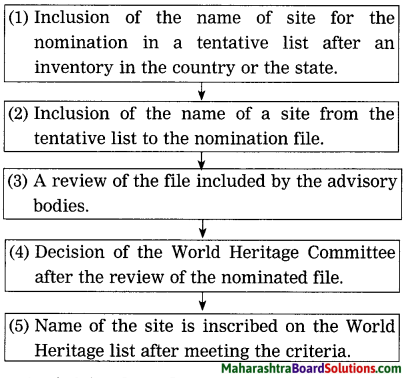
Answer:
Jupiter

Maharashtra Board Class 6 Science Solutions Chapter 16 The Universe

Question e.
The pole star is the best example of a ………………. type of star.
Answer:
variable

3. Say if the statements given below are right or wrong. Rewrite the statements after correcting them.

Question a.
Venus is the planet closest to the sun.
Answer:
Wrong: Mercury is the planet closest to the sun.

Question b.
Mercury is called a stormy planet.
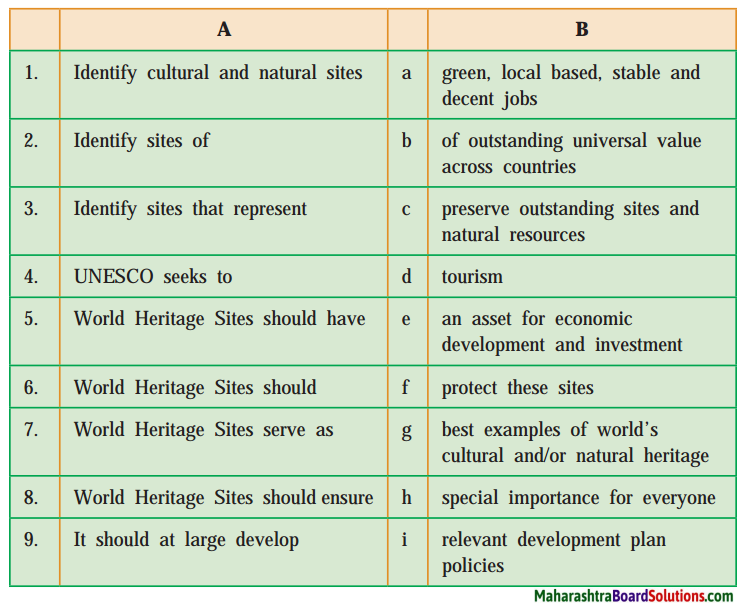
Answer:
Wrong: Jupiter is called a stormy planet.

Question c.
Jupiter is the biggest planet.
Answer:
Right

4. Answer the following.

Question a.
What is a special characteristic of the planet Mars?
Answer:
The highest and the longest mountain in the solar system ‘Olympus Mons’ is located on Mars.

Maharashtra Board Class 6 Science Solutions Chapter 16 The Universe

Question b.
What are the type of galaxies?
Answer:
The different types of galaxies identified according to their shapes are spiral, elliptical, barred spiral, irregular.

Question c.
Which celestial bodies does a galaxy include?
Answer:
Galaxy includes stars, their planetary system, cluster of stars, nebulae, clouds of gases, clouds of dust, dead stars, newly bom stars etc.

Question d.
Name the different types of stars.
Answer:
The different types of stars are

  1. Sun-like stars e.g. stars like Sirius, Alpha Centauri
  2. Red Giants Stars
  3. Super Nova
  4. Binary or Twin Stars
  5. Variable Stars e.g. Polaris (pole star)

Question e.
What are the types of comets and on what basis are they classified?
Answer:

  1.  Comets are of two types: Long-period comets and short-period comets.
  2. Classification of comets is based on the time (period) taken by the comets to complete one revolution around the sun.

Question f.
What is the difference between meteors and meteorites?
Answer:

  1. Meteors are rocky pieces originating from the asteroid belt. Smaller rocky pieces get completely burnt due to friction with air after they enter the earth’s atmosphere.
  2. Meteors which do not bum completely and fall to the surface of the earth are called meteorites.

Maharashtra Board Class 6 Science Solutions Chapter 16 The Universe

Question g.
What are the characteristics of the planet Neptune?
Answer:
Neptune is the eighth planet in the solar system. A season on Neptune lasts for about 41 years. On this planet winds blow with extremely high speed.

5. Match the following.

Question a.

Group ‘A’Group ‘B’
1. Galaxy(a) From east to west
2. Comet(b) 33 satellites
3. Sun-like star(c) Spiral
4. Saturn(d) Sirius
5. Venus(e) Halley

Answer:

Group ‘A’Group ‘B’
1. Galaxy(c) Spiral
2. Comet(e) Halley
3. Sun-like star(d) Sirius
4. Saturn(b) 33 satellites
5. Venus(a) From east to west

Activity:

Question 1.
Using the material you can find in your house, prepare a model of the solar system.

Question 2.
Collect information about different aspects of each planet such as its distance from the sun, its diameter, its volume, etc. and present it in a science exhibition.

Class 6 Science Chapter 16 The Universe Important Questions and Answers

Fill in the blanks.

Question 1.
The Milky Way is known as ………….. .
Answer:
Mandakini

Maharashtra Board Class 6 Science Solutions Chapter 16 The Universe

Question 2.
The ………….. is a galaxy in which our solar system is located.
Answer:
Milky Way

Question 3.
The galaxy that is closest to our Milky Way is ………….. .
Answer:
Andromeda

Question 4.
The universe includes innumerable galaxies, the space between them and also ………….. .
Answer:
energy

Question 5.
The Milky Way is a part of the ………….. of galaxies.
Answer:
Local group

Question 6.
Generally, the surface temperature of stars ranges from 3500° C to ………….. .
Answer:
50000°C

Question 7.
The colour of stars changes according to their ………….. .
Answer:
temperature

Maharashtra Board Class 6 Science Solutions Chapter 16 The Universe

Question 8.
Red giants stars are ………….. in colour.
Answer:
red

Question 9.
Super Nova stars are ………….. and ………….. than the red giant stars.
Answer:
brighter, larger

Question 10.
More than ………….. of the stars in the sky are ………….. stars.
Answer:
half, binary

Question 11.
The ………….. and ………….. of variable stars is not stable.
Answer:
luminance, shape

Question 12.
When a star contracts, its surface temperature ………….. and the star emits ………….. energy and appears ………….. .
Answer:
increases, greater, brighter

Question 13.
The sun which is at the centre of the solar system is a ………….. coloured star.
Answer:
yellow

Maharashtra Board Class 6 Science Solutions Chapter 16 The Universe

Question 14.
The diameter of the sun is approximately ………….. km.
Answer:
13, 92, 000

Question 15.
………….. is the fastest moving planet.
Answer:
Mercury

Question 16.
………….. is the brightest planet in the solar system.
Answer:
Venus

Question 17.
………….. is the hottest planet.
Answer:
Venus

Question 18.
As the earth is a ………….. there is a magnetic field around the earth.
Answer:
magnet

Question 19.
Mars is also called the ………….. .
Answer:
Red planet

Maharashtra Board Class 6 Science Solutions Chapter 16 The Universe

Question 20.
As the soil on Mars contains ………….. its colour is reddish.
Answer:
iron

Question 21.
………….. planets of the size of the earth can get accommodated on Jupiter.
Answer:
1397

Question 22.
Jupiter is called as ………….. .
Answer:
The stormy planet

Question 23.
Saturn mass is ………….. times that of the earth.
Answer:
95

Question 24.
………….. cannot be seen without a telescope.
Answer:
Uranus

Maharashtra Board Class 6 Science Solutions Chapter 16 The Universe

Question 25.
Winds blow with extremely high speed on ………….. .
Answer:
Neptune

Question 26.
………….. is the satellite of the earth.
Answer:
The moon

Question 27.
The moon’s period of ………….. and ………….. are both of 27.3 days.
Answer:
rotation, revolution

Question 28.
………….. is classified as a dwarf planet.
Answer:
Pluto

Question 29.
Pluto takes ………….. years to complete its revolution around the sun.
Answer:
248

Maharashtra Board Class 6 Science Solutions Chapter 16 The Universe

Question 30.
………….. are formed out of ice and dust particles.
Answer:
Comets

Question 31.
………….. lake in Maharashtra has been formed by the impact of such a meteorite.
Answer:
Lonar

Can you tell?

Question 1.
Which celestial bodies form the solar system?
Answer:
Sun, the eight planets – Mercury, Venus, Earth, Mars, Jupiter, Saturn, Uranus, Neptune, their satellites, Dwarf planets, asteroids, meteors and comets all together form our solar system.

Maharashtra Board Class 6 Science Solutions Chapter 16 The Universe

Question 2.
What is the difference between stars and planets?
Answer:

StarsPlanets
1. Stars are the celestial bodies which can emit heat and light continuously.1. The celestial bodies which revolve around the sun in certain orbit are called planets.
2. Stars twinkle in the sky.2. Planets do not twinkle in the sky.
3. They have their own light.3. They do not have their own light.
4. They are fixed at a point.4. They revolve around the sun.
5. They are very big in size.5. Planets are small as compared to

Question 3.
How many planets are there in our solar system?
Answer:
There are 8 planets in our solar system.

Question 4.
What is to be found between Mars and Jupiter?
Answer:
A belt of celestial bodies called as asteriods is found between the planets Mars and Jupiter.

Maharashtra Board Class 6 Science Solutions Chapter 16 The Universe

Question 5.
Have you ever seen in the evening or in the pre-dawn hours a large celestial body with a long tail? What is it called?
Answer:
Yes, it is a comet – a large celestial body with a long tail. I have not seen it, but heard that in 1986 there was a Halley’s comet seen in the Indian sky.

Use your brain power!

Question 1.
Why do we see only one side of the moon?
Answer:
As the moon revolves around the earth it also rotates around itself. The moon takes 27.3 days to complete one revolution around the earth. It takes the moon the same time to complete one rotation around itself. Therefore, only one side of moon is visible.

Question 2.
Which planet has a day longer than its year?
Answer:
A planet’s day is how long it takes to complete one rotation on its own axis. Venus takes 243 earth days to complete one rotation because of its slow rotation around its axis. A year is the time taken by the planet to complete one revolution around the sun. Venus completes one revolution around the sun in 225 days. This makes a day longer than a year on Venus.

Answer in one sentence.

Question 1.
What is the Milky Way?
Answer:
Milky way is the galaxy in which our solar system is located.

Maharashtra Board Class 6 Science Solutions Chapter 16 The Universe

Question 2.
What is a galaxy?
Answer:
A group of innumerable stars and their planetary systems are together known as galaxy.

Question 3.
What does the Universe include?
Answer:
The universe includes innumerable galaxies, the space between them and also energy.

Question 4.
What different colours do the stars radiate?
Answer:
The stars radiate different colours such as blue, white, yellow and red.

Question 5.
Where are stars bom?
Answer:
The birth place of stars are the huge nebulae, made of dust particles and gases.

Maharashtra Board Class 6 Science Solutions Chapter 16 The Universe

Question 6.
What is the surface temperature of the sun?
Answer:
The surface temperature of the Sim is around 6,000°C.

Question 7.
What is the size of the sun?
Answer:
The size of the sun is so huge that around 13 lakh planets of the size of the earth can be easily placed within it.

Question 8.
How does the sun balance the other celestial bodies?
Answer:
Due to the gravitational force of the sun, the celestial bodies in the solar system revolve around it.

Question 9.
How does the sun move in the Milky Way?
Answer:
The sun rotates around its axis and while doing so, it revolves around the centre of the Milky Way taking the solar system along with it.

Question 10.
Which planet doesn’t have atmosphere?
Answer:
Mercury doesn’t have atmosphere.

Maharashtra Board Class 6 Science Solutions Chapter 16 The Universe

Question 11.
How much time does the earth take to complete one rotation and one revolution?
Answer:
The earth completes one rotation in 24 hrs and one revolution in 365 days i.e. 1 year.

Question 12.
Which planets have rings around them?
Answer:
Jupiter, Saturn, Uranus, Neptune have rings around them.

Question 13.
Which planet do not have rings around them?
Answer:
Mercury, Venus, Earth and Mars do not have rings around them.

Question 14.
State two properties of planet Mercury.
Answer:
Mercury is the closet planet to the Sim. Mercury is the fastest moving planet.

Question 15.
When is the Mercury visible to us?
Answer:
Mercury is visible in the morning and in the evening if it is away from the sun.

Maharashtra Board Class 6 Science Solutions Chapter 16 The Universe

Question 16.
What is seen on the surface of the mercury?
Answer:
A number of depressions which are actually caused by meteoric falls are seen on the surface of mercury.

Question 17.
When is Venus seen in the sky?
Answer:
Venus is seen in the sky in the east before the sunrise and in the west after the sunset. It rotates around itself from east to west.

Question 18.
How does earth protect us from harmful rays of Sun?
Answer:
As the earth is a magnet there is a magnetic field around the earth. It diverts the harmful rays from the sun towards the polar regions of the earth.

Question 19.
What is Olympus Mons?
Answer:
Olympus Mons is the highest and longest mountain in the solar system located on Mars.

Maharashtra Board Class 6 Science Solutions Chapter 16 The Universe

Question 20.
Which is the largest planet of the solar system?
Answer:
The Jupiter is the largest planet of the solar system.

Question 21.
Why is Saturn considered a peculiar planet?
Answer:
Saturn considered a peculiar planet because of the rings around it.

Question 22.
How is the axis of Uranus?
Answer:
Uranus axis is so greatly inclined that it appears as if it is rolling along on its axis.

Question 23.
How are seasons on Neptune?
Answer:
The seasons on Neptune last for about 41 years.

Maharashtra Board Class 6 Science Solutions Chapter 16 The Universe

Question 24.
What is a satellite?
Answer:
The celestial bodies that revolve around a planet , without independently revolving around the sun are called Satellite.

Question 25.
What is an Asteroid?
Answer:
A great number of small sized bodies could not turn into planets when the solar system was formed, but continued to revolve around the sun. This bodies are known as asteroids.

Question 26.
What is a Dwarf Planet?
Answer:
A small sized celestial body that revolves independently around the sun is called the dwarf planet.

Question 27.
What is a comet?
Answer:
A comet is a celestial body that revolves around sun. Comets are formed out of ice and dust particles.

Maharashtra Board Class 6 Science Solutions Chapter 16 The Universe

Question 28.
What are meteors?
Answer:
Meteors are rocky pieces originating from the asteroids belt.

Question 29.
What are meteorites?
Answer:
Meteors which do not bum completely and fall to the surface of the earth are called meteorites.

Give reasons for the following.

Question 1.
Comets came to be called ‘dirty snowballs’.
Answer:
Comets consist of an icy cluster of various constituents like dust particles. Hence it is called dirty snowballs.

Maharashtra Board Class 6 Science Solutions Chapter 16 The Universe

Question 2.
Comets are visible when they are close.
Answer:
Comets are formed out of ice and dust particles. They appear like points when they are far away from the sun, but when they are close to the sun they become easily visible to us because of the shorter distance and the heat of the sun.

Question 3.
Comets appear to have a long feathery tail.
Answer:
Comets are made up of frozen matter and dust particles. When they are close to the sun this frozen matter gets converted into gas due to the solar heat. These gases get thrown in a direction away from the sun. As a result comets appear to have a long feathery tail.

Question 4.
Pluto is called as a dwarf planet.
Answer:
Pluto is a small sized celestial body that revolves independently around the sun.

Question 5.
Moon is a satellite of the earth.
Answer:
Moon revolves around the earth without independently revolving around the sun. Hence moon is a satellite of the earth.

Maharashtra Board Class 6 Science Solutions Chapter 16 The Universe

Question 6.
Mars is called the Red Planet.
Answer:
As the soil on the Mars contains iron its colour is reddish. Hence Mars is also called the RedPlanet.

Question 7.
Jupiter is called the Stormy Planet.
Answer:
Jupiter revolves around itself with a great speed. Hence Jupiter is called the Stormy planet.

Question 8.
Uranus appears rolling along on its orbit.
Answer:
Uranus axis is so greatly inclined that it , appears as if it is rolling along on its orbit.

Question 9.
Saturn is considered to be a peculiar planet.
Answer:

  1. Saturn is considered as peculiar planet because of its rings around it.
  2. Though its mass is 95 times that of the earth, its density is very low.
  3. If it were dropped into a large sea enough to hold it, it would float in it.

Maharashtra Board Class 9 My English Coursebook Solutions Chapter 3.2 The Fall of Troy

Balbharti Maharashtra State Board Class 9 English Solutions My English Coursebook Chapter 3.2 The Fall of Troy Notes, Textbook Exercise Important Questions and Answers.

Maharashtra State Board Class 9 My English Coursebook Solutions Chapter 3.2 The Fall of Troy

My English Coursebook Std 9 Guide Chapter 3.2 The Fall of Troy Textbook Questions and Answers

Warming up:
Chit-chat:

  1. Do you know stories from any epics or mythological poems?
  2. Who is your favourite mythological character? What do you like about that character?
  3. Who is your favourite warrior?
  4. If you could visit a place in the ancient world or the mytholocial world, which place would you choose? Which event would you like to see?

Maharashtra Board Class 9 My English Coursebook Solutions Chapter 3.2 The Fall of Troy

Building a Story

Form groups of eight. The group leader prepares slips of paper for each of the seven points given below and distributes them among the others. The group sits in a circle, taking their seats according to the number on the slip they have. Then each one completes the sentence on his/her slip without sharing it with the others. The group leader collects the slips and reads all the sentences aloud as one continuous passage. Does the story make sense? The group then works on the story to make it more meaningful and interesting.

  1. Once there was a …………………………
  2. Who lived in a …………………………
  3. He/She ate …………………………
  4. She/He went …………………………
  5. There She/He saw …………………………
  6. She/He was …………………………
  7. That is why …………………………

Part – I

English Workshop:

1. Find antonyms of the following from the passage:

Question 1.
Find antonyms of the following from the passage: (Answers are directly given.)
Answer:

  1. barren × fertile
  2. surrender × attack
  3. cowardly × brave
  4. defenceless × safe
  5. offended × pleased
  6. peace × war
  7. exposed × closed

Maharashtra Board Class 9 My English Coursebook Solutions Chapter 3.2 The Fall of Troy

2. Correct the following sentences using facts from the passage:

Question (a)
Troy traded in cattle and grass with other cities.
Answer:
Troy traded in goods and grain.

Question (b)
During war, Trojans jumped over the fort gates.
Answer:
During war, Trojans would close the doors of the fort.

Question (c)
Helen escaped with Menelaus.
Answer:
Helen eloped with Paris, a prince of Troy.

Question (d)
The Greek armies and heroes always defeated the Trojans.
Answer:
Sometimes the Greeks defeated the Trojans and sometimes the Trojans defeated the Greeks.

Question (e)
Both the enemies were eager to continue fighting.
Answer:
Both the armies were tired of war. The Trojans of being shut in their city and the Greeks of living away from home.

Question (f)
Troy was attacked because it was strong rich city.
Answer:
Troy was attacked because the Greeks wanted to take revenge on Troy for the wrong’done to their King Menelaus.

3. State the counteraction for the following actions:

Question (a)
Helen eloped with Paris.
Answer:
Counteraction: The Greeks wanted to take revenge on Troy they sailed and laid siege to the city of Troy.

Maharashtra Board Class 9 My English Coursebook Solutions Chapter 3.2 The Fall of Troy

Question (b)
The Greeks sailed to Troy and attacked it.
Answer:
Counteraction: The Trojans fought hard and the siege continued for ten long years.

Question (c)
Hector was killed by Achilles.
Answer:
Counteraction: Achilles himself was killed later on by a poisoned arrow that entered his heel, the only part of his body, where he could be wounded.

Question (d)
The siege continued for ten long years.
Answer:
Counteraction: The Trojans were tired of being shut up in their city and the Greeks deeply desired to see their homes again.

Question (e)
The fighting went on daily.
Answer:
Counteraction: Even then the siege did not end. The Greeks could not take the city, on the other hand, the Trojans could not force them to sail away back to Greece.

4. From either of our two Indian epics, find out which battle/war lasted the longest? Write down about its cause, the enemy armies, its heroes, its duration and the final outcome.

Question 1.
From either of our two Indian epics, find out which battle/war lasted the longest? Write down about its cause, the enemy armies, its heroes, its duration and the final outcome.
Answer:
Mahabharat
1. Cause: Kauravas took possession of the kingdom of Hastinapur forcibly, which rightfully belonged to Pandavas and they were not ready to give even an inch of the land to Pandavas. So, it led to the outbreak of the war.

2. The enemy armies:
Kauravas: 100 Kaurava brothers and many friendly kings like Shakuni, Shalya, Kama, etc. with their armies.
Pandavas: 5 Pandavas, Kashiraja, King Drupad, King Virat, Dhrushtadhyumna, etc. and their armies.

3. Heroes:

  • Pandavas : Dharma (Yudhishthir), Arjun, Bhim, Nakul, Sahadev, Abhimanyu and Shri Krishna as the charioteer of Arjun.
  • Kauravas: Duryodhan, Dushasan, Kama, Bhishmacharya, Dronacharya, Jaydrath.

4. Duration: The war lasted for eighteen days.

5. Final outcome: The war ended in victory to Pandavas. All mighty warriors from Kaurava side except Ashwathama were killed and it was a complete ruin for them. Pandavas regained Hastinapur.

Maharashtra Board Class 9 My English Coursebook Solutions Chapter 3.2 The Fall of Troy

5. Underline the subject in the following sentences:

Question 1.
Underline the subject in the following sentences:
(a) Paris had brought her to Troy.
(b) The Greeks waited to take revenge on Troy.
(c) The Greek armies sailed to Troy.
(d) The fighting went on daily.
(e) Reading is a good habit.

Here, we see that the ‘-ing’ form of the verb ‘fight’ is used as a subject in ‘The fighting went on’. It does the work of a noun. When the ‘-ing’ form of a verb is used as a noun, it is known as a gerund or verbal noun.

  1. Gardening is an art.
  2. Cooking is a science.
  3. I enjoy reading poems.
  4. I like writing, too.

Rewrite the above sentences using other appropriate gerunds in place of the ones given here.
Example: Speaking is an art.

  1. Gardening is an art.
  2. Cooking is a science.
  3. I enjoy reading poems.
  4. I like writing, too.
  5. Swimming is a good exercise.
  6. He is good at running.
  7. I am fond of playing.
  8. Travelling refreshes our minds.

Part – II

English Workshop:

1. Find and write the Greek and the Trojan names used in the story (Part I and II).

Question 1.
Find and write the Greek and the Trojan names used in the story (Part I and II).
Answer:
1. Greek names: Menelaus, Helen, Achilles, Odysseus, Agamemnon, Aphrodite (goddess).
2. Trojan names: Paris, Hector, King Priam.

Maharashtra Board Class 9 My English Coursebook Solutions Chapter 3.2 The Fall of Troy

2. List all the words related to ‘war’ from both parts of the story.

Question 1.
List all the words related to ‘war’ from both parts of the story.
Answer:
enemy, attack, fortress, ships, protect, defend, brave soldiers, heroes, kings, countries, revenge, siege, fighting, battles, killing, arrows, victory, engineer, peace, disaster, terror, death, conquerors.

3. Note the following constructions carefully and then use them to express your own ideas:

Question (a)
A horse big enough to hold men inside it.
……………. enough to …………… ………….
Answer:
A stick long enough to fell mangoes from the tree.

Question (b)
The Greeks were tired of the long war.
……………. tired of …………… ………….
Answer:
We are tired of the tedious work.

Question (c)
They are afraid of the long voyage home, too.
……………. afraid of …………… ………….
Answer:
They are afraid of the impending storm.

Question (d)
They made it too big to go inside your city.
……………… too ………………. to ……………….
Answer:
They bought a cupboard that was too big to go inside our house.

Question (e)
They were so excited that they paid no attention to his words.
……………….. so ………………. that ………………..
Answer:
We were so excited that we could not think of anything except our picnic.

Maharashtra Board Class 9 My English Coursebook Solutions Chapter 3.2 The Fall of Troy

4. Put the following events in the order in which they took place. Number then accordingly:

Question 1.
Put the following events in the order in which they took place. Number then accordingly:
Answer:
(a) The Trojans found a Greek man under the big wooden horse.  [1]
(b) They broke down a part of the wall and brought the horse in.  [3]
(c) The cunning Odysseus thought of a plan. [1]
(d) The Greeks burnt their tents and sailed away. [4]
(e) Troy was burnt down. [3]
(f) The Greeks built a big wooden horse. [2]
(g) The great heroes hid inside the horse. [3]
(h) The priest warned the Trojans not to break the wall.  [2]
(i) The Trojans were happy to see the Greek ships go. [5]
(j) The Trojans slept soundly.  [4]
(k) The Greek army entered the city. [2]

5. Form pairs. Imagine you are a pair of Trojans and you have come to know about Odysseus’s plan. Make a counter plan to defeat the Greeks. Write down your plan as you explain to your fellow Trojans:

Question 1.
Form pairs. Imagine you are a pair of Trojans and you have come to know about Odysseus’s plan. Make a counter plan to defeat the Greeks. Write down your plan as you explain to your fellow Trojans:
Answer:
While observing the large wooden horse, I heard some movements inside it. Friends, I am sure it is some trick to attack our city at night. Their great heroes must be inside the horse. They have not sailed away. They must be somewhere near and will return only when they will get the signal from the Greeks in the horse.

Friends, they will not get the signals from them. Look, we shall get bundles of ropes and tie the ropes tightly around the whole of the horse, so that no one would be able to come out and give signals. That Greek man also is in my custody. We shall arrange heavy barricades to close our wall gates. We shall take this opportunity to lift their siege.

We shall hold these heroes in the horse to ransom, in order to force them to lift the siege, surrender and leave our shore. Let’s come together and implement this plan immediately.

Maharashtra Board Class 9 My English Coursebook Solutions Chapter 3.2 The Fall of Troy

Language Study:

6. Refer to the Language Study pages and read the following entries:

Question (a)
Refer to the Language Study pages and read the following entries:

  1. word
  2. phrase
  3. clause
  4. sentence

Question (b)
A phrase is a meaningful group of words. Read the following phrases :

  • the wise Odysseus
  • a great horse of wood
  • a skilful engineer
  • the greatest heroes
  • the secret of opening and shutting the entrance
  • on the seashore outside the walls
  • in the darkness
  • watching for the return of the fleet
  • part of their strong wall

Question 1.
Write three phrases on your own.
All the above phrases are parts of sentences they do not form a complete sentence by themselves. A sentence expresses a complete idea. You know that it has a subject and a predicate. A sentence has at least one finite verb in it.

Read the following examples:

  • The tents had been burnt.
  • The shore was deserted.
  • The Greek ships had all gone.

Maharashtra Board Class 9 My English Coursebook Solutions Chapter 3.2 The Fall of Troy

2. Write three sentences using your own ideas.

Question (c)
When we read the story of ‘The Fall of Troy’, we see that here (as elsewhere), many sentences express two or more complete ideas linked together. For example,

  1. When the Trojans dragged him out, the man pretended to be very frightened of them.
  2. They wanted also to kill me and offer me as a sacrifice to the sea-god but I escaped and hid from them.
  3. In the darkness the fleet sailed back, and the leading ship, which was Agamemnon’s, bore a red light high on its mast.

All these sentences consist of clauses. A clause has a subject and a verb. Some clauses can stand by themselves as a complete sentence.
Example: The man pretended to be frightened of them.

But some clauses do not make complete sense by themselves.
Example: When the Trojans dragged him out
It is only when we read the entire sentence that we understand what is being said.

Thus, we have seen that a clause is a part of a sentence and there are two types of clauses:
(a) Main clause – It can stand by itself.
(b) Subordinate or dependent clause : It depends on the main clause, and is incomplete without it.

Note that a sentence can have two or more main clauses or a main clause and one or more dependent clauses, but we cannot have a sentence without a main clause.

Question 3.
Identify one example of a main clause and one example of a dependent clause from page 74.

My English Coursebook 9th Class Solutions Chapter 3.2 The Fall of Troy Additional Important Questions and Answers

Simple Factual Activities:

Question 1.
Fill in the blanks with correct information from the passage. Choose the correct option from the brackets: (Answers are directly given.)
Answer:

  1. Troy was a rich trading city in Asia Minor. (beautiful/trading)
  2. Troy was a strong city protected by its wall. (Mount Ida/wall)
  3. Troy was well situated for commerce and agriculture, (fertile fields/commerce and agriculture)
  4. Helen was the wife of a Greek king Menelaus. (Paris/Menelaus)

Maharashtra Board Class 9 My English Coursebook Solutions Chapter 3.2 The Fall of Troy

Question 2.
Complete the following sentences using the information from the passage:
(Answers are directly given.)
Answer:

  1. The Greek leaders decided to follow the advice of the wise Odysseus.
  2. The Trojans thought that the long siege was over at last.
  3. The last man who entered the wooden horse was the architect himself.
  4. Troy was taken, not by force but by a trick.

Question 3.
State whether the following statements are True or False:
Answer:

  1. The huge wooden horse was an offering to the god of the sea. – False
  2. The man left by the Greeks told the false story of the horse. – True
  3. Their wise priest told the Trojans not to make a hole in the wall. – True
  4. The Greeks were tired of the long war and had sailed away. – False

Complex Factual Activities:

Question 1.
How did the location of Troy help it to grow into a very rich/prosperous city?
Answer:
The city was well situated for commerce and agriculture. Their ships sailed and carried goods and grain over the sea in front of the city. Many rivers and streams flowed from Mount Ida. Well-watered and fertile valleys among the hills grew corn in fertile fields cattle were reared on the rich grass of the meadows. So Troy became a rich/ prosperous city.

Question 2.
How were the Trojans protected?
Answer:
The Trojans had built a strong wall around their city to prevent the enemy attack from the sea. The great gates of the wall were kept closed in time of war. They were safe from all attacks by the walls surrounding the city as well as by the hills behind the city.

Maharashtra Board Class 9 My English Coursebook Solutions Chapter 3.2 The Fall of Troy

Question 3.
What was the cause of the ten year old war between the Greeks and the Trojans?
Answer:
Paris, a prince of Troy, had persuaded Helen, wife of a Greek king Menelaus, to elope with him. Paris brought her to Troy. The Greeks wanted to take revenge on Troy and laid siege to the city. The fight began and the war continued for ten long years.

Who were the brave heroes on either side who were killed in the war? How?

Question 1.
Who were the brave heroes on either side who were killed in the war? How?
Answer:
Great heroes on both sides were killed in the course of time. Hector was killed by Achilles. Achilles himself was killed later on by a poisoned arrow that entered his heel. The prince of Troy, Paris, was also killed by a poisoned arrow.

Question 2.
How did Odysseus plan to defeat the Trojans?
Answer:
Odysseus advised his men to build a great wooden horse, big enough to hold men inside it and let some of their best fighters hide in the horse. Then let them burn their tents and pretend to sail away in their ships. But instead of sailing away, they would return in the night. When the Trojans were asleep, they would attack the city and burn, kill and defeat the Trojans.

Question 3.
What was the reason for Trojans to rejoice and celebrate?
Answer:
The Trojans woke up and came out for fighting as usual. They were delighted and surprised what they saw on the seashore outside the walls. The tents of the Greeks were burnt, the shore was deserted so they thought that the long siege was over at last. They were sure that the Greeks had gone. They were glad to be free to go where they pleased. That was the reason for the Trojans to rejoice and celebrate.

Question 4.
How did the cunning Greek explain the presence of such a large wooden horse?
Answer:
The cunning Greek explained to the Trojans that the Greeks were tired of the long war and had sailed away in their ships. They were afraid of the long voyage home and so they made a large horse and left that as an offering to the god of the sea.

Maharashtra Board Class 9 My English Coursebook Solutions Chapter 3.2 The Fall of Troy

Question 5.
What reckless/thoughtless step did the Trojans take?
Answer:
Thinking that the horse would bring them good luck the Trojans broke down a part of their strong wall in order to drag the horse in the city and that brought the ruin of their city.

Activities based on vocabulary:

Question 1.
Write the words related to ‘Geography’ from the passage.
Answer:
Asia Minor, trading city, Aegean, Black Sea, agriculture, grain, peak of Mount Ida, rivers, streams, valleys, hills, fertile fields, cattle, grass, fortress, meadows.

Question 2.
Match the adjectives in Column ‘A’ with the nouns in Column ‘B’:

‘A’‘B’
1. high(a) fortress
2. brave(b) peak
3. fertile(c) fields
4. strong(d) soldiers

Answer:

  1. high – peak
  2. brave – soldiers
  3. fertile – fields
  4. strong – fortress.

Question 3.
Write the words related to war from the passage.
Answer:
fighting, siege, force, battles, armies, heroes, I kill, defence, resist, poisoned arrow, wounded.

Question 4.
Find the nouns for the following adjectives from the passage :

  1. skilful
  2. cunning
  3. wonderful
  4. wooden

Answer:

  1. engineer
  2. Odysseus
  3. piece of work
  4. horse.

Maharashtra Board Class 9 My English Coursebook Solutions Chapter 3.2 The Fall of Troy

Question 5.
Write all the words ending with ‘-mg’ form of verbs:
Answer:
Sailing, being, opening, shutting, expecting.

Question 6.
Arrange the letters properly to make a meaningful word :

  1. aagni
  2. bndeih
  3. rohse
  4. seegi.

Answer:

  1. again
  2. behind
  3. shore
  4. siege

Question 7.
Write the meaningful sentences from the jumbled words:
1. the Greeks did a large such Why horse make?
2. wise their them priest warned not so to do.
Answer:
1. Why did the Greeks make such a large horse?
2. Their wise priest warned them not to do so.

Question 8.
Match the names of the persons in Column ‘A’ with the information in Column ‘B’:
Answer:

  1. Agamemnon – sailing in the leading ship of Greeks
  2. Aphrodite – a Greek goddess
  3. Priam – Old Trojan King
  4. Helen – wife of King Menelaus.

Maharashtra Board Class 9 My English Coursebook Solutions Chapter 3.2 The Fall of Troy

Question 9.
Write the phrases related to Greeks’ attack on Troy.
Answer:
Set fire to houses, burn and kill, sight of leaping flames, sound of shouting, noise of weapons, cries of weeping women, the sleeping Trojans taken by surprise, put on their armour, seize their weapons, went up in flames, all in vain.

Activities based on contextual grammar:

Question 1.
A prince of Troy had persuaded Helen.
(Begin with ‘Helen had – ’ and change the voice.)
Answer:
Helen had been persuaded by a prince of Troy.

Question 2.
The city was strongly defended by its brave soldiers. (Choose the correct option of Active voice)
(a) Its brave soldiers defended strongly by the city.
(b) Its brave soldiers defended the city strongly.
Answer:
Its brave soldiers defended the city strongly.

Question 3.
Underline the infinitives in the sentences:
(Answers are directly underlined.)
1. Paris persuaded Helen to elope with him.
2. The Greeks wanted to take revenge.

Question 4.
Greeks could not take the city. (Make the sentence affirmative.)
Answer:
Greeks were unable to take the city.

Question 5.
Every day Greeks came out of their gates. (Rewrite the sentence using Past Continuous tense.)
Answer:
Every day Greeks were coming out of their gates.

Maharashtra Board Class 9 My English Coursebook Solutions Chapter 3.2 The Fall of Troy

Question 6.
The Trojans, too, fought hard. (Add a question tag.)
Answer:
The Trojans, too, fought hard, didn’t they? ‘

Question 7.
Find the gerund from the sentence. The fighting went on daily.
Answer:
fighting.

Question 8.
They will return in the night. (Frame a Wh-question to get the underlined part as an answer.)
Answer:
When will they return?

Question 9.
They went to sleep.
(Write the sentence in Past Progressive tense.)
Answer:
They were going to sleep.

Question 10.
Why did the Greeks make such a huge horse?
(Rewrite the sentence using Past Perfect tense.)
Answer:
Why had the Greeks made such a huge horse?

Question 11.
The walls are no longer necessary.
(Add a question tag.)
Answer:
The walls are no longer necessary, are they?

Question 12.
The Greeks have gone.
(Rewrite the sentence using Simple Past tense.)
Answer:
The Greeks went.

Choose the correct alternative from the brackets and complete the following sentences:

Question 1.
Choose the correct alternative from the brackets and complete the following sentences:
(Answers are directly underlined.)
Answer:

  1. They were killed with their great heroes. (with/for)
  2. They found the car m their own garage. (on/in)
  3. He jumped into the river to save the child. (over/into)
  4. She was gazing at the strange person. (on/at)

Maharashtra Board Class 9 My English Coursebook Solutions Chapter 3.2 The Fall of Troy

Question 2.
Write the past tense and past participle forms of the following verbs:
(Answers are directly given.)
Answer:

VerbPast tensePast participle
comecamecome
leadledled
speakspokespoken
swimswamswum

Complete the words by using correct letters:

Question 1.
Complete the words by using correct letters:

  1. s _ ege
  2. ro_nd
  3. bra _ e
  4. w_ong

Answer:

  1. siege
  2. round
  3. brave
  4. wrong

Copy the following sentences correctly in your notebook:

Question 1.
Copy the following sentences correctly in your notebook:
Answer:
1. The Greek wanted to take revenge on Troy for the wrong done to Menelaus.
2. “But why did the Greeks make such a huge horse?”

Put the following words in alphabetical order:

Question 1.
Put the following words in alphabetical order:
Answer:
1. fields, battles, ships, arrows
2. grain, grow, gates, Greek
3. arrows, battles, fields, ships.
4. gates, grain, Greek, grow.

Maharashtra Board Class 9 My English Coursebook Solutions Chapter 3.2 The Fall of Troy

Punctuate the following sentences:

Question 1.
1. Then he asked the boys where are you going children and for what
2. The king said what a strange appeal
Answer:
1. Then he asked the boys, “Where are you going, children, and for what?”
2. The King said, “What a strange appeal!”

Question 2.
Write four small words (minimum 3 letters each) using the letter in the given word :
“sometimes.”
Answer:

  1. some
  2. time
  3. mime
  4. tie

Question 3.
Spot the error and rewrite the correct sentences:
1. Great heroes on both sides was killed in the course of the war.
2. The Trojans came out of their gates, and the Greeks came out of their tents and ships and the fighting goes on.
Answer:
1. Great heroes on both sides were killed in the course of the war.
2. The Trojans came out of their gates, and the Greeks came out of their tents and ships and the fighting went on.

Question 4.
Write related words as shown in the example: (Answers are directly given.)
Answer:
Maharashtra Board Class 9 My English Coursebook Solutions Chapter 3.2 The Fall of Troy

Question 5.
Complete the following word-chain of nouns Add four words, each beginning with the last letter of the previous word:
Stream → ……………., ……………….., …………….., ……………..
Answer:
Stream → mountain → nature → electricity → years.

Question 6.
Make your own meaningful sentence by using the phrase ‘in front of.
Answer:
There is a big ground in front of our school.

Maharashtra Board Class 9 My English Coursebook Solutions Chapter 3.2 The Fall of Troy

Question 7.
Add a prefix or suffix to make new words and use any one of the root words in your own sentence:
1. imagine
2. education
Answer:
1. imaginary
2. educational
Sentence: Just try to imagine that you are a rich person.

Question 8.
Add a clause to expand the sentence meaningfully:
The person cried for help ………………
Answer:
The person cried for help because he was caught in the big fire.

Personal Response:

Question 1.
Do you know one of the wars in ancient India was fought over a woman? Describe it in short.
Answer:
I know such a war was fought between Ram and Ravan. Ravan, the demon king of Lanka, came in disguise as a Sadhu and forcefully took away Seeta, the wife of Ram. Ram with his monkey army reached Lanka. He fought against Ravan, defeated him and killed Ravan and brought back Seeta to Ayodhya.

Question 2.
Why, do you think, did the Greeks burn their tents?
Answer:
The Greeks burnt their tents to show the Trojans that they have left for Greece and did not wish to continue the siege any more. They wanted them (Trojans) to be careless and carefree about the Greek attack and their army.

Question 3.
Was it enough to use the wooden horse to hide some soldiers? What was done to make the Trojans take it inside the city?
Answer:
No, it was not enough to use it for hiding some soldiers. The Greeks wanted their entry into the city with all their army men. Unless the walls around the city were broken down they would not have got that opportunity. That’s why they made the horse very large and lured the Trojans to take it inside the city by breaking the walls.

Maharashtra Board Class 9 My English Coursebook Solutions Chapter 3.2 The Fall of Troy

Question 4.
Was the big wooden horse really an offering to the god of the sea?
Answer:
No, the big wooden horse really was not an offering to the god of the sea. It was a false tale of the Greek who was found under the big horse by the Trojans. It was told to lure the Trojans for taking the horse inside the city for sudden attack without their knowledge.

Question 5.
Why, do you think, were the Trojans so excited?
Answer:
I think, the Trojans thought that the siege by the Greeks was lifted and there would be no war any more. Again they thought that they were bringing in good luck for the city by presence of the wooden horse. They did not think of the impending danger.

Question 6.
Do you think that the conquerors of war are happy after their victory?
Answer:
No, I don’t think so. Both defeated and victorious countries have to bear the brunt of war. Both have to suffer because of the disastrous consequences they face. Both suffer the loss of lives, money, peace and so many other things. It takes a long time for both to regain their normal life.

Question 7.
Which of the following are the adverse effects of war? Tick [✓] them in the given box:
Answer:

  1. Many people are killed. [✓]
  2. The country gains fame and glory. [✗]
  3. They lose peace in the land. [✓]
  4. Thousands are wounded. [✓]
  5. Soldiers enjoy fighting. [✗]
  6. Those who win the war become rich and famous. [✓]

Maharashtra Board Class 9 My English Coursebook Solutions Chapter 3.2 The Fall of Troy

Oral Work

Question 1.
Read the story and retell it in your mother tongue, Read the following passage and do the activities:

Maharashtra Board Class 10 My English Coursebook Solutions Chapter 2.6 World Heritage

Balbharti Maharashtra State Board Class 10 English Solutions My English Coursebook Chapter 2.6 World Heritage Notes, Textbook Exercise Important Questions and Answers.

Maharashtra State Board Class 10 My English Coursebook Solutions Chapter 2.6 World Heritage

My English Coursebook Standard Ten Guide Chapter 2.6 World Heritage Textbook Questions and Answers

Warming up!

Chit-chat:

1. I can talk about the world:
Form groups of 6 to 8 students. Each group should select any one Continent and share the following information about each.
1. Important cities
2. Sight-seeing places of tourist interest
3. Food speciality-cuisine
4. Wild life
5. Different types of region and vegetation.
6. Human life.
Now each group representative from the previously formed groups, should narrate the information to the class, using proper attractive sentences.

Question 1.
I can talk about the world:
Form groups of 6 to 8 students. Each group should select any one Continent and share the following information about each.

  1. Important cities
  2. Sight-seeing places of tourist interest
  3. Food specialty-cuisine
  4. Wild life
  5. Different types of region and vegetation.
  6. Human life.

Now each group representative from the previously formed groups, should narrate the information to the class, using proper attractive sentences.
Answer:
1. Important cities:
Mumbai, Tokyo, Hong Kong, Singapore, Dubai

2. Sight-seeing places of tourist interest:
Taj Mahal, Great Wall of China, Mount Fuji, Burj Khalifa etc.

3. Food speciality-cuisine:
Indian, Chinese, Middle-eastern

4. Wild life:
Tigers are naturally found in India. Panda’s are native to China.

5. Different types of region and vegetation:
Asia is blessed with a variety of regions including mountains, desserts, meadows, oceans etc. Some of the main crops grown in Asia are rice, grains, pulses, spices etc.

6. Human life:
Being the biggest continent in the world, Asia has diverse culture and each region within the continent have their own languages, festivals, religions etc.

Maharashtra Board Class 10 My English Coursebook Solutions Chapter 2.6 World Heritage

2. Prepare a Travel Brochure or leaflet of your native place or any town/historical place/hill station to attract tourist using the points below.

Maharashtra Board Class 10 My English Coursebook Solutions Chapter 2.6 World Heritage 1
Answer:
Tourist Place: Koihapur
How to reach there?

  • Nearest Railway Station: Chhatrapati Shahumaharaj Terminus (Koihapur)
  • Nearest Air Port: Chhatrapati Rajaram Maharaj Airport, Kothapur Domestic Airport.
  • Nearest Bus Stand: S.T. stand, Koihapur. Local transport is available.

Top five spots to visit: Mahalaxmi Temple, Panhala Fort, Rankala Lake, Maharaja Palace, Chhatrapati Shahumaharaj Museum, Gandharva Resort and Amusement Park.

Special features of these spots:

  • Mahalaxmi Temple: Holy seat of Amba Mata.
  • Rankala Lake: Famous for its beauty.
  • Maharaj Palace: Magnificent structure of Chhatrapati Shahumaharaj’s palace, Indo-British architecture.
  • Maharaj Museum: Great collections of historical period.
  • Gandharva Resort and Amusement Park: Pleasant and attractive, beautiful site with amusing games.

Mouth-watering /special cuisines: Delightful tasty non-veg food, Pandhara Rassa, Tambda Rassa, Kothapur Misal/Bhel, Mohak lassi,
Davangiri Dosa, etc.

Other nearby sight-seeing spots: Panhala Fort, Kanheri Math, Radhanagari, Wildlife sanctuary.
For Further details contact
Vikas Tours & Travels
Mob.: 98xxxxxx34
email: [email protected]

Maharashtra Board Class 10 My English Coursebook Solutions Chapter 2.6 World Heritage

English Workshop:

1. Write the importance of the years given below, with reference to World Heritage Sites.

Question 1.
Write the importance of the years given below, with reference to World Heritage Sites.
Maharashtra Board Class 10 My English Coursebook Solutions Chapter 2.6 World Heritage 2
Answer:

YearImportance
1959UNESCO launched an International campaign to protect temples and artifacts.
1965White House Conference in United States called for a ‘World Heritage Trust’.
1968The International Union for Conservation of Nature similar goals and presented them at the United Nations Conference on Human Environment.
1972The Convention Concerning the Protection of World Cultural and Natural Heritage was adopted by UNESCO’s General Conference.
2009890 World Heritage Sites were located in 148 countries.

Maharashtra Board Class 10 My English Coursebook Solutions Chapter 2.6 World Heritage

2. Name the following.

Question 1.
(a) The country where Mount Huangshan is situated ……………………
(b) The famous dam in Egypt on River Nile …………………..
(c) The place where the conference based on Human Environment was held …………………..
(d) The country in which the highest number of World Heritage Sites are ……………………
(e) The body which can exclude a site from World Heritage list ……………………
Answer:
(a) The country where Mount Huangshan is situated in – China
(b) The famous dam in Egypt on River Nile – Anwan High Dam
(c) The place where the conference based on Human Environment was held – Stockholm, Sweden.
(d) The country in which the highest number of World Heritage Sites are – Italy
(e) The body which can exclude a site from World Heritage list – World Heritage Committee.

Maharashtra Board Class 10 My English Coursebook Solutions Chapter 2.6 World Heritage

3. Complete the following sentences.

Question 1.
Complete the following sentences.
(a) The World Heritage Sites include ……………….. .
(b) There are around ……………. World Heritage Sites in the world.
(c) The Role of World Heritage Committee is ………………. .
(d) The tenure of World Heritage Committee is ……………… .
(e) We can get more information about World Heritage Sites from its …………………. .
Answer:
(a) The World Heritage Sites include cultural and natural areas.
(b) There are around 890 World Heritage Sites in the world.
(c) The Role of World Heritage Committee is to be responsible for establishing which sites will be listed as a UNESCO World heritage site.
(d) The tenure of World Heritage Committee is six years.
(e) We can get more information about World Heritage Sites from its website at whc.unesco.org.

Maharashtra Board Class 10 My English Coursebook Solutions Chapter 2.6 World Heritage

4. Complete the following Web by giving reasons why World Heritage Sites are in danger.

Question 1.
Complete the following Web by giving reasons why World Heritage Sites are in danger.
Maharashtra Board Class 10 My English Coursebook Solutions Chapter 2.6 World Heritage 3
Answer:
Maharashtra Board Class 10 My English Coursebook Solutions Chapter 2.6 World Heritage 4

5. Answer in your own words:

Question a.
What are our duties towards preservation of any historical site?
Answer:
Historical sites like forts, monuments, palaces, etc. are our national heritage. They have stood all the vagaries of time and weather and are on the verge of losing their splendour. It is our duty to preserve them carefully. When you visit these places don’t spoil their beauty and grandeur by scratching, writing and carving names and making them look ugly and dirty. We must renovate them with the help of the residence in the area or NGOs. We should persuade and insist the government to take complete responsibility of preserving them as their foremost duty.

Maharashtra Board Class 10 My English Coursebook Solutions Chapter 2.6 World Heritage

Question b.
Why should we preserve the World Heritage Sites?
Answer:
Our ancestors all over the world have bestowed upon us the spectacular, wonderful monuments, structures and sculptures, etc. They are the wonders of arts and architectures. The whole world feels proud of these ancestral treasures. They remind us of the past glory, art, culture and great, glorious memorials. They will continue to inspire us and give knowledge of patient and prolonged human endeavours such as the Taj Mahal, Ajanta Caves, Pyramids, China’s Great Wall and many other majestic structures. So, we must preserve them with utmost care.

Question c.
What is the role of World Heritage Sites in promoting tourism in any country?
Answer:
The ‘World Heritage Sites’ plays a very important role in promoting tourism in countries like India. The organisation is responsible, with the country’s contribution, for preserving the site and if required restore it, providing funds. If the site retains its original grandeur, splendour and beauty, flocks of passionate tourists from all over the world are sure to visit the site. Naturally, tourism of the site will flourish and it also will provide employment.

Maharashtra Board Class 10 My English Coursebook Solutions Chapter 2.6 World Heritage

6. Read the following duties towards preservation of any historical site and make sentences about each of our duties.

  • Obey rules and regulations – Visitors must obey the rules and regulations, displayed at the Entrance.
  • Maintain discipline and order
  • Maintain cleanliness
  • Use dustbins and garbage bags
  • Observe silence
  • Maintain environmental safety
  • Protect our country’s history/heritage.

Question 1.
Read the following duties towards preservation of any historical site and make sentences about each of our duties.

  • Obey rules and regulations – Visitors must obey the rules and regulations, displayed at the Entrance.
  • Maintain discipline and order
  • Maintain cleanliness
  • Use dustbins and garbage bags
  • Observe silence
  • Maintain environmental safety
  • Protect our country’s history/heritage.

Answer:

  • Obey rules and regulations – Visitors must obey the rules and regulations, displayed at the Entrance.
  • Maintain discipline and order – All visitors must maintain discipline and order in the place.
  • Maintain cleanliness – They should maintain cleanliness in the area.
  • Use dustbins and garbage bags – They must use dustbins and garbage bags for throwing leftovers.
  • Observe silence – Visitors must observe complete silence at the site.
  • Maintain environmental safety – They should maintain environment safety for their own safety.
  • Protect our country’s history/heritage – It is our duty to protect our countries historical heritage.

Maharashtra Board Class 10 My English Coursebook Solutions Chapter 2.6 World Heritage

7. Complete the following flow – chart by choosing from the options given below to show how any site of any country can become a World Heritage Site.

Question 1.
Complete the following flow – chart by choosing from the options given below to show how any site of any country can become a World Heritage Site.
Maharashtra Board Class 10 My English Coursebook Solutions Chapter 2.6 World Heritage 5

  1. Inclusion of the name of a site from the tentative list to the nomination file.
  2. Name of the site is inscribed on the World Heritage list after meeting the criteria.
  3. Inclusion of the name of site for the nomination in a tentative list after an inventory in the country or the state.
  4. Decision of the World Heritage Committee after review of the nominated file.
  5. A review of the file included by the advisory bodies.

Answer:
Maharashtra Board Class 10 My English Coursebook Solutions Chapter 2.6 World Heritage 6

8. Match the pairs to defme different roles of the World Heritage Sites.

Question 1.
Match the pairs to defme different roles of the World Heritage Sites.
Maharashtra Board Class 10 My English Coursebook Solutions Chapter 2.6 World Heritage 7
Answer:

Column ‘A’Column ‘B’
1. Identify cultural and natural sites(b) of outstanding universal value across countries.
2. Identify sites of(h) special importance for everyone.
3. Identify sites that represent(g) best examples of world’s cultural and/or natural heritage.
4. UNESCO seeks to(c) preserve outstanding sites and natural resources.
5. World Heritage Sites should have(i) relevant development plan policies.
6. World Heritage Site should(f) protect these sites.
7. World Heritage Site serve as(e) an asset for economic development and investment.
8. World Heritage Site should ensure(a) green, local based, stable and decent jobs.
9. It should at large develop(d) tourism.

Maharashtra Board Class 10 My English Coursebook Solutions Chapter 2.6 World Heritage

9. Do you know the difference between Maharashtra Board Class 10 My English Coursebook Solutions Chapter 2.6 World Heritage 8
Refer to a dictionary/encyclopedia/reference books/website/google search to get the detailed meaning.

Question 1.
Do you know the difference between:

  • World heritage.
  • Cultural heritage.

Refer to a dictionary/encyclopedia/reference books/website/google search to get the detailed meaning.
Answer:
World Heritage: As per UNESCO, World Heritage is the designation for places on Earth that are of outstanding universal value to humanity and as such, have been inscribed on the World Heritage List to be protected for future generations to appreciate and enjoy.

Cultural Heritage: Cultural Heritage means elements of great human value and creation. These could be tangible or intangible cultural heritage. Tangible Cultural Heritage include paintings, coins, sculptures, monuments, shipwrecks ruins, archaeological sites etc. Intangible Cultural Heritage can include traditions, performance arts, rituals etc.

Maharashtra Board Class 10 My English Coursebook Solutions Chapter 2.6 World Heritage

10. Following are the ways to preserve ‘World Heritage Sites.’ Transfer these points into a small paragraph. Suggest a suitable title.

  • Practical conservation of posterity
  • Humanlanimal trespassing
  • Unmonitored/uncontrolled/unrestricted access
  • Threat of local administrative negligence

Question 1.
Following are the ways to preserve ‘World Heritage Sites.’ Transfer these points into a small paragraph. Suggest a suitable title.

  • Practical conservation of posterity
  • Humanlanimal trespassing
  • Unmonitored/uncontrolled/unrestricted access
  • Threat of local administrative negligence

Answer:
Preserving ‘World Heritage Sites’ for Future Generations Let us be sensible and practical to preserve our World Heritage Sites for future generations. It depends on well-organized and well-managed plan, The plan should be skillfully monitored and implemented to the details. It is the responsibility of the country where it is situated. So it is our national duty to protect or restore the Heritage Sites.

To maintain the original, natural characteristics of the site we must take utmost care and prevent them from being lost, damaged or destroyed. We must use funds and resources allocated by our state and the World Heritage Fund for mending and repairing work. Many a times, human and animal trespassing damage, deface and make them ugly and insecure.

Their activities and disturbances should be controlled and restricted to retain their natural beauty and grandeur. Buildings, structures, historical monuments and natural beauty should be taken care of.

In many cases, the local administrators are lethargic and they are responsible for the damages. The administrative apathy and negligence are the threats to our Heritage sites. Strict actions should be taken against them for their neglect to protect the sites.
Everyone of us, who visit the sites, should have a sense of national pride in preserving our World Heritage sites for the sake of our future generations.

Maharashtra Board Class 10 My English Coursebook Solutions Chapter 2.6 World Heritage

11. Find from the text minimum 8 words related to cultural heritage and make a word register. Arrange them in an alphabetical order: 

Question 1.
Find from the text minimum 8 words related to cultural heritage and make a word register. Arrange them in an alphabetical order:
Answer:
Words related to cultural heritage:

  1. temples
  2. culture
  3. literature
  4. artefacts
  5. sites
  6. territory
  7. monuments
  8. art

Alphabetical order: art, artefacts, culture, literature, monuments, sites, temples, territory.

Maharashtra Board Class 10 My English Coursebook Solutions Chapter 2.6 World Heritage

13. Rewrite the following sentences using ‘not only but also’ and ‘as well as’ in 2 seperate sentences.

Question i.
UNESCO and the International Council on monuments initiated a draft convention to create an international organisation responsible for protecting cultural heritage.
Answer
1. Not only UNESCO but also the international council on monuments initiated a draft convention to create an international organisation responsible for protecting cultural heritage.
2. UNESCO as well as the International council on monuments initiated a draft convention to create an international organisation responsible for protecting cultural heritage.

Question ii.
The state parties are responsible for identifying and nominating new sites.
Answer
1. The State Parties are responsible not only for identifying but also for nominating new sites.
2. The State Parties are responsible for identifying as well as nominating new sites.

Maharashtra Board Class 10 My English Coursebook Solutions Chapter 2.6 World Heritage

Question iii.
Opera House in Australia and the Historic Center of Vienna in Austria are cultural sites of World Heritage.
Answer
1. Not only Opera House in Australia but also the Historic Center of Vienna in Austria are cultural sites of the World Heritage.
2. Opera House in Australia as well as the Historic Center of Vienna in Austria are cultural sites of the World Heritage.

Question iv.
World Heritage Sites can be a combination of both cultural and natural areas.
Answer
1. World Heritage Sites can be a combination of not only cultural but also natural areas.
2. World Heritage Sites can be a combination of cultural as well as natural areas.

Question v.
To protect the temples and artifacts. UNESCO launched an international campaign.
Answer
1. To protect not only the temples but also artifacts, UNESCO launched an international campaign.
2. To protect the temples as well as artifacts, UNESCO launched an international campaign.

Maharashtra Board Class 10 My English Coursebook Solutions Chapter 2.6 World Heritage

14. Rewrite the following sentences replacing ‘as soon as’ by ‘No sooner than.’
(Note: The phrase, ‘No sooner’ must always be followed by an auxiliary
(helping verb).
For example : As soon as he came, they all gave an applause.
No sooner did he come, than all gave an applause.
(a) As soon as the Bill is passed, it will become an Act.
(b) As soon as the thief escaped, the family informed the police.
(c) As soon as you have finished, you can submit your answer – papers.
(d) As soon as they can manage, they should change their house.
(e) As soon as the bell will ring, the School Assembly will start.

Question 1.
Rewrite the following sentences replacing ‘as soon as’ by ‘No sooner… than…’
(a) As soon as the Bill is passed, it will become an Act.
(b) As soon as the thief escaped, the family informed the police.
(c) As soon as you have finished, you can submit your answer-papers.
(d) As soon as they can manage, they should change their house.
(e) As soon as the bell will ring, the School Assembly will start.
Answer:
(a) No sooner is the Bill passed than it will become an Act.
(b) No sooner did the thief escape than the family informed the police.
(c) No sooner have you finished than you can submit your answer papers.
(d) No sooner can they manage than they should change their house.
(e) No sooner will the bell ring than the School Assembly will start.

Maharashtra Board Class 10 My English Coursebook Solutions Chapter 2.6 World Heritage

15. Prepare a ‘tourism leaflet’ on any one of the following. (You may refer to the points given in Warming Up.)
(A) Your Home Town
(B) A Historical Place
(C) A Place of Natural Beauty
(D) A Place of Pilgrimage

Question 1.
Prepare a ‘tourism leaflet’ on any one of the following. (You may refer to the points given in Warming Up.)
(A) Your Home Town
(B) A Historical Place
(C) A Place of Natural Beauty
(D) A Place of Pilgrimage
Answer:
(उत्तराकरिता Warming Up! मधील Kolhapur विषयी दिलेले पर्यटन माहितीपत्रक पाहा.)

16.Project :

Question a.
Make a list of sites from our State that are included in the World Heritage Sites. Try to visit one of them. Write the importance of that World Heritage Site. Also write your impression of it in your notebook.

Maharashtra Board Class 10 My English Coursebook Solutions Chapter 2.6 World Heritage

Live English:

Question a.
Making PowerPoint Presentation:
Answer:
Maharashtra Board Class 10 My English Coursebook Solutions Chapter 2.6 World Heritage 12 Maharashtra Board Class 10 My English Coursebook Solutions Chapter 2.6 World Heritage 13 Maharashtra Board Class 10 My English Coursebook Solutions Chapter 2.6 World Heritage 14

Question b.
Rearrange the following steps of creating a PowerPoint slide in proper sequence:
(Answers is directly given.)
Answer:

  1. Open Microsoft PowerPoint.
  2. Click ‘New’ to create Blank Presentation.
  3. Add New Slide from Home menu.
  4. Click to add Text and Title in the slide.
  5. Add Pictures by clicking ‘Insert’ button.
  6. Resize your pictures or graphics.
  7. Add effects from “Transition” menu.
  8. Add New slide from Home menu.
  9. Save your slide and start slide show from the beginning.

Maharashtra Board Class 10 My English Coursebook Solutions Chapter 2.6 World Heritage

Question c.
Follow the slide Handout on ‘Types of Sentences’ given on coursebook page No. 85. Create similar slide Handout on any one of given topics:
Maharashtra Board Class 10 My English Coursebook Solutions Chapter 2.6 World Heritage 15

  1. pollution
  2. Modes of Transport
  3. Our Solar System
  4. The United Nations

Maharashtra Board Class 10 My English Coursebook Solutions Chapter 2.6 World Heritage

Question d.
Tips for writing an effective Slide Handout
Answer:

  1. Begin with writing a Title and name of presenter on the Slide 1.
  2. Write points you want to explain in main bullet points in the Slide 2.
  3. Give meanings, definitions and exanples in bullet points.
  4. Use aphoristic style of language, give only main points.
  5. Give your contact number and email ID for feedback towards the en)

Question e.
Tips for making an effective Power point Presentation
Answer:

  1. While speaking, show your passion and use positive body gestures.
  2. Start strongly try to connect with your audience using propertone.
  3. Keep it simple: concentrate on your core message.
  4. Smile and make eye contact with your audience.
  5. Conclude on positive note.

Maharashtra Board Class 10 My English Coursebook Solutions Chapter 2.6 World Heritage

Question f.
The 10/20/30 rule of Power Point
Answer:
( If you are notfamiliarwith the 10/20/30 Ruleof PowerPoint created way back in 2005 by Guy Kawasaki, here’s how it goes:
“The most effective Power Poin t presentations should
containno more than lOslides,
Iastno longer than 20 minutes,
and feature fontno smaller than 30 points.”

My English Coursebook 10th Digest Chapter 2.6 World Heritage Additional Important Questions and Answers

Read the following passage and do the activities:

Simple Factual Activities:

Question 1.
Name the following:
(Answers are directly given and underlined.)
Answer:
i. The International World Heritage Programme is administered by – The UNESCO WORLD Heritage Committee
ii. The Nile valley contains many ancient – Egyptian artifacts.

Question 2.
Complete the following sentences:
(Answers are directly given and underlined.)
Answer:
A draft convention was started for creating an international organization responsible for protecting cultural heritage.

Maharashtra Board Class 10 My English Coursebook Solutions Chapter 2.6 World Heritage

Question 3.
Name the following:
(Answers are directly given and underlined.)
Answer:
State parties are elected by the World Heritage Centre’s General Assembly.

Question 4.
Complete the following sentences:
(Answers are directly given and underlined)
Answer:

  1. The role of World Heritage Committee is to list the sites as – a UNESCO World Heritage Site.
  2. The tenure of World Heritage Committee is – six years.
  3. The World Heritage Committee consists of representatives from – 21 State Parties.

Maharashtra Board Class 10 My English Coursebook Solutions Chapter 2.6 World Heritage

Question 5.
Complete the following sentences:
(Answers are directly given and underlined.)
Answer:

  1. The inventory of the State Party is called the Tentative List.
  2. Tentative List is included on the Nomination File.
  3. Two advisory bodies make recommendations to the World Heritage Committee.
  4. When the site is chosen it also becomes considered within the international community.
  5. 25 of the World Heritage Sites are considered mixed.

Complex Factual Activities:

Question 1.
Complete the web:
(Answer is directly given and underlined.)
Answer:
Maharashtra Board Class 10 My English Coursebook Solutions Chapter 2.6 World Heritage 9

Question 2.
Why did UNESCO launch an international campaign in 1959?
Answer:
Egypt started plans to build the Aswan High Dam to collect and control water from the Nile River. The dam’s construction would have flooded the Nile valley containing the Abu Simbel Temples and many of ancient Egyptian artefacts. To protect the temples and the artefacts UNESCO launched an international campaign in 1959.

Maharashtra Board Class 10 My English Coursebook Solutions Chapter 2.6 World Heritage

Question 3.
Complete the web:
(Answer is directly given.)
answer:
Maharashtra Board Class 10 My English Coursebook Solutions Chapter 2.6 World Heritage 11

Question 4.
Why did a White House Conference in the United States call for a ‘World Heritage Trust’?
Answer:
A White House Conference in the United States called for a ‘World Heritage Trust’ to protect historic cultural sites and also for protecting the world’s significant natural and scenic sites.

Question 5.
What measures are taken about the World Heritage Sites that are in danger?
Answer:
The World Heritage Committee first prepares a separate list of sites that are in danger. The World Heritage Committee allocates resources from the World Heritage Fund to that site to restore it. In addition, different plans are put into place to protect and/or restore the site. However, if a site loses its characteristics which allowed it to be originally included on the World Heritage List, the World Heritage Committee can delete the site from the list.

Maharashtra Board Class 10 My English Coursebook Solutions Chapter 2.6 World Heritage

Activities based on Vocabulary:

Question 1.
Look at the words and their meanings. Underline the correct alternatives:
(Answers are directly underlined.)
Answer:
(i) determine:
(a) think over
(b) decide
(c) ask for
(d) look over

(ii) monument:
(a) statue
(b) pillar
(c) memorial building
(d) fort

(iii) significant:
(a) clever
(b) effective
(c) systematic
(d) important

(iv) disaster:
(a) problem
(b) incident
(c) calamity
(d) accident

Maharashtra Board Class 10 My English Coursebook Solutions Chapter 2.6 World Heritage

Question 2.
Find from the passage adjective forms for the following:

  1. culture
  2. history
  3. nature
  4. significance

Answer:

  1. cultural
  2. historical
  3. natural
  4. significant

Maharashtra Board Class 10 My English Coursebook Solutions Chapter 2.6 World Heritage

Question 3.
Write the long form of ‘UNESCO’.
Answer:
United Nations Educational Scientific and Cultural Organisation.

Question 4.
Write from the passage nouns for the following:

  1. present
  2. protect
  3. conserve
  4. include

Answer:

  1. presentation
  2. protection
  3. conservation
  4. inclusion

Question 5.
Write the list of adjectives from the passage.
Answer:
historic, cultural, significant, natural, scenic, international, similar, general, main, responsible, six.

Maharashtra Board Class 10 My English Coursebook Solutions Chapter 2.6 World Heritage

Question 6.
Match the words in Column ‘A’ with their meanings in Column ‘B’:

Column ‘A’Column ‘B’
1. inventory(a) fixed basis to judge
2. territory(b) suggestions
3. criteria(c) region
4. recommendations(d) a written list of material

Answer:

Column ‘A’Column ‘B’
1. inventory(d) a written list of material
2. territory(c) region
3. criteria(a) fixed basis to judge
4. recommendations(b) suggestions

Maharashtra Board Class 10 My English Coursebook Solutions Chapter 2.6 World Heritage

Question 7.
Find from the passage the antonyms for the following:

  1. exclude
  2. artificial
  3. insignificant
  4. final

Answer:

  1. exclude × include
  2. artificial × natural
  3. insignificant × significant
  4. final × tentative

Question 8.
Find out opposites from the passage for the following:
Answer:

  1. artificial × natural
  2. lowest × highest
  3. exclude × include
  4. safe × danger

Maharashtra Board Class 10 My English Coursebook Solutions Chapter 2.6 World Heritage

Question 9.
Find from the passage the nouns of the following :

  1. locate
  2. urbanize
  3. pollute
  4. add

Answer:

  1. locate – location
  2. urbanize – urbanization
  3. pollute – pollution
  4. add – addition

Personal Response:

Question 1.
Why do you like to visit tourist spots?
Answer:
I like to visit some tourist spots not only for comfort and relaxation but for expanding my knowledge and for knowing our culture, history and glory of the past. They enhance our knowledge, vision of life and enlighten your intelligence. These visits give us true education of life and soothe our minds.

Activity-based on Contextual Grammar:

Rewrite the sentences using ‘not only….but also’ and ‘as well as’ in two separate sentences:

Question 1.
A White House Conference called for a ‘World Heritage Trust’ to protect historic cultural sites and the world’s significant natural and scenic sites.
Answer:
i. A White House Conference called for a ‘World Heritage Trust’ to protect not only historic cultural sites but also the world’s significant natural and scenic sites.
ii. A White House Conference called for a ‘World Heritage Trust’ to protect historical cultural sites as well as the world’s significant natural and scenic sites.

Maharashtra Board Class 10 My English Coursebook Solutions Chapter 2.6 World Heritage

Question 2.
Write the following sentence using ‘as soon as’ and ‘no sooner …… in two separate sentences.
Immediately after the World Heritage Sites are in danger, they are inscribed on a separate list.
Answer:
(i) As soon as the World Heritage Sites are in danger, they are inscribed on a separate list.
(ii) No sooner are the World Heritage Sites in danger than they are inscribed on a separate list.

English Workshop:
(based on whole lesson).

Question 1.
What is the difference between the words ‘World Heritage’ and ‘Cultural Heritage’?
Answer:
The word ‘World Heritage’ is related with the natural or man-made places that are recognized as having international importance, cultural values of the world and humanity in general. Whereas ‘Cultural Heritage’ is related with a particular society or groups, its ideas, customs, beliefs, art and literature, etc. that have existed and inherited from past generations, maintained in the present and preserved for the benefits of future generation.

Maharashtra Board Class 10 My English Coursebook Solutions Chapter 2.6 World Heritage

Activities based on Language Study

(A) Do as directed:

Question 1.
Complete the words by using correct letters:

  1. w o _ l d
  2. l a k _ s
  3. s i _ e s
  4. s _ a t e

Answer:

  1. w o r l d
  2. l a k e s
  3. s i t e s
  4. s t a t e

Question 2.
Put the following words in alphabetical order:
1. world, becoming, property, territory
2. step, site, selection, significant
Answer:
1. becoming, property, territory, world
2. selection, significant, site, step

Question 3.
Punctuate the following sentences:
1. Then what’s the secret of your energy I asked
2. No there isn’t anyone like Raghu veer
Answer:
1. “Then what’s the secret of your energy?” I asked.
2. “No, there isn’t anyone like Raghuveer.”

Maharashtra Board Class 10 My English Coursebook Solutions Chapter 2.6 World Heritage

Question 4.
Make four words (minimum 3 letters each) using letters in the word ‘ mountain ’
Answer:
mount, out, main, tin

Question 5.
Write related words as shown in the example:
(Answers are directly given and underlined.)
Answer:
Maharashtra Board Class 10 My English Coursebook Solutions Chapter 2.6 World Heritage 10

Question 6.
Complete the following word-chain of the adjectives. Add four words each beginning with the last letter of the previous word: ;
dear → …………… → …………… → …………… → …………… .
Answer:
dear → real → large → eager → red.

Maharashtra Board Class 10 My English Coursebook Solutions Chapter 2.6 World Heritage

(B) Do as directed:

1. Attempt anyone:

Question a.
Make your own meaningful sentence using the phrase ‘to fall prey’:
Answer:
Young people fall prey to attractive, tasty food.

OR

Question b.
Add a clause to the following sentence to expand it meaningfully:
This is how I …………….
Answer: This is how the poor man got shelter in the Old age Home.

Maharashtra Board Class 10 My English Coursebook Solutions Chapter 2.6 World Heritage

2. Attempt anyone:

Question a.
Add a prefix or suffix to make new words:
1. agree
2. satisfy
Answer:
1. disagree/agreement
2. satisfaction/dissatisfy

OR

Question b.
Make a meaningful sentence using any one of the following words:
1. agree
2. satisfy
Answer:
1. Do you agree with my opinion?
2. The food he got did not satisfy his hunger.

Maharashtra Board Class 8 History Solutions Chapter 4 The Freedom Struggle of 1857

Balbharti Maharashtra State Board Class 8 History Solutions Chapter 4 The Freedom Struggle of 1857 Notes, Textbook Exercise Important Questions and Answers.

Maharashtra State Board Class 8 History Solutions Chapter 4 The Freedom Struggle of 1857

Class 8 History Chapter 4 The Freedom Struggle Of 1857 Questions And Answers

Class 8 History Chapter 4 The Freedom Struggle of 1857 Textbook Questions and Answers

1. Rewrite the statements by choosing the appropriate options:
(Umaji Naik, War of Independence, Lord Dalhousie, Secretary of State, Tatya Tope)

Question 1.
V. D. Savarkar named the struggleof 1857 as the ………. .
Answer:
War of Independence

Question 2.
……….. united the Ramoshis to rebel against the British.
Answer:
Umaji Naik

Maharashtra Board Class 8 History Solutions Chapter 4 The Freedom Struggle of 1857

Question 3.
After the struggle of 1857, the post of …………. was created in the British Government to look after the affairs of India.
Answer:
Secretary of State

Question 4.
………… was the Governor General who annexed the princely states.
Answer:
Lord Dalhousie.

2. Explain the following statements with reasons :

Question 1.
The Paikas made armed rebellion against the British.
Answer:

  1. The Britishers conquered x Odisha in 1803.
  2. They confiscated the hereditary rent free land granted to Paikas by the kings.
  3. The life of the common man became miserable due to tax imposed on salt by the British.

This resulted in armed rebellion of the Paikas against the British in 1817.

Question 2.
There was discontent among the Hindu and Muslim sepoys.
Answer:

  1. In 1856, the British introduced long Enfield rifles.
  2. The soldiers were required to bite the greased covering of the cartridges of the rifle to open them.
  3. The news spread among the soldiers that the covering of the cartridges contained 8 the fat of cows and pigs.
  4. The religious sentiments of the Hindu and Muslim soldiers were hurt and there was discontent among them.

Question 3.
The Indian sepoys could not keep stand in front of the British army.
Answer:
The Indian sepoys could not keep stand in front of the British army because :

  1. The Indian soldiers were brave but they had no military strategies.
  2. They did not have economic strength.
  3. Indians did not have latest and enough stock of arms and experienced army generals like the British.
  4. On the other hand, the British possessed the modern means of transport and communication and were therefore swift in their movements.

This proved that the wars are not fought only on bravery but also through military strategies.

Maharashtra Board Class 8 History Solutions Chapter 4 The Freedom Struggle of 1857

Question 4.
After the struggle, Indian army was divided on the basis of caste.
Answer:
There was division of military on the basis of caste because :

  1. The British felt that if the Indians came together they would again unite and rebel against the British rule.
  2. Hence, proper care was taken by dividing them on the basis of caste to avoid future conflict.

Question 5.
The British imposed heavy taxes on Indian industries.
Answer:

  1. The British introduced new revenue system with the sole purpose to increase their income.
  2. The taxes were forcibly collected from the farmers.
  3. British goods were sold in India to gain profits.
  4. They imposed heavy taxes on the goods made by local industries.
  5. This trade policy ruined Indian handicraft and textile industries.
  6. Many artisans became unemployed. The British imposed heavy taxes on Indian industries with the sole purpose to ruin the Indian economy.

3. Answer the following questions in brief:

Question 1.
What were the social causes behind the struggle of 1857?
Answer:
The social causes behind the struggle of 1857 were :

  1. The Indians felt that Britishers interfered in their culture, traditions and customs.
  2. The British enacted Sati Prohibition Act and the Widow-Remarriage Act.
  3. These were seen as an interference in the lifestyle of the Indians.
  4. Indians resented it as it was regarded as the destruction of the way of life by the British government.

Question 2.
Why did the Indians fail in the struggle of 1857?
Answer:
There are several reasons for the failure of Indians in the struggle of 1857. They were :

  1. It did not have central leadership so lacked uniformity.
  2. The Indian soldiers who participated in the struggle did not have latest and sufficient weapons.
  3. They were brave but did not have tactics.
  4. On the other hand, the British had a unified leadership, disciplined army, latest weapons and experienced army generals.
  5. The British controlled transport and communication which made their movement swift.
  6. The majority of the rulers of the Princely States kept themselves away from the freedom struggle.
  7. The struggle was severe in Northern India. It did not take place all over India simultaneously.
  8. Rajputana, Punjab, some parts of Bengal and North west India remained aloof.

Maharashtra Board Class 8 History Solutions Chapter 4 The Freedom Struggle of 1857

Question 3.
What were the consequences of struggle of 1857?
Answer:

  1. The British government realised that there was growing dissatisfaction among the Indians due to Company’s rule.
  2. The British Parliament passed the Government of India Act in 1858 and took over the responsibility of ruling over people of India thus bringing an end to Company’s rule.
  3. The Queen issued a Declaration addressing the people of India.
  4. The Governor General was designated as the Viceroy of India.
  5. A new post of Secretary of State was created to look after the affairs of India.
  6. The British changed the composition of army and its internal policies.

Question 4.
What were the changes in British policy after the struggle of 1857?
Answer:

  1. The British accepted the policy of non-interference in social and religious aspects of Indians.
  2. They took care that Indian society did not unite on social grounds.
  3. They took care to see that conflicts on grounds of caste, religion, race, territory kept raging.
  4. They poisoned and polluted the minds of Indians by following the policy of ‘Divide and Rule’.
  5. What changes

Project:

Question 1.
Search for the book written by V. D. Savarkar entitled ‘The Indian War of Independence 1857’ and read it.

Question 2.
On an outline map of India indicate the regions  where the freedom struggle of 1857 took place.

Class 8 History Chapter 4 The Freedom Struggle of 1857 Additional Important Questions and Answers

Identify the wrong pair, correct it and rewrite:

Question 1.
Class 8 History Chapter 4 The Freedom Struggle Of 1857 Questions And Answers
Answer:
Wrong pair: Bihar – Kolis
Corrected pair: Bihar – Santhals.

Name the following:

Question 1.
Led the revolt of Paikas:
Answer:
Bakshi Jaganbandhu Bidyadhar

Question 2.
Last Mughal Emperor of Delhi:
Answer:
Bahadur Shah

Maharashtra Board Class 8 History Solutions Chapter 4 The Freedom Struggle of 1857

Question 3.
Led the revolt of Bhills in Khandesh:
Answer:
Kajarsingh

Question 4.
Led the revolt in Satpura:
Answer:
Shankarshah

Rewrite the statements by choosing the appropriate options:

Question 1.
In 1806, Indian soldiers at …………. revolted.
(a) Barrackpore
(b) Meerut
(c) Vellore
(d) Delhi
Answer:
(c) Vellore

Question 2.
Governor General …………… annexed many states through Doctrine of Lapse.
(a) Lord Warren Hastings
(b) Lord Cornwallis
(c) Lord Canning
(d) Lord Dalhousie
Answer:
(d) Lord Dalhousie

Question 3.
Bahadur Shah who led the revolt was imprisoned at …………… .
(a) Nepal
(b) Rangoon
(c) Sri Lanka
(d) Andaman
Answer:
(b) Rangoon

Question 4.
………… fought for ten months against British but was caught due to betrayal.
(a) Rango Bapuji
(b) Bakht Khan
(c) Tatya Tope
(d) Ahmedullah
Answer:
(c) Tatya Tope

Maharashtra Board Class 8 History Solutions Chapter 4 The Freedom Struggle of 1857

Answer the following questions in one sentence:

Question 1.
Why did the Indian sepoys at Meerut rebel against the British?
Answer:
When the news that Mangal Pandey was arrested and hanged reached Meerut cantonment, the entire regiment of the Indian sepoys rebelled against the British.

Question 2.
In which parts of North India did the revolt spread?
Answer:
After Delhi, the revolt spread in Lucknow, Allahabad, Kanpur, Banaras, Bareli and Jhansi.

Question 3.
Who fought the Crimean War?
Answer:
The Crimean war was fought between Britain and Russia.

Question 4.
Which policy did the British adopt to pollute the minds of Indians?
Answer:
The British adopted the policy of ‘Divide and Rule’ to pollute the minds of the Indians.

Complete the graphical presentation:

Question 1.
Maharashtra Board Class 8 History Solutions Chapter 4 The Freedom Struggle of 1857 2
Answer:
Maharashtra Board Class 8 History Solutions Chapter 4 The Freedom Struggle of 1857 3

Question 2.
Maharashtra Board Class 8 History Solutions Chapter 4 The Freedom Struggle of 1857 4
Answer:
Maharashtra Board Class 8 History Solutions Chapter 4 The Freedom Struggle of 1857 5

Question 3.
Maharashtra Board Class 8 History Solutions Chapter 4 The Freedom Struggle of 1857 6
Answer:
Maharashtra Board Class 8 History Solutions Chapter 4 The Freedom Struggle of 1857 7

Write Short Notes :

Question 1.
Paika Rebellion:
Answer:

  1. There were many independent kingdoms in Odisha in the medieval period.
  2. The kings used to have a standing army known as Paikas.
  3. The kings gave them rent free land for their cultivation and livelihood.
  4. In return, they were supposed to fight along with the king in case of any war.
  5. The English conquered Odisha in 1803 and took over the hereditary rent free lands granted to the Paikas.
  6. This resulted in armed rebellion of the Paikas against the British under the leadership of Bakshi JaganbandhuBidyadhar.

Maharashtra Board Class 8 History Solutions Chapter 4 The Freedom Struggle of 1857

Question 2.
Rebellion of Umaji Naik:
Answer:
1. Exploitation was on a large scale during the Company’s rule in India. There was rising discontent among the Indians. Sanyasis-Fakirs rebelled in the | Bengal province.
2. Umaji Naik organised the Ramoshis and the local youth and gave a strong fight to the British in Maharashtra.
3. They drafted a declaration and appealed to the people to support them in their fight against to overthrow the British government.
4. People in Ahmednagar, Satara, Pune, Nasik, Solapur and Bhor were inspired by them.
5. Umaji Naik was arrested and hanged to death in 1832 at Pune.

Explain the following statements with reasons:

Question 1.
There was discontent among the Indian soldiers.
Answer:

  1. Indian soldiers were treated with contempt.
  2. They were denied position higher than Subhedar in the army.
  3. They were given low status by the British officers.
  4. They were paid less salary than the British soldiers.
  5. Their allowances were reduced gradually.
  6. Due to all these factors there was discontent among the Indian soldiers.

Question 2.
Mangal Pandey was arrested and hanged.
Answer:

  1. The British introduced long Enfield rifles. The soldiers were required to bite the greased covering of the cartridges of the rifle to open them.
  2. The news spread among the Indian soldiers that the covering of the cartridges contained the fat of cows and pigs.
  3. The religious sentiments of the Muslim and Hindu soldiers were hurt.
  4. The angry soldiers who refused to use the cartridges were severely punished.
  5. In retaliation to this unjust practice, Mangal Pandey from Barrackpore cantonment fired at the British officer. So, he was arrested and hanged.

Maharashtra Board Class 8 History Solutions Chapter 4 The Freedom Struggle of 1857

Answer the following questions in brief :

Question 1.
What changes were made in administration of India after the struggle of 1857?
Answer:
After the struggle of 1857, the British Parliament made the following changes in the administration of India :

  1. The rule of the East India Company came to an end.
  2. The Governor General was designated as Viceroy of India. He was entrusted with powers to rule over people of India.
  3. He carried administration under the control of British Parliament.
  4. A new post called Secretary of State was created in the British Government to look after the affairs of India.

Question 2.
Write about Queen’s Proclamation.
Answer:

  1. Queen Victoria of England issued a proclamation addressed to the people of India in 1858.
  2. She declared that the people in India were her subjects and that discrimination would not be made on grounds of race, religion, caste and place of birth.
  3. Government jobs will be given strictly on the basis of merit.
  4. She promised that government will not interfere in the religious matter of the people.
  5. She promised all the treaties made with the Indian rulers will be honoured and that no state would be annexed in future.

Read the given passage and answer the questions given below :

Questions :

Question 1.
Name the leaders of the struggle who lost their lives on the battlefield.
Answer:
Rani Laxmibai, Kunwar Singh, Ahmedullah laid their lives on the battle field.

Question 2.
Who was hanged to death?
Answer:
Tatya Tope fought for ten months but was caught by betrayal and hanged to death.

Question 3.
Which leaders took shelter in Nepal?
Answer:
Nanasaheb Peshwa and Begum Hazrat Mahal took shelter in Nepal.

Maharashtra Board Class 8 History Solutions Chapter 4 The Freedom Struggle of 1857

Answer the following questions in detail :

Question 1.
Explain the reasons of the struggle of 1857 with following points :
(1) Economic
(2) Political
Answer:
The reasons of 1857 freedom struggle :
Economic :

  1. New revenue system | introduced by the British to increase their income and impoverish the peasants.
  2. The farmers had to either sell or mortgage their land to pay tax in cash.
  3. In order to sell British goods in India and earn profit they imposed heavy taxes on local industries.
  4. Many artisans lost their livelihood as 8 handicraft and textile industries ruined.

Political :

  1. The British captured many g states after winning the Battle of Plassey in 1757.
  2. Lord Dalhousie annexed many princely states on various reasons.
  3. He dethroned the Nawab of Ayodhya and annexed Ayodhya under the pretext of maladministration ?
  4. He annexed princely states of Jhansi, Nagpur and Satara through Doctrine of Lapse.
  5. Due to these policies of Lord Dalhousie the Indians had no trust in the British.

All these factors created discontent among artisans, princes and other classes f which ultimately led to the freedom struggle of 1857.

Question 2.
Write about the struggles before 1857.
Answer:
There was rising discontent among the Indians which led to many struggles before 1857 :

  1. The peasants in Bengal fought against the British from 1763 to 1857 first under the leadership of the Sanyasis and later the Fakirs.
  2. Umaji Naik in Maharashtra organised | Ramoshis and the local youths who fought against the British. The Kolis, the Bhills also fought against the British.
  3. They inspired people in Pune, Satara, Ahmednagar, Solapur, Nasik, Bhor, etc.
  4. Santhals in Bihar, Kolams in Chhota Nagpur and Gonds as well as Paikas in Odisha rebelled against the British.
  5. The Gadkaris in Kolhapur and Fond- ‘i Sawant in Konkan fought against the British.
  6. Zamindars, Princes and other classes in Gujarat, Rajasthan and South India gave a strong fight to the British.

Question 3.
How did the scope of the struggle increase?
Answer:
1. Mangal Pandey shot a British officer at Barrackpore cantonment who forced him to use cartridges greased with the fat of cows and pigs.
2. Mangal Pandey was arrested and hanged. News spread like fire to other cantonments.
3. The entire regiment of Indian soldiers at Meerut battled and marched towards Delhi.
4. On reaching Delhi, the rebels proclaimed Bahadur Shah as the Emperor of India.
5. It spread to the whole of north India. The soldiers in the cantonments from Bihar to Rajput ana participated in the revolt.
6. The revolt spread to Lucknow, Allahabad, Kanpur, Banaras, Bareli and Jhansi.
7. It spread to the whole of north India and in Nagpur, Satara, Kolhapur and Nargund, Khandesh in western India.
8. Many princely states, peasants and about 400 female Bhills participated in revolt at Khandesh to free themselves from the oppressive rule of the British.
9. The struggle was led by Bahadur Shah the Mughal Emperor, Nanasaheb Peshwa, Rani Laxmibai, Tatya Tope, Kunwar Singh of Bihar and Begum Hazrat Mahal of Ayodhya.

Maharashtra Board Class 8 History Solutions Chapter 4 The Freedom Struggle of 1857

Question 4.
Why did the struggle fail?
Answer:
The reasons for the failure are as follows :
1. The struggle remained limited to the Northern part and it did not spread all over India at the same time.
2. Its intensity was severe in North India but Rajputana, Punjab but parts of Bengal and North-west India remained aloof.
3. Many princely states remained loyal to the British which reduced its intensity.
4. The majority of the rulers of the Indian states and the educated Indians kept away from the struggle.
5. Though the soldiers were brave they did not use military tactics.
6. As there was no commonly accepted leader to fight the British, there was no uniformity of the struggle.
7. On the other hand, the British had economic strength, experienced generals, disciplined army, latest weapons and modern means of transport and communication which made movements of the British swift.
8 The naval strength of the British was vast, while rebels were isolated.

Question 5.
What lesson have we learnt from the struggle of 1857?
Answer:
We learnt the following lesson from the struggle of 1857 :
1. Any challenge in front of the nation should be faced unitedly.
2. Each and every member of the society should keep in mind that if two people or groups disagree or have difference in opinion there are chances of third party creating misunderstanding and taking advantage of it. We need to be careful with such tendencies.
3. If the means to earn livelihood is taken away it creates discontent. Therefore, all should get means to earn livelihood.
4. The division in army, government offices and business should not be based on caste, race and religion. It should be based on merit and equality.