Maharashtra Board Class 8 Science Solutions Chapter 6 Composition of Matter

Balbharti Maharashtra State Board Class 8 Science Solutions Chapter 6 Composition of Matter Notes, Textbook Exercise Important Questions and Answers.

Maharashtra State Board Class 8 Science Solutions Chapter 6 Composition of Matter

Class 8 Science Chapter 6 Composition of Matter Textbook Questions and Answers

1. Choose the appropriate option and rewrite the following statements:

Question a.
The intermolecular force is ……………. in the particles of solid.
(a) minimum
(b) moderate
(c) maximum
(d) indefinite
Answer:
(c) maximum

Question b.
Solids retain their volume even when external pressure is applied. This property is called …………… .
(a) plasticity
(b) incompressibility
(c) fluidity
(d) elasticity
Answer:
(d) elasticity

Maharashtra Board Class 8 Science Solutions Chapter 6 Composition of Matter

Question c.
Matter is classified into the types mixture, compound and element, by applying the criterion …………… .
(a) states of matter
(b) phases of matters
(c) chemical composition of matter
(d) all of these
Answer:
(c) chemical composition of matter

Question d.
Matter that contain two or more constituent substances is called ……… .
(a) mixture
(b) compound
(c) element
(d) metalloid
Answer:
(a) mixture

Question e.
Milk is an example of type of matter called …………. .
(a) solution
(b) homogeneous mixture
(c) heterogeneous mixture
(d) suspension
Answer:
(c) heterogeneous mixture

Question f.
Water, mercury and bromine are similar to each other, because the three are ……….. .
(a) liquids
(b) compounds
(c) nonmetals
(d) elements
Answer:
(a) liquids

Question g.
Valency of carbon is 4 and that of oxygen is 2. From this, we understand that there are …………. chemical bond/bonds between the carbon atom and one oxygen atom in the compound- carbon dioxide.
(a) 1
(b) 2
(c) 3
(d) 4.
Answer:
(b) 2

Maharashtra Board Class 8 Science Solutions Chapter 6 Composition of Matter

2. Identify the odd term out and explain.

Question a.
Gold, silver, copper, brass.
Answer:
Brass. (Others are elements.)

Question b.
Hydrogen, hydrogen peroxide, carbon dioxide, water vapour.
Answer:
Hydrogen. (Others are compounds.)

Question c.
Milk, lemon juice, carbon, steel.
Answer:
Carbon. (Others are mixtures.)

Question d.
Water, mercury, bromine, petrol.
Answer:
Petrol. (Others are inorganic compounds.)

Question e.
Sugar, salt, baking soda, blue vitriol.
Answer:
Sugar. (Others are inorganic compounds.)

Maharashtra Board Class 8 Science Solutions Chapter 6 Composition of Matter

Question f.
Hydrogen, sodium, potassium, carbon.
Answer:
Carbon. (Others are monovalent elements)

3. Answer the following question.

Question a.
Plants synthesize glucose in sunlight with the help of chlorophyll from carbon dioxide and water and give away oxygen. Identify the four compounds in this process and name their types.
Answer:
Photosynthesis:

Maharashtra Board Class 8 Science Solutions Chapter 6 Composition of Matter 1
Carbon dioxide, water, glucose, and Chlorophyll are compounds.
Types: Organic compounds: Glucose
Inorganic compounds: Carbon dioxide and water
Complex compounds: Chlorophyll.

Question b.
In one sample of brass, the following ingredients were found: copper (70%) and zinc (30%). Identify the solvent, solute and solution from these.
Answer:
Brass is an alloy, it contains 70% copper and 30% zinc. The largest proportion is solvent, i.e. copper. The smaller proportion is solute, i.e. zinc. The solution is Brass.

Maharashtra Board Class 8 Science Solutions Chapter 6 Composition of Matter

Question c.
Seawater tastes salty due to the dissolved salt. The salinity (the proportion of salts in water) of some water bodies Lonar lake – 7.9%, Pacific Ocean 3.5%, Mediterranean sea – 3.8%, 5 Dead sea – 33.7%. Explain two characteristics of mixtures from the above information.
Answer:

  1. The constituents of a mixture (the proportion of salts in water) do not combine chemically.
  2. Their constituents are present in any proportion by weight.
  3. The constituent of a mixture can be separated by a physical process.

4. Give two examples each.

Question a.
Liquid element.
Answer:
Mercury (Hg), Bromine (Br2)

Question b.
Gaseous element.
Answer:
Hydrogen (H2), Oxygen (O2).

Question c.
Solid element.
Answer:
Iron (Fe), Copper (Cu), Silver (Ag).

Question d.
Homogeneous mixture.
Answer:
Sea water, blue vitriol dissolved in water.

Question e.
Colloid.
Answer:
Milk, blood.

Maharashtra Board Class 8 Science Solutions Chapter 6 Composition of Matter

Question f.
Organic compound.
Answer:
Glucose, urea.

Question g.
Complex compound.
Answer:
Chlorophyll, Haemoglobin.

Question h.
Inorganic compound.
Answer:
Soda, rust, limestone.

Question i.
Metalloid.
Answer:
Silicon, arsenic.

Question j.
Element with valency 1.
Answer:
Sodium (Na), potassium (K), chlorine (Cl).

Question l.
Element with valency 2.
Answer:
Magnesium (Mg), Calcium (Ca).

5. Write the names and symbols of the constituent elements and identify their valencies from their molecular formulae given below:
KCl, HBr, MgBr2. K2O, NaH, CaCl2, CCl4, HI, H2S, Na2S, FeS, BaCl2.

Question a.
Write the names and symbols of the constituent elements and identify their valencies from their molecular formulae given below:
KCl, HBr, MgBr2, K2O, NaH, CaCl2, CCl4, HI, H2S, Na2S, FeS, BaCl2.
Answer:

Molecular formulaConstituent element/Name symbolValency
1. KClPotassium (K)
Chlorine (Cl)
1
1
2. HBrHydrogen (H)
Bromine (Br)
1
1
3. MgBr2Magnesium (Mg)
Bromine (Br)
2
1
4. K2OPotassium (K)
Oxygen (O)
1
2
5. NaHSodium (Na)
Hydrogen (H)
1
1
6. CaCl2Calcium (Ca)
Chlorine (Cl)
2
1
7. CCl4Carbon (C)
Chlorine (Cl)
4
1
8. HIHydrogen (H)
Iodine (I)
1
1
9. H2SHydrogen (H)
Sulphur (S)
1
2
10. Na2SSodium (Na)
Sulphur (S)
1
2
11. FeSIron (Fe)
Sulphur (S)
2
2
12. BaCl2Barium (Ba)
Chlorine (Cl)
2
1

Maharashtra Board Class 8 Science Solutions Chapter 6 Composition of Matter

6. Chemical composition of some matter is given in the following table. Identify the main type of matter from them.
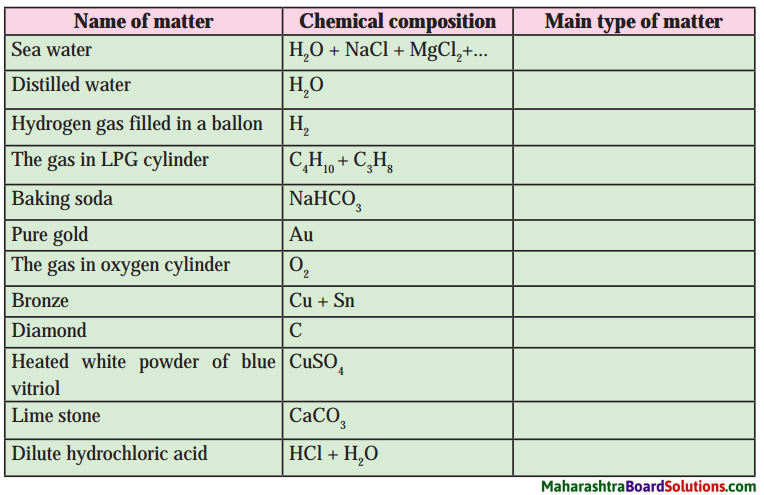
Question a.
Chemical composition of some matter is given in the following table. Identify the main type of matter from them.
Maharashtra Board Class 8 Science Solutions Chapter 6 Composition of Matter 2
Answer:

Name of matterChemical compositionMain type of matter
Sea waterH2O + NaCl + MgCl2 +…Mixture
Distilled waterH2OCompound
Hydrogen gas filled in a balloonH2Element
The gas in LPG cylinderC4H10 + C3H8Mixture
Baking sodaNaHCO3Compound
Pure goldAuElement
The gas in oxygen cylinderO2Element
BronzeCu + SnMixture
DiamondCElement
Heated white powder of blue vitriolCuSO4Compound
LimestoneCaCO3Compound
Dilute hydrochloric acidHCl + H2OMixture

Maharashtra Board Class 8 Science Solutions Chapter 6 Composition of Matter

7. Write scientific reason.

Question a.
Hydrogen is combustible, oxygen helps combustion, but water helps to extinguish fire.
Answer:

  1. Water is a compound of hydrogen and oxygen.
  2. In a compound, the constituents do not retain their individual properties. Hence, hydrogen is combustible and oxygen helps combustion, but water is neither combustible nor supports combustion, it helps to extinguish fire.

Question b.
The constituent substances of a colloid cannot be separated by oridinary filtration.
Answer:

  1. A colloidal solution is heterogeneous.
  2. The diameters of colloidal particles are of the order of 10-5 m.
  3. The particles of a colloid can easily pass through a filter paper as the pore size of a filter paper is big. Hence, the constituents of a colloidal cannot be separated by filtration.

Question c.
Lemon sherbat has sweet, sour and salty taste and it can be poured in a glass.
Answer:

  1. Lemon sherbat is a mixture. It is made up of lemon juice, sugar, salt and water.
  2. Formation of lemon sherbat does not involve any chemical reaction.
  3. The constituents of sherbat retain their individual properties. Hence, lemon sherbat is sweet, sour and salty to taste and it can be poured in a glass.

Maharashtra Board Class 8 Science Solutions Chapter 6 Composition of Matter

Question d.
A solid matter has the properties of definite shape and volume.
Answer:

  1. The forces among the constituent particles (atom/molecules) are called intermolecular forces.
  2. In solids these forces are strong enough to keep the particles together in fixed positions, as a result solids have a definite shape and volume.

8. Deduce the molecular formulae of the compound obtained from the following pairs of elements by the cross multiplication method.

Question a.
C (Valency 4) & Cl (Valency 1)
Answer:
Step 1: Write the symbols of the constituent elements.
Maharashtra Board Class 8 Science Solutions Chapter 6 Composition of Matter 4
Step 2: Write the valency below the respective elements.
Maharashtra Board Class 8 Science Solutions Chapter 6 Composition of Matter 5
Step 3: Cross multiply the valencies.
Maharashtra Board Class 8 Science Solutions Chapter 6 Composition of Matter 6
The molecular formula: CCl4

Question b.
N (Valency 3) & H (Valency 1)
Use your brain power!
Answer:
Step 1: Write the symbols of the constituent elements.
Maharashtra Board Class 8 Science Solutions Chapter 6 Composition of Matter 7
Step 2: Write the valency below the respective elements.
Maharashtra Board Class 8 Science Solutions Chapter 6 Composition of Matter 8
Step 3: Cross multiply the valencies.
Maharashtra Board Class 8 Science Solutions Chapter 6 Composition of Matter 9
The molecular formula: NH3

Maharashtra Board Class 8 Science Solutions Chapter 6 Composition of Matter

Question c.
C (Valency 4) & O (Valency 2)
Answer:
Step 1: Write the symbols of the constituent elements.
Maharashtra Board Class 8 Science Solutions Chapter 6 Composition of Matter 10
Step 2: Write the valency below the respective elements.
Maharashtra Board Class 8 Science Solutions Chapter 6 Composition of Matter 11
Step 3: Cross multiply the valencies.
Maharashtra Board Class 8 Science Solutions Chapter 6 Composition of Matter 12
The formula: C2O4
The number of constituent atoms in the final molecular formula should be the smallest possible whole number. Divide the formula C2O4 by suitable number.
Final molecular formula obtained by dividing by ‘2’.
Molecular formula: CO2

Question d.
Ca (Valency 2) & O (Valency 2)
Answer:
Step 1: Write the symbols of the constituent elements.
Maharashtra Board Class 8 Science Solutions Chapter 6 Composition of Matter 13
Step 2: Write the valency below the respective elements.
Maharashtra Board Class 8 Science Solutions Chapter 6 Composition of Matter 14
Step 3: Cross multiply the valencies.
Maharashtra Board Class 8 Science Solutions Chapter 6 Composition of Matter 15
The formula: Ca2O2
Divide the formula by suitable number ‘2’.
The molecular formula: CaO.

Maharashtra Board Class 8 Science Solutions Chapter 6 Composition of Matter

Project:

Question a.
Collect the wrappers of ready-made foodstuff. Use the information given and prepare a chart of foodstuff and the ingredients in it. Procure the ingredients available. Discuss with friends and teacher, test the procured ingredients with combustion test under the supervision of your teacher. Thereby identify the ingredients as organic or inorganic.

Class 8 Science Chapter 6 Composition of Matter Additional Important Questions and Answers

Rewrite the sentences after filling the blanks:

Question 1.
………….. have no definite shape, but have a definite volume.
Answer:
Liquids have no definite shape, but have a definite volume.

Question 2.
………… have neither a definite shape nor a definite volume.
Answer:
Gases have neither a definite shape nor a definite volume.

Question 3.
The properties of a …………… are different than those of the constitute elements.
Answer:
The properties of a compound are different than those of the constitute elements.

Maharashtra Board Class 8 Science Solutions Chapter 6 Composition of Matter

Question 4.
The part of matter having uniform composition is called ………………. .
Answer:
The part of matter having uniform composition is called phase.

Question 5.
The heterogeneous mixture of a liquid and a solid is called a ……………. .
Answer:
The heterogeneous mixture of a liquid and a solid is called a suspension.

Question 6.
A colloid is a ………………. .
Answer:
A colloid is a heterogeneous mixture.

Question 7.
Bronze contains atoms of the elements ……………. and ………….. .
Answer:
Bronze contains atoms of the elements copper and tin.

Question 8.
When all the components of a mixture form one phase, it is called ………….. .
Answer:
When all the components of a mixture form one phase, it is called homogeneous mixture.

Question 9.
…………… is a mixture of water, lactose, fats and proteins.
Answer:
Milk is a mixture of water, lactose, fats and proteins.

Maharashtra Board Class 8 Science Solutions Chapter 6 Composition of Matter

Question 10.
The intermolecular force is …………….. in the gaseous state.
Answer:
The intermolecular force is very weak in the gaseous state.

Choose the appropriate option and rewrite the following statements:

Question 1.
When a liquid is poured from one container to another, its shape may change, but its volume ………….. .
(a) increases
(b) decreases
(c) remains the same
(d) none of them
Answer:
(c) remains the same

Question 2.
The property by which some solids maintain their shape even when subjected to external forces is called ………. .
(a) elasticity
(b) fluidity
(c) rigidity
(d) plasticity
Answer:
(c) rigidity

Maharashtra Board Class 8 Science Solutions Chapter 6 Composition of Matter

Question 3.
…………… is a complex compound.
(a) Glucose
(b) Blue vitriol
(c) Chlorophyll
(d) Soda
Answer:
(c) Chlorophyll

Question 4.
………….. is a homogeneous mixture.
(a) Sand + water
(b) Flour + water
(c) Salt + water
(d) Oil + water
Answer:
(c) Salt + water

State whether the following statements are True or False:

Question 1.
Liquids do not have a definite shape
Answer:
True.

Question 2.
Gases have a definite shape and volume.
Answer:
False. (Gases do not have shape and volume.)

Question 3.
The crystals of blue vitriol form a single phase.
Answer:
True.

Question 4.
Water is a mixture.
Answer:
False. (Water is a compound)

Question 5.
Milk is a colloid.
Answer:
True.

Question 6.
A suspension does not scatters light.
Answer:
True.

Question 7.
Copper sulphate is a mixture.
Answer:
False. (Copper sulphate is a compound.)

Maharashtra Board Class 8 Science Solutions Chapter 6 Composition of Matter

Question 8.
An atom forms as many chemical bonds with other atom as its valency.
Answer:
True.

Question 9.
The strength of intermolecular forces is weak in the liquid state.
Answer:
False. (The strength of intermolecular forces is moderate in the liquid state.)

Question 10.
All the gases present together constitute a single phase.
Answer:
True.

Match the column:

Question 1.

Column IColumn II
1. Potassium dichromatea. Complex compound
2. Cyanocobalamineb. Element
3. Airc. Compound
4. Silverd. Mixture

Answer:

Column IColumn II
1. Potassium dichromatec. Compound
2. Cyanocobalaminea. Complex compound
3. Aird. Mixture
4. Silverb. Element

Question 2.

Column 1Column II
1. Milka. Alloy
2. Lemonadeb. Colloid
3. Sand and waterc. Solution
4. Brassd. Suspension

Answer:

Column 1Column II
1. Milkb. Colloid
2. Lemonadec. Solution
3. Sand and waterd. Suspension
4. Brassa. Alloy

Maharashtra Board Class 8 Science Solutions Chapter 6 Composition of Matter

Question 3.

Column IColumn II
1. Sea watera. Solid in solid
2. Vinegarb. Solid in liquid
3. Airc. Liquid in liquid
4. Bronzed. Gas in liquid
5. Chlorinated watere. Gas in gas

Answer:

Column IColumn II
1. Sea waterb. Solid in liquid
2. Vinegarc. Liquid in liquid
3. Aire. Gas in gas
4. Bronzea. Solid in solid
5. Chlorinated waterd. Gas in liquid

Answer the following questions in one sentence:

Question 1.
Why does a solid have definite volume ?
Answer:
In solids intermolecular forces are strong enough to keep the particles together in fixed positions, as a result solids have definite volume.

Question 2.
Why does a liquid have indefinite shape?
Answer:
In a liquid intermolecular forces are not strong enough to keep the particles together in fixed positions, as a result liquid has indefinite shape.

Maharashtra Board Class 8 Science Solutions Chapter 6 Composition of Matter

Question 3.
Why does a gas have indefinite volume and shape?
Answer:
In a gas intermolecular forces are very weak and the distance between the particles is very large, as a result gas has indefinite volume and shape.

Question 4.
What can you say about the distance between the neighbouring particles of solid?
Answer:
The particles of solid are very close to each other and the distance between them is minimum.

Question 5.
What can you say about the distance between the constituent particles of gas?
Answer:
The intermolecular force is very weak in gases. The distance between the particles of gas is very large. They move freely and occupy all the available space.

Question 6.
State whether the mixture of oil in water is a homogeneous or heterogeneous mixture.
Answer:
The mixture of oil in water is a heterogeneous mixture.

Question 7.
State whether seawater is a homogeneous or heterogeneous mixture.
Answer:
Seawater is a homogeneous mixture.

Maharashtra Board Class 8 Science Solutions Chapter 6 Composition of Matter

Question 8.
Give two examples of liquid in liquid.
Answer:
Examples of liquid in liquid:
Vinegar, dilute sulphuric acid.

Question 9.
Give two examples of gas in gas.
Answer:
Examples of gas in gas: Air, cooking gas.

Question 10.
Give two examples of solid in solid.
Answer:
Examples of solid in solid: Brass, stainless steel.

Question 11.
Give two examples of gas in liquid.
Answer:
Examples of gas in liquid: Chlorinated water, hydrochloric acid.

Question 12.
Give molecular formulae of 1. potassium chloride, 2. sodium sulphide.
Answer:

  1. Molecular formula of potassium chloride: KCl
  2. Molecular formula of sodium sulphide: Na2S.

Question 13.
State the molecular formula and number of hydrogen atoms in methane.
Answer:
Molecular formula of methane: CH4
The number of hydrogen atoms in methane is 4.

Question 14.
Identify the valency of chlorine in
(i) KCl and (ii) CaCl2.
Answer:
i. The valency of chlorine in KCl is 1.
ii. The valency of chlorine in CaCl2 is 1.

Answer the following questions:

Question 1.
State two principal ways of classifying matter.
Answer:
Two principal ways of classifying matter are:

  1. On the basis of physical state as a solid, liquid or gas.
  2. On the basis of chemical constitution as an element, compound or mixture.

Maharashtra Board Class 8 Science Solutions Chapter 6 Composition of Matter

Question 2.
What are the different states of matter?
Answer:
The different states of matter are solid, liquid and gas.

Question 3.
Define solid.
Answer:
A substance which has a definite shape and volume is called a solid.

Question 4.
State any three characteristics of solids.
Answer:

  1. Solids have a definite shape and volume.
  2. Most of the solids are rigid while some are plastic and some elastic.
  3. Solids have practically negligible compressibility, i.e., their volume is not very much changed by external forces.

Question 5.
What is meant by rigidity of solids?
Answer:
The property by which solids maintain their shapes when subjected to external forces is called rigidity.

Question 6.
What is meant by elasticity of solids?
Answer:
Some solids undergo a change in their shapes and volume when subjected to external forces and regain their original shapes and volume on removal of the forces. This property of solids is called elasticity.

Maharashtra Board Class 8 Science Solutions Chapter 6 Composition of Matter

Question 7.
What is meant by plasticity?
Answer:
Some solids are deformed by external forces and do not regain their original shapes on removal of the forces. This property of solids is called plasticity.

Question 8.
Solids have a high density and negligible compressibility. Explain.
Answer:

  1. The forces among the constituent particles (atoms/molecules) are called intermolecular forces.
  2. In solids these forces are strong enough to keep the particles together in fixed positions, as a result solids have a high density and negligible compressibility.

Question 9.
Define liquid.
Answer:
A substance which does not have a definite shape, but has a definite volume is called a liquid.

Question 10.
State any three characteristics of liquids.
Answer:

  1. Liquids have a definite volume.
  2. Liquids do not have a definite shape. They take the shape of the container in which they are stored.
  3. When they spill on a plane surface, they spread and flow in the surrounding areas, i.e., they have fluidity.
  4. They have very small compressibility.

Question 11.
What is meant by fluidity?
Answer:
Liquids flow easily and change their shapes in response to external forces. This property of liquids is called fluidity. It is exhibited by gases also.

Maharashtra Board Class 8 Science Solutions Chapter 6 Composition of Matter

Question 12.
Liquids have fluidity and they do not have a definite shape. Explain.
Answer:
1. The forces among the constituent particles (atoms/molecules) are called intermolecular forces.
2. In liquids, the intermolecular forces are strong enough to keep the particles within the bulk in aggregation, but not strong enough to keep them in fixed positions. As a result, they flow easily and change shapes according to that of container.

Question 13.
Define gas.
Answer:
A substance which has neither a definite shape nor a definite volume is called a gas.

Question 14.
State any three characteristics of gases.
Answer:

  1. Gases have neither a definite shape nor a definite volume.
  2. They spread in all directions.
  3. They can be compressed or expanded easily.
  4. In gases intermolecular forces are very weak.

Question 15.
Gases have neither a definite shape nor a definite volume. Explain.
Answer:

  1. The forces among the constituent particles (atoms/molecules) are called intermolecular forces.
  2. In gases the intermolecular forces are extremely weak. As a result, the molecules of a gas move freely and a gas occupies all the available space.

Maharashtra Board Class 8 Science Solutions Chapter 6 Composition of Matter

Question 16.
Why are gases more compressible, than liquids?
Answer:
In liquids the distances between the neighbouring molecules are less than those in the gases. The intermolecular forces are extremely weak in gases, but not so weak in liquids. Hence, gases are more compressible than liquids.

Question 17.
What is an element? Give two examples.
Answer:
A type of matter composed of only one kind of substances where each smallest indivisible part of it has the same properties is called an element. It cannot be subdivided into simpler substances by any physical or chemical means.
Examples: Oxygen, nitrogen, silver.

Question 18.
Write any two characteristics of an element.
Answer:

  1. All the atoms/molecules of an element are alike.
  2. Atoms/molecules of different elements are different.
  3. An element cannot be decomposed into simple substances by any chemical reaction or simple physical process.

Question 19.
What is a compound? Give two examples.
Answer:
A substance produced by a chemical reaction of two or more elements combined in a fixed proportion is called a compound.
Examples: Water, common salt, sugar.

Maharashtra Board Class 8 Science Solutions Chapter 6 Composition of Matter

Question 20.
Write any two characteristics of a compound.
Answer:

  1. The proportion of constituent elements in a compound is constant.
  2. The properties of a compound is different than those of the constituent elements.

Question 21.
What is a mixture? Give two examples.
Answer:
When two or more elements or compounds which do not react chemically with each other are mixed in any proportion, a mixture is formed.
Examples: Air, steel, milk.

Question 22.
Write any two characteristics of a mixture.
Answer:

  1. The constituent molecules of mixture are different from each other and notoined by chemical bonds.
  2. The proportion of constituent substances are retained in the mixture.
  3. The constituents of a mixture can be separated by a physical process.

Question 23.
Classify the following into elements, compounds and mixtures:
Sugar, sodium, nitrogen, sodium carbonate, air, sulphuric acid, mercury, stainless steel, cement, potassium dichromate.
Answer:

  • Elements: Sodium, nitrogen, mercury.
  • Compounds: Sugar, sodium carbonate, sulphuric acid, potassium dichromate.
  • Mixtures: Air, stainless steel, cement.

Maharashtra Board Class 8 Science Solutions Chapter 6 Composition of Matter

Question 24.
Write the composition of the following materials by means of chemical formulae and classify them accordingly.
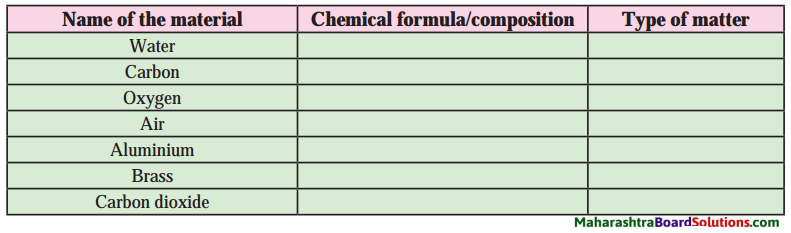
Maharashtra Board Class 8 Science Solutions Chapter 6 Composition of Matter 16
Answer:

Name of the materialChemical formulae/compositionType of matter
WaterH2OCompound
CarbonCElement
OxygenO2Element
AirO2 + N2 + CO2 + other gasesMixture
AluminiumAlElement
BrassCu + ZnMixture
Carbon dioxideCO2Compound

Question 25.
What is meant by an organic compound? Give two examples.
Answer:
The compound which when heated strongly gives black coloured carbon residue is called an organic compound or carbon compound.
Examples: Carbohydrates, proteins, hydrocarbons (petrol, cooking gas).

Maharashtra Board Class 8 Science Solutions Chapter 6 Composition of Matter

Question 26.
What is meant by an inorganic compound? Give two examples.
Answer:
Compounds which when heated strongly decomposes to give a residue behind are called inorganic compounds.
Examples: Common salt, rust, blue vitriol, limestone.

Question 27.
What is meant by complex compounds? Give two examples.
Answer:
The molecules of compounds which have a complex structure formed by many atoms and in the centre of this structure metal atoms are also included are called complex compounds.
Examples: Haemoglobin, chlorophyll.

Question 28.
Classify the following compounds into organic compounds, inorganic compounds and complex compounds.
Petrol, common salt, haemoglobin, blue vitriol, cyanocobalamine, cooking gas.
Answer:

  • Organic compounds: Petrol, cooking gas
  • Inorganic compounds: Common salt, blue vitriol.
  • Complex compounds: Cyano cobalamine, haemoglobin.

Question 29.
What is a phase?
Answer:
The part of matter with uniform composition is called a phase.

Question 29.
What is a homogeneous mixture? Give two examples.
Answer:
When all the components of a mixture form one phase, it is called homogeneous mixture.
Example: Solution of blue vitriol in water, solution of sugar in water.

Maharashtra Board Class 8 Science Solutions Chapter 6 Composition of Matter

Question 30.
What is heterogeneous mixture? Give two examples.
Answer:
When the components of a mixture are distributed into two or more phases, it is called a heterogeneous mixture.
Examples: Oil and water, sand and water.

Question 31.
Define solution or What is meant by a solution? Give two examples.
Answer:
A homogeneous mixture of two or more substances is called a solution.
Examples: Seawater, sugar, syrup.

Question 32.
What is meant by a solvent?
OR
Define solvent. Give two examples.
Answer:
The component which is present in largest proportion in a solution is called a solvent.
Examples:

  1. In sea water, water is the solvent.
  2. In tincture iodine, alcohol is the solvent.

Question 33.
What is meant by a solute?
OR
Define solute. Give two examples.
Answer:
The component of a solution which is present in smaller proportion than the solvent is called a solute.
Examples:

  1. In sea water, salt is a solute.
  2. When a small of amount of sugar is dissolved in water, sugar is the solute in the solution.

Question 34.
Define suspension.
OR
What is meant by a suspension?
Answer:
A heterogeneous mixture of a liquid and a solid is called a suspension. The diameter of the solid particles in a suspension is larger than 10-4 m.

Maharashtra Board Class 8 Science Solutions Chapter 6 Composition of Matter

Question 35.
Define colloid.
Answer:
A heterogeneous mixture in which the particles cannot be seen with a naked eye is called a colloid. The diameter of colloidal particles is around 10-5 m.

Question 36.
State the characteristics of a solution.
Answer:

  1. A solution is clear and transparent, it passes through a filter paper.
  2. The particles are not visible to the naked eye.
  3. A light can easily pass through it without scattering.
  4. A solution is homogeneous mixture.

Question 37.
State the characteristics of a suspension.
Answer:

  1. In suspension, the solute particles do not dissolve but remain suspended in it. The liquid and solid components of suspension are separated by filtration.
  2. The particles are visible to the naked eye.
  3. The particles in suspension are of very small size and scatter a beam of light passing through it.
  4. It is heterogeneous in nature.

Question 38.
State the characteristics of a colloid.
Answer:

  1. In a colloid, the particles are spread uniformly throughout the solution.
  2. The size of the particles is less than that of the particles in a suspension.
  3. The particles are not visible to the naked eye.
  4. The particles scatter a beam of light.
  5. A colloidal solution appears to be homogeneous, but actually it is heterogeneous. ‘

Maharashtra Board Class 8 Science Solutions Chapter 6 Composition of Matter

Question 39.
Give two examples of each of the following:

  1. Phase
  2. Homogeneous matter
  3. Heterogeneous matter
  4. Homogeneous mixture
  5. Heterogeneous mixture
  6. Solution
  7. Suspension
  8. Colloid.

Answer:

  1. Phase: (i) Solid: Sodium chloride, blue vitriol, sand, (ii) Liquid: Water, alcohol, (iii) Gas: Chlorine, ammonia.
  2. Homogeneous matter: Blue vitriol (solid), a solution of blue vitriol in water (a solid in a liquid), chlorinated water (a gas in a liquid).
  3. Heterogeneous matter: Sand and water, sand and alcohol, blue vitriol and sand.
  4. Homogeneous mixture: A solution of sodium chloride in water, air, a mixture of water and alcohol.
  5. Heterogeneous mixture: A mixture of sand and blue vitriol, sodium chloride and iron filings, oil and water.
  6. Solution: Seawater, a solution of sugar in water, a solution of blue vitriol in water.
  7. Suspension: A mixture of sand and water, sand and alcohol, muddy water, limestone in water.
  8. Colloid: Milk, milk of magnesia, blood, printing ink.

Question 40.
State the different types of solutions. Give one example.
Answer:
The different types of solutions:

  • Liquid in liquid. Examples: Vinegar, dilute sulphuric acid.
  • Gas in gas. Example: Air.
  • Solid in solid. Examples: Brass, stainless steel, bronze.
  • Gas in liquid. Examples: Chlorinated water.

Maharashtra Board Class 8 Science Solutions Chapter 6 Composition of Matter

Question 41.
Classify the following into homogeneous solution and heterogeneous solution?
Soda water, potassium permanganate solution, milk, alcohol in water, ink solution, wheat flour in water.
Answer:

  • Homogeneous solution: Soda water, potassium permanganate solution, alcohol in water.
  • Heterogeneous solution: Milk, ink solution, wheat flour in water.

Question 42.
Classify the following into solution, suspension and colloids:
Milk, sand in water, lemonade, smoke, oxygen in water.
Answer:

  • Solution: Lemonade, oxygen in water.
  • Suspension: Sand in water.
  • Colloids: Milk, smoke.

Question 43.
What is meant by molecular formula?
Answer:
The number of atom of each of the constituent elements present in one molecule of a compound is called molecular formula.

Question 44.
What is meant by valency of an element?
Answer:
The capacity of an element to combine with another element is known as valency.

Question 45.
Deduce the molecular formulae of the compound obtained from the following pairs of elements by the cross multiplication method.
Answer:
Question a.
H (Valency 1) and O (Valency 2)
Answer:
Step 1: Write the symbols of the constituent elements.
Maharashtra Board Class 8 Science Solutions Chapter 6 Composition of Matter 17
Step 2: Write the valency below the respective elements.
Maharashtra Board Class 8 Science Solutions Chapter 6 Composition of Matter 18
Step 3: Cross multiply the valencies.
Maharashtra Board Class 8 Science Solutions Chapter 6 Composition of Matter 19
∴ The molecular formula: H2O.

Maharashtra Board Class 8 Science Solutions Chapter 6 Composition of Matter

Question b.
Fe (Valency 2) and S (Valency 2)
Answer:
Step 1: Write the symbols of the constituent elements.
Maharashtra Board Class 8 Science Solutions Chapter 6 Composition of Matter 20
Step 2: Write the valency below the respective elements.
Maharashtra Board Class 8 Science Solutions Chapter 6 Composition of Matter 21
Step 3: Cross multiply the valencies.
Maharashtra Board Class 8 Science Solutions Chapter 6 Composition of Matter 22
The molecular formula: FeS

Question c.
The valencies of the atom H, O and N are 1, 2 and 3 respectively. The molecular formulae of these gaseous elements are H2, O2 and N2 respectively. How many chemical bonds are there in each of these molecules?
Answer:
Chemical bond in H2 is one
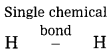
Maharashtra Board Class 8 Science Solutions Chapter 6 Composition of Matter 23
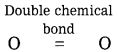
Chemical bond in O2 are two
Maharashtra Board Class 8 Science Solutions Chapter 6 Composition of Matter 24
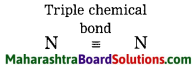
Chemical bond in N2 are three
Maharashtra Board Class 8 Science Solutions Chapter 6 Composition of Matter 25

Give scientific reasons:

Question 1.
Hydrogen is an element.
Answer:

  1. Hydrogen has only one kind of atoms.
  2. Hydrogen cannot be further divided into new substances by any physical or chemical means. Therefore, hydrogen is an element.

Question 2.
Water is a compound.
Answer:

  1. The composition of water is same throughout i.e., the elements hydrogen and oxygen whose atoms are combined in the ratio by weight is always 1 : 8.
  2. The properties of water are totally different from those of its constituents, i.e. hydrogen and I oxygen. Hence, water is a compound.?

Maharashtra Board Class 8 Science Solutions Chapter 6 Composition of Matter

Question 3.
Air is a mixture.
Answer:

  1. Air contains nitrogen, oxygen and other gases.
  2. These gases retain their original properties. They do not combine with each other. Hence, air is a mixture.

Question 4.
A potassium permanganate solution in water is a homogeneous mixture, while a mixture of oil and water is a heterogeneous mixture.
Answer:

  1. In a potassium permanganate solution in water the constituents, i.e. potassium permanganate and water are uniformly mixed throughout.
  2. The properties and composition of a homogeneous mixture are the same throughout the mixture. Hence, potassium permanganate solution is a homogeneous mixture.
  3. In a mixture of oil and water, the constituents are not uniformly mixed throughout the mixture.
  4. The properties and composition of a heterogeneous mixture are not the same throughout the mixture. Hence, a mixture of oil and water is a heterogeneous mixture.

Question 5.
Milk is a colloid.
Answer:

  1. In milk, the particles are spread uniformly throughout and due to very small size of the particles, milk appears to be homogeneous.
  2. But milk is a colloid solution and it is a heterogeneous mixture. Here, milk is liquid particles of proteins and fats having a diameter around 10-5 m dispersed in the aqueous medium. Hence, a milk is a colloid.

Distinguish between the following:

Question 1.
Answer:

SolidsLiquids
1.  Solids have a definite shape.1. Liquids have no definite shape.
2.  They have very low compressibility.2. They have moderate compressibility.
3. In solids, the intermolecular forces are very strong. E.g. iron, stone, salt.3. In liquids, the intermolecular forces are moderately strong. E.g., water, alcohol, mercury.

Maharashtra Board Class 8 Science Solutions Chapter 6 Composition of Matter

Question 2.
Liquids and Gases:
Answer:

LiquidsGases
1. Liquids have a definite volume.1. Gases do not have a definite volume.
2. They have moderate compressibility.2. They have high compressibility.
3. In liquids, the intermolecular forces are moderately strong. E.g. water, alcohol, mercury.3. In gases, the intermolecular forces are very weak. E.g. oxygen, air.

Question 3.
Solids and Gases:
Answer:

SolidsGases
1. Solids have a definite shape and volume.1. Gases have neither a definite shape nor a definite volume.
2. They have incompressibility.2. They have high compressibility
3. In solids, the intermolecular forces are very strong. E.g. iron, stone.3. In gases, the intermolecular forces are very weak. E.g. hydrogen, oxygen.

Question 4.
Element and Compound:
Answer:

ElementCompound
1. An element consists of only one kind of substance.1. A compound is formed from two or more elements.
2. An element cannot be further divided into simpler substances by any physical or chemical means. E.g. iron, copper, oxygen.2. A compound can be further divided into simple substances by chemical means. E.g. common salt, sugar, water.

Maharashtra Board Class 8 Science Solutions Chapter 6 Composition of Matter

Question 5.
Compound and mixture:
Answer:

CompoundMixture
1. A compound is made of two or more elements chemically combined in a fixed proportion.1. A mixture is obtained by just mixing two or more substances in any proportion.
2. A compound can be further subdivided into simpler substances by chemical means only.2. A mixture can be further subdivided into simpler substances by simple physical processes.
3. The properties of a compound are entirely different from the properties of its constituents. E.g. common salt, sugar, water.3. The constituents of a mixture retain their original properties. E.g. air, seawater.

Question 6.
Colloidals and Suspension:
Answer:

ColloidalsSuspension
1. The particles in a colloidal solution can pass through a filter paper.1. The particles in a suspension cannot pass through a filter paper.
2. The colloidal particles cannot be seen with a naked eye.2. The suspended particles can be seen with a naked eye.
3. The diameter of solid particles is around 10-5 m3. The diameter of the solid particles is larger than 10-4 m.

Activity-based questions:

Activity 1:
Apparatus: Plastic jar, balloon, thread
Material: Mustard seeds
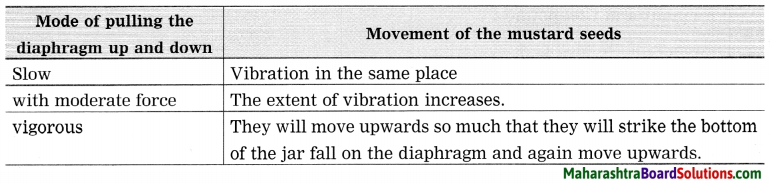
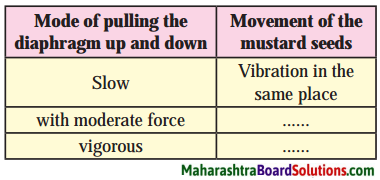
Take some mustard seeds in a transparent plastic jar. Thread a long thread at the centre of a big balloon by means of a needle and tie it tight. Stretch this rubber diaphragm and fix it on the mouth of the jar by means or a rubber band. Pull the diaphragm up and down with the help of the thread first slowly, then with moderate force and then vigorously. Record your observation in the following table.
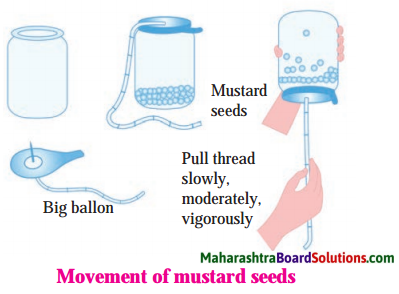
Maharashtra Board Class 8 Science Solutions Chapter 6 Composition of Matter 26

Question 1.
Maharashtra Board Class 8 Science Solutions Chapter 6 Composition of Matter 27
Answer:
Maharashtra Board Class 8 Science Solutions Chapter 6 Composition of Matter 28

Maharashtra Board Class 8 Science Solutions Chapter 6 Composition of Matter

Activity 2:
Apparatus: Hammer, sand paper
Material: Iron nail, copper wire, aluminium wire, coal.
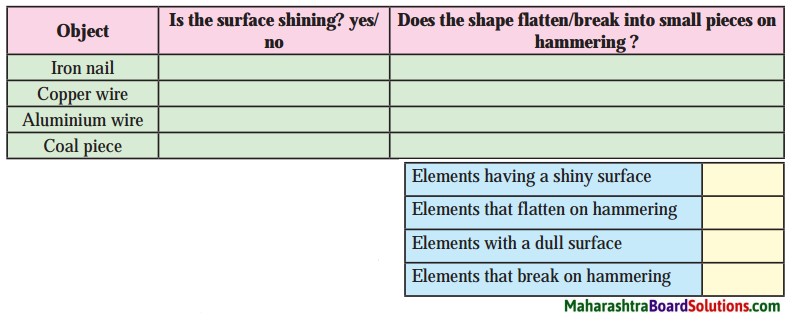
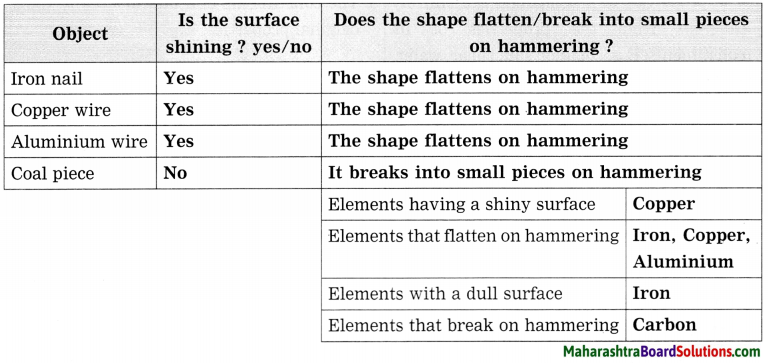
Take the following objects: iron nail/sheet, copper wire, aluminium wire, a piece of coal. Rub each object on a fresh surface of sandpaper and observe. Hammer each object with force. (Take care not to hurt yourself.) Record your observations in the following table.
The objects in the activity are made of the elements iron (Fe), copper (Cu), aluminium (Al) and carbon (C); respectively. Fill the following table on the basis of the observations obtained on doing the above two tests on each of the objects.

Question 1.
Maharashtra Board Class 8 Science Solutions Chapter 6 Composition of Matter 29
Answer:
Maharashtra Board Class 8 Science Solutions Chapter 6 Composition of Matter 30

Maharashtra Board Class 8 Science Solutions Chapter 6 Composition of Matter

Activity 3:
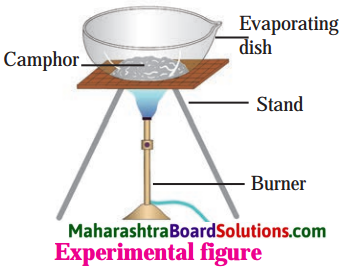
Apparatus: Evaporating dish, tripod stand, burner, etc.
Chemicals: Camphor, washing soda, blue vitriol, sugar, glucose, urea.
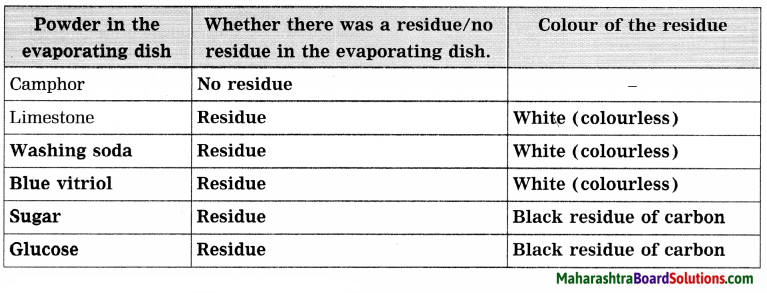
Keep the evaporating dish on the tripod stand. Take some camphor in the evaporating dish. Heat the camphor in the dish strongly with the help of a burner. Find out what remains behind in the evaporating dish. Repeat the above procedure using limestone, washing soda, blue vitriol, sugar, glucose and urea instead of camphor. Record your observation in the following table. (Do this activity carefully under the supervision of your teacher, as some of the powders may catch fire.)
Maharashtra Board Class 8 Science Solutions Chapter 6 Composition of Matter 31

Question 1.
Maharashtra Board Class 8 Science Solutions Chapter 6 Composition of Matter 32
Answer:
Maharashtra Board Class 8 Science Solutions Chapter 6 Composition of Matter 33

Maharashtra Board Class 8 Science Solutions Chapter 6 Composition of Matter

Activity 4: (Textbook page 43)
Apparatus: Beakers, rods
Chemicals: Blue vitriol, sand, water, etc.
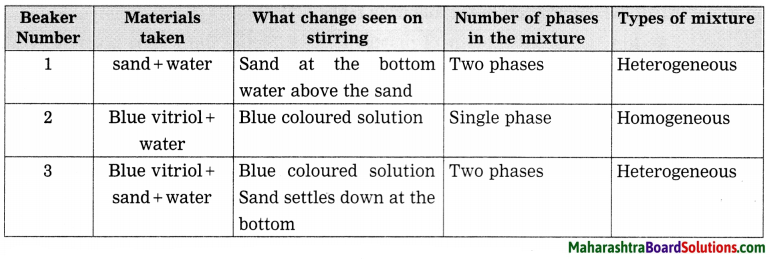
Take three beakers. Take a little sand and water in the first beaker. Take some crystals of blue vitriol and water in the second beaker. Take some blue vitriol and sand in the third beaker. Stir the materials in all the three beakers and observe. Record your observation in the following table.

Question 1.
Maharashtra Board Class 8 Science Solutions Chapter 6 Composition of Matter 34
Answer:
Maharashtra Board Class 8 Science Solutions Chapter 6 Composition of Matter 35

Question 2.
In the above activity after stirring a homogeneous mixture is formed in only one beaker? Which is that?
Answer:
The homogeneous mixture is formed in the second beaker. It is a solution of blue vitriol.

Maharashtra Board Class 8 Science Solutions Chapter 6 Composition of Matter

Activity 5:
Apparatus: Beaker, conical flask, funnel, filter paper
Chemicals: Common salt, saw dust, milk.
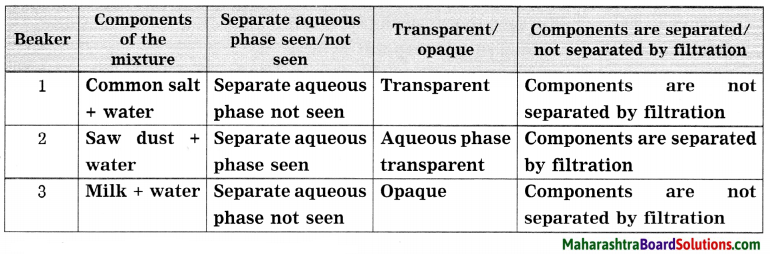
Procedure: Take three beakers. Take 10 g common salt in the first beaker, 10 g saw dust in the second beaker and 10 ml milk in the third beaker. Add 100 ml water to all the three beakers and stir. Which of the mixtures shows separate water phase ? Place the three beakers in front of a vertically held paper and pass a laser beam through the beakers from the opposite side. (Use the laser beam under the guidance of teacher.) At the same time observe what appears on the paper in front of the beaker. Also look at the beaker from the side. Arrange three filtration assemblies using conical flask, funnel and filter paper for doing filtration. Stir the mixtures in the three beakers and carry out filtration. Record all the observations in the following table.

Question 1.
Maharashtra Board Class 8 Science Solutions Chapter 6 Composition of Matter 36
Answer:
Maharashtra Board Class 8 Science Solutions Chapter 6 Composition of Matter 37

Activity 6: (Textbook page 44)
Apparatus: Horseshoe magnet, evaporating dish, burner. Chemicals: Iron filings, sulphur.
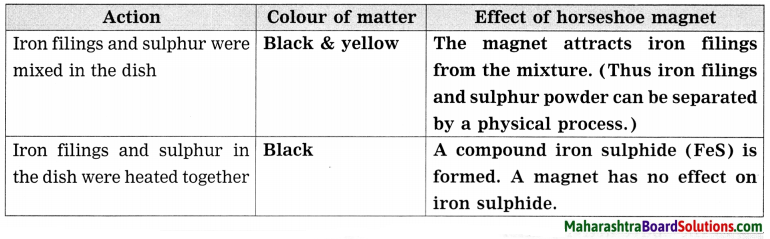
Procedure: Take two evaporating dishes. Take 7 g iron filings in the first dish and 4 g sulphur in the second. Take a horseshoe magnet near the matter in both the dishes and observe. Transfer the entire iron filings from the first dish to the second, stir with a glass rod and observe by taking the horseshoe magnet near the matter. Also observe the colour of the matter. Now heat the matter in the second dish for a while and let it cool. Observe the colour change, if any in the matter and observe whether there is any effect of the horseshoe magnet on it. Record all the observation in the following table.

Question 1.

Maharashtra Board Class 8 Science Solutions Chapter 6 Composition of Matter 38
Answer:
Maharashtra Board Class 8 Science Solutions Chapter 6 Composition of Matter 39

Complete the following:

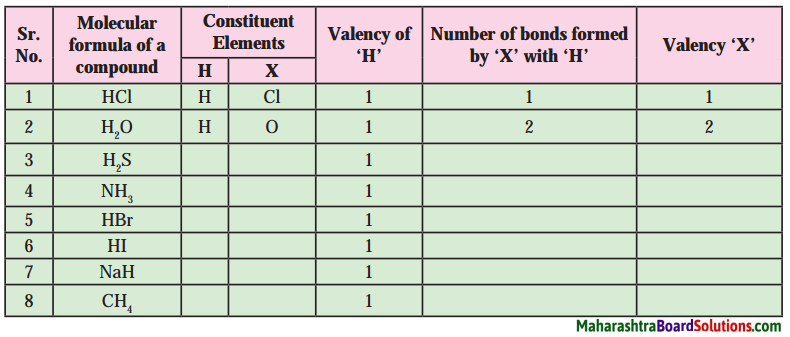
Question 1.
Complete the table:
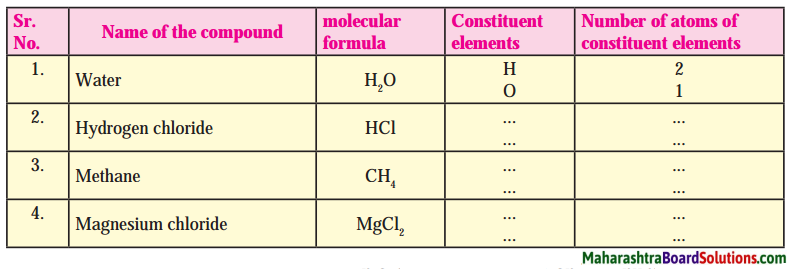
Maharashtra Board Class 8 Science Solutions Chapter 6 Composition of Matter 40
Answer:
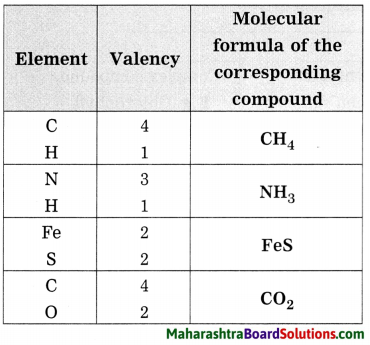
Molecular formulae of some compounds are given in the following table. Use these to fill in the gaps in the table.
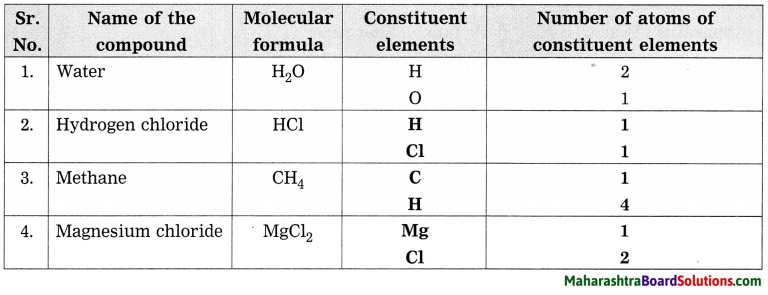
Maharashtra Board Class 8 Science Solutions Chapter 6 Composition of Matter 41

Maharashtra Board Class 8 Science Solutions Chapter 6 Composition of Matter

Question 2.
Complete the table:
Maharashtra Board Class 8 Science Solutions Chapter 6 Composition of Matter 42
Answer:
Molecular formulae of various compounds formed by hydrogen with other elements are given in the following table. From that, deduce the valencies of the concerned elements.
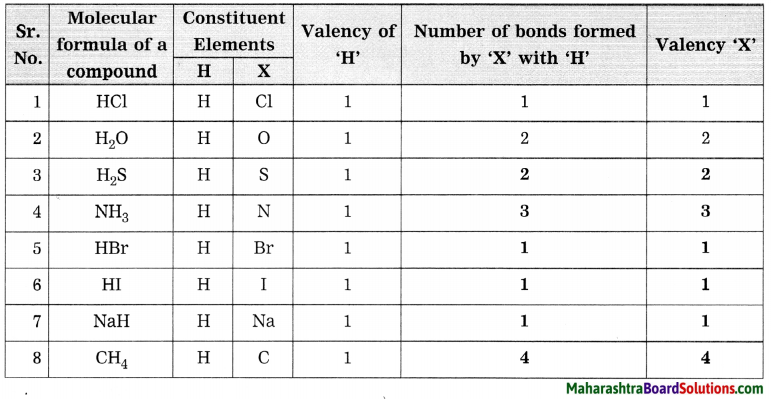
Maharashtra Board Class 8 Science Solutions Chapter 6 Composition of Matter 43

Question 3.
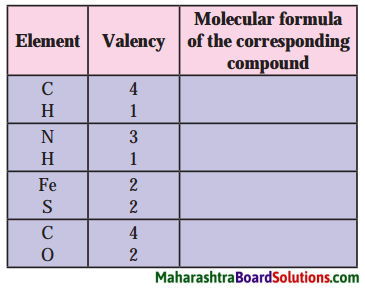
Complete the table:
Maharashtra Board Class 8 Science Solutions Chapter 6 Composition of Matter 44
Answer:
Maharashtra Board Class 8 Science Solutions Chapter 6 Composition of Matter 45

Maharashtra Board Class 6 Geography Solutions Chapter 7 Rocks and Rock Types

Balbharti Maharashtra State Board Class 6 Geography Solutions Chapter 7 Rocks and Rock Types Notes, Textbook Exercise Important Questions and Answers.

Maharashtra Board Class 6 Geography Solutions Chapter 7 Rocks and Rock Types

Class 6 Geography Chapter 7 Rocks and Rock Types Textbook Questions and Answers

B. Which of the following monuments are built in igneous rock?
(1) The Taj Mahal
(2) Fort Raigad
(3) The Red Fort
(4) Ellora Sculpture
Answer:
Ellora Sculpture

Maharashtra Board Class 6 Geography Solutions Chapter 7 Rocks and Rock Types

C. Find the differences between:

Question 1.
Igneous and sedimentary rocks
Answer:

Igneous rocksSedimentary rocks
(i) Igneous rocks are rocks formed by cooling and solidifying of molten materials.

(ii) Igneous rocks are hard and homogeneous.

(iii)  Examples: Basalt, pumice

(i) Rocks that are formed through deposition and compaction of sediments, especially rock particles transported by rivers, glaciers, wind, etc., are called sedimentary rocks.
(ii) Sedimentary rocks are generally brittle and light weight.
(iii) Examples: Sandstone, limestone, shale, corals

Question 2.
Sedimentary and metamorphic rocks
Answer:

Sedimentary rocksMetamorphic rocks
(i) Rocks that are formed through deposition and compaction of sediments, especially rock particles transported by rivers, glaciers, wind, etc., are called sedimentary rocks.(i) Rocks are formed due to the process of metamorphosis are called metamorphic rocks.
(ii) One may find fossils in sedimentary rocks.

(iii) Sedimentary rocks are brittle and light weight. Examples: Shale, corals

(ii) Metamorphic rocks do not contain fossils.

(iii) Metamorphic rocks are heavy and hard. Examples: Marble, slate

Question 3.
Igneous and metamorphic rocks
Answer:

igneous rocksMetamorphic rocks
(i) Igneous rocks are rocks formed by cooling and solidifying of molten material.
(ii) Igneous rocks are hard and homogeneous.
(iii) Examples: Basalt, pumice
(i) Rocks formed due to the process of metamorphosis are called metamorphic rocks.
(ii) Metamorphic rocks are heavy and hard.
(iii) Examples: Gneiss, slate

D. Which types of rocks are predominantly found at the following locations?
(1) Central Maharashtra
(2) South Konkan
(3) Vidarbha
Answer:

LocationsTypes of rocks
(1) Central Maharashtra(a) Basalt
(2) South Konkan(b) Laterite and granite
(3) Vidharbha(c) Basalt, granite and sedimentary rocks

Activity:

Collect rock specimens from your surroundings and also during your travels. Classify them with the help of your teacher. Make a small museum of rocks for your school and place your specimens there. Keep a note of the place from where you have collected them. (See a specimen
display on page 65.)

Visit the historical sites in your surroundings, e.g., hill forts, masonry dams, land forts, bastions, wadas, temples, mosques, etc. and observe with the help of your teacher, the rock used for their construction.

Maharashtra Board Class 6 Geography Solutions Chapter 7 Rocks and Rock Types

Class 6 Geography Chapter 7 Rocks and Rock Types InText Questions and Answers

Do it yourself!

From the hills, river-beds or the land in your vicinity, collect rock specimens of different types, shapes, colours, etc. Observe the rock specimens and note down the following.

Question 1.
Place where the rock was found:
Answer:
Sahyadri mountain (Basalt)

Question 2.
Colours of the rock:
Answer:
Dark-black colour.

Question 3.
Spots on the rock and their colour:
Answer:
Dark grey to black.

Question 4.
Weight of the rock (estimated, heavy/light):
Answer:
Heavy.

Question 5.
Hardness of the rock, (hard/ brittle/medium):
Answer:
Hard.

Question 6.
Structure of the rock, (uniform grains/layers/ hollowness):
Answer:
Uniform grains.

Question 7.
Porosity of the rock, (porous/non-porous):
Answer:
Non-porous.

Maharashtra Board Class 6 Geography Solutions Chapter 7 Rocks and Rock Types

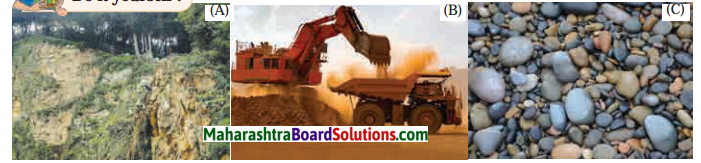
Observe the pictures given below and answer the questions:

Maharashtra Board Class 6 Geography Solutions Chapter 7 Rocks and Rock Types 1
Question 1.
What is the hill in ‘A’ made up of?
Answer:
Hill in ‘A’ is made up of soils and rocks.

Question 2.
What is being done in B’?
Answer:
In ’B’, the process of digging is shown. The land is dug and the rocks and soil that is extracted is loaded in to a truck.

Question 3.
What do we see in ‘C’?
Answer:
In ‘C’ we see pebbles and rocks of different types, shapes, colours, etc.

Question 4.
Is there any relationship between the three things shown above?
Answer:
Yes, these are all pictures of naturally occurring processes on land leading to rock and soil formation.

Question 5.
For what purpose do we use the things shown in A and C?
Answer:
We use things shown in A and C for construction purposes; coloured pebbles are used for decoration.

Use your brain power!

Question 1.
What rock was used for building the forts in Maharashtra? Why?
Answer:
Igneous rocks were used for building the forts in Maharashtra as they are hard, homogeneous and heavy.

Question 2.
Find the meaning of this line from a famous Marathi poem:
राकट देशा, कणखर देशा. दगडांच्या देशा
Answer:
The poet through this line conveys the message that our land is made up of hard rocks. We are a powerful entity and nothing can pose a threat to our Motherland. We can understand all odds.

Similarly like our terrains which are strong, the people of our country are also strong and invincible, incapable of being conquered.
We have imbibed the value of resilience and courage and the ability to withstand all challenges from our terrain.

Maharashtra Board Class 6 Geography Solutions Chapter 7 Rocks and Rock Types

What will you do?

Ajit is interested in sculpting. He wants to prepare a sculpture of Dr. APJ Abdul Kalam.
He cannot decide which rock he should use for this, igneous, sedimentary or metamorphic? What will be your advice?
Answer:
I would advise him to use a metamorphic rock like marble. Due to the translucent nature of the marble, it will give the sculpture a glow. Properties like softness and easy availability makes the metamorphic rock, marble an ideal choice. These rocks are heavy and hard. Hence, they are ideal for making sculptures.

Class 6 Geography Chapter 7 Rocks and Rock Types Additional Important Questions and Answers

Fill in the blanks choosing the correct options from the bracket:

Question 1.
Rocks are a mixture of different minerals formed by natural processes in the _____. (lithosphere, atmosphere, hydrosphere)
Answer:
lithosphere

Question 2.
There are ______ types of rocks according to their formation process. (four, three, five)
Answer:
three

Question 3.
When the molten material, known as magma within the crust and lava on the surface, cools down, it solidifies giving rise to ____ rocks. (Sedimentary, Igneous, Metamorphic)
Answer:
Igneous

Question 4.
We get fossils in ______ rocks. (Sedimentary, Igneous, Metamorphic)
Answer:
Sedimentary

Question 5.
The Maharashtra plateau and the Sahyadris are formed out of _______ rocks. (Sedimentary, Igneous, Metamorphic)
Answer:
Igneous

Question 6.
______ is a major example of igneous rocks. (Shale, Basalt, Corals)
Answer:
Basalt

Maharashtra Board Class 6 Geography Solutions Chapter 7 Rocks and Rock Types

Question 7.
Water percolating through rocks dissolves the soluble minerals leading to ________ of rocks, (weathering, compaction, increased porosity)
Answer:
weathering

Question 8.
_______ is a sedimentary rock. (Basalt, Sandstone, Pumice)
Answer:
Sandstone

Question 9.
The study of _______ provide information about life in that period. (metamorphosedrocks, Igneous rocks, fossils)
Answer:
fossils

Question 10.
_______ gets metamorphosed when it undergoes heavy pressure, and intense heat. (Coal,,Peat, Silica)
Answer:
Coal

Question 11.
_______ rock is found in the eastern parts and in South Konkap. (Granite,.Marble,Pumice)
Answer:
Granite

Question 12.
________ activity is concentrated in South Konkan and eastern Maharashtra. (Fishing, Mining, Construction)
Answer:
Mining

Question 13.
_____ is referred to as primary rocks. (Igneous rock, Sedimentary rock, Metamorphic rocks)
Answer:
Igneous rock

Question 14.
________ is a major example of igneous rock. (Basalt, Pumice, Sedimentary)
Answer:
Basalt

Maharashtra Board Class 6 Geography Solutions Chapter 7 Rocks and Rock Types

Question 15.
______ rocks are ‘formed due to compaction of material. (Metamorphic, Sedimentary, Igneous)
Answer:
Sedimentary

Question 16.
_________ rocks are heavy and hard. (Sedimentary, Metamorphic, Igneous)
Answer:
Metamorphic

Question 17.
When coal gets metamorphosed into ______ , its price increases. (garnet, diamond, opal)
Answer:
diamond

Question 18.
______ is found in South Konkan Maharashtra. (Granite, Laterite, Basalt)
Answer:
Laterite

Match the pairs correctly:

Question 1.

Column AColumn B
(1) Igneous rocks(a) brittle and light weight
(2) Sedimentary rocks(b) heavy and hard
(3) Metamorphic rocks(c) hard and homogeneous

Answer:
1 – c
2 – a
3 – b

Complete the tabular form:

Original RockMetamorphosed Rock
Granite_________
Basalt__________
_________Marble
Coal___________
Sand Stone__________
_________Slate

Answer:

Original RockMetamorphosed Rock
GraniteGneiss
BasaltAmphibolite
LimestoneMarble
CoalDiamond
Sand StoneQuartizte
ShaleSlate

Maharashtra Board Class 6 Geography Solutions Chapter 7 Rocks and Rock Types

Name the following:

Question 1.
Two major rock-forming minerals:
Answer:
Silica, aluminium.

Question 2.
Hard and homogeneous rocks:
Answer:
Igneous rocks.

Question 3.
Two sedimentary rocks:
Answer:
Shale, corals.

Question 4.
Rocks which does not contain fossils:
Answer:
Metamorphic and Igneous rock

Question 5.
One use of diamonds:
Answer:
Ornament making.

Question 6.
One activity which leads to increased pressure and heat in that region:
Answer:
Volcanic eruption.

Question 7.
Rock found in South Konkan:
Answer:
Laterite.

Question 8.
Rocks that formed by metamorphosis:
Answer:
Metamorphic rocks.

Question 9.
Two metamorphosised rocks:
Answer:
Marble, Slate.

Question 10.
Two igneous rocks:
Answer:
Granite and Basalt.

State whether the following statements are true or false:

Question 1.
The properties of rocks depend on their constituent minerals and their proportion alone.
Answer:
False.

Maharashtra Board Class 6 Geography Solutions Chapter 7 Rocks and Rock Types

Question 2.
Silica is a rock forming mineral.
Answer:
True

Question 3.
One may find fossils in Igneous rocks.
Answer:
False

Question 4.
Weathering of rocks leads to its disintegration or decomposition.
Answer:
True

Question 5.
Sedimentary rocks are hard and homogeneous.
Answer:
False

Question 6.
Maharashtra has large reserves of mineral wealth.
Answer:
False

Question 7.
The Maharashtra plateau and the Sahyadris are formed out of igneous rocks.
Answer:
True

Question 8.
Most of the hill forts in Maharashtra do not have lakes or elephant yards.
Answer:
False

Question 9.
One can easily see layers in the sedimentary rocks.
Answer:
True

Question 10.
Sedimentary rocks are generally heavy weight.
Answer:
False

Question 11.
Metamorphic rocks do not contain fossils.
Answer:
True

Question 12.
Metamorphic rocks are brittle and lightweight.
Answer:
false

Maharashtra Board Class 6 Geography Solutions Chapter 7 Rocks and Rock Types

Answer the following questions in short:

Question 1.
What are rocks?
Answer:
Rocks are a mixture of different minerals formed by natural processes in the lithosphere. Rocks are found on land surface and also below it.

Question 2.
What do the properties of rocks depend on?
Answer:
The properties of rocks depend on the constituent minerals and their proportion as well as on the formation process. Silica, aluminium, magnesium and iron are the major rock-forming minerals.

Question 3.
What are the three types of rocks?
Answer:
Igneous rocks, Sedimentary rocks and Metamorphic rocks are the three types of rocks.

Question 4.
What are Igneous Rocks?
Answer:
When the molten material, known as magma within the crust and lava on the surface cools down, it solidifies giving rise to igneous rocks.

Question 5.
What information does the study of fossils provide?
Answer:
Study of fossils provide information about the life in the olden period.

Question 6.
Write any two characteristics of metamorphic rocks.
Answer:
Metamorphic rocks are heavy and hard.

Question 7.
When does coal get metamorphosed?
Answer:
When coal undergoes heavy pressure and intense heat it gets metamorphosed.

Question 8.
When does the price of coal increase?
Answer:
The price of coal increases when it gets metamorphosed into diamonds.

Maharashtra Board Class 6 Geography Solutions Chapter 7 Rocks and Rock Types

Question 9.
What is referred to as primary rocks?
Answer:
Rocks are formed out of the material from the interior of the earth, these are referred to as primary rocks.

Question 10.
What is called fossils?
Answer:
The buried remains of dead animals or plants embedded in the rocks and preserved petrified form are called fossils.

Give geographical reasons for the following statements:

Question 1.
Igneous rocks are also referred to as primary rocks.
Answer:
As Igneous rocks are formed out of the material from the interior of the earth, these rocks are also referred to as primary rocks.

Question 2.
Most of the hill forts in Maharashtra have lakes or elephant yards.
Answer:
(i) Hillforts in Maharashtra are old quarry sites from which stone or other materials have been extracted for the construction of the fort and other buildings.

(ii) In the pits and dugouts left behind after rock extraction, water was allowed to accumulate and these lakes, banks, etc., were created.

(iii) Therefore, most of the hill forts in Maharashtra have lakes or elephant yards.

Question 3.
Weathering of rocks occurs.
Answer:

  • Due to continuous variations in temperature, rocks develop cracks.
  • Similarly, the water percolating through rocks dissolves the soluble minerals.
  • This leads to the weathering of rocks.

Maharashtra Board Class 6 Geography Solutions Chapter 7 Rocks and Rock Types

Question 4.
One may find fossils in sedimentary rocks.
Answer:

  • One can easily see layers in sedimentary rocks.
  • While layers are getting deposited, the remains of the dead animals or plants get buried in these layers at times.
  • Therefore, one may find fossils in sedimentary rocks.

Question 5.
Changes in nature, as well as the chemical composition of the original rocks, is witnessed.
Answer:

  • Volcanic activity and other earth movements constantly take place on the earth.
  • While these are occurring, the igneous and sedimentary rocks in that region are subjected to tremendous pressure and heat.
  • This leads to changes in nature as well as the chemical composition of the original rocks.

Question 6.
Maharashtra does not have a large reserve of mineral wealth.
Answer:
Maharashtra does not have a large reserve of mineral wealth due to the thick and extensive layers of basalt rocks.

Answer the following questions in detail:

Question 1.
What leads to the development of sedimentary rocks?
Answer:

  • Due to continuous variations in the temperature, rocks develop cracks.
  • Similarly, the water percolating through rocks dissolves the soluble minerals leading to the weathering of rocks.
  • They get disintegrated or decomposed i.e. reduced to pieces.
  • These rock particles get transported by rivers, glaciers, wind, etc. towards low lying area and are deposited there.
  • One after the other, layers of sediments gets deposited in this way.
  • The upper layers exert heavy pressure on the lower layers.
  • This leads to compaction of materials and development of sedimentary rocks.

Question 2.
How are Metamorphic rocks formed?
Answer:

  • Volcanic activity and other earth movements | constantly take place on the earth.
  • While these are occurring, the igneous or sedimentary rocks in that region are subjected to tremendous pressure and heat.
  • This leads to changes in the nature as well as the chemical composition of original rocks.
  • The crystals in the original rock gets recrystalized, the rock gets metamorphosed.
  • The rocks formed through such a process are ! called Metamorphic rocks.

Maharashtra Board Class 6 Geography Solutions Chapter 7 Rocks and Rock Types

Question 3.
How is sand that flows in a river formed? Collect some information about where the sand comes from.
Answer:

  • Moving streams are so powerful that it can wear away soil rocks.
  • Rocks on higher land get eroded due to the strong current of the streams and they in turn get carried away into the sea.
  • Silt too is brought down from the mountain top from where the streams originate.
  • Most of the sand in the river is silt carried by the streams and the weather material from inland rocks transported by the streams.
  • The moving of soil and rock with the stream, termed as erosion can be summed up as the cause of sand formation in a river.

Maharashtra Board Class 9 Political Science Solutions Chapter 3 India’s Defence System

Balbharti Maharashtra State Board Class 9 Political Science Solutions Chapter 3 India’s Defence System Notes, Textbook Exercise Important Questions and Answers.

Maharashtra State Board Class 9 Political Science Solutions Chapter 3 India’s Defence System

Class 9 Political Science Chapter 3 India’s Defence System Textbook Questions and Answers

1. Choose the right option and rewrite the sentence:

Question 1.
The ______ of India is the Commander-in-Chief of all the Defence forces.
(a) President
(b) Prime Minister
(c) Defence Minister
(d) Governor
Answer:
(a) President

Maharashtra Board Class Maharashtra Board Class 9 Political Science Solutions Chapter 3 India’s Defence System

Question 2.
The ______ has the responsibility of protecting the coastline.
(a) Army
(b) Coast guard
(c) Border Security Force
(d) Rapid Action Force
Answer:
(b) Coast guard

Question 3.
The _______ has been established with the purpose of instilling among students the love of discipline and military training.
(a) Border Security Forces (BSF)
(b) Central Reserve Police Force (CRPF)
(c) National Cadet Corps (NCC)
(d) Rapid Action Force (RAF)
Answer:
(c) National Cadet Corps (NCC)

2. Explain with reasons whether the following statements are true or false:

Question 1.
It is necessary to end terrorism to ensure human security.
Answer:
True.

  • The biggest challenge to human security is that of terrorism.
  • Terrorism targets common, innocent people.
  • It aims at creating terror or fear in their minds, so that they begin to feel insecure.
  • Thus, in order to protect human security, it is necessary to put an end to terrorism.

Question 2.
Every nation creates a strong security system for itself.
Answer:
True.

  • National Security is closely connected with geography because national security is more likely to be endangered by nations who are geographically closer.
  • A nation must assess the threat to its geographical boundaries and the source of that threat.
  • In order to keep this threat at bay, the nation has to increase its military might.
  • The nation has to use modem technology to predict the threat, to build weapon systems and modernize and update the defence forces.

Question 3.
There are no issues of dispute between India and Pakistan.
Answer:
False.

  • There are several disputes between India and Pakistan. For example, the Kashmir issue, disputes over river water sharing, the problem of infiltrations, dispute over the border, etc.
  • India has continually tried to solve these issues through discussion and negotiations

Maharashtra Board Class Maharashtra Board Class 9 Political Science Solutions Chapter 3 India’s Defence System

3. Write short notes:

Question 1.
The functions of the Rapid Action Force
Answer:
The Rapid Action Force performs the task of bringing people’s lives to normalcy by moving in quickly in incidents of the threat to National Security such as bomb blasts or riots.

Question 2.
Human Security
Answer:
(i) In the Post – Cold War period, the concept of National Security changed and became broader. National Security is not just the security of the country but also of the people living in it, because security is ultimately for the people.

(ii) Hence; human security refers to human-centric thinking. In human security, it is expected that human beings should be protected from all sorts of dangers and they should be given the opportunities of education, health and development.

(iii) The concept of human security also includes the idea that a conducive environment should be created for everybody to live a respectable life by overcoming illiteracy, poverty, superstition, backwardness, etc. Human security necessitates the protection of the rights of minorities and weaker sections

Question 3.
Home Guards
Answer:
(i) This organisation was established in the pre-independence period. Citizens can join the Home Guards and assist in the defence of the country.

(ii) Any citizen, man or woman, between the age of 20 and 35 years can join the Home Guards.

(iii) This force has the following tasks: Maintain public security, supply of milk, water and other essential services during riots or strikes, to regulate traffic, to help people at the time of natural disasters like floods, earthquakes, etc.

Maharashtra Board Class Maharashtra Board Class 9 Political Science Solutions Chapter 3 India’s Defence System

4. Give your own opinion about:

Question 1.
Which of the forces related to India’s security would you like to join? Why?
Answer:
(i) If given a chance I would like to join the Indian Army.

(ii) India is surrounded by neighbours like Pakistan and China which have posed many threats to India’s territorial security through infiltration and cross-border terrorism.

(iii) The Arfny is thus the most challenging place to be, where service to protect the motherland would be valued the most.

(iv) The determination, discipline and patriotism which are intrinsic virtues of the Indian Army have always inspired me to do my bit for the nation.

(v) The training for physical fitness and the skills of various war operations can be best received through the Indian Army.

(vi) For these reasons I hold the Indian Army as the most sought after career and the ultimate destination of my life.

Question 2.
Give your views on the policy ‘Atoms for Peace’.
Answer:
(i) US nuclear policies had failed to prevent further nuclear proliferation, fuelled the arms race, suppressed the humanitarian benefits of civil nuclear technology and badly affected the development of the US nuclear industry.

(ii) In his “Atoms for Peace” speech of 1953, President Dwight D. Eisenhower captured the tensions and the ironies of the atomic age.

(iii) Eisenhower believed only nuclear preparedness offered protection; while nuclear weapons lead to war. Nuclear power offered progress and hope.

(iv) However, the motives behind Atoms for Peace extended beyond non-proliferation, arms control, and economic interests.

(v) Objective of the Eisenhower Administration was to set USA advantageously against USSR.

(vi) He envisaged to permit privatization and commercialization of fuel technologies, cooperation with foreign partners, and international nuclear commerce.

(vii) Ultimately, Atoms for Peace yielded billions of dollars in civil nuclear commerce for the US economy.

(viii) Atoms for Peace provided political cover for the biggest nuclear arms build-up in US history, and helped fuel the Cold War arms race.

Maharashtra Board Class Maharashtra Board Class 9 Political Science Solutions Chapter 3 India’s Defence System

5. Answer the following questions in brief:

Question 1.
What are the threats to National Security?
Answer:
(i) India’s security is not only threatened by outside powers, but also from within. It is not just the difference between external security and internal security that is important anymore.

(ii) Religion, regionalism, several rebellious movements based on ideology, race-ethnicity and economic inequality are creating instability. For example, the Naxalite movement is a threat to India’s internal security.

Question 2.
Write the functions of the Border Security Force.
Answer:
The Border Security Force performs tasks like:

  • creating a sense of security in the minds of people living in areas near the border,
  • preventing smuggling,
  • patrolling the border, etc.

6. Do as directed:

Question 1.
Complete the table about security forces:

Name of the Security ForcesFunctionsChiefName of the Present Chief
Army………….……….………..
……….………….Admiral………….
………….Protection of India’s air space…………….…………..

Answer:

Name of the Security ForcesFunctionsChiefName of the Present Chief
ArmyProtection of geographical boundariesGeneralManoj Mukund Naravane
NavyProtection of the coast lineAdmiralKarambir Singh
Air ForceProtection of India’s air spaceAir Chief MarshallRakesh Kumar Sing Bhadavria

Maharashtra Board Class Maharashtra Board Class 9 Political Science Solutions Chapter 3 India’s Defence System

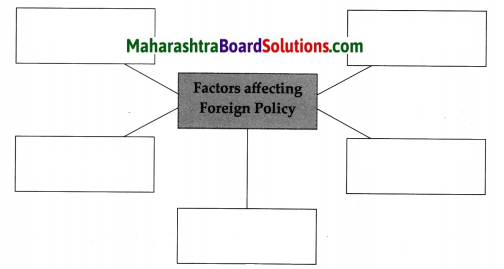
Question 2.
Maharashtra Board Class 9 Political Science Solutions Chapter 2 India’s Foreign Policy 2
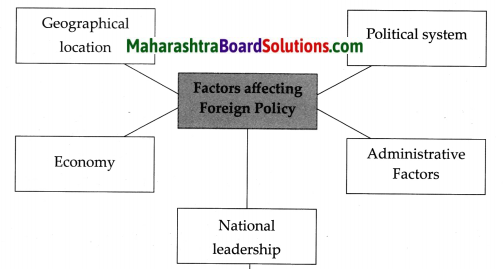
Answer:
Maharashtra Board Class 9 Political Science Solutions Chapter 2 India’s Foreign Policy 1

Class 9 Political Science Chapter 3 India’s Defence System Additional Important Questions and Answers

Choose the correct option from the given options and rewrite the statements:

Question 1.
The ______ forces are responsible for protection and security of important locations.
(a) Paramilitary Forces
(b) Research and Analysis Wing
(c) Central Bureau of Investigation
(d) Interpol
Answer:
(a) Paramilitary Forces

Maharashtra Board Class Maharashtra Board Class 9 Political Science Solutions Chapter 3 India’s Defence System

Question 2.
The Air Force is in charge of protecting India’s ______.
(a) Borders
(b) Coastline
(c) Airspace
(d) Mineral Resources
Answer:
(c) Airspace

Question 3.
The Indian Army is the world’s ____ largest army.
(a) Second
(b) Fifth
(c) Seventh
(d) Third
Answer:
(c) Seventh

Question 4.
The Chief of Navy is known as ________.
(a) Admiral
(b) General
(c) Marshall
(d) Brigadier
Answer:
(a) Admiral

Question 5.
The National Defence Academy is at ______.
(a) Pune
(b) Dehradun
(c) Mumbai
(d) Delhi
Answer:
(a) Pune

Maharashtra Board Class Maharashtra Board Class 9 Political Science Solutions Chapter 3 India’s Defence System

Question 6.
_______ are neither completely military forces nor completely civil forces.
(a) Border Security Forces
(b) Paramilitary Forces
(c) Coast Guards
(d) Home Guards
Answer:
(b) Paramilitary Forces

Question 7.
The biggest challenge to human security is that of ______.
(а) Pollution
(b) Terrorism
(c) Natural calamities
(d) Corruption
Answer:
(b) Terrorism

State whether the following statements are true or false with reasons:

Question 1.
Naxalite Movement is a threat to India’s internal security.
Answer:
True.

  • India’s security is not only threatened by outside powers but also from within.
  • It is not just the difference between external security and internal security that is important anymore.
  • Example naxalite movement is a threat to internal security.

Question 2.
There are no training institutes in our country for military personnel.
Answer:
False.

  • Many training institutes have been set up in our country.
  • To train military personnel, so that they can perform their task.
  • Example – National Defence Academy – Pune

Maharashtra Board Class Maharashtra Board Class 9 Political Science Solutions Chapter 3 India’s Defence System

Do as directed:

Question 1.
Complete the table about paramilitary forces.

Paramilitary ForcesPrime Functions
Rapid Action Force……………
Border Security Force……………
Coast Guards……………..
Central Reserve Police Force……………..
Home Guards……………
National Cadet Corps………….

Answer:

Paramilitary ForcesPrime Functions
Rapid Action ForceBringing life to normalcy after contingencies like blasts and riots.
Border Security ForcePatrolling and securing borders.
Coast GuardsProtecting the Indian maritime borders and preventing smuggling along sea routes.
Central Reserve Police ForceHelps the administration in the states to maintain law and order.
Home GuardsMaintaining public security, essential supplies and services during natural disasters and regulating traffic.
National Cadet CorpsInstilling love of discipline and military training.

Answer in brief:

Question 1.
What kind of conflicts may arise among sovereign nations?
Answer:
(i) There are disputes among nations over boundaries or sometimes conflicts emerge among them over water sharing.

(ii) Some other reasons for conflict could be: not following the terms of international treaties, constantly competing against each other and the influx of refugees from neighbouring countries.

Maharashtra Board Class Maharashtra Board Class 9 Political Science Solutions Chapter 3 India’s Defence System

Question 2.
What does the Central Reserve Policy Force do?
Answer:
The Central Reserve Police Force helps the administration in various states to maintain law and order.

Question 3.
Describe the three major armed forces in India.
Answer:
(i) India’s security system includes the Army, the Navy and the Air Force, the three forces that defend the country.

(ii) The responsibility of protecting the geographical boundaries is on the Army, whereas the Navy protects the coastline.

(iii) The Air Force is in charge of protecting India’s air space.

(iv) The Ministry of Defence controls all the three forces.

(v) The Indian Army is very big. It is the world’s seventh-largest. Its Chief is known as the General.

(vi) The Chief of Navy is known as the Admiral, while the Chief of the Air Force is known as Air Chief Marshall. These three chiefs are appointed by the President.

Question 4.
Which measures have been taken to modernize India’s security system?
Answer:
(i) Many measures are taken so that all three defence forces in India’s security system are adequately modernized. For this, some research institutions have been set up.

(ii) Many training institutes have also been set up in our country to train the personnel of all ranks of our defence forces so that they can perform their task competently.

(iii) For example, the National Defence Academy (NDA) at Pune and the National Defence College (NDC) at Delhi, etc.

Question 5.
How do environmental issues threaten human security?
Answer:
(i) Pollution and other changes in the environment have threatened human life. Diseases like AIDS, Chikungunia, Swine flu and Ebola have presented a big challenge.

(ii) Protecting human beings from such diseases is also considered as a factor of human security.

Maharashtra Board Class 6 History Solutions Chapter 2 Sources of History

Balbharti Maharashtra State Board Class 6 History Solutions Chapter 2 Sources of History Notes, Textbook Exercise Important Questions and Answers.

Maharashtra Board Class 6 History Solutions Chapter 2 Sources of History

Class 6 History Chapter 2 Sources of History Textbook Questions and Answers

1. Answer in one sentence:

Question 1.
In the past, what materials were used for writing?
Answer:
In the past, materials like potsherds, unbaked bricks, bark of birch trees and copper plates were used for writing.

Question 2.
What information is obtained from Vedic literature?
Answer:
We come to know of life of man and ancient Indian History from the Vedic literature.

Maharashtra Board Class 6 History Solutions Chapter 2 Sources of History

Question 3.
Which literature is preserved by oral tradition?
Answer:
Owis, folk songs, folk tales and similar literature is preserved by oral tradition.

2. Classify the following sources as material, written and oral sources.
Copper-plate, folk tales, pottery, beads, travelogues, owis, inscriptions, Vedic literature, stupa, coin, Puranas

Material sourcesWritten sourcesOral sources

Answer:

Material sourcesWritten sourcesOral sources
potterycopper-platefolk tales
beadstraveloguesowis
stupainscriptions
coinsvedic literatures
puranas

3. Observe the picture of earthen pots and try to make similar ones.

4. Observe any coin and note the following things.
Answer:

  • Inscription on the coin: Picture of Queen Victoria
  • Metal used: Gold
  • Year of the coin: 1862
  • Symbol on the coin: Queen Victoria
  • Picture, language, shape, and denomination of the coin: Queen Victoria, English, round, denomination as per size of the coin.

5. Do you know a few things by heart? Present them in your group

Activity:

Collect pictures /photos of material and written sources and exhibit them.

Class 6 History Chapter 2 Sources of History Additional Important Questions and Answers

Complete the sentence by choosing the correct option:

Question 1.
A number of objects used by our ancestors still _____.
(a) exist
(b) diminish
(c) exhausted
Answer:
exist

Maharashtra Board Class 6 History Solutions Chapter 2 Sources of History

Question 2.
______ can also be learnt through customs and traditions, folk arts, folk literature as well as historical documents.
(a) Science
(b) History
(c) Astrology
Answer:
History

Question 3.
______ used by human in the past, provide us with valuable information about life in the ancient times.
(a) Clothes
(b) Cows
(c) Artefacts
Answer:
Artefacts

Question 4.
The ornaments and other artefacts throw light on ______ interaction.
(a) political
(b) social
(c) historical
Answer:
social

Question 5.
We get information about the __________ of the people from the remains of foodgrains, seeds and bones of animals found in excavations.
(a) diet
(b) health
(c) illness
Answer:
diet

Question 6.
Artefacts, articles, monuments or their ruins are called the ______ ‘sources’ of history.
(a) oral
(b) written
(c) material
Answer:
material

Question 7.
The Stone Age people have recorded many events and expressed their _______ in paintings on rocks.
(a) emotions
(b) opinion
(c) views
Answer:
emotions

Maharashtra Board Class 6 History Solutions Chapter 2 Sources of History

Question 8.
In the beginning, man wrote on potsherds, unbaked bricks using ________ objects.
(a) blunt
(b) pointed
(c) zigzag
Answer:
pointed

Question 9.
Man began to record the _______ that took place around him.
(a) competitions
(b) points
(c) events
Answer:
events

Question 10.
Many rulers had their orders, judicial decisions, donations, etc., inscribed on stone or _______.
(a) gold-plates
(b) copper-plates
(c) press plates
Answer:
copper-plates

Question 11.
________ means writing sheets made from the bark of a birch tree.
(a) Bhurjapatra
(b) Paper
(c) Book
Answer:
Bhurjapatra

Question 12.
Birch trees are found in _______.
(a) Jammu
(b) Delhi
(c) Kashmir
Answer:
Kashmir

Question 13.
We learn about the Stone Age period of Indian history through _____ excavations.
(a) physical
(b) archaeological
(c) astrological
Answer:
archaeological

Maharashtra Board Class 6 History Solutions Chapter 2 Sources of History

Question 14.
In the beginning, the vedas were not in the ________ form.
(a) oral
(b) written
(c) material
Answer:
written

Question 15.
The vedas and the post Vedic literature form an ______ source of ancient Indian History.
(a) important
(b) unimportant
(c) written
Answer:
important

Match the following:

Column (A)Column (B)
(1) Material

(2) Written

(3) Oral

(4) Pillar inscriptions

(a) Upanishad

(b) Folk tales

(c) Coins

(d) The vedas

Answer:
1 – c
2 – a
3 – b
4 – d

Answer in one sentence:

Question 1.
What are ‘sources of History’?
Answer:
History can be learnt through customs and traditions, folk arts, folk literature as well as historical documents. All these are known as ‘Sources of History’.

Question 2.
How are artefacts useful?
Answer:
Artefacts are useful as they provide us with valuable information about life in the ancient times.

Question 3.
What are artefacts?
Answer:
Things used by man in his day-to-day life are known as artefacts.

Question 4.
What throws light on the social interaction of ancient man?
Answer:
The ornaments and other artefacts throw light on the social interaction of ancient man.

Maharashtra Board Class 6 History Solutions Chapter 2 Sources of History

Question 5.
How do we get information about the diet of the ancient people?
Answer:
We get information about the diet of the ancient people from the remains of foodgrains, seeds and bones of animals found in excavation.

Question 6.
What are ‘material sources’ of History?
Answer:
Artefacts, articles, monuments or their ruins are called the ‘material sources’ of history.

Question 7.
What are copper-plates?
Answer:
Copper plates are actual plates made of copper which the rulers used to inscribe their orders, judicial decisions, donations, etc.

Question 8.
What are ‘oral sources’ of history?
Answer:
Owis, folk songs, folk tales and similar literature that is not written but passed on from generation to generation by word of mouth are oral sources of history.

Question 9.
How were vedas preserved before it was put in written form?
Answer:
Before the vedas were written, the ancient Indian had developed the technique of memorizing and reciting them.

Answer the following questions in short:

Question 1.
How did man record events before the art of writing?
Answer:

  • The stone age people have recorded many events and expressed their emotions in paintings on rocks
  • It was only after thousands of years that man learnt the art of writing.

Question 2.
Write a short note on ‘written sources’ of history.
Answer:

  • Man began to record the events that took place around him.
  • Over a period of time, many forms of literature developed like books on religious and social subjects, plays, poetry, travelogues and scientific works
  • All this literature helps us to understand the history of the various historical periods.
  • These sources are known as ‘written sources of history’.

Question 3.
Why should precautions be taken while writing history?
Answer:

  • A written document cannot be said to be authentic just because it is old.
  • It needs to be examined critically as to who wrote it, why and when it was written
  • The conclusions drawn on the basis of various genuine documents have to be cross-checked and corroborated with one another
  • Such a critical analysis is very important in the writing of authentic history.

Maharashtra Board Class 6 History Solutions Chapter 2 Sources of History

Can you tell?

Structures such as forts, rock-cut caves, stupa etc. are known as material sources of history.
Try to guess what other structures can be called material sources.
Answer:
Coins, potsherd, earthern pot, ornaments or any kind of ancient artefacts can also be called material source.

Maharashtra Board Class 8 Geography Solutions Chapter 7 Population

Balbharti Maharashtra State Board Class 8 Geography Solutions Chapter 7 Population Notes, Textbook Exercise Important Questions and Answers.

Maharashtra State Board Class 8 Geography Solutions Chapter 7 Population

Class 8 Geography Chapter 7 Population Textbook Questions and Answers

1. Complete the following sentences:

Question A.
If the birth rate is greater than the death rate then the population …………. .
(i) decreases
(ii) increases
(iii) remains constant
(iv) becomes surplus
Answer:
(ii) increases

Question B.
People of …………… age group are included in the productive population.
(i) 0 to 14
(ii) 14 to 60
(iii) 15 to 60
(iv) 16 to 59
Answer:
(iv) 16 to 59

Question C.
The spread of modern technology in society is mostly dependent on …………….. .
(i) sex ratio
(ii) birth rate
(iii) literacy
(iv) migration
Answer:
(iv) migration

Maharashtra Board Class 8 Geography Solutions Chapter 7 Population

2. Examine the following statements and correct the incorrect ones:

Question a.
The population density of a region can be understood from its area.
Answer:
Incorrect.
Correct sentence: The population density of a region can be understood from its area and the total volume of population living in it.

Question b.
The quality of population is determined on the basis of literacy.
Answer:
Correct.

Question c.
There is an adverse impact on manpower in the regions of out migration.
Answer:
Correct.

Question d.
Greater economic prosperity indicates the development of region.
Answer:
Incorrect.
Correct sentence: Greater economic prosperity as well as higher standards of living, higher quality of life, availability of opportunities, freedom, etc, indicate the development of region.

Maharashtra Board Class 8 Geography Solutions Chapter 7 Population

Question e.
Developing countries have an HDl of 1.
Answer:
Incorrect.
Correct sentence: Developing countries have and HDI of 0.50 to 0.60.

3. Answer in brief.

Question a.
What are the aspects considered in the structure of population?
Answer:
The following are the aspects considered in the structure of the population:

  1. Sex ratio/structure: Sex ratio/structure is a structure that considers the sub division of population on the basis of gender.
  2. Age structure: Age structure is a structure that considers the sub division of population as per age groups.
  3. Occupational structure: Occupational structure is a structure that considers sub division of population on the basis of dependency and workability.
  4. Rural – urban structure: Rural – Urban structure is a structure that considers sub division of population on the basis of area of residence.
  5. Literacy structure: Literacy structure is a structure that considers sub division of population on the basis of capability of reading and writing.

Question b.
Prepare a list of advantageous and disadvantageous factors, affecting population distribution.
Answer:
A list of advantageous factors affecting population distribution is as follows:

  1. Availability of sufficient sunlight, clean air and water.
  2. Region with low altitude
  3. Moderate rainfall and temperature
  4. Fertile soil
  5. Deposits of minerals
  6. Industrialisation
  7. Urbanisation
  8. Availability of transportation facilities
  9. Availability of market
  10. Political stability
  11. International peace
  12. Favourable government policies
  13. Favourable social customs and traditions.

A list of disadvantageous factors affecting population distribution is as follows:

  1. Shortage of sufficient sunlight, clean air and water.
  2. Region with high altitude
  3. Extremely less or more rainfall and temperature
  4. Infertile soil
  5. Scarcity of minerals
  6. Low industrialisation
  7. Lack of urbanisation
  8. Non-availability of transportation facilities
  9. Non-availability of market
  10. Political instability
  11. International disputes
  12. Unfavourable government policies
  13. Evil social customs and traditions.

Maharashtra Board Class 8 Geography Solutions Chapter 7 Population

Question c.
What are the problems in areas of high population densities?
Answer:
The ratio of the population of a country to its area is population density. While discussing population distribution, density of population is also considered. The density is calculated, as per the formula given below.
Density of population = Population of a region/Area of a region.

The problems in areas of high population densities are as follows:
1. Pollution – Pollution is one of the major reasons which people face due to high population density. Due to an increase in land degradation by making houses and flats, land pollution will be caused, water will be contaminated by a huge number of people, resulting in water pollution and huge number of vehicles will cause air pollution.

2. Overcrowded – The areas with high population density become overcrowded, which bring chaos and lack of peace in the society.
3. Lack of open space – High population density makes it difficult to get a free open space.

Question d.
What arc the problems in area of low population densities?
Answer:
The development of a country depends upon its size of population. A lower population is somehow manageable and resources can be distributed equally. But, sometimes the low population leads to lower demands of goods and services and lower tax revenues for the government to provide goods and services.

4. Give geographical reasons:

Question a.
Population is an important resource.
Answer:

  1. The economic and cultural development of any country depends upon the volume and the quality of population.
  2. If a country has a high volume and less quality of population, it has slow economic growth and development.
  3. If a country has optimum population with high quality of population, it has fast economic growth and development. Thus, population is an important resource.

Maharashtra Board Class 8 Geography Solutions Chapter 7 Population

Question b.
Productive population is an important group.
Answer:

  1. People belonging to age group of 16 to 59 age are considered as productive. Therefore this population is called productive population.
  2. People below 16 years of age and above 60 years of age are considered as dependent or non-working population.
  3. Productive population/people are involved in services or businesses. Therefore they play very important role in economic
  4. If country has more proportion of productive population and youth, it develops rapidly. Thus, productive population is an important group.

Question c.
The study of age structure is important.
Answer:

1. The study of age structure helps to know the percentage of children, adolescents, youth, middle aged, and old aged in population.

2. The study of age structure helps to know the proportion of productive people (Working people between 16 years to 59 years of age) and unproductive people (Non working people below 16 years of age and above 60 years of age).

3. The study of age structure helps government in planning various economic, social, educational, medical, etc. schemes for the overall development of country.

4. The study of age structure helps to know the speed of economic growth. Thus, the study of age structure is important.

Question d.
Literacy is directly related to development.
Answer:

  1. The country with high literacy rate, develops rapidly in economic, social and cultural aspects.
  2. The country with low literacy rate, faces many obstacles in its economic, social and cultural growth and development.
  3. Literacy rate is related to quality of life, the opportunities available and freedom. Thus, literacy is directly related to development.

Maharashtra Board Class 8 Geography Solutions Chapter 7 Population

Question e.
The real progress of a country is understood with the help of the Human Development Index.
Answer:
1. Human Development Index is calculated by taking into account the values of economic, health and education parameters.

2. Thus, Human Development Index is calculated on the basis of Gross National Product, life expectancy and literacy rate.

3. Human Development Index indicates the standard of living, economic and social welfare, quality of life, opportunities available and freedom. Therefore, the real progress of a country is understood with the help of the Human Development Index.

5. Write notes.

Question a.
Sex ratio.
Answer:
1. The number of females per thousand males is called sex ratio.

2. The sex ratio is calculated with the help of the following formula :
Maharashtra Board Class 8 Geography Solutions Chapter 7 Population 1

3. If the number of females per thousand males is less, the sex ratio is considered to be low. On the other hand, if the number of females per thousand males is more, the sex ratio is considered to be high.

4. According to Census 2011, the sex ratio was highest (1084) in the state of Kerala. According to Census 2011, the sex ratio was 929 in the state of Maharashtra.

5. Out-migration of males leads to high sex ratio in a region from where males have out-migrated. Less female birth rate leads to low sex ratio.

Question b.
Age structure.
Answer:

  1. Sub division of population as per age groups is known as age structure.
  2. Age structure is helpful in knowing the proportion of children, adolescents, young, middle aged and old people in population.
  3. It is also helpful in knowing proportion of active population (Population between the ages 16 and 59) and dependent population (Population below 16 years of age and above 60 years of age).
  4. Age structure is helpful to the government in framing various policies.

Maharashtra Board Class 8 Geography Solutions Chapter 7 Population

Question c.
Literacy.
Answer:
1. Population above the age of seven can be sub divided on the basis of capability of reading and writing.

2. People above the age of seven and are unable to read and write are considered illiterate. On the other hand, people above the age of seven and are able to read and write are considered literate.

3. High literacy rate is an indicator of social and economic development of society. On the other hand, high illiteracy rate leads to slow economic, social and cultural development of society.

4. Literacy rate is related to quality of life, the opportunities available and freedom. Thus, it is directly related to development.

Activity:

Question a.
Survey 5 families in your neighbourhood on the basis of the following points and make a presentation.
(a) Sex
(b) Age groups
(c) Education
(d) Occupation

Class 8 Geography Chapter 7 Population Additional Important Questions and Answers

Fill in the correct word and complete the sentences:

Question A.
……………… state of India has the highest sex ratio.
(i) Maharashtra
(i) Kerala
(c) Punjab
(d) Haryana
Answer:
(b) Kerala

Question B.
………………. district of Maharashtra has low density of population.
(a) Mumbai City
(b) Mumbai Suburb
(c) Thane
(d) Osmanabad
Answer:
(d) Osmanabad

Examine the following statements and correct the incorrect ones:

Question a.
The state of Maharashtra has a balanced population.
Answer:
Incorrect.
Correct sentence: The state of Maharashtra has imbalanced population.

Maharashtra Board Class 8 Geography Solutions Chapter 7 Population

Question b.
The areas with plenty of natural resources normally have more volume of population.
Answer:
Correct.

Question c.
The region with more proportion of youth in population has a rapid speed of development.
Answer:
Correct.

Question d.
Most of people in rural areas are engaged in tertiary activities.
Answer:
Incorrect.
Correct sentence: Most of people in rural areas are engaged in primary activities.

Question e.
Human Development Index is published by World Health Organisation.
Answer:
Incorrect.
Correct sentence: Human Development Index is published by United National Development Programme.

Question f.
Density of population is found to be more in the state of Goa.
Answer:
Correct.

Maharashtra Board Class 8 Geography Solutions Chapter 7 Population

Question g.
The state of Rajasthan is densely populated.
Answer:
Incorrect.
Correct sentence: The state of Rajasthan is sparsely populated.

Answer the following questions in one sentence each:

Question a.
What is birth rate?
Answer:
Birth rate is the number of live births per one thousand people in a year.

Question b.
What is death rate?
Answer:
Death rate is the number of deaths per one thousand people in a year.

Question c.
What is life expectancy?
Answer:
Life expectancy is the expected average life span of an individual at the time j of his/her birth.

Question d.
What is meant by in-migration?
Answer:
Migration of people in a particular region from outside regions is known as in-migration.

Maharashtra Board Class 8 Geography Solutions Chapter 7 Population

Question e.
What is meant by out-migration?
Answer:
Migration of people from a particular region to outside regions is known as out-migration.

Question f.
What is meant by sex ratio?
Answer:
The total number of females per thousand males is known as sex ratio.

Question g.
In which types of occupations are people in urban areas involved?
Answer:
People in urban areas are involved in secondary and tertiary occupations.

Question h.
Who put forth the concept of Human Development Index?
Answer:
Mahbub Ul Haq and Amartya Sen put forth the concept of Human Development Index.

Answer the following questions in brief:

Question a.
Explain the various types of migration.
Answer:
The various types of migration are as follows:

  1. In-migration: In-migration is migration of people in a particular region from outside regions.
  2. Out-migration: Out-migration is migration of people from a particular region to outside regions.
  3. Short term mfgration: Short term migration is migration of people on a i temporary basis. For example, migration due to tourism or natural disaster or education is a short term migration.
  4. Long term migration: Long term migration is migration of people on a permanent basis. For example, migration due to transfer of service or marriage or war j and partition is a long term migration.

Maharashtra Board Class 8 Geography Solutions Chapter 7 Population

Question b.
Explain the effects of migration.
Answer:
The effects of migration are as follows:

1. Out-migration leads to fall in population of a region from where people have migrated outside. This in turn leads to shortage of manpower in a region from where out-migration has occurred.

2. In-migration leads to increase in population of a region in which people from outside regions have migrated. This in turn, puts a pressure on public amenities and infrastructure of a region in which people have migrated.

3. Migration leads to redistribution of population.
4. Migration also leads to a change in the structure of population in a particular region.

Give geographical reasons:

Question a.
The density of population is found to be high in Mumbai City and Mumbai Suburb district.
Answer:

  1. Mumbai is economic capital of India.
  2. In Mumbai City and Mumbai Suburb district, industrialisation and urbanisation has taken place on a large scale.
  3. Transportation, educational, medical, etc. facilities are available on a large scale in these districts.
  4. Many employment opportunities are also available in these districts.

Due to all these favourable factors, many people from other districts of Maharashtra as well as from other states of India have migrated to Mumbai on a permanent basis. Therefore, the density of population is found to be high in Mumbai City and Mumbai Suburb district.

Study the following map/figure/graph and answer the following questions:

Maharashtra Board Class 8 Geography Solutions Chapter 7 Population 4

Study the Figure is given and answer the following questions:

Question a.
Which state has the highest sex\ratio?
Answer:
Kerala state has the highest sex j ratio.

Maharashtra Board Class 8 Geography Solutions Chapter 7 Population

Question b.
Which state has the lowest sex J ratio?
Answer:
Haryana state has the lowest sex ratio.

Question c.
What changes should take place in Maharashtra, to bring about a balanced > sex ratio and how much change is i necessary?
Answer:
The following changes should take place in Maharashtra to bring about a balanced sex ratio:

  1. Sex ratio must get increased by having total control over female infanticide and launching various government schemes for women empowerment, etc.
  2. The sex ratio must get increased by 71 i.e. the number of females per thousand males must get increased from 929 to 1000.

Try this: 

Question a.
Prepare bar graphs on the basis of the table given below and write a note. (Discuss in group about the issue of literacy in the country.)?
Maharashtra Board Class 8 Geography Solutions Chapter 7 Population 2
Answer:
(A) Bar graph:
Maharashtra Board Class 8 Geography Solutions Chapter 7 Population 3

(B) Note:

  1. From the above bar diagram it can be seen that the literacy rate is found to be high in developed countries, moderate in developing countries and low in underdeveloped countries.
  2. In 2010, the literacy rate was 72.1°/e in India.
  3. In 2010, the literacy rate was 98.1% in Argentina and it was 38.1% in Afghanistan.
  4. Literacy rate is directly or indirectly related to quality of life, opportunities available and the freedom.

Can you tell? 

Maharashtra Board Class 8 Geography Solutions Chapter 7 Population 5

Study Figure is given and answer the following questions:

Question a.
Which are the most densely populated districts?
Answer:
The most densely populated districts are:

  1. Mumbai City
  2. Mumbai Suburb
  3. Thane
  4. Pune
  5. Kolha5ur, etc.

Maharashtra Board Class 8 Geography Solutions Chapter 7 Population

Question b.
Name the sparsely populated districts with a density of less than 100 per sq. km.
Answer:
The sparsely populated districts with a density of less than 100 sq. km:

  1. Gadchiroli
  2. Beed
  3. Osmanabad, etc.

Question c.
Name two districts with moderate population.
Answer:
District with moderate population:

  1. Nashik
  2. Nagpur.

Question d.
What is the density of the dark shaded regions?
Answer:
The density of the dark shaded regions is greater than 1000 person per sq. km.

Question e.
Why is the density of population less in Gadchiroli?
Answer:
The density of population is less in Gadchiroli due to dense forests.

Question f.
Have a discussion in the class on the effect of physiography, climate, area under forest, industries, etc. on the density of population.
Answer:
1. Physiography: The density of population is found to be high in plain areas. On the other hand, the density of population is found to be low in mountainous regions.

2. Climate: The density of population is found to be high in the areas with moderate temperature and moderate rainfall. On the other hand, the density of population is found to be low in the areas of extremely low or high temperature and extremely high or low rainfall.

3. Area under forest: The density of population is found to be high in the area where forest cover is limited. On the other hand, the density of population is found to be low in the area under dense forests.

4. Industries: The density of population is found to be high in industrially developed region. The density of population is found to be low in industrially backward: region.

Thought-Provoking Questions:

Can you tell? 

Maharashtra Board Class 8 Geography Solutions Chapter 7 Population 6

Study the table is given and answer the following questions:

Question a.
Which city has greater number of newly born children?
Answer:
‘B’ City has greater number of newly born children.

Maharashtra Board Class 8 Geography Solutions Chapter 7 Population

Question b.
Which city records greater number of deaths?
Answer:
‘B’ City records greater number of deaths.

Question c.
Looking at the figures of in-migration and out-migration which city has received more migrants?
Answer:
Looking at the figures of in-migration and out-migration, ‘A’ City has received more migrants. .

Question d.
Calculate the population of both the cities in 2017.
Answer:
The population of ‘A’ City in 2017 is 121, 500 and of ‘B’ City in 2017 is 120, 550.

Question e.
After considering all the points, which city has recorded more growth of population in one year?
Answer:
After considering all the points, ‘A’ City has recorded more growth of population in one year. .

Question f.
The total number of births are given. What would be this figure per thousand population? What is the term for this?
Answer:
The total number of births are given. This figure would be 20 per thousand. The term for this is ‘Birth rate’.

Question g.
What would be the number of deaths per thousand population? What is the term used for this?
Answer:
The number of deaths per thousand would be 25. The term used for this is ‘Death rate’.

Complete the following table:
(Note: The answer is given directly.)

Question a.
Maharashtra Board Class 8 Geography Solutions Chapter 7 Population 7.1
Answer:

StatePopulation (2011)Area (Sq. Km)Density
1. Uttar Pradesh19,98,12,3412,40,926829.35
2. Maharashtra11,23,74,3333,07,713356.19
3. Tamil Nadu7,26,26,8091,30,058558.41
4. Rajasthan68,54,8373,42,23920.02
5. Manipur27,21,75622,327121.90
6. Goa14,58,5453,702393.98

Maharashtra Board Class 8 Geography Solutions Chapter 7 Population

Think about it:

Question a.
Even though area wise Rajasthan is a large state, the population is less. Which geographical factors may be responsible for this?
Answer:
The amount of rainfall is comparatively less in the state of Rajasthan. The Thar desert is located in the western part of the state of Rajasthan. Therefore, even though area wise Rajasthan is a large state, the population is less.

Can you tell? 

Question a.
Classify Male, Adolescent, Illiterate, Children, Unemployed, Infants, Literate, Rural, Working population, Urban, Female, Old, Young, Dependent population and Adult into the following categories:

  1. Sex
  2. Age
  3. Rural
  4. Urban
  5. Literacy
  6. Productive population.

Answer:

  1. Sex: Male, Female
  2. Age: Adolescent, Children, Infants, Old, Young, Adult
  3. Rural: Rural
  4. Urban: Urban
  5. Literacy: Illiterate, Literate
  6. Productive population: Unemployed, Working population, Dependent population.

Can you tell? 

Maharashtra Board Class 8 Geography Solutions Chapter 7 Population 8

Study the figure and answer the following questions:

Question a.
What do you think are the reasons for the changing land use pattern of Mondha village?
Answer:
Urbanisation and rise in population are the reasons for the changing land use pattern of Mondha village.

Maharashtra Board Class 8 Geography Solutions Chapter 7 Population

Question b.
What kind of changes have taken place?
Answer:
In Mondha village, the agricultural land use has decreased and the non-agricultural land use (i.e. commercial land use, residential land use) has increased.

Question c.
Due to this change in land use, do you think there has been a change in population? If yes, what is the change and why?
Answer:
Due to this change in land use, there has been a change in population. The population of Mondha has increased due to the in-migration.

Can you tell?

Maharashtra Board Class 8 Geography Solutions Chapter 7 Population 8

Study the table showing percentage of immigrant population of various countries given on page 46 and answer the following questions:

Question a.
Which countries have less than 10% migrant population?
Answer:
Afghanistan, Brazil, Bangladesh, India and Great Britain have less than 10% migrant population.

Question b.
Which are the countries with a migrant population of between 10% and 20%?
Answer:
Germany and U.S.A. are the countries with a migrant population of between 10%
and 20%.

Maharashtra Board Class 8 Geography Solutions Chapter 7 Population

Question c.
Which are the countries with a migrant population of more than 20%
Answer:
Kuwait, Hong Kong, Oman and Saudi Arabia are the countries with a migrant population of more than 20%.

Question d.
Find the reasons behind the migrant population of more than 20%.
Answer:
The reasons behind the migrant population of more than 20% are:

  1. Huge stock of mineral oil and other natural resources
  2. Availability of employment opportunities
  3. Great demand for labour in these countries.

Question c.
Draw pie diagrams for any two countries.
Answer:
1. Kuwait: A pie diagram showing percentage of immigrant population for Kuwait is as follows:

Maharashtra Board Class 8 Geography Solutions Chapter 7 Population 12

2. Oman: A pie diagram showing percentage of immigrant population for Oman is as follows:

Maharashtra Board Class 8 Geography Solutions Chapter 7 Population 13

Question d.
Have a discussion on migration and development.
Answer:
1. Out-migration leads to a shortage of manpower/labour supply. This in turn adversely affects the development of the region from where out-migration has occurred.
2. In-migration leads to increase in population of a region in which in-migration has occurred. This too, adversely affects the development of the respective region.
3. The migration up to certain extent increases the mobility of labourer and it boosts the development of a particular region.

Use your brainpower: 

Question a.
In India, 0.52 % of the population are migrants. What is the actual number of people who have migrated to India?
Answer:
According to Census 2011, the population of India was nearly 121 crore. In India, 0. 52 % of the population are migrants. Thus, according to Census 2011, the actual number of people who have migrated to India is nearly 629,200.

Maharashtra Board Class 8 Geography Solutions Chapter 7 Population

Try this:

Question a.
Write a note on the Human Development Index. (HDI) of various countries on the basis of the following table:
HDI Rank wise Country Value of HDI Level of Development
Maharashtra Board Class 8 Geography Solutions Chapter 7 Population 9 Maharashtra Board Class 8 Geography Solutions Chapter 7 Population 10
Answer:

Maharashtra Board Class 8 Geography Solutions Chapter 7 Population 11

  1. Norway ranks first in the world with respect to Human Development Index (HDI). The value of HDI for Norway is 0.949.
  2. The countries like Japan, United Kingdom, Denmark, Switzerland, Germany and Australia have the value of Human Development Index (HDI) more than 0.900. These countries show very high level of development.
  3. The countries like Sri Lanka, Brazil and China have the value of Human Development Index (HDI) between 0.700 and 0.800. These countries show high level of development.
  4. The countries like India, Bhutan and Pakistan have the value of Human Development Index (HDI) between 0.500 and 0.600. These countries show medium level of development.
  5.  The countries like Niger and Central African Republic have value of Human Development Index (HDI) between 0.300 and 0.400. These countries show less development.
  6. From the above table it can be seen that Human Development Index (HDI) is an indicator of development.
  7. Higher value (around 1) of Human Development Index indicates high level of development and lower value (around 0) of Human Development Index indicates low level of development.

Use your brain power:

Question a.
Discuss and write the advantages and disadvantages of low population or high population with reference to the following factors:
(Note: The answer is given directly.)
Maharashtra Board Class 8 Geography Solutions Chapter 7 Population 14
Answer:

HeadingsLow populationHigh population
Per capita land availabilityPer capita land availability is comparatively more.Per capita land availability is comparatively less.
FoodgrainsFood grains are available in plenty.There is shortage of food grains.
ResourcesResources are available in plenty.There is strain on resources.
Per capita incomePer capita income is comparatively high.Per capita income is comparatively low.
Basic amenities and facilitiesBasic amenities and facilities are available in sufficient quantity.There is strain on basic amenities and facilities.
Percentage of unproductive consumersPercentage of unproductive consumers is comparatively low.Percentage of unproductive consumers is comparatively high.
PlanningPlanning is comparatively more effective.Planning is comparatively less effective.
EmploymentMore employment opportunities are available.Less employment opportunities are available.
UrbanisationThe rate of urbanisation may be comparatively low.The rate of urbanisation may be comparatively high.
HealthThe quality of health may be comparatively high.The quality of health may be comparatively low.
Higher educationThe number of highly qualified people may be comparatively more.The number of highly qualified people may be comparatively low.
Social environmentSocial environment may be comparatively supportive and favourable.Social environment may be comparatively adverse and unfavourable.

Give it a try:

Maharashtra Board Class 8 Geography Solutions Chapter 7 Population 17

Question a.
Since the past two centuries, the size of family is decreasing. But inspite of this the population of the country is increasing. Find out why is this happening.
Answer:
1. Since the past two centuries, the death rate in India has reduced to a great extent. On the other hand, since the past two centuries, the birth rate in India has reduced negligibly. Therefore, since the past two centuries, the size of family is decreasing. But in spite of this the population of country is increasing.

Maharashtra Board Class 8 Geography Solutions Chapter 7 Population

Use your brain power:

Question a.
As per the population Census of 2011, the population of India is 121 crores. For domestic use, the per capita requirement per day is 50 litres of water. Taking this into account, what would be the total amount of water requirement in India for domestic purpose only.
Answer:

  1. As per the Population Census of 2011, the population of India is. 121 crores?
  2. For domestic use, the per capita requirement per day is 50 litres of water.
  3. Taking this into account, the total amount of water requirement in India for domestic purpose only, will be nearly 6050 crores litre.

Open-Ended Questions:

Question a.
What are the problems in areas of high population distribution?
Answer:
The following are the problems in areas of high population distribution:

  1. Increased level of water, air, sound and soil pollution.
  2. Traffic jam
  3. Shortage of residential areas
  4. Increased criminal tendencies, etc.

Question b.
What are the problems in areas of low population densities?
Answer:
The following are the problems in areas of low population densities:

  1. Shortage of labour supply
  2. Low levels of demand for various goods and services
  3. Under utilization of resources, etc.

Give it a try:

Question a.
How do imbalanced sex ratios affect the society?
Answer:
Imbalanced sex ratios affect the society as follows:

  1. Increased problems in society, workplace, etc.
  2. Increased crimes against women.

Maharashtra Board Class 8 Geography Solutions Chapter 7 Population

Question b.
What measures can be taken to strike a balance in the sex ratio?
Answer:
The following measures can be taken to strike a balance in the sex ratio:

  1. Increasing literacy rate of females.
  2. Increasing employment opportunities for women.
  3. Eradicating evil social customs.
  4. Launching government schemes of women empowerment.

Maharashtra Board Class 8 Science Solutions Chapter 13 Chemical Change and Chemical Bond

Balbharti Maharashtra State Board Class 8 Science Solutions Chapter 13 Chemical Change and Chemical Bond Notes, Textbook Exercise Important Questions and Answers.

Maharashtra State Board Class 8 Science Solutions Chapter 13 Chemical Change and Chemical Bond

Class 8 Science Chapter 13 Chemical Change and Chemical Bond Textbook Questions and Answers

1. Complete the statement by filling the gaps using appropriate term from the terms given in the brackets:
(slow, coloured, arrow, fast, smell, milky, physical, product, chemical, reactant, covalent, ionic, octet, duplet, exchange, sharing, equality sign)

Question a.
An ……….. is drawn in between the reactants and products while writing the equation for a chemical reaction.
Answer:
An arrow is drawn in between the reactants and products while writing the equation for a chemical reaction.

Question b.
Rusting of iron is a ……….. chemical change.
Answer:
Rusting of iron is a slow chemical change.

Maharashtra Board Class 8 Science Solutions Chapter 13 Chemical Change and Chemical Bond

Question c.
The spoiling of food is a chemical change which is recognized from the generation of certain …………. due to it.
Answer:
The spoiling of food is a chemical change which is recognized from the generation of certain smell due to it.

Question d.
A colourless solution of calcium hydroxide in a test tube turns ………….. on blowing in it through a blow tube for some time.
Answer:
A colourless solution of calcium hydroxide in a test tube turns milky on blowing in it through a blow tube for some time.

Question e.
The white particles of baking soda disappear when put in lemon juice. This means that it is a ……….. change.
Answer:
The white particles of baking soda disappear when put in lemon juice. This means that it is a chemical change.

Maharashtra Board Class 8 Science Solutions Chapter 13 Chemical Change and Chemical Bond

Question f.
Oxygen is a …………….. in respiration.
Answer:
Oxygen is a reactant in respiration.

Question g.
Sodium chloride is …………… compound while hydrogen chloride is compound.
Answer:
Sodium chloride is ionic compound while hydrogen chloride is covalent compound.

Question h.
Electron …………….. is complete in each hydrogen in a hydrogen molecule.
Answer:
Electron duplet is complete in each hydrogen in a hydrogen molecule.

Question i.
Chlorine (Cl2) molecule is formed by ………….. of electrons between two chlorine atoms.
Answer:
Chlorine (Cl2) molecule is formed by sharing of electrons between two chlorine atoms.

2. Explain by writing a word equation. 

Question a.
Respiration is a chemical change.
Answer:
Respiration is a biological process, in this process air is inhaled, oxygen present in this inhaled air reacts with glucose present in the cells of the body forming carbon dioxide and water. Moreover, we cannot obtain glucose and oxygen from carbon dioxide and water. Hence, respiration is a chemical change.
Word equation:
Maharashtra Board Class 8 Science Solutions Chapter 13 Chemical Change and Chemical Bond 1

Question b.
Hard water gets softened on mixing with a solution of washing soda.
Answer:
Hard water does not form lather with soap and is brackish to taste. This is because hard water contains the chloride and sulphate salts of calcium and magnesium in dissolved state. When a solution of washing soda is added to hard water, it forms a precipitate of calcium carbonate and magnesium carbonate, which is removed by filtration thus water is softened.
Word equation:
Maharashtra Board Class 8 Science Solutions Chapter 13 Chemical Change and Chemical Bond 2

Question c.
Limestone powder disappears on adding to dilute hydrochloric acids.
Answer:
In the reaction of dil. HCl and limestone powder (CaCO3), limestone disappears slowly and carbon dioxide (CO2) liberates slowly.
Word equation:
Maharashtra Board Class 8 Science Solutions Chapter 13 Chemical Change and Chemical Bond 3

Question d.
Bubbles are seen on adding lemon juice to baking soda.
Answer:
When baking soda is added to lemon juice a chemical change takes place in citric acid present in the lemon juice and carbon dioxide gas is formed. Word equation:
Maharashtra Board Class 8 Science Solutions Chapter 13 Chemical Change and Chemical Bond 4
This is a neutralization reaction.

3. Match the pairs.

Question a.

Column IColumn II
1. Photosynthesisa. Tendency to lose electrons
2. Waterb. Reactant in combustion process
3. Sodium chloridec. Chemical change
4. Dissolution of salt in waterd. Covalent bond
5. Carbone. Ionic bond
6. Fluorinef. Physical change
7. Magnesiumg. Tendency to form anion

Answer:

Column IColumn II
1. Photosynthesisc. Chemical change
2. Waterd. Covalent bond
3. Sodium chloridee. Ionic bond
4. Dissolution of salt in waterf. Physical change
5. Carbonb. Reactant in combustion process
6. Fluorineg. Tendency to form anion
7. Magnesiuma. Tendency to lose electrons

Maharashtra Board Class 8 Science Solutions Chapter 13 Chemical Change and Chemical Bond

4. Show with the help of diagram of electronic configuration how the following compounds are formed from the constituent atoms.

Question a.
Sodium Chloride:
Maharashtra Board Class 8 Science Solutions Chapter 13 Chemical Change and Chemical Bond 5
Answer:
1. Sodium has atomic number 11 and electronic configuration 2, 8, 1.
2. Sodium atom has 1 electron in its outermost shell.

3. It loses one electron from its outermost shell, i.e., M shell. Then its L shell becomes the outermost shell with a stable octet. The nucleus of sodium atom has 11 protons but the number of electrons in the atom has become 10. So, there is a net unit positive charge giving a sodium cation (Na+).

4. On the other hand, chlorine has electronic configuration 2, 8, 7. Chlorine atom has 7 electrons in its outermost shell and requires one electron to complete its octet.
5. Thus, the electron lost by sodium is taken up by chlorine.

6. When chlorine atom gains one electron, octet of chlorine is completed and its K, L, M shells have together 18 electrons and the nucleus has 17 protons. This leads to the formation of an ion (CP).

7. Thus, a chlorine atom accepts one electron from a sodium atom and consequently a chloride ion with one unit negative charge and a sodium ion with one unit positive charge are formed.

8. Sodium and chloride ions, being oppositely charged, attract each other due to the electrostatic force of attraction. An ionic bond is formed and this results in the formation of sodium chloride (NaCl) molecule.

Maharashtra Board Class 8 Science Solutions Chapter 13 Chemical Change and Chemical Bond

Question b.
Potassium fluoride:
Answer:
1. Potassium has atomic number 19 and electronic configuration 2, 8, 8, 1.
2. Potassium atom has 1 electron in its outermost shell.

3. It loses one electron from its outermost shell, i.e. N shell. Then its M shell becomes the outermost shell with a stable octet. The nucleus of potassium atom has 19 protons but the number of electrons in the atom has become 18. So there is a net unit positive charge giving a potassium cation (K+).

4. On the other hand, fluorine has electronic configuration 2, 7. Fluorine has 7 electrons in the outermost shell and requires one electron to complete its octet.

5. Thus, the electron lost by potassium is taken up by chlorine.
Maharashtra Board Class 8 Science Solutions Chapter 13 Chemical Change and Chemical Bond 8
6. When fluorine atom gains one electron, octet of fluorine is completed, its K and L shells have together 10 electrons and the nucleus has 9 protons. This leads to the formation of an ion (F).

7. Thus, a fluorine atom accepts one electron from a potassium atom and consequently a fluoride ion with one unit negative charge and a potassium ion with one unit positive charge are formed.

8. Potassium and fluoride ions, being oppositely charged, attract each other due to electrostatic force of attraction. An ionic bond is formed and this results in the formation of potassium fluoride (KF) molecule.

Maharashtra Board Class 8 Science Solutions Chapter 13 Chemical Change and Chemical Bond

Question c.
Water:
Answer:
Maharashtra Board Class 8 Science Solutions Chapter 13 Chemical Change and Chemical Bond 6
1. Hydrogen has atomic number 1 and electronic configuration 1.
2. Hydrogen has 1 electron in its K shell.

3. Oxygen has atomic 8 and electronic configuration 2, 6. There are 6 electrons in the valence shell of oxygen atom. It means that the electron octet in oxygen is short of two electrons and the valency of oxygen is two.

4. In the H2O molecule, the oxygen atom complete its octet by sharing two electrons one each with two hydrogen atoms, thus, forming two covalent bonds. While this happens, the duplets of two hydrogen atoms are completed.

Maharashtra Board Class 8 Science Solutions Chapter 13 Chemical Change and Chemical Bond

Question d.
Hydrogen chloride:
Answer:
1. Hydrogen has atomic number 1 and electronic configuration 1, that means it has 1 electron in its K shell and its duplet is short of one electron therefore, the valency of hydrogen is one.
Maharashtra Board Class 8 Science Solutions Chapter 13 Chemical Change and Chemical Bond 9

2. On the other hand, chlorine has electronic configuration 2, 8, 7. Chlorine atom has 7 electrons in its outermost shell and requires one electron to complete its octet.

3. The two atoms, hydrogen and chlorine share one electron with each other. As a result, the electron duplet of hydrogen and octet of chlorine is complete and a covalent band is formed between them.

Can you recall?

Question a.
What are the methods of classification of changes?
Answer:
The methods of classification of changes: Physical change and chemical change.

Question b.
What is the difference between physical and chemical change?
Answer:

  1. In physical change, the composition of substance does not change. No new substance is formed.
  2. In chemical change, the composition of compounds change and new compounds are formed.

Question c.
Classify the following changes into physical and chemical change. Ripening of mango, melting of ice, boiling of water, dissolution of salt in water, Ripening of banana, fragrance on ripening fruit, darkening of a cut potato, bursting of an inflated balloon, sound of bursting fire cracker, foul smell from a portion of spoiled food.
Answer:

  • Physical change: Melting of ice, boiling of water, dissolution of salt in water.
  • Chemical change: Ripening of mango, ripening of banana, fragrance of ripening fruit, darkening of a cut potato, bursting of an inflated balloon, sound of bursting firecracker, foul smell from a spoiled food.

Maharashtra Board Class 8 Science Solutions Chapter 13 Chemical Change and Chemical Bond

Project:

Question a.
Prepare a list of the chemical changes that occur in your house and surroundings and discuss these in the class.

Class 8 Science Chapter 13 Chemical Change and Chemical Bond Important Questions and Answers

Fill in the blanks:

Question 1.
……………. is a continuously occurring biological process.
Answer:
Respiration is a continuously occurring biological process.

Question 2.
The reaction between citric acid and sodium bicarbonate is a ……………. reaction.
Answer:
The reaction between citric acid and sodium bicarbonate is a neutralization reaction.

Question 3.
Combustion of fuel is a ………… and ……………. chemical change.
Answer:
Combustion of fuel is a fast and irreversible chemical change.

Question 4
Electronic configuration of sodium is …………….
Answer:
Electronic configuration of sodium is 2, 8, 1.

Maharashtra Board Class 8 Science Solutions Chapter 13 Chemical Change and Chemical Bond

Question 5.
Electronic configuration of chlorine is …………….
Answer:
Electronic configuration of chlorine is 2, 8, 7.

Question 6.
A chemical bond formed by sharing of valence electrons of two atoms with each other is called a …………….
Answer:
A chemical bond formed by sharing of valence electrons of two atoms with each other is called a covalent bond.

Question 7.
Hard water contains the chloride and sulphate salts of ……………. and ……………. in dissolved state.
Answer:
Hard water contains the chloride and sulphate salts of calcium and magnesium in dissolved state.

Question 8.
Electronic configuration of fluorine is …………….
Answer:
Electronic configuration of fluorine is 2, 7.

Question 9.
Green plants perform ……………. in sunlight.
Answer:
Green plants perform photosynthesis in sunlight.

Question 10.
Melting of ice is a ……………. change.
Answer:
Melting of ice is a physical change.

Question 11.
The chloride ion has a ……………. charge.
Answer:
The chloride ion has a negative charge.

Maharashtra Board Class 8 Science Solutions Chapter 13 Chemical Change and Chemical Bond

Question 12.
A covalent bond between two atoms is also represented by ……………. joining their symbols.
Answer:
A covalent bond between two atoms is also represented by dash joining their symbols.

Rewrite the following statements by selecting the correct options:

Question 1.
Sodium atoms and sodium ions ………….. .
(a) are chemically the same
(b) have the same number of protons
(c) have the same number of electrons
(d) form covalent bond
Answer:
(b) have the same number of protons

Question 2.
An ionic bond is formed when …………….. .
(a) two metallic elements react
(b) two nonmetallic elements react
(c) a metallic element reacts with a non-metallic element
(d) a pair of elements react
Answer:
(c) a metallic element reacts with a non-metallic element

Maharashtra Board Class 8 Science Solutions Chapter 13 Chemical Change and Chemical Bond

Question 3.
…………….. tries to establish the duplet state in its outermost orbit by sharing electrons.
(a) Sodium
(b) Potassium
(c) Hydrogen
(d) Magnesium
Answer:
(c) Hydrogen

Question 4.
…………… is an electron donor.
(a) Helium
(b) Iodine
(c) Chlorine
(d) Magnesium
Answer:
(d) Magnesium

Question 5.
………………. combine to form an ionic compound.
(a) Hydrogen and chlorine
(b) Hydrogen and oxygen
(c) Potassium and chlorine
(d) Nitrogen and oxygen
Answer:
(c) Potassium and chlorine

Maharashtra Board Class 8 Science Solutions Chapter 13 Chemical Change and Chemical Bond

Question 6.
……………. is an example of chemical change.
(a) Magnetism of iron
(b) Rusting of iron
(c) Heating of iron till it becomes red hot
(d) Dissolution of salt in water
Answer:
(b) Rusting of iron.

State whether the following statements are True or False. (If a statement is false, correct it and rewrite it.)

Question 1.
The preparation of cold drink soda- lemon is a physical change.
Answer:
False. [The preparation of cold drink soda-lemon is a chemical change.]

Question 2.
Hard water contains the chloride and sulphate salts of calcium and magnesium in dissolved state.
Answer:
True.

Question 3.
Combustion of fuel is a fast and irreversible man-made chemical change.
Answer:
True.

Question 4.
Photosynthesis reaction is a man-made chemical change.
Answer:
False. [Photosynthesis reaction is a natural chemical change.]

Question 5.
The atoms with incomplete electron octet/duplet form chemical bonds.
Answer:
True.

Question 6.
Electronic configuration of chlorine is 2, 8, 6.
Answer:
False. (Electronic configuration of chlorine is 2, 8, 7.)

Question 7.
One ionic bond is formed due to the electrical change +1 or -1 on an ion.
Answer:
True.

Maharashtra Board Class 8 Science Solutions Chapter 13 Chemical Change and Chemical Bond

Question 8.
H2O Molecule is an ionic compound.
Answer:
False. (H2O molecule is a covalent compound.)

Question 9.
The bond between two chlorine atoms is a covalent band.
Answer:
True.

Question 10.
Arrow indicates the direction of the reaction.
Answer:
True.

Consider the correlation between the words of the first pair, match the third word/words with the most appropriate answer:

Question 1.
K : 2, 8, 8, 1 : : Mg : ………………
Answer:
2, 8, 2

Question 2.
MgCl2 : Ionic bond : : CaO : ……………..
Answer:
Covalent bond

Maharashtra Board Class 8 Science Solutions Chapter 13 Chemical Change and Chemical Bond

Question 3.
Photosynthesis : Natural chemical change : : Cold drink, soda lemon : ………
Answer:
Man-made chemical change

Question 4.
Respiration: Glucose + Oxygen : : Neutralization : ………….
Answer:
Acid + alkali.

Match the columns:

Question 1.

Column IColumn II
1. Respirationa. Potassium and fluorine
2. Acid + Baseb. Glucose and oxygen
3. Photosynthesisc. Carbon dioxide and water
4. Ionic bondd. Salt and water

Answer:

Column IColumn II
1. Respirationc. Carbon dioxide and water
2. Acid + Based. Salt and water
3. Photosynthesisb. Glucose and oxygen
4. Ionic bonda. Potassium and fluorine

Maharashtra Board Class 8 Science Solutions Chapter 13 Chemical Change and Chemical Bond

Define the following:

  • Chemical change: In a chemical change, the chemical composition of the original matter changes and new substances having different properties and different chemical composition are formed.
  • Ionic bond: The chemical bond formed due to an electrostatic force of attraction between the oppositely charged cation and anion is called an ionic bond or an electrovalent bond.
  • Covalent bond: The chemical bond formed by sharing of valence electrons of two atoms with each other is called a covalent bond.

Answer the following questions in one sentence each:

Question 1.
Name the reactants in respiration.
Answer:
Glucose and oxygen are the reactants in respiration.

Question 2.
Name the products of respiration.
Answer:
Carbon dioxide and water are the products of respiration.

Maharashtra Board Class 8 Science Solutions Chapter 13 Chemical Change and Chemical Bond

Question 3.
Name the reactants in photosynthesis.
Answer:
Carbon dioxide and water are the reactants in photosynthesis.

Question 4.
Name the products of photosynthesis.
Answer:
Glucose and oxygen are the products of photosynthesis.

Question 5.
Name the salts present in hard water.
Answer:
Salts present in hard water are calcium chloride, magnesium chloride, calcium sulphate and magnesium sulphate.

Question 6.
Give two examples of ionic compounds.
Answer:
Ionic compounds: Sodium chloride (NaCl), Potassium fluoride (KF).

Question 7.
Give two examples of covalent compounds.
Answer:
Covalent compounds: Hydrogen (H2), Water (H2O).

Maharashtra Board Class 8 Science Solutions Chapter 13 Chemical Change and Chemical Bond

Question 8.
Name an acid used for cleaning Shahabad tile.
Answer:
An acid used for cleaning Shahabad tile is dilute hydrochloric acid (HCl).

Question 9.
Write a chemical equation for combustion of fuel.
Answer:
Chemical equation:
C + O2 → CO2

Question 10.
Write a chemical equation for photosynthesis.
Answer:
Chemical equation:
Maharashtra Board Class 8 Science Solutions Chapter 13 Chemical Change and Chemical Bond 10

Answer the following questions:

1. Explain by writing a word equation.

Question 1.
Combustion of fuel is a fast and irreversible chemical change.
Answer:
Wood, coal, petrol or cooking gas are burnt for producing energy. Carbon is the common substance that burns in all these fuels. The product carbon dioxide is formed when carbon combines with oxygen in the air during the combustion process. We cannot obtain fuel from carbon dioxide by employing any other method. Properties of carbon dioxide are altogether different from those of fuel. Hence, this change is a irreversible chemical change.
Word equation:
Carbon + Oxygen → Carbon dioxide

Maharashtra Board Class 8 Science Solutions Chapter 13 Chemical Change and Chemical Bond

Question 2.
Dilute hydrochloric acid is used for cleaning Shahabad tiles.
Answer:
The main constituent of Shahabad tile is calcium carbonate. During its cleaning with hydrochloric acid, the upper layer of the tile reacts with hydrochloric acid and three products are formed. One of them is calcium chloride, which being soluble in water, gets washed away with water. The second product is carbon dioxide, it mixes with air. The third product is water.
Word equation:
Maharashtra Board Class 8 Science Solutions Chapter 13 Chemical Change and Chemical Bond 11

2. Write a chemical equation (unbalanced) for the following reactions:

Question 1.
Maharashtra Board Class 8 Science Solutions Chapter 13 Chemical Change and Chemical Bond 12
Answer:
Chemical equation:
CO2 + Ca(OH)2 → CaCO3 + H2O

Question 2.
Maharashtra Board Class 8 Science Solutions Chapter 13 Chemical Change and Chemical Bond 13
Answer:
Chemical equation:
CaCO3 + HCl → CaCl2 + CO2 + H2O

Question 3.
Magnesium salts during the softening of hard water.
Maharashtra Board Class 8 Science Solutions Chapter 13 Chemical Change and Chemical Bond 14
Answer:
Chemical equation:
MgCl2 + Na2CO3 → MgCOg + 2NaCl

3. Show with the help of diagram of electronic configuration how the following compounds are formed from the constituent atoms.

Question 1.
Hydrogen molecule:
Answer:
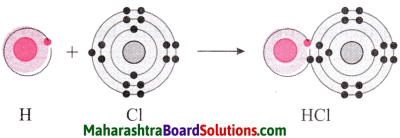
1. Hydrogen has atomic number 1 and electronic configuration 1. That means it has 1 electron in its K shell and its duplet is short of one electron therefore, the valency of hydrogen is one.
Maharashtra Board Class 8 Science Solutions Chapter 13 Chemical Change and Chemical Bond 7

2. The two atoms of hydrogen are identical, they share their electrons with each other.
3. As a result, the electron duplet of both the hydrogen atoms is complete and a covalent band is formed between them.

Maharashtra Board Class 8 Science Solutions Chapter 13 Chemical Change and Chemical Bond

4. There is one covalent bond between the component atoms H and Cl of the molecule HCl. Use this information to represent the formation of HCl molecules from H and Cl atoms diagrammatically.
(Use your brainpower)
Answer:
Hydrogen chloride:
1. Hydrogen has atomic number 1 and electronic configuration 1, that means it has 1 electron in its K shell and its duplet is short of one electron therefore, the valency of hydrogen is one.
Maharashtra Board Class 8 Science Solutions Chapter 13 Chemical Change and Chemical Bond 9

2. On the other hand, chlorine has electronic configuration 2, 8, 7. Chlorine atom has 7 electrons in its outermost shell and requires one electron to complete its octet.

3. The two atoms, hydrogen and chlorine share one electron with each other. As a result, the electron duplet of hydrogen and octet of chlorine is complete and a covalent band is formed between them.

5. Show the formation of the following ionic compounds from the corresponding elements using two methods namely, numerical and diagrammatic representation of electronic configuration.
(a) K+ F, from 19K and 9F, (b) Ca2+ O2- from 20Ca and 8O.
(Use your brainpower)
Answer:
(a) K+F from 19K and 9F
Potassium fluoride:
1. Potassium has atomic number 19 and electronic configuration 2, 8, 8, 1.
2. Potassium atom has 1 electron in its outermost shell.

3. It loses one electron from its outermost shell, i.e. N shell. Then its M shell becomes the outermost shell with a stable octet. The nucleus of potassium atom has 19 protons but the number of electrons in the atom has become 18. So there is a net unit positive charge giving a potassium cation (K+).

4. On the other hand, fluorine has electronic configuration 2, 7. Fluorine has 7 electrons in the outermost shell and requires one electron to complete its octet.

5. Thus, the electron lost by potassium is taken up by chlorine.
Maharashtra Board Class 8 Science Solutions Chapter 13 Chemical Change and Chemical Bond 8
6. When fluorine atom gains one electron, octet of fluorine is completed, its K and L shells have together 10 electrons and the nucleus has 9 protons. This leads to the formation of an ion (F).

7. Thus, a fluorine atom accepts one electron from a potassium atom and consequently a fluoride ion with one unit negative charge and a potassium ion with one unit positive charge are formed.

8. Potassium and fluoride ions, being oppositely charged, attract each other due to electrostatic force of attraction. An ionic bond is formed and this results in the formation of potassium fluoride (KF) molecule.

(b) Ca2+O2- from 20Ca and 8O.
Maharashtra Board Class 8 Science Solutions Chapter 13 Chemical Change and Chemical Bond 15

Distinguish between the following:

Question 1.
Physical change and Chemical change:
Answer:

Physical changeChemical change
1. In this change, the composition of the substance does not change. No new substance is formed.1. In this change, the composition of the compounds change and new compounds are formed.
2. In this case, physical properties such as state, colour, density, etc. are changed.2. In this case, physical and chemical properties are entirely changed.
3. This change is temporary.3. This change is permanent.
4. In this case, the original substance can be recovered by simple means or by merely reversing the process.4. In this case, the original substance cannot be recovered by easy means or by reversing the process.

Maharashtra Board Class 8 Science Solutions Chapter 13 Chemical Change and Chemical Bond

Question 2.
Ionic bond and Covalent bond:
Answer:

Ionic bondCovalent bond
1.  Ionic bond is formed due to the transfer of electrons from one atom to another.1. Covalent bond is formed due to the sharing of electrons between two or more atoms.
2. Atoms of metals and nonmetals combine to form ionic bonds.2. Atoms of nonmetals combine to form covalent bonds.
3. Molecules of the compounds formed due to ionic bond split up into ions in aqueous solution.3. Molecules of the compounds formed due to covalent bond so not split up into ions in a solution.

Give scientific reasons:

Question 1.
Ionic compounds are formed due to the combination of metallic and nonmetallic atoms.
Answer:

Metallic atoms have a tendency to lose electrons from their outermost orbits to establish the octet state in their penultimate orbits. Conversely, nonmetallic atoms gain electrons to establish the octet state of their outermost orbits.

When a metallic atom and a nonmetallic atom come close together, the metallic atom loses electrons and gets c converted into positively charged ion, while the nonmetallic’ atom gets converted into negatively charged ions so formed, develop an ionic bond and this results in the formation of an ionic compound. Hence, ionic compounds are formed due to the combination of metallic and nonmetallic atoms.

Maharashtra Board Class 8 Science Solutions Chapter 13 Chemical Change and Chemical Bond

Activity-based questions:

Activity 1:
Maharashtra Board Class 8 Science Solutions Chapter 13 Chemical Change and Chemical Bond 17

Take the lemon juice in a clean glass. Take two drops of the lemon juice in a spoon and taste. Add a pinch of baking soda in the glass of lemon juice. Did you notice bubbling around the particles of soda? Did you hear a sound on taking your ear near the glass? Now again taste it. Did it taste as sour as it was in the beginning? (Above activity is to be done using clean apparatus and edible material. Then only it is possible to test the ’taste’, otherwise keep in mind that the testing of ‘taste’ cannot be done.)

Maharashtra Board Class 8 Science Solutions Chapter 13 Chemical Change and Chemical Bond

Activity 2:
Take some freshly prepared lime water (solution of calcium hydroxide) in a test tube. Keep on blowing in it with a blow tube. What is seen after some time? Did the colourless lime water turn milky? After some more time you will find that a white insoluble solid settles at the bottom of the test tube. This is a precipitate of calcium carbonate. The turning lime water milky means that the blown gas mixed in it was carbon dioxide.
Maharashtra Board Class 8 Science Solutions Chapter 13 Chemical Change and Chemical Bond 16

Write a chemical equation for the above word equation.
Chemical equation:
CO2 + Ca(OH)2 → CaCO3 + H2O

Maharashtra Board Class 6 History Solutions Chapter 1 The Indian Subcontinent and History

Balbharti Maharashtra State Board Class 6 History Solutions Chapter 1 The Indian Subcontinent and History Notes, Textbook Exercise Important Questions and Answers.

Maharashtra Board Class 6 History Solutions Chapter 1 The Indian Subcontinent and History

Class 6 History Chapter 1 The Indian Subcontinent and History Textbook Questions and Answers

1. Answer the following in one sentence:

Question 1.
What is history?
Answer:

History is a coherent account of the significant past events in the progress of human culture.

Question 2.
Where do human settlements flourish?
Answer:

Human settlements have flourished wherever the means of living are plentiful.

Maharashtra Board Class 6 History Solutions Chapter 1 The Indian Subcontinent and History

Question 3.
What do the people in the hilly region j depend on for their food?
Answer:
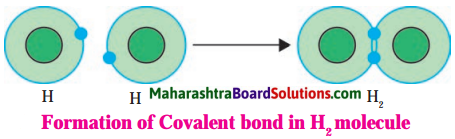
In the hilly regions people depend more on hunting and gathering for their food.

Question 4.
Which was the earliest civilization in India?
Answer:
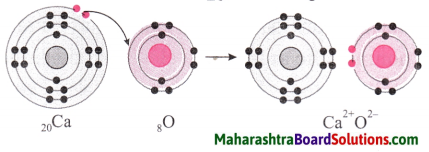
The Harappan civilization was the earliest civilization in India.

2. Answer the following questions in short:

Question 1.
What does human life depend on?
Answer:
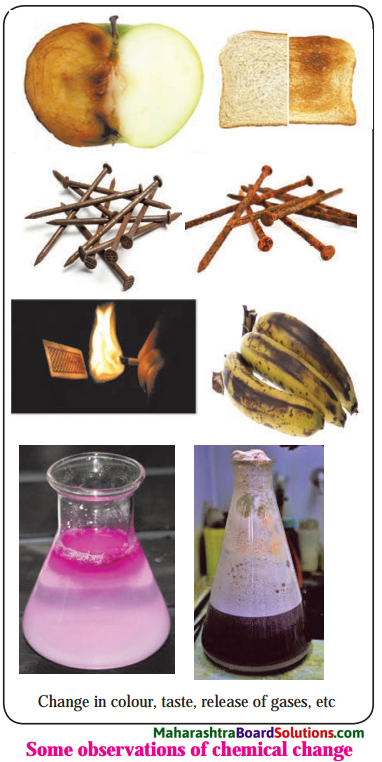
Human life in any region depends to a large extent on its geographical characteristics, diet, clothing, housing and occupation.

Question 2.
What features of our surroundings form the means of our livelihood?
Answer:

The climate, rainfall, agricultural produce, flora and fauna of the region where we live form the source or means of our livelihood.

Question 3.
Which region is known as the Indian subcontinent?
Answer:
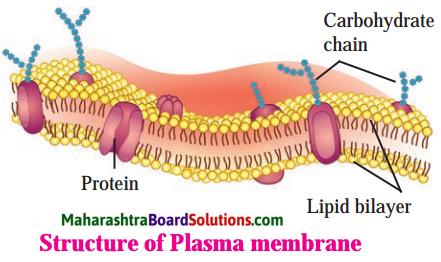
Afghanistan, Pakistan, Nepal, Bhutan, Bangladesh, Sri Lanka and India together form the region known as south Asia. Considering the expanse and significance of India in this region, it is also known as the Indian subcontinent.

Maharashtra Board Class 6 History Solutions Chapter 1 The Indian Subcontinent and History

3. Give reasons:
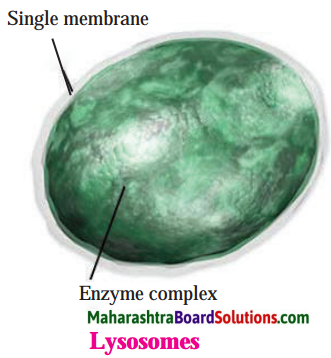
Question 1.
There is a close relation between history and geography.
Answer:

  • Time, place, society and individuals are four major pillars without which history cannot be written.
  • Of these four components ‘place’ is related to geography or geographical conditions.
  • This makes history and geography inseperable i.e. very closely related.

Question 2.
People are forced to leave their settlements.
Answer:

  • Sometimes reasons like degradation of the environment, drought, invasion, etc. leads to scarcity of means.
  • Therefore, people are forced to leave their settlements in their fight for survival.

4. Explain the difference in the human life in the hilly regions and that on the plains.
Answer:

Human life in the Hilly regionHuman life in the Plains
(1) Human life was very strenuous(1) Life was more comfortable.
(2) Land was not fertile. therefore no So agriculture was wcarried on.(2) Land was very Fertile So agriculture   was carried on.
(3) Grains and vegetables Grains and are scarce.(3) Grains and vegetables are found in plenty
(4) They depend on hunting and gathering  for their food.(4) They do not depend on hunting and gathering for their food.

5. Observe the physical map of India and answer the questions based on it:

Question 1.
Which mountain ranges lie in the north of India?
Answer:
The Hindukush and the Himalayan mountain ranges.

Question 2.
Which are the routes to India from the north-east?
Answer:
The route to India from the north east is by sea.

Question 3.
Where do the Ganga and Brahmaputra meet?
Answer:
The Ganga and Brahmaputra meet in Bangladesh.

Maharashtra Board Class 6 History Solutions Chapter 1 The Indian Subcontinent and History

Question 4.
Name the islands to the east of the Indian peninsula.
Answer:
The Andaman and Nicobar islands are the Indian islands to the east of the Indian peninsula.

Question 5.
In which part of India do we see the Thar Desert?
Answer:
We see the Thar Desert in the north western part of India.

Activity:

  • Obtain information about the lakes or reservoirs in your locality.
  • Show the following on a world map :
    1. The Himalaya Mountain
    2. The Silk Road
    3. Arabia

Class 6 History Chapter 1 The Indian Subcontinent and History Additional Important Questions and Answers

Complete the sentence by choosing the correct option:

Question 1.
________ is a coherent account of the significant past events in the progress of human culture.
(a) History
(b) Geography
(c) Civics
Answer:
History

Question 2.
Not much fertile land is available in the ______ region.
(a) plains
(b) hilly
(c) plateau
Answer:
hilly

Question 3.
Grains and vegetables are _______ in the hilly areas.
(a) scarce
(b) plenty
(c) moderate
Answer:
scarce

Maharashtra Board Class 6 History Solutions Chapter 1 The Indian Subcontinent and History

Question 4.
In the ______ regions, people depend more on hunting and gathering for their food.
(a) plateau
(b) plains
(c) hilly
Answer:
hilly

Question 5.
Human settlements have flourished wherever the means of living are _______.
(a) scarce
(b) plentiful
(c) moderate
Answer:
plentiful

Question 6.
_____ lies to the north of India.
(a) Andaman
(b) Western Ghats
(c) Himalayas
Answer:
Himalayas

Question 7.
_____ lies to the east of India.
(a) Bay of Bengal
(b) Eastern ghats
(c) Lakshadweep
Answer:
Bay of Bengal

Question 8.
_________ lies to west of India.
(a) Himalayas
(b) Arabian sea
(c) Brahmaputra
Answer:
Arabian sea

Question 9.
______ lies to the south of India.
(a) Indian Ocean
(b) Arabian Sea
(c) Pacific Ocean
Answer:
Indian Ocean

Question 10.
The Hindukush and Himalayan ranges have created an impenetrable wall on the nothern side of the ________ subcontinent.
(a) Indian
(b) Foreign
(c) Asian
Answer:
Indian

Question 11.
There is a land route through the Khyber and Bolan passes in the ______ mountains.
(a) Himalayan
(b) Satpuda
(c) Hindukush
Answer:
Hindukush

Maharashtra Board Class 6 History Solutions Chapter 1 The Indian Subcontinent and History

Question 12.
The _____ desert spreads across Rajasthan, Haryana and some parts of Gujarat.
(a) Bhor
(b) Thar
(c) Arabian
Answer:
Thar

Question 13.
The _______ river that originates in Himachal Pradesh reaches the Thar desert.
(a) Ganga
(b) Sindhu
(c) Ghaggar
Answer:
Ghaggar

Question 14.
A region that is bound by sea on three sides is called a ______.
(a) peninsula
(b) plateau
(c) island
Answer:
peninsula

Question 15.
A major part of the Indian peninsula is occupied by the_______ plateau.
(a) Maharashtra
(b) Bengal
(c) Deccan
Answer:
Deccan

Question 16.
The mountain ranges of the Vindhya and Satpuda are located to the of the ________ Deccan Plateau.
(a) east
(b) north
(c) west
Answer:
north

Question 17.
Deccan plateau was a part of the ______ empire, the largest in ancient India.
(a) Maurya
(b) Gupta
(c) Chola
Answer:
Maurya

Question 18.
Lakshadweep is a group of Indian islands in the _____ Sea.
(a) Red
(b) Dead
(c) Arabian
Answer:
Arabian

Question 19.
The Harappan civilization had spread mainly in the ________ part of the Indian subcontinent.
(a) southeastern
(b) northwestern
(c) southwestern
Answer:
north western

Maharashtra Board Class 6 History Solutions Chapter 1 The Indian Subcontinent and History

Match the following:

Question 1.

Column (A)Column (B)
(1) Himalayas(a) South
(2) Indian Ocean(b) East
(3) Arabian Sea(c) North
(4) Bay of Bengal(d) West

Answer:
1 – c
2 – a
3 – d
4 – b

Question 2.

Column (A)Column (B)
(1) China(a) Deccan plateau
(2) Vindhya range(b) Not a part of Indian subcontinent
(3) Bangladesh(c) In Bay of Bengal
(4) Andaman and Nicobar islands(d) In the Hindukush mountains
(5) Khyber and Bolan passes(e) Part of Indian subcontinent

Answer:
1 – b
2 – a
3 – e
4 – c
5 – d

Answer the following in one sentence:

Question 1.
Give the four major pillars without which history could not have been written.
Answer:
Time, place, society and individuals are the four major pillars of history, without which history could not have been written.

Question 2.
What has created an impenetrable wall on j the northern side of the Indian subcontinent? j
Answer:
Two mountain ranges, the Hindukush and Himalayan ranges have created an impenetrable wall on the northern side of the Indian subcontinent.

Question 3.
Which passes form a route in the Hindukush mountains?
Answer:
The Khyber and the Bolan passes form a land route in the Hindukush mountains.

Question 4.
What is known as ‘Hakra’ in Pakistan?
Answer:
The Ghaggar river that originates in Himachal Pradesh reaches the Thar desert. It is known as ‘Hakra’ in Pakistan.

Question 5.
Which plateau occupies a major part of the Indian peninsula?
Answer:
The Deccan plateau occupies a major part of the Indian peninsula.

Question 6.
Which mountain range is to the north of the Deccan plateau?
Answer:
The Vindhya and Satpuda mountain ranges are located to the north of the Deccan plateau.

Maharashtra Board Class 6 History Solutions Chapter 1 The Indian Subcontinent and History

Question 7.
Name the Indian islands in the Bay of Bengal.
Answer:
Andaman and Nicobar are the Indian islands in the Bay of Bengal.

Question 8.
Which manuscript mentions the Indian islands?
Answer:
The manuscript ‘Periplus of the Erythrean Sea’ or ‘Handbook of the Red Sea’ by an unknown Greek sailor, makes a mention of Indian islands.

Question 9.
Which two ancient cities are in today’s Pakistan?
Answer:
The cities of Harappa and Mohenjo-daro are in today’s Pakistan.

Answer the following questions in short:

Question 1.
State the extent of our country, India.
Answer:
Our country India, extends far and wide:

  • To its north lies the Himalayas.
  • To the east, the Bay of Bengal.
  • To the west, the Arabian Sea.
  • And to the south, the Indian ocean.
  • Except for the islands of Andaman, Nicobar and Lakshadweep, the rest of the country is contiguous.

Question 2.
Describe the trade route from China to Arabia.
Answer:

  • There is a land route through the Khyber and Bolan passes in the Hindukush mountains.
  • This land route was connected to an ancient trade route.
  • The trade route from China in the east passed through central Asia and reached Arabia in the west.

Maharashtra Board Class 6 History Solutions Chapter 1 The Indian Subcontinent and History

Give reasons:

Question 1.
The trade route from west to east was also called the silk route.
Answer:

  • Silk was the main commodity exported to the western countries using this trade route.
  • Therefore this trade route from west to east was called the ‘silk route’ or ‘silk road’.

Maharashtra Board Class 8 Science Solutions Chapter 10 Cell and Cell Organelles

Balbharti Maharashtra State Board Class 8 Science Solutions Chapter 10 Cell and Cell Organelles Notes, Textbook Exercise Important Questions and Answers.

Maharashtra State Board Class 8 Science Solutions Chapter 10 Cell and Cell Organelles

Class 8 Science Chapter 10 Cell and Cell Organelles Textbook Questions and Answers

1. Who am I?

Question a.
I am ATP producing factory.
Answer:
Mitochondria

Question b.
I am single-layered but maintain cellular osmotic pressure.
Answer:
Vacuole

Question c.
I support the cell, but I am not cell wall. I have a body resembling net.
Answer:
Endoplasmic reticulum

Maharashtra Board Class 8 Science Solutions Chapter 10 Cell and Cell Organelles

Question d.
I am chemical factory of the cell.
Answer:
Chloroplasts in case of plant cells can be called chemical factory as they synthesise carbohydrates. Ribosomes also synthesise proteins, so those can also be called chemical factory. Golgi complex is secretory in function, hence it can be also called factory. Mitochondria though mainly referred to as powerhouse of the cell, it is also mentioned as chemical factory by some authors.

Question e.
Leaves are green because of me.
Answer:
Chloroplast.

2. What would have happened? If……….

Question a.
RBCs had mitochondria.
Answer:
Mitochondria continuously carry out oxidation and form energy inside the cell. They produce energy-rich compound, ATP. In this process, they utilize carbohydrates, fats and proteins present in the cell. If RBCs has mitochondria, they would have used oxygen for this purpose than carrying it to all the cells of the body. The cells would not have obtained oxygen.

Maharashtra Board Class 8 Science Solutions Chapter 10 Cell and Cell Organelles

Question b.
There had been no difference between mitochondria and plastids.
Answer:
Mitochondria carry out oxidation of carbohydrates, fats, etc. with the help of enzymes. Plastids are synthesising carbohydrates with the help of solar energy and chlorophyll. Both the cell organelles have their own sets of different enzymes as per their role. If there would have been no difference between mitochondria and plastids, the specific functions would not have been taken place.

Question c.
Genes had been absent on the chromosomes.
Answer:
Genes are functional segments on the chromosomes which are responsible for transmitting the hereditary information.

Question d.
Plasma membrane had not been selectively permeable.
Answer:
Selectively permeable membrane allows some substances to enter the cell, while prevents other unwanted or harmful substances. If plasma membrane would not have been selectively permeable, there would be no control over entry and exit of any substances. The process of osmosis would also be erroneous in such case.

Question e.
Plants lacked anthocyanin.
Answer:
If plants lacked anthocyanin, no part of the plant would display purple or blue colour. Anthocyanin attracts the insects for pollination and seed dispersal. These processes will be affected due to lack of anthocyanin. These pigments are also said to be protective in nature for the plant. This protection will not be given to the plant in absence of anthocyanin.

Maharashtra Board Class 8 Science Solutions Chapter 10 Cell and Cell Organelles

3. Who is odd man among us? Give reason.

Question a.
Nucleolus, mitochondria, plastids, endoplasmic reticulum
Answer:
Nucleolus. (All the others are cell organelles but nucleolus is not a cell organelle present in cytoplasm.)

Question b.
DNA, Ribosomes, Chlorophyll
Answer:
Chlorophyll. (DNA and Ribosomes are present in plant as well as in animal cells. Chlorophyll is present only in plant cells.)

4. Give functions.

Question a.
Plasma membrane.
Maharashtra Board Class 8 Science Solutions Chapter 9 Disaster Management 4
Answer:

  1. Plasma membrane acts as a selectively permeable membrane. It allows entry of those useful substances which are needed for the cell. It does not allow entry of the harmful and unwanted substances.
  2. Plasma membrane keeps the homeostasis in the cell. The cell is kept in steady state even if the external environment changes.
  3. Plasma membrane is responsible for processes of endocytosis and exocytosis.
  4. The processes of diffusion and osmosis are possible only due to plasma membrane.
  5. In animal cells, plasma membrane is the outermost protective covering of the cell.

Maharashtra Board Class 8 Science Solutions Chapter 10 Cell and Cell Organelles

Question b.
Cytoplasm.
Answer:

  1. All the cell organelles are spread in the cytoplasm of a cell.
  2. The cytoplasm is the medium for many cellular chemical reactions.
  3. The cytosol which is the part of cytoplasm other than cell organelles stores many vital substances like amino acids, glucose, vitamins, etc.
  4. Cytosol also helps in the cellular movements.

Question c.
Lysosome.
Maharashtra Board Class 8 Science Solutions Chapter 9 Disaster Management 5
Answer:

  1. Lysosome helps in the destruction of attacking viruses and bacteria and thereby help in the immune response.
  2. Lysosomes act as demolition squads. They destroy worn-out cellular organelles and organic debris. This process is called autolysis which All Pagesmeans self-destruction.
  3. They are also called suicide bags as in a worn out, damaged or old cell, lysosomes automatically burst. The lytic enzymes present in the lysosome digest their own cells.
  4. Lysosomes can digest stored proteins, fats during starvation.

Question d.
Vacuole.
Maharashtra Board Class 8 Science Solutions Chapter 9 Disaster Management 6
Answer:

  1. Vacuoles maintain the osmotic pressure of the cell.
  2. Various metabolic byproducts and end products such as glycogen, proteins, water, etc. are stored in the lysosome.
  3. In food vacuole of amoeba, the food is temporarily stored till digestion. In other animal cells, vacuoles can store waste products and food.
  4. Vacuoles of plant cells can provide turgidity and rigidity as it contains good amount of cell sap.

Question e.
Nucleus.
Maharashtra Board Class 8 Science Solutions Chapter 9 Disaster Management 7
Answer:

  1. Nucleus is the controlling centre for the entire cell.
  2. It controls all metabolic activities of the cell.
  3. The cell division is possible due to the nucleus.
  4. The chromosomes present in the nucleus carry the genes. These genes are responsible for the transmission of hereditary characters from parental generation to the next generations.

Maharashtra Board Class 8 Science Solutions Chapter 10 Cell and Cell Organelles

5. Who gives me the colour? (Select the correct option).

Question a.

Column ‘A’Column ‘B’
1. Red tomatoa. Chlorophyll
2. Green leafb. Carotene
3. Carrotc. Anthocyanin
4. Violetd. Lycopene

Answer:

Column ‘A’Column ‘B’
1. Red tomatod. Lycopene
2. Green leafa. Chlorophyll
3. Carrotb. Carotene
4. Violetc. Anthocyanin

Maharashtra Board Class 8 Science Solutions Chapter 10 Cell and Cell Organelles

Project:

Question 1.
Prepare model of a cell using different ecofriendly materials.

Question 2.
Study osmosis using parchment paper or a similar membrane.

Question 3.
Form a friends’ group in your class. Give each one role of a cell organelle. Present a skit accordingly.

Class 8 Science Chapter 10 Cell and Cell Organelles Important Questions and Answers

Rewrite the sentences after filling the blanks:

Question 1.
Cell wall is mainly composed of carbohydrates like ……….. and …………. .
Answer:
Cell wall is mainly composed of carbohydrates like cellulose and pectin.

Question 2.
Plasma membrane is said to be a ……………. …………….. membrane as it allows some substances to enter the cell, while prevents other substances.
Answer:
Plasma membrane is said to be a selectively permeable membrane as it allows some substances to enter the cell, while prevents other substances.

Question 3.
Homeostasis is maintained in the cell by ………….. .
Answer:
Homeostasis is maintained in the cell by plasma membrane.

Maharashtra Board Class 8 Science Solutions Chapter 10 Cell and Cell Organelles

Question 4.
An …………… is a specialized subunit having specific function within the cell.
Answer:
An organelle is a specialized subunit having specific function within the cell.

Question 5.
……………. has ribosome granules on its outer surface.
Answer:
Rough ER has ribosome granules on its outer surface.

Question 6.
During starvation, ………………… digest stored proteins, fats.
Answer:
During starvation, lysosomes digest stored proteins, fats.

Question 7.
……………….. is the secretory organ of the cell.
Answer:
Golgi complex is the secretory organ of the cell.

Maharashtra Board Class 8 Science Solutions Chapter 10 Cell and Cell Organelles

Question 8.
……………. compound ATP is produced in the mitochondria.
Answer:
Energy-rich compound ATP is produced in the mitochondria.

Given below are incorrect statements. Rewrite them after correcting them:

Question 1.
In mitochondria, the inner membrane is porous and the outer membrane is deeply folded.
Answer:
In mitochondria, the outer membrane is porous and the inner membrane is deeply folded.

Question 2.
Vacuole is bound by double membrane.
Answer:
Vacuole is bound by single membrane.

Question 3.
If fruit pieces are kept in thick saturated sugar solution, the water from fruit pieces enter the sugar solution resulting into their swelling.
Answer:
If fruit pieces are kept in a thick saturated sugar solution, the water from fruit pieces enter the sugar solution resulting into their shrinking.

Maharashtra Board Class 8 Science Solutions Chapter 10 Cell and Cell Organelles

Question 4.
Raisins kept in water shrink after an hour.
Answer:
Raisins kept in water swell after an hour.

Question 5.
Lysosome produces vacuoles and secretory vesicles.
Answer:
Golgi complex produces vacuoles and secretory vesicles.

Who gives me the colour? (Select the correct option)

Question 1.

Column ‘A’Column ‘B’
1. Nucleusa. Pipelines of the cell
2. Endoplasmic reticulumb. Powerhouse of the cell
3. Golgi complexc. Suicidal bags
4. Mitochondriad. Packing department
5. Lysosomese. Controlling centre

Answer:

Column ‘A’Column ‘B’
1. Nucleuse. Controlling centre
2. Endoplasmic reticuluma. Pipelines of the cell
3. Golgi complexd. Packing department
4. Mitochondria b. Powerhouse of the cell
5. Lysosomesc. Suicidal bags

Maharashtra Board Class 8 Science Solutions Chapter 10 Cell and Cell Organelles

Find the odd one out by giving suitable reasons:

Question 1.
Demolition squads, Suicide Bags, Immune system, Powerhouse of the cell.
Answer:
A powerhouse of the cell. (All the others are descriptions of the lysosomes.)

Question 2.
Lignin, Suberin, Cutin, Iodine
Answer:
Iodine. (All the others are polymers present in the cell wall.)

Question 3.
Nucleolus, Genes, Chromosomes, Ribosomes
Answer:
Ribosomes. (All the others are inclusions in the nucleus.)

Write definitions/Give meanings:

1. Homeostasis: The tendency of the cell to keep the cellular environment constant in spite of changes in the outer: environment is called homeostasis.

2. Endocytosis: To take in the food or any other substance from outer environment into the cell is called endocytosis.

3. Exocytosis: To give out the unwanted substances from the cell to the outer « environment is called exocytosis.

4. Diffusion: The movement of the molecules from region of higher concentration to the region of lower concentration is called diffusion.

5. Osmosis: The movement of solute from low concentration to high concentration and the movement of solvent from high concentration to the region of low concentration across semipermeable membrane is called osmosis.

6. Plasmolysis: When the cell is kept ?! in hypertonic medium, the water exits through the process of exosmosis causing shrinkage of the cytoplasm, this is known as plasmolysis.

7. Isotonic solution: When the concentration of the cell and that of the medium in which the cell is kept is same, then such solution is called isotonic solution.

8. Hypotonic solution: When the concentration of the water in the cell is less than that of the concentration of the water in the surrounding medium in which the cell is kept, then such solution is called hypotonic solution.

9. Hypertonic solution: When the concentration of the water in the cell is more than that of the concentration of water in the surrounding medium then such solution is called hypertonic solution.

Maharashtra Board Class 8 Science Solutions Chapter 10 Cell and Cell Organelles

Distinguish between the following:

Question 1.
Prokaryotic and eukaryotic cell:
Answer:

Prokaryotic cellEukaryotic cell
1. Nucleoid is present instead of a well-formed nucleus.1. Nucleus is well-formed with nuclear membrane, chromatin network and nucleolus.
2. Chromosome number is always one.2. Chromosome number is more than one and is specific for every species.
3. Membrane-bound cell organelles are absent.3. There are membrane-bound cell organelles.
4. The size of the cell is 1 to 10 micrometre. Example: Bacteria4. The size of the cell is 5 to 100 micrometre. Example: All highly evolved unicellular and multicellular plants and animals.

Maharashtra Board Class 8 Science Solutions Chapter 10 Cell and Cell Organelles

Question 2.
Plant cell and animal cell
Answer:

Plant cellAnimal cell
1. The cell wall is the outermost covering on the cell. The plant cells have both cell wall and the cell membrane1. The cell membrane or plasma membrane is the outermost covering of the cell. The animal cells do not have cell wall
2. The vacuoles are large and centrally placed.2. The vacuoles are small and uniformly distributed in the cytoplasm.
3. There are plastids in the plant cells. The chloroplasts have chlorophyll.3. The plastids are absent in the animal cells.
4. The lysosomes are absent in the plant cells.4. Lysosomes are present in the animal cells. They contain digestive enzymes.
5. The cytoplasm is thin and pushed to the periphery due to central vacuole.5. The cytoplasm is dense and granular. It is uniformly spread throughout the cell.

Answer the following questions in one sentence:

Question 1.
What are the components of plasma membrane?
Answer:
In plasma membrane, protein molecules are embedded in two layers of phospholipids.

Maharashtra Board Class 8 Science Solutions Chapter 10 Cell and Cell Organelles

Question 2.
Which part of the cell maintains the homeostasis?
Answer:
Plasma membrane of the cell maintains the homeostasis.

Question 3.
What are genes?
Answer:
Genes are the functional segments on the chromosomes that carry hereditary i information from the parental generation to the offspring.

Question 4.
What is meant by rough ER?
Answer:
The endoplasmic reticulum that has ribosomes on its outer membrane is called rough ER.

Question 5.
Write the examples of plant pigments.
Answer:
Chlorophyll, Carotene, Xanthophyll, Anthocyanin, Betalains and Lycopene are some of the plant pigments.

Question 6.
What are the inclusions in the stroma of chloroplasts?
Answer:
Enzymes, DNA, ribosomes and carbohydrates that are necessary for photosynthesis are present in the stroma of the chloroplasts.

Maharashtra Board Class 8 Science Solutions Chapter 10 Cell and Cell Organelles

Question 7.
Which staining technique was developed by Camilio Golgi? Where was this technique used?
Answer:
Camilio Golgi developed the staining technique called ‘Black reaction’ which was used in the study of nervous system.

Question 8.
What type of work is done by National Centre for Cell Science?
Answer:
National Centre for Cell Science – NCCS is involved in research in cytology and research about cancer treatment and it also provides services for National Animal cell repository.

Question 9.
Ripe tomatoes appear red.
Answer:
When green tomatoes become ripe they lose chlorophyll and develop red pigment in them called lycopene. Therefore, ripe tomatoes appear red.

Give scientific reasons:

Question 1.
Raisins swell after keeping in plain water.
Answer:
When raisins are placed in plain water, there is action of endosmosis. The outer skin of raisins acts like selectively permeable membrane. Since the concentration of water inside the raisin is lesser than the concentration of water in the outer medium, water enters in the raisin. This causes raisins to swell after keeping them in plain water.

Maharashtra Board Class 8 Science Solutions Chapter 10 Cell and Cell Organelles

Question 2.
The fruit pieces kept in sugar syrup show shrinking.
Answer:
There is more concentration of water in the fruit pieces as compared to the concentration of water in the sugar syrup. Therefore, water is lost out by exosmosis. The membranes of the fruit pieces act as selectively permeable membranes. Thus the process of plasmolysis occurs resulting into shrinking of the fruit pieces.

Question 3.
The nucleus of the sieve tubes of the plant phloem is lost.
Answer:
The sieve tubes of the plant phloem conduct the food in plants. To make this transport easier, the nucleus of the sieve tubes of the plant phloem is lost,

Question 4.
Plant cells have less mitochondria than those of animal cells.
Answer:
Mitochondria are the cell organelles which are called powerhouse of the cell. They produce energy in the form of ATP. Animals are motile and need more energy for walking, running and moving. Plants are stationary. They do not need energy to greater extent. Therefore, they have lesser number of mitochondria.

Question 5.
Vacuoles do not have any typical size or shape.
Answer:
Vacuoles change their shape and size as per the need of the cell. Thus they do not have any fixed shape or size.

Maharashtra Board Class 8 Science Solutions Chapter 10 Cell and Cell Organelles

Question 6.
Ripe tomatoes appear red.
Answer:
When green tomatoes become ripe they lose chlorophyll and develop red pigment in them called lycopene. Therefore, ripe tomatoes appear red.

Give functions:

Question 1.
Endoplasmic reticulum.
Maharashtra Board Class 8 Science Solutions Chapter 9 Disaster Management 8
Answer:

  1. Endoplasmic reticulum or ER is the supporting framework of the cell.
  2. The ribosomes attached to the membrane of the ER synthesize proteins. These proteins are conducted by ER.
  3. The detoxification process is done by ER. The toxins that enter the cell through food, air and water are removed out by making them water soluble.

Question 2.
Golgi complex.
Maharashtra Board Class 8 Science Solutions Chapter 9 Disaster Management 9
Answer:

  1. Different secretions are prepared in the Golgi complex. Hence it is called the secretory organ of the cell.
  2. The secretions are modified and sorted out as per their functions. They are further packed.
  3. The enzymes, mucus, proteins, pigments, etc. are sorted and then dispatched to various target regions like plasma membrane, lysosome, etc.
  4. Golgi complex also produces vacuoles and secretory vesicles.
  5. Formation of cell wall, plasma membrane and lysosomes is aided by Golgi complex.

Maharashtra Board Class 8 Science Solutions Chapter 10 Cell and Cell Organelles

Question 3.
Plastids.
Answer:

  1. Chloroplasts contain chlorophyll. They carry out the process of photosynthesis. They convert solar energy to chemical energy in the form of food.
  2. Chromoplasts with different pigments can impart different colours to flowers and fruits.
  3. Leucoplasts are responsible for the synthesis and storage of food like starch, oils and proteins.

Answer the following questions:

Question 1.
How does endosmosis and exosmosis occur in the cell?
Answer:

  1. When the water concentration inside the cell is less as compared to the medium in which it is present, then the endosmosis takes place. This makes the water to enter inside the cell.
  2. When water concentration inside the cell is more than the water concentration in the medium in which it is present, then the water comes out of the cell. This is called exosmosis.
  3. Since the cell membrane acts as a semipermeable membrane, the processes of endosmosis and exosmosis takes place in the cell.

Question 2.
What is cytoplasm? What are the constituents of cytoplasm?
Answer:

  1. The jelly like material present between the cell membrane and nucleus is called cytoplasm.
  2. Cytoplasm without cell organelles is called cytosol.
  3. All the cell organelles are spread in the cytoplasm.
  4. Cytosol stores many vital constituents such as amino acids, glucose, vitamins, etc.
  5. The cytoplasm of animal cells is dense and granular while that of plant cells is thin and peripheral. It is pushed to sides due to large central vacuole.

Question 3.
Describe the structure of the nucleus in the cell.
Maharashtra Board Class 8 Science Solutions Chapter 9 Disaster Management 7
Answer:

  1. Nucleus is the most important part of the eukaryotic cell.
  2. Inside the nucleus there is round darkly stained nucleolus.
  3. The nucleus is covered over by double membrane which is porous.
  4. The nuclear pores allow the transport of different substances in and out of the nucleus to cytoplasm.
  5. Inside the nucleus is the chromatin network which contains chromosomes. Chromatin fibres are thin which condense to form chromosomes. The chromosomes become clear and distinct at the time of cell division.
  6. In every cell there are specific number of chromosomes. Chromosomes contain genes which are bearers of hereditary characters.

Maharashtra Board Class 8 Science Solutions Chapter 10 Cell and Cell Organelles

Question 4.
Why is endoplasmic reticulum compared with the pipelines?
Answer:

  1. The endoplasmic reticulum works as pipelines to carry different substances in the cell.
  2. It is a net like structure consisting of interconnected small tubes and sheets filled with fluid.
  3. On the inner side the E.R. is connected to nucleus while at the outer side it is in contact with plasma membrane. Therefore, it works like a pipeline.

Question 5.
Write an account of the different structures seen in Golgi complex.
Answer:

  1. Golgi complex is made up of 5-8 hollow and flat sacs called cisternae.
  2. These are placed parallel to each other and are filled with different enzymes.
  3. Golgi complex has two faces called forming face and maturation face.
  4. The proteins packed in vesicles and coming from ER reach Golgi complex through cytoplasm.
  5. They fuse with the formation face of the Golgi membranes for emptying their contents in the cisternae.
  6. When these contents pass through the cisternae, they are chemically modified with the help of enzymes and are again packed in the vesicles.
  7. These vesicles come out of Golgi ‘ complex at the maturation face.

Question 6.
How is energy produced in the mitochondria? How the structures of mitochondria help in this process?
Answer:

  1. Around every mitochondrion there is a double membrane.
  2. The outer membrane of these is porous while the inner membrane is deeply folded.
  3. These folds or ‘cristae’ enclose the matrix filled with proteinaceous gel containing ribosomes, phosphate granules and DNA. Protein synthesis takes place in this matrix.
  4. Mitochondria carry out oxidation of carbohydrates and fats in the cell. This produces energy in the form of ATP, s i.e. Adenosine Tri Phosphate

Maharashtra Board Class 8 Science Solutions Chapter 10 Cell and Cell Organelles

Question 7.
What is the benefit of foldings of inner membrane in mitochondria?
Maharashtra Board Class 8 Science Solutions Chapter 9 Disaster Management 16
Answer:
The structure of the inner mitochondrial membrane is extensively folded and compartmentalized. The numerous imaginations of the membrane are called cristae. This folded inner membrane increases the area which is about 5 times more than that the outer membrane due to cristae. Cristae membranes have small round protein complexes known as Fx particles. In these particles the process of energy production goes on.

Research:

Question 1.
Keep 4 – 5 raisins in water and observe after an hour. Afterward, keep the same raisins in sugar solution and observe after an hour. Note down the observations and discuss in the classroom.
Answer:
When raisins are kept in water its outer skin acts as a semi-permeable membrane. The water content inside the raisin is lesser as compared to the water content in the outside medium. Therefore the water enters in the raisins due to process of endosmosis. Thus if raisins kept in plain water are observed after one hour, they are seen to be swollen.

On the other hand, if raisins are kept in sugar solution, they show plasmolysis and they shrink. The sugar solution acts as hypertonic medium. Water content in the raisin is higher than that present in the sugary solution. Thus water exists from raisins and its content thus shrinks.

Maharashtra Board Class 8 Science Solutions Chapter 10 Cell and Cell Organelles

Question 2.
Wooden doors fit very tightly in rainy season. Why does it happen?
Answer:
During rainy season there is more humidity in air. The doors get soaked in rain water. Though wood is non-living, it has the ability to absorb water. As the moisture is more in the surrounding area, it enters the wood. This is a type of endosmosis. It causes the doors to swell. The swollen doors then fit very tightly.

Diagram based questions:

Question 1.
Structure of the cell:
Maharashtra Board Class 8 Science Solutions Chapter 9 Disaster Management 10
Answer:
Maharashtra Board Class 8 Science Solutions Chapter 9 Disaster Management 11

(iii) Complete the chart:

Maharashtra Board Class 8 Science Solutions Chapter 9 Disaster Management 12
Answer:

ComponentAnimal cellPlant cell
Cell membranePresentPresent
Cell wallAbsentPresent
LysosomesPresentAbsent
PlastidsAbsentPresent
Endoplasmic reticulumPresentPresent
VocuolePresentPresent
Golgi complexPresentPresent
MitochondriaPresentPresent

Maharashtra Board Class 8 Science Solutions Chapter 10 Cell and Cell Organelles

Question 2.
Sketch the diagrams to show how osmosis occurs in plant cell if kept separately in isotonic, hypotonic and hypertonic medium.
Answer:
Maharashtra Board Class 8 Science Solutions Chapter 9 Disaster Management 13

Question 3.
Sketch the diagrams to show how osmosis occurs in animal cell if kept separately in isotonic, hypotonic and hypertonic medium
Answer:
Maharashtra Board Class 8 Science Solutions Chapter 9 Disaster Management 14

Activity-based questions:

Question 1.
Experiment Activity – Take a drop of water on a clean glass slide. Using an ice-cream spoon, gently scrap the inner surface of your cheek. With a needle, transfer a little material from spoon to the water drop on the slide and spread it evenly. Put a drop of methylene blue stain on the smear. Put a cover slip and observe under microscope. Did you observe the cells with blue nucleus?
Answer:
Students should do this activity at school laboratory. There are squamous epithelial cells in the inner side of the cheek. When stained with methylene blue the nucleus takes up dark stain and can be seen clearly.

Maharashtra Board Class 8 Science Solutions Chapter 10 Cell and Cell Organelles

Question 2.
Experiment Activity – Take out a thin peel of Rheo or Croton leaf and observe the chromoplasts under the compound microscope.
Answer:
Students are expected to do the observations in the school laboratory.

Question 3.
Can you recall? Observe the cells of onion peel under the microscope. Have you seen the fully turgid, rectangular cells of onion peelings?
Maharashtra Board Class 8 Science Solutions Chapter 9 Disaster Management 15
Answer:
Students are expected to do the observations in the school laboratory.

Maharashtra Board Class 6 History Solutions Chapter 7 India during the Maurya Period

Balbharti Maharashtra State Board Class 6 History Solutions Chapter 7 India during the Maurya Period Notes, Textbook Exercise Important Questions and Answers.

Maharashtra Board Class 6 History Solutions Chapter 7 India during the Maurya Period

Class 6 History Chapter 7 India during the Maurya Period Textbook Questions and Answers

1. Answer in one sentence:

Question 1.
Why did the satraps begin to fight among themselves?
Answer:
After Alexander’s death, a struggle for power began among the satraps that he had appointed.

Question 2.
Who did Ashoka send to Sri Lanka for the spread of Buddhism?
Answer:
Ashoka sent his own son Mahendra and daughter Sanghamitra to Sri Lanka for the spread of Buddhism.

Maharashtra Board Class 6 History Solutions Chapter 7 India during the Maurya Period

Question 3.
What were the occupations of the people during the Mauryan period?
Answer:
During the Mauryan period, there were many occupations like carving and engraving on ivory, weaving and dyeing cloth and metal work. Black, glazed pottery was produced. Ship building and technology of making articles of iron had also developed.

Question 4.
Which animal engravings are found on the pillars erected by Emperor Ashoka?
Answer:
Excellent carvings of animals like the lion, elephant, bull are found on the pillars erected by Ashoka.

2. Can you explain ?

Question 1.
Satrap
Answer:
When Alexander was forced to return back to Greece, he appointed Greek officers to administer the conquered territories. They were called satraps.

Question 2.
Sudarshan
Answer:
Emperor Chandragupta Maurya built a dam called ‘Sudarshan’ near Junagadh in Gujarat state.

Question 3.
‘Devanampiyo Piyadasi’
Answer:
The name given to Emperor Ashoka which means beloved of the Gods and he who looks on with affection.

Maharashtra Board Class 6 History Solutions Chapter 7 India during the Maurya Period

Question 4.
Ashtapad
Answer:
The game of chess was called Ashtapad.

3. Recall and describe:

Question 1.
The extent of Chandragupta Maurya’s empire.
Answer:

  • Chandragupta Maurya defeated the Nanda dynasty and established his rule in Magadha.
  • He won Avanti and Saurashtra and began to extend the boundaries of his empire.
  • On defeating Seleucus Nicator he included the north west region of Kabul, Kandahar and Herat in the Mauryan Empire.

Question 2.
The extent of Ashoka’s empire.
Answer:
Ashoka’s empire extended from Afghanistan in the northwest and Nepal in the north to Karnataka and Andhra Pradesh in the south, and from Bengal in the east to Saurashtra in the west.

4. Match the following:

Question 1.

Column (A)Column (B)
(1) Emperor Alexander(a) Ambassador of Seleucus Nicator
(2) Megasthenes(b) Emperor of Greece
(3) Emperor Ashoka(c) Emperor of Rome
(d) Emperor of Magadha

Answer:
1 – b
2 – a
3 – d

5. What is your opinion?

Question 1.
Alexander had to turn back.
Answer:

  • During the Indian invasion, Alexander’s army had to suffer severe hardships.
  • The army was also away from home for a very long time so the soldiers were eager to go back.
  • Therefore, they rebelled, against Alexander and he was forced to go back to Greece.

Maharashtra Board Class 6 History Solutions Chapter 7 India during the Maurya Period

Question 2.
Coins of Greek kings were characteristic.
Answer:

  • The Greek kings minted characteristic coins.
  •  On one side, the coin had a picture of the king who had minted the coin and on the other side, a picture of a Greek God.
  • The name of the king was also written on the coin.
  • Alexander’s coins were of the same type.

Question 3.
Emperor Ashoka decided never to wage war again.
Answer:

  • Emperor Ashoka decided never to wage war again when he witnessed the bloodshed and devastation caused by Kalinga war.
  • Emperor Ashoka had a change of heart and embraced Buddhism.

6. Describe in your own words:

Question 1.
Public welfare works of Emperor Ashoka
Answer:

  • Emperor Ashoka laid stress on the creation of facilities for the welfare of the people.
  • He made provision for free medicines and medical treatment for people as well as for animals.
  • He built many roads.
  • He dug wells and built dharmashalas.

Question 2.
Means of entertainment and sport of the Mauryan period.
Answer:

  • Different festivals and functions were celebrated in villages and towns.
  • Dance and music concerts were a part of entertainment.
  • Wrestling bouts and chariot races were popular.
  • Board games and chess called Ashtapad was also popular.

Activity:

  • Find out about the public welfare activities carried out by the people’s representatives in your area and write in detail about them.
  • Read more about the life of Emperor Ashoka and make a presentation based on it in the form of a play.

Class 6 History Chapter 7 India during the Maurya Period Additional Important Questions and Answers

Complete the sentence by choosing the correct option:

Question 1.
Alexander, the Greek emperor, invaded ______ northwestern frontier in 326 BCE.
(a) China
(b) India
(c) Nepal
Answer:
(b) India

Question 2.
Emperor Alexander appointed Greek officers to _______ the conquered territories.
(a) teach
(b) develop
(c) administer
Answer:
(c) administer

Maharashtra Board Class 6 History Solutions Chapter 7 India during the Maurya Period

Question 3.
Alexander died on his way back to Greece in 323 BCE at ______ .
(a) Babylon
(b) Sri Lanka
(c) Nepal
Answer:
(a) Babylon

Question 4.
Alexander’s campaign led to an _______ in trade between India and the western world.
(a) decrease
(b) standstill
(c) increase
Answer:
(c) increase

Question 5.
The _______ who accompanied Alexander introduced India to the western world through their writings.
(a) historians
(b) physicians
(c) musicians
Answer:
(a) historians

Question 6.
Greek _________ sculpture Indian art.
(a) dominated
(b) influenced
(c) crippled
Answer:
(b) influenced

Question 7.
Indian kings started _________ similar coins like the Greeks.
(a) printing
(b) sculpting
(c) minting
Answer:
(c) minting

Question 8.
Chandragupta Maurya founded the __________ Empire.
(a) Gupta
(b) Nanda
(c) Maurya
Answer:
(c) Maurya

Question 9.
After Alexander’s death, a struggle for power began among the _____ he had appointed.
(a) satraps
(b) ministers
(c) ambassadors
Answer:
(a) satraps

Question 10.
Seleucus Nicator was Alexander’s _______.
(a) satrap
(b) general
(c) ambassador
Answer:
(b) general

Maharashtra Board Class 6 History Solutions Chapter 7 India during the Maurya Period

Question 11.
________ became the king of Babylon after Alexander’s death.
(a) Megasthenes
(b) Chandragupta
(c) Seleucus Nicator
Answer:
(c) Seleucus Nicator

Question 12.
________ , Seleucus Nicator’s ambassador stayed back at Chandragupta Maurya’s court.
(a) Megasthenes
(b) Alexander
(c) Ashoka
Answer:
(a) Megasthenes

Question 13.
Megasthene’s book _______ is an important source for the study of India during the Mauryan period.
(a) Maruti
(b) Indica
(c) Honda
Answer:
(b) Indica

Question 14.
Chandragupta was succeeded by his son ______.
(a) Ashoka
(b) Bindusara
(c) Shishunag
Answer:
(b) Bindusara

Question 15.
After Bindusara’s death, his son _______ succeeded to the throne in 273 BCE.
(a) Ashoka
(b) Chandragupta
(c) Samudragupta
Answer:
(a) Ashoka

Question 16.
Emperor Ashoka _______ Kalinga.
(a) dominated
(b) destroyed
(c) conquered
Answer:
(c) conquered

Question 17.
Ashoka was deeply moved by the, ________ of the Kalinga war.
(a) bloodshed
(b) strength
(c) bravery
Answer:
(a) bloodshed

Maharashtra Board Class 6 History Solutions Chapter 7 India during the Maurya Period

Question 18.
Ashoka had embraced ________.
(a) Christianity
(b) Buddhism
(c) Islam
Answer:
(b) Buddhism

Question 19.
Ashoka sent his own son Mahendra and daughter Sanghamitra to ______ for the spread of Buddhism.
(a) Nepal
(b) Sri Lanka
(c) China
Answer:
(b) Sri Lanka

Question 20.
Ashoka also _________ many stupas and viharas.
(a) built
(b) painted
(c) destroyed
Answer:
(a) built

Question 21.
Ashoka made provisions for free medicines and medical treatment for people as well as for the _______.
(a) travellers
(b) citizens
(c) animals
Answer:
(c) animals

Question 22.
Ashoka dug wells and built _______.
(a) stupas
(b) caves
(c) dharmashalas
Answer:
(c) dharmashalas

Question 23.
There was a Council of Ministers which advised the king in matters of _______.
(a) administration
(b) war
(c) weather
Answer:
(a) administration

Question 24.
During the Maurya period, _______ production had great importance.
(a) agricultural
(b) machine
(c) glassware
Answer:
(a) agricultural

Question 25.
Dance and music concerts were part of ______.
(a) night life
(b) entertainment
(c) competition
Answer:
(b) entertainment

Question 26.
Chess was called ______.
(a) Ashtapad
(b) Chakra
(c) Satraps
Answer:
(a) Ashtapad

Maharashtra Board Class 6 History Solutions Chapter 7 India during the Maurya Period

Question 27.
The pillars erected by Ashoka are excellent ________ of the Indian sculpture.
(a) statues
(b) showpiece
(c) specimens
Answer:
(c) specimens

Question 28.
The chakra or wheel on the Ashoka pillar at Sarnath has a place of _______ on the Indian national flag.
(a) honour
(b) show
(c) visibility
Answer:
(a) honour

Question 29.
After the decline of Emperor Ashoka, the Mauryan empire began to ______.
(a) expand
(b) decline
(c) incline
Answer:
(b) decline

Match the following:

Question 1.

Column (A)Column (B)
(1) Chandragupta Maurya
(2) Seleucus Nicator
(a) Conquered Kalinga
(b Pataliputra
(3) Emperor Ashoka(c) Founded the Mauryan empire
(4) Capital of Maurya empire(d) Honoured on the Indian national flag
(5) Chakra on Ashoka pillar at Samath(e) Alexander’s Army General

Answer:
1 – c
2 – e
3 – a
4 – b
5 – d

Answer in one sentence:

Question 1.
Who were satraps?
Answer:
As Alexander was forced to return back to Greece, he appointed Greek officers called satraps to administer the conquered territories.

Question 2.
When and where did Emperor Alexander die?
Answer:
Alexander died on the way back to Greece in 323 BCE at Babylon.

Question 3.
What gave rise to the Gandhara school of art?
Answer:
Greek sculpture influenced Indian art, giving rise to Gandhara school of art.

Question 4.
Who founded the Mauryan Empire?
Answer:
Chandragupta Maurya founded the Mauryan Empire.

Maharashtra Board Class 6 History Solutions Chapter 7 India during the Maurya Period

Question 5.
Who was Seleucus Nicator?
Answer:
Seleucus Nicator was Alexander’s general.

Question 6.
Who stayed back at Chandragupta’s court?
Answer:
Megasthenes, Seleucus Nicator’s ambassador stayed back at Chandragupta’s court.

Question 7.
Which book did Megasthenes write?
Answer:
Megasthenes wrote the book ‘Indica’ which is an important source for the study of India during the Mauryan period.

Question 8.
Who succeeded Chandragupta?
Answer:
After Chandragupta renounced the throne, he was succeeded by his son Bindusara.

Question 9.
Who succeeded Bindusara?
Answer:
After Bindusara’s death, his son Ashoka succeeded the throne in 237 BCE.

Question 10.
Which religion did Ashoka embrace?
Answer:
Ashoka embraced Buddhism.

Question 11.
Which was the capital of the Mauryan Empire?
Answer:
Pataliputra was the capital of the Maurya empire.

Question 12.
When did the Mauryan Empire decline?
Answer:
The Mauryan Empire declined after the death of Emperor Ashoka.

Question 13.
Which was the largest empire in ancient India?
Answer:
The Mauryan Empire was the largest empire in ancient India.

Question 14.
What is the significance of Ashoka pillar at Sarnath?
Answer:
The chakra or wheel on the Ashoka pillar at Sarnath has a place of honour on the Indian national flag.

Answer in short:
Question 1.
How did Alexander invade India?
Answer:

  • Alexander invaded India’s northwestern frontier.
  • Crossing the Indus river he reached Takshashila.
  • On the way he met forceful opposition from the local kings. He defeated them all and successfully reached Punjab.

Maharashtra Board Class 6 History Solutions Chapter 7 India during the Maurya Period

Question 2.
How was Alexander’s campaign advantageous to India?
Answer:
Alexander’s campaign led to an increase in the trade between India and the western world. The historians who accompanied Alexander introduced India to the western world through their writings.

Question 3.
Describe the Sarnath pillar.
Answer:

  • The chakra or wheel on the Sarnath pillar has a place of honour on the Indian national flag.
  • The pillar has lions on all four sides but only three are visible from the front.

Give reasons:

Question 1.
Ashoka had pillar edicts and stone inscription engraved throughout his kingdom.
Answer:

  • Ashoka came to believe that truth, non¬violence, compassion and forgiveness were the important values.
  • He wanted to spread these teachings among the common people.
  • He, therefore, had pillar edicts and stone inscripitions engraved throughout his kingdom.

Describe the following:

Question 1.
Art and literature during the period of Emperor Ashoka.
Answer:
During the period of Emperor Ashoka, the art of rock cut sculpture was promoted. The pillars erected by Ashoka are excellent specimens of Indian sculpture. There are excellent carvings of animals like the lion, elephant, bull on these pillars. The chakra or wheel on the Ashoka pillar at Sarnath has a place of honour on the Indian national flag.

Maharashtra Board Class 8 Science Solutions Chapter 16 Reflection of Light

Balbharti Maharashtra State Board Class 8 Science Solutions Chapter 16 Reflection of Light Notes, Textbook Exercise Important Questions and Answers.

Maharashtra State Board Class 8 Science Solutions Chapter 16 Reflection of Light

Class 8 Science Chapter 16 Reflection of Light Textbook Questions and Answers

1. Fill in the blanks:

Question i.
The perpendicular to the mirror at the point of incidence is called …………. .
Answer:
The perpendicular to the mirror at the point of incidence is called the normal.

Question ii.
The reflection of light from a wooden surface is ……….. reflection.
Answer:
The reflection of light from a wooden surface is irregular reflection.

Maharashtra Board Class 8 Science Solutions Chapter 16 Reflection of Light

Question iii.
The working of a kaleidoscope is based on the properties of …………… .
Answer:
The working of a kaleidoscope is based on the properties of reflection of light.

2. Draw a figure describing the following: The reflecting surfaces of two mirrors make an angle of 90° with each other. If a ray incident on one mirror has an angle of incidence of 30°, i draw the ray reflected from the second mirror. What will be its angle of reflection?

Question a.
Draw a figure describing the following: The reflecting surfaces of two mirrors make an angle of 90° with each other. If a ray incident on one mirror has an angle of incidence of 30°, draw the ray reflected from the second mirror. What will be its angle of reflection?
Answer:
For the ray C, the angle of reflection = 60°.
Maharashtra Board Class 8 Science Solutions Chapter 16 Reflection of Light 1

3. How will you explain the statement ‘We cannot see the objects in a dark room’?

Question a.
How will you explain the statement ‘We cannot see the objects in a dark room’?
Answer:
In a room that is completely dark, no light falls on objects. Hence, no light enters our eyes. Hence, there is no sensation of vision, i.e., we cannot see the objects.

4. Explain the difference between regular and irregular reflection of light.

Question a.
Explain the difference between regular and irregular reflection of light.
Answer:
For regular reflection of light, the angles of incidence as well as the angles of reflection are the same for all parallel rays of light incident on the plane and smooth surface. Hence, the reflected rays are also parallel to one another.

For irregular reflection of light, the angles of incidence for parallel rays of light incident on the rough surface are not equal, and hence the angles of reflection are also not equal. Here, the reflected rays are not parallel to one another and spread over a large surface.

Maharashtra Board Class 8 Science Solutions Chapter 16 Reflection of Light

5. Draw a figure showing the following:
(a) Incident ray, (b) Normal, (c) Angle of incidence, (d) Angle of reflection, (e) Point of incidence, (f) Reflected ray.

Question a.
Draw a figure showing the following:
(a) Incident ray
(b) Normal
(c) Angle of incidence
(d) Angle of reflection
(e) Point of incidence
(f) Reflected ray.
Answer:
Maharashtra Board Class 8 Science Solutions Chapter 16 Reflection of Light 2.2

6. Study the following incident.

Swara and Yash were looking in a water-filled vessel. They could see their images clearly in the still water. At that instant, Yash threw a stone in the water. Now their images were blurred. Swara could not understand the reason for the blurring of the images.
Explain the reason for blurring of the images to Swara by answering the following questions:

Question i.
Is there a relation between the reflection of light and the blurring of the images?
Answer:
Yes.

Maharashtra Board Class 8 Science Solutions Chapter 16 Reflection of Light

Question ii.
Which types of reflection of light can you notice from this?
Answer:
Regular reflection of light when light is incident on the still water and irregular reflection of light when light is incident on the water as ripples are produced on its surface when a stone is thrown in the water.
Still water behaves as a plane and smooth surface while oscillating water behaves as a rough surface.

Question iii.
Are the laws of reflection followed in these types of reflection?
Answer:
Yes.

7. Solve the following examples.

Question a.
If the angle between the plane mirror and the incident ray is 40°, what are the angles of incidence and reflection?
Solution:
The angle between the plane mirror and the incident ray is 40°. Therefore, the angle of incidence (i) = the angle made by the incident ray with the normal to the plane mirror = 90° – 40° = 50°. The angle of reflection, r – i – 50°.

Maharashtra Board Class 8 Science Solutions Chapter 16 Reflection of Light

Question b.
If the angle between the mirror and reflected ray is 23°, what is the angle of incidence of the incident ray?
Solution:
The angle between the mirror and the reflected ray is 23°. Therefore, the angle of reflection (r) = the angle made by the reflected ray with the normal to the plane mirror = 90° – 23° = 67°.
∴ The angle of incidence, i = r = 67°.

Project:

Question a.
Apollo astronauts who stepped on the moon have kept some large mirrors there. Collect information about how the distance to the moon is measured using these.

Maharashtra Board Class 8 Science Solutions Chapter 16 Reflection of Light 5

Class 8 Science Chapter 16 Reflection of Light Important Questions and Answers

Rewrite the following statements by selecting the correct option:

Question 1.
If the angle made by the incident ray with the surface of a plane mirror is 30°, the angle of reflection must be …….. .
(a) 30°
(b) 90°
(c) 60°
(d) 15°
Answer:
If the angle made by the incident ray with the surface of a plane mirror is 30°, the angle of reflection must be 60°.

Question 2.
If the angle of incidence is 40°, the angle made by the reflected ray with the surface of the plane mirror must be ……. .
(a) 40°
(b) 50°
(c) 20°
(d) 80°
Answer:
If the angle of incidence is 40°, the angle made by the reflected ray with the surface of the plane mirror must be 50°.

Maharashtra Board Class 8 Science Solutions Chapter 16 Reflection of Light

Question 3.
If the angle of incidence is 20°, the angle made by the reflected ray with the normal to the surface must be ……… .
(a) 20°
(b) 70°
(c) 10°
(d) 40°
Answer:
If the angle of incidence is 20°, the angle made by the reflected ray with the normal to the surface must be 20°.

Question 4.
In a kaleidoscope, the mirrors are inclined to each other at ……. .
(a) 60°
(b) 30°
(c) 45°
(d) 90°
Answer:
In a kaleidoscope, the mirrors are inclined to each other at 60°.

Question 5.
In a periscope, the mirrors are ………….. .
(a) parallel to each other
(b) at right angles to each other
(c) inclined at 45° to each other
(d) inclined at 60° to each other
Answer:
In a periscope, the mirrors are parallel to each other.

Maharashtra Board Class 8 Science Solutions Chapter 16 Reflection of Light

Find the odd one out and give the reason:

Question 1.
Plane mirror, Plywood, Wood, Rough tile.
Answer:
Plane mirror. In this case, regular reflection of light takes place. In other cases, reflection of light is irregular.

State whether the following statements are True or False. (If a statement is false, correct it and rewrite it.)

Question 1.
The sense of vision is the most important among our five senses.
Answer:
True.

Question 2.
In a periscope, the angle between the incident ray and the normal to the mirror is 30°.
Answer:
False. (In a periscope, the angle between the incident ray and the normal to the mirror is 45°.)

Answer the following questions in one sentence each:

Question 1.
What is an incident ray?
OR
Define incident ray.
Answer:
A ray of light falling on a surface is called an incident ray.

Question 2.
What is the point of incidence?
OR
Define point of incidence.
Answer:
The point at which the incident ray strikes the surface is called the point of incidence.
[Note: It is also the point of reflection.]

Maharashtra Board Class 8 Science Solutions Chapter 16 Reflection of Light

Question 3.
What is the normal?
OR
Define normal.
Answer:
The perpendicular to a surface at the point of incidence is called the normal.

Question 4.
What is the reflected ray?
OR
Define reflected ray.
Answer:
The ray of light that leaves the surface at the point of reflection (the same as the point of incidence) is called the reflected ray.

Question 5.
What is the angle of incidence?
OR
Define angle of incidence.
Answer:
The angle between the incident ray and the normal is called the angle of incidence.

Question 6.
What is the angle of reflection?
OR
Define angle of reflection.
Answer:
The angle between the reflected ray and the normal is called the angle of reflection.

Maharashtra Board Class 8 Science Solutions Chapter 16 Reflection of Light

Try this:

Switch off the light in your room at night for some time and then turn it on again.

Question 1.
Could you see the objects in the room clearly when the light was switched off?
Ans.
No.

Question 2.
What did you feel when it was turned on again?
Answer:
We could see the objects clearly. From the above activity you can notice that there is some connection between the sense of vision and light. When we switch off the light at night, the objects in the room cannot be seen and they can be seen as before when the light is switched on again. Thus, we can see objects when the light coming from these objects enters our eyes.

Answer the following questions:

Question 1.
What is reflection of light?
Answer:
When light rays fall on an object, their direction changes and they turn back. This is called the reflection of light.

Try this:

Material:
Torch light, mirror, a stand for hanging the mirror, black paper, comb, white paper, drawing board.
Activity :
1. Fit a white paper tightly over a table or drawing board.
2. Leaving out some portion in the middle of the comb, cover the rest with black paper so that light can only pass through the open central portion.
3. Hold the comb perpendicular to the white paper and throw torch light on its central portion.
4. Adjust the comb and torch so as to get light rays on the white paper. Now keep a mirror in the path of this ray of light as shown in the figure.
5. What do you observe?
Maharashtra Board Class 8 Science Solutions Chapter 16 Reflection of Light 3
Answer:
Light rays which fall on the mirror get reflected and travel in a different direction.

Maharashtra Board Class 8 Science Solutions Chapter 16 Reflection of Light

Question 2.
State the laws of reflection of light.
Answer:

  1. The angle of reflection is equal to the angle of incidence.
  2. The incident ray, the reflected ray and the normal lie in the same plane.
  3. The incident ray and the reflected ray are on the opposite sides of the normal.

Try this:

Verification of the laws of reflection of light.
Equipment: Mirror, drawing board, pins, white paper, protractor, scale, pencil.
Activity:

  1. Fit a white paper on the drawing board tightly as possible.
  2. On the paper draw a line PQ indicating the position of the mirror.
  3. Draw a perpendicular ON to PQ at point O.
  4. Draw a ray AO making an angle of 30° with ON.
  5. Fix two pins S and R along AO.
  6. Fix the mirror to a stand and place it along PQ perpendicular to the drawing board.
  7. Fix pins at T and U along the line joining the bottom of the reflected images of the pins at S and R.
  8. Remove the mirror and join the points T and U and extend it up to O.
  9. Measure ZTON.
  10. Repeat steps 4 to 9 for angle of incidence equal to 45° and 60° and write down the angles in the following table.

Maharashtra Board Class 8 Science Solutions Chapter 16 Reflection of Light 4

What relation do you find between the angle of incidence and the angle of reflection? If you have done the experiment carefully, you will find that the angle of incidence is equal to the angle of reflection in all three cases. This verifies the laws of reflection.

Question a.
What will happen when a light ray is incident perpendicular to the mirror?
Answer:
Maharashtra Board Class 8 Science Solutions Chapter 16 Reflection of Light 6
Here,
r = i = 90°.
Hence the light ray, on reflection, will retrace the path.

Maharashtra Board Class 8 Science Solutions Chapter 16 Reflection of Light

Question 3.
Figures (a) and (b) show three parallel rays, shown in grey, incident on smooth and rough surfaces. The reflected rays drawn using laws of reflection are shown in red.
1. Rays reflected from which surface are parallel to one another?
2. What conclusion can you draw from the figure?
Answer:
1. Rays reflected from the smooth surface are parallel to one another.

Maharashtra Board Class 8 Science Solutions Chapter 16 Reflection of Light 7

2.When the reflecting surface is plane and smooth, the angles of incidence (i) as well as of reflection (r) are the same for all parallel rays incident on the surface. If i1, i2, i3, … are the angles of incidence for incident parallel rays, and r1, r2, r3, …, are the corresponding angles of reflection, then, i1 = i2 = i3 = ……. = r1 = r2 = r3 = ….. This is called regular reflection. Here, the reflected rays are parallel to one another. If the reflecting surface is rough and parallel rays are incident on it, then the angles of incidence are not equal and hence the angles of reflection are also not equal. Here, i1 ≠ i2 ≠ i3 … and r1 ≠ r2 ≠ r3 …, but r1 = i1, r2 = i2, r3 = i3 … as laws of reflection are obeyed. This is called irregular reflection. [Fig.(b)]. Here, the reflected rays are not parallel to one another and spread over a large surface.

Question 4.
What is regular reflection of light?
Answer:
The reflection of light from a plane and smooth surface is called regular reflection of light.

Question 5.
What is irregular reflection of light?
Answer:
The reflection of light from a rough surface is called irregular reflection of light.

Maharashtra Board Class 8 Science Solutions Chapter 16 Reflection of Light

Always remember:

  1. Laws of reflection are followed in both and regular and irregular reflection.
  2. The reflection of light in irregular reflection has not been obtained because the laws of reflection are not followed. They are obtained because the surface is rough (irregular).
  3. In irregular reflection, the angles of incidence at different points are different. But at any one point, the angles of incidence and reflection are equal, i.e. i1 = r1, i2 = r2 …..

Can you recall?

Reflection of reflected light :

Question 1.
How do you see if the barber m a saloon has cut the hair on your neck properly or not?
Answer:
In a saloon, there are mirrors in your front and at back. The image of the back of your head is formed in the mirror at the back. The image of this image is formed in the mirror in front of you. Thus you can see how the hair at the backside of your head is cut.

Question 2.
What type of image do we see in a mirror? What happens to the left and right sides?
Answer:
The image in a plane mirror is upright (erect) and of the same size as the object, but the left and right sides are interchanged. Our right hand appears to be the left hand in the image and the left hand appears to be the right hand in the image. (This is called lateral inversion.)

Question 3.
How do we see the image of the moon in water?
Answer:
The moon is not self luminous. The sunlight falling on the surface of the moon is reflected. This reflected light is again reflected by water to give us the image of the moon.

Maharashtra Board Class 8 Science Solutions Chapter 16 Reflection of Light

Try this:

Kaleidoscope:

Maharashtra Board Class 8 Science Solutions Chapter 16 Reflection of Light 8

Activity:

  1. Take three rectangular mirrors of the same size.
  2. Using sticking tape, stick the mirrors together making a triangle with the reflecting surface facing inwards (see Fig.).
  3. Take a white paper of triangular shape and fix it with a tape at one end of the mirrors closing that end.
  4. Insert 4 – 5 coloured glass pieces in the hollow of the mirrors.
  5. Close the other end also with a paper and make a hole in it.
  6. Look through the hole towards light. You will see innumerable images of the glass pieces. These are formed due to reflections by the three mirrors.

You can see different designs in the kaleidoscope. The speciality of a kaleidoscope is that the designs do not easily repeat themselves. Every time the design is different. People making wall papers which are used to decorate walls and cloth designers use a kaleidoscope for making new designs.

Periscope:
Activity:

  1. Take a cardboard box. Make slits in the top and bottom sides of the box and place two mirrors so that they make an angle of 45° with the sides of the box and are parallel to each other. Fix them with a sticking tape.
  2. Make two windows of 1 inch each near the two mirrors. Now see through the bottom window.
  3. Make note of what you see.

Maharashtra Board Class 8 Science Solutions Chapter 16 Reflection of Light 9
From the bottom window, one can see what is in front of the top window. This device is called a periscope. This is used in submarines to see objects above the surface of water. It is also used to observe and keep a watch on the objects or persons on the ground from an underground bunker. The kaleidoscope and periscope both use the properties of reflection of light.
Maharashtra Board Class 8 Science Solutions Chapter 16 Reflection of Light 10
[Note: In a periscope, the angle of incidence is 45° and the two plane mirrors are parallel to each other. Hence, the emergent ray is parallel to the incident ray.]

Maharashtra Board Class 8 Science Solutions Chapter 16 Reflection of Light

Example questions for practice:

Question 1.
If the angle between the plane mirror and the incident ray is 20°, what is the angle between the reflected ray
and the plane mirror?
Answer:
20°.

Question 2.
See Fig. In terms of O, what are the angles (i) AON (ii) BON (iii) AOB (iv) BOQ?
Maharashtra Board Class 8 Science Solutions Chapter 16 Reflection of Light 11
Answer:
(i) 90° – θ (ii) 90° – θ (iii) 180° – 2θ