Maharashtra Board Class 8 Science Solutions Chapter 12 Introduction to Acid and Base

Balbharti Maharashtra State Board Class 8 Science Solutions Chapter 12 Introduction to Acid and Base Notes, Textbook Exercise Important Questions and Answers.

Maharashtra State Board Class 8 Science Solutions Chapter 12 Introduction to Acid and Base

Class 8 Science Chapter 12 Introduction to Acid and Base Textbook Questions and Answers

1. Identify the following solutions, whether they are acid or base.

Question a.
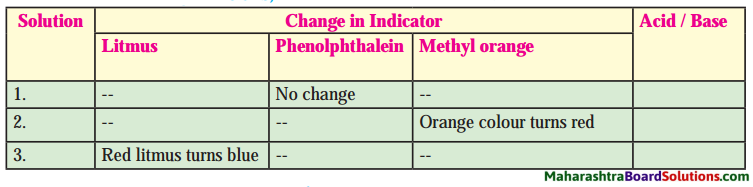
Maharashtra Board Class 8 Science Solutions Chapter 12 Introduction to Acid and Base 1
Answer:
Maharashtra Board Class 8 Science Solutions Chapter 12 Introduction to Acid and Base 2

2. Write chemical names from given formulae.
H2SO4, Ca(OH)2, HCl, NaOH, KOH, NH4OH

Question a.
Write the chemical names from given formulae: H2SO4, Ca(OH)2, HCl, NaOH, KOH, NH4OH
Answer:

  1. H2SO4 – Sulphuric acid
  2. Ca(OH)2 – Calcium hydroxide
  3. HCl – Hydrochloric acid
  4. NaOH – Sodium hydroxide
  5. KOH – Potassium hydroxide
  6. NH4OH – Ammonium hydroxide

Maharashtra Board Class 8 Science Solutions Chapter 12 Introduction to Acid and Base

3. Sulphuric acid has highest importance in chemical Industry. Why?

Question a.
Sulphuric acid has highest importance in chemical Industry. Why?
Answer:
Answer:
Sulphuric acid has highest importance in the chemical industry because it is used in the manufacturing of fertilizers like ammonium sulphate and superphosphate of lime. It is used in the manufacturing of hydrochloric acid, nitric acid, phosphoric acid, ether, plastics and metal sulphates. It is also used in the manufacturing of dyes, drugs, perfumes, disinfectants and glue.

4. Give answers.

Question a.
Which acid is used for getting chloride salt?
Answer:
Hydrochloric acid is used for getting chloride salt.

Question b.
By squeezzing lemon on a piece of rock the gas liberated turned lime water milky. Which compound is present in the rock?
Answer:
Metal carbonate is present in the rock.

Question c.
The label on the bottle of chemical is spoiled. How will you find whether the chemical is acidic or not?
Answer:
The chemical is tested with blue litmus paper. If it turns red it is an acidic otherwise tested with red litmus paper, if it turns blue, it is an alkaline.

Maharashtra Board Class 8 Science Solutions Chapter 12 Introduction to Acid and Base

5. Answer the following questions. 

Question a.
Explain the difference between acid and base.
Answer:
Acids:

  1. Acids have sour taste.
  2. Acids turn blue litmus red.

Bases:

  1. Bases have bitter taste.
  2. Bases turn red litmus blue.

Question b.
Why indicator does not affect by salt?
Answer:
Mostly indicators are organic compounds which do not react with a salt.

Question c.
Which substances are produced i by neutralization process?
Answer:
Salt and water are produced in the f neutralization process.

Maharashtra Board Class 8 Science Solutions Chapter 12 Introduction to Acid and Base

Question d.
Which are the industrial uses of acids?
Answer:
Acids which are used in the industry are:

  1. Sulphuric acid
  2. Hydrochloric acid
  3. Nitric acid.;

1. Sulphuric acid: Sulphuric acid is 5 used (a) in the manufacture of chemical? fertilizers like ammonium sulphate, (b) for cleaning gold and silver articles and (c) in car batteries.

2. Hydrochloric acid: Hydrochloric acid is used (a) to clean toilets and (b) to obtain glucose from starch and also for producing gelatine.

3. Nitric acid: Nitric acid is used (a) in the manufacture of perfumes (b) for engraving on copper, brass or silver and (c) in the manufacture of paints and explosives.

6. Select proper word given in bracket and fill in the blanks.

Question a.
Main constituent of acid is ……………. .
Answer:
Main constituent of acid is H+ ion.

Question b.
Main constituent of alkali is …………….. .
Answer:
Main constituent of alkali is OH ion.

Question c.
Tartaric acid is a …………… acid.
Answer:
Tartaric acid is a weak acid.

Maharashtra Board Class 8 Science Solutions Chapter 12 Introduction to Acid and Base

7. Match the pairs. 

Question a.

Group AGroup B
1. Tamarinda. Acetic acid
2. Curdb. Citric acid
3. Lemonc. Tartaric acid
4. Vinegard. Lactic acid

Answer:

Group AGroup B
1. Tamarindc. Tartaric acid
2. Curdd. Lactic acid
3. Lemonb. Citric acid
4. Vinegara. Acetic acid

8. State true or false.

Question a.
Oxides of metals are alkaline in nature.
Answer:
True.

Question b.
Salt is acidic.
Answer:
False. (Salt is neutral)

Question c.
Metal corrodes due to salts.
Answer:
False. (Acids and bases corrode metals)

Question d.
Salts are neutral.
Answer:
True. (Not all salts neutral)

Maharashtra Board Class 8 Science Solutions Chapter 12 Introduction to Acid and Base

9. Classify the following substances into acidic, basic and neutral group:
HCl, NaCl, MgO, KCl, CaO, H2SO4, HNO3, H2O and Na2CO3.

Question a.
Classify the following substances into acidic, basic and neutral group:
HCl, NaCl, MgO, KCl, CaO, H2SO4, HNO3, H2O and Na2CO3.
Answer:

GroupSubstances
AcidHCl, H2SO4, HNO3
BaseCaO, MgO, Na2CO3
NeutralH2O, NaCl, KCl.

Project:

Question a.
Write in your own language the uses and importance of neutralization reaction in daily life.

Class 8 Science Chapter 12 Introduction to Acid and Base Important Questions and Answers

Fill in the blanks:

Question 1.
Acid reacts with metal to form …………. gas.
Answer:
Acid reacts with metal to form hydrogen gas.

Question 2.
DNA is an acid present in our body, it decides …………. properties.
Answer:
DNA is an acid present in our body, it decides heredity properties.

Question 3.
The chemical formula of milk of magnesia is ………….
Answer:
The chemical formula of milk of magnesia is Mg (OH)2.

Question 4.
…………. are used to control hyperacidity.
Answer:
Antacids are used to control hyperacidity.

Question 5.
Alkali has …………. taste.
Answer:
Alkali has bitter taste.

Question 6.
Proteins are made up of ………….
Answer:
Proteins are made up of amino acids.

Question 7.
…………. is used in batteries.
Answer:
Dil. H2SO4 is used in batteries.

Rewrite the following statements by selecting the correct options:

Question 1.
The colour of phenolphthalein indicator in alkaline solution is ………….
(a) yellow
(b) green
(c) orange
(d) pink
Answer:
The colour of phenolphthalein indicator in alkaline solution is pink.

Question 2.
…………. is sour to taste.
(a) An acid
(b) An alkali
(c) A salt
(d) Alcohol
Answer:
An acid is sour to taste.

Question 3.
When phenolphthalein is added to NaOH, the colour of the solution will become ……………… .
(a) colourless
(b) red
(c) pink
(d) yellow
Answer:
When phenolphthalein is added to 5 NaOH, the colour of the solution will become pink.

Question 4.
When phenolphthalein is added to HCl, the colour of the solution will be ………….. .
(a) red
(b) pink
(c) green
(d) colourless
Answer:
When phenolphthalein is added to HCl, the colour of the solution will be colourless.

Question 5.
…………. is a natural indicator.
(a) Phenolphthalein
(b) Methyl orange
(c) Litmus
(d) Methyl red
Answer:
Litmus is a natural indicator.

Question 6.
The litmus paper or the litmus solution is obtained from …………. plants.
(a) moss
(b) rose
(c) hibiscus
(d) lichen
Answer:
The litmus paper or the litmus solution is obtained from lichen plants.

Question 7.
…………. is not an alkali.
(a) Sodium hydroxide
(b) Potassium hydroxide
(c) Copper hydroxide
(d) Calcium hydroxide
Answer:
Copper hydroxide is not an alkali.

Question 8.
…………. is a weak acid.
(a) Hydrochloric acid
(b) Nitric acid
(c) Carbonic acid
(d) Sulphuric acid
Answer:
Carbonic acid is a weak acid.

Question 9.
When methyl orange is added to HCl, the colour of the solution will be …………… .
(a) red
(b) pink
(c) yellow
(d) colourless
Answer:
When methyl orange is added to HCl, the colour of the solution will be pink.

Question 10.
When blue litmus paper is added to NaOH, the colour of the litmus paper will be ……………. .
(a) blue
(b) red
(c) pink
(d) yellow
Answer:
When blue litmus paper is added to NaOH, the colour of the litmus paper will be blue.

State whether the following statements are true or false. If a statement is false, correct it and rewrite:

Question 1.
Red cabbage is a natural indicator.
Answer:
True

Question 2.
Fats of our body are formed by fatty acids.
Answer:
True.

Question 3.
Ammonium hydroxide is used in the production of fertilizers.
Answer:
True.

Question 4.
Lime water is a weak acid.
Answer:
False. (Limewater is a weak base)

Question 5.
Orange colour of methyl orange turns yellow in acid.
Answer:
False. (Orange colour of methyl orange turns pink in acid)

Question 6.
Methyl red turns yellow in alkali.
Answer:
True.

Question 7.
Oxalic acid is used in aerated cold drinks.
Answer:
False. (Carbonic acid is used in aerated cold drinks).

Find the odd one out and justify:

Question 1.
Acetic acid, carbonic acid, hydrochloric acid, nitric acid.
Answer:
Acetic acid. (Others are mineral acids.)

Question 2.
Hydrogen chloride, sodium hydroxide, calcium oxide, ammonia.
Answer:
Hydrogen chloride. (Others are bases.)

Question 3.
HCl, CH3COOH, H2SO4, HNO3
Answer:
CH3COOH. (Others are strong acids.)

Question 4.
NaOH, Ca(OH)2, NH4OH, Ba(OH)2
Answer:
NaOH (Others are weak bases.)

Question 5.
H2SO4, H2CO3, HCl, HNO3
Answer:
H2CO3 (Others are strong acids.)

Question 6.
Citric acid, formic acid, lactic acid, nitric acid.
Answer:
Nitric acid. (Others are organic acids.)

Question 7.
Lime, litmus, phenolphthalein, methyl orange.
Answer:
Lime. (Others are indicators.)

Match the following:

Question 1.

Column ‘A’Column ‘B’
1. Strong acida. Magnesium hydroxide
2. Weak alkalib. Carbonic acid
3. Weak acidc. NaOH
4. Strong alkalid. Nitric acid

Answer:

Column ‘A’Column ‘B’
1. Strong acidd. Nitric acid
2. Weak alkalia. Magnesium hydroxide
3. Weak acidb. Carbonic acid
4. Strong alkalic. NaOH

Maharashtra Board Class 8 Science Solutions Chapter 12 Introduction to Acid and Base

Question 2.

Column ‘A’Column ‘B’
1. Sodium hydroxidea. Whitewashing
2. Magnesium hydroxideb. Fertilizers
3. Calcium hydroxidec. Washing soap
4. Ammonium hydroxided. Antacid

Answer:

Column ‘A’Column ‘B’
1. Sodium hydroxidec. Washing soap
2. Magnesium hydroxided. Antacid
3. Calcium hydroxidea. Whitewashing
4. Ammonium hydroxideb. Fertilizers

Maharashtra Board Class 8 Science Solutions Chapter 12 Introduction to Acid and Base

Define the following:

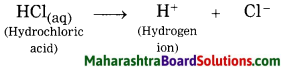
1. Acid: A substance which gives H+ ions in water is called an acid.
Maharashtra Board Class 8 Science Solutions Chapter 12 Introduction to Acid and Base 3

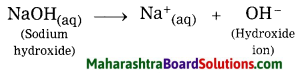
2. Alkali: A substance which gives OH ions in water is called an alkali.
Maharashtra Board Class 8 Science Solutions Chapter 12 Introduction to Acid and Base 4

3. Indicator: Substances which change their colours in presence of acid or base are called indicators.

4. Neutralization: The reaction between an acid and an alkali to form the r salt and water is termed as neutralization.

Answer the following questions in one sentence each:

Question 1.
What are natural acids?
Answer:
Acids present in foodstuffs are called natural acids.

Question 2.
State three vegetables from which natural indicators can be prepared.
Answer:
Natural indicators: Red cabbage, radish, tomato.

Maharashtra Board Class 8 Science Solutions Chapter 12 Introduction to Acid and Base

Question 3.
State names of any three strong acids.
Answer:

  1. Hydrochloric acid
  2. Sulphuric acid
  3. Nitric acid.

Question 4.
State the names of the acids found in lemon juice, Amla, tamarind water and curd.
Answer:

  1. Lemonuice – citric acid
  2. Amla – ascorbic acid
  3. tamarind water – tartaric acid
  4. curd – lactic acid.

Question 5.
State names of any three alkalis.
Answer:

  1. sodium hydroxide
  2. potassium hydroxide
  3. calcium hydroxide.

Question 6.
State the names of three indicators.
Answer:

  1. Litmus paper
  2. Methyl orange
  3. Phenolphthalein.

Maharashtra Board Class 8 Science Solutions Chapter 12 Introduction to Acid and Base

Question 7.
State the names of three weak alkalis.
Answer:

  1. Calcium hydroxide
  2. ammonium hydroxide
  3. magnesium hydroxide.

Question 8.
From which plant is litmus obtained?
Answer:
Litmus is obtained from plants called lichens.

Question 9.
Name the antacid which is used to control the hyper acidity.
Answer:
Milk of magnesia [Mg(OH)2] is used to control the hyper acidity.

Maharashtra Board Class 8 Science Solutions Chapter 12 Introduction to Acid and Base

Question 10.
How will you neutralize the excess of acid present in the soil?
Answer:
Lime stone or lime water is mixed in the soil to neutralize the excess of acid.

Question 11.
When lemonuice falls on a marble kitchen counter, which is the gas that bubbled out?
Answer:
Carbon dioxide.

Answer the following questions:

Question 1.
What are indicators?
Answer:
Substances which change their colours in presence of acid or base are called indicators.

Question 2.
State two acid-base indicators and mention their colour change.
Answer:
Phenolphthalein and methyl orange are two acid-base indicators. Phenolphthalein is colourless in an acidic solution while it turns pink in a basic solution. Methyl orange gives orange colour with an acidic solution and yellow colour with a basic solution.

Question 3.
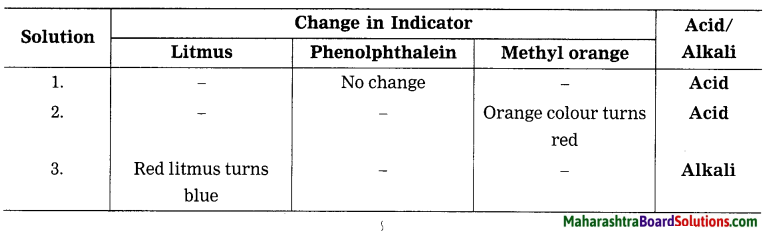
State the colour change for each of the following solutions with red litmus, blue litmus, phenolphthalein and methyl orange solutions.
Answer:
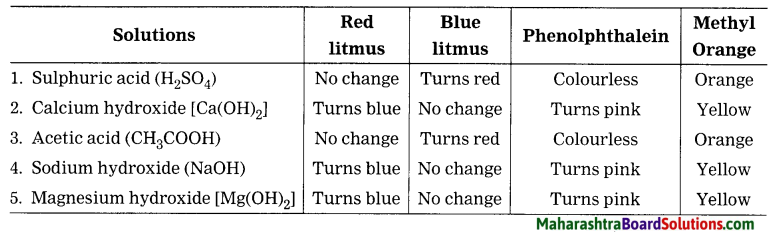
Maharashtra Board Class 8 Science Solutions Chapter 12 Introduction to Acid and Base 5

Question 4.
Name the acid present in (1) Orange (2) Vinegar (3) Tamarind (4) Curd (5) Tomato (6) Lemon.
Answer:

SubstanceAcid
OrangeCitric acid
VinegarAcetic acid
TamarindTartaric acid
CurdLactic acid
TomatoOxalic acid
LemonCitric acid

Maharashtra Board Class 8 Science Solutions Chapter 12 Introduction to Acid and Base

Question 5.
Classify the following into acidic substances, basic substances and salts.
(1) Lime water, (2) soda water, (3) soap water, (4) sea water, (5) sweet limeuice, (6) sugar caneuice, (7) buttermilk, (8) a mixture of ash in water, (9) tamarind water.
Answer:
a. Acidic substances: (1) Soda water, (2) sweet limeuice, (3) buttermilk, (4) tamarind water.
b. Basic substances: (1) Lime water, (2) Soap water, (3) a mixture of ash in water.
c. Salts: (1) Sea water, (2) sugar caneuice.

Question 6.
What happens when sour substances like limeuice, tamarind water falls on shahabad stones or kitchen platform? Why?
Answer:
When sour substances like limeuice, tamarind water falls on shahabad stones or kitchen platform, citric acid present in limeuice and tartaric acid in tamarind water reacts with metal carbonates present in shahabad stones or kitchen platform, carbon dioxide gas is evolved resulting in the formation of uneven surface.

Question 7.
Collect soil samples from your surroundings and find out whether it is acidic or alkaline or neutral?
Answer:
Soil samples collected from the surroundings are acidic in nature.

Question 8.
Which substances are used to clean greenish stains on copper vessels and to shine blackish silver utensils?
Answer:
Tamarind pulp is used to clean greenish stains on copper vessels. To shine blackish silver utensils, ammoniacal solution or limeuice or detergent is used.

Maharashtra Board Class 8 Science Solutions Chapter 12 Introduction to Acid and Base

Question 9.
Why toothpaste is used for brushing teeth?
Answer:

  1. Toothpaste contains fluorides and alkali to neutralize the mouth acid.
  2. Hence, the tooth paste, which is generally alkaline, is used for cleaning the teeth as it can neutralize the excess acid in i the mouth and prevent tooth decay.

Question 10.
State the properties of acids.
Answer:

  1. Acids are sour in taste.
  2. Acid molecules contain hydrogen ion (H+) as a main constituent.
  3. Acid reacts with metal to form hydrogen gas.
  4. Acid reacts with carbonates and liberates CO2 gas.
  5. Blue litmus turns red in acid.

Question 11.
State the uses of acids.
Answer:

  1. Acids are used in the production s of chemical fertilizers.
  2. Acids are used in the production of explosives, oil purification, medicines, dyes and paints.
  3. Hydrochloric acid is used for the preparation of different types of chloride salts.
  4. Dil. H2SO4 acid is used in the batteries (electric cell).
  5. Dil. HCl is used for sterilization of water.
  6. Acid is used for making of white paper from wood pulp.

Maharashtra Board Class 8 Science Solutions Chapter 12 Introduction to Acid and Base

Question 12.
The iron knife shines better after cutting the sour fruits like lemon, raw mangoes. Why?
Answer:
Acids present in sour fruits clean and dissolves the salts present on the surface of iron knife as a result iron knife shines better after cutting the sour fruits.

Question 13.
What is meant by neutralization? Give example.
Answer:
When an acid reacts with an alkali to form a salt and water, it is called neutralization.
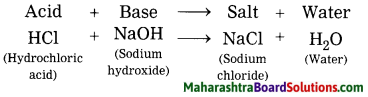
Maharashtra Board Class 8 Science Solutions Chapter 12 Introduction to Acid and Base 6

Give scientific reasons:

Question 1.
When we have stomachache, doctors prescribe medicine containing magnesium hydroxide.
Answer:

  1. There is hydrochloric acid in our stomach which helps in the digestion of food.
  2. Sometimes in the stomach, there is more hydrochloric acid than we need.
  3. This excess acid causes acidity and indigestion resulting in stomachache.
  4. When magnesium hydroxide is administered it neutralizes the extra acid in the stomach.
  5. Therefore, magnesium hydroxide is the best cure for stomachache.
  6. So, when we have stomachache, doctors prescribe medicine containing magnesium hydroxide.

Question 2.
Quicklime or slaked lime is added to the soil.
Answer:

  1. When chemical fertilizers are added to the soil, the soil becomes acidic.
  2. To reduce its acidity quicklime or slaked lime is added to the soil.

Maharashtra Board Class 8 Science Solutions Chapter 12 Introduction to Acid and Base

Question 3.
Tarnished and stained copper vessels are brought to a shine by using tamarind pulp.
Answer:
In due course, unus6d copper vessels
are covered with a coating of black copper oxide and other compounds of copper which tarnish the vessel. Tamarind contains tartaric acid. When the vessel is rubbed with tamarind pulp, tartaric acid reacts with copper oxide and removes the layer. Thus, the copper vessel regains its shine.

Question 4.
Copper and brass utensils are tinned.
Answer:
Copper and brass reacts with i organic acids present in food materials and poisonous salts are formed. Tin does not react with organic acids present in food materials. Therefore, copper or brass vessels are tinned.

Distinguish between acid and alkali. OR Distinguish between the following:

Question 1.
Acid and Alkali:
Answer:

AcidAlkali
1. Acid has sour taste.1. Alkali has bitter taste.
2. Acid turns blue litmus red.2. Alkali turns red litmus blue.
3. An acid in an aqueous solution gives H+ ions.3. An alkali in an aqueous solution gives OH+ ions.
4. Oxides of non – metals form acids.4. Oxides of metals form bases.

Maharashtra Board Class 8 Science Solutions Chapter 12 Introduction to Acid and Base

Activity-based questions:

Activity 1:
Apparatus: Hibiscus, rose, turmeric, red cabbage leaves, filter paper, etc.
Activity: Rub red petals of hibiscus flower on the white filter paper. This gives hibiscus indicator paper. Similarly rub, rose petals on the white filter paper. Cut strips of this paper, it is a rose indicator paper. Take turmeric powder, add a little water in it. Dip filter paper or ordinary paper in the turmeric water for some time.

After drying make strips of that paper. Prepare turmeric indicator paper in this way. Put leaves of red cabbage in small quantity of water and heat it. Once solution of cabbage leaves cool down, dip papers in it and dry it. Make strips of dried paper. In this way prepare red cabbage indicator paper. Put some drops of following substances on the indicator papers prepared by the above method and write the effect in the following table:

SubstanceEffect on turmeric paperAcidic/basic
1. Lime juiceYellowAcidic
2. Lime water (calcium hydroxide)RedBasic
3.

Maharashtra Board Class 8 Science Solutions Chapter 12 Introduction to Acid and Base

Activity 2:
Take baking powder. Add a little water to it. Add this solution on to limeuice, vinegar, orangeuice, appleuice, etc. and note the findings.
What do you observe on addition of baking soda solution in the fruituice? Whether bubbles formed or effervescence came out of fruituice?
From the above first activity we came to know that yellow turmeric indicator paper’s turns red in certain solutions. Similarly on addition of baking soda solution in the acidic solution bubbles come out or effervescence is produced.
By these simple and easy activity we can identify acidic or alkaline substance:
[Note for Activity 1 and Activity 2: Students should perform the experiments under the guidance of school teachers and record their observations.]

Maharashtra Board Class 8 Science Solutions Chapter 12 Introduction to Acid and Base

Activity 3:
Under the guidance of teacher take limeuice, ammonium hydroxide (NH4OH), dil. hydrochloric acid (dil. HCl) and nitric acid (HNOs) in different test-tubes. Add drops of following indicators in them. Also dip litmus papers in the solutions. Observe and record in the following table.
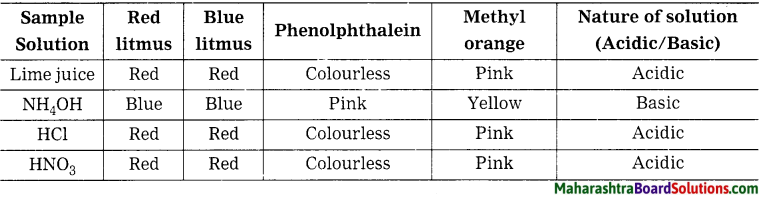
Maharashtra Board Class 8 Science Solutions Chapter 12 Introduction to Acid and Base 7

Maharashtra Board Class 6 Geography Solutions Chapter 4 Weather and Climate

Balbharti Maharashtra State Board Class 6 Geography Solutions Chapter 4 Weather and Climate Notes, Textbook Exercise Important Questions and Answers.

Maharashtra Board Class 6 Geography Solutions Chapter 4 Weather and Climate

Class 6 Geography Chapter 4 Weather and Climate Textbook Questions and Answers

A. Who am I?

Question 1.
I keep on changing.
Answer:
Weather.

Question 2.
I am not the same in all places.
Answer:
Climate.

Question 3.
I am the solid state of water droplets.
Answer:
Snow.

Maharashtra Board Class 6 Geography Solutions Chapter 4 Weather and Climate

Question 4.
I am present in the atmosphere in the form of vapour.
Answer:
Moisture.

B. Answer the following:

Question 1.
Why is the climate of Mahabaleshwar cool ?
Answer:
The climate of Mahabaleshwar is cool because it is situated at a high elevation. So, as we move upward from sea-level, the temperature of air decreases.

Question 2.
Why is the climate near the sea humid?
Answer:
The climate near the sea is humid because it contains greater amount of vapour mixed in the air.

Maharashtra Board Class 6 Geography Solutions Chapter 4 Weather and Climate

Question 3.
What is the difference between weather and climate?
Answer:

WeatherClimate
(i) Weather is described on the basis of the conditions prevailing at the given time.(i) Climate is described on the basis of conditions prevailing over a longer period of time.
(ii) Weather keeps changing frequently and we can experience the change easily.(ii) Change in the climate takes place over a long ! period of time. These are not percieved easily.

Question 4.
What are the elements of weather?
Answer:
The elements of weather are:

  • Temperature
  • Air pressure
  • Winds
  • Moisture and
  • Precipitation.

Question 5.
What effects do nearness to the sea and height above mean sea level have on the climate?
Answer:
Nearness to the sea leads to a humid climate whereas height above mean sea level will lead to a cool climate.

C. For the climatic conditions mentioned in the table, name the representative places known to you. (Use an atlas.)

HotDeath valley
Hot and humid
Cold
Hot and dry
Cold and dry

Answer:

HotDeath valley
Hot and humidAmazon
ColdGreenland
Hot and drySahara desert
Cold and dryAtacama desert

Maharashtra Board Class 6 Geography Solutions Chapter 4 Weather and Climate

D. Complete the following table

WeatherClimate
Short-lived condition of the atmosphere
Does not change quickly
Expressed with respect to a specific place
Elements of climate: Temperature, pressure, winds, humidity and precipitation

Answer:

WeatherClimate
Short-lived condition of the atmosphereLong-lived condition of the atmosphere
Keeps changingDoes not change quickly
Expressed with respect to a specific placeExpressed with respect to a specific region
Elements of weather: Temperature, pressure, winds, humidity and precipitationElements of climate: Temperature, pressure, winds, humidity and precipitation

Activity:

Understand the climate of your place with the help of your teacher.

Class 6 Geography Chapter 4 Weather and Climate InText Questions and Answers

Can you tell?

A. The weather conditions of a few places in India are as follows on 10th June. Use the table to answer the questions.

S. No.PlaceStateTimeWeather
(1)KochiKerala12.30 pmCloudy
(2)BhopalM.P.12.30 pmHot and sunny
(3)MussoorieUttarakhand12.30 pmCold weather mild sun

Question 1.
In which place will the clothes on a clothesline dry quickly? Why?
Answer:
In Bhopal the clothes on the clothesline will dry quickly. Due to the hot sun the water in the wet clothes get converted into vapour quickly.

Question 2.
In which place will they dry slowly? Why?
Answer:
Clothes will take longer time to dry in Mussoorie because of the medium heat and cold air.

Question 3.
Will the atmospheric conditions at these places always remain the same or will they change?
Answer:
The atmospheric conditions of these places will change from time to time.

Maharashtra Board Class 6 Geography Solutions Chapter 4 Weather and Climate

B. Which of the following statements are applicable to the conditions that you have experienced today or yesterday at the place where you live?

  • It was cold in the morning.
  • In the afternoon it become hot and humid.
  • It rained suddenly in the afternoon.
  • Cool breeze was blowing in the morning.
  • Clouds gathered in the evening.
  • The night sky was full of stars and a pleasant breeze was blowing.

Answer:
Students have to give answer to this question depending on the weather condition of one particular day where they live.

C. Since childhood you have experienced summers, rainy seasons and winters. On the basis of your experience answer the following questions.

Question 1.
In which months do summer, monsoon season and winter occur in a year from January to December? Show it in a chart.
Answer:

SummerRainy seasonWinter
February to MayJune to SeptemberOctober to January

Question 2.
Which special clothes do we use if it is raining?
Answer:
If it is raining, we wear a raincoat or carry an umbrella.

Question 3.
When do we use woollen clothes?
Answer:
We wear woollen clothes in winter.

Question 4.
In which season do we mainly use thin cotton clothes?
Answer:
We wear cotton clothes in summer.

Use your brain power!

Question 1.
Which occupation will you practice in cold regions?
Answer:
Occupations practiced in cold region are lumbering and agriculture.

Question 2.
Which occupations will you practice in hot region?
Answer:
Occupations practiced in hot regions are animal husbandry and agriculture.

Maharashtra Board Class 6 Geography Solutions Chapter 4 Weather and Climate

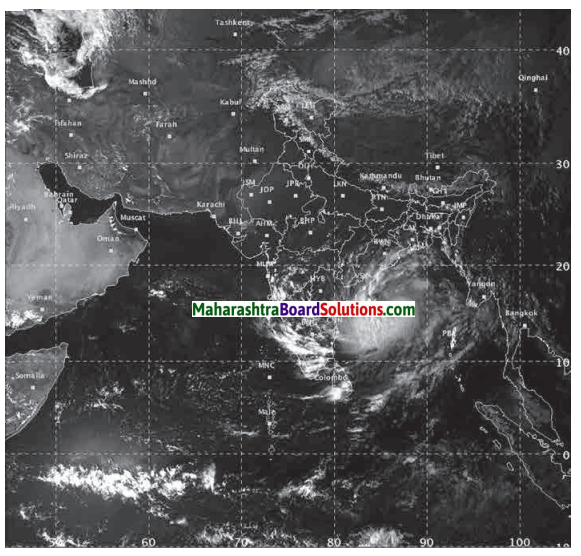
Observe the following map and write the answer to the question given below it.
Maharashtra Board Class 6 Geography Solutions Chapter 4 Weather and Climate 2
Question 1.
An Indian Meteorological Department image of the storm that visited in November 2014 was shown. Tell in which sea the storm was located.
Answer:
Bay of Bengal.

Class 6 Geography Chapter 4 Weather and Climate Additional Important Questions and Answers

Fill in the blanks with the right option in the brackets:

Question 1.
Atmospheric conditions prevailing at a place and at a given time is called ______. (wind, weather, climate)
Answer:
weather

Question 2.
The temperature goes on ______ from the equator towards both the poles. (decreasing, increasing, being constant)
Answer:
decreasing

Question 3.
The horizontal movement of air is called ______. (pressure, humidity, wind)
Answer:
wind

Question 4.
_____ is defined by elements such as temperature, wind and humidity. (precipitation, weather, climate)
Answer:
weather

Maharashtra Board Class 6 Geography Solutions Chapter 4 Weather and Climate

Question 5.
The air that has greater amount of vapour is called _____ air. (dry, hot, humid)
Answer:
humid

Question 6.
The humidity in the atmosphere is called _______. (moisture, oxygen, heat)
Answer:
moisture

Question 7.
The proportion of moisture in the atmosphere depends on ________.(winds, temperature, air pressure)
Answer:
temperature

Question 8.
Vapour in the atmosphere condenses into water droplets or snow and their showering on the earth is called ________.(precipitation, wind, climate)
Answer:
precipitation

Match the pairs correctly:

Question 1.

AB
(1) Winds(a) hailstorm
(2) Moisture(b) solar energy
(3) Precipitation(c) the difference in air pressure
(4) Temperature(d) vapor
(5) Weather(e) hot, cool, dry, sultry
(f) humidity

Answer:
1 – c
2 – d
3 – a
4 – b
5 – e

Maharashtra Board Class 6 Geography Solutions Chapter 4 Weather and Climate

Name the following statements:

Question 1.
Elements of weather:
Answer:
Temperature, pressure, winds, humidity and precipitation.

Question 2.
Forms of precipitation:
Answer:
Rainfall, snowfall and hailstorm.

Question 3.
Climate is generally expressed as:
Answer:
‘Cool and dry ‘or ‘hot and humid’ or ‘hot and dry’, etc.

Question 4.
Factors influencing climate:
Answer:
Latitudinal position, height above sea level, nearness to ocean and oceanic currents.

Answer the following questions in one sentence:

Question 1.
What is precipitation?
Answer:
Vapour in the atmosphere condenses into water droplets or snow particles, which shower on the earth. This is called as precipitation.

Question 2.
What is called air pressure?
Answer:
Air has weight and as a result it creates pressure. This is called air pressure.

Question 3.
What is wind?
Answer:
Air moving from high pressure towards low pressure areas in a horizontal direction is called wind.

Question 4.
What is called humid air?
Answer:
The atmosphere contains vapour. The air that has greater amount of vapour is called humid air.

Maharashtra Board Class 6 Geography Solutions Chapter 4 Weather and Climate

Give geographical reasons for the following statements:

Question 1.
As we move upward from the sea-level, temperature of the air decreases.
Answer:

  • The earth’s surface gets heat from the Sun.
  • Thus, the surface gets heated.
  • The air close to the earth surface starts becoming hot.
  • Later, different layers of air at higher elevation receive heat.
  • Therefore, as we move upward from sea-level, the temperature of air decreases.

Question 2.
Air pressure decreases with increasing height.
Answer:

  • The lowermost layers of air are subjected to the pressure of the upper layers.
  • So, the density of the lower layers of air increases.
  • There is greater air pressure near the surface of the earth.
  • Therefore, air pressure decreases with increasing height.

Answer the following questions:

Question 1.
What is known as precipitation?
Answer:
Vapour in the atmosphere condenses into water droplets or snow particles. Their showering on the earth is called precipitation.

Maharashtra Board Class 6 Geography Solutions Chapter 4 Weather and Climate

Question 2.
What is called moisture?
Answer:
The humidity in the atmosphere is called moisture. The proportion of moisture in the atmosphere depends on the temperature. Air with higher temperature holds a greater amount of moisture.

Maharashtra Board Class 6 Geography Solutions Chapter 9 Energy Resources

Balbharti Maharashtra State Board Class 6 Geography Solutions Chapter 9 Energy Resources Notes, Textbook Exercise Important Questions and Answers.

Maharashtra Board Class 6 Geography Solutions Chapter 9 Energy Resources

Class 6 Geography Chapter 9 Energy Resources Textbook Questions and Answers

A. What resource will have to be used for the following work:

Question 1.
Rohan wants to fly a kite.
Answer:
Wind Energy

Question 2.
People in an Adivasi hamlet have to be protected from the cold.
Answer:
Wood

Question 3.
Cooking on a picnic.
Answer:
Wood

Maharashtra Board Class 6 Geography Solutions Chapter 9 Energy Resources

Question 4.
Salma wants to iron her clothes.
Answer:
Electricity

Question 5.
Starting a railway-engine.
Answer:
Thermal Energy

Question 6.
Heating water for a bath.
Answer:
Electricity

Question 7.
After sunset, making light available inside the house.
Answer:
Electricity

B. Answer the following questions:

Question 1.
Which energy resources does man use the most? Why?
Answer:
(i) The energy resource we use the most is oil as it has a wide array of uses. It is used as fuel which includes petrol, diesel, kerosene, jet fuel, LPG gas, etc.

(ii) It is also used in cosmetics, medicines, paints, lubricants, etc.

Question 2.
Why are energy resources needed?
Answer:

  • The demand for energy resources is increasing due to growing population, urbanisation and growing needs of man.
  • Energy resources are needed to prepare food, generate electricity, to propel vehicles and for other domestic and industrial needs.
  • We engage in various activities to fulfill our needs, for which we need energy from natural resources.
  • Our life will come to a standstill without resources like petrol, wind, natural gas, sunlight, besides other resources.

Maharashtra Board Class 6 Geography Solutions Chapter 9 Energy Resources

Question 3.
Why do we need to use environment friendly energy resources?
Answer:

  • There are many energy resources which are environment-friendly, which are renewable and which aid in harnessing natural processes.
  • When we use environment-friendly energy sources such as solar energy, wind energy, energy from waste, etc.
  • We are contributing towards environment conservation, preservation and protection.
  • This will help in reducing the deterioration of environment due to use of non-eco friendly energy resources apart from reducing problems arising from pollution caused due to burning of fossil fuels and biomass energy, climate change, etc.
  • Environment-friendly resources will not only lead to sustainable development but also provide energy security which is the need of the hour.

C. Explain the differences using the points in the brackets:
(availability, environment-friendliness,advantages and drawbacks)

Question 1.
Mineral oil and solar energy
Answer:

PointsMineral oilSolar energy
Availability(i) Limited in nature as it does not last perpetually.(i) Availability depends on the intensity of sunrays and the duration of sunshine.
Environment-friendliness(i)  It is not environment friendly as its generation leads to pollution.
(ii)  Being highly inflammable it may cause damage to the environment.
(i) Being pollution-free this is an environment-friendly source of energy.
Advantages(i)  Cheap source of energy.
(ii)  Aids in thermal and atomic power generation.
(i)  A solution to global warming.
(ii)  Cost effective, provides energy security.
Drawbacks(i)  Pollutes the environment.
(ii)  Highly inflammable.
(i)  Solar panels stop producing electricity after sunset.
(ii)  Expensive to store this energy.

Question 2.
Hydel power and power from geothermal source
Answer:

PointsHydel powerPower from geothermal sources
Availability(i) Obtained from the kinetic energy of running water which is easily available.(i) Underground heat is utilized to generate power and it is inexhaustible.
Environment-friendliness(i) Does not cause any degradation of the environment.(i) It is an exhaustible energy resource that causes minimum pollution.
Advantages(i) Reuse of water is possible. Easy availability of water in most places. Energy generation is pollution-free.(i) If used on a large scale and more efficiently it may reduce global warming.
Disadvantages(i) When water is not available it can’t produce electricity.
(ii) Humans, flora, and fauna may lose natural habitat when hydel power plants are set up.
(i) Only a few sites have the potential to establish geothermal power plants.
(ii) High installation cost is involved. (iii) The energy generation capacity is too small.

Activity:

Show the power generation centres on an outline map of India. Write about one of them. Supplement the information with pictures.

Maharashtra Board Class 6 Geography Solutions Chapter 9 Energy Resources

Class 6 Geography Chapter 9 Energy Resources InText Questions and Answers

Can you tell?

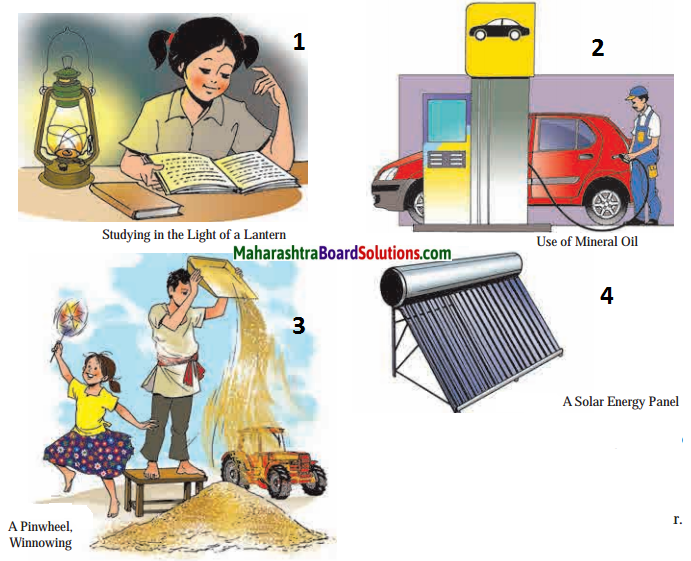
Observe the pictures and answer the questions:
Maharashtra Board Class 6 Geography Solutions Chapter 9 Energy Resources 1
Maharashtra Board Class 6 Geography Solutions Chapter 9 Energy Resources 2
Question 1.
Which energy resource is used in figure 1 to obtain light?
Answer:
Kerosene.

Question 2.
Where does this resource come from?
Answer:
It is found under the land surface and also below the ocean floor.

Question 3.
Figure 2 shows fuel being filled in a motor car. From where was the energy resource brought to the pump?
Answer:
Fuel comes to the pump from petroleum refinery, an industrial process plant where crude oil is being processed and refined.

Question 4.
Figure 3 shows Malati with her pinwheel and her father winnowing grain. Who is helping both of them?
Answer:
Wind energy.

Maharashtra Board Class 6 Geography Solutions Chapter 9 Energy Resources

Question 5.
Which energy resource is used for lighting a lamp, running a rickshaw and heating oil as shown in figure 5?
Answer:
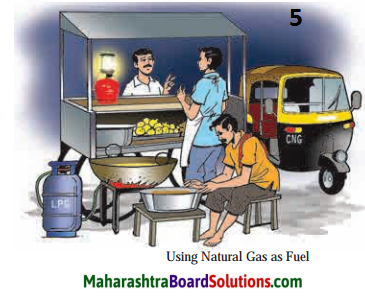
LPG is used for lighting a lamp and heating oil and CNG is used for running a rickshaw.

Question 6.
What are the various purposes for which man use sunlight?
Answer:
For growing foodgrains, drying clothes, heating water and cooking food, to generate electricity and for multiple other uses we use sunlight.

Question 7.
For which of the above energy resources do we have to spend money?
Answer:
We have to spend money for mineral oil and natural gas.

Observe the map and answer the questions given below:
Maharashtra Board Class 6 Geography Solutions Chapter 9 Energy Resources 3
Question 1.
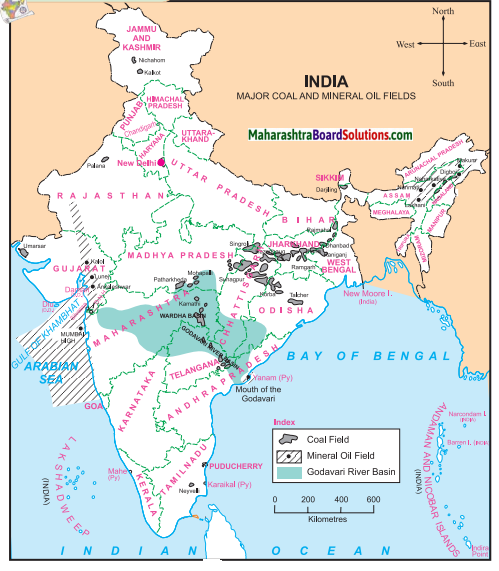
Name the states which have coal fields
Answer:
Odisha, Chhattisgarh, Jharkhand, Madhya Pradesh, Maharashtra, West Bengal and Gujarat.

Question 2.
Name the mineral oil field in the Arabian Sea.
Answer:
Mumbai High.

Question 3.
Name two states which have coal fields on a large scale.
Answer:

  • Chhattisgarh
  • Jharkhand

Question 4.
Which mineral oil fields are located in North¬east India?
Answer:
Makum, Digboi, Naharkatiya, Nunmati, Lakhani.

Maharashtra Board Class 6 Geography Solutions Chapter 9 Energy Resources

Question 5.
The reserves of which mineral are found in the Godavari Basin?
Answer:
Coal reserves are found in the Godavari Basin.

Question 6.
Which of the states have mineral reserves in the Godavari basin?
Answer:
Telangana, Chhattisgarh, Maharashtra and Madhya Pradesh.

Question 7.
Name four hydel power stations in our state.
Answer:
Koyna Hydroelectric project, Jayakwadi Hydroelectric project, Sardar Sarovar Hydroelectric project, Warna Hydroelectric project.

Question 8.
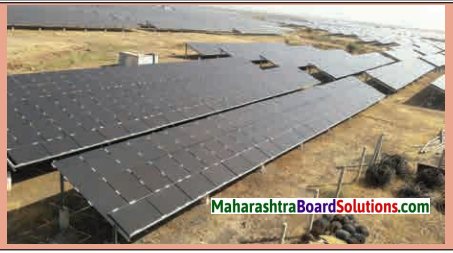
What kind of energy is produced with the help of the devices shown in the photograph?
(Pg. 59 Text Book)
Maharashtra Board Class 6 Geography Solutions Chapter 9 Energy Resources 4
Answer:
Solar Energy is generated.

Class 6 Geography Chapter 9 Energy Resources Additional Important Questions and Answers

Fill in the blanks choosing the correct options:

Question 1.
In ______ it is necessary to bumthe energy resources directly to generate electricity, (geo-thermal power stations, thermal power stations, hydel power stations)
Answer:
thermal power stations

Question 2.
In villages, ______ is used on a large scale for cooking on earthen stoves. (wood, kerosene, liquid petroleum gas)
Answer:
wood

Question 3.
Low quality coal is used for _________ .(industries, thermal power station, cooking)
Answer:
cooking

Question 4.
High quality coal is used in ________.(geo-thermal power stations, thermal power stations, hydel power stations)
geo-thermal power stations

Question 5.
Mineral oil is obtained from under land surface and also ________.(below the ocean floor, on the land surface, decomposed plants and animals)
Answer:
below the ocean floor

Question 6.
Mineral oil reserves are ________ in nature. (limited, unlimited, low)
Answer:
limited

Maharashtra Board Class 6 Geography Solutions Chapter 9 Energy Resources

Question 7.
________ oil is in great demand. (Coal, Mineral, Gas)
Answer:
Mineral

Question 8.
Mineral oil is also called _________.(magic oil, priceless treasure, black gold)
Answer:
black gold

Question 9.
__________ originate from the remains of dead plants and animals. (Bio-fuels, Hydel power, Kinetic energy)
Answer:
Bio-fuels

Question 10.
________is used in sailboats. (Solar energy, Wind energy, Geo-thermal energy)
Answer:
Wind energy

Question 11.
For power generation a wind speed of 40 to _______ is required. (90 kmph, 100 kmph, 50 kmph)
Answer:
50 kmph

Question 12.
Intensity of solar energy is the maximum in the ______ zone. (torrid, temperate, frigid)
Answer:
torrid

Question 13.
______ can be used on a large scale in a peninsular country like India. (Tidal energy, Geo-thermal, Wind energy)
Answer:
Tidal energy

Question 14.
Underground heat is utilised to generate _________.(hydel power, tidal energy, geo-thermal energy)
Answer:
geo-thermal energy

Match the pairs correctly:

Question 1.

Column AColumn B
(1) Hydel power(a) power generated with the help of the speed and force of waves
(2) Atomic energy(b) power obtained from the kinetic energy of running water
(3) Tidal energy(c) underground heat is utilised to generate power
(4) Geo-thermal energy(d) splitting of the atoms of minerals like uranium and thorium
(5) Wind energy(e) solar energy
(f) kinetic energy

Answer:
1 – b
2 – d
3 – a
4 – c
5 – f

Maharashtra Board Class 6 Geography Solutions Chapter 9 Energy Resources

State whether the following statements are true or false, correct the wrong statement:

Question 1.
All substance-based energy resources are conventional.
Answer:
False. Except for atomic energy, all other resources are conventional.

Question 2.
In the long run, process-based energy resources are environment-friendly.
Answer:
True

Question 3.
Kinetic energy can be used to generate power or electricity.
Answer:
True

Question 4.
Low quality coal is used in industries.
Answer:
False. Low quality Ooal is used in cooking while high-quality coal is used in industries.

Question 5.
Hydel power is not an environmental-friendly energy resource.
Answer:
False. Hydel power obtained from the kinetic energy of running water does not cause any degradation of the environment so it is environment-friendly.

Question 6.
Solar energy is maximum in the torrid zone.
Answer:
True

Question 7.
Tidal energy is pollution free and everlasting.
Answer:
True

Name the following:

Question 1.
Two examples of substance-based energy resources:
Answer:

  • Coal
  • Mineral oil

Question 2.
Two examples of process based energy resources.
Answer:

  • Sun
  • Wind

Maharashtra Board Class 6 Geography Solutions Chapter 9 Energy Resources

Question 3.
Energy resources which originate from the remains of dead plants and animals:
Answer:
Bio-fuels

Question 4.
Two countries which use atomic energy:
Answer:

  • India
  • USA

Question 5.
Two hydel power stations of India:
Answer:

  • Bhakra-Nangal in the Punjab
  • Koyna in Maharashtra

Question 6.
States in India where windmills have been erected:
Answer:

  • Maharashtra
  • Karnataka

Question 7.
Devices which can be run on solar power:
Answer:

  • Lamps
  • Heaters

Question 8.
Two places where hot water springs are seen:
Answer:

  • Vajreshwari in Maharashtra
  • Manikaran in Himachal Pradesh

Answer the following questions in one sentence each:

Question 1.
How are energy resources classified?
Answer:
Energy resources can be classified in many ways such as conventional – non-conventional, biotic – abiotic, renewable – non-renewable, substance-based – process-based, etc.

Maharashtra Board Class 6 Geography Solutions Chapter 9 Energy Resources

Question 2.
Write any one difference between: Substance-based energy resources and process based energy resources.
Answer:
Generation of substance-based energy resources leads to pollution while that of process based energy resource is pollution free.

Question 3.
Write any one use of kinetic energy.
Answer:
Kinetic energy can be used to generate power or electricity.

Question 4.
How was coal formed?
Answer:
Long ago, plant and animal remains got buried due to earth movements and they were then decomposed due to pressure and heat, leaving behind the element carbon and this is how coal was formed.

Question 5.
Apart from mineral oil what else is found in mineral oil wells?
Answer:
In most of the mineral oil wells, apart from minerals, natural gas is also found.

Question 6.
Which are the biotic waste materials from which biogas is generated?
Answer:
Biogas is generated from biotic waste material such as faeces of animals, dead leaves, shells, etc.

Question 7.
Why have some farmers raised biogas plants in their own yards?
Answer:
Some farmers have raised biogas plants in their own yards to cater to their domestic needs.

Question 8.
Which is the major problem faced by major metropolitan cities?
Answer:
Waste disposal is the major problem faced by major metropolitan cities.

Maharashtra Board Class 6 Geography Solutions Chapter 9 Energy Resources

Question 9.
How is wind energy used to generate electricity?
Answer:
Due to speed of the wind, the windmills turn, generating kinetic energy which in turn is further converted into electricity.

Question 10.
What does generation of solar power depend on?
Answer:
The generation of solar power depends on the intensity of sunrays and the duration of sunshine.

Question 11.
Which are the movements of ocean water that go on continuously?
Answer:
Sea waves and tides are the movements of ocean water that go on continuously

Give geographical reasons for the following statements:

Question 1.
Several changes took place in the use of energy resources and devices.
Answer:

  • We engage in various activities to fulfill our needs, for which we need energy.
  • In the past, human labour and animals were used for many tasks.
  • Gradually man’s needs increased and with it, several changes took place in the use of energy resource and devices.

Question 2.
The cost of mineral oil is very high.
Answer:

  • Mineral oil reserves are limited in nature.
  • However, this oil is in great demand. Hence its cost is very high.

Maharashtra Board Class 6 Geography Solutions Chapter 9 Energy Resources

Question 3.
Mineral oil is called ‘black gold’.
Answer:
Mineral oil is called ‘black gold’ because it has a blackish colour and it is costly.

Question 4.
In India, there is a lot of scope for using solar energy.
Answer:

  • We get light and heat from the sun.
  • We have seen that intensity of solar energy is the maximum in the torrid zone.
  • India which is in the torrid zone, therefore, has a lot of scope for using solar energy.

Question 5.
Process-based energy resources are environment-friendly.
Answer:
The process-based energy resources cause minimum pollution. So, process-based energy resources are environment-friendly.

Answer in 2-3 sentences:

Question 1.
Energy from waste material can help solve the problem of waste disposal in cities. Explain.
Answer:

  • Waste is generated daily on a very large scale in a big metropolitan cities.
  • Waste disposal is a major problem in such places.
  • This waste can be segregated to use the biotic component to generate gas which can be used to generate power.
  • In the future, this may help to solve the problem of waste disposal in cities

Question 2.
Explain the term atomic energy.
Answer:

  • Splitting of the atoms of minerals like uranium and thorium can be used for power generation.
  • In this process, using very small quantities of minerals, energy can be generated on a very large scale.

Maharashtra Board Class 6 Geography Solutions Chapter 9 Energy Resources

Question 3.
How must we use energy resources?
Answer:

  • Energy resources must be used very carefully.
  • The demand for energy is increasing all the time due to growing population, urbanisation and growing needs of man. ,
  • It is necessary to use alternative and non- conventional energy resources to meet these needs.
  • It is also necessary to use energy frugally.

Maharashtra Board Class 7 History Solutions Chapter 13 Life of the People in Maharashtra

Balbharti Maharashtra State Board Class 7 History Solutions Chapter 13 Life of the People in Maharashtra Notes, Textbook Exercise Important Questions and Answers.

Maharashtra State Board Class 7 History Solutions Chapter 13 Life of the People in Maharashtra

Class 7 History Chapter 13 Life of the People in Maharashtra Textbook Questions and Answers

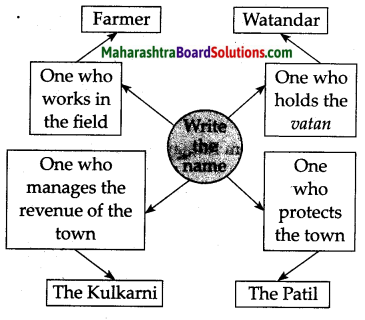
1. Complete the chart.
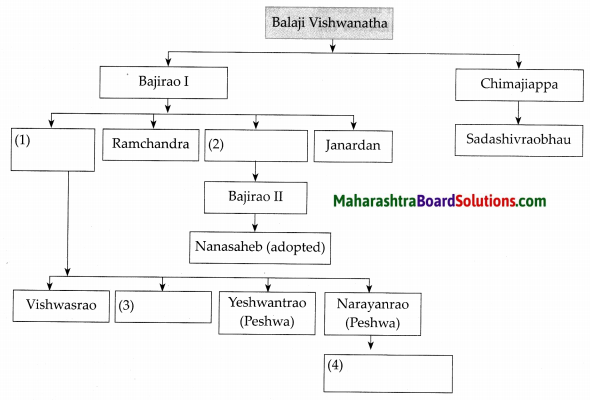
Maharashtra Board Class 7 History Solutions Chapter 13 Life of the People in Maharashtra 1
Answer:
Maharashtra Board Class 7 History Solutions Chapter 13 Life of the People in Maharashtra 2

2. Which undesirable customs are prevalent in today’s society ? Suggest measures for their eradication.
Answer:
The bad traditions prevalent in the society are:

  • No Education for girls.
  • Female infanticide.
  • Dowry.
  • Animal sacrifice
  • Superstitions.
  • Bonded labour.

The ways to get rid of these bad traditions are:

  • Special provisions for girl’s education.
  • Awareness programme for women.
  • Inculcating scientific attitude.
  • Special law to protect the women and girl child.
  • Thinking positive, parental guidance to think in a systematic way, to get science knowledge update to disperse the blind belief will eradicate superstition.

3. Make a detailed notes of the festivals and auspicious days in your area.
Answer:
(a) Diwali, Holi, Mahashivaratri, Eid, Raksha Bandhan, Navaratri, Krishna Janmashtami, Gurpurabh, Parsi new year, Onam are celebrated with great pomp and show in our area.

(b) Sanskasthi Chaturthi, Ekadashi, Akshaya Tritiya etc., are some of the auspicious days celebrated in our area.

4. Use the following points to compare life in the era of Shivaji Maharaj and today’s life.

S. No.PointAt the time of Shivaji MaharajToday
(1)Transactions………………………
(2)Houses…………….Permanent, Well-constructed cement-concrete multi-storeyed house.
(3)Transportation………….Bus, Railway and Aeroplane.
(4)Entertainment………………………….

Answer:

S. No.PointAt the time of Shivaji MaharajToday
(1)TransactionsBarter systemCoins, Paper money, Plastic money, Currency – Rupee, Cashless transaction through banks.
(2)HousesVillage Houses: Made with simple mud and bricks. Cities- Wadas with one or two storeys.Permanent, Well-constructed cement-concrete multi-storeyed house.
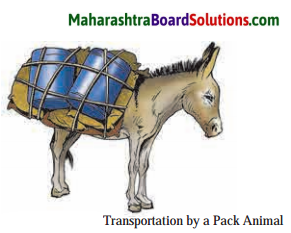
(3)TransportationBullock cart, Horseback, BoatBus, Railway and Aeroplane.
(4)EntertainmentTamasha, Ballads on DapMusic, Drama, Dance, Watching Television, Play, movie, Opera etc.

Activity

Gather information about the capable women of our country and read it aloud in your class, e.g. information on P.V. Sindhu, Sakshi Malik.

Class 7 History Chapter 13 Life of the People in Maharashtra Textbook Questions and Answers

Complete the sentence by choosing the appropriate words from the options given below:

Question 1.
The Patils were given some land as Inam for his job as a _____. (Patil, Jagir, Watans)
Answer:
Patil

Question 2.
For any major or minor events or for battles an ______ was checked. (Time, Muhurta, Place)
Answer:
Muhurta

Question 3.
The _______ festival was celebrated on a large scale during the Peshwa Era. (Ganesh, Diwali, Makar Sankranti)
Answer:
Ganesh

Question 4.
______ script was used for day to day affairs. (Marathi, Sanskrit, Modi)
Answer:
Modi

Question 5.
______ was very popular sport. (Wrestling, Mallakhamb, Martial arts)
Answer:
Martial arts

Question 6.
The Jain Mandir at Jamod in Vidarbha had paintings of Jin Charitra, ______ stories (mythological, various festivals, animals)
Answer:
Mythological

Question 7.
________ was popular as an entertainment programme during the Peshwa Era. (Stage show, Tamasha, Lavani)
Answer:
Tamasha

Question 8.
_______ was a well-known painter. (Mallamma Desai, Gopikabai, Gangaram Tambat)
Answer:
Gangaram Tambat

Question 9.
The letters were carried by _______and messengers. (Birds, Camel riders, Post)
Answer:
Camel riders

Question 10.
People used to believe in ______ a lot. (astrology, scientific vision, dreams)
Answer:
astrology

Match the following:

Question 1.

Column ‘A’Column ‘B’
(1) Festival(a) Mankoji
(2) Sport(b) Bail-Pola
(3) Sculpture(c) Mallakhamb
(4) Ghat(d) Ghrishneshwar Temple
(5) Painter(e) Toke

Answer:
1 – b
2 – c
3 – d
4 – e
5 – a

Question 2.

Column ‘A’Column ‘B’
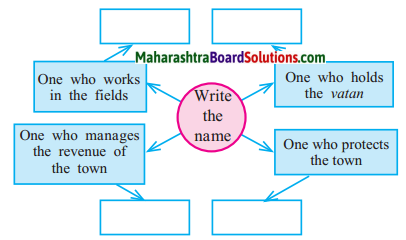
(1) The Patils(a) To manage the revenue
(2) The Kulkarni(b) To protect the village
(3) Black Soil,(c) Work in an office
(4) White-collared(d) Farmers

Answer:
1 – b
2 – a
3 – d
4 – c

Answer in one or two sentences:

Question 1.
What was the chief source of production at the village level during the Peshwa era?
Answer:
Agriculture and agriculture based businesses were die chief source of production at the village level.

Question 2.
When was Ganesh festival celebrated?
Answer:
Ganesh festival was celebrated every year Bhadrapad Chaturthi to Anant Chaturdashi.

Question 3.
Which festivals were celebrated during Diwali?
Answer:
During Diwali the Balipratipada and Bhau- beej days were celebrated on large scale.

Question 4.
What were organised during the Jatras days?
Answer:
Wrestling Match were Organised during the Jatras days.

Question 5.
Which Subjects were taught in Pathshalas and Madarasas?
Answer:
Writing, reading, accounting were taught in Pathshalas and Madarasas.

Question 6.
Which games were played during the Peshwa Era?
Answer:
Martial arts were very popular, Mallakhamb Dand, Wrestling, Lathi, Dandpatta, Bothati these games were played.

Question 7.
What was the religious policy of Chhatrapati Shivaji Maharaj?
Answer:
(i) Chhatrapati Shivaji Maharaj had a liberal religious policy.
(ii) He believed that everyone should follow his or her own religion but nobody should force his or her religion upon others.

Question 8.
What did the daily meal of the people consist of?
Answer:
The daily meal consisted of Bhakari, onion, chutney and gravy.

Question 9.
What did men and women use to wear during that period?
Answer:
(a) Men used to wear dhoti, kurta, angarakha, turban.
(b) Women use to wear sarees (nine-yard) and blouses.

Question 10.
What were used in Wada decoration?
Answer:
Artwork, decorative painting, firewood, sculptures, mirrors were used in wada decoration.

Name the following:

Question 1.
The land was given as inam to Patils do the job.
Answer:
Patilaki

Question 2.
Festival celebrated on large scale.
Answer:
The Ganesh festival.

Question 3.
Crops grown.
Answer:
Jowar, bajra, wheat, nachni, corn, rice etc.

Question 4.
Education was given in.
Answer:
Pathshalas and Madarasas.

Question 5.
Modes of transport.
Answer:
Ghat roads, the bridges on the river, boats.

Question 6.
Means of communication.
Answer:
Camel riders and Messengers.

Question 7.
Popular outdoor games.
Answer:
Hututu, Kho-kho and Atyapatya.

Question 8.
Learned women in the Peshwa Era.
Answer:
(a) Veermata Jijabai
(b) Maharani Yesubai
(c) Maharani Tarabai
(d) Umabai Dabhade.

Question 9.
Famous architect during that period.
Answer:
Hiroji Indulkar.

Answer in brief:

Question 1.
Discuss everyday living of the people in that Era.
Answer:
Most of the people were staying in the village. The villages were self sufficient.

(a) Crops grown: The farmers grown the crops like jowar, bajra, wheat, nachani, com, rice etc.

(b) Food: The farmers’ daily meal consisted of bhakari, onion, chutney and gravy. Rich people’s meal consisted of rice, dal-varan, chapatis, vegetables, salads and milk products.

(c) The transaction in rural area were based on barter system.

(d) Houses: The houses were simple and were made of soil and bricks.

(e) Clothing :
(i) Men wear – Dhoti, Kurta, Angarakha, Turban.
(ii) Women wear – Saree (nine yard) and blouse.

Question 2.
The life of women’s during Peshwa Period.
Answer:
(a) Their world were confined to the house of first their father and then their husband.

(b) Their education was neglected.

(c) Only a few exceptional women had achieved any progress in literacy, administration and battle skills.

(d) They include Veermata Jijabai, Maharani Yesubai, Maharani Tarabai, Umabai Dabhade, Gopikabai, Punyashlok Ahilyabai.

(e) Customs like child marriage, unequal marriage, widowhood, keshwapan, sati, polygamy had imposed harsh restrictions on the way women lived.

Maharashtra Board Class 7 History Solutions Chapter 12 Progression of the Empire

Balbharti Maharashtra State Board Class 7 History Solutions Chapter 12 Progression of the Empire Notes, Textbook Exercise Important Questions and Answers.

Maharashtra State Board Class 7 History Solutions Chapter 12 Progression of the Empire

Class 7 History Chapter 12 Progression of the Empire Textbook Questions and Answers

1. Answer in one word:

Question 1.
She took the charge of the Indore administration.
Answer:
Ahilyabai Holkar

Question 2.
The most capable and brave man in Nagpurkar Bhosale family.
Answer:
Raghuji

Maharashtra Board Class 7 History Solutions Chapter 12 Progression of the Empire

Question 3.
He reinstated the Emperor on the throne of Delhi.
Answer:
Mahadji Shinde

Question 4.
He managed politics in the South.
Answer:
Nana Phadnavis

2. Arrange chronologically:

  • The battle of Ashti.
  • Maratha dominance over Odisha.
  • The British hoisted the Union Jack in Pune.

Answer:

  • Maratha dominance over Odisha.
  • The battle of Ashti.
  • The British hoisted the Union Jack in Pune.

Maharashtra Board Class 7 History Solutions Chapter 12 Progression of the Empire

3. Write briefly:

Question 1.
The work done by Ahilyabai Holkar.
Answer:

  • She created new laws for agricultural tax and tax recovery.
  • She brought barren land under cultivation.
  • Dug wells for farmers.
  • She promoted trade and industry.
  • Built water reservoirs.
  • She constructed mandirs, ghats, matts and dharamshalas.
  • Provided water facilities over India.
  • She brought cultural integration in the country.

Question 2.
The valour shown by Mahadji Shinde.
Answer:
(a) He played a major role in re-establishing the Maratha power in the North after the defeat of the Marathas at Panipat.

(b) He realised that guerilla tactics would not be any more useful so he trained and modernised his army under a French military expert de Boigne.

(c) With this trained army, he defeated the Rohillas, the Jats, the Rajputs and the Bundellas.

(d) Mahadji managed the difficult affairs with strong determination and looked after the Delhi affairs during CE 1784 to CE 1794.
The Mughal Emperor honoured him with the title Vakil-i-Mutlak.

Question 3.
The Maratha rule in Gujarat.
Answer:
(a) General Khanderao Dabhade and his son laid the foundation of Maratha power in Gujarat.

(b) After the death of Khanderao, his wife Umabai took the charge, bravely fought the battle with Mughal Sardar at Ahmadabad and captured a fort.

(c) The Gaikwads made Vadodara their centre of power.

4. Discuss the reasons behind the end of the Maratha rule.
Answer:
The reasons behind the end of Maratha rule were:

(a) After the death of Mahadji Shinde and Nana Phadnavis, the Maratha power started declining.

(b) Raghunathrao’s son, Bajirao II the Peshwa did not have leadership qualities which could create solidarity among the Maratha Sardars.

(c) Maratha power got weakened due to these differences among the Maratha Sardars.

(d) The supremacy of the Marathas declined in the North and the South during the period of Bajirao II.

(e) The British dethroned the Maratha power and became the rulers

Maharashtra Board Class 7 History Solutions Chapter 12 Progression of the Empire

Activity:

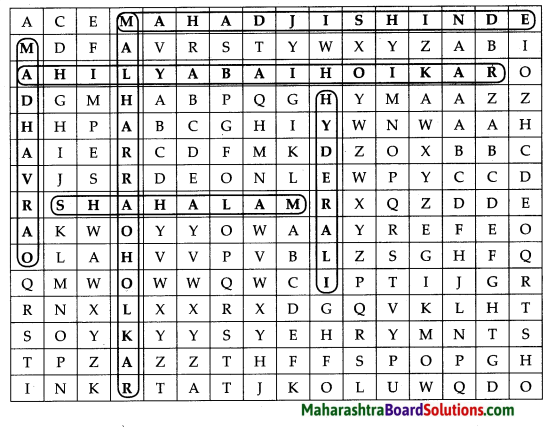
Create a pictorial chart to show the families that contributed to the expansion of the Maratha power. Exhibit it in your school.

Class 7 History Chapter 12 Progression of the Empire Additional Important Questions and Answers

Complete the sentence by choosing the appropriate word from the options given below:

Question 1.
The Gaikwads made _______ in Gujarat a seat of their power. (Vadodara, Ahmadabad, Surat)
Answer:
Vadodara

Question 2.
_____ was the founder of the Holkar rule in Indore. (Mahadji, Malharrao, Raghunathrao)
Answer:
Malharrao

Question 3.
_____ managed to take care of the politics in the South. (Nana Phadnavis, Kanhoji, Khanderao)
Answer:
Nana Phadnavis

Question 4.
________ strengthened the naval power of Shivaji. (Patwardhan, Bhosale of Nagpur,Kanhoji Tulaji Angre)
Answer:
Kanhoji Tulaji Angre

Maharashtra Board Class 7 History Solutions Chapter 12 Progression of the Empire

Question 5.
During the reign of _____ there was a complete breakdown of the Maratha power. (Ahilyabai, Bhosale, Bajirao-ll)
Answer:
Bajirao-ll

Question 6.
_____ laid the foundation of Maratha power in Gujarat. (Khanderao Dabhade, Madhavrao, Raghuji)
Answer:
Khanderao

Question 7.
Malharrao Holkar was well versed in ________ (Sword fighting, Martial art, Guerrilla Warfare)
Answer:
Guerrilla warfare

Question 8.
The British managed to get the rights of the _______ of the Bengal region. (Diwani, Chauthai, Sardeshmukhi)
Answer:
Diwani

Question 9.
Delhi was under the influence of Maratha power till ______. (1803 CE, 1807 CE, 1819 CE)
Answer:
1803 CE

Question 10.
British defeated the Marathas in the battle of Ashti in Solapur in _________. (CE 1818, CE 1820, CE 1814)
Answer:
1818 CE

Maharashtra Board Class 7 History Solutions Chapter 12 Progression of the Empire

Match the following:

Question 1.

Column ‘A’Column ‘B’
(1) Khanderao Dabhade’s wife(a)  Raghuji Bhosale
(2) The most capable and brave Maratha Sardar.(b) Umabai
(3) Mahadji’s death(c) Akhilyabai Holkar
(4) She played a role in the judiciary(d) Wanawadi
(e) Wadgaon

Answer:
1 – b
2 – a
3 – d
4 – c

Answer in one word:

Question 1.
Title conferred to Mahadji Shinde.
Answer:
Vakil-i-Mutlak (Chief agent of the Emperor)

Question 2.
An expert in guerilla tactics.
Answer:
Mahadji Shinde

Question 3.
She was the wife of Khanderao, Malharrao’s son.
Answer:
Ahilyabai Holkar

Maharashtra Board Class 7 History Solutions Chapter 12 Progression of the Empire

Question 4.
Managed the supremacy in the South.
Answer:
Nana Phadnavis

Question 5.
Peshwa who didn’t have leadership qualities.
Answer:
Bajirao II

Question 6.
Appointed as Sardar in the North.
Answer:
Ranoji Shinde

Answer in one or two sentences:

Question 1.
Which regions were given as jagirs to Parasoji by Shahu Maharaj?
Answer:
Varhad and Gondawan were given to Parasoji by Shahu Maharaj.

Question 2.
What rights were assigned to Raghuji?
Answer:
Raghuji Bhosale was assigned the Chauthai rights of Bengal, Bihar and Odisha.

Question 3.
Who laid the foundation of the Maratha power in Gujarat?
Answer:
Khanderao Dabhade and his son Trimbakrao laid the foundation of the Maratha power in Gujarat.

Question 4.
Why did Mahadji Shinde train his army?
Answer:
Mahadji Shinde trained his army because the Marathas generally used the guerrilla tactics in 1 the hilly regions of the South. But would not be
suitable in the plains of the North.

Maharashtra Board Class 7 History Solutions Chapter 12 Progression of the Empire

Question 5.
What was the contribution of Punyashloka Ahilyabai?
Answer:
(a) Punyashloka Ahilyabai ruled for twenty-eight years and enhanced the Maratha prestige in the North.
(b) She brought peace and order in her kingdom and made her people happy.

Question 6.
What was crystal clear amongst the British and Marathas?
Answer:
It was crystal clear that whoever will rule India will be ultimately decided by the war between the Marathas and the British.

Give reason:

Question 1.
Mahadji Shinde conferred the title of Vakil-i- Mutlak (Chief agent of the Emperor).
Answer:
British wanted to take the Delhi Emperor in their captivity. Even though the conditions were unfavourable, Mahadji Shinde defeated the British and again reinstated the Emperor on the throne. The Emperor was pleased with his bravery and conferred the title of Vakili- Mutlak. (Chief Agent of the Emperor).

Question 2.
The Maratha Sardars became successful in establishing the supremacy in North and South India.
Answer:
After the death of Madhavrao Peshwa, the Maratha Empire went in a disarray, Nana Phadnavis and Mahadji Shinde brought it back to normal. Mahadji was busy in the North to establish the supremacy of Marathas, Nana Phadnavis managed to take care of the politics in South. Leadership and capability helped the Maratha power to reach to a new pinnacle. Hence the Maratha Sardar became successful in establishing the supremacy in north and south India.

Maharashtra Board Class 7 History Solutions Chapter 12 Progression of the Empire

Question 3.
The supremacy of Marathas in the North and the South declined in the times of Bajirao II.
Answer:
Bajirao II became the Peshwa. He didn’t have any leadership qualities. On the contrary he had many vices. He couldn’t create solidarity amongst the Maratha Sardars. Because of many such reasons, the supremacy of the Maratha power in the North and the South declined in the times of Bajirao II.

Write short notes on:

Question 1.
Malharrao Holkar
Answer:

  • He was the founder of the Holkar rule at Indore.
  • He served the Maratha kingdom for a long time.
  • He was expert in guerilla warfare.
  • He proved his valour in the eras of Bajirao I and Nanasaheb Peshwa.
  • He played a major role in establishing the supremacy of the Marathas in Malwa and Rajputana.
  • He greatly helped Madhavrao Peshwa in re-establishing the Maratha supremacy after the defeat at Panipat.

Question 2.
Mahadji Shinde
Answer:

  • Madhavrao Peshwa was conferred the title of Vakil-i-Mutlak by the Emperor. He was brave and an astute statesmen.
  • After the Maratha defeat at Panipat, he played a major role in re-establishing the Maratha dominance and prestige in the Northern India.
  • He realised that the guerilla tactics of Marathas would not be useful in the plains of the northern region.
  • He trained his army under the French military expert de-Boigne and updated his artillery.
  • With the help of his trained army, he subdued the Rohillas, Jats, Rajputs, Bundellas, etc.

Maharashtra Board Class 8 Geography Solutions Chapter 6 Land Use

Balbharti Maharashtra State Board Class 8 Geography Solutions Chapter 6 Land Use Notes, Textbook Exercise Important Questions and Answers.

Maharashtra State Board Class 8 Geography Solutions Chapter 6 Land Use

Class 8 Geography Chapter 6 Land Use Textbook Questions and Answers

1. Examine the following statements and correct the incorrect ones:

Question A.
Mining Is not type of land use.
Answer:
Incorrect.
Correct statement: Mining is a type of land use.

Question B.
There are factories in the Central Business District.
Answer:
Incorrect.
Correct statement: There are many shops, banks and offices in the Central Business District.

Question C.
In urban areas, the largest area is used for residential purposes.
Answer:
Correct.

Maharashtra Board Class 8 Geography Solutions Chapter 6 Land Use

Question D.
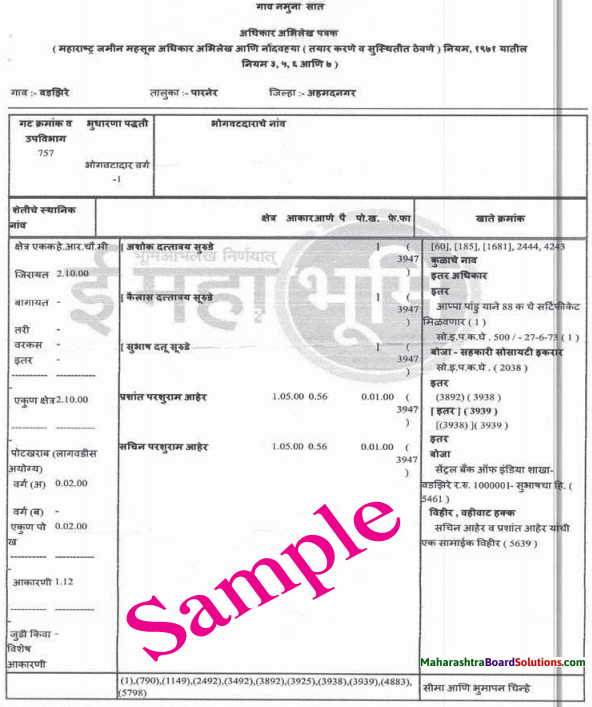
The village attendant issues the 7/12 extract.
Answer:
Incorrect.
Correct statement: The village talathi issues the 7/12 extract.

Question E.
In rural areas, residential areas occupy large tracts.
Answer:
Incorrect.
Correct statement: In rural areas, residential areas occupy small tracts.

Question F.
Extract 7 indicates Record of Rights.
Answer:
Correct.

Question G.
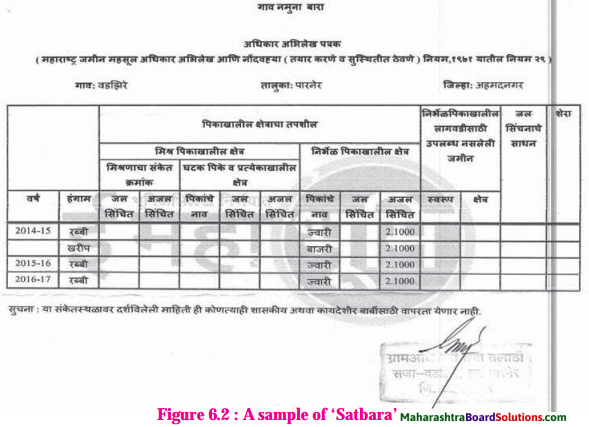
Extract 12 indicates change in ownership.
Answer:
Incorrect.
Correct statement: Extract 12 indicates tracts under cultivation.

2. Give geographical reasons.

Question A.
Land use for public facility is extremely important in urban areas.
Answer:

  1. Government provides various services to fulfill the needs of citizens. The land used for fulfilling these needs is known as public utility/ facility area.
  2. The lands used for post offices, police stations, public grounds, public schools, public hospitals, etc. are included public facility land use.
  3. Land use for public facility increases the’ social welfare. Therefore, land use for public facility is extremely important in urban areas.

Maharashtra Board Class 8 Geography Solutions Chapter 6 Land Use

Question B.
The record of ownership of non- agricultural land is same as that of agricultural land.
Answer:
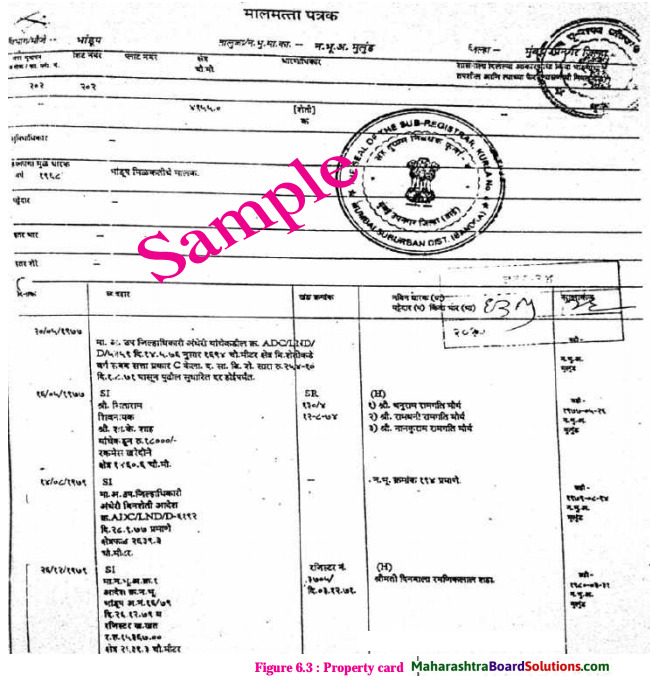
1. The record of agricultural land is maintained in the form of 7/12 extract. Similarly the record of ownership of non-agricultural land is maintained in the form of property card.

2. Like 7/12 extract, property card provides details of ownership of land, city survey number, plot number, amount of tax, area of property assessed, right to access, etc. Thus, the record of ownership of non-agricultural land is same as that of agricultural land.

Question C.
A region can be classified as developed or developing on the basis of land use.
Answer:

  1. The land used in a particular region for agriculture, grazing, etc. indicates that the region is underdeveloped or developing.
  2. The land used in a particular region for commercial purposes, transportation, recreation, etc. indicates that the region is developed. In this way, a region can be classified as developed or developing on the basis of land use.

3. Write answers:

Question A.
Why is agriculture important in rural land use?
Answer:

  1. In India, agriculture is the main occupation of most of people in rural areas.
  2. In India, farming occupation is very important as it satisfies the need of food grain and provides raw material to industries.
  3. The maximum land in rural areas is used for carrying out agricultural activities. Therefore, agriculture is important in rural land use.

Question B.
State the factors affecting land use.
Answer:
(a) The factors affecting rural land use :

  1. The factors like climatic conditions, fertility of soil, altitude and slope of land, irrigational facilities, natural resources, government policies, etc. affect rural land use.
  2. For example, the land with gentle slope is not used for residential purpose, but is used for step farming.

(b) The factors affecting urban land use :

1. The factors like location of land, natural resources, housing development policies of government, transportation routes, industrialisation, trade and commerce, entertainment facilities, government policies, etc. affect urban land use.

2. For example, the land site near the railway station, market, etc. is mostly used for commercial purposes.

Maharashtra Board Class 8 Geography Solutions Chapter 6 Land Use

Question C.
Clarify the differences between rural and urban land use.
Answer:
The differences between rural and urban land use are as follows :

  1. Land in rural areas is used for limited purposes. On the other hand, land in urban areas is used for many purposes.
  2. The pattern of rural land use is comparatively simple. On the other hand, the pattern of urban land use is comparatively complex.
  3. Use of land for cultivation is the major form of rural land use. On the other hand, use of land for commercial activities and residence are the major forms of urban land use.

Question D.
Differentiate between 7/12 extract and property card.
Answer:
The differences between 7/12 extract and property card are as follows :

  1. 7/12 extract is issued by public revenue department of the government. On the other hand, property card is issued by city survey office of government.
  2. 7/12 extract is the land record of ownership and history of ownership of the land in rural areas. Property card is the land record of ownership and history of ownership of the land in urban areas.

Activity:

Question A.
Obtain information about a town close to your village based on the following points and make a presentation in class.
(site, condition. development, land use pattern work)
a. Classify your settlement as rural or urban
b. Note the changes in land use from Central Business District outwards to the periphery in your settlement after consulting elders. Prepare a land use pattern.

Question B.
Study the 7/12 extract or the Property Card in your house and write a note.

Class 8 Geography Chapter 6 Land Use Additional Important Questions and Answers

Choose the correct answer:

Question a.
Recreational land use is use of land for …………………
(A) garden
(B) farming
(C) industry
(D) rail route
Answer:
(A) garden

Question b.
Which of the following is a planned city in India?
(A) Seoul
(B) Zurich
(C) Chandigarh
(D) Brasilia
Answer:
(C) Chandigarh

Maharashtra Board Class 8 Geography Solutions Chapter 6 Land Use

Question c.
Of which city are Bandra, Bhandup, etc. suburbs?
(A) Pune
(B) Nagpur
(C) Nashik
(D) Mumbai
Answer:
(D) Mumbai

Examine the following statements and correct the incorrect ones:

Question A.
Government policies affect the land use.
Answer:
Correct.

Question B.
The areas of mixed land use are found in cities.
Answer:
Correct.

Answer the following questions in one sentence each:

Question A.
What is meant by land use?
Answer:
Land use is the way or purpose for which land in a particular region is used.

Maharashtra Board Class 8 Geography Solutions Chapter 6 Land Use

Question B.
What is called fallow land?
Answer:
The agricultural land which is temporarily not in use is called fallow land.

Question C.
What is called forest land?
Answer:
The land which is reserved for forest area is called forest land.

Question D.
Which products are obtained from forest areas?
Answer:
The products like firewood, flowers, fruits, gum, grass, honey, etc. are obtained from forest areas.

Question E.
What is called grassland?
Answer:
The land owned by Village Panchayat or the government and which is used for grazing is called grassland.

Maharashtra Board Class 8 Geography Solutions Chapter 6 Land Use

Question F.
What is meant by commercial land use?
Answer:
Commercial land use is the use of land in urban areas for commercial purpose.

Question G.
What is meant by mixed land use?
Answer:
Mixed land use is the use of land in urban areas for more than one purpose at a time.

Answer the following questions in brief:

Question A.
How does the pattern of land use get developed?
Answer:

  1. The pattern of land use gets developed through the continuous interactions between man and geographical factors.
  2. The interaction between the factors like availability of land, quality of land, human needs, etc. leads to the development of specific pattern of land use.
  3. For example, mineral rich land is used for carrying out mining activity.
  4. For example, fertile piece of land is used for carrying out farming activity, etc.

Question B.
Write in brief about residential land use in rural areas.
Answer:

  1. The density of population is found to be low in rural areas.
  2. As population in rural areas is comparatively limited, the residential land use in rural areas is found to be limited.
  3. In rural areas, the land close to the areas of main occupations is used for settlements.
  4. For example, farmers’ residences are found near farms, fishermen’s settlements are found near coastal areas, etc.

Maharashtra Board Class 8 Geography Solutions Chapter 6 Land Use

Question C.
Write in brief about features of trAnswer:itional areas.
Answer:
The following are the features of transitional areas:

  1. The intermediate areas between rural settlements and urban settlements are known as transitional areas.
  2. The blend of rural and urban land use and culture is found in transitional areas.
  3. Over time, trAnswer:itional areas are converted into urban areas and they are called suburbs.
  4. For example, Bandra, Bhandup, etc. are the suburbs of Mumbai city.

Question D.
Write in brief about property card.
Answer:
The brief information of property card is as follows:

  1. Property card is the land record of ownership and history of ownership of the land in urban areas.
  2.  It is a land record of non-agricultural land.
  3. Property card is issued by city survey office of government.
  4. Property cards provide details of city survey number, plot number, amount of tax, area of property assessed, right to access, etc.

Answer the following questions in detail:

Question A.
Give information about arable land use and fallow land use in rural areas.
Answer:
The information about arable land : use and fallow land use in rural areas is as follows :
(a) Arable land use :

  1. The use of land for cultivation is called arable land use.
  2. In India, in 2011, nearly 57 per cent of land was under arable land use.
  3. Generally, arable land is owned I individually.
  4. The arable land can be classified on the basis of ownership of the land and types of agriculture.

(b) Fallow land use:

  1. The agricultural land which is temporarily not in use is called fallow land.
  2. Fallow land use is a form of rural land use.
  3. To increase the fertility of soil, farmers do not use a part of agricultural land for few seasons.

Maharashtra Board Class 8 Geography Solutions Chapter 6 Land Use

Question B.
Give information about grassland use and forest land use in rural areas.
Answer:
The information about grassland use and forest land use in rural areas is as follows:
(a) Grassland land use:

  1. The land owned by village panchayat or the government and which is used for grazing purpose is called grassland.
  2. It is also called pastureland.
  3. Mostly, grassland is owned by entire village. Very limited individual ownership of grassland is found.

(b) Forest land use:

  1. The land kept reserved for forest area is called forest land.
  2. Large trees, bushes, creepers and grass are found in forest land.
  3. The forest products like firewood, fruits, flowers, gum, grass, honey, etc. are obtained from forest land.

Question C.
Give information about commercial land use and residential land use in urban areas.
Answer:
The information about commercial land use and residential land use in urban areas is as follows:
(a) Commercial land use:

  1. The use of urban land for commercial use is called commercial land use.
  2. Many shops, banks and offices are found in commercial land areas.
  3. The concept of Central Business District (CBD) has emerged from commercial land use.
  4. For example, Fort area or BKC (Bandra Kurla Complex) in Mumbai are the areas of commercial land use.

(b) Residential land use:

  1. The use of urban land for residential purpose is called residential land use.
  2. Houses and residential buildings are found in residential land areas.
  3. The density of population is found to be high in urban areas. As its effect, the percentage of residential land use in urban areas is increasing day by day.

Maharashtra Board Class 8 Geography Solutions Chapter 6 Land Use

Question D.
Give information about trAnswer:port land use and public utility area in urban areas.
Answer:
The information about transport land use and Public utility area in urban areas is as follows:
(a) TrAnswer:port land use:

  1. The use of urban land for providing transportation facilities is called transport land use.
  2. The land used for roadways, railways, petrol pumps, vehicle repairing centres, etc. is included in transport land use.

(b) Public utility area:

  1. Government provides various services to fulfill the needs of citizens. The land used for fulfilling these needs is known as public utility area.
  2. Post offices, police stations, public grounds, public schools, public hospitals, etc. are included in public utility area.

Question E.
Give information about recreational land use and mixed land use in urban areas.
Answer:
The information about recreational land use and mixed land use in urban areas is as follows:
(a) Recreational land use:

  1. Recreational land use is a use of urban land for fulfilling the needs of entertainment of people.
  2. Public parks, swimming pools, theatres, etc. are included in recreational land use.

(b) Mixed land use:

  1. Mixed land use is a use of urban land for fulfilling more than one wants at a time.
  2. For example, area used for residential and entertainment purposes.

Maharashtra Board Class 8 Geography Solutions Chapter 6 Land Use

Question F.
Write about the features of planned cities.
Answer:
The features of planned cities are as follows:
(a) Need:

  1. After industrial revolution, unplanned urbanisation occurred on a large scale all over the world.
  2. Due to unplanned urbanisation, cities began to develop in a very haphazard manner.
  3. People started migrating to cities in search of employment opportunities.

(b) Nature: City which is developed as per the pre-determined and planned layout of land use is called planned city.

(c) Singapore, Seoul from South Korea, Zurich from Switzerland, Washington D.C. from U.S.A., Brasilia from Brazil, Chandigarh, Bhubaneshwar from India are the examples of planned cities.

Question G.
Give information about 7/12 extract.
Answer:
The information about 7/12 extract is as follows:

  1. 7/12 is an extract published and given by public revenue department of the government.
  2. 7/12 extract gives detailed information of a particular registered land.
  3. The register of the revenue department keeps a record of details of ownership rights of family, status of debt and loans, transfer of ownership, areas under different crops etc. related to registered land.
  4. Village form no. 7 and Village form no. 12 are combined and 7/12 extract is prepared.
  5. These village forms are available with the talathi of every village.
  6. The accurate reading of 7/12 extract gives exact idea about ownership of land, tax levied on land, status of loan taken, etc.

Study the following map/figure/graph and answer the following questions:

Can you tell?

Maharashtra Board Class 8 Geography Solutions Chapter 6 Land Use 1

Study the Figure and answer the following questions:

Question A.
In which country is the land under forests more?
Answer:
The land under forests is more in Japan.

Question B.
In which country is the land under agriculture more?
Answer:
The land under agriculture is more in India.

Maharashtra Board Class 8 Geography Solutions Chapter 6 Land Use

Question C.
Considering the two questions above, how will you relate the physiography and climate of India and Japan with their respective land uses?
Answer:
Due to plains and monsoon climatic conditions, the population in India is more. Therefore, agricultural land use is prominent in India. Due to mountainous region and more proportion of precipitation, the forest land use is prominent in Japan.

Question D.
Correlate their land use and development.
Answer:
The land use in India shows comparatively low development. On the other hand, land use in Japan shows comparatively high development.

Question E.
Which land use is found in Japan?
Answer:
The land use like agricultural land use, forest land use, grassland land use, other land use, etc. are found in Japan.

Question F.
Considering the land use in both the countries, make a list of factors affecting land use.
Answer:
Considering the land use in both the countries, lists of factors affecting land use are as follows:
(a) Factors affecting land use in India:

  1. Fertility of soil
  2. Climatic conditions
  3. Natural resources
  4. Slope of land, etc.

(b) Factors affecting land use in Japan:

  1. Technical advancement
  2. Availability of resources
  3. Government policies, etc.

Can you tell?

Maharashtra Board Class 8 Geography Solutions Chapter 6 Land Use 5 Maharashtra Board Class 8 Geography Solutions Chapter 6 Land Use 6 Maharashtra Board Class 8 Geography Solutions Chapter 6 Land Use 7

Study the Figure and answer the following questions:

Question A.
What kind of land use is shown in Figure 6.2 and 6.3?
Answer:
Land use shown in Figure 6.2 is agricultural land use and land use shown in Figure 6.3 is non-agricultural land use.

Maharashtra Board Class 8 Geography Solutions Chapter 6 Land Use

Question B.
Can you tell in which area the property is located?
Answer:
The property shown in Figure 6.2 is located in rural areas and the property shown in Figure 6.3 is located in urban areas.

Can you tell?

Maharashtra Board Class 8 Geography Solutions Chapter 6 Land Use 2

Study the Figure and answer the following questions:

Question A.
Which are the land uses of 1990-91 that show decline in 2010-11? What could be reasons for this?
Answer:
Total agricultural land use and other non-agricultural land use of 1990-91 show decline in 2010-11. Increased urbanisation could be reason for this.

Question B.
Which type of land use is the maximum? What would be the impact of this on India’s environment?
Answer:
Agricultural land use is the maximum. It indicates that India is an agrarian country and its environment is comparatively more natural.

Maharashtra Board Class 8 Geography Solutions Chapter 6 Land Use

Question C.
Can a decline in the area under agriculture equated with food shortage?
Answer:
A decline in the area under agriculture cannot be equated with food shortage. With modern technology, the maximum agricultural food production can be undertaken in limited areas.

Can you tell?

Maharashtra Board Class 8 Geography Solutions Chapter 6 Land Use 3

Study the figure and answer the following questions:

Question A.
What is the percentage of land suitable for cultivation?
Answer:
The percentage of land suitable for cultivation is 56.8.

Question B.
What is the percentage of barren land?
Answer:
The percentage of barren land is 8.3.

Maharashtra Board Class 8 Geography Solutions Chapter 6 Land Use

Question C.
What is the percentage of land under forest in Maharashtra?
Answer:
The percentage of land under forest in Maharashtra is 16.9.

Question D.
What is the percentage of non- agricultural land in Maharashtra?
Answer:
The percentage of non-agricultural land in Maharashtra is 10.2.

Give it a try.

Maharashtra Board Class 8 Geography Solutions Chapter 6 Land Use 4

Study the Figure. It shows the satellite images of Mondha Village (Taluka – Hingna, District – Nagpur).

Question A.
Find out the changes in land use pattern over time and write a note.
Answer:

  1. The satellite image of Mondha Village in Hingna taluka in Nagpur district shows that agricultural land use in the village has declined from 2010 to 2017.
  2. The satellite image of Mondha Village in Hingna taluka in Nagpur district shows that residential land use in the village has increased from 2010 to 2017.
  3. Urbanisation, increasing population, etc. factors must be responsible for changes in land use pattern over time in Mondha Village.

Thought Provoking Question:

Think about it.

Question A.
If land is left fallow, or is not in use, then can it be termed as a kind of land use?
Answer:
1. The agricultural land which is temporarily not in use is called fallow land.
2. Fallow land use is a form of rural land use.
3. To increase the fertility of soil, farmers do not use a part of agricultural land for few seasons. After one or two seasons fallow land is again utilized for cultivation. Therefore, if land is left fallow, or is not in use, then it can be termed as a kind of land use.

Maharashtra Board Class 8 Geography Solutions Chapter 6 Land Use

Open-Ended Question:

Question A.
Write the advantages of planned cities in your own words.
Answer:
The advantages of planned cities are as follows:

  1. There will not be a problem of traffic jam in planned cities.
  2. The level of pollution will be the minimum in the planned cities.
  3. The planned cities will be clean and they will maintain environmental balance.
  4. The quality of human life will be superior in planned cities.

Maharashtra Board Class 6 Geography Solutions Chapter 8 Natural Resources

Balbharti Maharashtra State Board Class 6 Geography Solutions Chapter 8 Natural Resources Notes, Textbook Exercise Important Questions and Answers.

Maharashtra Board Class 6 Geography Solutions Chapter 8 Natural Resources

Class 6 Geography Chapter 8 Natural Resources Textbook Questions and Answers

A. What is the use of the following resources?

Question 1.
Water
Answer:

  • Right from the time we get up in the morning, we keep on using water till we go to bed at night.
  • We obtain salt from sea water.
  • Plants and aquatic animals like fish also live in water.

Maharashtra Board Class 6 Geography Solutions Chapter 8 Natural Resources

Question 2.
Forests
Answer:

  • We collect wood from the forest for various purposes.
  • In order to fulfill our needs we also obtain products like rubber, resin, fruits, medicinal plants, etc. from forests.
  • Forests are the habitat of many animals.

Question 3.
Animals
Answer:

  • Man uses animals for a variety of reasons.
  • Horses, oxen, camel, asses, etc. are animals employed for ploughing, riding, transporting goods, etc.
  • Goats, cows, buffaloes are used as milch animals.
  • Animals provide meat, eggs, bone powder, hide, etc.

Question 4.
Minerals
Answer:

  • We get different metals and chemicals from minerals.
  • Some chemicals are used in preparing different medicines.
  • Metallic minerals are used for obtaining different metals such as iron, bauxite, etc.
  • Non-metallic minerals are used in obtaining various chemicals like gypsum, rock salt, calcite, etc.

Question 5.
Land.
Answer:

  • Living things that are bom on land, grow, live and die on the land itself.
  • Land is used for construction as well as trade.

B. Complete the following flow chart:
Maharashtra Board Class 6 Geography Solutions Chapter 8 Natural Resources 1
Answer:
Maharashtra Board Class 6 Geography Solutions Chapter 8 Natural Resources 2

C. Answer the following questions:

Question 1.
What factors influence the formation of soil?
Answer:
The formation of soil mainly depends on the original rock, climate, organic components, slope of the land and time.

Maharashtra Board Class 6 Geography Solutions Chapter 8 Natural Resources

Question 2.
Which products are obtained from forests?
Answer:
We obtain products like wood, rubber, resin, fruits, medicinal plants, etc. from forests.

Question 3.
What are the uses of minerals?
Answer:
Metallic minerals are used for obtaining different metals such as iron, bauxite, etc. and non-metallic minerals are used in obtaining various chemicals like gypsum, rock salt, calcite, etc.

Question 4.
What are the purposes for which land is used?
Answer:

  • Living things that are bom on land, grow, live and die on land itself.
  • Construction and trade are some other purposes for which land is used.

Question 5.
Why are various living things found on the land in different proportions?
Answer:
Depending on the characteristics of land and climate, various living things are found on land in different proportions.

Activity:

Collect the pictures of and information about the sources of freshwater.

Class 6 Geography Chapter 8 Natural Resources Textbook Questions and Answers

Can you tell?

Observe the picture given in figure 8.1. and answer the following question.
Maharashtra Board Class 6 Geography Solutions Chapter 8 Natural Resources 3
Question 1.
What do you see in the pictures?
Answer:
I can see different animals and plants in the given pictuers.

Maharashtra Board Class 6 Geography Solutions Chapter 8 Natural Resources

Question 2.
How many of these animals or plants do you know?
Answer:
I know all these animals and plants in the given picture.

Question 3.
Which of these things have you seen in reality?
Answer:
I have seen all the cotton ball, mango and horse in reality.

Question 4.
Have you ever used these things or seen them being used?
Answer:
Yes, I have.

Question 5.
Which of our needs do some of these fulfill?
Answer:

  • Horse is used in transportation
  •  Mango is a fruit we eat from
  • Cotton is used to make cloth.

Question 6.
What probable use of the unused things can you think of?
Answer:

  • Octopus can be kept in aquarium
  • Lizards can be kept in the gardens to eat tiny insects.

Observe all the figures and discuss them in the class:
Maharashtra Board Class 6 Geography Solutions Chapter 8 Natural Resources 4
Maharashtra Board Class 6 Geography Solutions Chapter 8 Natural Resources 5
Maharashtra Board Class 6 Geography Solutions Chapter 8 Natural Resources 6
Can you tell?

Question 1.
What different activities are the individuals in the pictures engaged in?
Answer:
The different activities that the individuals in ; the pictures are engaged in are: agriculture, ; fishing, collection of honey, drawing water, ! gathering wood, mining, masonry, extraction i of salt, collection of rubber latex, gathering of resin from trees, converting wind into usable energy, transportation by pack animals.

Question 2.
What things will they obtain through these activities?
Answer:
They will obtain foodgrains, fish, honey, water, wood, minerals, house to live, salt, rubber, resin and energy which can be used for various purposes.

Maharashtra Board Class 6 Geography Solutions Chapter 8 Natural Resources

Question 3.
What are the animals in the picture doing?
Answer:
While the bullocks are ploughing the fields, j the donkey is used as a pack animal, for transporting heavy loads.

Question 4.
What is the use of the tall device in figure 8.12 raised on the ground?
Answer:
The tall device is a windmill which converts i wind into usable energy through the rotation ; of wheel which are adjustable. The energy thus i created can be used for a variety of purposes I such as generating electricity, grinding grains or spices, pumping water, sawing wood, aerating ponds, etc.

Question 5.
What is being loaded in the truck? What are we going to get from it?
Answer:
is being loaded into a truck from the mining area. We get minerals from the same.

Question 6.
Where are all these human activities being performed other than fishing?
Answer:
All these human activities are being performed on land.

Think a little!

Question 1.
List the various things for which we use water. Identify the things that lead to wastage of water.
Answer:
(a) Use of water.

  • For agricultural and industrial purposes.
  • For drinking and cooking.
  • For personal hygiene.
  • For our pets.
  • Washing clothes and utensils.
  • Cleaning houses, vehicles, etc.
  • Watering plants in the garden.

(b) Identify the things that leads to wastage of water.

  • When we pollute water.
  • When we don’t save water by building dams, water wells and irrigation systems.
  • When we waste water by using it excessively in flushes, bathrooms, etc.
  • When we don’t use water-efficient faucets (taps), showers, etc.
  • When we don’t repair faulty faucets.
  • When we don’t close the tap when not required.
  • When we use fountains and sprinklers in the gardens.

Question 2.
Name the different metals from which the things in your house are made. Make a chart of things and metals.
Answer:

ThingsMetals
CupboardStainless steel
FurnitureIron
Idols of worshipBronze
LanternSilver
Electrical wiringCopper
UtensilsCopper and steel

Maharashtra Board Class 6 Geography Solutions Chapter 8 Natural Resources

Question 3.
List the occupations carried out on land.
Answer:

  • Farming.
  • Mining.
  • Lumbering (Cutting down of trees).
  • Extraction such as salt extraction, etc.
  • Construction
  • Beekeeping, etc.

Observe figure (Textbook Page no. 48) and answer the following questions:
Maharashtra Board Class 6 Geography Solutions Chapter 8 Natural Resources 8
Question 1.
Which vegetations do you find in the following location.
Answer:

LatitudesVegetation
(1) 90° PoleTundra
(2) 0° EquatorEquatorial evergreen
(3) 30°Tropical Grasslands
(4) 60°Mixed Forest
(5) 75° – 90°Coniferous
(6) 15°Deciduous

Question 2.
In which forest do we find tall trees?
Answer:
Equatorial Evergreen forest.

Question 3.
Name the grassland shown in the picture.
Answer:
Tropical grassland and temperate grassland.

Question 4.
Which vegetation indicate hot deserts?
Answer:
Thorny scrubs

Maharashtra Board Class 6 Geography Solutions Chapter 8 Natural Resources

Class 6 Geography Chapter 8 Natural Resources Textbook Questions and Answers

Complete the following statements using appropriate options:

Question 1.
_____ is a resource which never depletes. (Air, ‘Water, Animals)
Answer:
Air

Question 2.
Formation of mature soil is a very ______ process. (sudden, fast, slow)
Answer:
slow

Question 3.
Rock is a mixture of ________ (stone, black pebbles, minerals)
Answer:
minerals

Question 4.
The proportion of land on earth is ________%.
Answer:
29.20

Question 5.
_______ are the habitats for many animals. (Grassland, Vegetation,Thorny scrubs)
Answer:
Grassland

Match the pairs correctly:

Question 1.

Column AColumn B
(1) Horses and oxens(a) used for hauling logs
(2) Cows and buffaloes(b) transportation of goods
(3) Water available on the earth for use(c) milk animals
(4) Settlements flourished(d) 0.003%
(e) Huang He

Answer:
1 – b
2 – c
3 – d
4 – e

Name the following:

Question 1.
The natural things that man uses:
Answer:
Natural resources.

Question 2.
A resource that is available in plenty:
Answer:
Air.

Maharashtra Board Class 6 Geography Solutions Chapter 8 Natural Resources

Question 3.
The basins along which man began to live a settled life in the past:
Answer:

  • Huang He
  • Sindhu (Indus)
  • Nile and Euphrates

Question 4.
Habitats of animals:
Answer:
Forest or grasslands.

Question 5.
Any two products we get from animals:
Answer:

  • Meat
  • Eggs

Question 6.
Metallic minerals used for obtaining different metals:
Answer:

  • Iron
  • Bauxite

Question 7.
Non-metallic minerals used in obtaining various chemicals:
Answer:

  • Gypsum
  • Rock salt
  • Calcite

Maharashtra Board Class 6 Geography Solutions Chapter 8 Natural Resources

Answer the following questions in one sentence each:

Question 1.
Why are natural resources invaluable?
Answer:
Most of the natural resources are limited in nature and therefore they are invaluable.

Question 2.
What do we need air for?
Answer:
We need air for various purposes right from breathing to burning.

Question 3.
Why do the farmers plough the soil?
Answer:
The farmers plough the soil to make the land cultivable.

Question 4.
How are plants classified?
Answer:
Plants are broadly classified into grass, shrubs and trees.

Give geographical reasons for the following statements:

Question 1.
Soil is a very important resource for agriculture.
Answer:

  • The farmer ploughs the soil and makes the land cultivable.
  • In this cultivable land, he grows various crops and fulfills his own and other’s need for food.
  • For this purpose, he uses the ‘soil’ that is naturally available on land as a resource.
  • Therefore soil is very important resource of agriculture.

Question 2.
Man began to live a settled life.
Answer:

  • Man has successfully experimented with some grasses to obtain food grains.
  • This helped him to avoid painful wandering for gathering food.
  • Therefore, man began to lead a settled life.

Question 3.
It is necessary to conserve the natural resources.
Answer:

  • Every living thing makes use of natural resources according to its need.
  • However, man started using many of these resources for himself alone with the help of his intellectual power.
  • Later, the increase in population and the greed of humans led to exploitative use of resources.
  • This began to upset the balance in nature.
  • So, it is necessary that man also must use the natural resources only according to his need, that is judiciously and thus conserve the natural resources.

Question 4.
Land is an invaluable resource.
Answer:

  • All the activities of obtaining natural resources are being carried out on land.
  • Land obtained at strategic location is used for construction as well as trade.
  • Hence, land is an invaluable resource.

Maharashtra Board Class 6 Geography Solutions Chapter 8 Natural Resources

Answer the following questions in short:

Question 1.
Why are various living things found on the land in different proportions?
Answer:
Depending on the characteristics of land and climate, various living things are found on land in different proportions.

Question 2.
Which are the various geographical conditions which all living things try to adapt to?
Answer:
All living things try to adapt to various geographical conditions like rocky terrain, steep slopes, flat plains, mountainous regions, forest-covered areas, river basin, etc.

Maharashtra Board Class 7 History Solutions Chapter 11 Marathas – The Protectors of the Nation

Balbharti Maharashtra State Board Class 7 History Solutions Chapter 11 Marathas – The Protectors of the Nation Notes, Textbook Exercise Important Questions and Answers.

Maharashtra State Board Class 7 History Solutions Chapter 11 Marathas – The Protectors of the Nation

Class 7 History Chapter 11 Marathas – The Protectors of the Nation Textbook Questions and Answers

1. Name them:

Question 1.
They came from Afghanistan.
Answer:
The Pathans

Question 2.
They settled at the foothills of the Himalayas.
Answer:
The Rohillas

Question 3.
The brother of Nanasaheb Peshwa.
Answer:
Raghunathrao

Maharashtra Board Class 7 History Solutions Chapter 11 Marathas - The Protectors of the Nation

Question 4.
The chief of Jats at Mathura.
Answer:
Surajmaljat

Question 5.
Defeated the Nizam at Rakshasbhuvan near Paithan.
Answer:
Madhavrao

2.Write in brief about:

Question 1.
Raising the Maratha standard at Attack. Or Hoisting the Maratha standard at Attack.
Answer:

  • Najib Khan, the Rohillas chief could not tolerate the Maratha supremacy.
  • Najib Khan requested Abdali to invade India again. He captured Delhi.
  • He returned to Afghanistan and collected huge wealth.
  • Raghunathrao and Madhavrao Holkar marched to the North and captured Delhi.
  • They defeated Abdali’s officers and captured Punjab.

Maharashtra Board Class 7 History Solutions Chapter 11 Marathas - The Protectors of the Nation

Question 2.
Conflict with the Afghans.
Or
Battle with the Afghans.
Answer:

  • In CE 1751, Ahmadshah Abdali conquered Punjab.
  • Due to that, the Mughals were facing threat from Abdali.
  • So they joined hands with the Marathas to protect Delhi.
  • The Emperor signed a treaty with Marathas in 1752.
  • As per the treaty, the Marathas agreed to protect the Mughal Empire.
  • The Maratha army marched towards Delhi.
  • As Abdali got this news, he returned to his native country (Afghanistan).
  • Due to the Maratha power, the threat of Abdali got subsided.

Question 3.
The after effects of the battle of Panipat.
Answer:

  • The Marathas were defeated.
  • The whole generation of Marathas were killed.
  • Many brave soldiers died on the battlefield.
  • It caused a great harm to the reputation of Marathas in Northern India.

3. Arrange chronologically:

  • The battle of Rakshasbhuvan
  • The death of Tipu Sultan
  • The death of Madhavrao Peshwa
  • The battle of Panipat
  • The battle of Buradi Ghat

Answer:

  • The battle of Buradi Ghat
  • The battle of Panipat
  • The battle of Rakshasbhuvan
  • The death of Madhavrao Peshwa
  • The death of Tipu Sultan.

4. Find the names of people in the chapter :

Question 1.
N _ n _ _ _ _ _ _
Answer:
Nanasaheb

Maharashtra Board Class 7 History Solutions Chapter 11 Marathas - The Protectors of the Nation

Question 2.
D _ _ _ _ _ _
Answer:
Dattaji

Question 3.
N _ _ _ _ _ _ _ _
Answer:
Nizamshah

Activity:

Find more information about the battle of Panipat on the internet and make a presentation in your class.

Class 7 History Chapter 11 Marathas – The Protectors of the Nation Additional Important Questions and Answers

Complete the sentence by choosing the appropriate word from the options given below:

Question 1.
Ahmadshah Abdali was the Emperor of ______. (Mysore, Paithan, Afghanistan)
Answer:
Afghanistan

Question 2.
The chief of the Maratha artillery was ____. (Ibrahim khan, Hyder Ali, Najib Khan)
Answer:
Ibrahim khan

Maharashtra Board Class 7 History Solutions Chapter 11 Marathas - The Protectors of the Nation

Question 3.
The Marathas defeated _________ in a battle at Motitalao near Srirangapattan. (Hyder Ali, Ibrahim Khan, Abdali)
Answer:
Hyder Ali

Question 4.
Safadarjung was the Nawab of ______.(Mysore, Paithan, Ayodhya)
Answer:
Ayodhya

Question 5.
_____ the ruler of Afghanistan conquered Punjab in 1751 CE. (Ahmadshah Abdali, Rohillas, Hyder Ali)
Answer:
Ahmadshah Abdali

Question 6.
Nanasaheb sent ________ to the North to crush Abdali. (Sadashivraobhau, Surajmal Jat, Vishwasrao)
Answer:
Sadashivraobhau

Question 7.
Hyder Ali usurped the throne of _____ (Mysore, Paithan, Ayodhya)
Answer:
Mysore

Question 8.
______was a Rohilla chief. (Ibrahimkhan, Najibkhan, Ahmadshah)
Answer:
Najibkhan

Question 9.
Madhavrao defeated the Nizam at ______ near Paithan. (Srirangapattan, Rakshasbhuvan, Buradi Ghat)
Rakshasbhuvan

Maharashtra Board Class 7 History Solutions Chapter 11 Marathas - The Protectors of the Nation

Question 10.
After the death of Peshwa Nanasaheb, his son ________ succeeded him. (Bajirao II, Madhavrao, Vishwasrao)
Answer:
Madhavrao

Match the following:

Question 1.

Column ‘A’Column ‘B’
(1) The Nawab of Ayodhya(a) Raja Sawal Jaysingh.
(2) The Rohilla Chief(b) Safadarjung
(3) The Chief of the Jats(c) Najib Khan
(4) The chief of the Maratha artillery(d)  Surajmal

(e)  Ibrahim Khan Gardi

Answer:
1 – b
2 – c
3 – d
4 – e

Find the name of people in the chapter:

Question 1.
I _ _ _ h _ _ _ _ _ _
Answer:
Ibrahimkhan

Name them:

Maharashtra Board Class 7 History Solutions Chapter 11 Marathas - The Protectors of the Nation

Question 1.
He met a heroic death in the battle.
Answer:
Dattaji

Question 2.
He became Peshwa after Bajirao.
Answer:
Nanasaheb

Question 3.
They do not help Marathas in the Battle of Panipat.
Answer:
Jats and Rajputs

Question 4.
The army of the Marathas attacked Abdali on 14th January, 1761.
Answer:
Battle of Panipat

Question 5.
The Sultan who took advantage of the defeat of the Marathas at Panipat and attacked the Maratha territory in Karnataka.
Answer:
Sultan Hyder Ali

Question 6.
The death of this capable Peshwa caused a great loss to Maratha Kingdom.
Answer:
Peshwa Madhavrao

Question 7.
Understood that only Marathas can rule over the chaos in North and wished that Marathas should rule the North.
Answer:
Abdali and his heirs

Answer the following in one sentence:

Question 1.
Why did the Peshwa send Dattaji Shinde and Janakoji Shinde to the North?
Answer:
The Peshwa sent Dattaji Shinde and Janakoji Shinde to crush the power of Najibkhan and to get a firm hold over the Punjab.

Question 2.
Why did the Nawab of Ayodhya invite the Marathas?
Answer:
The Nawab invited the Marathas to subdue the Rohillas.

Question 3.
Who helped the wounded Maratha soldiers in the Panipat battle?
Answer:
Surajmal Jat, Queen Kishori helped the wounded Maratha soldiers in the Panipat battle.

Maharashtra Board Class 7 History Solutions Chapter 11 Marathas - The Protectors of the Nation

Question 4.
When did the third battle of Panipat start?
Answer:
The Marathas attacked Abdali on 14th January, 1761 and the third battle of Panipat started.

Question 5.
What conditions were laid in the treaty signed between the Emperor and the Marathas in April 1752?
Answer:
According to this treaty, the Marathas agreed to protect the Mughal Empire from enemies like the Rohillas, Jats, Rajputs and Afghans, etc. In return, the Marathas got cash and the rights to collect Chauthai from a few regions of North (Punjab, Multan, Rajputana, Sindh and Rohilkhand).

Question 6.
With whom did Nanasaheb campaign against Abdali?
Answer:
Jayappa Shinde, Madhavrao Holkar along with Nanasaheb campaigned against Abdali.

Question 7.
Why did Hyder Ali attack Marathas when they were defeated at Panipat and they had become weak?
Answer:
Hyder Ali thought that the Marathas were defeated at Panipat and they had become weak and so he attacked them.

Question 8.
In which battle did the Marathas defeat Hyder Ali?
Answer:
In the battle at Moti Talav, near Srirangapattan

Question 9.
From where did the Pathans migrate and settle?
Answer:
The Pathans had migrated from Afghanistan and they settled near Ayodhya at the foot of the Himalayas.

Question 10.
How did the history of Maratha describe Madhavrao?
Answer:
Madhavrao is described as an honest, hardworking, determined and a caring administrator for the common people.

Maharashtra Board Class 7 History Solutions Chapter 11 Marathas - The Protectors of the Nation

Answer in brief:

Question 1.
The battle of Panipat.
Answer:

  • Sadashivraobhau captured Delhi.
  • The third battle of Panipat started.
  • The Marathas attacked Abdali on 14th January, 1761.
  • A bullet hit Vishwasrao and he fell dead.
  • When Sadashivraobhau heard this, he attacked the enemy in madness, and disappeared from the battlefield.
  • The Maratha soldiers lost courage.
  • Abdali with the reserve contingent attacked the Marathas.
  • The Marathas got defeated.

Complete the following family tree of Peshwa:

Question 1.
Maharashtra Board Class 7 History Solutions Chapter 11 Marathas - The Protectors of the Nation 1
Answer:

  1. Balaji alias Nanasaheb
  2. Raghunathrao
  3. Madhavrao (Peshwa)
  4. Sawai Madhavrao (Peshwa)

Maharashtra Board Class 7 History Solutions Chapter 11 Marathas - The Protectors of the Nation

Question 2.
Find the name of people in the lesson in following grid:
Answer:
Maharashtra Board Class 7 History Solutions Chapter 11 Marathas - The Protectors of the Nation 2

Maharashtra Board Class 8 Science Solutions Chapter 11 Human Body and Organ System

Balbharti Maharashtra State Board Class 8 Science Solutions Chapter 11 Human Body and Organ System Notes, Textbook Exercise Important Questions and Answers.

Maharashtra State Board Class 8 Science Solutions Chapter 11 Human Body and Organ System

Class 8 Science Chapter 11 Human Body and Organ System Textbook Questions and Answers

1. Find out my partner.

Question a.

Group ‘A’Group ‘B’
1. Heartbeatsa. 350 ml
2. RBCb. 7.4
3. WBCc. 37° C
4. Blood donationd. 72 per min
5. Normal body temperaturee. 50 – 60 lakh/mm3
6. pH of oxygenated bloodf. 5000 – 6000 per mm3

Answer:

Group ‘A’Group ‘B’
1. Heartbeatsd. 72 per min
2. RBCe. 50 – 60 lakh/mm3
3. WBC f. 5000 – 6000 per mm3
4. Blood donationa. 350 ml
5. Normal body temperaturec. 37° C
6. pH of oxygenated bloodb. 7.4

Maharashtra Board Class 8 Science Solutions Chapter 11 Human Body and Organ System

2. Complete the following table.
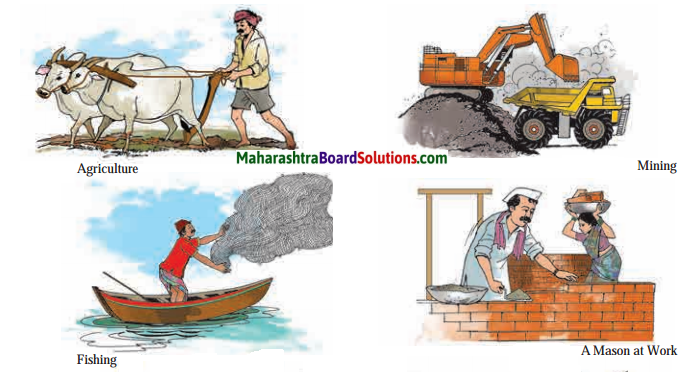
Question a.
Maharashtra Board Class 8 Science Solutions Chapter 11 Human Body and Organ System 1
Answer:
Maharashtra Board Class 8 Science Solutions Chapter 11 Human Body and Organ System 2 Maharashtra Board Class 8 Science Solutions Chapter 11 Human Body and Organ System 3

3. Draw neat and labeled diagrams. 

Question a.
Respiratory system.
Answer:
Maharashtra Board Class 8 Science Solutions Chapter 11 Human Body and Organ System 4

Question b.
Internal structure of heart.
Answer:
Maharashtra Board Class 8 Science Solutions Chapter 11 Human Body and Organ System 5

4. Explain with reasons.

Question a.
Human blood is red coloured.
Answer:
The red colour of human blood is due to hemoglobin which is a red coloured conjugated protein with iron that is present on the red blood cells. Therefore, it looks red.

Question b.
Upward and downward movement of diaphragm occurs consecutively.
Answer:
The breathing movements are possible due to contraction and relaxation of the diaphragm. The rib muscles also help in these movements. When the ribs rise and diaphragm is lowered at the same time, then there is a decrease in pressure on lungs.

This causes movement of air into the lungs at the time of inhalation. On the other hand, when ribs come back to their normal position and diaphragm is risen, then pressure on the lungs increases. This causes movement of the air out of the body through the nose in the form of exhalation. These movements are possible only due to consecutive upward and downward movement of the diaphragm.

Maharashtra Board Class 8 Science Solutions Chapter 11 Human Body and Organ Systemb

Question c.
Blood donation is considered to be superior of all donations.
Answer:
Blood cannot be manufactured by any artificial chemical process. The only way to obtain blood is by donations of blood from a live donor. Blood is needed at times of emergency. The life of person can be saved if timely blood transfusion is given to the needy victim or a patient. Since such donation can save a valuable human life, it is called superior of all donations.

Question d.
Person with ‘O’ blood group is considered as ‘universal donor’.
Answer:
Person with ‘O’ blood group does not have any antigen on his/her RBCs. The ‘O’ type blood thus cannot cause clotting reactions in the body of the recipients. Such persons with ‘O’ blood group can donate blood to any person having any blood group therefore they are considered as ‘universal donor’.

Question e.
Food must have limited amount of salts.
Answer:
More salt in diet means more sodium ions. These extra sodium salts cause rise in blood pressure. Such condition is called hypertension. This condition can be dangerous and fatal in some cases. Therefore, one must keep control over sodium content of the food.

Maharashtra Board Class 8 Science Solutions Chapter 11 Human Body and Organ System

5. Answer the following questions in your own words.

Question a.
Explain the functional correlation of circulatory system with respiratory, digestive and excretory system.
Answer:
1. Three systems viz. respiratory, digestive and circulatory always work in coordination.
2. Digestive system helps in breaking down complex food molecules into simple soluble nutrients at the end of the digestion process.
3. The soluble nutrients are absorbed in the circulating blood in the villi of the intestine.
4. The blood carries these nutrients to each cell during its circulation.
5. The respiratory system helps the oxygen from the air to be absorbed in the blood.
6. This process takes place in alveolus present in lungs. The oxygen is absorbed in the blood and through haemoglobin it is taken to every cell of the body. At the same time the unwanted carbon dioxide produced in each cell is given out in a process of gaseous exchange.
7. The soluble nutrients, and chiefly glucose is metabolized with the help of oxygen-producing energy. Thus, all the three systems bring about coordinated functions to keep the body alive.

Maharashtra Board Class 8 Science Solutions Chapter 11 Human Body and Organ System

Question b.
Explain the structure and function of human blood.
Answer:
I. Structure, i.e. components of the human blood: Human blood is a fluid connective tissue consisting of blood plasma and blood corpuscles suspended in it.

1. Plasma: Plasma is the fluid part of the blood which is pale yellow in colour. It is slightly alkaline in nature. It has 90-92% water, 6-8 % proteins and 1-2 % inorganic salts.
It contains proteins such as albumin, globulin, fibrinogen, etc. There are inorganic ions such as Ca, Na and K.

2. Blood cells:
a. Blood cells are mainly of three types, viz. RBCs, WBCs and blood platelets. They are produced in the red bone marrow.
b. RBCs are small, circular and enucleated cells. They are full of haemoglobin which is essential in transporting oxygen. RBCs are red blood cells which are 50 to 60 lakh per cubic millimetre. Their life span is 100 to 127 days.
c. WBCs are large, nucleated and colourless. They are of five subtypes, viz. neutrophils, basophils, eosinophils, monocytes and lymphocytes. They are 5 to 10 thousands per millimetre of blood.
d. Platelets are very small disc-shaped blood cells which are 2.5 to 4 lakh per cubic millimetre of blood.

II. Function of human blood:

1. Transport functions:

  • Gases: Oxygen is carried via blood from lungs to cells in various parts of body and carbon dioxide from tissues to lungs.
  • Nutrients: Simple nutrients like glucose, amino acids, fatty acids are taken up by blood from wall of alimentary canal and transported up to each cell in the body.
  • Waste materials: Nitrogenous wastes like ammonia, urea, creatinine are released by tissues into blood which carries those to kidney for excretion.
  • Enzymes and hormones: Blood transports the enzymes and hormones from the site of their production to the site of their action.

2. Protection: Antibodies are produced in the blood and they protect the body from microbes and other harmful particles.
3. Thermoregulation: Body temperature is maintained constant at 37 °C by vasodilation and vasoconstriction.
4. Maintaining the balance of minerals like Na, K in the body.
5. If bleeding occurs at the injury, platelets and a protein called fibrinogen of the blood form a clot and seal the injury.
6. Functions of blood cells:

  • RBCs: With haemoglobin it carries out transport of respiratory gases.
  • WBCs: Soldiers of the body. Produce antibodies and give immunity to body.
  • Platelets: Help in blood clotting.

Maharashtra Board Class 8 Science Solutions Chapter 11 Human Body and Organ System

Question c.
Explain the importance and need of blood donation.
Answer:
Blood can never be synthesized artificially. There is no substitute for natural blood. Every healthy person possesses about 5 litres of blood in his or her body. In case of haemorrhage i.e. blood loss, the blood volume may reduce which can result into threat to life. Moreover, the loss of blood should be immediately taken care of, otherwise it may cost the life.

Therefore blood transfusion is very crucial in case of victims of accidents, patients of surgeries or mothers who suffer from blood loss during childbirth (parturition). Some diseases such as thalassemia, blood cancer, etc. also need regular transfusions. Therefore, blood is always needed in many such conditions. Blood donation is only option for such transfusions.

6. Explain the differences.

Question a.
Arteries and veins.
Answer:

ArteriesVeins
1. Arteries carry blood away from the heart to the tissues of the body.1. Veins carry blood from the tissues of the body back to the heart.
2. Arteries are located deeper within the body.2. Veins are usually located superficially beneath the surface of the skin.
3. Arteries are thick walledVeins are thin walled.
4. Arteries do not have valves.4. Veins have valves.
5. Arteries would generally remain open if blood flow stopped, due to their thick muscular layer.5. Veins would collapse if blood flow stops.
6. Except pulmonary artery, all arteries carry oxygenated blood.6. Except pulmonary vein, all veins carry deoxygenated blood.
7. Arteries are more muscular than veins, which helps in transporting blood that is full of oxygen efficiently to the tissues.7. Veins are less muscular than arteries, but contain valves to help keep blood flowing in the right direction, usually toward the heart.
8. There is maximum blood pressure in the arteries.8. There is minimum blood pressure in the veins.

Maharashtra Board Class 8 Science Solutions Chapter 11 Human Body and Organ System

Question b.
External and internal respiration.
Answer:

External respirationInternal respiration
1. Intake of air from the outside into the body and release of air from the body to outside is called external respiration.1. Exchange of gases between cells and tissue fluid is called internal respiration.
2. External respiration occurs between cells and the external environment.2. Internal respiration occurs only in the cells of the body.
3. It involves processes of inspiration and expiration.3. It involves movement of O2 from blood into tissue fluid and movement of CO2 from tissue.
4. External respiration involves breathing and gaseous exchange.4. Internal respiration involves neither breathing nor gaseous exchange.
5. Oxygen combines with haemoglobin in external respiration.5. Chemical reactions occur in the cells to form energy.

7. Which health parameters of blood donor should be checked? 

Question a.
Which health parameters of blood donor should be checked?
Answer:
Blood donor should be healthy. He or she should have good haemoglobin’s content. The RBC and WBC count should also be normal. They should not carry any parasites in their blood such as malarial parasite or dengue virus. The donor should not be HIV positive or should not have any infectious diseases. He should not have any addictions such s drug-abuse or alcohol consumption.

Maharashtra Board Class 8 Science Solutions Chapter 11 Human Body and Organ System

8. Fill in the blanks using appropriate words given in the bracket.
(hemoglobin, alkaline, diaphragm, red bone marrow, acidic, voluntary, involuntary,)

Question a.
RBCs of the blood contain ……….., an iron compound.
Answer:
RBCs of the blood contain haemoglobin, an iron compound.

Question b.
……………….. is present between thoracic and abdominal cavity.
Answer:
Diaphragm is present between thoracic and abdominal cavity.

Question c.
Cardiac muscles are …………… .
Answer:
Cardiac muscles are involuntary.

Question d.
pH of oxygenated blood is …………… .
Answer:
pH of oxygenated blood is alkaline.

Maharashtra Board Class 8 Science Solutions Chapter 11 Human Body and Organ System

Question e.
Production of RBCs occurs in ……………… .
Answer:
Production of RBCs occurs in red bone marrow.

8. Find odd one out.

Question a.
A, O, K, AB, B.
Answer:
K (All others are blood groups.)

Question b.
Blood plasma, platelets, blood transfusion, blood corpuscles.
Answer:
Blood transfusion (All others are components of blood.)

Question c.
Trachea, alveoli, diaphragm, capillaries.
Answer:
Capillaries (All others are parts of respiratory system. Capillaries exist throughout the body.)

Maharashtra Board Class 8 Science Solutions Chapter 11 Human Body and Organ System

Question d.
Neutrophils, globulins, albumins, prothrombin.
Answer:
Neutrophils (All others are proteins present in the plasma.)

10. Read the following paragraph and identify the disease.

Today, her child became one and half year old. However, that child does not seem to be healthy and happy. It was continuously crying and gradually becoming weak. It has shortness of breath. Its nails have become blue.
Answer:
The heart of the child is not functioning properly. Bluish nails show lack of oxygen, thus the baby may be suffering also from respiratory problems.

11. Your neighboring uncle has been diagnosed with hypertension. What should he do to keep his blood pressure within normal range?

Question a.
Your neighboring uncle has been diagnosed with hypertension. What should he do to keep his blood pressure within normal range?
Answer:
Hypertension has many causes. Try to find out what is the exact cause. Is it lack of exercise, obesity, lots of fast and junk food consumption, over-intake of salt, mental tension, etc. He should visit a proper physician and take prescribed blood pressure control medicines. He should never miss a single tablet. He should avoid salty and preserved food. He should practice yoga and meditation. He should also undertake some stress- management techniques.

Project:

Question a.
Collect information about various modern treatments on heart diseases.

Class 8 Science Chapter 11 Human Body and Organ System Important Questions and Answers

Rewrite the statements after correcting them:

Question 1.
Cells need supply of insoluble nutrients and oxygen for the energy production.
Answer:
Cells need the supply of soluble nutrients and oxygen for the energy production.

Maharashtra Board Class 8 Science Solutions Chapter 11 Human Body and Organ System

Question 2.
Respiratory system and respiration begins with mouth.
Answer:
Respiratory system and respiration begins with nose.

Question 3.
A lung is present on either sides of heart in abdominal cavity.
Answer:
A lung is present on either sides of heart in thoracic cavity.

Question 4.
Continuous upward and downward movement of diaphragm is necessary to bring about the beating of heart.
Answer:
Continuous upward and downward movement of diaphragm is necessary to bring about the breathing.

Question 5.
Blood vessels which carry the blood away from heart are called veins.
Answer:
Blood vessels which carry the blood away from heart are called arteries.

Maharashtra Board Class 8 Science Solutions Chapter 11 Human Body and Organ System

Question 6.
William Harvey described the blood groups in man.
Answer:
William Harvey described the mechanism of circulation in the body.

Question 7.
Capillaries unite together to form the arteries.
Answer:
Capillaries unite together to form the veins.

Match the columns/Find out my partner:

Question 1.

Group ‘A’Group ‘B’
1. William Harveya. Blood group AB.
2. Carl Landsteinerb. A, B, O blood group system.
3. Decastello and Sturlic. Mechanism of circulation of blood.

Answer:

Group ‘A’Group ‘B’
1. William Harveyc. Mechanism of circulation of blood.
2. Carl Landsteinerb. A, B, O blood group system.
3. Decastello and Sturlia. Blood group AB.

Maharashtra Board Class 8 Science Solutions Chapter 11 Human Body and Organ System

Complete the following table:

Question 1.

Maharashtra Board Class 8 Science Solutions Chapter 11 Human Body and Organ System 6
Answer:

TypeSystolic pressureDiastolic pressure
Normal blood pressure90 – 119 mmHg60 – 79 mmHg
Primary hypertension120 – 139 mmHg80 – 89 mmHg
Hypertension stage – I140 – 159 mmHg90 – 99 mmHg
Hypertension stage – II> 160 mmHg> 100 mm

Define the following terms:

  1. Inhalation: Inhalation is taking in air through the nose from the surrounding
  2. Exhalation: Exhalation is giving out the air back to the outer environment.
  3. External respiration: The processes of inhalation and exhalation both together are called external respiration.
  4. Internal respiration: Exchange of gases between cells and tissue fluid is called internal respiration.
  5. Cellular respiration: Production of energy in the form of ATP from oxidation of glucose and other soluble nutrients is called cellular respiration.
  6. Thermoregulation: Maintenance of the body temperature to a constant level by performing vasoconstriction or vasodilation is called thermoregulation.
  7. Blood pressure: Pressure exerted by the flowing blood on the blood vessel wall is called blood pressure.
  8. Systolic pressure: The maximum blood pressure exerted by the flowing blood when the heart is contracting is called systolic pressure.
  9. Diastolic pressure: The minimum blood pressure exerted by the flowing blood when the heart is not contracting but receiving (i.e. relaxing) the blood is called diastolic pressure.
  10. Hypertension or High Blood Pressure: The blood pressure value of 140 – 159 mm Hg which is more than the normal blood pressure is called hypertension or high blood pressure.
  11. Sphygmomanometer: The instru¬ment used for measuring blood pressure is called sphygmomanometer.
  12. Hematology: The branch of medical science in which the blood, haemapoietic organs (organs that produce blood cells) and blood disorders are studied is called haematology.

Maharashtra Board Class 8 Science Solutions Chapter 11 Human Body and Organ System

Answer the following questions in one or two sentences each:

Question 1.
What are the heart sounds and why are they produced?
Answer:
There are two types of heart sounds, one is ‘lubb’ and other is ‘dub’. These are produced due to closure of the heart valves.

Question 2.
What is blood circulation?
Answer:
The process of pumping the blood to all the parts of the body and bringing it back again to the heart is called the blood circulation.

Question 3.
Name any four proteins present in the blood plasma.
Answer:
The proteins present in the blood plasma are albumin, globulins, fibrinogen and prothrombin.

Question 4.
Which inorganic ions control the function of muscles and nerves?
Answer:
Calcium, sodium and potassium control the functions of muscles and nerves.

Maharashtra Board Class 8 Science Solutions Chapter 11 Human Body and Organ System

Question 5.
What is the basis on which blood group is determined?
Answer:
The antigen present on the RBCs: and the antibodies present in the plasma of I the blood determine the type of blood group. The genes of parents are responsible for the type of blood group that the child inherits.

Question 6.
Under which conditions, blood is required for donation?
Answer:
Whenever there is hemorrhage, the patient requires blood. Such patients are accident victims, those who excessively bleed, women during childbirth (parturition) and for patients undergoing surgeries.

Question 7.
How much blood is collected from a person during donation?
Answer:
About 350 ml of blood is collected from a person during donation.

Question 8.
When is National Voluntary Blood Donation Day observed?
Answer:
National Voluntary Blood Donation Day is observed on 1st October every year.

Explain the differences:

Question 1.
Atria and ventricles:
Answer:

AtriaVentricles
1. Atria are the upper chambers of the heart.1. Ventricles are the lower chambers of the heart.
2. Atria are the smaller receiving chambers.2. Ventricles are the larger distributing chambers.
3. Atria are thin walled chambers having lesser blood pressure.3. Ventricles are thick walled chambers with greater blood pressure.
4. Atria do not have inlet valves.4. Ventricles have inlet valves.
5. Right atrium receives deoxygenated blood from whole body through the inferior vena cava (lower body), superior vena cava (from upper body). It pumps blood into right ventricle.5. Right ventricle pumps deoxygenated blood received from right atrium to lungs for oxygenation which is known as pulmonary circulation.
6. Left atrium receives oxygenated blood from lungs through pulmonary veins. It pumps blood into left ventricle.6. Left ventricle pumps oxygenated blood received from left atrium to whole body. This is called systemic circulation.

Maharashtra Board Class 8 Science Solutions Chapter 11 Human Body and Organ System

Question 2.
RBCs and WBCs:
Answer:

RBCsWBCs
1. RBCs are red in colour due to haemoglobin present in them.1. WBCs are colourless as there is no pigment in them.
2. RBCs are produced in red bone marrow.2. WBCs are produced mostly in bone marrow. But they are also produced in lymph nodes, spleen, etc.
3. RBCs are smaller in size and rounded in .shape.3. WBCs are larger in size and are of different shapes.
4. RBCs have an average lifespan of 120 days.4. Life span of WBCs vary according to their role. They have a life span from a few days to 3 weeks.
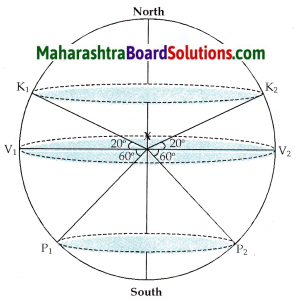
5. Normal RBC count is 50 – 60 lakh RBCs per cubic mm. of blood.5. Normal WBC count is 5 thousands to 10 thousands per cubic mm. of blood.
6. Their function is to transport the respiratory gases (Oxygen and Carbon Dioxide).6. Their main function is to produce antibodies and fight against the infections. Thus they are called soldiers of the body.

Give scientific reasons:

Question 1.
A very large number of alveoli is present in lungs, which are covered over by capillary network.
Answer:
Due to very large number of alveoli the surface area of the lungs is increased many a times for the gaseous exchange. The alveoli are covered over by capillary network for rapid gaseous exchange. The oxygen is taken in the body and at the same time carbon dioxide is given out of the body only by the gaseous exchange occurring at the alveolar surface.
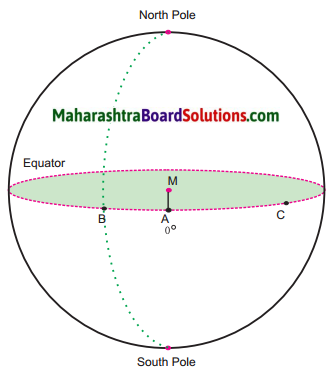
Maharashtra Board Class 8 Science Solutions Chapter 11 Human Body and Organ System

Question 2.
Heart is covered by double layered pericardial membrane.
Answer:
Pericardium is the protective double membrane that covers the heart. In between the two layers of this membrane there is protective fluid. The pericardium and the fluid together protect the heart from friction and mechanical shock. Since heart is a vital organ, it is well protected by such pericardial membrane.

Question 3.
Veins are provided with valves.
Answer:
Valves prevent the backflow of the blood. Blood in the veins is not under great pressure so it is likely that it may flow back. But valves prevent such movements. Therefore they are provided with valves.

Write short notes on the following:

Question 1.
Cellular respiration:
Answer:

  1. During respiration, the glucose molecules along with some other soluble nutrients are slowly oxidized with the help of oxygen in each cell.
  2. In this process the energy is released in the form of ATP, CO2 and water vapours are produced.
  3. These products are not needed for the body and hence given out of the body in exhalation.
  4. This process of cellular respiration is shown by the following reaction:
    C6H12O6 + 6O2 = 6CO2 + 6H2O + Energy (38ATP)

Question 2.
Lung:
Answer:

  1. Pair of lungs is the main respiratory organ in the human body. They are located in thoracic cavity.
  2. They are present on either sides of heart.
  3. Each lung has double layered pleural membranes.
  4. Trachea bifurcates into two bronchi. Each bronchus enters lung on its side and S divide and re-divide into fine bronchioles.
  5. At the end of each bronchiole there is alveolus. Alveolus is surrounded by capillary network.
  6. Each alveolus is extremely thin walled and hence gaseous exchange can occur through diffusion here. Due to thousands of alveoli, the lung surface is increased many a times.
  7. Deoxygenated blood coming from heart by pulmonary arteries is purified here in the lungs.
  8. It is mixed with oxygen due to gaseous exchange and returned back to the heart by pulmonary veins. Lungs thus continuously help in oxygenation of blood with the help of all of the alveoli.

Maharashtra Board Class 8 Science Solutions Chapter 11 Human Body and Organ System

Question 3.
Diaphragm:
Answer:

  1. Diaphragm is a muscular partition that divides the thoracic and abdominal cavity.
  2. Located at the base of thoracic cage, it is very important in breathing movements.
  3. Diaphragm can undergo consecutive upward and downward movements.
  4. These movements along with movements of thoracic cage cause rise and fall of the pressure in the thoracic cavity.
  5. Rising up of ribs and lowering of diaphragm causes the decrease in air pressure which makes the air to move into the lungs through nose. This is inhalation.
  6. When the pressure rises in the thoracic cavity again, the air is given out. This is exhalation.
  7. This is caused due to ribs returning to their original position and rising diaphragm. This simultaneously increases the pressure in thoracic cavity.

Question 4.
Structure of human heart:
Answer:

  1. Human heart is four chambered muscular organ.
  2. The size of the heart is about one’s own fist and its weight is about 360 gm.
  3. For protection, it is covered over by double-layered pericardium.
  4. The wall of the heart is made up of cardiac muscles which are involuntary in nature. They have the capacity of rhythmic beating.
  5. The upper two chambers are called right and left atrium and lower two chambers are called right and left ventricle.
  6. Between right atrium and right ventricle there is tricuspid valve which guards the opening. Similarly between left atrium and left ventricle there is bicuspid valve.
  7. On entire right side of the heart there is deoxygenated blood.
  8. On entire left side of the heart there is oxygenated blood.
  9. Right atrium receives deoxygenated blood by superior and inferior vena cava. These two major veins bring deoxygenated blood from entire body to the heart.
  10. Left atrium receives oxygenated blood from lungs by pulmonary vein.
  11. Right ventricle sends the deoxygenated blood to lungs for oxygenation, through pulmonary artery.
  12. Left ventricle supplies oxygenated blood to entire body through systemic aorta.

Maharashtra Board Class 8 Science Solutions Chapter 11 Human Body and Organ System

Question 5.
Human Blood Groups:
Answer:

  1. The A, B, O blood group system is the most popular and medically important blood group system of human beings.
  2. The blood group is determined due to antigenic protein present on the RBCs and the antibody present in the plasma.
  3. The four main groups of human blood are A, B, AB and O.
  4. According to the presence or absence of Rh antigen the blood groups are further said to be Rh-positive or Rh-negative.
  5. This makes total eight blood groups which are taken into consideration at the time of blood transfusions.
  6. Blood groups are dependent on genes and are thus hereditary in nature.

Answer the following:

Question 1.
How do the organisms like amoeba, earthworm, cockroach, plants, various aquatic animals, bird, respire? Prepare a chart.
Answer:
Maharashtra Board Class 8 Science Solutions Chapter 11 Human Body and Organ System 7

Diagram – based questions:

Question 1.
Sketch and label structure of alveolus showing gaseous exchange.
Answer:
Maharashtra Board Class 8 Science Solutions Chapter 11 Human Body and Organ System 8

Maharashtra Board Class 8 Science Solutions Chapter 11 Human Body and Organ System

Question 2.
Sketch and label artery and vein showing structural difference between the two.
Answer:
Maharashtra Board Class 8 Science Solutions Chapter 11 Human Body and Organ System 9

Question 3.
Draw a diagram to show formation of capillaries. Also show how capillaries form a vein.
Answer:
Maharashtra Board Class 8 Science Solutions Chapter 11 Human Body and Organ System 10

MCQs based on experiments:

I. Human respiratory system:

Question 1.
From which organ does respiratory system of man begin?
(a) Trachea
(b) Lungs
(c) Alveolus
(d) Nose
Answer:
(d) Nose

Question 2.
Which of the statement given below is correct?
(a) Wind pipe is present in front of food pipe.
(b) Food pipe is present in front of wind pipe.
(c) Wind pipe and food pipe are not near each other.
(d) Wind pipe is same as oesophagus and food pipe is called trachea.
Answer:
(a) Wind pipe is present in front of food pipe.

Question 3.
Which type of respiration includes inhalation and exhalation?
(a) Internal respiration
(b) External respiration
(c) Cellular respiration
(d) None of the above
Answer:
(b) External respiration

Maharashtra Board Class 8 Science Solutions Chapter 11 Human Body and Organ System

Question 4.
How many molecules of ATP are produced from one molecule of glucose ?
(a) 26
(b) 36
(c) 38
(d) 40
Answer:
(c) 38

Question 5.
Where is sound box located in the body?
(a) At the beginning of the wind pipe.
(b) At the beginning of the food pipe.
(c) At the end of the wind pipe.
(d) At the end of the food pipe.
Answer:
(a) At the beginning of the wind pipe.

II. Structure of heart:

Question 1.
What is the location of a bicuspid valve in human heart?
(a) Between right and left ventricle.
(b) Between left and right atrium.
(c) Between left atrium and left ventricle.
(d) Between right atrium and right ventricle.
Answer:
(c) Between left atrium and left ventricle.

Question 2.
Which blood vessels bring deoxygenated blood to the right atrium?
(a) Superior and inferior vena cava
(b) Pulmonary veins
(c) Pulmonary artery
(d) Systemic aorta
Answer:
(a) Superior and inferior vena cava

Question 3.
Which artery carries deoxygenated blood and which vein carries the oxygenated blood respectively?
(a) Dorsal aorta and inferior vena cava respectively.
(b) Pulmonary vein and pulmonary artery respectively
(c) Pulmonary artery and pulmonary vein respectively
(d) Superior vena cava and inferior vena cava respectively.
Answer:
(c) Pulmonary artery and pulmonary vein respectively

Question 4.
Under which of the following condition will rate of heartbeat be faster?
(a) Sleeping
(b) Resting
(c) Running
(d) Sitting
Answer:
(c) Running

Maharashtra Board Class 8 Science Solutions Chapter 11 Human Body and Organ System

Question 5.
Which chambers of the heart are called receiving chamber?
(a) Both atria
(b) Right ventricle
(c) Left ventricle
(d) Only left atria
Answer:
(a) Both atria

Maharashtra Board Class 6 Geography Solutions Chapter 1 The Earth and the Graticule

Balbharti Maharashtra State Board Class 6 Geography Solutions Chapter 1 The Earth and the Graticule Notes, Textbook Exercise Important Questions and Answers.

Maharashtra Board Class 6 Geography Solutions Chapter 1 The Earth and the Graticule

Class 6 Geography Chapter 1 The Earth and the Graticule Textbook Questions and Answers

A. Place a tick mark (✓) against the correct option:

Question 1.
What term is used for the imaginary east-west horizontal lines on the earth?
(i) Meridians
(ii) International Date Line
(iii) Parallels
Answer:
Parallels

Maharashtra Board Class 6 Geography Solutions Chapter 1 The Earth and the Graticule

Question 2.
What is the shape of the meridians?
(i) Circular
(ii) Semicircular
(iii) Points
Answer:
Semicircular

Question 3.
What do the parallels of latitude and meridians of longitude together form on the globe?
(i) Angular distance
(ii) Hemisphere
(iii) Graticule
Answer:
Graticule

Question 4.
How many parallels are there in the northern hemisphere?
(i) 90
(ii) 89
(iii) 91
Answer:
90

Question 5.
Which circles form the eastern and western hemispheres?
(i) 0° parallel and 180° meridian
(ii) 0° Prime Meridian and 180° meridian
(iii) North and South Polar circles
Answer:
0° Prime Meridian and 180° meridian

Question 6.
Which circle appears as a point on the globe?
(i) Equator
(ii) North/South Pole
(iii) Prime Meridian
Answer:
North/South Pole

Question 7.
How many places on the earth may be located on 45° N parallel?
(i) One
(ii) Many
(iii) Two
Answer:
Many

Maharashtra Board Class 6 Geography Solutions Chapter 1 The Earth and the Graticule

B. Observe a globe and examine the following statements. Correct the wrong ones:

Question 1.
Parallels of latitude lie parallel to the Prime Meridian,
Answer:
Wrong: Parallels of latitude lie parallel to the equator.

Question 2.
All parallels of latitude converge at the equator.
Answer:
Wrong: All meridians of longitude converge at the poles.

Question 3.
Parallels and meridians are imaginary lines.
Answer:
Right.

Question 4.
8° 4′ 65″ N is a north meridian.
Answer:
Wrong: 8° 4′ 65″ N is a north parallel.

Question 5.
Meridians are parallel to each other.
Answer:
Wrong: Latitudes are parallel to each other.

C. Find the correct graticule out of the following and put a tick mark against it.
Maharashtra Board Class 6 Geography Solutions Chapter 1 The Earth and the Graticule 1
Answer:
Figure (a) is correct.

D. Answer the following:

Question 1.
How will you express the latitude and longitude of the North Pole?
Answer:
The latitude of the North Pole would be 90°N. All the meridians of longitudes pass through the North Pole. So the North pole would be 0° longitude.

Question 2.
How much is the angular distance between the Tropic of Cancer and Tropic of Capricorn?
Answer:
The angular distance between the tropic of Cancer and tropic of Capricorn is 23°30′ + 23°30′ = 47°

Maharashtra Board Class 6 Geography Solutions Chapter 1 The Earth and the Graticule

Question 3.
Using a globe, write down the names of the countries through which the equator passes.
Answer:
The countries through which the equator passes are Ecuador, Colombia, Brazil, Sao tome and Principe, Gabon, Republic of the Congo, Democratic Republic of the Congo, Uganda, Kenya, Somalia, Maldives, Indonesia and Kiribati.

Question 4.
Write down the main uses of the graticule.
Answer:
Graticules help us to determine the locations on the earth. In the modern age, Geographical Information Systems, Global Positioning System, Google Maps, Wikimapia, Bhuvan of ISRO also make use of graticules.

E. Complete the following table:

CharacteristicsParallels of latitudeMeridians of longitude
Shape
Size of each parallel is different
DistanceDistance between two meridians is larger on the equator and the same decreases towards the Poles.

Answer:

CharacteristicsParallels of latitudeMeridians of longitude
ShapeCircularSemicircular
SizeSize of each parallel is differentSize of each meridian is same
DistanceDistance between two parallels is the same everywhereDistance between two meridians is larger on the equator and the same decreases towards the Poles.

Class 6 Geography Chapter 1 The Earth and the Graticule Textbook Questions and Answers

Think a little!

Question 1.
A game of reading the meridians on the world map is going on. Shaheen and Sanket are asking each other to locate places on specific meridians and are making notes of the same. Shaheen asks Sanket to locate Wrangel Island on 180° meridians. Sanket could locate the island in the map but both are confused while making a note of it. They are puzzled whether to write 180° E or 180° W? What would be the precise answer? Please help them. Can we use a similar logic with reference to 0° meridian as well?
Answer:
The 0° and the 180° meridians lie opposite to each other and form a circle around the earth. This circle divides the earth in the eastern and western hemisphere. Shaheen and Sanket can write the Wrangled island to be loacted on 180° meridian.

Maharashtra Board Class 6 Geography Solutions Chapter 1 The Earth and the Graticule

Do it yourself!

Use figure 1.4 of the geography textbook:
Maharashtra Board Class 6 Geography Solutions Chapter 1 The Earth and the Graticule 3
In the upper portion of the circle, at the centre X, draw angles of 30°, V1 X K1 and V2 X K2; K1 and K2 being the points on the circle. Draw an ellipse joining K1 and K2.
In the lower half of the circle, mark angles of 60° and name the points on the circle as P1 and P2.

Question 1.
Draw an ellipse joining P1 and P2.
Answer:
Maharashtra Board Class 6 Geography Solutions Chapter 1 The Earth and the Graticule 5

Can you tell?

Question 1.
Is the distance between K1 K2 and P1 P2 the same?
Answer:
No, the distance between K1 K2 and P1 P2 are not the same.

Question 2.
Compare the distances XK1 and XP2. Are these distances the same or are they different?
Answer:
Yes, the distances are the same.

Question 3.
Now compare the ellipses you have drawn. Which is the larger ellipse? Why?
Answer:
The ellipse through K1 and K2 is larger than the ellipse through P1 and P2 . This is because the distance between K1 K2 is greater than the distance between P1 P2.

Maharashtra Board Class 6 Geography Solutions Chapter 1 The Earth and the Graticule

Observe the picture (fig) on page 5 of the textbook and answer the following questions:

Maharashtra Board Class 6 Geography Solutions Chapter 1 The Earth and the Graticule 2
Let the line AM be 0°.
Draw the line MB. Measure the angle it makes with the line AM and write it near B. Note the semicircle that passes through B and joins the North and South Poles. Trace it.
Now join MC. Measure ∠AMC and write it next to C. Draw a semicircle that passes through ‘C’ and joins the North and South Poles.
Draw a line that passes through point A at 0°, and joins the North and South Poles.
Maharashtra Board Class 6 Geography Solutions Chapter 1 The Earth and the Graticule 4
Answer:
∠AMB = 70°
∠AMC = 85°

Use your brain power!

Question 1.
How many parallels and meridians can be drawn on a globe at an interval of 10°?
Answer:
19 parallels and 36 meridians can be drawn on a globe at an interval of 10°.

Class 6 Geography Chapter 1 The Earth and the Graticule Textbook Questions and Answers

Fill in the blanks choosing the correct options from the brackets:

Question 1.
A miniature model of the earth is called a _____.(ball, globe, sphere)
Answer:
globe

Question 2.
The location of any place on the earth is determined with reference to the ______ of the earth. (poles, circle, centre)
Answer:
centre

Question 3.
The _______ is considered as 0° parallel.(equator, poles, circles)
Answer:
equator

Question 4.
The ______ bisects the earth into north and south parts. (poles, equator, circles)
Answer:
equator

Maharashtra Board Class 6 Geography Solutions Chapter 1 The Earth and the Graticule

Question 5.
One can draw _____ parallels on the earth at the interval of 1°. (90,181,360)
Answer:

Question 6.
The 0° meridian is known as the _____. (Central meridian, Equator, Prime Meridian)
Answer:
Prime Meridian

Question 7.
Each degree is divided into 60 ______.(minutes, hours, seconds)
Answer:
minutes

Question 8.
One can draw _____ meridians each at a distance of 1°. (90,181, 360)
Answer:
360

Question 9.
All meridians are _______ in size.(unequal, equal, uneven)
Answer:
equal

Question 10.
Exact location of a place on the earth can be located using ______.(equator, latitude and longitude, Prime Meridian)
Answer:
latitude and longitude

Question 11.
The distance between any two adjacent parallels is _______ on the surface of the earth. (111 km, 102 km, 44 km)
Answer:
111 km

Question 12.
The parallels and meridians on the globe form a net that is called a ______.(latitude,graticule, longitude)
Answer:
graticule

Match the pairs correctly:

Question 1.

Different parallelsDistance between meridians
(1) Poles(a) 111 km
(2) Tropic of Cancer(b) 102 km
(3) Polar Circles(c) 0 km
(4) Equator(d) 44 km
(5) Meridians(e) 360
(f) 1°

Answer:
1 – c
2 – b
3 – d
4 – a
5 – e

Place a tick mark (✓) against the correct option:

Question 1.
Which meridian is considered as the Prime Meridian?
(i) 0°
(ii) 80°
(iii) 90°
Answer:

Maharashtra Board Class 6 Geography Solutions Chapter 1 The Earth and the Graticule

Answer the following questions in one sentence:

Question 1.
What are parallels of latitudes?
Answer:
Ellipses that are created at some angular distance from the centre of the earth and are parallel to one another are called parallels of latitudes.

Question 2.
How many parallels are there in the northern hemisphere?
Answer:
There are 90 parallels in the northern hemisphere.

Question 3.
Which circle divides the earth in the eastern and western hemisphere?
Answer:
The Prime Meridian divides the earth in the eastern and western hemisphere.

Question 4.
What is the distance between any two adjacent parallels on the surface of the earth?
Answer:
The distance between any two adjacent parallels on the surface of the earth is 111 km.

Question 5.
What is a graticule?
Answer:
The parallels and meridians on the globe form a net that is called a graticule.

Question 6.
What is used to determine the location on the earth?
Answer:
Latitude and longitude is used to determine the location on the earth.

Write the full forms of:

Question 1.
GIS
Answer:
Geographical Information System

Question 2.
GPS
Answer:
Global Positioning System

Question 3.
IRNSS
Answer:
Indian Regional Navigation Satellite System

Question 4.
ISRO
Answer:
Indian Space Research Organisation

Maharashtra Board Class 6 Geography Solutions Chapter 1 The Earth and the Graticule

Give geographical reasons for the following statements:

Question 1.
Parallels and meridians are imaginary lines on the earth.
Answer:
Parallels and meridians can be drawn on a globe though not on the earth. That is why parallels and meridians are imaginary lines on the earth.

Question 2.
Geographers developed a miniature model of the earth in the form of a globe.
Answer:
Oceanic waters, uneven nature of the land, forest, innumerable islands of different sizes and buildings make it impossible to draw lines on the earth. In order to overcome this difficulty, geographers developed a miniature model of the earth in the form of a globe.

Question 3.
Latitude and longitudes are expressed into degree, minutes and seconds.
Answer:
To locate the places within the distance of 111 km exactly, the unit degree is divided into smaller units. Degrees are divided into minutes and seconds.

Answer the following questions in short:

Question 1.
Explain the meaning of the term ‘equator’.
Answer:

  • The equator is considered as 0° parallel.
  • It is the largest parallel and great circle.
  • It bisects the earth into two equal hemispheres viz, the northern and southern hemisphere.

Question 2.
What are Poles of the earth?
Answer:
On the globe and also on the earth, at the north and south ends of the earth’s axis, Poles appear as points. These are called the North Pole and the South Pole respectively.

Observe a globe and examine the following statements. Correct the wrong ones:

Question 1.
Parallels of latitude lie parallel to the Prime Meridian,
Answer:
Wrong: Parallels of latitude lie parallel to the equator.

Question 2.
All parallels of latitude converge at the equator.
Answer:
Wrong: All meridians of longitude converge at the poles.

Question 3.
Parallels and meridians are imaginary lines.
Answer:
Right.

Question 4.
80° 4′ 65″ N is a north meridian.
Answer:
Wrong: 80° 4′ 65″ N is a north parallel.

Maharashtra Board Class 6 Geography Solutions Chapter 1 The Earth and the Graticule

Question 5.
Meridians are parallel to each other.
Answer:
Wrong: Latitudes are parallel to each other.