Maharashtra Board Class 8 Science Solutions Chapter 7 Metals and Nonmetals

Balbharti Maharashtra State Board Class 8 Science Solutions Chapter 7 Metals and Nonmetals Notes, Textbook Exercise Important Questions and Answers.

Maharashtra State Board Class 8 Science Solutions Chapter 7 Metals and Nonmetals

Class 8 Science Chapter 7 Metals and Nonmetals Textbook Questions and Answers

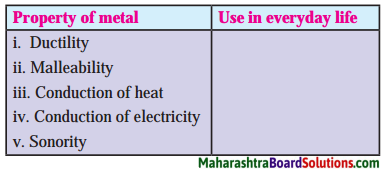
1. Complete the table:

Question a.
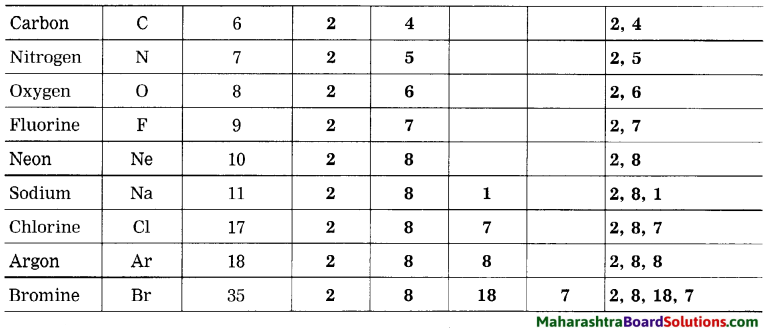
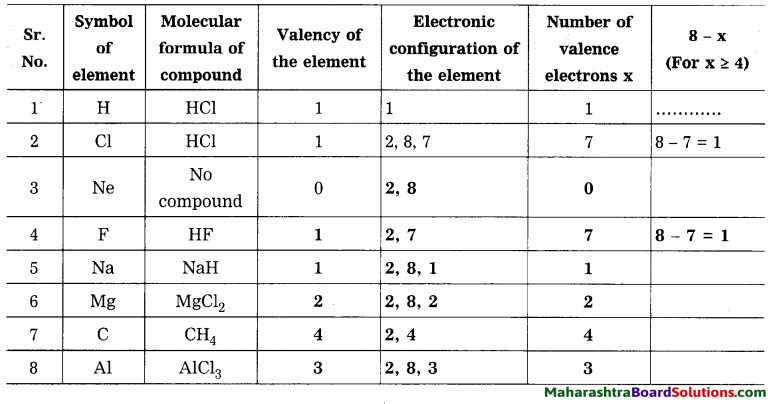
Maharashtra Board Class 8 Science Solutions Chapter 7 Metals and Nonmetals 1
Answer:

Property of metalUse in everyday life
i. Ductilityi. Gold, silver ornaments
ii. Malleabilityii. Aluminium sheets, galvanised sheets
iii. Conduction of heatiii. Stainless steel vessels, copper vessels, boilers
iv. Conduction of electricityiv. Copper wires
v. Sonorityv. Brass articles

Maharashtra Board Class 8 Science Solutions Chapter 7 Metals and Nonmetals

2. Identify the odd term.

Question a.
Gold, Silver, Iron, Diamond.
Answer:
Diamond. (Others are metals.)

Question b.
Ductility, Brittleness, Sonority, Malleability.
Answer:
Brittleness. (Other properties are metallic properties.)

Question c.
Carbon, Bromine, Sulphur, Phosphorus.
Answer:
Bromine. (Others are solids.)

Question d.
Brass, Bronze, Iron, Steel.
Answer:
Iron. (Others are alloys.)

3. Give scientific reasons:

Question a.
The stainless steel vessels in kitchen have copper coating on the bottom.
Answer:

  1. Stainless steel is an alloy of iron ; with carbon, chromium and nickel.
  2. The conductivity of copper is higher than that of iron in steel. Copper heats uniformly and faster. The time for cooking is reduced, as a result it saves fuel. Hence, the stainless steel vessels in kitchen have copper coating on the bottom.

Maharashtra Board Class 8 Science Solutions Chapter 7 Metals and Nonmetals

Question b.
Copper and brass vessels are cleaned with lemon.
Answer:

  1. Copper undergoes oxidation in air to form black copper oxide. Copper oxide reacts slowly with carbon dioxide in air and gains a green coat. This green substance is copper carbonate.
  2. Lemon contains acid. The acid dissolves the green coating of basic copper carbonate present on the surface of a tarnished copper and brass vessels and makes them shiny again.

Question c.
Sodium metal is kept in kerosene.
Answer:

  1. Sodium reacts so vigorously with atmospheric oxygen and water that it catches fire if kept in the open.
  2. It does not react with kerosene and sinks in it. Hence, to protect sodium and to prevent accidental fires it is always kept in kerosene.

4. Answer the following: 

Question a.
What is done to prevent corrosion of metals?
Answer:
By applying a layer of paint, oil, grease or varnish on the surface of a metal to prevent corrosion. Also plating with noncorroding metal is done. Iron is coated with thin layer of zinc. Due to these processes the contact of metal surface with air is lost and corrosion is prevented.

Question b.
What are the metals that make the alloys brass and bronze?
Answer:
The alloy brass is formed from copper and zinc and the alloy bronze is formed from copper and tin.

Maharashtra Board Class 8 Science Solutions Chapter 7 Metals and Nonmetals

Question c.
What are the adverse effects of i corrosion?
Answer:

  1. A reddish coloured deposit (rust) is formed on iron by reaction with oxygen gas.
  2. A greenish coloured deposit (copper carbonate) is formed on copper by reaction with carbon dioxide.
  3. A blackish coloured deposit is formed (silver sulphide) on silver.
  4. Corrosion causes damages to car bodies, bridges, iron railings, ships specially those of iron, silver articles and copper vessels.

Question c.
What are the uses of noble metals?
Answer:
Uses of Noble Metals:

  1. Gold, silver and platinum are used to prepare ornaments.
  2. Silver is used in medicines. (It has antibacterial property).
  3. Gold and silver are also used to make metals and few electronic devices.
  4. Platinum, palladium metals are used as catalyst.

Maharashtra Board Class 8 Science Solutions Chapter 7 Metals and Nonmetals

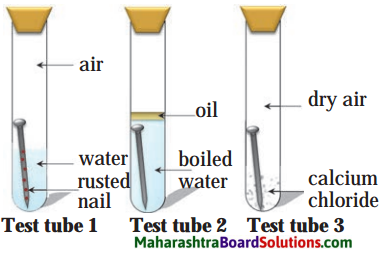
5. Three experiments to study the process of rusting are given below. Observe the three test tubes and answer the following questions.
Maharashtra Board Class 8 Science Solutions Chapter 7 Metals and Nonmetals 2

Question a.
Why the nail in the test tube 2 is not rusted?
Answer:
In the test tube 2, oil cuts the supply of air to nail due to which oxidation of nail is prevented and boiled water is free from gases. Hence, the nail in the test tube 2 is not rusted.

Question b.
Why is the nail in the test tube 1 is rusted highly?
Answer:
The nail in the test tube 1 is highly rusted because nail is in contact with water and air. The oxidation process is fast.

Maharashtra Board Class 8 Science Solutions Chapter 7 Metals and Nonmetals

Question c.
Would the nail in the test tube 3 get rusted?
Answer:
No change is observed in the test tube 3. Nail remains as it is because the calcium chloride absorbs moisture, making the air dry, thus preventing rusting of the nail.

Project:

Question a.
How is the Varkha or silver foil used in sweets made? Collect the information about which metals are used to make ‘Varkha’.

Class 8 Science Chapter 7 Metals and Nonmetals Additional Important Questions and Answers

Rewrite the sentences after filling the blanks:

Question 1.
Gold of 100% purity is …………… carat gold.
Answer:
Gold of 100% purity is 24 carat gold.

Question 2.
The stainless steel utensils used at home are made of an alloy of iron with carbon, …………… and ……….. .
Answer:
The stainless steel utensils used at home are made of an alloy of iron with carbon, nickel and chromium.

Question 3.
…………….. is used in medicines.
Answer:
Silver is used in medicines.

Maharashtra Board Class 8 Science Solutions Chapter 7 Metals and Nonmetals

Question 4.
To prepare ornaments ………… carat gold is used.
Answer:
To prepare ornaments 22 carat gold is used.

Question 5.
Non-metals are ………… conductors of heat and electricity.
Answer:
Non-metals are bad conductors of heat and electricity.

Question 6.
Non-metals form ………….. oxides.
Answer:
Non-metals form acidic oxides.

Question 7.
Some element can be hammered into thin sheets. This property is called …………….. .
Answer:
Some element can be hammered into thin sheets. This property is called malleability.

Question 8.
Iodine and ……………. are the two non – metals having typical metallic lustre.
Answer:
Iodine and diamond are the two non¬metals having typical metallic lustre.

Question 9.
Non-metals form ………. ions by gain of electrons.
Answer:
Non-metals form negative ions by gain of electrons.

Maharashtra Board Class 8 Science Solutions Chapter 7 Metals and Nonmetals

Question 10.
During formation of positively charged ion, atom of metal ………….. .
Answer:
During formation of positively charged ion, atom of metal lose electrons.

Rewrite the following statements by selecting the correct options:

Question 1.
Metalloids have properties of …………. .
(a) metals
(b) non-metals
(c) both metals and non-metals
(d) neither metals nor non-metals
Answer:
(c) both metals and non-metals

Question 2.
………….. is a metal.
(a) Hg
(b) S
(c) P
(d) Br
Answer:
(a) Hg

Question 3.
…………… is a non-metal.
(a) Aug
(b) Ag
(c) Br
(d) Cu
Answer:
(c) Br

Maharashtra Board Class 8 Science Solutions Chapter 7 Metals and Nonmetals

Question 4.
……………. is a metalloid.
(a) Aluminium
(b) Antimony
(c) Zinc
(d) Mercury
Answer:
(b) Antimony

Question 5.
……………. is a metal which is in liquid form at ordinary temperature.
(a) Gallium
(b) Magnesium
(c) Sodium
(d) Scandium
Answer:
(a) Gallium

Question 6.
…………….. is an acidic oxide.
(a) Na2O
(b) CO2
(c) FeOs
(d) H2O
Answer:
(b) CO2

Question 7.
The valence electron in …………… atom is 1.
(a) magnesium
(b) sodium
(c) silicon
(d) aluminium
Answer:
(b) sodium

Maharashtra Board Class 8 Science Solutions Chapter 7 Metals and Nonmetals

Question 8.
The electronic configuration of oxygen is …………….. .
(a) 2, 5
(b) 2, 6
(c) 2, 4
(d) 2, 8, 6
Answer:
(b) 2, 6

Question 9.
Pure ………… is soft.
(a) aluminium
(b) silver
(c) gold
(d) platinum
Answer:
(c) gold

Question 10.
…………… is a highly malleable metal.
(a) Iron
(b) Nickel
(c) Manganese
(d) Aluminium
Answer:
(d) Aluminium

Question 11.
22 carat gold is gold of …………… purity.
(a) 100%
(b) 91.66%
(c) 75%
(d) 44%
Answer:
(b) 91.66%

State whether the following statements are True or False:

Question 1.
Metals are sonorous.
Answer:
True.

Maharashtra Board Class 8 Science Solutions Chapter 7 Metals and Nonmetals

Question 2.
Diamond is the softest natural substance.
Answer:
False. (Diamond is the hardest natural substance.)

Question 3.
The density of lithium is lower than water.
Answer:
True.

Question 4.
Sulphur is brown in colour.
Answer:
False. (Sulphur is yellow in colour.)

Question 5.
Germanium is a metalloid.
Answer:
True.

Question 6.
Ornaments are made from 24 carat gold.
Answer:
False. (Ornaments are made from 22 carat gold.)

Question 7.
A reddish coloured deposit is formed on iron by reaction with oxygen.
Answer:
True.

Maharashtra Board Class 8 Science Solutions Chapter 7 Metals and Nonmetals

Question 8.
Paladium and rhodium are noble metals.
Answer:
True.

Question 9.
The metal oxides are acidic in nature.
Answer:
False. (The metal oxides are basic in nature.)

Question 10.
The metal reacts with dilute acids to form a metal salt.
Answer:
True.

Identify the odd term:

Question 1.
Magnesium, Mercury, Sodium, Iron.
Answer:
Mercury. (Others metals are in solid state at normal temperature.)

Question 2.
Magnesium, Aluminium, Sulphur, Copper.
Answer:
Sulphur. (Others are metals.)

Maharashtra Board Class 8 Science Solutions Chapter 7 Metals and Nonmetals

Question 3.
Iron, Copper, Graphite, Phosphorus.
Answer:
Phosphorus. (Others are good conductors of electricity.)

Question 4.
Tin, Bronze, Steel, Stainless steel.
Answer:
Tin. (Others are alloys.)

Consider the relation between the items in the first pair and write the correlation for second pair:

Question 1.
Mercury : Metal : : Carbon : …………. .
Answer:
Non-metal

Question 2.
Wood : Bad conductor of electricity : : Copper : ………………… .
Answer:
Good conductor or electricity

Question 3.
Gold : Noble metal : : Copper: ……………. .
Answer:
Metal

Maharashtra Board Class 8 Science Solutions Chapter 7 Metals and Nonmetals

Question 4.
Iron and carbon : Steel : : Copper and Tin : ……….. .
Answer:
Bronze

Question 5.
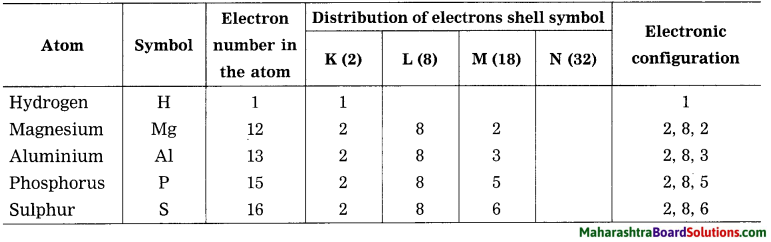
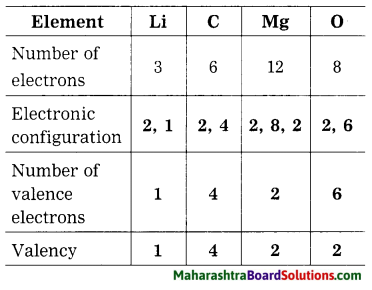
0 : 2, 6 : : Mg : …………….. .
Answer:
2, 8, 2.

Match the columns:

Question 1.

Column ‘A’Column ‘B’
1. Coppera. Low melting point
2. Sodiumb. Liquid
3. Magnesiumc. High melting point
4. Borond. Conduction of heat
e. 2, 8, 2

Answer:

Column ‘A’Column ‘B’
1. Copperd. Conduction of heat
2. Sodiuma. Low melting point
3. Magnesiume. 2, 8, 2
4. Boronc. High melting point

Maharashtra Board Class 8 Science Solutions Chapter 7 Metals and Nonmetals

Question 2.

Column ‘A’Column ‘B’
1. Silvera. Copper + tin
2. Mercuryb. Medicines
3. Platinumc. Thermometer
4. Brassd. Catalyst

Answer:

Column ‘A’Column ‘B’
1. Silverb. Medicines
2. Mercuryc. Thermometer
3.Platinumd. Catalyst
4. Brassa. Copper + tin

Define the following:

  1. Ductility: The property due to which a substance can be drawn into a thin wire is called ductility.
  2. Malleability: The property due to which a substance can be hammered into a thin sheet is called malleability.
  3. Metalloids: The element which shows the properties of metals as well as those of non-metals is called a metalloid.
  4. Corrosion: Gases in the air react with metals in presence of moisture to form metal compounds on its surface, this destroys the metal gradually and is called corrosion.
  5. Alloy: A homogeneous mixture of two or more metals or a homogeneous mixture of metal with non-metals is called alloy.

Maharashtra Board Class 8 Science Solutions Chapter 7 Metals and Nonmetals

Answer the following questions in one sentence:

Question 1.
Name an alloy of copper and tin.
Answer:
An alloy of copper and tin is termed as bronze.

Question 2.
Name a metal which is in liquid state at ordinary temperature.
Answer:
Mercury is in liquid state at ordinary temperature.

Question 3.
Name two metals which are malleable.
Answer:
Iron and aluminium are malleable metals.

Question 4.
Name two metals which are ductile.
Answer:
Gold and silver are ductile metals.

Question 5.
Name two metals which are good conductors of heat.
Answer:
Silver and copper are good conductors of heat.

Maharashtra Board Class 8 Science Solutions Chapter 7 Metals and Nonmetals

Question 6.
Name two metals which are good conductors of electricity.
Answer:
Copper and aluminium are good conductors of electricity.

Question 7.
Name two non-metals which are in solid state at room temperature.
Answer:
Carbon and sulphur are solids at room temperature.

Question 8.
Name two non-metals which are in gaseous state at room temperature.
Answer:
Hydrogen and oxygen are in gaseous state at room temperature.

Question 9.
Name the non-metal having electrical conductivity.
Answer:
Graphite has electrical conductivity.

Question 10.
Name two non-metals which are lustrous.
Answer:
Iodine and diamond are lustrous in nature.

Question 11.
Name two non-metals having high melting points.
Answer:
Carbon and boron melt at high temperature.

Question 12.
State two metals which can be cut easily with a knife.
Answer:
Sodium and potassium are soft metals and can be cut easily with a knife.

Maharashtra Board Class 8 Science Solutions Chapter 7 Metals and Nonmetals

Question 13.
Which is the hardest natural substance?
Answer:
Diamond, which is a form of carbon is the hardest natural substance.

Question 14.
State the property of the metals for which they can be drawn into wires.
Answer:
The property of the metals due to which they can be drawn into wires is called ductility.

Question 15.
State the property of the metals due to which they can be beaten into thin sheets.
Answer:
The property of the metals due to which they can be beaten into thin sheets is called malleability.

Question 16.
Which of the following metals react with cold water? Sodium, iron, copper, potassium.
Answer:
Sodium and potassium metals react with cold water.

Maharashtra Board Class 8 Science Solutions Chapter 7 Metals and Nonmetals

Question 17.
Which of the following metals do not react with cold water or hot water?
Answer:
Aluminium and iron do not react with cold water or hot water.

Question 18.
What are the constituents of stainless steel?
Answer:
Iron with carbon, chromium and nickel are the constituents of stainless steel.

Question 19.
State the term used to express the purity of gold.
Answer:
The purity of gold is expressed in carat.

Question 20.
Name two metals having low melting points and boiling points.
Answer:
Sodium and potassium having low melting points and boiling points.

Question 21.
Name a non-metal which is in liquid state at room temperature.
Answer:
Bromine is in liquid state at room temperature.

Question 22.
State the atomic number and electronic configuration of sodium.
Answer:
Atomic number of sodium: 11.
Electronic configuration of sodium (Na): 2, 8, 1.

Maharashtra Board Class 8 Science Solutions Chapter 7 Metals and Nonmetals

Question 23.
State the atomic number and electronic configuration of aluminium.
Answer:
Atomic number of aluminium: 13.
Electronic configuration of aluminium (Al): 2, 8, 3.

Question 24.
Give two example of metalloids.
Answer:
Metalloids: Arsenic (As),
germanium (Ge), antimony (Sb).

Question 25.
State the atomic number and electronic configuration of nitrogen.
Answer:
Atomic number of nitrogen: 7.
Electronic configuration of nitrogen (N): 2, 5.

Answer the following questions:

Question 1.
A metal can be drawn into a wire. Explain why.
Answer:

  1. The property due to which a substance can be draw into a thin wire is called ductility.
  2. Metals are ductile. Thus, a metal can be draw into a wire.

Maharashtra Board Class 8 Science Solutions Chapter 7 Metals and Nonmetals

Question 2.
A metal can be hammered into a i thin sheet. Explain why.
Answer:

  1. The property due to which a substance can be hammered (or rolled) into a thin sheet without cracking is called malleability.
  2. Metals are malleable. Thus, a metal can be hammered to form a thin sheet.

Question 3.
State the properties of metals.
Answer:

  1. Metals have a lustre.
  2. Metals are malleable. They can be beaten into thin sheets.
  3. Metals are ductile. They can be drawn into wires.
  4. They are good conductors of heat and electricity.
  5. At ordinary temperature, metals are generally solid. (Exception: Mercury is liquid.)
  6. Metals usually have high density.

Question 4.
State the properties of non-metals.
Answer:

  1. Non-metals lack lustre.
  2. As non-metals are brittle, they are not malleable.
  3. They are not ductile.
  4. Non-metals are poor conductors of heat and electricity.
  5. At ordinary temperature, non-metals are in the solid or gaseous state. (Exception: Bromine is liquid.)
  6. Non-metals have low density in the solid state.

Maharashtra Board Class 8 Science Solutions Chapter 7 Metals and Nonmetals

Question 5.
How are metal ions formed? Give two examples.
Answer:
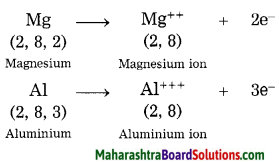
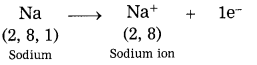
Metals have a tendency to lose their valence electrons to form positively charged ions, called cations.
Examples:
Maharashtra Board Class 8 Science Solutions Chapter 7 Metals and Nonmetals 3
Maharashtra Board Class 8 Science Solutions Chapter 7 Metals and Nonmetals 4

Question 6.
Classify the following elements into metals and non-metals :
Silicon, gold, silver, sulphur, carbon, aluminium, copper and phosphorus.
Answer:
Metals: Gold, silver, aluminium and copper.
Non-metals: Silicon, sulphur, carbon and phosphorus.

Question 7.
How are metal oxides formed? Explain with an example.
Answer:
Metals combine with oxygen in the ’ air to form their oxides.
Metal + Oxygen → Metal oxide
[Note: Reaction/explanation given in the screen are for better understanding of students. The same are not given in the textbook.]
When magnesium burns in air, it combines with oxygen to form magnesium oxide.
2Mg + O2 → 2MgO
Magnesium Oxygen Magnesium oxide

Maharashtra Board Class 8 Science Solutions Chapter 7 Metals and Nonmetals

Question 8.
How will you show that metal oxides are basic in nature?
Answer:
1. Take magnesium oxide in a test S tube. Add water in the test-tube. Shake the test-tube. Test the solution with red and blue litmus paper. Blue litmus paper remains as it is while red litmus paper turns blue. This shows that metal oxides are basic in nature.

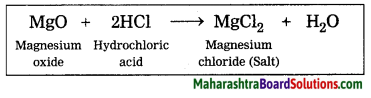
2. Metal oxides react with an acid to form salt and water. Therefore, metal oxides are basic in nature.
Metal oxide + Acid → + Water
Maharashtra Board Class 8 Science Solutions Chapter 7 Metals and Nonmetals 5

Question 9.
How do metals react with acid? Explain with an example.
Answer:
The metals react with dilute acids to form metal salts. Metals liberate hydrogen gas from dilute acids.
Metal + Dilute acid → Metal salt + Hydrogen gas.
Magnesium reacts with dilute HCl to form magnesium chloride and hydrogen gas.

Maharashtra Board Class 8 Science Solutions Chapter 7 Metals and Nonmetals 6

Question 10.
How do metals react with water? Explain with an example.
Answer:
Most metals do not react with cold water. But some metals like sodium and potassium react with cold water to form their hydroxides and hydrogen gas.
Sodium reacts with water to form sodium hydroxide.

Maharashtra Board Class 8 Science Solutions Chapter 7 Metals and Nonmetals 7

Question 11.
How do non-metals react with oxygen? Explain with an example.
Answer:
Non-metals combine with oxyen to form their oxides.
Non-metal + Oxygen → Non-metal oxide
When carbon burns in air, it combines with oxygen to form carbon dioxide.

Maharashtra Board Class 8 Science Solutions Chapter 7 Metals and Nonmetals 8

Question 12.
How will you show that non- metal oxides are acidic in nature?
Answer:
1. Take non-metal oxide in a test tube. Add water in the test tube. Test the solution with blue and red litmus paper. Red litmus paper remains as it is while blue litmus paper turns red. This shows that non¬metal oxides are acidic in nature.

2. The oxides of non-metals are acidic in nature. They react with bases to form soluble salt and water. Therefore, non-metal oxides are acidic in nature.
C + O2 → CO2
CO2 + 2NaOH → Na2CO3 + H2O

Maharashtra Board Class 8 Science Solutions Chapter 7 Metals and Nonmetals

Question 13.
How are non-metal ions formed? Give two examples.
Answer: Non-metals have a tendency to accept electrons in their valence shell to form negatively charged ions called anions.
Examples:
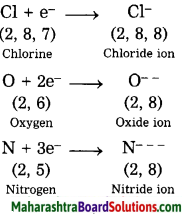
Maharashtra Board Class 8 Science Solutions Chapter 7 Metals and Nonmetals 9

Question 14.
What is meant by noble metals? Give two examples.
Answer:
Some metals like gold, silver, platinum, paladium and rhodium are found in nature in the form of elements. They are not affected by air, water, acids and heat etc. Hence, they are called noble metals.

Give scientific reasons:

Question 1.
Ornaments are generally not made from 24-carat gold.
Answer:

  1. 24-carat gold is considered as gold of 100% purity.
  2. 24-carat pure gold is very soft. 100% pure gold breaks due to pressure or gets bent easily. Therefore, ornaments are generally not made from 24-carat gold.

Maharashtra Board Class 8 Science Solutions Chapter 7 Metals and Nonmetalsc

Question 2.
Ships are painted at frequent intervals.
Answer:
1. The metal sheets of ships are made from iron.
2. Due to salty seawater, the metal sheets of ships get rusted and corroded. Paints contain metals like zinc or magnesium. This prevents the metal surface of the ship coming into direct contact with salty seawater. Therefore, ships are painted at frequent intervals.

Question 3.
Gold and platinum are called noble elements.
Answer:

  1. The metals such as gold and platinum are found in nature in the form of elements.
  2. They are not affected by water, air, acids, heat and also do not take part in chemical reactions. Hence, they are called noble metals.

Explain the following reactions with the help of balanced equations:

Question 1.
Magnesium combines with oxygen.
Answer:
Magnesium combines with oxygen to form magnesium oxide.
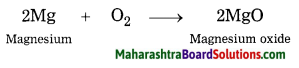
Maharashtra Board Class 8 Science Solutions Chapter 7 Metals and Nonmetals 10

Question 2.
Magnesium oxide reacts with dilute HCl.
Answer:
When magnesium oxide reacts with dilute HCl, magnesium chloride (salt) and water are formed.
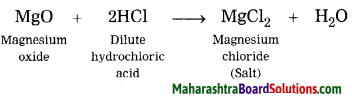
Maharashtra Board Class 8 Science Solutions Chapter 7 Metals and Nonmetals 11

Maharashtra Board Class 8 Science Solutions Chapter 7 Metals and Nonmetals

Question 3.
Magnesium reacts with dilute HCl.
Answer:
When magnesium reacts with dil.
hydrochloric acid, magnesium chloride is formed and hydrogen gas is evolved.
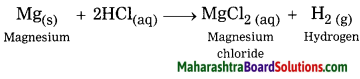
Maharashtra Board Class 8 Science Solutions Chapter 7 Metals and Nonmetals 12

Question 4.
Sodium reacts with water.
Answer:
When sodium reacts with water, sodium hydroxide and hydrogen gas are formed.
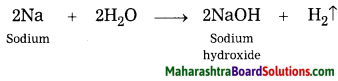
Maharashtra Board Class 8 Science Solutions Chapter 7 Metals and Nonmetals 13

Question 5.
Carbon burns in air.
Answer:
When carbon burns in air, carbon dioxide is formed.
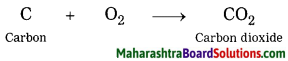
Maharashtra Board Class 8 Science Solutions Chapter 7 Metals and Nonmetals 14

Question 6.
Carbon dioxide reacts with sodium hydroxide.
Answer:
When carbon dioxide reacts with sodium hydroxide, soluble salt sodium ; carbonate and water are formed.
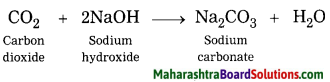
Maharashtra Board Class 8 Science Solutions Chapter 7 Metals and Nonmetals 15

Maharashtra Board Class 8 Science Solutions Chapter 7 Metals and Nonmetals

Question 7.
Carbon dioxide reacts with water.
Answer:
When carbon dioxide reacts with water, carbonic acid is formed.

Maharashtra Board Class 8 Science Solutions Chapter 7 Metals and Nonmetals 16

Question 8.
Sulphur dioxide reacts with water.
Answer:
When sulphur dioxide reacts with water, sulphurous acid is formed.

Maharashtra Board Class 8 Science Solutions Chapter 7 Metals and Nonmetals 17

Question 9.
Sulphur trioxide reacts with water.
Answer:
When sulphur trioxide reacts with water, sulphuric acid is formed.
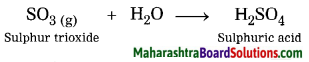
Maharashtra Board Class 8 Science Solutions Chapter 7 Metals and Nonmetals 18

Write short notes:

Question 1.
The noble metals.
Answer:
Some metals like gold, silver, platinum, paladium and rhodium are found in nature in the form of elements. They are not affected by air, water, acids and heat etc. Hence, they are called noble metals.

Uses of Nobel Metals:

  1. Gold, silver and platinum are used to prepare ornaments.
  2. Silver is used in medicines. (It has antibacterial property).
  3. Gold and silver are also used to make metals and few electronic devices.
  4. Platinum, palladium metals are used as catalyst. .

Maharashtra Board Class 8 Science Solutions Chapter 7 Metals and Nonmetals

Question 2.
The purity of gold.
Answer:
1. The purity of gold is measured in carats.
2. Twenty-four carat gold is considered as gold of 100% purity.
3. 24-carat pure gold is very soft. 100% pure gold bends easily or breaks due to pressure. Therefore, copper or silver is added to gold in the necessary proportion (while making ornaments).
4. Generally, 22-carat gold is used in making ornaments.

Percentage of goldCarat
100%24
91.66%22
75%18
58.33%14
50%12
41.66%10

Question 3.
Corrosion.
Answer:
Corrosion: Gases in the air react with metals in presence of moisture to form metal compounds on its surface, this destroys the metal gradually and is called corrosion.

By applying a layer of paint, oil, grease or varnish on the surface of a metal to prevent corrosion. Also plating with noncorroding metal is done. Iron is coated with thin layer of zinc. Due to these processes, the contact of a metal surface with air is lost and corrosion is prevented.

  1. A reddish coloured deposit (rust) is formed on iron by reaction with oxygen gas.
  2. A greenish coloured deposit (copper carbonate) is formed on copper by reaction with carbon dioxide.
  3. A blackish coloured deposit is formed (silver sulphide) on silver.
  4. Corrosion causes damages to car bodies, bridges, iron railings, ships specially those of iron, silver articles and copper vessels.

Maharashtra Board Class 8 Science Solutions Chapter 7 Metals and Nonmetals

Question 4.
Alloys.
Answer:

  1. A homogeneous mixture of two or more metals or of metals and non-metals is called an alloy.
  2. They contain metals in specific proportions.
  3. The physical properties of an alloy are different from those of its constituents, but chemical properties remain the same.
  4. Copper and tin are used to make an alloy called bronze. It is hard and corrosion resistant.
  5. When iron and carbon are mixed, an alloy steel is formed. It is a stronger material.
  6. The alloy, stainless steel is made from iron, carbon, nickel and chromium. It is more durable, clean and does not rust.

Distinguish between the following:

Question 1.
Metals and Non-metals
Answer:

MetalsNon-metals
1. Metals have lustre.1. Non-metals do not have lustre.
2. Metals are malleable.2. Non-metals are not malleable.
3. Metals are ductile.3. Non-metals are not ductile.
4. Metals are good conductors of heat and electricity.4. Non-metals are poor conductors of heat and electricity.
5. At room temperature, metals are in the solid state. (Exception : Mercury is liquid.)5. At room temperature, non-metals are in the solid, or gaseous state. (Exception Bromine. It is in liquid state.)
6. Generally, metals have high densities.6. Generally, non-metals have lower densities.


Maharashtra Board Class 8 Geography Solutions Chapter 1 Local Time and Standard Time

Balbharti Maharashtra State Board Class 8 Geography Solutions Chapter 1 Local Time and Standard Time Notes, Textbook Exercise Important Questions and Answers.

Maharashtra State Board Class 8 Geography Solutions Chapter 1 Local Time and Standard Time

Class 8 Geography Chapter 1 Local Time and Standard Time Textbook Questions and Answers

1. Complete the sentence by selecting the correct option:

Question a.
The earth requires 24 hours for one rotation. In one hour, ……………. .
(a) 5 longitudes will face the sun
(b) 10 longitudes will face the sun
(c) 15 longitudes will face the sun
(d) 20 longitudes will face the sun
Answer:
(c) 15 longitudes will face the sun

Question b.
To calculate the difference between the local times of any two places on the earth, …………. .
(a) the noon time at both the places should be known
(b) the difference in degrees of their longitudes should be known
(c) the difference in standard times of both the places should be known
(d) changes need to be made according to International Date Line.
Answer:
(b) the difference in degrees of their longitudes should be known

Maharashtra Board Class 8 Geography Solutions Chapter 1 Local Time and Standard Time

Question c.
The difference between the local time of any two consecutive longitudes is …………… .
(a) 15 minutes
(b) 04 minutes
(c) 30 minutes
(d) 60 minutes
Answer:
(b) 04 minutes

2. Give geographical reasons for the following:

Question a.
The local time is decided by the noontime.
Answer:
1. When at a particular place, the sun reaches the maximum height in the sky it is assumed that almost half of the daytime is over and this time is considered 12 noon.

2. The time of a particular place as decided by the overhead position of the sun in the sky is considered as the local time of that place.

3. During the rotation of the earth, when a particular longitude comes exactly in front of the sun, it is considered as noontime (12 noon) on that longitude. This noontime is considered as local time of that longitude.

In this way, the local time is decided by the noontime.

Maharashtra Board Class 8 Geography Solutions Chapter 1 Local Time and Standard Time

Question b.
The local time at Greenwich is considered to be the International Standard Time.
Answer:

  1. The International Standard Time has been decided according to 0° longitude.
  2. 0° longitude passes through Greenwich, England.
  3. For an international coordination, it is essential to bring compatibility between the standard times of various countries in the world.

For this purpose, the local time at Greenwich is considered to be the International Standard Time.

Question c.
The standard time of India has been decided by the local time at 82°30′ E longitude.
Answer:

  1. With respect to the longitudinal extent, 82°30’E longitude passes through the middle of India.
  2. The difference between the local time at 82°30’E longitude and the local time at the extreme east and west longitude passing through India is not more than one hour.

Therefore, the standard time of India has been decided by the local time at 82°30’E longitude.

Question d.
Canada has 6 different standard times.
Answer:

  1. The longitudinal extent of Canada is between 52°37′ W and 141° W.
  2. Thus, the difference between the extreme east and west longitude passing through Canada is of 88 degrees.
  3. The difference between the local time at extreme east and west longitude passing through Canada is of 352 minutes i.e. 5 hours and 52 minutes.

Therefore, it is not practically helpful to consider single standard time in Canada. Therefore, for synchronizing the routine activities in the country, Canada has 6 different standard times.

Maharashtra Board Class 8 Geography Solutions Chapter 1 Local Time and Standard Time

3. Answer in brief:

Question a.
If it is 12 noon at 60° E longitude, then explain what would be the time at 30° W longitude.
Answer:
1. The difference between 60° E longitude and 30° W longitude will be of 90 degrees. (The difference of 60 degrees between 0° and 60° E + the difference of 30 degrees between 0° and 30° W = 90 degrees.)

2. Difference in local time = 90 × 4
= 360 minutes.
= 360 minutes ÷ 60 minutes = 6 hours.
3. Longitudes lying to the east of any longitude are ahead of the time of that longitude while those lying to the west are behind.
4. Therefore, if it is 12 noon at 60° E longitude, then it would be 6 a.m. at 30° W longitude, (behind by 6 hours)

Question b.
How is the standard time of a place determined?
Answer:
1. The local time at the longitude passing through the middle of a country/ place is generally considered as a standard time of that country/place.

2. If the difference between the local time at the extreme east and west longitude passing through a country is less than one or two hours, one standard time is considered for a country. Thus, there exists only one standard time in a country having comparatively less longitudinal (east-west) extent.

3. If the difference between the local time at the extreme east and west longitude passing through a country is more than one or two hours, more than one standard time zones are considered for a country. Thus, there exists more than one standard time zones in a country having comparatively more longitudinal (east-west) extent.

Question c.
A football match being played at Sao Paulo, Brazil started in India at 6 a.m. IST. Explain what would be the local time at Sao Paulo?
Answer:
1. Statement: For any longitude lying to the west of particular longitude, the local time decreases by 4 minutes for every longitude. (Sao Paulo is located to the west of India)

2. The difference between the longitudes of Sao Paulo and India = 127°30’.

3. Difference in local time = 127.5 × 4
= 510 minutes.
= 510 minutes ÷ 60 minutes
= 8 hours 30 minutes.

4. Thus, if it is 6 a.m. at India, it would be 9.30 p.m. of the previous day at Sao Paulo. Therefore, if a football match being played at Sao Paulo, Brazil started in India at 6 a.m. 1ST, the local time at Sao Paulo would be 9.30 p.m. of previous day.

Maharashtra Board Class 8 Geography Solutions Chapter 1 Local Time and Standard Time

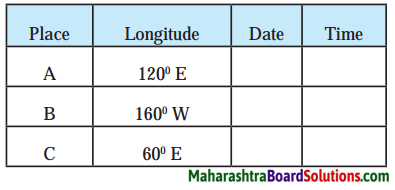
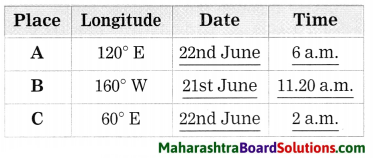
4. Complete the following table:

If it is 10 pm on 21st June at Prime Meridian, write the dates and time at A, B and C in the following table:
(Note: The answer is given directly.)

Question 1.
Maharashtra Board Class 8 Geography Solutions Chapter 1 Local Time and Standard Time 1
Answer:
Maharashtra Board Class 8 Geography Solutions Chapter 1 Local Time and Standard Time 2

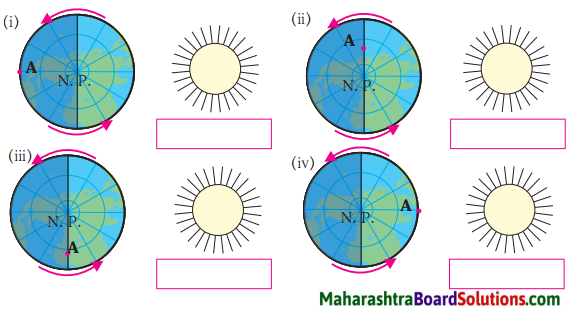
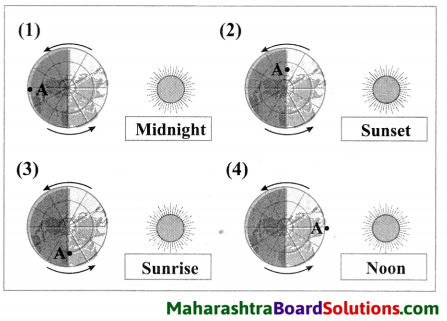
5. Write the situation of place A shown in these diagrams in the boxes below them:

Question 1.
Write the situation of place A shown in these diagrams in the boxes below them
(i) Sunrise
(ii) Midnight
(iii) Noon
(iv) Sunset
Maharashtra Board Class 8 Geography Solutions Chapter 1 Local Time and Standard Time 3
Answer:

Maharashtra Board Class 8 Geography Solutions Chapter 1 Local Time and Standard Time 4.1

Let’s recall: 

Question 1.
Why does the duration of day and night keep changing?
Answer:
The duration of day and night keeps changing as the earth is tilted at an angle of 23.5 degrees.

Maharashtra Board Class 8 Geography Solutions Chapter 1 Local Time and Standard Time

Question 2.
How many longitudes can be drawn on a world map keeping an interval of 1° each?
Answer:
360 longitudes can be drawn on a world map keeping an interval of 10 each.

Question 3.
The apparent movement of the sun from east to west is a result of what?
Answer:
The apparent movement of the sun from east to west is a result of the rotation of the earth from west to east.

Question 4.
What is the direction of the rotation of the earth?
Answer:
The direction of the rotation of the earth is from west to east.

Question 5.
While the earth rotates, how many longitudes face the sun daily?
Answer:
While the earth rotates, 360 longitudes face the sun dally.

Question 6.
At which longitude does the date change?
Answer:
The date changes at 1800 longitude.

Maharashtra Board Class 8 Geography Solutions Chapter 1 Local Time and Standard Time

Question 7.
How was the time measured in olden days?
Answer:
In olden days, the time was measured with the help of the natural events of sunrise and sunset and the instruments like Ghatikapaatra, sand timer, etc.

Question 8.
In present tunes, what are the instruments used for time measurement?
Answer:
In present times, the instruments like watches, calendars, etc. are used for time measurement.

Maharashtra Board Class 8 Geography Solutions Chapter 1 Local Time and Standard Time

Activity:

Question 1.
Look for the actual granny’s clock in Shri Acharya Atre’s poem: “Aajiche Ghadyal” (Granny’s clock). Look for this poem on the internet or in reference book.

Question 2.
Find out the velocity of the earth’s rotation in km/hour.

Class 8 Geography Chapter 1 Local Time and Standard Time Additional Important Questions and Answers

Complete the sentence by selecting the correct option:

Question a.
There are …………. time zones in the world.
(a) 360
(b) 24
(c) 100
(d) 365
Answer:
(b) 24

Maharashtra Board Class 8 Geography Solutions Chapter 1 Local Time and Standard Time

Question b.
Indian Standard Time is …………..
(a) ahead of Greenwich Mean Time by 5 hours 30 minutes
(b) ahead of Greenwich Mean Time by 3 hours 50 minutes
(c) behind Greenwich Mean Time by 5 hours 30 minutes
(d) behind Greenwich Mean Time by 3 hours 50 minutes
Answer:
(a) ahead of Greenwich Mean Time by 5 hours 30 minutes

Examine the following statements and correct the incorrect ones:

Question 1.
Mumbai is located at 73° E longitude.
Answer:
Correct.

Question 2.
In India, three standard times exist.
Answer:
Incorrect.
Correct statement: In India, one standard time exists.

Question 3.
If the difference between two longitudes is of 20 degrees, the difference in their local times will be of four hours.
Answer:
Incorrect.
Correct statement: If the difference between two longitudes is of 20 degrees, the difference in their local times will be of 1 hour and 20 minutes.

Answer the following questions in one sentence each:

Question 1.
Think about it.
Question a.
What is the maximum number of local times that can there be in the world?
Answer:
The maximum number of local times that can be there in the world is 360.

Maharashtra Board Class 8 Geography Solutions Chapter 1 Local Time and Standard Time

Question b.
How many longitudes pass the sun in one hour?
Answer:
15 longitudes pass the sun in one hour.

Question 2.
How much time does the earth take to complete one rotation?
Answer:
The earth takes nearly 24 hours to complete one rotation.

Question 3.
What is meant by the local time of a place?
Answer:
When the sun is directly overhead at a particular place, it is considered as noon at that place and that time is considered as a local time of that place.

Solve the following:

1. Try this:

Question A.
Mashad, a town in Iran, is located on the 60° E longitude. When it is 12 noon at Greenwich, calculate the local time of Mashad town.
Answer:
1. Statement: As we move towards the east of the Prime Meridian, the local time increases by four minutes for every longitude. (Mashad is located to the east of Greenwich.)

2. The difference between the longitudes of Greenwich and Mashad = 60°.

3. Difference in local time
= 60 × 4
= 240 minutes.
= 240 minutes ÷ 60 minutes
= 4 hours. ‘

4. Therefore, when it is noon at Greenwich, it would be 4 p.m. at Mashad. (Ahead of Greenwich Mean Time by 4 hours.)

Maharashtra Board Class 8 Geography Solutions Chapter 1 Local Time and Standard Time

Question B.
Manaus city in Brazil is located on 60° W longitude. What would be the local time at Manaus when it is 12 noon at Greenwich?
Answer:
1. Statement: As we move towards the west of the Prime Meridian, the local time decrease by four minutes for every longitude. (Manaus is located to the west of Greenwich.)

2. The difference between the longitudes of Greenwich and Manaus = 60°.

3. Difference in local time = 60 × 4
= 240 minutes.
= 240 minutes ÷ 60 minutes
= 4 hours.

4. Therefore, when it is noon at Greenwich, it would be 8 a.m. at Manaus. (Behind Greenwich Mean Time by 4 hours.)

2. Can you tell?

Question A.
Mumbai is located at 73° E longitude. Kolkata is located at 88° E longitude. Find the difference between the longitudes of these two cities.
Answer:
Mumbai is located at 73° E longitude. Kolkata is located at 88° E longitude. Therefore, the difference between the longitudes of these two cities would be of (88 – 73 = 15) 15°.

Question B.
If the local time at Mumbai is 3 p.m. then what would be the local time at Kolkata?
Answer:
1. Statement: For any longitude lying to the east of particular longitude, the local time increases by 4 minutes for every longitude.

2. The difference between the longitudes of Mumbai and Kolkata = 15°.

3. Difference in local time = 15 × 4
= 60 minutes.
= 60 minutes -r- 60 minutes = 1 hour.

4. Kolkata is located to the east of Mumbai. Therefore, if it is 3 p.m. at Mumbai, then it would be 4 p.m. at Kolkata. (ahead by 1 hour)

Answer the following questions in brief:

Question a.
Give brief information about the Indian Standard Time.
Answer:
1. The Indian Standard Time (IST) is calculated on the basis of 82°30’E longitude, passing through Mirzapur, near Allahabad in Uttar Pradesh.

2. With respect to longitudinal extent, 82°30′ E longitude passes through the middle of India.

3. When the sun is directly overhead on this longitude, it is considered that it is 12 noon at every place in India. Thus, the local time at 82°30’E longitude is considered as the Standard time of India.

4. The difference between the local time at 82°30′ E longitude and the local time at the extreme east and west longitude passing through India is not more than one hour.

Maharashtra Board Class 8 Geography Solutions Chapter 1 Local Time and Standard Time

Question b.
Give brief information about Universal Standard Time.
Answer:
1. As the standard time is essential for synchronizing routine activities in a country with comparatively more j longitudinal extent, the universal standard i time is essential for an international coordinating between the countries in the world.

2. For this purpose, the local time at Greenwich (Greenwich Mean Time) in England is considered to be the International/Universal Standard Time (UST).

3. With reference to GMT, the differences in standard times of various countries in the world are calculated.

4. The Indian Standard Time is ahead of GMT by 5 hours and 30 minutes. For example, if it is 12 noon at Greenwich, then it would be 5.30 p.m. in India.

Give geographical reasons for the following:

Question a.
In the countries with larger area, it is convenient to use one standard time instead of more than one local times.
Answer:
1. In the countries with larger area, much difference between the local times at extreme east and west longitude passing through the countries is found.

2. In such countries, if more than one local times are followed, it could lead to lots of confusion and chaos.

3. For example, if more than one local times are followed, it will become difficult to synchronize the timetable of railways, airways, etc. Therefore, in countries with comparatively larger area, it is convenient to use one standard time instead of more than one local times.

Study the following map/ figure/graph and answer the following questions:

1. Can you tell?
Study the figure 1.3 given on page 4 of the textbook and answer the following questions:

Question 1.
Between which longitudes does the region experience daytime?
Answer:
The region shown between 90° W and 90° E in the figure experiences daytime.

Question 2.
Which longitudes experience noon and the midnight respectively?
Answer:
0° longitude and 180° longitude experience noon and the midnight respectively.

Maharashtra Board Class 8 Geography Solutions Chapter 1 Local Time and Standard Time

Question 3.
Edward from New Orleans is on which longitude?
Answer:
Edward from New Orleans is on 90° W longitude.

Question 4.
What is the time at Accra city?
Answer:
It is 12 noon at Accra city.

Question 5.
At the same time, what is Sharad from Patna and Yakaito from Japan doing? What time is it in these cities?
Answer:
At the same time, Sharad is returning home from school and Yakaito from Japan is preparing for the night’s sleep. At the same time, it is 5.30 p.m. at Patna and 9.20 p.m. at Japan.

Question 6.
Select any one longitude. Calculate the local time of the longitudes lying 1° to the west and east of this longitude.
Answer:

  1. The selected longitude: 60° E. The local time of the selected longitude is 4 p.m.
  2. The local time of the longitude lying 1° to the west of the selected longitude (59° E) will be 3.56 p.m.
  3. The local time of the longitude lying 1° to the east of the selected longitude (61° E) will be 4.04 p.m.

2. Can you tell?

Study the figure 1.4 given on page 6 of the textbook and answer the following questions:

Question 1.
Considering the longitudinal extent of India, how many longitudes with a difference of 1° can be drawn on a map?
Answer:
Considering the longitudinal extent of India, 29 longitudes with a difference of 1° can be drawn on a map.

Maharashtra Board Class 8 Geography Solutions Chapter 1 Local Time and Standard Time

Question 2.
By how many minutes do two consecutive longitudes differ?
Answer:
Two consecutive longitudes differ by 4 minutes.

Question 3.
What is the value of degrees of longitude at Mirzapur?
Answer:
The value of longitude at Mirzapur is 82°30′.

Question 4.
If it is 8 a.m. at 82°30′ E, what would be the time in their clocks at the following places: Jammu, Madurai, Jaisalmer, Guwahati.
Answer:
If it is 8 a.m. at 82°30′ E, it would be 8 a.m. in their clocks at Jammu, Madurai, Jaisalmer, Guwahati.
(Note: In India, the time at 82°30′ E is considered as standard time of India and therefore the same time will be considered everywhere in India.)

Question 5.
Though the distance between them is more why doesn’t the standard time differ in these places?
Answer:
In India, the time at 82°30′ E is considered as standard time of India and therefore the same time will be considered everywhere in India. Therefore, though the distance between them is more, the standard time doesn’t differ in these places.

Maharashtra Board Class 8 Geography Solutions Chapter 1 Local Time and Standard Time

Thought-Provoking Questions:

1. Think about it.

Question 1.
At the poles, sunrise occurs on one equinox and sunsets on the next equinox. If you happen to be at any of the poles during this time, then what would be the route of the sun in the daytime?
Answer:
At the poles, sun rises on one equinox and sets on the next equinox. If we happen to be at any of the poles during this time, then the following would be the route of the sun in the daytime:
(A) North Pole:
1. The sun will rise at the North Pole approximately on March 21.

2. Approximately, from March 21 to June 21, the sun will rise higher in the sky with each advancing day. It will reach the maximum height approximately on June 21. Approximately, from June 21 to September 21, the sun will start sinking towards the horizon in the sky with each advancing day.

3. The sun will set at the North Pole approximately on September 21.

(B) South Pole:
1. The sun will rise at the South Pole approximately on September 21.

2. Approximately, from September 21 to December 21, the sun will rise higher in the sky with each advancing day. It will reach the maximum height approximately on December 21.

3. Approximately, from December 21 to March 21, the sun will start sinking towards the horizon in the sky with each advancing day.

4. The sun will set at the South Pole approximately on March 21.

Maharashtra Board Class 8 Geography Solutions Chapter 1 Local Time and Standard Time

Question 2.
On which day, would the sun appear at the highest point in the sky?
Answer:

  1. On the North Pole, approximately on June 21, the sun would appear at the highest point in the sky.
  2. On the South Pole, approximately on December 21, the sun would appear at the highest point in the sky.

2. Use your brainpower:

Question 1.
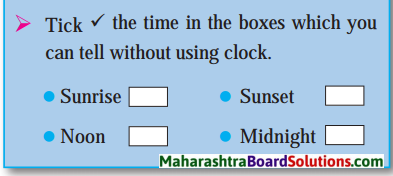
Tick ✓ the time in the boxes which you can tell without using clock.
(Note: The answer is given directly.)
Maharashtra Board Class 8 Geography Solutions Chapter 1 Local Time and Standard Time 5
Answer:
Maharashtra Board Class 8 Geography Solutions Chapter 1 Local Time and Standard Time 6

3. Give it a try.

Question 1.
If it is 8 a.m. in India, what is the time in Greenwich?
Answer:
If it is 8 a.m. in India, it would be 2.30 a.m. in Greenwich.

Maharashtra Board Class 8 Geography Solutions Chapter 1 Local Time and Standard Time

Question 2.
When it is 2 p.m. in India, in which countries would it be 2 p.m. exactly?
Answer:
When it is 2 p.m. in India, it would be 2 p.m. exactly in Sri Lanka.

Question 3.
When it is 9 a.m. in India, what would be the time at 82°30′ W longitude?
Answer:
When it is 9 a.m. in India, it would be 10 p.m. of the previous day at 82°30′ W longitude.

Question 4.
What would be the time at Prime Meridian when a new day starts at 180° longitude?
Answer:
It would be 12 noon at Prime Meridian when a new day starts at 180° longitude.

4. Think about it.

Question 1.
In which of the following countries, does only one standard time exist? (Mexico, Sri Lanka, New Zealand, China)
Answer:
From the given countries, only one time exists in Sri Lanka, New Zealand and China.

Maharashtra Board Class 8 Geography Solutions Chapter 1 Local Time and Standard Time

Question 2.
Why does a country having a large latitudinal extent have only one standard time?
Answer:
The places lying on the same longitude have the same local time. Therefore, a country having a large latitudinal extent have only one standard time.

Question 3.
Which discrepancies will emerge if more than one local times, instead of one standard time are followed in a country with huge longitudinal extent?
Answer:
The following discrepancies will emerge if more than one local times, instead of one standard time are followed in a country with huge longitudinal extent:

  1. It will become difficult to synchronize the timetable of rail transportation, air transportation, etc. in a country.
  2. It will become difficult to synchronize the timings of schools, colleges, banks, libraries, etc. in a country.
  3. We will always have to adjust the time in watch as we move from one place to another in a country.

Maharashtra Board Class 9 History Solutions Chapter 9 Changing Life 1

Balbharti Maharashtra State Board Class 9 History Solutions Chapter 9 Changing Life 1 Notes, Textbook Exercise Important Questions and Answers.

Maharashtra State Board Class 9 History Solutions Chapter 9 Changing Life 1

Class 9 History Chapter 9 Changing Life 1 Textbook Questions and Answers

1. Choose the proper option and rewrite the completed statements:

Question 1.
The first open-heart surgery under the leadership of Dr N Gopinath was successfully performed in the city of _____.
(a) Chennai
(b) Vellore
(c) Hyderabad
(d) Mumbai
Answer:
(b) Vellore

Maharashtra Board Class 9 History Solutions Chapter 9 Changing Life 1

Question 2.
_______is known as the father of the ‘Jaipur foot’.
(a) Dr N. Gopinathan
(b) Dr Pramod Sethi
(c) Dr Mohan Rao
(d) None of the above
Answer:
(b) Dr Pramod Sethi

2. Identify the wrong pair and rewrite the corrected one:

Question 1.
(1) Dr N. Gopinath – open heart surgery
(2) Ramchandra Sharma – a skilled craftsman
(3) Dr Subhash Mukhopadhyaya – test tube baby
(4) Dr Mohan Rao – polio
Answer:
Wrong Pair: Dr Mohan Rao – polio

3. Explain the concepts:

Question 1.
The institution of the family.
Answer:
The institution of family can be explained as follows:

  • During the pre-independence period, the institution of the family was an important identifying feature of Indian society.
  • India was known all over the world as the country of joint families.
  • However, the wave of globalisation has now given an impetus to the system of nuclear families.

Question 2.
Jaipur Foot technology
Answer:
(i) Dr Pramod Sethi designed and manufactured artificial limbs, noses and ears, with the help of the skilled craftsman Ramchandra Sharma.

(ii) These artificial body parts manufactured with the help of the Jaipur foot technology have made it easy for the differently-abled to walk bare-foot on rough surfaces, run, go cycling, work in the fields, climb trees, and even climb mountains, etc.

Maharashtra Board Class 9 History Solutions Chapter 9 Changing Life 1

Question 3.
Urbanization
Answer:
(i) Urbanisation is a process of the concentration of population in a city or urban area. Increasing population is one major reason for urbanisation.

(ii) A few other factors affecting urbanisation are air, water and the economic as well as social organisations necessary for community life.

(iii) In the context of post-independence India, the increase in urban population is also due to factors such as a reduction in the mortality rate, industrialisation, unavailability of means of livelihood in rural areas, job opportunities in cities and the resulting migration.

Question 4.
Changing economic life
Answer:
(i) Earlier, every village was economically self-sufficient. A majority of the villagers were dependent on farming. Farm produce used to be distributed among artisans as payment for their work.
(ii) Now this situation has changed. Rural areas are engaged in agriculture and occupations ancillary to farming while urban society is engaged in non-agricultural production and the service sector.

4. Give reasons:

Question 1.
The campaign for pulse polio immunisation was initiated.
Answer:
The campaign of pulse polio immunisation was initiated because:

  • Before 1978, every year, six Indian infants out of every 10 who were bom faced fatal health problems in the very first year of their birth.
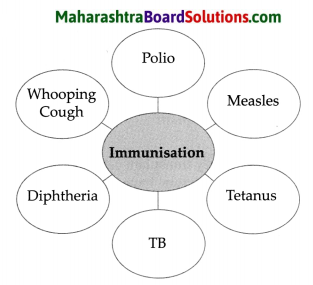
  • The immunisation programme was taken up to overcome the threat of polio, measles, tetanus, TB, diphtheria, and whooping cough.
  • The ‘pulse polio’ immunisation programme started in 1995 has controlled polio.

Question 2.
The Rural Water Supply Scheme was started.
Answer:
The State started the Rural Water Supply Scheme for sinking wells and providing piped water because:

(i) It is necessary to give priority to facilities for public hygiene and health-care. However even today, the rural population faces problems related to year-round provision of drinking water, toilets, open drainage, narrow roads, inadequate electrification and lack of facilities for medical treatment.

(ii) There is a lack of good quality educational facilities from primary level to higher education, centres for recreation and libraries.

(iii) The collective development scheme had an important place in all the first four five year plans of the government of India. The State of Maharashtra registered remarkable achievements under this scheme. By 1971,1677 small dams had also been built.

5. Answer the following questions in 25-30 words:

Question 1.
Which kinds of discrimination does the Constitution prohibit?
Answer:
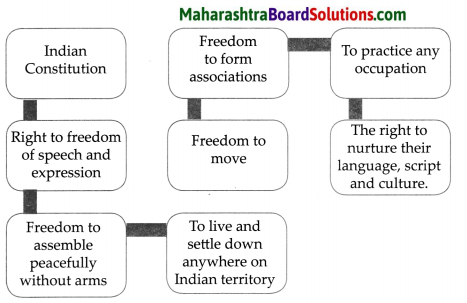
(i) According to our Constitution, all Indians are equal before the law, and they cannot be discriminated against on the basis of religion, race, caste, gender or place of birth.

(ii) All citizens have the right to freedom of speech and expression, freedom to assemble peacefully without arms, freedom to form associations, freedom to move, to live and settle down anywhere on Indian territory and to practice any occupation.

(iii) Indian citizens living anywhere in India enjoy the right to nurture their language, script and culture.

Maharashtra Board Class 9 History Solutions Chapter 9 Changing Life 1

Question 2.
What is the aim of the social welfare programme?
Answer:
(i) The objective to establish the welfare state has been incorporated in the Constitution itself.

(ii) The social welfare programmes aim to make opportunities for full-time employment, health care, education and development available to all Indian citizens. Indian society is riddled with large scale economic, social, educational and cultural inequalities.

(iii) However, it is necessary that opportunities for development reach women, children, the differently-abled, the scheduled castes and tribes as well as other minorities.

(iv) Hence on 14th June 1964, the government of India constituted the Ministry of Social Welfare. Under this ministry, various programmes are implemented for nutrition and child- development, social security and social protection, women’s welfare and development.

Question 3.
What are the challenges facing rural development?
Answer:

(i) In 1961, 82% of India’s population resided in villages. In 1971, the percentage was 80.01%.
(ii) So far, the rural area has shouldered the responsibility of providing food grains and other raw material to urban areas, supplying labour to the industrial sectors of the city, and taking care of natural resources.
(iii) However there are three major challenges with reference to rural development, namely, bringing about economic development, developing facilities to meet social needs and finally bringing about a change of attitude in matters concerning society, culture and ways of thinking.
(iv) It is also equally necessary to expedite irrigation projects and bring about land reforms.

6. Write a brief review of the significant events in the field of public health in India.
Answer:
The Constitution of India states that the primary duty of the government is to raise the people’s standard of living, to ensure proper nutrition and to improve public health. The Ministry of Health and Social Welfare at the Centre helps the state governments in this regard.

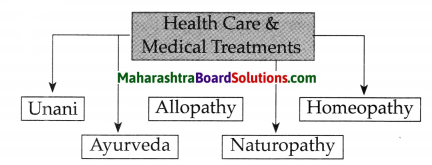
(i) To make primary health services as well as medical care available to rural people, the tribals and the poor was an objective of the Sixth Five Year plan. Efforts were made towards helping people maintain good health by giving recognition to Unani, Homoeopathy, Ayurveda and Naturopathy in addition to Allopathy.

(ii) In 1962, the first successful open heart surgery was performed under the leadership of Dr N. Gopinath at Christian Medical College Hospital at Vellore in Tamil Nadu. Hence, it is no longer necessary to go abroad for such treatment.

(iii) The invention of the ‘Jaipur Foot’ has transformed the lives of the disabled in India.

(iv) Before 1968, if a person lost a leg in an accident, he had to suffer for the rest of his life. In order to remedy the situation, Dr Pramod Sethi designed and manufactured artificial limbs, noses and ears, with the help of the skilled craftsman Ramchandra Sharma.

(v) These artificial body parts manufactured with the help of the Jaipur foot technology have made it easy for the differently-abled to walk bare-foot on rough surfaces, run, go cycling, work in the fields, climb trees, and even climb mountains, etc.

(vi) They save on the expenses on shoes as there is no need for footwear on these artificial limbs. They can bend their legs at the knees and sit cross-legged.

(vii) These feet are also convenient while working in water or under wet conditions.

Class 9 History Chapter 9 Changing Life 1 Additional Important Questions and Answers

Choose the correct option from the given options and rewrite the statements:

Question 1.
On 14th June 1964, the government of India constituted the Ministry of ________.
(a) Home Affairs
(b) Social Justice
(c) Social Welfare
(d) Education
Answer:
(c) Social Welfare

Question 2.
According to the 1971 Census, _____ people in India belonged to scheduled castes.
(a) 21%
(b) 22%
(c) 23%
(d) 24%
Answer:
(b) 22%

Maharashtra Board Class 9 History Solutions Chapter 9 Changing Life 1

Question 3.
UNESCO awarded its international prize for the spread of literacy to ______ in 1972 and tribes.
(a) Gujarat
(b) Bengal
(c) Maharashtra
(d) Karnataka
Answer:
(c) Maharashtra

Question 4.
‘Sinhagad Express’ on the Pune-Mumbai route and ‘ _____’ on the Mumbai-Kolkata route were started which had no class divisions.
(a) Karmabhoomi Express
(b) Howrah Mail
(c) Shalimar Express
(d) Gitanjali Express
Answer:
(d) Gitanjali Express

Question 5.
A _______ was formed to help the development of industry in rural areas.
(a) Village Industries Planning Committee
(b) Co-operative Credit Societies
(c) Industrial Development Association
(d) Rural Industrial Council
Answer:
(a) Village Industries Planning Committee

Question 6.
A settlement smaller than a village is called a _____.
(a) Town
(b) Taluka
(c) Hamlet
(d) Locality
Answer:
(c) Hamlet

Identify and write the wrong pair in the following sets:

Question 1.
(1) Kothari Commission – Agricultural Universities
(2) Durga – Open heart surgery
(3) Pramod Sethi – Artifical limbs
(4) Dr Mohan Rao – Kidney transplant
Answer:
Wrong Pair : Durga – Open heart surgery

Question 2.
(1) Christian Medical College – Tamil Nadu
(2) Vidya Niketan – Chikhaldara
(3) Gitanjali Express – Pune-Mumbai route
(4) First successful artificial conception – Kolkata
Answer:
Wrong Pair : Gitanjali Express – Pune-Mumbai route

Maharashtra Board Class 9 History Solutions Chapter 9 Changing Life 1

Question 3.
(1) Ministry of Social welfare established in -1962
(2) Pulse polio immunisation started – 1995
(3) Maharashtra received a prize for literacy in Maharashtra -1972
(4) Rural Electrification Corporation – 1969
Answer:
Wrong Pair : Ministry of Social welfare established in -1962

Question 4.
(1) Village Industries Planning Committee – Development of Industries in rural areas
(2) Vidya Niketan – residential highschools
(3) Rural water supply schemes – sinking wells
(4) Objective of Sixth Five Year Plan – Advanced technology
Answer:
Wrong Pair : Objective of Sixth five year plan – Advanced technology

Do as Directed:

Complete the table

Question 1.
Answer:

InstitutesLocation
Rural Electrification Co-operative societiesAndhra Pradesh, Gujarat, Karnataka, Maharashtra and Uttar Pradesh
Agriculture UniversitiesRahuri, Akola, Parbhani and Dapoli in Maharashtra
Vidya NiketanSatara, Aurangabad, Nasik and Chikhaldara

Question 2.
Answer:

Rural Community in Pre-Globalisation periodUrban Community in Pre-Globalisation period
Priority to farming and ancillary vocations (jobs)Priority to nonagricultural production and services.
Small in size, homogeneous in terms of language, culture and tradition.Large in size, heterogeneous in terms of languages, cultures and traditions.
Elementary kinds of vocations; trend of sending villagers to cities rather than accommodating outsiders in rural occupations.Large industries, production for global consumption, accommodating outsiders.
Large proportion of vocations running in the familyLess proportion of vocations running in the family.
Priority to the head of the family and to the family as an institution. Joint family system.Family secondary, priority to individuals. Trend towards – nuclear families.

Maharashtra Board Class 9 History Solutions Chapter 9 Changing Life 1

Complete the web diagram

Question 1.
Answer:
Maharashtra Board Class 9 History Solutions Chapter 9 Changing Life 1 2

Question 2.
Answer:
Maharashtra Board Class 9 History Solutions Chapter 9 Changing Life 1 3

Write short notes:

Question 1.
Rural Development
Answer:
(i) In 1961, 82% of India’s population resided in villages.

(ii) In 1971, the percentage was 80.01%. So far, the rural area has shouldered the responsibility of providing food grains and other raw material to urban areas, supplying labour to the industrial sectors of the city, and taking care of natural resources.

(iii) There are three major challenges with reference to rural development, namely, bringing about economic development, developing facilities to meet social needs and finally bringing about a change of attitude in matters concerning society, culture and ways of thinking.

(iv) It is equally necessary to expedite irrigation projects and bring about land reforms.

Question 2.
Social Welfare
Answer:
(i) The objective to establish the welfare state has been incorporated in the Constitution itself. India is the first country in the world to do so.

(ii) The social welfare programmes aim to make opportunities for full-time employment, health care, education and development available to all Indian citizens.

(iii) It is necessary that opportunities for development reach women, children, the differently abled, the scheduled castes and tribes as well as other minorities.

(iv) This was the greatest challenge facing the government during the post-independence period

(v) That is why, on 14 June 1964, the government of India constituted the Ministry of Social Welfare.

(vi) Under this ministry various programmes are implemented for nutrition and child development, social security and social protection, women’s welfare and development.

Maharashtra Board Class 9 History Solutions Chapter 9 Changing Life 1

Question 3.
Kidney transplant
Answer:
(i) Since kidney transplant can now be performed in India, doctors have succeeded in saving patients’ lives. Such surgeries were not so common in India till 1971.

(ii) But in 1971, it was successfully performed at the Christian Medical College hospital at Vellore in Tamil Nadu.

(iii) Dr. Johny and Dr. Mohan Rao transplanted the kidney donated by a living person into the patient’s body.

(iv) Nowadays, patients from underdeveloped countries come to India for such surgeries.

Question 4.
Test-tube baby
Answer:
(i) Right from early times, having a baby is considered to be of utmost importance in the Indian family system.
(ii) The support of ‘test-tube baby’ technology has been available to childless couples since 1978.
(iii) It was under the supervision of Dr. Subhash Mukhopadhyaya that the experiment of the test-tube baby was successfully carried out at Kolkata.
(iv) This was the first successful attempt at artificial conception. A girl named Durga was born.
(v) This technology helped to solve the problem of childless couples who wanted children.

Explain statements with reason:

Question 1.
Rural electrification is essential.
Answer:
Rural electrification is essential because:

(i) Electricity is essential for the development of rural areas. Automatic pumps are needed to water the fields.

(ii) Electricity is also needed to preserve perishable food items such as milk, eggs, fruits, and vegetables, to run fertilizer projects and for fans and TV, and for lights for studying at night.

(iii) During the first five-year plan, electricity had been provided to three thousand villages in India. By 1973, it reached 1,38,646 villages. From 1966, it was decided to supply more electricity for pumps and borewells.

(iv) ‘Rural Electrification Corporation’ was established in 1969.

Question 2.
It is necessary to give special attention to rural areas.
Answer:
(i) It is necessary to give priority to facilities for public hygiene and health-care.

(ii) Even today the rural population faces problems related to year round provision of drinking water, toilets, open drainage, narrow roads, inadequate electrification and lack of facilities for medical treatment.

(iii) There is a lack of good quality educational facilities from primary level to higher education, centres for recreation and libraries. That is why it is necessary to give special attention to rural areas.

Question 3.
The Rural Local Self-Government was empowered with more authority.
Answer:
(i) Keeping in mind the goal of rural development, the collective development scheme has come into force.

(ii) Plans were made for improving farming technology, increasing the area of irrigated land, extending educational facilities, enacting the laws for land reform under this scheme.

(iii) It also aimed at increasing agricultural produce as well as expanding the means of transport, health services and scope for education in the rural areas.

(iv) The government undertook this work through the medium of Gram Panchayats which included the people from all castes and tribes.

(v) To achieve this, the Gram Panchayats, Panchayat Samitis and Zilla Parishads were empowered with more authority.

Maharashtra Board Class 9 History Solutions Chapter 9 Changing Life 1

Read the following passage and answer the questions below:

Public health: The Constitution of India states that ‘ the primary duty of the government is to raise the people’s standard of living, to ensure proper nutrition i and to improve public health. The ministry of health i and Social Welfare at the Centre helps the state governments in this regard. To make primary health services as well as medical care available to rural people, the tribals and the poor was an objective of the Sixth Five Year plan. Efforts were made towards helping people maintain good health by giving recognition to Unani, Homoeopathy, Ayurveda and Naturopathy in addition to Allopathy, Progress in the medical field has made the life of Indians relatively free of health concerns. In 1962, the first successful open heart surgery was performed under the leadership of Dr. N. Gopinath at Christian Medical College Hospital at Vellore in Tamil Nadu, Hence, it is no longer necessary to go abroad for such treatment.

Question 1.
Prepare a concept map of recognised health care and medical treatments in India.
Answer:
Maharashtra Board Class 9 History Solutions Chapter 9 Changing Life 1 1

Question 2.
Who was Dr. N. Gopinath? State his achievement?
Answer:
Dr. N. Gopinath was an experienced surgeon at Christian Medical College Hospital of Vellore under whose leadership an Open Heart Surgery was performed for the first time in India in 1962.

Question 3.
Which disease among children do you consider most threatful? Why?
Answer:
I would consider Polio as one of the most threatening diseases. It renders an infant physically impaired or incapacitated for life. Without physical development, it is not possible for a child to lead a normal life. He/she becomes dependent on others for daily chores and cannot become self-reliant.

Answer the following questions in detail:

Question 1.
State the achievements of Christian Medical College Hospital.
Answer:
(i) In 1962, the first successful open heart surgery was performed under the leadership of Dr. N. Gopinath at Christian Medical College Hospital at Vellore in Tamil Nadu.

(ii) In 1971, kidney transplant was successfully performed at the Christian Medical College hospital at Vellore in Tamil Nadu. Dr Johny and Dr Mohan Rao transplanted the kidney donated by a living person into the patient’s body.

Maharashtra Board Class 9 History Solutions Chapter 9 Changing Life 1

Question 2.
Explain, how ‘Jaipur Foot’ has transformed the lives of the disabled in India?
Answer:
(i) The invention of the ‘Jaipur Foot’ has transformed the lives of the disabled in India. Before 1968, if a person lost a leg in an accident, he had to suffer for the rest of his life.

(ii) In order to remedy the situation, Dr Pramod Sethi designed and manufactured artificial limbs, noses and ears, with the help of the skilled craftsman Ramchandra Sharma.

(iii) These artificial body parts manufactured with the help of the Jaipur foot technology have made it easy for the differently abled to walk bare-foot on rough surfaces, rim, go cycling, work in the fields, climb trees, and even climb mountains, etc.

(iv) They save on the expenses on shoes as there is no need for footwear on these artificial limbs. They can bend their legs at the knees and sit cross-legged.

(v) These feet are also convenient while working in water or wet conditions.

Question 3.
What measures were taken up to uplift the scheduled castes and tribes?
Answer:
(i) According to the 1971 Census, 22% people in India belonged to scheduled castes and tribes.

(ii) Laws were enacted so that they got educational scholarships, and representation in Parliament as well State Assemblies. Some seats are also reserved for them in Government services.

Question 4.
Give an account of the collective development scheme that was featured in the first four Five Year Plans.
Answer:
(i) The collective development scheme had an important place in all the first four five year plans of the government of India.

(ii) The State of Maharashtra registered remarkable achievements under this scheme. For example, ‘Zilla Parishads’ was established in 1962.

(iii) Nutritious diet scheme was launched in 1970-1971. The State also started the ‘Rural Water Supply Scheme’ for sinking wells and providing piped water.

(iv) By 1971,1677 small dams had also been built.

Maharashtra Board Class 8 Science Solutions Chapter 9 Disaster Management

Balbharti Maharashtra State Board Class 8 Science Solutions Chapter 9 Disaster Management Notes, Textbook Exercise Important Questions and Answers.

Maharashtra State Board Class 8 Science Solutions Chapter 9 Disaster Management

Class 8 Science Chapter 9 Disaster Management Textbook Questions and Answers

1. Answer the following in your own words.

Question a.
Explain the relation between continuous rains and landslide. Give reasons.
Answer:
Before the actual landslide, many changes occur in the surrounding hilly ground. The hard rocks develop cracks and crevices. These are natural changes but due to man-made activities, the cracks are widened due to erosion. These cracks make the big rocks to break into smaller stones. The cracks widen further due to excessive rainfall. These rocks further get eroded and they fall down along with soil from the slopes. The entire process is speeded up due to rainwater.

Maharashtra Board Class 8 Science Solutions Chapter 9 Disaster Management

Question b.
Prepare a chart showing ‘Dos’ and ‘don’ts’ at the time of earthquake.
Answer:
At the time of earthquake

DosDon’ts
1. Go in the open grounds.1. Don’t wait in the multi-storeyed buildings. Do not use lifts. Use stairs to descend.
2. Keep the electrical appliances and cooking gas closed.2. Do not stand near buildings, trees or electric wires and poles.
3. Use battery or torch.3. Do not light candles, lantern or match- sticks.
4. Stand silently at one place. Do not panic or get scared.4. Do not sit in uncomfortable posture for a long time.
5. Take protection under some hard covering, especially to protect the head and face. Cover the face.
6. If, in vehicle, find a safe place and stop the vehicle, sit in the vehicle than coming out in open.

Maharashtra Board Class 8 Science Solutions Chapter 9 Disaster Management

Question c.
What are the specifications of an earthquake-proof building?
Answer:
The earthquake-proof building is such that even if the earthquake is caused, it should not cause damage to the buildings due to these earth movements. There are some codes of conduct while constructing such buildings. Advanced technology is used for earthquake resistant construction. The foundation of earthquake-proof building is separated from lower land. The walls are of less weight or they are wooden. The house constructed with special light materials are preferred in earthquake-prone regions.

Question d.
Explain the effects of landslide.
Answer:
1. Mostly rivers originate in the hills and mountains. When there is landslide, the rivers naturally get flooded.
2. The paths of the riverine water changes due to landslide.
3. Waterfalls are displaced from their original positions.
4. New and artificial water reservoirs are created.
5. The falling debris, soil and rocks make the trees at the base of hillside uprooted. All the plant life is lost.
6. The constructions done by the villagers on the slope can be totally damaged due to landslide. There is large scale damage to property and life. In few cases like Malin the entire village was buried due to landslide and accompanied rainfall.
7. Transportation is affected as the roads and railway tracks are blocked due to debris.

Maharashtra Board Class 8 Science Solutions Chapter 9 Disaster Management

Question e.
Is there any relation between dam and earthquake? Explain.
Answer:
There is abundant water stored in the dams. This water column puts additional weight on the ground. Initially there may not be any weight, but later due to construction of dam, suddenly the pressure of this weight is so high that this ground experiences the tension. If such area is already earthquake-prone, then there can be chances of earthquake. According to theory of plate tectonics, there are continuous movements in the earth’s surface. If over such fragile plates, the dams are constructed then the chances of earthquake are enhanced.

2. Give Scientific reasons.

Question a.
It is safer to find shelter under things like a bed, table at the time of earthquake.
Answer:
When earthquake takes place, due to the vibrations in the earth’s surface, there is possibility of the roof and walls of the house to fall. This collapse can cause severe head injury which can be fatal. Thus, one must take shelter below the hard-supporting structures such as bed or table. This precaution can save one’s life.

Question b.
In monsoon, don’t take shelter near hillside.
Answer:
The excessive rainfall can cause landslides. The soil and rocks from the hillside can be pushed down along with the flow of rainwater. This debris slides to the lower heights from the hills. This explains us that taking shelter near the base of the hillside can be disastrous as one can be buried in the debris due to sudden landslide. Therefore, in monsoon, one should not take shelter near hillside.

Maharashtra Board Class 8 Science Solutions Chapter 9 Disaster Management

Question c.
Don’t use lifts at the time of earthquake.
Answer:
Lifts or elevators run on electricity. The electricity supply can be hindered due to earthquake. There may be chances of fire due to short circuit. We may get trapped in the elevator at such times. The building may also collapse due to earthquake. It is always better to use stairs at the time of such calamities, so that one can safely come out of the building. Therefore, it is said that lifts should not be used at the time of earthquakes.

Question d.
The foundation of earthquake- proof building is separated from lower land.
Answer:
The surface of the earth trembles at the time of earthquake. These tremors cause seismic waves which are responsible for the movements of the earth’s surface. The ground thus shakes or it goes up-down. These shocks and waves formed in the interior of the earth spread on the surface in all directions. This causes collapse of the building and other structures on the land.
To prevent such disasters the foundation of earth-quake proof building is separated from lower land.

3. If a crowd gathers at the place of earthquake, what would be the difficulties in relief work?

Question a.
If a crowd gathers at the place of earthquake, what would be the difficulties in relief work?
Answer:
If people flock in crowd, the rescue work will not be possible. The ambulances and the fire engines will not reach the spot where the help is needed. The personnel from disaster management cells cannot thus act in time. It will be difficult to manage the situation and thus such crowding should never be done.

Maharashtra Board Class 8 Science Solutions Chapter 9 Disaster Management

4. Make a list of the institutes and organizations who provide help for disaster managment. Collect more information about their work.

Question a.
Make a list of the institutes and organizations who provide help for disaster management. Collect more information about their work.
Answer:
International government organisations working for disaster management are:
a. The United Nations and its organisations:
1. The Food and Agricultural Organisation of the UN (FAO): It gives early warning of impending food crises, and keep track of global food supply problems.
2. The United Nations Development Programme (UNDP): It helps disaster-prone countries with disaster mitigation, prevention and preparedness measures.
3. The World Food Programme (WFP): It is the main supplier of relief food aid.
4. The World Health Organisation (WHO): It gives global public health leadership by setting standards, monitoring health trends, and providing direction on emergency health issues. WHO’s role is to reduce avoidable loss of life and the burden of disease and disability.

b. The International Committee of the Red Cross ( ICRC): It gives physical rehabilitation to people injured by explosive weapons or other types of incident.

c. The International Federation of Red Cross and Red Crescent Societies ( IFRC): It coordinates and gives international help to victims of natural and technological disasters, to refugees and in health emergencies.

International non-governmental agencies working for disaster management are:
a. International Rescue Committee (IRC): It provides lifesaving care and life-changing help to refugees forced to flee from war or disaster.

b. IMA World Health: It, in collaboration with USAID, the World Bank and many other organisations, builds sustainable health care systems.

c. CARE: It is an organisation fighting global poverty. It works for women and puts efforts to improve their basic education, prevent the spread of HIV by providing awareness among them, give them increase access to clean water and sanitation, expand economic opportunity for them. It provides emergency aid to survivors of war and natural disasters, and helps people rebuild their lives.

Indian organisations and institutes working for disaster management are:
a. National Disaster Response Force (NDRF): The multi-disciplinary, multi-skilled, high-tech force of the NDMA are capable of dealing with all types of natural and man-made disasters.

b. National Disaster Management Authority (NDMA): It lay down the policies, plans and guidelines for Disaster Management to ensure timely and effective response to disasters.

c. National Institute of Disaster Management (NIDM): It has been given the responsibilities for human resource development, capacity building, training, research, documentation and policy advocacy in the field of disaster management.

Maharashtra Board Class 8 Science Solutions Chapter 9 Disaster Management

5. Make a survey of your school according to the plan of disaster management an write the pointwise information.

Question a.
Make a survey of your school according to the plan of disaster managment an write the pointwise information.
Answer:

This an activity based questions. Kindly do it yourself. But make sure to involve the following points in your survey:

  • Primary information of the school: It should include information such as name and address of the school and Head Master, total number of school staff and name and phone numbers of school management members.
  • School disaster management committee: Get the information of the members involved in disaster management committee.
  • Detailed information about school building: Note the number of rooms, classroom, age of the building, types of roofs under this point.
  • Information about school ground: It should include information like distance of ground from the main road, types of play grounds.
  • Daily routine of the school: It should include information like working time of the school, lunch break time for the school.
  • Possible hazards in the school: It should information such as record of past disaster happened in school, current planning for overcoming disasters.
  • Disaster management map of the school: It should have information regarding all the buildings of the school, entrances and exit gates, place of probable danger, safer place at the time of disaster.

Maharashtra Board Class 8 Science Solutions Chapter 9 Disaster Management

6. Are there any possible places of landslide in your area? Collect information from experts.

Question a.
Are there any possible places of landslide in your area? Collect information from experts.
Answer:
This is an activity based question. kindly do it yourself.

7. With the help of the following pictures, explain your role in disaster management.

Question a.
With the help of following pictures, explain your role in the disaster management.
Answer:
Maharashtra Board Class 8 Science Solutions Chapter 9 Disaster Management 1

The picture given is not very clear. It does not indicate the condition of disaster. Therefore, there are two alternatives for this answer.
Option 1 : The boy holds a paper on which is written, ‘I am at risk’! The boy is shocked to read this. Someone has given message to him. He must search that person and help him or her. He should therefore take help from some elder or from police force in such matter.

Option 2 : The boy shown in the picture is in danger. So, he is typing in his I – pad, “I am at Risk”. After receiving this message, someone will help him. It depends upon, to whom is he sending this message. If he sends this message to us, we can immediately try to help him. His message “I am at Risk”, shows that he is in danger and has to be saved.
It is not clear about which disaster is shown in the picture.

Maharashtra Board Class 8 Science Solutions Chapter 9 Disaster Management

Project:

Question 1.
Make a collection of news, photos. and cuttings about landslides and rift collapse.

Question 2.
With the help of Internet, collect information about the latest gadgets and technology to forecast earthquake.

Question 3.
Collect information about NDRF, RPF, CRPF, NCC from Internet.

Question 4.
Discuss- Need of CCTV.

Class 8 Science Chapter 9 Disaster Management Important Questions and Answers

Rewrite the sentences after filling the blanks:

Question 1.
Earthquakes cause ……………. waves leading to movements of the earth’s surface.
Answer:
Earthquakes cause seismic waves leading to movements of the earth’s surface.

Question 2.
The central point of earthquake is the point above the ……………. on the earth’s surface.
Answer:
The central point of earthquake is the point above the epicentre on the earth’s surface.

Maharashtra Board Class 8 Science Solutions Chapter 9 Disaster Management

Question 3.
The accentuation of earthquake is measured in …………… .
Answer:
The accentuation of earthquake is measured in ‘Richter Scale’.

Question 4.
If there is earthquake at the bottom of ocean, it may create ……………… waves.
Answer:
If there is earthquake at the bottom of ocean, it may create tsunami waves.

Question 5.
…………….. is the best device to put off small fires.
Answer:
Stirrup pump is the best device to put off small fires.

Question 6.
………………. of waterfalls occurs due to landslides.
Answer:
Displacement of waterfalls occurs due to landslides.

State whether the following statements are True or False:

Question 1.
Every year nearly 2,400 to 4,000 earthquakes occur on the earth.
Answer:
False. (Every year nearly 12,400 to 14,000 earthquakes occur on the earth.)

Question 2.
Potassium, sodium and calcium are the metals that react with water at high room temperature.
Answer:
False. (Potassium, sodium and calcium are the metals that react with water at normal room temperature.)

Question 3.
A fire caused due to electrical components is extinguished by fire extinguishers like carbon dioxide are used.
Answer:
True.

Maharashtra Board Class 8 Science Solutions Chapter 9 Disaster Management

Question 4.
Indiscriminate cutting of the trees results in improvement of soil quality.
Answer:
False. (Indiscriminate cutting of the trees results in soil erosion.)

Question 5.
Landslide results in loss of plant life.
Answer:
True.

Match the column:

Question 1.

Column ‘A’Column ‘B’
1. Class A firea. Electrical components
2. Class B fireb. Gaseous substances
3. Class C firec. Chemical substances
4. Class D fired. Liquid substances
5. Class E firee. Solid substances

Answer:

Column ‘A’Column ‘B’
1. Class A firee. Solid substances
2. Class B fired. Liquid substances
3. Class C fireb. Gaseous substances
4. Class D firec. Chemical substances
5. Class E firea. Electrical components

Maharashtra Board Class 8 Science Solutions Chapter 9 Disaster Management

Question 2.

Column ‘A’Column ‘B’
1. Earthquakea. Formation of artificial water reservoir
2. Tsunamib. Wildlife lost
3. Forest firec. Loss of coastal regions
4. Landslided. Change in the level of groundwater-table

Answer:

Column ‘A’Column ‘B’
1. Earthquaked. Change in the level of groundwater-table
2. Tsunamic. Loss of coastal regions
3. Forest fireb. Wildlife lost
4. Landslidea. Formation of artificial water reservoir

Name the following:

Question 1.
Modern equipment to get prior intimation about earthquake:
Answer:

  1. Laser ranging
  2. Very long baseline
  3. Geiger counter
  4. Creep meter
  5. Strain meter
  6. Tide gauge
  7. Tilt meter
  8. Volumetric strain gauge.

Maharashtra Board Class 8 Science Solutions Chapter 9 Disaster Management

Question 2.
Some code of conduct made by Indian Standard Institute for construction of buildings:
Answer:

  1. IS 456
  2. IS 1893
  3. IS 13920

Question 3.
The subcommittees of School Disaster Management.
Answer:

  1. Fire extinguisher
  2. Awareness
  3. Instructions
  4. Traffic management
  5. Safety
  6. Communication committee.

Answer the following questions in one sentence:

Question 1.
Which is the instrument or machine that records the intensity of earthquake?
Answer:
The machine/Instrument which records the earthquakes is called ‘Seismograph’ or ‘Seismometer’.

Maharashtra Board Class 8 Science Solutions Chapter 9 Disaster Management

Question 2.
Which is the most common and effective solution for extinguishing fire ?
Answer:
Spraying water is the most common and effective solution for extinguishing fire.:

Question 3.
Which type of fires can be extinguished by the method of suppressing?
Answer:
To extinguish the fires caused due to electricity or oil, the method of suppressing the fire can be used.

Question 4.
Which metals react with water at normal room temperature?
Answer:
Combustible metals like potassium, sodium and calcium, react with water at normal room temperature.

Question 5.
Which metals react with water at higher temperatures?
Answer:
Magnesium, aluminum and zinc react with water at high temperatures.

Question 6.
Which institutes have launched a program to forecast the landslides and its effects?
Answer:
The Government of India in collaboration with Indian Mountaineering Institute and International Centre for Integrated Mountain Development has launched a program to forecast the landslides and its effects.

Give scientific reasons:

Question 1.
The electric mains are shut off immediately after the earthquake.
Answer:
There is increased possibility of short circuit after the earthquake. This may result in fire. The earthquake has already – brought the disaster. To prevent further destruction, the electric mains are shut off immediately after the earthquake.

Maharashtra Board Class 8 Science Solutions Chapter 9 Disaster Management

Write short notes:

Question 1.
Types of fire:
Answer:
There are five types of fire. This division is based on two criteria, viz.
(i) Which substance is being burnt, (ii) What is the method of extinguishing it.
1. Class A Fire: Commonly inflammable solid things such as wood, clothes, coal, papers can be burnt by this type of fire. This fire is extinguished by spraying water over it. This is also called cooling out. Water is effectively used to put off class A fire.

2. Class B Fire: Flammable liquid substances such as petrol, oil, varnish, solvents, cooking oil, paints, etc. catch fire and it is called class B fire. Since these substances are lighter than water, they can be extinguished only by foaming fire extinguishers.

3. Class C Fire: The fire caused due to gaseous substances is called class C fire. Domestic gas (L.P.G.) and acetylene can cause such kind of fire.

4. Class D Fire: Combustible metals catch class D fire. Metals such as potassium, sodium and calcium, can react with water at normal room temperature whereas magnesium, aluminium and zinc react with water at high temperature. When both these groups combine with water, it causes explosion.

5. Class E Fire: When electric components are subjected to fire, they form class C fire. Such fires can be caused by short circuit or due to problems in electric fittings. Such fire is extinguished with the help of carbon dioxide and non-conductive fire extinguishers.

Maharashtra Board Class 8 Science Solutions Chapter 9 Disaster Management

Question 2.
Disaster relief – planning.
Answer:
Anyone can face disaster at any time. The only way to tackle with such disasters is to keep preparedness to deal with any calamity. Schools, colleges and various offices need to chalk out a detailed planning in case of possible disasters. With this purpose in mind, disaster relief planning is done.

E.g. In the disaster relief planning for school, primary information of the school, the structure of School Disaster Management Committee, detailed information about school building and information about school ground, daily routine of the school such as at what time the school starts and what time does it end, the possible hazards in the school, and disaster management map of the school is included.

Answer the following questions:

Question 1.
What are the different ways to extinguish fire? Write briefly about them.
Answer:
There are three main methods to extinguish the fire. These methods are used to stop the spread of fire and to avoid the financial and other losses.
1. Cooling out by use of water: Water is easily available and can be used for putting off fire instantly. Due to spraying of water, there is cooling effect produced which helps in reducing the loss by fire. Fire can be easily controlled by water.

2. Suppressing the fire by covering it: When there is a fire due to electricity or oil it has to be controlled by covering the fire by sand or soil. When the froth is spread on the fire, there is no contact between air and fire. This puts off the fire and stops the spread of fire caused due to oil.

3. Keep away Flammable Substances: Care is taken to keep away all flammable substances from the fire. Wooden articles and inflammable substances are kept in such as way the fire will not engulf it. Stirrup pumps are used to put off small fires by which the water is spread in all directions around the fire.

Maharashtra Board Class 8 Science Solutions Chapter 9 Disaster Management

Question 2
What are the safety measures and precautions to stop the fire?
Answer:

  1. Switching off the regulator of cooking gas cylinder when not in use. Put off the connections of all electrical appliances when not in use.
  2. If there is fire, call others immediately for help. Take help of others by calling them. Also help others who are in need to save their lives from fire.
  3. Get help from fire brigade by calling phone number 101.
  4. Know details about working of the fire extinguishing apparatus.
  5. Give first aid to the victim of fire. Seek immediate medical help,

Question 3.
What are the causes of landslide?
Answer:

  1. Various types of natural disasters like earthquakes, tsunami, heavy rains, storms, floods can result into landslide.
  2. The indiscriminate cutting down of the trees can result into soil erosion. Soil erosion in turn results into landslide.
  3. The construction of roads, bridges, railway tracks, etc. on the mountain slopes result into lot of digging. Such activities make soil cover loose. From the slopes the soil and rocks then can slide easily. This results into landslides.

Draw a well labelled diagrams:

Question 1
Seismometer/Secismograph.
Answer:
Maharashtra Board Class 8 Science Solutions Chapter 9 Disaster Management 2

Question 2.
Focal point and epicenter or earthquake.
Answer:
Maharashtra Board Class 8 Science Solutions Chapter 9 Disaster Management 3

Open-Ended Questions:

Question 1.
Have you at any time faced with any disaster? What were your experiences during such condition? How did you get rescued?
Answer:
Students should write their own experiences about such incidents if any.

Maharashtra Board Class 8 Science Solutions Chapter 9 Disaster Management

Question 2.
In Maharashtra where do the traffic jams occur due to landslides? Make a list of such places. Why does the landslide occur at those places only? Discuss in the classroom and suggest preventive measures.
Answer:
In Maharashtra, the landslides are very common in the hilly regions. The traffic is suspended often during rainy season when such calamity strikes. Malshej, Khandala, Kasara are some of the Ghats which are very prone to land-slide. On the tracks of Konkan railway, the landslides are very common during heavy downpour.

The regions where more landslides occur have many constructions and large scale deforestation. The traffic of Konkan railway comes to standstill after such landslide. Moreover, during heavy monsoon days, the speed of the running trains is kept very slow. The soil structure is also responsible for such landslides.

Preventive measures: There should be wire meshing done across the sides of the roads and railway tracks so that the collapsed rocks and other debris does not obstruct the traffic. Tree plantation should be carried out to prevent loosening of the soil and rock. It will also help in preventing the soil erosion.

Maharashtra Board Class 8 Science Solutions Chapter 5 Inside the Atom

Balbharti Maharashtra State Board Class 8 Science Solutions Chapter 5 Inside the Atom Notes, Textbook Exercise Important Questions and Answers.

Maharashtra State Board Class 8 Science Solutions Chapter 5 Inside the Atom

Class 8 Science Chapter 5 Inside the Atom Textbook Questions and Answers

1. Answer the following.

Question a.
What is the difference in the atomic models of Thomson and Rutherford?
Answer:

Thomson’s atomic modelRutherford’s atomic model
1. According to Thomson’s atomic model, the negatively charged electrons are embedded in a gel of positive charge.1. According to Rutherford’s atomic model the negatively charged electrons revolve around the nucleus.
2. Atom is homogenous sphere of positive charge.2. The positive charge is in the nucleus of the atom.

Question b.
What is meant by valency of an element? What is the relationship between the number of valence electron and valency?
Answer:
Valency: The capacity of an ; element to combine with another element is known as valency.
Valence electrons: The electrons in the outermost shell of an atom of an element are called valence electrons.
Helium and neon, atoms of both these gaseous element do not combine with any other atom. These elements are chemically inert, i.e. their valency is zero.

Helium atom contains two electrons, indicates that the outermost shell of helium has an electron duplet. The valence shell of neon is completely filled, i.e. neon has an electron octet. Similarly argon contains eight electrons in the valence shell, i.e. argon has an electron octet. It is confirmed that the valency is zero when electron octet (or duplet) is complete.

Atoms of all the elements except inert gases have tendency to combine with other atoms, i.e. they have a non zero valency. The molecules formed by combination with hydrogen (E.g. H2, HCl) that valency of hydrogen is one. The electronic configuration of hydrogen shows that there is one electron less than the complete duplet state. This number ‘one’ matches with the valency of hydrogen which is also one.

It means that there is relationship between the valency of an element and the number of electrons in its valence shell.

Maharashtra Board Class 8 Science Solutions Chapter 5 Inside the Atom

Question c.
What is meant by atomic mass i number? Explain how the atomic number and mass number of carbon are 6 and 12 respectively.
Answer:
The total number of protons and neutrons in the nucleus of the atom is called the atomic mass number. The atomic number, i.e. the proton number of carbon is 6 and the mass number is total number of protons and neutrons in the carbon, i.e. 6 protons + 6 neutrons = 12. Therefore, the atomic number and mass number of carbon are 6 and 12 respectively.

Question d.
What is meant by subatomic particle? Give brief information of three subatomic particles with reference to electrical charge, mass and location.
Answer:
A particle which is a constituent of an atom hence smaller than the atom is called subatomic particle.
An atom is formed from the nucleus and the extranuclear part. These contain three types of subatomic particles.
The nucleus contains two types of subatomic particles together called nucleons. Protons and neutrons are the two types of nucleons or subatomic particles and electrons are subatomic particles in the extra nuclear part.

1. Proton (p): Proton is a positively charged subatomic particle in the atomic nucleus. The positive charge on the nucleus is due to the proton in it. A proton is represented by the symbol ‘p’. Each proton carries a positive charge of +1e. (1e = 1.6 × 10⁻¹⁹ coulomb). When total positive charge on the nucleus is expressed in the unit ‘e’, its magnitude is equal to the number of proton in the nucleus.
The mass of one proton is approximately lu (1 Dalton).
(1u = 1.66 × 10⁻²⁷g) (The mass of one hydrogen atom is also approximately lu.)

2. Neutron (n): Neutron is an electrically neutral subatomic particle and is denoted by the symbol ‘n’. The number of neutron in the nucleus is denoted by the symbol ‘N’ Atomic nuclei of all the elements except hydrogen with atomic mass lu, contain neutrons. The mass of a neutron is approximately lu, which is almost equal to that of a proton.

3. Electron (e): Electron is a negatively charged subatomic particle and is denoted by the symbol ‘e-’. Each electron carries one unit of negative charge (-1e). Mass of an electron is 1800 times less than that of a hydrogen atom. Therefore the mass of an electron can be treated as negligible. Electron in the extranuclear part revolve in the discrete orbits around the nucleus. The energy of an electron is determined by the shell in which it is present.

Maharashtra Board Class 8 Science Solutions Chapter 5 Inside the Atom

2. Give scientific reasons:

Question a.
All the mass of an atom is concentrated in the nucleus.
Answer:

  1. The nucleus of an atom contains protons and neutrons.
  2. The electrons revolve around the nucleus.
  3. The mass of an electron is negligible compared to that of a proton or a neutron.
  4. Hence, the mass of an atom depends mainly on the number of protons and neutrons. Therefore, practically all the mass of an atom is concentrated in the nucleus.

Question b.
Atom is electrically neutral.
Answer:

  1. An atom is made of two parts, viz. the nucleus and the extranuclear part.
  2. The nucleus is positively charged. The positive charge on the nucleus is due to protons.
  3. The extranuclear part of an atom is made of negatively charged electrons.
  4. In an atom, the number of protons is equal to the number of extranuclear electrons.
  5. The magnitude of the positive charge on the nucleus equals the magnitude of the negative charge on the electrons. As the opposite charges are balanced, the atom is electrically neutral.

Question c.
Atomic mass number is a whole number.
Answer:

  1. The total number of protons and neutrons in the nucleus of the atom is called the atomic mass number (A).
  2. As protons and neutrons are whole numbers, the atomic mass number is also a whole number.

Maharashtra Board Class 8 Science Solutions Chapter 5 Inside the Atom

Question d.
Atoms are stable though negatively charged electron are revolving within it.
Answer:

  1. The entire mass of the atom is concentrated in the nucleus and the positively charged nucleus at centre of an atom.
  2. The negatively charged electrons revolve around the nucleus.
  3. The total negative charge on all the electron is equal to positive charge on the nucleus. As the opposite charges are balanced, the atom is stable.

3. Define the following terms.

Question a.
Atom:
Answer:
An atom is the smallest particle of an element which retains its chemical identity in all physical and chemical changes.

Question b.
Isotope
Answer:
Atoms of the same element having the same atomic number, but different atomic mass numbers are called isotopes.

Question c.
Atomic number
Answer:
The number of electrons or protons in an atom is called the atomic number. It is denoted by Z.

Question d.
Atomic mass number
Answer:
The total number of protons and neutrons in the nucleus of the atom is called the atomic mass number. It is denoted by A.

Maharashtra Board Class 8 Science Solutions Chapter 5 Inside the Atom

Question e.
Moderator in nuclear reactor
Answer:
The substance which reduces the speed of fast-moving neutrons produced in a fission is called a moderator.

4. Draw a neal labelled diagram.

Question a.
Explain Rutherford’s scattering experiment.
Answer:
Maharashtra Board Class 8 Science Solutions Chapter 5 Inside the Atom 1

Alpha particles emitted by radioactive element bear a positive charge. Rutherford bombarded alpha particles through a very thin gold foil. He observed the path of α – particles by means of a fluorescent screen around the gold foil. It was expected that

  1. Most of the alpha particles passed through the gold foil without any deviation.
  2. Some alpha particles were deflected from their path through small angles.
  3. A few alpha particles were scattered at large angles.
  4. A still smaller number of same sign particles get deflected through a larger angle and one a-particle out of 20000 bounced back in the direction opposite to the original path.

Question b.
Thomson’s atomic model.
Answer:
Thomson’s plum pudding model of atom:
Maharashtra Board Class 8 Science Solutions Chapter 5 Inside the Atom 2

  1. According to Thomson’s model the positive charge is distributed throughout the atom and the negatively charged electron: are embedded in a gel of positive charge (a plum pudding model).
  2. The distributed positive charge is balanced by the negative charge on the electrons. Therefore the atom becomes electrically neutral.

Question c.
Diagrammatic sketch of electronic configuration of magnesium (Atomic number 12).
Answer:
Maharashtra Board Class 8 Science Solutions Chapter 5 Inside the Atom 3.1

Question d.
Diagrammatic sketch of electronic configuration of argon (Atomic number 18).
Answer:
Maharashtra Board Class 8 Science Solutions Chapter 5 Inside the Atom 4

5. Fill in the blanks.

Question 1.
Electron, proton, neutron are the types of ………… in an atom.
Answer:
Electron, proton, neutron are the types of subatomic particles in an atom.

Maharashtra Board Class 8 Science Solutions Chapter 5 Inside the Atom

Question 2.
An electron carries a ……………. charge.
Answer:
An electron carries a negative charge.

Question 3.
The electron shell ………….. is nearest to the nucleus.
Answer:
The electron shell K is nearest to the nucleus.

Question 4.
The electronic configuration of magnesium is 2, 8, 2. From this it is understood that the valence shell of Magnesium is …………….. .
Answer:
The electronic configuration of magnesium is 2, 8, 2. From this it is understood that the valence shell of Magnesium is M.

Question 5.
The valency of hydrogen is one as per the molecular formula H2O. Therefore valency of ‘Fe’ turns out to be ………….. as per the formula Fe2O3.
Answer:
The valency of hydrogen is ‘one’ as per the molecular formula H2O. Therefore valency of ‘Fe’ turns out to be 3 as per the formula Fe2O3.

6. Match the pairs.

Question 1.

Column IColumn II
1. Protona. Negatively charged
2. Electronb. Neutral
3.  Neutronc. Positively charged

Answer:

Column IColumn II
1. Protonc. Positively charged
2. Electrona. Negatively charged
3. Neutronb. Neutral

Maharashtra Board Class 8 Science Solutions Chapter 5 Inside the Atom

7. Deduce from the datum provided.

Question 1.
Maharashtra Board Class 8 Science Solutions Chapter 5 Inside the Atom 5
Answer:
1. There are 12 neutrons in the sodium \(\left({ }_{11}^{23} \mathrm{Na}\right)\).
(N = A – Z) 23 – 11 = 12
2. Atomic mass number of \({ }_{6}^{14} \mathrm{C}\) is 14.
3. There are 17 protons in chlorine \(\left({ }_{37}^{17} \mathrm{Cl}\right)\)

Project:

Explain the atomic models using the material such as old C.D., balloon, thread, marbles, etc.

Class 8 Science Chapter 5 Inside the Atom Additional Important Questions and Answers

Rewrite the sentences after filling the blanks:

Question 1.
An atom is electrically ……………. .
Answer:
An atom is electrically neutral.

Question 2.
Except hydrogen, the nuclei of all atoms contain ………….. .
Answer:
Except hydrogen, the nuclei of all atoms contain neutrons.

Question 3.
\({ }_{6}^{12} \mathrm{C}\), …………… and …………. are isotopes of carbon.
Answer:
\({ }_{6}^{12} \mathrm{C}\), \({ }_{6}^{13} \mathrm{C}\) and \({ }_{6}^{14} \mathrm{C}\) are isotopes of carbon.

Question 4.
An atom has 11 protons and …………. neutrons and hence its atomic mass number is 23.
Answer:
An atom has 11 protons and 12 neutrons and hence its atomic mass number is 23.

Question 5.
The element ………….. has two electrons in the K shell, but it is a noble gas.
Answer:
The element helium has two electrons in the K shell, but it is a noble gas.

Question 6.
Isotopes of the element have the same ……….. properties.
Answer:
Isotopes of the element have the same chemical properties.

Maharashtra Board Class 8 Science Solutions Chapter 5 Inside the Atom

Question 7.
Electrons must absorb …………….. to transit between orbits.
Answer:
Electrons must absorb energy to transit between orbits.

Question 8.
……….. discovered the electron.
Answer:
J. J. Thomson discovered the electron.

Question 9.
∝ – particles have ………….. charge.
Answer:
∝ – particles have positive charge.

Question 10.
Electrons revolve around the …………….. in certain discrete orbits.
Answer:
Electrons revolve around the nucleus in certain discrete orbits.

Question 11.
The shell-wise distribution of electrons is called the ………………… .
Answer:
The shell-wise distribution of electrons is called the electronic configuration.

Question 12.
Democritus termed the smallest particles of matter as …………… .
Answer:
Democritus termed the smallest particles of matter as atoms.

Question 13.
………………. discovered neutron.
Answer:
James Chadwick discovered neutron.

Maharashtra Board Class 8 Science Solutions Chapter 5 Inside the Atom

Question 14.
Electrons revolve around the nucleus in paths called ………….. .
Answer:
Electrons revolve around the nucleus in paths called orbits.

Question 15.
The second shell has the capacity of ……………… .
Answer:
The second shell has the capacity of 8 electrons.

Question 16.
Electrons in the ………….. shell have minimum energy.
Answer:
Electrons in the K or first shell have minimum energy.

Question 17.
Electrons in an atom occupy shells in increasing order of …………… .
Answer:
Electrons in an atom occupy shells in increasing order of energy.

Question 18.
Atomic masses are measured in a unit called …………… .
Answer:
Atomic masses are measured in a unit called dalton.

Question 19.
According to the atomic model of …………….., electrons are embedded in a gel of positive charge.
Answer:
According to the atomic model of Thomson, electrons are embedded in a gel of positive charge.

Maharashtra Board Class 8 Science Solutions Chapter 5 Inside the Atom

Question 20.
All atoms, except ………….. contain neutrons in their nuclei.
Answer:
All atoms, except normal hydrogen contain neutrons in their nuclei.

Question 21.
The maximum capacity of the M shell is ………………… electrons.
Answer:
The maximum capacity of the M shell is 18 electrons.

Question 22.
The atom of the element ……………. has eight electrons in the outermost shell.
Answer:
The atom of the element neon has eight electrons in the outermost shell.

Rewrite the following statements selecting the correct options:

Question 1.
The symbol A is used to denote the …………. .
(a) atomic number
(b) atomic radius
(c) atomic mass number
(d) atomic mass
Answer:
(c) atomic mass number

Question 2.
The existence of isotopes is due to the presence of different number of …………….. .
(a) electrons
(b) protons
(c) neutrons
(d) positrons
Answer:
(c) neutrons

Maharashtra Board Class 8 Science Solutions Chapter 5 Inside the Atom

Question 3.
In the nucleus of a sodium atom (\({ }_{11}^{23} \mathrm{Na}\)), there are ……………… neutrons.
(a) 11
(b) 12
(c) 10
(d) 9
Answer:
(b) 12

Question 4.
Isotopes of an element have the same number of …………….. .
(a) neutrons
(b) nucleons
(c) electrons
(d) atoms
Answer:
(c) electrons

Question 5.
The great Indian philosopher ………….. proposed that matter is made up of invisible tiny particles.
(a) Aryabhatta
(b) Kanad
(c) Bhaskaracharya
(d) Chanakya
Answer:
(b) Kanad

Question 6.
The maximum capacity of the M shell is …………… electrons.
(a) 2
(b) 8
(c) 18
(d) 32
Answer:
(c) 18

Question 7.
The mass of the electron is …………….. times less than that of a hydrogen atom.
(a) 1800
(b) 8100
(c) 1550
(d) 1600
Answer:
(a) 1800

Maharashtra Board Class 8 Science Solutions Chapter 5 Inside the Atom

Question 8.
The L shell is the valence shell in …………. .
(a) hydrogen
(b) chlorine
(c) oxygen
(d) sodium
Answer:
(c) oxygen

Question 9.
The M shell is the valence shell in ……………….. .
(a) fluorine
(b) neon
(c) carbon
(d) chlorine
Answer:
(d) chlorine

Question 10.
The N shell is the valence shell in ………….. .
(a) fluorine
(b) chlorine
(c) bromine
(d) helium
Answer:
(c) bromine

Question 11.
The maximum capacity of the N shell is ……………. electrons.
(a) 2
(b) 32
(c) 18
(d) 8
Answer:
(b) 32

Question 12.
The maximum number of electrons that can be accommodated in the third orbit is ………… .
(a) 3
(b) 8
(c) 32
(d) 18
Answer:
(d) 18

Question 13.
Rutherford alpha-particle scattering experiment was responsible for the discovery of the ………………. .
(a) atomic nucleus
(b) proton
(c) electron
(d) atomic mass
Answer:
(d) atomic mass

Question 14.
Isotopes of element have …………….. .
(a) different atomic numbers and different atomic mass
(b) different atomic numbers but the same atomic mass number
(c) the same atomic number but different atomic mass numbers
(d) the same atomic number and the same atomic mass number
Answer:
(c) the same atomic number but different atomic mass numbers

Maharashtra Board Class 8 Science Solutions Chapter 5 Inside the Atom

Question 15.
The nucleus of an atom contains 19 protons and 21 neutrons. The atomic mass number of the element is ………….. .
(a) 19
(b) 21
(c) 40
(d) 39
Answer:
(c) 40

Question 16.
The nucleus of an atom contains 18 protons and 22 neutrons. The atomic number of the element is ……………… .
(a) 18
(b) 40
(c) 22
(d) 4
Answer:
(a) 18

Question 17.
When writing the symbol of its …………… and ………….. are written.
(a) atomic number, atomic mass number
(b) protons, electrons
(c) protons, neutrons
(d) atomic number, electrons
Answer:
(a) atomic number, atomic mass number

Question 18.
The particles in the atomic nucleus are …………….. .
(a) protons and electrons
(b) electrons
(c) electrons and neutrons
(d) protons and neutrons
Answer:
(d) protons and neutrons

State whether the following statements are True or False:

Question 1.
An atom as a whole is electrically neutral
Answer:
True.

Question 2.
The mass of an atom is distributed evenly within it.
Answer:
False. (The mass of atom is not distributed evenly, practically all the mass is concentrated in the nucleus.)

Question 3.
The electron has the same mass as that of the proton.
Answer:
False. (The mass of the electron is much less than that of the proton.)

Question 4.
The electron in the K shell has maximum energy.
Answer:
False. (The electrons in the K shell has minimum energy.)

Maharashtra Board Class 8 Science Solutions Chapter 5 Inside the Atom

Question 5.
Isotopes have same atomic number but different atomic mass number.
Answer:
True.

Question 6.
Matter is composed of molecules and molecules are made of atoms.
Answer:
True.

Question 7.
In India, total 22 nuclear reactors in eight places are functioning.
Answer:
True.

Question 8.
The number of electrons in a given orbit is given by the formula n
Answer:
False. (The number of electrons in a given orbit is given by the formula 2n2)

Question 9.
Atomic masses are measured in a unit called the dalton (u).
Answer:
True.

Question 10.
The chemical properties of isotopes are different.
Answer:
False. (The chemical properties of isotopes are the same.)

Question 11.
The maximum capacity of the N shell is 18 electrons.
Answer:
False. (The maximum capacity of the N shell is 32 electrons.)

Question 12.
Deuterium is an isotope of hydrogen.
Answer:
True.

Maharashtra Board Class 8 Science Solutions Chapter 5 Inside the Atom

Question 13.
Isotopes are used in the treatment of cancer.
Answer:
True.

Question 14.
Atoms of all elements, except normal hydrogen contain neutrons.
Answer:
True.

Question 15.
Electrons moving in different orbits possess the same amount of energy.
Answer:
False. (Electrons moving in different orbits possess different amounts of energy.

Question 16.
Rutherford discovered the neutron.
Answer:
False. (Chadwick discovered the neutron.)

Question 17.
The nth orbit contains at the most 2n2 electrons.
Answer:
True.

Question 18.
Electrons have different energies according to their orbits.
Answer:
True.

Question 19.
The capacity of the second orbit is 18 electrons.
Answer:
False. (The capacity of the second orbit is 8 electrons.)

Question 20.
The radioactive isotope Sodium-24 is used in the medical treatment of cancer.
Answer:
False. (The radioactive isotope Sodium-24 is used for detection of cracks in the underground pipes.)

Maharashtra Board Class 8 Science Solutions Chapter 5 Inside the Atom

Question 21.
Uranium-235 is used in the production of electricity.
Answer:
True.

Consider the relation between I the items in the first pair and write the correlation for second pair:

Question 1.
K : 2 : M : …………. .
Answer:
18

Question 2.
Carbon : 2, 4 : : Fluorine : …………….. .
Answer:
2, 7

Question 3.
Nitrogen : Valency three : : Fluorine : …………….. .
Answer:
valency one

Question 4.
Atomic radius : pm : Atomic mass : ……………. .
Answer:
u

Question 5.
NaH : Valency of Na : 1 : : MgCl2 : Valency of Mg …………… .
Answer:
2

Question 6.
\(35 \mathrm{Cl}\) : number of neutrons 18 : : \({ }^{37} \mathrm{Cl}/latex] : …………….. .
Answer:
number of neutrons 20

Maharashtra Board Class 8 Science Solutions Chapter 5 Inside the Atom

Question 7.
Protons : Positive : : ……………. : Neutral.
Answer:
Neutrons.

Match the following:

Question 1.

Column IColumn II
1. Thomsona. Well defined orbits
2. Rutherfordb. Neutron
3. Chadwickc. Scattering experiment
4. Bohrd. Electron

Answer:

Column IColumn II
1. Thomsond. Electron
2. Rutherfordc. Scattering experiment
3. Chadwickb. Neutron
4. Bohra. Well defined orbits

Question 2.

Column IColumn II
1. Atoma. Treatment of goitre
2. Isotopes of iodineb. Protons + Neutrons
3. Atomic mass numberc. Different number of neutrons
4. Isotopesd. Electrically neutral

Answer:

Column IColumn II
1. Atomd. Electrically neutral
2. Isotopes of iodinea. Treatment of goitre
3. Atomic mass numberb. Protons + Neutrons
4. Isotopesc. Different number of neutrons

Maharashtra Board Class 8 Science Solutions Chapter 5 Inside the Atom

Question 3.

Column IColumn II
1. Alpha particlesa. Inert element
2. Uranium-235b. Negatively charged particles
3. Heliumc.   Positively charged particles
4. Isotopesd.   Krypton – 92, Barium 141
e.   U-233, Th-232
f.    12C, 13C, 14C

Answer:

Column IColumn II
1. Alpha particlesc. Positively charged particles
2. Uranium-235d. Krypton – 92, Barium 141
3. Heliuma. Inert element
4. Isotopesf.    12C, 13C, 14C

Maharashtra Board Class 8 Science Solutions Chapter 5 Inside the Atom

Distinguish between the following:

Question 1.
Proton and Neutron:
Answer:

ProtonNeutron
1. The proton is positively charged particle1. The neutron does not have any charge.
2. In an atom, the number of protons is always equal to the number of electrons.2. In general, in an atom, the number of neutrons is not equal to the number of electrons.

Question 2.
Neutron and Electron:
Answer:

NeutronElectron
1. The neutron is an electrically neutral particle.1. The electron is a negatively charged particle.
2. Neutrons are present in the nucleus of an atom.2. Electrons revolve around the nucleus of the atom in specific orbits.

Maharashtra Board Class 8 Science Solutions Chapter 5 Inside the Atom

Question 3.
Proton and Electron:
Answer:

ProtonElectron
1. The proton is a positively charged particle1. The electron is a negatively charged particle.
2 Protons are present in the nucleus of an atom.2. Electrons revolve around the nucleus of the atom in specific orbits.

Question 4.
Atomic number and Atomic mass number:
Answer:

Atomic numberAtomic mass number
1. The number of electrons or protons in an atom is called the atomic number.1. The sum of the number of protons and neutrons in the nucleus of an atom is called the atomic mass number.
2 All the isotopes of an element have the same atomic number.2. Different isotopes of the same element have different mass numbers.
3. The atomic number is represented by the letter Z.3. The atomic mass number is represented by the letter A.

Answer the following questions in one sentence each:

Question 1.
Name the particles which are present in the nucleus of an atom.
Answer:
Protons and neutrons are present in the nucleus of an atom.

Question 2.
State the relation between the number of protons, the number of neutrons and the atomic mass number (A) of an element.
Answer:
Atomic mass = Number of + Number of number (A) protons (p) neutrons (n)

Question 3.
Chlorine contains 17 protons and 18 neutrons. What is its atomic mass number?
Answer:
The atomic mass number of chlorine is 35.

Question 4.
Carbon contains 6 protons and 6 neutrons. State its atomic number and atomic mass number.
Answer:
The atomic number of carbon is 6 and the atomic mass number is 12.

Maharashtra Board Class 8 Science Solutions Chapter 5 Inside the Atom

Question 5.
State one use of isotopes of cobalt.
Answer:
Isotopes of Cobalt-60 are used in the treatment of cancer.

Question 6.
State one use of isotopes of i uranium.
Answer:
Isotopes of uranium are used for production of electrical energy.

Question 7.
Write the electronic configuration of oxygen.
Answer:
Electronic configuration of oxygen is 2, 6.

Question 8.
Write the electronic configuration of chlorine.
Answer:
Electronic configuration of chlorine is 2, 8, 7.

Question 9.
State the number of electrons in the L shell of lithium.
Answer:
There is one electron in the L shell of lithium.

Question 10.
State the number of electrons in the M shell of argon.
Answer:
There are 8 electrons in the M shell of argon.

Question 11.
State the number of electrons in the K shell of helium.
Answer:
There are two electrons in the K shell of helium.

Maharashtra Board Class 8 Science Solutions Chapter 5 Inside the Atom

Question 12.
Name isotopes of hydrogen.
Answer:
Hydrogen, Deuterium and Tritium are the isotopes of hydrogen.

Question 13.
Name two isotopes of carbon.
Answer:
[latex]{ }_{6}^{12} \mathrm{C}\) and \({ }_{6}^{14} \mathrm{C}\) are the isotopes of carbon.

Question 14.
Name two elements in which the K and L shells of an atom are completely filled with electrons.
Answer:
The elements are neon and argon.

Question 15.
From the symbol \({ }_{8}^{16} \mathrm{O}\), state the electronic configuration of oxygen and the atomic mass number of isotope oxygen.
Answer:
Electronic configuration of oxygen : 2, 6. Atomic mass number of oxygen : 16.

Question 16.
The atomic mass number of an element is 18, and the element contains 8 electrons. What is the number of protons and neutrons in it?
Answer:
Number of protons : 8, Number of neutrons : 10.

Question 17.
An atom contains 2 protons, 2 electrons and 3 neutrons. State its atomic number and atomic mass number.
Answer:
Atomic number: 2, Atomic mass number: 5.

Maharashtra Board Class 8 Science Solutions Chapter 5 Inside the Atom

Question 18.
How many electrons could there be in the outermost orbit of an element whose valency is 3?
Answer:
If the valency of an element is 3 then there is a possibility of 3 or 5 electrons in the outermost orbit.

Question 19.
Which element is used as fuel in atomic reactors?
Answer:
Isotopes of uranium are used as fuel in atomic reactors.

Question 20.
Name the place and the first nuclear reactor in India.
Answer:
Apsara at Bhabha Atomic Research Centre in Mumbai is the first nuclear reactor in India.

Answer the following questions:

Question 1.
Explain Dalton’s atomic theory.
OR
Write the postulates of Dalton’s atomic theory.
Answer:
Dalton’s atomic theory:

  1. According to Dalton’s atomic theory matter is made up of atoms and atoms are indivisible and indestructible.
  2. All atoms of an element are alike while different element have different atom with different mass.

Try this:

Question a.
Take a solid ball and a Bundi Laddu. Press both these spheres with your palms. What did you find?
Answer:
Solid ball does not break and Bundi Laddu breaks into pieces if you press hard.

Maharashtra Board Class 8 Science Solutions Chapter 5 Inside the Atom

Question b.
Cut the solid ball with a sharp knife. What did you find?
Answer:
There is no cavity inside the ball.

Question 2.
How will you think about atomic mass distribution according to Thomson’s I model? Whether this distribution is uniform or non uniform as per Dalton’s atomic theory?
(Use your brainpower!
Answer:
In Thomson’s model the distribution of atomic mass is uniform. Dalton’s atomic theory does not say anything about atomic mass distribution.

Question 3.
If the striker flicked by you misses the coin that you aimed at, where would the striker go?
Can you tell?
Answer:
The striker will continue to move practically with the same velocity till it strikes some other coin or the edge of the board or enter the pocket.

Question 4.
If the striker hits the coin, in which direction would it go? Straight forward to a side or in the reverse direction?
Answer:
Striker may go straight forward or it may be deflected depending upon the exact direction of the motion of the striker.

Question 5.
Draw a neat labelled diagram of Thomson’s atomic model.
Answer:
Maharashtra Board Class 8 Science Solutions Chapter 5 Inside the Atom 2

Question 6.
What were the conclusions drawn from the alpha particle experiment performed hy Rutherford?
Answer:
On the basis of the alpha particle experiment the following conclusions were drawn by Rutherford:

  1. An atom has tiny, dense positively charged nucleus at centre of an atom.
  2. Most of the mass of the atom is concentrated in the nucleus.
  3. Negatively charged particles called electrons revolve around the nucleus.
  4. The total negative charge on all the ; electron is equal to the positive charge on ‘ the nucleus. As the opposite charges are balanced, the atom is electrically neutral.
  5. There is an empty space between the i revolving electron and the atomic nucleus.

Maharashtra Board Class 8 Science Solutions Chapter 5 Inside the Atom

Question 7.
Explain Rutherford’s atomic model.
Answer:

  1. An atom has tiny, dense, positively charged core called the nucleus.
    Maharashtra Board Class 8 Science Solutions Chapter 5 Inside the Atom 6
  2. Most of the mass of the atom is concentrated in the nucleus.
  3. Electrons bear negative charge. They revolve around the nucleus in orbits.
  4. The structure of an atom may be regarded as a miniature of the solar system, the nucleus as the sun and the electrons as the planets.

Question 8.
Which discovery did point out that an atom has internal structure?
(Use your brainpower!
Answer:
The discovery of radioactivity (1896) pointed out that an atom has internal structure.

Question 9.
What is the difference between the solid atom in Dalton’s atomic theory and Thomson’s atomic model?
(Use your brain power!
Answer:
The solid atom in Dalton’s atomic theory is a single particle it does not have any structure and also does not have any constituents. In Thomson’s model, atom is made of positive and negative charges. Thus it is not a single particle. It has constituents and has internal structure.

Maharashtra Board Class 8 Science Solutions Chapter 5 Inside the Atom

Question 10.
Explain the difference between the distribution of positive charge in Thomson’s atomic model and Rutherford’s atomic model.
(Use your brain power!
Answer:
According to Thomson’s atomic model, the atom is a homogeneous sphere of positive charge. According to Rutherford’s atomic model, the positive charge is concentrated in the nucleus.

Question 11.
What is the point difference between the place of electron in the atomic models of Thomson and Rutherford?
(Use your brain power!
Answer:
According to Thomson’s atomic model, the negatively charged electrons are embedded in a gel of positive charge and they are stationary. According to Rutherford’s atomic model, the negatively charged electrons revolve around the nucleus.

Question 12.
What is the thing which is present in Rutherford’s atomic model and not present in Dalton’s and Thomson’s atomic models?
(Use your brain power!
Answer:
1. Dalton’s atomic model:
Dalton’s atomic theory does not tell anything about the structure of the atom. There is no mention of electron in Dalton’s atomic theory.

Rutherford’s atomic model:
Rutherford’s atomic model tells about the structure of the atom, i.e. the electron revolving around the nucleus.

2. Thomson’s atomic model:
The electrons are embedded in a gel of positive charge. Here the electrons are stationary and there is no concept of nucleus.

Rutherford’s atomic model:
In Rutherford’s atomic model, the electrons are not stationary, they revolve around the nucleus which is positively charged.

Question 13.
Explain Niels Rohr’s atomic model.
OR
Write the postulates of Bohr’s atomic model.
Answer:
The important postulates of Bohr’s atomic model are as follows:

  1. The electrons revolving around the atomic nucleus lie in the concentric circular orbits at certain distance from the nucleus.
  2. Energy of an electron is constant while it is in a particular orbit.
  3. When an electron jumps from an inner orbit to an outer orbit it absorbs specific amount of energy, and when it jumps from an outer orbit to an inner orbit it emits specific amount of energy.
  4. The energy emitted or absorbed during these transitions is equal to energy difference between the initial state and the final state of the electron.

Maharashtra Board Class 8 Science Solutions Chapter 5 Inside the Atom

Question 14.
How many types of subatomic particles are found in atom?
Use your brainpower!
Answer:
There are three types of subatomic particles found in atom, viz. the proton, neutron and electron.

Question 15.
Which subatomic particles are electrically charged?
Use your brain power!
Answer:
The proton is a positively charged subatomic particle and the electron is a negatively charged particle.

Question 16.
Which subatomic particles are present in the nucleus?
Use your brain power!
Answer:
The proton and neutron are present in the nucleus.

Question 17.
Where are electrons revolving around the nucleus placed?
Use your brain power!
Answer:
Electrons revolve in the discrete orbits around the nucleus.

Question 18.
State the characteristics of the neutron.
Answer:

  1. The neutron is electrically neutral and is denoted by the symbol ‘N’.
  2. It is present in the nucleus along with the proton.
  3. The mass of the neutron is almost equal to lu which is almost equal to that of the proton.

Question 19.
State the characteristics of protons.
Answer:

  1. Protons are positively charged particles and are denoted by the symbol ‘P’.
  2. They are present in the nucleus of an atom.
  3. The mass of the proton is very nearly equal to lu which is almost equal to that of the hydrogen atom.
  4. All the elements contain protons.

Question 20.
State the characteristics of electrons.
Answer:

  1. Electrons are negatively charged particles and are denoted by the symbol ‘e’.
  2. They have negligible mass.
  3. They revolve around the nucleus in certain discrete orbits.
  4. In an atom, the number of electrons is equal to the number of protons in its nucleus (Z).

Maharashtra Board Class 8 Science Solutions Chapter 5 Inside the Atom

Question 21.
The symbol used for oxygen is ‘O’. There are 8 protons and 8 neutrons in its nucleus. From this determine the 1 atomic number (Z) and mass number (A) of oxygen and arrange these in a 1 conventional symbol.
Use your brain power!
Answer:
Atomic mass number
= Protons + Neutrons
= 8 + 8
Atomic mass number = 16
Atomic number, i.e. the proton number = 8
The conventional symbol = \(\mathrm{A} \mathrm{O}\)
Z = Atomic number
i.e. number of protons is 8.
A = Atomic mass number = 16.
The conventional symbol = \({ }_{8}^{16} \mathrm{O}\).

Question 22.
Atomic number of carbon is 6. How many electrons are there in a carbon atom?
Use your brainpower!
Answer:
The atomic number of carbon, i.e. the proton number of carbon is 6.
The number of electron in the extranuclear part is equal to the number of protons in the nucleus.
∴ The number of electrons in a carbon atom = 6.

Question 23.
A sodium atom contains 11 electrons. What is the atomic number of sodium?
Use your brain power!
Answer:
The number of electron in the extranuclear part is equal to the number of protons, i.e. atomic number. The atomic number of sodium is 11.

Question 24.
The atomic number and mass number of magnesium are 12 and 24 respectively. How will you show this by the convention symbol?
Use your brainpower!
Answer:
The atomic number, atomic mass number and the symbol of an element are written as:
Maharashtra Board Class 8 Science Solutions Chapter 5 Inside the Atom 7
\({ }_{12}^{24} \mathrm{Mg}\) the conventional symbol for magnesium.

Question 25.
The atomic number and mass number of calcium are 20 and 40 respectively. Deduce the number of neutron present in the calcium nucleus.
Use your brain power!
Answer:
There are 20 neutrons in the nucleus of calcium.
[Note: The number of neutrons N = A – Z = 40 – 20 = 20]

Maharashtra Board Class 8 Science Solutions Chapter 5 Inside the Atom

Question 26.
Write a note on distribution of electrons in orbits.
OR
What is the maximum number of ( electrons that can be accommodated in each of the orbits (shells) K, L, M, N, etc.?
Answer:
The number of maximum electrons in different orbits of the atom are fixed. The orbit (shell) closest to the nucleus is: given the number 1, the next orbit the ; number 2… etc. The orbits one are designated ; by letters K, L, M, N,… corresponding to the shell numbers n = 1, 2, 3, 4, … etc. The maximum number of electrons in a given orbit is 2n2, when n is the number of orbit (shell), thus the first shell has the capacity of 2 electrons, the second 8, the third 18, the fourth 32 and so on. The electrons in the K shell have minimum energy. The electrons in the subsequent shells possess higher energy.
Maharashtra Board Class 8 Science Solutions Chapter 5 Inside the Atom 8

Question 27
There is a similarity in atomic structure and solar system. The planets revolve around the sun due to the gravitational force. Which force might be acting in the atomic structure?
Can you tell?
Answer:
The electric force might be acting in the atomic structure. In the atomic structure, electric force is much stronger than gravitational force.
[Note: Here the gravitational force is very very small compared to the electric force, therefore, the gravitational force can be ignored.]

Question 28.
Positively charged proton are together in the nucleus. What might be, one of the function of the neutrons in the nucleus?
Can you tell?
Answer:
One of the function of the neutrons in the nucleus is to keep the protons and neutrons together by nuclear force.

Question 29.
What do you understand by electronic configuration?
Answer:
The shellwise distribution of the electron in an atom of an element is called the electronic configuration.?

Maharashtra Board Class 8 Science Solutions Chapter 5 Inside the Atom

Question 30.
Write the electronic configuration of the following elements:
(1) Hydrogen, (2) Magnesium. (3) Aluminium, (4) Phosphorus, (5) Sulphur.
Answer:
Maharashtra Board Class 8 Science Solutions Chapter 5 Inside the Atom 9

Question 31.
Use the following molecular formulae to determine the valencies of H, Cl, O, S, N, C, Br, I, Na.
Molecular formulae – H2, HCl, H2O, H2S, NH3, CH4, HBr, HI, NaH.
Can you recall?
Answer:
Maharashtra Board Class 8 Science Solutions Chapter 5 Inside the Atom 10

Question 32.
Draw suitable diagrams to show the electronic configuration of the atoms of the following elements: Hydrogen, helium, carbon, neon, sodium, chlorine.
Answer:
Maharashtra Board Class 8 Science Solutions Chapter 5 Inside the Atom 11

Question 33.
What are the symbols used for the shells which accommodate the electrons in various atoms?
Use your brain power!
Answer:
The symbols used for the shells which accommodate the electrons are K, L, M, N, … respectively.

Maharashtra Board Class 8 Science Solutions Chapter 5 Inside the Atom

Question 34
What is the symbol and ordinal number of the innermost shell?
(Use your brain power!
Answer:
The symbol of the innermost shell is K and ordinal number of the innermost shell is 1.

Question 35.
Write symbol of electron distribution in shell of fluorine atom?
Use your brain power!
Answer:
Symbol for fluorine atom = F,
Electronic configuration of fluorine \(\begin{array}{l}\mathrm{K} \\2\end{array}\), \(\begin{array}{l}\mathrm{L} \\7\end{array}\).

Question 36.
Which is the outermost shell of fluorine atom?
Use your brain power!
Answer:
The outermost shell of fluorine atom is L.

Question 37.
Which is the outermost shell of sodium atom?
Use your brain power!
Answer:
The outermost shell of sodium atom is M shell.

Maharashtra Board Class 8 Science Solutions Chapter 5 Inside the Atom

Question 38.
Which is the outermost shell of hydrogen atom?
Use your brain power!
Answer:
The outermost shell of hydrogen is K shell.

Question 39.
What is meant by the atomic number (Z) of an element?
(Use your brain power!
Answer:
Atomic number (Z): The number of electrons or protons in an atom is called the atomic number. It is denoted by Z.

Question 40.
Atomic numbers (Z) of some elements are given here. Write down the number of electron present in the outermost shell of each of them.
Use your brain power!
Answer:
Maharashtra Board Class 8 Science Solutions Chapter 5 Inside the Atom 12

Question 41.
The number of electrons of some elements is given here. By using it write the electronic configuration, number of valence electron and valency of the respective elements.
Use your brain power!
Answer:
Maharashtra Board Class 8 Science Solutions Chapter 5 Inside the Atom 13

Question 42.
Why are the atomic numbers and atomic mass numbers always in whole numbers?
Use your brain power!
Answer:
The total number of protons and neutrons in the nucleus of the atom is called the atomic mass number (A). The number of electrons or protons in an atom is called the atomic number (Z). Both protons and neutrons are whole numbers, therefore, atomic numbers and atomic mass numbers are always in whole numbers.

Maharashtra Board Class 8 Science Solutions Chapter 5 Inside the Atom

Question 43.
Sulphur contains 16 protons and 16 neutrons. What would be its atomic number and mass number?
Use your brain power.
Answer:
The atomic number of sulphur is 16 and the atomic mass number is 32.

Question 44.
State the uses of isotopes.
Answer:
Isotopes of some elements are radioactive. Isotopes are used in various fields such as industry, agriculture, medicine, research field.

  1. Isotopes of uranium is used for nuclear fission and production of electricity.
  2. Cobalt – 60 are used in the treatment of cancer.
  3. Iodine – 131 is used in the treatment of goitre.
  4. The radioactive isotopes, Sodium – 24 are used for detection of cracks (leakage) in the underground pipes.
  5. Radioactive isotopes are used for food preservation from microbes.
  6. The radioactive C – 14 is used for determining the age of archaeological objects.

Question 45.
Write a note on nuclear reactor.
Answer:
1. A machine that generates electricity on large scale by using atomic energy is called a nuclear reactor. In a nuclear reactor, the nuclear energy in atom is released by bringing about nuclear reactions on the nuclear fuel.

2. When uranium – 235 is bombarded with a slow speed neutron, it undergoes nuclear fission. Various elements are produced. For example: Krypton – 92 and Barium – 141 along with 2 to 3 neutrons are emitted on fission, these neutron have high speed. Their speed is reduced and they are used for bombarding more Uranium – 235 nuclei.

The process is repeated many times. In this way a chain reaction of nuclear fission takes place (See the figure). A large amount of nuclear energy is released during a chain reaction of fission. The chain reaction is controlled to prevent the probable explosion.
Maharashtra Board Class 8 Science Solutions Chapter 5 Inside the Atom 14
Neutrons are slowed down using graphite or heavy water as moderator. The chain reaction is controlled by absorbing neutron with the help of rods of boron, cadmium and beryllium. The heat produced in the fission is taken out by water as coolent. Water is converted into steam. The available heat is used to drive turbines to produce electricity.

Give scientific reasons:

Question 1.
In Rutherford’s experiment, some alpha particles colliding with the thin gold foil are turned back.
Answer:
1. All the positive charges in an atom is concentrated in a very small region at the centre of the atom. This region is called the nucleus. Electrons revolve around the nucleus, but most of the atom is empty. Alpha particles are positively charged.

2. When a thin sheet of gold is bombarded by alpha particles, most of the particles pass through it without deviation as the atom is almost empty. But some alpha particles move directly towards the positive nuclei, collide with them and due to the electric repulsion, turn back. Thus, in Rutherford’s experiment, some alpha particles colliding with the thin gold foil are turned back.

Maharashtra Board Class 8 Science Solutions Chapter 5 Inside the Atom

Question 2.
Two electrons in helium atom are placed in only one shell while three electrons in lithium atom occupy two shells.
Answer:
1. The electronic configuration of helium is (2). It indicates that helium atom has two electrons. Both the electrons are accommodated in the K shell. The maximum capacity of the K shell is two electrons and is maintained in all the elements. Hence, two electrons in helium are placed in only one shell.

2. The electronic configuration of lithium is (2, 1). It indicates that lithium atom has three electrons. The first shell K accommodates two electrons, i.e., the maximum capacity of the K shell. The remaining electron is accommodated in the next shell, i.e., the L shell. Thus, three electrons in lithium occupy two shells (K and L).

Complete the following:

Question 1.
Complete the table by putting tick mark in appropriate box.
Answer:
Types of substances:
Maharashtra Board Class 8 Science Solutions Chapter 5 Inside the Atom 15

Question 2.
Complete the table:
Answer:
Maharashtra Board Class 8 Science Solutions Chapter 5 Inside the Atom 16
Write the maximum number of electron in a shell using the above table. K Shell : 2, L Shell : 8, M Shell : 18, N Shell : 32.

Maharashtra Board Class 8 Science Solutions Chapter 5 Inside the Atom

Question 3.
Complete the table:
Answer:
Electronic configuration of some elements:
Maharashtra Board Class 8 Science Solutions Chapter 5 Inside the Atom 17
Maharashtra Board Class 8 Science Solutions Chapter 5 Inside the Atom 18

Question 4.
Complete the following table:
Answer:
Relationship between valency and electronic configuration:
Maharashtra Board Class 8 Science Solutions Chapter 5 Inside the Atom 19

Question 5.
In table 4 column you have written of that element? How many electrons identified valency from its molecular are used to complete the octet? formulae. When the number of the valency electrons in an element ‘x’ is 4 or less than 4, does ‘x’ match with the valency of that element?
Use your brain power!
Answer:
When the number of the valence electrons in an element x is 4 or less than 4, then x matches with the valency of that element.

Maharashtra Board Class 8 Science Solutions Chapter 5 Inside the Atom

Question 6.
When the number of the valence electrons in an element ‘x’ is 4 or more than 4, does’(8 – x)’ match with the valency of that element? How many electrons are used to complete the octet?
(Use your brain power!
Answer:
When the number of the valence electrons in an element x is 4 or more than 4, then (8-x) matches with the valency of that element. (8-x) electrons are used to complete the octet.

Question 7
Complete the table:
Answer:

IsotopesProton numberNeutron number
\({ }_{1}^{1} \mathrm{H}\)1 –
\({ }_{1}^{2} \mathrm{H}\)11
\({ }_{17}^{35} \mathrm{Cl}\)12
\({ }_{17}^{35} \mathrm{Cl}\)1718
\({ }_{17}^{37} \mathrm{Cl}\)1720


Maharashtra Board Class 7 Civics Solutions Chapter 5 Fundamental Rights Part 2

Balbharti Maharashtra State Board Class 7 Civics Solutions Chapter 5 Fundamental Rights Part 2 Notes, Textbook Exercise Important Questions and Answers.

Maharashtra Board Class 7 Civics Solutions Chapter 5 Fundamental Rights Part 2

Class 7 Civics Chapter 5 Fundamental Rights Part 2 Textbook Questions and Answers

1. Write about the following:

Question 1.
The Constitution prevents the imposition of religious taxes.
Answer:

  • State cannot impose religious taxes that might be used to encourage a particular religion. That is, our Constitution forbids religious taxes.
  • This is done in order to broaden the scope of religious freedom.

Maharashtra Board Class 7 Civics Solutions Chapter 5 Fundamental Rights Part 2

Question 2.
What is meant by Right to Constitutional Remedies?
Answer:

  • In case of encroachment of Fundamental Rights, the Indian citizens have the right to get judicial remedies is also a fundamental right.
  • This is called the Right to Constitutional Remedies.
  • This means providing legal remedies in case people’s rights get violated.
  • So, it becomes a Constitutional duty of the courts to protect the rights of the people.

2. Find one appropriate word:

Question 1.
Protection from illegal arrest and detention.
Answer:
Habeas Corpus

Question 2.
To restrain a person from acting in an office to which he is not entitled.
Answer:
Quo Warranto

Question 3.
The order of the Supreme Court or the High Court commanding the government to perform an action that is its duty to perform.
Answer:
Mandamus

Question 4.
The order preventing a Subordinate Court from exceeding its jurisdiction.
Answer:
Prohibition.

3. State the reason why we are free to practise the following:

Question 1.
All Indian citizens can celebrate all festivals joyfully, because
Answer:

  • In India, we have a great diversity of festivals. Our Constitution has given the different communities the right to preserve their cultural uniqueness.
  • This is guaranteed by our Constitution by giving the citizens the Right to Freedom of Religion.
  • So we are free to celebrate all festivals joyfully.

Question 2.
We can make efforts towards the preservation and propagation of our language, its script and literature, because…
Answer:

  • Cultural and Educational Rights in our Constitution gives the communities the right to preserve their cultural uniqueness.
  • So we are free to make efforts towards preservation and propagation our language, its script and literature

Maharashtra Board Class 7 Civics Solutions Chapter 5 Fundamental Rights Part 2

4. Fill in the blanks with appropriate words:

Question 1.
We can approach the ______ in case of infringement of our rights (Court, Police, Government)
Answer:
Court

Question 2.
________ education cannot be made compulsory in educational institutions that get aid from the state. (Political, Religious, Racial)
Answer:
Religious

Class 7 Civics Chapter 5 Fundamental Rights Part 2 Additional Important Questions and Answers

Complete the sentence by choosing the appropriate words from the options given below:

Question 1.
_____ right provides freedom to establish institutions for religious reasons. (Right to Religion, Cultural and Educational Rights, Right to Constitutional remedies)
Answer:
Right to Religion

Question 2.
_____ is the right which gives people freedom to preserve their own language, script and literature. (Right to Freedom of Religion, Right to Equality, Cultural and Educational Rights)
Answer:
Cultural and Educational Rights

Question 3.
Sometimes the rights that are guaranteed to us by the Constitution may get encroached upon and we are not able to exercise our rights and this is called _______.(violation of our rights, infringement of our rights, deprivation of our rights)
Answer:
infringement of our rights

Question 4.
The writ which ensures protection from unlawful arrest and detention is ________. (Mandamus, Certiorari, Habeas Corpus)
Answer:
Habeas Corpus

Question 5.
The writ which prevents a subordinate court from exceeding its jurisdiction is _____. (Prohibition, Quo Warranto, Certiorari)
Answer:
Prohibition

Maharashtra Board Class 7 Civics Solutions Chapter 5 Fundamental Rights Part 2

Question 6.
The writ which restrains a person from acting in an office to which he is not entitled is ________. (Prohibition, Quo Warranto, Mandamus)
Answer:
Quo Warranto

Question 7.
The writ which orders removal of a lawsuit from a subordinate court to superior court is ______. (Habeas corpus, Mandamus, Certiorari)
Answer:
Certiorari

Question 8.
There are ______, protection available for judicial rights. (judicial, religious, educational)
Answer:
judicial

Question 9.
There are _______ official languages in Indian Constitution. (22, 28, 24)
Answer:
22

Question 10.
While considering fundamental rights, we also need to remember our _______. (duties, belief, self-interest)
Answer:
duties

Maharashtra Board Class 7 Civics Solutions Chapter 5 Fundamental Rights Part 2

Answer in one or two sentence:

Question 1.
In which educational institutions is it not allowed to make religious education compulsory?
Answer:
Religious education cannot be made compulsory in educational institutions that receives aid from the state.

Question 2.
In which aspects of social life of our country do we witness diversity?
Answer:
We can see that there is a great diversity of festivals, food and ways of life in the social life of our country.

Question 3.
Write any one right given to the different communities to preserve their cultural uniqueness.
Answer:
The communities can establish institutions for the development of their language.

Question 4.
Which Fundamental Right ensures that there is no encroachment on our Fundamental Rights?
Answer:
The Right to Constitutional Remedies is the Fundamental Right which ensures that there is no encroachment on our Fundamental Rights.

Question 5.
What is called an infringement of our rights?
Answer:
Sometimes the rights that are guaranteed to us by the Constitution may get encroached upon and we are not able to exercise our rights. This is called an infringement of our rights.

Question 6.
What does protection of Fundamental Rights by the courts ensure?
Answer:
Protection of Fundamental Rights by courts ensure that the citizens are able to exercise their Fundamental Rights and that they can fulfil their roles as alert, responsible and active citizens.

State the reason why we are free to practice the following:

Question 1.
We can move to court if there is encroachment of Fundamental Rights because….
Answer:
(i) In case of encroachment of Fundamental Rights, the Indian citizens have the right to get judicial remedies.

(ii) The Right to Constitutional Remedies is a Fundamental Right. So we can move the court if there is an encroachment on Fundamental Rights.

Maharashtra Board Class 7 Civics Solutions Chapter 5 Fundamental Rights Part 2

Write about the following:

Question 1.
what is each Indian free to practise?
Answer:
According to Right to Freedom of Religion, each Indian citizen is free to practise any religion and to establish institutions for religious reasons.

Question 2.
What right has our Constitution given to different communities?
Answer:

  • One of our Fundamental Rights is Cultural and Educational Rights.
  • Our Constitution has given the different communities the rights to preserve their cultural uniqueness.

Question 3.
What does the court do if there is infringement of our rights?
Answer:
The court considers our complaint, investigates it and in case it is convinced that rights have indeed been infringed upon and injustice has been done to the aggrieved individual, the court gives an appropriate verdict.

Question 4.
Give some instances which illustrate the infringement of rights:
Answer:
Some instances of infringement of rights are:

  • Arresting an individual without reason.
  • Preventing a person from leaving a village or a town without giving a valid reason.
  • Refusing food, water or medicines to jail inmates.

Maharashtra Board Class 7 Civics Solutions Chapter 5 Fundamental Rights Part 2

Let’s us discuss:

Question 1.
How many official languages are listed in the Constitution?
Answer:
Currently there are 22 scheduled languages in India.

Question 2.
Which institutions have been established by the Maharashtra State Government for the further development of the Marathi language?
Answer:
Some institutions established by Maharashtra State Government for the further development of Marathi language are:

  • Akhil Bharatiya Marathi Nathya Parishad.
  • Maharashtra Sahitya Parishad – Pune.
  • Rajya Marathi Vikas Sanstha.
  • Akhil Bharatiya Marathi Sahitya Mahamandal.

Question 3.
Is the reaction of this Government official right or wrong?
An officer tells a woman who presents all the documents for getting the benefits of a scheme i for destitutes, “You don’t look like a destitute” and refuses her the benefits of the scheme. In this instance, do you think the woman’s right has been infringed? Where should she go to get redressal?
Answer:

  • The reaction of this government official is incorrect since the woman has presented all the documents pertaining to the scheme.
  • This is encroachment of her Fundamental Rights.
  • She should move to court and lodge a complaint and seek constitutional remedy for infringement of her rights.

Find out and discuss:

Question 1.
How many official languages are listed in the Constitution?
Answer:
The Eight schedules of the Constitution consists,of the following 22 languages:

  1. Assamese
  2. Bengali
  3. Gujarati
  4. Hindi
  5. Kannada
  6. Kashmiri
  7. Konkani
  8. Malayalam
  9. Manipuri
  10. Marathi
  11. Nepali
  12. Oriya
  13. Punjabi
  14. Sanskrit
  15. Sindhi
  16. Tamil
  17. Telugu
  18. Urdu
  19. Bodo
  20. Santhali
  21. Maithili
  22. Dogri.

Maharashtra Board Class 7 Civics Solutions Chapter 5 Fundamental Rights Part 2

Question 2.
Do you think that all the work of the government and the courts should be done in Marathi in Maharashtra? What should be done to do so?
Answer:
Yes, I do think that all the work of the government and courts should be done in Marathi in Maharashtra since Marathi is the official language of Maharashtra To achieve this

  • Marathi, as well as non-Marathi speakers working in the government organizations and courts, should be given formal training in Marathi.
  • Workshops can be conducted to train people for conversing and corresponding in Marathi.
  • What should be done at the school – level

Question 3.
for the development of your language and culture?
Answer:

  • Schools should encourage reading of books written in the respective language.
  • School should make students acquainted with different fors of literature.
  • School should establish a language club.

Maharashtra Board Class 7 Civics Solutions Chapter 4 Fundamental Rights Part 1

Balbharti Maharashtra State Board Class 7 Civics Solutions Chapter 4 Fundamental Rights Part 1 Notes, Textbook Exercise Important Questions and Answers.

Maharashtra Board Class 7 Civics Solutions Chapter 4 Fundamental Rights Part 1

Class 7 Civics Chapter 4 Fundamental Rights Part 1 Textbook Questions and Answers

1. Answer the following questions in brief:

Question 1.
What do you understand by ‘Fundamental Rights’?
Answer:
(i) Demanding one’s rights is insisting on creating an atmosphere conducive to the development of the self as well as the entire society.

(ii) The Indian Constitution has guaranteed equal rights to all citizens in order to create this conducive atmosphere.

(iii) These rights are Fundamental Rights.

Question 2.
Name the awards that are conferred by the Government upon people for their distinguished contribution in different fields.
Answer:
Padmashree, Padmabhushan, Padmavibhushan.

Maharashtra Board Class 7 Civics Solutions Chapter 4 Fundamental Rights Part 1

Question 3.
Why is it prohibited to employ children under 14 years of age in hazardous places?
Answer:
(i) Employing children under 14 years of age in hazardous places can be dangerous. Children may be grievously injured and they may even lose their life.

(ii) To prevent the exploitation of children and ban oppression of any kind, it is prohibited to employ children under 14 years of age in hazardous places.

Question 4.
Why has the Constitution given equal rights to all citizens?
Answer:
(i) We get rights at birth. Every newborn baby has a right to live.

(ii) The entire society and government takes efforts to ensure that the baby is in the best of health.

(iii) Only when all individuals get protection from injustice, exploitation, discrimination and deprivation, will they be able to develop their skills and qualities.

(iv) Demanding one’s rights is insisting on creating an atmosphere conducive to the development of the self as well as the entire society.

(v) The Indian Constitution has guaranteed equal rights to all citizens in order to create this conducive atmosphere.

2. Prepare a picture strip on the right to liberty
Answer:
Maharashtra Board Class 7 Civics Solutions Chapter 4 Fundamental Rights Part 1 2

3. Correct and rewrite the following sentences:

Question 1.
No one gets rights at birth.
Answer:
We get rights at birth.

Question 2.
Government can deprive you of a job by discriminating on the basis of religion, sex, place of birth while giving government jobs.
Answer:
According to the Right to Equality mentioned in our Constitution the State cannot discriminate against any citizen on grounds of religion, sex, place of birth or other grounds

Maharashtra Board Class 7 Civics Solutions Chapter 4 Fundamental Rights Part 1

4. Complete the following graphical description.
Maharashtra Board Class 7 Civics Solutions Chapter 4 Fundamental Rights Part 1 1
Answer:
Maharashtra Board Class 7 Civics Solutions Chapter 4 Fundamental Rights Part 1 2

Activities:

  • Collect news clippings about certain important rights like the right to information, right to education, etc.
  • If you find small children working on construction sites in your neighbourhood, talk to them and their parents about their problems and present the problems in your class.

Class 7 Civics Chapter 4 Fundamental Rights Part 1 InText Questions and Answers

Do this:

Following are the actions of A, B and C. Which kind of freedom do you connect them with?

Question 1.
‘A’ established ‘Adivasi Co-operation Forum’ to solve the problems of the tribal people.
Answer:
Freedom to Assemble Peacefully.

Question 2.
‘B’ decided to move his father’s bakery production from Goa to Maharashtra.
Answer:
Freedom to move freely throughout the territory of India.

Question 3.
‘C’ found some lacunae in the new tax policy of the Government. He wrote an artide about it and sent it to a newspaper for publication.
Answer:
Freedom of Speech and Expression.

Let’s discuss:

Question 1.

  • Children are not employed here.
  • Workers are paid daily here.

You see such boards in shops and hotels. In what way are they related to the Fundamental rights in the Constitution?
Answer:
They ensure that the Right against Exploitation mentioned in the Constitution is honoured and the right is not denied to the workers and children.

Maharashtra Board Class 7 Civics Solutions Chapter 4 Fundamental Rights Part 1

Question 2.
You must be aware of children’s rights. Can you name two important rights of children?
Answer:
(a) Right to Protection:

  • Right to be protected from all sorts of violence.
  • Right to be protected from physicaL and sexual abuse.
  • Right to be protected from dangerous drugs.

(b) Right to Development

  • Right to education
  • Right to learn
  • Right to relax and play
  • Right to all forms of development – emotional, mental and physical.

Question 3.
Can rights be taken away?
Answer:
No, the rights cannot be taken away by anyone.

Question 4.
If rights are taken away, who should we contact for redressal?
Answer:
If rights are taken away one may appeal in the courts to seek justice for the same.

Question 5.
If the pet animals could speak, what rights do you think they would ask from you?
Answer:

  • The right to roam around freely, wherever and whenever they wish.
  • Right to expression
  • Right to eat whatever they want whenever they want.

Question 6.
What are the advantages of equality before law and equal protection of the law?
Answer:

  • There is no discrimination among citizens as superior – inferior, as men-women or while extending any protections like protection from arrest without a warrant.
  • There is no discrimination among the citizens on the basis of religion, caste, race, sex, place of birth or residence.
  • The inhuman practice of untouchability has been abolished in order to establish equality in the Indian society.
  • Titles like Raja, Maharaja, Raobahadur etc. have also been abolished.

Class 7 Civics Chapter 4 Fundamental Rights Part 1 Additional Important Questions and Answers

Complete the sentence by choosing the appropriate words from the options given below:

Question 1.
The ______ has guaranteed equal rights to all citizens in order to create a conducive atmosphere.(Indian judiciary, Indian Government, Indian Constitution)
Answer:
Indian Constitution

Question 2.
We have protection from arrest without _______. (prior intimation, proof, warrant)
Answer:
warrant

Question 3.
________ gives a guarantee of all the liberties necessary from the point of view of an individual. (Right to Equality, Right to Liberty Right against Exploitation)
Answer:
Right to Liberty

Maharashtra Board Class 7 Civics Solutions Chapter 4 Fundamental Rights Part 1

Question 4.
______ implies getting a guarantee to live and availability of a conducive environment for living. (Right against Exploitation, Right to
Liberty, Right to Life)
Answer:
Right to Life

Question 5.
All children between 6 and ______ years of age are entitled to get education as a Fundamental Right. (11,10,14)
Answer:
14

Question 6.
It is prohibited to employ children under _______ years of age in hazardous places. (10,14,16)
Answer:
16

Match the following:

Question 1.

Column ‘A’Column ‘B’
(1) Right to Equality(a) liberties necessary from the point of view of individuals
(2) Right to Liberty(b) bans all types of oppression.
(3) Right against(c) No discrimination
Exploitationamongst citizens.

Answer:
1 – c
2 – a
3 – b

Name the following:

Question 1.
The equal rights guaranteed to all citizens by the Indian Constitution in order to create a conducive atmosphere for the development of the self and the entire society.
Answer:
Fundamental Rights.

Question 2.
According to this right, the State cannot discriminate among citizens as superior- interior or men-women and cannot give different treatment or privileges to anybody.
Answer:
Right to Equality.

Question 3.
The State cannot discriminate against any citizen on these grounds for government employment.
Answer:
Religion, caste, race, sex, descent or place of birth or religion.

Maharashtra Board Class 7 Civics Solutions Chapter 4 Fundamental Rights Part 1

Question 4.
This inhuman practice that was prevalent in our country has been abolished by law.
Answer:
Untouchability.

Question 5.
These titles have been abolished as it creates artificial hierarchy among people.
Answer:
Raja, Maharaja, Raobahadur.

Question 6.
Any two freedoms we enjoy as Indian citizens.
Answer:
Freedom of Speech and Expression, Freedom to Assemble Peacefully.

Question 7.
The new right included in the Right to Liberty.
Answer:
Right to Education.

Question 8.
Children between this age group are entitled to get education as a Fundamental Right.
Answer:
6-14 years.

Question 9.
Two places where children cannot be made to work.
Answer:
Factories, Mines.

Question 10.
It implies getting a guarantee to live and availability of a conducive environment for living.
Answer:
Right to Life.

Maharashtra Board Class 7 Civics Solutions Chapter 4 Fundamental Rights Part 1

Answer in one or two sentences:

Question 1.
When will individual be able to develop their skills and qualities?
Answer:
Only when all individuals get protection from injustice, exploitation, discrimination and deprivation, will the individuals be able to j develop their skills and qualities.

Question 2.
What does demanding one’s rights imply?
Answer:
Demanding one’s rights is insisting on creating an atmosphere conducive to the development of the self as well as the entire society.

Question 3.
What does the Right to Education ensure?
Answer: Right to Education ensures that no child between the age of 6 and 14 will be deprived of education.

Question 4.
Which are the different forms of exploitation which are prevented through Right against Exploitation?
Answer:
Bonded labour or forcing somebody to work against his wish, treating somebody like a slave, denying them legitimate compensation, making them do excessive or strenuous work, starving them or ill-treating them are different forms of exploitation which are prevented through Right against Exploitation

Write short notes on:

Question 1.
Right to Equality
Answer:
According to the Right to Equality, the State cannot discriminate among citizens as superior-inferior or a men-women and cannot give different treatment or privileges to anybody. The same law applies equally to all. Many laws give protection. For example, we have protection from arrest without warrant. The State cannot discriminate even while extending such protection.

Question 2.
Right to Liberty
Answer:
This is a very important right given by the Constitution. It gives a guarantee of all the liberties necessary from the point of view of the individual. As Indian citizens, we have the right to:

  • Freedom of speech and expression.
  • Freedom to assemble peacefully.
  • Freedom to form associations or unions.
  • Freedom to move freely throughout the territory of India.
  • Freedom to reside and settle in any part of the territory of India.
  • Freedom to practise any profession, or to carry on any occupation, trade or business.

Question 3.
Right against Exploitation
Answer:
(i) The right against exploitation implies the right to prevent exploitation.

(ii) While the Constitution has banned all types of oppressions through the right against exploitation, it has made a special provision to prevent the exploitation of children.

(iii) Accordingly, it is prohibited to employ children under 14 years of age in hazardous places.

(iv) Children cannot be employed or made to work in factories and mines.

(v) Exploitation includes bonded labour or forcing somebody to work against his wish, treating somebody like a slave, denying them legitimate compensation, making them do excessive or strenuous work, starving them or ill-treating them.

(vi) Generally women, children, the weaker sections of society and powerless people are exploited.

(vii) This right enables us to stand up against any kind of exploitation.

Maharashtra Board Class 7 Civics Solutions Chapter 4 Fundamental Rights Part 1

Correct and rewrite the following sentences:

Question 1.
No one gets rights at birth.
Answer:
We get rights at birth.

Question 2.
The government can deprive you of a job by discriminating on the basis of religion, sex, place of birth while giving government jobs.
Answer:
According to the Right to Equality mentioned in our Constitution the State cannot discriminate against any citizen on grounds of religion, sex, place of birth or other grounds.

Question 3.
People can have titles like Raja, Maharaja, Raobahadur etc.
Answer:
The Constitution has abolished titles like Raja,, Maharaja, Raobahadur etc., that create aq artificial hierarchy among people.

Maharashtra Board Class 8 Science Solutions Chapter 4 Current Electricity and Magnetism

Balbharti Maharashtra State Board Class 8 Science Solutions Chapter 4 Current Electricity and Magnetism Notes, Textbook Exercise Important Questions and Answers.

Maharashtra State Board Class 8 Science Solutions Chapter 4 Current Electricity and Magnetism

Class 8 Science Chapter 4 Current Electricity and Magnetism Textbook Questions and Answers

1. Write proper words from the following group of words in the blanks and rewrite the completed sentences:
(magnetism, 4.5V, 3.0V, gravitational attraction, potential difference, potential, higher, lower, 0V)

Question a.
Water in the waterfall flows from a higher level to the lower level because of …………… .
Answer:
Water in the waterfall flows from a higher level to the lower level because of gravitational attraction.

Question b.
In an electric circuit, electrons flow from a point of potential to the point of ……….. potential.
Answer:
In an electric circuit, electrons flow from a point of lower potential to the point of higher potential.

Maharashtra Board Class 8 Science Solutions Chapter 4 Current Electricity and Magnetism

Question c.
The difference between the electrostatic potential of the positive end and the negative end of an electric cell is the …………. of the cell.
Answer:
The difference between the electrostatic potential of the positive end and the negative end of an electric cell is the potential difference of the cell.

Question d.
Three electric cells of potential difference 1.5 V each have been connected as a battery. The potential difference of the battery will be ……………… V.
Answer:
Three electric cells of potential difference 1.5 V each have been connected as a battery. The potential difference of the battery will be 4.5 V.

Question e.
An electric current flowing in a wire creates ………………… around the wire.
Answer:
An electric current flowing in a wire creates magnetism around the wire.

2. A battery is to be formed by joining 3 dry cells with connecting wires. Show how you will connect the wires by drawing a diagram.

Question a.
A battery is to be formed by joining 3 dry cells with connecting wires. Show how you will connect the wires by drawing a diagram.
Answer:
Maharashtra Board Class 8 Science Solutions Chapter 4 Current Electricity and Magnetism 1

3. In an electric circuit, a battery and a bulb have been connected and the battery consists of two cells of equal potential difference. If the bulb is not glowing, then which tests will you perform in order to find out the reason for the bulb not glowing?

Question a.
In an electric circuit, a battery and a bulb have been connected and the battery consists of two cells of equal potential difference. If the bulb is not glowing, then which tests will you perform in order to find out the reason for the bulb not glowing?
Answer:
If you can see the filament of the bulb, check whether it is intact or broken. Check whether the cells are connected in a proper manner:
Maharashtra Board Class 8 Science Solutions Chapter 4 Current Electricity and Magnetism 2

Or in a wrong way:
If they are connected in a wrong way as shown above, the total potential difference will be 2V + (-2V) = zero.
Figures for reference:
Maharashtra Board Class 8 Science Solutions Chapter 4 Current Electricity and Magnetism 3

4. Electric cells having potential difference 2V each have been connected in the form of a battery. What will be the total potential difference of the battery in both cases?

Maharashtra Board Class 8 Science Solutions Chapter 4 Current Electricity and Magnetism 4

Question a.
Electric cells having potential difference 2V each have been connected in the form of a battery. What will be the total potential difference of the battery in both cases?
Maharashtra Board Class 8 Science Solutions Chapter 4 Current Electricity and Magnetism 4
Answer:
(i) 6V
(ii) 8V.
[Note: In (i), three cells are connected in series.
∴ Total potential difference = 2V + 2V + 2V = 6V.
In (ii), four cells are connected in series.
∴ Total potential difference = 2V + 2V + 2V + 2V
= 8 V]

Maharashtra Board Class 8 Science Solutions Chapter 4 Current Electricity and Magnetism

5. Describe the construction, working and usefulness of a dry cell, with the help of a diagram.
Question a.
Describe the construction, working and usefulness of a dry cell, with the help of a diagram.
Answer:
Maharashtra Board Class 8 Science Solutions Chapter 4 Current Electricity and Magnetism 6

Dry cell:
Take a lead dry cell and remove its outer coating. Inside you will find a whitish, metal layer. This is the zinc (Zn) metal layer. This is the negative terminal of the cell. Now, carefully break open this layer. There is another layer inside. An electrolyte is filled between these two layers.

The electrolyte contains negatively charged and positively charged ions. These are the carriers of electricity. The electrolyte is a wet pulp of zinc chloride (ZnCl2) and ammonium chloride (NH4Cl). There is a graphite rod at the centre of the cell. This is positive terminal of the cell. A paste of manganese dioxide (MnO2) is filled outside the rod. Because of the chemical reactions of all these chemicals, electrical charge is produced on the two terminals (graphite rod and zinc layer) and an electric current flows in the circuit.

Due to the wet pulp used in this cell, the chemical reaction proceeds very slowly. Hence a large electric current cannot be obtained from this. Compared to the electric cells using liquids, the shelf life of dry cells is longer. Dry cells are very convenient to use as these can be held in any direction with respect to ground and can be used in mobile instruments such as radio sets, wall clocks and torches.

Maharashtra Board Class 8 Science Solutions Chapter 4 Current Electricity and Magnetism

6. Describe the construction and working of an electric bell with the help of a diagram.

Question a.
Describe the construction and working of an electric bell with the help of a diagram.
Answer:
Figure shows the construction of an electric bell and also the electric circuit. The bell consists of an electromagnet, contact screw, iron strip, metal striker and metal gong. A coil of copper wire wound around an iron piece works as an electromagnet and an iron strip along with a striker is fitted near it. A contact screw touches the strip.
Maharashtra Board Class 8 Science Solutions Chapter 4 Current Electricity and Magnetism 5
The circuit is closed with the key. The current flows in the circuit when the screw is in contact with the iron strip. The current – carrying coil becomes a magnet and attracts the iron strip towards it. As a result, the metal striker hits the metal gong producing sound. At the same time, the screw loses the contact with the strip. The circuit is now incomplete.

Hence, no current flows in the circuit. Therefore, the electromagnet loses its magnetism and the electric iron strip returns to its initial condition, making contact with the screw. As the circuit is now completed, the electromagnet attracts the iron strip and the striker strikes the gong producing sound.

The action repeats itself and the bell continues to ring till the circuit is broken by opening the key in the circuit.
The working of the electric bell is thus based on the magnetic effect of electric current.

Maharashtra Board Class 8 Science Solutions Chapter 4 Current Electricity and Magnetism

Project:

Present all the activities that you performed in this chapter in Science exhibition.

Class 8 Science Chapter 4 Current Electricity and Magnetism Additional Important Questions and Answers

Rewrite the sentences after filling the blanks:

Question 1.
The SI unit of electric charge is the ……………… .
Answer:
The SI unit of electric charge is the coulomb.

Question 2.
The SI unit of electric current is the ……………… .
Answer:
The SI unit of electric current is the ampere.

Question 3.
The SI unit of electric potential is the ………………. .
Answer:
The SI unit of electric potential is the volt.

Maharashtra Board Class 8 Science Solutions Chapter 4 Current Electricity and Magnetism

Question 4.
1 ampere = 1 coulomb per …………… .
Answer:
1 ampere = 1 coulomb per second.

Question 5.
When a glass rod is rubbed on a silk cloth, the glass rod acquires …………… charge.
Answer:
When a glass rod is rubbed on a silk cloth, the glass rod acquires positive charge.

Rewrite the following statements selecting the correct options:

Question 1.
The potential difference between the two electrodes of the lead-acid cell is nearly ………………. .
(a) 1 V
(b) 1.2 V
(c) 1.5 V
(d) 2 V
Answer:
(d) 2 V

Question 2.
The Ni-Cd cell delivers a potential difference of …………….. .
(a) 1 V
(b) 1.2 V
(c) 1.5 V
(d) 2 V
Answer:
(b) 1.2 V

Maharashtra Board Class 8 Science Solutions Chapter 4 Current Electricity and Magnetism

Question 3.
…………….. is a scalar quantity.
(a) Force
(b) Acceleration
(c) Velocity
(d) Electric current
Answer:
(d) Electric current

Question 4.
The working of an electric bell is based on ………….. .
(a) the heating effect of electric current
(b) the chemical effect of electric current
(c) the magnetic effect of electric current
(d) the optical effect of electric current
Answer:
(c) the magnetic effect of electric current

Question 5.
The coulomb is the SI unit of electric ………….. .
(a) current
(b) resistance
(c) potential
(d) charge
Answer:
(d) charge

State whether the following statements are True or False:

Question 1.
The SI unit of electric potential is the ampere.
Answer:
False. (The SI unit of electric potential is the volt. OR The SI unit of electric current is the ampere.)

Question 2.
In the external circuit, the conventional current flows from the positive terminal of the cell to the negative terminal of the cell.
Answer:
True.

Question 3.
Very small current flows when lightning occurs.
Answer:
False. (A large current flows when lightning occurs.)

Question 4.
Sensation is felt by us due to a microscopically small current flowing to the brain.
Answer:
True.

Maharashtra Board Class 8 Science Solutions Chapter 4 Current Electricity and Magnetism

Question 5.
In a car battery, a current is produced by the flow of both negatively and positively charged particles.
Answer:
True.

Identify the odd term:

Question 1.
Pressure exerted by a liquid, Electric current, Electric potential difference, Buoyant force.
Answer:
Buoyant force. It is a vector quantity. Others are scalar quantities.

Question 2.
Electric bulb, Electric heater, Electric bell, Electric iron.
Answer:
Electric bell. Its working is based on the magnetic effect of electric current. The working of other devices is based on the heating effect of electric current.

Answer the following questions in one sentence:

Question 1.
State the relation among the SI units of electric current, electric charge and time.
Answer:
1 ampere = 1 coulomb per second.

Question 2.
Name the positive terminal of the dry cell.
Answer:
The graphite rod at the centre is the positive terminal of the dry cell.

Question 3.
What constitutes an electric current in a metal?
Answer:
A continuous flow of electrons constitutes an electric current in a metal.

Maharashtra Board Class 8 Science Solutions Chapter 4 Current Electricity and Magnetism

Question 4.
What is a battery?
Answer:
A group of two or more cells connected in series to obtain more potential difference is called a battery.

Question 5.
What is a solar cell?
Answer:
A solar cell is a device that converts solar energy into electrical energy.

Question 6.
State one characteristic of the Ni-Cd cell.
Answer:
The Ni-Cd cell is rechargeable.

Question 7.
Give one example in which the magnetic effect of electric current is used.
Answer:
The working of an electric bell is based on the magnetic effect of electric current.

Answer the following questions:

Question 1.
When do we get current electricity?
Answer:
We get current electricity when charged particles such as electrons, positive ions and negative ions are made to flow in a conductor by applying electric force.

Question 2.
Explain the concept of electrostatic potential (electric potential).
Answer:
A liquid flows from a higher level to a lower level. Heat flows from a body at a higher temperature to a body at a lower temperature. Also when different parts of a body are at different temperatures, heat flows from the part at a higher temperature to the part at a lower temperature.

Similarly, a positive charge (free to move) flows from a point at a higher electric level to a point at a lower electric level and a negative charge (free to move) flows from a point at a lower electric level to a point at a higher electric level. The electric level deciding the direction of flow of electric charge is called electrostatic potential (electric potential).

Maharashtra Board Class 8 Science Solutions Chapter 4 Current Electricity and Magnetism

Question 3.
What is the SI unit of electric potential?
Answer:
The SI unit of electric potential is the volt (V).
[Note : This unit is named in honour of Alessandro Volta (1745-1827), Italian physicist, the inventor of the electric battery.]

Question 4.
What is potential difference?
Answer:
Potential difference is the difference
between the potentials at two points. It is similar to the height of a waterfall or the temperature difference between a hot body and a cold body. Potential difference is expressed in volt.

Try this: 

Take connecting copper wires and connect the ‘circuit’ as shown in Fig.(a). No current is seen to flow in the bulb. Now connect in the same ‘circuit’ a 1.5 V dry cell available in the market as shown in Fig.(b). Now it will be realized from glowing of the bulb that a current is flowing in the circuit. Electrons in the wire flow due to the potential difference between the two ends
Maharashtra Board Class 8 Science Solutions Chapter 4 Current Electricity and Magnetism 7
In Fig.(a), there is no current as ) there is no potential difference in the absence of any cell. Current starts flowing in the circuit as soon as the potential difference is applied. The unit of potential difference in SI system is the volt (V). We will learn about it in the next standard.

Maharashtra Board Class 8 Science Solutions Chapter 4 Current Electricity and Magnetism

Question 5.
What is electric circuit or electrical circuit?
Answer:
A continuous path consisting of conducting wires, a switch or a plug key and other resistances (for example, resistance of an electric bulb) between the terminals of a cell (or a battery) along which an electric current flows is called an electric circuit.

Question 6.
What is electric current?
Answer:
Electric current is the electric charge flowing through a conductor, such as a metal wire, per unit time.
Maharashtra Board Class 8 Science Solutions Chapter 4 Current Electricity and Magnetism 8

Question 7.
What is one ampere?
Answer:
If one coulomb of charge is passing through any cross section of a conductor in one second, the amount of current flowing through it is called one ampere.
[Note: 1 ampere = 1 coulomb per second OR 1A = 1 C/s. The coulomb is named in honour of Charles Augustin de Coulomb (1736 – 1806), French physicist. The ampere is named in honour of Andre Ampere (1175 – 1836), French physicist and mathematician.]

Think about it:

Question a.
How can we measure water flow emerging from a pipe? We can find it from the amount of water (litres) coming out in a specific time period. How then is the electric current measured?
Answer:
Electric current, I = Q/t. In principle, if we can measure the quantity of charge (Q) flowing through a cross section of a conductor in time t, we can determine the current (i) using this formula (for a steady current). In practice, this is not done. Usually, electric current is measured using the magnetic effect of electric current. One can also use the heating effect and chemical effect of electric current for measurement of electric current.

Maharashtra Board Class 8 Science Solutions Chapter 4 Current Electricity and Magnetism

Question 8.
What is an electric cell? What is its main function?
Answer:
An electric cell is a general device used to produce a uniform flow of charges in a circuit. Its main function is to maintain a constant potential difference between its two terminals.

Question 9.
Name ten devices in which electric cells are used.
Answer:
Electric cells are used in radio sets, wall clocks, wrist watches, torches, toys, mobile phones, cars, invertors, remote controls, ships, submarines, satellites, etc.

Question 10.
Draw a neat labelled diagram to show the design of the lead-acid cell and explain its principle of working.
Answer:
The lead-acid cell contains two electrodes, Pb and PbO2, dipped in dilute H2SO4. Chemical reaction between the substances in the cell produces electric charges on the electrodes. PbO2 carries a positive charge and Pb carries a negative charge. The potential difference between the electrodes is nearly 2V.
Maharashtra Board Class 8 Science Solutions Chapter 4 Current Electricity and Magnetism 9
If a load, such as a bulb, is connected externally between the two electrodes, an electric current flows through it. It can deliver a large current. This cell can be recharged after getting electrically discharged.

Question 11.
State applications of the lead-acid cell.
Answer:
Lead-acid cells are connected in series to obtain higher potential difference. The lead-acid battery is used in cars, trucks, motorcycles and uninterrupted power supplies (UPS).

Maharashtra Board Class 8 Science Solutions Chapter 4 Current Electricity and Magnetism

Question 12.
What is the potential difference delivered by the Ni-Cd cell?
Answer:
The potential difference delivered by the Ni-Cd cell is (about) 1.2 V.
[Note: In this cell, nickel oxide is the positive electrode and cadmium is the negative electrode. It is often used as a dry cell and it can be recharged. These cells are used in some portable machines that run on electricity like a drilling machine or a gardening tool.]

Question 13.
Draw a neat labelled diagram of a simple electric circuit containing a cell, an electric bulb and a plug key. What happens when the key is (i) open (ii) closed?
Answer:
Maharashtra Board Class 8 Science Solutions Chapter 4 Current Electricity and Magnetism 10
(i) When the key is open, there is no current in the circuit. Hence, the bulb does not glow.
(ii) When the key is closed, a current flows in the circuit. Hence, the bulb glows.

Figure for reference:
Here, six cells can be connected in series to obtain more potential difference.
Maharashtra Board Class 8 Science Solutions Chapter 4 Current Electricity and Magnetism 11

Research:
Lithium ion cells are used in modern equipment for example, a smart phone, laptop, etc. These cells can be recharged. More electrical energy can be stored in these cells as compared to that in Ni-Cd cells.

Question 14.
See Fig. What is the potential difference between A and B if each cell delivers a potential difference of 2V?
Maharashtra Board Class 8 Science Solutions Chapter 4 Current Electricity and Magnetism 12
Answer:
Potential difference between A and B
= 2V + 2V + (-2V) + 2V = 4V.

Use your brain power!

Question a.
You must have seen the car battery available in the market. It is called a battery and not a cell. Why?
Answer:
In a car battery, a number of cells are connected in series to obtain more potential difference.
Maharashtra Board Class 8 Science Solutions Chapter 4 Current Electricity and Magnetism 13
Here, two identical cells are connected in parallel. The potential difference between A and B is 2V. This arrangement can be used for a longer time compared to a single cell.
Maharashtra Board Class 8 Science Solutions Chapter 4 Current Electricity and Magnetism 14
Series and parallel arrangement for higher potential difference and longer life.
Here, the potential difference between A and B is 8V.

Try this:

Magnetic effects of electric current :
Activity 1 :
Take the inside tray of a used up matchbox. Place a small magnetic needle inside the tray. Now take a long connecting wire and wind it around the tray. Complete the electric circuit by connecting in it, this wire, electric cell, plug key and a bulb Figure.
Maharashtra Board Class 8 Science Solutions Chapter 4 Current Electricity and Magnetism 15
Mark the position of the magnetic needle. Take a bar magnet near to the magnetic needle.
1. What do you observe? Keep looking at the needle and close the plug key. The bulb will light up, and you will realize that the current has started flowing.
2. Does the magnetic needle change its position? Now open the plug key.
3. Does the magnetic needle come back to the original position?
4. What will you conclude from this experiment?
You know that a magnetic needle is indeed a magnet. You have seen that the magnetic needle changes its direction when a bar magnet is taken near the magnetic needle. Also, you have observed that the magnetic needle changes its direction when a current starts flowing in the circuit. This means that magnetic field is created when an electric current flows in a wire. Hans Christian Oersted made this observation first. Briefly we can say that when an electric current passes through a wire, a magnetic field is produced around that wire.
Answer:

  1. The magnetic needle is deflected.
  2. Yes.
  3. Yes.
  4. The electric current produces a magnetic field around a current-carrying conductor.

Activity 2 :
Take a metre long flexible copper wire having resistive coating and wind it tightly on a long iron screw. Connect the two ends of the wire in a circuit as shown in the Figure. Also connect an electric cell and a plug key in the circuit. Keep 2-4 iron pins/small nails near the screw. Now start the current in the circuit by plugging the key. It will be noticed that the pins/nails have stuck to the tip of the screw. Will the pins/nails continue to stick when the plug key is opened?
Maharashtra Board Class 8 Science Solutions Chapter 4 Current Electricity and Magnetism 16
Answer:
No.
When the electric current flows in the wire, magnetism is produced in the coil around the screw and because of that the screw also attains magnetism. As soon as the current is stopped, this magnetism vanishes. The system of the coil and the screw is called an electromagnet. You have seen various uses of the electromagnet in the sixth standard. Electromagnets are used to produce a strong magnetic field useful in scientific research.

Maharashtra Board Class 8 Science Solutions Chapter 4 Current Electricity and Magnetism

Question 15.
What is an electromagnet? State ! its applications.
Answer:
If a coil is wound around an iron screw (or an iron rod) and a current is passed through the coil with a cell (or a battery), the screw behaves as a magnet as long as there is current in the coil. The i system of the coil and the screw is called an electromagnet. It is an example of magnetic effect of electric current.
Applications: Electric bell, cranes for moving heavy loads from one place to another, toys that run on electric cells.

Question 16.
How can the strength of an electromagnet be increased?
Answer:
The strength of an electromagnet can be increased by increasing the current producing the magnetic field.

Question 17.
What is the use of the elastic iron strip in the electric bell?
Answer:
Due to the elastic iron strip, the making and breaking of the circuit occur alternately and the bell continues to ring as long as the key in the circuit is closed.

Maharashtra Board Class 8 Science Solutions Chapter 4 Current Electricity and Magnetism

Question 18.
What will happen if the elastic iron strip in the electric bell loses its flexibility?
Answer:
When the circuit breaks and the electromagnet loses its magnetism, the strip, due to loss of flexibility, will not return to its normal position of contact with the screw. Hence, the circuit will not be completed and the bell will not ring.

Maharashtra Board Class 7 Geography Solutions Chapter 5 Winds

Balbharti Maharashtra State Board Class 7 Geography Solutions Chapter 5 Winds Notes, Textbook Exercise Important Questions and Answers.

Maharashtra State Board Class 7 Geography Solutions Chapter 5 Winds

Class 7 Geography Chapter 5 Winds Textbook Questions and Answers

1. Rewrite the following statements after choosing the correct option:

Question 1.
When the air expands, it ______.
(a) becomes solid,
(b) becomes thinner,
(c) gets lost.
(d) becomes humid.
Answer:
(b) becomes thinner,

Maharashtra Board Class 7 Geography Solutions Chapter 5 Winds

Question 2.
From high air pressure regions, winds ______.
(a) blow to regions of still higher pressure.
(b) blow towards regions of cooler air.
(c) blow towards regions of low air pressure.
(d) remains still.
Answer:
(c) blow towards regions of low air pressure.

Question 3.
In the northern hemisphere, winds blowing towards the equator due to the _____.
rotation of the earth.
(a) turn to the south
(b) turn to the east,
(c) turn to the west
(d) turn to the north.
Answer:
(c) turn to the west

Question 4.
The direction of seasonal winds blowing over the Indian subcontinent during winter is from the _____.
(a) south-east to north-west.
(b) south-west towards north-east.
(c) north-east to south-west.
(d) north-west to south-east.
Answer:
(c) north-east to south-west.

Question 5.
The Roaring Forties in the southern hemisphere ______.
(a) blow towards the equator.
(b) blow in the areas around 40°S parallel.
(c) blow from the subpolar region of low pressure.
Answer:
(b) blow in the areas around 40°S parallel.

2. Identify the type of winds from the description given below:

Question 1.
These winds from the south-west bring rains to Indian subcontinent. During June to September, India gets rains. After this period these winds retreat.
Answer:
South West Monsoon Winds.

Question 2.
These winds blowing from the north pole region towards 60°N parallel cause cold wave conditions in extensive areas covering North America, Europe and Russia
Answer:
Polar Winds.

Maharashtra Board Class 7 Geography Solutions Chapter 5 Winds

Question 3.
Hilltops get heated quickly during the day. The air in this part becomes hot, light and starts ascending. Hence, a low pressure area forms in this region. At the same time the air at the foothills become cooler and also experiences high pressure. Air in that area blows towards low pressure.
Answer:
Valley Winds.

3. Given below are the values of air pressure in millibars. Using the same, draw diagrams to show a cyclone and an anticyclone:

Question 1.
990, 994, 996,1000
Answer:
Maharashtra Board Class 7 Geography Solutions Chapter 5 Winds 3

Question 2.
1030,1020,1010,1000
Answer:
Maharashtra Board Class 7 Geography Solutions Chapter 5 Winds 4

4. State one reason why:

Question 1.
A belt of calm exists near the equator.
Answer:
(i) A belt of calm exists near the equator because there is not much difference in the temperature and air pressure.
(ii) So winds do not blow in this region.

Question 2.
The winds coming from the north-west in the southern hemisphere have greater velocities than the winds coming from the south-west in the northern hemisphere.
Answer:
(i) In the southern hemisphere the obstacle caused by the relief of the land surface is almost absent.
(ii) Therefore the winds coming from the north – west in the southern hemisphere have greater velocity than the winds coming from the south-west in the northern hemisphere.

Question 3.
The monsoon winds in the summer come from the sea but the retreating monsoon winds come from land.
Answer:
(i) Monsoon winds are generated due to the uneven heating of land and water in the different seasons.

(ii) During summers, land heats up quickly as compared to water & an area of low pressure is created on the land whereas an area of high pressure is created on the water.

(iii) But during winters low pressure is created on the water and an area of high pressure is created on land as it cools down quickly as compared to the water.

(iv) As winds blow from high pressure areas to low pressure areas, it blows from sea to land in summers & from land to sea in winters.
Thus the monsoon winds in summer come from sea but the retreating monsoon winds come from land.

Maharashtra Board Class 7 Geography Solutions Chapter 5 Winds

5. Complete the flow chart:
Maharashtra Board Class 7 Geography Solutions Chapter 5 Winds 1
Answer:
Maharashtra Board Class 7 Geography Solutions Chapter 5 Winds 2

6. Answer in short:

Question 1.
Why is the air pressure high in polar areas in both the hemispheres?
Answer:

  • In both the polar areas the temperature here is below 0°C.
  • Hence the air is cold & heavy.
  • Hence the air pressure is high in the polar areas in both the hemispheres.

Question 2.
What effect does the rotation of the earth have on the wind?
Answer:

  • The direction of the winds is influenced by the rotation of the earth.
  • In the northern hemisphere, winds get deflected towards the right of their original direction, whereas in the southern hemisphere they get deflected toward the left of their original direction.

Question 3.
Why do the cyclonic winds blow in a circular manner?
Answer:
(i) Cyclones are created when a low pressure area is surrounded by high pressure areas. In these conditions, winds start blowing towards the low pressure area from the surrounding high pressure areas.

(ii) But due to the rotation of the earth in the northern hemisphere the winds deflected towards the right of their original direction whereas in the southern hemisphere they get deflected towards the left of their original direction which causes the cyclone winds to blow in a circular manner.

Question 4.
State the reasons that lead to the formation of cyclones and describe the effects of cyclones.
Answer:
(i) Cyclonic conditions are created when a low pressure area is surrounded by high pressure areas.
(ii) In these conditions, winds start blowing towards the low pressure area from the surrounding high pressure areas.
(iii) The effects of cyclone are as follows.

  • The sky is cloudy
  • Winds blow with a very high velocity
  • It rains heavily
  • It may cause loss of life and property in coastal regions.

Activity:

Using the internet, obtain information, photos and maps of the recent cyclone that arrived at India’s eastern coast.
Write the social and economic effects of that cyclone.

ICT Question:

Use the mobile app ‘Windyty’ and try to know the direction of winds and pressure areas in the world.

Maharashtra Board Class 7 Geography Solutions Chapter 5 Winds

Class 7 Geography Chapter 5 Winds InText Questions and Answers

Formative Assessment
Can you tell?

Observe the diagrams given below. Answer the questions related to sea and land breeze
Maharashtra Board Class 7 Geography Solutions Chapter 5 Winds 9
Maharashtra Board Class 7 Geography Solutions Chapter 5 Winds 10
Question 1.
Why do the breezes blow from the sea to the land during the day?
Answer:
During the day as land gets heated up faster than water, an area of low pressure is created on land whereas there is a region of comparatively higher pressure on the sea. As a result the breezes blow from the sea to the land during the day.

Question 2.
When do the winds blow from the d to the sea?
Answer:
The winds blow from land to the sea during the night.

Question 3.
Describe the winds shown in fig. (a).
Answer:
It is sea breeze.

Question 4.
Compare fig.(a) and (b) with reference fo temperature conditions, air pressure and
winds.
Answer:
In figure (a) the temperature is higher on land & the pressure is low so winds blow from sea to land. In figure (b) the temperature is low on the land & the pressure is high. Winds blow from land to sea.

Question 5.
Which winds are called sea breezes and which are called land breezes? Why?
Answer:
Winds in (a) are sea breeze because they blow from the sea and (b) are land breeze because they blow from the land.

Maharashtra Board Class 7 Geography Solutions Chapter 5 Winds

Question 6.
In which part of India are land and sea breezes experienced?
Answer:
In India, it is experienced near the coastal areas.

Question 7.
Do you experience sea and land breezes in your area?
Answer:
The answer may vary.

Give it a try.

Write the changed directions of the wind in the table below:

Question 1.

Pressure BeltsNorthern HemisphereSouthern Hemisphere
Mid Latitudes………..…………..
……………………..
Poles………………..…………….

Answer:

Pressure BeltsNorthern HemisphereSouthern Hemisphere
Mid Latitudes(1) Easterlies blow from northeast to south westEasterlies blow from south east to northwest
(2) Westerlies blow from southwest to northeastWesterlies blow from northwest to southeast
PolesPolar winds blow from northeast to south westPolar winds blow from southeast to northwest

Try this:

Question 1.
Observe the pictures given below and describe the valley breeze considering the elevation of land, the heating and cooling properties of land and water, the air pressure, etc.
Maharashtra Board Class 7 Geography Solutions Chapter 5 Winds 11
Answer:
Characteristics of Valley Breeze:

  • Valleys are cooler compared to mountain tops during the day.
  • Mountains are comparatively warmer.
  • Air pressure is greater in the valley.
  • Winds blow from valley to the mountain tops.
  • Hot and light air from the mountains descend downwards and cool air from valleys ascend upwards.
  • Valley breeze are set after the sun rises.

Question 2.
Read the following information carefully and draw a diagram for the mountain breeze accordingly.
Characteristics of the Mountain breeze:

  • Mountains cool down quickly at night.
  • The valley zone is comparatively warmer.
  • Air pressure is greater on the mountains.
  • Winds blow from the mountain towards the valley.
  • The hot and light air from the valley is pushed upwards and the cool air rushes down into the valley.
  • Mountain winds set in after sunset.

Maharashtra Board Class 7 Geography Solutions Chapter 5 Winds

Answer:
Maharashtra Board Class 7 Geography Solutions Chapter 5 Winds 12

Try this:

  • Fold a piece of paper into two same sized rolls.
  • Keep both the paper rolls on one side of a table
  • You & your friend should select one roll each.

Question 1.
Without touching the roll of the paper on the table, what can be done to move the paper rolls to the other end of the table?
Answer:
To move the paper rolls to the other end of the table without touching a person can

  • Blow the air from his mouth towards the roll of paper
  • Use a newspaper a book or a hand fan
  • Tilt the table towards the other end.

Question 2.
See who moves the paper roll first to the other end of the table:
Answer:
The object which blows the air with maximum force, moves the paper roll first to the other end of the table.

Question 3.
What could be the reason of the delay in making the rolls reach to the other end of the table?
Answer:
There will be a delay in making the rolls reach the other end of the table if the air is blown with lesser force.

Question 4.
What can we do to move the rolls to the other end of the table with a greater speed?
Answer:
We mostly use the technique/object which will blow air with maximum force to move the rolls to the other end of the table with a greater speed.

Question 5.
Can a bottle filled with water be moved to the other end of the table in this manner? Can we use the same method that you tried for moving paper rolls?
Answer:
A bottle filled with water cannot be moved to the other end of the table in this manner. We cannot use the same methods that we tried for moving paper rolls to move a bottle filled with water as it is heavier in weight, (we can if we tilt the table which was an option.)

Class 7 Geography Chapter 5 Winds Additional Important Questions and Answers

Fill in the blanks choosing the correct option from the bracket:

Question 1.
Air moves from high pressure to low pressure areas in a ______ manner. (vertical, horizontal, parallel)
Answer:
horizontal.

Maharashtra Board Class 7 Geography Solutions Chapter 5 Winds

Question 2.
Winds velocity is measured in the units of ________. (knots, metres, seconds)
Answer:
knots.

Question 3.
Wind which cover a large portion of the earth are called _____ wind. (local, polar, planetary)
Answer:
planetary.

Question 4.
Winds blowing between mid latitudinal high pressure belt and the equator are called ______. (westerlies, easterlies, polar)
Answer:
easterlies.

Question 5.
Winds blowing between mid latitudinal high pressure belt and the sub polar low pressure belt are called _______. (easterlies, westerlies, polar)
Answer:
westerlies.

Question 6.
Winds that blow for a short duration of time, over a limited area are called ______. wind. (polar, local, easterlies)
Answer:
local.

Question 7.
Mountain winds blow during ______ .(morning, night, midday)
Answer:
night.

Question 8.
Winds that blow at night in coastal areas are called ________ breeze, (sea, land, valley)
Answer:
land.

Question 9.
Cyclones occurring in the western part of the Pacific ocean are called ______.(hurricane, typhoons)
Answer:
typhoons.

Question 10.
Hot winds blowing in the Thar Desert are called the _______ (simoons, loo, chinook)
Answer:
loo.

Rewrite the following statements after choosing the correct option:

Question 1.
During an anticyclone the sky ______.
(a) is dark.
(b) is cloudy.
(c) is clear.
(d) is white.
Answer:
(c) is clear.

Maharashtra Board Class 7 Geography Solutions Chapter 5 Winds

Question 2.
Winds blowing from the polar high pressure to sub polar low pressure belt
(a) blow from west to east.
(b) blow from east to west.
(c) blow from south to north.
(d) blow from north to south.
Answer:
(b) blow from east to west.

Question 3.
The minimum velocity of cyclonic storms is ________.
(a) 50 km per hour
(b) 60 km per hour
(c) 70 km per hour
(d) 80 km per hour.
Answer:
(b) 60 km per hour

Question 4.
Winds which originate in specific regions and blow over a limited area are called _____.
(a) local winds.
(b) seasonal winds
(c) monsoon winds
(d) planetary winds
Answer:
(a) local winds.

Find out the odd man out and give reason for your answer:

Question 1.
Polar winds, Local winds, Easterlies, Westerlies
Answer:
Local winds – Others are names of planetary winds.

Question 2.
Landbreeze, Valley winds, Westerlies, Mountain winds.
Answer:
Westerlies – Others are names of local winds.

Question 3.
Mistral, Bora, Pampero, Foehn
Answer:
Foehn – Others are cold and dry winds.

Question 4.
Loo, Foehn, Mistral, Simoon
Answer:
Mistral – Others are hot and dry winds.

Question 5.
Mistral, Bora, Chinook, Foehn
Answer:
Chinook – Others originate in the Alps Mountain.

Question 6.
Southeast Asia, West Europe, East Africa, North Australia.
Answer:
West Europe – Others receive monsoon rains.

Maharashtra Board Class 7 Geography Solutions Chapter 5 Winds

Question 7.
India, Japan, China, Phillippines.
Answer:
India – Others experience typhoons.

Question 8.
Furious Fifties, Screaming Seventies, Screeching Sixties,, Roaring Forties.
Answer:
Screaming Seventies – Others are names of winds in the southern hemisphere.

Place a tick mark (✓) against the correct option:

Question 1.
Towards which direction do the southern hemisphere winds get deflected? .
(a) Towards the left.
(b) Towards the right.
(c) Towards the centre.
Answer:
(a) Towards the left.

Question 2.
What are the winds blowing between polar high pressure belt and subpolar low pressure belt called?
(a) Monsoon winds
(b) Polar winds
(c) Westerlies winds
Answer:
(a) Monsoon winds

Question 3.
Hot and destructive winds blowing in the Sahara
(a) Chinook
(b) Simoom
(c) Loo
Answer:
(b) Simoom

Question 4.
Cold winds around the Mediterranean.
(a) Foehn
(b) Pampero
(c) Mistral
Answer:
(b) Pampero

Question 5.
How is cyclonic condition created?
(a) Low pressure area is surrounded by high pressure.
(b) A high pressure area is surrounded by low pressure.
(c) A low pressure area is surrounded by mid pressure.
Answer:
(c) A low pressure area is surrounded by mid pressure.

Identify the type of winds from the description given below:

Question 1.
In coastal areas, land cools down faster as compared to the sea, the air blows from land to sea.
Answer:
Land Breeze.

Question 2.
In the Indian subcontinent, dry winds blow from the Indian Subcontinent towards the equator.
Answer:
North-East monsoon winds.

Maharashtra Board Class 7 Geography Solutions Chapter 5 Winds

Question 3.
The winds blowing over the earth’s surface throughout the year and covering a large portion of the earth.
Answer:
Planetary winds.

Question 4.
The winds that blow for a short duration of time, originate in specific regions & blow over a limited area.
Answer:
Local winds.

Match the pairs correctly:

Question 1.

Name of the WindNature of the Wind
(1) Loo(a) Hot and dry
(2) Simoom(b) Cold and dry
(3) Chinook(c) Hot, dry and destructive
(4) Mistral(d) Warm and dry

Answer:
1 – a
2 – c
3 – d
4 – b

Define the following terms:

Question 1.
Roaring Forties:
Answer:
Beyond 40°S winds blow with tremendous velocity. These winds are called the Roaring Forties.

Question 2.
Furious Fifties:
Answer:
Around 50°S winds are stormy hence they are called the Furious Fifties.

Question 3.
Screeching Sixties:
Answer:
The stormy winds around 60°S make tremendous noise and hence they are called the Screeching Sixties.

Maharashtra Board Class 7 Geography Solutions Chapter 5 Winds

Question 4.
Local Winds:
Answer:
The winds that blow for a short duration of time, originate in specific region and blow over a limited area are called Local Winds.

Question 5.
Doldrums:
Answer:
The region up to 5° North and 5° South of the equator remains calm for most of the year and winds do not blow in this region. It is called the equatorial calm zone or Doldrums.

Question 6.
Horse Latitudes:
Answer:
In the area near the Tropic of Cancer and Tropic of Capricorn, that is between 25° and 35° north and south, there exist a high pressure belt, which is a calm belt. This belt is called as the Horse latitudes.

Question 7.
Typhoons:
Answer:
Storms arising in the months between June and October in the western part of the Pacific Ocean which blow with high velocity winds and heavy rains causing destruction are called Typhoons.

Question 8.
Hurricanes:
Answer:
The cyclones in the Caribbean sea which are destructive in nature are called Hurricanes.

Observe the pictures given below of Seasonal winds and write its characteristics:

Question 1.
Maharashtra Board Class 7 Geography Solutions Chapter 5 Winds 13
Answer:
Characteristics of the Seasonal winds (Monsoon):

  • Monsoon winds are generated due to the uneven heating of land and water in the different seasons.
  • During summer, monsoon winds blow from the sea to the land and in winter they blow from the land to the sea.
  • Southern Asia, East Africa, North Australia are the regions where the pronounced effects of these winds are felt.
  • The influence of monsoon winds is seen in the summer and winter seasons in the Indian subcontinent.

Maharashtra Board Class 7 Geography Solutions Chapter 5 Winds

change in direction of wind:
Maharashtra Board Class 7 Geography Solutions Chapter 5 Winds 14

Draw a neat labelled diagram:

Question 1.
Planetary winds and pressure belts on the earth
Answer:
Maharashtra Board Class 7 Geography Solutions Chapter 5 Winds 15

Distinguish between the following:

Question 1.
Easterlies and Westerlies:
Answer:

EasterliesWesterlies
(i) Easterlies blow from mid latitudinal high pressure belt to equatorial low pressure belt in both the hemispheres(i) Westerlies blow from mid latitudinal high pressure belt to subpolar low pressure belt in both the hemispheres
(ii) In the northern hemisphere, they blow from the northeast to the southwest.(ii) In the northern hemisphere, they blow from the southwest to the northeast.
(iii) In the southern hemisphere, they blow from the southeast to the northwest.(iii) In the southern hemisphere, they blow from northwest to the southeast.

Maharashtra Board Class 7 Geography Solutions Chapter 5 Winds

Question 2.
Valley breeze and Mountain breeze:
Answer:

Valley BreezeMountain Breeze
(i) Valley breeze blow during the day.(i) Mountain breeze blow during the night.
(ii) Winds blow from the valley to the mountain.(ii) Winds blow from the mountain to the valley.
(iii) Valley breeze blows because of the high pressure area created iin the valley.(iii) Mountain Breeze blows because of the high pressure area created on the mountains.

Question 3.
Cyclones and Anticyclones:
Answer:

CyclonesAnticyclones
(i) Cyclonic conditions are created when a low pressure area is surrounded by high pressure areas.(i) Anticyclonic conditions are created when a high pressure area is surrounded by low pressure areas.
(ii) The cyclonic winds move in an anticlockwise direction in the northern hemisphere and clockwise direction in the southern hemisphere.(ii) The anticyclonic winds move in a clockwise direction in the northern hemisphere and anticlockwise direction in the southern hemisphere.
(iii) The sky is cloudy.(iii) The skies are clear.
(iv) The velocity of wind is very high and cause rain.(iv) The velocity of wind is less and weather is pleasant.

State one reason why:

Question 1.
Planetary winds change their original direction.
Answer:
The rotation from the west to east causes the change in the original direction of the planetary winds.

Question 2.
The air pressure in land and water is different
Answer:
(a) The land is made up of dense matter. Land is stable and opaque. As a result, heat is transferred at a greater speed and in a higher proportion. Hence, land gets heated quickly.

(b) The density of water is comparatively less. Water is transparent and unstable. Hence, water does not get heated quickly.

(c) As a result, the air pressure in land and water areas is different.

Question 3.
The Indian subcontinent experiences monsoon and retreating monsoon seasons.
Answer:
(a) Monsoon winds are generated due to uneven heating of land & water in different seasons. During summers, monsoon winds blow from sea to land & in winter they blow from land to the sea.

(b) The influence of monsoon winds is seen in summer season in the Indian subcontinent due to high temperature & low pressure in Thar desert region & Punjab plains.

(c) As these winds blow from sea to land the Indian subcontinent experiences monsoon (rainy) season.

(d) During winters, due to high pressure & low temperature in the Indian subcontinent & comparatively low pressure & high temperature in the Indian ocean winds blow from land to sea.

(e) This is the retreating monsoon season in the Indian subcontinent.
Thus the Indian subcontinent experiences monsoon & retreating monsoon season.

Answer the following in detail:

Question 1.
Give detailed information about the types of planetary winds.
Answer:
The following are the types of Planetary winds:
(i) Easterlies:

  • In both the hemispheres, the winds that blow from the high pressure area between 25° & 35° parallels, to the equatorial low pressure belt (between 5°N & 5°S parallel) are called Easterlies.
  • In the northern hemisphere they blow from northeast to southwest whereas in the southern hemisphere they blow from southeast to the northwest.

(ii) Westerlies:

  • In both the hemispheres, winds that blow from the mid-latitudinal high pressure belt to sub polar low pressure belt situated near 60° parallel are called westerlies.
  • In the northern hemisphere, these winds blow from the southwest to the northeast & in the southern hemisphere, they blow from the northwest to the southeast.

(iii) Polar winds:

  • In both the hemispheres, winds blowing from the polar high pressure belt to the sub polar low pressure belt (55° to 65°) are called polar winds.
  • Generally they blow from east to west.

Maharashtra Board Class 7 Geography Solutions Chapter 5 Winds

Question 2.
Write in detail about cyclonic storms.
Answer:
(i) Cyclones occurring in the western part of the Pacific ocean along the coasts of Japan, China, Philippines, etc. are known as ‘Typhoons’.
(ii) These storms arise in the months between June & October.
(iii) Due to high velocity winds & heavy rains, these prove to be destructive.
(iv) The cyclones in the Caribbean Sea are known as ‘hurricanes’. These are also destructive in nature.
(v) During these storms, the minimum velocity of the wind is 60 km per hour.
(vi) Cyclones also originate in the temperate zone but they are not so powerful & hence are not destructive.

Question 3.
What are anticyclones?
Answer:
(i) Under specific atmospheric conditions, the air pressure in a particular region increases & the pressure in the surrounding areas remain low.

(ii) In this situation, winds blow from the centre towards the surrounding areas in a circular manner.

(iii) In the northern hemisphere, these winds blow in a clockwise direction whereas in the southern hemisphere they blow in an anticlockwise direction.

(iv) During anticyclone, the skies are clear, winds blow with lesser velocities and the weather is pleasant.

Can you tell?

Observe the picture given below and answer the following questions.:
Maharashtra Board Class 7 Geography Solutions Chapter 5 Winds 15
Question 1.
Which are the winds in the northern hemisphere that blow from the mid latitudinal high pressure belt to the equatorial low pressure belt?
Answer:
Easterlies blow from mid latitudinal high pressure belt to equatorial low pressure belt in the northern hemisphere

Question 2.
What is the direction of the Westerlies in the southern hemisphere?
Answer:
Westerlies blow from north west to south east in the southern hemisphere

Question 3.
Which planetary winds blow from the mid-latitudinal high pressure belts to the subpolar low pressure belts in the northern hemisphere?
Answer:
The Westerlies blow from mid latitudinal high pressure belts to subpolar low pressure belts in the northern hemisphere

Question 4.
Why is the direction of polar winds not the same in both the hemispheres?
Answer:
The rotation of the earth causes the change in the direction of winds in both the hemisphere. So polar winds blow from northeast to south west in the northern hemisphere & from south east to north-west in the southern hemisphere.

Maharashtra Board Class 7 Geography Solutions Chapter 5 Winds

Question 5.
Name the winds that blow in the southern hemisphere.
Answer:
Easterlies, Westerlies and Polar Winds blow in the southern hemisphere.

Question 6.
In which direction do the Easterlies blow in the Northern and Southern hemisphere?
Answer:
Easterlies blow from northeast to southeast in northern hemisphere & from southeast to northwest in the southern hemisphere.

Maharashtra Board Class 8 Science Solutions Chapter 8 Pollution

Balbharti Maharashtra State Board Class 8 Science Solutions Chapter 8 Pollution Notes, Textbook Exercise Important Questions and Answers.

Maharashtra State Board Class 8 Science Solutions Chapter 8 Pollution

Class 8 Science Chapter 8 Pollution Textbook Questions and Answers

1. Following are some statements about pollution. Which type of pollution do those express:

Question a.
Fog seems to be appearing in Delhi during day hours.
Answer:
Air pollution-Smog
(The sentence should have the word Smog and not fog. Smog is fog with smoke. Only fog cannot be polluting, but the smog is.)

Question b.
Many times, vomiting and dysentery occurs after eating ‘panpuri’.
Answer:
Water pollution-Contaminated food and water due to bacteria or virus

Question c.
Problem of sneezing occurs sometimes during visit to garden.
Answer:
Air pollution due to pollens

Question d.
Crop does not grow up in some areas.
Answer:
Soil pollution

Question e.
People living in the busy squares face the problems like short breathing and other respiratory problems.
Answer:
Air pollution due to traffic

Maharashtra Board Class 8 Science Solutions Chapter 8 Pollution

2. Read the passage and identify the sentences expressing types of pollution.

Question a.
Nilesh is a student of Std. VII and lives in urban area. It takes about an hour to go to the school by bus. He faces the heavy traffic of two wheelers, four wheelers, rickshaws, buses while going to school. He is facing the problem of asthma since last few days, Doctors recommended him to stay away from urban area. Since then, his mother sent him to the village of his maternal uncle, Nilesh saw the heaps of garbage at many places in village. Foul smell of human and animal wastes was present at many places. Blackish water with foul smell was flowing in a stream. He developed some abdominal disease within few days.
Answer:

  1. It takes about an hour to go to the school. (Due to traffic jam, Nilesh is spending more time in polluted, contaminated air.)
  2. He faces the heavy traffic. (Large scale combustion of fossil fuel.)
  3. He is facing the problem of asthma. (Air pollution – Harmful to human health.)
  4. The heaps of garbage at many places. (Solid waste – Land pollution.)
  5. Foul smell of human and animal wastes. (Biological pollution, air pollution.)
  6. Blackish water with foul smell was flowing in a stream. (Improper sewage management – Water pollution.)
  7. He developed some abdominal disease within few days. (Water pollution – Effect on human health.)

3. Match the pairs from ‘A’ and ‘B’ columns and explain the effect of pollution on human health.

Question a.

Column ‘A’Column ‘B’
1. Water containing cobalta. Mental retardation
2. Methane gasb. Paralysis
3. Water containing leadc. Inflammation of lungs
4. Sulphur dioxided. Skin cancer
5. Nitrogen dioxidee. Irritation of eyes

Answer:

Column ‘A’Column ‘B’
1. Water containing cobaltb. Paralysis
2. Methane gasd. Skin cancer
3. Water containing lead a. Mental retardation
4. Sulphur dioxidee. Irritation of eyes
5. Nitrogen dioxidec. Inflammation of lungs

Maharashtra Board Class 8 Science Solutions Chapter 8 Pollution

4. True or false.

Question a.
Water does not get polluted by washing the clothes in running water of river.
Answer:
False. (Even if washing of soiled clothes is done in running water, it will cause pollution as the dirt and the waste materials will be added to water. This certainly will cause water pollution.)

Question b.
More the use of electric appliances, more will be the pollution.
Answer:
True. (Most of the electricity is generated in India by burning coal. The power generation plants thus cause lots of air pollution. More the electricity is used by using more appliances, there will be more pollution. However, only power generation through solar energy cannot cause pollution.)

5. Answer the following:

Question a.
What is pollution?
Answer:
Contamination of natural environment that can harmfully affect the environment is called pollution.

Question b.
What are Pollutants?
Answer:
The products which affect the normal functioning of ecosystem and have an adverse effect on plants, animals and humans are called pollutants.

Question c.
What is acid rain?
Answer:
1. When rainwater contains harmful amounts of nitric and sulphuric acids, it is called acid rain.
2. Burning of fossil fuels such as coal, wood, petroleum, etc. releases nitrogen oxide and sulphur oxide into the atmospheric air.
3. Since these oxides are soluble in water, they dissolve in rainwater. Nitrogen and sulphur oxides dissolved in large quantities of water vapour form acids like nitric acid, nitrous acid, sulphurous acid and sulphuric acid.
4. These acids mix with mist, drops of rainwater and snow. They change their composition and fall back on the ground in the form of acid rain.
5. Effects of acid rain are as follows:

  • Increase in the acidity of soil and water bodies.
  • Damage to the trees.
  • Water becomes unsuitable for fish and wildlife.
  • Buildings, statues, sculptures, bridges, monuments and fences are corroded due to acid rain. Thus, acid rain damages our national assets.
  • Acid rain affects agriculture and crop lands.

Maharashtra Board Class 8 Science Solutions Chapter 8 Pollution

Question d.
What is greenhouse effect?
Answer:

  1. Greenhouse effect is the ; phenomenon due to which global warming and climate change occur.
  2. The earth receives solar energy in the form of heat from the sun. The surface of earth absorbs this heat and reflects it back to the atmosphere as infrared radiation. Some of this heat energy goes directly into space.

Question e.
Which are visible pollutants known to you?
Answer:
1. The polluting substances that are seen easily with the naked eyes can be called as visible pollutants. E.g. Solid wastes, plastic articles, plastic bags, the suspended things in the water, metal refuse, etc.

Question f.
Which are invisible pollutants?
Answer:
The pollutants which are completely dissolved in water or mixed in the air, cannot be seen and hence they can be called invisible pollutants. Since they are not seen, we remain unaware about the presence of these pollutants. E.g. the insecticides spread f on the crops. Aerosols, many hazardous gases in the air, toxic compounds that are totally soluble in water, etc.

6. Answer the following.

Question a.
Give two examples of each of water, soil and air pollution from your residential area.
Answer:
Air pollution:

  1. New buildings are constructed. Old structures are demolished. This is creating lots of dust pollution. The air is full of particulate matter.
  2. The number of vehicles on the road has tremendously increased. This causes smoky environment.

Water pollution:

  1. The sea shows lots of floating plastic and decaying flowers, etc. When beaches are visited it is a common sight.
  2. Many fishes are seen dying in great numbers and are washed off to the shore.

Soil pollution :

  1. Everywhere garbage heaps are seen. In that plastic bags, needles, old medicine vials and cartons are seen in abundance.
  2. The sludge brought by rainwater is spread everywhere and that causes stink.

Maharashtra Board Class 8 Science Solutions Chapter 8 Pollution

Question b.
How does the pollution occur due to vehicles? Give the names of vehicles causing least pollution.
Answer:

  1. More than 50% of the air pollution is caused by vehicular traffic.
  2. Particulate matter, unburnt hydrocarbons, CO, nitrogen oxides and carcinogenic hydrocarbons are present in the automobile exhausts.
  3. Fossil fuels like petrol, diesel, natural gas, gasoline, etc. which are burnt to run the automobiles lead to the emission of CO2 and other gases.
  4. Therefore, vehicles are said to be the major contributors to air pollution.
  5. The only vehicle which is non¬polluting is bicycle. The four-wheelers which are battery operated are also manufactured recently.

These two types of vehicles are eco-friendly. The cars that run on C.N.G. are also said to be lesser polluting.

Question c.
What are natural reasons causes for water pollution?
Answer:
The natural causes of the water pollution:
1. If organic pollutants are added to the water there is an overgrowth of weeds such as Eichhornia. The growth of algae also makes the water unsuitable for consumption. These aquatic plants release oxygen during daytime but by night they require oxygen thus depleting the dissolved oxygen level. The natural characters of water are then changed.

2. The decomposing matter when added to the water make it polluted and stinking.

3. Due to deposition of sludge or eroded soil, the rivers change their path and divert from original flow. The currents are also changed. Deposition of sludge makes the water polluted.

4. Due to soil erosion, surrounding the water bodies, the microbes, bacteria, protozoans and the worms and larvae of nematodes enter the water causing severe biological pollution. Many inorganic pollutants are also added to the water. The fungand bacteria present in the water make it non-potable. Such water spreads water-borne diseases.

Maharashtra Board Class 8 Science Solutions Chapter 8 Pollution

Question d.
Suggest four preventive measures for air pollution.
Answer:
The following methods are adopted to control air pollution from the industries:

  1. The source discharge is diluted by tall chimneys.
  2. There are source correction methods like changing the raw material, equipment modification, process modification, etc.
  3. Effective pollution controlling equipment like dust collectors, electrostatic precipitators, wet scrubbers, etc. should be used.
  4. There should be ban and control over atomic tests and chemical weapons on the international level.

Question e.
Explain relation between greenhouse effect and global warming.
Answer:
Because of greenhouse effect, there is increase in the global temperature. The heat on the earth remains trapped due to envelope of greenhouse gases. The percentage of carbon dioxide and methane is constantly increasing and hence there is increase in the temperature too. Thus the greenhouse effect is directly related to the global warming.
Effects of this relation between greenhouse effect and global warming are as follows:

  1. The polar ice caps and the glaciers at both the poles are melting due to increased temperature.
  2. The oceans’ water is rising due to this melted ice. The sea level rise is causing coastal land submergence. The islands at various regions are threatened of drowning.
  3. Many species of living organisms are already extinct due to global warming. The rest are also threatened.
  4. Wild animals are showing weird migrations. Polar bear is endangered.
  5. The increased temperature of the oceanic water is causing many changes in the tides and currents. This results into increased occurrence of cyclones, hurricanes and cloud bursting. The natural disasters are rising in last decade.
  6. The agricultural production is decreasing. The regions with less rainfall are facing draughts.

Maharashtra Board Class 8 Science Solutions Chapter 8 Pollution

Question f.
Construct two slogans each on air, water and soil pollution.
Answer:
Air pollution:

  1. Be a part of the solution and not part of pollution.
  2. Show your care, clean your air.

Water pollution:

  1. Water, water everywhere, Not a drop to drink. The pollution is making all the water stink.
  2. Save the fish and the little turtle. Don’t throw plastic or it will encircle.

Soil Pollution:

  1. Don’t be mean, keep environment clean.
  2. Let’s keep land clean, together only we can win.

7. Classify the following pollutants into natural and manmade categories.

Question
Classify the following pollutants into natural and manmade categories.
Sewage, dust, pollen grains, chemical fertilizers, vehicular smoke, algae, pesticides, waste of animals and birds.
Answer:

Man-madeNatural
1. Sewage1. Dust (Natural)
2. Dust (Construction related)2. Pollen grains
3. Chemical fertilizers3. Algae
4. Vehicular smoke4. Waste (Excreta) of animals and
5. Pesticides

Maharashtra Board Class 8 Science Solutions Chapter 8 Pollution

Project:

Question 1.
Visit the water testing laboratory in your area and collect the information about tests for checking the purity of water.

Question 2.
Visit the square having heavy traffic in your area and report the pollution at different times of day and find out the duration of maximum pollution.

Class 8 Science Chapter 8 Pollution Additional Important Questions and Answers

Rewrite the sentences after filling the blanks:

Question 1.
Natural pollutants are destroyed in due course of time by …………. .
Answer:
Natural pollutants are destroyed in due course of time by nature’s rule.

Question 2.
Air pollutants with ……….. cause colour change in paints, oil paintings, nylon, etc.
Answer:
Air pollutants with sulphur cause colour change in paints, oil paintings, nylon, etc.

Maharashtra Board Class 8 Science Solutions Chapter 8 Pollution

Question 3.
Boards indicating the …………. are displayed in busy squares in metro cities.
Answer:
Boards indicating the air quality index are displayed in busy squares in metro cities.

Question 4.
Soil ………… decreases due to pollution.
Answer:
Soil fertility decreases due to pollution.

Question 5.
Problem of …………… pollution increases due to soil pollution.
Answer:
Problem of water pollution increases due to soil pollution.

State whether the following statements are True or False. Explain your statement:

Question 1.
Polluted water is responsible for diseases such as cholera, hepatitis, typhoid, skin diseases and diseases of the alimentary canal.
Answer:
True. (The water sources if they are contaminated with biological pollutants such as bacteria, viruses or protozoans, can cause variety of water-borne diseases.)

Maharashtra Board Class 8 Science Solutions Chapter 8 Pollution

Question 2.
When water is mixed with natural or artificial unwanted material, the dissolved oxygen level of such water increases.
Answer:
False. (When water is mixed with natural or artificial unwanted material, the dissolved oxygen level of such water decreases. This causes harm to the resident animals. However when aquatic weeds and algae outgrow in number it causes rise in oxygen only during day time.)

Question 3.
Though any amount of pollutants are added to the soil, the toxic substances do not leach into water.
Answer:
False. (The toxic substances added to the soil can leach in the groundwater and cause water pollution.)

Identify the odd term:

Question 1.
Industrialization, Population explosion, Mining, Vehicular transport, Dust storms.
Answer:
Dust storms (All others are man-made causes environmental degradation.)

Question 2.
Poisoning, asthma, Silicosis, respiratory diseases.
Answer:
Silicosis (All others are effects of methane.)

Question 3.
Irritation of eyes, respiratory tract, excess mucus, mental weakness
Answer:
Mental weakness (All other are effects of sulphur dioxide.)

Maharashtra Board Class 8 Science Solutions Chapter 8 Pollution

Question 4.
Volcanic eruption, Earthquake, Atomic explosion, Forest fires.
Answer:
Atomic explosion (All others are natural causes of air pollution.)

Question 5.
Uranium, Sulphur, Thorium, Plutonium.
Answer:
Sulphur (All others are elements which are used in the production of atomic energy.)

Consider the relation between the items in the first pair and write the correlation for second pair:

Question 1.
Industrialization: Sulphur compounds : :…………………. : Lead compounds
Answer:
Use of fuels/Transportation

Question 2.
City where smoke and soot caused it to be called black city : Petersburg : : Indian city where worst ever industrial accident has occurred : ……………….
Answer:
Bhopal

Question 3.
Arsenic and Cadmium : Inorganic water pollutants : : Weedicides and insecticides : ………….
Answer:
Organic water pollutants.

Write definitions:

Question 1.
Air pollution.
Answer:
Contamination of air by toxic gaseous and particulate pollutants in concentration which is harmful to human beings and his surroundings is called air pollution.

Maharashtra Board Class 8 Science Solutions Chapter 8 Pollution

Question 2.
Water pollution.
Answer:
When toxic and unwanted substances enter, dissolve or remain suspended in the water bodies deteriorating the quality of water and affecting the aquatic ecosystem, then it is known as water pollution.

Question 3.
Soil pollution.
Answer:
Soil pollution is the phenomenon caused due to natural or man-made causes, which occurs when there are changes in its physical, biological and chemical properties of the soil leading to decreased fertility due to either natural or man-made reasons.

Distinguish between the following:

Question 1.
Degradable and Non-degradable pollutants:

Degradable pollutantsNon-degradable pollutants
1. Degradable pollutants can degrade on their own after some time.1. non-degradable pollutants cannot degrade on their own.
2. Degradable pollutants are usually acted upon by microorganisms to reduce them to inorganic substances.2. non-degradable pollutants are not acted upon by microorganisms and hence are not reduced to inorganic substances.
3. Degradable pollutants are not accumulated in nature.3. non-degradable pollutants accumulate in nature and remain there for a long period of time.
4. Degradable pollutants emit foul odour when they are being decomposed.4. non-degradable pollutants may not emit foul odour as they are not decomposed.
5. Vegetables and fruits, food refuse, organic matter, etc. form degradable pollutants.5. Metals, plastic, glass, etc. form non-degradable pollutants.

Maharashtra Board Class 8 Science Solutions Chapter 8 Pollution

Question 2.
Industrial waste and Domestic waste:

Industrial wasteDomestic waste
1. Most of the industrial waste contains non-degradable pollutants.1. Most of the domestic waste contains bio-degradable pollutants.
2. Industrial wastes are produced during industrial and manufacturing processes.2. Domestic wastes are produced in every home due to day to day activities.
3. Pollution monitoring and controlling bodies like MPCB keep a watch on the proportion of industrial wastes.3. Pollution monitoring and controlling bodies like MPCB do not keep a watch on the proportion of domestic wastes. It is the individual responsibility of every citizen to reduce the amount of domestic waste that they produce.
4. Fly ash from thermal power plants, heavy metals, chemicals, etc. form the industrial wastes.4. Garbage, domestic refuse, and discarded solid materials containing food waste, paper, cardboard, peels of fruits, vegetable matter, etc. form the domestic wastes.

Give scientific reasons:

Question 1.
Domestic sewage is harmful for all forms of life.
Answer:

  1. Domestic sewage contains water
  2. There are detergents and washing private vehicles. powders containing phosphate, which are used to soften the water.
  3. These chemicals are harmful to aquatic animals.
  4. They also contain disease. causing pathogenic bacteria and viruses.
  5. Hence, domestic sewage is harmful for originating from kitchen, bathrooms, toilet, forms of

Maharashtra Board Class 8 Science Solutions Chapter 8 Pollution

Question 2.
Use public transport instead of private vehicles.
Answer:

  1. All the automobiles use fossil used to soften the water. fuels Burning of fossil fuels causes air pollution by gaseous pollutants as well as by particulates.
  2. Toxic gases such as CO, CH4, SO2, etc. are emitted through automobile exhausts.
  3. When each person uses private vehicles, the proportion of air pollution increases.
  4. Instead, public transport helps to reduce air pollution it will also help to ease trafficams.
  5. Therefore, as a role of citizen in pollution control, public transport should be used instead of private vehicles.

Question 3.
Due to agriculture, there can be a lot of air pollution.
Answer:

  1. During agricultural practices, open field burning is done. Due to this burning there is emission of gases like SO2, CO2, CH4, CO and oxides of nitrogen along with large amounts of particulate matter.
  2. In agricultural practices, pesticides used emit toxic chemicals.
  3. Industrial farms pollute air by emitting foul odour and airborne pollutants.
  4. When manure is decomposed, there is production of greenhouse gases.

Question 4.
A hole has been observed in the ozone layer in the stratosphere near Antarctica.
Answer:

  1. Ozone layer depletion is mainly caused due to the action of CFC (Chlorofluorocarbon) molecules in the air.
  2. Due to various increased activities of humans, the magnitude of air pollution has been increasing in the last few decades.
  3. CFC molecules were used as coolants in refrigerators, freezers and air conditioners.
  4. They were also present in industrial solvents, dry cleaning agents and hospital sterilants, aerosols and foam. Due to such enhanced use, much of the CFCs were liberated in the last few years.
  5. CFC molecules are decomposed by ultraviolet rays which release chlorine and fluorine molecules.
  6. Chlorine and fluorine react with the ozone resulting in a hole in the ozone layer present in the stratosphere.

Therefore, a hole has been observed in the ozone layer in the stratosphere above Antarctica.

Answer the following.

Question 1.
What do you mean by ozone layer depletion? What are the causes of ozone layer depletion?
Answer:
1. The ozone layer is present at the top of the stratosphere. The stratosphere is the second layer of the atmosphere which is present 48 km above the earth’s surface.
2. Ozone layer is protective layer for living organisms of the earth, as it absorbs harmful UV rays from the sun. When this layer is reduced or destroyed, it is called ozone layer depletion.

3. Causes of the ozone layer depletion:

  1. The main cause of ozone depletion are CFC molecules.
  2. Chlorine atoms are present in chlorofluoro-carbons (CFC) molecules. They react with ozone and deplete it.
  3. CFCs are used as coolants in refrigerators, freezers and air conditioners manufactured before 1995.
  4. CFCs are also present in industrial solvents, dry cleaning agents and hospital sterilants (sterilizers), aerosols and foam. All the above materials release a lot of CFCs into the atmosphere.
  5. CFC molecules are broken down by ultraviolet radiations which result in release of chlorine and fluorine, which further reduce the ozone layer.

Maharashtra Board Class 8 Science Solutions Chapter 8 Pollution

Question 2.
What adverse effect does ozone depletion have?
Answer:

  1. When the ozone layer is depleted, the ultraviolet radiations of the sun can reach the earth’s surface in greater proportion.
  2. This results in damage to animal and plant life on the earth.
  3. Ultraviolet rays cause skin cancer and cataract in human beings.
  4. The ozone hole is seen in the stratosphere above Antarctica.

Question 3.
Describe the effects of air pollution on animals and plants.
Answer:
1. Effects of air pollution on animals:

  • Air pollutants affect breathing of the animals.
  • Particulate pollutants can cause problems to the wildlife.
  • Particulate matter containing heavy metals is accumulated in the bodies of animals. The accumulated heavy metals at high levels in the body tissues, can cause problems. ‘
  • Acid rain causes serious problems to animal life.

2. Effects of air pollution on plants:

  • Various parts of the plant show reduced growth after coming in contact with air pollutants.
  • The leaves show yellowing or chlorosis on exposure to air pollutants.

Question 4.
What are man-made reasons for water pollution?
Answer:
The effluents and other substances released by man into the surrounding water bodies together can be called man-made reasons for water pollution.
1. Domestic sewage: The excreta, urine and other domestic-use water is added to the water bodies in many cities and villages. In big metro-cities, the sewage is partially treated but these management practices are not enough.

2. Industrial effluent: Different industries and factories release effluents which may contain toxic and harmful components, such as various pigments, bleaching chemicals, leather pieces, fibres, mercury, lead, etc.

3. Oil pollution: Oil spillages are seen in the seas due to leakage of crude oil. The crude oil is hazardous as it contains cancer causing hydrocarbons.

4. Fertilizers and pesticides: These compounds when used in farm, may get washed off to nearby water body. The chemical fertilizer containing N, P, K cause water pollution. Pesticides such as endrin, chlorine, carbonate containing pesticides, etc. are mixed with water. They cause contamination of the aquatic animals.

5. The wrong behaviour of human beings causes water pollution. The addition of wastes, defecation near coasts, washing clothes, decomposing hemp and flax in water, disposal of ashes, floral offerings to god, dumping ashes all such activities result into water pollution.

6. The warm water released into the water body through thermal power plants cause thermal pollution.

Maharashtra Board Class 8 Science Solutions Chapter 8 Pollution

Question 5.
What are the effects of water pollution on human beings?
Answer:
The water-borne diseases that are caused by different bacteria and viruses cause infections to human beings through contaminated water. Some bacterial and viral diseases are spread through epidemics. Cholera, hepatitis, enteritis, diarrhoea, typhoid are such diseases that can cause severe infections to man. Polluted water also cause skin diseases and deformities of bones, Some pollutants accumulated in vital organs cause their ailments. Liver, kidneys, brain, etc. are affected in this way. Person may develop hypertension too due to pollutants.

Question 6.
What are the effects of water pollution on the ecosystem?
Answer:
Biological effects:

  1. Plants in the ecosystem show retarded growth, resulting into species loss.
  2. Due to imbalance in the ecosystem, the food chain and food web is disturbed.
  3. Pollutants cause mortality in fish and other aquatic animals.
  4. Oil slick causes harmful impact on the marine birds.
  5. Useful bacterial fauna in the water is lost.

Abiotic effects:

  1. Pollutants cause changes in physical and chemical properties of water.
  2. Salinity of the water changes.
  3. Dissolved oxygen in the water is depleted, causing mortality of fishes.

Question 7.
Describe the effects of air pollution on the environment.
Answer:
Air pollution can cause the following serious effects on the environment:

  1. Deforestation and fuel consumption bring about rise in CO2 concentration.
  2. Excess CO2 in air causes rise in atmospheric temperature of the earth.
  3. The increased temperature is called global warming.
  4. The global warming results into melting of glaciers, subsequently causing rise in the sea level.
  5. There is a change in the climate and pattern of rainfall. This may indirectly affect the agricultural production.

Maharashtra Board Class 8 Science Solutions Chapter 8 Pollution

Question 8.
Describe the effects of soil pollution.
Answer:
Effect of soil pollution:

  1. There are many pathogenic bacteria, viruses and parasitic intestinal worms in the sewage sludge. These are able to cause many diseases.
  2. Soil and vegetable crops are contaminated by manure made from human and animal excreta containing pathogens. This can lead to various diseases.
  3. There is loss of fertility and productivity of soil and land due to soil pollution.
  4. Soil pollution leads to water pollution, when toxic chemicals leach into the groundwater. Similarly, when contaminated soil enters into streams or lakes, it also causes water pollution.
  5. Radioactive materials and soil contaminants can travel through food chains. They move away from the soil into crops, livestock and human bodies.

Question 9.
How do biodegradable and non- biodegradable wastes cause land pollution?
Answer:

  1. Biodegradable material is mainly present in the domestic waste.
  2. It is in the form of food waste, peels of fruits, vegetables, etc.
  3. Paper is also a main part of the domestic waste which is biodegradable.
  4. Polythene bags, plastic waste and footwear, etc. are non-biodegradable waste from the domestic sources. All of these pollute the land.

Question 10.
How do you protect soil from being polluted?
Answer:

  1. We should not throw domestic waste and industrial waste indiscriminately on the land, so that it contaminates soil.
  2. Proper disposal of solid wastes and more importantly safe disposal of biomedical waste material should be practised.
  3. Instead of throwing non-biodegradable materials on the land, they should be properly recycled and reused.
  4. Biodegradable materials should be composted and converted into useful manure, rather than throwing them to cause pollution of the soil.
  5. Excessive use of fertilizers and pesticides should be avoided so that the soil does not get contaminated.

Maharashtra Board Class 8 Science Solutions Chapter 8 Pollution

Question 11.
What are the different laws to prevent pollution?
Answer:
The different laws to prevent pollution are as follows:

  1. Water (Prevention and Control of Pollution) Act, 1974.
  2. Air (Prevention and Control of Pollution) Act, 1981.
  3. Environment (Protection) Act, 1986.
  4. There are different laws and rules which have been made for the disposal of hazardous waste, biomedical waste, solid waste and prevention of noise pollution.

Question 12.
Who implements the laws related to pollution?
Answer:
The Central Pollution Control Board (CPCB) and Maharashtra Pollution Control Board (MPCB) check whether the organizations like factories, industrial estates, Municipalities, Zilla Parishads, Panchayat Samities and Gram Panchayats follow all the laws related to control of pollution.

Use your brain power!

Question 1.
Which types of pollutants are observed?
Answer:
Pollutants are of many varied types. They can be classified according to their sources, according to which ecosystem they are polluting, and according to their characteristics.

Question 2.
Whether the pollutants are degradable or non-degradable?
Answer:
Some pollutants are biodegradable while some are non-biodegradable. The pollutants that spread in the air are in the form of gases or particulate matter. Though they are non-degradable, they constantly make chemical reactions with each other.

The pollutants thrown in water and on land are of both the types. Pollutant like plastic is totally non-biodegradable. The biodegradable substances can be decomposed by various bacteria and fungand are converted back into elemental form. The pollutants added in S the water are also of two types. The heavy metals and colours are non-degradable.

Maharashtra Board Class 8 Science Solutions Chapter 8 Pollution

Think about it:

Question 1.
If natural materials are pollutants, why do we not perceive their adverse effects during their use? When such materials are referred as pollutants?
Answer:
The natural pollutants are active only for a short duration. Due to natural reasons their activity is limited, and they are lost after a specific time. Their sources are not continuous and their spread too is not regular as in case of man-made pollutants which are emitted steadily.

Thus, we can avoid these substances. We also use them in limited quantity. Therefore, the natural substances, though may be polluting in nature, we are unable to perceive its toxicity. However, if we use them in abundance and create an imbalance, then its effect can be experienced as a great hazard.

Question 2.
What are the reasons other than those mentioned on the textbook page no. 55 mentioned responsible for air pollution?
Answer:
1. The automobile vehicles like two-wheelers and four-wheelers are increasing tremendously in numbers. This uncontrolled number of vehicles and their heavy traffic is causing air pollution to very high level in megacities.
2. Construction industries, demolition of the old buildings, digging the roads, are such activities which are adding to the particulate air pollution of the cities.
3. The bursting of firecrackers on the occasion of festivals and ceremonies, the spread of gulal during processions are also actions which result into unwanted air pollution.
4. Aeroplane traffic, rocket launching, industrial farming are the modern sources of air pollution.

Maharashtra Board Class 8 Science Solutions Chapter 8 Pollution

Question 3.
Whether the vehicles with two- stroke engine cause more pollution than four stroke engine?
Answer:
Yes, they do. Scooters and motor cycles are more dominant source of air pollution as they emit soot and organic particles. In urban areas this proportion is high. These particles are toxic and they create heavy air pollution.

The two-wheelers have two-stroke engines. Such engines are far less efficient in burning the fuel that is used in the vehicles. The exhaust systems are also less effective at removing pollutants. On the contrary most of the four-wheelers have catalytic converters. Therefore, the exhaust fumes from scooters contain higher levels of the chemicals found in the fuel and oil they use.

The vehicles with two-stroke engine such as two wheelers emit significantly more primary organic aerosols and volatile organic compounds from incomplete burning of the fuel. They also produce significant secondary organic aerosols as gases released from the exhaust react with the air and microscopic particles of soot.

These pollutants increase the risk of heart and lung disease. Older two-stroke vehicles produced reactive oxygen molecules that are known to be potentially harmful for lung health. In recent times there is excessive use of two-wheelers which is deteriorating the air quality to great extent.

Question 4.
Give 5 examples of each of domestic waste, biological waste and agricultural waste and write in your own words about soil pollution due to those wastes.
Answer:
Domestic waste:

  1. Empty containers of medicines, papers, bottles, etc.
  2. Plastic
  3. Glass pieces
  4. Old utensils, clothes
  5. Tins and cartons of used items, the discarded household items.

Biological waste:

  1. Dead corpse of animals.
  2. Urine and faeces
  3. Peels of fruits, stalks of vegetables and fruits.
  4. Food waste
  5. Garlands and old bouquets.

Agricultural waste:

  1. The stubs of crops after the grains are removed.
  2. Cattle dung and urine
  3. Some persistent amount of insecticides
  4. Some amount of fertilizers
  5. Empty containers, bags, cartons of insecticide, chemical fertilizers, seeds, gunny bags, etc.

Maharashtra Board Class 8 Science Solutions Chapter 8 Pollution

Diagram based questions:

Question 1.
Given below is a diagram showing hazardous polluting event.
Explain what is this and what are its effects shown in the diagram.
Maharashtra Board Class 8 Science Solutions Chapter 8 Pollution 1
Answer:
The above picture depicts the formation and effects of acid rain. The toxic gases such as SO2 , CO2 and NO2 are released through the chimneys of factories. These oxides are released in air. They get dissolved in the rainwater and reach back the earth’s surface in the form of acids. The plants, animals and houses are being damaged due to this acid rain.

Maharashtra Board Class 8 Science Solutions Chapter 8 Pollution

Question 2.
Draw a well labelled diagram to show greenhouse effect.
Answer:
Maharashtra Board Class 8 Science Solutions Chapter 8 Pollution 2

Activity based questions:

Question 1.
Discuss the issues like ‘dry waste-wet waste’ and ‘toilet in each home’ and write information in your own words.

MCQs based on practical:

Question 1.
Which fertilizers when used in excessive amounts cause soil pollution that spreads to neighbouring water bodies and cause water pollution too?
(a) Chemical
(b) Organic
(c) Artificial
(d) Compost
Answer:
(a) Chemical

Maharashtra Board Class 8 Science Solutions Chapter 8 Pollution

Question 2.
What is the type of pollutants that are present in the industrial effluents that is released in the rivers and sea?
(a) Inorganic
(b) Organic
(c) Biological
(d) Biomedical
Answer:
(a) Inorganic

Question 3.
What grows in excess when eutrophication of the water bodies take place?
(a) Plants
(b) Algae
(c) Fishes
(d) Fungi
Answer:
(b) Algae

Question 4.
Which of the following is seen in the polluted water body?
(1) flowers used in pooja
(2) fruits
(3) fishes
(4) aquatic insects
(5) plastic bags
(6) turtles
(7) thick growth of algae
(8) light blue colour of water
(9) cattle wading in water
(10) broken idols
(a) (1) (3) (5) (6) (9) (10)
(b) (1) (2) (5) (7) (9) (10)
(c) (1) (3) (6) (8) (9) (10)
(d) (1) (2) (4) (7) (8) (9)
Answer:
(b) (1) (2) (5) (7) (9) (10)

Question 5.
Which is the easiest method to identify the polluted water?
(a) To taste the water
(b) To check the depth of water
(c) To observe colour and odour of the water
(d) To swim in the water
Answer:
(c) To observe colour and odour of the water

Maharashtra Board Class 8 Science Solutions Chapter 8 Pollution

Formative Evaluation:

Question 1.
Which factors are responsible for pollution shown in the following pictures?
Maharashtra Board Class 8 Science Solutions Chapter 8 Pollution 3

Question 2.
Compare the two neighbouring photographs.
Maharashtra Board Class 8 Science Solutions Chapter 8 Pollution 4