Maharashtra Board Class 12 English Yuvakbharati Solutions Chapter 1.6 Into the Wild

Balbharti Yuvakbharati English 12th Digest Chapter 1.6 Into the Wild Notes, Textbook Exercise Important Questions and Answers.

Maharashtra State Board Class 12 English Yuvakbharati Solutions Chapter 1.6 Into the Wild

12th English Digest Chapter 1.6 Into the Wild Textbook Questions and Answers

Question 1.
Narrate in your class any of the incidents of your life when you were extremely terrified or awestruck.
Answer:
(Points: alone on a lonely road – lost somewhere – seeing a beautiful sunset – seeing beautiful mountains, etc.)

Maharashtra Board Solutions

Question 2.
Complete the given table regarding the factors/situations/reasons – why you sometimes get scared and the factors that add to it. Give possible solutions:
Answer:

ReasonsFactors which add to itSolutions
1. While discussing about strange creaturesAt midnight/ In the absence of parentsAvoid such discussions/ stories as they are baseless
2. If I get lost somewhere and cannot find my way homeIf I am alone/ if it is at night/ if the place is lonelyFind out the way/route in detail before hand/Try not to go out at night alone.
3. Just before the exams.If I am not prepared for them/ if I have not studiedHave a regular timetable for studies/make sure that I find ways to prepare subjects that I find difficult.

Question 3.
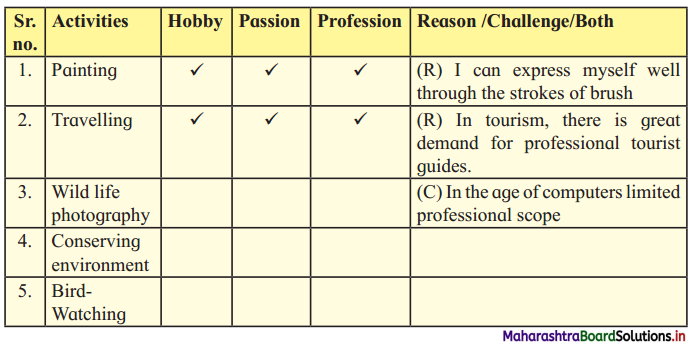
Given below are various activities which you can pursue as your hobby, passion, or profession. Complete the table accordingly:
Maharashtra Board Class 12 English Yuvakbharati Solutions Chapter 1.6 Into the Wild 1
Answer:

ActivitiesHobbyPassionPro­fessionReason/Challenge/Both
Painting(R) I can express myself well through the strokes of brush
Traveling(R) In tourism, there is great demand for professional tourist guides.
Wildlife photography(C) In the age of computers limited professional scope
Conserving environment(C) In a world which is careless, a tremendous challenge
Bird­ Watching(R) Extremely interesting and rewarding; professional opportunities few

Question 4.
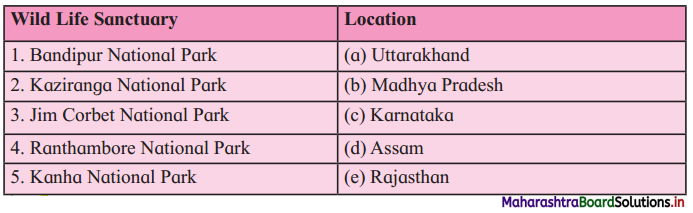
Match the following ‘Wildlife Sanctuaries’ with their locations:
Maharashtra Board Class 12 English Yuvakbharati Solutions Chapter 1.6 Into the Wild 2
Answer:

Wildlife SanctuaryLocation
1. Bandipur National Park(c) Karnataka
2. Kaziranga National Park(d) Assam
3. Jim Corbett National Park(a) Uttarakhand
4. Ranthambore National Park(e) Rajasthan
5. Kanha National Park(b) Madhya Pradesh

Maharashtra Board Solutions

(A1)

Question (i)
In pairs, discuss the professions and challenges one can take happily if one is really passionate about the job.
(Points – professions: photography, environmental conservation, writing, reporting, music, choreography, etc. challenges – low salary, difficulties with organizations, uncooperative colleagues, severe competition, etc.

Question (ii)
In groups, organize a role play activity associated with ‘Wildlife Expert’/‘Wildlife Photographer’/ ‘Wildlife Conservator’, explaining the differences and similarities involved in their profession.
(Students can find out the details of each profession from the internet and organize a role play.)

(A2)

Question (ii)
Correct the false statements:
1. Earlier Shaaz was in the field of finance.
2. The writer saw the fight between the two leopards.
3. The photograph of the old leopard made Shaaz famous.
4. Saya is a black panther.
Answer:
False statements:
2. The writer saw the fight between the two leopards.
3. The photograph of the old leopard made Shaaz famous.
Corrected statements:
2. The writer did not see the fight between the two leopards.
3. The photograph of the young leopard made Shaaz famous.

Question (iii)
Complete the given web:

Maharashtra Board Class 12 English Yuvakbharati Solutions Chapter 1.6 Into the Wild 3
Answer:
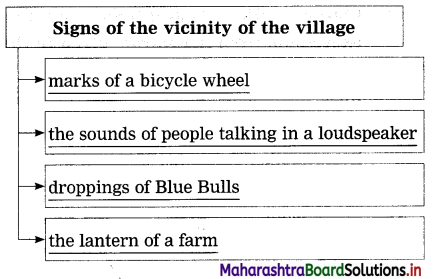
Maharashtra Board Class 12 English Yuvakbharati Solutions Chapter 1.6 Into the Wild 4

Question (iv)
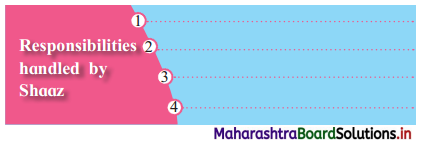
Complete the following:
Maharashtra Board Class 12 English Yuvakbharati Solutions Chapter 1.6 Into the Wild 5
Answer:
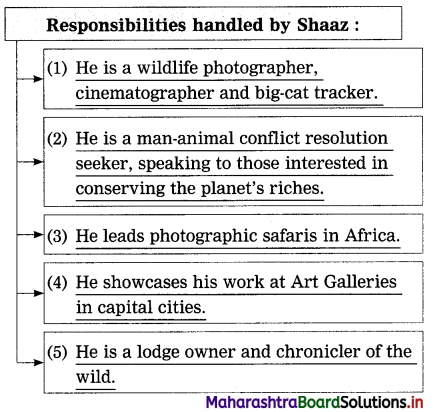
Maharashtra Board Class 12 English Yuvakbharati Solutions Chapter 1.6 Into the Wild 6

Maharashtra Board Solutions

Question (v)
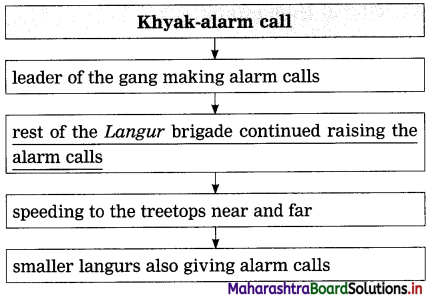
Complete the flow chart stating the reactions of the petrified Langurs due to the presence of the Leopard.
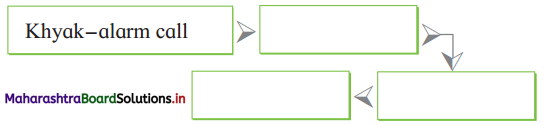
Maharashtra Board Class 12 English Yuvakbharati Solutions Chapter 1.6 Into the Wild 7
Answer:
Maharashtra Board Class 12 English Yuvakbharati Solutions Chapter 1.6 Into the Wild 8

Question (vi)
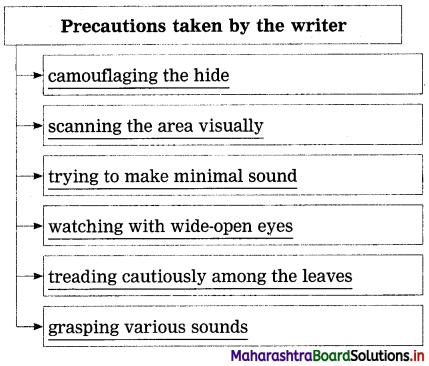
Complete the web, describing each step taken by the writer as a solitary traveller while moving in the jungle with great precaution:
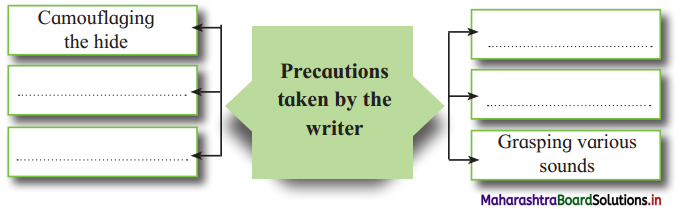
Maharashtra Board Class 12 English Yuvakbharati Solutions Chapter 1.6 Into the Wild 9
Answer:
Maharashtra Board Class 12 English Yuvakbharati Solutions Chapter 1.6 Into the Wild 10

Question (vii)
Complete the table explaining the qualities that you would like to imbibe from Nature within yourself and provide the reasons for the same:
Answer:

FromQualityReasons
TreesPatienceTrees patiently bear up with seasons like winter and autumn, and the attacks on them by animals, birds and humans, and wait for spring, to bloom again.
StreamsPerseveranceStreams can even wear down rocks with their perseverance.

Maharashtra Board Solutions

(A3)

Question (i)
Choose the appropriate phrase/ expression from the extract given in the brackets: (time and again, to one’s heart’s content, in a jiffy)
(a) I was on a diet for some days but today I am going to eat ……………… .
(b) Every mother scolds her children …………… for the overuse of the mobile phone.
(c) All their educational problems were sorted out ………….. because of the funds given by an NGO.
(d) Raj ran at a ……………… to catch the train.
Answer:
I was on a diet for some days but today I am going to eat to my heart’s content.
Every mother scolds her children time and again for the overuse of the mobile phone.
All their educational problems were sorted out in a jiffy because of the funds given by an NGO.
Raj ran at a frantic speed to catch the train.

(A4)

(i) Begin the following sentences with the words given in the brackets:

Question (a)
I can guide visitors. (Visitors….)
Answer:
Visitors can be guided by me.

Question (b)
Animals are paying me back. (I……..)
Answer:
I am being paid back by animals.

Question (c)
Madegowda is employed by The Bison.
(The Bison )
Answer:
The Bison employs Madegowda.

Maharashtra Board Solutions

Question (d)
Older leopards like Pardus carry away livestock from villages. (Livestock….)
Answer:
Livestock are carried away from villages by older leopards like Pardus.

Question (e)
I have lost almost 80 per cent of a season’s yield of sugarcane. (Almost 80 per cent.)
Answer:
Almost 80 per cent of a season’s yield of sugarcane has been lost by me.

Question (f)
Tracking an animal also teaches you life lessons. (Life lessons)
Answer:
Life lessons are also taught by tracking an animal.

Question (g)
Many things have been taught to me by the forests. (The forests)
Answer:
The forests have taught me many things.

Question (h)
Resentment among locals towards the animals is created by this. (This)
Answer:
This creates resentment among locals towards the animals.

Maharashtra Board Solutions

(ii) Rewrite the sentences by using ‘not only…… but also’:

Question (i)
Rewrite the sentences by using ‘not only….but also’:
1. The petrified Langurs speeded to the trees near and far and secured their places on the treetops.
2. Umbarzara is the haven for Tigers, Leopards and Sloth Bears.
3. I crossed the cement pillar and stones stacked by the Forest Development Corporation.
Answer:
1. The petrified Langurs not only speeded to the trees near and far but also secured their places on the treetops.
2. Umbarzara is the haven not only for Tigers but also for Leopards and Sloth Bears.
3. I crossed not only the cement pillar but also the stones stacked by the Forest Development Corporation.

(A5)

Question (i)
Your college has decided to celebrate the World Environment Day. Mr. Kiran Purandare has been invited as the ‘Chief Guest’ for the event. Imagine you are the Secretary of the ‘Nature Club’ of your college and you have to conduct an interview of Mr. Kiran Purandare. Frame 8/10 questions for the same.
Answer:
Questions to interview Mr Kiran Purandare

Good morning, Sir. On behalf of the Nature Club of our college, I congratulate you on your achievements. We also loved your book ‘Sakha Nagzira’. I would like to ask you a few questions. May I? Thank you.

  1. Please tell us something about the ‘Environmental Studies’ Course that you studied’.
  2. Are there any such courses in India, especially in Maharashtra?
  3. How did you get interested in the conservation of the environment?
  4. Do you think that we, in Maharashtra, are doing enough to look after our environment?
  5. How can we get permission to spend time inside sanctuaries?
  6. You were mostly a solitary traveller inside the forest. What was the reason for this?
  7. Are there any excursions/expeditions in which you are going to participate, in the near future?
  8. How can we help you in your work?
  9. Any tips/message for our Nature Club?

Thank you, sir, for answering our questions so frankly. We wish you all the best in your future endeavours.

Maharashtra Board Solutions

Question (ii)
Imagine you have visited the jungles of Nagarhole. Write a report, to be published in your college magazine/in a local newspaper.
Answer:
A Week in a Jungle

Mysuru, 13 May: Four of us from N.S. College, Mysuru, spent a week at Nagarhole National Park (Rajiv Gandhi National Park), located in Kodagu District.

It was an exhilarating and educative week. The park is filled with waterfalls, hills, valleys, streams and forests. It is famous for its rich population of animals and birds. The Bengal Tiger, Indian Leopard, Sloth Bear, Striped Hyena, etc. are the predators that can be spotted in the park. Herbivores like Elephants, Chital, Sambar Deer and Barking Deer are also spotted around the national park.

As it was the month of May, and the water holes were drying up, plenty of animals visited the lake, and we had a grand time observing their habits from the machaan which was built for tourists. We were particularly careful not to disturb the environment by talking loudly or playing music. Hence, the animals were at their natural best. We were thrilled to see a pair of Bengal Tigers and a Leopard.

It was wonderful to see these majestic animals from such a close distance. It is truly an unforgettable experience. We could not see the Sloth Bear, but there were plenty of elephants and deer. After an experience like this one, all four of us have decided to visit various sanctuaries and take an avid interest in the wildlife of India.
– Shantanu Pratap.

Question (iii)
Shaaz has contributed towards conserving the wild animals and their habitat. Your college has decided to spread the message in society and arrange a rally. Prepare an ‘Appeal’ to ensure maximum participation informing about the day, date and other relevant details.
Answer:
Come One Come All!
Come With Friends And Family!

We need your help to save our planet!
Every species is essential for the survival of the planet.
Hence, we need to protect and conserve wild animals and their habitat.
You are the One With A Voice
Protect The Ones Without A Voice

Participate in our rally.
N.S. College Grounds To Forest Office
Date: 12 November Time: 9 a.m.
Save Animals-They Will Save You!

Maharashtra Board Solutions

Question (iv)
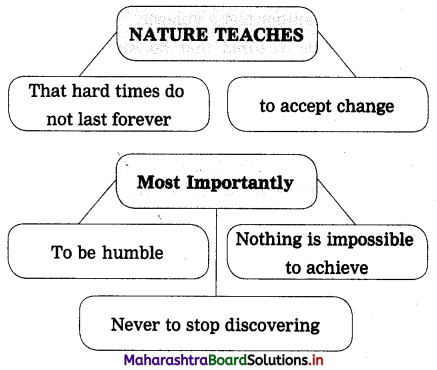
Nature is a great teacher and a guide. Complete the mind map as instructed as per the titled concept:
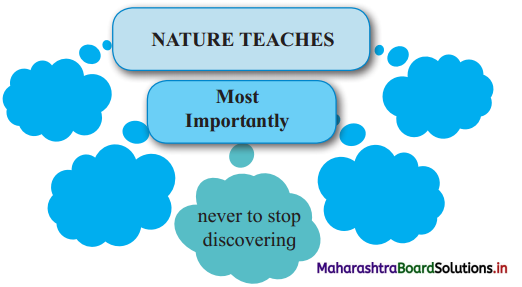
Maharashtra Board Class 12 English Yuvakbharati Solutions Chapter 1.6 Into the Wild 11
Answer:
Maharashtra Board Class 12 English Yuvakbharati Solutions Chapter 1.6 Into the Wild 12

(A6)

Question (i)
Surf the net and obtain more information about the conservation work done by Shaaz. Prepare posters to inspire others and display them on your college notice board.

Question (ii)
Find out the information about the I qualification and eligibility required in the professions related to wildlife such as …………

  • Forest officer/Ranger
  • Wildlife photographer
  • Environmentalist
  • Geologist
  • Tour Manager

Yuvakbharati English 12th Digest Chapter 1.6 Into the Wild Additional Important Questions and Answers

Read the extract and complete the activities given below:

Global Understanding:

Question 1.
Pick out the sentences that are false and write them correctly:
1. The narrator had made notes of the langurs in the region.
2. One has to be really alert while walking in the jungle.
3. The leopard was petrified.
4. There was a lot of noise in the jungle.
Answer:
False sentences:
1. The narrator had made notes of the langurs in the region.
3. The leopard was petrified.
Correct sentences:
1. The narrator had made notes of the birds in the region.
2. The langurs were petrified.

Maharashtra Board Solutions

Question 2.
Complete the following:
Answer:
1. Shaaz named the leopards:
(a) Saya
(b) Scarface
(c) Pardus
2. The visitors are welcomed because they can volunteer to teach a skills training class of their choice. This enables locals to find employment either at the numerous wildlife resorts in the region or in a city.

Question 3.
Correct the false statements:
1. BCRTI was founded out of the genuine urge to conserve the habitat of the wild life.
2. Shaaz failed to utilize the finance incurred out of tourism.
3. According to the local agriculturist seeing is more essential than listening.
4. There was no specific buffer zone around Nagarhole.
Answer:
False statements:
2. Shaaz failed to utilize the finance incurred out of tourism.
3. According to the local agriculturist seeing is more essential than listening.
Corrected statements :
2. Shaaz put the finance incurred out of tourism to good use.
3. According to the local agriculturist listening is more essential than seeing.

Complex Factual:

Question 1.
Pick out from the extract four sentences that show that the writer was frightened.
Answer:

  1. The evening breeze flew through my wet curled hair.
  2. My stomach was aching.
  3. My legs were trembling.
  4. The shaking of limbs had lessened a bit.

Maharashtra Board Solutions

Question 2.
Describe the meaning of the acronym BCRTI and explain its benefits to the local people.
Answer:
The BCRTI is ‘Buffer Conflict Resolution Trust of India’. It’s an agency that educates villagers who live on the fringe of the forest on the importance of conservation. Under the BCRTI umbrella, Shaaz provides locals with vocational training, with the aim of educating them on the merits of conservation and to help them benefit from tourist currency. The visitors at the resort are welcome to volunteer to teach a skills training class of their choice. The acquired skills enable locals to find employment.

Maharashtra Board Solutions

Inference/Interpretation/Analysis:

Question 1.
Explain: I was alone here like a fox:
Answer:
Foxes are solitary creatures. They move around and hunt alone. In the same way, the narrator was alone; he had come to the forest alone to do his research, and now he was going back to the village all alone. Hence, he compares himself to a fox.

Question 2.
Give the meaning of the word ‘hide’ in the context and give reasons for its usage here.
Answer:
A hide is a camouflaged shelter used to get a close view of wildlife. It is a place built to look like its surrounding. The writer was observing birds and noting their behaviour. If he was visible, the birds would not come near him or act in a natural manner. Hence, he had to build a hide, conceal himself in it and then observe birds unnoticed.

Question 3.
Give reasons:
Answer:
1. After meeting Raju, the writer and Raju both felt relaxed because now there were two of them-four eyes and four hands with a stick-to find their way out of the jungle and to battle predators.
2. The time was dreadful because it was evening and the sun was setting. Being alone in the jungle at night time with predators all around was dreadful.

Question 4.
What is called ‘silver lining’ of the trail by the writer? Why?
Answer:
The writer had lost his way in the jungle and was desperate to find a village and civilization. Then he found a bright red soil trail with the marks of a bicycle wheel on it. These marks showed that there was a village nearby. To the frightened and desperate writer, this was like a ‘silver lining’.

Question 5.
The writer said, “There still exists a jungle where we can get lost, isn’t this our good luck?” What does he mean by this?
Answer:
Human beings have tried to take over all the natural areas of the world. We have encroached on jungles and forests, and there are human inhabitations within the jungles too. To find a jungle where there is no sign of human life, and one can still get lost, shows that there are some areas untouched by humans and left to nature. That is what the writer called ‘our good luck’.

Question 6.
Describe Shaaz’s meetings with Scarface.
Answer:
One day, at sunset, Shaaz and his companions went round a blind turn and saw an old leopard, well past his prime. Close to him was another very young, good-looking male leopard who was soon to come into his prime. It was like looking at the past and the present. It was clear that there was going to be a fight. However, they had to leave as it was sunset.

The next day, when Shaaz went back to the spot, sitting on the high rock was Scarface, blood dripping from a gash across his face. He sat there like he was the king of the jungle, and Shaaz knew that he had taken over from the old leopard, and it was a new journey for both of them.

Maharashtra Board Solutions

Question 7.
Find: The Bison is
Answer:
The Bison is an eco-friendly wildlife camp in South India. It offers some great opportunities for youngsters to learn about the area, people, the man-animal conflict, eco-tourism and hotel management.

Personal Response:

Question 1.
Describe a safari you have been on or a trip through a forest. Narrate your experience in brief.
Answer:
I have gone to the Periyar National Park in Kerala. It is in the Western Ghats. This wildlife sanctuary is home to tigers and elephants. There are also deer, leopards and Indian bison. I have also been on a boat ride in the Periyar Lake. It was a wonderful experience to see tigers drinking at the watering holes. I really enjoyed the experience and will repeat it as soon as I can.

Question 2.
Have you ever been lost/lost your way? Narrate the experience.
Answer:
Yes, once when I was in Panchgani with my family I got lost. I decided to go for a walk alone. I set out without finding out the name of the road on which our hotel was situated. As I was walking, it suddenly began to rain heavily, and got quite dark. When I looked around I found that I was in a sort of a jungle. I was terrified; then I met a villager, but he could not help me. I did not even have my cellphone with me. I was in tears when all at once I saw my hotel. I had walked round in circles! I was very relieved. It was indeed a frightening experience.

Question 3.
How do you relax at the end of a tiring day? Give a brief description.
Answer:
At the end of a tiring day, I pick up a nice book or watch a good film on TV or Netflix. This relaxes me completely. If I go to sleep j directly, I am too tired and do not get good sleep. But if I spend half an hour or so unwinding, I really feel relaxed and sleepy.

Question 4.
Would you like to meet wild animals face to face? Give reasons to support your answer.
Answer:
No, I would not. I like to see wild animals only on TV. I feel that we should not intrude into their territory, and leave them to live in peace. Besides, they are wild and not tame, and one never knows how they may behave. I have read about a lot of people being killed by wild animals.

Maharashtra Board Solutions

Language Study:

Question 1.
The surroundings were reminding me.
(Rewrite, beginning the sentence with ‘I…)
Answer:
I was being reminded by the surroundings.

Question 2.
I had apparently entered in the sanctum sanctorum of a miracle called leopard.
(Pick out the finite verb/s and state the tense.)
Answer:
had entered – past perfect tense.

Question 3.
Raju was amazed at my solitary visits to Umbarzara.
(Rewrite beginning ‘My solitary’)
Answer:
My solitary visits to Umbarzara amazed Raju.

Question 3.
Then we both resumed our walking tour, (Identify the part of speech of the underlined word.)
Answer:
walking-present participle acting as an adjective.

Question 4.
I found a bright red soil trail. (Rewrite beginning with‘A ’.)
Answer:
A bright red soil trail was found by me.

Maharashtra Board Solutions

Question 5.
I had no other way to climb the hillock before me. (Rewrite as an affirmative sentence.)
Answer:
This was the only way I had to climb the hillock before me.

Question 6.
I climbed one more hillock and tried to locate signs of human civilization. (Rewrite beginning ‘Climbing’.)
Answer:
Climbing one more hillock, I tried to locate signs of human civilization.

Question 7.
The behaviour of the first black panther is being documented. (They….)
Answer:
They are documenting the behaviour of the first black panther.

Question 8.
All the research on the animal has been done through camera traps. (They….)
Answer:
They have done all the research on the animal through camera traps.

Question 9.
Shaaz recalls the incident with great clarity.
(Rewrite the sentence replacing the underlined expression with a single word.)
Answer:
Shaaz recalls the incident clearly.

Maharashtra Board Solutions

Question 10.
Unfortunately, the sun was setting and we had to leave. (Rewrite using ‘because’.)
Answer:
Unfortunately, we had to leave because the sun was setting.

Question 11.
Use the word ‘guide’ as a noun and a verb in two separate sentences:
Answer:
1. We can guide children to behave well. {verb)
2. I hired a local guide to show me the sights of the palace, {noun)

Question 12.
The black panther has taught me patience. (Rewrite using the adjective form of the underlined word.)
Answer:
The black panther has taught me to be patient.

Question 13.
Listening is a sense far more important than sight. (Rewrite using ‘as…as…’)
Answer:
Sight is a sense not as important as listening.

Vocabulary:

Question 1.
Guess the meaning of the following words :

  1. upheaval
  2. predator
  3. hovering
  4. antelope

Answer:

  1. upheaval – uproar; disturbance.
  2. predator – an animal that preys on other animals.
  3. hovering – fluttering in the air.
  4. antelope – deer-like animal with hollow horns.

Question 2.
Give the meaning of the phrase ‘to stay put’ and use it in your own sentence.
Answer:
to stay put:
Meaning: remain somewhere without moving.
Sentence: My mother told me to stay put near the entrance when she went to buy the train ticket.

Maharashtra Board Solutions

Question 3.
Write two adjectives from the extract used for the leopard.
Answer:
mighty, elusive.

Question 4.
Choose the correct option for: spooked –
(a) frightened
(b) happy
(c) angry
Answer:
frightened

Question 5.
Find the contextual meaning of‘stacked’:
Answer:
stacked – piled one on top of the other

Question 6.
Guess the meaning of ‘in a jiffy’:
Answer:
in a jiffy – in a moment; very soon

Question 7.
Make sentences of your own using the words:
1. slumped
2. stumbled
Answer:
1. slumped: I was so tired after the trek that I slumped onto my bed and fell I asleep immediately.
2. stumbled: I did not see the stone in the middle of the road and stumbled over it.

Maharashtra Board Solutions

Question 8.
Guess the meaning of:
1. ‘felines’
2. chronicler
Answer:
1. felines: belonging to the cat family,
2. chronicler: a person who records something.

Question 9.
Pick out two pairs of antonyms from the : extract:
Answer:
1. old × young
2. past × present

Question 10.
Write the noun forms of:

  1. famous
  2. enviable
  3. collect
  4. including

Answer:

  1. famous – fame
  2. enviable – envy
  3. collect – collection
  4. including – inclusion

Question 11.
Write the adjective forms of the following:

  1. incursion
  2. territory
  3. resentment
  4. occasion
  5. employment
  6. region

Answer:

  1. incursion – incursive
  2. territory – territorial
  3. resentment – resentful
  4. occasion – occasional
  5. employment – employable
  6. region – regional ?

Maharashtra Board Solutions

Question 12.
Choose the correct simple past tense forms of the following from the brackets:

  1. teach – (teached, teaching, taught)
  2. lose – (loser, lost, loose)
  3. put – (put, putted, putting)
  4. learn – (lean, learnt, learns)

Answer:

  1. teach – taught
  2. lose – lost
  3. put – put
  4. learn – learnt.

Non Textual Grammar:

Do as directed:

Question 1.
He had won a prize in the drawing competition. (Rewrite using the future perfect tense of the verb.)
Answer:
He will have won a prize in the drawing competition.

Question 2.
How could I call him a liar? (Rewrite as an assertive sentence.)
Answer:
I could not call him a liar.

Question 3.
All other things are unimportant. (Add a question tag.)
Answer:
All other things are unimportant, aren’t they ?

Spot the error in the following sentences and rewrite them correctly:

Question 1.
Unless you do not listen to his advice, I am not going to help you.
Answer:
Unless you listen to his advice, I am not going to help you./If you do not listen to his ? advice, I am not going to help you.

Maharashtra Board Solutions

Question 2.
Hardly had I reached the airport where I heard about the change in plans.
Answer:
Hardly had I reached the airport when I heard about the change in plans.
Maharashtra Board Class 12 History Solutions Chapter 11 India Transformed Part 1

Balbharti Maharashtra State Board Class 12 History Solutions Chapter 11 India Transformed Part 1 Textbook Exercise Questions and Answers.

Maharashtra State Board Class 12 History Solutions Chapter 11 India Transformed Part 1

1A. Choose the correct alternative and rewrite the statement.

Question 1.
A legal agreement was signed in Geneva which is known as ____________
(a) SEATO
(b) NATO
(c) GATT
(d) SAARC
Answer:
(c) GATT

Question 2.
An act similar to ‘Right to Information’ was first applied in ____________ in 1776.
(a) Sweden
(b) France
(c) England
(d) India
Answer:
(a) Sweden

Maharashtra Board Class 12 History Solutions Chapter 11 India Transformed Part 1

Question 3.
The birth anniversary of Swami Vivekananda is observed as ____________
(a) National Education Day
(b) National Youth Day
(c) National Integration Day
(d) National Science Day
Answer:
(b) National Youth Day

2A. Write the names of historical places/persons/events.

Question 1.
In 2004, this became the biggest firm in Asia providing software services –
Answer:
Tata Consultancy Services

Question 2.
In 2002, the Metro railway was flagged off –
Answer:
The Delhi Metro Railway

2B. Choose the correct reason from those given below and complete the sentence.

Question 1.
India became member of World Trade Organisation, because ____________
(a) India want to compete with other nations
(b) India cannot stay aloof from the global economy
(c) India adopted the policy of liberalisation
(d) India wanted to be in the leading position at the global level
Answer:
(c) India adopted the policy of liberalisation

3. Complete the following concept map.

Question 1.
Maharashtra Board Class 12 History Solutions Chapter 11 India Transformed Part 1 Q3
Answer:
Maharashtra Board Class 12 History Solutions Chapter 11 India Transformed Part 1 Q3.1

4. Write short notes.

Question 1.
The Youth Policy of Government of India.
Answer:

  • India is a country with a maximum proportion of young people. Individuals in the age group of 15-29 are considered as ‘youth’.
  • Youth, if provided with opportunities, for education and skill training, can contribute significantly to the development of India.
  • A number of centers of‘Nehru Yuva Kendra Sangathan’ were established in 1972 for the training of young people in various skills.
  • The programmes run by these centers were eventually merged in the ‘National Youth Empowerment Programme’. This programme put a thrust on topics like literacy, education, health and hygiene, family welfare, preservation and conservation of the environment, awareness of social issues, rural development, and self-employment.
  • 12th January the birth anniversary of Swami Vivekanand is celebrated as ‘National Youth Day. National Youth Festival is also celebrated in the month of January. This festival is designed to provide a platform for the artistic talents of young individuals.
  • ‘Youth Hostels Association of India’ has established youth hostels in various parts of the country which works for encouraging adventure skills among young people.
  • Training programmes are arranged by this association through ‘Bharat Scout and Guides, National Service Scheme and National Cadet Corps’.

Maharashtra Board Class 12 History Solutions Chapter 11 India Transformed Part 1

Question 2.
‘Pradhan Mantri Gram Sadak Yojana’.
Answer:

  • The Government of India knows the importance of having roads in good condition in the interior areas started ‘Pradhan Mantri Gram Sadak Yojana’ in 2000.
  • Initially, the work of building roads began by linking the villages of population strength up to 1000. In 2001 this programme was merged in ‘Pradhan Mantri Gramoday Yojana’.
  • The roads measuring about 75000 km. were completed till 2005. The purpose of this work was to extend the benefits of the country’s economic growth to people living in rural areas and to bring transformation in their lives.
  • It aimed at providing amenities for good health, education, drinking water, dwellings, roads, and electricity.

5. State your opinion.

Question 1.
India is a leading country in the field of space research.
Answer:

  • In 2007, India entered a new field of space research. It commercially launched the Italian satellite.
  • Other countries had submitted tenders quoting very high rates, to get this contract. However, India got this contract by quoting reasonable rates.
  • Before entering this field on a commercial basis, India had already successfully launched the satellite of Argentina, Belgium, South Korea, Indonesia, and Germany.
  • In 2008, India launched ‘Chandrayaan-1’, the first lunar probe. India could collect evidence for the presence of water on the moon through this satellite.
  • After that India also launched ‘Chandrayaan-2’ and ‘Mangalyaan’.
  • All these achievements proved that India is a leading country in the field of space research.

6. Answer the following questions in detail.

Question 1.
Which programmes were launched in India for making the opportunities of wage-earning?
Answer:
Creating employment opportunities for an ever-increasing population is a major challenge for the government. There are several programmes launched by the government of India for wage earners.
These programs are as follows:

  • Pradhan Mantri Rojgar Yojana and ‘Rojgar Hami Yojana’: To create job opportunities for educated youth the ‘Ministry of Commerce and Industry of the Government of India started this plan on 2nd October 1993 on the birth anniversary of Mahatma Gandhi.
  • Rojgar Hami Yojana was to assure daily wages to the unemployed agricultural labourers. The objective of this plan was to provide wage-earning opportunity, who was in search. This programme was launched in 257 districts in India. A goal was to provide work to two young laborers in each family below the poverty line. In 2001, this plan was merged in ‘Gramin Rojgar Yojana’.
  • In 1998, to provide support to farmers in difficult times “Kisan Credit Card” plan was started. It helps the farmer to avail funds for essential equipments and seeds for cultivation. Later, an insurance facility was also offered to farmers, who were Kisan Credit Card holders.
  • Suvarnajayanti Gramin Svayam Rojgar Yojana: This plan was launched in 1999 by merging various plans together namely ‘Ekatmik Gramin Vikas Yojana’, Self-employment training programmes, ‘Ganga Kalyan Yojana’ etc.
  • Jawahar Gram Samruddhi Yojana: In 1999, a new plan was implemented with the intention to provide adequate employment for unemployed men and women. It was merged in ‘Sampoorna Gramin Rojgar Yojana’ in 2001.
  • Sampoorna Gramin Rojgar Yojana: This plan made provision for creating opportunities in rural areas of earning wages, to provide food grains in exchange for work, etc. This scheme was started in 150 economically backward districts in the country. In 2006, this scheme was merged in ‘Rashtriya Gramin Rojgar Hami Yojana’.
  • Rashtriya Gramin Rojgar Hami Yojana: Under this scheme, each family in rural areas were given assurance of at least 100 days of work.

7. Answer the following question with the help of the given points.

Question 1.
Give information about the ‘Right to Information Act.
(a) Background of the act and the beginning of this movement in India.
(b) Definition of ‘Information’.
(c) The rights of citizens under this act.
Answer:
(a) Background of the act and the beginning of this movement in India:

  • This kind of Act was first implemented in Sweden in 1776. In 1946, ‘United Nations’ declared the ‘Right to Information to be the fundamental human right.
  • In 1982, L.K. Kulwant, a resident of Jaipur in Rajasthan, a social activist initiated the process by applying to know the Jaipur Municipal Corporation’s work for cleaning the city.
  • The High Court gave a clear verdict stating that ‘Right to Information is a fundamental right of all citizens.
  • In 1990, Aruna Roy started the movement called ‘Majdoor Kisan Shakti Sanghatan’. A need for ‘Right to Information was started through this movement.
  • Harsh Mander, the Divisional Commissioner of Bilaspur showed courage to disclose official information while serving as a bureaucrat.
  • The struggle of Anna Hazare in 2001, had a decisive role in Maharashtra in this matter. The Act was implemented in Maharashtra on 12th October 2005.

Maharashtra Board Class 12 History Solutions Chapter 11 India Transformed Part 1

(b) Definition of ‘Information’:
The definition of term ‘Information’ includes official records, documents, memoranda, emails, comments, consultations, press notes, circulars, orders, logbooks, tenders, reports, correspondence, formats, models, electronic data, the information of a private institution or an individual that is available in the records of any public establishment.

(c) The rights of citizens under this act:

  • Right to information grants access to official documents, records, permission to obtain their copies, to take notes, to extract passages, to get samples of authorised material and prints of data stored in CDs, Floppy discs, tapes, video cassettes, or in any other form, or stored on computers.
  • Citizens can get the desired information after submitting an application to the ‘Information officer’ of a ‘Public Authority.

Class 12 History Chapter 11 India Transformed Part 1 Intext Questions and Answers

Collect information of following schemes: (Textbook Page No. 92)

National Pension Scheme, Pradhan Mantri Suraksha Vima Yojana, Pradhan Mantri Jeevan Jyoti Vima Yojana, Atal Pension Yojana, Indian Post Payments Bank.
Answer:
(A) National Pension Scheme:

  • The National Pension Scheme is a voluntary contribution of the pension system in India which is sponsored by the government of India.
  • This scheme was started by the Government of India in 2004 for all government employees.
  • The scheme was made open to all citizens in 2009. It is a voluntary and long-term retirement scheme. It is regulated by Pension Fund Regulatory and Development Authority (PFRDA) and the central government.
  • Any employee from the public, private, and even the unorganized sectors can opt for this.
  • Personnel from the armed forces are not allowed. The scheme is open to all across industries and locations.

(B) Pradhan Mantri Suraksha Vima Yojana:

  • The scheme is available to people in the age group 18 to 70 years with a bank account who give their consent to join/enable auto-debit on or before 31st May for the coverage period 1st June to 31st May on an annual renewal basis.
  • Aadhar would be the primary KYC for the bank account. The risk coverage under the scheme is ₹ 2 lakh for accidental death and full disability and ₹ 1 lakh for partial disability.
  • The premium of 112 per annum is to be deducted from the account holder’s bank account through ‘auto-debit facility in one installment.

(C) Pradhan Mantri Jeevan Jyoti Vima Yojana:

  • Pradhan Mantri Jeevan Jyoti Vima Yojana is available to people between 18 and 50 years of age with a bank account.
  • This scheme was launched on 9th May 2015 by Prime Minister Narendra Modi in Kolkata.
  • It has an annual premium of ₹ 330. In case of death due to any cause, the payment to the nominee will be ₹ 2 lakh.
  • As of 31st March 2019, 5.92 crore people have already enrolled for this scheme.

(D) Atal Pension Yojana:

  • Atal Pension Yojana is a pension scheme under the Government of India.
  • This scheme replaces the Swavalamban Yojana and was established to provide old age income security to the workers belonging to the unorganized sector.
  • The Atal Pension Yojana was launched by Prime Minister Narendra Modi on 9th May 2015 in Kolkata.
  • The scheme focuses on encouraging workers of the unorganized sectors to save for their future (Age limit 18-40 years).

(E) Indian Postal Payments Bank :

  • The Indian Postal Payment Bank was launched on September 1, 2018, by Prime Minister Narendra Modi that aims at making banking services available at people’s doorstep.
  • This is a 100% Government-owned public sector bank, operating with the Department of Posts under the Ministry of Communications.
  • IPPB would be like any other bank but it will operate at a smaller scale without involving any credit risks and can’t issue advance loans or issue credit cards.

Maharashtra Board Class 12 History Solutions Chapter 11 India Transformed Part 1

Let us know: (Textbook Page No. 92)

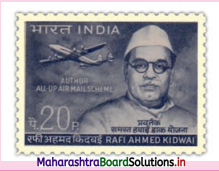
Collect information with the help of the internet about the ‘Rafi Ahmad Kidwai National Postal Academy (Gaziabad).
Maharashtra Board Class 12 History Solutions Chapter 11 India Transformed Part 1 Intext Q2
Answer:

  • Rafi Ahmad Kidwai National Postal Academy, recently called Postal Staff College India (PSCI) is the apex training institution of Indian postal services.
  • It was set up in the year 1977. Initially, the college functioned from Sanchar Bhavan and later from Dak Bhavan in Delhi.
  • It was shifted to its present location in Gaziabad in the year 1990. It is a central training institute and has the primary role of training and grooming the young officers who get recruited to the Indian Postal Service.
  • It also conducts various in-service training programmes on postal management for Postal Service officers in India and other foreign postal administrations.
  • Its goal is to make the officers of the department of posts professionally competent to handle the ever-changing communication market.
  • Training Program:
    • Advanced Development Program
    • Executive Development Program
    • Technology Management Program
    • Postal Life Insurance
    • Leadership Development for postmasters and mangers
    • Quality Management

Let us collect information (Textbook Page No. 92)

Collect information about various services like ‘Sarvabhaum Suvarn Rokhe’ (Gold Bonds issued by the Government), ‘Electronic Indian Postal Order’, ‘E-Dakghar’, ‘E-Payment Portal’, ‘Mobile App’ etc. by interviewing the Postmaster of any branch.
Answer:
(A) Sarvabhaum Suvarn Rokhe:

  • This scheme was launched by Government in November 2015, under Gold Monetisation Scheme. The issues are made open for subscription in tranches by RBI in consultation with GOI.
  • As per RBI instructions, every application must be accompanied by the PAN number issued by the income tax department to the investors as the PAN number of the first/ sole applicant is mandatory.
  • SGBs are government securities denominated in grams of gold. They are substitutes for holding physical gold. Investors have to pay the issue price in cash and the bonds will be redeemed in cash on maturity. The bond is issued by Reserve Bank on behalf of the government of India.
  • The SGB offers a superior alternative to holding gold in physical form. The quantity of gold for which the investor pays is protected since he receives the ongoing market price at the time of redemption /premature redemption.

(B) Electronic Indian Postal Order:

  • The Department of Personnel and Training and Department of Posts have launched a service called e-IPO (Electronic Indian Postal Order) to enable the Indian citizens abroad to purchase an Indian Postal Order electronically by paying fee on-line through the e-post Office portal i.e., http://www.epostoffice.gov.in.
  • It also facilitates them to file the Right to Information (RTI) application. Registration is mandatory to avail of this facility. Options for new account creation, user verification, search e-IPO, etc are available.

(C) e-Payment portal:

  • e-Payment is a smart option for businesses and organizations to collect their bills or other payments through post office networks.
  • When businesses require the collection of bills and other payments from customers across the country, Post offers them a simple and convenient solution in the form of e-payment.
  • e-Payment is a many-to-one solution that allows the collection of money (telephone bills, electricity bills, examination fees, taxes, university fees, school fees, etc) on behalf of any organization. The collection is consolidated electronically using web-based software and payment is made centrally through cheque from a specified Post Office of billers choice.
  • The information and MIS regarding the payment can be seen by the biller online. The MIS will contain the five fields of billers choice like name, telephone number, application number, etc. The services are currently available through more than 14,000 Post offices across the country.
  • There is an agency in the market today with a large reach and establishing trust as the Post Office where the public can comfortably deposit all their bills in their neighbourhood.

Maharashtra Board Class 12 History Solutions Chapter 11 India Transformed Part 1

(D) e-Dak Ghar:
The e-Post Office of India post offers a variety of online Postal services to the users. One can avail services-philately (purchase of stamps), PLI/RPLI (payment of the premium), and IPO (purchase order for RTI).

(E) Mobile app:

  • The IPPB app is available on both Android and iOS platforms. This app, however, can only be used by those individuals who have an account in a core banking-enabled post office. KYC of the account should also be completed in advance.
  • Internet banking and mobile banking services should also be completed in advance.
  • Using the mobile app, account holders can also view account balances and statements, transfer funds, request a checkbook, stop payment on a cheque, use sweep-in-sweep-out facilities, and pay utility bills.

Project (Textbook Page No. 98)

Collect information about the States of India and Union Territories, as well as the names of their capital cities, with the help of the internet.
Answer:
The states of India and its capitals are as follows:

StatesCapital
1. Andhra PradeshHyderabad
2. Arunachal PradeshItanagar
3. AssamDispur
4. BiharPatna
5. ChhattisgarhRaipur
6. GoaPanaji
7. GujratGandhinagar
8. HaryanaChandigarh
9. Himachal PradeshShimla
10. JharkhandRanchi
11. KarnatakaBengaluru
12. KeralaThiruvananthapuram
13. Madhya PradeshBhopal
14. MaharashtraMumbai
15. ManipurImphal
16. MeghalayaShillong
17. MizoramAizawl
18. NagalandKohima
19. OdishaBhubaneswar
20. PunjabChandigarh
21. RajasthanJaipur
22. SikkimGangtok
23. TelanganaHyderabad
24. Tamil NaduChennai
25. TripuraAgartala
26. Uttar PradeshLucknow
27. West BengalKolkata
28. UttarakhandDehradun

Union Territories and its Capitals:

Union TerritoriesCapitals
1. Anadaman and Nicobar IslandPort Blair
2. ChandigarhChandigarh
3. Dadra and Nagar Haveli and Daman and DiuDaman
4. DelhiNew Delhi
5. LakshadweepKavaratti
6. PuducherryPondicherry
7. LadakhLeh (summer), Kargil (winter)
8. Jammu and KashmirSrinagar (summer) Jammu (winter)


Maharashtra Board Class 12 History Important Questions Chapter 10 Cold War

Balbharti Maharashtra State Board Class 12 History Important Questions Chapter 10 Cold War Important Questions and Answers.

Maharashtra State Board 12th History Important Questions Chapter 10 Cold War

1A. Choose the correct alternative and rewrite the statement.

Question 1.
Walter Lippman was the first to use the term __________
(a) Hot War
(b) Warm War
(c) Cold War
(d) World War
Answer:
(c) Cold War

Question 2.
The term __________ was used by Sir Winston Churchill, the prime minister of England for the divisive line between Eastern European nations and Western European nations.
(a) Steel Curtain
(b) Copper Curtain
(c) Bronze Curtain
(d) Iron Curtain
Answer:
(d) Iron Curtain

Maharashtra Board Class 12 History Important Questions Chapter 10 Cold War

Question 3.
After the Second World War was over, America had a __________ plan for the post-war reconstruction of Europe.
(a) Marshall
(b) Eisenhower
(c) Washington
(d) Nixon
Answer:
(a) Marshall

Question 4.
In 1961, __________ built the ‘Berlin Wall’.
(a) Germany
(b) Soviet Russia
(c) America
(d) Great Britain
Answer:
(b) Soviet Russia

Question 5.
__________ means Restructuring.
(a) Glasnost
(b) Duma
(c) Perestroika
(d) Glavlit
Answer:
(c) Perestroika

Question 6.
The __________ Conference inl973 was an attempt to end the Vietnam War.
(a) Moscow
(b) Bonn
(c) Berlin
(d) Paris
Answer:
(d) Paris

Maharashtra Board Class 12 History Important Questions Chapter 10 Cold War

Question 7.
The ‘three-way defence pact’ treaty in the Pacific region is known as __________
(a) ANZUS Treaty
(b) NATO Treaty
(c) SEATO Treaty
(d) CENTO Treaty
Answer:
(a) ANZUS Treaty

Question 8.
SAARC was officially established at __________
(a) New Delhi
(b) Dhaka
(c) Colombo
(d) Kathmandu
Answer:
(b) Dhaka

1B. Find the incorrect pair from group ‘B’ and write the corrected one.

Question 1.

Group ‘A’Group ‘B’
(a) NATOLondon
(b) SEATOThailand
(c) CENTOTurkey
(d) SAARCDhaka

Answer:
NATO – Paris

Question 2.

Group ‘A’Group ‘B’
(a) Sir Winston ChurchillFrance
(b) Premier StalinRussia
(c) Mr. EisenhowerAmerica
(d) Ayatollah KhomeiniIran

Answer:
Sir Winston Churchill – England

2A. Write the names of historical places/persons/events.

Question 1.
The wall was built by Soviet Russia in 1961 –
Answer:
Berlin Wall

Question 2.
Venue of the conference held in 1978 to resolve the strife between Israel and Arabs –
Answer:
Camp David

Maharashtra Board Class 12 History Important Questions Chapter 10 Cold War

Question 3.
The meaning of ‘Openness’ in Russian means –
Answer:
Glasnost

Question 4.
Perestroika means –
Answer:
Restructuring

Question 5.
Capital of Germany –
Answer:
Berlin

Question 6.
The Germans called the ‘Berlin Wall’ –
Answer:
‘Wall of Shame’

Question 7.
The ‘Southeast Asia Collective Defence Treaty is also known as –
Answer:
Manila Pact

Question 8.
The full form of SAARC is –
Answer:
South Asian Association for Regional Co-operation.

2B. Choose the correct reason from those given below and complete the sentence.

Question 1.
The Western European nations under the influence of America adopted __________
(a) capitalist ideology and dictatorship
(b) capitalist ideology and democratic system
(c) communist ideology and democratic system
(d) communist ideology and dictatorship
Answer:
(b) capitalist ideology and democratic system

Maharashtra Board Class 12 History Important Questions Chapter 10 Cold War

Question 2.
Europe was divided after the Second World War on the basis of __________
(a) only military concerns
(b) only political concerns
(c) political, economic, and military concerns
(d) only economic concerns
Answer:
(c) political, economic, and military concerns

3B. Complete the following concept map.

Question 1.
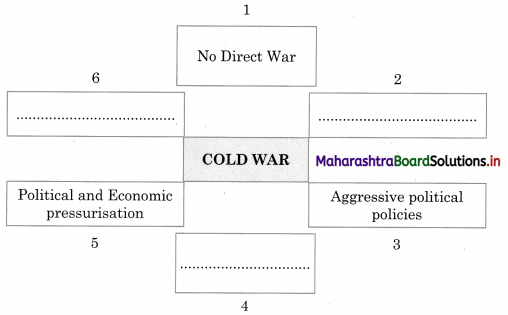
Maharashtra Board Class 12 History Important Questions Chapter 10 Cold War 3B Q1
Answer:
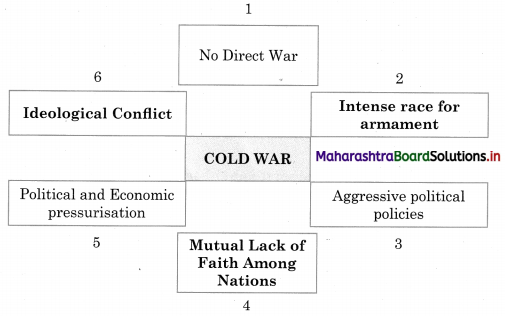
Maharashtra Board Class 12 History Important Questions Chapter 10 Cold War 3B Q1.1

Question 2.
Maharashtra Board Class 12 History Important Questions Chapter 10 Cold War 3B Q2
Answer:
Maharashtra Board Class 12 History Important Questions Chapter 10 Cold War 3B Q2.1

4A. Write short notes.

Question 1.
ANZUS Treaty.
Answer:

  • The word ‘ANZUS’ stands for Australia(A), New Zealand (NZ), and the United States of America (US).
  • These nations signed a treaty on 1st September 1951. This treaty was signed for their collective security and therefore is commonly known as ANZUS Treaty.
  • These nations are in the Pacific region.
  • Hence, this treaty is also described as a ‘three-way defense pact’.
  • This was the first of its kind.
  • This treaty had one more objective to protect the countries in the Pacific Ocean from communist China.

Question 2.
Criteria of Non-Aligned Movement.
Answer:

  • Criteria for Non-Alignment (Adopted at Belgrade, 1961)
  • The country should have adopted an independent policy based on the co-existence of states with different political and social systems.
  • Support national independence movements.
  • It should not be a member of a multi-lateral alliance concluded in the context of the Cold War.
  • It should not be a member of a bilateral military alliance or a regional defense pact in the context of great power conflicts.
  • It should not concede military bases to foreign powers in the context of great power rivalry.

Maharashtra Board Class 12 History Important Questions Chapter 10 Cold War

Question 3.
Challenges before SAARC.
Answer:
SAARC is laden with many difficult issues to tackle such as

  • The economic disparity among the member nations.
  • Expenditure allotment for defense.
  • Inadequate infrastructure.
  • Underdevelopment of agricultural sector.
  • Rising terrorism.
  • Population explosion.
  • Insufficient trade.
  • Divergent political systems.
  • Religious-lingual diversity etc.

5. State your opinion.

Question 1.
The Warsaw Pact was signed.
Answer:

  • To oppose American policies and to strengthen communist nations, Soviet Russia brought together seven communist countries in eastern and central Europe known as ‘Eastern Bloc’ and signed a treaty commonly known as Warsaw Pact.
  • Along with Soviet Russia, Albania, Bulgaria, Czechoslovakia, East Germany, Hungary, Poland, and Romania signed this treaty.
  • Albania withdrew from it in 1968.

6. Answer the following questions in detail.

Question 1.
Write a note on the aftermath of the ‘Cold War’.
Answer:

  • During the period of the Cold War there were many factors that threatened the very future of mankind.
  • These included political misunderstandings among nations, world’s nations splitting into two distinct groups, priorities to secret political moves and treaties, absence of priority to the process of disarmament, use of science for producing destructive weapons, neglect of basic and important issues like food, clothing, and housing, etc.
  • Both the USA and Soviet Russia had to pay very heavily for their strategy of letting the situation of the Cold War prevail over a prolonged period.
  • The consequence of the dissolution of Soviet Russia left the USA as the only superpower in the world.

Maharashtra Board Class 12 History Important Questions Chapter 10 Cold War

Question 2.
Discuss Mikhail Gorbachev’s era.
Answer:

  • Mikhail Gorbachev became the General Secretary of the Communist Party of Soviet Russia and the Premier of Soviet Russia in 1985.
  • His period saw the end of the Cold War.
  • He introduced important reforms in Soviet Russia through his policies known as ‘Perestroika’ (Restructuring) and Glasnost (Openness).
  • During his time the economy had grown weaker.
  • Gorbachev tried to normalize it by restructuring the political and economic systems of Soviet Russia.
  • He attempted to democratize the political system by way of open elections and to end the authoritarian rule of the communist party.
  • He decentralized the economic machinery of the state.
  • Authors, journalists, and intellectuals were given more freedom of expression.
  • However, Gorbachev could not stop the integration of his own country.
  • Soviet Russia disintegrated during his period.

7. Answer the following question with the help of the given points.

Question 1.
(a) NATO
(b) ANZUS
(c) SEATO
(d) Warsaw Pact
Answer:
(a) NATO was an alliance created to protect 29 of the European countries from the expansionist policy of Soviet Russia. Its members included Norway, France, Italy, Denmark, Great Britain, America, Netherland, Portugal, Turkey, West Germany, Greece, Belgium, Canada, Iceland, Luxembourg, and Spain.
A few of the important terms included in the NATO alliance are as follows:

  • An attack on any of the member countries of the alliance would be treated as an attack on all member countries; all of the member countries will try to maintain peace and security; any of the mutual issues among the member countries shall be resolved through discussions.
  • The headquarters of NATO are in Paris.
  • America had a significant influence in the decision-making process of NATO. To counter America’s influential position in NATO, Soviet Russia brought together the communist countries in Europe and a treaty commonly known as the ‘Warsaw Pact’.

(b) ANZUS Treaty:

  • The word ‘ANZUS’ stands for Australia(A), New Zealand (NZ), and the United States of America(US).
  • These nations signed a treaty on 1st September 1951. This treaty was signed for their collective security and therefore is commonly known as ANZUS Treaty.
  • These nations are in the Pacific region.
  • Hence, this treaty is also described as a ‘three-way defense pact’.
  • This was the first of its kind.
  • This treaty had one more objective to protect the countries in the Pacific Ocean from communist China.

(c) SEATO:

  • (Southeast Asia Treaty Organisation) England, America, France, Australia, New Zealand, Pakistan, Thailand, and the Philippines came together and signed a treaty on 8th September 1954 in Manila (Philippines) to ensure the collective defense of the countries in South East Asia. This treaty is also known as the Southeast Asia Collective Defence Treaty or Manila Pact.
  • The pact was mainly intended to stop the spread of communism in South East Asia. It was decided that if any of the nations included in the pact was attacked then other nations signing the pact would collectively stand up against it and in times of peace, they would extend help for the social and the economic development of each other. However, this treaty had a number of flaws. Although it was named as the treaty of the South East Asian countries, only three countries from Asia namely Thailand, the Philippines, and Pakistan were included in it. The western power did not have any deep understanding of the problems of the Asian countries.
  • The headquarters of SEATO was located in Thailand. In 1973, Pakistan withdrew from it. In 1975 France stopped providing monetary help to this organization.
  • On 30th June 1977, this Organisation was officially dissolved.

Maharashtra Board Class 12 History Important Questions Chapter 10 Cold War

(d) Warsaw Pact:

  • To oppose American policies and to strengthen communist nations, Soviet Russia brought together seven communist countries in eastern and central Europe known as ‘Eastern Bloc’ and signed a treaty commonly known as Warsaw Pact.
  • Along with Soviet Russia, Albania, Bulgaria, Czechoslovakia, East Germany, Hungary, Poland, and Romania signed this treaty.
  • Albania withdrew from it in 1968.

Maharashtra Board Class 12 Economics Important Questions Chapter 3A Demand Analysis

Balbharti Maharashtra State Board Class 12 Economics Important Questions Chapter 3A Demand Analysis Important Questions and Answers.

Maharashtra State Board 12th Economics Important Questions Chapter 3A Demand Analysis

1. A. Choose the correct option:

Question 1.
Demand curve slopes downward.
(a) Inverse relationship between price quantity demanded
(b) from left to right
(c) from right to left
(d) Direct relationship quantity demanded
Options :
(1) a,b and c
(2) a, b, c and d
(3) a and b
(4) a and d
Answer:
(3) a and b

Question 2.
Demand for a commodity from an individual consumer.
(a) Direct demand
(b) Market demand
(c) Individual demand
(d) Increase in demand
Options:
(1) a
(2) b
(3) c
(4) d
Answer:
(3) c

Maharashtra Board Class 12 Economics Important Questions Chapter 3A Demand Analysis

Question 3.
Demand for a commodity from different consumer at different prices.
(a) Decrease in demand
(b) Contraction in demand
(c) Individual demand
(d) Market demand
Options:
(1) c
(2) b
(3) a
(4) d
Answer:
(4) d

Question 4.
Direct demand.
(a) Vegetable
(b) Milk
(c) Land
(d) Cloth
Options :
(1) a,b and c
(2) a, b and d
(3) b, c and d
(4) c
Answer:
(2) a, b and d

Question 5.
Indirect demand.
(a) Machinery
(b) Sugar
(c) Labour
(d) Capital
Options :
(1) a, b, c and d
(2) a, b and c
(3) a, b and d
(4) a, c and d
Answer:
(4) a, c and d

Question 6.
Joint demand for i tea.
(a) Sugar
(b) Milk
(c) Tea powder
(d) Rice
Options :
(1) a,b and c
(2) b and d
(3) a,b and d
(4) b, c and d
Answer:
(1) a,b and c

Maharashtra Board Class 12 Economics Important Questions Chapter 3A Demand Analysis

Question 7.
Determinant of Demand.
(a) Price
(b) Population
(c) Income
(d) Advertisement
Options :
(1) a and d
(2) a, c and d
(3) a, b, c and d
(4) c and d
Answer:
(3) a, b, c and d

Question 8.
Composite demand.
(a) Electricity
(b) Water
(c) Steel
(d) Xerox machine
Answer:
(1) a, b and d
(2) a, b and c
(3) a, b and d
(4) a and d
Answer:
(2) a, b and c

Question 9.
Competitive demand.
(a) Thums-up
(b) Pepsi
(c) Buttermilk
(d) Coco-cola
Options:
(1) a, b and c
(2) a, c and d
(3) a, b and d
(4) c and d
Answer:
(3) a, b and d

Question 10.
The law of demand was introduced by neo-classical economist.
(a) Alfred Marshall
(b) Adam Smith
(c) Ragnar Frisch
(d) Samuelson
Options:
(1) e
(2) b
(3) d
(4) a
Answer:
(4) a

Question 11.
Assumptions for the law of Demand.
(a) Constant Income
(b) No change in taxation policy
(c) Change in tradition
(d) Stable population
Options :
(1) a, b and d
(2) a, b and c
(3) a and d
(4) only d
Answer:
(1) a, b and d

Maharashtra Board Class 12 Economics Important Questions Chapter 3A Demand Analysis

Question 12.
Exceptions to the law of Demand.
(a) Inferior goods
(b) Jewellery
(c) Habitual goods
(d) Price of substitute goods
Options :
(1) a, b and d
(2) a, b and c
(3) only d
(4) a, c and d
Answer:
(2) a, b and c

Question 13.
Variation in Demand.
(a) Change in Price
(b) Change in quantity demanded
(c) Change in other factors
(d) No change in other factors
Options :
(1) a, b and c
(2) a, b and d
(3) c and d
(4) only a and b
Answer:
(2) a, b and d

Question 14.
Expansion of Demand.
(a) Fall in price
(b) Rise in quantity demanded
(c) No change in income
(d) Change in population
Options :
(1) only c
(2) a, b and c
(3) a, b and d
(4) b, c, and d
Answer:
(2) a, b and c

Question 15.
Change in Demand.
(a) Constant price
(b) Change in demand
(c) Changes in other factors
(d) Increase and Decrease in demand
Options :
(1) a and b
(2) c and d
(3) a, b, c and d
(4) None of these
Answer:
(3) a, b, c and d

Question 16.
Individual demand.
(a) Micro economics
(b) Slicing method
(c) Lumping method
(d) Study of individual unit
Options :
(1) a, b and d
(2) b and c
(3) b, c and d
(4) only a
Answer:
(1) a, b and d

Question 17.
Market demand.
(a) Aggregate demand
(b) Macro economics
(c) Micro economics
(d) Lumping method
Options :
(1) a, b and d
(2) b, c and d
(3) b and c
(4) only c
Answer:
(1) a, b and d

Maharashtra Board Class 12 Economics Important Questions Chapter 3A Demand Analysis

Question 18.
Decrease in demand.
(a) Favourable changes in other factors
(b) Unfavourable changes in other factors
(c) Decrease in quantity demanded
(d) Changes in income of the consumer
Options :
(1) b, c and d
(2) a, b and c
(3) a and b
(4) a, c and d
Answer:
(1) b, c and d

(B) Complete the Correlation.

(1) Individual consumer ……………… :: Total of all the individual: Market demand
(2) Labour : Indirect demand:: Clothes : ………………
(3) Joint demand : Pencil and Paper :: ……………… Electricity
(4) Complementary demand : Car and Petrol:: ………………: Pepsi and Coke
(5) Constant level of Income : Assumption : : Prestige goods : ………………
(6) Expansion in demand : Downward movement on the demand curve :: ………………: Upward movement on the demand curve
(7) Change in demand : Increase in Demand :: ………………: Extension in demand
(8) Increase in demand : Favourable changes in other factors :: Decrease in demand : ………………
(9) Fall in Price : ……………… :: Rise in Price : Quantity demanded falls
(10) ……………… : Tea :: Composite demand : Milk
Answer:
(1) Individual demand
(2) Direct demand
(3) Composite demand
(4) Competitive demand
(5) Exception
(6) Contraction in demand
(7) Variation in demand
(8) Unfavourable changes in other factors
(9) Quantity demanded rises
(10) Joint demand

(C) Give economic terms.

(6) Desire + willingness to purchase + Ability to pay.
(7) The demand by a single consumer in a market.
(8) The demand by all consumer in a market.
(9) Other factors remaining constant, a fall in demand due to a rise in price.
(10) Other factors remaining constant, a rise in demand due to a fall in price.
(11) To satisfying a want of sewing, needle and thread is required.
(12) A rise in demand due to changes in other factors, price remaining constant.
(13) Fall in demand due to changes in other factors, price remaining constant.
(14) Goods of low quality are considered as inferior goods.
(15) The demand for commodities to satisfy the human wants directly.
(16) The demand for factors of production like land, labour, etc.
(17) Two or more goods are demanded at a time to satisfy one want.
Answer:
(6) Demand
(7) Individual Demand
(8) Market Demand
(9) Contraction in Demand
(10) Expansion in Demand
(11) Complementary or Joint Demand
(12) Increase in Demand
(13) Decrease in Demand
(14) Giffen’s Goods
(15) Direct Demand
(16) Indirect Demand
(17) Joint or Complementary Demand

(D) Find the o’dd word out.

(1) Desire, Ability to pay, Uselessness, \ Willingness to purchase
(2) Pepsi, Limca, Coffee, Coke
(3) Cloth, Sugar, Fertilizer, Milk
(4) Land, Capital, Raw material, Flowers
(5) Tea and Sugar, Pen and Pencil, Car and Petrol, Mobile phones and Sim cards
(6) Indirect demand, Individual demand, Composite demand, Competitive demand
(7) Consumer demand, Complementary demand, Composite demand, Competitive demand
(8) Tea – Coffee, Car – Fuel, Thums-up – Pepsi, Rice – Wheat
(9) Coffee powder, Chilli powder, Milk, Sug >r
(10) Gold, Diamond, Platinum, Aluminium
(11) Sony, Samsung, Onida, Karbonn
Answer:
(1) Uselessness
(2) Coffee
(3) Fertilizer
(4) Flowers
(5) Pen and Pencil
(6) Individual demand
(7) Consumer demand
(8) Car – Fuel
(9) Chilli powder
(10) Aluminium
(11) Karbonn

Maharashtra Board Class 12 Economics Important Questions Chapter 3A Demand Analysis

(E) Complete the following statements.

(1) The willingness to have something is called …………….
(2) Desire, willingness to purchase and ability to pay are the three necessary conditions for …………….
(3) The total quantities of a commodity demanded by a particular buyer is ……………..
(4) The sum of the total quantities of a commodity demanded by all buyers in a market is ……………..
(5) Commodities and services satisfying the human wants directly is known as ……………..
(6) The purchasing power of the consumer depends on ……………..
(7) One commodity can be put to several uses, it is known as ……………..
(8) Marshall’s law of demand describes the functional relationship between ……………..
(9) Inferior goods like cheap bread, vegetable ghee, etc., is known as ……………..
(10) Expensive goods such as diamonds, luxury cars are known as ……………..
(11) When demand changes due to changes in price, it is known as ………………
(12) A rise in demand caused by favourable changes in other factors at same price is called ………………
Answer:
(1) desire
(2) demand
(3) individual demand
(4) market demand
(5) direct demand
(6) ability to pay
(7) composite demand
(8) Demand and Price
(9) Giffen goods
(10) Prestige goods
(11) variation in demand
(12) increase in demand

(F) Choose the wrong pair :

I.

Group ‘A’Group ‘B’
(1) Individual demandParticular consumer
(2) Complementary demandPen – Ink
(3) Competitive demandMilk – Sugar
(4) Indirect demandLabour

Answer:
Wrong pair : Competitive demand – Milk- 5 Sugar

II.

Group ‘A’Group ‘B’
(1) Expansion of demandOther factors remaining constant
(2) Law of demandSlopes downwards from left to right
(3) Market demandDemand of all consumers
(4) Direct demandFactors of production

Answer:
Wrong pair : Direct demand – Factors production

III.

Group ‘A’Group ‘B’
(i) Inferior goodsGiffen goods
(2) Prestige goodsLuxury goods
(3) Expanasion of demandFall in price
(4) Increase in demandUnfavourable changes in other factors

Answer:
Wrong pair : Increase in demand Unfavourable changes in other factors

IV.

Group ‘A’Group ‘B’
(1) Sir Robert GiffenEngland
(2) Increase in real incomeDecrease in demand
(3) Inferior goodsBread
(4) Superior goodsMeat

Answer:
Wrong pair : Increase in real income Decrease in demand

V.

Group ‘A’Group ‘B’
(1) Individual demandIndividual consumer
(2) Joint demandTea-coffee
(3) Variation in demandOther factors remaining constant
(4) Decrease in demandPrice remains constant

Answer:
(2) Joint demand Tea-coffee

(G) Assertion and Reasoning

Question 1.
Assertion (A) – Individual demand refers to the quantity of a commodity demanded by particular consumer.
Reasoning (R) – Market demand refers to the total demand for commodity from all the consumers.
(i) (A) is true but (R) is false.
(ii) (A) is false but (R) is true. .
(iii) Both (A) and (R) is true and (R) is the correct explanation of (A).
(iv) Both (A) and (R) is true but (R) is not the correct explanation of (A).
Answer:
(iv) Both (A) and (R) is true but (R) is not the correct explanation of (A).

Question 2.
Assertion (A) – Marginal utility goes on diminishing with an increase in the stock of ) a commodity. I
Reasoning (R) – Purchasing power of a consumer increases when the price of a commodity increases. 5-
(i) (A) is true but (R) is false.
(ii) (A) is false but (R) is true.
(iii) Both (A) and (R) is true and (R) is the correct l explanation of (A).
(iv) Both (A) and (R) is true but (R) is not the ( correct explanation of (A).
Answer:
(i) (A) is true but (R) is false.

Question 3.
Assertion (A) – Indirect demand refers to the demand for goods and services which are needed for further production.
Reasoning (R) – All factors of production have indirect or derived demand.
(i) (A) is true but (R) is false.
(ii) (A) is false but (R) is true.
(iii) Both (A) and (R) is true and (R) is the correct explanation of (A).
(iv) Both (A) and (R) is true but (R) is not the correct explanation of (A).
Answer:
(iii) Both (A) and (R) is true and (R) is the correct explanation of (A).

Question 4.
Assertion (A) – When the population size is larger, demand for commodity will be less.
Reasoning (R) – Change in the price of one commodity would also affect the demand of substitute goods.
(i) (A) is true but (R) is false.
(ii) (A) is false but (R) is true.
(iii) Both (A) and (R) is true and (R) is the correct explanation of (A).
(iv) Both (A) and (R) is true but (R) is not the correct explanation of (A).
Answer:
(ii) (A) is false but (R) is true.

Maharashtra Board Class 12 Economics Important Questions Chapter 3A Demand Analysis

Question 5.
Assertion (A) – Demand curve slopes downwards from left to right.
Reasoning (R) – The price of a commodity falls, quantity demanded rises and when S price of commodity rises, quantity demanded falls.
(i) (A) is true but (R) is false.
(ii) (A) is false but (R) is true.
(iii) Both (A) and (R) is true and (R) is the correct explanation of (A).
(iv) Both (A) and (R) is True but (R) is not the correct explanation of (A).
Answer:
(iii) Both (A) and (R) is true and (R) is the correct explanation of (A).

Question 6.
Assertion (A) – If consumer can anticipate the future price of a commodity then it will affect the present demand of a commodity.
Reasoning (R) – Ram buy’s less mangoes in anticipation of getting it at cheaper rate in further date.
(i) (A) is true but (R) is false.
(ii) (A) is false but (R) is true.
(iii) Both (A) and (R) is true and (R) is the correct explanation of (A).
(iv) Both (A) and (R) is true but (R) is not the correct explanation of (A).
Answer:
(iii) Both (A) and (R) is true and (R) is the correct explanation of (A).

Question 7.
Assertion (A) – Variations in demand refers to change in quantity demanded due to change in price alone and other factors remain constant.
Reasoning (R) – Increase in demand and decrease in demand are the types of variations in demand.
(i) (A) is true but (R) is false.
(ii) (A) is false but (R) is true.
(iii) Both (A) and (R) is true and (R) is the correct explanation of (A).
(iv) Both (A) and (R) is true but (R) is not the correct explanation of (A).
Answer:
(i) (A) is true but (R) is false.

Question 8.
Assertion (A) – Increase in demand refers rise in quantity demanded due to favourable changes in other factors and price remains constant.
Reasoning (R) – Decrease in demand refers to fall in quantity demand due to unfavourable changes in other factors and price remains constant.
(i) (A) is true but (R) is false.
(ii) (A) is false but (R) is true.
(iii) Both (A) and (R) is true and (R) is the correct explanation of (A).
(iv) Both (A) and (R) is True but (R) is not the ) correct explanation of (A).
Answer:
(iii) Both (A) and (R) is true and (R) is the correct explanation of (A).

(H) Choose the correct pair :

I.

Group ‘A’Group ‘B’
 (1) Joint Demand(a) Luxury car
(2) Demand and price(b) Exception to the law of demand
(3) Giffen’s goods(c) Inverse relationship
(4) Prestige goods(d) Several commodities
(e) Vegetables

Answer:
(1)-(d), (2)-(c), (3)-(b), (4)-(a).

II.

Group ‘A’Group ‘B’
(1) Factors of production(a) Change in price alone
(2) Inferior goods(b) Change in other factors
(3) Pen and Pencil(c) Substitute goods
(4) Change in Demand(d) Giffen’s goods
(e) Indirect demand

Answer:
(1) – (e), (2) – (d), (3) – (c), (4) – (b).

III.

Group ‘A’Group ‘B’
(1) Contraction in demand(a) Less is demanded at a same price
(2) Decrease in demand(b) Complementary goods
(3) Demand curve(c) Substitute goods
(4) Tea and Coffee(d) Less is demanded at a higher price
(e) Slopes downwards from left to right

Answer:
(1)-(d), (2)-(a), (3)-(e), (4) – (c).

Maharashtra Board Class 12 Economics Important Questions Chapter 3A Demand Analysis

IV.

Group ‘A’Group ‘B’
(1) Demand(a) A new demand curve
(2) Variation in Demand(b) Same demand curve
(3) Extension of demand(c) Ability and willingness to pay
(4) Increase in demand(d) Change in price alone
(e) Distribution of income

Answer:
(1)-(c), (2)-(d), (3)-(b), (4)-(a).

V.

Group ‘A’Group ‘B’
(1) Demand(a) Exceptional demand
(2) Prestige goods(b) Prof. Marshall
(3) Joint demand(c) Demand curve shift to right
(4) Demand increases(d) Complementary demand
(e) A higher price

Answer:
(1)-(b), (2)-(a), (3)-(d), (4)-(c).

2.[A] Identify and explain the concept from given illustrations.

Question 1.
Ramesh has bought 1kg of Tea powder instead of expensive coffee powder.
Answer:
Concept: Competitive Demand
Explanation : Competitive Demand refers to demand for those goods which substitute for each other.
Change in the price of one commodity can affect the demand for substitute goods. Ramesh has found price of coffee at very high level, thus he bought tea powder.

Question 2.
Since Manoj’s salary has increased he has bought 5 kgs of rice instead of 3 kgs rice which he buys normally.
Answer:
Concept: Increase in demand
Explanation : Increase in demand refers to change in quantity demanded due to favourable changes in other factors like tastes, income, etc., and price remains constant.
Manoj has got increment this month and hence he has bought more quantity of rice at same price.

Question 3.
Due to increase in population of Mumbai, demand for electricity is rising day by day.
Answer:
Concept: Composite demand
Explanation : Composite demand refers to the demand for a commodity which can be put to several uses.
Demand for electricity is rising due to more industries, increase in household consumption etc.
Due to urbanization and industrialization many people are getting migrated to Mumbai and thus the consumption of electricity in increasing day by day.

Question 4.
Pari has bought most desirable Apple iphone 11 pro.
Answer:
Concept: Demand
Explanation : In economics demand means a desire which is backed by willingness and ability to pay.
It was Part’s most favourite phone, thus she spend whatever price for it was and bought the phone.

Question 5.
Whenever there is decrease in price of gold, demand for gold rises.
Answer:
Concept : Expansion or Extension of Demand
Explanation : Expansion of Demand refers to rise in quantity demanded due to fall in price alone while other factors like tastes, income, etc., remain unchanged.
There is general tendency of consumer to buy more whenever price falls.
Gold is most preferred investment of general public thus it is most demanded with fall in price.

(B) Distinguish between.

Question 1.
Individual Demand and Market Demand.
Answer:
Individual Demand:

  1. Individual demand refers to total quantities of a commodity demanded by an individual or household at a given price during a period of time.
  2. It is basically micro or narrow concept and not very useful in framing business, production and price policies.
  3. Individual demand depend on the price of goods, disposable income credit facilities, taste, preference, etc.
  4. It can be presented with the help of individual demand schedule and individual demand curve.

Market Demand :

  1. Market demand refers to the total quantities of a commodity demanded by all the individuals in the market at a given price, during a given period of time.
  2. It is a macro or broader concept and is very useful in framing, business, production and price policies. Even the law of demand is based on market demand.
  3. Market demand depends on size of population, social customs, distribution of income, etc.
  4. It can be presented with the help of market demand schedule and market demand curve.

Question 4.
Inferior Goods or Giffen’s Goods and Normal Goods.
Answer:
Inferior Goods or Giffen’s Goods:

  1. Giffen’s goods refers to inferior goods like cheap quality rice, vegetable ghee, bread, etc. purchased by poor people.
  2. The demand for inferior goods falls when prices falls.
  3. The demand curve for Giffen’s goods is upward sloping from left to right as shown below.
    Maharashtra Board Class 12 Economics Important Questions Chapter 3A Demand Analysis 1
  4. Giffen’s goods are exceptions to the law of demand. As price and demand are directly related.

Normal Goods:

  1. Normal goods are those goods which are better in quality and purchased by higher income group like rice, sugar, clothes.
  2. The demand for normal goods falls when price rises.
  3. The demand curve for normal goods is downwards sloping from left to right as shown below.
    Maharashtra Board Class 12 Economics Important Questions Chapter 3A Demand Analysis 2
  4. Normal goods represent the law of demand.
    As price and demand are inversely related.

Maharashtra Board Class 12 Economics Important Questions Chapter 3A Demand Analysis

Question 5.
Normal Demand Curve and Exceptional Demand Curve.
Answer:
Normal Demand Curve:

  1. Normal demand curve represents the law of demand, which states that demand is inversely related to price.
  2. The normal demand curve slopes downwards from left to right.
  3. Normal goods like rice, wheat, clothes have normal demand curve.
    Maharashtra Board Class 12 Economics Important Questions Chapter 3A Demand Analysis 3

Exceptional Demand Curve:

  1. Exceptional demand curve goes against the law of demand. It represents a direct relationship between price and demand.
  2. Exceptional demand curve slopes upwards from left to right.
  3. Giffen’s goods, prestige goods, branded goods, habituated goods, like cigarette have exceptional demand curve.
    Maharashtra Board Class 12 Economics Important Questions Chapter 3A Demand Analysis 4

Question 6.
Direct Demand and Derived Demand / Indirect Demand
Answer:
Direct Demand:

  1. Demand for consumer goods is direct because it satisfies our wants directly.
  2. Demand for consumers goods are directly for consumption.
  3. Direct demand comes from consumers or household sector.
  4. Direct demand depends on price, income, taste, habits, etc. of consumers.
  5. E.g. all consumer goods like books, furniture, T.V., tea, etc. have direct demand.

Derived Demand / Indirect Demand:

  1. Demand for factors of production like land, labour, capital is derived as they satisfy our wants indirectly
  2. Demand for factors of production are for further production.
  3. Derived demand comes from producers or firms.
  4. Derived demand depends on demand for final goods and services.
  5. E.g. when demand for cotton shirt will increase, demand for raw cotton increases.

Question 7.
Extension I Expansion of Demand and Increase in Demand.
Answer:
Extension / Expansion of Demand:

  1. Extension of demand refers to a rise in demand due to fall in price. Other factors remaining constant.
  2. It is a case of variation in demand.
  3. Extension in demand takes place due to a fall in price, other things remaining constant.
  4. When there is extension in demand the demand curve moves downward on the same demand curve.
    Maharashtra Board Class 12 Economics Important Questions Chapter 3A Demand Analysis 4

Increase in Demand:

  1. Increase in demand takes place when more quantity is demanded at the same price.
  2. It is a case of changes in demand.
  3. Increase in demand takes place due to change in other factors, price remaining constant such as change in income, taste, habits, population, etc.
  4. When there is a increase in demand the demand curve shifts to the right of the otiginal demand curve.
    Maharashtra Board Class 12 Economics Important Questions Chapter 3A Demand Analysis 5

Question 8.
Contraction of Demand and Decrease in Demand
Answer:
Contraction of Demand

  1. Contraction of demand means fall in demand due to a rise in price alone, other factors remaining constant.
  2. Contraction of demand is a case of variation of demand.
  3. Contraction in demand takes place due to rise in price alone.
  4. It is shown by an upward movement along the same demand curve.
    Maharashtra Board Class 12 Economics Important Questions Chapter 3A Demand Analysis 6

Decrease in Demand

  1. Decrease in demand means when less is demanded at the same price or same quantity demanded at a lower price.
  2. Decrease in demand is a case of changes in demand.
  3. Decrease in demand is due to –
    (a) decrease in income
    (b) decrease in price of substitute
    (c) increase in price of complementary goods
    (d) decrease in population, etc.
  4. A decrease in demand is shown by a shift in demand curve to the left of the original demand curve.
    Maharashtra Board Class 12 Economics Important Questions Chapter 3A Demand Analysis 7

Maharashtra Board Class 12 Economics Important Questions Chapter 3A Demand Analysis

Question 9.
Variation in Demand and Chañges in Di
Answer:
Variation in Demand :

  1. Variation in demand refers to changes in quantity demanded due to changes in price, other things remaining constant.
  2. There are two types of variation in demand –
    (a) Expansion or Extension in demand.
    (b) Contraction in demand.
  3. When price rises, quantity demanded falls, it is known as contraction and when price falls quantity demanded rises, it is known as expansion.
  4. Variation in demand are shown by a movement along the same demand curve. Upward movement indicates contraction and downward movement indicates expansion.
    Maharashtra Board Class 12 Economics Important Questions Chapter 3A Demand Analysis 7

Changes in Demand:

  1. Changes in demand refers to changes in quantity demanded due to changes in factor other than price like change in income of consumer, size of population, change in fashion, change in price of substitute, etc.
  2. There are two types of changes in demand –
    (a) Increase in demand
    (b) Decrease in demand
  3. Increase in demand means when more quantity is demanded at the same price and decrease in demand means when less quantity is demanded at a same price.
  4. Changes in demand are shown by shift in demand curve. Increase in demand is shown by a shift in demand curve to right side and decrease in demand is shown by a shift to the left side.
    Maharashtra Board Class 12 Economics Important Questions Chapter 3A Demand Analysis 9

Question 10.
Joint Demand and Composite Demand.
Answer:
Joint Demand:

  1. When two or more goods are demanded jointly to satisfy a single want, it is called joint or complementary demand.
  2. E.g. of joint demand are car and petrol, ink cartridge and printers, mobile and sim card.
  3. A rise in demand for one product will lead to a rise in the demand for other and vice versa.
  4. In case of joint demand an increase in price of one good will reduce the demand for its joint product i.e. a rise in price of petrol will reduce the demand for car.
  5. The demand for joint products is inelastic.

Composite Demand:

  1. When goods are demanded for several uses, it is the case of composite demand.
  2. E.g. of composite demand are for electricity, coal, steel, sugar, etc.
  3. A change in demand for one use will affect the supply in other use.
  4. In case of composite demand, an increase in the price of product will reduce its demand for different uses. Electricity / coal will be put to only important uses when its price rises.
  5. The demand for composite commodities is elastic.

Question 11.
Complementary Demand or Joint Demand and Competitive Demand.
Answer:
Complementary Demand or Joint Demand:

  1. When two or more goods are demanded jointly to satisfy one want, it is called complementary or joint demand.
  2. E.g. bread and butter, car and petrol, mobile and sim card.
  3. A rise in demand for one product will lead to a rise in the demand for the other and vice versa.
  4. The cross elasticity of demand is negative.
  5. When price of one commodity rises the demand for the other commodity i.e. its joint product falls. When price of car falls the demand for petrol rises.
  6. The demand curve has a negative slope.
    Maharashtra Board Class 12 Economics Important Questions Chapter 3A Demand Analysis 10

Competitive Demand Demand:

  1. When two goods are close substitutes i.e. the demand for one competes with that of the other it is a case of competitive demand.
  2. E.g. tea or coffee, pepsi or coke, petrol or diesel, Lux or Dove.
  3. Rise in demand for one product will lead to a fall in the demand for other and vice versa.
  4. The cross elasticity of demand is positive.
  5. When the price of one commodity rises, the demand for the substitute commodity rises. When price of tea rise, the demand for coffee increases.
  6. The demand curve has a positive slope.
    Maharashtra Board Class 12 Economics Important Questions Chapter 3A Demand Analysis 11

Question 12.
Demand and Aggregate Demand.
Answer:
Demand:

  1. Demand is a micro concept.
  2. It refers to that quantity of a commodity which a person is ready to buy at a particular price and during a specific period of time.

Aggregate Demand:

  1. Aggregate demand is a macro concept.
  2. It refers to the total amount of sales proceeds which an entrepreneur actually expects from the sale of output produced at a given level of employment during the year.

3. Answer the following questions.

Question 1.
Write short notes on types of demand.
Answer:
Types of Demand:

  1. Direct Demand : When a commodity satisfies the want of a consumer directly, it is said to have direct demand. Demand for consumer goods like food, clothes, sugar, vegetables, milk, etc.
  2. Indirect Demand : It refers to demand for goods which are required for further production. It is also called as derived demand. Demand for factors of production like land, labour, capital, etc.
  3. Joint or Complementary Demand : When two or more goods are demanded at a same time to satisfy single want, it is known as Joint or Complementary Demand. E.g. car and fuel, pen and ink, mobile phone and sim card, etc.
  4. Composite Demand : When one commodity can be utilize for several needs or multiple uses, it is known as composite demand. E.g. electricity, steel, coal, etc.
  5. Competitive Demand : It is demand for those goods which are substitute for each other. E.g. tea or coffee, sugar or jaggery, pepsi or Thumsup, etc.

Maharashtra Board Class 12 Economics Important Questions Chapter 3A Demand Analysis

Question 2.
Explain Market Demand schedule with a suitable diagram.
Answer:
It refers to total demand for a commodity from all the consumers. It is total quantity of commodity demanded by different consumers at different prices during a given period of time.
Market Demand Schedule is a tabular representation of various quantities of a commodity demanded by different consumers at different prices during a given period of time.
This can be explained with the help of following schedule-
Maharashtra Board Class 12 Economics Important Questions Chapter 3A Demand Analysis 12
The above market demand schedule shows an inverse relationship between price and market demanded of commodity ‘X’. At a high price of ₹10 per kg of commodity ‘X’, the market demand is only 30 kg and at a lower price of market demand rises to 90 kg of commodity ‘X’.

Market Demand Curve.
It is a graphical representation of market demand schedule X-axis represents quantity demanded (Market Demand) and Y-axis represents the price of the commodity. When the above market demand schedule is plotted on the graph, we derive the market demand curve ‘DD’, which slopes downward from left to right indicating inverse relationship between price and quantity demanded.
Maharashtra Board Class 12 Economics Important Questions Chapter 3A Demand Analysis 13

Question 3.
Explain the concept of change in j demand.
Answer:
Change in demand refers to change in s quantity demanded due to change in other factors of demand and price remains constant.
There are two types of changes in demand. They are : (1) Increase in demand (2) Decrease in demand.

(1) Increase in demand : It refers to rise in quantity demanded due to favourable changes in other factors like tastes, income, etc. and price remains constant.
Demand curve shifts to the right hand side of the original demand curve.
Maharashtra Board Class 12 Economics Important Questions Chapter 3A Demand Analysis 14
In the above diagram, DD is the demand curve which is showing downward movement on the same demand curve from point ‘b’ to point ‘c’ which indicates an expansion of demand.

(2) Decrease in demand : It refers to fall in quantity demanded due to unfavourable changes in other factors like tastes, income, etc. and price remains constant. Demand curve shift to the left hand side of the original demand curve.
Maharashtra Board Class 12 Economics Important Questions Chapter 3A Demand Analysis 15

In the above diagram DD is the original demand curve. D2 D2 demand curve indicates, decrease in demand by shifting towards the left hand side of original demand curve from point ‘b’ to point ‘a’.

Question 4.
Explain the assumptions to the Law of Demand.
Answer:
Assumptions to the Law of Demand:

  • Prices of Substitute goods remain constant : The price of substitute goods should remain unchanged, as change in the price will affect the demand for the commodity.
  • Prices of Complementary goods remains constant : A change in the price of one good will affect the demand for other, thus the prices of complementary goods should remain unchanged.
  • No Expectation about future changes in prices : The consumers do not expect any significance rise or fall in the future prices.
  • No change in size of Population : The size of population, gender ratio and age composition are assumed to remain constant. As such changes are sure to affect demand.
  • No change in Taxation Policy : The level of direct and indirect tax imposed by the government on the income and goods should remain constant.
  • Constant Level of Income : Consumer’s income must remain unchanged because if income increases, consumer may buy more even at a higher price not following the law of demand.
  • No Change in Tastes, Habits,
    Preference, Fashions, etc. : If the taste changes then the consumers preference will also change which will affect the demand. When commodities are out of fashion, then demand will be low even at a lower price.

Maharashtra Board Class 12 Economics Important Questions Chapter 3A Demand Analysis

Question 5.
What is meant by extension and contraction of demand?
Answer:
Variations in demand refers to change in quantity demanded for a commodity due to change in price alone and other factors remaining constant.
There are two types of variations in demand.
They are (1) Expansion or Extension of demand (2) Contraction of Demand.

(1) Expansion or Extension of demand : It refers to rise in quantity demanded due to fall in price alone and other factors like tastes, income, etc. remaining unchanged. It is shown by a downward movement on the same demand curve.
Maharashtra Board Class 12 Economics Important Questions Chapter 3A Demand Analysis 16
In the above diagram, DD is the demand curve which is showing downward movement on the same demand curve from point ‘b’ to point ‘c’ which indicates an expansion of demand.

(2) Contraction of demand : It refers to fall in quantity demanded due to rise in price alone and other factors like tastes, income, population, etc. remaining unchanged. It is shown by a upward movement on the same demand curve.
Maharashtra Board Class 12 Economics Important Questions Chapter 3A Demand Analysis 17
In the above diagram, DD is the demand curve which is showing upward movement on the same demand curve from point ‘e’ to point ‘b’ and indicates contraction of demand.

Question 6.
Explain the concept of Giffen Paradox
Answer:
Giffen Paradox:

  1. Giffen good are low quality or inferior goods like jowar, palm oil, etc.
  2. Demand for low quality goods and inferior goods decrease even if there prices falls.
  3. This behaviour of consumer was observed by Sit Robert Giffen in england.
  4. Sir Robert Giffen observed that when price of bread (inferior good)declined, people did not buy more of it, because with increased real income they preferred to buy superior goods like meat.
  5. In this case, demand curve slopes upward from left to right, showing exception to the law of demand.
    Maharashtra Board Class 12 Economics Important Questions Chapter 3A Demand Analysis 18

4. State with reasons whether you agree or disagree with the following statements:

Question 1.
There are no exceptions to the Law of Demand.
Answer:
No, I do not agree with this statement.
There are some important cases in which the demand for the commodity is greater when price rises and smaller when price falls. Such cases are called exceptions to the law of Demand. In such case, demand curve slopes upwards from left to right and it has a positive slope.

  • Prestige Goods : Rich people buy more expensive goods like gold, diamonds, etc., even when there prices are high to maintain their status.
  • Giffen Paradox : Demand for low quality goods and inferior goods decrease even if there prices falls.
    According to Sir Robert Giffen when price of bread declined, people did not buy more because of increase in their real income and they prefer to buy superior goods like meat.
  • Speculation : People are tend to buy more commodities if they expect prices to rise further. E.g. prices of oil, sugar. etc., are expected to rise before Diwali, so people buy more of these commodities even at higher price.
  • Habitual goods : Due to habit of consumption, certain goods like tea is purchased in required quantities even at higher price.
  • Ignorance : Sometimes people completely ignore the price of commodity and buy more of that commodity ignoring higher price.
  • Price Illusion : Consumer feels that good at higher price are of better quality, therefore demand for such goods are higher even at rise in their prices.
    Maharashtra Board Class 12 Economics Important Questions Chapter 3A Demand Analysis 19

Question 2.
Various factors influence the demand for a commodity.
Answer:
Yes, I agree with this statement.

Meaning of Demand : Demand refers to a desire or want for goods. Desire is the willingness to have some commodity which is backed by willingness and ability to pay.
Definition : According to Benham, “The demand for anything at a given price is the amount of it, which will be bought per unit of time at that price.

Features of Demand :

  1. Demand is a relative concept.
  2. Demand is essentially expressed with reference to time and price. ?

Determinants of Demand :

  1. Price of Complementary Goods : Demand changes with changes in price of complementary goods like car and petrol, etc.
  2. Advertisement : Effective advertisement and sales promotion will lead to greater demand of product. E.g. cosmetics, toothbrush, etc.
  3. Price : Demand for a commodity is mainly influenced by its price. Normally at a higher price the demand is less and at a lower price it is more. Thus, demand varies inversely with price of a commodity.
  4. Taste, Habits and Fashions : Habits influence market demand. If people habituated to the consumption of certain goods they will not give up such habits easily. E.g. demand for liquor, cigarettes, etc. Sometimes fashion change attitude and preference of people which in turn changes market demand.
  5. Income: Income determines the purchasing power. Rise in income will lead to a rise in demand of a commodity and fall in income will lead to a fall in demand of a commodity.
  6. Other Factors : (a) Climatic condition, (b) Changes in technology, (c) Government policy, (d) Customs and traditions, etc.
  7. Nature of Product: Under necessary and unavailable circumstances the demand of a commodity will continue to be same irrespective of the corresponding price. E.g. medicine to control blood-pressure.
  8. Level of Taxation : There would be increase in price of goods and services due to high rates of taxes which results in a decrease in demand and vice-versa.
  9. Expectation about the Future Prices : If the consumer expect a rise in price in the near future they will demand more at present price. Similarly, when they expect price to fall, then they will buy less at present prices.
  10. Price of Substitute Goods : Demand for cheaper substitute goods will rise when there is fall in price of such goods. E.g. when sugar price rises, then the demand for jaggery will rise.
  11. Size of Population: Demand for commodity depends upon size and composition of population like age structure, gender ratio which influence demand for certain goods. E.g. larger the child population, more will be the demand for toys, chocolates, etc.

Question 3.
The demand curve slopes upwards from left to right.
Answer:
No, I do not agree with this statement.
OR
Demand curve slopes downward from left to right.
Answer:
Yes, I agree with this statement.
Reasons justifying downwards sloping demand curve are as follows:

  • The law ofDiminishing Marginal Utility: Marginal utility goes on diminishing when there is increase in the stock of commodity and consumer tends to buy more when price falls and vice-versa.
  • Income Effects : Whenever there is a fall in price of a commodity, purchasing power of a consumer gets increased, which enables him to buy more of that commodity.
  • Substitution Effect : When price of commodity rises consumer tends to buy more of cheaper substitute goods and less of the commodity whose price has increased.
  • Multi-purpose Uses : When a commodity can be used for satisfying multiple needs, its demand will rise with a fall in its price and vice-versa.
  • New Consumers : When there is fall in price of a commodity, a new consumer class buy the commodity as they can afford it.
    Thus total demand for commodity increases with fall in price.

Question 4.
The law of Demand is based on assumptions.
Answer:
Yes, I agree with this statement.

Assumptions to the Law of Demand:

  • Prices of Substitute goods remain constant : The price of substitute goods should remain unchanged, as change in the price will affect the demand for the commodity.
  • Prices of Complementary goods remains constant : A change in the price of one good will affect the demand for other, thus the prices of complementary goods should remain unchanged.
  • No Expectation about future changes in prices : The consumers do not expect any significance rise or fall in the future prices.
  • No change in size of Population : The size of population, gender ratio and age composition are assumed to remain constant. As such changes are sure to affect demand.
  • No change in Taxation Policy : The level of direct and indirect tax imposed by the government on the income and goods should remain constant.
  • Constant Level of Income : Consumer’s income must remain unchanged because if income increases, consumer may buy more even at a higher price not following the law of demand.
  • No Change in Tastes, Habits,
    Preference, Fashions, etc. : If the taste changes then the consumers preference will also change which will affect the demand. When commodities are out of fashion, then demand will be low even at a lower price.

Question 5.
Price is the only determinant of demand.
OR
Price is the only factor that affects demand for a commodity.
Answer:
No, I do not agree with this statement.
There are many other determinants of demand beside price, like –

  1. Income: Income determines the purchasing power. Rise in income will lead to a rise in demand of a commodity and fall in income will lead to a fall in demand of a commodity.
  2. Price of Substitute Goods : Demand for cheaper substitute goods will rise when there is fall in price of such goods. E.g. when sugar price rises, then the demand for jaggery will rise.
  3. Price : Demand for a commodity is mainly influenced by its price. Normally at a higher price the demand is less and at a lower price it is more. Thus, demand varies inversely with price of a commodity.
  4. Nature of Product: Under necessary and unavailable circumstances the demand of a commodity will continue to be same irrespective of the corresponding price. E.g. medicine to control blood-pressure.
  5. Size of Population: Demand for commodity depends upon size and composition of population like age structure, gender ratio which influence demand for certain goods. E.g. larger the child population, more will be the demand for toys, chocolates, etc.

Question 6.
All desires are not demand.
Answer:
Yes, I agree with this statement.

  • Desire means an individual’s wish to acquire a commodity.
  • In economics, demand means desire which is backed by willingness and ability to pay.
  • Symbolically, Demand = Desire + Ability to pay + Willingness to pay
  • All desires may not be backed by ability to pay and willingness to pay.
  • Therefore, all desires are not demand.

Maharashtra Board Class 12 Economics Important Questions Chapter 3A Demand Analysis

Question 7.
Population is the only determinant or factors of demand. (Mar. ‘15)
Answer:
No, I do not agree with this statement.

Determinants of Demand :

  1. Price of Complementary Goods : Demand changes with changes in price of complementary goods like car and petrol, etc.
  2. Advertisement : Effective advertisement and sales promotion will lead to greater demand of product. E.g. cosmetics, toothbrush, etc.
  3. Price : Demand for a commodity is mainly influenced by its price. Normally at a higher price the demand is less and at a lower price it is more. Thus, demand varies inversely with price of a commodity.
  4. Taste, Habits and Fashions : Habits influence market demand. If people habituated to the consumption of certain goods they will not give up such habits easily. E.g. demand for liquor, cigarettes, etc. Sometimes fashion change attitude and preference of people which in turn changes market demand.
  5. Income: Income determines the purchasing power. Rise in income will lead to a rise in demand of a commodity and fall in income will lead to a fall in demand of a commodity.
  6. Other Factors : (a) Climatic condition, (b) Changes in technology, (c) Government policy, (d) Customs and traditions, etc.

Question 8.
There are many types of demand.
Answer:
Yes, I agree with this statement.

  1. Direct Demand : When a commodity satisfies the want of a consumer directly, it is said to have direct demand. Demand for consumer goods like food, clothes, sugar, vegetables, milk, etc.
  2. Indirect Demand : It refers to demand for goods which are required for further production. It is also called as derived demand. Demand for factors of production like land, labour, capital, etc.
  3. Joint or Complementary Demand : When two or more goods are demanded at a same time to satisfy single want, it is known as Joint or Complementary Demand. E.g. car and fuel, pen and ink, mobile phone and sim card, etc.
  4. Composite Demand : When one commodity can be utilize for several needs or multiple uses, it is known as composite demand. E.g. electricity, steel, coal, etc.
  5. Competitive Demand : It is demand for those goods which are substitute for each other. E.g. tea or coffee, sugar or jaggery, pepsi or Thumsup, etc.

5. Answer in detail:

Question 1.
State and explain the law of Demand with assumptions.
Answer:
(A) Introduction : The law of demand is one of the important law of consumption which explain the functional relationship between price and quantity demanded of a commodity. Prof. Alfred Marshall in his book ‘Principle of Economics’ which was published in 1890, has explained the consumer’s behaviour as follows:

(B) Statement of the Law : According to Prof. Alfred Marshall, “Other things being equal, higher the price of a commodity, smaller is the quantity demanded and lower the price of a commodity, larger is the quantity demanded.
In other words, other things remaining constant, demand varies inversely with price. Marshall’s law of demand describes the functional relationship between demand and price. It can be presented as:
Dx = f(Px)
where D = Demand for Commodity
x = Commodity
f = function
Px = Price of a commodity
(C) Assumption :

  • Prices of Substitute goods remain constant : The price of substitute goods should remain unchanged, as change in the price will affect the demand for the commodity.
  • Prices of Complementary goods s remains constant : A change in the price j of one good will affect the demand for other,  thus the prices of complementary goods  should remain unchanged.
  • No Expectation about future changes jj in prices: The consumers do not expect any \ significance rise or fall in the future prices.
  • No change in Taxation Policy : The level of direct and indirect tax imposed by the government on the income and goods should remain constant.
  • Constant Level of Income : Consumer’s income must remain unchanged because if income increases, consumer may buy more even at a higher price not following the law of demand.
  • No Change in Tastes, Habits, Preference, Fashions, etc. : If the taste changes then the consumers preference will also change which will affect the demand. When commodities are out of fashion, then demand will be low even at a lower price.

(D) Explanation of the law of Demand :
The law of demand is explained with the help of the following demand schedule and diagram:
Demand Schedule

Price of Commodity ‘X’ (in Rs.)

Quantity Demanded of Commodity ‘X’ (in kgs)

501
402
303
204
105

From the above demand schedule we observe that at higher price of ₹ 50 per kg, quantity demanded is 1 kg. When price fall from ₹ 50 to ₹ 40, quantity demanded rises from 1 kg to 2 kg. Similarly, at price ₹ 30 quantity demanded is 3kg and when price falls from ₹ 20 to ₹ 10 quantity demanded rises from 4 kg to 5 kg. This shows an inverse relationship between price and demand.
Maharashtra Board Class 12 Economics Important Questions Chapter 3A Demand Analysis 20
In the above diagram X-axis represent quantity demanded and Y-axis represent the price of the commodity. The demand curve DD slopes downwards from left to right ] showing an inverse relationship between price and demand. It has a negative slope.

Maharashtra Board Class 12 History Important Questions Chapter 9 World: Decolonisation

Balbharti Maharashtra State Board Class 12 History Important Questions Chapter 9 World: Decolonisation Important Questions and Answers.

Maharashtra State Board 12th History Important Questions Chapter 9 World: Decolonisation

1A. Choose the correct alternative and rewrite the statement.

Question 1.
___________ was largely responsible for facilitating the process of decolonisation after Second
World War.
(a) League of Nations
(b) World Health Organisation
(c) United Nations
(d) World Trade Organisation
Answer:
(c) United Nations

Question 2.
The British developed ___________ in Sri Lanka as international port city.
(a) Colombo
(b) Madurai
(c) Kandy
(d) Galle
Answer:
(a) Colombo

Maharashtra Board Class 12 History Important Questions Chapter 9 World: Decolonisation

Question 3.
The British appointed ___________ as Vice President of Myanmar.
(a) Mahatma Gandhi
(b) Pandit Nehru
(c) Aung San
(d) Mao Tse Tung
Answer:
(c) Aung San

Question 4.
The first conference of Asian and African countries held in 1955 was known as ___________ conference.
(a) Paris
(b) Versailles
(c) Myanmar
(d) Bandung
Answer:
(d) Bandung

Question 5.
H.S. Williams formed ___________ organisation in London for African unity.
(a) Asian Unity
(b) Free State
(c) Pan-African Association
(d) Nationalist Association
Answer:
(c) Pan-African Association

Question 6.
The end of the Second World War created an environment in which the process of ___________ gained momentum.
(a) Industrialisation
(b) decolonisation
(c) mechanisation
(d) urbanisation
Answer:
(b) decolonisation

Maharashtra Board Class 12 History Important Questions Chapter 9 World: Decolonisation

Question 7.
In 1964 Tanganyika and Zanzibar were amalgamated and the independent state of ___________ came into existence.
(a) South Africa
(b) Ethiopia
(c) The United Republic of Tanzania
(d) Soviet Russia
Answer:
(c) The United Republic of Tanzania

Question 8.
The process of decolonisation is supposed to have received momentum mainly because of the document known as ___________
(a) Paris Peace Conference
(b) Atlantic Charter
(c) Treaty of Versailles
(d) Queen’s Proclamation
Answer:
(b) Atlantic Charter

1B. Find the incorrect pair from group ‘B’ and write the corrected one.

Question 1.

Group ‘A’Group ‘B’
(a) the Maldives26th July 1965
(b) Sri Lanka1948
(c) Myanmar (Brahmadesh)4th January 1948
(d) India2nd October 1945

Answer:
India – 15th August 1947

2A. Write the names of historical places/persons/events.

Question 1.
The leader of the Indian National Movement –
Answer:
Mahatma Gandhi

Question 2.
An organisation responsible for facilitating the process of decolonisation after World War II –
Answer:
United Nations

Question 3.
The Sultan who ended Portuguese rule from the Maldives –
Answer:
Muhammad Thakuruphanu Al Azam

Maharashtra Board Class 12 History Important Questions Chapter 9 World: Decolonisation

Question 4.
An organisation created by the people of Myanmar under the leadership of Aung San in 1937 –
Answer:
‘Burma Independence Army’

Question 5.
The country that called the first conference of Asian countries –
Answer:
India

Question 6.
The place where the fifth Pan-African Congress was held in 1945 –
Answer:
Manchester

Question 7.
An American sociologist of African origin was present at the first conference of ‘Pan-American Association’. –
Answer:
W.E.B.Du Bois

Question 8.
The name of the German General who attacked the British empire in Africa –
Answer:
General Erwin Rommel

2B. Choose the correct reason from those given below and complete the sentence.

Question 1.
The ‘League of Nations’ introduced the system of trustees ___________
(a) to manage the administration of the colonies which were under the control of Germany and Turkey
(b) to introduce western education in French colonies
(c) to give the compensation to axis powers
(d) to conduct a plebiscite in the defeated countries
Answer:
(a) to manage the administration of the colonies which were under the control of Germany and Turkey

Maharashtra Board Class 12 History Important Questions Chapter 9 World: Decolonisation

Question 2.
The British empire in Africa was in danger because ___________
(a) people participated in the election process
(b) people decided to take part in the war
(c) of the aggression of Italy and the German
(d) of the calamity of 1920
Answer:
(c) of the aggression of Italy and the German

3. Complete the following concept map.

Question 1.

Name of the countryContinentColonyYear of Decolonisation (independence)
1. Ivory Coast……………..French7th August 1960
2. South AfricaAfrica……………..1920
3. Sri Lanka……………..British……………..
4. IndiaAsia……………..……………..

Answer:

Name of the countryContinentColonyYear of Decolonisation (independence)
1. Ivory CoastAfricaFrench7th August 1960
2. South AfricaAfricaBritish1920
3. Sri LankaAsiaBritish1948
4. IndiaAsiaBritish15th August 1947

4A. Write short notes.

Question 1.
Atlantic Charter.
Answer:
The Atlantic Charter was a pivotal policy statement issued on August 14, 1941, that defined goals for the post-war world. The Atlantic Charter was drafted by British Prime Minister Winston Churchill and U.S. President F.D. Roosevelt at the Atlantic Conference in Newfoundland. All the allies of World War II later confirmed it.

4B. Explain the following statements with reasons.

Question 1.
After the Second World War independence movements strengthened in the African countries.
OR
How western education created the spirit of Nationalism among the African people.
Answer:

  • During the 15 year period of 1950-1965 people in the European colonies in Africa freed themselves from the foreign rule.
  • The education system imposed by the Europeans was alien to them. Ironically, African leaders were trained in this alien educational system.
  • Their education had introduced them to American Independence Struggle, French Revolution, and Nationalism.
  • The African people became aware of nationalism and national pride.
  • After Second World War England and France gradually began to grant more rights to the Africans in their colonies.
  • This strengthened the independence movements in African nations.

Maharashtra Board Class 12 History Important Questions Chapter 9 World: Decolonisation

5. State your opinion.

Question 1.
Italy and Germany had to lose their colonies in Africa at the end of the Second World War in 1945.
Answer:

  • The African battlefield in the Second World War had spread from Morocco and Libya in the north to Ethiopia and Somali Land on the eastern border of Africa.
  • The British empire in Africa was in danger because of the aggressions of Italy and the German General Erwin Rommel.
  • Indian soldiers in the British army fought with great resilience. With their help, the British could compel the combined armies of Italy and Germany and they had to lose their colonies in Africa at the end of the Second World War in 1945.

6. Answer the following questions in detail.

Question 1.
Explain the decolonisation of the African continent.
Answer:

  • An introduction of western education created awareness and feelings of nationalism among the African people.
  • European colonies in Africa were involved in First World War. After the defeat of Germany in the war, allied nations began to compete with each other for occupying German colonies in Africa.
  • On the advice of American President Woodrow Wilson, the ‘League of Nations decided with the mutual understanding that England, France, and Belgium should divide the colonies among themselves.
  • The four British colonies namely Cape Colony, Natal, Orange Free State, and Transvaal were amalgamated and the state of South Africa was created in 1920.
  • Egypt got its independence before the end of the Second World War. Following it Libya, Tunisia, Morocco, Algeria, and Ghana became independent one after another.
  • In the middle of the 20th century in all the 12 French colonies, such as Ivory Coast, Madagascar, Mali in central Africa became independent. Somalia, Cameroon, and other European colonies under the care of ‘League of Nations became independent one by one.
  • Algeria became independent by conducting a plebiscite in 1962. In 1964 Tanganyika and Zanzibar were amalgamated and ‘The United Republic of Tanzania’ came into existence.
  • At the end of the Second World War Italy and Germany had to lose their colonies in Africa.

Maharashtra Board Class 12 History Important Questions Chapter 9 World: Decolonisation

7. Answer the following question with the help of the given points.

Question 1.
Explain decolonisation of Asian continents.
(a) the Maldives
(b) Sri Lanka
(c) Myanmar
Answer:
By the end of the 20th-century colonialism came to an end and the process of decolonisation was completed.
(a) Maldives:

  • Portuguese entered the Maldives in 1529. Since then Maldives began to pay tribute to the Portuguese in Goa.
  • Sultan Muhammad Thakuruphanu A1 Azam from Malabar ended the Portuguese rule and signed a treaty with the Dutch and gave them administrative responsibility of Maldives.
  • the Later Maldives was taken over by the British. They built naval bases and radio transmission centers in the Maldives. They also took Indian labourers to work in the paddy fields in the Maldives.
  • the Maldives became independent on 26th July 1965, by a treaty signed at Colombo.

(b) Sri Lanka:

  • The British ruled Sri Lanka (Ceylon) from 1798 to 1948. They defeated the Portuguese and Dutch.
  • There were uprisings in Sri Lanka against British rule. The British plantation owners had taken many labourers from Tamil Nadu to work in coffee plantations.
  • In Sri Lanka, the British dominated the production of coffee, tea, rubber, and coconut. They developed Colombo as an international port city.
  • They established colleges and universities in Sri Lanka and encouraged Buddhist studies. Sri Lanka became independent in 1948.

Maharashtra Board Class 12 History Important Questions Chapter 9 World: Decolonisation

(c) Myanmar:

  • In 1599, the Portuguese annexed Myanmar, however, in 1611 Portuguese were defeated and United Myanmar was formed. Now Myanmar followed expansionist policy and attacked the British territories of Assam and Manipur in India.
  • This situation caused three wars between Myanmar and the British also known as Anglo- Burmese war. The British won the third war and got the control of entire Myanmar.
  • Till 1935 it was a part of province of British India. In 1935 it was separated from India and granted autonomy. After 1937 the people of Myanmar formed an organization called ‘Burma Independence Army’ under the leadership of Aung San.
  • The British granted independence to Myanmar on 4th January 1948 and appointed Aung San as Vice President.

Maharashtra Board Class 12 History Solutions Chapter 9 World: Decolonisation

Balbharti Maharashtra State Board Class 12 History Solutions Chapter 9 World: Decolonisation Textbook Exercise Questions and Answers.

Maharashtra State Board Class 12 History Solutions Chapter 9 World: Decolonisation

1A. Choose the correct alternative and rewrite the statement.

Question 1.
In the First World War ____________ and Turkey were defeated.
(a) America
(b) France
(c) England
(d) Germany
Answer:
(d) Germany

Question 2.
In 1935 ____________ was separated from India.
(a) Myanmar
(b) Sri Lanka
(c) the Maldives
(d) Iran
Answer:
(a) Myanmar

Maharashtra Board Class 12 History Solutions Chapter 9 World: Decolonisation

Question 3.
In 1947, first conference of ____________ countries was held.
(a) Unity
(b) Asian
(c) Atlantic
(d) Manchester
Answer:
(b) Asian

1B. Find the incorrect pair from group ‘B’ and write the corrected one.

Question 1.

Group ‘A’Group ‘B’
a. BandungBandung conference
b. ParisThe first Pan-African Congress in 1919
c. LondonThe first Conference of ‘African Association’ in 1900
d. ManchesterAsian Unity Conference

Answer:
Manchester – The 5th Pan-African Congress in 1945

2. Choose the correct reason from those given below and complete the sentence.

Question 1.
During the Second World War, the independence movements in Africa were more intensified ____________
(a) The colonies in Africa threw away the dominance of alien European powers
(b) African leaders were trained in the western education system
(c) During the Second World War the British and the French began to give some rights to the people in their colonies
(d) European countries were involved in the Second World war
Answer:
(c) During the Second World War the British and the; French began to give some rights to the people in their colonies

3. Write short notes.

Question 1.
Bandung Conference.
Answer:

  • India called the first conference of Asian countries in 1947 which was attended by the representatives of 25 Asian countries.
  • In this conference, the concept of Asian regionalism was shaped. The issues like common problems faced by Asian people, the social, economic, and cultural problems of the Asian countries, and the need for mutual co-operation among Asian countries were discussed in this conference.
  • This conference was followed by the first conference of Asian and African countries held in 1955 at Bandung in Indonesia. This is known as the ‘Bandung Conference’.
  • In this conference, the problems of Afro-Asian countries were discussed and it was decided to focus on world peace and mutual co-operation.

Maharashtra Board Class 12 History Solutions Chapter 9 World: Decolonisation

Question 2.
Concept of African Unity.
Answer:

  • The concept of African unity was first put forward by H.S. Williams. He formed an organization while in London, called as ‘African Association’ (later called as Pan-African Association).
  • He organised its first conference in 1900. W.E.B. Du Bois, an American sociologist of African origin was present at this conference.
  • In 1919, the second conference of African leaders and thinkers was held in Paris, known as the ‘Pan-African Congress’.
  • Thereafter, W.E.B. Du Bois and his associates called a series of Pan-African Congress at various places. This resulted in the idea of Pan-African unity taking deep roots in Africa.
  • The 5th Pan-African Congress was held at Manchester in 1945 by people of African origin living in Manchester.

4. Explain the following statements with reasons.

Question 1.
There were three wars fought between the British and Myanmar.
Answer:

  • Myanmar is a Southeast Asian country. In 1599 the Portuguese defeated the king of one of the kingdoms in Myanmar.
  • However, in 1611 various dynasties ruling in Myanmar got together, defeated the Portuguese, and amalgamated their kingdoms.
  • United Myanmar adopted an expansionist policy and conquered Manipur and Assam.
  • It means that the British Indian territory was under threat of being invaded, a situation that caused three wars between the British and Myanmar is known as the Anglo-Burmese war.
  • The first war in 1826 was won by the British and they took over Assam and Manipur and Arakan.
  • British also defeated Myanmar in the second war. At about the same time the French had taken over the regions of ‘Upper Burma’.
  • In the third war, the British won this region too, thereby ruling over the entire Myanmar.
  • In this way during three Anglo-Burmese wars British annexed the entire Myanmar.

Maharashtra Board Class 12 History Solutions Chapter 9 World: Decolonisation

Question 2.
The end of the Second World War created an environment in which the process of decolonisation gained speed.
Answer:

  • The Second World War dealt a serious blow to the colonial powers, depriving them of their former prestige.
  • The process of decolonisation accelerated in a short time because of the conflicts among European coloniser countries and the anti-colonial movements in the colonies.
  • The European countries could not have reasoned out colonisation and the exploitation of colonies from an intellectual platform.
  • The Asian and African continents were filled with a heightened spirit of independence movements.
  • The awareness about these movements spread rapidly. Many countries in both continents obtained their freedom.
  • In ten years following the end of the Second World War, with successive waves of decolonisation in Asia and Africa, the Third World took its place as a new player in the international arena.

Class 12 History Chapter 9 World: Decolonisation Intext Questions and Answers

Get to know: (Textbook Page No. 72)

Collect more information regarding the ‘Atlantic Charter’ and organise a class discussion on the topic.
Answer:
Introduction: The Atlantic Charter was a pivotal policy statement issued on August 14, 1941, that defined goals for the post-war world. The Atlantic Charter was drafted by British Prime Minister Winston Churchill and U.S. President F.D. Roosevelt at the Atlantic Conference in Newfoundland. All the allies of World War II later confirmed it. The terms of the Atlantic Charter were as follows:

  • No territorial expansion and territorial changes were against the wishes of the people.
  • All people had a right to self-determination.
  • No territorial gains were sought by the U.S. and the U.K.
  • Trade and barriers were to be lowered.
  • There was to be global economic co-operation and advancement of social welfare.
  • The participants would work for a world free of want and fear.
  • The participants would work for freedom of the seas.
  • There was to be disarmament of aggressor nations and post-war common disarmament. This agreement proved to be one of the first steps towards the formation of the United Nation.

Discuss in the Class (Textbook Page No. 75)

Make a list of the colonies of the British colonies in Asia and Africa with their geographical locations and discuss in the class their independence struggle and the dates of their independence.
Answer:
Introduction: The decolonisation of Asia was the gradual growth of independence movements in Asia, leading ultimately to the retreat of foreign powers and the creation of a number of nation-states in the region. A number of events were catalysts for this shift, most importantly the Second World War.

The freedom struggle of some of the countries like Sri Lanka, Maldives is mentioned in the textbook. The countries of Asia and Africa which got independence from British rule are as follows:
1. British colonies in Asia
Hong Kong:

  • Hong Kong is a coastal city and major port in southern China.
  • It was returned to the United Kingdom following its war. It was controlled directly by a British governor until the expiry of the 99-year lease of the New Territories which occurred in 1997. From that date, the territories were called as a Special Administrative Region of the People’s Republic of China.

Maharashtra Board Class 12 History Solutions Chapter 9 World: Decolonisation

2. Singapore:

  • Singapore officially known as the Republic of Singapore is a sovereign island city-state in maritime Southeast Asia.
  • In 1819, Sir Thomas Raffles negotiated a treaty whereby King Johor allowed the British to locate a trading port on the island, leading to the establishment of the British crown colony of Singapore.
  • After the end of World War II British granted self-government culminating in Singapore’s merger with Malaysia.
  • On 9th August 1965, Singapore separated from Malaysia to become an independent and sovereign state.

3. India:

  • India is situated in South East Asia surrounded by the Bay of Bengal on the southeast, the Arabian Sea on the west, and the Indian Ocean on the south.
  • India got independence from British rule on 15th August 1947. Indian National Movement under the leadership of Mahatma Gandhi played an important role in the freedom of the country.

4. Pakistan:

  • Pakistan is in Asia, the neighbouring country of India.
  • As the United Kingdom agreed to the partitioning of India in 1947, the modern state of Pakistan was established on 14th August 1947.

5. Cyprus:

  • Cyprus is an island in the Eastern Basin of the Mediterranean Sea in Western Asia.
  • In 1914 it was annexed by U.K Between 1945 and 1959 EOKA was created that fought a campaign for the end of British rule in Cyprus.
  • An independent ‘The Republic of Cyprus’ was created in 1960.

6. British colonies in Africa:

  • On 31st May 1910, Britain gave South Africa nominal independence.
  • This union was a dominion that included the former colonies of the Cape and Natal.
  • This union only became fully sovereign in 1931 when all powers Britain had over the country were abolished.

7. Egypt:

  • Egypt has coastlines on the Mediterranean Sea, the River Nile, and the Red Sea.
  • The Egyptian Revolution of 1919 was a countrywide revolution against the British occupation of Egypt.
  • The revolution led to Great Britain’s later recognition of Egyptian independence in 1922.

8. Nigeria:

  • Lagos was invaded by British forces in 1851 and annexed in 1865.
  • It became a British protectorate in 1901 while her colonization lasted until 1960 when an independence movement succeeded in gaining independence and Nigeria became an independent republic in 1979.

Maharashtra Board Class 12 History Solutions Chapter 9 World: Decolonisation

9. Ghana:
Got independence on 6 March 1957.

10. Kenya:
Became independent on 12 December 1963.

Project (Textbook Page No. 76)

Collect information with the help of the internet regarding French colonies in Asia and Africa.
Answer:
In the 19th century starting with the conquest of Algiers in 1830 France began to establish a new empire in Africa and Southeast Asia. The following is a list of all countries that were part of the French colonial empires in the last 500 years.

  1. French Indochinese Union (1887 – 1954)
  2. Laos (protectorate) (1893 – 1953)
  3. Cambodia (protectorate) (1863 – 1953)
  4. Vietnam
  5. India and Sri Lanka: French establishment of India composed of Puducherry (1765 – 1954), Karikal (1725 – 1954), Chandranagar (1673 – 1952), Yanam (1673 – 1952)
  6. Taiwan (1884 – 1885)
  7. Basilan (1845)
  8. Lebanon (1920 – 1946)
  9. Syria (1920 – 1946)
  10. China: The territory of Kouang-Tcheou-Wan (1898 – 1945), The province of Yunan, Hainan, Guangdong, Guangxi and Shamian island (1859 – 1949)

Maharashtra Board Class 12 History Important Questions Chapter 8 World Wars and India

Balbharti Maharashtra State Board Class 12 History Important Questions Chapter 8 World Wars and India Important Questions and Answers.

Maharashtra State Board 12th History Important Questions Chapter 8 World Wars and India

1A. Choose the correct alternative and rewrite the statement.

Question 1.
The Austrian prince __________ and his wife assassinated in Serbia.
(a) King George II
(b) Kaiser William II
(c) Prince William
(d) Archduke Franz Ferdinand
Answer:
(d) Archduke Franz Ferdinand

Question 2.
Austria and Hungary were trying to suppress __________
(a) England
(b) America
(c) Germany
(d) Serbia
Answer:
(d) Serbia

Maharashtra Board Class 12 History Important Questions Chapter 8 World Wars and India

Question 3.
During the First World War __________ stood up with Belgium and called a war against Germany.
(a) Bulgaria
(b) England
(c) Serbia
(d) Austria
Answer:
(b) England

Question 4.
After the end of the First World War, the treaty of __________ was signed.
(a) Brazil
(b) Tokyo
(c) Versailles
(d) Holland
Answer:
(c) Versailles

Question 5.
An organisation known as __________ was established after World War I to maintain peace in the
world.
(a) World Health Organisation
(b) League of Nations
(c) United Nation Organisation
(d) North Atlantic Treaty Organisation
Answer:
(b) League of Nations

Question 6.
After the end of the First World War, the Nazis under the leadership of __________ grabbed the power
in Germany.
(a) Woodrow Wilson
(b) Hitler
(c) Benito Mussolini
(d) Linlithgow
Answer:
(b) Hitler

Question 7.
In 1938, Hitler won __________ province in Czechoslovakia.
(a) Sudeten
(b) Prague
(c) Bratislava
(d) Bohemia
Answer:
(a) Sudeten

Maharashtra Board Class 12 History Important Questions Chapter 8 World Wars and India

Question 8.
During the Second World War, Prime Minister of England __________ resigned from the post.
(a) Ramsay MacDonald
(b) Woodrow Wilson
(c) David Lloyd George
(d) Neville Chamberlain
Answer:
(d) Neville Chamberlain

Question 9.
__________ was the leader of Azad Hind Sena.
(a) Pandit Nehru
(b) Lokmanya Tilak
(c) Netaji Subhash Chandra Bose
(d) Mahatma Gandhi
Answer:
(c) Netaji Subhash Chandra Bose

Question 10.
__________ was appointed as the first Field Marshall of independent India.
(a) Sam Manekshaw
(b) Lord Mountbatten
(c) Pandit Nehru
(d) Dr. Dwarkanath Kotnis
Answer:
(a) Sam Manekshaw

1B. Find the incorrect pair from group ‘B’ and write the corrected one.

Question 1.

Group ‘A’Group ‘B’
(a) RussiaCommunism
(b) ItalyFascism
(c) GermanySocialism
(d) EnglandImperialism

Answer:
Germany – Nazism

2A. Write the names of historical places/persons/events.

Question 1.
Germany’s attack on this country directly provoked Britain to go to war –
Answer:
Belgium

Question 2.
Governor-General of India during First World War –
Answer:
Lord Chelmsford

Maharashtra Board Class 12 History Important Questions Chapter 8 World Wars and India

Question 3.
Secretary of State of India in 1917 –
Answer:
Edwin Samuel Montagu

Question 4.
The leader of Indian migrants on Kamagata Maru steamship –
Answer:
Baba Gurudit Singh

Question 5.
The port where 30 passengers of Kamagata Maru steamship died due to firing of British officers –
Answer:
Bajbaj

Question 6.
A place where a naval war was fought between Germany and England and England defeated the German navy –
Answer:
Jutland in the North Sea

Question 7.
The American President who took a lead for the establishment of the League of Nations –
Answer:
Woodrow Wilson

Question 8.
Prime Minister of England after the resignation of Neville Chamberlain during World War II –
Answer:
Winston Churchill

Question 9.
The Viceroy of India who announced India’s participation in World War II –
Answer:
Lord Linlithgow

Maharashtra Board Class 12 History Important Questions Chapter 8 World Wars and India

Question 10.
Dictator of Russia during World War II –
Answer:
Stalin

Question 11.
Daughter of Pandit Jawaharlal Nehru –
Answer:
Indira Gandhi

Question 12.
An international organization formed after World War II to maintain peace in the world –
Answer:
United Nations

Question 13.
The leader of the Soviet Russian army who defeated Germany during Second World War –
Answer:
Marshal Georgy Zhukov

2B. Choose the correct reason from those given below and complete the sentence.

Question 1.
The main responsibility of the United Nations __________
(a) to avoid war
(b) independence of colonies
(c) improving the economies of different countries
(d) disarmament
Answer:
(a) to avoid war

Question 2.
America declared war against Japan in 1941 because __________
(a) Japan attacked Pearl Harbour and destroyed the American naval base
(b) Japan conquered the Maldives
(c) Japan violated the treaty of Brest-Litovsk
(d) Japan entered into the North Sea
Answer:
(a) Japan attacked Pearl Harbour and destroyed the American naval base

Maharashtra Board Class 12 History Important Questions Chapter 8 World Wars and India

Question 3.
Japan surrendered on 15th August 1945 because __________
(a) Japan was against the war
(b) they lacked financial help
(c) Germany convinced Japan to surrender
(d) America launched aerial attacks on Hiroshima and Nagasaki with atom bombs
Answer:
(d) America launched aerial attacks on Hiroshima and Nagasaki with atom bombs

Question 4.
Imperialistic European nations began to search for newer lands __________
(a) for more raw material and more markets to sell their surplus products
(b) to help other nations financially
(c) to maintain peace in the world
(d) to enhance the industrial production of these nations
Answer:
(a) for more raw material and more markets to sell their surplus products

3. Complete the following concept map.

Question 1.
Maharashtra Board Class 12 History Important Questions Chapter 8 World Wars and India 3
Answer:
Maharashtra Board Class 12 History Important Questions Chapter 8 World Wars and India 3.1

Question 2.

PointsFirst World WarSecond World War
1. Period…………………………1939 – 1945
2. Involved nationsAllied Nations: Britain, France, Russia, Italy, America
Central Powers: ……………….
Allied Nations: ………………
Axis powers: Germany, Japan, Italy

Answer:

PointsFirst World WarSecond World War
1. Period1914 – 19181939 – 1945
2. Involved nationsAllied Nations: Britain, France, Russia, Italy, America
Central Powers: Germany, Austria-Hungary, Turkey, Bulgaria
Allied Nations: Britain, France, Soviet Union, America
Axis powers: Germany, Japan, Italy

4A. Write short notes.

Question 1.
Fascism
Answer:

  • Fascism is derived from the Latin word ‘Fasces’ which suggests ‘strength through unity.
  • An Italian leader and former Prime Minister of Italy Benito Mussolini built this movement.
  • The major characteristics of Fascism are as follows:
    • Opposition to democratic institutions-It is a political ideology that does not believe in democracy, liberalism, individual freedom, and equality.
    • In Fascism, the greater focus is on the action, absolute political authority, centralization of political power, justification of war, and violence.
    • Aggressive nationalism, Militarism, and Anti-Communism.

Maharashtra Board Class 12 History Important Questions Chapter 8 World Wars and India

Question 2.
Nazism
Answer:

  • Nazism is a set of political beliefs associated with the Nazi party of Germany.
  • Nazism is in a way slightly diverse form of fascism. Nazism gave more importance to racism.
  • It was an extremely aggressive and corrupt manifestation of fascism.
  • The genocide (the murder of all the people of a particular race, religion, etc.) of European Jews in Germany by Hitler had its roots in racism.

Question 3.
The ‘Kamagata Maru’ incidence.
Answer:

  • During the time of the Second World War Indian people began to migrate to Canada and America.
  • The government of Canada was heavily under the influence of the British government.
  • It rejected the entry of Indian migrants. It did not allow ‘Kamagata Maru’ a steamship with Indian migrants aboard under the leadership of Baba Gurudit Singh, to anchor in the Canadian port of Vancouver.
  • People on this ship returned to India. On their return journey, Kamagata Maru reached the port of ‘Bajbaj’ near Kolkata. There the British officers ordered Indian passengers to return immediately to their own towns and villages.
  • But the Indians did not follow the orders so the British officers began to shoot and 30 Indian passengers died in it.
  • This incidence of cruelty on the part of British officers created public outcry throughout India.

Question 4.
Azad Hind Sena
Answer:

  • Netaji Subhash Chandra Bose was a great freedom fighter. He officially took charge of the Azad Hind Sena also known as Indian National Army in 1943.
  • During the Second World War when the Japanese army reached the eastern border of India several volunteers joined this army. They were the patriotic members of Azad Hind Sena.
  • Netaji’s policy was to take advantage of the situation to move the Indians for the intense opposition to the British, while the Britishers were engaged in war.
  • He felt that even the enemy of the British may be approached for help if the need be.
  • Azad Hind Sena fought fiercely for attaining its goal of independence of India and contributed to India’s freedom struggle.

Maharashtra Board Class 12 History Important Questions Chapter 8 World Wars and India

Question 5.
Congress and Defence Policy
Answer:
Indian National Congress had formed a number of policies related to the defense issues of the country. It included:

  • There should be a defense academy in India.
  • The British Government should share part of the defense expenditure meant for India’s protection from its treasury.
  • The official expenditure on defense should be curbed.
  • Indian citizens should be provided facilities of education and training to make themselves capable of self-defense and defense of the nation.
  • Indian men should be recruited in the regional units of the army.
  • Home Guards and a group of volunteers should be established.
  • By the ‘Queen’s Proclamation’, Indian people should be appointed on the posts of higher grades.

Question 6.
First World War and TISCO.
Answer:

  • There is a very close relationship between First World War and Tata Iron and Steel Company.
  • During First World War England required good railway tracks in Europe and military logistics in the province of Iraq.
  • The company took great efforts and manufactured 1500 miles long tracks.
  • In 1919, after the end of the First World War, Viceroy Lord Chelmsford visited the TISCO factory. In his speech, he attributed their victory to the railway track supplied by India.

Question 7.
Field Marshall Sam Manekshaw.
Answer:

  • During World War II Sam Manekshaw was sent under the 17th Infantry Division to prevent Japanese attacks in Burma.
  • He was appointed as the acting Commander. The army attacked the Sittang Bridge under his leadership. The enemy attacked him.
  • He was hit by nine bullets fired from the Japanese machine guns. Maj. Gen. David Cowan, a senior commanding officer witnessed Manekshaw’s unmatched valour and pinned his own Military Cross ribbon on Manekshaw.
  • A Military Cross could be awarded only to a soldier who is alive. He was appointed as the first Field Marshall of independent India.

Maharashtra Board Class 12 History Important Questions Chapter 8 World Wars and India

Question 8.
Second World War and India.
Answer:

  • In the period of war, England required manpower and money. So, they enforced the recruitment of army personnel from India.
  • Extra taxes levied on Indians and taxes on trade and industries increased to raise funds needed for war.
  • Due to inflation, prices of essential items increased and Indians have also been affected by an increase in unemployment.
  • England exploited India and its resources to achieve victory in this war. India was a British colony and they took it in their right to use it as a source of supplying industrial products, cloth, and other commodities of daily use to their allied nations.
  • Due to exploitation by the Britishers, a large number of Indians, from various societies, workers, and farmers joined the national movement against the British.
  • India was pulled forcibly into this war by the British Government. India did not gain anything from this war.

4B. Explain the following statements with reasons.

Question 1.
Japan surrendered in August 1945 and Second World War came to an end.
Answer:

  • The Second World War was fought between Allied powers and Axis powers.
  • Japan entered this war in support of Germany. In 1941, Japan attacked Pearl Harbour and destroyed an American naval base. This resulted in America declared war against Japan.
  • Later Japan went on capturing the regions of the Philippines, Myanmar, Malaya, Singapore and even marched up to Assam, Arakan, and Imphal.
  • This drove the British to act against Japan’s aggression. America launched aerial attacks on two Japanese cities with atom bombs, first on Hiroshima and then on Nagasaki. So, finally, Japan surrendered on 15 August 1945. This put an end to the Second World War.

5. State your opinion.

Question 1.
World War II witnessed the rise of nationalism throughout the world but there is a difference between Indian nationalism and German nationalism.
Answer:
Nationalism means love, loyalty, and devotion to a nation. The differences between German nationalism and Indian nationalism were as follows:

  • Germany is a country which, nourished nationalism. India was also greatly influenced by nationalism. But there is a difference between Indian nationalism and German nationalism.
  • Germans were out to conquer other countries in order to make their country the most powerful and biggest in the world whereas the nationalism of the Indians was making them fight for regaining their independence.
  • Indian nationalism was based on a broader perspective of the spread of Democracy all over the world including India.
  • Germany was strongly influenced by racism. Hitler killed many European Jews. However, in India people of varied religions, races and castes were staying together for ages. These are the characteristics of Indian nationalism, which confirms its magnanimity.

Maharashtra Board Class 12 History Important Questions Chapter 8 World Wars and India

6. Answer the following questions in detail.

Question 1.
Explain the impact of World War II on India.
Answer:
Lord Linlithgow’s announcement of India joining the war:

  • The Second World War was started in September 1939. In the Second World War England and France fought against Italy and Germany.
  • England declared war against Germany. At the same time, Viceroy of India Lord Linlithgow declared that India would also join the war in support of England.

Protest of Indian National Congress:

  • Indian National Congress was against the aggressive dictatorship of Germany and Italy. Congress did not support colonialism so they protested against the viceroy’s announcement.
  • England claimed that it was fighting for the protection of democracy in Europe. Indian National Congress now demanded the freedom of India from British domination.

The decision of the Indian National Congress:

  • Indian National Congress gave assurance to England that India as an independent nation would support England in World War II. They also announced that Indians will not help the British if the British continued with their imperialist administration in India.
  • Lord Linlithgow announced that British Government will not look upon any issues related to India till the end of the war, reacting to this Indian National Congress decided not to participate in the war.

Contribution of Azad Hind Sena:

  • When the Japanese army reached the eastern border of India several volunteers of Azad Hind Sena joined this army under the leadership of Netaji Subash Chandra Bose against the British.
  • Netaji thought that even the enemy of the British may be approached for help if needed. Azad Hind Sena fought bravely to attain its goal of freedom of India and in this way contributed a lot to India’s Freedom Struggle.

Question 2.
Explain the impact of the First World War on India.
Answer:
(i) The British Government of India compelled India, one of their colonies, to participate in the World War.

(ii) India became the source of procuring help in the form of money, food, clothing, and other war supplies. During 1919-20, the British Government in India provided help to England worth Rs.19 billion. India also contributed one hundred and fifty crores of rupees to the war expenses.

(iii) Seventeen of the Indian soldiers were honoured and decorated with ‘Victoria Cross’, a medal, given for gallantry.

(iv) War left a significant impact on various fields including production of war supplies, civil industries, trade, economic policies, farming and agricultural production, etc. This war boosted India’s industrial growth, especially in the Iron and steel industry. Considerable growth was also seen in motor transportation and motor vehicles.

Maharashtra Board Class 12 History Important Questions Chapter 8 World Wars and India

(v) During the wartime and post-war period there was a decrease in export. The prices of agricultural products reduced but the prices of industrial products increased. Indian food grains were exported to allied nations. It caused a shortage of food and increasing prices of food grains for the Indians.
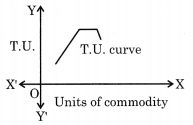
(vi) Due to war experience Indians realized that India could be considered backward in the matters of aircraft, mechanized war instruments, medical facilities. In 1917, Montagu- Chelmsford administrative reforms were introduced in India. India became extremely poor due to war.

7. Answer the following question with the help of the given points.

Question 1.
Explain the causes of the First World War.
(i) Increase in production
(ii) Imperialism
(iii) Division of Europe into two hostile groups
(iv) Immediate cause
Answer:
The First World War was fought between allied nations and central powers. The First World War
began in 1914 C.E. The causes of the war were:
(i) Increase in production: Due to the industrial revolution machines came into use for the various production processes. It also led to increasing in production because of mechanization.

(ii) Imperialism: The European countries needed more raw material to match the quantitative increase in production and more markets to sell their surplus products. Imperialistic European nations began to search for newer lands to meet these needs.

(iii) Growing Militarisation: The search for newer lands and colonies would often create warlike situations among them. Keeping this in view more powerful nations in Europe felt the need to continuously increase their military power and armory.

(iv) Division of Europe into two hostile groups: Germany, England, Russia, France, Austria, Hungary where the nations of primary importance. Among them, rival groups were formed. Because of the rivalry, every nation began to enhance its military and naval strength, There was a competition to produce more and more destructive weapons.
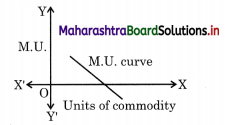
(v) Immediate cause: The Austrian Prince Archduke Franz Ferdinand and his wife were assassinated by a Serbian maniac. In Austria, people believed that this whole act was maneuvered by the Serbian Kingdom. Hence, Austria called a war against Serbia. Russia came to help Serbia. Two distinct groups were formed, one group supporting Austria (Germany, Turkey, Bulgaria) known as central powers and another supporting Serbia (England, France, Russia) known as allied nations.
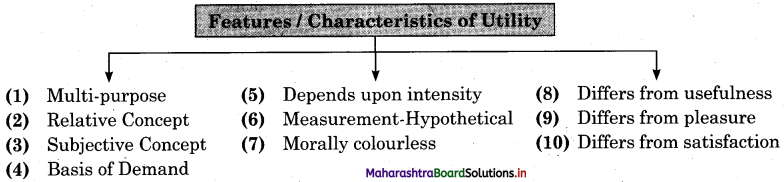
Maharashtra Board Class 12 History Important Questions Chapter 8 World Wars and India

Question 3.
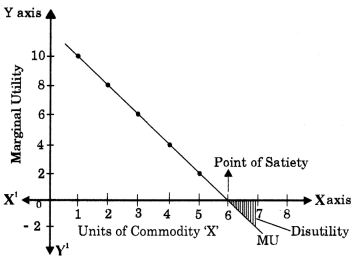
Explain the impacts of the World Wars on India.
(i) Awareness against the exploitative rule of the British and participation of masses in the Indian freedom struggle
(ii) Protest of Indian National Congress
(iii) Contribution of Azad Hind Sena
(iv) India got independence
Answer:
India was forced into both the World Wars started by the British Imperial rule. The impacts of wars on India were as follows:
(i) Awareness against the exploitative rule of the British and participation of masses in the Indian freedom struggle: During wartime, the British Government started recruiting army personnel from India. Extra taxes were levied on Indians for raising funds. The prices of essential commodities went up. Indians suffered from the problems of inflation, unemployment. Indians from all strata of society, workers, farmers, middle class, and women joined in the Indian national movement against British rule.

(ii) Protest of Indian National Congress: The Indian National Congress protested against the Viceroy’s announcement of India’s participation in the war. The Congress demanded India’s freedom in return to India’s help to England in war. However, Lord Linlithgow turned the demand of the Congress so Congress decided not to participate in World War II.

(iii) Contribution of Azad Hind Sena: Azad Hind Sena under the leadership of Netaji Subhash Chandra Bose joined Japanese forces against the British and fought fiercely for attaining independence of India.

(iv) India got independence: After the end of the Second World War British realized that India was not going to be the perennial source of profit for them as it used to be. They decided to return home and India got Independence.

Maharashtra Board Class 12 History Solutions Chapter 8 World Wars and India

Balbharti Maharashtra State Board Class 12 History Solutions Chapter 8 World Wars and India Textbook Exercise Questions and Answers.

Maharashtra State Board Class 12 History Solutions Chapter 8 World Wars and India

1A. Choose the correct alternative and rewrite the statement.

Question 1.
When Austria declared war against Serbia, it was _________, who helped Serbia.
(a) Germany
(b) America
(c) Hungary
(d) Russia
Answer:
(d) Russia

Maharashtra Board Class 12 History Solutions Chapter 8 World Wars and India

Question 2.
The first atom bomb was dropped on the city of _________ during the aerial attack of America on Japan.
(a) Nagasaki
(b) Hiroshima
(c) Pearl Harbour
(d) Stalingrad
Answer:
(b) Hiroshima

1B. Find the incorrect pair from group ‘B’ and write the corrected one.

Question 1.

Group ‘A’Group ‘B’
1. AmericaWoodrow Wilson
2. EnglandWinston Churchill
3. GermanyHitler
4. ItalyLinlithgow

Answer:
Italy – Benito Mussolini

2. Write the names of historical places/persons/events.

Question 1.
The name of the group of nations including England, France, Russia, Italy, and America in the First World War –
Answer:
Allied Nations

Question 2.
The name of the group of nations including Germany, Austria-Hungary, Turkey, Bulgaria in the First World War –
Answer:
Central Powers

3. Write short notes.

Question 1.
‘League of Nations.
Answer:

  1. A peace-loving American president Woodrow Wilson took a lead in the formation of the League of Nations.
  2. All the nations involved in the war felt the need to create some solution to avoid any situation that could lead to war.
  3. The main objectives of the League of Nations were –
    • finding peaceful solutions for conflicts between nations.
    • establishing peace in the world.
  4. Austria, Germany, and other defeated nations were not allowed to become members of the league.
  5. America was not a member of the league so England and France retained their dominance in the league.

Maharashtra Board Class 12 History Solutions Chapter 8 World Wars and India

Question 2.
Dr. Kotnis.
Answer:

  • Dr. Dwarkanath Kotnis was born on 10th October 1910 at Solapur.
  • When Japan had attacked China in 1937, the Chinese Government requested Pandit Jawaharlal Nehru to send a team of doctors to attend to the injured Chinese soldiers.
  • Dr. Kotnis was the chief of the team of Indian doctors sent to China.
  • He attended the Chinese soldiers for years but unfortunately died in China on 9th December 1942 in the plague epidemic.
  • Dr. Kotnis by the virtue of his selfless work formed the bridge of friendship between India and China.
  • The eminent Indian filmmaker, V. Shantaram made a film on his life, entitled ‘Dr. Kotnis Ki Amar Kahani’ which immortalized Dr. Kotnis’ memory.

4. Explain the following statements with reasons.

Question 1.
‘The Treaty of Versailles’ had the seeds of the Second World War. The Text does not have any comment to this effect.
Answer:

  • The Treaty of Versailles was signed between the Allied nations and Germany at Versailles palace in 1919. It was drafted by American President Woodrow Wilson.
  • The Treaty of Versailles was very harsh on Germany because Germany had lost the war.
  • Germany was forced to accept the responsibility for the war damages suffered by the Allies.
  • The victorious powers had deprived Germany of huge tracts of its territory. Germany was burdened with an immense war indemnity.
  • The peace settlement at Paris was made in a spirit of revenge. The Germans felt that too much injustice had been done to them.
  • The German economy was ruined completely. People were starving and the government was in chaos.
  • It was impossible for a proud German race to forget the consequences of the war, which they had lost so humiliatingly.
  • This fuelled the rise of Nazism in Germany which adopted the policy of aggression.
  • In this way, the Treaty of Versailles sowed the seeds of the Second World War.

Question 2.
The British Government in India decided to return home.
Answer:

  • The Second World War ended in the month of August 1945 with the surrender of Japan.
  • In this war, England emerged victoriously but it lost heavily in terms of human life and economic conditions.
  • As a result of this England grew weaker. The British Government in India is now aware that Indian soldiers and people are not as meek and submissive as before, ruling them was no easier.
  • India was not going to be the perennial source of profit for them as it used to be. There was a lot of pressure on England to give freedom to its colonies. Freedom struggles began in India which demanded ‘Poorna Swarajya’ which means total independence. Hence, the British Government in India decided to return home.

5. Answer the following questions in detail.

Question 1.
Give the causes of the Second World War.
(i) Dissatisfaction with the Treaty of Versailles
(ii) Rise of Hitler
(iii) Rise of Communism
(iv) Hitler’s attack on Poland
(v) Hitler’s violation of the Non-aggression Pact
Answer:
The Second World War was fought between 1939 to 1945. Following were the causes of the Second World War:
(i) Dissatisfaction with the Treaty of Versailles: The Treaty of Versailles was very harsh on Germany. It was made in a spirit of revenge. Germany was burdened with huge war indemnity. The German economy was ruined completely. This fuelled the rise of Nazism in Germany.

(ii) Rise of Hitler: The Nazis under the leadership of Hitler grabbed power in Germany. Hitler began to escalate Germany’s military power so as to avenge the demeaning conditions imposed on Germany by the treaty of Versailles. He focussed on increasing the strength of the military as well as the navy.

(iii) Rise of Communism: Meanwhile, Soviet Russia, a communist nation was becoming more powerful. It made nations like England, France, America uneasy. Soviet Russia and imperialistic Germany viewed each other as arch enemies. England and France ignored the advances of Germany thinking that it will keep a check on the rising power of Soviet Russia.

(iv) Hitler’s attack on Poland: In 1938, Hitler won the Sudeten province in Czechoslovakia, which was populated in majority by people of German origin. In 1939, he attacked Poland which was looked upon as a neutral country by all European nations. In spite of this, Hitler attacked Poland. Therefore, England declared war against Germany.

(v) Hitler’s violation of the Non-aggression pact: Denmark, Norway surrendered to Germany. Germany conquered Holland, Belgium, and France. In 1939, Hitler violated the ‘Non-aggression Pact’ made with Stalin and attacked Soviet Russia so Stalin declared war against Germany.

Maharashtra Board Class 12 History Solutions Chapter 8 World Wars and India

Question 2.
Why did Indian people participate in the national movement in great numbers?
Answer:

  • India was a colony of the British during wartime. England started exploiting their colonies to meet the needs of war.
  • During wartime, England felt an increasing need for manpower and money. Therefore, the British Government began recruiting army personnel from India.
  • At times the recruitment was enforced on Indians.
  • Extra taxes were levied on Indians for raising funds. Taxes on trade and industries were raised.
  • During the war period prices of essential commodities went up. Indians suffered from the problems of inflation, hike in prices, increasing unemployment caused by the industrial recession.
  • Indians could see that the exploitative rule of the British was responsible for this miserable state of affairs.
  • Hence, Indians from all strata of society, workers, farmers, and the middle class joined in large numbers in the national movements against British rule.

Maharashtra Board Class 12 History Important Questions Chapter 7 Decolonisation to Political Integration of India

Balbharti Maharashtra State Board Class 12 History Important Questions Chapter 7 Decolonisation to Political Integration of India Important Questions and Answers.

Maharashtra State Board 12th History Important Questions Chapter 7 Decolonisation to Political Integration of India

1A. Choose the correct alternative and rewrite the statement.

Question 1.
Decolonization is the process of ending the colonial rule and handing over __________ to local people by colonialists.
(a) The political and administrative power
(b) The political and social power
(c) The social and cultural power
(d) The social and economical power
Answer:
(a) The political and administrative power

Question 2.
__________ handled the situation with great skill and tact.
(a) Sardar Vallabhbhai Patel
(b) Maulana Abdul Kalam Azad
(c) Pandit Jawaharlal Nehru
(d) Dr. T.B. Kunha
Answer:
(a) Sardar Vallabhbhai Patel

Maharashtra Board Class 12 History Important Questions Chapter 7 Decolonisation to Political Integration of India

Question 3.
In February 1948, __________ merged in India.
(a) Junagadh
(b) Dadra and Nagar Haveli
(c) Hyderabad
(d) Kashmir
Answer:
(a) Junagadh

Question 4.
In __________ people wanted to merge in India and the Nawab wanted to merge in Pakistan.
(a) Saurashtra
(b) Kashmir
(c) Hyderabad
(d) Rajasthan
Answer:
(a) Saurashtra

Question 5.
The __________ passed a resolution in favour of Hyderabad’s merger in India.
(a) Hyderabad State Congress
(b) Marathwada Parishad
(c) Karnataka Parishad
(d) Andhra Parishad
Answer:
(a) Hyderabad State Congress

Question 6.
17th September 1948 the day of Hyderabad’s freedom is celebrated as the __________
(a) Marathwada Liberation Day
(b) Hyderabad Liberation Day
(c) Marathwada Labour Day
(d) Hyderabad Day
Answer:
(a) Marathwada Liberation Day

Maharashtra Board Class 12 History Important Questions Chapter 7 Decolonisation to Political Integration of India

Question 7.
__________ was started by the Indian Army in Goa to free from the Portuguese.
(a) Operation Vijay
(b) Operation Thunder
(c) Operation Blue Star
(d) Operation Anti-Portuguese
Answer:
(a) Operation Vijay

Question 8.
According to __________ Jammu and Kashmir got special status.
(a) Article 370
(b) Article 470
(c) Article 315
(d) Article 365
Answer:
(a) Article 370

Question 9.
In 1939, posters with __________ slogans were posted all over Goa.
(a) Quit Goa
(b) Quit Portuguese
(c) Quit India
(d) Non-Cooperation Movement
Answer:
(a) Quit Goa

1B. Find the incorrect pair from group ‘B’ and write the corrected one.

Question 1.

Group ‘A’Group ‘B’
(a) Hyderabad’s OrganisationHyderabad State Congress
(b) Goa’s OrganisationGoa Congress Committee
(c) Puducherry LeaderDr. T.B. Kunha
(d) Kashmir’s KingKing Hari Singh

Answer:
Puducherry Leader – Subbayya

Question 2.

Group ‘A’Group ‘B’
(a) Junagadh merged in IndiaFebruary 1948
(b) Hyderabad merged in IndiaSeptember 1948
(c) Dadra and Nagar Haveli merged in IndiaAugust 1955
(d) Goa became part of IndiaDecember 1961

Answer:
Dadra and Nagar Haveli merged in India – August 1954

Question 3.

Group ‘A’Group ‘B’
(a) Sardar Patel1st Prime Minister
(b) Swami Ramanand TirthHyderabad Freedom Struggle
(c) Francis MascarenhasUnited Goan Front
(d) Keshavrao JedheGoa Vimochan Sahayak Samiti

Answer:
Sardar Patel – Deputy Prime Minister

Maharashtra Board Class 12 History Important Questions Chapter 7 Decolonisation to Political Integration of India

Question 4.

Group ‘A’Group ‘B’
(a) JunagadhFebruary 1948 merged in India
(b) HyderabadSeptember 1948 merged in India
(c) Dadra and Nagar HaveliIn 1961 Union Territory
(d) Jammu and KashmirArticle 470

Answer:
Jammu and Kashmir – Article 370

2A. Write the names of historical places/persons/events.

Question 1.
Languages were spoken in Hyderabad –
Answer:
Telugu, Kannada, and Marathi

Question 2.
Various organisations in Hyderabad –
Answer:
Andhra Parishad, Maharashtra Parishad, and Karnataka Parishad

Question 3.
Head of the Razakar Organisation –
Answer:
Kasim Razvi

Question 4.
Name of the mission planned by the Indian Army in Goa –
Answer:
Operation Vijay

Question 5.
People of Puducherry got united under the leadership of –
Answer:
Subbayya

Maharashtra Board Class 12 History Important Questions Chapter 7 Decolonisation to Political Integration of India

Question 6.
Name of the regions controlled by the French –
Answer:
Puducherry, Karaikal, Maho, Yanam, and Chandranagar

2B. Choose the correct reason from those given below and complete the sentence.

Question 1.
Junagadh merged in India because __________
(a) Nawab wanted to merge in Pakistan
(b) People of Junagadh wanted to merge in India
(c) People of Junagadh opposed Nawab’s decision
(d) All of above
Answer:
(d) All of above

Question 2.
Nizam had opposed the resolution passed by Hyderabad State Congress because __________
(a) He was willing to join Pakistan
(b) Fear of losing his hold over Hyderabad
(c) people were in favour of India
(d) All of above
Answer:
(d) All of above

Question 3.
Pakistan attacked on Kashmir because __________
(a) Pakistan wanted to capture Kashmir
(b) King Hari Singh wanted to join India
(c) People of Kashmir wanted to join India
(d) King Hari Singh neither wanted to join Pakistan nor India
Answer:
(a) Pakistan wanted to capture Kashmir

3A. Observe the map on textbook page 61 and answer the questions based on it.

Maharashtra Board Class 12 History Important Questions Chapter 7 Decolonisation to Political Integration of India 3A

Question 1.
Name the countries located at the northeast border of India.
Answer:
China, Nepal, Bhutan, and East Pakistan.

Question 2.
What is the theme of the map?
Answer:
Independent India, 15th August 1947.

Maharashtra Board Class 12 History Important Questions Chapter 7 Decolonisation to Political Integration of India

Question 3.
Name of the island located nearby India.
Answer:
Andaman and Nicobar island.

Question 4.
Name of the regions located on the western coast of India.
Answer:
Diu, Daman, Mumbai, Goa, and Mahe.

Question 5.
Name of the regions located on the eastern coast of India.
Answer:
Kolkata, Yanam, Chennai, Puducherry, and Karaikal.

3B. Complete the following concept map.

Question 1.
Maharashtra Board Class 12 History Important Questions Chapter 7 Decolonisation to Political Integration of India 3B Q1
Answer:
Maharashtra Board Class 12 History Important Questions Chapter 7 Decolonisation to Political Integration of India 3B Q1.1

Question 2.
Maharashtra Board Class 12 History Important Questions Chapter 7 Decolonisation to Political Integration of India 3B Q2
Answer:
Maharashtra Board Class 12 History Important Questions Chapter 7 Decolonisation to Political Integration of India 3B Q2.1

Question 3.
Maharashtra Board Class 12 History Important Questions Chapter 7 Decolonisation to Political Integration of India 3B Q3
Answer:
Maharashtra Board Class 12 History Important Questions Chapter 7 Decolonisation to Political Integration of India 3B Q3.1

4A. Write short notes.

Question 1.
Junagadh
Answer:

  • Junagadh was located in Gujarat.
  • Nawab of Junagadh was planning to merge the state into Pakistan, but the people of Junagadh were in favour of India.
  • After getting the people against him, he flew to Pakistan, in February 1948 Junagadh became part of Independent India.

Question 2.
Kashmir merged in India
Answer:

  • After declaring British Policy regarding princely states, King Hari Sigh of Kashmir neither wanted to join Pakistan nor India.
  • But Pakistan wanted to capture Kashmir.
  • Soon Pakistan attacked Kashmir, King Hari Singh sought help from Pandit Jawaharlal Nehru.
  • Indian army had already started recapturing parts of the land which had been captured by the Pakistani army.
  • Meanwhile, UNO intervened in this matter and Pakistan and India had to stop the war. But by this decision, some parts of Kashmir remained occupied by Pakistan.
  • Later on, King Hari Singh was ready to merge in India. Special provisions were passed and through this Kashmir got special status under Article 370.

Maharashtra Board Class 12 History Important Questions Chapter 7 Decolonisation to Political Integration of India

Question 3.
Dadra and Nagar Haveli
Answer:

  • Dadra and Nagar Haveli is located in Gujarat, near the Damanganga river, it was under the control of the Portuguese.
  • Like other regions of India, the people of Dadra and Nagar Haveli also got freedom from the Portuguese.
  • Many organisations like the United Front of Goans and Azad Gomantak Dal came together to fight against the Portuguese reign.
  • These organisations and their branches started capturing the area under it. Many police stations and administration offices were attacked.
  • The Portuguese army was called to control people. At the same time, the Government of India appointed Governor and signed the agreement.
  • According to this treaty, Dadra and Nagar Haveli merged in India on 2nd August 1954 and in 1961, got status of ‘Union Territories.’

Question 4.
Puducherry
Answer:

  • Similar to Dadra and Nagar Haveli, Puducherry was under French rule.
  • Most of the east coast of India regions like Puducherry, Karaikal, Mahe, Yanam, and Chandrangar in West Bengal were under French rule as well.
  • People and many political parties under the leadership of V. Subbayya came together to get rid of the French.
  • It was a serious matter for the Government of India; hence they demanded that French Government return the Indian regions. In 1948, an agreement was signed by both governments for Puducherry
  • In 1949, Chandranagar was merged in India.
  • In 1954, the French government passed the draft, according to it all French ruling regions will merge in India. And in 1963 Puducherry was declared a ‘Union Territory’.

Question 5.
Goa
Answer:

  • Goa was under Portuguese control. In 1928 ‘Goa Congress Committee was formed and it became the branch of the Indian National Congress.
  • ‘Quit Goa’ slogans were posted all over Goa.
  • Dr. Kunha played an important role in Goa. Dr. Lohia got arrested in Civil Disobedience Movement.
  • Dr. Kunha was also arrested. After his release from jail, he started a newspaper namely ‘Azad Goa’ and ‘Swatantra Goa’.
  • One of the groups of activists unfurled the Indian flag at the fort of Panaji.
  • Many eminent people participated in Goa Liberation Movement. Mohan Ranade systematically began anti-Portuguese propaganda in Goa. He was arrested and kept in jail till 1972.
  • ‘Maratha’, a newspaper, was trying to get support from Maharashtra for Goa. Soon Pandit Jawaharlal Nehru sent the Indian army to Goa for the mission called “Operation Vijay”.
  • Within 48 hours Portuguese surrendered and Goa became a part of the Indian Republic. And 450 years rule of foreign power came to an end.

4B. Explain the following statements with reasons.

Question 1.
Kashmir got special Status under Article 370.
Answer:

  • From the beginning, Kashmir received special attention from all.
  • After British policy for the princely states, Kashmir King Hari Singh decided not to be a part of Pakistan and also not to be a part of India.
  • However, when Pakistan Pakistan attacked Kashmir, King Hari Singh asked India to help and he consented to merge Kashmir in India and officially submitted an agreement.
  • Indian Army was sent to save Kashmir.
  • Later on, the constitution of Jammu and Kashmir was drafted and it became part of India and got special status under ‘Article 370.’

Maharashtra Board Class 12 History Important Questions Chapter 7 Decolonisation to Political Integration of India

Question 2.
‘Operation Vijay’ was planned in Goa.
Answer:

  • Goa was under Portuguese control. In 1928 ‘Goa Congress Committee was formed and it became the branch of the Indian National Congress.
  • ‘Quit Goa’ slogans were posted all over Goa.
  • Dr. Kunha played an important role in Goa. Dr. Lohia got arrested in Civil Disobedience Movement.
  • Dr. Kunha was also arrested. After his release from jail, he started a newspaper namely ‘Azad Goa’ and ‘Swatantra Goa’.
  • One of the groups of activists unfurled the Indian flag at the fort of Panaji.
  • Many eminent people participated in Goa Liberation Movement. Mohan Ranade systematically began anti-Portuguese propaganda in Goa. He was arrested and kept in jail till 1972.
  • ‘Maratha’, a newspaper, was trying to get support from Maharashtra for Goa. Soon Pandit Jawaharlal Nehru sent the Indian army to Goa for the mission called “Operation Vijay”.
  • Within 48 hours Portuguese surrendered and Goa became a part of the Indian Republic. And 450 years rule of foreign power came to an end.

Question 3.
Dadra and Nagar Haveli were declared Union territories.
Answer:

  • Dadra and Nagar Haveli is located in Gujarat, near the Damanganga river, it was under the control of the Portuguese.
  • Like other regions of India, the people of Dadra and Nagar Haveli also got freedom from the Portuguese.
  • Many organisations like the United Front of Goans and Azad Gomantak Dal came together to fight against the Portuguese reign.
  • These organisations and their branches started capturing the area under it. Many police stations and administration offices were attacked.
  • The Portuguese army was called to control people. At the same time, the Government of India appointed Governor and signed the agreement.
  • According to this treaty, Dadra and Nagar Haveli merged in India on 2nd August 1954 and in 1961, got status of ‘Union Territories.’

5. State your opinion.

Question 1.
‘Operation Polo’ was started in Hyderabad.
Answer:

  • Swami Ramanand Tirth with loyal workers was leading a political organization to free Hyderabad from the Nizam.
  • Hyderabad State Congress passed a resolution that Hyderabad will merge in India and this was not liked by Nizam, he was willing to join Pakistan.
  • People of Hyderabad however, wanted to merge with India. Kasim Razvi formed the ‘Razakar’ organisation against people who were fighting for democracy.
  • In the end Indian Government launched a police campaign against Nizam, called ‘Operation Polo’.

Maharashtra Board Class 12 History Important Questions Chapter 7 Decolonisation to Political Integration of India

Question 2.
The Indian Army was sent for Kashmir’s Protection.
Answer:

  • Kashmir King Hari Singh decided not to be a part of Pakistan and also not to be a part of India.
  • However, when Pakistan attacked Kashmir, King Hari Singh asked India to help and he consented to merge Kashmir in India and officially submitted an agreement.
  • Indian Army was sent to save Kashmir.

Question 3.
Dadra and Nagar Haveli got status of Union Territory.
Answer:

  • Dadra and Nagar Haveli is located in Gujarat, near the Damanganga river, it was under the control of the Portuguese.
  • Like other regions of India, the people of Dadra and Nagar Haveli also got freedom from the Portuguese.
  • Many organisations like the United Front of Goans and Azad Gomantak Dal came together to fight against the Portuguese reign.
  • These organisations and their branches started capturing the area under it. Many police stations and administration offices were attacked.
  • The Portuguese army was called to control people. At the same time, the Government of India appointed Governor and signed the agreement.
  • According to this treaty, Dadra and Nagar Haveli merged in India on 2nd August 1954 and in 1961, got status of ‘Union Territories.’

Question 4.
Contribution of Dr. Lohia and Dr. T.B. Kunha in Goa’s Freedom Struggle.
Answer:

  • Dr. Ram Manohar Lohia started a movement called Civil Disobedience.
  • Dr. Lohia and Dr. T.B. Kunha were arrested and sent to jail.
  • Dr. Kunha was sent to Portugal for 8 years imprisonment.
  • After returning to India he started the newspapers, ‘Azad Goa’ and ‘Swatantra Goa’.
  • Both these leaders have contributed a lot to the freedom of Goa.

6. Answer the following questions in detail.

Question 1.
(a) Hyderabad Freedom Struggle
(b) The Kashmir Issue
(c) Dadra and Nagar Haveli
(d) Goa
(e) Puducherry
Answer:
(a) Hyderabad Freedom Struggle:
Hyderabad was under Nizam rule, it was one of the largest amongst princely states along with Telugu, Kannada, and Marathi regional sections. Various organisations were formed to fight against Nizam’s policy for their people.

Maharashtra Board Class 12 History Important Questions Chapter 7 Decolonisation to Political Integration of India

  • Nizam’s decision: Nizam was ruler and wanted to merge Hyderabad into Pakistan. The people of Hyderabad wanted democracy. It was not about one regional section. He put restrictions on the Civil and Political rights of his subjects to a great extent.
  • Organisations: To fight against the suppressive policy of Nizam people of the state started various organisations namely Andhra Parishad in Telangana, Maharashtra Parishad in Marathwada, and Karnataka Parishad in Karnataka. Swami Ramananda Tirth formed an organisation with loyal workers called Hyderabad State Congress and gave direction for freedom.
  • Operation Polo: People of Hyderabad wanted to merge in India. Kasim Razvi formed a ‘Razakar’ organisation against people. In the end, the Indian Government launched a police campaign against Nizam, called ‘Operation Polo’. In 1948 Nizam surrendered and Hyderabad merged in India.

(b) The Kashmir Issue:
From the beginning, Kashmir is special attention for all. After British policy for the princely states, Kashmir king Hari Singh decided not to be a part of Pakistan and also not be a part of India.

But Pakistan attacked Kashmir and King Hari Singh asked India to help and he consented to merge Kashmir in India and officially submitted an agreement. Indian Army was sent to save Kashmir. Later on, the constitution of Jammu and Kashmir was drafted and it became part of India and got special status under article 370.’

The intervention of UNO: In 1948, Pandit Jawaharlal Nehru took this matter to UNO. It became an international issue. Even UNO could not persuade Pakistan to withdraw their troops from the territory of Kashmir occupied by them. However, then the National Conference Party decided on a plebiscite to solve the issue and to accede Kashmir to India.

(c) Dadra and Nagar Haveli:

  • Dadra and Nagar Haveli is located in Gujarat, near the Damanganga river, it was under the control of the Portuguese.
  • Like other regions of India, the people of Dadra and Nagar Haveli also got freedom from the Portuguese.
  • Many organisations like the United Front of Goans and Azad Gomantak Dal came together to fight against the Portuguese reign.
  • These organisations and their branches started capturing the area under it. Many police stations and administration offices were attacked.
  • The Portuguese army was called to control people. At the same time, the Government of India appointed Governor and signed the agreement.
  • According to this treaty, Dadra and Nagar Haveli merged in India on 2nd August 1954 and in 1961, got status of ‘Union Territories.’

Maharashtra Board Class 12 History Important Questions Chapter 7 Decolonisation to Political Integration of India

(d) Goa:

  • Goa was under Portuguese control. In 1928 ‘Goa Congress Committee was formed and it became the branch of the Indian National Congress.
  • ‘Quit Goa’ slogans were posted all over Goa.
  • Dr. Kunha played an important role in Goa. Dr. Lohia got arrested in Civil Disobedience Movement.
  • Dr. Kunha was also arrested. After his release from jail, he started a newspaper namely ‘Azad Goa’ and ‘Swatantra Goa’.
  • One of the groups of activists unfurled the Indian flag at the fort of Panaji.
  • Many eminent people participated in Goa Liberation Movement. Mohan Ranade systematically began anti-Portuguese propaganda in Goa. He was arrested and kept in jail till 1972.
  • ‘Maratha’, a newspaper, was trying to get support from Maharashtra for Goa. Soon Pandit Jawaharlal Nehru sent the Indian army to Goa for the mission called “Operation Vijay”.
  • Within 48 hours Portuguese surrendered and Goa became a part of the Indian Republic. And 450 years rule of foreign power came to an end.

(e) Puducherry:

  • Similar to Dadra and Nagar Haveli, Puducherry was under French rule.
  • Most of the east coast of India regions like Puducherry, Karaikal, Mahe, Yanam, and Chandrangar in West Bengal were under French rule as well.
  • People and many political parties under the leadership of V. Subbayya came together to get rid of the French.
  • It was a serious matter for the Government of India; hence they demanded that French Government return the Indian regions. In 1948, an agreement was signed by both governments for Puducherry
  • In 1949, Chandranagar was merged in India.
  • In 1954, the French government passed the draft, according to it all French ruling regions will merge in India. And in 1963 Puducherry was declared a ‘Union Territory’.

Maharashtra Board Class 12 Economics Important Questions Chapter 2 Utility Analysis

Balbharti Maharashtra State Board Class 12 Economics Important Questions Chapter 2 Utility Analysis Important Questions and Answers.

Maharashtra State Board 12th Economics Important Questions Chapter 2 Utility Analysis

1. [A] Choose the correct option.

Question 1.
Form Utility increases when –
(a) dress stitched from cloth.
(b) change in the format of given material.
(c) river water diverted towards farm.
(d) pot made from clay.
Options :
(1) a, b, c
(2) b, c, d
(3) a, b, d
(4) a, b, c, d
Answer:
(3) a, b, d

Maharashtra Board Class 12 Economics Important Questions Chapter 2 Utility Analysis

Question 2.
Blood donation is an example of –
(a) place utility
(b) knowledge utility
(c) service utility
(d) form utility

Options ;
(1) a, b, c
(2) b, c, d
(3) a, b, d
(4) none of these
Answer:
(4) none of these

Question 3.
With an increase in consumption of commodity, MU curve –
(a) slopes downward
(b) goes upward
(c) turns backward
(d) shows negative slope
Options :
(1) a, d,
(2) a, b, c
(3) a, b,
(4) a, c, d
Answer:
(1) a, d,

Question 4.
After a point of satiety, any additional consumption of commodity results into –
(a) negative MU
(b) diminishing TU
(c) disutility
(d) maximum TU

Options :
(1) a, b, d
(2) a, b, c
(3) a, c, d
(4) None of these
Answer:
(2) a, b, c

Question 5.
Want satisfying power of a commodity is called –
(a) usefulness
(b) satisfaction
(c) happiness
(d) utility

Options :
(1) a, b
(2) b, d
(3) d
(4) a, c
Answer:
(3) d

Question 6.
Zero MU is described as
(a) disutility
(b) point of satiety
(c) dis-satisfaction
(d) maximum TU
Options :
(1) a, b
(2) b, d
(3) b, c, d
(4) a, b, c, d
Answer:
(2) b, d

Maharashtra Board Class 12 Economics Important Questions Chapter 2 Utility Analysis

(B) Complete the Correlation

(1) Fan in summer : Time utility :: Sweater in Shimla : …………..
(2) Additional Utility : Marginal utility :: Aggregate utility : …………..
(3) Maximum TU : Zero MU :: TU declines : …………..
(4) Measuring in numbers : …………..:: Higher or Lower level: Ordinal measurement
(5) Point of satiety : ………….. :: Beyond point of satiety: Dissatisfaction
(6) Transport of goods : ………….. :: Storage of goods : Time utility
(7) Want satisfying power : ………….. :: Use value of a commodity : Usefulness
(8) Homogeneity : Assumption of the law of DMU :: Hobbies : …………..
(9) Increases at a diminishing rate : Total Utility :: Goes on diminishing : …………..
(10) Consumer : To obtain maximum satisfaction :: …………..: To frame various economic policies
Answers:
(1) Place Utility
(2) Total Utility
(3) Negative MU
(4) Cardinal measurement
(5) Full satisfaction
(6) Place utility
(7) Utility
(8) Exception of law of DMU
(9) Marginal Utility
(10) Government

(C) Give economic terms.

(1) Want satisfying capacity of a commodity.
(2) Treatment given by a doctor to a patient.
(3) Goods sold by shopkeeper to consumer.
(4) Addition made to TU by consuming one more unit of a commodity.
(5) Aggregate of utilities derived from all units.
(6) Marginal utility becomes negative beyond the point of satiety.
(7) Utility created due to change in the structure of given material.
(8) A state of mind to feel happy.
(9) A feeling of lack of satisfaction.
(10) The urgency to satisfy want immediately.
Answer:
(1) Utility
(2) Service Utility
(3) Possession Utility
(4) Marginal Utility
(5) Total Utility
(6) Disutility
(7) Form Utility
(8) Satisfaction
(9) Want
(10) Intensity

(D) Find the odd word out:

(1) Form Utility, Time Utility, Date Utility, Place Utility.
(2) Rationality, Continuity, Reasonability, Indivisibility.
(3) Sum, Aggregate, Total, Additional.
(4) Disutility, Negative utility. Maximum TU, Declining TU.
(5) Diminishing, Declining, Developing, ; Decreasing.
(6) Miser, Drunkard, Power, Rational consumer.
Answer:
(1) Date utility
(2) Indivisibility
(3) Additional
(4) Maximum TU
(5) Developing
(6) Rational consumer

(E) Complete the following statements.

Question 1.
Utility depends upon ………………..
(a) intensity of want
(b) income of a consumer
(c) quality of a product
(d) cardinal measurement
Answer:
(a) intensity of want

Question 2.
When TU declines, MU ……………………………..
(a) is zero
(b) increases
(c) remains constant
(d) becomes negative
Answer:
(d) becomes negative

Question 3.
Consumer’s equilibrium is attained when
(a) MUX > Px
(b) MUX = Px
(c) MUX < Px
(d) MUX = zero
Answer:
(b) MUX = Px

Maharashtra Board Class 12 Economics Important Questions Chapter 2 Utility Analysis

Question 4.
Electricity can be used in Fan, TV, iron, computer, etc. because utility is ……………
(a) subjective concept
(b) multi-purpose
(c) basis of demand
(d) morally colourless
Answer:
(b) multi-purpose

Question 5.
The sum of all marginal utilities from the consumption of a commodity is called ………………
(a) place utility
(b) additional utility
(c) total utility
(d) time utility
Answer:
(c) total utility

[F] Choose the wrong pair :

I.

Group ‘A’Group ‘B’
1. Prof. MarshallLaw of DMU
2. Total utilityUtility from last unit
3. Cardinal measurementAssumption of law of DMU
4. Service utilityKnowledge by teacher

Answer:
Wrong pair : Total utility – Utility from last unit

II.

Group ‘A’Group ‘B’
1. DisutilitNegative MU
2. HomogeneityIdentical unit
3. Law of DMUExplained by Prof. Gossen
4. Maximum TUZero MU

Answer:
Wrong pair : Law of DMU
Explained by Prof. Gossen

[G] Choose the correct pair :

I.

Group ‘A’Group ‘B’
1. Total utility(a) Point of Satiety
2. Zero MU(b) Furniture from wood
3. Time utility(c) Aggregate of utilities
4. Form utility(d) Apples for Kashmir
(e) Organ donation

Options :
(1) 1 – a, 2 – c, 3 – e, 4 – b.
(2) 1 – c, 2 – e, 3 – d, 4 – b.
(3) 1 – c, 2 – a, 3 – e, 4 – b.
(4) 1 – e, 2 – a, 3 – c, 4 – d.
Answer:
(3) 1 – c, 2 – a, 3 – e, 4 – b.

II.

Group ‘A’Group ‘B’
1. Ordinal measurement(a)Maximum TU
2. Principles of Economics(b) MUX>PX
3. Point of satiety(c) Prof. Alfred Marshall
4. Consumer’s equilibrium(d) Grading of utility
(e) MUX = PX

Options :
(1) 1 – d, 2 – c, 3 – a, 4 – e.
(2) 1 – c, 2 – a, 3 – b, 4 – b.
(3) 1 – d, 2 – a, 3 – b, 4 – c.
(4) 1 – b, 2 – e, 3 – d, 4 – c.
Answer:
(1) 1 – d, 2 – c, 3 – a, 4 – e.

2.[A] Identify and explain the concept from given illustrations.

Question 1.
Tanvi took umbrella while going out as it started raining.
Concept: Time utility.
Explanation : When Utility of a commodity increases during particular time period, it is called time utility.
Tanvi is using umbrella, when it is raining Ans. so, it is an example of time utility.

Question 2.
A goldsmith made a beautiful golden necklace.
Answer:
Concept: Form utility.
Explanation : When utility is created due to change in the form of given material it is known as form utility.
So, furniture from wood, dress from cloth, jewellery from gold, etc. are examples of form utility.
Thus, necklace made from gold is an example of form utility.

Question 3.
Deepak purchased bricks and transported to Thane at his construction site.
Answer:
Concept : Place utility.
Explanation : When utility arises due to change in the place of its utilisation, it is called place utility.
Transport of goods creates place utility. In this example, bricks are transported from place of production to place of utilization. So it is an example of place utility.

Question 4.
Mugdha bought raw mangoes and made pickle from it.
Answer:
Concept: Form utility.
Explanation : When utility increases due to change in the shape, structure or form of material, it is called form utility. So, pickle made from raw mangoes, is an example of form utility.

Maharashtra Board Class 12 Economics Important Questions Chapter 2 Utility Analysis

Question 5.
Aditi went to Beauty Parlour to cut her hairs.
Answer:
Concept: Service utility.
Explanation : When service is provided by one person to another, it is called service utility.
It includes services rendered by professionals like doctors, lawyers, teachers, etc.
In this case, a beautician has given service to Aditi.
So, it is an example of service utility.

(B) Distinguish between

Question 1.
Utility and Usefulness.
Answer:

UtilityUsefulness
1. Utility is the capacity of a commodity to satisfy human wants.(a) Anything (goods or services) are useful if they satisfy human want and generate human welfare.
2. A product may have utility irrespective of the commodity is useful or harmful, desirable or undesirable.(b) A product is useful only when it is desirable or beneficial and does not do any harm to a person.
3. All commodities have utility such as car, clothes, even harmful products like drugs, liquor, cigarettes, narcotics, etc.(c) Products such as food items, medicine, clothes, etc. are useful. Also services such as education, recreation are useful to people.
4. The term utility is subjective in nature as it changes from person to person, from place to place and from time to time.(d) The term usefulness is absolute in nature, it never changes.

Question 2.
Utility and satisfaction.
Answer:

UtilitySatisfaction
1. Utility is a want satisfying capacity possessed by a commodity.(a) Satisfaction is actual realisation from consumption of a commodity.
2. It is what the commodity possesses.(b) It is what the commodity gives.
3. It is a means.(c) It is an end.
4. It is expected satisfaction before consumption.(d) It is actual realisation which comes after consumption.

Question 3.
Place Utility and Time Utility.
Answer:

Place UtilityTime Utility
1. Place utility is created by changing the place of utilisation.(a) Time utility is created by changing the time of utilisation.
2. Transporting goods from one place to another, generally from place of abundance to place of scarcity, from place of manufacturing to place of consumption (Market), etc.(b) Storing of goods during abundance and releasing them during scarcity or goods are warehoused from time of production to time of consumption.
3. All types of transport service create place utility.(c) Warehousing service create time utility.
4. E.g. Food grains from village farm are sold in city markets.(d) E.g. Wheat stored during harvest time and released during off season.

Question 4.
Total Utility and Marginal Utility.
Answer:
Total Utility :

  1. Total utility is the sum total of utilities derived from the consumption of all units in a given stock of a commodity.
  2. TU =Σ MU
  3. TU increases but at a diminishing rate.
  4. At point of satiety TU is maximum.
  5. After point of satiety TU starts diminishing.
  6. Numerical value of TU is always positive.
  7. TU indicates value-in-use.
  8. When TU is maximum, the MU is zero.

Maharashtra Board Class 12 Economics Important Questions Chapter 2 Utility Analysis 1
Marginal Utility :

  1. Marginal utility is the additional utility derived from consuming additional unit of a commodity.
  2. MUn = TUn – TUn-1
  3. MU continuously diminishes.
  4. At point of satiety MU is zero.
  5. After point of satiety MU becomes negative.
  6. Numerical value of MU can be positive, negative or zero.
  7. MU indicates value-in-exchange.
  8. When the MU is maximum the TU is minimum.

Maharashtra Board Class 12 Economics Important Questions Chapter 2 Utility Analysis 2

Maharashtra Board Class 12 Economics Important Questions Chapter 2 Utility Analysis

Question 5.
Form Utility and Service Utiliity.
Answer:
Form Utility :

  1. Form utility arises when the structure of given material changes.
  2. Furniture made out of wood is an example of form utility.
  3. It is related to material welfare.
  4. Form utility is mainly created by artisans like tailor, carpenter, etc.

Service Utility :

  1. It arises when service is rendered by one person to another.
  2. Knowledge given by teacher to student is an example of service utility.
  3. It is related to non-material welfare.
  4. Service utility is mainly created by professionals like doctor, lawyers, etc.

Question 6.
Knowledge Utility and Possession Utility.
Answer:
Knowledge Utility:

  1. Knowledge utility arises when a person acquires knowledge regarding a product.
  2. Use of mobile, computer, etc. creates knowledge utility.
  3. In this case, a consumer is interested to know various functions of product.
  4. Knowledge utility increases due to utilisation.

Possession Utility:

  1. Possession utility arises when the ownership of a product is transferred from one person to another.
  2. Sale and purchase of goods creates possession utility.
  3. In this case, a consumer is interested to satisfy his wants.
  4. Possession utility increases due to demand.

Question 7.
Form Utility and Time Utility.
Answer:
Form Utility :

  1. Form utility arises when the structure of given material changes.
  2. E.g. Furniture made out of wood.
  3. Technology and intelligence creates form utility.

Time Utility:

  1. Time utility is created by changing the time of utilisation.
  2. E.g. Wheat stored during harvest season and released during off season.
  3. Warehousing creates time utility.

3. Answer the following questions:

Question 1.
Critically evaluate the law of Diminishing Marginal Utility.
OR
Explain the limitations or shorcomings of law of DMU.
Answer:
Critical evaluation of the Law of DMU is as follows:
(1) Unrealistic Assumptions : The law of DMU is based upon some unrealistic assumptions like homogeneity, continuity, rationality, constancy, etc.
In reality, it is very difficult to fulfil all these ssumptions at a time.

(2) Cardinal Measurement – not possible : The law assumes that, utility is cardinally measurable. It is necessary for the law to express schedule indicating MU and TU. It helps to add, subtract and compare utilities, In the real sense, utility is a psychological concept so it cannot be measured cardinally i.e. in numbers.

(3) Not applicable to Indivisible Goods : The law assumes divisibility. So it is not applicable to indivisible or bulky goods like car, T.V. set, house, etc. which are not divisible.
It is not possible to compare MU from commodity which are normally purchased, once in a life time.

(4) Constant MU of Money: The law assumes that MU of each unit of money is constant. But, in reality, MU of money declines as its stock increases.
Critics also argue that MU of money differs from person to person. It is affected by changes in price level, stock of money, rate of interest, etc.

(5) Restricted to satisfaction of Single Want : The law of DMU has limited applicability. It analyses the satisfaction derived from single want.
In reality, human wants are multiple in nature i.e. a person has to satisfy many wants at a time.
Though, law of DMU is criticized, it is important and popular in economics, because it explains economics behavior of a rational consumer.

Question 2.
Explain the significance importance of Law of Diminishing Marginal Utility.
Answer:
The law of DMU has universal applicability so it is an important law in economics.
Importance or significance of the law of DMU is as follows :

(1) Useful to Consumers : The law is important to the consumer because it helps the consumer to maximize his satisfaction.
It creates awareness among the consumers 5 to get maximum satisfaction with limited resources.

(2) Useful to the Government : The law ; guides the government in framing various economics policies like progressive tax policy, pricing policy, trade policy, import export policy, etc. so as to maximise
economic welfare of the society.

(3) To understand Paradox of Value : The law of DMU helps us to understand paradox of values, i.e. value-in-use and value-in-exchange.

Some goods have more value-in-use but less value-in-exchange like air, water, sunlight, etc. while some goods have less value-in-use but high value-in-exchange like gold, diamond, etc. Greater value-in-use denotes high total utility whereas, more value in exchange denotes higher marginal utility.

(4) Basis of Law of Demand : The law of demand is based on the law of DMU.
A consumer compares MU with price of a commodity. He purchases till MU equals price. When a consumer buys more and more units of a commodity, his MU diminishes. It means, a consumer would buy more only at a lower price which is a basis of law of demand.

Maharashtra Board Class 12 Economics Important Questions Chapter 2 Utility Analysis

Question 3.
Explain the features / characteristics of Utility.
Answer:
Maharashtra Board Class 12 Economics Important Questions Chapter 2 Utility Analysis 3
(1) Multi-purpose : Utility is said to be multi-purpose because a commodity can be used to satisfy several wants. It can satisfy wants of more than one person at a time.
E.g. milk has multi-purpose utility. It can be used to make coffee, ice- cream, milk-shake, tea, etc.
Similarly, in case of commodities like coal, electricity, etc. utility is multi-purpose.

(2) Relative Concept : Utility is a relativeconcept because it is related to time, place and person. It changes from time to time, place to place and from person to person.
E.g. fan has greater utility in summer than
winter, sweater has greater utility in cold regions.

(3) S ubjective Concept: Utility is a subjective term. It varies from person to person. It differs on the basis of taste and preferences, habits, likes, dislikes, profession, situation, etc. e.g. chalk has utility for teachers and not for doctors. Fish has utility for non¬vegetarian person etc.

(4) Basis of Demand : A person will demand only those commodities which give him utility. No utility means no demand, so utility is the basis of demand.
E.g. a student demands a book because he has utility of a book. Thus, utility creates demand for a product.

(5) Intensity of Want: Utility of a commodity is greater if a want is most urgent, whereas, utility is less if the intensity of want is less. Utility diminishes when the urgency of want declines. E.g. a thirsty person gets more utility from the first sip of water than the next one.

(6) Measurement of Utility : Utility is a psychological concept. So utility cannot be measured cardinally, that is, in numbers. Ordinal measurement, i.e. higher or lower level of utility can be measured.
E.g. a hungry person may experience higher or lower utility after having food. However, X it is assumed that cardinal measurement of i utility is possible, for the validity of the law 5 of diminishing marginal utility.

(7) Utility is morally Colourless : Utility is ethically neutral concept. It has no moral consideration. It is morally colourless. It does not consider whether a want is good or bad, moral or immoral, desirable or undesirable. A commodity can be used to satisfy any kind of want. It can be useful or harmful.
E.g. a knife can be used to cut vegetables, as well as, it can be also used to harm somebody. Thus, utility does not have ? ethical consideration.

(8) Utility differs from Usefulness : Utility and usefulness are different concepts. Utility means want satisfying capacity of a commodity whereas usefulness means use value of a commodity.
Some commodities have both, utility and usefulness. E.g. watch, pen, etc.
However, some commodities have utility but no usefulness.
e.g. cigarette has utility for those who smoke but it is not at all useful as it has an adverse effect on human health.

(9) Utility differs from Pleasure : There is a difference between utility and pleasure, Certain commodities which possess utility, may not give pleasure.
E.g. a course of injections given to patient, has utility because it cures him however, it may not give pleasure or happiness as it is a painful experience.

(10) Utility differs from Satisfaction : Utility and satisfaction, interrelated concepts but, utility is not same as satisfaction. Utility refers to power of a good to a satisfy human want. Satisfaction is a state of mind to feel happy.
Utility arises before the consumption of a commodity. However, satisfaction is received after the consumption of a commodity. It is because, utility is anticipated satisfaction, whereas, satisfaction is actual realisation.
Utility is related to commodity but satisfaction is experienced by a person.

Question 4.
What are the different types or forms of utility?
Answer:
Types of utility :

  1. Form utility
  2. Place utility
  3. Service utility
  4. Knowledge utility
  5. Possession utility
  6. Time utility

Types of utility are explained as under:

(1) Form utility : It arises due to a change in the shape of an object. When utility is created because of change in the structure or form of a given material, it is known as form utility.
E.g. furniture made of wood, dress from cloth, jewellery from gold, etc.

(2) Place utility : Utility changes from place to place. When utility arises due to change in the place of its utilisation, it is called as place utility. Transport of goods and services creates place utility.
E.g. utility of river water increases when it is diverted towards farm.
Shawls have greater utility in cold regions than any other place.

(3) Service utility : When service is provided by professionals to another person, it creates service utility. It includes services rendered by Doctor to patient, Lawyer to client, Teacher to student, etc.

(4) Knowledge utility : In this case, utility increases when a person acquires knowledge regarding specific product.
For example, when a consumer knows about various functions of a laptop, its utility increases, Similarly, use of mobile, computer, sewing machine etc. creates knowledge utility.

(5) Possession utility : It is related to the ownership of goods. When the ownership of a product is transferred from one person to another, it creates possession utility.
E.g. transfer of ownership of food grains from farmer to consumer.
Thus, possession utility arises when goods are transferred from sellers to buyers.

(6) Time utility : When utility of a commodity changes due to change in time period, it is called time utility.
E.g. an umbrella has greater time utility during rainy season.
Time utility also takes place when goods are stored and used as per the requirement. Time utility varies from season to season or from situation to situation.
So, blood donation creates time utility.

4. State with reasons whether you agree or disagree with the following statements:

Question 1.
Utility is a subjective concept.
Answer:
Yes, I agree with this statement.
It is a psychological concept. It is the mental assessment of a commodity. So utility differs from person to person because of difference in taste, preference, likes and dislikes of a person e.g., Chalks have more utility to a teacher than a student.

Maharashtra Board Class 12 Economics Important Questions Chapter 2 Utility Analysis

Question 2.
Utility and happiness are different.
Answer:
Yes, I agree with this statement.

  • Utility is want satisfying capacity of a commodity and happiness is an enjoyable experience.
  • When a commodity has utility it may not necessarily give happiness or pleasure or enjoyable experience to consumer. E.g., no one enjoys taking an injection or bitter medicine but they have utility to a patient.

Question 3.
Utility is ethically neutral.
OR
The concept of utility has no moral or ethical consideration. (Feb. ‘16)
Answer:
Yes, I agree with this statement.

  • Utility is morally colourless concept.
  • As long as a commodity possesses the want satisfying power, it has utility for a person irrespective of the fact that the commodity is good or bad, desirable or undesirable, moral or immoral.
  • e.g., Knife has the utility for both a killer (for stabbing) and a housewife (as kitchen appliance).
  • Similarly liquor has utility to a drunkard but from ethical point of view their consumption may be undesirable .

Question 4.
Utility means not usefulness.
Answer:
Yes, I agree with this statement.
Utility indicates the power of a good to satisfy human wants irrespective of whether it is good or bad or harmful. Whereas usefulness means that the commodity is beneficial or desirable. A commodity may have utility but may not be useful e.g., Cigarette is injurious to health. It is not useful but it has utility to a smoker.

Question 5.
Utility is a psychological term.
Answer:
Yes, I agree with this statement.

  • Utility relates to consumer’s mental attitude and experience regarding a given commodity.
  • So utility differs from person to person.
  • The utility of a good cannot be the same for all individuals.
  • This is due to difference in taste, preference, likes and dislikes.
  • E.g. fish has utility to non-vegetarian but not to a pure vegetarian.

Question 6.
Utility depends on urgency of want Or Utility depends upon intensity of want.
Answer:
Yes, I agree with this statement.

  • Utility for a commodity is dependent on the intensity of need for that commodity.
  • If a want is very intense or urgent for the commodity concerned then he will find more utility from the commodity.
  • As the intensity of want falls, its utility diminishes. For example first slice of bread will give more utility to a hungry person than the 2nd or 3rd slice of bread. Books have more utility to students just before exams and no utility after the exams.

Question 7.
Utility of same commodity for two c persons is different.
Answer:
Yes, I agree with this statement.

  • Utility is affected by personal likes, dislikes, preference, habits, etc.
  • Utility changes from person to person. It is subjective concept.
  • It is psychological feeling and subject to change from person to person.
  • E.g. Cigarette has utility to a smoker but it has no utility to non-smoker.
  • Marginal Utility diminishes.

Question 8.
Marginal Utility diminishes.
Answer:
Yes, I agree with this statement.

  • Marginal utility diminishes with increase in consumption of a commodity.
  • When the stock of the commodity increases the intensity of want decreases so the utility diminishes.
  • There is an inverse relation between the stock of commodity and.MU.
  • The law of DMU states “The additional benefit which a person derives from a given increase in the stock of a
  • thing, diminishes with every increase in the stock that he already has.

Question 9.
Utility can be measured cardinally.
Answer:
No, I do not agree with this statement.

  • Utility being a psychological concept it cannot be quantified in numbers such as 10, 20, 30 so on.
  • It is a feeling so can be only be expressed ordinally.
  • It can be expressed as 1st, 2nd, 3rd and so on, in order of preference or can be graded.
    It is intangible.
    But Marshall has assumed that utility can be measured in cardinal numbers to explain the law of Diminishing Marginal Utility but different concepts.

Question 10.
Utility and satisfaction are different concepts.
Answer:
Yes, I agree with this statement.

  • Utility is the quality possessed by the commodity before consumption of the goods. It is expected satisfaction.
  • Satisfaction is actual realisation, which is derived after the consumption.
  • Utility is the means and satisfaction is the end result of consumption.
  • Utility is what commodity possesses whereas satisfaction is what we experience after consumption.
  • Utility and satisfaction are synonyms but different concepts.

Maharashtra Board Class 12 Economics Important Questions Chapter 2 Utility Analysis

Question 11.
It is more appropriate to tax the rich in excess than the poor.
Answer:
Yes, I agree with this statement.

  • The law of diminishing marginal utility supports the progressive tax system.
  • The rich are taxed more because they can easily bear the burden of heavy tax as they have more stock of money. Therefore, they find less MU in money.
  • The poor have less stock of money. Therefore, they find more MU in money. So they are taxed less.
  • In this way the Government follows the “Principle of Equity” while taxing the people.
  • Also indirect tax on mass consumption goods or necessaries are less compared to the luxury goods.

Question 12.
The hobby of stamp collection is not a real exception to the law of Diminishing Marginal Utility.
Answer:
Yes, I agree with this statement.

  • It is wrongly believed that the hobby of stamp collection is an exception to the law of DMU.
  • It is observed that every successive stamp collected gives more MU to the person.
  • But in reality a person collects different types of stamps. Thus it violates the assumption of homogeneity and continuity.
  • If a person is asked to collect the same type of stamp again and again the MU will= diminish. Therefore, the hobby of stamp collection is not a real exception to law of DMU. It is an apparent exception.

Question 13.
There are no real exceptions to the law of DMU.
Answer:
Yes, I agree with this statement.
[Note : For answer refer Q.6. (1) (D)
Schedule and Diagram :
The law can be explained with the help of following schedule and diagram :

Units of CommodityMarginal Utility (M.U)
110
28
36
44
52
60
7-2

The above given schedule shows that MU goes on diminishing with an increases in units of commodity consumed.
Graphical Presentation :
Maharashtra Board Class 12 Economics Important Questions Chapter 2 Utility Analysis 10
In the above given diagram, X-axis indicates units of commodity and Y-axis measures marginal utility.
Various points are plotted on the graph which indicates MU derived from each unit of commodity consumed.
When all these point are joined, we get MU curve. It slopes downward from left to right. It shows that MU diminishes as consumption of a commodity increases.
The shaded portion of the diagram shows negative utility. It is because, beyond a certain level, further consumption of a commodity results into disutility.

Question 14.
Law of DMU is important in practice.
Answer:
Yes, I agree with this statement.
The law of DMU has universal applicability so it is an important law in economics. Importance or significance of the law of DMU is as follows :

(1) Useful to Consumers : The law is important to the consumer because it helps the consumer to maximize his satisfaction.
It creates awareness among the consumers 5 to get maximum satisfaction with limited resources.

(2) Useful to the Government : The law ; guides the government in framing various economics policies like progressive tax policy, pricing policy, trade policy, import export policy, etc. so as to maximise
economic welfare of the society.

(3) To understand Paradox of Value : The law of DMU helps us to understand paradox of values, i.e. value-in-use and value-in-exchange.
Some goods have more value-in-use but less value-in-exchange like air, water, sunlight, etc. while some goods have less value-in-use but high value-in-exchange like gold, diamond, etc. Greater value-in-use denotes high total utility whereas, more value in exchange denotes higher marginal utility.

(4) Basis of Law of Demand : The law of demand is based on the law of DMU.
A consumer compares MU with price of a commodity. He purchases till MU equals price. When a consumer buys more and more units of a commodity, his MU diminishes. It means, a consumer would buy more only at a lower price which is a basis of law of demand.

Question 15.
(i) When the MU is zero, TU is maximum.
Answer:
Yes, I agree with this statement.
OR
(ii) When MU is zero, TU diminishes.
Answer:
No, I do not agree with this statement.

  • When MU is zero the TU is the maximum.
  • MU is the additional utility derived from the consumption of last unit of commodity.
  • The TU is the sum of utilities derived from all units of consumption.
  • The inter relationship between MU and TU can be explained with the help of the schedule.
    Units of CommodityMarginal Utility (M.U)
    110
    28
    36
    44
    52
    60
    7-2

Maharashtra Board Class 12 Economics Important Questions Chapter 2 Utility Analysis 11

  • From the schedule it can be observed that when a consumer keeps on consuming the same commodity continuously the MU diminishes and TU increases but at a diminishing rate.
  • At the point of satiety i.e., unit 5 the consumer enjoys maximum satisfaction. Therefore, the MU becomes zero and TU reaches maximum i.e., 28 units.
  • Here the consumer is fully satisfied. If the consumer keeps on consuming further units of the commodity after satiety, he derives dissatisfactions. Therefore, the MU becomes Negative and TU also starts falling or decreasing.
  • Thus, at the point of full satisfaction MU is zero and it intersects the ‘X’ – axis and TU is maximum

Maharashtra Board Class 12 Economics Important Questions Chapter 2 Utility Analysis

Question 16.
The law of DMU could be explained type of stamp again and again the MU will with example and diagram.
OR The law of DMU can be explained with schedule and graph.
Answer:
Yes, I agree with this statement.
Schedule and Diagram :
The law can be explained with the help of following schedule and diagram :

Units of CommodityMarginal Utility (M.U)
110
28
36
44
52
60
7-2

The above given schedule shows that MU goes on diminishing with an increases in units of commodity consumed.
Graphical Presentation :
Maharashtra Board Class 12 Economics Important Questions Chapter 2 Utility Analysis 10
In the above given diagram, X-axis indicates units of commodity and Y-axis measures marginal utility.
Various points are plotted on the graph which indicates MU derived from each unit of commodity consumed.
When all these point are joined, we get MU curve. It slopes downward from left to right. It shows that MU diminishes as consumption of a commodity increases.
The shaded portion of the diagram shows negative utility. It is because, beyond a certain level, further consumption of a commodity results into disutility.

Question 17.
The diminishing Marginal Utility Curve goes upwards means it has a positive slope
Answer:
No, I do not agree with this statement.
(a) The MU curve slopes downwards from left to right and it has a negative slope as shown in the diagram.
Maharashtra Board Class 12 Economics Important Questions Chapter 2 Utility Analysis 4
(b) The MU curve has a negative slope which indicates inverse relationship between the stock of the commodity and MU.
(c) The law states that the additional benefit which a person derives from a given increase in his stock of a thing diminishes with every increase in the stock that he already has.
(d) It means that the MU goes on diminishing with an increase in the stock of commodity consumed.
(e) It means that the intensity of want decreases.
(f) With increase in stock of commodity, the satisfaction derived decreases, so it has a negative slope.

Maharashtra Board Class 12 Economics Important Questions Chapter 2 Utility Analysis

Question 18.
The law of DMU depends upon assumptions.
Answer:
Yes, I agree with this statement.
OR
Homogeneity is the only assumption to law of DMU.
Answer:
No, I do not agree with this statement.

Assumptions of the law of DMU :
Assumptions are those conditions which are necessary for the validity of the law. They are as follows :

  • Cardinal Measurement: The law assumes that utility can be measured cardinally i.e. in numbers. So, it is possible to express and compare the utility derived from each unit of commodity consumed.
  • Homogeneity : It is assumed that all the units of commodity consumed are homogeneous or same. They are identical in case of size, shape, taste, colour, flavor, etc.
  • Rationality : A consumer is assumed to be rational. His behaviour is normal from economic’s point of view. It means, he tries to get maximum satisfaction.
  • Continuity : All units of commodity are consumed successively, one after another, without time interval.
  • Reasonability : The law assumes that, all the units of commodity consumed are reasonable in size. The unit of measurement is neither too big nor too small e.g. a cup of tea, glass of water, etc.
  • Divisibility : A commodity is assumed to be divisible. So it is possible to divide the units of commodity in a proper size.
  • Constancy : It is assumed that related factors like income, taste and preference, habits, choice of a consumer remain constant. MU of money is also assumed to be constant.
  • Single want: A given commodity is used to satisfy a single want of a person. So that it is possible to experience full satisfaction from a single want.

Question 19.
Marginal Utility and Total Utility are same.
Answer:
No, I do not agree with this statement.
MU and TU are different.
Total Utility :

  1. Total utility is the sum total of utilities derived from the consumption of all units in a given stock of a commodity.
  2. TU =Σ MU
  3. TU increases but at a diminishing rate.
  4. At point of satiety TU is maximum.
  5. After point of satiety TU starts diminishing.
  6. Numerical value of TU is always positive.
  7. TU indicates value-in-use.
  8. When TU is maximum, the MU is zero.

Maharashtra Board Class 12 Economics Important Questions Chapter 2 Utility Analysis 1
Marginal Utility :

  1. Marginal utility is the additional utility derived from consuming additional unit of a commodity.
  2. MUn = TUn – TUn-1
  3. MU continuously diminishes.
  4. At point of satiety MU is zero.
  5. After point of satiety MU becomes negative.
  6. Numerical value of MU can be positive, negative or zero.
  7. MU indicates value-in-exchange.
  8. When the MU is maximum the TU is minimum.
    Maharashtra Board Class 12 Economics Important Questions Chapter 2 Utility Analysis 2

Question 20.
There are no criticisms to the law of DMU.
Answer:
No, I do not agree with this statement.
Answer:
There are many criticisms / limitations.
Critical evaluation of the Law of DMU is as follows:

  • Unrealistic Assumptions : The law of DMU is based upon some unrealistic assumptions like homogeneity, continuity, rationality, constancy, etc.
    In reality, it is very difficult to fulfil all these assumptions at a time.
  • Cardinal Measurement – not possible : The law assumes that utility is cardinally measurable. It is necessary for the law to express schedule indicating MU and TU. It helps to add, subtract and compare utilities, concept so it cannot be measured cardinally i.e. in numbers.
  • Not applicable to Indivisible Goods : The law assumes divisibility. So it is not applicable to indivisible or bulky goods like car, T.V. set, house, etc. which are not divisible.
    It is not possible to compare MU from commodity which are normally purchased, once in a life time.
  • Constant MU of Money: The law assumes that MU of each unit of money is constant. But, in reality, MU of money declines as its stock increases.
    Critics also argue that MU of money differs from person to person. It is affected by changes in price level, stock of money, rate of interest, etc.
  • Restricted to satisfaction of Single Want The law of DMU has limited applicability. It analyses the satisfaction derived from single want.

In reality, human wants are multiple in nature i.e. a person has to satisfy many wants at a time.
Though, law of DMU is criticized, it is important and popular in economics, because it explains economics behavior of a rational consumer.

Question 21.
Utility is a relative concept.
Answer:
Yes, I agree with this statement.
Relative Concept : Utility is a relative concept because it is related to time, place and person. It changes from time to time, place to place and from person to person.
E.g. fan has greater utility in summer than winter, sweater has greater utility in cold regions.

5. Study the following table / figures / passages and answer the questions :

Question 1.
Observe the given table and answer the questions:

Units of Com. ‘X’MUTU
11212
2820
3525
4328
5028
6-226

(1) Draw MU and TU curve with the help of given schedule.
Answer:
Maharashtra Board Class 12 Economics Important Questions Chapter 2 Utility Analysis 5

(2) What is TU at zero MU?
Answer:
T.U. is maximum, at zero MU.

Maharashtra Board Class 12 Economics Important Questions Chapter 2 Utility Analysis

(3) Complete the sentence :
With an increase in consumption, MU goes on diminishing and TU …..
Answer:
With an increase in consumption, MU goes on diminishing and TU goes on increasing at a diminishing rate.

(4) What happens to MU when TU falls?
Answer:
MU becomes negative when TU falls.

Question 2.
Observe the given table and answer the questions:

Units of Com. ‘X’TU UnitsMU Units
166
2115
3154
4150
514-1

(1) Draw TU and MU curve.
Answer:
Maharashtra Board Class 12 Economics Important Questions Chapter 2 Utility Analysis 6

(2) Fill in the blanks :
(a) When total utility is maximum marginal utility is ……………..
Answer:
When total utility is maximum marginal utility is zero.

(b) When total utility falls, marginal utility becomes ……..
Answer:
When total utility falls, marginal utility becomes negative.

6. Answer in detail:

Question 1.
Explain the relationship between MU and Price.
Answer:
The relationship between MU & Price helps to understand, how the law of DMU forms ’ the basis of law of demand.
It is a perfect example of application of law of DMU practically. In this case, MU is converted in terms of money to understand this relationship and the comparison between MU & price.

Let us assume that 1 unit of MU = ₹ 10/- Market price per unit of commodity x = ₹ 50/- The table given below, explains the relationship between MU and price. It helps to know consumers equilibrium.
Maharashtra Board Class 12 Economics Important Questions Chapter 2 Utility Analysis 7

The above given table indicates that a consumer purchase units of commodity ‘x’ one after another. 2nd column shows MU derived from each unit. It goes on diminishing with every unit of commodity consumed.
To compare MU with price, it is necessary to ) convert MU in terms of money.
Let us assume that, 1 unit of MU = ₹ 10/- So, units of MU multiplied by ₹ 10/- (as shown in column

Market price of each unit of commodity ‘x’ is ₹ 50/- (as shown in column 4)
Column 5 shows comparison between MU and price.
It is observed that, for the first and second unit, MU (in terms of money) is greater than the price paid for them it means MUx > Px.

So, a rational consumer will be willing to buy 1st and 2nd unit of commodity ‘x’.
At the 3rd unit a commodity ‘x’ MU equals ) the price. So, the consumer can also think of purchasing it. Here, MUx = Px.
But, in case of 4th and 5th unit, MU is less than price. Therefore, a rational consumer will not purchase these units because MUx < Px

The relationship between MU and price can be summarised as follows :

1. When MU is greater than price, a consumer is willing to buy those units. They are called Intra- Marginal units (MUx > Px).

2. When MU becomes equal to market price, a consumer can also think of buying that unit. It is called Marginal unit (MUx = Px = Consumer’s equilibrium).

3. When MU is less than price, a rational consumer is not willing to buy them. They are called Extra-marginal units (MUx < Px) Thus, a rational consumer attains equilibrium where MUx = Px.
The relationship between MU and price helps to understand the law of demand.

Question 2.
Explain the various concepts of Utility.
Answer:
There are two main concepts of utility :
Marginal Utility (MU)
Total Utility (TU)
They are explained as follows :

1. Marginal Utility (MU) : MU refers to the additional utility derived by a consumer from the last unit of a commodity consumed. In simple words, MU is the addition made by one more unit of a commodity consumed.

2. Total Utility (TU) : TU means the sum of utilities derived by a consumer from all units of commodity consumed.
It is an aggregate of utilities derived from all units.
Symbolically, it can be represented as follows :
MU = Marginal Utility
TU Total Utility
MU1, MU2 , MU3, = Marginal Utilities
derived from each unit.
MUn = Marginal utility of nth unit.
MUn = TUn -TU(n-1)
TUn = Total utility of nth unit.

TU(n-1) = Total utility of nth previous unit.
TUn = ΣMUn or
TUn = MU1 + MU2 + …………………. +MUn
TU of nth unit = Summation of marginal utilities up to nth unit.

Maharashtra Board Class 12 Economics Important Questions Chapter 2 Utility Analysis

Question 3.
Explain the relationship between MU and TU.
Answer:
MU & TU are inter-related concepts but there is a difference between MU and TU because MU shows utility derived from each unit whereas, TU indicates summations of marginal utilities.
It can be explained with the help of following schedule –
Maharashtra Board Class 12 Economics Important Questions Chapter 2 Utility Analysis 8
The above given schedule indicates MU derived from each successive unit & TU – summation of MU’s.
On the basis of given schedule, MU curve and TU curve can be drawn, as shown in the following diagram.
Maharashtra Board Class 12 Economics Important Questions Chapter 2 Utility Analysis 9

In the given diagram X’ axis indicates units of commodity and ‘Y’ axis measures TU & MU.
MU curve slopes downward whereas; TU curve goes upward.
MU curve shows zero and negative level of satisfaction whereas, TU curve shows maximum level of satisfaction.
The relationship between MU and TU can be summarized as follows:

  1. When the 1st unit of commodity is consumed, MU is equal to TU. (MU = TU)
  2. From 2nd consumption, MU goes on diminishing and TU increases at a diminishing rate. (MU↓↓↓. and TU ↑↑↑)
  3. At a full satisfaction level, MU becomes zero & TU reaches at maximum level. It becomes constant. It is called point of satiety. (MU zero, TU maxm)
  4. After a point of satiety, any additional consumption of unit results into negative MU while TU starts declining.
    (MU —ve, TU↓)
  5. If any unit of commodity consumed beyond the point of satiety, consumer experiences dissatisfaction.