Maharashtra Board Class 6 Civics Solutions Chapter 4 Urban Local Government Bodies

Balbharti Maharashtra State Board Class 6 Civics Solutions Chapter 4 Urban Local Government Bodies Notes, Textbook Exercise Important Questions and Answers.   

Maharashtra Board Class 6 Civics Solutions Chapter 4 Urban Local Government Bodies

Class 6 Civics Chapter 4 Urban Local Government Bodies Textbook Questions and Answers

1. Choose the right option and fill in the blanks:

Question 1.
The first city in India to have a Municipal
Corporation is
(a) Delhi
(b) Mumbai
(c) Agra
Answer:
Mumbai

Question 2.
The body that looks after the administration of places that are in the process of becoming cities:
(a) Municipal Council
(b) Municipal Corporation
(c) Nagar Panchayat
Answer:
Municipal Council

Maharashtra Board Class 6 Civics Solutions Chapter 4 Urban Local Government Bodies

Question 3.
The office bearer who supervises the work of the Municipal Council is the
(a) Chief Officer
(b) Executive Officer
(c) Commissioner
Answer:
Executive officer

2. Answer in brief:

Question 1.
What problems do people face in cities?
Answer:
There are several problems in cities: Shortage of housing, insufficient space, traffic congestion, problem of waste disposal, increase in crime and a large proportion of slum population.

Question 2.
Name the various committees of the Municipal Corporation.
Answer:
Education committee, Health committee, Transport committee, Standing committee, Ward committee, Women and Child Welfare committee, etc.

Maharashtra Board Class 6 Civics Solutions Chapter 4 Urban Local Government Bodies

3. Make a chart giving information about the urban local government bodies according to the points given below.

PointsNagar PanchayatMunicipal CouncilMunicipal Corporation
(1) Office Bearers and Officers
(2) Number of Members

Answer:

PointsNagar PanchayatMunicipal CouncilMunicipal Corporation
(1) Office Bearers and OfficersPresident and Vice President
Chairman
Executive officer
Councillors
President
Vice president
Corporators
Executive officer
Mayor Deputy Mayor
Corporators
Municipal Commissioner
(2) Number of Members10 elected ward members, 3 nominated membersDetermined so as to be in proportion to the population of the cityDetermined so as to be in proportion to the population of the city

4. Can you tell?

Question 1.
Which are essential functions of the Municipal Council.
Answer:
The essential functions of Municipal Council are:

  • Lighting of public streets.
  • Providing drinking water.
  • Maintaining public hygiene.
  • Sewage disposal.
  • Registration of birth/death/marriage, etc.

Question 2.
Where does the Nagar Panchayat function?
Answer:
Nagar Panchayat functions in those areas which are neither fully rural nor fully urban.

5. Make different lists of places in your district according to whether they have a Nagar Panchayat, Municipal Council or a Municipal Corporation.

Activities:

  • Make your own health awareness slogans to help prevent the spread of infectious diseases, and display them in your classroom.
  • Visit the Municipal Corporation nearest to you and find out which new schemes have been taken up.
  • Discuss in class what you could do to contribute to them.

Maharashtra Board Class 6 Civics Solutions Chapter 4 Urban Local Government Bodies

Class 6 Civics Chapter 4 Urban Local Government Bodies InText Questions and Answers

What would you do?

Question 1.
When you hand over your household waste to the waste pickers.
Answer:

  • I will ensure that I separate organic and inorganic waste.
  • I will ensure that if there is anything which can be reused and recycled then it is sent to the recycling centre.
  • E-waste if any, will be collected and sent to the e-waste processing centre.

Question 2.
The road is waterlogged as the water pipe has broken.
Answer:

  • I will immediately inform the public works department.
  • I will ensure that quick steps are taken to avoid the waste of the precious resource.

Question 3.
You notice that unclean, impure water is being used for pani puns.
Answer:

  • I will immediately inform the food safety and sanitation department about the same.
  • I will ensure that strict action is taken against the vendor.

Question 4.
Many people are throwing plastic bags from the bridge into the river.
Answer:

  • I will inform the Municipal Commissioner about the same.
  • I will request him to create awamess about the need to take steps to control pollution of water bodies.
  • I will also request him to develop environment consciousness amongst the people about the hazards of using plastics and its disposal in water bodies.

Question 5.
The Municipal Councils’ programme to clean the slum areas has been published in the newspaper, but you think that one of the planned actions is improper.
Answer:
I will write a letter to the editor and express my views about the same. I will explain why the action may not have the desired effect and suggest an alternative measure.

Maharashtra Board Class 6 Civics Solutions Chapter 4 Urban Local Government Bodies

Why did the Corporation do it?

Question 1.
The corporation has refused permission for any construction work that would require the cutting down of trees.
Answer:
The corporation wants to ensure that the environment is conserved and preserved and that the environmental balance is not disturbed in the name of progress.

Question 2.
It has implemented many programmes to control the spread of diseases like dengue, swine flu, etc.
Answer:
To take steps towards creating a healthy society and contain the spread of epidemics.

Question 3.
Modernised the Fire Brigade.
Answer:
To be armed with state of art technology in case of emergency caused due to fire.

Question 4.
Inspected the weighing scales in the vegetable market.
Answer:
To ensure that people are not cheated by vendors and that they get the right quantity of vegetables for the money paid.

What did you feel on reading this?

Question 1.
The Metro will soon run in your city.
Answer:
The Urban local government bodies in the city are working towards infrastructural development of the city.

Maharashtra Board Class 6 Civics Solutions Chapter 4 Urban Local Government Bodies

Question 2.
Permission has been given for the construction of a 24 storey building.
Answer:
It is important to take permission from the Municipal authorities before construction of building.

Question 3.
Gardens and Leisure Centres will be established in every ward.
Answer:
The urban local government bodies ensure that proper facilities are provided to the people for rest, recreation and general well being.

Question 4.
Action will be taken against those who use purified water to water the gardens or to wash their cars.
Answer:
The local gemment bodies take steps to ensure that water, a scarce resource, is not wasted.

Question 5.
It has bee made compulsory to dispose of wet garbage within one’s locality.
Answer:
Waste management is given priority by the local government bodies.

Question 6.
Old age homes will be constructed for the benefit of senior citizens.
Answer:
The local government bodies take steps to ensure that all citizens including senior citizens experience safety and security. They want to ensure that the senior citizens lead a life of dignity.

Students Activity:

Question 1.
Find out:
In how many cities of Maharashtra State is the administration carried out through Corporations?
In which year was the Municipal Corporation of your city established?

Maharashtra Board Class 6 Civics Solutions Chapter 4 Urban Local Government Bodies

Question 2.
Try this:
Form an Education Committee for your class. The committee should have an equal number of boys and girls as representatives. They should discuss the following issues and prepare a report.
(a) Facilities in the classroom.
(b) A proposal for setting up a small library for the class.
(c) Oraganising a sports competition.

Question 3.
Do this:
Find out the hospital run by the Municipal Council or Corporation in your area. What facilities are offered to the patients there? What is a person required to do if she/he wants to take treatment there?

Question 4.
Make different lists of places in your district according to whether they have a Nagar Panchayat, Municipal Council or a Municipal Corporation.

Class 6 Civics Chapter 4 Urban Local Government Bodies Additional Important Questions and Answers

Name the following:

Question 1.
The Urban local Government bodies:
Answer:

Nagar Panchayat.
Municipal Council.
The Municipal Corporation.

Question 2.
The Nagar Panchayat elects these members from amongst themselves:
Answer:

President.
Vice-president.

Question 3.
The chairman of all the meetings of Municipal Council:
Answer:
President.

Maharashtra Board Class 6 Civics Solutions Chapter 4 Urban Local Government Bodies

Question 4.
In the absence of the President, he looks after the work of the Municipal Council:
Answer:
Vice-president.

Question 5.
The elected members of Municipal Corporation:
Answer:
Corporators.

Question 6.
Any two committees of the Municipal Corporation:
Answer:
Health committee, Transport committee.

Question 7.
He prepares the annual budget of the Municipal Corporation:
Answer:
The Municipal Commissioner.

State whether the following statements are True or False giving reasons:

Question 1.
There is a Nagar Panchayat in every city.
Answer:
False.
There is a Nagar Panchayat in those areas which are neither fully rural nor fully urban.

Question 2.
Lighting public streets is the discretionary function of the Municipal Council.
Answer:
False.

  • There are some functions that are binding on the Council which are known as obligatory functions.
  • Lighting public street is one such obligatory function.

Question 3.
The total number of members in a Municipal Corporation is determined so as to be in proportion to those who contest elections
Answer:
False.
The total number of members in a Municipal Corporation is determined so as to be in proportion to the population of the city.

Maharashtra Board Class 6 Civics Solutions Chapter 4 Urban Local Government Bodies

Answer in brief:

Question 1.
Name the sources of revenue of the Municipal Council.
Answer:
Property tax, education tax, water tax, grants from State Government, tax on markets, etc.

Question 2.
All local government bodies have to carry out some essential functions. What, according to you, are the essential functions of a Nagar Panchayat?
Answer:

  • Providing essential facilities and other services to the citizens.
  • Implementing sanitation programmes.
  • Providing infrastructure facilities like roads.
  • Providing educational facilities.
  • Water supply.
  • Ensure that a drainage system is in place.
  • Maintain records of births and deaths.

Do you know?

Question 1.
For every Municipal council, there is a Chief Officer. He implements the decisions taken by the Municipal Council. There are several officers who assist him.
Would you like to become such an officer? If you become a Health Officer, what functions would you perform?
Answer:
Yes I would like to become an officer in the Municipal Council.
If I become a Health officer my functions would be:

  • Ensure that community health is maintained through health check-ups, Vaccination drives ,etc.
  • Take step to control epidemics.
  • Create awareness amongst the citizens regarding health and sanitation.
  • Supervise the working of the health centre.
  • Training of the professionals working towards community health.

Maharashtra Board Class 6 Civics Solutions Chapter 4 Urban Local Government Bodies

Question 2.
Appeal from Municipal Council:
Calling all citizens – to take the following measures to stop breeding of mosquitoes and curb the spread of dengue:

  1. Do not stock old tyres, cocount shells, empty cans or boxes on your terrace or around your house.
  2. In case of persistent fever go to a doctor without delay.
  3. Keep your surroundings clean.

In response to the above, what would you do in your house and in the surroundings?
Answer:
I will ensure that I keep my surroundings clean. If there is any waste water accumulation, I will inform the authorities and request them to take necessary steps. I will pay special attention to waste disposal. I will also put into practice the maxim: ‘Reduce, Reuse, Recycle…. Restore’ for a clean and healthy environment.
Maharashtra Board Class 6 Geography Solutions Chapter 6 Importance of Oceans

Balbharti Maharashtra State Board Class 6 Geography Solutions Chapter 6 Importance of Oceans Notes, Textbook Exercise Important Questions and Answers.

Maharashtra Board Class 6 Geography Solutions Chapter 6 Importance of Oceans

Class 6 Geography Chapter 6 Importance of Oceans Textbook Questions and Answers

A. Find the odd man out:

Question 1.
Shell, fish, crab, ship
Answer:
ship

Question 2.
Arabian Sea, Mediterranean Sea, Dead Sea, Caspian Sea
Answer:
Dead Sea

Maharashtra Board Class 6 Geography Solutions Chapter 6 Importance of Oceans

Question 3.
Sri Lanka, India, Norway, Peru
Answer:
Sri Lanka

Question 4.
Southern Ocean, Indian Ocean, Pacific Ocean, Bay of Bengal
Answer:
Bay of Bengal

Question 5.
Natural gas, salt, gold, manganese
Answer:
Natural gas

B. Write the answers:

Question 1.
Which items does man get from the oceans?
Answer:
Salt, fish, shells and other products, minerals like iron, lead, cobalt, sodium, manganese, chromium, zinc, mineral oil and natural gas are the items man gets from oceans.

Question 2.
Why It is economic to carry out transport by water ways.
Answer:

  • Waterways is a cost-effective, fuel efficient and relatively more environment friendly means of transportation.
  • Large scale transport of goods can be carried out with the help of ships, trawlers, boats, etc. at a low cost.
  • So it is economic to carry out transport by waterway.

Maharashtra Board Class 6 Geography Solutions Chapter 6 Importance of Oceans

Question 3.
Why There is a difference in the climate of regions close to the oceans and regions far away from the oceans.
Answer:
(i) The oceans influence the climatic condition of a place. Coastal areas are cooler and wetter than regions away from the ocean.

(ii) There is a difference in the maximum and minimum temperature with the difference being less in coastal region (nearness to the sea) while it is more in the region far away from the sea (continentality).

(iii) The temperature in coastal areas remains equable due to the mixing of vapour released through evaporation of water from these water bodies into air. This vapour absorbs and stores the heat released from the land.

Question 4.
Which continents are located along the coast of the Pacific Ocean?
Answer:
Asia, Australia, North America and South America are the continents located along the coast of the Pacific Ocean.

Activity:

Colour the different oceans on an outline map of the world and prepare an index for the map. (See inside front cover, figure B.)

Project:

Group work: Make five groups. Each group should collect some information and pictures of one ocean. With the help of the information collected, each group should make a poster and make presentation.

Class 6 Geography Chapter 6 Importance of Oceans InText Questions and Answers

Think a little!

Question 1.
Where does the water flowing through the rivers go in the end?
Answer:
The water flowing through the rivers goes into the oceans in the end.

Question 2.
Are there volcanic eruptions in the seas?
Answer:
Yes, volcanic eruptions take place in the seas.

Question 3.
What would have happened if man had not discovered sea routes?
Answer:

  • If there were no sea routes, we would lose out on the most economic option of transportation.
  • Large scale transport of goods would become inconvenient.
  • International trade too would suffer.

Maharashtra Board Class 6 Geography Solutions Chapter 6 Importance of Oceans

Use your brain power!

Question 1.
Where did all this water on the earth come from?
Answer:
While some scientists believe that water was created due to the impact of comets there are others who believe that Earth’s waters have existed since the birth of planet earth.

Find out:

Question 1.
Collect information about how a natural pearl is formed.
Answer:

  • Natural pearls form when an irritant- usually a parasite and not the proverbial grain of sand – works its way into an oyster, mussel, or clam.
  • As a defense mechanism, a fluid is used to coat the irritant.
  • Layer upon layer of this coating called ‘nacre’ is deposited until a pearl is formed.

Question 2.
Which oceanic organism develops in it?
Answer:
The oceanic organism oyster develops in it.

Question 3.
In which sea is it found in India?
Answer:
The Arabian Sea.

What will you do?

Question 1.
Different marine animals like the blue whale, turtle, starfish, etc. appear before you in your dream and complain to you. They say, “You humans are not allowing us to live properly. You throw the waste and chemicals that you do not want into our house. The youngsters in our house are falling ill due to this. Some are getting killed. You must think about this situation and remove the pollution from the seas.” Now tell what you will do.
Answer:
“Environmental problems begin with people as the cause and end with people as the victims.” Different ways to remove pollution from sea are:

  • Creating awareness amongst people.
  • Organising a clean-up operation.
  • Insisting that government take steps to prevent marine pollution caused due to waste disposal.
  • Following the principle of recycling waste and proper treatment of sewage before its disposal into water bodies.
  • Generating a sense of responsibility amongst the citizens.

Maharashtra Board Class 6 Geography Solutions Chapter 6 Importance of Oceans

Can you do it?

Question 1.
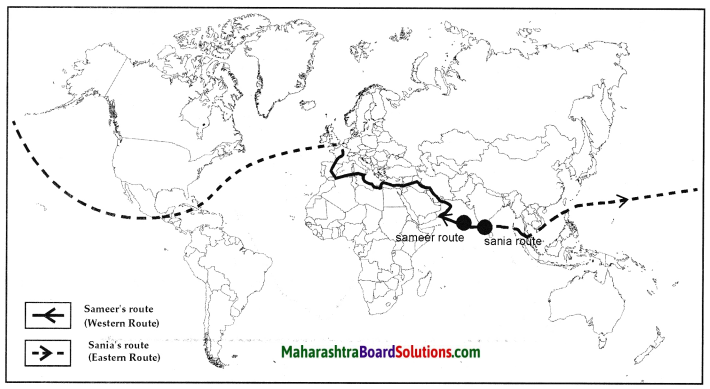
Sameer and Sania are playing a game of showing the waterways on a map of the world. Their routes are going in opposite directions. One of the following the eastern route while the other is making a route that takes to the west.

From Mumbai port some goods are to be taken to London in UK. On a map of the world, show at least two such routes with a pencil.
Write down the names of the ports of different nations that fall on the route followed by each.

Ports on the route followed by Sameer:
Maharashtra Board Class 6 Geography Solutions Chapter 6 Importance of Oceans 1
Answer:

  • JNPT – India
  • Nish tun – Yemen
  • Salal – Oman
  • Port of Berbera – Somalia
  • Port of A1 Qusayr – Egypt
  • Port of Said – Egypt Suez
  • port – Egypt
  • Port of Tenes – Algeria
  • Port of Tunis – Tunisia
  • Port of Bone facia – France
  • Port of Aguilas – Spain
  • Port of Adra – Spain
  • Port of Gibraltar – Gibraltar
  • Port of Sines – Portugal
  • Swange Pier – UK
  • Whitstable harbour – UK
  • Purfleet Thames Terminal – UK
  • Port of London – UK

Ports on the route followed by Sania:

  • Port of Mergui – Myanmar
  • Port of Ramong – Thailand
  • Port of Krueng Raya – Indonesia, etc.

Question 2.
Which of the routes you feel is shorter? That of Sameer’s or Sania’s?
Answer:
Sameer’s route is shorter.

Question 3.
Which oceans does one have to pass through if one follows Sameer’s route or Sania’s route?
Answer:
If one follows Sameer’s route one has to pass through the Indian Ocean and North Atlantic Ocean. If Sania’s route is taken she has to pass through the Pacific and North Atlantic Ocean.

Question 4.
What are Panama and Suez? For what purpose were they constructed?
Answer:

  • Panama and Suez are the canals in the sea built for commercial purpose.
  • It helped in saving time, money and energy and gave a fillip to international trade due to the shorter distance and easy accessibility.

Maharashtra Board Class 6 Geography Solutions Chapter 6 Importance of Oceans

Question 5.
Have they been used in Sameer’s and Sania’s routes?
Answer:
Yes, Suez Canal is used in Sameer’s route while Panama Canal is used in Sania’s route.

Class 6 Geography Chapter 6 Importance of Oceans Additional Important Questions and Answers

Fill the blanks choosing the correct alternatives from the brackets:

Question 1.
The ______ includes all the water bodies like oceans, seas, rivers and their tributaries, lakes, reservoirs and also ground water that exist on the earth.
(lithosphere, atmosphere, hydrosphere)
Answer:
hydrosphere

Question 2.
Total global water 97.7% is contained in ______ (lakes, oceans, seas)
Answer:
oceans

Question 3.
The ocean with an area 166,240,977 sq. km is the _______ ocean. (Indian, Atlantic, Pacific)
Answer:
Pacific

Question 4.
All rivers flowing from mountains or hilly areas finally meet in the ________.(lakes, seas, oceans)
Answer:
oceans

Question 5.
Salinity is expressed in terms of ______.(mils, ml, gms)
Answer:
mils

Question 6.
The average salinity of oceanic water is _______.(80%, 332%, 35%)
Answer:
35%

Question 7.
The salinity of the Dead Sea is _____.(332 %, 35%, 60%)
Answer:
332 %

Question 8.
About ________ of the surface of the earth is occupied by water. (90%, 95%, 70.8%)
Answer:
70.8%

Maharashtra Board Class 6 Geography Solutions Chapter 6 Importance of Oceans

Question 9.
Salt as a substance is obtained by constructing ______. (sea bed, salt pan, river bunds)
Answer:
salt pan

Question 10.
________ is conducted on a much higher scale as compared to the other modes of transport. (Water transport, Air transport, Road transport)
Answer:
Water transport

Question 11.
Pollution of _________ water is caused due to oil spills. (river, lake, oceanic)
Answer:
oceanic

Question 12.
Winds blowing due to pressure difference in the belts is called ______. (planetary winds, oceanic winds, minerals)
Answer:
planetary winds

Match the pairs correctly:

Question 1.

OceansThe area in sq. km
(1) Pacific(a) 20,327,000
(2) Atlantic(b) 73,426,163
(3) Indian(c) 166,240,977
(4) Southern(d) 13,224,479
(5) the Arctic(e) 86,557,402

Answer:
1 – c
2 – e
3 – b
4 – a
5 – d

Find the odd man out:

Question 1.
Pearls, corals, diamonds, medicinal plants
Answer:
diamonds

Maharashtra Board Class 6 Geography Solutions Chapter 6 Importance of Oceans

Question 2.
Spain, Norway, Japan, India
Answer:
India

Question 3.
Blue whale, sea turtles, seerfish, dolphins
Answer:
seerfish

Name the following:

Question 1.
Water bodies which are a part of the . hydrosphere.
Answer:
Oceans, seas, rivers and their tributaries, lakes, reservoirs, ground water.
Question 2.
Percentage of global waters contained in oceans.
Answer:
97.7%

Question 3.
Two aquatic animals found in the ocean.
Answer:

  • Microscopic planktons
  • Huge whales

Question 5.
Places where volcanic eruptions occur.
Answer:

  • Land
  • Ocean

Question 6.
Two minerals obtained from the sea.
Answer:

  • Phosphates
  • Sulphates

Question 7.
Two uses of marine animals.
Answer:

  • Production of fertilisers
  • Production of pharmaceuticals

Question 8.
Two countries with coastline which largely depends on the sea for their livelihood.
Answer:

  • Seychelles
  • Mauritius

Maharashtra Board Class 6 Geography Solutions Chapter 6 Importance of Oceans

Question 9.
The controller of global temperature and source of rains.
Answer:
Oceans.

Question 10.
The beginning and end of the water cycle takes place here.
Answer:
Oceans.

Question 11.
Two minerals obtained from the ocean floor.
Answer:

  • Cobalt
  • Sodium

Question 12.
Precious items obtained from the seas.
Answer:

  • Pearls
  • Corals

Question 13.
Mode of transport used for large scale transportation of goods.
Answer:

  • Ships
  • Trawlers

Question 14.
Two actions by man which has lead to large scale pollution in oceanic waters.
Answer:

  • Oil spills
  • Exploitative fishing

Answer the following in one sentence each:

Question 1.
What happens when aquatic animals die?
Answer:
When aquatic animals die, their remains accumulate in the oceans.

Question 2.
What enters the ocean with the rain water?
Answer:
Sediments from eroded lands, trees and bushes flowing with water, dead remains, etc. enter the ocean with the river water.

Maharashtra Board Class 6 Geography Solutions Chapter 6 Importance of Oceans

Question 3.
What happens when the dead remains in the ocean decompose?
Answer:
When the dead remains in the oceans decompose it releases various minerals and salts in the ocean water.

Question 4.
Where do we find maximum salinity?
Answer:
The Dead Sea is known to have the maximum salinity of 332%.

Question 5.
How is salt obtained?
Answer:
Salt as a substance is obtained by constructing salt pans in the coastal areas.

Question 6.
Which is one of the ancient occupations of human beings and what is the major purpose of his activity?
Answer:
Fishing is one of the ancient occupation and the major purpose of this activity is to obtain food.

Question 7.
How does the earth get rainfall?
Answer:
The oceans have a vast expanse, therefore huge amounts of vapour get created and this process goes on continuously and from this vapour the earth gets rainfall.

Question 8.
How is pollution caused in oceanic water?
Answer:
In order to fulfill his requirements, man undertakes many activities that lead to the production of huge amounts of different types of waste materials which cause pollution.

Question 9.
Write anyone cause of pollution of oceanic waters.
Answer:
Cutting of mangroves forests in coastal areas is one of the main cause of pollution in oceanic waters.

Question 10.
How does oceanic pollution affect the aquatic animals?
Answer:
Due to oceanic pollution many aquatic animals are under the threat of being extinct. For example, the blue whale, some types of sea turtles, dolphins, etc.

Maharashtra Board Class 6 Geography Solutions Chapter 6 Importance of Oceans

Question 11.
Which items does man get from the oceans?
Answer:
Salt, fish, shells and other products, minerals like iron, lead, cobalt, sodium, manganese, chromium, zinc, mineral oil and natural gas are the items man gets from oceans.

Question 12.
Which continents are located along the coast of the Pacific Ocean?
Answer:
Asia, Australia, North America and South America are the continents located along the coast of the Pacific Ocean.

Give geographical reasons for the following statements:

Question 1.
The ocean water is saltier than drinking water.
Answer:

(i) In drinking water, the proportion of salts is quite low. Water from oceans and seas has a greater amount of salt. Hence it tastes salty.

(ii) Volcanic eruptions leads to increase in the level of salts and minerals in ocean water.

(iii) Volcanic eruptions takes place in the oceans. During volcanic eruptions different minerals, ashes, salts and gases are added to the water. This increases the level of salts and minerals in ocean water.

(iv) Due to continuous evaporation of oceanic water, the proportion of salt increase.

Question 2.
The temperature in coastal areas remains equable.
Answer:

(i) In regions close to the oceans, seas or large reservoirs, there is not much of a difference in the temperature throughout the day.

(ii) The main reason for this is the mixing of vapour released through evaporation of water from these water bodies into air.

(iii) This vapour in the air absorbs and stores the heat released from the land.

(iv) Hence, the temperature in coastal regions remain equable.

Question 3.
It is economic to carry out transport by water ways.
Answer:

  • Waterways is a cost-effective, fuel efficient and relatively more environment friendly means of transportation.
  • Large scale transport of goods can be carried out with the help of ships, trawlers, boats, etc. at a low cost.
  • So it is economic to carry out transport by waterway.

Question 4.
There is a difference in the climate of regions close to the oceans and regions far away from the oceans.
Answer:
(i) The oceans influence the climatic condition of a place. Coastal areas are cooler and wetter than regions away from the ocean.

(ii) There is a difference in the maximum and minimum temperature with the difference being less in coastal region (nearness to the sea) while it is more in the region far away from the sea (continentality).

(iii) The temperature in coastal areas remains equable due to the mixing of vapour released through evaporation of water from these water bodies into air. This vapour absorbs and stores the heat released from the land.

Question 5.
Oceans act as the controller of global temperature.
Answer:

(i) Winds move the oceanic water in the form of currents.

(ii) Ocean currents move from the equatorial region to polar regions and from polar regions to the equatorial region.

(iii) This leads to the redistribution of heat on the earth.

(iv) The cold currents moving towards the equatorial region making the temperature of coastal areas in that zone milder whereas the warm currents coming in the colder region cause the temperature in coastal areas to rise. Hence, the oceans act as the controller of global temperature.

Answer the following questions in brief:

Question 1.
What are planetary winds?
Answer:

  • Equatorial regions receives perpendicular sunrays.
  • As a result these areas get more heat whereas the polar regions receive highly slant rays.
  • This differential heating creates imbalance in the temperature of air in different parts leading to formation of belts of high and low pressure on earth.
  • Winds blow1 due to the pressure differences in these belts. These winds are called Planetary Winds.

Maharashtra Board Class 6 Geography Solutions Chapter 6 Importance of Oceans

Question 2.
Write in brief about oceanic transport.
Answer:

  • Oceans have provided us the most economic option of transportation.
  • Large scale transportation of goods is carried out with the help of ships, trawlers, boats, etc.
  • International trade is carried out on a large scale using waterways.
  • Countries like Spain, Norway, Japan have a good coastline due to which goods are transported by ocean routes, making these countries important.

Question 3.
How do ocean currents aid water transport?
Answer:

  • Ocean currents are quite important in water transport.
  • As far as possible water transport is carried out along ocean currents.
  • They accelerate the speed of the ships and also save fuel to a considerable extent.

Question 4.
List the causes that lead to large scale pollution of oceanic water.
Answer:
The causes that lead to large scale pollution of oceanic water are:

  • Oil spills.
  • Releasing the waste produced in the coastal cities into the seas.
  • Materials thrown out from ships.
  • Exploitative fishing.
  • Cutting of mangrove forests in coastal areas.
  • Disasters caused by the water mines.
  • Sewage released by industries and cities.
  • Excavation carried out in the seas.

Do it yourself!

Question 1.
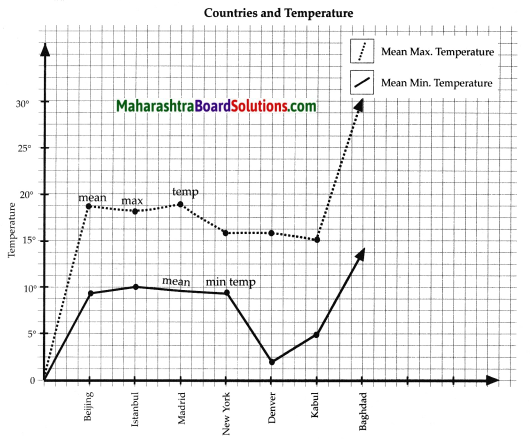
Calculate the difference between the mean maximum and minimum temperature and write in the last column

PlaceCountryMean Max. Temp. °CMean Min. Temp. °CRange of Temperature
BeijingChina18.408.410
IstanbulTurkey18.010.008_______
MadridSpain19.009.010
New York66United States16.308.308________
DenverUnited States16.202.214
KabulAfghanistan14.705.209.5________
BaghdadIraq30.414.715.7

Question 2.
Highlight the rows for the places having a range of temperatures over 10°C with red colour, other rows in blue colour (Refer the above table)
Question 3.
Find the locations of these places from an atlas. (Students activity)
Question 4.
Which places are closer to the oceans? Tell whether the range of temperature at these
places is l ess or more?
Answer:
Istanbul and New York are closer to the oceans. These places which are closer to the oceans have lesser range of temperature.

Question 5.
What might be the main reason leading to differences in the temperature range in different places?
Answer:
The main reason leading to differences in temperature range in different places is because of the location of the place on the planet earth. Other factors like latitude, altitude, atmosphere, ocean currents, planetary winds etc. too have their impact.

Question 6.
In which thermal zone are all these places located?
Answer:
All these places are located in the temperate thermal zone.

Maharashtra Board Class 6 Geography Solutions Chapter 6 Importance of Oceans

Question 7.
Which places are fai away from the oceans?
Do these places have a greater or smaller temperature range?
Answer:
Istanbul, Denver, Kabul and Baghdad are far away from the ocean as these places have a greater temperature range.

Question 8.
Mention the places having the smallest and greatest temperature ranges.
Answer:
Istanbul and New York have the smallest temperature range while Baghdad has the greatest temperature range.

Question 9.
Draw a graph for the above data. Use a proper colour scheme.
Answer:
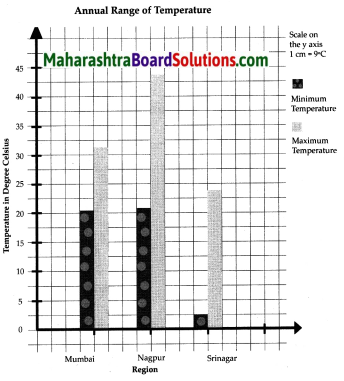
Maharashtra Board Class 6 Geography Solutions Chapter 6 Importance of Oceans 2

Maharashtra Board Class 10 Marathi Kumarbharti Solutions Chapter 4 उत्तमलक्षण

Balbharti Maharashtra State Board Class 10 Marathi Solutions Kumarbharti Chapter 4 उत्तमलक्षण (संतकाव्य) Notes, Textbook Exercise Important Questions and Answers.

Maharashtra State Board Class 10 Marathi Kumarbharti Chapter 4 उत्तमलक्षण (संतकाव्य)

Marathi Kumarbharti Std 10 Digest Chapter 4 उत्तमलक्षण Textbook Questions and Answers

प्रश्न. पुढील कवितेच्या आधारे दिलेल्या सूचनांनुसार कृती करा :

कृती १ : (आकलन)

प्रश्न 1.
आकृत्या पूर्ण करा :
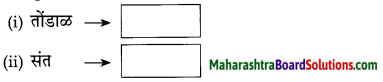
(i)
Maharashtra Board Class 10 Marathi Solutions Chapter 4 उत्तमलक्षण (संतकाव्य) 1
उत्तर :
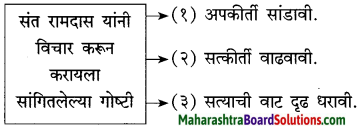
Maharashtra Board Class 10 Marathi Solutions Chapter 4 उत्तमलक्षण (संतकाव्य) 2

(ii)
Maharashtra Board Class 10 Marathi Solutions Chapter 4 उत्तमलक्षण (संतकाव्य) 3
उत्तर :
Maharashtra Board Class 10 Marathi Solutions Chapter 4 उत्तमलक्षण (संतकाव्य) 4

Maharashtra Board Class 10 Marathi Solutions Chapter 4 उत्तमलक्षण (संतकाव्य)

प्रश्न 2.
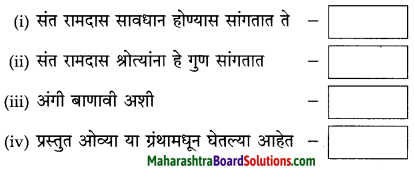
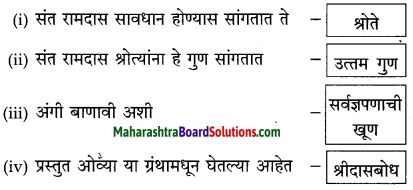
चौकटी पूर्ण करा :
Maharashtra Board Class 10 Marathi Solutions Chapter 4 उत्तमलक्षण (संतकाव्य) 5
उत्तर :
Maharashtra Board Class 10 Marathi Solutions Chapter 4 उत्तमलक्षण (संतकाव्य) 6

प्रश्न 3.
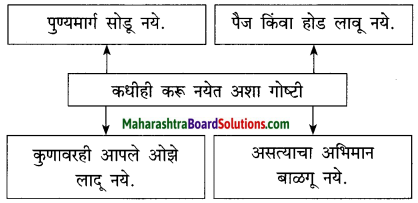
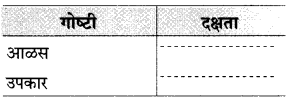
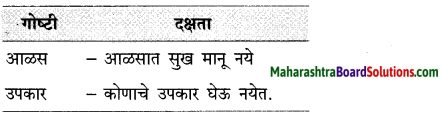
पुढील गोष्टींबाबत संत रामदास कोणती दक्षता घ्यायला सांगतात. (मार्च ‘१९)
Maharashtra Board Class 10 Marathi Solutions Chapter 4 उत्तमलक्षण (संतकाव्य) 7
उत्तर :
Maharashtra Board Class 10 Marathi Solutions Chapter 4 उत्तमलक्षण (संतकाव्य) 8

कृती २ : (आकलन)

प्रश्न 1.
शब्दजाल पूर्ण करा :
(i)
Maharashtra Board Class 10 Marathi Solutions Chapter 4 उत्तमलक्षण (संतकाव्य) 9
उत्तर :
Maharashtra Board Class 10 Marathi Solutions Chapter 4 उत्तमलक्षण (संतकाव्य) 10

(ii)
Maharashtra Board Class 10 Marathi Solutions Chapter 4 उत्तमलक्षण (संतकाव्य) 11
उत्तर :
Maharashtra Board Class 10 Marathi Solutions Chapter 4 उत्तमलक्षण (संतकाव्य) 12
(iii)
Maharashtra Board Class 10 Marathi Solutions Chapter 4 उत्तमलक्षण (संतकाव्य) 13
उत्तर :
Maharashtra Board Class 10 Marathi Solutions Chapter 4 उत्तमलक्षण (संतकाव्य) 14

Maharashtra Board Class 10 Marathi Solutions Chapter 4 उत्तमलक्षण (संतकाव्य)

प्रश्न 2.
पुढील व्यक्तींशी कसे वागावे, असे संत रामदास म्हणतात :
Maharashtra Board Class 10 Marathi Solutions Chapter 4 उत्तमलक्षण (संतकाव्य) 15
उत्तर :
Maharashtra Board Class 10 Marathi Solutions Chapter 4 उत्तमलक्षण (संतकाव्य) 16

प्रश्न 3.
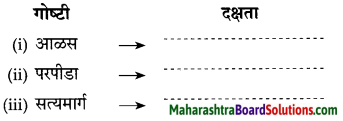
पुढील गोष्टींबाबत कोणती दक्षता घ्यावी, ते लिहा :
Maharashtra Board Class 10 Marathi Solutions Chapter 4 उत्तमलक्षण (संतकाव्य) 17
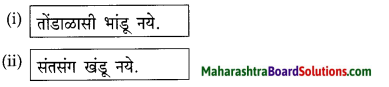
उत्तर :
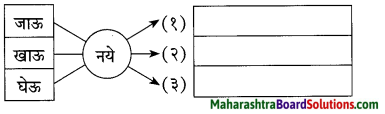
(i) तोंडाळासी भांडू नये.
(ii) संतसंग खंडू नये.
(iii) सत्यमार्ग सोडू नये.

प्रश्न 4.
असत्य विधान ओळखा :
(i) संतसंग सोडू नये.
(ii) अपकार घेऊ नये.
(iii) व्यापकपण सांडू नये.
(iv) खोटेपणाच्या पंथाला जाऊ नये.
उत्तर :
असत्य विधान – अपकार घेऊ नये.

प्रश्न 5.
अचूक विधान ओळखा : (मार्च ‘१९)
(i) पैज, होड लावावी.
(ii) सत्याची वाट धरावी.
(iii) पापद्रव्य सहज जोडावे.
(iv) नेहमी अभिमानाने वागावे.
उत्तर :
अचूक विधान – सत्याची वाट धरावी.

प्रश्न 6.
तुमच्यातील प्रत्येकी तीन गुण व तीन दोष शोधून लिहा.
उत्तर :
नमुना उत्तर :
गुण : (i) मी रोज व्यायाम करतो.
(ii) मी खोटे बोलत नाही.
(iii) मी आईला कामात मदत करतो.

दोष : (i) मला चटकन राग येतो.
(ii) मी ताटात अन्न टाकतो.
(iii) माझे अक्षर चांगले नाही.

कृती ३ : (काव्यसौंदर्य)

प्रश्न 1.
‘सभेमध्ये लाजों नये। बाष्कळपणे बोलों नये।’ या ओळीतील विचार स्पष्ट करा.
उत्तर :
‘उत्तमलक्षण’ या कवितेमध्ये संत रामदास यांनी आदर्श गुणसंपन्न व्यक्तीची लक्षणे समजावून सांगितली आहेत. त्यांपैकी एक लक्षण उपरोक्त चरणात सूचित केले आहे.

मनुष्य हा समाजप्रिय प्राणी आहे. माणसांमध्ये तो नित्य वावरत असतो. समूहामध्ये आदर्श व्यक्तीचे वर्तन कसे असावे, हे सांगताना संत रामदास म्हणतात – सभेमध्ये वावरताना, आपले मत मांडताना कधीही लाजू नये. स्पष्टपणे आपले म्हणणे मांडावे; परंतु त्याच वेळी बालिशपणे बोलून आपले हसे करून घेऊ नये. निरर्थक असे वक्तव्य करू नये. बाष्कळपणे बोलू नये. उत्तम पुरुषाचे एक मर्मग्राही लक्षण या ओवीतून मांडले आहे.

प्रश्न 2.
‘आळसें सुख मानूं नये,’ या ओळीचा तुम्हांला समजलेला अर्थ स्पष्ट करा.
उत्तर :
‘उत्तमलक्षण’ या ओव्यांमध्ये संत रामदास यांनी उत्तम व्यक्तीची लक्षणे विशद करताना आळस हा माणसाचा शत्रू आहे, असे ठासून प्रतिपादिले आहे.

‘आळस’ हा माणसाच्या अंगी असलेला दुर्गुण आहे. आळसामुळे कार्य करायला उत्साह राहत नाही व त्यामुळे बरीच कामे खोळंबून राहतात. ‘आळसे कार्यभाग नासतो!’ या समर्थ रामदासांच्या उक्तीमध्ये हेच तत्त्व सांगितले आहे. माणसाच्या मनाला जे षड्विकार जडतात, त्यात ‘आळस’ हा एक विकार आहे. दैनंदिन कामांमध्ये आळसाला स्थान देऊ नये. आळसामुळे प्रगती खुंटते, भविष्य अंधारते. आळसामुळे मनाला जडत्व प्राप्त होते व माणूस नाकर्ता होतो. आळशी माणसाला समाजात मान मिळत नाही. म्हणून आळसात सुख मानू नये, समाधान मानू नये, असे समर्थ रामदास सांगतात.

Maharashtra Board Class 10 Marathi Solutions Chapter 4 उत्तमलक्षण (संतकाव्य)

Marathi Kumarbharti Class 10 Textbook Solutions Chapter 4 उत्तमलक्षण Additional Important Questions and Answers

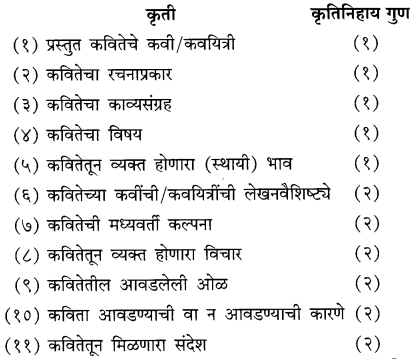
प्रश्न. पुढील कवितेसंबंधी त्याखाली दिलेल्या मुद्द्यांच्या आधारे कृती सोडवा :

प्रश्न 1.
कविता-उत्तमलक्षण.
Maharashtra Board Class 10 Marathi Solutions Chapter 4 उत्तमलक्षण (संतकाव्य) 20
उत्तर : उत्तमलक्षण.
(१) प्रस्तुत कवितेचे कवी : संत रामदास.
(२) कवितेचा रचनाप्रकार : ओवी.
(३) कवितेचा काव्यसंग्रह : श्रीदासबोध.
(४) कवितेचा विषय : उत्तम माणसाची लक्षणे.
(५) कवितेतून व्यक्त होणारा (स्थायी) भाव : आदर्श माणसे घडवण्याचा ध्यास.

(६) कवितेच्या कवींची लेखनवैशिष्ट्ये : प्रस्तुत कवितेची रचना ओवी या छंदात केलेली आहे. ओवी हा उच्चारणाला सुलभ असा अत्यंत लवचीक रचनाप्रकार आहे. त्यामुळे या कवितेतील भाषा ओवी या छंदाला साजेशी सुबोध व सर्वसामान्यांना सहज समजेल अशी आहे. साहजिक कवितेची आवाहन शक्ती वाढली आहे. चुकीचे वर्तन व चांगले वर्तन या दोन्ही बाबी समर्थांनी स्पष्ट शब्दांत कोणतीही संदिग्धता न ठेवता सांगितल्या आहेत. समर्थांच्या या रचनेत प्रासादिकता आढळते.

(७) कवितेची मध्यवर्ती कल्पना : प्रस्तुत कवितेत संत रामदासांनी उत्तम, गुणसंपन्न, आदर्श व्यक्तीची लक्षणे सांगितली आहेत. समाजात वावरताना कसे वागावे, काय करावे व काय टाळावे यांचे सुस्पष्ट शब्दांत निवेदन केले आहे. समाज नीतिमान व कर्तबगार व्हावा, ही तळमळ या पदयपाठातून स्पष्टपणे जाणवते.

(८) कवितेतून व्यक्त होणारा विचार : प्रस्तुत कवितेत संत रामदासांनी, व्यक्तीने समाजात कसे वागावे याचे मार्गदर्शन केले आहे. नेहमीच सावध मनाने वागावे. इतरांना सहकार्य करावे. कोणाशीही कपटाने वागू नये. तोंडाळ, वाचाळ माणसांना टाळावे. आळस झटकून टाकावा. पूर्ण विचार करून वागावे. उपकाराची परतफेड करावी. नेहमी उदारपणाने वागावे. मनाचा मोठेपणा बाळगावा. परावलंबी होऊ नये. नेहमी सत्याने वागावे. कुप्रसिद्धी टाळावी इत्यादी अनेक गुणांचे आचरण करण्यास या कवितेत संत रामदासांनी सांगितले आहे.

(९) कवितेतील आवडलेलो ओळ :
अपकीर्ति ते सांडावी। सत्कीर्ति वाडवावी।।
विवेके दृढ धरावी । वाट सत्याची ।।

(१०) कविता आवडण्याची वा न आवडण्याची कारणे : मला ही कविता खूप आवडली. एकतर हे विचार पटकन पटण्यासारखे आहेत. ही कविता उच्चारताना, वाचताना आनंद होतो. उच्च, उदात्त विचार मनात घोळवल्याने मनही आनंदित होते. सर्व गुण-अवगुण रामदासांनी अत्यंत स्पष्टपणे, परखडपणे सांगितले आहेत. कुठेही शब्दांचा बोजडपणा नाही. प्रत्येक शब्दागणीक अर्थ स्पष्ट होत जातो. मुख्य म्हणजे दैनंदिन जीवनात वागताना आवश्यक असलेल्या गुणांचे मार्गदर्शन घडत असल्याने कविता आपली, स्वतःची, स्वतःसाठी असलेली वाटत राहते.

(११) कवितेतून मिलणाग संदेश : प्रत्येक व्यक्तीने चांगले वागण्याचाच प्रयत्न केला पाहिजे. त्यासाठी वाईट गुण कोणते व चांगले गुण कोणते हे स्पष्टपणे समजून घ्यावे. प्रत्येकाने उत्तम माणूस बनण्याचा प्रयत्न करावा. यातूनच चांगला व समर्थ समाज निर्माण होतो.

कृतिपत्रिकेतील प्रश्न २ (इ) साठी…

प्रश्न. पुढील ओळींचे रसग्रहण तुमच्या शब्दांत लिहा :

प्रश्न 1.
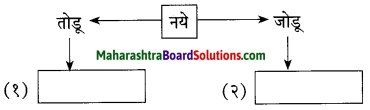
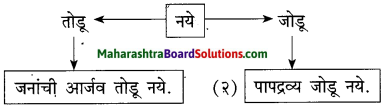
‘जनी आर्जव तोडूं नये । पापद्रव्य जोडूं नये ।
पुण्यमार्ग सोडूं नये । कदाकाळीं ।।’ (मार्च ‘१९)
उत्तर :
आशयसौंदर्य : ‘उत्तमलक्षण’ या श्रीदासबोधातील एका समासामध्ये समर्थ रामदासांनी गुणसंपन्न आदर्श व्यक्तिमत्त्वाची महत्त्वाची लक्षणे सांगितली आहेत. त्यांपैकी उपरोक्त ओवीमध्ये तीन लक्षणांचा ऊहापोह केला आहे.

काव्यसौंदर्य : समाजात वावरताना व्यक्तीने कोणते आचरण करावे हे सांगताना संत रामदास म्हणतात – लोकांचे मन मोडू नये. लोकांनी केलेली विनंती धुडकावू नये. उलट जनभावनांचा आदर . करावा. तसेच वाईट मार्गाने संपत्ती साठवू नये. अशी संपत्ती हे पापाचे धन असते. म्हणून सत्शील मार्गाने जीवन व्यतीत करावे. पुण्यमार्ग आचारावा. कधीही पुण्यमार्गाने जाण्याचे सोडू नये.

भाषिक वैशिष्ट्ये : वरील ओवीमध्ये जनांसाठी खूप सुगम निरूपण केले आहे. ‘तोडू नये, जोडू नये, सोडू नये’ अशा सोप्या यमकांद्वारे संदेशामध्ये आवाहकता आली आहे. ओवीछंदाला साजेशी सुबोध भाषा वापरल्यामुळे जनमानसावर तत्त्व ठसवणे सुलभ झाले आहे. पापद्रव्य व पुण्यमार्ग यांतील विरोधाभास ठळकपणे उठून दिसतो. ओवीमध्ये प्रासादिकता हा गुण आढळतो.

Maharashtra Board Class 10 Marathi Solutions Chapter 4 उत्तमलक्षण (संतकाव्य)

प्रश्न 2.
‘अपकीर्ति ते सांडावी। सत्कीर्ति वाडवावी।
विवेकें दृढ धरावी। वाट सत्याची।।’ (मार्च ‘१९)
उत्तर :
आशयसौंदर्य : संत रामदासांनी ‘उत्तमलक्षण’ या कवितेत आदर्श गुणवान व्यक्तीची वैशिष्ट्ये सांगताना या ओळींमधून सद्वर्तन कशा प्रकारे करावे, याची शिकवण दिली आहे.

काव्यसौंदर्य : संत रामदास म्हणतात – लोक आपल्याला दूषणे देतील व निंदा करतील असे वर्तन कदापिही करू नये. ज्या वागण्याने आपली अपकीर्ती होईल, असे वागणे टाळावे. उलट आपल्या व्यक्तिमत्त्वाची कीर्ती पसरेल, अशी वागणूक करायला हवी. स्वतः चांगले वागून सत्कीर्ती वाढवायला हवी. त्यासाठी बुद्धीचा विवेक महत्त्वाचा ठरतो. सद्विचाराने, विवेकाने सत्याचा मार्ग ठामपणे आचरावा. विवेकबुद्धी ठोस असणे गरजेचे आहे.

भाषिक वैशिष्ट्ये : सन्मार्गाचे लक्षण सांगताना जनसामान्यांना समजतील असे तीन मुद्दे या ओळीत सहजपणे सांगितले आहेत. अपकीर्ती व सत्कीर्ती तसेच सांडावी व वाढवावी या विरोधी शब्दांमुळे ओवीची खुमारी वाढली आहे. दृढ धरणे हा वाक्प्रचार चपखलपणे उपयोगात आणला आहे. जनमानसावर तत्त्व ठसवण्याची समर्थांची हातोटी समर्थपणे व्यक्त झाली आहे.

व्याकरण व भाषाभ्यास

कृतिपत्रिकेतील प्रश्न ४ (अ) आणि (आ) यांसाठी…

अ. व्याकरण घटकांवर आधारित कृती:

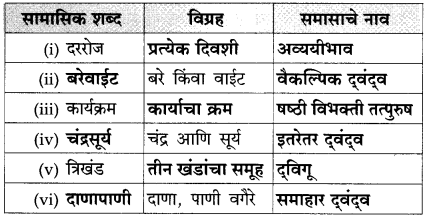
१. समास :

प्रश्न 1.
पुढील तक्ता पूर्ण करा : (ठळक अक्षरांत उत्तरे दिली आहेत.)
Maharashtra Board Class 10 Marathi Solutions Chapter 4 उत्तमलक्षण (संतकाव्य) 21

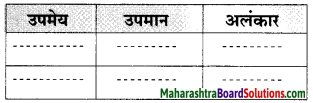
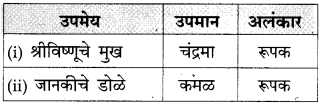
२. अलंकार :
पुढील ओळी वाचून तक्ता पूर्ण करा :
प्रश्न 1.
‘ऊठ पुरुषोत्तमा । वाट पाही रमा ।
दावि मुखचंद्रमा । सकळिकांसी।।’

प्रश्न 2.
‘नयनकमल’ हे उघडित हलके जागी हो जानकी.
Maharashtra Board Class 10 Marathi Solutions Chapter 4 उत्तमलक्षण (संतकाव्य) 22
उत्तर :
Maharashtra Board Class 10 Marathi Solutions Chapter 4 उत्तमलक्षण (संतकाव्य) 23

Maharashtra Board Class 10 Marathi Solutions Chapter 4 उत्तमलक्षण (संतकाव्य)

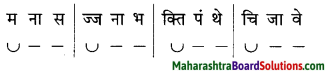
३. वृत्त :
पुढील ओळींचे लगक्रम लिहा :

प्रश्न 1.
ऐकू न ये तुज पिकस्वर मंजुळे का?
उत्तर :
Maharashtra Board Class 10 Marathi Solutions Chapter 4 उत्तमलक्षण (संतकाव्य) 24

प्रश्न 2.
मना सज्जना भक्तिपंथेचि जावे.
उत्तर :
Maharashtra Board Class 10 Marathi Solutions Chapter 4 उत्तमलक्षण (संतकाव्य) 25

उत्तमलक्षण Summary in Marathi

कवितेचा भावार्थ :
उत्तम पुरुषाची (आदर्श व्यक्तीची) लक्षणे सांगताना संत रामदास श्रोत्यांना म्हणतात – श्रोतेहो, तुम्हांला आता मी उत्तम, गुणवान व्यक्तीची लक्षणे सांगतो, ती सावध मनाने ऐकावीत. ही लक्षणे ऐकून तुम्ही सर्व गोष्टी जाणण्याची खूण अंगी बाणवावी. ।।१।।

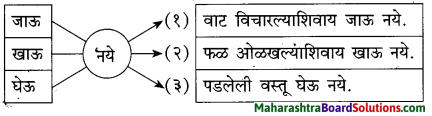
पूर्ण माहिती असल्याशिवाय कुठल्याही रस्त्याने जाऊ नये. वाटेमधील अडथळे जाणून घेतल्याशिवाय प्रवास करू नये. फळाचे अंतरंग (गुण) ओळखल्याशिवाय ते खाऊ नये. रस्त्यात पडलेली वस्तू अचानक पटकन उचलू नये. ।।२।।

लोकांनी केलेली विनंती लक्षात घ्यावी. तिला अमान्य करू नये. पाप किंवा कपट करून मिळवलेल्या संपत्तीचा साठा करू नये. कपट करून पैसा मिळवू नये. पुण्याचा मार्ग म्हणजे सच्छील मार्ग, सद्वर्तन कधीही सोडू नये. ।।३।।

जी तोंडाळ, भांडकुदळ व्यक्ती असेल, त्या व्यक्तीशी कधीही भांडू नये. व्यर्थ बडबड करणाऱ्या वाचाळ माणसाशी तंटा करू नये. सज्जनाची संगत कधी मध्येच सोडू नये, (हे कायम मनात ठेवा.) मनापासून झालेली संतांची मैत्री सोडू नये. ।।४।।

काम न करता ऐदीपणे, आळस करून आनंद घेऊ नये. आळसात सुख नसते. कुणाबद्दल उखाळ्यापाखाळ्या करून चहाडी करू नये. दुसऱ्याबद्दल खोटेनाटे बोलणे मनातही आणू नये. संपूर्ण शोध घेतल्याशिवाय कोणतेही काम करू नये. (काम अर्धवट सोडू नये.) ।।५।।

सभेमध्ये, समूहाच्या बैठकीमध्ये लाजू नये, मुखदुर्बळ राहू नये. मोकळ्या मनाने बोलावे परंतु बालिशपणे बोलू नये. बाष्कळ बडबड करू नये, कोणत्याही प्रकारची पैज, शर्यत लावू नये. कुणाशीही स्पर्धा करू नये. ।।६।।

कोणाचे उपकार सहसा घेऊ नयेत आणि घेतलेच तर त्यांची लगेच परतफेड करावी, उपकारातून लवकर उतराई व्हावे. दुसऱ्यांना दुःख देऊ नये, त्यांना व्यथित करू नये. कुणाचा विश्वासघात किंवा बेइमानी मुळीच करू नये. ।।७।।

स्वत:च्या मनाचा मोठेपणा कधी सोडून देऊ नये. मन कोते करू नये, ते व्यापक ठेवावे. परावलंबी होऊ नये. कुणावरी आपल्या आयुष्याचे ओझे लादू नये. ।।८।।

सत्याचा मार्ग कधी सोडू नये. खरेपणाने वागावे, असत्याच्या, खोटेपणाच्या मार्गाने जाऊ नये. खोटारडेपणा करून वागू नये. खोटेपणाचा कधीही वृथा अभिमान, व्यर्थ गर्व करू नये. ।।९।।

अपकीर्तीला बळी पडू नये. कुप्रसिद्धी टाळावी. चांगली कीर्ती वाढवावी. चांगल्या प्रकारे प्रसिद्ध पावावे. सारासार विचाराने, विवेकाने वर्तन करून सत्यमार्ग पत्करावा. ।।१०।।

उत्तमलक्षण शब्दार्थ

  • उत्तम – आदर्श, गुणसंपन्न,
  • लक्षण – गुणवैशिष्ट्य.
  • श्रोतीं – ऐकणाऱ्या लोकांनो.
  • सावधान – सावध होणे, सजग होणे.
  • उत्तम – उत्कृष्ट, जेणें – ज्याने.
  • बाणे – बाणणे, अंगिकारणे, सवय लागणे,
  • सर्वज्ञ – सारे जाणणारा.
  • पुसल्याविण – विचारल्याशिवाय,
  • येकायेकी – एकदम, पटकन.
  • जनीं – लोकांचे. आर्जव – विनंती.
  • पापद्रव्य – पापाने (कपटाने) मिळवलेली संपत्ती.
  • जोडू नये – साठवू नये.
  • पुण्यमार्ग – चांगला रस्ता, सद्वर्तन,
  • कदाकाळी – कोणत्याही वेळी.
  • तोंडाळ – वाटेल ते बोलणारा, भांडकुदळ.
  • वाचाळ – व्यर्थ बडबड करणारा.
  • तंडो नये – तंटा (भांडण) करू नये.
  • संतसंग – सज्जन माणसाची संगत.
  • खंडू नये – तोडू नये.
  • अंतर्यामी – मनातून, हृदयातून.
  • आळस – काम न करणे.
  • चाहाडी – एखादयाबद्दल वाईट सांगणे, आगलावेपणा.
  • कार्य – काम,
  • सभा – समूहाची बैठक.
  • बाष्कळपणा – बालिशपणा.
  • पैज – स्पर्धा, शर्यत.
  • होड – पैज,
  • परपीडा – दुसऱ्याला छळणे, दुःख देणे.
  • विश्वासघात – बेइमानी.
  • व्यापकपण – (मनाचा) मोठेपणा.
  • पराधेन – परावलंबी, दुसऱ्यावर विसंबणे.
  • वोझें – (स्वत:चा) भार,
  • कोणीयेकासी – कोणावरही.
  • सत्यमार्ग – खऱ्याचा मार्ग, सद्वर्तन.
  • असत्य – खोटेपणा.
  • पंथे – मार्गाने, वाटेने.
  • कदा – कधीही.
  • अभिमान – व्यर्थ गवं.
  • अपकीर्ति – बेअब्रू, वाईट प्रसिद्धी,
  • सत्कीर्ति – चांगली प्रसिद्धी.
  • वाडवावी – वाढवावी.
  • विवेके – चांगल्या विचाराने.
  • दृढ – ठाम, मजबूत, ठोस.

Maharashtra Board Class 7 Civics Solutions Chapter 2 Preamble to the Constitution

Balbharti Maharashtra State Board Class 7 Civics Solutions Chapter 2 Preamble to the Constitution Notes, Textbook Exercise Important Questions and Answers.

Maharashtra Board Class 7 Civics Solutions Chapter 2 Preamble to the Constitution

Class 7 Civics Chapter 2 Preamble to the Constitution Textbook Questions and Answers

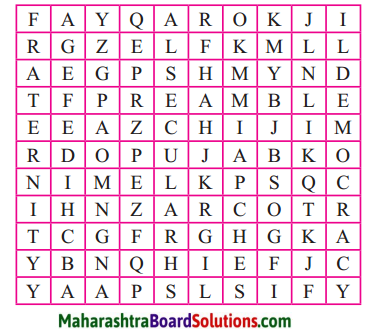
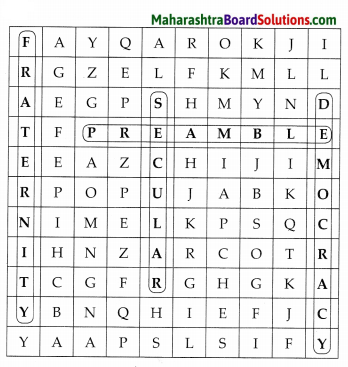
1. Find the following words in the grid:

Maharashtra Board Class 7 Civics Solutions Chapter 2 Preamble to the Constitution 1
Question 1.
A sense of ‘we-feeling’ and empathy towards fellow citizens
Answer:
Fraternity.

Maharashtra Board Class 7 Civics Solutions Chapter 2 Preamble to the Constitution

Question 2.
A system in which sovereign power is in the hands of the people
Answer:
Democracy.

Question 3.
Introduction to the Constitution
Answer:
Preamble.

Question 4.
A system in which all religions are considered equal
Answer:
Secular

Maharashtra Board Class 7 Civics Solutions Chapter 2 Preamble to the Constitution 2

2. Answer the following questions.

Question 1.
What are the provisions in a secular Constitution?
Answer:

  • In a Secular State, all religions are considered as equal.
  • No religion is considered to be the state religion. The citizens are free to follow their own religion.
  • The state cannot discriminate among citizens on the basis of religion.

Maharashtra Board Class 7 Civics Solutions Chapter 2 Preamble to the Constitution

Question 2.
What is meant by adult franchise?
Answer:

  • Adult franchise means all citizens completing 18 years of age have the right to vote in the elections.
  • This enables equal participation of citizens in the running of our country.

Question 3.
What right does economic justice ensure?
Answer:
Economic justice ensures our right to a source of livelihood so as to look after oneself and one’s family.

Question 4.
How will human dignity be established in a society?
Answer:
When every individual respects another and honours their freedom and rights, dignity of the individual will be established.

3. How should we make use of our freedom ? Write your views about it.
Answer:

  • Pandit Jawaharlal Nehru has rightly said. ‘We have to assume the responsibility ourselves of what we do’.
  • Freedom must be exercised with care, with a sense of responsibility.
  • Our freedom and independence which we gained after innumerable sacrificies must be safeguarded.
  • We should use the different freedoms endowed on us by our Constitution to bring out the best in us and build a better nation, a better world
  • The future lies in our hands.

4. Explain the following concepts.

Question 1.
Socialist State
Answer:

  • A Socialist State is such a State where the gap between the rich and the poor is minimum.
  • All have a right over the wealth of the country.
  • It is ensured that wealth is not concentrated in the hands of a few people.

Question 2.
Equality
Answer:
(i) The Preamble guarantees the Indian citizens equality of status and there will be no discrimination based on caste, creed, race, sex, place of birth, etc.

(ii) The guarantee of equality means that there should be no discrimination between people in terms of high-low, superior-inferior.

Question 3.
Sovereign State
Answer:
The word sovereign means that a state is not under the control of a foreign power. The most important goal of our freedom struggle was to acquire sovereignty. ‘Sovereignty’ means the ultimate authority to govern oneself. In a democracy, sovereignty rests with the people

Maharashtra Board Class 7 Civics Solutions Chapter 2 Preamble to the Constitution

Question 4.
Equality of opportunity.
Answer:
Equality means the state of being equal in status, rights or opportunities. Equality of status, and of opportunity means that all have equal human status and there will be no discrimination based on caste, creed, race, sex, place of birth, etc. All will get the opportunities for development without any discrimination.

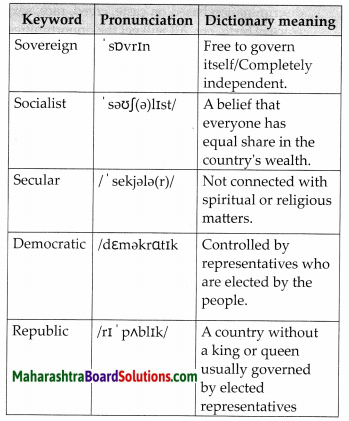
5. Make a list of the key words in the Preamble. Look for their meanings in a dictionary. Prepare a chart in the following way:
Maharashtra Board Class 7 Civics Solutions Chapter 2 Preamble to the Constitution 4
Answer:
Maharashtra Board Class 7 Civics Solutions Chapter 2 Preamble to the Constitution 3

Activities:

  1. Visit your Tehsil office with your teacher to understand how a vote is cast and how the electronic voting machine works.
  2. Make a list of newspapers available in your locality.

Class 7 Civics Chapter 2 Preamble to the Constitution InText Questions and Answers

Answer the following concepts:

Question 1.
Liberty
Answer:
(i) Liberty implies that there should be no coercive, unfair restrictions upon us and that ’ there should be an atmosphere conducive to the development of our inherent capacities.

(ii) In a democracy, citizens enjoy liberty. In fact, democracy becomes mature only if the citizens enjoy freedom.

Discuss:

Question 1.
Some statements regarding freedom have been given below for discussion. Express your views.
(a) While publicly celebrating our festivals, we need to follow some rules. That does not restrict our freedom,
(b) Freedom means behaving in a responsible way, not as per our whims and fancies.
Answer:
Yes, With freedom comes responsibilities. Rules should be followed while exercising freedom for a smooth life and to ensure that we work towards responsible citizenship.

Maharashtra Board Class 7 Civics Solutions Chapter 2 Preamble to the Constitution

Question 2.
Read what Deepa has written on the topic: “My Family’.
Answer:
Democracy does not only imply elections. My parents do all the household work together. We also participate in it. We ensure that we talk cordially with each other. Even if we happen to fight, we try to listen to each others views by stopping the fight as soon as possible. If any change has to be made, even the grandparents are consulted. Anuja wants to take up agricultural research as her career. Her decision was appreciated by everybody.

Question 3.
Do you think that Deepa’s house functions in a democratic way? Which features of democracy can be found in this passage.
Answer:
Yes. They function in a democratic way and the features of democracy displayed here are:

  • Carrying out responsibilities collectively as a unit.
  • Mutual respect.
  • Honouring opinions which are not in line with our views.
  • Consensus in decision making.
  • Freedom of thought and expression.
  • Freedom of occupation.

Activities:

Question 1.
Visit your Tehsil office with your teacher to understand how a vote is cast and how the electronic voting ntachine (EVM) works.
Answer:
The voting machines used in India are a combination of two components. First component is called the Balloting unit on which the voters press the button. The other part is called the Control unit. This unit gives supervising power to the polling officer stationed at the poll booth.

The two units are connected by a five-meter cable. The voter places his /her vote on the Balloting unit which is placed inside the Voting compartment.

An EVM runs on 6-volt batteries to eliminate the need of any external power source. It is designed to record 64 candidate names and 3,840 votes at the max. The 64 candidate names can be split across (a maximum of) 4 balloting units connected in parallel, with 16 candidate names on each of the unit.

Maharashtra Board Class 7 Civics Solutions Chapter 2 Preamble to the Constitution

Question 2.
Make a list of newspapers available in your locality.
Answer:

English News Papers:

  • The Times of India
  • Economic Times
  • Financial Express
  • Indian Express
  • Mumbai Mirror
  • Mid-day
  • DNA (Daily News and Analysis)
  • Business- Standard
  • Hindustan Times
  • Free Press Journal

Hindi News Papers (Including Urdu Daily):

  • Hindi Mid-Day
  • Tehalka News
  • Navbharat Times
  • Humara Mahanagar
  • Aaj Ka Anand
  • YashoBhoomi
  • Dopahar
  • Saamna
  • Hindmata
  • Mumbai Sandhya

Marathi News Papers:

  • Loksatta
  • Maharashtra Times
  • Navshakti
  • Navakal
  • Vartahar
  • Saamna (saamana)
  • Sakai
  • Sandesh
  • Lokmat
  • Divyabhaskar
  • Mumbai Mitra
  • Sandhyanand
  • Punya Nagri
  • Samrat

Class 7 Civics Chapter 2 Preamble to the Constitution Additional Important Questions and Answers

Complete the sentence by choosing the appropriate words from the options given below:

Question 1.
The _______ to the Indian Constitution is called the ‘Preamble’. (Preface, Preview, Annexure)
Answer:
Preface

Question 2.
The Preamble sets out the ______ of our Constitution. (declaration, objectives, theme of the Articles)
Answer:
objectives

Maharashtra Board Class 7 Civics Solutions Chapter 2 Preamble to the Constitution

Question 3.
It talks about the resolve of the Indians to constitute India into a ‘Sovereign, Socialist, _______ Democratic Republic’. (Theocratic, Autocratic, Secular)
Answer:
Secular

Question 4.
Our country became independent on _______. (15th August 1947, 26th January 1950, 26th November 1949)
Answer:
15th August 1947

Question 5.
The word _______ means that a state is not under the control of a foreign power. (Sovereign, Secular, Socialist)
Answer:
Sovereign

Question 6.
A Socialist State is such a State where the gap between the rich and the poor ______. (is maximum, is minimum, does not exist)
Answer:
is minimum

Question 7.
In _________ State, all religions are considered equal and no religion is considered as a State religion. (secular, socialist, sovereign)
Answer:
secular

Question 8.
In a _______ the sovereign power is in thehands of the people. (democracy, autocracy, monarchy)
Answer:
democracy

Question 9.
Elections are conducted in India after a fixed period when voters elect their ______. (President, Vice-president, Representatives)
Answer:
Representatives

Question 10.
The Parliament or Legislature and the Executive take decisions for the entire population as per the procedure laid down by the ______.(High Court, Supreme Court, Constitution)
Answer:
Constitution

Question 11.
________ implies removal of injustice and ensuring that everybody has the opportunity for progress. (Liberty, Justice, Equality)
Answer:
Justice

Maharashtra Board Class 7 Civics Solutions Chapter 2 Preamble to the Constitution

Question 12.
________ ensures that as human beings all have the right to the same dignity and respect, the same status. (Political justice, Social justice, Economic justice)
Answer:
Social justice

Question 13.
Since we have adopted universal adult franchise, all citizens completing ________ years of age have the right to vote in the elections. (18, 20, 21)
Answer:
18

Question 14.
The liberty of belief, faith and worship implies ______ freedom. (economic, social, religious)
Answer:
religious

Question 15.
_____ implies a ‘we-feeling’ towards one another. (Fraternity, Empathy, Sympathy)
Answer:
Fraternity

Question 16.
________ implies equal respect to each (Human Rights, Equality, Dignity)
Answer:
Equality

Match the following:

Question 1.

(1) Sovereignty

(2) Socialist State

(3) Secular

(4) Democratic

(a) Equal right over the wealth of the country.

(b) No discrimination on the basis of religion.

(c) Sovereign power is in the hands of the people.

(d) Public positions elected by the people.

(e) Ultimate authority to govern ownself.

Answer:
1 – e
2 – a
3 – b
4 – c

Name the following:

Question 1.
The fundamental and the highest law of the land which is an important document clarifying the rules of the administration.
Answer:
Constitution.

Question 2.
A systematic arrangement of all the aims and objectives of a law which is the preface to the Constitution.
Answer:
Preamble

Question 3.
The words with which the Preamble begins,
Answer:
’We, the people of India’.

Question 4.
The word that means that a State is not under the control of a foreign power.
Answer:
Sovereign

Question 5.
A state where the gap between the rich and poor is minimum.
Answer:
Socialist.

Question 6.
A state wherein all religions are considered equal.
Answer:
Secular state.

Question 7.
In this form of governance, the sovereign power is in the hands of the people.
Answer:
Democracy.

Maharashtra Board Class 7 Civics Solutions Chapter 2 Preamble to the Constitution

Question 8.
Institutions in India created by our Constitution.
Answer:

  • Parliament
  • Legislature
  • Executive.

Question 9.
In this form of government, all positions are elected by the people and no public position is occupied on the basis of hereditary succession.
Answer:
Republic.

Question 10.
Three types of Justice talked of in the Constitution.
Answer:
Social Justice, Economic Justice, Political Justice.

Question 11.
This implies that there should be no coercive, unfair restrictions upon us and that there should be an atmosphere conducive to the development of our inherent capacities.
Answer:
Liberty

Question 12.
The most fundamental freedom of an individual.
Answer:
Freedom of Thought and Expression.

Question 13.
The liberty of belief, faith and worship implies this value.
Answer:
Religious freedom.

Question 14.
The goal which is included in the Constitution which implies a ‘we-feeling ‘ and feeling of empathy.
Answer:
Fraternity.

State whether the following statements are true or false with reason:

Question 1.
The Preamble begins with the mention that the people of India have given the Constitution to themselves.
Answer:
False : The Preamble begins with the words ‘We, the People of India’.

Question 2.
In a democracy, the sovereign power is in the hands of the people.
Answer:
True: Democracy is the Government of the people, by the people and for the people.

Maharashtra Board Class 7 Civics Solutions Chapter 2 Preamble to the Constitution

Question 3.
In a democracy, citizens enjoy liberty.
Answer:
True : In fact democracy becomes mature only if citizens enjoy liberty.

Answer the following questions:

Question 1.
The Preamble guarantees the Indian citizens equality of status and of opportunity. Explain.
Answer:

  • It means that all have equal human status and there will be no discrimination based on caste, creed, race, sex, place of birth, high or low status or superior-inferior.
  • The Preamble has given great importance to equality of opportunity as well.
  • Each one gets the opportunities for development without discrimination.

Answer the following concepts:

Question 1.
Constitution and Preamble
Answer:

  • Our Constitution is the fundamental and the highest law of the land.
  • There are definite aims or purposes in making any law.
  • Basic provisions in the law are made, after clarifying these objectives.
  • A systematic arrangement of all the aims and objectives of a law is the Preface to the law.
  • The Preface to the Indian Constitution is called the ‘Preamble’. The Preamble sets out the objectives of our Constitution.

Question 2.
Republic and how is it different from Monarchy.
Answer:

  • Along with being a democracy, we are a Republic. All public positions in a Republic are elected by the people.
  • No public position is occupied on the basis of hereditary succession.
  • The position like the President, the Prime Minister, the Governor, the Chief Minister, the , Mayor, the Sarpanch, etc. are public positions.
  • Any Indian citizen fulfilling the prescribed age criterion can get himself/herself elected to any of these positions.

Question 3.
Fraternity
Answer:

  • Fraternity implies a ‘we-feeling’ towards one another.
  • It creates a feeling of empathy.
  • People become more understanding towards each other’s problems and needs.

Explain the terms:

Question 1.
Justice
Answer:

  • Justice implies removal of injustice and ensuring that everybody has the opportunity for progress.
  • Establishing justice is adopting such policies that will promote public good.

Maharashtra Board Class 7 Civics Solutions Chapter 2 Preamble to the Constitution

Question 2.
Social Justice
Answer:

  • There should be no discrimination among individuals on the basis of caste, creed, race, language, region, place of birth or sex.
  • As human beings, all have the right to the same dignity and respect, the same status.

Question 3.
Economic Justice
Answer:

  • Poverty leads to the evils of hunger, hunger -deaths or malnourishment.
  • If poverty is to be eradicated, everyone should have the right to a source of livelihood so as to look after oneself and one’s family.
  • Our Constitution has given this right to every citizen without any discrimination.

Question 4.
Political Justice
Answer:

  • We have adopted universal adult franchise to enable equal participation in the running of the country.
  • Accordingly, all citizens completing 18 years of age have the right to vote in elections.

Give reason:

Question 1.
India is a sovereign state.
Answer:

  • India was ruled by Britain for a long period.
  • The British rule ended on 15th August, 1947. Our country became independent and India became sovereign i.e a state not under the control of a foreign power.

Question 2.
India is a secular state.
Answer:

  • In India, all religions are considered as equal.
  • No one religion is considered to be a state religion. The citizens are free to follow their own religion. So, India is a secular state.

Question 3.
Freedom of thought and expression is the most fundamental freedom for an individual.
Answer:

  • Freedom of thought and expression is the most fundamental freedom for an individual.
  • Everyone is free to express their own views and opinions. A give-and-take of ideas enhances the spirit of cooperation and unity amongst us.
  • Similarly, it also enables us to understand the various dimensions of any problem.

Maharashtra Board Class 7 Civics Solutions Chapter 2 Preamble to the Constitution

Question 4.
Promotions of fraternity has been included in the Preamble as a goal.
Answer:

  • The makers of the Constitution believed that merely guaranteeing justice, freedom and equality would not lead to establishing equality in Indian society.
  • No amount of laws would help us achieve these goals if fraternity is lacking among Indians.
  • Hence the promotion of fraternity has been included in the Preamble as a goal.

Question 5.
Fraternity is closely related with human dignity.
Answer:

  • Human dignity implies equal respect to each individual as a human being. .
  • It does not depend upon the criteria of caste, creed, race, sex, language, etc.
  • Just as we would like to be treated with dignity and respect by others, we should treat others with the same dignity and respect.
  • When every individual respects another and honours their freedom and rights, dignity of the individual will get established.
  • This will also develop fraternity, a ‘we-feeling’ towards one another.

Maharashtra Board Class 6 Civics Solutions Chapter 3 Rural Local Government Bodies

Balbharti Maharashtra State Board Class 6 Civics Solutions Chapter 3 Rural Local Government Bodies Notes, Textbook Exercise Important Questions and Answers.   

Maharashtra Board Class 6 Civics Solutions Chapter 3 Rural Local Government Bodies

Class 6 Civics Chapter 3 Rural Local Government Bodies Textbook Questions and Answers

1. Put a tick (✓) in the right box:

Question 1.
The ______ looks after the local adiministration of the village.
(a) Gram Panchayat
(b) Panchayat Samiti
(c) Zilla Parishad
Answer:
(a) Gram Panchayat

Question 2.
It is binding to hold at least ______ meetings of the Gram Sabha in each financial year.
(a) four
(b) five
(c) six
Answer:
(c) six

Maharashtra Board Class 6 Civics Solutions Chapter 3 Rural Local Government Bodies

Question 3.
At present, there are _______ districts in Maharashtra.
(a) 34
(b) 35
(c) 36
Answer:
(c) 36

2. Make a list of the functions of the Panchayat Samiti.
Answer:

  • Building roads, gutters, wells and borewells.
  • Organising vaccination drives.
  • Providing clean drinking water.
  • Maintaining cleanliness of roads and arrange for the disposal of waste.
  • Helping the farmers improve agriculture and livestock.
  • Provide primary education.
  • Promote handicrafts and cottage industries.
  • Provide financial aid to the weaker sections

3. What is your opinion?

Question 1.
The Gram Panchayat levies various taxes.
Answer:

  • The Gram Panchayat looks after the administration of the village.
  • It carries out the functions relating to water supply, electricity, registration of births, deaths and marriages.
  • To carry out these functions money is required and taxes are one of the sources of income of Gram Panchayat.

Question 2.
The number of Zilla Parishads is less than the total number of districts in Maharashtra.
Answer:

  • Every district has a Zilla Parishad. At present, the state of Maharashtra has 36 districts but only 34 Zilla Parishads.
  • The reason is that Mumbai city district and Mumbai Suburban District do not have a rural population.
  • Therefore, they do not have Zilla Parishads.

Maharashtra Board Class 6 Civics Solutions Chapter 3 Rural Local Government Bodies

4. Complete the Table:

My Taluka, My Panchayat Samiti :
Name of the Taluka: ______.
The name of the chairman of the Panchayat Samiti: ____.
The name of the Deputy Chairman of the Panchayat Samiti: _____.
The name of the Block Development Officer: ______.
The name of the Block Education Officer: _______.

5. Write a brief note on:

Question 1.
The Sarpanch:
Answer:

  • The elections to a Gram Panchayat are held every five years.
  • The elected members elect a Sarpanch and Deputy Sarpanch from amongst themselves.
  • The meetings of the Gram Panchayat are held under the chairmanship of the Sarpanch.
  • It is his responibility to implement the development schemes of the village.
  • The members of the Gram Panchayat can bring a motion of no confidence against Sarpanch who is not carrying out his responsibilities properly.
  • In the absence of the Sarpanch, the Deputy Sarpanch looks after the work of a Gram Panchayat.

Question 2.
The Chief Executive Officer:
Answer:

  • The decisions taken by the Zilla Parishad are implemented by the Chief Executive Officer of the Zilla Parishad.
  • He is appointed by the State Government.
Project:

  • Organize a mock Gram Sabha and enact the roles of the Sarpanch, members of the Gram Panchayat,voters, Gram Sevak.
  • Make a chart depicting the possible structure of a Balsansad and display it in the class.
  • Obtain information about the schemes run by the Zilla Parishad in your area or near your city.

Maharashtra Board Class 6 Civics Solutions Chapter 3 Rural Local Government Bodies

Class 6 Civics Chapter 3 Rural Local Government Bodies Additional Important Questions and Answers

Fill in the blanks by appropriate words from the options given below:

Question 1.
If the population of a village is less than ______ then two or more such villages come under one Gram Panchayat, this is then called a ‘Group Gram Panchayat’.
(a) 750
(b) 500
(c) 600
Answer:
500

Question 2.
The state of Maharashtra has _____ Zilla Parishads.
(a) 34
(b) 35
(c) 36
Answer:
(a) 34

Question 3.
Elections of the Zilla Parishad are held every _______ years.
(a) six
(b) five
(c) three
Answer:
(b) five

Maharashtra Board Class 6 Civics Solutions Chapter 3 Rural Local Government Bodies

Question 4.
The chief executive officer of the Zilla Parishad is appointed by the ______.
(a) State Government
(b) Central Government
(c) Elected member of Zilla Parishad from among themselves
Answer:
(a) State Government

Name the following:

Question 1.
The local government bodies at the rural level :
Answer:

  1. The Gram Panchayat.
  2. The Panchayat Samiti.
  3. The Zilla Parishad.

Question 2.
He implements the development schemes of the village :
Answer:
Sarpanch.

Question 3.
In the absence of the Sarpanch the office bearer who looks after the work of the Gram Panchayat :
Answer:
Deputy Sarpanch.

Question 4.
The secretary of the Gram Panchayat :
Answer:
The Gram Sevak.

Question 5.
The assembly of all the voters of the village or rural area :
Answer:
Gram Sabha.

Question 6.
Minimum number of meetings which must be held in each financial year:
Answer:
Six.

Maharashtra Board Class 6 Civics Solutions Chapter 3 Rural Local Government Bodies

Question 7.
Any two issues raised by women before the meeting of the Gram Sabha :
Answer:

  1. Employment
  2. Health

Question 8.
Any two sources of the revenue of the Gram Panchayat :
Answer:

  1. Water tax
  2. Pilgrimage tax

Question 9.
The link between the Zilla Parishad and Gram panchayat:
Answer:
Panchayat Samiti.

Question 10.
The office bearer who has the responsibility of calling the meetings and conducting business of the meetings of the Panchayat Samiti:
Answer:
The chairman.

Question 11.
Any two sources of income of the Panchayat Samiti :
Answer:

  1. Money from district fund.
  2. Grants from the State Government.
Question 12.
Local self government at the district level :
Answer:
Zilla Parishad.

Question 13.
He implements the decisions taken by the Zilla Parishad :
Answer:
Chief excutive officer.

Maharashtra Board Class 6 Civics Solutions Chapter 3 Rural Local Government Bodies

Make a list of the functions of the:

Question 1.
Gram Panchayat.
Answer:

  1. The Gram Panchayat looks after the administration of the village.
  2. The Gram Panchayat carries out the functions relating to water supply, electricity, registration of births, deaths and marriages.

Question 2.
Gram Sevak.
Answer:

  1. Looks after the day-to-day functioning of the Gram Panchayat.
  2. Explains its development scheme to the residents of the village.

Question 4.
Zilla Parishad provides the following facilities.
Answer:
Education facilities, health facilities, water supply facilities, making provision of seeds, supply of electricity, tree plantation drives in the village.

Question 5.
President of the Zilla Parishad
Answer:

  1. He presides over the meetings of the Zilla Parishad.
  2. He exercise control over business conducted during the meetings.
  3. He control the financial transactions of the Zilla Parishad.

What is your opinion?

Question 1.
Local self government bodies at the rural level have an important role to play.
Answer:

  1. Local self government bodies play an important role in providing good governance to the rural areas.
  2. People too get an opportunity to take part in the decision making.
  3. It is also a training ground for democracy.

Maharashtra Board Class 6 Civics Solutions Chapter 3 Rural Local Government Bodies

What would you do?

Where would you tell Dinesh and Naina to go for the following things?

Question 1.
To get their younger sibling vaccinated :
Answer:
Primary Health centre.

Question 2.
To accompany their father to get the 7/12 extract:
Answer:
Reveue department.
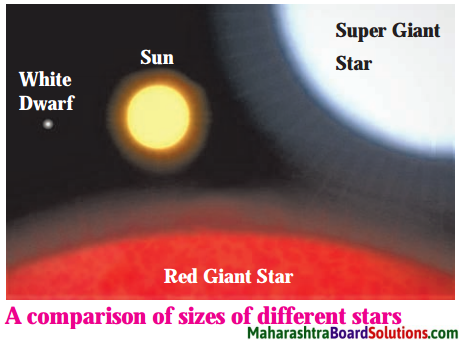
Question 3.
To learn about the use of a new manure :
Answer:
Agriculture department.
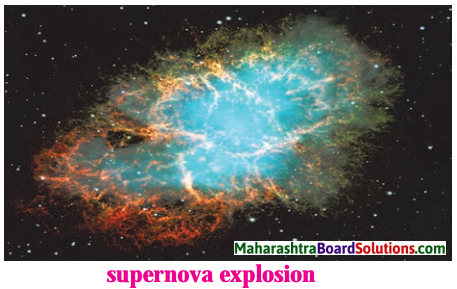
Question 4.
To complain against contaminated water supply :
Answer:
Sanitation department.
Question 5.
To get a birth certificate :
Answer:
Health Department.

Question 6.
To get the income / caste certificate :
Answer:
Revenue Department.

Maharashtra Board Class 6 Civics Solutions Chapter 3 Rural Local Government Bodies

Write a brief note on:

Question 1.
Women’s participation in the Gram Sabha:
Answer:
A meeting of the women of a village is held before the meeting of the Gram Sabha. Here, women feel free to discuss a variety of issues. During the Gram Sabha, they speak with greater concern about issues such as drinking water, prohibition, employment, fuel, health etc. They also suggest measures for bringing about necessary changes.

Maharashtra Board Class 8 Science Solutions Chapter 19 Life Cycle of Stars

Balbharti Maharashtra State Board Class 8 Science Solutions Chapter 19 Life Cycle of Stars Notes, Textbook Exercise Important Questions and Answers.

Maharashtra State Board Class 8 Science Solutions Chapter 19 Life Cycle of Stars

Class 8 Science Chapter 19 Life Cycle of Stars Textbook Questions and Answers

1. Search and you will find:

Question a.
Our galaxy is called ………… .
Answer:
Our galaxy is called the Milky Way and Mandakini.

Maharashtra Board Class 8 Science Solutions Chapter 19 Life Cycle of Stars

Question b.
For measuring large distances, ………… is used as a unit.
Answer:
For measuring large distances, the light year is used as a unit.

Question c.
The speed of light is …………. km/s.
Answer:
The speed of light is 300000 km/s.

Question d.
There are about ………… stars in our galaxy.
Answer:
There are about 100 billion stars in our galaxy.

Question e.
The end stage of the Sun will be …………. .
Answer:
The end stage of the Sun will be a white dwarf.

Maharashtra Board Class 8 Science Solutions Chapter 19 Life Cycle of Stars

Question f.
Stars are born out of ………… clouds.
Answer:
Stars are born out of interstellar clouds.

Question g.
Milky way is a ………. galaxy.
Answer:
Milky way is a spiral galaxy.

Question h.
Stars are gigantic spheres of ………… gas.
Answer:
Stars are gigantic spheres of hot gas.

Question i.
The masses of other stars are measured relative to the mass of the …………. .
Answer:
The masses of other stars are measured relative to the mass of the Sun.

Maharashtra Board Class 8 Science Solutions Chapter 19 Life Cycle of Stars

Question j.
Light takes ……………. to reach us from the Sun while it takes …….. to reach us from the moon.
Answer:
Light takes about 8 minutes to reach us from the Sun while it takes about 1 second to reach us from the moon.

Question k.
The larger the mass of a star, the faster is its ……….. .
Answer:
The larger the mass of a star, the faster is its evolution.

Question l.
The number of fuels used in the life of a star depends on its …………. .
Answer:
The number of fuels used in the life of a star depends on its mass.

Maharashtra Board Class 8 Science Solutions Chapter 19 Life Cycle of Stars 1.2

2. Who is telling lies?

Question a.
Light year is used to measure time.
Answer:
False. (Light year is used to measure distance.)

Question b.
End stage of a star depends on its initial mass.
Answer:
True.

Question c.
A star ends its life as a neutron star when the pressure of its electrons balances its gravity.
Answer:
False. (A star ends its life as a neutron star when the pressure of its neutrons balances its gravity.)

Question d.
Only light can emit from the black hole.
Answer:
False. (Not even light can be emitted by a black hole.)

Maharashtra Board Class 8 Science Solutions Chapter 19 Life Cycle of Stars

Question e.
The Sun will pass through the supergiant stage during its evolution.
Answer:
False. (The Sun will pass through the red giant stage during its evolution.)

Question f.
The Sun will end its life as a white dwarf.
Answer:
True.

3. Answer the following question:

Question a.
How do stars form?
Answer:
There are huge clouds of gas and dust in the empty spaces between the stars in a galaxy. These clouds are called interstellar clouds. The size of an interstellar cloud is about a few light years.
Maharashtra Board Class 8 Science Solutions Chapter 19 Life Cycle of Stars 2.1
When an interstellar cloud starts contracting due to some disturbance, its density and temperature increase. This results in formation of a dense sphere of hot gas and nuclear energy generation starts at the centre of the star. Therefore, the gas sphere becomes self-luminous. Thus a star is formed, i.e., a star is born.
A huge interstellar cloud can produce thousands of stars at a time.
Maharashtra Board Class 8 Science Solutions Chapter 19 Life Cycle of Stars 3

Maharashtra Board Class 8 Science Solutions Chapter 19 Life Cycle of Stars

Question b.
Why do stars evolve?
Answer:
Although stars appear stable for quite a long period of time, their properties do change, though very slowly. A change in the properties of a star, leading to its passing through different stages, is called evolution of the star. Burning of the fuel at the centre of the star and a gradual decrease in its amount is the main reason of evolution of a star.

Question c.
What are the three end stages of stars?
Answer:

  1. Stars having initial mass less than 8 times the mass of the Sun ultimately become white dwarfs.
  2. Stars having initial mass between i 8 and 25 times the mass of the Sun ultimately become neutron stars.
  3. Stars having initial mass larger than 25 times the mass of the Sun ultimately turn into black holes.

Question d.
Why was the name black hole given?
Answer:
When a star having initial mass larger than 25 times the mass of the Sun reaches its end stage, its gravitational force and density increase exponentially. All nearby objects get attracted towards the star and nothing can come out of it, not even light. All incident light is absorbed by the star. We can probably see a very minute black hole at its place. Hence, the name is given as black hole.

Maharashtra Board Class 8 Science Solutions Chapter 19 Life Cycle of Stars

Question e.
Which types of stars end their life as a neutron star?
Answer:
Stars having initial mass between 8 and 25 times the mass of the Sun end up as neutron stars. When these stars pass through ( the supergiant stage, their size increases to 1000 times. Huge explosion that occurs in the last stage of these stars is very powerful and very high energy is given off. After the huge explosion, called the supernova explosion, their central portion contracts in size to about 10 km. In this stage, such stars are completely made up of neutrons and hence are called neutron stars.

4. A. If you are the Sun, write about your properties in your own words.
B. Describe white dwarfs.

Question A.
If you are the Sun, write about your properties in your own words.
Answer:

If you are the Sun, write about your properties in your own words.
Answer:
There are billions of stars in the galaxy called the Milky Way and Mandakini. I am one of the small stars called the Sun. I have my own family called the solar system. There are planets, satellites, asteroids, comets and meteors in my family. My mass is 2 × 1030 kg which is about 3.3 lakh times that of the earth. With a radius of 695700 km, my size is about 100 times that of the earth. My surface temperature is about 5800 K while it is 1.5 × 10⁷ K at the centre.

72 % of my mass consists of hydrogen while 26 % consists of helium. Rest 2 % is made up of elements heavier than helium. I am about 4.5 billion years old and the scientists on the earth have concluded that not much change has taken place in my properties during this period. According to the scientists, in the end stage of my life, I will turn into a red giant star. Thereafter, I will first explode and then contract to become as small as the earth. I will appear small as well as white and hence, I will be called a white dwarf. This will be my last stage for ever.

Maharashtra Board Class 8 Science Solutions Chapter 19 Life Cycle of Stars

Question B.
Describe white dwarfs.
Answer:
Depending on the initial mass, stars can reach one of the three end stages. White dwarf is one such stage of stars having initial mass less than 8 times the mass of the Sun. These stars undergo huge expansion and their radius increases by a factor of 100 to 200. These stars appear reddish because of their large size and lower temperature. Hence, these stars are also called red giant stars.

At the end of their evolution, these stars explode, their outer gas envelope is thrown outward and the inner part contracts to the size of the earth. However, the density in the star becomes very high. In this stage, the pressure due to electrons becomes independent of temperature and sufficient to balance the gravitational force for ever.
Maharashtra Board Class 8 Science Solutions Chapter 19 Life Cycle of Stars 4
In this stage, such stars look white and due to their small size they are called white dwarfs.

Can you recall?

Question 1.
What is a galaxy?
Answer:
A system of billions of stars, their planetary systems and interstellar clouds of gas and dust held together by gravitational attraction is called a galaxy.

Question 2.
What are the different constituents of our solar system?
Answer:
The different constituents of our solar system are as follows :

  1. Sun as a star.
  2. Eight planets, namely, Mercury, Venus, Earth, Mars, Jupiter, Saturn, Uranus and Neptune; of which Mercury, Venus, Earth and Mars are made up of rocks and minerals, while Jupiter, Saturn, Uranus and Neptune are made up of gases.
  3. Natural satellites of some planets revolving around the respective planets.
  4. Asteroids located between Mars and Jupiter.
  5. Comets made up of ice, dust and gases.
  6. Meteors and meteoroids.

Maharashtra Board Class 8 Science Solutions Chapter 19 Life Cycle of Stars

Question 3.
What are the major differences between a star and a planet?
Answer:

  1. Nuclear/atomic explosions regularly take place at the centre of stars. This causes the discharge of heat and light. Hence, stars shine. Planets do not discharge any light. They are visible due to the light reflected by them.
  2. Stars are very big in size and massive relative to planets.
  3. Stars twinkle, planets do not.
  4. Stars are made up of hydrogen, helium and other light elements.
  5. Planets are made up of solid, liquid or gaseous substances or a combination thereof.

Question 4.
What is a satellite?
Answer:
An astronomical object orbiting a planet is called a satellite.

Question 5.
Which is the star nearest to us?
Answer:
The star nearest to us is the Sun.

Maharashtra Board Class 8 Science Solutions Chapter 19 Life Cycle of Stars

Project:

Question 1.
Use your imagination and make models of the Milky Way and the solar system.
Answer:
N.B. Students can make these models and display the same in science exhibition. You can use sand, scrap material, stones, pebbles, marbles, pieces of glass, beads, etc.

Question 2.
Write the effects: If the Sun disappears ………..
Answer:
N.B. You can write the effects with the help of the following points:

  1. No sunrise, no sunset, no beauty of morning and evening wee hours.
  2. In the absence of the gravitational force due to the Sun, the earth will drift away in the galaxy.
  3. Darkness, no source of energy, end of life on the earth.
  4. Moon will be invisible.
  5. The temperature of the earth will fall below the freezing point of water. All oceans will also freeze.
  6. Even the atmosphere will freeze and fall on the earth. This will cause more cosmic rays to reach the earth.

Class 8 Science Chapter 19 Life Cycle of Stars Important Questions and Answers

Match the columns:

Question 1.

Column ‘A’Column ‘B’
1. Gravitational forcea. Alpha Centauri
2. The star nearest to us other than the Sunb. 2 × 1030 kg
3. Mass of the Sunc. 10 30 g
d. towards the centre of a star or a planet

Answer:

Column ‘A’Column ‘B’
1. Gravitational forced. towards the centre of a star or a planet
2. The star nearest to us other than the Suna. Alpha Centauri
3. Mass of the Sun b. 2 × 1030 kg

Maharashtra Board Class 8 Science Solutions Chapter 19 Life Cycle of Stars

Question 2.
Mass of the star:

Column ‘A’Column ‘B’
1. < 8 MSuna. Proton star
2. between 8 and 25 times MSunb. Black hole
3. > 25 MSunc. Neutron star
d. White dwarf

Answer:
Mass of the star:

Column ‘A’Column ‘B’
1. < 8 MSund. White dwarf
2. between 8 and 25 times MSunc. Neutron star
3. > 25 MSunb. Black hole

Maharashtra Board Class 8 Science Solutions Chapter 19 Life Cycle of Stars

Answer the following questions in one sentence each:

Question 1.
Name the star nearest to the earth.
Answer:
The Sun.

Question 2.
Other than the Sun, which is the star nearest to the earth?
Answer:
Alpha Centauri.

Question 3.
What would be the last stage of the Sun?
Answer:
The last stage of the Sun would be white dwarf.

Question 4.
Name two forces that act on any star.
Answer:
Gravitational force and the force due to the pressure of hot gas are the two forces that act on any star.

Maharashtra Board Class 8 Science Solutions Chapter 19 Life Cycle of Stars

Question 5.
What is a black hole?
Answer:
A black hole is the end stage of a quite big star, where due to the extremely high gravitational force, nothing, not even light, comes out.

Answer the following questions:

Question 1.
How is stability of stars maintained?
Answer:
Properties of a star remain unchanged for quite a long time. The gravitational force and the force due to the pressure of the hot gas act together on a star. The gravitational force acts towards the centre of the star and tries to bring the gas particles close together. Hot gas shows the tendency to spread and its force acts away from the centre of the star. This force tries to disperse the gas particles. A balance between the gravitational force and the force due to the hot gas keeps the star stable.

Maharashtra Board Class 8 Science Solutions Chapter 19 Life Cycle of Stars 5

However, if the magnitude of any one force is more than that of the other force, the star either contracts or expands depending upon which force dominates.

Question 2.
Why is the Sun called an ordinary star?
Answer:
The star nearest to the earth is the Sun. Hence, it appears quite big and bright. There are billions of stars in our galaxy called the Milky Way and Mandakini which are greater or lower in mass, size and temperature than the Sun. Hence, the Sun is called an ordinary star.

Maharashtra Board Class 8 Science Solutions Chapter 19 Life Cycle of Stars

Do you know?

When the Sun will become a red giant, its diameter will increase so much that it will swallow Mercury and Venus. It is possible that the earth will also be absorbed by the Sun. It will take about 4-5 billion years for the Sun to reach this state.

Question 3.
Describe various stages of evolution of star.
Answer:
Though the properties of a star remain unchanged for quite a long time, this situation is never static. A star passes through different stages. This process is called the evolution of a star.
Important stages of the evolution of a star are as follows:

1. Initial stage of stability: The gravitational force and the force due to the pressure of the hot gas act together on a star. The gravitational force acts towards the centre of the star and tries to bring the gas particles close together. Hot gas shows the tendency to spread and its force acts away from the centre of the star.

This force tries to disperse the gas particles. A balance between the gravitational force and the force due to the hot gases keeps the star stable, as long as the energy generation continues at the centre of the star.

2. Burning of the fuel: As a star continuously emits energy, its energy constantly decreases. When the fuel at the centre of the star is exhausted, the energy generation stops and the temperature of the star starts decreasing. Decreasing temperature causes the gas pressure to decrease and the balance between the gravitational force and the force due to the gas pressure is no more maintained.

As the magnitude of the gravitational force is now more than that of the force due to the gas pressure, the star starts contracting. This causes another fuel to start burning, e.g. on exhausting hydrogen, helium starts undergoing fusion. Availability of multiple fuels depends on the mass of the star.

The higher the mass of the star, the more is the number of fuels used. The star either contracts or expands during the course of using these fuels. This may cause the imbalance between the gravitational force and the force due to the hot gas.

3. Total exhaustion of the fuel: When all fuels are exhausted, the energy generation in the star finally stops completely and the temperature of the star starts decreasing. The balance between the gravitational force and the force due to the gas pressure can no more be maintained. The evolution of the star ends and the star proceeds to its end stage.

4. End stage of a star: Once the fuel in the star is totally exhausted, the energy generation in the star stops and subsequently the gas pressure decreases, the star starts contracting and its density starts increasing. When the density becomes very high, some new types of pressures are generated which are independent of the temperature of the gas.

In such a case, the pressure remains stable despite low temperature and absence of any energy generation and thus the star remains stable for ever. This stage is the end stage of the star. Depending on the initial mass, stars can reach one of the three end stages.

  • Stars having initial mass less than 8 times the mass of the Sun ultimately become white dwarfs.
  • Stars having initial mass between 8 and 25 times the mass of the Sun ultimately become neutron stars.
  • Stars having initial mass larger than 25 times the mass of the Sun ultimately turn into black holes.

Maharashtra Board Class 8 Science Solutions Chapter 19 Life Cycle of Stars

Write short notes on the following:

Question 1.
End stages of stars having initial mass less than 8 times the mass of the Sun.
Answer:
These stars undergo huge expansion and their radius increases by a factor of 100 to 200 during their various stages of evolution. These stars appear reddish due to their lower temperature. Hence, they are called red giant stars.

At the end of evolution, these stars explode, their outer gas envelope is thrown out and the inner part contracts roughly to the size of the earth. Hence, the density of the star becomes very high. In this stage, the pressure due to electrons becomes independent of temperature and sufficient to balance the gravitational force for ever. Such stars look white and due to their small size they are called white dwarfs.

Maharashtra Board Class 8 Science Solutions Chapter 19 Life Cycle of Stars 6

Question 2.
End stage of the stars having mass between 8 and 25 times the mass of the Sun.
Answer:
These stars pass through the red giant stage and later super giant stage, during which their size may increase to 1000 times. The huge explosion, called the supernova explosion, occurs in the last stage of the evolution. It is very powerful and very high energy is given off in this case.

Maharashtra Board Class 8 Science Solutions Chapter 19 Life Cycle of Stars 7

As a result, the stars are visible even during the day. Later their central portion contracts to about 10 km. In this stage, the stars are completely made up of neutrons and are called neutron stars. The pressure of these neutrons is independent of temperature and sufficient enough to balance the gravitational force for ever.

Maharashtra Board Class 8 Science Solutions Chapter 19 Life Cycle of Stars

Question 3.
End stages of stars having mass larger than 25 times the mass of the Sun.
Answer:
After the supernova explosion, no pressure can balance the gravitational force. Hence these stars contract continuously and their gravitational force and density increase exponentially. All nearby objects get attracted towards these stars and not even light can come out of them. Light falling on these stars is completely absorbed by the star. We cannot see these stars. A very minute black hole is formed at the place of such a star. This is the end stage of these stars.
Maharashtra Board Class 8 Science Solutions Chapter 19 Life Cycle of Stars 8

Maharashtra Board Class 6 Geography Solutions Chapter 10 Human Occupations

Balbharti Maharashtra State Board Class 6 Geography Solutions Chapter 10 Human Occupations Notes, Textbook Exercise Important Questions and Answers.

Maharashtra Board Class 6 Geography Solutions Chapter 10 Human Occupations

Class 6 Geography Chapter 10 Human Occupations Textbook Questions and Answers

A. Select the correct option:

Question 1.
Serving as a ______ is a tertiary type of occupation.(bus conductor, veterinary doctor, brick kiln worker)
Answer:
bus conductor

Maharashtra Board Class 6 Geography Solutions Chapter 10 Human Occupations

Question 2.
In the tropical areas, we mainly see ________ occupations. (primary; secondary, tertiary)
Answer:
primary

Question 3.
Amol’s Granny sells papads and pickles. This is a _______ occupation. (primary, secondary, tertiary)
Answer:
secondary

B. Give reasons:

Question 1.
The type of occupation determines a person’s
income.
Answer:
(i) Occupation is a job, a person’s role in society wherein a regular activity is carried out for income.

(ii) Certain occupations bring greater economic benefits to the society and the nation at large while certain occupations bring relatively less economic benefits.

(iii) Similarly some occupations require higher level of knowledge and skill while some can be carried out with little or no skill or expertise. Person’s income is proportionate to the economic benefit his occupation brings with it and the land of his knowledge and skill. So the type of occupation determines a person’s income.

Question 2.
Primary occupations are associated with developing countries while tertiary, with developed countries.
Answer:
(i) Countries which are developing have low income as they are in a state of development and their main source of income comes from production carried out in primary sector.

(ii) Developed countries are rich with high income and so they practice tertiary occupation. They have enough money to invest in business which creates tertiary occupations which requires huge investment.

Question 3.
Quaternary occupations are not commonly seen.
Answer:
Quaternary occupations are occupations which require special knowledge, skills and expertise. This sectorevolves in well-developed countries and requires skilled workforce apart from sufficient money to invest in fields like IT, research and development, quality testing, etc.

Maharashtra Board Class 6 Geography Solutions Chapter 10 Human Occupations

Activity:

  • Visit a secondary occupation in your area.
  • Gather information related to that occupation
  • using the following points and note it down.
  • Name of the occupation
  • Raw material used
  • Source of raw material
  • Finished product
  • Market for finished product
  • Tertiary occupations required in it.

Class 6 Geography Chapter 10 Human Occupations InText Questions and Answers

Look at the figure and answer the following questions:

Maharashtra Board Class 6 Geography Solutions Chapter 10 Human Occupations 4
Maharashtra Board Class 6 Geography Solutions Chapter 10 Human Occupations 5
Maharashtra Board Class 6 Geography Solutions Chapter 10 Human Occupations 6
Question 1.
What are the cows and buffaloes in picture A doing?
Answer:
The animals, cows and buffaloes are grazing in the pasture, i.e. land covered with grass and other low plants.

Question 2.
What is being obtained in picture B?
Answer:
Milk is being obtained in picture B.

Question 3.
What is happening at the Milk Collection Centre in picture C?
Answer:
Milk is being filled for storage and sold at the milk collection centre.

Maharashtra Board Class 6 Geography Solutions Chapter 10 Human Occupations

Question 4.
In picture D, what is being transported? Where could the tanker be going?
Answer:
Milk is being transported to the milk processing centre. The tanker is on the truck

Question 5.
Which products are seen in picture E? From what have these products been made?
Answer:
Curd, ghee, butter, cheese and shrikhand are the products seen in picture E and these products have been made from milk.

Question 6.
What else is happening in picture E?
Answer:
In picture E, person is testing the quality of the prepared milk products.

Question 7.
Out of the products shown in picture F, which products do you use?
Answer:
I use all the products shown in picture F as milk products are high on nutrients and good for health.

Question 8.
What would be main difference between milk and milk products?
Answer:
Milk is a beverage obtained from nature, directly from different animals. While milk products are obtained by processing milk into different products.

Question 9.
Do these products perish quickly like milk?
Answer:
No, they have a longer life unlike milk.

Look at the figure and answer the following questions:

Maharashtra Board Class 6 Geography Solutions Chapter 10 Human Occupations 4
Maharashtra Board Class 6 Geography Solutions Chapter 10 Human Occupations 5
Maharashtra Board Class 6 Geography Solutions Chapter 10 Human Occupations 6
Question 1.
Which of these activities is undertaken to obtain a product from nature?
Answer:
Obtaining milk from the cow is the activity undertaken to obtain a product from nature.

Maharashtra Board Class 6 Geography Solutions Chapter 10 Human Occupations

Question 2.
How long does this product last?
Answer:
If refrigerated it will last for about five days to one week.

Question 3.
In which picture is the product obtained from nature being collected?
Answer:
In picture C, the product obtained from nature is being collected.

Question 4.
Which service did the milk producer get through this activity?
Answer:
Transport and unloading of milk, a tertiary service is the service which the milk producer received.

Question 5.
Where is milk being taken? What happens to the milk thereafter?
Answer:
The milk is being taken to the milk processing centre for processing milk to make milk products.

Question 6.
What milk products are seen in the picture?
Answer:
Ghee, butter, cheese, shrikhand are the products seen in the picture.

Question 7.
Who inspects these products?
Answer:
A food inspector, a person with special skill and expertise inspects these products.

Question 8.
What does the shopkeeper do with these products?
Answer:
The shopkeeper sells these products to the consumer.

Question 9.
Which of these products are perishable and which are non- perishable?
Answer:
All are the products, even after proper storage will deteriorate and perish over a period of time.

Question 10
Will the price and weight of these products be same as that of the milk?
Answer:
The price and weight of these products will be higher after processing. These products will be more durable and its quality too will be enhanced and so their price will be also higher.

Use your brainpower!

Question 1.
Milk is available at ₹ 40 per litre while dahi at ₹ 60 per kg and paneer at ₹ 200 per kg. If both are obtained from milk, why is there so much difference in their prices?
Answer:
Milk is being processed, obtained from nature and made it into different products. These products are more durable. Their quality its enhanced and therefore their price is higher.

Maharashtra Board Class 6 Geography Solutions Chapter 10 Human Occupations

Answer the following questions based on the pie charts:

Maharashtra Board Class 6 Geography Solutions Chapter 10 Human Occupations 3
Question 1.
Which country has more manpower engaged in primary occupation?
Answer:
Bangladesh.

Question 2.
Which country has more manpower engaged in secondary occupation?
Answer:
Turkey.

Question 3.
Which country has more manpower engaged in tertiary occupations?
Answer:
United Arab Emirates.

Question 4.
Which country has almost equal manpower engaged in all the occupations?
Answer:
Turkey.

Think a little!

Who am I?

Question 1.
Who examines us when we fall ill?
Answer:
Doctor

Question 2.
Who checks our examination papers?
Answer:
Teacher

Question 3.
Who prepares the designs of buildings?
Answer:
Architect
Maharashtra Board Class 6 Geography Solutions Chapter 10 Human Occupations

Question 4.
Who produces machines and looks after their maintenance and repairs?
Answer:
Engineer

Observe figure and answer the questions related to sugar production:

Maharashtra Board Class 6 Geography Solutions Chapter 10 Human Occupations 1
Maharashtra Board Class 6 Geography Solutions Chapter 10 Human Occupations 2
Question 1.
Classify the occupations from primary to quaternary
Answer:

PrimarySecondaryTertiaryQuaternary
Harvesting of sugarcaneSugarcane being collected at factoryTransport of sugarcaneQuality check
Processing of sugarcane juiceSacks of sugar being cannedInspection and
maintenance of
machinery in the factory
Sugar productionSale of goods

Question 2.
Which raw material is used in the secondary occupation?
Answer:
Sugarcane is the raw material used in the secondary occupation.

Question 3.
Which is the finished product obtained in the secondary occupation?
Answer:
Sugar is the finished product obtained in the secondary occupation.

Question 4.
What are the services in tertiary occupations?
Answer:
Transport of sugarcane, sacks of sugar being carried and sales of goods are the services in tertiary occupations.

Question 5.
Which picture is related to a quaternary occupation? Can you name the occupation?
Answer:
Picture G is related to a quaternary occupation. The occupation is quality testing.

Maharashtra Board Class 6 Geography Solutions Chapter 10 Human Occupations

Think and discuss:

What effect does nature have on our occupations? Think a little. Give a thought to the following issues. Discuss them in the class. Write two paragraphs about it.

  • There have been no rain at all (drought).
  • A storm strikes
  • There was an earthquake.
  • Untimely rains
  • Good rains
  • Excessive rains and floods
  • All of a sudden, a volcano erupts
  • A tsunami hits.

Answer:
Primary occupations like agriculture can be totally disrupted if there are no rains or excessive rains while good rains will usher with good agricultural output. When we receive good agricultural yield it will have a positive input on all secondary occupations which rely on agriculture. It will bring about all-round growth in both agricultural and industrial sector.

Natural calamities like storms, earthquake, volcanoes and tsunami can have adverse impact on various occupations. It can bring all the primary, secondary, tertiary and quaternary occupations to a standstill. Occupations related to production, storage, distribution, etc. will be greatly affected as rescue and rehabilitation of the people and reconstruction of the damaged caused, becomes a priority.

Do it yourself!

Question 1.
Which occupations are found in your area?
Answer:
I live in Maharashtra and occupations like textile manufacture, manufacture of sugar, pharmaceutical, petrochemicals, electronics, automobiles, engineering services, food processing, etc. are practised here.

Question 2.
Which occupation is practised on a large scale?
Answer:
Sugar manufacturing is an occupation which is practised on a large scale.

Question 3.
Find the reason behind it.
Answer:
Advantageous location of Maharashtra, progressive government policies, availability of raw material, i.e. sugarcane, good infrastructure and above all the ownership given to farmers in sugar factories are the reasons why this occupation is practised on a large scale.

Question 4.
Both human and natural factors affect occupations. Can you find those factors?
Answer:
Development of industries, availability of technical know-how and skilled manpower, existing labour laws and government policies pertaining to occupations development of infrastructure are the human factors that affect occupations.
Climate, terrain of a region, fertility of soil, susceptibility to natural calamities, availability of raw materials, etc. are the natural factors which affect occupations.

Question 5.
Obtain information about the damage caused to the environment through different occupations.
Answer:
Pollution of the environment in all its form – air, water, soil and land, deforestation, soil erosion, depletion of the ozone layer, etc. are some of the damages caused due to different occupations practised.

While practising occupations we should be careful not be cause of hazardous air emissions, land contamination leading to soil pollution, marine and coastal pollution caused due to untreated waste water, etc. Sustainable development, let us remember should be the need of the hour.

Maharashtra Board Class 6 Geography Solutions Chapter 10 Human Occupations

Visit a secondary occupation in your area gather information related to that occupation using the following points and note it down:
Answer:

Name of the occupationPharmaceutical manufacturing.
Raw material usedAnimal extracts, herbal extracts, additives like glaze, talc, etc. and chemical substances.
Sources of raw materialFrom different parts of India, some raw materials are imported from other countries.
Finished productsMedicine and other pharma products.
Market of finished productsNational and international markets including US, UK, Australia, Russia, Germany, etc.
Tertiary occupationsTransport of goods, loading and unloading of goods and sale of goods.

Class 6 Geography Chapter 10 Human Occupations Additional Important Questions and Answers

Complete the following statements by choosing the correct options:

Question 1.
Occupations which are dependent on nature are called _______ occupations. (secondary, primary, tertiary)
Answer:
primary

Question 2.
Processed products are ________.(non-perishable, more durable, less durable)
Answer:
more durable

Question 3.
Occupations dependent on primary occupations are called ______ occupations. (primary, secondary, quaternary)
Answer:
secondary

Question 4.
The occupations which provide complimentary services to the other two occupations are called _________ occupations. (tertiary, secondary, primary)
Answer:
tertiary

Question 5.
Countries which have more manpower engaged in _______ activities are considered to be developed countries. (primary , secondary, tertiary)
Answer:
tertiary

Question 6.
Countries which have more manpower engaged in primary activities are considered to be _____ countries. (developed, developing, under developed)
Answer:
developing

Maharashtra Board Class 6 Geography Solutions Chapter 10 Human Occupations

Question 7.
transactions decide the country’s ______.(production, occupation, manpower)
Answer:
primary

Arrange the following in proper order:

  • Selling milk products in the market.
  • Obtaining milk and selling milk.
  • Processing milk at milk processing centres.
  • Rearing of domestic animals.
  • Making ghee, butter, cheese, shrikhand, paneer, milk powder, etc.

Answer:

  • Rearing of domestic animals.
  • Obtaining milk and selling milk.
  • Processing milk at milk processing centre.
  • Making ghee, butter, cheese, shrikhand, paneer, milk powder, etc.
  • Selling milk products in the market.

Match the pairs correctly:

Question 1.

Column AColumn B
(1) Animal husbandry and fishing(a) secondary occupation
(2) Processing of milk(b) tertiary occupation
(3) Transport of goods(c) quaternary occupation
(4) Quality testing of product(d) primary occupation
(5) Transaction of the country(e) economic transactions
(f) production

Answer:
1 – d
2 – a
3 – b
4 – c
5 – f

Name the following:

Question 1.
Any two products obtained after processing milk at milk processing centre:
Answer:

  1. Butter
  2. Cheese

Maharashtra Board Class 6 Geography Solutions Chapter 10 Human Occupations

Question 2.
Any two animals domesticated by man:
Answer:

  1. Cow
  2. Buffalo

Question 3.
Occupation which is directly dependent on nature:
Answer:
Primary occupations.

Question 4.
Occupations dependent on primary occupations:
Answer:
Secondary occupations.

Question 5.
Occupations which provide complementary services to primary and secondary occupations:
Answer:
Tertiary occupations.

Question 6.
Occupations like sale of goods
Answer:
Tertiary occupations or service occupations

Question 7.
Occupations which requires special expertise:
Answer:
Quaternary occupations.

Question 8.
Countries which have more manpower engaged in tertiary activities:
Answer:
Developed countries.

Question 9.
Countries which have more manpower engaged in primary activities:
Answer:
Developing countries.

Complete the table:

OccupationsDefinitionExamples
Primary
Secondary
Tertiary
Quaternary

Answer:

OccupationsDefinitionExamples
PrimaryOccupation which directly depend on nature are called primary occupations.Farming, animal husbandry, mining, foresting, fishing.
SecondaryOccupations dependent on primary occupations are called secondary occupations.Food processing, manufacturing, construction.
TertiaryOccupations which provide complementary services to primary and secondary occupations are called tertiary occupations.Transport of goods, commercial services, loading and unloading goods, sale of goods.
QuaternaryThe occupations which requires special expertise and special skills are called quaternary occupations.Quality testing of food products, inspection and maintenance., IT.

Answer the following questions in one sentence each:

Question 1.
Why does man undertake various activities?
Answer:
Man undertakes various activities to satisfy his need.

Question 2.
How are activities undertaken by man classified?
Answer:
Activities undertaken by man are classified on the basis of their nature and the products they yield.

Maharashtra Board Class 6 Geography Solutions Chapter 10 Human Occupations

Question 3.
Where are raw materials supplied to the industries often obtained from?
Answer:
Raw materials supplied to the industries are often obtained from nature.

Question 4.
Which occupations require special skills and expertise?
Answer:
Quaternary occupations requires special skills and expertise.

Answer the following questions in short:

Question 1.
Why are the prices of processed milk products higher?
Answer:

  • Milk obtained from nature is processed and made into different products which involves high cost.
  • These products are more durable.
  • Their quality too is enhanced.
  • Therefore their price is also higher.

Question 2.
Explain the term “Service occupation”.
Answer:

  • The occupations which provide complementary services to the other two occupations, i.e., primary and secondary occupations are tertiary occupations.
  • These occupations are complementary i.e., supportive to all other occupations.
  • These occupations are called as service occupation e.g., transport of goods, loading and unloading of goods and sale of goods, etc.

Question 3.
A person testing the quality of a product is practising a quaternary occupation. Elaborate.
Answer:

  • To test the quality of a product, a person must have some special skills.
  • This service is not an ordinary one but the one which requires special expertise.
  • Such services which requires special skills and expertise are called quaternary occupations.

Question 4.
How can we decide the extent of the country’s development?
Answer:

  • Different occupations are practised in different countries of the world.
  • Through these occupations, economic transactions occur within a country and between various countries.
  • These transactions decide the country’s production of various goods and their national income.
  • This, in turn, is used to decide the extent of a country’s development.

Question 5.
What decides the country’s annual income?
Answer:
Different occupations are practised in different countries of the world through which economic transactions occur within country and various countries which decide the country’s production of various goods and their annual income.

Maharashtra Board Class 6 Geography Solutions Chapter 10 Human Occupations

I can do this!

Question 1.
Answer:

Name different occupations
  • Primary occupation
  • Secondary occupation
  • Tertiary occupation
  • Quaternary occupation
Differences
  • Primary occupations are those occupations which are dependent on nature, e.g. Agriculture.
  • Occupations dependent on primary occupations are called secondary occupations, e.g. Food processing.
  • Those occupations which provide complementary services to primary and secondary occupation are called tertiary occupations, e.g. Sale of goods.
  • While occupation which requires special skills and expertise are called quaternary occupation, e.g. Quality assurance.

Question 2.
Classify the occupations from primary to quaternary.
Answer:

Primary occupationsSecondary occupationsTertiary occupationsQuaternary occupations
Farming, mining, forestry, animal husbandry, fishingManufacturing, construction, food processingCommercial services, transport of goods, loading and unloading of goods, sale of goodsResearch and development, IT, quality assurance, inspection and maintenance


Maharashtra Board Class 7 Science Solutions Chapter 5 Food Safety

Balbharti Maharashtra State Board Class 7 Science Solutions Chapter 5 Food Safety Notes, Textbook Exercise Important Questions and Answers.

Maharashtra State Board Class 7 Science Solutions Chapter 5 Food Safety

Class 7 Science Chapter 5 Food Safety Textbook Questions and Answers

1. Complete the following statements by using the correct option from those given below.
(Irradiation, dehydration, pasteurization, natural, chemical)

Question a.
Drying the food grains from farms under the hot sun is called …………. .
Answer:
dehydration

Maharashtra Board Class 7 Science Solutions Chapter 5 Food Safety

Question b.
Materials like milk are instantly cooled after heating up to a certain high temperature. This method of food preservation is called ……….. .
Answer:
pasteurization

Question c.
Salt is a ……….. type of food preservative.
Answer:
natural

Question d.
Vinegar is a …………. type of food preservative.
Answer:
chemical

2. Answer the following questions in your own words. 

Question a.
How is milk pasteurised?
Answer:
Boil the milk at 80°C for 15 minutes and cool it quickly. This destroys the microbes present in the milk and it can remain for a longer duration. This process is called pasteurization of milk.

Maharashtra Board Class 7 Science Solutions Chapter 5 Food Safety

Question b.
Why should we not consume adulterated food materials?
Answer:
Different types of adulterants affect our health in different ways. Some adulterants cause abdominal discomfort or poisoning while some may affect the functioning of some organs if consumed over a long period of time or even cause cancer.

Question c.
What precautions do your parents take to keep foodstuffs safe?
Answer:
Our parents take following care to keep foodstuffs safe

  1. Drying of grains.
  2. Boiling of milk, soups and curries from time to time.
  3. Refrigeration of vegetables, fruits, milk and cooked food.
  4. Candying of jams.
  5. Use natural preservatives like oil, spices, neem leaves, salt, etc.
  6. Use chemical preservatives in sauces, ketchups, pickles, jams and squashes.

Question d.
How does food spoilage occur? Which are the various factors spoiling the food?
Answer:
Food spoilage is the process in which food deteriorates to the point in which it is not edible to humans or its quality of edibility becomes reduced.
Following are the factors for spoiling of food:

  1. Bacteria causes food to spoil
  2. Incorrect storage may spoil the food.
  3. Infestation by pests.
  4. Chemical reaction takes place in food and it gets spoiled.

Maharashtra Board Class 7 Science Solutions Chapter 5 Food Safety

Question e.
Which methods of food preservation would you use?
Answer:
I use following methods to preserve the food:

  1. Freezing
  2. Boiling
  3. Salting of pickles
  4. drying of grains
  5. candying of jams.

3. What shall we do?

Question a.
There are vendors selling uncovered sweet-meats in open places in the market.
Answer:
We should tell them to sell the covered sweets because uncovered sweets are harmful to eat because it contains dust, dirt and germs. And buyers also should not purchase these uncovered sweets.

Question b.
A ‘pani-puriwala’ is serving the panipuri with dirty hands.
Answer:
We should tell him to wear gloves before serving panipuri because dirty hands contain dirt and germs which are harmful to us.

Question c.
We have purchased a large quantity of fruits and vegetables.
Answer:
We should keep them in refrigerator because in refrigerator, due to low temperature, fruits and vegetables do not spoil and biological and chemical reactions in fruits and vegetables are slowed down at low temperature.

Maharashtra Board Class 7 Science Solutions Chapter 5 Food Safety

Question d.
We need to protect foodstuffs from pests like rats, cockroaches, wall-lizards etc.
Answer:

  1. If we do not protect foodstuffs from pests like rats, cockroaches, wall-lizards etc. then the food get spoiled by them and germs carried by them enters into the food.
  2. If we eat this food then we may get food poisoning and we fall sick so we need to protect foodstuffs from pests like rat, cockroaches, wall lizards etc.

4. Find the odd-man-out. 

Question a.
Salt, vinegar, citric acid, sodium benzoate.
Answer:
Salt

Question b.
Lakhi dal, brick dust, metanyl yellow, turmeric powder.
Answer:
Turmeric powder

Question c.
Banana, apple, guava, almond.
Answer:
Almond

Maharashtra Board Class 7 Science Solutions Chapter 5 Food Safety

Question d.
Storing, freezing, settling, drying
Answer:
Storing

5. Complete the chart below.

Question a.
Maharashtra Board Class 7 Science Solutions Chapter 5 Food Safety 1
Answer:

FoodstuffAdulterant
1. Turmeric powderMetanil yellow
2. Black pepperDried papaya seeds
3. RavaIron filings
4. HoneySugar, water and jaggery

Maharashtra Board Class 7 Science Solutions Chapter 5 Food Safety

6. Explain why this happens and suggest possible remedies.

Question a.
Qualitative wastage of food.
Answer:
Qualitative wastage of food happens due to wrong methods of protecting food, excessive use of food preservatives, over-cooking, washing the vegetables after cutting them, mis¬handling of fruits like grapes and mangoes, miscalculation of the time required to transport food from producers to consumers are some of the reasons of qualitative wastage of food.
Possible remedies:

  1. Avoid overcooking of food.
  2. Store grains and other perishable foodstuffs like vegetables, fruits, milk etc. using proper methods.
  3. Wash fruits and vegetables before cutting it.

Question b.
The cooked rice is underdone.
Answer:
Sometimes in a hurry if we cook the rice it is underdone.
Possible remedies: Use proper pressure cooker to cook the rice.

Question c.
The wheat that was bought is a bit moist.
Answer:
Sometimes due to sudden rain, wheat gets a bit moist. Possible remedies: Do not store the moist wheat, it gets spoiled due to fungus so first sundry it and then store in a clean and dry container to avoid microbial growth.

Question d.
The taste of yoghurt is too sour/slightly bitter.
Answer:
The taste of yoghurt is too sour/slightly bitter means it is spoiled. This happens if it is not kept in the refrigerator.
Possible remedies:- Always keep the yoghurt in refrigerator to avoid biological and chemical reactions in food materials.

Maharashtra Board Class 7 Science Solutions Chapter 5 Food Safety

Question e.
Cut fruits turned black.
Answer:
Fruit contains an enzyme called polyphenol oxidase or tyrosinase that reacts with oxygen. The oxidation reaction basically forms a sort of rust on the surface of fruits so it turns black.
Possible remedies:

  1. Coat the fruits with sugar syrup
  2. Add lemon juice on fruits.

7. Give reasons.

Question 1.
Food remains safe at 5° Celsius.
Answer:
Food remains safe at 5° Celsius because at 5°C, micro-organisms stop growing.

Maharashtra Board Class 7 Science Solutions Chapter 5 Food Safety

Question 2.
Nowadays, food is served in buffet style during large gatherings.
Answer:
Nowadays, food is served buffet style during large gatherings because due to buffet style quantitative wastage of food can be avoided, as people take only as much as they could eat.

Project:

Question 1.
Go to your kitchen und take notes about the food safety measures and the food wastage you see there.

Question 2.
In a science exhibition demonstrate the various methods of detecting food adulteration.

Class 7 Science Chapter 5 Food Safety Important Questions and Answers

Complete the following statements by using the correct option from those given below.
(Irradiation, dehydration, pasteurization, natural, chemical)

Question 1.
………………………. is celebrated as “World Food Day”.
Answer:
16th October

Maharashtra Board Class 7 Science Solutions Chapter 5 Food Safety

Question 2.
FSSAI means ………………………. .
Answer:
Food Safety and Standardization Authority of India

Question 3.
………………………. gas is filled in tight packets of potato wafers.
Answer:
Nitrogen

Question 4.
Common name of acetic acid is ……………………….
Answer:
Vinegar

Question 5.
………………………. is sprayed on the gunny bags containing food grains.
Answer:
Melathion

Maharashtra Board Class 7 Science Solutions Chapter 5 Food Safety

Question 6.
………………………. is used in smoking method.
Answer:
Aluminium phosphide

Question 7.
………………………. and ………………………. are emitted by radioactive isotopes in irradiation method.
Answer:
X – rays, gamma rays

Question 8.
In Maharashtra, irradiation plants have been installed at ………………………. for onions and potatoes and at for spices and condiments.
Answer:
Lasalgaon, Navi Mumbai

Question 9.
………………………. found the pasteurisation method.
Answer:
Louis Pasteur

Question 10.
………………………. adulterant is added to turmeric powder.
Answer:
Metanyl yellow

Maharashtra Board Class 7 Science Solutions Chapter 5 Food Safety

Question 11.
………………………. adulterant is added to red chilly powder.
Answer:
Brickdust

Question 12.
………………………. is used to make fruits more attractive.
Answer:
calcium carbide

Question 13.
………………………. and ………………………. harmful chemicals are mixed with cold drinks.
Answer:
carbonated soda, phosphoric acid

Maharashtra Board Class 7 Science Solutions Chapter 5 Food Safety

Question 14.
Shopkeepers change the of the ………………………. food packets fo avoid a financial loss.
Answer:
expiry date

Question 15.
Milk vendors add ………………………. to the milk to appear as higher fat content.
Answer:
urea

Question 16.
The shelf life of potatoes and onions ………………………. due to slowed-down of sprouting.
Answer:
increases

Question 17.
Serving too much food to guests at traditional feasts and banquets leads to ………………………. wastage of food.
Answer:
Quantitative

Maharashtra Board Class 7 Science Solutions Chapter 5 Food Safety

Question 18.
Miscalculation of the time required to transport food from producers to consumers leads to ……………………… . wastage of food.
Answer:
Qualitative

Question 19.
Prevention of food spoilage by microbial growth and infestation by pests is called ………………………. .
Answer:
food protection

Question 20.
………………………. is an example of a chemical preservative.
Answer:
Sodium benzoate.

Say whether True or False,, Correct and rewrite the false statement.

Question 1.
To prevent adulteration of food, it is inspected by the “Food and Drug Administration department of the government”.
Answer:
True

Maharashtra Board Class 7 Science Solutions Chapter 5 Food Safety

Question 2.
Overcooking of food increases the quality of food.
Answer:
False. Over cooking of food spoils it

Question 3.
Peanuts become rancid then, it is not good to eat.
Answer:
True

Question 4.
Oil and ghee contain fats.
Answer:
True

Question 5.
Prevention of food spoilage by microbial growth and infestation by pests is called food wastage.
Answer:
False. Prevention of food spoilage by microbial growth and infestation by pests is called food protection.

Maharashtra Board Class 7 Science Solutions Chapter 5 Food Safety

Question 6.
Serve yourself only as much as you can eat.
Answer:
True

Question 7.
Salt, sugar and oil are naturally available preservatives.
Answer:
True

Question 8.
Pickles can be preserved by salting.
Answer:
True

Question 9.
Milk vendors add urea to the milk so that it appears to have higher fat content.
Answer:
True

Maharashtra Board Class 7 Science Solutions Chapter 5 Food Safety

Question 10.
Shelf life of fruits and vegetables decreases by gamma rays emitted by radio-active isotopes.
Answer:
False. Shelf life of fruits and ‘ vegetables increases by gamma rays emitted by radioactive isotopes.

Give scientific reasons.

Question 1.
Refrigerators are used in the kitchen.
Answer:

  1. Biological and chemical reactions in food materials are slowed down at low temperature.
  2. As a result food remains in good condition for a longer period. Therefore refrigerators are used in the kitchen.

Question 2.
Potatoes and onions are treated with gamma rays.
Answer:
Potatoes and onions are treated with gamma rays because irradiation with gamma rays prevents their wastage due to sprouting and increases their shelf life.

Question 3.
Grains are sun-dried.
Answer:
Grains are sun-dried to preserve them because on sun drying their water content gets reduced and hence they last longer.

Maharashtra Board Class 7 Science Solutions Chapter 5 Food Safety

Question 4.
We boil milk from time to time.
Answer:
We boil milk from time to time to kill microorganisms in it and thus prevent it from getting spoilt.

Question 5.
Jams or pickles get spoilt if their jars are not sealed properly.
Answer:
If the jar is not sealed properly, micro¬organisms from the air enter in the jar and start growing on the food. Oxygen in the air helps the micro-organisms and fungi to grow faster and hence bring about the spoilage of the jams and pickles.

Question 6.
Some vendors add urea to the milk.
Answer:
Some vendors add urea to the milk so that it appears to have higher fat content.

Question 7.
Food wastage should be avoided.
Answer:
In countries like India, the food requirement is plenty and people do not get proper meals even once in a day. If food is not wasted then it could have met the need of many others. Therefore, food should not be wasted and proper measures should be implemented to stop quantitative and qualitative wastage of food.

Question 8.
Adulterated food should not be consumed.’
Answer:

  1. The health of all people is endangered by food adulteration.
  2. Different types of adulterants affect our health in different ways.
  3. Some adulterants cause abdominal discomfort or poisoning, while some may affect the functioning of some organs if consumed over a long period of time or even cause cancer.

Maharashtra Board Class 7 Science Solutions Chapter 5 Food Safety

Can you tell?

Answer the following questions:

Question 1.
How and where food is wasted?
Answer:
Quantitative wastage of food:
1. Wrong methods of farming like hand sowing of, ts seeds, inadequate threshing, improper storage and wrong methods of distribution are some reasons for quantitative wastage of food.

2. Besides, much food is wasted as a result of the custom of offering and serving too much food to guests at traditional feasts or banquets.

3. Had it not been wasted, all this food could have met the need of many others Qualitative wastage of food: Using wrong methods of protecting food, excessive use of food preservatives, over-cooking, washing the vegetables after cutting them, mis-handling of fruits like grapes and mangoes, mis-calculation of the time required to transport food from producers to consumers, are some of the causes of quantitative wastage of food.

Maharashtra Board Class 7 Science Solutions Chapter 5 Food Safety

Question 2.
How is the food adulterated?
Answer:
Food is adulterated by the following ways:

  1. Removal of some important components of food. e.g. removal of fat content of milk, essence of cloves, cardamoms, etc.
  2. Mixing of a low quality inedible or cheaper material or harmful colour with food.
  3. Mixing of some harmful materials like small stones, fine sand, iron filings, urea, dung of horse, sawdust etc.

How will you find out if food has been adulterated?

Maharashtra Board Class 7 Science Solutions Chapter 5 Food Safety 2

Maharashtra Board Class 6 Geography Solutions Chapter 5 Temperature

Balbharti Maharashtra State Board Class 6 Geography Solutions Chapter 5 Temperature Notes, Textbook Exercise Important Questions and Answers.

Maharashtra Board Class 6 Geography Solutions Chapter 5 Temperature

Class 6 Geography Chapter 5 Temperature Textbook Questions and Answers

A. Where am I?

Question 1.
The isotherm 0°C runs in my surroundings:
Answer:
Northern Asia/Northem Canada.

Question 2.
The mean annual temperature is 25°C around me:
Answer:
Central Africa.

Maharashtra Board Class 6 Geography Solutions Chapter 5 Temperature

Question 3.
The mean annual temperature around me is 10°C:
Answer:
Northern Europe/Central Asia/USA.

B. Who am I?

Question 1.
I connect places of equal temperature.
Answer:
Isotherm.

Question 2.
I am useful for measuring the correct temperature.
Answer:
Simple thermometer.

Question 3.
I get heated due to the land or water near me.
Answer:
Air.

Question 4.
Land and water gets heated due to me.
Answer:
Sunrays.

Maharashtra Board Class 6 Geography Solutions Chapter 5 Temperature

C. Answer the following:

Maharashtra Board Class 6 Geography Solutions Chapter 5 Temperature 4

Question 1.
Explain with a diagram, the effect of the spherical shape of the earth on the temperature at different latitudes.
Answer:

  • Due to the spherical shape of the earth and the resultant curvature of the surface, sunrays occupy a larger or a lesser area.
  • Equatorial regions which receive straight rays of the sun occupy less space and heat received is more.
  • Polar regions receive slant rays of the sun occupy larger space but the heat received is less.

Question 2.
What is the relation between the latitudinal extent and temperature of a region?
Answer:

  • 0° and 23° 30′ North and South perpendicular rays. Temperatures are higher throughout the year.
  • 23° 30′ and 66° 30′ North and South receive extreme slant rays. Temperatures are moderate.
  • 66° 30′ and 90° North and South receive extreme slant rays. Temperatures are very low.

Question 3.
What makes the isotherms run zigzag over continental areas?
Answer:
Isotherms run zigzag over continental areas because the temperature is influenced by its physical set up and height above the mean sea level on the continent.

Maharashtra Board Class 6 Geography Solutions Chapter 5 Temperature

Activity:

  • Use the thermometer in your school and note the daily temperature on a display board.
  • For two weeks, take down in your notebook, the information regarding weather given in the daily newspapers. Discuss your notes in the classroom.

Class 6 Geography Chapter 5 Temperature InText Questions and Answers

Can you tell?

Question 1.
Find the range of temperature at Mumbai, Nagpur and Srinagar. Draw bar graphs for the same.
Answer:
Annual Range of temperature in °C

RegionMin. temperatureMax. temperature
Mumbai20.532
Nagpur2244
Srinagar2.524

Maharashtra Board Class 6 Geography Solutions Chapter 5 Temperature 1

Answer the following questions with the help of figure:
Maharashtra Board Class 6 Geography Solutions Chapter 5 Temperature 2
Question 1.
What is the tube of the thermometer fixed on ?
Answer:
The tube of the thermometer is fixed on a mount.

Maharashtra Board Class 6 Geography Solutions Chapter 5 Temperature

Question 2.
What substance is used in the thermometer tube?
Answer:
Mercury or alcohol is used in the thermometer tube.

Question 3.
What do the figures on the scale indicate?
Answer:
The figures on the scale indicate temperature scale.

Question 4.
In which different units is the temperature measured?
Answer:
The temperature shows Celsius and Fahrenheit.

Question 5.
What season does the temperature in the figure indicate?
Answer:
The figure indicates summer season.

How will the rays fall between:

Question 1.
0° and 23° 30′ North and South?
Answer:
Perpendicular rays.

Question 2.
23° 30′ and 66° 30′ North and South?
Answer:
Slant rays.

Question 3.
66° 30′ and 90° North and South?
Answer:
Extreme slant rays.

Maharashtra Board Class 6 Geography Solutions Chapter 5 Temperature

What will you do?

You stay at ‘Man’ in Satara district. Your Grandma stays at Vengurla in Sindhudurg district. During Diwali, you often visit Vengurla. You like the sea coast there. The warm air of that region attracts you because you are freed from the dry air and scratching cold of your place. This time Grandma is suffering from asthma. Doctors have advised her to stay at a place which has a drier climate. What should you do?
Answer:

  • Humid air is heavier than dry air, thus a person suffering from asthma finds it difficult to breathe in humid air.
  • So, I will take my grandma to my place at Man’ in Satara district, as the air is dry in this region.

Think a little!

Question 1.
Will it be alright if water or oil is used in the thermometer?
Answer:
Water or oil cannot be used in a thermometer because they have a very high freezing part due to the lower temperature upto 30°C cannot be shown.

Question 2.
Where is the temperature of your district headquarters recorded?
Answer:
The temperature of the district headquarters is recorded in the district meteorological department.

Use your brain power!

Question 1.
Which season would be the best for visiting the following places and why? Goa, Chikhaldara, Chennai, Darjeeling, Ellora, Agra.
Answer:
Goa, Chennai, Ellora and Agra in the winter season. Chikhaldara and Darjeeling in the summer season.

Question 2.
Tell if the following statement is right or wrong. Give reasons.
In order to understand the climate of a region, the latitudinal extent is more useful than the longitudinal extent.
Answer:
The above statement is right.
In order to understand the climate of a region, the latitudinal extent is more useful because the earth is divided into three temperature zones depending on the amount of heat received from the equator to the North and South Poles.

Observe the map. Name the coastal areas that will experience changes in temperature. Give the reason for this.
Maharashtra Board Class 6 Geography Solutions Chapter 5 Temperature 3
Answer:
(i) West coast of North America : The California current moving from the Northern frigid zone to the torrid zone will reduce the temperature at this coast.

(ii) East coast of North America : The Gulf stream current flowing towards the northern frigid zone will increase the temperature at this coast.

(iii) West coast of Europe : The North Atlantic current flowing towards the Northern frigid zone will increase the temperature at this coast

Maharashtra Board Class 6 Geography Solutions Chapter 5 Temperature

Class 6 Geography Chapter 5 Temperature Additional Important Questions and Answers

Fill in the blanks wish the right alternative given in the bracket:

Question 1.
The main factor which influences the distribution of temperature is ______. (ocean current, longitude, latitude)
Answer:
latitude

Question 2.
______gas can hold heat within itself in the atmosphere. (Carbon dioxide, Oxygen, Hydrogen)
Answer:
Carbon dioxide

Question 3.
Isotherms are fairly parallel to the latitudinal line in the _____ hemisphere. (Northern, Western, Southern)
Answer:
Southern

Question 4.
Nagpur receives _______ climate. (extreme, equable, moderate)
Answer:
extreme

Question 5.
When an ocean current flows from the frigid to the torrid zone, it _____ the temperature of the coast in the torrid zone. (increase, reduces, equal)
Answer:
reduces

Question 6.
Isotherms are lines that connect places with the ______ temperature after avoiding the effect of the height, (different, same, moderate)
Answer:
same

Question 7.
Substance used in a thermometer tube is _____ (water, mercury, oil)
Answer:
mercury

Question 8.
The freezing point of mercury is _______°C. (-39, -49, -59)
Answer:
-39

Question 9.
The freezing point of alcohol is _____ °C. (-110, -120, -130)
Answer:
-130

Maharashtra Board Class 6 Geography Solutions Chapter 5 Temperature

Question 10.
Air temperature is measured in _______ (Celsius, Fahrenheit, Grams)
Answer:
Celsius

Match the pairs correctly:

Question 1.

FactorIsoline
(1) Height(a) Isotherm
(2) Temperature(b) Isohyet
(3) Pressure(c) Contour
(4) Rainfall(d) Isobar
(5) Planktons(e) Food for fishes
(f) Ocean current

Answer:
1 – c
2 – a
3 – d
4 – b
5 – e

Give one word for the following sentences:

Question 1.
The sunrays which occupy less area.
Answer:
Perpendicular.

Question 2.
The sunrays which occupy larger area.
Answer:
Slant.

Question 3.
The climate in coastal areas.
Answer:
Equable.

Maharashtra Board Class 6 Geography Solutions Chapter 5 Temperature

Question 4.
The climate in continental areas.
Answer:
Extreme.

Question 5.
Food for fishes.
Answer:
Plankton.

Question 6.
Main factor responsible for influenceing the distribution of temperature.
Answer:
Latitude.

Question 7.
Measuring daily temperature.
Answer:
Thermometer.

Name the following:

Question 1.
Temperature zones on the earth:
Answer:
Torrid zone, temperate zone and frigid zone.

Question 2.
Lines drawn on a map by joining all the points having the same value:
Answer:
Isolines.

Question 3.
Two cold currents:
Answer:
Canaries and Peruvian current.

Question 4.
Two warm currents.:
Answer:
Equatorial and Brazil current.

Maharashtra Board Class 6 Geography Solutions Chapter 5 Temperature

Answer the following questions in one sentence each:

Question 1.
What is diurnal range of temperature?
Answer:
The difference in maximum and minimum temperature of a day is called diurnal range of temperature.

Question 2.
What factors leads to horizontal currents in the ocean?
Answer:
Horizontal currents develop in the ocean due

difference in temperature
density of water and
winds.

Question 3.
What is the advantage of the convergence of warm and cold current?
Answer:
The convergence of warm and cold current favours the growth of plankton.

Question 4.
What are isolines?
Answer:
Lines drawn on a map by joining all the points having the same value are called isolines.

Question 5.
Where is the distance between the isotherms parallel?
Answer:
The distance between the isotherms are parallel from South Pole to the Tropic of Capricorn.

Question 6.
Which factors lead to diversity in the climate of different regions?
Answer:
The factors which lead to diversity in the climate of different regions are nearness to the sea, continentality, height above the mean sea level and physical level.

Question 7.
What is an annual range of temperature?
Answer:
The difference in the mean temperatures of summer and winter is called an annual range of temperature.

Maharashtra Board Class 6 Geography Solutions Chapter 5 Temperature

Give geographical reasons for the following statements:

Question 1.
There is unequal distribution of heat received from the Sun.
Answer:
The unequal distribution of heat received from the Sun is because:

  • The earth is spherical in shape.
  • The rays which fall on the equator are straight, occupy less area and give more heat.
  • The rays which fall on the curvature i.e., on the polar regions are slant rays which occupy large area and give less heat.

Question 2.
The temperature near the sea level is higher and it decreases in the mountainous region.
Answer:

  • Firstly, the sea water gets heated by the rays of the sun.
  • The absorbed heat is later radiated into the atmosphere.
  • So, the layer of air close to the surface gets heated.
  • This heat gets transferred vertically to the adjacent upper layers of air.
  • Therefore, the temperature near the sea level is higher and it decreases at the mountainous region.

Question 3.
In the coastal areas, as compared to continental areas, the temperature of air is lower during the day but warmer at night.
Answer:

  • There is difference in the heating and cooling of land and water.
  • The air over the land gets heated faster and also cools rapidly.
  • The air over the water gets heated slowly and also loses the heat in a slower manner.
  • The temperature of air is lower during the day but warmer at night, in the coastal areas when compared to continental areas.

Maharashtra Board Class 6 Geography Solutions Chapter 5 Temperature

Question 4.
Greenhouse gases lead to increasing temperature of the earth.
Answer:

  • Some gases in the atmosphere like carbon dioxide and water vapour can hold the heat within themselves for a long period of time.
  • Due to the gases, the temperature of air in the atmosphere increases.
  • Thus, greenhouse gases lead to increasing temperature of the earth.

Question 5.
Regions, where warm and cold currents converge, are favourable for the growth of fisheries.
Answer:

  • Regions, where warm and cold currents converge, are favourable for the growth of planktons.
  • Planktons are the food for fishes.
  • Fishes travel here in large numbers.
  • They breed in warm waters and increase the number of fishes.
  • Therefore, regions where warm and cold currents converge favour the growth of fisheries.

Answer the following questions in short:

Question 1.
Explain the movement of ocean currents from equator to the polar region.
Answer:
Due to temperature differences, both upward and horizontal currents develop in the ocean. Besides temperature differences, factors like winds and differences in the density of water also give rise to horizontal currents. These ocean currents flow from the equator to the polar region and from the polar region to the equator.

Question 2.
Explain the effect of the ocean current flows from the frigid to the torrid zone.
Answer:
When an ocean current flows from the frigid to the torrid zone, it reduces the temperature of the coasts in the torrid zone. When a current flows from the torrid to the frigid zone, it increases the temperature of the coasts in the frigid zone.

Maharashtra Board Class 6 Geography Solutions Chapter 5 Temperature

I can do this!

Question 1.
Identify the temperature zones.
Answer:
There are three temperature zones namely torrid, temperate and frigid zones.

Question 2.
Tell the factors influencing temperature.
Answer:
Factors influencing temperature are latitude, winds, nearness to the sea, continentality, vegetation cover, cloud cover, physical set up, height above sea level and industrialisation.

Question 3.
Describe the global distribution of temperature with its characteristics.
Answer:
The isotherms in the southern hemisphere are fairly parallel to the latitudinal lines. From South Pole to the Tropic of Capricorn the distance between these lines is almost equal. As the proportion of land in the southern hemisphere is limited, temperatures in these parts are largely influenced by latitude.

In the northern hemisphere, the distance between these lines varies. In this hemisphere, the proportion of land is comparatively greater. This affects the distribution of temperature. These effects are seen in the form of variations in the distance between the isotherms and curved nature of these lines.

Question 4.
Describe the structure of a thermometer.
Answer:
A vacuum glass tube is filled with mercury or alcohol is mounted on a wooden board. There are two temperature scales showing Celsius and Fahrenheit.

Maharashtra Board Class 7 Civics Solutions Chapter 1 Introduction to Our Constitution

Balbharti Maharashtra State Board Class 7 Civics Solutions Chapter 1 Introduction to Our Constitution Notes, Textbook Exercise Important Questions and Answers.

Maharashtra Board Class 7 Civics Solutions Chapter 1 Introduction to Our Constitution

Class 7 Civics Chapter 1 Introduction to Our Constitution Textbook Questions and Answers

1. Explain the following concepts:

Question 1.
Provisions in the Constitution
Answer:
It is the basic or fundamental law that is stated directly in the Constitution. Therefore, the rules and provisions in the Constitution are the basic or fundamental law of the land. The government is bound to carry out the administration of the country as per the provisions of the Constitution.

Maharashtra Board Class 7 Civics Solutions Chapter 1 Introduction to Our Constitution

Question 2.
Constitution Day
Answer:
The Constituent Assembly enacted the Constitution and adopted it on 26th November, 1949. Therefore, 26th November is observed as ‘Constitution Day’ in India.

2. Discuss:

Question 1.
A Constituent Assembly was established.
Answer:
(i) The process of the making of the Indian Constitution started in 1946.

(ii) The leaders of the freedom movement insisted that independent India will be governed not by the laws made by the British, but by laws made by Indians themselves.

(iii) A Committee was established to prepare the Constitution of Independent India and it came to be known as Constituent Assembly.

Question 2.
Dr. Babasaheb Ambedkar is called the ‘Architect of the Indian Constitution’.
Answer:
(i) The draft of the Constitution was prepared by Dr. Babasaheb Ambedkar and presented to the Constituent Assembly after an in-depth contemplation and study of the Constitution of different countries of the world.

(ii) It was discussed Article by Article. Many amendments were suggested by different members.

(iii) Dr. Babasaheb Ambedkar would present the draft, answer the various questions raised on them and make changes in the draft as per the suggestions of the Constituent Assembly in order to make every provision of the Constitution flawless.

(iv) Due to his contribution towards the making of the Constitution, Dr. Babasaheb Ambedkar is called the ‘Architect of the Indian Constitution’.

Maharashtra Board Class 7 Civics Solutions Chapter 1 Introduction to Our Constitution

Question 3.
What is included in the administration of a country?
Answer:
(i) The Government has to make laws relating to several subjects such as defending the boundaries, protecting the people from external aggression, eradication of poverty, creating employment, education and health services, encouragement to commerce and industries, protection of the weaker sections, making policies for the progress of women, children and the tribal people, etc.

(ii) In short, governments in modem times have to take decisions related to different issues right from space research to public cleanliness. This is included in the administration of a country

3. Choose the right option:

Question 1.
The Constitution of this country is primarily unwritten
(a) America
(b) India
(c) England
(d) None of these
Answer:
England

Question 2.
Who was the President of the Constituent Assembly
(a) Dr. Babasaheb Ambedkar
(b) Dr. Rajendra Prasad
(c) Durgabai Deshmukh
(d) B.B. Rai
Answer:
Dr. Rajendra Prasad

Question 3.
Who among these was not a member of the Constituent Assembly?
(a) Mahatma Gandhi
(b) Moulana Azad I
(c) RajkumariAmritKaur
(d) Hansaben Mehta I
Answer:
Mahatma Gandhi

Question 4.
Who was the Chairman of the Drafting Committee
(a) Dr. Rajendra Prasad
(b) Sardar Vallabhbhai Patel
(c) Dr. Babasaheb Ambedkar
(d) J.B. Kripalani
Answer:
Dr. Babasaheb Ambedkar

Maharashtra Board Class 7 Civics Solutions Chapter 1 Introduction to Our Constitution

4. Answer the following questions:

Question 1.
On what subjects does the Government have to make laws?
Answer:
Government has to make laws relating to several subjects:

  • Defending the boundaries.
  • Protecting the people from external aggression.
  • Eradication of poverty.
  • Creating employment, education and health services, encouragement to commerce and industries.
  • Protection of the weaker section, making policies for the progress of women, children and the tribal people.

Question 2.
Why do we celebrate 26th January as Republic Day?
Answer:

  • Our country began to be governed according to the provisions of the Constitution from 26th January, 1950.
  • The Indian Republic came into existence from this day.
  • Therefore, 26th January is celebrated as Republic Day.

Question 3.
What are the advantages of running the government as per the provisions of the Constitution?
Answer:
There are several advantages of governing a country with the help of rules or provisions included in a Constitution:

(i) The Government has to function within a set of rules. This reduces the possibility of the misuse of the power and authority they have been given.

(ii) A Constitution includes the rights and freedom of the citizens. The Government cannot take away these rights. Therefore, people’s rights and freedoms are safeguarded.

(iii) Running a country as per the provisions of the Constitution is the same as establishing the rule of law, so there is no scope for the misuse of power or high-handed administration.

(iv) If a country is run as per the Constitution, the faith that the common people have in the government increases. They then become more keen on participating in the activities of the government. Democracy is strengthened due to the increased participation of the people.

(v) The Constitution presents some political ideals before the country. The nation is also bound to act in that direction. It creates an atmosphere conducive to attain world peace and security, and preservation of human rights.

(vi) Since the Constitution also includes the list of citizens’ duties, it fixes the responsibility of the citizens as well.

Activities

  1. Several committees were established for the effective functioning of the Constituent Assembly. Find out more information about them and discuss the role of different committees.
  2. Prepare a report on how you celebrated Constitution Day in your school.
  3. Make a collection of the photos of the members of the Constituent Assembly.

Maharashtra Board Class 7 Civics Solutions Chapter 1 Introduction to Our Constitution

Class 7 Civics Chapter 1 Introduction to Our Constitution InText Questions and Answers

In-text questions.

Question 1.
Do you wish to ask the questions that puzzled Sameer and Vandana?
Answer:
Yes, I wish to ask such questions.

Question 2.
Where can we find all the rules according to which the administration of the country is carried out?
Answer:
The rules according to which the administration of the country is carried out are found mentioned in a country’s constitution.

Question 3.
Who makes those rules?
Answer:
These rules are made by the Constituent Assembly which consist of the representatives of the states and provinces and the leaders of that country.

Question 4.
Is it binding on us to follow them?
Answer:
Yes. All the rules mentioned in the Constitution are binding on every citizen of the country.

Let’s find out:

Find out some information about the Constitution of any one country of your choice with the help of the following points.

Question 1.
Name of the country
Answer:
India

Question 2.
Year of the making of the Constitution:
Answer:
The Constituent Assembly enacted the Constitution and adopted it on 26th November 1949. However the country began to be actually governed according to the provisions of the Constitution only from 26th January 1950.

Question 3.
Two features of the Constitution:
Answer:
(a) The lengthiest Constitution in the world: The Indian Constitution is the lengthiest and the most detailed of all the written Constitutions of the world containing 449 articles in 25 parts, 12 schedules, 5 appendices and 101 Amendments.

(b) Parliamentary form of Government: The constitution of India establishes a parliamentary form of a government both at the Centre and the State. The essence of the parliamentary government is its responsibility to the Legislature. The President is the constitutional head of the State but the real executive power is vested in the council of ministers whose head is the Prime Minister.

Maharashtra Board Class 7 Civics Solutions Chapter 1 Introduction to Our Constitution

Activity:

Question 1.
Several committees were established for the effective functioning of the constituent Assembly. Find out more information about them and discuss the role of different committees.
Answer:

  1. Committee on the Rules of Procedure: Rajendra Prasad
  2. Steering Committee : Rajendra Prasad
  3. Finance and Staff Committee: Rajendra Prasad
  4. Credential Committee: Alladi Krishnaswami Ayyar
  5. House Committee: B. Pratibha Sitaramayya
  6. Order of Business Committee: K.M. Munsi
  7. Adhoc Committee on the National Flag: Rajendra Prasad
  8. Committee on the Functions of the Constituent Assembly: G.V. Mavalankar
  9. States Committee: Jawaharlal Nehru
  10. Advisory Committee on Fundamental Rights, Minorities and Tribal and Excluded Areas:Vallabhbhai Patel
  11. Minorities Sub-Committee: H. C. Mookherjee
  12. Fundamental Rights Sub-Committee: J. B. Kripalani
  13. North-East Frontier Tribal Areas and Assam Excluded & Partially Excluded Areas Sub¬Committee: Gopinath Bardoloi
  14. Excluded and Partially Excluded Areas (Other than those in Assam) Sub-Committee: A.V. Thakkar
  15. Union Powers Committee: Jawaharlal Nehru
  16. Union Constitution Committee: Jawaharlal Nehru
  17. Drafting Committee: B.R. Ambedkar

Class 7 Civics Chapter 1 Introduction to Our Constitution Additional Important Questions and Answers

Complete the sentence by choosing the appropriate words from the options given below:

Question 1.
The administration of our village or city is carried out in accordance with _______. (will of the majority, rules, orders of the Collector)
Answer:
rules

Question 2.
The book in which all the provisions regarding the administration of the country are mentioned together in a systematic way is called a ______ . (Law book, Guide, Constitution)
Answer:
Constitution

Maharashtra Board Class 7 Civics Solutions Chapter 1 Introduction to Our Constitution

Question 3.
Democracy is _____ due to increased participation of the people. (strengthened, maintained, weakened)
Answer:
strengthened

Question 4.
The process of the making of the Indian Constitution started in the year _____. (1952,1947,1946)
Answer:
1946

Question 5.
A committee which was established to prepare the Constitution of independent India was the _______ (Drafting Committee, StandingCommittee, Constituent Assembly)
Answer:
Constituent Assembly

Question 6.
There were a total of ______ members in the Constituent Assembly. (298, 299, 289)
Answer:
299

Question 7.
_____ was the Chairman of the Drafting Committee. (Durgabai Deshmukh, J.B. Kripalani, Dr. Babasaheb Ambedkar)
Answer:
Dr. Babasaheb Ambedkar

Question 8.
Dr Babasaheb Ambedkar is called the ______ of the Indian Constitution’. (Architect, Visionary, Inspiration)
Answer:
Architect

Question 11
_____is observed as ‘Constitution Day’. (26th November, 26th January, 15th August)
Answer:
26th November

Question 10.
26th January is celebrated as ______ Day. (Independence, Republic, Constitution)
Answer:
Republic

Question 11.
Our Constitution is a/an _________ document of the provision related to the administration of the country. (written, oral, inspirational)
Answer:
written

Maharashtra Board Class 7 Civics Solutions Chapter 1 Introduction to Our Constitution

Match the following:

Question 1.

(1) 15th August(a) Constitution Day
(2) 26th November(b) Republic Day
(3) 26th January(c) Independence Day
(4) 26th January 1950(d) Country began to be governed according to the provisions of the Constitution

Answer:
1 – c
2 – a
3 – b
4 – d

Answer in one or two sentences:

Question 1.
Why do we follow norms and rules?
Answer:
We follow norms and rules in order that the activities in the family, our school, our village or city are carried out smoothly.

Question 2.
How is the administration of our country carried out?
Answer:
The administration of our country is carried out through a system of rules.

Question 3.
Explain the term ‘Constitution’.
Answer:
The book in which all the provisions related to the administration of the country are mentioned together in a systemic way is called Constitution.

Question 4.
What are the basic or fundamental law of the land?
Answer:
The rules and provisions in the Constitution are the basic or fundamental law of the land.

Maharashtra Board Class 7 Civics Solutions Chapter 1 Introduction to Our Constitution

Question 5.
How were decisions made in the Constituent Assembly?
Answer:
Decisions in the Constituent Assembly were made on the basis of debate and discussion.

Question 6.
What is governance?
Answer:
Government in modem times have to take decisions related to different issues right from space research to public cleanliness. This is governance.

Name the following:

Question 1.
Name the well-known members of the constituent assembly.
Answer:
Dr. Rajendra Prasad, Pandit Jawaharlal Nehru, Dr. Babasaheb Ambedkar, Sardar Vallabhbhai Patel, Maulana Abdul Kalam Azad, Sarojini Naidu, J. B. Kriplani, Rajkumari Amrit Kaur, Durgabai Deshmukh, Hansaben Mehta and others.

Question 2.
The President of the Constituent Assembly.
Answer:
Dr. Rajendra Prasad.

Question 3.
The States in pre-independence period where the local princes carried out the administration.
Answer:
Princely states.

Give reasons:

Question 1.
We celebrate 26th January as Republic Day.
Answer:
(i) Our country began to be governed according to the provisions of the Constitution from 26th January, 1950.

(ii) The Indian Republic came into existence from this day. Therefore, 26th January is celebrated as Republic Day.

Question 2.
Nature of the Constitutions of different countries is different.
Answer:

  • There are differences of history, social structures, culture, traditions, etc., between the countries.
  • Similarly, their needs and objectives also might be different.
  • Each country tries to create a Constitution that is not only suited to its needs and objectives, but also is in tune with its distinct nature.

Explain in detail:

Question 1.
If the government does not follow the Constitution while making laws, the Judiciary can declare those laws null and void or unconstitutional. Explain.
Answer:

  • The Government is established by the representatives elected by the people.
  • It is bound to carry out the administration of the country as per the provisions of the Constitution.
  • The rules and provisions in the Constitution are the basic or fundamental law of the land.
  • While making laws, the government is bound to follow the Constitution.
  • If it does not do so, then the Judiciary can declare those laws null and void or unconstitutional.

Maharashtra Board Class 7 Civics Solutions Chapter 1 Introduction to Our Constitution

Question 2.
How long did it take to write the Constitution?
OR
Why is it the lengthiest Constitution in the world?
Answer:
(i) It took 2 years, 11 months and 17 days to ! complete the writing of the Constitution.

(ii) There were 22 parts, 395 Articles and 8 Schedules in the original Constitution, thus making it the lengthiest Constitution in the world.

Question 3.
Write about the wide range of issues in the Constitution which were contributed by Dr. Babasaheb Ambedkar.
Answer:
Dr. Babasaheb Ambedkar’s contribution was in a wide range of issues like water conservation, foreign policy, national security, journalism, economics, social justice, etc.

Question 4.
We are proud of our Constitution.
Answer:
(i) Decisions in the Constituent Assembly were made on the basis of debate and discussion. A respect for opposing view points and the acceptance of the appropriate suggestions were a characteristic of the working of the Constituent Assembly.

(ii) It took 2 years, 11 months and 17 days to complete the writing of the Constitution.

(iii) There were 22 parts, 395 Articles and 8 schedules in the original Constitution