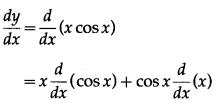
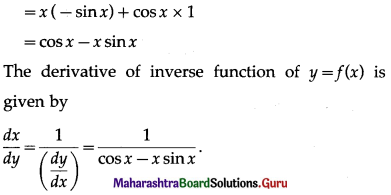
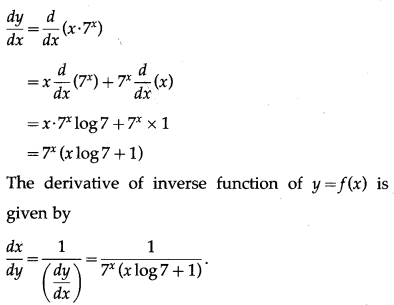
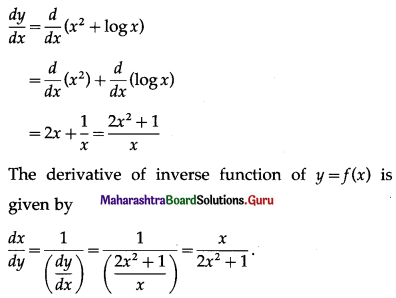
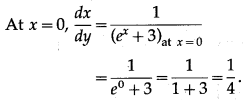
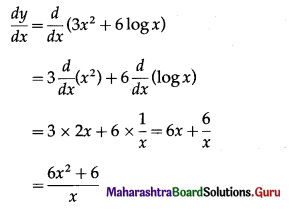
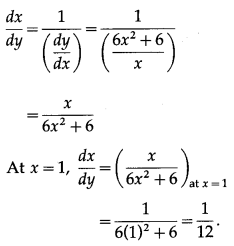
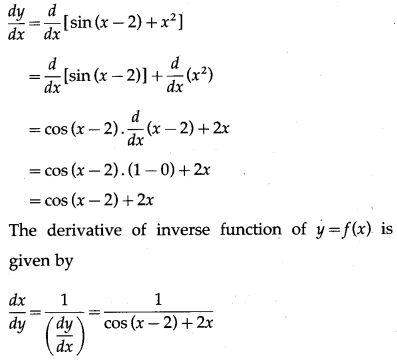
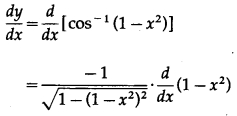
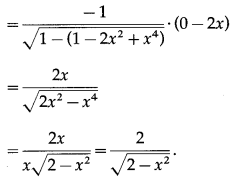
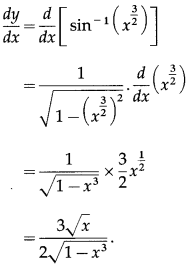
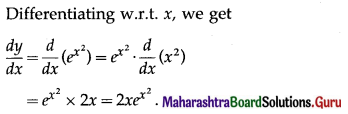
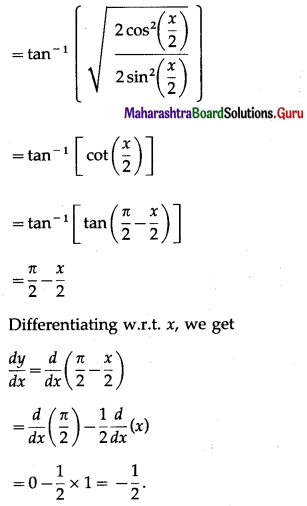
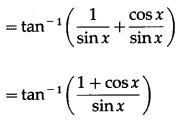
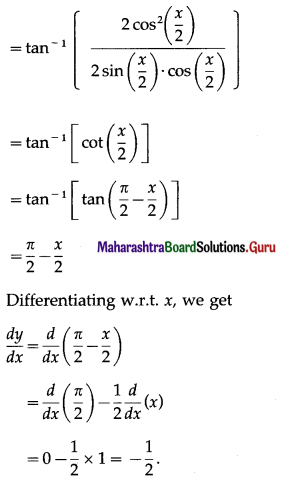
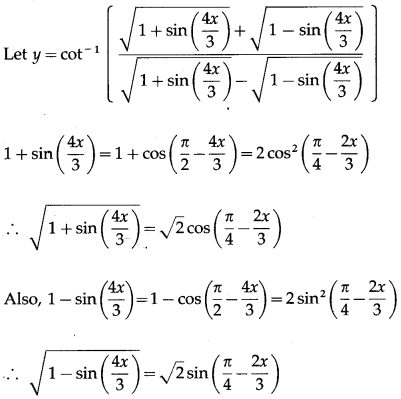
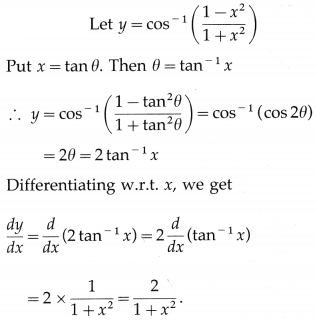
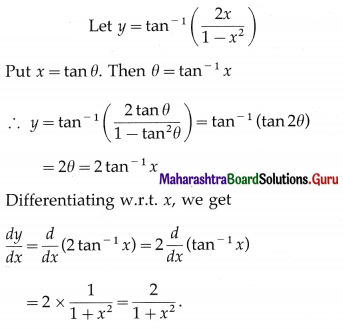
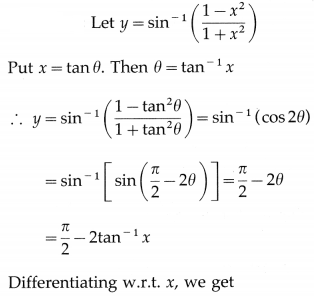
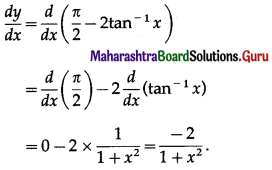
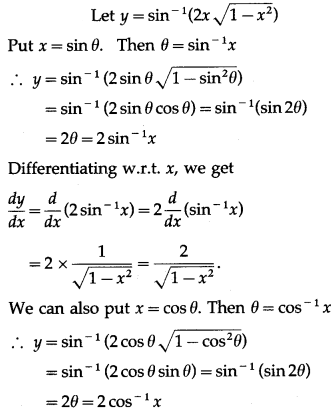
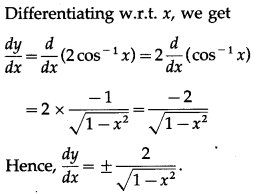
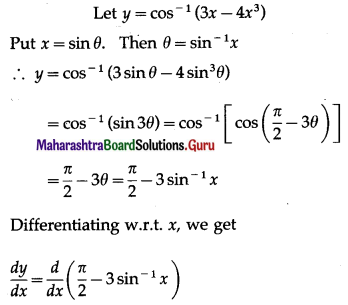
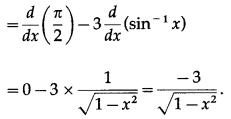
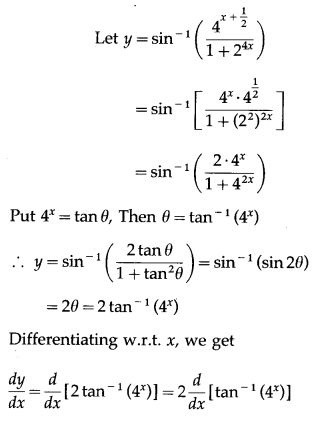
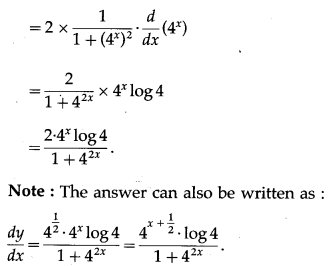
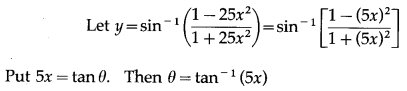
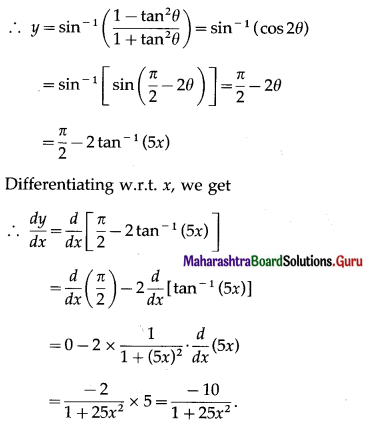
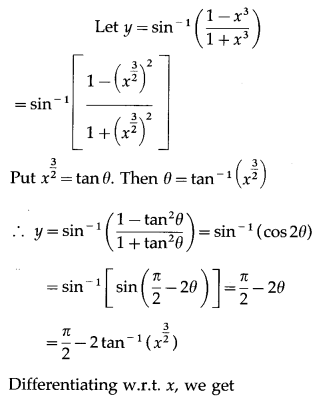
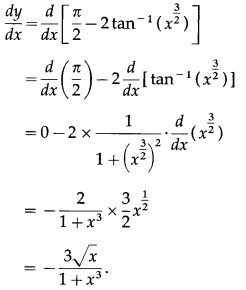
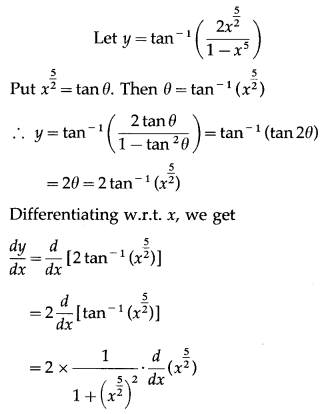
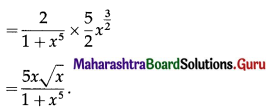
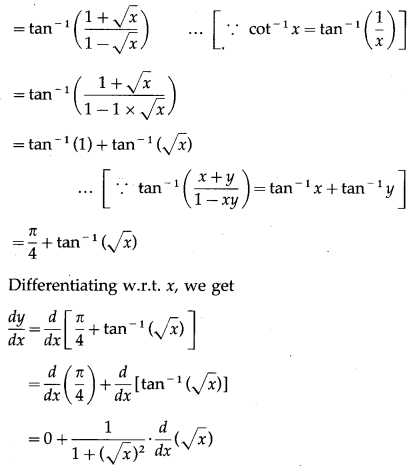
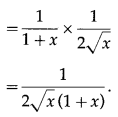
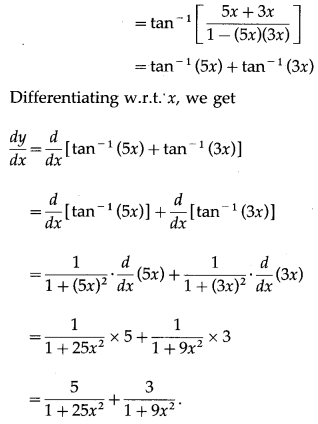
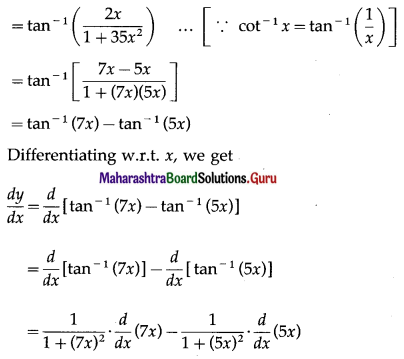
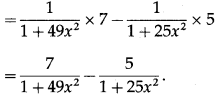
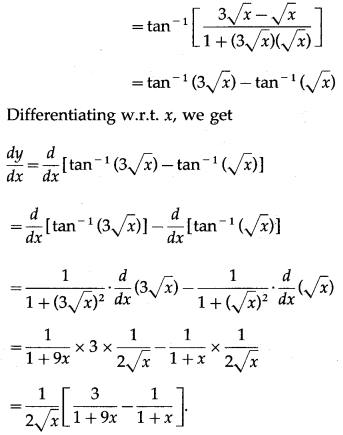
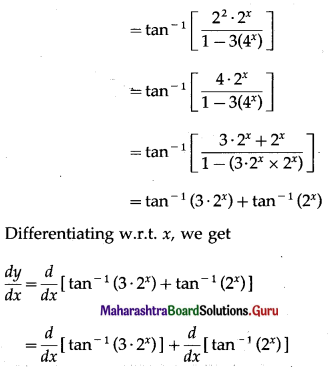
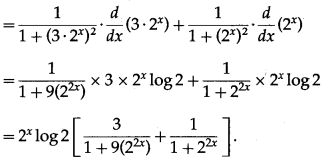
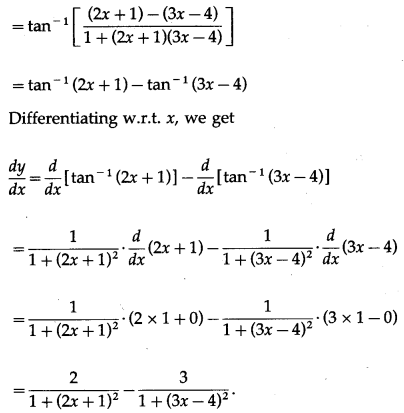
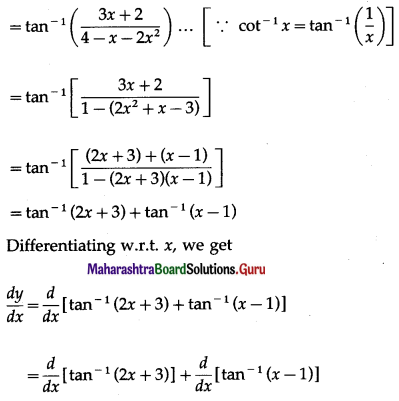
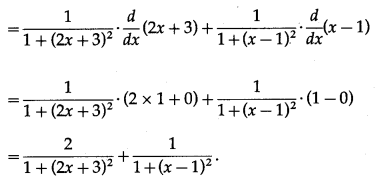
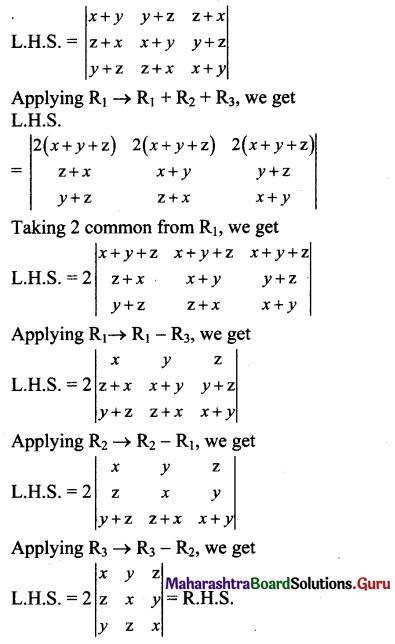
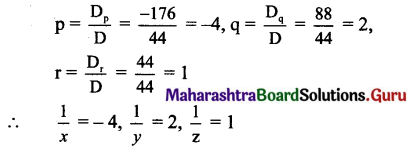
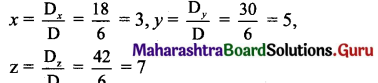
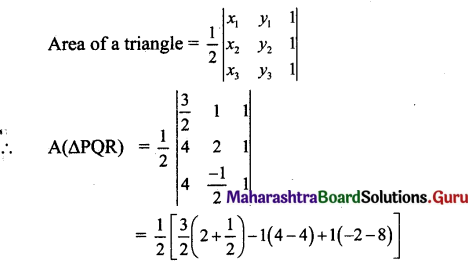
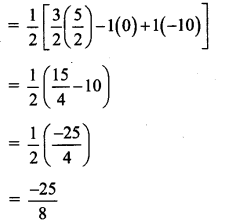
Maharashtra Board 12th Maths Solutions Chapter 1 Differentiation Ex 1.1

Balbharti 12th Maharashtra State Board Maths Solutions Book Pdf Chapter 1 Differentiation Ex 1.1 Questions and Answers.

Maharashtra State Board 12th Maths Solutions Chapter 1 Differentiation Ex 1.1

Question 1.
Differentiate the following w.r.t. x :
(i) (x3 – 2x – 1)5
Solution:
Method 1:
Let y = (x3 – 2x – 1)5
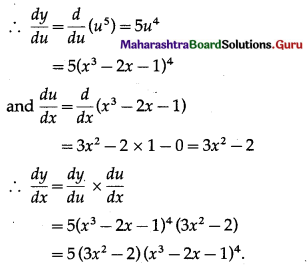
Put u = x3 – 2x – 1. Then y = u5
Maharashtra Board 12th Maths Solutions Chapter 1 Differentiation Ex 1.1 1
Method 2:
Let y = (x3 – 2x – 1)5
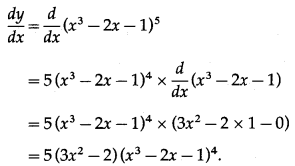
Differentiating w.r.t. x, we get
Maharashtra Board 12th Maths Solutions Chapter 1 Differentiation Ex 1.1 2

(ii) \(\left(2 x^{\frac{3}{2}}-3 x^{\frac{4}{3}}-5\right)^{\frac{5}{2}}\)
Solution:
Let y = \(\left(2 x^{\frac{3}{2}}-3 x^{\frac{4}{3}}-5\right)^{\frac{5}{2}}\)
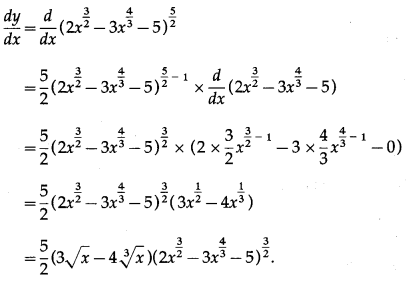
Differentiating w.r.t. x, we get
Maharashtra Board 12th Maths Solutions Chapter 1 Differentiation Ex 1.1 3

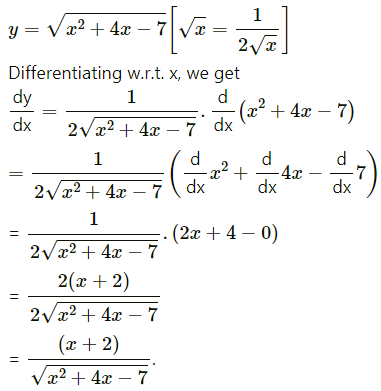
(iii) \(\sqrt{x^{2}+4 x-7}\)
Solution:
Maharashtra Board 12th Maths Solutions Chapter 1 Differentiation Ex 1.1 4

Maharashtra Board 12th Maths Solutions Chapter 1 Mathematical Logic Ex 1.1

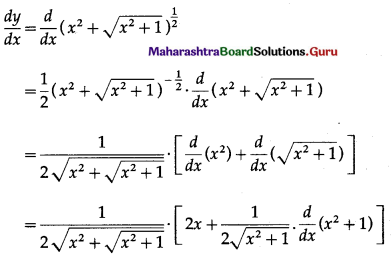
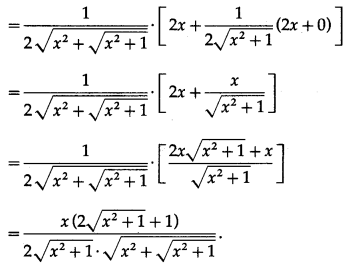
(iv) \(\sqrt{x^{2}+\sqrt{x^{2}+1}}\)
Solution:
Let y = \(\sqrt{x^{2}+\sqrt{x^{2}+1}}\)
Differentiating w.r.t. x, we get
Maharashtra Board 12th Maths Solutions Chapter 1 Differentiation Ex 1.1 5
Maharashtra Board 12th Maths Solutions Chapter 1 Differentiation Ex 1.1 6

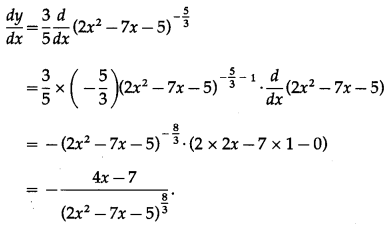
(v) \(\frac{3}{5 \sqrt[3]{\left(2 x^{2}-7 x-5\right)^{5}}}\)
Solution:
Let y = \(\frac{3}{5 \sqrt[3]{\left(2 x^{2}-7 x-5\right)^{5}}}\)
Differentiating w.r.t. x, we get
Maharashtra Board 12th Maths Solutions Chapter 1 Differentiation Ex 1.1 7

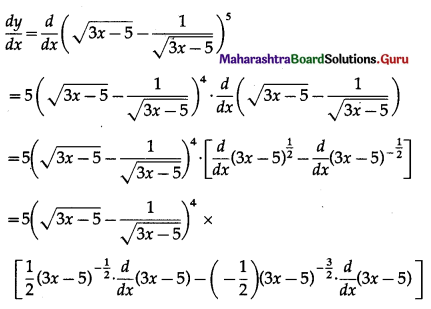
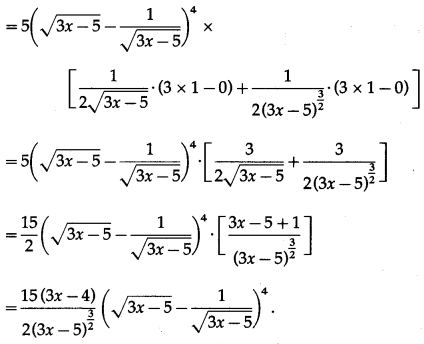
(vi) \(\left(\sqrt{3 x-5}-\frac{1}{\sqrt{3 x-5}}\right)^{5}\)
Solution:
Let y = \(\left(\sqrt{3 x-5}-\frac{1}{\sqrt{3 x-5}}\right)^{5}\)
Differentiating w.r.t. x, we get
Maharashtra Board 12th Maths Solutions Chapter 1 Differentiation Ex 1.1 8
Maharashtra Board 12th Maths Solutions Chapter 1 Differentiation Ex 1.1 9

Maharashtra Board 12th Maths Solutions Chapter 1 Mathematical Logic Ex 1.1

Question 2.
Diffrentiate the following w.r.t. x
(i) cos(x2 + a2)
Solution:
Let y = cos(x2 + a2)
Differentiating w.r.t. x, we get
\(\frac{d y}{d x}\) = \(\frac{d}{d x}\)[cos(x2 + a2)]
= -sin(x2 + a2)∙\(\frac{d}{d x}\)x2 + a2)
= -sin(x2 + a2)∙(2x + 0)
= -2xsin(x2 + a2)

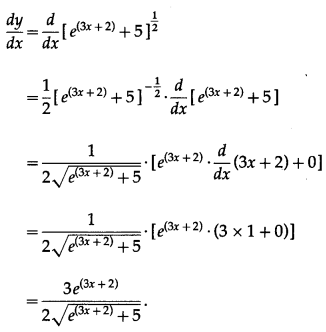
(ii) \(\sqrt{e^{(3 x+2)}+5}\)
Solution:
Let y = \(\sqrt{e^{(3 x+2)}+5}\)
Differentiating w.r.t. x, we get
Maharashtra Board 12th Maths Solutions Chapter 1 Differentiation Ex 1.1 10

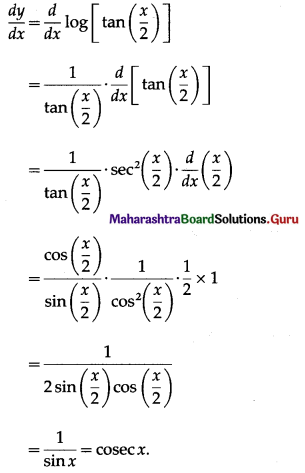
(iii) log[tan(\(\frac{x}{2}\))]
Solution:
Let y = log[tan(\(\frac{x}{2}\))]
Differentiating w.r.t. x, we get
Maharashtra Board 12th Maths Solutions Chapter 1 Differentiation Ex 1.1 11

Maharashtra Board 12th Maths Solutions Chapter 1 Mathematical Logic Ex 1.1

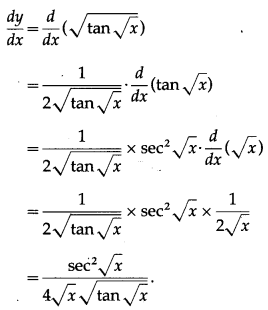
(iv) \(\sqrt{\tan \sqrt{x}}\)
Solution:
Let y = \(\sqrt{\tan \sqrt{x}}\)
Differentiating w.r.t. x, we get
Maharashtra Board 12th Maths Solutions Chapter 1 Differentiation Ex 1.1 12

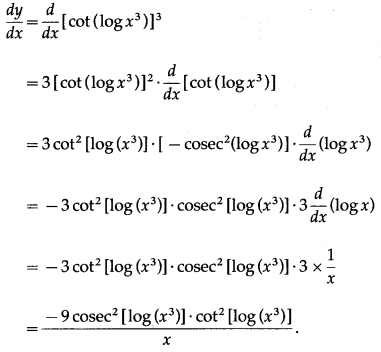
(v) cot3[log (x3)]
Solution:
Let y = cot3[log (x3)]
Differentiating w.r.t. x, we get
Maharashtra Board 12th Maths Solutions Chapter 1 Differentiation Ex 1.1 13

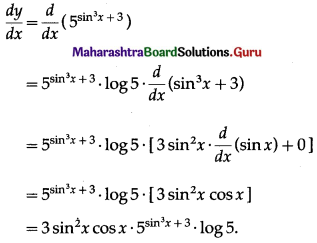
(vi) 5sin3x+ 3
Solution:
Let y = 5sin3x+ 3
Differentiating w.r.t. x, we get
Maharashtra Board 12th Maths Solutions Chapter 1 Differentiation Ex 1.1 14

Maharashtra Board 12th Maths Solutions Chapter 1 Mathematical Logic Ex 1.1

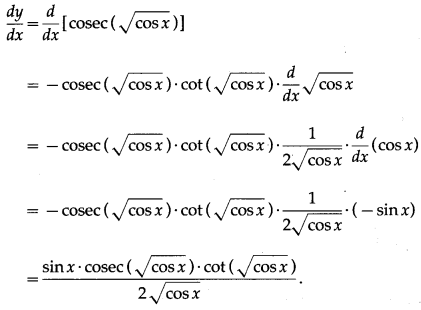
(vii) cosec (\(\sqrt{\cos X}\))
Solution:
Let y = cosec (\(\sqrt{\cos X}\))
Differentiating w.r.t. x, we get
Maharashtra Board 12th Maths Solutions Chapter 1 Differentiation Ex 1.1 15

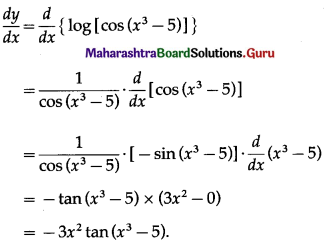
(viii) log[cos (x3 – 5)]
Solution:
Let y = log[cos (x3 – 5)]
Differentiating w.r.t. x, we get
Maharashtra Board 12th Maths Solutions Chapter 1 Differentiation Ex 1.1 16

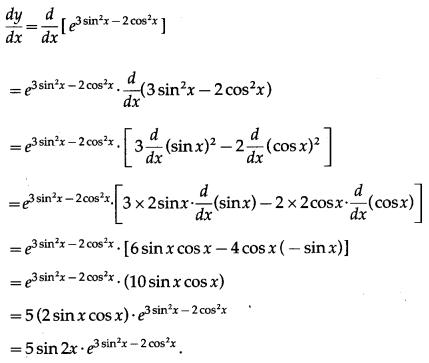
(ix) e3 sin2x – 2 cos2x
Solution:
Let y = e3 sin2x – 2 cos2x
Differentiating w.r.t. x, we get
Maharashtra Board 12th Maths Solutions Chapter 1 Differentiation Ex 1.1 17

Maharashtra Board 12th Maths Solutions Chapter 1 Mathematical Logic Ex 1.1

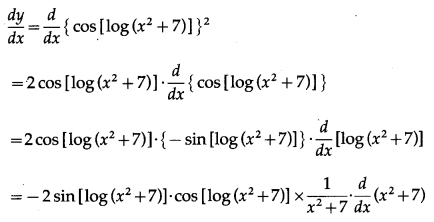
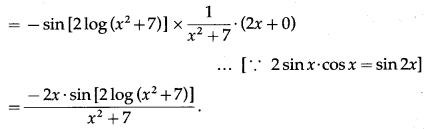
(x) cos2[log (x2+ 7)]
Solution:
Let y = cos2[log (x2+ 7)]
Differentiating w.r.t. x, we get
Maharashtra Board 12th Maths Solutions Chapter 1 Differentiation Ex 1.1 18
Maharashtra Board 12th Maths Solutions Chapter 1 Differentiation Ex 1.1 19

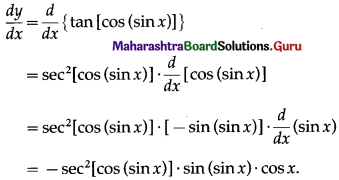
(xi) tan[cos (sinx)]
Solution:
Let y = tan[cos (sinx)]
Differentiating w.r.t. x, we get
Maharashtra Board 12th Maths Solutions Chapter 1 Differentiation Ex 1.1 20

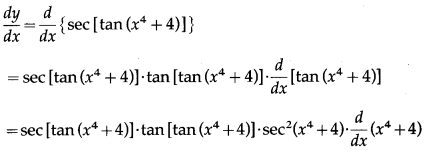
(xii) sec[tan (x4 + 4)]
Solution:
Let y = sec[tan (x4 + 4)]
Differentiating w.r.t. x, we get
Maharashtra Board 12th Maths Solutions Chapter 1 Differentiation Ex 1.1 21
= sec[tan(x4 + 4)]∙tan[tan(x4 + 4)]∙sec2(x4 + 4)(4x3 + 0)
= 4x3sec2(x4 + 4)∙sec[tan(x4 + 4)]∙tan[tan(x4 + 4)].

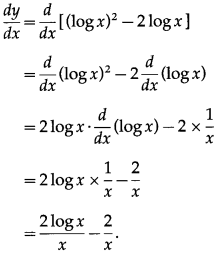
(xiii) elog[(logx)2 – logx2]
Solution:
Let y = elog[(logx)2 – logx2]
= (log x)2 – log x2 …[∵ elog x = x]
Differentiating w.r.t. x, we get
Maharashtra Board 12th Maths Solutions Chapter 1 Differentiation Ex 1.1 22

Maharashtra Board 12th Maths Solutions Chapter 1 Mathematical Logic Ex 1.1

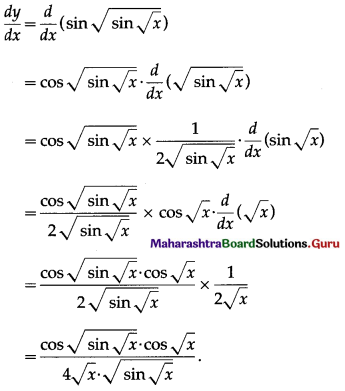
(xiv) sin\(\sqrt{\sin \sqrt{x}}\)
Solution:
Let y = sin\(\sqrt{\sin \sqrt{x}}\)
Differentiating w.r.t. x, we get
Maharashtra Board 12th Maths Solutions Chapter 1 Differentiation Ex 1.1 23

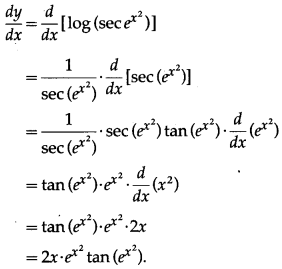
(xv) log[sec(ex2)]
Solution:
Let y = log[sec(ex2)]
Differentiating w.r.t. x, we get
Maharashtra Board 12th Maths Solutions Chapter 1 Differentiation Ex 1.1 24

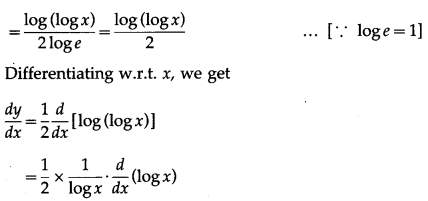
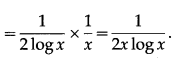
(xvi) loge2(logx)
Solution:
Let y = loge2(logx) = \(\frac{\log (\log x)}{\log e^{2}}\)
Maharashtra Board 12th Maths Solutions Chapter 1 Differentiation Ex 1.1 25
Maharashtra Board 12th Maths Solutions Chapter 1 Differentiation Ex 1.1 26

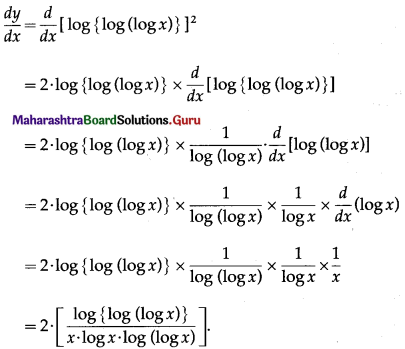
(xvii) [log{log(logx)}]2
Solution:
let y = [log{log(logx)}]2
Differentiating w.r.t. x, we get
Maharashtra Board 12th Maths Solutions Chapter 1 Differentiation Ex 1.1 27

Maharashtra Board 12th Maths Solutions Chapter 1 Mathematical Logic Ex 1.1

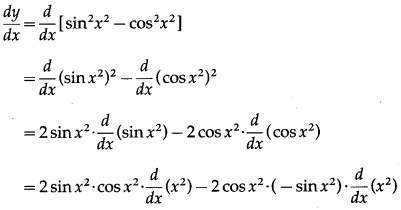
(xviii) sin2x2 – cos2x2
Solution:
Let y = sin2x2 – cos2x2
Differentiating w.r.t. x, we get
Maharashtra Board 12th Maths Solutions Chapter 1 Differentiation Ex 1.1 28
= 2sinx2∙cosx2 × 2x + 2sinx2∙cosx2 × 2x
= 4x(2sinx2∙cosx2)
= 4xsin(2x2).

Question 3.
Diffrentiate the following w.r.t. x
(i) (x2 + 4x + 1)3 + (x3 – 5x – 2)4
Solution:
Let y = (x2 + 4x + 1)3 + (x3 – 5x – 2)4
Differentiating w.r.t. x, we get
\(\frac{d y}{d x}\) = \(\frac{d}{d x}\)[(x2 + 4x + 1)3 + (x3 – 5x – 2)4]
= \(\frac{d}{d x}\) = (x2 + 4x + 1)3 + \(\frac{d}{d x}\)(x3 – 5x – 2)4
= 3(x2 + 4x + 1)2∙\(\frac{d}{d x}\)(x2 + 4x + 1) + 4(x3 – 5x – 2)4∙\(\frac{d}{d x}\)(x3 – 5x – 2)
= 3(x2 + 4x + 1)3∙(2x + 4 × 1 + 0) + 4(x3 – 5x – 2)3∙(3x2 – 5 × 1 – 0)
= 6 (x + 2)(x2 + 4x + 1)2 + 4 (3x2 – 5)(x3 – 5x – 2)3.
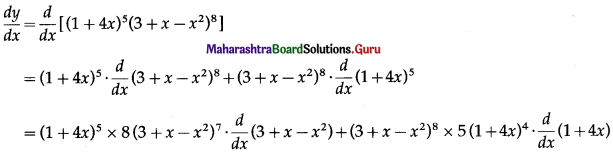
(ii) (1 + 4x)5(3 + x − x2)8
Solution:
Let y = (1 + 4x)5(3 + x − x2)8
Differentiating w.r.t. x, we get
Maharashtra Board 12th Maths Solutions Chapter 1 Differentiation Ex 1.1 29
= 8 (1 + 4x)5 (3 + x – x2)7∙(0 + 1 – 2x) + 5 (1 + 4x)4 (3 + x – x2)8∙(0 + 4 × 1)
= 8 (1 – 2x)(1 + 4x)5(3 + x – x2)7 + 20(1 + 4x)4(3 + x – x2)8.

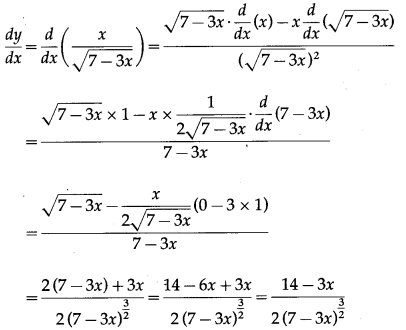
(iii) \(\frac{x}{\sqrt{7-3 x}}\)
Solution:
Let y = \(\frac{x}{\sqrt{7-3 x}}\)
Differentiating w.r.t. x, we get
Maharashtra Board 12th Maths Solutions Chapter 1 Differentiation Ex 1.1 30

Maharashtra Board 12th Maths Solutions Chapter 1 Mathematical Logic Ex 1.1

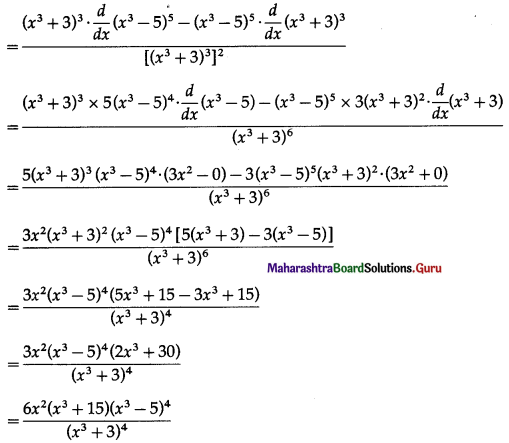
(iv) \(\frac{\left(x^{3}-5\right)^{5}}{\left(x^{3}+3\right)^{3}}\)
Solution:
Let y = \(\frac{\left(x^{3}-5\right)^{5}}{\left(x^{3}+3\right)^{3}}\)
Differentiating w.r.t. x, we get
\(\frac{d y}{d x}\) = \(\frac{d}{d x}\left[\frac{\left(x^{3}-5\right)^{5}}{\left(x^{3}+3\right)^{3}}\right]\)
Maharashtra Board 12th Maths Solutions Chapter 1 Differentiation Ex 1.1 31

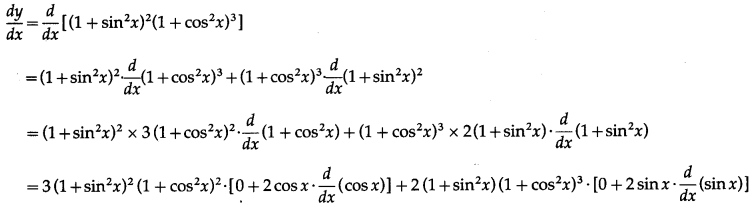
(v) (1 + sin2x)2(1 + cos2x)3
Solution:
Let y = (1 + sin2x)2(1 + cos2x)3
Differentiating w.r.t. x, we get
Maharashtra Board 12th Maths Solutions Chapter 1 Differentiation Ex 1.1 32
= 3(1 + sin2x)2 (1 + cos2x)2∙[2cosx(-sinx)] + 2 (1 + sin2x)(1 + cos2x)3∙[2sinx-cosx]
= 3 (1 + sin2x)2 (1 + cos2x)2 (-sin 2x) + 2(1 + sin2x)(1 + cos2x)3(sin 2x)
= sin2x (1 + sin2x) (1 + cos2x)2 [-3(1 + sin2x) + 2(1 + cos2x)]
= sin2x (1 + sin2x)(1 + cos2x)2(-3 – 3sin2x + 2 + 2cos2x)
= sin2x (1 + sin2x)(1 + cos2x)2 [-1 – 3 sin2x + 2 (1 – sin2x)]
= sin 2x(1 + sin2x)(1 + cos2x)2 (-1 – 3 sin2x + 2 – 2 sin2x)
= sin2x (1 + sin2x)(1 + cos2x)2(1 – 5 sin2x).

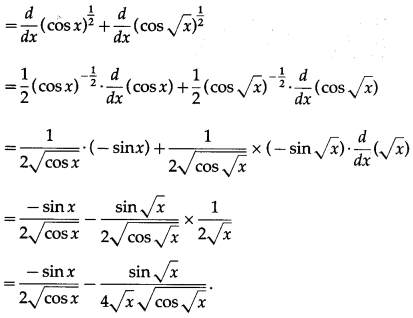
(vi) \(\sqrt{\cos x}+\sqrt{\cos \sqrt{x}}\)
Solution:
Let y = \(\sqrt{\cos x}+\sqrt{\cos \sqrt{x}}\)
Differentiating w.r.t. x, we get
\(\frac{d y}{d x}\) = \(\frac{d}{d x}[\sqrt{\cos x}+\sqrt{\cos \sqrt{x}}]\)
Maharashtra Board 12th Maths Solutions Chapter 1 Differentiation Ex 1.1 33

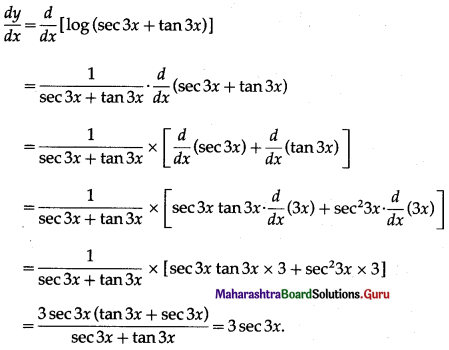
(vii) log(sec 3x+ tan 3x)
Solution:
Let y = log(sec 3x+ tan 3x)
Differentiating w.r.t. x, we get
Maharashtra Board 12th Maths Solutions Chapter 1 Differentiation Ex 1.1 34

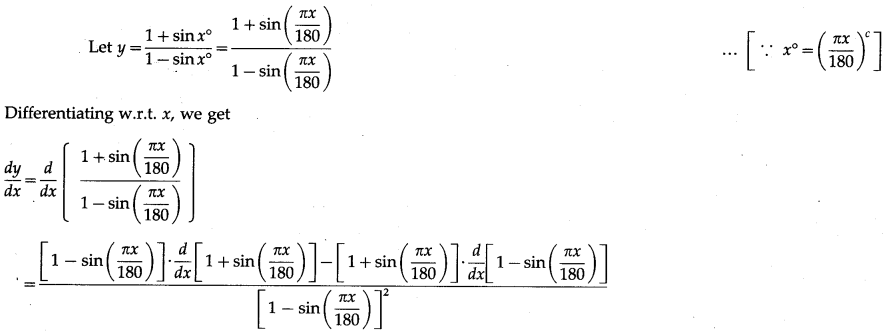
(viii) \(\frac{1+\sin x^{\circ}}{1-\sin x^{\circ}}\)
Solution:
Maharashtra Board 12th Maths Solutions Chapter 1 Differentiation Ex 1.1 35
Maharashtra Board 12th Maths Solutions Chapter 1 Differentiation Ex 1.1 36

Maharashtra Board 12th Maths Solutions Chapter 1 Mathematical Logic Ex 1.1

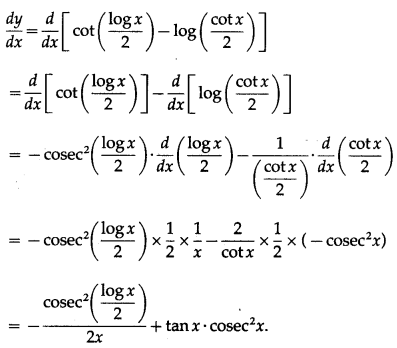
(ix) cot\(\left(\frac{\log x}{2}\right)\) – log\(\left(\frac{\cot x}{2}\right)\)
Solution:
Let y = cot\(\left(\frac{\log x}{2}\right)\) – log\(\left(\frac{\cot x}{2}\right)\)
Differentiating w.r.t. x, we get
Maharashtra Board 12th Maths Solutions Chapter 1 Differentiation Ex 1.1 37

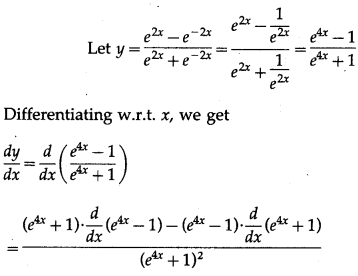
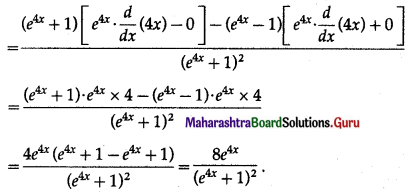
(x) \(\frac{e^{2 x}-e^{-2 x}}{e^{2 x}+e^{-2 x}}\)
Solution:
Maharashtra Board 12th Maths Solutions Chapter 1 Differentiation Ex 1.1 38
Maharashtra Board 12th Maths Solutions Chapter 1 Differentiation Ex 1.1 39

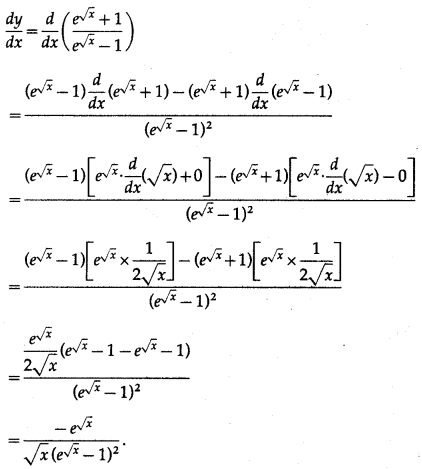
(xi) \(\frac{e^{\sqrt{x}}+1}{e^{\sqrt{x}}-1}\)
Solution:
let y = \(\frac{e^{\sqrt{x}}+1}{e^{\sqrt{x}}-1}\)
Differentiating w.r.t. x, we get
Maharashtra Board 12th Maths Solutions Chapter 1 Differentiation Ex 1.1 40

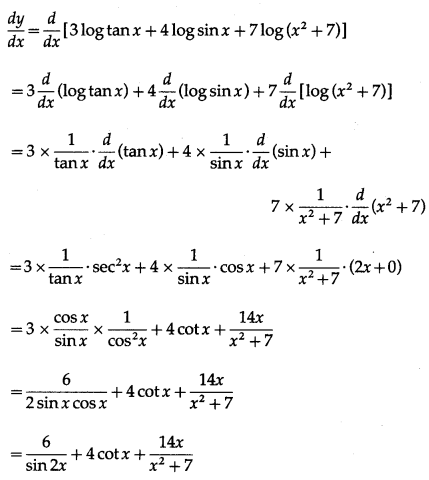
(xii) log[tan3x·sin4x·(x2 + 7)7]
Solution:
Let y = log [tan3x·sin4x·(x2 + 7)7]
= log tan3x + log sin4x + log (x2 + 7)7
= 3 log tan x + 4 log sin x + 7 log (x2 + 7)
Differentiating w.r.t. x, we get
Maharashtra Board 12th Maths Solutions Chapter 1 Differentiation Ex 1.1 41
= 6cosec2x + 4 cotx + \(\frac{14 x}{x^{2}+7}\)

Maharashtra Board 12th Maths Solutions Chapter 1 Mathematical Logic Ex 1.1

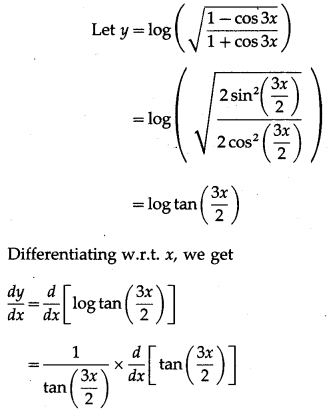
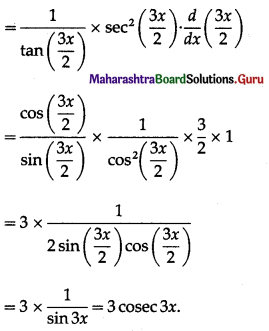
(xiii) log\(\left(\sqrt{\frac{1-\cos 3 x}{1+\cos 3 x}}\right)\)
Solution:
Maharashtra Board 12th Maths Solutions Chapter 1 Differentiation Ex 1.1 42
Maharashtra Board 12th Maths Solutions Chapter 1 Differentiation Ex 1.1 43

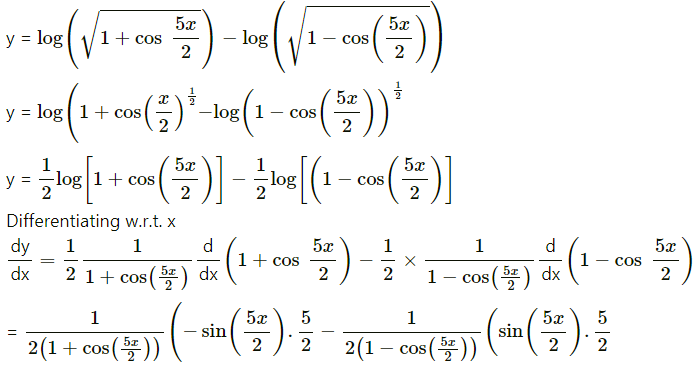
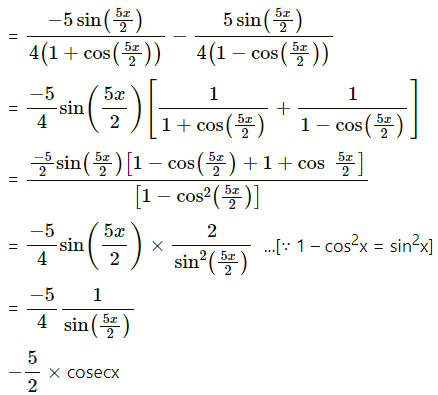
(xiv) log\(\left(\sqrt{\left.\frac{1+\cos \left(\frac{5 x}{2}\right)}{1-\cos \left(\frac{5 x}{2}\right)}\right)}\right.\)
Solution:
Using log\(\left(\frac{a}{b}\right)\) = log a – log b
log ab = b log a
Maharashtra Board 12th Maths Solutions Chapter 1 Differentiation Ex 1.1 44
Maharashtra Board 12th Maths Solutions Chapter 1 Differentiation Ex 1.1 45
\(-\frac{5}{2}\)cosec\(\left(\frac{5 x}{2}\right)\)

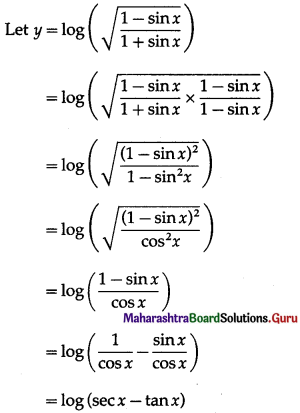
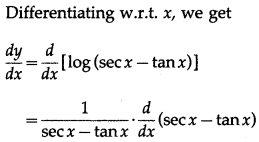
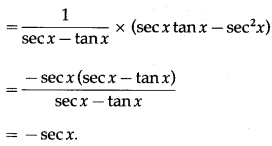
(xv) log\(\left(\sqrt{\frac{1-\sin x}{1+\sin x}}\right)\)
Solution:
Maharashtra Board 12th Maths Solutions Chapter 1 Differentiation Ex 1.1 46
Maharashtra Board 12th Maths Solutions Chapter 1 Differentiation Ex 1.1 47
Maharashtra Board 12th Maths Solutions Chapter 1 Differentiation Ex 1.1 48

Maharashtra Board 12th Maths Solutions Chapter 1 Mathematical Logic Ex 1.1

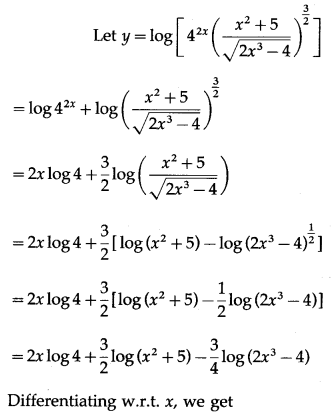
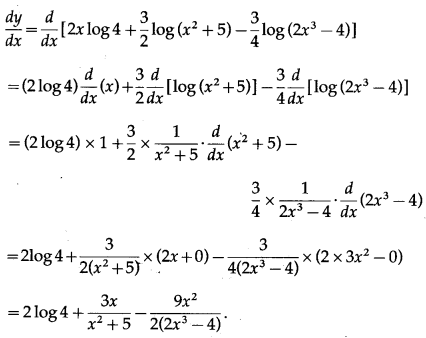
(xvi) log\(\left[4^{2 x}\left(\frac{x^{2}+5}{\sqrt{2 x^{3}-4}}\right)^{\frac{3}{2}}\right]\)
Solution:
Maharashtra Board 12th Maths Solutions Chapter 1 Differentiation Ex 1.1 49
Maharashtra Board 12th Maths Solutions Chapter 1 Differentiation Ex 1.1 50

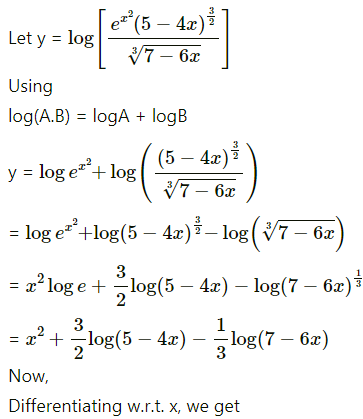
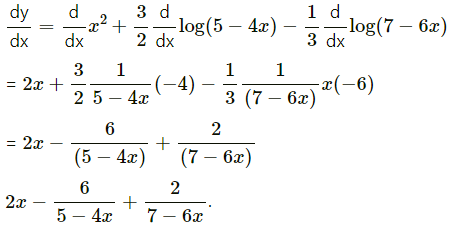
(xvii) log\(\left[\frac{e^{x^{2}}(5-4 x)^{\frac{3}{2}}}{\sqrt[3]{7-6 x}}\right]\)
Solution:
Maharashtra Board 12th Maths Solutions Chapter 1 Differentiation Ex 1.1 51
Maharashtra Board 12th Maths Solutions Chapter 1 Differentiation Ex 1.1 52

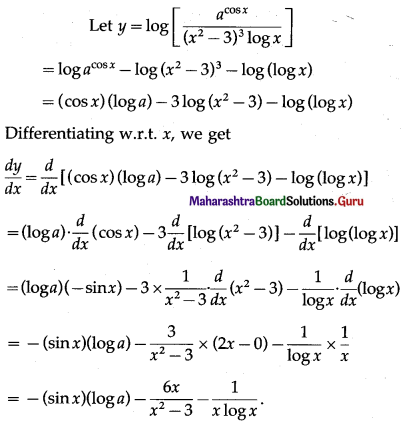
(xviii) log\(\left[\frac{a^{\cos x}}{\left(x^{2}-3\right)^{3} \log x}\right]\)
Solution:
Maharashtra Board 12th Maths Solutions Chapter 1 Differentiation Ex 1.1 53

(xix) y= (25)log5(secx) − (16)log4(tanx)
Solution:
y = (25)log5(secx) − (16)log4(tanx)
= 52log5(secx) – 42log4(tanx)
= 5log5(sec5x) – 4log4(tan2x)
= sec2x – tan2x … [∵ = x]
∴ y = 1
Differentiating w.r.t. x, we get
\(\frac{d y}{d x}\) = \(\frac{d}{d x}\)(1) = 0

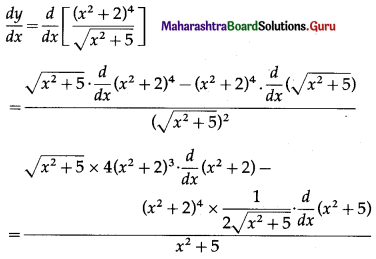
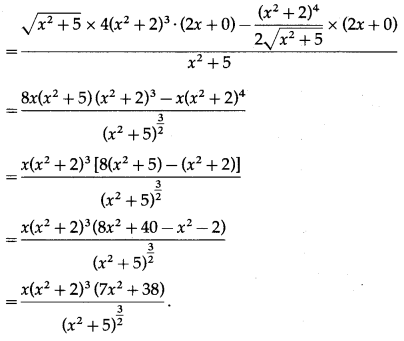
(xx) \(\frac{\left(x^{2}+2\right)^{4}}{\sqrt{x^{2}+5}}\)
Solution:
Let y = \(\frac{\left(x^{2}+2\right)^{4}}{\sqrt{x^{2}+5}}\)
Differentiating w.r.t. x, we get
Maharashtra Board 12th Maths Solutions Chapter 1 Differentiation Ex 1.1 54
Maharashtra Board 12th Maths Solutions Chapter 1 Differentiation Ex 1.1 55

Maharashtra Board 12th Maths Solutions Chapter 1 Mathematical Logic Ex 1.1

Question 4.
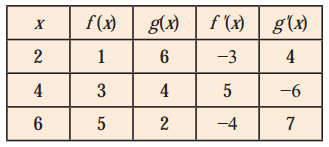
A table of values of f, g, f ‘ and g’ is given
Maharashtra Board 12th Maths Solutions Chapter 1 Differentiation Ex 1.1 56
(i) If r(x) = f [g(x)] find r’ (2).
Solution:
r(x) = f[g(x)]
∴ r'(x) = \(\frac{d}{d x}\)f[g(x)]
= f'[g(x)]∙\(\frac{d}{d x}\)[g(x)]
= f'[g(x)∙[g'(x)]
∴ r'(2) = f'[g(2)]∙g'(2)
= f'(6)∙g'(2) … [∵ g(x) = 6, when x = 2]
= -4 × 4 … [From the table]
= -16.

(ii) If R(x) = g[3 + f(x)] find R’ (4).
Solution:
R(x) = g[3 + f(x)]
∴ R'(x) = \(\frac{d}{d x}\){g[3+f(x)]}
= g'[3 + f(x)]∙\(\frac{d}{d x}\)[3 + f(x)]
= g'[3 +f(x)]∙[0 + f'(x)]
= g'[3 + f(x)]∙f'(x)
∴ R'(4) = g'[3 + f(4)]∙f'(4)
= g'[3 + 3]∙f'(4) … [∵ f(x) = 3, when x = 4]
= g'(6)∙f'(4)
= 7 × 5 … [From the table]
= 35.

Maharashtra Board 12th Maths Solutions Chapter 1 Mathematical Logic Ex 1.1

(iii) If s(x) = f[9− f(x)] find s’ (4).
Solution:
s(x) = f[9− f(x)]
∴ s'(x) = \(\frac{d}{d x}\){f[9 – f(x)]}
= f'[9 – f(x)]∙\(\frac{d}{d x}\)[0 – f(x)]
= f'[9 – f(x)]∙[0 – f'(x)]
= -f'[9 – f(x)] – f'(x)
∴ s'(4) = -f'[9 – f(4)] – f'(4)
= -f'[9 – 3] – f'(4) … [∵ f(x) = 3, when x = 4]
= -f'(6) – f'(4)
= -(-4)(5) … [From the table]
= 20.

(iv) If S(x) = g[g(x)] find S’ (6)
Solution:
S(x) = g[g(x)]
∴ S'(x) = \(\frac{d}{d x}\)g[g(x)]
= g'[g(x)]∙\(\frac{d}{d x}\)[g(x)]
= g'[g(x)]∙g'(x)
∴ S ‘(6) = g'[g'(6)]∙g'(6)
= g'(2)∙g'(6) … [∵ g (x) = 2, when x = 6]
= 4 × 7 … [From the table]
= 28.

Maharashtra Board 12th Maths Solutions Chapter 1 Mathematical Logic Ex 1.1

Question 5.
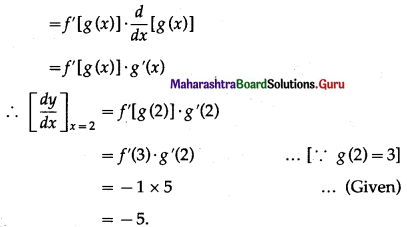
Assume that f ‘(3) = -1, g'(2) = 5, g(2) = 3 and y = f[g(x)] then \(\left[\frac{d y}{d x}\right]_{x=2}\) = ?
Solution:
y = f[g(x)]
∴ \(\frac{d y}{d x}\) = \(\frac{d}{d x}\){[g(x)]}
Maharashtra Board 12th Maths Solutions Chapter 1 Differentiation Ex 1.1 57

Question 6.
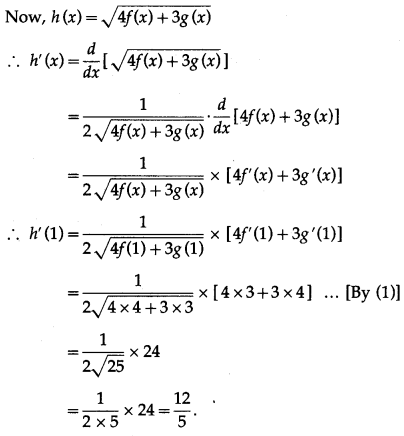
If h(x) = \(\sqrt{4 f(x)+3 g(x)}\), f(1) = 4, g(1) = 3, f ‘(1) = 3, g'(1) = 4 find h'(1).
Solution:
Given f(1) = 4, g(1) = 3, f ‘(1) = 3, g'(1) = 4 …..(1)
Maharashtra Board 12th Maths Solutions Chapter 1 Differentiation Ex 1.1 58

Question 7.
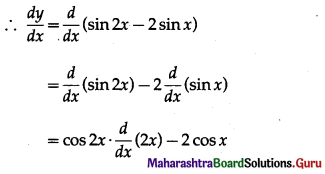
Find the x co-ordinates of all the points on the curve y = sin 2x – 2 sin x, 0 ≤ x < 2π where \(\frac{d y}{d x}\) = 0.
Solution:
y = sin 2x – 2 sin x, 0 ≤ x < 2π
Maharashtra Board 12th Maths Solutions Chapter 1 Differentiation Ex 1.1 59
= cos2x × 2 – 2cosx
= 2 (2 cos2x – 1) – 2 cosx
= 4 cos2x – 2 – 2 cos x
= 4 cos2x – 2 cos x – 2
If \(\frac{d y}{d x}\) = 0, then 4 cos2x – 2 cos x – 2 = 0
∴ 4cos2x – 4cosx + 2cosx – 2 = 0
∴ 4 cosx (cosx – 1) + 2 (cosx – 1) = 0
∴ (cosx – 1)(4cosx + 2) = 0
∴ cosx – 1 = 0 or 4cosx + 2 = 0
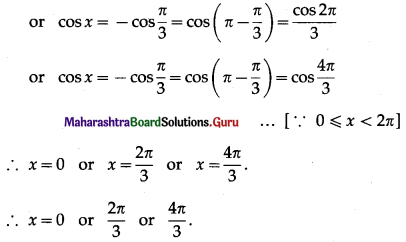
∴ cos x = 1 or cos x = \(-\frac{1}{2}\)
∴ cos x = cos 0
Maharashtra Board 12th Maths Solutions Chapter 1 Differentiation Ex 1.1 60

Maharashtra Board 12th Maths Solutions Chapter 1 Mathematical Logic Ex 1.1

Question 8.
Select the appropriate hint from the hint basket and fill up the blank spaces in the following paragraph. [Activity]
“Let f (x) = x2 + 5 and g(x) = ex + 3 then
f [g(x)] = _ _ _ _ _ _ _ _ and g [f(x)] =_ _ _ _ _ _ _ _.
Now f ‘(x) = _ _ _ _ _ _ _ _ and g'(x) = _ _ _ _ _ _ _ _.
The derivative off [g (x)] w. r. t. x in terms of f and g is _ _ _ _ _ _ _ _.
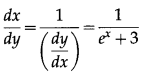
Therefore \(\frac{d}{d x}\)[f[g(x)]] = _ _ _ _ _ _ _ _ _ and [\(\frac{d}{d x}\)[f[g(x)]]]x = 0 = _ _ _ _ _ _ _ _ _ _ _.
The derivative of g[f(x)] w. r. t. x in terms of f and g is _ _ _ _ _ _ __ _ _ _ _.
Therefore \(\frac{d}{d x}\)[g[f(x)]] = _ _ _ _ _ _ _ _ _ and [\(\frac{d}{d x}\)[g[f(x)]]]x = 1 = _ _ _ _ _ _ _ _ _ _ _.”
Hint basket : { f ‘[g(x)]·g'(x), 2e2x + 6ex, 8, g'[f(x)]·f ‘(x), 2xex2 + 5, -2e6, e2x + 6ex + 14, ex2 + 5 + 3, 2x, ex}
Solution:
f[g(x)] = e2x + 6ex + 14
g[f(x)] = ex2 + 5 + 3
f'(x) = 2x, g’f(x) = ex
The derivative of f[g(x)] w.r.t. x in terms of and g is f'[g(x)]∙g'(x).
∴ \(\frac{d}{d x}\){f[g(x)]} = 2e2x + 6ex and \(\frac{d}{d x}\){f[g(x)]}x = 0 = 8
The derivative of g[f(x)] w.r.t. x in terms of f and g is g’f(x)]∙f'(x).
∴ \(\frac{d}{d x}\){g[(f(x)]} = 2xex2 + 5 and
\(\frac{d}{d x}\){g[(f(x)]}x = -1 = -2e6.

Maharashtra Board 12th Maths Solutions Chapter 7 Linear Programming Miscellaneous Exercise 7

Balbharti 12th Maharashtra State Board Maths Solutions Book Pdf Chapter 7 Linear Programming Miscellaneous Exercise 7 Questions and Answers.

Maharashtra State Board 12th Maths Solutions Chapter 7 Linear Programming Miscellaneous Exercise 7

I) Select the appropriate alternatives for each of the following :
Question 1.
The value of objective function is maximum under linear constraints _______.
(A) at the centre of feasible region
(B) at (0, 0)
(C) at a vertex of feasible region
(D) the vertex which is of maximum distance from (0, 0)
Solution:
(C) at a vertex of feasible region

Question 2.
Which of the following is correct _______.
(A) every L.P.P. has an optimal solution
(B) a L.P.P. has unique optimal solution
(C) if L.P.P. has two optimal solutions then it has infinite number of optimal solutions
(D) the set of all feasible solution of L.P.P. may not be convex set
Solution:
(C) if L.P.P. has two optimal solutions then it has infinite number of optimal solutions

Question 3.
Objective function of L.P.P. is _______.
(A) a constraint
(B) a function to be maximized or minimized
(C) a relation between the decision variables
(D) equation of a straight line
Solution:
(B) a function to be maximized or minimized

Question 4.
The maximum value of z = 5x + 3y subjected to the constraints 3x + 5y ≤ 15, 5x + 2y ≤ 10, x, y≥ 0 is _______.
(A) 235
(B) \(\frac{235}{9}\)
(C) \(\frac{235}{19}\)
(D) \(\frac{235}{3}\)
Solution:
(C) \(\frac{235}{19}\)

Maharashtra Board 12th Maths Solutions Chapter 1 Mathematical Logic Ex 1.1

Question 5.
The maximum value of z = 10x + 6y subjected to the constraints 3x + y ≤ 12, 2x + 5y ≤ 34, x ≥ 0, y≥ 0. _______.
(A) 56
(B) 65
(C) 55
(D) 66
Solution:
(A) 56

Question 6.
The point at which the maximum value of x + y subject to the constraints x + 2y ≤ 70, 2x + y ≤ 95, x ≥ 0, y ≥ 0 is obtained at _______.
(A) (30, 25)
(B) (20, 35)
(C) (35, 20)
(D) (40, 15)
Solution:
(D) (40, 15)

Question 7.
Of all the points of the feasible region, the optimal value ofz obtained at the point lies _______.
(A) inside the feasible region
(B) at the boundary of the feasible region
(C) at vertex of feasible region
(D) outside the feasible region
Solution:
(C) at vertex of feasible region

Maharashtra Board 12th Maths Solutions Chapter 1 Mathematical Logic Ex 1.1

Question 8.
Feasible region is the set of points which satisfy _______.
(A) the objective function
(B) all of the given constraints
(C) some of the given constraints
(D) only one constraint
Solution:
(B) all of the given constraints

Question 9.
Solution of L.P.P. to minimize z = 2x + 3y such that x ≥ 0, y ≥ 0, 1 ≤ x + 2y ≤ 10 is _______.
(A) x = 0, y = \(\frac{1}{2}\)
(B) x = \(\frac{1}{2}\), y = 0
(C) x = 1, y = 2
(D) x = \(\frac{1}{2}\), y = \(\frac{1}{2}\)
Solution:
(A) x = 0, y = \(\frac{1}{2}\)

Question 10.
The corner points of the feasible solution given by the inequation x + y ≤ 4, 2x + y ≤ 7, x ≥ 0, y ≥ 0 are _______.
(A) (0, 0), (4, 0), (7, 1), (0, 4)
(B) (0, 0), (\(\frac{7}{2}\), 0), (3, 1), (0, 4)
(C) (0, 0), (\(\frac{7}{2}\), 0), (3, 1), (0, 7)
(D) (0, 0), (4, 0), (3, 1), (0, 7)
Solution:
(B) (0, 0), (\(\frac{7}{2}\), 0), (3, 1), (0, 4)

Question 11.
The corner points of the feasible solution are (0, 0), (2, 0), (\(\frac{12}{7}\), \(\frac{3}{7}\)), (0, 1). Then z = 7x + y is maximum at _______.
(A) (0, 0)
(B) (2, 0)
(C) (\(\frac{12}{7}\), \(\frac{3}{7}\))
(D) (0, 1)
Solution:
(B) (2, 0)

Maharashtra Board 12th Maths Solutions Chapter 1 Mathematical Logic Ex 1.1

Question 12.
If the corner points of the feasible solution are (0, 0), (3, 0), (2, 1) and (0, \(\frac{7}{3}\) ), the maximum value of z = 4x + 5y is _______.
(A) 12
(B) 13
(C) 35
(D) 0
Solution:
(B) 13

Question 13.
If the corner points of the feasible solution are (0, 10), (2, 2) and (4, 0) then the point of minimum z = 3x + 2y is _______.
(A) (2, 2)
(B) (0, 10)
(C) (4, 0)
(D) (3 ,4)
Solution:
(A) (2, 2)

Question 14.
The half plane represented by 3x + 2y < 8 contains the point _______.
(A) (1, \(\frac{5}{2}\))
(B) (2, 1)
(C) (0, 0)
(D) (5, 1)
Solution:
(C) (0, 0)

Maharashtra Board 12th Maths Solutions Chapter 1 Mathematical Logic Ex 1.1

Question 15.
The half plane represented by 4x + 3y > 14 contains the point _______.
(A) (0, 0)
(B) (2, 2)
(C) (3, 4)
(D) (1, 1)
Solution:
(C) (3, 4)

II) Solve the following :
Question 1.
Solve each of the following inequations graphically using X Y plane.
(i) 4x – 18 ≥ 0
Solution:
Consider the line whose equation is 4x – 18 ≥ 0 i.e. x = \(\frac{18}{4}=\frac{9}{2}\) = 4.5
This represents a line parallel to Y-axis passing3through the point (4.5, 0)
Draw the line x = 4.5
To find the solution set we have to check the position of the origin (0, 0).
When x = 0, 4x – 18 = 4 × 0 – 18 = -18 > 0
∴ the coordinates of the origin does not satisfy thegiven inequality.
∴ the solution set consists of the line x = 4.5 and the non-origin side of the line which is shaded in the graph.
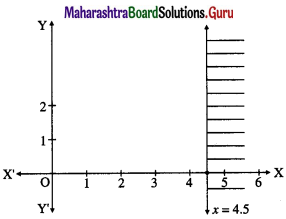
Maharashtra Board 12th Maths Solutions Chapter 7 Linear Programming Miscellaneous Exercise 7 1

(ii) -11x – 55 ≤ 0
Solution:
Consider the line whose equation is -11x – 55 ≤ 0 i.e. x = -5
This represents a line parallel to Y-axis passing3through the point (-5, 0)
Draw the line x = – 5
To find the solution set we have to check the position of the origin (0, 0).
When x = 0, -11x – 55 = – 11(0) – 55 = -55 > 0
∴ the coordinates of the origin does not satisfy thegiven inequality.
∴ the solution set consists of the line x = -5 and the non-origin side of the line which is shaded in the graph.
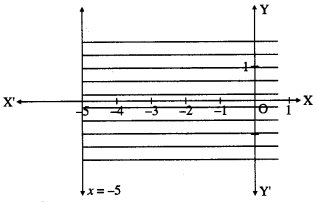
Maharashtra Board 12th Maths Solutions Chapter 7 Linear Programming Miscellaneous Exercise 7 2

Maharashtra Board 12th Maths Solutions Chapter 1 Mathematical Logic Ex 1.1

(iii) 5y – 12 ≥ 0
Solution:
Consider the line whose equation is 5y – 12 ≥ 0 i.e. y = \(\frac{12}{5}\)
This represents a line parallel to X-axis passing through the point (o, \(\frac{12}{5}\))
Draw the line y = \(\frac{12}{5}\)
To find the solution set, we have to check the position of the origin (0, 0).
When y = 0, 5y – 12 = 5(0) – 12 = -12 > 0
∴ the coordinates of the origin does not satisfy the given inequality.
∴ the solution set consists of the line y = \(\frac{12}{5}\) and the non-origin side of the line which is shaded in the graph.
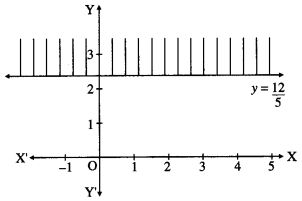
Maharashtra Board 12th Maths Solutions Chapter 7 Linear Programming Miscellaneous Exercise 7 3

(iv) y ≤ -3.5
Solution:
Consider the line whose equation is y ≤ – 3.5 i.e. y = – 3.5
This represents a line parallel to X-axis passing3through the point (0, -3.5)
Draw the line y = – 3.5
To find the solution set, we have to check the position of the origin (0, 0).
∴ the coordinates of the origin does not satisfy the given inequality.
∴ the solution set consists of the line y = – 3.5 and the non-origin side of the line which is shaded in the graph.
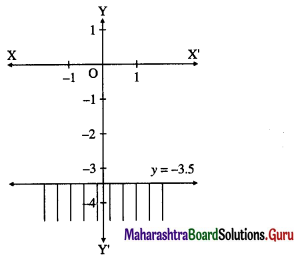
Maharashtra Board 12th Maths Solutions Chapter 7 Linear Programming Miscellaneous Exercise 7 4

Question 2.
Sketch the graph of each of following inequations in XOY co-ordinate system.
(i) x ≥ 5y
Solution:
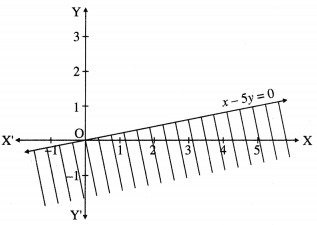
Maharashtra Board 12th Maths Solutions Chapter 7 Linear Programming Miscellaneous Exercise 7 5

Maharashtra Board 12th Maths Solutions Chapter 1 Mathematical Logic Ex 1.1

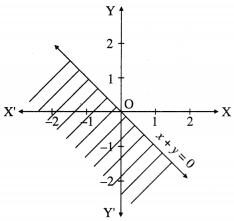
(ii) x + y≤ 0
Solution:
Maharashtra Board 12th Maths Solutions Chapter 7 Linear Programming Miscellaneous Exercise 7 6

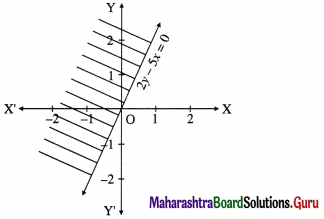
(iii) 2y – 5x ≥ 0
Solution:
Maharashtra Board 12th Maths Solutions Chapter 7 Linear Programming Miscellaneous Exercise 7 7

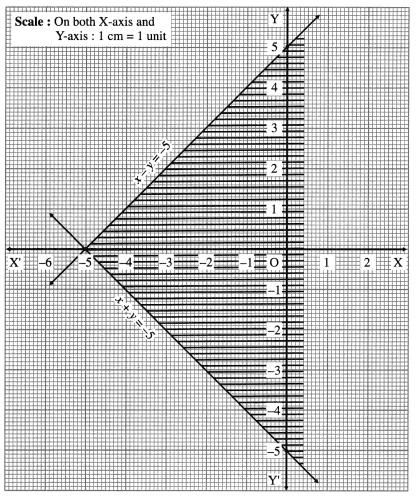
(iv) |x + 5| ≤ y
Solution:
|x + 5| ≤ y
∴ -y ≤ x + 5 ≤ y
∴ -y ≤ x + 5 and x + 5 ≤ y
∴ x + y ≥ -5 and x – y ≤ -5
First we draw the lines AB and AC whose equations are
x + y= -5 and x – y = -5 respectively.
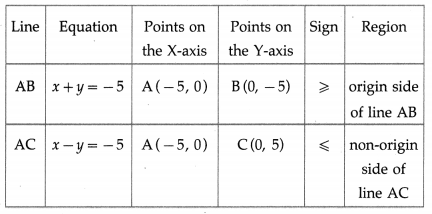
Maharashtra Board 12th Maths Solutions Chapter 7 Linear Programming Miscellaneous Exercise 7 8
The graph of |x + 5| ≤ y is as below:
Maharashtra Board 12th Maths Solutions Chapter 7 Linear Programming Miscellaneous Exercise 7 9

Maharashtra Board 12th Maths Solutions Chapter 1 Mathematical Logic Ex 1.1

Question 3.
Find graphical solution for each of the following system of linear inequation.
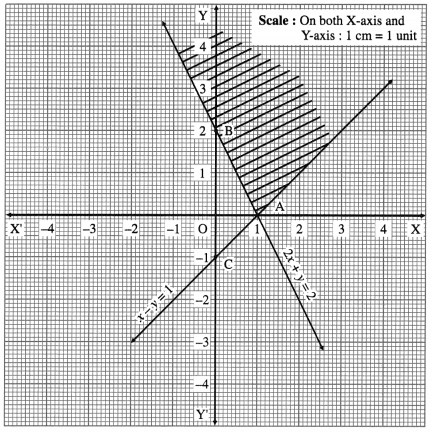
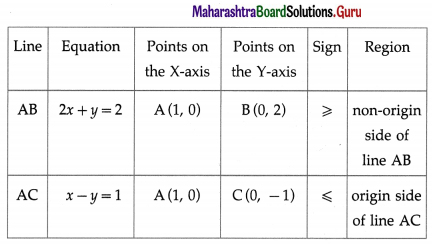
(i) 2x + y ≥ 2, x – y ≤ 1
Solution:
First we draw the lines AB and AC whose equations are 2x + y = 2 and x – y = 1 respectively.
Maharashtra Board 12th Maths Solutions Chapter 7 Linear Programming Miscellaneous Exercise 7 10
Maharashtra Board 12th Maths Solutions Chapter 7 Linear Programming Miscellaneous Exercise 7 11
The solution set of the given system of inequalities is shaded in the graph.

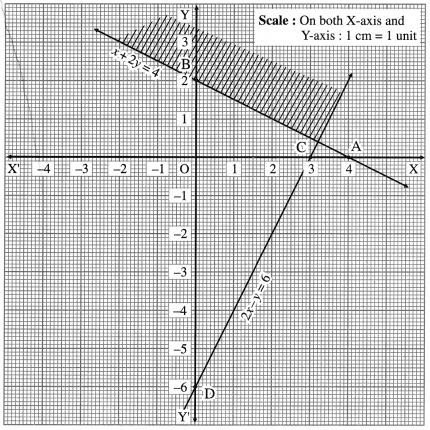
(ii) x + 2y ≥ 4, 2x – y ≤ 6
Solution:
Maharashtra Board 12th Maths Solutions Chapter 7 Linear Programming Miscellaneous Exercise 7 52

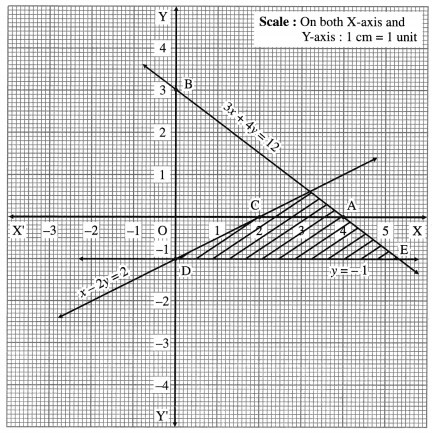
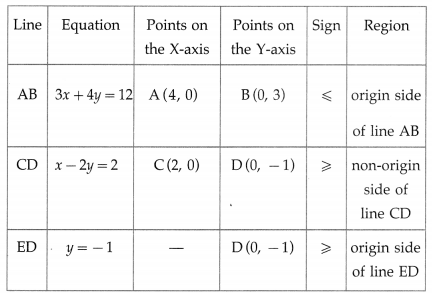
(iii) 3x + 4y ≤ 12, x – 2y ≥ 2, y ≥ -1
Solution:
First we draw the lines AB, CD and ED whose equations are 3x + 4y = 12, x – 2y = 2 and y = -1 respectively.
Maharashtra Board 12th Maths Solutions Chapter 7 Linear Programming Miscellaneous Exercise 7 12
Maharashtra Board 12th Maths Solutions Chapter 7 Linear Programming Miscellaneous Exercise 7 13
The solution set of given system of inequation is shaded in the graph.

Question 4.
Find feasible solution for each of the following system of linear inequations graphically.
(i) 2x + 3y ≤ 12, 2x + y ≤ 8, x ≥ 0, y ≥ 0
Solution:
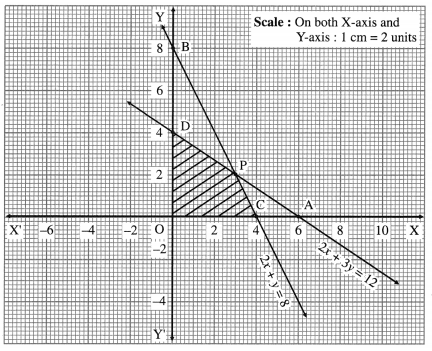
Maharashtra Board 12th Maths Solutions Chapter 7 Linear Programming Miscellaneous Exercise 7 53
The feasible solution is OCPBO.

(ii) 3x + 4y ≥ 12, 4x + 7y ≤ 28, x ≥ 0, y ≥ 0
Solution:
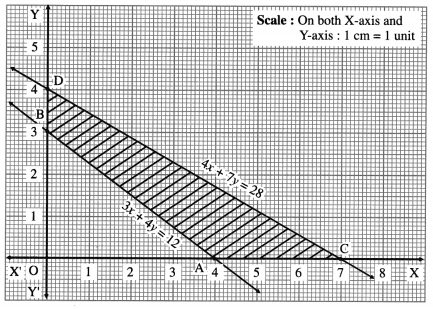
Maharashtra Board 12th Maths Solutions Chapter 7 Linear Programming Miscellaneous Exercise 7 54
The feasible solution is ACDBA.

Maharashtra Board 12th Maths Solutions Chapter 1 Mathematical Logic Ex 1.1

Question 5.
Solve each of the following L.P.P.
(i) Maximize z = 5x1 + 6x2 subject to 2x1 + 3x2 ≤ 18, 2x1 + x2 ≤ 12, x1 ≥ 0, x2 ≥ 0
Solution:
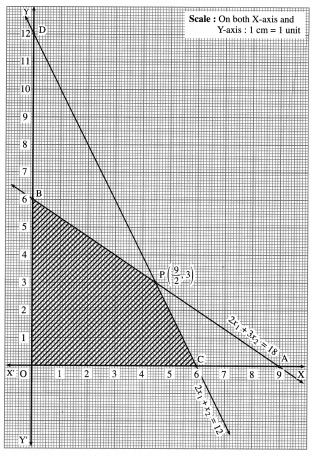
First we draw the lines AB and CD whose equations are 2x1 + 3x2 = 18 and 2x1 + x2 = 12 respectively.
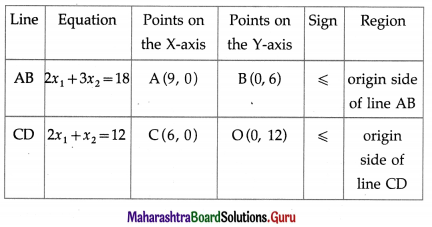
Maharashtra Board 12th Maths Solutions Chapter 7 Linear Programming Miscellaneous Exercise 7 14
Maharashtra Board 12th Maths Solutions Chapter 7 Linear Programming Miscellaneous Exercise 7 15
The feasible region is OCPBO which is shaded in the graph. The vertices of the feasible region are O(0, 0), C(6, 0), P and B (0,6).
P is the point of intersection of the lines
2x1 + 3x2 = 18 ….(1)
and 2x1 + x2 = 12
On subtracting, we get
2x2 = 6 ∴ x2 = 3
Substituting x2 = 3 in (2), we get
2x1 + 3 = 12 ∴ x2 = 9
∴ P is (\(\frac{9}{2}\), 3)
The values of objective function z = 5x1 + 6x2 at these vertices are
z(O) = 5(0) + 6(0) = 0 + 0 = 0
z(C) = 5(6) + 6(0) = 30 + 0 = 30
z(P) = 5(\(\frac{9}{2}\)) + 6(3) = \(\frac{45}{2}\) + 18 = \(\frac{45+36}{2}=\frac{81}{2}\) = 40.5
z(B) = 5(0) + 6(3) = 0 + 18 = 18
Maximum value of z is 40.5 when x1 = 9/2, y = 3.

(ii) Maximize z = 4x + 2y subject to 3x + y ≥ 27, x + y ≥ 21
Question is modified.
Maximize z = 4x + 2y subject to 3x + y ≤ 27, x + y ≤ 21, x ≥ 0, y ≥ 0
Solution:
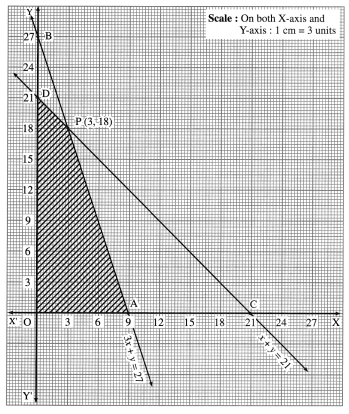
First we draw the lines AB and CD whose equations are 3x + y = 27 and x + y = 21 respectively.
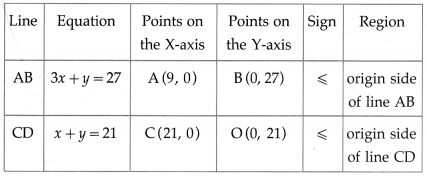
Maharashtra Board 12th Maths Solutions Chapter 7 Linear Programming Miscellaneous Exercise 7 16
Maharashtra Board 12th Maths Solutions Chapter 7 Linear Programming Miscellaneous Exercise 7 17
The feasible region is OAPDO which is shaded region in the graph. The vertices of the feasible region are 0(0, 0), A (9, 0), P and D(0, 21). P is the point of intersection of lines
3x + y = 27 … (1)
and x + y = 21 … (2)
On substracting, we get 2x = 6 ∴ x = 3
Substituting x = 3 in equation (1), we get
9 + y = 27 ∴ y = 18
∴ P = (3, 18)
The values of the objective function z = 4x + 2y at these vertices are
z(O) = 4(0) + 2(0) = 0 + 0 = 0
z(a) = 4(9) + 2(0) = 36 + 0 = 36
z(P) = 4(3) + 2(18) = 12 + 36 = 48
z (D) = 4(0) + 2(21) = 0 + 42 = 42
∴ 2 has minimum value 48 when x = 3, y = 18.

(iii) Maximize z = 6x + 10y subject to 3x + 5y ≤ 10, 5x + 3y ≤ 15, x ≥ 0, y ≥ 0
Solution:
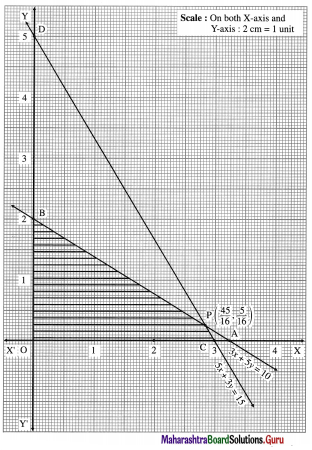
First we draw the lines AB and CD whose equations are 3x + 5y = 10 and 5x + 3y = 15 respectively.
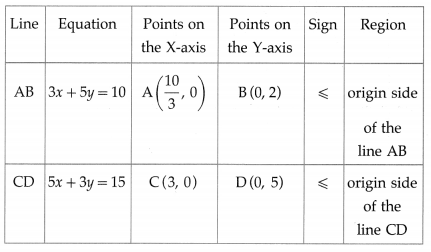
Maharashtra Board 12th Maths Solutions Chapter 7 Linear Programming Miscellaneous Exercise 7 18
Maharashtra Board 12th Maths Solutions Chapter 7 Linear Programming Miscellaneous Exercise 7 19
The feasible region is OCPBD which is shaded in the graph.
The vertices of the feasible region are 0(0, 0), C(3, 0), P and B (0, 2).
P is the point of intersection of the lines
3x + 5y = 10 … (1)
and 5x + 3y = 15 … (2)
Multiplying equation (1) by 5 and equation (2) by 3, we get
15x + 25y = 50
15x + 9y = 45
On subtracting, we get
16y = 5 ∴ y = \(\frac{5}{16}\)
Substituting y = \(\frac{5}{16}\) in equation (1), we get
3x + \(\frac{25}{16}\) = 10 ∴ 3x = 10 – \(\frac{25}{16}=\frac{135}{16}\)
∴ x = \(\frac{45}{16}\) ∴ P ≡ \(\left(\frac{45}{16}, \frac{5}{16}\right)\)
The values of objective function z = 6x + 10y at these vertices are
z(O) = 6(0) + 10(0) = 0 + 0 = 0
z(C) = 6(3) + 10(0) = 18 + 0 = 18
z(P) = 6\(\left(\frac{45}{16}\right)\) + 10\(\left(\frac{5}{10}\right)\) = \(\frac{270}{16}+\frac{50}{16}=\frac{320}{16}\) = 20
z(B) = 6(0) + 10(2) = 0 + 20 = 20
The maximum value of z is 20 at P\(\left(\frac{45}{16}, \frac{5}{16}\right)\) and B (0, 2) two consecutive vertices.
∴ z has maximum value 20 at each point of line segment PB where B is (0, 2) and P is \(\left(\frac{45}{16}, \frac{5}{16}\right)\).
Hence, there are infinite number of optimum solutions.

Maharashtra Board 12th Maths Solutions Chapter 1 Mathematical Logic Ex 1.1

(iv) Maximize z = 2x + 3y subject to x – y ≥ 3, x ≥ 0, y ≥ 0
Solution:
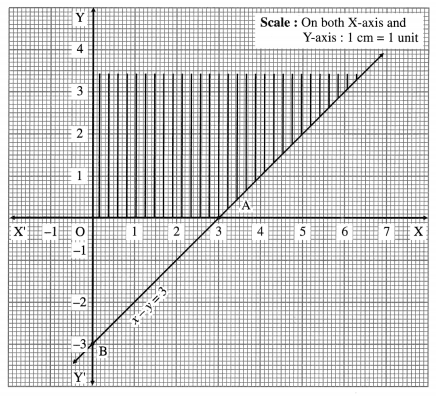
First we draw the lines AB whose equation is x – y = 3.
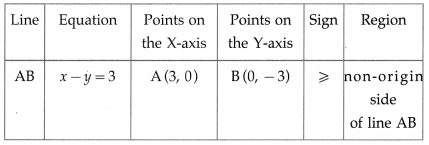
Maharashtra Board 12th Maths Solutions Chapter 7 Linear Programming Miscellaneous Exercise 7 20
Maharashtra Board 12th Maths Solutions Chapter 7 Linear Programming Miscellaneous Exercise 7 21
The feasible region is shaded which is unbounded.
Therefore, the value of objective function can be in- j creased indefinitely. Hence, this LPP has unbounded solution.

Question 6.
Solve each of the following L.P.P.
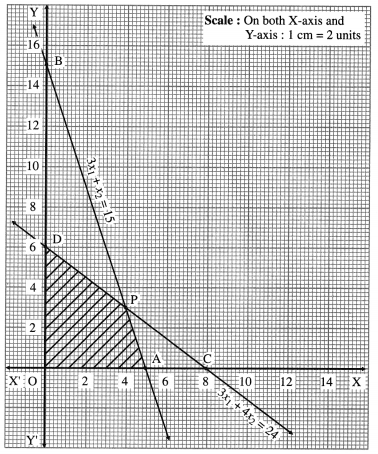
(i) Maximize z = 4x1 + 3x2 subject to 3x1 + x2 ≤ 15, 3x1 + 4x2 ≤ 24, x1 ≥ 0, x2 ≥ 0
Solution:
We first draw the lines AB and CD whose equations are 3x1 + x2 = 15 and 3x1 + 4x2 = 24 respectively.
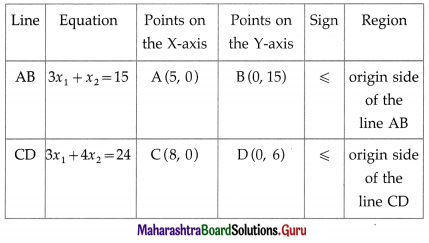
Maharashtra Board 12th Maths Solutions Chapter 7 Linear Programming Miscellaneous Exercise 7 22
Maharashtra Board 12th Maths Solutions Chapter 7 Linear Programming Miscellaneous Exercise 7 23
The feasible region is OAPDO which is shaded in the graph.
The Vertices of the feasible region are 0(0, 0), A(5, 0), P and D(0, 6).
P is the point of intersection of lines.
3x1 + 4x2 = 24 … (1)
and 3x1 + x2 = 15 … (2)
On subtracting, we get
3x2 = 9 ∴ x2 = 3
Substituting x2 = 3 in (2), we get
3x1 + 3 = 15
∴ 3x1 = 12 ∴ x1 = 4 ∴ P is (4, 3)
The values of objective function z = 4x1 + 3x2 at these vertices are
z(O) = 4(0) + 3(0) = 0 + 0 = 0
z(a) = 4(5) + 3(0) = 20 + 0 = 20
z(P) = 4(4) + 3(3) = 16 + 9 = 25
z(D) = 4(0) + 3(6) = 0 + 18 = 18
∴ z has maximum value 25 when x = 4 and y = 3.

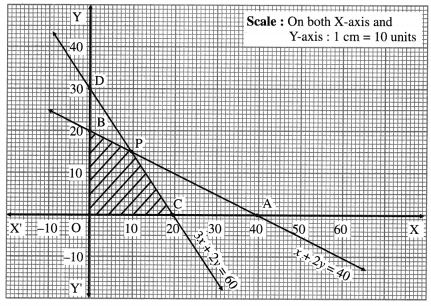
(ii) Maximize z = 60x + 50y subject to x + 2y ≤ 40, 3x + 2y ≤ 60, x ≥ 0, y ≥ 0
Solution:
We first draw the lines AB and CD whose equations are x + 2y = 40 and 3x + 2y = 60 respectively.
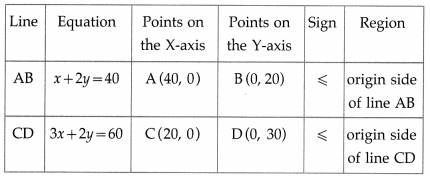
Maharashtra Board 12th Maths Solutions Chapter 7 Linear Programming Miscellaneous Exercise 7 24
Maharashtra Board 12th Maths Solutions Chapter 7 Linear Programming Miscellaneous Exercise 7 25
The feasible region is OCPBO which is shaded in the graph.
The vertices of the feasible region are O (0, 0), C (20, 0), P and B (0, 20).
P is the point of intersection of the lines.
3x + 2y = 60 … (1)
and x + 2y = 40 … (2)
On subtracting, we get
2x = 20 ∴ x = 10
Substituting x = 10 in (2), we get
10 + 2y = 40
∴ 2y = 30 ∴ y = 15 ∴ P is (10, 15)
The values of the objective function z = 60x + 50y at these vertices are
z(O) = 60(0) + 50(0) = 0 + 0 = 0
z(C) = 60(20) + 50(0) = 1200 + 0 = 1200
z(P) = 60(10) + 50(15) = 600 + 750 = 1350
z(B) = 60(0) + 50(20) = 0 + 1000 = 1000 .
∴ z has maximum value 1350 at x = 10, y = 15.

Maharashtra Board 12th Maths Solutions Chapter 1 Mathematical Logic Ex 1.1

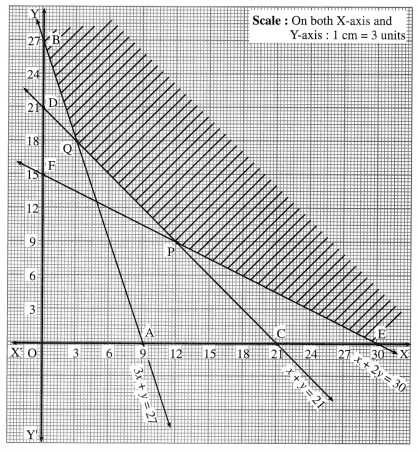
(iii) Maximize z = 4x + 2y subject to 3x + y ≥ 27, x + y ≥ 21, x + 2y ≥ 30; x ≥ 0, y ≥ 0
Solution:
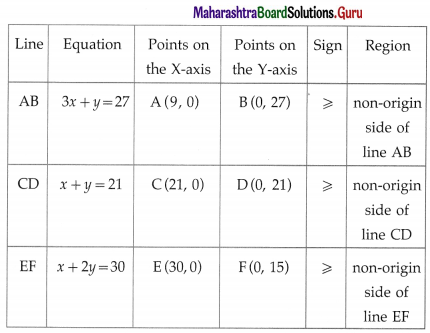
We first draw the lines AB, CD and EF whose equations are 3x + y = 27, x + y = 21, x + 2y = 30 respectively.
Maharashtra Board 12th Maths Solutions Chapter 7 Linear Programming Miscellaneous Exercise 7 26
Maharashtra Board 12th Maths Solutions Chapter 7 Linear Programming Miscellaneous Exercise 7 27
The feasible region is XEPQBY which is shaded in the graph.
The vertices of the feasible region are E (30,0), P, Q and B (0,27).
P is the point of intersection of the lines
x + 2y = 30 … (1)
and x + y = 21 … (2)
On subtracting, we get
y = 9
Substituting y = 9 in (2), we get
x + 9 = 21 ∴ x = 12
∴ P is (12, 9)
Q is the point of intersection of the lines
x + y = 21 … (2)
and 3x + y = 27 … (3)
On subtracting, we get
2x = 6 ∴ x = 3
Substituting x = 3 in (2), we get
3 + y = 21 ∴ y = 18
∴ Q is (3, 18).
The values of the objective function z = 4x + 2y at these vertices are
z(E) = 4(30) + 2(0) = 120 + 0 = 120
z(P) = 4(12) + 2(9) = 48 + 18 = 66
z(Q) = 4(3) + 2(18) = 12 + 36 = 48
z(B) = 4(0) + 2(27) = 0 + 54 = 54
∴ z has minimum value 48, when x = 3 and y = 18.

Question 7.
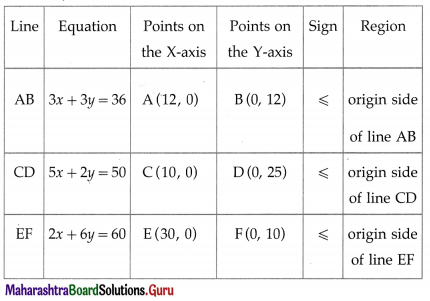
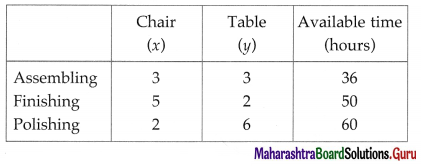
A carpenter makes chairs and tables. Profits are ₹140/- per chair and ₹ 210/- per table. Both products are processed on three machines : Assembling, Finishing and Polishing. The time required for each product in hours and availability of each machine is given by following table:

Maharashtra Board 12th Maths Solutions Chapter 7 Linear Programming Miscellaneous Exercise 7 28
Formulate the above problem as L.P.P. Solve it graphically to get maximum profit.
Solution:
Let the number of chairs and tables made by the carpenter be x and y respectively.
The profits are ₹ 140 per chair and ₹ 210 per table.
∴ total profit z = ₹ (140x + 210y) This is the objective function which is to be maximized.
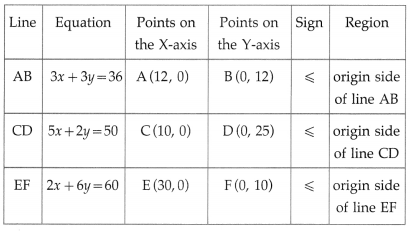
The constraints are as per the following table :
Maharashtra Board 12th Maths Solutions Chapter 7 Linear Programming Miscellaneous Exercise 7 29
From the table, the constraints are
3x + 3y ≤ 36, 5x + 2y ≤ 50, 2x + 6y ≤ 60.
The number of chairs and tables cannot be negative.
∴ x ≥ 0, y ≥ 0
Hence, the mathematical formulation of given LPP is :
Maximize z = 140x + 210y, subject to
3x + 3y ≤ 36, 5x + 2y ≤ 50, 2x + 6y ≤ 60, x ≥ 0, y ≥ 0.
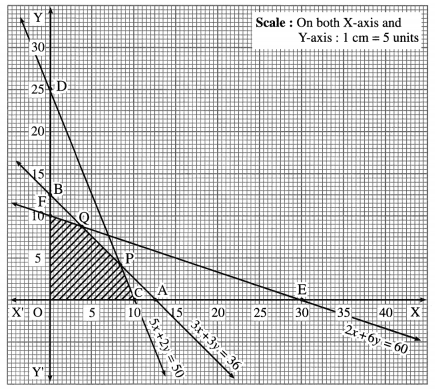
We first draw the lines AB, CD and EF whose equations are 3x + 3y = 36, 5x + 2y = 50 and 2x + 6y = 60 respectively.
Maharashtra Board 12th Maths Solutions Chapter 7 Linear Programming Miscellaneous Exercise 7 30
Maharashtra Board 12th Maths Solutions Chapter 7 Linear Programming Miscellaneous Exercise 7 31
The feasible region is OCPQFO which is shaded in the graph.
The vertices of the feasible region are O (0, 0), C (10, 0), P, Q and F (0, 10).
P is the point of intersection of the lines
5x + 2y = 50 … (1)
and 3x + 3y = 36 … (2)
Multiplying equation (1) by 3 and equation (2) by 2, we get
15x + 6y = 150
6x + 6y = 72
On subtracting, we get 26
9x = 78 ∴ x = \(\frac{26}{3}\)
Substituting x = \(\frac{26}{3}\) in (2), we get
3\(\left(\frac{26}{3}\right)\) + 3y = 36
3y = 1o y = \(\frac{10}{3}\)
Q is the point of intersection of the lines
3x + 3y = 36 … (2)
and 2x + 6y = 60 … (3)
Multiplying equation (2) by 2, we get
6x + 6 y = 72
Subtracting equation (3) from this equation, we get
4x = 12 ∴ x = 3
Substituting x = 3 in (2), we get
3(3) + 3y = 36
∴ 3y = 27 ∴ y = 9
∴ Q is (3, 9).
Hence, the vertices of the feasible region are O (0, 0),
C(10, 0), P\(\left(\frac{26}{3}, \frac{10}{3}\right)\), Q(3, 9) and F(0, 10).
The values of the objective function z = 140x + 210y at these vertices are
z(O) = 140(0) + 210(0) = 0 + 0 = 0
z(C) = 140 (10) + 210(0) = 1400 + 0 = 1400
z(P) = 140\(\left(\frac{26}{3}\right)\) + 210\(\left(\frac{10}{3}\right)\) = \(\frac{3640+2100}{3}=\frac{5740}{3}\) = 1913.33
z(Q) = 140(3) + 210(9) = 420 + 1890 = 2310
z(F) = 140(0) + 210(10) = 0 + 2100 = 2100
∴ z has maximum value 2310 when x = 3 and y = 9 Hence, the carpenter should make 3 chairs and 9 tables to get the maximum profit of ₹ 2310.

Maharashtra Board 12th Maths Solutions Chapter 1 Mathematical Logic Ex 1.1

Question 8.
A company manufactures bicycles and tricycles, each of which must be processed through two machines A and B. Maximum availability of Machine A and B is respectively 120 and 180 hours. Manufacturing a bicycle requires 6 hours on Machine A and 3 hours on Machine B. Manufacturing a tricycles requires 4 hours on Machine A and 10 hours on Machine B. If profits are ₹180/- for a bicycle and ₹220/- for a tricycle. Determine the number of bicycles and tricycles that should be manufactured in order to maximize the profit.
Solution:
Let x bicycles and y tricycles are to be manu¬factured. Then the total profit is z = ₹ (180x + 220y)
This is a linear function which is to be maximized. Hence, it is the objective function. The constraints are as per the following table :
Maharashtra Board 12th Maths Solutions Chapter 7 Linear Programming Miscellaneous Exercise 7 32
From the table, the constraints are
6x + 4y ≤ 120, 3x +10y ≤ 180
Also, the number of bicycles and tricycles cannot be i negative.
∴ x ≥ 0, y ≥ 0.
Hence, the mathematical formulation of given LPP is :
Maximize z = 180x + 220y, subject to
6x + 4y ≤ 120, 3x + 10y ≤ 180, x ≥ 0, y ≥ 0.
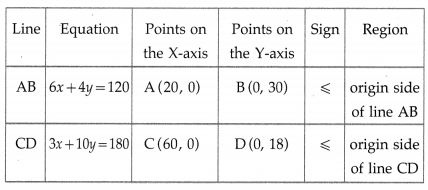
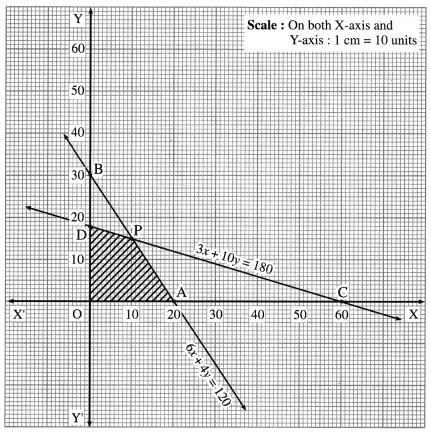
First we draw the lines AB and CD whose equations are 6x + 4y = 120 and 3x + 10y = 180 respectively.
Maharashtra Board 12th Maths Solutions Chapter 7 Linear Programming Miscellaneous Exercise 7 33
Maharashtra Board 12th Maths Solutions Chapter 7 Linear Programming Miscellaneous Exercise 7 34
The feasible region is OAPDO which is shaded in the graph.
The vertices of the feasible region are O(0, 0), A(20, 0) P and D(0, 18).
P is the point of intersection of the lines
3x + 10y = 180 … (1)
and 6x + 4y = 120 … (2)
Multiplying equation (1) by 2, we get
6x + 20y = 360
Subtracting equation (2) from this equation, we get
16y = 240 ∴ y = 15
∴ from (1), 3x + 10(15) = 180
∴ 3x = 30 ∴ x = 10
∴ P = (10, 15)
The values of the objective function z = 180x + 220y at these vertices are
z(O) = 180(0) + 220(0) = 0 + 0 = 0
z(a) = 180(20) + 220(0) = 3600 + 0 = 3600
z(P) = 180(10) + 220(15) = 1800 + 3300 = 5100
z(D) = 180(0) +220(18) = 3960
∴ the maximum value of z is 5100 at the point (10, 15).
Hence, 10 bicycles and 15 tricycles should be manufactured in order to have the maximum profit of ₹ 5100.

Question 9.
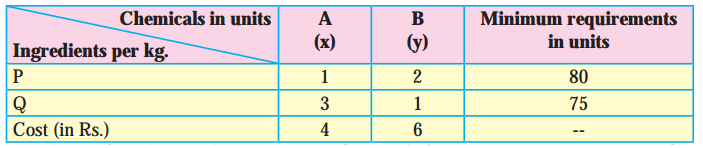
A factory produced two types of chemicals A and B. The following table gives the units of ingredients P and Q (per kg) of chemicals A and B as well as minimum requirements of P and Q and also cost per kg. chemicals A and B :
Maharashtra Board 12th Maths Solutions Chapter 7 Linear Programming Miscellaneous Exercise 7 35
Find the number of units of chemicals A and B should be produced so as to minimize the cost.
Solution:
Let the factory produce x units of chemical A and y units of chemical B. Then the total cost is z = ₹ (4x + 6y). This is the objective function which is to be minimized.
From the given table, the constraints are
x + 2y ≥ 80, 3x + y ≥ 75.
Also, the number of units x and y of chemicals A and B cannot be negative.
∴ x ≥ 0, y ≥ 0.
∴ the mathematical formulation of given LPP is
Minimize z = 4x + 6y, subject to
x + 2y ≥ 80, 3x + y ≥ 75, x ≥ 0, y ≥ 0.
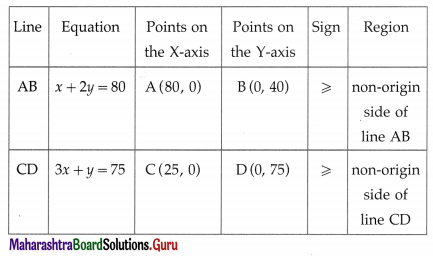
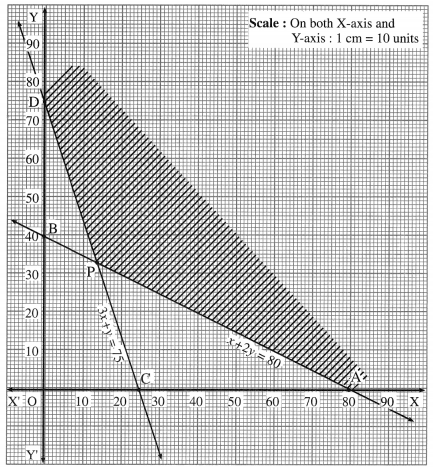
First we draw the lines AB and CD whose equations are x + 2y = 80 and 3x + y = 75 respectively.
Maharashtra Board 12th Maths Solutions Chapter 7 Linear Programming Miscellaneous Exercise 7 36
Maharashtra Board 12th Maths Solutions Chapter 7 Linear Programming Miscellaneous Exercise 7 37
The feasible region is shaded in the graph.
The vertices of the feasible region are A (80, 0), P and D (0, 75).
P is the point of intersection of the lines
x + 2y = 80 … (1)
and 3x + y = 75 … (2)
Multiplying equation (2) by 2, we get
6x + 2 y = 150
Subtracting equation (1) from this equation, we get
5x = 70 ∴ x = 14
∴ from (2), 3(14) + y = 75
∴ 42 + y = 75 ∴ y = 33
∴ P = (14, 33)
The values of the objective function z = 4x + 6y at these vertices are
z(a) = 4(80)+ 6(0) =320 + 0 = 320
z(P) = 4(14)+ 6(33) = 56+ 198 = 254
z(D) = 4(0) + 6(75) = 0 + 450 = 450
∴ the minimum value of z is 254 at the point (14, 33).
Hence, 14 units of chemical A and 33 units of chemical B are to be produced in order to have the j minimum cost of ₹ 254.

Maharashtra Board 12th Maths Solutions Chapter 1 Mathematical Logic Ex 1.1

Question 10.
A company produces mixers and food processors. Profit on selling one mixer and one food processor is ₹ 2,000/- and ₹ 3,000/- respectively. Both the products are processed through three Machines A, B, C. The time required in hours by each product and total time available in hours per week on each machine are as follows :
Maharashtra Board 12th Maths Solutions Chapter 7 Linear Programming Miscellaneous Exercise 7 38
How many mixers and food processors should be produced to maximize the profit?
Solution:
Let the company produce x mixers and y food processors.
Then the total profit is z = ₹ (2000x + 3000y)
This is the objective function which is to be maximized. From the given table in the problem, the constraints are 3x + 3y ≤ 36, 5x + 2y ≤ 50, 2x + 6y ≤ 60
Also, the number of mixers and food processors cannot be negative,
∴ x ≥ 0, y ≥ 0.
∴ the mathematical formulation of given LPP is
Maximize z = 2000x + 3000y, subject to 3x + 3y ≤ 36, 5x + 2y ≤ 50, 2x + 6y ≤60, x ≥ 0, y ≥ 0.
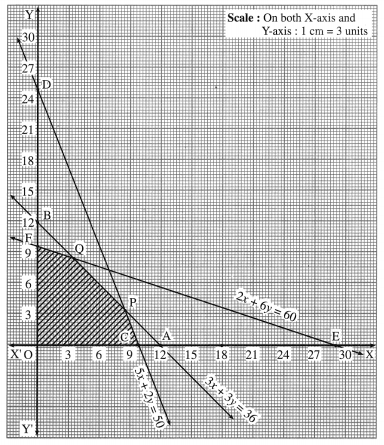
First we draw the lines AB, CD and EF whose equations are 3x + 3y = 36, 5x + 2y = 50 and 2x + 6y = 60 respectively.
Maharashtra Board 12th Maths Solutions Chapter 7 Linear Programming Miscellaneous Exercise 7 39
Maharashtra Board 12th Maths Solutions Chapter 7 Linear Programming Miscellaneous Exercise 7 40
The feasible region is OCPQFO which is shaded in the graph.
The vertices of the feasible region are O(0, 0), C(10, 0), P, Q and F(0,10).
P is the point of intersection of the lines
3x + 3y = 36 … (1)
and 5x + 2y = 50 … (2)
Multiplying equation (1) by 2 and equation (2) by 3, we get
6x + 6y = 72
15x + 6y = 150
On subtracting, we get
9x = 78
∴ x = \(\frac{26}{3}\)
∴ from (1), 3\(\left(\frac{26}{3}\right)\) + 3y = 36
∴ 3y = 10
∴ y = \(\frac{10}{3}\)
∴ P = \(\left(\frac{26}{3}, \frac{10}{3}\right)\)
Q is the point of intersection of the lines
3x + 3y = 36 … (1)
and 2x + 6y = 60 … (3)
Multiplying equation (1) by 2, we get
6x + 6y = 72
Subtracting equation (3), from this equation, we get
4x = 12
∴ x = 3
∴ from (1), 3(3) + 3y = 36
∴ 3y = 27
∴ y = 9
∴ Q = (3, 9)
The values of the objective function z = 2000x + 3000y at these vertices are
z(O) = 2000(0) + 3000(0) = 0 + 0 = 0
z(C) = 2000(10) + 3000(0) = 20000 + 0 = 20000
z(P) = 2000\(\left(\frac{26}{3}\right)\) + 3000\(\left(\frac{10}{3}\right)\) = \(\frac{52000}{3}+\frac{30000}{3}=\frac{82000}{3}\)
z(Q) = 2000(3) + 3000(9) = 6000 + 27000 = 33000
z(F) = 2000(0) + 3000(10) = 30000 + 0 = 30000
∴ the maximum value of z is 33000 at the point (3, 9).
Hence, 3 mixers and 9 food processors should be produced in order to get the maximum profit of ₹ 33,000.

Question 11.
A chemical company produces a chemical containing three basic elements A, B, C so that it has at least 16 liters of A, 24 liters of B and 18 liters of C. This chemical is made by mixing two compounds I and II. Each unit of compound I has 4 liters of A, 12 liters of B, 2 liters of C. Each unit of compound II has 2 liters of A, 2 liters of B and 6 liters of C. The cost per unit of compound I is ₹ 800/- and that of compound II is ₹ 640/-. Formulate the problem as L.P.P. and solve it to minimize the cost.
Solution:
Let the company buy x units of compound I and y units of compound II.
Then the total cost is z = ₹(800x + 640y).
This is the objective function which is to be minimized.
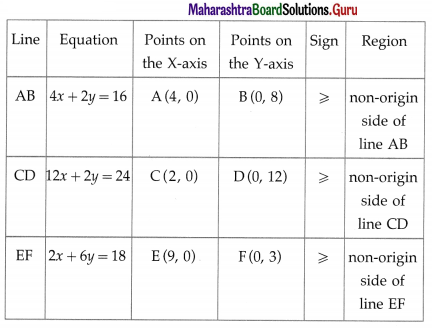
The constraints are as per the following table :
Maharashtra Board 12th Maths Solutions Chapter 7 Linear Programming Miscellaneous Exercise 7 41
From the table, the constraints are
4x + 2y ≥ 16, 12x + 2y ≥ 24, 2x + 6y ≥ 18.
Also, the number of units of compound I and compound II cannot be negative.
∴ x ≥ 0, y ≥ 0.
∴ the mathematical formulation of given LPP is
Minimize z = 800x + 640y, subject to 4x + 2y ≥ 16, 12x + 2y ≥ 24, 2x + 6y ≥ 18, x ≥ 0, y ≥ 0.
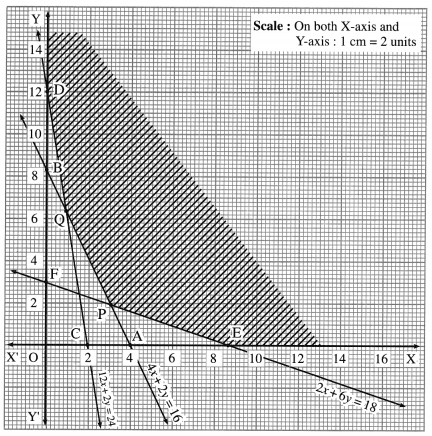
First we draw the lines AB, CD and EF whose equations are 4x + 2y = 16, 12x + 2y = 24 and 2x + 6y = 18
Maharashtra Board 12th Maths Solutions Chapter 7 Linear Programming Miscellaneous Exercise 7 42
Maharashtra Board 12th Maths Solutions Chapter 7 Linear Programming Miscellaneous Exercise 7 43
The feasible region is shaded in the graph.
The vertices of the feasible region are E(9, 0), P, Q, and D(0, 12).
P is the point of intersection of the lines
2x + 6y = 18 … (1)
and 4x + 2y = 16 … (2)
Multiplying equation (1) by 2, we get 4x + 12y = 36
Subtracting equation (2) from this equation, we get
10y = 20
∴ y = 2
∴ from (1), 2x + 6(2) = 18
∴ 2x = 6
∴ x = 3
∴ P = (3, 2)
Q is the point of intersection of the lines
12x + 2y = 24 … (3)
and 4x + 2y = 16 … (2)
On subtracting, we get
8x = 8 ∴ x = 1
∴ from (2), 4(1) + 2y = 16
∴ 2y = 12 ∴ y = 6
∴ Q = (1, 6)
The values of the objective function z = 800x + 640y at these vertices are
z(E) = 800(9)+ 640(0) =7200 + 0 = 7200
z(P) = 800(3) + 640(2) = 2400 + 1280 = 3680
z(Q) = 800(1) + 640(6) =800 + 3840 =4640
z(D) = 800(0) + 640(12) = 0 + 7680 = 7680
∴ the minimum value of z is 3680 at the point (3, 2).
Hence, the company should buy 3 units of compound I and 2 units of compound II to have the minimum cost of ₹ 3680.

Maharashtra Board 12th Maths Solutions Chapter 1 Mathematical Logic Ex 1.1

Question 12.
A person makes two types of gift items A and B requires the services of a cutter and a finisher. Gift item A requires 4 hours of cutter’s time and 2 hours of finisher’s time. B requires 2 hours of cutter’s time and 4 hours of finisher’s time. The cutter and finisher have 208 hours and 152 hours available times respectively every month. The profit of one gift item of type A is ₹ 75/- and on gift item B is ₹ 125/-. Assuming that the person can sell all the gift items produced, determine how many gift items of each type should he make every month to obtain the best returns?
Solution:
Let x: number of gift item A
y: number of gift item B
As numbers of the items are never negative
x ≥ 0; y ≥ 0
Maharashtra Board 12th Maths Solutions Chapter 7 Linear Programming Miscellaneous Exercise 7 44
Total time required for the cutter = 4x + 2y
Maximum available time 208 hours
∴ 4x+ 2y ≤ 208
Total time required for the finisher 2x +4y
Maximum available time 152 hours
2x + 4y ≤ 152
Total Profit is 75x + 125y
∴ L.P.P. of the above problem is
Minimize z = 75x + 125y
Subject to 4x+ 2y ≤ 208
2x + 4y ≤ 152
x ≥ 0; y ≥ 0
Graphical solution
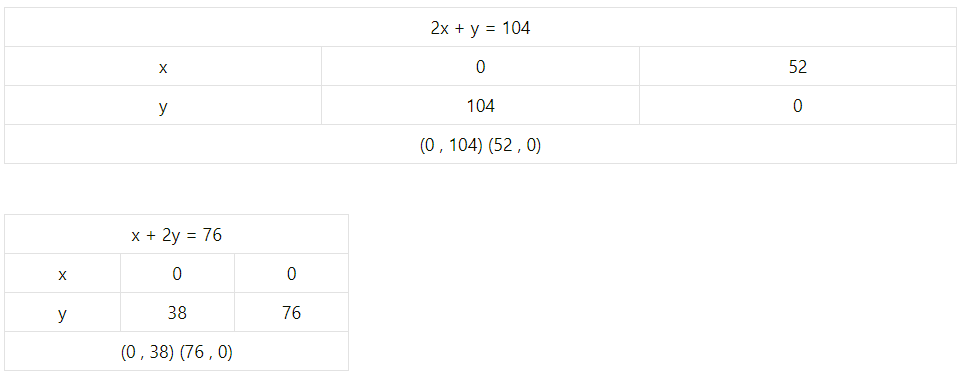
Maharashtra Board 12th Maths Solutions Chapter 7 Linear Programming Miscellaneous Exercise 7 45
Corner points
Now, Z at
x = (75x + 125y)
O(0, 0) = 75 × 0 + 125 × 0 = 0
A(52,0) = 75 × 52 + 125 × 0 = 3900
B(44, 16) = 75 × 44 + 125 × 16 = 5300
C(0, 38) = 75 × 0 + 125 × 38 = 4750
A person should make 44 items of type A and 16 Uems of type Band his returns are ₹ 5,300.

Question 13.
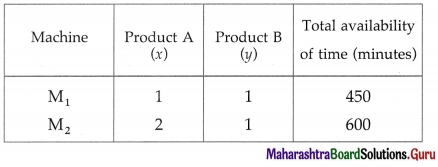
A firm manufactures two products A and B on which profit earned per unit ₹3/- and ₹4/- respectively. Each product is processed on two machines M1 and M2. The product A requires one minute of processing time on M1 and two minute of processing time on M2, B requires one minute of processing time on M1 and one minute of processing time on M2. Machine M1 is available for use for 450 minutes while M2 is available for 600 minutes during any working day. Find the number of units of product A and B to be manufactured to get the maximum profit.
Solution:
Let the firm manufactures x units of product
A and y units of product B.
The profit earned per unit of A is ₹3 and B is ₹ 4.
Hence, the total profit is z = ₹ (3x + 4y).
This is the linear function which is to be maximized.
Hence, it is the objective function.
The constraints are as per the following table :
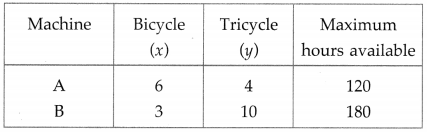
Maharashtra Board 12th Maths Solutions Chapter 7 Linear Programming Miscellaneous Exercise 7 46
From the table, the constraints are
x + y ≤ 450, 2x + y ≤ 600
Since, the number of gift items cannot be negative, x ≥ 0, y ≥ o.
∴ the mathematical formulation of LPP is,
Maximize z = 3x + 4y, subject to x + y ≤ 450, 2x + y ≤ 600, x ≥ 0, y ≥ 0.
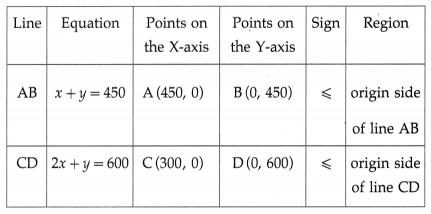
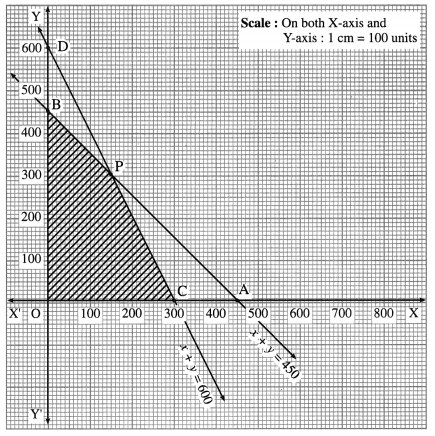
Now, we draw the lines AB and CD whose equations are x + y = 450 and 2x + y — 600 respectively.
Maharashtra Board 12th Maths Solutions Chapter 7 Linear Programming Miscellaneous Exercise 7 47
Maharashtra Board 12th Maths Solutions Chapter 7 Linear Programming Miscellaneous Exercise 7 48
The feasible region is OCPBO which is shaded in the graph.
The vertices of the feasible region are O(0, 0), C(300, 0), P and B (0, 450).
P is the point of intersection of the lines
2x + y = 600 … (1)
and x + y = 450 … (2)
On subtracting, we get
∴ x = 150
Substituting x = 150 in equation (2), we get
150 + y = 450
∴ y = 300
∴ P = (150, 300)
The values of the objective function z = 3x + 4y at these vertices are
z(O) = 3(0) + 4(0) = 0 + 0 = 0
z(C) = 3(300) + 4(0) = 900 + 0 = 900
z(P) = 3(150) + 4(300) = 450 + 1200 = 1650
z(B) = 3(0) + 4(450) = 0 + 1800 = 1800
∴ z has the maximum value 1800 when x = 0 and y = 450 Hence, the firm gets maximum profit of ₹ 1800 if it manufactures 450 units of product B and no unit product A.

Maharashtra Board 12th Maths Solutions Chapter 1 Mathematical Logic Ex 1.1

Question 14.
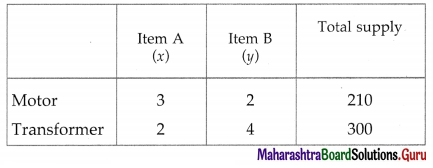
A firm manufacturing two types of electrical items A and B, can make a profit of ₹ 20/- per unit of A and ₹ 30/- per unit of B. Both A and B make use of two essential components a motor and a transformer. Each unit of A requires 3 motors and 2 transformers and each units of B requires 2 motors and 4 transformers. The total supply of components per month is restricted to 210 motors and 300 transformers. How many units of A and B should the manufacture per month to maximize profit? How much is the maximum profit?
Solution:
Let the firm manufactures x units of item A and y units of item B.
Firm can make profit of ₹ 20 per unit of A and ₹ 30 per unit of B.
Hence, the total profit is z = ₹ (20x + 30y).
This is the objective function which is to be maximized. The constraints are as per the following table :
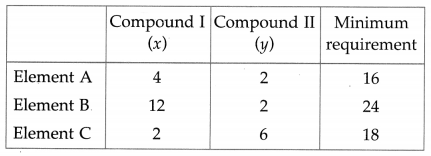
Maharashtra Board 12th Maths Solutions Chapter 7 Linear Programming Miscellaneous Exercise 7 49
From the table, the constraints are
3x + 2y ≤ 210, 2x + 4y ≤ 300
Since, number of items cannot be negative, x ≥ 0, y ≥ 0.
Hence, the mathematical formulation of given LPP is :
Maximize z = 20x + 30y, subject to 3x + 2y ≤ 210, 2x + 4y ≤ 300, x ≥ 0, y ≥ 0.
We draw the lines AB and CD whose equations are 3x + 2y = 210 and 2x + 4y = 300 respectively.
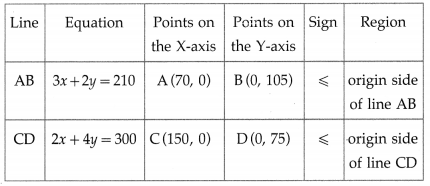
Maharashtra Board 12th Maths Solutions Chapter 7 Linear Programming Miscellaneous Exercise 7 50
The feasible region is OAPDO which is shaded in the graph.
The vertices of the feasible region are O (0, 0), A (70, 0), P and D (0, 75).
P is the point of intersection of the lines
2x + 4y = 300 … (1)
and 3x + 2y = 210 … (2)
Multiplying equation (2) by 2, we get
6x + 4y = 420
Subtracting equation (1) from this equation, we get
∴ 4x = 120 ∴ x = 30
Substituting x = 30 in (1), we get
2(30) + 4y = 300
∴ 4y = 240 ∴ y = 60
∴ P is (30, 60)
The values of the objective function z = 20x + 30y at these vertices are
z(O) = 20(0) + 30(0) = 0 + 0 = 0
z(A) = 20(70) + 30(0) = 1400 + 0 = 1400
z(P) = 20(30) + 30(60) = 600 + 1800 = 2400
z(D) = 20(0) + 30(75) = 0 + 2250 = 2250
∴ z has the maximum value 2400 when x = 30 and y = 60. Hence, the firm should manufactured 30 units of item A and 60 units of item B to get the maximum profit of ₹ 2400.

Maharashtra Board 11th Maths Solutions Chapter 4 Determinants and Matrices Ex 4.7

Balbharti Maharashtra State Board Class 11 Maths Solutions Pdf Chapter 4 Determinants and Matrices Ex 4.7 Questions and Answers.

Maharashtra State Board 11th Maths Solutions Chapter 4 Determinants and Matrices Ex 4.7

Question 1.
Find AT, if
i. A = \(\left[\begin{array}{cc}
1 & 3 \\
-4 & 5
\end{array}\right]\)
ii. A = \(\left[\begin{array}{ccc}
2 & -6 & 1 \\
-4 & 0 & 5
\end{array}\right]\)
Solution:
i. A = \(\left[\begin{array}{cc}
1 & 3 \\
-4 & 5
\end{array}\right]\)
∴ AT = \(\left[\begin{array}{rr}
1 & -4 \\
3 & 5
\end{array}\right]\)

Maharashtra Board 11th Maths Solutions Chapter 4 Determinants and Matrices Ex 4.7

ii. A = \(\left[\begin{array}{ccc}
-4 & 0 & 5
2 & -6 & 1 \\
\end{array}\right]\)
∴ AT = \(\left[\begin{array}{cc}
2 & -4 \\
-6 & 0 \\
1 & 5
\end{array}\right]\)

[Note: Answer given in the textbook is AT = \(\left[\begin{array}{cc}
2 & -4 \\
6 & 0 \\
1 & 5
\end{array}\right]\). However, as per our calculation it is AT = \(\left[\begin{array}{cc}
2 & -4 \\
-6 & 0 \\
1 & 5
\end{array}\right]\). ]

Question 2.
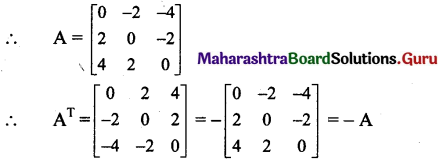
If [aij]3×3 where aij = 2(i – j), find A and
AT. State whether A and AT are symmetric or skew-symmetric matrices?
Solution:
A = [aij]3×3 = \(\left[\begin{array}{lll}
a_{11} & a_{12} & a_{13} \\
a_{21} & a_{22} & a_{23} \\
a_{31} & a_{32} & a_{33}
\end{array}\right]\)
Given aij = 2 (i — j)
∴ a11 = 2(1-1) = 0,
a12 = 2(1-2) = -2,
a13 = 2(1-3) = -4,
a21 = 2(2-1) = 2,
a22 = 2(2-2) = 0,
a23=2(2-3) = -2,
a31 = 2(3-1) = 4,
a32 = 2(3-2) = 2,
a33=2(3-3) = 0
Maharashtra Board 11th Maths Solutions Chapter 4 Determinants and Matrices Ex 4.7 1
∴ AT = -A and A = -AT
∴ A and AT both are skew-symmetric matrices.

Questionn 3.
If A = \(\left[\begin{array}{cc}
5 & -3 \\
4 & -3 \\
-2 & 1
\end{array}\right]\), prove that (2A)T = 2AT.
Solution:
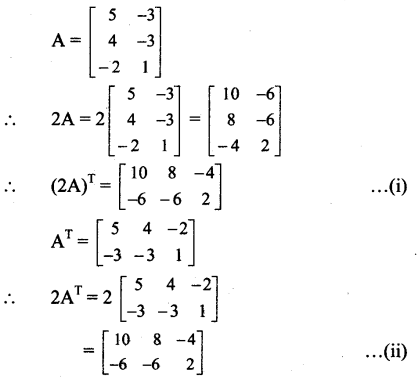
Maharashtra Board 11th Maths Solutions Chapter 4 Determinants and Matrices Ex 4.7 2
From (i) and (ii), we get
(2A)T = 2AT

Maharashtra Board 11th Maths Solutions Chapter 4 Determinants and Matrices Ex 4.7

Question 4.
If A = \(\left[\begin{array}{ccc}
1 & 2 & -5 \\
2 & -3 & 4 \\
-5 & 4 & 9
\end{array}\right]\), prove that (3A)T = 3AT.
Solution:
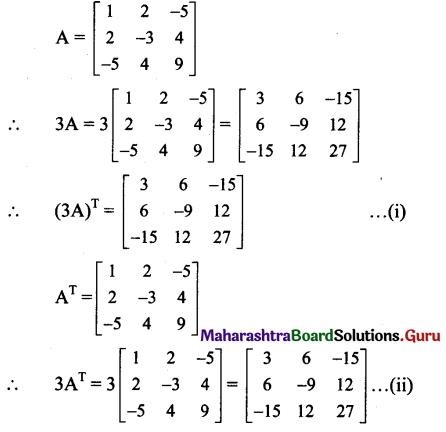
Maharashtra Board 11th Maths Solutions Chapter 4 Determinants and Matrices Ex 4.7 3
From (i) and (ii), we get
(3A)T = 3AT

Question 5.
If A = \(\left[\begin{array}{ccc}
0 & 1+2 i & 1-2 \\
-1-2 i & 0 & -7 \\
2-i & 7 & 0
\end{array}\right]\),
where i = \(\sqrt{-1}\), prove that AT = – A.
Solution:
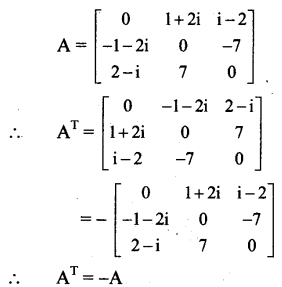
Maharashtra Board 11th Maths Solutions Chapter 4 Determinants and Matrices Ex 4.7 4

Question 6.
If A = \(\left[\begin{array}{cc}
2 & -3 \\
5 & -4 \\
-6 & 1
\end{array}\right]\) , B = \(\left[\begin{array}{cc}
2 & 1 \\
4 & -1 \\
-3 & 3
\end{array}\right]\) and C = \(\left[\begin{array}{cc}
1 & 2 \\
-1 & 4 \\
-2 & 3
\end{array}\right]\) then show that
i. (A + B)T = AT + BT
ii. (A – C)T = AT – CT
Solution:
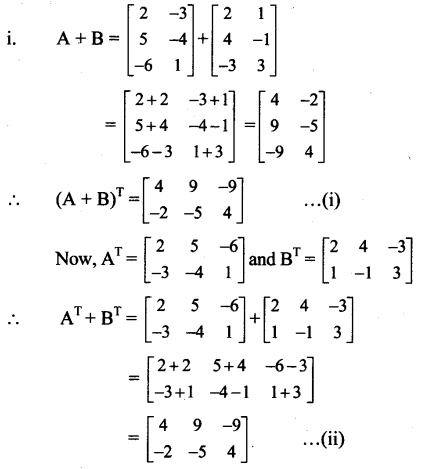
Maharashtra Board 11th Maths Solutions Chapter 4 Determinants and Matrices Ex 4.7 5
From (i) and (ii), we get
(A + B)T = AT + BT
[Note: The question has been modified.]

Maharashtra Board 11th Maths Solutions Chapter 4 Determinants and Matrices Ex 4.7 6
From (i) and (ii), we get
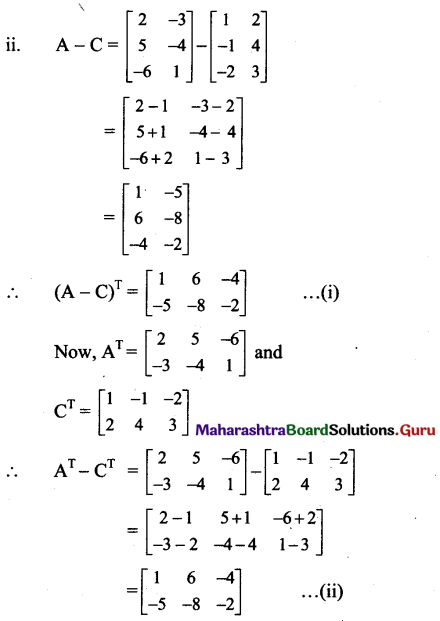
(A – C)T = AT – CT</sup

Maharashtra Board 11th Maths Solutions Chapter 4 Determinants and Matrices Ex 4.7

Question 7.
If A = \(\left[\begin{array}{cc}
5 & 4 \\
-2 & 3
\end{array}\right]\) and \(\left[\begin{array}{cc}
-1 & 3 \\
4 & -1
\end{array}\right]\) then find CT, such that 3A – 2B + C = I, where I is the unit matrix of order 2.
Solution:
3A – 2B + C = I
∴ C = I + 2B – 3A
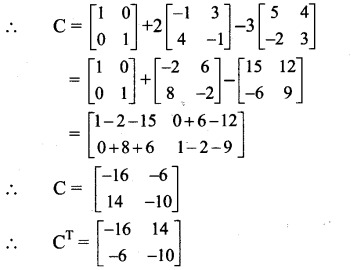
Maharashtra Board 11th Maths Solutions Chapter 4 Determinants and Matrices Ex 4.7 7

Question 8.
If A = \(\left[\begin{array}{ccc}
7 & 3 & 0 \\
0 & 4 & -2
\end{array}\right]\), B = \(\left[\begin{array}{ccc}
0 & -2 & 3 \\
2 & 1 & -4
\end{array}\right]\), then find
i. AT + 4BT
ii. 5AT – 5BT
Solution:
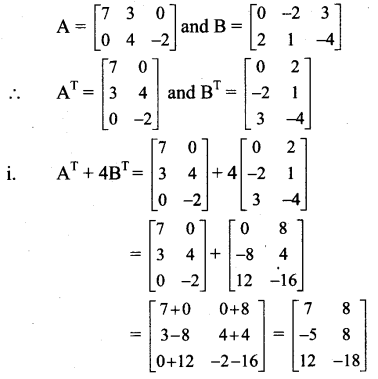
Maharashtra Board 11th Maths Solutions Chapter 4 Determinants and Matrices Ex 4.7 8

ii. ii. 5AT – 5BT = 5(AT – BT)
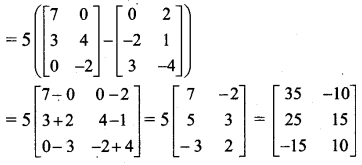
Maharashtra Board 11th Maths Solutions Chapter 4 Determinants and Matrices Ex 4.7 9

Question 9.
If A = \(\left[\begin{array}{lll}
1 & 0 & 1 \\
3 & 1 & 2
\end{array}\right]\), B = \(\left[\begin{array}{rrr}
2 & 1 & -4 \\
3 & 5 & -2
\end{array}\right]\) and C = \(\left[\begin{array}{ccc}
0 & 2 & 3 \\
-1 & -1 & 0
\end{array}\right]\), verify that (A + 2B + 3C)T = AT + 2BT + 3CT.
Solution:
A + 2B + 3C
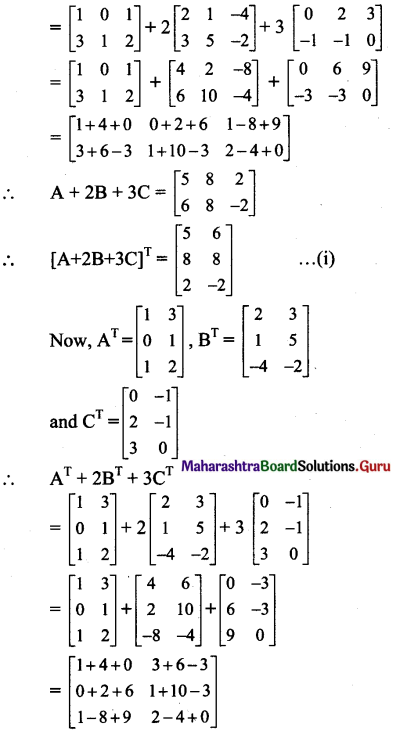
Maharashtra Board 11th Maths Solutions Chapter 4 Determinants and Matrices Ex 4.7 10
∴ AT + 2BT + 3CT = \(\left[\begin{array}{cc}
5 & 6 \\
8 & 8 \\
2 & -2
\end{array}\right]\)
From (i) and (ii), we get
(A + 2B + 3C)T = AT + 2BT + 3CT

Maharashtra Board 11th Maths Solutions Chapter 4 Determinants and Matrices Ex 4.7

Question 10.
If A = \(\left[\begin{array}{ccc}
-1 & 2 & 1 \\
-3 & 2 & -3
\end{array}\right]\) and B = \(\left[\begin{array}{cc}
2 & 1 \\
-3 & 2 \\
-1 & 3
\end{array}\right]\), prove that (A + BT)T = AT + B.
prove that (A + BT)T = AT + B
Solution:
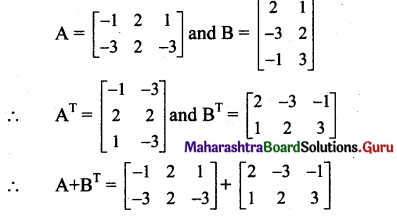
Maharashtra Board 11th Maths Solutions Chapter 4 Determinants and Matrices Ex 4.7 11
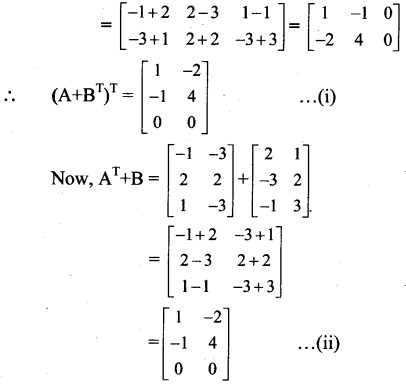
Maharashtra Board 11th Maths Solutions Chapter 4 Determinants and Matrices Ex 4.7 12
From (i) and (ii), we get
(A + BT)T = AT + B

Question 11.
Prove that A + AT is a symmetric and A – AT is a skew symmetric matrix, where
i. A = \(\left[\begin{array}{ccc}
1 & 2 & 4 \\
3 & 2 & 1 \\
-2 & -3 & 2
\end{array}\right]\)
ii. A = \(\left[\begin{array}{ccc}
5 & 2 & -4 \\
3 & -7 & 2 \\
4 & -5 & -3
\end{array}\right]\)
Solution:
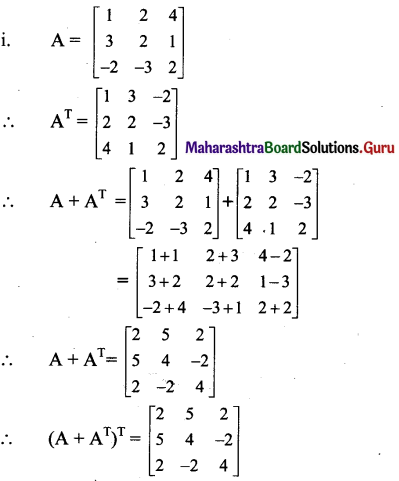
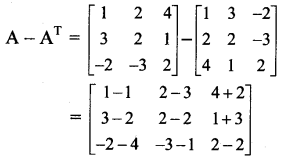
Maharashtra Board 11th Maths Solutions Chapter 4 Determinants and Matrices Ex 4.7 13
∴ (A + AT)T = A + AT, i.e., A + AT = (A + AT)T
∴ A + AT is a symmetric matrix.
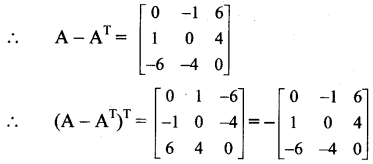
Maharashtra Board 11th Maths Solutions Chapter 4 Determinants and Matrices Ex 4.7 14
Maharashtra Board 11th Maths Solutions Chapter 4 Determinants and Matrices Ex 4.7 15
∴ (A – AT)T = – (A – AT),
i.e., A – AT = -(A – AT)T
∴ A – AT is skew symmetric matrix.

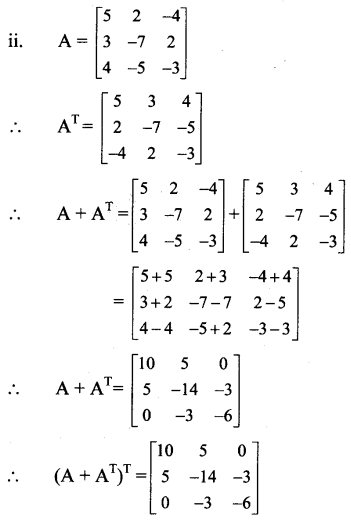
Maharashtra Board 11th Maths Solutions Chapter 4 Determinants and Matrices Ex 4.7 16
∴ (A + AT)T = A + AT, i.e., A + AT = (A + AT)T
∴ A + AT is a symmetric matrix.
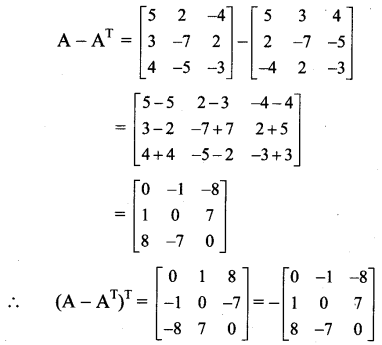
Maharashtra Board 11th Maths Solutions Chapter 4 Determinants and Matrices Ex 4.7 17
∴ (A – AT)T = – (A – AT),
i.e., A – AT = -(A – AT)T
∴ A – AT is skew symmetric matrix.

Maharashtra Board 11th Maths Solutions Chapter 4 Determinants and Matrices Ex 4.7

Question 12.
Express the following matrices as the sum of a symmetric and a skew symmetric matrix.
i. \(\left[\begin{array}{cc}
4 & -2 \\
3 & -5
\end{array}\right]\)
ii. \(\left[\begin{array}{ccc}
3 & 3 & -1 \\
-2 & -2 & 1 \\
-4 & -5 & 2
\end{array}\right]\)
Solution:
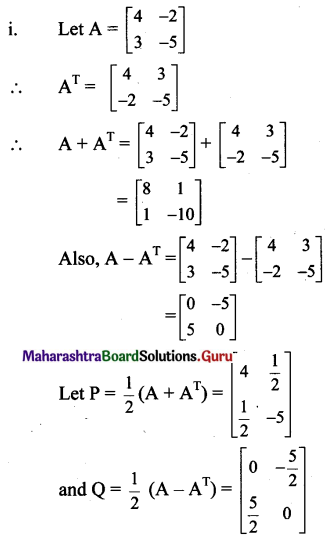
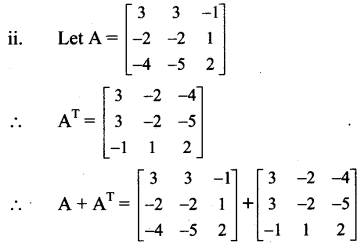
A square matrix A can be expressed as the sum of a symmetric and a skew symmetric matrix as
A = \(\frac{1}{2}\) (A + AT) + \(\frac{1}{2}\) (A – AT)
Maharashtra Board 11th Maths Solutions Chapter 4 Determinants and Matrices Ex 4.7 18
P is symmetric matrix …[∵ aij = aji]
and Q is a skew symmetric matrix [∵ -aij = -aji]
A = P + Q
A = \(\left[\begin{array}{cc}
4 & \frac{1}{2} \\
\frac{1}{2} & -5
\end{array}\right]+\left[\begin{array}{ll}
0 & \frac{-5}{2} \\
\frac{5}{2} & 0
\end{array}\right]\)
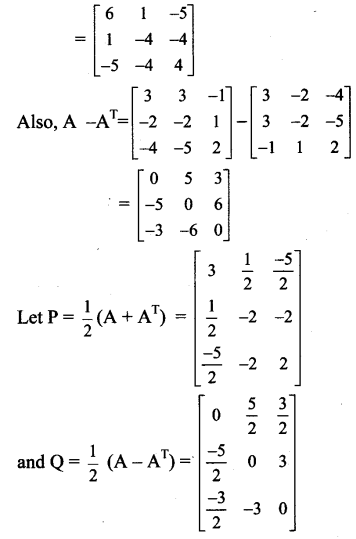
Maharashtra Board 11th Maths Solutions Chapter 4 Determinants and Matrices Ex 4.7 19

Maharashtra Board 11th Maths Solutions Chapter 4 Determinants and Matrices Ex 4.7 20
∴ P is symmetric matrix …[∵ aij = aji]
and Q is a skew symmetric matrix [∵ -aij = -aji]
∴ A = P + Q
∴ A = \(\left[\begin{array}{cc}
4 & \frac{1}{2} \\
\frac{1}{2} & -5
\end{array}\right]+\left[\begin{array}{ll}
0 & \frac{-5}{2} \\
\frac{5}{2} & 0
\end{array}\right]\)

Question 13.
If A = \(\left[\begin{array}{cc}
2 & -1 \\
3 & -2 \\
4 & 1
\end{array}\right]\) and B = \(\left[\begin{array}{ccc}
0 & 3 & -4 \\
2 & -1 & 1
\end{array}\right]\), verify that
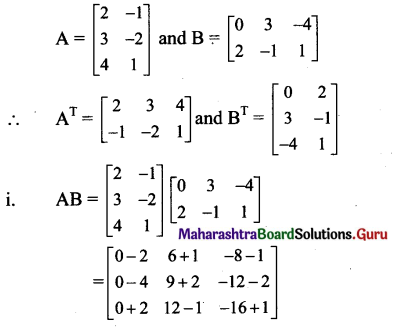
i. (AB)T = BTAT
ii. (BA)T = ATBT
Solution:
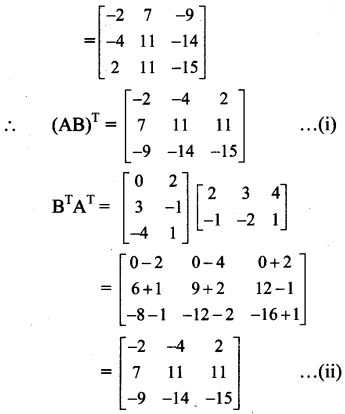
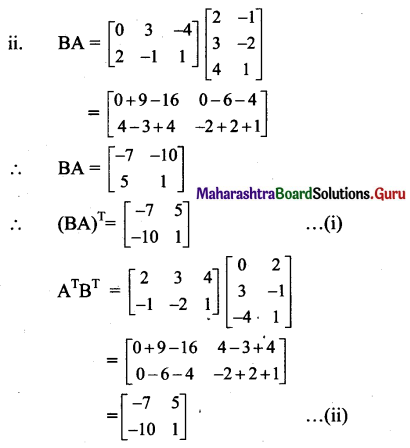
Maharashtra Board 11th Maths Solutions Chapter 4 Determinants and Matrices Ex 4.7 21
Maharashtra Board 11th Maths Solutions Chapter 4 Determinants and Matrices Ex 4.7 22
From (i) and (ii), we get
(AB)T = BTAT
Maharashtra Board 11th Maths Solutions Chapter 4 Determinants and Matrices Ex 4.7 23
From (i) and (ii) we get
(BA)T = ATBT

Maharashtra Board 11th Maths Solutions Chapter 4 Determinants and Matrices Ex 4.7

Question 14.
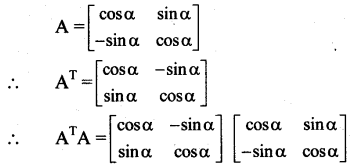
If A = \(\left[\begin{array}{cc}
\cos \alpha & \sin \alpha \\
-\sin \alpha & \cos \alpha
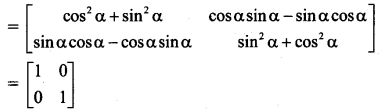
\end{array}\right]\), show that ATA = I, where I is the unit matrix of order 2.
Solution:
Maharashtra Board 11th Maths Solutions Chapter 4 Determinants and Matrices Ex 4.7 24
Maharashtra Board 11th Maths Solutions Chapter 4 Determinants and Matrices Ex 4.7 25
∴ ATA = I, where I is the unit matrix of order 2.

Maharashtra Board 11th Maths Solutions Chapter 5 Straight Line Ex 5.4

Balbharti Maharashtra State Board Class 11 Maths Solutions Pdf Chapter 5 Straight Line Ex 5.4 Questions and Answers.

Maharashtra State Board 11th Maths Solutions Chapter 5 Straight Line Ex 5.4

Question 1.
Find the slope, x-intercept, y-intercept of each of the following lines, i. 2x + 3y-6 = 0 ii. 3x-y-9 = 0 iii. x + 2y = 0
Solution:
i. Given equation of the line is 2x + 3y – 6 = 0.
Comparing this equation with ax + by + c = 0,
we get
a = 2, b = 3, c = -6
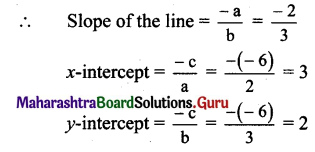
Maharashtra Board 11th Maths Solutions Chapter 5 Straight Line Ex 5.4 1

ii. Given equation of the line is 3x – y – 9 = 0.
Comparing this equation with ax + by + c = 0,
we get
a = 3, b = – 1, c = – 9
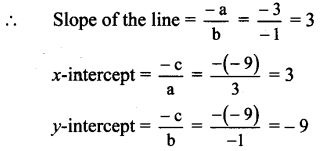
Maharashtra Board 11th Maths Solutions Chapter 5 Straight Line Ex 5.4 2

Maharashtra Board 11th Maths Solutions Chapter 5 Straight Line Ex 5.4

iii. Given equation of the line is x + 2y = 0.
Comparing this equation with ax + by + c = 0,
we get
a = 1, b = 2, c = 0
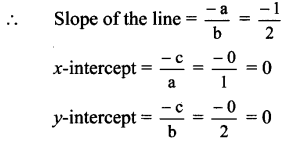
Maharashtra Board 11th Maths Solutions Chapter 5 Straight Line Ex 5.4 3

Question 2.
Write each of the following equations in ax + by + c = 0 form.
i. y = 2x – 4
ii. y = 4
iii. \(\frac{x}{2}+\frac{y}{4}=1\)
iv. \(\frac{x}{3}-\frac{y}{2}=0\)
i. y = 2x – 4
∴ 2x – y – 4 = 0 is the equation in ax + by + c = 0 form.

ii. y = 4
∴ 0x + 1y – 4 = 0 is the equation in ax + by + c = 0 form.

iii. \(\frac{x}{2}+\frac{y}{4}=1\)
∴ \(\frac{2 x+y}{4}\)
∴ 2x + y – 4 = 0 is the equation in ax + by + c = 0 form.

iv. \(\frac{x}{3}-\frac{y}{2}=0\)
∴ 2x – 3y = 0
∴ 2x – 3y + 0 = 0 is the equation in ax + by + c = 0 form.
[Note: Answer given in the textbook is ‘2x – 3y – 6 = 0’. However, as per our calculation it is ‘2x-3y + 0 = 0’.]

Question 3.
Show that the lines x – 2y – 7 = 0 and 2x – 4y + 15 = 0 are parallel to each other.
Solution:
Let m1 be the slope of the line x – 2y – 7 = 0.
∴ m1 = \(\frac{-\text { coefficient of } x}{\text { coefficient of } y}=\frac{-1}{-2}=\frac{1}{2}\)
Let m2 be the slope of the line 2x – 4y + 15 = 0.
∴ m2 = \(\frac{-\text { coefficient of } x}{\text { coefficient of } y}=\frac{-2}{-4}=\frac{1}{2}\)
Since m1 = m2
the given lines are parallel to each other.

Question 4.
Show that the lines x – 2y – 7 = 0 and 2x + y + 1 = 0 are perpendicular to each other. Find their point of intersection.
Solution:
Let m1 be the slope of the line x – 2y – 7 = 0.
∴ m1 = \(\frac{-\text { coefficient of } x}{\text { coefficient of } y}=\frac{-1}{-2}=\frac{1}{2}\)
Let m2 be the slope of the line 2x + y + 1 = 0.
∴ m2 = \(\frac{-\text { coefficient of } x}{\text { coefficient of } y}=\frac{-2}{1}=-2\)
Since m1 x m1 = \(\frac{1}{2}\) x (- 2) = -1,
the given lines are perpendicular to each other. Consider,
x – 2y – 7 = 0 …(i)
2x + y + 1 =0 …(ii)
Multiplying equation (ii) by 2, we get
4x + 2y + 2 = 0 …(iii)
Adding equations (i) and (iii), we get
5x – 5 = 0
∴ x = 1
Substituting x = 1 in equation (ii), we get
2 + y + 1 = 0
∴ y = – 3
∴ The point of intersection of the given lines is (1,-3).

Maharashtra Board 11th Maths Solutions Chapter 5 Straight Line Ex 5.4

Question 5.
If the line 3x + 4y = p makes a triangle of area 24 square units with the co-ordinate axes, then find the value of p.
Solution:
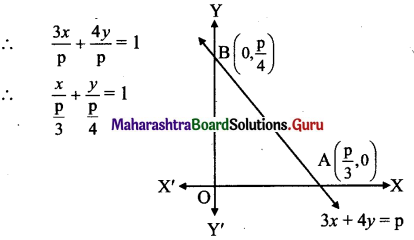
Let the line 3x + 4y = p cuts the X and Y axes at points A and B respectively.
3x + 4y = p
Maharashtra Board 11th Maths Solutions Chapter 5 Straight Line Ex 5.4 4
This equation is of the form \(\frac{x}{a}+\frac{y}{b}=1\),
where a = \(\frac{p}{3}\) and b = \(\frac{p}{4}\)
∴ A (a, 0) ≡ (\(\frac{p}{3}\), 0) and B ≡ (0, b) = (0, \(\frac{p}{4}\))
∴ OA = \(\frac{p}{3}\) and OB = \(\frac{p}{4}\)
Given, A (∆OAB) = 24 sq. units
∴ \(\left|\frac{1}{2} \times \mathrm{OA} \times \mathrm{OB}\right|=24\)
∴ \(\left|\frac{1}{2} \times \frac{\mathrm{p}}{3} \times \frac{\mathrm{p}}{4}\right|=24\)
∴ p2 = 576
∴ p = ± 24

Question 6.
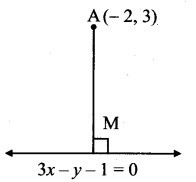
Find the co-ordinates of the foot of the perpendicular drawn from the point A(- 2,3) to the line 3x-y -1 = 0.
Solution:
Let M be the foot of perpendicular drawn from
point A(- 2,3) to the line
3x-y- 1 = 0 …(i)
Slope of the line 3x-y – 1 = 0 is \(\frac{-3}{-1}\) =3.
Since AM ⊥ to line (i),
slope of AM = \(\frac{-1}{3}\)
∴ Equation of AM is
y – 3 = \(\frac{-1}{3}\)(x + 2)
Maharashtra Board 11th Maths Solutions Chapter 5 Straight Line Ex 5.4 5
∴ 3(y – 3) = – 1(x + 2)
∴ 3y – 9 = -x – 2
∴ x + 3y – 7 = 0 …………(ii)
The foot of perpendicular i.e., point M, is the point of intersection of equations (i) and (ii).
By (i) x 3 + (ii), we get 10x -10 = 0
∴ x = 1
Substituting x = 1 in (ii), we get
1 + 3y – 7 = 0
∴ 3y = 6
∴ y = 2
∴ The co-ordinates of the foot of the perpendicular Mare (1,2).

Question 7.
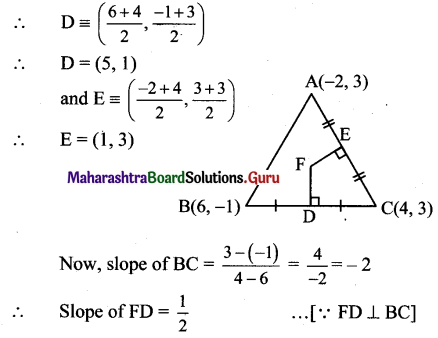
Find the co-ordinates of the circumcentre of the triangle whose vertices are A(- 2, 3), B(6, -1), C(4,3),e
Solution:
Here, A(-2, 3), B(6, -1), C(4, 3) are the vertices of ∆ABC.
Let F be the circumcentre of AABC.
Let FD and FE be the perpendicular bisectors of the sides BC and AC respectively.
∴ D and E are the midpoints of side BC and AC respectively.
Maharashtra Board 11th Maths Solutions Chapter 5 Straight Line Ex 5.4 6
Since FD passes through (5, 1) and has slope 1/2 equation of FD is
y – 1 = \(\frac{1}{2}\)(x-5)
∴ 2 (y – 1) = x – 5
∴ 2y – 2 = x – 5
∴ x – 2y – 3 = 0 …(i)
Since both the points A and C have same y co-ordinates i.e. 3,
the given points lie on the line y = 3.
Since the equation FE passes through E(1, 3),
the equation of FE is x = 1. .. .(ii)
To find co-ordinates of circumcentre, we have to solve equations (i) and (ii).
Substituting the value of x in (i), we get
1 – 2y -3 = 0
∴ y = -1
∴ Co-ordinates of circumcentre F ≡ (1, – 1).

Question 8.
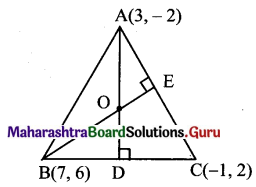
Find the co-ordinates of the orthocentre of the triangle whose vertices are A(3, – 2), B(7,6), C (-1,2).
Solution:
Let O be the orthocentre of ∆ABC.
Let AD and BE be the altitudes on the sides BC and AC respectively.
Maharashtra Board 11th Maths Solutions Chapter 5 Straight Line Ex 5.4 7
Slope of side BC = \(\frac{2-6}{-1-7}=\frac{-4}{-8}=\frac{1}{2}\)
∴ Slope of AD = – 2 [∵ AD ⊥ BC]
∴ Equation of line AD is
y – (-2) = (- 2) (x – 3)
∴ y + 2 = -2x + 6
∴ 2x + y -4 = 0 …(i)
Slope of side AC = \(\frac{-2-2}{3-(-1)}=\frac{-4}{4}\) = -1
∴ Slope of BE = 1 …[ ∵ BE ⊥ AC]
∴ Equation of line BE is
y – 6 = 1(x – 7)
∴ y – 6 = x – 1
∴ x = y + 1 …(ii)
Substituting x = y + 1 in (i), we get
2(y + 1) + y – 4 = 0
∴ 2y + 2 + y – 4 = 0
∴ 3y – 2 = 0
∴ y = \(\frac{2}{3} in (ii), we get
Substituting y = [latex]\frac{2}{3}\) in (ii), we get
x = \(\frac{2}{3}+1=\frac{5}{3}\)
∴ Co-ordinates of orthocentre, O = \(\left(\frac{5}{3}, \frac{2}{3}\right)\)

Maharashtra Board 11th Maths Solutions Chapter 5 Straight Line Ex 5.4

Question 9.
Show that the lines 3 – 4y + 5 = 0, lx – 8y + 5 = 0 and 4JC + 5y – 45 = 0 are concurrent. Find their point of concurrence.
Solution:
The number of lines intersecting at a point are called concurrent lines and their point of intersection is called the point of concurrence. Equations of the given lines are
3x – 4y + 5 = 0 …(i)
7x-8y + 5 = 0 …(ii)
4x + 5y – 45 = 0 …(iii)
By (i) x 2 – (ii), we get
– x + 5 = 0
∴ x = 5
Substituting x = 5 in (i), we get
3(5) – 4y + 5 = 0
∴ -4y = – 20
∴ y = 5
∴ The point of intersection of lines (i) and (ii) is given by (5, 5).
Substituting x = 5 and y = 5 in L.H.S. of (iii), we get
L.H.S. = 4(5) + 5(5) – 45
= 20 + 25 – 45
= 0
= R.H.S.
∴ Line (iii) also passes through (5, 5).
Hence, the given three lines are concurrent and the point of concurrence is (5, 5).

Question 10.
Find the equation of the line whose x-intercept is 3 and which ¡s perpendicular to the line 3x – y + 23 = 0.
Solution:
Slope of the line 3x – y + 23 = 0 is 3.
∴ Slope of the required line perpendicular to
3x – y + 23 = 0 is \(\frac{-1}{3}\)
Since the x-intercept of the required line is 3, it passes through (3, 0).
∴ The equation of the required line is ‘
y – 0 = \(\frac{-1}{3}\)(x – 3)
∴ 3y = x + 3
∴ x + 3y = 3

Question 11.
Find the distance of the origin from the line 7x + 24y – 50 = 0.
Solution:
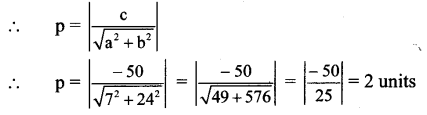
Let p be the perpendicular distance of origin
fromtheline7x + 24y – 50 = 0
Here, a = 7, b = 24, c = -50
Maharashtra Board 11th Maths Solutions Chapter 5 Straight Line Ex 5.4 8

Question 12.
Find the distance of the point A(- 2, 3) from the line 12x – 5y – 13 = 0.
Solution:
Let p be the perpendicular distance of the point A(- 2, 3) from the line 12x – 5y – 13 = 0
Here, a = 12, b = – 5, c = – 13, x1 = -2, y1 = 3
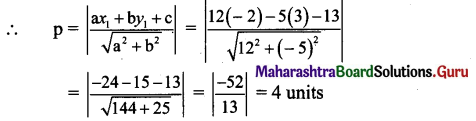
Maharashtra Board 11th Maths Solutions Chapter 5 Straight Line Ex 5.4 9

Question 13.
Find the distance between parallel lines 4x – 3y + 5 = 0 and 4xr – 3y + 7 = 0.
Solution:
Equations of the given parallel lines are 4x – 3y + 5 = 0 and 4x – 3y + 1 = 0
Here, a = 4, b = – 3, c1 = 5 and c2 = 7
∴ Distance between the parallel lines
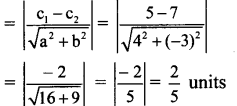
Maharashtra Board 11th Maths Solutions Chapter 5 Straight Line Ex 5.4 10

Question 14.
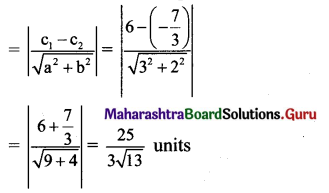
Find the distance between the parallel lines 9x + 6y – 7 = 0 and 3x + 2y + 6 = 0.
Solution:
Equations of the given parallel lines are 3x + 2y + 6 = 0 and
9x + 6y – 1 = 0 i.e., 3x + 2y – \(\frac{7}{3}\) =0
Here, a = 3, b = 2, c1 = 6 and c2 = \(\frac{-7}{3}\)
∴ Distance between the parallel lines
Maharashtra Board 11th Maths Solutions Chapter 5 Straight Line Ex 5.4 11

Maharashtra Board 11th Maths Solutions Chapter 5 Straight Line Ex 5.4

Question 15.
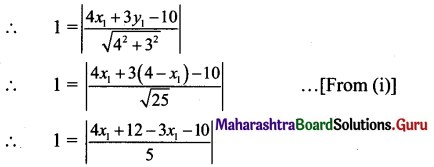
Find the points on the line x + y – 4 = 0 which are at a unit distance from the line 4JC + 3y = 10.
Solution:
Let P(x1, y1) be a point on the line x + y – 4 = o.
∴ x1 + y1 – 4 = 0
∴ y1 = 4 – x1 …(i)
Also, distance of P from the line 4x + 3y- 10 = 0 is 1
Maharashtra Board 11th Maths Solutions Chapter 5 Straight Line Ex 5.4 12
∴ 5 = | x1 + 2 |
∴ x1 + 2 = ± 5
∴ x1 + 2 = 5 or x1 + 2 = – 5
∴ x1 = 3 or x1 = – 7
From (i), when x1 = 3, y1 = 1
and when x1 = -7, y1 = 11
∴ The required points are (3, 1) and (-7, 11).
[Note: The question has been modified]

Question 16.
Find the equation of the line parallel to the X-axis and passing through the point of intersection of lines x + y – 2 = 0 and 4x + 3y = 10.
Solution:
Let u = x + y – 2 = 0 and v = 4x + 3y – 10 = 0
Equation of the line passing through the point of intersection of lines u = 0 and v = 0 is given by u + kv = 0.
∴ (x + y – 2) + k(4x + 3y – 10) = 0 …(i)
∴ x + y – 2 + 4kx + 3ky – 10k = 0
∴ x + 4kx + y + 3ky – 2 – 10k = 0
∴ (1+ 4k)x + (1 + 3k)y – 2 – 10k = 0
But, this line is parallel to X-axis.
∴ Its slope = 0
∴ \(\frac{-(1+4 k)}{1+3 k}\) = 0
∴ 1 + 4k = 0
∴ k = \(\frac{-1}{4}\)
Substituting the value of k in (i), we get
(x + y – 2) + (4x + 3y – 10) = 0
∴ 4(x +y – 2) – (4x + 3y -10 ) = 0
∴ 4x + 4y – 8 – 4x – 3y + 10 = 0
∴ y + 2 = 0, which is the equation of the required line.
[Note: Answer given in the textbook is 5y – 8= 0. However, as per our calculation it is y + 2 = 0.]

Question 17.
Find the equation of the line passing through the point of intersection of lines x + y – 2 = 0 and 2xr – 3y + 4 = 0 and making intercept 3 on the X-axis.
Solution:
Let u ≡ x + y – 2 = 0 and v ≡ 2x – 3y + 4 = 0
Equation of the line passing through the point of intersection of lines u = 0 and v = 0 is given by u + kv = 0.
∴ (x +y – 2) + k(2x – 3y + 4) = 0 …(i)
But, x-intercept of line is 3.
∴ It passes through (3, 0).
Substituting x = 3 and y = 0 in (i), we get
(3 + 0 – 2) + k(6 – 0 + 4) = 0
∴ 1 + 10k = 0
k = \(\frac{-1}{10}\)
Substituting the value of k in (i), we get (x + y – 2) + \(\left(\frac{-1}{10}\right)\) (2x – 3y + 4) = 0
∴ 10(x + y – 2) – (2x – 3y + 4) = 0
∴ 10x + 10y -20 — 2x + 3y-4 = 0
∴ 8x + 13y – 24 = 0, which is the equation of the required line.

Question 18.
If A(4, 3), B(0, 0) and C(2, 3) are the vertices of ΔABC, then find the equation of bisector of angle BAC.
Solution:
Let the bisector of ∠ BAC meets BC at point D.
∴ Point D divides seg BC in the ratio l(AB) : l(AC)
Maharashtra Board 11th Maths Solutions Chapter 5 Straight Line Ex 5.4 13
∴ 18 (y – 3) = 6 (x – 4)
∴ 3(y – 3) = x – 4
∴ 3y – 9 = x – 4
∴ x – 3y + 5 = 0

Maharashtra Board 11th Maths Solutions Chapter 5 Straight Line Ex 5.4

Question 19.
D(- 1, 8), E(4, – 2), F(- 5, – 3) are midpoints of sides BC, CA and AB of AABC. Find
i. equations of sides of ΔABC.
ii. co-ordinates of the circumcentre of ΔABC.
Solution:
Let A(x1, y1), B(x2, y2) and C(x3, y3) be the vertices of ΔABC.
Given, points D, E and F are midpoints of sides BC, CA and AB respectively of ΔABC.
Maharashtra Board 11th Maths Solutions Chapter 5 Straight Line Ex 5.4 14
∴ x1 + x2 = -10 …………. (v)
and y1 + y2 = – 6 …………(vi)
For x-coordinates:
Adding (i), (iii) and (v), we get
2x1 + 2x2 + 2x3 = – 4
∴ x1 + x2 + x3 = -2 …………..(vii)
Solving (i) and (vii), we get x1 = 0
Solving (iii) and (vii), we get x2 = – 10
Solving (v) and (vii), we get x3 = 8

For y-coordinates:
Adding (ii), (iv) and (vi), we get 2y1 + 2y2 + 2y3 = 6
y1 + y2 + y3 = 3 …….(viii)
Solving (ii) and (viii), we get y1 = -13
Solving (iv) and (viii), we get y2 = 7
Solving (vi) and (viii), we get y3 = 9
∴ Vertices of AABC are A(0, – 13), B(- 10, 7), C(8, 9)
Maharashtra Board 11th Maths Solutions Chapter 5 Straight Line Ex 5.4 15
∴ 8(y + 13) = 22x
∴ 4(y + 13) = 11x
∴ 11x – 4y – 52 = 0

ii. Here, A(0, – 13), B(- 10, 7), C(8, 9) are the vertices of ΔABC.
Let F be the circumcentre of AABC.
Let FD and FE be perpendicular bisectors of the sides BC and AC respectively.
D and E are the midpoints of side BC and AC.
Maharashtra Board 11th Maths Solutions Chapter 5 Straight Line Ex 5.4 16
∴ Slope of FD = -9 … [ ∵ FD ⊥ BC]
Since FD passes through (-1, 8) and has slope -9, equation of FD is
y – 8 = -9 (x +1)
∴ y – 8 = -9x – 9
∴ y = -9x – 1
Also, slope of AC = \(\frac{-13-9}{0-8}=\frac{11}{4}\)
∴ Slope of FE = \(\frac{-4}{11}\) [ ∵ FE ⊥ AC]
Since FE passes through (4, -2) and has slope -4
\(\frac{-4}{11}\), equation of FE is
(y + 2) = \(\frac{-4}{11}\) (x – 4)
∴ 11(y + 2) = -4(x – 4)
∴ 11y + 22 = – 4x + 16
∴ 4x + 11y = -6 …………(ii)
To find co-ordinates of circumcentre, we have to solve equations (i) and (ii).
Substituting the value ofy in (ii), we get
4x + 11(-9x- 1) = – 6
∴ 4x – 99x -11 = – 6
∴ -95x = 5
∴ x = \(\frac{-1}{19}\)
Substituting the value of x in (i), we get
y = -9(\(\frac{-1}{19}\)) – 1 = \(\frac{-10}{19}\)
∴ Co-ordinates of circumcentre F ≡ \(\left(\frac{-1}{19}, \frac{-10}{19}\right)\)

Question 20.
0(0, 0), A(6, 0) and B(0, 8) are vertices of a triangle. Find the co-ordinates of the incentre of ∆OAB.
Solution:
Let bisector of ∠O meet AB at point D and bisector of ∠A meet BO at point E
∴ Point D divides seg AB in the ratio l(OA): l(OB)
and point E divides seg BO in the ratio l(AB): l(AO)
Let I be the incentre of ∠OAB.
Maharashtra Board 11th Maths Solutions Chapter 5 Straight Line Ex 5.4 17
∴ Point D divides AB internally in 6 : 8
i.e. 3 :4
Maharashtra Board 11th Maths Solutions Chapter 5 Straight Line Ex 5.4 18
∴ y = x …(i)
Now, by distance formula,
l(AB) = \(\begin{aligned}
&=\sqrt{(6-0)^{2}+(0-8)^{2}} \\
&=\sqrt{36+64}=10
\end{aligned}\)
l(AO) = \(\sqrt{(6-0)^{2}+(0-0)^{2}}\) = 6
∴ Point E divides BO internally in 10 : 6 i.e. 5:3
Maharashtra Board 11th Maths Solutions Chapter 5 Straight Line Ex 5.4 19
∴ -2y = x – 6
∴ x + 2y = 6 …(ii)
To find co-ordinates of incentre, we have to solve equations (i) and (ii).
Substituting y = x in (ii), we get
x + 2x = 6
∴ x = 2
Substituting the value of x in (i), we get
y = 2
∴ Co-ordinates of incentre I ≡ (2, 2).

Maharashtra Board 11th Maths Solutions Chapter 5 Straight Line Ex 5.4

Alternate Method:
Let I be the incentre.
I lies in the 1st quadrant.
OPIR is a square having side length r.
Since OA = 6, OP = r,
PA = 6 – r
Since PA = AQ,
AQ = 6 – r …(i)
Since OB = 8, OR = r,
BR = 8 – r
∴ BR = BQ
∴ BQ = 8 – r …(ii)
Maharashtra Board 11th Maths Solutions Chapter 5 Straight Line Ex 5.4 20
AB = BQ + AQ
Also, AB = \(\begin{aligned}
&=\sqrt{\mathrm{OA}^{2}+\mathrm{OB}^{2}} \\
&=\sqrt{6^{2}+8^{2}} \\
&=\sqrt{100}=10
\end{aligned}\)
∴ BQ + AQ= 10
∴ (8 – r) + (6 – r) = 10
∴ 2r = 14- 10 = 4
∴ r = 2
∴ I = (2,2)

Maharashtra Board 12th Maths Solutions Chapter 1 Differentiation Ex 1.2

Balbharti 12th Maharashtra State Board Maths Solutions Book Pdf Chapter 1 Differentiation Ex 1.2 Questions and Answers.

Maharashtra State Board 12th Maths Solutions Chapter 1 Differentiation Ex 1.2

Question 1.
Find the derivative of the function y = f (x) using the derivative of the inverse function x = f-1( y) in the following
(i) y = \(\sqrt {x}\)
Solution:
y = \(\sqrt {x}\) … (1)
We have to find the inverse function of y = f(x), i.e. x in terms of y.
From (1),
y2 = x ∴ x = y2
Maharashtra Board 12th Maths Solutions Chapter 1 Differentiation Ex 1.2 1

(ii) y = \(\sqrt{2-\sqrt{x}}\)
Solution:
y = \(\sqrt{2-\sqrt{x}}\) …(1)
We have to find the inverse function of y = f(x), i.e. x in terms of y.
From (1),
Maharashtra Board 12th Maths Solutions Chapter 1 Differentiation Ex 1.2 2

(iii) y = \(\sqrt[3]{x-2}\)
Solution:
y = \(\sqrt[3]{x-2}\) ….(1)
We have to find the inverse function of y = f(x), i.e. x in terms of y.
From (1),
Maharashtra Board 12th Maths Solutions Chapter 1 Differentiation Ex 1.2 3
Maharashtra Board 12th Maths Solutions Chapter 1 Differentiation Ex 1.2 4

Maharashtra Board 12th Maths Solutions Chapter 1 Mathematical Logic Ex 1.1

(iv) y = log (2x – 1)
Solution:
y = log (2x – 1) …(1)
We have to find the inverse function of y = f(x), i.e. x in terms of y.
From (1),
Maharashtra Board 12th Maths Solutions Chapter 1 Differentiation Ex 1.2 5

(v) y = 2x + 3
Solution:
y = 2x + 3 ….(1)
We have to find the inverse function of y = f(x), i.e. x in terms of y.
From (1),
Maharashtra Board 12th Maths Solutions Chapter 1 Differentiation Ex 1.2 6

(vi) y = ex – 3
Solution:
y = ex – 3 ….(1)
We have to find the inverse function of y = f(x), i.e. x in terms of y.
From (1),
ex = y + 3
∴ x = log(y + 3)
∴ x = f-1(y) = log(y + 3)
Maharashtra Board 12th Maths Solutions Chapter 1 Differentiation Ex 1.2 7

Maharashtra Board 12th Maths Solutions Chapter 1 Mathematical Logic Ex 1.1

(vii) y = e2x – 3
Solution:
y = e2x – 3 ….(1)
We have to find the inverse function of y = f(x), i.e. x in terms of y.
From (1),
2x – 3 = log y ∴ 2x = log y + 3
Maharashtra Board 12th Maths Solutions Chapter 1 Differentiation Ex 1.2 8

(viii) y = log2\(\left(\frac{x}{2}\right)\)
Solution:
y = log2\(\left(\frac{x}{2}\right)\) …(1)
We have to find the inverse function of y = f(x), i.e. x in terms of y.
From (1),
\(\frac{x}{2}\) = 2y ∴ x = 2∙2y = 2y+1
∴ x = f-1(y) = 2y+1
Maharashtra Board 12th Maths Solutions Chapter 1 Differentiation Ex 1.2 9

Question 2.
Find the derivative of the inverse function of
the following
(i) y = x2·ex
Solution:
y = x2·ex
Differentiating w.r.t. x, we get
Maharashtra Board 12th Maths Solutions Chapter 1 Differentiation Ex 1.2 10

Maharashtra Board 12th Maths Solutions Chapter 1 Mathematical Logic Ex 1.1

(ii) y = x cos x
Solution:
y = x cos x
Differentiating w.r.t. x, we get
Maharashtra Board 12th Maths Solutions Chapter 1 Differentiation Ex 1.2 11
Maharashtra Board 12th Maths Solutions Chapter 1 Differentiation Ex 1.2 12

(iii) y = x·7x
Solution:
y = x·7x
Differentiating w.r.t. x, we get
Maharashtra Board 12th Maths Solutions Chapter 1 Differentiation Ex 1.2 13

(iv) y = x2 + logx
Solution:
y = x2 + logx
Differentiating w.r.t. x, we get
Maharashtra Board 12th Maths Solutions Chapter 1 Differentiation Ex 1.2 14

Maharashtra Board 12th Maths Solutions Chapter 1 Mathematical Logic Ex 1.1

(v) y = x logx
Solution:
y = x logx
Differentiating w.r.t. x, we get
Maharashtra Board 12th Maths Solutions Chapter 1 Differentiation Ex 1.2 15
Maharashtra Board 12th Maths Solutions Chapter 1 Differentiation Ex 1.2 16

Question 3.
Find the derivative of the inverse of the following functions, and also fid their value at the points indicated against them.
(i) y = x5 + 2x3 + 3x, at x = 1
Solution:
y = x5 + 2x3 + 3x
Differentiating w.r.t. x, we get
\(\frac{d y}{d x}\) = \(\frac{d}{d x}\)(x5 + 2x3 + 3x)
= 5x4 + 2 × 3x2 + 3 × 1
= 5x4 + 6x2 + 3
The derivative of inverse function of y = f(x) is given by
Maharashtra Board 12th Maths Solutions Chapter 1 Differentiation Ex 1.2 17

(ii) y = ex + 3x + 2, at x = 0
Solution:
y = ex + 3x + 2
Differentiating w.r.t. x, we get
\(\frac{d y}{d x}\) = \(\frac{d}{d x}\)(ex + 3x + 2)
The derivative of inverse function of y = f(x) is given by
Maharashtra Board 12th Maths Solutions Chapter 1 Differentiation Ex 1.2 18
Maharashtra Board 12th Maths Solutions Chapter 1 Differentiation Ex 1.2 19

Maharashtra Board 12th Maths Solutions Chapter 1 Mathematical Logic Ex 1.1

(iii) y = 3x2 + 2 log x3, at x = 1
Solution:
y = 3x2 + 2 log x3
= 3x2 + 6 log x
Differentiating w.r.t. x, we get
Maharashtra Board 12th Maths Solutions Chapter 1 Differentiation Ex 1.2 20
The derivative of inverse function of y = f(x) is given by
Maharashtra Board 12th Maths Solutions Chapter 1 Differentiation Ex 1.2 21

(iv) y = sin (x – 2) + x2, at x = 2
Solution:
y = sin (x – 2) + x2
Differentiating w.r.t. x, we get
Maharashtra Board 12th Maths Solutions Chapter 1 Differentiation Ex 1.2 22
Maharashtra Board 12th Maths Solutions Chapter 1 Differentiation Ex 1.2 23

Question 4.
If f(x) = x3 + x – 2, find (f-1)’ (0).
Question is modified.
If f(x) = x3 + x – 2, find (f-1)’ (-2).
Solution:
f(x) = x3 + x – 2 ….(1)
Differentiating w.r.t. x, we get
Maharashtra Board 12th Maths Solutions Chapter 1 Differentiation Ex 1.2 24

Maharashtra Board 12th Maths Solutions Chapter 1 Mathematical Logic Ex 1.1

Question 5.
Using derivative prove
(i) tan-1x + cot-1x = \(\frac{\pi}{2}\)
Solution:
let f(x) = tan-1x + cot-1x
Differentiating w.r.t. x, we get
Maharashtra Board 12th Maths Solutions Chapter 1 Differentiation Ex 1.2 25
Since, f'(x) = 0, f(x) is a constant function.
Let f(x) = k.
For any value of x, f(x) = k
Let x = 0.
Then f(0) = k ….(2)
From (1), f(0) = tan-1(0) + cot-1(0)
= 0 + \(\frac{\pi}{2}=\frac{\pi}{2}\)
Maharashtra Board 12th Maths Solutions Chapter 1 Differentiation Ex 1.2 26

(ii) sec-1x + cosec-1x = \(\frac{\pi}{2}\) . . . [for |x| ≥ 1]
Solution:
Let f(x) = sec-1x + cosec-1x for |x| ≥ 1 ….(1)
Differentiating w.r.t. x, we get
Maharashtra Board 12th Maths Solutions Chapter 1 Differentiation Ex 1.2 27
Since, f'(x) = 0, f(x) is a constant function.
Let f(x) = k.
For any value of x, f(x) = k, where |x| > 1
Let x = 2.
Then, f(2) = k ……(2)
Maharashtra Board 12th Maths Solutions Chapter 1 Differentiation Ex 1.2 28

Maharashtra Board 12th Maths Solutions Chapter 1 Mathematical Logic Ex 1.1

Question 6.
Diffrentiate the following w. r. t. x.
(i) tan-1(log x)
Solution:
Let y = tan-1(log x)
Differentiating w.r.t. x, we get
Maharashtra Board 12th Maths Solutions Chapter 1 Differentiation Ex 1.2 29

(ii) cosec-1(e-x)
Solution:
Let y = cosec-1(e-x)
Differentiating w.r.t. x, we get
Maharashtra Board 12th Maths Solutions Chapter 1 Differentiation Ex 1.2 104

(iii) cot-1(x3)
Solution:
Let y = cot-1(x3)
Differentiating w.r.t. x, we get
Maharashtra Board 12th Maths Solutions Chapter 1 Differentiation Ex 1.2 105

Maharashtra Board 12th Maths Solutions Chapter 1 Mathematical Logic Ex 1.1

(iv) cot-1(4x
Solution:
Let y = cot-1(4x
Differentiating w.r.t. x, we get
Maharashtra Board 12th Maths Solutions Chapter 1 Differentiation Ex 1.2 106

(v) tan-1(\(\sqrt {x}\))
Solution:
Let y = tan-1(\(\sqrt {x}\))
Differentiating w.r.t. x, we get
Maharashtra Board 12th Maths Solutions Chapter 1 Differentiation Ex 1.2 107

(vi) sin-1\(\left(\sqrt{\frac{1+x^{2}}{2}}\right)\)
Solution:
Let y = sin-1\(\left(\sqrt{\frac{1+x^{2}}{2}}\right)\)
Differentiating w.r.t. x, we get
Maharashtra Board 12th Maths Solutions Chapter 1 Differentiation Ex 1.2 108

Maharashtra Board 12th Maths Solutions Chapter 1 Mathematical Logic Ex 1.1

(vii) cos-1(1 – x2)
Solution:
Let y = cos-1(1 – x2)
Differentiating w.r.t. x, we get
Maharashtra Board 12th Maths Solutions Chapter 1 Differentiation Ex 1.2 109
Maharashtra Board 12th Maths Solutions Chapter 1 Differentiation Ex 1.2 30

(viii) sin-1\(\left(x^{\frac{3}{2}}\right)\)
Solution:
Let y = sin-1\(\left(x^{\frac{3}{2}}\right)\)
Differentiating w.r.t. x, we get
Maharashtra Board 12th Maths Solutions Chapter 1 Differentiation Ex 1.2 31

Maharashtra Board 12th Maths Solutions Chapter 1 Mathematical Logic Ex 1.1

(ix) cos3[cos-1(x3)]
Solution:
Let y = cos3[cos-1(x3)]
= [cos(cos-1x3)]3
= (x3)3 = x9
Differentiating w.r.t. x, we get
\(\frac{d y}{d x}\) = \(\frac{d}{d x}\)(x9) = 9x8.

(x) sin4[sin-1(\(\sqrt {x}\))]
Solution:
Let y = sin4[sin-1(\(\sqrt {x}\))]
= {sin[sin-1(\(\sqrt {x}\))]}8
= (\(\sqrt {x}\))4 = x2
Differentiating w.r.t. x, we get
\(\frac{d y}{d x}\) = \(\frac{d}{d x}\)(x2) = 2x.

Question 7.
Diffrentiate the following w. r. t. x.
(i) cot-1[cot (ex2)]
Solution:
Let y = cot-1[cot (ex2)] = ex2
Maharashtra Board 12th Maths Solutions Chapter 1 Differentiation Ex 1.2 32

Maharashtra Board 12th Maths Solutions Chapter 1 Mathematical Logic Ex 1.1

(ii) cosec-1\(\left(\frac{1}{\cos \left(5^{x}\right)}\right)\)
Solution:
Maharashtra Board 12th Maths Solutions Chapter 1 Differentiation Ex 1.2 33

(iii) cos-1\(\left(\sqrt{\frac{1+\cos x}{2}}\right)\)
Solution:
Maharashtra Board 12th Maths Solutions Chapter 1 Differentiation Ex 1.2 34

(iv) cos-1\(\left(\sqrt{\frac{1-\cos \left(x^{2}\right)}{2}}\right)\)
Solution:
Maharashtra Board 12th Maths Solutions Chapter 1 Differentiation Ex 1.2 35
Maharashtra Board 12th Maths Solutions Chapter 1 Differentiation Ex 1.2 36

(v) tan-1\(\left(\frac{1-\tan \left(\frac{x}{2}\right)}{1+\tan \left(\frac{x}{2}\right)}\right)\)
Solution:
Maharashtra Board 12th Maths Solutions Chapter 1 Differentiation Ex 1.2 37
Maharashtra Board 12th Maths Solutions Chapter 1 Differentiation Ex 1.2 38

Maharashtra Board 12th Maths Solutions Chapter 1 Mathematical Logic Ex 1.1

(vi) cosec-1\(\left(\frac{1}{4 \cos ^{3} 2 x-3 \cos 2 x}\right)\)
Solution:
Maharashtra Board 12th Maths Solutions Chapter 1 Differentiation Ex 1.2 39

(vii) tan-1\(\left(\frac{1+\cos \left(\frac{x}{3}\right)}{\sin \left(\frac{x}{3}\right)}\right)\)
Solution:
Maharashtra Board 12th Maths Solutions Chapter 1 Differentiation Ex 1.2 40
Maharashtra Board 12th Maths Solutions Chapter 1 Differentiation Ex 1.2 41

(viii) cot-1\(\left(\frac{\sin 3 x}{1+\cos 3 x}\right)\)
Solution:
Let y = cot-1\(\left(\frac{\sin 3 x}{1+\cos 3 x}\right)\)
Maharashtra Board 12th Maths Solutions Chapter 1 Differentiation Ex 1.2 42

Maharashtra Board 12th Maths Solutions Chapter 1 Mathematical Logic Ex 1.1

(ix) tan-1\(\left(\frac{\cos 7 x}{1+\sin 7 x}\right)\)
Solution:
Maharashtra Board 12th Maths Solutions Chapter 1 Differentiation Ex 1.2 43
Maharashtra Board 12th Maths Solutions Chapter 1 Differentiation Ex 1.2 44

(x) tan-1\(\left(\sqrt{\frac{1+\cos x}{1-\cos x}}\right)\)
Solution:
Let y = tan-1\(\left(\sqrt{\frac{1+\cos x}{1-\cos x}}\right)\)
Maharashtra Board 12th Maths Solutions Chapter 1 Differentiation Ex 1.2 45

(xi) tan-1(cosec x + cot x)
Solution:
Let y = tan-1(cosec x + cot x)
Maharashtra Board 12th Maths Solutions Chapter 1 Differentiation Ex 1.2 46
Maharashtra Board 12th Maths Solutions Chapter 1 Differentiation Ex 1.2 47

Maharashtra Board 12th Maths Solutions Chapter 1 Mathematical Logic Ex 1.1

(xii) cot-1\(\left(\frac{\sqrt{1+\sin \left(\frac{4 x}{3}\right)}+\sqrt{1-\sin \left(\frac{4 x}{3}\right)}}{\sqrt{1+\sin \left(\frac{4 x}{3}\right)}-\sqrt{1-\sin \left(\frac{4 x}{3}\right)}}\right)\)
Solution:
Maharashtra Board 12th Maths Solutions Chapter 1 Differentiation Ex 1.2 48
Maharashtra Board 12th Maths Solutions Chapter 1 Differentiation Ex 1.2 49
Maharashtra Board 12th Maths Solutions Chapter 1 Differentiation Ex 1.2 50
Maharashtra Board 12th Maths Solutions Chapter 1 Differentiation Ex 1.2 51

Question 8.
(i) Maharashtra Board 12th Maths Solutions Chapter 1 Differentiation Ex 1.2 60
Solution:
Maharashtra Board 12th Maths Solutions Chapter 1 Differentiation Ex 1.2 52
Maharashtra Board 12th Maths Solutions Chapter 1 Differentiation Ex 1.2 53

(ii) Maharashtra Board 12th Maths Solutions Chapter 1 Differentiation Ex 1.2 61
Solution:
Maharashtra Board 12th Maths Solutions Chapter 1 Differentiation Ex 1.2 54
Maharashtra Board 12th Maths Solutions Chapter 1 Differentiation Ex 1.2 55

Maharashtra Board 12th Maths Solutions Chapter 1 Mathematical Logic Ex 1.1

(iii) Maharashtra Board 12th Maths Solutions Chapter 1 Differentiation Ex 1.2 62
Solution:
Maharashtra Board 12th Maths Solutions Chapter 1 Differentiation Ex 1.2 56
Maharashtra Board 12th Maths Solutions Chapter 1 Differentiation Ex 1.2 57

(iv) Maharashtra Board 12th Maths Solutions Chapter 1 Differentiation Ex 1.2 63
Solution:
Maharashtra Board 12th Maths Solutions Chapter 1 Differentiation Ex 1.2 58
Maharashtra Board 12th Maths Solutions Chapter 1 Differentiation Ex 1.2 59

(v) Maharashtra Board 12th Maths Solutions Chapter 1 Differentiation Ex 1.2 64
Solution:
Maharashtra Board 12th Maths Solutions Chapter 1 Differentiation Ex 1.2 65
Maharashtra Board 12th Maths Solutions Chapter 1 Differentiation Ex 1.2 66
= ex.

Maharashtra Board 12th Maths Solutions Chapter 1 Mathematical Logic Ex 1.1

(vi) Maharashtra Board 12th Maths Solutions Chapter 1 Differentiation Ex 1.2 67
Solution:
Maharashtra Board 12th Maths Solutions Chapter 1 Differentiation Ex 1.2 68
y = sin-1[sin(2x)∙cosα – cos(2x)∙sinα]
= sin[sin(2x – α)]
= 2x – α, where α is a constant
Differentiating w.r.t. x, we get
\(\frac{d y}{d x}\) = \(\frac{d}{d x}\)(2x – α)
= \(\frac{d}{d x}\)(2x) – \(\frac{d}{d x}\)(α)
= 2x∙log2 – 0
= 2x∙log2

Question 9.
Diffrentiate the following w. r. t. x.
(i) cos-1\(\left(\frac{1-x^{2}}{1+x^{2}}\right)\)
Solution:
Maharashtra Board 12th Maths Solutions Chapter 1 Differentiation Ex 1.2 69

(ii) tan-1\(\left(\frac{2 x}{1-x^{2}}\right)\)
Solution:
Maharashtra Board 12th Maths Solutions Chapter 1 Differentiation Ex 1.2 70

Maharashtra Board 12th Maths Solutions Chapter 1 Mathematical Logic Ex 1.1

(iii) sin-1\(\left(\frac{1-x^{2}}{1+x^{2}}\right)\)
Solution:
Maharashtra Board 12th Maths Solutions Chapter 1 Differentiation Ex 1.2 71
Maharashtra Board 12th Maths Solutions Chapter 1 Differentiation Ex 1.2 72

(iv) sin-1(2x\(\sqrt{1-x^{2}}\))
Solution:
Maharashtra Board 12th Maths Solutions Chapter 1 Differentiation Ex 1.2 73
Maharashtra Board 12th Maths Solutions Chapter 1 Differentiation Ex 1.2 74

(v) cos-1(3x – 4x3)
Solution:
Maharashtra Board 12th Maths Solutions Chapter 1 Differentiation Ex 1.2 75
Maharashtra Board 12th Maths Solutions Chapter 1 Differentiation Ex 1.2 76

(vi) cos-1\(\left(\frac{e^{x}-e^{-x}}{e^{x}+e^{-x}}\right)\)
Solution:
Maharashtra Board 12th Maths Solutions Chapter 1 Differentiation Ex 1.2 77
Maharashtra Board 12th Maths Solutions Chapter 1 Differentiation Ex 1.2 78

Maharashtra Board 12th Maths Solutions Chapter 1 Mathematical Logic Ex 1.1

(vii) cos-1\(\left(\frac{1-9^{x}}{1+9^{x}}\right)\)
Solution:
Maharashtra Board 12th Maths Solutions Chapter 1 Differentiation Ex 1.2 79
Maharashtra Board 12th Maths Solutions Chapter 1 Differentiation Ex 1.2 80

(viii) sin-1\(\left(\frac{4^{x+\frac{1}{2}}}{1+2^{4 x}}\right)\)
Solution:
Maharashtra Board 12th Maths Solutions Chapter 1 Differentiation Ex 1.2 81
Maharashtra Board 12th Maths Solutions Chapter 1 Differentiation Ex 1.2 82

(ix) sin-1\(\left(\frac{1-25 x^{2}}{1+25 x^{2}}\right)\)
Solution:
Maharashtra Board 12th Maths Solutions Chapter 1 Differentiation Ex 1.2 83
Maharashtra Board 12th Maths Solutions Chapter 1 Differentiation Ex 1.2 84

(x) sin-1\(\left(\frac{1-x^{3}}{1+x^{3}}\right)\)
Solution:
Maharashtra Board 12th Maths Solutions Chapter 1 Differentiation Ex 1.2 85
Maharashtra Board 12th Maths Solutions Chapter 1 Differentiation Ex 1.2 86

Maharashtra Board 12th Maths Solutions Chapter 1 Mathematical Logic Ex 1.1

(xi) tan-1\(\left(\frac{2 x^{\frac{5}{2}}}{1-x^{5}}\right)\)
Maharashtra Board 12th Maths Solutions Chapter 1 Differentiation Ex 1.2 87
Maharashtra Board 12th Maths Solutions Chapter 1 Differentiation Ex 1.2 88

(xii) cot-1\(\left(\frac{1-\sqrt{x}}{1+\sqrt{x}}\right)\)
Solution:
Let y = cot-1\(\left(\frac{1-\sqrt{x}}{1+\sqrt{x}}\right)\)
Maharashtra Board 12th Maths Solutions Chapter 1 Differentiation Ex 1.2 89
Maharashtra Board 12th Maths Solutions Chapter 1 Differentiation Ex 1.2 90

Question 10.
Diffrentiate the following w. r. t. x.
(i) tan-1\(\left(\frac{8 x}{1-15 x^{2}}\right)\)
Solution:
Let y = tan-1\(\left(\frac{8 x}{1-15 x^{2}}\right)\)
Maharashtra Board 12th Maths Solutions Chapter 1 Differentiation Ex 1.2 91

Maharashtra Board 12th Maths Solutions Chapter 1 Mathematical Logic Ex 1.1

(ii) cot-1\(\left(\frac{1+35 x^{2}}{2 x}\right)\)
Solution:
Let y = cot-1\(\left(\frac{1+35 x^{2}}{2 x}\right)\)
Maharashtra Board 12th Maths Solutions Chapter 1 Differentiation Ex 1.2 92
Maharashtra Board 12th Maths Solutions Chapter 1 Differentiation Ex 1.2 93

(iii) tan-1\(\left(\frac{2 \sqrt{x}}{1+3 x}\right)\)
Solution:
Let y = tan-1\(\left(\frac{2 \sqrt{x}}{1+3 x}\right)\)
Maharashtra Board 12th Maths Solutions Chapter 1 Differentiation Ex 1.2 94

(iv) tan-1\(\left(\frac{2^{x+2}}{1-3\left(4^{x}\right)}\right)\)
Solution:
Let y = tan-1\(\left(\frac{2^{x+2}}{1-3\left(4^{x}\right)}\right)\)
Maharashtra Board 12th Maths Solutions Chapter 1 Differentiation Ex 1.2 95
Maharashtra Board 12th Maths Solutions Chapter 1 Differentiation Ex 1.2 96

Maharashtra Board 12th Maths Solutions Chapter 1 Mathematical Logic Ex 1.1

(v) tan-1\(\left(\frac{2^{x}}{1+2^{2 x+1}}\right)\)
Solution:
Let y = tan-1\(\left(\frac{2^{x}}{1+2^{2 x+1}}\right)\)
Maharashtra Board 12th Maths Solutions Chapter 1 Differentiation Ex 1.2 97

(vi) cot-1\(\left(\frac{a^{2}-6 x^{2}}{5 a x}\right)\)
Solution:
Let y = cot-1\(\left(\frac{a^{2}-6 x^{2}}{5 a x}\right)\)
Maharashtra Board 12th Maths Solutions Chapter 1 Differentiation Ex 1.2 98
Maharashtra Board 12th Maths Solutions Chapter 1 Differentiation Ex 1.2 99

(vii) tan-1\(\left(\frac{a+b \tan x}{b-a \tan x}\right)\)
Solution:
Let y = tan-1\(\left(\frac{a+b \tan x}{b-a \tan x}\right)\)
Maharashtra Board 12th Maths Solutions Chapter 1 Differentiation Ex 1.2 100

Maharashtra Board 12th Maths Solutions Chapter 1 Mathematical Logic Ex 1.1

(viii) tan-1\(\left(\frac{5-x}{6 x^{2}-5 x-3}\right)\)
Solution:
Let y = tan-1\(\left(\frac{5-x}{6 x^{2}-5 x-3}\right)\)
= tan-1\(\left[\frac{5-x}{1+\left(6 x^{2}-5 x-4\right)}\right]\)
Maharashtra Board 12th Maths Solutions Chapter 1 Differentiation Ex 1.2 101

(ix) cot-1\(\left(\frac{4-x-2 x^{2}}{3 x+2}\right)\)
Solution:
Let y = cot-1\(\left(\frac{4-x-2 x^{2}}{3 x+2}\right)\)
Maharashtra Board 12th Maths Solutions Chapter 1 Differentiation Ex 1.2 102
Maharashtra Board 12th Maths Solutions Chapter 1 Differentiation Ex 1.2 103

Maharashtra Board 11th Maths Solutions Chapter 4 Determinants and Matrices Ex 4.2

Balbharti Maharashtra State Board Class 11 Maths Solutions Pdf Chapter 4 Determinants and Matrices Ex 4.2 Questions and Answers.

Maharashtra State Board 11th Maths Solutions Chapter 4 Determinants and Matrices Ex 4.2

Question 1.
Without expanding, evaluate the following determinants.
i. \(\left|\begin{array}{ccc}
1 & a & b+c \\
1 & b & c+a \\
1 & c & a+b
\end{array}\right|\)
ii. \(\left|\begin{array}{ccc}
2 & 3 & 4 \\
5 & 6 & 8 \\
6 x & 9 x & 12 x
\end{array}\right|\)
iii. \(\left|\begin{array}{lll}
2 & 7 & 65 \\
3 & 8 & 75 \\
5 & 9 & 86
\end{array}\right|\)
Solution:
i. Let D = \(\left|\begin{array}{ccc}
1 & a & b+c \\
1 & b & c+a \\
1 & c & a+b
\end{array}\right|\)
Applying C3 → C3 + C2, we get .
D = \(\left|\begin{array}{lll}
1 & a & a+b+c \\
1 & b & a+b+c \\
1 & c & a+b+c
\end{array}\right|\)
Taking (a + b + c) common from C3, we get
D = (a + b + c) \(\left|\begin{array}{lll}
1 & a & 1 \\
1 & b & 1 \\
1 & c & 1
\end{array}\right|\)
= (a + b + c)(0)
… [∵ C1 and C3 are identical]
= 0

Maharashtra Board 11th Maths Solutions Chapter 4 Determinants and Matrices Ex 4.2

ii. \(\left|\begin{array}{ccc}
2 & 3 & 4 \\
5 & 6 & 8 \\
6 x & 9 x & 12 x
\end{array}\right|\)
Taking (3x) common from R3, we get
D = 3x \(\left|\begin{array}{lll}
2 & 3 & 4 \\
5 & 6 & 8 \\
2 & 3 & 4
\end{array}\right|\)
= (3x)(0) = 0
… [∵ R1 and R3 are identical]
= 0

iii. Let D = \(\left|\begin{array}{lll}
2 & 7 & 65 \\
3 & 8 & 75 \\
5 & 9 & 86
\end{array}\right|\)
Applying Cx3 → C3 – 9C2, we get
D = \(\left|\begin{array}{lll}
2 & 7 & 2 \\
3 & 8 & 3 \\
5 & 9 & 5
\end{array}\right|\)
= 0 …[∵ C1and C3 are identical]

Question 2.
Prove that \(\left|\begin{array}{lll}
{x}+y & y+\mathbf{z} & \mathbf{z}+{x} \\
\mathbf{z}+{x} & {x}+y & y+\mathbf{z} \\
{y}+\mathbf{z} & \mathbf{z}+{x} & {x}+{y}
\end{array}\right|=2\left|\begin{array}{ccc}
{x} & y & \mathbf{z} \\
\mathbf{z} & {x} & y \\
y & \mathbf{z} & {x}
\end{array}\right|\)
Solution:
Maharashtra Board 11th Maths Solutions Chapter 4 Determinants and Matrices Ex 4.2 1

Question 3.
Using properties of determinant, show that
i. \(\left|\begin{array}{ccc}
a+b & a & b \\
a & a+c & c \\
b & c & b+c
\end{array}\right|=4 a b c\)
ii. \(\left|\begin{array}{ccc}
1 & \log _{x} y & \log _{x} z \\
\log _{y} x & 1 & \log _{y} z \\
\log _{2} x & \log _{x} y & 1
\end{array}\right|=0\)
Solution:
i. L.H.S. = \(\)
Applying C1 → C1 – (C2 + C3), we get
L.H.S. = \(\left|\begin{array}{ccc}
0 & a & b \\
-2 c & a+c & c \\
-2 c & c & b+c
\end{array}\right|\)
Taking (-2) common from C1, we get
L.H.S. = -2\(\left|\begin{array}{ccc}
0 & a & b \\
c & a+c & c \\
c & c & b+c
\end{array}\right|\)
Applying C2 → C2 – C1 and C3 → C3 – C1, we get
L.H.S. = -2\(\left|\begin{array}{lll}
0 & a & b \\
c & a & 0 \\
c & 0 & b
\end{array}\right|\)
= -2[0(ab – 0) – a(bc – 0) + b(0 – ac)]
= -2(0 – abc – abc)
= -2(-2abc)
= 4abc = R.H.S.

ii.
Maharashtra Board 11th Maths Solutions Chapter 4 Determinants and Matrices Ex 4.2 2

Maharashtra Board 11th Maths Solutions Chapter 4 Determinants and Matrices Ex 4.2

Question 4.
Solve the following equations.
i. \(\left|\begin{array}{lll}
x+2 & x+6 & x-1 \\
x+6 & x-1 & x+2 \\
x-1 & x+2 & x+6
\end{array}\right|=0\)
ii. \(
Solution:
i. [latex\left|\begin{array}{lll}
x+2 & x+6 & x-1 \\
x+6 & x-1 & x+2 \\
x-1 & x+2 & x+6
\end{array}\right|=0\)
Applying R2 → R2 – R1 and R3 → R3 – R1, we get
\(\left|\begin{array}{ccc}
x+2 & x+6 & x-1 \\
4 & -7 & 3 \\
-3 & -4 & 7
\end{array}\right|\) =0
∴ (x + 2)(- 49 + 12) – (x + 6)(28 + 9) + (x- 1)(- 16 – 21) = 0
∴ (x + 2) (-37) – (x + 6) (37) + (x – 1) (-37) = 0
∴ -37(x + 2+ x + 6 + x – 1) = 0
∴ 3x + 7 = 0
∴ x = \(\frac{-7}{3}\)

ii. \(\left|\begin{array}{ccc}
x-1 & x & x-2 \\
0 & x-2 & x-3 \\
0 & 0 & x-3
\end{array}\right|=0\)
Applying R2 → R2 – R3, we get
\(\left|\begin{array}{ccc}
x-1 & x & x-2 \\
0 & x-2 & 0 \\
0 & 0 & x-3
\end{array}\right|=0\)
∴ (x – 1)(x – 2)(x – 3) – 0] – x(0 – 0) + (x – 2)(0 – 0) =
∴ (x – 1)(x – 2)(x – 3) = 0
∴ x — 1 = 0 or x-2 = 0 or x-3 = 0
∴ x = 1 or x = 2 or x = 3

Question 5.
If \(\left|\begin{array}{lll}
4+x & 4-x & 4-x \\
4-x & 4+x & 4-x \\
4-x & 4-x & 4+x
\end{array}\right|\) = 0, then find the values of x.
Solution:
Maharashtra Board 11th Maths Solutions Chapter 4 Determinants and Matrices Ex 4.2 3
(12 -x)[1(4x2 – 0) – (4 – x)(0 – 0) + (4 – x)(0 – 0)] = 0
∴ (12 – x)(4x2) = 0
∴ x2(12 – x) = 0
∴ x = 0 or 12 – x = 0
∴ x = 0 or x = 12

Maharashtra Board 11th Maths Solutions Chapter 4 Determinants and Matrices Ex 4.2

Question 6.
Without expanding determinant, show that
\(\left|\begin{array}{lll}
1 & 3 & 6 \\
6 & 1 & 4 \\
3 & 7 & 12
\end{array}\right|+4\left|\begin{array}{lll}
2 & 3 & 3 \\
2 & 1 & 2 \\
1 & 7 & 6
\end{array}\right|=10\left|\begin{array}{lll}
1 & 2 & 1 \\
3 & 1 & 7 \\
3 & 2 & 6
\end{array}\right|\)
Solution:
L.H.S. = \(\left|\begin{array}{ccc}
1 & 3 & 6 \\
6 & 1 & 4 \\
3 & 7 & 12
\end{array}\right|+4\left|\begin{array}{lll}
2 & 3 & 3 \\
2 & 1 & 2 \\
1 & 7 & 6
\end{array}\right|\)
In 1st determinant, taking 2 common from C3 we get
Maharashtra Board 11th Maths Solutions Chapter 4 Determinants and Matrices Ex 4.2 4
Interchanging rows and columns, we get
L.H.S. = \(\left|\begin{array}{ccc}
10 & 20 & 10 \\
3 & 1 & 7 \\
3 & 2 & 6
\end{array}\right|\)
Taking 10 common from R1, we get
L.H.S = 10\(\left|\begin{array}{lll}
1 & 2 & 1 \\
3 & 1 & 7 \\
3 & 2 & 6
\end{array}\right|\) = R.H.S.

Maharashtra Board 11th Maths Solutions Chapter 4 Determinants and Matrices Ex 4.6

Balbharti Maharashtra State Board Class 11 Maths Solutions Pdf Chapter 4 Determinants and Matrices Ex 4.6 Questions and Answers.

Maharashtra State Board 11th Maths Solutions Chapter 4 Determinants and Matrices Ex 4.6

Question 1.
Evaluate:
i. \(\left[\begin{array}{l}
3 \\
2 \\
1
\end{array}\right]\left[\begin{array}{lll}
{[2} & -4 & 3
\end{array}\right]\)
ii. \(\left[\begin{array}{lll}
2 & -1 & 3
\end{array}\right]\left[\begin{array}{l}
4 \\
3 \\
1
\end{array}\right]\)
Solution:
i. \(\begin{aligned}
\left[\begin{array}{l}
3 \\
2 \\
1
\end{array}\right]\left[\begin{array}{lll}
2 & -4 & 3
\end{array}\right] &=\left[\begin{array}{lll}
3(2) & 3(-4) & 3(3) \\
2(2) & 2(-4) & 2(3) \\
1(2) & 1(-4) & 1(3)
\end{array}\right] \\
&=\left[\begin{array}{ccc}
6 & -12 & 9 \\
4 & -8 & 6 \\
2 & -4 & 3
\end{array}\right]
\end{aligned}\)

ii. \(\left[\begin{array}{lll}
2 & -1 & 3
\end{array}\right]\left[\begin{array}{l}
4 \\
3 \\
1
\end{array}\right]\)
= [2(4)-1(3)+ 3(1)]
= [8 – 3 + 3] = [8]

Maharashtra Board 11th Maths Solutions Chapter 4 Determinants and Matrices Ex 4.6

Question 2.
If A = \(\left[\begin{array}{cc}
1 & -3 \\
4 & 2
\end{array}\right]\) B = \(\left[\begin{array}{cc}
4 & 1 \\
3 & -2
\end{array}\right]\), = show that AB ≠ BA.
Solution:
Maharashtra Board 11th Maths Solutions Chapter 4 Determinants and Matrices Ex 4.6 1
From (i) and (ii), we get
AB ≠ BA

Question 3.
If A = \(\left[\begin{array}{ccc}
-1 & 1 & 1 \\
2 & 3 & 0 \\
1 & -3 & 1
\end{array}\right]\) ,B = \(\left[\begin{array}{lll}
2 & 1 & 4 \\
3 & 0 & 2 \\
1 & 2 & 1
\end{array}\right]\) state whether AB = BA? Justify your answer.
Solution:
Maharashtra Board 11th Maths Solutions Chapter 4 Determinants and Matrices Ex 4.6 2
Maharashtra Board 11th Maths Solutions Chapter 4 Determinants and Matrices Ex 4.6 3
From (i) and (ii), we get
AB ≠ BA

Question 4.
Show that AB = BA, where
i. A = \(\left[\begin{array}{rrr}
-2 & 3 & -1 \\
-1 & 2 & -1 \\
-6 & 9 & -4
\end{array}\right]\) , B = \(\left[\begin{array}{rrr}
1 & 3 & -1 \\
2 & 2 & -1 \\
3 & 0 & -1
\end{array}\right]\)
ii. A = \(\left[\begin{array}{cc}
\cos \theta & \sin \theta \\
-\sin \theta & \cos \theta
\end{array}\right]\), B = \(\left[\begin{array}{cc}
\cos \theta & -\sin \theta \\
\sin \theta & \cos \theta
\end{array}\right]\)
Solution:
Maharashtra Board 11th Maths Solutions Chapter 4 Determinants and Matrices Ex 4.6 4
From (i) and (ii), we get
AB = BA

Maharashtra Board 11th Maths Solutions Chapter 4 Determinants and Matrices Ex 4.6 5
Maharashtra Board 11th Maths Solutions Chapter 4 Determinants and Matrices Ex 4.6 6
From (i) and (ii), we get
AB = BA
[Note: The question has been modified.]

Maharashtra Board 11th Maths Solutions Chapter 4 Determinants and Matrices Ex 4.6

Question 5.
If A = \(\left[\begin{array}{cc}
4 & 8 \\
-2 & -4
\end{array}\right]\), prove that A2 = 0.
Solution:
A2 = A.A
= \(\left[\begin{array}{cc}
4 & 8 \\
-2 & -4
\end{array}\right]\left[\begin{array}{cc}
4 & 8 \\
-2 & -4
\end{array}\right]\)
= \(\left[\begin{array}{cc}
16-16 & 32-32 \\
-8+8 & -16+16
\end{array}\right] \)
= \(\left[\begin{array}{ll}
0 & 0 \\
0 & 0
\end{array}\right]\) = 0

Question 6.
Verify A(BC) = (AB)C in each of the following cases:
i. A = \(=\left[\begin{array}{cc}
4 & -2 \\
2 & 3
\end{array}\right]\), B = \(\left[\begin{array}{cc}
-1 & 1 \\
3 & -2
\end{array}\right]\) and C = \(\left[\begin{array}{cc}
4 & 1 \\
2 & -1
\end{array}\right]\)
ii. A = \(\left[\begin{array}{ccc}
1 & -1 & 3 \\
2 & 3 & 2
\end{array}\right]\), B = \(\left[\begin{array}{cc}
1 & 0 \\
-2 & 3 \\
4 & 3
\end{array}\right]\) and C = \(\left[\begin{array}{cc}
1 & 2 \\
-2 & 0 \\
4 & -3
\end{array}\right]\)
Solution:
Maharashtra Board 11th Maths Solutions Chapter 4 Determinants and Matrices Ex 4.6 i
Maharashtra Board 11th Maths Solutions Chapter 4 Determinants and Matrices Ex 4.6 7
Maharashtra Board 11th Maths Solutions Chapter 4 Determinants and Matrices Ex 4.6 8
From (i) and (ii), we get
A(BC) = (AB)C.

Maharashtra Board 11th Maths Solutions Chapter 4 Determinants and Matrices Ex 4.6 9

Maharashtra Board 11th Maths Solutions Chapter 4 Determinants and Matrices Ex 4.6

Question 7.
Verify that A(B + C) = AB + AC in each of the following matrices:
i. A = \(\left[\begin{array}{cc}
4 & -2 \\
2 & 3
\end{array}\right]\), B = \(\left[\begin{array}{cc}
-1 & 1 \\
3 & -2
\end{array}\right]\) and C = \(=\left[\begin{array}{cc}
4 & 1 \\
2 & -1
\end{array}\right]\)
ii. A = \(\left[\begin{array}{ccc}
1 & -1 & 3 \\
2 & 3 & 2
\end{array}\right]\), B = \(\left[\begin{array}{cc}
1 & 0 \\
-2 & 3 \\
4 & 3
\end{array}\right]\) and C = \(\left[\begin{array}{cc}
1 & 2 \\
-2 & 0 \\
4 & -3
\end{array}\right]\)
Solution:
Maharashtra Board 11th Maths Solutions Chapter 4 Determinants and Matrices Ex 4.6 10
From (i) and (ii), we get
A(B + C) = AB + AC.
[Note: The question has been modified.]
Maharashtra Board 11th Maths Solutions Chapter 4 Determinants and Matrices Ex 4.6 11
Maharashtra Board 11th Maths Solutions Chapter 4 Determinants and Matrices Ex 4.6 12

Question 8.
If A = \(\left[\begin{array}{cc}
1 & -2 \\
5 & 6
\end{array}\right]\), B = \(\left[\begin{array}{cc}
3 & -1 \\
3 & 7
\end{array}\right]\), find AB – 2I, where I is unit matrix of order 2.
Solution:
Maharashtra Board 11th Maths Solutions Chapter 4 Determinants and Matrices Ex 4.6 13

Maharashtra Board 11th Maths Solutions Chapter 4 Determinants and Matrices Ex 4.6

Question 9.
If A = \(\left[\begin{array}{ccc}
4 & 3 & 2 \\
-1 & 2 & 0
\end{array}\right]\), B = \(\left[\begin{array}{cc}
1 & 2 \\
-1 & 0 \\
1 & -2
\end{array}\right]\), show that matrix AB is non singular.
Solution:
im
∴ AB is non-singular matrix.

Question 10.
If A = \(\), find the product (A + I)(A – I).
Solution:
Maharashtra Board 11th Maths Solutions Chapter 4 Determinants and Matrices Ex 4.6 14

[Note : Answer given in the textbook is \(\left[\begin{array}{ccc}
9 & 6 & 4 \\
15 & 32 & -2 \\
35 & -7 & 29
\end{array}\right]\)
However, as per our calculation it is \(\left[\begin{array}{ccc}
10 & 10 & 4 \\
25 & 39 & 2 \\
35 & 7 & 22
\end{array}\right]\). ]

Question 11.
If A = \(\left[\begin{array}{ll}
\alpha & 0 \\
1 & 1
\end{array}\right]\), B = \(\left[\begin{array}{ll}
1 & 0 \\
2 & 1
\end{array}\right]\), find α, if A2 = B.
Solution:
A2 = B
Maharashtra Board 11th Maths Solutions Chapter 4 Determinants and Matrices Ex 4.6 15
∴ By equality of matrices, we get
α2 = 1 and α + 1 = 2
∴ α = ± 1 and α = 1
∴ α = 1

Question 12.
If A = \(\left[\begin{array}{lll}
1 & 2 & 2 \\
2 & 1 & 2 \\
2 & 2 & 1
\end{array}\right]\), show that A2 – 4A is scalar matrix.
Solution:
A2 – 4A = A.A – 4A
Maharashtra Board 11th Maths Solutions Chapter 4 Determinants and Matrices Ex 4.6 16

Question 13.
If A = \(\left[\begin{array}{cc}
1 & 0 \\
-1 & 7
\end{array}\right]\), find k so that A2 – 8A – kI = O, where I is a unit matrix and O is a null matrix of order 2.
Solution:
A2 – 8A – kI = O
∴ A.A – 8A – kI = O
Maharashtra Board 11th Maths Solutions Chapter 4 Determinants and Matrices Ex 4.6 17
∴ by equality of matrices, we get
1 – 8 – k = 0
∴ k = -7

Maharashtra Board 11th Maths Solutions Chapter 4 Determinants and Matrices Ex 4.6

Question 14.
If A = \(\left[\begin{array}{cc}
8 & 4 \\
10 & 5
\end{array}\right]\), B = \(\left[\begin{array}{cc}
5 & -4 \\
10 & -8
\end{array}\right]\), show that (A+B)2 = A2 + AB + B2.
Solution:
We have to prove that (A + B)2 = A2 + AB + B2,
i.e., to prove A2 + AB + BA + B2 = A2 + AB + B2,
i.e., to prove BA = 0.
BA = \(\left[\begin{array}{cc}
5 & -4 \\
10 & -8
\end{array}\right]\left[\begin{array}{cc}
8 & 4 \\
10 & 5
\end{array}\right]\)
\(\left[\begin{array}{cc}
40-40 & 20-20 \\
80-80 & 40-40
\end{array}\right]=\left[\begin{array}{ll}
0 & 0 \\
0 & 0
\end{array}\right]\)

Question 15.
If A = \(\left[\begin{array}{cc}
3 & 1 \\
-1 & 2
\end{array}\right]\), prove that A2 – 5A + 7I = 0, where I is unit matrix of order 2.
Solution:
A2 – 5A + 7I = 0 = A.A – 5A + 7I = 0
Maharashtra Board 11th Maths Solutions Chapter 4 Determinants and Matrices Ex 4.6 18

Question 16.
If A = \(\left[\begin{array}{cc}
3 & 4 \\
-4 & 3
\end{array}\right]\) and B = \(\left[\begin{array}{cc}
2 & 1 \\
-1 & 2
\end{array}\right]\), show that (A + B)(A – B) = A2 – B2.
Solution:
We have to prove that (A + B)(A – B) = A2 – B2,
i.e., to prove A2 – AB + BA – B2 = A2 – B2,
i.e., to prove – AB + BA = 0,
i.e., to prove AB – BA.
Maharashtra Board 11th Maths Solutions Chapter 4 Determinants and Matrices Ex 4.6 19
From (i) and (ii), we get AB = BA

Question 17.
If A = \(\left[\begin{array}{cc}
1 & 2 \\
-1 & -2
\end{array}\right]\), B = \(\left[\begin{array}{cc}
2 & a \\
-1 & b
\end{array}\right]\) and (A + B)2 = A2 + B2, find the values of a and b.
Solution:
Given, (A + B)2 = A2 + B2
∴ A2 + AB + BA + B2 = A2 + B2
∴ AB + BA = 0
∴ AB = -BA
Maharashtra Board 11th Maths Solutions Chapter 4 Determinants and Matrices Ex 4.6 20
∴ by equality of matrices, we get
– 2 + a = 0 and 1 + b = 0
a = 2 and b = -1
[Note: The question has been modified.]

Question 18.
Find matrix X such that AX = B,
where A = \(\left[\begin{array}{cc}
1 & -2 \\
-2 & 1
\end{array}\right]\) and B = \(\left[\begin{array}{c}
-3 \\
-1
\end{array}\right]\)
Solution:
Let X = \(\left[\begin{array}{c}
a \\
b
\end{array}\right]\)
But AX = B
∴ \(\left[\begin{array}{cc}
1 & -2 \\
-2 & 1
\end{array}\right]\left[\begin{array}{l}
\mathrm{a} \\
\mathrm{b}
\end{array}\right]=\left[\begin{array}{r}
-3 \\
-1
\end{array}\right]\)
∴ \(\left[\begin{array}{c}
a-2 b \\
-2 a+b
\end{array}\right]=\left[\begin{array}{l}
-3 \\
-1
\end{array}\right]\)
By equality of matrices, we get
a – 2b = -3 …(i)
-2a + b = -l …(ii)
By (i) x 2 + (ii), we get
-3b =-7
∴ b = \(\frac{7}{3}\)
Substituting b = \(\frac{7}{3}\) in (i), we get
a – 2 (\(\frac{7}{3}\)) = -3
∴ a = -3 + \(\frac{14}{3}=\frac{5}{3}\)
∴ X = \(\left[\begin{array}{l}
\frac{5}{3} \\
\frac{7}{3}
\end{array}\right]\)

Maharashtra Board 11th Maths Solutions Chapter 4 Determinants and Matrices Ex 4.6

Question 19.
Find k, if A = \(\left[\begin{array}{ll}
3 & -2 \\
4 & -2
\end{array}\right]\) and A2 = KA – 2I
Solution:
A2 = kA – 2I
∴ AA + 2I = kA
Maharashtra Board 11th Maths Solutions Chapter 4 Determinants and Matrices Ex 4.6 21
∴ \(\left[\begin{array}{ll}
3 & -2 \\
4 & -2
\end{array}\right]=\left[\begin{array}{ll}
3 k & -2 k \\
4 k & -2 k
\end{array}\right]\)
∴ By equality of matrices, we get
3k = 3
∴ k = 1

Question 20.
Find x, if \(\left[\begin{array}{lll}
1 & x & 1
\end{array}\right]\left[\begin{array}{ccc}
1 & 2 & 3 \\
4 & 5 & 6 \\
3 & 2 & 5
\end{array}\right]\left[\begin{array}{c}
1 \\
-2 \\
3
\end{array}\right]\) = 0
Solution:
Maharashtra Board 11th Maths Solutions Chapter 4 Determinants and Matrices Ex 4.6 22
∴ [6 + 12x + 14] =[0]
∴ By equality of matrices, we get
∴ 12x + 20 = 0
∴ 12x =-20
∴ x = \(\frac{-5}{3}\)

Question 21.
Find x and y, if \(\left\{4\left[\begin{array}{ccc}
2 & -1 & 3 \\
1 & 0 & 2
\end{array}\right]-\left[\begin{array}{ccc}
3 & -3 & 4 \\
2 & 1 & 1
\end{array}\right]\right\}\left[\begin{array}{c}
2 \\
-1 \\
1
\end{array}\right]=\left[\begin{array}{l}
x \\
y
\end{array}\right]\)
Solution:
Maharashtra Board 11th Maths Solutions Chapter 4 Determinants and Matrices Ex 4.6 23
∴ By equality of matrices, we get
x = 19 andy = 12

Maharashtra Board 11th Maths Solutions Chapter 4 Determinants and Matrices Ex 4.6

Question 22.
Find x, y, z if
\(\left\{3\left[\begin{array}{ll}
2 & 0 \\
0 & 2 \\
2 & 2
\end{array}\right]-4\left[\begin{array}{cc}
1 & 1 \\
-1 & 2 \\
3 & 1
\end{array}\right]\right\}\left[\begin{array}{l}
1 \\
2
\end{array}\right]=\left[\begin{array}{c}
x-3 \\
y-1 \\
2 z
\end{array}\right]\)
Solution:
Maharashtra Board 11th Maths Solutions Chapter 4 Determinants and Matrices Ex 4.6 24
∴ By equality of matrices, we get
x – 3 = -6,y – 1 = 0, 2z = -2
∴ x = – 3, y = 1, z = – 1

Question 23.
If A = \(\left[\begin{array}{cc}
\cos \alpha & \sin \alpha \\
-\sin \alpha & \cos \alpha
\end{array}\right]\) show that A2 = \(=\left[\begin{array}{cc}
\cos 2 \alpha & \sin 2 \alpha \\
-\sin 2 \alpha & \cos 2 \alpha
\end{array}\right]\)
Solution:
Maharashtra Board 11th Maths Solutions Chapter 4 Determinants and Matrices Ex 4.6 25

Question 24.
If A = \(\left[\begin{array}{ll}
1 & 2 \\
3 & 5
\end{array}\right]\), B = \(\left[\begin{array}{cc}
0 & 4 \\
2 & -1
\end{array}\right]\)
show that AB ≠ BA, but |AB| = |A| . |B|.
Solution:
AB = \(\left[\begin{array}{ll}
1 & 2 \\
3 & 5
\end{array}\right]\left[\begin{array}{cc}
0 & 4 \\
2 & -1
\end{array}\right]\)
Maharashtra Board 11th Maths Solutions Chapter 4 Determinants an6d Matrices Ex 4.6 2
Now, |AB| = \(\left|\begin{array}{cc}
4 & 2 \\
10 & 7
\end{array}\right|\) = 28 – 20 = 8
|A| = \(\left|\begin{array}{ll}
1 & 2 \\
3 & 5
\end{array}\right|\) = 5 – 6 = -1
|B| = \(\left|\begin{array}{cc}
0 & 4 \\
2 & -1
\end{array}\right|\) = 0 – 8 = -8
∴ |A| . |B| = (-1).(-8) = 8 = |AB|
∴ AB ≠ BA, but |AB| = |A|.|B|

Maharashtra Board 11th Maths Solutions Chapter 4 Determinants and Matrices Ex 4.6

Question 25.
Jay and Ram are two friends in a class. Jay wanted to buy 4 pens and 8 notebooks, Ram wanted to buy 5 pens and 12 notebooks. Both of them went to a shop. The price of a pen and a notebook which they have selected was 6 and ₹ 10. Using matrix multiplication, find the amount required from each one of them.
Solution:
Let A be the matrix of pens and notebooks and B be the matrix of prices of one pen and one notebook.
Maharashtra Board 11th Maths Solutions Chapter 4 Determinants and Matrices Ex 4.6 27
The total amount required for each one of them is obtained by matrix AB.
Maharashtra Board 11th Maths Solutions Chapter 4 Determinants and Matrices Ex 4.6 28
∴ Jay needs ₹ 104 and Ram needs ₹ 150.

Maharashtra Board 11th Maths Solutions Chapter 5 Straight Line Ex 5.2

Balbharti Maharashtra State Board Class 11 Maths Solutions Pdf Chapter 5 Straight Line Ex 5.2 Questions and Answers.

Maharashtra State Board 11th Maths Solutions Chapter 5 Straight Line Ex 5.2

Question 1.
Find the slope of each of the lines which passes through the following points:
i. A(2, -1), B(4,3)
ii. C(- 2,3), D(5, 7)
iii. E(2,3), F(2, – 1)
iv. G(7,1), H(- 3,1)
Solution:
i. Here, A = (2, -1) andB = (4, 3)
Slope of line AB = \(\frac{y_{2}-y_{1}}{x_{2}-x_{1}}=\frac{3-(-1)}{4-2}=\frac{4}{2}\) = 2

ii. Here, C = (-2, 3) and D = (5, 7)
Slope of line CD = \(\frac{y_{2}-y_{1}}{x_{2}-x_{1}}=\frac{7-3}{5-(-2)}=\frac{4}{7}\)

iii. Here, E s (2, 3) and F = (2, -1)
Slope of line EF = \(\frac{y_{2}-y_{1}}{x_{2}-x_{1}}=\frac{-1-3}{2-2}=\frac{-4}{0}\), which ix not defined.

Alternate Method:
Points E and F have same x co-ordinates i.e. 2.
Points E and F lie on a line parallel to Y-axis.
∴ The slope of EF is not defined.
Maharashtra Board 11th Maths Solutions Chapter 5 Straight Line Ex 5.2 1

iv. Here, G = (7, 1) and H = (-3, 1)
Slope of line GH = \(\frac{y_{2}-y_{1}}{x_{2}-x_{1}}=\frac{1-1}{-3-7}\) = o

Maharashtra Board 11th Maths Solutions Chapter 5 Straight Line Ex 5.2

Alternate Method:
Points G and H have same y co-ordinate i.e. 1.
∴ Points G and H lie on a line parallel to the
X-axis.
∴ The slope of GH is 0.
Maharashtra Board 11th Maths Solutions Chapter 5 Straight Line Ex 5.2 2

Question 2.
If the x and x-intercepts of line L are 2 and 3 respectively, then find the slope of line L.
Solution:
Given, x-intercept of line L is 2 and y-intercept of line L is 3
∴ The line L intersects X-axis at (2, 0) and Y-axis at (0,3).
∴ The line L passes through (2, 0) and (0, 3).
Slope of line L = \(\frac{y_{2}-y_{1}}{x_{2}-x_{1}}=\frac{3-0}{0-2}=\frac{-3}{2}\)

Question 3.
Find the slope of the line whose inclination is 30°.
Solution:
Given, inclination (θ) = 30°
∴ Slope of the line = tanθ = tan30° = \(\frac{1}{\sqrt{3}}\)

Question 4.
Find the slope of the line whose inclination is \(\frac{\pi}{4}\)
Solution:
Given, inclination (0) = \(\frac{\pi}{4}\)
∴ Slope of the line = tan θ = tan\(\frac{\pi}{4}\) = 1

Question 5.
A line makes intercepts 3 and 3 on the co-ordinate axes. Find the inclination of the line.
Solution:
Given, x-intercept of line is 3 and y-intercept of line is 3
∴ The line intersects X-axis at (3, 0) and Y-axis at (0, 3).
∴ The line passes through (3, 0) and (0,3).
∴ Slope of line = \(\frac{y_{2}-y_{1}}{x_{2}-x_{1}}=\frac{3-0}{0-3}\) = -1
But, slope of a line = tan θ
∴ tan θ = – 1
= – tan \(\frac{\pi}{4}\)
= tan(π-\(\frac{\pi}{4}\) ) …[v tan(π – θ) = -tan θ]
tan θ = tan \(\frac{3\pi}{4}\)
θ = \(\frac{3\pi}{4}\)
The inclination of the line is \(\frac{3\pi}{4}\).
[Note: Answer given in the textbook is ‘-1 However, as per our calculation it is \(\frac{3\pi}{4}\)]

Question 6.
Without using Pythagoras theorem, show that points A (4, 4), B (3, 5) and C (- 1, – 1) are the vertices of a right-angled triangle.
Solution:
Given, A(4,4), B(3, 5), C (-1, -1).
Slope of AB = \(\frac{y_{2}-y_{1}}{x_{2}-x_{1}}=\frac{5-4}{3-4}\) = – 1
Slope of BC = \(\frac{-1-5}{-1-3}=\frac{-6}{-4}=\frac{3}{2}\)
Slope of AC = \(\frac{-1-4}{-1-4}\) = 1
Slope of AB x slope of AC = – 1 x 1 = – 1
∴ side AB ⊥ side AC
∴ ∆ABC is a right angled triangle right angled at A.
∴ The given points are the vertices of a right angled triangle.

Maharashtra Board 11th Maths Solutions Chapter 5 Straight Line Ex 5.2

Question 7.
Find the slope of the line which makes angle of 45° with the positive direction of the Y-axis measured anticlockwise.
Solution:
Maharashtra Board 11th Maths Solutions Chapter 5 Straight Line Ex 5.2 3
Since the line makes an angle of 45° with positive direction of Y-axis in anticlockwise direction,
Inclination of the line (0) = (90° + 45°)
∴ Slope of the line = tan(90° + 45°)
= – cot 45°
= -1

Question 8.
Find the value of k for which the points P(k, -1), Q(2,1) and R(4,5) are collinear.
Solution:
Given, points P(k, – 1), Q (2, 1) and R(4, 5) are collinear.
∴ Slope of PQ = Slope of QR .
∴ \(\frac{1-(-1)}{2-k}=\frac{5-1}{4-2}\)
∴ \(\frac{2}{2-k}=\frac{4}{2}\)
∴ 4 = 4 (2 – k)
∴ 1 = 2 – k
∴ k = 2 – 1 = 1

Question 9.
Find the acute angle between the X-axis and the line joining the points A(3, -1) and B(4, – 2).
Solution:
Given, A (3, – 1) and B (4, – 2)
Slope of AB = \(\frac{y_{2}-y_{1}}{x_{2}-x_{1}}=\frac{-2-(-1)}{4-3}\) = – 1
But, slope of a line = tan θ
∴ tan θ = – 1
= – tan 45°
= tan (180° -45°)
… [∵ tan (180° – θ) = -tan θ]
= tan 135°
∴ θ = 135°
Maharashtra Board 11th Maths Solutions Chapter 5 Straight Line Ex 5.2 5
Let α be the acute angle that line AB makes with X-axis.
Then, α + 0 = 180°
α = 180°- 135° = 45°
∴ The acute angle between the X-axis and the line joining the points A and B is 45°.

Maharashtra Board 11th Maths Solutions Chapter 5 Straight Line Ex 5.2

Question 10.
A line passes through points A(xi, y0 and B(h, k). If the slope of the line is m, then show that k – y1 = m (h – x1).
Solution:
Given, A(x1, y1), B(h, k) and
slope of line AB = m
Slope of line AB = \(\frac{y_{2}-y_{1}}{x_{2}-x_{1}}\)
∴ m = \(\frac{\mathrm{k}-y_{1}}{\mathrm{~h}-x_{1}}\)
∴ k – y1 = m (h – x1)

Question 11.
If the points A(h, 0), B(0, k) and C(a, b) lie on a line, then show that \(\frac{a}{h}+\frac{b}{k}\) = 1. ‘
Solution:
Given, A(h, 0), B(0, k) and C(a, b)
Since the points A, B and C lie on a line, they are collinear.
∴ Slope of AB = slope of BC
Maharashtra Board 11th Maths Solutions Chapter 5 Straight Line Ex 5.2 4

Maharashtra Board 11th Maths Solutions Chapter 4 Determinants and Matrices Ex 4.3

Balbharti Maharashtra State Board Class 11 Maths Solutions Pdf Chapter 4 Determinants and Matrices Ex 4.3 Questions and Answers.

Maharashtra State Board 11th Maths Solutions Chapter 4 Determinants and Matrices Ex 4.3

Question 1.
Solve the following linear equations by using Cramer’s Rule.
x+y + z = 6, x – y + z = 2,.x + 2y – z = 2
x + y – 2z = -10,
2x +y – 3z = -19, 4x + 6y + z = 2
x + z = 1, y + z = 1, x + y = 4
\(\frac{-2}{x}-\frac{1}{y}-\frac{3}{z}\) = 3, \(\frac{2}{x}-\frac{3}{y}+\frac{1}{z}\) = -13 and \(\frac{2}{x}-\frac{3}{z}\) = -11
Solution:
Given equations are
x + y + z = 6,
x – y + z = 2,
x + 2y – z = 2.
D = \(\left|\begin{array}{ccc}
1 & 1 & 1 \\
1 & -1 & 1 \\
1 & 2 & -1
\end{array}\right|\)
1 2 -1 = 1(1 -2) – 1(-1 – 1) + 1(2 + 1)
= 1 (-1)-1 (-2)+ 1(3)
= -1 + 2 + 3
= 4 ≠ 0

Maharashtra Board 11th Maths Solutions Chapter 4 Determinants and Matrices Ex 4.3

Dx = \(\left|\begin{array}{ccc}
6 & 1 & 1 \\
2 & -1 & 1 \\
2 & 2 & -1
\end{array}\right|\)
= 6(1 – 2) – 1(-2 – 2) + 1(4 + 2)
= 6(-1) -1 (-4) + 1(6)
= -6 + 4 + 6
= 4

Dy = \(\left|\begin{array}{ccc}
1 & 6 & 1 \\
1 & 2 & 1 \\
1 & 2 & -1
\end{array}\right|\)
= 1(-2 – 2) – 6(-l – 1) + 1(2 = 1 (- 4) – 6 (- 2) + 1(0)
= -4+12 + 0 = 8

Dz = \(\left|\begin{array}{ccc}
1 & 1 & 6 \\
1 & -1 & 2 \\
1 & 2 & 2
\end{array}\right|\)
= l(-2 – 4) – 1(2 – 2) + 6(2 + 1)
= l(-6)-l(0) + 6(3)
= -6 + 0+18 = 12

By Cramer’s Rule,
Maharashtra Board 11th Maths Solutions Chapter 4 Determinants and Matrices Ex 4.3 1
∴ x = 1, y = 2 and z = 3 are the solutions of the given equations.

ii. Given equations are x+y- 2z = -10,
2x + y – 3z = -19,
Ax + 6y + z = 2.
D = \(\left|\begin{array}{ccc}
1 & 1 & -2 \\
2 & 1 & -3 \\
4 & 6 & 1
\end{array}\right|\)
= 1(1 + 18)- 1(2+ 12)-2(12-4)
= 1(19)-1(14)-2(8)
= 19-14-16 = -11 ≠ 0

Dx = \(\left|\begin{array}{ccc}
-10 & 1 & -2 \\
-19 & 1 & -3 \\
2 & 6 & 1
\end{array}\right|\)
= -10(1 + 18) – 1(-19 + 6) – 2(- 114 – 2)
= -10(19)- 1(-13) -2(-l 16)
= -190+ 13 + 232 = 55

Dy = \(\left|\begin{array}{ccc}
1 & -10 & -2 \\
2 & -19 & -3 \\
4 & 2 & 1
\end{array}\right|\)
= 1(-19 + 6) – (-10)(2 + 12) – 2(4 + 76) = 1(-13) + 10(14) – 2(80)
= -13 + 140-160 = -33

Dz = \(\left|\begin{array}{ccc}
1 & 1 & -10 \\
2 & 1 & -19 \\
4 & 6 & 2
\end{array}\right|\)
= 1(2+ 114)-1(4+ 76)-10(12-4)
= 1(116)-1(80)-10(8)
= 116-80-80 .
= -44
By Cramer’s Rule,
Maharashtra Board 11th Maths Solutions Chapter 4 Determinants and Matrices Ex 4.3 2
∴ x = -5, y = 3 and z = 4 are the solutions of the given equations.
[Note: The question has been modified]

Maharashtra Board 11th Maths Solutions Chapter 4 Determinants and Matrices Ex 4.3

iii. Given equations are
x + z = 1, i.e.,x + 0y + z = 1,
y + z = 1, i.e., 0x + y + z = 1,
x + y = 4, i.e., x + y + 0z = 4.
D = \(\left|\begin{array}{lll}
1 & 0 & 1 \\
0 & 1 & 1 \\
1 & 1 & 0
\end{array}\right|\)
= 1(0 – 1) – 0 + 1(0 – 1)
= 1(-1)+1(-1)
= -1-1 = -2 ≠ 0
Dx = \(\left|\begin{array}{lll}
1 & 0 & 1 \\
0 & 1 & 1 \\
1 & 1 & 0
\end{array}\right|\)
= 1(0 – 1) – 0 + 1(1 -4) = l(-l)+l(-3)
= -1 – 3
= -4

Dy = \(\left|\begin{array}{lll}
1 & 1 & 1 \\
0 & 1 & 1 \\
1 & 4 & 0
\end{array}\right|\)
= 1(0 – 4) – 1(0 – 1) + 1(0 – 1)
= 1(-4) – 1(-1) + 1(-1)
= -4 + 1 – 1
= -4

Dz = \(\left|\begin{array}{lll}
1 & 0 & 1 \\
0 & 1 & 1 \\
1 & 1 & 4
\end{array}\right|\)
= 1(4 – 1) – 0 + 1(0 – 1)
= 1(3) + 1(-1)
= 3 – 1
= 2

By Cramer’s Rule,
Maharashtra Board 11th Maths Solutions Chapter 4 Determinants and Matrices Ex 4.3 3
∴ x = 2, y = 2 and z = -1 are the solutions of the given equations.

Let \(\frac{1}{x}\) = p, \(\frac{1}{y}\) = q, \(\frac{1}{z}\) = r
∴ The given equations become
-2p – q – 3r = 3, i.e., 2p + q + 3r = -3,
2p-3q + r = -13,
2p – 3r = -11, i.e., 2p + 0q – 3r = -11.
D = \(\left|\begin{array}{ccc}
2 & 1 & 3 \\
2 & -3 & 1 \\
2 & 0 & -3
\end{array}\right|\)
= 2(9 – 0) – 1(-6 – 2) + 3(0 + 6)
= 2(9) – 1(-8) + 3(6)
= 18 + 8 + 18
= 44 ≠ 0

DP = \(\left|\begin{array}{ccc}
-3 & 1 & 3 \\
-13 & -3 & 1 \\
-11 & 0 & -3
\end{array}\right|\)
= -3(9 – 0) – 1(39 + 11) + 3(0 – 33)
= -3(9) – 1(50) + 3(-33)
= -27 – 50 – 99
= -176

Dq = \(\left|\begin{array}{ccc}
2 & -3 & 3 \\
2 & -13 & 1 \\
2 & -11 & -3
\end{array}\right|\)
= 2(39 + 11)- (-3)(-6 – 2) + 3(-22 + 26)
= 2(50) + 3(-8) + 3(4)
= 100 – 24 + 12
= 88

Dr = \(\left|\begin{array}{ccc}
2 & 1 & -3 \\
2 & -3 & -13 \\
2 & 0 & -11
\end{array}\right|\)
= 2(33 – 0) – 1(-22 + 26) – 3(0 + 6)
= 2(33) – 1(4) – 3(6)
= 66 – 4 – 18
= 44

By Cramer’s Rule,
Maharashtra Board 11th Maths Solutions Chapter 4 Determinants and Matrices Ex 4.3 4
∴ x = \(\frac/{-1}{4}\), y = \(\frac{1}{2}\) z = 1 are the solutions of the given equations.

Question 2.
The sum of three numbers is 15. If the second number is subtracted from the sum of first and third numbers, then we get 5. When the third number is subtracted from the sum of twice the first number and the second number, we get 4. Find the three numbers.
Solution:
Let the three numbers be x, y and z.
According to the given conditions, x + y + z = 15,
x + z-y = 5, i.e., x – y + z = 5,
2x + y – z = 4.
D = \(\left|\begin{array}{ccc}
1 & 1 & 1 \\
1 & -1 & 1 \\
2 & 1 & -1
\end{array}\right|\)
= 1(1 – 1) – 1(-1 – 2) + 1(1 + 2)
= 1(0) – 1(-3) + 1(3)
= 0 + 3 + 3
= 6 ≠ 0

Maharashtra Board 11th Maths Solutions Chapter 4 Determinants and Matrices Ex 4.3

Dx = \(\left|\begin{array}{ccc}
15 & 1 & 1 \\
5 & -1 & 1 \\
4 & 1 & -1
\end{array}\right|\)
= 15(1 – 1) – 1(-5 – 4) + 1(5 + 4)
= 15(0) – 1(-9) + 1(9)
= 0 + 9 + 9
= 18

Dy = \(\left|\begin{array}{ccc}
1 & 15 & 1 \\
1 & 5 & 1 \\
2 & 4 & -1
\end{array}\right|\)
= 1(-5 – 4) – 15(-1 – 2) + 1(4 – 10)
= 1(-9) – 15(-3) + 1(-6)
= -9 + 45 – 6 = 30

Dz = \(\left|\begin{array}{ccc}
1 & 1 & 15 \\
1 & -1 & 5 \\
2 & 1 & 4
\end{array}\right|\)
= 1(-4 – 5) – 1(4 – 10) + 15(1 + 2)
= 1(-9) – 1(-6) + 15(3)
= -9 + 6 + 45
= 42
By Cramer’s Rule,
Maharashtra Board 11th Maths Solutions Chapter 4 Determinants and Matrices Ex 4.3 5
∴ The three numbers are 3, 5 and 7.

Question 3.
Examine the consistency of the following equations.
i. 2x – y + 3 = 0, 3x + y – 2 = 0, 11x + 2y – 3 = 0
ii. 2x + 3y – 4 = 0, x + 2y = 3, 3x + 4y + 5 = 0
iii. x + 2y – 3 = 0,7x + 4y – 11 = 0,2x + 4y – 6 = 0
Solution:
i. Given equations are 2x – y + 3 = 0,
3x + y – 2 = 0,
11x + 2y – 3 = 0.
D = \(\left|\begin{array}{ccc}
2 & -1 & 3 \\
3 & 1 & -2 \\
11 & 2 & -3
\end{array}\right|\)
= 2(-3 + 4) – (-l)(-9 + 22) + 3(6-11)
= 2(1)+1(13)+ 3(-5)
= 2 + 13-15 = 0
∴ The given equations are consistent.

ii. Given equations are 2x + 3y – 4 = 0,
x + 2y = 3, i.e., x + 2y – 3 = 0,
3x + 4y + 5 = 0.
\(\left|\begin{array}{ccc}
2 & 3 & -4 \\
1 & 2 & -3 \\
3 & 4 & 5
\end{array}\right|\)
= 2(10 + 12) – 3(5 + 9) – 4(4 – 6)
= 2 (22) – 3(14) – 4(-2)
= 44 – 42 + 8
= 10 ≠ 0
∴ The given equations are not consistent.

iii. Given equations are x + 2y – 3 =
7x + 4y – 11 =0,
2x + 4y – 6 = 0.
\(\left|\begin{array}{ccc}
1 & 2 & -3 \\
7 & 4 & -11 \\
2 & 4 & -6
\end{array}\right|\)
= 1(-24 + 44) – 2(-42 + 22) – 3(28 – 8)
= 1(20) – 2(-20) – 3(20)
= 20 + 40 – 60
= 0
∴ The given equations are consistent.

Maharashtra Board 11th Maths Solutions Chapter 4 Determinants and Matrices Ex 4.3

Question 4.
Find k, if the following equations are consistent.
i. 2x + 3y-2 = 0,2x + 4y-k = 0,x-2j + 3k = 0
ii. kx + 3,y +1 = 0, x + 2y+1 = 0, x + y = 0
Solution:
i. Given equations are 2x + 3y – 2 = 0,
2x + 4y – k = 0,
x – 2y + 3k = 0.
Since these equations are consistent,
\(\left|\begin{array}{ccc}
2 & 3 & -2 \\
2 & 4 & -k \\
1 & -2 & 3 k
\end{array}\right|\) = 0
∴ 2(12k – 2k) – 3(6k + k) – 2(- 4 – 4) = 0
∴ 2(10k) – 3(7k) – 2(- 8) = 0
∴ 20k – 21k + 16 = 0
∴ k = 16

Given equations are are
kx + 3y + 1 = 0,
x + 2y +1=0,
x + y = 0, i.e., x + y + 0 = 0.
Since these equations are consistent,
\(\left|\begin{array}{lll}
k & 3 & 1 \\
1 & 2 & 1 \\
1 & 1 & 0
\end{array}\right|\) = 0
∴ k(0 – 1) – 3(0 – 1) + 1(1 – 2) = 0
∴ k(-1) – 3(-1) + 1(-1) = 0
∴ -k + 3 – 1 = 0
∴ k = 2.

Question 5.
Find the area of triangle whose vertices are
i. A (5,8), B (5,0), C (1,0)
ii. P(3/2, 1), Q(4,2), R(4, -1/2)
iii. M (0, 5), N (- 2, 3), T (1, – 4)
Solution:
i. Here, A(x1, y1) ≡ A(5, 8), B(x2, y2) = B(5, 0), C(x3, y3) = C(1,0)
Area of a triangle = \(\frac{1}{2}\left|\begin{array}{lll}
x_{1} & y_{1} & 1 \\
x_{2} & y_{2} & 1 \\
x_{3} & y_{3} & 1
\end{array}\right|\)
A(ΔABC) = \(\frac{1}{2}\left|\begin{array}{lll}
5 & 8 & 1 \\
5 & 0 & 1 \\
1 & 0 & 1
\end{array}\right|\)
= \(\frac{1}{2}\)[5(0 – 0) – 8(5 – 1) + 1(0 – 0)]
= \(\frac{1}{2}\)[0 – 8(4) + 0]
= \(\frac{1}{2}\)(-32)
= -16
Since area cannot be negative,
A(ΔABC) = 16 sq. units

ii. Here, P(x1, y1) ≡ P(3/2, 1), Q(x2, y2) ≡ Q(4, 2), R(x3, y3) ≡ R(4,-\(\frac{1}{2}\) )
Maharashtra Board 11th Maths Solutions Chapter 4 Determinants and Matrices Ex 4.3 6
Maharashtra Board 11th Maths Solutions Chapter 4 Determinants and Matrices Ex 4.3 9
Since area cannot be negative
A(ΔPQR) = 25/8 sq. units

iii. Here, M(x1, y1) ≡ M(0, 5), N(x2, y2) ≡ N(-2, 3)
T(x3, y3) ≡ T(1, -4)
Area of a triangle = \(\frac{1}{2}\left|\begin{array}{lll}
x_{1} & y_{1} & 1 \\
x_{2} & y_{2} & 1 \\
x_{3} & y_{3} & 1
\end{array}\right|\)
∴ A(ΔMNT) = \(\frac{1}{2}\left|\begin{array}{ccc}
0 & 5 & 1 \\
-2 & 3 & 1 \\
1 & -4 & 1
\end{array}\right|\)
= \(\frac{1}{2}\) [ 0 – 5 (-2 -1) + 1 (8 – 3)]
= \(\frac{1}{2}\)[-5 (-3) + 1(5)]
= \(\frac{1}{2}\) (15 + 5)
= \(\frac{1}{2}\) (20)
= 10 sq. units

Question 6.
Find the area of quadrilateral whose vertices are A (- 3,1), B (- 2, – 2), C (1,4), D (3, – 1).
Solution:
A(-3, 1), B(-2, -2), C(l, 4), D(3, -1)
Maharashtra Board 11th Maths Solutions Chapter 4 Determinants and Matrices Ex 4.3 8
A(□ ABDC) = A(ΔABD) + A(ΔADC)
Area of triangle = \(\frac{1}{2}\left|\begin{array}{lll}
x_{1} & y_{1} & 1 \\
x_{2} & y_{2} & 1 \\
x_{3} & y_{3} & 1
\end{array}\right|\)
A(ΔABD) = \(\frac{1}{2}\left|\begin{array}{ccc}
-3 & 1 & 1 \\
-2 & -2 & 1 \\
3 & -1 & 1
\end{array}\right|\)
= \(\frac{1}{2}\) [-3 (-2 + 1) – 1(-2 – 3) + 1(2 + 6)
= \(\frac{1}{2}\) [-3(-1) – 1(-5) + 1(8)]
= \(\frac{1}{2}\) (3 + 5 + 8)
= \(\frac{1}{2}\) (16)
∴ A(ΔABD) = 8 sq. units
A(ΔADC) = \(\frac{1}{2}\left|\begin{array}{ccc}
-3 & 1 & 1 \\
3 & -1 & 1 \\
1 & 4 & 1
\end{array}\right|\)
= \(\frac{1}{2}\) [-3(-1-4) – 1(3 – 1) + 1(12 + 1)]
= \(\frac{1}{2}\) [-3(-5) – 1(2) + 1(13)]
= \(\frac{1}{2}\) [15 – 2 + 13]
= \(\frac{1}{2}\) (26)
∴ A(ΔADC) = 13 sq. units
∴ A(□ ABDC) = A(ΔABD) + A(ΔADC)
= 8 + 13
= 21 sq. units

Maharashtra Board 11th Maths Solutions Chapter 4 Determinants and Matrices Ex 4.3

Question 7.
Find the value of k, if the area of triangle whose vertices are P (k, 0), Q (2,2), R (4,3) is \(\frac{3}{2}\) sq. units.
Solution:
Here, P(x1, y1) ≡ P(k, 0), Q(x2, y2) ≡ Q(2, 2), R(x3, y3) ≡ R(4,3)
∴ A(ΔPQR) = \(\frac{3}{2}\) sq. units
Area if triangle = \(\frac{1}{2}\left|\begin{array}{lll}
x_{1} & y_{1} & 1 \\
x_{2} & y_{2} & 1 \\
x_{3} & y_{3} & 1
\end{array}\right|\)
∴ \(\pm \frac{3}{2}=\frac{1}{2}\left|\begin{array}{lll}
k & 0 & 1 \\
2 & 2 & 1 \\
4 & 3 & 1
\end{array}\right|\)
∴ ± \( [k(2 – 3) – 0 + 1 (6 – 8)]
∴ ± [latex\frac{3}{2}=\frac{1}{2}\) (-k -2)
∴ ± 3 = -k – 2
∴ 3 = -k – 2 or -3 = -k – 2
∴ k = -5 or k = 1

Question 8.
Examine the collinearity of the following set of points:
i. A (3, – 1), B (0, – 3), C (12, 5)
ii. P (3, – 5), Q (6,1), R (4, 2)
iii. L(0,1/2), M(2,-1), N(-4, 7/2)
Solution:
i. Here, A(x1, y1) ≡ A(3, -1), B(x2, y2) ≡ B(0, -3), C(x3, y3) ≡ C(12, 5)
If A(∆ABC) = 0, then the points A, B, C are collinear.
∴ A(∆ABC) = \(\frac{1}{2}\left|\begin{array}{ccc}
3 & -1 & 1 \\
0 & -3 & 1 \\
12 & 5 & 1
\end{array}\right|\)
= \(\frac{1}{2}\)[3(-3 – 5) – (-1) (0 – 12) + 1(0 + 36)]
= \(\frac{1}{2}\)[3(-8)+ 1(-12)+ 1(36)]
= \(\frac{1}{2}\)(-24 – 12 + 36)
= 0
∴ The points A, B, C are collinear.

ii. Here, P(x1, y1) ≡ P(3, -5), Q(x2, y2) ≡ Q(6, 1), R(x3, y3) ≡ R(4,2)
∴ If A(∆PQR) = 0, then the points P,Q, R are collinear
∴ A(∆PQR) = \(\frac{1}{2}\left|\begin{array}{ccc}
3 & -5 & 1 \\
6 & 1 & 1 \\
4 & 2 & 1
\end{array}\right|\)
= \(\frac{1}{2}\) [3(1-2) – (-5)(6 – 4) + 1(12 – 4)]
= \(\frac{1}{2}\) [3(-1) + 5(2) + 1(8)]
= \(\frac{1}{2}\)(-3 + 10 + 8)= \(\frac{15}{2}\) ≠ 0
∴ The points P, Q, R are non-collinear.

iii. Here, L(x1, y1) ≡ L(0,1/2), M(x2, y2) ≡ M(2, -1), N(x3, y3) ≡ N(-4, 7/2)
If A(∆LMN) = 0, then the points L, M, N are collinear.
∴ A(∆LMN) = \(\frac{1}{2}\left|\begin{array}{ccc}
0 & \frac{1}{2} & 1 \\
2 & -1 & 1 \\
-4 & \frac{7}{2} & 1
\end{array}\right|\)
= \(\frac{1}{2}\) [0 – ]\(\frac{1}{2}\) (2 + 4) + 1(7 – 4)]
= \(\frac{1}{2}\)[ –\(\frac{1}{2}\) (6) + 1(3)]
= \(\frac{1}{2}\) (-3 + 3) = 0
∴ The points L, M, N are collinear.

Maharashtra Board 12th Maths Solutions Chapter 6 Line and Plane Miscellaneous Exercise 6B

Balbharti 12th Maharashtra State Board Maths Solutions Book Pdf Chapter 6 Line and Plane Miscellaneous Exercise 6B Questions and Answers.

Maharashtra State Board 12th Maths Solutions Chapter 6 Line and Plane Miscellaneous Exercise 6B

Question 1.
If the line \(\frac{x}{3}=\frac{y}{4}\) = z is perpendicular to the line \(\frac{x-1}{k}=\frac{y+2}{3}=\frac{z-3}{k-1}\) then the value of k is:
Maharashtra Board 12th Maths Solutions Chapter 6 Line and Plane Miscellaneous Exercise 6B 1
Solution:
(b) \(-\frac{11}{4}\)

Question 2.
The vector equation of line 2x – 1 = 3y + 2 = z – 2 is
Maharashtra Board 12th Maths Solutions Chapter 6 Line and Plane Miscellaneous Exercise 6B 2
Solution:
(a) \(\bar{r}=\left(\frac{1}{2} \hat{i}-\frac{2}{3} \hat{j}+2 \hat{k}\right)+\lambda(3 \hat{i}+2 \hat{j}+6 \hat{k})\)

Question 3.
The direction ratios of the line which is perpendicular to the two lines \(\frac{x-7}{2}=\frac{y+17}{-3}=\frac{z-6}{1}\) and \(\frac{x+5}{1}=\frac{y+3}{2}=\frac{z-6}{-2}\) are
(A) 4, 5, 7
(B) 4, -5, 7
(C) 4, -5, -7
(D) -4, 5, 8
Solution:
(A) 4, 5, 7

Maharashtra Board 12th Maths Solutions Chapter 1 Mathematical Logic Ex 1.1

Question 4.
The length of the perpendicular from (1, 6, 3) to the line \(\frac{x}{1}=\frac{y-1}{2}=\frac{z-2}{3}\)
(A) 3
(B) \(\sqrt {11}\)
(C) \(\sqrt {13}\)
(D) 5
Solution:
(C ) \(\sqrt {13}\)

Question 5.
The shortest distance between the lines \(\bar{r}=(\hat{i}+2 \hat{j}+\hat{k})+\lambda(\hat{i}-\hat{j}-\hat{k})\) and \(\bar{r}=(2 \hat{i}-\hat{j}-\hat{k})+\mu(2 \hat{i}+\hat{j}+2 \hat{k})\) is
Question is modified.
The shortest distance between the lines \(\bar{r}=(\hat{i}+2 \hat{j}+\hat{k})+\lambda(\hat{i}-\hat{j}+\hat{k})\) and \(\bar{r}=(2 \hat{i}-\hat{j}-\hat{k})+\mu(2 \hat{i}+\hat{j}+2 \hat{k})\) is
Maharashtra Board 12th Maths Solutions Chapter 6 Line and Plane Miscellaneous Exercise 6B 3
Solution:
(c) \(\frac{3}{\sqrt{2}}\)

Question 6.
The lines \(\frac{x-2}{1}=\frac{y-3}{1}=\frac{z-4}{-k}\) and \(\frac{x-1}{k}=\frac{y-4}{2}=\frac{z-5}{1}\). and coplanar if
(A) k = 1 or -1
(B) k = 0 or -3
(C) k = + 3
(D) k = 0 or -1
Solution:
(B ) k = 0 or -3

Question 7.
The lines \(\frac{x}{1}=\frac{y}{2}=\frac{z}{3}\) and \(\frac{x-1}{-2}=\frac{y-2}{-4}=\frac{z-3}{6}\) and are
(A) perpendicular
(B) inrersecting
(C) skew
(D) coincident
Solution:
(B) inrersecting

Maharashtra Board 12th Maths Solutions Chapter 1 Mathematical Logic Ex 1.1

Question 8.
Equation of X-axis is
(A) x = y = z
(B) y = z
(C) y = 0, z = 0
(D) x = 0, y = 0
Solution:
(C) y = 0, z = 0

Question 9.
The angle between the lines 2x = 3y = -z and 6x = -y = -4z is
(A ) 45º
(B ) 30º
(C ) 0º
(D ) 90º
Solution:
(D ) 90º

Question 10.
The direction ratios of the line 3x + 1 = 6y – 2 = 1 – z are
(A ) 2, 1, 6
(B ) 2, 1, -6
(C ) 2, -1, 6
(D ) -2, 1, 6
Solution:
(B ) 2, 1, -6

Maharashtra Board 12th Maths Solutions Chapter 1 Mathematical Logic Ex 1.1

Question 11.
The perpendicular distance of the plane 2x + 3y – z = k from the origin is \(\sqrt {14}\) units, the value
of k is
(A ) 14
(B ) 196
(C ) \(2\sqrt {14}\)
(D ) \(\frac{\sqrt{14}}{2}\)
Solution:
(A ) 14

Question 12.
The angle between the planes and \(\bar{r} \cdot(\bar{i}-2 \bar{j}+3 \bar{k})+4=0\) and \(\bar{r} \cdot(2 \bar{i}+\bar{j}-3 \bar{k})+7=0\) is
Maharashtra Board 12th Maths Solutions Chapter 6 Line and Plane Miscellaneous Exercise 6B 4
Solution:
(d) cos-1\(\left(\frac{9}{14}\right)\)

Question 13.
If the planes \(\bar{r} \cdot(2 \bar{i}-\lambda \bar{j}+\bar{k})=3\) and \(\bar{r} \cdot(4 \bar{i}-\bar{j}+\mu \bar{k})=5\) are parallel, then the values of λ and μ are respectively.
Maharashtra Board 12th Maths Solutions Chapter 6 Line and Plane Miscellaneous Exercise 6B 5
Solution:
(d) \(\frac{1}{2}\), 2

Question 14.
The equation of the plane passing through (2, -1, 3) and making equal intercepts on the coordinate axes is
(A ) x + y + z =1
(B ) x + y + z = 2
(C ) x + y + z = 3
(D ) x + y + z = 4
Solution:
(D ) x + y + z = 4

Maharashtra Board 12th Maths Solutions Chapter 1 Mathematical Logic Ex 1.1

Question 15.
Measure of angle between the planes 5x – 2y + 3z – 7 = 0 and 15x – 6y + 9z + 5 = 0 is
(A ) 0º
(B ) 30º
(C ) 45º
(D ) 90º
Solution:
(A ) 0º

Question 16.
The direction cosines of the normal to the plane 2x – y + 2z = 3 are
Maharashtra Board 12th Maths Solutions Chapter 6 Line and Plane Miscellaneous Exercise 6B 6
Solution:
(a) \(\frac{2}{3}, \frac{-1}{3}, \frac{2}{3}\)

Question 17.
The equation of the plane passing through the points (1, -1, 1), (3, 2, 4) and parallel to Y-axis is :
(A ) 3x + 2z – 1 = 0
(B ) 3x – 2z = 1
(C ) 3x + 2z + 1 = 0
(D ) 3x + 2z = 2
Solution:
(B ) 3x – 2z = 1

Question 18.
The equation of the plane in which the line \(\frac{x-5}{4}=\frac{y-7}{4}=\frac{z+3}{-5}\) and \(\frac{x-8}{7}=\frac{y-4}{1}=\frac{z+5}{3}\) lie, is
(A ) 17x – 47y – 24z + 172 = 0
(B ) 17x + 47y – 24z + 172 = 0
(C ) 17x + 47y + 24z +172 = 0
(D ) 17x – 47y + 24z + 172 = 0
Solution:
(A ) 17x – 47y – 24z + 172 = 0

Maharashtra Board 12th Maths Solutions Chapter 1 Mathematical Logic Ex 1.1

Question 19.
If the line \(\frac{x+1}{2}=\frac{y-m}{3}=\frac{z-4}{6}\) lies in the plane 3x – 14y + 6z + 49 = 0, then the value of m is:
(A ) 5
(B ) 3
(C ) 2
(D ) -5
Solution:
(A ) 5

Question 20.
The foot of perpendicular drawn from the point (0,0,0) to the plane is (4, -2, -5) then the equation of the plane is
(A ) 4x + y + 5z = 14
(B ) 4x – 2y – 5z = 45
(C ) x – 2y – 5z = 10
(D ) 4x + y + 6z = 11
Solution:
(B ) 4x – 2y – 5z = 45

II. Solve the following :
Question 1.
Find the vector equation of the plane which is at a distance of 5 unit from the origin and which is normal to the vector \(2 \hat{i}+\hat{j}+2 \hat{k}\)
Solution:
If \(\hat{n}\) is a unit vector along the normal and p i the length of the perpendicular from origin to the plane, then the vector equation of the plane \(\bar{r} \cdot \hat{n}\) = p
Here, \(\overline{\mathrm{n}}=2 \hat{\mathrm{i}}+\hat{\mathrm{j}}+2 \hat{\mathrm{k}}\) and p = 5
Maharashtra Board 12th Maths Solutions Chapter 6 Line and Plane Miscellaneous Exercise 6B 7

Maharashtra Board 12th Maths Solutions Chapter 1 Mathematical Logic Ex 1.1

Question 2.
Find the perpendicular distance of the origin from the plane 6x + 2y + 3z – 7 = 0
Solution:
The distance of the point (x1, y1, z1) from the plane ax + by + cz + d is \(\left|\frac{a x_{1}+b y_{1}+c z_{1}+d}{\sqrt{a^{2}+b^{2}+c^{2}}}\right|\)
∴ the distance of the point (1, 1, -1) from the plane 6x + 2y + 3z – 7 = 0 is
Maharashtra Board 12th Maths Solutions Chapter 6 Line and Plane Miscellaneous Exercise 6B 8
= 1units.

Question 3.
Find the coordinates of the foot of the perpendicular drawn from the origin to the plane 2x + 3y + 6z = 49.
Solution:
The equation of the plane is 2x + 3y + 6z = 49
Dividing each term by
\(\sqrt{2^{2}+3^{2}+(-6)^{2}}\)
= \(\sqrt{49}\)
= 7
we get
\(\frac{2}{7}\)x + \(\frac{3}{7}\)y – \(\frac{6}{7}\)z = \(\frac{49}{7}\) = 7
This is the normal form of the equation of plane.
∴ the direction cosines of the perpendicular drawn from the origin to the plane are
l = \(\frac{2}{7}\), m = \(\frac{3}{7}\), n = \(\frac{6}{7}\)
and length of perpendicular from origin to the plane is p = 7.
the coordinates of the foot of the perpendicular from the origin to the plane are
(lp, ∓, np)i.e.(2, 3, 6)

Question 4.
Reduce the equation \(\bar{r} \cdot(\hat{i}+8 \hat{j}+24 \hat{k})=13\) to normal form and hence find
(i) the length of the perpendicular from the origin to the plane
(ii) direction cosines of the normal.
Solution:
The normal form of equation of a plane is \(\bar{r} \cdot \hat{n}\) = p where \(\hat{n}\) is unit vector along the normal and p is the length of perpendicular drawn from origin to the plane.
Given pane is \(\text { r. }(6 \hat{\mathrm{i}}+8 \hat{\mathrm{j}}+24 \hat{\mathrm{k}})=13\) …(1)
Maharashtra Board 12th Maths Solutions Chapter 6 Line and Plane Miscellaneous Exercise 6B 9
This is the normal form of the equation of plane.
Comparing with \(\bar{r} \cdot \hat{n}\) = p,
(i) the length of the perpendicular from the origin to plane is \(\frac{1}{2}\).
(ii) direction cosines of the normal are \(\frac{3}{13}, \frac{4}{13}, \frac{12}{13}\)

Maharashtra Board 12th Maths Solutions Chapter 1 Mathematical Logic Ex 1.1

Question 5.
Find the vector equation of the plane passing through the points A(1, -2, 1), B (2, -1, -3) and C (0, 1, 5).
Solution:
The vector equation of the plane passing through three non-collinear points A(\(\bar{a}\)), B(\(\bar{b}\)) and C(\(\bar{c}\)) is \(\bar{r} \cdot(\overline{\mathrm{AB}} \times \overline{\mathrm{AC}})=\bar{a} \cdot(\overline{\mathrm{AB}} \times \overline{\mathrm{AC}})\) … (1)
Maharashtra Board 12th Maths Solutions Chapter 6 Line and Plane Miscellaneous Exercise 6B 10

Question 6.
Find the Cartesian equation of the plane passing through A(1, -2, 3) and the direction ratios of whose normal are 0, 2, 0.
Solution:
The Cartesian equation of the plane passing through (x1, y1, z1), the direction ratios of whose normal are a, b, c, is
a(x – x1) + b(y – y1) + c(z – z1) = 0
∴ the cartesian equation of the required plane is
o(x + 1) + 2(y + 2) + 5(z – 3) = 0
i.e. 0 + 2y – 4 + 10z – 15 = 0
i.e. y + 2 = 0.

Question 7.
Find the Cartesian equation of the plane passing through A(7, 8, 6) and parallel to the plane \(\bar{r} \cdot(6 \hat{i}+8 \hat{j}+7 \hat{k})=0\)
Solution:
The cartesian equation of the plane \(\bar{r} \cdot(6 \hat{i}+8 \hat{j}+7 \hat{k})=0\) is 6x + 8y + 7z = 0 The required plane is parallel to it
∴ its cartesian equation is
6x + 8y + 7z = p …(1)
A (7, 8, 6) lies on it and hence satisfies its equation
∴ (6)(7) + (8)(8) + (7)(6) = p
i.e., p = 42 + 64 + 42 = 148.
∴ from (1), the cartesian equation of the required plane is 6x + 8y + 7z = 148.

Maharashtra Board 12th Maths Solutions Chapter 1 Mathematical Logic Ex 1.1

Question 8.
The foot of the perpendicular drawn from the origin to a plane is M(1, 2,0). Find the vector equation of the plane.
Solution:
The vector equation of the plane passing through A(\(\bar{a}\)) and perpendicular to \(\bar{n}\) is \(\bar{r} \cdot \bar{n}=\bar{a} \cdot \bar{n}\).
M(1, 2, 0) is the foot of the perpendicular drawn from origin to the plane. Then the plane is passing through M and is
perpendicular to OM.
If \(\bar{m}\) is the position vector of M, then \(\bar{m}\) = \(\hat{\mathrm{i}}\).
Normal to the plane is
\(\bar{n}\) = \(\overline{\mathrm{OM}}\) = \(\hat{\mathrm{i}}\)
\(\overline{\mathrm{m}} \cdot \overline{\mathrm{n}}\) = \(\hat{\mathrm{i}}, \hat{i}\) = 5
∴ the vector equation of the required plane is
\(\bar{r} \cdot(\hat{i}+2 \hat{j})\) = 5

Question 9.
A plane makes non zero intercepts a, b, c on the co-ordinates axes. Show that the vector equation of the plane is \(\bar{r} \cdot(b c \hat{i}+c a \hat{j}+a b \hat{k})\) = abc
Solution:
The vector equation of the plane passing through A(\(\bar{a}\)), B(\(\bar{b}\)).. C(\(\bar{c}\)), where A, B, C are non collinear is
\(\overline{\mathrm{r}} \cdot(\overline{\mathrm{AB}} \times \overline{\mathrm{AC}})=\overline{\mathrm{a}} \cdot(\overline{\mathrm{AB}} \times \overline{\mathrm{AC}})\) …(1)
The required plane makes intercepts 1, 1, 1 on the coordinate axes.
∴ it passes through the three non collinear points A = (1, 0, 0), B = (0, 1, 0), C = (0, , 1)
Maharashtra Board 12th Maths Solutions Chapter 6 Line and Plane Miscellaneous Exercise 6B 11
Maharashtra Board 12th Maths Solutions Chapter 6 Line and Plane Miscellaneous Exercise 6B 12

Question 10.
Find the vector equation of the plane passing through the pointA(-2, 3, 5) and parallel to vectors \(4 \hat{i}+3 \hat{k}\) and \(\hat{i}+\hat{j}\)
Solution:
The vector equation of the plane passing through the point A(\(\bar{a}\)) and parallel to the vectors \(\bar{b}\) and \(\bar{c}\) is
Maharashtra Board 12th Maths Solutions Chapter 6 Line and Plane Miscellaneous Exercise 6B 13
Maharashtra Board 12th Maths Solutions Chapter 6 Line and Plane Miscellaneous Exercise 6B 14
= (-2)(-4) + (7)(-1) + (5)(4)
= 8 – 7 + 8
= 35
∴ From (1), the vector equation of the required plane is \(\overline{\mathrm{r}} \cdot(-3 \hat{\mathrm{i}}-3 a t \mathrm{j}+4 \hat{\mathrm{k}})\) = 35.

Maharashtra Board 12th Maths Solutions Chapter 1 Mathematical Logic Ex 1.1

Question 11.
Find the Cartesian equation of the plane \(\bar{r}=\lambda(\hat{i}+\hat{j}-\hat{k})+\mu(\hat{i}+2 \hat{j}+3 \hat{k})\)
Solution:
The equation \(\bar{r}=\bar{a}+\lambda \bar{b}+\mu \bar{c}\) represents a plane passing through a point having position vector \(\overline{\mathrm{a}}\) and parallel to vectors \(\overline{\mathrm{b}}\) and \(\overline{\mathrm{c}}\).
Here,
Maharashtra Board 12th Maths Solutions Chapter 6 Line and Plane Miscellaneous Exercise 6B 15
Maharashtra Board 12th Maths Solutions Chapter 6 Line and Plane Miscellaneous Exercise 6B 16

Question 12.
Find the vector equations of planes which pass through A(1, 2, 3), B (3, 2, 1) and make equal intercepts on the co-ordinates axes.
Question is modified
Find the cartesian equations of the planes which pass through A(1, 2, 3), B(3, 2, 1) and make equal intercepts on the coordinate axes.
Solution:
Case 1 : Let all the intercepts be 0.
Then the plane passes through the origin.
Then the cartesian equation of the plane is
ax + by + cz = 0 …..(1)
(1, 2, 3) and (3, 2, 1) lie on the plane.
∴ a + 2b + 3c = 0 and 3a + 2b + c = 0
Maharashtra Board 12th Maths Solutions Chapter 6 Line and Plane Miscellaneous Exercise 6B 17
∴ a, b, c are proportional to 1, -2, 1
∴ from (1), the required cartesian equation is x – 2y + z = 0.
Case 2 : Let the plane make non zero intercept p on each axis.
then its equation is \(\frac{x}{p}+\frac{y}{p}+\frac{z}{p}\) = 1
i.e. x + y + z = p …(2)
Since this plane pass through (1, 2, 3) and (3, 2, 1)
∴ 1 + 2 + 3 = p and 3 + 2 + 1 = p
∴ p = 6
∴ from (2), the required cartesian equation is
x + y + z = 6
Hence, the cartesian equations of required planes are x + y + z = 6 and x – 2y + z = 0.

Maharashtra Board 12th Maths Solutions Chapter 1 Mathematical Logic Ex 1.1

Question 13.
Find the vector equation of the plane which makes equal non-zero intercepts on the co-ordinates axes and passes through (1, 1, 1).
Solution:
Case 1 : Let all the intercepts be 0.
Then the plane passes through the origin.
Then the vector equation of the plane is ax + by + cz …(1)
(1, 1, 1) lie on the plane.
∴ 1a + 1b + 1c = 0
Maharashtra Board 12th Maths Solutions Chapter 6 Line and Plane Miscellaneous Exercise 6B 18
∴ from (1), the required cartesian equation is x – y + z = 0
Case 2 : Let he plane make non zero intercept p on each axis.
then its equation is \(\frac{\hat{\mathrm{i}}}{p}+\frac{\hat{\mathrm{j}}}{p}+\frac{\hat{\mathrm{k}}}{p}=1\) = 1
i.e. \(\hat{i}+\hat{j}+\hat{k}=p\) = p ….(2)
Since this plane pass through (1, 1, 1)
∴ 1 + 1 + 1 = p
∴ p = 3
∴ from (2), the required cartesian equation is \(\hat{i}+\hat{j}+\hat{k}\) = 3
Hence, the cartesian equations of required planes are \(\bar{r} \cdot(\hat{i}+\hat{j}+\hat{k})=3\)

Question 14.
Find the angle between planes \(\bar{r} \cdot(-2 \hat{i}+\hat{j}+2 \hat{k})=17\) and \(\bar{r} \cdot(2 \hat{i}+2 \hat{j}+\hat{k})=71\).
Solution:
The acute angle between the planes
Maharashtra Board 12th Maths Solutions Chapter 6 Line and Plane Miscellaneous Exercise 6B 19
= (1)(2) + (1)(1) + (2)(1)
= 2 + 1 + 2
= 5
Also,
Maharashtra Board 12th Maths Solutions Chapter 6 Line and Plane Miscellaneous Exercise 6B 20

Question 15.
Find the acute angle between the line \(\bar{r}=\lambda(\hat{i}-\hat{j}+\hat{k})\) and the plane \(\bar{r} \cdot(2 \hat{i}-\hat{j}+\hat{k})=23\)
Solution:
The acute angle θ between the line \(\overline{\mathrm{r}}=\overline{\mathrm{a}}+\lambda \overline{\mathrm{b}}\) and the plane \(\overline{\mathrm{r}} \cdot \overline{\mathrm{n}}\) = d is given by
Maharashtra Board 12th Maths Solutions Chapter 6 Line and Plane Miscellaneous Exercise 6B 21
= (2)(2) + (3)(-1) + (-6)(1)
= 4 – 3 – 6
= -5
Maharashtra Board 12th Maths Solutions Chapter 6 Line and Plane Miscellaneous Exercise 6B 22

Maharashtra Board 12th Maths Solutions Chapter 1 Mathematical Logic Ex 1.1

Question 16.
Show that lines \(\bar{r}=(\hat{i}+4 \hat{j})+\lambda(\hat{i}+2 \hat{j}+3 \hat{k})\) and \(\bar{r}=(3 \hat{j}-\hat{k})+\mu(2 \hat{i}+3 \hat{j}+4 \hat{k})\)
Solution:

Question 17.
Find the distance of the point \(3 \hat{i}+3 \hat{j}+\hat{k}\) from the plane \(\bar{r} \cdot(2 \hat{i}+3 \hat{j}+6 \hat{k})=21\)
Solution:
The distance of the point A(\(\bar{a}\)) from the plane \(\bar{r} \cdot \bar{n}\) = p is given by d = \(\frac{|\bar{a} \cdot \bar{n}-p|}{|\bar{n}|}\) ……(1)
Maharashtra Board 12th Maths Solutions Chapter 6 Line and Plane Miscellaneous Exercise 6B 23
= (3)(2) + (3)(3) + (1)(-6)
= 6 + 9 – 6
= 9
Maharashtra Board 12th Maths Solutions Chapter 6 Line and Plane Miscellaneous Exercise 6B 24

Question 18.
Find the distance of the point (13, 13, -13) from the plane 3x + 4y – 12z = 0.
Solution:
Maharashtra Board 12th Maths Solutions Chapter 6 Line and Plane Miscellaneous Exercise 6B 25
= 19units.

Maharashtra Board 12th Maths Solutions Chapter 1 Mathematical Logic Ex 1.1

Question 19.
Find the vector equation of the plane passing through the origln and containing the line \(\bar{r}=(\hat{i}+4 \hat{j}+\hat{k})+\lambda(\hat{i}+2 \hat{j}+\hat{k})\).
Solution:
The vector equation of the plane passing through A(\(\bar{a}\)) and perpendicular to the vector \(\bar{n}\) is \(\bar{r} \cdot \bar{n}=\bar{a} \cdot \bar{n}\) … (1)
We can take \(\bar{a}\) = \(\bar{0}\) since the plane passes through the origin.
The point M with position vector \(\bar{m}\) =\(\hat{i}+4 \hat{j}+\hat{k}\) lies on the line and hence it lies on the plane.
.’. \(\overline{\mathrm{OM}}=\bar{m}=\hat{i}+4 \hat{j}+\hat{k}\) lies on the plane.
The plane contains the given line which is parallel to \(\bar{b}=\hat{i}+2 \hat{j}+\hat{k}\)
Let \(\bar{n}\) be normal to the plane. Then \(\bar{n}\) is perpendicular to \(\overline{\mathrm{OM}}\) as well as \(\bar{b}\)
Maharashtra Board 12th Maths Solutions Chapter 6 Line and Plane Miscellaneous Exercise 6B 26

Question 20.
Find the vector equation of the plane which bisects the segment joining A(2, 3, 6) and B( 4, 3, -2) at right angle.
Solution:
The vector equation of the plane passing through A(\(\bar{a}\)) and perpendicular to the vector \(\bar{n}\) is \(\bar{r} \cdot \bar{n}=\bar{a} \cdot \bar{n}\) ….(1)
The position vectors \(\bar{a}\) and \(\bar{b}\) of the given points A and B are \(\bar{a}=2 \hat{i}+3 \hat{j}+6 \hat{k}\) and \(\bar{b}=4 \hat{i}+3 \hat{j}-2 \hat{k}\)
If M is the midpoint of segment AB, the position vector \(\bar{m}\) of M is given by
Maharashtra Board 12th Maths Solutions Chapter 6 Line and Plane Miscellaneous Exercise 6B 27
Maharashtra Board 12th Maths Solutions Chapter 6 Line and Plane Miscellaneous Exercise 6B 28

Maharashtra Board 12th Maths Solutions Chapter 1 Mathematical Logic Ex 1.1

Question 21.
Show thatlines x = y, z = 0 and x + y = 0, z = 0 intersect each other. Find the vector equation of the plane determined by them.
Solution:
Given lines are x = y, z = 0 and x + y = 0, z = 0.
It is clear that (0, 0, 0) satisfies both the equations.
∴ the lines intersect at O whose position vector is \(\overline{0}\)
Since z = 0 for both the lines, both the lines lie in XY- plane.
Hence, we have to find equation of XY-plane.
Z-axis is perpendicular to XY-plane.
∴ normal to XY plane is \(\hat{k}\).
0(\(\overline{0}\)) lies on the plane.
By using \(\bar{r} \cdot \bar{n}=\bar{a} \cdot \bar{n}\), the vector equation of the required plane is \(\bar{r} \cdot \hat{k}=\overline{0} \cdot \bar{k}\)
i.e. \(\bar{r} \cdot \hat{k}=0\).
Hence, the given lines intersect each other and the vector equation of the plane determine by them is \(\bar{r} \cdot \hat{k}=0\).