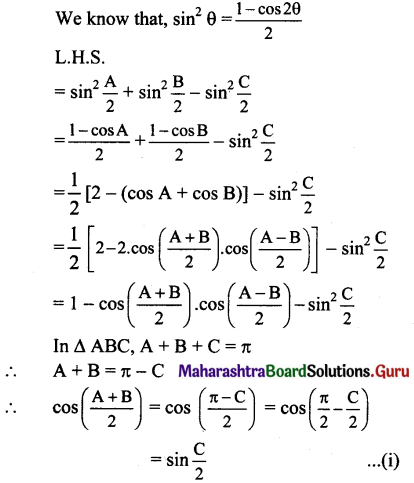
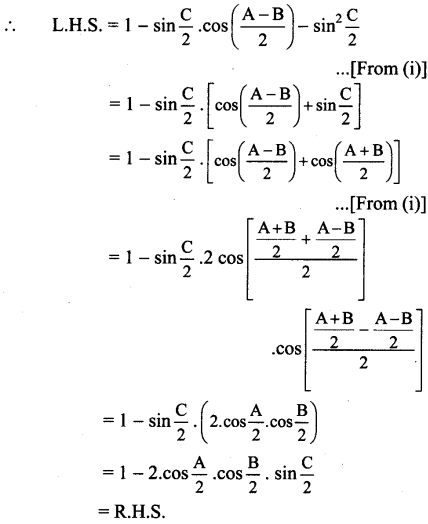
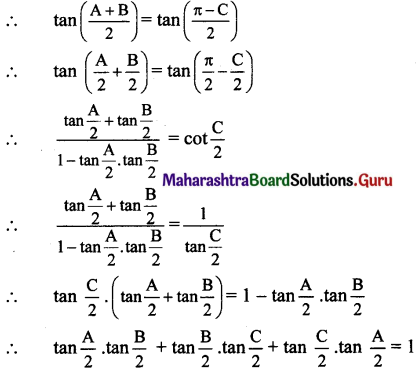
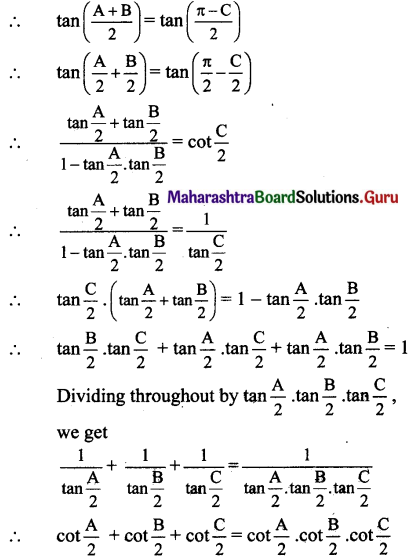
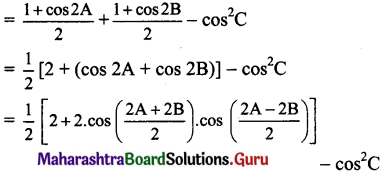
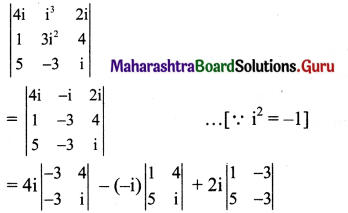
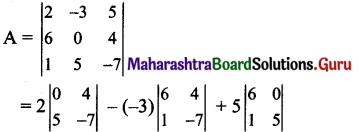
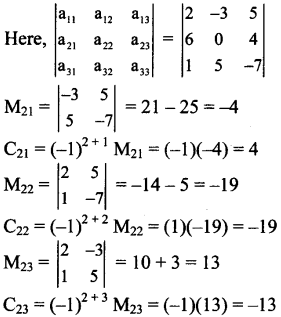
Maharashtra Board 11th Maths Solutions Chapter 5 Straight Line Ex 5.1

Balbharti Maharashtra State Board Class 11 Maths Solutions Pdf Chapter 5 Straight Line Ex 5.1 Questions and Answers.

Maharashtra State Board 11th Maths Solutions Chapter 5 Straight Line Ex 5.1

Question 1.
If A(1, 3) and B(2, 1) are points, find the equation of the locus of point P such that PA = PB.
Solution:
Let P(x, y) be any point on the required locus.
Given, A(1, 3), B(2, 1) and
PA = PB
∴ PA2 = PB2
∴ (x – 1)2 + ( y – 3)2 = (x – 2)2 + (y – 1)2
∴ x2 – 2x + 1 + y2 – 6y + 9 = x2 – 4x + 4 + y2 – 2y + 1
-2x – 6y + 10 = -4x – 2y + 5
∴ 2x – 4y + 5 = 0
∴ The required equation of locus is 2x – 4y + 5 = 0.

Maharashtra Board 11th Maths Solutions Chapter 5 Straight Line Ex 5.1

Question 2.
A(- 5,2) and B(4,1). Find the equation of the locus of point P, which is equidistant from A and B.
Solution:
Let P(x, y) be any point on the required locus.
P is equidistant from A(- 5, 2) and B(4, 1).
∴ PA = PB
∴ PA2 = PB2
∴ (x + 5)2 + (y – 2)2 = (x – 4)2 + (y – 1)2
∴ x2 + 10x + 25 + y2 — 4y + 4
= x2 – 8x + 16 + y2 – 2y + 1
∴ 10x – 4y + 29 = -8x – 2y + 17
∴ 18x – 2y + 12 = 0
∴ 9x – y + 6 = 0
The required equation of locus is 9x -y + 6 = 0.

Question 3.
If A(2, 0) and B(0, 3) are two points, find the equation of the locus of point P such that AP = 2BP.
Solution:
Let P(x, y) be any point on the required locus.
Given, A(2, 0), B(0, 3) and AP = 2BP
∴ AP2 = 4BP2
∴ (x – 2)2 + (y – 0)2 = 4[(x – 0)2 + (y – 3)2]
∴ x2 – 4x + 4 + y2 = 4(x2 + y2 – 6y + 9)
x2 – 4x + 4 + y2 = 4x2 + 4y2 – 24y + 36
∴ 3x2 + 3 y2 + 4x – 24y + 32 = 0
∴ The required equation of locus is
3x2 + 3y2 + 4x – 24y + 32 = 0.
[Note: Answer given in the textbook , is
‘3x2 + 3y2 + 4x + 24y + 32 = O’.
However, as per our calculation it is ‘3x2 + 3y2 + 4x – 24y + 32 = 0’.]

Question 4.
If A(4,1) and B(5,4), find the equation of the locus of point P such that PA2 = 3PB2.
Solution:
Let P(x, y) be any point on the required locus. Given, A(4,1), B(5,4) and PA2 = 3PB2
∴ (x – 4)2 + (y – 1)2 = 3[(x – 5)2 + (y – 4)2]
∴ x2 – 8x + 16 + y2 – 2y + 1 = 3(x2 – 10x + 25 + y2 – 8y + 16)
∴ x2 – 8x + y2 – 2y + 17 = 3x2 -30x + 75 + 3y2 – 24y + 48
∴ 2x2 + 2y2 – 22x – 22y + 106 = 0
∴ x2 + y2 – 11x – 11y + 53 = 0
∴ The required equation of locus is
x2 + y2 – 11x – 11y + 53 = 0.

Maharashtra Board 11th Maths Solutions Chapter 5 Straight Line Ex 5.1

Question 5.
A(2, 4) and B(5, 8), find the equation of the
locus of point P such that PA2 – PB2 = 13.
Solution:
Let P(x, y) be any point on the required locus. Given, A(2,4), B(5, 8) and PA2-PB2 = 13
∴ [(x -2)2 + (y – 4)2] – [(x -5)2 + (y- 8)2] = 13
∴ (x2 – 4x + 4 + y2 – 8y + 16) – (x2 – 10x + 25 + y2 – 16y + 64) =13
∴ x2 – 4x+ y2 – 8y + 20 – x2 + 10x – y2 + 16y – 89 = 13
∴ 6x + 8y- 69 = 13
∴ 6x + 8y – 82 = 0
∴ 3x + 4y – 41 = 0
∴ The required equation of locus is 3x + 4y- 41 = 0.

Question 6.
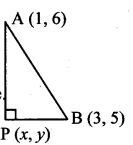
A(1, 6) and B(3, 5), find the equation of the locus of point P such that segment AB subtends right angle at P. (∠APB = 90°)
Solution:
Let P(x, y) be any point on the required locus. Given,
A(l, 6) and B(3, 5),
∠APB = 90°
∴ ΔAPB is a right angled triangle,
By Pythagoras theorem,
Maharashtra Board 11th Maths Solutions Chapter 5 Straight Line Ex 5.1 1
AP2 + PB2 = AB2 P (x,y)
∴ [(x – 1)2 + (y – 6)2] + [(x – 3)2 + (y – 5)2] = (1 – 3)2 + (6 -5)2
∴ x2 — 2x + 1 + y2 — 12y + 36 + x2 – 6x + 9 + y2 – 10y + 25 = 4 + 1
∴ 2x2 + 2y2 – 8x – 22y + 66 = 0
∴ x2 + y2 – 4x – 11y + 33 = 0
∴ The required equation of locus is x2 + y2 – 4x – 11y + 33 = 0.
[Note: Answer given in the textbook is
‘3x2 + 4y2 – 4x – 11y + 33 = 0’.
However, as per our calculation it is ‘x2 + y2 – 4x – 11y + 33 = O

Question 7.
If the origin is shifted to the point 0′(2, 3), the axes remaining parallel to the original axes, find the new co-ordinates of the points
i. A(1, 3) ii. B(2,5)
Solution:
Origin is shifted to (2, 3) = (h, k)
Let the new co-ordinates be (X, Y).
x = X + handy = Y + k
x = X + 2 andy = Y + 3 …(i)

i. Given, A(x, y) = A( 1, 3)
x = X + 2 andy = Y + 3 …[From(i)]
∴ 1 = X + 2 and 3 = Y + 3 X = – 1 and Y = 0
∴ The new co-ordinates of point A are (- 1,0).

ii. Given, B(x, y) = B(2, 5)
x = X + 2 and y = Y + 3 …[From(i)]
∴ 2 = X + 2 and 5 = Y + 3
∴ X = 0 and Y = 2
∴ The new co-ordinates of point B are (0, 2).

Maharashtra Board 11th Maths Solutions Chapter 5 Straight Line Ex 5.1

Question 8.
If the origin is shifted to the point O'(1, 3), the axes remaining parallel to the original axes, find the old co-ordinates of the points
i. C(5,4) ii. D(3,3)
Solution:
Origin is shifted to (1,3) = (h, k)
Let the new co-ordinates be (X, Y).
x = X + h andy = Y + k
∴ x = X+1 andy = Y + 3 …(i)

i. Given, C(X, Y) = C(5, 4)
x = X +1 andy = Y + 3 …[From(i)]
∴ x = 5 + 1 = 6 andy = 4 + 3 = 7
∴ The old co-ordinates of point C are (6, 7).

ii. Given, D(X, Y) = D(3, 3)
x = X + 1 andy = Y + 3 …[From(i)]
∴ x = 3 + 1 = 4 and y = 3 + 3 = 6
∴ The old co-ordinates of point D are (4, 6).

Question 9.
If the co-ordinates A(5, 14) change to B(8, 3) by shift of origin, find the co-ordinates of the point, where the origin is shifted.
Solution:
Let the origin be shifted to (h, k).
Given, A(x, y) = A(5,14), B(X, Y) = B(8, 3)
Since x = X + h andy = Y + k,
5 = 8 + hand 14 = 3 + k ,
∴ h = – 3 and k = 11
The co-ordinates of the point, where the origin is shifted are (- 3, 11).

Question 10.
Obtain the new equations of the following loci if the origin is shifted to the point 0′(2,2), the direction of axes remaining the same:
i. 3x-y + 2 = 0
11. x2+y2-3x = 7
iii. xy – 2x – 2y + 4 = 0
iv. y2 – 4x – 4y + 12 = 0
Solution:
Given, (h,k) = (2,2)
Let (X, Y) be the new co-ordinates of the point (x,y).
∴ x = X + handy = Y + k
∴ x = X + 2 andy = Y + 2
i. Substituting the values of x and y in the equation 3x -y + 2 = 0, we get
3(X + 2) – (Y + 2) + 2 = 0
∴ 3X + 6-Y-2 + 2 = 0
∴ 3 X – Y + 6 = 0, which is the new equation of locus.

ii. Substituting the values of x and y in the equation
x2 + y2 – 3x = 7, we get
(X + 2)2 + (Y + 2)2 – 3(X + 2) = 7
∴ X2 + 4X + 4 + Y2 + 4Y + 4 – 3X – 6 = 7
∴ X2 + Y2 + X + 4Y – 5 = 0, which is the new
equation of locus.

iii; Substituting the values of x and y in the equation xy – 2x – 2y + 4 = 0, we get
(X + 2) (Y + 2) – 2(X + 2) – 2(Y + 2) + 4 = 0
∴ XY + 2X + 2Y + 4 – 2X – 4-2Y- 4 + 4 = 0
∴ XY = 0, which is the new equation of locus.

Maharashtra Board 11th Maths Solutions Chapter 5 Straight Line Ex 5.1

iv. Substituting the values of x and y in the equation y2 – 4x – 4y + 12 = 0, we get
(Y + 2)2 – 4(X + 2) – 4(Y + 2) + 12 = 0
∴ Y2 + 4Y + 4 – 4X – 8 – 4Y -8 + 12 = 0
∴ Y2 – 4X = 0, which is the new equation of locus.

Maharashtra Board 11th Maths Solutions Chapter 4 Determinants and Matrices Ex 4.5

Balbharti Maharashtra State Board Class 11 Maths Solutions Pdf Chapter 4 Determinants and Matrices Ex 4.5 Questions and Answers.

Maharashtra State Board 11th Maths Solutions Chapter 4 Determinants and Matrices Ex 4.5

Question 1.
If A = \(\left[\begin{array}{cc}
2 & -3 \\
5 & -4 \\
-6 & 1
\end{array}\right]\), B = \(\left[\begin{array}{cc}
-1 & 2 \\
2 & 2 \\
0 & 3
\end{array}\right]\) and C = \(\left[\begin{array}{cc}
4 & 3 \\
-1 & 4 \\
-2 & 1
\end{array}\right]\)
Show that
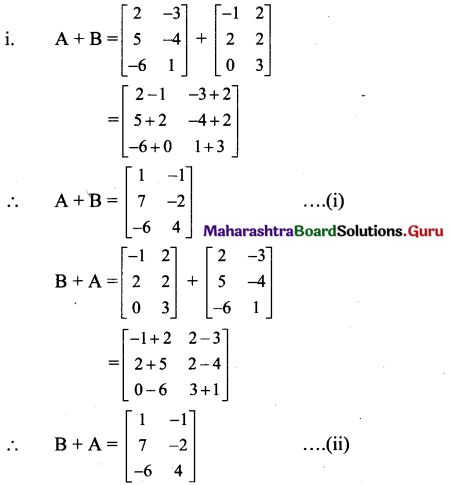
i. A+B=B+A
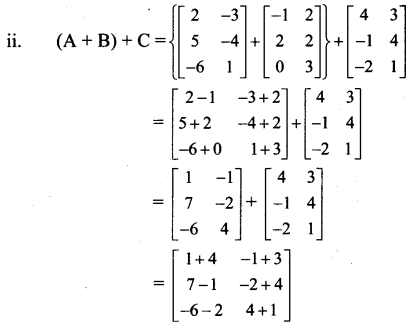
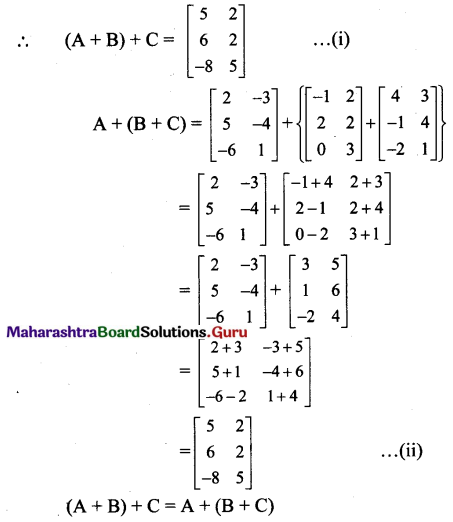
ii. (A + B) + C = A + (B + C)
Solution:
Maharashtra Board 11th Maths Solutions Chapter 4 Determinants and Matrices Ex 4.5 1

From (i) and (ii), we get
A + B = B + A
Maharashtra Board 11th Maths Solutions Chapter 4 Determinants and Matrices Ex 4.5 2
Maharashtra Board 11th Maths Solutions Chapter 4 Determinants and Matrices Ex 4.5 3

Maharashtra Board 11th Maths Solutions Chapter 4 Determinants and Matrices Ex 4.5

Question 2.
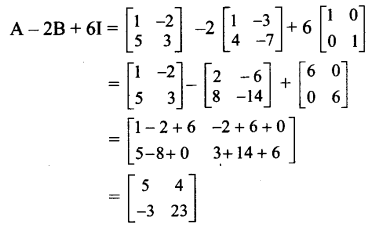
If A = \(\left[\begin{array}{cc}
1 & -2 \\
5 & 3
\end{array}\right]\), B = \(\left[\begin{array}{ll}
1 & -3 \\
4 & -7
\end{array}\right]\) then find the matrix A – 2B + 6I, where I is the unit matrix of order 2.
Solution:
Maharashtra Board 11th Maths Solutions Chapter 4 Determinants and Matrices Ex 4.5 4

Question 3.
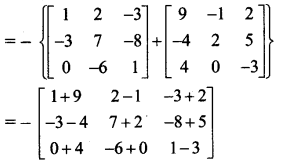
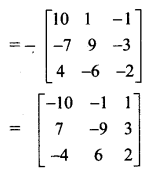
If A = \(\), B = \(\) then find the matrix C such that A + B + C is a zero matrix.
Solution:
A+ B + C is a zero matrix.
∴ A + B + C = O
C = -(A + B)
Maharashtra Board 11th Maths Solutions Chapter 4 Determinants and Matrices Ex 4.5 5
Maharashtra Board 11th Maths Solutions Chapter 4 Determinants and Matrices Ex 4.5 6

Question 4.
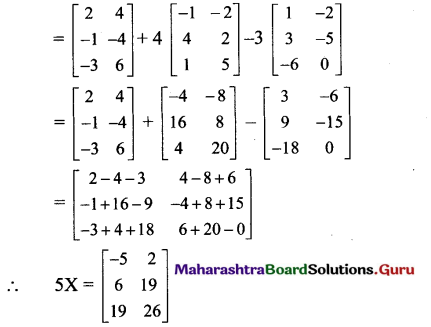
If A = \(\left[\begin{array}{cc}
1 & -2 \\
3 & -5 \\
-6 & 0
\end{array}\right]\) B = \(\left[\begin{array}{cc}
-1 & -2 \\
4 & 2 \\
1 & 5
\end{array}\right]\) and C = \(\left[\begin{array}{cc}
2 & 4 \\
-1 & -4 \\
-3 & 6
\end{array}\right]\) , find the matrix X such that 3A – 4B + 5X = C.
Solution:
3A-4B + 5X = C
∴ 5X = C + 4B – 3A
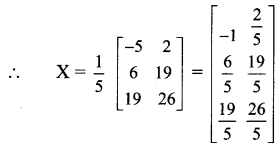
Maharashtra Board 11th Maths Solutions Chapter 4 Determinants and Matrices Ex 4.5 7
Maharashtra Board 11th Maths Solutions Chapter 4 Determinants and Matrices Ex 4.5 14

Maharashtra Board 11th Maths Solutions Chapter 4 Determinants and Matrices Ex 4.5

Question 5.
Solve the following equations for X and Y, if 3X – Y = \(=\left[\begin{array}{cc}
1 & -1 \\
-1 & 1
\end{array}\right]\) and X – 3Y = \(\left[\begin{array}{ll}
0 & -1 \\
0 & -1
\end{array}\right]\)
Solution:
Given equations are
\(=\left[\begin{array}{cc}
1 & -1 \\
-1 & 1
\end{array}\right]\)……………….. (i)
and X – 3Y = \(\left[\begin{array}{ll}
0 & -1 \\
0 & -1
\end{array}\right]\) ………………(ii)
By (i) x 3 – (ii) we get
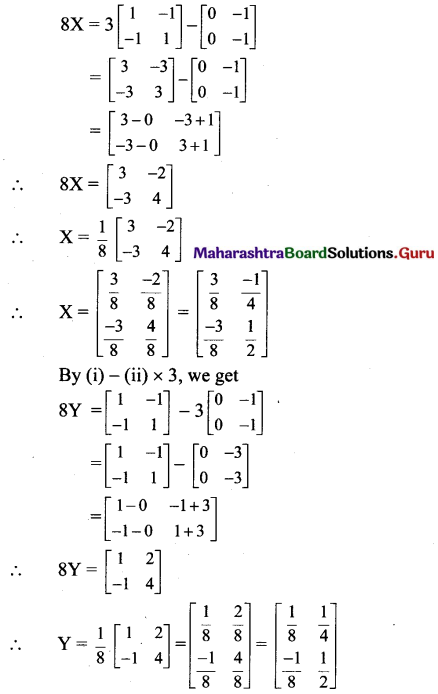
Maharashtra Board 11th Maths Solutions Chapter 4 Determinants and Matrices Ex 4.5 8

Question 6.
Find the matrices A and B, if 2A – B = \(=\left[\begin{array}{ccc}
6 & -6 & 0 \\
-4 & 2 & 1
\end{array}\right]\) and A – 2B = \(\left[\begin{array}{ccc}
3 & 2 & 8 \\
-2 & 1 & -7
\end{array}\right]\)
Solution:
Given equations are
2A – B = \(=\left[\begin{array}{ccc}
6 & -6 & 0 \\
-4 & 2 & 1
\end{array}\right]\) ……………….. (i)
and A – 2B = \(\left[\begin{array}{ccc}
3 & 2 & 8 \\
-2 & 1 & -7
\end{array}\right]\) ……………….(ii)
By (i) – (ii) x 2, we get
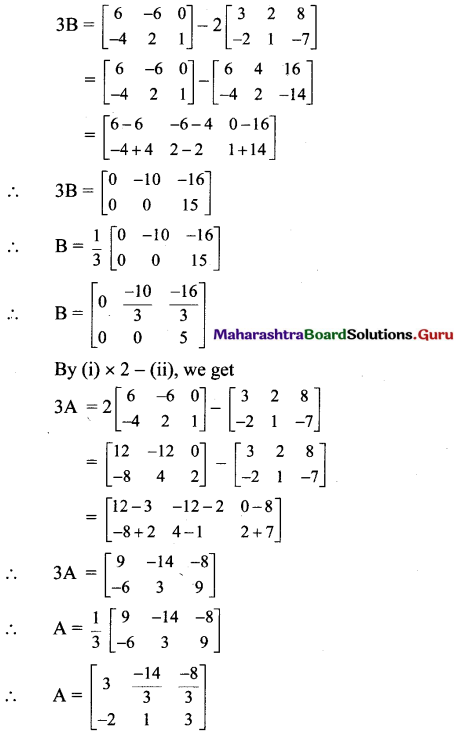
Maharashtra Board 11th Maths Solutions Chapter 4 Determinants and Matrices Ex 4.5 9

Maharashtra Board 11th Maths Solutions Chapter 4 Determinants and Matrices Ex 4.5

Question 7.
Simplify \(\cos \theta\left[\begin{array}{cc}
\cos \theta & \sin \theta \\
-\sin \theta & \cos \theta
\end{array}\right]+\sin \theta\left[\begin{array}{cc}
\sin \theta & -\cos \theta \\
\cos \theta & \sin \theta
\end{array}\right]\)
Solution:
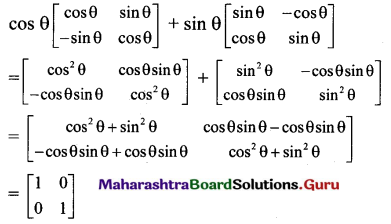
Maharashtra Board 11th Maths Solutions Chapter 4 Determinants and Matrices Ex 4.5 10

Quesiton 8.
If A = \(\left[\begin{array}{cc}
1 & 2 i \\
-3 & 2
\end{array}\right]\) and B = \(\left[\begin{array}{cc}
2 i & 1 \\
2 & -3
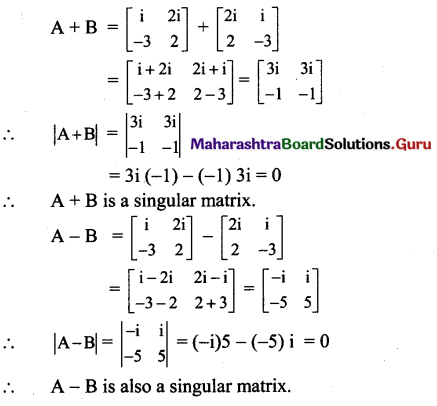
\end{array}\right]\) where i =\(\sqrt{-1}\), find A + B and A – B. Show that A + B is singular. Is A – B singular? Justify your answer.
Solution:
Maharashtra Board 11th Maths Solutions Chapter 4 Determinants and Matrices Ex 4.5 11

Question 9.
Find x and y, if \(\left[\begin{array}{ccc}
2 x+y & -1 & 1 \\
3 & 4 y & 4
\end{array}\right]+\left[\begin{array}{ccc}
-1 & 6 & 4 \\
3 & 0 & 3
\end{array}\right]=\left[\begin{array}{ccc}
3 & 5 & 5 \\
6 & 18 & 7
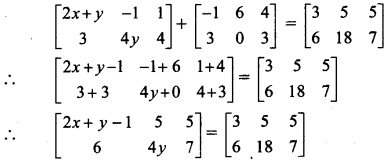
\end{array}\right]\)
Solution:
Maharashtra Board 11th Maths Solutions Chapter 4 Determinants and Matrices Ex 4.5 12
∴ By equality of matrices, we get
2x + y – 1 = 3 and 4y = 18
∴ 2x + y = 4 and y = \(\frac{18}{4}=\frac{9}{2}\)
∴ 2x + \(\frac{9}{2}\) = 4
∴ 2x = 4 – \(\frac{9}{2}\)
∴ 2x = \(\frac{1}{2}=\)
∴ x = –\(\frac{1}{4}=\) and y = \(\frac{9}{2}=\)

Question 10.
If \(\left[\begin{array}{ll}
2 a+b & 3 a-b \\
c+2 d & 2 c-d
\end{array}\right]=\left[\begin{array}{cc}
2 & 3 \\
4 & -1
\end{array}\right]\), find a, b, c and d.
Solution:
\(\left[\begin{array}{ll}
2 a+b & 3 a-b \\
c+2 d & 2 c-d
\end{array}\right]=\left[\begin{array}{cc}
2 & 3 \\
4 & -1
\end{array}\right]\)

∴ By equality of matrices, we get
2a + b = 2 ….(i)
3a – b = 3 ….(ii)
c + 2d = 4 ….(iii)
2c – d = -1 ….(iv)
Adding (i) and (ii), we get
5a = 5
∴ a = 1
Substituting a = 1 in (i), we get
2(1) + b = 2
∴ b = 0
By (iii) + (iv) x 2, we get
5c = 2
∴ c = \(\frac{2}{5}\)
Substituting c = \(\frac{2}{5}\) in (iii), we get
\(\frac{2}{5}\) + 2d = 4
∴ 2d = 4 – \(\frac{2}{5}\)
∴ 2d = \(\frac{18}{5}\)
∴ d = \(\frac{9}{5}\)
[Note: Answer given in the textbook is d = \(\frac{3}{5}\).
However, as per our calculation it is d = \(\frac{9}{5}\).]

Maharashtra Board 11th Maths Solutions Chapter 4 Determinants and Matrices Ex 4.5

Question 11.
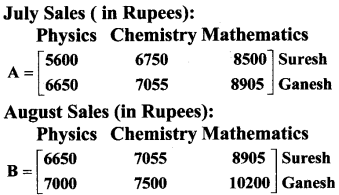
There are two book shops owned by Suresh and Ganesh. Their sales (in Rupees) for books in three subjects – Physics, Chemistry and Mathematics for two months, July and August 2017 are given by two matrices A and B.
Maharashtra Board 11th Maths Solutions Chapter 4 Determinants and Matrices Ex 4.5 13
i. Find the increase in sales in Rupees from July to August 2017.
ii. If both book shops got 10% profit in the month of August 2017, find the profit for each bookseller in each subject in that month.
Solution:
i. Increase in sales in rupees from July to August 2017
For Suresh:
Increase in sales for Physics books
= 6650 – 5600= ₹ 1050
Increase in sales for Chemistry books
= 7055 – 6750 = ₹ 305
Increase in sales for Mathematics books
= 8905 – 8500 = ₹ 405
For Ganesh:
Increase in sales for Physics books
= 7000 – 6650 = ₹ 350
Increase in sales for Chemistry books
= 7500 – 7055 = ₹ 445
Increase in sales for Mathematics books
= 10200 – 8905 = ₹ 1295
[Note: Answers given in the textbook are 1760, 2090. However, as per our calculation they are 1050, 305, 405, 350, 445, 1295.]

ii. Both book shops got 10% profit in the month of August 2017.
For Suresh:
Profit for Physics books = \(\frac{6650 \times 10}{100}\) = ₹ 665
Profit for Chemistry books = \(\frac{7055 \times 10}{100}\) = ₹ 705.50
Profit for Mathematics books = \(\frac{8905 \times 10}{100}\) = ₹ 890.50

For Ganesh:
Profit for Physics books = \(\frac{7000 \times 10}{100}\) = ₹ 700
Profit for Chemistry books = \(\frac{7500 \times 10}{100}\) = ₹ 750
Profit for Mathematics books = \(\frac{10200 \times 10}{100}\) = ₹ 1020
[Note: Answers given in the textbook for Suresh’s profit in Chemistry and Mathematics books are ? 675 and ?850 respectively. However, as per our calculation profit amounts are ₹ 705.50 and ₹ 890.50 respectively.]

Maharashtra Board 12th Maths Solutions Chapter 6 Line and Plane Miscellaneous Exercise 6A

Balbharti 12th Maharashtra State Board Maths Solutions Book Pdf Chapter 6 Line and Plane Miscellaneous Exercise 6A Questions and Answers.

Maharashtra State Board 12th Maths Solutions Chapter 6 Line and Plane Miscellaneous Exercise 6A

Question 1.
Find the vector equation of the line passing through the point having position vector \(3 \hat{i}+4 \hat{j}-7 \hat{k}\) and parallel to \(6 \hat{i}-\hat{j}+\hat{k}\).
Solution:
The vector equation of the line passing through A(\(\bar{a}\)) and parallel to the vector \(\bar{b}\) is \(\overline{\mathrm{r}}=\overline{\mathrm{a}}+\lambda \overline{\mathrm{b}}\), where λ is a scalar.
∴ the vector equation of the line passing through the point having position vector
\(3 \hat{i}+4 \hat{j}-7 \hat{k}\) and parallel to the vector \(6 \hat{i}-\hat{j}+\hat{k}\) is
\(\overline{\mathrm{r}}=(3 \hat{\mathrm{i}}+4 \hat{\mathrm{j}}-7 \hat{\mathrm{k}})+\lambda(\hat{6 \hat{\mathrm{i}}}-\hat{\mathrm{j}}+\hat{\mathrm{k}})\).

Question 2.
Find the vector equation of the line which passes through the point (3, 2, 1) and is parallel to the vector \(2 \hat{i}+2 \hat{j}-3 \hat{k}\).
Solution:
The vector equation of the line passing through A(\(\bar{a}\)) and parallel to the vector \(\bar{b}\) is \(\overline{\mathrm{r}}=\overline{\mathrm{a}}+\lambda \overline{\mathrm{b}}\), where λ is a scalar.
∴ the vector equation of the line passing through the point having position vector \(3 \hat{\mathrm{i}}+2 \hat{\mathrm{j}}+\hat{\mathrm{k}}\) and parallel to the vector
\(2 \hat{\mathrm{i}}+2 \hat{\mathrm{j}}-3 \hat{\mathrm{k}} \text { is } \overline{\mathrm{r}}=(3 \hat{\mathrm{i}}+2 \hat{\mathrm{j}}+\hat{\mathrm{k}})+\lambda(\hat{\mathrm{i}}+2 \hat{\mathrm{j}}-3 \hat{\mathrm{k}})\)

Question 3.
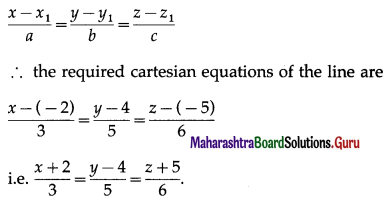
Find the Cartesian equations of the line which passes through the point (-2, 4, -5) and parallel to the line \(\frac{x+2}{3}=\frac{y-3}{5}=\frac{z+5}{6}\)
Solution:
The line \(\frac{x+2}{3}=\frac{y-3}{5}=\frac{z+5}{6}\) has direction ratios 3, 5, 6. The required line has direction ratios 3, 5, 6 as it is parallel to the given line.
It passes through the point (-2, 4, -5).
The cartesian equations of the line passing through (x1, y1, z1) and having direction ratios a, b, c are
Maharashtra Board 12th Maths Solutions Chapter 6 Line and Plane Miscellaneous Exercise 6A 1

Maharashtra Board 12th Maths Solutions Chapter 1 Mathematical Logic Ex 1.1

Question 4.
Obtain the vector equation of the line \(\frac{x+5}{3}=\frac{y+4}{5}=\frac{z+5}{6}\).
Solution:
The cartesian equations of the line are \(\frac{x+5}{3}=\frac{y+4}{5}=\frac{z+5}{6}\).
This line is passing through the point A(-5, -4, -5) and having direction ratios 3, 5, 6.
Let \(\bar{a}\) be the position vector of the point A w.r.t. the origin and \(\bar{b}\) be the vector parallel to the line.
Then \(\bar{a}=-5 \hat{i}-4 \hat{j}-5 \hat{k}\) and \(\bar{b}=3 \hat{i}+5 \hat{j}+6 \hat{k}\).
The vector equation of the line passing through A(\(\bar{a}\)) and parallel to \(\bar{b}\) is \(\bar{r}=\bar{a}+\lambda \bar{b}\) where λ is a scalar.
∴ the vector equation of the required line is \(\bar{r}=(-5 \hat{i}-4 \hat{j}-6 \hat{k})+\lambda(3 \hat{i}+5 \hat{j}+6 \hat{k})\)

Question 5.
Find the vector equation of the line which passes through the origin and the point (5, -2, 3).
Solution:
Let \(\bar{b}\) be the position vector of the point B(5, -2, 3).
Then \(\bar{b}=5 \hat{i}-2 \hat{j}+3 \hat{k}\)
Origin has position vector \(\overline{0}=0 \hat{i}+0 \hat{j}+0 \hat{k}\).
The vector equation the line passing through A(\(\bar{a}\)) and B(\(\bar{b}\)) is \(\bar{r}=\bar{a}+\lambda(\bar{b}-\bar{a})\) where λ is a scalar.
∴ the vector equation of the required line is \(\bar{r}=\overline{0}+\lambda(\bar{b}-\overline{0})=\lambda(5 \hat{i}-2 \hat{j}+3 \hat{k})\)

Question 6.
Find the Cartesian equations of the line which passes through points (3, -2, -5) and (3, -2, 6).
Solution:
Let A = (3, -2, -5), B = (3, -2, 6)
The direction ratios of the line AB are
3 – 3, -2 – (-2), 6 – (-5) i.e. 0, 0, 11.
The parametric equations of the line passing through (x1, y1, z1) and having direction ratios a, b, c are
x = x1 + aλ, y = y1 + bλ, z = z1 + cλ
∴ the parametric equattions of the line passing through (3, -2, -5) and having direction ratios are 0, 0, 11 are
x = 3 + (0)λ, y = -2 + 0(λ), z = -5 + 11λ
i.e. x = 3, y = -2, z = 11λ – 5
∴ the cartesian equations of the line are
x = 3, y = -2, z = 11λ – 5, λ is a scalar.

Maharashtra Board 12th Maths Solutions Chapter 1 Mathematical Logic Ex 1.1

Question 7.
Find the Cartesian equations of the line passing through A(3, 2, 1) and B(1, 3, 1).
Solution:
The direction ratios of the line AB are 3 – 1, 2 – 3, 1 – 1 i.e. 2, -1, 0.
The parametric equations of the line passing through (x1, y1, z1) and having direction ratios a, b, c are
x = x1 + aλ, y = y1 + bλ, z = z1 + cλ
∴ the parametric equattions of the line passing through (3, 2, 1) and having direction ratios 2, -1, 0 are
x = 3 + 2λ, y = 2 – λ, z = 1 + 0(λ)
x – 3 = 2λ, y – 2 = -λ, z = 1
∴ \(\frac{x-3}{2}=\frac{y-2}{-1}\) = λ, z = 1
∴ the cartesian equations of the line are
\(\frac{x-3}{2}=\frac{y-2}{-1}\), z = 1.

Question 8.
Find the Cartesian equations of the line passing through the point A(1, 1, 2) and perpendicular to vectors \(\bar{b}=\hat{i}+2 \hat{j}+\hat{k}\) and \(\bar{c}=3 \hat{i}+2 \hat{j}-\hat{k}\).
Solution:
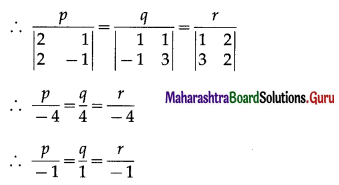
Let the required line have direction ratios p, q, r. ,
It is perpendicular to the vectors \(\bar{b}=\hat{i}+2 \hat{j}+\hat{k}\) and \(\bar{c}=3 \hat{i}+2 \hat{j}-\hat{k}\).
∴ it is perpendicular to lines whose direction ratios are 1, 2, 1 and 3, 2, -1.
∴ p + 2q + r = 0, 3p + 2q – r = 0
Maharashtra Board 12th Maths Solutions Chapter 6 Line and Plane Miscellaneous Exercise 6A 2
∴ the required line has direction ratios -1, 1, -1.
The cartesian equations of the line passing through (x1, y1, z1) and having direction ratios a, b, c are
\(\frac{x-x_{1}}{a}=\frac{y-y_{1}}{b}=\frac{z-z_{1}}{c}\)
∴ the cartesian equations of the line passing through the point (1, 1, 2) and having direction ratios -1, 1, -1 are
\(\frac{x-1}{-1}=\frac{y-1}{1}=\frac{z-2}{-1}\)

Question 9.
Find the Cartesian equations of the line which passes through the point (2, 1, 3) and perpendicular
to lines \(\frac{x-1}{1}=\frac{y-2}{2}=\frac{z-3}{3}\) and \(\frac{x}{-3}=\frac{y}{2}=\frac{z}{5}\).
Solution:
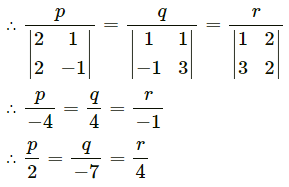
Let the required line have direction ratios p, q, r.
It is perpendicular to the vector \(\bar{b}=\hat{i}+2 \hat{j}+\hat{k}\) and \(\bar{c}=3 \hat{\mathrm{i}}+2 \hat{\mathrm{j}}-\hat{\mathrm{k}}\).
∴ it is perpendicular to lines whose direction ratios are 1, 2, 1 and 3, 2, -1.
∴ p + 2q + r = 0, 3 + 2q – r = 0
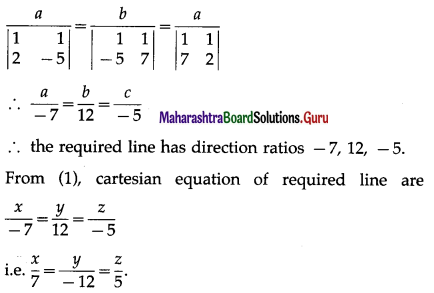
Maharashtra Board 12th Maths Solutions Chapter 6 Line and Plane Miscellaneous Exercise 6A 3
∴ the required line has direction ratios 2, -7, 4.
The cartesian equations of the line passing through (x1, y1, z1) and having direction ratios a, b, c are
\(\frac{x=x_{1}}{a}=\frac{y-y_{1}}{b}=\frac{z-z_{1}}{c}\)
∴ the cartesian equation of the line passing through the point (2, -7, 4) and having directions ratios 2, -7, 4 are
\(\frac{x-2}{2}=\frac{y-1}{-7}=\frac{z-2}{4}\)

Maharashtra Board 12th Maths Solutions Chapter 1 Mathematical Logic Ex 1.1

Question 10.
Find the vector equation of the line which passes through the origin and intersect the line x – 1 = y – 2 = z – 3 at right angle.
Solution:
The given line is \(\frac{x-1}{1}=\frac{y-2}{1}=\frac{z-3}{1}\) = λ … (Say)
∴ coordinates of any point on the line are
x = λ + 1, y = λ + 2, z = λ + 3
∴ position vector of any point on the line is
(λ + 1)\(\hat{i}\) + (λ + 2)\(\hat{j}\) + (λ + 3)\(\hat{k}\) … (1)
If \(\bar{b}\) is parallel to the given line whose direction ratios are 1, 1, 1, then \(\bar{b}=\hat{i}+\hat{j}+\hat{k}\).
Let the required line passing through O meet the given line at M.
∴ position vector of M
= \(\bar{m}\) = (λ + 1)\(\hat{i}\) + (λ + 2)\(\hat{j}\) + (λ + 3)\(\hat{k}\) … [By (1)]
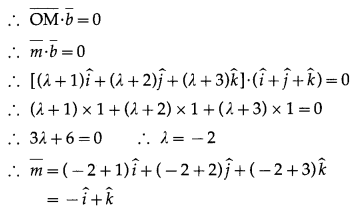
The required line is perpendicular to given line
Maharashtra Board 12th Maths Solutions Chapter 6 Line and Plane Miscellaneous Exercise 6A 4
The vector equation of the line passing through A(\(\bar{a}\)) and B(\(\bar{b}\)) is \(\bar{r}=\bar{a}+\lambda(\bar{b}-\bar{a})\), λ is a scalar.
∴ the vector equation of the line passing through o(\(\bar{o}\)) and M(\(\bar{m}\)) is
\(\bar{r}=\overline{0}+\lambda(\bar{m}-\overline{0})=\lambda \bar{m}=\lambda(-\hat{i}+\hat{k})\) where λ is a scalar.
Hence, vector equation of the required line is \(\).

Question 11.
Find the value of λ so that lines \(\frac{1-x}{3}=\frac{7 y-14}{2 \lambda}=\frac{z-3}{2}\) and \(\frac{7-7 x}{3 \lambda}=\frac{y-5}{1}=\frac{6-z}{5}\) are at right angle.
Solution:
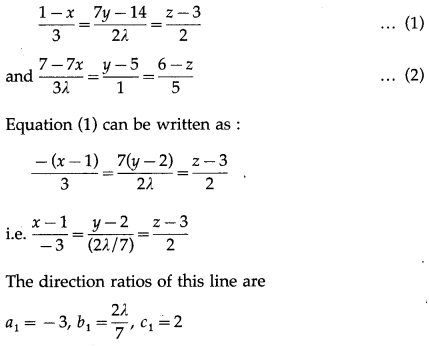
The equations of the given lines are
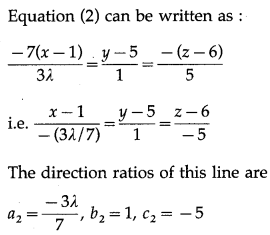
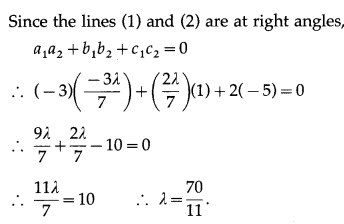
Maharashtra Board 12th Maths Solutions Chapter 6 Line and Plane Miscellaneous Exercise 6A 5
Maharashtra Board 12th Maths Solutions Chapter 6 Line and Plane Miscellaneous Exercise 6A 6
Maharashtra Board 12th Maths Solutions Chapter 6 Line and Plane Miscellaneous Exercise 6A 7

Question 12.
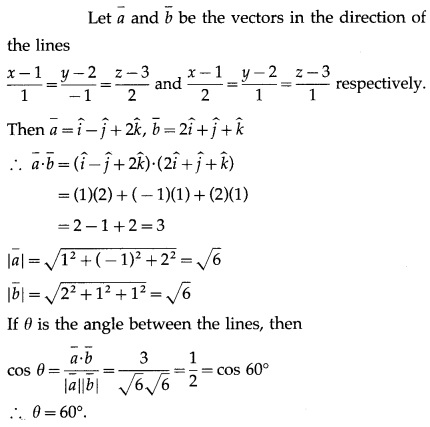
Find the acute angle between lines \(\frac{x-1}{1}=\frac{y-2}{-1}=\frac{z-3}{2}\) and \(\frac{x-1}{2}=\frac{y-2}{1}=\frac{z-3}{1}\).
Solution:
Maharashtra Board 12th Maths Solutions Chapter 6 Line and Plane Miscellaneous Exercise 6A 8

Maharashtra Board 12th Maths Solutions Chapter 1 Mathematical Logic Ex 1.1

Question 13.
Find the acute angle between lines x = y, z = 0 and x = 0, z = 0.
Solution:
The equations x = y, z = 0 can be written as \(\frac{x}{1}=\frac{y}{1}\), z = 0
∴ the direction ratios of the line are 1, 1, 0.
The direction ratios of the line x = 0, z = 0, i.e., Y-axis J are 0, 1, 0.
∴ its directiton ratios are 0, 1, 0.
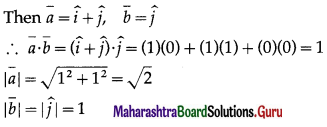
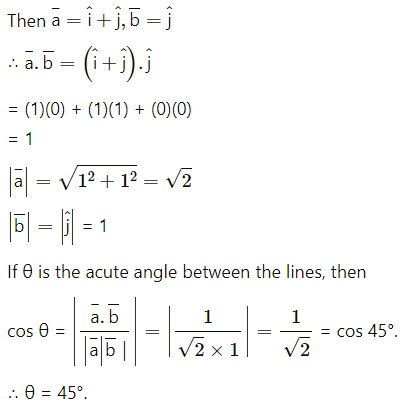
Let \(\bar{a}\) and \(\bar{b}\) be the vectors in the direction of the lines x = y, z = 0 and x = 0, z = 0.
Maharashtra Board 12th Maths Solutions Chapter 6 Line and Plane Miscellaneous Exercise 6A 9
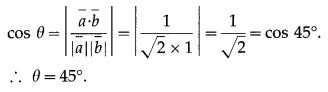
If θ is the acute angle between the lines, then
Maharashtra Board 12th Maths Solutions Chapter 6 Line and Plane Miscellaneous Exercise 6A 10

Question 14.
Find the acute angle between lines x = -y, z = 0 and x = 0, z = 0.
Solution:
The equations x = -y, z = 0 can be written as \(\frac{x}{1}=\frac{y}{1}\), z = 0.
∴ the direction ratios of the line are 1, 1, 0.
The direction ratios of the line x = 0, z = 0, i.e., Y-axis are 0, 1, 0.
∴ its direction ratios are 0, 1, 0.
Let \(\bar{a}\) and \(\bar{b}\) be the vectors in the direction of the lines x = y, z = 0 and x = 0, z = 0
Maharashtra Board 12th Maths Solutions Chapter 6 Line and Plane Miscellaneous Exercise 6A 11

Question 15.
Find the co-ordinates of the foot of the perpendicular drawn from the point (0, 2, 3) to the line \(\frac{x+3}{5}=\frac{y-1}{2}=\frac{z+4}{3}\).
Solution:
Let P = (0, 2, 3)
Let M be the foot of the perpendicular drawn from P to the line \(\frac{x+3}{5}=\frac{y-1}{2}=\frac{z+4}{3}\) = λ ……(Say)
The coordinates of any point on the line are given by
x = 5λ – 3, y = 2λ + 1, z = 3λ – 4
Let M = (5λ – 3, 2λ + 1, 3λ – 4) …(1)
The direction ratios of PM are
5λ – 3 – 0, 2λ + 1 – 2, 3λ – 4 – 3 i.e. 5λ – 3, 2λ – 1, 3λ – 7
Since, PM is perpendicular to the line whose direcction ratios are 5, 2, 3,
5(5λ – 3) + 2(2λ – 1) + 3(3λ – 7) = 0
25λ – 15 + 4λ – 2 + 9λ – 21 =0
38λ – 38 = 0 ∴ λ = 1
Substituting λ = 1 in (1), we get.
M = (5 – 3, 2 + 1, 3 – 4) = (2, 3, -1).
Hence, the coordinates of the foot of perpendicular are (2, 3, – 1).

Maharashtra Board 12th Maths Solutions Chapter 1 Mathematical Logic Ex 1.1

Question 16.
By computing the shortest distance determine whether following lines intersect each other.
(i) \(\bar{r}=(\hat{i}+\hat{j}-\hat{k})+\lambda(2 \hat{i}-\hat{j}+\hat{k})\) and \(\bar{r}=(2 \hat{i}+2 \hat{j}-3 \hat{k})+\mu(\hat{i}+\hat{j}-2 \hat{k})\)
Solution:
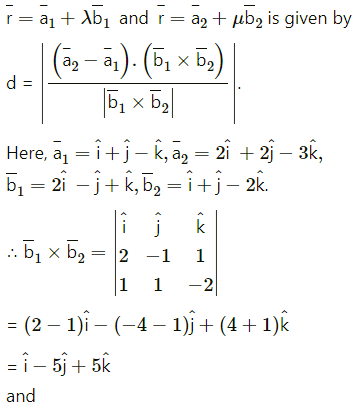
The shortest distance between the lines
Maharashtra Board 12th Maths Solutions Chapter 6 Line and Plane Miscellaneous Exercise 6A 12
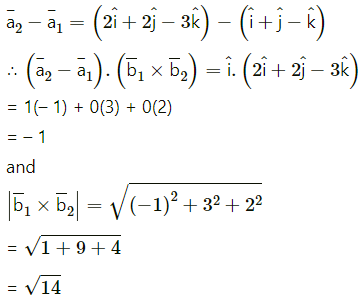
Maharashtra Board 12th Maths Solutions Chapter 6 Line and Plane Miscellaneous Exercise 6A 13
Shortest distance between the lines is 0.
∴ the lines intersect each other.

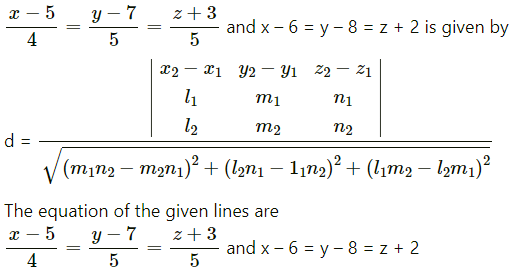
(ii) \(\frac{x-5}{4}=\frac{y-7}{5}=\frac{z+3}{5}\) and x – 6 = y – 8 = z + 2.
Solution:
The shortest distance between the lines
Maharashtra Board 12th Maths Solutions Chapter 6 Line and Plane Miscellaneous Exercise 6A 14
∴ x1 = 5, y1 = 7, z1 = 3, x2 = 6, y2 = 8, z2 = 2,
l1 = 4, m1 = 5, n1 = 1, l2 = 1, m2 = -2, n2 = 1
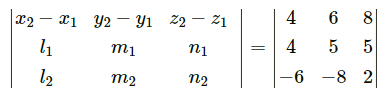
Maharashtra Board 12th Maths Solutions Chapter 6 Line and Plane Miscellaneous Exercise 6A 15
= 4(-6 + 2) – 6(7 – 1) + 8(-14 + 6)
= -16 – 36 – 64
= -116
and
(m1n2 – m2n1)2 + (l2n1 – l1n2)2 + (l1m2 – l2m1)2
= (-6 + 2)2 + (1 – 7)2 + (1 – 7)2 + (-14 + 6)2
= 16 + 36 + 64
= 116
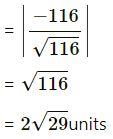
Hence, the required shortest distance between the given lines
Maharashtra Board 12th Maths Solutions Chapter 6 Line and Plane Miscellaneous Exercise 6A 16
or
Shortest distance between the lines is 0.
∴ the lines intersect each other.

Question 17.
If lines \(\frac{x-1}{2}=\frac{y+1}{3}=\frac{z-1}{4}\) and \(\frac{x-2}{1}=\frac{y+m}{2}=\frac{z-2}{1}\) intersect each other then find m.
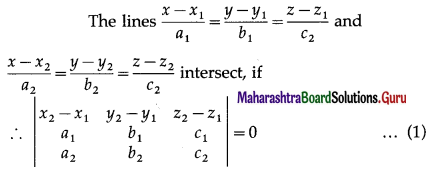
Solution:
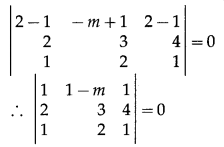
Maharashtra Board 12th Maths Solutions Chapter 6 Line and Plane Miscellaneous Exercise 6A 17
Here, (x1, y1, z1) ≡ (1, -1, 1),
(x2, y2, z2) ≡ (2, -m, 2),
a1 = 2, b1 = 3, c1 = 4,
a2 = 1, b2 = 2, c2 = 1
Substituting these values in (1), we get
Maharashtra Board 12th Maths Solutions Chapter 6 Line and Plane Miscellaneous Exercise 6A 18
∴ 1(3 – 8) – (1 – m)(2 – 4) + 1 (4 – 3) = 0
∴ -5 + 2 – 2m + 1 = 0
∴ -2m = 2
∴ m = -1.

Maharashtra Board 12th Maths Solutions Chapter 1 Mathematical Logic Ex 1.1

Question 18.
Find the vector and Cartesian equations of the line passing through the point (-1, -1, 2) and parallel to the line 2x – 2 = 3y + 1 = 6z – 2.
Solution:
Let \(\bar{a}\) be the position vector of the point A (-1, -1, 2) w.r.t. the origin.
Then \(\bar{a}=-\hat{i}-\hat{j}+2 \hat{k}\)
The equation of given line is
x – 2 = 3y + 1 = 6z – 2.
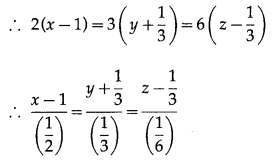
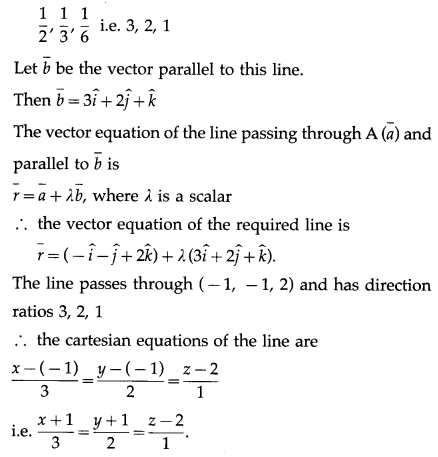
Maharashtra Board 12th Maths Solutions Chapter 6 Line and Plane Miscellaneous Exercise 6A 19
The direction ratios of this line are
Maharashtra Board 12th Maths Solutions Chapter 6 Line and Plane Miscellaneous Exercise 6A 20

Question 19.
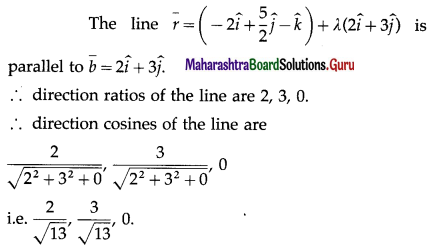
Find the direction cosines of the line \(\bar{r}=\left(-2 \hat{i}+\frac{5}{2} \hat{j}-\hat{k}\right)+\lambda(2 \hat{i}+3 \hat{j})\).
Solution:
Maharashtra Board 12th Maths Solutions Chapter 6 Line and Plane Miscellaneous Exercise 6A 21

Question 20.
Find the Cartesian equation of the line passing through the origin which is perpendicular to x – 1 = y – 2 = z – 1 and intersects the \(\frac{x-1}{2}=\frac{y+1}{3}=\frac{z-1}{4}\).
Solution:
Let the required line have direction ratios a, b, c
Since the line passes through the origin, its cartesian equations are
\(\frac{x}{a}=\frac{y}{b}=\frac{z}{c}\) …(1)
This line is perpendicular to the line
x – 1 = y – 2 = z – 1 whose direction ratios are 1, 1, 1.
Maharashtra Board 12th Maths Solutions Chapter 6 Line and Plane Miscellaneous Exercise 6A 22
∴ 1(4b – 3c) + 1(4a – 2c) + 1(3a – 2b) = 0
∴ 4b – 3c + 4a – 2c + 3a – 2b = 0
∴ 7a + 2b – 5c = 0
From (2) and (3), we get
Maharashtra Board 12th Maths Solutions Chapter 6 Line and Plane Miscellaneous Exercise 6A 23

Maharashtra Board 12th Maths Solutions Chapter 1 Mathematical Logic Ex 1.1

Question 21.
Write the vector equation of the line whose Cartesian equations are y = 2 and 4x – 3z + 5 = 0.
Solution:
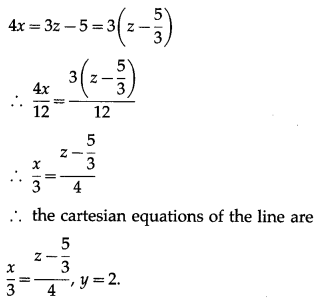
4x – 3z + 5 = 0 can be written as
Maharashtra Board 12th Maths Solutions Chapter 6 Line and Plane Miscellaneous Exercise 6A 24
This line passes through the point A(0, 2, \(\frac{5}{3}\)) position vector is \(\bar{a}=2 \hat{j}+\frac{5}{3} \hat{k}\)
Also the line has direction ratio 3, 0, 4.
If \(\bar{b}\) is a vector parallel to the line, then \(\bar{b}=3 \hat{i}+4 \hat{k}\)
The vector equation of the line passing through A(\(\bar{a}\)) and parallel to \(\bar{b}\) is \(\bar{r}=\bar{a}+\lambda \bar{b}\) where λ is \(\bar{a}\) scalar,
∴ the vector equation of the required line is
\(\bar{r}=\left(2 \hat{j}+\frac{5}{3} \hat{k}\right)+\lambda(3 \hat{i}+4 \hat{k})\).

Question 22.
Find the co-ordinates of points on the line \(\frac{x-1}{1}=\frac{y-2}{-2}=\frac{z-3}{2}\) which are at the distance 3 unit from the base point A(1, 2, 3).
Solution:
The cartesian equations of the line are \(\frac{x-1}{1}=\frac{y-2}{-2}=\frac{z-3}{2}\) = λ
The coordinates of any point on this line are given by
x = λ + 1, y = -2λ + 2, z = 2λ + 3
Let M(λ + 1, -2λ + 2, 2λ + 3) … (1)
be the point on the line whose distance from A(1, 2, 3) is 3 units.
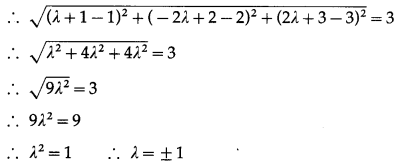
Maharashtra Board 12th Maths Solutions Chapter 6 Line and Plane Miscellaneous Exercise 6A 25
When λ = 1, M = (1 + 1, -2 + 2, 2 + 3) … [By (1)]
i. e. M = (2, 0, 5)
When λ = -1, M = (1 – 1, 2 + 2, -2 + 3) … [By (1)]
i. e. M = (0, 4, 1)
Hence, the coordinates of the required points are (2, 0, 5) and (0, 4, 1).

Maharashtra Board 12th Maths Solutions Chapter 7 Linear Programming Ex 7.3

Balbharti 12th Maharashtra State Board Maths Solutions Book Pdf Chapter 7 Linear Programming Ex 7.3 Questions and Answers.

Maharashtra State Board 12th Maths Solutions Chapter 7 Linear Programming Ex 7.3

Question 1.
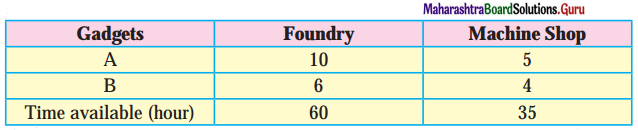
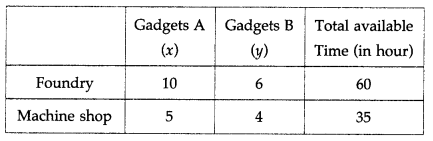
A manufacturing firm produces two types of gadgets A and B, which are first processed in the foundry and then sent to machine shop for finishing. The number of man hours of labour required in each shop for production of A and B per unit and the number of man hours available for the firm are as follows :
Maharashtra Board 12th Maths Solutions Chapter 7 Linear Programming Ex 7.3 1
Profit on the sale of A is ₹ 30 and B is ₹ 20 per units. Formulate the L.P.P. to have maximum profit.
Solution:
Let the number of gadgets A produced by the firm be x and the number of gadgets B produced by the firm be y.
The profit on the sale of A is ₹ 30 per unit and on the sale of B is ₹ 20 per unit.
∴ total profit is z = 30x + 20y.
This is a linear function which is to be maximized. Hence it is the objective function.
The constraints are as per the following table :
Maharashtra Board 12th Maths Solutions Chapter 7 Linear Programming Ex 7.3 2
From the table total man hours of labour required for x units of gadget A and y units of gadget B in foundry is (10x + 6y) hours and total man hours of labour required in machine shop is (5x + 4y) hours.
Since, maximum time avilable in foundry and machine shops are 60 hours and 35 hours respectively.
Therefore, the constraints are 10x + 6y ≤ 60, 5x + 4y ≤ 35. Since, x and y cannot be negative, we have x ≥ 0, y ≥ 0. Hence, the given LPP can be formulated as :
Maximize z = 30x + 20y, subject to 10x + 6y ≤ 60, 5x + 4y ≤ 35, x ≥ 0, y ≥ 0.

Question 2.
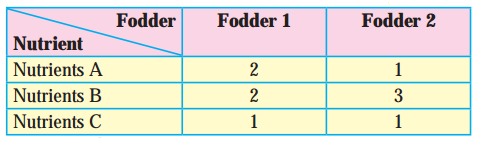
In a cattle breading firm, it is prescribed that the food ration for one animal must contain 14, 22 and 1 units of nutrients A, B and C respectively. Two different kinds of fodder are available. Each unit of these two contains the following amounts of these three nutrients :
Maharashtra Board 12th Maths Solutions Chapter 7 Linear Programming Ex 7.3 3
The cost of fodder 1 is ₹3 per unit and that of fodder ₹ 2, Formulate the L.P.P. to minimize the cost.
Solution:
Let x units of fodder 1 and y units of fodder 2 be prescribed.
The cost of fodder 1 is ₹ 3 per unit and cost of fodder 2 is ₹ 2 per unit.
∴ total cost is z = 3x + 2y
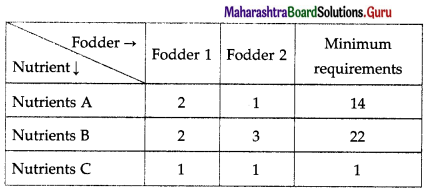
This is the linear function which is to be minimized. Hence it is the objective function. The constraints are as per the following table :
Maharashtra Board 12th Maths Solutions Chapter 7 Linear Programming Ex 7.3 4
From table fodder contains (2x + y) units of nutrients A, (2x + 3y) units of nutrients B and (x + y) units of nutrients C. The minimum requirements of these nutrients are 14 units, 22 units and 1 unit respectively.
Therefore, the constraints are
2x + y ≥ 14, 2x + 3y ≥ 22, x + y ≥ 1
Since, number of units (i.e. x and y) cannot be negative, we have, x ≥ 0, y ≥ 0.
Hence, the given LPP can be formulated as
Minimize z = 3x + 2y, subject to
2x + y ≥ 14, 2x + 3y ≥ 22, x + y ≥ 1, x ≥ 0, y ≥ 0.

Maharashtra Board 12th Maths Solutions Chapter 1 Mathematical Logic Ex 1.1

Question 3.
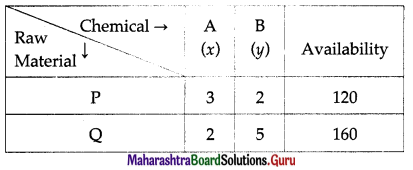
A company manufactures two types of chemicals A and B. Each chemical requires two types of raw material P and Q. The table below shows number of units of P and Q required to manufacture one unit of A and one unit of B and the total availability of P and Q.
Maharashtra Board 12th Maths Solutions Chapter 7 Linear Programming Ex 7.3 5
The company gets profits of ₹350 and ₹400 by selling one unit of A and one unit of B respectively. (Assume that the entire production of A and B can be sold). How many units of the chemicals A and B should be manufactured so that the company get maximum profit? Formulate the problem as L.P.P. to maximize the profit.
Solution:
Let the company manufactures x units of chemical A and y units of chemical B. Then the total profit f to the company is p = ₹ (350x + 400y).
This is a linear function which is to be maximized.
Hence, it is the objective function.
The constraints are as per the following table:
Maharashtra Board 12th Maths Solutions Chapter 7 Linear Programming Ex 7.3 6
The raw material P required for x units of chemical A and y units of chemical B is 3x + 2y. Since, the maximum availability of P is 120, we have the first constraint as 3x + 2y ≤ 120.
Similarly, considering the raw material Q, we have : 2x + 5y ≤ 160.
Since, x and y cannot be negative, we have, x ≥ 0, y ≥ 0.
Hence, the given LPP can be formulated as :
Maximize p = 350x + 400y, subject to
3x + 2y ≤ 120, 2x + 5y ≤ 160, x ≥ 0, y ≥ 0.

Question 4.
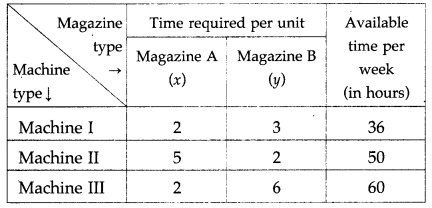
A printing company prints two types of magazines A and B. The company earns ₹ 10 and ₹ 15 on magazines A and B per copy. These are processed on three machines I, II, III. Magazine A requires 2 hours on Machine I, 5 hours on Machine II and 2 hours on Machine III. Magazine B requires 3 hours on Machine I, 2 hours on Machine II and 6 hours on Machine III. Machines I, II, III are available for 36, 50, 60 hours per week respectively. Formulate the L.P.P. to determine weekly production of A and B, so that the total profit is maximum.
Solution:
Let the company prints x magazine of type A and y magazine of type B.
Profit on sale of magazine A is ₹ 10 per copy and magazine B is ₹ 15 per copy.
Therefore, the total earning z of the company is
z = ₹ (10x + 15y).
This is a linear function which is to be maximized.
Hence, it is the objective function.
The constraints are as per the following table:
Maharashtra Board 12th Maths Solutions Chapter 7 Linear Programming Ex 7.3 7
From the table, the total time required for Machine I is (2x + 3y) hours, for Machine II is (5x + 2y) hours and for Machine III is (2x + 6y) hours. The machines I, II, III are available for 36,50 and 60 hours per week. Therefore, the constraints are 2x + 3y ≤ 36, 5x + 2y ≤ 50, 2x + 6y ≤ 60.
Since x and y cannot be negative. We have, x ≥ 0, y ≥ 0. Hence, the given LPP can be formulated as :
Maximize z = 10x + 15y, subject to
2x + 3y ≤ 36, 5x + 2y ≤ 50, 2x + 6y ≤ 60, x ≥ 0, y ≥ 0.

Maharashtra Board 12th Maths Solutions Chapter 1 Mathematical Logic Ex 1.1

Question 5.
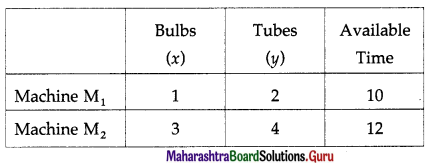
A manufacture produces bulbs and tubes. Each of these must be processed through two machines M1 and M2. A package of bulbs require 1 hour of work on Machine M1 and 3 hours of work on M2. A package of tubes require 2 hours on Machine M1 and 4 hours on Machine M2. He earns a profit of ₹ 13.5 per package of bulbs and ₹ 55 per package of tubes. Formulate the LLP to maximize the profit, if he operates the machine M1, for atmost 10 hours a day and machine M2 for atmost 12 hours a day.
Solution:
Let the number of packages of bulbs produced by manufacturer be x and packages of tubes be y. The manufacturer earns a profit of ₹ 13.5 per package of bulbs and ₹ 55 per package of tubes.
Therefore, his total profit is p = ₹ (13.5x + 55y)
This is a linear function which is to be maximized.
Hence, it is the objective function.
The constraints are as per the following table :
Maharashtra Board 12th Maths Solutions Chapter 7 Linear Programming Ex 7.3 8
From the table, the total time required for Machine M1 is (x + 2y) hours and for Machine M2 is (3x + 4y) hours.
Given Machine M1 and M2 are available for atmost 10 hours and 12 hours a day respectively.
Therefore, the constraints are x + 2y ≤ 10, 3x + 4y ≤ 12. Since, x and y cannot be negative, we have, x ≥ 0, y ≥ 0. Hence, the given LPP can be formulated as :
Maximize p = 13.5x + 55y, subject to x + 2y ≤ 10, 3x + 4y ≤ 12, x ≥ 0, y ≥ 0.

Question 6.
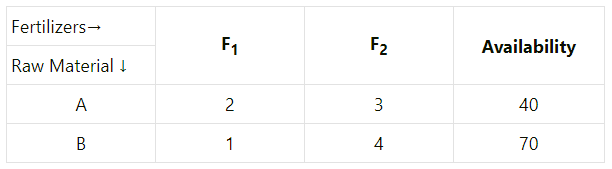
A company manufactures two types of fertilizers F1 and F2. Each type of fertilizer requires
two raw materials A and B. The number of units of A and B required to manufacture one unit of fertilizer F1 and F2 and availability of the raw materials A and B per day are given in the
table below :
Maharashtra Board 12th Maths Solutions Chapter 7 Linear Programming Ex 7.3 9
By selling one unit of F1 and one unit of F2, company gets a profit of ₹ 500 and ₹ 750
respectively. Formulate the problem as L.P.P. to maximize the profit.
Solution:
Let the company manufactures x units of fertilizers F1 and y units of fertilizers F1. Then the total profit to the company is
z = ₹(500x + 750y).
This is a linear function that is to be maximized. Hence, it is an objective function.
Maharashtra Board 12th Maths Solutions Chapter 7 Linear Programming Ex 7.3 10
The raw material A required for x units of Fertilizers F1 and y units of Fertilizers F2 is 2x + Since the maximum availability of A is 40, we have the first constraint as 2x + 3y ≤ 40.
Similarly, considering the raw material B, we have x + 4y ≤ 70.
Since, x and y cannot be negative, we have, x ≥ 0, y ≥ 0.
Hence, the given LPP can be formulated as:
Maximize z = 500x + 750y, subject to
2x + 3y ≤ 40, x + 4y ≤ 70, x ≥ 0, y ≥ 0.

Maharashtra Board 12th Maths Solutions Chapter 1 Mathematical Logic Ex 1.1

Question 7.
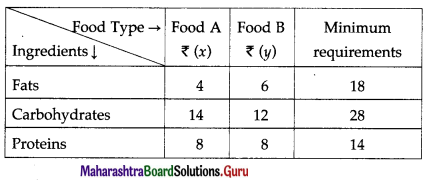
A doctor has prescribed two different units of foods A and B to form a weekly diet for a sick person. The minimum requirements of fats, carbohydrates and proteins are 18, 28, 14 units respectively. One unit of food A has 4 units of fats. 14 units of carbohydrates and 8 units of protein. One unit of food B has 6 units of fat, 12 units of carbohydrates and 8 units of protein. The price of food A is ₹ 4.5 per unit and that of food B is ₹ 3.5 per unit. Form the L.P.P. so that the sick person’s diet meets the requirements at a minimum cost.
Solution:
Let the diet of sick person include x units of food A and y units of food B.
Then x ≥ 0, y ≥ 0.
The prices of food A and B are ₹ 4.5 and ₹ 3.5 per unit respectively.
Therefore, the total cost is z = ₹ (4.5x + 3.5y)
This is the linear function which is to be minimized.
Hence, it is objective function.
The constraints are as per the following table :
Maharashtra Board 12th Maths Solutions Chapter 7 Linear Programming Ex 7.3 11
From the table, the sick person’s diet will include (4x + 6y) units of fats, (14x + 12y) units of carbohydrates and (8x + 8y) units of proteins. The minimum requirements of these ingredients are 18 units, 28 units and 14 units respectively.
Therefore, the constraints are
4x + 6y ≥ 18, 14x + 12y ≥ 28, 8x + 8y ≥ 14.
Hence, the given LPP can be formulated as
Minimize z = 4.5x + 3.5y, subject to
4x + 6y ≥ 18, 14x + 12y ≥ 28, 8x + 8y ≥ 14, x ≥ 0, y ≥ 0.

Question 8.
If John drives a car at a speed of 60 kms/hour he has to spend ₹ 5 per km on petrol. If he drives at a faster speed of 90 kms/hour, the cost of petrol increases to ₹ 8 per km. He has ₹ 600 to spend on petrol and wishes to travel the maximum distance within an hour. Formulate the above problem as L.P.P.
Solution:
Let John travel xl km at a speed of 60 km/ hour and x1 km at a speed of 90 km/hour.
Therefore, time required to travel a distance of x1 km is \(\frac{x_{1}}{60}\) hours and the time required to travel a distance of
x2 km is \(\frac{x_{2}}{90}\) hours.
∴ total time required to travel is \(\left(\frac{x_{1}}{60}+\frac{x_{2}}{90}\right)\) hours.
Since he wishes to travel the maximum distance within an hour,
\(\frac{x_{1}}{60}+\frac{x_{2}}{90}\) ≤ 1
He has to spend ₹ 5 per km on petrol at a speed of 60 km/hour and ₹ 8 per km at a speed of 90 km/hour.
∴ the total cost of travelling is ₹ (5x1 + 8x2)
Since he has ₹ 600 to spend on petrol,
5x1 + 8x2 ≤ 600
Since distance is never negative, x1 ≥ 0, x2 ≥ 0.
Total distance travelled by John is z. = (x1 + x2) km.
This is the linear function which is to be maximized.
Hence, it is objective function.
Hence, the given LPP can be formulated as :
Maximize z = x1 + x2, subject to
\(\frac{x_{1}}{60}+\frac{x_{2}}{90}\) ≤ 1, 5x1 + 8x2 ≤ 600, x1 ≥ 0, x2 ≥ 0.

Maharashtra Board 12th Maths Solutions Chapter 1 Mathematical Logic Ex 1.1

Question 9.
The company makes concrete bricks made up of cement and sand. The weight of a concrete brick has to be least 5 kg. Cement costs ₹ 20 per kg. and sand costs of ₹ 6 per kg. strength consideration dictate that a concrete brick should contain minimum 4 kg. of cement and not more than 2 kg. of sand. Form the L.P.P. for the cost to be minimum.
Solution:
Let the company use x1 kg of cement and x2 kg of sand to make concrete bricks.
Cement costs ₹ 20 per kg and sand costs ₹ 6 per kg.
∴ the total cost c = ₹ (20x1 + 6x2)
This is a linear function which is to be minimized.
Hence, it is the objective function.
Total weight of brick = (x1 + x2) kg
Since the weight of concrete brick has to be at least 5 kg,
∴ x1 + x2 ≥ 5.
Since concrete brick should contain minimum 4 kg of cement and not more than 2 kg of sand,
x1 ≥ 4 and 0 ≤ x2 ≤ 2
Hence, the given LPP can be formulated as :
Minimize c = 20x1 + 6x2, subject to
x1 + x2 ≥ 5, x1 ≥ 4, 0 ≤ x2 ≤ 2.

Maharashtra Board 11th Maths Solutions Chapter 4 Determinants and Matrices Ex 4.4

Balbharti Maharashtra State Board Class 11 Maths Solutions Pdf Chapter 4 Determinants and Matrices Ex 4.4 Questions and Answers.

Maharashtra State Board 11th Maths Solutions Chapter 4 Determinants and Matrices Ex 4.4

Question 1.
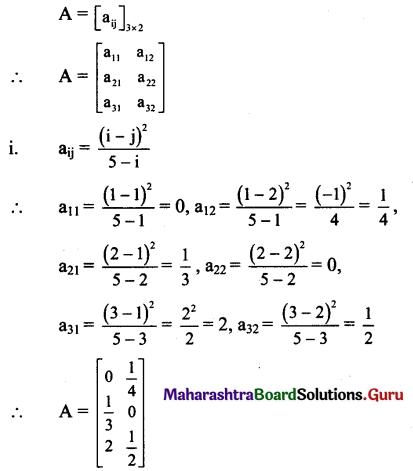
Construct a matrix A = [aij]3 x 2 whose elements ay are given by
i. aij = \(\frac{(\mathbf{i}-\mathbf{j})^{2}}{5-\mathbf{i}}\)
ii. aij = i – 3j
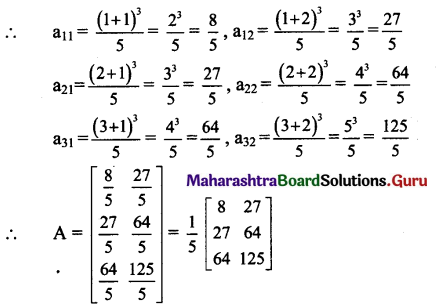
iii. aij \(\frac{(i+j)^{3}}{5}\)
Solution:
Maharashtra Board 11th Maths Solutions Chapter 4 Determinants and Matrices Ex 4.4 1
[Note: Answer given in the textbook is A = \(\left[\begin{array}{ll}
0 & \frac{1}{4} \\
\frac{1}{2} & 0 \\
2 & \frac{1}{2}
\end{array}\right]\)
However, as per our calculation it is \(\left[\begin{array}{ll}
0 & \frac{1}{4} \\
\frac{1}{3} & 0 \\
2 & \frac{1}{2}
\end{array}\right]\) ].

Maharashtra Board 11th Maths Solutions Chapter 4 Determinants and Matrices Ex 4.4

ii. aij = i – 3j
∴ a11 = 1 – 3(1) = 1 – 3 = -2,
a12= 1 – 3(2) = 1 – 6 = -5,
a21 = 2 – 3(1) = 2 – 3 =-1,
a22 = 2 – 3(2) = 2 – 6 = – 4
a31 = 3 – 3(1) = 3-3 = 0,
a32 = 3 – 3(2) = 3 – 6 = -3
∴ A = \(\left[\begin{array}{cc}
-2 & -5 \\
-1 & -4 \\
0 & -3
\end{array}\right]\)

iii. aij = \(\frac{(i+j)^{3}}{5}\)
Maharashtra Board 11th Maths Solutions Chapter 4 Determinants and Matrices Ex 4.4 2

Question 2.
Classify the following matrices as a row, a column, a square, a diagonal, a scalar, a unit, an upper triangular, a lower triangular, a symmetric or a skew- symmetric matrix.
i. \(\left[\begin{array}{ccc}
3 & -2 & 4 \\
0 & 0 & -5 \\
0 & 0 & 0
\end{array}\right]\)
Solution:
Let A = \(\left[\begin{array}{ccc}
3 & -2 & 4 \\
0 & 0 & -5 \\
0 & 0 & 0
\end{array}\right]\)
As every element below the diagonal is zero in matrix A.
∴ A is an upper triangular matrix.

ii. \(\left[\begin{array}{ccc}
0 & 4 & 7 \\
-4 & 0 & -3 \\
-7 & 3 & 0
\end{array}\right]\)
Solution:
Let A = \(\left[\begin{array}{ccc}
0 & 4 & 7 \\
-4 & 0 & -3 \\
-7 & 3 & 0
\end{array}\right]\)
∴ AT = \(\left[\begin{array}{ccc}
0 & -4 & -7 \\
4 & 0 & 3 \\
7 & -3 & 0
\end{array}\right]\)
∴ AT = \(-\left[\begin{array}{ccc}
0 & 4 & 7 \\
-4 & 0 & -3 \\
-7 & 3 & 0
\end{array}\right]\)
∴ AT = -A, i.e., A = -AT
∴ A is a skew-symmetric matrix.

Maharashtra Board 11th Maths Solutions Chapter 4 Determinants and Matrices Ex 4.4

iii. \(\left[\begin{array}{c}
5 \\
4 \\
-3
\end{array}\right]\)
Solution:
Let A = \(\left[\begin{array}{c}
5 \\
4 \\
-3
\end{array}\right]\)
∴ As matrix A has only one column.
∴ A is a column matrix.

iv. \(\left[\begin{array}{lll}
9 & \sqrt{2} & -3
\end{array}\right]\)
Solution:
Let A = \(\left[\begin{array}{lll}
9 & \sqrt{2} & -3
\end{array}\right]\)
As matrix A has only one row.
∴ A is a row matrix.

v. \(\left[\begin{array}{ll}
6 & 0 \\
0 & 6
\end{array}\right]\)
Solution:
Let A = \(\left[\begin{array}{ll}
6 & 0 \\
0 & 6
\end{array}\right]\)
As matrix A has all its non-diagonal elements zero and diagonal elements same.
∴ A is a scalar matrix.

vi. \(\left[\begin{array}{ccc}
2 & 0 & 0 \\
3 & -1 & 0 \\
-7 & 3 & 1
\end{array}\right]\)
Solution:
Let A = \(\left[\begin{array}{ccc}
2 & 0 & 0 \\
3 & -1 & 0 \\
-7 & 3 & 1
\end{array}\right]\)
As every element above the diagonal is zero in matrix A.
∴ A is a lower triangular matrix.

vii. \(\left[\begin{array}{ccc}
3 & 0 & 0 \\
0 & 5 & 0 \\
0 & 0 & \frac{1}{3}
\end{array}\right]\)
Solution:
Let A = \(\left[\begin{array}{ccc}
3 & 0 & 0 \\
0 & 5 & 0 \\
0 & 0 & \frac{1}{3}
\end{array}\right]\)
As matrix A has all its non-diagonal elements zero.
∴ A is a diagonal matrix.

Maharashtra Board 11th Maths Solutions Chapter 4 Determinants and Matrices Ex 4.4

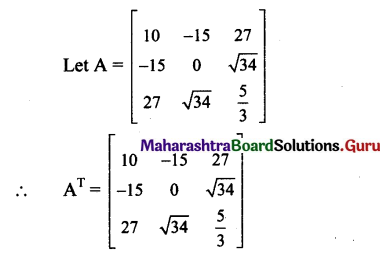
viii. \(\left[\begin{array}{ccc}
10 & -15 & 27 \\
-15 & 0 & \sqrt{34} \\
27 & \sqrt{34} & \frac{5}{3}
\end{array}\right]\)
Solution:
Maharashtra Board 11th Maths Solutions Chapter 4 Determinants and Matrices Ex 4.4 3
∴ AT = A, i/e., A = AT
∴ A is a symmetric matrix.

ix. \(\left[\begin{array}{lll}
1 & 0 & 0 \\
0 & 1 & 0 \\
0 & 0 & 1
\end{array}\right]\)
Solution:
A = \(\left[\begin{array}{lll}
1 & 0 & 0 \\
0 & 1 & 0 \\
0 & 0 & 1
\end{array}\right]\)
In matrix A, all the non-diagonal elements are zero and diagonal elements are one.
∴ A is a unit (identity) matrix.

x. \(\left[\begin{array}{lll}
0 & 0 & 1 \\
0 & 1 & 0 \\
1 & 0 & 0
\end{array}\right]\)
Solution:
Let A = \(\left[\begin{array}{lll}
0 & 0 & 1 \\
0 & 1 & 0 \\
1 & 0 & 0
\end{array}\right]\)
∴ AT = A, i/e., A = AT
∴ A is a symmetric matrix.

Question 3.
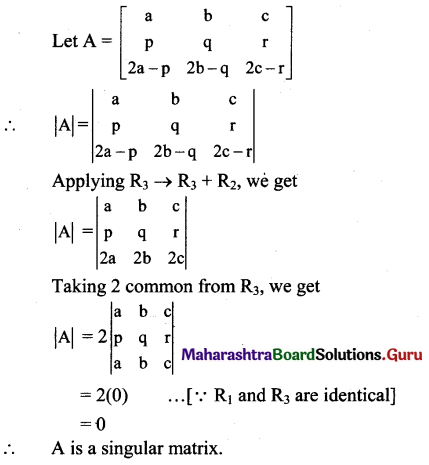
Which of the following matrices are singular or non-singular?
i. \(\left[\begin{array}{ccc}
\mathbf{a} & \mathbf{b} & \mathbf{c} \\
\mathbf{p} & \mathbf{q} & \mathbf{r} \\
\mathbf{2 a}-\mathbf{p} & \mathbf{2 b}-\mathbf{q} & \mathbf{2 c}-\mathbf{r}
\end{array}\right]\)
ii. \(\left[\begin{array}{ccc}
5 & 0 & 5 \\
1 & 99 & 100 \\
6 & 99 & 105
\end{array}\right]\)
iii. \(\left[\begin{array}{ccc}
3 & 5 & 7 \\
-2 & 1 & 4 \\
3 & 2 & 5
\end{array}\right]\)
iv. \(\left[\begin{array}{cc}
7 & 5 \\
-4 & 7
\end{array}\right]\)
Solution:
Maharashtra Board 11th Maths Solutions Chapter 4 Determinants and Matrices Ex 4.4 4

Maharashtra Board 11th Maths Solutions Chapter 4 Determinants and Matrices Ex 4.4

ii. Let A = \(\left[\begin{array}{ccc}
5 & 0 & 5 \\
1 & 99 & 100 \\
6 & 99 & 105
\end{array}\right]\)
∴ |A| = \(\left|\begin{array}{ccc}
5 & 0 & 5 \\
1 & 99 & 100 \\
6 & 99 & 105
\end{array}\right|\)
Applying C2 → C2 + C1
|A| = \(\left|\begin{array}{ccc}
5 & 5 & 5 \\
1 & 100 & 100 \\
6 & 105 & 105
\end{array}\right|\)
= 0 … [∵ C2 and C3 are identical]
∴ A is a singular matrix.

iii. Let A = \(\left[\begin{array}{ccc}
3 & 5 & 7 \\
-2 & 1 & 4 \\
3 & 2 & 5
\end{array}\right]\)
∴ |A| = \(\left|\begin{array}{ccc}
3 & 5 & 7 \\
-2 & 1 & 4 \\
3 & 2 & 5
\end{array}\right| \)
= 3(5 – 8) – 5(-10 – 12) + 7(-4 – 3)
= -9 + 110 – 49 = 52 ≠ 0
∴ A is a non-singular matrix.

iv. Let A = \(\left[\begin{array}{cc}
7 & 5 \\
-4 & 7
\end{array}\right]\)
∴ |A| = \(\left[\begin{array}{cc}
7 & 5 \\
-4 & 7
\end{array}\right]\) = 49 + 20 = 69 ≠ 0

Question 4.
Find k, if the following matrices are singular.
i. \(\left[\begin{array}{cc}
7 & 3 \\
-2 & k
\end{array}\right]\)
ii. \(\left[\begin{array}{ccc}
4 & 3 & 1 \\
7 & k & 1 \\
10 & 9 & 1
\end{array}\right]\)
iii. \(\left[\begin{array}{ccc}
k-1 & 2 & 3 \\
3 & 1 & 2 \\
1 & -2 & 4
\end{array}\right]\)
Solution:
Let A = \(\left[\begin{array}{cc}
7 & 3 \\
-2 & k
\end{array}\right]\)
Since A is a singular matrix,
|A|=0
∴ \(\left|\begin{array}{cc}
7 & 3 \\
-2 & \mathrm{k}
\end{array}\right|\) = o
∴ 7k + 6 = 0
∴ 7k = -6
k = -6/7

ii. Let A = \(\left[\begin{array}{ccc}
4 & 3 & 1 \\
7 & k & 1 \\
10 & 9 & 1
\end{array}\right]\)
Since A is a singular matrix,
|A|= 0
∴ \(\left|\begin{array}{ccc}
4 & 3 & 1 \\
7 & \mathrm{k} & 1 \\
10 & 9 & 1
\end{array}\right|\) = 0
∴ 4(k – 9) – 3(7 – 10) + 1(63 – 10k) = 0
∴ 4k – 36 + 9 + 63 – 10k = 0
∴ -6k + 36 = 0
∴ 6k = 36
∴ k = 6

iii. Let A = \(\left[\begin{array}{ccc}
\mathbf{k}-1 & 2 & 3 \\
3 & 1 & 2 \\
1 & -2 & 4
\end{array}\right]\)
Since A is a singular matrix
|A| = 0
∴ \(\left|\begin{array}{ccc}
k-1 & 2 & 3 \\
3 & 1 & 2 \\
1 & -2 & 4
\end{array}\right|\)
∴ (k – 1)(4 + 4) – 2(12 – 2) + 3 (-6 – 1) = 0
∴ 8k-8-20-21 =0
∴ 8k = 49
∴ k = 49/8

Maharashtra Board 11th Maths Solutions Chapter 4 Determinants and Matrices Ex 4.4

Question 5.
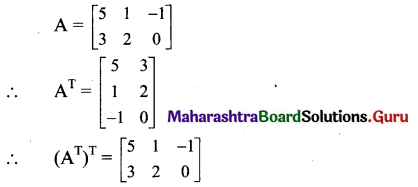
If A = \(\left[\begin{array}{lll}
5 & 1 & -1 \\
3 & 2 & 0
\end{array}\right]\), find (AT)T.
Solution:
Maharashtra Board 11th Maths Solutions Chapter 4 Determinants and Matrices Ex 4.4 5

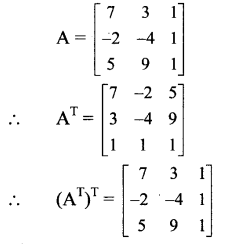
Question 6.
If A = \(\), find (AT)T.
Solution:
Maharashtra Board 11th Maths Solutions Chapter 4 Determinants and Matrices Ex 4.4 6

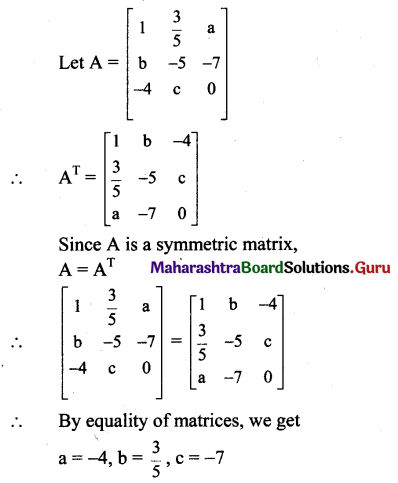
Question 7.
Find a, b, c, if \(\left[\begin{array}{ccc}
1 & \frac{3}{5} & a \\
b & -5 & -7 \\
-4 & c & 0
\end{array}\right]\) is a symmetric matrix.
Solution:
Maharashtra Board 11th Maths Solutions Chapter 4 Determinants and Matrices Ex 4.4 7

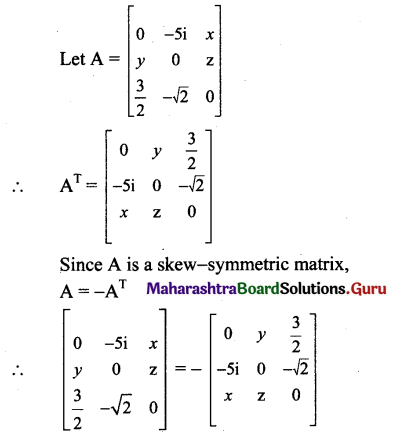
Question 8.
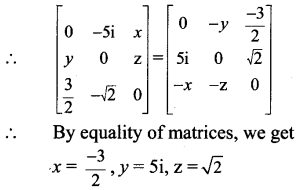
Find x, y, z, if \(\) is a symmetric matrix.
Solution:
Maharashtra Board 11th Maths Solutions Chapter 4 Determinants and Matrices Ex 4.4 8

Maharashtra Board 11th Maths Solutions Chapter 4 Determinants and Matrices Ex 4.4 9

Question 9.
For each of the following matrices, using its transpose, state whether it is symmetric, skew-symmetric or neither.
i. \(\left[\begin{array}{ccc}
1 & 2 & -5 \\
2 & -3 & 4 \\
-5 & 4 & 9
\end{array}\right]\)
ii. \(\left[\begin{array}{ccc}
2 & 5 & 1 \\
-5 & 4 & 6 \\
-1 & -6 & 3
\end{array}\right]\)
iii. \(\left[\begin{array}{ccc}
0 & 1+2 \mathbf{i} & \mathbf{i}-2 \\
-1-2 \mathbf{i} & 0 & -7 \\
2-\mathbf{i} & 7 & 0
\end{array}\right]\)
Solution:
i. Let A = \(\left[\begin{array}{ccc}
1 & 2 & -5 \\
2 & -3 & 4 \\
-5 & 4 & 9
\end{array}\right]\)
∴ AT =\(\left[\begin{array}{ccc}
1 & 2 & -5 \\
2 & -3 & 4 \\
-5 & 4 & 9
\end{array}\right]\)
∴ AT = A, i.e., A = AT
∴ A is a symmetric matrix.

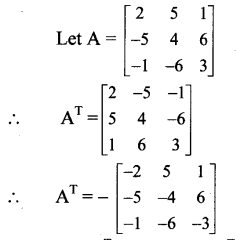
ii.
Maharashtra Board 11th Maths Solutions Chapter 4 Determinants and Matrices Ex 4.4 10
∴ A ≠ AT, i.e., A ≠ -AT
∴ A is neither a symmetric nor skew-symmetric matrix.

Maharashtra Board 11th Maths Solutions Chapter 4 Determinants and Matrices Ex 4.4

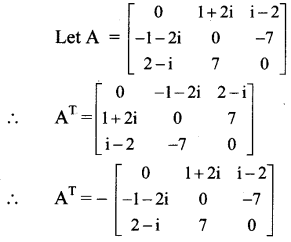
iii.
Maharashtra Board 11th Maths Solutions Chapter 4 Determinants and Matrices Ex 4.4 11
∴ AT = -A, i.e., A = -AT
∴ A is a skew-symmetric matrix.

Question 10.
Construct the matrix A = [aij]3 x 3, where aij = i – j. State whether A is symmetric or skew-symmetric.
Solution:
A = [aij]3 x 3
∴ A = \(\left[\begin{array}{lll}
a_{11} & a_{12} & a_{13} \\
a_{21} & a_{22} & a_{23} \\
a_{31} & a_{32} & a_{33}
\end{array}\right]\)
Given, aij = i – j
a11 = 1-1 = 0, a12 = 1-2 = – 1, a13 = 1 – 3 = – 2,
a21 – 2 – 1 = 1, a22 = 2 – 2 = 0, a23 =2 – 3 = – 1,
a31 = 3 – 1 = 2, a32 = 3 – 2 = 1, a33 = 3 – 3 = 0
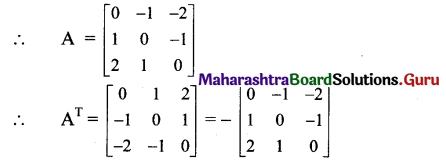
Maharashtra Board 11th Maths Solutions Chapter 4 Determinants and Matrices Ex 4.4 12
∴ AT = -A, i.e., A = -AT
∴ A is a skew-symmetric matrix.

Maharashtra Board 12th Maths Solutions Chapter 7 Linear Programming Ex 7.2

Balbharti 12th Maharashtra State Board Maths Solutions Book Pdf Chapter 7 Linear Programming Ex 7.2 Questions and Answers.

Maharashtra State Board 12th Maths Solutions Chapter 7 Linear Programming Ex 7.2

I) Find the feasible solution of the following inequations graphically.
Question 1.
3x + 2y ≤ 18, 2x + y ≤ 10, x ≥ 0, y ≥ 0
Solution:
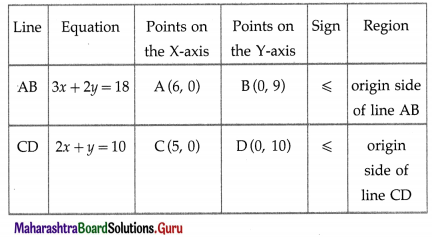
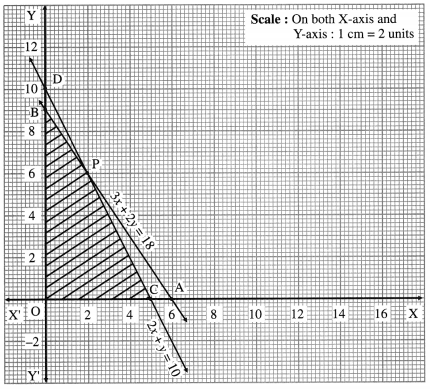
First we draw the lines AB and CD whose equations are 3x + 2y = 18 and 2x + y = 10 respectively.
Maharashtra Board 12th Maths Solutions Chapter 7 Linear Programming Ex 7.2 1
Maharashtra Board 12th Maths Solutions Chapter 7 Linear Programming Ex 7.2 2
The feasible solution is OCPBO which is shaded in the graph.

Question 2.
2x + 3y ≤ 6, x + y ≥ 2, x ≥ 0, y ≥ 0
Solution:
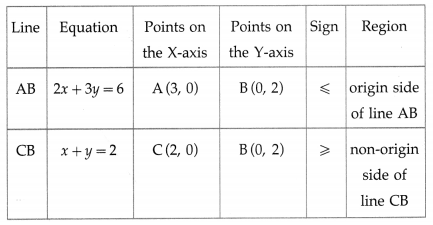
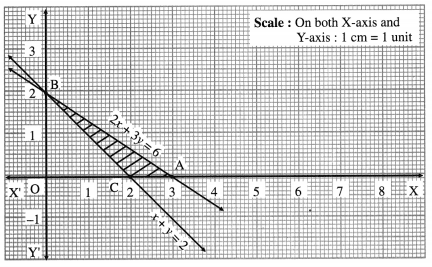
First we draw the lines AB and CB whose equations are 2x + 3y = 6 and x + y = 2 respectively.
Maharashtra Board 12th Maths Solutions Chapter 7 Linear Programming Ex 7.2 3
Maharashtra Board 12th Maths Solutions Chapter 7 Linear Programming Ex 7.2 4
The feasible solution is ∆ABC which is shaded in the graph.

Maharashtra Board 12th Maths Solutions Chapter 1 Mathematical Logic Ex 1.1

Question 3.
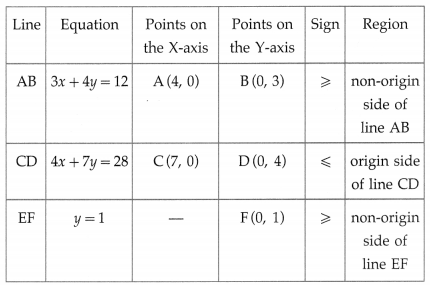
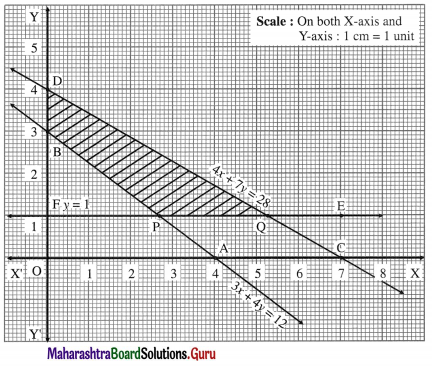
3x + 4y ≥ 12, 4x + 7y ≤ 28, y ≥ 1, x ≥ 0
Solution:
First we draw the lines AB, CD and EF whose equations are 3x + 4 y = 12, 4x + 7y = 28 and y = 1 respectively.
Maharashtra Board 12th Maths Solutions Chapter 7 Linear Programming Ex 7.2 5
Maharashtra Board 12th Maths Solutions Chapter 7 Linear Programming Ex 7.2 6
The feasible solution is PQDBP. which is shaded in the graph.

Question 4.
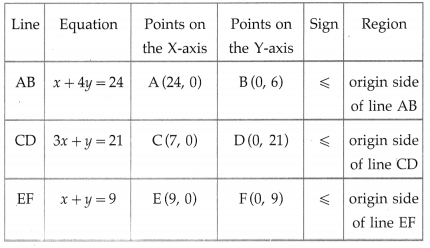
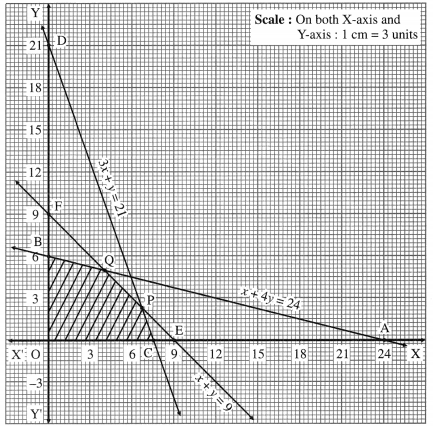
x + 4y ≤ 24, 3x + y ≤ 21, x + y ≤ 9, x ≥ 0, y ≥ 0.
Solution:
First we draw the lines AB, CD and EF whose equations are x + 4y = 24, 3x + y = 21 and x + y = 9 respectively.
Maharashtra Board 12th Maths Solutions Chapter 7 Linear Programming Ex 7.2 7
Maharashtra Board 12th Maths Solutions Chapter 7 Linear Programming Ex 7.2 8
The feasible solution is OCPQBO. which is shaded in the graph.

Maharashtra Board 12th Maths Solutions Chapter 1 Mathematical Logic Ex 1.1

Question 5.
0 ≤ x ≤ 3, 0 ≤ y ≤ 3, x + y ≤ 5, 2x + y ≥ 4
Solution:
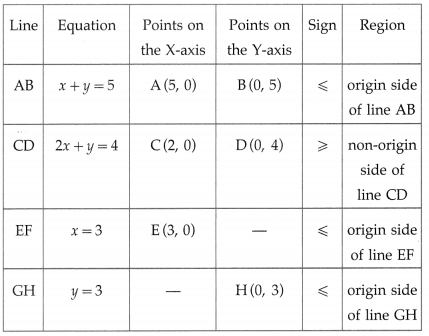
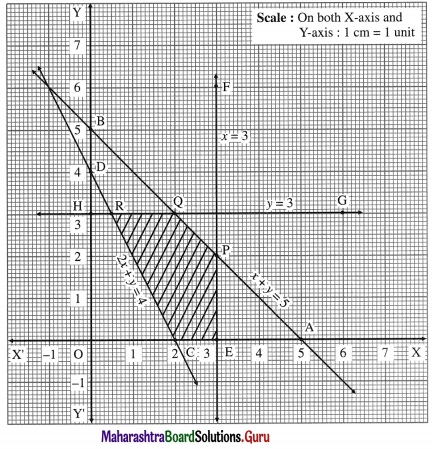
First we draw the lines AB, CD, EF and GH whose equations are x + y = 5, 2x + y = 4, x = 3 and y = 3 respectively.
Maharashtra Board 12th Maths Solutions Chapter 7 Linear Programming Ex 7.2 9
Maharashtra Board 12th Maths Solutions Chapter 7 Linear Programming Ex 7.2 10
The feasible solution is CEPQRC. which is shaded in the graph.

Maharashtra Board 12th Maths Solutions Chapter 1 Mathematical Logic Ex 1.1

Question 6.
x – 2y ≤ 2, x + y ≥ 3, -2x + y ≤ 4, x ≥ 0, y ≥ 0
Solution:
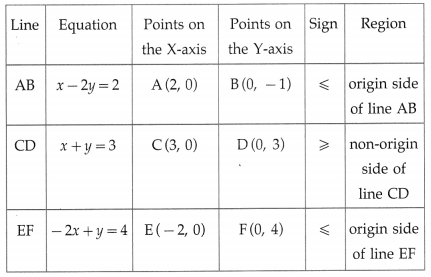
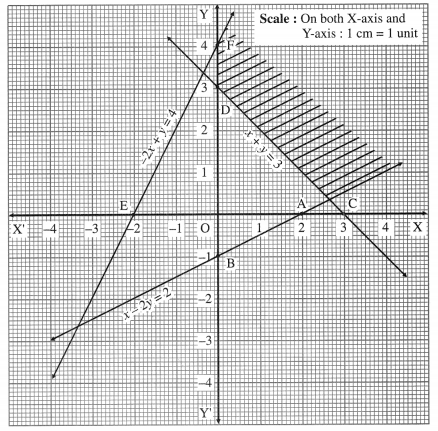
First we draw the lines AB, CD and EF whose equations are x – 2y = 2, x + y = 3 and -2x + y = 4 respectively.
Maharashtra Board 12th Maths Solutions Chapter 7 Linear Programming Ex 7.2 11
Maharashtra Board 12th Maths Solutions Chapter 7 Linear Programming Ex 7.2 12
The feasible solution is shaded in the graph.

Question 7.
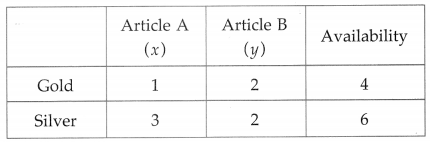
A company produces two types of articles A and B which requires silver and gold. Each unit of A requires 3 gm of silver and 1 gm of gold, while each unit of B requires 2 gm of silver and 2 gm of gold. The company has 6 gm of silver and 4 gm of gold. Construct the inequations and find the feasible solution graphically.
Solution:
Let the company produces x units of article A and y units of article B.
The given data can be tabulated as:
Maharashtra Board 12th Maths Solutions Chapter 7 Linear Programming Ex 7.2 13
Inequations are :
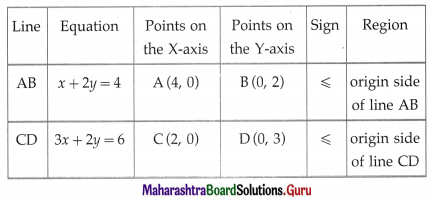
x + 2y ≤ 4 and 3x + 2y ≤ 6
x and y are number of items, x ≥ 0, y ≥ 0
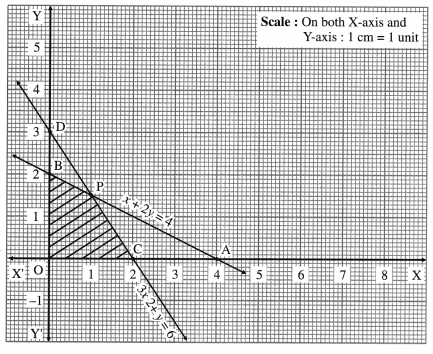
First we draw the lines AB and CD whose equations are x + 2y = 4 and 3x + 2y = 6 respectively.
Maharashtra Board 12th Maths Solutions Chapter 7 Linear Programming Ex 7.2 14
Maharashtra Board 12th Maths Solutions Chapter 7 Linear Programming Ex 7.2 15
The feasible solution is OCPBO. which is shaded in the graph.

Maharashtra Board 12th Maths Solutions Chapter 1 Mathematical Logic Ex 1.1

Question 8.
A furniture dealer deals in tables and chairs. He has Rs.1,50,000 to invest and a space to store at most 60 pieces. A table costs him Rs.1500 and a chair Rs.750. Construct the inequations and find the feasible solution.
Question is modified
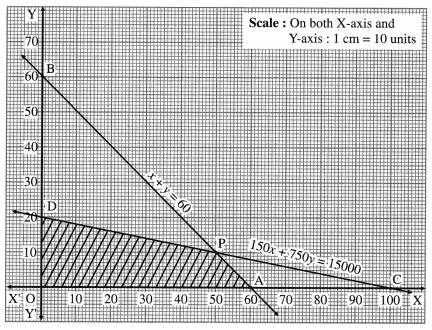
A furniture dealer deals in tables and chairs. He has ₹ 15,000 to invest and a space to store at most 60 pieces. A table costs him ₹ 150 and a chair ₹ 750. Construct the inequations and find the feasible solution.
Solution:
Let x be the number of tables and y be the number of chairs. Then x ≥ 0, y ≥ 0.
The dealer has a space to store at most 60 pieces.
∴ x + y ≤ 60
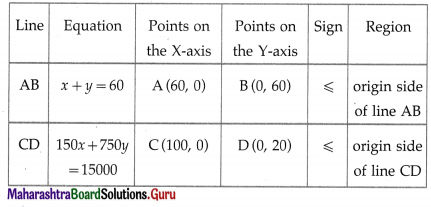
Since, the cost of each table is ₹ 150 and that of each chair is ₹ 750, the total cost of x tables and y chairs is 150x + 750y. Since the dealer has ₹ 15,000 to invest, 150x + 750y ≤ 15,000
Hence the system of inequations are
x + y ≤ 60, 150x + 750y ≤ 15000, x ≥ 0, y ≥ 0.
First we draw the lines AB and CD whose equations are x + y = 60 and 150x + 750y = 15,000 respectively.
Maharashtra Board 12th Maths Solutions Chapter 7 Linear Programming Ex 7.2 16
Maharashtra Board 12th Maths Solutions Chapter 7 Linear Programming Ex 7.2 17
The feasible solution is OAPDO. which is shaded in the graph.

Maharashtra Board 12th Maths Solutions Chapter 7 Linear Programming Ex 7.1

Balbharti 12th Maharashtra State Board Maths Solutions Book Pdf Chapter 7 Linear Programming Ex 7.1 Questions and Answers.

Maharashtra State Board 12th Maths Solutions Chapter 7 Linear Programming Ex 7.1

Question 1.
Solve graphically :
(i) x ≥ 0
Solution:
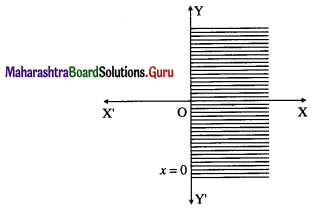
Consider the line whose equation is x = 0. This represents the Y-axis.
To find the solution set, we have to check any point other than origin.
Let us check the point (1, 1)
When x = 1, x ≥ 0
∴ (1, 1) lies in the required region
Therefore, the solution set is the Y-axis and the right
side of the Y-axis which is shaded in the graph.
Maharashtra Board 12th Maths Solutions Chapter 7 Linear Programming Ex 7.1 1

(ii) x ≤ 0
Solution:
Consider the line whose equation is x = 0.
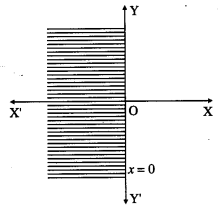
This represents the Y-axis.
To find the solution set, we have to check any point other than origin.
Let us check the point (1, 1).
When x = 1, x ≰ 0
∴ (1, 1) does not lie in the required region.
Therefore, the solution set is the Y-axis and the left side of the Y-axis which is shaded in the graph.
Maharashtra Board 12th Maths Solutions Chapter 7 Linear Programming Ex 7.1 2

Maharashtra Board 12th Maths Solutions Chapter 1 Mathematical Logic Ex 1.1

(iii) y ≥ 0
Solution:
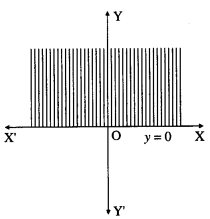
Consider the line whose equation is y = 0. This represents the X-axis. To find the solution set, we have to check any point other than origin. Let us check the point (1, 1).
When y = 1, y ≥ 0
∴ (1, 1) lies in the required region.
Therefore, the solution set is the X-axis and above the X-axis which is shaded in the graph.
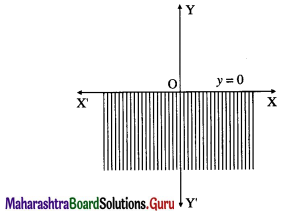
Maharashtra Board 12th Maths Solutions Chapter 7 Linear Programming Ex 7.1 3

(iv) y ≤ 0
Solution:
(iv) Consider the line whose equation is y = 0. This represents the X-axis.
To find the solution set, we have to check any point other than origin.
Let us check the point (1, 1).
When y = 1, y ≰ 0.
∴ (1, 1) does not lie in the required region.
Therefore, the solution set is the X-axis and below the X-axis which is shaded in the graph.
Maharashtra Board 12th Maths Solutions Chapter 7 Linear Programming Ex 7.1 4

Maharashtra Board 12th Maths Solutions Chapter 1 Mathematical Logic Ex 1.1

Question 2.
Solve graphically :
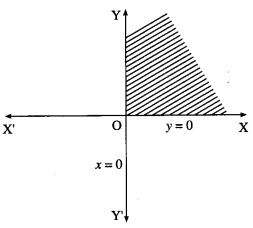
(i) x ≥ 0 and y ≥ 0
Solution:
Consider the lines whose equations are x = 0, y = 0.
These represents the equations of Y-axis and X-axis respectively, which divide the plane into four parts.
(i) Since x ≥ 0, y ≥ 0, the solution set is in the first quadrant which is shaded in the graph.
Maharashtra Board 12th Maths Solutions Chapter 7 Linear Programming Ex 7.1 5

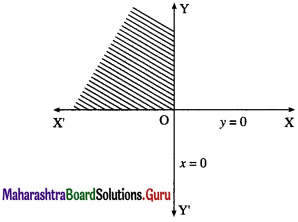
(ii) x ≤ 0 and y ≥ 0
Solution:
Since x ≤ 0, y ≥ 0, the solution set is in the second quadrant which is shaded in the graph.
Maharashtra Board 12th Maths Solutions Chapter 7 Linear Programming Ex 7.1 6

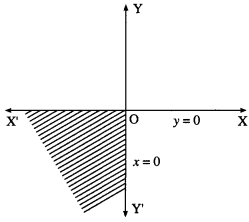
(iii) x ≤ 0 and y ≤ 0
Solution:
Since x ≤ 0, y ≤ 0, the solution set is in the third quadrant which is shaded in the graph.
Maharashtra Board 12th Maths Solutions Chapter 7 Linear Programming Ex 7.1 7

Maharashtra Board 12th Maths Solutions Chapter 1 Mathematical Logic Ex 1.1

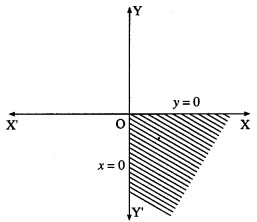
(iv) x ≥ 0 and y ≤ 0
Solution:
Since x ≥ 0, y ≤ 0, the solution set is in the fourth ! quadrant which is shaded in the graph.
Maharashtra Board 12th Maths Solutions Chapter 7 Linear Programming Ex 7.1 8

Question 3.
Solve graphically :
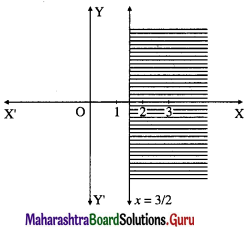
(i) 2x – 3 ≥ 0
Solution:
Consider the line whose equation is 2x – 3 = 0,
i.e. x = \(\frac{3}{2}\)
This represents a line parallel to Y-axis passing through the point (\(\frac{3}{2}\), 0)
Draw the line x =\(\frac{3}{2}\).
To find the solution set, we have to check the position of the origin (0, 0).
When x = 0, 2x – 3 = 2 × 0 – 3 = -3 ≱ 0
∴ the coordinates of the origin does not satisfy the given inequality.
∴ the solution set consists of the line x = \(\frac{3}{2}\) and the non-origin side of the line which is shaded in the graph.
Maharashtra Board 12th Maths Solutions Chapter 7 Linear Programming Ex 7.1 9

Maharashtra Board 12th Maths Solutions Chapter 1 Mathematical Logic Ex 1.1

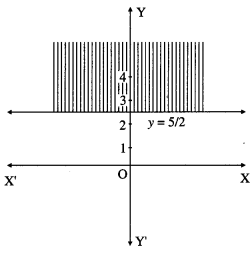
(ii) 2y – 5 ≥ 0
Solution:
Consider the line whose equation is 2y – 5 = 0, i.e. y = \(\frac{5}{2}\)
This represents a line parallel to X-axis passing through the point (0, \(\frac{5}{2}\)).
Draw the line y = \(\frac{5}{2}\).
To find the solution set, we have to check the position of the origin (0, 0).
When y = 0, 2y – 5 = 2 × 0 – 5 = -5 ≱ 0
∴ the coordinates of the origin does not satisfy the given inequality.
∴ the solution set consists of the line y = \(\frac{5}{2}\) and the non-origin side of the line which is shaded in the graph.
Maharashtra Board 12th Maths Solutions Chapter 7 Linear Programming Ex 7.1 10

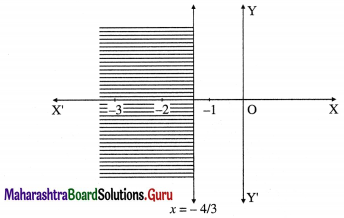
(iii) 3x + 4 ≤ 0
Solution:
(iii) Consider the line whose equation is 3x + 4 = 0,
i.e. x = \(-\frac{4}{3}\)
This represents a line parallel to Y-axis passing through the point (\(-\frac{4}{3}\), 0).
Draw the line x = \(-\frac{4}{3}\).
To find the solution set, we have to check the position of the origin (0, 0).
When x = 0, 3x + 4 = 3 × 0 + 4= 4 ≰ 0
∴ the coordinates of the origin does not satisfy the given inequality.
∴ the solution set consists of the line x = \(-\frac{4}{3}\) and the non-origin side of the line which is shaded in the graph.
Maharashtra Board 12th Maths Solutions Chapter 7 Linear Programming Ex 7.1 11

Maharashtra Board 12th Maths Solutions Chapter 1 Mathematical Logic Ex 1.1

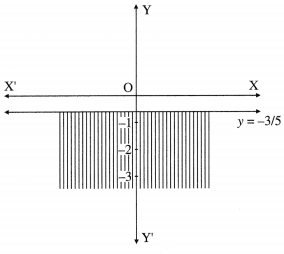
(iv) 5y + 3 ≤ 0
Solution:
(iv) Consider the line whose equation is 5y + 3 = 0,
i.e. y = \(\frac{-3}{5}\)
This represents a line parallel to X-axis passing through the point (0, \(\frac{-3}{5}\))
Draw the line y = \(\frac{-3}{5}\).
To find the solution set, we have to check the position of the origin (0, 0).
When y = 0, 5y + 3 = 5 × 0 + 3 = 3 ≰ 0
∴ the coordinates of the origin does not satisfy the given inequality.
∴ the solution set consists of the line y = \(\frac{-3}{5}\) and the non-origin side of the line which is shaded in the graph.
Maharashtra Board 12th Maths Solutions Chapter 7 Linear Programming Ex 7.1 12

Question 4.
Solve graphically :
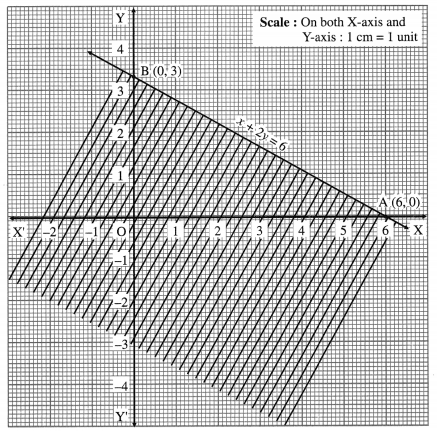
(i) x + 2y ≤ 6
Solution:
Consider the line whose equation is x + 2y = 6.
To find the points of intersection of this line with the coordinate axes.
Put y = 0, we get x = 6.
∴ A = (6, 0) is a point on the line.
Put x = 0, we get 2y = 6, i.e. y = 3
∴ B = (0, 3) is another point on the line.
Maharashtra Board 12th Maths Solutions Chapter 7 Linear Programming Ex 7.1 13
Draw the line AB joining these points. This line divide the line into two parts.
1. Origin side 2. Non-origin side
To find the solution set, we have to check the position of the origin (0, 0) with respect to the line.
When x = 0, y = 0, then x + 2y = 0 which is less than 6.
∴ x + 2y ≤ 6 in this case.
Hence, origin lies in the required region. Therefore, the given inequality is the origin side which is
shaded in the graph.
This is the solution set of x + 2y ≤ 6.

Maharashtra Board 12th Maths Solutions Chapter 1 Mathematical Logic Ex 1.1

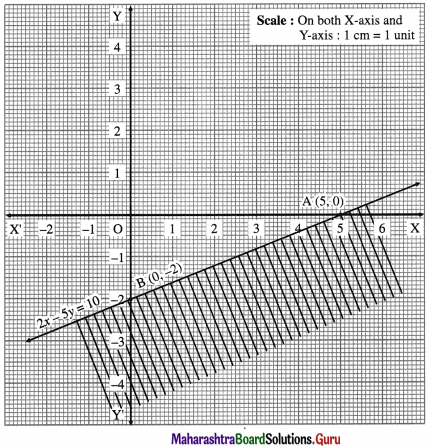
(ii) 2x – 5y ≥ 10
Solution:
Consider the line whose equation is 2x – 5y = 10.
To find the points of intersection of this line with the coordinate axes.
Put y = 0, we get 2x = 10, i.e. x = 5.
∴ A = (5, 0) is a point on the line.
Put x = 0, we get -5y = 10, i.e. y = -2
∴ B = (0, -2) is another point on the line.
Maharashtra Board 12th Maths Solutions Chapter 7 Linear Programming Ex 7.1 14
Draw the line AB joining these points. This line J divide the plane in two parts.
1. Origin side 2. Non-origin side
To find the solution set, we have to check the position of the origin (0, 0) with respect to the line. When x = 0, y = 0, then 2x – 5y = 0 which is neither greater nor equal to 10.
∴ 2x – 5y ≱ 10 in this case.
Hence (0, 0) will not lie in the required region.
Therefore, the given inequality is the non-origin side, which is shaded in the graph.
This is the solution set of 2x – 5y ≥ 10.

Maharashtra Board 12th Maths Solutions Chapter 1 Mathematical Logic Ex 1.1

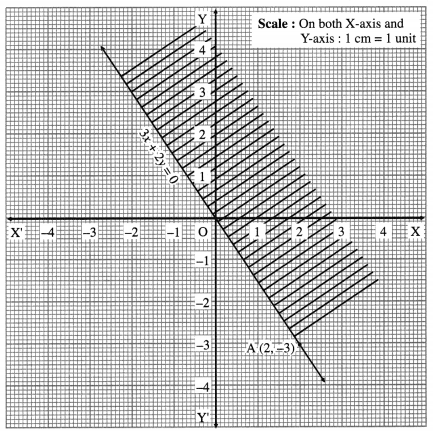
(iii) 3x + 2y ≥ 0
Solution:
Consider the line whose equation is 3x + 2y = 0.
The constant term is zero, therefore this line is passing through the origin.
∴ one point on the line is O ≡ (0, 0).
To find the another point, we can give any value of x and get the corresponding value of y.
Put x = 2, we get 6 + 2y = 0 i.e. y = – 3
∴ A = (2, -3) is another point on the line.
Draw the line OA.
To find the solution set, we cannot check (0, 0) as it is already on the line.
We can check any other point which is not on the line.
Let us check the point (1, 1)
Maharashtra Board 12th Maths Solutions Chapter 7 Linear Programming Ex 7.1 15
When x = 1, y = 1, then 3x + 2y = 3 + 2 = 5 which is greater than zero.
∴ 3x + 2y > 0 in this case.
Hence (1, 1) lies in the required region. Therefore, the required region is the upper side which is shaded in the graph.
This is the solution set of 3x + 2y ≥ 0.

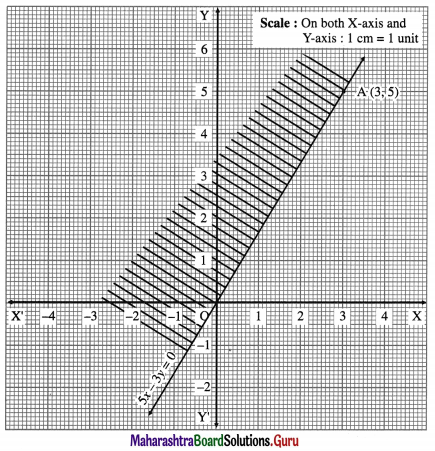
(iv) 5x – 3y ≤ 0
Solution:
Consider the line whose equation is 5x – 3y = 0. The constant term is zero, therefore this line is passing through the origin.
∴ one point on the line is the origin O = (0, 0).
To find the other point, we can give any value of x and get the corresponding value of y.
Put x = 3, we get 15 – 3y = 0, i.e. y = 5
∴ A ≡ (3, 5) is another point on the line.
Draw the line OA.
To find the solution set, we cannot check 0(0, 0), as it is already on the line. We can check any other point which is not on the line.
Let us check the point (1, -1).
When x = 1, y = -1 then 5x – 3y = 5 + 3 = 8
which is neither less nor equal to zero.
∴ 5x – 3y ≰ 0 in this case.
Hence (1, -1) will not lie in the required region. Therefore, the required region is the upper side which is shaded in the graph.
Maharashtra Board 12th Maths Solutions Chapter 7 Linear Programming Ex 7.1 16
This is the solution set of 5x – 3y ≤ 0.

Maharashtra Board 12th Maths Solutions Chapter 1 Mathematical Logic Ex 1.1

Question 5.
Solve graphically :
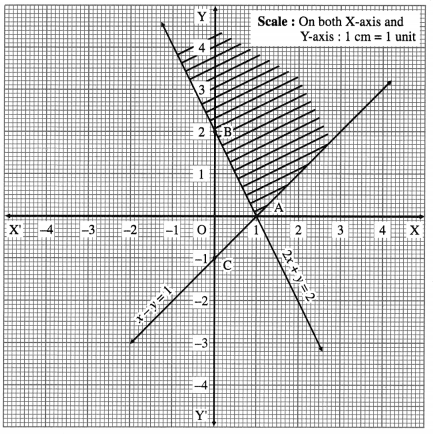
(i) 2x + y ≥ 2 and x – y ≤ 1
Solution:
First we draw the lines AB and AC whose equations are 2x + y = 2 and x – y = 1 respectively.
Maharashtra Board 12th Maths Solutions Chapter 7 Linear Programming Ex 7.1 17
Maharashtra Board 12th Maths Solutions Chapter 7 Linear Programming Ex 7.1 18
The solution set of the given system of inequalities is shaded in the graph.

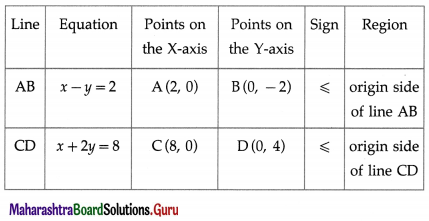
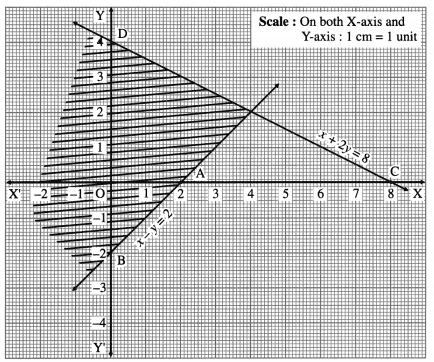
(ii) x – y ≤ 2 and x + 2y ≤ 8
Solution:
First we draw the lines AB and CD whose equations are x – y = 2 and x + 2y = 8 respectively.
Maharashtra Board 12th Maths Solutions Chapter 7 Linear Programming Ex 7.1 19
Maharashtra Board 12th Maths Solutions Chapter 7 Linear Programming Ex 7.1 20
The solution set of the given system of inequalities is shaded in the graph.

Maharashtra Board 12th Maths Solutions Chapter 1 Mathematical Logic Ex 1.1

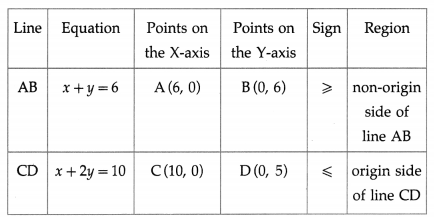
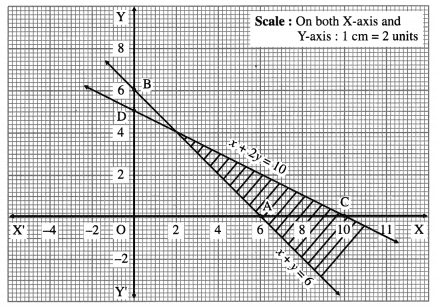
(iii) x + y ≥ 6 and x + 2y ≤ 10
Solution:
First we draw the lines AB and CD whose equations are x + y = 6 and x + 2y = 10 respectively.
Maharashtra Board 12th Maths Solutions Chapter 7 Linear Programming Ex 7.1 21
Maharashtra Board 12th Maths Solutions Chapter 7 Linear Programming Ex 7.1 22
The solution set of the given system of inequalities is shaded in the graph.

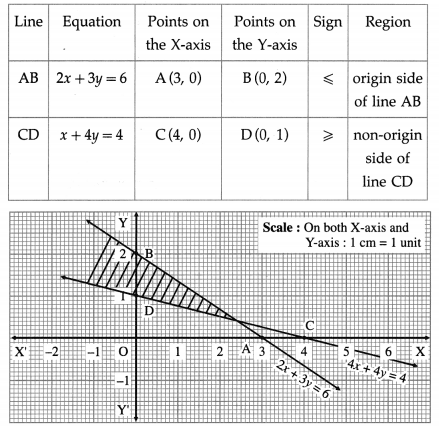
(iv) 2x + 3y ≤ 6 and x + 4y ≥ 4
Solution:
First we draw the lines AB and CD whose equations are 2x + 3y = 6 and x + 4y = 4 respectively.
Maharashtra Board 12th Maths Solutions Chapter 7 Linear Programming Ex 7.1 23
The solution set of the given system of inequalities is shaded in the graph.

Maharashtra Board 12th Maths Solutions Chapter 1 Mathematical Logic Ex 1.1

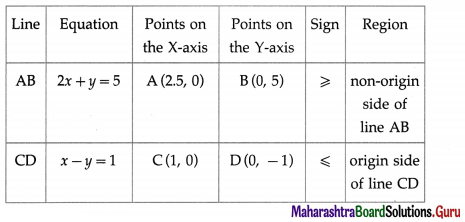
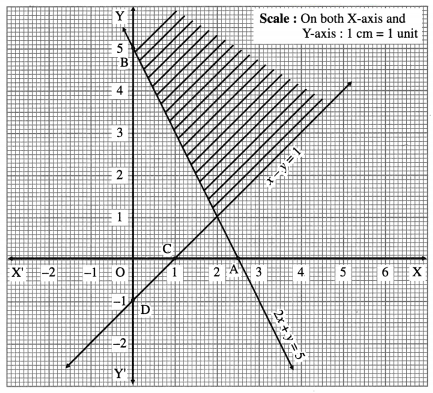
(v) 2x + y ≥ 5 and x – y ≤ 1
Solution:
First we draw the lines AB and CD whose equations are 2x + y = 5 and x – y = 1 respectively.
Maharashtra Board 12th Maths Solutions Chapter 7 Linear Programming Ex 7.1 24
Maharashtra Board 12th Maths Solutions Chapter 7 Linear Programming Ex 7.1 25
The solution set of the given system of inequations is shaded in the graph.

Maharashtra Board 11th Maths Solutions Chapter 3 Trigonometry – II Ex 3.5

Balbharti Maharashtra State Board Class 11 Maths Solutions Pdf Chapter 3 Trigonometry – II Ex 3.5 Questions and Answers.

Maharashtra State Board 11th Maths Solutions Chapter 3 Trigonometry – II Ex 3.5

Question 1.
In Δ ABC, A + B + C = π, show that
cos2A + cos2B + cos2C = – 1 – 4 cosA cosB cosC
Solution:
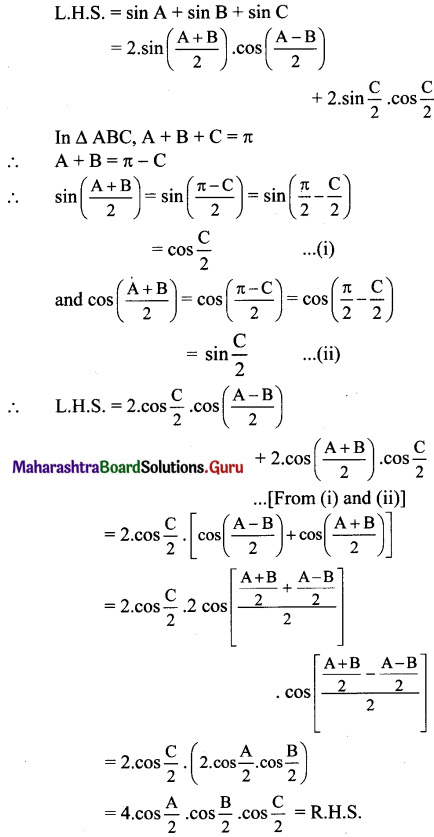
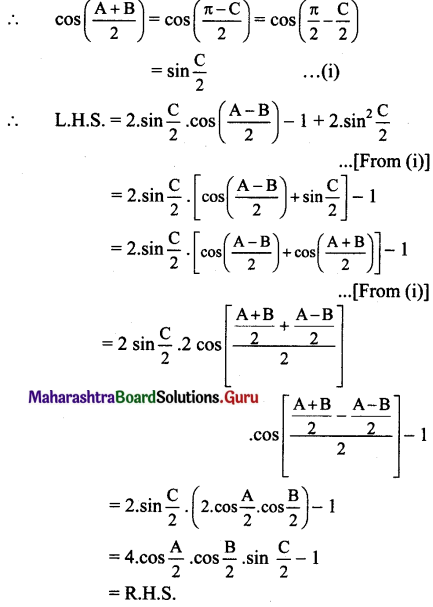
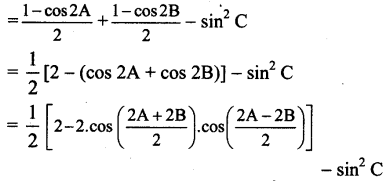
L.H.S. = cos 2A + cos 2B + cos 2C
= \(2 \cdot \cos \left(\frac{2 \mathrm{~A}+2 \mathrm{~B}}{2}\right) \cdot \cos \left(\frac{2 \mathrm{~A}-2 \mathrm{~B}}{2}\right)+\cos 2 \mathrm{C}\)
= 2.cos(A + B).cos (A – B) + 2cos2C – 1
In ΔABC, A + B + C = π
∴ A + B = π – C
∴ cos(A + B) = cos(π – C)
∴ cos(A + B) = – cosC ………….(i)

Maharashtra Board 11th Maths Solutions Chapter 3 Trigonometry - II Ex 3.5

∴ L.H.S. = – 2.cos C.cos (A – B) + 2.cos2C – 1 …[From(i)]
= – 1 – 2.cosC.[cos(A – B) – cosC]
= – 1 – 2.cos C.[cos(A – B) + cos(A + B)]
… [From (i)]
= – 1 – 2.cos C.(2.cos A.cos B)
= – 1 – 4.cos A.cos B.cos C = R.H.S.

Question 2.
sin A + sin B + sin C = 4 cos A/2 cos B/2 cos C/2
Solution:
Maharashtra Board 11th Maths Solutions Chapter 3 Trigonometry - II Ex 3.5 1

Question 3.
cos A + Cos B + Cos C = 4 cos A/2 cos B/2 cos C/2
= \(2 \cdot \cos \left(\frac{\mathrm{A}+\mathrm{B}}{2}\right) \cdot \cos \left(\frac{\mathrm{A}-\mathrm{B}}{2}\right)-\left(1-2 \sin ^{2} \frac{\mathrm{C}}{2}\right)\)
Solution:
L.H.S. = sin A + sin B + sin C
= \(2 \cdot \cos \left(\frac{\mathrm{A}+\mathrm{B}}{2}\right) \cdot \cos \left(\frac{\mathrm{A}-\mathrm{B}}{2}\right)-\left(1-2 \sin ^{2} \frac{\mathrm{C}}{2}\right)\)
In Δ ABC, A + B + C = π ,
∴ A + B = π – C
Maharashtra Board 11th Maths Solutions Chapter 3 Trigonometry - II Ex 3.5 2

Maharashtra Board 11th Maths Solutions Chapter 3 Trigonometry - II Ex 3.5

Question 4.
sin2 A + sin2 B – sin2 C = 2 sin A sin B cos C
Solution:
We know that, sin2 = \(\frac{1-\cos 2 \theta}{2}\)
L.H.S.
= sin2 + sin2 B + sin2 C
Maharashtra Board 11th Maths Solutions Chapter 3 Trigonometry - II Ex 3.5 3
= 1 – cos(A + B). cos(A – B) – sin2C
= (1 – sin2 C ) – cos (A + B). cos (A – B)
= cos2 C – cos(A + B). cos(A – B)
∴ cos(A + B) = cos(it — C)
∴ cos(A + B) = — cos C …(i)
∴ L.H.S. = cos2C + cos C.cos(A – B)
… [From (i)]
= cos C[cos C + cos(A – B)]
= cos C[- cos(A + B) + cos(A – B)]
… [From (i)]
= cos C[cos (A-B) – cos(A + B)]
= cos C(2 sin A.sin B)
= 2 sin A.sin B. cos C
= R.H.S.
[Note: The question has been modified.]

Question 5.
\(\sin ^{2} \frac{A}{2}+\sin ^{2} \frac{B}{2}-\sin ^{2} \frac{C}{2}\) = \(1-2 \cos \frac{A}{2} \cos \frac{B}{2} \sin \frac{C}{2}\)
Solution:
Maharashtra Board 11th Maths Solutions Chapter 3 Trigonometry - II Ex 3.5 4
Maharashtra Board 11th Maths Solutions Chapter 3 Trigonometry - II Ex 3.5 5

Question 6.
tan \(\frac{\mathbf{A}}{2}\) tan \(\frac{\mathbf{B}}{2}\) tan \(\frac{\mathbf{B}}{2}\) tan \(\frac{\mathbf{C}}{2}\) tan \(\frac{\mathbf{C}}{2}\) tan \(\frac{\mathbf{A}}{2}\) = 1
Solution:
In Δ ABC,
A + B + C = π
∴ A + B = π – C
Maharashtra Board 11th Maths Solutions Chapter 3 Trigonometry - II Ex 3.5 6

Maharashtra Board 11th Maths Solutions Chapter 3 Trigonometry - II Ex 3.5

Question 7.
\(\cot \frac{A}{2}+\cot \frac{B}{2}+\cot \frac{C}{2}=\cot \frac{A}{2} \cot \frac{B}{2} \cot \frac{C}{2}\)
Solution:
In Δ ABC,
A + B + C = π
∴ A + B = π – C
Maharashtra Board 11th Maths Solutions Chapter 3 Trigonometry - II Ex 3.5 7

Question 8.
tan 2A + tan 2B + tan 2C = tan 2A tan 2B + tan 2C
Solution:
In Δ ABC,
A + B + C = π
∴ 2A + 2B + 2C = 2π
∴ 2A + 2B = 2π – 2C
tan(2A + 2B) = tan(2n — 2C)
\(\frac{\tan 2 \mathrm{~A}+\tan 2 \mathrm{~B}}{1-\tan 2 \mathrm{~A} \cdot \tan 2 \mathrm{~B}}\) = -tan 2C
∴ tan2A+tan2B=—tan2C.(1-tan2A.tan2B)
∴ tan 2A + tan 2B = – tan2C+ tan2A.tan2B.tan2C
∴ tan 2A + tan 2B + tan 2C = tan2A.tan2B.tan2C

Question 9.
cos2 A + cos2 B – cos2 C = 1 – 2 sin A sin B sin C
Solution:
we know that cos2θ = \(\frac{1+\cos 2 \theta}{2}\)
L.H.S.
= cos2 A + cos2 B + cos2 C
Maharashtra Board 11th Maths Solutions Chapter 3 Trigonometry - II Ex 3.5 8
= 1 + cos (A + B).cos(A — B) – cos2 C
In ΔABC,
A + B + C = π
A + B = π — C
cos(A + B) = cos(π — C)
cos(A + B) = -cosC ………….. (i)
L.H.S. = 1 — cos C.cos(A — B) — cos2 C
…[From(i)]
= 1 — cos C.[cos(A — B) + cos C]
= 1 — cos C.[cos(A — B) — cos(A + B)]
.. .[From (i)]
= 1 — cos C.(2.sin A.sin B)
= 1 — 2.sinA.sin B.cos C
= R.H.S.

Maharashtra Board Class 12 Physics Important Questions Chapter 11 Magnetic Materials

Balbharti Maharashtra State Board 12th Physics Important Questions Chapter 11 Magnetic Materials Important Questions and Answers.

Maharashtra State Board 12th Physics Important Questions Chapter 11 Magnetic Materials

Question 1.
How did a magnet derive its name? What was its ancient use?
Answer:
The characteristic of a magnet to attract iron is called its attractive property. This property was discovered in a rock found in the ancient mineral-rich region of Magnesia (modern Turkey). The word magnet is derived from this Magnesian rock.

The rock when floated on water (by tying it to a piece of wood) or suspended freely was found to align approximately in the north-south direction. Because this directional property was used by some ancient travellers to locate the geographic north, it was also called the leading stone or lodestone.

The Magnesian rock is the naturally magnetized iron ore magnetite (Fe3O4). It is hard, black or brownish-black with a metallic luster.

Question 2.
Explain the directional characteristic of a bar magnet.
Answer:
When a bar magnet is suspended so as to rotate freely in a horizontal plane, it comes to rest in approximately the North-South direction.

The end of the magnet directed towards the Earth’s geographic North Pole is called the north-seeking pole or the north pole, and the other end which is directed towards the Earth’s geographic South Pole is called the south-seeking pole or the south pole.
Maharashtra Board Class 12 Physics Important Questions Chapter 11 Magnetic Materials 1
The cause for this alignment is seen when we consider the turning moment on a bar magnet suspended in a uniform magnetic induction \(\vec{B}\), as shown in below figure. The north pole (pole strength + m) and the south pole (pole strength – m) of the bar magnet experience equal and opposite forces of magnitude mB. If the lines of action of these two forces are not the same, they constitute a couple whose effect is to produce rotation.
Maharashtra Board Class 12 Physics Important Questions Chapter 11 Magnetic Materials 2

Maharashtra Board Class 12 Physics Important Questions Chapter 11 Magnetic Materials

Question 3.
State the expression for the torque acting on a magnetic dipole in a uniform magnetic field.
Answer:
When a magnetic dipole of magnetic dipole moment \(\vec{M}\) is placed in a uniform magnetic field of induction \(\vec{B}\), it experiences a torque whose magnitude is
τ = MB sin θ
where θ is the smaller angle between the magnetic axis and \(\vec{B}\).
[Note: When the dipole is placed with its axis at right-angles to the field, i.e, θ = 90°,
τ = MB or M = \(\frac{\tau}{B}\)
This is the defining equation for the magnetic dipole moment.]

Question 4.
Derive an expression for the torque acting on a magnetic dipole placed in a region of uniform magnetic induction. Express it in vector form.
Answer:
Consider a magnetic dipole consisting of two point poles of pole strength m a distance 2l apart with its axis inclined at an angle θ to a uniform magnetic field of induction \(\vec{B}\), shown in figure. The magnetic force on the positive (or north) pole is m\(\vec{B}\), while that on the negative (or south) pole is – m\(\vec{B}\). These two forces, equal in magnitude, opposite in direction and separated by a finite distance, constitute a couple which tends to line up the magnetic dipole moment with the field \(\vec{B}\).
Maharashtra Board Class 12 Physics Important Questions Chapter 11 Magnetic Materials 3
The torque of the couple in the clockwise sense in above figure in magnitude, is
τ = (mB) d
where d is the distance between the lines of action of the forces.
∴ τ = (mB)2lsin θ = MB sin θ (∵ m = \(\frac{M}{2 l}\))
Expressed as a vector product,
\(\vec{\tau}=\vec{M} \times \vec{B}\)
The torque has a maximum magnitude, (m2l)B, when sin θ = 1, i.e., when the magnet is perpendicular to the field. The torque vanishes when the magnet is parallel to the field, where sin θ = 0.

Question 5.
A current-carrying coil with magnetic moment \(\vec{M}\) (M = 5 A∙m2) is placed in a uniform magnetic field of induction \(\vec{B}\) (B = 0.2 Wb/m2) such that the angle between \(\vec{M}\) and \(\vec{B}\) is 30°. What is the torque acting on the coil ?
Answer:
τ = MB sin θ = (5) (0.2) sin 30° = 0.5 N∙m is the torque acting on the coil.

Maharashtra Board Class 12 Physics Important Questions Chapter 11 Magnetic Materials

Question 6.
Explain what is meant by magnetic potential energy of a bar magnet kept in a uniform magnetic field. Discuss the cases when
(1) θ = 0°
(2) θ = 180°
(3) θ = 90°.
Answer:
A magnet free to rotate in a uniform magnetic field \(\vec{B}\) aligns its dipole moment \(\vec{M}\) with \(\vec{B}\). Work must be done to rotate the magnet from this equilibrium position. The work done is stored as the magnetic potential energy, also called its orientation energy. In a finite angular displacement from 0 to θ, the
magnetic potential energy
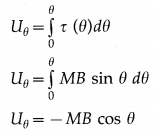
Maharashtra Board Class 12 Physics Important Questions Chapter 11 Magnetic Materials 4

  1. When θ = 0°, cos θ = cos 0° = 1, Uθ = – MB. At this position, the magnetic moment of the bar magnet is lined up with the field and its magnetic potential energy is minimum. This is its most stable equilibrium position.
  2. When θ = 180°, cos θ = cos 180° = – 1, Uθ = MB. At this position, the magnetic moment is antiparallel to the field and its magnetic potential energy is maximum. This is its most unstable position.
  3. When θ = 90°, cos θ = cos 90° = 0, Uθ = 0. At this position, the bar magnet is perpendicular to the
    magnetic field. Its magnetic potential energy is zero.

Question 7.
What is the nature of the graph between the magnetic potential energy of a bar magnet kept in a uniform magnetic field and angular position of the magnet ?
OR
Draw a graph of magnetic potential energy as a function of angular displacement.
Answer:
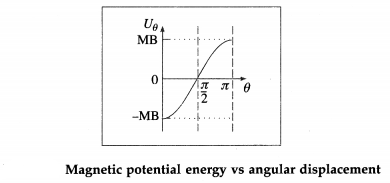
Maharashtra Board Class 12 Physics Important Questions Chapter 11 Magnetic Materials 5

Question 8.
Derive the expression for the time period of angular oscillations of a bar magnet kept in a uniform magnetic field.
Answer:
Consider a bar magnet of magnetic dipole moment \(\vec{M}\), suspended by a light twistless fibre in a uniform magnetic field \(\vec{B}\) in such a way that it is free to rotate in a horizontal plane. In the rest position θ = 0, \(\vec{M}\) is parallel to \(\vec{B}\).

If magnet is given a small angular displacement θ from its rest position and released, the magnet performs angular or torsional oscillations about the rest position.

Let I be the moment of inertia of the bar magnet about the axis of oscillation and α the angular acceleration. The deflecting torque (in magnitude) is
τd = Iα = I \(\frac{d^{2} \theta}{d t^{2}}\) …………….. (1)
However, the restoring torque tries to bring back the oscillating bar magnet in the rest position. The restoring torque (in magnitude) is, τr = – MB sin θ …………. (2)
The minus sign in Eq. (2) indicates that restoring torque is opposite in direction to the angular deflection.
In equilibrium, both the torques balance each other. From Eqs. (1) and (2),
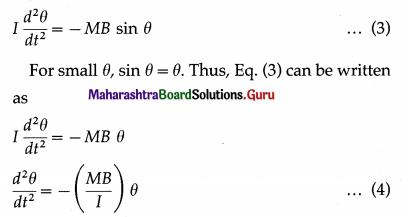
Maharashtra Board Class 12 Physics Important Questions Chapter 11 Magnetic Materials 6
Eq. (4) represents angular simple harmonic motion.
Writing ω2 = \(\frac{M B}{I}\) , the angular frequency ω of the motion is
ω = \(\sqrt{\frac{M B}{I}}\) ………….. (5)
The time period of oscillations of the bar magnet is
T = \(\frac{2 \pi}{\omega}=2 \pi \sqrt{\frac{I}{M B}}\) ……………… (6)
This is the required expression.

9. Solve the following
Question 1.
Find the magnitude of the magnetic moment of a magnet if a couple exerting torque 0.5 N.m is required to hold the magnet with its axis perpendicular to a uniform magnetic field of induction 2 × 10⁻³ T.
Solution:
Data : τ = 0.5 N∙m, B = 2 × 10⁻³ T, θ = 90°
τ = MB sin θ
∴ M = \(\frac{\tau}{B \sin \theta}=\frac{0.5 \mathrm{~N} \cdot \mathrm{m}}{\left(2 \times 10^{-3} \mathrm{~T}\right) \sin 90^{\circ}}\)
= 250 A∙m2
The magnitude of the magnetic moment of the magnet is 250 A∙m2.

Maharashtra Board Class 12 Physics Important Questions Chapter 11 Magnetic Materials

Question 2.
A magnetic dipole of magnetic moment 5 A∙m2 is placed in a uniform magnetic field of induction 10-3 T. Find the magnitude of the maximum torque acting on the dipole.
Solution:
Data : M = 5 A∙m2, B = 10-3 T
Torque, τ = MB sin θ
The magnitude of the torque is maximum when θ = 90°.
∴ τmax = MB = 5 × 10⁻³ N∙m

Question 3.
A bar magnet of magnetic length 0.12 m and pole strength 10 A-m is placed in a uniform magnetic field of induction 3 × 10⁻² tesla. If the angle between the magnetic induction and the magnetic moment is 30°, find the magnitude of the torque acting on the magnet.
Solution:
Data : 2l = 0.12 m, m = 10 A∙m, B = 3 × 10⁻² T,
θ = 30°
The magnitude of the torque,
τ = MB sin θ = m (2l) B sin θ
= (10 A∙m) (0.12 m)(3 × 10⁻² T) sin 30°
= 3.6 × 10⁻² × \(\frac{1}{2}\)
= 1.8 × 10⁻² N∙m

Question 4.
A bar magnet of moment 10 A∙m is suspended such that it can rotate freely in a horizontal plane. The horizontal component of the Earth’s magnetic field at the place is 36 µT. Calculate the magnitude of the torque when its angular displacement with respect to the direction of the field is 8C and magnetic potential energy.
Solution:
Data : M = 10 A∙m2, Bh = 36µT = 3.6 × 10⁻⁵ T,
θ = 8°
The magnitude of the torque is
τ = MBh sin θ
= (10) (3.6 × 10⁻⁵) sin 8°
= (36 × 10-5) (0.1391) = 5.007 × 10⁻⁵ N∙m
The magnetic potential energy of the bar magnet is
Uθ = MBh cos θ
= (36 × 10-5) cos 8°
= (36 × 10-5) (0.99) = 3.564 × 10⁻⁴ J

Question 5.
The time period of angular oscillation of a bar magnet in a horizontal magnetic field is 3.14 s. If the horizontal component of the Earth’s magnetic field at the place is 40 µT and the moment of inertia of the magnet is 10-4 kg∙m2, calculate the magnetic moment of the magnet.
Solution:
Data : T = 3.14 s, Bh = 40 µT = 4 × 10⁻⁵ T,
I = 10-4 kg∙m2
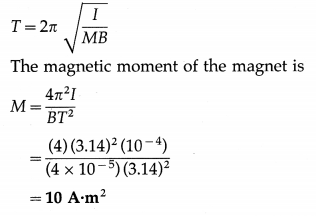
Maharashtra Board Class 12 Physics Important Questions Chapter 11 Magnetic Materials 7

Maharashtra Board Class 12 Physics Important Questions Chapter 11 Magnetic Materials

Question 6.
A bar magnet of moment 10 A∙m2 is suspended such that it can rotate freely in a horizontal plane. The horizontal component of the Earth’s magnetic field at the place is 36 µT. Calculate the magnitude of the torque when its angular displacement with respect to the direction of the field is 8° and magnetic potential energy.
Solution:
Data : M = 10 A∙m2, Bh = 36 µT = 3.6 × 10⁻⁵ T, θ = 8°
The magnitude of the torque is
τ = MBh sin θ
=(10)(3.6 × 10⁻⁵)sin8°
=(36 × 10-5)(0.1391) = 5.007 × 10⁻⁵ N∙m
The magnetic potential energy of the bar magnet is
Uθ = MBh cos θ
=(36 × 10-5)cos8°
=(36 × 10-5)(0.99) = 3.564 × 10⁻⁴ J

Question 10.
As the electron revolves in the second Bohr orbit in the hydrogen atom, the corresponding current is (about) 1.3 × 10⁻⁴ A. If the area of the orbit is (about) 1.4 × 10⁻¹⁹ m2, what is the (approximate) equivalent magnetic moment?
Answer:
M = IA = (1.3 × 10⁻⁴)(1.4 × 10⁻¹⁹)
= 1.82 × 10⁻²³ A∙m2 is the (approximate) equivalent magnetic moment.

Question 11.
What is the magnetic moment of an electron due to its orbital motion?
Answer:
The orbital magnetic moment of an electron, of charge e and revolving with speed v in an orbit of radius r, is \(\frac{1}{2}\) evr.

Question 12.
If the frequency of revolution of a proton (q = 1.6 × 10⁻¹⁹ C) in a uniform magnetic induction is 106 Hz, what is the corresponding electric current?
Answer:
I = \(\frac{q}{T}\) = qf = (1.6 × 10⁻¹⁹)(106)
= 1.6 × 10⁻¹³ A
is the corresponding electric current.

Question 13.
The frequency of revolution of the electron in the second Bohr orbit in the hydrogen atom is 8.22 × 10¹⁴ Hz. What is the corresponding electric ’ current? [e = 1.6 × 10⁻¹⁹ C]
Answer:
I = \(\frac{e}{T}\) = ef
= (1.6 × 10⁻¹⁹)(8.22 × 10¹⁴)
= 1.315 × 10⁻⁴A
is the corresponding electric current.

Maharashtra Board Class 12 Physics Important Questions Chapter 11 Magnetic Materials

Question 14.
A coil has 1000 turns, each of area 0.5 m2. What is the magnetic moment of the coil when it carries a current of 1 mA ?
Answer:
Magnetic moment M = NIA
= 1000 × 1 × 10-3 × 0.5
= 0.5 A∙m2

Question 15.
What is the gyromagnetic ratio of an orbital electron ? State its dimensions and the SI unit.
Answer:
The ratio of the magnitude of the orbital magnetic moment to that of the orbital angular momentum of an electron in an atom is called its gyromagnetic ratio γ0. If \(\vec{M}_{\mathrm{o}}\) is the orbital magnetic moment of the electron with orbital angular momentum \(\vec{L}_{\mathrm{o}}\),
γ0 = \(\frac{M_{\mathrm{o}}}{L_{\mathrm{o}}}=\frac{e}{2 m_{\mathrm{e}}}\)
where e and me are the electronic charge and electron mass, respectively.
Dimensions : [γ0] = \(\frac{[\text { charge }]}{[\text { mass }]}=\frac{[T I]}{[M]}\) = [M-1TI].
SI unit : The coulomb per kilogram (C/kg).
[Note : γ0 = 8.794 × 10¹⁰ C/kg. The gyromagnetic ratio of electron spin is nearly twice that of an orbital electron.]

16. Solve the following
Question 1.
A circular coil of 300 turns and diameter 14 cm carries a current of 15 A. What is the magnitude of the magnetic moment associated with the coil?
Solution :
Data : N = 300, d = 14 cm, I = 15 A
r = \(\frac{d}{2}\) = 7 cm = 7 × 10⁻² m
The magnitude of the magnetic moment associated with the coil is
M = NIA = NI(πr2)
= (300)(15)(3.142)(7 × 10⁻²)2
= 4500 × 3.142 × 49 × 10-4
= 69.28 A∙m2

Question 2.
A coil has 300 turns, each of area 0.05 m2.
(i) Find the current through the coil for which the magnetic moment of the coil will be 4.5 A∙m2.
(ii) It is placed in a uniform magnetic field of induction 0.2 T with its magnetic moment making an angle of 30° with \(\vec{B}\). Calculate the magnitude of the torque experienced by the coil.
Solution:
Data : N = 300, A = 0.05 m2, M = 4.5 A∙m2, B = 0.2 T, θ = 30°
(i) M = NIA
∴ The current in the coil,
I = \(\frac{M}{N A}=\frac{4.5}{300 \times 0.05}\) = 0.3 A

(ii) The magnitude of the torque,
τ = MB sin θ = 4.5 × 0.2 × sin 30°
= 0.9 × \(\frac{1}{2}\) = 0.45 N∙m

Maharashtra Board Class 12 Physics Important Questions Chapter 11 Magnetic Materials

Question 3.
An electron in an atom revolves around the nucleus in an orbit of radius 0.5 Å. Calculate the equivalent magnetic moment if the frequency of revolution of the electron is 1010 MHz.
Solution:
Data : r = 0.5 Å = 5 × 10-11 m,
f = 1010 MHz = 1016 Hz, e = 1.6 × 10⁻¹⁹ C
Equivalent current, I = \(\frac{e}{T}\) = ef
The equivalent magnetic moment is
M = IA = ef(πr2)
= (1.6 × 10⁻¹⁹)(1016)(3.142)(5 × 10-11)2
= 1.6 × 3.142 × 25 × 10-25
= 1.257 × 10⁻²³ A∙m2

Question 4.
Calculate the orbital magnetic dipole moment of the electron in the second Bohr orbit of the hydrogen atom. The radius of the orbit is 2.126 Å and the orbital speed of the electron in the orbit is 1.09 × 10⁶ m/s.
Solution:
Data : r = 2.126 Å = 2.126 × 10⁻¹⁰ m,
v = 1.09 × 10⁶ m/s, e = 1.6 × 10⁻¹⁹ C
The orbital magnetic dipole moment of the electron,
M0 = \(\frac{1}{2}\) evr
=(1.6 × 10⁻¹⁹)(1.09 × 10⁶)(2.126 × 10⁻¹⁰)
=1.6 × 1.09 × 1.063 × 10-23
= 1.854 × 10⁻²³ A∙m2

Question 5.
An electron in an atom revolves around the nucleus in an orbit of radius 0.53 Å. If the frequency of revolution of an electron is 9 × 10⁹ MHz, calcu-late the orbital angular momentum. [Charge on an electron = 1.6 × 10⁻¹⁹ C, gyromagnetic ratio = 8.8 × 10¹⁰ C/kg, π = 3.142]
Solution:
Data : r = 0.53 Å = 0.53 × 10⁻¹⁰ m,
f = 9 × 10⁹ MHz = 9 × 10¹⁵ Hz, e = 1.6 × 10⁻¹⁹ C, gyromagnetic ratio = 8.8 × 10¹⁰ C / kg, π = 3.142
Magnetic moment, M0 =IA = efπr2
= 1.6 × 10-19 × 9 × 1015 × 3.142 × (0.53 × 10-10)2
= 14.4 × 3.142 × (0.53)2 × 10-19 × 1015× 1020
= 1.272 × 10⁻²³ A∙m2
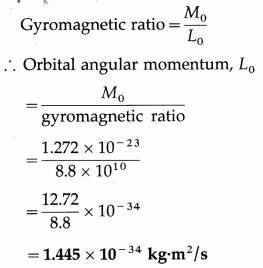
Maharashtra Board Class 12 Physics Important Questions Chapter 11 Magnetic Materials 8

Question 6.
The specific charge (charge-to-mass ratio) of an electron is 1.759 × 10¹¹ C/kg.
(i) What is the gyromagnetic ratio of an orbital electron?
(ii) If the measured component of its orbital angular momentum is 2.11 × 10⁻³⁴ kg∙m3/s. what Is the associatcd orbital magnetic dipole moment?
Solution:
Data: \(\frac{e}{m_{e}}\) = 1.759 × 10¹¹ C/kg,
L = 2.11 × 10⁻³⁴ kg∙m2/s

(i) The gyromag1etic ratio of an orbital electron,
γ0 = \(\frac{e}{2 m_{\mathrm{e}}}=\frac{1.759 \times 10^{11}}{2}\) =8.795 × 10¹⁰ C/kg

(ii) For the given component of the orbital angular momentum, the associated magnetic dipole moment is
Mo = \(\frac{e}{2m_{e}}\) L0 = γ0L0
= (8.795 × 10¹⁰ )(2.11 × 10⁻³⁴)
= 1.856 × 10⁻²³ A∙m2

Maharashtra Board Class 12 Physics Important Questions Chapter 11 Magnetic Materials

Question 7.
An electron performs uniform circuLar motion in a uniform magnetic field of induction 1.2T In a plane perpendicular to the field. Its kinetic energy is 6 × 10-20 J and its motion is subject only to the magnetic force due to the field. What is the magnetic dipole moment associated with the motion of the electron?
Solution:
Data:B = 1.2T, KE ≡ Ek = 6 × 10-20 J
The centripetal force on the electron is the magnetic force. If r and e are respectively the radius of the path and linear speed of the electron,
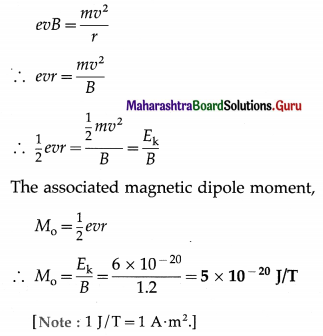
Maharashtra Board Class 12 Physics Important Questions Chapter 11 Magnetic Materials 9

Question 8.
If the magnetic moment of an electron revolving in an orbit of radius 0.4 Å is 9 × 10-24 A∙m2 then find the linear momentum of the electron in that orbit. (e/m = 1.76 × 10¹¹ C/kg]
Solution:
Data: r = 0.5 Å = 5 × 10-11 m, I = 1.1 × 10⁻³ A,
x = 100 Å = 10-8 m, \(\frac{\mu_{0}}{4 \pi}\) = 10-7 T∙m/A
The magnitude of the magnetic induction at an axial point of a current loop,
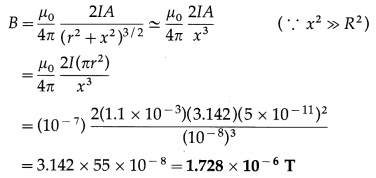
Maharashtra Board Class 12 Physics Important Questions Chapter 11 Magnetic Materials 10

Question 9.
The magnetic moment of an electron revolving in a circular orbit of radius 2.2 Å is 5.024 × 10⁻²⁴ A∙m2. Calculate the frequency of revolution of the electron in that orbit.
Solution:
Data: d = 0.2 m, B = 4 × 10⁻⁴ T,
2l = 5 cm = 5 × 10⁻² m, A = 2 cm2 = 2 × 10⁻⁴ m2,
\(\frac{\mu_{0}}{4 \pi}\) = 10-7 T∙m/A
The magnitude of the magnetic induction at an axial point of a bar magnet.
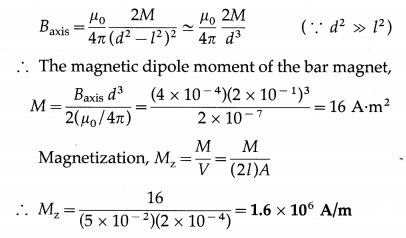
Maharashtra Board Class 12 Physics Important Questions Chapter 11 Magnetic Materials 11

Question 17.
Explain magnetization of a material.
Answer:
In an atom, the orbital and spin magnetic moments of its electrons may or may not add up to zero, depending on the electronic configuration. In some materials, their atoms have a net magnetic moment. When such a material is placed in an external magnetic field of induction \(\overrightarrow{B_{0}}\) , the field exerts a torque on each atomic magnet. These torques tend to align the magnetic moments with the applied field. Due to this, the material as a whole acquires a net magnetic moment \(\vec{M}_{\text {net }}\) along \(\overrightarrow{B_{0}}\) and the material is said to be magnetized.

The net magnetic moment per unit volume is called the magnetization \(\vec{M}_{z}\) of the material.
\(\vec{M}_{\mathrm{z}}=\vec{M}_{\text {net }} / V\)
where V is the volume of the material.

Even when the atomic magnetic moment is zero, application of magnetic field induces magnetism in the material. In this case, the magnetization has direction opposite to that of the applied field.

Maharashtra Board Class 12 Physics Important Questions Chapter 11 Magnetic Materials

Question 18.
Define magnetization.
State its dimensions and the SI unit.
OR
Define magnetization. State its formula and SI unit.
Answer:
Magnetization : The net magnetic moment per unit volume of a material is called the magnetization of the material.
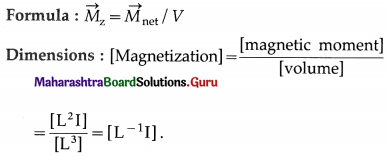
Maharashtra Board Class 12 Physics Important Questions Chapter 11 Magnetic Materials 12
SI unit: The ampere per metre (A/m).

Question 19.
A bar magnet (volume 1.5 × 10⁻⁵ 5m3) has a uniform magnetization of 6000 Aim. What is its magnetic dipole moment?
Answer:
Mz = \(\)
∴ M = MzV = (6000)(1.5 × 10⁻⁵)
= 9 × 10⁻² A∙m2 is the magnetic dipole moment of the magnet.

Question 20.
Define magnetic intensity.
State its dimensions and the SI unit.
Answer:
Magnetic intensity: The magnetic intensity is defined as the magnetic induction in an isotropic medium divided by the permeability of the medium.

The magnetic intensity is a quantitative characteristic of a magnetic field independent of the magnetic properties of the medium. In a medium, it determines the contribution to the magnetic induction in the medium by the external magnetic field.

Dimensions: Within a toroid without a core, which has n windings per unit length carrying a current I, the magnetic intensity, H = nI.
∴ [H] = [n][I] = [L-1][I] = [L-1I]
SI unit : The ampere per metre (A/m).
[Note : The magnetic intensity (also called the magnetic field strength), \(\vec{H}\), is defined as
\(\vec{H}=\frac{\vec{B}}{\mu_{0}}-\overrightarrow{M_{z}}\)
where \(\vec{B}\) is the magnetic induction, \(\vec{M}_{z}\) is the magnetization and μ0 is the permeability of free space.]

Maharashtra Board Class 12 Physics Important Questions Chapter 11 Magnetic Materials

Question 21.
What is the magnetic susceptibility of a medium?
Answer:
The magnetic susceptibility of a medium is a dimensionless quantity which signifies the contribution made by the medium when subjected to a magnetic field to the magnetic induction inside the medium. For a material in which the magnetization Mz is proportional to the magnetic intensity H, the magnetic susceptibility of the medium is
χm = Mz/H
It is equal to the fractional change in the magnetic induction due to the medium.
Magnetic susceptibility of some materials

SubstanceχSubstanceχ
Silicon-4.2 × 10⁻⁶Aluminium2.3 × 10-5
Bismuth-1.66 × 10⁻⁵Calcium1.9 × 10-5
Copper-9.8 × 10⁻⁶Choromium2.7 × 10-4
Diamond-2.2 × 10⁻⁵Lithium2.1 × 10-5
Gold-3.6 × 10⁻⁵Magnesium1.2 × 10-5
Lead-1.7 × 10⁵Niobium2.6 × 10-5
Mercury-2.9 × 10⁻⁵Oxygen (STP)2.1 × 10⁻⁶
Nitrogen-5.0 × 10⁻⁹Platinum2.9 ×10-4

Question 22.
Discuss magnetization of a rod of material having net magnetic moment with the help of a solenoid.
OR
Discuss magnetization of an iron rod placed in a solenoid.
OR
Discuss magnetization of a magnetic material placed in a solenoid.
Answer:
Consider an ideal air-cored solenoid carrying a steady current I. The magnitude of the magnetic induction inside the solenoid is
B0 = \(\frac{\mu_{0} N I}{2 \pi r}\) = μonI ………….. (1)
where n = \(\frac{N}{2 \pi r}\) is the number of turns per unit length and p0 is the permeability of free space.

When a core of magnetic material (such as iron) is present, the magnetic field within the solenoid due to the current in the winding magnetizes the material of the core. With the core, the magnetic induction \(\vec{B}\) inside the solenoid is greater than \(\vec{B}_{0}\), so that
B = B0 + Bm ……………. (2)
where Bm is the contribution of the iron core. Bm is proportional to the magnetization Mz of the material.
Bm = μoMz …………… (3)

While discussing magnetic materials, it is customary to call \(\frac{B_{0}}{\mu_{0}}\) as the magnetizing field or magnetic field intensity, denoted by H, which produces the magnetization.
∴ B0 = μoH …………. (4)
Substituting for B0 and BM in Eq. (1),
B = μ0H + μ0Mz = μ0(H + Mz) …………….. (5)
For materials in which the magnetization is pro-portional to the magnetic intensity,
Mz ∝ H or Mz = χmH ………. (6)
where the constant of proportionality χm is called the magnetic susceptibility.
∴ B = μ0(H + χmH) = μ0(1 + χm)H = μH …………. (7)
where p = μ0(1 + χm) is called the permeability of the material.

[Notes : (1) Mz ∝ H only for diamagnetic and paramagnetic materials. Among ferromagnetic materials, the linear relation in Eq. (6) holds good only for initial magnetization of magnetically softer materials; for magnetically harder materials, Mz is not a single-valued function of H, and depends on the magnetic intensity that the material has been previously exposed to (a phenomenon known as hysteresis). (2) H is defined for convenience; B is more fundamental.]

Question 23.
What is the relation between permeability and magnetic susceptibility of a medium? What is relative permeability of a medium ?
Answer:
If χm is the magnetic susceptibility of a medium, the permeability of the medium is
μ = μ0 (1 + χm)
where μ0 is the permeability of free space.
The ratio of the permeability of a medium to that of free space is called the relative permeability of the medium, denoted by μr.
μr = μ/μ0 = 1 + χm

Question 24.
Write the relation between relative permeability and magnetic susceptibility.
Answer:
μr = 1 – χm, where μr is the relative permeability and χm is the magnetic susceptibility of a substance.

Maharashtra Board Class 12 Physics Important Questions Chapter 11 Magnetic Materials

Question 25.
Why do magnetic lines of force prefer to pass through iron than air?
Answer:
The permeability of air (≅ 1.00000037) is negligible relative to that of iron, which typically has μ of several hundreds or thousands. That is, permeability of iron is much more than that of air. Hence, magnetic lines of force prefer to pass through iron than air.

[Note : Air is paramagnetic due to the oxygen it contains. Reference for μair: B. D. Cullity and C. D. Graham (2008), Introduction to Magnetic Materials, 2nd edition, p. 16.]

Question 26.
Is magnetic susceptibility a dimensionless quantity? Why?
Answer:
In a magnetizing field of intensity H, a material for which its magnetization Mz ∝ H, we write . Mz = χmH, where the proportionality constant χm is called the magnetic susceptibility. Since both magnetization and magnetic intensity have the same dimensions and units, χm is a dimensionless quantity.
OR
The relative permeability of a medium,
μr = \(\frac{\mu}{\mu_{0}}\) = 1 + χm
where μ and χm are the permeability and magnetic susceptibility of the medium and μ0 is the permeability of free space. Hence, both μ0 and χm are dimensionless quantities.

27. Solve the following
Question 1.
A cylindrical magnet 5 cm long has a diameter of 1 cm and a uniform magnetization of 5000 A/m. Find its magnetic dipole moment.
Solution:
Data : L = 5 × 10⁻² m, d = 1 × 10⁻² m,
Mz = 5 × 10³ A/m .
Volume, V = πr2L = \(\frac{\pi d^{2}}{4}\) L
Mz = \(\frac{M}{V}\)
∴ The magnetic dipole moment,
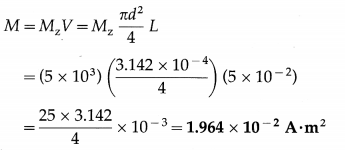
Maharashtra Board Class 12 Physics Important Questions Chapter 11 Magnetic Materials 13

Question 2.
A bar magnet made of steel has magnetic moment 2.5 A∙m2 and mass 6.6 × 10⁻³ kg. Given that the density of steel is 7.9 × 10³ kg/m3, find the intensity of magnetization of the magnet. (2 marks )
Solution:
Data : M = 2.5 A∙m2, m = 6.6 × 10⁻³ kg, ρ = 7.9 × 10³ kg/m3
Volume, V = \(\frac{m}{\rho}\)
The intensity of magnetization of the magnet is
Mz = \(\) = M ∙ \(\frac{\rho}{m}\)
= 2.5 x \(\frac{M}{V}\) = 2.992 × 10⁶ A/m
[Note : Intensity of magnetization = magnetization.]

Question 3.
Find the magnetization of a bar magnet of length 10 cm and cross-sectional area 4 cm2, if the magnetic moment is 2 A∙m2.
Solution:
Data : L = 0.1 m, A = 4 × 10⁻⁴ m2, M = 2 A∙m2
Magnetization, Mz = \(\frac{M}{V}\)
= \(\frac{M}{L A}=\frac{2}{(0.1)\left(4 \times 10^{-4}\right)}\)
= \(\frac{10^{4}}{0.2}\) = 5 × 10⁴ A/m

Question 4.
The magnetic susceptibility of annealed iron at saturation is 5500. Find the permeability of annealed iron at saturation.
Solution:
Data : χm = 5500, μ0 = 4π × 10-7 T∙m/A
Permeability, μ = μ0(1 + χm)
The permeability of annealed iron at saturation is
μ = (4 × 3.142 × 10-7) (1 + 5500)
= 4 × 3.142 × 5.501 × 10-4
= 6.914 × 10⁻³ T∙m/A

Maharashtra Board Class 12 Physics Important Questions Chapter 11 Magnetic Materials

Question 5.
The magnetic induction B and the magnetic intensity H in a material are found to be 1.6 T and 1000 A/m, respectively. Calculate the relative permeability μr and the magnetic susceptibility χm of the material.
Solution:
Data : B = 1.6 T, H = 1000 A/m,
μ0 = 4π × 10-7 T∙m/A
(i) B = μH = μ0μr H
∴ The relative permeability of the material,
μr = \(\frac{B}{\mu_{0} H}=\frac{1.6}{\left(4 \times 3.142 \times 10^{-7}\right)\left(10^{3}\right)}\)
= \(\frac{4000}{3.142}\) = 1.273 × 10³

(ii) μr = 1 + χm
∴ The magnetic susceptibility of the material,
χm = μr – 1
= 1273 – 1 = 1272 or 1.272 × 10³

Question 6.
An ideal solenoid has a core of relative permeability 500 and its winding has 1000 turns per metre. If a steady current of 1.6 A is passed through its winding, find
(i) the magnetic field strength H
(ii) the magnetization Mz
(iii) the magnetic induction B within the solenoid. Assume that Mz is directly proportional to H and single valued.
Solution:
Data : μr = 500, n = 1000 m-1, I = 1.6 A,
μ0 = 4π × 10-7 T∙m/A
(i) The magnetic field strength (or magnetic intensity) of the ideal solenoid,
H = nI
= 1000 × 1.6 = 1.6 × 10³ A/m

(ii) The magnetization of the core,
Mz = χmH = (μr – 1)H
= (500 – 1) × 1.6 × 103
= 499 × 1.6 × 103 = 7.984 × 10⁵ A/m

(iii) The magnetic induction within the core of the solenoid,
B = μrμ0H
= (500) (4 × 3.142 × 10-7) (1.6 × 10³)
= 32 × 3.142 × 10-2 = 1.005 T

Question 28.
What is a diamagnetic material? Give two examples.
Answer:
A material which is weakly repelled by a magnet and whose atoms /molecules do not possess a net magnetic’ moment in the absence of an external magnetic field is called a diamagnetic material.

When a diamagnetic material is placed in a uniform magnetic field, it acquires a small net induced magnetic moment directed opposite to the field.

Examples: Bismuth, copper, gold, silver, anti-mony, mercury, water, air, hydrogen, lead, silicon, nitrogen, sodium chloride.

Question 29.
What is diamagnetism?
Answer:
A material which is weakly repelled by a magnet and whose atoms/molecules do not possess a net magnetic moment in the absence of an external magnetic field is called a diamagnetic material. When a diamagnetic material is placed in a mag-netic field, it acquires a small net induced magnetic moment directed opposite to the field. The induced magnetism exhibited by such materials is called diamagnetism.

Maharashtra Board Class 12 Physics Important Questions Chapter 11 Magnetic Materials

Question 30.
State any four properties of a diamagnetic material.
Answer:
Properties of a diamagnetic material :

  1. In the absence of an external magnetic field, the magnetic dipole moment of each atom / molecule of a diamagnetic material is zero.
  2. A diamagnetic material is weakly repelled by a magnet.
  3. If a thin rod of a diamagnetic material is suspended in a uniform magnetic field, it comes to rest with its length perpendicular to the field.
  4. When placed in a nonuniform magnetic field, a diamagnetic material is repelled from the region of strong field.
  5. The magnetic susceptibility (χm) of a diamagnetic material is small and negative.
  6. χm is very nearly temperature-independent.
  7. The relative permeability (μr) of a diamagnetic material is slightly less than 1 and very nearly temperature independent.
  8. If a diamagnetic liquid in a watch glass is placed on two closely spaced pole-pieces of a magnet, the liquid accumulates on the sides causing a depression at the centre.
    [ Note : When the pole-pieces are moved apart, the effect is reversed, i.e., the diamagnetic liquid accumulates at the centre, where the magnetic field is weak.]
  9. A diamagnetic liquid in a U-tube placed in a magnetic field shows a depression in the arm to which the magnetic field is applied.
  10. If a diamagnetic gas is introduced between the pole-pieces of a magnet, it spreads at right angles to the field.

Question 31.
Name two materials that have negative magnetic susceptibility.
Answer:
Copper and gold have negative magnetic susceptibility.

Question 32.
Explain the origin of diamagnetism.
OR
Explain the origin of diamagnetism on the basis of atomic structure.
Answer:
An atomic electron is equivalent to a current loop which has orbital magnetic moment. Further, electron spin gives rise to the spin magnetic moment. The magnetic moment of an atom is equal to the vector sum of the magnetic moments of all its electrons.

The electronic configuration in an atom of a diamagnetic material is such that the vector sum of the orbital and spin magnetic moments of all the electrons is zero. Thus, the atomic magnetic moment is zero. Hence, a diamagnetic material has no inherent magnetic moment associated with it.

When a diamagnetic material is placed in a magnetic field, the orbiting electrons are accelerated or decelerated depending on their sense of revolution. For the electrons that are speeded up, the magnetic moment increases and for those that are slowed down, the magnetic moment decreases. This happens due to induced current as per Lenz’s law. Thus, each atom acquires a net magnetic moment and the diamagnetic material is weakly magnetized. The induced magnetic moment is opposite in direction to the applied field.

Diamagnetism is the weakest magnetic phenomenon. Hence, although diamagnetism is a universal property, it can be detected only in the absence of properties resulting in para- and ferromagnetism.

Maharashtra Board Class 12 Physics Important Questions Chapter 11 Magnetic Materials

Question 33.
Explain the diamagnetic behaviour of superconductors.
Answer:
Suppose a superconducting material in its normal phase, not the superconducting phase, is placed in a uniform applied magnetic field of induction \(\vec{B}\) which is weaker than a certain critical magnetic induction \(\vec{B}_{\mathrm{c}}\) for that material. Then, when the temperature is reduced below the critical temperature for the material, it enters into the superconducting phase and the magnetic field is expelled from the interior of the material.
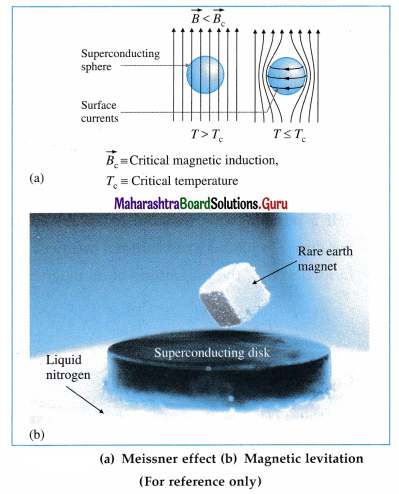
Maharashtra Board Class 12 Physics Important Questions Chapter 11 Magnetic Materials 14
There is no magnetic field inside the material, i.e., the material exhibits perfect diamagnetism. The expulsion of the magnetic field in a superconducting material is called the Meissner effect.

[Notes : (1) What happens is that currents appear on the surface of the material whose magnetic field exactly cancels the applied field inside it. (2) The German physicists Fritz Walther Meissner (1882-1974) and Robert Ochsenfeld (1901-1993) discovered the phenomenon in 1933 by measuring the magnetic field distribution outside superconducting tin and lead samples. The Meissner effect is so strong that a magnet can actually be levitated over a material cooled below its superconducting transition temperature Tc.]

Question 34.
What is a paramagnetic material? Give two examples.
Answer:
A material which is weakly attracted by a magnet and whose atoms possess a net magnetic moment with all atomic magnetic moments randomly directed in the absence of an external magnetic field but are capable of being aligned in the direction of the applied magnetic field is called a paramagnetic material.

Examples : Aluminium, platinum, chromium, manganese, sodium, calcium, magnesium, lithium, tungsten, niobium, copper chloride, oxygen.

Question 35.
State any four properties of a paramagnetic material.
Answer:
Properties of a paramagnetic material:

  1. Each atom of a paramagnetic material possesses a magnetic dipole moment. However, in the absence of an external magnetic field, the atomic magnetic moments are randomly oriented and hence the resultant magnetization of a paramagnetic material is zero.
  2. A paramagnetic material is weakly attracted by a magnet.
  3. If a thin rod of a paramagnetic material is sus-pended in a uniform magnetic field, it comes to rest with its length parallel to the field.
  4. When placed in a nonuniform magnetic field, a paramagnetic material is attracted towards the region of strong field.
  5. The magnetic susceptibility (χm) of a paramagnetic material is small and positive.
  6. χm varies inversely with the absolute temperature T.
  7. The relative permeability (μr) of a paramagnetic material is slightly greater than 1 and decreases with increasing temperature.
  8. If a paramagnetic liquid in a watch glass is placed on two closely spaced pole-pieces of a magnet, it shows a slight rise in the middle.
    [Note : If the pole-pieces are moved apart, the para-magnetic liquid moves away from the centre where the field is weak and gets depressed in the middle.]
  9. A paramagnetic liquid in a U-tube placed in a magnetic field shows a rise in the arm to which the magnetic field is applied.

Question 36.
Give one example each of a diamagnetic material and a paramagnetic material.
Answer:
Bismuth is a diamagnetic material and aluminium is a paramagnetic material.

Maharashtra Board Class 12 Physics Important Questions Chapter 11 Magnetic Materials

Question 37.
Name two materials that have small and positive magnetic susceptibility.
Answer:
Platinum and Chromium have small and positive magnetic susceptibility.

Question 38.
The relative permeability of two materials are 0.999 and 1.001. Identify the materials.
Answer:
A material with relative permeability μr ≤ 1 is diamagnetic while the one with μr ≥ 1 is paramagnetic.

Question 39.
Explain the origin of paramagnetism.
OR
Explain the origin of paramagnetism on the basis of atomic structure.
Answer:
Paramagnetism depends on the presence of permanent atomic or molecular magnetic dipole moments. The inherent net atomic magnetic mo-ment results from a particular combination of the spin and orbital magnetic moments of its electrons.

The spin magnetic moments of the electrons in matter are affected by the internal magnetic field created by the magnetic moments of surrounding electrons. This internal field, ~ 10-2 T to 10-1 T,
causes the spin magnetic moments to precess about the field direction. At normal temperature; the thermal motion of the electrons produces constant fluctuations in the internal field so that the spin magnetic moments have random directions, from figure (a). In the absence of an external magnetizing field, therefore, a paramagnetic material is not magnetized.
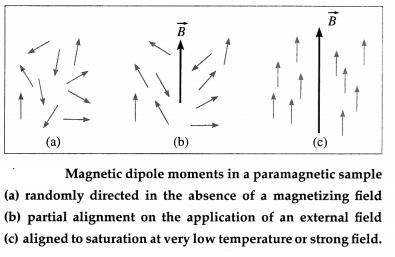
Maharashtra Board Class 12 Physics Important Questions Chapter 11 Magnetic Materials 15
When the applied field strength is greater than that of the internal field, the spin magnetic moments tend to align parallel to the external field direction. But the randomizing effect of thermal agitation prevents complete alignment, from figure (b). Therefore, at room temperature, when a paramagnetic material is placed in a magnetic field, it is weakly magnetized in the direction of the magnetizing field.

If the external field is very large or the temperature is very low, the magnetic dipole moments are effectively aligned parallel to the field so as to have the least magnetic potential energy and the magnetization reaches saturation, from figure (c).

Maharashtra Board Class 12 Physics Important Questions Chapter 11 Magnetic Materials

Question 40.
Discuss Curie’s law for paramagnetic material.
OR
State Curie’s law of paramagnetism.
Answer:
Curie’s law : The magnetization of a paramagnetic material is directly proportional to the external magnetic field and inversely proportional to the absolute temperature of the material.

If a paramagnetic material at an absolute temperature T is placed in an external magnetic field of induction \(\overrightarrow{B_{\text {ext }}}\), the magnitude of its magnetization
Mz ∝ \(\frac{B_{\text {ext }}}{T}\) ∴ Mz = C \(\frac{B_{\text {ext }}}{T}\)
where the proportionality constant C is called the Curie constant.

[Notes : (1) The above law, discovered experimentally in 1895 by Pierre Curie (1859-1906) French physicist, is true only for values of Bext/ T below about 0.5 tesla per kelvin.
(2) [C] = [Mz ∙ T] / [Bext] = [L-1I∙Maharashtra Board Class 12 Physics Important Questions Chapter 11 Magnetic Materials 16] /[MT-2I-1]
= [M-1L-1T2I2Maharashtra Board Class 12 Physics Important Questions Chapter 11 Magnetic Materials 16],
where Maharashtra Board Class 12 Physics Important Questions Chapter 11 Magnetic Materials 16 denotes the dimension of temperature.]

Question 41.
Prove that the magnetic susceptibility of a para-magnetic material is inversely proportional to its absolute temperature.
Answer:
Consider a paramagnetic material at an absolute temperature T placed in an external magnetic field of induction \(\vec{B}_{\text {ext }}\). The magnitude of its magnetization is
Mz = C \(\frac{\vec{B}_{\text {ext }}}{T}\) …………. (1)
where the proportionality constant C is called the Curie constant.
Substituting \(\vec{B}_{\text {ext }}\) = μ0H in Eq. (1),
Mz = C \(\frac{\mu_{0} H}{T}\)
where µ0 is the permeability of free space and H is the intensity of the magnetizing field.
The magnetic susceptibility of the medium
χm = \(\frac{M_{z}}{H}\). Thus, Eq. (2) becomes ti
χm = C \(\frac{\mu_{0}}{T}\)
χm ∝ \(\frac{1}{T}\)
This is the required expression.

Question 42.
What is a ferromagnetic material? Give two examples.
Answer:
A material which is strongly attracted by a magnet and whose atoms possess a net magnetic moment (largely due to electron spin) which, within a certain temperature range, spontaneously line up parallel to each other by quantum mechanical exchange interaction is called a ferromagnetic material.

Examples : Transition elements (iron, cobalt and nickel), inner transition elements (gadolinium, Gd, and dysprosium, Dy) and their alloys.

[Note : Ferromagnetic behaviour was first explained by Pierre-Ernest Weiss on the basis of domain theory but its satisfactory explanation is given only by quantum mechanics.]

Maharashtra Board Class 12 Physics Important Questions Chapter 11 Magnetic Materials

Question 43.
What are domains in a ferromagnetic material ?
OR
Write a short note on domains in a ferromagnetic material.
Answer:
A ferromagnetic material is composed of mosaic of small regions within each of which all the atomic magnetic moments spontaneously line up parallel to each other by quantum mechanical exchange interaction within a certain temperature range. Each such spontaneously magnetized region is called a domain and the common direction of magnetic moment is called the domain axis. A domain is an extremely small region (e.g., a size of about 10-6 m -10-4 m) containing a large number (1010 – 1017) of atoms. The boundary between adjacent domains with a different orientation of magnetic moment is called a domain wall.

Question 44.
Explain ferromagnetism on the basis of the domain theory.
Answer:
Atoms of a ferromagnetic material have a perms tient non-zero magnetic dipole moment arising mainly from spin magnetic moments of the electrons.

According to the domain theory, a ferromagnetic material is composed of small regions called domains.

A domain is an extremely small region contain Inga large number (something like 1015 atoms as in common iron) of atoms,

Within each domain, the atomic magnetic moments of nearest-neighbour atoms interact strongly through exchange interaction (a quantum mechanical phenomenon) and align themselves parallel to each other even in the absence of an extemal magnetic field. A domain is. therefore, spontaneously magnetized to saturation.

In an unmagnetized material, however, the directions of magnetization of the different domains are w oriented that the net magnetization is zero.
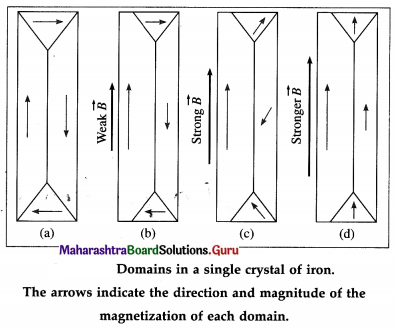
Maharashtra Board Class 12 Physics Important Questions Chapter 11 Magnetic Materials 17
When an external magnetic field Is applied, the resultant magnetization of the specimen Increases. This is achieved in either of two ways: Either a domain that is favourably oriented grows in size at the expenses of a less favourably oriented domain, or the direction of magnetization of an entire domain changes and aligns along the external magnetic field.

When a weak nagnetic field is applied, favour ably oriented domains grow in size by domain boundary displacement, from figure (b). In strong fields, the domains change their magnetization by domain rotation, from figures. 11.9 (c) and (d). If domains reach perfect alignment, as in from figure 11.9 (d),, the domains may merge into one large domain.

After the external field is removed, it may be energetically favourable for a domain’s direction of magnetizaLion to persist. Then, the specimen has a permanent magnetic dipole moment. This phonomenon, called magnetic remanance, Is the basis of the existence of permanent magnets.

Question 45.
State any four properties of a ferromagnetic material.
Answer:
(1) Each atom of a ferromagnetic material possesses a magnetic moment. A ferromagnetic material is composed of domains each of which is spontaneously magnetized to saturation. In an unmagnetized sample, the magnetic moments of different domains are so oriented that the macroscopic magnetization of the sample is zero.

(2) When a ferromagnetic material is placed in a strong external magnetic field, the domains whose magnetic moments are favourably oriented relative to the external field grow in size such that the sample acquires a nonzero macroscopic magnetization.
(3) A ferromagnetic material retains some magnetization even after it is removed from an external magnetic field. This magnetic retentivity is the basis ‘ of the existence of permanent magnets.

(4) A ferromagnetic material is strongly attracted by a magnet.
(5) A bar magnet, suspended in a uniform magnetic field, comes to rest with its magnetic dipole moment in the direction of the external field.
(6) When placed in a nonuniform magnetic field, a ferromagnetic material is attracted towards the region of strong field.
(7) The magnetic susceptibility (χm) and relative permeability (μr) of a ferromagnetic material are very high.

Maharashtra Board Class 12 Physics Important Questions Chapter 11 Magnetic Materials

Question 46.
Are the (i) diamagnetic materials (ii) paramagnetic materials (iii) ferromagnetic materials attracted or repelled by a magnet?
Answer:
When placed in a nonuniform magnetic field,

  1. a diamagnetic material is weakly repelled from’ the region of strong field
  2. a paramagnetic material is weakly attracted towards the region of strong field
  3. a ferromagnetic material is strongly attracted towards the region of strong field.

Question 47.
Can there be a material which is nonmagnetic?
Answer:
All materials are magnetic. However, only ferromagnetics can have magnetic remanance and exhibit magnetic behaviour even in the absence of an external magnetic field. Diamagnetics and para-magnetics exhibit induced magnetism, i.e., they exhibit magnetic behaviour only in the presence of an external magnetic field.

[Note : A solid solution formed between paramagnetic or diamagnetic metals can be an exception to the general statement that all substances are magnetic. However, the zero value of the susceptibility will be retained only at one temperature, because the susceptibility of the paramagnetic constituent generally changes with temperature. A Cu-Ni alloy with 3.7 wt% Ni has zero susceptibility at room temperature.]

Question 48.
Which magnetic materials have
(i) relative permeability > 1
(ii) relative permeability <1?
Answer:
(i) Both paramagnetic and ferromagnetic materials have relative permeability (μr) greater than 1. μr is only slightly greater than 1 for a paramagnetic material. μr is very high for a ferromagnetic material and is a function of the magnetizing field (also called the magnetic field intensity).

(ii) μr is slightly less than 1 for a diamagnetic material.

Question 49.
Draw a graph showing the variation of magnetic susceptibility of a ferromagnetic material with temperature.
Answer:
The magnetic susceptibility of a ferromagnetic material above Curie temperature Tc is given by χm = \(\frac{C}{T-T_{\mathrm{c}}}\), where C is the Curie constant. Below figure shows the variation of magnetic susceptibility of a ferromagnetic material with temperature.
Maharashtra Board Class 12 Physics Important Questions Chapter 11 Magnetic Materials 18
[Note : The relation, χm = \(\frac{C}{T-T_{\mathrm{c}}}\), is known as Curie-Weiss law. A plot of reciprocal susceptibility versus temperature for a ferromagnetic material is a straight line intercepting the temperature axis at T. At T = T, the susceptibility diverges which implies that one may have a nonzero magnetization in a zero applied field. This exactly corresponds to the definition of the Curie temperature, being the upper limit for having a spontaneous magnetization.].

Maharashtra Board Class 12 Physics Important Questions Chapter 11 Magnetic Materials

Question 50.
Distinguish between a diamagnetic material and a paramagnetic material.
Answer:

Diamagnetic material Paramagnetic material
1. A material whose atoms/ 1. molecules do not possess a net magnetic moment in the absence of an external magnetic field is called a diamagnetic material.  1. A material whose atoms possess net magnetic mo­ments that are all randomly directed in the absence of an external magnetic field is called a paramagnetic material.
2. When placed in a nonuni­form magnetic field, a diamagnetic material is weakly repelled from the region of strong field. 2. When placed in a nonuni­form magnetic field, a para­magnetic material is weakly attracted towards the region of strong field.
3.  In an external magnetic j field, it gets weakly magnetized in the direction oppo­site to that of the field. 3.  In an external magnetic field, it gets weakly magne­tized in the same direction as that of the field. 
4.  When a rod of a diamagnetic material is suspended in a uniform magnetic field, it comes to rest with its length perpendicular to the direc­tion of the field. 4.  When a rod of a paramag­netic material is suspended in a uniform magnetic field, it comes to rest with its length parallel to the direc­tion of the field.
5.  χm is small, negative and very nearly temperature independent. 5.  χm is small, positive and varies inversely with abso­lute temperature T  
6.  μr is slightly less than 1 and very nearly temperature! independent. 6. μr is slightly greater than 1 and decreases with increas­ing temperature.
 

Question 51.
Distinguish between a paramagnetic material and a ferromagnetic material.
Answer:

A paramagnetic materialA ferromagnetic material
1. The permanent atomic mag­netic moments of a para­magnetic material are all randomly oriented so that, in the absence of an external magnetizing field, the material is unmagnetized.
 
1. The permanent atomic mag­netic moments of a ferro­magnetic material interact strongly through exchange interaction forming domains which are spontaneously magnetized to saturation
2. It gets weakly magnetized when placed in an external magnetic field.2. In an unmagnetized ma­terial, the directions of mag­netization of the different domains are so oriented that the net magnetization is zero.
3. Its magnetization becomes zero when the external magnetic field is removed.3. It retains some magnetiz­ation even after the external magnetic field is removed.
4. Its magnetization in a given external magnetic field increases with decreasing temperature. The magne­tization reaches saturation only if the external field is very large and the tempera­ture is very low.4. It retains its domain struc­ture only up to a characte­ristic Curie temperature, above which it becomes paramagnetic.
5. χm is small and positive. μr is slightly greater than 1.5. χm and μr are positive and very high.  

Maharashtra Board Class 12 Physics Important Questions Chapter 11 Magnetic Materials

Question 52.
Distinguish between a ferromagnetic material and a diamagnetic material.
Answer:

A ferromagnetic materialA diamagnetic material
1. A material whose atoms/molecules possess permanent  magnetic moments which interact strongly through exchange interaction to form magnetic domains, each of which is magnetized to saturation, is called a ferromagnetic material.1. A material whose atoms/molecules do not possess a net magnetic moment in the absence of an external magnetic field is called a diamagnetic material.
2. It gets strongly magnetized in the direction of the field even when placed in a weak magnetic field2. In an external magnetic field, it gets weakly magnetized in the direction opposite to the field.
3. It retains some magnetiz­ation even after the external magnetic field is removed.3. Its magnetization becomes zero when the external magnetic field is removed.
4. When placed in a nonuni­form magnetic field, a ferromagnetic material is strongly attracted towards the region of strong field.4. When placed in a nonuni­form magnetic field, a dia­magnetic material is weakly repelled from the region of strong field.
5. χm and μr are positive and very high.5. χm is small and negative. μr is slightly less than 1.

53. Solve the following
Question 1.
(5) A toroid (Rowland ring) of mean radius 16 cm has 1000 turns of wire closely wound on a ferromagnetic core of relative permeability 400. What is the magnetic induction B within the core for a magnetizing current of 1 A?
Solution:
Data: r = 16 × 10-2 m, N = 1000, μr = 400, I = 1 A,
μ0 = 4π × 10-7 T∙m/A
Magnetic field strength, H = nI = \(\frac{N I}{2 \pi r}\)
∴ The magnetic induction within the core,
B = μ0μrH = μ0μr \(\frac{N I}{2 \pi r}\)
= (4π × 10-7) (400) \(\frac{1000 \times 1}{2 \pi \times 16 \times 10^{-2}}\)
= \(\frac{8 \times 10^{-2}}{16 \times 10^{-2}}\) = 0.5 T

Question 2.
Find the percentage increase in the magnetic induction B when the space within a current-carrying toroid is filled with aluminium. The magnetic susceptibility of aluminium is 2.1 × 10⁻⁵.
Solution:
Data: χm = 2.1 × 10⁻⁵ (positive, since aluminium is paramagnetic)
The percentage increase in the magnetic induction B within the toroid due to the aluminium core
Maharashtra Board Class 12 Physics Important Questions Chapter 11 Magnetic Materials 19

Maharashtra Board Class 12 Physics Important Questions Chapter 11 Magnetic Materials

Question 3.
The permeability of a substance at temperature 300 K is 6.284 × 10⁻³ SI unit. At what temperature will the susceptibility of that substance increase to 9.998 × 10³?
Solution:
Data: T1 = 300 K, μ1 = 6.284 × 10⁻³, χm2 = 9.998 × 10³, μ0 = 4π × 10-7 T∙m/A
Permeability, μ = μ0(1 + χm)
∴ The magnetic susceptibility at temperature T1,
Maharashtra Board Class 12 Physics Important Questions Chapter 11 Magnetic Materials 20
∴ The required temperature,
T2 = \(\frac{\chi_{\mathrm{m} 1}}{\chi_{\mathrm{m} 2}}\) × T1 = \(\frac{4999}{9998}\) × 300 = 150 K

Question 54.
Explain magnetic hysteresis in a ferromagnetic material.
OR
Explain the behaviour of a ferromagnetic material in an external magnetic field with the help of a magnetic hysteresis cycle.
OR
Explain the behaviour of a ferromagnetic material through one cycle of magnetization.
Answer:
A large scale consequence of the magnetic behaviour of a ferromagnetic under different applied magnetic fields can be observed by placing an unmagnetized rod of the material inside a solenoid. A current through the coil establishes the magnetizing field H, which we take as the independent variable. By measuring the voltage induced in a test coil wound alongside, we can determine changes in flux Φ, and hence changes in B inside the rod. B is measured in tesla while H is measured in ampere per metre. Knowing B and H, we can always compute magnetization M. It is however usual to plot B rather than M, as a function of H.
Maharashtra Board Class 12 Physics Important Questions Chapter 11 Magnetic Materials 21
Typical B-H plot during the following operations :
(1) Starting with an unmagnetized rod, B = 0 and H = 0 (Point O), H is increased until it has the value corresponding to point a : Here the rod has reached its saturation magnetization and B remains constant even with further increase in H. The lower part of the curve Oa is governed by domain growth while the upper flattening part is governed by domain rotation.

(2) Reduce H to zero (point b) : the curve does not retrace itself, as shown by the curve ab. This irre-versibility is called hysteresis. It is largely due to the domain boundary movements being partially irreversible. If the current is simply switched off at this point, the rod will have a residual magnetization as indicated by the non-zero value of B, called retentivity or remanence, for H = 0. Essentially now B = μ0M, i.e., the rod has acquired a permanent magnetization.

(3) Reverse H and increase it in magnitude until it has the value corresponding to point c : Here B is zero. The corresponding reverse magnetizing field H is called coercivity.

(4) Increase H in reverse direction until saturation magnetization is reached (point d).
(5) Reduce H to zero again (point e).
(6) Reverse the current once more until point a is reached again.
The process of taking the magnetic material once through the hysteresis loop abcdefa is called hysteresis cycle.

Question 55.
What is magnetic hysteresis ?
Explain it on the basis of magnetic domains.
Answer:
Magnetic hysteresis is a phenomenon shown by ferromagnetic materials in which the magnetic flux density through a material depends on the applied magnetizing field as well as the previous state of magnetization. Due to retention of its memory of previous state of magnetization, the flux density B lags behind (does not remain in step) with magnetizing field H. This delay in the change of its magnetization M (or equivalently, B) in response to a change in H is called hysteresis.

Hysteresis can be understood through the concept of magnetic domains. Domain boundary displacements and domain rotations are not totally reversible. When the applied magnetizing field H is increased and then decreased back to its initial value, the domains do not return completely to their original configuration but retain some memory or history of their previous alignment.

Maharashtra Board Class 12 Physics Important Questions Chapter 11 Magnetic Materials

Question 56.
Define :
(1) retentivity
(2) coercivity.
Answer:

  1. Retentivity : The residual magnetic flux density or magnetization in a magnetic material when the magnetizing field intensity is reduced to zero is called retentivity or remanence.
  2. Coercivity: The reversed magnetizing field strength required to reduce the remanent magnetic flux density or magnetization in a magnetic material from its remanent value to zero, i.e., to demagnetize the magnetic material completely, is

Question 57.
What is a ‘soft’ magnetic material?
OR
What is meant by a ‘soft’ iron?
Answer:
A soft magnetic material, usually iron-based, has high permeability, low retentivity and low coercivity. In other words, it does not have appreciable hysteresis, i.e., its hysteresis loop is very narrow. Such a material magnetizes and demagnetizes more easily, by small external fields.

Question 58.
What is an electromagnet?
Answer:
An electromagnet is an insulated coil wrapped around a ferromagnetic core (usually a soft iron) of high permeability and low retentivity. When a current is passed through the coil-a solenoid or toroid, the ferromagnetic material magnifies the magnetic field of the coil, the magnification factor being the relative permeability (μ / μ0) of the core. The magnetic field of the current-carrying coil magnetizes the core material, thereby producing a much larger field than the coil would produce by itself.

Question 59.
What is a magnetically hard material?
Answer:
A ‘hard’ magnetic material, such as ALNICO (an alloy of aluminium, nickel and cobalt), has high permeability, high retentivity and very high coercivity- of the orders of 1 tesla and 104 ampere per metre, respectively. In other words, it has a large zero-field magnetization, and large reverse field needed to demagnetize. Its hysteresis loop is very broad. Such a material can be made into a permanent magnet, that is, its magnetization will persist indefinitely if it is subsequently exposed only to weak magnetic fields.

Maharashtra Board Class 12 Physics Important Questions Chapter 11 Magnetic Materials

Question 60.
Distinguish between an electromagnet and a permanent magnet.
Answer:

Electromagnet

Permanent magnet

1. Magnetic field of an electromagnet is retained till there is passage of electric current through the solenoid or coil.1. Magnetic field is retained for a long period of time.
2. current through the solenoid and the number of turns per unit length of the solenoid.2. The strength of a permanent magnet depends upon the nature of the material of which it is made.
3. For a good electromagnet, the retentivity and coerciv­ity of the material should be low.3. For a good permanent mag­ net, the retentivity and co­ercivity of the material should be high.
4. It is usually made of soft ferromagnetic material.4. It is usually made of hard ferromagnetic material.
5. Poles of an electromagnet can be reversed by revers­ing the direction of electric current.5. Poles of a permanent mag­net cannot be reversed.

Question 61.
Explain magnetic shielding.
Answer:
The use of a shell or box of magnetic material of high permeability to protect sensitive instruments from stray magnetic fields is called magnetic shielding. The permeability of the material being many order of magnitudes greater than air, the magnetic field lines pass through the shell. The saturation v induction B of the material must be greater than the external field to be shielded. from below figure shows the cross section of a cylindrical or spherical shield in which the central region is the field-free region.

Magnetic shielding is useful for a wide range of applications, from small components inside a set of speakers to large magnetically shielded rooms.
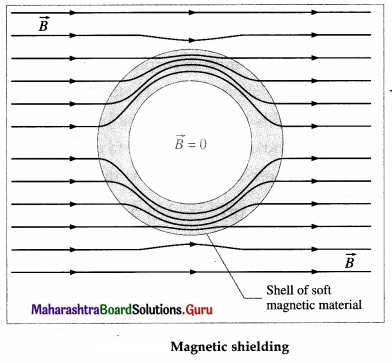
Maharashtra Board Class 12 Physics Important Questions Chapter 11 Magnetic Materials 22
[Note : The most widely used alloy for magnetic shielding purposes is the patented MuMetal®. Its composition of 80% nickel, 4.5% molybdenum and balance iron gives it high permeability.] .

Multiple Choice Questions

Question 1.
A rectangular bar magnet-with sides l. b and w – h.is mass n and magnetic moment M. It is free to rotate about a vertical axis through its centre of mass such that its faces of area l × b are honzoritaL The period T of angular oscillations of this magnet in a uniform magnetic field B is given by
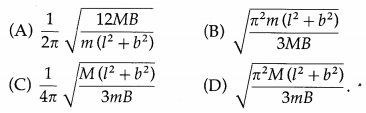
Maharashtra Board Class 12 Physics Important Questions Chapter 11 Magnetic Materials 23
Answer:
(B) \(\sqrt{\frac{\pi^{2} m\left(l^{2}+b^{2}\right)}{3 M B}}\)

Question 2.
A magnet of moment \(\vec{m}\) is placed in a uniform magnetic field \(\vec{B}\). Which of the following graphs correctly depicts the variation of its orientation energy Uθ i.e., its potential energy due to its orientation θ with \(\vec{B}\)?
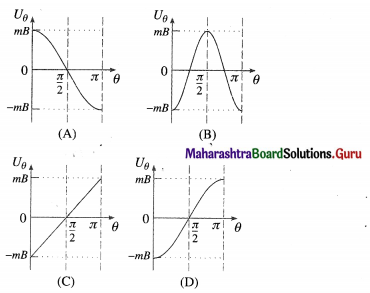
Maharashtra Board Class 12 Physics Important Questions Chapter 11 Magnetic Materials 24
Answer:
(D)

Question 3.
The magnetic dipole moment has the dimensions of current
(A) \(\frac{\text { current }}{\text { area }}\)
(B) current × area
(C) \(\frac{\text { area }}{\text { current }}\)
(D) current × length.
Answer:
(B) current × area

Question 4.
The dimensions of magnetic dipole moment are
(A) [L2I]
(B) [LI]
(C) [L-1I]
(D) [L-2I]
Answer:
(A) [L2I]

Question 5.
The gyromagnetic ratio of an orbital electron is the ratio of its
(A) charge to mass
(B) magnetic moment to volume
(C) orbital magnetic moment to linear momentum
(D) orbital magnetic moment to orbital angular momentum.
Answer:
(D) orbital magnetic moment to orbital angular momentum.

Maharashtra Board Class 12 Physics Important Questions Chapter 11 Magnetic Materials

Question 6.
If \(\vec{M}_{0}, \vec{L}_{0}\) and γ0 are respectively the magnetic dipole moment, orbital angular momentum and gyrornagnetlc ratio of an orbital electron. Then.
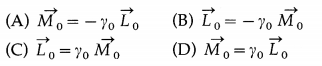
Maharashtra Board Class 12 Physics Important Questions Chapter 11 Magnetic Materials 25
Answer:
(A) \(\vec{M}_{0}=-\gamma_{0} \overrightarrow{L_{0}}\)

Question 7.
Bohr magneton is the magnetic dipole moment of
(A) an orbital electron in the ground state of a Bohr atom
(B) an orbital electron with orbital angular momenturn of \(\frac{h}{2 \pi}\)
(C) the order of 10-23 J/T
(D) all of the above.
Answer:
(D) all of the above.

Question 8.
A bar magnet 10 cm long has cross-sectional area 2 cm2 and magnetic dipole moment of 10 A∙m2. The magnetization of its material, assumed to be uniform, is
(A) 5 × 10⁵ A/m
(B) 2 × 10⁵ A/m
(C) 0.5 A/m
(D) 0.2 A/m.
Answer:
(A) 5 × 10⁵ A/m

Question 9.
An iron rod of volume 10-4 m3 acquires a magnetic moment of 25 A∙m2 when placed inside a solenoid whose windings carry a current of 0.5 A. The magnetization of the rod (in A/m), assumed to be uniform, is
(A) 5 × 10⁻⁵
(B) 2.5 × 10⁻³
(C) 12.5
(D) 2.5 × 10⁵
Answer:
(D) 2.5 × 10⁵

Question 10.
The dimensions of magnetic intensity are
(A) [LI]
(B) [L2I]
(C) [L-1I]
(D) [L-2I].
Answer:
(C) [L-1I]

Question 11.
The ratio of magnetization to magnetic field induction (M/B) for both diamagnetic and paramagnetic materials is, in the usual notation,
(A) χm
(B) \(\frac{\chi_{\mathrm{m}}}{\mu_{0}}\)
(C) µr
(D) µ
Answer:
(B) \(\frac{\chi_{\mathrm{m}}}{\mu_{0}}\)

Maharashtra Board Class 12 Physics Important Questions Chapter 11 Magnetic Materials

Question 12.
Magnetic susceptibility for vacuum (where there is no matter) is
(A) zero
(B) positive
(C) negative
(D) infinite.
Answer:
(A) zero

Question 13.
Magnetic susceptibility is positive and small for
(A) silver
(B) platinum
(C) mercury
(D) sodium chloride.
Answer:
(B) platinum

Question 14.
The magnetic induction within an ideal solenoid with air core is 5 mT. With an iron core of magnetic susceptibility 500, the induction within changes by
(A) 2.5 T
(B) 25 T
(C) 50 T
(D) 100 T.
Answer:
(A) 2.5 T

Question 15.
The magnetic moment of any atom in an isolated diamagnetic material is
(A) zero
(B) small
(C) large
(D) negative.
Answer:
(A) zero

Question 16.
Which of the following is diamagnetic?
(A) Dysprosium
(B) Gadolinium
(C) Magnesium
(D) Silver
Answer:
(D) Silver

Maharashtra Board Class 12 Physics Important Questions Chapter 11 Magnetic Materials

Question 17.
The most exotic diamagnetic materials are
(A) the glasses
(B) the insulators
(C) the superconductors
(D) the semiconductors.
Answer:
(C) the superconductors

Question 18.
A thin, small gIas rod is suspended between the poles of a strung electromagnet. The rod
(A) is strongly repelled by the magnetic field.
(B) orients itself parallel to the magnetic field
(C) orients itself perpendicuLar to the magnetic field
(D) is weakly attracted by the magnetic field
Answer:
(C) orients itself perpendicuLar to the magnetic field

Question 19.
Which of the following is paramagnetic?
(A) Bismuth
(B) Copper
(C) Liq. oxygen
(D) Silver
Answer:
(C) Liq. oxygen

Question 20.
When a parainagnetic material Is placed in a uniform magnetic field,
(A) its atoms acquire a magnetic moment opposite to the magnetic field
(B) the atomic magnetic moments tend to align along the magnetizing field
(C) all the atomic magnetic moments align along the magnetizing field
(D) the sample temporarily becomes ferromagnetic.
Answer:
(B) the atomic magnetic moments tend to align along the magnetizing field

Question 21.
Curte constant is
(A) a universal constant
(B) constant for a given paramagnetic material
(C) constant for a given diamagnetic material
(D) inversely proportional to the absolute temperature
Answer:
(B) constant for a given paramagnetic material

Maharashtra Board Class 12 Physics Important Questions Chapter 11 Magnetic Materials

Question 22.
The rare-earth element, gadolinium, is
(A) diamagnetic
(B) paramagnetic
(C) ferromagnetic
(D) nonmagnetic.
Answer:
(C) ferromagnetic

Question 23.
Curie’s law is valid for
(A) diamagnelics
(B) paramagnetics
(C) ferromagnetics
(D) all materials,
Answer:
(B) paramagnetics

Question 24.
Magnetizing and demagnetizing a material that has hysteresis involves
(A) increase in the temperature of the material
(B) a terro-to-para phase change
(C) decrease in the temperature of the material
(D) none of the above.
Answer:
(A) increase in the temperature of the material

Question 25.
The length of a bar magnet is large compared to its width and breadth. The time period of its angular oscillation in a vibration magnetometer is 2s. The magnet is cut along its length into two equal parts and the two parts are then mounted together in the magnetometer with their like poles together. The time period of this combination will be
(A) 2 s
(B) 1 s
(C) \(\frac{1}{2}\) s
(D) \(\frac{1}{\sqrt{2}}\) s
Answer:
(B) 1 s

Maharashtra Board 11th Maths Solutions Chapter 4 Determinants and Matrices Ex 4.1
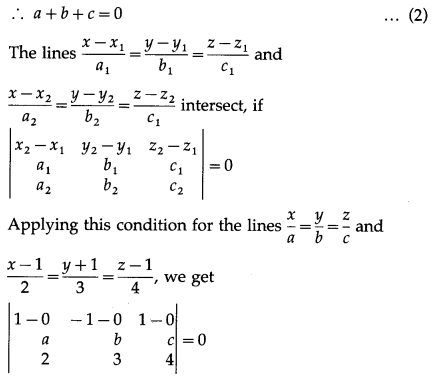
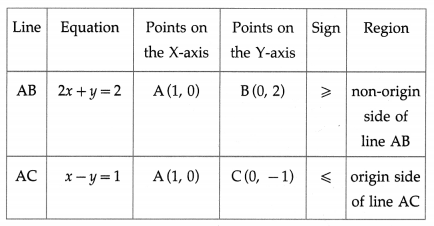
Balbharti Maharashtra State Board Class 11 Maths Solutions Pdf Chapter 4 Determinants and Matrices Ex 4.1 Questions and Answers.

Maharashtra State Board 11th Maths Solutions Chapter 4 Determinants and Matrices Ex 4.1

Question 1.
Find the values of the determinants.
i. \(\left|\begin{array}{cc}
2 & -4 \\
7 & -15
\end{array}\right|\)
ii. \(\left|\begin{array}{cc}
2 {i} & 3 \\
4 & -{i}
\end{array}\right|\)
iii. \(\left|\begin{array}{ccc}
3 & -4 & 5 \\
1 & 1 & -2 \\
2 & 3 & 1
\end{array}\right|\)
iv. \(\left|\begin{array}{ccc}
\mathbf{a} & \mathbf{h} & \mathbf{g} \\
\mathbf{h} & \mathbf{b} & \mathbf{f} \\
\mathbf{g} & \mathbf{f} & \mathbf{c}
\end{array}\right|\)
Solution:
i. \(\left|\begin{array}{cc}
2 & -4 \\
7 & -15
\end{array}\right|\)
= 2(-15) – (-4)(7)
= -30 + 28
= – 2

Maharashtra Board 11th Maths Solutions Chapter 4 Determinants and Matrices Ex 4.1

ii. \(\left|\begin{array}{cc}
2 {i} & 3 \\
4 & -{i}
\end{array}\right|\)
= 2i(-i) – 3(4)
= -2i2 – 12
= -2(-1) – 12 … [∵ i2 = -1]
= 2 – 12
= -10

iii. \(\left|\begin{array}{ccc}
3 & -4 & 5 \\
1 & 1 & -2 \\
2 & 3 & 1
\end{array}\right|\)
= \(3\left|\begin{array}{cc}
1 & -2 \\
3 & 1
\end{array}\right|-(-4)\left|\begin{array}{cc}
1 & -2 \\
2 & 1
\end{array}\right|+5\left|\begin{array}{ll}
1 & 1 \\
2 & 3
\end{array}\right|\)
= 3(1 + 6)+ 4(1 + 4)+ 5(3 – 2)
= 3(7) + 4(5) + 5(1)
= 21 + 20 + 5
= 46

iv. \(\left|\begin{array}{ccc}
\mathbf{a} & \mathbf{h} & \mathbf{g} \\
\mathbf{h} & \mathbf{b} & \mathbf{f} \\
\mathbf{g} & \mathbf{f} & \mathbf{c}
\end{array}\right|\) = \({a}\left|\begin{array}{ll}
{b} & {f} \\
{f} & {c}
\end{array}\right|-{h}\left|\begin{array}{ll}
{h} & {f} \\
{g} & {c}
\end{array}\right|+{g}\left|\begin{array}{ll}
{h} & {b} \\
{g} & {f}
\end{array}\right|\)
= a(bc – f2) – h(hc — gf) + g(hf- gb)
= abc – af2 – h2c + fgh + fgh – g2b
= abc + 2fgh – af2 – bg2 – ch2
= (-15) – (-4)(7)
= -30 + 28
= -2

Maharashtra Board 11th Maths Solutions Chapter 4 Determinants and Matrices Ex 4.1

Question 2.
Find the values of x, if
i. \(\left|\begin{array}{cc}
x^{2}-x+1 & x+1 \\
x+1 & x+1
\end{array}\right|=0\)
ii. \(\left|\begin{array}{ccc}
x & -1 & 2 \\
2 x & 1 & -3 \\
3 & -4 & 5
\end{array}\right|=29\)
Solution:
i. \(\left|\begin{array}{cc}
x^{2}-x+1 & x+1 \\
x+1 & x+1
\end{array}\right|=0\)
∴ (x2 – x + 1)(x + 1) – (x + 1)(x + 1) = 0
∴ (x + 1)[x2 – x + 1 — (x + 1)] = 0
∴ (x + 1)(x2 — x + 1 – x- 1) = 0
∴ (x + 1 )(x2 – 2x) = 0
∴ (x + 1) x(x – 2) = 0
∴ x = 0 or x + 1 = 0 or x – 2 = 0
∴ x = 0 or x = -1 or x = 2

ii. \(\left|\begin{array}{ccc}
x & -1 & 2 \\
2 x & 1 & -3 \\
3 & -4 & 5
\end{array}\right|=29\) = 29
∴ \(x\left|\begin{array}{cc}
1 & -3 \\
-4 & 5
\end{array}\right|-(-1)\left|\begin{array}{cc}
2 x & -3 \\
3 & 5
\end{array}\right|+2\left|\begin{array}{cc}
2 x & 1 \\
3 & -4
\end{array}\right|=29\)
x(5 – 12) + 1(10x + 9) + 2(-8x – 3) = 29
∴ -7x + 10x + 9 – 16x – 6 = 29
∴ -13x + 3 = 29
∴ -13x = 26
∴ x = -2

Question 3.
Find x and y if \(\left|\begin{array}{ccc}
4 \mathbf{i} & \mathbf{i}^{3} & 2 \mathrm{i} \\
1 & 3 i^{2} & 4 \\
5 & -3 & i
\end{array}\right|\) = x + iy, where i2 = -1
Solution:
Maharashtra Board 11th Maths Solutions Chapter 4 Determinants and Matrices Ex 4.1 1
= 4i(-3i + 12) + i(i – 20) + 2i(-3 + 15)
= 12i2 + 48i + i2 – 20i + 24i
= -11i2 + 52i
= -11(-1) + 52i … [∵ i2 = -1]
= 11 + 52i
Comparing with x + iy, we get x = 11, y = 52

Question 4.
Find the minors and cofactors of elements of the determinant D = \(\left|\begin{array}{ccc}
2 & -1 & 3 \\
1 & 2 & -1 \\
5 & 7 & 2
\end{array}\right|\)
Soution:
Here, \(\left|\begin{array}{lll}
a_{11} & a_{12} & a_{13} \\
a_{21} & a_{22} & a_{23} \\
a_{31} & a_{32} & a_{33}
\end{array}\right|=\left|\begin{array}{ccc}
2 & -1 & 3 \\
1 & 2 & -1 \\
5 & 7 & 2
\end{array}\right|\)
M11 = \(\left|\begin{array}{cc}
2 & -1 \\
7 & 2
\end{array}\right|\) = 4 + 7 = 11
C11 = (-1)1+1M11 = (1)(11) = 11

M12 = \(\left|\begin{array}{cc}
1 & -1 \\
5 & 2
\end{array}\right|\) = 2 + 5 = 7
C12 = = (-1)1+2M12 = (-1)(7) = 11

M13 = \(\left|\begin{array}{cc}
1 & 2 \\
5 & 7
\end{array}\right|\) = 7 – 10 = -3
C13 = = (-1)1+3M13 = (1)(-3) = -3

Maharashtra Board 11th Maths Solutions Chapter 4 Determinants and Matrices Ex 4.1

M21 = \(\left|\begin{array}{cc}
-1 & 3 \\
7 & 2
\end{array}\right|\) = -2 – 21 = 23
C21 = (-1)2+1M21 = (-1)(-23) = 23

M22 = \(\left|\begin{array}{cc}
2 & 3 \\
5 & 2
\end{array}\right|\) = 4 – 15 = -11
C22 = (-1)2+2M22 = (1)(-11) = -11

M23 = \(\left|\begin{array}{cc}
2 & -1 \\
5 & 7
\end{array}\right|\) = 14 + 5 = 19
C23 = (-1)1+1M23 = (1)(11) = 11

M31 = \(\left|\begin{array}{cc}
-1 & 3 \\
1 & -1
\end{array}\right|\) = 1 – 6 = -5
C31 = (-1)3+1M31 = (1)(-5) = -5

M32 = \(\left|\begin{array}{cc}
2 & 3 \\
1 & -1
\end{array}\right|\) = -2 – 3 = -5
C32 = (-1)3+2M32 = (-1)(-5) = 5

M33 = \(\left|\begin{array}{cc}
2 & -1 \\
1 & 2
\end{array}\right|\) = 4 + 1 = 5
C33 = (-1)3+3M33 = (1)(5) = 5

Question 5.
Evaluate \(\left|\begin{array}{ccc}
2 & -3 & 5 \\
6 & 0 & 4 \\
1 & 5 & -7
\end{array}\right|\) and cofactors of elements in the 2nd determinant and verify:
i. – a21.M21 + a22.M22 – a23.M23 = value of A a21.C21 + a22.C22 + a23.C23 — value of A where M21, M22, M23 are minors of a21, a22, a23 and C21, C22, C23 are cofactors of a21, a22, a23.
Solution:
Maharashtra Board 11th Maths Solutions Chapter 4 Determinants and Matrices Ex 4.1 2
= 2(0 – 20) + 3(- 42 – 4) + 5(30 – 0) = 2(-20) + 3(- 46) + 5(30)
= 2(0 – 20) + 3(- 42 – 4) + 5(30 – 0) = 2(-20) + 3(- 46) + 5(30)
= -40-138+ 150 = -28
Maharashtra Board 11th Maths Solutions Chapter 4 Determinants and Matrices Ex 4.1 3
– a21.M21 + a22.M22 – a23.M23
= – (6)(- 4) + (0)(-19) – (4)(13)
= 24 + 0 – 52
= -28
– a21.M21 + a22.M22 – a23.M23 = value of A

ii. a21.C21 + a22.C22 + a23.C23
= (6)(4) +(0)(-19)+ (4)(-13)
= 24 + 0-52 .
= -28
a21.C21 + a22.C22 + a23.C23 = value of A

Maharashtra Board 11th Maths Solutions Chapter 4 Determinants and Matrices Ex 4.1

Question 6.
Find the value of determinant expanding along third column \(\left|\begin{array}{ccc}
-1 & 1 & 2 \\
-2 & 3 & -4 \\
-3 & 4 & 0
\end{array}\right|\)
Solution:
Here, \(\left|\begin{array}{lll}
a_{11} & a_{12} & a_{13} \\
a_{21} & a_{22} & a_{23} \\
a_{31} & a_{32} & a_{33}
\end{array}\right|=\left|\begin{array}{ccc}
-1 & 1 & 2 \\
-2 & 3 & -4 \\
-3 & 4 & 0
\end{array}\right|\)
Expantion along the third column
= a13C13 + a23C23 + a33C33
= 2 x (-1)1+3 \(\left|\begin{array}{ll}
-2 & 3 \\
-3 & 4
\end{array}\right|\)-4 x (-1)2+3 \(\left|\begin{array}{ll}
-1 & 1 \\
-3 & 4
\end{array}\right|\) + 0 x (-1)3+3 \(\left|\begin{array}{ll}
-1 & 1 \\
-2 & 3
\end{array}\right|\)
= 2 (-8 + 9) +4 (-4 + 3) + O
= 2 – 4
= -2