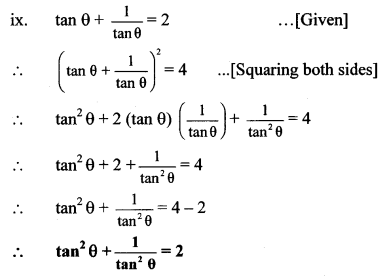
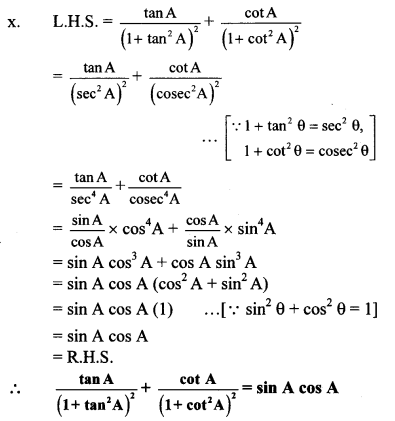
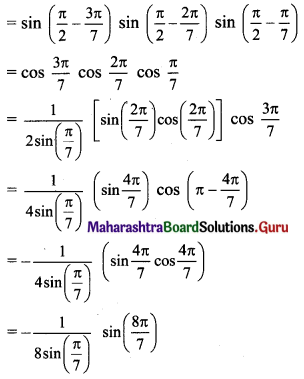
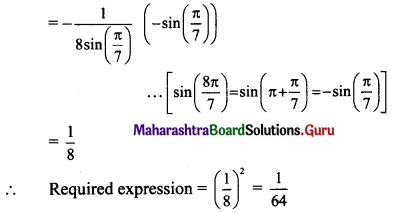
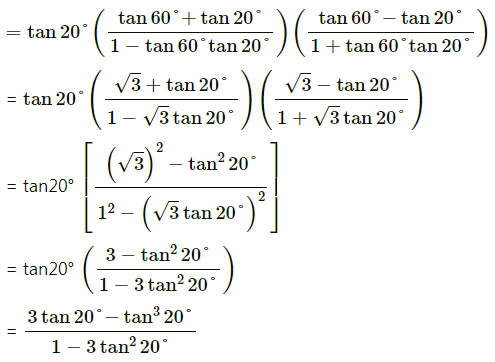
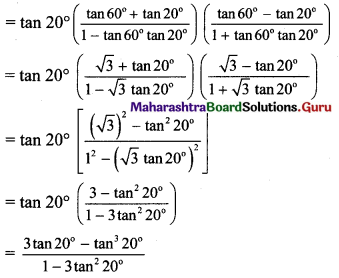
Maharashtra Board 10th Class Maths Part 2 Practice Set 6.1 Solutions Chapter 6 Trigonometry

Balbharti Maharashtra State Board Class 10 Maths Solutions covers the Practice Set 6.1 Geometry 10th Class Maths Part 2 Answers Solutions Chapter 6 Trigonometry.

Practice Set 6.1 Geometry 10th Std Maths Part 2 Answers Chapter 6 Trigonometry

Question 1.
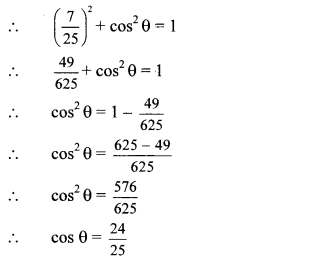
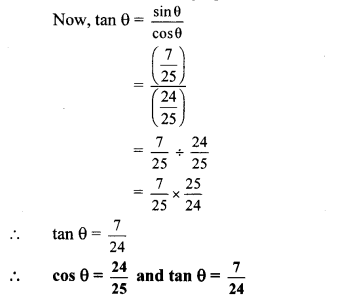
If sin θ = \(\frac { 7 }{ 25 } \), find the values of cos θ and tan θ.
Solution:
sin θ = \(\frac { 7 }{ 25 } \) … [Given]
We know that,
sin2 θ + cos2 θ = 1
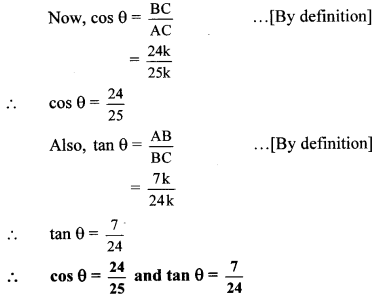
Maharashtra Board Class 10 Maths Solutions Chapter 6 Trigonometry Practice Set 6.1 1
…[Taking square root of both sides] Now, tan θ = \(\frac{\sin \theta}{\cos \theta}\)
Maharashtra Board Class 10 Maths Solutions Chapter 6 Trigonometry Practice Set 6.1 2
Alternate Method:
sin θ = \(\frac { 7 }{ 25 } \) …(i) [Given]
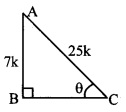
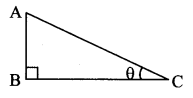
Consider ∆ABC, where ∠ABC 90° and ∠ACB = θ.
sin θ = \(\frac { AB }{ AC } \) … (ii) [By definition]
∴ \(\frac { AB }{ AC } \) = \(\frac { 7 }{ 25 } \) … [From (i) and (ii)]
Maharashtra Board Class 10 Maths Solutions Chapter 6 Trigonometry Practice Set 6.1
LetAB = 7k and AC = 25k
In ∆ABC, ∠B = 90°
∴ AB2 + BC2 = AC2 … [Pythagoras theorem]
∴ (7k)2 + BC2 = (25k)2
∴ 49k2 + BC2 = 625k2
∴ BC2 = 625k2 – 49k2
∴ BC2 = 576k2
∴ BC = 24k …[Taking square root of both sides]
Maharashtra Board Class 10 Maths Solutions Chapter 6 Trigonometry Practice Set 6.1 3

Question 2.
If tan θ = \(\frac { 3 }{ 4 } \), find the values of sec θ and cos θ.
Solution:
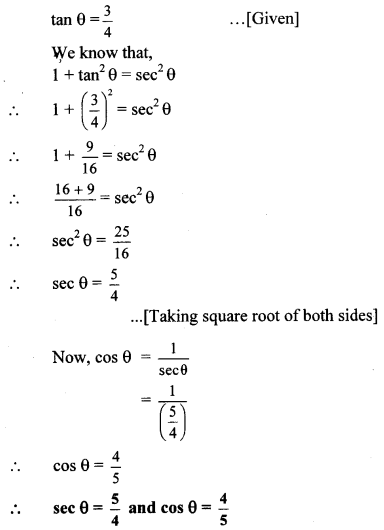
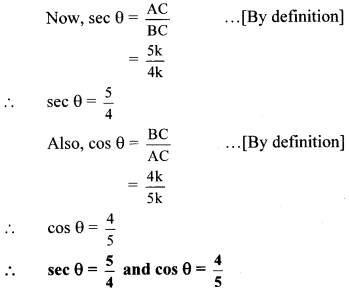
Maharashtra Board Class 10 Maths Solutions Chapter 6 Trigonometry Practice Set 6.1 4
Alternate Method:
tan θ = \(\frac { 3 }{ 4 } \) …(i)[Given]
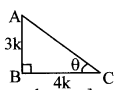
Consider ∆ABC, where ∠ABC 90° and ∠ACB = θ.
tan θ = \(\frac { AB }{ BC } \) … (ii) [By definition]
∴ \(\frac { AB }{ BC } \) = \(\frac { 3 }{ 4 } \) … [From (i) and (ii)]
Maharashtra Board Class 10 Maths Solutions Chapter 6 Trigonometry Practice Set 6.1 5
Let AB = 3k and BC 4k
In ∆ABC,∠B = 90°
∴ AB2 + BC2 = AC2 …[Pythagoras theorem]
∴ (3k)2 + (4k)2 = AC2
∴ 9k2 + 16k2 = AC2
∴ AC2 = 25k2
∴ AC = 5k …[Taking square root of both sides]
Maharashtra Board Class 10 Maths Solutions Chapter 6 Trigonometry Practice Set 6.1 6

Question 3.
If cot θ = \(\frac { 40 }{ 9 } \), find the values of cosec θ and sin θ
Solution:
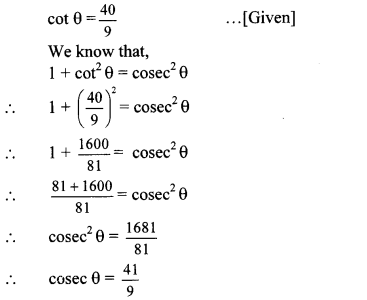
Maharashtra Board Class 10 Maths Solutions Chapter 6 Trigonometry Practice Set 6.1 7
..[Taking square root of both sides]
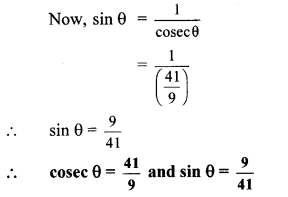
Maharashtra Board Class 10 Maths Solutions Chapter 6 Trigonometry Practice Set 6.1 8
Alternate Method:
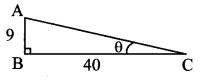
cot θ = \(\frac { 40 }{ 9 } \) ….(i) [Given]
Consider ∆ABC, where ∠ABC = 90° and
∠ACB = θ
cot θ = \(\frac { BC }{ AB } \) …(ii) [By defnition]
∴ \(\frac { BC }{ AB } \) = \(\frac { 40 }{ 9 } \) ….. [From (i) and (ii)]
Let BC = 40k and AB = 9k
Maharashtra Board Class 10 Maths Solutions Chapter 6 Trigonometry Practice Set 6.1 9
In ∆ABC, ∠B = 90°
∴ AB2 + BC2 = AC2 … [Pythagoras theorem]
∴ (9k)2 + (40k)2 = AC2
∴ 81k2 + 1600k2 = AC2
∴ AC2 = 1681k2
∴ AC = 41k … [Taking square root of both sides]
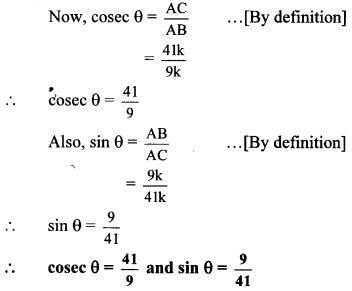
Maharashtra Board Class 10 Maths Solutions Chapter 6 Trigonometry Practice Set 6.1 10

Question 4.
If 5 sec θ – 12 cosec θ = θ, find the values of sec θ, cos θ and sin θ.
Solution:
5 sec θ – 12 cosec θ = 0 …[Given]
∴ 5 sec θ = 12 cosec θ
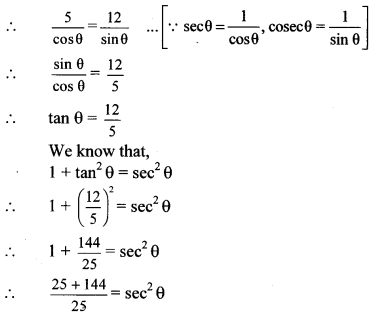
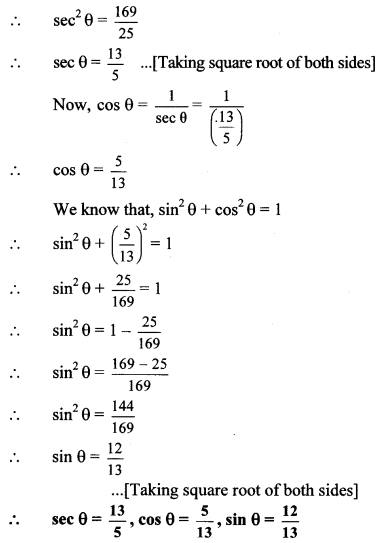
Maharashtra Board Class 10 Maths Solutions Chapter 6 Trigonometry Practice Set 6.1 11
Maharashtra Board Class 10 Maths Solutions Chapter 6 Trigonometry Practice Set 6.1 12

Question 5.
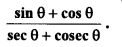
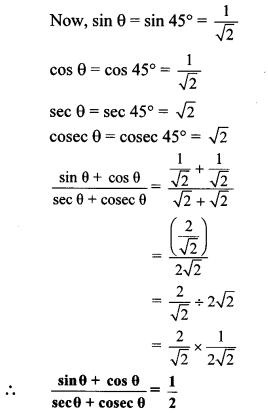
If tan θ = 1, then find the value of
Maharashtra Board Class 10 Maths Solutions Chapter 6 Trigonometry Practice Set 6.1 13
Solution:
tan θ = 1 … [Given]
We know that, tan 45° = 1
∴ tan θ = tan 45°
∴ θ = 45°
Maharashtra Board Class 10 Maths Solutions Chapter 6 Trigonometry Practice Set 6.1 14

Question 6.
Prove that:
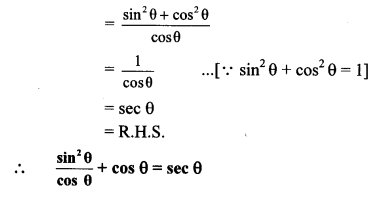
i. \(\frac{\sin ^{2} \theta}{\cos \theta}+\cos \theta=\sec \theta\)
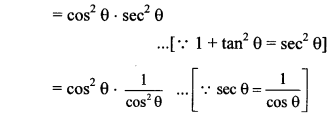
ii. cos2 θ (1+ tan2 θ) = 1
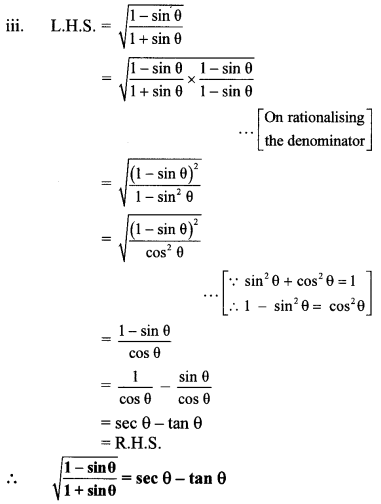
iii. \(\sqrt{\frac{1-\sin \theta}{1+\sin \theta}}=\sec \theta-\tan \theta\)
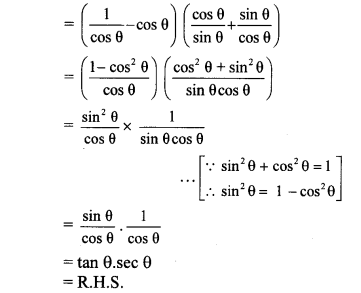
iv. (sec θ – cos θ) (cot θ + tan θ) tan θ. sec θ
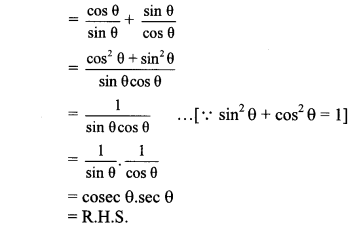
v. cot θ + tan θ cosec θ. sec θ
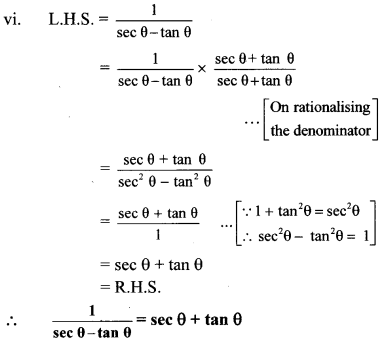
vi. \(\frac{1}{\sec \theta-\tan \theta}=\sec \theta+\tan \theta\)
vii. sin4 θ – cos4 θ = 1 – 2 cos2 θ
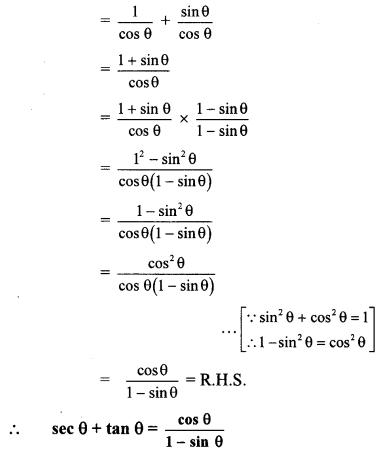
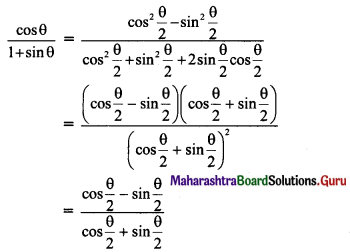
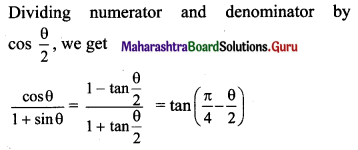
viii. \(\sec \theta+\tan \theta=\frac{\cos \theta}{1-\sin \theta}\)
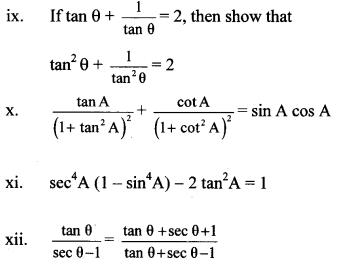
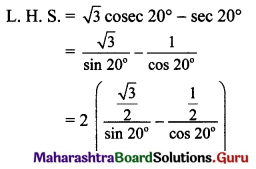
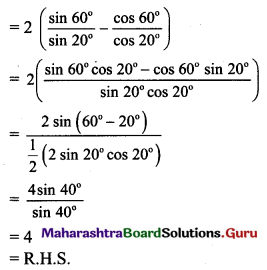
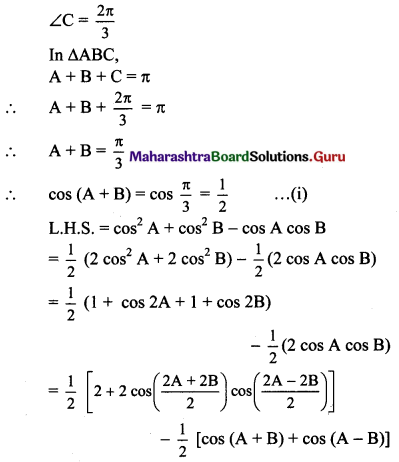
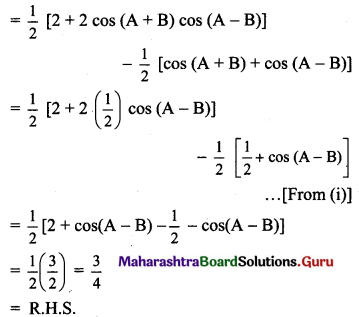
Maharashtra Board Class 10 Maths Solutions Chapter 6 Trigonometry Practice Set 6.1 15
Proof:
i. L.H.S. = \(\frac{\sin ^{2} \theta}{\cos \theta}+\cos \theta\)
Maharashtra Board Class 10 Maths Solutions Chapter 6 Trigonometry Practice Set 6.1 16

ii. L.H.S. = cos2 θ(1 + tan2 θ)
= cos2 θ sec2 θ …[∵ 1 + tan2 θ = sec2 θ]
Maharashtra Board Class 10 Maths Solutions Chapter 6 Trigonometry Practice Set 6.1 17
= 1
= R.H.S.
∴ cos2 θ (1 + tan2 θ) = 1

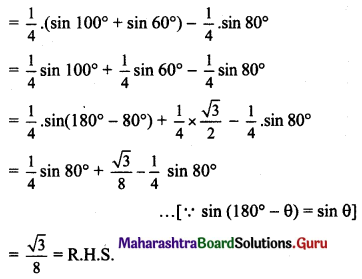
Maharashtra Board Class 10 Maths Solutions Chapter 6 Trigonometry Practice Set 6.1 18

iv. L.H.S. = (sec θ – cos θ) (cot θ + tan θ)
Maharashtra Board Class 10 Maths Solutions Chapter 6 Trigonometry Practice Set 6.1 19
∴ (sec θ – cos θ) (cot θ + tan θ) = tan θ. sec θ

v. L.H.S. = cot θ + tan θ
Maharashtra Board Class 10 Maths Solutions Chapter 6 Trigonometry Practice Set 6.1 20
∴ cot θ + tan θ = cosec θ.sec θ

Maharashtra Board Class 10 Maths Solutions Chapter 6 Trigonometry Practice Set 6.1 21

vii. L.H.S. = sin4 θ – cos4 θ
= (sin2 θ)2 – (cos2 θ)2
= (sin2 θ + cos2 θ) (sin2 θ – cos2 θ)
= (1) (sin2 θ – cos2 θ) ….[∵ sin2 θ + cos2 θ = 1]
= sin2 θ – cos2 θ
= (1 – cos2 θ) – cos2 θ …[θ sin2 θ = 1 – cos2 θ]
= 1 – 2 cos2 θ
= R.H.S.
∴ sin4 θ – cos4 θ = 1 – 2 cos2 θ

viii. L.H.S. = sec θ + tan θ
Maharashtra Board Class 10 Maths Solutions Chapter 6 Trigonometry Practice Set 6.1 22

Maharashtra Board Class 10 Maths Solutions Chapter 6 Trigonometry Practice Set 6.1 23
Maharashtra Board Class 10 Maths Solutions Chapter 6 Trigonometry Practice Set 6.1 24

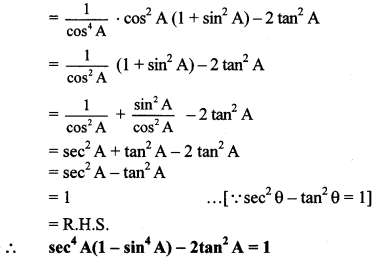
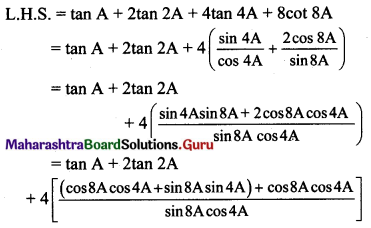
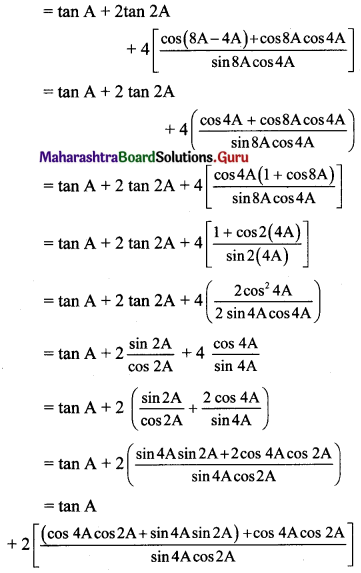
xi. L.H.S. = sec4 A (1 – sin4 A) – 2 tan2 A
= sec4 A [12 – (sin2 A)2] – 2 tan2 A
= sec4 A (1 – sin2A) (1 + sin2 A) – 2 tan2 A
= sec4 A cos2A (1 + sin2 A) – 2 tan2A
[ ∵ sin2 θ + cos2 θ = 1 ,∵ 1 – sin2 θ = cos2 θ]
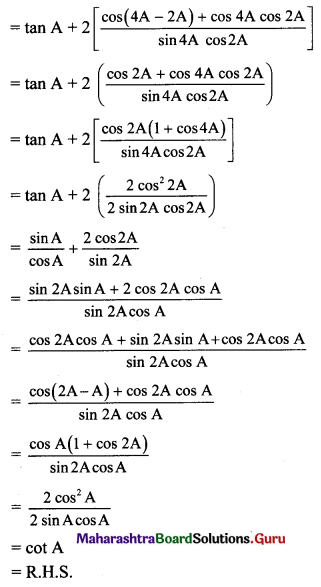
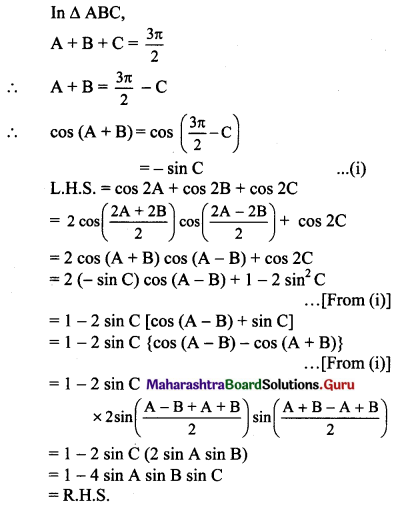
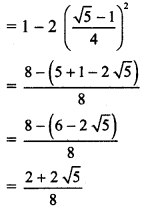
Maharashtra Board Class 10 Maths Solutions Chapter 6 Trigonometry Practice Set 6.1 25
Maharashtra Board Class 10 Maths Solutions Chapter 6 Trigonometry Practice Set 6.1 26

Maharashtra Board Class 10 Maths Chapter 6 Trigonometry Intext Questions and Activities

Question 1.
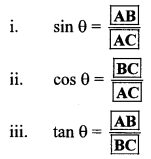
Fill in the blanks with reference to the figure given below. (Textbook pg. no. 124)
Maharashtra Board Class 10 Maths Solutions Chapter 6 Trigonometry Practice Set 6.1 27a
Solution:

Maharashtra Board Class 10 Maths Solutions Chapter 6 Trigonometry Practice Set 6.1 28

Question 2.
Complete the relations in ratios given below. (Textbook pg, no. 124)
Maharashtra Board Class 10 Maths Solutions Chapter 6 Trigonometry Practice Set 6.1 29
Solution:
i. \(\frac{\sin \theta}{\cos \theta}\) = [tan θ]
ii. sin θ = cos (90 – θ)
iii. cos θ = (90 – θ)
iv. tan θ × tan (90 – θ) = 1

Question 3.
Complete the equation. (Textbook pg. no, 124)
sin2 θ + cos2 θ = [______]
Solution:
sin2 θ + cos2 θ = [1]

Question 4.
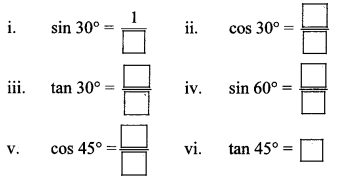
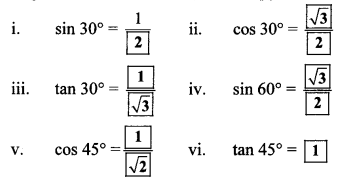
Write the values of the following trigonometric ratios. (Textbook pg. no. 124)
Maharashtra Board Class 10 Maths Solutions Chapter 6 Trigonometry Practice Set 6.1 30
Solution:
Maharashtra Board Class 10 Maths Solutions Chapter 6 Trigonometry Practice Set 6.1 31

Maharashtra Board Class 10 Maths Solutions

Maharashtra Board Class 10 English Solutions Unit 1.3 On Wings of Courage

Balbharti Maharashtra State Board Class 10 English Solutions Unit 1.3 On Wings of Courage Notes, Textbook Exercise Important Questions and Answers.

Maharashtra State Board Class 10 English Solutions Unit 1.3 On Wings of Courage

Maharashtra State Board Class 10 English Solutions Unit 1.3 Warming Up Questions and Answers

Question 1.
The ranks of officers in Indian Army, Navy and Air Force are jumbled up. Discuss with your group and put them in the appropriate boxes.

Commander, Brigadier, Wing-Commander, Vice-Admiral, Squadron-Leader, Major, Colonel, Field Marshal, Air Marshal, Admiral of Fleet, Lieutenant-General, Flying Officer, Commodore, Rear Admiral, Air-Commodore.
ARMYNAVYAIR FORCE
Maharashtra Board Solutions

Answer:

ArmyNavyAir Force
Brigadier,Commander,Wing-
Major, Colonel,Vice-Admiral,Commander,
Field Marshal,AdmiralSquadron-
Lieutenant-of Fleet,Leader, Air
GeneralCommodore,Marshal, Flying
Rear AdmiralOfficer, Air-Commodore

Question 2.
Homophones/ Homographs
(A) Make sentences to bring out the difference between-
(1) (a) wear ……………………………………..
(b) ware ……………………………………..
(2) (a) here ……………………………………..
(b) hear ……………………………………..
(3) (a) there ……………………………………..
(b) their ……………………………………..
(4) (a) cell ……………………………………..
(b) sell ……………………………………..
Answer:
(1) (a) wear: The little girl wanted to wear a pink, frilly dress.
(b) ware: The silver ware laid out on the King’s table was exquisite.

(2) (a) here: “You must sit here,” said the man to his guest.
(b) hear: The children could hear the sound of the planes quite clearly.

(3) (a) there: “I had kept my bag there,” said the woman to the policeman.
(b) their: The girls picked up their bags and went home.

(4) (a) cell: The prisoner sat in the dark cell without talking.
(b) sell: The hawker wanted to sell all his wares before evening.

Maharashtra Board Solutions

(B) Write what the underlined Homographs in the following sentences mean.
(1) (a) A bear is an omnivorous animal. ……………………………………..
(b) She could not bear the injustice. ……………………………………..
(2) (a) A bat is the only bird which is a mammal. ……………………………………..
(b) His bat broke as it struck the ball. ……………………………………..
(3) (a) He had to pay a fine for breaking the traffic signal. ……………………………………..
(b) Use a fine cloth for the baby’s clothes. ……………………………………..
(4) (a) We enjoyed a lot at the temple fair. ……………………………………..
(b) She has a fair complexion. ……………………………………..
Answer:
(1) (a) A bear is an omnivorous animal.
bear – a large, heavy animal
(b) She could not bear the injustice,
bear – to tolerate

(2) (a) A bat is the only bird which is a mammal.
bat – a mammal that flies
(b) His bat broke as it struck the ball.
bat – a wooden implement used for hitting the ball in many games.

(3) (a) He had to pay a fine for breaking the traffic signal.
fine – penalty
(b) Use a fine cloth for the baby’s clothes,
fine – delicate, soft

(4) (a) We enjoyed a lot at the temple fair.
fair – a gathering of stalls and amusements for public entertainment
(b) She has a fair complexion, fair – light, not dark

Maharashtra Board Solutions

Maharashtra Board Class 10 English Kumarbharati Unit 1.3 Questions and Answers

Question 1.
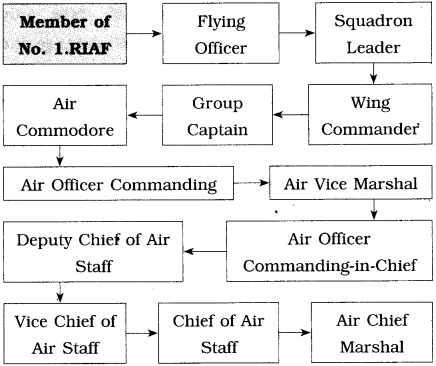
Read the text and fill in the flow chart of the promotions received by Arjan Singh.
Maharashtra Board Class 10 English Solutions Unit 1.3 On Wings of Courage 1
Answer:
Maharashtra Board Class 10 English Solutions Unit 1.3 On Wings of Courage 2

Question 2.
With the help of facts given in the text prepare a Fact file of Air Marshal Arjan Singh.
(a) Date of Birth
(b) Place of Birth
(c) Education
(d) First Assignments
(e) Important posts held
(a) In Air Force
(b) After retirement
(f) Awards
(g) Most outstanding contribution in IAF
(h) Retirement
Answer:
(a) Date of birth: April 15, 1919
(b) Place of birth: Lyalpur
(c) Education: at Montgomery; Empire Pilot Training Course at RAF (Cranwell)
(d) First Assignment: to fly Westland Wapiti biplanes in the North-Western Frontier Province as a member of the No. 1 RIAF Squadron
(e) Important posts held:
(1) In Air Force: Member of No. 1. RIAF, Flying Officer, Squadron Leader, Wing Commander, Group Captain, Air Commodore, Air Officer Commanding, Air Vice Marshal, Air Officer Commanding-in-Chief, Deputy Chief of Air Staff, Vice Chief of Air Staff, Chief of Air Staff, Air Chief Marshal.
(2) After retirement: Ambassador to Switzerland Lieutenant Governor of Delhi
(f) Awards: Distinguished Flying Cross (1944); Padma Vibhushan
(g) Most outstanding contribution in IAF: Transforming the IAF into one of the most potent air forces globally and the fourth biggest in the world.
(h) Retirement: in August 1969.

Maharashtra Board Solutions

Question 3.
Fill in the web.
Maharashtra Board Class 10 English Solutions Unit 1.3 On Wings of Courage 3
Answer:
(1) Singh had successfully led a young IAF during the 1965 Indo-Pak war.
(2) Singh played a major role in transforming the IAF into one of the most potent air forces globally and the fourth biggest in the world.
(3) Singh was honoured with the rank of Marshal on the Republic Day in 2002.
(4) Singh’s contribution was most outstanding during the 1965 Indo-Pak war.

Question 4.
Say what actions preceded the following promotions of Arjan Singh in his career in the IAF.
(a) Selected for Empire Pilot training course at RAF
(b) Promoted to Squadron Leader
(c) Leader of a flypast of over 100 aircraft at Red Fort, Delhi
(d) Awarded Padma Vibhushan
(e) First Air Chief Marshal of Indian Air Force
Answer:
(a) The authorities selected Singh for the Empire Pilot training course.
(b) He flew against the tribal forces and moved back to No. 1 Squadron as a Flying Officer to fly the Hawker Hurricane.
(c) On 15th August 1947, Arjan Singh achieved the unique honour of leading a fly-past of over a hundred IAF aircraft over the Red Fort in Delhi.
(d) He was awarded the Padma Vibhushan for his astute leadership of the Air Force and for inspiring the IAF to victory in the 1965 Indo-Pak war.
(e) He was a source of inspiration to all the personnel of the Armed Forces through the years.

Maharashtra Board Solutions

Question 5.
Replace the underlined words/phrases with the appropriate ones, to retain the proper meaning.
(be the epitome of, gear up, a brief stint, play a major role, in recognition of, take over reins)
(a) He contributed notably in bringing up the school.
(b) Our school cricket team got ready for the final match against P. Q. R. High School.
(c) After a short period of working as a lecturer, Ravi took up an important post in a multi-national company.
(d) Our class monitor is a perfect symbol of duty and discipline.
(e) Accepting the great value of his research; they awarded him with a Ph.D. (degree)
(f) After the murder of King Duncan, Macbeth took over the control of Scotland.
Answer:
(a) He played a major role in bringing up the school.
(b) Our school cricket team geared up for the final match against P.Q.R.High School.
(c) After a brief stint as a lecturer, Ravi took up an important post in a multinational company.
(d) Our class monitor is the epitome of duty and discipline.
(e) In recognition of his research, they awarded him with a Ph.D. (degree)
(f) After the murder of King Duncan, Macbeth took over the reins of Scotland.

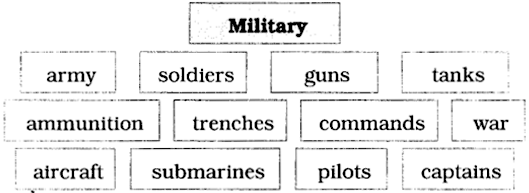
Question 6.
Build the word wall with the words related to ‘Military’.
Maharashtra Board Class 10 English Solutions Unit 1.3 On Wings of Courage 5
Answer:
Maharashtra Board Class 10 English Solutions Unit 1.3 On Wings of Courage 4

Question 7.
(A) State the different meanings of the following pairs of Homophones and make sentences of your own with each of them.

WordMeaningSentence
(a) led
lead(b) role
roll(c) air
heir(d) feat
feet

(e) reign
rein
rain

…………………………..
…………………………………………………………
………………………………………………………
……………………………………………………….
…………………………..

…………………………..
…………………………..

…………………………..
……………………………………………………….
……………………………………………………….
……………………………………………………….
…………………………..

…………………………..
…………………………..

Answer:

WordMeaningSentence
(a) ledpast participle of lead (to guide or conduct)The captain led his team to safety.
leadgraphite used as part of a pencilDo you have a lead pencil?
(b) rolea part (in a play, film, etc.)Marie got the leading role in the new movie.
rollmove in a particular direction by turning over and overThe boy wanted to roll in the mud while playing.
(c) airthe invisible gaseous substance surrounding the earthThere Is a lot of humidity in the air during the monsoon.
heirsuccessor or inheritorThe family did not know who the heir to the property was.
(d) feata great achievementClimbing Mt. Everest is a feat.
feeta unit of measurementThe girl saw to her shock that the lion was only a few feet away.
(e) reignrule as king or queenQueen Elizabeth’s reign has been a long one.
reina restraining influenceThe new manager kept a tight rein on her employees.
rainwater that falls In drops from clouds in the skyChildren love to play in the rain.

Maharashtra Board Solutions

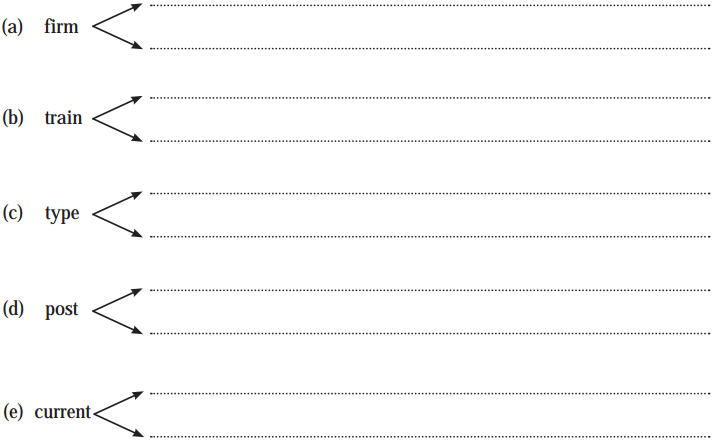
(B) The following Homographs have the same spelling and pronunciation but can have different meanings. Make sentences of your own to show the difference.
Maharashtra Board Class 10 English Solutions Unit 1.3 On Wings of Courage 6
Answer:
(a) firm: (i) My neighbour recently Joined an electronics firm as Sales Executive.
(ii) Many people feel that they must be firm with their children when they are growing.

(b) train: (i) The train left from platform 2 at seven p.m. sharp.
(ii) You must always train your pets to obey you.

(c) type: (i) The man asked his secretary to type the letter immediately.
(ii) Cows eat only a particular type of grass.

(d) post: (i) My aunt quit her job because she felt that the post was not suitable for her.
(ii) The little boy ran to the post office to post the letter to Santa Claus.

(e) current : (i) The minister was disturbed when he read about the current situation of unrest In the country.
(ii) It is a difficult task to row against the current in a river.

Question 8.
Glance through the text and prepare notes from the information that you get. Take only relevant points. Don’t use sentences. Arrange the points in the same order. You may use symbols or short forms. Present the points sequentially. Use highlighting techniques.
Answer:
Air Force Marshal Arjart Singh—Icon of India’s Military History

1. Date of Birth: 15 April, 1919
2. Qualifications: Empire Pilot Training Course at RAF (Cranwell)
3. Responsibilities:

  • first assignment to fly Westland Wapiti biplanes in No.l RIAF Squadron
  • brief stint in No.2 RIAF Squadron; moved back to No. 1 RIAF Squadron as Flying Officer
  • overall commander of ‘Shiksha’
  • led the IAF during the 1965 Indo-Pak war
  • led a squadron against the Japanese during the Arakan Campaign; assisted the advance of Allied Forces to Yangoon
  • led a fly-past on August 15, 1947
  • commanded Ambala in the rank of Group Captain; took over as AOC of an operational command
  • took over reins of the IAF
  • ambassador to Switzerland; Lieutenant Governor of Delhi

Maharashtra Board Solutions

(4) Achievements:

  • selected for the Empire Pilot Training Course at RAF (Cranwell) in 1938, at age 19
  • promoted to the rank of Squadron Leader in 1944
  • led a fly-past over the Red Fort on August 15, 1947
  • promoted to the rank of Wing Commander; promoted to the rank of Air Commodore in 1949
  • longest tenure as AOC (1949-1952 and 19571961)
  • appointed as Deputy Chief of Air Staff at the end of the 1962 war; appointed as Vice Chief of Air Staff in 1963
  • rank of Air Marshal in August 1964; took over reins of IAF
  • successfully led the IAF in 1965 Indo-Pak war
  • promoted as Air Vice Marshal; appointed as AOC-in-C of an operational command
  • first Air Chief to keep his flying currency till his CAS rank; has flown more than 60 different types of * aircraft
  • first and only Air Chief Marshal of the IAF

(5) Awards:

– Distinguished Flying Cross (1944)
– Padma Vibhushan

(6) After retirement: Ambassador to Switzerland; Lieutenant Governor of Delhi
(Students can put these points attractively in boxes and use highlighting techniques.)

Question 9.
Develop a story suitable to the conclusion/end given below. Suggest a suitable title.
………………………………………………….. (Title)
…………………………………………………………………………………………………………………..
…………………………………………………………………………………………………………………..
…………………………………………………………………………………………………………………..
…………………………………………………………………………………………………………………..
…………………………………………………………………………………………………………………..
…………………………………………………………………………………………………………………..
………………………………………………………….. and so, with tears of joy and pride, the 10 year old Sanyogita More received the National Bravery Award from the Prime Minister.
Answer:
A WONDERFUL ACT OF BRAVERY
It was the 26th of July in Mumbai. It was raining cats and dogs. Ten-year-old Sanyogita More stood at the door of her hut. The street was flooded with water. Sanyogita was frightened. Her parents had not returned from work and she was all alone.

Suddenly, she saw two little boys, Rohan and Sohan, come out from the neighbouring hut to play in the water. As Sanyogita watched, there came a sudden gush of water and the boys were dragged towards an open manhole, which had been marked with a pole. They caught hold of the pole, but the pole began to tilt. It would soon fall—and the boys would go down the manhole!

Maharashtra Board Solutions

Sanyogita ran as fast as she could towards the boys. Pulling a rope from a nearby door, she looped it around a large stone. She held onto the rope and extended her hand towards the boys. “Catch my hand, Sohan, Rohan,” she shouted. “Catch! Catch soon!”

The boys were in a panic but they did as they were told. Sohan held Rohan’s leg, Rohan held Sanyogita’s hand, and Sanyogita held onto the rope.

“Help! Help! she shouted, knowing that if the rope broke or the stone was dislodged, they would all go into the manhole.

She stood there shivering, her arms numb, for nearly 15 minutes before help arrived. Sanyogita collapsed after the incident. The news of her brave deed spread far and wide, and reached the ears of 1 the Prime Minister, who decided to honour her with an award. And so, with tears of joy and pride, the 10- I year-old Sanyogita More received the National Bravery ‘ Award from the Prime Minister.

Question 10.
You wish to join any one of the Indian Armed Forces. Fill in the following application form.
To
The Advertiser
N/AF Recruitment Service
Purangaon – 456 789

Affix recent
passport size
photograph

Application For Recruitment
Rect notice No 1234

1. Post applied for
2. Name and surname of Candidate (in Block letters)
3. Father’s Name ………………………………… Mother’s Name …………………………………
4. Date of Birth
5. Contact details :
Tel. No. (Res) ………………….. . Mobile No.
Email ID ………………….. .
6. Permanent Address :
House No./Street/Village ………………….. .
Post Office ………………….. .
District ………………….. State ………………….. .
Pincode ………………….. .
7. Educational Qualifications :

Serial NumberQualificationName of School/CollegeName of Board/UniversityPercentage obtained
Maharashtra Board Solutions

8. Whether registered at any employment exchange Yes/ No ………………….. (If yes, mention registration number and the name of the Employment Exchange.)

9. Outstanding achievements in extra-curricular activities/ sports/ games, etc.
………………………………………………………………………………………………………………………………………….
………………………………………………………………………………………………………………………………………….

10. Why you wish to join Armed Forces. …………………………………………………………………
………………………………………………………………………………………………………………………………………….
………………………………………………………………………………………………………………………………………….

Maharashtra Board Class 10 English Solutions Unit 2.5 Let’s March

Balbharti Maharashtra State Board Class 10 English Solutions Unit 2.5 Let’s March Notes, Textbook Exercise Important Questions and Answers.

Maharashtra State Board Class 10 English Kumarbharati Textbook Solutions Unit 2.5 Let’s March

Maharashtra Board Class 10 English Solutions Unit 2.5 Warming Up Questions and Answers

Question 1.
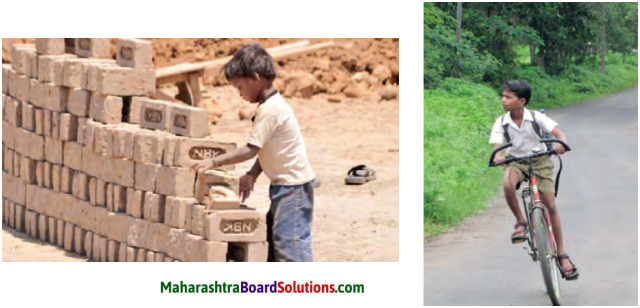
Observe the pictures and answer.
Maharashtra Board Class 10 English Solutions Unit 2.5 Let’s March 1
(a) Main difference between the two images …………………..
……………………………………………………………………………………..
(b) Change required ………………………………………………………
……………………………………………………………………………………..
(c) Your contribution as a student to help and make a difference to needy children.
……………………………………………………………………………………..
Answer:
(1) Main difference between the two images : In the first picture, the little boy is working at a construction site or kiln. He is a child labourer. In the second, the boy is going to school.
(2) Change required : The boy in the first picture should not work but go to school.
(3) Your contribution as a student to help and make a difference to needy children : I donate my old books, school bag, etc. to needy children.

Maharashtra Board Solutions

Question 2.
Put a [✓] or [✗]
A good speech delivered requires the following characteristics.
(1) Well planned and thoughts well-organized. [ ]
(2) Delivered softly and in a low voice. [ ]
(3) Speaker need not greet the dignitaries and audience. [ ]
(4) Language used should be suitable to the audience. [ ]
(5) Speech should be of a proper duration. [ ]
(6) Speaker should be passive, and have no facial expressions. [ ]
(7) Speech should be supported by good examples/episodes/ visual aids. (where possible) [ ]
(8) Speaker should switch over from one language to another [ ]
Answer:
(1) Well planned and thoughts well-organized. [✓]
(2) Delivered softly and in a low voice. [✗]
(3) Speaker need not greet the dignitaries and audience. [✗]
(4) Language used should be suitable to the audience. [✓]
(5) Speech should be of a proper duration. [✓]
(6) Speaker should be passive and have no facial expressions. [✗]
(7) Speech should be supported by good examples/episodes/visual aids, where possible. [✓]
(8) Speaker should switch over from one language to another. [✗]

Question 3.
Read the expressions and insert them in the proper columns. Put the proper expression numbers in the right column.

Greeting/SalutationIntroductionBody of the SpeechConclusionThanking the Audience

Expressions
(1) Imagine ! After ten years, what will happen?
(2) Let me begin, today, by sharing my own experience.
(3) Honourable Chief Guest ………………….., eminent dignitaries, ladies and gentlemen.
(4) I don’t understand why we accept this issue so passively.
(5) I am Adarsh Birajdar, (designation) standing before you …………………..
(6) A renowned personality (name) says “ ………………….. ”
(7) Good morning, to one and all present today.
(8) I express my deep gratitude to the organisers of this event/function …………………..
(9) Let me give you an example …………………..
(10) Thank you all for a patient listening and your interest in my talk.
(11) You must have noticed that …………………..
(12) Before I conclude, I would like you to think over the fact that …………………..
Answer:

 ExpressIon No
Greeting/ Salutation 3, 7
Introduction 2, 5
Body of trie Speech 4, 6, 9, 11
Conclusion 1, 12
Thanking the Audience 8, 1

Maharashtra Board Solutions

Question 4.
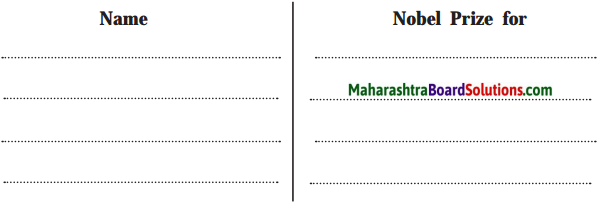
With the help of your teacher and classmates make a list of as many Indian Nobel Laureates as you can. (You can use Internet or school library.)
Maharashtra Board Class 10 English Solutions Unit 2.5 Let’s March 2

Let’s March Class 10 English Workshop Questions and Answers Maharashtra Board

Question 1.
Name the following.
(a) The persons to whom Kailash Satyarthi gives the highest credit of his honour –
(b) The greatest personalities from the land of Buddha –
(c) So called daughters of Kailash Satyarthi –
(d) The foreign activists of equal rights, mentioned in the speech –
Answer:
(a) Kaalu Kumar, Dhoom Das, Adarsh Kishore and Iqbal Masih.
(b) Buddha, Guru Nanak, Mahatma Gandhi
(c) Daughters of Kailash Satyarthi
(d) Iqbal Masih, Malala Yousafzai and Tom Harkin.

Question 2.
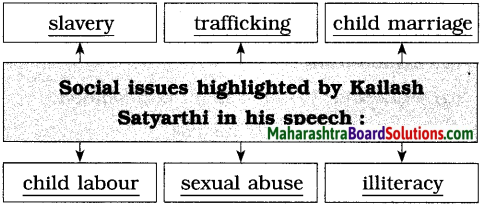
Mention the social issues highlighted by Kailash Satyarthi in his speech. One social issue is given for you.
(a) Child labor
(b) …………………..
(c) …………………..
(d) …………………..
(e) …………………..
(f) …………………..
Answer:
Maharashtra Board Class 10 English Solutions Unit 2.5 Let’s March 5

Question 3.
Complete the following diagram/chart.
Maharashtra Board Class 10 English Solutions Unit 2.5 Let’s March 3
Answer:
Maharashtra Board Class 10 English Solutions Unit 2.5 Let’s March 6

Maharashtra Board Solutions

Question 4.
Complete the following web-chart.
Maharashtra Board Class 10 English Solutions Unit 2.5 Let’s March 4
Answer:
Maharashtra Board Class 10 English Solutions Unit 2.5 Let’s March 7

Question 5.
Think and give your own response.
(a) How can education help the deprived children and child laborers?
Answer:
Education will help the deprived children and child labourers to stand on their own feet and earn a decent living. It will help them to have financial independence. Education plays a huge role in building confidence, tolerance, and making children global: citizens.

(b) Name any other social activist who has worked/is working earnestly for child-welfare. Write about his/her activities.

(c) What message does the little bird’s story of the forest fire convey to us? Explain.
Answer:
The message the little bird story of the forest fire conveys to us is that we must try to do whatever we can to improve matters. We must not think that our efforts are insignificant. We must not think ‘What can one person do?’ Every little drop counts. If each of us makes a little bit of effort, the sum total will be substantial.

Maharashtra Board Solutions

(d) Besides the political freedom that our nation enjoys, what other freedom should it strive for? Say why.
Answer:
Besides the political freedom that our nation enjoys. it should strive for social freedom, where everybody is treated equally irrespective of caste, creed and gender. Our nation should also strive for economic freedom, where everyone is above the poverty line. Only then will our nation progress.

(e) What is your impression of the acceptance speech given by Kailash Satyarthi, when he received the Nobel Prize? Write in 3 to 4 sentences.
Answer:
The speech was very emotional. It could be due to the fact that the speech was an earnest appeal to the hearts of the people world over. If we wish the children of the world to be looked after well, we have to rouse the adults to act in a responsible and compassionate manner. This can be done only by trying to touch their hearts and their emotions, which the speaker has attempted to do.

Question 6.
Choose the correct option and write in front of the given word, to convey the exact meaning.
(a) divinity : ………………………..
(i) goodness
(ii) godliness
(iii) god – fearing
Answer:
(ii) godliness

(b) extremist : ………………………..
(i) militant
(ii) robber
(iii) spy
Answer:
(i) militant

(c) culminate : ………………………..
(i) destroy
(ii) succeed
(iii) rise to a peak
Answer:
(iii) rise to a peak

(d) exploitation : ………………………..
(i) explosion
(ii) misuse
(iii) employment
Answer:
(ii) misuse

(e) mortality : ………………………..
(i) death
(ii) virtues
(iii) starvation
Answer:
(i) death

(f) dignity : ………………………..
(i) self-pride
(ii) self-support
(iii) self-esteem
Answer:
(i) self-esteem

Maharashtra Board Solutions

Question 7.
Pick out from the lesson the-
(A) Noun forms of the following words-
(a) dignified
(b) pacify
(c) pursue
(d) ignore
(e) poor
(f) divine
Answer:
(a) dignity
(b) pacification
(c) pursuit
(d) ignorance
(e) honor
(f) divinity

(B) Verb forms of-
(a) democracy
(b) global
(c) hindrance
(d) resolution
(e) liberty
(f) service
Answer:
(a) democret
(b) globalise
(c) hinder
(d) resolve
(e) liberate
(f) serve

Question 8.
(A) Use the following words as a noun as well as a verb and make meaningful sentences with each set, in your notebook. march, honour, credit, stitch
Answer:
March:
(a) Gandhiji led the legendary salt march against the British, (noun)
(b) The women marched to the police station angrily, (verb)

Honour:
(1) honour – (a) The poor old man had the honour of shaking hands with the King, (noun)
(b) We must honour oui’ national heroes. (verb)

Credit:
(a) The athlete said that the full credit for her success goes to hci- coach. (noun)
(b) She credits ‘her success to her farnlly’s support. (verb)

Stitch:
(a) A stitch in time saves nine, (noun)
(b) Mary always stitched her school uniform herself, (verb)

Maharashtra Board Solutions

(B) Write minimum 4 hidden words of more than 4 letters from – intergovernmental
Answer:
intergovernmental:

  • governmental,
  • meant,
  • government,
  • internal,
  • train

(C) Make meaningful sentences by using the following phrases, in your notebook.
(a) in the pursuit of
(b) be afraid of
(c) give up
Answer:
(a) In pursuit of a ha1thier diet, more people now turn to organic foods.
(b) One should not be afraid of facing difficult situations.
(c) We must never give up hope even when we face problems.

(D) Pick from the lesson the antonyms of
(i) ignorance x ……………………….
(ii) immortality x ……………………….
(iii) deny x ……………………….
(iv) violence x ……………………….
(v) well- known x ……………………….
(vi) slavery x ……………………….
Answer:
(i) knowledge
(ii) freedom
(iii) accept
(iv) peace
(v) unknown
(vi) mortality

Question 9.
(A) What will you do in the following situations?
(a) If you see a child working in a restaurant.
……………………………………………………..
(b) If you find a child working at a construction site.
……………………………………………………..
(c) If you find a child working at a brickwork site.
……………………………………………………..
(d) If you come across a beggar child.
……………………………………………………..
Answer:
(a) I will talk to the restaurant owner and ask him to send the child to a government school. I will offer to give the child my old books and clothes.
(b) I will talk to the child’s parents and ask them to send him to school. I will also inform my parents and ask them to help.
(c) I will find an NGO and inform them about it.
(d) I will find an orphanage or NGO in the area and ask them to help him. I will also give him some picture books so that he begins to take an interest in books.

(B) Write any 2 efforts that you can make to enroll deprived children/ out of school children into a school. One is given for you.
(a) I will persuade parents of such children to send them to school.
(b) ……………………………………………………..
(c) ……………………………………………………..

Maharashtra Board Solutions

Question 10.
(A) Types of Sentence
A sentence is a group of words that expresses a complete idea. Sentences can be classified in various ways. The following is a classification of sentences.

(i) Assertive sentence (Statement) : A sentence that makes a statement or assertion is a sentence.
For example, ‘There are many villages in India.’

(ii) Interrogative sentence : It is a sentence that asks a question. It is of two sub-types.
Yes/no interrogative sentence :
It generally begins with a helping verb or an auxiliary verb and can be answered by saying ‘Yes’ or ‘No’. For example, ‘Are you coming with us?’

Wh-interrogative sentence : It begins with a wh – word, such as ‘who’ and ‘why’ and cannot be answered by saying ‘yes’ or ‘no’. For example, ‘What is the time?’

(iii) Imperative sentence : It expresses commands, requests etc. It generally begins with a verb. For example, ‘Open your books’.

(iv) Exclamatory sentence : It expresses a strong feeling.
For example, ‘How wonderful the river looks !’ ‘What a shame !’

(B) Say whether the following sentences are Assertive (Statements), Imperative (Commands, Requests, etc.), Interrogative (Questions) or Exclamatory (Exclamations).
(1) The Mantra carries a prayer. ………………………….. .
(2) Is the world so poor? ………………………….. .
(3) Kill not your children because of poverty. ………………………….. .
(4) Let’s walk together. ………………………….. .
(5) What can one person do? ………………………….. .
(6) We have made progress. ………………………….. .
(7) How utterly we have failed our children! ………………………….. .
(8) What a big challenge it is! ………………………….. .
Answer:
(1) Assertive
(2) Interrogative
(3) Imperative
(4) Imperative
(5) Interrogative
(6) Assertive
(7) Exclamatory
(8) Exclamatory

(C) Rewrite the following sentences as Assertive (statements).
(1) Why didn’t you come earlier? ………………………….. .
(2) How frightened their eyes look! ………………………….. .
(3) How angry it makes me! ………………………….. .
(4) Should I accept such shackles of slavery? ………………………….. .
(5) What can one person do? ………………………….. .
Answer:
(1) You should have come earlier.
(2) Their eyes look very frightened.
(3) It makes me very angry.
(4) I should not accept such shackles of slavery.
(5) One person cannot do much.

Maharashtra Board Solutions

Question 11.
(A) Observe the following underlined phrases. Here ‘have /has’ are followed by the past participle form of the verb. This construction indicates the present perfect tense. Find more such sentences from the text.
(1) We have made progress in the last couple of decades.
(2) We have prevented millions of child deaths.
(3) It has happened.
(4) ………………………….. .
(5) ………………………….. .
Answer:
(4) Let us inculcate….
(5) Let us globalise compassion.

(B) In the following sentences the underlined words are called infinitives. Find such examples from the speech and underline the infinitives.
(1) Every child is free to grow.
(2) I refuse to accept that all the laws and constitutions, police and judges are unable to protect our children.
(3) ………………………….. .
(4) ………………………….. .
(5) ………………………….. .
Answer:
(3) To grow and develop, to eat, to laugh, to play, to go to school, to dream
(4) Kailash Satyarthi is. not ready to accept:
(5) The Nobel Committee has generously invited me to present a lecture.

(C) Complete the following sentences with the help of the sentence given below.
(a) The biggest challenge knocking on the doors of human kind is fear and intolerance.
(i) No other challenge knocking ………………………….. as big as ………………………….. .
(ii) Fear and intolerance are bigger ………………………….. .
Answer:
(i) No other challenge knocking on the doors of humankind is as big as fear and intolerance.
(ii) Fear and intolerance are bigger than any other challenge knocking on the doors of humankind.

(b) The Nobel Prize is one of the greatest honours in the world.
(i) Very few honours ………………………….. .
(ii) The Nobel Prize is greater than ………………………….. .
Answer:
(i) Very few honours in the world are as great as the Nobel Prize.
(ii) The Nobel Prize is greater than most other honours in the world.

Question 12.
(A) Match the sentences given in part ‘A’ with the sentences given in part ‘B’. Note the differences in structure.

‘A’ Part‘B’ Part
(1) He was kidnapped by an extremist militia.(a) They forced the child to kill his friends and family.
(2) The child was forced to kill his friends and family.(b) We can do this.
(3) This can be done by us.(c) An extremist militia kidnapped him.

Answer:

‘A’ Part ‘B’ Part
(1) He was kidnapped by an extremist militia. (c) An extremist militia kidnapped him.
(2) The child was forced to kill his friends and family. (b) They forced the child to kill his friends and family.
(3) This can be done by us. (a) We can do this.

(B) You might have observed that The sentences in Part A are in the passive voice while the sentences in Part B are in the active voice. Now change the following sentences into the passive voice.
1. We can do it. ……………………………
2. Her angry question still shakes me. ……………………………
3. Governments must make child-friendly policies. ……………………………
4. His answer made me angry. ……………………………
Answer:
1. It can be done by us.
2. I am still shaken by her angry question.
3. Child-friendly policies must be made by governments.
4. I was made angry by his answer.

Maharashtra Board Solutions

Question 13.
Imagine your school invites Malala to preside over ‘Children’s Day’ celebration programme. Draft a welcome speech for this guest of honour. Gather information about her from Internet or your school library. While drafting a speech the following points should be kept in mind.
(1) Greeting and salutation
(2) Self-introduction and introduction of the topic
(3) A catchy thought/piece of news/short episode, to start with
(4) Body of the speech supported with related examples and episodes
(5) Conclusion
Answer:
A Welcome Speech

Honorable Chief Guest, respected Principal, teachers and my dear friends,

A pleasant good morning to you all. I am Ananya Iyer, the Cultural Secretary of our school. Today, on Children’s Day, I have the pleasure and privilege of welcoming an eminent personality, Ms. Malala Yousafzai. as our Guest of Honour. Ms. Yousafzai is a Pakistani activist who took up the cause of female education and fought for it with a missionary zeal. She is the youngest Nobel Prize laureate. She is known for human rights activities, especially the education of women and ’children in her native Swat Valley in Khyber Pakhtunkhwa. northwest Pakistan.

On 9 October 2012, while on a bus in the Swat District, Ma’am Yousafzai and two other girls were shot by a Taliban gunman in an assassination attempt in retaliation for her activism. Ma’am Yousafzai was hit in the head with a bullet and remained unconscious and in a critical condition. Following her recovery, she became a prominent voice for the right to education. She founded the Malala Fund, a non-profit organisation and in 2013 co-authored I am Malala, an international best seller.

In 2012, she was the recipient of Pakistan’s first National Youth Peace Prize and the 2013 Sakharov Prize. In 2014, she was the co-recipient of the 2014 Nobel Peace Prize, along with Shri Kailash Satyarthi. Aged 17 at the time, this made her the youngest-ever Nobel Prize laureate. In 2015, Ma’am Yousafzai was a subject of the Oscar- shortlisted documentary He Named Me Malala. The 2013, 2014 and 2015 issues of Time magazine featured her as one of the most influential people

Ma’am, we are proud and privileged to have you with us today. We hope that your presence will inspire and motivate all of us here to take up issues relating to women and children’s rights in earnest. We request you to say a few words to the audience before the inauguration of the function. Thank You.

Question 14.
Select the correct alternative and complete the following: Kailash Satyarthi:
(1) Wants to do this, so that no one is left behind in any corner of the world: walk together. (walk tog ether/remember his ancestors)
(2) Wants to do this, to show respect to his late parents: bow to them, (bow to them/speak to them)
(3) Feels if we do this, our minds will come together: speak together. (smile/speak together)
(4) Feels this, each time he frees a child from slavery: liberated. (honoured/liberated)
Answer:
(1) walk together.
(2) bow to them
(3) speak together
(4) liberated

Maharashtra Board Solutions

Question 15.
Match the words to their meanings: (Board’s Model Activity Sheet)

Words Meaning
(1) Podium (a) The action of trying to achieve something
(2) Aspiration (b) A small platform
(3) Pursuit (c) To remember something
(4) Recall (d) An ardent wish

Answer:

Words Meaning
(1) Podium (b) A small platform
(2) Aspiration (d) An ardent wish
(3) Pursuit (a) The action of trying to achieve something
(4) Recall (c) To remember something

Question 16.
This mantra carries a prayer, an aspiration and a resolve that has the potential to liberate humanity from all man-made crises.
Answer:
This mantra carries not only a prayer, but also an aspiration and a resolve that has the potential to liberate humanity from all man-made crises.

Question 17.
I bow to my late parents, to my motherland India and to the mother earth.
Answer:
I bow not only to my late parents, but also to my motherland India and to the mother earth.

Question 18.
Find sentences in the present perfect tense from the passage:
Answer:
I have freed a child from slavery.

Question 19.
Find sentences from the passage that’ contain infinitives: (Board’s Model Activity Sheet)
Answer:
(1) I am deeply honoured to recite a mantra.
(2) …the potential to liberate humanity…
(3) Let’s walk together. (The infinitives without ‘to’ before them are called ‘Bare Infinitives’.)
(4) Let’s speak together.
(5) Let our minds come together.
(6) Let us create knowledge together.

Question 20.
Let us create knowledge for all. (Begin the sentence with ‘Let knowledge …’ and rewrite) (Board’s Model Activity Sheet)
Answer:
Let knowledge be created for all.

Maharashtra Board Solutions

Question 21.
Write about the various problems that children are facing today. (Board’s Model Activity Sheet)
Answer:
Children in cities face problems like severe competition, addiction to social networking and video games, etc. Children in rural areas face problems like exploitation, bonded labour, poverty, lack of: opportunities, etc.

Question 22.
Explain the reason why a chair is kept empty on the podium by Shri Satyarthi.
Answer:
The empty chair kept on the podium by Shri Satyarthi represents or symbolises the suffering and struggles of millions of children who are left behind.

Question 23.
Find the odd man out:
(a) dream, tiny, militia, expenditure
(b) compassion, liberty, children, pessimism
Answer:
(a) tiny-this is an adjective; the other words are nouns.
(b) children-this is a common noun; the other words are abstract nouns.

Question 24.
I am representing here – the sound of silence.
Answer:
(1) met – simple past tense
(2) am representing – present continuous tense

Question 25.
Find sentences in the present perfect tense from the passage:
Answer:
The Nobel Committee has generously invited me to present a lecture.

Question 26.
Make a list of the things that Kailash Satyarthi is not ready to accept:
Answer:
Kailash Satyarthi is. not ready to accept:
(1) that all the temples, churches, mosques and prayer houses have no place for the dreams of our 1 children, when all great religions and all countries ! teach us to care for our children.
(2) that the world is so poor, whenust one week of global military expenditure is sufficient to pay for the education of all the children.
(3) that all the laws and constitutions, police and judges, are unable to protect our children.
(4) that the shackles of slavery can eves be’ stronger than the quest for freedom.

Question 27.
Pick out from the passage the noun form of poor:
Answer:
poverty

Maharashtra Board Solutions

Question 28.
I have the privilege of working with many courageous people who have the same aim. (Rewrite using the noun form of the underlined wofd.)
Answer:
I have the privilege of working with many people with courage who have the same aim.

Question 29.
All the great religions teach us to care for our children. (Frame a Wh-question to get the underlined words as the answer.)
Answer:
What do all the great religions teach us?

Question 30.
Find sentences in the present perfect tense from the passage:
Answer:
We have never given up against any threat.

Question 31.
Find sentences in the present perfect tense from the passage:

Answer:
(1) We have made progress.
(2) We have reduced the number……..
(3) We have prevented millions of child deaths.
(4) We have utterly failed our children…

Question 32.
Find sentences from the passage that contain infinitives.
Answer:
Let us make no mistake.

Question 33.
(1) Eighteen years ago, millions of individuals! demanded a new international law for the abolition of ’ the worst form’of child labour.
(2) Satyarthi wants to inculcate and transform individuals’ compassion into a global compassion.
Answer:
(1) A new international law for the abolition of ’ the worst form’of child labour.
(2) Individuals’ compassion into a global compassion.

Question 34.
List the examples Kailash Satyarthi gives to show how the world is interconnected.
Answer:
Kailash Satyarthi says that we live in an age of rapid globalisation. We are connected through:
(i) the high-speed internet
(ii) the exchange of goods and services in one single global market and
(iii) the thousands of flights from one corner to another corner of the globe.

Maharashtra Board Solutions

Question 35.
Change the following sentence into the passive voice: We can do it.
Answer:
It can be done by us.

Question 36.
Do as directed:
We are connected through high-speed internet. (Frame a Wh-question to get the underlined part as the answer.)
Answer:
How are we connected?

Question 37.
The bird said, “I am doing my bit.” (Frame 2 questions which will give the above sentence as the answer.)
Answer:
(i) Who said, “I am doing my bit.”?
(ii) What did the bird say?

Question 38.
Find an example of present perfect tense from the passage.
Answer:
…….. and it has happened, …

Question 39.
Find sentences from the passage that contain infinitives.
Answer:
(1) Let us inculcate….
(2) Let us globalise compassion.

Question 40.
Pick out from the passage the noun forms of the following words:
(i) passive
Answer:
(i) passivity

Question 41.
Rewrite the sentences as directed:
(1) I challenge the passivity and pessimism surrounding our children. (Rewrite replacing the participle with the finite verb.)
(2) Children are questioning our inaction and watching our actions. (Rewrite as a rhetorical question.)
Answer:
(1) I challenge the passivity and pessimism that surrounds our children.
(2) Aren’t children questioning our inaction and watching our actions? ‘

Question 42.
Find an example of present perfect tense from the passage:
Answer:
….. yet have never tasted chocolate…

Maharashtra Board Solutions

Question 43.
Find sentences from the passage that contain infinitives.
Answer:
(1) If we are to teach real peace…
(2) We shall have to begin …….
(3) ….let us unite the world….
(4) ….the power to shake the whole world…
(5) …will we allow to go without rescue….

Question 44.
Explain why the eight-year-old girl’s question shakes Mr. Satyarthi.
Answer:
The eight-year-old girl’s question shakes Mr. Satyarthi because he realizes that we are doing too little too late for the exploited children of this world. Our collective inaction is robbing them of their childhood and allowing them to be exploited.

Question 45.
What was the response of the boy’s father? What was Satyarthi’s reaction to it?
Answer:
The boy’s father said that he had never thought about the fact that his son was working outside the gate of the school and not studying with the others in the school. His answer made Satyarthi angry at that time and still makes him angry.

Question 46.
Choose the correct verb forms of the following from the given options:
(1) slavery: (a) sloven (b) slave (c) enslave.
(2) bold: (a) bolden (b) embolden (c) embold.
Answer:
(1) enslave
(2) embolden.

Question 47.
Pick out from the following the words formed by using a prefix:
(1) illiteracy
(2) innovative
(3) invest
(4) abuse.
Answer:
(1) illiteracy
(4) abuse.

Question 48.
Replace the modal auxiliary in the following sentences with another showing obligation:
(1) All of us must stand with our children.
(2) We must keep our promises.
Answer:
(1) All of us ought to stand with our children.
(2) We ought to keep our promises.

Maharashtra Board Solutions

Question 49.
Find a sentence in the present perfect tense from the passage:
Answer:
I have never thought about it.

Question 50.
Find sentences from the passage that contain infinitives.
Answer:
(1) … to put an end to all forms….
(2) … must work together to accelerate action…
(3) I gathered the courage to ask the boy’s father.
(4) We are born to work.

Question 51.
Do you think that it is possible to stop child labour in our country?
Answer:
Yes. If the government is determined enough, it can be done. The programme to eradicate small pox was conducted on a war footing, and we have managed to eradicate small pox from our country., In the same way, if a programme to educate children is conducted on similar lines, we will be able to send all our children to school and stop child labour.

Question 52.
Complete the following: (The answers are given directly and underlined.)
(1) Mr Satyarthi’s vision as a child was a vision of the future, of the cobbler boy sitting’ with him in his classroom.
(2) The foreign activists of equal rights mentioned in the speech are Nelson ivfandela and Martin Luther King.
(3) Mr Satyarthi requests the listeners to put their hands close to their hearts, close their eyes and feel and listen to the child inside them.
(4) According to Mr. Satyarthi, thousands of Mahatma Gandhis. Nelson Mandelas and Martin Luther Kings are calling on us.
Answer:
(1) A vision of the future, of the cobbler boy sitting’ with him in his classroom.
(2) Nelson ivfandela and Martin Luther King.
(3) their hands close to their hearts, close their eyes and feel and listen to the child inside them.
(4) thousands of Mahatma Gandhis. Nelson Mandelas and Martin Luther Kings are calling on us.

Maharashtra Board Solutions

Question 53.
Complete the chart with the speaker’s words:
Answer:
Maharashtra Board Class 10 English Solutions Unit 2.5 Let’s March 8

Question 54.
Pick out from the passage the verb form of emocracy

Answer:
democratise

Question 55.
As a child, I had a vision of tomorrow. (Rewrite as a complex sentence.)
Answer:
When I was a child. I had a vision of tomorrow.

Question 56.
Find an example of present perfect tense from the passage:
…that tomorrow has become today
Answer:
has become

Question 57.
Find sentences from the passage that contain infinitives.
Answer:
(1) …for every child to have a right to life….
(2) I want you to see and feel this…
(3) I request you to put your hand….
(4) let us democratise knowledge…universalise justice….globalise compassion…let us march….

Question 58.
What is your vision of tomorrow?
Answer:
My vision of tomorrow is of an India where there is no corruption and no poverty. In my vision of India everybody can live a life of comfort and ease.

Question 59.
(1) Write two compound words of your own.
(2) Pick out an infinitive from the lesson and use it in your own sentence.
(3) Find out five hidden wordš from the given word : intergovernmental.
(4) Use the following phrase in your own sentence: in small groups
(5) Spot the error and rewrite the correct sentence: Let us made no mistake, great challenges still remain.
(6) Identify the type of sentence: We have utterly failed our children in imparting education.
(7) Write the following words in alphabetical order: invisibility, innocence, deliberations, expenditure
(8) Write the present and past participles of a verb where the last letters are doubled:
(9) Complete the word chain using nouns from the lesson: shackles →s_ _ _e, →e_ _ _e, → e_ _ _e, → e_ _ _n
Answer:
(1) classroom, motherland.
(2) to teach: Someone needs to teach her what is right and wrong.
(3) intergovernmental: governmental, meant, government, internal, train
(4) The hikers waited in small groups at the base camp.
(5) Let us make no mistake, great challenges still remain.
(6) Assertive sentence
(7) deliberations, expenditure, innocence, invisibility.
(8) plot: plotting, plotted.
(9) shackles → sense → expense → essence → education

Maharashtra Board Solutions

Question 60.
(1) Use the following word and its homophone in two separate sentences: peace
(2) Prepare a word register of 4 abstract nouns from the lesson.
(3) He asked me, “What is my fault?”(Rewrite in reported speech.)
Answer:
(1) (i) We said a prayer for world peace, (ii) We are missing one piece of their saw puzzle.
(2) Abstract nouns: knowledge,ustice, compassion, prosperity, slavery, liberty, violence, peace.
(3) He asked me what his fault was.

Question 61.
(1) Use both the given words in a single meaningful sentence: privilege, progress.
(2) Analyse the sentence: I refuse to accept that all the laws and constitutions, police andudges, are unable to protect our children.
Answer:
(1) Today, we have the privilege of witnessing the progress our country is making.
(2) Complex Sentence: I refuse to accept – Main Clause; that all the laws and constitutions, police andudges, are unable to protect our children – subordinate noun clause.

Maharashtra Board Class 10 English Solutions Unit 1.5 Joan of Arc

Balbharti Maharashtra State Board Class 10 English Solutions Unit 1.5 Joan of Arc Notes, Textbook Exercise Important Questions and Answers.

Maharashtra State Board Class 10 English Solutions Unit 1.5 Joan of Arc

Maharashtra Board Class 10 English Solutions Unit 1.5 Warming Up

Question 1.
Discuss in groups/pairs and make a list of the weapons used in the old times and in the present times.

Weapons used in the pastWeapons used nowadays

Answer:

Weapons used in the pastWeapons used nowadays

stones, bow and arrows, spears, swords, lances, catapults, axes, daggers, cutlasses, etc.

missiles, hand grenades, bombs, machine guns, tanks, nuclear weapons, etc.

Maharashtra Board Solutions

Question 2.
Imagine that you are the captain of your school Kabaddi team. Your final match is against a very strong team. Your team members are sure that you will lose. How will you boost their morale? Work in groups and prepare a short list of what can encourage the team.
Answer:
(Some points: pointing out your team’s strong points—the opponent’s weak points—the hard practice you have put in—the various occasions where underdogs have won unexpectedly, etc.)

Question 3.
Adding different prepositions to the same action verb changes the meaning of the phrases, thus formed.
For example,
call out – announce
call at – visit
call for – summon
call up – make a telephonic call
call off – cancel

Guess the difference in meanings of the underlined phrases.
(1) (a) He promised to look into the matter …………………….. .
(b) He asked me to look for his lost book …………………….. .
(c) I shall look forward to your arrival …………………….. .
Answer:
(a) He promised to look investigate into the matter.
(b) He asked me to look search for his lost book.
(C) I shall look forward await eagerly to your arrival

Maharashtra Board Solutions

(2) (a) An epidemic of cholera broke out in the village …………………….. .
(b) The thieves broke into the locked house …………………….. .
(c) They broke up their friendship …………………….. .
Answer:
(a) An epidemic of started sudden’y cholera broke out in
(b) The thieves broke entered illegally a Into the locked house. forcibly
(c) They broke up their ended friendship.

(3) (a) You must carry out your duty faithfully …………………….. .
(b) Please carry on with your work …………………….. .
(c) They carried off the trophy in the football matches …………………….. .
(d) Carry forward the remaining balance to the next page …………………….. .
Answer:
(a) You must carry out complete: execute your duty faithfully.
(b) Please carry on with continue tork
(c) They carried off the won trophy in the football matches.
(d) You may carry forward to transfer the remaining balance to the next page.

Phrasal verbs : A phrasal verb is a verb that is made up of a main verb together with an adverb or preposition or both.

Maharashtra Board Class 10 English Kumarbharati Unit 1.5 Questions and Answers

Question 1.
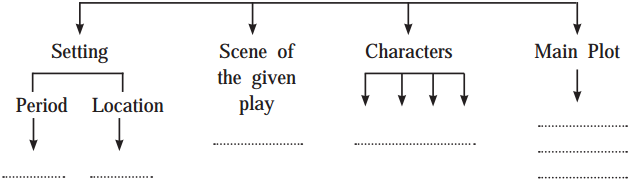
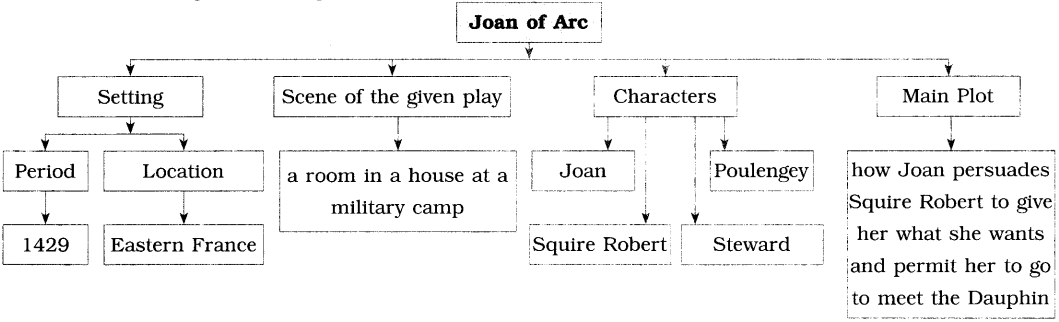
Read the extract from G. B. Shaw’s play on Joan of Arc and fill in the Tree diagram.
Joan of Arc
Maharashtra Board Class 10 English Solutions Unit 1.5 Joan of Arc 1
Answer:
Maharashtra Board Class 10 English Solutions Unit 1.5 Joan of Arc 2

Maharashtra Board Solutions

Question 2.
(A) Pick out from the extract of the play two lines that provide evidence for each of the following.
Joan of Arc
(a) Her confidence
(1) …………………….
(2) …………………….
Answer:
(1) The Dauphin will give me all I need to free Orleans.
(2) I will teach them all to fight for France.

(b) Her courage
(1) …………………….
(2) …………………….
Answer:
(1) She really doesn’t seem to be afraid of anything.
(2) The Squire’s glare neither frightens her nor stops her.

(c) Her optimism
(1) …………………….
(2) …………………….
Answer:
(1) If she can put some fight into him, she can put it into anybody.
(2) I don’t think it can be very difficult if God is on your side.

(d) Her determination
(1) …………………….
(2) …………………….
Answer:
(1) I have arranged it all. You have only to give the order.
(2) Yqu said that you would not see me. But here I am.

(e) Her patriotism
(1) …………………….
(2) …………………….
Answer:
(1) I will teach them all to fight for France.
(2) You and Polly will live to see the day when there will not be a single English soldier on the soil of France.

Maharashtra Board Solutions

(B) Using the above points, frame a character-sketch of Joan of Arc, in your own words and write it in your notebook. Suggest an attractive title for the same.
Answer:
The Heroine of France-Joan of Arc Joan, a well-built, strong country girl of 17 to 18 years, _is brave and courageous and unafraid of anything. She is confident and asks directly for whatever she wants and is sure of getting It. She is optimistic and feels that if God is on one’s side, one can do anything. She is determined to go to Orleans and motivate the Dauphin to fight the English and save OrleAnswer: Squire Robert and the others feel that if anyone can put some fight into the Dauphin, It is Joan. She ¡s extremely patriotic and confidently says that she will motivate the French soldiers to fight, and soon there will not be a single English soldier left on the soil of France.

Question 3.
From the extract, find what the following are compared to and why:
(a) as easy as …………………………………………………………………….
………………………………………………………………………………………….
Answer:
as easy as chasing a cow out of the meadow. This comparison is made because Joan was a country girl and had probably chased many cows out of the meadows. Besides, cows are docile creatures and can be driven away very easily.

(b) as mad as …………………………………………………………………….
………………………………………………………………………………………….
Answer:
as mad as Joan, for Joan was planning to go to the Dauphin, who was frightened, and motivate him to fight for Orleans.

(c) The Dauphin in Chinon is like …………………………………………………………………….
………………………………………………………………………………………….
Answer:
The Dauphin in Chinon Is like a rat In a corner, for just like a cornered rat gives up, he too had given up and refused to fight to save Orleans.

(d) The (enemy) soldiers will be driven away like …………………………………………………………………….
………………………………………………………………………………………….
Answer:
The enemy soldiers will be driven away like sheep. This comparison is made because sheep, always move in flocks and their herd mentality forces them to free if the leading ones flee.

(e) Joan of Arc is a bit of …………………………………………………………………….
………………………………………………………………………………………….
Answer:
Joan of Arc is a bit of a miracle because she is courageous, confident and determined enough to go to the Dauphin and motivate him to fight for Orleans, when everybody else had given up.

Maharashtra Board Solutions

Question 4.
Say WHY? Write it in your notebook.
(a) Joan wanted to meet Captain Squire.
(b) Joan did not ask for many soldiers from the Captain Squire.
(c) Poulengey, Jack and Dick had offered to accompany Joan.
(d) French soldiers were always beaten in war.
(e) Captain Squire Robert said, “I wash my hands off it.”
Answer:
(a) Joan wanted Captain Squire to give her a ’ horse, an armour and some soldiers and send her to meet the Dauphin. That was the reason she wanted to meet him.

(b) Joan did not ask for many soldiers from the Captain Squire because the Dauphin would give her all that she needed.

(c) Poulengey, Jack and Dick felt there was something about Joan, and that she was a bit of a miracle. Her words had put fire into them. They also felt that it was their last chance of saving OrleansHence they offered to accompany her.

(d) The French soldiers were always trying to save their lives, and would run away from the battlefield. Hence they were always beaten in war.

(e) Captain Robert Squire was uncertain about allowing Joan to go to the Dauphth. He could not believe that Joan would be successful In her mission. Even then, he could not withstand her determination and confidence; he also felt that this was the last chance of saving Orleans, and that there was something special about Joan. However, he did not want to be held responsible for anything; hence he said “I wash my hands of it.”

Question 5.
Using a dictionary, find the difference between the following pairs of phrases. Make sentences of your own with each of them.

PhrasesMeaningOwn Sentences
1. cut in cut out…………………………………………
…………………………………………
…………………………………………
…………………………………………
2. be held by be held up…………………………………………
…………………………………………
…………………………………………
…………………………………………
3. run away run for…………………………………………
…………………………………………
…………………………………………
…………………………………………
4. be known as be known for
Maharashtra Board Solutions
…………………………………………
…………………………………………
…………………………………………
…………………………………………
5. go with go after…………………………………………
…………………………………………
…………………………………………
…………………………………………
6. put fire into put fire out…………………………………………
…………………………………………
…………………………………………
…………………………………………

Answer:

PhrasesMeaningOwn Sentences
1. (a) cut in
(b) cut out
(a) interrupt
(b) reduce or stop something
(a) The teacher asked Rohan not to cut in when she was teaching.
(b) Planting a line of trees along the road will cut out the noise from vehicles.
2. (a) be held by
(b) be held up
(a) before
(b) delayed
(a) The mayor wanted the elections to be held by the end of the month.
(b) The marriage party was held up in the traffic jam.
3. (a) run away
(b) run for
(a) escape; go off
(b) to compete in an election
(a) The kind king allowed the captured deer to run away.
(b) The film star wanted to run for the post of Mayor.
4. (a) be known as
(b) be known for
(a) to be called as
(b) to be famous for
(a) The new boss wanted to be known as a good and kind person.
(b) Nagpur is known for its oranges.
5. (a) go with
(b) go after
(a) suit each other
(b) pursue; follow
(a) Don’t you think these shoes go with this dress?
(b) You will never be happy if you go after money all the time.
6. (a) put fire into.
(b) put fire out
(a) inspire, motivate
(b) extinguish
(a) The Chief Guest’s words put fire into the young students.
(b) Seeing trouble brewing, the minister advised his team to put the fire out before it spread everywhere.

Question 6.
From an Indian History Book or Internet find out information about Indian Women (queens) who led battles. (For example, Rani of Jhansi and Rani Karnawati of Mewad). Write 3 points of similarity and 3 points of contrast between any one of the above Indian Queens and Joan of Arc. Write in your own words.

Similarities Contrast
(a) …………………… (i) ……………………
(b) …………………… (ii) ……………………
(c) …………………… (iii) ……………………

Maharashtra Board Solutions

Question 7.
Read the script from :
Joan (Girl) : Good morning, Captain
Squire …………………… up to
Joan : (simply) ……………………
Polly and Jack have promised to come with me.

Write a summary of that part of the script (in the indirect speech) in 15 to 20 lines. Do it in your notebook.
Answer:
Joan asked the Squire to give her a horse, an armour and some soldiers, and send her to the Dauphin. On hearing this, Robert angrily asked the steward why he had not told him that she was mad.

The steward told Robert to give Joan what she wanted. Robert then told Joan that he would send her back to her father with orders to lock her up. Joan replied that it wouldn’t happen that way; Robert had not wanted to see her, yet she had managed to see him.

Joan then asked him for a horse which would cost 16 francs. It was a big amount of money, but she would save It on the armour, as she did not need a beautiful, fitting armour. A soldier’s armour would do. She said that she would not want many soldiers, for the Dauphin would give her what she needed to free Orleans. Three men would be enough for him to send with her. She adds that Polly and Jack had promised to go with her.

Question 8.
(A) Make the following sentences Affirmative without change of meaning.
(a) Negative : I am not so sure, now.
Affirmative : …………………………………………
(b) Negative : He will not be able to stop them.
Affirmative : …………………………………………
(c) Negative : I don’t remember.
Affirmative : …………………………………………
(d) Negative : I can do no more.
Affirmative : …………………………………………
(e) Negative : Sir, do not anger her.
Affirmative : …………………………………………
(f) Negative : I shall not want many soldiers.
Affirmative : …………………………………………
Answer:
(a) I am a bit doubtful, now.
(b) He will be unable to stop them.
(c) I fail to remember.
(d) I can do only this much.
(e) Sir, please refrain from angering her.
(f) I shall want only a few soldiers.

Maharashtra Board Solutions

(B) Fill in the gaps in the table.
Word-Forms

NounVerbAdjectiveAdverb
1. successsucceedsuccessfulsuccessfully
2. ……………………..inspire……………….……………….
3. ……………………..……………….safe……………….
4. ……………………..harm……………….……………….
5. thought……………….……………….……………….
6. ……………………..……………….……………….brightly
7. courage……………….……………….……………….
8. ……………………..……………….……………….hastily

Answer:

NounVerbAdjectiveAdverb
1. successsucceedsuccessfulsuccessfully
2. inspirationinspireinspirational
3. safetysafesafely
4. harmharmharmful/harmlessharmfully/harmlessly
5.’thoughtthinkthoughtful/thoughtlessthoughtfully/thoughtlessly
6. brightnessbrightenbrightbrightly
7. courageencouragecourageouscourageously
8. hastehastenhastyhastily

Question 9.
Fill in the blanks with the correct alternatives: (The answers are given directly and underlined.)
Answer:
(1) The steward is called a ‘blockhead’ by the squire. (Robert/steward)
(2) The squire’s name is Robert. (Robert/Dauphin)
(3) The price of a horse is sixteen francs. (17 to 18 francs / sixteen francs)
(4) The Dauphin will give the girl whatever she needs to free Orleans: (Dauphin/Squire)

Question 10.
Complete the following: (The answers are given directly and underlined.)
Answer:
(1) The Hundred Years War was fought between 1337 and 1453.
(2) All of northern France and some parts of the south-west were under foreign control.

Question 11.
Classify the following words into adjectives and nouns and complete the table given below:
armed, courage, brave, armour, orders, well-built, squire, strong, amount, beautiful, Orleans
Answer:
Adjectives – Nouns
armed, brave, well-built, courage, armour, orders, strong, beautiful sqtiire, amount, Orleans

Maharashtra Board Solutions

Question 12.
Write the verb forms of the following words:
(1) strong
(2) mad
(3) beautiful
(4) afraid
Answer:
(1) strengthen
(2) madden
(3) beautify
(4) fear

Question 13.
You have fifty armed soldiers and dozens of strong servants to carry out my orders.
Answer:
You have fifty armed soldiers as well as dozens of strong servants to carry out my orders.

Question 14.
You are to give me a horse and armour and some soldiers.
Answer:
You are to give me a horse and armour as well as some soldiers.

Question 15.
What, according to you, is the steward’s opinion about Joan?
Answer:
The steward has a high opinion of Joan. He feels that she isn’t afraid of anything, and she puts courage in others. He feels that she should not be angered and be given what she wants.

Question 16.
Write if the following statements are True or False: (The answers are given directly and underlined.)
Answer:
(1) Joan is angry when Robert tells her to get out. False
(2) Joan feels that Squire Jack is kind. True
(3) The steward’s name is Bertrand de Poulengey. False
(4) Robert thinks that the girl’s idea is crazy. True

Maharashtra Board Solutions

Question 17.
Name the persons needed by Joan to free Orleans:
Answer:
Joan needed the following persons to free Orleans Bertrand de Poulengey, Squire Jack, John Godsave, Dick the Archer, and their servants John of Honecourt and Julian.

Question 18.
Complete the following: (The answers are given directly and underlined.)
Answer:
(1) The squire wants the steward to go with Joan, stay within call and keep an eye on her.
(2) Joan’s aim was to meet the Dauphin and free Orleans.

Question 19.
Pick out four adverbs of manner from the passage.
Answer:
simply, willingly, eagerly, brightly (hastily, seriously). ,

Question 20.
Pick out the antonyms of the following words from the passage:
(1) exit
(2) request
(3) advance
(4) slowly
Answer:
(1) exit x enter
(2) request x order
(3) advance x retreat
(4) slowly x hastily

Maharashtra Board Solutions

Question 21.
Polly and Jack have promised to come with me. (Rewrite using ‘that’.)
Answer:
Polly and Jack have promised that they will come with me.

Question 22.
You have only to give the order. (Rewrite using ‘nothing’.)
Answer:
You have to do nothing but give the order.

Question 23.
‘I have arranged it all’. What does this statement tell you about Joan?
Answer:
It tells us that Joan had good leadership qualities. She had the ability to inspire others and make them do as she wished. She was also a good organiser.

Question 24.
What/Whom do the underlined pronouns stand for?
Answer:
(1) Her words have put fire into me. Poultney
(2) I feel sure enough to take her to Chinon. Joan
(3) He beat the English at Montargis. Dauphin
(4) ! feel like a fool. Robert

Question 25.
Complete the following: (The answers are given directly and underlined.)
Answer:
(1) The Squire’s opinion of miracles was that though they were airight, they did not happen in their time.
(2) Robert accused Poulengey of being as mad as Joan.

Maharashtra Board Solutions

Question 26.
The Dauphin was not fit to be the king and heir.
Answer:
The Dauphin was not fit to be the king and heir because he was a coward and retreated to Chinon and spent time there like a rat in a corner. He was not able to motivate his men or stop the English from taking Orleans’

Question 27.
Make sentences of your own using the words/ expressions given below:
(1) cowed
(2) obstinately
(3) worth hying
(4) out of your mind
Answer:
(1) We should not be cowed when we are threatened by bullies.
(2) The little girl obstinately refused to answer the teacher.
(3) “Your idea will keep the neighbourhood clean. It is worth trying,” said the minister.
(4) “You are out of your mind,” I told my friend when she wanted to save the stray dog.

Question 28.
I tell you nothing cai save our side now but a miracle. (Rewrite using ‘only’.)
Answer:
I tell you only a rriracle can save our side now:

Question 29.
After talking to Poulengey what change do you notice In Robert?
Answer:
Robert was initially unwilling even to listen to Joan.. But after talking to Poulengey, he agreed that it was their last chance of trying to free Qrleans and there was no other hope for them. Poulengey’s certainty about Joan made him waver and change his mind and give her a chance.

Maharashtra Board Solutions

Question 30.
Pick out the statements that are True:
(1) Joan was unsure about her ideas.
(2) Joan had no belief in God.
(3) The soldiers called Joan ‘the Maid’.
(4) Robert had a poor opinion of English soldiers.
Answer:
True statements:
(3) The soldiers called Joan ‘the Maid’.
(4) Robert had a poor opinion of English soldiers.

Question 31.
how one knows that Joan is a person of immense faith.
Answer:
Joan’s statement ‘I don’t think soldiering can be difficult if God Is on your side’ shows that she is a person of immense faith.

Question 32.
Pick out the words ending In -ing from the passage and classify them Into gerunds and participles.
Answer:
Gerunds – Participles
raising, chasing. soldiering, fighting, plundering, burning, – turning, fighting

Question 33.
Pick the odd man out from each group:
(1) gravely, always. heard, very
(2) they, see, you. them
Answer:
(1) heard- (this is a verb; the other words are adverbs.)
(2) see-(this is a verb; the other words are pronouns.)

Question 34.
Rewrite the following as Assertive sentences:
(1) Have you ever seen English soldiers fighting?
Answer:
You have never seen English soldiers fighting.

Maharashtra Board Solutions

Question 35.
Have you ever seen them plundering, burning, turning the countryside into a desert?
Answer:
You have never seen them plundering, burning, turning the countryside into a desert.

Question 36.
Do you think that soldiers should run away to ‘save their skins’?
Answer:
No, I don’t think so. Soldiers must fight till their last breath. No soldier worth his sa1t should run away from the scene of battle to save his/her own life.

Question 37.
What dress did Joan want?
Answer:
Joan wanted a soldier’s dress.

Question 38.
Robert finally agreed to the plan.
Answer:
Robert thought that Joan might be able to motivate the Dauphin and the troops to fight. He felt that she had the courage and determination to succeed. He also felt that there was something special about her. Hence he finally agreed to the plan.

Question 39.
Pick out the modal auxiliary and state its function.
Even the Dauphin might believe it.
Answer:
might—showing possibility.

Question 40.
Do you think that Joan succeeds in her plan?
Answer:
I would not be sure only by reading the play; but history tells us that she did succeed and led the French army to victory in several battles during the Hundred Years War. Her bravery, determination and confidence won the day.

Maharashtra Board Solutions

Question 41.
I can do no more.
Answer:
I can do only this much.

Question 42.
Pick out the modal auxiliary and state its function.
Even the Dauphin might believe it.
Answer:
might—showing possibility.

Question 43.
Do you think that Joan succeeds in her plan?
Answer:
I would not be sure only by reading the play; but history tells us that she did succeed and led the French army to victory In several battles during the Hundred Years War. Her bravery, determination and confidence won the day.

Question 44.
(1) WrIte two compound words from the text.
(2) Use the following word as a gerund in your own sentence : chasing
(3) Find out two hidden words from the given word : confidently
(4) Make a sentence of your own using the phrase: to save their skins.
(5) Spot the error and rewrite the correct sentence: I is taking a big chance.
(6) Identify the type of sentence: I don’t think it can be very difficult.
(7) Write the following words in alphabetical order : understand, steward, window, squire.
(8) Write the present and past participles of ‘stop’.
(9) Prepare a word chain using the following nouns: Denmark, France, Austria, England, Korea, Alaska. France →
Answer:
(1) courtyard, blockhead
(2) I would not even think of chasing a defenceless animal.
(3) confidently — confident, confide
(4) The thieves jumped into the lake to save their skins.
(5) I am taking a big chance.
(6) Assertive (negative).
(7) squire. steward, understand, window.
(8) stop: stopping, stopped.
(9) France → England → Denmark → Korea → Austria → Alaska.

Question 45.
(1) Use the following word and its homograph in two separate sentences: lock
(2) The Dauphin will give me all I need. (Rewrite using the future progressive tense of the verb.)
(3) Prepare a word register of 4 words relating to war from the lesson.
Answer:
(1) (i) There was a lock of hair on the table.
(ii) The lock and the key were both missing.
(2) The Dauphin will be giving me all I need.
(3) War : soldier, armour, fight, siege, plundering, soldiering, troops. captain. (any 4)

Maharashtra Board Solutions

Question 46.
(1) I used to think so. (Pick out the modal auxiliary and state its function).
(2) Analyse the sentence: Stay within a11 and keep your cyc on her.
Answer:
(1) used to — past habit
(2) Compound Sentence.
Stay within call — coordinate (main) clause: keep your eye on h& — coordinate (main) clause.

Maharashtra Board Class 10 English Solutions Unit 2.6 Science and Spirituality

Balbharti Maharashtra State Board Class 10 English Solutions Unit 2.6 Science and Spirituality Notes, Textbook Exercise Important Questions and Answers.

Maharashtra State Board Class 10 English Kumarbharati Textbook Solutions Unit 2.6 Science and Spirituality

Maharashtra Board Class 10 English Solutions Unit 2.6 Warming Up Questions and Answers

Question 1.
Get into pairs/groups and match the columns:

‘A’‘B’
(1) Science(a) The study of the basic nature of knowledge, reality and existence, especially as an academic subject.
(2) Religion(b) The study of nature of God and religious belief.
(3) Spirituality(c) The intellectual and practical activities in a systematic study of structure and behaviour of the natural world through experiment and observation.
(4) Philosophy(d) The belief in and worship of a superhuman controlling power God.
(5) Theology(e) The quality of being more concerned with the human spirit as opposed to material or physical things.

Answer:

‘A’‘B’
(1) Science(c) The intellectual and practical activities in a systematic study of structure and behaviour of the natural world through experiment and observation.
(2) Religion(d) The belief in and worship of a superhuman controlling power God.
(3) Spirituality(e) The quality of being more concerned with the human spirit as opposed to material or physical things.
(4) Philosophy(a) The study of the basic nature of knowledge, reality and existence, especially as an academic subject.
(5) Theology(b) The study of nature of God and religious belief.

Maharashtra Board Solutions

Question 2.
Given below are some incomplete Quotes. Complete them choosing from the words SCIENCE /RELIGION /SPIRITUAL and make them meaningful:

  • ………………………….. without religion is lame; without science is blind. ………………………….. has outrun our power, we have guided missiles, but misguided man.
  • On a ………………………….. journey, we all have the same destination.
  • ………………………….. is meant to awaken man’s love for his Source – God!
  • ………………………….. provides a means of with the Creator of Heaven and Earth, in the language of your heart and soul.
  • ………………………….. is a beautiful gift to humanity; we should not distort it.

Answer:

  • Science, Religion
  • Science, Spiritual
  • Spiritual
  • Religion
  • Religion
  • Science

Question 3.
What’s the difference between science and technology? Discuss in pairs and tell your answer to the class.
Answer:
We generally assume that science and technology mean almost the same thing. HowSver, there is a difference. The goal of science is the pursuit of knowledge for its own sake while the goal of technology is to turn the scientific knowledge into industrial and commercial use. Simply put, technology is the practical application of science,

Question 4.
Do you think that science and faith are both important in our lives? Why? Discuss in your group and give a small presentation in front of the class.
Answer:
Yes, both science and faith are important in our lives. There is no contradiction between the two. Both genuinely seek the truth. Science explores the truth about the material and physical world. Faith introspects on the spiritual aspects including the Self and the Creator. Science helps us understand the physical structure of the universe, while faith deals with human values and morals. Both complement each other. In the words of Einstein, ‘Science without religion is lame; religion without science is blind.’

Maharashtra Board Solutions

Question 5.
We need science
Maharashtra Board Class 10 English Solutions Unit 2.6 Science and Spirituality 2
Answer:
Maharashtra Board Class 10 English Solutions Unit 2.6 Science and Spirituality 1

Question 6.
Refer to a dictionary to find out the meanings of the following words.

  • Spirit- a person’s mind or feelings or soul.
  • Spiritual
  • Spirituality
  • Spiritualism
  • Spiritualist

Answer:

  • Spiritual – relating to or affecting the human spirit or soul, as opposed to material or physical things
  • Spirituality – the quality of being concerned with the human spirit, or soul, as opposed to material or physical things
  • Spiritualism – a system of belief or religious practice based on supposed communication with the spirits of the dead, especially through mediums
  • Spiritualist – an advocate of the doctrine that the spirit exists as distinct from matter, or that spirit is the only reality

Science and Spirituality Class 10 English Workshop Questions and Answers Maharashtra Board

Question 1.
(A) Read ‘Part I’ and match the words in Column ‘A’ with associating words given in Column ‘B’.

No‘A’‘B’
(i)Science and faith(a)Created by fact and faith
(ii)Science(b)Success of societies
(iii)Better Planet(c)Betterment of humanity
(iv)Creations and Discoveries(d)Believers of science and religions
(v)Conflict(e)Solves questions, discovers truth, conceives inventions

(i) …………………………..
(ii) …………………………..
(iii) …………………………..
(iv) …………………………..
(v) …………………………..
Answer:

‘A’ ‘B’
(1) Science and faith(a) Success of societies
(2) Science(e) Solves questions, discovers truth, conceives inventions
(3) Better Planet(a) Created by fact and faith
(4) Creations and Discoveries(c) Betterment of humanity
(5) Conflict(d) Believers of science and religions

Maharashtra Board Solutions

(B) Read ‘Part II’. Go through the given statements and say whether you agree or disagree to each of them.
(a) The Space Research set up facility was planned at Allapi, Kerala – …………………………..
(b) The person who could help and can be contacted was the Bishop – …………………………..
(c) It was quite easy to relocate so many people and destroy religious institutions for space-research centre – …………………………..
(d) Dr. Kalam joined ISRO in 1970 – …………………………..
(e) Science and spirituality seeks prosperity of the human life – …………………………..
Answer:
(a) Disagree
(b) Agree
(c) centre Disagree
(d) Disagree
(e) Agree

(C) Go through ‘Part III’ and complete the following statements.
(a) The essence of a happy life and a peaceful society lies in one sentence – …………………………..
(b) To keep this planet liveable and the human race thriving, we have to …………………………..
(c) Mahaswamiji’s greatest contribution is the …………………………..
(d) We can remove the  our souls by …………………………..
(e) The narrator, Srijan, realised that through Dr. Kalam’s words of wisdom …………………………..
(f) Mahaswamiji possesses powers that kept him so strong were ………………………….. or
Answer:
(a) The essence of a happy life and a peaceful society lies in one sentence – ‘What can I give’.
(b) To keep this planet liveable and the human race thriving, we have to replace this attitude of ‘what can I take’ with the goodness of
(c) Mahaswamiji’s greatest contribution was the establishment of a free residential education system for more than nine thousand children in the ashram.
(d) We can remove the impurities obscuring our souls by living pure and ethical lives and by serving humanity.
(e) The narrator, Srijan, realized that through Dr Kalam’s words of wisdom he was getting to learn from countless great minds.
(f) The narrator (Srijan) said this to Dr Kalam ‘ while discussing the Mahaswamiji’s 102nd birthday i celebrations.

2. Choose the correct alternative for the given statements.
(A) Dr. Kalam’s father was an …………………………. .
(a) teacher
(b) scientist
(c) farmer
(d) imam.
Answer:
(d) imam.

(B) Dr. Kalam’s friends discussed on …………………………. .
(a) science and technology
(b) discoveries and inventions.
(c) science and spirituality
(d) community’s problems and solutions.
Answer:
(c) science and spirituality

(C) According to Dr. Kalam, the need that is felt more than ever is ………………………….. .
(a) a laboratory to conduct experiments.
(b) a new technology to find results.
(c) a dialogue among cultures, religions and civilizations.
(d) a dialogue between people of different professions.
Answer:
(c) a dialogue among cultures, religions and civilizations.

Maharashtra Board Solutions

(D) Dr. Kalam’s father was a symbol of ………………………….. .
(a) trust and faith.
(b) simplicity and divinity
(c) teacher and disciple.
(d) father and friend.
Answer:
(b) simplicity and divinity

(E) Spirituality takes care of ………………………….. .
(a) education, teaching and learning.
(b) science, technology and sci-fi.
(c) confusion, misery or failure.
(d) crime, illiteracy and child labour.
Answer:
(c) confusion, misery or failure.

(F) How can academic brilliance diminish?
(a) by disturbance and frustration.
(b) by going off track
(c) by a coating of dust.
(d) by losing focus and seriousness.
Answer:
(d) by losing focus and seriousness

(G) What was most astonishing about 102 year old Swamiji?
(a) He was a great speaker and orator.
(b) He was a great scientist.
(c) He was a great admirer of technology.
(d) He looked as steady and alert as any other youngster.
Answer:
(d) He looked as steady and alert as any other youngster.

(H) What Dr. Kalam gathered while swimming in silence at the shores of Mahapragyaji?
(a) beautiful sea shores
(b) tree lined beaches
(c) sands of conscience
(d) beautiful sun-set.
Answer:
(c) sands of conscience

Question 3.
Among the three parts, there are people who touched and influenced the life of Dr. A. P. J. Kalam in one or the other ways. Complete the web chart by writing the names of such people.
Answer:
Kalam In one way or the other were:
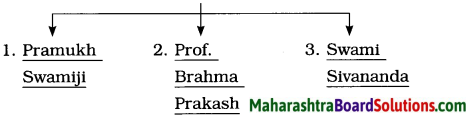
Maharashtra Board Class 10 English Solutions Unit 2.6 Science and Spirituality 3

Question 4.
Write the significance of the following years, as given in the text.
1960 ……………………………
1970 ……………………………
1980 ……………………………
2009 ……………………………
2012 ……………………………
Answer:
1960 → Is significant as Dr Kalamoined ISRO that year.
1970 → Dr Kalam made his first unsuccessful launch.
1980 → Dr Kalam made his first successful launch.
2009 → The writer graduated from IIMA and met Dr Kalam
2012 → The writer was discussing with Dr Kalam the number of Ph.D’s he (Dr Kalam) had received.

Maharashtra Board Solutions

Question 5.
Who said to whom and when?
(a) “Can we give up God’s abode for such a great scientific mission ?”
…………………………………………………………………..
Answer:
Reverend Father Pereira said this to „the people in the Church, one Sunday. On the previous day, Dr Sarabhai and Dr Kalam had approached him to request the people to give up the church land for the building of a space research centre.

(b) “And then God will shine through us.”
…………………………………………………………………..
Answer:
Professor Satish Dhawan to Dr Kalam when ‘ they were talking about academic brilliance.

(c) “I wonder what power Mahaswamiji possesses, that keeps him so strong.”
…………………………………………………………………..
Answer:
Reverend Father Pereira said this to „the people in the Church, one Sunday. On the previous day, Dr Sarabhai and Dr Kalam had approached him to request the people to give up the church land for the building of a space research centre.

Question 6.
Answer the following in your own words, and write in your notebook.
(a) What makes Dr Kalam a humble personality?
Answer:
Even though Dr Kalam was indisputably a great scientist, he had deep faith and espoused the cause of the betterment of humanity. This shows that he was indeed a humble personality.

(b) How were different virtues inculcated in Dr Kalam?
Answer:
Dr Kalam inculcated the virtue of humility from his father who was a boatman. He learnt from his father how simplicity and divinity could go together.

(c) How did the Reverend relate and compare the work that he and Dr Sarabhai did for people?
Answer:
The Reverend said that Dr Sarabhai was a scientist. We benefit from the devices that science has developed in many ways – in our homes and in the fields of medicine and technology. A priest prays for the peace and well-being of his people. Thus both science and spirituality seek the Almighty’s blessing for the prosperity of the human mind and body. In short, both are doing the sameob.

(d) What was so remarkable about Dr Sri Sri Shivakumar Mahaswamiji?
Answer:
The remarkable aspect about Dr Sri Shivakumara Mahaswamiji was that he had dedicated his life to the service of humanity.

(e) Why is there an urgent need to replace ‘What can I take’ with ‘What can I give?
Answer:
There is an urgent need to replace ‘What can I take’ with ‘What can I give’ for the very survival of humanity. Unless we realize the gravity of the message, this planet will become a hub of environmental degradation, social evils, inequity and corruption. If we do not take up the challenge, our planet will not be liveable and the human race will not prosper.

Maharashtra Board Solutions

Question 7.
In your notebook, write a short paragraph on each of the following covering up their profession and personality traits with examples.
(a) Rev. Peter Bernard Pereira
(b) Dr Sri Shivakumar Mahaswamiji
(c) Dr A. P. J. Abdul Kalam
Answer:
(a) His interactions with the great scientist Professor Vikram Sarabhai and the Reverend Peter Bernard Pereira shaped Dr Kalam’s thoughts on religion.
(b) The 102nd birthday celebrations of His Holiness Dr Sri Sri Shivakumara Mahaswamiji.
(c) Dr A P Abdul Kalam was the past President of India. By the way, he was a great scientist, orator and a humanitarian.

8. Write in your own simple words what the following expressions convey in the context they occur in the text.
(a) Faith and fact can, together, create a better planet.
…………………………………………………………………..
Answer:
If people have belief in a greater power! as well as understand the truth of things that exist around them, this world will become a better place for all of us to live in harmony.

(b) Dr Kalam’s own life was nourished by multiple faiths.
…………………………………………………………………..
Answer:
This means that the life of Dr Kalam improved in quality because of the discussion he had with people of different faiths, such as the head priest of a temple who was a Vedic scholar, and a Christian priest.

(c) But there was a major roadblock.
…………………………………………………………………..
Answer:
This expression conveys the fact that something was being planned, but there were serious issues that hindered its progress.

(d) Only when the dust is removed, does the mirror shine and the reflection becomes clear.
…………………………………………………………………..
Answer:
This expression is a comparison between the mind and the mirror. The brilliance of both can be diminished by many factors that act like coatings of dust. However, when that coating is removed, both shine and radiate brilliance.

(e) Through his (Kalam’s) words of wisdom, I was getting to learn from countless great minds.
…………………………………………………………………..
Answer:
This expression first of all conveys the information that Dr Kalam himself was a very well- read person who had acquired his knowledge from innumerable great minds of the past. Further, it conveys that the speaker (Narrator; Srijan) himself received an education from Dr Kalam by association with him.

Maharashtra Board Solutions

(f) He gathered the sands of conscience to be our guide, our best friend.
…………………………………………………………………..
Answer:
These words convey the idea that Dr Kalam realized that our own conscience is our guide and! best friend.

(g) ‘What can I take?’ is the thought which is responsible for all the wrong, seen around us.
…………………………………………………………………..
Answer:
These words convey the idea that when people think only in terms of what they can get S from others, it leads to every possible illegal or bad behaviour.

9. (A) From the lesson, pick out one word for each of the following.
(a) increase the speed …………………………
(b) point of view …………………………
(c) nearness in space …………………………
(d) a place of residence …………………………
(e) eager to know everything …………………………
(f) echoed loudly …………………………
(g) giving away much to the needy …………………………
(h) without making a difference …………………………
Answer:
(a) accelerate
(b) perspective
(c) proximity
(d) abode
(e) inquIsitive
(f) reverberated
(g) munificence
(h) indiscriminately

(B) Arrange the following words in the alphabetical order.

  • inventions,
  • indisputable,
  • interactions,
  • inequity,
  • institutions,
  • inquisitive,
  • indiscriminately

Answer:

  • indiscrimInately,
  • Indisputable,
  • inequity,
  • Inquisitive,
  • institutions,
  • Interactions,
  • Inventions.

(C) Find from the lesson the noun forms of –
1. combine …………………………
2. solve …………………………
3. simple …………………………
4. divine …………………………
5. advance …………………………
6. tranquil …………………………
7. liveable …………………………
8. strong …………………………
Answer:
1. combination
2. solution
3. simplicity
4. divinity
5. advancement
6. tranquillity
7. life
8. strength

Maharashtra Board Solutions

Question 10.
Match the word connectors with reference to part I, II, III respectively. Make sentences of each of these connectors.

NoWordConnector
1.government(a)person
2.betterment of(b)curbs
3.pure and ethical(c)degradation
4.community’s(d)launch
5.religions(e)dialogue
6.astonishing(f)silence
7.technological(g)motivation
8.frank(h)aspect
9.social(i)life
10.faith(j)centre
11.inquisitive(k)officials
12.academic(l)problems
13.environmental(m)humanity
14.pin-drop(n)service
15.alternate(o)bodies
16.remarkable(p)evils
17.silent(q)advancement
18.famished(r)brilliance
19.unsuccessful(s)accommodation
20.space-research(t)discipline

Answer:
(1) Some government officials came to our village to inspect the sanitary conditions.
(2) Gandhiji’s efforts were for the betterment of humanity.
(3) The hermit was revered for living a pure and ethical life.
(4) We formed a core team to look into the community’s problems.
(5) We need religious discipline in order to develop a clear conscience.
(6) The most astonishing aspect of this great king’s personality is his humility.
(7) The district required more skilled manpower for technological advancement.
(8) The teacher had a frank dialogue with the youth about his drug problem.
(9) He left his good secureob in order to dedicate himself to social service.
(10) In order to make progress, people should avoid conservative faith curbs.
(11) To be a good detective, ond must basically be an inquisitive person.
(12) All through his school and college days he displayed academic brilliance.
(13) Plastics are major contributors to environmental degradation.
(14) There was pin-drop silence when the sad news was announced.
(15) The owner was provided alternate accommodation until his flat was renovated.
(16) Lai Bahadur Shastri was a remarkable person.
(17) Our inner beliefs should be the silent motivation to do good to others.
(18) The communal kitchen is a great boon to famished bodies.
(19) At the first attempt it was an unsuccessful launch.
(20) ISRO is a space research centre in Bengaluru.

Maharashtra Board Solutions

Question 11.
Simple sentence : subject + verb + object/complement/adverbial: Analysing a simple sentence is done by separating the subject and the predicate. The predicate is further analysed into –
(1) verb + object as in ‘A doctor treats patients’./ ‘He greeted the teacher.’
(2) verb + complement as in ‘They are very tired.’ / ‘I have a cold.’
(3) verb + adverbial as in (He walks slowly. / Raj arrived late. / The thief is hiding there.)

Say whether the predicates in the following sentences have an object/a complement/an adverbial.
(1) There was silence. …………………………
(2) Alexander Bell invented the telephone. …………………………
(3) They have a holiday. …………………………
(4) The dancer danced gracefully. …………………………
(5) The milkman comes daily. …………………………
(6) The hostess served tea. …………………………
(7) The kite soared upwards. …………………………
Answer:
(1) Complement
(2) Object
(3) Complement
(4) Adverbial
(5) Adverbial
(6) Object
(7) Adverbial

Question 12.
(A) Punctuate the following sentences to make them meaningful.
(1) dinesh took a bus that stopped at nanded railway station after crossing somvar peth
(2) dr a p j abdul kalam was the past president of india by the way he was a great scientist orator and a humanitarian
(3) nouns are of different types common proper abstract concrete material
(4) what a lot of noise you all make said the teacher cant you keep quiet for a while
(5) wow how lovely that cake looks they said we cant wait to eat it
Answer”
(1) Dinesh took a bus that stopped at Nanded railway station after crossing Somvar Peth.
(2) Dr A P J Abdul Kalam was the past President of India. By the way, he was a great scientist, orator and a humanitarian.
(3) Nouns are of different types: common, proper, abstract, concrete, material.
(4) “What a lot of noise you all make!” said the teacher, “Can’t you keep quiet for a while?”
(5) “Wow! How lovely that cake looks!” they said, “We can’t wait to eat it.”

(B) Copy the first paragraph on page 92 in your notebook, carefully. Encircle all the punctuation marks with a colored pencil/pen.
“Dear children …………………. ‘amen’.

Question 13.
Project :
Read Dr. A.P.J. Abdul Kalam’s very renowned books ‘Wings of Fire’; and ‘Ignited Minds’, to find the following :
(a) Subject of the book
(b) Special features of the book
(c) Teachings/learnings/moral/message from the book
(d) Your own opinion/idea/comment on the book
Answer:
Dr A. P.. Kalam was the son of an imam, a simple fisherman. He was born in Rameswaram on 15 October 1931. He went on to become the 11th President of India from 2002 to 2007. He was widely acclaimed as the ‘People’s President’. He was particularly fond of children and youth and made himself approachable to them at all times.

He was a student of Physics and aerospace engineering. He was a scientist and science administrator mainly at the Defence Research and Development Organisation (DRDO) and Indian Space Research Organisation (ISRO) for nearly four decades. He was intimately involved in India’s civilian space programme and military missile development efforts.

Maharashtra Board Solutions

He is famous as the Missile Man of India for his work on the development of ballistic missile and launch vehicle technology. He also played a pivotal organisational, technical, and political role in India’s Pokhran-II nuclear tests in 1998, the first since the initial nuclear test by India in 1974.

He was the recipient of several prestigious awards, including the Bharat Ratna in 1997, India’s highest civilian honour.

Amongst his writings, the most famous are ‘Transcendence: My Spiritual Experiences with Pramukh Swamiji’, and ‘India 2020’.

While delivering a lecture at the Indian Institute of Management, Shillong, Kalam collapsed and died from an apparent cardiac arrest on 27uly 2015, aged 83. Thousands including national-level dignitaries attended the funeral ceremony held in his hometown of Rameswaram, where he was buried with full state honours.

Question 14.
(A) Draft a speech that you would give at your School Assembly convincing junior students that the secret of true happiness lies in Giving and Sharing more than in Receiving and Taking.

Write it with the appropriate steps in your notebook.
Answer:
Friends,
It is through experience I .have learned that ‘AS’ you give, so you live’.

There was a time in my life when I only wanted things. I was happy only when I received gifts. My main goal in life was to take as many things from others as I could.

But then one day, on the way to market, I saw a beggar boy running along the road. In his hand he held a loaf of bread. He ran to his mother, who was lying on the sidewalk. He sat next to her and started feeding her. It touched me deeply that this boy who must have been hungry himself, found greateroy in feeding his famished mother.

From that day onwards I started giving things to others. If I had two pens and someone wanted one, I would give it to him or her. I asked my mother to give my old clothes to a poor child from a nearby slum. For my birthday celebrations, instead of having a party, I went along with my mother to the temple and fed a line of beggars.

Giving things to others brings me greatoy and happiness. Receiving something gives temporary satisfaction. But reaching out to others and seeing them smile, sharing things with others and making it worthwhile – these are far more precious than any other personal possessions.

Thank you.

(B) Divide your class in two groups and have a Debate on the topic ‘Science and Spirituality can go hand in hand’.
Answer:
For (view):
Both science and spirituality study aspects of our world. Both require mental discipline. Both require belief in certain axioms and truths. Hence both are valid. Science is the body. Spirituality is the mind. Science explores the creations of God. Spirituality delves into the nature of God. Both are two sides of the same coin. Both complement each other.

It is inevitable therefore that science and spirituality go hand in hand.

Against (counterview):

Science requires factual knowledge. It is a component of millions of physical laws. Spirituality is a free bird that soars on the wings- of personal belief. It does not require proof. Only faith. How then can they be considered to be on the same plane? One is concrete; the other abstract. In order to draw upon spirituality, one may conjure up any image in the mind and be satisfied. Science seeks explanation in logical reasoning based upon unlimited past experiences and developed into a truth by considering experiment after experiment.

The two are poles apart and cannot go hand in hand.

Maharashtra Board Solutions

Question 15.
State whether the statements are True or False:
Answer:
(a) It is necessary for science and faith to function true to their roles.
(b) Kalam’s status as a great scientist is in dispute.
(c) Both fact and faith are required for a better world.
(d) There is never any conflict between believers in science and believers in religion.
Answer:
(a) True
(b) False
(c) True
(d) False

Question 16.
Why do science and faith have to go hand in hand?
Answer:
Science and faith must go hand in hand for the sake of human good. Science provides focus on human activities while faith gives one a perspective, which is essential for success.

Question 17.
From the passage pick out one word for each of the following:
(a) keeps something within limits
(b) unable to be challenged or doubted
Answer:
(a) curbs
(b) indisputable

Question 18.
Write the noun forms of:
(a) create
(b) coexist
(c) discover
(d) conceive
(e) accelerate.
Answer:
(a) create – creation
(b) coexist – coexistence
(c) discover – discovery
(d) conceive – conception
(e) accelerate – acceleration.

Question 19.
Faith provides perspective. (Rewrite beginning with ‘Perspective’.)
Answer:
Perspective is provided by faith.

Question 20.
Write whether the predicates in the following sentences have an object/a complement/an adverbial: (The answers are given directly and underlined.)
(a) This is indisputable.
(b) Science provides focus.
(c) They will work together.
Answer:
(a) complement
(b) object
(c) adverbial
Maharashtra Board Solutions

Question 21.
Fill in the blanks with suitable prepositions: (The answers are given directly and underlined.)
Answer:
Conflict often arises between people who believe in science and people who believe in religion,

Question 22.
Which, according to you, is more important for our planet to survive – science or religion? Give your reasons in brief.
Answer:
According to me, both are important – science \ as well as religion. Science provides us with facts that tell us about our planet. Religion educates us about the proper attitude towards all things created on earth. We need both for our planet to survive. Both go hand in hand.

Question 23.
Complete the following map:
Answer:
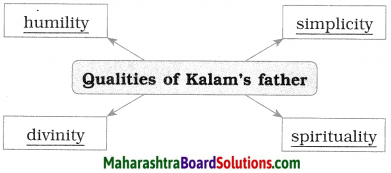
Maharashtra Board Class 10 English Solutions Unit 2.6 Science and Spirituality 5

Question 24.
Complete the following based on the passage: (The answers are given directly and underlined.)
Answer:
People who touched and influenced Dr A. P.. Kalam in one way or the other were:
Maharashtra Board Class 10 English Solutions Unit 2.6 Science and Spirituality 4

Question 25.
Complete the following.
Answer:
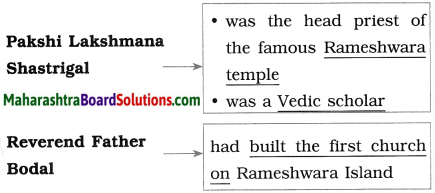
Maharashtra Board Class 10 English Solutions Unit 2.6 Science and Spirituality 6

Question 26.
Give evidence from the passage to show that Dr Kalam’s father combined the virtues of ‘simplicity’ and ‘divinity’.
Answer:
Dr Kalam’s father was a boatman. This was the basis for his simplicity. He was also an imam in a mosque and believed strongly in leading a spiritual life. This was the basis of his divinity.

Question 27.
Write from the passage four words that are connected with or related to religions.
Answer:
imam, mosque, Hindu, Christian (priest, temple, Vedic, reverend father, church, divinity, spiritual, spirituality)

Maharashtra Board Solutions

Question 28.
Match the words in column ‘A’ with their meanings in column ‘B’:

‘A’ ‘B’
(i) remembered (a) frank
(ii) honest (b) misery
(iii) clothes (c) recalled
(iv) sorrow (d) attire

Answer:

‘A’ ‘B’
(i) remembered (c) recalled;
(ii) honest(a) frank;
(iii) clothes(d) attire;
(iv) sorrow(e) misery.

Question 29.
Write the noun forms of:
(a) solve
(b) frank
(c) believe.
Answer:
(a) Solve – solution
(b) frank – frankness
(c) believe – belief.

Question 30.
(1) Write whether the predicates in the following sentences have an object/a complement/an adverbial:
(a) His father was a boatman.
(b) Father Bodal had built the first church.
Answer:
(a) complement
(b) object

Question 31.
Pick out the auxiliaries and state the mood:
(a) All three of them used to sit and discuss the community’s problems.
(b) Simplicity and divinity could go together.
Answer:
(a) used to – past habit
(b) could – possibility.

Question 32.
Even though his father was a boatman, Dr Kalam went on to become the President of India. (Rewrite using ‘yet’.)
Answer:
Dr Kalam’s father was a boatman, yet” he went on to become the President of India.

Question 33.
Complete the following based on the passage:
Answer:
People who touched and influenced Dr A. P.. Kalam in one way or the other were:
Maharashtra Board Class 10 English Solutions Unit 2.6 Science and Spirituality 7

Question 34.
What is the significance of the year 1960 as given in the passage?
Answer:
1960 is significant as Dr Kalamoined ISRO that year.

Maharashtra Board Solutions

Question 35.
Complete the following.
Answer:
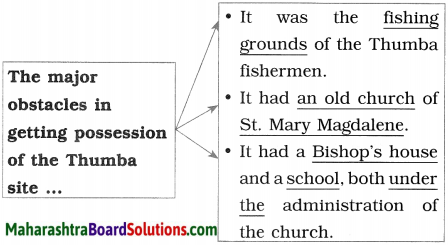
Maharashtra Board Class 10 English Solutions Unit 2.6 Science and Spirituality 8

Question 36.
Write from the passage words that sound the same as:
(a) grate
(b) dew
(c) wood
(d) hear
(e) two
(f) sew.
Answer:
(a) grate – great
(b) dew – due
(c) wood – would
(d) hear – here
(e) two – to
(f) sew – so.

Question 37.
Pick out from the following words that, do not begin with the prefix ‘re-’ religion, reverend, religious, research, relocate, region
Answer:
religion, reverend, religious, region

Question 38.
Match the phrases with one word from the passage:

‘A’ ‘B’
(i) which is new and inexperienced (a) proximity
(ii) a place provided for a particular purpose. (b) fledgling purpose
(iii) something that causes delay or obstruction (c) site
(iv) nearness in space (d) roadblock

Answer:

‘A’ ‘B’
(i) which is new and inexperienced(b) fledgling purpose
(ii) a place provided for a particular purpose.(c) site
(iii) something that causes delay or obstruction(d) roadblock
(iv) nearness in space(a) proximity

Question 39.
Professor Sarabhai and his team had selected a site in Thumba, Kerala. (Pick out the subject of the sentence.)
Answer:
Professor Sarabhai and his team

Question 40.
It was here that he learnt about the true meaning of religious service.
Answer:
Where did he learn about the true meaning of religious service?

Question 41.
It would be impossible to relocate so many people. (Rewrite using ‘not’.)
Answer:
It would not be possible to relocate so many people.

Maharashtra Board Solutions

Question 42.
What do you learn from this passage?
Answer:
From this passage, I learn that people belonging to different religions can come together and reach a common understanding to resolve major and sensitive issues. Religious harmony is the theme of this passage.

Question 43.
Complete the following:
(a) Reverend Father Pereira helped to solve the problem of acquiring the site.
(b) Father Pereira described the Church in three ways: (i) his abode (ii) his children’s abode (iii) God’s abode.
Answer:
(a) Reverend Father Pereira
(b) (i) abode
(ii) his children’s
(iii) God’s.

Question 44.
Go through the given statements and say whether you Agree or Disagree with each of them:
Answer:
(a) Science and spirituality seek the prosperity of human life. –
(b) Reverend Pereira absolutely refused to consider Dr Kalam’s request. –
(c) Alternate accommodation was offered only to the fishermen. – Disagree
(d) Everyone present in the church agreed to Reverend Pereira’s plea –
Answer:
(a) Agree
(b) Disagree
(c) Disagree
(d) Agree

Question 45.
Who said to whom and when? ‘Can we give up God’s abode for such a great scientific mission?’
Answer:
Reverend Father Pereira said this to „the people in the Church, one Sunday. On the previous day, Dr Sarabhai and Dr Kalam had approached him to request the people to give up the church land for the building of a space research centre.

Question 46.
Complete the following with the reference to the passage:
(1) We benefit from the devices that science has developed to light up our homes.
(2) We can talk to a large gathering and be heard using a microphone.
(3) Medical science allows doctors to diagnose and treat patients.
(4) Science and technology enhance the overall comfort and quality of human life.
Answer:
(1) to light up our homes.
(2) using a microphone.
(3) diagnose and treat patients.
(4) comfort and quality of human life.

Question 47.
Write one word for:
(a) one who follows a teacher or a leader
(b) eager to know everything
(c) a place of residence
(d) echoed loudly
Answer:
(a) discIple
(b) inquisitive
(c) abode
(d) reverberated

Question 48.
Write from the passage two words that have almost the same meaning as ‘prosperity’:
Answer:
comfort, well-being

Question 49.
Write from the passage two words that indicate noise.
Answer:
reverberated, deafening.

Maharashtra Board Solutions

Question 50.
How is it possible? (Rewrite as an assertive sentence.)
Answer:
It is not possible.

Question 51.
I am able to talk to you using this mic. (Rewrite using ‘can’.)
Answer:
I can talk to you using this mic.

Question 52.
The whole church reverberated with the deafening noise of a collective ‘amen’. (Pick out the prepositions.)
Answer:
with, of

Question 53.
Add question tags:
(a) Vikram and I are doing the sameob.
(b) I am able to talk to you using this mic.
Answer:
(a) Vikram and I are doing the sameob, aren’t we?
(b) I am able to talk to you using this mie, aren’t I’

Question 54.
How did the people respond to the appeal made by Reverend Pereira? Would you give the ( same response?
Answer:
The people got up and the whole church reverberated with the deafening noise of a collective ‘amen’. Yes, if I had been part of the gathering, I too would haveoined in with a loud positive response, Considering the importance of the space research centre, I would have been willing to suffer the agony i of relocation.

Question 55.
Complete the following:
(a) We can lead a pure life by serving humanity.
(b) The philosophy of Dr Kalam had an impact on the narrator.
Answer:
(a) serving humanity.
(b) Dr Kalam

Question 56.
Who had directly influenced Dr Kalam’s beliefs?
(a) Professor Satish Dhawan
(b) Srijan
(c) God
(d) countless great minds
Answer:
(a) Professor Satish Dhawan

Question 57.
Who said the following to whom and when? “And then God will shine through us.”
Answer:
Professor Satish Dhawan to Dr Kalam when ‘ they were talking about academic brilliance.

Question 58.
Match the words in column ‘A’ with their opposites in column ‘B’: ‘

‘A’ ‘B’
(i) asked (a) increased
(ii) obscure (b) impure
(iii) diminished (c) clear
(iv) pure (d) responded

Answer:

‘A’ ‘B’
(i) asked(d) responded
(ii) obscure(c) clear
(iii) diminished(a) increased
(iv) pure(b) impure

Maharashtra Board Solutions

Question 59.
Choose from the following words/phrases that more or less indicate the meaning of the word ‘wisdom’:
humanity, brilliance, ethical lives, academically accomplished, great minds
Answer:
brilliance, academically accomplished, great minds

Question 60.
Write the noun forms of:
(a) responded
(b) accomplished
(c) different
(d) clear t
(e) pure
Answer:
(a) responded – response
(b) accomplished – accomplishment
(c) different – difference
(d) clear – clarity
(e) pure – purity.

Question 61.
Academic brilliance is no different from the brilliance of a mirror. (Rewrite without ‘no’.)
Answer:
Academic brilliance is similar to the brilliance of a mirror.

Question 62.
God will shine through us. (Add a question tag.)
Answer:
God will shine through us, won’t He?

Question 63.
He had advised me to use my degree and gold medal to transform society. (Pick out the infinitives.)
Answer:
to use, to transform

Question 64.
Name the following based on the passage. The person who touched and influenced the life of Dr APJ Abdul Kalam. –
Answer:
Dr Sri Sri Shivakumara Mahaswamiji.

Question 65.
Find evidence from the passage that indicates that Swamiji:
(a) was dedicated
(b) has inner strength
(c) contributed to the good of the society
(d) was younger than the young generation
Answer:
(a) Who has dedicated his life to the service of humanity.
(b) Swamiji stood on his feet without any support!
(c) his greatest contribution is the establishment of a free residential education. Swamiji feeds thousands of children.
(d) He looked as steady and alert as any other youngster present there.

Maharashtra Board Solutions

Question 66.
Complete the following.
Answer:
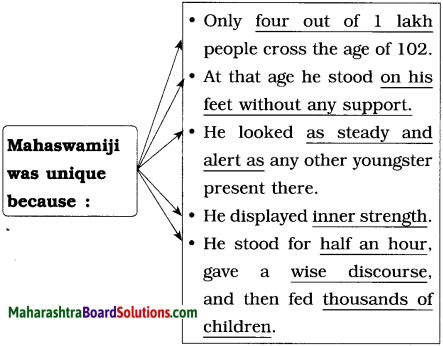
Maharashtra Board Class 10 English Solutions Unit 2.6 Science and Spirituality 9

Question 67.
Write a short paragraph on Dr Sri Shivakumara Mahaswamiji covering his profession and mentioning his personality traits with examples.
Answer:
Dr Sri Sri Shivakumara Mahaswamiji was a remarkable person. He had dedicated his life to the service of humanity and had established a free residential education system for more than nine thousand children. At the age of 102 he could stand without support, give a wise discourse for half an hour and then go on to feed thousands of children. He looked as steady and alert as any other youngster present there and displayed tremendous amount of inner strength.

Question 68.
Write the opposites of the following words using prefixes (un-, in-, etc.):
(a) invited
(b) remarkable
(c) humanity
(d) wise.
Answer:
(a) invited – uninvited
(b) remarkable – unremarkable
(c) humanity – inhumanity
(d) wise – unwise.

Question 69.
Guess the meanings of:
(i) genetics
(ii) googled?
Answer:
(i) genetics – heredity and the variation of inherited characteristics.
(ii) googled – found out information about the subject on the Google website

Question 70.
Find out the noun forms of the following from the passage:
(a) celebrated ……
(b) contribute …..
(c) educate …
(d) strong ….
Answer:
(a) celebrated – celebration
(b) contribute – contribution
(c) educate – education
(d) strong – strength

Question 71.
This display of inner strength touched Dr Kalam deeply. (Rewrite beginning ‘Dr Kalam
Answer:
Dr Kalam was deeply touched by this display of inner strength.

Question 72.
How many of these four would be able to stand tall for half an hour? (Rewrite as an assertive sentence.)
Answer:
Not many of these four would be able to stand tall for half an hour.

Maharashtra Board Solutions

Question 73.
I had googled the subject beforehand. (Identify the tense of the sentence.)
Answer:
Past perfect tense

Question 74.
We were discussing this unusual birthday party. (Add a question tag.)
Answer:
We were discussing this unusual birthday party, weren’t we?

Question 75.
What measures will you take to keep yourself physically and mentally fit?
Answer:
To keep myself physically fit, I will take good care of my diet and eat only healthy foods. I will exercise regularly. To keep myself mentally fit, I will try to have a positive attitude towards life, be cheerful and happy and help others.

Question 76.
Fill in the blanks:
(a) Dr Kalam observed great …………………… in Swami Sivananda.
(b) Dr Kalam’s father believed in the value of …………………. .
(c) Mahaswamiji gives education to famished ……………………, food to famished ………………….. .
(d) The essence of a happy life and a peaceful society lies in one sentence – ……………………. .
Answer:
(a) tranquillity
(b) giving back
(c) minds, bodies
(d) ‘What can i give’

Question 77.
Complete the following based on the passage:
Answer:
The people who touched and influenced Dr APJ Kalam in one way or the other were:
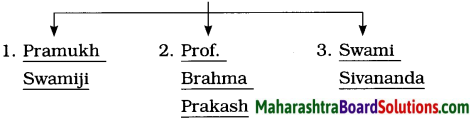
Maharashtra Board Class 10 English Solutions Unit 2.6 Science and Spirituality 10

Question 78.
Complete the following table:

Name of person Values
(a) Pramukh Swamiji goodness of action
(b) Professor Brahma Prakash need for living a pure and ethical life
(c) Father Pereira and Dr Sarabhai selflessness in service
(d) Swami Sivananda tranquillity
(e) Dr Kalam’s father simplicity, the value of giving back
(f) Mahaswamiji munificence, spirit of giving.

Answer:
(a) Goodness of action
(b) Pure and ethical life
(c) Selflessness in service
(d) Tranquillity
(e) Simplicity, giving back
(f) Munificence

Question 79.
Rearrange the letters to form sensible words:
(a) y e s f i l l e t =
(b) s c e n e c o i n c =
Answer:
(a) y e s f i l l e t = lifestyle
(b) s c e n e c o i n c = conscience

Question 80.
From the lesson write one word for:
Answer:
(a) giving away much to the needy munificence
(b) the basic idea of something essence

Maharashtra Board Solutions

Question 81.
Complete the following choosing from the words/phrases given below: [moral sense of right and wrong, purity, characteristic spirit of a culture, principle or belief, simplicity, peace, generosity, spirituality]
(a) A tenet is a principle or belief.
(b) Conscience is a moral sense of right and wrong.
(c) Ethos is the characteristic spirit of a culture.
(d) Tranquillity is peace.
Answer:
(a) Principle or belief.
(b) Moral sense of right and wrong.
(c) Characteristic spirit of a culture.
(d) Peace.

Question 82.
Write the noun forms of:
(a) pure
(b) settle
(c) final.
Answer:
(a) pure – purity
(b) settle – settlement
(c) final – finality.

Question 83.
Activities based on Contextual Grammar:
(1) In giving so much, he becomes strong. (Rewrite using ‘because’.)
Answer:
He becomes strong because he gives so much.

Question 84.
His munificence fuels his strength. (Rewrite beginning with ‘His strength …’.)
Answer:
His strength is fuelled by his munificence.

Question 86.
What was the secret of Mahaswamiji’s fitness even at the age of 102 years?
Answer:
Mahaswamiji was a remarkable man. He lived with the belief of giving selflessly to famished minds and bodies. By giving, he himself became stronger. His spirit of generosity increased his strength and kept him standing tall and active in life.

Question 87.
Fill in the blanks:
(1) Dr Kalam’s message made an impact on the writer because of its gravity and the challenge it posed became his silent motivation.
(2) The truth of humanity lies in the answer to the question ‘What can I give?’
Answer:
(1) gravity, challenge
(2) truth, humanity

Question 88.
What makes society corrupt and unfair?
Answer:
Society becomes corrupt and unfair when humans think they can take indiscriminately from the environment and destroy it or when they think only of what they can take from other humans.

Question 89.
Complete the following with word from the passage:
Answer:
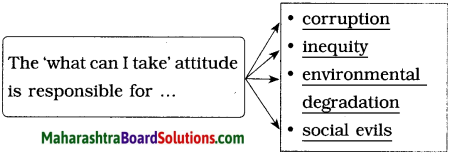
Maharashtra Board Class 10 English Solutions Unit 2.6 Science and Spirituality 11

Question 90.
Pick out the adverbs: circumspectiy, indiscriminately, inequity, gravity.
Answer:
circumspectly, indiscriminately

Question 91.
Write what the underlined auxiliaries indicate:
(a) What can I give?
(b) We have to replace this attitude …
Answer:
(a) can – ability, possibility
(b) have to – obligation, compulsion.

Maharashtra Board Solutions

Question 92.
The gravity of the message struck me. (Rewrite in the passive voice.)
Answer:
I was struck by the gravity of the message.

Question 93.
What answers do you get when you ask yourself the question ‘What can I give’?
Answer:
When I ask myself the question ‘What can I give’, I get the answer that I can ‘give’ my talents, my proper moral attitudes, my efforts in the service of others, financial help according to my means …!

Question 94.
Punctuate the following sentences to make them meaningful: (Note: 1 sentence will be asked in the activity sheet.)
(1) Spot the errors and rewrite the sentence correctly: We discussing the number of Ph.D’s Dr Kalam received.
(2) Arrange the following words in alphabetical order: inventions, indisputable, interactions, inequity, institutions, inquisitive, indiscriminately.
(3) Identify the type of sentence: Within a year he wants to build scientific facilities near the sea coast.
(4) Rearrange the letters to form two sensible words:
(1) i c e g e n t s
(2) f u n m i n c e i c e
(5) Make a meaningful sentence using the phrase: to come full circle.
(6) Pick out an infinitive and use it in your own sentence: I am able to talk to you using this mic.
(7) Write two smaller words hidden in the given word: perspective
(8) Complete the following word chain with words from the lesson: church, _ _ _ _ _e,
Answer:
(1) We weref discussing the number of Ph.D’s Dr Kalam had received.
(2) indiscriminately, indisputable, inequity, inquisitive, institutions, interactions, inventions
(3) Assertive Sentence
(4) (1) genetics (2) munificence
(6) It is firstanuary, the year has come full circle.
(6) Infinitive: to talk Sentence: The headmaster wants to talk to you about the annual function.!
(7) perspective: price, respect (spice, spite)
(8) church, house, equator, religious, scientist, team, mic, culture

Maharashtra Board Solutions

Question 95.
(1) Write a word that sounds the same as ‘there’ and make a sentence.
(2) Prepare a word register of eight words for the word ‘house’.
(3) Rewrite beginning with the underlined part. His team had selected a site in Thumba.
Answer:
(1) Homophone: there – their! Sentence: They wanted admission for their child,
(2) House: apartment, residence, abode, dwelling, home, habitation, domicile, lodging, settlement
(3) A site in Thumba had been selected (by his team).

Question 96.
(1) Underline the modal auxiliary and state its function: They must have come full circle.
(2) Use the word ‘benefit’ as a noun as well as a verb in sentences.
Answer:!
(1) They must have come full circle. Function: past certainty.
(2) (a) Science confers many benefits on mankind, (noun)
(b) The bonus will benefit our family in many ways, (verb)

Maharashtra Board Class 10 English Solutions Unit 2.2 Three Questions

Balbharti Maharashtra State Board Class 10 English Solutions Unit 2.2 Three Questions Notes, Textbook Exercise Important Questions and Answers.

Maharashtra State Board Class 10 English Kumarbharati Textbook Solutions Unit 2.2 Three Questions

Maharashtra Board Class 10 English Solutions Unit 2.2 Warming Up Questions and Answers

Question 1.
Expressions in English classified under different heads. Pair up with your partner, guess and match the columns. (Use a dictionary.)

AB
(1) Principle(a)a generally accepted, evident, truth
(2) Quotation(b)short striking messages for the public
(3) Moral(c)a short witty remark stating the truth
(4) Idioms(d)a popular, well-known truth
(5) Slogans(e)established expressions which do not convey exactly the same as individual words
(6) One-liners(f)words cited from a speech/text of a famous person
(7) Maxims(g)a lesson derived from a story or experience
(8) Proverb(h)a rule to govern one’s behavior

Answer:

AB
(1) Principle(h)a rule to govern one’s behavior
(2) Quotation(f)words cited from a speech/text of a famous person
(3) Moral(g)a lesson derived from a story or experience
(4) Idioms(e)established expressions which do not convey exactly the same as individual words
(5) Slogans(b)short striking messages for the public
(6) One-liners(c)a short witty remark stating the truth
(7) Maxims(d)a popular, well-known truth
(8) Proverb(a)a generally accepted, evident, truth

Maharashtra Board Solutions

Question 2.
Read the polite requests/suggestions and complete the gaps in the responses. Make sure they are polite and not repeated.
→ Could you lend me your dictionary?
Accept (1) ………………..
Refuse (2) ………………..
Answer:
Accept (1) Yes, here it is.
Refuse (2) I’m sorry, I can’t. I am using it now.

→ Can you please pass the salad?
Accept (1) ………………..
Refuse (2) ………………..
Answer:
Accept (1) Sure!
Accept (2) Here you are.

→ May I know the exact time?
Accept (1) ………………..
Refuse (2) ………………..
Answer:
Accept (1) Right now It is exactly ten to six.
Accept (2) It’s 10 minutes past 5.

→ Shall we plan a class-picnic?
Accept (1) ………………..
Refuse (2) ………………..
Answer:
Accept (1) Yes, let’s!
Refuse (2) Not now; I’m going to my native place for a month.

→ Do you need help?
Accept (1) ………………..
Refuse (2) ………………..
Answer:
Accept (1) Yes, please.
Refuse (2) It’s all right, thank you. I can manage.

→ Is it alright if I use your laptop?
Accept (1) ………………..
Refuse (2) ………………..
Answer:
Accept (1) Yes, I can spare It for an hour.
Refuse (2) Well… could you wait some time? I have some things I need to complete.

Maharashtra Board Solutions

Question 3.
Let’s see if you remember a nursery rhyme you must have sung, as a kid :
Fill in the missing words: ………………..
‘The ……………….. time to be happy is
The to be happy is here.
And the way to be ……………….., is to ……………….. someone
happy And have a little ……………….. right here!’
(happy, make, heaven, now, place)
(You can listen to this song on the internet.)
Answer:
(happy, make, heaven, now, place)
The time to be happy is now.
The place to be happy is here.
And the way to be happy is to make someone happy. And have a little heaven right here!

Three Questions Class 10 English Workshop Questions and Answers Maharashtra Board

Question 1.
Read the story and answer whether the following statements are true or false.
(a) The people convinced the King to make a proclamation. ……………………………..
(b) The hermit spoke usually to everyone. ……………………………..
(c) The King received all answers from the hermit. ……………………………..
(d) The person the King saved and helped was his enemy. ……………………………..
(e) To do good to people is the purpose of our life. ……………………………..
Answer:
(a) True
(b) False
(c) False
(d) True
(e) True

Question 2.
Match the titles with the contents of the proper paragraph.

1Once a certain king . . . important to do.aKing gains a friend.
2Many learned people . . . time for everything.bThe wounded stranger
3Equally varied . . . gave the reward to none.cKing helps the hermit.
4When the King arrived, . . . my first attention.dThe stranger begs for pardon.
5The hermit listened . . . continued to dig.eThe hermit points out answers.
6The King turned around . . . gave it to him.fStranger’s vicious intention
7Meanwhile the sun . . . said the King.gQuestions remain unanswered.
8“You do not know … all my life.hThe king received various answers.
9The King was very glad . . . the day before.iKing’s announcement.
10“Do you not see?” . . . sent into this life!”jThe King meets the hermit.

Answer:

(1) Once a certain king … important to do.i The king’s announcement.
(2) Many learned people … time for everything.h The king received various answers.
(3) Equally varied … gave the reward to none.g The questions remained unanswered.
(4) When the king arrived, … rriy first attention.j The king meets the hermit
(5) The hermit listened … continued to dig.c The king helps the hermit.
(6) The king turned round … gave it to him.b The wounded stranger.
(7) Meanwhile the sun … said the king.d The stranger begs for pardon.
(8) ‘You do not know … all my life.’f The stranger’s vicious intentions.
(9) The king was very glad … the day before.a The king gains a friend.
(10) ‘Do you not see?’ … sent into his life.e The hermit points out answers.

Maharashtra Board Solutions

Question 3.
The character traits of the king and hermit are mixed up. Sort them out in the right box.
Maharashtra Board Class 10 English Solutions Unit 2.2 Three Questions 1

Answer:
KiNG
impatient. eager to succeed, helpful

HERMIT
feeble, enlightened, patient, convincing, wise

Question 4.
Complete the Tree diagrams associated with the happenings in the story.
Maharashtra Board Class 10 English Solutions Unit 2.2 Three Questions 2
Answer:
Maharashtra Board Class 10 English Solutions Unit 2.2 Three Questions 4
Maharashtra Board Class 10 English Solutions Unit 2.2 Three Questions 3

Maharashtra Board Solutions

Question 5.
Write down in your notebook two points for each of the following. How do you know . . .
(a) the learned advisers who came to the court confused the king.
(b) the king was humble.
(c) the king’s enemy was repentant.
(d) the hermit was truly wise.
Answer:
We come to know that the king was humble by the fact that he did not mind doing ordinary work such as digging. He did not use his authority as king to force the hermit to answer his questions. Instead he requested the hermit politely and was ready to go away if the hermit refused to answer his questions.

Question 6.
Choose the correct answer and fill in the blanks.
(a) “Varied” (Paragraph-3) means ……………………
(i) different
(ii) unnecessary
(iii) unequal
(iv) unimportant.
Answer:
(a) different

(b) Many learned people came to the court and gave ……………………
(i) The same answers
(ii) correct answers
(iii) different answers
(iv) wrong answers.
Answer:
(iii) different answers

(c) The synonym of ‘convinced’ is ……………………
(i) persuaded
(ii) happy
(iii) unhappy
(iv) angry.
Answer:
(i) persuaded

Maharashtra Board Solutions

(d) The King wanted to know the …………………… time to begin everything.
(i) right
(ii) exact
(iii) proper
(iv) good.
Answer:
(i) right

(e) ‘‘I pray you to answer my question.’’ Here ‘pray’ means ……………………
(i) plead to God
(ii) request
(iii) order
(iv) suggest.
Answer:
(ii) request

(f) Choose an adverb that collocates with “breathed ……………………
(i) hurriedly
(ii) heavily
(iii) hardly
(iv) calmly.
Answer:
(i) heavily

Question 7.
Answer the following questions.
(a) The learned people were sometimes divided in their opinions, different persons giving quite different answers; at other times, none of them gave an answer. They all suggested ways to look for an answer. Point out one example of each.
Answer:
To know the right time for every action: Draw up in advance a table of days, months and years and live strictly according to it. The people the king most needed: Councillors The most important occupation: Science.

(b) Though the hermit did not say anything to the king for some time, he did not ignore the king or treat him rudely in any way. Do you agree? What evidence of his politeness can you point out? What shows that he listened and responded to the king’s words?
Answer:
I agree that though the hermit did not say anything to the king for some time, he did not ignore the king or treat him rudely in any way. His politeness is evident by the fact that he greeted the king. By spitting on his hand before he resumed digging, the hermit indicated that the work he was doing was more important and that the king would have to wait.

(c) The hermit ‘spoke only to common people’; so the king ‘put on simple clothes’. Do you think the king hoped to be mistaken for a common man, or was he just showing that he was a humble person? What shows that the hermit knew him to be the king?
Answer:
The king put on* simple clothes because he did not want the hermit to refuse to answer his questions. The king was aware that the hermit was wise and would know that he was the king and not mistake him for a common person. Out of humility and respect, the king dressed up like a commoner. We know that-the hermit knew that he was the king by the way he returned the king’s greeting.

Maharashtra Board Solutions

(d) Did the king behave as an ordinary person, rather than as a ruler, at the hermit’s hut? What shows it? Did he also act as a good, kind person? When did he do so?
Answer:
Like any other ordinary person, the king tended to the wounded man. He even washed the wound and bandaged it many times. When required, he brought and gave the man water to drink. The king went out of his way to be good and kind to the man. All this happened after the wounded man came running, wounded, to the hermit’s hut.

(e) Do you think the hermit knew, beforehand, not only about the king’s arrival but about the ambush by his enemy? Think a little about this and say what you really feel.
Answer:
I think the hermit somehow knew everything before the king arrived. He must have known about the plan of the king’s enemy and so was able to deal with it purposefully when the king arrived. News about the ambush must definitely have come to his ears. Otherwise he would not have been able to answer the king’s questions in such a real and practical way. He was a hermit, a wise man, and nothing of importance would have escaped his consideration.

Question 8.
Consider this list of the different things that happened and rearrange them in the order of time, that is, what happened first, what happened next and so on. Read the related paragraph again if you are uncertain.

(a) The bearded man resolved to kill the king.
(b) The king went alone to see the hermit.
(c) The king executed the bearded man’s brother.
(d) The king spent the night at the hermit’s hut.
(e) The bearded man laid an ambush to kill the king.
(f) The king’s bodyguards recognised and wounded the bearded man.
(g) The bearded man came out of the ambush.
Answer:
(b) The king executed the bearded man’s brother.
(a) The bearded man resolved to kill the king.
(c) The bearded man laid an ambush to kill the king.
(e) The bearded man came out of the ambush.
(d) The king’s bodyguards recognised and wounded the bearded man.
(f) The king spent the night at the hermit’s hut.
(g) The king went alone to see the hermit.

Question 9.
Read the story in your own language, summarize the following aspects of the story in 4 to 5 lines each in your own language. Write it in your notebook.
(a) King’s problem: ……………………
Answer:
The King’s problem was that he wanted someone from his kingdom to give him the answers to three questions.
(1) What was the right time to begin everything?
(2) Who are the right people to listen to?
(3) What was the most important thing to do?

Maharashtra Board Solutions

(b) Attempts made to find a solution: ……………………
(c) Climax: ……………………
(d) Solution: ……………………
(e) Message: ……………………
Answer:
The King wanted the answers to three questions. In order to find a solution, he had a proclamation made in his kingdom. He also announced a great reward to anyone who would give him the answers to his questions.

Question 10.
(A) The following compound words from the story are spelt in a jumbled order. Rearrange the letters to make them meaningful.
(1) a r e e t u k d n = ……………………
(2) y o n n a e = ……………………
(3) s t a p s i e m = ……………………
(4) h e e d a r f o n b = ……………………
(5) n e v h i g r e t y = ……………………
(6) h e i l n e w a m = ……………………
(7) d a d e b e r = ……………………
Answer:
(1) a r e e t u k d n = undertake
(2) y o n n a e = anyone
(3) s t a p s i e m = pastimes
(4) h e e d a r f o n b = beforehand
(5) n e v h i g r e t y = everything
(6) h e i l n e w a m = meanwhile
(7) d a d e b e r = bearded

(B) From the story, find the collocations of the following.
(1) …………………… important.
(2) …………………… intently
(3) frail and ……………………
(4) widely ……………………
(5) …………………… time
(6) …………………… blood
(7) simple ……………………
(8) closed ……………………
(9) …………………… asleep
(10) …………………… peace
(11) took ……………………..
Answer:
(1) most important
(2) gazing intently
(3) frail and weak
(4) widely renowned
(5) right time
(6) warm blood
(7) simple clothes
(8) closed eyes
(9) fell asleep.
(10) made peace
(11) took leave

Maharashtra Board Solutions

Question 11.
Say whether the Verbs underlined in the sentences are finite (limited by the number or person of the subject) or non-finite (not governed by the subject, number or person).
(1) He decides to go to a hermit.
(2) I have come to you, wise hermit.
(3) He gave the reward to none.
(4) The hermit was digging the ground.
(5) I pray you to answer my questions.
(6) ‘‘ Forgive me.’’
(7) The sun began to sink.
Answer:
(1) decides – finite; to go – non-finite.
(2) have come – finite; to ask, to answer-non- finite.
(3) gave – finite; This sentence has no non-finite verb.
(4) was – finite; digging – non-finite.
(5) pray – finite: to answer – non-finite
(6) forgive – finIte
(7) began – finite; to sink – non-finite.

Question 12.
Narrate an experience of your own that has helped you to realise that ‘Patience is bitter, but its fruit is sweet.’ Write it in your notebook, in about 20 lines.
Answer:
Patience is bitter, but its fruit is sweet!

It was Rousseau who said, ‘Patience is bitter, but its fruit is sweet.’

I realized the truth of this statement when I was in Std. X. It was an important year for me. My school was far from my home. So were my classes. I had to spend a lot of time walking in order to reach either school or classes. This meant a lot of waste of precious time that I could use very well for study.

I was an only child and my father had passed away four years ago. My mother would tell me, ‘Have patience. Things will work out.’ But I really could not understand her.

The rainy months passed by with me trudging anxiously to school or to the classes. If I was lucky, someone would give me a lift, dy studies were suffering.

I was lagging behind in keeping up with homework and revision.

Then one day the postman delivered a letter. Mother read it in excitement.

‘You know what? There’s a good news. Your uncle from the US is coming to visit us. He is your dad’s brother. The last time he saw you was when you were j a baby.’

‘Oh,’ I said, wondering how that could be good for us. On the contrary, I would have to take my uncle visiting and that would take up more of the time I required for earnest study.

The day arrived. My uncle came over. A jolly fellow, full of stories and fun and small delightful gifts. In the afternoon I took his leave saying I had to go to school and then classes.

‘How are you going?’ he asked.
I put my head down and said, ‘Walking’.
‘Come, I’ll take you by autorickshaw,’ he said. And so we went.
‘It’s quite a distance,’ my uncle commented. I nodded silently.
In the evening when I came home, I could not believe my eyes.
There, resting against the wall was the most beautiful bicycle I had ever seen.
Mother and my uncle came out to greet me.
‘This is yours, boy. No more walking long distances for you!’
Tears welled up in my eyes and I ran and hugged my uncle.
‘Thank you so much,’ I said.
Indeed, my patience had been rewarded with sweet fruit!

Maharashtra Board Solutions

Question 13.
After reading this story, develop a dialogue with 2 of your classmates about the characters in the story. Besides the tactful introduction to the conversation and write 8 to 10 sets of dialogues.
Answer:
My self: Hey, did you like the story, ‘Three Questions’?

Student 1: Yes, I was particularly impressed with the king. He was very humble. He was eager to know more about life.

My self: Yes, he did not claim that he knew everything just because he was king.

Student 2: I liked the hermit. He was quite a cool character.

My self: He was very wise. He knew beforehand that the king would come to him. He also knew the solution to the king’s problem, even before the incidents occurred.

Student 1: Yes. And the surprising thing is that the king indirectly got the answers to his questions from a long-forgotten enemy.

My self: The story is very cleverly written, woven around these three characters. One seeks answers to questions. One knows the answers to the questions. One is the medium through which the answers are given.

Student 2: If the king’s bodyguards had not attacked the man, he would not have come to the hermit’s hut and met the king.

My self: If the man had not been wounded and the king had not bandaged his wounds and saved his life, the man would not have forgiven him for a cruel wrongdoing in the past.

Student 1: Yes, Leo Tolstoy wanted to give us the message of forgiveness and doing good even to our enemies. Through the three characters in the story and their interactions, the writer brought out his message very well.

My sfelf : Indeed, a well-written story, and one from which we learn such a lot!

Question 14.
From the library or Internet, read the story ‘How much land does a man need?’ by Leo Tolstoy and write a review of the same, covering the following points.
Background of the story
Characters
Plot/Theme
Climax
Message/Moral
Answer:
The climax of the story is that the person whom the king had wronged by executing his brother years ago, finally forgave him. This is because the king had saved his life.

(a) rose got up from a sitting or kneeling position a flower
(b) sink drop downwards go down below the surface of a liquid
(c) bed a garden plot a piece of furniture for resting
(d) rest to cease work in order to relax or sleep the remaining part

By saving the life of the wounded man, who was in fact the king’s enemy, the king passes on to us the message that the most important thing in life is to do good to others, because it is for that purpose alone we were sent into this life.

Maharashtra Board Solutions

Question 15.
What final suggestion did the last group of learned men offer regarding the best time?
Answer:
The last group of learned men said that it was impossible for one man to decide correctly the right time for every action and that the king should, instead, have a council of wise people, who would help him to fix the proper time for everything.

Question 16.
Choose the correct question tag from the alternatives and write the complete answer:
He would give a great reward,…
(a) would he?
(b) won’t he?
(c) wouldn’t he?
(d) will he?
Answer:
He would give a great reward, wouldn’t he?

Question 17.
Pick out the finite and non-finite verbs from the sentences:
(1) He always knew the right time to begin everything.
(2) He was right in thinking this way.
Answer:
(1) knew – finite; to begin – non-finite
(2) was – finite; thinking – non-finite.

Question 18.
They all gave different answers. (Rewrite using the opposite of ‘different’.)
Answer:
None of them gave similar answers.

Question 19.
He was convinced that he was right. (Pick out the clauses and name them.)
Answer:
He was convinced – Main clause.
that he was right – Subordinate Noun clause.

Question 20.
What is the right time, according to you?
Answer:
According to me, the right time is the present. Yesterday cannot be undone. Tomorrow cannot be predicted. Therefore, the only right time is today, i.e. the present.

Question 21.
The learned advisers who came to the court confused the king. How do you know?
Answer:
By giving the king’ different answers, the learned advisers who came to the court confused the king. None of the answers given by the advisers was complete or comprehensive. From their answers it is quite clear to me that each one of them dwelt on part of the truth and not the whole truth.

Maharashtra Board Solutions

Question 22.
Read the following passage and do the activities:
(1) Arrange these incidents in proper sequence:
(a) The king asked the hermit the three questions.
(b) The king saw that the hermit was digging the ground.
*(c) The king went alone to see the hermit.
(d) The hermit greeted the king.
Answer:
(c) The king went alone to see the hermit.
(b) The king saw that the hermit was digging the ground.
(d) The hermit greeted the king.
(a) The king asked the liermit the three questions.

Question 23.
State whether the following statements are True or False: (The answers are given directly and underlined.)
Answer:
(a) The hermit was well known. True
(b) The hermit spoke usually to everyone. False
(c) The hermit dug the ground easily False
(d) The hermit was strong. False

Question 24.
Why did the king go to the hermit in disguise?
Answer:
The hermit spoke only to common people. The king knew this. So he wanted to present himself as a common man and elicit answers for his questions. That is why he went to the hermit in disguise.

Question 25.
Write from the passage synonyms for:

(a) famous
(b) weak.
Answer:
(a) renowned
(b) frail.

Question 26.
The following compound words from the passage are spelt in jumbled order. Rearrange the letters to make them meaningful.
Answer:
(i) d ubgyroad = bodyguard
(ii) frawera = warfare

Question 27.
The king was convinced by none of these answers. (Rewrite beginning with ‘None of these answers …’.)
Answer:
None of these answers convinced the king.

Question 28.
State whether the following statements are True or False:
Answer:
(a) The king got irritated with the hermit. False
(b) The hermit answered all the questions of the king. False
(c) It was evening when the king met the hermit. True
(d) The hermit was full of energy. False

Question 29.
Who said to whom?
(a) Let me take the spade and work a while for you.
(b) Now rest a while and let me work a bit.
Answer:
(a) The king said this to the hermit.
(b) The hermit said this to the king.

Question 30.
How did the hermit respond to the king’s questions?
Answer:
The hermit listened to the king but said nothing. He just spat on his hand and continued digging. Later, when the king felt sorry for him, the hermit handed the king the spade to take over. When the king asked his question again, instead of giving an answer, the hermit rose and stretched out his hand for the spade.

Maharashtra Board Solutions

Question 31.
In what state was the bearded man when he arrived?
Answer:
The bearded man was wounded. He fainted. He had a large wound in his stomach. The bleeding j would not stop and the wound had to be bandaged and re-bandaged. The bandage was soaked with blood. The bearded man was indeed in a very serious condition when he arrived.

Question 32.
Choose adverbs/adjectives that collocate with these words:
(1) moaning:
(a) profusely
(b) heavily
(c) feebly
(d) sadly.
Answer:
(i) moaning feebly

(ii) blood:
(a) profuse
(b) warm
(c) fresh
(d) bandaged.
Answer:
warm

Question 33.
Complete the following table with meanings from the brackets:
(Meanings: go down below the surface of a liquid, to cease work in order to relax or sleep, a piece of furniture for resting, a garden plot, got up from a sitting or kneeling position, drop downwards, the remaining part, a flower) (The answers are given directly in the table.)
Answer:
Words Meaning in the text Other meaning
(a) rose got up from a sitting or kneeling position a flower
(b) sink drop downwards go down below the surface of a liquid
(c) bed a garden plot a piece of furniture for resting
(d) rest to cease work in order to relax or sleep the remaining part

Question 34.
Pick out the finite and non-finite verbs from the sentences:
(a) The king continued to dig.
Answer:
(a) continued – finite; to dig – non-finite.

Question 35.
‘Here comes someone running,’ said the hermit. (Rewrite in indirect speech.)
Answer:
The hermit said that there came someone running.

Question 36.
He fainted and fell to the ground. (Rewrite using a present participle in place of the underlined word.)
Answer:
Fainting, he fell to the ground.

Maharashtra Board Solutions

Question 37.
The blood would not stop flowing. (Rewrite without ‘not’.)
Answer:
The blood flowed continuously.

Question 38.
Say whether the following statements are True or False: (The answers are given directly and underlined.)

Answer:
(a) The person the king saved and helped was his enemy. True
(b) The hermit helped the king. True
(c) When he awoke, the king immediately realized where he was. False
(d) The king had gone out for a walk. False

Question 39.
Why had the wounded man asked for the king’s pardon?
Answer:
The wounded man had resolved to kill the king. In try ng to do so. he was wounded and the king saved his life. Hence the wounded man asked for the king’s pardon.

Question 40.
Write two points for the following:
The king’s enemy was repentant. How do you know?
Answer:
The king’s enemy tells him that since the king had saved his life, if he (the king) wished it, he would serve him all his life. This shows that he was repentant.

Question 41.
Match the words with their opposites:

Answer:
Answer:
(a) familiar X strange
(b) forget X remember.
(c) firm X weak
(d) everything x nothing.

Question 42.
Forgive me,’ said the beard€d man. (Rewrite In indirect speech.)
Answer:
The bearded man asked him (the king) to forgive him.

Maharashtra Board Solutions

Question 43.
What qualities of the king do you notice in this passage?
Answer:
Even though he was king, he did not hesitate to carry the wounded man into the hut. He was humble enough to sleep in a hut next to a wounded man. All this shows, that the king was not proud of his royal position. He was, at heart, kind, considerate and humane.

Question 44.
State whether the following statements are True or False: (The answers are given directly and underlined.)
Answer:
(1) The hermit pitied the king’s weakness. False
(2) The king received all answers from the hermit. True
(3) The present is the only time when we have power. True
(4) To do good to people is the purpose of our life. True

Question 45.
How did the hermit finally point out the answers to the king’s questions?
Answer:
The hermit finally pointed out the answers to the king’s questions by referring to incidents that the king actually experienced when he visited the hermit. With the help of each incident, the- hermit explained to the king what the most important time was,’ who the most important person was and what the most important action was.

Question 46.
Summarize the following aspect in 4 to 5 lines each in your own words:
(a) The solution.
Answer:
The king finally got the answers to his questions. The most important time was when the king was digging the beds and when he was attending to the wounded man. Otherwise he would not have met the man and the man would have died. The most important action was bandaging the man’s wounds. If the man had died, he would not have made peace with the king. The most important man was the hermit, who made it possible for the king to find the answers to his questions.

Question 47.
Match the following:
‘A’ ‘B’
(1) one who heals – (a) sower
(2) one who lives alone in a forest – (b) physician
(3) one who plants seeds – (c) enemy
(4) one who is actively opposed to you – (d) hermit
Answer:
(1) one who heals – physician
(2) one who lives alone in a forest – hermit
(3) one who plants seeds – sower
(4) one who is actively opposed to you – enemy

Maharashtra Board Solutions

Question 48.
He was the most important man. (Rewrite as a question.)

Answer:
Wasn’t he the most important man?

Question 49.
There is only one time that is important. (Rewrite using ‘no’.)
Answer:
There is no other time that is important.

Question 50.
For that purpose alone were you sent into this world. (Rewrite beginning with the subject ‘you’.)
Answer:
You were sent into this world for that purpose alone.

Question 51.
What qualities of the king stand out as he forgave his enemy?
Answer:
As the king forgave his enemy, we see him as a very humane person, as a person who believes in peace and forgiveness and one who shows mercy to even those who would wish to harm him.

Question 52.
(1) Pick out the infinitives in the given sentence and make your own sentence: He would give a reward to anyone who would teach him how he might know the most important thing to do.
(2) Write two compound words from the lesson.
(3) Punctuate the sentence: ive nothing to forgive you for said the king
(4) Make a meaningful sentence using the phrase: to feel sorry for (someone)
(5) Find out two hidden words in the given word: approaching
(6) Spot the error and rewrite the correct sentence: The king convinced none of these answers.
(7) Write the present participle forms of the given verbs: let, beg (run)
(8) Write these words in alphabetical order: beforehand, bearded, breathed, bodyguard.
Answer:
(1) Infinitive: to do Sentence: We were asked to do a simple activity before the session began.
(2) undertake, warfare
(3) T ve nothing to forgive you for,” said the king.
(4) Feeling sorry for the poor man, I gave him some food to eat.
(5) approach, aching
(6) The king was convinced by none of these answers.
(7) letting, begging (running)
(8) bearded, beforehand, bodyguard, breathed.

Maharashtra Board Solutions

Question 53.
(1) Rewrite using indirect narration: “O wise one! Could you give me the answer to my three questions?” the king said to the hermit.
(2) Complete the following word chain with words from the lesson:
we . . . . . → . . . . . → . . . . . → . . . . .
(3) Rewrite beginning with the underlined part: The hermit again gave no answer.
(4) Make sentences of your own to show the difference of meaning between the words: ‘pray’ and ‘prey’.
Answer:
(1) Addressing the hermit as the ‘wise one’, the king asked him if he could give him the answer to his three questions.
(2) weak → king → ground → different.
(3) Again no answer was given by the hermit.
(4) (a) Every night the little boy would kneel by his bedside and pray.

(b) The vulture is a bird of prey.
(B) Do as directed (Challenging Activities):
(1) Change to the positive degree: What you did for him was your most important business.
(2) Use the given word as a noun and as a verb: wish
Answer:
(1) No other business of yours was as important as what you did for him.
(2) Word: wish
Sentences: (a) Make a wish and it will come true. (noun)
(b) You may leave if you wish, (verb)
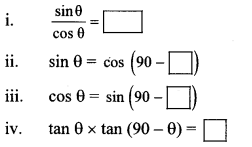
Maharashtra Board Class 10 English Solutions Unit 2.1 Animals

Balbharti Maharashtra State Board Class 10 English Solutions Unit 2.1 Animals Notes, Textbook Exercise Important Questions and Answers.

Maharashtra State Board Class 10 English Kumarbharati Textbook Solutions Unit 2.1 Animals

Maharashtra Board Class 10 English Solutions Unit 2.1 Warming Up Questions and Answers

Question 1.
Get into pairs and attempt the following :
“The more I learn about people, the more I like my dog.”- Mark Twain. – Discuss with your partner what Mark Twain means from the above quote.

Write in your own words
…………………………………………………………..
…………………………………………………………..
…………………………………………………………..
…………………………………………………………..
…………………………………………………………..
…………………………………………………………..
…………………………………………………………..
Answer:
‘The more I learn about people, the more I like my dog. – Mark Twain.

Ely the above quote, Mark Twain means that his dog has certain qualities which he finds lacking in human beings. Each day, as he comes across different people and learns more about human nature, the feeling grows within him that humans possess many disagreeable qualities that do not help in improving relationships. As a result, he begins to love his dog more than human beings.

Maharashtra Board Solutions

Question 2.
Put the following attributes/abilities given below in the proper circles.
(a) self-control
(b) communicates
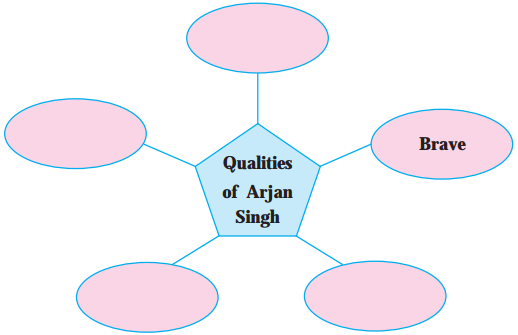
(c) love and care
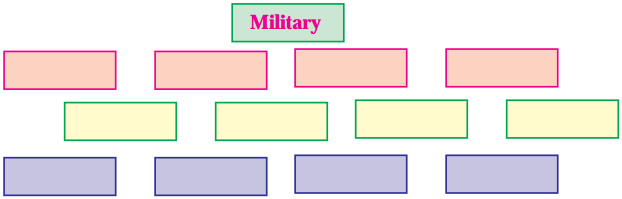
(d) cooks
(e) good manners
(f) has 3600 vision
(g) shows gratitude
(h) lives for more than 150 years
(i) swims
(j) learns computing
(k) worships god
(l) sleeps in standing position
(m) stands up immediately after birth
(n) brings up children
(o) belongs to various species
Maharashtra Board Class 10 English Solutions Unit 2.1 Animals 1
Answer:
Maharashtra Board Class 10 English Solutions Unit 2.1 Animals 2

Question 3.
At times, especially when you are frustrated, you wish you were an animal/ a bird/ a fish/ a butterfly and not a human being.

Say which of the above you would choose to transform to and give 3 or 4 reasons for your choice.
I wish I could be a ………………………………………..
…………………………………………………………………….
…………………………………………………………………….
Answer:
When I am frustrated, I wish I could be a bird, so I could fly away from the cause of frustration. At such times, I would like to be far from the noise and crowd on earth and sail in silence across the sky. I would prefer to concentrate on my own thoughts and regain my peace, and the best place for that would be the vast open sky. Flapping my wings would keep me active and busy and help me forget about my worries.

Maharashtra Board Solutions

Question 4.
We come across many animals in our vicinity. We have also read about different animals in books. Make a list of all animals that fall under various categories. One is given for you.

AmphibiansMammalsWild AnimalsAquatic AnimalsPet Animals
frogcowlionoctopuscat

Answer:

AmphibiansMammalsWild AnimalsAquatic AnimalsPet Animals
frogcowlionoctopuscat
toadbattigercrocodiledog
salamandersquirrelbearalligatorguinea pig
caecilianmongoosewolfhippopotamusgold fish
cheetahturtle
leopard
monkey

Animals Class 10 English Workshop Questions and Answers Maharashtra Board

Question 1.
(A) Match the words given in table A with their meanings in table B.

No(A) Words(B) Meaning
(i)whine(a)an offense against the religious or moral law
(ii)sin(b)complain in an annoying way
(iii)evince(c)craze
(iv)mania(d)failing to take proper care
(v)negligent(e)show

Answer:

No(A) Words(B) Meanings
(i)whine(b)complain in an annoying way
(ii)sin(a)an offense against the religious or moral law
(iii)evince(e)show
(iv)mania(c)mental illness
(v)negligent(d)failing to take proper care

Maharashtra Board Solutions

(B) Find adjectives from the poem which refer to positive and negative thinking

PositiveNegative
1…………………………….1…………………………….
2…………………………….2…………………………….
3…………………………….3…………………………….

Answer:

PositiveNegative
(1) placid(1) dissatisfied
(2) self-contained(2) demented
(3) unhappy

Question 2.
Complete the following.
(a) The poet wishes he could ……………………………….
(b) Animals do not complain about ……………………………….
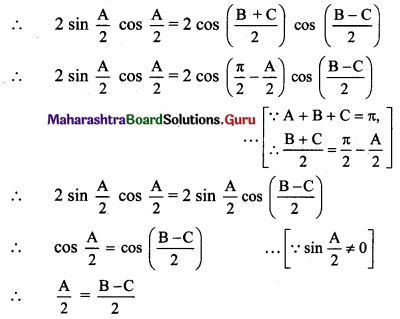
(c) Animals do not merely discuss ……………………………….
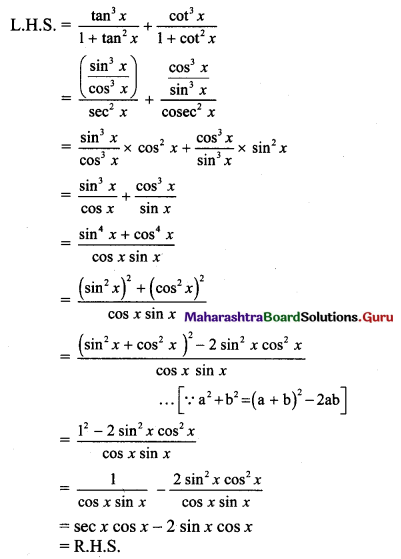
(d) Animals are not crazy about ……………………………….
Answer:
(a) The poet wishes he could turn and live with animals.
(b) Animals do not complain about their condition.
(c) Animals do not merely discuss their duty to God.
(d) Animals are not crazy about owning things.

Question 3.
State whether the following statements are true or false.
(a) Animals are self-reliant. ……………………………….
(b) Animals quarrel for their possessions. ……………………………….
(c) Animals do not worship other animals. ……………………………….
(d) Humans have given up many good qualities. ……………………………….
(e) Animals suffer humiliation. ……………………………….
(f) The poet has retained all his natural virtues. ……………………………….
Answer:
(a) True
(b) False
(c) True
(d) True
(e) False
(f) False

Maharashtra Board Solutions

Question 4.
With the help of the poem find the differences between animals and human beings.

Human beingsAnimals
Always complain about their conditionNever complain about anything
………………………………….
………………………………….
………………………………….
………………………………….

Answer:

Human BeingsAnimals
Always complain about their condition.Never complain about their condition.
Spend sleepless nights regretting their sins.Don’t regret their sins at all.
Sicken others by discussing their duty to God.Do not discuss their duty to God.
Always dissatisfied.Always contented.
Crazy about acquiring possessions.Never interested in owning things.
Worship other human beings.Never worship anyone of their kind.
Always unhappy about earthly matters.Unconcerned about earthly matters.

Question 5.
Read the text again, and complete the web, highlighting the good values/habits which we can learn from animals.

Answer:
Maharashtra Board Class 10 English Solutions Unit 2.1 Animals 3

Maharashtra Board Solutions

Question 6.
Find outlines from the poem that are examples of the following Figures of Speech.

Figures of SpeechLines
Repetition…………………………
Alliteration…………………………
Hyperbole…………………………

Answer:

Figures of SpeechLines
RepetitionI stand and look at them long and long They do not sweat and whine …
They do not he awake …
They do not make …
Not one is dissatisfied, not one is demented …
AlliterationNot one is dissatisfied, not one is demented …
… they evince them plainly in their possession.
Hyperbole… Not one is respectable or unhappy over the whole earth.

Question 7.
Identify the Figures of Speech in the following lines.
(a) I stand and look at them long and long.
………………………………………………………………..

(b) They do not sweat and whine about their condition.
………………………………………………………………..

(c) They do not make me sick discussing their duty to God.
………………………………………………………………..

(d) …… not one is demented with the mania of owning things.
………………………………………………………………..

(e) They bring me tokens of myself.
………………………………………………………………..

(f) No one is respectable or unhappy over the whole earth.
………………………………………………………………..
Answer:
(a) Repetition
(b) Tautology
(c) Alliteration
(d) Hyperbole
(e) Paradox
(f) Hyperbole

Maharashtra Board Solutions

Question 8.
Read the poem again and write an appreciation of the poem in a paragraph format with the help of given points. (Refer to page no. 5)
Answer:
Point Format
(for understanding)
The title of the poem : Animals’
The poet : Walt Whitman
Rhyme scheme : free verse (no rhyme scheme)
Figures of speech : Repetition, Alliteration. Tautology, Hyperbole, etc.
The theme/central idea : Animals are better than humans.

Paragraph Format
The poem ‘Animals’ has been penned by Walt Whitman.

The poet has broken away from the conventional use of a rhyme scheme and has written the poem in free verse.

The chief figure of speech used in the poem is Repetition. Lines such as ‘They do not sweat …’. ‘They do not lie awake …’. ‘They do not make me sick …’ make a strong impact, expressing the qualities that humans should possess, but do not. The other figures of speech are Alliteration, Tautology, Hyperbole, etc.

The central idea of the poem is that animals today are better than humans

Question 9.
Divide the class into two groups. One group should offer points in favor of (views) and the other against (counterviews) the topic ‘Life of an animal is better than that of a human being.’

Later use the points to express your own views/counterviews in paragraph format in your notebook.
Answer:
Point Format

ViewCounterview
Animals are placid and self-contained.Animals cannot improve their lot in life.
Animals do not try to set targets or achieve goals. Humans do.By setting targets, goals are achieved.
Animals do not complain about their condition.It is only by complaining that one comes to know how things can be improved.
Animals are self-satisfied with their condition, whatever it be.Humans continuously try to improve their living conditions.
Animals do not worship other things or animals or persons as gods.Animals have no idea about God. Humans acknowledge a divine Creator.
Animals do not worry about possessions or earthly matters.Animals have no care about the future of this planet. Humans do.

Maharashtra Board Solutions

Question 10.
What craze do animals never display?
Answer:
Animals never display the craze of owning things.

Question 11.
What could have happened to the tokens of the poet’s self?
Answer:
The tokens of the poet’s self might have been lost from the time man resorted to manipulating nature and considered himself apart from it.

Question 12.
What does the poet mean by ‘They bring me tokens of myself?
Answer:
By ‘They bring me tokens of myself the poet means that animals possess and express visible signs of qualities such as innocence and simplicity that he himself (i.e. all human beings) must have possessed.

Question 13.
Give one example of a Rhetorical Question from the poem. Explain.
Answer:
Did I pass that way huge times ago and negligently drop them?
The poet uses a question to assert that we human beings unmindfully discarded the good qualities that we possessed somewhere along the line.

Maharashtra Board Practice Set 50 Class 7 Maths Solutions Chapter 14 Algebraic Formulae – Expansion of Squares

Balbharti Maharashtra State Board Class 7 Maths Solutions covers the 7th Std Maths Practice Set 50 Answers Solutions Chapter 14 Algebraic Formulae – Expansion of Squares.

Algebraic Formulae – Expansion of Squares Class 7 Practice Set 50 Answers Solutions Chapter 14

Question 1.
Expand:
i. (5a + 6b)²
ii. \(\left(\frac{\mathrm{a}}{2}+\frac{\mathrm{b}}{3}\right)^{2}\)
iii. (2p – 3q)²
iv. \(\left(x-\frac{2}{x}\right)^{2}\)
v. (ax + by)²
vi. (7m – 4)²
vii. \(\left(x+\frac{1}{2}\right)^{2}\)
viii. \(\left(a-\frac{1}{a}\right)^{2}\)
Solution:
i. (5a + 6b)²
Here, A = 5a and B = 6b
(5a + 6b)² = (5a)² + 2 × 5a × 6b + (6b)²
…. [(A + B)² = A² + 2AB + B²]
∴ (5a + 6b)² = 25a² + 60ab + 36b²

ii. \(\left(\frac{\mathrm{a}}{2}+\frac{\mathrm{b}}{3}\right)^{2}\)
Here A = \(\frac { a }{ 2 }\) and B = \(\frac { b }{ 3 }\)
Maharashtra Board Class 7 Maths Solutions Chapter 14 Algebraic Formulae - Expansion of Squares Practice Set 50 1

iii. (2p – 3q)²
Here, a = 2p and b = 3q
(2p – 3q)² = (2p)² – 2 × (2p) × (3q) + (3q)²
…. [(a – b)² = a² – 2ab + b²]
∴ (2p – 3q)² = 4p² – 12pq + 9q²

iv. \(\left(x-\frac{2}{x}\right)^{2}\)
Here a = x and b = \(\frac { 2 }{ x }\)
Maharashtra Board Class 7 Maths Solutions Chapter 14 Algebraic Formulae - Expansion of Squares Practice Set 50 2

v. (ax + by)²
Here, A = ax and B = by
(ax + by)² = (ax)² + 2 × ax × by + (by)²
…. [(A + B)² = A² + 2AB + B²]
∴ (ax + by)² = a²x² + 2abxy + b²y²

vi. (7m – 4)²
Here, a = 7m and b = 4
(7m – 4)² = (7m)² – 2 × 7m × 4 + 4²
…. [(a – b)² = a² – 2ab + b²]
∴ (7m – 4)² = 49m² – 56m + 16

vii. \(\left(x+\frac{1}{2}\right)^{2}\)
Here a = x and b = \(\frac { 1 }{ 2 }\)
Maharashtra Board Class 7 Maths Solutions Chapter 14 Algebraic Formulae - Expansion of Squares Practice Set 50 3

viii. \(\left(a-\frac{1}{a}\right)^{2}\)
Here A = a and B = \(\frac { 1 }{ a }\)
Maharashtra Board Class 7 Maths Solutions Chapter 14 Algebraic Formulae - Expansion of Squares Practice Set 50 4

Question 2.
Which of the options given below is the square of the binomial
(A) \(64-\frac{1}{x^{2}}\)
(B) \(64+\frac{1}{x^{2}}\)
(C) \(64-\frac{16}{x}+\frac{1}{x^{2}}\)
(D) \(64+\frac{16}{x}+\frac{1}{x^{2}}\)
Solution:
(C) \(64-\frac{16}{x}+\frac{1}{x^{2}}\)

Hint:
= \(\left(8-\frac{1}{x}\right)^{2}=8^{2}-2 \times 8 \times \frac{1}{x}+\left(\frac{1}{x}\right)^{2}\) …[(a – b)² = a² – 2ab + b²]
= \(64-\frac{16}{x}+\frac{1}{x^{2}}\)

Question 3.
Of which of the binomials given below is the m²n² + 14mnpq + 49p²q² the expansion?
(A) (m + n) (p + q)
(B) (mn – pq)
(C) (7mn + pq)
(D) (mn + 7pq)
Solution:
(D) (mn + 7pq)

Hint:
Here, square root of the first term = mn
Square root of the last term = 7pq
∴ Required binomial = (mn + 7pq)²

Question 4.
Use an expansion formula to find the values of:
i. (997)²
ii. (102)²
iii. (97)²
iv. (1005)²
Solution:
i. (997)² = (1000 – 3)²
Here, a = 1000 and b = 3
(1000 – 3)² = (1000)² – 2 x 1000 x 3 + 3²
…. [(a – b)² = a² – 2ab + b²]
= 1000000 – 6000 + 9
= 994009
∴ (997)² = 994009

ii. (102)² = (100 + 2)²
Here, a = 100 and b = 2
(100 + 2)² = (100)² + 2 x 100 x 2 + 2²
…. [(a + b)² = a² + 2ab + b²]
= 10000 + 400 + 4
= 10404
∴ (102)² = 10404

iii. (97)² = (100 – 3)²
Here, a = 100 and b = 3
(100 – 3)² = (100)² – 2 x 100 x 3 + 3²
…. [(a – b)² = a² – 2ab + b²]
= 10000 – 600 + 9
= 9409
∴ (97)² = 9409

iv. (1005)² = (1000 + 5)²
Here, a = 1000 and b = 5 (1000 + 5)²
= (1000)² + 2 x 1000 x 5 + 5²
…. [(a + b)² = a² + 2ab + b²]
= 1000000+ 10000 + 25
= 1010025
∴ (1005)² = 1010025

Maharashtra Board Class 7 Maths Chapter 14 Algebraic Formulae – Expansion of Squares Practice Set 50 Intext Questions and Activities

Question 1.
Use the given values to verify the formulae for squares of binomials. (Textbook pg. no. 92)
i. a = -7, b = 8
ii. a = 11,b = 3
iii. a = 2.5,b = 1.2
Solution:
i. (a + b)² = (-7 + 8)²
= 1²
= 1
a² + 2ab + b² = (-7)² + 2 x (-7) x 8 + 8²
= 49 – 112 + 64
= 1
∴(a + b)² = a² + 2ab + b²
(a – b)² = (-7 – 8)²
= (-15)²
= 225
a² – 2ab + b² = (-7)² – 2 x (-7) x 8 + (8)²
= 49 + 112 + 64
= 225
∴(a – b)² = a² – 2ab + b²

ii. (a + b)² = (11 + 3)²
= 14²
= 196
a² + 2ab + b² = 11² + 2 x 11 x 3 + 3²
= 121 + 66 + 9
= 196
∴(a + b)² = a² + 2ab + b²
(a – b)² = (11 – 3)² = 8²
= 64
a² – 2ab + b² = 11² – 2 x 11 x 3 + 3²
= 121 – 66 + 9
= 64
∴(a – b)² = a² – 2ab + b²

iii. (a + b)² = (2.5 + 1.2)²
= 3.7²
= 13.69
a² + 2ab + b² = (2.5)² + 2 x 2.5 x 1.2 + (1.2)²
= 6.25 + 6 + 1.44
= 13.69
∴(a + b)² = a² + 2ab + b²
(a – b)² = (2.5 – 1.2)²
= 1.32
= 1.69
a² – 2ab + b² = (2.5)² – 2 x 2.5 x 1.2 + (1.2)²
= 6.25 – 6 + 1.44
= 1.69
∴(a – b)² = a² – 2ab + b²-

Maharashtra Board 11th Maths Solutions Chapter 3 Trigonometry – II Miscellaneous Exercise 3

Balbharti Maharashtra State Board Class 11 Maths Solutions Pdf Chapter 3 Trigonometry – II Miscellaneous Exercise 3 Questions and Answers.

Maharashtra State Board 11th Maths Solutions Chapter 3 Trigonometry – II Miscellaneous Exercise 3

I. Select the correct option from the given alternatives.

Question 1.
The value of sin(n + 1) A sin(n + 2) A + cos(n + 1) A cos(n + 2) A is equal to
(a) sin A
(b) cos A
(c) -cos A
(d) sin 2A
Answer:
(b) cos A
Hint:
L.H.S. = sin [(n + 1)A] . sin [(n + 2)A] + cos [(n + 1)A] . cos [(n + 2)A]
= cos [(n + 2)A] . cos [(n + 1)A] + sin [(n + 2)A] . sin [(n + 1)A]
Let (n + 2)A = a and (n + 1)A = b … (i)
∴ L.H.S. = cos a . cos b + sin a . sin b
= cos (a – b)
= cos [(n + 2)A – (n + 1)A] ……..[From (i)]
= cos [(n + 2 – n – 1)A]
= cos A
= R.H.S.

Maharashtra Board 11th Maths Solutions Chapter 3 Trigonometry - II Miscellaneous Exercise 3

Question 2.
If tan A – tan B = x and cot B – cot A = y, then cot (A – B) = ________
(a) \(\frac{1}{y}-\frac{1}{x}\)
(b) \(\frac{1}{x}-\frac{1}{y}\)
(c) \(\frac{1}{x}+\frac{1}{y}\)
(d) \(\frac{x y}{x-y}\)
Answer:
(c) \(\frac{1}{x}+\frac{1}{y}\)
Hint:
Maharashtra Board 11th Maths Solutions Chapter 3 Trigonometry - II Miscellaneous Exercise 3 I Q2

Question 3.
If sin θ = n sin(θ + 2α), then tan(θ + α) is equal to
(a) \(\frac{1+n}{2-n}\) tan α
(b) \(\frac{1-n}{1+n}\) tan α
(c) tan α
(d) \(\frac{1+n}{1-n}\) tan α
Answer:
(d) \(\frac{1+n}{1-n}\) tan α
Hint:
Maharashtra Board 11th Maths Solutions Chapter 3 Trigonometry - II Miscellaneous Exercise 3 I Q3

Question 4.
The value of \(\frac{\cos \theta}{1+\sin \theta}\) is equal to ________
(a) \(\tan \left(\frac{\theta}{2}-\frac{\pi}{4}\right)\)
(b) \(\tan \left(-\frac{\pi}{4}-\frac{\theta}{2}\right)\)
(c) \(\tan \left(\frac{\pi}{4}-\frac{\theta}{2}\right)\)
(d) \(\tan \left(\frac{\pi}{4}+\frac{\theta}{2}\right)\)
Answer:
(c) \(\tan \left(\frac{\pi}{4}-\frac{\theta}{2}\right)\)
Hint:
Maharashtra Board 11th Maths Solutions Chapter 3 Trigonometry - II Miscellaneous Exercise 3 I Q4
Maharashtra Board 11th Maths Solutions Chapter 3 Trigonometry - II Miscellaneous Exercise 3 I Q4.1

Maharashtra Board 11th Maths Solutions Chapter 3 Trigonometry - II Miscellaneous Exercise 3

Question 5.
The value of cos A cos (60° – A) cos (60° + A) is equal to ________
(a) \(\frac{1}{2}\) cos 3A
(b) cos 3A
(c) \(\frac{1}{4}\) cos 3A
(d) 4cos 3A
Answer:
(c) \(\frac{1}{4}\) cos 3A
Hint:
Maharashtra Board 11th Maths Solutions Chapter 3 Trigonometry - II Miscellaneous Exercise 3 I Q5

Question 6.
The value of \(\sin \frac{\pi}{14} \sin \frac{3 \pi}{14} \sin \frac{5 \pi}{14} \sin \frac{7 \pi}{14} \sin \frac{9 \pi}{14} \sin \frac{11 \pi}{14} \sin \frac{13 \pi}{14}\) is ________
(a) \(\frac{1}{16}\)
(b) \(\frac{1}{64}\)
(c) \(\frac{1}{128}\)
(d) \(\frac{1}{256}\)
Answer:
(b) \(\frac{1}{64}\)
Hint:
Maharashtra Board 11th Maths Solutions Chapter 3 Trigonometry - II Miscellaneous Exercise 3 I Q6
Maharashtra Board 11th Maths Solutions Chapter 3 Trigonometry - II Miscellaneous Exercise 3 I Q6.1
Maharashtra Board 11th Maths Solutions Chapter 3 Trigonometry - II Miscellaneous Exercise 3 I Q6.2

Question 7.
If α + β + γ = π, then the value of sin2 α + sin2 β – sin2 γ is equal to ________
(a) 2 sin α
(b) 2 sin α cos β sin γ
(c) 2 sin α sin β cos γ
(d) 2 sin α sin β sin γ
Answer:
(c) 2 sin α sin β cos γ
Hint:
sin2 α + sin2 β – sin2 γ
= \(\frac{1-\cos 2 \alpha}{2}+\frac{1-\cos 2 \beta}{2}-\sin ^{2} \gamma\)
= 1 – \(\frac{1}{2}\) (cos 2α + cos 2β) – 1 + cos2 γ
= \(\frac{-1}{2}\) × 2 cos(α + β) cos(α – β) + cos2 γ
= cos γ cos (α – β) + cos2 γ …..[∵ α + β + γ = π]
= cos γ [cos (α – β) + cos γ]
= cos γ [cos (α – β) – cos (α + β)]
= 2 sin α sin β cos γ

Maharashtra Board 11th Maths Solutions Chapter 3 Trigonometry - II Miscellaneous Exercise 3

Question 8.
Let 0 < A, B < \(\frac{\pi}{2}\) satisfying the equation 3sin2 A + 2sin2 B = 1 and 3sin 2A – 2sin 2B = 0, then A + 2B is equal to ________
(a) π
(b) \(\frac{\pi}{2}\)
(c) \(\frac{\pi}{4}\)
(d) 2π
Answer:
(b) \(\frac{\pi}{2}\)
Hint:
3 sin 2A – 2sin 2B = 0
sin 2B = \(\frac{3}{2}\) sin 2A …….(i)
3 sin2 A + 2 sin2 B = 1
3 sin2 A = 1 – 2 sin2 B
3 sin2 A = cos 2B ……(ii)
cos(A + 2B) = cos A cos 2B – sin A sin 2B
= cos A (3 sin2 A) – sin A (\(\frac{3}{2}\) sin 2A) …..[From (i) and (ii)]
= 3 cos A sin2 A – \(\frac{3}{2}\) (sin A) (2 sin A cos A)
= 3 cos A sin2 A – 3 sin2 A cos A
= 0
= cos \(\frac{\pi}{2}\)
∴ A + 2B = \(\frac{\pi}{2}\) ……..[∵ 0 < A + 2B < \(\frac{3 \pi}{2}\)]

Question 9.
In ∆ABC if cot A cot B cot C > 0, then the triangle is ________
(a) acute-angled
(b) right-angled
(c) obtuse-angled
(d) isosceles right-angled
Answer:
(a) acute angled
Hint:
cot A cot B cot C > 0
Case I:
cot A, cot B, cot C > 0
∴ cot A > 0, cot B > 0, cot C > 0
∴ 0 < A < \(\frac{\pi}{2}\), 0 < B < \(\frac{\pi}{2}\), 0 < C < \(\frac{\pi}{2}\)
∴ ∆ABC is an acute angled triangle.
Case II:
Two of cot A, cot B, cot C < 0
0 < A, B, C < π and two of cot A, cot B, cot C < 0
∴ Two angles A, B, C are in the 2nd quadrant which is not possible.

Maharashtra Board 11th Maths Solutions Chapter 3 Trigonometry - II Miscellaneous Exercise 3

Question 10.
The numerical value of tan 20° tan 80° cot 50° is equal to ________
(a) √3
(b) \(\frac{1}{\sqrt{3}}\)
(c) 2√3
(d) \(\frac{1}{2 \sqrt{3}}\)
Answer:
(a) √3
Hint:
L.H.S. = tan 20° tan 80° cot 50°
= tan 20° tan 80° cot (90° – 40°)
= tan 20° tan 80° tan 40°
= tan 20° tan (60° + 20°) tan (60° – 20°)
Maharashtra Board 11th Maths Solutions Chapter 3 Trigonometry - II Miscellaneous Exercise 3 I Q10
= tan 3(20°)
= tan 60°
= √3
= R.H.S.

II. Prove the following.

Question 1.
tan 20° tan 80° cot 50° = √3
Solution:
L.H.S. = tan 20° tan 80° cot 50°
= tan 20° tan 80° cot (90° – 40°)
= tan 20° tan 80° tan 40°
= tan 20° tan (60° + 20°) tan (60° – 20°)
Maharashtra Board 11th Maths Solutions Chapter 3 Trigonometry - II Miscellaneous Exercise 3 II Q1
= tan 3(20°)
= tan 60°
= √3
= R.H.S.

Maharashtra Board 11th Maths Solutions Chapter 3 Trigonometry - II Miscellaneous Exercise 3

Question 2.
If sin α sin β – cos α cos β + 1 = 0, then prove that cot α tan β = -1.
Solution:
sin α sin β – cos α cos β + 1 = 0
∴ cos α cos β – sin α sin β = 1
∴ cos (α + β) = 1
∴ α + β = 0 ……[∵ cos 0 = 1]
∴ β = -α
L.H.S. = cot α tan β
= cot α tan(-α)
= -cot α tan α
= -1
= R.H.S.

Question 3.
\(\cos \frac{2 \pi}{15} \cos \frac{4 \pi}{15} \cos \frac{8 \pi}{15} \cos \frac{16 \pi}{15}=\frac{1}{16}\)
Solution:
Maharashtra Board 11th Maths Solutions Chapter 3 Trigonometry - II Miscellaneous Exercise 3 II Q3
Maharashtra Board 11th Maths Solutions Chapter 3 Trigonometry - II Miscellaneous Exercise 3 II Q3.1

Question 4.
\(\left(1+\cos \frac{\pi}{8}\right)\left(1+\cos \frac{3 \pi}{8}\right)\left(1+\cos \frac{5 \pi}{8}\right)\left(1+\cos \frac{7 \pi}{8}\right)=\frac{1}{8}\)
Solution:
Maharashtra Board 11th Maths Solutions Chapter 3 Trigonometry - II Miscellaneous Exercise 3 II Q4
Maharashtra Board 11th Maths Solutions Chapter 3 Trigonometry - II Miscellaneous Exercise 3 II Q4.1

Question 5.
cos 12° + cos 84° + cos 156° + cos 132° = \(-\frac{1}{2}\)
Solution:
Maharashtra Board 11th Maths Solutions Chapter 3 Trigonometry - II Miscellaneous Exercise 3 II Q5

Question 6.
\(\cos \left(\frac{\pi}{4}+x\right)+\cos \left(\frac{\pi}{4}-x\right)=\sqrt{2} \cos x\)
Solution:
Maharashtra Board 11th Maths Solutions Chapter 3 Trigonometry - II Miscellaneous Exercise 3 II Q6
Maharashtra Board 11th Maths Solutions Chapter 3 Trigonometry - II Miscellaneous Exercise 3 II Q6.1

Maharashtra Board 11th Maths Solutions Chapter 3 Trigonometry - II Miscellaneous Exercise 3

Question 7.
\(\frac{\sin 5 x-2 \sin 3 x+\sin x}{\cos 5 x-\cos x}=\tan x\)
Solution:
Maharashtra Board 11th Maths Solutions Chapter 3 Trigonometry - II Miscellaneous Exercise 3 II Q7

Question 8.
sin2 6x – sin2 4x = sin 2x sin 10x
Solution:
Maharashtra Board 11th Maths Solutions Chapter 3 Trigonometry - II Miscellaneous Exercise 3 II Q8

Question 9.
cos2 2x – cos2 6x = sin 4x sin 8x
Solution:
Maharashtra Board 11th Maths Solutions Chapter 3 Trigonometry - II Miscellaneous Exercise 3 II Q9

Question 10.
cot 4x (sin 5x + sin 3x) = cot x (sin 5x – sin 3x)
Solution:
Maharashtra Board 11th Maths Solutions Chapter 3 Trigonometry - II Miscellaneous Exercise 3 II Q10

Question 11.
\(\frac{\cos 9 x-\cos 5 x}{\sin 17 x-\sin 3 x}=-\frac{\sin 2 x}{\cos 10 x}\)
Solution:
Maharashtra Board 11th Maths Solutions Chapter 3 Trigonometry - II Miscellaneous Exercise 3 II Q11

Maharashtra Board 11th Maths Solutions Chapter 3 Trigonometry - II Miscellaneous Exercise 3

Question 12.
If sin 2A = λ sin 2B, then prove that \(\frac{\tan (A+B)}{\tan (A-B)}=\frac{\lambda+1}{\lambda-1}\)
Solution:
Maharashtra Board 11th Maths Solutions Chapter 3 Trigonometry - II Miscellaneous Exercise 3 II Q12

Question 13.
\(\frac{2 \cos 2 A+1}{2 \cos 2 A-1}\) = tan (60° + A) tan (60° – A)
Solution:
Maharashtra Board 11th Maths Solutions Chapter 3 Trigonometry - II Miscellaneous Exercise 3 II Q13

Question 14.
tan A + tan (60° + A) + tan (120° + A) = 3 tan 3A
Solution:
Maharashtra Board 11th Maths Solutions Chapter 3 Trigonometry - II Miscellaneous Exercise 3 II Q14
Maharashtra Board 11th Maths Solutions Chapter 3 Trigonometry - II Miscellaneous Exercise 3 II Q14.1

Question 15.
3 tan6 10° – 27 tan4 10° + 33 tan2 10° = 1
Solution:
Maharashtra Board 11th Maths Solutions Chapter 3 Trigonometry - II Miscellaneous Exercise 3 II Q15

Question 16.
cosec 48° + cosec 96° + cosec 192° + cosec 384° = 0
Solution:
L.H.S. = cosec 48° + cosec 96° + cosec 192° + cosec 384°
= cosec 48° + cosec (180° – 84°) + cosec (180° + 12°) + cosec (360° + 24°)
= cosec 48° + cosec 84° + cosec (-12°) + cosec 24°
Maharashtra Board 11th Maths Solutions Chapter 3 Trigonometry - II Miscellaneous Exercise 3 II Q16
Maharashtra Board 11th Maths Solutions Chapter 3 Trigonometry - II Miscellaneous Exercise 3 II Q16.1

Maharashtra Board 11th Maths Solutions Chapter 3 Trigonometry - II Miscellaneous Exercise 3

Question 17.
3(sin x – cos x)4 + 6(sin x + cos x)2 + 4(sin6 x + cos6 x) = 13
Solution:
(sin x – cos x)4
= [(sin x – cos x)2]2
= (sin2 x + cos2 x – 2 sin x cos x)2
= (1 – 2 sin x cosx)2
= 1 – 4 sin x cos x + 4 sin2 x cos2 x
(sin x + cos x)2 = sin2 x + cos2 x + 2 sin x cos x = 1 + 2 sin x cos x
sin6 x + cos6 x
= (sin2 x)3 + (cos2 x)3
= (sin2 x + cos2 x)3 – 3 sin2 x cos2 x (sin2 x + cos2 x) …..[∵ a3 + b3 = (a + b)3 – 3ab(a + b)]
= 13 – 3 sin2 x cos2 x (1)
= 1 – 3 sin2 x cos2 x
L.H.S. = 3(sin x – cos x)4 + 6(sin x + cos x)2 + 4(sin6 x + cos6 x)
= 3(1 – 4 sin x cos x + 4 sin2 x cos2 x) + 6(1 + 2 sin x cos x) + 4(1 – 3 sin2 x cos2 x)
= 3 – 12 sin x cos x + 12 sin2 x cos2 x + 6 + 12 sin x cos x + 4 – 12 sin2 x cos2 x
= 13
= R.H.S.

Question 18.
tan A + 2 tan 2A + 4 tan 4A + 8 cot 8A = cot A
Solution:
We have to prove that,
tan A + 2 tan 2A + 4 tan 4A + 8 cot 8A = cot A
i.e., to prove,
cot A – tan A – 2 tan 2A – 4 tan 4A – 8 cot 8A = 0
Maharashtra Board 11th Maths Solutions Chapter 3 Trigonometry - II Miscellaneous Exercise 3 II Q18
∴ cot θ – tan θ = 2 cot 2θ …..(i)
L.H.S. = cot A – tan A – 2 tan 2A – 4 tan 4A – 8 cot 8A
= 2 cot 2A – 2 tan 2A – 4 tan 4A – 8 cot 8A …..[From (i)]
= 2(cot 2A – tan 2A) – 4 tan 4A – 8 cot 8A
= 2 × 2 cot 2(2A) – 4 tan 4A – 8 cot 8A ……[From (i)]
= 4(cot 4A – tan 4A) – 8 cot 8A
= 4 × 2 cot 2(4A) – 8 cot 8A ……[From (i)]
= 8 cot 8A – 8 cot 8A = 0
= R.H.S.
Alternate Method:
Maharashtra Board 11th Maths Solutions Chapter 3 Trigonometry - II Miscellaneous Exercise 3 II Q18.1
Maharashtra Board 11th Maths Solutions Chapter 3 Trigonometry - II Miscellaneous Exercise 3 II Q18.2
Maharashtra Board 11th Maths Solutions Chapter 3 Trigonometry - II Miscellaneous Exercise 3 II Q18.3

Maharashtra Board 11th Maths Solutions Chapter 3 Trigonometry - II Miscellaneous Exercise 3

Question 19.
If A + B + C = \(\frac{3 \pi}{2}\), then cos 2A + cos 2B + cos 2C = 1 – 4 sin A sin B sin C
Solution:
Maharashtra Board 11th Maths Solutions Chapter 3 Trigonometry - II Miscellaneous Exercise 3 II Q19

Question 20.
In any triangle ABC, sin A – cos B = cos C. Show that ∠B = \(\frac{\pi}{2}\).
Solution:
sin A – cos B = cos C
∴ sin A = cos B + cos C
Maharashtra Board 11th Maths Solutions Chapter 3 Trigonometry - II Miscellaneous Exercise 3 II Q20
A = B – C ………(i)
In ∆ABC,
A + B + C = π
∴ B – C + B + C = π
∴ 2B = π
∴ B = \(\frac{\pi}{2}\)

Question 21.
\(\frac{\tan ^{3} x}{1+\tan ^{2} x}+\frac{\cot ^{3} x}{1+\cot ^{2} x}\) = sec x cosec x – 2 sin x cos x
Solution:
Maharashtra Board 11th Maths Solutions Chapter 3 Trigonometry - II Miscellaneous Exercise 3 II Q21

Question 22.
sin 20° sin 40° sin 80° = \(\frac{\sqrt{3}}{8}\)
Solution:
L.H.S. = sin 20°. sin 40°. sin 80°
= sin 20°. sin 40°. sin 80°
= \(\frac{1}{2}\) (2 . sin 40°. sin 20°) . sin 80°
= \(\frac{1}{2}\) [cos(40° – 20°) – cos (40° + 20°)] . sin 80°
= \(\frac{1}{2}\) (cos 20° – cos 60°) sin 80°
= \(\frac{1}{2}\) . cos 20° . sin 80° – \(\frac{1}{2}\) . cos 60° . sin 80°
= \(\frac{1}{2 \times 2}\) (2 sin 80° . cos 20°) – \(\frac{1}{2 \times 2}\) . sin 80°
= \(\frac{1}{4}\) [sin(80° + 20°) + sin (80° – 20°)] – \(\frac{1}{2}\) . sin 80°
Maharashtra Board 11th Maths Solutions Chapter 3 Trigonometry - II Miscellaneous Exercise 3 II Q22

Question 23.
sin 18° = \(\frac{\sqrt{5}-1}{4}\)
Solution:
Let θ = 18°
∴ 5θ = 90°
∴ 2θ + 3θ = 90°
∴ 2θ = 90° – 3θ
∴ sin 2θ = sin (90° – 3θ)
∴ sin 2θ = cos 3θ
∴ 2 sin θ cos θ = 4 cos3 θ – 3 cos θ
∴ 2 sin θ = 4 cos2 θ – 3 …..[∵ cos θ ≠ 0]
∴ 2 sin θ = 4 (1 – sin2 θ) – 3
∴ 2 sin θ = 1 – 4 sin2 θ
∴ 4 sin2 θ + 2 sin θ – 1 = 0
∴ sin θ = \(\frac{-2 \pm \sqrt{4+16}}{8}\)
= \(\frac{-2 \pm 2 \sqrt{5}}{8}\)
= \(\frac{-1 \pm \sqrt{5}}{4}\)
Since, sin 18° > 0
∴ sin 18°= \(\frac{\sqrt{5}-1}{4}\)

Maharashtra Board 11th Maths Solutions Chapter 3 Trigonometry - II Miscellaneous Exercise 3

Question 24.
cos 36° = \(\frac{\sqrt{5}+1}{4}\)
Solution:
We know that,
cos 2θ = 1 – 2 sin2 θ
cos 36° = cos 2(18°)
= 1 – 2 sin2 18°
Maharashtra Board 11th Maths Solutions Chapter 3 Trigonometry - II Miscellaneous Exercise 3 II Q24
∴ cos 36° = \(\frac{\sqrt{5}+1}{4}\)

Question 25.
sin 36° = \(\frac{\sqrt{10-2 \sqrt{5}}}{4}\)
Solution:
We know that, sin2 θ = 1 – cos2 θ
sin2 36° = 1 – cos2 36°
= 1 – \(\left(\frac{\sqrt{5}+1}{4}\right)^{2}\)
= \(\frac{16-(5+1+2 \sqrt{5})}{16}\)
= \(\frac{10-2 \sqrt{5}}{16}\)
∴ sin 36° = \(\frac{\sqrt{10-2 \sqrt{5}}}{4}\) ……[∵ sin 36° is positive]

Question 26.
\(\sin \frac{\pi^{c}}{8}=\frac{1}{2} \sqrt{2-\sqrt{2}}\)
Solution:
Maharashtra Board 11th Maths Solutions Chapter 3 Trigonometry - II Miscellaneous Exercise 3 II Q26
Maharashtra Board 11th Maths Solutions Chapter 3 Trigonometry - II Miscellaneous Exercise 3 II Q26.1

Question 27.
tan \(\frac{\pi}{8}\) = √2 – 1
Solution:
Maharashtra Board 11th Maths Solutions Chapter 3 Trigonometry - II Miscellaneous Exercise 3 II Q27

Maharashtra Board 11th Maths Solutions Chapter 3 Trigonometry - II Miscellaneous Exercise 3

Question 28.
tan 6° tan 42° tan 66° tan 78° = 1
Solution:
Maharashtra Board 11th Maths Solutions Chapter 3 Trigonometry - II Miscellaneous Exercise 3 II Q28
Maharashtra Board 11th Maths Solutions Chapter 3 Trigonometry - II Miscellaneous Exercise 3 II Q28.1

Question 29.
sin 47° + sin 61° – sin 11° – sin 25° = cos 7°
Solution:
Maharashtra Board 11th Maths Solutions Chapter 3 Trigonometry - II Miscellaneous Exercise 3 II Q29

Question 30.
√3 cosec 20° – sec 20° = 4
Solution:
Maharashtra Board 11th Maths Solutions Chapter 3 Trigonometry - II Miscellaneous Exercise 3 II Q30
Maharashtra Board 11th Maths Solutions Chapter 3 Trigonometry - II Miscellaneous Exercise 3 II Q30.1

Maharashtra Board 11th Maths Solutions Chapter 3 Trigonometry - II Miscellaneous Exercise 3

Question 31.
In ∆ABC, ∠C = \(\frac{2 \pi}{3}\), then prove that cos2 A + cos2 B – cos A cos B = \(\frac{3}{4}\).
Solution:
Maharashtra Board 11th Maths Solutions Chapter 3 Trigonometry - II Miscellaneous Exercise 3 II Q31
Maharashtra Board 11th Maths Solutions Chapter 3 Trigonometry - II Miscellaneous Exercise 3 II Q31.1

Maharashtra Board 11th Maths Solutions Chapter 5 Straight Line Ex 5.3

Balbharti Maharashtra State Board Class 11 Maths Solutions Pdf Chapter 5 Straight Line Ex 5.3 Questions and Answers.

Maharashtra State Board 11th Maths Solutions Chapter 5 Straight Line Ex 5.3

Question 1.
Write the equation of the line:
i. parallel to the X-axis and at a distance of 5 units from it and above it.
ii. parallel to the Y-axis and at a distance of 5 units from it and to the left of it.
iii. parallel to the X-axis and at a distance of 4 units from the point (- 2,3).
Solution:
i. Equation of a line parallel to X-axis is y = k. Since the line is at a distance of 5 units above X-axis, k = 5
∴ The equation of the required line is y = 5.

ii. Equation of a line parallel to Y-axis is x = h. Since the line is at a distance of 5 units to the left of Y-axis, h = -5
∴ The equation of the required line is x = -5.
[Note: Answer given in the textbook is ‘y = -5
However, we found that ‘x = – 5’.]

iii. Equation of a line parallel to the X-axis is of the form y = k (k > 0 or k < 0).
Since the line is at a distance of 4 units from the point (- 2, 3),
k = 4 + 3 = 7 or k = 3- 4 = -1
∴ The equation of the required line is y = 1 or y = – 1.
Maharashtra Board 11th Maths Solutions Chapter 5 Straight Line Ex 5.3 1

Maharashtra Board 11th Maths Solutions Chapter 5 Straight Line Ex 5.3

Question 2.
Obtain the equation of the line:
i. parallel to the X-axis and making an intercept of 3 units on the Y-axis.
ii. parallel to the Y-axis and making an intercept of 4 units on the X-axis.
Solution:
i. Equation of a line parallel to X-axis with y-intercept ‘k’ isy = k.
Here, y-intercept = 3
∴ The equation of the required line is y = 3.

ii. Equation of a line parallel to Y-axis with x-intercept ‘h’ is x = h.
Here, x-intercept = 4
∴ The equation of the required line is x = 4.

Question 3.
Obtain the equation of the line containing the point:
i. A(2, – 3) and parallel to the Y-axis.
ii. B(4, – 3) and parallel to the X-axis.
Solution:
i. Equation of a line parallel to Y-axis is of the form x = h.
Since the line passes through A(2, – 3), h = 2
∴ The equation of the required line is x = 2.

ii. Equation of a line parallel to X-axis is of the formy = k.
Since the line passes through B(4, – 3), k = -3
∴ The equation of the required line is y = – 3.

Question 4.
Find the equation of the line:
i. passing through the points A(2, 0) and B(3,4)
ii. passing through the points P(2, 1) and Q(2,-1)
Solution:
i. The required line passes through the points A(2, 0) and B(3,4).
Equation of the line in two point form is \(\frac{y-y_{1}}{y_{2}-y_{1}}=\frac{x-x_{1}}{x_{2}-x_{1}}\)
Here, (x1y1) = (2,0) and (x1,y2) = (3,4)
∴ The equation of the required line is
∴ \(\frac{y-0}{4-0}=\frac{x-2}{3-2}\)
∴ \(\frac{y}{4}=\frac{x-2}{1}\)
∴ y = 4(x – 2)
∴ y = 4x – 8
∴ 4x – y – 8 = 0

ii. The required line passes through the points P(2, 1) and Q(2,-1).
Since both the given points have same
x co-ordinates i.e. 2,
the given points lie on the line x = 2.
∴ The equation of the required line is x = 2.

Maharashtra Board 11th Maths Solutions Chapter 5 Straight Line Ex 5.3

Question 5.
Find the equation of the line:
i. containing the origin and having inclination 60°.
ii. passing through the origin and parallel to AB, where A is (2,4) and B is (1,7).
iii. having slope 1/2 and containing the point (3, -2)
iv. containing the point A(3, 5) and having slope 2/3
v. containing the point A(4, 3) and having inclination 120°.
vi. passing through the origin and which bisects the portion of the line 3JC + y = 6 intercepted between the co-ordinate axes.
Solution:
i. Given, Inclination of line = θ = 60°
Slope of the line (m) = tan θ = tan 60°
= \(\sqrt{3}\)
Equation of the line having slope m and passing through origin (0, 0) is y = mx.
.‘. The equation of the required line is y = \(\sqrt{3}\) x

ii. Given, A (2, 4) and B (1, 7)
Slope of AB = \(\frac{7-4}{1-2}\) = -3 1-2
Since the required line is parallel to line AB, slope of required line (m) = slope of AB
∴ m = – 3 and the required line passes through the origin.
Equation of the line having slope m and passing through origin (0, 0) is y = mx.
∴ The equation of the required line is y = – 3x

iii. Given, slope(m) = \(=\frac{1}{2}\) and the line passes through (3, – 2).
Equation of the line in slope point form is
y-y 1= m(x-x1)
∴ The equation of the required line is
[y-(- 2)]=\(\frac{1}{2}\)(x-3)
∴ 2(y + 2)=x – 3
∴ 2y + 4 = x – 3
∴ x – 2y – 7 = 0

iv. Given, slope(m) = \(\frac{2}{3}\) and the line passes through (3, 5).
Equation of the line in slope point form is y-y1 = m(x -x1)
∴ The equation of the required line is y – 5 = \(\frac{2}{3}\)(x-3)
∴ 3 (y – 5) = 2 (x – 3)
∴ 3y – 15 = 2x – 6
∴ 2x – 3y + 9 = 0

v. Given, Inclination of line = θ = 120°
Slope of the line (m) = tan θ = tan 120°
= tan (90° + 30°)
= – cot 30°
= – \(\sqrt{3}\)
and the line passes through A(4, 3).
Equation of the line in slope point form is y-y1 = m(x -x1)
∴ The equation of the required line is
y- 3 = –\(\sqrt{3}\)(x-4)
∴ y – 3 = –\(\sqrt{3}\) x + 4\(\sqrt{3}\)
∴ \(\sqrt{3}\)x + y – 3 -4\(\sqrt{3}\) = 0

vi.
Maharashtra Board 11th Maths Solutions Chapter 5 Straight Line Ex 5.3 2
Given equation of the line is 3x +y = 6.
∴ \(\frac{x}{2}+\frac{y}{6}=1\)
This equation is of the form \(\frac{x}{\mathrm{a}}+\frac{y}{\mathrm{~b}}\) = 1,
where a = 2, b = 6
∴ The line 3x + y = 6 intersects the X-axis and Y-axis at A(2, 0) and B(0, 6) respectively. Required line is passing through the midpoint of AB.
∴ Midpoint of AB = ( \(\frac{2+0}{2}, \frac{0+6}{2}\) ) = (1,3)
∴ Required line passes through (0, 0) and (1,3).
Equation of the line in two point form is
\(\frac{y-y_{1}}{y_{2}-y_{1}}=\frac{x-x_{1}}{x_{2}-x_{1}}\)
∴ The equation of the required line is
\(\frac{y-0}{3-0}=\frac{x-0}{1-0}\)
\(\frac{y}{3}=\frac{x}{1}\)
∴ y = 3x
∴ 3x – y = 0

Alternate Method:
Given equation of the line is 3x + y = 6 …(i)
Substitute y = 0 in (i) to get a point on X-axis.
∴ 3x + 0 = 6
∴ x = 2
Substitute x = 0 in (i) to get a point on Y-axis.
∴ 3(0) + 7 = 6
∴ y = 6
∴ The line 3x + y = 6 intersects the X-axis and Y-axis at A(2,0) and B(0,6) respectively.
Let M be the midpoint of AB.
M = \(\left(\frac{2+0}{2}, \frac{0+6}{2}\right)\) = (1,3)
Slope of OM (m) = \(\frac{3-0}{1-0}\) = 3
Equation of OM is of the formy = mx.
∴ The equation of the required line is y = 3x
∴ 3x – y = 0

Maharashtra Board 11th Maths Solutions Chapter 5 Straight Line Ex 5.3

Question 6.
Line y = mx + c passes through the points A(2,1) and B(3,2). Determine m and c.
Solution:
Given, A(2, 1) and B(3,2)
Equation of the line in two point form is \(\frac{y-y_{1}}{y_{2}-y_{1}}=\frac{x-x_{1}}{x_{2}-x_{1}}\)
∴ The equation of the required line is
\(\frac{y-1}{2-1}=\frac{x-2}{3-2}\)
∴ \(\frac{y-1}{1}=\frac{x-2}{1}\)
∴ y – 1 = x – 2
∴ y = x – 1
Comparing this equation with y = mx + c, we get
m = 1 and c = – 1

Alternate Method:
Points A(2, 1) and B(3, 2) lie on the line y = mx + c.
∴ They must satisfy the equation.
∴ 2m + c = 1 …(i)
and 3m + c = 2 …(ii)
equation (ii) – equation (i) gives m = 1
Substituting m = 1 in (i), we get 2(1) + c = 1
∴ c = 1 – 2 = – 1

Question 7.
Find the equation of the line having inclination 135° and making x-intercept 7.
Solution:
Given, Inclination of line = 0 = 135°
∴ Slope of the line (m) = tan 0 = tan 135°
= tan (90° + 45°)
= – cot 45° = – 1 x-intercept of the required line is 7.
∴ The line passes through (7, 0).
Equation of the line in slope point form is y – y1 = m(x – x1)
∴ The equation of the required line is y — 0 = – 1 (x – 7)
∴ y = -x + 7
∴ x + y – 7 = 0

Question 8.
The vertices of a triangle are A(3, 4), B(2, 0) and C(- 1, 6). Find the equations of the lines containing
i. side BC
ii. the median AD
iii. the midpoints of sides AB and BC.
Solution:
Vertices of AABC are A(3, 4), B(2, 0) and C(- 1, 6).
i. Equation of the line in two point form is
\(\frac{y-y_{1}}{y_{2}-y_{1}}=\frac{x-x_{1}}{x_{2}-x_{1}}\)
∴ The equation of the side BC is
\(\frac{y-0}{6-0}=\frac{x-2}{-1-2}\)
\(\frac{y}{6}=\frac{x-2}{-3}\)
∴ – 3y = 6x – 12
∴ 6x + 3y – 12 = 0
∴ 2x + y – 4 = 0

ii. Let D be the midpoint of side BC.
Then, AD is the median through A.
∴ D = \(\left(\frac{2-1}{2}, \frac{0+6}{2}\right)=\left(\frac{1}{2}, 3\right)\)
The median AD passes through the points
A(3,4) and D( \(\frac{1}{2}\) , 3)
Maharashtra Board 11th Maths Solutions Chapter 5 Straight Line Ex 5.3 3
∴ The equation of the median AD is
\(\frac{y-4}{3-4}=\frac{x-3}{\frac{1}{2}-3}\)
\(\frac{y-4}{-1}=\frac{x-3}{-\frac{5}{2}}\)
\(\frac{5}{2}\)(y-4) = x – 3
∴ 5y – 20 = 2x – 6
∴ 2x – 5y + 14 = 0

iii. Let D and E be the midpoints of side AB and side BC respectively.
The equation of the line DE is
Maharashtra Board 11th Maths Solutions Chapter 5 Straight Line Ex 5.3 5
∴ -4(y-2) = 2x-5
∴ 2x + 4y – 13 = 0

Question 9.
Find the x and y-intercepts of the following lines:
i. \(\frac{x}{3}+\frac{y}{2}=1\)
ii. \(\frac{3 x}{2}+\frac{2 y}{3}=1\)
iii. 2x – 3y + 12 = 0
Solution:
i. Given equation of the line is latex]\frac{x}{3}+\frac{y}{2}=1[/latex]
This is of the form \(\frac{x}{a}+\frac{y}{b}\) = 1,
where x-intercept = a, y-intercept = b
∴ x-intercept = 3, y-intercept = 2

ii. Given equation of the line is \(\frac{3 x}{2}+\frac{2 y}{3}\) = 1
∴ \(\frac{x}{\left(\frac{2}{3}\right)}+\frac{y}{\left(\frac{3}{2}\right)}\) = 1
This is of the form = \(\frac{x}{a}+\frac{y}{b}\) = 1,
where x-intercept = a, y-intercept = b
∴ x-intercept = \(\frac{2}{3}\) and y-intercept = \(\frac{3}{2}\)

iii. Given equation of the line is 2x – 3y + 12 = 0
∴ 2x – 3y = – 12
∴ \(\frac{2 x}{(-12)}-\frac{3 y}{(-12)}=1\)
∴ \(\frac{x}{-6}+\frac{y}{4}=1\)
This is of the form \(\) = 1,
where x-intercept = a, y-intercept = b
∴ x-intercept = – 6 and y-intercept = 4

Maharashtra Board 11th Maths Solutions Chapter 5 Straight Line Ex 5.3

Question 10.
Find equations of the line which contains the point A(l, 3) and the sum of whose intercepts on the co-ordinate axes is zero.
Solution:
Case I: Line not passing through origin.
Let the equation of the line be
\(\frac{x}{a}+\frac{y}{b}=1\) ………..(i)
Since, the sum of the intercepts of the line is zero.
∴ a + b = 0
∴ b = – a
Substituting b = – a in (i), we get
\(\frac{x}{a}+\frac{y}{(-a)}=1\)
x – y = a .. .(ii)
Since, the line passes through A(1, 3).
∴ 1 – 3 = a
∴ a = – 2
Substituting the value of a in (ii), equation of the required line is
∴ x – y = – 2,
∴ x – y + 2 = 0

Case II: Line passing through origin.
Slope of line passing through origin and
A(1, 3) is m = \(\frac{3-0}{1-0}\) = 3
∴ Equation of the line having slope m and passing through origin (0, 0) is / = mx.
∴ The equation of the required line is y = 3x
∴ 3x – y = 0

Question 11.
Find equations of the line containing the point A(3, 4) and making equal intercepts on the co-ordinate axes.
Solution:
Case I: Line not passing through origin.
Let the equation of the line be \(\frac{x}{a}+\frac{y}{b}=1\) …………(i)
This line passes through A(3, 4).
∴ \(\frac{3}{a}+\frac{4}{b}=1\)……………..(ii)
Since, the required line make equal intercepts on the co-ordinate axes.
∴ a = b …(iii)
Substituting the value of b in (ii), we get
\(\frac{3}{a}+\frac{4}{a}=1\)
∴ \(\frac{7}{a}=1\)
∴ a = 7
∴ b = 7 …[From (iii)]
Substituting the values of a and b in (i), equation of the required line is
\(\frac{x}{7}+\frac{y}{7}=1\) = 1
∴ x + y = 7

Case II: Line passing through origin.
Slope of line passing through origin and A(3,4) is m = \(=\frac{4-0}{3-0}=\frac{4}{3}\)
∴ Equation of the line having slope m and passing through origin (0, 0) is y = mx.
∴ The equation of the required line is 4
y = \(\frac{4}{3}\)x
∴ 4x – 3y = 0

Question 12.
Find the equations of the altitudes of the triangle whose vertices are A(2, 5), B(6, – 1 ) and C(- 4, – 3).
Solution:
Maharashtra Board 11th Maths Solutions Chapter 5 Straight Line Ex 5.3 6
A(2, 5), B(6, – 1), C(- 4, – 3) are the vertices of ∆ABC.
Let AD, BE and CF be the altitudes through the vertices A, B and C respectively of ∆ABC.
∴ Slope of AD = -5 …[∵AD ⊥ BC]
Since altitude AD passes through (2, 5) and has slope – 5,
equation of the altitude AD is y – 5 = -5 (x – 2)
∴ y – 5 = – 5x + 10
∴ 5x +y -15 = 0
Now, slope of AC = \(\frac{-3-5}{-4-2}=\frac{-8}{-6}=\frac{4}{3}\)
Slope of BE = \(\frac{-3}{4}\)
…[∵ BE ⊥ AC]
Since altitude BE passes through (6,-1) and has slope \(\frac{-3}{4}\),
equation of the altitude BE is
y-(-1) = \(\frac{-3}{4}\) (x – 6)
∴ 4 (y + 1) = – 3 (x – 6)
∴ 4y + 4 =-3x+ 18
∴ 3x + 4y – 14 = 0
Also, slope of AB = \(\frac{-1-5}{6-2}=\frac{-6}{4}=\frac{-3}{2}\)
∴ Slope of CF = \({2}{3}\) ….[∵ CF ⊥ AB]
Since altitude CF passes through (- 4, – 3) and has slope , \(\frac{2}{3}\)
equation of the altitude CF is
y-(-3) = \(\frac{2}{3}\)[x-(-4)]
∴ 3 (y + 3) = 2 (x + 4)
∴ 3y + 9 = 2x + 8
∴ 2x – 3y – 1 = 0

Maharashtra Board 11th Maths Solutions Chapter 5 Straight Line Ex 5.3

Question 13.
Find the equations of perpendicular bisectors of sides of the triangle whose vertices are P(-1, 8), Q(4, – 2) and R(- 5, – 3).
Solution:
Maharashtra Board 11th Maths Solutions Chapter 5 Straight Line Ex 5.3 7
Let A, B and C be the midpoints of sides PQ, QR and PR respectively of APQR.
A is the midpoint of side PQ.
Maharashtra Board 11th Maths Solutions Chapter 5 Straight Line Ex 5.3 8
Slope of perpendicular bisector of PQ is \(\frac{1}{2}\) and it passes through (\(\frac{3}{2}\)), 3).
Equation of the perpendicular bisector of side PQ is
y – 3 = \(\frac{1}{2}\)(x – \(\frac{3}{2}\))
y – 3 = (\(\frac{1}{2}\left(\frac{2 x-3}{2}\right)\))
∴ 4(y – 3) = 2x – 3
∴ 4y – 12 = 2x – 3
∴ 2x – 4y + 9 = 0
B is the midpoint of side QR
∴ B = \(\left(\frac{4-5}{2}, \frac{-2-3}{2}\right)=\left(\frac{-1}{2}, \frac{-5}{2}\right)\)
Slope of side QR = \(\frac{-3-(-2)}{-5-4}=\frac{-1}{-9}=\frac{1}{9}\)
∴ Slope of perpendicular bisector of QR is -9 and it passes through \(\left(-\frac{1}{2},-\frac{5}{2}\right)\)
∴ Equation of the perpendicular bisector of side QR is
Maharashtra Board 11th Maths Solutions Chapter 5 Straight Line Ex 5.3 9
∴ 2y + 5 = -18x – 9
∴ 18x + 2y + 14 = 0
∴ 9x + y + 7 = 0
C is the midpoint of side PR.
Maharashtra Board 11th Maths Solutions Chapter 5 Straight Line Ex 5.3 10
Equation of the perpendicular bisector of PR is \(y-\frac{5}{2}=-\frac{4}{11}(x+3)\)
∴ \(11\left(\frac{2 y-5}{2}\right)\) =-4(x + 3)
∴ 11(2y – 5) = – 8 (x + 3)
∴ 22y – 55 = – 8x – 24
∴ 8x + 22y -31 = 0

Question 14.
Find the co-ordinates of the orthocentre of the triangle whose vertices are A(2, – 2), B(l, 1) and C(-1,0).
Solution:
Let O be the orthocentre of AABC.
Let AM and BN be the altitudes of sides BC and AC respectively.
Now, slope of BC = \(\frac{0-1}{-1-1}=\frac{-1}{-2}=\frac{1}{2}\)
Slope of AM = -2 ,..[∵ AM ⊥ BC]
Since AM passes through (2, – 2) and has slope -2,
equation of the altitude AM is y – (- 2) = – 2 (x – 2)
∴ y + 2 = -2x + 4
∴ 2x + y – 2 = 0 …(i)
Maharashtra Board 11th Maths Solutions Chapter 5 Straight Line Ex 5.3 11
Also, slope of AC = \(\frac{0-(-2)}{-1-2}=\frac{2}{-3}\)
∴ Slope of BN = \(\frac{3}{2}\) …[∵ BN ⊥ AC]
Since BN passes through (1,1) and has slope \(\frac{3}{2}\), equation of the altitude BN is
y – 1 = \(\frac{3}{2}\)(x-1)
∴ 2y – 2 = 3x – 3
∴ 3x – 2y – 1 = 0 …(ii)
To find co-ordinates of orthocentre, we have to solve equations (i) and (ii).
By (i) x 2 + (ii), we get
7x – 5 = 0
∴ x = \(\frac{5}{7}\)
substituting x = \(\frac{5}{7}\) in eq (i), we get
2(\(\frac{5}{7}\)) + y – 2 = 0
∴ y = -2(\(\frac{5}{7}\)) + 2
∴ y = \(\frac{-10+14}{7}=\frac{4}{7}\)
∴ Coordinates of orthocentre O = \(\left(\frac{5}{7}, \frac{4}{7}\right)\)

Maharashtra Board 11th Maths Solutions Chapter 5 Straight Line Ex 5.3

Question 15.
N(3, – 4) is the foot of the perpendicular drawn from the origin to line L. Find the equation of line L.
Solution:
Maharashtra Board 11th Maths Solutions Chapter 5 Straight Line Ex 5.3 12
Slope of ON = \(\frac{-4-0}{3-0}=\frac{-4}{3}\)
Since line L ⊥ ON,
slope of the line L is \(\frac{3}{4}\) and it passes through point N(3, -4).
Equation of the line in slope point form is y – y1 = m(x – x1)
Equation of line L is
y-(-4) = \(\frac{3}{4}\)(x-3)
∴ 4(y + 4) = 3(x – 3)
∴ 4y + 16 = 3x – 9
∴ 3x – 4y – 25 = 0