Maharashtra Board Class 11 Sociology Important Questions Chapter 1 Introduction to Sociology

Balbharti Maharashtra State Board Class 11 Sociology Important Questions Chapter 1 Introduction to Sociology Important Questions and Answers.

Maharashtra State Board 11th Sociology Important Questions Chapter 1 Introduction to Sociology

Choose the correct alternative and complete the statements.

Question 1.
Sociology as a discipline emerged in ……………….
(France / America/ Europe)
Answer:
Europe

Question 2.
Sociology is a ………………….. science.
(pure/ natural / social)
Answer:
social

Maharashtra Board Class 11 Sociology Important Questions Chapter 1 Introduction to Sociology

Question 3.
The etymological meaning of sociology is the science of …………………
(mind / society / system)
Answer:
society

Question 4.
Sociology studies society as a ……………….
(aspect / part / whole)
Answer:
whole

Question 5.
The period that brought change in European society is known as the ……………… period.
(revolution / progressive / enlightenment)
Answer:
Enlightenment

Question 6.
The Industrial Revolution took place in the 18th Century in ………………
(Germany / England / France)
Answer:
England

Question 7.
Industrial revolution gave rise to the ……………….. system of production.
(factory / political / economical)
Answer:
factory

Question 8.
Sociology has great importance in a modern ……………… society.
(complex / simple / rigid)
Answer:
complex

Question 9.
……………….. coined the word sociology for the first time in his book Positive Philosophy.
(Auguste Comte / George Simmel, Margaret Mead)
Answer:
Auguste Comte

Question 10.
The ………………. revolution refers to the expansion of trade and commerce to large scale production.
(Industrial / Commercial / French)
Answer:
Commercial

Question 11.
The Industrial Revolution took place in the ………………. century in England.
(16th / 18th / 19th)
Answer:
18th

Question 12.
The Revolution marked a turning point in the history of human struggle for freedom and equality ………………
(Industrial / Commercial / French)
Answer:
French

Question 13.
Migration from rural areas to urban settings is known as ……………………
(urbanisation / industrialisation / modernisation)
Answer:
urbanisation

Question 14.
The Sociological Imagination is a book written by sociologist …………………
(Wright Mills / August Comte / George Simmel)
Answer:
Wright Mills

Question 15.
Europe produced a …………………. Revolution in the Renaissance period.
(Industrial / Scientific / French)
Answer:
Scientific

Maharashtra Board Class 11 Sociology Important Questions Chapter 1 Introduction to Sociology

Question 16.
Lack of health care, growth of slums are problems created by ………………….
(industrialization / urbanization / guild system)
Answer:
urbanization

Question 17.
Division of labour, and migration from rural to urban is problem of ……………… Revolution.
(Industrial / Scientific / French)
Answer:
Industrial

Question 18.
New ………………… discoveries helped in the eradication of blind beliefs.
(urban / scientific / technological)
Answer:
scientific

Question 19.
………………… refer to the movement of the population from its original homeland.
(Diaspora / Urban / Society)
Answer:
Diaspora

Question 20.
The French Revolution occurred in ……………….
(1789/ 1820/ 1758)
Answer:
1789

Correct the incorrect pair.

Question 1.
(a) Study of role of biology in human life – Bio-Sociology
(b) Study of social words of Art and Aesthetics – Sociology of Art
(c) Theoretical of knowledge in sociology in marketing segmental division of customers, Needs analysis etc. – Sociology of Market Research
(d) Study of visual dimensions of social life – Diaspora Studies
Answer:
(d) Study of visual dimensions of social life – Visual Sociology

Question 2.
(a) Sociology studies and analysis social facts – Scientific Method.
(b) Sociology holds that empiricism is its central feature – Empirical Science
(c) The aim of sociology is to find out the reality of society – Factual Science
(d) Sociology studies all aspects of social life – Arm Chair philosophy
Answer:
(d) Sociology studies all aspects of social life – Holistic Science

Question 3.
(a) Expansion of banking services – Urbanisation
(b) Producing of goods on a large-scale – Industrial Revolution
(c) It put an end to the age of feudalism – French Revolution
(d) Europe produced a revolution in the renaissance period – Scientific Revolution
Answer:
(a) Expansion of banking services – Commercial Revolution

Maharashtra Board Class 11 Sociology Important Questions Chapter 1 Introduction to Sociology

Question 4.
(a) Developmental programme – Sociology of art
(b) The food people eat, fashion etc – Cultural studies
(c) Study of role of biology in human social life – Bio-sociology
(d) Cinematic studies – Film studies
Answer:
(a) Developmental programme – Developmental studies

Identify the appropriate term from the given options.

(Visual Sociology, Urbanisation, Urbanisation, The Guild System, Sociological Imagination, Cultural studies.)
Question 1.
The study of migration and its impact and international relations.
Answer:
Diaspora Studies

Question 2.
It is concerned with the visual dimensions of social life.
Answer:
Visual Sociology

Question 3.
Migrated from rural areas to urban areas.
Answer:
Urbanisation

Question 4.
It is a means to see through our everyday knowledge and make adequate sense of our own lives.
Answer:
Sociological Imagination

Question 5.
Productive system which was at its peak in the 13th century in Europe.
Answer:
The Guild System

Question 6.
It studies life style, consumption and social relations in metropolitan culture.
Answer:
Cultural studies

Correct underlined words and complete the sentence.

Question 1.
Study of sociology makes us more objective, rational, critical, prejudice-free and positive in our thinking it is visual approach.
Answer:
Study of sociology Studies makes us more objective, rational, critical, prejudice-free and positive in our thinking it is scientific approach.

Question 2.
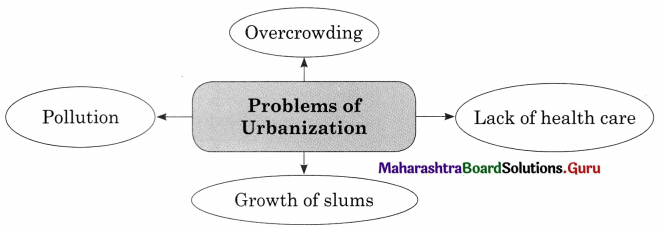
Industries is responsible for endless problems such as overcrowding, pollution, traffic, etc.
Answer:
Urbanisation is responsible for endless problems such as overcrowding, pollution, traffic, etc.

Question 3.
The French revolution had made a significant contribution to shaping a scientific attitude in sociology.
Answer:
The Scientific revolution had made a significant contribution to shaping a scientific attitude in sociology.

Question 4.
Feudalism holds that knowledge is based on actual experience of the researcher.
Answer:
Empiricism holds that knowledge is based on actual experience of the researcher.

Question 5.
Cultural studies deal with exploring the narrative, artistic, cultural implications of cinema.
Answer:
Film studies deal with exploring the narrative, artistic, cultural implications of cinema.

Maharashtra Board Class 11 Sociology Important Questions Chapter 1 Introduction to Sociology

Question 6.
Sociology is skill-oriented.
Answer:
Sociology is career-oriented.

Write suitable examples of given concepts and justify your answer.

Question 1.
Empirical Nature of Sociology.
Answer:
Example : Urbanisation resulted in endless problems such as slums etc.
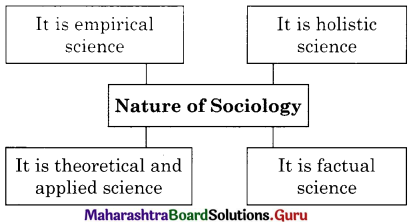
Above mentioned e.g., is based on empirical study of Sociology, to prove above example in sociology the techniques used are to collect data like interview, observations and questionnaire by which data can be secured through empirical experience. Sociology uses scientific method of research and bases theory to verify the given problem / statement.

On the bases of empiricism and logical reasoning Sociology gives the conclusion. It is not based only on ‘arm-chair’ philosophy, or speculation. Rules are framed in sociology with the help of observation and experiences, Sociology holds that empiricism is central feature as a science. Therefore, sociology is empirical in nature.

Question 2.
Developmental Studies.
Answer:
Example : A study of urban community and rural community.
Developmental studies focus on different patterns of inequalities of societies. It pays particular attention to the changing factors and the relationships between developed and developing societies. It also examines the roles played by various institutions within them and their effects on different spheres of society like social, political and economic and environment.

Question 3.
Theoretical and applied nature of sociology.
Answer:
Example : A study of the social structure of a slum.
The use of applied science is to solve practical problems. A sociologist when does the study of the social structure of a slum, is working as a pure/theoretical scientist if this is followed by a study of how to prevent delinquency in a slum, of this is applied science, means practical applications of sociological use. Hence, it is proved that sociology is a theoretical science and applied science.

Question 4.
Sociology is the holistic science.
Answer:
Example : Sociology studies tribal society.
The study of society includes micro and macro aspects. However, sociology not only studies the aspects like family, religion or particular community but studies the society as a whole e.g., tribal community, rural community or urban community. Therefore, it is proved that sociology is a holistic science, meaning, it studies society as a whole.

Question 5.
Diaspora.
Answer:
Example : NRI migration, migration from rural to urban area.
Diaspora is a Greek word meaning ‘to scatter’. Today, we describe the term as the movement of the population from its original homeland, but maintaining active connections with the homeland.
In the mentioned example:
1. NRI refers to Indians residing in other countries like America. In spite of having Green Card, Citizenship of America, these Indians kept active contact or relation with their original homeland.

2. Migration from rural to urban area means migrate for the purpose of employment or any other reasons. When people migrate from rural area to urban area and yet, keep contact with their rural or ancestry that means Diaspora.

Maharashtra Board Class 11 Sociology Important Questions Chapter 1 Introduction to Sociology

Write short notes.

Question 1.
Industrial revolution
Answer:
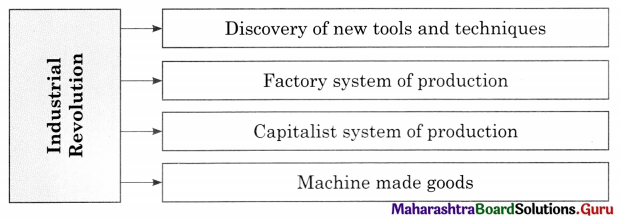
1. During the 18th century, in England, The Industrial Revolution took place. It affected the social and economic life of the people.

2. During the industrial revolution new tools and techniques were discovered, which could produce goods on a large scale. This gave rise to the factory system of production. This brought a change in the economy from feudal to capitalist system of production.

3. A new class of capitalist emerged, due to this revolution, society moved from handmade goods to machine made goods.
Maharashtra Board Class 11 Sociology Important Questions Chapter 1 Introduction to Sociology 1

4. The closure of guild system, introduction of factory system, division of labour, and migration from rural to urban, class system, labour organisation, economic inequality and the democratic pattern were the outcomes of the industrial revolution.

Question 2.
Cultural studies
Answer:
1. According to Cultural Studies, culture is produced through everyday living – the food people eat, the fashion they adopt, the entertainment they prefer or the festivals they celebrate. Thus, Cultural Studies investigate the process of making culture.

2. It was first started in the Birmingham Centre for Contemporary Culture Studies in UK.

3. It studies daily activity of human beings. It deals with the life of people, their style of living, way of dressing, eating habits, etc.

4. Cultural studies seeks to borrow methods and theories from various disciplines for the process of making cultural.

Question 3.
Film Studies
Answer:
1. This is a new disciplinary area that has emerged in the field of sociology. In the 20th Century, film studies were a new concept of academic discipline.

2. It studies the different aspect of films, focuses their attention on theoretical, historical and critical approaches of films and deals with exploring the narrative artistic, cultural, economical and political parts of cinema.

3. This study plays a very important role as far as class, race, ethnicity and gender of society is concerned.

4. It is introduced in different universities as a disciplinary subject in sociology.

Question 4.
Scope of Sociology
Answer:
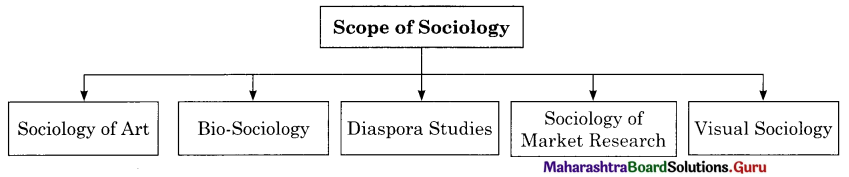
The subject matter of Sociology is very wide and can be understood with a brief introduction to following new areas in Sociology.

  1. Bio-Sociology: Researchers in this area use a variety of sociological methodologies to study the role of biology in human social life.
  2. Sociology of Art: This field seeks to understand the social context of the production and consumption of art.
  3. Sociology of Market Research: This is an applied field which connects marketing and sociological strategies to understand the market in a meaningful way and incorporates theoretical knowledge of Sociology in marketing
  4. Diaspora Studies: It deals with the study of migration and its cultural, literary, social, demographic, anthropological, political, economic impact and international relations.

Maharashtra Board Class 11 Sociology Important Questions Chapter 1 Introduction to Sociology

Question 5.
Importance of sociology
Answer:
1. Sociology studies society in a scientific manner: Sociology has made it possible to study society in a scientific manner. Scientific knowledge about a complex human society is needed in order to achieve progress in various fields.

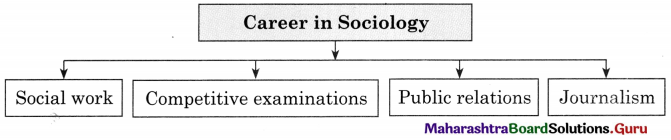
2. Sociology is career-oriented : the application of sociology is increasing in the field of industry, social services, social work, law, competitive examinations, marketing, public relations, journalism, NGOs, labour welfare, social research, counselling, police department, tribal welfare, research and so on.

3. Sociology develops a scientific approach : It makes us more objective, rational, critical, prejudice-free, and positive in our thinking.

4. Solution to social problems : To solve the several social problems faced by society, balanced knowledge is needed. Such analysis can be made using a sociological outlook.

Question 6.
The French Revolution
Answer:
1. The long series of political revolutions started by the French Revolution in 1789 were the immediate factors in the emergence of Sociology.

2. Most writers during this period, disturbed by the disorder and chaos in society, came together to restore order to society. Their interest in ‘social order was one of the major concerns of ‘classical Sociology,’ especially Auguste Comte and Emile Durkheim.

3. The French Revolution which occurred in 1789 marked a turning point in the history of human struggle for freedom and equality. It put an end to the age of feudalism and introduced a new order to society.

4. This revolution brought about far reaching changes not only in French society but all over Europe. Other countries like India were also influenced by ideas generated during the revolution.

Differentiate between.

Question 1.
French Revolution and Industrial Revolution.
Answer:

French RevolutionIndustrial Revolution
(i) French revolution started in the 17th century in France.(i) Industrial revolution started in the 18th century in England.
(ii) The French revolution changed political powers.(ii) The Industrial revolution changed economic powers.
(iii) French revolution put an end to the age of feudalism.(iii) Industrial revolution gave rise to the capitalist system.
(iv) French revolution introduced a new order to society.(iv) The democratic pattern were the outcomes of the industrial revolution.

Explain the following concept with suitable examples.

Question 1.
Visual sociology
Answer:

  1. Visual sociology is concerned with visual dimension of social life.
  2. Visual sociology aims to normalize the use of visual imagery as a valid and relevant type of data for sociological research.
  3. Valid scientific insight in society can be acquired by observing, its visual behavior of people and material products of culture.
    Example : A researcher takes help of newspaper, film, movie, photographs for their study or for the study of a particular society.

Maharashtra Board Class 11 Sociology Important Questions Chapter 1 Introduction to Sociology

Question 2.
Cultural studies
Answer:

  1. Cultural Studies finds its origin in the ‘Birmingham Centre for Contemporary Cultural Studies in UK.
  2. Cultural Studies offers us a set of ways for reading a wide variety of contemporary popular cultural phenomena.
  3. According to Cultural Studies, culture is produced through everyday living – the food people eat, the fashion they adopt, the entertainment they prefer or the festivals they celebrate.
  4. Thus, Cultural Studies investigate the process of making culture.
    Example : Contemporary Cultural Studies takes everyday life very seriously. It studies lifestyle, consumption and social relations in metropolitan cultures.

Complete the concept maps.

Question 1.
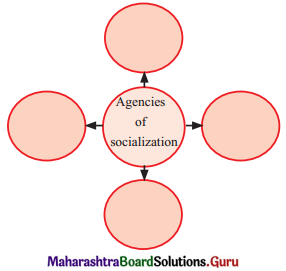
Maharashtra Board Class 11 Sociology Important Questions Chapter 1 Introduction to Sociology 2
Answer:
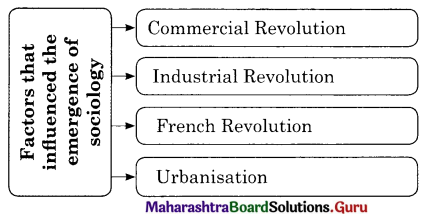
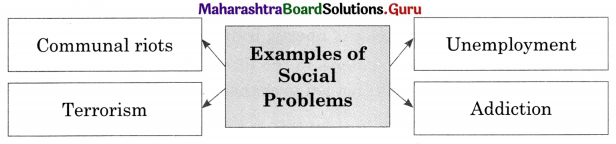
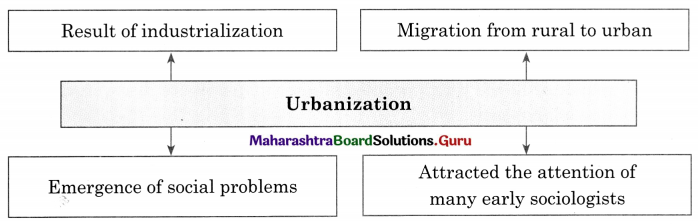
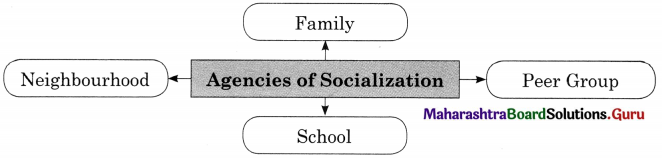
Maharashtra Board Class 11 Sociology Important Questions Chapter 1 Introduction to Sociology 3

Question 2.
Maharashtra Board Class 11 Sociology Important Questions Chapter 1 Introduction to Sociology 4
Answer:
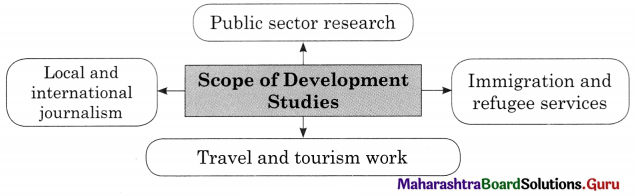
Maharashtra Board Class 11 Sociology Important Questions Chapter 1 Introduction to Sociology 5

Question 3.
Maharashtra Board Class 11 Sociology Important Questions Chapter 1 Introduction to Sociology 6
Answer:
Maharashtra Board Class 11 Sociology Important Questions Chapter 1 Introduction to Sociology 7

Question 4.
Maharashtra Board Class 11 Sociology Important Questions Chapter 1 Introduction to Sociology 8
Answer:
Maharashtra Board Class 11 Sociology Important Questions Chapter 1 Introduction to Sociology 9

Question 5.
Maharashtra Board Class 11 Sociology Important Questions Chapter 1 Introduction to Sociology 10
Answer:
Maharashtra Board Class 11 Sociology Important Questions Chapter 1 Introduction to Sociology 11

Maharashtra Board Class 11 Sociology Important Questions Chapter 1 Introduction to Sociology

Question 6.
Maharashtra Board Class 11 Sociology Important Questions Chapter 1 Introduction to Sociology 12
Answer:
Maharashtra Board Class 11 Sociology Important Questions Chapter 1 Introduction to Sociology 13

Question 7.
Maharashtra Board Class 11 Sociology Important Questions Chapter 1 Introduction to Sociology 14
Answer:
Maharashtra Board Class 11 Sociology Important Questions Chapter 1 Introduction to Sociology 15

Question 8.
Maharashtra Board Class 11 Sociology Important Questions Chapter 1 Introduction to Sociology 16
Answer:
Maharashtra Board Class 11 Sociology Important Questions Chapter 1 Introduction to Sociology 17

Question 9.
Maharashtra Board Class 11 Sociology Important Questions Chapter 1 Introduction to Sociology 18
Answer:
Maharashtra Board Class 11 Sociology Important Questions Chapter 1 Introduction to Sociology 19

State whether the following statements are true or false with reasons.

Question 1.
The aim of sociology is not related with the reality of society.
Answer:
This statement is False.

  1. The main aim of sociology is to find out the facts behind the aspects which they have to study.
  2. Sociology deals with both positive and negative elements of society, moral and immoral, organised and disorganised aspects of society.
  3. That is why the aim of sociology is related with the reality of society.

Maharashtra Board Class 11 Sociology Important Questions Chapter 1 Introduction to Sociology

Question 2.
Sociology studies only certain aspects of society.
Answer:
This statement is False.

  1. Sociology does not limit itself to the study of some specific or particular aspect of society.
  2. For e.g., Sociology studies all the institutions and their changes in today’s context. It also studies their effect on our individual life. Sociology studies society as a whole and not as a part. It studies all aspects of social life.
  3. Sociology, a social science that studies human societies and their interactions. It does this by examining the dynamics of constituent parts of societies such as institutions, communities, populations, and gender etc.

Question 3.
The industrial revolution brought about great changes in the social and economic life of the people.
Answer:
This statement is True.

  1. During the Industrial Revolution new tools and techniques were discovered, which could produce goods on a large-scale.
  2. This gave rise to the factory system of production. Thus, a change in economy from feudal to capitalist system of production.
  3. Large numbers of people migrated to urban areas in order to work in factories. Large industrial bureaucracies arose to provide services to industries and to the emerging capitalist economic system

Give your personal response.

Question 1.
The study of sociology is very useful in today’s society. Explain.
Answer:
We are living in the 21th Century which is greatly influenced by science and technology. Today the society is complex. In order to develop such community / society, systematic and scientific study of it is necessary. Sociologist made it possible to study society in a scientific way. Sociology gives information about social, religious, economical, racial diversities of society. It helps to develop scientific approach towards society as well as in choosing our career.

It provides scientific solutions to the problems in the society. The study of sociology helps the people in keeping themselves updated and attentive in different spheres of life. That is why, sociology is very useful in today’s context.

Maharashtra Board Class 11 Sociology Important Questions Chapter 1 Introduction to Sociology

Answer the following in detail (About 150-200 words).

Question 1.
Explain in detail about the factors that influenced the emergence of sociology?
Answer:
Following factors play a very important role in the emergence of sociology and these factors influenced the field of sociology in different ways.
1. Commercial Revolution : It took place between 1450 and 1800 CE. It leads to expansion of banking services. Paper currency was introduced. It also resulted in the rise of the middle class.

2. Industrial Revolution: During the 18th century, in England, the Industrial Revolution took place. It affected the social and economic life of the people. During the industrial revolution new tools and techniques were discovered, which could produce goods on a large scale. This gave rise to the factory system of production. This brought a change in the economy from feudal to capitalist system of production. A new class of capitalist emerged, due to this revolution, society moved from handmade goods to machine made goods.
Maharashtra Board Class 11 Sociology Important Questions Chapter 1 Introduction to Sociology 20

3. French Revolution : French Revolution was one of the best examples of struggle for freedom and equality. Through this revolution feudal system had been overthrown. The new system came into existence which was based on the principles of liberty, fraternity and equality. French revolution brought tremendous changes in the life of the people not only in France but all over Europe. Hence, French revolution led to changes in society.

4. Scientific Revolution : Europe produced a ‘Scientific Revolution’ in the Renaissance period. The impact of the scientific revolution greatly affected the material life as well as ideas about nature and society. The Enlightenment period saw the beginning of the scientific Revolution.

5. Urbanisation : It is a result of industrial revolution. Large number of people migrated from rural area to urban areas. This migration and expansion of cities resulted in endless problems such as overcrowding, pollution, traffic, lack of health care, growth of slums etc.

Maharashtra Board Class 12 Physics Solutions Chapter 2 Mechanical Properties of Fluids

Balbharti Maharashtra State Board 12th Physics Textbook Solutions Chapter 2 Mechanical Properties of Fluids Textbook Exercise Questions and Answers.

Maharashtra State Board 12th Physics Solutions Chapter 2 Mechanical Properties of Fluids

1) Multiple Choice Questions

i) A hydraulic lift is designed to lift heavy objects of maximum mass 2000 kg. The area of cross-section of piston carrying
the load is 2.25 × 10⁻² m2. What is the maximum pressure the piston would have to bear?
(A) 0.8711 × 10⁶ N/m2
(B) 0.5862 × 10⁷ N/m2
(C) 0.4869 × 10⁵ N/m2
(D) 0.3271 × 10⁴ N/m2
Answer:
(A) 0.8711 × 10⁶ N/m2

ii) Two capillary tubes of radii 0.3 cm and 0.6 cm are dipped in the same liquid. The ratio of heights through which the liquid will rise in the tubes is
(A) 1:2
(B) 2:1
(C) 1:4
(D) 4:1
Answer:
(B) 2:1

iii) The energy stored in a soap bubble of diameter 6 cm and T = 0.04 N/m is nearly
(A) 0.9 × 10⁻³ J
(B) 0.4 × 10⁻³ J
(C) 0.7 × 10⁻³ J
(D) 0.5 × 10⁻³ J
Answer:
(A) 0.9 × 10⁻³ J

iv) Two hail stones with radii in the ratio of 1:4 fall from a great height through the atmosphere. Then the ratio of their terminal velocities is
(A) 1:2
(B) 1:12
(C) 1:16
(D) 1:8
Answer:
(C) 1:16

Maharashtra Board Class 12 Physics Solutions Chapter 2 Mechanical Properties of Fluids

v) In Bernoulli’s theorem, which of the following is conserved?
(A) linear momentum
(B) angular momentum
(C) mass
(D) energy
Answer:
(D) energy

2) Answer in brief.

i) Why is the surface tension of paints and lubricating oils kept low?
Answer:
For better wettability (surface coverage), the surface tension and angle of contact of paints and lubricating oils must below.

ii) How much amount of work is done in forming a soap bubble of radius r?
Answer:
Let T be the surface tension of a soap solution. The initial surface area of soap bubble = 0
The final surface area of soap bubble = 2 × 4πr2
∴ The increase in surface area = 2 × 4πr2-
The work done in blowing the soap bubble is W = surface tension × increase in surface area = T × 2 × 4πr2 = 8πr2T

iii) What is the basis of the Bernoulli’s principle?
Answer:
Conservation of energy.

iv) Why is a low density liquid used as a manometric liquid in a physics laboratory?
Answer:
An open tube manometer measures the gauge pressure, p — p0 = hpg, where p0 is the pressure being measured, p0 is the atmospheric pressure, h is the difference in height between the manometric liquid of density p in the two arms. For a given pressure p, the product hp is constant. That is, p should be small for h to be large. Therefore, for noticeably large h, laboratory manometer uses a low density liquid.

v) What is an incompressible fluid?
Answer:
An incompressible fluid is one which does not undergo change in volume for a large range of pressures. Thus, its density has a constant value throughout the fluid. In most cases, all liquids are incompressible.

Question 3.
Why two or more mercury drops form a single drop when brought in contact with each other?
Answer:
A spherical shape has the minimum surface area- to-volume ratio of all geometric forms. When two drops of a liquid are brought in contact, the cohesive forces between their molecules coalesces the drops into a single larger drop. This is because, the volume of the liquid remaining the same, the surface area of the resulting single drop is less than the combined surface area of the smaller drops. The resulting decrease in surface energy is released into the environment as heat.

Proof : Let n droplets each of radius r coalesce to form a single drop of radius R. As the volume of the liquid remains constant, volume of the drop = volume of n droplets
∴ \(\frac{4}{3}\)πR3 = n × \(\frac{4}{3}\)πr3
∴ R3 = nr3 ∴ R = \(\sqrt[3]{n}\)r
Surface area of n droplets = n × πR2
Surface area of the drop = 4πR2 = n2/3 × πR2
∴ The change in the surface area = surface area of drop – surface area of n droplets
= πR2(n2/3 – n)
Since the bracketed term is negative, there is a decrease in surface area and a decrease in surface energy.

Question 4.
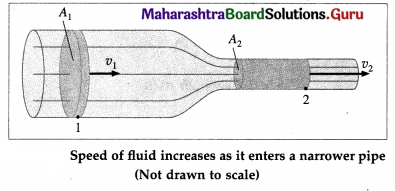
Why does velocity increase when water flowing in broader pipe enters a narrow pipe?
Answer:
When a tube narrows, the same volume occupies a greater length, as schematically shown in below figure. A1 is the cross section of the broader pipe and that of narrower pipe is A2. By the equation of continuity, V2 = (A1/A2)V1
Maharashtra Board Class 12 Physics Solutions Chapter 2 Mechanical Properties of Fluids 1
Since A1/A2 > v2 > v1. For the same volume to pass points 1 and 2 in a given time, the speed must be greater at point 2.
The process is exactly reversible. If the fluid flows in the opposite direction, its speed decreases when the tube widens.

Maharashtra Board Class 12 Physics Solutions Chapter 2 Mechanical Properties of Fluids

Question 5.
Why does the speed of a liquid increase and its pressure decrease when a liquid passes through constriction in a horizontal pipe?
Answer:
Maharashtra Board Class 12 Physics Solutions Chapter 2 Mechanical Properties of Fluids 11
Consider a horizontal constricted tube.
Let A1 and A2 be the cross-sectional areas at points 1 and 2, respectively. Let v1 and v2 be the corresponding flow speeds, ρ is the density of the fluid in the pipeline. By the equation of continuity,
v1A1 = v2A2 …… (1)
∴ \(\frac{v_{2}}{v_{1}}\) = \(\frac{A_{1}}{A_{2}}\) > 1 (∵ A1 > A2)
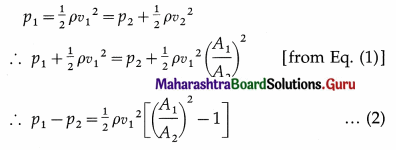
Therefore, the speed of the liquid increases as it passes through the constriction. Since the meter is assumed to be horizontal, from Bernoulli’s equation we get,
Maharashtra Board Class 12 Physics Solutions Chapter 2 Mechanical Properties of Fluids 12
Again, since A1 > A2, the bracketed term is positive so that p1 > p2. Thus, as the fluid passes through the constriction or throat, the higher speed results in lower pressure at the throat.

Question 6.
Derive an expression of excess pressure inside a liquid drop.
Answer:
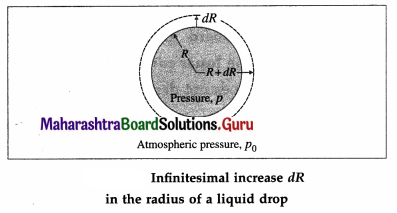
Consider a small spherical liquid drop with a radius R. It has a convex surface, so that the pressure p on the concave side (inside the liquid) is greater than the pressure p0 on the convex side (outside the liquid). The surface area of the drop is
A = 4πR2 … (1)
Imagine an increase in radius by an infinitesimal amount dR from the equilibrium value R. Then, the differential increase in surface area would be dA = 8πR ∙ dR …(2)
The increase in surface energy would be equal to the work required to increase the surface area :
dW = T∙dA = 8πTRdR …..(3)
Maharashtra Board Class 12 Physics Solutions Chapter 2 Mechanical Properties of Fluids 55
We assume that dR is so small that the pressure inside remains the same, equal to p. All parts of the surface of the drop experience an outward force per unit area equal to ρ — ρ0. Therefore, the work done by this outward pressure-developed force against the surface tension force during the increase in radius dR is
dW = (excess pressure × surface area) ∙ dR
= (ρ – ρ0) × 4πnR2 ∙ dR …..(4)
From Eqs. (3) and (4),
(ρ — ρ0) × 4πR2 ∙ dR = 8πTRdR
∴ ρ – ρ0 = \(\frac{2 T}{R}\) …… (5)
which is called Laplace’s law for a spherical membrane (or Young-Laplace equation in spherical form).
[Notes : (1) The above method is called the principle of virtual work. (2) Equation (5) also applies to a gas bubble within a liquid, and the excess pressure in this case is also called the gauge pressure. An air or gas bubble within a liquid is technically called a cavity because it has only one gas-liquid interface. A bubble, on the other hand, such as a soap bubble, has two gas-liquid interfaces.]

Question 7.
Obtain an expression for conservation of mass starting from the equation of continuity.
Answer:
Maharashtra Board Class 12 Physics Solutions Chapter 2 Mechanical Properties of Fluids 20
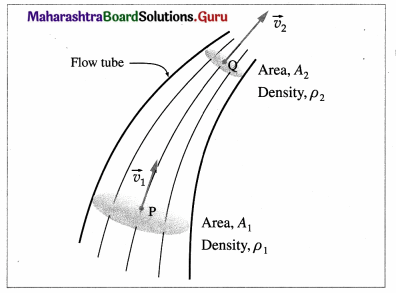
Consider a fluid in steady or streamline flow, that is its density is constant. The velocity of the fluid within a flow tube, while everywhere parallel to the tube, may change its magnitude. Suppose the velocity is \(\vec{v}_{1}\), at point P and \(\vec{v}_{2}\) at point. Q. If A1 and A2 are the cross-sectional areas of the tube at these two points, the volume flux across A1, \(\frac{d}{d t}\)(V2) = A1v1 and that across A2, \(\frac{d}{d t}\)(V2) = A2v2
By the equation of continuity of flow for a fluid, A1v1 = A2V2
i.e., \(\frac{d}{d t}\)(V1) = \(\frac{d}{d t}\)(V2)
If ρ1 and ρ1 are the densities of the fluid at P and Q, respectively, the mass flux across A1, \(\frac{d}{d t}\)(m1) = \(\frac{d}{d t}\)(ρ1 v1) = A1ρ1v1
and that across A2, \(\frac{d}{d t}\)(m2) = \(\frac{d}{d t}\)(ρ2V2) = A2ρ2v2
Since no fluid can enter or leave through the boundary of the tube, the conservation of mass requires the mass fluxes to be equal, i.e.,
\(\frac{d}{d t}\)(m1) = \(\frac{d}{d t}\)(m2)
i.e., A1ρ1v1 = A2ρ2v2
i. e., Apv = constant
which is the required expression.

Question 8.
Explain the capillary action.
Answer:
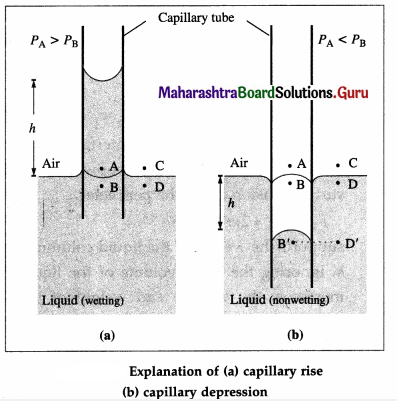
(1) When a capillary tube is partially immersed in a wetting liquid, there is capillary rise and the liquid meniscus inside the tube is concave, as shown in below figure.

Consider four points A, B, C, D, of which point A is just above the concave meniscus inside the capillary and point B is just below it. Points C and D are just above and below the free liquid surface outside.

Let PA, PB, PC and PD be the pressures at points A, B, C and D, respectively.
Now, PA = PC = atmospheric pressure
The pressure is the same on both sides of the free surface of a liquid, so that
Maharashtra Board Class 12 Physics Solutions Chapter 2 Mechanical Properties of Fluids 26
The pressure on the concave side of a meniscus is always greater than that on the convex side, so that
PA > PB
∴ PD > PB (∵ PA = PD)

The excess pressure outside presses the liquid up the capillary until the pressures at B and D (at the same horizontal level) equalize, i.e., PB becomes equal to PD. Thus, there is a capillary rise.

(2) For a non-wetting liquid, there is capillary depression and the liquid meniscus in the capillary tube is convex, as shown in above figure.

Consider again four points A, B, C and D when the meniscus in the capillary tube is at the same level as the free surface of the liquid. Points A and B are just above and below the convex meniscus. Points C and D are just above and below the free liquid surface outside.

The pressure at B (PB) is greater than that at A (PA). The pressure at A is the atmospheric pressure H and at D, PD \(\simeq\) H = PA. Hence, the hydrostatic pressure at the same levels at B and D are not equal, PB > PD. Hence, the liquid flows from B to D and the level of the liquid in the capillary falls. This continues till the pressure at B’ is the same as that D’, that is till the pressures at the same level are equal.

Maharashtra Board Class 12 Physics Solutions Chapter 2 Mechanical Properties of Fluids

Question 9.
Derive an expression for capillary rise for a liquid having a concave meniscus.
Answer:
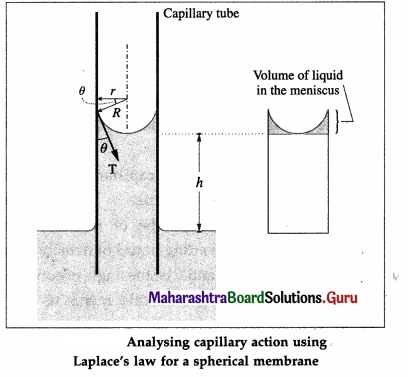
Consider a capillary tube of radius r partially immersed into a wetting liquid of density p. Let the capillary rise be h and θ be the angle of contact at the edge of contact of the concave meniscus and glass. If R is the radius of curvature of the meniscus then from the figure, r = R cos θ.
Maharashtra Board Class 12 Physics Solutions Chapter 2 Mechanical Properties of Fluids 29
Surface tension T is the tangential force per unit length acting along the contact line. It is directed into the liquid making an angle θ with the capillary wall. We ignore the small volume of the liquid in the meniscus. The gauge pressure within the liquid at a depth h, i.e., at the level of the free liquid surface open to the atmosphere, is
ρ – ρo = ρgh …. (1)
By Laplace’s law for a spherical membrane, this gauge pressure is
ρ – ρo = \(\frac{2 T}{R}\) ….. (2)
∴ hρg = \(\frac{2 T}{R}\) = \(\frac{2 T \cos \theta}{r}\)
∴ h = \(\frac{2 T \cos \theta}{r \rho g}\) …. (3)
Thus, narrower the capillary tube, the greater is the capillary rise.
From Eq. (3),
T = \(\frac{h \rho r g}{2 T \cos \theta}\) … (4)
Equations (3) and (4) are also valid for capillary depression h of a non-wetting liquid. In this case, the meniscus is convex and θ is obtuse. Then, cos θ is negative but so is h, indicating a fall or depression of the liquid in the capillary. T is positive in both cases.
[Note : The capillary rise h is called Jurin height, after James Jurin who studied the effect in 1718. For capillary rise, Eq. (3) is also called the ascent formula.]

Question 10.
Find the pressure 200 m below the surface of the ocean if pressure on the free surface of liquid is one atmosphere. (Density of sea water = 1060 kg/m3) [Ans. 21.789 × 10⁵ N/m2]
Answer:
Data : h = 200 m, p = 1060 kg/m3,
p0 = 1.013 × 10⁵ Pa, g = 9.8 m/s2
Absolute pressure,
p = p0 + hρg
= (1.013 × 10³) + (200)(1060)(9.8)
= (1.013 × 10⁵) + (20.776 × 10⁵)
= 21.789 × 105 = 2.1789 MPa

Question 11.
In a hydraulic lift, the input piston had surface area 30 cm2 and the output piston has surface area of 1500 cm2. If a force of 25 N is applied to the input piston, calculate weight on output piston. [Ans. 1250 N]
Answer:
Data : A1 = 30 cm2 = 3 × 10⁻³ m2,
A2 = 1500 cm2 = 0.15 m2, F1 = 25 N
By Pascal’s law,
\(\frac{F_{1}}{A_{1}}\) = \(\frac{F_{2}}{A_{2}}\)
∴ The force on the output piston,
F2 = F1\(\frac{A_{2}}{A_{1}}\) = (25)\(\frac{0.15}{3 \times 10^{-3}}\) = 25 × 50 = 1250 N

Question 12.
Calculate the viscous force acting on a rain drop of diameter 1 mm, falling with a uniform velocity 2 m/s through air. The coefficient of viscosity of air is 1.8 × 10⁻⁵ Ns/m2.
[Ans. 3.393 × 10⁻⁷ N]
Answer:
Data : d = 1 mm, v0 = 2 m / s,
η = 1.8 × 10⁻⁵ N.s/m2
r = \(\frac{d}{2}\) = 0.5 mm = 5 × 10⁻⁴ m
By Stokes’ law, the viscous force on the raindrop is f = 6πηrv0
= 6 × 3.142 (1.8 × 10⁻⁵ N.s/m2 × 5 × 10-4 m)(2 m/s)
= 3.394 × 10⁻⁷ N

Question 13.
A horizontal force of 1 N is required to move a metal plate of area 10-2 m2 with a velocity of 2 × 10⁻² m/s, when it rests on a layer of oil 1.5 × 10⁻³ m thick. Find the coefficient of viscosity of oil. [Ans. 7.5 Ns/m2]
Answer:
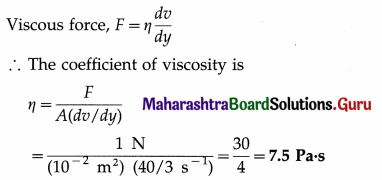
Data : F = 1 N, A = 10-2m2, v0 = 2 × 10⁻² y = 1.5 × 10⁻³ m
Velocity gradient, \(\frac{d v}{d y}\) = \(\frac{2 \times 10^{-2}}{1.5 \times 10^{-3}}\) = \(\frac{40}{3}\)s-1
Maharashtra Board Class 12 Physics Solutions Chapter 2 Mechanical Properties of Fluids 30

Question 14.
With what terminal velocity will an air bubble 0.4 mm in diameter rise in a liquid of viscosity 0.1 Ns/m2 and specific gravity 0.9? Density of air is 1.29 kg/m3. [Ans. – 0.782 × 10⁻³ m/s, The negative sign indicates that the bubble rises up]
Answer:
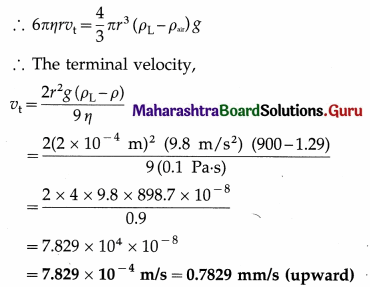
Data : d = 0.4 mm, η = 0.1 Pa.s, ρL = 0.9 × 10³ kg/m3 = 900 kg/m3, ρair = 1.29 kg/m3, g = 9.8 m/s2.
Since the density of air is less than that of oil, the air bubble will rise up through the liquid. Hence, the viscous force is downward. At terminal velocity, this downward viscous force is equal in magnitude to the net upward force.
Viscous force = buoyant force – gravitational force
Maharashtra Board Class 12 Physics Solutions Chapter 2 Mechanical Properties of Fluids 31

Maharashtra Board Class 12 Physics Solutions Chapter 2 Mechanical Properties of Fluids

Question 15.
The speed of water is 2m/s through a pipe of internal diameter 10 cm. What should be the internal diameter of nozzle of the pipe if the speed of water at nozzle is 4 m/s?
[Ans. 7.07 × 10⁻²m]
Answer:
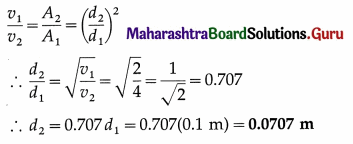
Data : d1 = 10 cm = 0.1 m, v1 = 2 m/s, v2 = 4 m/s
By the equation of continuity, the ratio of the speed is
Maharashtra Board Class 12 Physics Solutions Chapter 2 Mechanical Properties of Fluids 32

Question 16.
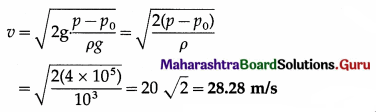
With what velocity does water flow out of an orifice in a tank with gauge pressure 4 × 10⁵ N/m2 before the flow starts? Density of water = 1000 kg/m3. [Ans. 28.28 m/s]
Answer:
Data : ρ — ρ0 = 4 × 10⁵ Pa, ρ = 103 kg/m3
If the orifice is at a depth h from the water surface in a tank, the gauge pressure there is
ρ – ρ0 = hρg … (1)
By Toricelli’s law of efflux, the velocity of efflux,
v = \(\sqrt{2 g h}\) …(2)
Substituting for h from Eq. (1),
Maharashtra Board Class 12 Physics Solutions Chapter 2 Mechanical Properties of Fluids 33

Question 17.
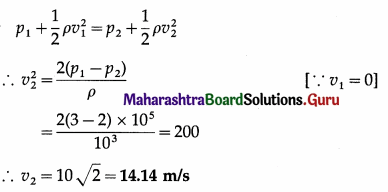
The pressure of water inside the closed pipe is 3 × 10⁵ N/m2. This pressure reduces to 2 × 10⁵ N/m2 on opening the value of the pipe. Calculate the speed of water flowing through the pipe. (Density of water = 1000 kg/m3). [Ans. 14.14 m/s]
Answer:
Data : p1 = 3 × 10⁵ Pa, v1 = 0, p2 = 2 × 10⁵ Pa, ρ = 103 kg/m3
Assuming the potential head to be zero, i.e., the pipe to be horizontal, the Bernoulli equation is
Maharashtra Board Class 12 Physics Solutions Chapter 2 Mechanical Properties of Fluids 34

Question 18.
Calculate the rise of water inside a clean glass capillary tube of radius 0.1 mm, when immersed in water of surface tension 7 × 10⁻² N/m. The angle of contact between water and glass is zero, density of water = 1000 kg/m3, g = 9.8 m/s2.
[Ans. 0.1429 m]
Answer:
Data : r = 0.1 mm = 1 × 10⁻⁴m, θ = 0°,
T = 7 × 10⁻² N/m, r = 103 kg/m3, g = 9.8 m/s2
cos θ = cos 0° = 1
Maharashtra Board Class 12 Physics Solutions Chapter 2 Mechanical Properties of Fluids 35
= 0.143 m

Question 19.
An air bubble of radius 0.2 mm is situated just below the water surface. Calculate the gauge pressure. Surface tension of water = 7.2 × 10⁻² N/m.
[Ans. 720 N/m2]
Answer:
Data : R = 2 × 10⁻⁴m, T = 7.2 × 10⁻²N/m, p = 103 kg/m3
The gauge pressure inside the bubble = \(\frac{2 T}{R}\)
= \(\frac{2\left(7.2 \times 10^{-2}\right)}{2 \times 10^{-4}}\) = 7.2 × 102 = 720 Pa

Question 20.
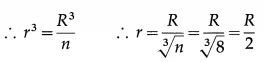
Twenty seven droplets of water, each of radius 0.1 mm coalesce into a single drop. Find the change in surface energy. Surface tension of water is 0.072 N/m. [Ans. 1.628 × 10⁻⁷ J = 1.628 erg]
Answer:
Data : r = 1 mm = 1 × 10⁻³ m, T = 0.472 J/m2
Let R be the radius of the single drop formed due to the coalescence of 8 droplets of mercury.
Volume of 8 droplets = volume of the single drop as the volume of the liquid remains constant.
∴ 8 × \(\frac{4}{3}\)πr3 = \(\frac{4}{3}\)πR3
∴ 8r3 = R3
∴ 2r = R
Surface area of 8 droplets = 8 × 4πr2
Surface area of single drop = 4πR2
∴ Decrease in surface area = 8 × 4πr2 – 4πR2
= 4π(8r2 – R2)
= 4π[8r2 – (2r)2]
= 4π × 4r2
∴ The energy released = surface tension × decrease in surface area = T × 4π × 4r2
= 0.472 × 4 × 3.142 × 4 × (1 × 10-3)2
= 2.373 × 10⁻⁵ J
The decrease in surface energy = 0.072 × 4 × 3.142 × 18 × (1 × 10-4)2
= 1.628 × 10⁻⁷ J

Maharashtra Board Class 12 Physics Solutions Chapter 2 Mechanical Properties of Fluids

Question 21.
A drop of mercury of radius 0.2 cm is broken into 8 identical droplets. Find the work done if the surface tension of mercury is 435.5 dyne/cm. [Ans. 2.189 × 10⁻⁵J]
Answer:
Let R be the radius of the drop and r be the radius of each droplet.
Data : R = 0.2 cm, n = 8, T = 435.5 dyn/cm
As the volume of the liquid remains constant, volume of n droplets = volume of the drop
∴ n × \(\frac{4}{3}\)πr3 = \(\frac{4}{3}\)πR3
Maharashtra Board Class 12 Physics Solutions Chapter 2 Mechanical Properties of Fluids 50
Surface area of the drop = 4πR2
Surface area of n droplets = n × 4πR2
∴ The increase in the surface area = surface area of n droplets-surface area of drop
= 4π(nr2 – R2) = 4π(8 × \(\frac{R^{2}}{4}\) – R2)
= 4π(2 — 1)R2 = 4πR2
∴ The work done
= surface tension × increase in surface area
= T × 4πR2 = 435.5 × 4 × 3.142 × (0.2)2
= 2.19 × 10² ergs = 2.19 × 10⁻⁵ J

Question 22.
How much work is required to form a bubble of 2 cm radius from the soap solution having surface tension 0.07 N/m.
[Ans. 0.7038 × 10⁻³ J]
Answer:
Data : r = 4 cm = 4 × 10⁻² m, T = 25 × 10-3 N/m
Initial surface area of soap bubble = 0
Final surface area of soap bubble = 2 × 4πr2
∴ Increase in surface area = 2 × 4πr2
The work done
= surface tension × increase in surface area
= T × 2 × 4πr2
= 25 × 10-3 × 2 × 4 × 3.142 × (4 × 10-2)2
= 1.005 × 10⁻³ J
The work done = 0.07 × 8 × 3.142 × (2 × 10-2)2
= 7.038 × 10⁻⁴ J

Question 23.
A rectangular wire frame of size 2 cm × 2 cm, is dipped in a soap solution and taken out. A soap film is formed, if the size of the film is changed to 3 cm × 3 cm, calculate the work done in the process. The surface tension of soap film is 3 × 10⁻² N/m. [Ans. 3 × 10⁻⁵ J]
Answer:
Data : A1 = 2 × 2 cm2 = 4 × 10⁻⁴ m2,
A2 = 3 × 3 cm2 =9 × 10⁻⁴ m2, T = 3 × 10⁻² N/m
As the film has two surfaces, the work done is W = 2T(A2 – A1)
= 2(3 × 10⁻²)(9 × 10-4 × 10-4)
= 3.0 × 10⁻⁵ J = 30 µJ

12th Physics Digest Chapter 2 Mechanical Properties of Fluids Intext Questions and Answers

Can you tell? (Textbook Page No. 27)

Question 1.
Why does a knife have a sharp edge or a needle has a sharp tip ?
Answer:
For a given force, the pressure over which the force is exerted depends inversely on the area of contact; smaller the area, greater the pressure. For instance, a force applied to an area of 1 mm2 applies a pressure that is 100 times as great as the same force applied to an area of 1 cm2. The edge of a knife or the tip of a needle has a small area of contact. That is why a sharp needle is able to puncture the skin when a small force is exerted, but applying the same force with a finger does not.

Use your brain power

Question 1.
A student of mass 50 kg is standing on both feet. Estimate the pressure exerted by the student on the Earth. Assume reasonable value to any quantity you need; justify your assumption. You may use g = 10 m/s2, By what factor will it change if the student lies on back ?
Answer:
Assume area of each foot = area of a 6 cm × 25 cm rectangle.
∴ Area of both feet = 0.03 m2
∴ The pressure due to the student’s weight
= \(\frac{m g}{A}\) = \(\frac{50 \times 10}{0.03}\) = 16.7 kPa

According to the most widely used Du Bois formula for body surface area (BSA), the student’s BSA = 1.5 m2, so that the area of his back is less than half his BSA, i.e., < 0.75 m2. When the student lies on his back, his area of contact is much smaller than this. So, estimating the area of contact to be 0.3 m2, i.e., 10 times more than the area of his feet, the pressure will be less by a factor of 10 or more, [Du Bois formula : BSA = 0.2025 × W0.425 × H0.725, where W is weight in kilogram and H is height in metre.]

Can you tell? (Textbook Page No. 30)

Question 1.
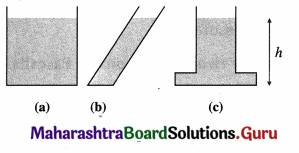
The figures show three containers filled with the same oil. How will the pressures at the reference compare ?
Maharashtra Board Class 12 Physics Solutions Chapter 2 Mechanical Properties of Fluids 85
Answer:
Filled to the same level, the pressure is the same at the bottom of each vessel.

Use Your Brain Power (Textbook Page 35)

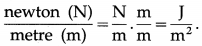
Question 1.
Prove that equivalent SI unit of surface tension is J/m2.
Answer:
The SI unit of surface tension =
Maharashtra Board Class 12 Physics Solutions Chapter 2 Mechanical Properties of Fluids 86

Maharashtra Board Class 12 Physics Solutions Chapter 2 Mechanical Properties of Fluids

Try This (Textbook Page No. 36)

Question 1.
Take a ring of about 5 cm in diameter. Tie a thread slightly loose at two diametrically opposite points on the ring. Dip the ring into a soap solution and take it out. Break the film on any one side of the thread. Discuss what happens.
Answer:
On taking the ring out, there is a soap film stretched over the ring, in which the thread moves about quite freely. Now, if the film is punctured with a pin on one side-side A in below figure-then immediately the thread is pulled taut by the film on the other side as far as it can go. The thread is now part of a perfect circle, because the surface tension on the side F of the film acts everywhere perpendicular to the thread, and minimizes the surface area of the film to as small as possible.
Maharashtra Board Class 12 Physics Solutions Chapter 2 Mechanical Properties of Fluids 87

Can You Tell ? (Textbook Page No. 38)

Question 1.
How does a waterproofing agent work ?
Answer:
Wettability of a surface, and thus its propensity for penetration of water, depends upon the affinity between the water and the surface. A liquid wets a surface when its contact angle with the surface is acute. A waterproofing coating has angle of contact obtuse and thus makes the surface hydrophobic.

Brain Teaser (Textbook Page No. 41)

Question 1.
Can you suggest any method to measure the surface tension of a soap solution? Will this method have any commercial application?
Answer:
There are more than 40 methods for determining equilibrium surface tension at the liquid-fluid and solid-fluid boundaries. Measuring the capillary rise (see Unit 2.4.7) is the laboratory method to determine surface tension.

Among the various techniques, equilibrium surface tension is most frequently measured with force tensiometers or optical (or the drop profile analysis) tensiometers in customized measurement setups.
[See https: / / www.biolinscientific.com /measurements /surface-tension]

Question 2.
What happens to surface tension under different gravity (e.g., aboard the International Space Station or on the lunar surface)?
Answer:
Surface tension does not depend on gravity.
[Note : The behaviour of liquids on board an orbiting spacecraft is mainly driven by surface tension phenomena. These make predicting their behaviour more difficult than under normal gravity conditions (i.e., on the Earth’s surface). New challenges appear when handling liquids on board a spacecraft, which are not usually present in terrestrial environments. The reason is that under the weightlessness (or almost weightlessness) conditions in an orbiting spacecraft, the different inertial forces acting on the bulk of the liquid are almost zero, causing the surface tension forces to be the dominant ones.

In this ‘micro-gravity’ environment, the surface tension forms liquid drops into spheres to minimize surface area, causes liquid columns in a capillary rise up to its rim (without over flowing). Also, when a liquid drop impacts on a dry smooth surface on the Earth, a splash can be observed as the drop disintegrates into thousands of droplets. But no splash is observed as the drop hits dry smooth surface on the Moon. The difference is the atmosphere. As the Moon has no atmosphere, and therefore no gas surrounding a falling drop, the drop on the Moon does not splash.
(See http://mafija.fmf.uni-Ij.si/]

Maharashtra Board Class 12 Physics Solutions Chapter 2 Mechanical Properties of Fluids

Can you tell? (Textbook Page No. 45)

Question 1.
What would happen if two streamlines intersect?
Answer:
The velocity of a fluid molecule is always tangential to the streamline. If two streamlines intersect, the velocity at that point will not be constant or unique.

Activity

Question 1.
Identify some examples of streamline flow and turbulent flow in everyday life. How would you explain them ? When would you prefer a streamline flow?
Answer:
Smoke rising from an incense stick inside a wind-less room, air flow around a car or aeroplane in motion are some examples of streamline flow, Fish, dolphins, and even massive whales are streamlined in shape to reduce drag. Migratory birds species that fly long distances often have particular features such as long necks, and flocks of birds fly in the shape of a spearhead as that forms a streamlined pattern.

Turbulence results in wasted energy. Cars and aeroplanes are painstakingly streamlined to reduce fluid friction, and thus the fuel consumption. (See ‘Disadvantages of turbulence’ in the following box.) Turbulence is commonly seen in washing machines and kitchen mixers. Turbulence in these devices is desirable because it causes mixing. (Also see ‘Advantages of turbulence’ in the following box.) Recent developments in high-speed videography and computational tools for modelling is rapidly advancing our understanding of the aerodynamics of bird and insect flights which fascinate both physicists and biologists.

Use your Brain power (Textbook Page No. 46)

Question 1.
The CGS unit of viscosity is the poise. Find the relation between the poise and the SI unit of viscosity.
Answer:
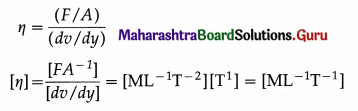
By Newton’s law of viscosity,
\(\frac{F}{A}\) = η\(\frac{d v}{d y}\)
where \(\frac{F}{A}\) is the viscous drag per unit area, \(\frac{d v}{d y}\) is the velocity gradient and η is the coefficient of viscosity of the fluid. Rewriting the above equation as
Maharashtra Board Class 12 Physics Solutions Chapter 2 Mechanical Properties of Fluids 99
SI unit : the pascal second (abbreviated Pa.s), 1 Pa.s = 1 N.m-2.s
CGS unit: dyne.cm-2.s, called the poise [symbol P, named after Jean Louis Marie Poiseuille (1799 -1869), French physician].
[Note : Thè most commonly used submultiples are the millipascalsecond (mPa.s) and the centipoise (cP). 1 mPa.s = 1 cP.]

Use your Brain power (Textbook Page No. 49)

Question 1.
A water pipe with a diameter of 5.0 cm is connected to another pipe of diameter 2.5 cm. How would the speeds of the water flow compare ?
Answer:
Water is an incompressible fluid (almost). Then, by the equation of continuity, the ratio of the speeds, is
Maharashtra Board Class 12 Physics Solutions Chapter 2 Mechanical Properties of Fluids 100

Do you know? (Textbook Page No. 50)

Question 1.
How does an aeroplane take off?
Answer:
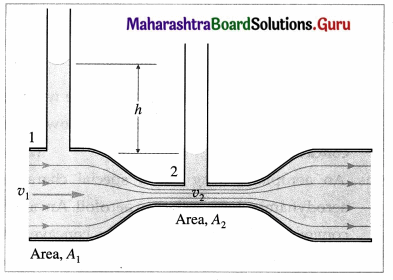
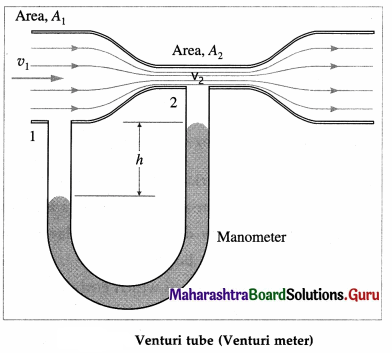
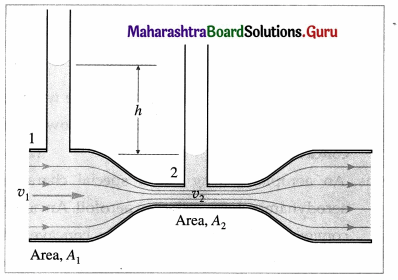
A Venturi meter is a horizontal constricted tube that is used to measure the flow speed through a pipeline. The constricted part of the tube is called the throat. Although a Venturi meter can be used for a gas, they are most commonly used for liquids. As the fluid passes through the throat, the higher speed results in lower pressure at point 2 than at point 1. This pressure difference is measured from the difference in height h of the liquid levels in the U-tube manometer containing a liquid of density ρm. The following treatment is limited to an incompressible fluid.
Maharashtra Board Class 12 Physics Solutions Chapter 2 Mechanical Properties of Fluids 101
Let A1 and A2 be the cross-sectional areas at points 1 and 2, respectively. Let v1 and v2 be the corresponding flow speeds. ρ is the density of the fluid in the pipeline. By the equation of continuity,
v1A1 = v2A2 … (1)
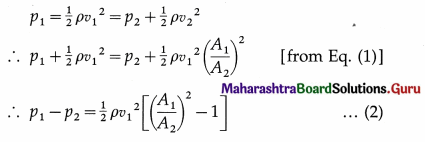
Since the meter is assumed to be horizontal, from Bernoufli’s equation we get,
Maharashtra Board Class 12 Physics Solutions Chapter 2 Mechanical Properties of Fluids 102
The pressure difference is equal to ρmgh, where h is the differences in liquid levels in the manometer.
Then,
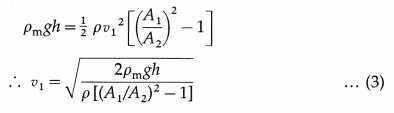
Maharashtra Board Class 12 Physics Solutions Chapter 2 Mechanical Properties of Fluids 103
Equation (3) gives the flow speed of an incompressible fluid in the pipeline. The flow rates of practical interest are the mass and volume flow rates through the meter.
Volume flow rate =A1v1 and mass flow rate = density × volume flow
rate = ρA1v1
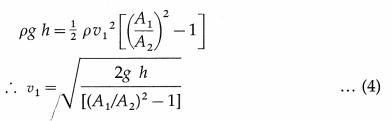
[Note When a Venturi meter is used in a liquid pipeline, the pressure difference is measured from the difference in height h of the levels of the same liquid in the two vertical tubes, as shown in the figure. Then, the pressure difference is equal to ρgh.
Maharashtra Board Class 12 Physics Solutions Chapter 2 Mechanical Properties of Fluids 104
Maharashtra Board Class 12 Physics Solutions Chapter 2 Mechanical Properties of Fluids 105
The flow meter is named after Giovanni Battista Venturi (1746—1822), Italian physicist.]

Maharashtra Board Class 12 Physics Solutions Chapter 2 Mechanical Properties of Fluids

Question 2.
Why do racer cars and birds have typical shape ?
Answer:
The streamline shape of cars and birds reduce drag.

Question 3.
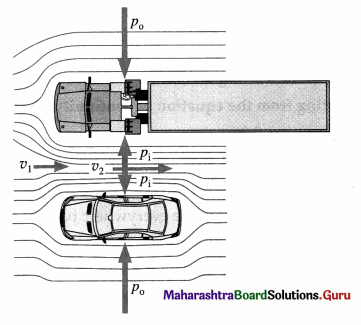
Have you experienced a sideways jerk while driving a two wheeler when a heavy vehicle overtakes you ?
Answer:
Suppose a truck passes a two-wheeler or car on a highway. Air passing between the vehicles flows in a narrower channel and must increase its speed according to Bernoulli’s principle causing the pressure between them to drop. Due to greater pressure on the outside, the two-wheeler or car veers towards the truck.
Maharashtra Board Class 12 Physics Solutions Chapter 2 Mechanical Properties of Fluids 120
When two ships sail parallel side-by-side within a distance considerably less than their lengths, since ships are widest toward their middle, water moves faster in the narrow gap between them. As water velocity increases, the pressure in between the ships decreases due to the Bernoulli effect and draws the ships together. Several ships have collided and suffered damage in the early twentieth century. Ships performing At-sea refueling or cargo transfers performed by ships is very risky for the same reason.

Question 4.
Why does dust get deposited only on one side of the blades of a fan ?
Answer:
Blades of a ceiling/table fan have uniform thickness (unlike that of an aerofoil) but are angled (cambered) at 8° to 12° (optimally, 10°) from their plane. When they are set rotating, this camber causes the streamlines above/behind a fan blade to detach away from the surface of the blade creating a very low pressure on that side. The lower/front streamlines however follow the blade surface. Dust particles stick to a blade when it is at rest as well as when in motion both by intermolecular force of adhesion and due to static charges. However, they are not dislodged from the top/behind surface because of complete detachment of the streamlines.

The lower/front surface retains some of the dust because during motion, a thin layer of air remains stationary relative to the blade.

Question 5.
Why helmets have specific shape?
Answer:
Air drag plays a large role in slowing bike riders (especially, bicycle) down. Hence, a helmet is aerodynamically shaped so that it does not cause too much drag.

Use your Brain power (Textbook Page No. 52)

Question 1.
Does the Bernoulli’s equation change when the fluid is at rest ? How ?
Answer:
Bernoulli’s principle is for fluids in motion. Hence, it is pointless to apply it to a fluid at rest. Nevertheless, for a fluid is at rest, the Bernoulli equation gives the pressure difference due to a liquid column.

For a static fluid, v1 = v2 = 0. Bernoulli’s equation in that case is p1 + ρgh1 = ρ2 + ρgh2

Further, taking h2 as the reference height of zero, i.e., by setting h2 = 0, we get p2 = p1 + ρgh1

This equation tells us that in static fluids, pressure increases with depth. As we go from point 1 to point 2 in the fluid, the depth increases by h1 and consequently, p2 is greater than p1 by an amount ρgh1.

In the case, p1 = p0, the atmospheric pressure at the top of the fluid, we get the familiar gauge pressure at a depth h1 = ρgh1. Thus, Bernoulli’s equation confirms the fact that the pressure change due to the weight of a fluid column of length h is ρgh.

Maharashtra Board Class 12 Physics Solutions Chapter 3 Kinetic Theory of Gases and Radiation

Balbharti Maharashtra State Board 12th Physics Textbook Solutions Chapter 3 Kinetic Theory of Gases and Radiation Textbook Exercise Questions and Answers.

Maharashtra State Board 12th Physics Solutions Chapter 3 Kinetic Theory of Gases and Radiation

1. Choose the correct option.

i) In an ideal gas, the molecules possess
(A) only kinetic energy
(B) both kinetic energy and potential energy
(C) only potential energy
(D) neither kinetic energy nor potential energy
Answer:
(A) only kinetic energy

ii) The mean free path λ of molecules is given by
(A) \(\sqrt{\frac{2}{\pi n d^{2}}}\)
(B) \(\frac{1}{\pi n d^{2}}\)
(C) \(\frac{1}{\sqrt{2} \pi n d^{2}}\)
(D) \(\frac{1}{\sqrt{2 \pi n d^{1}}}\)
where n is the number of molecules per unit volume and d is the diameter of the molecules.
Answer:
(C) \(\frac{1}{\sqrt{2} \pi n d^{2}}\)

Maharashtra Board Class 12 Physics Solutions Chapter 3 Kinetic Theory of Gases and Radiation

iii) If pressure of an ideal gas is decreased by 10% isothermally, then its volume will
(A) decrease by 9%
(B) increase by 9%
(C) decrease by 10%
(D) increase by 11.11%
Answer:
(D) increase by 11.11% [Use the formula P1V1 = P2V2. It gives \(\frac{V_{2}}{V_{1}}\) = \(\frac{1}{0.9}\) = 1.111 ∴ \(\frac{V_{2}-V_{1}}{V_{1}}\) = 0.1111, i.e., 11.11%

iv) If a = 0.72 and r = 0.24, then the value of tr is
(A) 0.02
(B) 0.04
(C) 0.4
(D) 0.2
Answer:
(B) 0.04

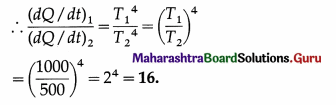
v) The ratio of emissive power of a perfect blackbody at 1327°C and 527°C is
(A) 4 : 1
(B) 16 : 1
(C) 2 : 1
(D) 8 : 1
Answer:
(B) 16 : 1

2. Answer in brief.

i) What will happen to the mean square speed of the molecules of a gas if the temperature of the gas increases?
Answer:
If the temperature of a gas increases, the mean square speed of the molecules of the gas will increase in the same proportion.
[Note: \(\overline{v^{2}}\) = \(\frac{3 n R T}{N m}\) ∴ \(\overline{v^{2}}\) ∝ T for a fixed mass of gas.]

ii) On what factors do the degrees of freedom depend?
Answer:
The degrees of freedom depend upon
(i) the number of atoms forming a molecule
(ii) the structure of the molecule
(iii) the temperature of the gas.

iii) Write ideal gas equation for a mass of 7 g of nitrogen gas.
Answer:
In the usual notation, PV = nRT.
Maharashtra Board Class 12 Physics Solutions Chapter 3 Kinetic Theory of Gases and Radiation 10
Therefore, the corresponding ideal gas equation is
PV = \(\frac{1}{4}\)RT.

iv) What is an ideal gas ? Does an ideal gas exist in practice ?.
Answer:
An ideal or perfect gas is a gas which obeys the gas laws (Boyle’s law, Charles’ law and Gay-Lussac’s law) at all pressures and temperatures. An ideal gas cannot be liquefied by application of pressure or lowering the temperature.

A molecule of an ideal gas is an ideal particle having only mass and velocity. Its structure and size are ignored. Also, intermolecular forces are zero except during collisions

v) Define athermanous substances and diathermanous substances.
Answer:

  1. A substance which is largely opaque to thermal radiations, i.e., a substance which does not transmit heat radiations incident on it, is known as an athermanous substance.
  2. A substance through which heat radiations can pass is known as a diathermanous substance.

Question 3.
When a gas is heated its temperature increases. Explain this phenomenon based on kinetic theory of gases.
Answer:
Molecules of a gas are in a state of continuous random motion. They possess kinetic energy. When a gas is heated, there is increase in the average kinetic energy per molecule of the gas. Hence, its temperature increases (the average kinetic energy per molecule being proportional to the absolute temperature of the gas).

Question 4.
Explain, on the basis of kinetic theory, how the pressure of gas changes if its volume is reduced at constant temperature.
Answer:
The average kinetic energy per molecule of a gas is constant at constant temperature. When the volume of a gas is reduced at constant temperature, the number of collisions of gas molecules per unit time with the walls of the container increases. This increases the momentum transferred per unit time per unit area, i.e., the force exerted by the gas on the walls. Hence, the pressure of the gas increases.

Maharashtra Board Class 12 Physics Solutions Chapter 3 Kinetic Theory of Gases and Radiation

Question 5.
Mention the conditions under which a real gas obeys ideal gas equation.
Answer:
A real gas obeys ideal gas equation when temperature is vey high and pressure is very low.
[ Note : Under these conditions, the density of a gas is very low. Hence, the molecules, on an average, are far away from each other. The intermolecular forces are then not of much consequence. ]

Question 6.
State the law of equipartition of energy and hence calculate molar specific heat of mono-and di-atomic gases at constant volume and constant pressure.
Answer:
Law of equipartition of energy : For a gas in thermal equilibrium at absolute temperature T, the average energy for a molecule, associated with each quadratic term (each degree of freedom), is \(\frac{1}{2}\)kBT,
where kB is the Boltzmann constant. OR

The energy of the molecules of a gas, in thermal equilibrium at a thermodynamic temperature T and containing large number of molecules, is equally divided among their available degrees of freedom, with the energy per molecule for each degree of freedom equal to \(\frac{1}{2}\)kBT, where kB is the Boltzmann constant.
(a) Monatomic gas : For a monatomic gas, each atom has only three degrees of freedom as there can be only translational motion. Hence, the average energy per atom is \(\frac{3}{2}\)kBT. The total internal energy per mole of the gas is E = \(\frac{3}{2}\)NAkBT, where NA is the Avogadro
number.
Therefore, the molar specific heat of the gas at constant volume is
CV = \(\frac{d E}{d T}\) = \(\frac{3}{2}\)NAkB = \(\frac{3}{2}\)R,
where R is the universal gas constant.
Now, by Mayer’s relation, Cp — Cv = R, where Cp is the specific heat of the gas at constant pressure.
∴ CP = CV + R = \(\frac{3}{2}\)R + R = \(\frac{5}{2}\)R

(b) Diatomic gas : Treating the molecules of a diatomic gas as rigid rotators, each molecule has three translational degrees of freedom and two rotational degrees of freedom. Hence, the average energy per molecule is
3(\(\frac{1}{2}\)kBT) + 2(\(\frac{1}{2}\)kBT) = \(\frac{5}{2}\)kBT
The total internal energy per mole of the gas is
E = \(\frac{5}{2}\)NAkBT.
∴ CV = \(\frac{d E}{d T}\) = \(\frac{5}{2}\)NAkB = \(\frac{5}{2}\)R and
CP = CV + R = \(\frac{5}{2}\)R + R = \(\frac{7}{2}\)R
A soft or non-rigid diatomic molecule has, in addition, one frequency of vibration which contributes two quadratic terms to the energy.
Hence, the energy per molecule of a soft diatomic molecule is
Maharashtra Board Class 12 Physics Solutions Chapter 3 Kinetic Theory of Gases and Radiation 15
Therefore, the energy per mole of a soft diatomic molecule is
E = \(\frac{7}{2}\)kBT × NA = \(\frac{7}{2}\) RT
In this case, CV = \(\frac{d E}{d T}\) = \(\frac{7}{2}\)R and
CP = CV + R = \(\frac{7}{2}\)R + R = \(\frac{9}{2}\)R
[Note : For a monatomic gas, adiabatic constant,
γ = \(\frac{C_{p}}{C_{V}}\) = \(\frac{5}{3}\). For a diatomic gas, γ =\(\frac{7}{5}\) or \(\frac{9}{7}\).]

Maharashtra Board Class 12 Physics Solutions Chapter 3 Kinetic Theory of Gases and Radiation

Question 7.
What is a perfect blackbody ? How can it be realized in practice?
Answer:
A perfect blackbody or simply a blackbody is defined as a body which absorbs all the radiant energy incident on it.

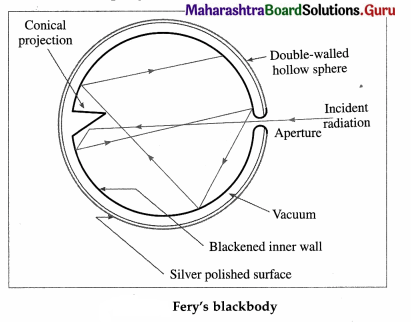
Fery designed a spherical blackbody which consists of a hollow double-walled, metallic sphere provided with a tiny hole or aperture on one side, in below figure. The inside wall of the sphere is blackened with lampblack while the outside is silver-plated. The space between the two walls is evacuated to minimize heat loss by conduction and convection.

Any radiation entering the sphere through the aperture suffers multiple reflections where about 97% of it is absorbed at each incidence by the coating of lampblack. The radiation is almost completely absorbed after a number of internal reflections. A conical projection on the inside wall opposite the hole minimizes probability of incident radiation escaping out.
Maharashtra Board Class 12 Physics Solutions Chapter 3 Kinetic Theory of Gases and Radiation 30

When the sphere is placed in a bath of suitable fused salts, so as to maintain it at the desired temperature, the hole serves as a source of black-body radiation. The intensity and the nature of the radiation depend only on the temperature of the walls.

A blackbody, by definition, has coefficient of absorption equal to 1. Hence, its coefficient of reflection and coefficient of transmission are both zero.

The radiation from a blackbody, called blackbody radiation, covers the entire range of the electromagnetic spectrum. Hence, a blackbody is called a full radiator.

Question 8.
State (i) Stefan-Boltmann law and
(ii) Wein’s displacement law.
Answer:
(i) The Stefan-Boltzmann law : The rate of emission of radiant energy per unit area or the power radiated per unit area of a perfect blackbody is directly proportional to the fourth power of its absolute temperature. OR
The quantity of radiant energy emitted by a perfect blackbody per unit time per unit surface area of the body is directly proportional to the fourth power of its absolute temperature.

(ii) Wien’s displacement law : The wavelength for which the emissive power of a blackbody is maximum, is inversely proportional to the absolute temperature of the blackbody.
OR
For a blackbody at an absolute temperature T, the product of T and the wavelength λm corresponding to the maximum radiation of energy is a constant.
λmT = b, a constant.
[Notes: (1) The law stated above was stated by Wilhelm Wien (1864-1928) German Physicist. (2) The value of the constant b in Wien’s displacement law is 2.898 × 10⁻³ m.K.]

Question 9.
Explain spectral distribution of blackbody radiation.
Answer:
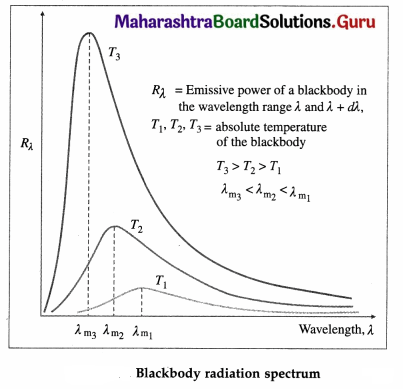
Blackbody radiation is the electromagnetic radiation emitted by a blackbody by virtue of its temperature. It extends over the whole range of wavelengths of electromagnetic waves. The distribution of energy over this entire range as a function of wavelength or frequency is known as the spectral distribution of blackbody radiation or blackbody radiation spectrum.

If Rλ is the emissive power of a blackbody in the wavelength range λ and λ + dλ, the energy it emits per unit area per unit time in this wavelength range depends on its absolute temperature T, the wavelength λ and the size of the interval dλ.
Maharashtra Board Class 12 Physics Solutions Chapter 3 Kinetic Theory of Gases and Radiation 31

Question 10.
State and prove Kirchoff’s law of heat radiation.
Answer:
Kirchhoff’s law of heat radiation : At a given temperature, the ratio of the emissive power to the coefficient of absorption of a body is equal to the emissive power of a perfect blackbody at the same temperature for all wavelengths.
OR
For a body emitting and absorbing thermal radiation in thermal equilibrium, the emissivity is equal to its absorptivity.

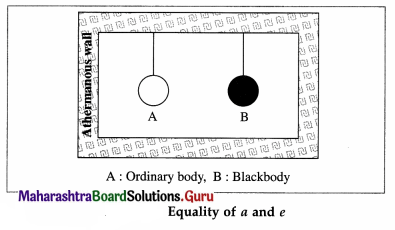
Theoretical proof: Consider the following thought experiment: An ordinary body A and a perfect black body B are enclosed in an athermanous enclosure as shown in below figure.

According to Prevost’s theory of heat exchanges, there will be a continuous exchange of radiant energy between each body and its surroundings. Hence, the two bodies, after some time, will attain the same temperature as that of the enclosure.
Maharashtra Board Class 12 Physics Solutions Chapter 3 Kinetic Theory of Gases and Radiation 32

Let a and e be the coefficients of absorption and emission respectively, of body A. Let R and Rb be the emissive powers of bodies A and B, respectively. ;

Suppose that Q is the quantity of radiant energy incident on each body per unit time per unit surface area of the body.

Body A will absorb the quantity aQ per unit time per unit surface area and radiate the quantity R per unit time per unit surface area. Since there is no change in its temperature, we must have,
aQ = R … (1)
As body B is a perfect blackbody, it will absorb the quantity Q per unit time per unit surface area and radiate the quantity Rb per unit time per unit surface area.

Since there is no change in its temperature, we must have,
Q = Rb ….. (2)
From Eqs. (1) and (2), we get,
a = \(\frac{R}{Q}\) = \(\frac{R}{R_{\mathrm{b}}}\) ….. (3)
From Eq. (3), we get, \(\frac{R}{a}\) = Rb OR

By definition of coefficient of emission,
\(\frac{R}{R_{\mathrm{b}}}\) …(4)
From Eqs. (3) and (4), we get, a = e.
Hence, the proof of Kirchhoff ‘s law of radiation.

Maharashtra Board Class 12 Physics Solutions Chapter 3 Kinetic Theory of Gases and Radiation

Question 11.
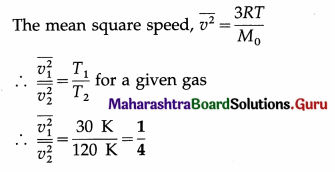
Calculate the ratio of mean square speeds of molecules of a gas at 30 K and 120 K. [Ans: 1:4]
Answer:
Data : T1 = 30 K, T2 = 120 K
Maharashtra Board Class 12 Physics Solutions Chapter 3 Kinetic Theory of Gases and Radiation 38
This is the required ratio.

Question 12.
Two vessels A and B are filled with same gas where volume, temperature and pressure in vessel A is twice the volume, temperature and pressure in vessel B. Calculate the ratio of number of molecules of gas in vessel A to that in vessel B.
[Ans: 2:1]
Answer:
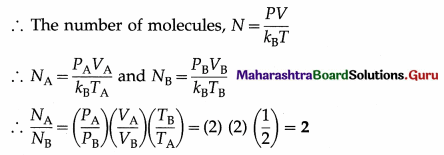
Data : VA = 2VB, TA = 2TB, PA = 2PB PV = NkBT
Maharashtra Board Class 12 Physics Solutions Chapter 3 Kinetic Theory of Gases and Radiation 39
This is the required ratio.

Question 13.
A gas in a cylinder is at pressure P. If the masses of all the molecules are made one third of their original value and their speeds are doubled, then find the resultant pressure. [Ans: 4/3 P]
Answer:
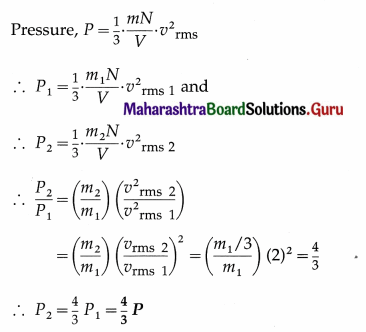
Data : m2 = m1/3, vrms 2 = 2vrms 1 as the speeds of all molecules are doubled
Maharashtra Board Class 12 Physics Solutions Chapter 3 Kinetic Theory of Gases and Radiation 40
This is the resultant pressure.

Question 14.
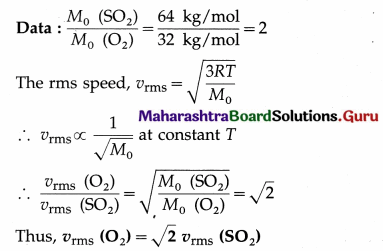
Show that rms velocity of an oxygen molecule is \(\sqrt{2}\) times that of a sulfur dioxide molecule at S.T.P.
Answer:
Maharashtra Board Class 12 Physics Solutions Chapter 3 Kinetic Theory of Gases and Radiation 41

Question 15.
At what temperature will oxygen molecules have same rms speed as helium molecules at S.T.P.? (Molecular masses of oxygen and helium are 32 and 4 respectively)
[Ans: 2184 K]
Answer:
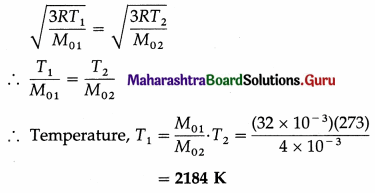
Data : T2 = 273 K, M01 (oxygen) = 32 × 10-3 kg/mol, M02 (hydrogen) = 4 × 10– 3 kg/mol
The rms speed of oxygen molecules, v1 = \(\sqrt{\frac{3 R T_{1}}{M_{01}}}\) and that of helium molecules, v2 = \(\sqrt{\frac{3 R T_{2}}{M_{02}}}\)
When v1 = v2,
Maharashtra Board Class 12 Physics Solutions Chapter 3 Kinetic Theory of Gases and Radiation 42

Question 16.
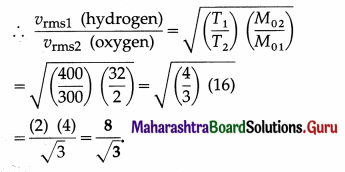
Compare the rms speed of hydrogen molecules at 127 ºC with rms speed of oxygen molecules at 27 ºC given that molecular masses of hydrogen and oxygen are 2 and 32 respectively. [Ans: 8: 3]
Answer:
Data : M01 (hydrogen) = 2 g/mol,
M02 (oxygen) = 32 g/mol,
T1 (hydrogen) = 273 + 127 = 400 K,
T2 (oxygen) = 273 + 27 = 300 K
The rms speed, vrms = \(\sqrt{\frac{3 R T}{M_{0}}}\),
where M0 denotes the molar mass
Maharashtra Board Class 12 Physics Solutions Chapter 3 Kinetic Theory of Gases and Radiation 43

Question 17.
Find kinetic energy of 5000 cc of a gas at S.T.P. given standard pressure is 1.013 × 10⁵ N/m2.
[Ans: 7.598 × 10² J]
Answer:
Data : P = 1.013 × 10⁵ N/m2, V = 5 litres
= 5 × 10⁻³ m3
E = \(\frac{3}{2}\)PV
= \(\frac{3}{2}\)(1.013 × 10⁵ N/m2) (5 × 10⁻³ m3)
= 7.5 × 1.013 × 102 J = 7.597 × 10² J
This is the required energy.

Maharashtra Board Class 12 Physics Solutions Chapter 3 Kinetic Theory of Gases and Radiation

Question 18.
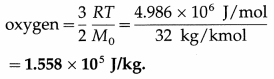
Calculate the average molecular kinetic energy
(i) per kmol
(ii) per kg
(iii) per molecule of oxygen at 127 ºC, given that molecular weight of oxygen is 32, R is 8.31 J mol-1 K-1 and Avogadro’s number NA is 6.02 × 10²³ molecules mol-1.
[Ans: 4.986 × 10⁶J, 1.558 × 10²J 8.282 × 10⁻²¹ J]
Answer:
Data : T = 273 +127 = 400 K, molecular weight = 32 ∴ molar mass = 32 kg/kmol, R = 8.31 Jmol-1 K-1, NA = 6.02 × 10²³ molecules mol-1

(i) The average molecular kinetic energy per kmol of oxygen = the average kinetic energy per mol of oxygen × 1000
= \(\frac{3}{2}\)RT × 1000 = \(\frac{3}{2}\) (8.31) (400) (103)\(\frac{\mathrm{J}}{\mathrm{kmol}}\)
= (600)(8.31)(103) = 4.986 × 10⁶ J/kmol

(ii) The average molecular kinetic energy per kg of
Maharashtra Board Class 12 Physics Solutions Chapter 3 Kinetic Theory of Gases and Radiation 51

(iii) The average molecular kinetic energy per molecule of oxygen
Maharashtra Board Class 12 Physics Solutions Chapter 3 Kinetic Theory of Gases and Radiation 52

Question 19.
Calculate the energy radiated in one minute by a blackbody of surface area 100 cm2 when it is maintained at 227ºC. (Take Stefen’s constant σ = 5.67 × 10⁻⁸J m-2s-1K-4)
[Ans: 2126.25 J]
Answer:
Data : t = one minute = 60 s, A = 100 cm2
= 100 × 10-4 m2 = 10-2 m2, T = 273 + 227 = 500 K,
σ = 5.67 × 10⁻⁸ W/m2.K4
The energy radiated, Q = σAT4t
= (5.67 × 10⁻⁸)(10-2)(500)4(60) J
= (5.67)(625)(60)(10-2)J = 2126 J

Question 20.
Energy is emitted from a hole in an electric furnace at the rate of 20 W, when the temperature of the furnace is 727 ºC. What is the area of the hole? (Take Stefan’s constant σ to be 5.7 × 10⁻⁸ J s-1 m-2 K-4) [Ans: 3.509 × 10⁻⁴m2]
Answer:
Data : \(\frac{Q}{t}\) = 20 W, T = 273 + 727 = 1000 K
Maharashtra Board Class 12 Physics Solutions Chapter 3 Kinetic Theory of Gases and Radiation 55

Question 21.
The emissive power of a sphere of area 0.02 m2 is 0.5 kcal s-1 m-2. What is the
amount of heat radiated by the spherical surface in 20 second? [Ans: 0.2 kcal]
Answer:
Data : R = 0.5 kcal s-1m-2, A = 0.02 m2, t = 20 s Q = RAt = (0.5) (0.02) (20) = 0.2 kcal
This is the required quantity.

Question 22.
Compare the rates of emission of heat by a blackbody maintained at 727ºC and at 227ºC, if the black bodies are surrounded
by an enclosure (black) at 27ºC. What would be the ratio of their rates of loss of heat ?
[Ans: 18.23:1]
Answer:
Data : T1 = 273 + 727 = 1000 K, T2 = 273 + 227 = 500 K, T0 = 273 + 27 = 300 K.
(i) The rate of emission of heat, \(\frac{d Q}{d t}\) = σAT4.
We assume that the surface area A is the same for the two bodies.
Maharashtra Board Class 12 Physics Solutions Chapter 3 Kinetic Theory of Gases and Radiation 60
Maharashtra Board Class 12 Physics Solutions Chapter 3 Kinetic Theory of Gases and Radiation 61

Question 23.
Earth’s mean temperature can be assumed to be 280 K. How will the curve of blackbody radiation look like for this temperature? Find out λmax. In which part of the electromagnetic spectrum, does this value lie? (Take Wien’s constant b = 2.897 × 10⁻³ m K) [Ans: 1.035 × 10⁻⁵m, infrared region]
Answer:
Data : T = 280 K, Wien’s constant b = 2.897 × 10⁻³ m.K
λmaxT = b
Maharashtra Board Class 12 Physics Solutions Chapter 3 Kinetic Theory of Gases and Radiation 62
This value lies in the infrared region of the electromagnetic spectrum.
The nature of the curve of blackbody radiation will be the same as shown in above, but the maximum will occur at 1.035 × 10⁻⁵ m.

Question 24.
A small-blackened solid copper sphere of radius 2.5 cm is placed in an evacuated chamber. The temperature of the chamber is maintained at 100 ºC. At what rate energy must be supplied to the copper sphere to maintain its temperature at 110 ºC? (Take Stefan’s constant σ to be 5.670 × 10⁻⁸ J s-1 m-2 K-4 , π = 3.1416 and treat the sphere as a blackbody.)
[Ans: 0.9624 W]
Answer:
Data : r = 2.5 cm = 2.5 × 10⁻² m, T0 = 273 + 100 = 373 K, T = 273 + 110 = 383 K,
σ = 5.67 × 10⁻⁸ J s-1 m-2 k-4
The rate at which energy must be supplied
σA(T4 — T04) = σ 4πr2(T4 – T04)
= (5.67 × 10⁻⁸) (4) (3.142) (2.5 × 10⁻²)2 (3834 – 3734)
= (5.67) (4) (3.142) (6.25) (3.834 – 3.734) × 10-4
= 0.9624W

Maharashtra Board Class 12 Physics Solutions Chapter 3 Kinetic Theory of Gases and Radiation

Question 25.
Find the temperature of a blackbody if its spectrum has a peak at (a) λmax = 700 nm (visible), (b) λmax = 3 cm (microwave region) and (c) λmax = 3 m (short radio waves) (Take Wien’s constant b = 2.897 × 10⁻³ m K). [Ans: (a) 4138 K, (b) 0.09657 K, (c) 0.9657 × 10⁻³ K]
Answer:
Data:(a) λmax = 700nm=700 × 10-9m,
(b) λmax = 3cm = 3 × 10⁻² m, (c) λmax = 3 m, b = 2.897 × 10⁻³ m.K
λmaxT = b
Maharashtra Board Class 12 Physics Solutions Chapter 3 Kinetic Theory of Gases and Radiation 70

12th Physics Digest Chapter 3 Kinetic Theory of Gases and Radiation Intext Questions and Answers

Remember This (Textbook Page No. 60)

Question 1.
Distribution of speeds of molecules of a gas.
Answer:
Maxwell-Boltzmann distribution of molecular speeds is a relation that describes the distribution of speeds among the molecules of a gas at a given temperature.

The root-mean-square speed vrms gives us a general idea of molecular speeds in a gas at a given temperature. However, not all molecules have the same speed. At any instant, some molecules move slowly and some very rapidly. In classical physics, molecular speeds may be considered to cover the range from 0 to ∞. The molecules constantly collide with each other and with the walls of the container and their speeds change on collisions. Also the number of molecules under consideration is very large statistically. Hence, there is an equilibrium distribution of speeds.

If dNv represents the number of molecules with speeds between v and v + dv, dNv remains fairly constant at equilibrium. We consider a gas of total N molecules. Let r\vdv be the probability that a molecule has its speed between v and v + dv. Then, dNv = Nηvdv
so that the fraction, i.e., the relative number of molecules with speeds between v and v + dv is dNv/N = ηvdv
Below figure shows the graph of ηv against v. The area of the strip with height ηv and width dv gives the fraction dNv/N.
Maharashtra Board Class 12 Physics Solutions Chapter 3 Kinetic Theory of Gases and Radiation 75

Remember This (Textbook Page No. 64)

Question 1.
If a hot body and a cold body are kept in vacuum, separated from each other, can they exchange heat ? If yes, which mode of transfer of heat causes change in their temperatures ? If not, give reasons.
Answer:
Yes. Radiation.

Remember This (Textbook Page No. 66)

Question 1.
Can a perfect blackbody be realized in practice ?
Answer:
For almost all practical purposes, Fery’s blackbody is very close to a perfect blackbody.

Question 2.
Are good absorbers also good emitters ?
Answer:
Yes.

Maharashtra Board Class 12 Physics Solutions Chapter 3 Kinetic Theory of Gases and Radiation

Use your brain power (Textbook Page No. 68)

Question 1.
Why are the bottom of cooking utensils blackened and tops polished ?
Answer:
The bottoms of cooking utensils are blackened to increase the rate of absorption of radiant energy and tops are polished to increase the reflection of radiation.

Question 2.
A car is left in sunlight with all its windows closed on a hot day. After some time it is observed that the inside of the car is warmer than outside air. Why ?
Answer:
The air inside the car is trapped and hence is a bad conductor of heat.

Question 3.
If surfaces of all bodies are continuously emitting radiant energy, why do they not cool down to 0 K ?
Answer:
Bodies absorb radiant energy from the surroundings.

Can you tell? (Textbook Page No. 71)

Question 1.
λmax the wavelength corresponding to maximum intensity for the Sun is in the blue-green region of visible spectrum. Why does the Sun then appear yellow to us ?
Answer:
The colour that we perceive depends upon a number of factors such as absorption and scattering by atmosphere (which in turn depends upon the composition of air) and spectral response of the human eye. The colour may be yellow/orange/ red/white.

Maharashtra Board Class 12 Physics Solutions Chapter 15 Structure of Atoms and Nuclei

Balbharti Maharashtra State Board 12th Physics Textbook Solutions Chapter 15 Structure of Atoms and Nuclei Textbook Exercise Questions and Answers.

Maharashtra State Board 12th Physics Solutions Chapter 15 Structure of Atoms and Nuclei

In solving problems, use me = 0.00055 u = 0.5110 MeV/c2, mp = 1.00728 u, mn = 1.00866u, mH = 1.007825 u, u = 931.5 MeV, e = 1.602 × 10⁻¹⁹ C, h = 6.626 × 10⁻³⁴ Js, ε0 = 8.854 × 10⁻¹² SI units and me = 9.109 × 10⁻³¹ kg.

1. Choose the correct option.

i) In which of the following systems will the radius of the first orbit of the electron be the smallest?
(A) hydrogen
(B) singly ionized helium
(C) deuteron
(D) tritium
Answer:
(D) tritium

ii) The radius of the 4th orbit of the electron will be smaller than its 8th orbit by a factor of
(A) 2
(B) 4
(C) 8
(D) 16
Answer:
(B) 4

Maharashtra Board Class 12 Physics Solutions Chapter 15 Structure of Atoms and Nuclei

iii) In the spectrum of hydrogen atom which transition will yield longest wavelength?
(A) n = 2 to n = 1
(B) n = 5 to n = 4
(C) n = 7 to n = 6
(D) n = 8 to n = 7
Answer:
(D) n = 8 to n = 7

iv) Which of the following properties of a nucleus does not depend on its mass number?
(A) radius
(B) mass
(C) volume
(D) density
Answer:
(D) density

v) If the number of nuclei in a radioactive sample at a given time is N, what will be the number at the end of two half-lives?
(A) \(\frac{N}{2}\)
(B) \(\frac{N}{4}\)
(C) \(\frac{3N}{4}\)
(D) \(\frac{N}{8}\)
Answer:
(B) \(\frac{N}{4}\)

2. Answer in brief.

i) State the postulates of Bohr’s atomic model.
Answer:
The postulates of Bohr’s atomic model (for the hydrogen atom) :

  1. The electron revolves with a constant speed in acircular orbit around the nucleus. The necessary centripetal force is the Coulomb force of attraction of the positive nuclear charge on the negatively charged electron.
  2. The electron can revolve without radiating energy only in certain orbits, called allowed or stable orbits, in which the angular momentum of the electron is equal to an integral multiple of h/2π, where h is Planck’s constant.
  3. Energy is radiated by the electron only when it jumps from one of its orbits to another orbit having lower energy. The energy of the quantum of elec-tromagnetic radiation, i.e., the photon, emitted is equal to the energy difference of the two states.

ii) State the difficulties faced by Rutherford’s atomic model.
Answer:
(1) According to Rutherford, the electrons revolve in circular orbits around the atomic nucleus. The circular motion is an accelerated motion. According to the classical electromagnetic theory, an accelerated charge continuously radiates energy. Therefore, an electron during its orbital motion, should go on radiating energy. Due to the loss of energy, the radius of its orbit should go on decreasing. Therefore, the electron should move along a spiral path and finally fall into the nucleus in a very short time, of the order of 10-16 s in the case of a hydrogen atom. Thus, the atom should be unstable. We exist because atoms are stable.

(2) If the electron moves along such a spiral path, the radius of its orbit would continuously decrease. As a result, the speed and frequency of revolution of the electron would go on increasing. The electron, therefore, would emit radiation of continuously changing frequency, and hence give rise to a con-tinuous spectrum. However, atomic spectrum is a line spectrum.

Maharashtra Board Class 12 Physics Solutions Chapter 15 Structure of Atoms and Nuclei

iii) What are alpha, beta and gamma decays?
Answer:
(a) A radioactive transformation in which an α-particle is emitted is called α-decay.
In an α-decay, the atomic number of the nucleus decreases by 2 and the mass number decreases by 4.
Example : \({ }_{92}^{238} \mathrm{U} \rightarrow{ }_{90}^{234} \mathrm{Th}+{ }_{2}^{4} \alpha\)
Q = [mu – mTh – mα]c2

(b) A radioactive transformation in which a β-particle is emitted is called β-decay.
In a β-decay, the atomic number of the nucleus increases by 1 and the mass number remains unchanged.
Example : \({ }_{90}^{234} \mathrm{Th} \rightarrow{ }_{91}^{234} \mathrm{~Pa}+{ }_{-1}^{0} e+\bar{v}_{\mathrm{e}}\)
where \(\bar{v}_{\mathrm{e}}\) is the neutrino emitted to conserve the momentum, energy and spin.
Q = [mu – mTh – mα]c2
In a β+-decay, the atomic number of the nucleus decreases by 1 and the mass number remains unchanged.
Example : \(\begin{aligned}
&30 \\
&15
\end{aligned} P \rightarrow{ }_{14}^{30} \mathrm{Si}+{ }_{+1}^{0} e+v_{\mathrm{e}}\)
where ve is the neutrino emitted to conserve the momentum, energy and spin.
Q = [mP – mSi – me]c2
[Note : The term fi particle refers to the electron (or positron) emitted by a nucleus.]

A given nucleus does not emit α and β-particles simultaneously. However, on emission of α or β-particles, most nuclei are left in an excited state. A nucleus in an excited state emits a γ-ray photon in a transition to the lower energy state. Hence, α and β-particle emissions are often accompanied by γ-rays.

iv) Define excitation energy, binding energy and ionization energy of an electron in an atom.
Answer:
(1) Excitation energy of an electron in an atom : The energy required to transfer an electron from the ground state to an excited state (a state of higher energy) is called the excitation energy of the electron in that state.

(2) Binding energy of an electron in an atom is defined as the minimum energy that should be provided to an orbital electron to remove it from the atom such that its total energy is zero.

(3) Ionization energy of an electron in an atom is defined as the minimum energy required to remove the least strongly bound electron from a neutral atom such that its total energy is zero.

v) Show that the frequency of the first line in Lyman series is equal to the difference between the limiting frequencies of Lyman and Balmer series.
Answer:
For the first line in the Lyman series,
\(\frac{1}{\lambda_{\mathrm{L} 1}}=R\left(\frac{1}{1^{2}}-\frac{1}{2^{2}}\right)=R\left(1-\frac{1}{4}\right)=\frac{3 R}{4}\)
∴ vL1 = \(\frac{c}{\lambda_{\mathrm{L} 1}}=\frac{3 R_{c}}{4}\), where v denotes the frequency,
c the speed of light in free space and R the Rydberg constant.
For the limit of the Lyman series,
Maharashtra Board Class 12 Physics Solutions Chapter 15 Structure of Atom and Nuclei 15
Hence, the result.

Question 3.
State the postulates of Bohr’s atomic model and derive the expression for the energy of an electron in the atom.
Answer:
The postulates of Bohr’s atomic model (for the hydrogen atom) :
(1) The electron revolves with a constant speed in acircular orbit around the nucleus. The necessary centripetal force is the Coulomb force of attraction of the positive nuclear charge on the negatively charged electron.
(2) The electron can revolve without radiating energy only in certain orbits, called allowed or stable orbits, in which the angular momentum of the electron is equal to an integral multiple of h/2π, where h is Planck’s constant.
(3) Energy is radiated by the electron only when it jumps from one of its orbits to another orbit having lower energy. The energy of the quantum of elec-tromagnetic radiation, i.e., the photon, emitted is equal to the energy difference of the two states.

Consider the electron revolving in the nth orbit around the nucleus of an atom with the atomic number Z. Let m and e be the mass and the charge of the electron, r the radius of the orbit and v the linear speed of the electron.

According to Bohr’s first postulate, centripetal force on the electron = electrostatic force of attraction exerted on the electron by the nucleus
∴ \(\frac{m v^{2}}{r}=\frac{1}{4 \pi \varepsilon_{0}} \cdot \frac{Z e^{2}}{r^{2}}\) ……………. (1)
where ε0 is the permittivity of free space.
∴ Kinetic energy (KE) of the electron
= \(\frac{1}{2} m v^{2}=\frac{Z e^{2}}{8 \pi \varepsilon_{0} r}\) ………….. (2)
The electric potential due to the nucleus of charge +Ze at a point at a distance r from it is
V = \(\frac{1}{4 \pi \varepsilon_{0}} \cdot \frac{\mathrm{Ze}}{r}\)
∴ Potential energy (PE) of the electron
= charge on the electron × electric potential
= – e × \(\frac{1}{4 \pi \varepsilon_{0}} \frac{Z e}{r}=-\frac{Z e^{2}}{4 \pi \varepsilon_{0} r}\) …………….. (3)
Hence, the total energy of the electron in the nth orbit is
E = KE + PE = \(\frac{-Z e^{2}}{4 \pi \varepsilon_{0} r}+\frac{Z e^{2}}{8 \pi \varepsilon_{0} r}\)
∴ E = \(-\frac{Z e^{2}}{8 \pi \varepsilon_{0} r}\) ………….. (4)
This shows that the total energy of the electron in the nth orbit of the atom is inversely proportional to the radius of the orbit as Z, ε0 and e are constants. The radius of the nth orbit of the electron is
r = \(\frac{\varepsilon_{0} h^{2} n^{2}}{\pi m Z e^{2}}\) …………….. (5)
where h is Planck’s constant.
From Eqs. (4) and (5), we get,
En = \(-\frac{Z e^{2}}{8 \pi \varepsilon_{0}}\left(\frac{\pi m Z e^{2}}{\varepsilon_{0} h^{2} n^{2}}\right)=-\frac{m Z^{2} e^{4}}{8 \varepsilon_{0}^{2} h^{2} n^{2}}\) ……………… (6)
This gives the expression for the energy of the electron in the nth Bohr orbit. The minus sign in the expression shows that the electron is bound to the nucleus by the electrostatic force of attraction.
As m, Z, e, ε0 and h are constant, we get
En ∝ \(\frac{1}{n^{2}}\)
i.e., the energy of the electron in a stationary energy state is discrete and is inversely proportional to the square of the principal quantum number.
[ Note : Energy levels are most conveniently expressed in electronvolt. Hence, substituting the values of m, e, £0 and h, and dividing by the conversion factor 1.6 × 10⁻¹⁹ J/eV,
En ≅ \(-\frac{13.6 Z^{2}}{n^{2}}\) (in eV)
For hydrogen, Z = 1
∴ En ≅ \(-\frac{13.6}{n^{2}}\) (in eV).

Question 4.
Starting from the formula for energy of an electron in the nth orbit of hydrogen atom, derive the formula for the wavelengths of Lyman and Balmer series spectral lines and determine the shortest wavelengths of lines in both these series.
Answer:
According to Bohr’s third postulate for the model of the hydrogen atom, an atom radiates energy only when an electron jumps from a higher energy state to a lower energy state and the energy of the
quantum of electromagnetic radiation emitted in this process is equal to the energy difference between the two states of the electron. This emission of radiation gives rise to a spectral line.

The energy of the electron in a hydrogen atom,
when it is in an orbit with the principal quantum
number n, is
En = \(-\frac{m e^{4}}{8 \varepsilon_{0}^{2} h^{2} n^{2}}\)
where m = mass of electron, e = electronic charge, h = Planck’s constant and = permittivity of free space.

Let Em be the energy of the electron in a hydrogen atom when it is in an orbit with the principal quantum number m and E, its energy in an orbit with the principal quantum number n, n < m. Then
Em = \(-\frac{m e^{4}}{8 \varepsilon_{0}^{2} h^{2} m^{2}}\) and En = \(-\frac{m e^{4}}{8 \varepsilon_{0}^{2} h^{2} m^{2}}\)
Therefore, the energy radiated when the electron jumps from the higher energy state to the lower energy state is
Em – En = \(\frac{-m e^{4}}{8 \varepsilon_{0}^{2} h^{2} m^{2}}-\left(-\frac{m e^{4}}{8 \varepsilon_{0}^{2} h^{2} n^{2}}\right)\)
= \(\frac{m e^{4}}{8 \varepsilon_{0}^{2} h^{2}}\left(\frac{1}{n^{2}}-\frac{1}{m^{2}}\right)\)
This energy is emitted in the form of a quantum of radiation (photon) with energy hv, where V is the frequency of the radiation.
∴ Em – En = hv
∴ v = \(\frac{E_{m}-E_{n}}{h}=\frac{m e^{4}}{8 \varepsilon_{0}^{2} h^{3}}\left(\frac{1}{n^{2}}-\frac{1}{m^{2}}\right)\)
The wavelength of the radiation is λ = \(\frac{c}{v^{\prime}}\)
where c is the speed of radiation in free space.
The wave number, \(\bar{v}=\frac{1}{\lambda}=\frac{v}{c}\)
\(\bar{v}=\frac{1}{\lambda}=\frac{m e^{4}}{8 \varepsilon_{0}^{2} h^{3} c}\left(\frac{1}{n^{2}}-\frac{1}{m^{2}}\right)=R\left(\frac{1}{n^{2}}-\frac{1}{m^{2}}\right)\)
where \(R\left(=\frac{m e^{4}}{8 \varepsilon_{0}^{2} h^{3} c}\right)\) is a constant called the Ryd berg constant.

This expression gives the wave number of the radiation emitted and hence that of a line in hydrogen spectrum.

For the Lyman series, n = 1,m = 2, 3, 4, ………… ∞
∴ \(\frac{1}{\lambda_{\mathrm{L}}}=R\left(\frac{1}{1^{2}}-\frac{1}{m^{2}}\right)\) and for the shortest wavelength line m this series, \(\frac{1}{\lambda_{\mathrm{Ls}}}=R\left(\frac{1}{1^{2}}\right)\) as m = ∞.
For the Balmer series, n = 2, m = 3, 4, 5, … ∞.
∴ \(\frac{1}{\lambda_{\mathrm{B}}}=R\left(\frac{1}{4}-\frac{1}{m^{2}}\right)\) and for the shortest wavelength line in this series, \(\frac{1}{\lambda_{\mathrm{Bs}}}=R\left(\frac{1}{4}\right)\) as m = ∞
[Note: Johannes Rydberg (1854—1919), Swedish spectroscopist, studied atomic emission spectra and introduced the idea of wave number. The empirical formula \(\bar{v}=\frac{1}{\lambda}=R\left(\frac{1}{n^{2}}-\frac{1}{m^{2}}\right)\) where m and n are simple integers, is due to Rydberg. When we consider the finite mass of the nucleus, we find that R varies slightly from element to element.]

Maharashtra Board Class 12 Physics Solutions Chapter 15 Structure of Atoms and Nuclei

Question 5.
Determine the maximum angular speed of an electron moving in a stable orbit around the nucleus of hydrogen atom.
Answer:
The radius of the ,ith Bohr orbit is
r = \(\frac{\varepsilon_{0} h^{2} n^{2}}{\pi m Z e^{2}}\) ………….. (1)
and the linear speed of an electron in this orbit is
ν = \(\frac{Z e^{2}}{2 \varepsilon_{0} n h}\) …………… (2)
where ε 0 permittivity of free space, h ≡ Planck’s constant, n ≡ principal quantum number, m ≡ electron mass, e electronic charge and Z ≡ atomic number of the atom.
Since angular speed ω = \(\frac{v}{r}\), then from Eqs. (1) and (2), we get,
ω = \(\frac{v}{r}=\frac{Z e^{2}}{2 \varepsilon_{0} n h} \cdot \frac{\pi m Z e^{2}}{\varepsilon_{0} h^{2} n^{2}}=\frac{\pi m Z^{2} e^{4}}{2 \varepsilon_{0}^{2} h^{3} n^{3}}\) ………………. (3)
which gives the required expression for the angular speed of an electron in the nth Bohr orbit.
From Eq. (3), the frequency of revolution of the electron,
f = \(\frac{\omega}{2 \pi}=\frac{1}{2 \pi} \times \frac{\pi m Z^{2} e^{4}}{2 \varepsilon_{0}^{2} h^{3} n^{3}}=\frac{m Z^{2} e^{4}}{4 \varepsilon_{0}^{2} h^{3} n^{3}}\) …………….. (4)
as required.
[Note : From Eq. (4), the period of revolution of the electron, T = \(\frac{1}{f}=\frac{4 \varepsilon_{0}^{2} h^{3} n^{3}}{m Z e^{4}}\). Hence, f ∝ \(\frac{1}{n^{3}}\) and T ∝ n3].

Obtain the formula for ω and continue as follows :
Maharashtra Board Class 12 Physics Solutions Chapter 15 Structure of Atom and Nuclei 24
This is required quantity.

Question 6.
Determine the series limit of Balmer, Paschen and Bracket series, given the limit for Lyman series is 912 Å.
Answer:
Data : λL∞ = 912 Å
Maharashtra Board Class 12 Physics Solutions Chapter 15 Structure of Atom and Nuclei 23
as n = 5 and m = ∞
From Eqs. (1) and (2), we get,
\(\frac{\lambda_{\mathrm{Pa} \infty}}{\lambda_{\mathrm{L} \infty}}=\frac{R_{\mathrm{H}}}{R_{\mathrm{H}} / 9}\) = 9
∴ λPa∞ = 9λL∞ = (9) (912) = 8202 Å
\(\frac{\lambda_{\mathrm{Pf} \infty}}{\lambda_{\mathrm{L} \infty}}=\frac{R_{\mathrm{H}}}{R_{\mathrm{H}} / 25}\) = 25
∴ λPf∞ = 25λL∞ = (25) (912) = 22800 Å
This is the series limit of the pfund series.

Question 7.
Describe alpha, beta and gamma decays and write down the formulae for the energies generated in each of these decays.
Answer:
(a) A radioactive transformation in which an α-particle is emitted is called α-decay.
In an α-decay, the atomic number of the nucleus decreases by 2 and the mass number decreases by 4.
Example : \({ }_{92}^{238} \mathrm{U} \rightarrow{ }_{90}^{234} \mathrm{Th}+{ }_{2}^{4} \alpha\)
Q = [mu – mTh – mα]c2

(b) A radioactive transformation in which a β-particle is emitted is called β-decay.
In a β-decay, the atomic number of the nucleus increases by 1 and the mass number remains unchanged.
Example : \({ }_{90}^{234} \mathrm{Th} \rightarrow{ }_{91}^{234} \mathrm{~Pa}+{ }_{-1}^{0} e+\bar{v}_{\mathrm{e}}\)
where \(\bar{v}_{\mathrm{e}}\) is the neutrino emitted to conserve the momentum, energy and spin.
Q = [mu – mTh – mα]c2
In a β+-decay, the atomic number of the nucleus decreases by 1 and the mass number remains unchanged.
Example : \(\begin{aligned}
&30 \\
&15
\end{aligned} P \rightarrow{ }_{14}^{30} \mathrm{Si}+{ }_{+1}^{0} e+v_{\mathrm{e}}\)
where ve is the neutrino emitted to conserve the momentum, energy and spin.
Q = [mP – mSi – me]c2
[Note : The term fi particle refers to the electron (or positron) emitted by a nucleus.]

A given nucleus does not emit α and β-particles simultaneously. However, on emission of α or β-particles, most nuclei are left in an excited state. A nucleus in an excited state emits a γ-ray photon in a transition to the lower energy state. Hence, α and β-particle emissions are often accompanied by γ-rays.
Maharashtra Board Class 12 Physics Solutions Chapter 15 Structure of Atom and Nuclei 28

Question 8.
Explain what are nuclear fission and fusion giving an example of each. Write down the formulae for energy generated in each of these processes.
Answer:
Nuclear fission is a nuclear reaction in which a heavy nucleus of an atom, such as that of uranium, splits into two or more fragments of comparable size, either spontaneously or as a result of bombardment of a neutron on the nucleus (induced fission). It is followed by emission of two or three neutrons.
The mass of the original nucleus is more than the sum of the masses of the fragments. This mass difference is released as energy, which can be enormous as in the fission of 235U.
Nuclear fission was discovered by Lise Meitner, Otto Frisch, Otto Hahn and Fritz Strassmann in 1938.

The products of the fission of 235U by thermal neutrons are not unique. A variety of fission fragments are produced with mass number A ranging from about 72 to about 138, subject to the conservation of mass-energy, momentum, number of protons (Z) and number of neutrons (N). A few typical fission equations are
Maharashtra Board Class 12 Physics Solutions Chapter 15 Structure of Atom and Nuclei 11

A type of nuclear reaction in which lighter atomic nuclei (of low atomic number) fuse to form a heavier nucleus (of higher atomic number) with the’ release of enormous amount of energy is called nuclear fusion.

Very high temperatures, of about 107 K to 108 K, are required to carry out nuclear fusion. Hence, such a reaction is also called a thermonuclear reaction.

Example : The D-T reaction, being used in experimental fusion reactors, fuses a deuteron and a triton nuclei at temperatures of about 108 K.
Maharashtra Board Class 12 Physics Solutions Chapter 15 Structure of Atom and Nuclei 12
(2) The value of the energy released in the fusion of two deuteron nuclei and the temperature at which the reaction occurs mentioned in the textbook are probably misprints.]

Maharashtra Board Class 12 Physics Solutions Chapter 15 Structure of Atoms and Nuclei

Question 9.
Describe the principles of a nuclear reactor. What is the difference between a nuclear reactor and a nuclear bomb?
Answer:
In a nuclear reactor fuel rods are used to provide a suitable fissionable material such as \(\begin{gathered}
236 \\
92
\end{gathered}\)U. Control rods are used to start or stop the reactor. Moderators are used to slow down the fast neutrons ejected in a nuclear fission to the appropriate lower speeds. Material used as a coolant removes the energy released in the nuclear reaction by converting it into thermal energy for production of electricity.

In a nuclear reactor, a nuclear fission chain reaction is used in a controlled manner, while in a nuclear bomb, the nuclear fission chain reaction is not controlled, releasing tremendous energy in a very short time interval.
[Note : The first nuclear bomb (atomic bomb) was dropped on Hiroshima in Japan on 06 August 1945. The second bomb was dropped on Nagasaki in Japan on 9 August 1945.]

Question 10.
Calculate the binding energy of an alpha particle given its mass to be 4.00151 u.
Answer:
Data : M = 4.00151 u, = 1.00728 u,
mn = 1.00866 u, 1 u = 931.5 MeV/c2
The binding energy of an alpha particle
(Zmp + Nn -M)c2
=(2mp + 2mn -M)c2
= [(2)(1.00728u) + 2(1.00866 u) – 4.00151 u]c2
= (2.01456 + 2.01732 – 4.00151)(931.5) MeV
= 28.289655 MeV
= 28.289655 × 106 eV × 1.602 × 10-19 J
= 4.532002731 × 10⁻¹² J

Question 11.
An electron in hydrogen atom stays in its second orbit for 10-8 s. How many revolutions will it make around the nucleus in that time?
Answer:
Data : z = 1, m = 9.1 × 10⁻³¹ kg, e = 1.6 × 10⁻¹⁹ C, ε0 = 8.85 × 10⁻¹² C2 / N.m2, h = 6.63 × 10 -34 J.s, n = 2, t = 10-8 s
The periodic time of the electron in a hydrogen atom,
Maharashtra Board Class 12 Physics Solutions Chapter 15 Structure of Atom and Nuclei 17
Let N be the number of revolutions made by the electron in time t. Then, t = NT.
∴ N = \(\frac{t}{T}=\frac{10^{-8}}{3.898 \times 10^{-16}}\) = 2.565 × 7

Question 12.
Determine the binding energy per nucleon of the americium isotope \(_{95}^{244} \mathrm{Am}\) , given the mass of \({ }_{95}^{244} \mathrm{Am}\) to be 244.06428 u.
Answer:
Data : Z = 95, N = 244  – 95 = 149,
mp = 1.00728 u, mn = 1.00866 u,
M = 244.06428 u, 1 u = 931.5 MeV/c2
The binding energy per nucleon,
Maharashtra Board Class 12 Physics Solutions Chapter 15 Structure of Atom and Nuclei 18
= 7.3209 MeV/nucleon

Question 13.
Calculate the energy released in the nuclear reaction \({ }_{3}^{7} \mathrm{Li}\) + p → 2α given mass of \({ }_{3}^{7} \mathrm{Li}\) atom and of helium atom to be 7.016 u and 4.0026 u respectively.
Answer:
Data: M1 (\({ }_{3}^{7} \mathrm{Li}\) Li atom)= 7.016 u, M2 (He atom)
= 4.0026 u, mp = 1.00728 u, 1 u = 931.5 MeV/c2
∆M = M1 + mp – 2M2
= [7.016 + 1.00728 – 2(4.0026)]u
= 0.01808 u = (0.01808)(931.5) MeV/c2
= 16.84152 MeV/c2
Therefore, the energy released in the nuclear reaction = (∆M) c2 = 16.84152 MeV

Question 14.
Complete the following equations describing nuclear decays.
Maharashtra Board Class 12 Physics Solutions Chapter 15 Structure of Atom and Nuclei 27
Answer:
(a) \({ }_{88}^{226} \mathrm{Ra} \rightarrow{ }_{2}^{4} \alpha+{ }_{86}^{222} \mathrm{Em}\)
Em (Emanation) ≡ Rn (Radon)
Here, α particle is emitted and radon is formed.

(b) \({ }_{8}^{19} \mathrm{O} \rightarrow e^{-}+{ }_{9}^{19} \mathrm{~F}\)
Here, e ≡ \({ }_{-1}^{0} \beta\) is emitted and fluorine is formed.

(c) \(\underset{90}{228} \mathrm{Th} \rightarrow{ }_{2}^{4} \alpha+{ }_{88}^{224} \mathrm{Ra}\)
Here, α particle is emitted and radium is formed.

(d) \({ }_{7}^{12} \mathrm{~N} \rightarrow{ }_{6}^{12} \mathrm{C}+{ }_{1}^{0} \beta\)
\({ }_{1}^{0} \beta\) is e+ (positron)
Here, β+ is emItted and carbon is formed.

Maharashtra Board Class 12 Physics Solutions Chapter 15 Structure of Atoms and Nuclei

Question 15.
Calculate the energy released in the following reactions, given the masses to be \({ }_{88}^{223} \mathrm{Ra}\) : 223.0185 u, \({ }_{82}^{209} \mathrm{~Pb}\) : 208.9811, \({ }_{6}^{14} C\) : 14.00324, \({ }_{92}^{236} \mathrm{U}\) : 236.0456, \({ }_{56}^{140} \mathrm{Ba}\) : 139.9106, \({ }_{36}^{94} \mathrm{Kr}\) : 93.9341, \({ }_{6}^{11} \mathrm{C}\) : 11.01143, \({ }_{5}^{11} \mathrm{~B}\) : 11.0093. Ignore neutrino energy.
Maharashtra Board Class 12 Physics Solutions Chapter 15 Structure of Atom and Nuclei 26
Answer:
Maharashtra Board Class 12 Physics Solutions Chapter 15 Structure of Atom and Nuclei 13
(a) \({ }_{88}^{223} \mathrm{Ra} \rightarrow{ }_{82}^{209} \mathrm{~Pb}+{ }_{6}^{14} \mathrm{C}\)
The energy released in this reaction = (∆M) c2
= [223.0185 – (208.9811 + 14.00324)j(931 .5) MeV
= 31.820004 MeV

(b) \({ }_{92}^{236} \mathrm{U} \rightarrow{ }_{56}^{140} \mathrm{Ba}+{ }_{36}^{94} \mathrm{Kr}+2 \mathrm{n}\)
The energy released in this reaction =
(∆M) c2 = [236.0456 – (139.9106 + 93.9341 + (2)(1 .00866)1(93 1 .5)MeV
= 171.00477 MeV

(c) \({ }_{6}^{11} \cdot \mathrm{C} \rightarrow{ }_{5}^{11} \mathrm{~B}+e^{+}\) + neutrino
The energy released in this reaction = (∆M) c2
= [11.01143 – (11.0093 + O.00055)](931.5) MeV
= 1.47177 MeV

Question 16.
Sample of carbon obtained from any living organism has a decay rate of 15.3 decays per gram per minute. A sample of carbon obtained from very old charcoal shows a disintegration rate of 12.3 disintegrations per gram per minute. Determine the age of the old sample given the decay constant of carbon to be 3.839 × 10⁻¹² per second.
Answer:
Data: 15.3 decays per gram per minute (living organism), 12.3 disintegrations per gram per minute (very old charcoal). Hence, we have,
\(\frac{A(t)}{A_{0}}=\frac{12.3}{15.3}\), λ = 3.839 × 10⁻¹² per second
Maharashtra Board Class 12 Physics Solutions Chapter 15 Structure of Atom and Nuclei 19

Question 17.
The half-life of \({ }_{38}^{90} \mathrm{Sr}\) is 28 years. Determine the disintegration rate of its 5 mg sample.
Answer:
Data: T1/2 = 28 years = 28 × 3.156 × 107 s
=8.837 × 10⁸s, M = 5 mg =5 × 10⁻³g
90 grams of \({ }_{38}^{90} \mathrm{Sr}\) contain 6.02 × 10²³ atoms
Hence, here, N = \(\frac{\left(6.02 \times 10^{23}\right)\left(5 \times 10^{-3}\right)}{90}\)
= 3.344 × 10¹⁹ atoms
∴ The disintegration rate = Nλ = N\(\frac{0.693}{T_{1 / 2}}\)
= \(\frac{\left(3.344 \times 10^{19}\right)(0.693)}{8.837 \times 10^{8}}\)
= 2.622 × 10¹⁰ disintegrations per second

Maharashtra Board Class 12 Physics Solutions Chapter 15 Structure of Atoms and Nuclei

Question 18.
What is the amount of \({ }_{27}^{60} \mathrm{Co}\) necessary to provide a radioactive source of strength 10.0 mCi, its half-life being 5.3 years?
Answer:
Data : Activity = 10.0 mCi = 10.0 × 10⁻³ Ci
= (10.0 × 10⁻³)(3.7 × 10¹⁰) dis/s = 3.7 × 10⁸ dis/s
T1/2 = 5.3 years = (5.3)(3.156 × 10⁷) s
= 1.673 × 10⁸ s
Decay constant, λ = \(\frac{0.693}{T_{1 / 2}}=\frac{0.693}{1.673 \times 10^{8}} \mathrm{~s}^{-1}\)
=4.142 × 10⁻⁹ s-1
Activity = Nλ
∴ N = \(\frac{\text { activity }}{\lambda}=\frac{3.7 \times 10^{8}}{4.142 \times 10^{-9}} \text { atoms }\)
= 8.933 × 10¹⁶ atoms
=60 grams of \({ }_{27}^{60} \mathrm{Co}\) contain 6.02 × 10²³ atoms
Mass of 8.933 × 10¹⁶ atoms of \({ }_{27}^{60} \mathrm{Co}\)
= \(\frac{8.933 \times 10^{16}}{6.02 \times 10^{23}} \times 60 \mathrm{~g}\)
= 8.903 × 10⁻⁶ g = 8.903 µg
This is the required amount.

Question 19.
Disintegration rate of a sample is 1010 per hour at 20 hrs from the start. It reduces to 6.3 × 10⁹ per hour after 30 hours. Calculate its half life and the initial number of radioactive atoms in the sample.
Answer:
Data : A (t1) = 1010 per hour, where t1 = 20 h,
A (t2) = 6.3 × 10⁹ per hour, where t2 = 30 h
A(t) = A0e-λt ∴ A(t1) = A0e-λt1 and A(t2) = Aoe-λt2
Maharashtra Board Class 12 Physics Solutions Chapter 15 Structure of Atom and Nuclei 20
∴ 1.587 e10λ ∴ 10λ =2.3031og10(1.587)
∴ λ = (0.2303)(0.2007) = 0.04622 per hour
The half life of the material, T1/2 = \(\frac{0.693}{\lambda}=\frac{0.693}{0.04622}\)
= 14.99 hours
Now, A0 = A (t1)eλt1 = 1010e(0.04622)(20)
= 1010 e0.9244
Let x = e0.9244 ∴ 2.3031og10x = 0.9244
∴ 1og10x = \(\frac{0.9244}{2.303}\) = 0.4014
∴ x = antilog 0.4014 = 2.52
∴ A0 = 2.52 × 10¹⁰ per hour
Now A0 = N0λ ∴ N0 = \(\frac{A_{0}}{\lambda}=\frac{2.52 \times 10^{10}}{0.04622}\)
= 5.452 × 10¹¹
This is the initial number of radioactive atoms in the sample.

Question 20.
The isotope 57Co decays by electron capture to 57Fe with a half-life of 272 d. The 57Fe nucleus is produced in an excited state, and it almost instantaneously emits gamma rays.
(a) Find the mean lifetime and decay constant for 57Co.
(b) If the activity of a radiation source 57Co is 2.0 µCi now, how many 57Co nuclei does the source contain?
(c) What will be the activity after one year?
Answer:
Data: T1/2 = 272d = 272 × 24 × 60 × 60s = 2.35 × 10⁷ s,
A0 = 2.0uCi = 2.0 × 10-6 × 3.7 × 1010
= 7.4 × 10⁴ dis/s
t = 1 year = 3.156 × 10⁷ s
(a) T1/2 = \(\frac{0.693}{\lambda}\) = 0.693 τ ∴ The mean lifetime for
57Co = τ = \(\frac{T_{1 / 2}}{0.693}=\frac{2.35 \times 10^{7}}{0.693}\) = 3391 × 107 s
The decay constant for 57Co = λ = \(\frac{1}{\tau}\)
= \(\frac{1}{3.391 \times 10^{7} \mathrm{~s}}\)
= 2949 × 10-8 s-1

(b)A0 = N0A ∴ N0 = \(\frac{A_{0}}{\lambda}\) = A0τ
= (7.4 × 10⁴)(3.391 × 10⁷)
= 2.509 × 10¹² nuclei
This is the required number.

(c) A(t) = A0e-λt = 2e-(2.949 × 10⁻⁸)(3.156 × 10⁷)
= 2e-0.9307 = 2 / e0.9307
Let x = e0.9307 ∴ Iogex = 0.9307
∴ 2.303log10x = 0.9307
∴ log10x = \(\frac{0.9307}{2.303}\) = 0.4041
∴ x = antilog 0.4041 = 2.536
∴ A (t) = \(\frac{2}{2.536}\) μCi = 0.7886 μCi

Maharashtra Board Class 12 Physics Solutions Chapter 15 Structure of Atoms and Nuclei

Question 21.
A source contains two species of phosphorous nuclei, \({ }_{15}^{32} \mathrm{P}\) (T1/2 = 14.3 d) and \({ }_{15}^{32} \mathrm{P}\) (T1/2 = 25.3 d). At time t = 0, 90% of the decays are from \({ }_{15}^{32} \mathrm{P}\) . How much time has to elapse for only 15% of the decays to be from \({ }_{15}^{32} \mathrm{P}\) ?
Answer:
Maharashtra Board Class 12 Physics Solutions Chapter 15 Structure of Atom and Nuclei 21
∴ (0.04846 – 0.02739) t = 2.303 (2.1847 – 0.4771)
∴ t = \(\frac{(2.303)(1.7076)}{0.02107}\) = 186.6 days
This is the required time.

Question 22.
Before the year 1900 the activity per unit mass of atmospheric carbon due to the presence of 14C averaged about 0.255 Bq per gram of carbon. (a) What fraction of carbon atoms were 14C? (b) An archaeological specimen containing 500 mg of carbon, shows 174 decays in one hour. What is the age of the specimen, assuming that its activity per unit mass of carbon when the specimen died was equal to the average value of the air? Half-life of 14C is 5730 years?
Answer:
0.693
Data: T1/2 = 5730y ∴ λ = \(\frac{0.693}{5730 \times 3.156 \times 10^{7}} \mathrm{~s}^{-1}\)
= 3.832 × 10⁻¹² s-1, A = 0.255 Bq per gram of carbon in part (a); M = 500 mg = 500 × 10-3 g,
174 decays in one hour \(\frac{174}{3600}\) dis/s = 0.04833 dis/s in part (b) (per 500 mg].

(a) A = Nλ ∴ N = \(\frac{A}{\lambda}=\frac{0.255}{3.832 \times 10^{-12}}\)
= 6.654 × 10¹⁰
Number of atoms in 1 g of carbon = \(\frac{6.02 \times 10^{23}}{12}\)
=5.017 × 10²²
\(\frac{5.017 \times 10^{22}}{6.654 \times 10^{10}}\) = 0.7539 × 10¹²
∴ 1 14C atom per 0.7539 × 10¹² atoms of carbon
∴ 4 14C atoms per 3 × 10¹² atoms of carbon

(b) Present activity per gram = \(\)
= 0.09666 dis/s per gram
A0 = 0.255 dis/s per gram
Now, A(t) = A0e-λt
Maharashtra Board Class 12 Physics Solutions Chapter 15 Structure of Atom and Nuclei 22
This is the required quantity.

Question 23.
How much mass of 235U is required to undergo fission each day to provide 3000 MW of thermal power? Average energy per fission is 202.79 MeV
Answer:
Data: Power = 3000 MW = 3 × 10⁹ J/s
∴ Energy to be produced each day
=3 × 109 × 86400 J each day
= 2.592 × 10¹⁴ J each day
Energy per fission = 202.79 MeV
= 202.79 × 106 × 1.6 × 10-19 J = 3,245 × 10-11 J
∴ Number of fissions each day
= \(\frac{2.592 \times 10^{14}}{3.245 \times 10^{-11}}\) × 1024 each day
0.235 kg of 235U contains 6.02 × 10²³ atoms
7988 x 1024
∴ M = \(\left(\frac{7.988 \times 10^{24}}{6.02 \times 10^{23}}\right)\) (o.235) = 3.118 kg
This is the required quantity.

Maharashtra Board Class 12 Physics Solutions Chapter 15 Structure of Atoms and Nuclei

Question 24.
In a periodic table the average atomic mass of magnesium is given as 24.312 u. The average value is based on their relative natural abundance on earth. The three isotopes and their masses are \({ }_{12}^{24} \mathrm{Mg}\) (23.98504 u), \({ }_{12}^{25} \mathrm{Mg}\) (24.98584 u) and \({ }_{12}^{26} \mathrm{Mg}\) (25.98259 u). The natural abundance of \({ }_{12}^{24} \mathrm{Mg}\) is 78.99% by mass. Calculate the abundances of other two isotopes.
[Answer: 9.3% and 11.7%]
Answer:
Data : Average atomic mass of magnesium =
Maharashtra Board Class 12 Physics Solutions Chapter 15 Structure of Atom and Nuclei 25

12th Physics Digest Chapter 15 Structure of Atoms and Nuclei Intext Questions and Answers

Use your brain power (Textbook Page No. 336)

Question 1.
Why don’t heavy nuclei decay by emitting a single proton or a single neutron?
Answer:
According to quantum mechanics, the probability for these emissions is extremely low.

Maharashtra Board Class 12 Physics Solutions Chapter 1 Rotational Dynamics

Balbharti Maharashtra State Board 12th Physics Textbook Solutions Chapter 1 Rotational Dynamics Textbook Exercise Questions and Answers.

Maharashtra State Board 12th Physics Solutions Chapter 1 Rotational Dynamics

1. Choose the correct option.

i) When seen from below, the blades of a ceiling fan are seen to be revolving anticlockwise and their speed is decreasing. Select correct statement about the directions of its angular velocity and angular acceleration.
(A) Angular velocity upwards, angular acceleration downwards.
(B) Angular velocity downwards, angular acceleration upwards.
(C) Both, angular velocity and angular acceleration, upwards.
(D) Both, angular velocity and angular acceleration, downwards.
Answer:
(A) Angular velocity upwards, angular acceleration downwards.

ii) A particle of mass 1 kg, tied to a 1.2 m long string is whirled to perform vertical circular motion, under gravity. Minimum speed of a particle is 5 m/s. Consider following statements.
P) Maximum speed must be 5 5 m/s.
Q) Difference between maximum and minimum tensions along the string is 60 N. Select correct option.
(A) Only the statement P is correct.
(B) Only the statement Q is correct.
(C) Both the statements are correct.
(D) Both the statements are incorrect.
Answer:
(C) Both the statements are correct.

Maharashtra Board Class 12 Physics Solutions Chapter 1 Rotational Dynamics

iii) Select correct statement about the formula (expression) of moment of inertia (M.I.) in terms of mass M of the object and some of its distance parameter/s, such as R, L, etc.
(A) Different objects must have different expressions for their M.I.
(B) When rotating about their central axis, a hollow right circular cone and a disc have the same expression for the M.I.
(C) Expression for the M.I. for a parallelepiped rotating about the transverse axis passing through its centre includes its depth.
(D) Expression for M.I. of a rod and that of a plane sheet is the same about a transverse axis.
Answer:
(B) When rotating about their central axis, a hollow right circular cone and a disc have the same expression for the M.I.

iv) In a certain unit, the radius of gyration of a uniform disc about its central and transverse axis is \(\sqrt{2.5}\). Its radius of gyration about a tangent in its plane (in the same unit) must be
(A) \(\sqrt{5}\)
(B) 2.5
(C) 2\(\sqrt{2.5}\)
(D) \(\sqrt{12.5}\)
Answer:
(B) 2.5

v) Consider following cases:
(P) A planet revolving in an elliptical orbit.
(Q) A planet revolving in a circular orbit.
Principle of conservation of angular momentum comes in force in which of these?
(A) Only for (P)
(B) Only for (Q)
(C) For both, (P) and (Q)
(D) Neither for (P), nor for (Q)
Answer:
(C) For both, (P) and (Q)

X) A thin walled hollow cylinder is rolling down an incline, without slipping. At any instant, the ratio ”Rotational K.E.:
Translational K.E.: Total K.E.” is
(A) 1:1:2
(B) 1:2:3
(C) 1:1:1
(D) 2:1:3
Answer:
(D) 2:1:3

2. Answer in brief.

i) Why are curved roads banked?
Answer:
A car while taking a turn performs circular motion. If the road is level (or horizontal road), the necessary centripetal force is the force of static friction between the car tyres and the road surface. The friction depends upon the nature of the surfaces in contact and the presence of oil and water on the road. If the friction is inadequate, a speeding car may skid off the road. Since the friction changes with circumstances, it cannot be relied upon to provide the necessary centripetal force. Moreover, friction results in fast wear and tear of the tyres.

To avoid the risk of skidding as well as to reduce the wear and tear of the car tyres, the road surface at a bend is tilted inward, i.e., the outer side of the road is raised above its inner side. This is called banking of road. On a banked road, the resultant of the normal reaction and the gravitational force can act as the necessary centripetal force. Thus, every car can be safely driven on such a banked curve at certain optimum speed, without depending on friction. Hence, a road should be properly banked at a bend.

The angle of banking is the angle of inclination of the surface of a banked road at a bend with the horizontal.

ii) Do we need a banked road for a two wheeler? Explain.
Answer:
When a two-wheeler takes a turn along an unbanked road, the force of friction provides the centripetal force. The two-wheeler leans inward to counteract a torque that tends to topple it outward. Firstly, friction cannot be relied upon to provide the necessary centripetal force on all road conditions. Secondly, the friction results in wear and tear of the tyres. On a banked road at a turn, any vehicle can negotiate the turn without depending on friction and without straining the tyres.

iii) On what factors does the frequency of a conical pendulum depend? Is it independent of some factors?
Answer:
The frequency of a conical pendulum, of string length L and semivertical angle θ, is
n = \(\frac{1}{2 \pi} \sqrt{\frac{g}{L \cos \theta}}\)
where g is the acceleration due to gravity at the place.
From the above expression, we can see that

  1. n ∝ \(\sqrt{g}\)
  2. n ∝ \(\frac{1}{\sqrt{L}}\)
  3. n ∝ \(\frac{1}{\sqrt{\cos \theta}}\)
    (if θ increases, cos θ decreases and n increases)
  4. The frequency is independent of the mass of the bob.

iv) Why is it useful to define radius of gyration?
Answer:
Definition : The radius of gyration of a body rotating about an axis is defined as the distance between the axis of rotation and the point at which the entire mass of the body can be supposed to be concentrated so as to give the same moment of inertia as that of the body about the given axis.
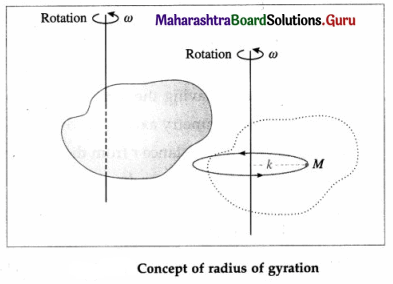
Maharashtra Board Class 12 Physics Solutions Chapter 1 Rotational Dynamics 65
The moment of inertia (MI) of a body about a given rotation axis depends upon

  1. the mass of the body and
  2. the distribution of mass about the axis of rotation. These two factors can be separated by expressing the MI as the product of the mass (M) and the square of a particular distance (k) from the axis of rotation. This distance is called the radius of gyration and is defined as given above. Thus,
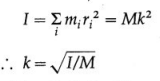
    Maharashtra Board Class 12 Physics Solutions Chapter 1 Rotational Dynamics 66

Physical significance : The radius of gyration is less if I is less, i.e., if the mass is distributed close to the axis; and it is more if I is more, i.e., if the mass is distributed away from the axis. Thus, it gives the idea about the distribution of mass about the axis of rotation.

v) A uniform disc and a hollow right circular cone have the same formula for their M.I., when rotating about their central axes. Why is it so?
Answer:
The radius of gyration of a thin ring of radius Rr about its transverse symmetry axis is
Kr = \(\sqrt{I_{\mathrm{CM}} / M_{\mathrm{r}}}\) = \(\sqrt{R_{\mathrm{r}}^{2}}\) = Rr
The radius of gyration of a thin disc of radius Rd about its transverse symmetry axis is
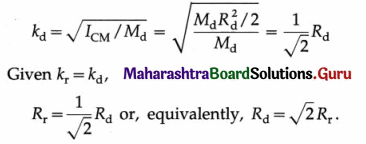
Maharashtra Board Class 12 Physics Solutions Chapter 1 Rotational Dynamics 70

Question 3.
While driving along an unbanked circular road, a two-wheeler rider has to lean with the vertical. Why is it so? With what angle the rider has to lean? Derive the relevant expression. Why such a leaning is not necessary for a four wheeler?
Answer:
When a bicyclist takes a turn along an unbanked road, the force of friction \(\vec{f}_{\mathrm{s}}\) provides the centripetal force; the normal reaction of the road \(\vec{N}\) is vertically up. If the bicyclist does not lean inward, there will be an unbalanced outward torque about the centre of gravity, fs.h, due to the friction force that will topple the bicyclist outward. The bicyclist must lean inward to counteract this torque (and not to generate a centripetal force) such that the opposite inward torque of the couple formed by \(\vec{N}\) and the weight \(\vec{g}\), mg.a = fs.h1
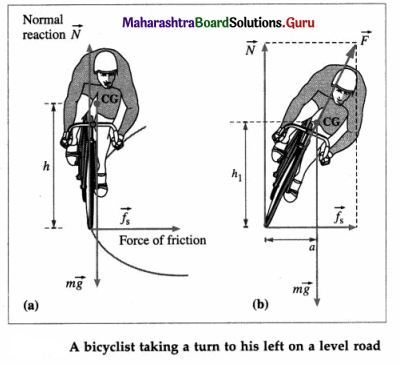
Maharashtra Board Class 12 Physics Solutions Chapter 1 Rotational Dynamics 1

Since the force of friction provides the centripetal force,
fs = \(\frac{m v^{2}}{r}\)
If the cyclist leans from the vertical by an angle 9, the angle between \(\vec{N}\) and \(\vec{F}\) in above figure.
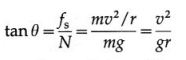
Maharashtra Board Class 12 Physics Solutions Chapter 1 Rotational Dynamics 2
Hence, the cyclist must lean by an angle
θ = tan-1\(\left(\frac{v^{2}}{g r}\right)\)

When a car takes a turn along a level road, apart from the risk of skidding off outward, it also has a tendency to roll outward due to an outward torque about the centre of gravity due to the friction force. But a car is an extended object with four wheels. So, when the inner wheels just get lifted above the ground, it can be counterbalanced by a restoring torque of the couple formed by the normal reaction (on the outer wheels) and the weight.

Question 4.
Using the energy conservation, derive the expressions for the minimum speeds at different locations along a vertical circular motion controlled by gravity. Is zero speed possible at the uppermost point? Under what condition/s? Also prove that the difference between the extreme tensions (or normal forces) depends only upon the weight of the object.
Answer:
In a non uniform vertical circular motion, e.g., those of a small body attached to a string or the loop-the-loop manoeuvers of an aircraft or motorcycle or skateboard, the body must have some minimum speed to reach the top and complete the circle. In this case, the motion is controlled only by gravity and zero speed at the top is not possible.

However, in a controlled vertical circular motion, e.g., those of a small body attached to a rod or the giant wheel (Ferris wheel) ride, the body or the passenger seat can have zero speed at the top, i.e., the motion can be brought to a stop.

Question 5.
Discuss the necessity of radius of gyration. Define it. On what factors does it depend and it does not depend? Can you locate some similarity between the centre of mass and radius of gyration? What can you infer if a uniform ring and a uniform disc have the same radius of gyration?
Answer:
Definition : The radius of gyration of a body rotating about an axis is defined as the distance between the axis of rotation and the point at which the entire mass of the body can be supposed to be concentrated so as to give the same moment of inertia as that of the body about the given axis.
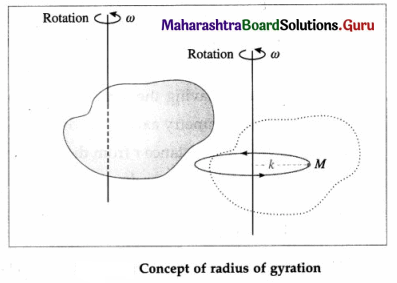
Maharashtra Board Class 12 Physics Solutions Chapter 1 Rotational Dynamics 10
The moment of inertia (MI) of a body about a given rotation axis depends upon

  1. the mass of the body and
  2. the distribution of mass about the axis of rotation. These two factors can be separated by expressing the MI as the product of the mass (M) and the square of a particular distance (k) from the axis of rotation. This distance is called the radius of gyration and is defined as given above. Thus,
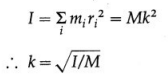
Maharashtra Board Class 12 Physics Solutions Chapter 1 Rotational Dynamics 11

Physical significance : The radius of gyration is less if I is less, i.e., if the mass is distributed close to the axis; and it is more if I is more, i.e., if the mass is distributed away from the axis. Thus, it gives the idea about the distribution of mass about the axis of rotation.

The centre of mass (CM) coordinates locates a point where if the entire mass M of a system of particles or that of a rigid body can be thought to be concentrated such that the acceleration of this point mass obeys Newton’s second law of motion, viz.,
\(\vec{F}_{\mathrm{net}}\) = M\(\overrightarrow{\mathrm{a}}_{\mathrm{CM}}\), where \(\vec{F}_{\mathrm{net}}\) is the sum of all the external forces acting on the body or on the individual particles of the system of particles.

Similarly, radius of gyration locates a point from the axis of rotation where the entire mass M can be thought to be concentrated such that the angular acceleration of that point mass about the axis of rotation obeys the relation, \(\vec{\tau}_{\mathrm{net}}\) = M\(\vec{\alpha}\), where \(\vec{\tau}_{\text {net }}\) is the sum of all the external torques acting on the body or on the individual particles of the system of particles.

Maharashtra Board Class 12 Physics Solutions Chapter 1 Rotational Dynamics

Question 6.
State the conditions under which the theorems of parallel axes and perpendicular axes are applicable. State the respective mathematical expressions.
Answer:
The theorem of parallel axis is applicable to any body of arbitrary shape. The moment of inertia (MI) of the body about an axis through the centre mass should be known, say, ICM. Then, the theorem can be used to find the MI, I, of the body about an axis parallel to the above axis. If the distance between the two axes is h,
I = ICM + Mh2 …(1)
The theorem of perpendicular axes is applicable to a plane lamina only. The moment of inertia Iz of a plane lamina about an axis-the z axis- perpendicular to its plane is equal to the sum of its moments of inertia Ix and Iy about two mutually perpendicular axes x and y in its plane and through the point of intersection of the perpendicular axis and the lamina.
Iz = Ix + Iy …. (2)

Question 7.
Derive an expression that relates angular momentum with the angular velocity of a rigid body.
Answer:
Consider a rigid body rotating with a constant angular velocity \(\vec{\omega}\) about an axis through the point O and perpendicular to the plane of the figure. All the particles of the body perform uniform circular motion about the axis of rotation with the same angular velocity \(\vec{\omega}\). Suppose that the body consists of N particles of masses m1, m2, …, mn, situated at perpendicular distances r1, r2, …, rN, respectively from the axis of rotation.
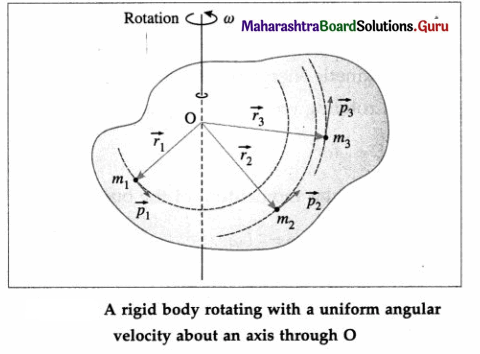
Maharashtra Board Class 12 Physics Solutions Chapter 1 Rotational Dynamics 15
The particle of mass m1 revolves along a circle of radius r1, with a linear velocity of magnitude v1 = r1ω. The magnitude of the linear momentum of the particle is
p1 = m1v1 = m1r1ω
The angular momentum of the particle about the axis of rotation is by definition,
\(\vec{L}_{1}\) = \(\vec{r}_{1}\) × \(\vec{p}_{1}\)
∴ L1 = r1p1 sin θ
where θ is the smaller of the two angles between \(\vec{r}_{1}\) and \(\vec{p}_{1} \text { . }\)
In this case, θ = 90° ∴ sin θ = 1
∴ L1 = r1p1 = r1m1r1ω = m1r12ω
Similarly L2 = m2r22ω, L3 = m3r32ω, etc.
The angular momentum of the body about the given axis is
L = L1 + L2 + … + LN
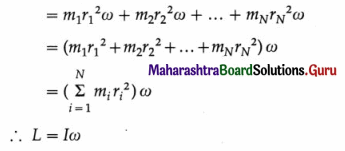
Maharashtra Board Class 12 Physics Solutions Chapter 1 Rotational Dynamics 20
where I = \(\sum_{i=1}^{N} m_{i} r_{i}^{2}\) = moment of inertia of the body about the given axis.
In vector form, \(\vec{L}\) = \(I \vec{\omega}\)
Thus, angular momentum = moment of inertia × angular velocity.
[Note : Angular momentum is a vector quantity. It has the same direction as \(\vec{\omega}\).]

Question 8.
Obtain an expression relating the torque with angular acceleration for a rigid body.
Answer:
A torque acting on a body produces angular acceleration. Consider a rigid body rotating about an axis passing through the point O and perpendicular to the plane of the figure. Suppose that a torque \(\vec{\tau}\) on
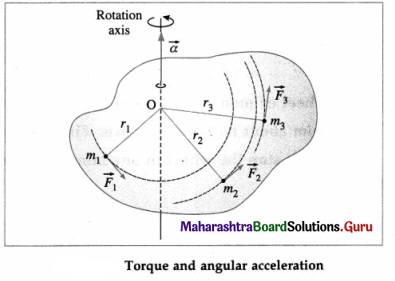
Maharashtra Board Class 12 Physics Solutions Chapter 1 Rotational Dynamics 25
the body produces uniform angular acceleration \(\vec{\alpha}\) along the axis of rotation.
The body can be considered as made up of N particles with masses m1, m2, …, mN situated at perpendicular distances r1, r2, …, rN respectively from the axis of rotation, \(\vec{\alpha}\) is the same for all the particles as the body is rigid. Let \(\vec{F}_{1}\), \(\vec{F}_{2}\), …, \(\vec{F}_{N}\) be the external forces on the particles.
The torque \(\vec{\tau}_{1}\), on the particle of mass m1, is
\(\vec{\tau}_{1}\) = \(\vec{r}_{1}\) × \(\vec{F}_{1}\)
∴ τ1 = r1F1 sin θ
where θ is the smaller of the two angles between \(\vec{r}_{1}\) and \(\vec{F}_{1} .\)
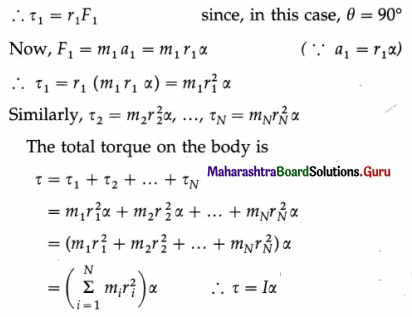
Maharashtra Board Class 12 Physics Solutions Chapter 1 Rotational Dynamics 26
where
Maharashtra Board Class 12 Physics Solutions Chapter 1 Rotational Dynamics 27
is the moment of inertia of the body about the axis of rotation.
In vector form, \(\vec{\tau}\) = I\(\vec{\alpha}\)
This gives the required relation.
Angular acceleration \(\vec{\alpha}\) has the same direction as the torque \(\vec{\tau}\) and both of them are axial vectors along the rotation axis.

Question 9.
State and explain the principle of conservation of angular momentum. Use a suitable illustration. Do we use it in our daily life? When?
Answer:
Law (or principle) of conservation of angular momentum : The angular momentum of a body is conserved if the resultant external torque on the body is zero.
Explanation : This law (or principle) is used by a figure skater or a ballerina to increase their speed of rotation for a spin by reducing the body’s moment of inertia. A diver too uses it during a somersault for the same reason.

(1) Ice dance :
Twizzle and spin are elements of the sport of figure skating. In a twizzle a skater turns several revolutions while travelling on the ice. In a dance spin, the skater rotates on the ice skate and centred on a single point on the ice. The torque due to friction between the ice skate and the ice is small. Consequently, the angular momentum of a figure skater remains nearly constant.

For a twizzle of smaller radius, a figure skater draws her limbs close to her body to reduce moment of inertia and increase frequency of rotation. For larger rounds, she stretches out her limbs to increase moment of inertia which reduces the angular and linear speeds.

A figure skater usually starts a dance spin in a crouch, rotating on one skate with the other leg and both arms extended. She rotates relatively slowly because her moment of inertia is large. She then slowly stands up, pulling the extended leg and arms to her body. As she does so, her moment of inertia about the axis of rotation decreases considerably,and thereby her angular velocity substantially increases to conserve angular momentum.
Maharashtra Board Class 12 Physics Solutions Chapter 1 Rotational Dynamics 35

(2) Diving :
Take-off from a springboard or diving platform determines the diver’s trajectory and the magnitude of angular momentum. A diver must generate angular momentum at take-off by moving the position of the arms and by a slight hollowing of the back. This allows the diver to change angular speeds for twists and somersaults in flight by controlling her/his moment of inertia. A compact tucked shape of the body lowers the moment of inertia for rotation of smaller radius and increased angular speed. The opening of the body for the vertical entry into water does not stop the rotation, but merely slows it down. The angular momentum remains constant throughout the flight.

Maharashtra Board Class 12 Physics Solutions Chapter 1 Rotational Dynamics

Question 10.
Discuss the interlink between translational, rotational and total kinetic energies of a rigid object that rolls without slipping.
Answer:
Consider a symmetric rigid body, like a sphere or a wheel or a disc, rolling on a plane surface with friction along a straight path. Its centre of mass (CM) moves in a straight line and, if the frictional force on the body is large enough, the body rolls without slipping. Thus, the rolling motion of the body can be treated as translation of the CM and rotation about an axis through the CM. Hence, the kinetic energy of a rolling body is
E = Etran + Erot ……. (1)

where Etran and Erot are the kinetic energies associated with translation of the CM and rotation about an axis through the CM, respectively.

Let M and R be the mass and radius of the body. Let ω, k and i be the angular speed, radius of gyration and moment of inertia for rotation about an axis through its centre, and v be the translational speed of the centre of mass.
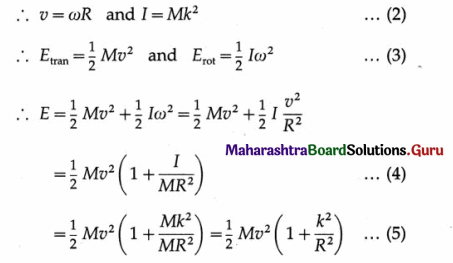
Maharashtra Board Class 12 Physics Solutions Chapter 1 Rotational Dynamics 36

Question 11.
A rigid object is rolling down an inclined plane. Derive expressions for the acceleration along the track and the speed after falling through a certain vertical distance.
Answer:
Consider a circularly symmetric rigid body, like a sphere or a wheel or a disc, rolling with friction down a plane inclined at an angle 9 to the horizontal. If the frictional force on the body is large enough, the body rolls without slipping.
Let M and R be the mass and radius of the body. Let I be the moment of inertia of the body for rotation about an axis through its centre. Let the body start from rest at the top of the incline at a
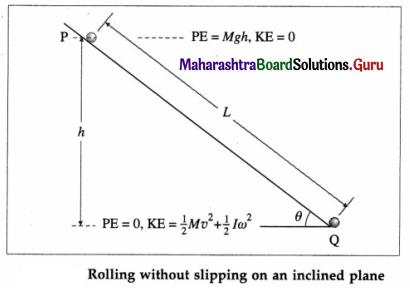
Maharashtra Board Class 12 Physics Solutions Chapter 1 Rotational Dynamics 37
height h. Let v be the translational speed of the centre of mass at the bottom of the incline. Then, its kinetic energy at the bottom of the incline is
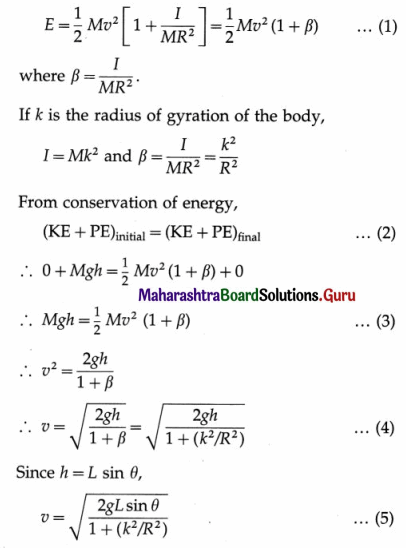
Maharashtra Board Class 12 Physics Solutions Chapter 1 Rotational Dynamics 38
Let a be the acceleration of the centre of mass of the body along the inclined plane. Since the body starts from rest,
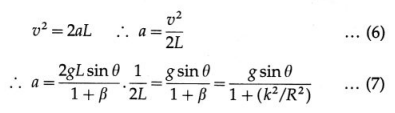
Maharashtra Board Class 12 Physics Solutions Chapter 1 Rotational Dynamics 39
Starting from rest, if t is the time taken to travel the distance L,
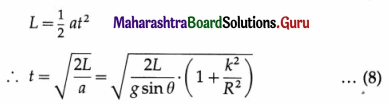
Maharashtra Board Class 12 Physics Solutions Chapter 1 Rotational Dynamics 40
[Note : For rolling without slipping, the contact point of the rigid body is instantaneously at rest relative to the surface of the inclined plane. Hence, the force of friction is static rather than kinetic, and does no work on the body. Thus, the force of static friction causes no decrease in the mechanical energy of the body and we can use the principle of conservation of energy.]

Question 12.
Somehow, an ant is stuck to the rim of a bicycle wheel of diameter 1 m. While the bicycle is on a central stand, the wheel
is set into rotation and it attains the frequency of 2 rev/s in 10 seconds, with uniform angular acceleration. Calculate
(i) Number of revolutions completed by the ant in these 10 seconds.
(ii) Time taken by it for first complete revolution and the last complete revolution.
[Ans:10 rev., tfirst = \(\sqrt{10}\)s, tlast = 0.5132s]
Answer:
Data : r = 0.5 m, ω0 = 0, ω = 2 rps, t = 10 s

(i) Angular acceleration (α) being constant, the average angular speed,
ωav = \(\frac{\omega_{\mathrm{o}}+\omega}{2}\) = \(\frac{0+2}{2}\) = 1 rps
∴ The angular displacement of the wheel in time t,
θ = ωav ∙ t = 1 × 10 = 10 revolutions

(ii)
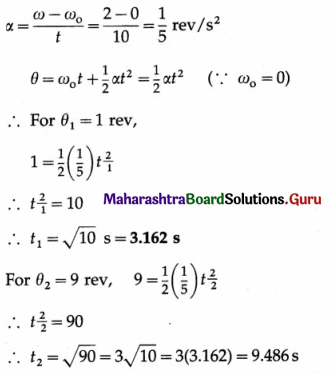
Maharashtra Board Class 12 Physics Solutions Chapter 1 Rotational Dynamics 41
The time for the last, i.e., the 10th, revolution is t1 – t2 = 10 – 9.486 = 0.514 s

Question 13.
Coefficient of static friction between a coin and a gramophone disc is 0.5. Radius of the disc is 8 cm. Initially the
centre of the coin is 2 cm away from the centre of the disc. At what minimum frequency will it start slipping from there? By what factor will the answer change if the coin is almost at the rim?
(use g = π2 m/s2)
[Ans: 2.5 rev/s, n2 = \(\frac{1}{2}\)n1]
Answer:
Data : µs = 0.5, r1 = π cm = π × 10-2 m, r2 = 8 cm = 8 × 10⁻² m, g = π2 m/s2
To revolve with the disc without slipping, the necessary centripetal force must be less than or equal to the limiting force of static friction.
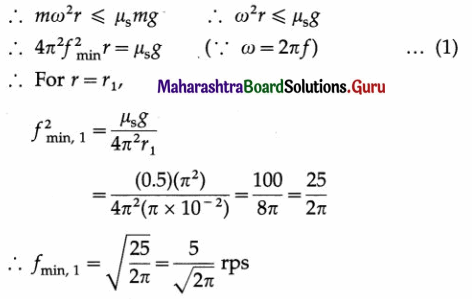
Maharashtra Board Class 12 Physics Solutions Chapter 1 Rotational Dynamics 43
The coin will start slipping when the frequency is
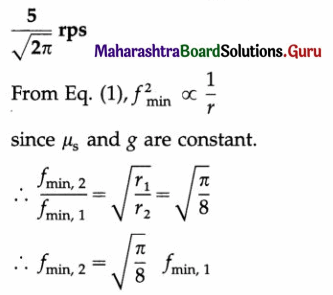
Maharashtra Board Class 12 Physics Solutions Chapter 1 Rotational Dynamics 44
The minimum frequency in the second case will be \(\sqrt{\frac{\pi}{8}}\) times that in the first case.
[ Note The answers given in the textbook are for r1 = 2 cm.]

Question 14.
Part of a racing track is to be designed for a radius of curvature of 72 m. We are not recommending the vehicles to drive faster than 216 kmph. With what angle should the road be tilted? At what height will its outer edge be, with respect to the inner edge if the track is 10 m wide?
[Ans: θ = tan-1 (5) = 78.69°, h = 9.8 m]
Answer:
Data : r = 72 m, v0 = 216 km/h, = 216 × \(\frac{5}{18}\)
= 60 m/s, w = 10 m, g = 10 m/s2
tan θ = \(\frac{v_{\mathrm{o}}^{2}}{r g}\) = \(\frac{(60)^{2}}{72 \times 10}\) = \(\frac{3600}{720}\) = 5
∴ θ = tan-1 5 = 78°4′
This is the required angle of banking.
sin θ = \(\frac{h}{w}\)
∴ h = w sin θ = (10) sin 78°4′ = 10 × 0.9805
= 9.805 m
This gives the height of the outer edge of the track relative to the inner edge.

Question 15.
The road in the example 14 above is constructed as per the requirements. The coefficient of static friction between the tyres of a vehicle on this road is 0.8, will there be any lower speed limit? By how much can the upper speed limit exceed in this case?
[Ans: vmin ≅ 88 kmph, no upper limit as the road is banked for θ > 45°]
Answer:
Data : r = 72 m, θ = 78 °4′, µs = 0.8, g = 10 m/s2 tan θ = tan 78°4′ = 5
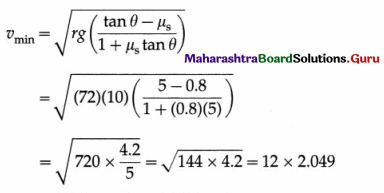
Maharashtra Board Class 12 Physics Solutions Chapter 1 Rotational Dynamics 45
= 24.588 m/s = 88.52 km/h
This will be the lower limit or minimum speed on this track.
Since the track is heavily banked, θ > 45 °, there is no upper limit or maximum speed on this track.

Question 16.
During a stunt, a cyclist (considered to be a particle) is undertaking horizontal circles inside a cylindrical well of radius 6.05 m. If the necessary friction coefficient is 0.5, how much minimum speed should the stunt artist maintain? Mass of the artist is 50 kg. If she/he increases the speed by 20%, how much will the force of friction be?
[Ans: vmin = 11 m/s, fs = mg = 500 N]
Answer:
Data : r = 6.05 m, µs = 0.5, g = 10 m/s2, m = 50 kg, ∆v = 20%
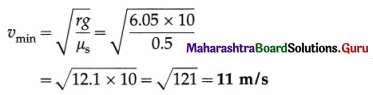
Maharashtra Board Class 12 Physics Solutions Chapter 1 Rotational Dynamics 72
This is the required minimum speed. So long as the cyclist is not sliding, at every instant, the force of static friction is fs = mg = (50)(10) = 500 N

Question 17.
A pendulum consisting of a massless string of length 20 cm and a tiny bob of mass 100 g is set up as a conical pendulum. Its bob now performs 75 rpm. Calculate kinetic energy and increase in the gravitational potential energy of the bob. (Use π 2 = 10 )
[Ans: cos θ = 0.8, K.E. = 0.45 J, ∆(P E.) = 0.04 J]
Answer:
Data : L = 0.2 m, m = 0.1 kg, n = \(\frac{75}{60}\) = \(\frac{5}{4}\) rps,
g = 10 m/s2, π2 = 10,
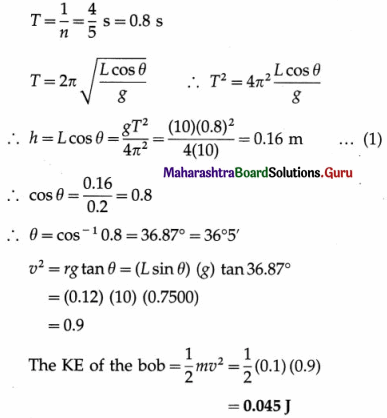
Maharashtra Board Class 12 Physics Solutions Chapter 1 Rotational Dynamics 50
The increase in gravitational PE,
∆PE = mg(L – h)
= (0.1) (10) (0.2 – 0.16)
= 0.04 J

Maharashtra Board Class 12 Physics Solutions Chapter 1 Rotational Dynamics

Question 18.
A motorcyclist (as a particle) is undergoing vertical circles inside a sphere of death. The speed of the motorcycle varies between 6 m/s and 10 m/s. Calculate diameter of the sphere of death. What are the minimum values are possible for these two speeds?
[Ans: Diameter = 3.2 m, (v1)min = 4 m/s, (v2)min = 4 \(\sqrt{5}\)/m s ]
Answer:
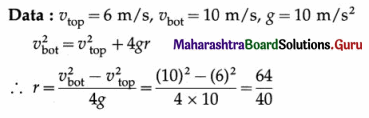
Maharashtra Board Class 12 Physics Solutions Chapter 1 Rotational Dynamics 51
= 1.6 m
The diameter of the sphere of death = 3.2 m.
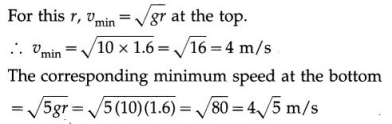
Maharashtra Board Class 12 Physics Solutions Chapter 1 Rotational Dynamics 52
The required minimum values of the speeds are 4 m/s and 4\(\sqrt{5}\) m/s.

Question 19.
A metallic ring of mass 1 kg has moment of inertia 1 kg m2 when rotating about one of its diameters. It is molten and remoulded into a thin uniform disc of the same radius. How much will its moment of inertia be, when rotated about its own axis.
[Ans: 1 kg m2]
Answer:
The MI of the thin ring about its diameter,
Iring = \(\frac{1}{2}\)MR2 = 1 kg.m2
Since the ring is melted and recast into a thin disc of same radius R, the mass of the disc equals the mass of the ring = M.
The MI of the thin disc about its own axis (i.e., transverse symmetry axis) is
Idisc = \(\frac{1}{2}\)MR2 = Iring
∴ Idisc = 1 kg.m2

Question 20.
A big dumb-bell is prepared by using a uniform rod of mass 60 g and length 20 cm. Two identical solid thermocol spheres of mass 25 g and radius 10 cm each are at the two ends of the rod. Calculate moment of inertia of the dumbbell when rotated about an axis passing through its centre and perpendicular to the length.
[Ans: 24000 g cm-2]
Answer:
Data : Msph = 50 g, Rsph = 10 cm, Mrod = 60 g, Lrod = 20 cm
The MI of a solid sphere about its diameter is
Isph,CM = \(\frac{2}{5}\)MsphRsph
The distance of the rotation axis (transverse symmetry axis of the dumbbell) from the centre of sphere, h = 30 cm.
The MI of a solid sphere about the rotation axis, Isph = Isph, CM + Msphh2
For the rod, the rotation axis is its transverse symmetry axis through CM.
The MI of a rod about this axis,
Irod = \(\frac{1}{12}\) MrodL2rod
Since there are two solid spheres, the MI of the dumbbell about the rotation axis is
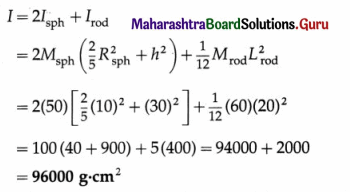
Maharashtra Board Class 12 Physics Solutions Chapter 1 Rotational Dynamics 55

Question 21.
A flywheel used to prepare earthenware pots is set into rotation at 100 rpm. It is in the form of a disc of mass 10 kg and
radius 0.4 m. A lump of clay (to be taken equivalent to a particle) of mass 1.6 kg falls on it and adheres to it at a certain
distance x from the centre. Calculate x if the wheel now rotates at 80 rpm.
[Ans: x = \(\frac{1}{\sqrt{8}}\)m = 0.35 m]
Answer:
Data : f1 = 60 rpm = 60/60 rot/s = 1 rot/s,
f2 = 30 rpm = 30/60 rot/s = \(\frac{1}{2}\) rot/s, ∆E = — 100 J

(i)
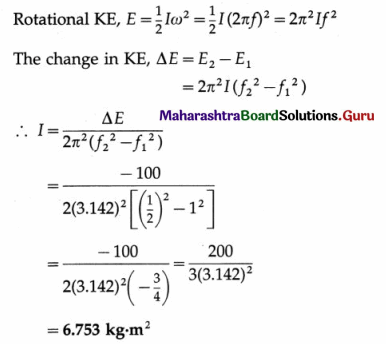
Maharashtra Board Class 12 Physics Solutions Chapter 1 Rotational Dynamics 56
This gives the MI of the flywheel about the given axis.

(ii) Angular momentum, L = Iω = I(2πf) = 2πIf
The change in angular momentum, ∆L
= L2 – L1 = 2πI(f2 – f1)
= 2 × 3.142 × 6.753(\(\frac{1}{2}\) – 1)
= -3.142 × 6.753 = -21.22 kg.m2/s

Question 22.
Starting from rest, an object rolls down along an incline that rises by 3 units in every 5 units (along it). The object gains a speed of \(\sqrt{10}\) m/s as it travels a distance of \(\frac{5}{3}\)m along the incline. What can be the possible shape/s of the object?
[Ans: \(\frac{K^{2}}{R^{2}}\) = 1. Thus, a ring or a hollow cylinder]
Answer:
Data : sin θ = \(\frac{3}{5}\), u = 0, v = \(\sqrt{10}\) m/s, L = \(\frac{5}{3}\)m, g = 10 m/s2
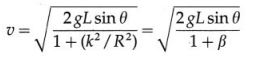
Maharashtra Board Class 12 Physics Solutions Chapter 1 Rotational Dynamics 60
Maharashtra Board Class 12 Physics Solutions Chapter 1 Rotational Dynamics 61
Therefore, the body rolling down is either a ring or a cylindrical shell.

12th Physics Digest Chapter 1 Rotational Dynamics Intext Questions and Answers

Activity (Textbook Page No. 3)

Question 1.
Attach a body of suitable mass to a spring balance so that it stretches by about half its capacity. Now whirl the spring balance so that the body performs a horizontal circular motion. You will notice that the balance now reads more for the same body. Can you explain this ?
Answer:
Due to outward centrifugal force.

Use your brain power (Textbook Page No. 4)

Question 1.
Obtain the condition for not toppling (rollover) for a four-wheeler. On what factors does it depend and how?
Answer:
Consider a car of mass m taking a turn of radius r along a level road. As seen from an inertial frame of reference, the forces acting on the car are :

  1. the lateral limiting force of static friction \(\overrightarrow{f_{\mathrm{s}}}\) on the wheels-acting along the axis of the wheels and towards the centre of the circular path- which provides the necessary centripetal force,
  2. the weight \(m \vec{g}\) acting vertically downwards at the centre of gravity (C.G.)
  3. the normal reaction \(\vec{N}\) of the road on the wheels, acting vertically upwards effectively at the C.G. Since maximum centripetal force = limiting force of static friction,
    mar = \(\frac{m v^{2}}{r}\) = fs…. (1)

In a simplified rigid-body vehicle model, we consider only two parameters-the height h of the C.G. above the ground and the average distance b between the left and right wheels called the track width.
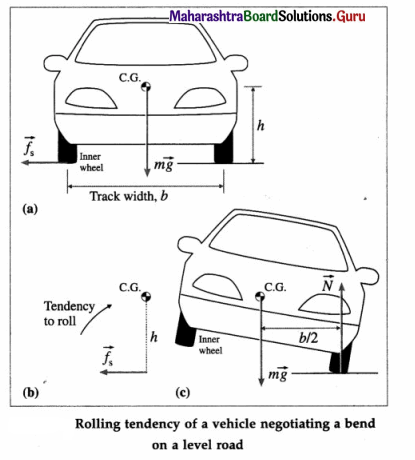
Maharashtra Board Class 12 Physics Solutions Chapter 1 Rotational Dynamics 201
The friction force \(\overrightarrow{f_{s}}\) on the wheels produces a torque \(\tau_{\mathrm{t}}\) that tends to overturn/rollover the car about the outer wheel. Rotation about the front-to-back axis is called roll.
\(\tau_{\mathrm{t}}\) = fs.h = \(\left(\frac{m v^{2}}{r}\right)\)h … (2)

When the inner wheel just gets lifted above the ground, the normal reaction \(\vec{N}\) of the road acts on the outer wheels but the weight continues to act at the C.G. Then, the couple formed by the normal reaction and the weight produces a opposite torque \(\tau_{\mathrm{r}}\) which tends to restore the car back on all four wheels
\(\tau_{\mathrm{r}}\) = mg.\(\frac{b}{2}\) …. (3)
The car does not topple as long as the restoring torque \(\tau_{\mathrm{r}}\) counterbalances the toppling torque \(\tau_{\mathrm{t}}\). Thus, to avoid the risk of rollover, the maximum speed that the car can have is given by
\(\left(\frac{m v^{2}}{r}\right)\)h = mg.\(\frac{b}{2}\) ∴ vmax = \(\sqrt{\frac{r b g}{2 h}}\) … (4)

Thus, vehicle tends to roll when the radial acceleration reaches a point where inner wheels of the four-wheeler are lifted off of the ground and the vehicle is rotated outward. A rollover occurs when the gravitational force \(m \vec{g}\) passes through the pivot point of the outer wheels, i.e., the C.G. is above the line of contact of the outer wheels. Equation (3) shows that this maximum speed is high for a car with larger track width and lower centre of gravity.

There will be rollover (before skidding) if \(\tau_{t}\) ≥ \(\tau_{\mathrm{r}}\), that is if
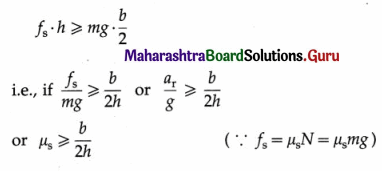
Maharashtra Board Class 12 Physics Solutions Chapter 1 Rotational Dynamics 202
The vehicle parameter ratio, \(\frac{b}{2 h}\), is called the static stability factor (SSF). Thus, the risk of a rollover is low if SSF ≤ µs. A vehicle will most likely skid out rather than roll if µs is too low, as on a wet or icy road.

Question 2.
Think about the normal reactions. Where are those and how much are those?
Answer:
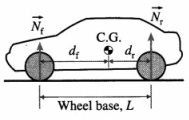
Maharashtra Board Class 12 Physics Solutions Chapter 1 Rotational Dynamics 203
In a simplified vehicle model, we assume the normal reactions to act equally on all the four wheels, i.e., mg/4 on each wheel. However, the C.G. is not at the geometric centre of a vehicle and the wheelbase (i.e., the distance L between its front and rear wheels) affects the weight distribution of the vehicle. When a vehicle is not accelerating, the normal reactions on each pair of front and rear wheels are, respectively,
Nf = \(\frac{d_{\mathrm{r}}}{L}\)mg and Nr = \(\frac{d_{\mathrm{f}}}{L}\) mg
where dr and df are the distances of the rear and front axles from the C.G. [When a vehicle accelerates, additional torque acts on the axles and the normal reactions on the wheels change. So, as is common experience, a car pitches back (i.e., rear sinks and front rises) when it accelerates, and a car pitches ahead (i.e., front noses down). Rotation about the lateral axis is called pitch.]

Question 3.
What is the recommendations on loading a vehicle for not toppling easily?
Answer:
Overloading (or improper load distribution) or any load placed on the roof raises a vehicle’s centre of gravity, and increases the vehicle’s likelihood of rolling over. A roof rack should be fitted by considering weight limits.

Road accidents involving rollovers show that vehicles with higher h (such as SUVs, pickup vans and trucks) topple more easily than cars. Untripped rollovers normally occur when a top-heavy vehicle attempts to perform a panic manoeuver that it physically cannot handle.

Question 4.
If a vehicle topples while turning, which wheels leave the contact with the road? Why?
Answer:
Inner wheels.
Consider a car of mass m taking a turn of radius r along a level road. As seen from an inertial frame of reference, the forces acting on the car are :

  1. the lateral limiting force of static friction \(\overrightarrow{f_{\mathrm{s}}}\) on the wheels-acting along the axis of the wheels and towards the centre of the circular path- which provides the necessary centripetal force,
  2. the weight \(m \vec{g}\) acting vertically downwards at the centre of gravity (C.G.)
  3. the normal reaction \(\vec{N}\) of the road on the wheels, acting vertically upwards effectively at the C.G. Since maximum centripetal force = limiting force of static friction,
    mar = \(\frac{m v^{2}}{r}\) = fs…. (1)

In a simplified rigid-body vehicle model, we consider only two parameters-the height h of the C.G. above the ground and the average distance b between the left and right wheels called the track width.
Maharashtra Board Class 12 Physics Solutions Chapter 1 Rotational Dynamics 201
The friction force \(\overrightarrow{f_{s}}\) on the wheels produces a torque \(\tau_{\mathrm{t}}\) that tends to overturn/rollover the car about the outer wheel. Rotation about the front-to-back axis is called roll.
\(\tau_{\mathrm{t}}\) = fs.h = \(\left(\frac{m v^{2}}{r}\right)\)h … (2)

When the inner wheel just gets lifted above the ground, the normal reaction \(\vec{N}\) of the road acts on the outer wheels but the weight continues to act at the C.G. Then, the couple formed by the normal reaction and the weight produces a opposite torque \(\tau_{\mathrm{r}}\) which tends to restore the car back on all four wheels
\(\tau_{\mathrm{r}}\) = mg.\(\frac{b}{2}\) …. (3)
The car does not topple as long as the restoring torque \(\tau_{\mathrm{r}}\) counterbalances the toppling torque \(\tau_{\mathrm{t}}\). Thus, to avoid the risk of rollover, the maximum speed that the car can have is given by
\(\left(\frac{m v^{2}}{r}\right)\)h = mg.\(\frac{b}{2}\) ∴ vmax = \(\sqrt{\frac{r b g}{2 h}}\) … (4)

Thus, vehicle tends to roll when the radial acceleration reaches a point where inner wheels of the four-wheeler are lifted off of the ground and the vehicle is rotated outward. A rollover occurs when the gravitational force \(m \vec{g}\) passes through the pivot point of the outer wheels, i.e., the C.G. is above the line of contact of the outer wheels. Equation (3) shows that this maximum speed is high for a car with larger track width and lower centre of gravity.

Question 5.
How does [tendency to] toppling affect the tyres?
Answer:
While turning, shear stress acts on the tyre-road contact area. Due to this, the treads and side wall of a tyre deform. Apart from less control, this contributes to increased and uneven wear of the shoulder of the tyres.

Each wheel is placed under a small inward angle (called camber) in the vertical plane. Under severe lateral acceleration, when the car rolls, the camber angle ensures the complete contact area is in contact with the road and the wheels are now in vertical position. This improves the cornering behavior of the car. Improperly inflated and worn tyres can be especially dangerous because they inhibit the ability to maintain vehicle control. Worn tires may cause the vehicle to slide
sideways on wet or slippery pavement, sliding the vehicle off the road and increasing its risk of rolling over.

Maharashtra Board Class 12 Physics Solutions Chapter 1 Rotational Dynamics

Question 6.
What is the recommendation for this?
Answer:
Because of uneven wear of the tyre shoulders, tyres should be rotated every 10000 km-12000 km. To avoid skidding, rollover and tyre-wear, the force of friction should not be relied upon to provide the necessary centripetal force during cornering. Instead, the road surface at a bend should be banked, i.e., tilted inward.

A car while taking a turn performs circular motion. If the road is level (or horizontal road), the necessary centripetal force is the force of static friction between the car tyres and the road surface. The friction depends upon the nature of the surfaces in contact and the presence of oil and water on the road. If the friction is inadequate, a speeding car may skid off the road. Since the friction changes with circumstances, it cannot be relied upon to provide the necessary centripetal force. Moreover, friction results in fast wear and tear of the tyres.

To avoid the risk of skidding as well as to reduce the wear and tear of the car tyres, the road surface at a bend is tilted inward, i.e., the outer side of the road is raised above its inner side. This is called banking of road. On a banked road, the resultant of the normal reaction and the gravitational force can act as the necessary centripetal force. Thus, every car can be safely driven on such a banked curve at certain optimum speed, without depending on friction. Hence, a road should be properly banked at a bend.

The angle of banking is the angle of inclination of the surface of a banked road at a bend with the horizontal.

When a two-wheeler takes a turn along an unbanked road, the force of friction provides the centripetal force. The two-wheeler leans inward to counteract a torque that tends to topple it outward. Firstly, friction cannot be relied upon to provide the necessary centripetal force on all road conditions. Secondly, the friction results in wear and tear of the tyres. On a banked road at a turn, any vehicle can negotiate the turn without depending on friction and without straining the tyres.

Question 7.
Determine the angle to be made with the vertical by a two-wheeler while turning on a horizontal track?
Answer:

When a bicyclist takes a turn along an unbanked road, the force of friction \(\vec{f}_{\mathrm{s}}\) provides the centripetal force; the normal reaction of the road \(\vec{N}\) is vertically up. If the bicyclist does not lean inward, there will be an unbalanced outward torque about the centre of gravity, fs.h, due to the friction force that will topple the bicyclist outward. The bicyclist must lean inward to counteract this torque (and not to generate a centripetal force) such that the opposite inward torque of the couple formed by \(\vec{N}\) and the weight \(\vec{g}\), mg.a = fs.h1
Maharashtra Board Class 12 Physics Solutions Chapter 1 Rotational Dynamics 1

Since the force of friction provides the centripetal force,
fs = \(\frac{m v^{2}}{r}\)
If the cyclist leans from the vertical by an angle 9, the angle between \(\vec{N}\) and \(\vec{F}\) in above figure.
Maharashtra Board Class 12 Physics Solutions Chapter 1 Rotational Dynamics 2
Hence, the cyclist must lean by an angle
θ = tan-1\(\left(\frac{v^{2}}{g r}\right)\)

When a car takes a turn along a level road, apart from the risk of skidding off outward, it also has a tendency to roll outward due to an outward torque about the centre of gravity due to the friction force. But a car is an extended object with four wheels. So, when the inner wheels just get lifted above the ground, it can be counterbalanced by a restoring torque of the couple formed by the normal reaction (on the outer wheels) and the weight.

Question 8.
We have mentioned about ‘static friction’ between road and tyres. Why is it static friction? What about kinetic friction between road and tyres?
Answer:
When a car takes a turn on a level road, the point of contact of the wheel with the surface is instantaneously stationary if there is no slipping. Hence, the lateral force on the car is the limiting force of static friction between the tyres and road. Lateral forces allow the car to turn. As long as the wheels are rolling, there is lateral force of static friction and longitudinal force of rolling friction. Longtitudinal forces, which act in the direction of motion of the car body (or in the exact opposite direction), control the acceleration or deceleration of the car and therefore the speed of the car. These are the wheel force, rolling friction, braking force and air drag. If the car skids, the friction force is kinetic friction; more importantly, the direction of the friction force then changes abruptly from lateral to that opposite the velocity of skidding and not towards the centre of the curve, so that the car cannot continue in its curved path.

Question 9.
What do you do if your vehicle is trapped on a slippery or sandy road? What is the physics involved?
Answer:
Driving on a country road should be attempted only with a four-wheel drive. However, if you do get stuck in deep sand or mud, avoid unnecessary panic and temptation to drive your way out of the mud or sand because excessive spinning of your tyres will most likely just dig you into a deeper hole. Momentum is the key to getting unstuck from sand or mud. One method is the rocking method-rocking your car backwards and forwards to gain momentum. Your best option is usually to gain traction and momentum by wedging a car mat (or sticks, leaves, gravel or rocks) in front and under your drive wheels. Once you start moving, keep the momentum going until you are on more solid terrain.

Use your brain power (Textbook Page No. 6)

Question 1.
As a civil engineer, you are to construct a curved road in a ghat. In order to calculate the banking angle 0, you need to decide the speed limit. How will you decide the values of speed and radius of curvature at the bend ?
Answer:
For Indian roads, Indian Road Congress (IRC), [IRC-73-1980, Table 2, p.4], specifies the design speed depending on the classification of roads (such as national and state highways, district roads and village roads) and terrain. It is the basic design parameter which determines further geometric design features. For the radius of curvature at a bend, IRC [ibid., Table 16, p.24] specifies the absolute minimum values based on the minimum design speed. However, on new roads, curves should be designed to have the largest practicable radius, generally more than the minimum values specified, to allow for ‘sight distance’ and ‘driver comfort’. To consider the motorist driving within the innermost travel lane, the radius used to design horizontal curves should be measured to the inside edge of the innermost travel lane, particularly for wide road-ways with sharp horizontal curvature.

A civil engineer refers to banking as superelevation e;e = tan θ. IRC fixes emax = 0.07 for a non-urban road and the coefficient of lateral static friction, µ = 0.15, the friction between the vehicle tyres and the road being incredibly variable. Ignoring the product eµ, from Eq. (6)
e + µ = \(\frac{v^{2}}{g r}\) (where both v and r are in SI units)
= \(\frac{V^{2}}{127 r}\)(where V is in km / h and r is in metre) …. (1)
The sequence of design usually goes like this :

  1. Knowing the design speed V and radius r, calculate the superelevation for 75% of design speed ignormg friction : e = \(\frac{(0.75 \mathrm{~V})^{2}}{127 r}\) = \(\frac{V^{2}}{225 r}\)
  2. If e < 0.07, consider this calculated value of e in subsequent calculations. If e > 0.07, then take e = emax = 0.07.
  3. Use Eq. (1) above to check the value of µ for emax = 0.07 at the full value of the design speed V : µ = \(\frac{V^{2}}{127 r}\) – 0.07
    If µ < 0.15, then e = 0.07 is safe. Otherwise, calculate the allowable speed Va as in step 4.
  4. \(\frac{V_{\mathrm{a}}^{2}}{127 r}\) = e + p = 0.07 + 0.15
    If Va > V, then the design speed V is adequate.
    If Va < V, then speed is limited to Va with appropriate warning sign.

Use your brain power (Textbook Page No. 7)

Question 1.
If friction is zero, can a vehicle move on the road? Why are we not considering the friction in deriving the expression for the banking angle?
Answer:
Friction is necessary for any form of locomotion. Without friction, a vehicle cannot move. The banking angle for a road at a bend is calculated for optimum speed at which every vehicle can negotiate the bend without depending on friction to provide the necessary lateral centripetal force.

Question 2.
What about the kinetic friction between the road and the lyres?
Answer:
When a car takes a turn on a level road, the point of contact of the wheel with the surface is instantaneously stationary if there is no slipping. Hence, the lateral force on the car is the limiting force of static friction between the tyres and road. Lateral forces allow the car to turn. As long as the wheels are rolling, there is lateral force of static friction and longitudinal force of rolling friction. Longtitudinal forces, which act in the direction of motion of the car body (or in the exact opposite direction), control the acceleration or deceleration of the car and therefore the speed of the car. These are the wheel force, rolling friction, braking force and air drag. If the car skids, the friction force is kinetic friction; more importantly, the direction of the friction force then changes abruptly from lateral to that opposite the velocity of skidding and not towards the centre of the curve, so that the car cannot continue in its curved path.

Use your brain power (Textbook Page No. 12)

Question 1.
What is expected to happen if one travels fast over a speed breaker? Why?
Answer:
The maximum speed with which a car can travel over a road surface, which is in the form of a convex arc of radius r, is \(\sqrt{r g}\) where g is the acceleration due to gravity. For a speed breaker, r is very small (of the order of 1 m). Hence, one must slow down considerably while going over a speed breaker. Otherwise, the car will lose contact with the road and land with a thud.

Question 2.
How does the normal force on a concave suspension bridge change when a vehicle is travelling on it with a constant speed ?
Answer:
At the lowest point, N-mg provides the centripetal force. Therefore, N-mg = \(\frac{m v^{2}}{r}\), so that N = m(g + \(\frac{v^{2}}{r}\)).
Therefore, N increases with increasing v.

Maharashtra Board Class 12 Physics Solutions Chapter 1 Rotational Dynamics

Use your brain power (Textbook Page No. 15)

Question 1.
For the point P in above, we had to extend OC to Q to meet the perpendicular PQ. What will happen to the expression for I if the point P lies on OC?
Answer:
There will be no change in the expression for the MI (I) about the parallel axis through O.

Maharashtra Board Class 12 Physics Solutions Chapter 16 Semiconductor Devices

Balbharti Maharashtra State Board 12th Physics Textbook Solutions Chapter 16 Semiconductor Devices Textbook Exercise Questions and Answers.
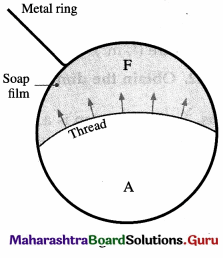
Maharashtra State Board 12th Physics Solutions Chapter 16 Semiconductor Devices

1. Choose the correct option
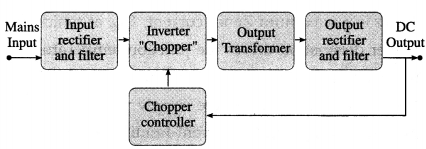
i.
In a BJT, the largest current flow occurs
(A) in the emitter
(B) in the collector
(C) in the base
(D) through CB junction.
Answer:
(A) in the emitter

ii.
A series resistance is connected in the Zener diode circuit to
(A) properly reverse bias the Zener
(B) protect the Zener
(C) properly forward bias the Zener
(D) protect the load resistance.
Answer:
(A) properly reverse bias the Zener

Maharashtra Board Class 12 Physics Solutions Chapter 1 Semiconductor Devices

iii.
An LED emits visible light when its
(A) junction is reverse biased
(B) depletion region widens
(C) holes and electrons recombine
(D) junction becomes hot.
Answer:
(C) holes and electrons recombine

iv.
Solar cell operates on the principle of
(A) diffusion
(B) recombination
(C) photovoltaic action
(D) carrier flow.
Answer:
(C) photovoltaic action

v.
A logic gate is an electronic circuit which
(A) makes logical decisions
(B) allows electron flow only in one direction
(C) works using binary algebra
(D) alternates between 0 and 1 value.
Answer:
(A) makes logical decisions

2 Answer in brief.

i.
Why is the base of a transistor made thin and is lightly doped?
Answer:
The base of a transistor is lightly doped than the emitter and is made narrow so that virtually all the electrons injected from the emitter (in an npn tran-sistor) diffuse right across the base to the collector junction without recombining with holes. That is, the base width is kept less than the recombination distance. Also, the emitter is much heavily doped than the base to improve emitter efficiency and common-base current gain a.

ii.
How is a Zener diode different than an ordinary diode?
Answer:
A Zener diode is heavily doped-the doping con-centrations for both p- and n-regions is greater than 1018 cm-3 while those of an ordinary diode are voltage (PIV) of an ordinary diode is higher than a Zener diode and the breakdown occurs by impact ionization (avalanche process). Their I-V characteristics are otherwise similar.

iii.
On which factors does the wavelength of light emitted by a LED depend?
Answer:
The intensity of the emitted light is directly propor-tional to the recombination rate and hence to the diode forward current. The colour of the light emitted by an LED depends on the compound semiconductor material used and its composition (and doping levels) as given below :
Table: Typical semiconductor materials and emitted colours of LEDs

MaterialEmitted colour(s)
Gallium arsenide (GaAs), Indium gallium arsenide phosphide (InGaAsP)Infrared
Aluminum gallium arsenide (AlGaAs)Deep red, also IR laser
Indium gallium phosphide (InGaP)Red
Gallium arsenide phosphide (GaAsP), aluminum indium gallium phosphide (AlInGaP)Orange, red or yellow
Gallium phosphide (GaP)Green or yellow
Aluminium gallium phosphide (AlGaP), zinc selenide (ZnSe), zinc selenide telluride (ZnSeTe), nitrogen impregnated gallium phosphide (GaP:N)Green
Indium gallium nitride (InGaN), gallium nitride (GaN), sine sulphide (ZnS)Blue and violet Longer wave lengths (green and yellow) are obtained by increasing the indium (In) content. Phosphor encapsulation produce white light.
Aluminium gallium nitride (AlGaN)


Ultraviolet

iv.
Why should a photodiode be operated in reverse biased mode?
Answer:
A photodiode is operated in a reverse biased mode because as photodetector or photosensor, it must conduct only when radiation is incident on it. In the reverse biased mode, the dark current for zero illumination is negligibly small—of the order of few picoamperes to nanoamperes. But when illuminated, the photocurrent is several orders of magnitude greater.

v.
State the principle and uses of a solar Cell.
Answer:
A solar cell is an unbiased pn-junction that converts the energy of sunlight directly into electricity with a high conversion efficiency.

Principle : A solar cell works on the photovoltaic effect in which an emf is produced between the two layers of a pn-junction as a result of irradiation.

Maharashtra Board Class 12 Physics Solutions Chapter 1 Semiconductor Devices

Question 3.
Draw the circuit diagram of a half wave rectifier. Explain its working. What is the frequency of ripple in its output?
Answer:
A device or a circuit which rectifies only one-half of each. cycle of an alternating voltage is called a half-wave rectifier.
Electric circuit : The alternating voltage to be rectified is applied across the primary coil (P1P2) of a transformer. The secondary coil (S1S2) of the transformer is connected in series with the junction diode and a load resistance RL, as shown in below figure. The alternating voltage across the secondary coil is the ac input voltage Vi. The dc voltage across the load resistance is called the output voltage V0.
Maharashtra Board Class 12 Physics Solutions Chapter 16 Semiconductor Devices 33
Working : Due to the alternating voltage Vi, the p-region of the diode becomes alternatively positive and negative with respect to the n-region.
During the half-cycle when the p-region is positive, the diode is forward biased and conducts. A current IL passes through the load resistance RL in the direction shown.
Maharashtra Board Class 12 Physics Solutions Chapter 16 Semiconductor Devices 44
During the next half cycle, when the p-region is negative, the diode is reverse biased and the forward current drops to zero.

Thus, the diode conducts only during one-half of the input cycle and thus acts as a half-wave rectifier. The intermittent output voltage V0 has a fixed polarity but changes periodically with time between zero and a maximum value. IL is unidirectional. Above figure shows the input and output voltage waveforms.

The pulsating dc output voltage of a half-wave rectifier has the same frequency as the input.

Question 4.
Why do we need filters in a power supply?
Answer:
A rectifier-half-wave or full-wave – outputs a pul-sating dc which is not directly usable in most electronic circuits. These circuits require something closer to pure dc as produced by batteries. Unlike pure dc waveform of a battery, a rectifier output has an ac ripple riding on a dc waveform.

The circuit used in a dc power supply to remove the ripple is called a filter. A filter circuit can produce a very smooth waveform that approximates the waveform produced by a battery. The most common technique used for filtering is a capacitor connected across the output of a rectifier.

Question 5.
Draw a neat diagram of a full wave rectifier and explain it’s working.
Answer:
A device or a circuit which rectifies both halves of each cycle of an alternating voltage is called a full-wave rectifier.
Electric circuit : The alternating voltage to be rectified is applied across the primary coil (P1P2) of a transformer with a centre-tapped secondary coil (S1S2). The terminals and S2 of the secondary are connected to the two p-regions of two junction diodes D1 and D2, respectively. The centre-tap T is connected to the ground. The load resistance RL is connected across the common n-regions and the
Maharashtra Board Class 12 Physics Solutions Chapter 16 Semiconductor Devices 5
P1P2, S1S2 : Primary and secondary of transformer,
T : Centre-tap on secondary; D1 D2 : Junction diodes,
RL : Load resistance, IL : Load current,
Vi: AC input voltage, V0 : DC output voltage
Above Figure : Full-wave rectifier circuit

Working : During one half cycle of the input, terminal S1 of the secondary is positive while S2 is negative with respect to the ground (the centre-tap T). During this half cycle, diode D1 is forward biased and conducts, while diode D2 is reverse biased and does not conduct. The direction of current ZL through RL is in the sense shown.
Maharashtra Board Class 12 Physics Solutions Chapter 16 Semiconductor Devices 66
During the next half cycle of the input voltage, S2 becomes positive while S, is negative with respect to T. Diode D2 now conducts sending a current IL through RL in the same sense as before. Dt now does not conduct. Thus, the current through RL flows in the same direction, i.e., it is unidirectional, for both halves or the full-wave of the input. This is called full-wave rectification.

The output voltage has a fixed polarity but varies periodically with time between zero and a maximum value. Above figure shows the input and output voltage waveforms. The pulsating dc output voltage of a full-wave rectifier has twice frequency of the input.

Question 6.
Explain how a Zener diode maintains constant voltage across a load.
Answer:
Principle : In the breakdown region of a Zener diode, for widely changing Zener current, the voltage across the Zener diode remains almost constant.
Maharashtra Board Class 12 Physics Solutions Chapter 16 Semiconductor Devices 77
Electric circuit : The circuit for regulating or stabilizing the voltage across a load resistance RL against change in load current and supply voltage is shown in above figure. The Zener diode is connected parallel to load Rh such that the current through the Zener diode is from the n to p region. The series resistance Rs limits the current through the diode below the maximum rated value.
From the circuit, I = IZ + IL and V = IRs + VZ
= (IZ + IL)Rs + VZ
Working: When the input unregulated dc voltage V across the Zener diode is greater than the Zener voltage VZ in magnitude, the diode works in the Zener breakdown region. The voltage across the diode and load Rh is then VZ. The corresponding current in the diode is IZ.

As the load current (I) or supply voltage (V) changes, the diode current (7Z) adjusts itself at constant VZ. The excess voltage V-VZappears across the series resistance Rs.

For constant supply voltage, the supply current I and the voltage drop across Rs remain constant. If the diode is within its regulating range, an increase in load current is accompanied by a decrease in Iz at constant VZ.
Since the voltage across RL remains constant at VZ, the Zener diode acts as a voltage stabilizer or voltage regulator.

Maharashtra Board Class 12 Physics Solutions Chapter 1 Semiconductor Devices

Question 7.
Explain the forward and the reverse characteristic of a Zener diode.
Answer:
The forward bias region of a Zener diode is identical to that of a regular diode. There is forward current only after the barrier potential of the pn- junction is overcome. Beyond this threshold or cut in voltage, there is an exponential upward swing.

The typical forward voltage at room temperature with a current of around 1 mA is around 0.6 V.

In the reverse bias condition the Zener diode is an open circuit and only a small reverse saturation current flows as shown with change of scale. At the reverse breakdown voltage there is an abrupt rapid increase in the current-the knee is very sharp, followed by an almost vertical increase in current. The voltage across the Zener diode in the breakdown region is very nearly constant with only a small increase in voltage with increasing current. There is a minimum Zener current, IZ (min), that places the operating point in the desired breakdown region. At some high current level, IZM, the power dissipation of the diode becomes excessive beyond which the diode can be damaged.
Maharashtra Board Class 12 Physics Solutions Chapter 16 Semiconductor Devices 8
Zener diode characteristics

The I-V characteristics of a Zener diode is not totally vertical in the breakdown region. This means that for slight changes in current, there will be a small change in the voltage across the diode. The voltage change for a given change in current is the resistance RZ of the Zener diode.

Question 8.
Explain the working of a LED.
Answer:
Working :
An LED is forward-biased with about 1.2 V to 3.6 V at 12 mA to 20 mA. Majority carriers electrons from n-type layer and holes from p-type layer are injected into the active layer. Electrons cross the junction into the p-layer. In the active p-layer, some of these excess minority carriers electrons, recombine radiatively with majority carriers, holes, thereby emitting photons. The resulting photon has an energy approximately equal to the bandgap of the active layer material. Modifying the bandgap of the active layer creates photons of diferent energies.
Maharashtra Board Class 12 Physics Solutions Chapter 16 Semiconductor Devices 99
In the energy band diagram this recombination is equivalent to a transition of the electron from a higher energy state in the conduction band to a lower energy state in the valence band. The energy difference is emitted as a photon of energy hv.
[Note : The photons originate primarily in the p-side of the junction which has a bandgap EGp narrower than that of the n-side, EGn. Thus, with hv < EGn, the photons are emitted through the wide-bandgap n-region with essentially no absorption.]

Question 9.
Explain the construction and working of solar cell.
Answer:
Construction :
A simple pn-junction solar cell con-sists of a p-type semiconductor substrate backed with a metal electrode back contact. A thin n-layer (less than 2.5 pm, for silicon) is grown over the p-type substrate by doping with suitable donor impurity. Metal finger electrodes are prepared on top of the n-layer so that there is enough space between the fingers for sunlight to reach the n-layer and, subsequently, the underlying pn-junction.
Maharashtra Board Class 12 Physics Solutions Chapter 16 Semiconductor Devices 1111
Working : When exposed to sunlight, the absorption of incident radiation (in the range near-UV to infrared) creates electron-hole pairs in and near the depletion layer.

Consider light of frequency v incident on the pn-junction such that the incident photon energy hv is greater than the band gap energy EG of the semiconductor. The photons excite electrons from the valence band to the conduction band, leaving vacancies or holes in the valence band, thus generating electron-hole pairs.

The photogenerated electrons and holes move towards the n side and p side, respectively. If no external load is connected, these photogenerated charges get collected at the two sides of the junction and give rise to a forward photovoltage. In a closed- circuit, a current I passes through the external load as long as the solar cell is exposed to sunlight.

A solar cell module consists of several solar cells connected in series for a higher voltage output. For outdoor use with higher power output, these modules are connected in different series and parallel combinations to form a solar cell array.

[Note : Currently most of the crystalline solar cells are p-type as described above. This is because of a lower cost of production of p-type. But performance wise, n-type solar cells (a thin p-layer over an n-type substrate by doping with suitable acceptor impurity) can give much better efficiency compared to p-type solar cells.]

Maharashtra Board Class 12 Physics Solutions Chapter 1 Semiconductor Devices

Question 10.
Explain the principle of operation of a photodiode.
Answer:
Construction:
A photodiode consists of an n-type silicon substrate with a metal electrode back contact. A thin p-type layer is grown over the n-type substrate by diffusing a suitable acceptor dopant.

The area of the p-layer defines the photodiode active area. An ohmic contact pad is deposited on the active area. The rest of the active area is left open with a protective antireflective coating of silicon nitride to minimize the loss of photons. The nonactive area is covered with an insulating opaque SiO2 coating.
Maharashtra Board Class 12 Physics Solutions Chapter 16 Semiconductor Devices 1010
Depending on the required spectral sensitivity, i.e., the operating wavelength range, typical photodiode materials are silicon, germanium, indium gallium arsenide phosphide (InGaAsP) and indium gallium arsenide (InGaAs), of which silicon is the cheapest while the last two are expensive.

Working : The band gap energy of silicon is EG = 1.12 eV at room temperature. Thus, photons or particles with energies greater than or equal to 1.12 eV, which corresponds to 110 nm, can transfer electrons from the valence band into the conduction band.

A photodiode is operated in the reverse bias mode which results in a wider depletion region. When operated in the dark (zero illumination), there is a reverse saturation current due solely to the thermally generated minority charge carriers. This is called the dark current. Depending on the minority carrier concentrations, the dark current in an Si photodiode may range from 5 pA to 10 nA.

When exposed to radiation of energy hv ≥ EG (in the range near-UV to near-IR), electron-hole pairs are created in the depletion region. The electric field in the depletion layer accelerates these photogenerated electrons and holes towards the n side and p side, respectively, constituting a photocurrent l in the external circuit from the p side to the n side. Due to the photogeneration, more charge carriers are available for conduction and the reverse current is increased. The photocurrent is directly propor-tional to the intensity of the incident light. It is independent of the reverse bias voltage.
[Notes : Typical photodiode materials are :
(1) silicon (Si) : low dark current, high speed, good sensitivity between ~ 400 nm and 1000 run (best around 800 nm-900 nm)
(2) germanium (Ge) : high dark current, slow speed, good sensitivity between ~ 900 nm and 1600 nm (best around 1400 nm-1500 nm)
(3) indium gallium arsenide phosphide (InGaAsP) : expensive, low dark current, high speed, good sensitivity between ~ 1000 nm and 1350 nm (best around 1100 nm- 1300 nm)
(4) indium gallium arsenide (InGaAs): expensive, low dark current, high speed, good sensitivity between ~ 900 nm and 1700 nm (best around 1300 nm-1600 nm],

Question 11.
What do you mean by a logic gate, a truth table and a Boolean expression?
Answer:
A logic gate is a basic switching circuit used in digital circuits that determines when an input pulse can pass through to the output. It generates a single output from one or more inputs.

Explanation/Uses :
Any digital computation process consists in performing a sequence of arithmetical operations on the data of the problem. At each stage in the computation, the nature of the operation to be performed is decided partly by the pre-determined program and partly by the outcome of earlier stages in the process. We therefore need switches with multiple inputs to perform logical operations, i.e., the outputs of these switches are determined in specified ways by the condition (binary state) of their inputs. These arrangements are known as logic gates, and mostly they are extension of a simple transistor switch.

(1) Boolean expression : An equation expressing a logical compound statement in Boolean algebra is called a Boolean expression. A Boolean expression for a logic gate expresses the relation between input(s) and output of a logic gate.

(2) Truth table : The table which shows the truth values of a Boolean expression for a logic gate for all possible combinations of its inputs is called the truth table of logic gate.

The truth table contains one row for each input combination. Since a logical variable can assume only two possible values, 0 and 1, there are 2N combinations of N inputs so that the table has 2N rows.
[Note : Boolean algebra is a form of symbolic logic developed in 1847 by George Boole (1815-64) British mathematician.]

Maharashtra Board Class 12 Physics Solutions Chapter 1 Semiconductor Devices

Question 12.
What is logic gate? Write down the truth table and Boolean expression for ‘AND’ gate.
Answer:
A logic gate is a basic switching circuit used in digital circuits that determines when an input pulse can pass through to the output. It generates a single output from one or more inputs.

The AND gate : It is a circuit with two or more inputs and one output in which the output signal is HIGH if and only if all the inputs are HIGH simultaneously.

The AND operation represents a logical multiplication.

Below figure shows the 2-input AND gate logic symbol and the Boolean expression and the truth table for the AND function.
Logic symbol:
Maharashtra Board Class 12 Physics Solutions Chapter 16 Semiconductor Devices 13

Truth table:
Maharashtra Board Class 12 Physics Solutions Chapter 16 Semiconductor Devices 144

Boolean expression:
Y = A ∙ B

Question 13.
What are the uses of logic gates? Why is a NOT gate known as an inverter?
Answer:
Explanation/Uses :
Any digital computation process consists in performing a sequence of arithmetical operations on the data of the problem. At each stage in the computation, the nature of the operation to be performed is decided partly by the pre-determined program and partly by the outcome of earlier stages in the process. We therefore need switches with multiple inputs to perform logical operations, i.e., the outputs of these switches are determined in specified ways by the condition (binary state) of their inputs. These arrangements are known as logic gates, and mostly they are extension of a simple transistor switch.

The NOT gate or INVERTER : It is a circuit with one input whose output is HIGH if the input is LOW and vice versa.

The NOT operation outputs an inverted version of the input. Hence, a NOT gate is also known as an INVERTER.

The small invert bubble on the output side of the inverter logic symbol, below figure and the over bar () in the Boolean expression represent the invert function.
Maharashtra Board Class 12 Physics Solutions Chapter 16 Semiconductor Devices 1.1

Question 14.
Write the Boolean expression for (i) OR gate, (ii) AND gate, and (iii) NAND Gate.
Answer:
(i) The OR gate : It is a circuit with two or more inputs and one output in which the output signal is HIGH if any one or more of the inputs is HIGH.
The OR operation represents a logical addition.
Below figure shows the 2-input OR gate logic sym-bol, and the Boolean expression and the truth table for the OR function.
Maharashtra Board Class 12 Physics Solutions Chapter 16 Semiconductor Devices 1.2

(ii) The AND gate : It is a circuit with two or more inputs and one output in which the output signal is HIGH if and only if all the inputs are HIGH simultaneously.

The AND operation represents a logical multiplication.

Below figure shows the 2-input AND gate logic symbol and the Boolean expression and the truth table for the AND function.
Logic symbol:
Maharashtra Board Class 12 Physics Solutions Chapter 16 Semiconductor Devices 13

Truth table:
Maharashtra Board Class 12 Physics Solutions Chapter 16 Semiconductor Devices 144

Boolean expression:
Y = A ∙ B

(iii) The NAND gate : It is a circuit with two or more inputs and one output, whose output is HIGH if any one or more of the inputs is LOW; the output is LOW if all the inputs are HIGH.
Maharashtra Board Class 12 Physics Solutions Chapter 16 Semiconductor Devices 1.3
The NAND gate is a combination of an AND gate followed by a NOT gate so that the truth table of the NAND function is obtained by inverting the outputs of the AND gate.
Maharashtra Board Class 12 Physics Solutions Chapter 16 Semiconductor Devices 1818

Question 15.
Why is the emitter, the base and the collector of a BJT doped differently?
Answer:
A BJT being a bipolar device, both electrons and holes participate in the conduction process. Under the forward-biased condition, the majority carriers injected from the emitter into the base constitute the largest current component in a BJT. For these carriers to diffuse across the base region with t negligible recombination and reach the collector junction, these must overwhelm the majority carriers of opposite charge in the base. The total emitter current has two components, that due to majority carriers in the emitter and that due to minority carriers diffused from base into emitter. The ratio of the current component due to the injected majority carriers from the emitter to the total emitter current is a measure of the emitter efficiency. To improve the emitter efficiency and the common-base current gain (a), it can be shown that’ the emitter should be much heavily doped than the base.

Also, the base width is a function of the base- collector voltage. A low doping level of the collector increases the size of the depletion region. This increases the maximum collector-base voltage and reduces the base width. Further, the large depletion region at the collector-base junction-extending mainly into the collector-corresponds to a smaller electric field and avoids avalanche breakdown of the reverse-biased collector-base junction.
[Note : Effective dopant concentrations of (a) npn transistor (b) pnp transistor are shown below.
Maharashtra Board Class 12 Physics Solutions Chapter 16 Semiconductor Devices 12
The base doping is less than the emitter doping but greater than the collector doping. Contrary to the impression stressed in the Board’s and NCERT textbooks, collector doping is typically an order of magnitude lower than base doping. {Ref. : Semiconductor Devices Physics and Technology (3rd Edition), Simon M. Sze and M. K. Lee, p. 125}]

Question 16.
Which method of biasing is used for operating transistor as an amplifier?
Answer:
For use as an amplifier, the transistor should be in active mode. Therefore, the emitter-base junction is forward biased and the collector-base junction is reverse biased. Also, an amplifier uses an emitter bias rather than a base bias.

Maharashtra Board Class 12 Physics Solutions Chapter 1 Semiconductor Devices

Question 17.
Define α and β. Derive the relation between then.
Answer:
The dc common-base current ratio or current gain (αdc) is defined as the ratio of the collector current to emitter current.
αdc = \(\frac{I_{C}}{I_{\mathrm{E}}}\)
The dc common-emitter current ratio or current gain (βdc) is defined as the ratio of the collector current to base current.
βdc = \(\frac{I_{C}}{I_{B}}\)
Since the emitter current IE = IB + IC
\(\frac{I_{\mathrm{E}}}{I_{C}}=\frac{I_{\mathrm{B}}}{I_{\mathrm{C}}}+1\)
∴ \(\frac{1}{\alpha_{\mathrm{dc}}}=\frac{1}{\beta_{\mathrm{dc}}}+1\)
Therefore, the common-base current gain in terms of the common-emitter current gain is
αdc = \(\frac{\beta_{\mathrm{dc}}}{1+\beta_{\mathrm{dc}}}\)
and the common-emitter current gain in terms of the common-base current gain is
βdc = \(\frac{\alpha_{\mathrm{dc}}}{1-\alpha_{\mathrm{dc}}}\)
For a transistor, αdc is close to but always less than 1 (about 0.92 to 0.98) and βdc ranges from 20 to 200 for most general purpose transistors.

Question 18.
The common-base DC current gain of a transistor is 0.967. If the emitter current is 10mA. What is the value of base current?
Answer:
Data : αdc = 0.967, IE = 10 mA
αdc = \(\frac{I_{C}}{I_{\mathrm{E}}}\) and IE = IB + IC
The collector current,
IC = αdcIE = 0.967 × 10 = 9.67 mA
Therefore, the base current,
IB = IE – IC = 10 – 9.67 = 0.33 mA

Question 19.
In a comman-base connection, a certain transistor has an emitter current of 10mA and collector current of 9.8 mA. Calculate the value of the base current.
Answer:
DATA : IE = 10 mA, IC = 9.8 mA
IE = IB + IC
Therefore, the base current,
IB = IE – IC – 10 – 9.8 = 0.2 mA

Question 20.
In a common-base connection, the emitter current is 6.28mA and collector current is 6.20 mA. Determine the common base DC current gain.
Answer:
Data : IE = 6.28 mA, IC = 6.20 mA
αdc = \(\frac{I_{C}}{I_{\mathrm{E}}}\) and βdc = \(\frac{I_{\mathrm{C}}}{I_{\mathrm{B}}}=\frac{\alpha_{\mathrm{dc}}}{1-\alpha_{\mathrm{dc}}}\)
Common-emitter current gain, αdc = \(\frac{6.20}{6.28}\) = 0.9873
Therefore, common-base current gain,
βdc = \(\frac{0.9873}{1-0.9873}=\frac{0.9873}{0.0127}\) = 77.74
OR
IE = IB + IC
∴ IB = IE – IC = 6.28 – 6.20 = 0.08 mA
∴ βdc = \(\frac{6.20}{0.08}\) = 77.5
[Note : The answer given in the textbook obviously refers to the common-emitter current gain.]

12th Physics Digest Chapter 16 Semiconductor Devices Intext Questions and Answers

Remember this (Textbook Page No. 346)

Question 1.
A full wave rectifier utilises both half cycles of AC input voltage to produce the DC output.
Answer:
A half-wave rectifier rectifies only one half of each cycle of the input ac wave while a full-wave rectifier rectifies both the halves. Hence the pulsating dc output voltage of a half-wave rectifier has the same frequency as the input but that of a full-wave rectifier has double the frequency of the ac input.

Do you know (Textbook Page No. 346)

Question 1.
The maximum efficiency of a full wave rectifier is 81.2% and the maximum efficiency of a half wave rectifier is 40.6%. It is observed that the maximum efficiency of a full wave rectifier is twice that of half wave rectifier.
Answer:
The ratio of dc power obtained at the output to the applied input ac power is known as rectifier efficiency. A half-wave rectifier can convert maximum 40.6% of ac power into dc power, and the remaining power of 59.4% is lost in the rectifier circuit. In fact, 50% power in the negative half cycle is not converted and the remaining 9.4% is lost in the circuit. Hence, a half wave rectifier efficiency is 40.6%. The maximum efficiency of a full-wave rectifier is 81.2%, i.e., twice that of a half-wave rectifier.

Do you know (Textbook Page No. 349)

Question 1.
The voltage stabilization is effective when there is a minimum Zener current. The Zener diode must be always operated within its breakdown region when there is a load connected in the circuit. Similarly, the supply voltage Vs must be greater than Vz.
Answer:
A Zener diode is operated in the breakdown region. There is a minimum Zener current, Iz, that places the desired operating point in the breakdown region. There is a maximum Zener current, IzM, at which the power dissipation drives the junction temperature to the maximum allowed. Beyond that current the diode can be damaged. Hence, the supply voltage must be greater than Vz and the current-limiting resistor must limit the diode current to less than the rated maxi mum, IzM.

Remember this (Textbook Page No. 350)

Question 1.
Zener effect occurs only if the diode is heavily doped, because when the depletion layer is thin, breakdown occurs at low reverse voltage and the field strength will be approximately 3 × 10⁷ V/m. It causes an increase in the flow of free carriers and increase in the reverse current.
Answer:
Zener breakdown occurs only in heavily doped pn junctions (doping concentrations for both p- and n-regions greater than 1018 cm3) and can take place only if the electric field in the depletion region of the reverse-biased junction is very high. It is found that the critical field at which tunneling becomes probable, i.e., at which Zener breakdown commences, is approximately 106 V/cm. [“internal Field Emissiot at Narrow Silicon and Germanium PN-Junctions,” Phys. Rev., 118, 425 (1960).]

Can you tell (Textbook Page No. 350)

Question 1.
How does a cell phone charger produce a voltage of 5.0 V form the line voltage of 230V?
Answer:
A phone charger is usually a 5 V power supply. A 4-diode bridge input rectifier rectifies the ac mains voltage a provide a high voltage dc. A transistor chopper switches this on and off at high frequency. This stage is required because this high frequency allows the transformer to be smaller, lighter and much lower in cost.
Maharashtra Board Class 12 Physics Solutions Chapter 16 Semiconductor Devices 19
A small transformer steps this down to a low voltage high-frequency ac. An output rectifier and filter convert this to low-voltage (5 V) dc and smooths out the ripple. A chopper controller provides a feedback to the chopper through an optoisohitor and adjusts the chopping cycle to maintain the output voltage at 5 V.
Maharashtra Board Class 12 Physics Solutions Chapter 16 Semiconductor Devices 20

Question 2.
Why is a resistance connected in series with a Zener diode when used in a circuit?
Answer:
The I-V characteristics in the breakdown region of a Zener diode is almost vertical. That is, the current IZ can rapidly increase at constant VZ. To prevent damage due to excessive heating, the Zener current should not exceed the rated maximum current, IZM. Hence, a current-limiting resistor Rs is connected in series with the diode.

IZ and the power dissipated in the Zener diode will be large for I L = 0 (no-load condition) or when IL is less than the rated maximum (when Rs is small and RL is large). The current-limiting resistor Rs is so chosen that the Zener current does not exceed the rated maximum reverse current, IZM when there is no load or when the load is very high.
The rated maximum power of a Zener diode is
PZM = IZM = VZ

At n-load condition, the current through R is I = IZM and the voltage drop across it is V – VZ, where V is the unregulated source voltage. The diode current will be maximum when V is maxi mum at Vmax and I = IZM. Then, the minimum value of the series resistance should be
Rs, min = \(\frac{V_{\max }-V_{\mathrm{Z}}}{I_{\mathrm{ZM}}}\)

Question 3.
The voltage across a Zener diode does not remain strictly constant with the changes in the Zener current. This is due to RZ, the Zener impedance, or the internal resistance of the Zener diode. RZ acts like a small resistance in series with the Zener. Changes in IZ cause small changes in VZ .
Answer:
The I-V characteristics of a Zener diode in the breakdown region is not strictly vertical. Its slope is 1/RZ, where RZ is the Zener impedance.

Can you know (Textbook Page No. 354)

Question 1.
What is the difference between a photo diode and a solar cell?
Answer:
Both are semiconductor photovoltaic devices. A photodiode is a reverse-biased pn-junction diode while a solar cell is an unbiased pn-junction diode. Photod iodes, however, are optimized for light detection while solar cells are optimized for energy conversion efficiency.

Question 2.
When the intensity of light incident on a photo diode increases, how is the reverse current affected?
Answer:
The photocurrent increases linearly with increasing illuminance, limited by the power dissipation of the photodiode.

Do you know (Textbook Page No. 355)

Question 1.
LED junction does not actually emit that much light so the epoxy resin body is constructed in such a way that the photons emitted by the junction are reflected away from the surrounding substrate base to which the diode is attached and are focused upwards through the domed top of the LED, which itself acts like a lens concentrating the light. This is why the emitted light appears to be brightest at the top of the LED.
Answer:
The pn-junction of an LED is encased in a transparent, hard plastic (epoxy resin), not only for shock protection but also for enhancing the brightness in one direction. Light emitted by the pn-junction is not directional. The hemispherical epoxy lens focuses the light in the direction of the hemispherical part. This is why the emitted light appears to be brightest at the top of the LED.

Question 2.
The current rating of LED is of a few tens of milli-amps. Hence it is necessary to connect a high resistance in series with it. The forward voltage drop of an LED is much larger than an ordinary diode and is around 1.5 to 3.5 volts.
Answer:
Most common LEDs require a forward operating voltage of between approximately 1.2 V (for a standard red LED) to 3.6 V (for a blue LED) with a forward current rating of about 10 mA to 30 mA, with 12 mA to 20 mA being the most common range. Like any diode, the forward current is approximately an exponential function of voltage and the forward resistance is very small. A small voltage change may result in a large change in current. If the current exceeds the rated maximum, an LED may overheat and get destroyed. LEDs are current driven devices and a current-limiting series resistor is required to prevent burning up the LED.

Do you know (Textbook Page No. 356)

Question 1.
White Light LEDs or White LED Lamps:
Shuji Nakamura, a Japanese – born American electronic engineer invented the blue LED. He was awarded the Nobel prize for physics for 2014. He was also awarded the global energy prize in the year 2015. His invention of blue LED made the fabrication of white LED possible.
LED lamps, bulbs, street lighting are becoming very popular these days because of the very high efficiency of LEDs in terms of light output per unit input power(in milliWatts), as compared to the incandescent bulbs. So for general purpose lightings, white light is preferred.
Commercially available white LEDs are normally manufactured by using the technique of wavelength conversion. It is a process which partly or completely converts the radiation of a LED into white light. There are many ways of wavelength conversion. One of these methods uses blue LED and yellow phosphor. In this method of wavelength conversion, a LED which emits blue colour is used to excite a yellow colour phosphor. This results in the emission of yellow and blue light and this mixture of blue and yellow light gives the appearance of white light. This method is the least expensive method for producing white light.
Answer:

The all important blue LEDs
The development of LEDs has made more efficient light sources possible. Creating white light that can be used for lighting requires a combination of red, green and blue light. Blue LEDs proved to be much more difficult to create than red and green LEDs. During the 1980s and 1990s Isamu Akasaki, Hiroshi Amano, and Shuji Nakamura successfully used the difficult-to-handle semiconductor gallium nitride to create efficient blue LEDs. Isamu Akasaki is known for invent ing the bright gallium nitride (CaN) pn-junction blue LED in 1989 and subsequently the high-brightness CaN blue LED.

Using blue LEDs, highly efficient white light sources. became possible by converting part of the blue light emitted from an LED to yellow using a phosphor. To the human eye, the combination of blue and yellow light is perceived as white. A white LED can be created by embedding phosphors in the plastic cap which surrounds a blue LED. Higher quality white light can also be created by mixing blue light with other colors as well, including red and green

Isamu Akasaki, together with Shuji Nakamura and Hiroshi Amano, received the 2014 Nobel Prize in Physics for the invention of efficient blue light-emitting diodes which has enabled bright and energy saving white light sources.

Use your brain power (Textbook Page No. 357)

Question 1.
What would happen if both junctions of a BJT are forward biased or reverse biased?
Answer:
A BJT has four regimes of operation, depending on the four combinations of the applied biases (voltage polarities) to the emitter-base junction and the collector-base junction, as shown in the following table; ‘F’ and ‘R’ indicate forward bias and reverse bias, respectively.

Remember This (Textbook Page No. 358)

Question 1.
The lightly doped, thin base region sandwiched between the heavily doped emitter region and the intermediate doped collector region plays a crucial role in the transistor action.
Answer:
If the two junctions in a BJT are physically close compared with the minority carrier diffusion length (i.e., the distance within which recombination will take place), the careers injected from the emitter can diffuse through the base to reach the base-collector junction. The narrow width of the base is thus crucial for transistor action.

Use your brain power (Textbook Page No. 361)

Question 1.
If a transistor amplifies power, explain why it is not used to generate power.
The term ‘amplification’ is used as an abstraction of the transistor properties so that we have few equations which are useful for a large number of practical problems. Transistors use a small power to control a power supply which can output a huge power. The large output comes from the power supply, while the input signal valves the transistor on and off. The increased power comes from the power supply so that a transistor does not violate the law of conservation of energy.

Maharashtra Board Class 11 Sociology Solutions Chapter 8 Social Change

Balbharti Maharashtra State Board Class 11 Sociology Solutions Chapter 8 Social Change Textbook Exercise Questions and Answers.

Maharashtra State Board Class 11 Sociology Solutions Chapter 8 Social Change

1. (A) Choose the correct alternative and complete the statements.

Question 1.
Social change as a term is ………………
(value loaded / ethically neutral / prejudiced)
Answer:
Ethically neutral

Question 2.
The effects of an earthquake on people is a ………………. factor of change.
(geographical / biological / cultural)
Answer:
geographical

Maharashtra Board Class 11 Sociology Solutions Chapter 8 Social Change

Question 3.
The study of sex ratio is a ………………. factor of change.
(biological / technological / natural)
Answer:
biological

Question 4.
The slum rehabilitation programme within a city is an example of ………………… social change.
(planned / unplanned / revolutionary)
Ans.
planned

1. (B) Correct the incorrect pair.

Question 1.
(a) Earthquake – Biological
(b) Fundamentalism – Economic
(c) Growing Urbanization – Technological
(d) E-governance – Physical
Answer:
(b) Fundamentalism – Socio – cultural factor

1. (C) Identify the appropriate term from the given options.

(Physical Factor, Educational Factor, Economic Factor)
Question 1.
Impact of rising sea water level on coastal regions.
Answer:
Physical factor

Question 2.
Creating awareness about the problem of sexual abuse.
Answer:
Educational factor

1. (D) Correct the underlined words and complete the sentence.

Question 1.
Social change is a linear process.
Answer:
Social change is a continuous process.

Question 2.
All teachers are expected to think about how they will teach a unit in the classroom. This is an example of unplanned change.
Answer:
All teachers are expected to think about how they will teach a unit in the classroom. This is an example of planned change.

Maharashtra Board Class 11 Sociology Solutions Chapter 8 Social Change

2. Differentiate between.

Question 1.
Planned change and unplanned change.
Answer:

Planned changeUnplanned change
(i) Planned change occurs when purposeful changes are promoted by the government or other agencies.(i) Unplanned change is a type of changes that is not planned. It happens suddenly.
(ii) In the case of planned cities in India, they have definite spaces marked for residence, parks, grounds, places of worship so on; the five years plans, educational plans, tribal welfare programmes, etc.(ii) In the case of natural disaster, there is a loss of human and animal lives as well as property. Rehabilitation programmes have to be immediately designed and implemented for the affected persons.
(iii) Planned change occurs when deliberate decisions are taken to bring change.(iii) Unplanned change is a result of unforeseen occurrences.
(iv) Planned social change is based on directions and goals.(iv) Unplanned social change occurs without any directions or goals.

Question 2.
Short-term change and Long-term change.
Answer:

Short-term changeLong-term change
(i) Some social changes which may bring about immediate results are known as short-term change(i) Some social change which may take years or decades to produce results are known as long-term change.
(ii) The purchase of new gadgets like home theatre for the purpose of entertainment within the home is rapid.(ii) Giving up social evils like dowry, early marriage or domestic violence take decades to get rid of.
(iii) Short term change is change in material culture.(iii) Long term change is change in non¬material culture.
(iv) Technological changes such as inventions and discovery play important role in bringing short term changes.(iv) Social movements and revolutions play important role in bringing long term changes.

Maharashtra Board Class 11 Sociology Solutions Chapter 8 Social Change

3. Explain the following concept with an example.

Question 1.
Social change is interactional chain reaction
Answer:
1. A single factor may trigger a particular change, but it is almost associated with other factors like physical, biological, technological, cultural, social, economic, which may together bring about a social change.

2. This is due to mutual interdependence of social phenomenon.
Example : A huge increase in school fees will have an impact on student enrolment. It may further result in higher dropouts especially for the girl child from the system of school. Increase in school fees is an economic factor which may give rise to social factor like problems of girls dropout.

Technological factor of social change:

  1. Today, as we live in a digitalized world, we have been increasingly loaded with technology from our homes to our workplace.
  2. Technological changes have affected our social, economic, religious, political, and cultural life.
  3. Technological development creates new conditions of life and new conditions for adaptation. It continues to be an index of the overall progress of society.

Example : During the British period in India, systems of transportation and communication were laid. These may have served the needs of colonizers then, but we still continue to benefit from the systems.

Dysfunctional of social system:

  1. The social system may become dysfunctional at times.
  2. Hence, human beings have to make conscious efforts to help bring stability, balance and equilibrium in society.

Example : Emile Durkheim makes reference to anomic suicide where there is a state of normlessness or chaos, which can trigger off suicidal feelings that makes the social system dysfunctional.

Change in performance of social roles of individuals is also social change:

  1. The social system comprises of social institutions like education, government, economy, etc., they regulate human contact, allocate roles and provide resources.
  2. Social change also refers to change in performance of social roles of individuals according to changing times.

Example : In today’s Information Age, the role of a teacher in school is radically different than it was during the early Vedic period. There was marked differences in terms of the size of the school, learners, content of education, educational philosophy, methods of teaching and evaluation, etc.

Maharashtra Board Class 11 Sociology Solutions Chapter 8 Social Change

Question 2.
Long term change

4. (A) Complete the concept maps.

Identify the significant factor of change for each.
Question 1.

inventions——–
Effects of earthquake——–
Declining sex ratio——–
Student exchange programme——-
Cultural diffusion——–
Materialism——–

Answer:

inventionsTechnological factor
Effects of earthquakePhysical factor
Declining sex ratioBiological factor
Student exchange programmeEducational factor
Cultural diffusionSocio – cultural factor
MaterialismEconomic factor

4. (B) State whether the following statements are true or false with reasons.

Question 1.
Prejudice and fear of the unknown is an obstacle to change.
Answer:
This statement is True.

  1. Sometimes people are not open to change as they are too comfortable within their life.
  2. Sometimes people don’t perceive the need to change prejudice or attitude towards a change also becomes obstacles.
  3. Fear of unknown leads people to avoid difference.
    Hence, prejudice and fear of unknown is an obstacle to social change.

Question 2.
Social changes can be predicted accurately.
Answer:
This statement is False.

  1. The concept of social change involves a transition in society from one state to another through time. The change depends upon complex factors. Hence social change cannot be predicted accurately.
  2. Social change is not instant; it takes place over time. There is no inherent law of social change.
  3. The forces of social change may not remain the same and the process of social change does not remain uniform.

Maharashtra Board Class 11 Sociology Solutions Chapter 8 Social Change

5. Give your personal response.

Question 1.
Do you think people do not accept change easily? Why?
Answer:
Yes, I think people do not accept change easily. Customs and traditions which are embedded in society do not allow people to accept new ideas and acts as an obstacle to social change. Sometimes lack of motivation or interest also causes hindrance to social change. Even though social change is universal, there are more often some quarters of resistance to change.

Question 2.
Do you think the Swachh Bharat Abhiyan has had a positive impact on society? Justify your response.
Answer:
The physical environment has also been adversely affected by human behaviour in the name of development. In this era of global warming and climate change, everyone is striving towards a clean and safe India. The campaign of clean India, i.e., the Swachh Bharat Abhiyan is the biggest step taken over as a cleanliness drive and has a huge possible impact on society.

11th Sociology Digest Chapter 8 Social Change Intext Questions and Answers

ACTIVITY (Textbook Page No. 83)

Question 1.
Do a Google search for ‘Punk Hairstyle’.
Answer:
Relate ‘Punk Hairstyle’ to cultural change in society. The inspiration for the hairstyle came from the punk rock music in the 70’s. People have long been in the practice of using hair dyes to change the colour of their hair as a means of making themselves more attractive. Punks use hair dyes to make themselves appear different from mainstream society. One of the most common punk hairstyles is the Mohawk and use of bright colours on the hair.

Question 2.
You have learnt about the physical factor of social change. Now, write one page about how the natural calamities affect the life of people and society by giving some suitable examples. (Textbook Page No. 86)
Answer:
Natural disaster in India, cause massive losses of life and property. Droughts, cyclones, landslides pose greatest threat. Landslides are common in the lower Himalayas. Parts of Western Ghats also suffer from low intensity landslides. Floods are the most common natural disaster in India. The heavy southwest monsoon rain causes the Brahmaputra and other rivers to over-cross their banks, often flooding the surrounding areas. The floods kill and displace many. Temperatures in three Indian cities of Chennai, Mumbai and Delhi in the last five decades have seen a steady rise. This rise in temperature has led to a higher incidence of natural disaster storms, floods and drought, which have increased. The cost of damages has gone up. The latest cyclone Vayu in Gujrat have led to widespread devastation along parts of the eastern coast of India.

Question 3.
Try to understand the meaning of globalisation and observe changes brought about by globalisation in the world around you. (Textbook Page No. 88)
Answer:
Globalization is a process of integrating a country’s economy with the world economy with a view to exploit global opportunities for local growth. Globalization has resulted in both advantage and disadvantage for the Indian society. On one hand it has promoted the process of industrialization but on the other small-scale industries are the worst affected by the entry of large-scale multinational companies. Though globalization has increased the export of Indian industrial and agricultural products, there are lot of hindrance in path of export.

Globalization has led to new and better employment opportunities but there has been also a negative impact of globalization on the employment situation in India, since it has to shift many of its workers from the organized sector to the unorganized sector of Indian economy. It has promoted international travel and tourism leading to cultural exchange.

Maharashtra Board Class 11 Sociology Solutions Chapter 8 Social Change

Question 4.
You have understood the importance of technological factor of social change. Now, try to collect the data from ten families in your neighbourhood, about the use of modern technology in their day-to-day life. (Textbook Page No. 89)
Answer:
Students should attempt this question on their own.

Question 5.
Study the educational transformation in the last 10 years e.g., Teach for India campaign (Textbook Page No. 90)
Answer:
Teach for India campaign have transformed the lives of children in low-income communities.
They have re-imagined education by being holistic and differentiated such that every single child learns and grows to his or her fullest potential. 37,920 children have learned across Teach for India classrooms; They are committed to a singular goal – an excellent education for all children. Teach for India is striving to end the problem of educational inequality in India.

Question 6.
Trace changes in fashions and eating habits followed by teenagers in the past decade. Make a pictorial album or photo essay to show the changes. (Textbook Page No. 91)
Answer:
Students should attempt this question of their own.

Maharashtra Board Class 11 Sociology Solutions Chapter 7 Social Stratification

Balbharti Maharashtra State Board Class 11 Sociology Solutions Chapter 7 Social Stratification Textbook Exercise Questions and Answers.

Maharashtra State Board Class 11 Sociology Solutions Chapter 7 Social Stratification

1. (A) Choose the correct alternative and complete the statements.

Question 1.
Social stratification is ……………….
(local / national / universal)
Answer:
universal

Question 2.
Class is a ………………. form of stratification.
(open / closed / rigid)
Answer:
open

Maharashtra Board Class 11 Sociology Solutions Chapter 7 Social Stratification

Question 3.
Gender based stratification has led to ………………. in society.
(justice / exploitation / equality)
Answer:
exploitation

Question 4.
Social stratification of ………………. is based on the principle of purity and pollution.
(class / gender / caste)
Answer:
caste

1. (B) Correct the incorrect pair.

Question 1.
(a) Ownership of wealth – Economic Capital
(b) Membership and involvement in social network – Social Capital
(c) Gained through education – Cultural Capital
(d) Prestige, status and social honour – Economic Capital
Answer:
(d) Prestige, status, social honour – Symbolic Capital

1. (C) Correct underlined words and complete the sentence.

Question 1.
Caste is based on wealth.
Answer:
Class is based on wealth.

Question 2.
A hierarchical system where women are given a lower social status is stratification based on class.
Answer:
A hierarchical system where women are given a lower social status is stratification based on gender.

Maharashtra Board Class 11 Sociology Solutions Chapter 7 Social Stratification

2. Write short notes.

Question 1.
Principles of social stratification.
Answer:

  1. Stratification is social: Social stratification is not determined by biological differences but it is governed by social norms and sanctions.
  2. Social stratification persists over generations : In all society’s parents confer their social status on their children. Thus, the pattern of inequality stays same from generation to generation.
  3. Social stratification is universal but variable : Social stratification is found everywhere. At the same time the nature of inequality varies. ‘What’ is unequal and ‘how’ unequal, changes within the context of a society.
  4. Social stratification involves inequality : Any stratified system not only gives people more resources but also justifies this arrangement and defines them as fair.
  5. Social stratification is consequential : Stratification affects every aspect of life of all individuals. Social life is affected because of the position of an individual in the social hierarchy. Some experience positive consequences, while others face negative consequence of the hierarchy in a particular society.

Question 2.
Characteristics of caste according to Dr. G.S. Ghurye.
Answer:
Dr. G.S. Ghurye a well known Sociologist and Indologist defines caste in terms of its essential characteristics. They are as follows:
1.Segmental division by society : Society is divided into various castes. The membership of castes are determined by birth. Therefore, mobility from one caste to another is impossible.

2. Hierarchy: Castes or segments are arranged in terms of hierarchy. According to Dr. Ghurye, castes are graded and arranged into a hierarchy on the basis of the concept of ‘purity and pollution’.

3. Restriction on feeding and social intercourse : This fact of separation is reinforced by the notion of ‘purity and pollution’. Each caste imposes restrictions on its members with regard to food and social intercourse.

4. Differential civil and religious privileges and disabilities : In a caste society there is an unequal distribution of privileges and disabilities among its members. The higher castes enjoy all privileges and lower caste suffer from all kinds of disabilities.

5. Lack of unrestricted choice of occupation : Choice of occupation is not free under caste system. Occupations are hereditary and the members of the caste are expected to follow their traditional occupation.

6. Endogamy : Endogamy is the essence of caste system. Every caste of sub-caste insists that its member should marry within the group.

Maharashtra Board Class 11 Sociology Solutions Chapter 7 Social Stratification

Question 3.
Types of mobility.
Answer:
1. Horizontal Mobility : It refers to change of residence or job without status change. Under this type of social mobility, a person changes one’s occupation but the overall social standing remains the same. Certain occupation like doctor, engineer and teacher may enjoy the same status but when an engineer changes one’s occupation from engineer to teaching engineering there is a horizontal shift from one occupational category to another but no change has taken place in the system of social stratification.

2. Vertical Mobility : Vertical mobility refers to any change in the occupational, economic, political status of an individual or a group which leads to change of their position. Vertical Mobility stands for change of social position, either upward or downward.

3. Intergenerational Mobility : This type of mobility means that one generation changes its social status in contrast to the previous generation. However, this mobility may be upward or downward. For e.g., people of lower caste or class may provide facilities to their children to get higher education, training and skills, with the help of which the younger generation may get employment in higher position.

4. Intragenerational Mobility : This type of mobility takes place in the lifespan of one generation. A person may start one’s career as a clerk and after acquiring more education, becomes an IFS Officer. Here the individual moves up and occupies a higher social position than previously.

3. Differentiate between.

Question 1.
Caste and Class.
Answer:

CasteClass
(i) Different castes form a hierarchy of social preference and each position in the caste structure is defined in terms of its ‘purity and pollution’.(i) A social class is made up of similar social status who regard one another as social equals.
(ii) In a caste stratification system, an individual’s position depends on the status attributes ascribed by birth.(ii) In a class stratification system and individual’s position depends on the possession of substantial amounts of wealth, occupation, education and prestige which is achieved.
(iii) Caste is an example of closed stratification.(iii) Class system is an example of open stratification.
(iv) In this type of social stratification there is no scope for social mobility.(iv) In this type of social stratification there is scope for social mobility.

Maharashtra Board Class 11 Sociology Solutions Chapter 7 Social Stratification

Question 2.
Intragenerational Mobility and Intergenerational Mobility.
Answer:

Intragenerational MobilityIntergenerational Mobility
(i) This type of mobility takes place in the lifespan of one generation.(i) This type of mobility means that one generation changes its social status in contrast to the previous generation.
(ii) This mobility is upward.(ii) The mobility may be upward or downward.
(iii) A person may start one’s own career as a clerk. He / she acquires more education and over a period of time becomes an IFS Officer. Here the individual moves up and occupies a higher social position than previously.(iii) People of lower caste or class may provide facilities to their children to get higher education, training and skills. With the help of these skills the younger generation may get employment in higher position.
(iv) It refers to advancement in one’s social level during the course of one’s lifetime.(iv) It refers to a change in the status of family members, one generation to the next.

4. Explain the following concept with suitable examples.

Question 1.
Vertical Mobility
Answer:

  1. Vertical mobility refers to any change in the occupational economic or political status of an individual or a group which leads to change of their position.
  2. Vertical mobility stands for change of social position either upward or downward, which can be labelled as ascending or descending type of mobility.

Example : A person who works as a customer assistant, works hard and starts his own business successfully. In such a position there is a clear change in the position of the individual.

Question 2.
Intergenerational Mobility
Answer:

  1. This type of mobility means that one generation changes its social status in contrast to the previous generation.
  2. However, this mobility may be upward or downward.

Example : People of lower caste or class may provide facilities to their children to get higher education, training and skills, with the help of which the younger generation may get employment in higher position.

5. (A) Complete the concept maps.

Question 1.
Maharashtra Board Class 11 Sociology Solutions Chapter 7 Social Stratification 1
Answer:
Maharashtra Board Class 11 Sociology Solutions Chapter 7 Social Stratification 2

Maharashtra Board Class 11 Sociology Solutions Chapter 7 Social Stratification

5. (B) State whether the following statements are true or false with reasons.

Question 1.
There is no mobility in the class system.
Answer:
This statement is False.

  1. Class system is an example of open stratification in which individuals or groups enjoy the freedom of changing their social strata, i.e., in class system there is scope for social mobility. Individuals or groups move from one strata to another.
  2. The class system in modern industrial society (Upper class, middle class and lower class) is an example of open stratification.
  3. The criteria of open stratification i.e., class system are power, property, intelligence, skills, etc.

Question 2.
Education had led to women’s empowerment.
Answer:
This statement is True.

  1. Education is a milestone of women empowerment because it enables them to respond to challenges, to confront their traditional role and change their life.
  2. Education creates occupational achievement, self-awareness, satisfaction etc.
  3. Education is one of the main levers of social class which has helped women empower and change their status in society.

6. Answer the following in detail (About 150-200 words).

Question 1.
Discuss class and gender as forms of social stratification with suitable examples of your own.
Answer:
Class as a form of social stratification:
A social class is made up of people of similar social status who regard one another as social equals.
Each class has a set of values, attitudes, beliefs and behaviour norms which differ from those of the other classes. A social class is essentially a status group which is achieved. Class is almost a universal phenomenon. Each social class has its own status in the society. Status is associated with prestige. A social class is relatively a stable group. Social class represent an open social system. An open class system in one in which vertical social mobility is possible.

Example : Within this system, individuals can move from one class to another through hard work, education and skills. Ownership of wealth and occupation are the chief criteria of class differences but education, hereditary, prestige, group participation, self identification and recognition by others, also play an important role in class distinction.

Gender as a form of social stratification:
Gender stratification refers to social ranking, where men typically inhabit higher statuses than women. A common general definition of gender stratification refers to the unequal distribution of wealth, power and privilege between the two sexes. Throughout the world, most societies allocate fewer resources to women than men. Almost all societies are characterized by sexism. Sexism is the belief that one sex is superior than the other. Although, societies have been believing in the superiority of men over women and therefore have been dominating women. This male dominance is supported further by patriarchy. The process of socialization is gendered and creates gender hierarchy. Example : Boys are given toy cars or lego sets or bat and ball to play whereas girls are given household sets, medical sets, dolls, etc.

Maharashtra Board Class 11 Sociology Solutions Chapter 7 Social Stratification

11th Sociology Digest Chapter 7 Social Stratification Intext Questions and Answers

ACTIVITY (Textbook Page No. 75)

Question 1.
Watch the Marathi movie, ‘Fandry’ and write a film review describing the social, cultural and economic obstacles created by caste barriers.
Answer:
Review of the Marathi Movie ‘Fandry’. The film powerfully busts the myth of individual merit in a caste-decided society. In a small village in Maharashtra Jabya portrays friend Pirya are the only two boys from a so-called untouchable caste. Jabya doesn’t want to consider his caste an obstacle to his aspirations. These hopes of wanting to move out of the confines of his caste are shown through Jabya’s love for his classmate Shalu, an upper caste by birth. Jabya and Pirya, meanwhile want to hunt down the exclusive black sparrow which Jabya believes would help him to win Shalu’s love. His father Kachru wants him to continue their tradition. From being called blacky to being made to feel ashamed of his mother’s occupation. When she comes to school Jabya’s trials indicate the prejudices that make the promise of equality sound like unreal.

In theory, Jabya’s school is supposed to uplift him to a modern and caste-less society where he should be able to choose the work he wants to do. Yet we see how modern education itself is not free from caste. In caste system social set up everything is pre-decided by one’s caste, whom one can love and be friends with, the occupation he has to choose etc. Fandry makes visible the way in which caste is so central to all our relatives.

Question 2.
In today’s world the characteristics of caste are changing. Find out which of the characteristics are changing and which are remaining constant. Conduct a group discussion on the same. (Textbook Page No. 75)
Answer:
In the modern age, many changes happen in the features and functions of caste system. A group discussion can be conducted on the following changes within the caste system.

  1. Decline in the superiority of upper caste.
  2. Changes in the restrictions regarding social habits.
  3. Changes in the restrictions regarding marriage.
  4. Changes in the restrictions regarding occupation.
  5. Changes in the disabilities of lower castes.
  6. Loss of faith in the ascribed status.
  7. Changes in lifestyle.
  8. Changes in inter-caste relations.
  9. Changes in the lower of caste Panchayats.
  10. Restrictions on education removed
  11. Changes in the philosophical basis.

Maharashtra Board Class 11 Sociology Solutions Chapter 7 Social Stratification

Question 3.
Divide the class into groups. Each group can select one of the issue mentioned and collect information on it. The group should present their findings to the class. (Textbook Page No. 78)
Answer:
Present findings on any one of the issues to the class.
1. The Economy : Explains how women are being paid low for some amount of work done by men in various unorganized sectors. Also, dual role played by women and unpaid work.

2. The Polity : Explains about women exercising the power of right to vote, in spite of reservation for women, the number of women in official positions of power are less as world leaders, less number of women at war and peace movements.

3. Crime : Explains the crime committed by women, increase in number of women coming in conflict with the law; women prisons in India are relatively less crowded, women commit fewer and different crimes compared to men.

4. Religion : Most religions elevate the status of men over women and have striker sanctions against women and require them to be submissive.

5. Family : In spite of women sharing the economic role, the role of men in raising children is still minimum or negligible. Traditional sexual division of labour where women looked after the house and men played the role of economic provider is still prevalent in the society. Women are expected to balance between home and work.

6. Health : Women neglect their health and nutrition. The frequency of women to visit a doctor is very less as most of the time they manage with home remedies.

Question 4.
Find out examples of intergenerational and intragenerational mobility from your surroundings and present it in your classroom.
Answer:
1. Intergenerational mobility means one generation changes its social status in contrast to the previous generation.
Example : Eminent personality like Dr. B. R. Ambedkar.

2. Intragenerational mobility this type of mobility takes place in the life span of one generation. Example : A person may start one’s career as a clerk and after acquiring more education over a period of time he becomes an IAS officer. Students should find out similar examples of intergenerational and intragenerational mobility from their surroundings.

Maharashtra Board Class 11 Sociology Solutions Chapter 7 Social Stratification

Question 5.
Arrange the group reading of any two of the following books and conduct a group discussion on the caste and gender discrimination/inequality Baburao Bagul-Jevha Mi Jaat chorli Hoti, Daya Pawar- Baluta, Urmila Pawar- Aaydaan, Omprakash Valmiki- Jhootan, Kishor Shantabai Kale- Against all Odds. (Textbook Page No. 81)
Answer:
Baburao Bagul – ‘Jevha Mi Jaat Chorli Hoti’: This most poignant story recites about an educated Dalit trying to escape his caste profession of scavenging, is an ethnography of caste oppression, description of gender roles shaped by caste, the way Dalit women are oppressed, critique of the political economy of a caste society.

Daya Pawar – ‘Baluta’ : It generalizes the status of rural untouchables. Baluta is a collection of memories of life trapped within the framework of India’s caste system. The frustration and helplessness of being born as a Dalit and the inner conflict in the writer’s mind. He thinks of education as a means to escape from his downtrodden life but ends up being the agent of his lifelong distress.

Urmila Pawar – ‘Aaydaan’: The lives of different members of the family are woven together in a narrative that gradually reveals different aspects of the everyday life of Dalits the manifold ways in which caste assets itself and grinds them down.

Omprakash Valmiki – ‘Jhootan’ : An autobiography by Omprakash Valmiki in which he has explored the issues of Dalits. Being socially segregated for centuries the Dalits are obliged to live a helpless life.

Kishor Shantabai Kale – ‘Against all Odds: The book raises many questions about the exploitation life of women in Kolhati community.

Maharashtra Board Class 11 Sociology Solutions Chapter 6 Socialization

Balbharti Maharashtra State Board Class 11 Sociology Solutions Chapter 6 Socialization Textbook Exercise Questions and Answers.

Maharashtra State Board Class 11 Sociology Solutions Chapter 6 Socialization

1. (A) Choose the correct alternative and complete the statements.

Question 1.
The process whereby an individual learns to conform to the norms of society is called …………………..
(assimilation / socialization / co-operation)
Answer:
socialization

Question 2.
Family is a ………………….. agency of socialization.
(primary / secondary / tertiary)
Answer:
primary

Maharashtra Board Class 11 Sociology Solutions Chapter 6 Socialization

Question 3.
School is an ………………….. agency of socialization.
(primary / secondary / tertiary)
Answer:
secondary

Question 4.
Television is a / an ………………….. medium of communication.
(audio / visual / audio visual)
Answer:
audio-visual

1. (B) Correct the incorrect pair.

Question 1.
(a) Language, behaviour – Family
(b) Social values like friendship – Peer Group
(c) Teamwork, discipline – Neighbourhood
(d) To build opinion – Mass media
Answer:
(c) Team work, discipline – Workplace

1. (C) Identify the appropriate term from the given options.

(Internet, Peer Group, Childhood, Socialization)
Question 1.
Takes place in the early years of life.
Answer:
Socialization

Question 2.
Global impact in today’s world.
Answer:
Internet

Maharashtra Board Class 11 Sociology Solutions Chapter 6 Socialization

1. (D) Correct the underlined words and complete the sentence.

Question 1.
Radio is an audiovisual medium.
Answer:
Radio is an audio medium.

Question 2.
Peer group is an example of an authoritarian agency.
Answer:
Family is an example of an authoritarian agency.

2. Write short notes.

Question 1.
Formation of ‘self ’ according to Mead.
Answer:
George Mead has elaborated on the process of building social self which does not exist at birth. According to Mead, formation of self occurs in three distinct stages.
Stage 1 – Imitation : In this stage, children imitate behaviour of adults without understanding it. Example : A little boy might drive his mother to her office by driving his toy car or help his parents clean the floor by pushing a broom.

Stage 2 – Play stage : A child plays, sometimes as being a mother or a teacher, at times a postal worker, a police officer etc. In this stage, responses are not organized. A child internalises the attitudes of others who are significant to her/his through enacting the roles of others. A significant other is someone whose opinions matter to us and who is in a position to influence our thinking.

Stage 3 – Game stage : As a child matures, and as the self gradually develops, one internalises the expectations of a large number of people. Children learn to behave according to the impressions of others. They understand that role play in each situation involves following a consistent set of rules and expectations. For example, a child at this stage is likely to be aware of the different responsibilities of people in a restaurant who together, make for a smooth dining experience. Thus, the self is mainly formed through our interactions with others and our understanding of others responses. Socialization, in this sense is a process of self-awareness.

Question 2.
Agencies of socialization.
Answer:
There are different social groups which can be seen as agencies of socialization.
1. Family : Family is the main agent of socialization. The child learns language and other basic behavioural patterns in family. Socialization through family is varied because there is no single, uniform pattern to do so. A child brought up in nuclear family will undergo different pattern of socialization. Patterns of child rearing vary across families with different caste, class, and ethnic backgrounds.

2. Peer groups : Peer groups are friendship groups made up of people of similar age. In peer groups, the interactions are reasonably egalitarian as there is a greater amount of give and take, when compared to family or school. Peer groups use informal sanctions including positive sanctions like approving gestures or laughing at your jokes, and negative sanctions like disapproving jokes, labelling or rejecting your company.

3. Schools : Schooling and education are considered as secondary agencies. School involves learning values and norms at a step higher than those learnt in a family. Skills and values like team work, discipline, conformity to authority are learnt in schools and this helps prepare students for the adult world.

4. Mass Media : One of the significant forces of socialization in modern culture is mass media. Mass media are the means for delivering impersonal communication directed to a vast audience. Mass media includes traditional print media like newspapers and magazines, electronic media like radio and television and current IT enabled media and social media. Television has an influence on children from a very young age and affects their cognitive and social development. Modern technological advancements have strengthened and changed the role of mass media. Technology has certainly increased the spread of mass media.

5. Neighbourhood : A neighbourhood community is an important agency of socialization. A neighbourhood is a geographically localized community within a larger city, town or suburb. Neighbourhoods are formed through considerable face to face interaction among members often living near one another. A neighbourhood community provides the base for an individual to extend social relations and interactions beyond the narrow limits of the home.

6. Workplace : Socialization is a life long process. Adult socialization indicates this continuous process of learning. One of the significant agents of adult socialization is the workplace.

Adult individuals spend significant amount of time at the workplace. Socialization through work place involves acquiring new skills, knowledge and behaviour patterns suitable to the requirements of the job.

Maharashtra Board Class 11 Sociology Solutions Chapter 6 Socialization

Question 3.
Resocialization.
Answer:
The process of unlearning old norms, roles, values and behavioural patterns and learning new patterns is called re-socialization. Sometimes an individual is caught in a situation where one has to break away from past experience and internalise different norms and values. Re-socialization can also be defined as a process which subjects an individual to new values, attitudes and skills according to the norms of a particular institution and the person has to completely re-engineer one’s sense of social values and norms.

The person may be in a jail, hospital, in religious organization, police, army etc. In such institutions there is total break up from the normal social life outside. A prison sentence is a good example. The individual not only has to change and rehabilitate one’s behaviour in order to return to society but must also accommodate the new norms required for living, while in prison.

3. Explain the following concept with an example.

Question 1.
Primary socialization
Answer:

  1. The most critical process of socialization happens in the early years.
  2. This learning in the early years is termed as primary socialization.
  3. Primary socialization takes place in infancy and childhood and involves intense cultural learning.
  4. A child gets acquainted with values, customs, behavioural norms and manners. It is an informal process.

Example : Family is the main agent of primary socialization. Peer group and neighbourhood is also seen as a primary socializing agency.

Question 2.
Secondary socialization
Answer:

  1. Socialization as a process is lifelong.
  2. The learning which extends over the entire life of a person is known as secondary socialization. It is a formal process of socialization.

Example : Schooling and education are considered as secondary agencies of socialization. What we learn through a formal curriculum with specific subjects and skills. Schooling involves learning values and norms at a step higher than those learnt in family.

4. (A) Complete the concept maps.

Question 1.
Maharashtra Board Class 11 Sociology Solutions Chapter 6 Socialization 1
Answer:
Maharashtra Board Class 11 Sociology Solutions Chapter 6 Socialization 2

Maharashtra Board Class 11 Sociology Solutions Chapter 6 Socialization

4. (B) State whether the following statements are true or false with reasons.

Question 1.
Socialization is a life-long process.
Answer:
This statement is True.
(i) The process of learning attitudes, norms and behaviour patterns and becoming members of different social groups like family, kin network, peer group and later, formal groups like school, professional networks etc., is a life long process.

(ii) Socialization is an ongoing process of continuous learning The birth of a child is a new experience of parenting for a couple. Similarly, older people become grandparents thus creating another set of relationships connecting different generations with each other.

(iii) Thus, socialization as a learning process is life long even though the most critical process happens in the early years but secondary socialization extends over the entire life of a person.

Question 2.
Advertisements influence consumer behaviour.
Answer:
This statement is True.

  1. Mass media has become an integral part of our day to day life. Advertisements through mass media are the means for delivering impersonal communication directed to a vast audience.
  2. Advertisements transmit information and messages which influence the behaviour of the consumer to a great extent.
  3. The use of colours, words, music, images, videos influence our behaviour and persuades us to take action. Advertisements through mass media has wider approach.

5. Give your personal response.

Question 1.
‘Breaking News’ tends to create panic or emotional responses. Why do you think this happens? Give relevant examples to illustrate.
Answer:
Many newspapers as well as some private news channels very frequently transmit news of murders, accidents, stealing, dacoity, beating, rape, economic cheating, fraud, scams, etc., as breaking news. Constant hearing of such news affects the minds of the people and it weakens the faith in ideals and values of life. This happens because breaking news get much more viewers than normal news.

Question 2.
The use of ‘unacceptable language’ is often picked up by children even if this kind of language is not used within the home. Explain how this might happen.
Answer:
Even though the new born is initiated with this learning process in family it is not the only agency of socialization. School, peer groups, neighbourhood, mass media are different social groups and social contexts which can be seen as agencies of socialization. Children pick up unacceptable language from variety of other sources like television which has strong influence on viewers. The child might hear one of his friends or someone in neighbourhood using slang words or abusing language.

Maharashtra Board Class 11 Sociology Solutions Chapter 6 Socialization

6. Answer the following question in detail (About 150-200 words).

Question 1.
You belong to a generation that has been exposed to internet. Discuss how internet has brought about positive and negative results.
Answer:
Modern technological advancements have strengthened and changed the role of mass media as an agent of socialization. Technology like internet has certainly increased the spread of mass media. People spend most of their time in touch with the world. Internet has enhanced communication and social connection. It has also increased political and civic participations. Social media allow students to learn outside of their class rooms. ‘School in the cloud’ is yet another example of how the internet and social media can help to improve global education.

Internet has helped to transmit information and create awareness about a wide range of issues and events among members of the society. It influences attitudes, values and moulds public opinion and acts as an effective way to change the society. Through the internet we can access online educational courses or training. In fact, any type of information from any part of the world can be accessed through the internet.

There is also negative impact of internet on society as – Youth access the internet and indulge in chatting, emailing, watching restricted site that leads to cyber crimes instead of creating interest in reading and creative activities. Sometimes internet may not give accurate information hence the validity and accuracy of the messages must be considered. Internet reaches the masses in developing countries, but there are many tribal, rural and poor urban people having no access to any kind of information. Communication technologies are expensive and need maintenance. Thus, internet may help to develop knowledge and spread information but it also has adverse effects on the society and have promoted values like individualism and materialism.

11th Sociology Digest Chapter 6 Socialization Intext Questions and Answers

ACTIVITY (Textbook Page No. 68)

Question 1.
Conduct a group discussion on the threatening challenge of online games like ‘Blue Whale’. Try to find answers to issues like why do children even consider participating in such games? Are parents to be blamed? What is the role of Law?
Answer:
Games like ‘Blue Whale’ has the challenges of self-harm. It exploits vulnerable people. It blocks the boundary between virtual and real world. There’s a constant competition, level up, which drive the children to perform their best amongst others.

Most games are addictive become of the challenges involved. Once the children are engrossed in it, there is no coming back and they strive hard to achieve the next level, the next goal. This sense of achievement targets the brain’s reward system and compels the gamer to perform the act again and again.

Are parents to be blamed?
Children are becoming addictive to online games because they are designed to be addictive and not because parents allow them to play too much.

What is the role of Law?
With dangerous online games like ‘Blue Whale’ claiming several innocent lives in the recent past, the supreme court has directed the centre to constitute a panel of experts to block such life-threatening games.

Maharashtra Board Class 11 Sociology Solutions Chapter 6 Socialization

Question 2.
Watch advertisements or messages on T.V. and see how effective mass media is in creating awareness against corruption, drug addiction, smoking or any other relevant social issue. (Textbook Page No. 68)
Answer:
The mass media has potential to create awareness against various issues like corruption, drug addiction, smoking etc., by propagandise simple and focused messages to large audiences repeatedly, overtime, at a low cost. They are able to reach a large heterogeneous population. Media campaigns can help in the reduction of smoking and drug addiction and have shown positive results in number of other relevant social areas. Techniques of mass media can be effectively used to counter corruption as well.

Question 3.
Do you think resocialization requires total institutions? Why? Why not? (Textbook Page No. 70)
Answer:
In the process of resocialization old behaviours are removed because they are of no use. Resocialization is necessary when a person moves to a senior care centre, goes to a boarding school or serves time in jail. I think, resocialization requires ‘total institutions’ in a new environment as they can learn new norms and unlearn existing behaviours. The most common way of resocialization occurs in a total institution where people are isolated from society and made to follow new rules and behaviours. A ship at sea military camps, religious convents, prisons or some cult organizations. They are cut off from a larger society. Members entering an institution have to leave behind their old identify to be socialized.

Question 4.
Collect data from five students regarding their experience with social networking sites (example Facebook, Snapchat, Twitter). Find out about how much time they spend online, what kinds of people they interact with, what topics are usually discussed, the uses and problems of social networking sites. Write a 100-word Report on your findings. (Textbook Page No. 71)
Answer:
With respect to overall media consumption, most students spend hours on social networking sites using mobile phones, tablets, laptops, desktops, etc. This age group restricts watching television and is considered as the largest part of change in the media landscape. Example: More three to eleven years of age group are online than in 2016, with much of this growth coming from increased use of tablets. Unsurprisingly, tablets and other portable, connected devices are also playing an important role.

Maharashtra Board Class 11 Sociology Solutions Chapter 6 Socialization

Uses:
Social networking sites allow users living at distant places within their network to connect to another thus increasing social connection, share ideas, photographs, videos, information and other happenings around the world.

Problem:

  1. Untrustworthy Member Data.
  2. Users submit inaccurate information on their profile.
  3. Leaving social networking is difficult; there are saved accounts, and ways to continue to reconnect to the site, even after an individual uninstall the account.
  4. Less time for face to face connections with family members.
  5. Being too much online diminishes our skills and can have serious side effects. These side effects are becoming more and more frequent amongst the waves of generations.

Maharashtra Board Class 11 Sociology Solutions Chapter 5 Culture

Balbharti Maharashtra State Board Class 11 Sociology Solutions Chapter 5 Culture Textbook Exercise Questions and Answers.

Maharashtra State Board Class 11 Sociology Solutions Chapter 5 Culture

1. (A) Choose the correct alternative and complete the statements.

Question 1.
Culture is ……………….
(natural / personal / adaptive)
Answer:
adaptive

Question 2.
Material culture is ……………….
(concrete / abstract / intangible)
Answer:
concrete

Maharashtra Board Class 11 Sociology Solutions Chapter 5 Culture

Question 3.
Bollywood music is an example of ……………….
(high culture / popular culture / folk culture)
Answer:
popular culture

1. (B) Correct the incorrect pair.

Question 1.
(a) Classical singing of Bhimsen Joshi – High culture
(b) Shakespeare’s literature – Folk culture
(c) Harry Potter books – Popular culture
(d) Religious group – Sub-culture
Answer:
(b) Shakespeare’s literature – High culture

1. (C) Identify the appropriate term from the given options.

(Folk Culture, Material Culture, Popular Culture)
Question 1.
Songs transmitted from one generation to the next.
Answer:
Folk Culture

Question 2.
Use of mobile phones today.
Answer:
Material Culture

1. (D) Correct underlined words and complete the sentence.

Question 1.
Belief in superstition is an example of material culture.
Answer:
Belief in superstition is an example of non-material culture.

Question 2.
E-commerce is an example of popular culture.
Answer:
E-commerce is an example of mass culture.

Maharashtra Board Class 11 Sociology Solutions Chapter 5 Culture

2. Write short notes.

Question 1.
Characteristics of Culture.
Answer:
The term culture refers to the way of life of a member of various societies or groups. Culture has the following characteristics:

  1. Culture is acquired : Culture is learnt by each member through socialization. Cultural learning takes place through experience and symbolic interactions. Culture is propagated through generations.
  2. Culture is abstract : Culture exist in the minds or habits of the members in a society. We cannot see culture but can see human behaviour.
  3. Culture is shared : Culture is shared by a group of people belonging to the same community. They share same values, beliefs and traditions. These aspects develop a sense of unity.
  4. Culture is man-made : Culture is a human product and does nothing on its own.
  5. Culture is idealistic : Culture embodies the ideas and norms of a group. It consists of intellectual, artistic and social ideas which are followed by members of the society.
  6. Culture is transmitted among the members of the society : The cultural ways are learned by persons from persons and many of them are handed down by one’s elders, parents, teachers and others.

Question 2.
Social Benefits of Culture.
Answer:
Culture has many social benefits:

  1. Fundamental benefits : Cultural experiences are opportunities for leisure, entertainment, learning and sharing experiences with others. These benefits are intrinsic to culture. They are what attracts us and the reason why we participate.
  2. Improved, learning and valuable skills for the future : In children and youth, participation in culture helps to develop thinking skills and build self-esteem, which enhance educational outcomes.
  3. Better health and well-being : Participation in culture contributes and cultural engagement improves both mental and physical health.
  4. Social solidarity and cohesion : Culture helps build social capital – the bond that holds communities together. Cultural activities such as festivals, bring people together and build social solidarity. Our diverse cultural heritage develops a feeling of pride and a sense of belonging to a wider community.

Maharashtra Board Class 11 Sociology Solutions Chapter 5 Culture

3. Differentiate between.

Question 1.
Material Culture and Non-Material Culture.
Answer:

Material CultureNon-Material Culture
(i) Material culture refers to the physical objects which are man-made.(i) Non-material culture refers to non¬physical ideas created by human beings.
(ii) Material culture is concrete and tangible in nature.(ii) Non-material culture is abstract and intangible in nature.
(iii) It consists of manufactured objects like clothing, roads, jewellery, computers, airplanes etc.(iii) It consists of norms, regulations, values, signs, symbols, knowledge, beliefs, etc.
(iv) The material aspect of culture changes very fast.(iv) Change in non-material culture is difficult and not readily accepted by society.

Question 2.
Folkways and Mores.
Answer:

FolkwaysMores
(i) Folkways are mildly enforced social expectations.(i) Mores are strictly held beliefs about behaviours.
(ii) Violation of folkways is not seen as a serious threat to social order.(ii) Violation of mores is seen as a serious threat to social order.
(iii) Folkways are less deeply rooted in society and change more rapidly.(iii) Mores are more deeply rooted and change less frequently.
(iv) Folkways are customary, normal and habitual ways of a group, to meet certain needs or solving day to day problems.(iv) Mores are more serious norms and have serious binding on groups.
(v) The manner of speech, dressing, the time of meals and numerous other practices of daily life are some examples of customary practices to which an individual confirm in their personal habits.(v) Murder, stealing, lying, incest are examples of social Mores in almost all cultures.

4. Explain the following concept with suitable examples.

Question 1.
Norms
Answer:

  1. Norms are rules and behavioural expectations by which a society guides the behaviours of its members.
  2. Some norms are prescriptive and some are prescriptive norms Most norms apply universally but some norms are culture specific.
  3. Social norms are further divided into folkways and mores. Folkways are mildly enforced social expectations, while mores are strictly held beliefs about behaviours.
    Example : Folkways – the concept of appropriate dress. Mores – Religious doctrines, taboos, customs, laws, etc.

Question 2.
Folk Culture
Answer:
Folk culture refers to the culture of ordinary people particularly those living in pre-industrial societies. It is an authentic culture. It never aspire to be an art but its distinctiveness is accepted and respected.

Example : Parents expect obedience from children, the time of meals, the number of meals per day, the manner of taking meals the manner of speech; dressing; forms of etiquette and numerous other practices of daily life.

Maharashtra Board Class 11 Sociology Solutions Chapter 5 Culture

5. Complete the concept maps.

Question 1.
Maharashtra Board Class 11 Sociology Solutions Chapter 5 Culture 1
Answer:
Maharashtra Board Class 11 Sociology Solutions Chapter 5 Culture 2

6. Give your personal response.

Question 1.
Very few people make an effort to learn classical music today.
Answer:
Classical music is not popular among people today because like any other form of music one requires exposure over a period of time to become familiar. While pop music is appreciated by a large number of people with no cultural expertise.

Question 2.
It is not easy to give up superstitious beliefs.
Answer:
Superstitious beliefs are form of non-material culture which are rooted in society for many decades and centuries. Change in this aspect is not readily accepted by the society or certain sections of the society. It is rooted in society for many decades and centuries. Hence, change in these aspects is not easy

11th Sociology Digest Chapter 5 Culture Intext Questions and Answers

ACTIVITY (Textbook Page No. 61)

Question 1.
Presentation : students make groups of 5 in class and present an aspect of culture, (e.g., language, dialect, dress, folklore, dances, music, art, food habits, architecture, literature, tribal life, rural life, urban life) of any state in India.
Answer:
Students should conduct a presentation in the classroom with the help of using power point, charts to explain the various cultural elements of any one state in India.

Question 2.
Culture varies from society to society. Each Society or a group will have different culture. These cultures are sometimes overlapping and sometimes exclusive. Give examples. (Textbook Page No. 51)
Answer:
Compare culture of different states in India, how they are different in their lifestyles, food habits, dressing styles etc. Also explain by giving examples how certain elements of culture overlap or have similarities. Many cultural elements of different states are also exclusive in nature, peculiar to that region to maintain the ethnicity.

Both Gujarat and Maharashtra were created on May 1, 1960. The dialects spoken in each state are also different. In Maharashtra, the majority of the people speak the Marathi language. The same is true for the Gujarati language in Gujarat this is an example of exclusive culture.
Hindi, one of the official language of India, is a common language. This is an example of overlapping culture.

Maharashtra Board Class 11 Sociology Solutions Chapter 5 Culture

Question 3.
Observe cultural change around you and list examples of cultural lag in society. (Textbook Page No. 52)
Answer:
Make a note of cultural changes around you.
Example:

  1. Younger generations have become more independent.
  2. Indian culture today allows young men and woman to have more freedom of choice with respect to marriage partner.
  3. Impact of internet similarly, list examples of cultural lag in society.

Example of cultural lag
For example, expectant parents can use genetic engineering to select their unborn child’s eye colour or sex. However, many people view this type of genetic engineering as unethical and believe it could lead to unintended social consequences. This an example of cultural lag.

Question 4.
Look at your surrounding and list out the examples of cultural hybridisation in the areas of food, toys, religious practices, festivals, celebrations. (Textbook Page No. 59)
Answer:

  1. Burger and pizza with a pinch of Indian spices, Indianisation of Chinese food.
  2. Celebration of Valentine’s Day.
  3. Hybrid version of Barbie, fusion music, formation of new language after blending different languages etc.