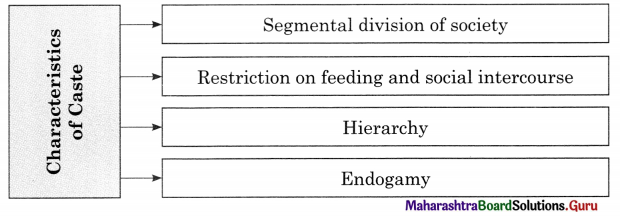
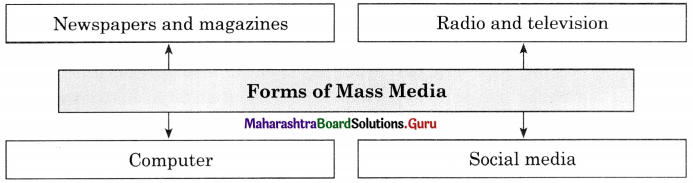
Maharashtra Board Class 11 Sociology Important Questions Chapter 7 Social Stratification

Balbharti Maharashtra State Board Class 11 Sociology Important Questions Chapter 7 Social Stratification Important Questions and Answers.

Maharashtra State Board 11th Sociology Important Questions Chapter 7 Social Stratification

Choose the correct alternative and complete the statements.

Question 1.
Social ………………. involves the formation of horizontal social divisions.
(stratification / differentiation / hierarchy)
Answer:
differentiation

Question 2.
Social stratification involves ………………. ranking of social strata.
(horizontal / vertical / equal)
Answer:
vertical

Maharashtra Board Class 11 Sociology Important Questions Chapter 7 Social Stratification

Question 3.
Social stratification is a particular form of social ……………….
(equality / inequality / justice)
Answer:
inequality

Question 4.
In ………………. stratification there is no scope for social mobility.
(open / closed / universal)
Answer:
Closed

Question 5.
Caste is the ………………. form of social stratification.
(closed / open / equal)
Answer:
closed

Question 6.
………………. is hereditary and membership is based on birth.
(Class / Caste / Society)
Answer:
caste

Question 7.
Choice of ………………. is not free under caste system.
(prestige, occupation, wealth)
Answer:
Occupation

Question 8.
………………. is essence of caste system.
(Endogamy / Exogamy / Monogamy)
Answer:
Endogamy

Question 9.
A social ………………. is essentially a status group.
(caste / class / division)
Answer:
class

Question 10.
The positions that one inherits at birth is called ………………. status.
(achieved / ascribed / vertical)
Answer:
ascribed

Question 11.
The position that one acquires through effort is called ………………. status.
(ascribed / achieved / prestige)
Answer:
achieved

Question 12.
………………. is associated with prestige.
(Role / Status / Mobility)
Answer:
Status

Question 13.
Higher education gives opportunities for ………………. mobility.
(downward / upward / middle)
Answer:
upward

Question 14.
………………. stratification refers to social ranking, where men typically inhabit higher statuses than women.
(Class / Gender / Caste)
Answer:
Gender

Question 15.
………………. refers to the biological distinction between females and males.
(Gender / Inequality / Sex)
Answer:
Sex

Question 16.
………………. is the belief that one sex is superior that the other.
(Gender / Sexism / Feminism)
Answer:
Sexism

Question 17.
Male dominance is supported by ……………….
(matriarchy / patriarchy / endogamy)
Answer:
patriarchy

Question 18.
The process of ………………. is gendered and creates gender hierarchy.
(stratification / socialization / mobility)
Answer:
socialization

Maharashtra Board Class 11 Sociology Important Questions Chapter 7 Social Stratification

Question 19.
Social ………………. means the movement of position from lower to higher one.
(stratification / movement / equality)
Answer:
mobility

Question 20.
………………. mobility refers to change of residence or job without status change.
(Vertical / Horizontal / Intergenerational)
Answer:
Horizontal

Question 21.
………………. mobility stands for change of social position.
(Horizontal / Vertical / Intergenerational)
Answer:
Vertical

Question 22.
………………. mobility means that one generation changes its social status in contrast to previous generation.
(Vertical / Intergenerational / Intragenerational)
Answer:
Intergenerational

Question 23.
………………. mobility takes place in the lifespan of one generation.
(Vertical / Intergenerational / Intragenerational)
Answer:
Intragenerational

Correct the incorrect pair.

Question 1.
(a) Good connections, networking – Social Capital
(b) Reputation and status – Economic Capital
(c) Knowledge of art – Cultural Capital
(d) Higher education – Upward Mobility
Answer:
(b) Reputation and status – Symbolic Capital

Question 2.
(a) Emotional, Cooperative – Traditional Feminine Traits
(b) Ambitious, Independent – Traditional Masculine Traits
(c) Purity and pollution – Caste
(d) Prestige – Gender Stratification
Answer:
(d) Prestige – Class

Question 3.
(a) Endogamy – Caste
(b) Wealth and income – Class
(c) Sexism – Gender Stratification
(d) Male dominance – Matriarchy
Answer:
(d) Male dominance – Patriarchy

Maharashtra Board Class 11 Sociology Important Questions Chapter 7 Social Stratification

Identify the appropriate term from the given options.

(Open stratification, Prestige, Education, Sex, Vertical Mobility, Horizontal Mobility, Closed Stratification, Lifestyles, Gender Stratification, Sexism, Gender Socialization, Intergenerational Mobility, Intragenerational Mobility.)
Question 1.
The varna and the caste system in India.
Answer:
Close Stratification

Question 2.
Power, property, intelligence, skills etc.
Answer:
Open Stratification

Question 3.
It reflects the speciality in preferences, tastes and values of a class.
Answer:
Lifestyles

Question 4.
It refers to the respect and admiration with which an occupation is regarded by society.
Answer:
Prestige

Question 5.
It gives opportunities for upward mobility.
Answer:
Education

Question 6.
It refers to social ranking where men typically inhabit higher statuses than woman.
Answer:
Gender Stratification

Question 7.
Biological distinction between females and males.
Answer:
Sex

Question 8.
A belief that one sex is superior than the other.
Answer:
Sexism

Question 9.
Boys are given toy cars or ball to play.
Answer:
Gender Stratification

Question 10.
Ascending or descending type of mobility.
Answer:
Vertical Mobility

Question 11.
It refers to change of residence or job without status change.
Answer:
Horizontal Mobility

Question 12.
An individual moves up and occupies a higher social position than his previous social position.
Answer:
Intragenerational Mobility

Correct underlined words and complete the sentence.

Question 1.
Social stratification refers to the existence of structured equalities in a society.
Answer:
Social stratification refers to the existence of structured inequalities in a society.

Question 2.
The pattern of mobility stays same from generation to generation.
Answer:
The pattern of inequality stays same from generation to generation.

Question 3.
Open stratification is one in which individuals do not enjoy the freedom of changing their social strata.
Answer:
Close Stratification is one in which individuals do not enjoy the freedom of changing their social strata.

Question 4.
In closed stratification there is scope for social mobility.
Answer:
In open stratification there is scope for social mobility.

Maharashtra Board Class 11 Sociology Important Questions Chapter 7 Social Stratification

Question 5.
The caste system in modern industrial society is an example of open stratification.
Answer:
The class system in modern industrial society is an example of open stratification.

Question 6.
The Spanish word ‘casta’ means colour.
Answer:
The Spanish word ‘casta’ means breed or race

Question 7.
The membership of caste is determined by effort.
Answer:
The membership of caste is determined by birth.

Question 8.
Hereditary is a scheme, which arranges castes in terms of higher and lower status.
Answer:
Hierarchy is a scheme, which arranges castes in terms of higher and lower status.

Question 9.
In a caste society, there is an equal distribution of privileges and disabilities among its members.
Answer:
In a caste society, there is an unequal distribution of privileges and disabilities among its members.

Question 10.
Every caste insists that its members should marry outside the group.
Answer:
Every caste insists that its members should marry within the group.

Question 11.
Caste is related to status.
Answer:
Class is related to status.

Question 12.
Caste is almost a universal phenomenon.
Answer:
Class is almost a universal phenomenon.

Question 13.
Rank is associated with prestige.
Answer:
Status is associated with prestige.

Question 14.
An open class system is one in which horizontal social mobility is possible.
Answer:
An open class system is one in which vertical social mobility is possible.

Question 15.
Hereditary reflect the specialty in preferences, tastes and values of a class.
Answer:
Life-styles reflect the specialty in preferences, tastes and values of a class.

Question 16.
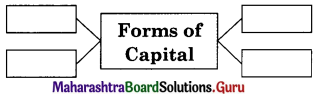
Bourdieu gives three types of capital to explain hierarchy in society.
Answer:
Bourdieu gives four types of capital to explain hierarchy in society.

Question 17.
A social class is an achievement of people who have same status, rank etc.
Answer:
A social class is an aggregate of people who have same status, rank etc.

Question 18.
One’s class position is directly proportionate to one’s income.
Answer:
One’s class position is not directly proportionate to one’s income.

Question 19.
There is an open reciprocal relationship between social class and education.
Answer:
There is a close reciprocal relationship between social class and education.

Question 20.
Education refers to the respect and admiration with which an occupation is regarded by society.
Answer:
Prestige refers to the respect and admiration with which an occupation is regarded by society.

Maharashtra Board Class 11 Sociology Important Questions Chapter 7 Social Stratification

Question 21.
Race stratification refers to unequal distribution of wealth, power and privilege between the two sexes.
Answer:
Gender stratification refers to unequal distribution of wealth, power and privilege between the two sexes.

Question 22.
Sex refers to the social aspects of differences between male and female.
Answer:
Gender refers to the social aspects of differences between male and female.

Question 23.
Submissive, dependent, timid are traditional notion of masculine traits.
Answer:
Submissive, dependent, timid are traditional notion of feminine traits.

Question 24.
Under horizontal mobility, a person changes one’s occupation but the overall social standing remains the same.
Answer:
Under vertical mobility, a person changes one’s occupation but the overall social standing remains the same.

Question 25.
Intragenerational mobility may be upward or downward.
Answer:
Intergenerational mobility may be upward or downward.

Question 26.
Inequality is social and persists over generation.
Answer:
Stratification is social and persists over generation.

Write suitable examples of given concepts and justify your answer.

Question 1.
Caste as closed system of stratification.
Answer:
Example : Varna System – Hindu society is divided into four varnas – Brahmins, Kshatriya, Vaishyas and Shudras. Occupation social status and lifestyle of every varna is determined by some rules and regulations and it is a group based on birth.

Each position in the caste structure is defined in terms of its ‘purity and pollution’. In a caste stratification system, an individual’s position depends on the status attributes ascribed by birth. Therefore, caste is the closed form of social stratification. Since membership based on birth, morality from one caste to another is impossible. Each caste has its own traditional social status, occupation, customs, rules and regulations. Castes are endogamous group and every caste insist that its members should marry within the group which further makes the caste system rigid.

Question 2.
Gender role socialization.
Answer:
Example : Boys are given toy cars or lego sets or bat and ball to play whereas girls are given household sets, medical sets, dolls etc. It explains why human males and females behave in different ways and learn different social roles.

The concept of gender stratification refers to society’s unequal distribution of wealth, power and privilege between the sexes. The process of socialization is gendered and creates gender hierarchy.

Question 3.
Almost all societies are characterised by sexism.
Answer:
Example : Sexist concepts teaches narratives about traditional gender roles for males and females. Women are considered to be the weaker sex and less capable than man in various areas like business, politics etc., and they are confined to the domestic realm of nurturance.

In most countries throughout the world, societies allocate fewer resources to women than to men. Sexism is the belief that one sex is superior than the other and almost all societies are characterized by sexism. Although, societies have been believing in the superiority of men over women and therefore have been dominating women. The male dominance is supported further by patriarchy, which is a form of social organization in which men dominate, oppress and exploit women.

Maharashtra Board Class 11 Sociology Important Questions Chapter 7 Social Stratification

Question 4.
Social stratification is universal but variable.
Answer:
Example : Influence of caste system on all aspects of the Indian society. Practice of class system, gender roles around the world.
Societies around us are heterogeneous in nature and thus divided into various strata or groups. Most societies exist with social systems of social division and social stratification. Everywhere society is divided into various strata. Hence, social stratification is found everywhere. At the same time the nature of inequality varies. ‘What’ is unequal and ‘how’ unequal, changes within the context of the societies.

Write short notes.

Question 1.
Gender stratification.
Answer:
1. Gender stratification refers to social ranking, where men typically inhabit higher statuses than women. A common general definition of gender stratification refers to the unequal distribution of wealth, power and privilege between the two sexes.

2. Throughout the world, most societies allocate fewer resources to women than men. Almost all societies are characterized by sexism. Sexism is the belief that one sex is superior than the other.

3. Although, societies have been believing in the superiority of men over women and therefore have been dominating women. This male dominance is supported further by patriarchy.

4. The process of socialization is gendered and creates gender hierarchy. E.g., Boys are given toy cars or legs sets or bat and ball to play whereas girls are given household sets, medical sets, dolls, etc.

Question 2.
Types of social stratification.
Answer:
Social stratification is of two types – Closed stratification and Open stratification.
1. Closed stratification is one in which individuals or groups do not enjoy the freedom of changing their social strata. The individual who gets a social strata by birth can never change it in one’s lifetime. In this type of social stratification there is no scope for social mobility. Example – The Varna system and the caste system in India are examples of closed stratification.

2. Open stratification is one in which individuals or groups enjoy the freedom of changing their social strata, i.e., in this type of social stratification there is scope for social mobility. Example – The class system in modern industrial society is an example of open stratification, The criteria of open stratification are power, property, intelligence, skills, etc.

Question 3.
Characteristics of class.
Answer:
1. Wealth and Income: Possession of substantial amounts of wealth is the main characteristics distinguishing the upper class from the other class groups in society. Persons having more wealth and income generally have higher social position and respect in society.

2. Occupation : Occupation is an exceedingly important aspect of social class. It is another determinant of class status. It is a well known fact that some kinds of work are more honourable than others, e.g., doctors, engineers, administrators, professors and lawyers hold a higher position than people who are in labour-intensive professions.

3. Education : There is a close reciprocal relationship between social class and education. Higher education gives opportunities for upward mobility. Thus education, is one of the main levers of social class.

4.  Prestige : It refers to the respect and administration with which an occupation is regarded by society. Besides wealth, occupation and education, there are certain other criteria which help a person to gain prestige and subsequent higher social status in the society, e.g., family background, kinship, place of residence, etc.

Maharashtra Board Class 11 Sociology Important Questions Chapter 7 Social Stratification

Differentiate between.

Question 1.
Horizontal Mobility and Vertical Mobility.
Answer:

Horizontal MobilityVertical Mobility
(i) It refers to change of residence or job without status change.(i) It refers to any change in the occupational economic or political status of an individual or a group which leads to change of their position.
(ii) Under this type of social mobility a person changes one’s occupation but the overall social position remains the same.(ii) It stands for change of social position either upward or downward.
(iii) Certain occupation like doctor, engineer and teacher may enjoy the same status hence when an engineer changes one’s occupation from engineer to teaching engineering, there is a horizontal shift but no change takes place in his social position.(iii) A person who works hard as a salesman, earns money and starts his own business successfully. In such position there is a clear change in the position of the individual.
(iv) A change in the social hierarchy does not take place.(iv) Change in the social hierarchy takes place.

Question 2.
Closed stratification and Open Stratification.
Answer:

Closed stratificationOpen stratification
(i) Closed stratification is one in which individuals or groups do not enjoy the freedom of changing their social strata.(i) Open stratification is one in which individuals or groups enjoy the freedom of changing their social strata.
(ii) In this type of social stratification there is no scope for social mobility.(ii) In this type of social stratification there is scope for social mobility.
(iii) Ascribed status – The individual who gets a social strata by birth can never change it in one’s lifetime.(iii) Achieved status – Individuals or groups move from one strata to another on the basis of their achievement.
(iv) Example : The varna system and the caste system in India are examples of close stratification.(iv) Example : The class system in modern industrial society is an example of open stratification.

Explain the following concept with suitable examples.

Question 1.
Intragenerational Mobility
Answer:

  1. This type of mobility takes place in the lifespan of one generation.
  2. Here the individual moves up and occupies a higher social position than previously.

Example : A person may start one’s career as a clerk and after acquiring more education, becomes an IFS Officer.

Question 2.
Horizontal Mobility
Answer:

  1. It refers to change of residence or job without status change.
  2. Under this type of social mobility, a person changes one’s occupation but the overall social standing remains the same.

Example : Certain occupation like doctor, engineer and teacher may enjoy the same status but when an engineer changes one’s occupation from engineer to teaching engineering there is a horizontal shift from one occupational category to another but no change has taken place in the system of social stratification.

Question 3.
Closed stratification
Answer:

  1. Closed stratification is one in which individuals or groups do not enjoy the freedom of changing their social strata.
  2. The individual who gets a social strata by birth can never change it in one’s lifetime.
  3. In this type of social stratification there is no scope for social mobility.
    Example : The Varna system and the caste system in India are examples of closed stratification.

Maharashtra Board Class 11 Sociology Important Questions Chapter 7 Social Stratification

Question 4.
Prestige
Answer:

  1. It refers to the respect and admiration with which an occupation is regarded by society.
  2. Prestige is independent of the particular person who occupies a job.
  3. Sociologists have tried to assign prestige rankings to various occupations.
  4. Besides wealth, occupation and education, there are certain other criteria which help a person to gain prestige and subsequent higher social status in the society.
    Example : Family background, kinship, place of residence, etc.

Question 5.
Gender and sex
Answer:

  1. Sex refers to the biological distinction between females and males.
  2. In contrast the term gender refers to the social aspects of differences and hierarchies between male and female.
  3. Sex may be male or female whereas gender refers to the social meaning of masculinity and femininity. Gender determines how one should behave in society.

Example : Men are supposed to behave in a masculine manner and certain attributes are assigned to men such as courage, bravery, physical strength. On the other hand, women are assigned with attributes like nurturance, care, love, sacrifice which help them to behave in a feminine manner.

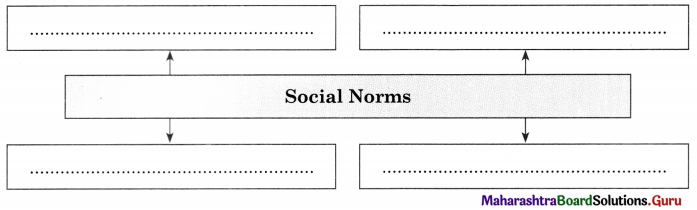
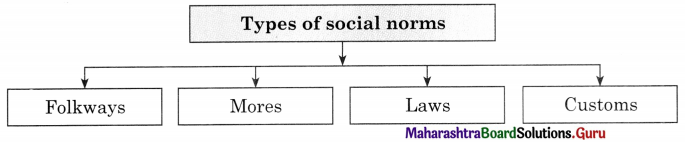
Complete the concept maps.

Question 1.
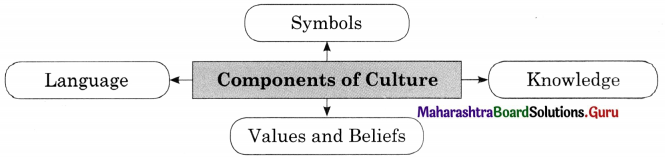
Maharashtra Board Class 11 Sociology Important Questions Chapter 7 Social Stratification 1
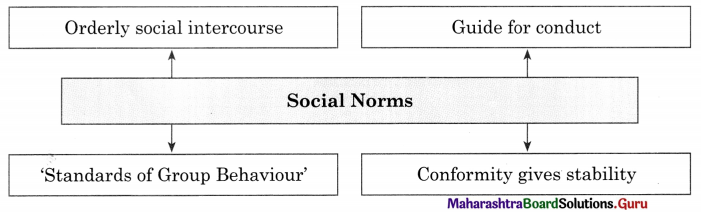
Answer:
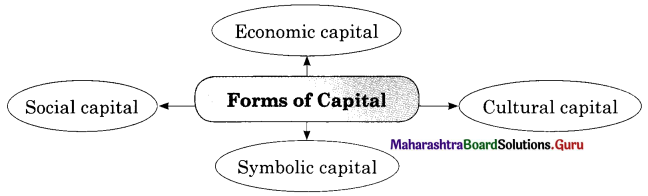
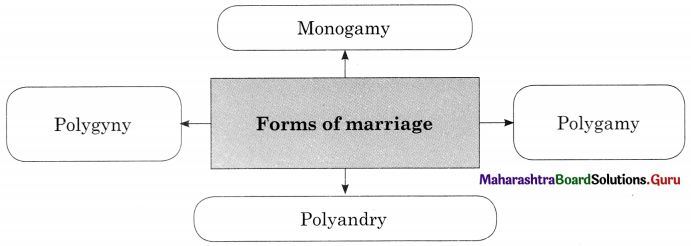
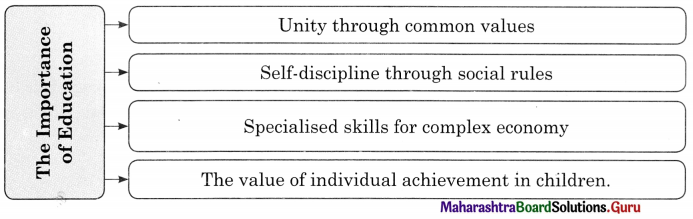
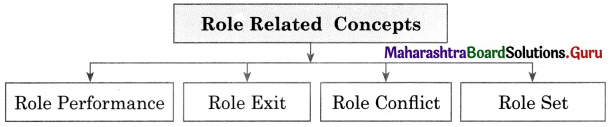
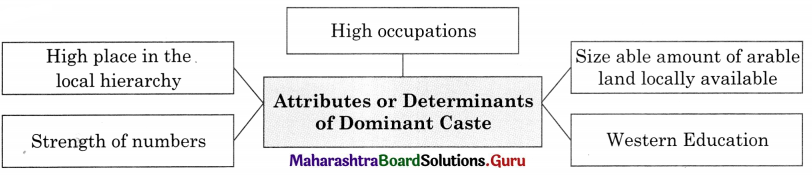
Maharashtra Board Class 11 Sociology Important Questions Chapter 7 Social Stratification 2

Question 2.
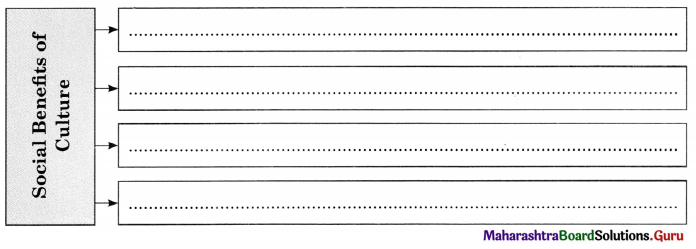
Maharashtra Board Class 11 Sociology Important Questions Chapter 7 Social Stratification 3
Answer:
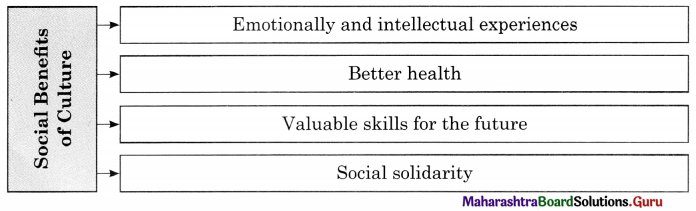
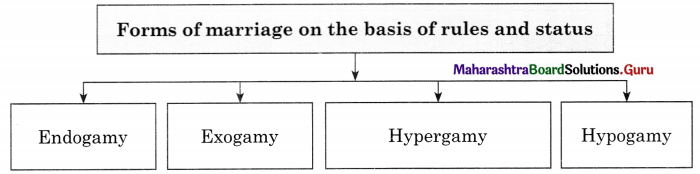
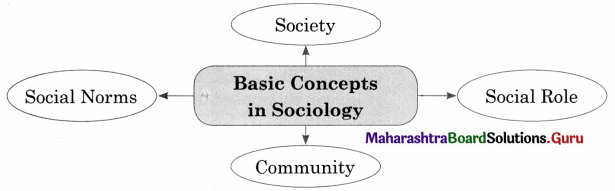
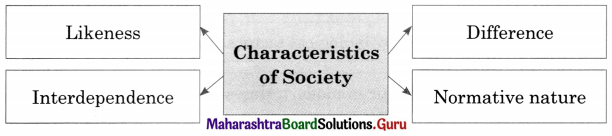
Maharashtra Board Class 11 Sociology Important Questions Chapter 7 Social Stratification 4

Question 3.
Maharashtra Board Class 11 Sociology Important Questions Chapter 7 Social Stratification 5
Answer:
Maharashtra Board Class 11 Sociology Important Questions Chapter 7 Social Stratification 6

Question 4.
Maharashtra Board Class 11 Sociology Important Questions Chapter 7 Social Stratification 7
Answer:
Maharashtra Board Class 11 Sociology Important Questions Chapter 7 Social Stratification 8

Question 5.
Maharashtra Board Class 11 Sociology Important Questions Chapter 7 Social Stratification 9
Answer:
Maharashtra Board Class 11 Sociology Important Questions Chapter 7 Social Stratification 10

Maharashtra Board Class 11 Sociology Important Questions Chapter 7 Social Stratification

Question 6.
Maharashtra Board Class 11 Sociology Important Questions Chapter 7 Social Stratification 11
Answer:
Maharashtra Board Class 11 Sociology Important Questions Chapter 7 Social Stratification 12

State whether the following statements are true or false with reasons.

Question 1.
Occupation is determinant of class status
Answer:
This statement is True.

  1. Occupation is an important aspect of social class and it is another determinant of class status.
  2. It is a well-known fact that some kinds of work are more honourable than others, e.g., doctors, engineers, professors and lawyers hold a higher position than people who are in labour-intensive professions.
  3. Occupation is also one of the best clues to one’s way of life, and therefore to one’s social class membership.

Question 2.
In most countries, societies allocate equal resources to women and men.
Answer:
This statement is False.

  1. In most countries throughout the world, societies allocate fewer resources to women than to men.
  2. Almost all societies are characterized by sexism. Sexism is the belief that one sex is superior that the other.
  3. All through, societies have been believing in the superiority of men over women and therefore have been dominating women which is further supported by patriarchy.

Question 3.
Horizontal mobility can be labelled as ascending or descending type of mobility.
Answer:
This statement is False.

  1. It refers to change of residence or job without status change.
  2. Under this type of social mobility, a person changes one’s occupation but the overall social standing remains the same.
  3. Certain occupations like doctor, engineer, and teacher may enjoy the same status but when an engineer changes one’s occupation from engineer to teaching engineering, there is horizontal shift from one occupational category to another but no actual change takes place in the system of social stratification.

Question 4.
Social stratification is consequential.
Answer:
This statement is True.

  1. Social stratification is consequential as it affects every aspect of life of all individuals.
  2. Some individuals experience positive consequences, while others face negative consequences of the hierarchy in a particular society.
  3. It leads to two important consequences – life chances and life styles.

Question 5.
One’s class position is directly proportionate to one’s income.
Answer:
This statement is False.

  1. One’s class position is not directly proportionate to one’s income.
  2. For example, a car mechanic has a lower social status than a teacher, though the income may be greater than the teacher.
  3. Income is not always the determinant of one’s class position.

Maharashtra Board Class 11 Sociology Important Questions Chapter 7 Social Stratification

Question 6.
Gender and sex are interchangeable term.
Answer:
This statement is False.

  1. Gender and sex are not interchangeable terms. Sex refers to the biological distinction between males and males.
  2. In contrast, the term gender refers to the social aspects of differences and hierarchies between male and female. Gender is result of socialization and a social construct.
  3. Sex may be male or female whereas gender refers to the social meaning of masculinity and femininity. It determines how one should behave in society.

Give your personal response.

Question 1.
Women prohibited by certain gatherings, spaces or positions is a result of gender stratification.
Answer:
Gender stratification leads to discrimination which affects many aspects in the lives of woman. Gender stratification results into gender inequality can be analysed on the bases of prestige, style of life, privileges, and opportunities, association with social groups, income, education, occupation, and power. These highly discriminatory practices are still taking place at an alarming rate, affecting the lives of many women today.

Question 2.
There is a close reciprocal relationship between social class and education. Explain how education is one of the main levers of social class.
Answer:
Education is a means to help develop ideas and skills, generate knowledge and help people to seek employment or self employment which further helps to change one’s social position. Higher education gives opportunities for upward mobility, one’s amount and kind of education affects the class rank he will secure. Thus, education is one of the main levers of a man’s social class.

Question 3.
Membership of the caste is not voluntary or not by selection but is obligatory and accidental. Explain how caste system is the closed form of stratification.
Answer:
In a caste stratification system, an individual’s position depends on the status attributes ascribed by birth. Each position in the caste structure is defined in terms of its ‘purity and pollution’. The individual who gets a social strata by birth can never change it in one’s lifetime. There is no scope for social mobility. Therefore, caste is closed form of social stratification.

Question 4.
Caste discrimination exists in India despite special laws.
Answer:
Despite legislation caste discrimination and caste-based crimes persist throughout India. Scheduled Castes (SC), have been the victims of the Hindu caste system for centuries. They are subjected to numerous forms of caste discrimination.

Maharashtra Board Class 11 Sociology Important Questions Chapter 7 Social Stratification

Answer the following in detail (About 150-200 words).

Question 1.
Discuss caste as a form of social stratification.
Answer:
In traditional Indian society different castes formed a hierarchy of social preference. Each position in the caste structure is defined in terms of its purity and pollution. In a caste stratification system, an individual’s position depends on the status attributes ascribed by birth. Therefore, caste is the closed form of social stratification. Caste is hereditary and thus the status of the person in caste based. Society is not determined by the wealth one owns but it depends on the status of the caste in which one is born.

Each caste has its own traditional social status , occupations, customs, rules and regulations. In a caste society, there is an unequal distribution of privileges and disabilities among its members. Choice of occupation is not free under the caste system as occupations are hereditary. The members of a caste are expected to follow their traditional occupation. Caste are divided into sub-castes and each sub-caste is an endogamous group. Hence, a caste is a rigid social class into which members are born.


Maharashtra Board Class 11 Sociology Important Questions Chapter 6 Socialization

Balbharti Maharashtra State Board Class 11 Sociology Important Questions Chapter 6 Socialization Important Questions and Answers.

Maharashtra State Board 11th Sociology Important Questions Chapter 6 Socialization

Choose the correct alternative and complete the statements.

Question 1.
Socialization is a ………………….. process.
(lifelong / learning / transitional)
Answer:
Life-long/earning

Question 2.
………………….. is a study of genes and heredity.
(Socialization / Genetics / Biology)
Answer:
Genetics

Maharashtra Board Class 11 Sociology Important Questions Chapter 6 Socialization

Question 3.
The process of ………………….. signifies the role of‘nurture’ in human development.
(culture / stratification / socialization)
Answer:
socialization

Question 4.
Socialization transforms the individual self into a ………………….. self.
(political / primary / social)
Answer:
social

Question 5.
………………….. transforms the biological organism into a social being.
(Culture / Art / Socialization)
Answer:
Socialization

Question 6.
………………….. is the first stage of the process of socialization, according to Mead.
(Play Stage / Imitation / Game Stage)
Answer:
Imitation

Question 7.
In ………………….. stage, a child internalises the attitudes of others, significant to him/her.
(imitation / game / play)
Answer:
play

Question 8.
In ………………….. stage, children learn to behave according to the impressions of others.
(imitation / play / game)
Answer:
game

Question 9.
The ………………….. is formed through our interactions with others and our understanding of others responses.
(self / imitation / role)
Answer:
self

Question 10.
The learning which happens in the early years is termed as ………………….. socialization.
(secondary / primary / tertiary)
Answer:
primary

Question 11.
………………….. socialization involves intense cultural learning and takes place in childhood.
(Secondary / Primary / Tertiary)
Answer:
Primary

Question 12.
Family is the ………………….. agency of socialization.
(formal / informal / non-formal)
Answer:
informal

Question 13.
………………….. are friendship groups made up of people of similar age.
(Family / Peer groups / Neighbour)
Answer:
Peer groups

Question 14.
Peer groups use ………………….. sanctions.
(informal / formal / egalitarian)
Answer:
informal

Question 15.
In peer groups, the interactions are ………………….. when compared to family or school.
(dependent / formal / egalitarian)
Answer:
egalitarian

Question 16.
………………….. are the means for delivering impersonal communication directed to a vast audience.
(Family / Peer groups / Mass media)
Answer:
Mass media

Question 17.
One of the significant agents of adult socialization is the …………………..
(school / family / workplace)
Answer:
workplace

Question 18.
………………….. is the process of unlearning and relearning new norms and values.
(Adult socialization / Re-socialization / Socialization)
Answer:
Resocialization

Question 19.
………………….. is credited for having popularized the term ‘total institution’.
(Erving Goffman / Max Weber / George Mead)
Answer:
Erving Goffman

Question 20.
………………….. involves a process of tearing down and rebuilding an individual’s role.
(Adult socialization / Re-socialization / Socialization)
Answer:
Re-socialization

Question 21.
………………….. is often a deliberate and an intense social process.
(Socialization / Adult socialization / Re-socialization)
Answer:
Re-socialization

Question 22.
The term ………………….. Institution refers to new ways of life in controlled and regulated manner.
(Social / Total / Political)
Answer:
Total

Question 23.
…………………. is the second stage of the process of socialization, according to Mead.
(Imitation / Play stage / Game stage)
Answer:
Play stage

Question 24.
…………………. indicates continuous process of learning.
(Socialization / Adult socialization / Re-socialization)
Answer:
Adult socialization

Maharashtra Board Class 11 Sociology Important Questions Chapter 6 Socialization

Question 25.
A ………………….. is a ereoeraohicallv localized community within a larger city, town etc.
(neighbourhood / family / school)
Answer:
neighbourhood

Correct the incorrect pair.

Question 1.
(a) Senior citizen group – Peer Group
(b) Cultural festivals, sports activities – Neighbourhood
(c) Professional networks – Informal Groups
(d) Newspaper, television – Mass Media
Answer:
(c) Professional networks – Formal Groups

Question 2.
(a) A Prison sentence – Adult socialization
(b) Role play – Game Stage
(c) A significant other – Play Stage
(d) Lack of understanding – Imitation
Answer:
(a) A Prison sentence – Resocialization

Question 3.
(a) Family, peer group – Primary Socialization
(b) School, professional networks – Secondary Socialization
(c) It enabled media and social media – School
(d) Military camps, prisons – Total Institution
Answer:
(c) It enabled media and social media – Mass Media

Identify the appropriate term from the given options.

(Internet, Peer Group, Childhood, Socialization, Unsocialization, The Self, Imitation, Play Stage, Game Stage, Primary Socialization, Secondary Socialization, Positive Sanctions, School, Technology, Negative Sanctions, Mass Media, Neighbourhood, Workplace, Adult Socialization, Re-socialization.)

Question 1.
Well documented cases of Feral, Mogli, Genies.
Answer:
Unsocialization

Question 2.
It emerges through communication and interactions with others.
Answer:
The Self

Question 3.
A little boy helping his parents clean the floor.
Answer:
Imitation

Question 4.
It extends over the entire life of a person.
Answer:
Secondary Socialization

Question 5.
Grades, prizes, praise.
Answer:
School

Question 6.
It has increased the speed of mass media.
Answer:
Technology

Question 7.
It has wider reach and can spread information in a more democratic manner.
Answer:
Mass Media

Maharashtra Board Class 11 Sociology Important Questions Chapter 6 Socialization

Question 8.
It helps a person to broaden his/her horizons in terms of social acceptance and tolerance towards the others.
Answer:
Workplace

Question 9.
It involves complete alteration of the easier life style and thinking.
Answer:
Re-socialization

Correct the underlined words and complete the sentence.

Question 1.
Instincts study the inheritance patterns in traits that are handed down from parents to off-spring.
Answer:
Genetics study the inheritance patterns in traits that are handed down from parents to off¬spring.

Question 2.
Cases like Genies suggest that animal contact is necessary for the basic social and physical development.
Answer:
Cases like Genies suggest that human contact is necessary for the basic social and physical development.

Question 3.
Institution transforms the individual self into a social self.
Answer:
Socialization transforms the individual self into a social self.

Question 4.
George Mead has elaborated on the process of building political self.
Answer:
George Mead has elaborated on the process of building social self.

Question 5.
In the game stage, responses are not organised.
Answer:
In the play stage, responses are not organised.

Question 6.
A child at play stage is likely to be aware of the different responsibilities of people.
Answer:
A child at game stage is likely to be aware of the different responsibilities of people.

Question 7.
A child gets acquainted with values, customs, behavioural norms and manners through secondary socialization.
Answer:
A child gets acquainted with values, customs, behavioural norms and manners through primary socialization.

Question 8.
Planned curriculum refers to things we learn from attending the school such as obedience to authority.
Answer:
Hidden curriculum refers to things we learn from attending the school such as obedience to authority.

Question 9.
Radio has an influence on children from a very young age and affects their cognitive and social development.
Answer:
Television has an influence on children from a very young age and affects their cognitive and social development.

Question 10.
Neighbourhood also sometimes helps in changing the notions of‘right and wrong’.
Answer:
Workplace also sometimes helps in changing the notions of ‘right and wrong’.

Question 11.
Adult socialization is the process of unlearning old norms.
Answer:
Re-socialization is the process of unlearning old norms.

Maharashtra Board Class 11 Sociology Important Questions Chapter 6 Socialization

Question 12.
Socialization leads to rehabilitation of one’s behaviour.
Answer:
Re-socialization leads to rehabilitation of one’s behaviour.

Question 13.
Prisons, military camps, private boarding schools, are examples of social institution.
Answer:
Prisons, military camps, private boarding schools, are examples of total institution.

Write suitable examples of the given concepts and justify your answer.

Question 1.
Socialization in family.
Answer:
Example : Children learn basic responsibilities and duties from parents and other family members. The learning involves using sanctions which are mainly informal. The family teaches the child basic discipline and inculcates good habits in his or her mind by using positive or negative sanctions. Positive sanctions involving physical expressions, verbal approval, physical rewards. Negative sanctions ranging from negative remark to physical punishment may be used.

Socialization as a learning process is lifelong. The learning which happens in the early years is termed as primary socialization. A child gets acquainted with values, customs, behavioural norms and manners. Primary socialization takes place in infancy and childhood and involves intense cultural learning. During this phase, family is the main agent of socialization.

Question 2.
Resocialization.
Answer:
Example : The person may be in a jail, hospital, in religious organization, police, army etc. In such institutions there is total break up from the normal social life outside. A prison sentence is a good example. The individual not only has to change and rehabilitate one’s behaviour in order to return to society but must also accommodate the new norms required for living, while in prison. The process of unlearning old norms, roles, values and behavioural patterns and learning new patterns is called re-socialization.

Sometimes an individual is caught in a situation where one has to break away from past experience and internalise different norms and values. Re-socialization can also be defined as a process which subjects an individual to new values, attitudes and skills according to the norms of a particular institution and the person has to completely re-engineer one’s sense of social values and norms.

Question 3.
Total Institution as a form of resocialization.
Answer:
Example : Total institutions are prisons, military camps, mental health facilities and private boarding schools.
The term ‘Total Institution’ was popularised by Erving Goffman. A total institution is usually set apart from the society and are organise by strict rules and norms determined and enforced by a single authority. The fundamental purpose of these institutions is to re-socialise people into changed identities and roles.

Question 4.
Adult socialization at workplace.
Answer:
Example : At the workplace, a person meets people of different age groups, belonging to different social and cultural backgrounds. Through various mechanisms like-on job training, orientation and formal meetings, individuals get familiarized with each other and learns new roles.
Socialization is a life long process. Adult socialization indicates this continuous process of learning. One of the significant agents of adult socialization is the workplace.

Adult individuals spend significant amount of time at the workplace. Socialization through workplace involves acquiring new skills, knowledge and behaviour patterns suitable to the requirements of the job. Social interactions at the workplace, help individuals to broaden their horizons in terms of social acceptance and tolerance towards the others. It also sometimes helps in changing the notions of right and wrong. Workplace thus servers as an important agent of Adult socialization.

Question 5.
Socialization.
Answer:
Example : Cases of Feral, Mogli, Genies, unsocialized children are evident enough to show how human behaviour is largely learnt. The real account of the ‘Wolf-Children of Midnapore’ two small girls reportedly found in a wolf den in 1920. They howled like wolves, preferred raw meat, could not walk upright and lacked many basic human skills due to lack of socialization. Such stories and cases like Genies suggest the human contact is necessary for the basic social and physical development.

Socialization transforms the biological organism into a social being. It is a life long social experience by which human beings are transformed into social beings.
Socialization can be understood as-

  1. A process of learning various forms of behaviour acceptable in a particular culture: Through socialization children learn the ways of their elders and perpetuate the cultural values and social practice.
  2. An ongoing process of continuous learning: The birth of a child gives a new experience of parenting for a couple.
  3. A process through which an individual gradually becomes a member of the society. Socialization facilitates learning the collective way of life.

Maharashtra Board Class 11 Sociology Important Questions Chapter 6 Socialization

Write short notes.

Question 1.
Nature versus Nature in Human Development.
Answer:
Genetics suggests that people are born with certain abilities derived from biological imperatives. Instincts or the fixed human traits play a significant role in shaping human behaviour. From this viewpoint, we are born with certain abilities that are integral to our ‘human nature’. The process of socialization on the other hand signifies the role of ‘nurture’ in human development. Sociologists use the term socialization to refer to the lifelong social experience by which human beings are transformed into social beings.

Differentiate between.

Question 1.
Primary Socialization and Secondary Socialization.
Answer:

Primary SocializationSecondary Socialization
(i) The learning which happens in the early years is termed as primary socialization.(i) The learning which extends over the entire life of a person is termed as secondary socialization.
(ii) It occurs when a child learns the attitudes, values, customs, behavioural norms and manners as a member of primary group.(ii) It occurs when an individual learns appropriate behaviour, attitudes, norms as a member of a group.
(iii) Family, peer groups, neighbourhood are the main agents of primary socialization.(iii) Schooling and education are considered as secondary agencies.
(iv) It is an informal process of socialization.(iv) It is a formal process of socialization.

Question 2.
Re-socialization and Adult Socialization
Answer:

Re-socializationAdult Socialization
(i) The process of unlearning old norms, roles and values, behavioural patterns and learning new patterns is called as re-socialization.(i) Adult socialization is a life long process and indicates continuous process of learning.
(ii) A prison sentence or a total institution is a good example of re-socialization.(ii) One of the significant agents of adult socialization is the workplace.
(iii) Re-socialization involves a process of tearing down and re-building an individual’s role and socially constructed sense of self.(iii) Socialization through workplace involves acquiring new skills knowledge and behaviour patterns suitable to the requirements of the job.
(iv) It re-socializes people into changed identities and role.(iv) It helps in changing the notions of right and wrong.

Explain the following concept with an example.

Question 1.
Significant Others
Answer:
It is a term used by George Herbert Mead to refer to those individuals who are most important in the development of the ‘self.

A significant other is someone whose opinions matter to us and who is in a position to influence our thinking, especially about ourselves.
Example : A significant others can be anyone such as parents, siblings, friends and teachers.

Question 2.
Hidden Curriculum
Answer:
1. Sociologists also discuss about hidden curriculum for conditioning children’s learning.

2. Hidden curriculum refers to things we learn from attending the school such as respect for the system and obedience to authority. It also indicates unquestioned acceptance of the system. Example : While distributing co-curricular tasks, girls and boys are expected to do campus cleaning. Through this, children learn the sexual division of labour. Many schools are making efforts to counter this by allotting similar tasks to boys and girls.

Maharashtra Board Class 11 Sociology Important Questions Chapter 6 Socialization

Question 3.
Game Stage
Answer:

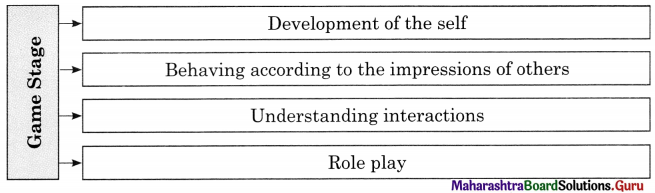
  1. According to G. H. Mead, formation of self occurs in three distinct stages.
  2. Game stage is the third stage of the process of socialization.
  3. As a child matures, and as the self gradually develops, the child learns to behave according to the impressions of others.
  4. They learn to understand interactions involving different people with a variety of purposes.
  5. They understand that ‘role play’ in each situation involves following a consistent set of rules and expectations.

Example : A child at this stage is likely to be aware of the different responsibilities of people in a restaurant who together, make for a smooth dining experience.

Complete the concept maps.

Question 1.
Maharashtra Board Class 11 Sociology Important Questions Chapter 6 Socialization 1
Answer:
Maharashtra Board Class 11 Sociology Important Questions Chapter 6 Socialization 2

Question 2.
Maharashtra Board Class 11 Sociology Important Questions Chapter 6 Socialization 3
Answer:
Maharashtra Board Class 11 Sociology Important Questions Chapter 6 Socialization 4

Question 3.
Maharashtra Board Class 11 Sociology Important Questions Chapter 6 Socialization 5
Answer:
Maharashtra Board Class 11 Sociology Important Questions Chapter 6 Socialization 6

Question 4.
Maharashtra Board Class 11 Sociology Important Questions Chapter 6 Socialization 7
Answer:
Maharashtra Board Class 11 Sociology Important Questions Chapter 6 Socialization 8

Maharashtra Board Class 11 Sociology Important Questions Chapter 6 Socialization

State whether the following statements are true or false with reasons.

Question 1.
Neighbourhood have negligible influence on shaping social behaviour of the growing child.
Answer:
This statement is False.

  1. Adults in the neighbourhood exert an influence on shaping social behaviour of the growing child. Children often take inputs from people living very closely around.
  2. Neighbourhood community provides the base for an individual to extend social relations and interactions beyond the narrow limits of the home.
  3. Neighbourhood, social networks provide great source of learning for children through the celebration of cultural festivals, organisation of sports activities, taking up of social issues such as environment or traffic.

Question 2.
A total institution is set apart from the society and organized by strict rules and norms.
Answer:
This statement is True.

  1. A total institution is usually set apart from the society by distance, laws, and physical attributes like high walls, barbed wire fences, and locked gates.
  2. They are organised by strict rules and norms determined and enforced by a single authority.
  3. The fundamental purpose of these institutions is to re-socialize people into changed identities and roles, hence it is set apart and organized by strict rules and norms.

Question 3.
The function of all children’s stories is to create a sense in the children of the right and wrong.
Answer:
This statement is True.

  1. The moral of honesty, courage, non-violence, etc., is narrated to children in an effective manner.
  2. For centuries together moral stories are transmitted from one generation to another. It gives them a sense of growing up in their own world and a notion of right or wrong.
  3. Thus, the function of all children’s stories is to create a sense in the children of the right/ wrong, acceptable/non-acceptable, is prevalent in a particular society. Through this process vulnerable infants become self-aware, skilled individuals.

Question 4.
Cases of Feral/unsocialised children denote the significance of socialization.
Answer:
This statement is True.

  1. Cases of Feral like Genie’s suggest that human contact is necessary for the basic social and physical development.
  2. For example, simple skills such as walking upright or using language were missing in Genie. Such examples denote the significance of socialization.
  3. What we think and how we act is taught to us by the larger culture.

Question 5.
Human behaviours are governed only by instinct.
Answer:
This statement is False.

  1. If human behaviours were governed only by instinct, there would be very few differences between societies. Human behaviour would be much the same regardless of place and time.
  2. Different cultures develop different ways of doing things.
  3. What we think and how we act is taught to us by the larger culture that we inherit and share. Thus, human behaviours acquired, of the many diverse ways of living and not governed only by instinct.

Question 6.
Peer groups are considered as important primary agencies of socialization.
Answer:
This statement is True.

  1. They are considered as important primary agencies of socialization because personal interactions with our peers influences our behaviour from how we dress to what we like and what we hate.
  2. In peer groups, the interactions are reasonably egalitarian as there is a greater amount of give and take, when compared to family or school.
  3. We carry the value of friendship with us throughout our lives.

Question 7.
Socialization through family is varied.
Answer:
This statement is True.

  1. Socialization through family is varied because there is no single uniform pattern to do so. A child brought up in a nuclear family will undergo different patterns of socialization than one in an extended family. In nuclear family, parents may be key socializing agents but in the other in the extended family grandparents, an aunt, a cousin may play a significant role.
  2. Patterns of child-rearing vary across families with different caste, class, and ethnic backgrounds
  3. The influence of different family backgrounds can be seen on a child growing up in a poor, marginalized household and a child growing up in an upper caste/upper class family background.

Question 8.
Socialization in family always means unquestioned acceptance of everything that elders say.
Answer:
This statement is False.

  1. Socialization in family does not always means unquestioned acceptance of everything that elders say.
  2. Children can also negotiate, question and develop outlooks contradictory to their elders.
  3. This is more so in the contemporary world in which diverse socializing agencies influence social learning.

Maharashtra Board Class 11 Sociology Important Questions Chapter 6 Socialization

Question 9.
Schools project a wider range of values and roles.
Answer:
This statement is True.

  1. Schooling involves learning values and norms at a step higher than those learnt in family.
  2. Skills and values like teamwork, competitive spirit, discipline, conformity to authority are learnt in schools and this helps prepare students for the adult world.
  3. School indicates unquestioned acceptance of the system thus, projecting a wider range of values and roles.

Question 10.
Resocialization involves complete alteration of the easier lifestyles.
Answer:
This statement is True.

  1. Sometimes an individual is caught in a situation where one has to break away from past experience and earlier way of life and internalise radically different norms and values.
  2. Hence, it involves complete alteration of the earlier lifestyle and thinking. The new way of life is not only different but also incompatible with the earlier one.
  3. The basic of re-socialization is to unlearn and then relearn. The individual has to completely re-engineer one’s sense of social values, beliefs and norms.
Give your personal response.

Question 1.
We can come to think of ourselves funny because people laugh at the things we say.
Answer:
‘Significant others’ is a term used by G. H. Mead to refer to those individuals who are most important in the development of the self. A significant other can be anyone such as parents, friends, teachers etc. Their opinions matter to us and influence our thinking especially about ourselves. So, when people laugh at the things we say makes us think of ourselves as funny.

Answer the following question in detail (About 150 words).

Question 1.
Explain the process of socialization with suitable examples and discuss any one agency of socialization you are member of.
Answer:
Process of socialization – Human behaviour and skills have to be taught and learnt. This learning process is called as socialization. According to Mead, formation of self occurs in three distinct stages.
Stage 1 – Imitation : In this stage, children imitate behaviour of adults without understanding it. For example, A little boy might drive his mother to her office by driving his toy car.

Stage 2 – Play stage : A child plays, sometimes as being a mother or a teacher etc. In this stage, responses are not organised. A child internalises the attitudes of others who are significant to her/ his through enacting the roles of others.

Maharashtra Board Class 11 Sociology Important Questions Chapter 6 Socialization

Stage 3 – Game stage : As a child matures, and as the self gradually develops, one internalises the expectations of a large number of people . For example, a child at this stage is likely to be aware of the different responsibilities of people in a restaurant .Socialization, in this sense is a process of self-awareness.

I am member of various social groups which are agencies of my socialization like family, peer- group, school, neighbourhood etc.

Family as an agency of socialization I have learnt a range of roles in family-like learning responsibilities and duties from my parents and other family members. Family has played a significant role in developing acceptable behaviour patterns in me thus the process of learning attitudes, norms and behaviour patterns takes place in family.

Maharashtra Board Class 12 Physics Solutions Chapter 5 Oscillations

Balbharti Maharashtra State Board 12th Physics Textbook Solutions Chapter 5 Oscillations Textbook Exercise Questions and Answers.

Maharashtra State Board 12th Physics Solutions Chapter 5 Oscillations

1. Choose the correct option.

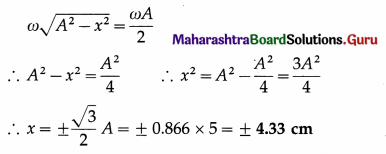
i) A particle performs linear S.H.M. starting from the mean position. Its amplitude is A and time period is T. At the instance when its speed is half the maximum speed, its displacement x is
(A) \(\frac{\sqrt{3}}{2}\)A
(B) \(\frac{2}{\sqrt{3}}\)
(C) A/2
(D) \(\frac{1}{\sqrt{2}}\)
Answer:
(A) \(\frac{\sqrt{3}}{2}\)A

ii) A body of mass 1 kg is performing linear S.H.M. Its displacement x (cm) at t (second) is given by x = 6 sin (100t + π/4). Maximum kinetic energy of the body is
(A) 36 J
(B) 9 J
(C) 27 J
(D) 18 J
Answer:
(D) 18 J

Maharashtra Board Class 12 Physics Solutions Chapter 5 Oscillations

iii) The length of second’s pendulum on the surface of earth is nearly 1 m. Its length on the surface of moon should be [Given: acceleration due to gravity (g) on moon is 1/6 th of that on the earth’s surface]
(A) \(\frac{1}{6}\) m
(B) 6 m
(C) \(\frac{1}{36}\) m
(D) \(\frac{1}{\sqrt{6}}\) m.
Answer:
(A) \(\frac{1}{6}\) m

iv) Two identical springs of constant k are connected, first in series and then in parallel. A metal block of mass m is suspended from their combination. The ratio of their frequencies of vertical oscillations will be in a ratio
(A) 1:4
(B) 1:2
(C) 2:1
(D) 4:1
Answer:
(B) 1:2

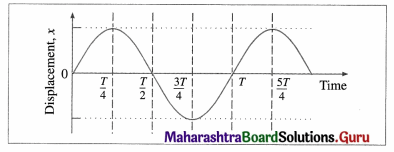
v) The graph shows variation of displacement of a particle performing S.H.M. with time t. Which of the following statements is correct from the graph?
(A) The acceleration is maximum at time T.
(B) The force is maximum at time 3T/4.
(C) The velocity is zero at time T/2.
(D) The kinetic energy is equal to total energy at time T/4.
Maharashtra Board Class 12 Physics Solutions Chapter 5 Oscillations 1
Answer:
(B) The force is maximum at time 3T/4.

2. Answer in brief.

i) Define linear simple harmonic motion.
Answer:
Definition: Linear simple harmonic motion (SHM) is defined as the linear periodic motion of a body, in which the force (or acceleration) is always directed towards the mean position and its magnitude is proportional to the displacement from the mean position.
OR
A particle is said to execute linear SHM if the particle undergoes oscillations about a point of stable equilibrium, subject to a linear restoring force always directed towards that point and whose magnitude is proportional to the magnitude of the displacement of the particle from that point.
Examples : The vibrations of the tines (prongs) of a tuning fork, the oscillations of the needle of a sewing machine.

Maharashtra Board Class 12 Physics Solutions Chapter 5 Oscillations

ii) Using differential equation of linear S.H.M, obtain the expression for
(a) velocity in S.H.M.,
(b) acceleration in S.H.M.
Answer:
The general expression for the displacement of a particle in SHM at time t is x = A sin (ωt + α) … (1)
where A is the amplitude, ω is a constant in a particular case and α is the initial phase.
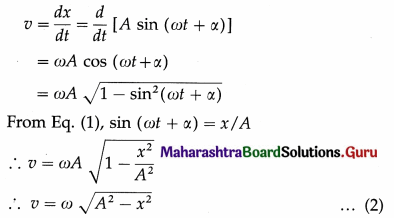
The velocity of the particle is
Maharashtra Board Class 12 Physics Solutions Chapter 5 Oscillations 10
Equation (2) gives the velocity as a function of x.
The acceleration of the particle is
a = \(\frac{d v}{d t}\) = \(\frac{d}{d t}\) [Aω cos (ωt + α) J at at
∴ a = – ω2 A sin (ωt + α)
But from Eq. (1), A sin (ωt + α) = x
∴ a = -ω2x … (3)
Equation (3) gives the acceleration as a function of x. The minus sign shows that the direction of the acceleration is opposite to that of the displacement.

iii) Obtain the expression for the period of a simple pendulum performing S.H.M.
Answer:
An ideal simple pendulum is defined as a heavy point mass suspended from a rigid support by a weightless, inextensible and twistless string, and set oscillating under gravity through a small angle in a vertical plane.

In practice, a small but heavy sphere, called the bob, is used. The distance from the point of suspension to the centre of gravity of the bob is called the length of the pendulum.

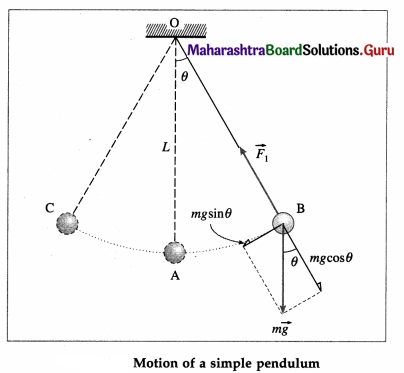
Consider a simple pendulum of length L1 – suspended from a rigid support O. When displaced from its initial position of rest through a small angle θ in a vertical plane and released, it performs oscillations between two extremes, B and C, as shown in below figure. At B, the forces on the bob are its weight \(m \vec{g}\) and the tension \(\overrightarrow{F_{1}}\) in the string. Resolve \(m \vec{g}\) into two components : mg cos θ in the direction opposite to that of the tension and mg sin θ perpendicular to the string.
Maharashtra Board Class 12 Physics Solutions Chapter 5 Oscillations 20
mg cos θ balanced by the tension in the string. mg sin θ restores the bob to the equilibrium position.
Restoring force, F = – mg sin θ
If θ is small and expressed in radian,
sin θ \(\approx\) θ = \(\frac{\text { arc }}{\text { radius }}\) = \(\frac{\mathrm{AB}}{\mathrm{OB}}\) = \(\frac{x}{L}\)
∴ F = – mgθ = -mg\(\frac{x}{L}\) …. (1)
Since m, g and L are constant,
F ∝ (-x) …. (2)

Thus, the net force on the bob is in the direction opposite to that of displacement x of the bob from its mean position as indicated by the minus sign, and the magnitude of the force is proportional to the magnitude of the displacement. Hence, it follows that the motion of a simple pendulum is linear SHM.
Acceleration, a = \(\frac{F}{m}\) = –\(\frac{g}{L}\)x … (3)
Therefore, acceleration per unit displacement
= |\(\frac{a}{x}\)| = \(\frac{g}{L}\) ….. (4)
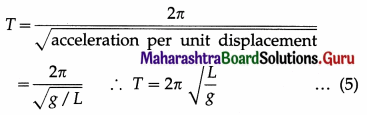
Period of SHM,
Maharashtra Board Class 12 Physics Solutions Chapter 5 Oscillations 25
This gives the expression for the period of a simple pendulum.

Maharashtra Board Class 12 Physics Solutions Chapter 5 Oscillations

iv) State the laws of simple pendulum.
Answer:
The period of a simple pendulum at a given place is
T = 2π\(\sqrt{\frac{L}{g}}\)
where L is the length of the simple pendulum and g is the acceleration due to gravity at that place. From the above expression, the laws of simple pendulum are as follows :

(1) Law of length : The period of a simple pendulum at a given place (g constant) is directly proportional to the square root of its length.
∴ T ∝\(\sqrt{L}\)
(2) Law of acceleration due to gravity : The period of a simple pendulum of a given length (L constant) is inversely proportional to the square root of the acceleration due to gravity.
∴ T ∝ \(\frac{1}{\sqrt{g}}\)
(3) Law of mass : The period of a simple pendulum does not depend on the mass or material of the bob of the pendulum.
(4) Law of isochronism : The period of a simple pendulum does not depend on the amplitude of oscillations, provided that the amplitude is small.

v) Prove that under certain conditions a magnet vibrating in uniform magnetic field performs angular S.H.M.
Answer:
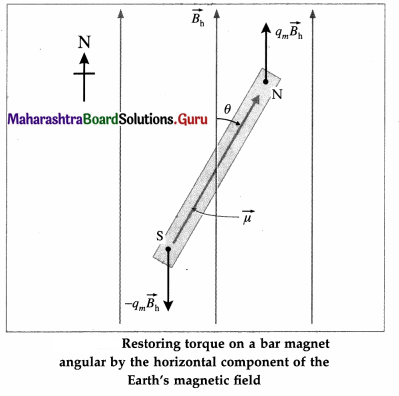
Consider a bar magnet of magnetic moment μ, suspended horizontally by a light twistless fibre in a region where the horizontal component of the Earth’s magnetic field is Bh. The bar magnet is free to rotate in a horizontal plane. It comes to rest in approximately the North-South direction, along Bh. If it is rotated in the horizontal plane by a small
Maharashtra Board Class 12 Physics Solutions Chapter 5 Oscillations 30
displacement θ from its rest position (θ = 0), the suspension fibre is twisted. When the magnet is released, it oscillates about the rest position in angular or torsional oscillation.

The bar magnet experiences a torque \(\tau\) due to the field Bh. Which tends to restore it to its original orientation parallel to Bh. For small θ, this restoring torque is
\(\tau\) = – μBh sin θ = – μBhμ …. (1)

where the minus sign indicates that the torque is opposite in direction to the angular displacement θ. Equation (1) shows that the torque (and hence the angular acceleration) is directly proportional in magnitude of the angular displacement but opposite in direction. Hence, for small angular displacement, the oscillations of the bar magnet in a uniform magnetic field is simple harmonic.

Question 3.
Obtain the expression for the period of a magnet vibrating in a uniform magnetic field and performing S.H.M.
Answer:
Definition : Angular SHM is defined as the oscillatory motion of a body in which the restoring torque responsible for angular acceleration is directly proportional to the angular displacement and its direction is opposite to that of angular displacement.
The differential equation of angular SHM is
I\(\frac{d^{2} \theta}{d t^{2}}\) + cθ = 0 ….. (1)
where I = moment of inertia of the oscillating body, \(\frac{d^{2} \theta}{d t^{2}}\) = angular acceleration of the body when its angular displacement is θ, and c = torsion constant of the suspension wire,
∴ \(\frac{d^{2} \theta}{d t^{2}}\) + \(\frac{c}{I}\)θ = 0
Let \(\frac{c}{I}\) = ω2, a constant. Therefore, the angular frequency, ω = \(\sqrt{c / I}\) and the angular acceleration,
a = \(\frac{d^{2} \theta}{d t^{2}}\) = -ω2θ … (2)
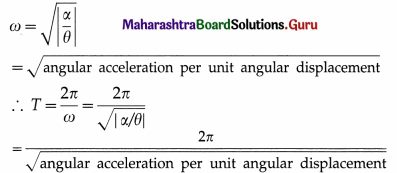
The minus sign shows that the α and θ have opposite directions. The period T of angular SHM is
Maharashtra Board Class 12 Physics Solutions Chapter 5 Oscillations 80
This is the expression for the period in terms of torque constant. Also, from Eq. (2),
Maharashtra Board Class 12 Physics Solutions Chapter 5 Oscillations 81

Question 4.
Show that a linear S.H.M. is the projection of a U.C.M. along any of its diameter.
Answer:
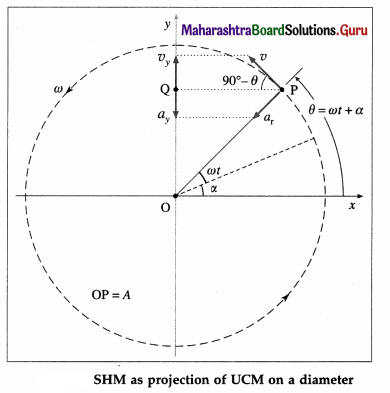
Consider a particle which moves anticlockwise around a circular path of radius A with a constant angular speed ω. Let the path lie in the x-y plane with the centre at the origin O. The instantaneous position P of the particle is called the reference point and the circle in which the particle moves as the reference circle.
Maharashtra Board Class 12 Physics Solutions Chapter 5 Oscillations 35
The perpendicular projection of P onto the y-axis is Q. Then, as the particle travels around the circle, Q moves to-and-fro along the y-axis. Line OP makes an angle α with the x-axis at t = 0. At time t, this angle becomes θ = ωt + α.
The projection Q of the reference point is described by the y-coordinate,
y = OQ = OP sin ∠OPQ, Since ∠OPQ = ωt + α, y = A sin(ωt + α)
which is the equation of a linear SHM of amplitude A. The angular frequency w of a linear SHM can thus be understood as the angular velocity of the reference particle.

The tangential velocity of the reference particle is v = ωA. Its y-component at time t is vy = ωA sin (90° – θ) = ωA cos θ
∴ vy = ωA cos (ωt + α)
The centripetal acceleration of the reference particle is ar = ω2A, so that its y-component at time t is ax = ar sin ∠OPQ
∴ ax = – ω2A sin (ωt + α)

Maharashtra Board Class 12 Physics Solutions Chapter 5 Oscillations

Question 5.
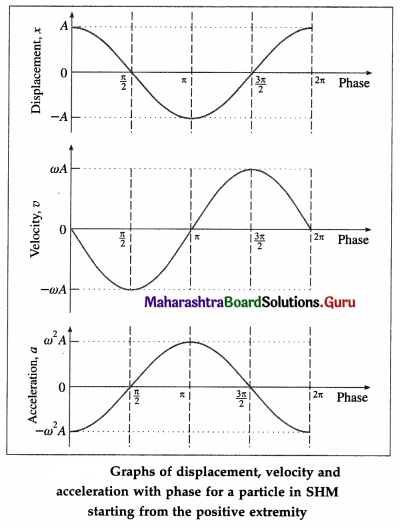
Draw graphs of displacement, velocity and acceleration against phase angle, for a particle performing linear S.H.M. from (a) the mean position
(b) the positive extreme position. Deduce your conclusions from the graph.
Answer:
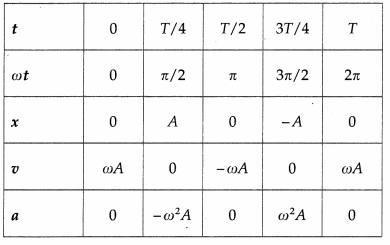
Consider a particle performing SHM, with amplitude A and period T = 2π/ω starting from the mean position towards the positive extreme position where ω is the angular frequency. Its displacement from the mean position (x), velocity (v) and acceleration (a) at any instant are
x = A sin ωt = A sin\(\left(\frac{2 \pi}{T} t\right)\) (∵ω = \(\frac{2 \pi}{T}\))
v = \(\frac{d x}{d t}\) = ωA cos ωt = ωA cos\(\left(\frac{2 \pi}{T} t\right)\)
a = \(\frac{d v}{d t}\) = -ω2 A sin ωt = – ω2A sin\(\left(\frac{2 \pi}{T} t\right)\) as the initial phase α = 0.
Using these expressions, the values of x, v and a at the end of every quarter of a period, starting from t = 0, are tabulated below.
Maharashtra Board Class 12 Physics Solutions Chapter 5 Oscillations 38
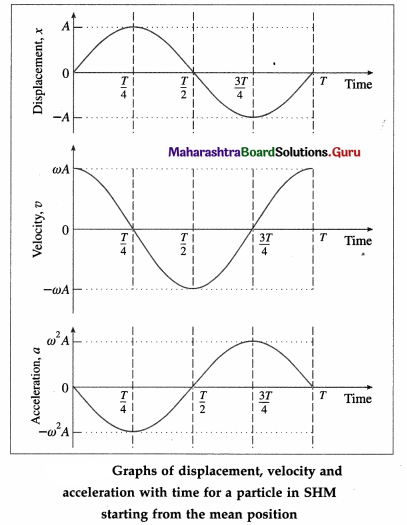
Using the values in the table we can plot graphs of displacement, velocity and acceleration with time.
Maharashtra Board Class 12 Physics Solutions Chapter 5 Oscillations 39
Conclusions :

  1. The displacement, velocity and acceleration of a particle performing linear SHM are periodic (harmonic) functions of time. For a particle starting at the mean position, the x-t and a-t graphs are sine curves. The v-t graph is a cosine curve.
  2. There is a phase difference of \(\frac{\pi}{2}\) radians between x and v, and between v and a.
  3. There is a phase difference of π radians between x and a.

Maharashtra Board Class 12 Physics Solutions Chapter 5 Oscillations 40

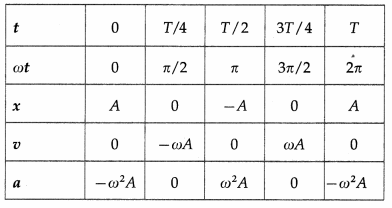
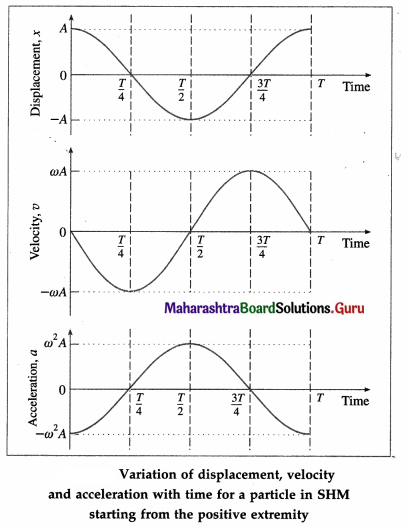
Consider a particle performing linear SHM with amplitude A and period T = 2π/ω, starting from the positive extreme position, where ω is the angular frequency. Its displacement from the mean position (x), velocity (y) and acceleration (a) at any instant (t) are
x = A cos ωt = A cos \(\left(\frac{2 \pi}{T} t\right)\) (∵ω = \(\frac{2 \pi}{T}\))
v = -ωA sin ωt = – ωA sin \(\left(\frac{2 \pi}{T} t\right)\)
a = -ω2A cos ωt = -ω2A cos \(\left(\frac{2 \pi}{T} t\right)\)
Using these expressions, the values of x, y and a at the end of every quarter of a period, starting from t = 0, are tabulated below.
Maharashtra Board Class 12 Physics Solutions Chapter 5 Oscillations 41
Using these values, we can plot graphs showing the variation of displacement, velocity and acceleration with time.
Maharashtra Board Class 12 Physics Solutions Chapter 5 Oscillations 42
Conclusions :

  1. The displacement, velocity and acceleration of a particle performing linear SHM are periodic (harmonic) functions of time. For a particle starting from an extreme position, the x-t and a-t graphs are cosine curves; the v-t graph is a sine curve.
  2. There is a phase difference of \(\frac{\pi}{2}\) radians between x and v, and between v and a.
  3. There is a phase difference of n radians between x and a.

Explanations :
(1) v-t graph : It is a sine curve, i.e., the velocity is a periodic (harmonic) function of time which repeats after a phase of 2π rad. There is a phase difference of π/2 rad between a and v.
v is minimum (equal to zero) at the extreme positions (i.e., at x = ± A) and v is maximum ( = ± ωA) at the mean position (x = 0).

(2) a-t graph : It is a cosine curve, i.e., the acceleration is a periodic (harmonic) function of time which repeats after a phase of 2π rad. There is a phase difference of π rad between v and a. a is minimum (equal to zero) at the mean position (x = 0) and a is maximum ( = \(\mp\)ω2A) at the extreme positions (x = ±A).
Maharashtra Board Class 12 Physics Solutions Chapter 5 Oscillations 43

Question 6.
Deduce the expressions for the kinetic energy and potential energy of a particle executing S.H.M. Hence obtain the expression for total energy of a particle performing S.H.M and show that the total energy is conserved. State the factors on which total energy depends.
Answer:
Consider a particle of mass m performing linear SHM with amplitude A. The restoring force acting r on the particle is F = – kx, where k is the force constant and x is the displacement of the particle from its mean position.
(1) Kinetic energy : At distance x from the mean position, the velocity is
v = ω\(\sqrt{A^{2}-x^{2}}\)
where ω = \(\sqrt{k / m} .\) The kinetic energy (KE) of the particle is
KE = \(\frac{1}{2}\) mv2 = \(\frac{1}{2}\) mω2 (A2 – x2)
= \(\frac{1}{2}\)k(A2 – x2) … (1)
If the phase of the particle at an instant t is θ = ωt + α, where α is initial phase, its velocity at that instant is
v = ωA cos (ωt + α)
and its KE at that instant is
KE = \(\frac{1}{2}\)mv2 = \(\frac{1}{2}\)mω2A2 cos2(ωt + α) ….. (2)
Therefore, the KE varies with time as cos2 θ.

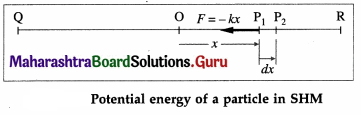
(2) Potential energy : The potential energy of a particle in linear SHM is defined as the work done by an external agent, against the restoring force, in taking the particle from its mean position to a given point in the path, keeping the particle in equilibirum.

Suppose the particle in below figure is displaced from P1 to P2, through an infinitesimal distance dx against the restoring force F as shown.
Maharashtra Board Class 12 Physics Solutions Chapter 5 Oscillations 45
The corresponding work done by the external agent will be dW = ( – F)dx = kx dx. This work done is stored in the form of potential energy. The potential energy (PE) of the particle when its displacement from the mean position is x can be found by integrating the above expression from 0 to x.
∴ PE = \(\int\)dW = \(\int_{0}^{x}\) kx dx = \(\frac{1}{2}\) kx2 … (3)
The displacement of the particle at an instant t being
x = A sin (wt + α)
its PE at that instant is
PE = \(\frac{1}{2}\)kx2 = \(\frac{1}{2}\)kA2 sin2(ωt + α) … (4)
Therefore, the PE varies with time as sin2θ.

(3) Total energy : The total energy of the particle is equal to the sum of its potential energy and kinetic energy.
From Eqs. (1) and (2), total energy is E = PE + KE
= \(\frac{1}{2}\)kx2 + \(\frac{1}{2}\)k(A2 – x2)
= \(\frac{1}{2}\)kx2 + \(\frac{1}{2}\)kA2 – \(\frac{1}{2}\)kx2
∴ E = \(\frac{1}{2}\)kA2 = \(\frac{1}{2}\)mω2A2 … (5)
As m is constant, ω and A are constants of the motion, the total energy of the particle remains constant (or its conserved).

Maharashtra Board Class 12 Physics Solutions Chapter 5 Oscillations

Question 7.
Deduce the expression for period of simple pendulum. Hence state the factors on which its period depends.
Answer:
An ideal simple pendulum is defined as a heavy point mass suspended from a rigid support by a weightless, inextensible and twistless string, and set oscillating under gravity through a small angle in a vertical plane.

In practice, a small but heavy sphere, called the bob, is used. The distance from the point of suspension to the centre of gravity of the bob is called the length of the pendulum.

Consider a simple pendulum of length L1 – suspended from a rigid support O. When displaced from its initial position of rest through a small angle θ in a vertical plane and released, it performs oscillations between two extremes, B and C, as shown in below figure. At B, the forces on the bob are its weight \(m \vec{g}\) and the tension \(\overrightarrow{F_{1}}\) in the string. Resolve \(m \vec{g}\) into two components : mg cos θ in the direction opposite to that of the tension and mg sin θ perpendicular to the string.
Maharashtra Board Class 12 Physics Solutions Chapter 5 Oscillations 20
mg cos θ balanced by the tension in the string. mg sin θ restores the bob to the equilibrium position.
Restoring force, F = – mg sin θ
If θ is small and expressed in radian,
sin θ \(\approx\) θ = \(\frac{\text { arc }}{\text { radius }}\) = \(\frac{\mathrm{AB}}{\mathrm{OB}}\) = \(\frac{x}{L}\)
∴ F = – mgθ = -mg\(\frac{x}{L}\) …. (1)
Since m, g and L are constant,
F ∝ (-x) …. (2)

Thus, the net force on the bob is in the direction opposite to that of displacement x of the bob from its mean position as indicated by the minus sign, and the magnitude of the force is proportional to the magnitude of the displacement. Hence, it follows that the motion of a simple pendulum is linear SHM.
Acceleration, a = \(\frac{F}{m}\) = –\(\frac{g}{L}\)x … (3)
Therefore, acceleration per unit displacement
= |\(\frac{a}{x}\)| = \(\frac{g}{L}\) ….. (4)
Period of SHM,
Maharashtra Board Class 12 Physics Solutions Chapter 5 Oscillations 25
This gives the expression for the period of a simple pendulum.

The period of a simple pendulum at a given place is
T = 2π\(\sqrt{\frac{L}{g}}\)
where L is the length of the simple pendulum and g is the acceleration due to gravity at that place. From the above expression, the laws of simple pendulum are as follows :

(1) Law of length : The period of a simple pendulum at a given place (g constant) is directly proportional to the square root of its length.
∴ T ∝\(\sqrt{L}\)
(2) Law of acceleration due to gravity : The period of a simple pendulum of a given length (L constant) is inversely proportional to the square root of the acceleration due to gravity.
∴ T ∝ \(\frac{1}{\sqrt{g}}\)

Question 8.
At what distance from the mean position is the speed of a particle performing S.H.M. half its maximum speed. Given path length of S.H.M. = 10 cm. [Ans: 4.33 cm]
Answer:
Data : v = \(\frac{1}{2}\)vmax, 2A = 10 cm
∴ A = 5 cm
v = ω\(\sqrt{A^{2}-x^{2}}\) and vmax = ωA
Since v = \(\frac{1}{2}\)vmax,
Maharashtra Board Class 12 Physics Solutions Chapter 5 Oscillations 50
This gives the required displacement.

Question 9.
In SI units, the differential equation of an S.H.M. is \(\frac{d^{2} x}{d t^{2}}\) = -36x. Find its frequency and period. Find its frequency and period.
[Ans: 0.9548 Hz, 1.047 s]
Answer:
\(\frac{d^{2} x}{d t^{2}}\) = -36x
Comparing this equation with the general equation,
\(\frac{d^{2} x}{d t^{2}}\) = -ω2x
We get, ω2 = 36 ∴ ω = 6 rad/s
ω = 2πf
∴ The frequency, f = \(\frac{\omega}{2 \pi}\) = \(\frac{6}{2(3.142)}\) = \(\frac{6}{6.284}\) = 0.9548 Hz
and the period, T = \(\frac{1}{f}\) = \(\frac{1}{0.9548}\) = 1.047 s

Question 10.
A needle of a sewing machine moves along a path of amplitude 4 cm with frequency 5 Hz. Find its acceleration \(\frac{1}{30}\)s after it has crossed the mean position. [Ans: 34.2 m/s2]
Answer:
Data : A = 4 cm = 4 × 10⁻² m, f = 5Hz, t = \(\frac{1}{30}\)s
ω = 2πf = 2π (5) = 10π rad/s
Therefore, the magnitude of the acceleration,
|a| = ω2x = ω2A sin ωt
= (10π)2 (4 × 10²)
= 10π2 sin \(\frac{\pi}{3}\) = 10 (9.872)(0.866) = 34.20 m/s2

Question 11.
Potential energy of a particle performing linear S.H.M is 0.1 π2 x2 joule. If mass of the particle is 20 g, find the frequency of S.H.M. [Ans: 1.581 Hz]
Answer:
Data : PE = 0.1 π2 x2 J, m = 20 g = 2 × 10⁻² kg
PE = \(\frac{1}{2}\)mω2x2 = \(\frac{1}{2}\)m (4π2f2)x2
∴ \(\frac{1}{2}\)m(4π2f2)x2 = 0.1 π2 x2
∴ 2mf2 = 0.1 ∴ f2 = \(\frac{1}{20\left(2 \times 10^{-2}\right)}\) = 2.5
∴ The frequency of SHM is f = \(\sqrt{2.5}\) = 1.581 Hz

Question 12.
The total energy of a body of mass 2 kg performing S.H.M. is 40 J. Find its speed while crossing the centre of the path. [Ans: 6.324 cm/s]
Answer:
Data : m = 2 kg, E = 40 J
The speed of the body while crossing the centre of the path (mean position) is vmax and the total energy is entirely kinetic energy.
Maharashtra Board Class 12 Physics Solutions Chapter 5 Oscillations 60

Question 13.
A simple pendulum performs S.H.M of period 4 seconds. How much time after crossing the mean position, will the displacement of the bob be one third of its amplitude. [Ans: 0.2163 s]
Answer:
Data : T = 4 s, x = A/3
The displacement of a particle starting into SHM from the mean position is x = A sin ωt = A sin \(\frac{2 \pi}{T}\) t
Maharashtra Board Class 12 Physics Solutions Chapter 5 Oscillations 61
∴ the displacement of the bob will be one-third of its amplitude 0.2163 s after crossing the mean position.

Question 14.
A simple pendulum of length 100 cm performs S.H.M. Find the restoring force acting on its bob of mass 50 g when the displacement from the mean position is 3 cm. [Ans: 1.48 × 10⁻² N]
Answer:
Data : L = 100 cm, m = 50 g = 5 × 10⁻² kg, x = 3 cm, g = 9.8 m/s2
Restoring force, F = mg sin θ = mgθ
= (5 × 10⁻²)(9.8)\(\left(\frac{3}{100}\right)\)
= 1.47 × 10⁻² N

Question 15.
Find the change in length of a second’s pendulum, if the acceleration due to gravity at the place changes from 9.75
m/s2 to 9.80 m/s2. [Ans: Decreases by 5.07 mm]
Answer:
Data : g1 = 9.75 m/s2, g2 = 9.8 m/s2
Length of a seconds pendulum, L = \(\frac{g}{\pi^{2}}\)
Maharashtra Board Class 12 Physics Solutions Chapter 5 Oscillations 62
∴ The length of the seconds pendulum must be increased from 0.9876 m to 0.9927 m, i.e., by 0.0051 m.

Maharashtra Board Class 12 Physics Solutions Chapter 5 Oscillations

Question 16.
At what distance from the mean position is the kinetic energy of a particle performing S.H.M. of amplitude 8 cm, three times its potential energy? [Ans: 4 cm]
Answer:
Data : A = 8 cm, KE = 3 PE
KE = \(\frac{1}{2}\) (A2 – x2) and PE = \(\frac{1}{2}\)kx2
Given, KE = 3PE.
∴ \(\frac{1}{2}\)k(A2 – x2) = 3\(\left(\frac{1}{2} k x^{2}\right)\)
∴ A2 – x2 = 3x2 ∴ 4x2 = A2
∴ the required displacement is
x = ±\(\frac{A}{2}\) = ±\(\frac{8}{2}\) = ± 4 cm

Question 17.
A particle performing linear S.H.M. of period 2π seconds about the mean position O is observed to have a speed of \(b \sqrt{3}\) m/s, when at a distance b (metre) from O. If the particle is moving away from O at that instant, find the
time required by the particle, to travel a further distance b. [Ans: π/3 s]
Answer:
Data : T = 2πs, v = b\(\sqrt{3}\) m/s at x = b
Maharashtra Board Class 12 Physics Solutions Chapter 5 Oscillations 63
∴ Assuming the particle starts from the mean position, its displacement is given by
x = A sin ωt = 2b sin t
If the particle is at x = b at t = t1,
b = 2b sint1 ∴ t1 = sin-1 \(\frac{1}{2}\) = \(\frac{\pi}{6}\)s
Also, with period T = 2πs, on travelling a further distance b the particle will reach the positive extremity at time t2 = \(\frac{\pi}{2}\)s.
∴ The time taken to travel a further distance b from x = b is t2 – t1 = \(\frac{\pi}{2}\) – \(\frac{\pi}{6}\) = \(\frac{\pi}{3}\)s.

Question 18.
The period of oscillation of a body of mass m1 suspended from a light spring is T. When a body of mass m2 is tied to the first body and the system is made to oscillate, the period is 2T. Compare the masses m1 and m2 [Ans: 1/3]
Answer:
Maharashtra Board Class 12 Physics Solutions Chapter 5 Oscillations 64
This gives the required ratio of the masses.

Question 19.
The displacement of an oscillating particle is given by x = asinωt + bcosωt where a, b and ω are constants. Prove that the particle performs a linear S.H.M. with amplitude A = \(\sqrt{a^{2}+b^{2}}\)
Answer:
x = asinωt + bcosωt
Let a = A cos φ and b = A sin φ, so that
A2 = a2 + b2 and tan φ = \(\frac{b}{a}\)
∴ x = A cos φ sin ωt + A sin φ cos ωt
∴ x = A sin (ωt + φ)
which is the equation of a linear SHM with amplitude A = \(\sqrt{a^{2}+b^{2}}\) and phase constant φ = tan-1 \(\frac{b}{a}\), as required.

Question 20.
Two parallel S.H.M.s represented by x1 = 5sin (4πt + \(\frac{\pi}{3}\)) cm and x2 = 3sin(4πt + π/4) cm are superposed on a particle. Determine the amplitude and epoch of the resultant S.H.M. [Ans: 7.936 cm, 54° 23′]
Answer:
Data: x1 = 5 sin (4πt + \(\frac{\pi}{3}\)) = A1 sin(ωt + α),
x2 = 3 sin (4πt + \(\frac{\pi}{4}\)) = A2 sin(ωt + β)
∴ A1 = 5 cm, A2 = 3 cm, α = \(\frac{\pi}{3}\) rad, β = \(\frac{\pi}{4}\) rad
(i) Resultant amplitude,
Maharashtra Board Class 12 Physics Solutions Chapter 5 Oscillations 65

(ii) Epoch of the resultant SHM,
Maharashtra Board Class 12 Physics Solutions Chapter 5 Oscillations 66

Question 21.
A 20 cm wide thin circular disc of mass 200 g is suspended to a rigid support from a thin metallic string. By holding the rim of the disc, the string is twisted through 60° and released. It now performs angular oscillations of period 1 second. Calculate the maximum restoring torque generated in the string under undamped conditions. (π3 ≈ 31)
[Ans: 0.04133 N m]
Answer:
Data: R = 10cm = 0.1 m, M = 0.2 kg, θm = 60° = \(\frac{\pi}{3}\) rad, T = 1 s, π3 ≈ 31
The Ml of the disc about the rotation axis (perperdicular through its centre) is
I = \(\frac{1}{2}\)MR2 = (0.2)(0.1)2 = 10-3 kg.m2
The period of torsional oscillation, T = 2π\(\sqrt{\frac{I}{c}}\)
∴ The torsion constant, c = 4πr2\(\frac{I}{T^{2}}\)
The magnitude of the maximum restoring torque,
Maharashtra Board Class 12 Physics Solutions Chapter 5 Oscillations 67

Question 22.
Find the number of oscillations performed per minute by a magnet is vibrating in the plane of a uniform field of 1.6 × 10⁻⁵ Wb/m2. The magnet has moment of inertia 3 × 10⁻⁶ kgm2 and magnetic moment 3 A m2. [Ans:38.19 osc/min.]
Answer:
Data : B = 1.6 × 10⁻⁵ T, I = 3 × 10⁻⁶kg/m2,
µ = 3 A.m2
The period of oscillation, T = 2π \(\sqrt{\frac{I}{\mu B_{\mathrm{h}}}}\)
∴ The frequency of oscillation is
f = \(\frac{1}{2 \pi}\)\(\sqrt{\frac{\mu B}{I}}\)
∴ The number of oscillations per minute
Maharashtra Board Class 12 Physics Solutions Chapter 5 Oscillations 68
= 38.19 per minute

Maharashtra Board Class 12 Physics Solutions Chapter 5 Oscillations

Question 23.
A wooden block of mass m is kept on a piston that can perform vertical vibrations of adjustable frequency and amplitude. During vibrations, we don’t want the block to leave the contact with the piston. How much maximum frequency is possible if the amplitude of vibrations is restricted to 25 cm? In this case, how much is the energy per unit mass of the block? (g ≈ π2 ≈ 10 m s-2)
[Ans: nmax = 1/s, E/m = 1.25 J/kg]
Answer:
Data : A = 0.25 m, g = π2 = 10 m/s2
During vertical oscillations, the acceleration is maximum at the turning points at the top and bottom. The block will just lose contact with the piston when its apparent weight is zero at the top, i. e., when its acceleration is amax = g, downwards.
Maharashtra Board Class 12 Physics Solutions Chapter 5 Oscillations 69
This gives the required frequency of the piston.
Maharashtra Board Class 12 Physics Solutions Chapter 5 Oscillations 70

12th Physics Digest Chapter 5 Oscillations of Waves Intext Questions and Answers

Can you tell? (Textbook Page No. 112)

Question 1.
Why is the term angular frequency (ω) used here for a linear motion ?
Answer:
A linear SHM is the projection of a UCM on a diameter of the circle. The angular speed co of a particle moving along this reference circle is called the angular frequency of the particle executing linear SHM.

Can you tell? (Textbook Page No. 114)

Question 1.
State at which point during an oscillation the oscillator has zero velocity but positive acceleration ?
Answer:
At the left extreme, i.e., x = – A, so that a = – ω2x = – ω2(- A) = ω2A = amax

Question 2.
During which part of the simple harmonic motion velocity is positive but the displacement is negative, and vice versa ?
Answer:
Velocity v is positive (to the right) while displacement x is negative when the particle in SHM is moving from the left extreme towards the mean position. Velocity v is negative (to the left) while displacement x is positive when the particle in SHM is moving from the right extreme towards the mean position.

Can you tell? (Textbook page 76)

Question 1.
To start a pendulum swinging, usually you pull it slightly to one side and release. What kind of energy is transferred to the mass in doing this?
Answer:
On pulling the bob of a simple pendulum slightly to one side, it is raised to a slightly higher position. Thus, it gains gravitational potential energy.

Question 2.
Describe the energy changes that occur when the mass is released.
Answer:
When released, the bob oscillates in SHM in a vertical plane and the energy oscillates back and forth between kinetic and potential, going completely from one form of energy to the other as the pendulum oscillates. In the case of undamped SHM, the motion starts with all of the energy as gravitational potential energy. As the object starts to move, the gravitational potential energy is converted into kinetic energy, becoming entirely kinetic energy at the equilibrium position. The velocity becomes zero at the other extreme as the kinetic energy is completely converted back into gravitational potential energy,
and this cycle then repeats.

Question 3.
Is/are there any other way/ways to start the oscillations of a pendulum? Which energy is supplied in this case/cases?
Answer:
The bob can be given a kinetic energy at its equilibrium position or at any other position of its path. In the first case, the motion starts with all of the energy as kinetic energy. In the second case, the motion starts with partly gravitational potential energy and partly kinetic energy.

Can you tell? (Textbook Page No. 109)

Question 1.
Is the motion of a leaf of a tree blowing in the wind periodic ?
Answer:
The leaf of a tree blowing in the wind oscillates, but the motion is not periodic. Also, its displacement from the equilibrium position is not a regular function of time.

Maharashtra Board Class 12 Physics Solutions Chapter 13 AC Circuits

Balbharti Maharashtra State Board 12th Physics Textbook Solutions Chapter 13 AC Circuits Textbook Exercise Questions and Answers.

Maharashtra State Board 12th Physics Solutions Chapter 13 AC Circuits

1. Choose the correct option.

i) If the RMS current in a 50 Hz AC circuit is 5A, the value of the current \(\frac{1}{300}\) seconds after its value becomes zero is
(A) 5\(\sqrt {2}\) A
(B) 5\(\sqrt{\frac{3}{2}}\) A
(C) \(\frac{5}{6}\) A
(D) \(\frac{5}{\sqrt{2}}\) A
Answer:
(B) 5\(\sqrt{\frac{3}{2}}\) A

ii) A resistor of 500 Ω and an inductance of 0.5 H are in series with an AC source which is given by V = 100 \(\sqrt {2}\) sin (1000t). The power factor of the combination
(A) \(\frac{1}{\sqrt{2}}\)
(B) \(\frac{1}{\sqrt{3}}\)
(C) 0.5
(D) 0.6
Answer:
(A) \(\frac{1}{\sqrt{2}}\)

Maharashtra Board Class 12 Physics Solutions Chapter 13 AC Circuits

iii) In a circuit L, C & R are connected in series with an alternating voltage of frequency f. the current leads the voltage by 450. The value of C is
Maharashtra Board Class 12 Physics Solutions Chapter 13 AC Circuits 1
Answer:
(B) \(\frac{1}{2 \pi f(2 \pi f L-R)}\)

iv) In an AC circuit, e and i are given by e = 150 sin (150t) V and i = 150 sin (150 t + \(\frac{\pi}{3}\)) A. the power dissipated in the circuit is
(A) 106W
(B) 150W
(C) 5625W
(D) Zero
Answer:
(C) 5625W

v) In a series LCR circuit the phase difference between the voltage and the current is 45°. Then the power factor will be
(A) 0.607
(B) 0.707
(C) 0.808
(D) 1
Answer:
(B) 0.707

2. Answer in brief.

i) An electric lamp is connected in series with a capacitor and an AC source is glowing with a certain brightness. How does the brightness of the lamp change on increasing the capacitance ?
Answer:
Impedance, Z = \(\sqrt{R^{2}+\frac{1}{\omega^{2} C^{2}}}\), where R is the resistance of the lamp, w is the angular frequency of AC and C is the capacitance of the capacitor connected in series with the AC source and the lamp. When C is increased, \(\) decreases. Hence, Z increases.
Power factor, cos Φ = \(\frac{R}{Z}\)
As Z increases, the power factor decreases.
Now, the average power over one cycle,
Pav = vrms irms cos Φ
= Vrms \(\left(\frac{V_{\mathrm{rms}}}{Z}\right)\) cos Φ
= \(\frac{V_{\mathrm{rms}}^{2}}{\mathrm{Z}} \cos \phi\)
∴ Pav decreases as Z increases and cos Φ decreases.
As the current through the lamp \(\left(\frac{V_{\mathrm{rms}}}{Z}\right)\) decreases, the brightness of the lamp will decrease when C is increased.

ii) The total impedance of a circuit decreases when a capacitor is added in series with L and R. Explain why ?
Answer:
For an LR circuit, the impedance,
ZLR = \(\sqrt{R^{2}+X_{\mathrm{L}}^{2}}\), where XL is the reactance of the inductor.
When a capacitor of capacitance C is added in series with L and R, the impedance,
ZLCR = \(\sqrt{R^{2}+\left(X_{\mathrm{L}}-X_{\mathrm{C}}\right)^{2}}\) because in the case of an inductor the current lags behind the voltage by a phase angle of \(\frac{\pi}{2}\) rad while in the case of a capacitor the current leads the voltage by a phase angle of \(\frac{\pi}{2}\) rad. The decrease in net reactance decreases the total impedance (ZLCR < ZLR).

iii) For very high frequency AC supply, a capacitor behaves like a pure conductor. Why ?
Answer:
The reactance of a capacitor is XC = \(\frac{1}{2 \pi f C}\), where f is the frequency of the AC supply and C is the capacitance of the capacitor. For very high frequency, f, XC is very small. Hence, for very high frequency AC supply, a capacitor behaves like a pure conductor.

Maharashtra Board Class 12 Physics Solutions Chapter 13 AC Circuits

iv) What is wattless current ?
Answer:
The current that does not lead to energy consumption, hence zero power consumption, is called wattless current.
In the case of a purely inductive circuit or a purely capacitive circuit, average power consumed over a complete cycle is zero and hence the corresponding alternating current in the circuit is called wattless current.
[Note : In this case, the power factor is zero.]

v) What is the natural frequency of L C circuit ? What is the reactance of this circuit at this frequency
Answer:
The natural frequency of LC circuit is \(\frac{1}{2 \pi \sqrt{L C}}\) ,
where L is the inductance and C is the capacitance. The reactance of this circuit at this frequency is
Maharashtra Board Class 12 Physics Solutions Chapter 13 AC Circuits 18

Question 3.
In a series LR circuit XL = R and power factor of the circuit is P1. When capacitor with capacitance C such that XL = XC is put in series, the power factor becomes P2. Calculate P1 / P2 .
Answer:
For a series LR circuit, power factor,
Maharashtra Board Class 12 Physics Solutions Chapter 13 AC Circuits 17

Question 4.
When an AC source is connected to an ideal inductor show that the average power supplied by the source over a complete cycle is zero.
Answer:
In an AC circuit containing only an ideal inductor, the current i lags behind the emf e by a phase angle of \(\frac{\pi}{2}\) rad. Here, for e = e0 sin ωt, we have, i = i0 sin(ωt – \(\frac{\pi}{2}\))
Instantaneous power, P = ei
= (e0 sin ωt) [i0 (sin ωt cos \(\frac{\pi}{2}\) – cos ωt sin \(\frac{\pi}{2}\))]
= – e0i0 sin ωt cos ωt as cos \(\frac{\pi}{2}\) = 0 and sin \(\frac{\pi}{2}\) = 1.
Average power over one cycle,
Maharashtra Board Class 12 Physics Solutions Chapter 13 AC Circuits 15
Maharashtra Board Class 12 Physics Solutions Chapter 13 AC Circuits 16
= erms irms cos Φ = erms irms (\(\frac{R}{Z}\)), where the impedance Z = \(\sqrt{R^{2}+\left(X_{\mathrm{L}}-X_{\mathrm{C}}\right)^{2}}\).
∴ Pav = 0, i.e., the circuit does not dissipate power.

Question 5.
Prove that an ideal capacitor in an AC circuit does not dissipate power
Answer:
In an AC circuit containing only an ideal inductor, the current i lags behind the emf e by a phase angle of \(\frac{\pi}{2}\) rad. Here, for e = e0 sin ωt, we have, i = i0 sin(ωt – \(\frac{\pi}{2}\))
Instantaneous power, P = ei
= (e0 sin ωt) [i0 (sin ωt cos \(\frac{\pi}{2}\) + cos ωt sin \(\frac{\pi}{2}\))]
= – e0i0 sin ωt cos ωt as cos \(\frac{\pi}{2}\) = 0 and sin \(\frac{\pi}{2}\) = 1.
Average power over one cycle, Pav
Maharashtra Board Class 12 Physics Solutions Chapter 13 AC Circuits 15
Maharashtra Board Class 12 Physics Solutions Chapter 13 AC Circuits 16
= erms irms cos Φ = erms irms (\(\frac{R}{Z}\)), where the impedance Z = \(\sqrt{R^{2}+\left(X_{\mathrm{L}}-X_{\mathrm{C}}\right)^{2}}\).
∴ Pav = 0, i.e., the circuit does not dissipate power.

Maharashtra Board Class 12 Physics Solutions Chapter 13 AC Circuits

Question 6.
(a) An emf e = e0 sin ωt applied to a series L – C – R circuit derives a current I = I0 sinωt in the circuit. Deduce the expression for the average power dissipated in the circuit.
(b) For circuits used for transporting electric power, a low power factor implies large power loss in transmission. Explain.
Answer:
(a) Instantaneous power,
P = ei
= (e0 sin ωt) [i0 (sin ωt ± Φ)]
= e0i0 sin ωt(sin ωt cos Φ ± cos ωt sin Φ)
= e0i0 sin2 ωt ± e0i0 sin Φ sin ωt cos ωt
Average power over one cycle,
Maharashtra Board Class 12 Physics Solutions Chapter 13 AC Circuits 15
Maharashtra Board Class 12 Physics Solutions Chapter 13 AC Circuits 16
= erms irms cos Φ = erms irms (\(\frac{R}{Z}\)), where the impedance Z = \(\sqrt{R^{2}+\left(X_{\mathrm{L}}-X_{\mathrm{C}}\right)^{2}}\).

(b) Pav = erms irms cos Φ
The factor cos Φ is called as power factor. For circuits used for transporting electric power, a low power factor means the power available on transportation is much less than erms irms It means there is significant loss of power during transportation.

Question 7.
A device Y is connected across an AC source of emf e = e0 sinωt. The current through Y is given as i = i0 sin(ωt + π/2)
a) Identify the device Y and write the expression for its reactance.
b) Draw graphs showing variation of emf and current with time over one cycle of AC for Y.
c) How does the reactance of the device Y vary with the frequency of the AC ? Show graphically
d) Draw the phasor diagram for the device Y.
Answer:
(a) The device Y is a capacitor. Its reactance is Xc = \(\frac{1}{\omega C}\),
where ω is the angular frequency of the applied emf and C is the capacitance of the capacitor.

(b)
Maharashtra Board Class 12 Physics Solutions Chapter 13 AC Circuits 6

(c) XC = \(\frac{1}{\omega C}=\frac{1}{2 \pi f C}\). Thus XC ∝ \(\frac{1}{f}\), where f is the frequency of AC. Suppose C = \(\left(\frac{1000}{2 \pi}\right)\) pF
For f= 100 Hz, XC = 1 × 10⁷Ω = 10MΩ;
for f = 200 Hz, XC = 5 MΩ;
for f = 300 Hz, XC = \(\frac{10}{3}\) MΩ;
for f = 400 Hz, XC = 2.5 MΩ
for f = 500 Hz, XC = 2 MΩ and so on
Maharashtra Board Class 12 Physics Solutions Chapter 13 AC Circuits 8

(d)
Maharashtra Board Class 12 Physics Solutions Chapter 13 AC Circuits 9
The phasor representing the peak emf (e0) makes an angle (ωt) in an anticlockwise direction with respect to the horizontal axis. As the current leads the voltage by 90°, the phasor representing the peak current (i0) is turned 90° anticlockwise with respect to the phasor representing emf e0. The projections of these phasors on the vertical axis give instantaneous values of e and i.

Question 8.
Derive an expression for the impedance of an LCR circuit connected to an AC power supply.
Answer:
Figure shows an inductor of inductance L, capacitor of capacitance C, resistor of resistance R, key K and source (power supply) of alternating emf (e) connected to form a closed series circuit.
Maharashtra Board Class 12 Physics Solutions Chapter 13 AC Circuits 10
We assume the inductor, capacitor and resistor to be ideal. As these are connected in series, at any instant, they carry the same current i = i0 sin ωt. The voltage across the resistor, eR = Ri, is in phase with the current. The voltage across the inductor, eL = XLi, leads the current by \(\frac{\pi}{2}\) rad and that across the capacitor, eC = XCi, lags behind the current by \(\frac{\pi}{2}\) rad. This is shown in the phasor diagram.
Maharashtra Board Class 12 Physics Solutions Chapter 13 AC Circuits 11
is the effective resistance of the circuit. It is called the impedance.

Maharashtra Board Class 12 Physics Solutions Chapter 13 AC Circuits

Question 9.
Compare resistance and reactance.
Answer:
(1) Resistance is opposition to flow of charges (current) and appears in a DC circuit as well as in an AC circuit.
The term reactance appears only in an AC circuit. It occurs when an inductor and/or a capacitor is used.

(2) In a purely resistive circuit, current and voltage are always in phase.
When reactance is not zero, there is nonzero phase difference between current and voltage.

(3) Resistance does not depend on the frequency of AC.
Reactance depends on the frequency of AC. In case of an inductor, reactance increases linearly with frequency. In case of a capacitor, reactance decreases as frequency of AC increases; it is inversely proportional to frequency.

(4) Resistance gives rise to production of Joule heat in a component.
In a circuit with pure reactance, there is no production of heat.

Question 10.
Show that in an AC circuit containing a pure inductor, the voltage is ahead of current by π/2 in phase.
Answer:
Figure 13.8 shows an AC source, generating a voltage e = e0 sin ωt, connected to a key K and a pure inductor of inductance L to form a closed circuit.
Maharashtra Board Class 12 Physics Solutions Chapter 13 AC Circuits 2
On closing the key K, an emf is induced in the inductor as the magnetic flux linked with it changes with time. This emf opposes the applied emf and according to the laws of electromagnetic induction by Faraday and Lenz, we have,
e’ = -L\(\frac{d i}{d t}\) ………………. (1)
where e’ is the induced emf and i is the current through the inductor. To maintain the current; e and e’ must be equal in magnitude and opposite in direction.

According to Kirchhoff’s voltage law, as the resistance of the inductor is assumed to be zero, we
Maharashtra Board Class 12 Physics Solutions Chapter 13 AC Circuits 3
where C is the constant of integration. C must be time independent and have the dimension of current. As e oscillates about zero, i also oscillates about zero and hence there cannot be any time independent component of current.
∴ C = 0. ∴ i = –\(\frac{e_{0}}{\omega L}\)cos ωt = – \(\frac{e_{0}}{\omega L}\)sin(\(\frac{\pi}{2}\) – ωt)
∴ i = \(\frac{e_{0}}{\omega L}\) sin(ωt – \(\frac{\pi}{2}\)) ……………. (3)
as sin (-θ) = – sin θ
From Eq. (3), ipeak = i0 = \(\frac{e_{0}}{\omega L}\)
∴ i = i0 sin(ωt – \(\frac{\pi}{2}\)) ………………. (4)
Comparison of this equation with e = e0 sin ωt shows that e leads i by \(\frac{\pi}{2}\) rad, i.e., the voltage is ahead of current by \(\frac{\pi}{2}\) rad in phase.

Question 11.
An AC source generating a voltage e = e0 sinωt is connected to a capacitor of capacitance C. Find the expression for the current i flowing through it. Plot a graph of e and i versus ωt.
Answer:
Figure 13.12 shows an AC source, generating a voltage e = e0 sin ωt, connected to a capacitor of capacitance C. The plates of the capacitor get charged due to the applied voltage. As the alternating voltage is reversed in each half cycle, the
Maharashtra Board Class 12 Physics Solutions Chapter 13 AC Circuits 4
capacitor is alternately charged and discharged. If q is the charge on the capacitor, the corresponding potential difference across the plates of the capacitor is V = \(\frac{q}{C}\) ∴ q = CV. q and V are functions of time, with V = e = e0 sin ωt. The instantaneous current in the circuit is i = \(\frac{d q}{d t}=\frac{d}{d t}\)(CV) = C \(\frac{d v}{d t}\) = C \(\frac{d}{d t}\) (e0 sin ωt) = ωC e0 cos ωt
∴ i = \(\frac{e_{0}}{(1 / \omega C)} \sin \left(\omega t+\frac{\pi}{2}\right)=i_{0} \sin \left(\omega t+\frac{\pi}{2}\right)\)
where i0 = \(\frac{e_{0}}{(1 / \omega C)}\) is the peak value of the current.
Maharashtra Board Class 12 Physics Solutions Chapter 13 AC Circuits 5
Table gives the values of e and i for different values of cot and Fig shows graphs of e and i versus ωt. i leads e by phase angle of \(\frac{\pi}{2}\) rad.
Maharashtra Board Class 12 Physics Solutions Chapter 13 AC Circuits 6

Maharashtra Board Class 12 Physics Solutions Chapter 13 AC Circuits

Question 12.
If the effective current in a 50 cycle AC circuit is 5 A, what is the peak value of current? What is the current 1/600 sec.after if was zero ?
Answer:
Data : f = 50 Hz, irms = 5 A, t = \(\frac{1}{600}\) s
The peak value of the current,
i0 = irms\(\sqrt {2}\) = (5)(1.414) = 7.07 A
= i0sin (2πft)
= 7.07 sin [2π(5o) (\(\frac{1}{600}\))]
= 7.07 sin (\(\frac{\pi}{6}\)) = (7.07)(0.5)
= 3.535 A
This is the required current.

Question 13.
A light bulb is rated 100W for 220 V AC supply of 50 Hz. Calculate (a) resistance of the bulb. (b) the rms current through the bulb.
Answer:
Data: Power (Vrms irms) = 100 W, Vrms = 220V,
f = 50 Hz
The rms current through the bulb,
irms = \(\frac{\text { power }}{V_{\mathrm{rms}}}=\frac{100}{220}\) = 0.4545 A
The resistance of the bulb,
R = \(\frac{V_{\mathrm{rms}}}{i_{\mathrm{rms}}}=\frac{220}{(100 / 220)}\) = (22) (22) = 484 Ω

Question 14.
A 15.0 µF capacitor is connected to a 220 V, 50 Hz source. Find the capacitive reactance and the current (rms and peak)
in the circuit. If the frequency is doubled, what will happen to the capacitive reactance and the current.
Answer:
Data : C = 15 µF = 15 × 10-6 F, Vrms = 220V, f = 50 Hz,
The capacitive reactance = \(\frac{1}{2 \pi f C}\)
Maharashtra Board Class 12 Physics Solutions Chapter 13 AC Circuits 12
If the frequency is doubled, the capacitive reactance will be halved and the current will be doubled.

Question 15.
An AC circuit consists of only an inductor of inductance 2 H. If the current is represented by a sine wave of amplitude 0.25 A and frequency 60 Hz, calculate the effective potential difference across the inductor (π = 3.142)
Answer:
Data : L = 2H, i0 = 0.25 A, f = 60 Hz, π = 3.142
ωL = 2πfL = 2(3.142)(60)(2) = 754.1 Ω
The effective potential difference across the inductor = ωLirms = ωL \(\frac{i_{0}}{\sqrt{2}}\)
= \(\frac{(754.1)(0.25)}{1.414}\) = 133.3 V

Question 16.
Alternating emf of e = 220 sin 100 πt is applied to a circuit containing an inductance of (1/π) henry. Write an equation for instantaneous current through the circuit. What will be the reading of the AC galvanometer connected in the circuit?
Answer:
Data: e = 220 sin 100 πt, L = (\(\frac{1}{\pi}\))H
Comparing e = 220 sin 100 πt with
e = e0 sin ωt, we get
ω = 100 π ∴ ωL = (100 π) (\(\frac{1}{\pi}\)) = 100 Ω
∴ The instantaneous current through the circuit
= i = \(\frac{e_{0}}{\omega L}\) sin(100 πt – \(\frac{\pi}{2}\))
= \(\frac{220}{100}\) sin (100 πt – \(\frac{\pi}{2}\)) = 2.2 sin (100 πt – \(\frac{\pi}{2}\)) in ampere [assuming that e is in volt.]
irms = \(\frac{i_{0}}{\sqrt{2}}=\frac{2.2}{1.414}\) = 1.556 A is the reading of the AC galvanometer connected in the circuit.

Maharashtra Board Class 12 Physics Solutions Chapter 13 AC Circuits

Question 17.
A 25 µF capacitor, a 0.10 H inductor and a 25Ω resistor are connected in series with an AC source whose emf is given by e = 310 sin 314 t (volt). What is the frequency, reactance, impedance, current and phase angle of the circuit?
Answer:
Data: C = 25 µF = 25 × 10-6F, L = 0.10H, R = 25 Ω ,
e = 310 sin (314 t) [volt]
Comparing e = 310 sin (314 t) with
e = e0 sin (2πft), we get,
the frequency of the alternating emf as
Maharashtra Board Class 12 Physics Solutions Chapter 13 AC Circuits 13
cos Φ = \(\frac{R}{Z}=\frac{25}{99.2}\) = 0.2520
∴ The phase angle, Φ = cos-1(0.2520) = 75.40° = 1.316 rad

Question 18.
A capacitor of 100 µF, a coil of resistance 50Ω and an inductance 0.5 H are connected in series with a 110 V-50Hz source. Calculate the rms value of current in the circuit.
Answer:
Data : C = 100 µF = 100 × 10-6 F = 10-4 F,
R = 50 Ω, L = 0.5H, f = 50 Hz, Vrms = 110 V
∴ ωL = 2πfL = 2 (3.142)(50)(0.5) = 157.1 Ω
Maharashtra Board Class 12 Physics Solutions Chapter 13 AC Circuits 14
2500 + 15700 = 18200 Ω2
∴ Impedance, Z = \(\sqrt {18200}\) Ω = 134.9 Ω
The rms value of the current in the circuit,
irms = \(\frac{V_{\mathrm{rms}}}{\mathrm{Z}}=\frac{110}{134.9} \mathrm{~A}\)
= 0.8154 A

Question 19.
Find the capacity of a capacitor which when put in series with a 10Ω resistor makes the power factor equal to 0.5. Assume an 80V-100Hz AC supply.
Answer:
Data : R = 10 Ω, power factor = 0.5, f = 100 Hz
Power factor = \(\frac{1}{2 \pi f C R}\)
∴ 0.5 = \(\frac{1}{2(3.142)(100) C(10)}\)
∴ C = \(\frac{1}{3.142 \times 10^{3}}\)
= \(\frac{10 \times 10^{-4}}{3.142}\)
= 3.182 × 10⁻⁴ F
This is the capacity of the capacitor.

Question 20.
Find the time required for a 50 Hz alternating current to change its value from zero to the rms value.
Answer:
Data : f = 50 Hz, i = \(\frac{i_{0}}{\sqrt{2}}\) ∴ \(\frac{i}{i_{0}}=\frac{1}{\sqrt{2}}\)
i = i0 sinωt
∴ sinωt = \(\frac{i}{i_{0}}=\frac{1}{\sqrt{2}}\)
∴ ωt = \(\frac{\pi}{4}\) rad
∴ 2πft = \(\frac{\pi}{4}\)
∴ t = \(\frac{1}{8 f}=\frac{1}{8(50)}=\frac{1}{400}\)
= \(\frac{1000 \times 10^{-3}}{400}\) = 2.5 × 10⁻³ s
This is the required time.

Maharashtra Board Class 12 Physics Solutions Chapter 13 AC Circuits

Question 21.
Calculate the value of capacitance in picofarad, which will make 101.4 micro henry inductance to oscillate with frequency of one megahertz.
Answer:
Data : fr = 106 Hz, L = 101.4 × 10⁻⁶ H
Maharashtra Board Class 12 Physics Solutions Chapter 13 AC Circuits 19
= \(\frac{10000 \times 10^{-10}}{4(3.142)^{2}(101.4)}\) = 2.497 × 10⁻¹⁰ F
= 249.7 × 10⁻¹² F = 249.7 picofarad
This is the value of the capacity.

Question 22.
A 10 µF capacitor is charged to a 25 volt of potential. The battery is disconnected and a pure 100 m H coil is connected across the capacitor so that LC oscillations are set up. Calculate the maximum current in the coil.
Answer:
Data: C = 10 µF = 10 × 10-6F = 10-5F,
L = 100mH = 100 × 10-3 H = 10-1 H, V = 25V
For reference, see the solved example (8) above.
\(\frac{1}{2}\)CV2 = \(\frac{1}{2}\)Li2
∴i2 = \(\frac{C}{L} V^{2}=\frac{10^{-5}}{10^{-1}}(25)^{2}\)
∴i = 25 × 10-2 A = 0.25 A
This is the maximum current in the coil.

Question 23.
A 100 µF capacitor is charged with a 50 V source supply. Then source supply is removed and the capacitor is connected across an inductance, as a result of which 5A current flows through the inductance. Calculate the value of the inductance.
Answer:
Data: C = 100 µF = 100 × 10-6 F = 10-4 F,
V = 50V, i = 5A
The energy stored in the electric field in the capacitor
= \(\frac{1}{2}\)CV2
The energy stored in the magnetic field in the inductor = \(\frac{1}{2}\)Li2
Here, \(\frac{1}{2}\)CV2 = \(\frac{1}{2}\)Li2
∴ L = C\(\frac{V^{2}}{i^{2}}\)
∴ L = C\(\left(\frac{V}{i}\right)^{2}=10^{-4}\left(\frac{50}{5}\right)^{2}\) = 10-4 × 102
= 10-2H
This is the value of the inductance.

Maharashtra Board Class 11 Sociology Important Questions Chapter 5 Culture

Balbharti Maharashtra State Board Class 11 Sociology Important Questions Chapter 5 Culture Important Questions and Answers.

Maharashtra State Board 11th Sociology Important Questions Chapter 5 Culture

Choose the correct alternative and complete the statements.

Question 1.
The term ‘culture’ was used first by ……………….
(Bronislaw Malinowski / Edward Tylor / Max Weber)
Answer:
Edward Tylor

Question 2.
………………. culture is concrete and tangible in nature.
(Non-material / Folk / Material)
Answer:
Material

Maharashtra Board Class 11 Sociology Important Questions Chapter 5 Culture

Question 3.
………………. culture refers to the ideas created by human beings.
(Material / Non-Material / Cognitive)
Answer:
Non-Material

Question 4.
The ………………. aspects consist of folkways, mores, customs, conventions and laws.
(cognitive / normative / knowledge)
Answer:
normative

Question 5.
The ………………. aspects refer to understanding.
(normative / knowledge / cognitive)
Answer:
cognitive

Question 6.
The gap between material and non-material culture is known as ……………….
(cultural lag / language / folkways)
Answer:
cultural lag

Question 7.
………………. culture is considered as the epitome of the highest levels of human creativity.
(Folk / High / Mass)
Answer:
High

Question 8.
………………. culture refers to the culture of ordinary people.
(High / Folk / Popular)
Answer:
Folk

Question 9.
………………. culture is essentially a product of mass media.
(High / Popular / Mass)
Answer:
Mass

Question 10.
A ………………. is anything that is used to stand for something else.
(knowledge / symbol / language)
Answer:
Symbol

Question 11.
A group of words or ideas having common meaning is called ……………….
(language / value / symbol)
Answer:
Language

Question 12.
Direct knowledge is ………………. knowledge.
(mediated / immediate / indirect)
Answer:
Immediate

Question 13.
Indirect knowledge is ………………. knowledge.
(practical / logical / mediated)
Answer:
mediated

Question 14.
………………. involve standards of what is good or bad.
(Beliefs / Values / Language)
Answer:
Values

Question 15.
………………. are rules and behavioural expectation by which a society.
(Mores / Norms / Values)
Answer:
Norms

Question 16.
………………. are mildly enforced social expectations.
(Mores / Language / Folkways)
Answer:
Folkways

Question 17.
………………. are strictly held beliefs about behaviours.
(Mores / Values / Knowledge)
Answer:
Mores

Question 18.
Migration and ………………. leads to a mixing of culture.
(globalization / traditions / customs)
Answer:
globalisation

Question 19.
………………. is a sum-total of the ideal patterns and norms of behaviour of a group.
(Values, Folkways, Culture)
Answer:
Culture

Question 20.
………………. is one of the most important vehicles for perpetuating cultural patterns.
(Customs / Language / Symbols)
Answer:
Language

Maharashtra Board Class 11 Sociology Important Questions Chapter 5 Culture

Question 21.
………………. activities bring people together and build social solidarity.
(Social / Cultural / Political)
Answer:
Cultural

Question 22.
………………. is the view that one’s own culture is better than anyone else’s culture.
(Relativism / Ethnocentrism / Hybridisation)
Answer:
Ethnocentrism

Question 23.
Cultural ………………. refers to the parts of one culture get recombined with the cultures of another.
(hybridisation / relativism / ethnocentrism)
Answer:
hybridisation

Question 24.
Interaction of global process with local processes is known as ……………….
(glocalisation / globalization / migration)
Answer:
glocalisation

Question 25.
………………. and globalisation leads to a mixing of cultures.
(Industrialisation / Migration / Digitisation)
Answer:
Migration

Correct the incorrect pair.

Question 1.
(a) The Indian flag — Symbol
(b) Norms and values – Non-material culture
(c) Recorded pop music – Popular culture
(d) Computers and airplanes – Material culture
Answer:
(c) Recorded pop music – Mass culture

Question 2.
(a) Direct knowledge Immediate knowledge
(b) Folkways – Mildly enforced
(c) Mores – Serious norms
(d) Norms – Group of ideas
Answer:
(d) Norms – Behavioural expectation

Question 3.
(a) Globalisation – Global restaurant chain
(b) Arts – Identity formation
(c) Emojis / Smileys – Symbols
(d) Normative – Ideas and beliefs
Answer:
(d) Normative – Folkways and mores.

Question 4.
(a) Aesthetically superior culture – High culture
(b) Culture of ordinary people – Folk culture
(b) Product of mass media – Mass culture
(b) No cultural expertise Sub-culture
Answer:
(d) No cultural expertise – Popular culture

Question 5.
(a) What we shouldn’t do – Proscriptive norms
(b) What we should do – Prescriptive norms
(c) Strictly held beliefs – Mores
(d) Mildly enforce – Customs
Answer:
(d) Mildly enforced – Folkways

Identify the appropriate term from the given options.

(Symbols, High Culture, Folk Culture, Mass Culture, Prescriptive Norms Popular Culture, Subculture, Values, Folkways, Language)
Question 1.
Culture shared by ethnic group.
Answer:
Subculture

Maharashtra Board Class 11 Sociology Important Questions Chapter 5 Culture

Question 2.
Bhangada in Punjab.
Answer:
Folk Culture

Question 3.
Poems of Kabir Das.
Answer:
High Culture

Question 4.
Emojis / Smileys.
Answer:
Symbol

Question 5.
Desirable or Undesirable
Answer:
Values

Question 6.
Customary and habitual ways of life.
Answer:
Folkways

Question 7.
It is the method to mould behaviour.
Answer:
Language

Question 8.
Parents expect obedience from children.
Answer:
Prescriptive Norms

Correct underlined words and complete the sentence.

Question 1.
Possession of culture distinguishes animals from non-humans.
Answer:
Possession of culture distinguishes humans from non-humans.

Question 2.
Culture is the social legacy the individual acquired from one’s ability.
Answer:
Culture is the social legacy the individual acquired from one’s group.

Question 3.
Non-material culture are man-made objects.
Answer:
Material culture are man-made objects.

Maharashtra Board Class 11 Sociology Important Questions Chapter 5 Culture

Question 4.
The Non-material aspect of culture changes very fast.
Answer:
The material aspect of culture changes very fast.

Question 5.
Some symbols are types of verbal communication.
Answer:
Some symbols are types of non-verbal communication.

Question 6.
Knowledge is the chief vehicle of culture.
Answer:
Language is the chief vehicle of culture.

Question 7.
Values are statements that people hold to be true.
Answer:
Beliefs are statements that people hold to be true.

Question 8.
Folkways are more serious norms.
Answer:
Mores are more serious norms.

Question 9.
Mores are customary practices.
Answer:
Folkways are customary practices.

Question 10.
Culture is learnt through globalization.
Answer:
Culture is learnt through socialization.

Question 11.
The use of mobile phones has brought significant changes in traditional customs of communication.
Answer:
The use of mobile phones has brought significant changes in traditional etiquettes of communication.

Question 12.
Participation in the debates can promote inter cultural understanding.
Answer:
Participation in the arts can promote inter cultural understanding.

Question 13.
Cultural activities foster social exclusion.
Answer:
Cultural activities foster social inclusion.

Question 14.
Relativism consists of evaluating other culture from the perspective of one’s own.
Answer:
Ethnocentrism consists of evaluating other culture from the perspective of one’s own.

Question 15.
Arrogance is positive side of ethnocentrism.
Answer:
Arrogance is negative side of ethnocentrism.

Question 16.
Confidence and assurance to the culture is a negative side of ethnocentrism.
Answer:
Confidence and assurance to the culture is a positive side of ethnocentrism.

Maharashtra Board Class 11 Sociology Important Questions Chapter 5 Culture

Question 17.
Language mixing, fusion music are examples of globalisation.
Answer:
Language mixing, fusion music are examples of cultural hybridisation.

Question 18.
The first element that exists in every culture is a variety of language.
Answer:
The first element that exists in every culture is a variety of symbols.

Write suitable examples of given concepts and justify your answer.

Question 1.
Cultural hybridisation.
Answer:
Example : Today we prefer Italian pizza with tandoori paneer as a topping which indeed is very Indian. It is convergence of Italian and Indian culture of food by modifying menus. Celebration of Valentine’s Day, language mixing, fusion music are examples of cultural hybridisation.

  1. Cultural hybridization refers to the ways in which parts of one culture get recombined with the cultures of another.
  2. Cultural hybridization is a universal process which is seeded up through globalization.
  3. In the globalization process, some forms of new and different cultural practice or behaviour develops from the mixing of different cultural traditions. The groups do not necessarily give up their own but participate in various ways in each other’s cultural activities. We see hybridization in many aspects of culture.

Question 2.
Ethnocentrism.
Answer:
Example : Throughout Asia the way of eating is to use chopsticks with every meal. These people may find that people in other societies using forks, spoons, knives, etc. to eat are foolish. Demeaning other cultures can enhance one’s feeling of pride in their own culture.

  1. Ethnocentrism is the view that one’s own culture is better than anyone else’s culture.
  2. It consists of evaluating other cultures from the perspective of one’s own.
  3. It refers to the tendency to assume that one’s own culture and way of life are superior to all others.
  4. The ethnocentric person sees his or her own culture as the most important.

Question 3.
Glocalisation.
Answer:
Example : A global restaurant chain modifying their menus based on the unique culture they are in but maintaining their brand. Indian spices are incorporated in the differently flavoured burger of McDonald’s.

  1. Glocalisation is a combination of the words “globalisation” and “localisation”, used to describe a product or service that is developed and distributed globally,
  2. Glocalisation is a global process interacting with local processes.
  3. In the contemporary society, global styles are given a unique flavour.

Question 4.
Popular Culture.
Answer:
Example : Some sporting events, such as World Cup and Olympics are enjoyed by a world community. For example, mass market films such as Star Wars or Titanic, Harry Potter books, Chandoba, Chhota Bheem etc.,
Popular culture includes any cultural product appreciated by a large number of ordinary people with no great pretentions of cultural expertise.

Maharashtra Board Class 11 Sociology Important Questions Chapter 5 Culture

Write short notes.

Question 1.
Types of Culture.
Answer:
Culture is divided into two types :
1. Material Culture : Material culture are man-made. These are concrete and tangible in nature. It consists of manufactured objects like clothing, roads, jewellery, computers, airplanes, television, etc.

2. Non-material Culture : Non-material culture refers to the ideas created by human beings. The nature of non-material culture is abstract and intangible. For example, norms, values, signs and symbols, knowledge, beliefs etc. Non-material culture is further divided into cognitive and normative aspects of culture. The material aspect of culture changes very fast.

It is convenient or easy to adapt to new fashion, eating habits, new technology. On the other hand, non-material culture is very difficult to change and accept. Knowledge, ideas, and beliefs are rooted in society and change in these aspects is not easily accepted by the society. A gap between material culture and non-material culture is known as Cultural Lag.

Question 2.
Classification of Culture.
Answer:
1. High Culture : High culture refers to cultural creations that have high status. For example, work of classical composers like Bhimsen Joshi, Hariprasad Chourasia, Ravi Shankar or the literature of Shakespeare.

2. Folk Culture: Folk culture refers to the culture of ordinary people, particularly those living in pre-industrial societies. For example, folk music, folk tales which are handed down from generation to generation. Bhangada in Punjab and Lavani in Maharashtra.

3. Mass Culture : Mass culture is a product of industrial societies and essentially a product of mass media. For example, popular feature films, TV soap-operas and recorded pop music.

4. Popular Culture : Popular culture includes any cultural product appreciated by a large number of ordinary people with no great cultural expertise. For example, mass market films such as Star Wars, Titanic, Harry Potter books and Chhota Bhim etc.

5. Subculture : Subcultures refer to groups of people that have something in common with each other which distinguishes them from other social groups. For example, culture shared by religious or ethnic groups.

Question 3.
Components of Culture.
Answer:
1. Symbols : Culture is a system of symbols. Every culture is filled with symbols that signifies something and often evoke various reactions and emotions. People who share a culture often attach a specific meaning to an object, sound or image. For example, with the extensive use of mobile, emoji’s emotions are widely used to express and communicate various emotions.

2. Language : Language is a set of socially sound patterns, words and sentences having specific meaning and terminology common to the same culture. Language is a source of communication to transmit messages from one person to another. Language is like a vehicle through which we can carry out our complex social activities.

3. Knowledge : With the help of knowledge an individual knows how to cope with the existing social situation. It is one of the most important elements of culture. Knowledge could be direct or indirect. Direct knowledge is immediate knowledge whereas indirect knowledge is mediated knowledge.

4. Values and Beliefs : Values involves standards of what is good or bad, and desirable or undesirable. Values depend upon culture. Some values are hereditary which we gain from our elders and parents. Culture is full of values which are transmitted from one generation to another. Beliefs are statements that people hold to be true. While beliefs are specific, particular matters that individual consider to be true or false, values are abstract standards of goodness.

5. Norms : Norms are rules and behavioural expectations by which a society guides the behaviours of its members. Norms tell us how we should believe in specific situation. Some norms are prospective and some are perspective norms.

Explain the following concept with suitable examples.

Question 1.
Cultural Lag
Answer:

  1. The material aspect of culture changes very fast. It is convenient to adapt to new fashion, eating habits, new technology.
  2. On the other hand, non-material culture which is abstract, is very difficult to change. Knowledge, ideas and beliefs are rooted in society for many decades and centuries. Change in these aspects is not readily accepted by society.
  3. Over a period of time there is a gap between material and non-material culture. This gap is known as cultural lag.

Example : Medical technology has advanced at such a pace so as to put it in conflict with several moral and ethical beliefs.

Maharashtra Board Class 11 Sociology Important Questions Chapter 5 Culture

Question 2.
Symbols
Answer:

  1. A symbol is anything that is used to stand for something else. People who share a culture often attach a specific meaning to an object, gesture, sound or image.
  2. Every culture is filled with symbols, or things that stand for something else and that often evoke various reactions and emotions.
  3. The first element that exists in every culture is a variety of symbols. Culture is a system of symbols.

Example : Use of mobile emoji’s emotions to express and communicate various emotions. The Indian flag represents our entire country. An amber light at a traffic intersection is used to convey the message that one can be ready to stop/start one’s vehicle.

Complete the concept maps.

Question 1.
Maharashtra Board Class 11 Sociology Important Questions Chapter 5 Culture 1
Answer:
Maharashtra Board Class 11 Sociology Important Questions Chapter 5 Culture 2

Question 2.
Maharashtra Board Class 11 Sociology Important Questions Chapter 5 Culture 3
Answer:
Maharashtra Board Class 11 Sociology Important Questions Chapter 5 Culture 4

Question 3.
Maharashtra Board Class 11 Sociology Important Questions Chapter 5 Culture 5
Answer:
Maharashtra Board Class 11 Sociology Important Questions Chapter 5 Culture 6

Question 4.
Maharashtra Board Class 11 Sociology Important Questions Chapter 5 Culture 7
Answer:
Maharashtra Board Class 11 Sociology Important Questions Chapter 5 Culture 8

Maharashtra Board Class 11 Sociology Important Questions Chapter 5 Culture

Question 5.
Maharashtra Board Class 11 Sociology Important Questions Chapter 5 Culture 9
Answer:
Maharashtra Board Class 11 Sociology Important Questions Chapter 5 Culture 10

Question 6.
Maharashtra Board Class 11 Sociology Important Questions Chapter 5 Culture 11
Answer:
Maharashtra Board Class 11 Sociology Important Questions Chapter 5 Culture 12

Question 7.
Maharashtra Board Class 11 Sociology Important Questions Chapter 5 Culture 13
Answer:
Maharashtra Board Class 11 Sociology Important Questions Chapter 5 Culture 14

State whether the following statements are true or false with reasons.

Question 1.
Folkways are strictly held beliefs about behaviours.
Answer:
This statement is False.

  1. Folkways are mildly enforced social expectations.
  2. Folkways are customary normal and habitual ways of a group to meet certain needs or to solve day to day problems and don’t have serious binding on groups.
  3. The manner of speech; dressing; forms of etiquette and numerous other practices of daily life are some of examples of customary practices to which individuals conform in their personal habits. They have very serious binding on groups.

Question 2.
Culture is man-made.
Answer:
This statement is True.

  1. Culture is not a force, operating by itself but it’s a creation of society through interaction.
  2. Culture is a creation of society through interaction and depends for its existence upon the continuance of society. Culture, in short, is a human product; it is not natural.
  3. Culture consists of the intellectual, artistic and social ideals and institutions which the members of the society profess and to which they strive to conform. Hence culture is man made.

Maharashtra Board Class 11 Sociology Important Questions Chapter 5 Culture

Question 3.
Culture is stagnant.
Answer:
This statement is False.

  1. Culture is continually changing : With the passing of time, some beliefs change, certain traditions or rituals are eliminated, language and mannerisms of people change, and thus, their culture.
  2. Migration and globalisation leads to contribute to the formation of a multicultural society and sometimes, even new cultures develop.
  3. Due to education and increased awareness, newer generations become flexible to change So some rituals or customs become less rigid or some are discontinued. Hence all cultures change in time

Question 4.
Ethnocentrism has positive as well as negative side.
Answer:
This statement is True.
Ethnocentrism has positive as well as negative side according to many scholars-

  1. According to conflict theorists, ethnocentrism denies equal opportunities. On the other hand functionalist sociologists, claim that ethnocentrism serves to maintain a sense of solidarity.
  2. The negative side is that the ethnocentrism can lead to arrogance towards other culture leading to a biased understanding of the same.
  3. The positive side is that it offers confidence to the culture thus helping a group remain cohesive and centred.

Question 5.
Cultural hybridisation is delayed through globalisation.
Answer:
This statement is False.
Cultural hybridisation is sped up through globalisation.

  1. Easy flow of migration, information, goods and services and exchanges of traditions has made the hybridisation process quick.
  2. In this process, two originally distinct cultures come together and create something new and exciting.
  3. We see hybridisation in many aspects of culture like food, language, wedding practices, dressing.

Give your personal response.

Question 1.
Emoji’s emotions are widely used to express and communicate various emotions.
Answer:
Emojis emotions are an example of a symbol which is anything that is used to stand for something
else. Emojis / Smileys are combinations of keyboard characters that may use to represent their feelings online or through texting. They are early identified thought or feeling and help us to add clarity to our communication.

Question 2.
Indian woman owns much to the western in one direction, she is still much the same as she was in another.
Answer:
This is an example of cultural lag where the material aspect, as compared with the non-material tends to progress rapidly. It is not true that there has been no transformation but it is the fact that the change is very little when compared with the change that has occurred in other directions.

Question 3.
Creativity and cultural engagement have shown to improve both mental and physical health.
Answer:
Participation in culture contributes to a healthy population in several ways. Inter cultural understanding and identity formation can be promoted by participation in arts which can further relieve isolation. It gives a common ground for people to assimilate.

Maharashtra Board Class 11 Sociology Important Questions Chapter 5 Culture

Answer the following in detail (About 150 words).

Question 1.
In contemporary society global styles are given a unique local flavour. Explain the concept of cultural hybridisation with examples.
Answer:
Cultural hybridisation refers to the ways in which parts of one culture get recombined with the cultures of another. In the globalisation process, some forms of new and different cultural practice or behaviour develops from the mixing of different cultural traditions. The groups do not necessarily give up their own culture but participate in various ways in each other’s cultural activities.

Easy flow of migration, information, goods and services and exchanges of traditions has made the hybridisation process quick. In this process, two originally distinct cultures come together and create something new and exciting. We see hybridisation in many aspects of culture like food, language, wedding practices, dressing habits so on and so forth. Today we prefer Italian pizza with tandoori paneer as topping which indeed is very Indian. Celebration of Valentine’s Day, language mixing, fusion music are examples of cultural hybridisation.

In order to understand cultural hybridisation, one needs to understand the process of glocalisation. Global processes interact with local processes. In contemporary society, global styles are given a unique local flavour, e.g. A global restaurant chain modifying their menus based on the unique culture they are in but maintaining their brand. For example, Indian spicy taste is incorporated in the otherwise differently flavoured burger of McDonald’s or Indianization of Chinese food.

Maharashtra Board Class 11 Sociology Important Questions Chapter 4 Social Institutions

Balbharti Maharashtra State Board Class 11 Sociology Important Questions Chapter 4 Social Institutions Important Questions and Answers.

Maharashtra State Board 11th Sociology Important Questions Chapter 4 Social Institutions

Choose the correct alternative and complete the statements.

Question 1.
A social ……………….. is a structure of society that is organized to meet the needs of people.
(association / institution / marriage)
Answer:
institution

Question 2.
The ……………… perspective looks at social institutions as playing the number of specific roles in facilitating human social life.
(conflict / functionalist / Marxist)
Answer:
functionalist

Maharashtra Board Class 11 Sociology Important Questions Chapter 4 Social Institutions

Question 3.
The ……………… perspective holds that social institutions operate in the interest of the dominant sections of society.
(functionalist / conflict / gender)
Answer:
conflict

Question 4.
……………… is the most important primary unit of human society.
(Neighbour / Family / School)
Answer:
Family

Question 5.
………………. forms the basic micro social institutions.
(School / Fatuity / Marriage)
Answer:
Family

Question 6.
……………….. is a group of people related by blood or marriage.
(Marriage / School / Family)
Answer:
Family

Question 7.
………………. refers to a family form which developed in Israel after the Second World War.
(Marxism / Kibbutzism / Monogamy)
Answer:
Kibbutzism

Question 8.
According to Talcott Parsons, family fulfils the basic need of ……………….. socialization.
(secondary / tertiary / primary)
Answer:
Primary

Question 9.
………………. family is considered as a very strong feature of rural society in India.
(Nuclear / Joint / Egalitarian)
Answer:
Joint

Question 10.
…………….. families are commonly seen in urban areas.
(Joint / Nuclear / Matriarchal)
Answer:
Nuclear

Question 11.
In a …………….. family authority rests at the hands of the mother.
(matriarchal / patriarchal / neo-local)
Answer:
matriarchal

Question 12.
In a …………….. family authority rests at the hands of the male head.
(matriarchal / nuclear / patriarchal)
Answer:
patriarchal

Question 13.
In matriarchal family, residence after marriage is ……………..
(matrilocal / patrilocal / matrilineal)
Answer:
matrilocal

Question 14.
The name of the father’s side continues to the next generation is known as ……………..
(matronymic / matrilineal / patronymic)
Answer:
patronymic

Question 15.
…………….. is a social institution through which family relations are formed.
(Family / Education / Marriage)
Answer:
Marriage

Question 16.
……………… is a relatively permanent bond between permissible mates.
(Marriage i Family / Social)
Answer:
Marriage

Question 17.
…………………. denotes marriage to one spouse at a time.
(Polygamy / Monogamy / Polyandry)
Answer:
Monogamy

Maharashtra Board Class 11 Sociology Important Questions Chapter 4 Social Institutions

Question 18.
…………….. denotes marriage to more than one partner at a given time.
(Polygamy / Monogamy / Polyandry)
Answer:
Polygamy

Question 19.
…………….. is a form of marriage wherein one woman marries more than one man at a given time.
(Polygyny / Polyandry / Monogamy)
Answer:
Polyandry

Question 20.
…………….. is a form of marriage wherein one man has two or more wives at a time.
(Polygyny / Polyandry / Monogamy)
Answer:
Polygyny

Question 21.
…………….. denotes marriage within a culturally defined group.
(Endogamy / Exogamy / Monogamy)
Answer:
Endogamy

Question 22.
…………….. denotes marriage outside individual’s own group.
(Endogamy / Exogamy / Monogamy)
Answer:
Exogamy

Question 23.
In …………….. a man marries a woman of a lower social group.
(hypogamy / hypergamy / endogamy)
Answer:
hypergamy

Question 24.
In …………….. a man marries a woman of a higher social status.
(hypogamy / hypergamy / endogamy)
Answer:
hypogamy

Question 25.
…………….. became the first country to formally recognize homosexual marriages.
(Japan / Denmark / Munich).
Answer:
Denmark

Question 26.
…………….. ties are connections between individuals that connect blood relatives.
(Marriage / Kinship / Family)
Answer:
Kinship

Question 27.
The family of birth is called the family of ……………..
(procreation / orientation / kinship)
Answer:
orientation

Question 28.
The family in which a person is married is called a family of ……………..
(procreation / orientation / kinship)
Answer:
procreation

Question 29.
…………….. involved using technology of large-scale farming.
(Pastoral / Agriculture / Hunting)
Answer:
Agriculture

Question 30.
Industrial revolution first took place in ……………..
(Europe / America / England)
Answer:
England

Question 31.
The steam engine was invented by …………….. in 1765.
(John Stevens / James Watt / Guglielmo Marconi)
Answer:
James Watt

Question 32.
The …………….. reduced the use of animal and human muscle energy.
(hydroelectric / machine / steam engine)
Answer:
steam engine

Question 33.
Use of machinery gave rise to a new workplace called ……………..
(factory / office / labour)
Answer:
factory

Maharashtra Board Class 11 Sociology Important Questions Chapter 4 Social Institutions

Question 34.
…………….. economy developed the manufacturing sector very fast.
(Domestic / Industrial / Small-scale)
Answer:
Industrial

Question 35.
…………….. created huge economic gaps in the society.
(Urbanisation / Industrialisation / Modernisation)
Answer:
Industrialisation

Question 36.
By the middle of …………….. century, the nature of production started to change.
(18th, 19th, 20th)
Answer:
20th

Question 37.
The …………….. revolution demands a new set of skills.
(Industrial / Information / French)
Answer:
Information

Question 38.
The first Barbie doll was made in …………….. in 1959.
(China / Japan / Arabia)
Answer:
Japan

Question 39.
The term …………….. refers to the actualisation of potentials of an individual.
(economy / education / information)
Answer:
education

Question 40.
In …………….. societies, education was part of the larger process of socialization and enculturation.
(modern / primitive / traditional)
Answer:
primitive

Question 41.
…………….. societies are characterised by complex division of labour.
(Modern / Primitive / Traditional)
Answer:
Modern

Question 42.
…………….. education is planned with a specific end in view.
(Formal / Informal / Non-formal)
Answer:
Formal

Question 43.
…………….. education is a process by which an individual imbibes attitude.
(Formal / Informal / Non-formal)
Answer:
Informal

Question 44.
…………….. education takes place outside the realm of formal education.
(Formal / Informal / Non-formal)
Answer:
Non-formal

Question 45.
…………….. education requires flexibility in design of the curriculum and scheme of evaluation.
(Formal / Informal / Non-formal)
Answer:
Non-formal

Question 46.
The …………….. requires a certain level of knowledge and skills.
(family / school / workplace)
Answer:
workplace

Question 47.
…………….. instil the value of individual achievement in children.
(Family / Schools / Marriage)
Answer:
Schools

Question 48.
…………….. corporations play a crucial role in creating a flexible economy.
(Transnational / National / Inter-national)
Answer:
Transnational

Correct the incorrect pair.

Question 1.
(a) The principles of communal living – Kibbutz
(b) Regulation of sexual activity – Family
(c) Fulfils material needs – Economy
(d) Disseminate ideas and knowledge – Marriage
Answer:
(d) Disseminate ideas and knowledge – Education

Question 2.
(a) Limited to a specific period – Formal Education
(b) No fix curriculum – Distance Education
(c) Designs curriculum – Schools
(d) Design to serve learning needs of an identified homogeneous group – Non-formal Education
Answer:
(b) No fix curriculum – Informal Education

Maharashtra Board Class 11 Sociology Important Questions Chapter 4 Social Institutions

Question 3.
(a) New forms of energy – Industrial Revolution
(b) Increase in food production – Agricultural Education
(c) Expansion of service sectors – The Information Age Revolution
(d) Division of labour – Stone Age
Answer:
(d) Division of labour – Industrial Revolution

Question 4.
(a) Descent through mother’s line – Matriarchal
(b) Descent through father’s line – Patrilineal
(c) The name through mother’s line – Matronymic
(d) The name through father’s line – Patronymic
Answer:
(a) Descent through mother’s line – Matrilineal

Question 5.
(a) Garo and Khasi – Matriarchal System
(b) Sharing of a household by an unmarried couple – Cohabitation
(c) Extended family – Joint Family
(d) Consist of two generations – Patriarchal Family
Answer:
(d) Consists of two generations – Nuclear Family

Question 6.
(a) Elevates position of woman – Hypergamy
(b) Elevates position of man – Endogamy
(c) Gotra – Exogamy
(d) Caste, sect, tribe – Endogamy
Answer:
(b) Elevates position of man – Hypogamy

Identify the appropriate term from the given options.

(Monogamy, Polygamy, Polygyny, Polyandry, Economy, Consanguinal Kin, Orientation, Affines, Procreation, Global Commodity, Education, Industrialization)

Question 1.
Extreme poverty is one of the reasons for this form of marriage.
Answer:
Polyandry

Question 2.
The most accepted form of marriage.
Answer:
Monogamy

Question 3.
This form of marriage can be seen as a strategy which allows powerful males to control reproductive resources.
Answer:
Polygyny

Question 4.
The kin related through blood.
Answer:
Consanguinal kin

Question 5.
The kin related through marriage.
Answer:
affines

Question 6.
The family of birth.
Answer:
Orientation

Question 7.
Barbie doll.
Answer:
Global commodity

Question 8.
A system of production.
Answer:
Economy

Question 9.
Mass production and distribution.
Answer:
Industrialization

Maharashtra Board Class 11 Sociology Important Questions Chapter 4 Social Institutions

Question 10.
A process that broadens an individual’s cognitive horizons.
Answer:
Education

Correct underlined words and complete the sentence.

Question 1.
A brahmin boy marrying a girl from his Brahmin caste group is an example of exogamy.
Answer:
A brahmin boy marrying a girl from his Brahmin caste group is an example of endogamy.

Question 2.
In Hindus, marriage outside Gotra is practised, is an example of endogamy.
Answer:
In Hindus, marriage outside Gotra is practised, is an example of exogamy.

Question 3.
The eldest female is the head in patriarchal family.
Answer:
The eldest female is the head in matriarchal family.

Question 4.
School provides social identity to its members.
Answer:
Family provides social identity to its members.

Question 5.
Nair’s of south India follow patriarchal family.
Answer:
Nair’s of south India follow matriarchal family.

Question 6.
Step-parenting is the sharing of household by an unmarried couple.
Answer:
Cohabitation is the sharing of household by an unmarried couple.

Question 7.
Family is sanctioned by society to enter sex relations and procreate.
Answer:
Marriage is sanctioned by society to enter sex relations and procreate.

Question 8.
The educational system is based on large-scale capital investment.
Answer:
The industrial system is based on large-scale capital investment.

Question 9.
The development of computer and industrial technology is a third technological revolution.
Answer:
The development of computer and information technology is a third technological revolution.

Question 10.
Coca-Cola, Colgate, Palmolive are example of National Corporations.
Answer:
Coca-Cola, Colgate, Palmolive are example of Transnational Corporations.

Question 11.
In industrial societies there was no economic need for education.
Answer:
In pre-industrial societies there was no economic need for education.

Question 12.
Increased urbanization has led to demand for literate and numerate workforce.
Answer:
Increased industrialization has led to demand for literate and numerate workforce.

Question 13.
The curriculum of informal education is designed to meet the needs of society.
Answer:
The curriculum of formal education is designed to meet the needs of society.

Question 14.
Learning through work experience, travel or mass media is an example of non-formal education.
Answer:
Learning through work experience, travel or mass media is an example of informal education.

Question 15.
Children learn self-discipline through workplace.
Answer:
Children learn self-discipline through school.

Maharashtra Board Class 11 Sociology Important Questions Chapter 4 Social Institutions

Question 16.
The society inequalities are mirrored in the organization of schools.
Answer:
The workplace inequalities are mirrored in the organization of schools.

Question 17.
Bowles and Gintis analysed the relationship between education and economy.
Answer:
Bourdieu analysed the relationship between education and economy.

Write suitable examples of given concepts and justify your answer.

Question 1.
Residence after marriage.
Answer:
On the basis of authority two broad forms of family can be identified, matriarchal family and patriarchal family.
Example : The Garo and Khasi tribes of North East India and the Nair’s of south India follow the matriarchal system. In case of Matriarchal family residence after marriage is matrilocal i.e., the bridegroom lives with the wife’s, family.
Example: It is most widespread form of family in India and most parts of the world. In Patriarchal system, residence after marriage is patrilocal. The married couple live with the husband’s family.

Question 2.
Non-formal education program.
Answer:
Example : Literacy and basic education for adults and young people.
Health education, gender education, swimming sessions etc.
Non-formal education refers to any systematic educational activity carried outside the framework of the established formal system.
It is designed to serve the learning needs of an identified, homogeneous group. It requires flexibility in design of the curriculum and scheme of evaluation.

Question 3.
Informal Education.
Answer:
Example: The child learns language and other basic behavioural patterns in family. Neighbourhood also provides a great source of learning for children. All incidental and spontaneous learning through various possibilities such as work experience, travel or mass media.

Informal education is a process by which an individual imbibes attitudes, develops skills, cultivates values and acquires knowledge without any systematic organization.

There is no fixed curriculum, timetable or deliberate agency to impart informal education. In this sense, informal education is a continuous process and would include all incidental and spontaneous learning.

Question 4.
Monogamy a popular form of marriage.
Answer:
Example : Many societies have laws to uphold the practice of monogamy, India and many other countries strictly promote monogamy. It is more accepted and popular form of marriage. Monogamy denotes marriage to one spouse at a time. In this form, a man can have only one wife, and woman can have only one husband at a time. Monogamy is the most familiar pattern of marriage for most of us.

Maharashtra Board Class 11 Sociology Important Questions Chapter 4 Social Institutions

Question 5.
Changing nature of work.
Answer:
Example : The manufacturing of the most popular Barbie doll, is one illustration of the global commodity chain and changing nature of work.
Changing nature of work and advanced industrialization has led to the decline in the proportion of population engaged in agriculture.
There is an expansion of service sector and an enormous expansion of economic interdependence. Today, the world economy operates through the exchange of capital, labour, raw material and technology. We are all dependent on an immense number of workers – stretching all across the world. Show less

Write short notes.

Question 1.
Types of family based on structure.
Answer:
Family is broadly classified into two forms based on its structure.
Joint family : Joint family consists of two or more generations living under the same roof and sharing a common kitchen. Joint family is considered as a very strong feature and backbone of rural society in India. Joint family is sometimes called extended family.

Nuclear family : Nuclear family consists of two generations, parents and their children. Nuclear families are commonly seen in urban areas.

Question 2.
Education and social division.
Answer:
Scholars like Bowles and Gintis argue that workplace inequalities are mirrored in the organisation of schools and that the education system reproduces these inequalities.

Schools are usually organised in such a way that students perceived to be destined for lower levels of work are expected to follow rules and are given simple, repetitive tasks, while for those students destined for higher level tasks, there is an emphasis on independent thinking and working. Schools routinely design curriculum according to the social background of students. We go to different kinds of schools depending upon our socio-economic background and we acquire different kinds of privileges and opportunities.

Many studies have pointed out that education as a system also perpetuates gender differences. For instance, preference for a boy’s schooling over a girl’s, or high school drop out rate among girls, or soft subject choices for girls, displays gender difference through education.

Question 3.
Forms of Marriage.
Answer:
The forms of marriage exist on the basis of the number of partners and rules governing who can marry whom. On the basis of the number of partners, two major forms of marriage are observed.

Monogamy : Monogamy denotes marriage to one spouse at a time. Monogamy is the most familiar pattern of marriage for most of us. It is more popular and accepted form of marriage. Many societies have laws to uphold this practice.

Polygamy : Polygamy denotes marriage to more than one partner at a given time. Polygamy exists in two different forms:
1. Polyandry : It is a form of marriage wherein one woman marries more than one man at a given time. Extreme poverty may be one of the reasons for the practice of polyandry where a single man cannot support a wife and children adequately.

2. Polygyny : It is a form of marriage wherein one man has two or more wives at a time. Polygyny can be seen as a strategy which allows powerful males to control reproductive resources and to tactically manipulate kin ties.

On the basis of rules governing who can marry whom, two major forms of marriage are observed:

  1. Endogamy denotes marriage within a culturally defined group, (e.g. caste, sect, tribe).
  2. Exogamy, on the other hand, denotes marriage outside individual’s own group e.g. Gotra.

On the basis of status, two major forms of marriage are observed. Marriages usually take place between partners having similar social status.
Hypergamy : In hypergamy, a man marries a woman of a lower social group or a woman marries ‘up’ which elevates her position in society.
Hypogamy : In hypogamy a man marries ‘up’ or marries a woman of a higher social status group. This type of marriage offers a man from lower rank an entry into the higher rank.
In 1989, Denmark became the first country to formally recognise homosexual marriages.

Differentiate between.

Question 1.
Polyandry and Polygyny.
Answer:

PolyandryPolygyny
(i) It is a form of marriage wherein one woman marries more than one man at a given time.(i) It is a form of marriage wherein one man has two or more wives at a time.
(ii) Polyandry can be a social response to harsh economic conditions and extreme poverty when a single man cannot adequately support a wife and children.(ii) Polygyny can be seen as a strategy which allows powerful males to control reproductive resources and to manipulate kin ties.
(iii) Polyandry is divided into fraternal and non-fraternal polyandry.(iii) Polygyny is divided into sororal and non- sororal polygyny.
(iv) Polyandry is practiced among Todas, Kotas, Khasas, Ladakhis, Tibetans.(iv) Polygyny is practised among the Bhil tribe, Muslims, Gonds, Nagas.

Question 2.
Hypergamy and Hypogamy.
Answer:

HypergamyHypogamy
(i) In hypergamy, a man marries a woman of a lower social status group or a woman marries a man of higher social group.(i) In Hypogamy, a man marries a woman of a higher social status group, or a woman marries a man of a lower social group.
(ii) This type of marriage elevates position of the woman in society.(ii) The type of marriage elevates position of the man in society.

Maharashtra Board Class 11 Sociology Important Questions Chapter 4 Social Institutions

Question 3.
Formal Education and Informal Education.
Answer:

Formal EducationInformal Education
(i) Formal education is planned with a specific end in view.(i) Informal education is a process by which an individual imbibes and acquires knowledge without any systematic organisation.
(ii) Formal education has a well-defined and systematic curriculum.(ii) There is no fixed curriculum, timetable or deliberate agency to impart informal education.
(iii) Formal education is provided to fulfill specific ends, hence, it is limited to a specific period.(iii) Informal education is a continuous process.
(iv) Formal education include curriculum based on aims designed according to the needs of society acquiring education through school.(iv) Informal education involves efforts by parents and elders to help young one to adapt to the environment.

Explain the following concept with suitable examples.

Question 1.
Kinship
Answer:
1. Kinship ties are connections between individuals, established either through marriage or through the lines of descent that connect blood relatives.

2. The family of birth is called the family of orientation and the family in which a person is married is called a family of procreation. The kin related through blood are termed as consanguinal kin while the kin related through marriage are called affines.
Example : Parent, child, sibling, grandparent, grandchild, uncle, cousin etc.

Question 2.
Endogamy and Exogamy
Answer:

  1. Endogamy denotes marriage within a culturally defined group. Example : caste, sect, tribe
  2. Exogamy denotes marriage outside individual’s own group. Example : Gotra, Pravara, Sapinda

Question 3.
Hypergamy and Hypogamy
Answer:
1. In hypergamy, a man marries a woman of a lower social status group or a woman marries a man of higher social group which elevates her position in society.
Example : Anuloma practiced within varna system.

2. In hypogamy a man marries a woman of a higher social status group. This type of marriage offers a man from lower rank an entry into the higher rank.
Example : Prahiloma practiced in varna system.

Complete the concept maps.

Question 1.
Maharashtra Board Class 11 Sociology Important Questions Chapter 4 Social Institutions 1
Answer:
Maharashtra Board Class 11 Sociology Important Questions Chapter 4 Social Institutions 2

Question 2.

Marriage to one spouse at a time.———–
More than one partner at a given time.———–
One man has two or more wives at a time.———–
One woman marries more than one man at a given time.———–

Answer:

Marriage to one spouse at a time.Monogamy
More than one partner at a given time.Polygamy
One man has two or more wives at a time.Polygyny
One woman marries more than one man at a given time.Polyandry

Question 3.
Maharashtra Board Class 11 Sociology Important Questions Chapter 4 Social Institutions 3
Answer:
Maharashtra Board Class 11 Sociology Important Questions Chapter 4 Social Institutions 4

Maharashtra Board Class 11 Sociology Important Questions Chapter 4 Social Institutions

Question 4.
Maharashtra Board Class 11 Sociology Important Questions Chapter 4 Social Institutions 5
Answer:
Maharashtra Board Class 11 Sociology Important Questions Chapter 4 Social Institutions 6

Question 5.
Maharashtra Board Class 11 Sociology Important Questions Chapter 4 Social Institutions 7
Answer:
Maharashtra Board Class 11 Sociology Important Questions Chapter 4 Social Institutions 8

Question 6.
Maharashtra Board Class 11 Sociology Important Questions Chapter 4 Social Institutions 9
Answer:
Maharashtra Board Class 11 Sociology Important Questions Chapter 4 Social Institutions 10

Question 7.
Maharashtra Board Class 11 Sociology Important Questions Chapter 4 Social Institutions 11
Answer:
Maharashtra Board Class 11 Sociology Important Questions Chapter 4 Social Institutions 12

State whether the following statements are true or false with reasons.

Question 1.
Computer technology has resulted into centralization of work.
Answer:
This statement is False.

  1. Just as industrialization organised and centralized work under one roof called factories, computer technology is allowing for decentralization of work.
  2. Laptops, mobiles and accessibility of new information technology can turn any space into a virtual office.
  3. The Information Revolution demands a new set of individual skills such as the ability to communicate, to write, to present and use computer technology.

Question 2.
The term education refers to the actualization of potentials of an individual.
Answer:
This statement is True.
1. It involves a learning process to gain knowledge and skills not just to survive but to live life more meaningfully.

2. Modern societies have evolved a distinct institution of education to fulfil basic goals-

  • To create and disseminate ideas and knowledge.
  • To develop skills to use existing knowledge for the betterment of society.

3. Education is thus a broad process of learning that broadens an individual’s cognitive horizons and develops the skills to choose, evaluate and add to existing knowledge which leads to actualization of potentials of an individual.

Maharashtra Board Class 11 Sociology Important Questions Chapter 4 Social Institutions

Question 3.
There is a fixed curriculum, timetable to impart informal education.
Answer:
This statement is False.

  1. There is no fixed curriculum timetable to impart informal education.
  2. Informal education involves efforts by parents and elders to help the young ones to adapt to learning.
  3. Informal education is a continuous process and includes all spontaneous learning through various possibilities such as work experience, travel or mass media.

Question 4.
The education system reproduces social inequalities.
Answer:
This statement is True.

  1. Scholars like Bourdieu criticize the education system for functioning as the means through which higher classes reproduce their economic domination.
  2. Schools are usually organised in such a way that students destined for lower levels of work
    are expected to follow rules and are given simple, repetitive a tasks, while for those destined for higher level tasks, there is an emphasis on independent thinking and working.
  3. We go to different kinds of schools depending upon our socio-economic background and we acquire different kinds of privileges and opportunities.

Question 5.
Gender still remains a challenge for equal access to educational opportunities.
Answer:
This statement is False.

  1. Education as a system also perpetrates gender differences
  2. Although the ‘gender gap’ in education has narrowed, it still remains as a challenge : for equal access to educational opportunities.
  3. Gender difference is evident enough when we consider issues like, preference for a boy’s schooling over a girl’s or high school drop out rate among girls, or soft subject choices for girls.

Question 6.
The Supreme Court of India, on September 6, 2018 decriminalised section 377.
Answer:
This statement is True.

  1. The Supreme Court of India on September 6, 2018 decriminalised section 377 of the I. P. C. and allowed gay relation among consenting adults in private.
  2. The SC ruled out that consensual adult gay sex is not a crime saying that such sexual orientation is natural and people have no control over it.

Question 7.
The conflict perspective holds that all individuals are placed equally in society.
Answer:
This statement is False.

  1. The conflict perspective holds that all individuals are not placed equally in society. The distribution of privileges and opportunities is skewed and mostly in favour of the affluent section of society.
  2. Social institutions, from this perspective, contributes to social divisions and inequalities.
  3. They operate in the interest of the dominant sections of society.

Question 8.
Economic interdependence is one of the main features of industrial societies.
Answer:
This statement is False.

  1. Economic interdependence is one of the main features of modern societies. In modern societies the world economy operates through the exchange of capital, labour, raw material and technology.
  2. It is dependent on an immense number of workers – stretching all across the world – for the goods and services.
  3. Industrial production was centralized. Workers were stationed at fixed positions. Globalized economy work is decentralized hence interdependent.

Give your personal response.

Question 1.
Family is changing in structure and composition, express your views about it.
Answer:
Family system has undergone some change in the late 20th century due to variety of reasons including the need for some members to move from village to city, or from one city to another for employment opportunities. Indian family has to be well prepared for growing challenges to face the changing societal norms to overcome several socio-psychological problems.

Answer the following in detail (About 150-200 words).

Question 1.
Explain how changing nature of work has led to global commodity chain’s or production flexible?
OR
Explain changing nature of work with global economy.
Answer:
One of the main features of modern societies is an enormous expansion of economic interdependence. Today the world economy operates through the exchange of capital, labour, raw material and technology. We all are dependent on large number of workers from all over the world for the s. goods and services we consume. In a globalised economy work is decentralised. It is the growing competition between firms and countries that makes it essential to keep production flexible. This means creation of a global chain of production in which different activities of the production take place in different parts of the world.

For example, raw material may be processed in one country, where it is cheaper and the product may be marketed for consumption in a totally different country. Transnational corporation like Coca- Cola, Colgate, Palmolive, Kodak, General Motors play a crucial role in creating a flexible economy which operation across the globe.

Maharashtra Board Class 11 Sociology Important Questions Chapter 4 Social Institutions

One illustration of the global commodity chain can be found in the manufacturing of the most popular Barbie doll. The first doll was made in Japan in 1959 when wages were low, as wages rose in Japan, Barbie moved to other low wage countries in Asia. Ethylene needed for Barbies plastic body is created in Saudi Arabia. Ethylene is converted to PVC pellets which are shipped to factories in China, Malaysia and Indonesia where actual moulding of the body takes place. Barbies gets her nylon hair from Japan and cotton dresses are made in China.

Barbie is designed in United States where most of the profits are made . But only physical aspects of Barbie that is made in USA is her cardboard packaging along with some of the paints and oils that are used to decorate the doll.

Maharashtra Board Class 11 Sociology Important Questions Chapter 3 Basic Concepts in Sociology

Balbharti Maharashtra State Board Class 11 Sociology Important Questions Chapter 3 Basic Concepts in Sociology Important Questions and Answers.

Maharashtra State Board 11th Sociology Important Questions Chapter 3 Basic Concepts in Sociology

Choose the correct alternative and complete the statements.

Question 1.
An ………………… is a group or category to which people feel they do not belong.
(in-group / out-group / voluntary group)
Answer:
out-group

Question 2.
…………………. membership is based on deliberate choice.
(Involuntary group / Small group / Voluntary group)
Answer:
Voluntary group

Maharashtra Board Class 11 Sociology Important Questions Chapter 3 Basic Concepts in Sociology

Question 3.
In ……………………. group the relations among its members are normally indirect.
(secondary / primary / voluntary)
Answer:
secondary

Question 4.
A group that guides our behaviour and attitudes, is called as …………………
(reference group / voluntary group / primary group)
Answer:
reference group

Question 5.
………………. laws are not written but orally transmitted.
(Enacted / Customary / External)
Answer:
Customary

Question 6.
…………….. are more rigid than folkways.
(Customs / Rules / Mores)
Answer:
Mores

Question 7.
A process of disengagement from a role that is central to one’s self identity is role ………………..
(conflict / exit / performance)
Answer:
Exit

Question 8.
By social ……………….. we mean the position of a person.
(status / role / group)
Answer:
status

Question 9.
Along with the likeness, society is also based on ………………….
(awareness / differences / age)
Answer:
differences

Question 10.
Different types of social relationships are required for the of society.
(reciprocity / likeness / existence)
Answer:
existence

Question 11.
Social behaviour of the people is evaluated by a mechanism of social …………….. in society.
(area / control / nature)
Answer:
control

Question 12.
…………………. known as ‘standards of group behaviour’.
(Norms / Culture / Society)
Answer:
Norms

Question 13.
No society is ……………………
(static / dynamic / normative)
Answer:
static

Question 14.
A definite territory to fulfil common objectives of a group of people is known as ………………..
(Society / Social group / Community)
Answer:
community

Maharashtra Board Class 11 Sociology Important Questions Chapter 3 Basic Concepts in Sociology

Question 15.
People living in a community establish their ………………..
(social role / interest / social relationships)
Answer:
social relationships

Question 16.
……………. is the physical basis of community.
(Locality / Group / Status)
Answer:
Locality

Question 17.
Social group is a system of …………………..
(social status / social group / social interaction)
Answer:
social interaction

Question 18.
‘We feeling’ leads to …………………. consciousness.
(collective / political / religious)
Answer:
collective

Question 19.
………………….. is the smallest of all social groups.
(Dyad / Primary Group / Triad)
Answer:
Dyad

Question 20.
The term ………………… was coined by Charles Horton Cooley.
(Primary Group / Secondary Group / Triad)
Answer:
Primary Group

Question 21.
………………… is the first sociologist to emphasise the importance of interaction processes within groups.
(Charles Elwood / George Simmel / Charles Horton)
Answer:
George Simmel

Correct the incorrect pair.

Question 1.
(a) Political parties, trade unions – Voluntary group
(b) Family, caste, race – In-Voluntary Industrial
(c) Dyad-triad, kin group – Small group
(d) Nation, State – Reference group
Answer:
(d) Nation, State – Large group

Question 2.
(a) Secondary Group – Large
(b) Primary Group – Small
(c) Reference Group – Mutual Co-operation
(d) Voluntary Group – Based on Choice
Answer:
(c) Reference Group – Guide our behaviour

Maharashtra Board Class 11 Sociology Important Questions Chapter 3 Basic Concepts in Sociology

Question 3.
(a) Different ways of wearing a sari – Folkways
(b) The Hindu Marriage Act, 1955 – Statutory law
(c) Tribal laws – Customary law
(d) Sexual relations before marriage are not permitted – Mores
Answer:
(b) The Hindu Marriage Act, 1955 – Enacted law

Question 4.
(a) Physical proximity – Primary group
(b) Indirect relations – Secondary relations
(c) Comparing oneself to – Reference group
(d) Membership based on choice – Involuntary group
Answer:
(d) Membership based on choice – Voluntary group

Question 5.
(a) ‘We Group’ – In-group
(b) Small in size – Small group
(c) ‘They Group’ – Primary group
(d) Large in size – Large group
Answer:
(c) ‘They-Group’ – Out group

Identify the appropriate term from the given options.

(Secondary Group, Ascribed Status, Role Conflict, Locality, Status, Social Group)
Question 1.
Occupation determined on the basis of caste.
Answer:
Ascribed Status

Question 2.
Formal, impersonal temporary relations.
Answer:
Secondary Group

Question 3.
A particular position, occupied by an individual in the society.
Answer:
Status

Question 4.
Difficulty of a working woman to pay attention to her sick baby and her at the same time.
Answer:
Role Conflict

Question 5.
It is the physical basis of community.
Answer:
Locality

Question 6.
Number of people with same goals and expectations.
Answer:
Social Group

Correct underlined words and complete the sentence.

Question 1.
Eating food with fork and spoon is an example of mores.
Answer:
Eating food with fork and spoon is an example of folkways.

Maharashtra Board Class 11 Sociology Important Questions Chapter 3 Basic Concepts in Sociology

Question 2.
When a person experiences difficulties in performing the duties it is called role conflict.
Answer:
When a person experiences difficulties in performing the duties it is called role strain.

Question 3.
Status determined on the basis of age, sex, caste, etc., are achieved status.
Answer:
Status determined on the basis of age, sex, caste, etc., are ascribed status.

Question 4.
In primary group the relations of members are formal in nature.
Answer:
In secondary group the relations of members are formal in nature.

Question 5.
Laws that are important and obligatory in nature are called customary law.
Answer:
Laws that are important and obligatory in nature are called enacted law.

Question 6.
Customs are more rigid than folkways.
Answer:
Mores are more rigid than folkways.

Question 7.
Locality means a shared sense of belonging.
Answer:
Community sentiment means a shared sense of belonging.

Write suitable examples of given concepts and justify your answer.

Question 1.
Achieved status in economic life.
Answer:
Example : An achieved status is something we accomplish in the course of our lives. To some extent, achieved status reflects our work and effort. College student, college dropout, CEO, doctors, athlete, professor are examples of achieved statuses.

It is attained by a person largely through her or his own effort. In achieved status, individuals or groups have the freedom to change their social status. Through this, social mobility is possible. On the basis of a person’s unique talent it is achieved. It appears in different fields in society such as politics, sports, education, and industry and helps an individual to change his economic status.

Question 2.
Role conflict as a student.
Answer:
Example : In today’s society, students have a lot of burden in addition to which, there are unsatisfying and unlimited wants of their parents. In today’s world, competition is so high that only the academic subjects are not enough and students have to prepare for other professional courses. In this manner a student has to play different roles by which they experience role conflict. Where two or more roles cannot be performed at the same time, it is called role conflict. Role conflict is the tension caused due to trying to balance two or more statuses.

Question 3.
Secondary group as a impersonal group.
Answer:
Example: Nation, political party and trades union, etc.
The secondary group refers to a formal, impersonal group. There is limited proximity and closeness among members in the secondary group. Persons in secondary groups may not be known to each other personally. Due to its large size, there is limited personal interaction. According to Horton and Hunt, ‘Secondary groups are goal-oriented’ and intentionally formed to fulfil the objectives of its members.

Question 4.
Enacted Law in a modern society.
Answer:
Example : The Hindu Marriage Act, 1955. The Domestic Violence Act, 2005.
This law is in a written form. It is important as well as obligatory in a modern, complex and dynamic society. It is applicable to all persons in that particular society.

Maharashtra Board Class 11 Sociology Important Questions Chapter 3 Basic Concepts in Sociology

Question 5.
Role set.
Answer:
Example : A university professor frequently gets involved in teaching, research, consultancy, administration, publishing, examining etc.
Role set also known as a role complex is a set of roles that centres around a particular social status.

Write short notes.

Question 1.
Elements of Community.
Answer:
A community is a territorial group. It always occupies some geographical area. It has its own definite territorial boundaries. Locality is the physical basis of community. The nomadic community also has locality though they have changing habitation.
1. Locality – A group of people form a community only when they begin to reside in a definite locality. Living together helps people to develop social contacts. Togetherness also gives people protection, safety and security. It helps members to fulfil their common interests.
Living together helps people to develop social contacts. Togetherness also gives people protection, safety and security. It helps members to fulfil their common interests.

2. Community Sentiment means a shared sense of belonging. Members must be aware of staying together and sharing common interests. People living in a community must have awareness of sharing a way of life. Due to this community sentiment, individuals are emotionally attached to their community.

Question 2.
Social Status and its types.
Answer:
1. Social status means the position in society. Ralph Linton has given two types of status on the basis of given status and achieved status. A person occupies different types of status at different place. For example, a parent at home may occupy the status of teacher in school, or as customer in a market and so no.

2. Ascribed status : It is assigned to a person by society. Generally, this assignment takes place at birth. It is determined on the basis of age, sex, kinship, race etc. These determinants are biological in origin but are significant mainly because of the social meanings that they have in our culture.

3. Achieved status : It is attained by a person largely through her or his own effort. On the basis of a person’s unique talent it is achieved. It appears in different fields in society such as politics, sports, education, and industry.

Question 3.
Social Role and related concepts.
Answer:
The functional aspect of status is known as ‘role’. It is also a behavioural aspect of duties which are associated with a status. When a person behaves in accordance with one’s position in society, it is termed as ‘role’.

  1. Role performance : The way a person actually plays one’s role in a situation.
  2. Role set : A set of roles (a role complex) that centres around a particular social status. For example, a University professor frequently gets involved in teaching, research, consultancy, administration, publishing, examining etc.
  3. Role strain : A feeling of difficulty or stress in fulfilling the demands of one’s role obligations.
  4. Role conflict: Incompatibility between two or more roles that an individual is expected to perform in a given situation. For example, the role of a working women, who also manages the home.
  5. Role exit: According to Helen Rose, role exit is a process of disengagement from a role that i is central to one’s self identity, in order to establish a new role and identity.

Characteristics of social group:

  1. A social group consists of two or more persons e.g., two friends, wife and husband.
  2. Social group is a system of social interaction.
  3. Group life involves mutual awareness.
  4. ‘We feeling’ promotes group unity.
  5. Groups are formed for the fulfilment of certain common interests, e.g., political groups, religious groups, caste groups, sports groups
  6. Each group has its own norms, rules to regulate behaviour of its members.
  7. Social groups are dynamic in nature, i.e. they change from time to time.

Differentiate between.

Question 1.
Role and Status.
Answer:

RoleStatus
(i) Role is defined as the function assumed or part played by a person or thing in a particular situation.(i) Status is defined as the official classification given to a person, country or organisation, determining their rights or responsibilities.
(ii) A role is the part our society expects us to play in a given status.(ii) Status is our relative social position within a group.
(iii) The person behaves in accordance with one’s position in the society.(iii) The status of a person is known according to their prestige and power in society.
(iv) Roles are of different types, example, role strain, role conflict, role performance, etc.(iv) Status are of two types, example, ascribed status and achieved status.

Question 2.
Small Group and Large Group.
Answer:

Small GroupLarge Group
(i) Informal in nature and unpatterned.(i) Formal in nature and patterned.
(ii) Based on informal nature of interaction.(ii) Based on formal nature of interaction.
(iii) There is personal interaction.(iii) Personal interaction is difficult.
(iv) Small in size.(iv) Large in size.
(v) Examples – Family, Dyad-Triad, Kin group.(v) Examples-Race, Nation, State, University.

Maharashtra Board Class 11 Sociology Important Questions Chapter 3 Basic Concepts in Sociology

Question 3.
Ascribed Status and Achieved Status.
Answer:

Ascribed StatusAchieved Status
(i) It is based on birth.(i) Obtained on merit or effort by an individual.
(ii) Related with individual’s biological factors such as age, sex and kinship relations.(ii) Individuals intelligence, skill, ambition, merit, effort are the bases of this status.
(iii) Absence of mobility as it is static in nature.(iii) It is more mobile in nature.
(iv) Less significant in modern society.(iv) More important in modern society.

Explain the following concept with suitable examples.

Question 1.
Community
Answer:
1. The term community denotes uniformly and permanently shared lives of people over a region.

2. When a group of people live in a definite territory to fulfil their common objectives and needs we call it a community. Locality and community sentiments are two elements of community locality -A group of people form a community only when they begin to reside in a definite locality and community sentiment Community sentiment means a shared sense of belonging.
Example : Hindu community, Muslim community, Rural community, Tribal community, etc.

Question 2.
Social Norms
Answer:

  1. They are generally known as standards of group behaviour.
  2. It is related to conformity in society. Conformity gives stability to society and creates peace and order in society.
  3. No society and no social group can exist without norms.
  4. Norms have made possible the orderly interaction of people in society.
  5. Everywhere, norms serve the individual as a guide for conduct.
  6. They are generally known as ‘standards of group behaviour.
  7. The word norm is used to represent folkways, mores, laws, customs etc.
    Example : Obedience from children, the manner of speech, the time of meals, not telling lies etc.

Question 3.
In and out group
Answer:

  1. An in-group can be defined as any group or category to which people feel they belong.
  2. It compresses of everyone who is regarded as “we” or “us”.
  3. An out-group is a group or category to which people feel they do not belong.
  4. Out-group means “They group”. The very existence of an In-Group implies that there is an ‘Out-group’.
  5. Members of an in-group sometimes are threatened by another group, known as out group.
    Example : In-group – Family, religion, race, gender we belong to.
    Out-group – Race, culture, gender, age, religion, which we do not belong to.

Question 4.
Society
Answer:
(i) The society is the aggregate of people living together in a more or less ordered community. The most important component of society is social relationships among people.

(ii) For a relationship to be social, certain conditions must exist:

  1. The persons involved in the social relationship must be aware of each other.
  2. There must be some form of reciprocity between the individuals concerned. Society is dynamic as it changes continuously. Society includes likeness and differences
    Example : Peoples Education Society, Ideal Housing society, Tribal society, Co-operative society, etc.

Complete the concept maps.

Question 1.
Maharashtra Board Class 11 Sociology Important Questions Chapter 3 Basic Concepts in Sociology 1
Answer:
Maharashtra Board Class 11 Sociology Important Questions Chapter 3 Basic Concepts in Sociology 2

Question 2.
Maharashtra Board Class 11 Sociology Important Questions Chapter 3 Basic Concepts in Sociology 3
Answer:
Maharashtra Board Class 11 Sociology Important Questions Chapter 3 Basic Concepts in Sociology 4

Question 3.
Maharashtra Board Class 11 Sociology Important Questions Chapter 3 Basic Concepts in Sociology 5
Answer:
Maharashtra Board Class 11 Sociology Important Questions Chapter 3 Basic Concepts in Sociology 6

Maharashtra Board Class 11 Sociology Important Questions Chapter 3 Basic Concepts in Sociology

Question 4.
Maharashtra Board Class 11 Sociology Important Questions Chapter 3 Basic Concepts in Sociology 7
Answer:
Maharashtra Board Class 11 Sociology Important Questions Chapter 3 Basic Concepts in Sociology 8

Question 5.
Maharashtra Board Class 11 Sociology Important Questions Chapter 3 Basic Concepts in Sociology 9
Answer:
Maharashtra Board Class 11 Sociology Important Questions Chapter 3 Basic Concepts in Sociology 10

Question 6.

Types of group
‘We group’——–
Membership based on choice——–
Membership based on birth——–
‘They group’——–
Dyad——–
Large in size——–
Intimate face to face relations——–
Distant relationship——–

Answer:

Types of group
‘We group’In-group
Membership based on choiceVoluntary group
Membership based on birthInvoluntary group
‘They group’Out-group
DyadSmall group
Large in sizeLarge group
Intimate face to face relationsPrimary group
Distant relationshipsecondary group

Question 7.
Maharashtra Board Class 11 Sociology Important Questions Chapter 3 Basic Concepts in Sociology 11
Answer:
Maharashtra Board Class 11 Sociology Important Questions Chapter 3 Basic Concepts in Sociology 12

Question 8.
Maharashtra Board Class 11 Sociology Important Questions Chapter 3 Basic Concepts in Sociology 13
Answer:
Maharashtra Board Class 11 Sociology Important Questions Chapter 3 Basic Concepts in Sociology 14

State whether the following statements are true or false with reasons.

Question 1.
Society includes likeness and not differences.
Answer:
This statement is False.
Along with the likeness, society is also based on differences.

  1. Though the principle of likeness is essential for society as people have similarities with regard to their needs, aims, ideals, values, outlook towards life and so on, differences is an important factor for a healthy society.
  2. To satisfy different types of needs in society, different type of personalities are essential.
  3. These differences are based on sex, age, physical strength, intelligence, talent, personality and unequal possessions of material objects and wealth.

Maharashtra Board Class 11 Sociology Important Questions Chapter 3 Basic Concepts in Sociology

Question 2.
Primary groups are inclusive and permanent in nature.
Answer:
This statement is True.

  1. Physical proximity is essential for a primary group. Permanent close relations and smallness of the primary group create more solidarity among the members.
  2. The relationship in a primary group is not a means to fulfil any kind of objective and is based on emotional bonds.
  3. There is similarity of objectives, goals among the members of primary group which leads to group solidarity hence Primary groups are inclusive and permanent in nature

Question 3.
The relations of members of secondary group are informal in nature.
Answer:
This statement is False.

  1. The relations of members of secondary group are formal in nature. They are based on rules, laws, functioning etc.
  2. There is limited proximity and closeness among members in secondary groups.
  3. As a Special Interest Group’ secondary groups are intentionally formed to fulfil the objectives of its members.
  4. Persons in secondary groups may not be known to each other personally, it is goal oriented hence formal in nature.

Question 4.
Members of an in-group sometimes are threatened by another group
Answer:
This statement is True.

  1. Members of an in-group sometimes feel antagonistic to, or are threatened by another group, especially if the group is perceived as being different culturally or racially and are known as out group.
  2. An out-group consists of those persons towards whom we feel a sense of indifference, avoidance, disgust, competition or conflict.
  3. An ‘Out-Group’ is a group or category to which people feel they do not belong.

Give your personal response.

Question 1.
Do you think ascribed status is less significant in modern society?
Answer:
Yes, Ascribed status is less significant in modern society because it is determined on the basis of age, sex, kinship, race etc., which are biological in origin. It is static in nature hence lacks of mobility. Achieved status are more important in modern society which is attained by a person though his or her own effort. People with achieved status can improve their position within the social system on their own merit and achievements.

Answer the following in detail (About 150-200 words).

Question 1.
Explain the diverse nature of social groups by giving various classifications of groups with suitable examples.
Answer:
(i) In-Group and Out-Group : An In-Group can be defined as any group or category to which people feel they belong. It comprises everyone who is regarded as ‘we’ or ‘us’.

An Out-Group is a group or category to which people feel they do not belong. In-Group simply means ‘we group’ and Out-Group means ‘They-Group’. The members of an in-group identify themselves with one another and have a sense of belongingness to the group.

Example : One’s race, gender, favourite sports team, college. Members of an in-group sometimes feel antagonistic to, especially if the group is perceived as being different culturally or racially.

Example : Fans of opposing sports teams, people of different religion, race, caste etc.

(ii) Voluntary and Involuntary group : According to Charles Elwood voluntary group is a group in which membership is based on deliberate choice.
The members may join or resign from the said group.
Example : Political parties, trade unions, youth organisations, cultural associations etc.
An Involuntary Group is a group in which membership is based on birth or compulsion, rather than on choice.
Example : Groups like family, caste, religious group, race etc.

(iii) Small and Large Group : The term small group is used to refer to a group small enough for all members to interact simultaneously, and is informal in nature.
Example : Certain primary groups such as families.
Small groups include Dyad, Triad and other small groups. The smallest of all small social groups is the “Dyad” or two-member group.
Example : A married couple. Triad is a three member small group.
Example : When the married couple has their first child, the Dyad becomes a “Triad”.
Large Group is large in size and formal in nature.
Example : Nation, State, University.

Maharashtra Board Class 11 Sociology Important Questions Chapter 3 Basic Concepts in Sociology

(iv) Primary and Secondary Group : The groups in which individuals work through mutual co-operation and are very closely related are called primary groups.
Example : Family, peer group, kin group, neighbourhood.
The secondary group refers to a formal, impersonal group, where mutual relations of persons are not very close.
Example : Political party, Nation, Commercial companies, Labour Union etc.

Maharashtra Board Class 12 Physics Solutions Chapter 4 Thermodynamics

Balbharti Maharashtra State Board 12th Physics Textbook Solutions Chapter 4 Thermodynamics Textbook Exercise Questions and Answers.

Maharashtra State Board 12th Physics Solutions Chapter 4 Thermodynamics

1. Choose the correct option.

i) A gas in a closed container is heated with 10J of energy, causing the lid of the container to rise 2m with 3N of force. What is the total change in the internal energy of the system?
(A) 10J
(B) 4J
(C) -10J
(D) – 4J
Answer:
(B) 4J

ii) Which of the following is an example of the first law of thermodynamics?
(A) The specific heat of an object explains how easily it changes temperatures.
(B) While melting, an ice cube remains at the same temperature.
(C) When a refrigerator is unplugged, everything inside of it returns to room temperature after some time.
(D) After falling down the hill, a ball’s kinetic energy plus heat energy equals the initial potential energy.
Answer:
(B) While melting, an ice cube remains at the same temperature. [Here, ∆u = 0, W = Q]
(C) When a refrigerator is unplugged, everything inside of it returns to room temperature after some time.
(D) After falling down the hill, a ball’s kinetic energy plus heat energy equals the initial potential energy.

Maharashtra Board Class 12 Physics Solutions Chapter 4 Thermodynamics

iii) Efficiency of a Carnot engine is large when
(A) TH is large
(B) TC is low
(C) TH – TC is large
(D) TH – TC is small
Answer:
(A) TH is large
(B) TC is low
(C) TH – TC is large
[η = \(\frac{T_{\mathrm{H}}-T_{\mathrm{c}}}{T_{\mathrm{H}}}\) = 1 – \(\frac{T_{\mathrm{c}}}{T_{\mathrm{H}}}\)]

iv) The second law of thermodynamics deals with transfer of:
(A) work done
(B) energy
(C) momentum
(D) mass
Answer:
(B) energy

v) During refrigeration cycle, heat is rejected by the refrigerant in the :
(A) condenser
(B) cold chamber
(C) evaporator
(D) hot chamber
Answer:
closed tube[See the textbook]

2. Answer in brief.

i) A gas contained in a cylinder surrounded by a thick layer of insulating material is quickly compressed.
(a) Has there been a transfer of heat?
(b) Has work been done?
Answer:
(a) There is no transfer of heat.
(b) The work is done on the gas.

ii) Give an example of some familiar process in which no heat is added to or removed form a system, but the temperature of the system changes.
Answer:
Hot water in a container cools after sometime. Its temperature goes on decreasing with time and after sometime it attains room temperature.
[Note : Here, we do not provide heat to the water or remove heat from the water. The water cools on exchange of heat with the surroundings. Recall the portion covered in chapter 3.]

iii) Give an example of some familiar process in which heat is added to an object, without changing its temperature.
Answer:

  1. Melting of ice
  2. Boiling of water.

iv) What sets the limits on efficiency of a heat engine?
Answer:
The temperature of the cold reservoir sets the limit on the efficiency of a heat engine.
[Notes : (1) η = 1 – \(\frac{T_{\mathrm{C}}}{T_{\mathrm{H}}}\)
This formula shows that for maximum efficiency, TC should be as low as possible and TH should be as high as possible.
(2) For a Carnot engine, efficiency
η = 1 – \(\frac{T_{\mathrm{C}}}{T_{\mathrm{H}}}\).η → 1 TC → 0.]

v) Why should a Carnot cycle have two isothermal two adiabatic processes?
Answer:
With two isothermal and two adiabatic processes, all reversible, the efficiency of the Carnot engine depends only on the temperatures of the hot and cold reservoirs.
[Note : This is not so in the Otto cycle and Diesel cycle.]

3. Answer the following questions.

i) A mixture of hydrogen and oxygen is enclosed in a rigid insulting cylinder. It is ignited by a spark. The temperature and the pressure both increase considerably. Assume that the energy supplied by the spark is negligible, what conclusions may be drawn by application of the first law of thermodynamics?
Answer:
The internal energy of a system is the sum of potential energy and kinetic energy of all the constituents of the system. In the example stated above, conversion of potential energy into kinetic energy is responsible for a considerable rise in pressure and temperature of the mixture of hydrogen and oxygen ignited by the spark.

ii) A resistor held in running water carries electric current. Treat the resistor as the system
(a) Does heat flow into the resistor?
(b) Is there a flow of heat into the water?
(c) Is any work done?
(d) Assuming the state of resistance to remain unchanged, apply the first law of thermodynamics to this process.
Answer:
(a) Heat is generated into the resistor due to the passage of electric current. In the usual notation, heat generated = I2Rt.
(b) Yes. Water receives heat from the resistor.
Maharashtra Board Class 12 Physics Solutions Chapter 4 Thermodynamics 10
Here, I = current through the resistor, R = resistance of the resistor, t = time for which the current is passed through the resistor, M = mass of the water, S = specific heat of water, T = rise in the temperature of water, P = pressure against which the work is done by the water, ∆u= increase in the volume of the water.

Maharashtra Board Class 12 Physics Solutions Chapter 4 Thermodynamics

iii) A mixture of fuel and oxygen is burned in a constant-volume chamber surrounded by a water bath. It was noticed that the temperature of water is increased during the process. Treating the mixture of fuel and oxygen as the system,
(a) Has heat been transferred ?
(b) Has work been done?
(c) What is the sign of ∆u ?
Answer:
(a) Heat has been transferred from the chamber to the water bath.
(b) No work is done by the system (the mixture of fuel and oxygen) as there is no change in its volume.
(c) There is increase in the temperature of water. Therefore, ∆u is positive for water.
For the system (the mixture of fuel and oxygen), ∆u is negative.

iv) Draw a p-V diagram and explain the concept of positive and negative work. Give one example each.
Answer:
Consider some quantity of an ideal gas enclosed in a cylinder fitted with a movable, massless and frictionless piston.
Maharashtra Board Class 12 Physics Solutions Chapter 4 Thermodynamics 11
Suppose the gas is allowed to expand by moving the piston outward extremely slowly. There is decrease in pressure of the gas as the volume of the gas increases. Below figure shows the corresponding P-V diagram.
Maharashtra Board Class 12 Physics Solutions Chapter 4 Thermodynamics 12
In this case, the work done by the gas on its surroundings,
W = \(\int_{V_{\mathrm{i}}}^{V_{\mathrm{f}}} P d V\) (= area under the curve) is positive as the volume of the gas has increased from Vi to Vf.
Let us now suppose that starting from the same
Maharashtra Board Class 12 Physics Solutions Chapter 4 Thermodynamics 13
initial condition, the piston is moved inward extremely slowly so that the gas is compressed. There is increase in pressure of the gas as the volume of the gas decreases. Figure shows the corresponding P-V diagram.
In this case, the work done by the gas on its surroundings, W = \(\int_{V_{\mathrm{i}}}^{V_{\mathrm{f}}} P d V\) (= area under the curve) is negative as the volume of the gas has decreased from Vi to Vf.
Maharashtra Board Class 12 Physics Solutions Chapter 4 Thermodynamics 15

v) A solar cooker and a pressure cooker both are used to cook food. Treating them as thermodynamic systems, discuss the similarities and differences between them.
Answer:
Similarities :

  1. Heat is added to the system.
  2. There is increase in the internal energy of the system.
  3. Work is done by the system on its environment.

Differences : In a solar cooker, heat is supplied in the form of solar radiation. The rate of supply of heat is relatively low.

In a pressure cooker, usually LPG is used (burned) to provide heat. The rate of supply of heat v is relatively high.

As a result, it takes very long time for cooking when a solar cooker is used. With a pressure cooker, it does not take very long time for cooking.
[Note : A solar cooker can be used only when enough solar radiation is available.]

Question 4.
A gas contained in a cylinder fitted with a frictionless piston expands against a constant external pressure of 1 atm from a volume of 5 litres to a volume of 10 litres. In doing so it absorbs 400 J of thermal energy from its surroundings. Determine the change in internal energy of system. [Ans: -106.5 J]
Answer:
Data : P = 1 atm = 1.013 × 10⁵ Pa, V1 = 5 litres = 5 × 10⁻³ m3 V2 = 10 litres = 10 × 10-3 m3, Q = 400J.
The work done by the system (gas in this case) on its surroundings,
W = P(V2 – V1)
= (1.013 × 10⁵ Pa) (10 × 10-3 m3 – 5 × 10⁻³ m3)
= 1.013 (5 × 10²)J = 5.065 × 10²J
The change in the internal energy of the system, ∆u = Q – W = 400J – 506.5J = -106.5J
The minus sign shows that there is a decrease in the internal energy of the system.

Question 5.
A system releases 130 kJ of heat while 109 kJ of work is done on the system. Calculate the change in internal energy.
[Ans: ∆U = 21 kJ]
Answer:
Data : Q = -130kj, W= – 109kJ
∆u = Q – W = – 130kJ – ( – 109kJ)
= (-130 + 104) kJ = – 26 kj.
This is the change (decrease) in the internal energy.

Question 6.
Efficiency of a Carnot cycle is 75%. If temperature of the hot reservoir is 727ºC, calculate the temperature of the cold reservoir. [Ans: 23ºC]
Data : η = 75% = 0.75, TH = (273 + 727) K = 1000 K
η = 1 – \(\frac{T_{\mathrm{C}}}{T_{\mathrm{H}}}\) ∴ \(\frac{T_{\mathrm{C}}}{T_{\mathrm{H}}}\) = 1 – η
∴ TC = TC(1 – η) = 1000 K (1 – 0.75)
= 250K = (250 – 273)°C
= -23 °C
This is the temperature of the cold reservoir.

Maharashtra Board Class 12 Physics Solutions Chapter 4 Thermodynamics

Question 7.
A Carnot refrigerator operates between 250K and 300K. Calculate its coefficient of performance. [Ans: 5]
Answer:
Data : TC = 250 K, TH = 300 K
K = \(\frac{T_{\mathrm{C}}}{T_{\mathrm{H}}-T_{\mathrm{C}}}\) = \(\frac{250 \mathrm{~K}}{300 \mathrm{~K}-250 \mathrm{~K}}\) = \(\frac{250}{50}\) = 5
This is the coefficient of performance of the refrigerator.

Question 8.
An ideal gas is taken through an isothermal process. If it does 2000 J of work on its environment, how much heat is added to it? [Ans: 2000J]
Answer:
Data : W = 2000 J, isothermal process
In this case, the change in the internal energy of the gas, ∆u, is zero as the gas is taken through an isothermal process.
Hence, the heat added to it,
Q = ∆ u + W = 0 + W = 200J

Question 9.
An ideal monatomic gas is adiabatically compressed so that its final temperature is twice its initial temperature. What is the ratio of the final pressure to its initial pressure? [Ans: 5.656]
Answer:
Data : Tf = 2Ti, monatomic gas ∴ γ = 5/3
Maharashtra Board Class 12 Physics Solutions Chapter 4 Thermodynamics 16
Maharashtra Board Class 12 Physics Solutions Chapter 4 Thermodynamics 17
This is the ratio of the final pressure (Pf) to the initial pressure (Pi).

Question 10.
A hypothetical thermodynamic cycle is shown in the figure. Calculate the work done in 25 cycles.
Maharashtra Board Class 12 Physics Solutions Chapter 4 Thermodynamics 18
[Ans: 7.855 × 10⁴ J]
Answer:
Maharashtra Board Class 12 Physics Solutions Chapter 4 Thermodynamics 19
Maharashtra Board Class 12 Physics Solutions Chapter 4 Thermodynamics 20
25 cycles
The work done in one cycle, \(\oint\)PdV
= πab = (3.142) (2 × 10⁻³ m3) (5 × 10⁵ Pa)
= 3.142 × 10³J
Hence, the work done in 25 cycles
= (25) (3.142 × 10³ J) = 7.855 × 10⁴J

Question 11.
The figure shows the V-T diagram for one cycle of a hypothetical heat engine which uses the ideal gas. Draw the p-V diagram and P-V diagram of the system. [Ans: (a)]
Maharashtra Board Class 12 Physics Solutions Chapter 4 Thermodynamics 21
[Ans: (b)]
Answer:
(a) P-V diagram (Schematic)
Maharashtra Board Class 12 Physics Solutions Chapter 4 Thermodynamics 22
ab: isobaric process,
bc : isothermal process,
cd : isobaric process,
da : isothermal process
\(\frac{P_{\mathrm{a}} V_{\mathrm{a}}}{T_{\mathrm{a}}}\) = \(\frac{P_{\mathrm{b}} V_{\mathrm{b}}}{T_{\mathrm{b}}}\) = \(\frac{P_{\mathrm{c}} V_{\mathrm{c}}}{T_{\mathrm{c}}}\) = \(\frac{P_{\mathrm{d}} V_{\mathrm{d}}}{T_{\mathrm{d}}}\) = nR

(b) P—T diagram (Schematic)
Maharashtra Board Class 12 Physics Solutions Chapter 4 Thermodynamics 23

Question 12.
A system is taken to its final state from initial state in hypothetical paths as shown figure. Calculate the work done in each case.
Maharashtra Board Class 12 Physics Solutions Chapter 4 Thermodynamics 24
[Ans: AB = 2.4 × 10⁶ J, CD = -8 × 10⁵ J, BC and DA zero, because constant volume change]
Answer:
Maharashtra Board Class 12 Physics Solutions Chapter 4 Thermodynamics 25
Data: PA = PB = 6 × 10⁵ Pa, PC = PD = 2 × 10⁵ Pa VA = VD = 2 L, VB = VC6 L, 1 L = 10-3m3
(i) The work done along the path A → B (isobaric process), WAB = PA (VB – VA) = (6 × 10⁵ Pa)(6 – 2)(10-3 m3) = 2.4 × 10³ J
(ii) WBC = zero as the process is isochoric (V = constant).
(iii) The work done along the path C → D (isobaric process), WCD = PC (VD – VC)
= (2 × 10⁵ Pa) (2 – 6) (10-3m3) = -8 × 10²J
(iv) WDA = zero as V = constant.

12th Physics Digest Chapter 4 Thermodynamics Intext Questions and Answers

Can you tell? (Textbook Page No. 76)

Question 1.
Why is it that different objects kept on a table at room temperature do not exchange heat with the table ?
Answer:
The objects do exchange heat with the table but there is no net transfer of energy (heat) as the objects and the table are at the same temperature.

Can you tell? (Textbook Page No. 77)

Question 1.
Why is it necessary to make a physical contact between a thermocouple and the object for measuring its temperature ?
Answer:
For heat transfer to develop thermoemf.

Can you tell? (Textbook Page No. 81)

Question 1.
Can you explain the thermodynamics involved in cooking food using a pressure cooker ?
Answer:
Basically, heat is supplied by the burning fuel causing increase in the internal energy of the food (system), and the system does some work on its surroundings. In the absence of any data about the components of food and their thermal and chemical properties, we cannot evaluate changes in internal energy and work done.

Maharashtra Board Class 12 Physics Solutions Chapter 4 Thermodynamics

Use your brain power (Textbook Page No. 85)

Question 1.
Verify that the area under the P-V curve has dimensions of work.
Answer:
Area under the P-V curve is \(\int_{V_{\mathrm{i}}}^{V_{\mathrm{f}}} P d V\), where P is the pressure and V is the volume.
Maharashtra Board Class 12 Physics Solutions Chapter 4 Thermodynamics 80

Use your brain power (Textbook Page No. 91)

Question 1.
Show that the isothermal work may also be expressed as W = nRT ln\(\left(\frac{\boldsymbol{P}_{\mathrm{i}}}{\boldsymbol{P}_{\mathrm{f}}}\right)\),
Answer:
In the usual notation,
W = nRT In \(\frac{V_{\mathrm{f}}}{V_{\mathrm{i}}}\) and Pi Vi = Pf Vf = nRT in an isothermal process
∴ \(\frac{V_{\mathrm{f}}}{V_{\mathrm{i}}}\) = \(\frac{P_{\mathrm{i}}}{P_{\mathrm{f}}}\) and W = nRT ln \(\frac{P_{\mathrm{i}}}{P_{\mathrm{f}}}\)

Use your brain power (Textbook Page No. 94)

Question 1.
Why is the P-V curve for an adiabatic process steeper than that for an isothermal process ?
Answer:
Adiabatic process : PVγ = constant
∴ VγdP + γPVγ-1 dV = 0
∴ \(\frac{d P}{d V}\) = – \(\frac{\gamma P}{V}\)
Isothermal process : PV = constant
∴ pdV + VdP = 0 ∴ \(\frac{d P}{d V}\) = \(\frac{P}{-V}\)
Now, γ > 1
Maharashtra Board Class 12 Physics Solutions Chapter 4 Thermodynamics 30
∴ \(\frac{d P}{d V}\) is the slope of the P – V curve.
∴The P – V curve for an adiabatic process is steeper than that for an isothermal process.

Question 2.
Explain formation of clouds at high altitude.
Answer:
As the temperature of the earth increases due to absorption of solar radiation, water from rivers, lakes, oceans, etc. evaporates and rises to high altitude. Water vapour forms clouds as water molecules come together under appropriate conditions. Clouds are condensed water vapour and are of various type, names as cumulus clouds, nimbostratus clouds, stratus clouds and high-flying cirrus clouds.

Can you tell? (Textbook Page No. 95)

Question 1.
How would you interpret Eq. 4.21 (Q = W) for a cyclic process ?
Answer:
It means ∆ u = 0 for a cyclic process as the system returns to its initial state.

Question 2.
An engine works at 5000 rpm, and it performs 1000 J of work in one cycle. If the engine runs for 10 min, how much total work is done by the engine ?
Answer:
The total work done by the engine = (1000 J/cycle) (5000 cycles/min) (10 min) = 5 × 10⁷ J.

Do you know? (Textbook Page No. 101)

Question 1.
Capacity of an air conditioner is expressed in tonne. Do you know why?
Answer:
Before refrigerator and AC were invented, cooling was done by using blocks of ice. When cooling machines were invented, their capacity was expressed in terms of the equivalent amount of ice melted in a day (24 hours). The same term is used even today.
(Note : 1 tonne = 1000 kg = 2204.6 pounds, 1 ton (British) = 2240 pounds = 1016.046909 kg, 1 ton (US) = 2000 pounds = 907.184 kg.]

Maharashtra Board Class 12 Physics Solutions Chapter 4 Thermodynamics

Use your brain power (Textbook Page No. 105)

Question 1.
Suggest a practical way to increase the efficiency of a heat engine.
Answer:
The efficiency of a heat engine can be increased by choosing the hot reservoir at very high temperature and cold reservoir at very low temperature.

Maharashtra Board Class 12 Physics Solutions Chapter 14 Dual Nature of Radiation and Matter

Balbharti Maharashtra State Board 12th Physics Textbook Solutions Chapter 14 Dual Nature of Radiation and Matter Textbook Exercise Questions and Answers.

Maharashtra State Board 12th Physics Solutions Chapter 14 Dual Nature of Radiation and Matter

1. Choose the correct answer.

i) A photocell is used to automatically switch on the street lights in the evening when the sunlight is low in intensity. Thus it has to work with visible light. The material of the cathode of the photocell is
(A) zinc
(B) aluminum
(C) nickel
(D) potassium
Answer:
(D) potassium

ii) Polychromatic (containing many different frequencies) radiation is used in an experiment on the photoelectric effect. The stopping potential
(A) will depend on the average wavelength
(B) will depend on the longest wavelength
(C) will depend on the shortest wavelength
(D) does not depend on the wavelength
Answer:
(C) will depend on the shortest wavelength

Maharashtra Board Class 12 Physics Solutions Chapter 14 Dual Nature of Radiation and Matter

iii) An electron, a proton, an α-particle and a hydrogen atom are moving with the same kinetic energy. The associated de Broglie wavelength will be longest for
(A) electron
(B) proton
(C) α-particle
(D) hydrogen atom
Answer:
(A) electron

iv) If NRed and NBlue are the number of photons emitted by the respective sources of equal power and equal dimensions in unit time, then
(A) NRed < NBlue
(B) NRed = NBlue
(C) NRed > NBlue
(D) NRed ≈ NBlue
Answer:
(C) NRed > NBlue

v) The equation E = pc is valid
(A) for all sub-atomic particles
(B) is valid for an electron but not for a photon
(C) is valid for a photon but not for an electron
(D) is valid for both an electron and a photon
Answer:
(C) is valid for a photon but not for an electron

2. Answer in brief.

i) What is photoelectric effect?
Answer:
The phenomenon of emission of electrons from a metal surface when electromagnetic radiation of appropriate frequency is incident on it is known as photoelectric effect.

ii) Can microwaves be used in the experiment on photoelectric effect?
Answer:
No

iii) Is it always possible to see photoelectric effect with red light?
Answer:
No

iv) Using the values of work function given in Table 14.1, tell which metal will require the highest frequency of incident radiation to generate photocurrent.
Maharashtra Board Class 12 Physics Solutions Chapter 14 Dual Nature of Radiation and Matter 2
Answer:
Gold.
[ Note : W0 = hv0, where h is Planck’s constant. The larger the work function (W0), the higher is the threshold frequency (v0). ]

v) What do you understand by the term wave-particle duality? Where does it apply?
Answer:
Depending upon experimental conditions or structure of matter, electromagnetic radiation and material particles exhibit wave nature or particle nature. This is known as wave-particle duality.

It applies to all phenomena. The wave nature and particle nature are liked by the de Broglie relation λ = h/p, where λ is the wavelength of matter waves, also called de Broglie waves / Schrodinger waves, p is the magnitude of the momentum of a particle or quantum of radiation and h is the universal constant called Planck’s constant.

[Note : It is the smallness of h (= 6.63 × 10⁻³⁴ J∙s) that is very significant in wave-particle duality.]

Question 3.
Explain the inverse linear dependence of stopping potential on the incident wavelength in a photoelectric effect experiment.
Answer:
We have V0e = \(\frac{h c}{\lambda}\) – Φ, where V0 is the stopping potential, e is the magnitude of the charge on the electron, h is Planck’s constant, c is the speed of light in free space, λ is the wavelength of the electromagnetic radiation incident on a metal surface and Φ is the work function for the metal, h, c and e are constants. Φ is constant for a particular metal.
Hence, it follows that as \(\frac{1}{\lambda}\) increases, V0 increases.
The plot of V0 verses \(\frac{1}{\lambda}\) is linear. This is because the energy associated with a quantum of radiation (photon) is directly proportional to the frequency of radiation and hence inversely proportional to the wavelength of radiation.

Maharashtra Board Class 12 Physics Solutions Chapter 14 Dual Nature of Radiation and Matter

Question 4.
It is observed in an experiment on photoelectric effect that an increase in the intensity of the incident radiation does not change the maximum kinetic energy of the electrons. Where does the extra energy of the incident radiation go? Is it lost? State your answer with explanatory reasoning.
Answer:
When electromagnetic radiation with frequency greater than the threshold frequency is incident on a metal surface, there is emission of electrons. It is observed that not every incident photon is effective in liberating an electron. In fact, the number of electrons emitted per second is far less than the number of photons incident per second. The photons that are not effective in liberation of electrons are reflected (or scattered) or absorbed resulting in rise in the temperature of the metal surface. The maximum kinetic energy of a photoelectron depends on the frequency of the incident radiation and the threshold frequency for the metal. It has nothing to do with the intensity of the incident radiation. The increase in intensity results in increase in the number of electrons emitted per second.

Question 5.
Explain what do you understand by the de Broglie wavelength of an electron. Will an electron at rest have an associated de Broglie wavelength? Justify your answer.
Answer:
Under certain conditions an electron exhibits wave nature. Waves associated with a moving electron are called matter waves or de Broglie waves or- Schrodinger waves. The de Broglie wavelength of these matter waves is given by X = h/p, where h is Planck’s constant and p is the magnitude of the momentum of the electron.

If an electron is at rest, its momentum would be zero, and hence the corresponding de Broglie wavelength would be infinite indicating absence of a matter wave. However, according to quantum mechanics/wave mechanics, this is not possible.

Question 6.
State the importance of Davisson and Germer experiment.
Answer:
The Davisson and Germer experiment directly indicated the wave nature of material particles and quantitatively verified the de Broglie hypothesis for the existence of matter waves.

[Note : The aim of the experiment was not to verify wave like properties of electrons. The realisation came only later, an example of serendipity.]

[Note : Like X-rays, electrons exhibit wave nature under suitable conditions. When the wavelength of matter waves associated with moving electrons is comparable to the inter-atomic spacing in a crystal, electrons show diffraction effects. In 1927, Sir George Thomson (1892 – 1975), British physicist, with his student Alex Reid, observed electron diffraction with a metal foil. It is found that neutrons, atoms, molecules, Œ-particles, etc. show wave nature under suitable conditions.]

Question 7.
What will be the energy of each photon in monochromatic light of frequency 5 × 10¹⁴ Hz?
Answer:
Data: y = 5 × 10¹⁴ Hz, h = 6.63 × 10⁻³⁴ Js,
1eV=1.6 × 10⁻¹⁹ J
The energy of each photon,
E = hv = (6.63 × 10⁻³⁴ J.s)(5 × 10¹⁴ Hz)
= 3.315 × 10⁻¹⁹ J
= \(\frac{3.315 \times 10^{-19} \mathrm{~J}}{1.6 \times 10^{-19} \mathrm{~J} / \mathrm{eV}}\) = 2.072 eV

Maharashtra Board Class 12 Physics Solutions Chapter 14 Dual Nature of Radiation and Matter

Question 8.
Observations from an experiment on photoelectric effect for the stopping potential by varying the incident frequency were plotted. The slope of the linear curve was found to be approximately 4.1 × 10⁻¹⁵ V s. Given that the charge of an electron is 1.6 × 10⁻¹⁹ C, find the value of the Planck’s constant h.
Answer:
Data : Slope=4.1 × 10⁻¹⁵ V∙s, e = 1.6 ×10⁻¹⁹ C
V0e = hv – hv0
∴ V0 =\(\left(\frac{h}{e}\right) v-\left(\frac{h v_{0}}{e}\right)\)
∴ Slope = \(\frac{h}{e}\) ∴ Planck’s constant,
h = (slope) (e)=(4.1 × 10⁻¹⁵ V∙s)(1.6 × 10⁻¹⁹ C)
= 6.56 × 10 34J. (as 1 V = \(\frac{1 \mathrm{~J}}{1 \mathrm{C}}\))

Question 9.
The threshold wavelength of tungsten is 2.76 × 10⁻⁵ cm. (a) Explain why no photoelectrons are emitted when the wavelength is more than 2.76 × 10⁻⁵ cm.(b) What will be the maximum kinetic energy of electrons ejected in each of the following cases
(i) if ultraviolet radiation of wavelength λ = 1.80 × 10⁻⁵ cm and
(ii) radiation of frequency 4 × 10¹⁵ Hz is made incident on the tungsten surface.
Answer:
Data: λ0 = 2.76 × 10⁻⁵ cm = 2.76 × 10⁻⁷ m,
λ =1.80 × 10⁻⁵ cm = 1.80 × 10⁻⁷ m,
v = 4 × 10¹⁵ Hz, h = 6.63 × 10⁻³⁴ J∙s,c = 3 × 10⁸ m/s
(a) For λ > λ0, v < v0 (threshold frequency).
∴ hv < hv0. Hence, no photoelectrons are emitted.

(b) Maximum kinetic energy of electrons ejected
= hc\(\left(\frac{1}{\lambda}-\frac{1}{\lambda_{0}}\right)\)
=(6.63 × 10⁻³⁴)(3 × 10⁸)\(\left(\frac{10^{7}}{1.8}-\frac{10^{7}}{2.76}\right)\)J
= (6.63 × 10⁻¹⁹)(0.5555 – 0.3623)
= (6.63)(0.1932 × 10⁻¹⁹)J = 1.281 × 10⁻¹⁹ J
= \(\frac{1.281 \times 10^{-19} \mathrm{~J}}{1.6 \times 10^{-19} \mathrm{~J} / \mathrm{eV}}\) = 0.8006 eV

(c) Maximum kinetic energy of electrons ejected
= hv – \(\frac{h c}{\lambda_{0}}\)
=(6.63 × 10⁻³⁴(4 × 10¹⁵) – \(\frac{\left(6.63 \times 10^{-34}\right)\left(3 \times 10^{8}\right)}{2.76 \times 10^{-7}}\)
= 26.52 × 10⁻¹⁹ – 7.207 × 10-19
= 19.313 × 10⁻¹⁹ J
= \(\frac{19.313 \times 10^{-19} \mathrm{~J}}{1.6 \times 10^{-19} \mathrm{~J} / \mathrm{eV}}\) = 12.07eV

Question 10.
Photocurrent recorded in the micro ammeter in an experimental set-up of photoelectric effect vanishes when the retarding potential is more than 0.8 V if the wavelength of incident radiation is 4950 Å. If the source of incident radiation is changed, the stopping potential turns out to be 1.2 V. Find the work function of the cathode material and the wavelength of the second source.
Answer:
Data: V0 = 0.8 V, λ = 4950 Å = 4.950 × 10⁻⁷ m,
V0‘ = 1.2V, h = 6.63 × 10⁻³⁴ J∙s, c = 3 × 10⁸ m/s.
(i) V0e = hv – Φ = \(\frac{h c}{\lambda}\) – Φ
∴ The work function of the cathode material,
Maharashtra Board Class 12 Physics Solutions Chapter 14 Dual Nature of Radiation and Matter 3

Maharashtra Board Class 12 Physics Solutions Chapter 14 Dual Nature of Radiation and Matter

Question 11.
Radiation of wavelength 4500 Å is incident on a metal having work function 2.0 eV. Due to the presence of a magnetic field B, the most energetic photoelectrons emitted in a direction perpendicular to the field move along a circular path of radius 20 cm. What is the value of the magnetic field B?
Answer:
Data: λ = 4500Å = 4.5 × 10⁻⁷ m,
Φ = 2.0eV = 2 × 1.6 × 10-19 J = 3.2 × 10⁻¹⁹ J,
h = 6.63 × 10⁻³⁴ J∙s, c = 3 × 10⁸ m/s,
r = 20 cm = 0.2 m, e= 1.6 × 10⁻¹⁹ C,
m = 9.1 × 10⁻³¹kg
Maharashtra Board Class 12 Physics Solutions Chapter 14 Dual Nature of Radiation and Matter 4
This is the value of the magnetic field.

Question 12.
Given the following data for incident wavelength and the stopping potential obtained from an experiment on photoelectric effect, estimate the value of Planck’s constant and the work function of the cathode material. What is the threshold frequency and corresponding wavelength? What is the most likely metal used for emitter?
Maharashtra Board Class 12 Physics Solutions Chapter 14 Dual Nature of Radiation and Matter 1
Answer:
Data: λ = 2536Å = 2.536 × 10⁻⁷ m,
λ’ = 3650Å = 3.650 ×10⁻⁷ m, V0 = 1.95V, V0‘ = 0.5V,
c = 3 × 10⁸ mIs, e = 1.6 × 10⁻¹⁹ C

(i) V0e = \(\frac{h c}{\lambda}\) – Φ and V0‘e =\(\frac{h c}{\lambda^{\prime}}\) – Φ
∴ (V0 – V0‘)e = hc\(\left(\frac{1}{\lambda}-\frac{1}{\lambda^{\prime}}\right)\)
∴ (1.95 – 0.5(1.6 × 10⁻¹⁹)
= h (3 × 10⁸\(\left(\frac{10^{7}}{2.536}-\frac{10^{7}}{3.650}\right)\)
∴ 2.32 × 10-19 = h(3 × 10¹⁵)(0.3943 – 0.2740)
∴ h = \(\frac{2.32 \times 10^{-34}}{0.3609}\) = 6.428 × 10⁻³⁴ J∙s
This is the value of Planck’s constant.

(ii) Φ = \(\frac{h c}{\lambda}\) – V0e
Maharashtra Board Class 12 Physics Solutions Chapter 14 Dual Nature of Radiation and Matter 5
This is the work function of the cathode material.

(iii) Φ = hv0
∴ The threshold frequency, v0 = \(\frac{\phi}{h}\)
= \(\frac{4.484 \times 10^{-19} \mathrm{~J}}{6.428 \times 10^{-34} \mathrm{~J} \cdot \mathrm{s}}\) = 6.976 × 10¹⁴ Hz

(iv) v0 = \(\frac{c}{\lambda_{\mathrm{o}}}\) ∴ The threshold frequency, λ0 = \(\frac{c}{v_{\mathrm{o}}}\)
= \(\frac{3 \times 10^{8}}{6.976 \times 10^{14}}\) = 4.300 × 10⁻⁷ m = 4300 Å

(v) The most likely metal used for emitter : calcium

Question 13.
Calculate the wavelength associated with an electron, its momentum and speed
(a) when it is accelerated through a potential of 54 V
Answer:
Data : V = 54 V, m = 9.1 × 10⁻³¹ kg, e
e = 1.6 × 10⁻¹⁹ C, h = 6.63 × 10⁻³⁴ J.s, KE = 150 eV
(a) We assume that the electron is initially at rest.
∴ Ve = \(\frac{1}{2}\)mv2
∴ v = \(\sqrt{\frac{2 V e}{m}}=\sqrt{\frac{2(54)\left(1.6 \times 10^{-19}\right)}{9.1 \times 10^{-31}}}\)
= \(\sqrt{19 \times 10^{12}}\) = 4.359 × 10⁶ m/5
This is the speed of the electron.
p = mv = (9.1× 10⁻³¹)(4.359 × 10⁶)
= 3.967 × 10⁻²⁴ kg∙m/s
This is the momentum of the electron. The wavelength associated with the electron,
λ = \(\frac{h}{p}=\frac{6.63 \times 10^{-34}}{3.967 \times 10^{-24}}\) = 1.671 × 10⁻¹⁰ m
= 1.671 Å = 0.1671 nm

(b) when it is moving with kinetic energy of 150 eV.
Answer:
As KE ∝ \(\sqrt{V}\), we get
\(\frac{v^{\prime}}{v}=\sqrt{\frac{150}{54}}\) = 1.666
∴ v’ = 1.666v = (1.666)(4.356 × 10⁶)
= 7.262 × 10⁶ m/s
This is the speed of the electron.
p’ = mv’’=(9.1 × 10⁻³¹)(7.262 × 10⁶)
= 6.608 × 10⁻²⁴ kg∙m/s
This is the momentum of the electron. The
wavelength associated with the electron,
λ = \(\frac{h}{p^{\prime}}=\frac{6.63 \times 10^{-34}}{6.608 \times 10^{-24}} \) = 1.003 × 10⁻¹⁰ m
= 1.003 Å = 0.1003 nm

Question 14.
The de Broglie wavelengths associated with an electron and a proton are same. What will be the ratio of
(i) their momenta
(ii) their kinetic energies?
Answer:
Data : λ (electron) = λ (proton)
m (proton) = 1836 m (electron)
(i) λ = \(\frac{h}{p}\) As λ (electron) = λ (proton),
\(\frac{p(\text { electron })}{p \text { (proton) }}\) = 1, where p denotes the magnitude of momentum.

(ii) Assuming v «c,
KE = \(\frac{1}{2}\)mv2 = \(\frac{1}{2} \frac{m^{2} v^{2}}{m}=\frac{p^{2}}{2 m}\)
∴ \(\frac{\mathrm{KE} \text { (electron) }}{\mathrm{KE} \text { (proton) }}=\frac{m \text { (proton) }}{m \text { (electron) }}\) = 1836 as p is the same for the electron and the proton.

Maharashtra Board Class 12 Physics Solutions Chapter 14 Dual Nature of Radiation and Matter

Question 15.
Two particles have the same de Broglie wavelength and one is moving four times as fast as the other. If the slower particle
is an α-particle, what are the possibilities for the other particle?
Answer:
Data : λ1 = λ2, v1 = 4v2
λ = \(\frac{h}{p}=\frac{h}{m v}\) ∴ λ1 = \(\frac{h}{m_{1} v_{1}}\), λ2 = \(\frac{h}{m_{2} v_{2}}\)
∴ m1 = m2 \(\frac{v_{2}}{v_{1}}\) = m2\(\left(\frac{1}{4}\right)=\frac{m_{2}}{4}\)
As particle 2 is the a-particle, particle 1 (having the mass \(\frac{1}{4}\) times that of the a-particle) may be a proton or neutron.

Question 16.
What is the speed of a proton having de Broglie wavelength of 0.08 Å?
Answer:
Data : λ = 0.08 Å = 8 × 10-12m, h = 6.63 × 10⁻³⁴ J∙s, m = 1.672 × 10⁻²⁷ kg
λ = \(\frac{h}{m v}\) ∴ v = \(\frac{h}{\lambda m}=\frac{6.63 \times 10^{-34}}{\left(8 \times 10^{-12}\right)\left(1.672 \times 10^{-27}\right)}\)
∴ v = 4.957 × 10⁴ m/s
This is the speed of the proton.

Question 17.
In nuclear reactors, neutrons travel with energies of 5 × 10-21 J. Find their speed and wavelength.
Answer:
Data : KE = 5 × 10-21 J, m = 1.675 × 10⁻²⁷ kg, h = 6.63 × 10⁻³⁴ J∙s
KE = \(\frac{1}{2}\) mv2 = 5 × 10-21 J
∴ v = \(\sqrt{\frac{2 \mathrm{KE}}{m}}=\sqrt{\frac{(2)\left(5 \times 10^{-21}\right)}{1.675 \times 10^{-27}}}\)
= 2.443 × 10³ m/s
This is the speed of the neutrons. The de Broglie wavelength associated with the neutron,
λ = \(\frac{h}{m v}=\frac{6.63 \times 10^{-34}}{\left(1.675 \times 10^{-27}\right)\left(2.443 \times 10^{3}\right)}\)
= 1.620 × 10⁻¹⁰ m = 1.620 Å

Maharashtra Board Class 12 Physics Solutions Chapter 14 Dual Nature of Radiation and Matter

Question 18.
Find the ratio of the de Broglie wavelengths of an electron and a proton when both are moving with the (a) same speed, (b) same energy and (c) same momentum? State which of the two will have the longer wavelength in each case?
Answer:
Data: mp = 1836 me
Maharashtra Board Class 12 Physics Solutions Chapter 14 Dual Nature of Radiation and Matter 6

12th Physics Digest Chapter 14 Dual Nature of Radiation and Matter Intext Questions and Answers

Remember This (Textbook Page No. 316)

Question 1.
Is solar cell a photocell?
Answer:
Yes

Remember This (Textbook Page No. 317)

Question 1.
Can you estimate the de Broglie wavelength of the Earth?
Answer:
Taking the mass of the Earth as (about) 6 × 1024 kg, and the linear speed of the earth around the Sun as (about) 3 × 10⁴ m/s, we have, the de Brogue wave length of the Earth as
λ = \(\frac{h}{p}=\frac{h}{M v}=\frac{6.63 \times 10^{-34} \mathrm{~J} \cdot \mathrm{s}}{\left(6 \times 10^{24} \mathrm{~kg}\right)\left(3 \times 10^{4} \mathrm{~m} / \mathrm{s}\right)}\)
= 3.683 × 10-63 m (extremely small)

Question 2.
The expression p = E/c defines the momentum of a photon. Can this expression be used for momentum of an electron or proton?
Answer:
No

Remember This (Textbook Page No. 319)

Diffraction results described above can be produced in the laboratory using an electron diffraction tube as shown in figure. It has a filament which on heating produces electrons. This filament acts as a cathode. Electrons are accelerated to quite high speeds by creating large potential difference between the cathode and a positive electrode. On its way, the beam of electrons comes across a thin sheet of
Maharashtra Board Class 12 Physics Solutions Chapter 14 Dual Nature of Radiation and Matter 7
graphite. The electrons are diffracted by the atomic layers in the graphite and form diffraction rings on the phosphor screen. By changing the voltage between the cathode and anode, the energy, and therefore the speed, of the electrons can be changed. This will change the wavelength of the electrons and a change will be seen in the diffraction pattern. By increasing the voltage, the radius of the diffraction rings will decrease. Try to explain why?
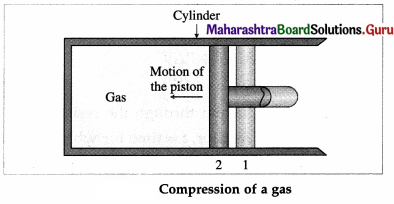
Answer:
When the accelerating voltage is increased, the kinetic energy and hence the momentum of the electron increases. This decreases the de Brogue wavelength of the electron. Hence, the radius of the diffraction ring decreases.
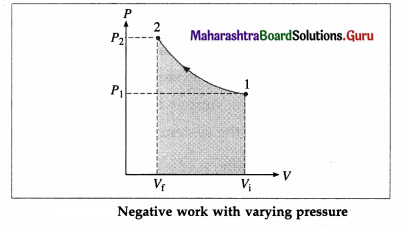
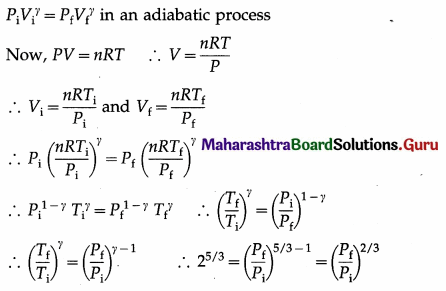
Remember This (Textbook Page No. 320)

Question 1.
On what scale or under which circumstances are the wave nature of matter apparent?
Answer:
When the de Brogue wavelength of a particle such as an electron, atom, or molecule is comparable to the interatomic spacing in a crystal, the wave nature of matter is revealed in diffraction/interference.

Maharashtra Board Class 11 Sociology Important Questions Chapter 2 Contribution of Western and Indian Sociologists

Balbharti Maharashtra State Board Class 11 Sociology Important Questions Chapter 2 Contribution of Western and Indian Sociologists Important Questions and Answers.

Maharashtra State Board 11th Sociology Important Questions Chapter 2 Contribution of Western and Indian Sociologists

Choose the correct alternative and complete the statements.

Question 1.
At the age of 14 expressed the need for ‘reconstruction of society.’
(Karl Marx / Auguste Comte / Emile Durkheim)
Answer:
Auguste Comte

Question 2.
Auguste Comte described sociology with its ‘static’ and ………………….. aspects.
(stable / rigid / dynamic)
Answer:
dynamic

Maharashtra Board Class 11 Sociology Important Questions Chapter 2 Contribution of Western and Indian Sociologists

Question 3.
According to …………………, human knowledge passes through three stages of evolution.
(Iravati Karve / Auguste Comte / Karl Marx)
Answer:
Auguste Comte

Question 4.
The ‘Theory of suicide’ is developed by …………………..
(Emile Durkheim / Karl Marx / Dr. M. N. Srinivas)
Answer:
Emile Durkheim

Question 5.
When the repressive feeling is created due to extreme control of society ……………….. suicide takes place due to extreme control of society.
(fatalistic / anomic / egoistic)
Answer:
fatalistic

Question 6.
……………….. suicide takes place in situation where one is unable to cope with circumstances, cropped up suddenly.
(Fatalistic / Altruistic / Anomic)
Answer:
Anomic

Question 7.
The persons who are concerned with their own interests and have nothing to do with other member of the society, commit …………….. suicide.
(egoistic / anomic / fatalistic)
Answer:
egoistic

Question 8.
………………… is also known as the architect of communism.
(Iravati Karve / Auguste Comte / Karl Marx)
Answer:
Karl Marx

Question 9.
According to Marx, it is the ……………….. factor that formed the basis of class.
(political / economical / social)
Answer:
economical

Question 10.
The tendency towards the radical polarization of classes is inherent in ………………. society.
(capitalist / democratic / modern)
Answer:
capitalist

Question 11.
Capitalists accumulate profit through the ……………….. of labour.
(accumulation / manipulation / exploitation)
Answer:
exploitation

Maharashtra Board Class 11 Sociology Important Questions Chapter 2 Contribution of Western and Indian Sociologists

Question 12.
According to Marx. ………………… is the result of exploitation and not of scarcity.
(poverty / unemployment / beggary)
Answer:
poverty

Question 13.
……………… is the Father of Indian Sociology.
(Dr. G. S. Ghurye / Dr. Iravati Karve / Dr. M. N. Srinivas)
Answer:
Dr. G. S. Ghurye

Question 14.
………………. formed the ‘Indian Sociological Society’ in 1952.
(Dr. M. N. Srinivas / B. K. Sarkar / Dr. G. S. Ghurye)
Answer:
Dr. G. S. Ghurye

Question 15.
Dr. G. S. Ghurye wrote a book ………………… in 1932.
(Caste and Race in India / Kinship Organisation in India / Positive Philosophy)
Answer:
Caste and Race in India

Question 16.
The concept of ‘Dominant Caste’ is introduced by …………………
(Dr. Iravati Karve / Dr. G. S. Ghurye, / Dr. M. N. Srinivas)
Answer:
Dr. M. N. Srinivas

Question 17.
The book ‘Kinship Organisation in India’ is published in 1953 by ………………..
(Dr. Iravati Karve / Dr. G. S. Ghurye / B. M. Seal)
Answer:
Dr. Iravati Karve

Correct the incorrect pair.

Question 1.
(a) Durkheim – Theory of Suicide
(b) Karl Marx – Theory of Class Conflict
(c) Auguste Comte – The Study of Race and Racism
(d) Abdul Rahman Ibn – Khaldun – Study of social institutions and their interrelationships
Answer:
(c) Auguste Comte – Theory of ‘Law of Three Stages’

Question 2.
(a) Positive Philosophy – Auguste Comte
(b) Caste and Race in India – Dr. M. N. Srinivas
(c) Kinship Organisation in India – Dr. Iravati Karve
(d) The Philadelphia Negro – William Du Bois
Answer:
(b) Caste and Race in India – Dr. G. S. Ghurye

Maharashtra Board Class 11 Sociology Important Questions Chapter 2 Contribution of Western and Indian Sociologists

Question 3.
(a) Le Suicide – Auguste Comte
(b) Communist Manifesto – Karl Marx
(c) Sociological Bulletin – G.S. Ghurye
(d) Kinship Organisation in India – Iravati Karve
Answer:
(a) Le Suicide – Durkheim

Question 4.
(a) Social isolation – Altruistic suicide
(b) Normlessness – Anomic suicide
(c) Value oriented – Altruistic suicide
(d) Repressive feeling – Fatalistic suicide
Answer:
(a) Social isolation – Egoistic suicide

Question 5.
(a) Abolition of private property – Communist society
(b) Economic exploitation – Alienation
(c) Accumulation of profits – Surplus values
(d) Workers poverty – Antagonism
Answer:
(d) Workers poverty – Pauperization

Identify the appropriate term from the given options.

(Dr. G. S. Ghurye, Dr. Iravati Karve, Altruistic suicide, Dominant caste)
Question 1.
Marx argues that classes will become hostile towards each other.
Answer:
Polarization

Question 2.
The Indian sociologist who coined the term westernisation.
Answer:
M. N. Srinivas

Question 3.
He started an independent Department of Sociology in the University of Bombay.
Answer:
Dr. G. S. Ghurye

Question 4.
Her concept of Kinship relations in India in basically a socio-cultural concept.
Answer:
Dr. Iravati Karve

Question 5.
This type of suicide is value-oriented.
Answer:
Altruistic suicide

Question 6.
Enjoyment of maximum economical and political power.
Answer:
Dominant caste

Maharashtra Board Class 11 Sociology Important Questions Chapter 2 Contribution of Western and Indian Sociologists

Question 7.
According to Marx, poverty is the result of exploitation.
Answer:
Pauperization

Question 8.
The theory of class conflict.
Answer:
Karl Marx

Question 9.
It is result of economic exploitation and inhuman conditions.
Answer:
Alienation

Question 10.
In this stage one seeks to establish laws which govern social life.
Answer:
Positive stage

Correct the underlined words and complete the sentence.

Question 1.
Some writers honour Dr. Iravati Karve as the first female sociologist.
Answer:
Some writers honour Harriet Martineau as the first female sociologist.

Question 2.
Emile Durkheim was the first black man to receive a Ph.D. from Harvard University.
Answer:
William Du Bois was the first black man to receive a Ph.D. from Harvard University.

Question 3.
Dr. Iravati Karve introduced the concept of Sanskritisation.
Answer:
Dr. M.N. Srinivas introduced the concept of Sanskritisation.

Question 4.
Dominant caste is primarily socio-cultural concept related to factors of family, caste and language in India.
Answer:
Kinship is primarily socio-cultural concept related to factors of family, caste and language in India.

Maharashtra Board Class 11 Sociology Important Questions Chapter 2 Contribution of Western and Indian Sociologists

Question 5.
According to Marx, accumulation of Profit through the exploitation of labour is polarization.
Answer:
According to Marx, accumulation of Profit through the exploitation of labour is surplus value.

Question 6.
Reason and examination were basic planks of knowledge at Metaphysical stage.
Answer:
Reason and examination were basic planks of knowledge at Positive/Scientific stage.

Write suitable examples of given concepts and justify your answer.

Question 1.
Egoistic suicide.
Answer:
Example: It is committed by people who become introvert and have less desires to live in the company of others, suicide rates are higher for those widowed, single and divorced.

Egoistic suicide is when an individual finds no reason to exist in life such people have nothing to do with other members of the society. Such people are socially isolated and they think that they have no place in society.

Question 2.
Dominant caste.
Answer:
Example: Marathas in Maharashtra, are the dominant caste, landowners and cultivators that make up about 50% of the population, Reddys and Kammas in Andhra Pradesh.
1. Dominant caste is a caste large in member and exercises more economical, social and political privileges over other people.

2. In Maharashtra, Marathas are large in number and play a very important role as far as social, economical and political policies are concerned.

3. Attributes or determinants of dominant caste are as follows:

  1. Sizeable amount of arable land locally available.
  2. Strength of numbers.
  3. High place in the local hierarchy.
  4. Western education.

Question 3.
Theological stage.
Answer:
Example: For example, ancient people actually believed that planets were God. This is a stage in which people have faith on supernatural power and considered God as a supreme authority. During ancient period; people of India had blind faith on many things, were following various evil practices etc. According to them God was the highest, authority and everything took place as per His wishes.

Question 4.
Anomic suicide.
Answer:
Example: In the Indian context, the farmers’ suicides fall under anomic suicide. Because of economic instability farmers tend to commit suicide.

Anomie is a condition of normlessness, a moral vacuum, the suspension of rules, a state sometimes referred to as deregulation. This type of suicide takes place in situations where one is not able to cope with circumstances which have cropped up suddenly.

Maharashtra Board Class 11 Sociology Important Questions Chapter 2 Contribution of Western and Indian Sociologists

Question 5.
Altruistic suicide.
Answer:
Example: Sati committed by Indian women in the past or Hara-kiri committed by Japanese. Here an individual commits suicide with the object of doing well for others. This type of suicide is value- oriented. An individual commits suicide due to extreme loyalty to one’s group and readiness to die.

Question 6.
Fatalistic suicide.
Answer:
Example: A prisoner, commits suicide due to oppressed feelings of the prison system, (or) A terminally ill patient commits suicide.
Fatalistic suicide takes place, when the repressive feelings is created due to extreme control of society.

Write short notes.

Question 1.
The Development of Sociology
Answer:

  1. The foundations of sociology were laid down by Auguste Comte and Emile Durkheim in France.
  2. The legacy of sociology was later on continued in other countries in Europe and the western world. Sociology has also developed in India.
  3. Sociologist like Auguste Comte, Emile Durkheim and Karl Marx from the west and G. S. Ghurye, M. N. Srinivas and Iravati Karve have worked on specific areas within the broad scope of Sociology as a discipline.
  4. Many of them have developed specific concepts and developed theories through which they explain human social behaviour.

Question 2.
Contribution of Dr. M. N. Srinivas.
Answer:
1. Dr. M. N. Srinivas completed his education in Mysore and joined the Department of Sociology in Mumbai University. He was a student of Dr. G. S. Ghurye.

2. Different concepts like, Brahminisation, Sanskristisation, Westernisation and Secularisation, Dominant caste, etc., were introduced by him.

3. According to him each caste in India differ from the other as far as strength and influences are concerned. Some castes enjoy higher privileges. In this respect he developed the concept of ‘Dominant Caste’. He prescribed different determinants of dominant cast. On the basis of these attributes and determinants, some caste in India are considered as ‘Dominant Caste’.

4. Examples of dominant castes given by Dr. Srinivas are:

  • Lingayats and Okkaligas in Karnataka
  • Reddys and Kammas in Andhra Pradesh.

Maharashtra Board Class 11 Sociology Important Questions Chapter 2 Contribution of Western and Indian Sociologists

Question 3.
Contribution of Dr. Iravati Karve to Indian sociology.
Answer:
1. Dr. Iravati Karve has immense contributors in sociology and Anthropology. She has done pioneering work in her book “Kinship organisation in India” published in 1953. In this book, she presents a micro analysis of the major kinship systems in India.

2. The book gives us a list of kinship terms in major Indian languages, their linguistic content, corresponding behaviour and attitudes rules of descent and inheritance and patterns of marriage and family.

3. Kinship is primarily a socio-cultural concept and subsequently it is related to factors of family, caste and language in India.

4. She has presented kinship organisation on the basis of geographical regions – Northern, Central, Southern and Eastern, and linguistic regions like Indo-European and Dravidian kinship is a primarily socio-cultural concept and subsequently it is related to factors of family, caste and languages in India.

Question 4.
Contribution of Karl Marx.
Answer:
1. Karl Marx, is also known as the architect of Communism.

2. The Theory of ‘class conflict’ is central to Marxian thought. In his ‘Communist Manifesto’ Marx has said that, at every stage in history, there is a war between the classes.

3. According to Marx, ‘it is the economic factor that forms the basis of class’.

4. Marx’s analysis of class conflict in capitalist society is as following:

  1. The importance of property
  2. Polarization of classes
  3. Surplus value
  4. Alienation
  5. Pauperization
  6. Class solidarity and antagonism
  7. Revolution
  8. Dictatorship of proletariat
  9. Emergence of the communist society

Question 5.
Contribution of Harriet Martineau.
Answer:

  1. Some writers honour Martineau as the first female sociologist.
  2. Martineau introduced Comte to the English-speaking world by translating his book written in French to English, as ‘The Positive Philosophy of Auguste Comte.
  3. According to Martineau, “When one studies a society, one must focus on all its aspects which includes political, religious, and social institutions”
  4. She was the first sociologist to study issues such as marriage, children, religious life, and race relations. She believed that comprehensive social analysis was crucial to understand women’s secondary status in the society.

Question 6.
Hinduisation of the tribes.
Answer:

  1. Ghurye referred to the long process of Hinduisation of the tribes from different parts of India.
  2. Tribal deities like Ganesh, Kali, Shiva were getting equal space in Hinduism with Aryan deities like, Indra, Vishnu and Brahma for establishing synthesis between multiple cultures present in Indian society.
  3. As a result the tribes of India considered Hindu society and its cultural tradition, a new home for them, referred as Hinduisation of the tribes by Ghurye.
  4. Many tribal leaders like Tana Bhagat, Vishnu Bhagat, Kabir Panthi and others successfully carried Hindu cultural attributes to tribal life.

Maharashtra Board Class 11 Sociology Important Questions Chapter 2 Contribution of Western and Indian Sociologists

Complete the concept maps.

Question 1.
Maharashtra Board Class 11 Sociology Important Questions Chapter 2 Contribution of Western and Indian Sociologists 1
Answer:
Maharashtra Board Class 11 Sociology Important Questions Chapter 2 Contribution of Western and Indian Sociologists 2

Question 2.
Maharashtra Board Class 11 Sociology Important Questions Chapter 2 Contribution of Western and Indian Sociologists 3
Answer:
Maharashtra Board Class 11 Sociology Important Questions Chapter 2 Contribution of Western and Indian Sociologists 4

Question 3.
Maharashtra Board Class 11 Sociology Important Questions Chapter 2 Contribution of Western and Indian Sociologists 5
Answer:
Maharashtra Board Class 11 Sociology Important Questions Chapter 2 Contribution of Western and Indian Sociologists 6

Question 4.
Maharashtra Board Class 11 Sociology Important Questions Chapter 2 Contribution of Western and Indian Sociologists 7
Answer:
Maharashtra Board Class 11 Sociology Important Questions Chapter 2 Contribution of Western and Indian Sociologists 8

Question 5.
Maharashtra Board Class 11 Sociology Important Questions Chapter 2 Contribution of Western and Indian Sociologists 9
Answer:
Maharashtra Board Class 11 Sociology Important Questions Chapter 2 Contribution of Western and Indian Sociologists 10

Question 6.
Maharashtra Board Class 11 Sociology Important Questions Chapter 2 Contribution of Western and Indian Sociologists 11
Answer:
Maharashtra Board Class 11 Sociology Important Questions Chapter 2 Contribution of Western and Indian Sociologists 12

Maharashtra Board Class 11 Sociology Important Questions Chapter 2 Contribution of Western and Indian Sociologists

Question 7.
Maharashtra Board Class 11 Sociology Important Questions Chapter 2 Contribution of Western and Indian Sociologists 13
Answer:
Maharashtra Board Class 11 Sociology Important Questions Chapter 2 Contribution of Western and Indian Sociologists 14

State whether the following statements are true or false with reasons.

Question 1.
Auguste Comte formulated the theories of‘Law of Three Stages’.
Answer:
This statement is True.

  1. According to Comte every individual develops as per his stages of development in childhood, in adolescence and in adulthood.
  2. The evolution of human mind takes place along with the evolution of the individual mind.
  3. Human knowledge passes through these three stages of evolution, theological stage Comte is of the view that in the first stage, ideas and views were influenced by spiritual and supernatural factors, metaphysical stage. In this stage, explanations based on faith in supernatural beings were replaced by those based on abstract power, positive stage this is an improved and scientific form of human thinking.
  4. Comte wanted Sociology to develop through these stages. Hence, Auguste Comte formulated the theories of ‘Law of Three Stages’.

Question 2.
Sociology is a western phenomenon.
Answer:
This statement is False.

  1. Though there is a tendency to think of sociology as a western phenomenon, but scholars like Abdul Rahman Ibn-Khaldun were doing Sociology long ago in different parts of the world.
  2. Abdul Rahman Ibn-Khaldun was born in Tunis in North Africa and was committed to the scientific study of society, empirical research and the search for the causes of social phenomena.
  3. He devoted attention to various social institutions and their interrelationships. He was interested in comparing primitive and modern societies.

Give your personal response.

Question 1.
Do you think farmer’s suicide is a burning issue and has emerged as a social problem? Give reasons for your response?
Answer:
Yes, farmers suicide is a burning issue and a social problem. Heavy indebtedness, irregular monsoon, rising cost of cultivation are various reasons that have led to a series of suicides committed by farmers. The action of killing oneself deliberately is suicide.

When an individual becomes unstable and enters in the state of dilemma and commits suicide it is an anomic suicide. In the Indian context the farmers suicides fall under the type of anomic suicide. Because of economic instability marginal farmers tend to commit suicide.

Maharashtra Board Class 11 Sociology Important Questions Chapter 2 Contribution of Western and Indian Sociologists

Answer the following in detail (About 150-200 words).

Question 1.
Bring out the contribution of any two sociologist and relate it to Indian society.
Answer:
1. Dr. G. S. Ghurye-Govind Sadashiv Ghurye is known as the ‘Father of Indian Sociology’, Ghurye’s work on tribes were general as well as specific. In his work on Scheduled Tribes, he dealt with the historical, administrative and social dimensions of Indian tribes. He also wrote on specific tribes such as the Mahadev Kolis in Maharashtra. Ghurye referred to the long process of Hinduization of the tribes from different parts of India which helped them to assimilate themselves within the folds of Hindu society. His book, ‘Caste and Race in India’ which was published in 1932 is historical, anthropological and sociological perspectives to understand caste and kinship system in India. Ghurye regards endogamy as a principal feature of caste.

2. Dr. Iravati Karve- has done pioneering work in her book ‘Kinship Organization in India’, published in 1953.The book on Kinship attempts to present a comparative picture of Kinship organisation in different parts of India. The book gives us a list of kinship terms in major Indian languages, their linguistic content, corresponding behaviour and attitudes, rules of descent and inheritance and patterns of marriage and family. Kinship is primarily a socio-cultural Iravati concept and related to factors of family, caste and language in India.