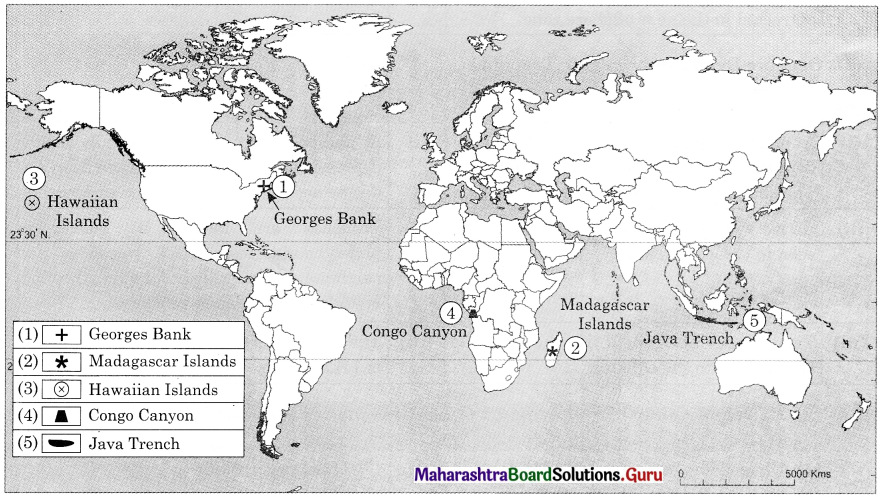
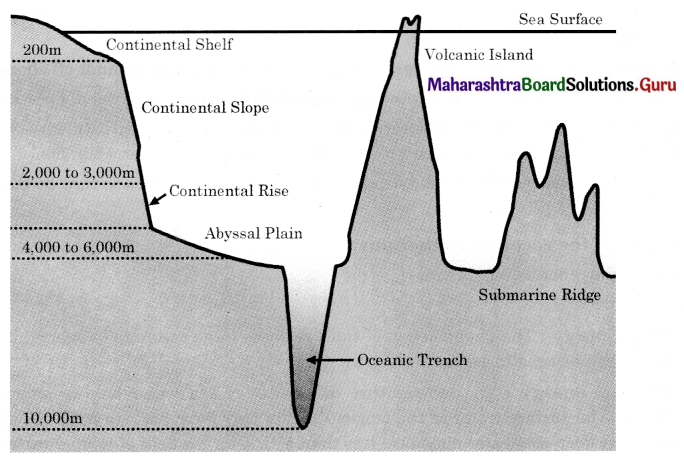
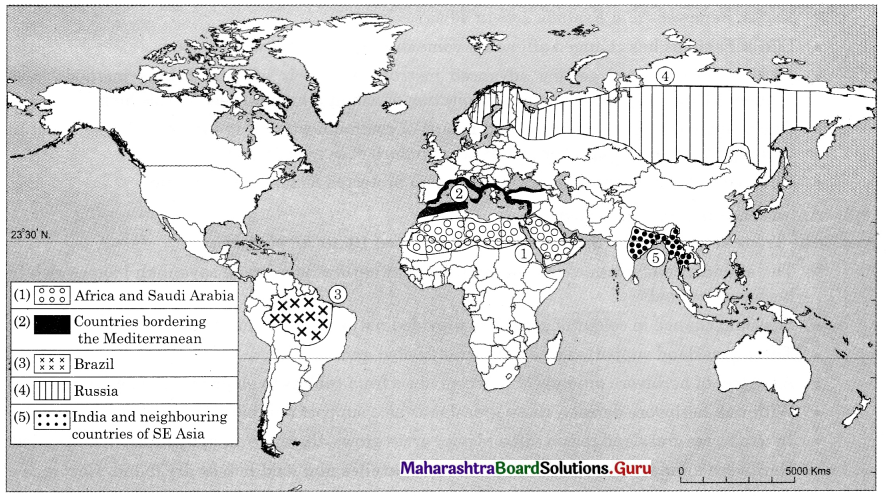
Maharashtra Board Class 11 Sociology Solutions Chapter 4 Social Institutions

Balbharti Maharashtra State Board Class 11 Sociology Solutions Chapter 4 Social Institutions Textbook Exercise Questions and Answers.

Maharashtra State Board Class 11 Sociology Solutions Chapter 4 Social Institutions

1. (A) Choose the correct alternative and complete the statements.

Question 1.
A rule that prescribes marriage within a group is called ……………….
(exogamy / endogamy / polygamy)
Answer:
endogamy

Question 2.
A family that comprises at least three generation is a ………………… family.
(nuclear / joint / cohabitation)
Answer:
joint

Maharashtra Board Class 11 Sociology Solutions Chapter 4 Social Institutions

Question 3.
The 10 + 2 + 3 system is part of the ………………. system of education.
(informal / formal / universal)
Answer:
formal

1. (B) Correct the incorrect pair.

Question 1.
(a) School – Distance Education
(b) Peer group – Informal Education
(c) Health care training – Non-formal Education
(d) Family – Informal Education
Answer:
(a) School – Formal education

1. (C) Identify the appropriate term from the given options.

(Homosexual Marriage, Matrilocal, Heterosexual Marriage)
Question 1.
A married couple is expected to live at the wife’s residence.
Answer:
Matrilocal

Question 2.
A form of marriage between persons of the same sex.
Answer:
Homosexual Marriage

1. (D) Correct underlined words and complete the sentence.

Question 1.
X married Y. Later she divorced her spouse and married Z. This is an example of polygamy.
Answer:
X married Y. Later she divorced her spouse and married Z. This is an example of monogamy.

Question 2.
Mass production and factory system are found in agricultural society.
Answer:
Mass production and factory system are found in industrial society.

Maharashtra Board Class 11 Sociology Solutions Chapter 4 Social Institutions

2. Write short notes.

Question 1.
Types of family based on authority.
Answer:
On the basis of authority within family, two broad forms of family can be identified. Matriarchal Family : In matriarchal family authority rests at the hands of the mother and she is considered the head of the family. In matriarchal family descent is traced through mother’s line, known as matrilineal system. Residence of the marriage is matrilocal i.e., the bridegroom lives with the wife’s family and the name follows the mother’s line. It is matronymic. The Garo and Khasi tribes of North East India and the Nair’s of South India follow the matriarchal system.

Patriarchal Family : In patriarchal family all authority rests at the hands of the male head and the eldest male is regarded as the head of the patriarchal family. It is patrilineal i.e., descent is traced through father’s line. Residence after marriage is patrilocal. The married couples live with the husband’s family, and the name of the father’s side continues to the next generation. It is patronymic. Patriarchal family is the most widespread form of family in India and most parts of the world.

Maharashtra Board Class 11 Sociology Solutions Chapter 4 Social Institutions

Question 2.
Stages of Economy.
Answer:
Human society has evolved through various stages, depending upon the way it evolved mechanisms to adapt to changing material needs.

With respect to the changing nature of work and economy three broad stage of economy are as follows: Agriculture Revolution : From hunting-gathering and then pastoral phases, human society entered into a new stage with discovery of agriculture. With development of agriculture, food production increased. Complex division of labour, advanced trade and permanent settlement are the result of economy expansion through agricultural technology.

Industrial Revolution : Industrial revolution which happened around the middle of the 18th century, first in England transformed social and economic life like never before. It brought four notable economic changes.

  1. New forms of energy : With the pioneering invention of the steam engine in 1765 by James Watt, the use of animal and human muscle energy was significantly reduced.
  2. Centralisation of work in factories : Use of machinery gave rise to a new workplace called factory.
  3. Mass production : Industrial economy developed the manufacturing sector very fast and produced goods on a large scale.
  4. Division of labour : The factory system reduced the importance of human skills and resulted to specialised division of labour.
  5. Industrialization transformed the whole society and also created huge economic gaps in the society.

The Information Revolution : By the middle of the 20th century the nature of production started to change. The use of automated machinery drastically reduced the role of human labour in manufacturing. Three key changes were seen due to the development of computer and information technology.

  1. Tangible products to idea : The tertiary or service sector providing services and dealing with production of ideas and symbols is expanding very fast.
  2. Mechanical skills to literacy skills : The information revolution demands a new set of skills such as literacy skills – the ability to communicate, to write, to present and use computer technology.
  3. Work from anywhere : Computer technology is allowing for decentralisation of work.

Question 3.
Importance of Education.
Answer:
Education is broad process of learning that broadens an individual’s cognitive horizons and develops in them the skills to choose, evaluate and add to existing knowledge.
The functions of education can be as follows:
1. Inculcate common values and moral beliefs : Children coming from diverse family and community backgrounds gain an understanding of the common values and moral beliefs in society through school education.

2. Fosters self-discipline : Through education children learn self-discipline. They internalise the social rules that contribute to the smooth function of society.

3. Teaches specialised skills: The education system teaches specialised skills needed for a complex modern economy. For example, technical schools are specially designed to provide technical / vocational training.

4. Instils the value of achievement in children : Schools like wider society, largely operate on a meritocratic basis. Those with ability and talent achieve their just rewards.

3. Differentiate between.

Question 1.
Matriarchal Family and Patriarchal Family.
Answer:

Matriarchal FamilyPatriarchal Family
(i) Authority rests at the hands of the mother in a matriarchal family. She is considered the head of the family.(i) The eldest male is regarded as the head of the patriarchal family. All authority rests at the hands of the male head.
(ii) Matriarchal families follow a matrilineal system of lineage i.e., descent through mother’s line.(ii) Patriarchal family is also patrilineal i.e., descent is traced through father’s line.
(iii) Residence after marriage is matrilocal i.e., the bridegroom lives with the wife’s family.(iii) Residence after marriage is patrilocal. The married couple lives with the husband’s family.
(iv) The name follows the mother’s line. It is matronymic.(iv) The name of the father’s side continues to the next generation. It is patronymic.
(v) The Garo and Khasi tribes of North East India and the Nair’s of South India follow the matriarchal system.(v) The most widespread form of family in India and most parts of the world is patriarchal family.

Maharashtra Board Class 11 Sociology Solutions Chapter 4 Social Institutions

Question 2.
Agriculture Revolution and Industrial Revolution.
Answer:

Agriculture RevolutionIndustrial Revolution
(i) From hunting – gathering and then pastoral phases, human society entered into a new stage with discovery of agriculture.(i) Industrial revolution happened around the middle of the eighteenth century and transformed social and economic life.
(ii) Agricultures involved using technology of large -scale farming using ploughs harnessed to animals.(ii) Industrialisation involved using of machinery and new forms of energy.
(iii) This increased the productive power of hunting and gathering more than tenfold.(iii) This increased more mass production which turned raw materials into a wide range of goods.
(iv) griculture revolution resulted into expansion of economy through agricultural technology, complex division of labours permanent settlement and advanced trade.(iv) Industrial revolution resulted into centralisation of work in factories and specialized division of labour.

4. Explain the following concept with suitable examples.

Question 1.
Cohabitation
Answer:

  1. Cohabitation is the sharing of a household by an unmarried couple.
  2. Live in relations or cohabitation may or may not lead to marriage.
    Example : Younger generations specially in many parts of Europe and in some urban areas in India are preferring cohabitation as family relation. This is especially true among same sex couples.

Question 2.
Formal Education
Answer:

  1. Formal education is planned with a specific end in view.
  2. It involves direct schooling and instruction. Since it is provided to fulfill specific ends, formal education is limited to a specific period. Formal education has a well-defined and systematic curriculum based on aims designed according to the needs of society.

Example : Schooling and education are considered as a formal education based on formal curriculum with specific subject and skills.

5. State whether the following statements are true or false with reasons.

Question 1.
In a modernizing society the role of parents are changing.
Answer:
This statement is True.

  1. Rapid growth of divorce and changing roles of woman give rise to a new family form and relation which has led to changes in the role of parents.
  2. The average age at which people get married is also increasing. There is also an increasing trend of individuals not getting married. There is a changing role of women due to education and employment. All these changes are affecting family as an institution.
  3. In our contemporary society, the traditional belief of fathers are the breadwinners and mothers only do household chores is no longer true. With the advent of globalization, their roles are changing which is vastly different from their previous generations.

Maharashtra Board Class 11 Sociology Solutions Chapter 4 Social Institutions

Question 2.
India is in the stage of industrial revolution.
Answer:
This statement is False.

  1. India is in the stage of information revolution. The development of computer and information technology have changed the nature of work in India.
  2. The use of automated machinery has reduced the role of human labour in manufacturing. Service industries like public relations, banking and sales, media, advertising have expanded.
  3. The introduction of computer and information have changed the character of work in India.

6. Give your personal response.

Question 1.
What are your views about love marriage? Do you support it? Explain.
Answer:
The basic concept of love marriage lies in the fact that the girl or boy chooses his or her life partner. The restrictions of caste, religion, physical appearance does not apply when a person falls in love. In India these restrictions are seriously enforced which limit the number of desirable matches for a person. Also, it curbs the practice of dowry as one does not need to prove one’s worth. Therefore, I support love marriages.

Question 2.
How has the information revolution impacted your life?
Answer:
Information revolution has made our life easier. Information revolution has made it possible to do many things from the comforts of one’s own home. I can take virtual tour of museums, buildings etc. It has exposed one to different cultures. One can do all of shopping online. It has created abundance of data on every possible subject or interest.

7. Answer the following in detail (About 150-200 words).

Question 1.
Show how the role of family has changed in the present times. Illustrate with your own examples.
Answer:
Families are the nexus of activities that include parenting , employment and leisure. As society changes, families must adapt to the new structures and processes resulting from this change. One of the most striking features of modern societies has been rapid growth of divorce.

The average age at which people get married is also increasing along with an increasing trend of an individuals not getting married. The changing roles of woman through increased education and employment, has put additional pressures on the family to adapt to dual-earner, households and changing needs of child care. All these changes are affecting family as an institution.

It has given rise to new family relationship:
(i) Single-parent Family : Majority of single parent families are headed by single mothers. This may result from divorce, separation, death or by choice. Sometimes growing up in a single parent family can be a disadvantage for children.

(ii) Cohabitation : Cohabitation is the sharing of a household by an unmarried couple. Younger generations, especially in many parts of Europe and in some urban areas in India are preferring cohabitation as family relation. This is especially true among some same sex couples.

(iii) Step-parenting : As rates of divorce and remarriage is steadily on an increase, it gives rise to a new family form and relation of step-parenting. The extent of children staying in step families is increasing.

In the traditional family living, the wife had no voice in family decision making but in contemporary family she has equal power role to play. The authority has shifted from patriarchal to parents who consult their children an all-important issues before taking any decisions about them. Younger generations now claim more individuality. Change in family does not mean the complete erosion of previous norms and structure.

Maharashtra Board Class 11 Sociology Solutions Chapter 4 Social Institutions

11th Sociology Digest Chapter 4 Social Institutions Intext Questions and Answers

ACTIVITY (Textbook Page No. 41)

Question 1.
Discuss why hypogamous marriages are resisted in society. Take help of newspapers, magazines and cinema.
Answer:
Reasons for resisting hypogamous marriage. Hypergamy is a term used for the practice of a person marrying a spouse of higher caste or social status than themselves. Young women generally marry older men of higher status, with general rule that older men have more time to create wealth and status than younger men. Today such marriages are on decline, as most people marry their approximate social equals and in some parts of the world hypergamy has decreased. Also, it is becoming less common for women to marry older men though hypergamy does not require the man to be older but only of higher status.

Question 2.
Look at the matrimonial advertisements in newspapers, magazines and internet and discuss the findings. Do you think endogamy is still the prevalent norm in India? (Textbook Page No. 42)
Answer:
Religion and Caste endogamy still dominates while choosing a life partner. Women have the freedom to select a spouse in urban areas, yet, the choice can be restricted. So, in general, marriage is often seen as socially determined institutions.

Question 3.
Watch the classic movie ‘Modern Times’ made by Charlie Chaplin and have a discussion on the effects of mechanisation on human labour. (Textbook Page No. 44)
Answer:
The film ‘Modern Times’ is a comment on the desperate employment and financial conditions that people faced during the great depression conditions created, by the modern industrialization in the view of Chaplin. Modern Times’ portray Chaplin as a factory worker where he is subjected to such indignities as being forced fed by a malfunctioning ‘feeding machine’. In the movie, industry is portrayed as something bigger and more valuable than the people who work within it. Chaplin tries to point out the fact at the industrialized world functions in a way that suppresses human agency and creativity.

Maharashtra Board Class 11 Sociology Solutions Chapter 4 Social Institutions

Question 4.
Eminent personalities having achieved social prestige and position on the basis of their educational qualification. (Textbook Page No. 48)
Answer:
(i) Bhimrao Ramji Ambedkar : Dr. Bhimrao Ambedkar was born on 14th April 1891. During his childhood he was subjected to socio-economic discrimination and faced severe humiliation. Dr. Ambedkar earned his doctorates in Economics from both Columbia University and the London School of Economics. He gained reputation as a scholar for his research in Law, economics and political science. In his initial career, he worked as an economist, professor and lawyer. He was posthumous awarded the Bharat Ratna, India’s highest civilian award, in 1990.

(ii) A. P. J. Abdul Kalam : A. P. J. Abdul Kalam was born on 15th October 1931. His father was an owner of a boat, an imam of local mosque. Due to destruction in business and loss of the family fortune, Kalam’s family suffered poverty. To help his family, he started selling newspapers at an early age. Abdul Kalam completed his graduation from the Madras Institute of Technology and joined the Aeronautical Development Establishment of the Defence Research and Development Organisation (DRDO) as a scientist after becoming a member of Defence Research and Development Service (DRDS). He came to be known as the Missile Man of India’. He was the 11th President of India.
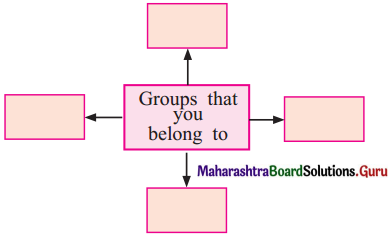
Maharashtra Board Class 11 Sociology Solutions Chapter 3 Basic Concepts in Sociology

Balbharti Maharashtra State Board Class 11 Sociology Solutions Chapter 3 Basic Concepts in Sociology Textbook Exercise Questions and Answers.

Maharashtra State Board Class 11 Sociology Solutions Chapter 3 Basic Concepts in Sociology

1. (A) Choose the correct alternative and complete the statements.

Question 1.
Society is based on ……………….
(co-operation / competition / conflict)
Answer:
Co-operation

Question 2.
Villages are a part of ……………….. community.
(rural / city / metropolitan)
Answer:
rural

Maharashtra Board Class 11 Sociology Solutions Chapter 3 Basic Concepts in Sociology

Question 3.
Family is an example of a ………………. group.
(large / primary / formal)
Answer:
primary

Question 4.
Social status refers to ……………… in a group.
(function / position / purpose)
Answer:
position

1. (B) Correct the incorrect pair.

Question 1.
(a) Family – Voluntary Group
(b) Caste – Involuntary Group
(c) Village – Primary Group
(d) Workplace – Secondary Group
Answer:
(a) Family – Involuntary Group

1. (C) Identify the appropriate term from the given options.

(Role, Folkways, Society)
Question 1.
Punctuality in class is the duty of a student.
Answer:
Role

Question 2.
In many places in India, eating with hands is a common practice.
Answer:
Folkways

Maharashtra Board Class 11 Sociology Solutions Chapter 3 Basic Concepts in Sociology

1. (D) Correct underlined words and complete the sentence.

Question 1.
Norms which can be applied in daily life are called law.
Answer:
Norms which can be applied in daily life are called standard norms.

Question 2.
Family is an example of a/an voluntary group.
Answer:
Family is an example of a/an involuntary group.

2. Write short notes.

Question 1.
Characteristics of Society.
Answer:
(i) Society includes likeness : According to Maclver ‘society’ means likeness. Social relationships exist among those who are alike in body and mind. People have similarities with regard to their needs aim, ideals, values, outlook towards life and so on.

(ii) Society includes difference : A society together with likeness is also based on differences. Differences is an important factor for a healthy society. Different types of personalities are essential in our society in order to satisfy the different needs. These differences are based on sex, age, physical strength, intelligence, talent, personality and unequal possessions of material objects and wealth.

(iii) Interdependence : Individuals in a society depend upon one another for the satisfaction of needs. One group, one nation, one community depends upon the other for its development, t Interdependence is seen in family groups as well. The existence of society depends upon different types of social relationships.

(iv) Co-operation : Every society is characterized by co-operation and division of labour. It is necessary for survival.

(v) Normative nature : In a society, social behaviour is evaluated by social control. These controlling means are known as norms. Norms control the misbehaviour or the acts which are harmful to society thus protecting the society.

(vi) Society is dynamic : No society is static. It changes continuously; old customs, traditions, I values, norms and institutions replace the new customs, traditions, values, norms and institutions.

Maharashtra Board Class 11 Sociology Solutions Chapter 3 Basic Concepts in Sociology

Question 2.
Characteristics of Primary Group.
Answer:

  1. Physical proximity : This is essential for a primary group as people have close relations with each other. Hence, they experience physical proximity.
  2. Smallness of the group : These social groups are small in size and bring out the close relations among its members.
  3. Permanence of relationship : Close relations create more unity among the members.
  4. Face-to-face relationship : These social groups are small in size and are based on greater closeness. It is useful for maintaining group stability.
  5. Similar objectives and goals : This group is homogeneous in nature. Hence, there is uniformity of objectives and goals among its members.
  6. The relationship is an end in itself: The relationships in this group are very natural.
  7. Informal control: This group is conventional and based on emotional bonds.

Question 3.
Types of Norms.
Answer:
Folkways : The term was first used by William Sumner. According to him, folkways are the recognized ways of behaving and acting in society. Example, eating using one’s fingers, eating with chopsticks, eating with fork and spoon; different ways of wearing a sari.

Mores : Mores are more rigid than folkways. They are instruments of social control and deals with higher values of people. Example, sexual relations before marriage are not permitted.

Law : Law is an important and essential element of society.
They are deliberately formulated rules of behaviour. It is universal in nature and common for all to follow. There are two types of law- Customary Law and Enacted Law.

  1. Customary law – It is not in a written form but orally transmitted. It is followed in tribal as well as in rural society.
  2. Enacted law – This law is in a written form. It is important as well as obligatory in a modern, complex and dynamic society. For example, The Hindu Marriage Act, 1955; The Domestic Violence Act, 2005.

Maharashtra Board Class 11 Sociology Solutions Chapter 3 Basic Concepts in Sociology

3. Differentiate between.

Question 1.
Primary Group and Secondary Group.
Answer:

Primary GroupSecondary Group
(i) Primary group is a group in which relationships are personal, informal, face to face and intimate in nature.(i) Secondary group is a group in which relationships are impersonal, formal and contractual in nature.
(ii) This group is small in size.(ii) This group is large in size.
(iii) Relationships are personal, so physical proximity is more.(iii) Due to formal relationships there is no physical proximity between the members.
(iv) Relations are permanent.(iv) Relations are temporary.
(v) Behaviour is controlled in an informal way.(v) Behaviour is controlled in a formal way.
(vi) Example Family, peer group, neighbourhood, etc.(vi) Example Nation, State, Labour unions, etc.

Question 2.
Voluntary Group and Involuntary Group.
Answer:

Voluntary GroupInvoluntary Group
(i) Membership is based on choice.(i) Membership is based on birth.
(ii) It may be temporary or permanent in nature.(ii) It is mostly permanent in nature.
(iii) Individual has choice to continue or to leave the membership.(iii) One cannot leave the membership or it may be difficult to leave the group.
(iv) Example : Political parties, youth organisation, cultural association, etc.(iv) Example : Family, caste, race, religion, etc.

4. Explain the following concept with suitable examples.

Question 1.
Reference Group
Answer:
The concept of reference group was introduced by Robert Merton. A reference group is a group to which an individual or another group is compared. We use reference groups in order to guide our behaviour and attitudes that help us to identify social norms.

Reference Groups are of two types Informal and Formal.

  1. Informal reference groups are formed by the individual as per their likes, interests and attitudes.
    Example : Family, peer groups, teachers, siblings, associates, etc.
  2. Formal Reference Group are the ones that have a specific goal or mission.
    Example : Labour unions, supreme court, military units, corporations, worship place, universities, etc.

Question 2.
Role Conflict
Answer:

  1. Role conflict refers to a clash between roles.
  2. When one faces incompatibility between two or more roles at the same time or in a given situation. Role conflict is inevitable.

Example: A boss will suffer role conflict if forced to fine an employee who is also a close friend. A newly married bride experiences role conflict because she has to adjust with her in-laws, household work and office work.

Maharashtra Board Class 11 Sociology Solutions Chapter 3 Basic Concepts in Sociology

5. (A) Complete the concept maps.

Question 1.
Maharashtra Board Class 11 Sociology Solutions Chapter 3 Basic Concepts in Sociology 1
Answer:
Maharashtra Board Class 11 Sociology Solutions Chapter 3 Basic Concepts in Sociology 2

5. (B) State whether the following statements are true or false with reasons.

Question 1.
Society never changes.
Answer:
This statement is False.
1. Society is a web of social relationships. These relationships and interactions are based upon different institutions, traditions, customs, values and norms of the society.

2. Changes in any one of this is reflected in the changes in relationship and interaction among the individuals. Change is a universal phenomenon. No single society is static. Factors like, westernisation, modernisation, industrialisation, education have brought various changes in society.

3. Today, educational system, family patterns, norms, values, needs, etc., are changed. People have become more self-centred. Individual freedom, consciousness towards one’s own rights are increasing. Hence, society is changing continuously.

Question 2.
People living in a community must have awareness of sharing a way of life.
Answer:
This statement is True.

  1. Individuals are emotionally attached to their community. People those who live in a particular community occupy a definite territorial area. They share common objectives and needs.
  2. They have love and affection towards each other.
  3. This develops a sense of belongingness. Therefore, people living in a community must have awareness of sharing a way of life.

6. Give your personal response.

Question 1.
Show how folkways, mores and laws may clash with each other.
Answer:
Folkways is one of the essential elements of culture. Folkways govern our daily routine and ordinary contacts with other people. Whereas mores are considered as vital to the welfare of the group. Folkways and mores are the customary way of life and standards of right and wrong. Example: wearing clothes are mores and wearing clothes of different styles are folkways.

Laws are deliberately formulated rules of behaviour that are enforced by a special authority, e.g., there are laws that can punish people for marrying more than one person. Hindu Marriage Act, 1955.

Mores, folkways and laws are taught through the process of socialisation by various sources like family, friends, peer groups, schools, etc. However, these three clash each other in various ways. In today’s complex, competitive society, one finds it difficult to cope up with these three elements of society. Example: there is a man who belongs to a poor family and has the responsibility of marriage of his sister. Being born in a poor family, he doesn’t have enough money for his sister’s marriage. As per the laws, asking for dowry is illegal, but due to his financial condition, he has to ask for dowry from his in-laws to get his sister married. In such situation folkways, mores and law clash each other.

Maharashtra Board Class 11 Sociology Solutions Chapter 3 Basic Concepts in Sociology

Question 2.
Do you think that role conflict is inevitable in social life?
Answer:
Yes, the role conflict is inevitable in social life.
When an individual has to play several roles at a time, then it is not possible to perform one role appropriately, it is called as role conflict. In today’s society, everyone wants to achieve high status in society. Everyone wants to achieve a life of luxury and comfort. People want to earn more and more money. Expectations have been increased. In order to adjust with such competitive situation, one has to play different role in the society. That creates role conflict.

Example: A woman working as a nurse in the hospital, has to look after her sick in-laws at home, because of which she can’t pay proper attention towards her duty. A husband who has to attend urgent meeting as a manager, can’t give time to his family. One has to perform multiple roles in a complex society. That is why role conflict is inevitable in social life.

7. Answer the following in detail (About 150-200 words).

Question 1.
Identify any two secondary groups of which you are a member. Discuss any four characteristics with reference to the groups that you have named.
Answer:
Secondary groups have impersonal, formal, indirect, temporary and goal oriented relationships with large number of members. It is not possible to have regular, permanent, close and intimate relations with everyone. People meet each other only for serving specific purposes. Relations are maintained only when the specific purposes are fulfilled and people are satisfied.

People are always very busy and it is necessary to have appointments before meeting. Secondary group are heterogeneous and formal in natural. People are given time to meet but for that purpose only. People do not meet for long term goals. Free expressions of emotions, feelings and intimacy is not allowed. In secondary group, members have to follow rules and regulations strictly.

Example : (i) Student of a college
(ii) Member of NSUI – National Students Union of India (or) ABVP – Akhil Bhartiya Vidhyarthi Parishad
Characteristics of secondary group with reference to the above mentioned group. Large Size: In college or in NSUI number of students and members is large. Here, the membership is unlimited as compared to primary group.

Indirect relations : Due to large size, direct relations among all the students and members are not possible. To convey any message, we take help of modern means of communication, e.g., mobile phones, e-mail, WhatsApp, etc.

Impersonal relations : As the members are large in size personal interactions is very rarely seen. Here, we do not know each other personally. That is why, relationship is not personal.

Formal relations : Informal relations is not possible because face to face contact can’t take place. People are more goal oriented. Membership is strictly based upon laws and regulations.

Maharashtra Board Class 11 Sociology Solutions Chapter 3 Basic Concepts in Sociology

11th Sociology Digest Chapter 3 Basic Concepts in Sociology Intext Questions and Answers

ACTIVITY (Textbook Page No. 25)

Question 1.
Visit a rural, tribal or urban community and speak to 3-5 people and find out about their work, families, customs, beliefs etc. Write a report or make a short film on your mobile phone.
Answer:
Tribal, Rural and Urban Community – Work, Families, Customs, Beliefs-
(i) The Tribal Community : The tribal community is small in size. Each tribe has its own culture. They are close to nature and their life is influenced by religion. Therefore, they worship natural forces and seek assistance from the shaman and magician for solving their problems. Their economy and usage of technology is simple. This is known as subsistence economy.

(ii) Rural Community : The rural community is largely homogeneous. The main occupation of the people in this community is agriculture and non-agricultural occupations such as dairy farming, poultry, etc. This community is influenced by nature and they worship it as God or Goddess.

The rural community is influenced by the institution of family and characterized by primary relations. Joint family continues to exist in rural areas though some modification has occurred.

(iii) Urban Community : The urban community is large in size and consists of mostly nuclear families. It is a settlement of socially heterogeneous people. Occupations of the urban people are non agricultural. There is more scope for division of labour. This community is greatly impacted by artificial or man-made environment rather than natural environment on the urban community.

Question 2.
Prepare a photo essay regarding interactions observed within primary and secondary groups. Students should go around in their neighbouring localities and capture with their devices (like mobiles), the interaction patterns based on characteristics of various types of groups. How to write a photo essay? (Textbook Page No. 29)
Answer:
(Students are required to perform this activity themselves by visiting the link http://www. collectivelens.com/blog/creating-photoessay/ as a guideline.)

Maharashtra Board Class 11 Sociology Solutions Chapter 3 Basic Concepts in Sociology

Question 3.
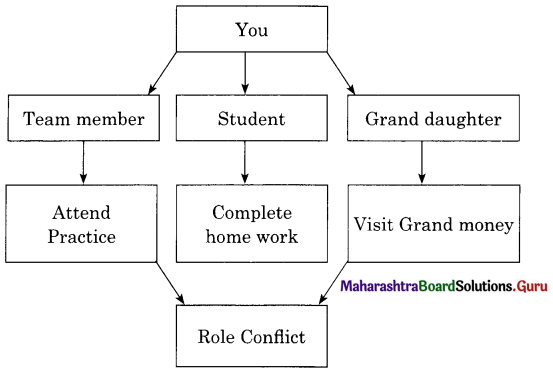
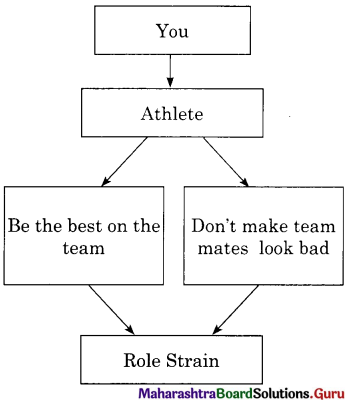
Conduct a role play exercise to understand the concept of role conflict and role strain. For example: Working women performing various roles inside and outside the home. (Textbook Page No. 32)
Answer:
Understanding 1: Women consider that the household affairs and care for the family is their primary duty. Women are thus confronted with the challenge of playing the dual role, to excel at home, as well as at the workplace. To prove her competence on both the fronts, women are facing the problem of overwork and are often being stressed or drained of their energy. Yet, they find themselves unable to match the expectations at any of the two places, which gives rise to role conflict and role strain.

Understanding 2:
Role Conflict:
Role conflict occurs when conflicting expectations arise from two or more statuses than an individual occupies.
Maharashtra Board Class 11 Sociology Solutions Chapter 3 Basic Concepts in Sociology 3

Role Strain:
Role strain arises when conflicting expectations are built into a single status.
Maharashtra Board Class 11 Sociology Solutions Chapter 3 Basic Concepts in Sociology 4

Question 4.
List out various folkways and mores that we find in our day-to-day lives. (Textbook Page No. 33)
Answer:
Folkways: The folkways are the recognized ways of behaving and acting in society. Folkways are norms that stem from and organize casual interactions and emerge out of repetition and routines. We engage in them to satisfy our daily needs and they are most often unconscious in operation, though they are quite useful for the ordered functioning of the society.

  1. Waiting in a queue
  2. Appropriate dressing.
  3. Practice of raising one’s hand to take turns while speaking in a group.
  4. While eating using one’s fingers, eating with chopsticks, eating with fork and spoon.
  5. Different ways of wearing a sari.

Mores : “More are the popular habits and traditions when they include a judgment that are conductive to social welfare and when they exert a coercion on an individual to conform to them”.

More are stricter than folkways, as they determine what is considered moral and ethical behaviour. Mores structure the difference between right and wrong. Violation of mores results in disapproval or ostracizing. As such mores play a key role in shaping our value, beliefs, behaviour, and interactions than folkways.

  1. Religious doctrine.
  2. Sexual relations before marriage are not permitted.
  3. It is not acceptable to use drugs such as heroin and cocaine.
  4. It is expected that one will be one time for work.
  5. Talking to oneself in public is not considered normal behaviour.
  6. Nudity in public is not acceptable.

Maharashtra Board Class 11 Sociology Solutions Chapter 2 Contribution of Western and Indian Sociologists

Balbharti Maharashtra State Board Class 11 Sociology Solutions Chapter 2 Contribution of Western and Indian Sociologists Textbook Exercise Questions and Answers.

Maharashtra State Board Class 11 Sociology Solutions Chapter 2 Contribution of Western and Indian Sociologists

1. (A) Choose the correct alternative and complete the statements.

Question 1.
The Industrial Revolution took place in ………………..
(North America / Europe / Australia)
Answer:
Europe

Question 2.
Science is based on …………………
(beliefs / facts / guess work)
Answer:
facts

Maharashtra Board Class 11 Sociology Solutions Chapter 2 Contribution of Western and Indian Sociologists

Question 3.
Significant work has been done on kinship organisation in India, by female sociologist ………………
(Iravati Karve / Suma Chitnis / Neera Desai)
Answer:
Iravati Karve

Question 4.
The ……………….. stage of societal growth is characterised by explanations which are abstract but not God-centred.
(Theological / Metaphysical / Positive)
Answer:
Metaphysical

1. (B) Correct the incorrect pair.

Question 1.
(a) Abdul Rahman Ibn-Khaldun – North Africa
(b) Auguste Comte – France
(c) Harriet Martineau – England
(d) Karl Marx – Russia
Answer:
(d) Karl Marx – Germany

1. (C) Identify the appropriate term from the given options.

(Polarization. M. N. Srinivas, R. N. Mukherjee)
Question 1.
Marx argues that classes will become hostile towards each other.
Answer:
Polarization

Question 2.
The Indian sociologist who coined the term westernisation.
Answer:
M. N. Srinivas

1. (D) Correct the underlined words and complete the sentence.

Question 1.
The stage of society where empirical evidence forms the basis for explanation is the theological stage.
Answer:
The stage of society where empirical evidence forms the basis for explanation is the positive / scientific stage.

Question 2.
The book ‘Le Suicide’ was written by Hobbes.
Answer:
The book ‘Le Suicide’ was written by Emile Durkheim

2. Write short notes.

Question 1.
Contribution of G. S. Ghurye to Indian Sociology.
Answer:
1. Govind Sadashiv Ghurye was the first who introduced sociology in India after independence. Therefore, he is considered as the ‘Father of Indian Sociology’. He established ‘Indian Sociological Society’ and started the journal ‘Sociological Bulletin’.

2. Ghurye’s work on scheduled tribes, were based on the historical, administrative and social dimensions of Indian tribes. He wanted the tribals to be integrated with the wider Indian society. He has written on tribes like Mahadev Kolis in Maharashtra. His book, ‘Caste and Race in India’ is one of the most important contribution to Indian sociology.

3. Ghurye referred to the long process of Hinduisation of the tribes from different parts of India. He considered cultural unity between tribes and caste as the only means to promote integration in Indian society.

4. His book, ‘Caste and Race in India’, published in 1932 combines historical, anthropological and sociological perspectives to understand caste and kinship system in India.

Maharashtra Board Class 11 Sociology Solutions Chapter 2 Contribution of Western and Indian Sociologists

Question 2.
Types of suicide according to Durkheim.
Answer:
Suicide is a type of death carried by an individual intentionally or deliberately. According to Durkheim suicide is a social phenomenon. Following are the types of suicide.
1. Egoistic suicide : It takes place when an individual is very much self-centred and least bothered about the other members of society, e.g., it is committed by people who become introvert and have less desires to live in the company of others, suicide rates are higher for those widowed, single and divorced.

2. Anomic suicide : When situations go against the norms and values of a person. In such condition individual finds it difficult to face the situation and adjust with that, e.g., suicide of farmers.

3. Altruistic suicide : This type of suicide is different from egoistic suicide. This type of suicide means sacrificing own life for the betterment of people or society, e.g., Sati system, a patient commits suicide for the sake of family.

4. Fatalistic suicide : When an individual is under excessive control from the outside factors fatalistic suicide takes place e.g., Dowry death. According to Durkheim social situations, circumstances, factors are responsible for suicide and become a ‘social fact.’

3. Differentiate between.

Question 1.
Theological Stage and Positive Stage.
Answer:

Theological StagePositive Stage
(i) Theological stage is the first stage of Comte’s Law of three stages.(i) Positive stage is last or third stage of Comte’s law of three stages.
(ii) Human thinking, ideas and views were influenced by spiritual and supernatural factors.(ii) This is an improved rational, scientific form of human thinking.
(iii) All societies believed that God controls all events in the world.(iii) Instead of imagination and superstitious belief, societies turn towards empirical scientific approach.
(iv) Example : Natural calamities like flood, drought etc., were the expressions of God’s anger.(iv) Example : Discoveries of Newton and Galileo, enlightement.

Question 2.
Anomic Suicide and Altruistic Suicide.
Answer:

Anomic SuicideAltruistic Suicide
(i) Anomic suicide takes place in situations where one is not able to adjust with circumstances which arise unexpectedly.(i) Altruistic suicide means, an individual commits suicide with the object of doing well for others.
(ii) This is due to economic instability and personal struggle.(ii) This is due to fanatical love for one’s own community.
(iii) It reflects a normlessness.(iii) It is value-oriented.
(iv) Example : Businessman committed suicide due economic depression or extreme prosperity.(iv) Example : Sati system (committed by Indian women in the past), Hara-kiri (committed by Japanese)

Maharashtra Board Class 11 Sociology Solutions Chapter 2 Contribution of Western and Indian Sociologists

4. (A) Complete the concept maps.

Question 1.
Maharashtra Board Class 11 Sociology Solutions Chapter 2 Contribution of Western and Indian Sociologists 1
Answer:
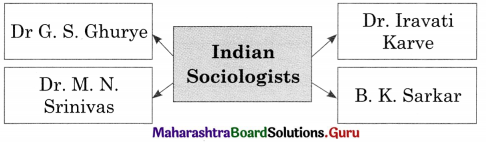
Maharashtra Board Class 11 Sociology Solutions Chapter 2 Contribution of Western and Indian Sociologists 2

4. (B) State whether the following statements are true or false with reasons.

Question 1.
According to Marx, capitalism gives rise to we feeling among workers.
Answer:
This statement is True.

  1. Capitalists accumulate profit through the exploitation of labour. The poverty of the workers’ class grows with increasing exploitation of labour.
  2. Economic exploitation and inhuman conditions lead to the increasing alienation of workers.
  3. The classes tend to become internally homogeneous and class struggle, more intensified and creates class solidarity and we feeling among the workers.

Question 2.
Iravati Karve has made significant contribution to the study of Kinship in India.
Answer:
This statement is True.

  1. Iravati Karve has contributed in the field of Sociology as well as Anthropology. She wrote a book ‘Kinship Organization in India’ in which she describes major kinship systems in India.
  2. Kinship is one of the concepts which is socially and culturally related with factors like family, caste and languages in India.
  3. According to her, kinship system is based on the geographical and linguistic group differences.
    Thus, Iravati Karve has made significant contribution to the study of Kinship in India

5. Give your personal response.

Question 1.
Do you think globalization has led to polarization of classes? Discuss with relevant examples of your own.
Answer:
Yes, globalization has led to polarization of classes. This has led to segregation of people in the society that may emerge from income inequality, economic restructuring etc. It leads to differentiation of groups on the basis of high income and low income. Skilled people manage to get high paying jobs while the less educated/skilled people receive low wages.

Question 2.
Do you think Kinship bonds are weakening? Give reasons for your response?
Answer:
Yes, I think as we Indians are progressing and trying to establish our nation as a developed nation, we on the other side are losing importance of our family ties. Kinship bonds means ties based on blood and marriage.
Following are some of the reasons which are axing Kinship bonds.

  1. Urbanisation, one of the major reasons of migration of people from rural to urban resulting into formation of a nuclear family.
  2. Modernisation, making individuals self-centred, career oriented simultaneously detach from family.
  3. Change in the medium of recreation, earlier it was family get together or celebration of festivals or religious ceremony now it is Cinema Hall or Visit to Mall.
  4. Increasing control of electronic gadgets like T.V., Mobile Internet, etc., which make virtual world closer but taxing to kinship bond, care and attachment.
  5. Dominance of materialistic world results into abundance of needs. Above all, todays smart and modern generation is chopping their own roots, meaning, weakening kinship bonds.

Maharashtra Board Class 11 Sociology Solutions Chapter 2 Contribution of Western and Indian Sociologists

6. Answer the following in detail (About 150-200 words).

Question 1.
You have studied about Comte’s Law of Three Stages of human thought. With reference to the first and third stage, comment on the challenges it poses for Indian society.
Answer:
Auguste Comte believed that the evolution of human mind had taken place along with the evolution of the individual mind. Comte’s social philosophy is based on the concept of three stage of human thought.
Maharashtra Board Class 11 Sociology Solutions Chapter 2 Contribution of Western and Indian Sociologists 3

Theological stage : In this stage human beings believed in supernatural and spiritual factors. It was believed that three was a control of God on all events in the world. The human mind, at this level, supposed that all phenomena was produced by the immediate action of supernatural beings. For example, all natural calamities were the expressions of God’s anger. This stage is dominated by priests and ruled by military men.
Following are the challenges which poses for Indian society:

  1. During this stage, human mind is dominated by sentiments, feelings and emotions.
  2. Certain section of Indian society believed that all actions/events happened due to power of God/ Supernatural beings.
    E.g. drought, flood, earthquake etc., natural calamities were nothing but anger of God.
  3. Explanation for all happening events are the form of myths concerning spirits and supernatural beings.
  4. During this stage, military society was basically dying and priests were dominated.
  5. In short, due to effect of theological stage there was lack of logical and orderly thinking in the Indian society.

Positive/Scientific stage : Comte says, scientific stage is an improved and scientific form of human thinking. Now, instead of imagination, we turn to observation. Since Reason and examination were basic planks of knowledge at this stage hence, one seeks to establish laws which link facts and which govern social life.

Effect of scientific stage on Indian Society:

  1. Finally, in this stage, Indian society turned towards the scientific way of thinking.
  2. Instead of imaginations, society turned towards observation, reason and examination all these were basic planks of knowledge.
  3. The concept of God started vanishing from human mind.
  4. Society adopted the scientific rational way of thinking and there is no place for any belief or superstition in it.
  5. In this way, Comte’s first and third stage affected the Indian Society.

11th Sociology Digest Chapter 2 Contribution of Western and Indian Sociologists Intext Questions and Answers

ACTIVITY (Textbook Page No. 16)

Question 1.
Discuss how ‘polarization of classes’ and ‘class solidarity’ are relevant in the present times.
Answer:
In present times, polarization of classes and class solidarity is associated with the segregation within a society which are immediate cause of emergence of income inequality, economic displacements, formation of various social groups from high income to low income, economic restructuring particularly in cities, economic inequality etc.

Maharashtra Board Class 11 Sociology Solutions Chapter 2 Contribution of Western and Indian Sociologists

Question 2.
Read newspaper articles related to caste issues (e.g. representation, atrocities, reservation) and share the findings with your class. (Textbook Page No. 19)
Answer:
Reference : Times of India (March 29, 2019)
The Indian Express (June 6, 2019)
Times of India (June 3, 2019)

Maharashtra Board Class 11 Sociology Solutions Chapter 1 Introduction to Sociology

Balbharti Maharashtra State Board Class 11 Sociology Solutions Chapter 1 Introduction to Sociology Textbook Exercise Questions and Answers.

Maharashtra State Board Class 11 Sociology Solutions Chapter 1 Introduction to Sociology

1. (A) Choose the correct alternative and complete the statements.

Question 1.
The term ‘Socius’ means ………………..
(science / companion / social)
Answer:
companion

Question 2.
The term ‘logos’ means ………………..
(associate / science / methodology)
Answer:
science

Maharashtra Board Class 11 Sociology Solutions Chapter 1 Introduction to Sociology

Question 3.
…………………. is often regarded as the ‘Father of Sociology’.
(Durkheim / Weber/ Comte)
Answer:
Comte

Question 4.
When sociologist make an effort to understand practical problems of daily life it is a/an …………….. science.
(pure / application / theoretical)
Answer:
application

1. (B) Correct the incorrect pair.

Question 1.
(a) Study of role of biology in human life – Bio-Sociology
(b) Study of social words of Art and Aesthetics – Sociology of Art
(c) Theoretical of knowledge in sociology in marketing segmental division of customers, Needs analysis etc. – Sociology of Market Research
(d) Study of visual dimensions of social life – Diaspora Studies
Answer:
(d) Study of visual dimensions of social life – Visual Sociology

1. (C) Identify the appropriate term from the given options.

(Diaspora Studies, The Positive Philosophy, Theoretical Science)
Question 1.
Comte coined the term sociology in this book.
Answer:
Positive Philosophy

Question 2.
Sociology is concerned with developing sociological theory.
Answer:
Theoretical Science

1. (D) Correct underlined words and complete the sentence.

Question 1.
When sociological research is done for its own sake it makes sociology a/an applied science.
Answer:
When sociological research is done for its own sake it makes sociology a pure as well as a social science.

Question 2.
Rape, hate, crimes and terrorism are examples of social institutions.
Answer:
Rape, hate, crimes and terrorism are examples of social problems/ pathology.

2. Write short notes.

Question 1.
Nature of sociology
Answer:

  1. Sociology is an empirical science : Sociology studies and analyses social facts on the basis of scientific method. Empiricism is it’s central feature as a science.
  2. Sociology is a theoretical and applied science : Verification and formulation of new theories is a constant process in sociology. Also, many branches of sociology are based on the application of sociological knowledge to the field. Hence, it is a ‘pure’ as well as an ‘applied’ social science.
  3. Sociology is a factual science : The aim of sociology of to find out the reality of society hence sociology studies the constructive part ans destructive elements in society.
  4. Sociology is a holistic science : Sociology does not limit itself to the study of any specific or particular aspect of society. It studies society as a whole.

Maharashtra Board Class 11 Sociology Solutions Chapter 1 Introduction to Sociology

Question 2.
New emerging areas in sociology
Answer:
The subject matter of sociology is very wide. Hence, new areas emerging in sociology are:

  1. Bio-sociology : Studies the role of biology in human social life.
  2. Sociology of art : Helps to understand the social world of art and aesthetics.
  3. Sociology of market research : It deals with the theoretical knowledge of sociology in marketing, segmental division of customers, needs analysis etc.
  4. Visual sociology : Based on visual dimensions of social life.
  5. Diaspora studies : Studies migration and its cultural, literacy, social, demographic, anthropological, political, economic impact and international of relations.

Question 3.
Enlightenment period
Answer:

  1. The Europe produced a ‘Scientific Revolution’ in the Renaissance period. There was increased emphasis on science in society as a whole. The technological advancement influenced every sector of life.
  2. The ideas and discoveries contributed by science led to emergence of sociology. This era is known as the enlightenment period.
  3. The Enlightenment period saw the beginning of the scientific revolution. Science was considered in the social context and looked at as a tool for satisfying the needs of humanity.
  4. New scientific discoveries helped in the eradication of blind beliefs. This period has made a significant contribution to shaping a scientific attitude in Sociology.

3. Differentiate between.

Question 1.
Natural Science and Social Science.
Answer:

Natural ScienceSocial Science
(i) A study of natural Sciences includes physical, chemical and biological factors of nature.(i) Social sciences like economics, political science, sociology studies different aspects of society with major concerns of human beings.
(ii) It studies objectively and in very scientific manner because experimentation in the laboratory is possible.(ii) It also studies objectively and adopts certain scientific methods but to conduct experiment in the laboratory is not possible at all times.
(iii) Results and findings are more accurate and exact.(iii) Difficult to maintain accuracy and exact predictions about human behaviour.
(iv) Example : Biology, Chemistry, Physics, Botany etc.(iv) Example : Sociology, Geography, History etc.

Question 2.
Theoretical Science and Applied Science.
Answer:

Theoretical ScienceApplied Science
(i) Theoretical research is explanatory and leads to the advancement of knowledge.(i) Applied science is for development purposes and solves practical problems of society.
(ii) Theoretical framework is the structure that can hold the theory.(ii) Applied science means practical application of sociological theory.
(iii) The purpose of theoretical science is to increase understanding.(iii) The purpose of applied science is to bring about social change.
(iv) Example – A study of the social structure of a slum.(iv) Example – A study, to prevent delinquency in a slum.

Maharashtra Board Class 11 Sociology Solutions Chapter 1 Introduction to Sociology

4. Explain the following concept with suitable examples.

Question 1.
Diaspora
Answer:

  1. Diaspora is he movement of the people from their original place to other geographical area.
  2. Though people migrate they maintain their originality in the migrated area.
  3. The people though they have migrated from their original place, follow their rituals, customs and maintain their original existence in areas where they have been migrated.
    Example: Migration of rural people to urban area.

Question 2.
Bio-Sociology
Answer:

  1. Bio-Sociology is a subject that has emerged relatively recently in Sociology.
  2. Researchers in the area use a variety of sociological methodologies to study the role of biology in human social life.
  3. Biologically male and female are different. Both have different strength and capacity because of their body structure. But in society culture plays different role in nurturing them.
  4. These discrimination and differences affected the society in a great way. Bio-Sociology helps to understand this concept.
    Example : Gender differences and discrimination.

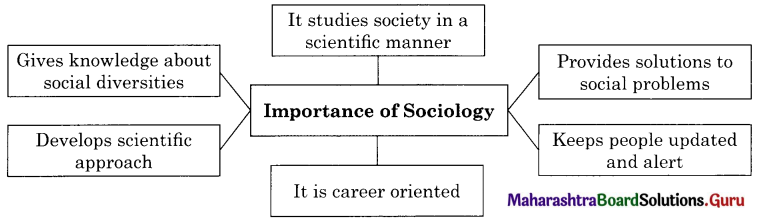
5. (A) Complete the concept maps.

Maharashtra Board Class 11 Sociology Solutions Chapter 1 Introduction to Sociology 1
Answer:
Maharashtra Board Class 11 Sociology Solutions Chapter 1 Introduction to Sociology 2

5. (B) State whether the following statements are true or false with reasons.

Question 1.
The French revolution led to changes in society.
Answer:
This statement is True.

  1. French Revolution was one of the best examples of struggle for freedom and equality.
  2. Through this revolution feudal system had been overthrown. The new system came into existence which was based on the principles of liberty, fraternity and equality.
  3. French revolution brought tremendous changes in the life of the people not only in France but all over Europe. Hence, French revolution led to changes in society.

Question 2.
The development in natural sciences has had an impact on sociology as a discipline.
Answer:
This statement is True.

  1. Natural sciences are differentiated from other modes of knowledge, by method, not by subject matter.
  2. The revolutionary concept that social phenomena are natural phenomena and therefore can be studied by natural – science methodology is being rapidly accepted.
  3. Sociology uses scientific methods and research to solve the many problems of society like poverty unemployment etc. Hence, the development in natural science has had an impact on sociology as a discipline.

Maharashtra Board Class 11 Sociology Solutions Chapter 1 Introduction to Sociology

6. Give your personal response.

Question 1.
Is India in the ‘scientific’ stage of growth? Explain why you hold the view that you do.
Answer:
Yes, India is in the ‘scientific’ stage of growth.
During ancient period India faced many social problems like blind faith, illiteracy, child-infanticide etc. Many cultural, political differences etc., were followed. By adopting scientific method, sociologist have been trying to minimize the problems. They have suggested some measures to the government to find out certain solutions to solve the problems.

The technological and scientific advancement influenced every sector of life. India’s scientific stage of growth includes technical development, which have resulted in technological inventions for scientific growth.

Question 2.
Explain in brief the link between cinema and society.
Answer:
Cinema is one of the means of mass media. Cinema and society are inter related and inter connected with each other. Society influences the cinema and vice versa. But cinema has both positive and negative influences on the society. As far as India is concerned one can find diversity in each and every aspect of society. In such situations cinema plays important role in integrating the society. It also helps to inculcate certain values like honesty, hard work, sympathy, charity, brotherhood etc.

Society influences the cinema and its subject matter. Film makers give special attention on the interest and demand of the people of the society.

7. Answer the following in detail (About 150-200 words).

Question 1.
Discuss with suitable examples, the scope of sociology in today’s world.
Answer:
The following points explains the scope of sociology in today’s world.
1. Bio-Sociology – Example : Gender differences and discrimination. Researchers in the area* use a variety of sociological methodologies to study the role of biology in human social life.

2. Sociology of Art – Example : Warli paintings depicts their lifestyle or paintings related with Mohenjo Daro and Harappan Civilization. This area helps to understand the social world of art and aesthetics. This field seeks to understand the social context of the production and consumption of art.

3. Sociology of Market Research – Example : Advertising of bathing soap by convincing the people that they have used river Ganga’s water in that. This is an applied field that connects marketing and sociological strategies to understand the market in a meaningful way.

4. Visual Sociology – Example: A researcher takes help of newspaper, film, movie, photographs for their study or for the study of a particular society. Visual sociology is concerned with visual dimension of social life. With the help of film, movie, pictures one can visualize or imagine a particular problem, on the basis of which valid and relevant data can be collected.

5. Diaspora Studies – Example : Migration of rural people to urban area. Diaspora is one of the movements of the people from their original place to other geographical area. Though people migrate they maintain their originality in the migrated area. The people though they have migrated from their original place, follow their rituals, customs and maintain their original existence in areas where they have been migrated.

Maharashtra Board Class 11 Sociology Solutions Chapter 1 Introduction to Sociology

11th Sociology Digest Chapter 1 Introduction to Sociology Intext Questions and Answers

ACTIVITY (Textbook Page No. 6)

Question 1.
You have read about commercial, scientific, industrial and French revolutions which were responsible for the emergence of Sociology as a discipline. Identify the effects of industrial development on Indian society.
Answer:
The effects of industrial development on Indian society are:

  1. The use of new tools, machinery and techniques have increased the production speed of goods.
  2. Development of trade, new institutions like, banks, credit /debit card facilities emerged.
  3. Industrialization lead to Urbanization leading to migration of people from rural to the urban areas.
  4. Rise in the factory system of production which provided many new job opportunities in small and large scale industries.
  5. Emergences of new organisation and industrial policy.
  6. Increase in national income.
  7. Improved living standards of the people.
  8. Stimulation of progress in other sectors of the economy.
  9. Promotes specialization of labour.
  10. Provides large scope for technological progress.

Maharashtra Board Class 11 Sociology Solutions Chapter 1 Introduction to Sociology

Question 2.
Interview two people from your local area, who have migrated from another place. Find out the reasons for shifting and ask about their experiences and problems. (Textbook Page No. 8)
Answer:
Following is a case of inter-state migration in India.
Interview name : Mr. XYZ
Migrated from : Bihar
Migrated to : Mumbai.
Reasons : Advanced economic and social life. Advanced / better quality of education. Faster access to facilities and services like healthcare, education, etc. Higher job opportunities and better standard of living.

Experience : As time passes, a house on rent. Good education to children. Happy urban life.
Problems : Language barriers
Discrimination and inequality
Less paid
Difficulties in job hunting
Exploitation housing problems

Question 3.
Visit any nearby NGO and collect information about their work. Prepare a PPT and present it in your class. (Textbook Page No. 9)
Answer:
Akshara : Empowering Women and Girls.
Akshara is a society helping women live a violent free dignified life without discrimination. It focuses on empowering women and girls through education, productive works and resistance to violence in their lives, so they can be strong and independent contributing members to society.

Akshara has a three-dimensional vision for change:

  1. Changing hearts and minds of young women and men.
  2. Transforming public attitudes
  3. Reforming systems that deny gender justice

Work – (a) Akshara provides scholarships for education, training in life and technical skills and job placements for socially, economically disadvantaged young women.
(b) Akshara trains young men to become support gender equality and take up personal and social action.
(c) Akshara caters gender oriented educational stuff, online a training material videos and documentaries.
(d) Akshara lobbies with the state.

Vision – To establish a gender equality and violence free society
Goods – (a) Enhance societal consciousness on gender inequality.
(b) Employment of women and youth.
(c) Prevent violence towards women.

Maharashtra Board Class 11 Sociology Solutions Chapter 1 Introduction to Sociology

Question 4.
Discuss the statement listed
(i) Sociology is practical and related to life
(ii) Careers in Sociology. (Textbook Page No. 11)
Answer:
(i) Sociology is practical and related to life : Practical sociology refers to a form of sociological practice that is concerned with using sociological theories and research to understand on going activities. It is the task of sociology to study the social problems through the methods of scientific research and to find out solutions to them.

Sociology studies everyday social life, human interaction, institutions, behaviour and its origins. Sociology helps us to understand our and other people’s culture and environment.

(ii) Careers in Sociology.

  1. Human Resources
  2. Journalism
  3. Social Work / Public services
  4. Academics
  5. Consumers Relations
  6. Lawyer
  7. Guidance Counsellor (Guidance counsellor use knowledge of the Sociology of learning to help students navigate the academic world.)

Maharashtra Board Class 11 Geography Important Questions Chapter 7 Indian Ocean – Relief and Strategic Importance

Balbharti Maharashtra State Board Class 11 Geography Important Questions Chapter 7 Indian Ocean – Relief and Strategic Importance Important Questions and Answers.

Maharashtra State Board 11th Geography Important Questions Chapter 7 Indian Ocean – Relief and Strategic Importance

Complete the chain.

Question 1.

ABC
(1) Continental shelf(1) Archipelagos formed by coral atolls(1) Very wide on the western side of India
(2) Mid-Oceanic Ridges(2) Portion of continent submerged underwater(2) Ashmore
(3) Oceanic Plateaus(3) Submerged mountain ranges that separate deep portions of the ocean floor(3) the Ninety East Ridge
(4) Islands(4) Deep flat areas on the ocean bottom(4) Chagos

Answer:

ABC
(1) Continental shelf(1) Portion of continents submerged underwater(1) Very wide on the western side of India
(2) Mid-Oceanic Ridges(2) Submerged mountain ranges that separate deep portions of the ocean floor(2) Ninety East Ridge
(3) Oceanic Plateaus(3) Deep flat areas on the ocean bottom(3) Chagos
(4) Islands(4) Archipelagos formed by coral atolls(4) Ashmore

Maharashtra Board Class 11 Geography Important Questions Chapter 7 Indian Ocean – Relief and Strategic Importance

Complete the table.

Question 1.
The Indian Ocean bordered by

Sr. NoDirectionContinents / Oceans
(1)West—–
(2)North and East—–
(3)East—–
(4)South—–

Answer:

Sr. NoDirectionContinents / Oceans
(1)WestAfrica
(2)North and EastAsia
(3)EastAustralia
(4)SouthSouthern Ocean

Question 2.
Bottom Relief of the Indian Ocean

Sr. NoFeaturesComprise of
(1)Continental Shelf—–
(2)Mid-oceanic Ridges—–
(3)Ocean Basins—–
(4)Oceanic Deeps—–
(5)Islands—–

Answer:

Sr. NoFeaturesComprise of
(1)Continental ShelfGulf, seas, bays and straits
(2)Mid-oceanic RidgesSubmerged mountain ranges and plateaus
(3)Ocean BasinsTerminal destinations for the sediments brought from the continents and from the oceanic part itself.
(4)Oceanic DeepsDeep, narrow and steeply sloping depressions found on the ocean floor
(5)IslandsCoral atolls and volcanic islands

Question 3.
Islands of Indian Ocean

Sr. NoIslands of Indian Ocean:
(1)Islands in the Arabian Sea———
(2)Islands of Bay of Bengal———
(3)Islands along Australian Coast———

Answer:

Sr. NoIslands of Indian Ocean:
(1)Islands in the Arabian SeaMadagascar, Comoros, Bassas de India, Europa Island, Reunion, Maldives, Chagos, Mauritius, Seychelles, Island of Socotra, Lakshadweep, Bundle Island, Kish, Hendorabi, Lavan, Siri, etc.
(2)Islands of Bay of BengalSri Lanka, Andaman and Nicobar, Sumatra Island
(3)Islands along Australian CoastAshmore, Christmas and Cocos (or Keeling) Island.

Choose the correct option by identifying the correct correlation in the sentences.

Question 1.
Most of the trenches of the Indian Ocean are located towards its ………………… boundary.
(a) northern
(b) southern
(c) eastern
(d) western
Answer:
(c) eastern

Question 2.
The Bundle Island is located near the coast of …………………….
(a) Sri Lanka
(b) Pakistan
(c) Bangladesh
(d) Myanmar
Answer:
(b) Pakistan

Maharashtra Board Class 11 Geography Important Questions Chapter 7 Indian Ocean – Relief and Strategic Importance

Question 3.
To the east of …………………. lie the islands like Reunion, Mauritius, Seychelles, Socotra.
(a) Madagascar
(b) Australia
(c) Indonesia
(d) Sri Lanka
Answer:
(a) Madagascar

Question 4.
Diego Garcia is an atoll which was first discovered by the Europeans and named by the ……………………
(a) Portuguese
(b) French
(c) Dutch
(d) Germans
Answer:
(a) Portuguese

Question 5.
The salinity of the oceans is generally …………………. around the Somali Peninsula and closer to the Saudi Arabian Coast.
(a) high
(b) low
(c) moderate
(d) very high
Answer:
(a) high

Question 6.
The South Equatorial current flows from / in the ……………………
(a) west to east
(b) east to west
(c) clockwise direction
(d) anticlockwise direction
Answer:
(b) east to west

Identify the correct correlation.

A : Assertion
R : Reasoning

Question 1.
A – There is a complete blockage of the Indian Ocean towards its north.
R – Unlike the Pacific Ocean and the Atlantic Ocean the Indian Ocean does not extend northwards to the Arctic Ocean.
(a) Only A is correct.
(b) Only R is correct.
(c) Both A and R are correct and R is the correct explanation of A.
(d) Both A and R are correct but R is not the correct explanation of A.
Answer:
(c) Both A and R are correct and R is the correct explanation of A.

Maharashtra Board Class 11 Geography Important Questions Chapter 7 Indian Ocean – Relief and Strategic Importance

Question 2.
A – It is believed by most of the geologists that Madagascar was a part of African Continent in the geological past.
R – It has undergone two separations such as first separation from Africa and later from the Indo-Australian Plate.
(a) Only A is correct.
(b) Only R is correct.
(c) Both A and R are correct and R is the correct explanation of A.
(d) Both A and R are correct but R is not the correct explanation of A.
Answer:
(c) Both A and R are correct and R is the correct explanation of A.

Question 3.
A – In the case of Bay of Bengal, the Peninsular rivers lead to the lowering of salinity in this area.
R – The salinity is less during the period of South West Monsoon.
(a) Only A is correct.
(b) Only R is correct.
(c) Both A and R are correct and R is the correct explanation of A.
(d) Both A and R are correct but R is not the correct explanation of A.
Answer:
(d) Both A and R are correct but R is not the correct explanation of A.

Question 4.
A – The Indian market has emerged as one of the largest importers of South East Asian goods.
R – The recently concluded Free Trade Agreements with countries like Thailand and Singapore are set to contribute to this trend.
(a) Only A is correct.
(b) Only R is correct.
(c) Both A and R are correct and R is the correct explanation of A.
(d) Both A and R are correct but R is not the correct explanation of A.
Answer:
(d) Both A and R are correct but R is not the correct explanation of A.

Identify the incorrect factor.

Question 1.
The islands in Bay of Bengal are-
(a) Andaman and Nicobar
(b) Sri Lanka
(c) Sumatra
(d) Madagascar
Answer:
(d) Madagascar

Question 2.
The islands in the Arabian Sea are-
(a) Sumatra
(b) Mauritius
(c) Seychelles
(d) Chagos
Answer:
(a) Sumatra

Maharashtra Board Class 11 Geography Important Questions Chapter 7 Indian Ocean – Relief and Strategic Importance

Question 3.
The islands along the Australian coast are-
(a) Maldives
(b) Ashmore
(c) Christmas
(d) Cocos
Answer:
(a) Maldives

Question 4.
Islands in the Arabian Sea along the Persian Gulf-
(a) Kish
(b) Siri
(c) Lavan
(d) Bundle
Answer:
(d) Bundle

Question 5.
Ocean basins in the Indian Ocean are-
(a) Andaman basin
(b) Somali basin
(c) Oman basin
(d) Mauritius basin
Answer:
(a) Andaman basin

Question 6.
The Ocean currents in southern part of the Indian Ocean are-
(a) South equatorial current
(b) West wind drift
(c) Northeast current
(d) Mozambique-Agulhas currents
Answer:
(c) Northeast current

Question 7.
Islands to the east of Madagascar island are-
(a) Mauritius
(b) Lavan
(c) Reunion
(d) Seychelles
Answer:
(b) Lavan

Question 8.
The islands in the Arabian Sea are-
(a) Comoros
(b) Bassas de India
(c) Europa island
(d) Sri Lanka
Answer:
(d) Sri Lanka

Question 9.
The busiest straits in the Indian Ocean are-
(a) Hormuz
(b) Malacca
(c) Bab-el-Mandeb
(d) Palk
Answer:
(d) Palk

Maharashtra Board Class 11 Geography Important Questions Chapter 7 Indian Ocean – Relief and Strategic Importance

Give geographical reasons.

Question 1.
Monsoon climate has developed in the Indian sub-continent.
Answer:
Monsoon climate has developed in the Indian sub-continent because-

  1. The Indian Ocean spreads between Africa in the west, Asia in the north and east, Australia in the east and Southern Ocean in the south.
  2. The Indian Ocean does not extend northwards to the Arctic Ocean like the Atlantic Ocean and the Pacific Ocean.
  3. This has resulted in complete blockage of the Indian Ocean towards its north.
  4. This peculiar arrangement of the ocean and the continental portion contributes a lot to the development of the monsoon climate of the Indian sub-continent.
  5. During summer solstice, sun shines vertically on tropic of cancer, so there is summer season over the Indian sub-continent.
  6. Due to continuous heating, low pressure area is created, moisture laden south west monsoon winds give rainfall on the Indian sub-continent, that is rainy season.
  7. During winter solstice, due to slanting sunrays, the temperature goes down, that is winter season.
  8. Thus, there is monsoon climate with three distinctive seasons.

Question 2.
The study of temperature of the ocean is essential.
Answer:
The study of temperature of the ocean is essential because-

  1. The temperature of the ocean provides information on the global climate system.
  2. It is also important for the study of marine ecosystems.
  3. The temperature of the ocean water is responsible for the movement in the oceanic water.
  4. Rising temperatures cause coral bleaching and loss of breeding grounds for marine fishes and mammals.
  5. The study of temperature of the ocean can help in establishing marine protected areas and forming precautionary limits to prevent overfishing, protecting ocean ecosystems and shield humans from the effects of ocean warming.

Answer the following question by using the given map.

Maharashtra Board Class 11 Geography Important Questions Chapter 7 Indian Ocean – Relief and Strategic Importance 1
Question 1.
Name the plateau in South Indian Ocean.
Answer:
Kerguelen Plateau

Question 2.
Name the ocean basin in North Arabian Sea.
Answer:
Oman Basin

Maharashtra Board Class 11 Geography Important Questions Chapter 7 Indian Ocean – Relief and Strategic Importance

Question 3.
Name the ocean current near the equator in the Indian Ocean.
Answer:
Counter Equator Current

Question 4.
Name the ocean current in Western Indian Ocean.
Answer:
Agulhas Current

Question 5.
Name the ocean current in Eastern Indian Ocean.
Answer:
Australian Current

Write short notes on.

Question 1.
Challenges in the Indian Ocean
Answer:

  1. India occupies a central and strategic location in the Indian Ocean.
  2. Keeping the Indian Ocean as a Zone of Peace free from superpower rivalry is a major challenge in the Indian Ocean.
  3. Most of the conflicts since the end of the Cold War have taken place in or around the Indian Ocean region. As a result, almost all the world’s major powers have deployed substantial military forces in the Indian Ocean region.
  4. Expanding markets and larger import flows imply vulnerability at sea. Hence, the incidence of piracy, armed robbery and maritime terrorism are on the rise and has placed a premium on the complexity of Sea lane defence.

Question 2.
Islands in Indian Ocean
Answer:

  1. There are 39 islands in the Indian Ocean. Most of them are away from the coastline. They are deep sea islands.
  2. The islands of the Indian Ocean are a varied collection, including many smallest territories and some large islands like Sri Lanka, Australia and Madagascar.

The islands in the Indian Ocean are grouped into-

  1. Islands of Arabian sea
  2. Islands along Bay of Bengal
  3. Islands along the Australian coast

Islands in Indian Ocean-

  1. Islands of the Arabian Sea can be sub grouped such as islands close to the African coast and islands along the Lakshadweep – Chagos Ridge.
  2. The largest island close to the African coast is Madagascar island. It is separated from Africa, and later from the Indo-Australian plate. It is one of the seismologically active provinces.
  3. There are many islands between the eastern coast of Africa and Madagascar island, such as Comoros, Europa and Bassas de India, etc. To the east of Madagascar are Mauritius, Reunion and Seychelles, etc.
  4. The group of islands along Lakshadweep-Chagos Ridge are Maldives, Chagos and Lakshadweep.
  5. Apart from these islands, other islands are the Bundle island near the coast of Pakistan and Siri, Lavan, Kish, Hendorabi, etc., along the Persian Gulf part of Iran.
  6. The islands in Bay of Bengal are associated with the converging plate boundary. These islands are the peaks of submerged mountains. The islands of Bay of Bengal are Sri Lanka, Andaman and Nicobar group, and chain of islands along the western coast of Sumatra island of Indonesia.
  7. Most of these islands are volcanic islands. Sri Lanka is the largest island of this group.
  8. There are very few islands along the coastline of Australia such as Cacos, Christmas, Ashmore, etc.

Maharashtra Board Class 11 Geography Important Questions Chapter 7 Indian Ocean – Relief and Strategic Importance

Answer in detail.

Question 1.
Describe the continental shelf of the Indian Ocean.
Answer:

  1. The continental shelf is the portion of continents submerged under oceanic water.
  2. It is normally occupied by different gulfs, seas, bays and straits.
  3. There is a wide range of variation in the continental shelves of the Indian Ocean.
  4. There are quite extensive shelves along the Indian coasts.
  5. The eastern coast of Africa and Madagascar record relatively narrow width of continental shelves, and along the Indonesian coast, it is very narrow (160 km).
  6. The continental shelves are very wide in the west of India whereas these are narrow along the eastern coast.
  7. Continental shelves are veneered with deposits brought down by terrestrial agents of erosion.
  8. Some of the sedimentary deposits are received from over thousand years.
  9. As they remain deposited for a long time, sedimentary rocks are formed.
  10. Some of them are a potential source of fossil fuel.

Question 2.
Describe the Mid-Oceanic Ridges of the Indian Ocean.
Answer:

  1. Mid-oceanic ridges are submerged mountain ranges that separate deep portion of the sea (Ocean) floor.
  2. The Indian Ocean has a Mid Ocean ridge called as a Mid Indian Oceanic Ridge.
  3. It originates from the Gulf of Eden near the Peninsula of Somalia.
  4. It further extends toward the south and on the eastern side of Madagascar, it divides into two branches.
  5. One branch diverts towards southwest and extends up to Prince Edward Island. It is known as Southwest Indian Ocean Ridge.
  6. The second branch extends south eastwards up to Amsterdam and St. Paul Island. It is known as Mid Indian Ocean Ridge.
  7. Mid Indian Oceanic Ridge has many parallel ridges. This ridge is not continuous due to many fracture Zones in it. e.g. Owen Fracture Zone. Amsterdam Fracture Zone, etc.

Maharashtra Board Class 11 Geography Important Questions Chapter 7 Indian Ocean – Relief and Strategic Importance

Question 3.
Explain in detail the importance of Indian Ocean to India.
Answer:
India has the control and strategic location in the Indian Ocean. Therefore, India’s economic and national interests are linked with the Indian Ocean.

From economic point of view, India’s trade with neighbouring countries is dependent on the Indian Ocean. Indian Ocean provides major sea route connecting Middle East, Africa and East Asia with Europe and America. India’s import of mineral oil mainly comes from Gulf countries.

The sand on the beaches along the Arabian Sea is rich in valuable minerals like uranium. India has offshore deposits of mineral oil at Bombay High in the Arabian Sea. Abyssal plains of the Indian Ocean have deposit of polymetallic nodules. These nodules are source of nickel, copper, manganese and cobalt.

India has developed very good trade relations with countries of east due to its location along the Arabian Sea. Trade volumes with ASEAN countries are increasing every year. The Indian market has emerged as one of the largest importers of South East Asian goods. India also has Free Trade Agreements with Singapore and Thailand.

The northern area of the Indian Ocean is the area of great significance in economic and strategic terms. With expansion of India’s export and import, India is forecasted to become one of the three fastest growing economics in the world.

Due to heavy trade, through Indian Ocean, the incidences of piracy, armed robbery and maritime terrorism are on the rise and therefore, defence work in the Indian Ocean have increased.

To keep the Indian Ocean as a zone of peace, free from superpower rivalry and increasing cooperation among littoral countries in the region has always been India’s foreign policy goal. For example, Indian Ocean Rim Association for Regional Cooperation, Ganga-Mekong Cooperation, etc.

Maharashtra Board Class 11 Geography Important Questions Chapter 9 Disaster Management

Balbharti Maharashtra State Board Class 11 Geography Important Questions Chapter 9 Disaster Management Important Questions and Answers.

Maharashtra State Board 11th Geography Important Questions Chapter 9 Disaster Management

Complete the chain.

Question 1.

Type of disasterName of DisasterPlace
(1) Tectonic(1) Flood(1) Malin
(2) Geological(2) Plague(2) Kerala
(3) Metrological(3) Tsunami(3) Surat
(4) Biological(4) Mudslide(4) Indonesia

Answer:

Type of disasterName of DisasterPlace
(1) Tectonic(1) Tsunami(1) Indonesia
(2) Geological(2) Mudslide(2) Malin
(3) Metrological(3) Flood(3) Kerala
(4) Biological(4) Plague(4) Surat

Maharashtra Board Class 11 Geography Important Questions Chapter 9 Disaster Management

Question 2.

MeasuresPre-disaster/ Post-disasterStructural or Non-Structural
(1) Public awareness(1) Post-disaster(1) Structural
(2) Preparedness of hospital(2) Post-disaster(2) Non-structural
(3) Providing food and shelter to people(3) Pre-disaster(3) Structural
(4) Construction of river embankments(4) Post-disaster(4) Non-structural

Answer:

MeasuresPre-disaster/ Post-disasterStructural or Non-Structural
(1) Public awareness(1) Pre-disaster(1) Non-structural
(2) Preparedness of hospital(2) Pre-disaster(2) Structural
(3) Providing food and shelter to people(3) Post-disaster(3) Non-structural
(4) Construction of river embankments(4) Pre-disaster(4) Structural

Question 3.

MeasuresPre-disaster/ Post-disasterStructural or Non-Structural
(1) Community level disaster planning(1) Post-disaster(1) Structural
(2) Providing financial support(2) Post-disaster(2) Structural
(3) Rebuilding of roads and bridges(3) Pre-disaster(3) Non-structural
(4) Providing houses to affected people(4) Pre-disaster(4) Non-structural

Answer:

MeasuresPre-disaster/ Post-disasterStructural or Non-Structural
(1) Community level disaster planning(1) Pre-disaster(1) Non-structural
(2) Providing financial support(2) Post-disaster(2) Non-structural
(3) Rebuilding of roads and bridges(3) Post-disaster(3) Structural
(4) Providing houses to affected people(4) Post-disaster(4) Structural

Choose the correct option by identifying the correct correlation in the sentences.

Question 1.
Loss of homes, permanent changes in the position of river channel and adverse effects on tourism in an affected area due to an earthquake etc., are ……………..
(a) tertiary effects of a disaster
(b) quaternary effects of a disaster, me
(c) primary effects of a disaster
(d) secondary effects of a disaster
Answer:
(a) tertiary effects of a disaster

Question 2.
Bhopal gas tragedy of 1984 was a ……………….
(a) Geological disaster
(b) Biological disaster
(c) Anthropogenic disaster
(d) Tectonic disaster
Answer:
(c) Anthropogenic disaster

Question 3.
People living in ………………….. areas are more likely to be affected by Tsunamis.
(a) mountainous
(b) coastal
(c) plateau
(d) plain
Answer:
(b) coastal

Question 4.
The geographical conditions and circumstances of people or region that make them susceptible to a disaster is known as ………………..
(a) ability
(b) society
(c) vulnerability
(d) capacity
Answer:
(c) vulnerability

Question 5.
…………………. is the process of preparing in advance, to face disasters in future.
(a) Pre-disaster planning
(b) Strengthening
(c) Recovery
(d) Rehabilitation
Answer:
(a) Pre-disaster planning

Question 6.
The last phase of disaster management is ………………..
(a) recovery
(b) disaster preparedness
(c) rehabilitation
(d) mitigation
Answer:
(c) rehabilitation

Maharashtra Board Class 11 Geography Important Questions Chapter 9 Disaster Management

Question 7.
The measure taken to bring life back to normal in affected areas is ………………
(a) recovery
(b) disaster preparedness
(c) rehabilitation
(d) mitigation
Answer:
(c) rehabilitation

Question 8.
Any measure taken to minimize the impact of a disaster before it occurs is ………………..
(a) recovery
(b) disaster preparedness
(c) rehabilitation
(d) mitigation
Answer:
(d) mitigation

Question 9.
Action taken to reduce or avoid disasters and their effects is ………………..
(a) recovery
(b) disaster preparedness
(c) rehabilitation
(d) mitigation
Answer:
(b) disaster preparedness

Question 10.
The Indonesian Tsunami of 2004 is …………………
(a) meteorological disaster
(b) biological disaster
(c) geological disaster
(d) tectonic disaster
Answer:
(d) tectonic disaster

Question 11.
The Malin mudslide of 2014 is …………………
(a) meteorological disaster
(b) biological disaster
(c) geological disaster
(d) tectonic disaster
Answer:
(c) geological disaster

Question 12.
The floods of Kerala of 2018 is ……………………
(a) meteorological disaster
(b) biological disaster
(c) geological disaster
(d) tectonic disaster
Answer:
(a) meteorological disaster

Question 13.
The Surat plague of 1992 is ………………….
(a) meteorological disaster
(b) biological disaster
(c) geological disaster
(d) tectonic disaster
Answer:
(b) biological disaster

Identify the correct correlation.

A : Assertion
R : Reasoning

Question 1.
A – Disasters can be natural or man-made.
R – Disasters may affect human population.
(a) Only A is correct.
(b) Only R is correct.
(c) Both A and R are correct and R is the correct explanation of A.
(d) Both A and R are correct but R is not the correct explanation of A.
Answer:
(d) Both A and R are correct but R is not the correct explanation of A.

Maharashtra Board Class 11 Geography Important Questions Chapter 9 Disaster Management

Question 2.
A – Generally man-made disasters can be prevented.
R – Man-made disasters happen due to mistakes or carelessness by human,
(a) Only A is correct.
(b) Only R is correct.
(c) Both A and R are correct and R is the correct explanation of A.
(d) Both A and R are correct but R is not the correct explanation of A.
Answer:
(c) Both A and R are correct and R is the correct explanation of A.

Question 3.
A – Disaster is more of an anthropocentric concept.
R – A hazard is a result of natural process.
(a) Only A is correct.
(b) Only R is correct.
(c) Both A and R are correct and R is the correct explanation of A.
(d) Both A and R are correct but R is not the correct explanation of A.
Answer:
(d) Both A and R are correct but R is not the correct explanation of A.

Question 4.
A – Events like earthquake, volcanic eruption, tsunamis etc., cannot be prevented but their effects can be reduced.
R – Events like earthquake, cyclones, tsunami etc can now be forecasted and people can be evacuated.
(a) Only A is correct.
(b) Only R is correct.
(c) Both A and R are correct and R is the correct explanation of A.
(d) Both A and R are correct but R is not the correct explanation of A.
Answer:
(c) Both A and R are correct and R is the correct explanation of A.

Question 5.
A – Recovery and rehabilitation are included in post disaster management.
R – Evacuation, search and rescue are included in pre-disaster management.
(a) Only A is correct.
(b) Only R is correct.
(c) Both A and R are correct and R is the correct explanation of A.
(d) Both A and R are correct but R is not the correct explanation of A.
Answer:
(a) Only A is correct.

Question 6.
A – Structural measures include any physical construction to reduce or avoid possible impacts of hazard.
R – Non- structural measures include the use of technology, practice to reduce disaster risks and impacts.
(a) Only A is correct.
(b) Only R is correct.
(c) Both A and R are correct and R is the correct explanation of A.
(d) Both A and R are correct but R is not the correct explanation of A.
Answer:
(a) Only A is correct.

Question 7.
A – Remote sensing is very effective in mapping disaster prone area.
R – Remote sensing satellite monitor the path of cyclone.
(a) Only A is correct.
(b) Only R is correct.
(c) Both A and R are correct and R is the correct explanation of A.
(d) Both A and R are correct but R is not the correct explanation of A.
Answer:
(c) Both A and R are correct and R is the correct explanation of A.

Question 8.
A – Epidemics is an example of meteorological type of disaster.
R – Corona pandemic is an example of biological type of disaster.
(a) Only A is correct.
(b) Only R is correct.
(c) Both A and R are correct and R is the correct explanation of A.
(d) Both A and R are correct but R is not the correct explanation of A.
Answer:
(b) Only R is correct.

Question 9.
A – The Malin mudslide of Maharashtra in 2014 is geological type of disaster.
R – Tsunami is tectonic type of disaster.
(a) Only A is correct.
(b) Only R is correct.
(c) Both A and R are correct and R is the correct explanation of A.
(d) Both A and R are correct but R is not the correct explanation of A.
Answer:
(d) Both A and R are correct but R is not the correct explanation of A.

Question 10.
A – The last phase of disaster management is rehabilitation.
R – The first stage of disaster management is mitigation.
(a) Only A is correct.
(b) Only R is correct.
(c) Both A and R are correct and R is the correct explanation of A.
(d) Both A and R are correct but R is not the correct explanation of A.
Answer:
(a) Only A is correct.

Maharashtra Board Class 11 Geography Important Questions Chapter 9 Disaster Management

Identify the incorrect factor.

Question 1.
Tectonic disasters are-
(a) Tsunami
(b) Earthquake
(c) Volcanic eruptions
(d) Flood
Answer:
(d) Flood

Question 2.
Geological disasters are-
(a) Mudslides
(b) Cyclone
(c) Landslides
(d) Avalanches
Answer:
(b) Cyclone

Question 3.
Meteorological disasters are-
(a) Cyclone
(b) Heat wave
(c) Flood
(d) Cholera
Answer:
(d) Cholera

Question 4.
Biological disasters are-
(a) Storm
(b) Dengue
(c) Flu
(d) Cholera
Answer:
(a) Storm

Question 5.
Anthropogenic or Man-made disasters are-
(a) Industrial accidents
(b) Avalanches
(c) Nuclear accidents
(d) Transportation accidents
Answer:
(b) Avalanches

Question 6.
Effects of disaster are-
(a) Primary effects
(b) Secondary effects
(c) Quaternary effects
(d) Tertiary effects
Answer:
(c) Quaternary effects

Question 7.
Disaster response include-
(a) Preparedness of hospitals
(b) Providing food and shelter
(c) Providing financial support
(d) Restoring normal conditions
Answer:
(a) Preparedness of hospitals

Question 8.
Recovery includes-
(a) Cleaning of debris
(b) Giving financial assistance
(c) Rebuilding of roads and bridges
(d) Public awareness
Answer:
(d) Public awareness

Question 9.
Mitigation includes-
(a) Community level disaster planning
(b) Preparedness of hospitals
(c) Information campaign
(d) Providing housing
Answer:
(d) Providing housing

Maharashtra Board Class 11 Geography Important Questions Chapter 9 Disaster Management

Question 10.
Disaster preparedness include-
(a) Cleaning of debris
(b) Preparing plans for households
(c) Strengthening the weak structures
(d) Awareness campaigns
Answer:
(a) Cleaning of debris

Give geographical reasons.

Question 1.
People living in certain areas are exposed to particular disasters.
Answer:

  1. People in the coastal areas of India are more likely to be affected by a cyclone than those in the interior.
  2. People living in seismically active areas are prone to earthquakes, volcanic eruption, tsunami, etc.
  3. People living in geologically weak areas are prone to landslide, mudslides, avalanches, etc.
  4. The social, economic and political conditions may make people more likely to be affected by disasters in the same region.
  5. Example, the poor, the old people and the children can easily become victims of disasters.
  6. Densely populated areas are more likely to be affected than sparsely populated areas.

Question 2.
Disaster management seeks to reduce risk to damages or losses.
Answer:

  1. Many disasters like earthquakes, tsunamis, volcanic eruption, etc., cannot be prevented but their effect can be reduced due to disaster management.
  2. Disaster management focuses on the hazard that causes the disaster and attempts to minimize the adverse impact of the same on communities.
  3. Now forecast of disasters like cyclone, flooding can be forecasted and people can be evacuated from vulnerable areas.
  4. It involves co-ordination from governments, local self-governments, police, military and para¬military forces, NGOs, doctors, scientists, planners, volunteers and groups or communities.

Question 3.
Effects of many disasters can be reduced these days.
Answer:

  1. Disasters like gas leakage and rail accidents can be prevented.
  2. Disasters like volcanic eruption, tsunamis, earthquakes, etc., cannot be prevented but their effect can be reduced.
  3. Cyclones and floods can now be forecasted and people can be evacuated from vulnerable areas.
  4. Due to awareness created about disasters, steps can be taken to reduce its effects, evaluate the damage caused by the disasters, provide relief, food and medical aid in affected areas.

Differentiate between.

Question 1.
Structural Measures and Non-structural Measures.
Answer:

Structural MeasuresNon-structural Measures
(i) They include any physical construction to reduce or avoid possible impacts of hazards.(i) They do not include physical construction.
(ii) It is achieved by the application of engineering or technology.(ii) It includes mainly the use of knowledge, practice or agreement to reduce disaster risks and impacts. It is achieved through policies and laws, public awareness, training and education.

Question 2.
Hazards and Disasters.
Answer:

HazardsDisasters
(i) Hazards are phenomena that pose a threat to people, structural or economic assets.(i) A hazard becomes disaster when it affects human population, settlement and their activities.
(ii) High rainfall is a hazard.(ii) When high rainfall causes floods, it is a disaster.
(iii) Hazard is defined as a potentially damaging physical event, social and economic disruption or environmental widespread human, material or environmental(iii) A disaster is a serious disruption of the functioning degradation of a society, causing or threatening to cause losses which render the affected community unable to cope using its own resources.
(iv) Hazard is result of natural process.(iv) Disaster is an anthropocentric concept.

Maharashtra Board Class 11 Geography Important Questions Chapter 9 Disaster Management

Write short notes on.

Question 1.
Remote Sensing
Answer:

  1. Remote sensing is a very effective tool in mapping disaster prone areas particularly flood- affected areas.
  2. Micro-wave data can provide information on flood-inundated areas.
  3. Remote sensing satellites monitor the path of cyclone and it can provide ample time with warning for evacuation and preparedness in advance.
  4. The data obtained from meteorological satellites is used for cyclone-tracking, intensity and land-fall predictions and forecasting of extreme weather events.
  5. The data obtained from earth observation satellites is used for monitoring disaster events and assessing the damages.
  6. The communication satellites help to establish communication in remote and inaccessible areas.
  7. The Navigation satellites are used for providing location-based services.

Question 2.
Disaster Response
Answer:

  1. ‘Disaster Response’ is the way the community responds to the disaster.
  2. It is a post-disaster process but it reflects the preparedness of the community.
  3. It includes the immediate period after the disaster strikes.
  4. It is concerned with providing food and shelter to the disaster victims, restoring normal conditions and providing financial support.
  5. Under this stage, initiatives are taken to ensure that the needs and provisions of victims are met and suffering is minimised.
  6. The main focus in this phase is making people safe till further measures are taken.

Question 3.
Capacity to Cope
Answer:

  1. The ability of people, organisation and systems, using available skills and resources to face and manage disasters is known as their capacity to cope.
  2. Vulnerability is reduced if the capacity to cope with the disaster is high.
  3. The capacity to cope has improved over the years. Example, the cyclone in 1999 had caused 10,000 deaths while cyclone in 2019 had caused only 89 deaths.

Question 4.
Tasks in Disaster Management
Answer:
Disaster Management is a multi-disciplinary task which includes the following tasks:

  1. Preparedness.
  2. Monitoring, early warning and mitigation.
  3. Evacuation, search and rescue.
  4. Providing relief in terms of medical help, basic needs such as food, clothes and shelter.
  5. Reconstruction and Rehabilitation.

Draw a neat and labelled diagram for

Disaster Management Cycle
Answer:
Maharashtra Board Class 11 Geography Important Questions Chapter 9 Disaster Management 1

Answer in Detail

Question 1.
What is meant by Disaster Preparedness?
Answer:

  1. Disaster preparedness involves measures taken to prepare for and reduce effect of disasters.
  2. This includes carrying out awareness campaigns, strengthening the weak structures, preparing plans for households and community level, etc.
  3. Example, if a building catches fire, its residents should know how to escape. For this to occur, they should be trained beforehand.
  4. People living in the flood-prone areas should be prepared with items such as medicine, food, water, etc.
  5. It is the action taken to reduce or avoid disasters and their effects.
  6. It should be included in development policy and planning at regional, national and international levels.
  7. It is a continuous process.

Question 2.
Explain what is meant by mitigation and how is it implemented?
Answer:

  1. Mitigation means any measure taken to minimize the impact of a disaster before it occurs. In other words, it is an action taken against the potential disasters.
  2. It is carried out for those disasters which cannot be prevented.
  3. Mitigation is helpful to the people because it creates safer communities and reduces loss of life and property of people.
  4. Remote sensing satellites can forecast floods or cyclones so people know about their timings. People can be evacuated from vulnerable areas. Example, when cyclone Fani occurred in India, mitigation efforts helped to reduce loss of life and property.
  5. Thus, mitigation helps to reduce the financial impact of disaster on Government agencies.

Some mitigation measures can be as per the following:

  1. Community level disaster planning.
  2. Public awareness and information campaigns.
  3. Preparedness of hospitals.
  4. Construction of houses away from hazardous areas.
  5. Mitigation efforts can be categorized as structural and non-structural mitigations.
  6. Structural mitigation efforts include construction of river embankments or strengthening of existing building.
  7. Non-structural mitigation efforts include area training in disaster management, regulating land-use, public education, etc.

Maharashtra Board Class 11 Geography Important Questions Chapter 9 Disaster Management

Question 3.
Explain what is disaster management and how is it carried?
Answer:

  1. After every disaster there is a great loss to life and property of people, therefore disaster management is necessary.
  2. Some disasters like earthquakes, volcanic eruptions, tsunamis etc., cannot be prevented but their effects can be reduced by disaster management.
  3. Disaster management focuses on hazard that causes the disaster and attempts are made to minimize the adverse effects on communities in the following ways:
  4. With the help of remote sensing now we can forecast disasters like cyclone, earthquakes or volcanoes and disaster management can be done.
  5. The disaster management includes creating awareness about disaster, taking steps to reduce its effects, providing relief, food and medical aid in affected areas and evaluating the damage caused by the disaster.
  6. It is a joint effort of government, local self-government, police, doctors, military, and paramilitary forces, scientists, planners, NGOs, volunteers, and communities. Their perfect co-ordination is necessary.

Disaster management is a multi-disciplinary task which includes the following tasks:

  1. Preparedness.
  2. Monitoring, early warning and mitigation.
  3. Evacuation, search and rescue.
  4. Providing relief in terms of medical help, basic needs such as food, clothes and shelter.
  5. Reconstruction and Rehabilitation

Maharashtra Board Class 11 Geography Important Questions Chapter 6 Ocean Resources

Balbharti Maharashtra State Board Class 11 Geography Important Questions Chapter 6 Ocean Resources Important Questions and Answers.

Maharashtra State Board 11th Geography Important Questions Chapter 6 Ocean Resources

Complete the chain.

Question 1.

ABC
(1) Continental Shelf(1) Mariana Trench(1) Methane Hydrate
(2) Continental Slope(2) Mumbai High(2) Coral Island
(3) Oceanic Ridges and Plateau(3) Krishna-Godavari Basin(3) Deepest Part
(4) Oceanic Trenches(4) Aldabra(4) Oil and Gas

Answer:

ABC
(1) Continental Shelf(1) Mumbai High(1) Oil and Gas
(2) Continental Slope(2) Krishna-Godavari Basin(2) Methane Hydrate
(3) Oceanic Ridges and Plateau(3) Aldabra(3) Coral Island
(4) Oceanic Trenches(4) Mariana Trench(4) Deepest Part

Choose the correct option by identifying the correct correlation in the sentences.

Question 1.
The phenomenon of tides releases ………………..
(a) large amounts of energy
(b) large amounts of sediments
(c) large amounts of forces
(d) large amounts of resources
Answer:
(a) large amounts of energy

Question 2.
Desalination process ………………..
(a) is the removal of oil from sea water
(b) is the removal of petroleum from sea water
(c) is the removal of salt from sea water
(d) is the removal of seaweeds from sea water
Answer:
(c) is the removal of salt from sea water

Question 3.
The gradient of slope of continental slope region can be ………………….
(a) around 2° to 5°
(b) between 12° to 15°
(c) around 2° to 4°
(d) between 2° to 5°
Answer:
(d) between 2° to 5°

Question 4.
The oceanic trenches generally occur along plate boundaries and are associated with …………………
(a) active volcanoes and strong earthquakes
(b) folds and fault
(c) sedimentation
(d) deep sea movements
Answer:
(a) active volcanoes and strong earthquakes

Question 5.
Limestones are formed extensively in the tropical oceans of the world as a result of ………………….
(a) volcanic heat
(b) precipitate material by corals and plants
(c) sediments brought by the rivers
(d) evaporation of sea water
Answer:
(b) precipitate material by corals and plants

Question 6.
On tropical coasts, ………………….. vegetation is found abundantly.
(a) evergreen
(b) mangrove
(c) deciduous
(d) coniferous
Answer:
(b) mangrove

Question 7.
The ……………….. Ocean route is the most important and busiest ocean route in the world.
(a) Atlantic
(b) Pacific
(c) Indian
(d) Arctic
Answer:
(a) Atlantic

Question 8.
The deposition of sediments is limited in ………………….
(a) Continental shelf
(b) Continental slope
(c) Abyssal plains
(d) Oceanic deeps
Answer:
(b) Continental slope

Question 9.
The submerged ……………….. on the ocean floor are called oceanic ridges.
(a) mountains
(b) Islands
(c) deeps
(d) plateaus
Answer:
(a) mountains

Question 10.
The ………………… are isolated habitats that have evolved slowly over millions of years to support communities.
(a) ridges
(b) mountains
(c) plateaus
(d) seamounts
Answer:
(d) seamounts

Identify the correct correlation.

A : Assertion
R : Reasoning

Question 1.
A – The oceanic trenches are the deepest parts of the oceans.
R – These trenches can be thousands of metres deep.
(a) Only A is correct.
(b) Only R is correct.
(c) Both A and R are correct and R is the correct explanation of A.
(d) Both A and R are correct but R is not the correct explanation of A.
Answer:
(c) Both A and R are correct and R is the correct explanation of A.

Identify the incorrect factor.

Question 1.
Continental Islands in India are-
(a) Minicoy
(b) Seven Islands of Bombay
(c) Amindivi
(d) Andaman
Answer:
(d) Andaman

Question 2.
The relief of ocean floor contain-
(a) depression
(b) continental shelf
(c) abyssal plain
(d) ocean trench
Answer:
(a) depression

Question 3.
The biotic resources on ocean floor are-
(a) plankton
(b) seaweeds
(c) minerals
(d) fish
Answer:
(c) minerals

Question 4.
The abiotic resources on ocean floor are-
(a) limestone
(b) mollusc
(c) gypsum
(d) mineral oils
Answer:
(b) mollusc

Question 5.
The biotic resources on ocean floor are-
(a) whale
(b) corals
(c) sodium chloride
(d) seahorse
Answer:
(c) sodium chloride

Question 6.
Abiotic resources on ocean floor are-
(a) shrimp
(b) potassium
(c) sodium chloride
(d) natural gas
Answer:
(a) shrimp

Question 7.
Marine pollution occurs due to-
(a) industrial effluents
(b) disposal of solid waste
(c) leakage of oil from oil exporting ships
(d) burning of waste
Answer:
(d) burning of waste

Question 8.
The richest Ashing grounds in the world are-
(a) Dogger bank
(b) Konkan coast
(c) Grand bank
(d) Georges bank
Answer:
(b) Konkan coast

Give geographical reasons.

Question 1.
The very existence of marine life is threatened.
Answer:
The very existence of marine life is threatened because-

  1. Due to human activities, the ocean is polluted on a large scale.
  2. The leakages of oil from oil transporting ships, oil extraction from coastal areas, disposal of solid waste containing radioactive matter, atomic tests etc., are causing large scale pollution of oceanic waters.
  3. The effluents brought by river discharges, the disposal of waste from coastal cities, the waste from industries and many other similar factors are polluting the oceanic waters.

Question 2.
The seas and oceans are the most convenient natural medium of transport.
Answer:
The seas and oceans are the most convenient natural media of transport because-

  1. Sea or ocean transport is used for both passengers and goods transport.
  2. The most important aspect of sea and ocean transport is that it is the cheapest mode of transport than any other modes of transport.
  3. The heavy goods, machinery, vehicles etc., can be carried by ocean transport conveniently and at cheaper rate.
  4. The transport of goods and passengers between the countries is not possible by rail and road transport, air transport has limitations; therefore, sea or ocean transport is useful and convenient for international trade.
  5. For example, Suez Canal connects the Mediterranean Sea to the Indian Ocean via. the Red Sea, making it the shortest maritime route to Asia from Europe.

Question 3.
Ocean tourism is becoming popular.
Answer:
Ocean tourism is becoming popular because-

  1. Ocean tourism is developed along the coastal areas of seas and oceans.
  2. Generally, water sports activities such as scuba diving, surfing, water skiing, etc., are developed along the coastline. For example, sport activities along the coast of Goa.
  3. There is a beautiful scenery along the coastline due to greenery of trees.
  4. Along the coast we find huge water bodies of seas and oceans, clean air and coolness due to nearness to water. Therefore, many resorts, hotels, marina, etc., are developed and coastal areas have become popular for tourism.
  5. The cruise tourism is also increasing.

Differentiate between.

Question 1.
Continental Shelf and Continental Slope.
Answer:

Continental ShelfContinental Slope
(i) The portion of the continents that is submerged under water and borders the coastal areas is known as a continental shelf.(i) After the extent of continental shelf is over, there is a sharp drop in the ocean floor. This is called continental slope.
(ii) They are broad, shallow and gently-sloping plains covered by water.(ii) The slope is steep and stretches over limited area.
(iii) The depth of the continental shelf from the sea level is about 180 to 200 m.(iii) The depth of the continental slope is from 200 m to 4000 m from the sea level.
(iv) Sunlight reaches up to the bottom of the continental shelf and hence fishing is done on a large scale in this region.(iv) Sunlight does not reach the bottom of the continental slope and moreover due to the steep slope fishing cannot be done in this region.
(v) The continental shelves contain the world’s largest reservoirs of natural oil and gas. Besides oil and gas, minerals are also found here. Diamonds, chromite, ilmenite, magnetite, platinum, gold and phosphorite deposits are also found here. Sand, gravel aggregates and industrial silica sand are the most important of hard minerals now extracted in the near offshore zone.(v) Methane hydrate, a compound of water and methane, is present on the continental slopes. On the slope, we find many traces of submarine landslide activity, ocean canyons and huge avalanche fans.

Question 2.
Oceanic Deeps and Oceanic Trenches.
Answer:

Oceanic DeepsOceanic Trenches
(i) At places, deep, narrow and steeply sloping depressions are found on the ocean floor. The shallow depressions are called deeps.(i) At places, deep, narrow and steeply sloping depressions are found on the ocean floor. The deeper depressions are called ocean trenches.
(ii) Active volcanoes and earthquakes are not seen in oceanic deeps.(ii) Trenches are formed at convergent plate boundaries. Active volcanoes and earthquakes generally occur along the plate boundaries of oceanic trenches.
(iii) The Romanche Trench in the Atlantic Ocean close to the equator.(iii) The Mariana Trench in the Pacific Ocean is 11 kms deep.

Answer the following question by using the given map.

Maharashtra Board Class 11 Geography Important Questions Chapter 6 Ocean Resources 1
Question 1.
In which ocean are the Madagascar islands located?
Answer:
Madagascar islands are located in the Indian Ocean.

Question 2.
Mention the location of Georges Bank.
Answer:
Georges Bank is located along the north eastern coastline of U.S.A.

Question 3.
Where is the Congo Canyon located?
Answer:
The Congo Canyon is located along the western coastline of South Africa.

Question 4.
Name the group of islands located in the Pacific Ocean.
Answer:
The Hawaiian Islands are located in the Pacific Ocean.

Question 5.
Name the deepest trench in the Indian ocean.
Answer:
The deepest trench in the Indian Ocean is the Java Trench.

Write short notes on.

Question 1.
Causes of climate change
Answer:
The portion of the continents that are submerged under water and borders the coastal areas is known as a continental shelf.

They are broad, shallow and gently-sloping plains covered by water.

The continental shelf does not extend into the ocean uniformly. Near some coasts, it is narrow while in some parts it may extend for hundreds of kilometres. For example, they are almost absent or very narrow along the coasts of Chile, Sumatra etc., while the Siberian coast near the Arctic Ocean is around 1500 km in width.

Generally, its depth from the sea level is about 180 m to 200 m.

As the sunlight reaches this part of the ocean bed, it is rich in plankton. These millions of microscopic organisms found in sea water are an important food for fish. Millions of fishes thrive here. The shelf has some of the richest fishing grounds in the world, such as the Grand Banks and Georges Bank in North America.

The continental shelves contain the world’s largest reservoirs of natural oil and gas. For example, the Mumbai High in Arabian sea. Besides oil and gas, minerals are also found here.

Diamonds, chromite, ilmenite, magnetite, platinum, gold and phosphorite deposits are common. Sand, gravel aggregates and industrial silica sand are the most important of hard minerals now extracted in the near offshore zone.

Question 2.
Desalination
Answer:

  1. Sea water contains lot of salt, so it is not useful for drinking or irrigation purpose. Therefore, it is necessary to convert the sea water into fresh water.
  2. Desalination is the process of removal of salt from sea water and converting sea water into fresh water.
  3. Desalination is done by heating water or freezing water or by electrical processes.
  4. The desalination process is very expensive, therefore it is used where there is acute shortage of water.
  5. The Minjur Desalination Plant is the largest in India, located at Kattupalli village, a northern suburb of Chennai on the coast of the Bay of Bengal that supplies water to the city of Chennai.
  6. These desalination plants are more used in developing countries since the cost for processing is high. Desalination plants are located in Saudi Arabia, Oman, Cyprus, Algeria, Spain and UAE.
  7. Desalination plants have adverse effect on the coastal environment. Small sea organisms like plankton and baby fish may be killed. Their food chain is disturbed.
  8. It is still used in some countries to get fresh water.

Draw a neat and labelled diagram of the ocean floor.

Answer:
Maharashtra Board Class 11 Geography Important Questions Chapter 6 Ocean Resources 2

Answer in detail.

Question 1.
Explain uses of the oceans for other purposes.
Answer:
Following are the other uses of oceans:
For energy:

  1. Tidal Energy : The phenomenon of tides releases large amounts of energy. Thus, tidal energy can be used to generate electricity.
  2. Thermal energy : The temperature differences of sea water help in generating the energy. The surface water of the tropical region may have 25°C to 30°C of temperature while the deep-sea water may have less than 5°C. This gradient of temperature is used to run a generator to produce electricity.

For drinking water : Due to high salt content in sea water, it is not suitable for drinking or for irrigation directly. But sea water can be converted into fresh water.

Trade and transport : Maritime transport is the transport of people or cargo by water. Transportation by water is cheaper than any other modes of transport. The seas and oceans are the most convenient natural medium for transport. For example, Suez Canal connects the Mediterranean Sea to the Indian Ocean via. the Red Sea, making it the shortest maritime route to Asia from Europe.

Tourism : Ocean tourism comes in many forms like cruises, scuba-diving, fishing, beach tourism, etc. Such activities are increasingly becoming popular. In many areas, massive new tourist developments have been built which include resorts and marinas. These activities, in turn, affect the ocean habitats and environment.

Question 2.
Explain the biotic resources on the ocean floor.
Answer:

  1. The biotic resources on the ocean floor bottom include plants and animals.
  2. The oceans provide a habitat to thousands of species of marine plants and animals which are food for many organisms.
  3. There are many marine animals like fish, crab, molluscs tortoise, prawns, etc.
  4. There are many plant varieties such as seaweeds, mangroves, medicinal plants and many more marine plants.
  5. Many sea animals provide oil, leather, cattle feed, glue and some other products. Seaweeds are also used as a food. Seaweeds added in fertilizers and skin care ointments, etc.
  6. Mangrove forests provide wood for fuel, furniture and various products useful for man. Mangroves provide food and shelter to marine life.
  7. There are also micro-organisms which produce organic material, they are called plankton. Plankton is one of the favourite fish foods. The marine life depends upon plankton.
  8. Coral reefs are major part of ocean ecosystem. Tourism develops in the areas where corals are found. For example, Great Barrier Reef in Australia attracts tourists from all around the world.

Thus, biotic resources on the ocean floor are valuable.

Question 3.
Explain the importance of abiotic resources on ocean floor.
Answer:

  1. There are many abiotic resources on the ocean floor and most of them are not exploited yet.
  2. The most common resources are sodium chloride, gypsum, limestone, etc. Sodium chloride is a common salt.
  3. Gypsum deposits are collected from ocean floor. Gypsum is used in making Plaster of Paris.
  4. The material which precipitates from the body of corals results in the formation of limestone. The metamorphic form of limestone is a marble.
  5. A large number of metallic and non-metallic minerals are found on the ocean floor. These are rich deposits of copper, manganese, zinc, cobalt, platinum, etc.
  6. The most important mineral related to our day-to-day life is extracted from the seafloor, that is mineral oil and natural gas. For example, Bombay High – is an oil mining area in the Arabian Sea.
  7. When we obtain non-biotic resources from the ocean floor, it may cause a disturbance in ecological balance. The drilling machines may disturb marine organisms. Therefore, care should be taken to maintain the ecological balance of the ocean environment.

Maharashtra Board Class 11 Geography Important Questions Chapter 5 Global Climate Change

Balbharti Maharashtra State Board Class 11 Geography Important Questions Chapter 5 Global Climate Change Important Questions and Answers.

Maharashtra State Board 11th Geography Important Questions Chapter 5 Global Climate Change

Complete the chain

Question 1.

ABC
(1) Different density of corals in summer and winter(1) Ice cores(1) Understanding of past environmental conditions
(2) Variation in environmental conditions(2) Goldilocks Zone(2) Summer snow different from winter snow
(3) Samples of ice from inner sides of the ice sheets(3) Creates seasonal growth rings on corals(3) Earth was cooler when it was located in the outer reaches of this zone
(4) Habitable zone in which the Earth lies(4) Tree rings(4) Determines the temperature of water and season in which coral grew

Answer:

ABC
(1) Different density of corals in summer and winter(1) Creates seasonal growth rings on corals(1) Determines the temperature of water and season in which coral grew
(2) Variation in environmental conditions(2) Tree rings(2) Understanding ofpast environmental condition
(3) Samples of ice from inner sides of the ice sheets(3) Ice cores(3) Summer snow different from winter snow
(4) Habitable zone in which the Earth lies(4) Goldilocks Zone(4) Earth was cooler when it was located in the outer reaches of this zone

Maharashtra Board Class 11 Geography Important Questions Chapter 5 Global Climate Change

Choose the correct option by identifying the correct correlation in the sentences.

Question 1.
Urban areas heat up more readily because …………………..
(a) of presence of deserts
(b) of paved surfaces and concrete constructions
(c) they have many industries
(d) they are in plain regions
Answer:
(b) of paved surfaces and concrete constructions

Question 2.
Global sea level rise is apparently being caused because of …………………….
(a) increased melting of ice such as glaciers and ice sheets
(b) frequent flooding of coastal areas
(c) increase in precipitation
(d) flash floods
Answer:
(a) increased melting of ice such as glaciers and ice sheets

Question 3.
Around the world the jellyfish seem to be reproducing heavily and congregating in places because of ………………
(a) melting of ice sheets
(b) global warming
(c) sea water is rising
(d) warmer waters and changes in the acidity level of the oceans.
Answer:
(d) warmer waters and changes in the acidity level of the oceans.

Question 4.
These has been an increase in number of flash floods and also the duration of floods because of ……………….
(a) increased deforestation
(b) melting of glaciers
(c) very high precipitation in one day
(d) increase of volume of water in rivers
Answer:
(c) very high precipitation in one day

Question 5.
It has been observed that with more CO<sub>2</sub>, in the air, crop yield has …………………
(a) increased
(b) decreased
(c) remained constant
(d) changed
Answer:
(a) increased

Question 6.
The average temperature of earth is around …………………
(a) 10°C
(b) 12°C
(c) 14°C
(d) 16°C
Answer:
(c) 14°C

Maharashtra Board Class 11 Geography Important Questions Chapter 5 Global Climate Change

Question 7.
Receding glaciers as a symptom of global climate change has been observed in the glaciers near ………………. in Africa.
(a) Mt. Kilimanjaro
(b) Mt. Kenya
(c) Mt. Meru
(d) Mt. Toubkal
Answer:
(a) Mt. Kilimanjaro

Question 8.
An increase of 1° – 2°C in ocean temperatures for a long time can lead to …………………. of corals.
(a) growth
(b) bleaching
(c) death
(d) congregation
Answer:
(b) bleaching

Question 9.
The roots of both flooding and drought lie in the physical process known as …………………
(a) erosion
(b) transportation
(c) deposition
(d) evaporation
Answer:
(d) evaporation

Question 10.
The ………………… in the trees provide clues about wet and dry periods.
(a) branches
(b) wood
(c) rings
(d) leaves
Answer:
(c) rings

Identify the correct correlation.

A : Assertion
R : Reasoning

Question 1.
A – India has high vulnerabilities to climate change.
R – India has peculiar economy and geography.
(a) Only A is correct.
(b) Only R is correct.
(c) Both A and R are correct and R is the correct explanation of A.
(d) Both A and R are correct but R is not the correct explanation of A.
Answer:
(d) Both A and R are correct but R is not the correct explanation of A.

Question 2.
A – More than one-fifth of the coral reefs are already lost.
R – Coral bleaching leads to death of large amount of corals.
(a) Only A is correct.
(b) Only R is correct.
(c) Both A and R are correct and R is the correct explanation of A.
(d) Both A and R are correct but R is not the correct explanation of A.
Answer:
(d) Both A and R are correct but R is not the correct explanation of A.

Question 3.
A – Coral formed in the summer has a different density than coral formed in the winter.
R – Summer snow differs from winters snow.
(a) Only A is correct.
(b) Only R is correct.
(c) Both A and R are correct and R is the correct explanation of A.
(d) Both A and R are correct but R is not the correct explanation of A.
Answer:
(d) Both A and R are correct but R is not the correct explanation of A.

Maharashtra Board Class 11 Geography Important Questions Chapter 5 Global Climate Change

Question 4.
A – Volcanism is considered as a cause of climate change.
R – The winds spread aerosols around the world reducing sun’s radiation to reach on earth’s surface.
(a) Only A is correct.
(b) Only R is correct.
(c) Both A and R are correct and R is the correct explanation of A.
(d) Both A and R are correct but R is not the correct explanation of A.
Answer:
(d) Both A and R are correct but R is not the correct explanation of A.

Question 5.
A – Higher sea levels may lead to deadlier cyclones and also frequent flooding of coastal areas.
R – High precipitation leads to higher sea level.
(a) Only A is correct.
(b) Only R is correct.
(c) Both A and R are correct and R is the correct explanation of A.
(d) Both A and R are correct but R is not the correct explanation of A.
Answer:
(a) Only A is correct.

Identify the incorrect factor.

Question 1.
Causes of climate change-
(a) Melting of glaciers
(b) Amount of energy
(c) Milankovitch oscillations
(d) Volcanism
Answer:
(a) Melting of glaciers

Question 2.
Some indirect effects of warming up of earth-
(a) Spread of insects in newer region
(b) Sea level rise
(c) Bleaching of corals
(d) Heavy reproduction of jellyfish
Answer:
(b) Sea level rise

Question 3.
Effects of global warming are-
(a) Heat wave
(b) Increase in sea level
(c) Heat islands
(d) Deforestation
Answer:
(d) Deforestation

Maharashtra Board Class 11 Geography Important Questions Chapter 5 Global Climate Change

Give geographical reasons.

Question 1.
Man and his activities are the major cause of climate change.
Answer:
Man and his activities are major cause of climate change because-

  1. Besides natural causes there is an anthropogenic effect on the climate.
  2. Due to human activities many greenhouse gases mainly Carbon Dioxide (CO2) is released in the atmosphere.
  3. The emission of CO2 mainly comes from fossil fuel combustion.
  4. Large scale deforestation also increases CO2.
  5. The atmosphere takes around 20 to 25 years to adjust these high levels of CO2.

Question 2.
The change in climate is a natural and continuous process.
Answer:

  1. The change in climate is a natural and continuous process because-
  2. The earth has witnessed many variations in climate since the beginning.
  3. There are various geological records that show alteration of glacial and inter-glacial periods.
  4. The sediment deposits in glacial lakes also reveal the occurrence of warm and cold periods.
  5. The rings in the trees provide clues about wet and dry periods.
  6. Historical records describe the variations in climate.
  7. All these evidences indicate that change in climate is a natural and continuous process.

Question 3.
Rainforest play a major role in cooling the earth.
Answer:
Rainforest play a major role in cooling the earth because-

  1. Dense forest has a direct effect on the temperature of that area.
  2. In moist tropical region there is dense forest growth, they form canopy. The broad leaves of the forest help to trap moisture and allow it to evaporate, so there is natural cooling effect.
  3. When these forests are slashed and burnt over large area, hot and dry air spreads and the temperature of the area increases.
  4. When forests are burnt, large amount of carbon dioxide is added to the atmosphere and there is air pollution, which also leads to global warming.
  5. Heavy deforestation leads to decrease in the rainfall of that area and changes in rainfall pattern are observed.

Write short notes on.

Question 1.
Greenhouse gases
Answer:

  1. Greenhouse gases are the primary gases, such as, water vapour carbon dioxide, nitrous oxide, methane and ozone in the earth’s atmosphere that absorbs and traps energy from the sun.
  2. Of all greenhouse gases, carbon dioxide absorbs more heat.
  3. Without greenhouse gases, the average temperature of the earth’s surface would be about -18°C rather than the present average of 14°C.
  4. Carbon dioxide emissions comes from many human activities such as combustion of fossil fuels, oil and natural gas, with additional contributions coming from deforestation, changes in land use, soil erosion and agriculture (including live stock).

Maharashtra Board Class 11 Geography Important Questions Chapter 5 Global Climate Change

Question 2.
Causes of climate change
Answer:
Though human activities are a major cause for climate change, some natural causes are responsible for climate change. Following are some of the natural causes of climate change:
The amount of energy output by the sun is not the same always. Low energy output by sun can reduce amount of insolation received by the earth. This can lead to cooling of earth.

Another cause is the Milankovitch oscillation. Variations in the earth’s orbital characteristics around the sun and the changes in the earth’s axial tilt occur. These factors cause the earth to be closer to the sun (warmer) or farther from the sun (colder). Ice ages can occur when we are farther from the sun.

Volcanism is considered as another cause for climate change. Volcanic eruptions throw lots of particulates, and aerosols into the atmosphere. The winds spread it around the world reducing the sun’s radiation reaching the earth’s surface.

The habitable zone of the earth is called Goldilocks Zone. It means as the size of the sun increases, the zone moves outwards overtime. Such changes in zone causes earth to warm or cool.

Besides natural causes, anthropogenic activities affect the climate. The emission of CO2 from fossil fuel combustion. Large-scale deforesting also increases CO2. It takes around 20 to 25 years to adjust these high levels of CO2.

Answer in detail.

Question 1.
Explain the effects global warming.
Answer:
The average temperature of the Earth is around 14°C. As given in the earlier graph, this average temperature has increased by 0.8° C. However, the following are the effects of global warming.

Heat waves:

  1. Increase in the heat holding capacity of the atmosphere increases the temperature especially during summers.
  2. Summers can become more intense or even deadlier and could bring hot spells.

Heat islands:

  1. Global warming serves as a base from which heat waves become much worse – especially in big cities where the heat island effect comes into play.
  2. Urban areas heat up more readily because of paved surface and concrete constructions as compared to a field or forest areas.

Increase in sea level:

  1. Due to increased melting of ice such as glaciers and ice sheets, there is a global rise in the sea level every year.
  2. Higher sea levels may lead to deadlier cyclones and also frequent flooding of coastal areas.
  3. Many islands are also at risk of getting submerged.
  4. It may result in saline coastal groundwater endangered wetlands and flooding of cities and coastal communities. For example, Mumbai and parts of Konkan coastline.
  5. It also means loss of habitat for fish, birds and plants.
  6. As per the studies carried out by the Indian National Centre for Ocean Information Services, sea level may rise 9 to 90 cm between 1900 and 2100.

Melting of glaciers at high altitudes and snow in polar areas:

  1. Melting of glaciers is a natural process, but when glaciers and iceberg melt at an alarming rate, it is a cause of concern.
  2. Retreating of glaciers is considered as a symptom of global climate change. This means there is lesser ice formation each year than of melting.
  3. Over the last 25 years, Gangotri glacier has retreated more than 850 meters, with a recession of 76 meters from 1996 to 1999.

Other factors:

  1. Around the world the jellyfish seem to be reproducing heavily and congregating in places where they were never seen before.
  2. This happens because of warmer waters and changes in the acidity level of the oceans.
  3. Spread of insects in newer region apparently increases the number of mosquitoes.
  4. Bleaching of the corals take place due to increase in the ocean temperatures. Coral bleaching leads to death of large numbers of corals.

Maharashtra Board Class 11 Geography Important Questions Chapter 5 Global Climate Change

Question 2.
Explain the various tools for studying climate change.
Answer:
Scientists and meteorologists have been using instruments to measure climate and weather for the past 140 years. However, millions of years ago historical evidence called proxy data, which includes coral reefs, tree rings, ice cores, etc., were used to tell about the climate.
Coral reefs:

  1. Coral reefs are very sensitive to changes in climate.
  2. Corals form skeletons by extracting calcium carbonate from the ocean waters.
  3. When the temperature changes, densities of calcium carbonate in the skeletons also change.
  4. Coral formed in the summer has a different density than coral formed in the winter.
  5. This creates seasonal growth rings on the corals.
  6. Scientists can study these rings to determine the temperature of the water and the season in which the coral grew.

Tree rings:

  1. Variation in these rings is due to variation in the environmental conditions when they were formed.
  2. Thus, studying this variation leads to improved understanding of past environmental conditions.

Ice cores:

  1. These are samples of ice taken from the inner sides of the ice sheets.
  2. Throughput each year, layers of snow fall over the ice sheets in Greenland and Antarctica.
  3. Each layer of snow is different.
  4. Summer snow differs from winter snow.
  5. Each layer gives scientists a lot of information about the climate each year.

Maharashtra Board Class 11 Geography Important Questions Chapter 8 Biomes

Balbharti Maharashtra State Board Class 11 Geography Important Questions Chapter 8 Biomes Important Questions and Answers.

Maharashtra State Board 11th Geography Important Questions Chapter 8 Biomes

Complete the chain.

Question 1.

ABC
(1) Tropical Rainforest(1) 10° to 20° N and S(1) Khejari, acacia, century plant, cactus
(2) Tropical Deciduous(2) 20° to 30° N and S(2) Elephant grass, few shrubs, trees
(3) Savannah Grassland(3) 0° to 10° N and S(3) Teak, sal, sandalwood, bamboos
(4) Tropical Desert(4) 5° to 30° N and S(4) Mahogany, ebony, rosewood

Answer:

ABC
(1) Tropical Rainforest(1) 0° to 10° N and S(1) Mahogany, ebony, rosewood
(2) Tropical Deciduous(2) 5° to 30° N and S(2) Teak, sal, sandalwood, bamboos
(3) Savannah Grassland(3) 10° to 20° N and S(3) Elephant grass, few shrubs, trees
(4) Tropical Desert(4) 20° to 30s N and S(4) Khejari, acacia, century plant, cactus

Maharashtra Board Class 11 Geography Important Questions Chapter 8 Biomes

Question 2.

ABC
(1) Mediterranean(1) 40° to 50° N and S(1) Maple, elm, walnut, deodar
(2) Temperate Deciduous(2) 40° to 55° N and S(2) Willow, elder, poplar, various species of grasses
(3) Temperate Grassland(3) 30° to 40° N and S(3) Pine, oak, cedar, rosemary

Answer:

ABC
(1) Mediterranean(1) 30° to 40° N and S(1) Pine, oak, cedar, rosemary
(2) Temperate Deciduous(2) 40° to 50° N and S(2) Maple, elm, walnut, deodar
(3) Temperate Grassland(3) 40° to 55° N and S(3) Willow, elder, poplar, various species of grasses

Choose the correct option by identifying the correct correlation in the sentences.

Question 1.
Teak is the main tree in …………….. Biome.
(a) Tropical Rainforest
(b) Tropical Deciduous
(c) Savannah Grassland
(d) Tropical Desert
Answer:
(b) Tropical Deciduous

Question 2.
The ………………. Biome was known as ‘The Heaven for Hunting’.
(a) Savannah Grassland
(b) Tropical Desert
(c) Mediterranean
(d) Tropical Deciduous
Answer:
(a) Savannah Grassland

Question 3.
The ………………… Biome has been ideal for the development of cinema industry.
(a) Temperate Deciduous
(b) Temperate Grassland
(c) Taiga
(c) Mediterranean
Answer:
(c) Mediterranean

Question 4.
One type of tree species is the characteristic of ……………….. Biome.
(a) Taiga
(b) Tundra
(c) Mountain
(d) Tropical Rainforest
Answer:
(a) Taiga

Question 5.
The ……………… Biome is the coldest of the Biomes.
(a) Mediterranean
(b) Temperate Deciduous
(c) Temperate Grasslands
(d) Tundra
Answer:
(d) Tundra

Question 6.
In the grassland areas of Africa, ………………..
(a) various tribal communities inhabit
(b) Masais live along with their cattle
(c) Bedouin tribe lives by trade
(d) human life has flourished very well
Answer:
(b) Masais live along with their cattle

Maharashtra Board Class 11 Geography Important Questions Chapter 8 Biomes

Question 7.
The Sherpas, Bakarwals, Lepchas, Bhutiyas, etc., are communities living in the …………………. mountain biome.
(a) Rockies
(b) Himalayan
(c) Alps
(d) Andes
Answer:
(b) Himalayan

Question 8.
The layer of the marine biome where the animals are adapted to survive on detritus under even greater pressure is ………………..
(a) the darkest and deepest layer
(b) the Euphotic layer
(c) the Disphotic layer
(d) the Aphotic layer
Answer:
(a) the darkest and deepest layer

Question 9.
The various species of grass that include purple needle grass, blue grama, buffalo grass, and galleta are found in ………………….
(a) Savannah Grassland Biome
(b) Temperate Grasslands Biome
(c) Tundra Biome
(d) Highland Biome
Answer:
(b) Temperate Grasslands Biome

Identify the correct correlation.

A : Assertion
R : Reasoning

Question 1.
A – The climate includes conditions like rainfall, temperature, humidity, soil conditions etc.
R – The boundaries of different biomes land are determined mainly by climate.
(a) Only A is correct.
(b) Only R is correct.
(c) Both A and R are correct and R is the correct explanation of A.
(d) Both A and R are correct but R is not the correct explanation of A.
Answer:
Both A and R are correct and R is the correct explanation of A.

Question 2.
A – Different biomes have different animals and plants on the same trophic levels.
R – There can be many ecosystems within a biome.
(a) Only A is correct.
(b) Only R is correct.
(c) Both A and R are correct and R is the correct explanation of A.
(d) Both A and R are correct but R is not the correct explanation of A.
Answer:
(d) Both A and R are correct but R is not the correct explanation of A.

Question 3.
A – There is degradation in the biome of tropical rainforest biome.
R – There is increasing industrialization and agriculture in the biome of tropical rainforest.
(a) Only A is correct.
(b) Only R is correct.
(c) Both A and R are correct and R is the correct explanation of A.
(d) Both A and R are correct but R is not the correct explanation of A.
Answer:
(c) Both A and R are correct and R is the correct explanation of A.

Question 4.
A – The elephant grass grows in Savanah Grassland biome.
R – There are many grass eating animals therefore carnivores are large in number in Savannah Grassland biome.
(a) Only A is correct.
(b) Only R is correct.
(c) Both A and R are correct and R is the correct explanation of A.
(d) Both A and R are correct but R is not the correct explanation of A.
Answer:
(c) Both A and R are correct and R is the correct explanation of A.

Maharashtra Board Class 11 Geography Important Questions Chapter 8 Biomes

Question 5.
A – The animals in tropical desert region are small and tend to burrow.
R – There are mainly herbivores in tropical desert region.
(a) Only A is correct.
(b) Only R is correct.
(c) Both A and R are correct and R is the correct explanation of A.
(d) Both A and R are correct but R is not the correct explanation of A.
Answer:
(a) Only A is correct.

Question 6.
A – In the aquatic biome top layer is called aphotic layer.
R – In the aquatic biome the middle layer is called disphotic layer.
(a) Only A is correct.
(b) Only R is correct.
(c) Both A and R are correct and R is the correct explanation of A.
(d) Both A and R are correct but R is not the correct explanation of A.
Answer:
(b) Only R is correct.

Question 7.
A – The subdivision of aquatic biome is based on salt content of water and the aquatic plants live there.
R – In marine biome there are three layers in water.
(a) Only A is correct.
(b) Only R is correct.
(c) Both A and R are correct and R is the correct explanation of A.
(d) Both A and R are correct but R is not the correct explanation of A.
Answer:
(d) Both A and R are correct but R is not the correct explanation of A.

Question 8.
A – Tourism has developed in mountain or highland biome.
R – People come here for paragliding, trekking and to get relief from heat.
(a) Only A is correct.
(b) Only R is correct.
(c) Both A and R are correct and R is the correct explanation of A.
(d) Both A and R are correct but R is not the correct explanation of A.
Answer:
(c) Both A and R are correct and R is the correct explanation of A.

Question 9.
A – Tundra is the coldest of the biome.
R – Animal life is very scarce here.
(a) Only A is correct.
(b) Only R is correct.
(c) Both A and R are correct and R is the correct explanation of A.
(d) Both A and R are correct but R is not the correct explanation of A.
Answer:
(c) Both A and R are correct and R is the correct explanation of A.

Question 10.
A – Many fruits and flowers are grown in the Mediterranean region.
R – Many heavy industries are developed in the Mediterranean region.
(a) Only A is correct.
(b) Only R is correct.
(c) Both A and R are correct and R is the correct explanation of A.
(d) Both A and R are correct but R is not the correct explanation of A.
Answer:
(a) Only A is correct.

Identify the incorrect factor.

Question 1.
The abiotic factors are-
(a) Soil
(b) Bacteria
(c) Water
(d) Sunlight
Answer:
(b) Bacteria

Maharashtra Board Class 11 Geography Important Questions Chapter 8 Biomes

Question 2.
Herbivores found in the Tundra biome are-
(a) Reindeer
(b) Caribou
(c) Bears
(d) Wild horse
Answer:
(d) Wild horse

Question 3.
Tropical rainforest biome is in-
(a) Congo basin
(b) Amazon basin
(c) Andaman and Nicobar Islands
(d) Thailand
Answer:
(d) Thailand

Question 4.
Following birds are observed in the tropical desert biome-
(a) Vulture
(b) Bustard
(c) Barn owls
(d) Desert eagle owls
Answer:
(a) Vulture

Question 5.
The abiotic factors in an ecosystem include …………………
(a) air
(b) sunlight
(c) temperature
(d) animals
Answer:
(d) animals

Question 6.
The climatic conditions that determine the boundaries of different biomes on the land are ……………….
(a) rainfall
(b) temperature
(c) humidity
(d) relief
Answer:
(d) relief

Identify the correct correlations.

Question 1.

TribesLocations
(i) Pygmies(a) Grassland areas of Africa
(ii) Masais(b) Andaman and Nicobar Islands
(iii) Sentinels(c) Himalayan Mountain biome
(iv) Sherpa(d) Congo
(e) Alaska

Answer:

TribesLocations
(i) Pygmies(d) Congo
(ii) Masais(a) Grassland areas of Africa
(iii) Sentinels(b) Andaman and Nicobar Islands
(iv) Sherpa(c) Himalayan Mountain biome

Maharashtra Board Class 11 Geography Important Questions Chapter 8 Biomes

Question 2.

TreesBiomes
(i) Ebony(a) Tropical Deciduous
(ii) Sandalwood(b) Tropical Desert
(iii) Khejari(c) Tropical Rain forest
(iv) Willow(d) Tropical Desert
(e) Temperate Deciduous

Answer:

TreesBiomes
(i) Ebony(c) Tropical Rain forest
(ii) Sandalwood(a) Tropical Deciduous
(iii) Khejari(b) Tropical Desert
(iv) Willow(e) Temperate Deciduous

Question 3.

BirdsLocations
(i) Pale crag martin(a) Savannah Grassland Biome
(ii) Ostriches(b) Temperate Deciduous Biome
(iii) Peregrine(c) Tundra Biome
(iv) Ptarmigan(d) Tropical Deciduous Biome
(e) Tropical Desert Biome

Answer:

BirdsLocations
(i) Pale crag martin(e) Tropical Desert Biome
(ii) Ostriches(a) Savannah Grassland Biome
(iii) Peregrine(b) Temperate Deciduous Biome
(iv) Ptarmigan(c) Tundra Biome

Arrange the given statements as per given instructions.

Question 1.
Arrange the following Marine Biomes from the lowest to the uppermost level.
(a) Aphotic layer
(b) Darkest layer
(c) Euphotic layer
(d) Disphotic layer
Answer:
(c). (d), (a), (b)

Give geographical reasons.

Question 1.
Human life is not very easy in the Tropical Rainforest biome.
Answer:
Human life is not very easy in the tropical rainforest biome because-

  1. Tropical Rainforest is present between 0° to 10° N and S.
  2. There is no dry season – all months have an average precipitation of at least 60 cm.
  3. The ground is marshy and covered with thick undergrowth.
  4. The forest is very dense and impenetrable and inaccessible.
  5. The rivers are infested with crocodiles, snakes and insects like mosquitoes and flies.
  6. The conditions in the Tropical Rainforest are not favourable for human habitation. The indigenous humans in these parts are still in their primitive stage. They are engaged in primary occupations, such as gathering forest products, hunting, etc.

Maharashtra Board Class 11 Geography Important Questions Chapter 8 Biomes

Question 2.
There is a degradation in the Tropical Rainforest biome.
Answer:

  1. There is an increase in agriculture and industrialisation in this biome. Therefore, deforestation is on a large scale.
  2. The biodiversity found in this biome is getting destroyed.
  3. Golden lion tamarin, gorilla, orangutan, harpy – eagle, chimpanzee, poison dart frogs are threatened.
    Hence, there is a degradation in the tropical rainforest biome.

Question 3.
In Tropical and Sub-Tropical biomes, a large diversity exists in fauna.
Answer:

  1. The biodiversity found in Tropical and Sub-Tropical biomes ranks second in the world,
  2. In tropical region trees have a three-tier system, therefore every bird and animal have its own niche in the areas from the ground to the top of the tree.
  3. Therefore, from microscopic organisms to large elephants, hippopotamus, rhinos, tiger, lion, gaur, monkeys, reptiles, etc., are found in huge numbers.
  4. Birds like greater coucal, hornbills, Asian koel, peacock, vultures, falcon, pigeons, sparrows, etc., are found here.
  5. Similarly, ants, butterflies, insects and worms are also found in plenty.
  6. In grassland region, grass eating animals are more, therefore carnivores who are dependent on them are also high.
  7. Thus, in Tropical and suh-tropical biomes, a large diversity exists in fauna.

Question 4.
The forests in Tropical Deciduous biomes are in danger.
Answer:

  1. There is large scale deforestation and also wildfires.
  2. Extensive use of fertilizers by humans and spray of insecticides has threatened many wild species.
  3. Due to increasing population there is encroachment on forest areas for human settlements. Hence, the forests in Tropical Deciduous biomes are in danger.
  4. The Temperate Grasslands biome is getting degraded.
  5. The extent of commercial agriculture is increasing in this biome.
  6. Industries are also increasing.
  7. Meadows and pastures are reducing because of overgrazing.
  8. Hence, the Temperate Grasslands biome is being degraded.
  9. Life of Eskimos has changed In the Tundra biome.
  10. In the Tundra biome, human settlements are very sparse.
  11. Lapps, Samoyeds and Eskimos live in adverse climate.
  12. Life of Eskimos has changed after they have come in contact with westernizers.
  13. As they have started getting advanced instruments, their life and fishing methods have changed.
  14. Thus, they have started exploitation of fish with the help of modern methods at a higher speed in this biome.
  15. This biome is seeing development due to increased transportation and means of communication.
  16. The standard of life has improved and this has affected the protected factors of this biome.

Differentiate between

Question 1.
Vegetation in Tundra and Mountain Biome.
Answer:

Vegetation in the Tundra BiomeVegetation in the Mountain Biome
(i) The tundra is the coldest of the biomes.(i) The temperatures are low and it decreases with increase in height.
(ii) The ground is frozen for 8 months of the year. There is a layer of permanently frozen ground below the surface, called permafrost.(ii) Climate depends on altitude, location on leeward or windward side, orographic rainfall and snowfall on upper slopes of mountains.
(iii) Vegetation has adapted to the cold and the short growing season.(iii) The vegetation has range from deciduous to tundra varj-ing according to altitude.
(iv) Mosses and lichens are common, while few trees grow here.(iv) Rhododendron plants grow on most mountains. Oak, laurel and chestnut trees are also found up to 2000 m above sea-level. Pine trees are found up to 4000 m.
(v) The trees that do manage to grow stay close to the ground so they are insulated by snow during the cold winters.(v) Above 4000 m altitude only lichens, grass and moss can be found.

Question 2.
Vegetation in Mediterranean and Temperate Deciduous Biome.
Answer:

Vegetation in the Mediterranean BiomeVegetation in the Temperate Deciduous Biome
(i) The height of the trees is less.(i) The vegetation has adapted to the cold climate.
(ii) The vegetation is mixed type, evergreen and deciduous.(ii) They are found in three layers. Tall growing trees (18 m to 30 m), short trees and shrubs such as laurel and berries grows
(iii) The leaves of the trees are waxy and thick.(iii) The trees have broad leaves.
(iv) The evaporation is less and they can sustain longer in tough conditions.(iv) In this biome, hardwood and deciduous trees are found.
(v) Rosemary, cork, oak, olive, eucalyptus, peach, pine, sweet chestnut, cedar, Cyprus, etc., are found.(v) Beech, elm, chestnut, oak, willow, cherry, maple, pine, walnut, deodar, etc., are found.

Maharashtra Board Class 11 Geography Important Questions Chapter 8 Biomes

Answer the following question by using the given map.

Maharashtra Board Class 11 Geography Important Questions Chapter 8 Biomes 1
Question 1.
Name the biome in Africa and Saudi Arabia.
Answer:
Tropical Desert biome

Question 2.
The continuous belt of which biome do you see in Russia?
Answer:
Taiga biome

Question 3.
Name the biome shown in Brazil in South America.
Answer:
Tropical Rainforest biome

Question 4.
Which biome is marked in the countries bordering the Mediterranean Sea?
Answer:
Mediterranean biome

Question 5.
Name the biome shown in India and its neighbouring countries of SE Asia.
Answer:
Tropical Deciduous biome

Answer in detail.

Question 1.
Describe the Aquatic Biomes.
Answer:

  1. Approximately, 70% of the earth’s surface is covered by oceans. Besides oceans there are rivers, lakes, etc., which are freshwater sources.
  2. Biomes are found in water, too. Here, the plants and animals have adapted themselves to the existing climatic conditions.
  3. The aquatic biomes consist of any part of the earth that is covered with water, including fresh water and salt water.
  4. The aquatic biome can be further divided into freshwater biomes, marine biomes, wetland biomes, coral reef biomes, estuaries, etc., based on the salt content of the water and the aquatic plants that live there.

Maharashtra Board Class 11 Geography Important Questions Chapter 8 Biomes

In the marine biomes, there are three layers:
(i) Euphotic Layer : It is found till a depth of 200 m and sunlight can reach here. It houses many fishes, sea turtles, jelly fish, seals, corals, zooplankton and mangroves.

(ii) Disphotic Layer : It is the middle layer. Here, some light penetrates to the bottom part. It is around 1000 m deep from the mean sea level. Except for a few phytoplankton that have sunk from the upper layer, plants are not found here. Squid, cuttlefish, wolfish, swordfish, eels, sea dragons, etc., are found. These creatures are adapted to darkness, cold water and high pressure.

(iii) Aphotic Layer : It is the third and the deepest layer that ranges from 1000 m to 4000 m depth. No light penetrates here. There is no living plant life. Inhabitants of this cold dark environment include elusive giant squid, bioluminescent jellyfish, angler fish, hatchet fish, etc. Sperm whales enter this zone to hunt but return to the upper layers.

Beyond this layer, lies the darkest and the deepest zone extending up to the sea floor. Here, the animals are adapted to survive on detritus under even greater pressure.

Maharashtra Board Class 12 Political Science Solutions Chapter 6 India and the World

Balbharti Maharashtra State Board Class 12 Political Science Solutions Chapter 6 India and the World Textbook Exercise Questions and Answers.

Maharashtra State Board Class 12 Political Science Solutions Chapter 6 India and the World

1. (A) Complete the following statements by selecting the appropriate option.

Question 1.
Sheikh Mujibur Rahman was the first Prime Minister of
(a) Bangladesh
(b) Pakistan
(c) Iran
(d) Afghanistan
Answer:
(a) Bangladesh

Maharashtra Board Class 12 Political Science Solutions Chapter 6 India and the World

Question 2.
In 1987, India sent a Peacekeeping Force (IPKF) to
(a) Bangladesh
(b) Sri Lanka
(c) Somalia
(d) Vietnam
Answer:
(b) Sri Lanka

(B) Identify the incorrect pair in every set and correct it.

Question 1.
(a) NATO – Europe
(b) ANZUS Africa
(c) SEATO – South East Asia
(d) CENTO – West Asia
Answer:
(c) Sri Lanka – Jayewardene

2. State whether the following statements are true or false with reason.

Question 1.
Myanmar has been a traditional friend of India.
Answer:
This statement is True.

  1. India and Myanmar (formerly Burma) have a long historical and cultural relations. In fact, Burma a part of British India from 1824 to 1937.
  2. India established diplomatic relations after Myanmar’s independence in 1948. However, Indo- Myanmar ties got strained since India supported pro-democracy movements in Myanmar against the ruling military Junta. Both countries are members of BIMSTEC and cooperate to counteract drug trafficking and insurgent groups like Arakan Army operating in the border areas.

Maharashtra Board Class 12 Political Science Solutions Chapter 6 India and the World

Question 2.
In changing world order of 1990s, the issue of terrorism has been dominant.
Answer:
This statement is True.
1. Terrorism refers to the use of or the threat to use violence with the intention to destabilise the political system, cause economic harm and panic in society towards the attainment of some religious or ideological goals.

2. Post 1900s, terrorism has become a global phenomenon with forms like cross-border terrorism, international terrorism etc., causing widespread destruction e.g., 2001 attack in the USA by Al-Qaeda, attacks in Bali, Kabul, Mumbai, Madrid, etc. Each Country in the world is involved in trying to secure its territory and deal with terrorism e.g., US led ‘War on Terror’.

Question 3.
The Sagarmala project is a more comprehensive road connectivity plan.
Answer:
This statement is False.

  1. India has sought to harness it’s 14,500 km of potentially navigable waterways and strategic location on key international maritime trade routes through two compatible programmes viz. Sagarmala and Bharatmala.
  2. Sagarmala programme aims to promote port and river transport systems and Bharatmala programme is a comprehensive road connectivity plan.

3. Express your opinion of the following.

Question 1.
India’s role in the Indian Ocean
Answer:
The Indian Ocean is one of the most busy and critical maritime transportation links in the world. The economies of littoral countries depend heavily on ports, shipping and vast natural resources. India’s vast coastline of about 7500 km presents both opportunity and challenge to India in terms of security and foreign perspectives. India’s exclusive economic zone is 2.4 million sq. kms. 90% of our trade by volume and almost all oil imports come through the sea. India is a co-founder of the Indian Ocean Rim Association for Regional Cooperation in 1997 (IORA).

The main objective of IORA is to promote sustained, balanced development of the Indian Ocean region. India has initiated the Sagarmala and Bharatmala programmes to harness India’s coastline.

Maharashtra Board Class 12 Political Science Solutions Chapter 6 India and the World

4. Answer the following

Question 1.
Write a note on India’s relations with Africa.
Answer:
In the first few decades after independence, India supported the fight against apartheid and provided financial and material aid to liberation struggles in Africa for eg., the AFRICA Fund created at the NAM Summit (Harare)
There are several issues in the context of India-African relations-

  1. The India-Africa summit was held in 2015
  2. About 24 percent of Indian crude oil imports are sourced from the African continent e.g., ONGC Videsh has invested in Sudan and Egypt
  3. About two million people in Eastern and Southern Africa constitute the India diaspora which is considered as an asset by the Indian government
  4. Indian industries are interested in offering technological and material services to developing African nations
  5. India continues to be one of the military training destination e.g., National Defence Academy, Pune has the ‘Sudan Block’ as a symbol of cooperation between India and Sudan
  6. Countries from Somalia to South Africa fall under the India maritime strategic perspective. Hence, cases of terrorism and piracy in Somalian waters have made this region sensitive to Indian concerns.

Maharashtra Board Class 12 Political Science Solutions Chapter 6 India and the World

Question 2.
Briefly Discuss India-China relations.
Answer:
In 1949, the Communist revolution took place in China. India was among the first nations to recognize the People’s Republic of China. In 1954, India and China signed the Panchsheel Agreement and India also recognised Chinese suzerainty on Tibet. The main hindrances in Sino- Indian relations are-

  1. 1962 Indo-China war and 2017 Dokhlam skirmish.
  2. Border disputes in Aksai Chin and NEFA region.
  3. China has been critical of India offering political asylum to the Dalai Lama.
  4. Chinese support to Pakistan.
  5. India’s apprehensions about China’s Belt and Road Initiative.

On the positive side India-China relationship has improved

  1. Agreement on maintenance of peace and tranquility along the LOC.
  2. China has become among the largest trading partners of India.
  3. India and China are part of BRICS and SCO.
  4. In the late 1990s, Russia mooted the idea of a Trilateral Summit of Russia, China, India which was a recognition of India’s status as a major regional power.

5. Answer the following question with reference to the given points.

Question 1.
Explain the factors influencing Indian foreign policy.
(a) Geography
(b) History
(c) International System Economy
(d) Policy
Answer:
Factors Influencing India’s Foreign Policy-
1. Geography – The extensive coastline of the India peninsula and the Himalayan mountain ranges have shaped India’s security and foreign policy. India shares a border with all neighbouring countries of South Asia. It also holds a dominant position in the India Ocean.

Maharashtra Board Class 12 Political Science Solutions Chapter 6 India and the World

2. History – It includes the influence of traditional cultural values, cultural ties as well as values like anti-colonialism which were imbibed during the freedom struggle.

3. Economy – The strong urge to come out of the poverty and economic backwardness created by the colonial period as well as the policy of Non-Alignment shaped India’s foreign policy. India followed democratic socialism through the policy of import-substitution and importance to the public sector Post 1991, after adopting the policy of Liberalisation, Privatisation and Globalisation many changes have occured in the Indian foreign policy.

4. Polity – Political leadership has a significant impact on India’s foreign policy for e.g., Prime Ministers Jawaharlal Nehru, Lai Bahadur Shastri, Indira Gandhi, Atal Bihari Vajpayee, Narendra Modi have played a decisive role in determining India’s foreign policy. Ministry of External Affairs and National Security Advisor play an important role in formulating foreign policy.

Activity

Read the speech on Indian Foreign Policy given by Pandit Jawaharlal Nehru on All India Radio on 7th September 1946 and discuss it in class.

Maharashtra Board Class 12 Political Science Solutions Chapter 6 India and the World

Class 12 Political Science Chapter 6 India and the World Intext Questions and Answers

Activity (Text Book Page No. 60)

The First Summit Meeting of the Nonaligned countries at Belgrade (1961) finalized the criterion for nonalignment. Find out these criteria.
Answer:
Non-Aligned Movement:
The first summit of Non-Aligned countries was held in September 1961 at Belgrade and attended by representatives of 25 countries. The purpose of the Non-Aligned Movement (NAM) was to help countries keep “national sovereignty, territorial integrity and security in their struggle against imperialism, colonialism, racism and all forms of foreign aggression, occupation, domination or interference as well as against great power and bloc politics”.

The objectives of the Non-Aligned Movement are-

  1. To keep the newly independent nations of Asia and Africa away from the rivalry of the two viz. USA and Soviet Union
  2. To oppose colonialism, imperialism and racial discrimination.
  3. To eliminate all those factors and tendencies in the international arena that could lead to war.
  4. To advocate the sovereign equality of all States.
  5. To oppose the use of force and nuclear weapons in international disputes.