Maharashtra Board Class 12 Physics Important Questions Chapter 4 Thermodynamics

Balbharti Maharashtra State Board 12th Physics Important Questions Chapter 4 Thermodynamics Important Questions and Answers.

Maharashtra State Board 12th Physics Important Questions Chapter 4 Thermodynamics

Question 1.
What is temperature? Explain.
Answer:
The temperature of a body is a quantitative measure of the degree of hotness or coolness of the body. According to the kinetic theory of gases, it is a measure of the average kinetic energy per molecule of the gas. Temperature difference determines the direction of flow of heat from one body to another or from one part of the body to the other. Its SI unit is the kelvin (K).

Question 2.
What is heat ? Explain.
Answer:
When two bodies are in thermal contact with each other, there is a transfer of energy from the body at higher temperature to the body at lower temperature. The energy in transfer is called the heat. Also when two parts of a body are at different temperatures, there is a transfer of energy from the part at higher temperature to the other part. The SI unit of heat is the joule.

[Note : Count Rumford [Benjamin Thompson] (1753-1814) Anglo-American adventurer, social reformer, inventor and physicist, measured the relation between work and heat. When he visited Arsenal in Munich, he found that tremendous amount of heat was produced in a short time when a brass cannon was being bored. He found that even with a blunt borer a lot of heat can be produced from a piece of metal. At that time it was thought that heat consists of a fluid called caloric. Rumford’s experiments showed that caloric did not exist and heat is the motion of the particles of a body. He measured the relation beween work done and corresponding heat produced. The result was not accurate, but important in development of thermodynamics.]

Maharashtra Board Class 12 Physics Important Questions Chapter 4 Thermodynamics

Question 3.
What is thermodynamics ?
Answer:
Thermodynamics is the branch of physics that deals with the conversion of energy (including heat) from one form into another, the direction of energy transfer between a system and its environment with the resulting variation in temperature, in general, or changes of state, and the availability of energy to do mechanical work.

Question 4.
What is meant by thermal equilibrium ? What is meant by the expression “two systems are in thermal equilibrium” ?
Answer:
A system is in a state of thermal equilibrium if there is no transfer of heat (energy) between the various parts of the system or between the system and its surroundings.

Two systems are said to be in thermal equilibrium when they are in thermodynamic states such that, if they are separated by a diathermic (heat conducting) wall, the combined system would be in thermal equilibrium, i.e., there would be no net transfer of heat (energy) between them.
[Note :It is the energy in transfer that is called the heat.]

Question 5.
State the zeroth law of thermodynamics.
Answer:
Zeroth law of thermodynamics : If two systems are each in thermal equilibrium with a third system, they are also in thermal equilibrium with each other.

[Note :The zeroth law is fundamental to the other laws of thermodynamics. That this law is assumed by the other laws of thermodynamics was realized much later. This law has no single discoverer. It was given the status of a law, following the suggestion by R. H. Fowler (in 1931), only after the first, second and third laws were named.]

Question 6.
Explain the zeroth law of thermodynamics.
Answer:
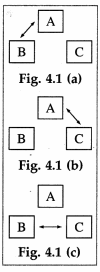
Consider three systems A, B and C. Suppose A and B are in thermal equilibrium, and A and C are also in thermal equilibrium. Then B and C are also in thermal equlibrium. Thus, A, B and C are at the same temperature and A works as a thermometer.
Maharashtra Board Class 12 Physics Important Questions Chapter 4 Thermodynamics 1
[Note: The arrows in the figure indicate energy exchange]

Question 7.
Define internal energy.
Answer:
Internal energy of a system is defined as the sum of the kinetic energies of the atoms and molecules belonging to the system, and the potential energies associated with the interactions between these constituents (atoms and molecules).
[Note : Internal energy does not include the potential energy and kinetic energy of the system as a whole. In the case of an ideal gas, internal energy is purely kinetic. In the case of real gases, liquids and solids, internal energy is the sum of potential and kinetic energies. For an ideal gas, internal energy depends on temperature only. In other cases, internal energy depends on temperature, as well as on pressure and volume. According to quantum theory, internal energy never becomes zero. Even at OK. particles have energy called zero-point energy.]

Question 8.
What is the internal energy of one mole of argon and oxygen ?
Answer:
Argon is a monatamic gas. In this case, with three degrees of freedom, the average kinetic energy per molecule = \(\left(\frac{3}{2}\right)\)kBT, where kB is the Boltzmann constant and T is the absolute (thermodynamic) temperature of the gas. Hence, the internal energy of one mole of argon = NA\(\left(\frac{3}{2} k_{\mathrm{B}} T\right)\) = \(\frac{3}{2}\)RT, where NA is the Avogadro number and R = NAkB is the universal gas constant. Oxygen is a diatomic gas. In this case, with five degrees of freedom at moderate temperatures, the internal energy of one mole of
oxygen = \(\frac{3}{2}\)RT.

Question 9.
Find the internal energy of one mole of argon at 300 K. (R = 8.314 J/mol.K)
Answer:
The internal energy of one mole of argon at 300 K
= \(\frac{3}{2}\)RT = \(\frac{3}{2}\)(8.314)(300) J = 3741 J.

Maharashtra Board Class 12 Physics Important Questions Chapter 4 Thermodynamics

Question 10.
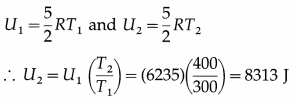
The internal energy of one mole of nitrogen at 300 K is 6235 J. What is the internal energy of one mole of nitrogen at 400 K ?
Answer:
Maharashtra Board Class 12 Physics Important Questions Chapter 4 Thermodynamics 2
This is the required quantity.
[Note : In chapter 3, the symbol E was used for internal energy.]

Question 11.
Explain the term thermodynamic system.
Answer:
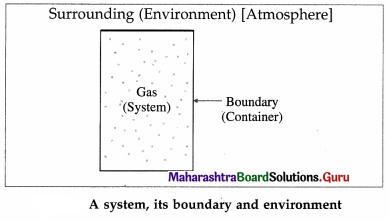
A thermodynamic system is a collection of objects that can form a unit which may have ability to Surrounding
Maharashtra Board Class 12 Physics Important Questions Chapter 4 Thermodynamics 3
exchange energy with its surroundings. Everything outside the system is called its surroundings or environment. For example, a gas enclosed in a container is a system, the container is the boundary and the atmosphere is the environment.

Question 12.
Explain classification of thermodynamic systems.
Answer:
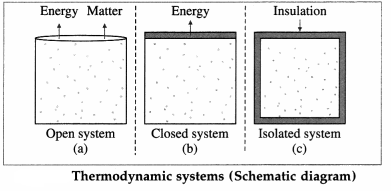
Depending upon the exchange of energy and matter with the environment, thermodynamic systems are classified as open, closed or isolated.

A system that can freely exchange energy and matter with its environment is called an open system. Example : water boiling in an open vessel.

A system that can freely exchange energy but not matter with its environment is called a closed system. Example : water boiling in a closed vessel.

A system that cannot exchange energy as well as matter with its environment is called an isolated system. In practice it is impossible to realize an isolated system as every object at a temperature above 0 K emits energy in the form of radiation, and no object can ever attain 0 K.

For many practical purposes, a thermos flask containing a liquid can be considered an isolated system.
Maharashtra Board Class 12 Physics Important Questions Chapter 4 Thermodynamics 4
These three types are illustrated in above figure.

Question 13.
What is a thermodynamic process? Give an exmple.
Answer:
A process in which the thermodynamic state of a system is changed is called a thermodynamic process.
Example : Suppose a container is partially filled with water and then closed with a lid. If the container is heated, the temperature of the water starts rising and after some time the water starts boiling. The steam produced exerts pressure on the walls of the container, Here, there is a change in the pressure, volume and temperature of the water, i.e. there is a change in the thermodynamic state of the system.

Question 14.
Explain the relation between heat and internal energy.
Answer:
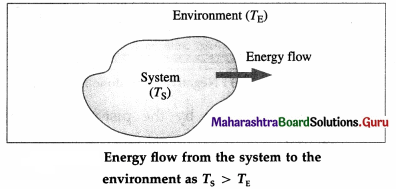
Suppose a system consists of a glass filled with water at temperature TS. Let TE be the temperature of the environment (surroundings) such as the surrounding air in the room. There is a continuous exchange of energy between the system and the surroundings.

If TS > TE, the net effect of energy exchange is the net transfer of internal energy from the system to the environment till thermal equilibrium is reached, i.e., TS and TE became equal. This internal energy in transit is called heat (Q). The change in the temperature of the environment is usually negligible compared with the change in the temperature of the system.
Maharashtra Board Class 12 Physics Important Questions Chapter 4 Thermodynamics 5

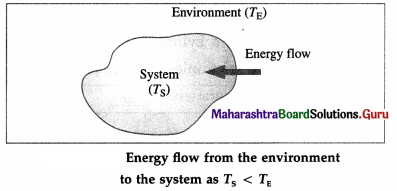
For TS < TE, there is energy exchange between the
system and the environment, but no net transfer of
energy.
Maharashtra Board Class 12 Physics Important Questions Chapter 4 Thermodynamics 6
For TS = TE, there is energy exchange between the system and the environment, but no net transfer of energy.
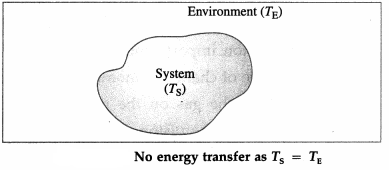
Maharashtra Board Class 12 Physics Important Questions Chapter 4 Thermodynamics 7
Thus, the net transfer of energy takes place only when there is temperature difference.

Question 15.
Explain how the internal energy of a system can be changed.
Answer:
Consider a system (S) consisting of some quantity of gas enclosed in a cylinder fitted with a movable, massless, and frictionless piston.
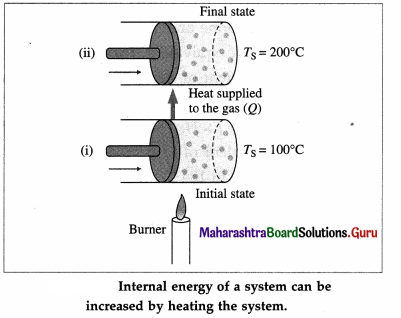
Maharashtra Board Class 12 Physics Important Questions Chapter 4 Thermodynamics 8
Suppose the gas is heated using a burner (source of heat, environment). Let TS = temperature of the system (gas) and TE = temperature of the environment.

Here, TE > TS. Hence, there will be a net flow of energy (heat) from the environment to the system causing the increase in the internal energy of the system.

The internal energy of the gas (system) can also be increased by quickly pushing the piston inward so that the gas is compressed.
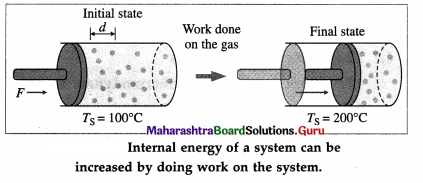
Maharashtra Board Class 12 Physics Important Questions Chapter 4 Thermodynamics 9
The work done on the gas raises the temperature of the gas. Thus, there is increase in the internal energy of the gas. If the gas pushes the piston outward, the work is done by the gas on the environment and the gas cools as its internal energy becomes less.

Question 16.
On the basis of the kinetic theory of gases, explain
(i) positive work done by a system
(ii) negative work done by a system.
Answer:
Consider a system consisting of some quantity of a gas enclosed in a cylinder fitted with a movable, massless and frictionless piston.
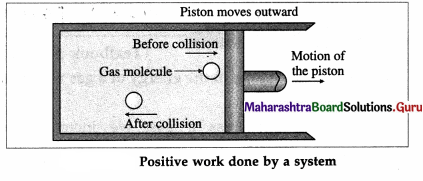
Maharashtra Board Class 12 Physics Important Questions Chapter 4 Thermodynamics 10
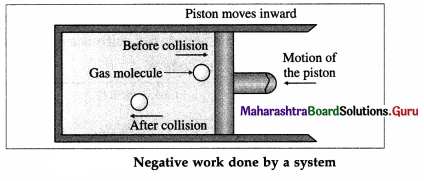
During expansion of the gas, molecules colliding with the piston lose momentum to it. This exerts force and hence pressure on the piston, moving it outward through a finite distance. Here, the gas does a positive work on the piston. There is increase in the volume of the gas. The work done by the piston on the gas is negative.

During compression of the gas, molecules colliding with the piston gain momentum from it. The piston moving inward through a finite distance exerts force on the gas. Here, the gas does a negative work on the piston. There is decrease in the volume of the gas.
Maharashtra Board Class 12 Physics Important Questions Chapter 4 Thermodynamics 11
The work done by the piston on the gas is positive.

Question 17.
Obtain an expression for the work done by a gas.
OR
Show that the work done by a gas is given by
Answer:
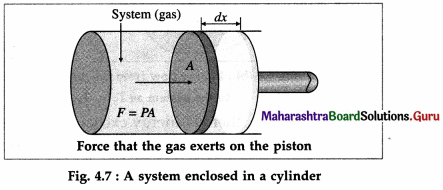
Consider a system consisting of some quantity of a gas enclosed in a cylinder fitted with a movable, massless and frictionless piston.
Maharashtra Board Class 12 Physics Important Questions Chapter 4 Thermodynamics 12
During expansion of the gas, molecules colliding with the piston impart momentum to the piston. The time rate of change of momentum is the force, F exerted by the gas on the piston. If dx is the displacement of the piston, the work done by the gas, dW = F dx. If A is the area of cross section of the piston, the pressure exerted by the gas, P = \(\frac{F}{A}\).

Hence, the work done, dW = PAdx = PdV where dV = Adx is the increase in the volume of the gas. Here, dx is the infinitesimal displacement of the piston and dV is the infinitesimal increase in the volume of the gas.

If Vi is the initial volume of the gas, and Vf is the final volume, the total work done by the gas in moving the piston is given by W = \(\int_{V_{i}}^{V_{\mathrm{f}}} P d V\).

Question 18.
State the first law of thermodynamics. Express it in mathematical form.
Answer:
First law of thermodynamics : The change in the internal energy of a system (∆U) is the difference between the heat supplied to the system (Q) and the work done by the system on its surroundings (W).
Mathematically, ∆ U = Q – W, which is the same as Q = ∆ U + W.

Notes :

  1. if Q is positive, it means heat is added to the system. If Q is negative, it means heat is given out by the system or removed from the system,
  2. If ∆U is positive, it means there is increase in the internal energy of the system. If ∆ U is negative, it means there is decrease in the internal energy of the system,
  3. If W is positive, it means it is the work done by the system on its surroundings. Negative W means work is done on the system by the surroundings,
  4. The first law of thermodynamics is largely due to Joule. It is essentially the law of conservation of energy applied to the systems that are not isolated, i.e., the systems that can exchange energy with the surroundings. Thermodynamics was developed in 1850 by Rudolf Clausius (1822-88) German theoretical physicist, His ideas were developed in 1851 by William Thomson [Lord Kelvin] (1824-1907), British physicist and electrical engineer,
  5. Q = ∆ U + W. Here, all quantities are expressed in the same units, e.g., cal or joule. If Q and A U are expressed in heat unit (cal, kcal) and W is expressed in mechanical unit (erg, joule) then the above equation takes the form Q = ∆ U + \(\frac{W}{J}\), where J is the mechanical equivalent of heat.]

Question 19.
What is the property of a system or a system variable ?
Answer:
The property of a system or a system variable is any measurable or observable characteristic or property of the system when the system remains in equilibrium.

Question 20.
Name the macroscopic variables of a system.
Answer:
Pressure, volume, temperature, density, mass, specific volume, amount of substance (expressed in mole) are macroscopic variables of a system.
Notes : The quantities specified above are not totally independent, e.g.,

  1. density = mass/volume
  2. specific volume (volume per unit mass) = 1/density.

Question 21.
What is an intensive variable ? Give examples.
Answer:
A variable that does not depend on the size of the system is called an intensive variable.
Examples : pressure, temperature, density.

Question 22.
What is an extensive variable ? Give examples.
Answer:
A variable that depends on the size of the system is called an extensive variable.
Examples : internal energy, mass.

Question 23.
What is mechanical equilibrium ?
Answer:
A system is said to be in mechanical equilibrium when there are no unbalanced forces within the system and between the system and its surroundings.
OR
A system is said to be in mechanical equilibrium when the pressure in the system is the same throughout and does not change with time.
[Note : The constituents of a system, atoms, molecules, ions, etc, are never at rest. Within a system, even in the condition of equilibrium, statistical fluctuations do occur, but the time of observation is usually very large so that these fluctuations can be ignored.]

Maharashtra Board Class 12 Physics Important Questions Chapter 4 Thermodynamics

Question 24.
What is chemical equilibrium ?
Answer:
A system is said to be in chemical equilibrium when there are no chemical reactions going on within the system.
OR
A system is said to be in chemical equilibrium when its chemical composition is the same throughout the system and does not change with time.
[Note : In this case, in the absence of concentration gradient, there is no diffusion, i.e., there is no transport of matter from one part of the system to the other.]

Question 25.
What is thermal equilibrium ?
Answer:
A system is said to be in thermal equilibrium when its temperature is uniform throughout the system and does not change with time.

Question 26.
Give two examples of thermodynamic systems not in equilibrium.
Answer:

  1. When an inflated balloon is punctured, the air inside it suddenly expands and escapes into the atmosphere. During the rapid expansion, there is no uniformity of pressure, temperature and density.
  2. When water is heated, there is no uniformity of pressure, temperature and density. If the vessel is open, some water molecules escape to the atmosphere.

Question 27.
What is the equation of state ? Explain.
Answer:
The mathematical relation between the state variables (pressure, volume, temperature, amount of the substance) is called the equation of state.

In the usual notation, the equation of state for an ideal gas is PV = nRT.

For a fixed mass of gas, the number of moles, n, is constant. R is the universal gas constant. Thus, out of pressure (P), volume (V) and thermodynamic temperature (T), only two (any two) are independent.

Question 28.
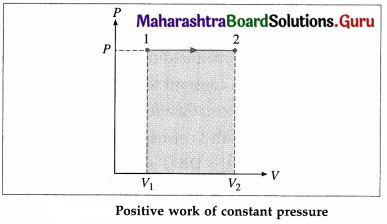
Draw P-V diagram for positive work at constant pressure.
Maharashtra Board Class 12 Physics Important Questions Chapter 4 Thermodynamics 13
Answer:
In this case, during the expansion, the work done by the gas, W = \(\int_{V_{1}}^{V_{2}} P d V\) = P(V2 – V1) is positive as V2 > V1.

Question 29.
What is a thermodynamic process ? Explain.
Answer:
A procedure by which the initial state of a system changes to its final state is called a thermodynamic process. During the process/ there may be

  1. addition of heat to the system
  2. removal of heat from the system
  3. change in the temperature of the system
  4. change in the volume of the system
  5. change in the pressure of the system.

Question 30.
What is a quasistatic process ?
Answer:
A quasistatic process is an idealised process which occurs infinitely slowly such that at all times the system is infinitesimally close to a state of thermodynamic equilibrium. Although the conditions for such a process can never be rigorously satisfied in practice, any real process which does not involve large accelerations or large temperature gradients is a reasonable approximation to a quasistatic process.

Question 31.
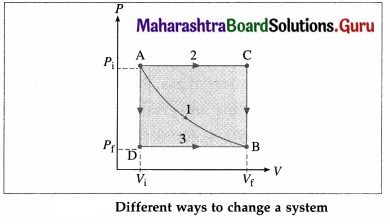
Draw a diagram to illustrate that the work done by a system depends on the process even when the initial and final states are the same.
Maharashtra Board Class 12 Physics Important Questions Chapter 4 Thermodynamics 14
Answer:
In the above diagram, the initial state of a gas is characterized by (Pi, Vi) [corresponding to point A] and the final state of the gas is characterized by (Pf, Vf) [corresponding to point B]. Path 1 corresponds to constant temperature. Path 2 corresponds to the combination AC [P constant] + CB [V constant]. Path 3 corresponds to the combination AD [V constant] + DB [P constant]. The work done by the gas (W) is the area under the curve and is different in each case.

Question 32.
What is a reversible process? What is an irreversible process? Give four examples of an irreversible process. Explain in detail.
Answer:
A reversible process is one which is performed in such a way that, at the conclusion of the process, both the system and its local surroundings are restored to their initial states, without producing any change in the rest of the universe.

A process may take place reversibly if it is quasistatic and there are no dissipative effects. Such a process cannot be realized in practice.

A process which does not fulfill the rigorous requirements of reversibility is said to be an irreversible process. Thus, in this case, the system and the local surroundings cannot be restored to their initial states without affecting the rest of the universe. All natural processes are irreversible.
Examples of irreversible process :

  1. When two bodies at different temperatures are brought in thermal contact, they attain the same temperature after some time due to energy exchange. Later, they never attain their initial temperatures.
  2. Free expansion of a gas.
  3. A gas seeping through a porous plug.
  4. Collapse of a soap film after it is pricked.
  5. All chemical reactions.
  6. Diffusion of two dissimilar inert gases.
  7. Solution of a solid in water.
  8. Osmosis.

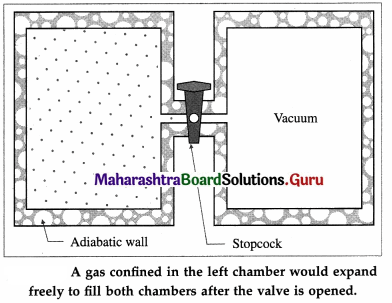
[Note : A free expansion is an adiabatic process, i.e., a process in which no heat is added to the system or removed from the system. Consider a gas confined by a valve to one half of a double chamber with adiabatic walls while the other half is evacuated.

When the gas is in thermal equilibrium, the gas is allowed to expand to fill the entire chamber by opening the valve.
No interaction takes place and hence there are no local surroundings. While rushing into a vacuum, the gas does not meet any pressure and hence no work is done by the gas. The gas only changes state isothermally from a volume Vi to a larger volume Vf.]

To restore the gas to its initial state, it would have to be compressed isothermally to the volume Vi; an amount of work W would have to done on the gas by some mechanical device and an equal amount of heat would have to flow out of the gas into a reservoir. If the mechanical device and the reservoir are to be left unchanged, the heat would have to be extracted from the reservoir and converted completely into work. Since this last step is impossible, the process of free expansion is irreversible.
Maharashtra Board Class 12 Physics Important Questions Chapter 4 Thermodynamics 15
It can be shown that the diffusion of two dissimilar inert gases is equivalent to two independent free expansions. It follows that diffusion is irreversible.]

Question 33.
What are the causes of irreversibility?
Answer:

  1. Some processes such as a free expansion of a gas or an explosive chemical reaction or burning of a fuel take the system to non-equilibrium states.
  2. Most processes involve dissipative forces such as friction and viscosity (internal friction in fluids). These forces can be minimized, but cannot be eliminated.

Question 34.
What is an isothermal process? Obtain an expression for the work done by a gas in an isothermal process.
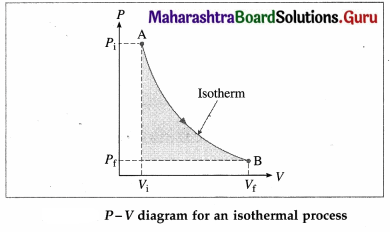
Answer:
A process in which changes in pressure and volume of a system take place at a constant temperature is called an isothermal process.

Consider n moles of a gas enclosed in a cylinder fitted with a movable, massless and frictionless piston. Let Pi, Vi and T be the initial pressure, volume and absolute temperature respectively of the gas. Consider an isothermal expansion (or compression) of the gas in which Pf, Vf and T are respectively the final pressure, volume and absolute
Maharashtra Board Class 12 Physics Important Questions Chapter 4 Thermodynamics 16
temperature of the gas. Assuming the gas to behave as an ideal gas, we have, its equation of state :
PV = nRT = constant as T = constant, R is the universal gas constant. The work done by the gas,
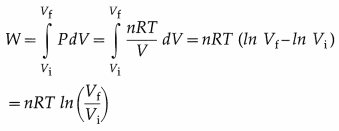
Maharashtra Board Class 12 Physics Important Questions Chapter 4 Thermodynamics 17
Notes :

  1. The above expression for W can be written in various forms such as W = nRT ln\(\left(\frac{P_{\mathrm{i}}}{P_{\mathrm{f}}}\right)\) = PiVi ln \(\left(\frac{P_{\mathrm{i}}}{P_{\mathrm{f}}}\right)\) = PfVf\(\left(\frac{V_{f}}{V_{\mathrm{i}}}\right)\), etc.
  2. W is positive if Vf > Vi (expansion). W is negative if Vf < Vi (contraction).
  3. At constant temperature, change in internal energy, ∆ U = 0.
    ∴ Q = ∆ U + W = W.
  4. Isothermal process shown in P- V diagram is also called an isotherm.
  5. Melting of ice is an isothermal process.

Question 35.
What is an isobaric process? Obtain the expressions for the work done, change in internal energy and heat supplied in an isobaric process in the case of a gas.
Answer:
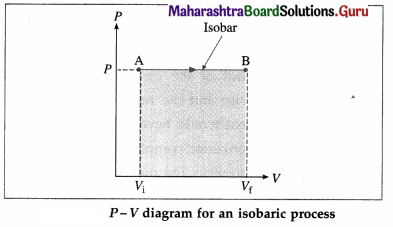
A process in which pressure remains constant is called an isobaric process. Consider n moles of a gas enclosed in a cylinder fitted with a movable, massless and frictionless piston. We assume that the gas behaves as an ideal gas so that we can use the equation of state PV = nRT.
Maharashtra Board Class 12 Physics Important Questions Chapter 4 Thermodynamics 18
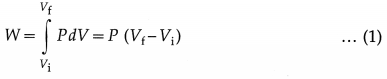
Consider an isobaric expansion (or compression) of the gas in which the volume of the gas changes from Vi to Vf and the temperature of the gas changes from Ti to Tf when the pressure (P) of the gas is kept constant. The work done by the gas,
Maharashtra Board Class 12 Physics Important Questions Chapter 4 Thermodynamics 19
Now, PVi = nRTi and PVf = nRTf
∴ PVf – PVi = nRTf – nRTi
∴ P(Vf – Vi) = nR(Tf – Ti)
∴ from Eq. (1), W = nR(Tf – Ti) … (2)
The change in the internal energy of the gas,
∆ U = nCv(Tf – Ti) …(3)
where Cv is the molar specific heat of the gas at constant volume.
From Eqs. (2) and (3), we have, the heat supplied to the gas,
Q = ∆ U + W = nCv(Tf – Ti) + nR(Tf – Ti)
= n(Cv + R)(Tf – Ti)
∴ Q = nCp(Tf – Ti) …(4)
Where Cp ( = Cv + R) is the molar specific heat of the gas at constant pressure.
[Note : P-V curve for an isobaric process is called an isobar.

Question 36.
What is an isochoric process ? Write the expressions for the work done, change in internal energy and heat supplied in this case. Also draw the corresponding P-V diagram.
Answer:
A process that takes place at constant volume is called an isochoric process (or isometric process).
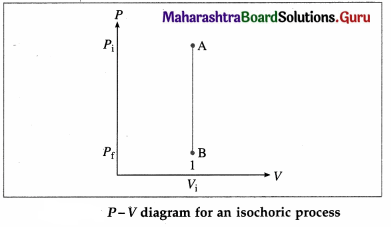
Maharashtra Board Class 12 Physics Important Questions Chapter 4 Thermodynamics 20
As there is no change in volume in this case, the work done (W) by the system on its environment is zero. The change in the internal energy.
∆ U = nCv (Tf – Ti) and heat supplied,
Q = ∆ U = nCv(Tf – Ti)

Question 37.
What is an adiabatic process ? Obtain expressions for the work done by a system (an ideal gas) in an adiabatic process. Also draw the corresponding P-V diagram.
Answer:
A process during which there is no transfer of heat (energy) from the system to the surroundings or from the surroundings to the system is called an adiabatic process.

It can be shown that if an ideal gas is subjected to an adiabatic process, then,
PVγ = constant = C, where γ, is \(\frac{C_{P}}{C_{V}}\). γ is called the adiabatic ratio. CP is the molar specific heat of the gas at constant pressure and CV is the molar specific heat at constant volume.
Let Pi = initial pressure, Pi final pressure Vf = initial volume and Vf = final volume of the gas taken through an adiabatic process.
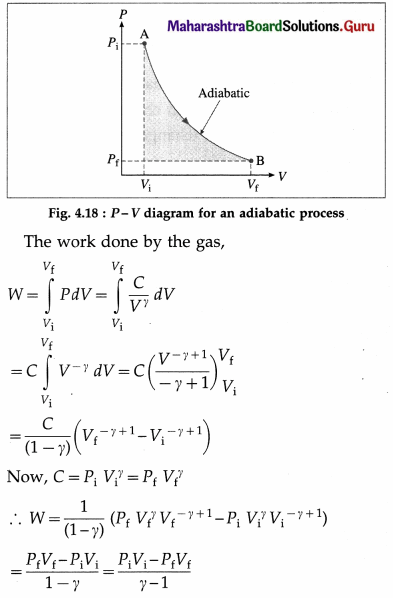
Maharashtra Board Class 12 Physics Important Questions Chapter 4 Thermodynamics 21
Now, PiVi = nRTi and PfVf = nRTf, where n is the number of moles of the gas, Ti is the initial temperature of the gas, Tf is the final temperature of the gas and R is the universal gas constant.
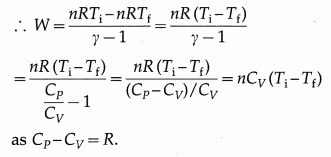
Maharashtra Board Class 12 Physics Important Questions Chapter 4 Thermodynamics 22
[Note: We have Q = ∆ U + W = 0 in an adiabatic process.
∴ W= -∆ U = -nCv(Tf – Ti)nCv(Ti – Tf)]

Question 38.
What is a cyclic process? Explain with a diagram.
Answer:
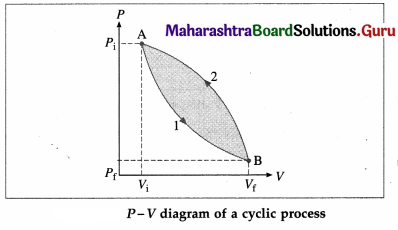
A thermodynamic process in which the system returns to its initial state is called a cyclic process. This is illustrated in below figure. Path 1 shows how the state of the system (ideal gas) is changed from (Pi, Vi) [point A] to (Pf, Vf) [point B], Path 2 shows the return of the system from point B to point A. As the system returns to its initial state, the total change in its internal energy is zero. Hence, according to the first law of thermodynamics, heat supplied,
Maharashtra Board Class 12 Physics Important Questions Chapter 4 Thermodynamics 23
Q = ∆ U + W = 0 + W = W. The area enclosed by the cycle in P-V plane gives the work done (W) by the system.

Question 39.
Explain the term free expansion of a gas.
Answer:
When a balloon is ruptured suddenly, or a tyre is punctured suddenly, the air inside the balloon/ tyre rushes out rapidly to the atmosphere. This process (expansion of air inside the balloon/tyre) is so quick that there is no time for transfer of heat from the system to the surroundings or from the surroundings to the system. Such an adiabatic expansion is called free expansion. It is characterized by Q = W = 0, implying ∆ U = 0. Free expansion is an uncontrolled change and the system is not in thermodynamic equilibrium. Free expansion cannot be illustrated with a P-V diagram as only the initial state and final state are known.

Question 40.
Solve the following :

Question 1.
A gas enclosed in a cylinder fitted with a movable, massless and frictionless piston is expanded so that its volume increases from 5 L to 6 L at a constant pressure of 1.013 × 10⁵ Pa. Find the work done by the gas in this process.
Solution :
Data : P = 1.013 × 10⁵ Pa, Vi = 5L = 5 × 10⁻³ m3,
vf = 6L = 6 × 10⁻³ m3
The work done by the gas, in this process,
W = P(Vf – Vi)
= (1.013 × 10⁵)(6 × 10⁻³ – 5 × 10⁻³)J
= 1.013 × 10²J

Question 2.
The initial pressure and volume of a gas enclosed in a cylinder are respectively 1 × 10⁵ N/m2 and 5 × 10⁻³ m3. If the work done in compressing the gas at constant pressure is 100 J. Find the final volume of the gas.
Solution :
Data : P = 1 × 10⁵ N/m2, Vi = 5 × 10⁻³ m3,
W= -100 J
W = P(Vf – Vi) ∴ Vf – Vi = \(\frac{W}{P}\)
∴ Vf = Vi + \(\frac{W}{P}\) = 5 × 10⁻³ + \(\frac{(-100)}{\left(1 \times 10^{5}\right)}\)
= 5 × 10⁻³ -1 × 10-3 = 4 × 10⁻³ m3
This is the final volume of the gas.

Maharashtra Board Class 12 Physics Important Questions Chapter 4 Thermodynamics

Question 3.
If the work done by a system on its surroundings is 100 J and the increase in the internal energy of the system is 100 cal, what must be the heat supplied to the system? (Given : J = 4.186J/cal)
Solution :
Data : W = 100 J, ∆ U = 100 cal, J = 4.186 J / cal
The heat supplied to the system,
Q = ∆ U + W = (100 cal) (4.186 J/cal) + 100 J
= 418.6J + 100J = 518.6 J

Question 4.
Ten litres of water are boiled at 100°C, at a pressure of 1.013 × 10⁵ Pa, and converted into steam. The specific latent heat of vaporization of water is 539 cal/g. Find
(a) the heat supplied to the system
(b) the work done by the system
(c) the change in the internal energy of the system. 1 cm3 of water on conversion into steam, occupies 1671 cm3 (J = 4.186 J/cal)
Solution :
Data : P = 1.013 × 10⁵ Pa, V (water) = 10 L = 10 × 10-3 m3, V(steam) = 1671 × 10 × 10-3 m3, L = 539 cal/g = 539 × 103 \(\frac{\mathrm{cal}}{\mathrm{kg}}\) = 539 × 103 × 4.186\(\frac{\mathrm{J}}{\mathrm{kg}}\) as J = 4.186 J/cal, mass of the water (M) = volume × density = 10 × 10-3 m3 × 103 kg/m3 = 10 kg

(a) Q = ML = (10) (5.39 × 4.186 × 105) J
= 2.256 × 10⁷J
This is the heat supplied to the system

(b) W = P∆V = (1.013 × 10⁵) (1671 – 1) × 10-2J
= (1.013) (1670) × 103 J = 1.692 × 10⁶ J
This is the work done by the system.

(c) ∆ U = Q – W = 22.56 × 10⁶ – 1.692 × 106
= 2.0868 × 10⁷J
This is the change (increase) in the internal energy of the system.

Question 5.
Find the heat needed to melt 100 grams of ice at 0°C, at a pressure of 1.013 × 10⁵ N/m2. What is the work done in this process ? What is the change in the internal energy of the system ?
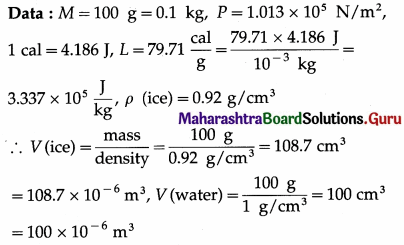
Given : Specific latent heat of fusion of ice = 79.71 cal/g, density of ice = 0.92 g/cm3, density of water = 1 g/cm3,1 cal = 4.186 J.
Solution :
Maharashtra Board Class 12 Physics Important Questions Chapter 4 Thermodynamics 24

  1. The heat needed to melt the ice, Q = ML = (0.1) (3.337 × 10⁵) J = 3.337 × 10⁴ J
  2. The work done, W = P(VWater – Vice)
    = (1.013 × 10⁵) (100 – 108.7) × 10-6J = -0.8813J
  3. The change in the internal energy,
    ∆ U = Q – W = 3.337 × 10⁴ J + 0.8813 J
    = 3370.8813 J

Question 6.
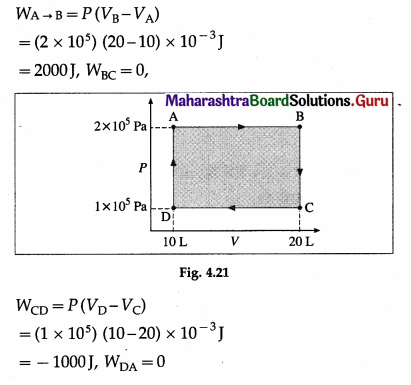
Find the work done by the gas when it is taken through the cycle shown in the following figure. (1 L = 10-3 m3)
Solution :
Maharashtra Board Class 12 Physics Important Questions Chapter 4 Thermodynamics 25
∴ WABCDA = WAB + WBC + WCD + WDA
= 2000J + 0 – 1000J + 0 = 1000J

Question 7.
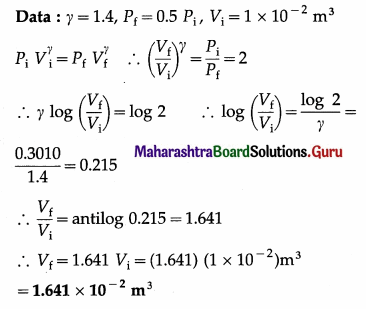
A gas with adiabatic constant γ = 1.4, expands adiabatically so that the final pressure becomes half the initial pressure. If the initial volume of the gas 1 × 10⁻² m3, find the final volume.
Solution:
Maharashtra Board Class 12 Physics Important Questions Chapter 4 Thermodynamics 26
This is the final volume of the gas.

Question 8.
In an adiabatic compression of a gas with γ = 1.4, the initial temperature of the gas is 300 K and the final temperature is 360 K. If the initial volume of the gas is 2 × 10⁻³ m3, find the final volume.
Solution:
Data: γ = 1.4, Ti = 300 K, Tf = 360 K
∴ Tf/Ti = 1.2, Vi = 2 × 10⁻³ m3
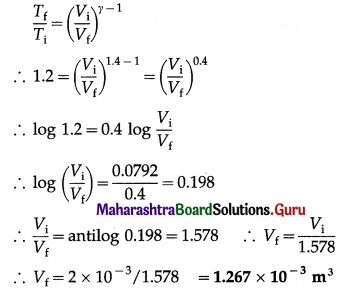
Maharashtra Board Class 12 Physics Important Questions Chapter 4 Thermodynamics 27
This is the final volume of the gas.

Question 9.
In an adiabatic compression of a gas with γ = 1.4, the final pressure is double the initial pressure. If the initial temperature of the gas is 300 K, find the final temperature.
Solution:
Data: γ = 1.4, Pf = 2Pi, Ti = 300 K

Maharashtra Board Class 12 Physics Important Questions Chapter 4 Thermodynamics 28
∴ log \(\frac{T_{\mathrm{f}}}{T_{\mathrm{i}}}\) = 0.2857 log 2 = 0.2857 (0.3010) = 0.086
∴ \(\frac{T_{\mathrm{f}}}{T_{\mathrm{i}}}\) = antilog 0.086 = 1.219
∴ Tf = 1219Ti
= (1.219) (300) = 365.7 K
This is the final temperature of the gas.

Question 10.
In an adiabatic compression of a gas the final volume of the gas is 80% of the initial volume. If the initial temperature of the gas is 27 °C, find the final temperature of the gas. Take γ = 5/3.
Solution :
Data: Vf = 0.8 Vi ∴ \(\frac{V_{\mathrm{i}}}{V_{\mathrm{f}}}\) = \(\frac{10}{8}\) = 1.25,
∴ Ti = 27 °C = (273 + 27) K = 300 K, γ = \(\frac{5}{3}\)
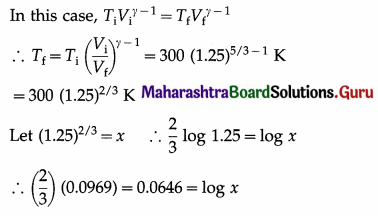
Maharashtra Board Class 12 Physics Important Questions Chapter 4 Thermodynamics 29
∴ x = antilog 0.0646 = 1.161
∴ Tf = (300) (1.161) = 348.3 K
= (348.3 – 273)°C = 75.3 °C
This is the final temperature of the gas.

Question 11.
In an adiabatic expansion of a gas, the final volume of the gas is double the initial volume. If the initial pressure of the gas is 105 Pa, find the final pressure of the gas. (γ = 5/3)
Solution :
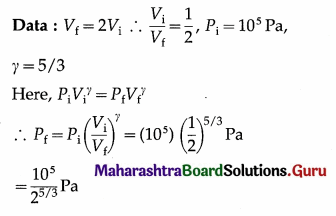
Maharashtra Board Class 12 Physics Important Questions Chapter 4 Thermodynamics 30
Let 25/3 = x ∴ \(\frac{5}{3}\)log 2 = log x
∴ log x = \(\left(\frac{5}{3}\right)\) (0.3010) = 0.5017
∴ x = antilog 0.5017 = 3.175
∴ Pf = \(\frac{10^{5}}{3.175}\) = 3.15 × 10⁴ Pa
This is the final pressure of the gas.

Question 12.
In an adiabatic process, the final pressure of the gas is half the initial pressure. If the initial temperature of the gas is 300 K, find the final temperature of the gas. (Take γ = \(\frac{5}{3}\))
Solution :
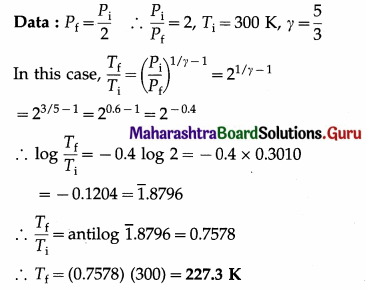
Maharashtra Board Class 12 Physics Important Questions Chapter 4 Thermodynamics 31
This is the final temperature of the gas.

Question 13.
In an adiabatic process, the pressure of the gas drops from 1 × 10⁵ N/m2 to 5 × 10⁴ N/m2 and the temperature drops from 27 °C to – 46 °C. Find the adiabatic ratio for the gas.
Solution :
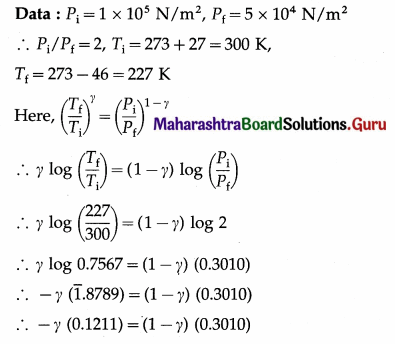
Maharashtra Board Class 12 Physics Important Questions Chapter 4 Thermodynamics 32
Maharashtra Board Class 12 Physics Important Questions Chapter 4 Thermodynamics 33
This is the adiabatic ratio (γ) for the gas.
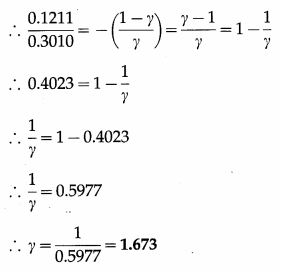
[Note : This value (1.673) is slightly more than 5/3 (the value for a monatomic gas) due to error in measurement of pressure and temperature.]

Question 14.
Two moles of a gas expand isothermally at 300 K. If the initial volume of the gas is 23 L and the final volume is 46 L, find the work done by the gas on its surroundings. (R = 8.314 J/mol.K)
Solution :
Data ; n = 2, T = 300 K, V, = 23 L = 23 × 10-3 m3, Vf = 46 L = 46 × 10-3 m3, R = 8.314 J/mol.K
The work done by the gas on its surroundings,
W = nRT ln \(\left(\frac{V_{\mathrm{f}}}{V_{\mathrm{i}}}\right)\) = 2.303 nRT log10 \(\left(\frac{V_{\mathrm{f}}}{V_{\mathrm{i}}}\right)\)
= (2.303) (2) (8.314) (300) log10 \(\left(\frac{46 \times 10^{-3}}{23 \times 10^{-3}}\right)\)
= (4.606) (8.314) (300) log\(\begin{array}{r}
2 \\
10
\end{array}\)
= (4.606) (8.314) (300) (0.3010)
= 3458J

Question 15.
Four moles of a gas expand isothermally at 300 K. If the final pressure of the gas is 80% of the initial pressure, find the work done by the gas on its surroundings. (R = 8.314 J/mol.K)
Solution :
Data : n = 4, T = 300 K, Pf = 0.8 Pi
∴ \(\frac{P_{i}}{P_{f}}\) = \(\frac{10}{8}\), R = 8.314 j/mol.K
The work done by the gas on its surroundings,
W = nRT ln\(\left(\frac{P_{\mathrm{i}}}{P_{\mathrm{f}}}\right)\)
= (4) (8.314) (300) 2.303 log10 \(\left(\frac{10}{8}\right)\)
= 2.3 × 10⁴ log10 (1.25) = 2.3 × 104 × 0.0969
= 2.229 × 10³J

Question 16.
The molar specific heat of He at constant volume is 12.47 J/mol.K. Two moles of He are heated at constant pressure so that the rise in temperature is 10 K. Find the increase in the internal energy of the gas.
Solution :
Data : Cv = 12.47 J/mol.k, n = 2, Tf – Ti = 10 K
The increase in the internal energy of the gas,
∆ U = nCv (Tf – Ti)
= (2) (12.47) (10) J
= 249.4 J

Maharashtra Board Class 12 Physics Important Questions Chapter 4 Thermodynamics

Question 17.
The molar specific heat of Ar at constant volume is 12.47 J/mol.K. Two moles of Ar are heated at constant pressure so that the rise in temperature is 20 K. Find the work done by the gas on its surroundings and the heat supplied to the gas. Take R = 8.314 J/mol.K.
Solution :
Data : Cv = 12.47 j/mol.K, n = 2,Tf – Ti = 20 K,
R = 8.314 J/mol.K

  1. W = nR (Tf – Ti) = (2) (8.314) (20) J = 332.6 J
    This is the work done by the gas on its surroundings.
  2. Q = nCv(Tf – Ti) + W = (2) (12.47) (20) + 332.6
    = 498.8 + 332.6 = 831.4 J
    This is the heat supplied to the gas.

Question 18.
The molar specific heat of a gas at constant pressure is 29.11 J/mol.k. Two moles of the gas are heated at constant pressure so that the rise in temperature is 40 K. Find the heat supplied to the gas.
Solution :
Data : CP = 29.11 J/mol.K, n = 2, Tf – Ti = 40 K.
The heat supplied to the gas,
Q = nCP (Tf – Ti) = (2) (29.11) (40) J
= 2329 J

Question 19.
The molar specific heat of a gas at constant volume is 20.8 J/mol.k. Two moles of the gas are heated at constant volume so that the rise in temperature is 10 K. Find the heat supplied to the gas.
Solution :
Data : Cv = 20.8 J/mol.K, n = 2, Tf – Ti = 10 K.
The heat supplied to the gas,
Q = nCv (Tf – Ti) = (2) (20.8) (10) J
= 416J

Question 20.
In an adiabatic expansion of 2 moles of a gas, the initial pressure was 1.013 × 10⁵ Pa, the initial volume was 22.4 L, the final pressure was 3.191 × 10⁴ Pa and the final volume was 44.8 L. Find the work done by the gas on its surroundings. Take γ = 5/3.
Solution :
Data : H = 2, Pi = 1.013 × 10⁵ Pa, Pf = 3.191 × 10⁴ Pa,
Vi = 22.4 L = 22.4 × 10⁻³ m3,
Vf = 44.8 L = 44.8 × 10⁻³ m3, γ = 5/3
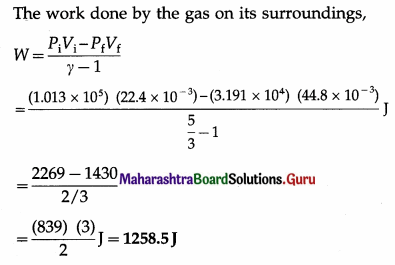
Maharashtra Board Class 12 Physics Important Questions Chapter 4 Thermodynamics 34

Question 21.
In an adiabatic expansion of 2 moles of a gas, the temperature of the gas decreases from 37°C to 27°C. Find the work done by the gas on its surroundings. Take γ = 5/3 and R = 8.314 J/mol.K
Answer:
Data: n =2, Ti = (273 + 37) = 310 K,
Tf = (273 + 27)K = 300K, γ = 5/3,
R = 8.314 J/mol.K.
The work done by the gas on its surroundings,
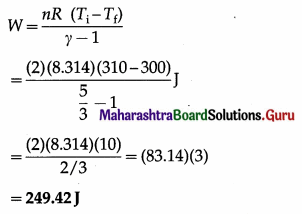
Maharashtra Board Class 12 Physics Important Questions Chapter 4 Thermodynamics 35

Question 22.
A resistor of resistance 200 Ω carries a current of 2 A for 10 minutes. Assuming that almost all the heat produced in the resistor is transferred to water (mass = 5 kg, specific heat capacity = 1 kcal/kg), and the work done by the water against the external pressure during the expansion of water can be ignored, find the rise in the temperature of the water. (J = 4186 J/cal)
Solution :
Data : I = 2 A, R = 200 Ω, t = 10 min = 10 × 60 s = 600 s, M = 5 kg, S = (1 kcal/kg) (4186 J/kcal)
= 4186 J/kg
Q = ∆ U + W = MS ∆T + W \(\simeq\) MS ∆T ignoring W.
Also, Q = I2Rt ∴ I2RT = MS∆T
∴ The rise in the temperature of water = ∆T = \(\frac{I^{2} R t}{M S}\)
= \(\frac{(2)^{2}(200)(600)}{(5)(4186)}\)°C = 22.93°C

Question 23.
The initial pressure, volume and temperature of a gas are respectively 1 × 10⁵ Pa, 2 × 10⁻² m3 and 400 K. The temperature of the gas is reduced from 400 K to 300 K at constant volume. Then the gas is compressed at constant temperature so that its volume becomes 1.5 × 10⁻² m3.
Solution:
Data : PA = 1 × 10⁵ Pa, VA = 2 × 10⁻² m3, TA = 400 K, VB = vA = 2 × 10⁻² m3, TB = 300 K, TC = TB = 300 K, VC = 1.5 x 10× 10-2 m3, Also, PC = PA = 1 × 10⁵ Pa as the gas returns to its initial state.
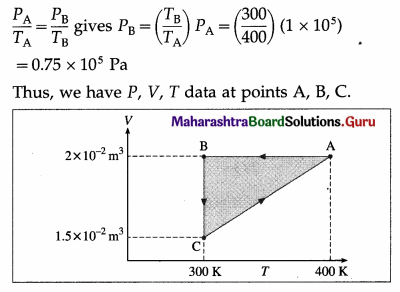
Maharashtra Board Class 12 Physics Important Questions Chapter 4 Thermodynamics 36

Question 24.
If the adiabatic ratio for a gas is 5/3, find the molar specific heat of the gas at
(i) constant volume
(ii) constant pressure.
(R = 8.314 J/mol. K)
Solution :
Data : r = 5/3, R = 8.314 J/mol.K
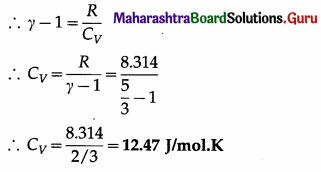
Maharashtra Board Class 12 Physics Important Questions Chapter 4 Thermodynamics 37
This is the required quantity.
(ii) CP = γCV = \(\left(\frac{5}{3}\right)\)(12.47) = 20.78 J/mol.

Question 41.
What is a heat engine ?
Answer:
A heat engine is a device in which a system is taken through cyclic processes that result in converting part of heat supplied by a hot reservoir into work (mechanical energy) and releasing the remaining part to a cold reservoir. At the end of every cycle involving thermodynamic changes, the system is returned to the initial state.
[Note : Automobile engine is a heat engine.]

Question 42.
What does a heat engine consist of ?
OR
What are the elements (parts) of a typical heat engine?
Answer:
The following are the parts of a typical heat engine :

(1) Working substance : It can be

  1. a mixture of fuel vapour and air in a gasoline (petrol) engine or diesel engine
  2. steam in a steam engine. The working substance is called a system.

(2) Hot and cold reservoirs : The hot reservoir is a source of heat that supplies heat to the working substance at constant temperature TH. The cold reservoir, also called the sink, takes up the heat released by the working substance at constant temperature TC < TH.

(3) Cylinder and piston : The working substance is enclosed in a cylinder fitted with (ideally) a movable, massless, and frictionless piston. The walls of the cylinder are nonconducting, but the base is conducting. The piston is nonconducting. The piston is connected to a crankshaft so that the work done by the working substance (mechanical energy) can be transferred to the environment.

Question 43.
What are the two basic types of heat engines?
Answer:
(i) External combustion engine in which the working substance is heated externally as in a steam engine.
(ii) Internal combustion engine in which the working substance is heated internally as in a petrol engine or diesel engine.
[Note : A steam engine was invented by Thomas New-comen (1663-1729), English engineer. The first practical steam engine was constructed in 1712. The modem steam engine was invented in 1790 by James Watt (1736-1819), British instrument maker and engineer. A hot-air type engine was developed by Robert Stirling (1790-1878), Scottish engineer and clergyman.

A four-stroke internal combustion engine was devised by Nikolaus August Otto (1832-1891), German engineer. A compression-ignition internal combustion engine was devised by Rudolph (Christian Karl) Diesel (1858 – 1913), German engineer.]

Maharashtra Board Class 12 Physics Important Questions Chapter 4 Thermodynamics

Question 44.
State the basic steps involved in the working of a heat engine.
Answer:

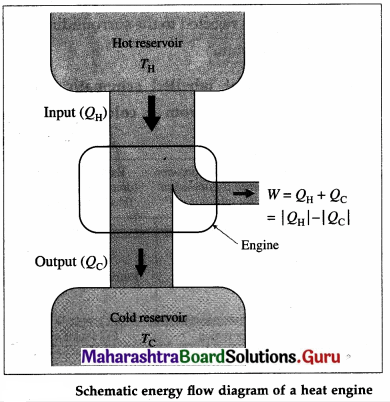
  1. The working substance absorbs heat (QH) from a hot reservoir at constant temperature. TH. It is an isothermal process QH is positive.
  2. Part of the heat absorbed by the working substance is converted into work (W), i.e. mechanical energy. In this case, there is a change in the volume of the substance.
  3. The remaining heat (|QC| = |QH| – W) is transferred to a cold reservoir at constant temperature TC < TH. QC is negative.

Question 45.
Draw a neat labelled energy flow diagram of a heat engine.
Answer:
Maharashtra Board Class 12 Physics Important Questions Chapter 4 Thermodynamics 38

Question 46.
Define thermal efficiency of a heat engine.
Answer:
The thermal efficiency, η of a heat engine is defined W as η = \(\frac{W}{Q_{H}}\), where W is the work done (output) by QH the working substance and QH is the amount of heat absorbed (input) by it.
[Note : η has no unit and dimensions or its dimensions are [M°L°T°].]

Question 47.
Draw a neat labelled P-V diagram for a typical heat engine.
Answer:
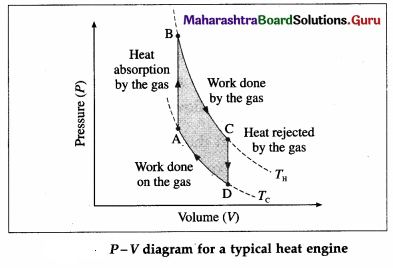
Maharashtra Board Class 12 Physics Important Questions Chapter 4 Thermodynamics 39
Here, TH is the temperature at which the work is done by the gas and Tc is the temperature at which the work is done on the gas. The area of the loop ABCDA is the work output.

Question 48.
Solve the following :

Question 1.
Find the thermal efficiency of a heat engine if in one cycle the work output is 3000 J and the heat input is 10000 J.
Solution :
Data : W = 3000 J, QH = 10000 J
The thermal efficiency of the engine,
η = \(\frac{W}{Q_{\mathrm{H}}}\) = \(\frac{3000 \mathrm{~J}}{10000 \mathrm{~J}}\) = 0.3 = 30%

Question 2.
The thermal efficiency of a heat engine is 25%. If in one cycle the heat absorbed from the hot reservoir is 50000 J, what is the heat rejected to the cold reservoir in one cycle ?
Solution :
Data : η = 25% = 0.25, QH = 50000 J W
η = \(\frac{W}{Q_{\mathrm{H}}}\)
∴ W = ηQH = (0.25)(50000)J = 12500J
Now, W = QH – |QC|
∴ |QC| = QH – W
= (50000 – 12500) J
= 37500J
This is the heat rejected to the cold reservoir in one cycle.
[Notes : QC = – 37500 J]

Question 49.
What is a refrigerator?
Answer:
A refrigerator is a device that uses work to transfer energy in the form of heat from a cold reservoir to a hot reservoir as it continuously repeats a thermodynamic cycle. Thus, it is a heat engine that runs in the backward direction.

Question 50.
With a neat labelled energy flow diagram, explain the working of a refrigerator.
Answer:
A refrigerator performs a cycle in a direction opposite to that of a heat engine, the net result being absorption of some energy as heat from a reservoir at low temperature, a net amount of work done on the system and the rejection of a larger amount
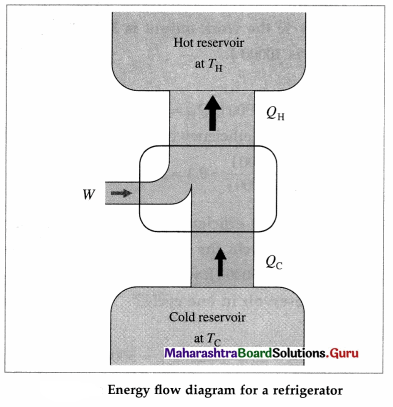
Maharashtra Board Class 12 Physics Important Questions Chapter 4 Thermodynamics 40
of energy as heat to a reservoir at a higher temperature. The working substance undergoing the refrigeration cycle is called a refrigerant. The refrigerant (such as ammonia or Freon) is a saturated liquid at a high pressure and at as low a temperature as can be obtained with air or water cooling.

The refrigeration cycle comprises the following processes :

  1. Throttling process : The saturated liquid refrigerant passes from the condenser through a narrow opening from a region of constant high pressure to a region of constant lower pressure almost adiabatically. It is a property of saturated liquids (not gases) that a throttling process produces cooling and partial vaporization.
  2. Isothermal, isobaric vaporization-with the heat of vaporization being supplied by the materials or the region to be cooled : Heat Qc is absorbed by the refrigerant at the low temperature TC, thereby cooling the materials of the cold reservoir.
  3. Adiabatic compression of the refrigerant by an electrical compressor, thereby raising its temperature above TH.
  4. Isobaric cooling and condensation in the condenser at TH : In the condenser, the vapour is cooled until it condenses and is completely liquefied, i. e., heat QH is rejected to the surroundings which is the hot reservoir.

Question 51.
Draw a neat labelled schematic diagram of transferring heat from a cold region to a hot region.
Answer:
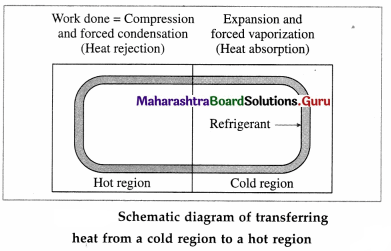
Maharashtra Board Class 12 Physics Important Questions Chapter 4 Thermodynamics 41

Question 52.
What is refrigeration?
Answer:
Refrigeration is artificial cooling of a space or substance of a system and/or maintaining its temperature below the ambient temperature.

Question 53.
Draw a neat labelled diagram to illustrate schematics of a refrigerator.
Answer:
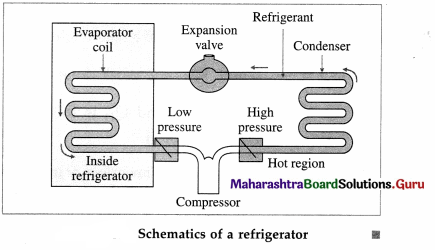
Maharashtra Board Class 12 Physics Important Questions Chapter 4 Thermodynamics 42

Question 54.
What are the steps through which a refrigerant goes in one complete cycle of refrigeration ?
Answer:
In one complete cycle of refrigeration, the refrigerant, a liquid such as fluorinated hydrocarbon, goes through the following steps :

  1. The refrigerant in the closed tube passes through the nozzle and expands, into a low-pressure area. This adiabatic expansion results in reduction in pressure and temperature of the fluid and the fluid turns into a gas.
  2. The cold gas is in thermal contact with the inner compartment of the fridge. Here it absorbs heat at constant pressure from the contents of the fridge.
  3. The gas passes to a compressor where it does work in adiabatic compression. This raises its temperature and converts it back into a liquid.
  4. The hot liquid passes through the coils on the outside of the refrigerator and releases heat to the air outside in an isobaric compression process.
    The compressor, driven by an external source of energy, does work on the refrigerant during each cycle.

Question 55.
Explain the energy flow in a refrigerator and define the coefficient of performance of a refrigerator.
Answer:
In a refrigerator, QC is the heat absorbed by the working substance (refrigerant) at a lower temperature TC, W is the work done on the working substance, and QH is the heat rejected at a higher temperature TH. The absorption of heat is from the contents of the refrigerator and rejection of heat is to the atmosphere. Here, QC is positive and W and QH are negative. In one cycle, the total change in the internal energy of the working substance is zero.
∴ QH + QC = W ∴ QH = W – QC
∴ -QH = QC – W
Now, QH < 0, W < 0 and QC > 0
∴ |QH| = |QC| + |W|
The coefficient of performance (CoP), K, or quality factor, or Q value of a refrigerator is defined as
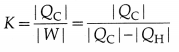
Maharashtra Board Class 12 Physics Important Questions Chapter 4 Thermodynamics 43
[Note: K does not have unit and dimensions or its dimensions are [M°L°T°.]

Question 56.
How does an air conditioner differ from a refrigerator? Define the coefficient of performance of an air conditioner and express it in terms of heat current.
Answer:
The working of an air conditioner is exactly similar to that of a refrigerator, but the volume of the chamber/room cooled by an air conditioner is far greater than that in a refrigerator. The evaporator coils of an air conditioner are inside the room, and the condenser outside the room. A fan inside the air conditioner circulates cool air in the room.

The coefficient of performance, K, of an air conditioner is defined as K = \(|\frac{Q_{\mathrm{C}}}{W}|\), where QC is the heat absorbed and W is the work done. The time rate of heat removed is the heat current, H = \(\frac{\left|Q_{C}\right|}{t}\), where t is the time in which heat |QC|, is removed.
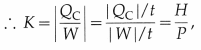
Maharashtra Board Class 12 Physics Important Questions Chapter 4 Thermodynamics 44
where H = |QC|/t is the heat current and P( = |W|/t) is the time rate of doing work, i.e., power.

Question 57.
What is a heat pump ?
Answer:
A heat pump is a device used to heat a building by cooling the air outside it. It works like a refrigerator but cooling outside space and heating inside space. In this case, the evaporator coils are outside the building to absorb heat from the air. The condenser coils are inside the building to release the heat to warm the building.

Question 58.
Solve the following :

Question 1.
In a refrigerator, in one cycle, the external work done on the working substance is 20% of the energy extracted from the cold reservoir. Find the coefficient of performance of the refrigerator.
Solution :
Data: |W| = 0.2|QC|
The coefficient of performance of the refrigerator,
K = |\(\frac{Q_{C}}{W}\)| = \(\frac{\left|Q_{C}\right|}{0.2\left|Q_{C}\right|}\)
= 5

Question 2.
The coefficient of performance of a room air conditioner is 3. If the rate of doing work is 2kW, find the heat current.
Solution :
Data : K = 3, P = 2000 W
K = \(\frac{H}{P}\)
∴ Heat current, H = KP = (3) (2000) W
= 6000 W = 6kW

Question 59.
State and explain the limitations of the first law of thermodynamics.
Answer:

  1. The first law of thermodynamics is essentially the principle of conservation of energy as there is a close relation between work and energy. We find that there is a net transfer of energy (heat) from a body at higher temperature to a body at lower temperature. The net transfer of energy from a body at lower temperature to a body at higher temperature is not observed though consistent with the first law of thermodynamics.
  2. If two containers, one containing nitrogen and the other containing oxygen, are connected to allow diffusion, they mix readily. They never get separated into the respective containers though there is no violation of the first law of thermodynamics.
  3. It is not possible to design a heat engine with 100% efficiency, though there is no restriction imposed by the first law of thermodynamics.
  4. At room temperature, ice absorbs heat from the surrounding air and melts. The process in the opposite direction is not observed, though consistent with energy conservation. These examples suggest that there is some other law operative in nature that determines the direction of a process

Question 60.
State the two forms of the second law of thermodynamics.
Answer:
Second law of thermodynamics :

  1. It is impossible to extract an amount of heat QH from a hot reservoir and use it all to do work W. Some amount of heat QC must be exhausted (given out) to a cold reservoir. This prohibits the possibility of a perfect heat engine.
    This statement is called the first form or the engine law or the engine statement or the Kelvin-Planck statement of the second law of thermodynamics.
  2. It is not possible for heat to flow from a colder body to a warmer body without any work having been done to accomplish this. This prohibits the possibility of a perfect refrigerator.
    This statement is called the second form or the Clausius statement of the second law of thermodynamics.

Notes :

  1. Max Planck (Karl Ernst Ludwig) (1858-1947) German physicist, put forward quantum therory of radiation.
  2. Rudolf Clausius (1822-88) German theoretical physicist, made significant contribution to thermodynamics.

Maharashtra Board Class 12 Physics Important Questions Chapter 4 Thermodynamics

Question 61.
Draw neat labelled diagrams to illustrate
(i) energy flow diagram for engine statement.
(ii) energy flow diagram for a perfect refrigerator.
Answer:
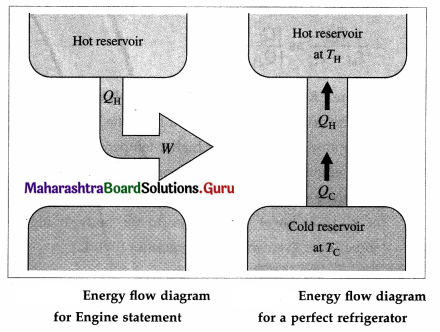
Maharashtra Board Class 12 Physics Important Questions Chapter 4 Thermodynamics 45

Question 62.
State the difference between a reversible process and an irreversible process.
OR
Distinguish between a reversible process and an irreversible process.
Answer:
A reversible process is a bidirectional process, i.e., its path in P-V plane is the same in either direction. In contrast, an irreversible process is a undirectional process, i.e., it can take place only in one direction.

A reversible process consists of a very large number of infinitesimally small steps so that the system is all the time in thermodynamic equilibrium with its environment. In contrast an irreversible process may occur so rapidly that it is never in thermodynamic equilibrium with its environment.

Question 63.
Draw a neat labelled diagram of a Carnot cycle and describe the processes occurring in a Carnot engine. Write the expression for the efficiency of a Carnot engine.
Answer:
Basically, two processes occur in a Carnot engine :
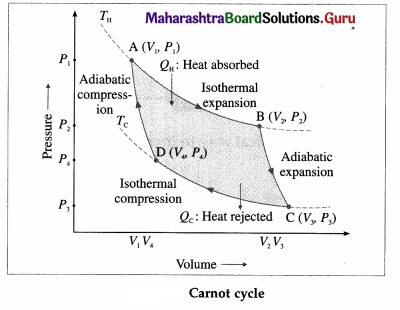
Maharashtra Board Class 12 Physics Important Questions Chapter 4 Thermodynamics 46
(1) Exchange of heat with the reservoirs : In isothermal expansion AB, the working substance takes in heat QH from a lot reservoir (source) at constant temperature TH. In isothermal compression CD, the working substance gives out heat QC to a cold reservoir (sink) at constant temperature TC.

(2) Doing work : In adiabatic expansion BC, the working substance does work on the environment and in adiabatic compression DA, work is done on the working substance by the environment.
All processes are reversible. It can be shown that \(\frac{\left|Q_{C}\right|}{Q_{\mathrm{H}}}\) = \(\frac{T_{\mathrm{C}}}{T_{\mathrm{H}}}\). Hence, the efficiency of a Carnot engine,
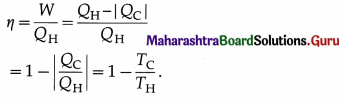
Maharashtra Board Class 12 Physics Important Questions Chapter 4 Thermodynamics 47

Question 64.
What is a Carnot refrigerator? State the expressions for the coefficient of performance of a Carnot refrigerator.
Answer:
A Carnot refrigerator is a Carnot engine operated in the reverse direction. Here, heat QC is absorbed from a cold reservoir at temperature TC, work W is provided externally, and heat QH is given out to a hot reservoir at temperature TH.
The coefficient of performance of a Carnot refrigerator is
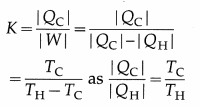
Maharashtra Board Class 12 Physics Important Questions Chapter 4 Thermodynamics 48
[Note: K is large if TH-TC is small. It means a large quantity of heat can be removed from the body at lower temperature to the body at higher temperature by doing small amount of work. K is small if TH – TC is large.
It means a small quantity of heat can be removed from the body at lower temperature to the body at higher temperature even with large amount of work.]

Question 65.
Solve the following :

Question 1.
A Carnot engine receives 6 × 10⁴ J from a reservoir at 600 K, does some work, and rejects some heat to a reservoir at 500 K. Find the
(i) the heat rejected by the engine
(ii) the work done by the engine
(iii) the efficiency of the engine.
Solution :
Data : QH = 6 × 10⁴J, TH = 600K, TC = 500K
(i) The heat rejected by the engine
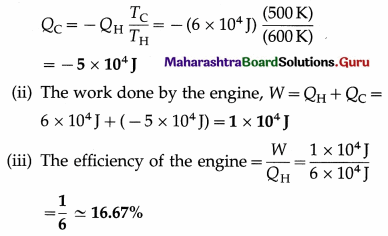
Maharashtra Board Class 12 Physics Important Questions Chapter 4 Thermodynamics 49

Question 2.
A Carnot engine operates between 27 °C and 87 °C. Find its efficiency.
Solution :
Data : TC = 27 °C = (273 + 27) K = 300 K,
TH = 87 °C = (273 + 87) = 360 K
The efficiency of the engine,
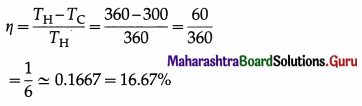
Maharashtra Board Class 12 Physics Important Questions Chapter 4 Thermodynamics 50

Question 3.
The coefficient of performance of a Carnot refrigerator is 4. If the temperature of the hot reservoir is 47 °C, find the temperature of the cold reservoir.
Solution :
Data : K = 4, TH = 47°C = (273 + 47) K = 320
K = \(\frac{T_{\mathrm{c}}}{T_{\mathrm{H}}-T_{\mathrm{c}}}\) ∴ KTH – KTc = Tc
∴ KTH = (1 + K)Tc
∴ Tc = \(\frac{K T_{\mathrm{H}}}{1+K}\) = \(\frac{(4)(320)}{1+4}\)K = (0.8)(320)K
= 256K = (256 – 273)°C = – 17°C
This is the temperature of the cold reservoir.

[Note : A hot-air type engine consisting of two cylinders, was developed by Robert Stirling (1790 -1878), a Scottish engineer and clergyman. He developed the concept in 1816 and obtained a patent for his design in 1827. Some engines were made in 1844. He also used helium and hydrogen in some engines developed thereafter. Stirling engines are used in submarines and spacecrafts.]

Maharashtra Board Class 12 Physics Important Questions Chapter 4 Thermodynamics

Question 66.
Draw a neat labelled diagram of a Sterling cycle and describe the various processes taking place in a Sterling engine.
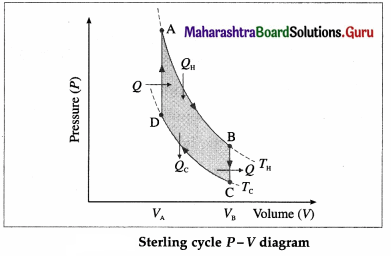
Maharashtra Board Class 12 Physics Important Questions Chapter 4 Thermodynamics 51
Answer:
The working substance can be air or helium or hydrogen or nitrogen. All processes are reversible.

  1. AB is isothermal expansion, at temperature TH, in which heat QH is absorbed from the source and useful work is done by the working substance.
  2. BC is isochoric process in which some heat is released by the gas (working substance) to the refrigerator and the gas cools to temperature Tc < TH.
  3. CD is isothermal compression, at temperature Tc, in which heat Qc is rejected to the coolant (sink).
  4. DA is isochoric process in which heat is taken in by the gas and its temperature rises to TH.

[Note : Stirling engine operated in reverse direction is used in the field of cryogenics to obtain extremely low – temperatures to liquefy air or other gases.]

Question 67.
Refer above figure and answer the following questions.
(i) What is the work done in process AB ?
(ii) What is the change in internal energy and heat released in process BC ?
Answer:
(i) In this case, the change in the internal energy is zero, as the temperature of the gas remains constant. Hence, the work done, W = heat absorbed, QH.

(ii) In this case, the change in the internal energy, ∆ U = nCV (TC – TH), where n = number of moles of the gas used in the Stirling engine and CV = molar specific heat of the gas. As W = 0 at constant volume, heat released’= ∆ U.

Question 68.
Choose the correct option :

Question 1.
According to the first law of thermodynamics, in the usual notation,
(A) Q = ∆U + W
(B) Q = ∆U – W
(C) Q = W – ∆U
(D) Q= -(∆ U + W).
Answer:
(A) Q = ∆U + W

Question 2.
In an isothermal process, in the usual notation,
(A) PV = constant
(B) V/T = constant
(C) P/T = constant
(D) Q = 0.
Answer:
(A) PV = constant

Question 3.
In an isothermal process, in the usual notation,
(A) W = nRT (Vf/Vi)
(B) W = ∆ U
(C) W = Q
(D) W = 0.
Answer:
(C) W = Q

Question 4.
In an adiabatic process, in the usual notation,
(A) TVγ = constant
(B) PTγ = constant
(C) W = 0
(D) PVγ = constant.
Answer:
(D) PVγ = constant.

Question 5.
In an isobaric process, in the usual notation,
(A) W = P (Vf – Vi)
(B) W = Q
(C) W = – ∆U
(D) ∆T = 0.
Answer:
(A) W = P (Vf – Vi)

Question 6.
In an adiabatic process, in the usual notation,
(A) ∆ P = 0
(B) ∆ V = 0
(C) Q = 0
(D) ∆U = 0.
Answer:
(C) Q = 0

Maharashtra Board Class 12 Physics Important Questions Chapter 4 Thermodynamics

Question 7.
In an isothermal process, in the usual notation,
(A) W = P(Vf – Vi)
(B) W = 0
(C) W = V(Pf – Pi)
(D) W = nRT In(Vf/Vi).
Answer:
(D) W = nRT In(Vf/Vi).

Question 8.
In an isobaric process, in the usual notation,
(A) W = nCV (Tf – Ti)
(B) Q = nCP (Tf – Ti)
(C) ∆U = nR(Tf – Ti)
(D) W = 0.
Answer:
(B) Q = nCP (Tf – Ti)

Question 9.
In the usual notation, the isothermal work, W =
(A) P(Vf – Vi)
(B) nRT(Pi/ Pf)
(C) nRT ln(Pi/Pf)
(D) nRT(Pf/Pi).
Answer:
(C) nRT ln(Pi/Pf)

Question 10.
If Q and ∆u are expressed in cal and W is expressed in joule, then,
(A) \(\frac{Q}{J}\) = \(\frac{\Delta U}{J}\) + W
(B) Q = ∆U – (W/J)
(C) \(\frac{Q}{J}\) = \(\frac{\Delta U}{J}\) + W
(D) Q = ∆U + (W/J)
Answer:
(D) Q = ∆U + (W/J)

Question 11.
In an adiabatic process, in the usual notation, W =
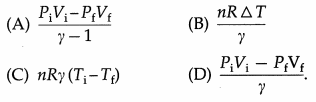
Maharashtra Board Class 12 Physics Important Questions Chapter 4 Thermodynamics 52
Answer:
(A) \(\frac{P_{\mathrm{i}} V_{\mathrm{i}}-P_{\mathrm{f}} V_{\mathrm{f}}}{\gamma-1}\)

Question 12.
In a cyclic process,
(A) ∆U = Q
(B) Q = 0
(C) W = 0
(D) W = Q
Answer:
(D) W = Q

Question 13.
The efficiency of a heat engine is given by η =
(A) QH/W
(B) W/Qc
(C) W/QH
(D) Qc/W.
Answer:
(C) W/QH

Question 14.
In a cyclic process, the area enclosed by the loop in the P – V plane corresponds to
(A) ∆U
(B) W
(C) Q – W
(D) W – Q.
Answer:
(B) W

Question 15.
The efficiency of a Carnot engine is given by K =
(A) Tc/(TH – Tc)
(B) (TH – Tc)/Tc
(C) TH/(TH – Tc)
(D) (TH – Tc)/TH
Answer:
(A) Tc/(TH – Tc)

Question 16.
The coefficient of performance of a Carnot refrigerator is given by K =
(A) Tc(TH-Tc)
(B) (TH-Tc)/Tc
(C) TH/(TH-Tc)
(D) (TH-Tc)/TH.
Answer:
(A) Tc(TH-Tc)

Question 17.
The efficiency of a Carnot engine working between TH = 400 K and Tc = 300 K is
(A) 75%
(B) 25%
(C) 1/3
(D) 4/7.
Answer:
(B) 25%

Question 18.
If a Carnot engine receives 5000 J from a hot reservoir and rejects 4000 J to a cold reservoir, the efficiency of the engine is
(A) 25%
(B) 10%
(C) 1/9
(D) 20%.
Answer:
(D) 20%.

Question 19.
If a Carnot refrigerator works between 250 K and 300 K, its coefficient of performance =
(A) 6
(B) 1.2
(C) 5
(D) 10.
Answer:
(C) 5

Question 20.
The coefficient of performance of a Carnot refrigerator is 4. If Tc = 250 K, then TH =
(A) 625 K
(B) 310 K
(C) 312.5 K
(D) 320 K.
Answer:
(C) 312.5 K

Question 21.
The coefficient of performance of a Carnot refrigerator working between TH and Tc is K and the efficiency of a Carnot engine working between the same TH and Tc is η. Then
(A) ηk = \(\frac{Q_{\mathrm{H}}}{Q_{\mathrm{c}}}\)
(B) η/k = Qc/QH
(C) η/k = QH/Qc
(D) ηk = \(\frac{Q_{c}}{Q_{H}}\)
Answer:
(D) ηk = \(\frac{Q_{c}}{Q_{H}}\)

Question 22.
The internal energy of one mole of organ is
(A) \(\frac{5}{2}\)RT
(B) RT
(C) \(\frac{3}{2}\)RT
(D) 3RT.
Answer:
(C) \(\frac{3}{2}\)RT

Maharashtra Board Class 12 Physics Important Questions Chapter 4 Thermodynamics

Question 23.
The internal energy of one mole of oxygen is
(A) \(\frac{5}{2}\)RT
(B) 5RT
(C) \(\frac{3}{2}\)RT
(D) 3RT.
Answer:
(C) \(\frac{3}{2}\)RT

Question 24.
The internal energy of one mole of nitrogen at 300 K is about 6225 J. Its internal energy at 400 K will be about
(A) 8300J
(B) 4670J
(C) 8500J
(D) 8000J.
Answer:
(A) 8300J

Question 25.
The adiabatic constant γ for argan is
(A) 4/3
(B) 7/5
(C) 6/5
(D) 5/3.
Answer:
(D) 5/3.
Maharashtra Board 12th OCM Important Questions Chapter 8 Marketing

Balbharti Maharashtra State Board 12th OCM Important Questions Chapter 8 Marketing Important Questions and Answers.

Maharashtra State Board 12th Commerce OCM Important Questions Chapter 8 Marketing

Select the correct options and rewrite the sentence

Question 1.
In …………….. there are few sellers selling homogeneous products or differentiated products in the market.
(a) Monopoly
(b) Duopoly
(c) Oligopoly
Answer:
(c) Oligopoly

Maharashtra Board 12th OCM Important Questions Chapter 8 Marketing

Question 2.
The process of classification of products according to similar characteristics and/or quality is known as ………………
(a) Standardisation
(b) Grading
(c) Branding
Answer:
(b) Grading

Question 3.
The market which uses Information Technology for buying and selling of product or service is known as ………………….
(a) Exchange concept of market
(b) Digital concept of market
(c) Place concept of market
Answer:
(b) Digital concept of market

Question 4.
The market for semi-processed or semifinished goods is called ……………………
(a) Primary Market
(b) Secondary Market
(c) Terminal Market
Answer:
(b) Secondary Market

Question 5.
……………….. helps to avoid breakage, damage and destruction of product.
(a) Packaging
(b) Grading
(c) Branding
Answer:
(a) Packaging

Question 6.
……………… gives a special identity to the product.
(a) Grading
(b) Packaging
(c) Branding
Answer:
(c) Branding

Match the pairs

Question 1.

Group AGroup B
(A) Regulated Market1. Market of consumer goods
(B) Capital Market2. Monopoly
(C) Tool of Marketing3. Provides employment
(D) Marketing Mix4. Stock Exchange
(E) Promotion5. Market not controlled by regulation
6. Provides quality products
7. 4 Ps
8. Packaging and labelling
9. Process of informing customers about producer
10. Borrowing and lending long term capital

Answer:

Group AGroup B
(A) Regulated Market4. Stock Exchange
(B) Capital Market10. Borrowing and lending long term capital
(C) Tool of Marketing8. Packaging and labelling
(D) Marketing Mix7. 4 Ps
(E) Promotion9. Process of informing customers about producer

Maharashtra Board 12th OCM Important Questions Chapter 8 Marketing

Question 2.

Group AGroup B
(A) Customer Support Service(1) Creates good design of product
(B) Label(2) To identity Need/ Want of Consumers
(C) Product Development(3) Provides Information
(D) Marketing Research(4) After Sales Services
(E) Trademark(5) Movement of finished goods
(6) Storage of goods
(7) Registered Brands
(8) King of Market
(9) Distribution Channel
(10) Decreases Distribution cost

Answer:

Group AGroup B
(A) Customer Support Service(4) After Sales Services
(B) Label(3) Provides Information
(C) Product Development(1) Creates good design of product
(D) Marketing Research(2) To identity Need/ Want of Consumers
(E) Trademark(7) Registered Brands

Give one word/phrase/term for the following statements

Question 1.
The market for the commodities which are sold within geographical limits of a region.
Answer:
Local Market

Question 2.
The market for agricultural and forest products.
Answer:
Primary Market

Question 3.
Where there is single seller or producer who controls the market.
Answer:
Monopoly

Question 4.
Market situation where there is single buyer of a commodity or service.
Answer:
Monopsony

Question 5.
Market where lEirge number of buyers and sellers buy and sell their homogeneous products.
Answer:
Perfect Market.

Maharashtra Board 12th OCM Important Questions Chapter 8 Marketing

Question 6.
The process of identifying the needs Emd wants of consumers in the market.
Answer:
Marketing Research

Question 7.
The tool of market that helps to publicise the product to the consumer.
Answer:
Promotion

Question 8.
Putting the right product at the right time, at the right place, at the right price.
Answer:
MEirketing Mix

Question 9.
Slip attached to the product which provides all the information regEirding product and its producer.
Answer:
Labelling

Question 10.
Function of determining standards and ensuring uniformity in the product.
Answer:
Standardisation

Question 11.
The market for the commodities which are sold within country.
Answer:
National Market

Question 12.
The market for commodities which are produced in one country and sold in other countries.
Answer:
International Market

Question 13.
A type of market which has very short time existence.
Answer:
Very Short Period s Market

Question 14.
A market in which the activities of buying and selling is undertaken in large quantities at cheaper rate.
Answer:
Wholesale Market

Question 15.
A market where goods are sold to ultimate consumers.
Answer:
Terminal Market.

State whether following the statements are True or False

Question 1.
Monopsony refers to a market situation where there is a single seller of a commodity or service.
Answer:
False

Question 2.
Product development is one time process.
Answer:
False

Maharashtra Board 12th OCM Important Questions Chapter 8 Marketing

Question 3.
Marketing follows customer oriented approach.
Answer:
True

Question 4.
Commodity Exchanges, Stock Exchanges, Foreign ExchEmges are examples of unregulated or raw market.
Answer:
False

Question 5.
Effective utilisation of channel of distribution can help in reducing the cost price of product.
Answer:
True.

Find the odd one

Question 1.
Local market, International market, Terminal j market, National market
Answer:
Terminal market

Question 2.
Very short period market, Perfect market, Short period market, Long period market
Answer:
Perfect market

Question 3.
Monopoly, Monopsony, Oligopoly, Imperfect market
Answer:
Imperfect market.

Complete the sentences

Question 1.
…………….. is a part and parcel of modern day’s life.
Answer:
Marketing

Question 2.
…………….. is the king of the market.
Answer:
Customer

Question 3.
Market which uses Information Technology for buying and selling of goods or services is called ………………..
Answer:
Digital market

Question 4.
Market for goods, materials, consumer and industrial goods is called ………………….
Answer:
Commodity market

Maharashtra Board 12th OCM Important Questions Chapter 8 Marketing

Question 5.
………………. market refers to the markets regulated by statutory provisions of the country.
Answer:
Regulated

Question 6.
In …………………. there are two sellers, selling either a homogenous product or differentiated products.
Answer:
Duopoly

Question 7.
…………………. involves collecting raw materials from different sources and bringing them at one place for production.
Answer:
Assembling.

Correct the underlined word and rewrite the sentence

Question 1.
Transportation creates time utility.
Answer:
Perfect market refers to a market situation which is characterised by large number of buyers and sellers who buy and sell their homogeneous products.

Question 2.
Imperfect market refers to a market situation which is characterised by large number of buyers and sellers who buy and sell their homogeneous products.
Answer:
Warehousing creates time utility.

Question 3.
Producer is the king of the market.
Answer:
Consumer is the king of the market.

Question 4.
Retail market refers to the market of bulk purchase and sale of goods.
Answer:
Wholesale market refers to the market of bulk purchase- and sale of goods.

Question 5.
Determining the right price is the result of product development.
Answer:
Determining the right price is the result of marketing research.

Maharashtra Board 12th OCM Important Questions Chapter 8 Marketing

Arrange in proper order

Question 1.
Terminal market, Primary market, Secondary market.
Answer:
Primary market, Secondary market, Terminal market.

Distinguish between

Question 1.
Marketing and Selling
Answer:

Taiga RegionTundra Region
1. MeaningMarketing refers to a process in which needs are identified or created, products offered and delivered to the consumers.Selling refers to a process of processing orders from customers and delivering the products to them.
2. ConceptAs compared to selling, marketing is wider concept. It comprises of selling and other functions.As compared to marketing, selling is narrower concept. It is part and parcel of marketing concept.
3. EssentialFulfilling the needs and satisfaction of the consumers are the essence of the marketing concept.Transfer of title and possession of the products from one person to another are the essence of selling.
4. OrientationMarketing is consumer oriented. It stresses more on consumers and the maximisation of their satisfaction.Selling is product oriented. It stresses more on the product and its efficiency.
5. ViewsMarketing views (looks at) the customers as they are the centre of all activities of marketing.Selling views (looks at) the customers as a last link in the activities of selling.
6. ActivityMarketing is an indirect activity.Selling is a direct activity.


Maharashtra Board Class 12 Physics Important Questions Chapter 5 Oscillations

Balbharti Maharashtra State Board 12th Physics Important Questions Chapter 5 Oscillations Important Questions and Answers.

Maharashtra State Board 12th Physics Important Questions Chapter 5 Oscillations

Question 1.
Define :
(1) periodic motion
(2) oscillatory motion. Give two examples.
Answer:
(1) Periodic motion : A motion that repeats itself at definite intervals of time is said to be a periodic motion.
Examples : The motion of the hands of a clock, the motion of the Earth around the Sun.

(2) Oscillatory motion : A periodic motion in which a body moves back and forth over the same path, straight or curved, between alternate extremes is said to be an oscillatory motion.
Examples : The motion of a taut string when plucked, the vibrations of the atoms in a molecule, the oscillations of a simple pendulum.
[Note : The oscillatory motion of a particle is also called a harmonic motion when its position, velocity and acceleration can be expressed in terms of a periodic, sinusoidal functions-sine or cosine, of time.

Question 2.
With a neat diagram, describe a spring-and-block oscillator.
Answer:
Consider a spring-and-block oscillator as shown in below figure in which the block slides on a frictionless horizontal surface. The spring has a relaxed length when the block is at rest at the position O.
Maharashtra Board Class 12 Physics Important Questions Chapter 5 Oscillations Important Questions 1
The block is then displaced to P by an amount x measured from the equilibrium position O. Upon releasing, the unbalanced force \(\vec{F}\) = –\(k \vec{x}\) toward left accelerates the block and its speed increases. As x gets smaller, |\(\vec{F}\)| and the acceleration decrease proportionately.

k is the elastic constant of the spring called the force constant or spring constant.

At the instant the block passes through the point O, | \(\vec{F}\) | = 0 because x = 0; although there is no acceleration, the speed is maximum.

As soon as the block passes O going to the left, the force on the block and its acceleration increases to the right, because the spring is now compressed. Eventually, the block is brought to rest momentarily at the point Question Then on, the subsequent motion is the same as the motion from P to Q, with all directions reversed.

The acceleration of the block is \(\vec{a}\) = \(\frac{\vec{F}}{m}\) = –\(\frac{k}{m} \vec{x}\) where m is the mass of the block. This shows that the acceleration is also proportional to the displacement and its direction is opposite to that of the displacement, i.e., the force and acceleration are both directed towards the mean or equilibrium position. The motion repeats causing the block to oscillate about equilibrium or mean position O. This oscillatory motion along a straight path is called linear simple harmonic motion (SHM).

The points P and Q are called the extreme positions or the turning points of the motion. One oscillation is a complete to-and-fro motion of the oscillating body (block, in this case) along its path (the motion from O to P, P to Q and Q to O), i.e., two consecutive passages of the body through the point O in the same direction.

Maharashtra Board Class 12 Physics Important Questions Chapter 5 Oscillations

Question 3.
In linear SHM, what can you say about the restoring force when the speed of the particle is

  1. zero
  2. maximum ?

Answer:
The restoring force is

  1. maximum
  2. zero.

Question 4.
Define period or periodic time, frequency, amplitude and path length of simple harmonic motion (SHM).
Answer:

  1. Period or periodic time of SHM : The time taken by a particle performing simple harmonic motion to complete one oscillation is called the period or periodic time of SHM.
  2. Frequency of SHM : The number of oscillations performed per unit time by a particle executing SHM is called the frequency of SHM.
  3. Amplitude of SHM : The magnitude of the maximum displacement of a particle performing SHM from its mean position is called the amplitude of SHM.
  4. Path length of SHM : The length of the path over which a particle performs SHM is twice the amplitude of the motion and is called the path length or range of the SHM.
    [Note : The frequency of SHM is equal to the reciprocal of the period of SHM.]

Question 5.
Obtain the differential equation of linear simple harmonic motion.
Answer:
When a particle performs linear SHM, the force acting on the particle is always directed towards the mean position. The magnitude of the force is directly proportional to the magnitude of the displacement of the particle from the mean position. Thus, if \(\vec{F}\) is the force acting on the particle when its displacement from the mean position is \(\vec{x}\), \(\vec{F}\) = -k\(\vec{x}\) … (1)
where the constant k, the force per unit displacement, is called the force constant. The minus sign indicates that the force and the displacement are oppositely directed.
The velocity of the particle is \(\frac{d \vec{x}}{d t}\) and its acceleration is \(\frac{d^{2} \vec{x}}{d t^{2}}\).
Let m be the mass of the particle.
Force = mass × acceleration
∴ \(\vec{F}\) = m\(\frac{d^{2} \vec{x}}{d t^{2}}\)
Hence, from Eq. (1),
m\(\frac{d^{2} \vec{x}}{d t^{2}}\) = -k\(\vec{x}\)
∴ \(\frac{d^{2} \vec{x}}{d t^{2}}\) + \(\frac{k}{m} \vec{x}\) = 0 … (2)
This is the differential equation of linear SHM.

Question 6.
Obtain the dimensions of force constant in SHM.
Answer:
Maharashtra Board Class 12 Physics Important Questions Chapter 5 Oscillations Important Questions 2
[Note : The SI unit of force constant is the newton per metre (N/m) while the cgs unit is the dyne per centimetre (dyn/cm).]

Question 7.
State the differential equation of linear SHM. Hence, obtain the expressions for the acceleration, velocity and displacement of a particle performing linear SHM.
Answer:
The differential equation of linear SHM is
\(\frac{d^{2} \vec{x}}{d t^{2}}\) + \(\frac{k}{m} \vec{x}\) = 0
where m = mass of the particle performing SHM, \(\frac{d^{2} \vec{x}}{d t^{2}}\) = acceleration of the particle when its displacement from the mean position is \(\vec{x}\) and k = force constant. For linear motion, we can write the differential equation in scalar form :
\(\frac{d^{2} x}{d t^{2}}\) + \(\frac{k}{m}\)x = 0
Let \(\frac{k}{m}\) = ω2, a constant
∴ \(\frac{d^{2} x}{d t^{2}}\) + ω2x = 0
∴ Acceleration, a = \(\frac{d^{2} x}{d t^{2}}\) = ω2
The minus sign shows that the acceleration and the displacement have opposite directions. Writing v = \(\frac{d x}{d t}\) as the velocity of the particle.
Maharashtra Board Class 12 Physics Important Questions Chapter 5 Oscillations Important Questions 3
Hence, EQ. (1) can be written as
v\(\frac{d v}{d x}\) = -ω2x dx
∴ vdv = -ω2x dx
Integrating this expression, we get,
\(\frac{v^{2}}{2}\) = –\(\frac{-\omega^{2} x^{2}}{2}\) + C
where the constant of integration C is found from a boundary condition.

At an extreme position (a turning point of the motion), the velocity of the particle is zero. Thus, v = 0 when x = ± A, where A is the amplitude.
Maharashtra Board Class 12 Physics Important Questions Chapter 5 Oscillations Important Questions 4
This equation gives the velocity of the particle in terms of the displacement, x. The velocity towards right is taken to be positive and that towards left as negative.
Since, v = dx/dt, we can write Eq. (2) as follows :
Maharashtra Board Class 12 Physics Important Questions Chapter 5 Oscillations Important Questions 5
where the constant of integration, α, is found from the initial conditions, i.e., the displacement and the velocity of the particle at time t = 0.
From Eq. (3), we have
\(\frac{x}{A}\) = sin (ωt + α)
∴ Displacement as a function of time is,
x = A sin (ωt + α)

Question 8.
From the definition of linear SHM, derive an expression for the angular frequency of a body performing linear SHM.
Answer:
When a body of mass m performs linear SHM, the restoring force on it is always directed towards the mean position and its magnitude is directly proportional to the magnitude of the displacement of the body from the mean position. Thus, if \(\vec{F}\) is the force acting on the body when its displacement from the mean position is \(\vec{x}\),
\(\vec{F}\) = m\(\) = – k\(\vec{x}\)
where the constant k, the force per unit displacement, is the force constant.
Let \(\frac{k}{m}\) = ω2, a constant. m
∴ Acceleration, a = –\(\frac{k}{m}\)x = -ω2x
∴ The angular frequency
ω = \(\sqrt{\frac{k}{m}}\) = \(\sqrt{\left|\frac{a}{x}\right|}\)
= \(\sqrt{\text { acceleration per unit displacement }}\)

Question 9.
What is the displacement of a particle at any position, performing linear SHM ?
Answer:
The displacement of a particle performing linear SHM is a specified distance of the particle from the mean position in a specified direction along its path. The general expression for the displacement is x = A sin (ωt + α), where A and ω are respectively the amplitude or maximum displacement and the angular frequency of the motion, and α is the initial phase.

Maharashtra Board Class 12 Physics Important Questions Chapter 5 Oscillations

Question 10.
Assuming the general expression for displacement of a particle in SHM, obtain the expressions for the displacement when the particle starts from
(i) the mean position
(ii) an extreme position.
Answer:
The general expression for the displacement of a particle in SHM at time t is x = A sin (ωt + α) … (1) where A is the amplitude and re is a constant in a particular case.
∴ ωt + α = sin-1\(\frac{x}{A}\) …. (2)
(i) When the particle starts from the mean position, x = 0 at t = 0. Then, from Eq. (2),
α = sin-1 0 = 0 or π … (3)
Substituting for α into Eq. (1),
x = A sin ωt for α = 0 and x = – A sin ωt for α = π
∴ x = ±A sin ωt … (4)
where the plus sign is taken if the particle’s initial velocity is to the right, while the minus sign is taken when the initial velocity is to the left.

(ii) x = ±A at t = 0 when the particle starts from the right or left extreme position, respectively. Then, from Eq. (2),
Maharashtra Board Class 12 Physics Important Questions Chapter 5 Oscillations Important Questions 6
where the plus sign is taken when the particle starts from the positive extreme, while the minus sign is taken when the particle starts from the negative extreme.

Question 11.
At what position is the acceleration of a particle in SHM maximum? What is its magnitude? At what position is the acceleration minimum ? What is its magnitude ?
Answer:
The magnitude of the acceleration of a particle performing SHM is
a = ω2x … (1)
where ω is a constant related to the system.
From Eq. (1), the acceleration has a maximum value amax when displacement x is maximum, |x| = A, i.e., the particle is at the extreme positions.
∴ amax = ω2A
Also from EQ. (1), the acceleration has a minimum value when x is minimum, x = 0, i.e., the particle is at the mean position.
∴ amin = 0

Question 12.
At what position is the velocity of a particle in SHM maximum ? What is its magnitude ? At what position is the velocity minimum? What is its magnitude?
Answer:
The velocity of a particle in SHM is
v = ω\(\sqrt{A^{2}-x^{2}}\) … (1)
where ω is a constant related to the system and A is the amplitude of SHM.
From EQ. (1) it is clear that the velocity is maximum when A2 – x2 is maximum, that is when displacement x = 0, i.e., the particle is at the mean position.
∴ vmax = ωA
Also from Eq. (1), the velocity is minimum when A2 – x2 is minimum, equal to zero. This occurs when x is maximum, x = ± A, i.e., the particle is at the extreme positions.
∴ vmin = 0

Question 13.
For a particle performing linear SHM, show that its average speed over one oscillation is \(\frac{2 \omega A}{\pi}\), where A is the amplitude of SHM.
OR
Show that the average speed of a particle performing SHM in one oscillation is \(\frac{2}{\pi}\) × maximum speed.
Answer:
During one oscillation, a particle performing SHM covers a total distance equal to 4A, where A is the amplitude of SHM. The time taken to cover this distance is the period (T) of SHM.
Maharashtra Board Class 12 Physics Important Questions Chapter 5 Oscillations Important Questions 7

Question 14.
A body of mass 200 g performs linear SHM with period 2πs. What is the force constant ?
Answer:
Force constant, k = mω2 = m\(\left(\frac{2 \pi}{T}\right)^{2}\)
= 0.2kg × \(\left(\frac{2 \pi}{2 \pi \mathrm{s}}\right)^{2}\) = 0.2N/m.

Question 15.
Derive expressions for the period of SHM in terms of
(1) angular frequency
(2) force constant
(3) acceleration.
Answer:
The general expression for the displacement (x) of a particle performing SHM is x = A sin (ωt + α)
(1) Let T be the period of the SHM and x1 the displacement after a further time interval T. Then
x1 = A sin [ω(t + T) + α]
= A sin (ωt + ωT + α)
= A sin (ωt + α + ωT)
Since T ≠ 0, for x1 to be equal to x, we must have (ωT)min = 2π.
Hence, the period (T) of SHM is T = 2π/ω
This is the expression for the period in terms of the constant co, the angular frequency.

(2) If m is the mass of the particle and k is the force constant, ω = \(\sqrt{k / m}\).
∴T = \(\frac{2 \pi}{\omega}\) = \(\frac{2 \pi}{\sqrt{k / m}}\) = 2π \(\sqrt{\frac{m}{k}}\)

(3) The acceleration of a particle performing SHM has a magnitude a = ω2x
∴ ω = \(\sqrt{a / x}\)
Maharashtra Board Class 12 Physics Important Questions Chapter 5 Oscillations Important Questions 8

Question 16.
A small uniform cylinder floats upright to a depth d in a liquid. If it is depressed slightly and released, find its period of oscillations.
Answer:
Consider a cylinder, of length L, area of cross section A and density ρ, floating in a liquid of density σ. If the cylinder floats up to depth d in the liquid, then by the law of floatation, the weight of the cylinder equals the weight of the liquid displaced, i.e.,
ALρg = Adσg
∴ L = dσ/p … (1)
Let the cylinder be pushed down by a distance y. Then, the weight of the liquid displaced by the cylinder of length y will exert a net upward force on the cylinder :
F = Ayσg,
which produces an acceleration,
Maharashtra Board Class 12 Physics Important Questions Chapter 5 Oscillations Important Questions 9

Question 17.
How does the frequency of an SHM vary with

  1. the force constant k
  2. the mass of the particle performing SHM ?

Answer:
The frequency of a particle of mass m performing
SHM is f = \(\frac{1}{T}\) = \(\frac{1}{2 \pi} \sqrt{\frac{k}{m}}\).

  1. ∴ f ∝\(\sqrt{k}\)
    Thus, the frequency of an SHM is directly proportional to the square root of the force constant of the motion.
  2. ∴ f ∝ \(\frac{1}{\sqrt{m}}\)
    Thus, the frequency of an SHM is inversely proportional to the square root of the mass of the particle performing SHM.

Question 18.
In linear SHM, at what position of the particle is the acceleration of the particle half the maximum acceleration?
Answer:
In linear SHM, | a | ∝ | x | ∴ a = \(\frac{a_{\max }}{2}\) when | x | = \(\frac{A}{2}\), where A is the amplitude of SHM.

Question 19.
If the displacement of a particle in SHM is given by x = 0.1 sin (6πrt) metre, what is the frequency of motion ?
Answer:
Comparison of the given equation with
x = A sin (2πft) gives 2πf = 6π rad/s.
∴ Frequency of motion,/= 3 Hz

Question 20.
If the displacement of a particle in SHM is given by x = 0.1 cos (100t) metre, what is the maximum speed of the particle ?
Answer:
Comparison of the given equation with
x = A cos (ωt) gives A = 0.1 m and ω = 100 rad/s.
∴ Maximum speed of the particle = ωA
= 1000 × 0.1 = 10 m/s

Question 21.
A body of mass m tied to a spring performs SHM with period 2 seconds. If the mass is increased by 3m, what will be the period of SHM ?
Answer:
Maharashtra Board Class 12 Physics Important Questions Chapter 5 Oscillations Important Questions 10
∴ T2 = 2T1 = 2 × 2 = 4 seconds gives the required period of SHM.

Question 22.
A particle executing SHM has velocities v1 and v2 when at distances x1 and x2 respectively from the mean position. Show that its period is T = 2π\(\sqrt{\frac{x_{1}^{2}-x_{2}^{2}}{v_{2}^{2}-v_{1}^{2}}}\) and the amplitude of SHM is A = \(\sqrt{\frac{v_{2}^{2} x_{1}^{2}-v_{1}^{2} x_{2}^{2}}{v_{2}^{2}-v_{1}^{2}}}\)
Answer:
If A is the amplitude and co is the angular frequency, V1 = ω\(\sqrt{A^{2}-x_{1}^{2}}\) … (1)
and v2 = ω\(\sqrt{A^{2}-x_{2}^{2}}\) … (2)
Maharashtra Board Class 12 Physics Important Questions Chapter 5 Oscillations Important Questions 111

Question 23.
Explain
(i) a series combination
(ii) a parallel combination of springs. Obtain the spring constant in each case.
Answer:
(i) Series combination of springs : When two light springs obeying Hooke’s law are connected as shown in below figure and both the springs experience the same force applied to the free end of the combination, they are said to be connected in series.
Maharashtra Board Class 12 Physics Important Questions Chapter 5 Oscillations Important Questions 12
Consider two springs, 1 and 2, with respective spring constants k1 and k2 connected in series and supporting a load F = mg so that the springs are extended. Since the same force acts on each spring, by Hooke’s law,
F = k1x1 (for spring 1) and F = k2x2 (for spring 2) The system of two springs in series is equivalent to a single spring, of spring constant kS such that F = kSx, where the total extension x of the combination is the sum x1 + x2 of their elongations.
x = x1 + x2
∴ \(\frac{F}{k_{\mathrm{S}}}\) = \(\frac{F}{k_{1}}\) + \(\frac{F}{k_{2}}\) ∴ \(\frac{1}{k_{\mathrm{S}}}\) = \(\frac{1}{k_{1}}\) + \(\frac{1}{k_{2}}\)
For a series combination of N such springs, of spring constants, k1, k2, k3, … kN
Maharashtra Board Class 12 Physics Important Questions Chapter 5 Oscillations Important Questions 13

(ii) Parallel combination of springs : When two light springs obeying Hooke’s law are connected via a thin vertical rod as shown, they are said to be connected in parallel. If a constant force \(\vec{F}\) is exerted on the rod such that the rod remains perpendicular to the direction of the force, the springs undergo the same extension.

Consider two springs, 1 and 2, with respective spring constants k1 and k2 connected in series and supporting a load F = mg so that the springs are extended. The two springs stretch by the same amount x but share the load.
F = F1 + F2
The system of two springs in parallel is equivalent to a single spring, of spring constant kF such that F = kPX,
∴ kPx = k1x + k2x ∴ kP = k1 + k2
For a parallel combination of N such springs, of spring constants k1, k2, k3, … kN
kP = k1 + k2 + k3 + … + kN = \(\Sigma_{i=1}^{N} k_{i}\)
Therefore, for a parallel combination of N identical light springs, each of spring constant k, kP = Nk

Question 24.
Solve the following :

Question 1.
A body of mass 1 kg is made to oscillate on a spring of force constant 16 N/m. Calculate
(i) the angular frequency
(ii) the frequency of oscillation.
Solution :
Data : m = 1 kg, k = 16 N/m
Maharashtra Board Class 12 Physics Important Questions Chapter 5 Oscillations Important Questions 14

Maharashtra Board Class 12 Physics Important Questions Chapter 5 Oscillations

Question 2.
Calculate the time taken by a body performing SHM of period 2 seconds to cover half the amplitude starting from an extreme position.
Solution :
Data : T = 2 s, x0 = + A (initially at positive extremity), x = \(\frac{A}{2}\)
Maharashtra Board Class 12 Physics Important Questions Chapter 5 Oscillations Important Questions 15
∴ Starting from the positive extremity, the particle takes \(\frac{1}{3}\) s to cover a distance equal to half the amplitude.

Question 3.
A 3 kg block, attached to a spring, performs linear SHM with the displacement given by x = 2 cos (50t) m. Find the spring constant of the spring.
Solution :
Data : m = 3 kg, x = 2 cos (50t) m
Comparing the given equation with x = A cos ωt,
ω = 50 rad/s
ω2 = k/m
∴ The spring constant,
k = mω2 = (3)(50)2
= 3 × 2500 = 7500 N/m

Question 4.
A body oscillates in SHM according to the equation x = 5 cos (2πt + \(\frac{\pi}{4}\)), where x and t are
in SI units. Calculate the
(i) displacement and
(ii) speed of the body at t = 1.5 s.
Solution:
Data: x = cos \(\left(2 \pi t+\frac{\pi}{4}\right)\), t = 1.5 s
(i) The displacement at t = 1.5 s is
Maharashtra Board Class 12 Physics Important Questions Chapter 5 Oscillations Important Questions 16
= 5(1.414)(3.142) = 22.21 m/s

Question 5.
The equation of motion of a particle executing SHM is x = a sin \(\left(\frac{\pi}{6} t\right)\) + b cos \(\left(\frac{\pi}{6} t\right)\), where a = 3 cm and b = 4 cm. Express this equation in the form x = A sin \(\left(\frac{\pi}{6} t+\phi\right)\). Hence, find A and φ.
Solution:
Let a = A cos φ and b = A sin φ, so that
Maharashtra Board Class 12 Physics Important Questions Chapter 5 Oscillations Important Questions 17

Question 6.
A particle performs SHM of amplitude 10 cm. Its maximum velocity during oscillations is 100 cm/s. What is its displacement, when the velocity is 60 cm/s?
Solution :
Data : A = 10 cm, vmax = 100 cm/s, v = 60 cm/s
vmax = ωA = 100 cm/s
Maharashtra Board Class 12 Physics Important Questions Chapter 5 Oscillations Important Questions 18

Question 7.
A body of mass M attached to a spring oscillates with a period of 2 seconds. If the mass is increased by 2 kg, the period increases by 1 second. Find the initial mass, assuming that Hooke’s law is obeyed.
Answer:
Data : m1 = M, T1 = 2 s, m2 = M + 2 kg, T2 = 2s + 1 s = 3s
Maharashtra Board Class 12 Physics Important Questions Chapter 5 Oscillations Important Questions 19

Question 8.
A load of 100 g increases the length of a light spring by 10 cm. Find the period of its linear SHM if it is allowed to oscillate freely in the vertical direction. What will be the period if the load is increased to 400 g? [g = 9.8 m/s2]
Solution :
Data :m = 100 g = 100 × 10-3 kg, x = 10 cm = 0.1 m g = 9.8 m/s2, m1 = 400 g = 400 × 10-3 kg
(1) Stretching force F = mg
Now F = kx (numerically), where k is the force constant.
∴ mg = kx
Maharashtra Board Class 12 Physics Important Questions Chapter 5 Oscillations Important Questions 20

Question 9.
A particle in SHM has a period of 2 seconds and an amplitude of 10 cm. Calculate its acceleration when it is at 4 cm from its positive extreme position.
Solution :
Data : T = 2s, A = 10 cm, A – x = 4 cm
∴ x = 10 cm – 4 cm = 6 cm
Maharashtra Board Class 12 Physics Important Questions Chapter 5 Oscillations Important Questions 21

Question 10.
A particle executes SHM with amplitude 5 cm and period 2 s. Find the speed of the particle at a point where its acceleration is half the maximum acceleration.
Solution :
Data: A = 5 cm = 5 × 10⁻² m, T = 2s,
Maharashtra Board Class 12 Physics Important Questions Chapter 5 Oscillations Important Questions 22

Question 11.
The periodic time of a linear harmonic oscillator is 2π seconds, with maximum displacement of 1 cm. If the particle starts from an extreme position, find the displacement of the particle after π/3 seconds.
Solution :
Data : T = 2π s, A = 1 cm, t = π/3
ω = \(\frac{2 \pi}{T}\) = \(\frac{2 \pi}{2 \pi}\) = 1 rad/s
x = A cos ωt (∵ particle starts from extreme position)
= (1) cos\(\left(1 \times \frac{\pi}{3}\right)\) = cos \(\left(1 \times \frac{\pi}{3}\right)\) = cos \(\frac{\pi}{3}\) = \(\frac{1}{2}\) cm

Question 12.
A particle performs SHM of period 12 seconds and amplitude 8 cm. If initially the particle is at the positive extremity, how much time will it take to cover a distance of 6 cm from that position?
Solution :
Data : T = 12 s, A = 8 cm
∴ ω = 2π/T = π/6 rad/s
When the particle covers a distance of 6 cm from the positive extremity, its displacement measured from the mean position is x = 8 – 6 = 2 cm.
As the particle starts from the positive extreme position, its displacement is
Maharashtra Board Class 12 Physics Important Questions Chapter 5 Oscillations Important Questions 23

Question 13.
A particle executes SHM with amplitude 10 cm and period 10 s. Find the velocity and acceleration of the particle at a distance of 5 cm from the equilibrium position.
Solution :
Data : A = 10 cm = 0.1 m, T = 10 s, x = ± 5 cm = ± 0.05 m
Maharashtra Board Class 12 Physics Important Questions Chapter 5 Oscillations Important Questions 24

Question 14.
A body performs SHM on a path 0.12 m long. Its velocity at the centre of the path is 0.12 m/s. Find the period of SHM. Also find the magnitude of the velocity of the body at \(\sqrt{3}\) × 10-2 m from the centre of the path.
Solution :
The path length of the SHM is the range 2 A, and the velocity at the centre of the path, i.e., at the equilibrium position, is the maximum velocity vmax.
Data : 2A = 0.12 m, vmax = 0.12 m/s,
x = ± \(\sqrt{3}\) × 10-2 m
Maharashtra Board Class 12 Physics Important Questions Chapter 5 Oscillations Important Questions 25

Question 15.
A particle of mass 2 g executes SHM with a period of 12 s and amplitude 10 cm. Find the acceleration of the particle and the restoring force on the particle when it is 2 cm from its mean position. Also find the maximum velocity of the particle.
Solution :
Data : m = 2g = 2 × 10⁻³ kg, T = 12 s,
A = 10 cm = 0.1 m, x = ±2 cm = ±2 × 10⁻² m
Maharashtra Board Class 12 Physics Important Questions Chapter 5 Oscillations Important Questions 26
The acceleration of the particle, a = ω2 = (0.5237)2 (± 2 × 10⁻²)
= ± 0.2743 × 2 × 10-2 = ± 5.486 × 10⁻³ m/s2
The restoring force on the particle at that position, F = ma = ± (2 × 10⁻²) (5.486 × 10⁻³)
= ±1.097 × 10⁻⁵ N
The maximum velocity of the particle, vmax = ωA = 0.5237 × 0.1 5.237 × 10⁻² m/s

Question 16.
The maximum velocity of a particle performing linear SHM is 0.16 m/s. If its maximum acceleration is 0.64 m/s2, calculate its period.
Solution :
Data : vmax = 0.16 m/s, amax = 0.64 m/s2
vmax = ωA and amax = ω2A
Maharashtra Board Class 12 Physics Important Questions Chapter 5 Oscillations Important Questions 27

Question 17.
A particle performing linear SHM has maximum velocity of 25 cm/s and maximum acceleration of 100 cm/s2. Find the amplitude and period of oscillation, [π = 3.142]
Solution :
Data : vmax = 25 cm/s, amax = 100 cm/s2
Maharashtra Board Class 12 Physics Important Questions Chapter 5 Oscillations Important Questions 28

Question 18.
A particle performing linear SHM has a period of 6.28 seconds and path length of 20 cm. What is the velocity when its displacement is 6 cm from the mean position?
Solution :
Data : T = 6.28 s, 2A = 20 cm ∴ A = 10 cm, x = 6 cm
Maharashtra Board Class 12 Physics Important Questions Chapter 5 Oscillations Important Questions 29

Question 19.
A uniform wooden rod floats vertically in water with 14 cm of its length immersed in the water. If it is depressed slightly and released, find its period of oscillations.
Solution :
Data : d = 14 cm = 0.14 m
Maharashtra Board Class 12 Physics Important Questions Chapter 5 Oscillations Important Questions 30

Question 20.
A particle performs UCM. The diameter of the circle is 4 cm. What is the amplitude of linear SHM that is the projection of the UCM on a diameter?
Answer:
Amplitude of linear SHM = radius of the circle = 2 cm.

Maharashtra Board Class 12 Physics Important Questions Chapter 5 Oscillations

Question 21.
A particle performs UCM with period 2n seconds along a circle of diameter 10 cm. What is the maximum speed of its shadow on a diameter of the circle ?
Answer:
Maximum speed, vmax = ωA = \(\frac{2 \pi}{T}\)A
= \(\frac{2 \pi}{2 \pi}\) × 5 × 10-2 = 5 × 10⁻² m/s.

Question 22.
See Question 20 above. What is the maximum acceleration of the shadow ?
Answer:
Maximum acceleration, amax = ω2A = \(\left(\frac{2 \pi}{T}\right)^{2}\) A
= \(\left(\frac{2 \pi}{2 \pi}\right)^{2}\) × 5 × 10-2 = 5 × 10⁻² m/s2.

Question 23.
What do you understand by the phase and epoch of an SHM ?
Answer:
(1) Phase of simple harmonic motion (SHM) represents the state of oscillation of the particle performing SHM, i.e., it gives the displacement of the particle, its direction of motion from its equilibrium position and the number of oscillations completed.

The displacement of a particle in SHM is given by x = A sin (ωt + α). The angle (ωt + α) is called the phase angle or simply the phase of SHM. The SI unit of phase angle is the radian (symbol, rad).

(2) Epoch of simple harmonic motion (SHM) represents the initial phase of the particle performing SHM, i.e., it gives the displacement of the particle and its direction of motion at time t = 0.

If x0 is the initial position of the particle, i.e., the position at time t = 0, x0 = A sin α or α = sin-1 (x0/A). The angle α, therefore, determines the initial state of the particle. Hence, the angle α is the epoch or initial phase or phase constant of SHM.
[Note : The symbol for the unit radian is rad, not superscripted c.]

Question 25.
Solve the following.

Question 1.
The differential equation for a particle performing linear SHM is \(\frac{d^{2} x}{d t^{2}}\) = – 4x. If the amplitude is 0.5 m and the initial phase is π/6 radian, obtain the expression for the displacement and find the velocity of the particle at x = 0.3 m.
Solution:
Data : A = 0.5 m, α = π/6 rad
(1) \(\frac{d^{2} x}{d t^{2}}\) = -4x
Comparing this equation with the general equation \(\frac{d^{2} x}{d t^{2}}\) = – ω2x, we get,
ω2 = 4 or ω = 2 rad/s
Now, x = A sin (ωt + α)
Substituting the values of A, ω and α, the expression for the displacement for the given SHM is
x = 0.5 sin (2t + π/6) m

(2) The velocity of the particle at x = 0.3 m is v = ± ω \(\sqrt{A^{2}-x^{2}}\)
= ± 2 \(\sqrt{(0.5)^{2}-(0.3)^{2}}\) = ± 0.8 m/s

Question 2.
The displacement of a particle performing linear SHM is given by x = 6 sin (3πt + \(\frac{5 \pi}{6}\)) metre. Find
the amplitude, frequency and the phase constant of the motion.
Solution :
Data : x = 6 sin (3πt + \(\frac{5 \pi}{6}\)) metre
Comparing this equation with x = A sin (ωt + α), we get:

  1. Amplitude, A = 6 m
  2. ω = 3π rad / s
    ∴ Frequency, f = \(\frac{\omega}{2 \pi}\) = \(\frac{3 \pi}{2 \pi}\) = 1.5 Hz 5%
  3. Phase constant, α = \(\frac{5 \pi}{6}\) rad

Question 3.
The equation of linear SHM is a: = 10 sin (4πt + \(\frac{1}{24}\)) cm. Find the amplitude, period and phase constant of the motion. Also, find the phase angle \(\frac{1}{24}\) second after the start.
Solution:
Data : x = 10 sin\(\left(4 \pi t+\frac{\pi}{6}\right)\) + cm, f = \(\frac{1}{24}\) s

(1) Comparing the given equation with x = A sin (ωt +α), we get,
A = 10 cm, ω = 4π rad/s, α = \(\frac{\pi}{6}\) rad

  1. Amplitude, A = 10 cm
  2. Period, T = \(\frac{2 \pi}{\omega}\) = \(\frac{2 \pi}{4 \pi}\) = 0.5 s
  3. Phase constant, α = \(\frac{\pi}{6}\) rad

(2) Phase angle = (ωt + α) = 4πt + \(\frac{\pi}{6}\)
The phase angle \(\frac{1}{24}\) second after the start is obtained by substituting t = \(\frac{1}{24}\) in the above expression.
∴ Phase angle = 4πt + \(\frac{\pi}{6}\) = (4π × \(\frac{1}{24}\)) + \(\frac{\pi}{6}\)
= \(\frac{\pi}{6}\) + \(\frac{\pi}{6}\) = \(\frac{\pi}{3}\) rad

Question 4.
Describe the state of oscillation of a particle if the phase angle of SHM is rad.
Solution :
Data : θ = \(\frac{25 \pi}{4}\) rad
θ = \(\frac{25 \pi}{4}\) = 6π + \(\frac{\pi}{4}\) = 3(2π) rad + \(\frac{\pi}{4}\) rad
The first term indicates that the particle has completed 3 oscillations. The second term indicates that the displacement of the particle in the 4th oscillation is A sin \(\frac{\pi}{4}\) = + \(\frac{1}{\sqrt{2}}\)A, where A is the amplitude of the SHM, and moving towards the positive extreme.

Question 5.
A particle in linear SHM is in its 5th oscillation. If its displacement at that instant is –\(\frac{1}{2}\) A and
is moving toward the mean position, determine its phase at that instant.
Solution :
Data : x = –\(\frac{1}{2}\) A, 5th oscillation
A sin θ1 = –\(\frac{1}{2}\)A ∴ θ1 = sin-1\(\left(-\frac{1}{2}\right)\) = π – \(\frac{\pi}{6}\) rad
As the particle is in its 5th oscillation, its phase is
θ = 2 × 2π + θ1 = 4π + (π – \(\frac{\pi}{6}\)) = 5π – \(\frac{\pi}{6}\) = \(\frac{29 \pi}{6}\) rad

Question 6.
The amplitude and periodic time of SHM are 5 cm and 6 s, respectively. What is the phase at a distance of 2.5 cm from the mean position?
Solution :
Data : A = 5 cm, T = 6 s, x = 2.5 cm
Since the particle starts from the mean position, its epoch, α = 0.
∴ The equation of motion is x = A sin ωt
∴ The required phase of the particle,
ω = sin-1\(\frac{x}{A}\)
= sin-1\(\frac{2.5}{5}\) = sin-1 \(\frac{1}{2}\) = \(\frac{\pi}{6}\) rad

Question 26.
State the expressions for the displacement, velocity and acceleration of a particle performing linear SHM, starting from the mean position towards the positive extreme position. Hence, draw their graphs with respect to time. Draw your conclusions from the graphs.
OR
Represents graphically the displacement, velocity and acceleration against time for a particle performing linear SHM when it starts from the mean position.
Answer:
Consider a particle performing SHM, with amplitude A and period T = 2π/ω starting from the mean position towards the positive extreme position where co is the angular frequency. Its displacement from the mean position (x), velocity (v) and acceleration (a) at any instant are
Maharashtra Board Class 12 Physics Important Questions Chapter 5 Oscillations Important Questions 31
as the initial phase α = 0

Using these expressions, the values of x, v and a at the end of every quarter of a period, starting from t = 0, are tabulated below.
Maharashtra Board Class 12 Physics Important Questions Chapter 5 Oscillations Important Questions 32
Using the values in the table we can plot graphs of displacement, velocity and acceleration with time.
Maharashtra Board Class 12 Physics Important Questions Chapter 5 Oscillations Important Questions 33
Conclusions :

  1. The displacement, velocity and acceleration of a particle performing linear SHM are periodic (harmonic) functions of time. For a particle starting at the mean position, the x-t and a-t graph are sine curves. The v-t graph is a cosine curve.
  2. There is a phase difference of \(\frac{\pi}{2}\) radians between x and v, and between v and a.
  3. There is a phase difference of n radians between x and a.

Maharashtra Board Class 12 Physics Important Questions Chapter 5 Oscillations Important Questions 34

Question 27.
State the expressions for the displacement, velocity and acceleration of a particle performing linear SHM, starting from the positive extreme position. Hence, draw their graphs with respect to time. Draw your conclusions from the graphs.
OR
A particle performs linear SHM starting from the positive extreme position. Plot the graphs of its displacement, velocity and acceleration against time.
Answer:
Consider a particle performing linear SHM with amplitude A and period T = 2π/ω, starting from the positive extreme position, where ω is the angular frequency. Its displacement from the mean position (x), velocity (v) and acceleration (a) at any instant (t) are
x = A cos ωt = A cos\(\left(\frac{2 \pi}{T} t\right)\) (∵ ω = \(\frac{2 \pi}{T}\))
v = – ωA sin ωt = -ωA sin \(\left(\frac{2 \pi}{T} t\right)\)
a = – ω2A sin ωt = -ω2A cos \(\left(\frac{2 \pi}{T} t\right)\)

Using these expressions, the values of x, v and a at the end of every quarter of a period, starting from t = 0, are tabulated below.
Maharashtra Board Class 12 Physics Important Questions Chapter 5 Oscillations Important Questions 35
Using these values, we can plot graphs showing the variation of displacement, velocity and acceleration with time.
Maharashtra Board Class 12 Physics Important Questions Chapter 5 Oscillations Important Questions 36
Conclusions :

  1. The displacement, velocity and acceleration of a particle performing linear SHM are periodic (harmonic) functions of time. For a particle starting from an extreme position, the x-t and a-t graphs are cosine curves; the v-t graph is a sine curve.
  2. There is a phase difference of \(\frac{\pi}{2}\) radians between x and v, and between v and a.
  3. There is a phase difference of π radians between x and a.

Explanations :
(1) v-t graph : It is a sine curve, i.e., the velocity is a periodic (harmonic) function of time which repeats after a phase of 2π rad. There is a phase difference of π/2 rad between a and v.

v is minimum (equal to zero) at the extreme positions (i.e., at x = ± A) and v is maximum ( = ± ωA) at the mean position (x = 0).

(2) a-t graph : It is a cosine curve, i.e., the acceleration is a periodic (harmonic) function of time which repeats after a phase of 2π rad. There is a phase difference of π rad between v and a. a is minimum (equal to zero) at the mean position (x = 0) and a is maximum ( = \(\mp\)ω2A) at the extreme positions (x = ± A).
Maharashtra Board Class 12 Physics Important Questions Chapter 5 Oscillations Important Questions 37

Question 28.
Discuss analytically the composition of two SHMs of the same period and parallel to each other (along the same path). Find the resultant amplitude when the phase difference is
(1) zero
(2) \(\frac{\pi}{3}\) rad
(3) \(\frac{\pi}{2}\) rad
(4) π rad.
Answer:
Let a particle be subjected to two parallel linear SHMs of the same period along the same path and the same mean position, represented by
x1 = A1 sin (ωt + α) and x2 = A2 sin (ωt + β),
where A1 and A2 are the amplitudes, and α and β are the initial phases of the two SHMs.

According to the principle of superposition, the displacement of the particle at any instant t is the algebraic sum x = x1 + x2.
∴ x = A1 sin (ωt + α) + A2 sin (ωt + β)
= A1 sin ωt cos α + A1 cos ωt sin α + A2 cos ωt sin β
= (A1 cos α + A2 cos β) sin ωt + (A1 sin α + A2sin β) cos ωt
Let A1 cos α + A2 cos β = R cos δ …. (1)
and A1 sin α + A2 sin β = R sin δ …. (2)
∴ x = R cos δ sin ωt + R sin δ cos ωt
∴ x = R cos(ωt + δ) ….. (3)

Equation (3), which gives the displacement of the particle, shows that the resultant motion is also simple harmonic, along the same path as the SHMs superposed, with the same mean position, and amplitude R and initial phase δ but having the same period as the individual SHMs.

Amplitude R of the resultant motion : The resultant amplitude R is found by squaring and adding Eqs. (1) and (2).
Maharashtra Board Class 12 Physics Important Questions Chapter 5 Oscillations Important Questions 38
Initial phase S of the resultant motion : The initial phase of the resultant motion is found by dividing Eq. (2) by Eq. (1).
Maharashtra Board Class 12 Physics Important Questions Chapter 5 Oscillations Important Questions 39

Notes :

  1. Since the displacements due to the super-posed linear SHMs are along the same path, their vector sum can be replaced by the algebraic sum.
  2. To determine δ uniquely, we need to know both sin δ and cos δ.

Question 29.
Solve the following :

Question 1.
Two parallel SHMs are given by x1 = 20 sin (8πt) cm and x2 = 10 sin (8πt + π/2) cm. Find the amplitude and the epoch of the resultant SHM.
Solution :
Data : x1 = 20 sin (8πt) cm = A1 sin (ωt + α), x2 = 10 sin (8πt + π/2) cm = A2 sin (ωt + β)
∴ A1 = 20 cm, A2 = 10 cm, α = 0, β = π/2
(1) Resultant amplitude,
Maharashtra Board Class 12 Physics Important Questions Chapter 5 Oscillations Important Questions 40

(2) Initial phase of resultant SHM,
Maharashtra Board Class 12 Physics Important Questions Chapter 5 Oscillations Important Questions 41

Question 2.
The displacement of a particle performing SHM is given by x = [5 sin πt + 12 sin \(\left(\pi t+\frac{\pi}{2}\right)\) cm. Determine the amplitude, period and initial phase of the motion.
Solution :
Data : x = [5 sin πt + 12 sin \(\left(\pi t+\frac{\pi}{2}\right)\)] cm
The given expression for displacement may be written as the superposition of two parallel SHMs of the same period as x = x1 + x2, where x1 = 5 sin πt cm = A1 sin (ωt + α) and
x2 = 12 sin \(\left(\pi t+\frac{\pi}{2}\right)\) cm = A2 sin (ωt + β)
∴ A1 = 5 cm, A2 = 12 cm, ω = π rad/s, α = 0, β = \(\frac{\pi}{2}\) rad.
Maharashtra Board Class 12 Physics Important Questions Chapter 5 Oscillations Important Questions 42

Question 3.
An SHM is given by the equation x = [8 sin (4πt) + 6 cos (4πt)] cm. Find its
(1) amplitude
(2) initial phase
(3) period
(4) frequency.
Solution:
Data : x = [8 sin (4πt) + 6 cos (4πt)] cm
x = 8 sin (4πt) + 6 cos (4πt)
= 8 sin (4πt) + 6 sin \(\left(4 \pi t+\frac{\pi}{2}\right)\)
Thus, x is the superposition of two parallel SHMs of the same period : x = x1 + x2, where
x1 = 8 sin (4πt) cm = A1 sin (ωt + α) and
x2 = 6 sin \(\left(4 \pi t+\frac{\pi}{2}\right)\) = A2 sin (ωt + β)
∴ A1 = 8 cm, A2 = 6cm, ω = 4π rad/s, α = 0,
β = \(\frac{\pi}{2}\) rad
Maharashtra Board Class 12 Physics Important Questions Chapter 5 Oscillations Important Questions 43

Maharashtra Board Class 12 Physics Important Questions Chapter 5 Oscillations

Question 30.
Show that the total energy of a particle performing linear SHM is directly proportional to
(1) the square of the amplitude
(2) the square of the frequency.
Answer:
For a particle of mass m executing SHM with angular frequency ω and amplitude A, its kinetic and potential energies are respectively,
KE = \(\frac{1}{2}\)mω2(A2 – x2) … (1)
and PE = \(\frac{1}{2}\)mω2x2 … (2)
Then, the total energy,
E = PE + KE
= \(\frac{1}{2}\)mω2x2 + \(\frac{1}{2}\)mω2(A2 – x2)
= \(\frac{1}{2}\)mω2A2 …. (3)
Therefore, total energy of the particle is

  1. directly proportional to the mass (E ∝ m),
  2. directly proportional to the square of the amplitude (E ∝ A2)
  3. proportional to the square of the frequency
    (E ∝f2), as f = ω/2π

Question 31.
State the expression for the total energy of SHM in terms of acceleration.
Answer:
The total energy of a particle of mass m performing SHM with angular frequency ω, E = \(\frac{1}{2}\)mω2A2
The maximum acceleration of the particle, amax = ω2A2
E = \(\frac{1}{2}\) mAamax is the required expression.

Question 32.
State the expressions for the kinetic energy and potential energy of a particle performing SHM. Find their values at
(i) an extreme position
(ii) the mean position.
Using the expressions for the kinetic energy and potential energy of a particle in simple harmonic motion at any position, show that
(i) at the mean position, total energy = kinetic energy
(ii) at an extreme position, total energy = potential energy.
Answer:
For a particle of mass m executing SHM with force constant k, amplitude A and angular frequency ω = \(\sqrt{k / m}\), its kinetic and potential energies are respectively,
KE = \(\frac{1}{2}\)k(A2 – x2) and
PE = \(\frac{1}{2}\)kx2
and total energy, E = \(\frac{1}{2}\)kA2
(i) At the mean position, x = 0,
KE = \(\frac{1}{2}\)kA2 = E and PE = 0

(ii) At an extreme position, x = ±A, KE = 0 and PE = \(\frac{1}{2}\)kA2 = E

That is, the energy transfers back and forth between kinetic energy and potential energy, while the total mechanical energy of the oscillating particle remains constant. The total energy is entirely kinetic energy at the mean position and entirely potential energy at the extremes.

Question 33.
State the expressions for the kinetic energy (KE) and potential energy (PE) at a displacement x for a particle performing linear SHM. Find
(i) the displacement at which KE is equal to PE
(ii) the KE and PE when the particle is halfway to a extreme position.
Answer:
For a particle of mass m executing SHM with force constant k, amplitude A and angular frequency ω = \(\sqrt{k / m}\), its kinetic and potential energies are respectively,
KE = \(\frac{1}{2}\)E (A2 – x2) and
PE = \(\frac{1}{2}\)kx2
and total energy, E = \(\frac{1}{2}\)kA2
Maharashtra Board Class 12 Physics Important Questions Chapter 5 Oscillations Important Questions 44
∴ At x = ±\(\frac{A}{2}\), the energy is 25% potential energy and 75% kinetic energy.

Question 34.
The maximum potential energy (PE) of a particle in SHM is 2 × 10⁻⁴ J. What will be the PE of the particle when its displacement from the mean position is half the amplitude of SHM ?
Answer:
(PE)max = \(\frac{1}{2}\)kA2, PE = \(\frac{1}{2}\)kx2
∴ PE = (PE)max \(\left(\frac{x}{A}\right)^{2}\) = 2 × 10⁻⁴J × \(\left(\frac{1}{2}\right)^{2}\)
= 5 × 10⁻⁵ J is the required answer.

Question 35.
A particle performs linear SHM of amplitude 10 cm. At what displacement of the particle from its mean position will the potential energy (PE) of the particle be 1 % of the maximum PE ?
Answer:
Maharashtra Board Class 12 Physics Important Questions Chapter 5 Oscillations Important Questions 45

Question 36.
Represent graphically the variations of KE, PE and TE of a particle performing linear SHM with respect to its displacement.
Answer:
Maharashtra Board Class 12 Physics Important Questions Chapter 5 Oscillations Important Questions 46

Question 37.
Represent graphically the variation of potential energy, kinetic energy and total energy of a particle performing SHM with time.
Answer:
Consider a particle performing SHM, with amplitude A and period T = \(\frac{2 \pi}{\omega}\) starting from the mean position towards the positive extreme position; ω = \(\sqrt{\frac{k}{m}}\) is the appropriate constant related to the system. The total energy of the particle is E = \(\frac{1}{2}\)kA2. Its displacement (x), potential energy (PE) and kinetic energy (KE) at any instant are given by
x = A sin ωt
Maharashtra Board Class 12 Physics Important Questions Chapter 5 Oscillations Important Questions 47
Using the values in the table, we can plot graphs of PE, KE and total energy with times as follows:
Maharashtra Board Class 12 Physics Important Questions Chapter 5 Oscillations Important Questions 48

Question 38.
Solve the following :

Question 1.
A particle of mass 10 g is performing SHM. Its kinetic energies are 4.7 J and 4.6 J when the displacements are 4 cm and 6 cm, respectively. Compute the period of oscillation.
Answer:
Data : m = 0.01 kg, KE1 = 4.7 J, x1 = 4 × 10⁻² m, KE2 = 4.6 J, x2 = 6 × 10⁻² m
Since the total energy of a particle in SHM is constant,
Maharashtra Board Class 12 Physics Important Questions Chapter 5 Oscillations Important Questions 49

Question 2.
The total energy of a particle of mass 100 grams performing SHM is 0.2 J. Find its maximum velocity and period if the amplitude is 2\(\sqrt{2}\) cm.
Solution :
Data : m = 100 g = 0.1 kg, E = 0.2 J,
A = 2\(\sqrt{2}\) cm = 2\(\sqrt{2}\) × 10-2 m
(i) The total energy,
Maharashtra Board Class 12 Physics Important Questions Chapter 5 Oscillations Important Questions 50

Question 3.
An object of mass 0.5 kg performs SHM with force constant 10 N/m and amplitude 3 cm.
(i) What is the total energy of the object?
(ii) What is its maximum speed ?
(iii) What is its speed at x = 2 cm?
(iv) What are its kinetic and potential energies at x = 2 cm ?
Solution :
Data : m = 0.5 kg, A: = 10 N/m,
A = 3 cm = 3 × 10⁻²m, x = 2 cm = 2 × 10⁻²m
Maharashtra Board Class 12 Physics Important Questions Chapter 5 Oscillations Important Questions 51

Question 4.
When the displacement in SHM is one-third of the amplitude, what fraction of the total energy is potential and what fraction is kinetic?
Solution :
Data : x = A/3
Maharashtra Board Class 12 Physics Important Questions Chapter 5 Oscillations Important Questions 52
Therefore, \(\frac{1}{9}\) th of the total energy is potential and \(\frac{8}{9}\)th of the total energy is kinetic.

Question 5.
A particle executes SHM with a period of 8 s. Find the time in which half the total energy is potential.
Solution :
Data : T = 8 s, PE = \(\frac{1}{2}\)E
ω = \(\frac{2 \pi}{T}\) = \(\frac{2 \pi}{8}\) = \(\frac{\pi}{4}\) rad/s
The total energy, E = \(\frac{1}{2}\)kA2 and the potential
energy = \(\frac{1}{2}\)kx2
Therefore, from the data,
Maharashtra Board Class 12 Physics Important Questions Chapter 5 Oscillations Important Questions 53
Assuming that the particle starts from the mean position, the equation of motion is
x = A sin ωt
Maharashtra Board Class 12 Physics Important Questions Chapter 5 Oscillations Important Questions 54
Therefore, in one oscillation, the particle’s potential energy is half the total energy 1 s, 3 s, 5 s and 7 s after passing through the mean position.

Question 39.
Define practical simple pendulum.
Answer:
Practical simple pendulum is defined as a small heavy sphere, called the bob, suspended by a light and inextensible string from a rigid support.

Question 40.
Under what conditions can we consider the oscillations of a simple pendulum to be linear simple harmonic?
Answer:
The oscillations of a simple pendulum are approximately linear simple harmonic only if

  1. the amplitude of oscillation is very small compared to its length
  2. the oscillations are in a single vertical plane.

Question 41.
What is the effect of mass and amplitude on the period of a simple pendulum ?
Answer:
The period of a simple pendulum does not depend on the mass or material of the bob of the pendulum. This is the law of mass.
The period of a simple pendulum does not depend on the amplitude of oscillations, provided that the amplitude is small. This is the law of isochronism. If the amplitude is large, the motion is periodic but not simple harmonic.

Question 42.
From the definition of linear SHM, derive an expression for the angular frequency of a body performing linear SHM.
Answer:
When a body of mass m performs linear SHM, the restoring force on it is always directed towards the mean position and its magnitude is directly proportional to the magnitude of the displacement of the body from the mean position. Thus, if \(\vec{F}\) is the force acting on the body when its displacement from the mean position is \(\vec{x}\),
\(\vec{F}\) = m\(\vec{a}\) = – kx\(\vec{x}\)
where the constant k, the force per unit displacement, is called the force constant.
Let \(\frac{k}{m}\) = ω2, a constant.
∴ Acceleration, a = –\(\frac{k}{m}\) = – ω2x
∴ The angular frequency,
Maharashtra Board Class 12 Physics Important Questions Chapter 5 Oscillations Important Questions 55

Question 43.
A simple pendulum is set into oscillations in a uniformly travelling car along a horizontal road. What happens to its period if the car takes a sudden turn towards the left ?
Answer:
The equilibrium position of the string makes an angle θ = tan-1(ac/g) with the vertical due to the centrifugal force to the right.
The centripetal acceleration, ac, is horizontal and towards the left. The acceleration due to gravity is vertically downward.
∴ geff = \(\sqrt{g^{2}+a_{\mathrm{c}}^{2}}\)
so that the period of oscillation T = \(2 \pi \sqrt{L / g_{\text {eff }}}\)
∴ As the car takes a sudden left turn, the period of oscillation decreases.

Maharashtra Board Class 12 Physics Important Questions Chapter 5 Oscillations

Question 44.
Define a seconds pendulum. Find an expression for its length at a given place. Show that the length of a seconds pendulum has a fixed value at a given place.
Answer:
(1) Seconds pendulum: A simple pendulum of period two seconds is called a seconds pendulum.

(2) The period of a simple pendulum is
T = \(2 \pi \sqrt{\frac{L}{g}}\)
For a seconds pendulum, T = 2s.
∴ 2 = \(2 \pi \sqrt{\frac{L}{g}}\) ∴ L = \(\frac{g}{\pi^{2}}\)
This expression gives the length of the seconds pendulum at a place where acceleration due to gravity is g.

(3) At a given place, the value of g is constant.
∴ L = g/π2 = a fixed value, at a given place.

[Note : Because the effective gravitational acceleration varies from place to place, the length of a seconds pendulum should be changed in direct proportion. Since the effective gravitational acceleration increases from the equator to the poles, so should the length of a seconds pendulum be increased.]

Question 45.
Two simple pendulums have lengths in the ratio 1 : 9. What is the ratio of their periods at a given place ?
Answer:
Maharashtra Board Class 12 Physics Important Questions Chapter 5 Oscillations Important Questions 56

Question 46.
If the length of a seconds pendulum is doubled, what will be the new period?
Answer:
Maharashtra Board Class 12 Physics Important Questions Chapter 5 Oscillations Important Questions 57

Question 47.
Distinguish between a simple pendulum and a conical pendulum.
Answer:

Simple pendulumConical pendulum
1. The oscillations of the bob are in a vertical plane.1. The bob performs UCM in a horizontal plane and the string traces out a cone of constant semivertical angle.
2. The energy of the bob transfers back and forth between kinetic energy and potential energy, while its total mech­anical energy remains con­stant.2. The gravitational PE of the bob being constant may be taken to be zero. The total mechanical energy remains constant and is entirely kin­etic.
3. The period depends on the 3. length of the string and the acceleration due to gravity.
T =2π\(\sqrt{L / g}\)
3. The period depends on the length of the string, the ac­celeration due to gravity and cosine of the semiverti­cal angle.
T =2π\(\sqrt{L \cos \theta / g}\)

Question 48.
Solve the following.

Question 1.
A simple pendulum of length 1 m has a bob of mass 10 g and oscillates freely with an amplitude of 2 cm. Find its potential energy at the extreme position. [g = 9.8 m/s2]
Solution :
Data : L = 1 m, m = 10 g = 10 × 10-3 kg = 10-2 kg, g = 9.8 m/s2, A = 2 cm = 0.02 m
Period of a simple pendulum, T = \(2 \pi \sqrt{\frac{L}{g}}\)
Maharashtra Board Class 12 Physics Important Questions Chapter 5 Oscillations Important Questions 58

Question 2.
The period of oscillation of a simple pendulum increases by 20% when the length of the pendulum is increased by 44 cm. Find its
(i) initial length
(ii) initial period of oscillation at a place where g is 9.8 m/s2.
Solution:
Let T and L be the initial period and length of the pendulum. Let T1 and L1 be the final period and length.
Data : T1 = T + 0.2 T = 1.2 T, L1 = L + 0.44 m
Maharashtra Board Class 12 Physics Important Questions Chapter 5 Oscillations Important Questions 59
Squaring and cross-multiplying, we get,
L + 0.44 = 1.44 L
∴ 0. 44 L = 0.44
∴ L = \(\frac{0.44}{0.44}\) = 1 m
∴ T = 2π\(\sqrt{\frac{L}{g}}\) = 2 × 3.142 × \(\sqrt{\frac{1}{9.8}}\)
= 2.007 s

Question 3.
Calculate the length of a seconds pendulum at a place where g = 9.81 m/s2.
Answer:
Data : T = 2 s, g = 9.81 m/s2
Period of a simple pendulum, T = \(2 \pi \sqrt{\frac{L}{g}}\)
For a seconds pendulum, 2 = \(2 \pi \sqrt{\frac{L}{g}}\)
∴ The length of the seconds pendulum,
L = \(\frac{g}{\pi^{2}}\) = \(\frac{9.81}{(3.142)^{2}}\) = 0.9937

Question 4.
A clock regulated by a seconds pendulum keeps correct time. During summer the length of the pendulum increases to 1.01 m. How much will the clock gain or lose in one day ? [g = 9.8 m/s2]
Solution:
Data: L = 1.01 m, g = 9.8 m/s2
Maharashtra Board Class 12 Physics Important Questions Chapter 5 Oscillations Important Questions 60
The period of a seconds pendulum is 2 seconds. Hence, the given pendulum clock will lose 0.017 s in 2.017 s during summer.
∴ Time lost in 24 hours
= \(\frac{24 \times 3600 \times 0.017}{2.017}\)s = 728.1 s
The given pendulum clock will lose 728.1 seconds per day during summer.

Question 5.
A small drop of mercury oscillates simple harmonically inside a watch glass whose radius of curvature is 2.5 m. Find the period of the motion. [g = 9.8m/s2]
Solution :
Data : R = 2.5 m, g = 9.8 m/s2
Consider a small drop of mercury on a watch glass of radius of curvature R.
Maharashtra Board Class 12 Physics Important Questions Chapter 5 Oscillations Important Questions 61
Away from its equilibrium position O, its weight \(m \vec{g}\) is resolved into two perpendicular components : mg cos θ normal to the concave surface and mg sin θ tangential to the surface, mg cos θ is balanced by the normal reaction (\(\vec{N}\)) of the surface while mg sin θ constitutes the restoring force that brings the drop back to O. If θ is small and in radian,
restoring force, F = ma = – mg sin θ
= – mg θ
= -mg\(\frac{x}{R}\)
∴ The acceleration per unit displacement, |\(\frac{a}{x}\)| = \(\frac{g}{R}\)
∴ The period of the motion, T = \(\frac{2 \pi}{\sqrt{|a / x|}}\) = \(2 \pi \sqrt{\frac{R}{g}}\)
Data : R = 2.5 m, g = 9.8 m/s2
∴ The period of oscillation is
T = 2 × 3.142\(\sqrt{\frac{2.5}{9.8}}\) = 6.284 × 0.5051 = 3.174 s.

Question 49.
Explain angular or torsional oscillations.
Hence obtain the differential equation of the motion.
Answer:
Suppose a disc is suspended from its centre by a wire or a twistless thread such that the disc remains horizontal, as shown in below figure. The rest position of
Maharashtra Board Class 12 Physics Important Questions Chapter 5 Oscillations Important Questions 62
the disc is marked by a reference line. When the disc is rotated in the horizontal plane by a small angular displacement 0 = 0m from its rest position (θ = θm), the suspension wire is twisted. When the disc is released, it oscillates about the rest position in angular or torsional oscillation with angular amplitude θm.

The device is called a torsional pendulum and the springiness or elasticity of the motion is associated with the twisting of the suspension wire. The twist in either direction stores potential energy in the wire and provides an alternating restoring torque, opposite in direction to the angular displacement. The motion is governed by this torque.

If the magnitude of the restoring torque (τ) is proportional to the angular displacement (θ), τ ∝ (-θ) or τ = – cθ … (1)
where the constant of proportionality c is called the torsion constant, that depends on the length, diameter and material of the suspension wire. In this case, the oscillations will be simple harmonic.

Let I be the moment of inertia (MI) of the oscillating disc.
Torque = MI × angular acceleration
τ = Iα = I\(\frac{d^{2} \theta}{d t^{2}}\)
Hence, from EQ. (1),
Maharashtra Board Class 12 Physics Important Questions Chapter 5 Oscillations Important Questions 63
This is the differential equation of angular SHM.
[Note : Angular displacement being a dimensionless quantity, the SI unit of torsion constant is the same as that of torque = the newton-metre (N-m)]

Question 50.
Define angular SHM. State the differential equation of angular SHM. Hence derive an expression for the period of angular SHM in terms of
(i) the torsion constant
(ii) the angular acceleration.
Answer:
Definition : Angular SHM is defined as the oscillatory motion of a body in which the restoring torque responsible for angular acceleration is directly proportional to the angular displacement and its direction is opposite to that of angular displacement.
The differential equation of angular SHM is
I\(\frac{d^{2} \theta}{d t^{2}}\) + c θ = 0 … (1)
where I = moment of inertia of the
where I = moment of inertia of the oscillating body,
\(\frac{d^{2} \theta}{d t^{2}}\) = angular acceleration of the body when its angular displacement is θ, and c = torsion constant of the suspension wire,
Maharashtra Board Class 12 Physics Important Questions Chapter 5 Oscillations Important Questions 64

Question 51.
Solve the following :

Question 1.
A bar magnet of moment 10 A.m2 is suspended such that it can rotate freely in a horizontal plane. The horizontal component of the Earth’s magnetic field at the place is 39 μT. Calculate the magnitude of the torque when its angular displacement with respect to the direction of the field is 10°.
Solution :
Data : μ = 10 A.m2, Bh = 3.9 × 10⁻⁵ T, θ = 10°
The magnitude of the torque is τ = – μBh sin θ = (10)(3.9 × 10⁻⁵) sin 10°
= (3.9 × 10⁻⁴)(0.1736) = 6.770 × 10⁻⁵ N.m

Question 2.
A disc, of radius 12 cm and mass 250 g, is suspended horizontally by a long wire at its centre. Its period T1 of angular SHM is measured to be 8.43 s. An irregularly shaped object X is then hung from the same wire and its period T2 is found to be 4.76 s. What is the rotational inertia of object X about its suspension axis ?
Solution:
Data : R = 0.12 m, M = 0.25 kg, T, = 8.43 s, T2 = 4.76 s
The MI of the disc about the rotation axis (perpendicular through its centre) is = \(\frac{1}{2}\) MR2
Maharashtra Board Class 12 Physics Important Questions Chapter 5 Oscillations Important Questions 65

Question 52.
What is meant by damped oscillations ? Draw a neat, labelled diagram of a damped spring-and-block oscillator.
Answer:
Oscillations of gradually decreasing amplitude are called damped oscillations. Oscillations of a system in the presence of dissipative frictional forces are damped.

The dissipative damping force removes energy from the system which requires external periodic force to continue.

Below Figure shows a spring-and-block oscillator attached with a light vane that moves in a fluid with viscosity. When the system is set into oscillation, the amplitude decreases for each oscillation due to the viscous drag on the vane.
Maharashtra Board Class 12 Physics Important Questions Chapter 5 Oscillations Important Questions 66

Question 53.
Write the differential equation of motion for an oscillator in the presence of a damping force directly proportional to the velocity. Under what condition is the motion oscillatory? Hence, discuss the frequency, amplitude and energy of the damped oscillations.
OR
Oscillations in the presence of a force proportional to the velocity are periodic but not simple harmonic. Explain.
OR
The presence of a damping force changes the character of a simple harmonic motion. Explain this qualitatively.
Answer:
Consider the oscillations of a body in the presence of a dissipative frictional force such as viscous drag or fluid friction. Such a force is proportional to the velocity of the body and is in a direction opposite to that of the velocity. If the fluid flow past the body is streamline, then by Stokes’ law, the resistive force is
f = -βv = -β\(\frac{d x}{d t}\)… (1)
where v = \(\frac{d x}{d t}\) is the velocity and β is a positive constant of proportionality called the damping constant.
The linear restoring force on the oscillator is F = -kx … (2)
where k is the force constant. If m is the mass of the oscillator and its acceleration is \(\frac{d^{2} x}{d t^{2}}\)
Maharashtra Board Class 12 Physics Important Questions Chapter 5 Oscillations Important Questions 67
where ω2 = \(\frac{k}{m}\). Equation (3) is the differential equation of the oscillator in presence of a resistive force directly proportional to the velocity.
The solution of the above differential equation obtained using standard mathematical technique is
Maharashtra Board Class 12 Physics Important Questions Chapter 5 Oscillations Important Questions 68
where constants A and φ can be determined in the usual way from the initial conditions. In writing this solution, it is assumed β is less than 2mω, i.e., the resistive term is relatively small.
Maharashtra Board Class 12 Physics Important Questions Chapter 5 Oscillations Important Questions 69
In Eq. (4),
(1) the harmonic term, cos \(\left[\sqrt{\omega^{2}-\frac{\beta^{2}}{2 m}} t+\phi\right]\), that the motion is oscillatory with angular frequency ω’ = \(\sqrt{\omega^{2}-\frac{\beta^{2}}{4 m^{2}}}\) if β is less than 2mω. The harmonic term can also be written in terms of a sine function with the same ω’.
(2) A’ = Ae-(β/2m)t is the amplitude of the oscillation. The exponential factor e-(β/2m)t steadily decreases the amplitude of the motion, making it approach zero for large t. Hence, the motion is said to be damped oscillation or damped harmonic motion.
(3) the total energy, \(\frac{1}{2}\)m(ω’)2, decays exponentially with time as the amplitude decreases. The energy is dissipated in the form of heat by the damping force.
(4) the period of the damped oscillations is
Maharashtra Board Class 12 Physics Important Questions Chapter 5 Oscillations Important Questions 70
∴ T is greater than 2π/ω.
Thus, the motion is periodic but not simple harmonic because the amplitude steadily decreases.

Notes :

  1. The energy decreases faster than the amplitude.
  2. For β < 2mω, the larger the value of β, the faster the amplitude decreases. The condition is called underdamping.
  3. When β = 2mω = \(2 \sqrt{k m}\) km, ω’ = 0, i.e., the system no longer oscillates. When displaced and released, it returns to its equilibrium position without oscillation. The condition is called critical damping.
  4. If β > 2mω, the system is said to overdamped or dead beat. Again, the system does not oscillate but returns to equilibrium position more slowly than for critical damping.
  5. All practical cases of so called free oscillations, such as that of a simple pendulum or a tuning fork, are damped. We also encounter damped oscillations in electrical circuits containing inductance, capacitance and resistance due to resistive losses. While in many cases it is desirable to minimize damping, in ammeters and voltmeters the oscillations of the pointer are designed to be dead beat.

Maharashtra Board Class 12 Physics Important Questions Chapter 5 Oscillations

Question 54.
Solve the following.

Question 1.
For a damped spring-and-block oscillator, the mass of the block is 0.2 kg, the spring constant is 90 N/m and the damping constant is 0.06 kg/s. Calculate
(i) the period of oscillation
(ii) the time taken for its amplitude to become half its initial value.
Solution :
Data : m = 0.2 kg, k = 90 N/m, β = 0.06 kg/s
(i) The period of the damped oscillation is
Maharashtra Board Class 12 Physics Important Questions Chapter 5 Oscillations Important Questions 71
(ii) The amplitude of the damped oscillation is
A’ = Ae-(β/2m)t
If the amplitude becomes half the initial amplitude A at time f,
Maharashtra Board Class 12 Physics Important Questions Chapter 5 Oscillations Important Questions 72

Question 2.
A steel sphere of mass 0.02 kg attains a terminal speed vi = 0.5 m/s when dropped into a tall cylinder of oil. The same sphere is then attached to the free end of an ideal vertical spring of spring constant 8 N/m. The sphere is immersed in the same oil and set into vertical oscillation. Find
(i) the damping constant
(ii) the angular frequency of the damped SHM.
(iii) Hence, write the equation for displacement of the damped SHM as a function of time, assuming that the initial amplitude is 10 cm. [g = 10 m/s2]
Solution :
Data : m = 0.02 kg, vt = 0.5 m/s, k = 8 N/m,
A = 10 cm = 0.1 m, g = 10 m/s2
When the sphere falls with terminal velocity in oil, the resultant force on it is zero. Therefore, the
The equation of motion of the damped oscillation is resistive force and its weight are equal in magnitude and opposite in direction.
∴ |Fr| = βvt = mg
where β is the damping constant.
∴ β = \(\frac{m g}{v_{\mathrm{t}}}\) = \(\frac{0.02 \times 10}{0.5}\) = 0.4 kg/s
The angular frequency of the damped oscillation in oil,
Maharashtra Board Class 12 Physics Important Questions Chapter 5 Oscillations Important Questions 73
The equation of motion of the damped oscillation is
x = Ae(β/2m)t cos(w’t + φ)
∴ x = (0.1 m)e-(0.4/004)t cos (17.32t + φ)
x = (0.1 m) e-10t cos(17.32t + φ)

Question 55.
Explain
(1) free vibrations
(2) forced vibrations.
Answer:
(1) Free vibrations : A body capable of vibrations is said to perform free vibrations when it is disturbed from its equilibrium position and left to itself.

In the absence of dissipative forces such as friction due to surrounding air and internal forces, the total energy and hence the amplitude of vibrations of the body remains constant. The frequencies of the free vibrations of a body are called its natural frequencies and depend on the body itself.

In the absence of a maintaining force, in practice, the total energy and hence the amplitude decreases due to dissipative forces and the vibration is said to be damped. The frequency of damped vibrations is less than the natural frequency.

(2) Forced vibrations : The vibrations of a body in response to an external periodic force are called forced vibrations.

The external force supplies the necessary energy to make up for the dissipative losses. The frequency of the forced vibrations is equal to the frequency of the external periodic force.

The amplitude of the forced vibrations depends upon the mass of the vibrating body, the amplitude of the external force, the difference between the natural frequency and the frequency of the periodic force, and the extent of damping.

Question 56.
Distinguish between free vibrations and forced vibrations.
Answer:

Free vibrationsForced vibrations
1. Free vibrations are pro­duced when a body is disturbed from its equilibrium position and released.
Ex. Simple pendulum.
1. Forced vibrations are pro­duced by an external periodic force.
Ex. Musical instrument having a sounding board.
2. The frequency of free vibra­tions depends on the body and is called its natural frequency.2. The frequency of forced vi­brations is equal to that of the external periodic force.
3. The energy of the body remains constant only in the absence of friction, air resis­tance, etc.3. The energy of the body is maintained constant by the external periodic force.

Question 57.
Explain resonance.
Answer:
Resonance : If a body is made to vibrate by an external periodic force, whose frequency is equal to the natural frequency (or nearly so) of the body, the body vibrates with maximum amplitude. This phenomenon is called resonance.

The corresponding frequency is called the resonant frequency.
Maharashtra Board Class 12 Physics Important Questions Chapter 5 Oscillations Important Questions 74
For low damping, the amplitude of vibrations has a sharp maximum at resonance, as shown. The flatter curve without a pronounced maximum is for high damping.
Maharashtra Board Class 12 Physics Important Questions Chapter 5 Oscillations Important Questions 75
Suppose several pendulums-A, B, C, D and E are coupled to a heavier pendulum Z, by suspending them from a stretched cord, and that only the length of C is the same as that of Z. When Z is set into oscillation perpendicular to the cord PQ, the others are also set into forced oscillations in parallel vertical planes. Their amplitudes vary but those of A, B, D and E never become very large because the frequency of Z is not the same as the natural frequency of any of them. On the other hand, C will be in resonant oscillation and its amplitude will be large.

Question 58.
The differential equation of SHM for a seconds pendulum is
(A) \(\frac{d^{2} x}{d t^{2}}\) + x = 0
(B) \(\frac{d^{2} x}{d t^{2}}\) + πx = 0
(C) \(\frac{d^{2} x}{d t^{2}}\) + 4πx = 0
(D) \(\frac{d^{2} x}{d t^{2}}\) + π2x = 0.
Answer:
(D) \(\frac{d^{2} x}{d t^{2}}\) + π2x = 0.

Question 59.
The phase change of a particle performing SHM between successive passages through the mean position is
(A) 2π rad
(B) π rad
(C) \(\frac{\pi}{2}\) rad
(D) \(\frac{\pi}{4}\) rad.
Answer:
(B) π rad

Question 60.
If the equation of motion of a particle performing SHM is x = 0.028 cos (2.8πt + π) (all quantities in SI units), the frequency of the motion is
(A) 0.7 Hz
(B) 1.4 Hz
(C) 2.8 Hz
(D) 14 Hz.
Answer:
(B) 1.4 Hz

Question 61.
A spring-and-block system constitutes a simple harmonic oscillator. To double the frequency of oscillation, the mass of the block must be ….. the initial mass.
(A) \(\frac{1}{4}\) times
(B) half
(C) double
(D) 4 times
Answer:
(A) \(\frac{1}{4}\) times

Question 62.
A horizontal spring-and-block system consists of a block of mass 1 kg, resting on a frictionless surface, and an ideal spring. A force of 10 N is required to compress the spring by 10 cm. The spring constant of the spring is
(A) 100 N.m-1
(B) 10N.m-1
(C) N.m-1
(D) 0.1 N.m-1.
Answer:
(C) N.m-1

Question 63.
A vertical spring-and-block system has a block of mass 10 g and oscillates with a period 1 s. The period of SHM of a block of mass 90 g, suspended from the same spring, is
(A) \(\frac{1}{9}\)s
(B) \(\frac{1}{3}\)s
(C) 3 s
(D) 9 s.
Answer:
(C) 3 s

Question 64.
A simple harmonic oscillator has an amplitude A and period T. The time required by the oscillator to cover the distance from x = A to x = \(\frac{A}{2}\) is
(A) \(\frac{T}{2}\)
(B) \(\frac{T}{3}\)
(C) \(\frac{T}{4}\)
(D) \(\frac{T}{6}\)
Answer:
(D) \(\frac{T}{6}\)

Question 65.
The period of SHM of a particle with maximum velocity 50 cm/s and maximum acceleration 10 cm/s2 is
(A) 31.42 s
(B) 6.284 s
(C) 3.142 s
(D) 0.3142 s.
Answer:
(C) 3.142 s

Question 66.
A particle executing SHM of amplitude 5 cm has an acceleration of 27 cm/s2 when it is 3 cm from the mean position. Its maximum velocity is
(A) 15 cm/s
(B) 30 cm/s
(C) 45 cm/s
(D) 60 cm/s.
Answer:
(A) 15 cm/s

Maharashtra Board Class 12 Physics Important Questions Chapter 5 Oscillations

Question 67.
A particle performs linear SHM with a period of 6 s, starting from the positive extremity. At time t = 7 s, its displacement is 3 cm. The amplitude of the motion is
(A) 4 cm
(B) 6 cm
(C) 8 cm
(D) 12 cm.
Answer:
(B) 6 cm

Question 68.
A spring-and-block oscillator with an ideal spring of force constant 180 N/m oscillates with a frequency of 6 Hz. The mass of the block is, approximately,
(A) \(\frac{1}{8}\) kg
(B) \(\frac{1}{4}\) kg
(C) 4 kg
(D) 8 kg.
Answer:
(A) \(\frac{1}{8}\) kg

Question 69.
A particle executing linear SHM has velocities v1 and v2 at distances x1 and x2, respectively, from the mean position. The angular velocity of the particle is
Maharashtra Board Class 12 Physics Important Questions Chapter 5 Oscillations Important Questions 76
Answer:
(B) \(\sqrt{\frac{v_{2}^{2}-v_{1}^{2}}{x_{1}^{2}-x_{2}^{2}}}\)

Question 70.
A particle executes linear SHM with period 12 s. To traverse a distance equal to half its amplitude from the equilibrium position, it takes
(A) 6s
(B) 4s
(C) 2s
(D) 1s.
Answer:
(D) 1s

Question 71.
The minimum time taken by a particle in SHM with period T to go from an extreme position to a point half way to the equilibrium position is
A. \(\frac{T}{12}\)
B. \(\frac{T}{8}\)
C. \(\frac{T}{6}\)
D. \(\frac{T}{4}\)
Answer:
C. \(\frac{T}{6}\)

Question 72.
In simple harmonic motion, the acceleration of a particle is zero when its
(A) velocity is zero
(B) displacement is zero
(C) both velocity and displacement are zero
(D) both velocity and displacement are maximum.
Answer:
(B) displacement is zero

Question 73.
The acceleration of a particle performing SHM is 3m/s2 at a distance of 3 cm from the mean position.
The periodic time of the motion is
(A) 0.02 π s
(B) 0.04 π s
(C) 0.2 π s
(D) 2 π s.
Answer:
(C) 0.2 π s

Question 74.
A particle performing linear SHM with a frequency n is confined within limits x = ±A. Midway between an extremity and the equilibrium position, its speed is
(A) \(\sqrt{6}\)nA
(B) \(\sqrt{3}\)πnA
(C) \(\sqrt{6}\)πnA
(D) \(\sqrt{12}\)πnA
Answer:
(B) \(\sqrt{3}\)πnA

Question 75.
The total energy of a particle executing SHM is proportional to
(A) the frequency of oscillation
(B) the square of the amplitude of motion
(C) the velocity at the equilibrium position
(D) the displacement from the equilibrium position.
Answer:
(B) the square of the amplitude of motion

Question 76.
Two spring-and-block oscillators oscillate harmonically with the same amplitude and a constant phase difference of 90°. Their maximum velocities are v and v + x. The value of x is
(A) 0
(B) \(\frac{v}{3}\)
(C) 2
(D) \(\frac{v}{\sqrt{2}}\).
Answer:
(A) 0

Question 77.
If the length of a simple pendulum is increased to 4 times its initial length, its frequency of oscillation will
(A) reduce to half its initial frequency
(B) increase to twice its initial frequency
(C) reduce to \(\frac{1}{4}\) th its initial frequency
(D) increase to 4 times its initial frequency.
Answer:
(A) reduce to half its initial frequency

Question 78.
If the length of a simple pendulum is doubled keeping its amplitude constant, its energy will be
(A) unchanged
(B) doubled
(C) halved
(D) increased to four times the initial energy.
Answer:
(C) halved

Question 79.
The amplitude of oscillations of a simple pendulum of period T and length L is increased by 5%. The new period of the pendulum will be
(A) T/8
(B) T/4
(C) T/2
(D) T.
Answer:
(D) T.

Question 80.
In 20 s, two simple pendulums, P and Q, complete 9 and 7 oscillations, respectively, on the Earth. On the
Moon, where the acceleration due to gravity is \(\frac{1}{6}\)th that on the Earth, their periods are in the ratio (A) 8 : 1
(B) 9 : 7
(C) 7 : 9
(D) 3 : 14.
Answer:
(C) 7 : 9

Question 81.
If T is the time period of a simple pendulum in an elevator at rest, its time period in a freely falling elevator will be
(A) \(\frac{T}{\sqrt{2}}\)
(B) \(\sqrt{2}\)T
(C) 2T
(D) infinite.
Answer:
(D) infinite.

Question 82.
A seconds pendulum is suspended in an elevator moving with a constant speed in the downward direction. The periodic time (T) of that pendulum is
(A) less than two seconds
(B) equal to two seconds
(C) greater than two seconds
(D) very much greater than two seconds.
Answer:
(B) equal to two seconds

Question 83.
The total work done by a restoring force in simple harmonic motion of amplitude A and angular frequency ω, in one oscillation is
(A) \(\frac{1}{2}\)mA2ω2
(B) zero
(C) mA2ω2
(D) \(\frac{1}{2}\)mAω.
Answer:
(B) zero

Question 84.
Two particles perform linear simple harmonic motion along the same path of length 2A and period T as shown in the graph below. The phase difference between them is
Maharashtra Board Class 12 Physics Important Questions Chapter 5 Oscillations Important Questions 77
(A) zero rad
(B) \(\frac{\pi}{4}\) rad
(C) \(\frac{\pi}{2}\) rad
(D) \(\frac{3 \pi}{4}\) rad
Answer:
(B) \(\frac{\pi}{4}\) rad

Question 85.
The average displacement over a period of SHM is
(A = amplitude of SHM)
(A) 0
(B) A
(C) 2A
(D) 4A.
Answer:
(A) 0

Question 86.
Two springs of force constants k1 and k2(k1 > k2) are stretched by the same force. If W1 and W2 be the work done in stretching the springs, then
(A) W1 = W2
(B) W1 < W2
(C) W1 > W2
(D) W1 = W2 = 0.
Answer:
(B) W1 < W2

Question 87.
Two bar magnets of identical size have magnetic moments MA and MB. If the magnet A oscillates at twice the frequency of magnet B, then
(A) MA = 2MB
(B) MA = 8MB
(C) MA = 4MB
(D) MB = 8MA.
Answer:
(C) MA = 4MB

Question 88.
A magnet is suspended to oscillate in the horizontal plane. It makes 20 oscillations per minute at a place where the dip angle is 30° and 15 oscillations per minute where the dip angle is 60°. The ratio of the Earth’s total magnetic field at the two places is
(A) 3\(\sqrt{3}\) : 16
(B) 16 : 9\(\sqrt{3}\)
(C) 4 : 9\(\sqrt{3}\)
(D) 9 : 16\(\sqrt{3}\).
Answer:
(B) 16 : 9\(\sqrt{3}\)

Maharashtra Board 12th OCM Important Questions Chapter 7 Consumer Protection

Balbharti Maharashtra State Board 12th OCM Important Questions Chapter 7 Consumer Protection Important Questions and Answers.

Maharashtra State Board 12th Commerce OCM Important Questions Chapter 7 Consumer Protection

Select the correct options and rewrite the sentence

Question 1.
Any person who does not agree with the decision of the State Commission can appeal to the ……………….
(a) Supreme Court
(b) High Court
(c) National Commission
Answer:
(c) National Commission

Maharashtra Board 12th OCM Important Questions Chapter 7 Consumer Protection

Question 2.
Right to ………………… restricts monopolistic tendencies in the market.
(a) Information
(b) Choose
(c) Safety
Answer:
(b) Choose

Question 3.
………………. is referred to as ‘People’s Court.’
(a) Lok Adalat
(b) Public Interest Litigation
(c) Consumer Welfare Fund
Answer:
(a) Lok Adalat

Question 4.
State Consumer Dispute Redressal Commission is popularly known as ……………….
(a) National Commission
(b) State Commission
(c) District Forum
Answer:
(b) State Commission

Question 5.
……………… is the President of State Commission.
(a) District Court Judge
(b) Supreme Court Judge
(c) High Court Judge
Answer:
(c) High Court Judge

Question 6.
……………… is celebrated as ‘National Consumer Day’.
(a) 15th March
(b) 24th December
(c) 26th January
Answer:
(b) 24th December

Question 7.
National Commission entertains complaints where the values of goods or services paid as consideration exceeds Rs ………………..
(a) 50 lakh
(b) 1 crore
(c) 10 crore
Answer:
(c) 10 crore

Match the pairs

Question 1.

Group AGroup B
(A) District Judge(1) 2019
(B) Right to Redressal(2) Duty of seller
(C) Consumer Protection Act(3) President of District Commission
(D) Creating Consumer Awareness(4) Supreme Court
(E) Lok Adalat(5) Seek legal remedy in the court
(6) Use of media
(7) Settlement of disputes by mutual compromise
(8) 2010
(9) President of National Commission
(10) Selecting best quality product

Answer:

Group AGroup B
(A) District Judge(3) President of District Commission
(B) Right to Redressal(5) Seek legal remedy in the court
(C) Consumer Protection Act(1) 2019
(D) Creating Consumer Awareness(6) Use of media
(E) Lok Adalat(7) Settlement of disputes by mutual compromise

Give one word/phrase/term for the following statement

Question 1.
The right of a consumer which allows him to express his views.
Answer:
Right to be Heard

Maharashtra Board 12th OCM Important Questions Chapter 7 Consumer Protection

Question 2.
The right of a consumer which creates an awareness in him about his rights.
Answer:
Right to Consumer Education

Question 3.
Non-profit and non-political independent groups working for a definite cause.
Answer:
Non-Government Organisations (NGOs)

Question 4.
The right which demands that inferior quality goods or defective products are not brought in the market at all.
Answer:
Right to Safety

Question 5.
The court established by Government to settle consumer disputes by mutual compromise.
Answer:
Lok Adalat/People’s Court.

State whether the following statements are True or False

Question 1.
The Consumer Protection Act was passed in the interest of the sellers.
Answer:
False

Question 2.
Order issued by District Forum on a complaint is final.
Answer:
False

Question 3.
24th December is observed as International Consumer Rights Day every year.
Answer:
False.

Find the odd one

Question 1.
Right to Safety, Right to Travel, Right to Information, Right to Choose.
Answer:
Right to Travel

Maharashtra Board 12th OCM Important Questions Chapter 7 Consumer Protection

Question 2.
Right to be Heard, Right to Represent, Right to Redress, Right to Adult Education.
Answer:
Right to Adult Education.

Complete the sentences

Question 1.
The primary objective of consumer movement is to protect ………………. rights.
Answer:
consumers

Question 2.
An appeal against the order of State Commission may be made to the National Commission within ………………. days.
Answer:
30

Question 3.
A District Commission shall be established by ………………..
Answer:
State Government.

Select the correct option and complete the following table

(High Court Judge, Four, Consumer Organisations, does not exceeds Rs one crore, 2019, created by the Department of Consumer Affairs, 15th March, Lok Adalat, Public Interest Litigation, 24th December)

Group AGroup B
1 Janahit Yachika—————-
2. Consumer Welfare Fund——————-

Answer:

Group AGroup B
1 Janahit YachikaPublic Interest Litigation
2. Consumer Welfare FundCreated by the department of consumer Affairs.

Justify the following statements

Question 1.
Order issued by the District Commission on a complaint is final.
Answer:
(1) The main objective of the Consumer Protection Act, 1986 is expeditious and inexpensive settlement of consumer disputes. In order to achieve this objective, the Act provides the three tier quasi-judicial consumer disputes redressal machinery at district, state and national level.

(2) A consumer redressal agency established by the state government in each district to give relief or settle the disputes of consumers who complain against manufacturers or traders is called a ‘District Commission’. It consists of a president and two other members to be appointed by the state government.

(3) The District Commission has a jurisdiction over a particular district. As per amendments made to the Consumer Protection Act, 1986, it has the jurisdiction to entertain complaints where the value of goods or services, including compensation, if any, does not exceed Rs one crore.

(4) The justice or order given by the District Commission is binding on both the parties. However, if any person is not satisfied with the order of District Commission he can appeal against such order to the State Commission within 45 days of the order. Thus, order issued by the District Commission on a complaint is not final.

Maharashtra Board 12th OCM Important Questions Chapter 7 Consumer Protection

Question 2.
Lok Adalat can rightly be described as ‘People’s Court’.
Answer:
(1) Lok Adalat, i.e. People’s Court is established by the government to settle the disputes by compromise. It is a mock court held by the State authority, District authority, Supreme Court Legal Service Committee, High Court Legal Service Committee or Taluka Legal Service Committee.

(2) Lok Adalat accepts the cases pending in regular courts to settle them by compromise. For this, both the parties to the case should agree to transfer the case to Lok Adalat from regular court. Even on the application of one of the parties, the court transfers the case to Lok Adalat, if the court feels that there are chances for a compromise.

(3) In Lok Adalat, if a matter cannot be settled through a compromise, then it is returned to regular court. The order passed or resolution of disputes by Lok Adalat is given statutory recognition.

(4) Lok Adalat is one of the several ways to resolve the consumers’ problems or grievances. Some organisations such as Railways, MSEDCL, MSRTC, Telephone Exchanges, Insurance Companies in public sector regularly hold Lok Adalat to resolve consumers’ problems through compromise.

Maharashtra Board Class 12 Physics Important Questions Chapter 12 Electromagnetic Induction

Balbharti Maharashtra State Board 12th Physics Important Questions Chapter 12 Electromagnetic Induction Important Questions and Answers.

Maharashtra State Board 12th Physics Important Questions Chapter 12 Electromagnetic Induction

Question 1.
Describe Faraday’s magnet and coil experiment. What conclusion can be drawn from the experiment?
Answer:
Faraday’s magnet and coil experiment:

  1. The terminals of a copper coil of several turns are connected to a sensitive galvanometer.
    Maharashtra Board Class 12 Physics Important Questions Chapter 12 Electromagnetic Induction 1
  2. A bar magnet is moved swiftly towards the coil with its N-pole facing the coil. As long as the magnet is in motion, the galvanometer shows a deflection [from figure (a)].
  3. If the magnet is now moved swiftly away from the coil, again the galvanometer shows a deflection, but now in the opposite direction.
  4. The galvanometer shows a deflection when the experiment is repeated with the S-pole of the magnet facing the coil [from figure (b)]. However, the effect of bringing the S-pole towards the coil is the same as that of taking the N-pole away from the coil and vice versa.
  5. The same results are obtained when the magnet is held still and the coil is moved towards or away from the magnet.

Conclusion : A current is induced in an electric circuit whenever the magnetic flux linked with the circuit keeps on changing as a result of relative motion of a magnet and the circuit.

Question 2.
Describe Faraday’s coil-coil experiment. What conclusion can be drawn from the experiment?
Answer:
Faraday’s coil-coil experiment:
(1) A copper coil P of several turns is connected in series to a rheostat, a tap key and a battery. The terminals of another copper coil Q of several turns are connected to a sensitive galvanometer. The coils are placed close to each other such that when a current is passed through coil P by closing the key K, the magnetic flux through P is linked with coil Q.

(2) On closing the key K, the rise of current in coil P changes the flux linked with the coil Q nearby as shown by a momentary deflection (throw) of the galvanometer G, from below figure. A similar deflection in the same direction is seen if the key closed and either coil is moved swiftly towards the other.
Maharashtra Board Class 12 Physics Important Questions Chapter 12 Electromagnetic Induction 2

(3) On releasing the tap key, the current in the coil P does not reduce to zero instantaneously. With the decreasing flux through its turns, and a consequent decrease in the flux linked with coil Q, there is an opposite throw of the galvanometer. A similar deflection in the same direction is seen if the key is kept closed and either coil is moved swiftly away from the other.

Conclusion : A current is induced in an electric circuit whenever the magnetic flux linked with the circuit keeps on changing, either as a result of changing current in a nearby circuit or due to relative motion between them.

Maharashtra Board Class 12 Physics Important Questions Chapter 12 Electromagnetic Induction

Question 3.
Will an induced current be always produced in a coil whenever there is a change of magnetic flux linked with it ?
Answer:
Yes, provided the coil is in a closed circuit.

Question 4.
What is the basis of Lena’s law of electromagnetic Induction?
Answer:
Law of conservation of energy is the basis of Lenz’s law of electromagnetic inductIon.

Question 5.
Express Faraday-Lena’s law of electromagnetic induction in an equation form.
Answer:
Suppose dΦm Is the change in the magnetic flux through a coil or circuit in time dt. Then, by
Faraday’s second law of electromagnetic induction, the magnitude of the einf Induced is
e ∝ \(\frac{d \Phi_{\mathrm{m}}}{d t}\) or e = k\(\frac{d \Phi_{\mathrm{m}}}{d t}\)
where dΦm/dt is the rate of change of magnetic flux
linked with the coil and k is a constant of proportionality. The Sl units of e (the volt) and dΦm df (the weber per second) are so selected that the constant of proportionality, k, becomes unity. Combining Faraday’s law and Lents law of electromagnetic induction, the induced emf
e = – \(\frac{d \Phi_{\mathrm{m}}}{d t}\)
where the minus sign is Included to indicate the polarity of the induced emf as given by Lents law. This polarity simply determines the direction of the induced current in a dosed loop. If a coil has N tightly wound loops, the induced emf will be N times greater than for a single loop, so that
e = – N \(\frac{d \Phi_{\mathrm{m}}}{d t}\)
where \(\frac{d \Phi_{\mathrm{m}}}{d t}\) is the rate of change of magnetic flux through one loop.

Question 6.
State the causes of induced current and explain them on the basis of Lena’s law.
Answer:
According to Lena’s law, the direction of the induced emf or current is such as to oppose the change that produces it. The change that induces a current may be
(i) the motion of a conductor in a magnetic field or
(ii) the change of the magnetic flux through a stationary circuit.
In the first case, the direction of induced emf in the moving conductor Is such that the direction of the side-thrust exerted on the conductor by the magnetic field is opposite in direction to its motion. The motion of the conductor is, therefore, opposed.

In the second case, the induced current sets up a magnetic field of its own which within the area bounded by the circuit is (a) opposite to the original magnetic field if this field is increasing, but (b) is in the same direction as the original field, if the field is decreasing. Thus, it is the change in magnetic flux through the circuit (not the flux itself) which is opposed by the induced current.

Maharashtra Board Class 12 Physics Important Questions Chapter 12 Electromagnetic Induction

Question 7.
In one version of Faraday’s coil-coil experiment, the two coils are wound on the same iron ring as shown, where closing and opening the switch induces a current in the other coil. How do the multiple-loop coils and iron ring enhance the observation of induced emf?
Maharashtra Board Class 12 Physics Important Questions Chapter 12 Electromagnetic Induction 3
Answer:
The magnetic flux through a coil is directly proportional to the number of turns a coil has. Hence, with multiloop coils in Faraday’s coil-coil experiment, the induced emf is directly proportional to N. Also, the permeability of iron being many orders of magnitude greater than air, the magnetic field lines of the primary coil P are confined to the iron ring and almost all the flux is linked with the secondary coil S. Thus, increased flux and better flux linkage enhances the magnitude of the induced emf.

Question 8.
A circular conducting loop in a uniform magnetic field is stretched to an elongated ellipse as shown below. The magnetic field points into the page. Will an emf be induced in the loop? If so, state why and give the direction of the induced current.
Maharashtra Board Class 12 Physics Important Questions Chapter 12 Electromagnetic Induction 4
Answer:
Looking in the direction of the magnetic field, there will be an induced current in the clockwise sense.

For the same perimeter, the area of a circle is greater than that of an ellipse. Hence, stretching the loop reduces the inward flux through its plane. To oppose this decreasing flux, a current is induced in the clockwise sense so that the field due to the induced current is into the plane of the diagram.

Question 9.
A bar magnet is dropped vertically through a thick copper ring as shown. What is the direction of the force exerted by the coil on the magnet? Explain.
Maharashtra Board Class 12 Physics Important Questions Chapter 12 Electromagnetic Induction 5
Answer:
The magnetic flux through the loop increases when the magnet approaches the loop, and decreases after the magnet has passed through. The induced current in the loop opposes the cause producing the change in flux which, in this case, is the falling magnet. Therefore, the motion of the magnet’ is opposed, first with a repulsion and then with an attraction. The force, in both cases, is upward in the + z-direction.

The magnetic dipole moment of the falling magnet is directed up. Therefore, looking down the z-axis, the induced current is clockwise when the magnet is approaching the loop, so that the magnetic moment of the loop points down; subsequently, as the magnet recedes, the induced current is anticlockwise.

Question 10.
Briefly explain the jumping ring experiment.
Answer:
Elihu Thompson’s jumping ring experiment is an outstanding demonstration of Faraday’s laws and Lenz’s law of electromagnetic induction. The apparatus consists of a cylindrical laminated iron- cored solenoid. A conducting non-magnetic ring, usually copper or aluminium, is placed over the extended vertical core of the solenoid. When an alternating current is passed through the solenoid, the ring is thrown off high into the air.
Maharashtra Board Class 12 Physics Important Questions Chapter 12 Electromagnetic Induction 6
Due to ac, the magnetic field of the solenoid changes continuously. This induces eddy current in the ring. By Lenz’s law, the magnetic field produced by the induced eddy current in the ring opposes the changing magnetic field of the solenoid. Consequently, the two magnetic fields repel each other, making the ring jump.

The iron core increases the magnetic field of the solenoid. Often, the ring is cooled with liquid nitrogen. The colder the ring, the less is its resistance and greater the eddy current in it. More current means a greater magnetic field and even higher jumps.

Maharashtra Board Class 12 Physics Important Questions Chapter 12 Electromagnetic Induction

Question 11.
Explain what you understand by magnetic flux.
Answer:
The total number of magnetic lines of force passing normally through a given area in a magnetic field, is called the magnetic flux through that area.

Consider a very small area dA in a uniform magnetic field of induction \(\vec{B}\). The area dA can be represented by a vector \(\overrightarrow{d A}\) perpendicular to it.
Maharashtra Board Class 12 Physics Important Questions Chapter 12 Electromagnetic Induction 7
[Note : The area vector is perpendicular to the sur-face, so it can point either up and to the right as shown or down and to the left. Although either choice is acceptable, choosing the direction that is closest to the magnetic field is convenient and usually the one we choose.]

Question 12.
How do you find the magnetic flux through a finite area A ?
Answer:
Consider a small area element \(\overrightarrow{d A}\) of a finite area A bounded by contour C, from below figure. Suppose this area is situated in a magnetic field \(\vec{B}\).
Maharashtra Board Class 12 Physics Important Questions Chapter 12 Electromagnetic Induction 8
In general, the magnetic field may not be uniform over the area A. Then, the magnetic flux through the area element is dΦm = \(\vec{B} \cdot \overrightarrow{d A}\) = B (dA) cos θ
where θ is the angle between \(\vec{B}\) and \(\overrightarrow{d A}\), so that the flux through the area A is
Φm = \(\int d \Phi_{\mathrm{m}}=\int_{A} \vec{B} \cdot \overrightarrow{d A}=\int_{A}\) B(dA)cos θ
The integration is over the entire area A. \(\vec{B}\) can be taken out of the integral if and. only if \(\vec{B}\) is the same everywhere over A, in which case,
Φm = \(\int_{A}\) B (dA) cos θ = B cos θ \(\int_{A}\) dA = BA cos θ
where \(\int_{A}\) dA is just the total area A.

Question 13.
State an expression for the magnetic flux through a loop of finite area A inside a uniform magnetic field \(\vec{B}\). Hence discuss Faraday’s second law, given that the magnetic flux varies with time.
Answer:
Consider a conducting loop of finite area A, situated in a uniform magnetic field \(\vec{B}\). We choose the direction of the area vector \(\vec{A}\) that is closest to the magnetic field. For the area vector in below figure, the fingers of the right hand must be turned in the sense of the arrow on the contour of the loop.
Maharashtra Board Class 12 Physics Important Questions Chapter 12 Electromagnetic Induction 9
Since \(\vec{B}\) is the same everywhere over A, the flux through the area A is
Φm = BA cos θ
where θ is the angle between \(\vec{B}\) and \(\vec{A}\).
Faraday’s discovery was that the rate of change of flux dΦm/ dt is related to the work done on taking a unit positive charge around the contour in the reverse direction. This work done is just the induced emf. Accordingly we express Faraday’s second law of electromagnetic induction as
|e| = \(\frac{d \Phi_{\mathrm{m}}}{d t}=\frac{d}{d t}\) (BA cos θ)
If B, A and θ are all constants in time, no emf is induced in the loop. An emf will be induced if at least one of these parameters changes with time. B and A may change in magnitude; the loop may turn, thereby changing θ.

Maharashtra Board Class 12 Physics Important Questions Chapter 12 Electromagnetic Induction

Question 14.
When is the magnetic flux through an area element (i) maximum (ii) zero? Explain.
Answer:
When an area element dA is placed in a magnetic field \(\vec{B}\), the magnetic flux through the element is
m = B(dA) cos θ …………. (1)
where 8 is the angle between \(\vec{B}\) and the area vector \(\overrightarrow{d A}\).
(i) The maximum value of cos θ = 1 when θ = 0. Thus, from Eq. (1), the magnetic flux is maximum, dΦm = B(dA), when the magnetic induction is in the direction of the area vector.
(ii) The minimum value of cos θ = 0 when θ = 90°. Then, the magnetic flux is minimum, dΦm = 0, when the magnetic induction is perpendicular to the area vector.

Question 15.
State the SI units and dimensions of
(i) magnetic induction
(ii) magnetic flux.
Answer:
(i) Magnetic induction, B :
SI unit : the tesla (T) : 1 T = 1 Wb / m2
Dimensions: [B] = [MT-2I-1].

(ii) Magnetic flux, Φm:
SI unit : the weber (Wb)
Dimensions : [Φm] = [B][A]
= [MT-2I-1][L2] = [ML2T-2I-1]

Question 16.
State the relation between the SI units volt and weber.
Answer:
1 volt = 1 weber per second (1 V = 1 Wb/s).

Question 17.
Explain how Lenz’s law is incorporated into Faraday’s second law of electromagnetic induction by introducing a minus sign.
Answer:
Consider a conducting loop of area A in a uniform external magnetic field \(\vec{B}\) with its plane perpendicular to the field, i.e., its area vector \(\vec{A}\) is parallel to \(\vec{B}\) , from below figure. We choose the x-axis along \(\vec{B}\), so that \(\vec{B}=B \hat{i}\) and \(\vec{A}=A \hat{i}\).
Maharashtra Board Class 12 Physics Important Questions Chapter 12 Electromagnetic Induction 10
Suppose the magnitude of the magnetic induction increases with time. Then, \(\vec{A}\) remaining constant, the induced emf by Faraday-Lenz’s second law of electromagnetic induction is
e = \(-\frac{d \Phi_{\mathrm{m}}}{d t}=-\frac{d}{d t}(B A)=-A \frac{d B}{d t}\) ………….. (1)
Since we have assumed that B is increasing with time, dB / dt is a positive quantity. Also, A = |\(\vec{A}\)| is positive by definition. Hence, the right hand side of Eq. (1) is a negative quantity.

The right hand rule for area vector fixes the positive sense of circulation around the loop as the clockwise sense. Then, by Lenz’s law the induced current in the loop is in the anticlockwise sense. The sense of the induced emf is the same as the sense of the current it drives. With the clockwise sense fixed as positive, the anticlockwise sense of the induced current is negative. Hence, the sense of e is also negative. That is, the left hand side of Eq. (1) is indeed a negative quantity. Thus, introducing a minus sign in Faraday’s second law incorporates Ienz’s law into Faraday’s law.

18. Solve the following
Question 1.
A coil of effective area 25 m2 is placed in a field-free region. Subsequently, a uniform magnetic field that rises uniformly from zero to 1.25 T in 0.15 s is applied perpendicular to the plane of the coil. What is the magnitude of the emf induced in the coil?
Solution:
Data : NA = 25 m2, Bf = 1.25 T, Bi = 0, A t = 0.15 s
Initial magnetic flux, Φi = 0 (∵ Bi = 0)
Final magnetic flux, Φf = NABf
e = –\(\frac{d \Phi}{d t}=-\frac{\left(\Phi_{\mathrm{f}}-\Phi_{\mathrm{i}}\right)}{d t}\)
Maharashtra Board Class 12 Physics Important Questions Chapter 12 Electromagnetic Induction 11

Maharashtra Board Class 12 Physics Important Questions Chapter 12 Electromagnetic Induction

Question 2.
A rectangular coil of length 0.5 m and breadth 0.4 m has resistance of 5 Ω. The coil is placed in a magnetic field of induction 0.05 T and its direction is perpendicular to the plane of the coil. If the magnetic induction is uniformly reduced to zero in 5 milliseconds, find the emf and current induced in the coil.
Solution:
Data : l =0.5 m, b = 0.4 m, R = 5Ω, B = 0.05 T, Bf = 0, dt = 5 × 10⁻³ s
Area of the coil, A = lb = 0.5 × 0.4 = 0.2 m2
Initial magnetic flux, Φi = ABi
= 0.02 × 0.05 = 0.01 Wb
Final magnetic flux, Φf = 0 (∵ Bf = 0)
Maharashtra Board Class 12 Physics Important Questions Chapter 12 Electromagnetic Induction 12

Question 3.
A square wire loop with sides 0.5 m is placed with its plane perpendicular to a magnetic field. The resistance of the loop is 5 Ω. Find at what rate the magnetic induction should be changed so that a current of 0.1 A is induced in the loop.
Solution:
Data : l = 0.5 m, R = 5 Ω, I = 0.1 A
A = l2 = 0.5 × 0.5 = 0.25 m2
The magnitude of the induced emf,
|e| = \(\frac{d \Phi}{d t}=\frac{d}{d t}\) (BA) = A \(\frac{d B}{d t}\)
since the area (A) of the coil is constant. The induced current, I = \(\frac{|e|}{R}=\frac{A}{R} \frac{d B}{d t}\)
∴ The time rate of change of magnetic induction,
\(\frac{d B}{d t}=\frac{I R}{A}=\frac{0.1 \times 5}{0.25}\) = 2 T/s

Question 4.
The magnetic flux through a loop of resistance 0.1 Ω is varying according to the relation Φ = 6t2 + 7t + 1, where Φ is in mihiweber and t is in second. What is the emf induced in the loop at t = 1 s and the magnitude of the current?
Solution:
Data: R = 0.1 Ω, Φm = 6t2 + 7t + 1 mWb, t = 1 s
(i) The induced emf, |e| = \(\frac{d \Phi_{\mathrm{m}}}{d t}\) = \(\frac{d}{d t}\)(6t2 + 7t + 1)
= (12t + 7) mV
= 12(1) + 7 = 19 mV

(ii) The magnitude of the current = \(\frac{|e|}{R}\)
= \(\frac{19 \mathrm{mV}}{0.1 \Omega}\) = 190 mA

Question 5.
A wire 88 cm long is bent into a circular loop and kept with its plane perpendicular to a magnetic field of induction 2.5 Wb/m2. Within 0.5 second, the coil is changed to a square and the magnetic induction is increased by 0.5 Wb/m2. Calculate the emf induced in the wire.
Solution:
Data: l = 88 cm, Bi = 2.5 Wb/m2, Bf = 3 Wb/m2, ∆t = 0.5 s
For the circular loop, l = 2πr
∴ r = \(\frac{l}{2 \pi}=\frac{88}{2 \times(22 / 7)}\) = 14 cm = 0.14 m
Area of the circular loop, Ai = πr2
= \(\frac{22}{7}\) (0.14)2 = 0.0616 m2
Initial magnetic flux, Φi = AiBi
= 0.0616 × 2.5 = 0.154 Wb
For the square loop, length of each side
= \(\frac{88}{4}\) cm = 22 cm = 0.22 m 4
Area of the square loop, Af = (0.22)2
= 0.0484 m2
∴ Final magnetic flux, Φf = AfBf
= 0.0484 × 3 = 0.1452 Wb
Induced emf, e = – \(\frac{\Phi_{\mathrm{f}}-\Phi_{1}}{\Delta t}=\frac{\Phi_{1}-\Phi_{\mathrm{f}}}{\Delta t}\)
∴ e = \(\frac{0.154-0.1452}{0.5}\) = 8.8 × 10-3 × 2
= 1.76 × 10⁻² V

Maharashtra Board Class 12 Physics Important Questions Chapter 12 Electromagnetic Induction

Question 6.
A 1000 turn, 20 cm diameter coil is rotated in the Earth’s magnetic field of strength 5 × 10⁻⁵ T. The plane of the coil was initially perpendicular t0 the Earth’s field and is rotated to be parallel to the field in 10 ms? Find the average emf induced.
Solution:
Data: N = 1000, d = 0.2 m, B = 5 × 10⁻⁵ T,
∆t = 10 ms = 10-2 s
Radius of coil, r = d/2 = 10-1 m
Induced emf, e = -N \(\frac{\Delta \Phi_{\mathrm{m}}}{\Delta t}=-N \frac{\Phi_{\mathrm{f}}-\Phi_{1}}{\Delta t}\)
Initial area, Ai = πr2 and initial flux,
i = NBAi NB (πr2)
Final flux, Φf = 0, since the plane of the coil is parallel to the field lines.
Maharashtra Board Class 12 Physics Important Questions Chapter 12 Electromagnetic Induction 13

Question 7.
A television loop antenna has diameter of 11 cm. The magnetic field of the TV signal is uniform, normal to the plane of the loop and changing at the rate of 0.16 T/s. What is the magnitude of the emf induced in the antenna?
Solution:
Maharashtra Board Class 12 Physics Important Questions Chapter 12 Electromagnetic Induction 14

Question 8.
The magnetic field through a wire loop, of radius 12 cm and resistance 8.5 Ω, changes with time as shown in the graph below. The magnetic field is uniform and perpendicular to the plane of the loop. Calculate the emf induced in the loop as a function of time. Hence, find the induced emf in the time interval (a) t = 0 to t = 2 s (b) t = 2 s to t = 4s (c) t = 4s to t = 6s.
Maharashtra Board Class 12 Physics Important Questions Chapter 12 Electromagnetic Induction 15
Solution :
Data : r = 0.12 m, R = 8.5 Ω
Maharashtra Board Class 12 Physics Important Questions Chapter 12 Electromagnetic Induction 16
This is the emf induced in the loop as a function of time.
\(\frac{d B}{d t}\) is the slope of the B-t graph
Maharashtra Board Class 12 Physics Important Questions Chapter 12 Electromagnetic Induction 17

Question 19.
What is motional emf?
Answer:
An emf induced in a conductor or circuit moving in a magnetic field is called motional emf.

Question 20.
Determine the motional emf induced in a straight conductor moving in a uniform magnetic field with constant velocity.
Answer:
Consider a straight wire AB resting on a pair of conducting rails separated by a distance l lying wholly in a plane perpendicular to a uniform magnetic field \(\vec{B}\). \(\vec{B}\) points into the page and the rails are stationary relative to the field and are connected to a stationary resistor R.

Suppose an external agent moves the rod to the right with a constant speed v, perpendicular to its length and to \(\vec{B}\). As the rod moves through a distance dx = vdt in time dt, the area of the loop ABCD increases by dA = ldx = lv dt.
Maharashtra Board Class 12 Physics Important Questions Chapter 12 Electromagnetic Induction 18
Therefore, in time dt, the increase in the magnetic flux through the loop,
m = BdA = Blvdt
By Faraday’s law of electromagnetic induction, the magnitude of the induced emf
e = \(\frac{d \Phi_{\mathrm{m}}}{d t}=\frac{B l v d t}{d t}\) = Blv

Question 21.
Determine the motional emf induced in a straight conductor moving in a uniform magnetic field with constant velocity on the basis of Lorentz force.
Answer:
Consider a straight rod or wire PQ of length l, lying wholly in a plane perpendicular to a uniform magnetic field of induction B , as shown in below figure; \(\vec{B}\) points into the page.

Suppose an external agent moves the wire to the right with a constant velocity \(\vec{v}\) perpendicular to its length and to \(\vec{B}\). The free electrons in the wire experience a Lorentz force \(\vec{F}\) ( = q\(\vec{v}\) × \(\vec{B}\)).
Maharashtra Board Class 12 Physics Important Questions Chapter 12 Electromagnetic Induction 19
According to the right-hand rule for cross products, the Lorentz force on negatively charged electrons is downward. The Lorentz force \(\vec{F}\) moves the free electrons in the wire from P to Q so that P becomes positive with respect to Q. Thus, there will be a separation of the charges to the two ends of the wire until an electric field builds up to oppose further motion of the charges.

In moving the electrons a distance l along the wire, the work done by the Lorentz force is
W = Fl = (qvB sin θ) l = qvBl
since the angle between \(\vec{v}\) and \(\vec{B}\), θ = 90°. Since electrical work done per unit charge is emf, the induced emf in the wire is
e = \(\frac{W}{q}\) = vB l
Alternatively, the electric field due to the separation of charges is \(\vec{F} / q=\vec{v} \times \vec{B}\). Since \(\vec{v}\) is perpendicular to B, the magnitude of the field = vB.
Electric field = \(\frac{\text { p.d. }(e) \text { between } \mathrm{P} \text { and } \mathrm{Q}}{\text { distance } \mathrm{PQ}(l)}\)
Therefore, the p.d. or emf induced in the wire PQ is e = v B l

Maharashtra Board Class 12 Physics Important Questions Chapter 12 Electromagnetic Induction

Question 22.
Determine the motional emf induced in a straight conductor rotating in a uniform magnetic field with constant angular velocity.
Answer:
Suppose a rod of length l is rotated anticlockwise, around an axis through one end and perpendicular to its length, in a plane perpendicular to a uniform magnetic field of induction \(\vec{B}\), as shown in below figure; \(\vec{B}\) points into the page. Let the constant angular speed of the rod be ω.
Maharashtra Board Class 12 Physics Important Questions Chapter 12 Electromagnetic Induction 20
Consider an infinitesimal length element dr at a distance r from the rotation axis. In one rotation, the area traced by the element is dA = 2πrdr. Therefore, the time rate at which the element traces out the area is
\(\frac{d A}{d t}\) = frequency of rotation × dA = f dA
where f = \(\frac{\omega}{2 \pi}\) is the frequency of rotation.
∴ \(\frac{d A}{d t}=\frac{\omega}{2 \pi}\) (2πrdr) = ωr dr
Therefore, the magnitude of the induced emf in the element is
|de| = \(\frac{d \Phi_{\mathrm{m}}}{d t}=B \frac{d A}{d t}\) = B ωr dr
Since the emfs in all the elements of the rod will be in series, the total emf induced across the ends of the rotating rod is
|e| = \(\int d e=\int_{0}^{l} B \omega r d r=B \omega \int_{0}^{l} r d r=B \omega \frac{l^{2}}{2}\)
For anticlockwise rotation in B pointing into the page, the pivot point O\(\vec{B}\) is at a higher potential.

[Note : To understand the polarity of the emf across the ends of the rod, imagine that the rod slides along a wire that forms a circular arc MPN of radius /, as shown below. Assume that the resistor R furnishes all of the resistance in the closed loop. As 9 increases, so does the inward flux through the loop due to \(\vec{B}\).
Maharashtra Board Class 12 Physics Important Questions Chapter 12 Electromagnetic Induction 21
To counteract this increase, the magnetic field due to the induced current must be directed out of the page in the region enclosed by the loop. Therefore, the current in the loop POMP circulates anticlockwise with the motional emf directed from P to O.]

23. Solve the following
Question 1.
A straight metal wire slides to the right at a constant 5 m/s along a pair of parallel metallic rails 25 cm apart. A 10 Ω resistor connects the rails on the left end. The entire setup lies wholly inside a uniform magnetic field of strength 0.5 T, directed into the page. Find the magnitude and direction of the induced current in the circuit.
Solution:
Data : v = 5 m/s, l = 0.25 m, R = 10 Ω, B = 0.5T
The induced current,
i = \(\frac{e}{R}=\frac{B l v}{R}=\frac{(0.5)(0.25)(5)}{10}\) = 0.0625 A
Since the magnetic flux into the page through the | closed conducting loop increases, the induced current in the loop must be anticlockwise. Alternatively, Fleming’s right hand rule gives the direction of induced current in the moving wire from bottom to top.

Question 2.
A straight conductor (rod) of length 0.3 m is rotated about one end at a constant 6280 rad/s in a plane normal to a uniform magnetic field of induction 5 × 10⁻⁵ T. Calculate the emf induced between its ends.
Solution:
Data : l = 0.3 m, ω = 6280 rad/s, B = 5 × 10⁻⁵ T In one rotation, the rod traces out a circle of radius l, i.e., an area, A = πl2. Therefore, the time rate at which the rod traces out the area is
Maharashtra Board Class 12 Physics Important Questions Chapter 12 Electromagnetic Induction 22

Question 3.
A metal rod 1/\(\sqrt{\pi}\) m long rotates about one of its ends in a plane perpendicular to a magnetic field of induction 4 × 10⁻³ T. Calculate the number of revolutions made by the rod per second if the emf induced between the ends of the rod is 16 m V.
Solution :
Data : r = l = \(\frac{1}{\sqrt{\pi}}\) m, B = 4 × 10⁻³ T, |e| = 16 mV = 16 × 10-3 V
In one rotation, the rod traces out a circle of radius Z, i.e., an area, A = πl2
Therefore, the time rate at which the rod traces out the area is
Maharashtra Board Class 12 Physics Important Questions Chapter 12 Electromagnetic Induction 23

Maharashtra Board Class 12 Physics Important Questions Chapter 12 Electromagnetic Induction

Question 4.
A cycle wheel with 10 spokes, each of length 0. 5 m, is moved at a speed of 18 km/h in a plane normal to the Earth’s magnetic induction of 3.6 × 10⁻⁵ T. Calculate the emf induced between
(i) the axle and the rim of the cycle wheel
(ii) ends of a single spoke and ten spokes.
Solution:
Data : r = l = 0.5 m, v = 18 km/h = \(\frac{18000}{3600}\) = 5 m/s,
Maharashtra Board Class 12 Physics Important Questions Chapter 12 Electromagnetic Induction 24
Since the spokes have common ends (the axle and wheel rim), they are connected in parallel. Hence,
the emf induced between the end of a single spoke and the other common end of ten spokes is also 4.5 × 10⁻⁵ V.

Since the total emf of this parallel combination of identical emfs e is equal to a single emf e, the emf induced between the axle and wheel rim is equal to 4.5 × 10⁻⁵ V.

Question 24.
Briefly describe with necessary diagrams the experimental setup to investigate the phenomenon of electromagnetic induction for a magnet swinging through a coil.
Answer:
Apparatus: A permanent magnet is mounted at the centre of the arc of a semicircular aluminium frame of radius 50 cm. The whole frame is pivoted at its centre and can oscillate freely in its plane, from figure (a). Movable weights m1 and m2 on the radial arms of the frame can be symmetrically positioned to adjust the period of oscillation from about 1.5s to 3s. The magnet can freely pass through a copper coil of about 10000 turns.
Maharashtra Board Class 12 Physics Important Questions Chapter 12 Electromagnetic Induction 25
When the magnet swings through and out of the coil, the magnetic flux through the coil changes, inducing an emf. The amplitude of the swing can be read from the graduations on the arc. Since the induced emf will be small, it may be measured by connecting the terminals of the coils to a CRO (cathode-ray oscilloscope, or they may be connected to a 100 pF capacitor through a diode, from figure (b), and the voltage across the capacitor is measured. The resistor in series with the diode helps to adjust the capacitor charging time ( = RC).

[Note : Real-time graphs can be captured using a datalogger connected to a computer. The datalogger uses rotary motion, voltage and magnetic field sensors to measure the angle, the induced voltage and the magnetic flux, respectively.]

Question 25.
In the experiment to investigate the phenomenon of electromagnetic induction for a magnet swinging through a coil, relate the graphical representations (flux-time and voltage-time) with the motion of the magnet.
Answer:
In the demonstration of a magnet swinging through a coil, a voltage is induced in the coil as the magnet swings through it. For the discussion, we assume the length of the magnet to be smaller (about half) than the length of the coil and the North pole of the magnet swings into the coil from the left. (The polarity of the induced voltage pulse depends on the polarity of the magnet.)

We take the magnetic flux linked with the coil to be nearly zero when the magnet is high up away from the coil. As the magnet moves through it the coil and recedes, the magnetic field through the coil increases to its maximum and then decreases. There is a substantial magnetic field at the coil only when it is very near the magnet. Moreover, the speed of the magnet is maximum when it is at the centre of the coil, since it is then at the mean position of its oscillation. Thus the magnetic field changes quite slowly when the magnet is far away and rapidly as it approaches the coil, from figure (a).
Maharashtra Board Class 12 Physics Important Questions Chapter 12 Electromagnetic Induction 26
The flux through the coil increases as the north pole approaches the left end of the coil, and reaches a maximum when the magnet is exactly midway in the coil, as shown by the portion be in from figure (a). By Lenz’s law, the induced emf will produce a leftward flux that will seek to oppose the increasing magnetic flux of the magnet through the coil.

The interval cd, when the flux is maximum but remains constant and induced emf is zero, corresponds to the situation where the magnet is wholly inside the coil.

Once the magnet swings past the centre of the coil, the flux through the coil starts to decrease-the interval de. To reinforce the decreasing flux of the magnet through the coil, a rightward flux is now induced, thereby flipping the polarity of the induced emf.

If we use a coil that is shorter than the magnet, the time interval cd for which the induced emf remains zero would have been shorter. The times f1 and f2 in from figure (a) are the points of inflection of the curve, and in from figure (b) are obviously the minimum and maximum of the induced emf, respectively. The sequence of two pulses, one negative and one positive, occurs during just half a cycle. On the return swing of the magnet, they are repeated in the same order.

Maharashtra Board Class 12 Physics Important Questions Chapter 12 Electromagnetic Induction

Question 26.
In the experiment to investigate the phenomenon of electromagnetic induction for a magnet swinging through a coil, show that the peak induced emf is directly proportional to the speed of the magnet (or show that the peak induced emf is directly proportional to the angular amplitude and inversely proportional to the time period).
Answer:
In the experiment, a magnet is swung through a coil in a radius R. The angular position θ of the magnet is measured from the vertical, the mean position of the swing. The angular amplitude is θ0.

The kinetic energy of the system is \(\frac{1}{2}\) Iω2 and the potential energy (relative to the lowest position of the magnet) is MgR(1 – cos θ), where M is mass of the system. Conservation of energy gives, for small θ,
Maharashtra Board Class 12 Physics Important Questions Chapter 12 Electromagnetic Induction 27
as required. The rate of change of flux through the coil is essentially proportional to the velocity of the magnet as it passes through the coil. By choosing different amplitudes of oscillation of the magnet, we can alter this velocity.

Question 27.
What is an ac generator? State the principle of an ac generator.
Answer:
An electric generator or dynamo converts mechanical energy into electric energy, just the opposite of what an electric motor does.

Principle : An AC generator works on electro-magnetic induction : When a coil of wire rotates between two poles of a permanent magnet such that the magnetic flux through the coil changes periodically with time due to a change in the angle between the area vector and the magnetic field, an alternating emf is induced in the coil causing a current to pass when the circuit is closed.

Question 28.
Briefly describe the construction of a simple ac generator. Obtain an expression for the emf induced in a coil rotating with a uniform angular velocity in a uniform magnetic field. Show graphically the variation of the emf with time (t). OR Describe the construction of a simple ac generator and explain its working.
Answer:
Construction : A simplified diagram of an ac generator is shown in below figure 12.18. It consists of many loops of wire wound on an armature that can rotate in a magnetic field. When the armature is turned by some mechanical means, an emf is generated in the rotating coil.

Consider the coil to have N turns, each of area A, and rotated with a constant angular speed ω – about an axis in the plane of the coil and perpendicular to a uniform magnetic field \(\vec{B}\), as shown in the figure. The frequency of rotation of the coil is f = ω / 2π.

Working : The angle 9 between the magnetic field \(\vec{B}\) and the area of the coil \(\vec{A}\) at any instant t is θ = ωt (assuming θ = 0° at t = 0). At this position, the magnetic flux through the coil is
Φm = \(N \vec{B} \cdot \vec{A}\) = NBA cos θ = NBA cos ωt
Maharashtra Board Class 12 Physics Important Questions Chapter 12 Electromagnetic Induction 28
∴ e = e0 sin ωt, where e0 = NBAω.
Therefore the induced emf varies as sin cot and is called sinusoidally alternating emf. In one rotation of the coil, sin cot varies between +1 and – 1 and hence the induced emf varies between +e0 and -e0. The maximum value e0 of an alternating emf is called the peak value or amplitude of the emf.
Maharashtra Board Class 12 Physics Important Questions Chapter 12 Electromagnetic Induction 29
The sinusoidal variation of emf with time t is shown in above figure. The emf changes direction at the end of every half rotation of the coil. The frequency of the alternating emf is equal to the frequency/of rotation of the coil. The period of the alternating emf is T = \(\frac{1}{f}\)

Imagine looking at the coil of the ac generator from the slip rings along the rotation axis in Fig. 12.18. The magnetic flux, rate of change of flux and sign of the induced emf are shown in the table below for the different orientations of the coil as in below figure.

Coil orientation

Flux Φmm/dt

Induced emf

1Positive maximumMomentarily zero (constant flux)Zero
2PositiveDecreasing (negative)Positive
3ZeroDecreasing (negative)Positive
4NegativeDecreasing (negative)Positive
5Negative maximumMomentarily zero (constant flux)Zero
6NegativeIncreasing (positive)Negative
7ZeroIncreasing (positive)Negative
8PositiveIncreasing (positive)Negative
9Return to positive maximumMomentarily zero (constant flux)Zero

Maharashtra Board Class 12 Physics Important Questions Chapter 12 Electromagnetic Induction 30

Question 29.
How does a dc generator differ from an ac generator?
Answer:
A dc generator is much like an ac generator, except that the slip rings at the ouput are replaced by a split-ring commutator, just as in a dc motor.
Maharashtra Board Class 12 Physics Important Questions Chapter 12 Electromagnetic Induction 31
The output of a dc generator is a pulsating dc as shown in Fig. 12.22. For a smoother output, a capacitor filter is connected in parallel with the output (see below figure for reference).
Maharashtra Board Class 12 Physics Important Questions Chapter 12 Electromagnetic Induction 32

Maharashtra Board Class 12 Physics Important Questions Chapter 12 Electromagnetic Induction

Question 30
Explain back emf in a motor.
Answer:
A generator converts mechanical energy into electrical energy, whereas a motor converts electrical energy into mechanical energy. Also, motors and generators have the same construction. When the coil of a motor is rotated by the input emf, the changing magnetic flux through the coil induces an emf, consistent with Faraday’s law of induction. A motor thus acts as a generator whenever its coil rotates. According to Lenz’s law, this induced emf opposes any change, so that the input emf that powers the motor is opposed by the motor’s self-generated emf. This self-generated emf is called a back emf because it opposes the change producing it.

Question 31.
A motor draws more current when it starts than when it runs at its full (i.e., operating) speed. Explain.
OR
When a pump or refrigerator (or other large motor) starts up, lights in the same circuit dim briefly.
Answer:
The back emf is effectively the generator output of a motor, and is proportional to the angular velocity co of the motor. Hence, when the motor is first turned on, the back emf is zero and the coil receives the full input voltage. Thus, the motor draws maximum current when it is first turned on. As the motor speeds up, the back emf grows, always opposing the driving emf, and reduces the voltage across the coil and the amount of current it draws. This explains why a motor draws more current when it first comes on, than when it runs at its normal operating speed.

The effect is noticeable when a high power motor, like that of a pump, refrigerator or washing machine is first turned on. The large initial current causes the voltage at the outlets in the same circuit to drop. Due to the IR drop produced in feeder lines by the large current drawn by the motor, lights in the same circuit dim briefly.

[Note : A motor is designed to run at a certain speed for a given applied voltage. A mechanical overload on the motor slows it down appreciably. If the rotation speed is reduced, the back emf will not be as high as designed for and the current will increase. At too low speed, the large current can even burn its coil. On the other hand, if there is no mechanical load on the motor, its angular velocity will increase until the back emf is nearly equal to the driving emf. Then, the motor uses only enough energy to overcome friction.]

Question 32.
What is back torque in a generator?
Answer:
In an electric generator, the mechanical rotation of the armature induces an emf in its coil. This is the output emf of the generator. Under no-load condition, there is no current although the output emf exists, and it takes little effort to rotate the armature.

However, when a load current is drawn, the situation is similar to a current-carrying coil in an external magnetic field. Then, a torque is exerted, and this torque opposes the rotation. This is called back torque or counter torque.

Because of the back torque, the external agent has to apply a greater torque to keep the generator running. The greater the load current, the greater is the back torque.

33. Solve the following 
Question 1.
An ac generator spinning at a rate of 750 rev/min produces a maximum emf of 45 V. At what angular speed does this generator produce a maximum emf of 102 V ?
Solution:
Data : e1 = 45 V, f1 = 750 rpm, e2 = 102 V
e = NABω = NAB(2πf) ∴ e ∝ f
∴\(\frac{e_{2}}{e_{1}}=\frac{f_{2}}{f_{1}}\)
∴ f2 = \(\frac{e_{2}}{e_{1}}\) × f1 = \(\frac{102}{45}\) × 750 = 1700 rpm
This is the required frequency of the generator coil.

Question 2.
An ac generator has a coil of 250 turns rotating at 60 Hz in a magnetic field of \(\frac{0.6}{\pi}\) T. What must be the area of each turn of the coil to produce a maximum emf of 180 V ?
Solution:
Data : N = 250, f = 60 Hz, B = \(\frac{0.6}{\pi}\) T
e0 = NABω = NAB (2πf)
∴ A = \(\frac{e_{0}}{N B 2 \pi f}=\frac{180}{(250)(0.6 / \pi)(2 \pi \times 60)}=\frac{18}{25 \times 72}\)
= 10-2 m2
This must be the area of each turn of the coil.

Maharashtra Board Class 12 Physics Important Questions Chapter 12 Electromagnetic Induction

Question 3.
A dynamo attached to a bicycle has a 200 turn coil, each of area 0.10 m2. The coil rotates half a revolution per second and is placed in a uniform magnetic field of 0.02 T. Find the maximum voltage generated in the coil.
Solution:
Data : N = 200, A = 0.1 m2, f = 0.5 Hz, B = 0.02T
e0 = NABω = NAB (2πf)
Therefore, the maximum voltage generated,
e0 = (200)(0.1)(0.02)(2 × 3.142 × 0.5) = 1.26 V

Question 4.
A motor has a coil resistance of 5 Ω. If it draws 8.2 A when running at full speed and connected to a 220 V line, how large is the back emf ?
Solution:
Data : R = 5 Ω, I = 8.2 A, eappIied = 220 V
eappIied – eback =IR = 0
∴ eback = appIied – IR = 220 – (8.2)(5)
= 220 – 42 = 178 V

Question 5.
The back emf in a motor is 100 V when operating . at 2500 rpm. What would be the back emf at 1800 rpm? Assume the magnetic field remains unchanged.
Solution:
Data : e1 = 100 V, f1 = 2500 rpm, f2 = 1800 rpm
The back emf is proportional to the angular speed.
∴ \(\frac{e_{2}}{e_{1}}=\frac{f_{2}}{f_{1}}\)
∴ e2 = \(\frac{f_{2}}{f_{1}}\) × e1 = \(\frac{1800}{2500}\) × 100 = 72V
This is the back emf at lower speed.

Question 6.
The armature windings of a dc motor have a resistance of 10 Ω. The motor is connected to a 220 V line, and when the motor reaches full speed at normal load, the back emf is 160 V. Calculate
(a) the current when the motor is just starting up
(b) the current at full speed,
(c) What will be the current if the load causes it to run at half speed ?
Solution:
Data : R = 10 Ω, eappIied = 220 V, eback = 160 V,
f2 = f1/2 .
eappIied – eback – IR = 0
(a) At start up, back emf is zero.
∴ Istart = \(\frac{e_{\text {applied }}}{R}=\frac{220}{10}\) = 22 A

(b) At full speed,
Inormal = \(\frac{e_{\text {applied }}-e_{\text {back }}}{R}=\frac{220-160}{10}=\frac{60}{10}\) = 6 A

(c) Back emf is proprtional to rotational speed. Thus, if the motion is running at half the speed, back emf is half the original value, i.e., 80 V. Therefore, at half speed,
I2 = \(\frac{e_{\text {applied }}-e_{2}}{R}=\frac{220-80}{10}=\frac{140}{10}\) = 14 A

Question 34.
Find an expression for the power expended in pulling a conducting loop out of a magnetic field.
Answer:
When an external agent produces a relative motion between a conducting loop and an external magnetic field, a magnetic force resists the motion, requiring the applied force to do positive work. The work done is transferred to the material of the loop as thermal energy because of the electrical resistance of the material to the current that is induced by the motion.

Proof : Consider a rectangular wire loop ABCD of width l, with its plane perpendicular to a uniform magnetic field of induction \(\vec{B}\). The loop is being pulled out of the magnetic field at a constant speed v, as shown in below figure (a).
Maharashtra Board Class 12 Physics Important Questions Chapter 12 Electromagnetic Induction 33
At any instant, let x be the length of the part of the loop in the magnetic field. As the loop moves to the right through a distance dx = vdt in time dt, the area of the loop inside the field changes by dA = ldx = lvdt. And, the change in the magnetic flux dΦm through the loop is
m = BdA = Blvdt ………….. (1)
Then, the time rate of change of magnetic flux is
\(\frac{d \Phi_{\mathrm{m}}}{d t}=\frac{B l v d t}{d t}\) = B l v ……………. (2)
By Faraday’s second law, the magnitude of the induced emf is
|e| = \(\frac{d \Phi_{\mathrm{m}}}{d t}\) = B l v ………….. (3)

Due to the motion of the loop, the tree electrons (charge, e) in the wire inside the field experience Lorentz force \(e \vec{v} \times \vec{B}\). In the wire PQ this force moves the Free electrons 1mm P to Q making them travel in the anticlockwise sense around the 1oop. Therefore, the induced conventional current I is in the clockwise sense, as shown.

From figure (b) shows the equivalent circuit of the loop, where the induced emf e is a distributed emf and R is the total resistance of the loop.
∴ I = \(\frac{|e|}{R}=\frac{B l v}{R}\) …………… (4)
Now, a straight current carrying conductor of length L in a magnetic held experiences a torce
\(\vec{F}=I \vec{L} \times \vec{B}\)
whose direction can be found using Fleming’s Left hand rule.

Accordingly, forces \(\vec{F}_{2}\) and \(\vec{F}_{3}\) on wires AH and CD, respectively, are equal in magnitude (= Ix8), opposite in direction and have the same line of action- Hence, they balance each other. There is no torce on the wire BC as it hes outside the field.

The force \(\vec{F}_{1}\) on the wire AD has magnitude F1 = IlB and Is directed towards the left. To move the loop with constant velocity \(\vec{v}\), an external force \(\vec{F}=-\vec{F}_{1}\) must be applied. Therefore, in magnitude,
Maharashtra Board Class 12 Physics Important Questions Chapter 12 Electromagnetic Induction 34
Because B, l and R are constants a force of constant magnitude F is required to move the loop at constant speed v.

Thus, the power or the rate of doing work by the external agent is
P = \(\vec{F} \cdot \vec{v}\) = Fv = \(\frac{B^{2} l^{2} v^{2}}{R}\) ………….. (5)

Question 35.
Why and where are eddy currents undesirable ? How are they minimized ?
Answer:
Eddy currents result in generation of heat (energy loss) in the cores of transformers, motors, induction coils, etc.

To minimize the eddy currents, instead of a solid metal block, cores are made of thin insulated metal strips or laminae.

Maharashtra Board Class 12 Physics Important Questions Chapter 12 Electromagnetic Induction

Question 36.
If a magnet is dropped through a long thick- walled vertical copper tube, it attains a constant velocity after some time. Explain.
Answer:
Every thin transverse section of a thick-walled vertical copper tube is an annular disc. The downward motion of the magnet causes increased magnetic flux through such conducting discs. By Lenz’s . law, the induced or eddy current around the discs produces a magnetic field of its own to oppose the change in flux due to the magnet’s motion.

Initially, as the magnet falls under gravity, its speed increases. But, quickly the vertically upward force on the magnet due to the induced current becomes equal in magnitude to the gravitational force on the magnet and the net force on the magnet becomes zero. The subsequent motion of the magnet is at this constant terminal speed.

Question 37.
Describe in brief an experiment to demonstrate that eddy currents oppose the cause producing them.
Answer:
Apparatus : A strong electromagnet; two thick copper discs (4″ dia, \(\frac{1}{4}\)” thick), each attached to a rod about 30″ long. One of the discs has several vertical slots, about 80 % of the way up. The pendulums can be suspended from a lab stand by a pivot mount and made to oscillate between closely-spaced pole pieces of the electromagnet.

Experiment: When the electromagnet is not turned on, both the pendulums swing freely with some damping due to air resistance. When the electromagnet is turned on, the slotted pendulum still swings, although a little more damped, but the solid pendulum practically stops dead between the pole pieces of the magnet immediately.

Conclusion : As the pendulums enter or exit the magnetic field, the changing magnetic flux sets up eddy currents in the discs. The sense of the eddy currents is so as to produce a torque that opposes the rotation of the discs about their pivot. This opposing torque produces a breaking action, damping the oscillations.
Maharashtra Board Class 12 Physics Important Questions Chapter 12 Electromagnetic Induction 35
In the case of the solid disc, the continuous volume of the disc offers large unbroken path to the swirling electrons. Thus, the eddy current builds up to a large magnitude. The thicker the disc, the larger is the eddy current and, consequently, the larger the damping.

In the case of the slotted disc, the vertical slots do not allow large eddy current and, consequently, the damping is small.

Question 38.
A solid conducting plate swings like a pendulum about a pivot into a region of uniform magnetic field, as shown in the diagram. As it enters and leaves the field, show and explain the directions of the eddy current induced in the plate and the force on the plate.
Maharashtra Board Class 12 Physics Important Questions Chapter 12 Electromagnetic Induction 36
Answer:
Figure shows the eddy currents in the conducting plate as it enters and leaves the magnetic field. In both cases, it experiences a force \(\vec{F}\) opposing its motion. As the plate enters from the left, the magnetic flux through the plate increases. This sets up an eddy current in the anticlockwise direction, as shown. Since only the right-hand side of the current loop is inside the field, by Fleming’s right hand rule (FRH rule), an unopposed force acts on it to the left. There is no eddy current once the plate is completely inside the uniform field. When the plate leaves the field on the right, the decreasing flux causes an eddy current in the clockwise direction. The damping magnetic force on the current is to the left, further slowing the motion.
Maharashtra Board Class 12 Physics Important Questions Chapter 12 Electromagnetic Induction 37
The eddy current in the plate results in mechanical energy being dissipated as thermal energy. Each time the plate enters and leaves the field, a part of its mechanical energy is transformed into thermal energy. After a few swings, the mechanical energy becomes zero and the motion comes to a stop with the warmed-up plate hanging vertically.

39. Solve the following 
Question 1.
A metal rod of resistance of 15 Ω is moved to the right at a constant 60 cm/s along two parallel conducting rails-25 cm apart and shorted at one end. A magnetic field of magnitude 0.35 T points into the page, (a) What are the induced emf and current in the rod? (b) At what rate is thermal energy generated?
Solution:
Data: R = 15Ω, v = 0.6 m/s, l = 0.25m, B = 0.35T
(a) Induced emf, e = Blv = (0.35)(0.25)(0.6)
= 0.0525 V = 52.5 mV
The current in the rod, I = \(\frac{e}{\mathrm{R}}=\frac{52.5}{15}\) = 3 5 mA

(b) Power dissipated, P = eI = 0.0525 × 3.5 × 10-4
= 0.184 mW

Maharashtra Board Class 12 Physics Important Questions Chapter 12 Electromagnetic Induction

Question 2.
A conducting rod 10 cm long is being pulled along horizontal, frictionless conducting rails at a con-stant 5 m/s. The rails are shorted at one end with a metal strip. There is a uniform magnetic field of strength 1.2 T out of the page in the region in which the rod moves. If the resistance of the rod is 0.5 Ω, what is the power of the external agent pulling the rod? Assume that the resistance of the rails is negligibly small.
Solution:
Data: l = 0.1 m, B = 1.2T, v = 5 m/s. R = 0.5 Ω
Power, P = \(\frac{(B l v)^{2}}{R}=\frac{(1.2 \times 0.1 \times 5)^{2}}{0.5}\) = 0.72 W

Question 40.
Explain the concept of self induction.
Answer:
Consider an isolated coil or circuit in which there is a current I. The current produces a magnetic flux linked with the coil.

The magnetic flux linked with the coil can be changed by varying the current in the coil itself, e.g., by breaking and closing the circuit. This produces a self-induced emf in the coil, called a back emf because it opposes the change producing it. It sets up an induced current in the coil itself in the same direction as the original current opposing its decrease when the key K is suddenly opened. When the key K is closed, the induced current is opposite to the conventional current, opposing its increase.
Maharashtra Board Class 12 Physics Important Questions Chapter 12 Electromagnetic Induction 38
When the current through a coil changes continuously, e.g., by a time-varying applied emf, the magnetic flux linked with the coil also goes on changing.

The production of induced emf in a coil, due to the changes of current in the same coil, is called self induction.

Question 41.
Explain and define the self inductance of a coil.
OR
Define the coefficient of self induction.
Answer:
When the current through a coil goes on changing, the magnetic flux linked with the coil also goes on changing. The magnetic flux (NΦm) linked with the coil at any instant is directly proportional to the current (I) through the coil at that instant.
m ∝ I
∴ NΦm = LI
where L is a constant, dependent on the geometry of the coil, called the self inductance or the coefficient, of self induction of the coil.
The self-induced emf in the coil is
Maharashtra Board Class 12 Physics Important Questions Chapter 12 Electromagnetic Induction 39
Definition : The self inductance or the coefficient of self induction of a coil is defined as the emf induced in the coil per unit time rate of change of current in the same coil. OR (using L = NΦm/I), the self inductance of a coil is the ratio of magnetic flux linked with the coil to the current in it.

Question 42.
State and define the SI unit of self inductance. Give its dimensions.
OR
Write the SI unit and dimensions of the coefficient of self induction.
Answer:
The SI unit of self inductance or coefficient of self induction or inductance as it is commonly called is called the henry (H).

The self-inductance of a coil is 1 henry, if an emf of 1 volt is induced in the coil when the current through the same coil changes at the rate of 1 ampere per second.

The dimensions of self inductance or coefficient of self induction are [ML2T-2I-2].
1 henry = 1 H = 1 V/A.s = 1 T.m2/A

[ Note : The unit henry is named in honour of Joseph Henry (1797-1878) US physicist.]

Question 43.
What is an inductor?
Answer:
An inductor is a coil of wire with significant self inductance. If the coil is wound on a nonmagnetic cylinder or former, such as ceramic or plastic, it is called an air-core inductor; its circuit symbol is Maharashtra Board Class 12 Physics Important Questions Chapter 12 Electromagnetic Induction 40. If the cod is wound on a magnetic former. such as laminated iron or ferrite. it Is called an iron core inductor; its circuit symbol is Maharashtra Board Class 12 Physics Important Questions Chapter 12 Electromagnetic Induction 41.

Maharashtra Board Class 12 Physics Important Questions Chapter 12 Electromagnetic Induction

Question 44.
Current passes through a coil shown from left to right. In which direction is th induced emf. if the current is (a) increasing with time (b) decreasing in time?
Maharashtra Board Class 12 Physics Important Questions Chapter 12 Electromagnetic Induction 42
Answer:
From Lent’s law, the induced emf must oppose the diange in the magnetic flux. (a) When the current mcreases to the right, so is the magnetic flux. To oppose the increasing flux to the tight. the induced emi Is to the left. i.e.. the point A is at a positive potential relative to point B.

(b) When the current to the right is decreasing the induced emf acts to boost up the flux to the right and points to the tight, so that the point A is at a negative potential relative to point B.

Question 45.
Derive an expression for the energy stored in the magnetic field of an inductor.
OR
Derive an expression for the electrical work done in establishing a steady current in a coil of self inductance L.
Answer:
Consider an inductor of sell inductance L connected in a circuit When the circuit is dosed, the current in the circuit increases and so does the magnetic flux linked with the coiL At any instant the magnitude of the induced emf is
e = L \(\frac{d i}{d t}\)
The power consumed in the inductor is
P = ei = L \(\frac{d i}{d t}\) ∙ i
[Alternatively, the work done in moving a charge dq against this emf e is
dw = edq = L \(\frac{d i}{d t}\) ∙ dq = Li ∙ di (∵ \(\frac{d q}{d t}\) = i)
This work done is stored in the magnetic field of the inductor. dw = du.]

The total energy stored In the magnetic field when the current increases from 0 to I In a time interval from 0 to t can be determined by integrating this expression :
Um = \(\int_{0}^{t} P d t=\int_{0}^{I} L i d i=L \int_{0}^{I} i d i=\frac{1}{2} L I^{2}\)
which is the required expression for the stored magnetic energy.
[Note: Compare this with the electric energy stored in a capacitor, Ue = \(\frac{1}{2}\)CV2]

Question 46.
State the expression for the energy stored in’the magnetic field of an inductor. Hence, define its self inductance.
Answer:
When a steady current is passed through an inductor of self inductance L the energy stored in the
magnetic field of the inductor is Um = \(\frac{1}{2}\)Li2]. Therefore, for unit current, L = 2Um

Hence, we may define the self inductance of a coil as numerically equal to twice the energy stored in its magnetic field for unit current through the inductor.

Question 47.
What is the role of an inductor in an ac circuit ?
Answer:
As a circuit element, an inductor slows down changes in the current in the circuit. Thus, it provides an electrical inertia and is said to act as a ballast. In a non-inductive coil (L ≅ 0), electrical energy is converted into heat due to ohmic resistance of the coil (Joule heating). On the other hand, an inductive coil or an inductor stores part of the energy in the magnetic field of its coils when the current through it is increasing; this energy is released when the current is decreasing. Thus, an inductor limits an alternating current more efficiently than a non-inductive coil or a pure resistor.

Question 48.
State the expressions for the effective or equivalent inductance of a combination of a number of inductors connected (a) in series (b) in parallel. Assume that their mutual inductance can be ignored.
Answer:
We assume that the inductors are so far apart that their mutual inductance is negligible.
(a) For a series combination of a number of inductors, L1, L2, L3, …, the equivalent inductance is
Lseries = L1 + L2 + L3+ ……..

(b) For a parallel combination of a number of inductors, L1, L2, L3, …, the equivalent inductance is
\(\frac{1}{L_{\text {parallel }}}=\frac{1}{L_{1}}+\frac{1}{L_{2}}+\frac{1}{L_{3}}+\ldots\)

Maharashtra Board Class 12 Physics Important Questions Chapter 12 Electromagnetic Induction

Question 49.
Obtain an expression for the self inductance of a solenoid.
Answer:
Consider a long air-cored solenoid of length Z, diameter d and N turns of wire. We assume that the length of the solenoid is much greater than its diameter so that the magnetic field inside the solenoid may considered to be uniform, that is, end effects in the solenoid can be ignored. With a steady current I in the solenoid, the magnetic field within the solenoid is
B = µ0nI ………….. (1)
where n = N/l is the number of turns per unit length. So the magnetic flux through one turn is
Φm = BA = µ0nIA ……….. (2)
Hence, the self inductance of the solenoid,
L = \(\frac{N \Phi_{\mathrm{m}}}{I}\) =(nl)µ0nA = µ0n2lA = µ0n2 V ………….. (3)
= µ0n2l\(\frac{\pi d^{2}}{4}\) …………. (4)
where V = lA is the interior volume of the solenoid. Equation (3) or (4) gives the required expression.

[Note: It is evident thatthe self inductance of a long solenoid depends only on its physical properties – such as the number of turns of wire per unit length and the volume, and not on the magnetic field or the current. This is true for inductors in general.] .

Question 50.
State the expression for the self inductance of a solenoid. Hence show that the SI unit of magnetic permeability is the henry per metre.
Answer:
The self inductance of an air-cored long solenoid of volume V and number of turns per unit length n is L = µ0n2V. Since [n2] = [L-2], n2V has the dimension of length. The SI unit of the L being the henry, the SI unit of magnetic permeability (µ0) is the henry per metre (H / m). .
µ0 = 4π × 10-7 H/m = 4π × 10-7 T∙m/A

Question 51.
Derive an expression for the self inductance of a narrow air-cored toroid of circular cross section.
Answer:
Consider a narrow air-cored toroid of circular cross section of radius r, central radius R and number of turns N. So that, assuming r << R, the magnetic field in the toroidal cavity is considered to be uniform, equal to
B = \(\frac{\mu_{0} N I}{2 \pi R}\) = µ0nI ………….. (1)
where n = \(\frac{N}{2 \pi R}\) is the number of turns of the wire 2nR per unit length. The area of cross section, A = πr2.
The magnetic flux through one turn is
Φm = BA = µ0nIA ………… (2)
Hence, the self inductance of the toroid,
L = \(\frac{N \Phi_{\mathrm{m}}}{I}\) = (2πRn) µ0nA = µ02πRn2A = µ0n2V …………… (3)
= \(\frac{\mu_{0} N^{2} r^{2}}{2 R}\) ………….. (4)
where V = 2πRA is the volume of the toroidal cavity. Equation (3) or (4) gives the required expression.

Question 52.
Obtain an expression for the energy density of a magnetic field.
Answer:
Consider a short length ¡ near the middle of a long, tightly wound solenoid, of cross-sectional area A, number of turns per unit length n and carrying a steady current I. For such a solenoid, the magnetic field is approximately uniform everywhere inside and zero outside. So, the magnetic energy Um stored by this length l of the solenoid lies entirely within the volume Al.

The magnetic field inside the solenoid is
B = µ0nI …………… (1)
and if L be the inductance of length l of the solenoid,
L = µ0 n2lA …………… (2)
The stored magnetic energy,
Um = \(\frac{1}{2}\)LI2 …………. (3)
and the energy density of the magnetic field (energy per unit volume) is
Maharashtra Board Class 12 Physics Important Questions Chapter 12 Electromagnetic Induction 43
Equation (6) gives the magnetic energy density in vacuum at any point in a magnetic field of induction B, irrespective of how the field is produced.

[Note : Compare Eq.(6) with the electric energy density in vacuum at any point in an electric field of intensity
e, ue = \(\frac{1}{2}\) ε0e2. Both ue and um are proportional to the square of the appropriate field magnitude.]

Maharashtra Board Class 12 Physics Important Questions Chapter 12 Electromagnetic Induction

Question 53.
Determine the magnetic energy stored per unit length of a coaxial cable, represented by two coaxial cylindrical shells of radii a (inner) and b (outer), and carrying a current I. Hence derive an expression for the self inductance of the coaxial cable of length l.
Answer:
Figure (a) shows a coaxial cable represented by two hollow, concentric cylindrical conductors along which there is electric current in opposite directions. The magnetic field between the conductors can be found by applying Ampere’s law to the dashed path of radius r{a < r < b) in figure (a). Because of the cylindrical symmetry, B is constant along the path, and
\(\oint \vec{B} \cdot \overrightarrow{d l}\) = B (2πr) = u0I
∴ B = \(\frac{\mu_{0} I}{2 \pi r}\) ……………… (1)
Maharashtra Board Class 12 Physics Important Questions Chapter 12 Electromagnetic Induction 44
A similar application of Ampere’s law for r > b and r < a, shows that B = 0 in both the regions. Therefore, all the magnetic energy is stored between the two conductors of the cable.
The energy density of the magnetic field is
um = \(\frac{B^{2}}{2 \mu_{0}}\) …………….. (2)
Therefore, substituting for B from Eq. (1) into Eq. (2), the magnetic energy stored in a cylindrical shell of radius r, thickness dr and length l is
dUm = umdV = um(2πr ∙ dr ∙ l)
Maharashtra Board Class 12 Physics Important Questions Chapter 12 Electromagnetic Induction 45
Equating the right hand sides of Eqs. (4) and (6),
Maharashtra Board Class 12 Physics Important Questions Chapter 12 Electromagnetic Induction 46

54. Solve the following
Question 1.
A coil of self inductance 5 H is connected in series with a switch and a battery. After the switch is closed, the steady state value of the current is 5 A. The switch is then suddenly opened, causing the current to drop to zero in 0.2 s. Find the emf developed across the inductor (coil) as the switch is opened.
Solution:
Data : L = 5 H, Ii = 5 A, If = 0, ∆t = 0.2 s
The rate of change of current,
\(\frac{d I}{d t}=\frac{I_{\mathrm{f}}-I_{\mathrm{i}}}{\Delta t}=\frac{0-5}{0.2}\) = – 25 A/s
∴ The induced emf,
e = -L \(\frac{d I}{d t}\) = -5(-25) = 125 V

Question 2.
A toroidal coil has an inductance of 47 mH. Find the maximum self-induced emf in the coil when the current in it is reversed from 15 A to -15 A in 0.01 s.
Solution:
Data : L = 4.7 × 10⁻² H, Ii = 15A, Ii = -15 A,
∆f = 0.01 s
The rate of change of current,
\(\frac{d I}{d t}=\frac{I_{\mathrm{f}}-I_{\mathrm{i}}}{\Delta t}=\frac{(-15)-15}{0.01}\) = – 3000 A/s
∴ The maximum self-induced emf,
e = – L \(\frac{d I}{d t}\) (4.7 × 10⁻²) (- 3000) = 141 V

Maharashtra Board Class 12 Physics Important Questions Chapter 12 Electromagnetic Induction

Question 3.
An emf of 2 V is induced in a closely-wound coil of 50 turns when the current through it increases uniformly from O to 5 A in 0.1 s. (a) What is the self inductance of the coil? (b) What is the flux through each turn of the coil for a steady current at 5A?
Solution:
Data : e = 2 V, N = 50, Ii = 0, If = 5A, ∆t = 0.1 s
(a) The rate of change of current
Maharashtra Board Class 12 Physics Important Questions Chapter 12 Electromagnetic Induction 47
This is the flux through each turn.

Question 4.
At the instant the current through a coil is 0.2 A, the energy stored in its magnetic field is 6 mJ. What is the self indudance of the coil ?
Solution:
Data: I = 0.2A, Um = 6 × 10⁻³ J
Um = \(\frac{1}{2}\) LI2
Therefore, self inductance of the coil is

Question 5.
A coil of self inductance 3 H and resistance 100 Ω carries a steady current of 2 A. (a) What is the energy stored in the magnetic field of the coil? (b) What is the energy per second dissipated in the resistance of the coil ?
Solution:
Data : L = 3 H, R = 100 Ω, I = 2 A
(a) Magnetic energy stored,
Um = \(\frac{1}{2}\) LI2 = \(\frac{1}{2}\) (3) (2)2 = 6 J

(b) Power dissipated in the resistance of the coil,
P = I2R = (2)2(100) = 400 W

Question 6.
A 10 H inductor carries a current of 25 A. Flow much ice at 0 °C could be melted by the energy stored in the magnetic field of the inductor ? [Latent heat of fusion of ice, Lf = 335 J/g]
Solution:
Data : L = 10 H, Z = 25 A, Lf = 335 J/g
Magnetic energy stored,
Um = \(\frac{1}{2}\) LI2 = \(\frac{1}{2}\) (10) (25)2 = 3125 J
Heat energy required to melt ice at 0 °C of mass m,
H = mLf
Equating H with Um,
m = \(\frac{U_{\mathrm{m}}}{L_{\mathrm{f}}}=\frac{3125}{335}\) = 9.328 g
Therefore, 9.328 g of ice could be melted by the energy stored.

Maharashtra Board Class 12 Physics Important Questions Chapter 12 Electromagnetic Induction

Question 7.
A solenoid 40 cm long has a cross-sectional area of 0.9 cm2 and is tightly wound with wire of diameter 1 mm. Calculate the self inductance of the solenoid.
Solution:
Data : D = 1 mm, l = 40 cm = 0.4 m, A = 0.9 cm2 = 9 × 10⁻⁵ m2, Ii = 10 A, If = 0, ∆t = 0.1 s,
μ0 = 4π × 10-7 H/m
The number of turns per unit length,
n = \(\frac{1}{1 \mathrm{~mm}}\) = 1 mm-1 = 103 m-1
Self inductance of the solenoid,
L = μ0n2lA = (4π × 10-7)(103)2(0.4)(9 × 10⁻⁵)
= 16 × 9 × 3.142 × 10-7 = 4.524 × 10⁻⁵ H

Question 8.
A solenoid of 1000 turns is wound with wire of diameter 0.1 cm and has a self inductance of 2.4 π × 10-5 H. Find (a) the cross-sectional area of the solenoid (b) the magnetic flux through one turn of the solenoid when a current of 3 A flows through it.
Solution:
Data: N = 1000, D = 0.1 cm, L = 2.4π × 10-5 H,
I = 3A, μ0 = 4π × 10-7 H/m
The number of turns per unit length.
n = \(\frac{1}{1 \mathrm{~mm}}\) = 1 mm-1 = 103 m-1
and the length of the solenoid,
l = ND = 1000 × 0.1 = 100 cm = 1 m
L = μ0n2lA

(a) The area of cross section,
A = \(\frac{L}{\mu_{0} n^{2} l}=\frac{2.4 \pi \times 10^{-5}}{\left(4 \pi \times 10^{-7}\right)\left(10^{3}\right)^{2}(1)}=\frac{24 \pi}{4 \pi} \times 10^{-5}\)
= 6 × 10⁻⁵ m2

(b) Magnetic flux through one turn,
Φm = BA = (μ0nI)A
= (4π × 10-7)(103)(3)(6 × 10⁻⁵)
= 72π × 10-9 Wb

Question 9.
A toroid of circular cross section of radius 0.05 m has 2000 windings and a self inductance of 0.04 H. What is (a) the current through the windings when the energy in its magnetic field is 2 × 10⁻⁶ J (b) the central radius of the toroid ?
Solution:
Data : r = 0.05 m, N = 2000, L = 0.04 H,
Um = 2 × 10⁻⁶ J, μ0 = 4π × 10-7 H/m
(a) Um = \(\frac{1}{2}\) LI2
Therefore, the current in the windings,
Maharashtra Board Class 12 Physics Important Questions Chapter 12 Electromagnetic Induction 48

Question 10.
A coaxial cable, whose outer radius is five times its inner radius, is carrying a current of 1.5 A. What is the magnetic field energy stored in a 2 m length of the cable ?
Solution:
Data : b/a = 5, I = 1.5A, l = 2m, \(\frac{\mu_{0}}{4 \pi}\) = 10-7 H/m
The total magnetic energy in a given length of a current-carrying coaxial cable,
Um = \(\left(\frac{\mu_{0}}{4 \pi}\right) I^{2} l \log _{e} \frac{b}{a}\)
Therefore, the required magnetic energy is
Um = (10-7)(1.5)2(2)loge5
= 4.5 × 107 × 2.303 × log105
= 4.5 × 10-7 × 2.303 × 0.6990 = 7.24 × 10⁻⁷ J

Question 55.
Explain the concept/phenomenon of mutual induction.
OR
Explain and define mutual inductance of a coil with respect to another coil.
OR
Define the coefficient of mutual induction.
Answer:
Maharashtra Board Class 12 Physics Important Questions Chapter 12 Electromagnetic Induction 49
The production of induced emf in a coil due to the change of current in the same coil is called self induction.

In above figure (a), a current I1 in coil 1 sets up a magnetic flux Φ21 through one turn of a neighbouring coil 2, magnetically linking the two coils. Then, the flux through the N2 turns of coil 2, i.e., the flux linkage of coil 2, is N2Φ21.
N2Φ21 ∝ I1
∴ N2Φ21 = M21I1 …………. (1)
where the constant of proportionality, M21, is called the coefficient of mutual induction of coil 2 with respect to coil 1. If the current I1 in coil 1 changes with time, the varying flux linkage induces an emf e2 in coil 2.
e2 = – \(\frac{d}{d t}\) (N2Φ21) = – M21 \(\frac{d I_{1}}{d t}\) …………. (2)
Similarly, if we interchange the roles of the two coils and set up a current I2 in coil 2 [from figure (b)], Then, the flux linkage of N1 turns of coil 1 is N1Φ12 and
N1Φ12 = M12I2 ………… (3)
where M12 is the coefficient of mutual induction of coil 1 with respect to coil 2. And, for a varying current I2(t), the induced emf in coil 1 is
Maharashtra Board Class 12 Physics Important Questions Chapter 12 Electromagnetic Induction 50
We define mutual inductance using Eq. (5) or Eq. (6).

The mutual inductance or the coefficient of mutual induction of two magnetically linked coils is equal to the flux linkage of one coil per unit current in the neighbouring coil.
OR
The mutual inductance or the coefficient of mutual induction of two magnetically linked coils is numerically equal to the emf induced in one coil (secondary) per unit time rate of change of current in the neighbouring coil (primary).

Question 56.
State and define the SI unit of mutual inductance. Give its dimensions.
Answer:
The SI unit of mutual inductance is called the henry (H).

The mutual inductance of a coil (secondary) with respect to a magnetically linked neighbouring coil (primary) is one henry if an emf of 1 volt is induced in the secondary coil when the current in the primary coil changes at the rate of 1 ampere per second.

The dimensions of mutual inductance are [ML2T-2I-2] (the same as those of self inductance).

Maharashtra Board Class 12 Physics Important Questions Chapter 12 Electromagnetic Induction

Question 57.
Two coils A and B have mutual inductance 2 × 10⁻² H. If the current in the coil A is 5 sin (10πt) ampere, find the maximum emf induced in the coil B.
Ans;
The emf induced in the coil B,
|eB| = M \(\frac{d I_{\mathrm{A}}}{d t}\)
=(2 × 10⁻²)[5 cos (10πt)] × 10π
∴ |eB|max = π volts.

Question 58.
A long solenoid, of radius R, has n turns per unit length. An insulated coil C of IV turns is wound over it as shown. Show that the mutual inductance for the coil-solenoid combination is given by M = μ0πR2nN.
Maharashtra Board Class 12 Physics Important Questions Chapter 12 Electromagnetic Induction 51
Answer:
We assume the solenoid to be ideal and that all the flux from the solenoid passes through the outer coil C. For a steady current Is through the solenoid, the uniform magnetic field inside the solenoid is
B = μ0nIs ……………… (1)
Then, the magnetic flux through each turn of the coil due to the current in the solenoid is
ΦCS = BA = (μ0nIs)(πR2) ………….. (2)
Thus, their mutual inductance is
M = \(\frac{N \Phi_{\mathrm{CS}}}{I_{\mathrm{S}}}\) = μ0πR2nN ………….. (3)
Equation (2) is true as long as the magnetic field of the solenoid is entirely contained within the cross section of the coil C. Hence, M does not depend on the shape, size, or possible lack of close packing of the coil.

Question 59.
A solenoid of N1 turns has length l1 and radius R1, and a second smaller solenoid of N2 turns has length l2 and radius R2. The smaller solenoid is placed coaxially and completely inside the larger solenoid. What is their mutual inductance ?
Answer:
Assuming the larger solenoid to be ideal, the magnetic field within it may be considered uniform, so the flux through the small solenoid due to the larger solenoid is also uniform. Assuming a current I1 in the larger solenoid, the magnitude of the magnetic field at points within the small solenoid due to the larger one is
B1 = μ0\(\frac{N_{1}}{l_{1}}\) I1
Then, the flux Φ21 through each turn of the small coil is
Φ21 = B1A2
where is A2 = πR22, the area enclosed by the turn. Thus, the flux linkage in the small solenoid with its N2 turns is
N2Φ21 = N2B1A2
Thus, their mutual inductance is
M = \(\frac{N_{2} \Phi_{21}}{I_{1}}=N_{2}\left(\mu_{0} \frac{N_{1}}{l_{1}}\right)\left(\pi R_{2}^{2}\right)=\mu_{0} \pi \frac{N_{1} N_{2}}{l_{1}} R_{2}^{2}\)
which is the required expression.

Question 60.
What is meant by coefficient of magnetic coupling?
Answer:
For two inductively coupled coils, the fraction of the magnetic flux produced by the current in one coil (primary) that is linked with the other coil (secondary) is called the coefficient of magnetic coupling between the two coils.

The coupling coefficient K shows how good the coupling between the two coils is; 0 ≤ K ≤ 1. In the ideal case when all the flux of the primary passes through the secondary, K=l. For coils which are not coupled, K = 0. Two coils are tightly coupled if K > 0.5 and loosely coupled if K < 0.5.

[ Note ; For iron-core coupled circuits, the value of K may be as high as 0.99, for air-core coupled circuits, K varies between 0.4 to 0.8. ]

Maharashtra Board Class 12 Physics Important Questions Chapter 12 Electromagnetic Induction

Question 61.
State the factors which magnetic coupling coefficient of two coils depends on.
Answer:
The coefficient of magnetic coupling between two coils depends on

  1. the permeability of the core on which the coils are wound
  2. the distance between the coils
  3. the angle between the coil axes.

Question 62.
When is the magnetic coupling coefficient of two coils (i) maximum (ii) minimum?
Answer:
The coefficient of magnetic coupling between two coils is

  1. maximum when the coils are wound on the same ferrite (iron) core such that the flux linkage is maximum,
  2. minimum for air-cored coils with the coil axes perpendicular.

Question 63.
Show that the mutual inductance for a pair of inductively coupled coils/circuits of self inductances L1 and L2 is given by M = K\(\sqrt{L_{1} L_{2}}\), where K is the coupling coefficient.
Answer:
Consider a pair of inductively coupled coils having N1 and N2 turns, shown in figure
Maharashtra Board Class 12 Physics Important Questions Chapter 12 Electromagnetic Induction 52
A current l1(t) sets up a flux N1Φ1(t) in coil 1 and induces a current l2(t) and flux N2Φ2(t) in coil 2. Then, the self inductances of the coils are
Maharashtra Board Class 12 Physics Important Questions Chapter 12 Electromagnetic Induction 53
Alternate method :
Consider a pair of inductively coupled coils shown in above figure.We assume that I1(t), I2(t) are zero at t = 0. as also the magnetic energy of the system.
The induced emfs are
Maharashtra Board Class 12 Physics Important Questions Chapter 12 Electromagnetic Induction 54
The net energy Input to the system shown in figure at time t is given by
Maharashtra Board Class 12 Physics Important Questions Chapter 12 Electromagnetic Induction 55
If one current enters a dot marked terminal while the other leaves a dot marked terminal, Eq. (2) becomes
W(t) = \(\frac{1}{2}\) L1(I1)2 + \(\frac{1}{2}\) L2(I1)2 – MI1I2 …………. (3)
The net electrical energy input to the system is non-negative, W(t) ≥ 0. We rearrange Eq.(3) as
Maharashtra Board Class 12 Physics Important Questions Chapter 12 Electromagnetic Induction 56
The first term in the parenthesis on the right hand side of Eq. (4) is positive for all values of I1 and I2 Thus, for the second term also to be non-negative,
Maharashtra Board Class 12 Physics Important Questions Chapter 12 Electromagnetic Induction 57
where the coupling coefficient K is a non-negtive number, 0 ≤ K ≤ 1, and is independent of the reference directions of the currents in the coils.

Question 64.
What is a transformer?
State the principle of working of a transformer.
Answer:
A transformer is an electrical device which uses mutual induction to transform electrical power at one alternating voltage into electrical power at another alternating voltage (usually different), without change of frequency of the voltage.

Principle : A transformer works on the principle that a changing current through one coil creates a changing magnetic flux through an adjacent coil which in turn induces an emf and a current in the second coil.

Question 65.
What are step-up and step-down transformers?
Answer:

  1. Step-up transformer : It increases the amplitude of the alternating emf, i.e., it changes a low voltage alternating emf into a high voltage alternating emf with a lower current.
  2. Step-down transformer : It decreases the amplitude of the alternating emf, i.e., it changes a high voltage alternating emf into a low voltage alternating emf with a higher current.

Maharashtra Board Class 12 Physics Important Questions Chapter 12 Electromagnetic Induction

Question 66.
Describe the construction and working of a transformer with a neat labelled diagram.
Answer:
Construction : A transformer consists of two coils, primary and secondary, wound on two arms of a rectangular frame called the core.
(1) Primary coil : It consists of an insulated copper wire wound on one arm of the core. Input voltage is applied at the ends of this coil.

In a step-up transformer, thick copper wire is used for primary coil. In a step-down transformer, thin copper wire is used for primary coil.

(2) Secondary coil : It consists of an insulated copper wire wound on the other arm of the core. The output voltage is obtained at the ends of this coil.
Maharashtra Board Class 12 Physics Important Questions Chapter 12 Electromagnetic Induction 58
In a step-up transformer, thin copper wire is used for secondary coil. In a step-down transformer, thick copper wire is used for secondary coil.

(3) Core : It consists of thin rectangular frames of soft iron stacked together, but insulated from each other. A core prepared by stacking thin sheets rather than using a single thick sheet helps reduce eddy currents.

Working : When the terminals of the primary coil are connected to a source of an alternating emf (input voltage), there is an alternating current through it. The alternating current produces a time varying magnetic field in the core of the transformer. The magnetic flux associated with the secondary coil thus varies periodically with time according to the current in the primary coil. Therefore, an alternating emf (output voltage) is induced in the secondary coil.

Question 67.
Derive the relationship \(\frac{V_{\mathrm{P}}}{V_{\mathrm{S}}}=\frac{I_{\mathrm{S}}}{I_{\mathrm{P}}}\) for a transformer.
Answer:
An alternating emf VP from an ac source is applied across the primary coil of a transformer. This sets up an alternating current IP in the primary circuit and also produces an alternating magnetic flux through the primary coil such that
VP = -NP \(\frac{d \Phi_{\mathrm{P}}}{d t}\),
where NP is the number of turns of the primary coil and ΦP is the magnetic flux through each turn.
Maharashtra Board Class 12 Physics Important Questions Chapter 12 Electromagnetic Induction 59
Assuming an ideal transformer (i.e., there is no leakage of magnetic flux), the same magnetic flux links both the primary and the secondary coils,
i. e., ΦP = ΦS
As a result, the alternating emf induced in the secondary coil,
VS = = NS \(\frac{d \Phi_{\mathrm{S}}}{d t}\) = – NS \(\frac{d \Phi_{\mathrm{P}}}{d t}\)

where NS is the number of turns of the secondary coil. If the secondary circuit is completed by a resistance R, the secondary current is IS = VS/R, assuming the resistance of the coil to be far less than R. Ignoring power losses, the power delivered to the primary coil equals that taken out of the secondary coil, so VPIP = VSIS.
∴ \(\frac{V_{\mathrm{P}}}{V_{\mathrm{S}}}=\frac{I_{\mathrm{S}}}{I_{\mathrm{P}}}\)
which is the required expression.

Maharashtra Board Class 12 Physics Important Questions Chapter 12 Electromagnetic Induction

Question 68.
Derive the relation \(\frac{V_{\mathrm{S}}}{V_{\mathrm{P}}}=\frac{N_{\mathrm{S}}}{N_{\mathrm{P}}}\) for a transformer. Hence, explain a step-up and a step-down trans-former. Also, show that \(\frac{I_{P}}{I_{\mathrm{S}}}=\frac{N_{\mathrm{S}}}{N_{\mathrm{P}}}\)
OR
Derive expressions for the emf and current for a transformer in terms of the turns ratio.
Answer:
An alternating emf VP from an ac source is applied across the primary coil of a transformer, shown in figure.

This sets up an alternating current fP in the primary circuit and also produces an alternating magnetic flux through the primary coil such that
VP = -NP \(\frac{d \Phi_{\mathrm{P}}}{d t}\) ………….. (1)
where NP is the number of turns of the primary coil and ΦP is the magnetic flux through each turn.

Assuming an ideal transformer (i.e., there is no leakage of magnetic flux), the same magnetic flux links both the primary and the secondary coils, i.e., ΦP = ΦS.
As a result, the alternating emf induced in the secondary coil,
VS = – NS \(\frac{d \Phi_{\mathrm{S}}}{d t}\) = – NS \(\frac{d \Phi_{\mathrm{P}}}{d t}\) ……………… (2)
where NS is the number of turns of the secondary coil.
From Eqs. (1) and (2),
\(\frac{V_{\mathrm{S}}}{V_{\mathrm{P}}}=\frac{N_{\mathrm{S}}}{N_{\mathrm{P}}}\) or VS = VP \(\frac{N_{\mathrm{S}}}{N_{\mathrm{P}}}\) …………… (3)

Case (1) i If NS > NP, VS > VP. Then, the trans-former is called a step-up transformer.
Case (2) : If NS < NP, VS < VP. Then the transformer is called a step-down transformer.

Ignoring power losses, the power delivered to the primary coil equals that taken out of the secondary coil, so that VPIP = VSIS …………. (4)
From Eqs. (3) and (4),
\(\frac{I_{\mathrm{P}}}{I_{\mathrm{S}}}=\frac{V_{\mathrm{S}}}{V_{\mathrm{P}}}=\frac{N_{\mathrm{S}}}{N_{\mathrm{P}}}\)

Question 69.
What is the turns ratio of a transformer? What can you say about its value for a (1) step-up transformer (2) step-down transformer?
Answer:
The ratio of the number of turns in the secondary coil (NS) to that in the primary coil (NP) is called the turns ratio of a transformer.
The turns ratio \(\frac{N_{\mathrm{S}}}{N_{\mathrm{P}}}\) > 1 for a step-up transformer.
The turns ratio \(\frac{N_{\mathrm{S}}}{N_{\mathrm{P}}}\) < 1 for a step-down transformer.

Question 70.
State any two factors on which the maximum value of the alternating emf induced in the secondary coil of a transformer depends.
Answer:
The maximum value of the alternating emf induced in the secondary coil of a transformer depends on

  1. the ratio of the number of turns of the secondary coil to that of the primary coil
  2. the maximum value of the alternating emf applied to the primary coil
  3. the core of the transformer.

Question 71.
The primary coil of a transformer has 100 turns and the secondary coil has 200 turns. If the peak value of the alternating emf applied to the primary coil is 100 V, what is the peak value of the alternating emf obtained across the secondary coil?
Answer:
Maharashtra Board Class 12 Physics Important Questions Chapter 12 Electromagnetic Induction 60

Maharashtra Board Class 12 Physics Important Questions Chapter 12 Electromagnetic Induction

Question 72.
Distinguish between a step-up and a step-down transformers. (Any two points)
Answer:

Step-up transformerStep-down transformer
1. The output voltage is more than the input voltage.1. The output voltage is less than the input voltage.
2. The number of turns of the secondary coil is more than that of the primary coil.2. The number of turns of the secondary coil is less than that of the primary coil.
3. The output current is less than the input current.3. The output current is more than that of the input current.
4. The primary coil is made of thicker copper wire than the secondary coil.4. The secondary coil is made of thicker copper wire than the primary coil.

72. Solve the following
Question 1.
When a current changes from 4 A to 12 A in 0.5 s in the primary coil, an induced emf of 50 mV is generated in the secondary coil. What is the mutual inductance between the two coils ? What will be the emf induced in the secondary, if the current in the primary changes from 3 A to 9 A in 0.02 s ?
Solution:
Data : Ii1 =4 A, If1 = 12 A, ∆t1 = 0.5 s, ∆t2 = 0.02 s
Maharashtra Board Class 12 Physics Important Questions Chapter 12 Electromagnetic Induction 61

Question 2.
A plane coil of lo turns is tightly wound around a solenoid of diameter 2 cm having 400 turns per centimeter. The relative permeability of the core is 800. Calculate the mutual inductance.
Solution:
Data: N = 10, R = 1 cm = 10-2 m,
n = 400 cm-1 = 4 × 10⁴ m-1, k = 800,
μ0 = 4π × 104 H/m
Mutual inductance,
M = kμ0πR2nN
=(800)(4π × 10-7)[π × (102)2](4 × 104)(10)
= 0.1264 H

Question 3.
Two coils of 100 turns and 200 turns have self inductances 25 mH and 40 mH, respectively. Their mutual inductance is 3 mH. If a 6 mA current in the first coil is changing at the rate of 4 A/s, calculate (a) 2 that links the first coil (b) self induced emf in the first coil (c) Φ21 that links the second coil (d) mutually induced emf in the second coil.
Solution:
Data : N1 = 100, N2 = 200, L1 = 25 mH, L2 = 40 mH,
I1 = 6 mA, dI1 /dt = 4 A/s
(a) The flux per unit turn in coil 1,
Φ21 = \( \frac{L_{1} I_{1}}{N_{1}}=\frac{\left(25 \times 10^{-3}\right)\left(6 \times 10^{-3}\right)}{100}\)
= 1.5 × 10⁻⁶ Wb =1.5 μ Wb

(b) The magnitude of the self induced emf in coil 1 is
L1 = \(\frac{d I_{1}}{d t}\) = (25 × 10-3)(4) = 0.1 V

(c) The flux per unit turn in coil 2,
Φ21 = \(\frac{M I_{1}}{N_{2}}=\frac{\left(3 \times 10^{-3}\right)\left(6 \times 10^{-3}\right)}{200}\)
= 90 × 10-9 Wb = 90 nWb

(d) The mutually induced emf in coil 2 is
e21 = M \(\frac{d I_{1}}{d t}\) = (3 × 10⁻³)(4) = 12 × 10-3 V
= 12 mV

Maharashtra Board Class 12 Physics Important Questions Chapter 12 Electromagnetic Induction

Question 4.
The coefficient of mutual induction between primary and secondary coils is 2 H. Calculate the induced emf if a current of 4A is cut off in 2.5 × 10⁻⁴ second.
Solution:
Data : M = 2 H, dI = – 4 A, dt = 2.5 × 10⁻⁴ s
The induced emf, e = – M \(\frac{d I}{d t}=-\frac{2 \times(-4)}{2.5 \times 10^{-4}}\)
= \(\frac{8}{2.5}\) × 104 = 3.2 × 10⁴ V

Question 5.
A current of 10 A in the primary of a transformer is reduced to zero at the uniform rate in 0.1 second. If the mutual inductance be 3 H, what is the emf induced in the secondary and change in the magnetic flux per turn in the secondary if it has 50 turns?
Solution:
Maharashtra Board Class 12 Physics Important Questions Chapter 12 Electromagnetic Induction 62
This gives the change in the magnetic flux per turn in the secondary.

Question 6.
The primary and secondary coils of a transformer, assumed to be ideal, have 20 and 300 turns of wire, respectively. If the primary voltage is VP = 10 sincot (in volt), what is the maximum voltage in the secondary coil?
Solution:
Data : NP = 20, NS = 300, VP = 10 sin ωt V
VS = \(\frac{N_{\mathrm{S}}}{N_{\mathrm{P}}}\) VP
= \(\frac{300}{20}\) × 10 sin ωt
= 150 sin ωt V
This is of the form V0 sin ωt, where V0 is the peak (or maximum) voltage.
∴ The maximum voltage in the secondary coil is 150 V.

Question 7.
A transformer converts 200 V ac to 50 V ac. The secondary has 50 turns and the load across it draws 300 mA current. Calculate (i) the number of turns in the primary (ii) the power consumed.
Solution:
Data: VP = 200 V, VS = 50 V, NS = 50, IS = 300mA = 0.3 A
(i) \(\frac{N_{\mathrm{P}}}{N_{\mathrm{S}}}=\frac{V_{\mathrm{P}}}{V_{\mathrm{S}}}\)
∴ The number of turns in the primary,
NP = NS\(\frac{V_{\mathrm{P}}}{V_{\mathrm{S}}}\)
= 50 × \(\frac{200}{50}\) = 200

(ii) Power consumed = VSIS = 50 × 0.3 = 15 W

Question 8.
A resistance of 3 Ω is connected to the secondary coil of 60 turns of an ideal transformer. Calculate the current (peak value) in the resistor if the primary has 1200 turns and is connected to 240 V (peak) ac supply. Assume that all the magnetic flux in the primary coil passes through the secondary coil and that there are no other losses.
Solution:
Data : R = 3 Ω, NS = 60, NP = 1200, VP = 240 V
VS = \(\frac{N_{\mathrm{S}}}{N_{\mathrm{P}}}\) × VP
= \(\frac{60}{1200}\) × 240 = 12 V (peak)
∴ The peak value of the current in the resistor in the transformer secondary coil is
IS = \(\frac{V_{\mathrm{S}}}{R}=\frac{12}{3}\) = 4 A

Maharashtra Board Class 12 Physics Important Questions Chapter 12 Electromagnetic Induction

Question 9.
The primary of a transformer has 40 turns and works on 100 V and 100 W. Find the number of turns in the secondary to step up the voltage to 400 V. Also calculate the current in the secondary and primary.
Solution :
Data : NP = 40, VP = 100 V, PP = 100 W, VS = 400 V
Maharashtra Board Class 12 Physics Important Questions Chapter 12 Electromagnetic Induction 63
This gives the number of turns in the secondary coil.

(ii) Assuming PS = PS = 100 W,
VSIS = 100 W
∴ IS = \(\frac{100}{V_{\mathrm{S}}}=\frac{100}{400}\) = 0.25 A
This gives the current in the secondary coil.

(iii) VP . IP = PP ∴ IP = \(\frac{P_{\mathrm{P}}}{V_{\mathrm{P}}}=\frac{100}{100}\) = 1 A
This gives the current in the primary coil.
Question 10.
A transformer converts 400 volt ac to 100 volt ac The secondary of the transformer has 50 turns and the load across it draws a current of 600 mA. What is the current in the primary, the power consumed and the number of turns in the primary?
Solution:
Data : VP = 400 V. VS = 100 V, NS = 50, IS = 0.6 A
Assuming no power loss. PPVP = ISVS
∴ The current in the primary,
Maharashtra Board Class 12 Physics Important Questions Chapter 12 Electromagnetic Induction 64

Question 11.
A step down transformer works on 220 V a mains. What is the efficiency of the transformer when a bulb of 100 Wf20 V is connected to the a mains and the current in the primary is 0.5 A ?
Solution:
Data: VP = 220V, VS = 20V, PS = 100W, IP = 0.5 A
The Input power. PP = IPVP = (0.5)220) = 110 W
The output power, PS = 100 W
∴ The efficiency of the transformer
= \(\frac{\text { output power }}{\text { input power }}=\frac{100}{110}\) = 0.9091 or 90.91%

Multiple Choice Questions

Question 1.
A circular loop is placed in a uniform magnetic field. The total number of magnetic field lines passing normally through the plane of the coil is called
(A) the displacement current
(B) the eddy current
(C) the self inductance
(D) the magnetic flux
Answer:
(D) the magnetic flux

Question 2.
According to Lenz’s law, the direction of the induced current in a closed conducting loop is such that the induced magnetic field attempts to
(A) maintain the original magnetic flux through the loop
(B) maximize the magnetic flux through the loop
(C) maintain the magnetic flux through the loop to zero
(D) minimize the magnetic flux through the loop.
Answer:
(A) maintain the original magnetic flux through the loop

Question 3.
A metallic conductor AB moves across a magnetic field as shown in the following figure.
Maharashtra Board Class 12 Physics Important Questions Chapter 12 Electromagnetic Induction 65
Which of the following statements is correct?
(A) The free electrons experience a magnetic force and move to the lower part of the conductor.
(B) The free electrons experience a magnetic force and move to the upper part of the conductor.
(C) The positive and negative charges experience a magnetic force and move, respectively, to the upper and lower parts of the conductor.
(D) The moving conductor gives rise to an emf but there is no separation of charges as they are bound in the solid structure.
Answer:
(A) The free electrons experience a magnetic force and move to the lower part of the conductor.

Maharashtra Board Class 12 Physics Important Questions Chapter 12 Electromagnetic Induction

Question 4.
A bar magnet moves vertically down, approaching a circular conducting loop in the x-y plane. The direction of the induced current in the loop (looking down the z-axis) is
Maharashtra Board Class 12 Physics Important Questions Chapter 12 Electromagnetic Induction 66
(A) anticlockwise
(B) clockwise
(C) alternating
(D) along negative z-axis.
Answer:
(A) anticlockwise

Question 5.
A moving conductor AB of length 1 makes a sliding electrical contacts at its ends with two parallel conducting rails. The rails are joined at the left edge (CD) by a resistance R to form a complete circuit.
Maharashtra Board Class 12 Physics Important Questions Chapter 12 Electromagnetic Induction 67
The rate at which the magnetic flux through the area bounded by the circuit changes is
(A) Bv
(B) Bl/v
(C) Bvl
(D) Bv/l.
Answer:
(C) Bvl

Question 6.
A metre gauge train is heading north with speed 54 km/h in the Earth’s magnetic field 3 × 10⁻⁴ T. The emf induced across the axle joining the wheels is
(A) 0.45 mV
(B) 4.5 mV
(C) 45 mV
(D) 450 mV.
Answer:
(B) 4.5 mV

Question 7.
A conducting rod of length l rotates about one of its ends in a uniform magnetic field \(\vec{B}\) with a constant angular speed ω. If the plane of rotation is perpendicular to \(\vec{B}\), the emf induced between the ends of the rod is
(A) \(\frac{1}{2}\)Bωl2
(B) πl2
(C) Bωl2
(D) 2Bωl2.
Answer:
(A) \(\frac{1}{2}\)Bωl2

Question 8.
A circular conducting loop of area 100 cm2 and resistance 3 Ω is placed in a magnetic field with its plane perpendicular to the field. If the field is spatially uniform but varies with time t (in second) as B(f) = 1.5 cos ωt tesla, the peak value of the current is
(A) 3 mA
(B) 5ω mA
(C) 300ω mA
(D) 500 mA.
Answer:
(B) 5ω mA

Maharashtra Board Class 12 Physics Important Questions Chapter 12 Electromagnetic Induction

Question 9.
In a simple rectangular-loop ac generator, the time rate of change of magnetic flux is a maximum when
(A) the induced emf has a minimum value
(B) the plane of the coil is parallel to the magnetic field
(C) the plane of the coil is perpendicular to the magnetic field
(D) the emf varies sinusoidally with time.
Answer:
(B) the plane of the coil is parallel to the magnetic field

Question 10.
A simple generator has a 300 loop square coil of side 20 cm turning in a field of 0.7 T. How fast must it turn to produce a peak output of 210 V ?
(A) 25 rps
(B) 4 rps
(C) 2.5 rps
(D) 0.4 rps
Answer:
(B) 4 rps

Question 11.
A rectangular loop generator of 100 turns, each of area 1000 cm2, rotates in a uniform field of 0.02 π tesla with an angular velocity of 60 π rad/s. The maximum value of \(\frac{d \Phi_{\mathrm{m}}}{d t}\) is
(A) 12π V
(B) 12π2 Wb
(C) 6π2 V
(D) 12π2 V.
Answer:
(D) 12π2 V.

Question 12.
A 250 loop circular coil of area 16π2 cm2 rotates at 100 rev/s in a uniform magnetic field of 0.5 T. The rms voltage output of the generator is nearly
(A) 200\(\sqrt {2}\) V
(B) 20\(\sqrt {2}\) V
(C) 400 V
(D) 2\(\sqrt {2}\) MV.
Answer:
(A) 200\(\sqrt {2}\) V

Question 13.
Two tightly wound solenoids have the same length and circular cross-sectional area, but the wire of solenoid 1 is half as thick as solenoid 2. The ratio of their inductances is
(A) \(\frac{1}{4}\)
(B) \(\frac{1}{2}\)
(C) 2
(D) 4
Answer:
(D) 4

Maharashtra Board Class 12 Physics Important Questions Chapter 12 Electromagnetic Induction

Question 14.
The wire of a tightly wound solenoid is unwound and used to make another tightly wound solenoid of twice the diameter. The inductance changes by a factor of
(A) 4
(B) 2
(C) \(\frac{1}{2}\)
(D) \(\frac{1}{4}\)
Answer:
(B) 2

Question 15.
The back emf of a dc motor is 108 V when it is connected to a 120 V line and reaches full speed against its normal load. What will be its back emf if a change in load causes the motor to run at half speed ?
(A) 66 V
(B) 12 V
(C) 60 V
(D) 54 V
Answer:
(D) 54 V

Question 16.
A single rectangular loop of wire, of dimensions 0.8 m × 0.4 m and resistance 0.2 Ω, is in a region of uniform magnetic field of 0.5 T in a plane perpendicular to the field. It is pulled along its length at a constant velocity of 5 m/s. Once one of its shorter side is just outside the field, the force required to pull the loop out of the field is
Maharashtra Board Class 12 Physics Important Questions Chapter 12 Electromagnetic Induction 68
(A) 0.2 N
(B) 0.5 N
(C) 1 N
(D) 2 N.
Answer:
(C) 1 N

Question 17.
A pivoted bar with slots falls through a magnetic field. The bar falls the quickest if it is made of [Assume identical plate and slot dimensions. Ignore air resistance.]
Maharashtra Board Class 12 Physics Important Questions Chapter 12 Electromagnetic Induction 69
(A) copper
(B) a ferromagnetic
(C) aluminium
(D) plastic
Answer:
(D) plastic

Question 18.
Eddy currents are also called
(A) Maxwell currents
(B) Faraday currents
(C) displacement currents
(D) Foucault currents
Answer:
(D) Foucault currents

Maharashtra Board Class 12 Physics Important Questions Chapter 12 Electromagnetic Induction

Question 19.
At a given instant the current and self-induced emf (e) in an inductor are directed as shown. If e = 60 V,
which of the following is true?
Maharashtra Board Class 12 Physics Important Questions Chapter 12 Electromagnetic Induction 70
(A) The current is increasing at 2 A/s. 12 H
(B) The current is decreasing at 5 A/s.
(C) The current is increasing at 5 A/s.
(D) The current is decreasing at 6 A/s.
Answer:
(C) The current is increasing at 5 A/s.

Question 20.
A metal ring is placed in a region of uniform magnetic field such that the plane of the ring is perpendicular to the direction of the field. The field strength is increasing at a constant rate. Which of the following graphs best shows the variation with time t of the induced current I in the ring ?
Maharashtra Board Class 12 Physics Important Questions Chapter 12 Electromagnetic Induction 71
Answer:
(C)

Question 21.
At a given instant, the current through a 60 mH inductor is 50 mA and increasing at 100 mA/ s. The energy stored at that instant is
(A) 150 µJ
(B) 75 µJ
(C) 0.6 mJ
(D) 0.3 mJ
Answer:
(B) 75 µJ

Question 22.
The magnetic field within an air-cored solenoid is 0.8 T. If the solenoid is 40 cm long and 2 cm in diameter, the energy stored in its magnetic field is
(A) 32 J
(B) 3.2 J
(C) 6.4 kJ
(D) 64 kJ
Answer:
(A) 32 J

Question 23.
The adjacent graph shows the E induced emf against time of a coil rotated in a uniform magnetic field at a certain frequency. 0;
If the frequency of rotation is reduced to one half of its initial value, which one of the following graphs correctly shows the new variation of the induced emf with time.
Maharashtra Board Class 12 Physics Important Questions Chapter 12 Electromagnetic Induction 72
[All the graphs are drawn to the same scale.]
Maharashtra Board Class 12 Physics Important Questions Chapter 12 Electromagnetic Induction 73
Answer:
(A)

Question 24.
A transformer has 320 turns primary coil and 120 turns secondary coil. Which of the following statements is true ?
(A) It changes current by a factor of \(\frac{8}{3}\) and is a step-up transformer.
(B) It is a step-down transformer and changes current by a factor of \(\frac{8}{3}\).
(C) It changes current by a factor of \(\frac{8}{3}\) and is a step-up transformer.
(D) It is a step-down transformer and changes current by a factor of \(\frac{8}{3}\).
Answer:
(B) It is a step-down transformer and changes current by a factor of \(\frac{8}{3}\).

Maharashtra Board Class 12 Physics Important Questions Chapter 12 Electromagnetic Induction

Question 25.
Input power at 11000 V is fed to a step-down transformer which has 4000 turns in its primary winding. In order to get output power at 220 V, the number of turns in the secondary must be
(A) 20
(B) 80
(C) 400
(D) 800.
Answer:
(B) 80

Maharashtra Board 12th OCM Important Questions Chapter 6 Social Responsibilities of Business

Balbharti Maharashtra State Board 12th OCM Important Questions Chapter 6 Social Responsibilities of Business Important Questions and Answers.

Maharashtra State Board 12th Commerce OCM Important Questions Chapter 6 Social Responsibilities of Business

Select the correct options and rewrite the sentence

Question 1.
Business organisation should not create profit.
(a) reasonable
(b) secret
(c) maximum
Answer:
(b) secret

Maharashtra Board 12th OCM Important Questions Chapter 6 Social Responsibilities of Business

Question 2.
Business organisation should avoid creation of ……………….
(a) trade unions
(b) consumers’ cell
(c) monopoly
Answer:
(c) monopoly

Question 3.
Business organisation is a part of ……………….
(a) industry
(b) government
(c) society
Answer:
(c) society

Question 4.
To maintain industrial peace is the responsibility of organisation towards ……………….
(a) customers
(b) employees
(c) society
Answer:
(b) employees

Question 5.
Ultimate goal of business must be satisfaction of …………………
(a) shareholders
(b) consumers
(c) owners
Answer:
(b) consumers

Question 6.
Location of industries should be in ……………….. zones.
(a) residential
(b) industrial
(c) commercial
Answer:
(b) industrial

Question 7.
To maintain safety of investment is responsibility of business towards …………………
(a) community
(b) investors
(c) employees
Answer:
(b) investors

Maharashtra Board 12th OCM Important Questions Chapter 6 Social Responsibilities of Business

Question 8.
In modern business environment, …………….. provides more opportunities and challenges.
(a) privatisation
(b) globalisation
(c) specialisation
Answer:
(b) globalisation

Match the pairs

Question 1.

Group AGroup B
(A) Responsibility to owners(1) Negotiations with management
(B) Anti-social activity(2) Pollution control
(C) Business ethics(3) Good working condition
(D) Responsibility towards community(4) Branch of philosophy
(E) Trade union(5) Earning foreign exchange
(6) Creating goodwill
(7) To help small scale industry
(8) Confidentiality
(9) Provide often sales services
(10) Smuggling

Answer:

Group AGroup B
(A) Responsibility to owners(6) Creating goodwill
(B) Anti-social activity(10) Smuggling
(C) Business ethics(8) Confidentiality
(D) Responsibility towards community(2) Pollution control
(E) Trade union(1) Negotiations with management

Give one word/phrase/term for the following statement

Question 1.
Code of conduct followed by the business to regulate their behaviour.
Answer:
Business Ethics

Question 2.
Latest trend towards quality control.
Answer:
International Standard Organisation (ISO).

Question 3.
Process of integration of national economy with world economy.
Answer:
Globalisation

Question 4.
An association of employees who have come together to improve their wages, conditions of employment by means of collective bargaining.
Answer:
Trade Union

Question 5.
Responsibility of business organisation, towards environment, towards sustainable development including health and well-being of society.
Answer:
Corporate Social Responsibility (CSR)

Question 6.
Indian philosopher who had promoted concept of social responsibility in ancient times.
Answer:
Chanakya

Question 7.
Running efficient business is the responsibility of business towards this group.
Answer:
Owners.

State whether following statement are true or false

Question 1.
Business ethics are applicable to all business organisations.
Answer:
True

Maharashtra Board 12th OCM Important Questions Chapter 6 Social Responsibilities of Business

Question 2.
Every business organisation should undertake Research and Development.
Answer:
True

Question 3.
Business ethics can be considered as a tool for social development.
Answer:
False.

Question 4.
A business unit is a part of society.
Answer:
True

Question 5.
Business should not disclose their records to investors.
Answer:
False

Question 6.
Providing career opportunities to employees is the responsibility of business.
Answer:
True

Question 7.
Management should avoid worker’s participation while making decisions.
Answer:
False

Question 8.
Business organisation is not liable to control pollution.
Answer:
False

Question 9.
Ethics is a branch of politics.
Answer:
False

Question 10.
Business organisation can use natural resources as they want.
Answer:
False

Question 11.
Business organisation can participate in solving complex social problems.
Answer:
True

Complete the sentences

Question 1.
Business ethics is a branch of ……………..
Answer:
Social science

Maharashtra Board 12th OCM Important Questions Chapter 6 Social Responsibilities of Business

Question 2.
……………… should be printed on every product.
Answer:
Maximum Retail Price

Question 3.
Business and society are ……………….
Answer:
interdependent

Question 4.
The ……………….. protects the rights of employees.
Answer:
trade union

Question 5.
All companies shall spend, in every financial year, at least ……………… of the average net profits of the company.
Answer:
2%.

Answer in one sentence

Question 1.
In ancient times who preached and promoted ethical principles while doing business ?
Answer:
Philosophers like Chanakya from India and pre-Christian era philosophers in West, preached and promoted ethical principles while doing business.

Question 2.
Which points are to be considered by the business regarding investment by the investors ?
Answer:

  1. Fair returns on investment,
  2. Safety of investment,
  3. Steady appreciation of business are the points to be considered by the business regarding investment made by investors.

Maharashtra Board 12th OCM Important Questions Chapter 6 Social Responsibilities of Business

Question 3.
Why is it necessary for the business to provide job security to their employees ?
Answer:
Security of job provides mental peace and employees can work with full dedication and concentration which will raise their morale and ; loyalty towards the organisation.

Question 4.
What should be banned by management to protect the interest of employees ?
Answer:
Management and Trade Union should agree to ban strikes and lockouts to protect the interest of both the parties.

Question 5.
What are 4 R’s in waste prevention techniques?
Answer:
Waste prevention techniques are commonly summarized in 4 ‘R’s:

  1. Reduction in waste
  2. Reuse of waste if practicable
  3. Recycle of waste which cannot be reduced or reused.
  4. Recover materials or energy from waste, if it cannot be reduced, reused or recycled.

Question 6.
Which companies has to comply with provisions related to CSR under Section 135 of Indian Companies Act 2013 ?
Answer:
Under Section 135 of India Companies Act 2013, the companies having net worth of 1500 Cr or more or turnover of 1000 Cr or more or net profit of 15 Cr or more during any financial year shall be required to comply with provision related to CSR.

Question 7.
How much amount companies are required to spend in pursuance of their CSR policy ?
Answer:
All companies shall spend, in every financial year, at least 2% of the average net profits of the company made during the three immediately preceding financial years, in pursuance of its CSR Policy.

Question 8.
What are penalties for Non-compliance of CSR activities ?
Answer:
Penalties for non-complying the duty of CSR would attract a fine of not less than Rs 50,000 which may extend to Rs 25,00,000 and every officer of the company in default shall be punishable with imprisonment for a term which may extend to 3 years; or with fine which shall not be less than Rs 50,000 which may extend to Rs 5,00,000 or with both.

Maharashtra Board 12th OCM Important Questions Chapter 6 Social Responsibilities of Business

Attempt the following

Question 1.
Explain the responsibilities of business organisations towards owners.
Answer:
The responsibilities of business organisations towards the owners are explained as follows:
(1) Reasonable profit : The business organisations must earn adequate (reasonable) profit for further growth and expansion. It brings financial stability.

(2) Exploring business opportunities : Opportunity refers to the scope available to the business enterprise to grow, expand and diversify the business. Businessmen should be watchful to find and explore such opportunities. They should take advantage of and exploit every possible opportunity. It is very essential for success of the business.

(3) Optimum use of capital : The business organisations are expected to use available capital more carefully and efficiently. Business risk should be carefully and properly considered. Management should take extra care for the safety of the capital.

(4) Minimise wastage : Management should provide due attention throughout the business to avoid or minimise the wastage of time, money, manpower and other resources. This in turn facilitates business enterprise to maximise its profitability.

(5) Efficient business : Business organisations are expected to make use of available resources up to their optimum level. Efficient use of resources ultimately increases efficiency, productivity and profitability.

(6) Fair practices on stock exchange : The business organisations should avoid all sorts of unfair practices on stock exchange such as insider trading, providing wrong and secret information about the affairs of the company, etc. Artificial increase or decrease in share prices put the common investors to loss.

(7) Expansion and diversification : The business unit must always develop, expand and diversify its business to strengthen and consolidate its position. It should always undertake research and development activities to face competition more successfully.

Maharashtra Board 12th OCM Important Questions Chapter 6 Social Responsibilities of Business

(8) Periodic information : It is obligatory for a business organisation to provide complete and accurate information in respect to financial position. It should disclose information through reports, circulars, etc.

(9) Effective use of owners’ funds : The company is expected to use the shareholders’ i.e. owners’ funds in the most profitable manner. It helps the organisation to give short term and long term returns in proper time.

(10) Creating goodwill : In order to get respect and trust in the (share) market, the management is expected to develop and maintain good public image of its company.

Maharashtra Board 12th OCM Important Questions Chapter 5 Emerging Modes of Business

Balbharti Maharashtra State Board 12th OCM Important Questions Chapter 5 Emerging Modes of Business Important Questions and Answers.

Maharashtra State Board 12th Commerce OCM Important Questions Chapter 5 Emerging Modes of Business

Select the correct options and rewrite the sentence

Question 1.
Wedding Planning is an example of ……………….
(a) corporate organisation
(b) outsourcing
(c) buying and selling of goods
Answer:
(b) outsourcing

Maharashtra Board 12th OCM Important Questions Chapter 5 Emerging Modes of Business

Question 2.
……………… is the trading aspect of e-business where it connects buyers and sellers on the internet.
(a) Outsourcing
(b) e-commerce
(c) e-mail
Answer:
(b) e-commerce

Question 3.
An electronic facility of transferring funds through the internet is ………………. transfer.
(a) cash
(b) net banking
(c) credit
Answer:
(b) net banking

Question 4.
Credit or Debit Cards are popularly known as ………………. ‘Money’.
(a) Paper
(b) Plastic
(c) Polymer
Answer:
(b) Plastic

Question 5.
In e-business payments have to be made ……………….
(a) in cash
(b) credit
(c) online
Answer:
(c) online

Question 6.
The transactions under ………………. are between one business firm and other business firm.
(a) C2C
(b) B2C
(c) B2B
Answer:
(c) B2B

Match the pairs

Question 1.

Group AGroup B
(A) Outsourcing(1) Consumer to consumer
(B) B2A(2) Exist everywhere
(C) KPO(3) First step
(D) C2A(4) Business to Consumer
(E) LPO(5) Electronic business
(6) BPO
(7) RTO
(8) Efficient business
(9) Exist only in cyberspace
(10) Last step

Answer:

Group AGroup B
(A) Outsourcing(8) Efficient business
(B) B2A(5) Electronic business
(C) KPO(6) BPO
(D) C2A(1) Consumer to consumer
(E) LPO(7) RTO

Maharashtra Board 12th OCM Important Questions Chapter 5 Emerging Modes of Business

Give one word/phrase/term for the following statement

Question 1.
Name the term which is used by even common man effectively while collecting the needed s information quickly.
Answer:
Internet

Question 2.
Name the electronic facility of transferring funds through the internet.
Answer:
Net banking transfer

Question 3.
The form of electronic currency that exists only in cyberspace.
Answer:
Digital cash

Question 4.
The outsourcing of peripheral activities of the organisation to an external organisation to minimise cost.
Answer:
Business Process Outsourcing (BPO)

Question 5.
The trading aspect of e-business that connects buyers and sellers on the internet.
Answer:
e-commerce.

State whether following statement are true or false

Question 1.
Credit cards are used for online payment.
Answer:
True

Question 2.
In online transactions ‘Account’ is password protected.
Answer:
True

Question 3.
Online transactions are done without the help of internet.
Answer:
False

Maharashtra Board 12th OCM Important Questions Chapter 5 Emerging Modes of Business

Question 4.
BPO enables optimum utilisation of scarce resources.
Answer:
True

Find the odd one

Question 1.
C2B, B2A, A2U, C2A.
Answer:
A2U

Question 2.
Off shore, Seashore, On shore, Near shore
Answer:
Seashore.

Complete the sentences

Question 1.
Use of Internet has considerably reduced the dependence on
Answer:
Paper work

Question 2.
includes more knowledge based and specialised work.
Answer:
KPO

Question 3.
The concept of e-business was coined in 90s by
Answer:
IBM.

Correct the underlined word and rewrite the sentence:

Question 1.
BPO is more complex than KPO.
Answer:
less

Maharashtra Board 12th OCM Important Questions Chapter 5 Emerging Modes of Business

Question 2.
Traditional business lacks personal touch.
Answer:
e-business

Question 3.
E-commerce is superset of E-business.
Answer:
subset

Question 4.
E-business is narrower concept than s e-commerce.
Answer:
broader

Question 5.
E-commerce is more appropriate in B2B transaction.
Answer:
B2C.

Distinguish between

Question 1.
BPO and LPO
Answer:

BPOLPO
1. MeaningBPO implies the outsourcing of non-primary peripheral activities of the organisation to an external organisation to decrease cost and increase efficiency of parent organisation.LPO is a type of KPO that renders legal services ranging from drafting legal documents, performing legal research to offering legal advice for certain money consideration.
2. Degree of complexityBPO is comparatively less complex.LPO is relatively more complex.
3. RequirementBPO requires process expertise.LPO requires legal (law) expertise.
4. Talent required in employeesBPO requires personnel having good communication having legal (law) knowledge.LPO requires professionally qualified personnel skills.
5. FocusBPO focus on low level process.LPO focus on high level process.
6. OutcomeBPO gives a company the ability to get access to skilled and trained manpower at low rate.LPO allows organisations to access high level talent and niche expertise that does not exist within the firm.

Maharashtra Board 12th OCM Important Questions Chapter 5 Emerging Modes of Business

Question 2.
KPO and LPO
Answer:

KPOLPO
1. MeaningKPO is a form of outsourcing in which knowledge related and information related work are outsourced to third party service providers to help in value addition and to get cost benefits.LPO is a type of KPO that renders legal services ranging from drafting legal documents, performing legal research to offering legal advice for certain money consideration.
2. RequirementKPO requires knowledge expertise.LPO requires legal (law) expertise.
3. Talent required in employeesKPO requires professionally qualified personnel having technical knowledge.LPO requires professionally qualified personnel having legal (law) knowledge.
4. NatureKPO is a subset of BPO which involves outsource of core functions of the parent company.LPO is a type of KPO that is specific to legal services.
5. Sources of servicesBusiness organisations mostly hire services from skilled employees supplied by KPO service providers.In-house, legal department mostly hire services from law firms situated in foreign country to minimise cost.
6. ProblemsLack of communication due to legal, language and cultural barriers may create complicationsLPO gets affected adversely by geographical hurdles between law firm and client organisation.


Maharashtra Board 12th OCM Important Questions Chapter 3 Entrepreneurship Development

Balbharti Maharashtra State Board 12th OCM Important Questions Chapter 3 Entrepreneurship Development Important Questions and Answers.

Maharashtra State Board 12th Commerce OCM Important Questions Chapter 3 Entrepreneurship Development

Select the correct options and rewrite the sentences

Question 1.
The term entrepreneur was first used by ………………
(a) J. Schumpeter
(b) R. Cantilon
(c) A.H. Cole
Answer:
(b) R. Cantilon

Maharashtra Board 12th OCM Important Questions Chapter 3 Entrepreneurship Development

Question 2.
13 functions of an entrepreneur were enumerated by ………………
(a) J. Scumpeter
(b) R. Cantilon
(c) Kilby Peter
Answer:
(c) Kilby Peter

Question 3.
The inner urge of a person to do something is ………………
(a) initiative
(b) hard work
(c) creativity
Answer:
(a) initiative

Question 4.
Entrepreneurial ……………… is measured in terms of the individual’s attitude towards opportunity recognition.
(a) value
(b) attitude
(c) motivation
(b) attitude

Question 5.
The basic elements of the process of ……………… are motive, behaviour and goal.
(a) value
(b) motivation
(c) attitude
Answer:
(b) motivation

Question 6.
EDP was first introduced in ……………… in 1970.
(a) Maharashtra
(b) Andhra Pradesh
(c) Gujarat
Answer:
(c) Gujarat

Give one word/phrase/term which can substitute each one of the following

Question 1.
A process of setting up a new business organisation.
Answer:
Entrepreneurship

Maharashtra Board 12th OCM Important Questions Chapter 3 Entrepreneurship Development

Question 2.
A combination of knowledge, skills, motive, attitude and habits.
Answer:
Competence

Question 3.
A scheme of instructions which is planned, systematic, consistent, pervasive and monitored to measure its effectiveness.
Answer:
Training

Question 4.
The fourth factor of production.
Answer:
Entrepreneurs.

Answer in one sentence

Question 1.
What is Entrepreneurship Development Programme (EDP)?
Answer:
An Entrepreneurship Development Programme is a device to help a person In strengthening his entrepreneurial motive and In acquiring skills and capabilities necessary for playing his entrepreneurial role efficiently.

Question 2.
Who is Intrapreneur?
Answer:
An intrapreneur is an employee who has the authority and support of his company/employer to implement his own innovative and creative ideas.

Maharashtra Board 12th OCM Important Questions Chapter 3 Entrepreneurship Development

Question 3.
What is Training?
Answer:
Training is a scheme of instructions which is planned systematic, consistent, pervasive and monitored to measure its effectiveness.

Maharashtra Board 12th OCM Important Questions Chapter 2 Functions of Management

Balbharti Maharashtra State Board 12th OCM Important Questions Chapter 2 Functions of Management Important Questions and Answers.

Maharashtra State Board 12th Commerce OCM Important Questions Chapter 2 Functions of Management

Select the correct options and rewrite the sentences

Question 1.
Planning is …………… function.
(a) advanced
(b) basic
(c) end
Answer:
(b) basic

Maharashtra Board 12th OCM Important Questions Chapter 2 Functions of Management

Question 2.
Division of work is involved in ……………… function.
(a) Planning
(b) Organising
(c) Directing
Answer:
(b) Organising

Question 3.
Directing is initiated at ……………….. level.
(a) Top
(b) Middle
(c) Lower
Answer:
(a) Top

Question 4.
Staffing function is a ……………… activity.
(a) basic
(b) continuous
(c) neutral
Answer:
(b) continuous

Question 5.
A process to establish harmony among different activities to achieve desired results is called ………………..
(a) Controlling
(b) Co-ordinating
(c) Co-operation
Answer:
(b) Co-ordinating

Question 6.
Unification, integration and synchronization of the efforts of group members so as to achieve common goals is a ……………… function.
(a) Planning
(b) Organising
(c) Co-ordinating
Answer:
(c) Co-ordinating

Question 7.
Staffing is concerned with ……………….
(a) physical factor
(b) financial factor
(c) human factor
Answer:
(c) human factor

Question 8.
Controlling measures the ……………… of actual performance from the standard performance.
(a) action
(b) deviation
(c) objective
Answer:
(b) deviation

Question 9.
Directing is a responsibility of ……………… at all levels.
(a) Manager
(b) Worker
(c) People
Answer:
(a) Manager

Maharashtra Board 12th OCM Important Questions Chapter 2 Functions of Management

Question 10.
Physical, financial and human resources to develop productive relationship is a ………………. function.
(a) Organising
(b) Directing
(c) Staffing
Answer:
(a) Organising

Match the pairs

Question 1.

Group AGroup B
(A) Planning(1) Individual Taste
(B) Organising(2) Goodwill
(C) Staffing(3) Bridges the gap between where we are now and where we want to go
(D) Co-ordinating(4) All the people are employed
(E) Controlling(5) Not directly related to Human Beings
(6) Identify and Grouping the work to be performed
(7) Corrective Action taking
(8) Right People at Right Jobs
(9) Taking action against employees
(10) Aims only at Organisational Goals

Answer:

Group AGroup B
(A) Planning(3) Bridges the gap between where we are now and where we want to go
(B) Organising(6) Identify and Grouping the work to be performed
(C) Staffing(8) Right People at Right Jobs
(D) Co-ordinating(2) Goodwill
(E) Controlling(7) Corrective Action taking

Question 2.

Group AGroup B
(A) Planning(1) Unimportant management function
(B) Organising(2) Increases productivity
(C) Staffing(3) Goal-oriented /Basic function
(D) Co-ordinating(4) Manager
(E) Controlling(5) Departmentalisation
(6) Following orders
(7) Human Resource Development
(8) Worker
(9) Chain of action
(10) Deviations in performance

Answer:

Group AGroup B
(A) Planning(3) Goal-oriented /Basic function
(B) Organising(5) Departmentalisation
(C) Staffing(7) Human Resource Development
(D) Co-ordinating(9) Chain of action
(E) Controlling(10) Deviations in performance

Give one word/phrase/term for the following statements

Question 1.
One of the functions of management is considered as a base for all functions.
Answer:
Planning function

Maharashtra Board 12th OCM Important Questions Chapter 2 Functions of Management

Question 2.
The function of management, which identifies and divides the work of the organisation.
Answer:
Organising function

Question 3.
A process where standards are set, actual performance is measured and corrective action is taken.
Answer:
Controlling function

Question 4.
An end function where the performance is evaluated in accordance with plan.
Answer:
Controlling function

Question 5.
An orderly arrangement of group efforts to provide unity of action to achieve common goals.
Answer:
Co-ordinating function

Question 6.
A process of taking steps to bring actual results and desired results closer together.
Answer:
Controlling function

Question 7.
A function which provides instructions from top level management to the lower level.
Answer:
Directing function.

Complete the sentences

Question 1.
A few philosophers called ………………. as ‘Life spark of an Enterprise’.
Answer:
Directing

Question 2.
……………….. is an integral part of direction function.
Answer:
Supervision

Question 3.
……………….. is a hidden force that binds all other functions of management.
Answer:
Co-ordination.

Maharashtra Board 12th OCM Important Questions Chapter 2 Functions of Management

Explain the following terms/concepts

Question 1.
Co-ordination
Answer:
Co-ordination is the integration and synchronisation of the efforts of a group of employees so as to provide unity of action for organisational goals. It is a hidden force which binds all other functions of management. Different activities of different departments are integrated and harmonised in achieving desired goal of an organisation. Thus, co-ordination between different functions and all levels of employee is the heart of success of an organisation.

Question 2.
Controlling
Answer:
Controlling is the process of bringing about conformity of performance with actual planned action. It helps is taking timely corrective measures to bring the actual and desired results close to each other. Controlling helps in formatting future plan also. It is required in all types of organisation and at all levels of management.

Distinguish between

Question 1.
Planning and Staffing
Answer:

PlanningStaffing
1. MeaningPlanning refers to a process of deciding in advance what to do, where to do, how to do, when to do and who is to do it.Staffing is a process of recruitment through which competent employees are selected, properly trained, effectively developed, suitably rewarded.
2. ObjectiveThe objective of planning is to set the goals and choose the means to achieve those goals.The objective of the staffing is to obtain the most competent and efficient staff to improve the overall performance.
3. Area of functionPlanning involves setting objectives, identifying alternative courses of actions and selecting best plain for the organisation.Staffing involves selection, recruitment, training, development, promotion, transfer, etc. of employees
4. FactorsIn planning function, internal as well as external factors are considered to set the targets.In staffing function, only internal factors such as human factor, finance, workload, etc. are considered.
5. ResourcesPlanning is related with those resources which are required for achieving the targets.Staffing is related with human resources only.
6. Levels of managementUsually, overall planning for entire organisation is done by the top level management.Usually, function of staffing is undertaken by the middle level management.


Maharashtra Board Class 12 Physics Important Questions Chapter 13 AC Circuits

Balbharti Maharashtra State Board 12th Physics Important Questions Chapter 13 AC Circuits Important Questions and Answers.

Maharashtra State Board 12th Physics Important Questions Chapter 13 AC Circuits

Question 1.
Write an expression for an alternating emf that varies sinusoidally with time. Show graphically variation of emf with time.
Answer:
An alternating emf that varies sinusoidally with time is given by e = e0 sin ωt, where e0 is the maximum value of the emf, called the peak value, and co is the angular frequency of the emf.
ω = 2πf = \(\frac{2 \pi}{T}\), where f is the frequency of the emf, expressed in Hz, and T is the periodic time of the emf, expressed in second.
Maharashtra Board Class 12 Physics Important Questions Chapter 13 AC Circuits 1
Using these data, we can plot e versus t
Maharashtra Board Class 12 Physics Important Questions Chapter 13 AC Circuits 2

Question 2.
An alternating emf is given by e = 2.20 sin ωt (in volt). What will be its value at time t = \(\frac{T}{12}\)?
Answer:
e = 220 sin[latex]\frac{2 \pi}{T}\left(\frac{T}{12}\right)[/latex]= 220 sin(\(\frac{\pi}{6}\))
= 220 \(\left(\frac{1}{2}\right)\) = 110 v.

Maharashtra Board Class 12 Physics Important Questions Chapter 13 AC Circuits

Question 3.
What is the average or mean value of an alternating emf? Obtain the expression for it. (2 marks)
Answer:
The average or mean value of an alternating emf is defined as its average value over half cycle (because the average value over one cycle is zero) and is given as
Maharashtra Board Class 12 Physics Important Questions Chapter 13 AC Circuits 3

Question 4.
If the peak value of an alternating emf is 10 V, what is its mean value over half cycle?
Answer:
eav = 0.6365 e0 = 0.6365(10) = 6.365 V
Note: In general, when e = e0 sin ωt, the correspond ing current is j = i sin (ωt + α), where α is the phase difference between emf e and current j. ¿z may be positive or negative or zero.

i0 is the peak value of the current and iav (over half cycle)
= \(\frac{2}{\pi}\) i0 = 0.6365 i0].

Question 5.
What is the rms value of an alternating current? Find the relation between the rms value and peak value of an alternating current that varies sinusoidaily with time.
Answer:
The root mean square (rms) value of an alternating current i is, by definition,
irms = \(\left[\frac{\int_{0}^{I} i^{2} d t}{T}\right]^{\frac{1}{2}}\), where T is the periodic time, i.e., time for one cycle.
Maharashtra Board Class 12 Physics Important Questions Chapter 13 AC Circuits 4
[Note: irms is also called the effective value or virtual value of the alternating current. In one cycle, the heat produced in a resistor by i = i0 sin ωt is the same as that produced by a direct current (dc) equal to irms]

Maharashtra Board Class 12 Physics Important Questions Chapter 13 AC Circuits

Question 6.
What is the relation between i,, (over half cycle) and irms?
Answer:
iav (over half cycle) = \(\frac{2}{\pi}\) i0, and irms = \(\frac{i_{0}}{\sqrt{2}}\)
∴ iav (over half cycle) = \(\left(\frac{2}{\pi}\right)\left(\sqrt{2} i_{\mathrm{rms}}\right)=\frac{2 \sqrt{2}}{\pi} i_{\mathrm{rms}}\)

Question 7.
If irms = 3.142 A, what is iav (over half cycle)?
Answer:
iav (over half cycle) = \(\frac{2 \sqrt{2}}{\pi}\) irms
= \(\frac{(2)(1.414)}{3.142}\)(3.142) = 2.828 A
[Note: iav (over half cycle) < irms]

Question 8.
For e = e0 sin ωt, what is
(i) eav (over half cycle)
(ii) rrms
Answer:
For e = e0 sin ωt, eav (over half cycle) = \(\frac{2}{\pi}\) e0 and erms = \(\frac{e_{0}}{\sqrt{2}}\)

9. Solve the following:
Question 1.
An alternating emf is given by e = 220 sin 314.2 t (in volt). Find its
(i) peak value
(ii) rms value
(iii) average value over half cycle
(iv) frequency
(iv) period
(vi) value at \(\frac{T}{4}\) .
Solution:
Data: e = 220 sin314.2t (in volt), t = \(\frac{T}{4}\)
(i) Comparing the given equation with e = e0 sin ωt, we get, peak value, e0 = 220V.

(ii) erms = e0/\(\sqrt{2}\) = 155.6 V

(iii) eav (over half cycle) = \(\frac{2}{\pi}\)e0 = \(\frac{2(220)}{3.142}\) = 140V

(iv) ω = 2πf= 314.2 ∴ The frequency,
f = \(\frac{\omega}{2 \pi}=\frac{314.2}{2(3.142)}\) = 50 Hz

(v) The period, T = \(=\frac{1}{f}=\frac{1}{50}\) = 0.02 same

(vi) e = 220 sin(\(\frac{2 \pi}{T} \cdot \frac{T}{4}\)) = 220 sin \(\frac{\pi}{2}\) = 220 v

Question 2.
The peak value of AC through a resistor of 10 Ω is 10 mA. What is the voltage across the resistor at time
Solution:
Maharashtra Board Class 12 Physics Important Questions Chapter 13 AC Circuits 5
This is the required voltage.

Question 3.
The peak value of AC through a resistor of 100 Ω is 2A If the frequency of AC is 50Hz, find the heat produced in the resistor in one cycle.
Solution:
Data: R = 100 Ω, i0 = 2A, f = 50 Hz
H = \(\frac{R i_{0}^{2}}{2 f}=\frac{100(2)^{2}}{2(50)}\) = 4 J
This is the required quantity.

Maharashtra Board Class 12 Physics Important Questions Chapter 13 AC Circuits

Question 10.
What is a phasor?
Answer:
A phasor is a rotating vector that represents a quantity varying sinusoidally with time.

Question 11.
What is a phasor diagram ? Illustrate it with an example.
Answer:
A diagram that represents a phasor is called phasor diagram. Consider an alternating emf e = e0 sin ωt. The phasor representing it is inclined to the horizontal axis at an angle cot and rotates in an anticlockwise direction as shown in below figure.
Maharashtra Board Class 12 Physics Important Questions Chapter 13 AC Circuits 6
The length (OP) of the arrow \(\overrightarrow{\mathrm{OP}}\) represents the peak value (maximum value), e0, of the emf.
For e = e0 sin ωt, the projection of \(\overrightarrow{\mathrm{OP}}\) on the y-axis gives the instantaneous value of the emf.

In above figure, OR = e0 sin ωt.
For e = 0 sin ωt, the projection of \(\overrightarrow{\mathrm{OP}}\) on the x-axis gives the instantaneous value of the emf.
In above figure, OQ = e0 sin ωt.
Phasor diagrams are useful in adding harmonically varying quantities.

Question 12.
An alternating emf e = e0 sin ωt is applied to a resistor of resistance R. Write the expression for the current through the resistor. Show the variation of emf and current with ωt. Draw a phasor diagram to show emf and current.
Answer:
Below figure shows an alternating emf e = e0 sin ωt applied to a resistor of resistance R.
Maharashtra Board Class 12 Physics Important Questions Chapter 13 AC Circuits 7
e0 is the peak value and co is the angular frequency of the emf. The instantaneous current through the resistor is i = i0 sin ωt, where i0 is the peak value of the current.
Here, i and e are always in phase.
For ωt = 0, sin ωt = 0,e = 0,i = 0;
for ωt = π/2, sin ωt = 1, e = e0, i = i0;
for ωt = π, sin ωt = 0, e = 0, i = 0;
for ωt = 3π/2, sin ωt = -1, e= – e0, i= -i0;
for ωt = 2π, sin ωt = 0, e = 0, i = 0.
Below figure shows variation of e and i with cot.
Maharashtra Board Class 12 Physics Important Questions Chapter 13 AC Circuits 8
Below figure shows phasors of e and i
Maharashtra Board Class 12 Physics Important Questions Chapter 13 AC Circuits 9
Variation of e and i with time t for a purely resistive AC circuit

Maharashtra Board Class 12 Physics Important Questions Chapter 13 AC Circuits

Question 13.
If the peak value of the alternating emf applied to a resistor of 100Ω is 100 V, what is the rms current through the resistor?
Answer:
The rms current through the resistor,
irms = \(\frac{i_{0}}{\sqrt{2}}=\frac{e_{0}}{R \sqrt{2}}=\frac{100}{100 \sqrt{2}}\) = 0.7071 A

Question 14.
An alternating emf e = e0 sin ωt is applied to a pure inductor of inductance L. Show variation of the emf and current with ωt.
Answer:
Here, e = e0 sin ωt and i = i0 sin (ωt – π/2), where i0 = e0/ωL.
Maharashtra Board Class 12 Physics Important Questions Chapter 13 AC Circuits 10
[Note : A pure inductor ≡ an ideal inductor.]

Question 15.
Draw a Phasor diagram showing e and i in the case of a purely inductive circuit.
Answer:
In this case, e = e0 sin ωt and i = i0 sin (ωt – \(\frac{\pi}{2}\)),
where i0 = \(\frac{e_{0}}{\omega L}\) and L is the inductance of the inductor. In this case, the current j lags behind the emf e by a phase angle of \(\frac{\pi}{2}\) rad.
Maharashtra Board Class 12 Physics Important Questions Chapter 13 AC Circuits 11

Question 16.
Explain the term inductive reactance. Show graphically variation of inductive reactance with the frequency of the applied alternating emf.
Answer:
When an alternating emf e = e0 sin ωt is applied to a pure inductor of inductance L, the current in the
circuit is i = i0 sin (ωt – \(\frac{\pi}{2}\)), where i0 = \(\frac{\pi}{2}\), where i0 = \(\frac{e_{0}}{\omega L}\) In the case of a pure resistor of resistance R, i = i0 sin ωt for e = e0 sin ωt, and i0 = \(\frac{e_{0}}{R}\)

Comparison of Eqs. i0 = \(\frac{e_{0}}{\omega L}\) and i0 = \(\frac{e_{0}}{R}\) shows that ωL is the resistance offered by the inductor to the applied alternating emf. It is called the reactance. It increases linearly with the frequency because ωL = 2πfL. This is illustrated in the following figure. ωL is denoted by XL.
Maharashtra Board Class 12 Physics Important Questions Chapter 13 AC Circuits 12
[Note : Reactance has the same dimensions and unit as resistance.]

Question 17.
What is the reactance of a pure inductor with inductance 10H if the frequency of the applied alternating emf is 50 Hz?
Answer:
The reactance of the inductor,
XL = ωL = 2πfL = 2(3.142)(50)(10) = 3142 Ω
[Note : In a DC circuit, f = 0 ∴ XL = 2πfL = 0.]

Maharashtra Board Class 12 Physics Important Questions Chapter 13 AC Circuits

Question 18.
How does a pure inductor behave when the frequency of the applied alternating emf is
(i) very high
(ii) very low?
Answer:
Inductive reactance = 2πfL.
(i) If the frequency (f) of the applied emf is very high, the inductive reactance (for reasonable value of inductance L) will be very high. Hence, the current through the inductor will be very low (for reasonable value of peak emf). Hence, it will practically block AC.

(ii) For very low f, 2πfL is low and hence the inductor will behave as a good conductor.

Question 19.
The capacitance of an ideal capacitor is 2 μF. What is its reactance if the frequency of the applied alternating emf is 1000 Hz?
Answer:
The reactance of the capacitor =
Maharashtra Board Class 12 Physics Important Questions Chapter 13 AC Circuits 13

Question 20.
How does a pure (an ideal) capacitor behave when the frequency of the applied alternating emf is very low?
Answer:
Capacitive reactance = \(\frac{1}{2 \pi f C}\)
If the frequency (f) of the applied emf is very low, the capacitive reactance (for reasonable value of capacitance C) will be very high and hence the current through the circuit will be very low (for reasonable value of peak emf).

Question 21.
What will be the current through an ideal capacitor if it is connected across a 2 V battery ?
Answer:
In a DC circuit, the frequency (f) of the applied emf is zero.
∴ Capacitive reactance, \(\frac{1}{2 \pi f C}\) = ∞
∴ The current through the capacitor will be zero.
(Note : The capacitor blocks DC and acts as an open circuit while it passes AC of high frequency.]

Maharashtra Board Class 12 Physics Important Questions Chapter 13 AC Circuits

Question 22.
An alternating emf is applied to an LR circuit. Assuming the expression for the current, obtain the expressions for the applied emf and the effective resistance of the circuit. Assume the inductor and resistor to be ideal. Draw the phasor diagram showing the emf and current.
Answer:
Below figure shows a source of alternating emf (e), key K, ideal inductor of inductance L and ideal resistor of resistance R connected to form a closed series circuit. Ignoring the resistance of the source andthekey,wehave,e = Ri + L\(\frac{d i}{d t}\) …………… (1)
where Ri is the potential difference across R and L\(\frac{d i}{d t}\) is the potential difference across L.
Maharashtra Board Class 12 Physics Important Questions Chapter 13 AC Circuits 14
where e0 = Zi0 is the peak value of the applied emf.
Z = \(\frac{e_{0}}{i_{0}}=\sqrt{R^{2}+\omega^{2} L^{2}}\) is the effective resistance of the circuit. It is called the impedance. Here, the emf leads the current by phase angle Φ.
Maharashtra Board Class 12 Physics Important Questions Chapter 13 AC Circuits 15

Question 23.
(a) What is the impedance of an LR circuit if R = 40 Ω and XL = 30 Ω ?
(b) What is the peak current if the peak emf is 10 V, R = 0 and XL = 30 Ω?
Ans.
(a) The impedance, Z = \(\sqrt{R^{2}+X_{\mathrm{L}}^{2}}\)
= \(\sqrt{1600+900}=\sqrt{2500}\) = 50 Ω.
(b) i0 = \(\frac{e_{0}}{X_{\mathrm{L}}}=\frac{10}{30}=\frac{1}{3}\) A = 0.3333 A.

Question 24.
An alternating emf is applied to a CR circuit. Obtain an expression for the phase difference between the emf and the current. Also obtain the expression for the effective resistance of the cir-cuit. Assume the capacitor and resistor to be ideal. Draw the phasor diagram showing the emf and current.
Answer:
Below figure shows a source of alternating emf (e), key K, ideal capacitor of capacitance C and ideal resistor of resistance R to form a closed series circuit. Ignoring the resistance of the source and the key, we have,
Maharashtra Board Class 12 Physics Important Questions Chapter 13 AC Circuits 16
where C is the time independent constant of integration which must be zero as j oscillates about zero when e oscillates about zero.
∴ e = R i0 sin ωt – \(\frac{i_{0}}{\omega C}\) cos ωt
Let Z = \(\sqrt{R^{2}+\frac{1}{\omega^{2} C^{2}}}\), R = Z cos and \(\frac{1}{\omega C}\) = Z sin Φ
∴ e = i0Z (cos Φ sin ωt – sin Φ cos ωt)
= Zi0 (sin ωt cos Φ – cos ωt sin Φ)
= Zi0 sin (ωt – Φ) = e0 sin (ωt – Φ), where e0 = Zi0 is the peak emf. Here, the emf lags behind the current by phase angle Φ.
Maharashtra Board Class 12 Physics Important Questions Chapter 13 AC Circuits 17

Question 25.
(a) What is the impedance of a CR circuit if R = 30 Ω and XC = 40 Ω?
(b) What is the peak current if the peak emf is 10 V, R = 0 and XC = 40 Ω ?
Ans.
(a) The impedance, Z = \(\sqrt{R^{2}+X_{\mathrm{C}}^{2}}=\sqrt{900+1600}\)
= \(\sqrt{2500}\) = 50
(b) The peak current i0 = \(\frac{e_{0}}{X_{C}}=\frac{10}{40}\) = 0.25 A.

Maharashtra Board Class 12 Physics Important Questions Chapter 13 AC Circuits

Question 26.
What is meant by the term impedance? State the formula for it in the case of an LCR series circuit.
Answer:
In an AC circuit containing resistance and inductance and / or capacitance, the effective resistance offered by the circuit to the flow of current is called impedance. It is denoted by Z.
For an LCR series circuit,
Z = \(\sqrt{R^{2}+\left(\omega L-\frac{1}{\omega C}\right)^{2}}\) where
ω = 2πf is the angular frequency and f is the frequency of AC.
[Note: Here, in the absence of a capacitor.
Z = \(\sqrt{R^{2}+\omega^{2} L^{2}}\), and in the absence of an inductor,
Z = \(\sqrt{R^{2}+\frac{1}{\omega^{2} C^{2}}}\)].

Question 27.
Draw the impedance triangle for a series LCR AC circuit and write the expressions for the im-pedance and the phase difference between the emf and the current.
Answer:
Maharashtra Board Class 12 Physics Important Questions Chapter 13 AC Circuits 18

28. Solve the following :
Question 1.
An alternating emf e = 40 sin (120 πt) (in volt) is applied across a 100 Ω resistor. Calculate the rms current through the resistor and the frequency of the applied emf.
Solution:
Data : e = 40 sin (120 πt) V, R = 100 Ω
The equation of a sinusoidally alternating emf is e = e0 sin ωt
where e0 is the peak value of the emf.
Comparing the given expression with this, we get, e0 = 40 V
∴ The rms current,
Maharashtra Board Class 12 Physics Important Questions Chapter 13 AC Circuits 19
Comparing e = 40 sin (120 πt) with
e = e0 sin ωt, we get,
ω = 2πf= 120 π
∴ f = 60 Hz
This is the frequency of the applied emf.

Question 2.
In problem (1) above, what is the period of the AC?
Solution:
The period of the AC,
T = \(\frac{1}{f}=\frac{1}{60}\) s ≈ 0.01667 s

Question 3.
An alternating emf of frequency 50 Hz is applied a series combination of an inductor (L = 2 H) and a resistor (R = 100 Ω). What is the impedance of the circuit?
Solution:
Data : f = 50 Hz, L = 0.2 H, R = 100 Ω
The inductive reactance, XL = 2πfL
= 2(3.142)(50)(0.2) = 62.84 Ω
The impedance of the circuit, Z = \(\sqrt{R^{2}+X_{\mathrm{L}}^{2}}\)
= \(\sqrt{(100)^{2}+(62.84)^{2}}=\sqrt{10000+3949}=\sqrt{13949}\)
= 118.1 Ω

Maharashtra Board Class 12 Physics Important Questions Chapter 13 AC Circuits

Question 4.
An alternating emf is applied to a series combination of an inductor and a resistor (R = 100 Ω). If the impedance of the circuit is 100\(\sqrt {2}\) Ω, what is the phase difference between the emf and the current?
Solution:
Maharashtra Board Class 12 Physics Important Questions Chapter 13 AC Circuits 20
This is the phase difference between the emf and the current.

Question 5.
When 100 V dc is applied across a coil, a current of 1 A flows through it. When 100 V ac of frequency 50 Hz is applied to the same coil, only 0.5 A current flows through it. Calculate the resistance, impedance and self-inductance of the coil.
Solution:
Data : Vdc = 100 V, Idc = 1 A, Vrms = 100 V,
f = 50 Hz, Irms = 0.5 A
(i) The resistance of the coil,
R = \(\frac{V_{\mathrm{dc}}}{I_{\mathrm{dc}}}=\frac{100}{1}\) = 100 Ω

(ii) The impedance of the coil,
Z = \(\frac{V_{\mathrm{rms}}}{I_{\mathrm{rms}}}=\frac{100}{0.5}\) = 200 Ω
Z2 = R2 + X2L
Maharashtra Board Class 12 Physics Important Questions Chapter 13 AC Circuits 21

Question 6.
A 20 µF capacitor is connected in series with a 25 Ω resistor and a source of alternating emf, 240 V (peak)/50 Hz. Calculate the capacitive reactance, circuit impedance and the maximum current in the circuit.
Solution:
Data : C = 20 µF = 20 × 10-6 F, k = 25 Ω, e0 = 240 V, f = 50 Hz
(i) Capacitive reactance,
Maharashtra Board Class 12 Physics Important Questions Chapter 13 AC Circuits 22

Question 7.
A 25 µF capacitor, 0.1 H inductor and 25 Ω resistor are connected in series with an ac source of emf e = 220 sin 314t volt. What is the expression for the instantaneous value of the current?
Solution:
Data : C = 25 µF = 25 × 10-6 F, L = 0.1 H,
R = 25 Ω, e = 220 sin 314t volt
The equation of a sinusoidally alternating emf is e = e0 sin ωt, where e0 is the peak emf. Comparing the given expression with this, we get,
e0 = 220 V, ω = 314 rad/s
∴ Inductive reactance,
XL = ωL = 314 × 0.1 = 31.4 Ω and capacitive reactance,
XC = \(\frac{1}{\omega C}=\frac{1}{314 \times 25 \times 10^{-6}}\) = 127.4 Ω
∴ The reactance of the circuit,
|XL – XC| = 96 Ω (capacitive, ∵ XC > XL)
Maharashtra Board Class 12 Physics Important Questions Chapter 13 AC Circuits 23
∴ Φ = – 75°24′
i. e., the applied emf lags behind the current by 75°24′.
The instantaneous value of the current is i = i0 sin (ωt + Φ)
∴ i = 1.569 sin (314 f + 75°24′) ampere

Maharashtra Board Class 12 Physics Important Questions Chapter 13 AC Circuits

Question 8.
An alternating emf of peak value 110 V and frequency 50 Hz is connected across an LCR series circuit with R = 100 Ω, L = 10 mH and C = 25 µF. Calculate the inductive reactance, capacitive reactance and impedance of the circuit.
Solution:
Data : e0 = 110 V, f = 50 Hz, R = 100 Ω,
L = 10 mH = 10 × 10-3 H, C = 25 µF = 25 × 10-6 F
(i) Inductive reactance,
XL = ωL = 2πfL
= 2 × 3.142 × 50 × 10 × 10-3 = 3.142 Ω

(ii) Capacitive reactance,
Maharashtra Board Class 12 Physics Important Questions Chapter 13 AC Circuits 24

Question 29.
An alternating emf with rms value 100 V is applied to a pure resistor of resistance 100 Ω. What is the power consumed over one cycle ?
Answer:
The power consumed over one cycle = erms irms
= erms \(\left(\frac{e_{\mathrm{rms}}}{R}\right)\) = (100) \(\left(\frac{100}{100}\right)\) = 100 W.

Question 30.
An alternating emf is applied to a pure resistor of 400 Ω. If the power consumed over one cycle is 100 W, what is the rms current through the resistor?
Answer:
Pav = R (irms)2
Maharashtra Board Class 12 Physics Important Questions Chapter 13 AC Circuits 25

Question 31.
An alternating emf with erms = 100 V is applied to a series LR circuit with R = 100 Ω and Z = 200 Ω What is the average power consumed over one cycle?
Answer:
The average power consumed over one cycle
Maharashtra Board Class 12 Physics Important Questions Chapter 13 AC Circuits 26

Maharashtra Board Class 12 Physics Important Questions Chapter 13 AC Circuits

Question 32.
An alternating emf with erms = 60 V is applied to a series CR circuit with R = 100 \(\sqrt {3}\) Ω and capacitive reactance 100 V 3Q. What is the average power consumed over one cycle ?
Answer:
The average power consumed over one cycle
Maharashtra Board Class 12 Physics Important Questions Chapter 13 AC Circuits 27

Question 33.
State the expression for the average power consumed over one cycle in the case of a series LCR AC circuit. What happens if the circuit is purely
(i) resistive
(ii) inductive
(iii) capacitive?
Answer:
Average power consumed over one cycle in the case of a series LCR AC circuit,
Maharashtra Board Class 12 Physics Important Questions Chapter 13 AC Circuits 28

Question 34.
In the case of a series LCR AC circuit, what is the power factor if
(i) the resistance is far greater than the reactance
(ii) the resistance is far less than the reactance?
Answer:
Power factor, cos Φ = \(\frac{R}{\sqrt{R^{2}+\left(X_{\mathrm{L}}-X_{\mathrm{C}}\right)^{2}}}\)
(i) For R >> (XL – XC), cos Φ ≅ 1
(ii) For R >> (XL – Xe), cos Φ ≅ zero.

35. Solve the following.
Question 1.
An alternating emf e = 200 sin ωt (in volt) is connected to a 1000 Ω resistor. Calculate the rms current through the resistor and the average power dissipated in it in one cycle.
Solution:
Data: e = 200 sin ωt V, R = 1000 Ω
The equation of a sinusoidally alternating emf is e = e0 sin ωt, where e0 is the peak value of the emf.
Comparing the given expression with this, we get
∴ Peak current, i0 = \(\frac{e_{0}}{R}=\frac{200}{1000}\) = 0.2 A
∴ rms current, irms = \(\frac{i_{0}}{\sqrt{2}}=\frac{0.2}{\sqrt{2}}\) = 0.1414 A
The average power dissipated in the resistor in one cycle,
Pav = erms irms = \(\frac{e_{0} i_{0}}{2}=\frac{200 \times 0.2}{2}\) = 20 W

Maharashtra Board Class 12 Physics Important Questions Chapter 13 AC Circuits

Question 2.
A circuit has a resistance and a reactance, each equal to 100 Ω Find its power factor. If the rms value of the applied voltage is 200 V, what is the average power consumed by the circuit?
Solution:
Data : R = 100 Ω, X = 100 Ω, Vrms = 200 V
Maharashtra Board Class 12 Physics Important Questions Chapter 13 AC Circuits 29
∴ The average power, P = erms irms cos Φ
= 200 × 1.415 × 0.7071 = 200 W

Question 3.
A dc ammeter and an ac hot-wire ammeter are connected to a circuit in series. When a direct current is passed through the circuit, the dc ammeter shows 6A. When a pure alternating current is passed, the ac ammeter shows 8 A. What will be the reading of each ammeter if the direct and alternating currents pass simultaneously through the circuit?
Solution:
Data: idc = 6 A, irms(ac) = 8A
A dc ammeter measures the average value of a current passing through it. Since the average value of an alternating current over one cycle is zero, when the direct and alternating currents are siniultaneously passed, the dc ammeter will read 6 A which is the dc part.

An ac hot-wire ammeter measures the effective value of a current using the heating effect of an electric current. When the direct and alternating currents are simultaneously passed through the ac ammeter, the average power dissipated is
Pav = i2dcR + i2rms = i2eff R
where R is the resistance of the heating element of the ac ammeter.
∴ ieff = \(\sqrt{i_{\mathrm{dc}}^{2}+i_{\mathrm{rms}}^{2}}\)
= \(\sqrt{(6)^{2}+(8)^{2}}\) = 10 A
Thus, the ac ammeter will read 10 A.

Question 4.
An alternating emf e = 100 sin [2π(1000) t] (in volt) is applied to a series LCR circuit with resistance 300 Ω, inductance 0.1 H and capacitance 1 µF. Find the power factor and the average power consumed over one cycle.
Solution:
Data: e = 100 sin[2π (1000)t] (in volt), R = 300 Ω L = 0.1H, C = 1 µF = 1 × 10⁻⁶ F
Comparing e = e0 sin 2πft with the given equation,
we get e0 = 100 V, f = 1000 Hz
∴ XL = 2πfL = 2(3.142)(1000)(0.1) = 628.4 Ω
Maharashtra Board Class 12 Physics Important Questions Chapter 13 AC Circuits 30
= 4.835 W

Question 5.
An ac circuit with a 10 Ω resistor, 0.1 H inductor and 50 µF capacitor is connected across a 200 V/50 Hz supply. Compute
(i) the power factor
(ii) the average power dissipated in the circuit.
Solution:
Data : R = 10 Ω, L = 0.1 H, erms = 200 V, C = 50 µF = 50 × 10-6 F, f = 50 Hz
(i) XL = ωL = (2πf)L
= 2 × 3.142 × 50 × 0.1
= 31.42 Ω
Maharashtra Board Class 12 Physics Important Questions Chapter 13 AC Circuits 31
Maharashtra Board Class 12 Physics Important Questions Chapter 13 AC Circuits 32
[Note: An alternating emf is usually specified by giving its rms value.]

Maharashtra Board Class 12 Physics Important Questions Chapter 13 AC Circuits

Question 36.
How are oscillations produced using an inductor and a capacitor?
Answer:
Consider a charged capacitor of capacitance C, with an initial charge q0, connected to an ideal inductor of inductance L through a key K. We assume that the circuit does not include any resistance or a source of emf. At first, the energy stored in the electric field in the dielectric medium between the plates of the capacitor is UE = \(\frac{1}{2} \frac{q_{o}^{2}}{C^{\prime}}\), while the energy stored in the magnetic field in the inductor is zero.

When the key is closed, the capacitor begins to discharge through the inductor and there is a clockwise current in the circuit, as shown in below figure (a). Let q and i are the instantaneous values of charge on the capacitor and current in the circuit, respectively.
Maharashtra Board Class 12 Physics Important Questions Chapter 13 AC Circuits 33
As q decreases, i increases : i = – dq/dt. Thus, the energy UB = \(\frac{1}{2}\) Li2 stored in the magnetic field of the inductor increases from zero. Since the circuit is free of resistance, energy is not dissipated in the form of heat, so that the decrease in the energy stored in the capacitor appears as the increase in energy stored in the inductor. As the current reaches its maximum value i(y the capacitor is fully discharged and all the energy is stored in the inductor, from figure (b).

Although q = 0 at this instant, dq/dt is nonzero. The current in the inductor then continues to transfer charge from the top plate of the capacitor to its bottom plate, as in from figure (c). The electric field in the capacitor builds up again, but now in the opposite sense, as energy flows back into it from the inductor. Eventually, all the energy of the magnetic field of the inductor is transferred back into the electric field of the capacitor, which is now fully charged, from figure (d).

The capacitor then begins to discharge with an anticlockwise current until the energy is completely back with the inductor. The magnetic field in the inductor is in the opposite sense and becomes maximum when the current reaches its maximum minimum value – i0. Subsequently, the current in the inductor charges the capacitor once again until the capacitor is fully charged and back to its original condition.

In the absence of an energy dissipative resistance (ideal condition), this cycle continues indefinitely. When the magnitude of the current is maximum, the energy is stored completely in the magnetic field. When the energy is stored entirely in the electric field, the current is zero. The current varies sinusoidally with time between i0 and – i0. The frequency of this electrical oscillation in the LC circuit is determined by the values of L and C.

[Notes : (1) Electrical oscillations in an LC circuit are analogous to the oscillations of an ideal mechanical oscillator. An LC circuit with resistance is analogous to a damped mechanical oscillator, while one with a source of alternating emf is analogous to a forced mechanical oscillator. (2) With suitable choices of L and C, it is possible to obtain frequencies ranging from 10 Hz to 10 GHz. (3) In practice, LC oscillations are damped because an inductor has some resistance (R) and hence Joule heat (izRt) is developed in it. The amplitude of oscillations goes on decreasing with time and becomes zero eventually. Also, part of energy stored in the inductor and capacitor is radiated in the form of electromagnetic waves. Working of radio and TV transmitters is based on such radiation.]

Question 37.
Explain electrical resonance in an LCR series circuit. Deduce the expression for the resonant frequency of the circuit.
Answer:
Suppose a sinusoidally alternating emf e, of peak value e0 and frequency f, is applied to a circuit containing an inductor of inductance L, a resistor of resistance R and a capacitor of capacitance C, all in series, from figure (a) The inductive reactance, XL, and the capacitive reactance, XC, are
XL = ωL and XC = \(\frac{1}{\omega C}\)
where ω = 2πf.
The rms values irms and erms of current and emf are proportional to one another.
irms = \(\frac{e_{\mathrm{rms}}}{\mathrm{Z}}\)
where Z = \(\sqrt{R^{2}+\left(X_{\mathrm{L}}-X_{\mathrm{C}}\right)^{2}}\) = the impedance of the circuit.
Maharashtra Board Class 12 Physics Important Questions Chapter 13 AC Circuits 34
The impedance Z drops to a minimum at the frequency fr for which the inductive and capacitive reactances are equal (and opposite, in a phasor diagram); i.e., when
Maharashtra Board Class 12 Physics Important Questions Chapter 13 AC Circuits 35
At this frequency, Z = R and the phase angle Φ = 0, i.e., the combination behaves like a pure
resistance, and the current and emf are in phase. If R is small, the loss is small. Then, the current may be very large. At any other frequency, the impedance is greater than R. If a mixture of frequencies is applied to the circuit, the current only builds up to a large value for frequencies near the one to which the circuit is ‘tuned’, as given by Eq. (5). The resonance curve, from figure (b), shows the variation of the rms current with frequency. This is an example of electrical resonance. Equations (3) or (4) give the resonance condition and fris called the resonant frequency of the LCR series circuit.

At the resonant frequency, the potential differences across the capacitor and inductor are equal in magnitude but in exact antiphase; the current is in quadrature, i.e., 900 out of phase with them. The energy stored in the electric field of the capacitor changes periodically as the square of the potential difference across it; while the energy stored in the magnetic field of the inductor changes periodically as the square of the current. At moments when the potential difference across the capacitor is a maximum and the current through the inductor zero, there is then a maximum of energy stored in the electric field of the capacitor. At moments the potential difference across the capacitor is zero and the current through the inductor a maximum, there is then a maximum of energy stored in the magnetic field of the inductor.

At resonance, the total energy stored in the L-C system is constant, and is simply passed back and forth between the electric and magnetic fields. When the resonant current is first building up, this energy is drawn from the ac supply. After that, the supply only needs to make up the energy lost as heat in the resistor.

Question 38.
State the characteristics of a series LCR AC resonance circuit.
Answer:
Characteristics of a series LCR AC resonance circuit:

  1. Resonance occurs when inductive reactance (XL = 2πfL) equals capacitive reactance j (XC = \(\frac{1}{2 \pi f C}\)). Resonant frequency, fr = \(\frac{1}{2 \pi \sqrt{L C}}\).
  2. Impedance is minimum and the circuit is purely resistive.
  3. Current is maximum.
  4. Frequencies, other than the resonant frequency (fr) are rejected. Only fr is accepted. Hence, it is called the acceptor circuit.

Maharashtra Board Class 12 Physics Important Questions Chapter 13 AC Circuits

Question 39.
In LCR series circuit, what is the condition for current resonance ?
Answer:
In LCR series circuit, the condition for current resonance is ωL = \(\frac{1}{\omega C}\) or f = \(\frac{1}{2 \pi \sqrt{L C}},\), where L is the inductance, C is the capacitance and / is the frequency of the applied alternating emf.

Question 40.
In LCR series circuit, what is the
(i) reactance and
(ii) impedance at current resonance?
Answer:
In LCR series circuit, at current resonance,

  1. reactance is zero and
  2. impedance equals resistance R.

Question 41.
A series LCR circuit has resistance 5 Ω and reactance, for a certain frequency, is 10\(\sqrt {2}\) Ω, what is the impedance of the circuit?
Answer:
Z = \(\sqrt{R^{2}+\left(X_{\mathrm{L}}-X_{\mathrm{C}}\right)^{2}}=\sqrt{(5)^{2}+(10 \sqrt{2})^{2}}\)
= \(\sqrt{25+200}=\sqrt{225}\) = 15 Ω is the impedance of the circuit.

Question 42.
In LCR series circuit, what is the
(i) power factor and
(ii) phase difference between the emf and current, at resonance.
Answer:
At resonance,

  1. the power factor is 1 and
  2. the phase difference between the emf and current is zero.

Question 43.
What is an acceptor circuit ? State its use.
Answer:
An acceptor circuit is a series LCR resonant circuit used in communications and broadcasting to selec-tively pass a current for a signal of only the desired frequency.

The resonance curve of a series LCR resonant circuit with a small resistance exhibits a very sharp peak at a certain frequency called the resonant frequency fr. For an alternating signal of this frequency, the impedance of the circuit is minimum, equal to R, and the current is maximum. That is, the circuit has a selective property as it prefers to pass a signal of frequency fr and reject those of other frequencies.

Use : An acceptor circuit is used in a radio or television receiver to accept the signal of a desired broadcasting station or channel from all the signals that arrive concurrently at its antenna. Tuning a receiver means adjusting the acceptor circuit to be resonant at a desired frequency.

Maharashtra Board Class 12 Physics Important Questions Chapter 13 AC Circuits

Question 44.
Explain electrical resonance in an LC parallel circuit. Deduce the expression for the resonant frequency of the circuit.
Answer:
Consider a capacitor of capacitance C, and an inductor of large self-inductance L and negligible resistance, connected in parallel across a source of sinusoidally alternating emf from below figure. Let the instantaneous value of the applied emf be
e = e0 sin ωt
Maharashtra Board Class 12 Physics Important Questions Chapter 13 AC Circuits 36
Let iL and iC be the instantaneous currents through the inductor and capacitor respectively.
As the current in the inductor lags behind the emf in phase by π/2 radian,
iL = \(\frac{e_{0}}{X_{\mathrm{L}}} \sin \left(\omega t-\frac{\pi}{2}\right)=-\frac{e_{0}}{X_{\mathrm{L}}} \cos \omega t\)
where XL is the inductive reactance.
As the current in the capacitor leads the emf by a phase angle of π/2 radian,
iC = \(\frac{e_{0}}{X_{C}}\) sin (ωt + π/2) = \(\frac{e_{0}}{X_{C}}\) cos ωt
where XC is the capacitive reactance.
The instantaneous current drawn from the source is
i = iL + iC = e0 \(\left(\frac{1}{X_{\mathrm{C}}}-\frac{1}{X_{\mathrm{L}}}\right)\) cos ωt
If XL = XC, i = 0. Thus, no current is drawn from the source if XL = XC. In such a case, alternating current goes on circulating in the LC loop, though no current is supplied by the source. This condition is called parallel resonance and the frequency of ac at which it occurs is called the resonant frequency (fr).
The condition for resonance is
XL = XC
Maharashtra Board Class 12 Physics Important Questions Chapter 13 AC Circuits 37
In practice, every inductor possesses some resistance and hence even at resonance, some current is drawn from the source. Also, the resonant frequency is different from that for zero resistence.

The resonance curve shows the variation of current (i) and impedance with the frequency of the ac supply, from figure (b). At resonance the current supplied by the source is minimum and the impedance of the circuit is maximum.

Question 45.
State the characteristics of a parallel LC AC resonance circuit.
Answer:
Characteristics of a parallel LC AC resonance circuit:

  1. Resonance occurs when inductive reactance (XL = 2πfL) equals capacitive reactance (XC = \(\frac{1}{2 \pi f C}\))
    Resonant frequency, fr = \(\frac{1}{2 \pi \sqrt{L C}}\)
  2. Impedance is maximum.
  3. Current is minimum.
  4. The circuit rejects fr but allows the current to flow for other frequencies. Hence, it is called a rejector circuit.

Question 46.
What is a rejector circuit? State its use.
Answer:
A rejector circuit is a parallel LC resonant circuit used in communications and broadcasting as well as filter circuits to selectively reject a signal of a certain frequency.

The resonance curve of a parallel resonant circuit with a finite resistance of its inductor windings exhibits a sharp minimum at a certain frequency called the resonant frequency fr. For an alternating signal of this frequency, the impedance of the circuit is maximum and the current is minimum. That is, the circuit has a selective property to reject a signal of frequency fr while passing those of other frequencies.

Use : A rejector circuit is used at the output stage of a radiowave transmitter.

Question 47.
Distinguish between an acceptor circuit and a rejector circuit. (Any two points)
Answer:

Acceptor circuitRejector circuit
1. An acceptor circuit is a 1. series LCR resonant circuit.1. A rejector circuit is a parallel LC resonant circuit.
2. For such a circuit with a 2. small resistance, the reson­ance curve has a sharp peak at the resonant frequency, i.e., at this frequency, the impedance is minimum so that the current is maxi­mum.2. With a small resistance of its inductor windings, the res­onance curve has a sharp minimum at the resonant frequency, i.e., at this fre­quency, the impedance is maximum so that the cur­rent is minimum.
3. It selectively passes a signal 3. of frequency equal to the resonant frequency.3. It selectively rejects a signal of frequency equal to the resonant frequency.

Maharashtra Board Class 12 Physics Important Questions Chapter 13 AC Circuits

Question 48.
In an LC parallel circuit, under what condition, does the impedance become maximum?
Answer:
In an LC parallel circuit, the Impedance becomes maximum when ωL = \(\frac{1}{\omega C}\) or f = \(\frac{1}{2 \pi \sqrt{L C}^{\prime}}\) where f is the frequency 0f the applied alternating emf, L is the inductance and C is the capacitance.

Question 49.
Explain the terme sharpness of resonance and Q factor (quality factor).
Answer:
In a series LCR Ac circuit, the amplitude of the current, i.e., the peak value of the current, is
i0 = \(\frac{e_{0}}{\sqrt{R^{2}+\left(\omega L-\frac{1}{\omega C}\right)^{2}}}\)
If the angular frequency, n changed. at resonance.
ωrL = \(\frac{1}{\omega_{\mathrm{r}} C}\) giving ωr = \(\frac{1}{\sqrt{L C}}\)
For ω different from ωr, the amplitude of i is less than the maximum value of i0. which is \(\frac{e_{0}}{R}\).

Contider the value of ω for which i0 = \(\frac{\left(i_{0}\right)_{\max }}{\sqrt{2}}\)
= \(\frac{e_{0}}{R \sqrt{2}}\) that the power dissipated by the circuit is half the maximum power. This ω is called the half power angular frequency. There are two such values of ω on either side of ωr as shown in below figure.
Maharashtra Board Class 12 Physics Important Questions Chapter 13 AC Circuits 38
circuit. \(\frac{\omega_{\mathrm{r}}}{2 \Delta \omega}\) is a measure of the sharpness of resonance If It is high, resonance is sharp; if it is low, resonance is not sharp.

The sharpness of resonance Is measured by a coefficient called the quality or Q fader of the cicuit.

The Q factor of a series LCR resonant circuit is defined as the ratio of the resonant angular frequency to the diference in two angular frequencies taken on both sides of the angular resonant ‘frequency such that at each angular frequency the current amplitude becomes \(\frac{1}{\sqrt{2}}\) times the value at resonant frequency.
∴ Q = \(\frac{\omega_{\mathrm{r}}}{\omega_{2}-\omega_{1}}=\frac{\omega_{\mathrm{r}}}{2 \Delta \omega}=\frac{\text { resonant frequency }}{\text { bandwidth }}\)

Q-factor is a dimensionless quantity. The larger the Q-factor, the smaller is the bandwidth i.e., the sharper is the peak in the current It means the series resonant circuit is more selective in this case. from figure shows that the lower angular frequency side of the resonance curve is dominated by the capacitive reactance, the higher angular frequency side is dominated by the inductive reactance and resonance occurs ¡n the middle. This follows from the formulae, XL = ωL and XC = \(\frac{1}{\omega C}\). The higher the ω, the greater ¡s XL and smaller is XC. At ω = ωr, XL = XC.

Question 50.
What Is the natural frequency of LC circuit with inductance 1H and capacitance µF?
Answer:
Maharashtra Board Class 12 Physics Important Questions Chapter 13 AC Circuits 39

Question 51.
What is a choke coil? What is it used for? Explain.
Answer:
A choke coil is an inductor of high inductance. It consists of a large number of turns of thick insulated copper wire wound closely over a soft iron laminated cure- Average power consumed by it over one cycle is Pav = rrms irms cos Φ, where the power factor cos Φ = \(\frac{R}{\sqrt{R^{2}+\omega^{2} L^{2}}}\)

For ωL >> R. cos Φ is very low implying power consumption is reduced. The energy loss due to hysteresis in iron core is reduced by using a soft Iron core.

In an AC circuit a choke coil is used instead of a resistor to reduce power consumption In case of a pure resistor Pav is high as it is erms irms.

Maharashtra Board Class 12 Physics Important Questions Chapter 13 AC Circuits

Question 52.
What is the approximate value of the power factor of a choke coil with R = 10 Ω and reactance = 100Ω ?
Answer:
Maharashtra Board Class 12 Physics Important Questions Chapter 13 AC Circuits 40

53. Solve the following 
Question 1.
A coil of resistance S D and self-inductance 0.2 H is connected in series with a variable capacitor across a 30 V(rms) 50 Hz supply. At what capacitance will resonance occur? Find the corresponding current.
Solution:
Data: R = 5 Ω. L = 0.2 H, erms = 30 V. f = 50 Hz
Let C be the capacitance of the capacitor at resonance.
(i) At resonance,
Maharashtra Board Class 12 Physics Important Questions Chapter 13 AC Circuits 41

Question 2.
An ac circuit consists of a resistor of 5 0 and an inductor of 10 mH connected In series with a 50 V
(peak)/50 Hz supply. What capacitance should be connected in series with the circuit to obtain maximum current? What will be the maximum current?
Solution:
Data: R = 50 Ω, L = 10 mH = 10 × 10-3 H, e0 = 50 V, f = 50 Hz
(i) Maximum current is obtained at resonance.
The condition for resonance is
Maharashtra Board Class 12 Physics Important Questions Chapter 13 AC Circuits 42

(ii) At resonance, Z = R
∴ Maximum current,
i0 = \(\frac{e_{0}}{Z}=\frac{e_{0}}{R}=\frac{50}{5}\) = 10 A

Question 3.
An LCR series combination has R = 10 Ω, L = 1 mH and C = 2 µF. Determine (i) the resonant frequency (ii) the current in the circuit (iii) voltages across L and C, when an alternating voltage of rms value 10 mV operating at the resonant frequency is applied to the series combination.
Solution:
Data : R = 10 Ω, L = 1 mH = 10-3 H, C = 2 × 10⁻⁶ F, erms = 10 mV = 10-2 V
Maharashtra Board Class 12 Physics Important Questions Chapter 13 AC Circuits 43

Maharashtra Board Class 12 Physics Important Questions Chapter 13 AC Circuits

Question 4.
In a parallel resonant circuit, the inductance of the coil is 3 mH and resonant frequency is 1000 kHz. What is the capacitance of the capacitor in the circuit?
Solution:
Data : L = 3 mH = 3 × 10⁻³ Hz, fr = 1000 kHz = 1000 × 103 = 106 Hz
Maharashtra Board Class 12 Physics Important Questions Chapter 13 AC Circuits 44
= 8.441 × 10⁻¹² F or 8.441 pF

Question 5.
An ac circuit consists of an inductor of inductance 125 mH connected in parallel with a capacitor of capacity 50 µF. Determine the resonant frequency.
Solution :
Data : L = 125 mH = 0.125 H, C = 50 µF = 50 × 10-6 F
Resonant frequency,
Maharashtra Board Class 12 Physics Important Questions Chapter 13 AC Circuits 45
= 63.65 Hz

Question 6.
An ac voltage of rms value 1V is applied to a parallel combination of inductor L = 10mH and capacitor C = 4 µF. Calculate the resonant frequency and the current through each branch at resonance.
Solution:
Data : erms = 1 V, L = 10 mH = 10-2H, C = 4 µF = 4 × 10⁻⁶ F
(i) Resonant frequency,
Maharashtra Board Class 12 Physics Important Questions Chapter 13 AC Circuits 46
= 795.7 Hz

(ii) At resonance, the currents through the inductor and capacitor are in exact antiphase but equal in magnitude : iL = iC.
∴ iC = \(\frac{e_{\mathrm{rms}}}{X_{\mathrm{C}}}\) = (2πfrC) erms
= (2 × 3.142 × 795.7 × 4 × 10-6)(1) = 0.02A

Multiple Choice Questions

Question 1.
The motor of an electric fan has a self inductance of 10 H, and is connected to a 50-Hz ac supply in series with a capacitor. If maximum power transfer occurs when XL = XC, the capacitance of the capacitor is
(A) 0.5 µF
(B) 1 µF
(C) 10 µF
(D) 100 µF.
Answer:
(B) 1 µF

Question 2.
The reactance of a coil is 157 Ω. On connecting the coil across a source of frequency 100 Hz, the current lags behind the emf by 45°. The inductance of the coil is
(A) 0.25 H
(B) 0.5 H
(C) 4 H
(D) 314 H.
Answer:
(A) 0.25 H

Question 3.
In a series LCR circuit, the power factor at resonance is
(A) zero
(B) \(\frac{1}{2}\)
(C) \(\frac{1}{\sqrt{2}}\)
(D) 1.
Answer:
(D) 1.

Maharashtra Board Class 12 Physics Important Questions Chapter 13 AC Circuits

Question 4.
The current in an LC circuit at resonance is called
(A) the displacement current
(B) the idle current
(C) the wattless current
(D) the apparent current.
Answer:
(C) the wattless current

Question 5.
In a series LCR circuit at resonance, the applied emf and current are
(A) out of phase
(B) in phase
(C) differ in phase by \(\frac{\pi}{4}\) radian
(D) differ in phase by \(\frac{\pi}{2}\) radian.
Answer:
(B) in phase

Question 6.
In a series LCR circuit, R = 3 Ω, XL = 8 Ω and XC = 4 Ω. The impedance of the circuit is
(A) 3 Ω
(B) 7 Ω
(C) 5 Ω
(D) 25 Ω
Answer:
(C) 5 Ω

Question 7.
A sinusoidal emf of peak value 150\(\sqrt {2}\) V is applied to a series LCR circuit in which R = 3 Ω and Z = 5 Ω. The rms current in the circuit is
(A) 30 A
(B) 30\(\sqrt {2}\) A
(C) 50 A
(D) 50\(\sqrt {2}\) A.
Answer:
(A) 30 A

Question 8.
In a series LCR circuit, R = 3 Ω, Z = 5 Ω, irms = 40 A and power factor = 0.6. The average power dissipated in the circuit is
(A) 2880 W
(B) 4800 W
(C) 8000 W
(D) 9600 W.
Answer:
(A) 2880 W

Question 9.
A parallel LC resonant circuit is used as
(A) a filter circuit
(B) a tuning circuit in a television receiver
(C) a transformer
(D) a rectifier.
Answer:
(A) a filter circuit

Question 10.
A senes LCR resonant circuit is used as
(A) a potential divider
(B) a tuning circuit in a television receiver
(C) a source of wattless current
(D) a radiowave trasmitter.
Answer:
(B) a tuning circuit in a television receiver

Maharashtra Board Class 12 Physics Important Questions Chapter 13 AC Circuits

Question 11.
If AC voltage is applied to a pure capacitor. then voltage acrose the capacitor .
(A) leads the current by phase angle (\(\frac{\pi}{2}\)) rad
(B) leads the current by phase angle π rad
(C) lags behind the current by phase angle (\(\frac{\pi}{2}\)) rad
(D) lags behind the current by phase angle π rad.
Answer:
(C) lags behind the current by phase angle (\(\frac{\pi}{2}\)) rad

Question 12.
In a series LCR circuit at resonance, the phase difference between the current and emf of the source is
(A) π rad
(B) \(\frac{\pi}{2}\) rad
(C) \(\frac{\pi}{4}\) rad
(D) zero rad.
Answer:
(D) zero rad.

Question 13.
For e = e0 sin ωt, (average) over one cycle is
Maharashtra Board Class 12 Physics Important Questions Chapter 13 AC Circuits 47
Answer:
(D) \(\frac{2}{\pi} e_{0}\)

Question 14.
For i = i0 sin ωt. irms/iav is
Maharashtra Board Class 12 Physics Important Questions Chapter 13 AC Circuits 48
Answer:
(A) \(\frac{\pi}{2 \sqrt{2}}\)

Question 15.
If i = 10sin(314t) [in ampere). iav =
(A) 6.365 A
(B) 10/\(\sqrt{2}\) A
(C) 10/π A
(D) 5A.
Answer:
(A) 6.365 A

Question 16.
If e = 10 sin(400t) [in volt]. erms =
(A) \(\frac{10}{\pi}\) V
(B) \(\frac{10 \sqrt{2}}{\pi}\) V
(C) 5V
(D) 7.07V
Answer:
(D) 7.07V

Question 17.
In a purely resistive circuit, the heat produced by a sinusoidally varying AC over a complete cycle is given by H =
Maharashtra Board Class 12 Physics Important Questions Chapter 13 AC Circuits 49
Answer:
(C) \(R\left(i_{\mathrm{rms}}\right)^{2} \cdot \frac{2 \pi}{\omega}\)

Maharashtra Board Class 12 Physics Important Questions Chapter 13 AC Circuits

Question 18.
In a purely inductive AC circuit, i0 =
(A) \(\frac{e_{0}}{L}\)
(B) \(\frac{e_{0}}{\omega L}\)
(C) \(\frac{e_{0}}{f L}\)
(D) ωLe0.
Answer:
(B) \(\frac{e_{0}}{\omega L}\)

Question 19.
In a purely capacitive AC circuit, i0 =
(A) e0/C
(B) ωCe0
(C) e0/ωC
(D),fCe0.
Answer:
(B) ωCe0

Question 20.
The impedance of a series LCR circuit is
(A) R + (XL – XC)
(B) R + (XC – XL)
(C) \(\sqrt{R^{2}+\left(X_{\mathrm{L}}-X_{\mathrm{C}}\right)^{2}}\)
(D) \(\sqrt{R^{2}+X_{\mathrm{L}}^{2}-X_{\mathrm{C}}^{2}}\)
Answer:
(C) \(\sqrt{R^{2}+\left(X_{\mathrm{L}}-X_{\mathrm{C}}\right)^{2}}\)

Question 21.
In a purely inductive circuit, Pav =
Maharashtra Board Class 12 Physics Important Questions Chapter 13 AC Circuits 50
Answer:
(C) Zero

Question 22.
In a series LCR AC circuit, power factor is
Maharashtra Board Class 12 Physics Important Questions Chapter 13 AC Circuits 51
Answer:
(D) \(\frac{R}{Z}\)

Maharashtra Board Class 12 Physics Important Questions Chapter 13 AC Circuits

Question 23.
The Q factor of an LCR series resonant circuit is
(A) resonant frequency/bandwidth
(B) bandwidth / resonant frequency
(C) ωr/(ω1 + ω2)
(D) (ω1 + ω2)/ ωr
Answer:
(A) resonant frequency/bandwidth

Question 24.
The power factor for a choke coil is
Maharashtra Board Class 12 Physics Important Questions Chapter 13 AC Circuits 52
Answer:
(A) \(\frac{R}{\sqrt{R^{2}+\omega^{2} L^{2}}}\)

Question 25.
The power factor for a purely resistive AC circuit is
(A) 0.5
(B) 1
(C) \(\frac{1}{\pi}\)
(D) \(\frac{\pi}{2}\)
Answer:
(B) 1